Archive for the ‘Rodways Repco Recollections’ Category

One for the Repco Brabham Engines diehards…

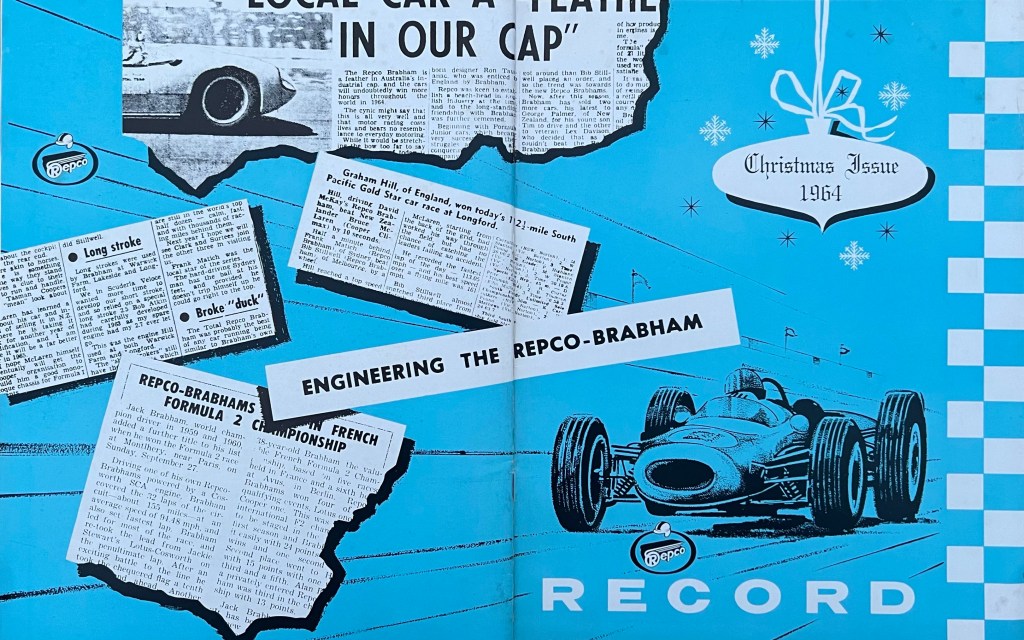
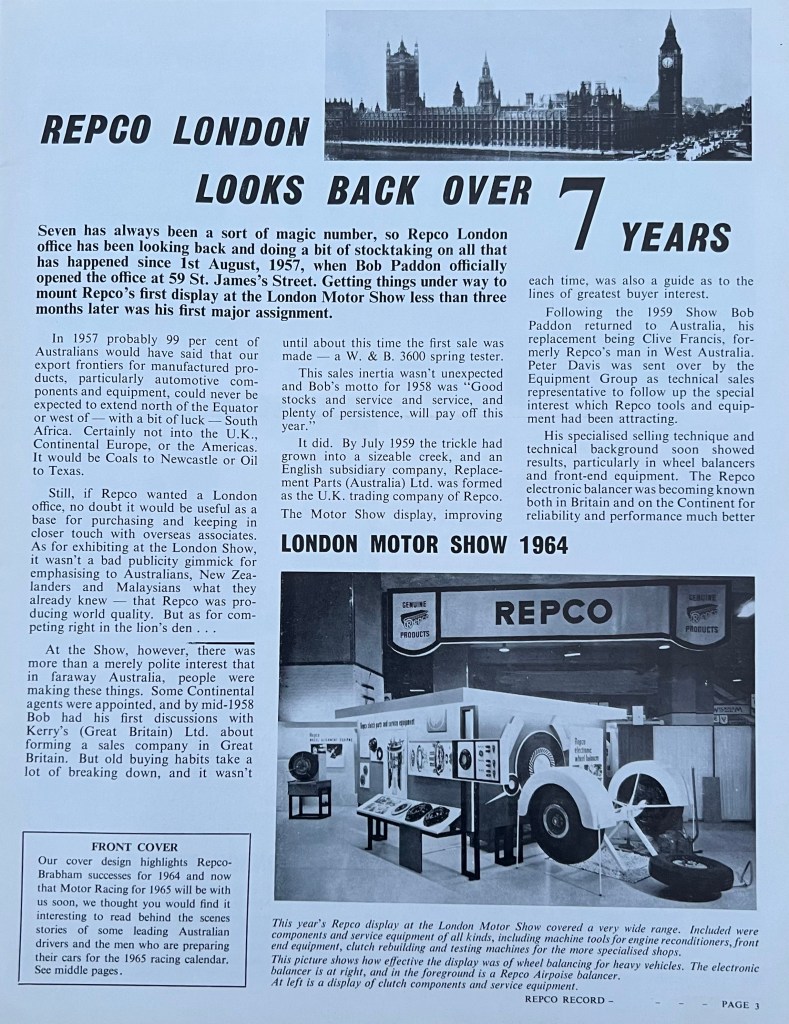
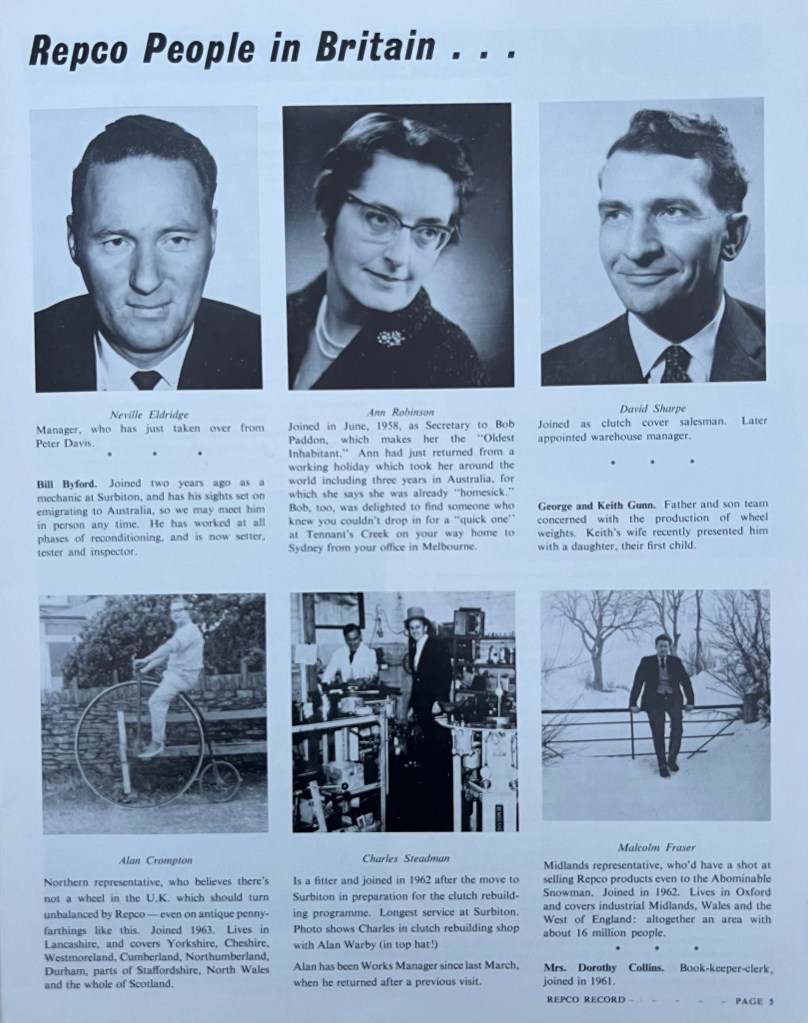
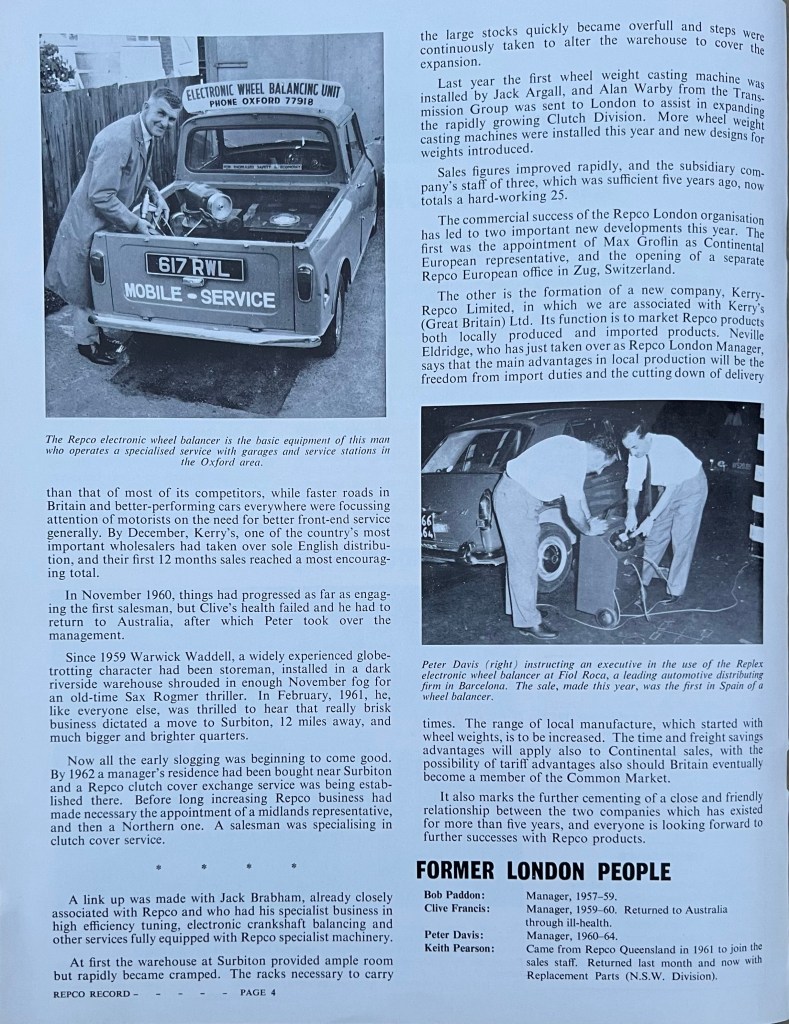
Not that it’s about racing at all. These pages from the Christmas 1964 issue of Repco Record, Repco Ltd’s in-house staff magazine, make it crystal clear exactly when Repco commenced their European operations in London on August 1, 1957.

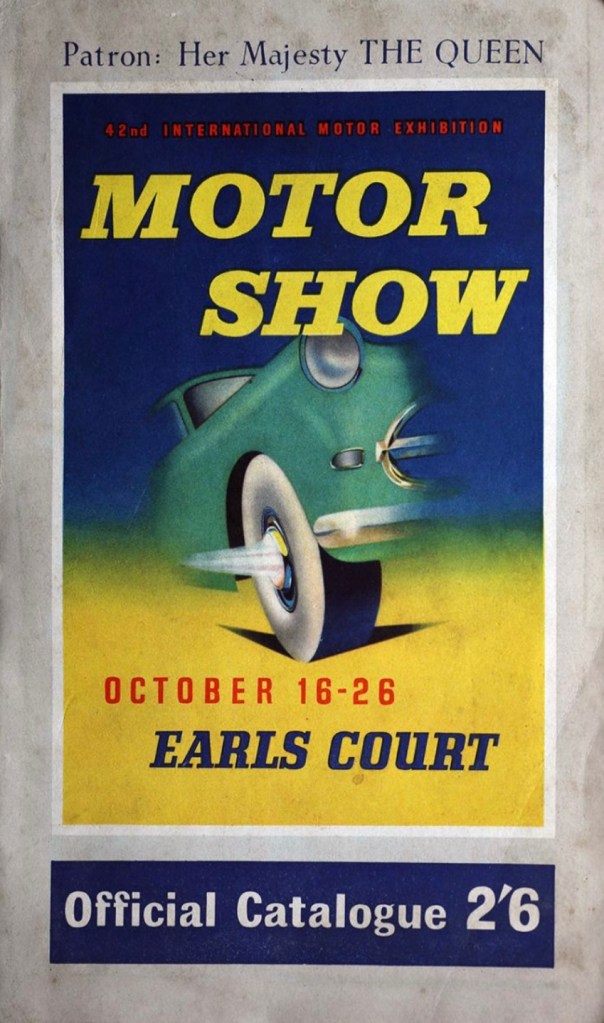
Mind you, that might not be correct. The History of Repco records that Rob Paddon first hung up a shingle at 59 James Street in the West End in 1954. ‘That started with the bold move of joining the UK’s Society of Motor Manufacturers and Traders that year. Membership enabled Repco to exhibit at the earls Court Motor Show from 1957.’

(1957)

I’d always thought Repco’s arrival in the UK was ‘hand in glove’ at about the time the Repco-Brabham branding of Motor Racing Developments Ltd’s racing cars occurred circa-1963. Not so, Repco popped a stake in the ground much earlier.

The global expansion dealt with on the published pages indicates the good marketing sense of the tie-up with Jack Brabham and Ron Tauranac given the international nature of motor racing and therefore the brand-building available to Repco by hitching themselves to Brabham’s coat-tails.

A little later still, Repco’s engineering skills were laid bare – revealing that they weren’t just a sponsor’s name on the nose of Brabham racing cars – for all to see when Repco’s family of 2.5-5-litre racing V8s took to the circuits from January 1966.

So, this stuff is contextual, not racing as such, and is popped up here to be on the public record.

Credits…

Repco Record courtesy of the Bob King Collection

Tailpiece…

Finito…

(J Lemm)

John Lemm’s fabulous portrait of five-star racer, engineer and industrialist Peter Holinger as he awaits a run at Collingrove Hillclimb in South Australia’s Barossa Valley during 1973. His machine is a self-built Holinger Repco RB620 4.4-litre V8.

Let’s not ponder fireproof racegear and six-point harnesses in Australian hillclimbing at the time…

Peter won the Australian Hillclimb Championship in 1976 at Bathurst, 1978 at Collingrove, 1979 at Mount Cotton, Queensland and finally, 1988, at Fairbairn Park, Canberra in another Repco V8 powered – 5-litre Repco 720 – Holinger Repco.

Peter Holinger’s life and the business success is well-told here: http://holinger.com.au/the-holinger-story

Holinger aboard the car below at Lakeland, Victoria in 1976.

When Peter’s great friend and Repco colleague, Rodway Wolfe, purchased Brabham BT31-1 Repco – Jack’s 1969 Tasman machine – from Repco in 1971, Holinger stored the car for Rod and took photographs and the dimensions of it with Wolfe’s blessing, the Holinger Repco was the result.

Rod recalled, ‘He duplicated the chassis so well that years later at Morwell Hillclimb he borrowed the shock absorbers and a few bits from BT31 and won the event with some of my suspension parts.’ See here: https://primotipo.com/2015/02/26/rodways-repco-recollections-brabham-bt31-repco-jacks-69-tasman-car-episode-4/

Peter in the Holinger Repco at Lakeland, Victoria in 1976 (Auto Action)
(J Lemm)

Lemm’s perfectly focussed shot of Holinger at Collingrove ’73 with a ‘touch of the BRMs’ as the car was then configured. Lemm wrote that the single-rear-disc brake set up comprised a rotor and caliper donated by a Renault R8.

‘The 4.4-litre 620 series Repco had special camshafts made by Peter to give greater low end torque,’ wrote ex-Repco Brabham Engine Company engineer, Nigel Tait. ‘He started to make that engine not very long after we’d moved (Repco Brabham Engines) from Richmond to Maidstone. Apart from being a very clever guy, Peter was an absolutely delightful person,’ Nigel said. Everything you ever wanted to know about the RBE 620 V8: https://primotipo.com/2014/08/07/rb620-v8-building-the-1966-world-championship-winning-engine-rodways-repco-recollections-episode-2/

The very first firing of any Repco Ltd built complete engine, the 2.5-litre RB620 V8 E1 – use of the Oldsmobile F85 block in the 620 engines is duly noted – in cell four of the Repco Engine Laboratory Richmond, on its Heenan & Froude GB4 dyno, March 26, 1965. That’s Phil Irving at left with stereo-typical inch of ash on his ciggie, Bob Brown, the Repco Ltd director responsible for the Repco Engine Parts Manufacturing Group of which Repco Brabham Engines Pty Ltd was a part, Frank Hallam, RBE general manager, and Peter Holinger, then head machinist and technician. Those Webers were borrowed from Bib Stillwell up the road in Kew, the Lucas fuel injection system had not yet arrived. E1 was the only engine fitted with carbs, and not for long, all RBE V8s were Lucas injected…except an Indy Turbo R&D engine that never got closer to the track than the Maidstone dyno-house (Repco)

Holinger knew a thing or two about these engines having machined and assembled the very first 2.5-litre RB620-E1 V8 together with its designer, Phil Irving – Irving drew every single RBE620 design drawing – in February-March 1965. Indeed, Holinger was present in the Repco Engine Laboratory in Richmond when that engine was fired up for the very first time on March 26, 1965.

Peter was already hillclimbing another self built machine, the Holinger Vincent s/c during this period at Repco, and when he first went out on his own. The two shots below are both at Silverdale, NSW, in 1966 and 1969.

(K Power)
(Australian Motor Racing Annual)

The ongoing evolution of the Holinger Vincent was also typical of Peter’s subsequent two hillclimbers, the shots below are of the Holinger Repco ‘BT31’ taken at the daunting, fast, Mount Tarrengower, Maldon, Victoria in 1978. The wings are the obvious change from the earlier shots, this car copped a 5-litre Repco 720 V8 at some point too.

(J Bowring)
Rare colour shot of Peter and Holinger ‘BT31’ nose-up under power in second gear perhaps. Holden FB wagon in the background at the bottom of Tarrengower (G Williamson)

The good news is that the three Holinger hillclimbers are still with us. David Nash – a Repco colleague of Peter Holinger’s – wrote a while back that he was rebuilding engine E1 4.4 – the same engine built by Peter and Phil in 2.5-litre form in 1965 – to go back into the Holinger ‘BT31’.

The final Holinger Repco 5-litre (shots below) was rebuilt at Holinger Engineering after Peter’s death in 2009, and shifted to the premises of the Victorian Historic Racing Register in Box Hill, Melbourne, on long term display/loan in March 2017. It always warms the cockles of ‘me heart to see it…

Holinger aboard his final Holinger Repco 5-litre 720 at Morwell Hill, Victoria, circa 1988 (unattributed)
(Holinger)
(Holinger)

Etcetera…

(S Dalton Collection)

Holinger, very close to his Warrandyte home, on Templestowe hill, September 11, 1966 with Autosportsman reporting times of 54 and 53.9 seconds.

(D Willis)

Dick Willis’ amazing photograph of a posse of Australian Hillclimb Champions taken during the 1996 championship weekend, April 4-7 at Mount Panorama, Bathurst.

Left to right are Kym Rohrlach 1980/82/86/87, Stan Keen 1975/93, Peter Holinger 1976/78/79/88, Warren Brown 1984, Ivan Tighe 1964/85/91, John Davies 1992/95 and Roger Harrison 1983/94.

Arcane trivia is that – I think – the final in-period championship won by an RBE V8 anywhere in the world was Roger Harrison’s victory in the ’97 AHCC at Mount Leura, Camperdown, Victoria on October 16-19. His weapon was an ex-Alan Hamilton/Alf Costanzo Tiga FA83 Formula Pacific machine fitted with an RBE740 V8, capacity folks? Hamilton had Jim Hardman restore that car to RBE spec five or so years ago, it may have sold recently.

(Repco)

I love this Repco Brabham Engines family shot taken at the just-moved-into Maidstone premises in mid-late 1966. Back-Kevin Davies, Eric Gaynor, Tony Chamberlain, Fred Rudd, John Mepstead and Peter Holinger. Middle-Vic Mosby, Howard Ring and Norm Bence. Front-David Nash, Rod Wolfe and Don Butler.

Credits…

John Lemm, Auto Action, Repco Archive via Nigel Tait, Australian Motor Racing Annual 1970, Kerry Power, Geoff Williamson, John Bowring, Stephen Dalton

Finito…

(I Smith)

Small things amuse small minds, mine that is.

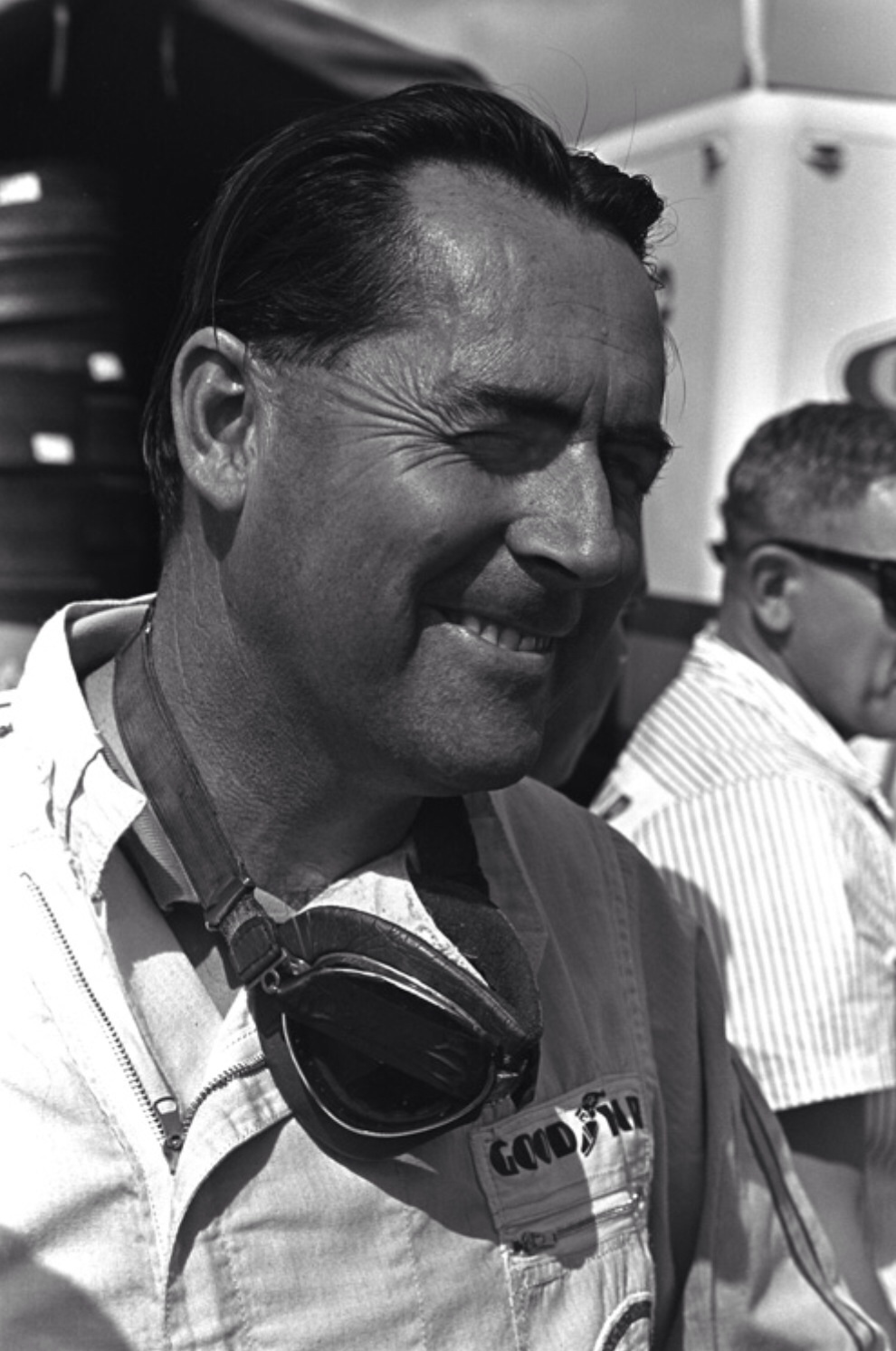
Jack Brabham being pestered by Frank Matich before the start of the Tasman Series Sandown Park Cup on February 16, 1969. Frank is after some tips on how to extract the best sponsorship deal from Repco Ltd management.

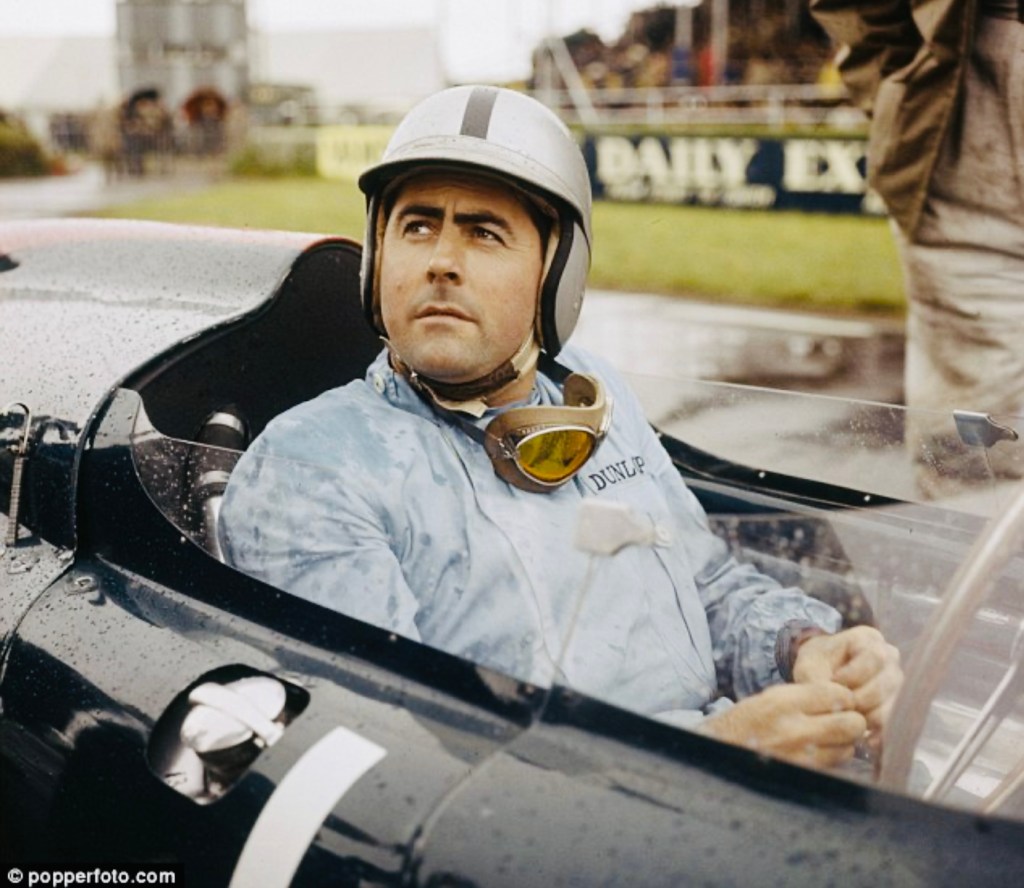
It’s intrigued me that Jack clearly forgot to bring his nice modern Bell Magnum helmet home with him when he jumped on his Qantas 707 at Heathrow for Sydney in December 1969.

When his Brabham BT31 Repco was finally offloaded at Port Melbourne and had its nice new RBE 830 V8 fitted at Repco Brabham Engines in Maidstone, he cast around for a skid-lid and – seemingly – this circa 1960 helmet and pair of goggles were the only ones available to head off to Calder to test the car two days before the Sandown race. See here for a BT31 epic: https://primotipo.com/2015/02/26/rodways-repco-recollections-brabham-bt31-repco-jacks-69-tasman-car-episode-4/

The lovely shot above seems to be the helmet in question sitting atop Jack’s noggin on the grid of the BRDC International Trophy at Silverstone nine years before, May 14, 1960: second in his works-Cooper T53 Climax behind Innes Ireland’s Lotus 18 Climax.

(unattributed)

Our very own Jack during the ‘69 Sandown Cup. He is on the run out of Peters above, and on the way into Dandy Road below, wearing the same 1960 helmet or one very much like it.

Small things as I say…mind you, I don’t like ‘yer chances of racing with a nine year old helmet in today’s homogenised, pasteurised over regulated times.

Brabham finished third in the race, proving brand-new BT31 was quick right out of the box, which was won – so too the Tasman Series – by Chris Amon’s Ferrari 246T. Jochen Rindt was second in his Lotus 49B Ford DFW.

(R MacKenzie)

Jack returned that Easter to fulfil his final Australian Repco commitments, winning the Gold Star round at Bathurst in BT31. This time (below) Jack remembered to pack the Bell Magnum but not his modern goggles…

(B Frankel)

More on Jack’s helmets here: https://primotipo.com/2020/07/11/jack-piers-and-helmets/

Credits…

Ian Smith , popperfoto.com, Rod MacKenzie, Bob Frankel

Finito

image

The Repco Record cover girl for September 1965 is the prototype 2.5-litre Repco Brabham 620 V8. Engine #E1 first spluttered into life on the Repco Laboratory testbed, Richmond on 26 March 1965…

She is quite a cutie replete with Weber carbs rather than the Lucas fuel injection with which the Repco engines always raced. Click away at the links below for plenty of articles on this engine, this is another piece from Michael Gasking’s wonderful collection of Repco memorabilia.

image

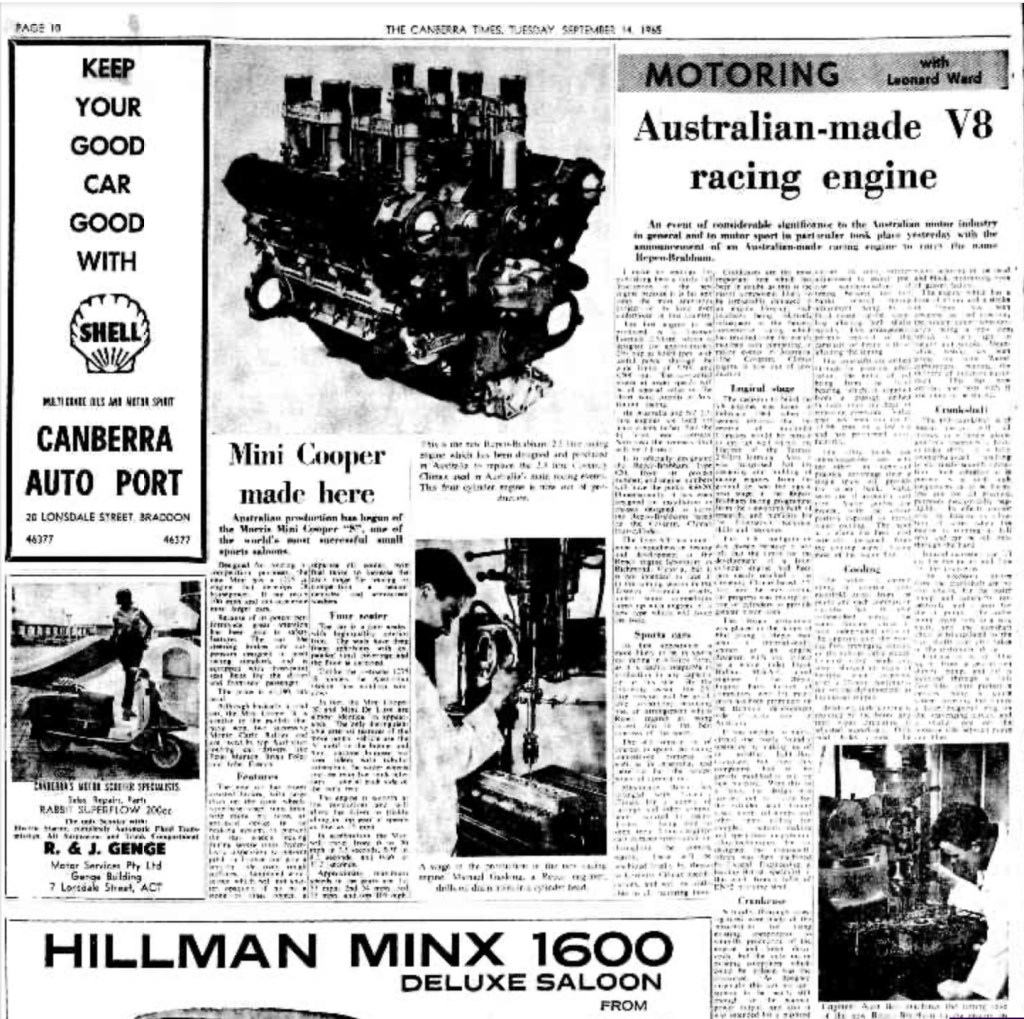
The public announcement of the engine was made by Repco on Monday September 13, 1965. Many thanks to historian David Zeunert who forwarded a copy of Leonard Ward’s piece about the initiative which was published in the Canberra Times the following day.

It includes an unusually detailed technical description of the engine, but makes no mention – at that point at least – of a 3-litre 620 variant for the new F1 which commenced in 1966.

That the 1275cc Morris Cooper S – ‘one of the worlds most successful small sports saloons’ – has gone into production at BMC’s Australian plant at Zealand, inner-Sydney would have been big news too, albeit well-known to enthusiasts.

Credits…

Michael Gasking Collection, Repco Ltd, Canberra Times via David Zeunert Collection

Finito…

image

(John Lemm)

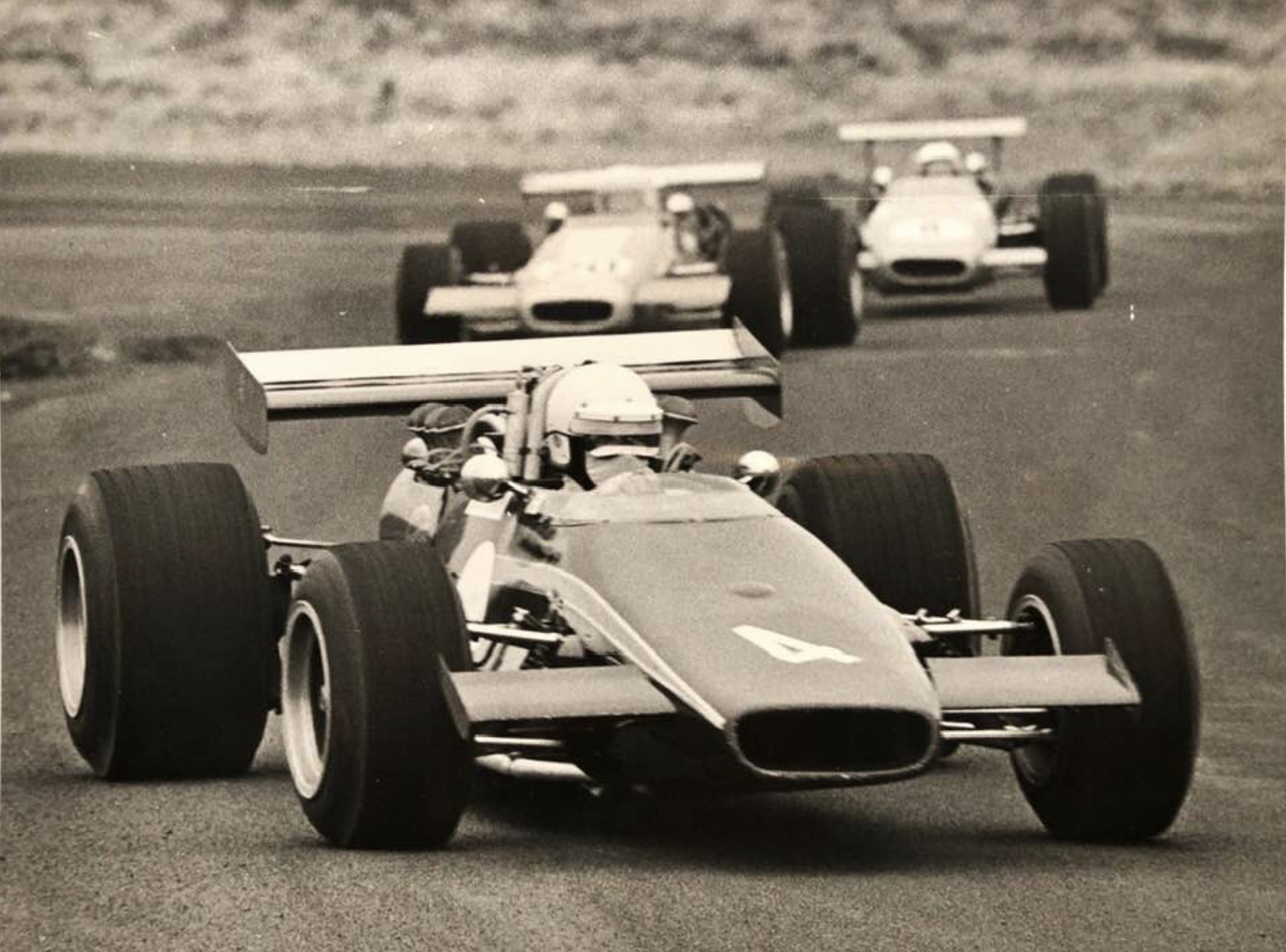
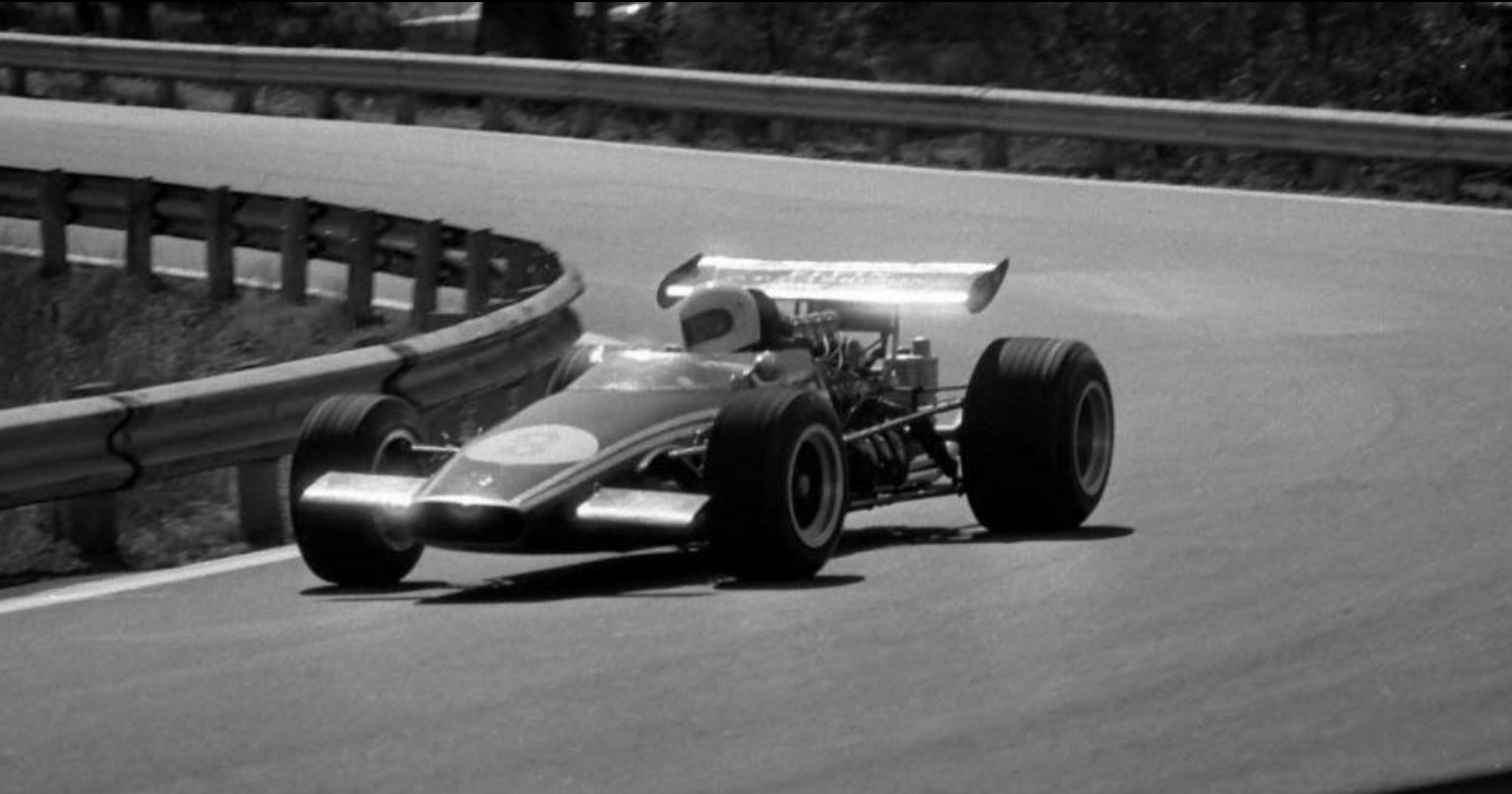
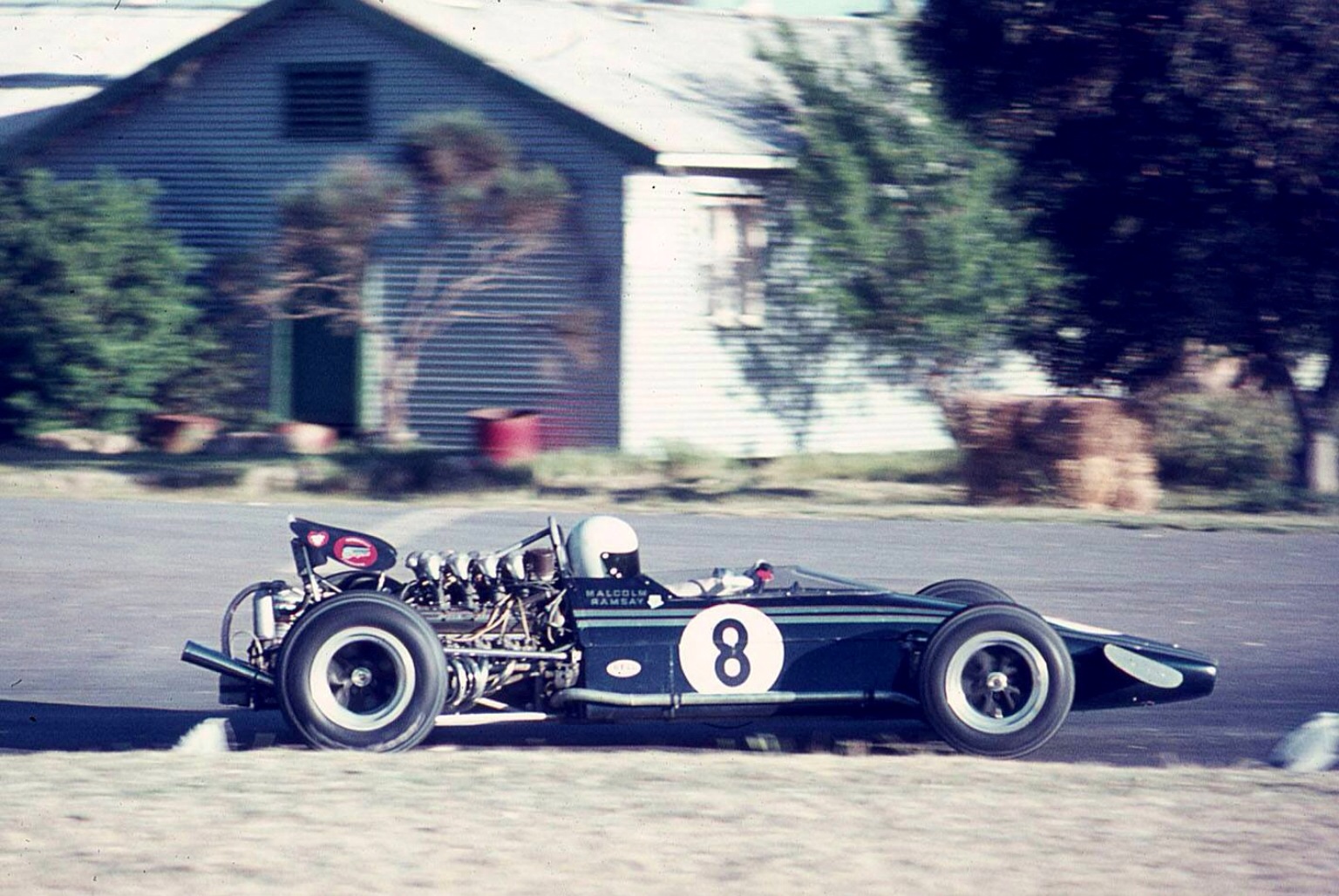
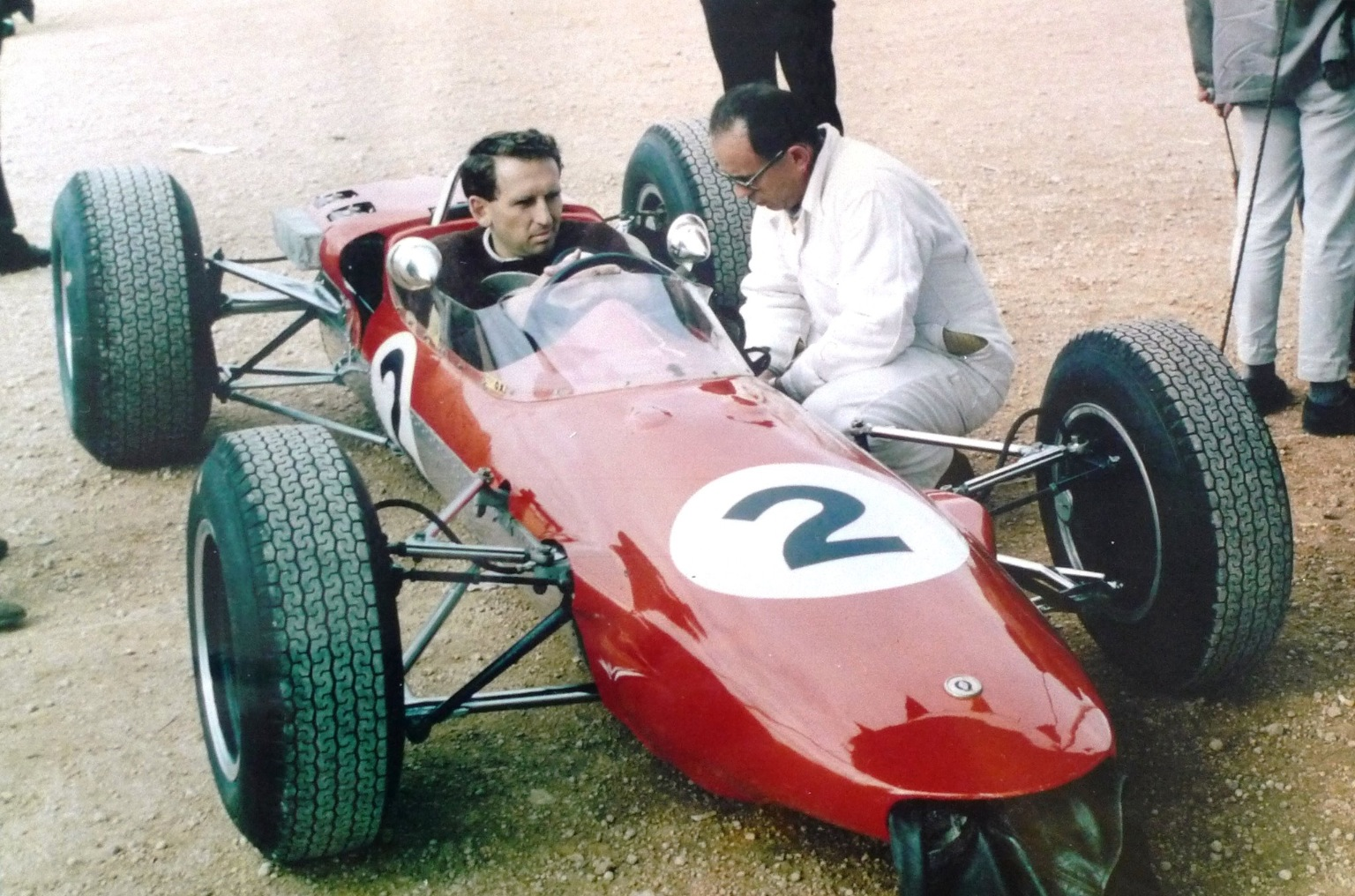
Malcolm Ramsay applies Repco V8 power out of Clubhouse Corner, his Granton Harrison owned Elfin 600C #6908 on its way to fourth place during the October 1970 Mallala Gold Star round, the series won by Leo Geoghegan’s Lotus 59B Waggott that year….

My Australian single-seaters I would like to own and race comprises the Mildren Yellow Submarine Alfa 2.5 V8, Elfin Mono, Elfin 600C/D Repco 2.5 V8, Bowin P8 Hart and Repco V8, and Matich A53 Repco F5000, Richards 201 VW. Lets’ throw in the Mawer 003 Formula Ford and the front engined Tornado Chev to add to the attack on my Super Fund.

Knowledgeable Aussies will want to exclude the ‘Sub as it was built by Alan Mann Racing for Mildrens, so it’s a Pommie car not one of ours. A bummer really as that’s my emotional first choice, always has been with either the Alfa engine or Merv Waggott’s superb 2-litre DOHC four-valve jewel with which it was later fitted – and restored as such.

After that it’s a close run thing but the three 2.5-litre V8 Repco engined Tasman Elfin 600’s are about as good as it gets, I reckon.

image

About as nicely integrated a bit of kit as there was in 1969. Cooper’s 6908 at its first Mallala test before its Asian Tour where the new car didn’t finish a race (Bob Mills)

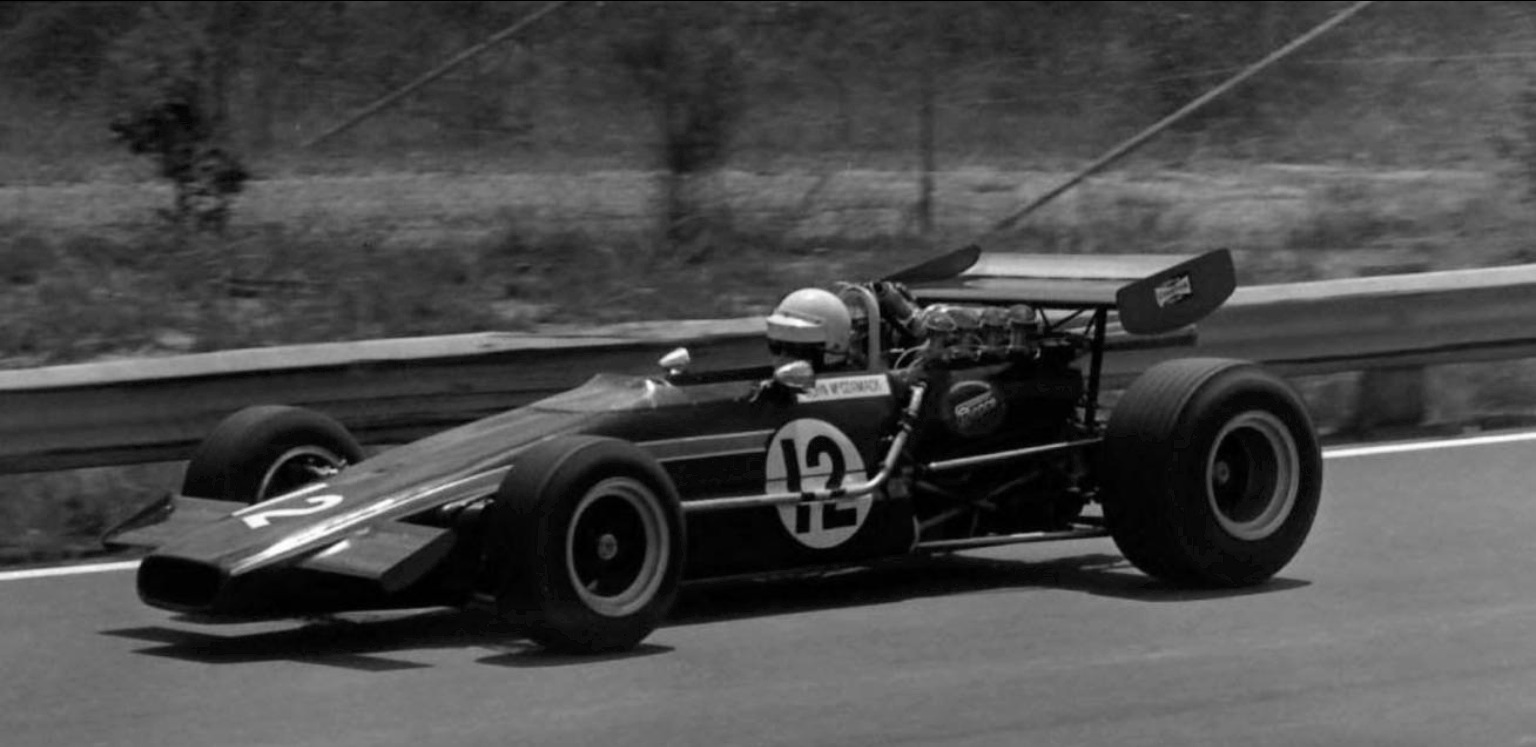
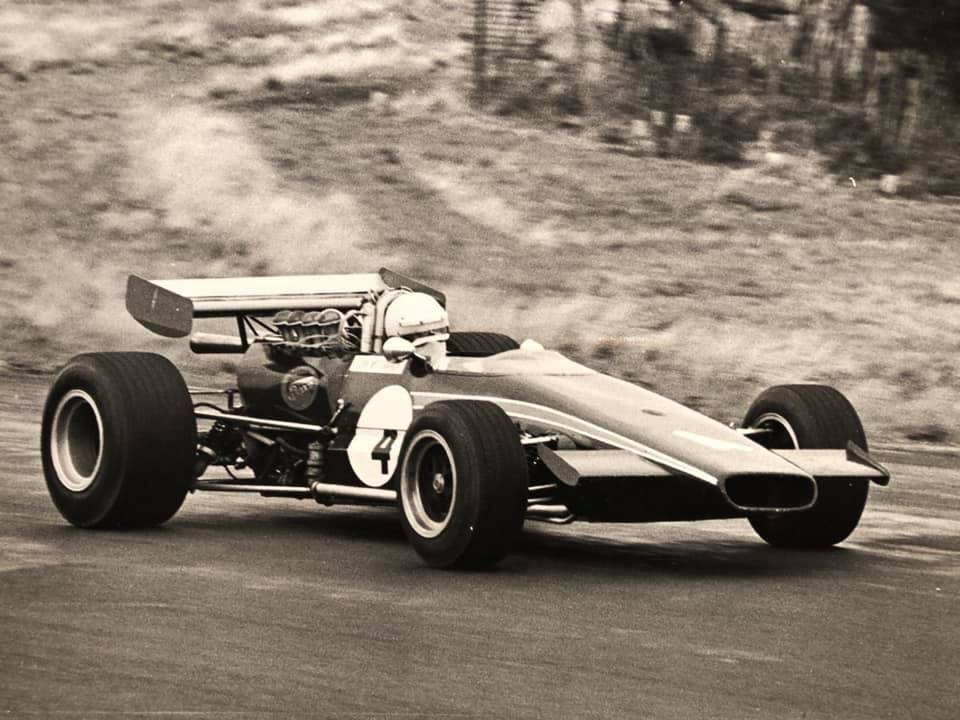
Garrie Cooper built three of them. Two 600C’s for he #6908, and John McCormack #7011, plus a 600D #7012 which was Garrie’s 1970 Gold Star mount.

Mac’s 600 did a few races using the Coventry Climax 2.5 FPF four-potter from his Brabham BT4 before conversion to Repco V8 power for the final half year the Gold Star was run to the Tasman 2.5 Formula in 1970, F5000 replaced it in 1971.

Just to confuse things, 1970 Tasman eligible cars were 2.5s and F5000, but the 1970 Gold Star – Australia’s domestic single-seater championship – was run for 2.5s only. Go figure, it was a CAMS political compromise clusterfuck of its finest, typical type.

There are no other cars on the planet which won both F1 and FF races surely? OK, ANF1 and FF races anyway!

image

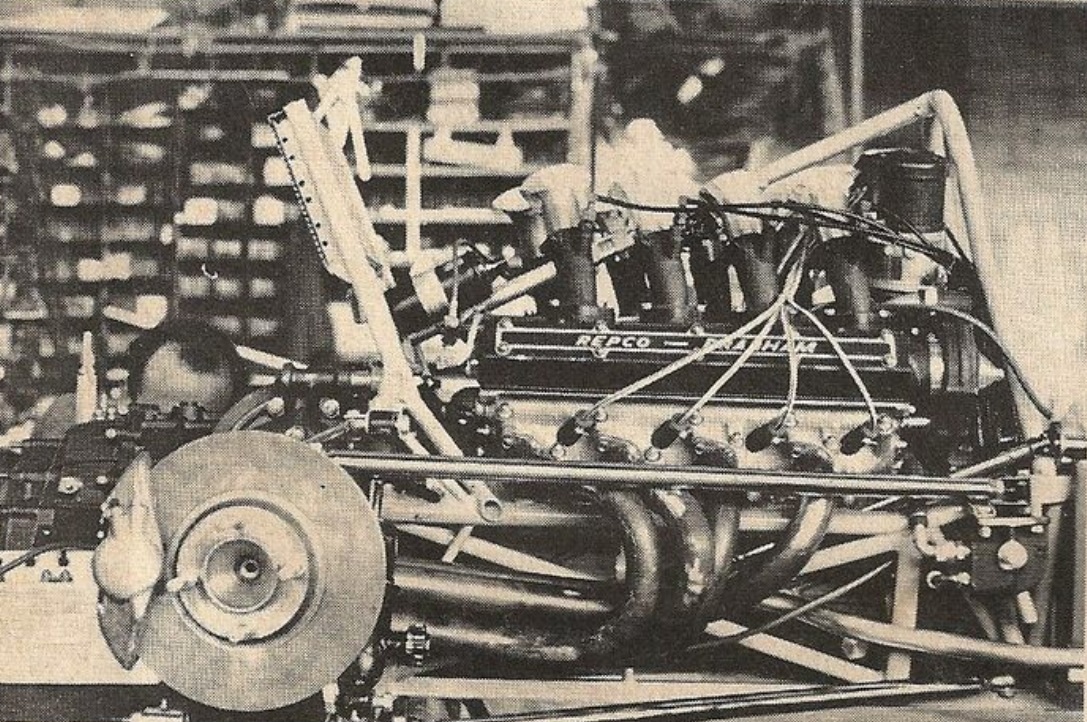
This is the business end of  600C 6908 complete with 730 Series Repco V8. The 600D was lighter in that Cooper used the 830 Series Repco as a semi-stressed member saving circa 100 pounds of weight overall inclusive of other changes compared to 600C. Gearbox is Hewland’s ubiquitous FT200 5-speed (AJ van Loon)

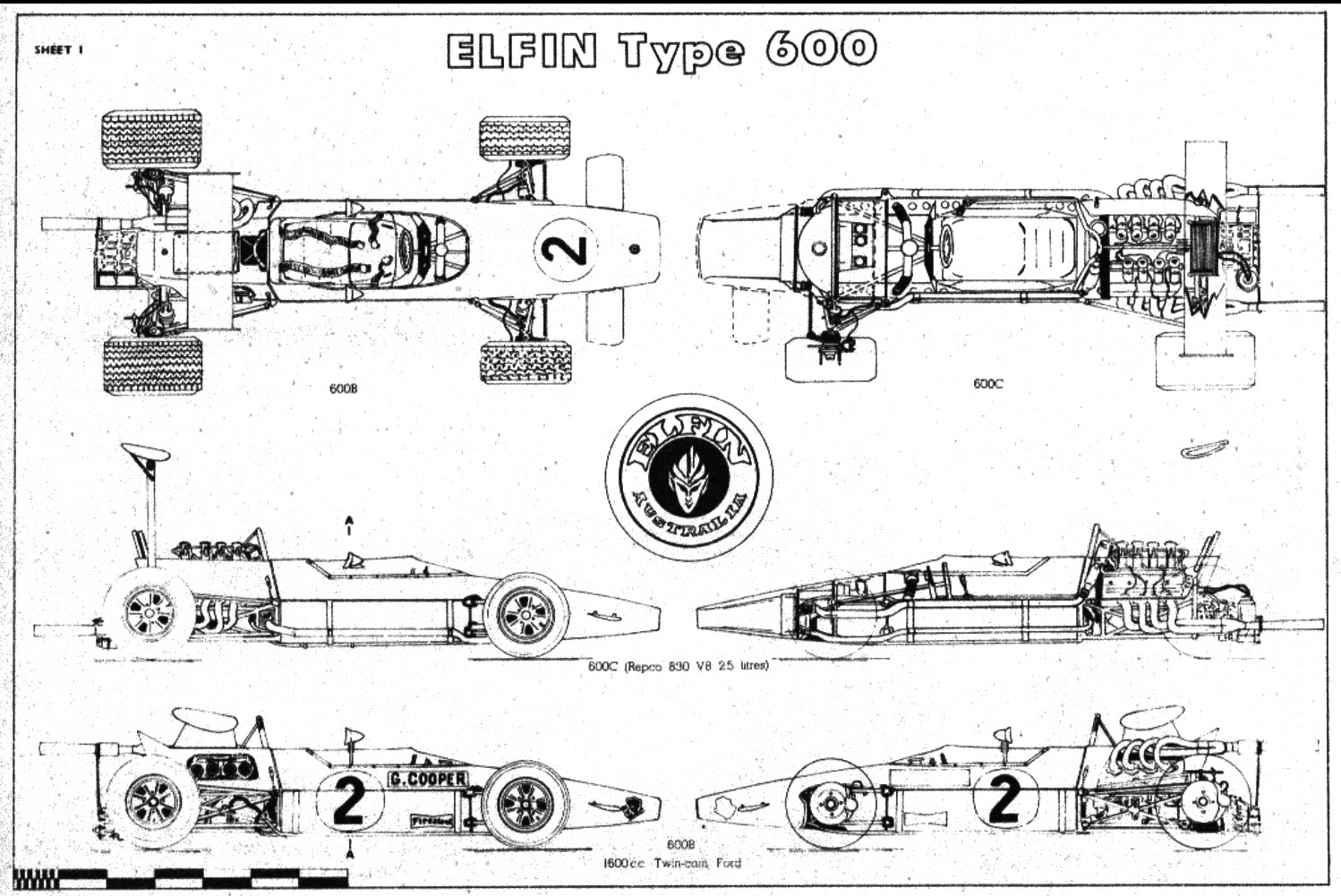
The Elfin 600 is a superb spaceframe chassis design which Cooper built for FF, F3, F2 and ANF1 Tasman 2.5 classes from 1968 to 1971. His previous single-seater, the Mono or Type 100, as the name suggests was a monocoque but customer demand for ease of maintenance and repair resulted in a very stiff, light spaceframe which evolved a bit over the 600’s long production run but in essence was the same from Cooper’s first 1968 Singapore GP winning #6801 chassis to the last built in 1971.
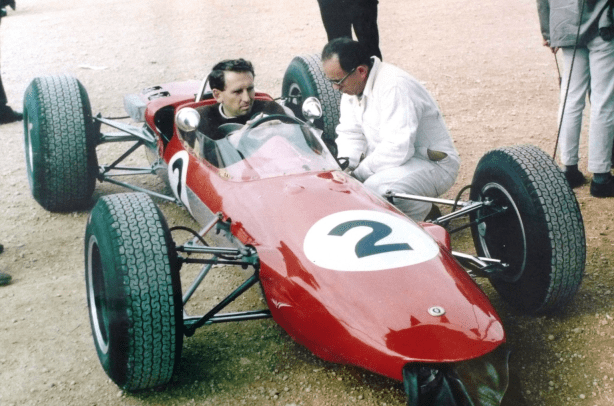
cooper mono

Garrie Cooper and Norm Butler with the prototype Mono Mk2 #6550 at Mallala. In the words of Bruce Allison “One of natures gentlemen, he was a pleasure to deal with and an honour to race against.” Monocoque chassis and pullrod suspension front and rear. Neither driver or mechanic have noticed the spectator in the cars nosecone (Spencer Lambert)

600’s won races in all classes and championships in FF and F2. Larry Perkins, for example, won the 1970 Formula Ford National Series in a 600 FF and the 1972 ANF2 title in a 600B/E Lotus/Ford twin-cam before seeking fame and fortune in British F3 in 1973.

600’s won the 1968 Singapore GP and the 1968 and 1969 Malaysian GP’s.

image

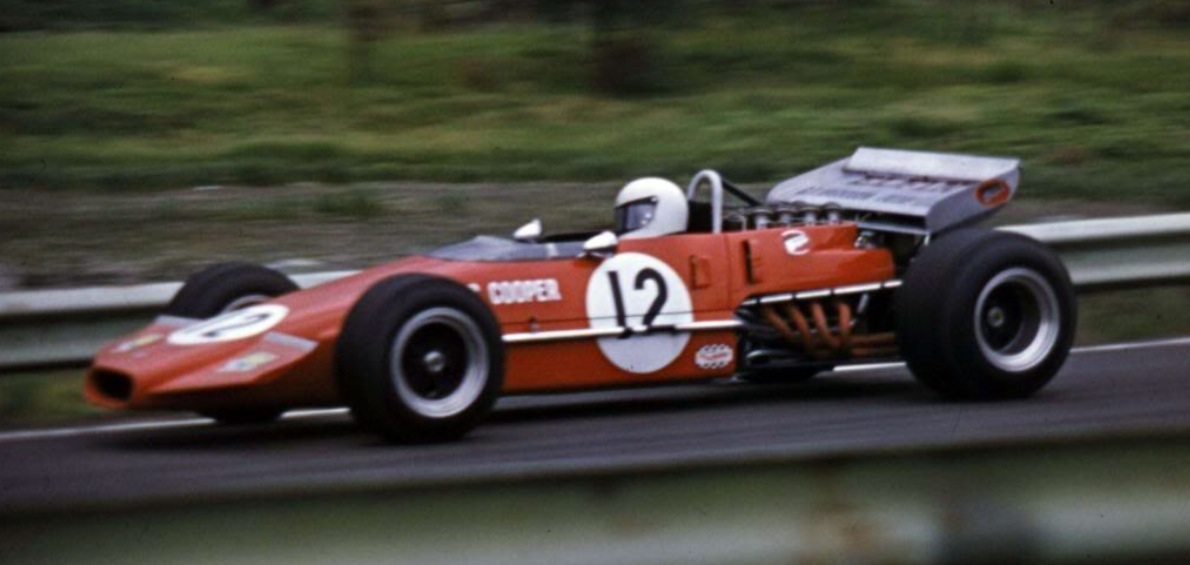
Cooper 600D, AGP Warwick Farm November 1970. DNF fuel pump in the race won by Matich’s McLaren M10B Repco  (Lynton Hemer)

The roll call of 600 pilots includes many Australian and some international greats; Cooper, McCormack, Ramsay, Perkins, John Walker, Bruce Allison, Henk Woelders, Brian Sampson, Ivan Tighe, Richard Knight, Peter Larner, Richard Davison and many others. The cars are popular historic racers these days of course.

cooper 600

Cooper in the first 600, #6801 in the Sandown paddock during 1968, the car in which Garrie won the ’68 Malyasian GP. Look closely, the crop of the shot just gets in the tall, and very spindly looking high rear wing support (Jeff Morrall)

John McCormack (below) looking as pleased as punch with his new Repco 740 Series V8 in the Sandown Gold Star paddock.

It’s 13 September 1970, he was seventh that weekend, the race won by John Harvey’s Jane Repco V8. Mac started the season with his old Coventry Climax FPF in the back of his new car, he was fourth at Lakeside in June and fifth at Oran Park later that month before fitting the Repco engine in time for the September Warwick Farm round.

My Repco friend Rodway Wolfe tells the story of Mac picking up the Repco engine at their HQ’s Maidstone factory, and sticking it in the boot of his Ford Fairlane before retiring to a Footscray pub for a few cleansers with Rodway.

Mac then headed up the Western Highway for the eight hour trek back to Adelaide to instal the engine at Elfin’s Edwardstown factory. The chance of having the flash Fairlane ‘nicked in then very working-class Footscray complete with its valuable cargo was high!

mac

McCormack’s Elfin 600C Repco #7011 at Sandown on the 12/13 September 1970 weekend. #25 is another later Australian Gold Star champion’s car, John Walker’s Elfin 600B Ford. Engine is a 740 Series Repco 2.5 (Wolfe)

It was the start of a very long mutually fruitful relationship between the Taswegian and Repco which blossomed in the F5000 era with a succession of Elfins Mac pedalled with increasing pace as his driving matured. He also raced a Repco Leyland powered McLaren M23, a car I wrote about in detail a while back;

Mac’s McLaren: Peter Revson, Dave Charlton and John McCormack’s McLaren M23/2…

McCormack raced the 600 Repco in the Mallala final round won by Leo Geoghegan’s Lotus 59 Waggott, colliding with Bob Muir’s Mildren entered Mildren Yellow Submarine.
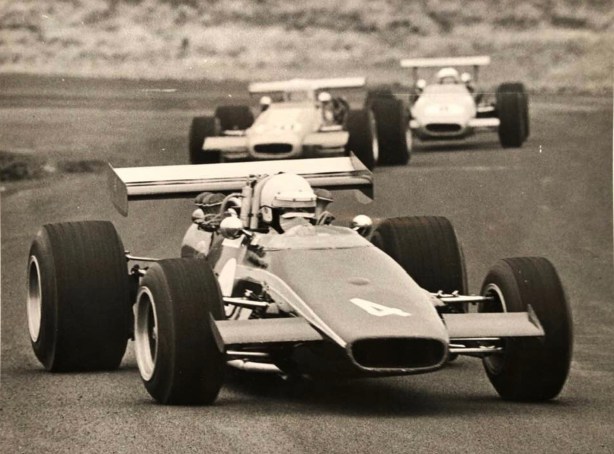
The McCormack 600C Repco at Phillip Island in 1970 (N Tait)

image

McCormack, Elfin 600C Repco Warwick Farm 5/6 September 1970. Engine in this shot is the later (than 740 Series engine in the shot above) 730 Series (or 830?) Repco (Lynton Hemer)

Garrie Cooper, John McCormack and Malcolm Ramsay were all steerers of the 600 Repco’s in Gold Star events in 1969/70.

Cooper and McCormack were both champions, Mac one of the very best, none of them were ANF1 aces at the time, they were still learning their craft more powerful cars.

My theory is that an Elfin Sports Cars prepared 600 Repco woulda-coulda-shoulda won the Gold Star in 1969 and 1970 with any of Leo Geoghegan, Kevin Bartlett, Max Stewart or John Harvey at the wheel.

A Kevin Bartlett driven 600 Repco could have won the 1970 Tasman, Frank Matich would have done the job as well of course. Indeed, FM would have given Amon, Rindt and Hill a run for their Tasman money in a 600 Repco in 1969. I know there are good commercial reasons why none of them drove Elfins in those years but that’s not my point, which is that with the right dude behind the wheel the cars were Tasman and Gold Star winners in 1969-70.

Still, ‘if yer Aunty had balls she’d be your Uncle’ as the Frank Gardner saying goes.

This is not a detailed treatise of the 600, that’s a much longer piece, for the moment this is a quickie on the three 600 Repco’s to go with some wonderful shots of a model which won a whole lot of races throughout Australasia but could have won a swag more ANF1/Tasman races with an ace behind the wheel.

In fact that last statement is NOT what the 600 was in the main about, which was a customer racing car which was quick straight-outta-the-box in the hands of a competent steerer with the settings Cooper’s highly-tuned-testing-arse built into the cars when they rolled out of his factory.
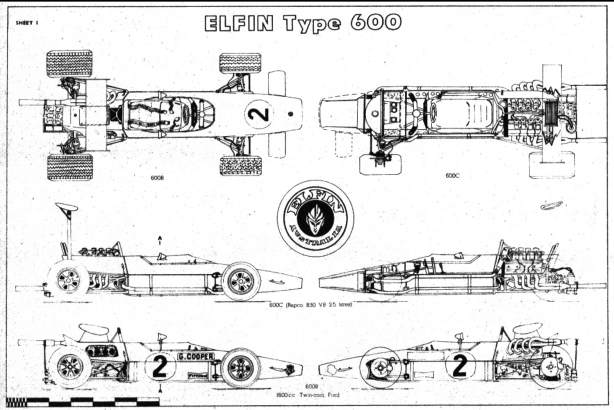
elfin 600

Space frame chassis, engines to customer choice or class dictates (FF,F3,F2, ANF1) gearboxes Hewland Mk9 or FT200, disc brakes all round, rack and pinion steering (unattributed)

image

Repco Brabham 830 Series 2.5-litre V8 (TNF)

Repco 830 Series 2.5-litre Tasman V8.

This is the ultimate spec Repco Tasman 2.5 engine developed for Jack Brabham’s ill-fated 1969 Tasman campaign, but first raced by him in the final ’68 Tasman round (Brabham BT23E) at Sandown. It comprises the 800 Series short block and 30 Series cross-flow heads.

In short Jack only raced his Brabham BT31 at Sandown as the car was stranded at the Port Melbourne docks inside its packing crate due to a wharfies-strike.

Read Rodway Wolfe’s account of this car here;

Brabham BT31 Repco: Jacks ’69 Tasman Car…by Rodway Wolfe

The engine was SOHC, two valve with chain driven cams. Fitted with Lucas fuel injection the engine developed 295bhp @ 9000rpm. Note the heavily ribbed block, and below, the ribbing socket head cap screws to cross-bolt the main bearing caps.

This engine is the Garrie Cooper Elfin 600D motor, its pictured in Elfin workshop ready for installation. It has the later Indy (760) sump assembly and combined oil pressure/scavenge pump.

image

Garrie Cooper, Elfin 600D Repco 7012 in the Warwick Farm Esses, September 1970, second in the race won by Geoghegan’s Lotus 59B Waggott (Lynton Hemer)

Race Record of the Repco powered Elfin 600’s…

When the first 600C was completed Garrie took it on an Asian Tour which was unsuccessful, he was fast but unreliable, failing to finish all the races he contested.

The results weren’t surprising as while the car had been fired up before the drive to Sydney and attachment its aircraft pallet, GC hadn’t had the chance to shake it down at Mallala. During practice in Singapore the car was losing oil, mechanic Bob Mills could see it but could not cross the track to signal Cooper. Garry felt the engine nip-up but it was too late to save its bearings and crank. A new crank and bearings were flown in, but incorrect baffling in the oil tank caused starvation so the car didn’t start. Graeme Lawrence won the race in his McLaren M4A Ford FVA.

In Malaysia for the Selangor GP, GC led the race until a misfire caused two pitstops for plugs, pushing hard to make up time Garrie popped a wheel off the bitumen and slid into a marshals post tearing off the right rear corner.

The car was repaired in Asia by Bob Mills, Garrie joined Mills in Japan for the Japanese Automobile Federation GP which was won by Leo Geoghegan’s Lotus 39 Repco. Cooper, second on the grid lead from the start ahead of Bartlett, Ikuzawa, Geoghegan, Roly Levis Brabham BT23 FVA and Max Stewart. GC misjudged his braking, getting the 600 bogged, restatred and then the Mlaysian misfire returned and he retied.

The car was then shipped to its new owner, Steve Holland in Hong Kong. The car was returned to Adelaide to have the rear wing mounted on the chassis instead of the suspension uprights in accordance with the new global regs post the FIA’s ’69 Monaco GP pronouncements.

Cooper borrowed the car for the fourth round of the 1969 Gold Star and led from flag to flag beating the best in Australia; Bartlett, Harvey, Geoghegan, Stewart, Allen and others despite the return of the hi-rev-range misfire later in the race. The problem was eventually diagnosed as a faulty fuel metering unit when the car later returned to Australia!

For 1970 Cooper built a lighter 600C and the 600D for his own use. Granton Harrison acquired the 600C from Steve Holland for Malcolm Ramsay to race. 600C 7011 was built for John McCormack’s car as related above.
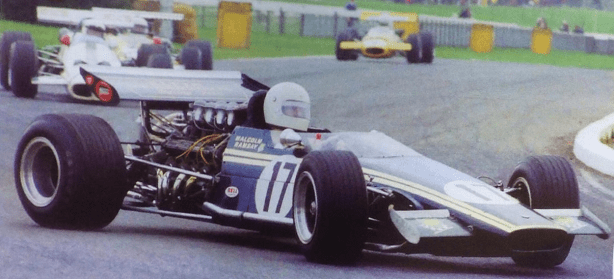
mal

Mal Ramsay, Elfin 600C Repco spinner at Sandown’s Shell Corner during the 1970 Gold Star round Leo G, another car and Max Stewart in the distance (Jeff Nield-autopics.com)

Cooper’s car was running late for the 1970 Gold Star, shipped to Tasmania airfreight, he started from the rear of the Symmons Plains grid and then retired with a flat battery.

Garrie was ninth at Lakeside, his Repco misfired while in third place causing a change of plugs. Max Stewart took a Mildren Waggott win, Ramsay also retired with Mac fourth in the Climax engined 600C.

At Oran Park GC was third and Ramsay fourth, Cooper and Ramsay raced under the GT Harrison Racing Team banner. McCormack’s 600C Climax was fifth.

At Warwick Farm on 6 September Geoghegan won from Cooper, Bob Muir, Rennmax BN3 Waggott and Ramsay. Mac retired on lap eight, his car now Repco 740 powered but not running on-song.

Cooper was quickest in first practice at Sandown on 13 September but broke a cam follower. Geoghegan took pole from Ramsay, Muir and Cooper. In the race Geoghegan, Cooper and Muir contested second place while John Harvey disappeared in the Jane Repco V8, a car built on Bob Britton’s Brabham BT23 jig, a variant thereof if you will.

Etcetera…
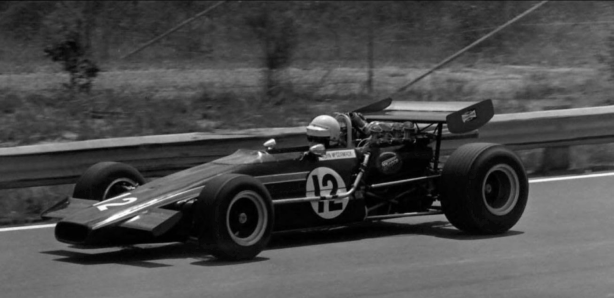
mac

(Lynton Hemer)

John McCormack races his Elfin 600 Repco at the 1971 Warwick Farm 100, Tasman round.

That year the Tasman was dominated by F5000 machines albeit Graeme Lawrence’s Ferrari Dino 246T won the Cup with a blend of speed and reliability the F5000s lacked.

McCormack’s was the last race in which a Repco engined 600 ran on the circuits at championship level (noting Roger Harrison’s 600C Repco Australian Hillclimb Championship win at Mount Cotton in 1983) it was the end of the marvellous 2.5-litre era.
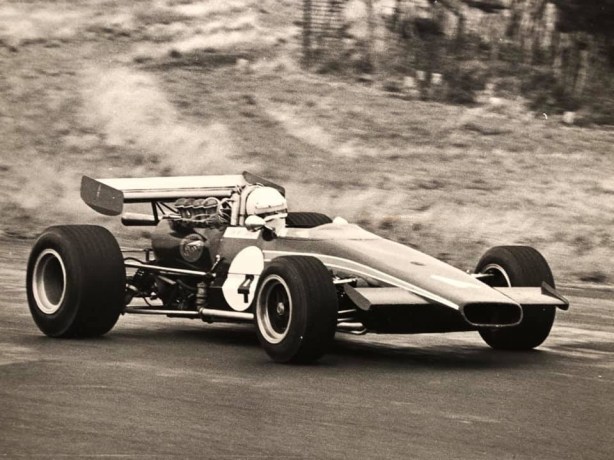
McCormack, 600C 740, Phillip Island 1970 (N Tait)

Credits…

John Lemm, Rodway Wolfe Collection, Adrian van Loon, Bob Mills Collection, Lynton Hemer, Singapore National Archives, Oldracingcars.com

More Efin 600 reading in my April 2021 Auto Action article here; AUTO ACTION 1808 – Auto Action

Tailpiece…
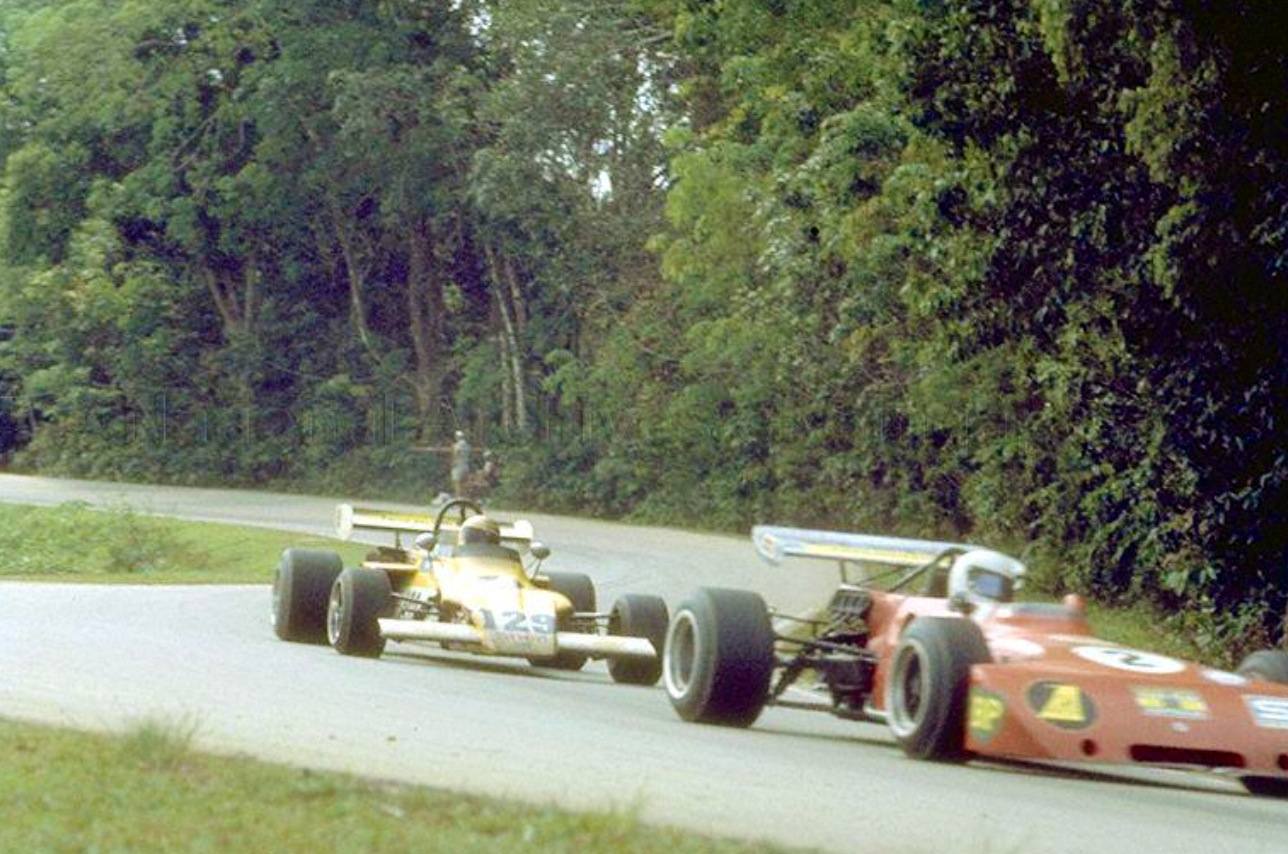
gazz

Garrie Cooper’s 600D 7012, now Lotus/Ford Twin-Cam powered leads Vern Schuppan’s March 722 Ford during the 1972 Singapore GP on the wild Thomson Road Circuit.

He is heading through The Snakes, the car is sporting a bluff nose of the type Tyrrell made popular during 1971. Cooper fitted an evolution of this nose to the MR5 F5000’s raced during the ’72 Tasman by Cooper and McCormack.

Finally, Bruce Allison made the 600D Ford sing after Garrie was finished with it during his rise to the top…

Finito…

image

I think anything Repco Brabham is a thing of functional and engineering beauty, simplicity and performance…while admitting hopeless bias!

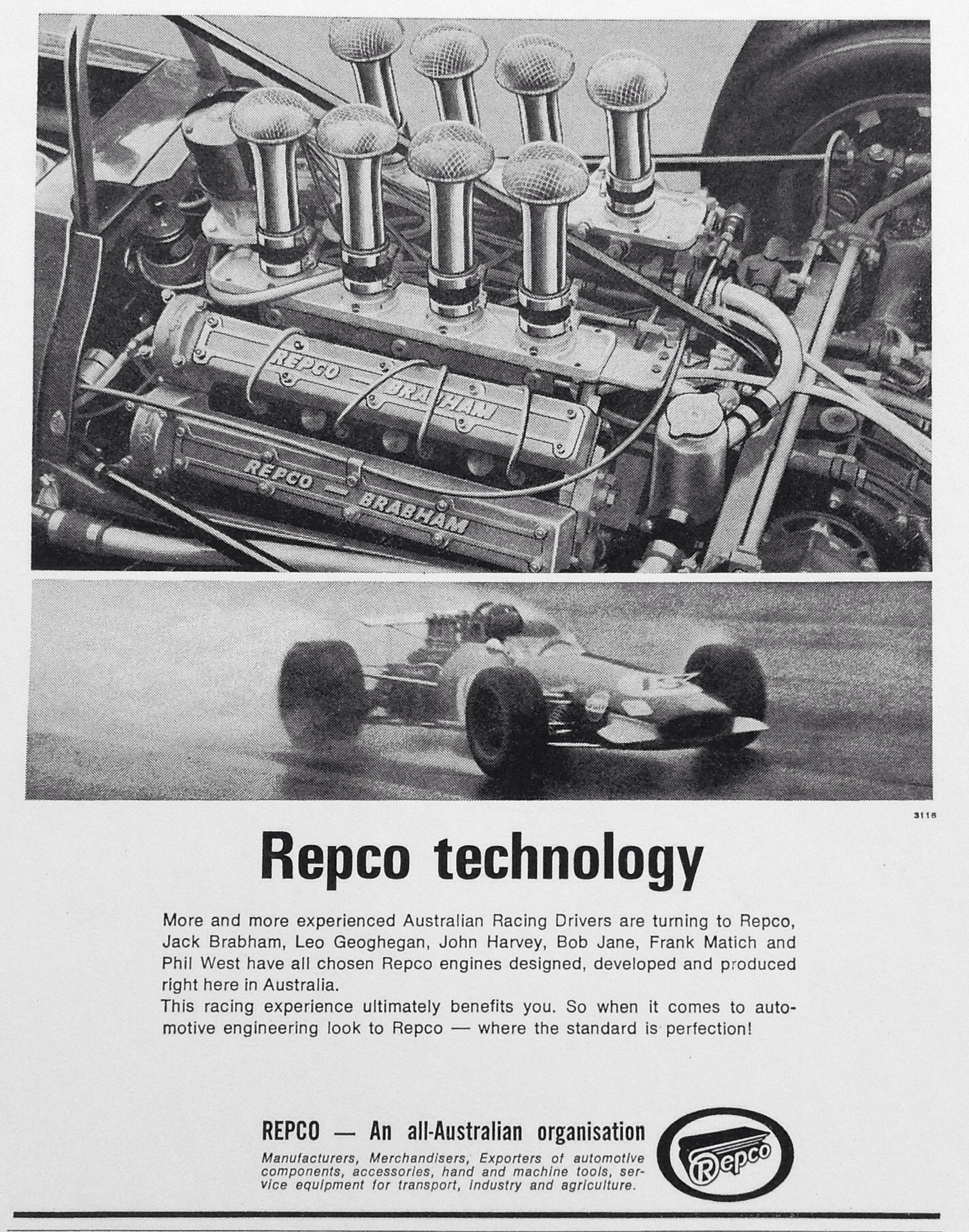
Their F1 3-litre, DOHC, four-valve 860 V8 engine didn’t enjoy the same success in 1968 as its SOHC, two-valve 620 and 740 brothers had in 1966/7 . Don’t forget though, in 4.2-litre Indy, and 4.8/5-litre sportscar form, the 760 (same DOHC, four-valve heads as the 860 but with the long 700 block) delivered the goods for Peter Revson (Brabham BT25 at Indy Raceway Park) and Frank Matich (Matich SR4 in Oz Sportscar Champ) in 1969. The Repco Holden F5000 V8 engine which followed was an international race-winner too.

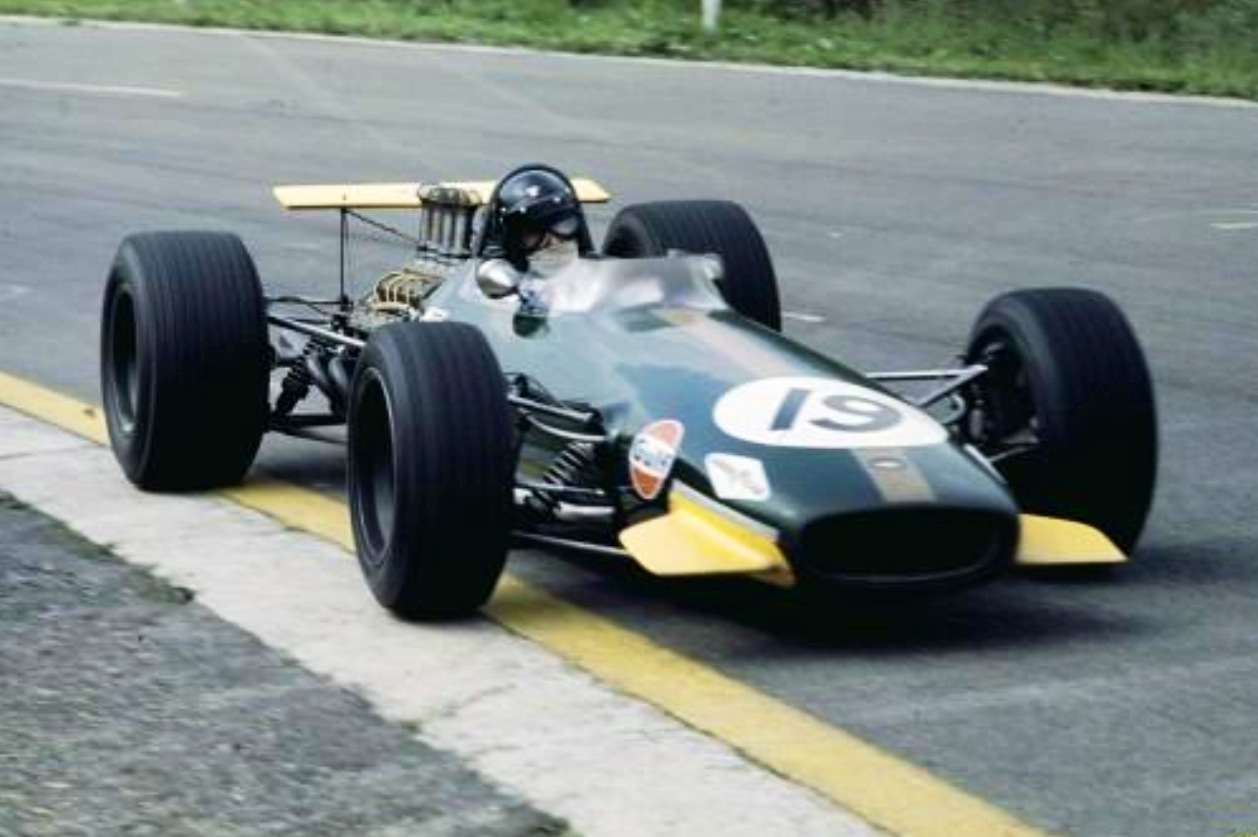
It’s the 860 depicted in the ad above, the shot is Jochen Rindt during the Belgian GP weekend on 9 June 1968, his Brabham BT26 Repco was DNF engine, the race was won by Bruce McLaren’s McLaren M7A Ford.

image Jochen’s Brabham BT26 Repco in the dry earlier in the Belgian GP weekend at Spa. Q17 and DNF engine, Jack Q18 and out with throttle slide problems. Bruce McLaren won a famous win in his McLaren M7A Ford (unattributed)

Jochen made these cars sing, he popped the BT26 on pole twice, on the front row three times. With development over the ‘68/9 Australian summer the engine was potentially a winner in ’69. I’m not saying the world title, but there is no reason 400bhp of reliable 860 Series Repco couldn’t have delivered what 405bhp of Cosworth DFV did for Ickx in the Brabham BT26A Ford in 1969; wins on the Nurburgring and at Mosport.

IF ‘yer Aunty had balls she’d be ‘yer Uncle of course, but it is the great intriguing Repco mighta-been had the boys from Maidstone done one final F1 season…

Credit…

Michael Gasking Collection, MotorSport

Tailpiece…

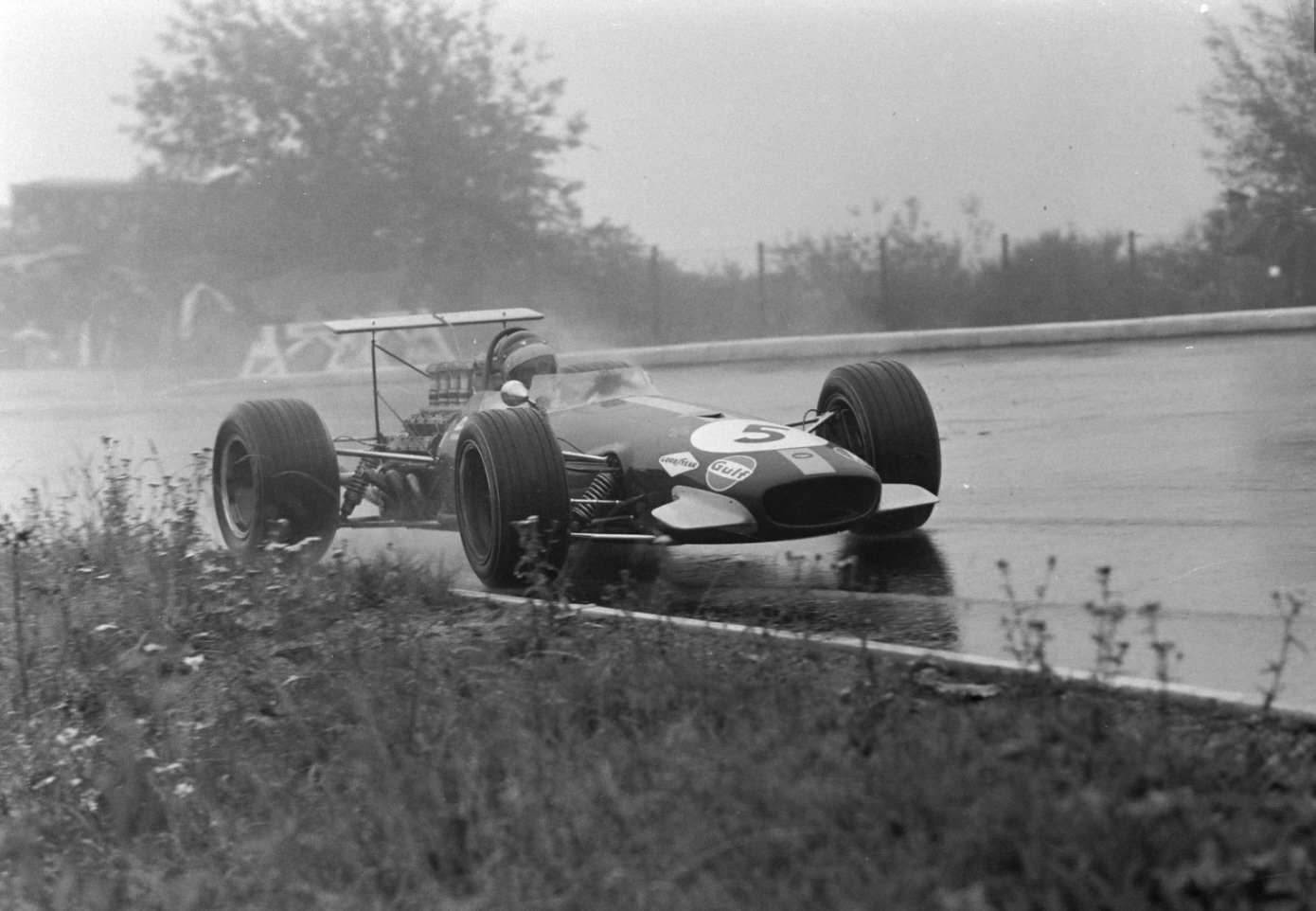
Jochen Rindt in the Eifel Mountains gloom in 1968, he started from grid-slot three and finished in third place behind Jackie Stewart’s Matra MS10 Ford and Graham Hill’s Lotus 49 Ford. The great Austrian was over four minutes adrift of Stewart mind you, but it was still a morale boosting result for the Brabham Racing Organisation and Repco Brabham Engines.

Finito…

Ya gotta be kiddin’ blokes! This thing is rattling my teeth!

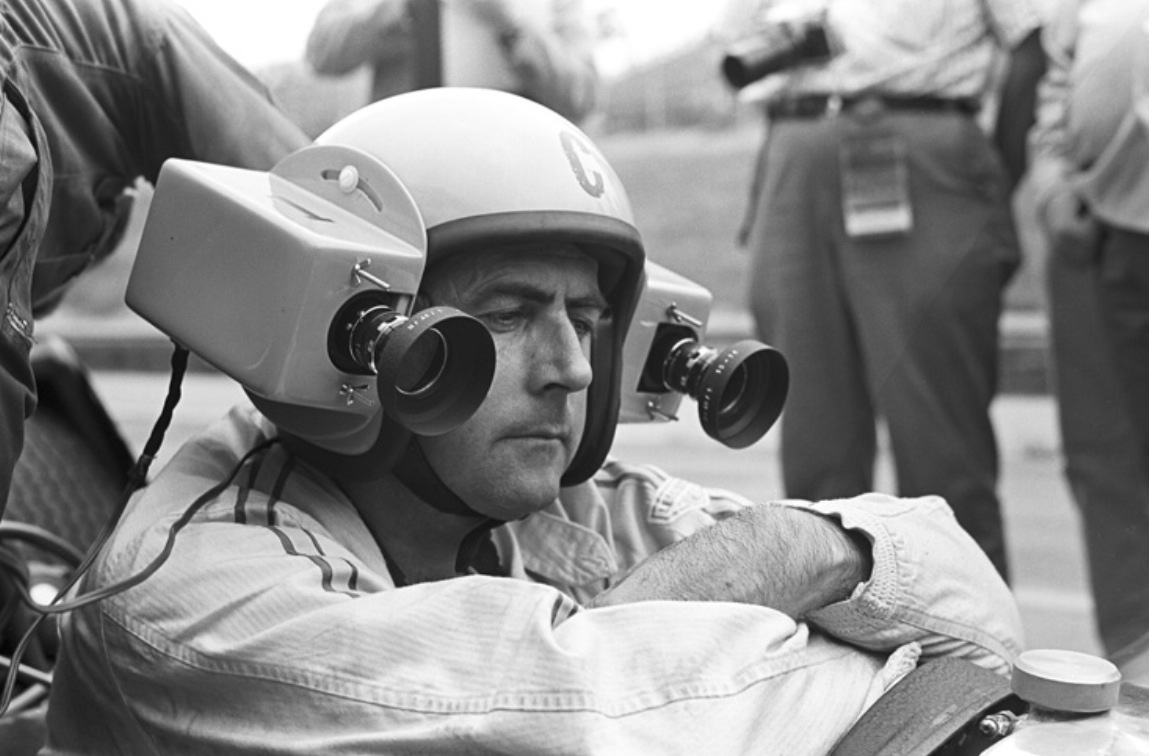
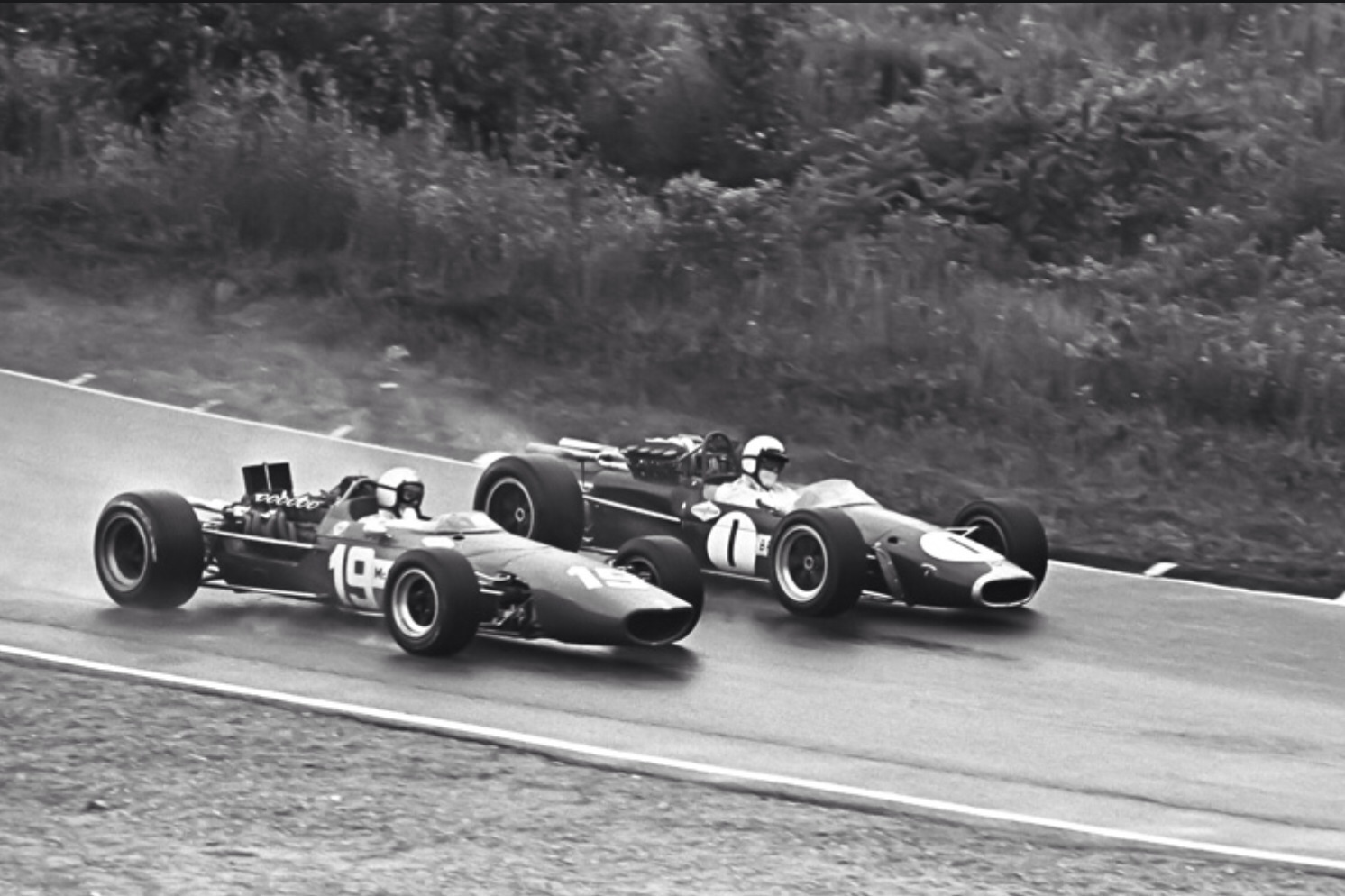
Is the look on Jack Brabham’s face aboard his Brabham BT24 Repco in the Mosport pitlane. By the end of the weekend he was a happy-chappy as winner of the first, soggy, 1967 F1 Canadian GP…

These days every Tom, Dick and Harold has a little, lightweight GoPro to capture their every move aboard their kart, board, bike, girlfriend or racer. It was a whole different ballgame in 1967, the state of the art was somewhat more cumbersome.

The interesting thing is where the footage ended up? Perhaps it was quickly consumed by the local TV news audience. I’ve had a fossick on that YouTube thingy but cannot find anything, do let us know the link if you discover its whereabouts.

Jim Clark and Graham Hill were quickest in qualifying aboard Lotus 49 Fords from Chris Amon, Ferrari 312, Dan Gurney, Eagle Mk1 Weslake, Bruce McLaren, McLaren M5A BRM V12, Brabham’s BT24 Repco and Jochen Rindt, Cooper T81 Maserati.

image

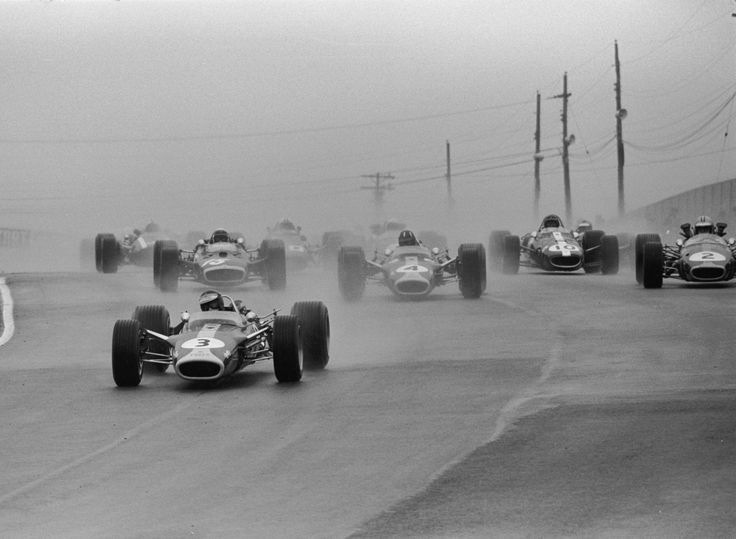
Into the first turn at Mosport its Clark Lotus 49, from L>R Stewart BRM P83, Hill Lotus 49, Gurney Mk1 Eagle and Hulme Brabham BT24. That’s Rindt far left Cooper T81, Amon’s Ferrari 312 is in the murk behind Stewart’s left rear and the rest (unattributed)

Rain fell before the race to make things interesting. Clark led from Hulme, who took the lead on lap four, with Jack passing Hill for third. I rather fancy driving the Brabham, with its nice flat, fat torque curve rather than the DFV engined Lotus with its very abrupt power delivery in its earliest days in these conditions.

Bruce McLaren worked his way up thrugh the field, taking Jacks third place, then on lap 22 he took Clark’s second too. Clearly the conditions suited the V12 BRM engined McLaren. As the track dried, Jim and Jack both passed Bruce. Denny was still happily in the lead but Clark’s Lotus was quicker in the dry conditions and soon led, it rained again. Clark kept the lead but then his DFV went kaput. Jack overtook Denny at about the same time and won from Hulme with Gurney a distant third.

At the end of the meeting Denny had a nine point lead in the drivers championship over Jack, but with three GP’s to go; Italy, the US and Mexico City it was well and truly game-on between the buddies and teammates.

image

Jack is on the drying line in BT24 so I think its him re-taking McLaren’s M5B third place, rather than Bruce taking Jack earlier on  (R Laymon)

Jack was out-fumbled by John Surtees’ Honda RA300 on the last lap, last corner at Monza with Hulme retiring due to overheating early in the race. At Watkins Glen Clark’s Lotus 49 Ford won from Hill’s with Denny third and Jack a distant fourth. Denny then led the championship from Jack by five points before the final round. It was all down to Mexico where Clark won from Brabham and Hulme. Denny bagged the title from Jack – 51 points to 48 points and Jim third on 41.

The car of the year was undoubtedly the new Lotus 49 Ford in terms of outright speed, but the less powerful, not much slower and more reliable new Brabham BT24 chassis with its new Repco Brabham 740 Series V8 should never be forgotten in the shadow of the sexy Lotus 49, as it always is! It did win the Manufacturers Championship after all.

Credits…

 Ron Laymon Photography

Tailpiece: Winners are Grinners and Jack had a smile which lit a room. Mosport 1967…

image

(R Laymon)

Finito…
One of my favourite Facebook pages is the Repco-Brabham one Jay Bondini started for us Repco nutters yonks ago.

It’s chock full of good stuff, much of it contributed by the boys who produced the RBE V8 magic at Maidstone in the day- it has cred you might say!

This shot gave me a chuckle.

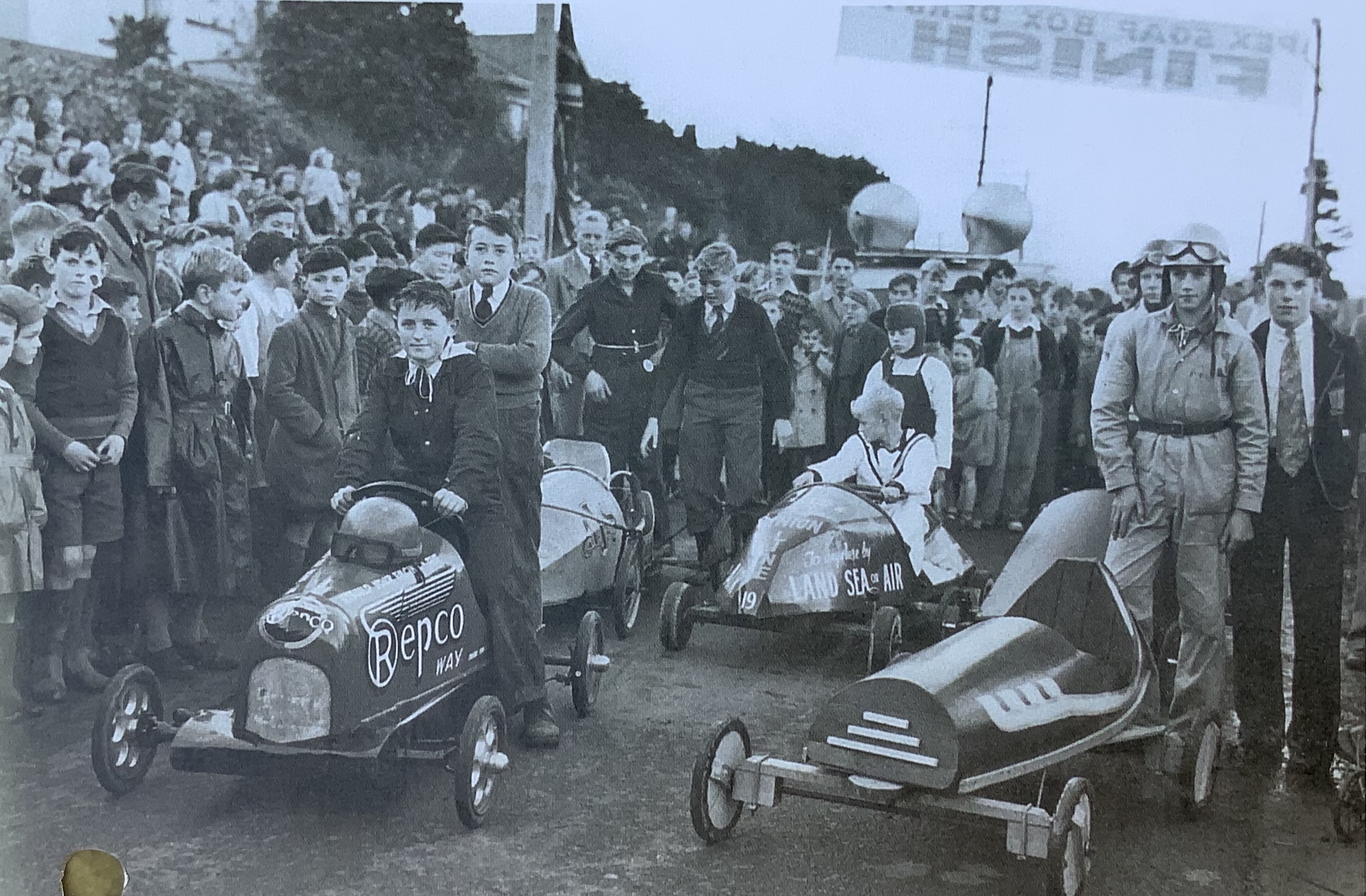
The works Repco billy-cart is poised on Bendigo’s View Street hill during the 1954’ish Easter Fair. The team’s #1 driver aboard the exotic machine is Les Holt. His old-man, Arthur Holt, worked at Repco Bendigo.

Then I thought, in the words of the great George Pell, bugger-me! that’s Mac’s machine. I’m sure I’ve seen it before somewhere!

Sure enough there is later Elfin/McLaren triple Gold Star champion John McCormack aboard the same missile at Burnie, Tasmania at roughly the same time. Dunno if he won but it seems a reasonable assumption.

You will all be pleased to know John is in great shape, sharp as a tack. I had a good chat to him at Baskerville a fortnight ago, all was good until I asked about the MR6, which was not his favourite car…

(M Preston)


McCormack’s MR6 Repco-Holden hooks into Sandown’s Shell Corner during the 1975 Sandown Park Cup- second behind John Goss’ Matich A53 Repco (I Smith)

It begs the question of course. Why?

The MR5 may have been getting a bit long in the tooth by the ‘74 Tasman but it was very successful in McCormacks hands – the 1973 Gold Star and 1973-4 NZ GPs at Pukekohe are the most notable of the combinations victories.

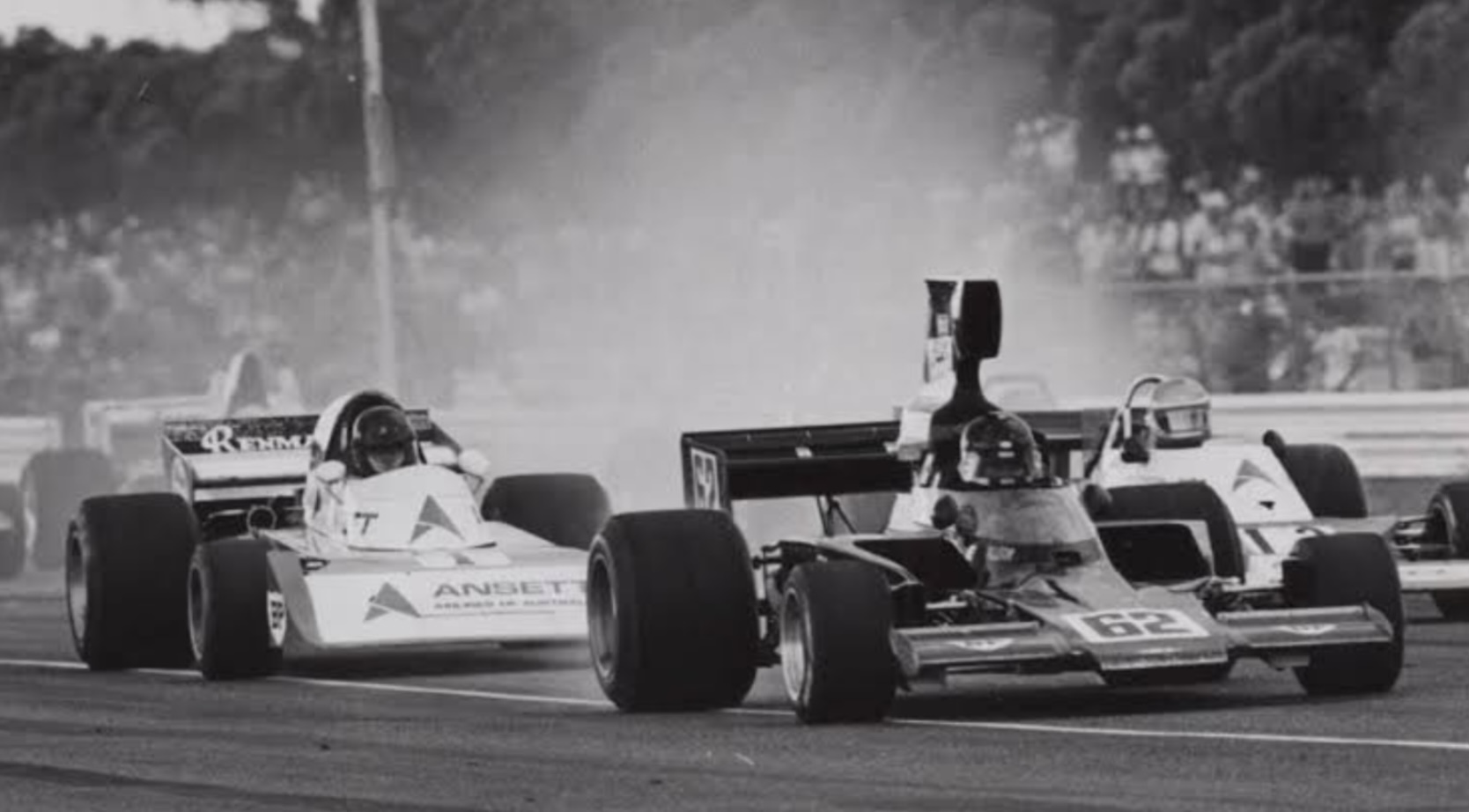
Ansett Team Elfin’s ‘unfair advantage’ was to have been the Repco-Leyland aluminium V8 fitted to a new, compact chassis designated MR6. This gave a lighter car than the opposition and handling balance those using cast-iron Chevs and Holdens could only dream of. That all turned to custard when Repco withdrew from racing in mid-1974, pretty much leaving Leyland Australia and Ansett Team Elfin high and dry.

The P76 V8 (P38 was the joke of the day ‘wannit- the P76 was only half a car) block was structurally weak, the standard nodular crank was junk for racing purposes and the ports were a poor shape which limited flow, and therefore power. Ignoring the fact the block probably couldn’t handle any extra mumbo anyway. Most of this would have been fixed had Repco applied their full engineering armoury to the problems but that was not the case. So the thing was slow and unreliable throughout the 1974 Gold Star.

On top of the engine issues Garrie Cooper repeated some of the MR5’s chassis shortcomings in his new MR6. The front bulkhead was weak, the car had bulk understeer as the front suspension geometry was sub-optimal and the critical engine to monocoque attachment wasn’t stiff enough so the whole package flexed- inspiring little confidence in its intrepid pilot.

MR6 Repco-Holden, perhaps Surfers Paradise 1975 (autopics.com)


Bruce Allison, Lola T332 Chev, McCormack’s MR6 Repco-Holden to the left and Vern Schuppan, Elfin MR8 Chev to the right. Calder ‘Soccerpools’ F5000 race, March 14, 1976. Max Stewart won both heats. Significant shot as it’s Vern’s first race drive of the MR8, having tested it at Adelaide International in early March (unattributed)

Mac and his crew, Dale Koenneke and Simon Aram fixed the chassis problems step by step. The engine dramas were solved by removing the light, gutless, unreliable Leyland and bolting in the heavy, potent, reliable Holden. Putting the smart-arse line to one side, the Repco-Holden had by then five years of development under its rocker-covers, the best of them gave a good 520bhp. The Leyland unit was a babe in the woods in terms of comparative development.

So equipped, McCormack finished fourth in the 1975 Tasman Cup behind the very quick Lola T332s of Warwick Brown, Graeme Lawrence and John Walker. He was second at Wigram, Teretonga and Sandown finishing seven of the eight rounds. At home he won the Gold Star taking victories at Oran Park and Calder. John Walker was second and Max Stewart third, both in Lola’s, again the MR6 was reliable, finishing four of the five rounds.

McCormack contested both the 1976 NZ GP and Australian Rothmans Series that summer, but the combo was off the pace of the fast boys at the very pointy end.

Mac had fallen out of love with the MR6 and Elfin more generally. He acquired a 1973 F1 McLaren M23 sans 3-litre Ford Cosworth DFV V8 from Dave Charlton in South Africa. Into that engine bay John, Dale and Simon very skillfully fitted the Leyland V8 which McCormack had not given up on!

After much test and development work from McCormack and Phil Irving, including new cylinder heads, the circa-435bhp M23 Leyland won its first Gold Star round at Calder in October 1976. He was victorious in the 1977 championship from John Leffler’s Lola T400 Chev.

The MR6 became a display car before its sale while the M23 raced on in F5000 and had a trip to the US where McCormack ran in a couple of races as a central-seat Can-Am car. See here for a feature article on the MR6 and particularly the M23; https://primotipo.com/2014/07/24/macs-mclaren-peter-revson-dave-charlton-and-john-mccormacks-mclaren-m232/

McCormack’s McLaren M23 Leyland from Garrie Cooper, Elfin MR8 Chev and Dave Powell, Matich A50/51 Repco at Dandenong Road, Sandown International Cup 1977. Max Stewart’s Lola T400 won, Cooper third, Powell fourth and Mac fifth (autopics.com)

Credits…

Gary Nichols and Robert Reid for the Bendigo information, ‘From Maybach to Holden’ Malcolm Preston, Ian Smith, autopics.com, oldracingcars.com, Repco

Tailpiece…

(Repco)

Repco publicity shot of their Repco-Leyland F5000 engine in its original form as fitted to the Elfin MR6 in 1975. See the McLaren M23 link above for engine specifications and the changes made as it evolved when fitted to the McLaren.

Finito…
(R Burnett

Beauty is in the eye of the beholder of course, and we often attached to a particular era, this unique McLaren M6B Repco ‘740’ 5 litre V8 ticks all the boxes for me…

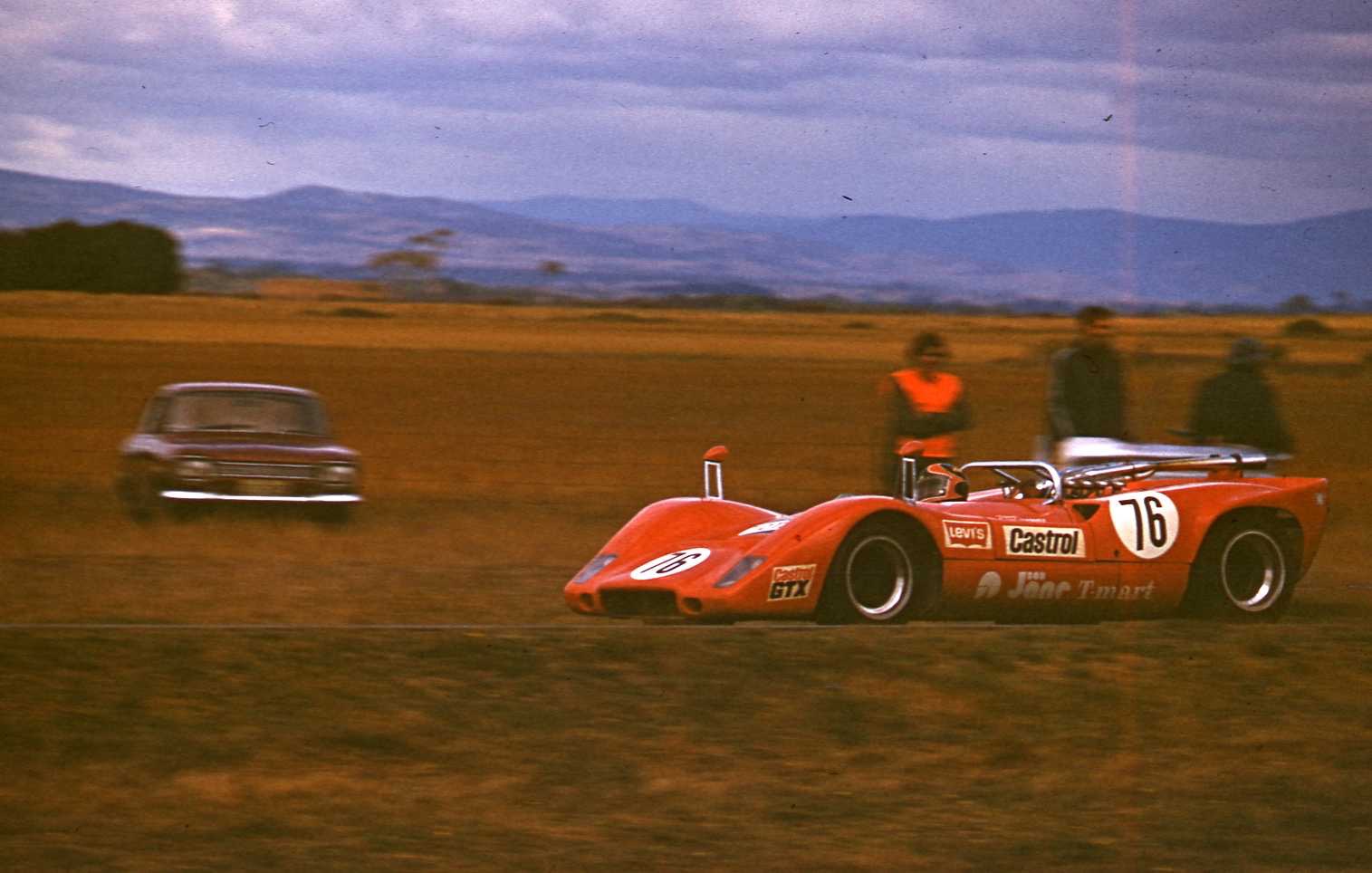
Here it is in repose in the Symmons Plains paddock on 12 November 1972 before John Harvey goes out and bags his second Australian Sportscar Championship on the trot.

Only Harves and car owner Bob Jane ever raced this thing and Bob never sold it- he died a cuppla years ago and it is still owned by his (very messy) deceased estate.

It’s a special jigger too- Bob knew Bruce McLaren well, McLaren built the car for Bob to suit the Repco engine- its a factory built McLaren not a Trojan Cars Ltd customer jobbie- I’m not bagging Trojan just making clear the ‘pedigree’ of a car which is one of Australia’s most iconic racers.

Duncan Fox wrote that ‘Bob’s M6B was an out of sequence car produced late in 1968 at Colnbrook by Bruce as a favour to his long time friend. It is basically an M12 with M6 bodywork that Bob had stylishly reworked. Personally I think it is the prettiest McLaren sportscar in existence. John Harvey told me they did this because he had difficulty seeing the apex over the original front guards.’

‘It was delivered to the Tilbury Docks in London on a car trailer behind the ‘whale’ (the US Ford Station Wagon McLarens had) by Kiwis Chris Charles and Clive Bush who managed on the way to do extensive side damage with the trailer to a gentleman’s Rolls Royce.’

‘It arrived in Australia in CKD (completely knocked down) less engine and transmission on the freighter SS Port St Lawrence sometime early in April 1969. It was invoiced at US$6000 and carried chassis serial number #50-01.’

‘The engine was a Repco Brabham engines #E26 (740 Series) ‘and the dyno chart I have (17/7/71) shows it developed a maximum of 452bhp @ 6500rpm and 405ft/lbs torque @ 5000rpm.’

The fella leaning into the cockpit of the first photo is John Sheppard, Jane’s Chief Mechanic- he said to me a few years back, ‘whenever you are ready lets do another article on the McLaren’. Sheppo was very generous with his time in putting together a detailed feature on the Clark/Geoghegan Lotus 39 Climax/Repco which John prepared for Leo before ’emigrating to Mexico’ (Victoria) to take charge at Janes, Brunswick, Melbourne race workshop circa 1970.

I must give him a buzz.

(R Burnett)

Bob and Harves after that 1972 win (H Ellis)

The great shame is that the McLaren was not ready to race at the start of 1969, the year Matich crushed all before him in the Matich SR4 ‘760’ 4.8 litre V8, his way too late intended Can-Am contender.

So Bob and John were late to that particular party, but Harves did contest the final 1969 round at Sandown finishing second to Matich. Repco then acquired the SR4 from FM to use as an exhibit and devoted their mutual development and race energies to the Repco-Holden F5000 program. The first of these engines was fitted to FM’s McLaren M10B in mid-1970, the combination won the November 1970 AGP at Warwick Farm.

The perfectly competitive SR4 with a trick, fresh John Mepstead built 5 litre ‘760’ Repco was set aside leaving the way clear for Bob and Harves to ‘mop up’ the ASCC with the M6B. I’m not sure why they didn’t race the thing much in 1970- Harve’s focus on the Gold Star and the new Torana Repco perhaps, but in 1971 John won three of the four rounds and five of the six 1972 rounds before they too put to one side the curvaceous racer. Team sponsor Castrol wanted them to focus on the teams ‘Taxis’ rather than the ‘Racing Cars’ which at that point comprised the Bowin P8 Repco-Holden F5000 and the McLaren.

Sad but true…

The full story of the M6B is one for another time.

(E French)

Credits…

Historic Racing Car Club of Tasmania, Rob Burnett, Ellis French, Duncan Fox on The Nostalgia Forum, Harold Ellis

Tailpieces…

(R Burnett)

(E French)

Finito…
(HRCCT)

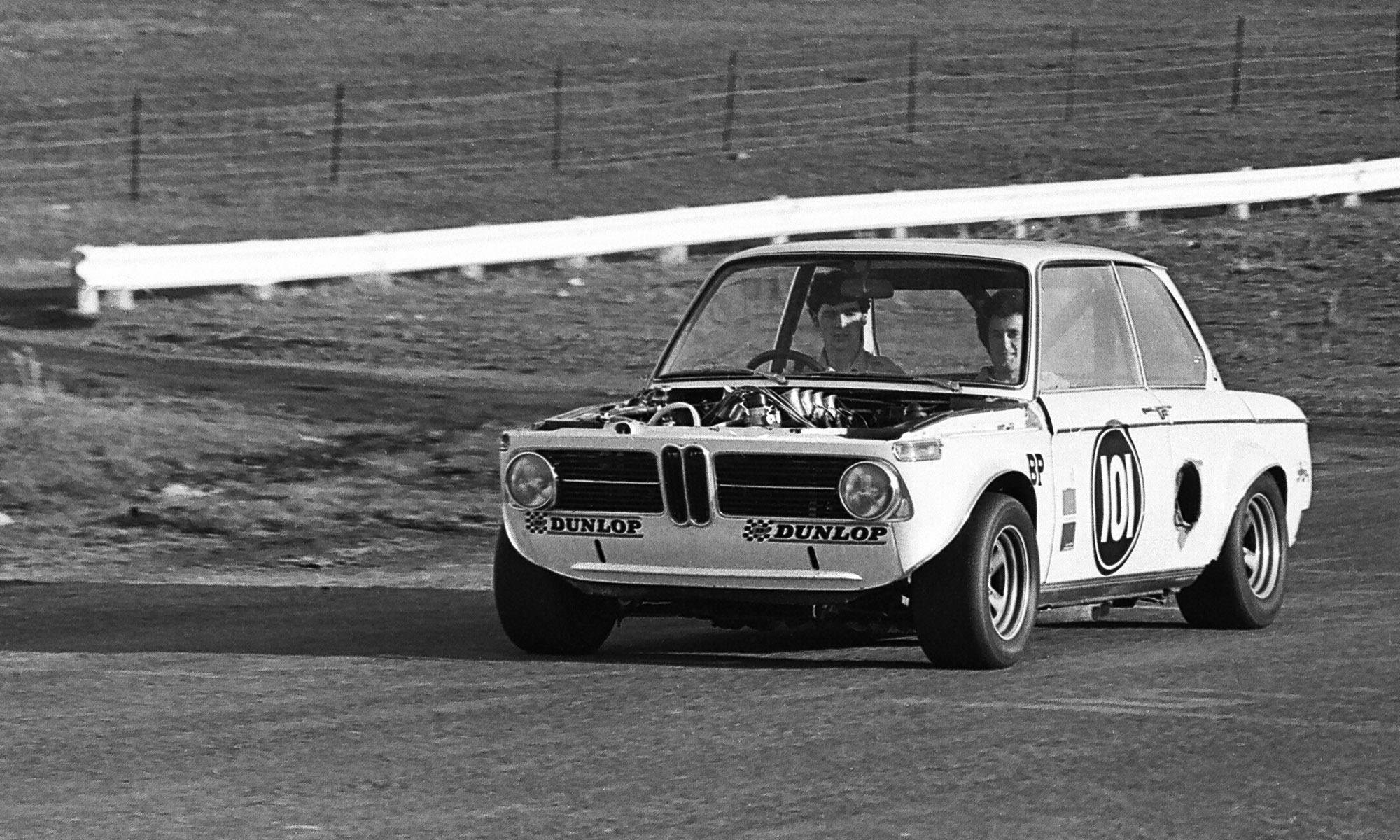
Michael ‘Moose’ Warner, Holden 48-215 leads Tony Edmondson, BMW 1602 Repco at Symmons Plains circa 1974…
Touring Cars (a ‘Sports Sedan’ in this case) are not my thing but that BMW is powered by a Repco Brabham 4.4 litre ‘620 Series’ V8 so by definition it’s of interest!

The Historic Racing Car Club of Tasmania continues to post wonderful photographs on its Facebook page- just pop the name into the FB search engine and have a look. Grab a beer before you do so, you cannot do the job properly in less than two or three hours.

(B Smart)


(B Smart)

Edmondson, who started racing a Ford Cortina GT with a good deal of pace in his native Tasmania circa 1970 was the latest in a long list of drivers whose career was aided and abetted by Tasmanian businessman Don Elliott- others include Robin Pare, John Walker and Mark McLaughlin.

The pair raced this BMW, then the ex-McCormack Valiant Charger Repco-Holden F5000 V8 and later still the two K&A Engineering built Alfa Romeo Alfetta GTV Chev V8’s- he had a really nasty accident in the first of these at Surfers Paradise.

Later still, in the mid-eighties, they acquired Elfin Sportscars, bless ’em- after Garrie Cooper’s untimely death and built some fantastic FV, ANF2 and one Formula Holden before the economic realities finally caught up with them and the business changed hands to become a builder of road/race cars rather than racing cars. (i’m truncating)

Edmondson and Grice top of The Esses at Baskerville in 1978 looking as though it could turn to tears at any moment’ indeed Grant Twining, but did it!? (K Midgley)

I always admired Edmondson’s aggression, pace and mechanical ability- another guy wasted on Sports Sedans I thought, if he handles 5 litres so well why not jump aboard the ‘real F5000 deal’…

I do recall the BMW, not that I ever saw it race in Victoria- did it ever race on the ‘Big Island’ i wonder? No doubt it did.

The Baskerville photos, circa 1973, are great, particularly Tony’s cavalier disregard for his racegear- perhaps he was ‘just tootling around’ on a day of testing.

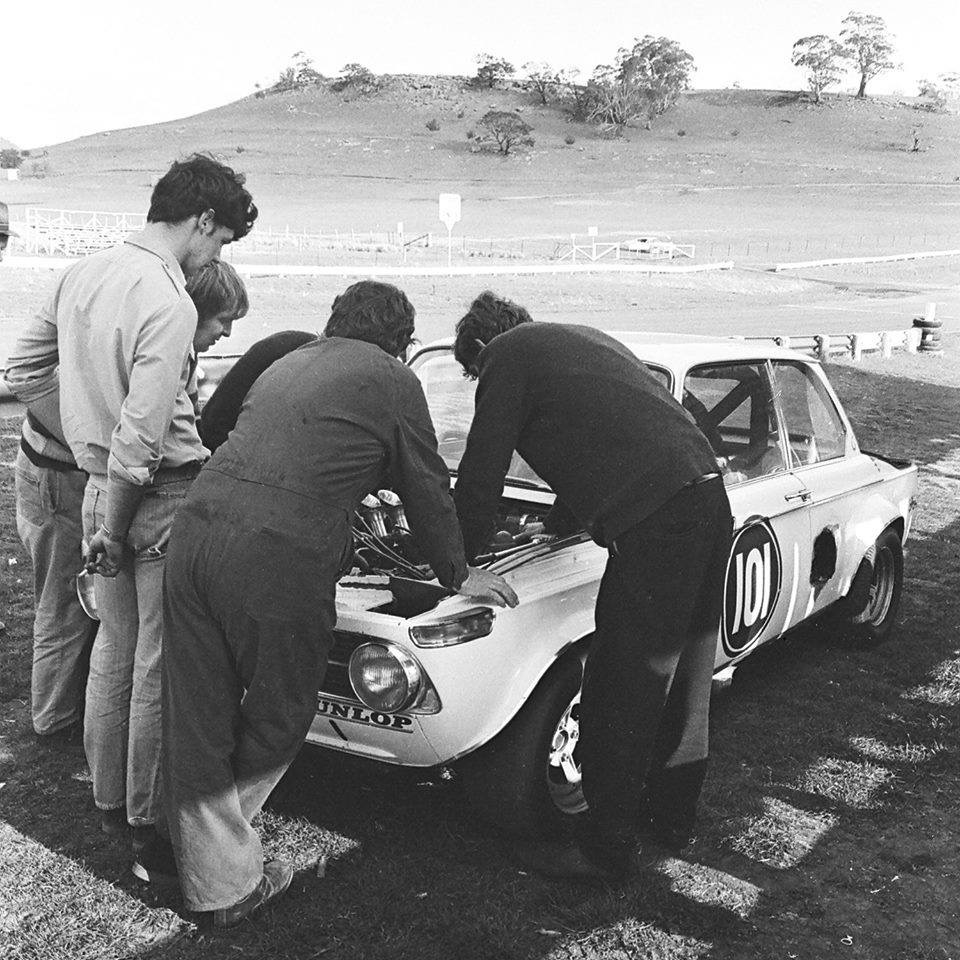
Bruce Smart, the photographer advises that is exactly what the team were doing ‘I took the photos in mid-1973 on the main straight at Baskerville. It was a private test day and they were the only ones there. The Repco BMW was still being developed and they were having issues with cooling. It had a boot mounted radiator, you can see the hastily cut vents in the rear guards which were made to enhance airflow.’

‘Tony was only driving slowly, hence no helmet, in fact it was barely fast enough to get a speeding ticket in the Hobart CBD. They would do a couple of laps, return to the pits and scratch their heads, then do a few more laps. Eventually the cooling was sorted.’

I’m very interested to know who did the engine installation- presumably a Borg Warner four-speeder is attached to the back of the RBE V8 but i’m just guessing. Which particular RBE 620 izzit, where did it come from and where is it now? Where is the BMW shell too I guess, although that is of less interest. The Holden ‘was one of the best Humpy’s going around, unfortunately it fell over one day and was binned’ wrote the HRCCT’s Grant Twining.

Lindsay Ross advises Don Elliott is about 90 years old and that Tony Edmondson still works for his ‘Elliots Self Storage’ business in Hobart. He also recalls the ‘Repco 4.4 gave them so much grief with cracking blocks.’

Correspondence welcome!

Don Elliott supervises proceedings at Baskerville, hungry Lucas mouths atop RBE620 (B Smart)


oldracephotos.com.au/Harrisson)

Top shot above is of Edmondson a few months later with the car now complete at Baskerville, 1973.

Credits…

Bruce Smart via Historic Racing Car Club of Tasmania, Keith Midgely

Etcetera…


(B Smart)

‘Its not too noisy, no cops about, how bout we swing past mums on the way back to Hobart’, or some such. As I say, very interested to find out and publish the fullest technical specifications of this car we can come up with.

Social media suggests the car ended up in Western Australia at some point?

(HRCCT)

That’s not Edmondson in the ‘Fastman’ race suit- he is almost fully obscured by blue-cardigan man- who is the other racer?

Tailpiece: Turn-in is real noice…

(B Smart)

‘Hmm, maybe time to put my fire-proofs on’ is perhaps the drivers thoughts. And ‘Shit! This thing gets up and boogies.’

Note the Mawer Engineering wheels and ‘well back’ location of the engine. Intriguing to know the difference in weight between the cast iron block, alloy head BMW four and all alloy Repco V8.

This conversion is a ‘well-travelled path’ in the sense that the 1970 similarly engined Bob Jane Racing, John Sheppard built, Holden Torana GTR-XU1 ‘620’ 4.4 V8 showed just how quick this combination of compact car and very light ‘racing’ V8 could be.

Click here for a piece in part about this car, the Charger Repco and Corvair Chev; https://primotipo.com/2015/06/30/hey-charger-mccormacks-valiant-charger-repco/

Finito…