Archive for the ‘Sports Racers’ Category

(oldracephotos/King)

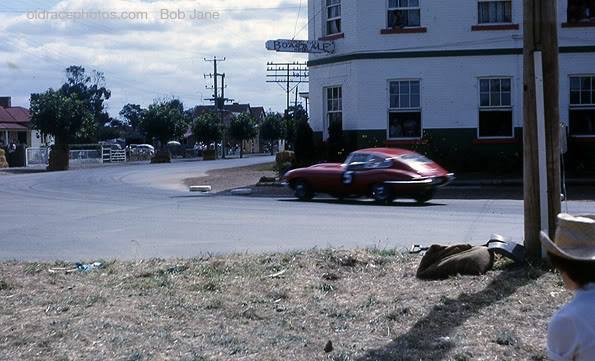
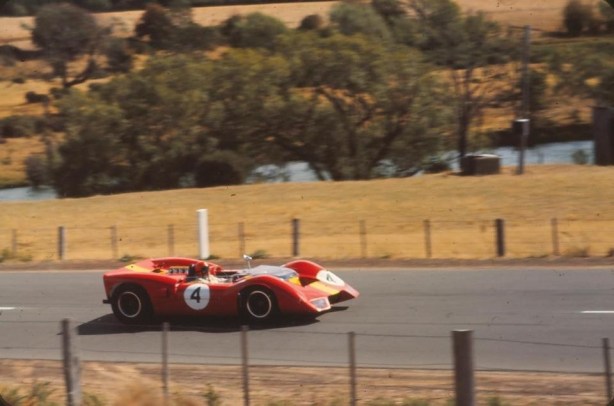
Bob Jane, Elfin 400 Repco, during the Longford Tasman round in 1967. Sweet Repco V8 music @ 7000 rpm flat out in fifth gear…

Idle moments in front of the Teev provide a male multi-tasking opportunity, looking for ‘that shot’ which inspires an article. Breathing, lookin’ at the telly and searching for photographic inspiration simultaneously- three things at once, my girlfriend can scarcely believe it.

There are some cars which are more prolific in terms of the number of photos in circulation though, usually for the same reasons. That is, they are sensational to look at, were race winners and in Australia raced nationally over a number of years and therefore every ‘snapper in the country, both professional and amateur has had a crack at them. Then, kindly circulated said photos on that internet thingy for us all to enjoy!

So…

In the decade from 1960 to 1970’ish there are several cars which are prevalent as defined above- Pete Geoghegan’s second Mustang, Allan Moffat’s Mustang Trans Am, Leo Geoghegan’s Lotus 39 Repco, Frank Gardner/Kevin Bartlett’s Mildren ‘Yellow Submarine’, Frank Matich Matich SR3’s and Bob’s Elfin 400.
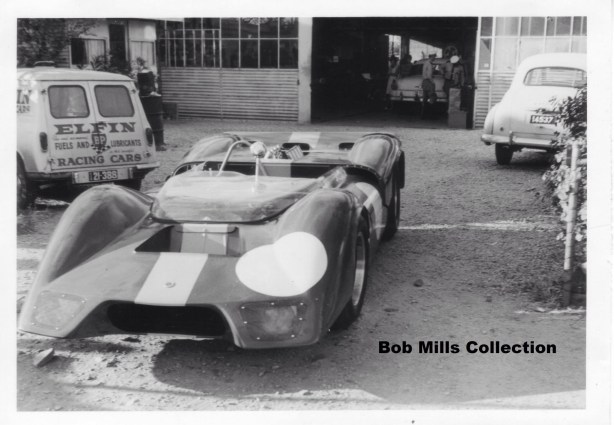
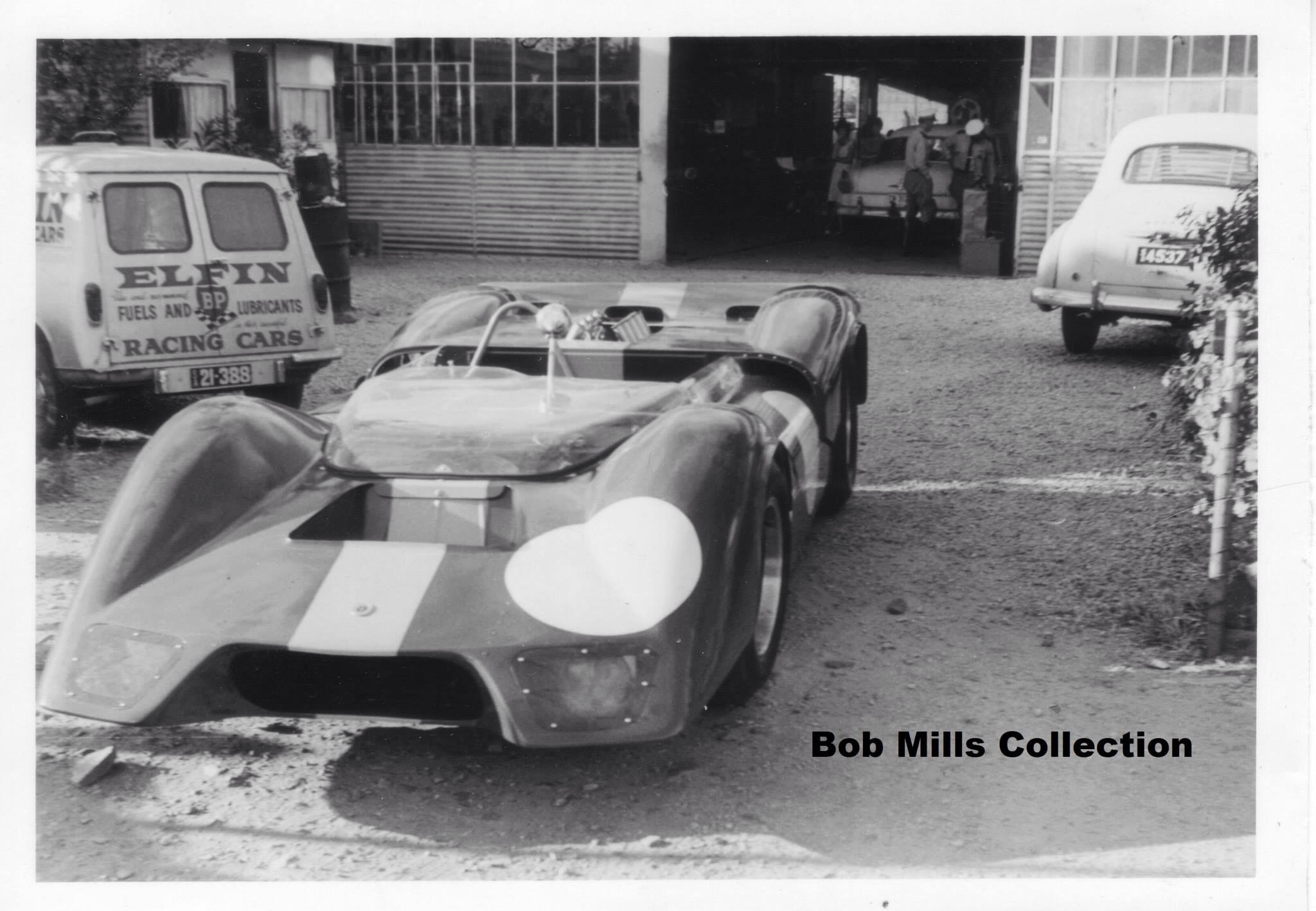
Delivery of the new 400 to the Bob Jane team, Elfins Conmurra Avenue, Edwardstown factory, Adelaide in late 1966. The factory was not flash but the sense of history and those who had been there before was palpable when I inspected my humble Crusader Elfin Vee mid-build in the early nineties. From a modest place did some amazing cars originate (B Mills)

I’ve already done the Elfin 400 to death really…

But there are just too many wonderful photos of Bob’s car not to do this article which I originally intended to be pictorial.

One long previous article was specifically about Frank Matich’s Elfin 400 Olds aka the Traco Olds, the first completed. That piece also covered at somewhat laborious length the design and development of the car, here ‘tis;

Elfin 400/Traco Olds: Frank Matich, Niel Allen and Garrie Cooper…

The other was another lengthy tome, mainly about Hume Weir circuit but it also included a piece within it on Bob’s car, the third 400 built, click here;

Hume Weir…
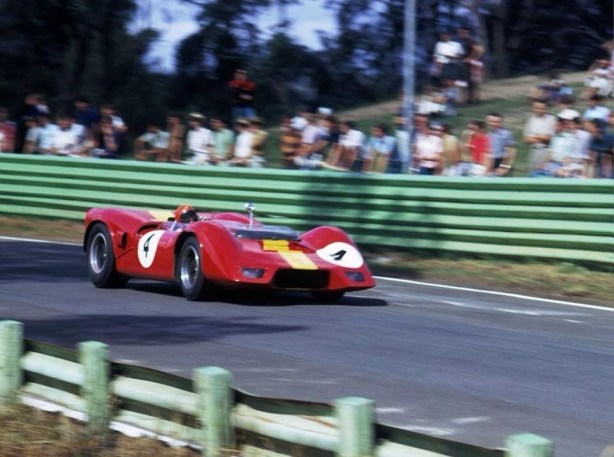
Bob Jane in one of his first runs, the first race meeting?, Warwick Farm Tasman round in 1967. Top gun that weekend Niel Allen in his Elfin 400 Chev (J Ellacott)

Elfin 400 Repco ‘BB67-3’ was raced by some mighty fine drivers whilst owned by Bob, here is the man himself during the Warwick Farm Tasman round in February 1967…

Jane raced it, so too did 1966/7 Australian Gold Star Champion Spencer Martin. Lets not forget Melbourne up and comer Ian Cook had some drives in 1968, he sadly lost his life at Sandown in 1973 in an ex-Bob Jane Racing machine too. And another young charger, Bevan Gibson took the wheel in 1969, and soon lost his life in it at Bathurst during the 1969 Easter Meeting.

What changed the direction of the article was re-discovery of my copy of ‘Gentleman John Harvey’, the biography on Harves which has some great first-hand material about Bevan by both Bob Jane and John Harvey. I couldn’t find the book when I wrote the Matich Elfin 400 piece, which would have been the right place for its contents, but given the limited print run of Tony McGirr’s book I thought getting these perspectives out there and more readily accessible worthwhile.

In researching Ian Cook i made contact with Grant Twining who owns the Devione Ford, a car raced by Ian. Grant was able to provide some much needed detail to flesh out his story- many thanks to him.

This 400 is significant in Repco Brabham Engines history too as it was fitted with the first customer, as against works engines provided to Jack Brabham. It was a 4.4 litre ‘RB620 Series’ V8.
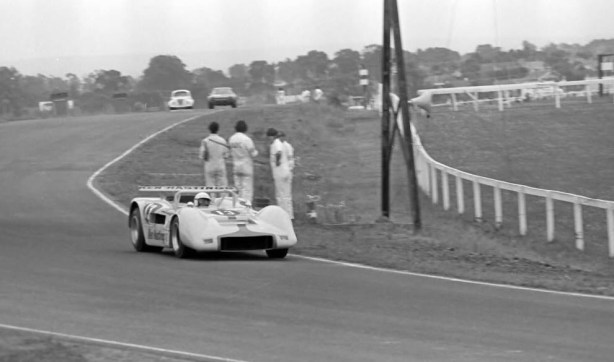
Ken Hastings aboard the rebuilt ‘BB67-3’ at Sandown on the fast left drop to Dandenong Road circa 1970. Note the change to the bodywork at front and addition of a rear wing. Unguarded horse racing fencing an ever present danger back then. It’s practice by the look, the Pat Crea VW Beetle and ‘Chocolates’ David Robertson Ford Capri V8 sports sedans in the distance (L Hemer)

After the Gibson Bathurst tragedy the car was acquired by Melbourne racer Ken Hastings who rebuilt it. The car passed through several hands over the years before being bought by Elfin enthusiast/racer Bill Hemming, well known to Australians for the Elfin Heritage Centre which houses his collection of cars including ‘BB67-3′.

http://www.elfinheritage.com.au/

The car was rebuilt around a new chassis some years back albeit the very much shagged original frame remains ‘part of the package’- that is the CAMS ‘Certificate Of Description’ recognises the existence of the second chassis precluding the possibility of a ‘B Car’ being built. A neat solution I thought- history and safety are recognised.
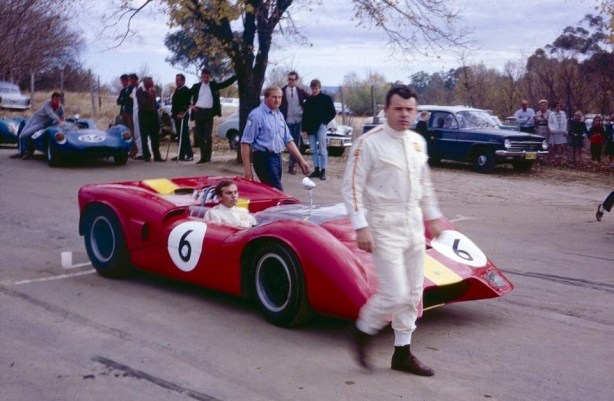
Bob Jane leads Spencer Martin and the Elfin 400 Repco at Hume Weir, Queens Birthday meeting in June 1967. John Sawyer in the blue shirt behind, blue car is ex-Jones/Phillips et al Cooper Jaguar  (M Leirsch)

Elfin 400 Technical Specifications…

Lets cover the cars technical specs in brief as it’s covered in detail in the first of the articles referenced above.

The 400 was the third series of sports cars Garrie Cooper and his band of merry men in Edwardstown built. The first were the front engined ‘Streamliners’, the very first Elfins, then came the Clubman and later the mid-engined small-bore Mallala.

The 400 Series sporties were the first ‘big bangers’ he had built, a trip to the UK before he progressed the design too far got him up to speed with what was happening in Europe. The Group 5 Ford GT40 and Group 7 Lola T70, McLaren Elvas and Chaparral’s were the standout cars at the time for different reasons.
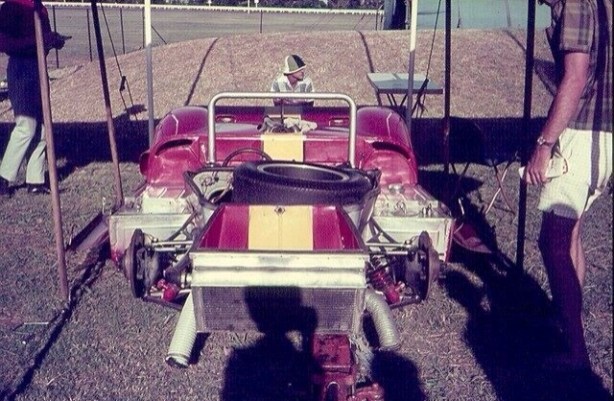
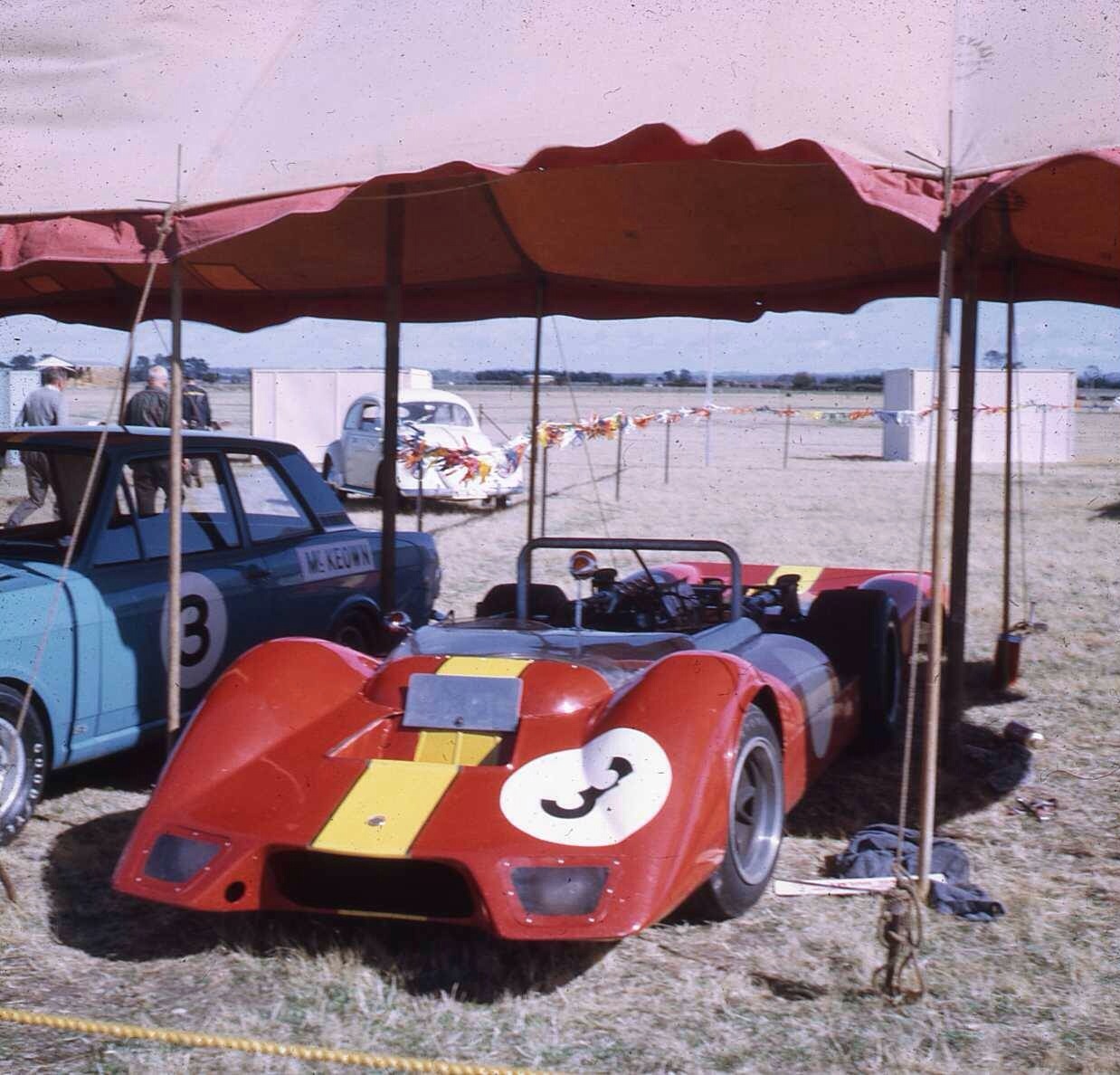
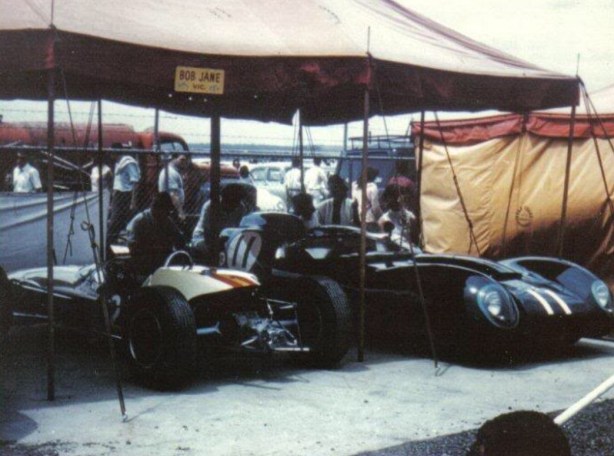
Rare colour shot of the Jane 400 in the paddock, date uncertain. Suspension as per text, note the wide based upper wishbone, magnesium uprights and solid Girling brake rotors. See the shot below, car now has a more substantial, but unbraced roll bar (P Houston)

Whilst Garrie was building his first monocoque chassis car, the single-seater F3/F2/ANF 1.5 Type 100 very successful ‘Mono’ he decided an appropriately stressed multi-tubular spaceframe chassis would do the trick for the sportscar. After all, Ferrari were still winning plenty of races so equipped and the Australian market was conservative, a spaceframe was easier to maintain and to repair ‘in the field’ than a monocoque. Such a design could accommodate different engines he knew customers would want to fit to the cars. The frame was of square, round and oval section tubes, the aluminium undertray was stressed as were subsidiary bulkhead panels

Four chassis were built- first completed was the Matich ‘BB66-2’ which used a Traco Olds V8, then came the Globe Engineering ‘BB66-1’ a pushrod and later DOHC small-block Ford powered car,  Jane’s ‘BB67-3’ received a Repco ‘RBE620’ 4.4 litre V8 and ‘BB67-4’, originally owned by Andy Buchanan a big block Chev.

Bolted to these engines were various Hewland transaxles; HD4 for the Matich car LG500 for the Globe and Buchanan cars and DG300 for Jane’s.
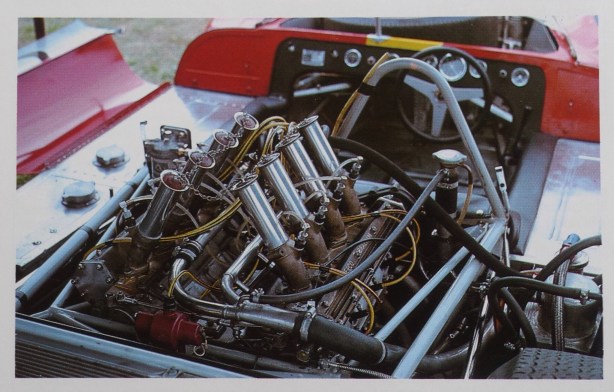
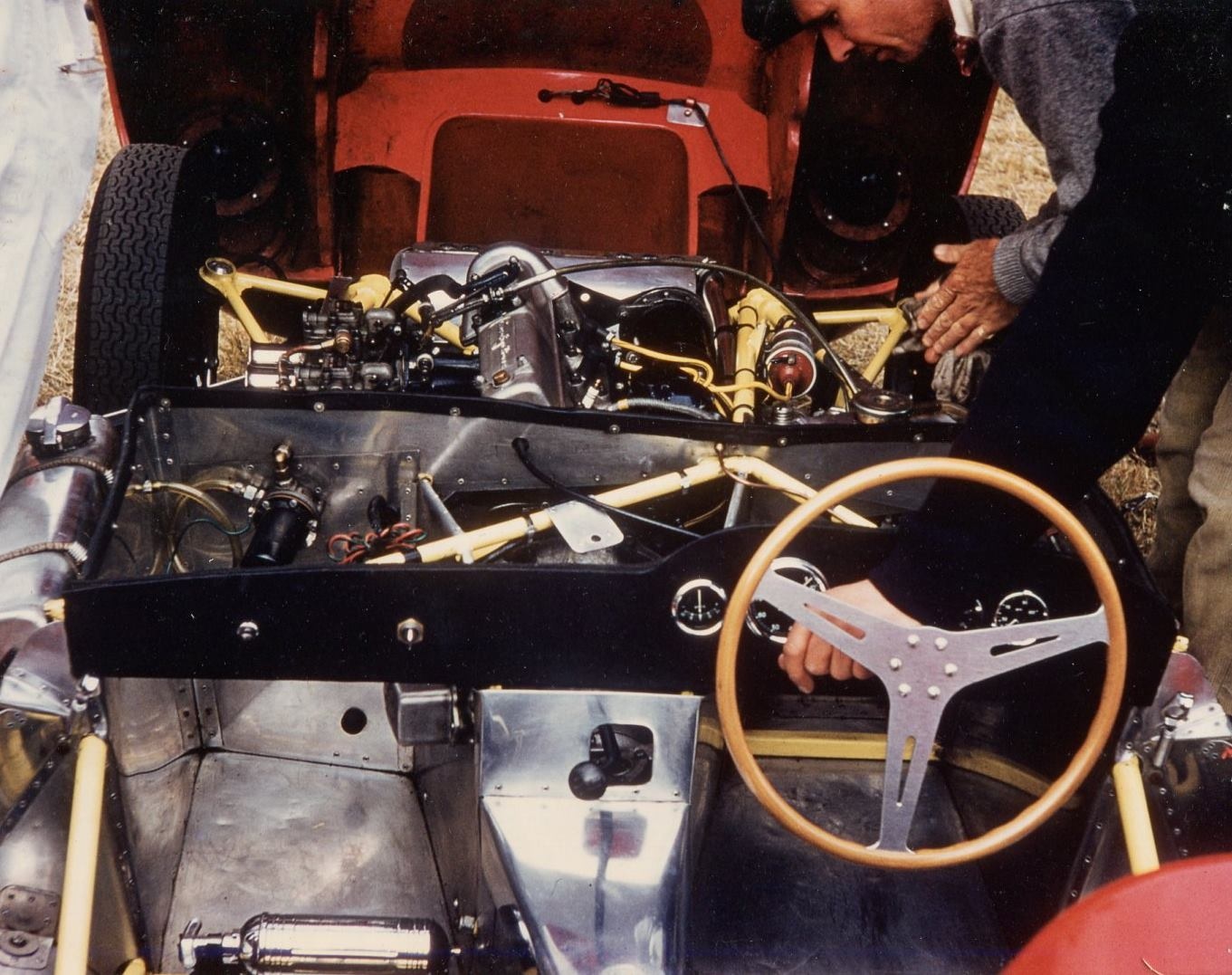
Superb early 1967 shot of the Jane car. Engine is the first customer Repco engine delivered. Repco ‘RB620 Series’ 4.4 litre SOHC, 2 valve, Lucas injected V8, circa 400 bhp @ 7000 rpm. ‘620’ is the Olds F85 modified block and first series crossflow heads- this design was the 1966 F1 championship winning design in 3 litres capacity. Note the tubes to the chassis, oil dry sump to the right. Fuel tank capacity 28 gallons- with the option of more. Array of Smiths and Stewart Warner instruments, see chassis plate on dash left and vestigial roll bar- soon altered to a higher and full width hoop albeit unbraced. Simply superb bit of kit (S Lambert)

Suspension was period typical. At the front by upper and lower wishbones with coil spring/Armstrong shocks. Uprights were cast magnesium, adjustable roll bars were fitted with rack and pinion steering.

At the rear, beautiful cast magnesium uprights were used, inverted lower wishbone, single top link and two radius rods, again with coil springs and Armstrong shocks. Roll bars were again adjustable.

Wheels, cast magnesium Elfin jobbies, were 15 inches diameter, 10 inches wide at the front and 12 inches at the back. Owners progressively increased the amount of rubber on the road appreciably over the coming years in accordance with the incredible advances in tyre technology at the time.

Brakes were Girling alloy ‘BR’ calipers with the rotors 12 inches  in diameter at the front and 11 inches at the rear. The bodywork was designed in house, as you will see in the various articles the ‘aero’ of the car was far from ‘fully resolved’ when completed.
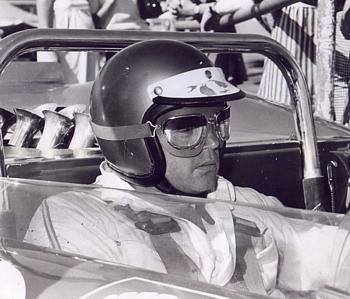
Bob Jane aboard his 400 in 1968 (T Parkinson)

And they say Enzo Ferrari kept his drivers on their toes! So too it seems did RF Jane…

It was only in gathering the photos of the 400 that I realised how many fellas drove the 400 in a short period of time.

Bobs race team plans were changed suddenly when Spencer Martin decided to retire having won the second of his Gold Stars with Bob in 1967- they won two on the trot in 1966-7 using Bob’s Brabham BT11A Coventry Climax.

Spencer Martin had this to say about the 400 ‘What caused the accident (to Gibson) was an aerodynamic design fault with the car. I had driven the car in ’67. It was the quickest thing around at that stage. It had a 4.4 litre Repco V8 in it, and was very, very quick. But the aerodynamics on the car were not right. Unfortunately, Bevan paid for it with his life.’

Martin then commented about seeing the sportscars on circuit at Longford in 1967 when Bob Jane raced the 400. Spencer ran the Brabham BT11A and was therefore on hand to watch the sportscars practice.

Noel Hurd in the Globe Products owned Elfin 400 Ford became airborne at high speed during practice, mowing down a row of fence posts after spinning several times but leaving the driver unhurt. ‘It was an Elfin 400, and I saw them coming down the long straight at Longford, in Tasmania. I wasn’t at all happy with the aerodynamics of the car. Looking back I think I was very fortunate. If I hadn’t retired I would probably have been in that car’ (at Bathurst Easter 1969)

Whilst testing the Elfin at Calder early in 1967 Martin was circulating in 44.2 secs, nearly a second under Niel Allen’s lap record in his 400.
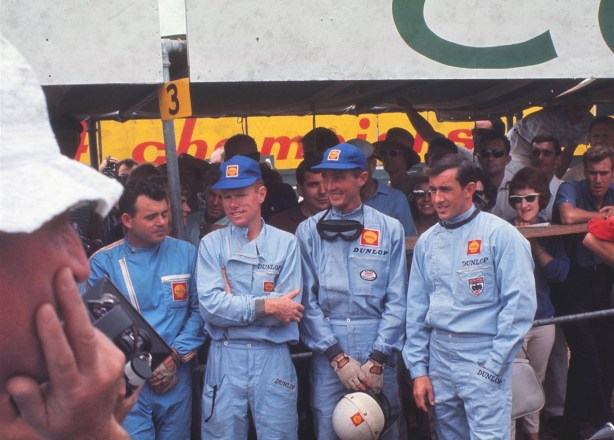
Shell boys at Warwick Farm in 1966: Jane, Kiwi Jim Palmer, Harvey and Jackie Stewart- quite an array of talent, champions all (WF)

John Harvey had shown what he was made of in the RRC Phillips owned Brabham BT14 Repco- so Bob hired Harvey, (born 1938) bought the BT14 and popped the Repco engine from it into the back of the BT11A and off they went to contest the ’68 Tasman Australian rounds.

The logic was that the F2 BT14 chassis wasn’t man enough for the Repco, whereas the older ‘Intercontinental’ BT11A was. Harvey did the Hordern Trophy late ’67 in the car, Climax engined before the Repco for Coventry Climax engine swap was performed. Harvey’s ‘compare and contrast’ of engines in that chassis would be interesting. As Australians know Harves was Bobs ‘main man’, his contracted driver from then right through until Frank Gardner returned to Australia in 1974- joining Jane for 1975.
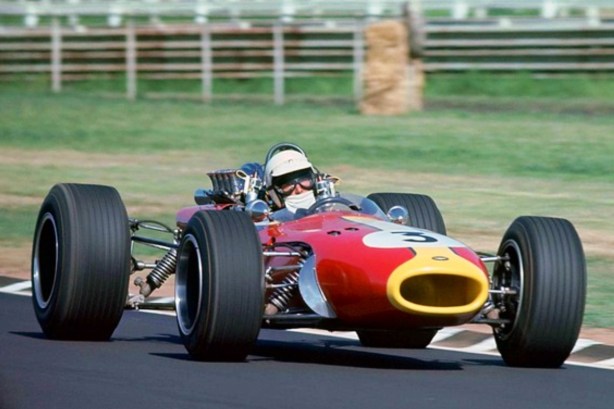
John Harvey on Warwick Farm’s pit straight during the 1968 Warwick Farm 100 meeting. DNF gearbox in Janes BT11A ‘IC-4-64’ Repco. Clark won in a Lotus 49 DFW. The Brabham was and is a famous car- first owned by David McKay’s Scuderia Veloce and raced in the ’64 Tasman successfully by Graham Hill it was then raced by Martin to two Gold Star wins. Still owned by Jane and restored to CC engined form (autopics.com.au)

Early in his time with Bob John had a bad accident at Easter Bathurst 1968 when an upright in the near new Brabham BT23E broke hospitalizing him for some while with a recuperation period even longer. His first meeting post accident was at Warwick Farm later in 1968. It was a meeting John was glad to get behind him as his eyesight, fine early in the day, had a bit of double-vision later as the day wore on.

Naturally on Jane’s part, if not Harvey’s, there may have been a question about him racing again after an accident Jane said could have been fatal. He needed another driver until Harves was fit.
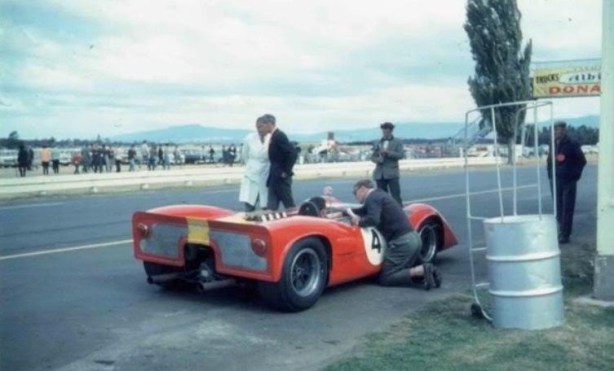
Jane in the Longford pits in 1967, nice rear view of the 400 Repco (E French)

Ignoring the touring cars/sports sedans to focus on the cars which matter, Harvey raced the BT11A, then the ex-Brabham ’68 2.5 Tasman BT23E Repco, the Rennmax built Jane Repco 2.5, Brabham BT36 Waggott 2 litre and finally the Bowin P8 Repco Holden F5000. He raced the McLaren M6B Repco sportscar from 1969, with Bob. He drove the Elfin 400 only once and had this to say about it.
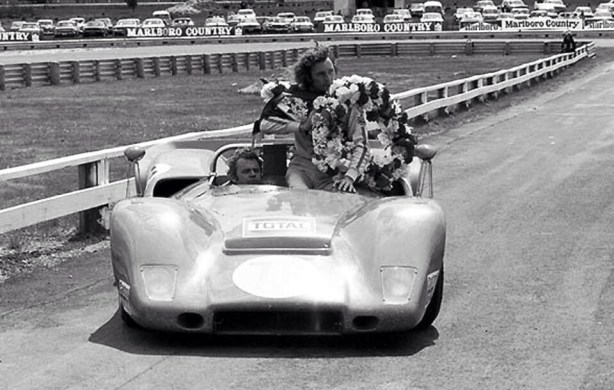
Bob drives and Harves carries the booty. McLaren M6B Repco, they have just won the final round of the 1972 Australian Sportscar Championship at Symmons Plains on 12 November- Harvey won 5 of the 6 rounds that year. Sex on wheels (oldracephotos.com)

‘I drove that Elfin only once and I didn’t like it. I didn’t like it at all. It was the sort of car that probably I could have been persevered with, and make it work properly. Or, at least to suit me. Maybe other drivers, including Bevan, were quite happy with it. But I certainly wasn’t. And that was the result of only driving it one time. I didn’t like it so I never drove it again’.

So, the 400 seems to be the car which Jane, who also raced it a lot, shared around a bit.
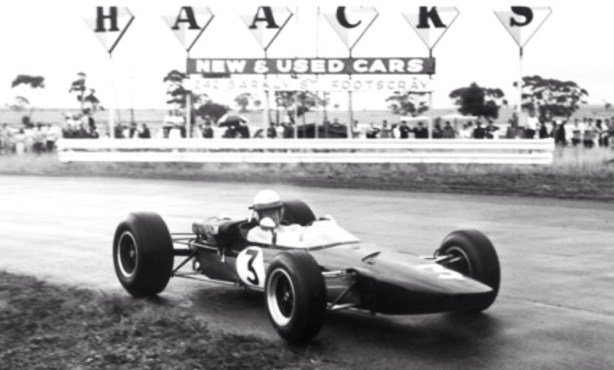
Ian Cook, Elfin Mono Ford, Calder 1967 (autopics.com.au)

 Ian Cook was a Melbourne boy (born 1941) who made a name for himself in single-seaters winning the Victorian Lucas Davison Series in 1.5 litre Elfin Monos in 1966 and 1967…

He drove an ex-Granton Harrison Mk1 in ’66 and in Garrie Cooper’s prototype Mk2 in 1967. This chassis was the car which Alf Costanzo drove the wheels off and shot to prominence after sold to him by Cook.

Ian, in addition to his Elfin raced Melbourne car owner Tony Osborne’s Argo Chev sportscar in 1967, no doubt his skill behind the wheel of this Cooper derived sporty, a far less sophisticated machine than the 400, was instrumental in him joining the Jane organisation in late 1967.
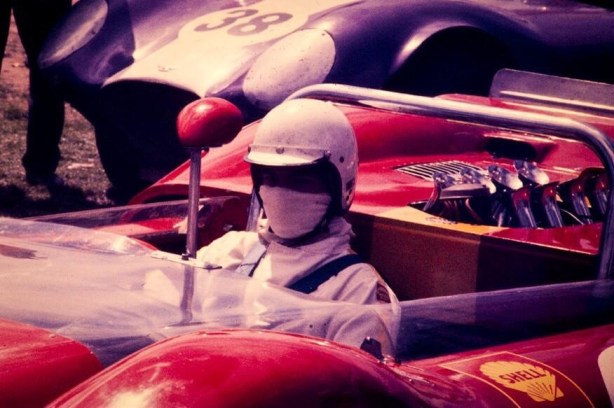
Ian Cook, Elfin 400 Repco on the Longford dummy grid in 1968. Car now has seat belts. Notice the different injection trumpets on the engine from the earliest 1967 shots

His first drive of the Elfin 400 was at Calder in January 1968, taking 2 wins. The Jane team then took the car to the Bathurst Easter meeting in 1968, together with the BT23E crashed by Harvey in practice.

Bob and Ian were both down to drive the 400 but must have had problems with it in practice as it failed to start any of the events, certainly Cook drove it in practice. Or perhaps John’s serious accident was enough to ‘up sticks’ for the weekend. Their experiences in the 400 that weekend would have been interesting given the sad events which were to transpire 12 months hence.
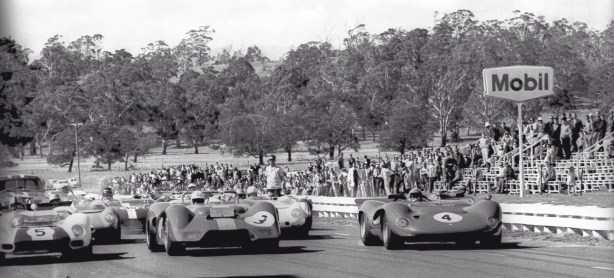
(R MacKenzie)

Grant Twining reports that Ian Cook was the quickest of all the Elfin 400 drivers who raced the cars at Longford- Matich (noting the advance in tyres between 1966 and 1968) Jane and Noel Hurd. The photo above is of the front row of the ’68 Longford Tasman sportscar support race- #5 Peter Macrow in the Argo Chev vacated by Cook, Ian in the 400 and Chris Amon on pole in the Scuderia Veloce Ferrari P4/CanAm 350. Amon took the win, am keen to know the placings.

Four months later Jane won the Victorian Sportscar title at Winton in the 400 after Niel Allen retired his Elfin 400 Chev with a split gearbox housing.

After the Tasman BT23E was repaired Cook raced the car at the Lakeside, Gold Star round in July for 4th place. He doesn’t appear to have had another steer of the car, which is unfortunate.

Allan Moffat then raced the BT23E at the Sandown Gold Star round, bending it. More of that shortly.

The first race after repair of the BT23E was in John Harvey’s hands, at Warwick Farm in a support race late in 1968. His first championship steer was at the Sandown Tasman round in February 1969. John had engine dramas and failed to finish the race won by Chris Amon’s Ferrari Dino 246T. Amon also took the Tasman title that year.
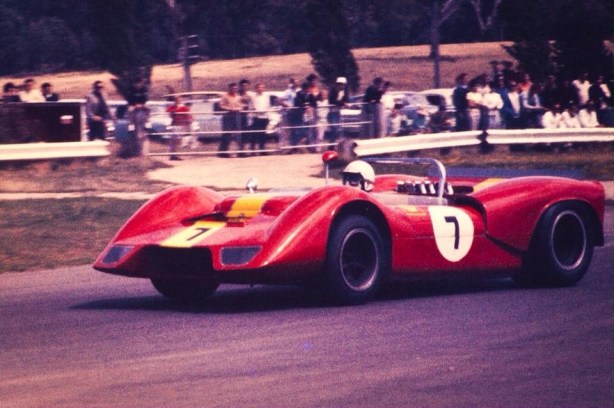
Cook aboard the 400 at Hume Weir in 1968 (unattributed)

Ian Cook and Footscray Service Station proprietor, racer, ace machinist and later Brabham expert Denis Lupton were old friends.

Lupton ‘spannered’ Cook’s two Elfin Monos with great success. When the Jane drive came to an end they were keen to buy a Brabham BT23 to run in ANF2 but could not afford to do so. So the pair built the ‘Devione’, a car which took the BT23 track and wheelbase dimensions but was otherwise Lupton’s own design and build.

Ian was a skilled sheet-metal fabricator, between the two mates they had all the skills and experience to build a beautiful car. The spaceframe chassis used F2 Matra MS5 front and rear cast magnesium uprights. A Lotus/Ford twin-cam engine and Hewland 5 speed transaxle completed the cars major specifications.

The car was raced by both men, Cook doing the more ‘senior events’ inclusive of some Gold Star rounds whilst Lupton did club events. The car was built and then raced in the 1968-72 period.

Around 1970 Cook, a talented development engineer moved to Adelaide to join Chrysler, to assist Leo Geoghegan with the road and race development of the Valiant ‘VF’ Pacer, a four door sedan which was proposed to contest the showroom stock, ‘Group E Series Production’ racing which was booming at the time.

Cook was involved in establishing the Pacers road going specification, ensuring a nice balance of engine and braking performance and sorting ride heights, shock absorber settings and roll bars to get the right blend of handling, safety and performance. The first test of these cars was at Sandown in June 1969 during a 12 Hour record setting day.
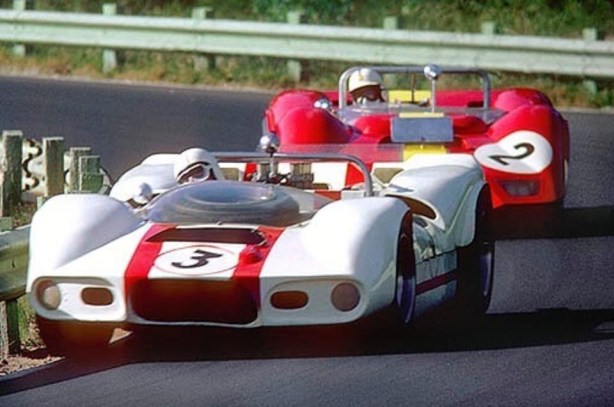
Niel Allen’s Chev engine 400 ahead of Cook in Jane’s Repco engine variant during the 1968 Warwick Farm Tasman round. They are attacking The Esses. Results folks? Note the different noses on the cars (oldracephotos.com)

Into 1969 the Elfin 400 drive was Bevan Gibson’s, with John Harvey racing the Brabham BT23E and McLaren M6B, the latter with Bob.

Janes Brabham BT36 (BT30-27 was a late build BT30 to BT36 specifications) was raced only sporadically by John Harvey. 2 litre Waggott powered, it was a jewel of a machine but arrived in amongst the F5000’s and too late for the 1971 Gold Star series in which he could have given Max Stewart and Kevin Bartlett a ‘good shake’ at the title Max won.

Bob Jane Racing sold the car less engine to Lupton and Cook who owned it in partnership. They converted it to ANF2 form by the simple fitment of a Lotus/Ford 1.6 litre circa 200bhp engine. The car was to be shared by the friends as before with the Devione.

Lupton withdrew from the arrangement with Ian when he needed to raise some cash to care for one of his young children who needed hole-in-the-heart surgery.

On a cold, wet, foggy Sandown practice day Ian was being looked after by some ‘stand ins’ rather than his usual crew including Lupton- who was dealing with family matters.

Grant Twining, the owner of the Devione and a confidant of Lupton says their theory is that the Brabham’s tyre pressures were probably incorrectly set too low. During practice for the June 1973 meeting the car lost a tyre from a rim, slid into one of the Shell, over the circuit sign, concrete supports, killing him instantly.

A Melbourne driver, his is a story which deserves to be told in full. Suffice it to say, a fine engineer, competitor and man died way too young in very unfortunate circumstances.
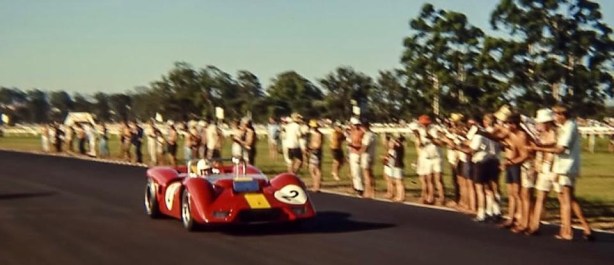
Ian Cook accepting the plaudits of the unruly but respectful! Warwick Farm crowd, February 1968. Elfin 400 Repco (D Harney)

Most of us think of Allan Moffat (born 1939) and Janey as arch rivals which they undoubtedly were.

The droll, deadpan, Canadian ‘Marvin’ played the ‘Baddie Role’ so well, it was easy as a kid to dislike him as much as you liked his car! The Trans Am Mustang that is.

But not long after he returned from his successful sojurn of several years in the US, in 1968 he had a couple of drives for Bob- ‘Stuffing the nose of the 400 into the fence and hay-bales at The Causeway at Warwick Farm, and at the following Sandown he had a more comprehensive issue with the Brabham’ (BT23E) wrote journalist Ray Bell. The meeting Bell referred to was the September 1968 Gold Star round, the car, crashed in practice, did not start the race.
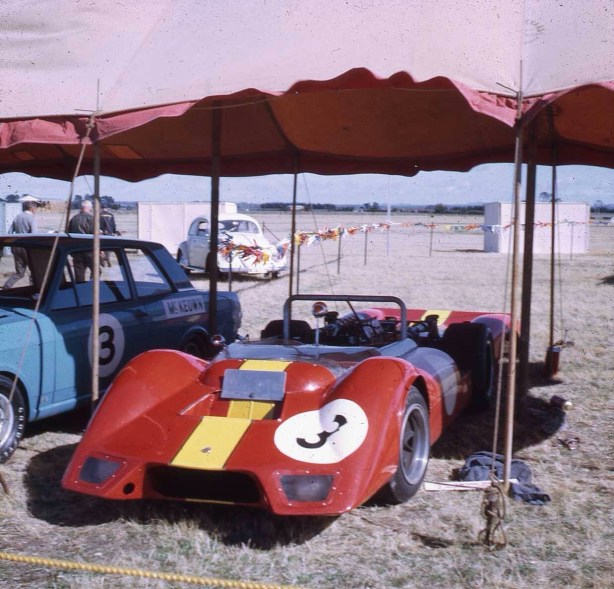
400 in the Longford paddock Tasman round, February 1968. Jim McKeown’s Lotus Cortina Mk2 alongside (D Cooper)

I’ve never seen any photos of Moffat aboard either car. Please share them if you have any Instamatic happy-snaps or better!

Moffat didn’t cover himself with glory it seems, not that it impacted his career trajectory! Factory Ford Series Production rides and the Trans Am were both happy 1969 events for both Moffat and we fans. What a ride he gave us all!?
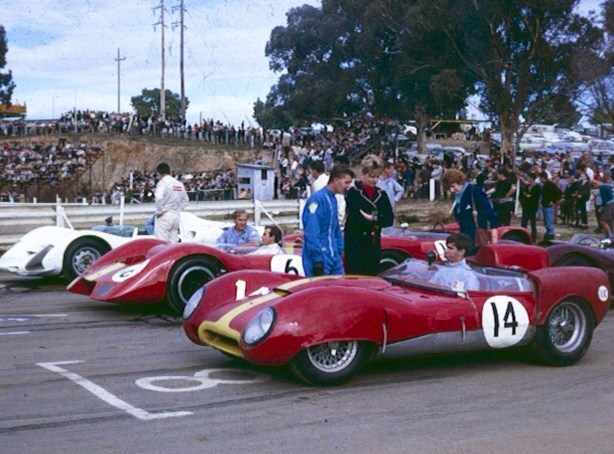
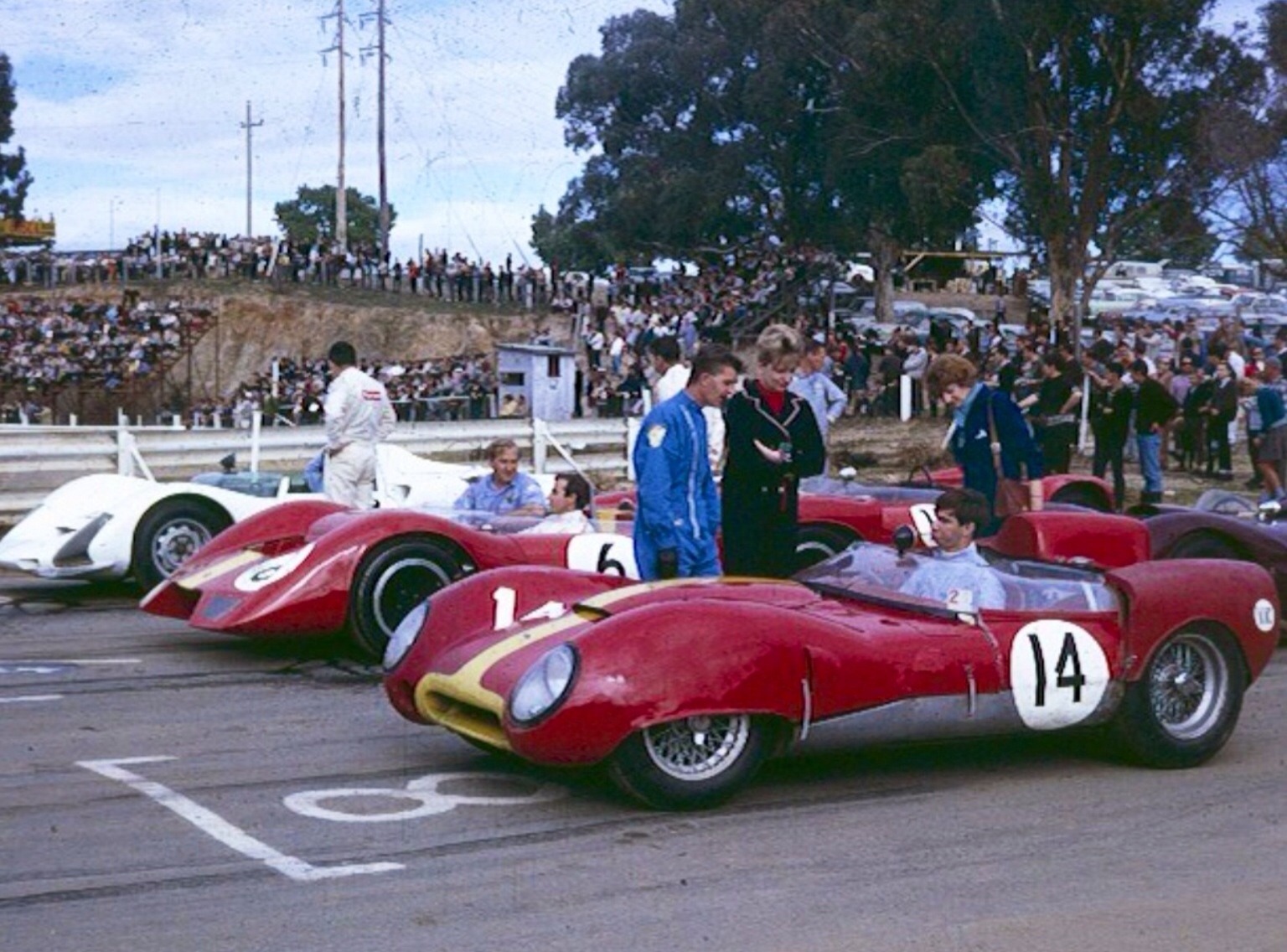
Hume Weir front row of the sportscar feature, Queens Birthday weekend June 1967. Alan Hamilton’s white Porsche 906 Spyder, Spencer Martin in the Jane Elfin 400 Repco and nearside Bevan Gibson Lotus 15 Climax (M Leirsch)

Bevan Gibson (born 1946) I wrote about not so long ago in the article about the ex-Derek Jolly Lotus 15 which Bevan drove to within an inch of its life, bringing himself to the attention of Jane and others. Click here for a link to my article about the Lotus 15.

Derek’s Deccas and Lotus 15’s…

Gibson really was an interesting prospect- considerably younger than all of the other drivers. At 22 he was aboard one of the fastest cars in the country- also a tricky one. I’m not suggesting Bevan was in over his head. He had plenty of experience in the 200 plus bhp Lotus 15 and had done some laps in the BT11A Repco during 1968 ‘with a strict rev limit’ to be observed whilst driving the circa 280bhp single-seater.
Pre driving deal. The Shell contracted Bob Jane Elfin Mono Ford alongside the Shell contracted Gibson family owned Lotus 15 Climax, perhaps at Calder, date unknown (unattributed)

Whilst racing the family Lotus 15 Climax Bevan worked in the workshop of Jane’s Chrysler Valiant Dealership in Sydney Road, Brunswick. The racing department was in the same premises.

Spencer Martin had been staying with Bob at his place in Kew, just off the Kew boulevard, a well known and challenging ‘racetrack’ then. Bob suggested he move out into a place of his own- sharing with Bevan, the pair ‘shacked up’ in a unit at Princes Park (Carlton) organised by Bob, the arrangement ran from 1966-7, at which point Spencer retired from racing and returned to his Sydney hometown.
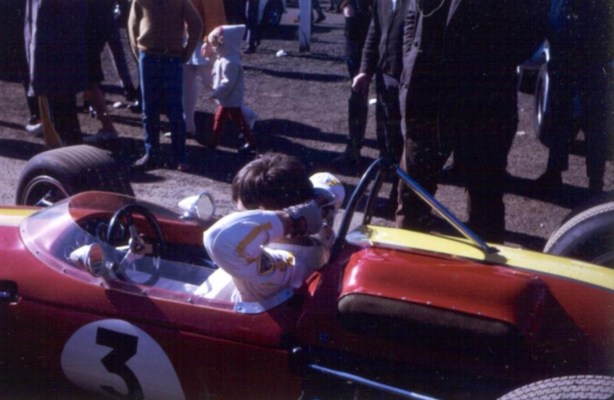
Bevan Gibson having a steer of Bob Jane’s Brabham BT11A Climax in August 1968 (unattributed)

Its interesting looking at the history, the connection to the Gibson family via Hoot Gibson, Bevan’s employment by the Jane Organisation, and ‘batching’ with Martin that Cook got the 400 drive in early 1968 rather than Bevan.

Perhaps it was simply that they (Bob and Spencer) didn’t think Bevan was quite ready for it at that time? There is no doubt that they saw plenty of each others races, photos of various of the Jane cars with the Gibson 15 in shot show them sharing the Shell facilities at race meetings. I’m not suggesting Cook wasn’t worthy of the Jane drive- most certainly he was, I am merely musing over the reasons/timing of the decision to give the drive to Ian rather than Bevan in 1968.
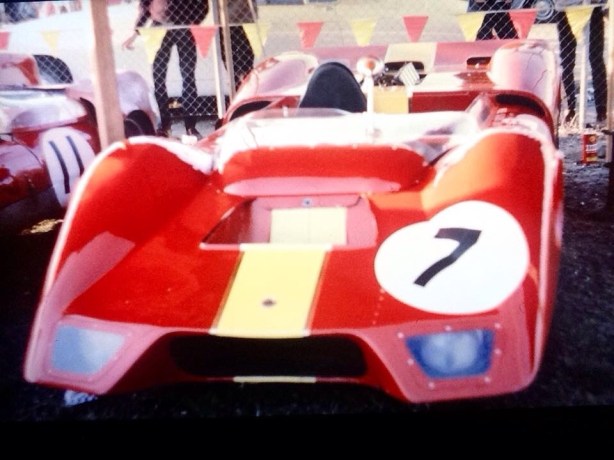
400 in the Calder paddock in May 1967- I wonder if its Bevan’s Lotus 15, which was painted red for a while, alongside. No roll bar in this shot (T Thompson)

At the 1969 Sandown Tasman meeting, the race and championship won by Chris Amon’s Ferrari Dini 246T, Gibson took the fifth of five in a row wins in Jane’s Elfin 400.

Barry Catford, somewhat prophetically, wrote the following note as a reporter covering the meeting for ‘Australian Motoring News’. ‘During the sportscar race I noticed on each lap the nose of the Jane Elfin lifted markedly after hitting a bump on the main straight before the start/finish line. The bump would affect the other cars, but not as noticeably as it did the Elfin. It seemed as though the Jane car needed less ride height at the front and maybe more at the rear which then may have resulted in less air getting under the front of the Elfin as it lifted over the bumps’.

The accident at Bathurst happened that Easter, on 7 April, three months later
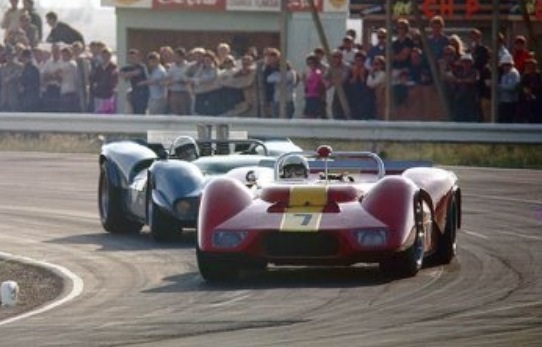
Bevan Gibson ahead of Niel Allen at Calder in March 1969, 400 Repco from 400 Chev (oldracephotos.com)

In ‘Gentleman John Harvey’ Peter Molloy recounts how John Harvey was completely shattered by what had happened to Bevan. ‘I really think that John wanted to give it away then and there’. But, ever the complete professional, he saddled up in the Brabham BT23E and contested the Gold Star race- won by Jack Brabham’s Brabham BT31 Repco after the Gibson accident with the remnants of the fire fighting foam still on the track and debris off to its side. On a track which bit him badly due to component failure only 12 months before.

Bob Jane had this to say about Bevan- ‘Hoot Gibson (father of Bevan)…were a family devoted to motor racing. ‘Hoot’ went back to the rallies from years before. Along with a lot of my mates like Lou Molina and all those sort of people. Young Bevan was a very promising driver. He was very aggressive. When I say aggressive I mean very brave. Unfortunately, that element of bravery brought him undone’.

‘The car he was racing, my car, was an Elfin. Obviously with the knowledge we have today about aerodynamics, things would be different. The car had a flat bottom, and Mount Panorama was a very fast track. It had two bumps and the end of the straight which brought a lot of people undone. The car took off, went upside down, and caught on fire. It was just a terrible, terrible tragedy’.
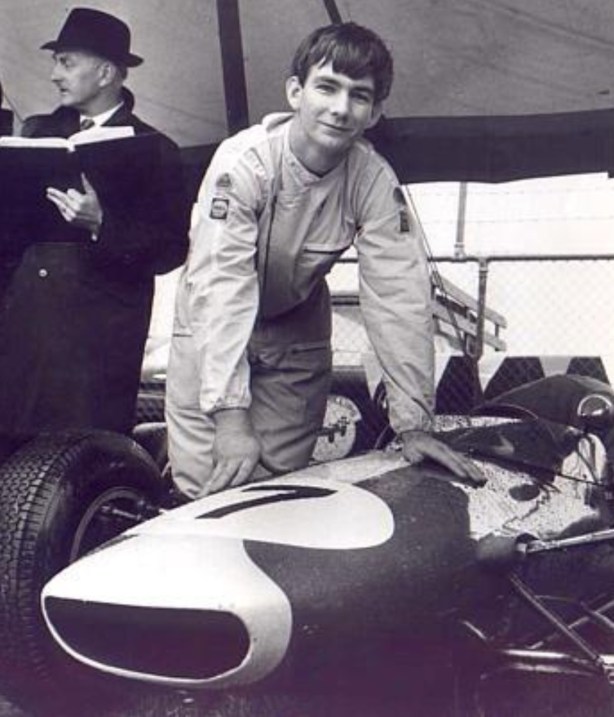
Gibson pictured with the Jane Elfin Mono, at Calder, date unknown (unattributed)

It wasn’t my intention to spend time dealing with the accident which befell Bevan at Bathurst.

As I mentioned at this articles outset, what started as a pictorial has ended up a feature. There are quite a lot of ‘I reckons’ about the accident online, my article includes these too. What is persuasive or a least informative are the views of those from within the Bob Jane Team, and Harvey details with Bevan sensitively and the accident in full, on that basis I include the following lengthy view of a friend and insider.

‘Bevan was a very bright young bloke. He had extremely good car control, and was very fast. He was a bit like a lot of us in our younger days, he was a bit wild at times. But he was able to harness that wildness, that energy, and put it into his driving. He was very good in competition and making excellent progress’.

‘Also some drivers may have a ‘devil may care’ sort of attitude. This can lead to some ‘spirited’ driving. I never felt this would bring Bevan into harm, but I did sometimes think he was a bit on the wild side. I felt that at times he threw caution to the wind. I have no hard core evidence for this…but I just remember feeling that at times’.

‘Quite apart from what I thought, he was certainly a good young driver. He had a lot of talent. Had he survived he would certainly have been good at his craft, and would have won lots of races…’
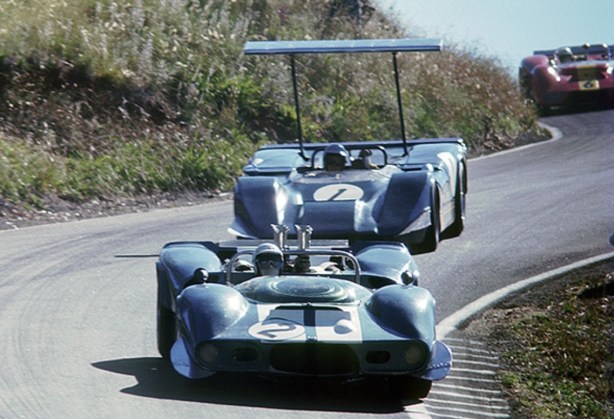
Lap 1 of the fateful Easter Bathurst Sportscar race 1969. The event was not an ASCC round- but was an important race with all the ‘top guns’ present. Niel Allen ahead in his ex-Matich Elfin 400 Chev, Frank Matich, suffering fuel feed dramas is 2nd, Matich SR4 Repco then Bevan Gibson, Elfin 400 Repco. Note the winglets on the front of the Allen car, big rear wing and front tabs on the SR4, Jane car devoid of these aero appendages (oldracephotos/Dick Simpson)

Bathurst Easter 1969…

John Harvey continues ‘On the Saturday night Bevan discussed with us the fact that the Elfin was lifting off the road coming over the last hump. I said to him”You can’t have it lifting off the road. If it lifts off the road it will go upside down”. We suggested that maybe the car was getting a bit ‘light’ going over the hump. I really didn’t know what technical things he could do to alleviate the situation’.

‘We expended the conversation to include Bob Jane and John Sawyer (Bob Jane Racing Team Manager/Chief Mechanic). Bevan suggested we may put some air ‘flippers’ on the front of the car, or some little winglets. This was late on the Saturday night, and hardly the right time to initiate things like that. The conclusuion was that we didn’t know if it would work. These are the sorts of things you have to test under controlled conditions. Raceday, particularly at Bathurst, is not the place to test.’

‘The only comment I made was “In all the years I have been coming to this place in whatever cars, if the car does not feel stable over the last hump- or even the second last hump- or if its a windy day- always lift off the throttle”. To do this may only drop your speed only a few miles per hour, but what it does is drop the nose of the car. Drop the nose of the car, and reduce the amount of air under the car. The car will therefore feel that little bit safer, and that much more stabile’.

‘So, that was that. there were a number of drivers who were aware of the problem and did just as I said. All we could do was pass this advice on to Bevan- all I can recall is that Bevan was running third. He then passed Niel Allen (ex-Matich Elfin 400) or Niel had some problem and Bevan was in second place’.
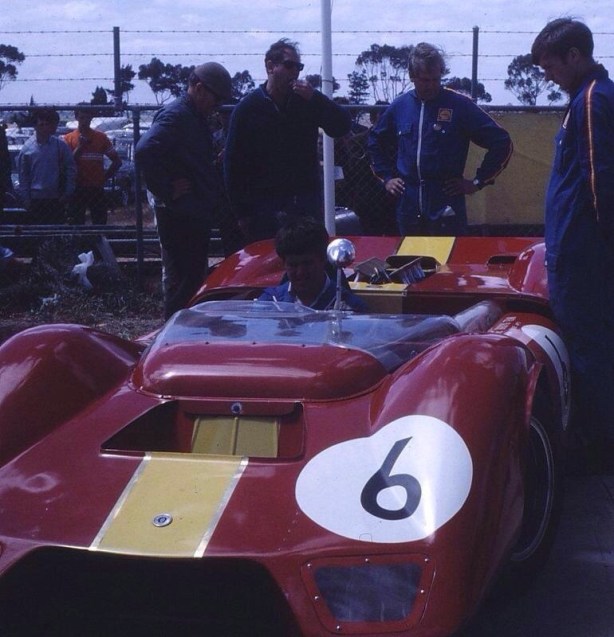
Bob Jane team and Elfin 400 at Calder, date uncertain. John Sawyer in blue suit behind the car. No roll bar fitted in this shot (unattributed)

‘Bevan then started to catch the race leader, Frank Matich  (Matich SR4 Repco ‘760 Series’ quad-cam 4 valve Repco 5 litre V8- a normally vastly faster car than the Jane Elfin 400).  Franks car had gone onto  seven cylinder for some reason, but he still had a good lead. Bevan was starting to catch Frank. Maybe Frank’s car now went onto six cylinders. I don’t know. All we knew was that Bevan started to catch Frank fairly rapidly, Bevan went across the top of the mountain behind Frank, and down through the Esses. From there it was on to Conrod Straight’.

‘It appeared to us that if he caught Frank he would bide his time and pass where it was safe to do so. At this stage no one was thinking about aerodynamics. Plus, i’m not at all sure what role that may or may not have played. It appeared that Bevan ‘drafted’ Frank down the straight. He caught right up on Frank and surely knew he had him. I think by this time there were a couple of laps left to go in the race.’

‘Naturally I have no way to know what is going on in Bevan’s mind. But I can easily imagine him thinking “I’ve caught up to Frank Matich. I can pass him and win this big race at Mount Panorama”. Which, of course would be a big win to have’.

‘So Bevan drafted Frank down the straight. He seemed to me to pull out just before the last hump. He pulled out to get the run down the inside of Murray’s Corner, and beat Frank under brakes. I suppose they were travelling at 160-170mph, and Bevan had pulled out just before the last hump. When Bevan hit the fresh air the car seemed to accelerate. The Elfin lifted, went up in the air, and came to earth upside down. The car almost instantly caught flames, and that was that’.

‘There was no doubt in my mind that Bevan died in that first upside down impact. The rest of the destruction and the fire, didn’t really matter’.

John then sensitively deals with the hours and days which follows, and points out that despite over 25,000 miles of testing, and the advance of aerodynamic understanding in the decades which followed the accidents which befell Mercedes Benz at Le Mans not so few years ago. Two flips to Mark Webber.
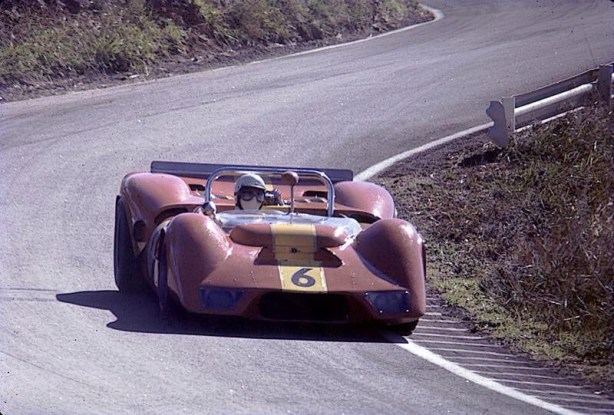
Bevan Gibson, Elfin 400 Repco, Bathurst Easter 1969. An outstanding young talent taken too soon. RIP Bevan Gibson (oldracephotos.com)

Bibliography…

‘Historic Racing Cars in Australia’ John Blanden, ‘Gentleman John Harvey’ Tony McGirr, ‘Bathurst: Cradle of Australian Motor Racing’ John Medley, ‘Elfin’ Barry Catford and John Blanden

Special thanks to Grant Twining for insights and information about Ian Cook

Photo Credits…

Ellis French, Dennis Cooper Collection, Dale Harvey, J Ellacott, oldracephotos.com, Dick Simpson, M Leirsch, S Lambert, Bob Mills Collection, GTRX, Tony Parkinson Collection, Wayne Wooton Collection, T Thompson, Tim Watts, Peter Houston

Etcetera: Niel Allen from Noel Hurd and Bob Jane, Elfin 400’s all …
 

Mixed sportscar bag in country NSW. Jane at Hume Weir in early 1968 from a Lotus 11, Meyers Manx VW beach buggy! and Geneer Outlaw VW (oldracephotos.com)
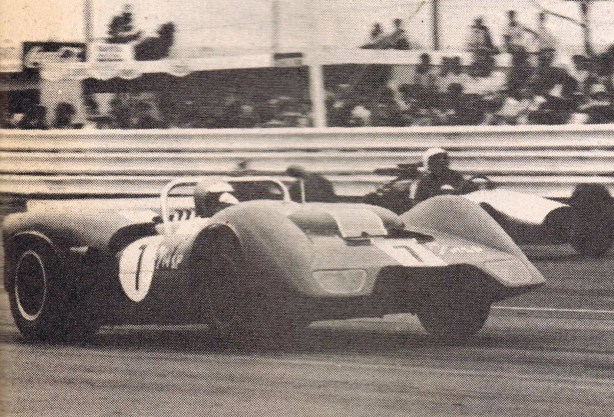
 

Bob Jane off the line at a Calder Raceway drag meeting in, I think 1968. He took out ‘Competition Eliminator’ with an 11.78 second/117.80 mph pass for the standing quarter (W Wooton)
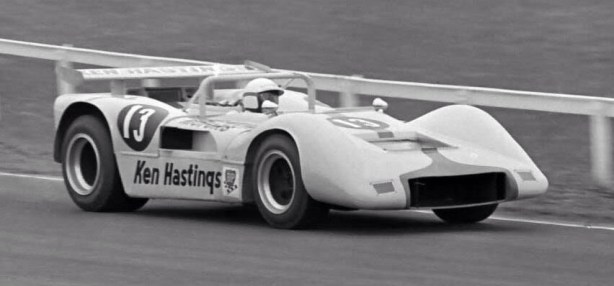
 

Ken Hastings at Sandown circa 1971, note the changes to the 400 body and addition of the rear wing (T Parkinson)
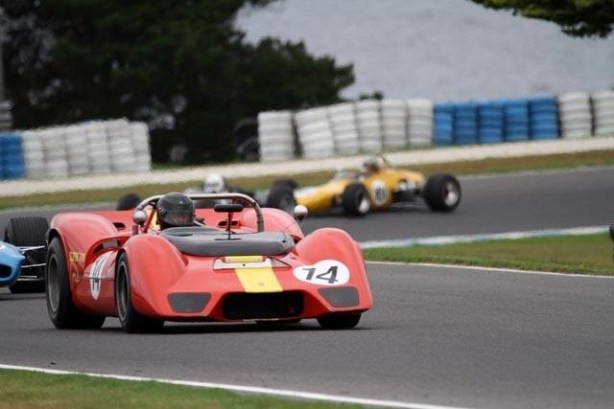
 

Bill Hemming in his beautifully restored ex-Jane 400 Repco at Phillip Island in recent years (G Russell)

Tailpiece: Butt shot for the tailpiece seems apt. Niel Allen Elfin 400 Chev, bodywork by Frank Matich, compare and contrast with the standard rear of Bob Janes 400 Repco. They are heading over Sandown’s old Causeway and about to swing left into the approach of the very quick Dunlop Bridge in 1968…
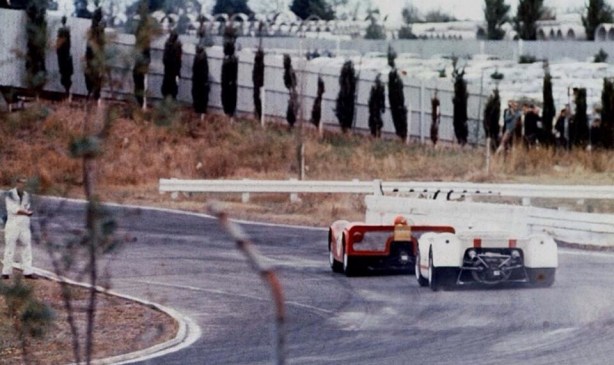
Tailpiece 2: End where we started with Bob Jane- at Longford in 1967, alongside is Alan Hamilton’s Porsche 906. We have liftoff…
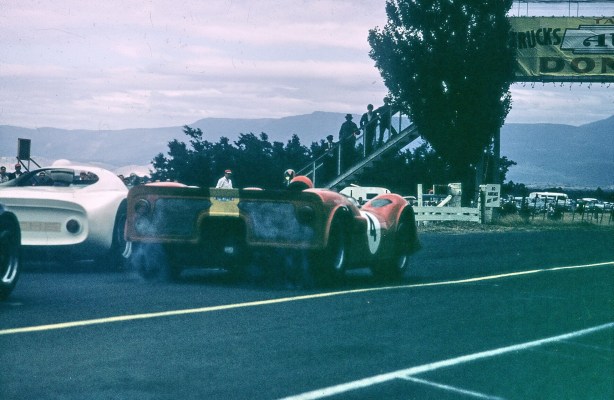
(T Watts)

Finito…


Clarence La Tourette’s superb cutaway drawing of the iconic, important Chev Corvette SS…

Regular readers will know I am a cutaway fan.

My favourite practitioners of the art are Vic Berris, Theo Page, Paolo D’Alessio, Tony Matthews, Bill Bennett, Bruno Betti, Giuseppe Cavara, Yoshihiro Inomoto and Clarence La Tourette- who I assumed was based in France. In fact he was working as a Technical Artist at Lockheed in the US when the newly appointed editor of Sports Cars Illustrated/Car and Driver, John Christy, brought him into the mix together with writers Griff Borgeson and Karl Ludvigsen in 1956. La Tourette drew the magazines cutaway centrespreads in his spare time. And absolutely marvellous they are.

One writes about such well known cars as these Corvettes with trepidation, but La Tourette’s beautiful drawing was too good not to publish. The article is a quickie to support the photographs, it offers Chevy hardcore no new insights but ‘newbees’ to this car like me an introduction.

GM famously rushed the first Corvette to market, it sold well in 1953 despite poor quality, its wheezy ‘Blue Flame’ in-line six cylinder engine and very limited availability. Only 700 were sold in 1954 and Chevy die-hards have it that only a 1955 memo from Zora Arkus-Duntov to Chev Chief Engineer Ed Cole, guaranteeing the commercial success of the car, saved it from the production axe.

These aero-test shots are dated 28 December 1956, the ’57 Sebring meeting was on 23 March (GM)

Arkus-Duntov was hired by Cole in Autumn 1953 after he saw and was excited by Harley Earl’s ’53 Corvette Prototype at the 1953 Motorama in New York. At the time the Belgian born American former racer was running a family business selling souped up Flathead Ford V8’s. A-D famously improved the cylinder head of the 265 cid small-block Chev V8- the first in a phenomenally successful run of cast iron, push-rod, relatively light and powerful road and race engines.

A-D presented a paper to the Society of Automotive Engineers extolling the virtues of a sportscar marketing approach in which such cars were ‘endowed with a racing halo provided by a few specialist machines of the same make’.

Putting into practice what he preached, Zora took a pre-production updated ’56 model to Pikes Peak early that year and won his class. Cole, by then GM of Chevrolet, approved a production speed record attempt at Daytona and the car set a speed of 150.583 mph in a car sans windscreen and with the ‘Duntov-cam’.

Chevrolet entered a Corvette fitted with an experimental 307 cid V8 at Sebring in 1956, the John Fitch/Walt Hansgen driven car finished 9th in the race won by the Fangio/Castellotti Ferrari 860 Monza.

Cole spoke to A-D about fitting a Chev engine to a Jaguar XKD Bill Mitchell bought but Zora argued for a racing version of the Corvette to be built instead and to be entered at Sebring in 1957.

Superb, posed shot of one of the two cars being built. Light tubular steel chassis, 283 cid, injected V8 and rear suspension in all of its detailed glory- de Dion tube, coil spring/shocks and huge finned drum brakes. Design very much the paradigm of the day, build quality and detail marvellous (GM)

Two cars, code named Project XP-64, were built by the Chevrolet Engineering Centre in the six months available- a ‘mule’ which used a fibreglass body over a multitubular spaceframe chassis and a race car which was to have hand-formed magnesium panels.

The engine was the latest iteration of the small-block, a 283 cid V8 fitted with fuel injection giving circa 307 bhp- to which was bolted a four-speed gearbox. Front suspension comprised upper and lower wishbones (A-arms) with coil spring/damper units. The rear used a de Dion tube, Halibrand quick-change differential, coil spring/dampers and inboard aluminium finned drum brakes- drum brakes were outboard at the front.

Race car close to completion- looks too good for a racer of the day! (GM)

The mule weighed 1850 pounds, the magnesium body would save 150 pounds but time was not on the teams side so all of the testing was done with the mule. No less than Juan Manuel-Fangio was engaged to drive the car but he was released from the deal when it became apparent it would not be ready- contracted to Maserati in his final full season of racing he won the event in a Maser 450S co-driven by Jean Behra.

John Fitch lapping the mule during Sebring practice (G Bussian)


Arkus-Duntov doing some Sebring test laps, schmick Halibrand wheels (G Bussian)

Nonetheless Fangio tested the car and lapped quicker than his previous years record lap-time. When the racer arrived all the ‘sorted bits’ were transferred from the mule to it, the car driven by the vastly experienced Piero Taruffi and John Fitch. It retired after only 23 laps with ‘electrical gremlins, bad brakes and terminal rear end problems’, sad really as the car dominated the early laps and achieved a top speed of 183 mph.

John Fitch said ‘That car had so much potential, but we never had time to make it race ready. We didn’t get the car to the track until the very last minute and so we transferred the parts that worked, and everything we refined on the mule to the racing car when it arrived. The brakes were absolutely terrible and they never got that resolved. For some reason Zora Duntov made the decision not to use disc brakes on the car and it was a bad one. We had absolutely no time to sort that car out. If we had we might have made a real impact on that race’.

Piero Taruffi, Corvette SS, JM Fangio alongside in the winning Maser 450S and #20 Stirling Moss Maser 300S 2nd (G Bussian)

None of the problems were any less than could have been expected of a car at the commencement of its development curve but aspirations for Le Mans and other blue-riband events were scuttled with the American Automobile Manufacturers Association ban an manufacturer supported motor racing off the back of the 1955 Le Mans disaster.

Both cars survive of course, the Mule was sold to Bill Mitchell, then GM Vice President of Styling for a dollar who turned it into the Stingray Racer…

John Fitch and Zora Arkus-Duntov @ Sebring 1957. Superb car has no bad angle (G Bussian)

Etcetera: Sweet coupe, A-D up…

Bibliography/Credits…

Clarence La Tourette, chevyhardcore.com, myautoworld.com, General Motors, Gene Bussian

Tailpiece: Zora looks rather happy with his team’s creation, as well he should. A wonderful mighta-been…

(GM)

Finito…
(Klemantaski)

Jack Sears, Dunlop Curve, Le Mans in the ill-fated long, low, swoopy AC Cobra Coupe 20-22 June 1964…

Sears was hoping to do better than his marvellous fifth place at Le Mans in 1963 aboard the Maranello Concessionaires Ferrari 330LMB he shared with David Piper.

The talented British sedan and sportscar racer was partnered with Peter Bolton in the one of a kind AC Cobra Coupe, AC Cars Ltd owner Derek Hurlock and his team built to take on the ‘works’, Shelby Daytona Coupes in the famous 1964 24 Hour classic.

It was also a chance for AC to improve upon its 7th place finish at Le Mans in 1963 when the factory Cobra driven by Ninian Sanderson and Peter Bolton finished 7th.

The big Coupe was registered ‘BPH4B’ to allow some testing on public roads, despite this the first Carroll Shelby knew of AC Chief Engineer Alan Turner’s in-house design was at the car’s competition debut during the Le Mans test day in April.

Visibly lower than the Pete Brock designed Daytona coupe (41 inches compared with 48 inches- its height a function of uncertainty over Le Mans windscreen height regs) both designers sat the drivers lower in the car. Turner had also raked the windscreen, created a lower nose section and a longer flowing roof as well as designing the ‘eyebrows’ over the tops of the wheel arches he claimed help clean up airflow.

The cars promise of speed on the Mulsanne Straight was met- Bolton achieved the 27th fastest time in a fast run without ‘going for a time’ in a car which still required development.

Back in the UK brake overheating problems were addressed with ducting, a burned piston replaced and a rear spoiler added for stability and to reduce lift. The car was then tested at the MIRA facility for which it proved too fast, there was not a road section which allowed the car to run to its maximum speed…

AC’s Alan Turner created a marvellous, handsome, cohesive, masculine shape with demonstrable aerodynamic properties- such a shame only the one was built (Autocar)

During Le Mans Sears and Bolton were timed at 180.2mph @ 6300rpm, matching the Daytona Cobras despite giving away 30bhp to the Shelby entries- AC cars chassis #A98 had a 289cid/4.7 litre ‘Windsor’ engine which developed circa 355bhp, the Shelby cars had around 385bhp.

The car qualified conservatively second in class behind the Gurney/Bondurant Shelby entry and ran in that race position, at one point leading the class early in the race averaging 20mph for the first 3.5 hours.

The big coupe began to have fuel feed problems which were found after the race to be caused by newspaper in the fuel tank- sabotage- which blocked the fuel filter. Much time was lost as the filter blockage was diagnosed and remedied.

Circulating at the pre-race determined lap times the next stint was trouble free with the slippery machine able to match the Shelby’s top speed despite less power and a higher diff ratio (2.88:1 rather than 3.09:1- the fastest Daytona speed of the weekend was 186.4mph @7000rpm using the 3.09 ratio).

It was an unusually bitterly cold night for mid-summer with occasional patches of mist. Some reports have it that the teams tyre supplier advised not to change the cars tyres. At around 10.15pm on Saturday evening, with Bolton at the wheel a tyre blew at Maison Blanche- the car spun and was collected by Giancarlo Baghetti’s following works Ferrari 275P. The Ferrari speared off into the barriers and crushed three French, late teenaged spectators standing in a prohibited area.

The AC flew over the guardrails, lopping branches from trees at a height of 20 feet before coming to rest in a crumpled heap. Baghetti was uninjured with Bolton taken to hospital with minor injuries.

The best placed of the Shelby Daytona Coupes was the Dan Gurney/Bob Bondurant driven car which qualified 10th and finished 4th. Sears qualified his machine 13th, the Jean Guichet/Nino Vaccarella works sports-prototype Ferrari 275P 3.3 V12 won the race that year.

The wreck of Coupe A98 was brought back to the AC headquarters in Thames Ditton and never rebuilt and or raced further ‘in period’. The very significant car was restored by Barrie Baird who negotiated its purchase in 1972. The work took over 12 years, many of you will have seen it at Goodwood and the like.

What a superb looking machine the car is, Le Mans paddock 1964. #43 is the Hunt/Wagstaff Lotus Elite 22nd, #42 is the Lawrence/Spice Deep Sanderson 301 BMC DNF. What a magic atmospheric photo (ITMSP)

The high speed excitement about the AC Coupe started in much more amusing fashion, although it wasn’t seen that way at the time, not long before Le Mans.

Given the Motor Industry Research Association (MIRA) roads had not allowed a flat-out run AC decided to test the high speed stability of the car on Britain’s M1 motorway in an incident which has gone down in motoring lore.

‘Gentleman Jack’ Sears recalled the early morning run in articles published in ‘The Car Connoisseur’ and ‘Autocar’ magazines.

‘About a fortnight before Le Mans AC thought they really ought to try and test the car to see what top speed it was likely to attain. We decided to get up at dawn on this early June morning and do a run up and down the M1 motorway. There was nothing special about that in those days when the M1 was used by other manufacturers with nearby factories such as Jaguar, Aston Martin and Rootes Group (Humber, Hillman and Sunbeam-Talbot).’

‘So we all met at Southern Service Station, warmed the car up, and I went up the north carriageway for several miles, and clocked what I thought was terminal speed before returning south without passing any traffic – it being 4.30 am. Back at the service station I told them how many revs I’d done, they knew what the back axle ratio was, they knew what the tyres size was, the wheel size etc etc, and from their slide rules (no calculators in 1964) they discovered that we had done 185mph. Then Peter Bolton, who was to be my co-driver, went off and did the same thing. We were both happy with the car and by 8.30am I was back home in Norfolk eating eggs and bacon.’

‘Around lunchtime I took a call from a journalist on the Sunday Times who had somehow picked up the story in a Fleet Street wine bar from a chap called Tony Martin, Derek Hurlock’s nephew, who was on the administrative side of the paper and had been present earlier in the day. It must have been a ‘quiet news day’ because they blew up the story out of all proportion. It hit the headlines and the press followed the story right up to Le Mans, where sadly the car was destroyed after a rear tyre burst, putting Peter Bolton into hospital.’

‘I am actually the only man in the world who has raced a Shelby Daytona Cobra Coupé, the AC Car Company Cobra Coupé and the Willment Cobra Coupé.’

Sears AC during the early Saturday Le Mans laps, #18 the Aston DP214 driven by Salmon/Sutcliffe NRF , 250LM or 275P back a bit (unattributed)

Not too long after Le Mans Sears stopped racing to return to farming in Norfolk but he was still very much in demand as a test and development driver, but a monumental accident in a sports-racing Lotus 40 Ford at Silverstone came way too close to costing him his life, aged 35. It took him 12 months to recover but he never strayed far from racing, not least because his son David became a racer and team owner.

(B Bird)

In sequels to the M1 incident the publicity was very good for AC Cars, but the compulsory 70 mph speed limit introduced on British roads in 1967 was sheeted home to the exploits of AC and Jack!

He chuckled at the memory, ‘I took a lot of flak for being responsible. Indeed at the time there were those who felt that sort of speed on a public highway was irresponsible behaviour and I had to live with this for some time. I am glad to say that I was eventually exonerated when, towards the end of her life, Lady Castle was interviewed by Tony Martin and asked whether the story concerning his uncle’s car had any effect on her decision to impose the speed limit three years later. She remembered all the publicity but claimed that the speed limit was already under review long before – so I was vindicated!’

Wowee. Thames Ditton, AC Cars Ltd (Just a Car Guy)

Specifications in brief…

Three shots from ‘The Cobra-Ferrari Wars’.

Top-the Coupe body framework being constructed at Thames Ditton. Middle is the engine bay with the Weber 48IDA fed, cast iron, 355bhp pushrod 4.7 litre ‘Big Henry’ V8- what a marvellous race engine this ‘Windsor’ family of small block Fords is! At the bottom is Jack Sears alighting the car after THAT M1 morning run.

Etcetera: owner Barrie Bird adds…

A day after uploading this article ‘A98’s owner and restorer Barrie Bird kindly got in touch and added hugely to this story with some comments which are at the end of the piece in the readers comments area.

He also sent in some wonderful material, which he is sharing with us all- the first photos are ‘…ones of Jack on his farm and you can see the little farm roads which were traversed for half an hour or so at three figure speeds’.

‘Jack was very funny on the farm- he gathered a couple of his farm hands who knew what they were about and briefed everyone in very military and commanding style; “You will be positioned here, you will lookout for traffic there, the photographer will stand there. I shall only make two passes at low speed to be sure you get your shots”. So off he went at high speed, getting faster and faster, declining to stop, wearing a big grin all the while. Magic!’

(B Bird)

(B Bird)

(B Bird)

See the padlocked fuel caps below- ‘All I can tell you about the padlocked fuel caps is that the photo was taken before the race. Was it a case of bolting the stable door, or did the saboteur slip in during the refuelling? Who knows?’

(B Bird)

What a mess! A98 post Le Mans shunt- Peter Bolton was a lucky boy to escape with his life. The top front suspension leaf spring, steering rack, tank and a rocker cover are about all of the components I can pick.

(B Bird)

Barrie’s adds this piece about Jack Sears comments on the comparative merits of each of the different AC Coupes…

(B Bird)

Technical Specifications in Detail…

Barrie Bird advises as follows;

‘The specifications are in theory the same as the FIA homologation for the standard Cobra, except that, in those days, it was permitted to build a different body on the homologated chassis and still run as a production GT. I think this went all the way back to the inter-war years when the manufacturers would supply rolling chassis to be bodied by coachbuilders. In any event by 1964 this provision was being well abused and chassis modifications, ostensibly to support the special bodywork, were used to stiffen things up.’

‘A.C. to their great credit kept to the spirit as well as the letter of the law and A98 is quite usable on the road as a GT with a comfortable cockpit and a normal boot which will swallow a couple of big holdalls. The ground clearance has to be kept in mind and of course the car was designed before the era of speed bumps and potholes. The lowest point under the car is the diff. oil cooler and this does not take kindly to being in contention with tarmac!’

Dimensions et al

Wheel base 90 inches, Length 176 inches

Track Ostensibly standard at 51″ but in fact wider by reason of the largest homologated wheels 7.5″ front and 9.5″ Rear. The largest track is obviously on the rear and with the original Goodyears fitted increases to 66″

Weight at scrutineering 1964 le Mans 2482 Lbs. Weight in 1986, after reassembly, with tools, spare wheel & tyre, jack, oils and water, but without any fuel 2365 Lbs

Capacities- Fuel 30 Imp.Gals, Engine oil,wet Aviaid sump, 6 Imp Qts

Wheels and Tyres

Tyres Goodyear Bluestreak 26.5 x 8 – 15 and 26.5 x 10.5 – 15

Wheels Halibrand Indy 500 pattern WH6S 2528 and 2532 F & R 7.50″ and 9.50″. Often incorrectly described as ‘FIA Pattern’

Transmission

Gearbox Borg Warner T-10 four speed. Nitride alloy gears ‘Pontiac Gearset’ – 1:1 – 1.31:1 – 1.637:1 – 2.196:1. Axle Ratio 2.88:1 Gearing in 4th gear 27.6 mph per 1000 RPM No allowance for tyre growth

Engine

289 V8, cid 4727 c.c. supplied by Ford Dearborn 355 bhp. Four 48 IDA Webers, ported big valve heads, high lift camshaft, standard High Performance crank and rods, HP 5 bolt block, damper and flywheel. Standard HP clutch

Lucas 28 amp competition dynamo, Lucas 100/100 watt le Mans headlamps, Lucas SFT foglamps

‘Apart from the body not much different to the production roadster, but Alan Turner certainly got the aerodynamics right.’ And so say all of us, it is a glorious motorcar.

Credits/References…

Barrie Bird, many thanks for making contact and contributing both comments and material from your archive for this article

‘Cars for The Connoisseur’, Klemantaski Collection, Inside The Motorsport Paddock (ITMSP), Autocar, ‘The Cobra-Ferrari Wars’ Michael Schoen, ‘Cobra: The First 40 Years’ Trevor Legate, Just a Car Guy, MotorSport

Tailpiece: Thames Ditton, AC men admire their handiwork pre Le Mans, simply superb looking machine…

(Just a Car Guy)

 Finito…


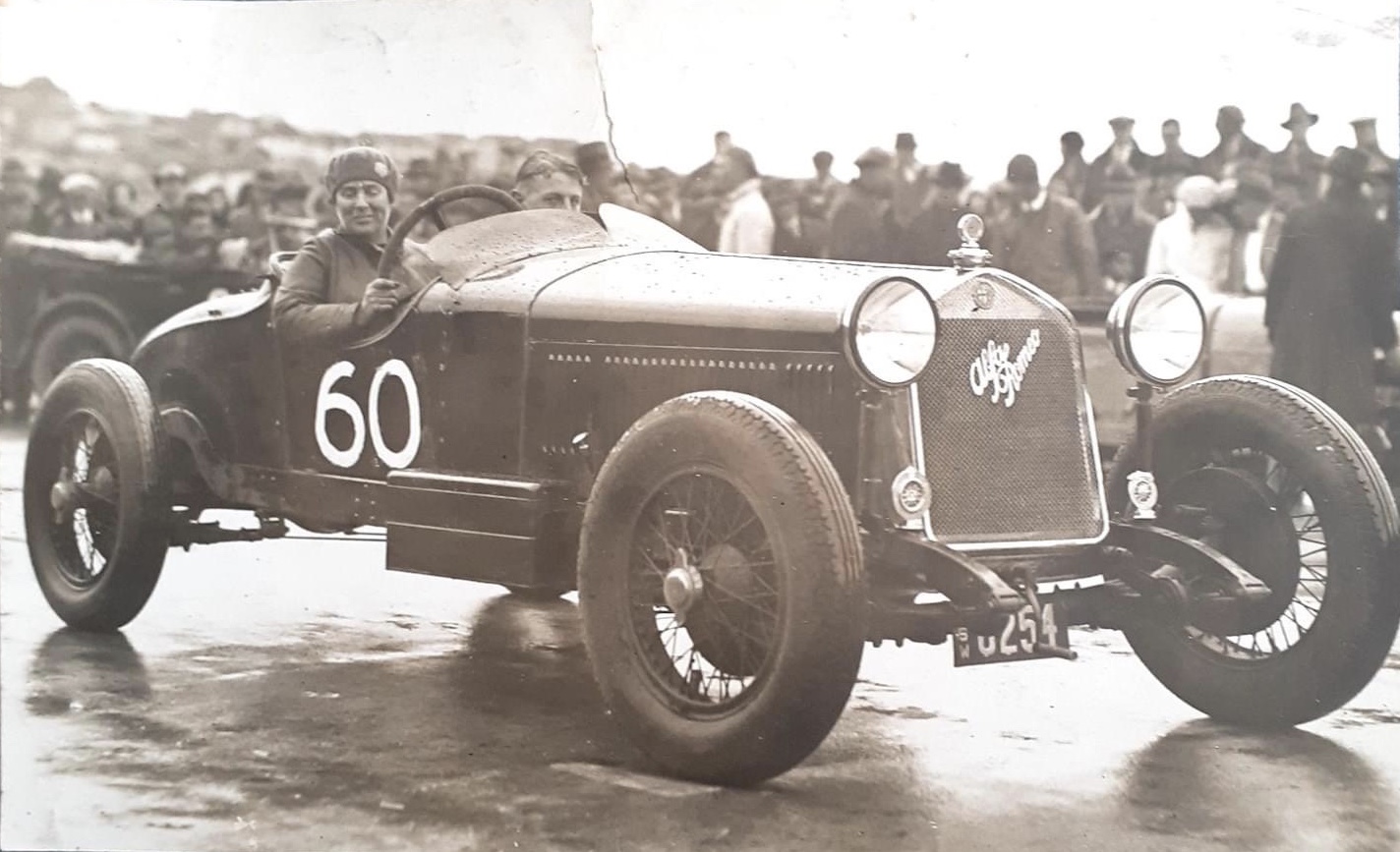
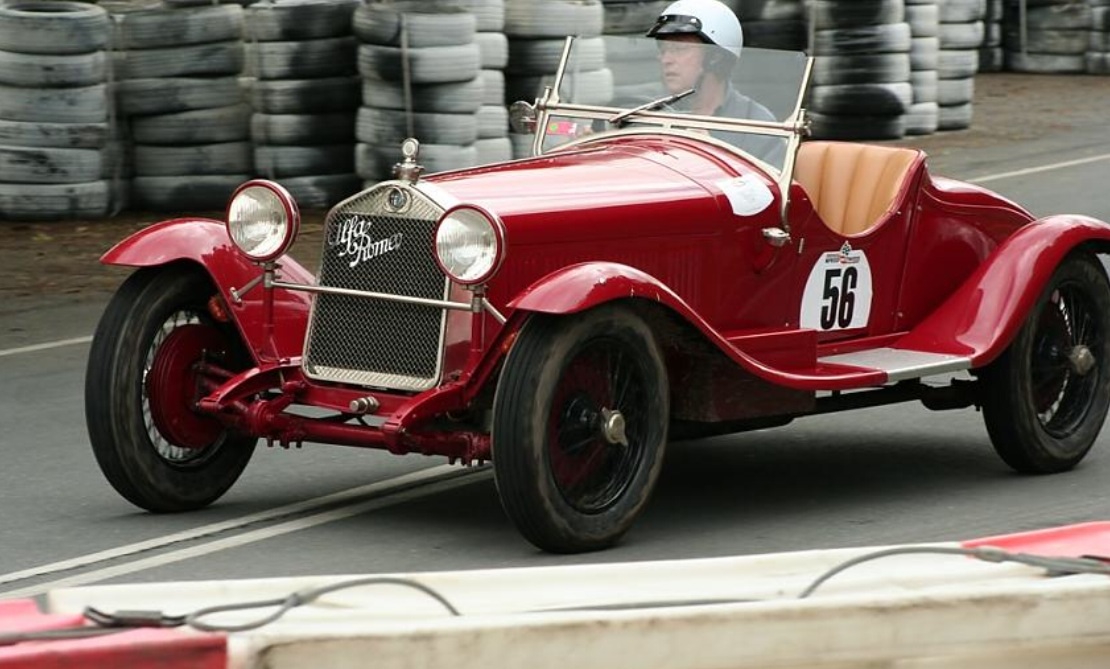
Mrs JAS Jones lines up, left, in her Alfa Romeo 6C1750 SS Zagato prior to the start of a race at Gerringong Beach, New South Wales, 12 May 1930…

Alongside her is the obscured Bugatti T37A of three-time Australian Grand Prix winner Bill Thompson and the Chryslers of E Patterson and #72/14 HJ Beith.

In the politesse of the times Mrs JAS Jones ‘married well’. Her husband Mr John A.S. Jones, ‘Lithgow’s leading businessman’ owned the ‘Zig-Zag Brewery’ and ten hotels. Lithgow is a city in the New South Wales Central Tablelands region 150 Km west of Sydney.

The cashflow of these enterprises provided the means for Mrs Jones ‘…a very congenial hostess who entertains lavishly at her homes in Lithgow and Darling Point, Sydney’ to acquire some wonderful racing cars including the ex-works 1929 Mille Miglia Alfa Romeo 6C1750 SS Zagato chassis number ‘0312894’.

This car played a significant part in Australian motor racing into the late 1950’s being much raced, ‘climbed, trialled, crashed, bashed and modified before being ‘rescued’ and restored in the seventies and eighties.

Jones was one of the great pioneers of Australian motor racing- born Nina Vida Harris in 1882, her motoring career started in the family Chandler and then progressed to a Crossley ‘which she raced at Maroubra with a measure of success’.

After a trip to Europe ‘witnessing real motor racing in France and Italy between Bentley, Sunbeam, Alfa Romeo, Mercedes and Bugatti concerns’, she acquired the Alfa, which was soon shipped to Australia in 1929. It is said she tested the Alfa Romeo model range together with Giulio Ramponi, works driver before choosing the 6C1750 SS, and an astute choice it was for the range of events run in Australia at the time.

Ramponi co-drove the winning 6C 1750 SS in the April 1929 Mille together with Giuseppe Campari. ‘Racing Sports Cars’ in its race results listing offers the tenth placed 6C 1750 SS driven by A Bornigia/Carlo Pintacuda as possibly chassis ‘0312894’ whilst John Blanden in his book suggests the car as ‘reputed to be’ the sixth place Minoia/Marinoni machine.

Jones posing with her new 6C1750 the day after it arrived in Australia (T Forrest)


Jones and Alfa during the Bondi Sprint meeting in June 1930, wet conditions added to the challenge (C James Collection)

Jones was immediately competitive in the thoroughbred, over the next few years she was a regular competitor in the large number of ‘Reliability Trials’ which were the staple of New South Wales Royal Automobile Club and Light Car Club events. These contests always included speed tests, typically acceleration test(s) and more often than not a hillclimb.

The 6C1750 was immediately one of the fastest cars in the country, the Bugatti T37A of four-time Australian Grand Prix winner Bill Thompson always gave the Alfa a run for its money whenever it competed in these events, more often than not Jones won her class and occasionally set FTD.

It appears her earliest event was the RACA reliability trial run out of Canberra in August 1929. She contested another of these events in September establishing second fastest time of the day at the grass surface Prospect Hillclimb, and another from Sydney to Cattai Creek in December.

The car’s 1930 logbook commenced with the Prospect Hillclimb in February and the RACA Sydney to Robertson Reliability Trial.

Disaster was only narrowly averted in her next appearance at Gerringong Beach, in the NSW Illawarra 130 km to Sydney’s south in May 1930, car racing was held on the beach during the twenties and into the early post-war period.

Travelling last of four in a heat of the Four Mile Handicap at well over 100mph numerous spectators surged forward- the first three cars having passed the finishing post, onto the sand track to see the Alfa take the chequered flag, Jones hit one man, a Chrysler mechanic, Norman Curley having avoided several other people who had come too far, hurling him into the air and breaking his leg.

Bill Thompson was the star of the day at Gerringong winning several races including the feature event, the Sydney Bicycle and Motor Club Fifty Mile Handicap off the back of his AGP win in the same chassis at Phillip Island on March 24.

In a sequel to the breaking of the mechanic’s leg, Mr Curley took action in the Darlinghurst Court against Jones for alleged negligence seeking 1000 pounds in damages in June 1931 after spending seven weeks in hospital after the incident. Unsurprisingly, the jury found in favour of Jones, who was a competitor not an organiser of the meeting and therefore not someone responsible for crowd safety. The matter was not left to chance, Jones was represented by Kings Counsel at some considerable expense to the years racing budget.

Jones and riding mechanic, Gerringong Beach May 1930 Alfa 6C1750 SS (Fairfax)


A ‘Percy’ Hunter and Jones before an event at Gerringong in 1930 (A Patterson)


Gerringong May 1930, competitors unknown (Fairfax)

Nina was said by the Sydney press to be entered in the 1930 Australian Grand Prix at Phillip Island but did not compete in the race won by Thompson’s Bugatti T37A.

In June a standing quarter mile competition was held on the Bondi Beach promenade, she did a time of 18.2-5 seconds and beat sixty-four other competitors in what would have been quite a spectacle. A dog dashed onto the course during one of Jones’ runs whilst the Alfa was flat chat at full speed, disaster was averted by the experienced pilot veering around the frightened hound and applying the brakes ‘causing the car to twirl almost around’.

The earliest reported event in 1931 is the June LCC Trial from Sydney to Avon Dam, she won her class acceleration test, in May she set a speed record for women at 93.264 mph over a measured half mile at Richmond and was disappointed with the result, her run in was too short she felt.

Jones did another of these trials in July and in August- this time from Sydney to Wisemans Ferry where she did the fastest time for supercharged cars. In October the Alfa was pointed to the Razorback where the combination were quickest in both the subsidiary acceleration tests and the hillclimb.

Mr A Hunter competed in the car at Maroubra after it was reopened in July 1932 in a weird event comprising a series of acceleration, braking and parking tests.

The following month Jones ‘threw the keys’ of the Alfa to the great Bill Thompson who had a steer of it in an LCC acceleration test event. It would be interesting to know his ‘compare and contrast’ thoughts of the six-cylinder supercharged Alfa Romeo sportscar with his four-cylinder supercharged Bugatti Grand Prix machine.

In a famous 1933 incident recounted down the decades Jones had her first big accident.

A convoy of ‘ten of the fastest sportscars in Australia’ set out from Sydney to Melbourne and thence down to the Westernport Bay to witness the Australian Grand Prix at Phillip Island- the drivers turning the journey into a race and ‘thundering down the Hume Highway at near Grand Prix speeds’.

Jones with her daughter Vida as passenger, having easily outdistanced the rest of the group, when cornering at over 100 mph near Albury, had a nail puncture a rear tyre causing the car to roll whereupon Vittorio Jano’s greatest caught fire and was substantially damaged.

‘Travelling around the corner the next man along, John Sherwood (a racer of considerable aplomb)…found the two women practically unhurt but dismally watching their car crackling furiously. The Alfa was burnt right out after unsuccessful efforts were made to put out the flames’.

To add further to the family woes, the patriarch, John AS Jones died in May 1933.

The Alfa was rebuilt by local artisans in Sydney with parts imported from Italy, making its post rebuild competition debut at Bar Beach Hillclimb, Newcastle in August 1934. In another disaster, Jones’ son Jack, also a racer, after his own run in the Alfa, took his mother up as passenger, lost control, crashed, overturned and hit a telegraph pole gifting his mother a broken thigh and six weeks in hospital.

This second incident, with no doubt her husbands death on her mind, determined the lady racer to retire, she still occasionally drove the 1750 but the more ‘intense’ of events were contested by personal friends driving the car.

Jones did not lose her pace however, as late as April 1937 she won her class FTD at Waterfall Hillclimb in the exotic supercharged machine. Son James won the local River Lett Hillclimb near Lithgow in July 1937.

The Jones family finally parted with the much loved and well used car in 1938. John Blanden records the March 1938 advertisement in ‘The Car’ claiming ‘0312894’ to be completely overhauled and in perfect mechanical condition. The reported cost of the Alfa when landed in Australia was 1750 pounds. Claims were made for hillclimb records at Waterfall, Robertson and Kurrajong in NSW and Mount Tarrengower, Maldon, Victoria.

John Barraclough Sporting Cars of Sydney handled the sale with Barraclough, an ace of the time, racing the car at Penrith Speedway in April 1938 to keep the racer I n the eye of potential purchasers. Graham Howard’s biography of Lex Davison records that Lex’ father AA Davison at one stage considered buying the ‘crashed 1750 Zagato Alfa’ but perhaps this was after one of the earlier accidents not in 1938. Barraclough entered the car in the April 1938 Australian Grand Prix won by Peter Whitehead’s ERA R10B at Bathurst but the car did not start- whether John practiced or did not appear because of the cars sale, or some other reason, is unclear. After the car was advertised for a short time ‘Racing Ron’ Edgerton purchased it.

Ted Gray, Alfa Ford V8, during the October 1946 New South Wales Grand Prix at Bathurst. He was fourth in the handicap race aboard ‘0312894’ won by Alf Najar’s MG TB monoposto. The car still looks a picture at this stage (postcard from The Tom Woolnough Collection)

In a disastrous, expensive start to his ownership the engine ingested a loose part of the carburettor and comprehensively destroyed itself on the way down the Hume Highway from Sydney to Edgerton’s home in Melbourne. He rebuilt the engine, I have unearthed no record of the cars competition in his ownership, the car was sold post-war to Wangaratta, Victoria businessman/racer Ted Gray in 1944. Edgerton later raced an even more exotic Jano Alfa Romeo, the ex-Alf Barrett Monza, chassis #2211134, which he acquired in 1950.

Gray cut his teeth on Victorian speedways and became one of Australia’s fastest drivers in the fifties, he first came to prominence at Aspendale in October 1938 when he gave Peter Whitehead and his ERA a run for his money in the Alan Male owned Midget- and then did it again at Rob Roy Hillclimb when Ted was only 0.8 seconds slower than Whitehead’s record for the hill. I wrote about Gray’s career in an article about the Tornado Chev, a car he raced with great skill, click here to read it;

‘The Longford Trophy’ 1958: The Tornados: Ted Gray…

Ted Gray and passenger at what is believed to be Rob Roy Hillclimb to Melbourne’s outer east, date uncertain (T Forrest)

Gray, very attached to modified V8 engines, having competed with the Alan Male owned Alta Ford V8 special pre-war, soon replaced the Alfa engine, gearbox and rear axle with Ford components, in this form he raced the car extensively for the next few years. The work was performed in the workshop Ted and Bert Cox had in Little Bourke Street, Melbourne. The orginal engine and gearbox were not cast aside but put to use in a Singer chassis hillclimb special! John Blanden records that none of the major Alfa components were lost as the car was continually modified, which became important once the cars racing career was over twenty years hence and restoration commenced.

Gray raced the car at the NSW Grand Prix meeting, the first post-war Bathurst in October 1946, he was fourth in the handicap race won by Alf Najar’s MG TB. Despite the lack of circuits in Victoria, perhaps his focus was on speedway Midgets at the time, he didn’t race further in the Alfa at Bathurst but did contest the NSW Racing Car Championships held at RAAF Nowra in April 1947. Tom Lancey won that handicap in an MG TC, with Ted a DNF due to overheating problems with the big V8 after seven laps.

Ted Gray perhaps in the white overalls refuels ‘0321894’, flathead Ford V8 sits well back in the chassis. Dude in the Brylcreem is Doug Whiteford, later three-time AGP winner. Venue is Ballarat Airfield, Victoria on 27 January 1947. Car, sadly entered as ‘Mercury Spl’ (G Thomas)


AMS cover of the same meeting as the photo above, Ballarat Airfield January 1947 with Ted’s 6C V8 being rounded up by Alf Barrett’s straight-8 Alfa Monza- Vittorio Jano designs both of course (S Dalton Collection)


Ian Virgo aboard the Alfa Romeo V8 from Tom Stewart’s MG TC Spl at Port Wakefield in the mid-fifties- at that stage the car was owned by Bob Jervies (T Stevens)

Bob Brown of Adelaide bought the car in 1949, he raced both locally and in Western Australia and Victoria including a big trip across the Nullarbor Pain to contesting the 1951 WA Hillclimb Championship in which he was tenth. A week later he also contested the 1951 Australian Grand Prix on the round-the-houses street circuit at Narrogin, a small farming town 200 Km to the south of Perth. He failed to finish, lasting only 3 laps in the race won by Warwick Pratley in the Sydney built Ford V8 engined ‘George Reed Special’- it was the last AGP win for a ‘traditional Australian Special’.

The Alfa only contested two AGP’s in its long career, both in the hands of Brown who also had a run at Nuriootpa in 1950. In that race he retired after completing 24 of the 34 laps, the race won by another Ford V8 engined special, Doug Whiteford’s Black Bess.

It’s intriguing as to why Jones did not race the car herself in an AGP, or enter it for another racer during her period of ownership. Nor did Ted Gray, a most accomplished driver enter the car in the countries premier event during his time with it- they were Formula Libre handicap races after all, the beast in whatever form would have been welcome and a handicap determined appropriate to the the car spec/driver combination at the time.

The car competed in an early Port Wakefield, South Australia meeting in May 1951 doing a 17.4 second standing quarter and recording 100 mph for the flying quarter mile.

Adelaide’s Gavin Sandford-Morgan, owner, racer and restorer of many fine cars over the years was the next owner in 1952. He ‘refurbished and repainted’ the car in time to run it at the opening Collingrove Hillclimb meeting at Angaston in the Barossa Valley in March 1952. He was second in the over 1500cc class. Gavin soon sold the car to Bob Jervies of Broken Hill, he raced it in local events and at Collingrove and Port Wakefield.

Going back a step, in 1950, when the car was owned by Bob Brown, Ross Lindsay left the road at the Woodside road circuit in the Adelaide Hills, hitting a stump, damaging the rear axle housing and a rear spring. More ‘butchery’ or keeping the car competitive to apply the perspective of a racer in period, occurred during Jervies ownership with replacement of the crashed, bashed, bruised and abused! Alfa chassis by a Fiat unit. An SS Jaguar front axle with Douglas aircraft brakes replaced the Alfa originals. At this point there was obviously little left of the car which left Milan in 1929, but again, the chassis was put to one side, not destroyed or trashed.

In the late fifties or early sixties South Australian Tony Cullen bought the car running it in local events before it was acquired in partnership by Melbourne Alfisti John Lawson and Terry Valmorbida in 1971, and so, the next period of this significant cars life began- it’s restoration phase.

Car with Ford V8, just doesn’t look the part at all does it!? Mount Tarrengower circa 1975 (J Lloyd)


‘0312894’ at Mt Tarrengower in 1977, headlights not quite right, car more butch, racy and attractive to my mind in this form- the way it arrived in Oz ex-factory as against the way it was built originally- car could quite reasonably have been restored in either form (Blanden)

Lawson and Valmorbida acquired the original engine and gearbox. The much used and abused factory original Alfa chassis was saved by Ian Polson and sold by Noel Robson, who had kept it stored for many years, to Lawson, by then the sole owner of the car for $A20. Lawson also located the original front axle, steering box and brakes, the cars appearance was now original but unrestored.

Whilst the original engine’s rebuild was completed, a 6C2300 unsupercharged Alfa engine was fitted, in this form the car made regular appearances in historic events including the Mount Tarrengower Hillclimb and at Phillip Island in 1977 and 1978. Many of us remember with glee the cars re-emergence then, as a young Uni student I officiated at Tarrengower and well remember the car at that, hot, dusty meeting.

‘Re-restoration’ process at Historic Vintage Restorations in 2010. ‘…a re-restoration, as over ten years the previous owner Diana Gaze restored it sensitively, retaining and rebuilding pretty well every major original component. The chassis rails and body were then deemed beyond economic repair and retained with the car for provenance although the original crossmembers were riveted to the new rails. These decisions were made in 1990 but times have changed so we have refreshed the mechanical bits and added originality. Photos here are before the re-restoration with the replica body (T Forrest photos and quote)

Diana Gaze, nee Davison, another great Alfista given the cars she and Lex owned and raced, acquired the car in 1983 and commenced a long restoration which involved Bob Williams and Mark Rye in Castlemaine- they were responsible for the chassis and reproduction body respectively. David Rapley took on the engine and later was given the whole project at ‘mock up’ stage, Kew Ward painted it and Grant White made the upholstery.

Terry Forest and Alfa at ‘Speed on Tweed’ Murwillumbah, in 2007, after ‘first’ restoration (T Forrest)


Pretty as a picture, some of Vittorio Jano’s finest work technical details of car as per text below. 2007 shot after ‘first’ restoration (T Forrest)

Diana Gaze sold the car after its restoration, the new owner then had the car ‘re-restored’ some seven or eight years ago with the mechanical components ‘freshened’. The original body and chassis rails were incorporated this time- a decade before these were deemed beyond economic repair but were retained with the completed car and incorporated into the last rebuild as befitting a car now worth in excess of $A4 million.

The results of both restorations were quite stunning- Mrs JAS Jones would have been best pleased. Mind you, I expect she would have very quickly climbed aboard and set off at great speed rather than waste her time with the way the car looked…

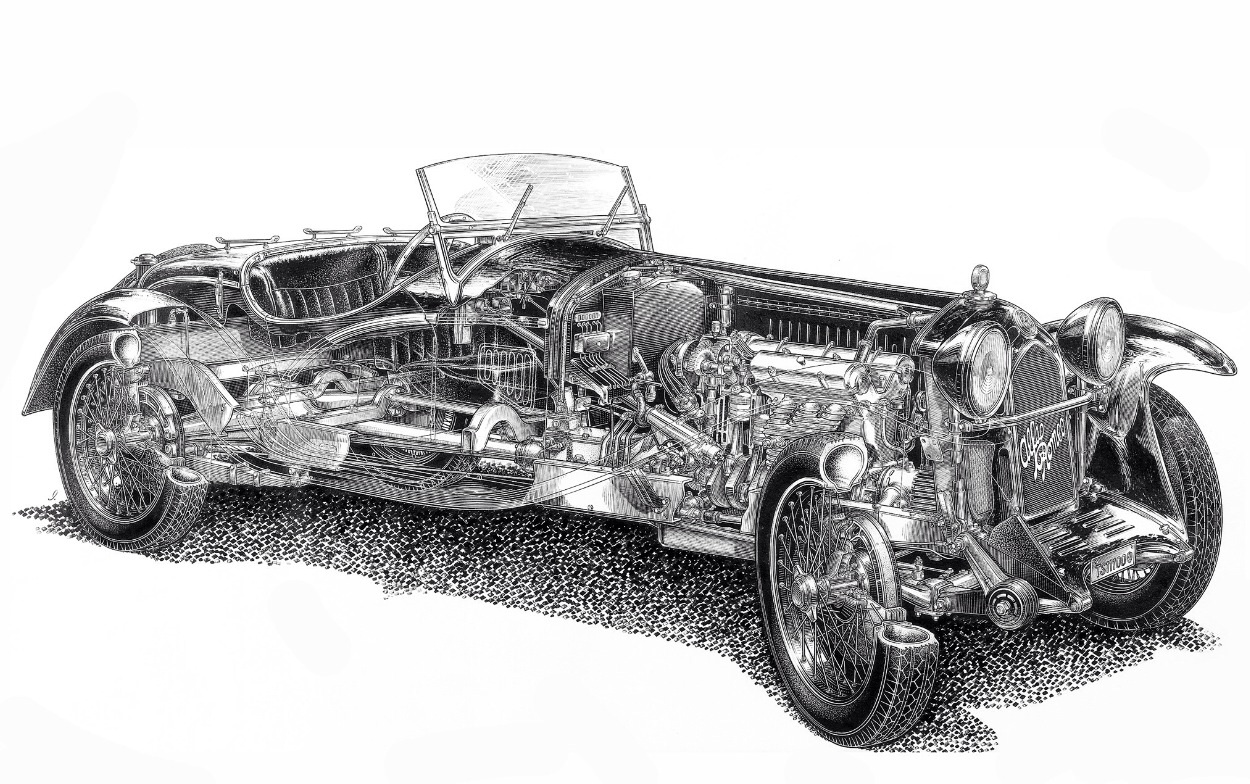
1930 Alfa 6C1750 GS cutaway- not an SS but essential elements the same (unattributed)

The Alfa Romeo 6C 1750 SS Zagato…

‘The 1750, and for that matter the 1500… must be among the finest ever made both from the point of view of engineering and driver satisfaction.’ – Michael Frostick, ‘Alfa-Romeo-Milano’.

Enzo Ferrari persuaded Vittorio Jano to leave FIAT’s racing department and join him at Alfa Romeo. Jano was one of the greatest car engineers of the twentieth century with a career that spanned the decades right through to his revolutionary Lancia D50 Grand Prix car of 1954- the 1956 Lancia-Ferrari or Ferrari 801 won the drivers and manufacturers championships that year.

Jano designed both Alfa Romeo’s grands-prix and road cars. As a consequence these ‘roadies’ emerged, influenced as they were by their more exotic brethren, as some of the most exciting and sophisticated of their day, establishing the Milanese marque’s reputation for producing sporting driver’s cars arguably unmatched at the time.

Jano arrived at Alfa in 1923. By the following year he had designed, and Alfa built the legendary P2- this GP car achieved much race success and also provided the basis for Jano’s first production model- the 6C 1500 of 1927.

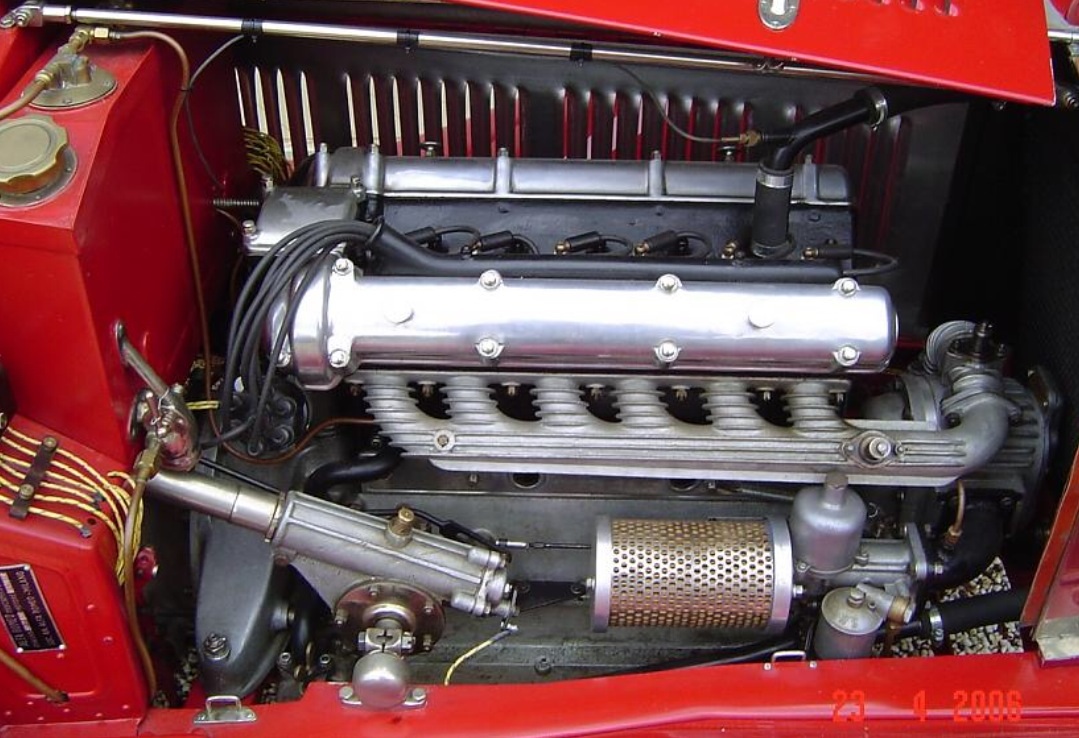
The car was designed as a fast touring machine combining light weight with sparkling performance by the use of a 1,487cc inline six-cylinder engine based on the P2’s straight eight, it produced 44bhp in single-overhead-camshaft ‘Normale’ form.

The beautifully balanced machines engine was mainly made of aluminium alloys, of monobloc construction with gear driven camshaft(s) and five main bearings. The electrics were by Bosch with coil ignition whilst the multiplate clutch and gearbox drove the rear axle via a torque tube. Suspension was by half-elliptics all around, brakes were mechanical- rod operated and fully compensated. The front axle was of C-section, the front springs passed through holes in the beam, small rods formed part of the front actuation and passed upwards and through the centre of the king-pins.

Twin-overhead-camshaft ‘Sport’ and supercharged ‘Super Sport’ models followed, the latter being the first of its type to feature the classic open two-seater coachwork by Zagato forever associated with sporting vintage Alfas.

Production of the 6C 1500 ceased in 1929 upon the introduction of the 6C 1750.

(unattributed)

The 6C 1750 (1929-33) boasted a derivative of the 1500’s six-cylinder engine enlarged to 1,752cc. Built in single-cam Turismo and twin-cam Sport (later renamed Gran Turismo) variants it was an exciting, fast, touring car combining light weight with sparkling performance by the standards of the day, more than 120km/h (75mph) was achieved depending upon the coachwork fitted.

Aimed at gentleman racing drivers, or gentlewoman racing drivers in the case of ‘#0312894’!, there was also a limited edition Super Sport, or ‘SS’, version, which later evolved into the Gran Sport.

Produced only during 1929, the SS was available with or without a Roots-type supercharger fed by a Memini carburettor, the production split being 52/60 cars blown/un-blown. Most of the cars carried coachwork by Carrozzeria Zagato or Touring with James Young bodying the majority of cars imported into the UK.

The 6C 1750 SS was one of the most popular and successful sports-racing cars of its day. Twenty Alfas competed in the 1929 Mille Miglia, with seven in the top ten, the race was won, for the second consecutive year, by Giuseppe Campari and Giulio Ramponi. Other high profile victories for model included the 24 Hours of Spa Francorchamps, Grand Prix of Ireland and the 12 Hours of San Sebastian – all in 1929 – plus the 24 Hours of Spa Francorchamps and the RAC Tourist Trophy in 1930. The 1750’s sporting career, aided by its mechanical longevity, extended far beyond its production, which ceased in 1933.

Mrs Jones’ cars competitive life extended well beyond 1933 of course, I doubt any of the 6C1750’s built were used in anger longer than this car!

Bibliography…

Lithgow Mercury 22 March 1954, ‘Historic Racing Cars in Australia’ John Blanden, various newspaper articles via Trove 1929-37, ‘Bathurst: Cradle of Australian Motor Racing’ John Medley, ‘John Snow: Classic Motor Racer’ John Medley, Bonhams, article by Sir Anthony Stamer in MotorSport December 1961, contributions on the Alfa BB Forum especially Terry Forrest, Racing Sports Cars, Stephen Dalton

Photo Credits…

Fairfax Media, Tom Woolnough Collection, ‘Historic Racing Cars in Australia’ John Blanden, Terry Forrest Collection, John Lloyd, Stephen Dalton Collection, Tom Stevens, Adrian Patterson Collection, Colin James Collection

Finito…

(M Feisst)

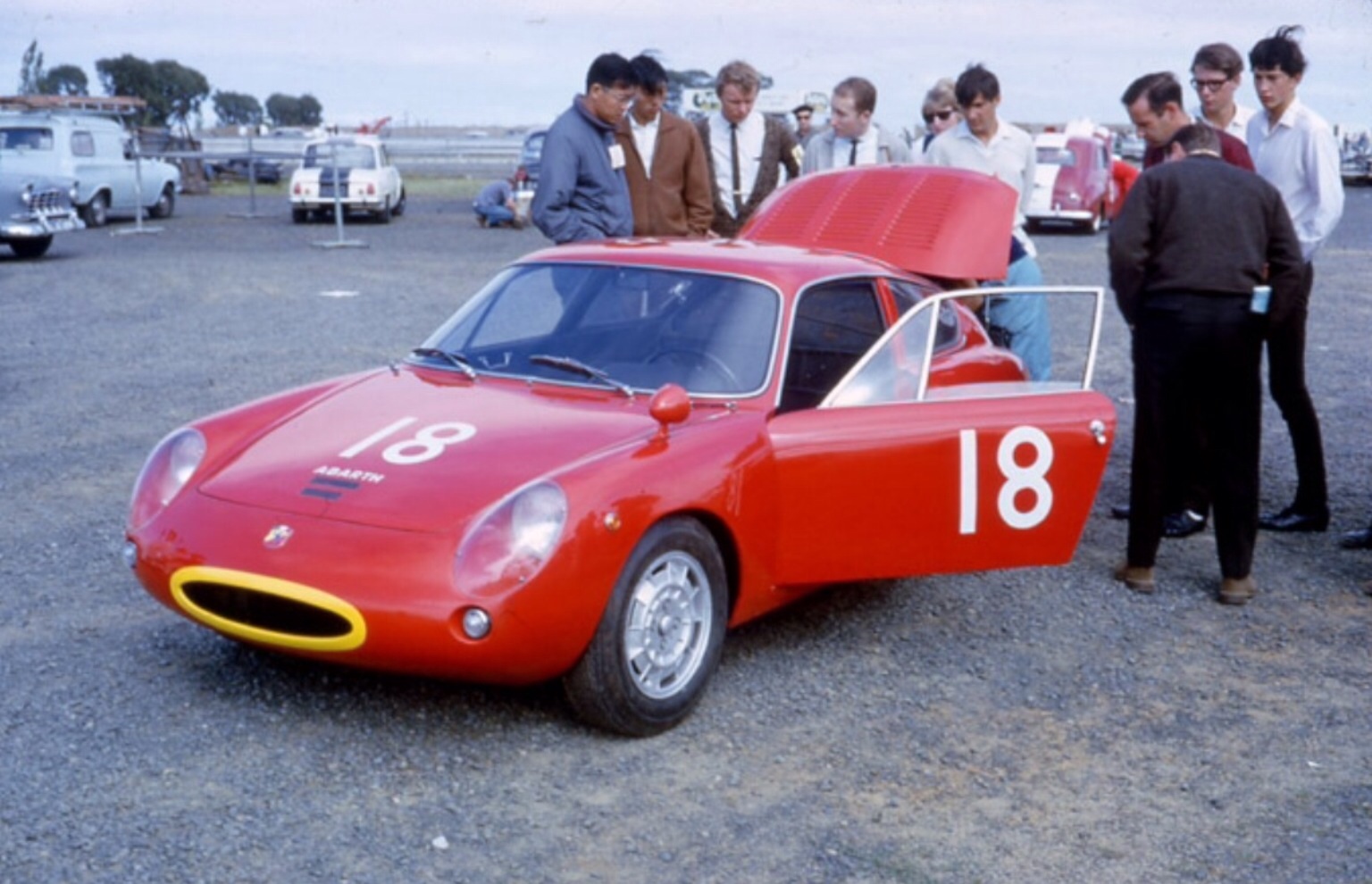
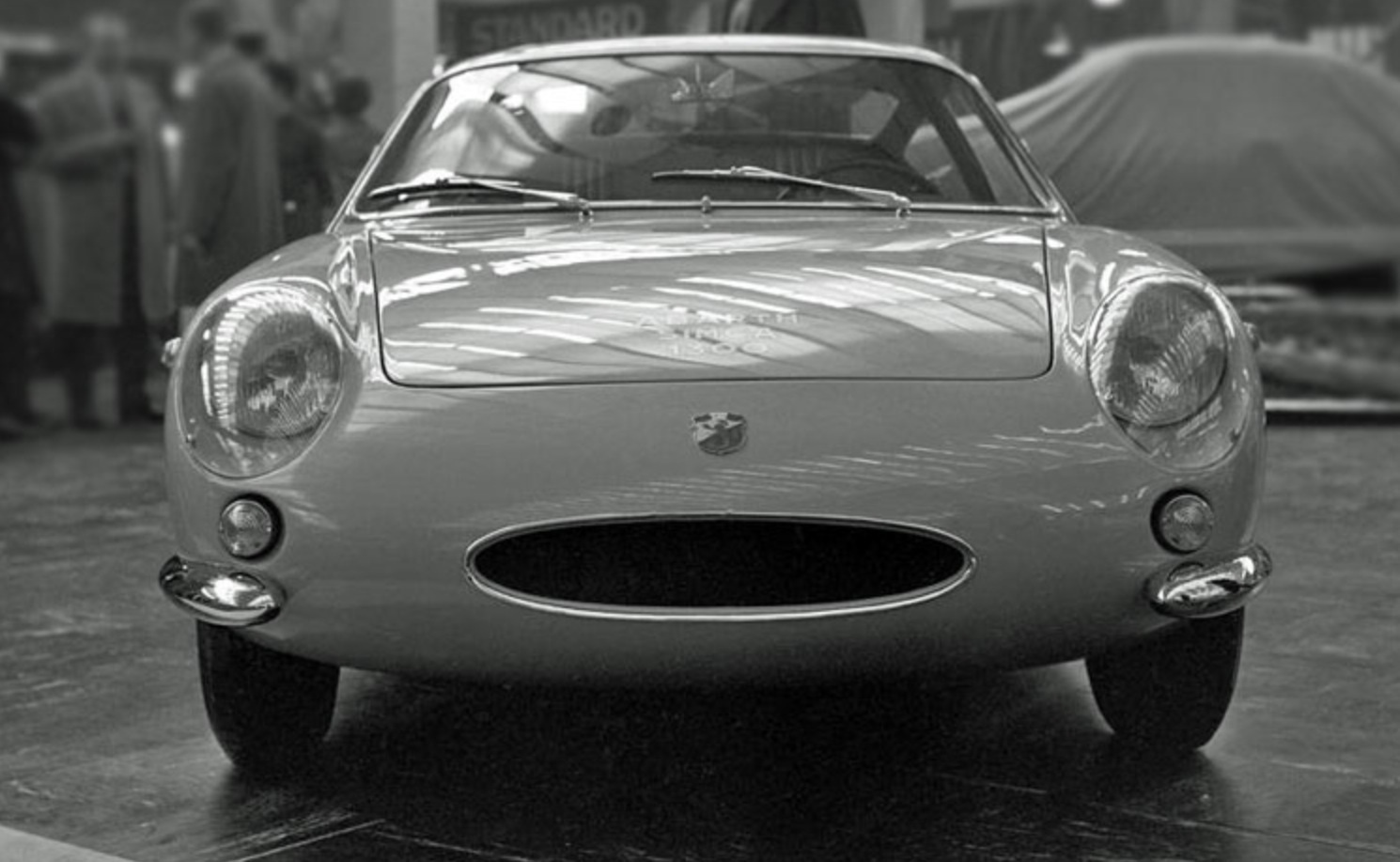
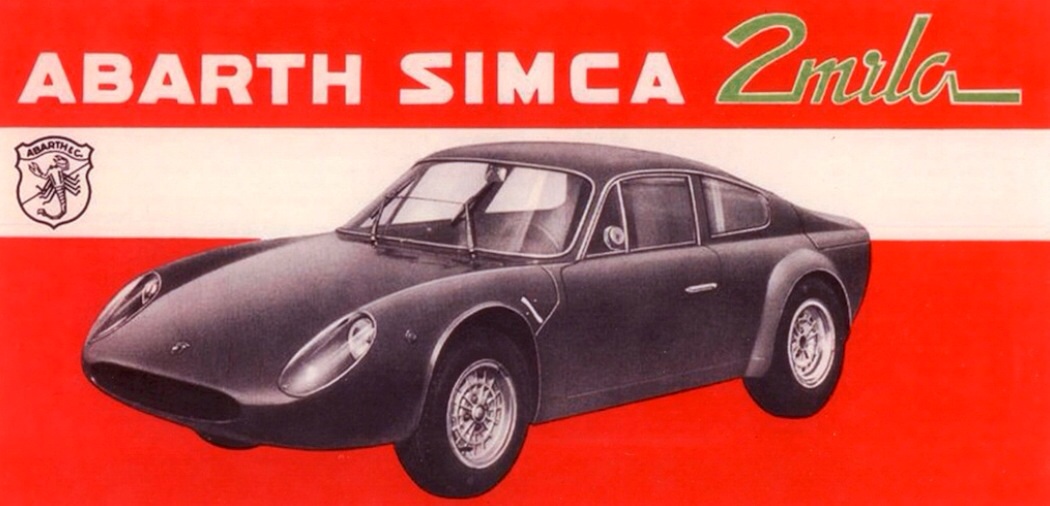
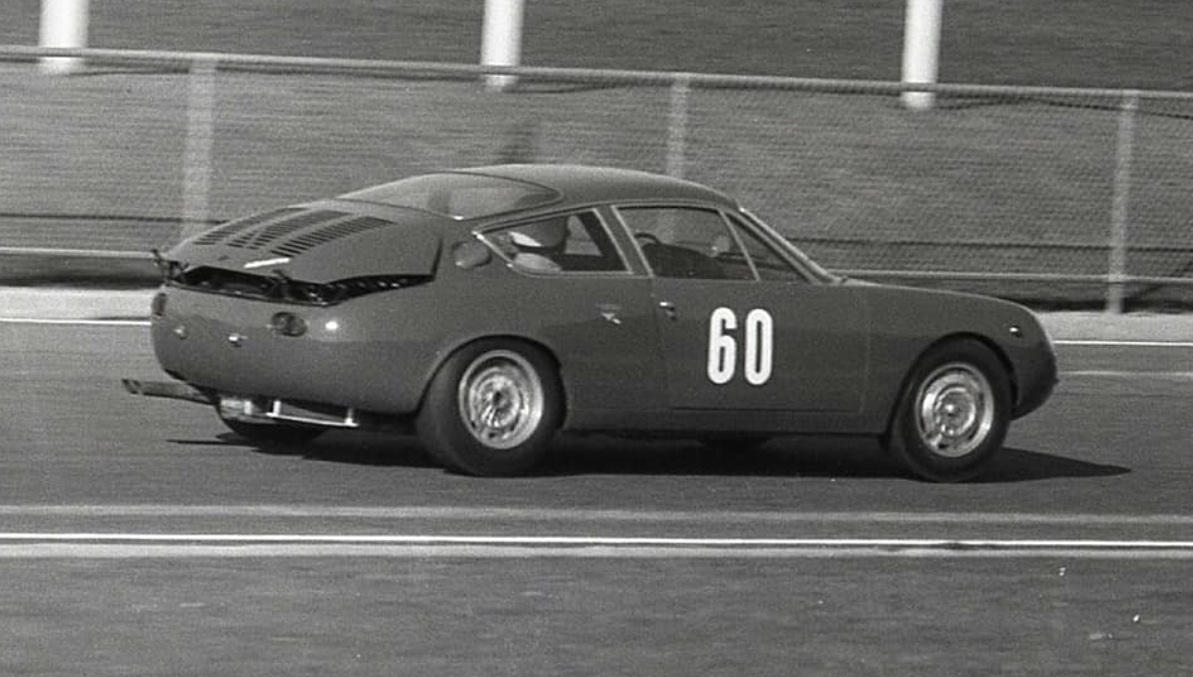
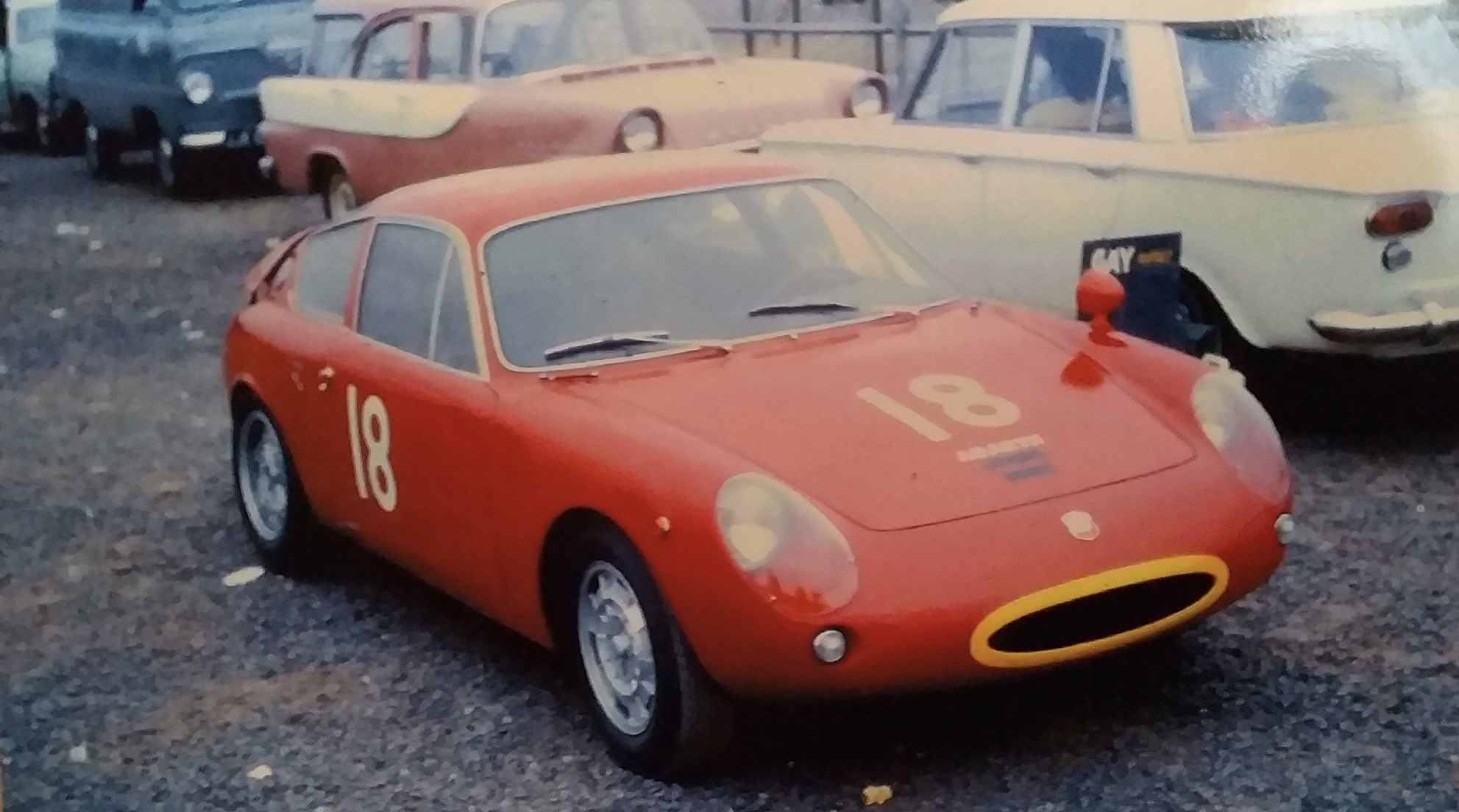
Gay Cesario gives the engine of his Abarth Simca GT 1300 a final tweak with an admiring crowd checking out the lines of the car at the Sandown Tasman round in February 1967…

Australia is a country of immigrants, even the Aboriginals, our indigenous people arrived here some 25,000 to 40,000 years ago.

As a ‘Skip’ (Anglo Australian) the travails of migrants are not something I ever thought much about. But having gone out with three post-war sixties/seventies migrant kids in the last decade – a (crazy) Croatian, Scot and an Italian – I am now highly aware of the guts it takes to jump onto a ship staking your entire future on a faraway land they knew bugger-all about in those pre-internet times. The reason most of them have so much zip is that they left with nothing and arrived with lots of drive and ambition, their legs spinning at 100mph well before their disembarkation at Station Pier. Look out ‘Skips, we are coming through, you lazy buggers!

The Italian Cesarios were one such family. Gay Cesario packed his family of five into the little Abarth Simca 1300 for the trip from Rome to Naples and embarkation from there before the long voyage to Melbourne, where they arrived in the mid-sixties.

Lucio Cesario recalls, “Dad bought the car just out of Rome at a hillclimb on-the-spot and drove it straight home that day. Some time later he decided to ship the family and car to Australia so we drove from Rome to Naples, a four or five hour drive. There was my mum, dad, brother, sister, me and all our belongings crammed into the racecar, including some spares as we were shipping it out from Naples on the same ship. Boy I wish I knew where the little car is today!?”

Gay Cesario raced the car in Australia, its whereabouts as you can see from Lucio’s comment above unknown. Gay raced on, I can well remember him running a Fiat 124 Abarth in Victorian production sportscar races well into the mid-seventies at least. Lucio was a well known racer during Australia’s Formula Pacific era, he parlayed immense Ralt RT4 speed into a season or so with the works Lancia Team during the Group C era, that is an interesting story for another time.

(automobile sportive)

Abarth Simca 1300 GT…

Simca was founded by Italian entrepreneur Enrico Teodoro Pigozzi in 1935 to build Fiat’s for the French market. After WW2 Simca continued to produce the cars but they were given more unique character by fitment of different grilles and engines. In 1961 the company launched its most successful model, the Simca 1000. It was the concern’s first rear-engined car, a neat four-door saloon powered by a Fiat 600 derived 944cc four-cylinder engine giving circa 35bhp in standard form.

Carlo Abarth’s old Viennese sparring partner, Rudi Hruska, became a technical consultant to Simca and regularly brought Abarth’s successes with its Fiat-based cars to the company hierachy’ attention. The idea of competition success appealed to help build the brand so Abarth were invited and engaged to produce a GT car using Simca 1000 components. The Simca-Abarth or Abarth-Simca names are interchangeable, the 1300 GT was the result.

Abarth designed a new engine using the tried and tested broad architecture of the 1961 1000 Bialbero of 1288cc, with the new car’s floorpan, transmission, steering and suspension from the Simca 1000, while the body was of the latest Fiat-Abarth Coupe configuration.

The Simca Abarth 1300 was launched in February 1962. The 1288cc, DOHC, twin 45 DCOE Weber fed four- cylinder engine produced over 90 bhp @ 6,000 rpm. The cars proved capable of running rings around rival Alfa Romeo Giuliettas during 1962. The two valve engine specification included dry-sump lubrication, a rev limit of 7,200rpm and a claimed power output of 125bhp at 6,000rpm – more like 90 – but certainly more than enough. The little car weighed 630kg/1388lbs and did 142 mph. The subsequent 1600 – 138bhp at 7,800rpm – variant stopped by Girling discs all round was capable of 240km/h – 149mph, fast cars indeed.

Abarth’s 1963 racing record is said to have achieved a staggering 535 victories, 90 of which were agged by the Simca Abarth 1300s.

The body design of the GT Coupe – influenced by the latest small capacity GTs – was styled in-house by Mario Colucci at Abarth’s famous Corso Marche factory, and was built ‘just around the corner’ by Odoardo Beccari’s specialist carrozzeria.

Credits…

Mike Feisst/The Roaring Season, Lucio Cesario/Thunder 427 on The Roaring Season, Bonhams, Ultimate Cars, Automobile Sportive, Robert Davies

Tailpiece: Cesario, Sandown 4 May 1969…

(R Davies)

Photographer Robert Davies recalls this as the Sandown weekend that Allan Moffatt’s Trans Am Mustang made its race debut. Lucio Cesario, eight years old also remembers that day, his Dad won the Toby Lee Trophy (family still have it) in the wet with Peter Brock starting the race from pole his famous Austin A30 Holden.

Sandown 1967 (Cesario)

Postcript…

Its back in the family, the car that is!

In early July 2019 I had a meal with Lucio and a few other racing coves via ‘me mate, historic racer Andrew McCarthy. During the course of a good chat Lucio told us he had negotiated to buy his Dad’s old car, paid the dollars and was off to collect it the following weekend, checkout the photos of the car tucked up in his Melbourne workshop. Doesn’t it look wonderful?

(Cesario)
(Cesario)

Lucio had been talking to the long-time Sydney owner of the car (he acquired it in 1974) on and off for decades but they had never been able to agree a price. “Your article got me going though, I felt I needed to buy the thing quickly as I was fearful your piece on it would stir up interest and send others off on a search for the car, rare as it is,” he said.

Happy to be of assistance my friend!

We will get together soon to document Lucio’s racing career and I will post updates as the Abarth’s restoration progresses. Unfortunately Gay Cesario, Lucio’s Dad, “he sold an apartment at one stage to help me progress my racing career y’know,” died some years back but his Mum is happily still with us, no doubt a tear or two was shed when the car returned back where it belonged…

(Cesario)
(Cesario)
(Cesario)

Finito…

image

Stirling Moss guides his works Jaguar C-Type through Fordwater on his way to fifth place at Goodwood sharing with 1951 Le Mans winner Peter Walker…

Britain’s first night race took take place at Goodwood on 16 August 1952. The British Automobile Racing Club hoped to emulate the commercial success of Le Mans, that classic a race of 24 hours duration of course.

The Goodwood enduro was a nine-hour event with a 3pm start to allow the spectators to see the cars in all their spectacular glory in the half-light and full darkness.

Modifications were made to the circuits infrastructure by fitting floodlights to illuminate the grandstands and pits, the kerbs were given a coat of luminous paint and a beer tent was laid on, although due to post-war licensing laws it had to stop serving grog before the race ended! Sponsorship and plenty of pre-event publicity was provided by ‘The News of The World’ newspaper inclusive of £2,500 in prize money which represented a powerful incentive for the ‘local’ works teams and privateers to enter in force.

Jaguar and Aston Martin entered three-car teams of C-types and DB3s in the field of 32 cars. Both teams had much to prove. The C-Types were quick at Le Mans in June, but all three cars retired with engine cooling-related issues. The new Ferrari 250S and Mercedes-Benz W194 had been faster than the Jags, victorious at Le Mans in 1951, at the Mille Miglia in May.

As a consequence, Jaguar had designed a more aerodynamic body with a slightly smaller radiator. Jag’s cooling problems became apparent in practice, despite hasty modifications; solutions were not found pre-race. Peter Whitehead/Ian Stewart retired with a failed head gasket during the second hour, Stirling Moss/Peter Walker with engine problems in the third, and the remaining Tony Rolt/Duncan Hamilton car with a head gasket failure in the fourth hour.

Le Mans 1952: #26 the Poore/Griffith Aston DB3 Spyder alongside the Parnell/Thompson DB3 Coupe, all three factory cars DNF (unattributed)

The new Aston DB3 ‘Spyders’ also failed to finish, Dennis Poore/Pat Griffith in the third hour with water pump failure and Lance Macklin/Peter Collins towards the finish with an accident in the twenty-second hour of the long, unforgiving race. The works DB3 Coupe driven by Parnell/Thompson retired in the second hour with gearbox dramas. The ’52 Le Mans was won by the Benz W194, Hermann Lang and Fritz Riess from the sister car of Theo Helfrich/Helmut Niedermayr.

The chance to make a good showing on home turf was therefore ‘manna from heaven’.

Jaguar used the same driver combinations they deployed in France, whilst Aston’s pairings were Reg Parnell/Eric Thompson, Peter Collins/Pat Griffith and George Abecassis/Dennis Poore.

Other strong entries included Pierre Levegh’s Talbot-Lago T26GS, famously for being so nearly the winner driving solo at Le Mans in 1952 before missing a gear very late in the race. Ferrari 225S’ were entered for Tom Cole/Graham Whitehead and Bobbie Baird/Roy Salvadori, a works Allard J2X for Anthony Hume and George Thomas plus a swag of Healey Silverstone, Frazer Nash Le Mans Rep, Jag XK120, Cooper T14 MG, HRG and HWM cars. In short, an interesting field that lacked only works Ferrari and Mercedes entries.

image

At the start, Moss, at right, as usual, won the sprint to his car, but Tony Rolt, to Moss’ right led on lap one, but he was soon overtaken by Parnell’s Aston…

At the end of the first hour the order was Parnell, Rolt, Abecassis, Moss and Baird, Ferrari 225S, then Whitehead.

Then the weather started to improve, and as the track dried, the Jaguar’s pace became apparent with both Rolt and Moss passing Parnell. So, Jag, Jag, Jag, Aston, but then Whitehead crashed his C-Type.

Disaster struck the Feltham team on lap 91 during a routine refuelling pit stop when Parnell’s car caught fire, burning two of the crew and team manager John Wyer. Parnell showed great leadership and strength of character, whilst his race drive was over he stood in for the injured Wyer to take over the critical team management role.

 At half distance the Moss/Walker Jaguar C Type led from the sister XKC of Rolt/Hamilton. The third C-type had crashed at Madgwick and retired whilst the DB3 of Abecassis/Poore had also dropped out of contention.

By 9pm, the drivers had switched their headlights on, the spectacle of racing at Goodwood at night was fantastic, but within half an hour, a half shaft broke on the Rolt/Hamilton C-Type, which allowed the remaining Aston of Collins/Griffith through; that car was then overtaken by the quick Ferrari 225S driven by Bobby Baird and Roy Salvadori.

Eric Thompson came into the pits 3 hours into the race with smoke pouring from the rear of the car. Wyer and mechanic Jack Sopp pulled up the seats to investigate whilst Fred Lowndes refuelled. Spilt fuel from the last churn went onto the tail of the car and ran down onto the undertray where it was ignited by hot oil from a leaking fuel seal- within seconds the car was engulfed in flames and smoke. Wyer and Sopp suffered bad burns, Lowndes not so much but all 3 were taken to hospital whereupon Reg Parnell took charge. Aston DB3/3 was destroyed- and later rebuilt, Parnell, drove it to 5th in the 1953 Mille Miglia (unattributed)

Half an hour later Jaguar’s collapse was complete when the leading Moss/Walker car entered the pits with a broken rear radius arm that would take nearly an hour to repair. It is said that Jaguar boss Sir William Lyons was blissfully ignorant of all of the dramas which befell his team as he had retired to Goodwood House from the pitlane to enjoy what appeared to be a certain win!

image
The doomed Parnell/Thompson Aston DB3/3 earlier in the race prior to its demise (Getty)

In a race of rapidly changing fortunes, the Baird/Salvadori Ferrari 225S had gone from fourth to first in little more than an hour. Still, in a final twist of fate, on its last pit stop, the jack intended to lift the car sank into the patch of tarmac, softened by the earlier Aston DB3 fire! The loss of time was sufficient to put the Collins/Griffith DB3 into the lead with just an hour of the race left. That pairing duly won despite an exhaust valve breaking an hour before the event’s end, from the two privateer Ferrari 225S’ driven by Cole/Whitehead and Baird/Salvadori.

Collins in the winning Aston DB3 early in the race (unattributed)

The Telegraph reported that ‘The Nine Hour had all the ingredients of a classic race; the changing weather, the drama of the pit fire and a dramatic fight for the lead, not to mention the fact that so many of the cars were competing on home soil. Yet the spectators were distinctly unmoved, many only arriving once the night racing began, and few staying for the duration. These were people who attended Goodwood for a grand day out – a nine-hour endurance race, where the leader wasn’t always obvious, was simply too long.’

‘When the Nine Hour race returned the following year it did so without any newspaper sponsorship to offer pre-event coverage. Spectators numbers fell as a result and with them the carnival atmosphere that made Le Mans such a success. Those who did go frequently left when it got dark, defeating the event’s raison d’être. It didn’t matter that the racing was first class (Aston would win again in ’53 and, after the race skipped a year, scored a third victory at what would be the last Nine Hour race in ’55) if nobody was there watching it. Perhaps the British will always see night racing as too good an excuse for a holiday abroad.’ the Telegraph concluded.

There was no World Sportscar or Manufacturers Championship in 1952, that competition started in 1953. However the classic race spoils went to Mercedes Benz W194/300SL at Le Mans and the Carrera Panamericana with a Ferrari 250S victorious at the Mille Miglia and a Lancia Aurelia B20 at the Targa Florio

Vaino Hollming Jag XK120 leads Pierre Levegh Talbot-Lago T26GS then the Lawrence Mitchell Frazer Nash High Speed, Goodwood 9 Hour (Getty)

Aston Martin DB3 Technical Specifications…

Ex-Auto Union design team member Robert Eberan-Eberhorst first worked for ERA when he come to the UK post-war. He was contracted for 3 years from November 1930 to design a sports-racer for Astons which was to use the AML LMB 2.6 litre 6 cylinder engine and a David Brown five-speed gearbox.

He chose a period typical ladder frame chassis design, the main members made from 16-gauge, four inch chrome-molybdenum tubes with substantial cross-bracing by three 14-gauge five-inch tubes.

Front suspension was similar to the DB2- trailing links, transverse torsion bars, piston type shocks and a roll bar. At the rear a more sophisticated De Dion rear axle was deployed. This was constructed from three steel sections welded together and was located by a Panhard Rod and parallel locating links. The upper links ran fore and aft, the lower links angled. Each of the lower links engaged by serrations with a transverse torsion bar. Armstrong double piston dampers were used. The car weighed circa 2165 pounds/980Kg with nine gallons of fuel.

RE Poulton for Autocar

Steering was by rack and pinion with two turns lock to lock, brakes were Al-fin drums, inboard at the rear. Spoked wire wheels were, of course, used with Rudge-Whitworth knock-off hubs.

The DB3 first raced in 2580cc form, with triple 35DCO Weber twin-choke carburettors. The alloy, DOHC, two valve head engine developed 133bhp @ 5500rpm. The gearbox was a DB S527, five-speed with overdrive top gear. From July 1952, a DB S430/63R four-speed box was used.

Into 1952 the engines ran Weber 36DCF carbs making 140bhp @ 5200rpm, still way too little. By the 1952 Monaco GP a 2922cc engine developed 147bhp @5000rpm but any increase in capacity of the LB6 engine was impossible as each pair of bores were siamesed.

163bhp was achieved from an engine with 35DCO twin-choke Webers and connecting rods with offset big ends at the Goodwood 9 Hour in 1952.

Bibliography…

Article by Chris Knapman in The Telegraph April 2011, ‘Aston Martin: The Racing Cars’ Anthony Pritchard

Photo Credits…

Getty Images, Klemantaski Archive, Don Price, Autocar

Tailpiece…

image

Finito…

image

Amazing panorama of a hot, happy Riverside crowd in 1959, no details of date or race meeting, race in progress for sportscars…

These days with so much competition for our leisure dollars promoters globally find it hard to get such crowds. In the ‘immediate’ post war years there was pent up demand and plenty of money in a booming post war economy to draw a crowd to just about anything.

By the look of some of the grandstands, it would have been more dangerous as a spectator than as a racer…

Credit…

JR Eyerman


image

(T Watts Collection)

A favourite car, favourite marque, favourite colour. Bert Howard’s Lola Mk1 Climax at Symmons Plains, Tasmania in April 1968…

It’s a simple enough shot I suppose, a well executed pan with classic blurred background, but too good not to share.

The colour is so clear it could be 2017, but the low roll bar, helmet and background devoid of advertising hoardings gives it away a bit, its 1968. The small, lithe little machine looks like a ‘big banger’ doesn’t it?, but the 1098cc Coventry Climax FWA engined car is anything but that.

The Lola Mk1 was seminal in Eric Broadley’s early commercial success. The story of the car itself, it’s development and specifications is so well told on Lola Heritage, just click on the link here to read about these magic cars;

http://www.lolaheritage.co.uk/history/types/mk1/mk1.htm

Bert’s car, Lola Mk1 chassis ‘BR15’  first came to Australia to the order of ‘Scuderia Veloce’ supremo, David McKay in late 1960.

By the time David McKay landed the sporty and Formula Junior Lola Ford ‘BRJ18’ the former World War 2 veteran, racer and motoring journalist had already been competing since the late forties. He had second place in the 1955 Hyeres 12 Hours in southern France together with Tony Gaze aboard a ‘customer’ Aston DB3S and the 1958 Australian Tourist Trophy, Bathurst, victory as career highlights to that point, the latter aboard his ex-works Aston Martin DB3S, see here for that car(s); https://primotipo.com/2017/09/28/david-mckays-aston-martin-db3ss/

Most international readers would be by now familiar with McKay from various of my articles. He was a racer at elite level who founded ‘Scuderia Veloce’ to race his own cars circa 1959. The team very shortly thereafter morphed into an enterprise which entered cars for others including internationals, Chris Amon, Graham Hill and Jackie Stewart- and into a retail motor dealership on Sydney’s North Shore which sold Ferrari, later Volvo and from 1969 Porsche cars.

McKay also aided and abetted the careers of many drivers from the early days- most notably Amon, Spencer Martin, Greg Cusack and right through into the 1970’s Larry Perkins and open-wheeler Formula Pacific ace John Smith in the latter period.

Throughout this era of the mid-fifties to the mid-seventies McKay was the most influential Oz motoring journalist as motoring editor of Sydney’s Daily Telegraph and Sunday Telegraph newspapers. See here for more;

Pete Geoghegan: Ferrari 250LM ‘6321’: Bathurst Easter 1968…

image

David McKay, Lola Mk1 Climax, Forrests Elbow, Bathurst, Easter 1961. Won the 3 lap under 1500 scratch and was 4th outright and 1st in class in the 10 lap main sportscar event won by the Matich Lotus 15 Climax (J Ellacott)

A mate of McKay’s, dentist David Lewin based in London had written to the Sydneysider and extolled him of the virtues of both Lolas and McKay soon did a deal with Graham Broadley, Eric’s brother to acquire ‘BR15’, which was a works car raced by Peter Ashdown.

The FJ was a new car built for a category which was exploding globally. The shadows of the War by then had to a large extent diminished, globally the worlds economy was performing well and consumer credit was becoming more widely available- many young men could afford to go motor racing and FJ was very much a class of choice.

In Australia, finally some permanent venues were being built- Warwick Farm, Catalina Park, Lakeside, Sandown Park, Calder and others were all opened in the early years of the sixties. In fact McKay was keen to land both Lolas in time for the first Warwick Farm opening meeting in December 1960. ‘BR15’ was not available until the end of the British racing season however.

Between the purchase of the cars and their arrival in Australia the Australian Federal Government had increased sales tax on imported cars to 40%. Much to McKay’s chagrin the changes applied to both road cars AND racing cars including those ‘on the water’! His landed price having increased hugely, McKay quickly did a deal to relieve the financial pressure so created to sell the FJ to Sydney insurance broker Tom Corcoran who had been racing a Lotus 11. Corcoran raced the car under the SV banner thereby getting some support at race meetings and fuel and oil provided by Castrol who had about then done a deal with McKay. David of course raced the Mk1.

image

Scuderia Veloce on Warwick Farm’s pit straight in 1962. Morgan Distributors Morgan Plus 4, Tony Loxley’s Ferrari 250 GT, Fiat Importers Fiat 1800, ‘Old Nail’ Cooper T51 Climax, Lola Mk1 Climax (J Fullarton)

Scuderia Veloce at the time included the little Lola, a Nardi modified Fiat 1800 taken out to 2 litres owned by Fiat Australia which David raced in the burgeoning Appendix J touring car class and his Jaguar.

By early 1960 his first Jaguar Mk1 3.4 ‘Grey Pussy’, the dominant touring car in Australia at the time had been sold to Ron Hodgson. David bought a second Jag, a 3.4 litre Mk1, like the first built by the Jaguar Competition Department, which was co-owned with Australian Jaguar importer Bryson Industries. He won the very first Australian Touring Car Championship, a one race event, at Gnoo Blas, Orange in the red Jag in early 1960 beating Bill Pitt’s 3.4 litre Mk1 and Hodgson’s car which by then was 3.8 litres in capacity.

He also occasionally raced Sydney businessman/yachtsman Tony Loxley’s Ferrari 250GT coupe in GT races.

In single-seaters, for a short time in 1959 McKay raced a new (Victa Industries owned) Cooper T51 Climax FPF 1.9 and after the 1961 Australasian International season- the Victa owned car having been sold to Bib Stillwell he acquired a Cooper T51 Climax FPF 2.2 from Jack Brabham. McKay realised, approaching forty that his time at the top was limited and he ‘needed to get on with it’ in single-seaters!

image

Mallala AGP weekend 1961, this will be a heat as Bill Patterson started from pole after acrimony over qualifying times and Stan Jones DNS the GP itself after mechanical mayhem intruded. #6 Bib Stillwell in his new Cooper T53 Climax, #14 McKay in ‘Old Nail’ Cooper T51 Climax and #2 Stan Jones Cooper T51 Climax. That’s Gerry Brown tending to Bib and Kevin Drage with his hand on the tail of the car (K Drage)

The ‘Old Nail’ Cooper Jack Brabham had for sale was raced by Ron Flockhart and Roy Salvadori that summer as part of ‘Jack’s team (‘Ecurie Vitesse’) was none other than Bruce McLaren’s ex-works machine (chassis number either ‘F2-5-57’ or ‘F2-7-59’), the chassis in which Bruce took his first world championship GP victory at Sebring in late 1959 and another win at Buenos Aires in February 1960.

It wasn’t in the full flush of youth as a ’59 (or was it 1957!?) car with transverse leaf, as against coil sprung rear end but was still a pretty good thing to go head to head with Cooper mounted Stan Jones, Bill Patterson, Lex Davison, (noting Lex’ interludes in Aston Martin DBR4’s) Bib Stillwell, (ditto!) Alec Mildren and the rest of the local heroes in Australia.

Indeed, the difference between an Australian Grand Prix ‘Old Nail’ win for McKay and 3rd place at Mallala in October 1961 was a jumped start and 60 second penalty in the opinion of the race stewards…but not in the opinion of many informed onlookers! A story for another time. Lex Davison won the ’61 AGP, his fourth and last AGP victory aboard a Cooper T51 borrowed from Bib Stillwell (the ex-Victa Industries car raced briefly by McKay) and Bibs later, quicker!, Cooper T53 with McKay’s T51 third. As I say, that meeting is very much a story in itself for another time.

image

Start of the Australian Touring Car Championship race at Gnoo Blas, Orange, NSW 1 February 1960. Ron Hodgson in Jag Mk1 3.8 ‘Grey Pussy’ at left, McKay in his new Mk1 3.4 right, Bill Pitt behind in another Mk1 3.4 then the Holdens led by Pete Geoghegan’s black 48-215. McKay won from Pitt and Hodgson (unattributed)

So, McKay was a busy boy and Lola was only one of his toys! McKay was well aware of the cars speed which was both demonstrated by the performance of the cars in the UK and Derek Jolly’s Coventry Climax FWA powered Decca’s which raced in Australia from the mid-fifties- and which McKay was well familiar with on-and off circuit.

The dominant sportscars in Australia at the time were Ron Phillips’ Cooper Jaguar, Doug Whiteford’s Maser 300S, Derek Jolly’s 2 litre FPF powered ex-works Lotus 15 and then Frank Matich’s Leaton Motors owned ex-works 2.5 litre FPF powered Lotus 15 from the time it arrived in Australia in 1960. Matich then transferred his raw pace to a Lotus 19 Climax which further accentuated his dominance (which segued to Lotus 19B, Elfin 400 Olds aka ‘Traco Olds’, Matich SR3 Repco and Matich SR4 Repco- a decade of sportscar wins for FM in Australia)

image

‘BR15’ at Symmons Plains 1968: spaceframe chassis, wishbone upper and lower front suspension with coil spring/shocks, 1098cc originally but by now probably 1220cc Coventry Climax Weber fed FWA engine and rubber bungee attached fuel tank all clear (oldracephotos.com)

The Lola was a famously light, beautiful handling car but it was not an outright contender toting only 1100cc so its place in the local order was to win the 1100 or under 1500 class and punch above its weight in outright competition.

McKay’s cars finally arrived from the UK in October 1960, their first outing a test day at Warwick Farm in October before the inaugural Warwick Farm open meeting on 18 December 1960. Bob Atkin had by then been engaged by McKay to look after the Lolas, Atkin formed a career with SV’s and was still Dealer Principal of Scuderia Veloce Motors when it was sold to Laurie Sutton a decade or so hence.

McKay won his class in the famously very wet meeting whilst finishing 2nd outright behind Matich’ Lotus 15 and ahead of Derek Jolly’s 15, Bob Jane’s Maser 300S, Doug Chivas’ Jag D Type and others. In a great day for McKay, he won the first race held at the Farm, a sportscar race in the Morgan Plus 4 (chassis  #4590 was one of the first two imported into the country owned by by Sydney jeweller Ron Coulsten), was fourth in the Appendix J touring car race in the Fiat and took fastest lap as well as winning the 1500 class in the Lola Mk1. A great day at the office!

Over the next 12 months the car was unbeatable in its class with successes at Ballarat Airfield, Hume Weir, Longford and Bathurst.

Business end of the Lola, Longford 1960 (G Richardson)

image

McKay’s Lola ‘BR15’ in very ugly Appendix K GT guise in 1961, circuit unknown. Gives new meaning to ‘slab sided’ ‘dunnit (M Schagen)

The Confederation of Australian Motor Sport adopted Appendix K for GT cars for the 1960 season which made sense in terms of attracting people to buy and race closed coupes such as the Lotus Elite and Porsche Carrera being sold at the time. It left large numbers of sportscars out on a limb in the sense that promoters now chose between running races for the two categories-that is between Appendix C Sportscars and Appendix K GT’s.

CAMS oddly, but sensibly allowed open cars to compete as long as they had ‘a lid’. As a consequence all manner of cars including such exotica as D Type Jags, Maser 300S…and McKay’s Lola Mk1 were ‘converted’ from open sportscars to closed coupes.

The conversions were usually as ugly as sin, Bob Jane’s Maser 300S arguably the exception, with David’s Lola definitely in the ‘fugly’ category as the photo above proves! The work was done by Clive Adams North Sydney panel shop, ‘ there a master of aluminium work, one Stan Brown, had a small corner where he worked his magic’ as McKay so eloquently put it. ‘That it turned out an ugly duckling there is no doubt’. To make matters worse the increase in weight of the car and ‘top heaviness’ ruined the beautiful balance of Broadley’s original design.

image

1961 GT Racing shot: Bob Jane, Maser 300S Coupe, Leo Geoghegan Lotus Elite, Frank Matich Jaguar D Type Hardtop and the red car is Keith Malcolm’s Skoden, Bathurst October 1961 (MK1220)

McKay in his autobiography describes the silver lining in the GT conversion work as the introduction to him of Spencer Martin, who worked at Adams shop and had started racing in a self built sportscar. Later they would achieve much together with Spencer driving both the SV Brabham BT11A Climax after Graham Hill had finished with it at the end of the 1964 Tasman Series and McKay’s famous, glorious ‘Red Lady’- his Ferrari 250LM.

The Lola ‘GT’ cannot have been too bad mind you, McKay was 2nd in the 50 mile, one race 1961 Australian GT Championship held at Warwick Farm in July 1961. Frank Matich won in a Jag XKD ‘GT’ from Brian Foley’s Austin Healey Sprite Hardtop and Bob Jane’s Maser 300S Coupe.

As McKay focused on other cars he sold the Lola to Greg Cusack, the young motor-trader and rally-driver from Canberra was a man on-the-rise. Cusack raced the car for the first time, still under the SV banner, at Warwick Farm in December 1961. He achieved the same levels of success with it in the following twelve months as McKay.

Cusack also had an occasional race in the ‘Old Nail’ Cooper T51 Climax during 1962 including a very solid 4th in the ‘Bathurst 100’ Gold Star event on demanding Mount Panorama.

McKay played an important role in Chris Amon’s nascent career, running the young Kiwi in the Australasian International season aboard his Cooper T53 Climax in 1963- it was during that summer that Reg Parnell spotted Chris’ talent and spirited him off to Europe.

Chris had a few drives of McKay’s Coopers (Old Nail T51 and T53) in Australia in the second half of 1962 at Sandown and Mallala during practice and at the Gold Star season ending round at Warwick Farm in mid-October where he raced the T51 to 3rd place in the Hordern Trophy behind Bib Stillwell and John Youl. The talented young Kiwi also raced the Lola Mk1 at Sandown in September to a class win in the Victorian Sportscar Championship.

The Lotus 23’s then beginning to appear gave the Lola a taste of competition for the first time. Cusack could see the writing on the wall so acquired two Elfins, a Catalina single-seater and Mallala mid-engined sportscar with which to take his career forward.

Cusack remained close to McKay, he would several years hence drive the teams Brabham BT23A Repco after Spencer Martin’s departure from Scuderia Veloce.

Lola was offered for sale and sold to to another very quick young driver, John Martin of Katoomba in Sydney’s Blue Mountains who had been competing in a Lotus 15. He first raced the car in January 1963 and achieved much success despite the more competitive grids in which the Lola now competed.

John Martin, Oran Park circa 1963

image

Pete Geoghegan in ‘BR15’ giving Niel Allen’s new Elan heaps at the ’66 Warwick Farm Tasman meeting in February. It was a very effective ‘demo’ of the little cars pace despite advancing years and race miles. Geoghegan was doing as many laps in little lithe Lotuses at the time as the Touring Cars for which he was famous- he would have found Lola very much to his liking I suspect (B Wells)

Frank Demuth, a Sydney accountant was the next owner having bought the car in early 1964. He gradually got the hang of it, as a newcomer to racing, but soon traded it in after 12 months on the Lotus 23B Ford raced by Pete Geoghegan, the Geoghegan brothers were Australia’s Lotus importers.

Rather than leave the car sitting on the Parramatta Road used car lot, Pete decided to have a run in it to remind everyone Lola was about and for sale. He had the car painted the wonderful shade of yellow and added 8-inch wheels to get a bit more grip. By now the car’s Climax FWA was said to be 1220cc in capacity.

Geoghegan entered it in the 1966 Warwick Farm Tasman meeting sportscar races and gave Niel Allen’s ex-Leo Geoghegan Lotus Élan 26R and Demuth plenty of curry in the 23 he has just acquired! Still, Pete was a rather handy steerer whatever the theoretical superiority of the 1.6-litre mid-engined, Lotus/Ford twin-cam powered Lotus 23! The feature race, for the record was won by Greg Cusack in a Lotus 23B from Demuth, Geoghegan and Bob Jane’s E Type Lwt.

It was at this point that Bert Howard responded to the Geoghegan’s March 1966 ‘Racing Car News’ advertisement, asking price $A3400- read it and weep! It was a long drive from Hobart to Sydney and back but no doubt Bert had a big smile as his car towed ‘BR15’ onto the ‘Princess of Tasmania’ at Port Melbourne for the final leg of the 1600 Km trip home.

image

Longford 1968: Bert Howard’s Lola in front of Doug Whiteford, works Datsun Fairlady, John Roxburgh Lotus 23C Ford and Ian Maudsley, Lotus Super 7 (oldracephotos)

There the car was beautifully prepared and presented for years at Longford, Symmons Plains and Baskerville, if increasingly outdated as the mid-engined hordes grew exponentially throughout the 1960’s. In the smaller capacity classes these cars included the Lotus 23, various local 23 ‘clones’, the Elfin Mallala, Elfin 300 and others.

Bert sold the car in the early seventies to Kent Patrick who raced it in various historic events before selling it to Kerry Luckins, well known in motorsport as the General Manager of Paul England Engineering in Melbourne, a Light Car Club stalwart and the ‘on-circuit’ Sandown commentator.

Proud new parent, Kerry Luckins picks up his new Lola from Kent Patrick’s, son Kurt observed ‘It still had the big rear tyres’. (Luckins Family_

Kerry stripped the car and rebuilt it fully with the assistance of  Jim Shepherd. It is in this period in the earlyish days of historic racing that I remember the Melbourne based car and later when raced by Ian and his son Nick McDonald, the car always looked ‘a million bucks’ and was very fast as the McDonald cars always are.

The car left Australia circa 2000 when sold to Tony Moy of Page and Moy, the specialist UK motor racing travel agency. Forty years had elapsed between the cars departure from and return to the UK- a great pity as the lovely little car had been an enduring and ever-present part of the Oz racing scene and a ‘belle of the ball’ wherever it appeared.

It never looked better than in its yellow phase in Bert Howard’s hands mind you…

Etcetera: David, Graham and Friends…

image

(Warwick Farm)

Warwick Farm function during the Tasman Series, perhaps 1964, the year Graham Hill drove McKay’s Brabham BT11A. Left to right- unknown, McKay, unknown, Geoff Sykes Warwick Farm promoter and manager, GH and Mike Kable, motoring journalist.

(Luckins Family)

Kerry Luckins gets JM Fangio to try the seat of his Lola at Sandown during the 1978 ‘Tribute To Fangio’ meeting. Kerry was President of the organising club, the Light Car Club of Australia, see here for a piece on THAT Sandown which practically every racing enthusiast in the country attended from the Prime Minister of the day, Malcolm Fraser down;

Juan Manuel Fangio’s Sandown Park…

Kerry was a well known, respected figure in the day, I admired the way he steered the Light Car Club as a member, he came across well on the Telly as part of the Sandown broadcast team, I met him later in his life in retirement at Sorrento. I visited to buy a Smiths chronometric tach which I still have, and look at his Birrana 274 (ex-Allison 274-07) but it was way too far gone for my limited mechanical skills- not sure that car has re-surfaced yet?

The very talented John Martin shows Lola’s delicate lines and pert little rump to very good effect at Oran Park circa 1963.

Bibliography…

‘David McKay’s Scuderia Veloce’ David McKay, ‘Historic Racing Cars in Australia’ John Blanden, Lola Heritage, oldracingcars.com, Terry Sullivan and Ray Bell on ‘The Roaring Season’, ‘Bathurst: Cradle of Australian Motor Racing’ John Medley

Photo Credits…

T Watts Collection via Historic Racing Car Club of Tasmania, Geoff Harrisson/oldracephotos.com, John Ellacott, Kevin Drage, Marc Schagen via Aussieroadracing, J Fullarton, MK1220, Bruce Wells/The Roaring Season, Greg Richardson, Ian Thorn, Kerry and Jennie Luckins Family Collection

Tailpiece: David McKay at Catalina Park, Blue Mountains, NSW, Lola Mk1 Climax, date unknown, beautiful isn’t it…

image

(M Schagen)

Finito…

(B D’Olivo)

Jim Hall and his Chaparral 2G Chev look surreal juxtaposed against the Mojave Desert, Stardust GP, Las Vegas in November 1967…

Other worldly really, which of course they were. Like so many of us outside North America i missed the Can Am but have always been fascinated by it. One of THE great racing categories ever with some marvellous circuits, Bridghampton for me the most photogenic and Las Vegas the least. But not this monochrome, sundown shot by Bob D’Olivo which has a magic, eerie, feel to it. Hall failed to finish the race won by John Surtees’ Lola T70 Mk3B Chev.

Wings were well and truly a Chaparral paradigm by then, it wasn’t until 1968 they appeared in Grand Prix racing.

image

Chap 2G Chev, Road America pitlane September 1967. Jim Hall, Q7 and 4th in the race won by Denny Hulme’s McLaren M6A Chev. First race of the ’67 Can Am. The Papaya McLaren era is underway (D Friedman)

I wonder if the demonstrable pace of the winged 2F’s throughout Europe in 1967, campaigning in the World Manufacturers Championship effectively forced other designers to look at an area of aerodynamics they didn’t understand? That is, they could be ignored in the US as some sort of big car Can Am aberration, but the monthly sight of the things on ‘your own doorstep’ performing so well, if somewhat unreliably, forced a closer look. Check out my 2F article;

Chaparral 2F Chev…

And so it was that wings flourished unfettered in F1 during 1968. And were then reigned back in after CSI dictates over the 1969 Monaco GP weekend in response to some appalling engineering, make that under-engineering of said wing support structures.

image

Series of body and aero shots of the Chap 2G at Road America (D Friedman)

Innovation is such an interesting thing. I mean that literally. Stuff being different to an existing paradigm makes it interesting because of its difference. Same, same, is boring doncha reckon?

We don’t get a lot of innovation in most of our motor racing classes these days, be it single-seaters, sportscars, or ‘taxis’. The rules either mitigate against it or mandate conformity of approach. Not least in F1. Often such rule changes or evolution has occurred to ‘contain costs’ and ‘ensure the drivers can compete on equal terms’. Who says that the latter is a good idea other than in the most junior of formulae where history tells us that uniformity of core package has worked well.

image

Jim Hall, Road America, September ’67 (D Friedman)

The funny thing about Jim Hall, Chaparral and innovation is that the powers that be were happy to allow their creativity to run free whilst the cars weren’t race winners. But when they were, or appeared to be, with the 1970 2J ‘Sucker’ it was legislated out of existence. So, in that sense we can be thankful that Jim, Hap, and Phil didn’t win more races or perhaps these wonderful cars may have been restricted by the intervention of vested interests of the paradigm much earlier!

God bless the innovators though, we need some. Now. And rules that allow differences of approach. Times are more complex than the sixties though. My polemic on F1 a while back supported innovation amongst other changes but how can it be afforded?

Halo’s Are A Brilliant F1 Idea. So too is to get rid of those dangerous, open exposed wheels…

image

Chap 2G looks as modern as tomorrow- as a reference point one needs to look at its sportscar and single-seater peers. Road Am ’67. Aluminium monocoque 2C based chassis. Engine aluminium 427 cid Chev 90 degree, pushrod OHV injected V8, circa 525 bhp @ 6000 rpm. Chaparral/GM 3 speed ‘automatic’ transaxle, circa 780 kg (D Friedman)

Jim’s wings, automatic gearboxes and fibreglass monocoques were relatively simple (but very clever) whereas innovation now, will probably involve ‘power units’ of massive complexity and cost akin to the current ones used in the highly restricted and complex F1. Which means major manufacture involvement and resultant ‘winners and losers’, ‘haves and have nots’ in terms of the approaches which are successful and those which are dogs. Teams ability to afford such equipment is an issue with potential impacts on grid size.

But that’s probably a good thing, smaller more interesting grids of different looking and sounding cars has to be preferable to the highly contrived, boring sameness we see now?

Anyway, here is to innovators, god bless em…

image

Exquisite detail wherever you look, 2G cockpit, Road Am ’67 (D Friedman)

Photo Credits…

Bob D’Olivo, Dave Friedman

Tailpiece: Truly wild in profile, Chaparral 2G Chev, Road America, 3 September 1967…

image

(D Friedman)


Gary Knutson and Jerry Mallett with their Lotus 11 Climax at the ‘Garden of The Gods’, Colorado Springs, Colorado circa 1959…

Knutson went on to become one of the ’main men’ during the McLaren ‘Papaya Period’ after doing stints with Traco and Chaparral, but here he is posing with his later business partner and their new car just acquired from Jim Hall.

Its amazing how you find stuff such as this wonderful photograph. I was trying to find the correct spelling of Gary’s surname which I always get wrong- off to Google. Click away. Bingo! The trouble is the photo is on ‘The Nostalgia Forum’, the most content rich motorsport website on the planet. I can never deal with a new thread on TNF in less than an hour.

Tyler Alexander and Gary Knutson tend to their charge in the Bridghampton paddock, 1968. Bruce waits patiently. Both M8A’s had engine dramas this race- Bruce ran a bearing and Denny’s chucked a rod. Mark Donohue won in Roger Penske’s M6B Chev (P Lyons)

Contributions to this thread of TNF include bits by Wally Willmott, Howden Ganley, Jerry Entin and others. Here are some snippets, its not a comprehensive article about Knutson but a pot-pourri of bits and bobs plus a link to a fantastic, detailed article in Hot Rod magazine on development of the Big Block Chev ZL1 V8- Knutson was up to his armpits in that project of course.

The connection to Jim Hall was via Jims brother Chuck who was going to the University of Colorado, at Boulder, as was Knutson. Gary prepared Chuck’s Corvette with which he was third in class at Pikes Peak in 1958.

Knutson and Mallett shortly thereafter saw a sportscar race in Phoenix and were hooked- they then approached Jim via Chuck to buy the 1.5 litre Coventry Climax powered Lotus 11 Le Mans Series 2.

Bruce McLaren and Robin Herd’s superb, simple monocoque M6A Chev- the ’67 Can Am Champ. ’67 engines developed on Al Bartz’ dyno in Van Nuys, Cal by Knutson as McLaren then did not have a dyno- look closely on the rocker cover and you can see the Bartz tag in addition to the McLaren Flower Power one! Cast iron Chev 350, four-bolt main bearing caps, 2.02 /1.60 inch intake/exhaust valves with 4 Weber 48IDA carbs 525 bhp @ 7600 rpm. An additional 25 bhp was gained with the adoption of Lucas fuel injection- Knutson used Traco throttle bodies on a Mickey Thomson cross-ram intake manifold intended for Webers. Also used was a Corvette Rochester fuel injection distributor to drive the metering unit and a Vertex magneto instead of a distributor. McLaren was reported disappointed with the power gain but the improved throttle response and driveability was significant with the M6A’s winning 5 of the 6 rounds and Bruce the championship from Denny (unattributed)

Knutson, born in 1937 lived in Colorado Springs where his mother was a teacher and father a photographer. His mechanical interest started with Soapbox Derby devices, a Maytag washing machine motor powered trike and Briggs and Stratton lawnmower engines, then ‘Whizzer’ ‘bike engines and soon an Ardun flat-head Ford V8 engine which went into a 1932 ‘5 window’ Ford which was ‘dragged’ and hill-climbed. Gary won a dirt hillclimb event in the car aged 16 at Georgetown.

Mallett recalls ‘When we ran the Lotus 11, both of us worked two jobs each to pay for the thing, but we would roll out of Colorado Springs on Friday night at about 7 pm and drive all night to Salt Lake City, Utah, New Mexico or Texas. The first race was in Dallas, Texas and after the all night drive, a shower and a cup of coffee, we really thought we were in the big leagues. Around 8 am a trailer showed up with four Ferraris. It was a long day’.

1967 Chev 350 McLaren engine detail at Road America. Note the Traco throttle bodies and Mickey Thomson magnesium manifold referred to above. Below is the Vertex maggy and roller-rocker valve gear- by whom I wonder? (D Friedman)

Knutson worked for Chaparral in the early days when the Chap 2 was first built and the team comprised Jim Hall and Hap Sharp, chief mechanic Franz Weis, ace fabricator Troy Rogers, with Gary as the engine man. At Traco Engineering before commencing McLaren’s in-house Chevy engine program, he worked on a ‘Who’s Who of all branches of motor racing engines doing 14 hour days with Wally Willmott, with Gary having oversight of the Ford Quad Cam Indy to McLaren F1 engine project.

The in-house CanAm project started with the ’67 McLaren Chev 350 cid engines which produced about 525 bhp @ 7600 rpm on Webers, before Knutson adapted Lucas fuel injection…

At this point, click on this link to a wonderful article in ‘Hot Rod’ magazine about the development of the McLaren Chev aluminium, big block ‘Rat Motors’ in which Knutson was the major player, it’s a beauty;

http://www.hotrod.com/articles/unlimited-rat-motor-racing/

1968 7 litre Chev ally LT1 ‘Rat Motor’. Development work initially done with cast iron block and the new L88 ally heads till the blocks became available. 4.25 inch standard bore and 3.76 inch stroke with Moldex steel crank, Cloyes roller timing chains, cam by Vince Piggins group at Chev R&D. Production solid lifters, Forgedtrue pistons and Carillo rods. Dry sump pumps by Weaver and magnesium dry sump pans by Chev R&D. The L88 heads had 2.19/1.84 inch intake/exhaust valves with the ports enlarged and re-shaped. Crane aluminium roller-rockers. Magnesium intake manifolds had a 2.9 inch bore for each cylinder with a fuel injector into each of the curved and tuned length steel velocity stacks. Intakes were modified Crower with MacKay making the intakes, Lucas metering unit, Vetex magneto and tach drives from magnesium. That lot generated  a real 650 bhp @ 7600 rpm with McLaren quoting 620 in-period . In ’68 the M8A won 4 of the 6 rounds and Denny the title. McLarens won every round of the series (HotRod)

Bibliography…

The Nostalgia Forum, classicscars.com

Photo Credits…

Gary Knutson Collection, Pete Lyons, Dave Friedman Archive, hotrod.com

Tailpiece: Moss, Hulme and Knutson astride another McLaren mechanic, McLaren M6A Chev, Road America 1967…

Stirling Moss is interviewing the winner Denny Hulme whilst Knutson looks pleased that his engine has won first time out. Road Am the first ’67 Can Am round on 3 September. Donohue and Surtees were 2nd/3rd in Lola T70 Mk3B’s with Bruce #4 below out with an oil leak on lap 6 (D Friedman)

Finito…