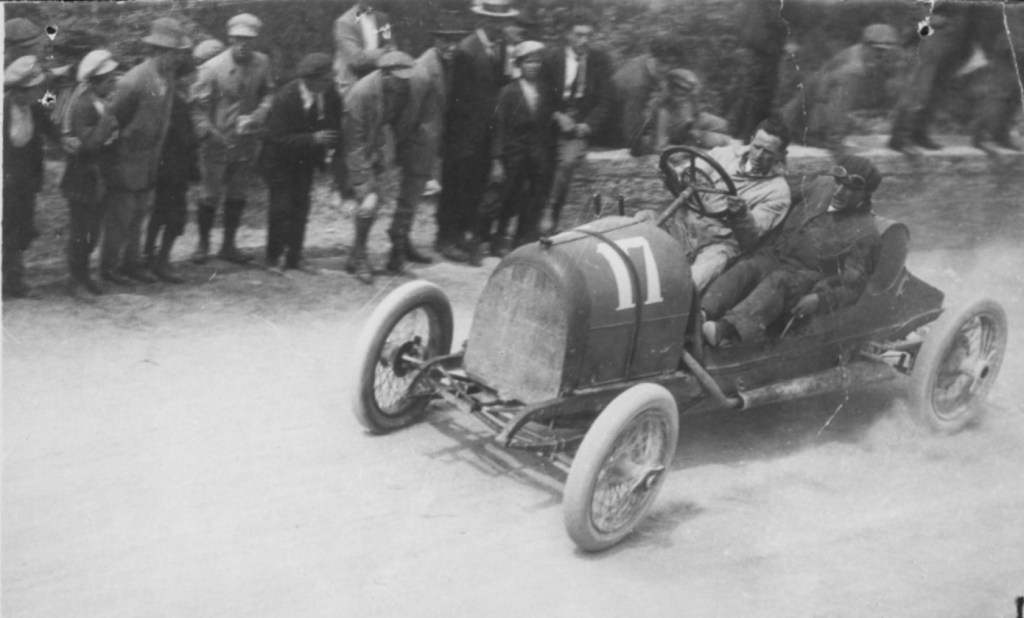
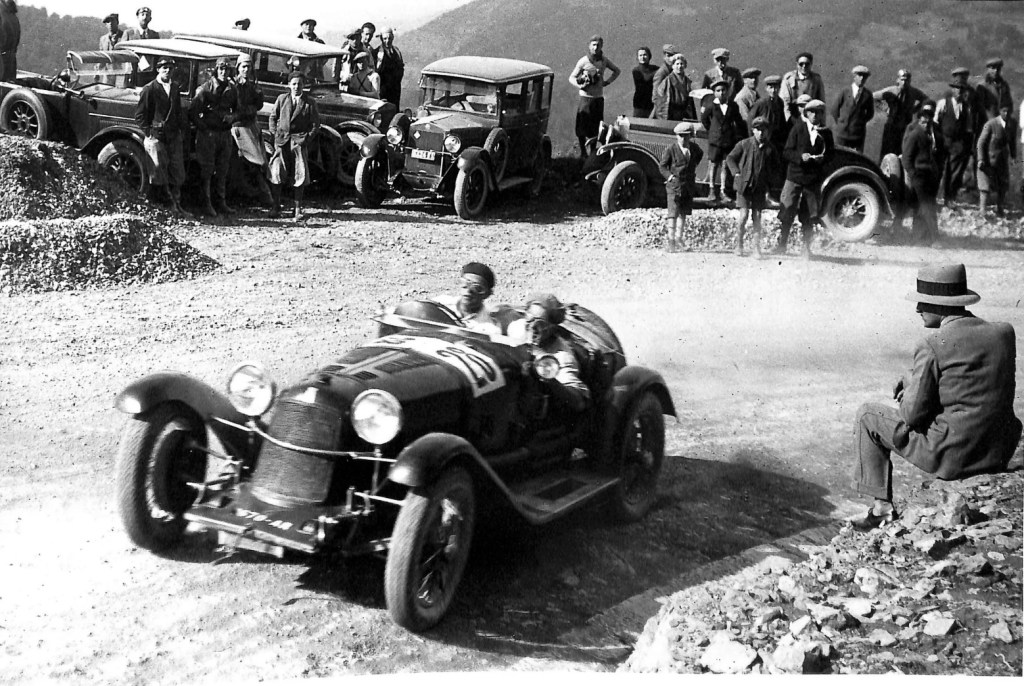
Emilio Materassi and mechanic (above and below) on the way to winning the 3.5-4.5-litre class of the 1920 Coppa della Consuma aboard a Fiat 20-30 HP. Up front it was Fiat as well, Paolo Niccolini won the event in a Fiat 120 HP.
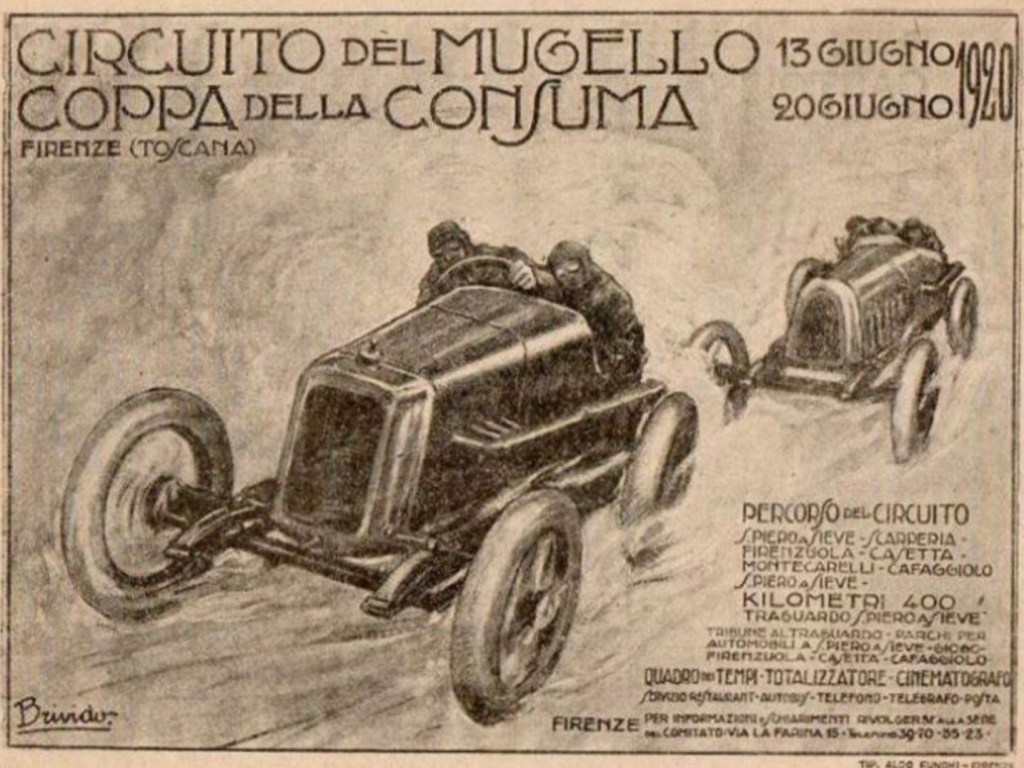
This amazing hillclimb event centred on the village of Consuma, 35km east of Florence, was first held in 1902 and has existed with a few hiccoughs along the way to the present, as an historic meeting since 1990.
(coppadellaconsuma.com)(coppdellaconsuma.com)
It’s said that the alpine pass was created by the Consumi family who were forced into political exile in Florence in 1482 and ten years later founded the town around an ancient spring and a church dedicated to San Domenico di Guzman.
In more modern times, the opening of the Baccelli road transformed the area into a popular holiday resort for poets, writers, journalists, entertainers and racing motorists, via the good graces of the Automobile Club of Florence.
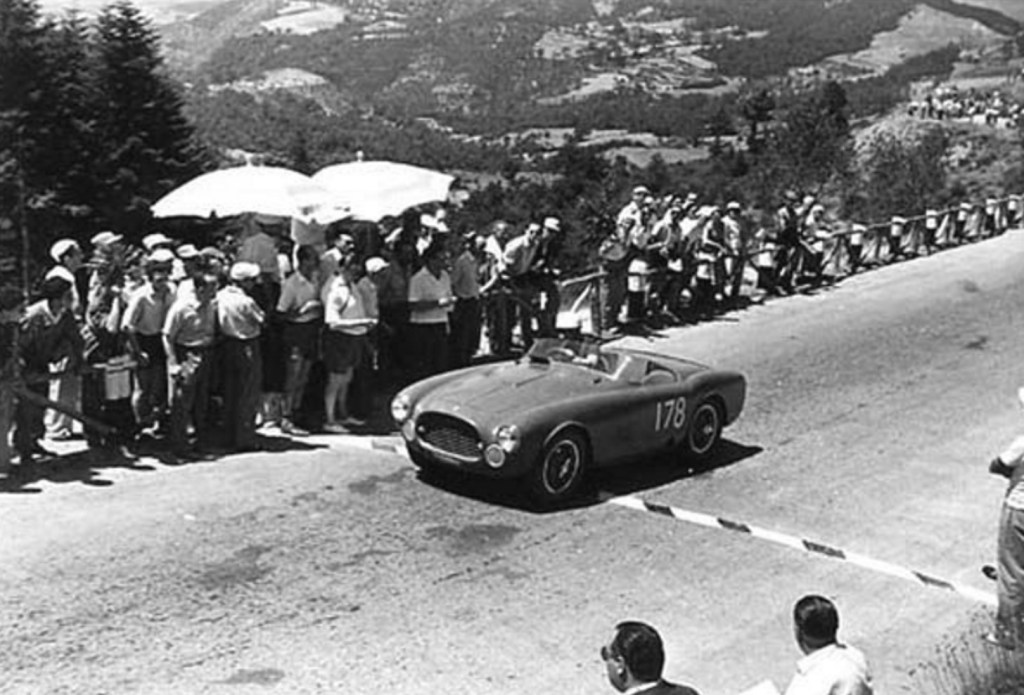
Tazio Nuvolari, Alfa Romeo 6C1750 GS in 1930 (coppadellaconsuma.com)1952 winner Piero Palmer, crosses the line in his Ferrari 225 Vignale (coppadellaconsuma.com)
Over many years the hillclimb race hairpins have witnessed heroic deeds and victories by some of the greats including Vincenzo Lancia, Fiat in 1904, Antonio Ascari, Fiat in 1919, Tazio Nuvolari, Alfa Romeo in 1931 and Ludovico Scarfiotti, OSCA S1550 in 1959.
Into the 1960s the event became a round of the European Hillclimb Championship with up to 80,000 spectators lining the roads, but the Automobile Club of Florence shifted its energy to growing Mugello as the closure of the road between Florence and Casentino became increasingly untenable. The last in-period Coppa della Consuma was held in 1964 and was won by Edward Govoni’s Maserati Type 60, he completed the 12.5km course in 6 min 54.170 sec.
Credits…
Pirelli Archive, coppadellaconsuma.com
Tailpiece…
(The Cary Collection)
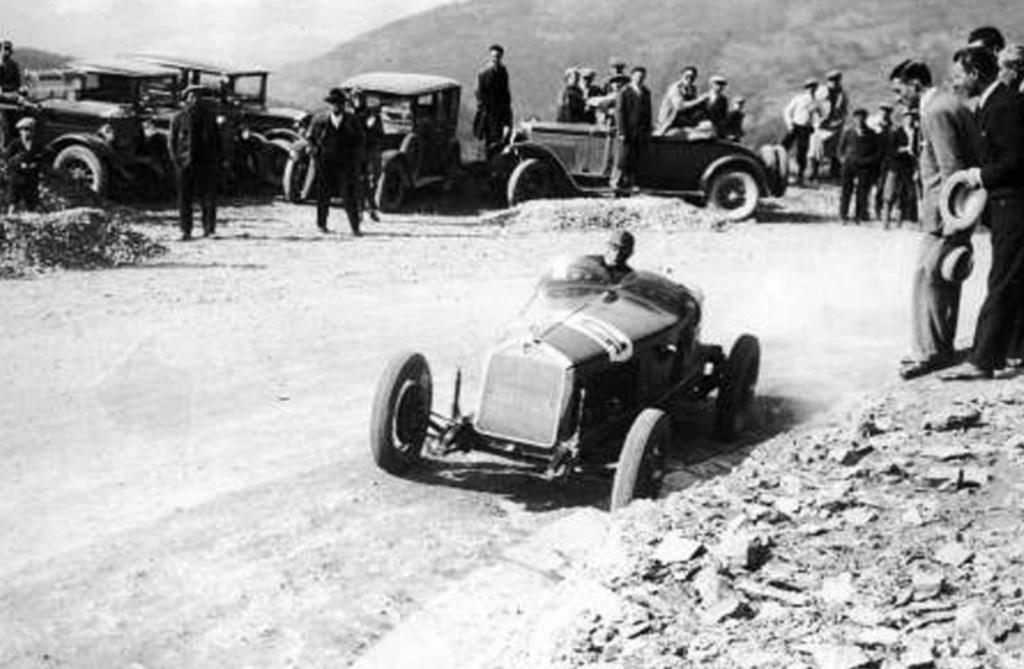
Prince Domenico Cerami Rosso focuses on the job at hand – winning the 2-litre class of the Coppa della Consume in 1930 – while his mechanic is very much enjoying the ride, Maserati 26B MM 2-litre supercharged straight-eight.
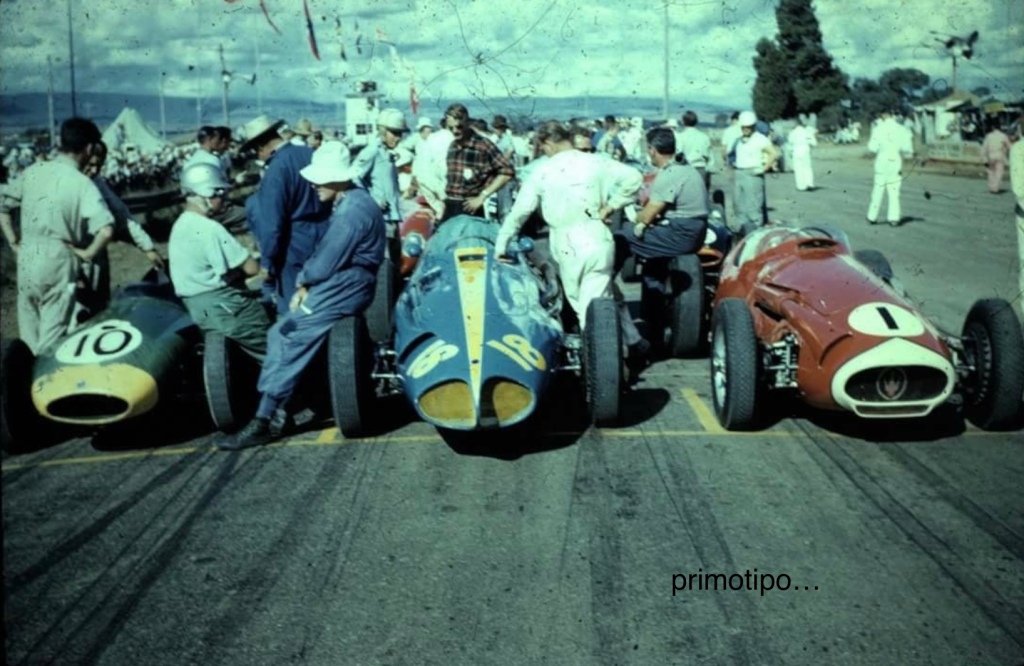
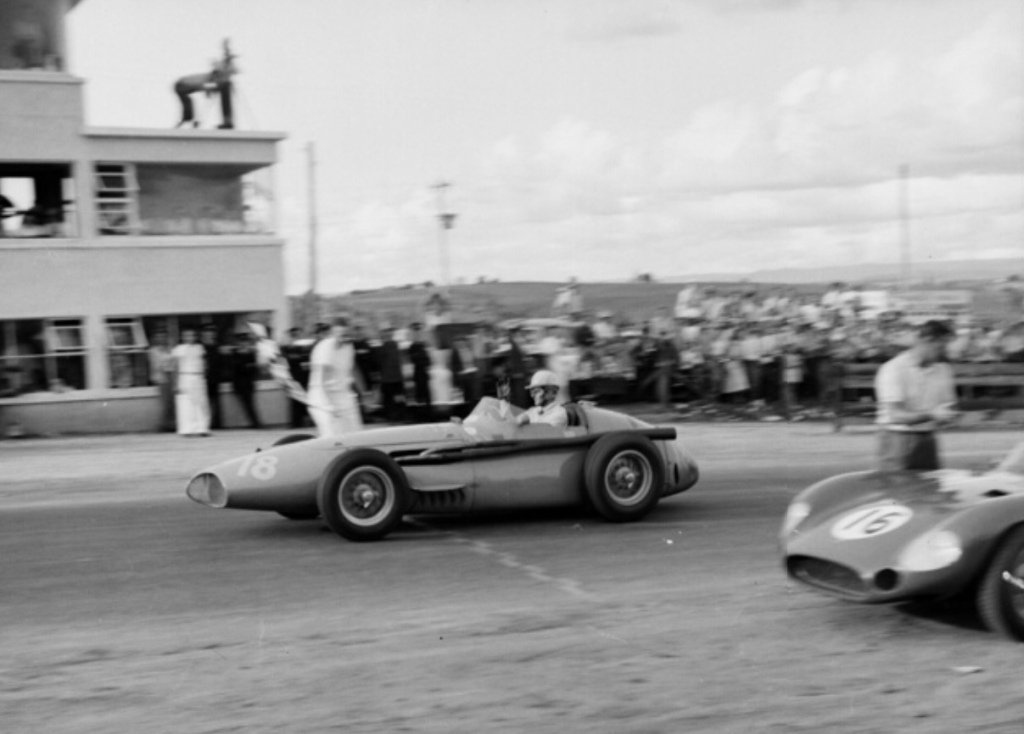
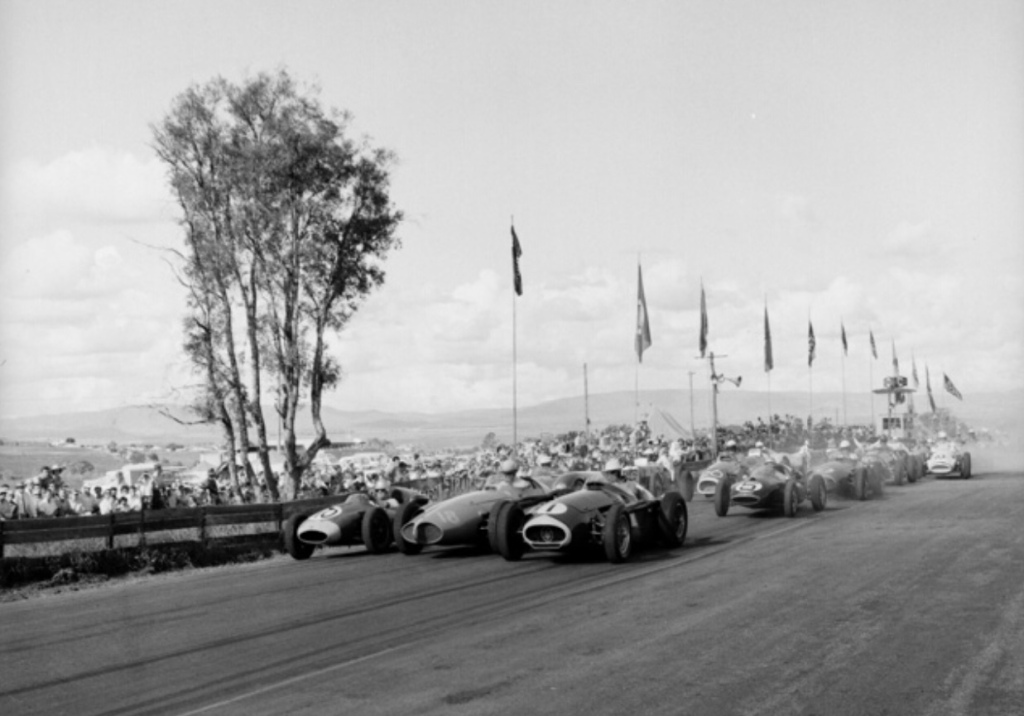
It’s Easter Monday 1959. March 30, the Bathurst 100 grid. Alec Mildren on the wheel of his Cooper T45 Climax, Ross Jensen behind and to the left of his Maserati 250F and Stan Jones perched on the back wheel of his 250F…
Top contenders for the 100 mile classic were the three Maserati 250Fs driven by Stan Jones – winner of the AGP at Longford on March 2 and the South Australian Trophy at Port Wakefield only two days before on March 28 – Arnold Glass, and Kiwi 1957 Gold Star winner, the very experienced and accomplished Ross Jensen. His 250F Maserati is ‘in the blue and white colours of the Automobile Club of El Salvador – an NZGP publicity gimmick,’ wrote John Medley.
Doug Whiteford’s Maserati 300S, the 1958 Bathurst 100 winner was a contender as were the 2-litre Coventry Climax FPF powered Cooper T45s of Alec Mildren, Len Lukey and Bill Patterson.
Raceday, bright and sunny, attracted 25,000 spectators.
(unattributed)
The first three lap qualifying heat was won by Glynn Scott’s Repco Holden from Bill Reynold’s Orlando MG and Alwyn Rose’s big, booming Dalro Jaguar. The second three-lapper was won by Jones’ Maserati 250F from Mildren’s Cooper T45 Climax and Jensen’s 250F.
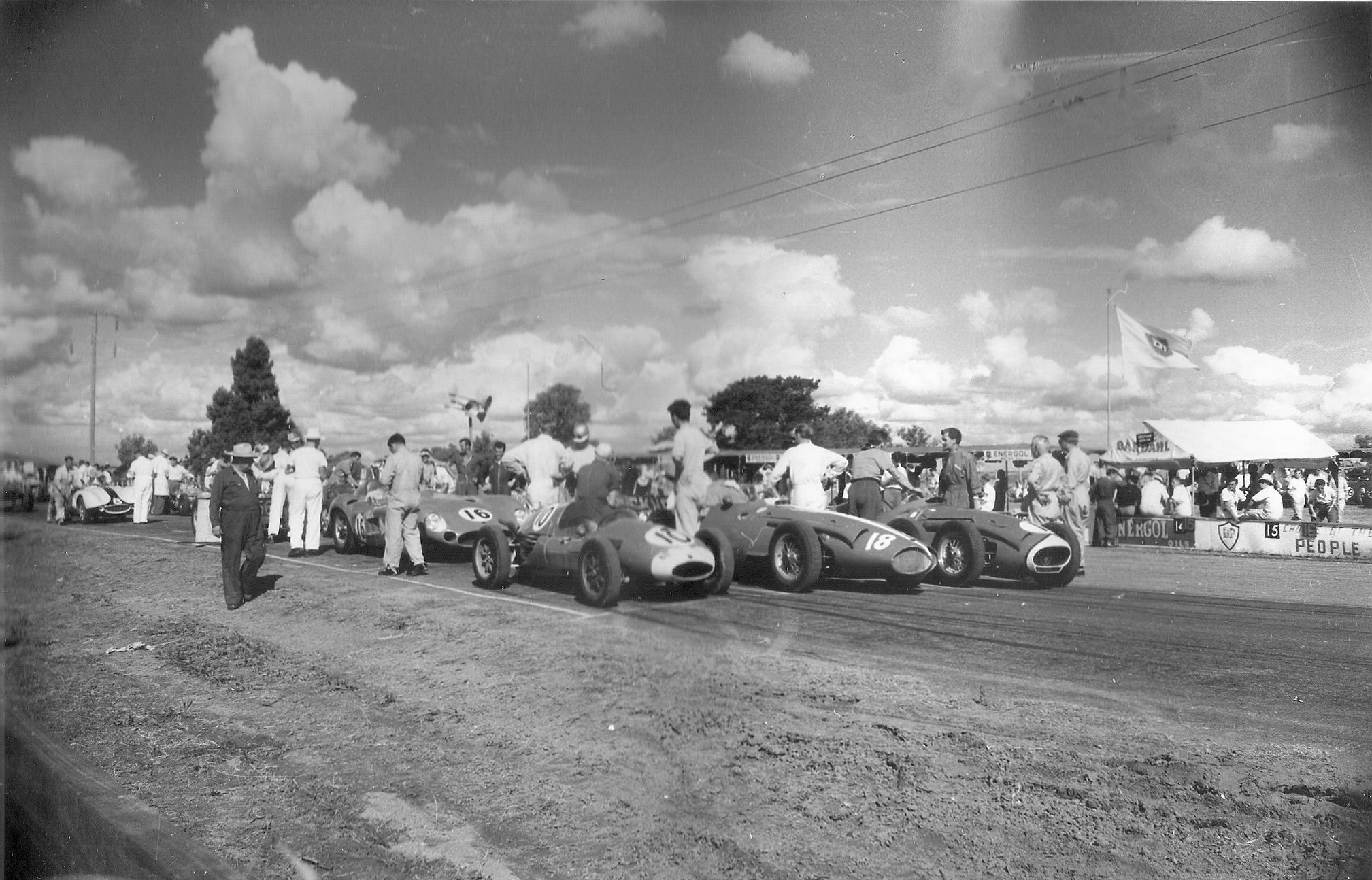
The photo above shows the grid prior to the start of the second heat, with Jack Myers beside his WM Holden and then the Maserati 250Fs of Jones and Jensen. Myers’ special was a very clever concoction of Cooper T20 chassis – although by then the frame was of Jack’s construction – and six-cylinder Holden Grey block atop which sat a Merv Waggott designed and built aluminium DOHC, twin-cam, two-valve cylinder head. This car in Jack’s capable hands always punched above its weight, read about it here; https://primotipo.com/2015/02/10/stirling-moss-cumberland-park-speedway-sydney-cooper-t20-wm-holden-1956/
Parade lap, logically before the Bathurst 100…(unattributed)(unattributed)
After the parade lap the Bathurst 100 grid of 27 starters was ‘away in indescribable noise, dust and confusion’, Jones was first to Hell Corner from Mildren Lukey and Whiteford – then Jensen, Glass, Scott, Jack Myers WM Cooper – with Ray Walmsley in the Alfa P3 GMC rolling to a halt out of Hell.
Mildren led at the end of lap one from Jones, Lukey, Jensen who was closing and Doug Whiteford who was falling back. Jensen passed Lukey on lap four and then challenged Jones, roaring past before The Cutting with the three leaders nose to tail through Reid Park.
Jones, 250F (unattributed)
Lukey’s Cooper was close, Whiteford a bit further back and Glass much further back, and then the Myers WM. Into lap five Medley records that the Kiwi started his run by putting in two laps of 2:51, taking the lead and extending it whilst Stan Jones pitted, restarted and retired after six laps.
Then Mildren was black flagged due to a loose bonnet catch, he pitted and rejoined after the drama was rectified, but he was now behind Jensen, Lukey and Whiteford.
Mildren got the bit back between his teeth and passed Whiteford up Mountain Straight at half distance and Lukey under brakes at Murray’s – Doug took Len two laps later as well. By then up to second, Mildren retired at Quarry having done a 2:55 lap and 147.73 mph on Conrod. Whiteford too retired from transmission failure.
Jensen passes Whiteford and his stranded Maserati 300S as he goes over the finishing line, out with transmission woes (PIX-SLNSW)
After Mildren’s pitstop Jensen wasn’t threatened and ‘motored the next 80 miles to win easily’ with a best lap of 2:50.6 and a speed through the Conrod traps at 139.53 mph.
Jensen won a race of incredible attrition – only 11 of the 27 starters finished – from Len Lukey, Cooper T45 Climax, and Glass in the ex-Hunt/Stillwell Maserati 250F, then Jack Myers WM Cooper Holden, Walmsley’s Alfa P3 GMC and Werner Greve in the ex-Moss/Davison 1954 AGP winning HWM Jaguar.
Walmsley’s fifth place in a Gold Star round in his pre-war Alfa Romeo P3 was surely the highest placing for such an old car in any Gold Star round?
(PIX-SLNSW)
Ross Jensen…
While Aucklander, Ross Jensen’s performance may have astonished fringe-race-fans in Australia in fact he had been a front runner in New Zealand amongst the visiting internationals for years.
He purchased the ex-Moss Maserati 250F #2508 1956 NZ GP winner finishing second to Jack Brabham’s Cooper in the 1958 NZ GP. Later that year he raced works-Lister Jaguars in the UK, placing second at Snetterton and Brands in July-August and winning Scott-Brown Memorial – a man he got to know on Archie’s early ’58 NZ Tour – at Snetterton in September. He then returned home having taken delivery of the long shark-nosed 250F #2509 in time for the 1959 NZ internationals.
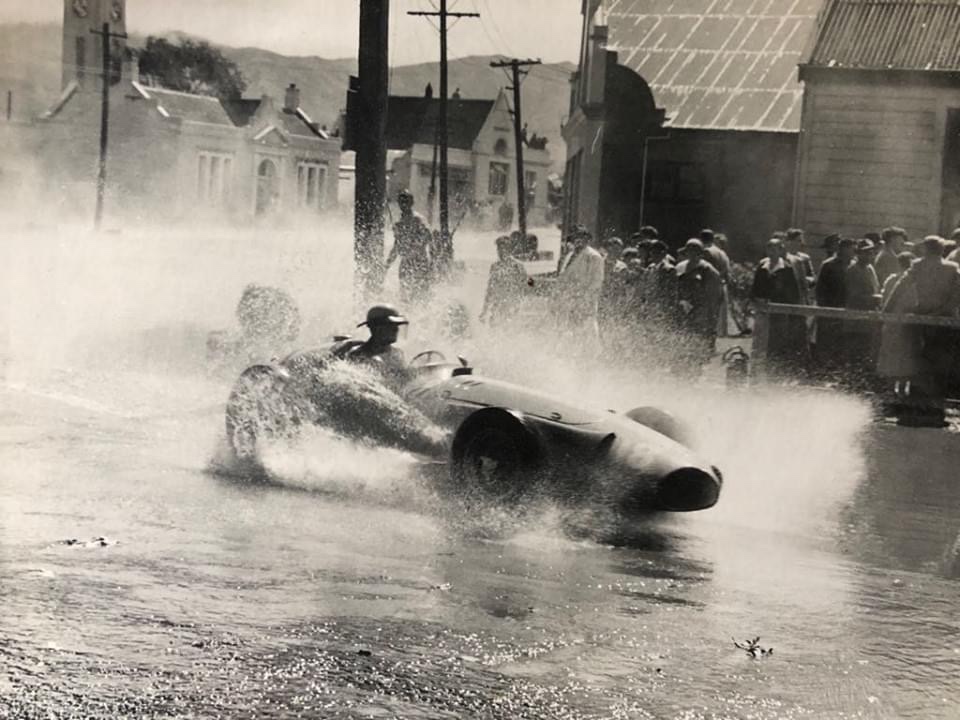
Ross Jensen shared this Lister Jag with Ivor Bueb and Bruce Halford during the September 1958 Tourist Trophy at Goodwood, DNF (LAT)Soggy Ross – Jensen and 250F during the early stages of the 1959 Waimate 50. “famously there was a cloud burst just after the start…once the rain stopped, it dried up quickly and we had some really great racing,” Allan Dick wrote (Classic Auto News)
Bruce Sergent wrote that “the car was built around the frame of the Bira race winner (NZ GP) of 1955, but with the latest motor and transmission, giving the low, offset driving position.”
He was fifth in the NZ GP, qualified on the front row at Wigram but DNF with transmission problems, was second behind Bruce McLaren’s Cooper at Waimate, and was fourth behind McLaren, Flockhart’s BRM P25 and Brabham, Cooper T45 at Teretonga. He was no slouch…
Jensen established a race preparation shop, retired from racing in 1961 but was always part of the scene – foundation member and on the board of the NZ Grand Prix Association, founding trustee of the Bruce McLaren Trust – and later imported Renault, Jaguar and BMW amongst others. He died, aged 78 in October 2003.
Etcetera…
(PIX-SLNSW)
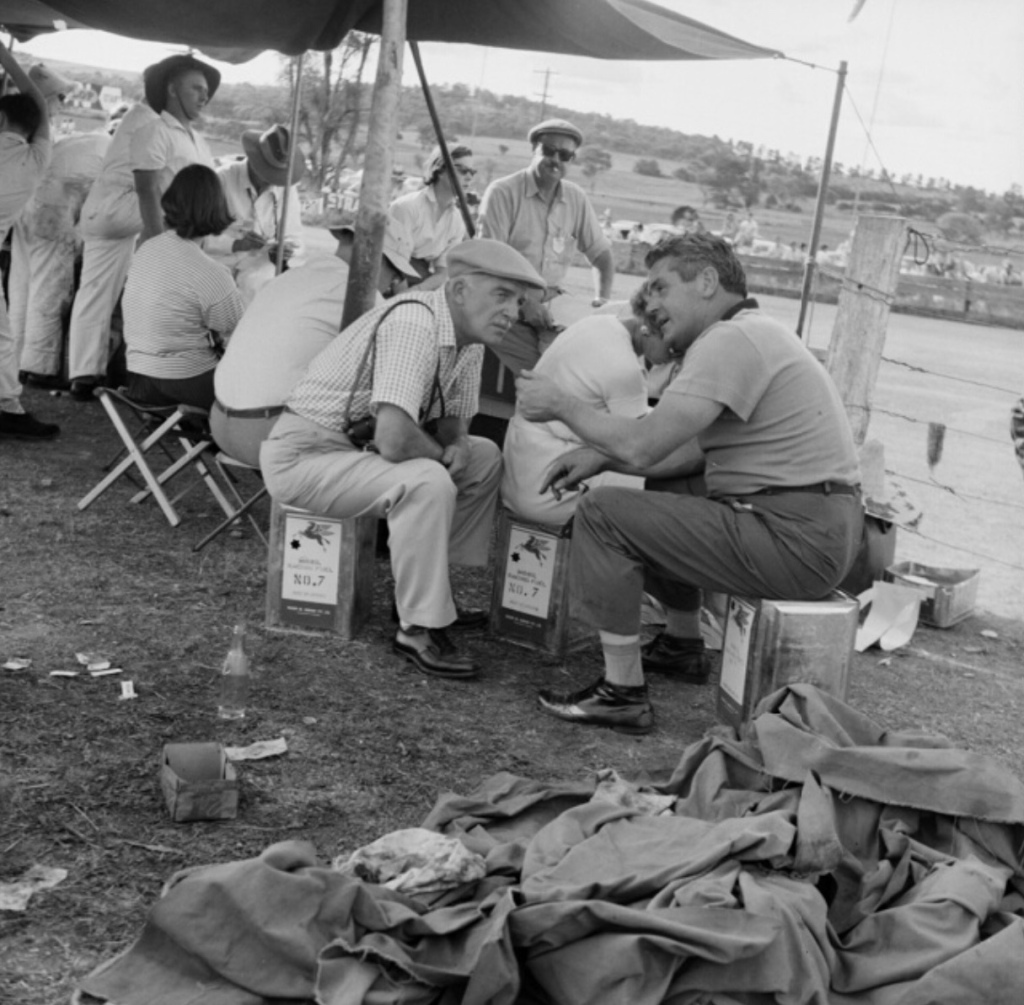
Stan Jones (right) dispenses some words of wisdom to a gent in the exclusive confines of the Mobilgas hospitality suite. BYO chair clearly.
(SLNSW)
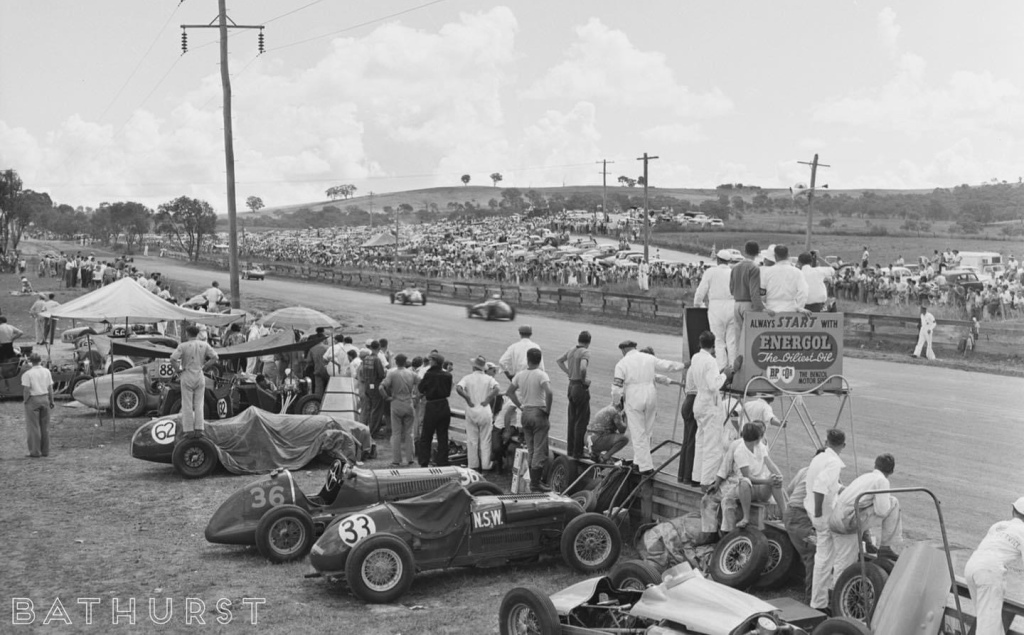
Great Pit Straight panorama with the #33 Bruce Leer MG TC Spl, Jesse Griffiths Maserati 4CL #36 and John Schroeder, covered Nota Consul. All of them contested the Bathurst 100 and all were DNFs.
(unattributed)
Porsche 356 Coupe leads Stan Jones and Ross Jensen on the parade lap.
(PIX-SLNSW)
Mildren, Cooper T45 and the Jensen and Jones 250F’s on the front row at the start of the 100, feel the vibe…Len Lukey’s #5 Cooper Climax on the outside of row two
(unattributed)
Arnold Glass’ Maserati 250F goes inside Bill Clarke’s 492cc two-stroke, three-cylinder, air-cooled Berkeley SE492 Excelsior, the speed differential between some of the cars that weekend was mega.
Credits…
Russell Beckman, Bill Miles Collection, ‘Bathurst: Cradle of Australian Motor Racing’ John Medley, sergeant.com, Allan Dick-Classic Auto News, LAT, Maserati 250F chassis number source: http://8w.forix.com/250f-redux.html
Tailpiece…
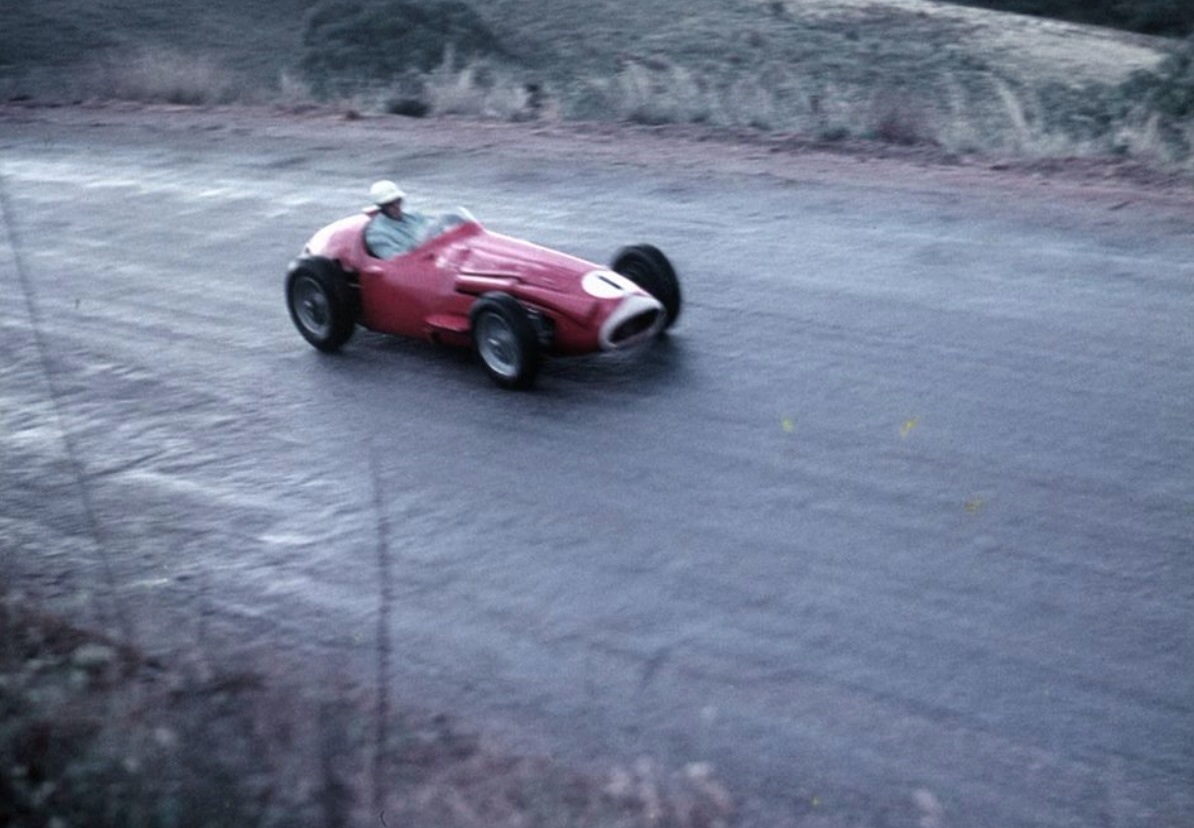
Ross Jensen’s Maserati 250F in 1959, on the cover of the 1960 meeting programme.
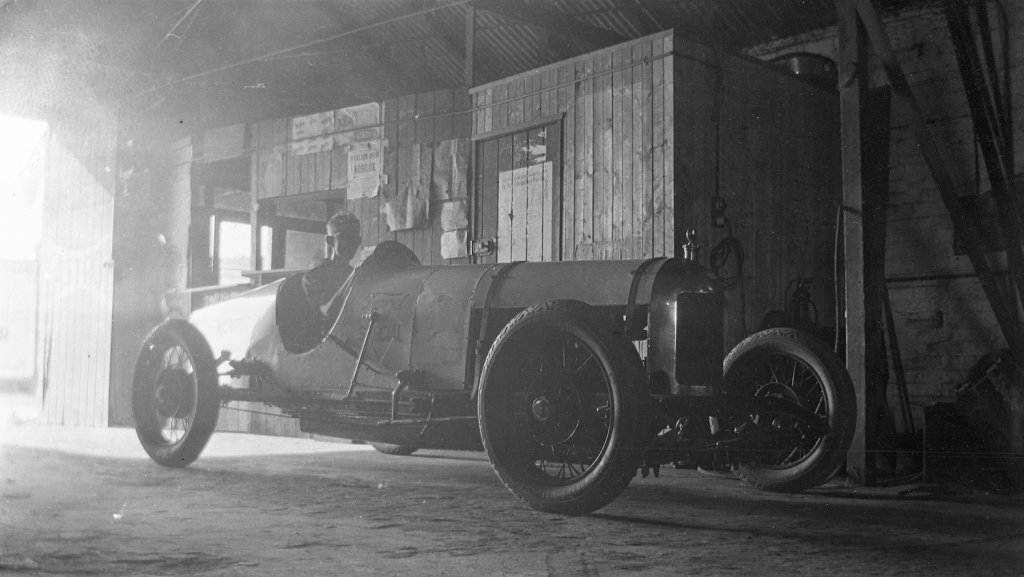
The lighting of this shot of Ted King’s Rajo Ford is poor but it also makes the shot, so very evocative!
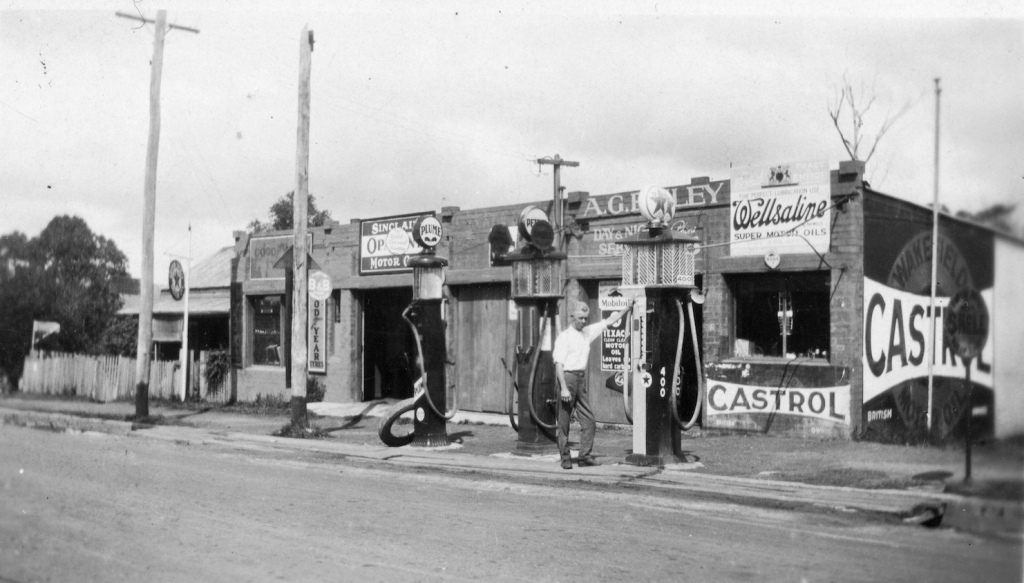
Historian Nathan Tasca chased up a fellow who posted another photograph on Facebook and was rewarded with some other shots including these two,. At this point ‘Prof’ John Medley came to the rescue and identified the car, as he does…
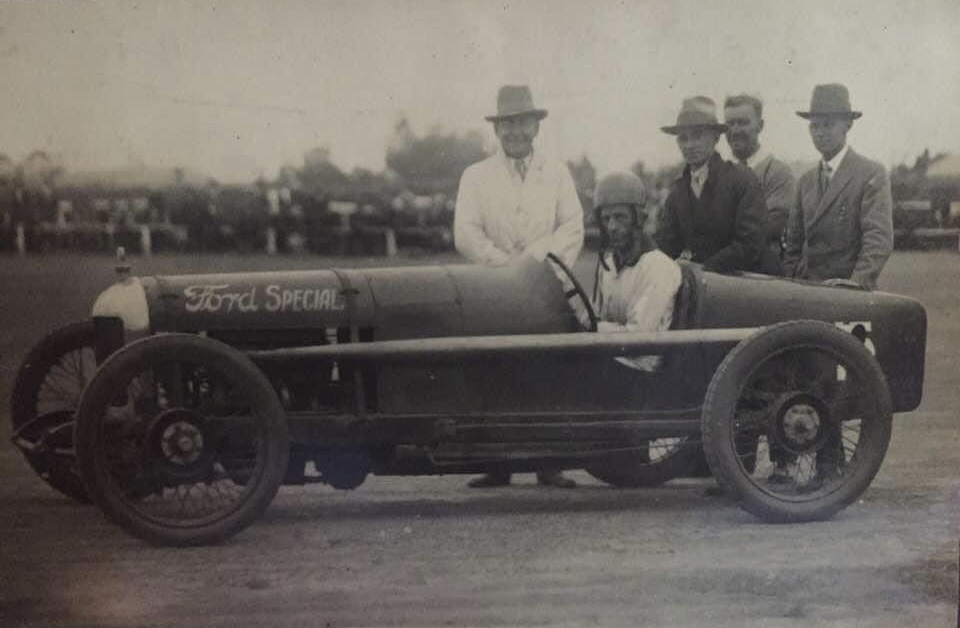
As luck would have it, my loan-copy of a ‘Half Century of Speed’ has the shot below of King “after winning a championship at Penrith in 1927.” What follows is a truncated version of the late-great Barry Lake’s narrative.
Ted King lived in Newcastle (NSW) and raced mainly on dirt tracks in that area. King used to ship his car by steamer to Sydney and back to attend meetings. In the mid-late 1930s groups of speedcar drivers would do the reverse of this trip; travel overnight on Friday, race in Newcastle on Saturday, then return overnight on Saturday to be home in Sydney on Sunday.
Is this Ted King at his Newcastle area servo? Ring a bell folks (Ro Ander Family)
In the first half of the twentieth century road travel between cities was long and arduous. Roads were narrow, rough, winding and dusty, with many ferry crossings. Coastal steamers were cost effective alternatives right up until the early post-war years; Sydney to Adelaide an example.
Frontenac ‘Fronty’ and Rajo manufactured overhead valve conversions for T-Model Ford engines. They both used crossflow heads, but Frontenac Fords had the inlet ports on the left and exhaust ports on the right hand side of the car. All Rajo-Fords had the inlet on the right and exhaust on the left.
The Morris bull-nose radiator was a common fitment to locally assembled T-based racers which used Fronty or Rajo parts as they looked like the US built cars of the time at less cost.
Many Fronty and Rajo Fords were raced in Australia but few were fully imported complete cars. Heads, engine parts and other hot bits were brought in then built up with locally sourced T-Model parts to build copies of the US built cars. There are still about 35 on register in Australia.
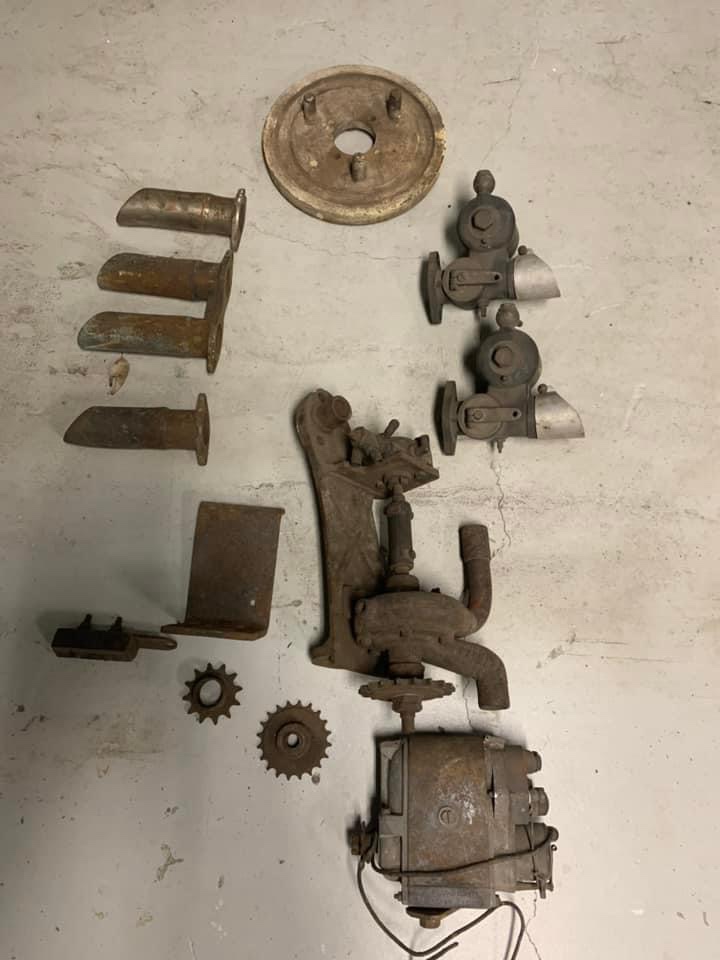
After posting this piece the following material arrived from David Smallacombe, photo of King at Penrith, and from Andrew Webb, who has the remaining bones of the King machine; the front wheels, Rajo head, Solex carburettors, chain drive magneto and water pump, and log book.
Ted King, Rajo Ford, Penrith, date unknown (D Smallacombe)Ted King Rajo BB engine (A Webb)(A Webb)(A Webb)(P White Collection)
Ted King in his Rajo Ford at Maroubra, date unknown.
Credits…
Nathan Tasca, John Medley, Ro Ander Family, ‘Half a Century of Speed’ Barry Lake, Tony and Pedr Davis, David Smallacombe, Andrew Webb, Peter White Collection via Colin Wade
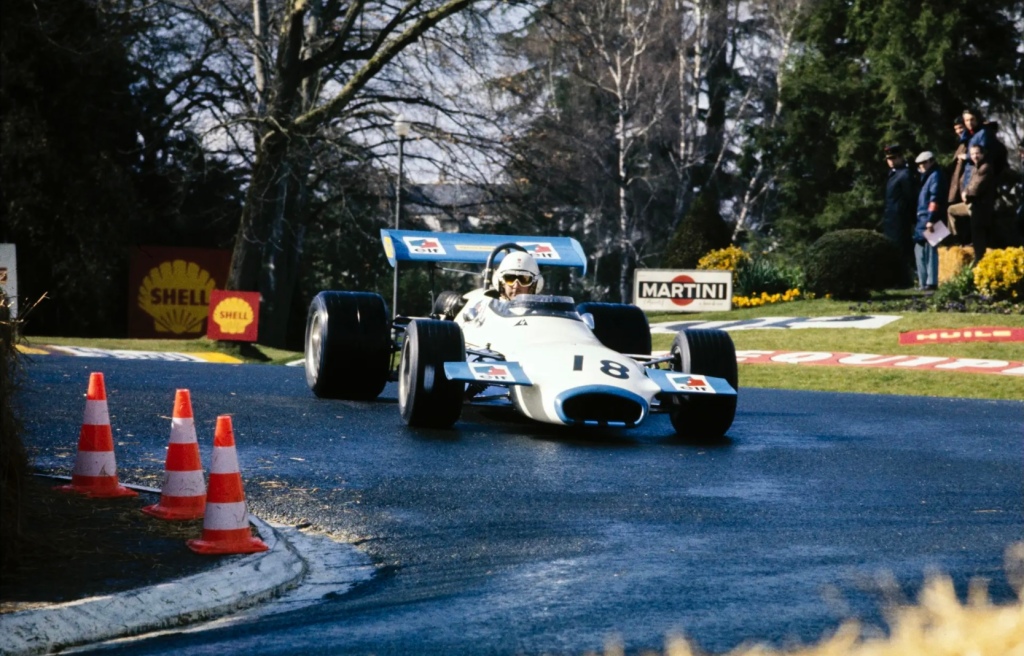
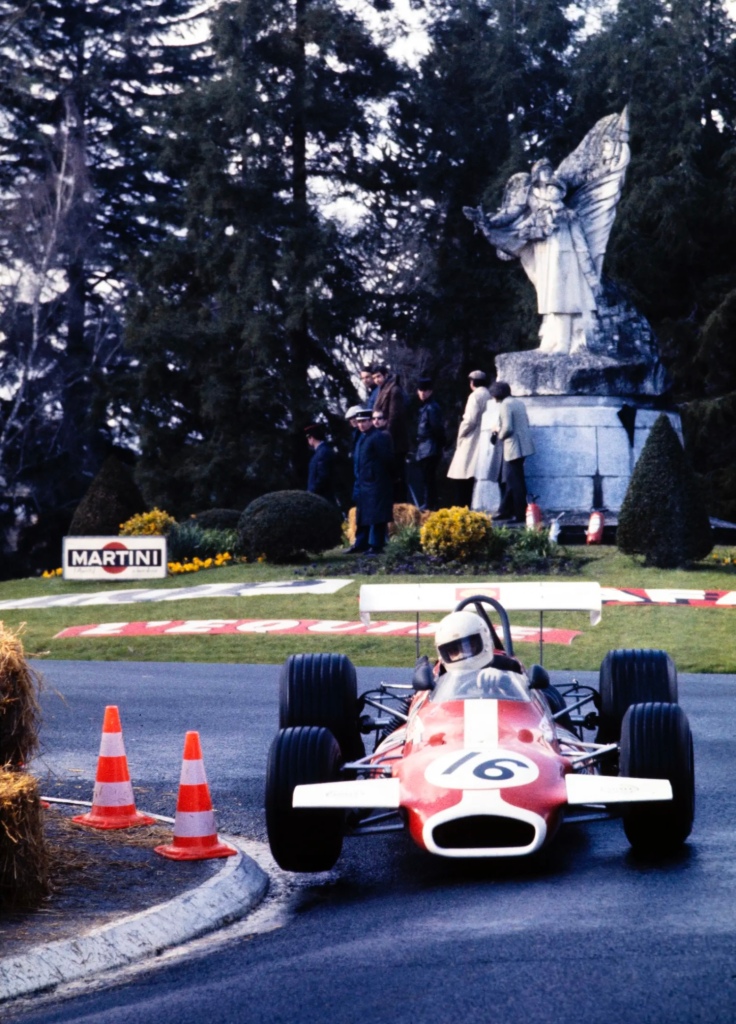
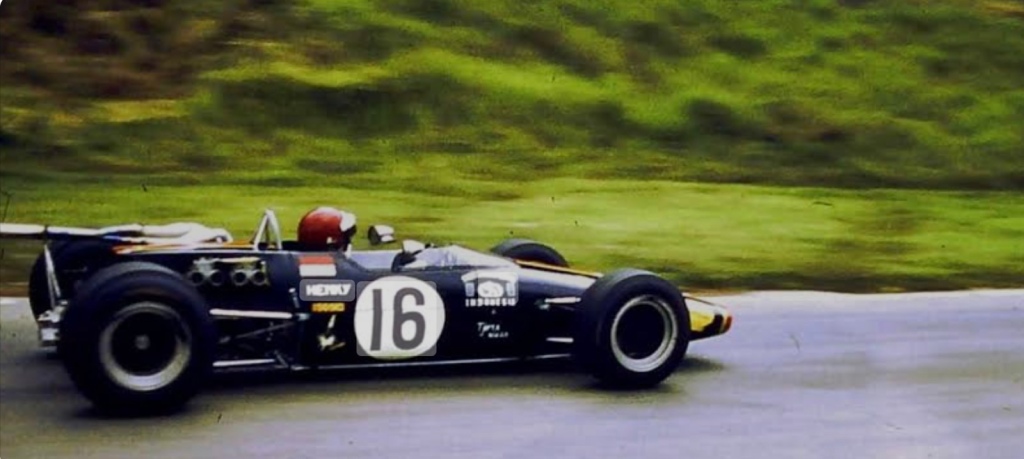
The car is Brabham BT30 chassis # 17 owned by ex-racer/businessman/team owner John ‘Noddy’ Coombs, the machine was shared by Jack and Jackie Stewart that season
Brabham didn’t finish at Pau fuel metering unit problems intervened. Jochen Rindt won in a works/Jochen Rindt Racing Lotus 69 Ford FVA from four BT30s: the machines of Henri Pescarolo, Tim Schenken, Derek Bell and Francois Mazet.
(MotorSport)
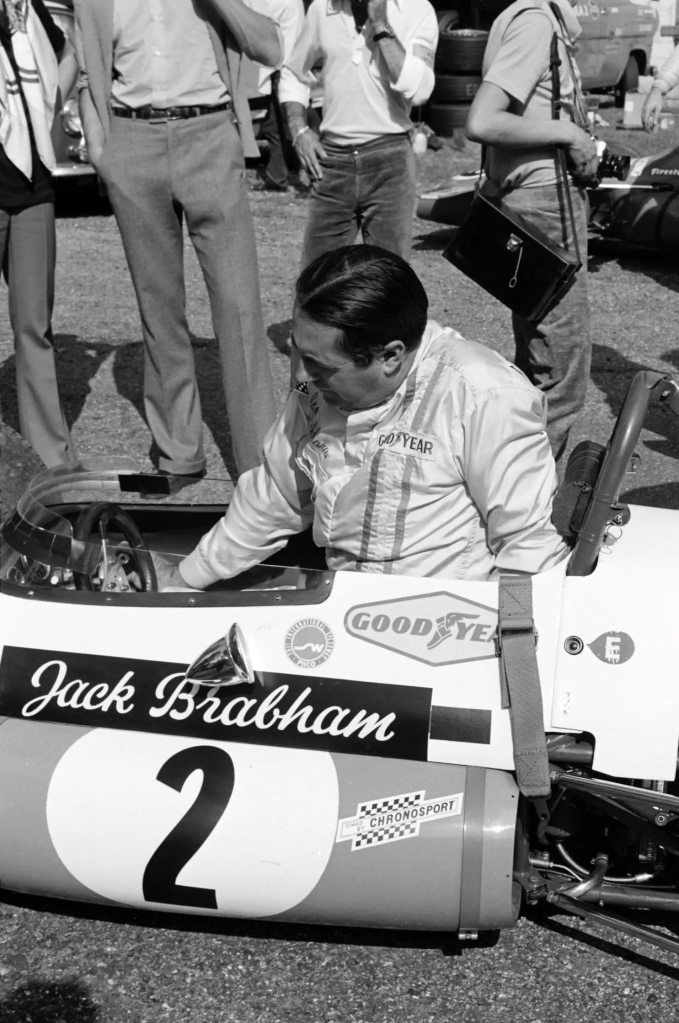
“Yeah, its not a bad little jigger, we’ve won a few races with BT30s in the last twelve months I suppose. It’s a lot tighter than I remember when I tested it for Ron last year mind you…”
Jack gets out of BT30/17 over the June 28, XVIII Grand Prix de Rouen-les-Essarts weekend where he was eighth in the race won by Jo Siffert’s BMW 270.
BT30/17’s best results that season was Jackie’s second place at Thruxton and victory at Crystal Palace, while Jack was second at Tulln-Langenlebarn. Coombs shipped the car to Japan in May, where JYS won the Formula Libre Japanese Grand Prix at Fuji with Ford Cosworth FVC power.
Stewart bagged the Quadrella in the London Trophy at Crystal Palace in May. He won his heat, the final from pole, bagging fastest lap along the way (MotorSport)(MotorSport)
The Brothers Brambilla compound during the Hockenheim 11, 1970 weekend. The car in shot is Tino’s #7 Brabham BT30/21 (DNF) during the 1970 Preis von Baden – Wurttemberg und Hessen Euro F2 Championship round. Dieter Quester had a home-win for BMW, he prevailed in an M11 powered BMW 270. The exhaust of Vittorio’s car, BT30/22, is at right.
The essential elements of customer F2 Brabhams of the era are on display; a spaceframe chassis, Ford Cosworth 1.6-litre FVA 210bhp engine and Hewland FT200 five-speed transaxle. It was then up to the driver to make these immensely robust, chuckable, fast, Ron Tauranac designed cars do the rest.
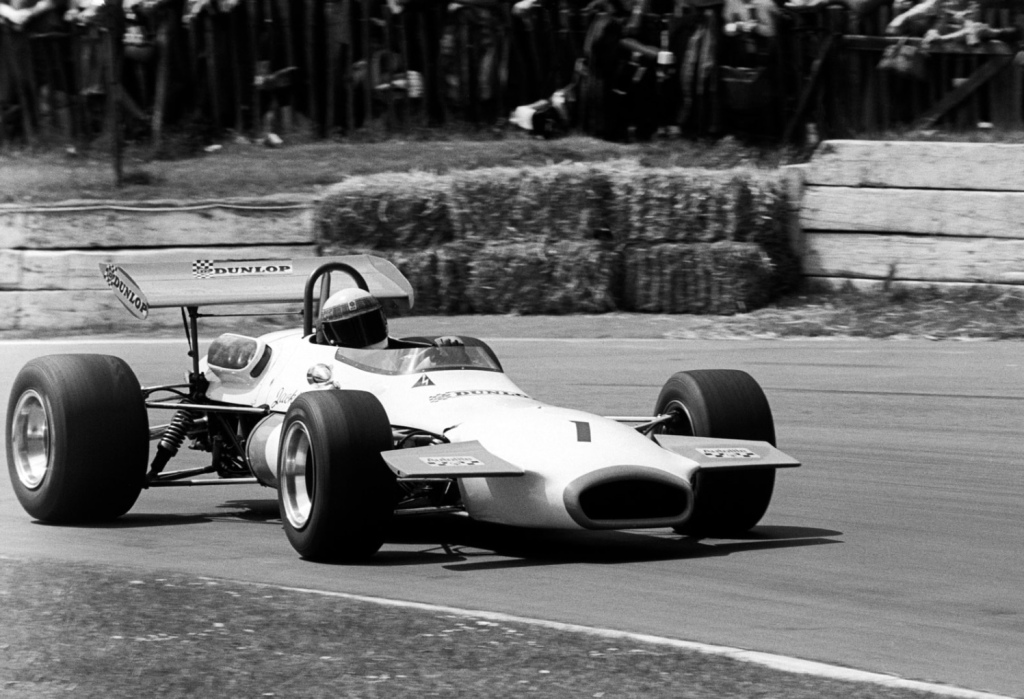
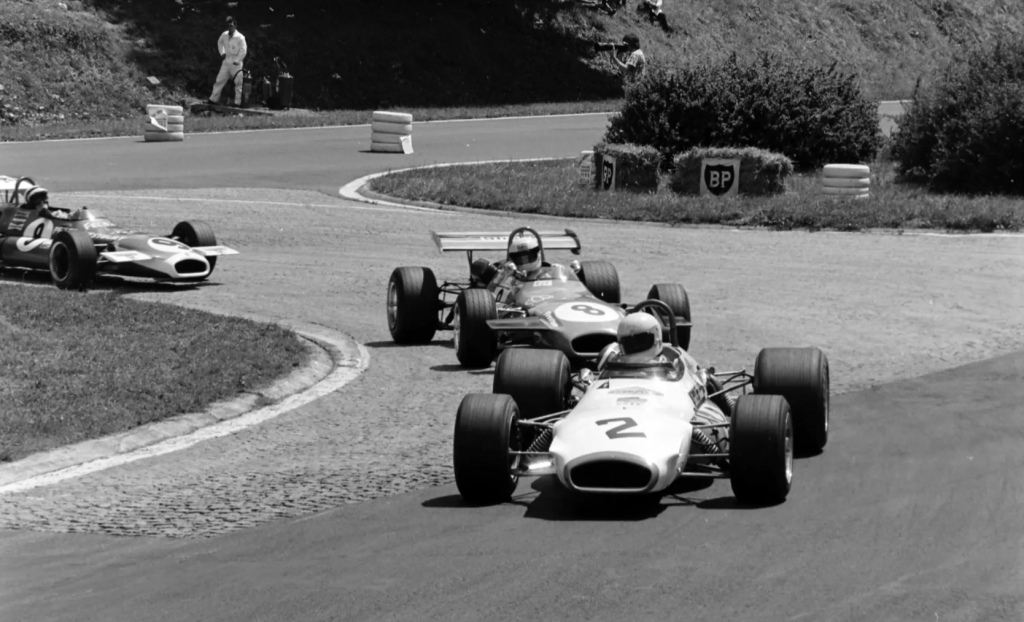
Jack toyed with wings on and off at Rouen, racing without the appendages. Here he is showing the way to customers, Derek Bell (seventh) and Peter Westbury (tenth).
(MotorSport)
Another lovely Pau GP shot, where Tim Schenken was third in the Sports Motors International Brabham BT30.
That year the European F2 Championship was won by Clay Regazzoni’s Tecno 69 and 70 FVAs with 44 points, from Derek Bell’s BT30 (he also bagged one point in a BMW 270) 35 points, and Emerson Fittipaldi’s Lotus 69 FVA on 25.
‘Graded drivers’ – in essence and summary, drivers who had scored points twice in the Top Six of a Grand Prix in the previous two years, and the World, F2, Indy, and Can Am Champs of the previous year – were ineligible for Euro F2 championship points.
In 1970 Rindt won at Thruxton, Stewart at Crystal Palace and Ickx at Tulln-Langenlebarn. Of the non-graded drivers, Regga won at Hockenheim, Enna-Pergusa and Imola – and won his first Grand Prix for Ferrari that September at Monza -, for Derek Bell at Montjuich Park, Barcelona, and Dieter Quester in the final Hockenheim round.
Kevin Bartlett and Graeme Lawrence at the start, Mildren Mono Alfa V8 and Ferrari 246T (SNL)
1970 SINGAPORE GP: THE FERRARI FROM THE ORIENT
Why the Kiwis always get along with the Ferraris?…
The history of Scuderia Ferrari in F1 and F2 has always been marked by being a team that rarely gives its “official” equipment to third parties. Ferrari single-seaters have always been known to race only under the aegis of Scuderia Ferrari itself. Even in more turbulent times, such as in 1961, when Giancarlo Baghetti raced a Ferrari 156 for both FISA and Sant’Ambroeus teams, there was always an attentive team of Ferrari mechanics on hand to take care of the car. Another case was the N.A.R.T., in the years 1964, 1965 and 1969; they were nothing more than fancy names for Scuderia Ferrari itself and its squad of mechanics and engineers.
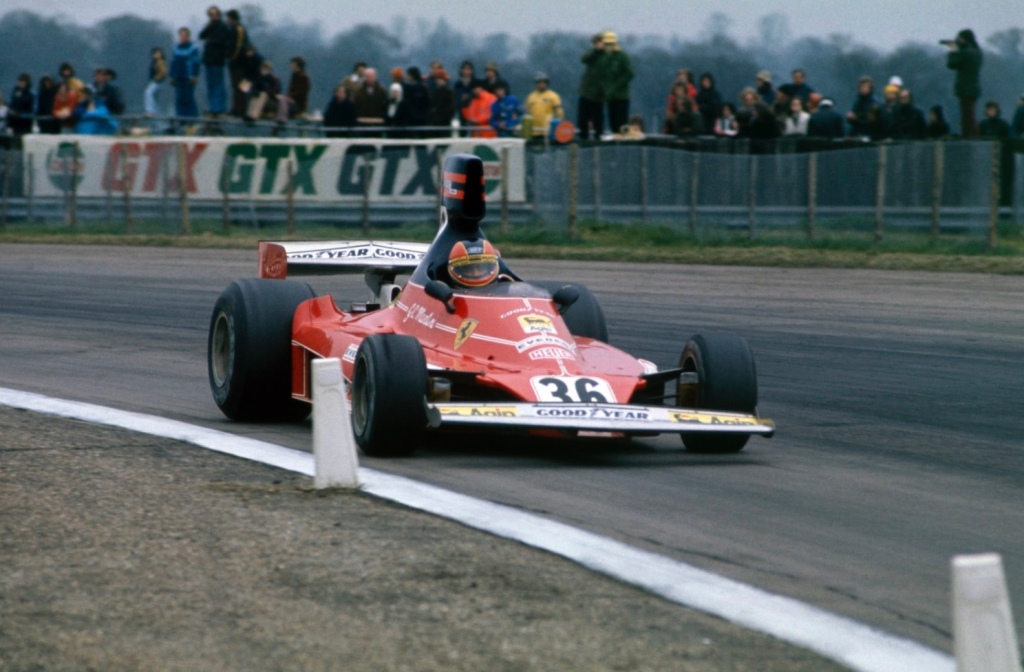
We can name rare occasions when the scarlet cars were given to third parties and took part in races by this way: one of them was the British Racing Partnership/UDT-Laystall Ferrari 156, driven by Innes Ireland, in the XIV BDRC International Trophy of 1962; another was Scuderia Everest (the forerunner of Minardi) in 1976, which with a Ferrari 312T competed in the Race of Champions and the International Trophy.
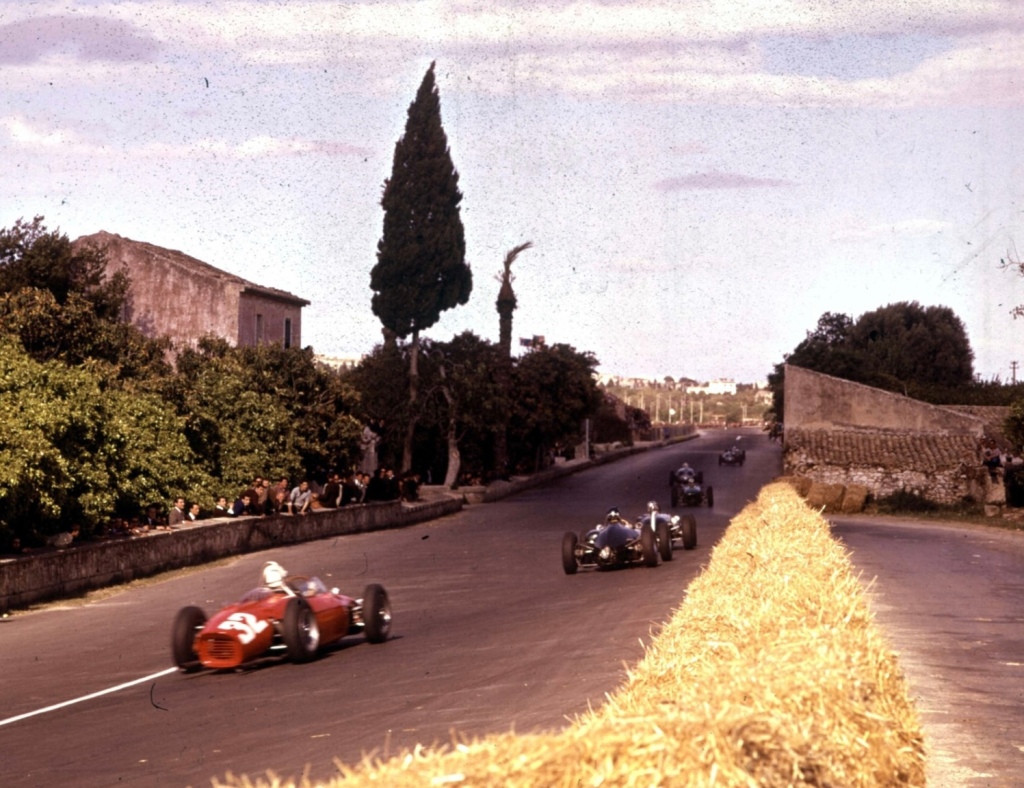
Giancarlo Baghetti, Ferrari 156 chases a BRM and Cooper on way to winning the April 1961 Syracuse GP (MotorSport)Giancarlo Martini, Ferrari 312T, 10th in the BRDC Intl Trophy, Silverstone April 1976 (MotorSport)
Moving on to categories below F1, we can highlight the Australian Scuderia Veloce. It was another one of those peculiar and picturesque stories that happened in motorsport in the 1960s and, who really stood out in the 1968/69 Tasman Series. Thereupon, stay tuned, because the real story of this text starts here.
But, as expected, without the support and protection of the Scuderia, most of these attempts ended in a resounding failure; we can credit this to the very complexity of the material, which required a team of technicians who knew how to put in motion an equipment as sophisticated as a Ferrari F1 car.
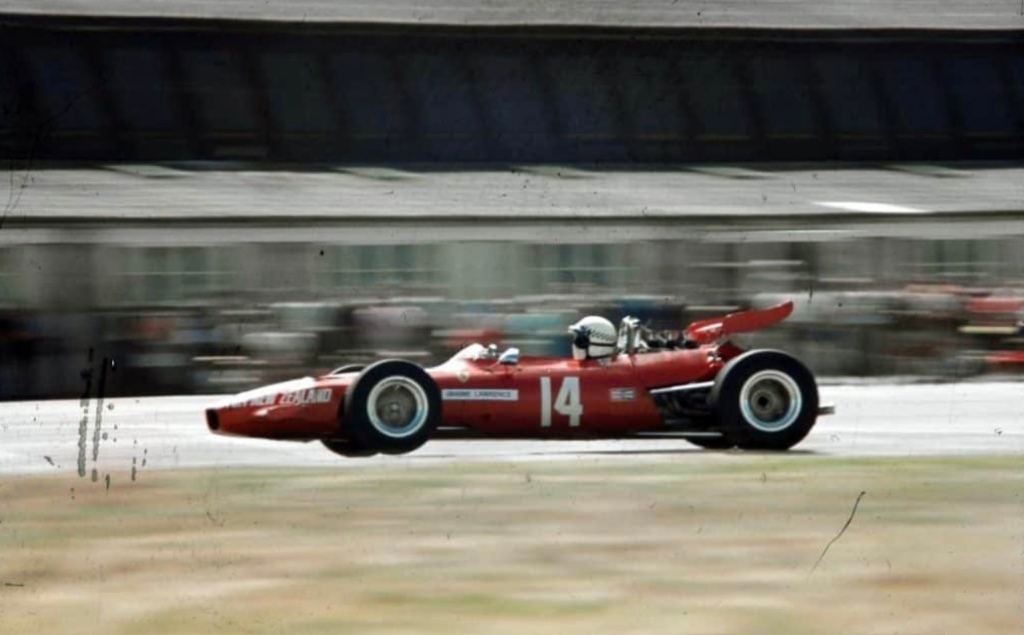
Perhaps one of the few successes reported by a single-seater Ferrari without being bankrolled by the Scuderia itself was due to the duo of Graeme Lawrence and his Ferrari 246T F2 Dino (the same Scuderia Veloce´s car from the beginning of the text – I’ve told you that the story started there). With successes in the main events of Southeast Asia in 1970, the pair proved to carry on the prestige of the Italian team.
The first example of the success of the partnership between the 246T and Lawrence came in the 1970 Tasman Series. This, which was the first edition in many years that did not feature the big European stars, opened the door for many smaller pilots and teams, mainly from the axis Australia-New Zealand, to have a chance to stand out.
And so it was with the New-Zealander, who, in the first race of the series, in Levin, already gave the first victory for the private Ferrari. And after a positive sequence of results in the next six races, the pilot would clinch the overall title of that season.
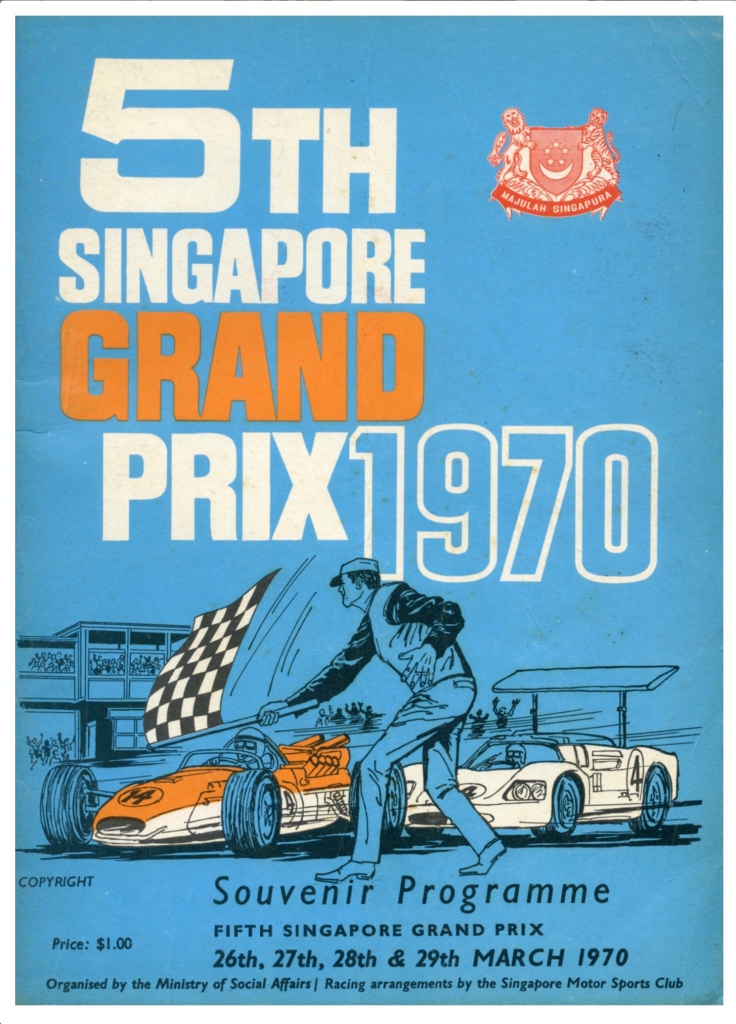
The next challenge would be the Singapore GP, which would take place at the end of March. The race, which was one of the most prestigious sport events in Asia-Oceania, always brought together the cream of the region’s pilots.
Graeme Lawrence, Ferrari 246T #008, during the 1970 Lady Wigram Trophy. DNF overheating in the race won by Frank Matich, McLaren M10A Chev (unattributed)(progcovers.com)
1970 Singapore GP…
Today, we always think about how F1 and F2 are almost interconnected categories, dependent on each other. Where one goes, the other’s circus usually follows. We also think about how F2 itself has gone beyond continental limits to become a global category – we have F2 races in Arabia, Australia, Azerbaijan – all of which form part of a unified international FIA Championship.
Well, the reality of the 60’s and 70’s was quite different. The F2 championships were as spread out as possible: there was one in Europe (which was considered “official”, in terms of historical classification); another two levels (of second tier single seater racing) in Oceania such as the Tasman Series and the Gold Star, which were a hybrid between the F1, F2 and, later, the F5000); several smaller tournaments in South America (such as the Argentine Temporada); and one in Asia.
The last one on this list was also one of the most peculiar: even though it was the most obscure, when it comes to the story itself, the racing season in Southeast Asia was made up of quite prestigious GPs, even for the time: for example, the Grand Prix of Malaysia, the Singapore Grand Prix and the internationally coveted Macau GP, were some of the races that made up the season.
For many pilots of Southeast Asia, this championship was the only opportunity that existed to compete in a real Grand Prix. Far from the magnitude and professionalism that took European motor racing by storm in the late 1960s, the GPs in Asia were almost a spectacular exercise in execution – but they were Grand Prixs, nonetheless.
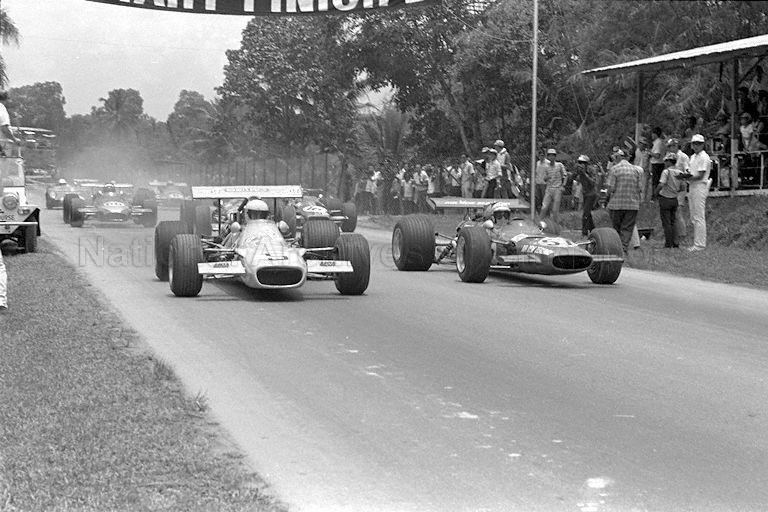
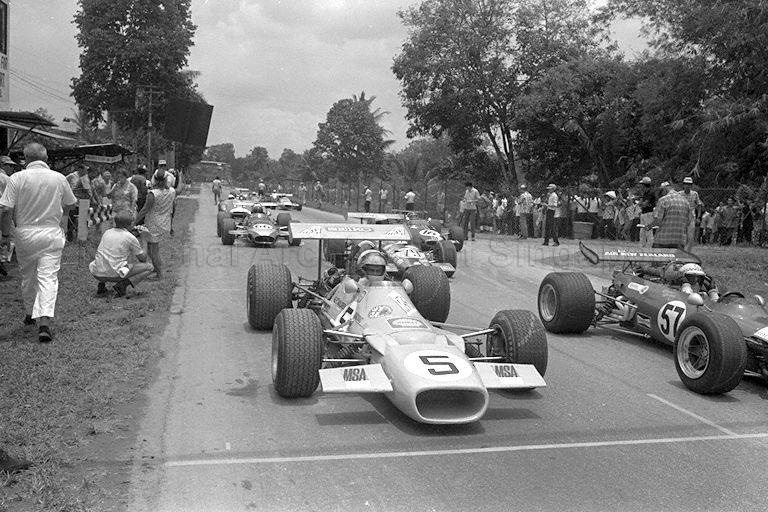
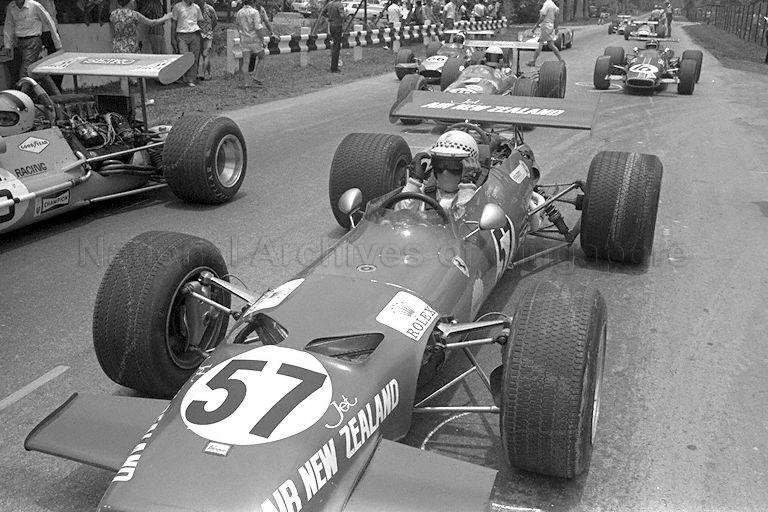
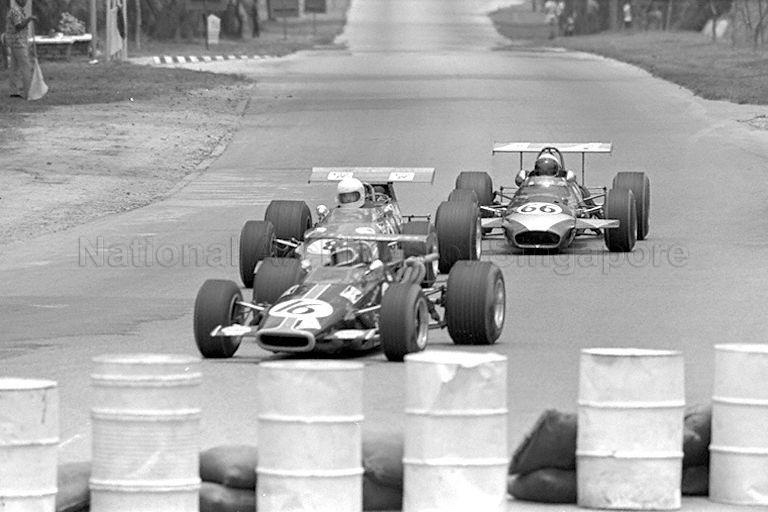
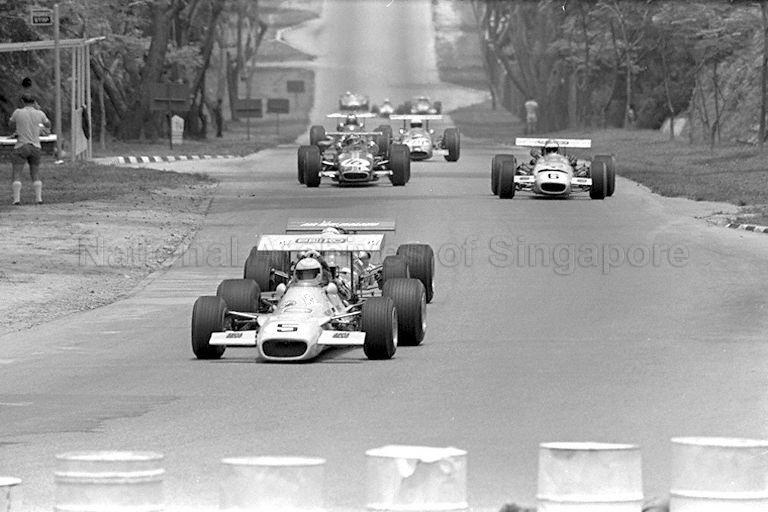
Bartlett and Lawrence on the front row with John MacDonald, Brabham BT10 Ford FVA, Hengkie Iriawan, Elfin 600C Ford FVA and Albert Poon, Brabham BT30 Ford FVA #66 behind. Lawrence won from MacDonald and Poon (SNL)From the other side of the road (SNL)
The issue is that, even with the knowledge of the European teams about these races, there was no interest in sending representatives to compete in these GPs. Why? Well, we can draw some assumptions about it: first, to mention the commitment to European F2, which already drained a large part of the resources; the calendar, which conflicted with some of the big races in Europe; and, more obviously, the cost and logistical problems of keeping these complex cars in such precarious locations as those in Malaysia, Thailand or Singapore.
Therefore, it was up to the region’s drivers to fill the grids of these races. As varied as the origins, as there were drivers from Australia, New Zealand, Malaysia, Hong Kong, were the cars that made up these grids. Even though ‘theoretically’ qualified as non-championship F1 races, most of them took place under Formula Libre regulations. So it was common to see F2 cars, modified F3 chassis, F5000 and Tasman Specs competing with each other in the late 1960s and early 1970s.
Following this script, we set the stage to the 1970 Singapore GP. After the great balance of the Tasman Series, which ended just a month before, it was expected that a large contingent of drivers who participated in that series would also participate in what was one of the great automobile events of Southeast Asia. And a great show was promised, especially with the tone of revenge that was publicized by the press: would the runner-up of the Tasman Series, Frank Matich, give the payback on Graeme Lawrence?
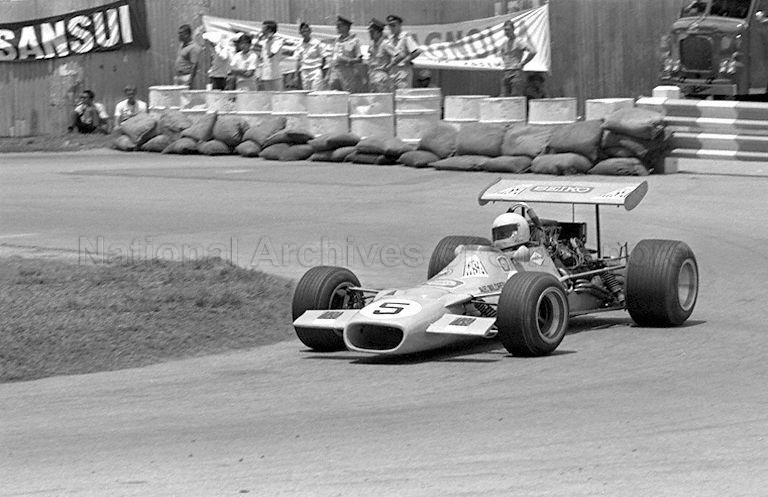
And the lift-off over the Java Sea really happened. The main drivers to confirm their presence were Graeme Lawrence, Frank Matich, Kevin Bartlett and Albert Poon; in addition to them, another eighteen pilots were registered in the GP’s preliminary list.
The main attraction was, of course, the newly crowned Tasman Series champion (and also 1969 Singapore GP champion) Graeme Lawrence and his Ferrari Dino 246T Tasman. With chassis number 0008, this was the same car that was “lent” to Chris Amon to compete in the Tasman Series one year before.
By itself, this car already had a rather peculiar history. Scuderia Ferrari loaned two chassis to Chris Amon to compete in the 1969 season of the Tasman Series: the 0008 itself, in addition to the 0010. With this loan, conditions arrived: the first was to have another official Ferrari driver in the second car; and the chosen one was Derek Bell. Another point is that the car would not be officially managed by Maranello, but by Amon himself, for the duration of the championship – but the results achieved would be attributed to Ferrari. (The cars were entered by SEFAC Ferrari (oldracingcars.com), were managed on-the-ground by Amon and Scuderia Veloce and the cars tended by a mix of Scuderia Ferrari, Scuderia Veloce and Amon’s longtime friend and personal mechanic, Bruce Wilson.)
The cars themselves were basically the same as those that contested the 1968 European F2 season and the Argentine F2 Temporada later in the year, the biggest differences being the engine, modified to a 2.4 -liter Tasman, and the expanded power boost, up to 285 bhp. Even with these modifications, and the great results achieved by the car in the last races of 1968, Chris Amon had doubts if this would be enough in 1969. To his own surprise, it was, and Amon himself became champion of the 1969 Tasman Series.
After this victory, the car did not even return to Europe (I think it may have been rebuilt by the factory and returned to New Zealand-Mark). Amon handled the sale of chassis 0008 to Graeme Lawrence, who continued Ferrari’s legacy in Australia and New Zealand after the team announced that after the 1969 edition, it would not return to the Tasman Series next year.
Frank Matich and McLaren M10A Chev before the high speed accident (E Solomon Collection)Hengkie Iriawan, Elfin 600C Ford FVA ahead of Allan Bond, car unknown (SNL)
Lawrence’s biggest challenger was the Australian Frank Matich, who had been runner-up in the 1970 Tasman Series (the difference between Matich and Graeme was only 5 points). He would drive a McLaren M10A, a car built to Formula 5000 specifications. With chassis number 300-10, the car would use a new 5-liter Traco-Chevrolet V8 engine. With strong sponsorship from the Rothmans cigarettes, Matich was arguably the main threat to Lawrence’s victory.
Kevin Bartlett was also another standout in the 1970 Tasman Series and was one of the big favorites for the race. Driving an English-built Mildren-Mono (nicknamed Yellow Submarine), he had achieved a string of good results earlier in the year, culminating in victory at Warwick Farm.
The last of the highlights was Albert Poon, a well-known driver on the Southeast Asian GPs, mainly for his appearances in Macau. Poon had one of the most advanced cars on the grid: the Brabham BT30. This model, which was one of the most used in European F2 between 1969 and 1970, would now have the chance to demonstrate its potential in the lands of the East.
Specifically, Poon’s car was an ex-Frank Williams, having been driven by Piers Courage and Richard Attwood in several races in Europe during 1969. At the end of that same season, the car was sold to Albert Poon.
Poon, Brabham BT30 Ford FVA at the Hairpin (unattributed)
The drivers began arriving in Singapore on March 25th. Upon arrival, the first concern was not about present events, but future ones. As a rumor circulated that the race would not be held the following year, and an appeal was made by the pilots: for the creation of a Grand Prix of South East Asia or a fixed series of races that could attract international interest.
Some participants even gave their opinion on the subject, such as Kevin Bartlett: “Most of them (pilots and teams) are not keen to spend big sums of money just for one race. If you have four held in a row, they will certainly be attracted”.
Frank Matich even suggested a union between the Australian Championship and this possible series of races in the region: “If the idea of the Far East circuit failed, then Singapore should go ahead to arrange a series of three races with Malaysia. This could in time join the Tasman Series”.
But the great demonstration of what the cogitated South East Asian Grand Prix might be could only be given on the track; and on the 26th, activities began on the dreaded Thomson Road circuit. Right in the first track reconnaissance session, Graeme Lawrence made it clear that he would not give his opponents any chance. He pulverized the track record, set the previous year, lowering it by 1.8s, establishing a time of 1’57”8.
Iriawan leads Malcolm Ramsay, Elfin 600C Repco V8 and Poon along the Thomson Mile (SNL)
With less than a second difference and setting the second fastest time, came Kevin Bartlett and his Mildren Mono Alfa Romeo V8. And the dominance of the Tasman Series drivers did not end there, because Max Stewart, in a characteristic Mildren-Waggott 2-litre, managed to snatch the third position, closing a lap in 1’59”6 (same time as the 1969 record). With two drivers beating the track record and another equaling it, it was soon demonstrated that the 1970 edition would be one of the fastest in the history of the circuit.
And that speed almost proved fatal on the first day, when Frank Matich lost control of the car at more than 257 km/h and ended up in a tree, near a bus stop. According to what the pilot reported at the time, when leaving the first part of the Thomson Mile and going over the Hump, the car went out of control due to the track condition, which was extremely slippery as a result of a light drizzle that was falling on the circuit. Without being able to do anything, the driver simply became a passenger in his own car.
Fortunately, the pilot was completely unharmed from the accident; the same cannot be said of McLaren, which had the front almost ripped off due to the impact. At the time of the accident, the driver had the fifth best time, but the crash basically ended Matich’s chances of trying to duel with Graeme. It was now up to Rothmans’ team of mechanics to try to get the car in the best possible shape for the next day’s official time stamps.
The 27th arrived and with it, a phenomenon so common on the island of Singapore: the traditional tropical storms in the afternoon. Weather conditions became so adverse (even by local standards) that all activities on the circuit had to be cancelled.
Bartlett and Lawrence hard at it (SNL)
The one who was grateful for the downpour was undoubtedly Frank Matich, who had already accepted his fate of starting in the last position of the grid; but now, with one more day to prepare the car, the pilot believed that his mechanics could put the McLaren in conditions to dispute the victory again.
The 1970 Singapore GP would be held in 2 heats: the first, on Saturday (28), would be a more sprint race, with 20 laps. On the following day, Sunday, the other 40 laps would be carried out, making a total of 60. For the final result (and the title of Singapore GP winner), only the outcome of the second heat would be taken into account.
Some of the drivers were not very fond of this dispute format, mainly because it favored certain cars over others. For example, Albert Poon highlighted how his Brabham would have an advantage over the monstrous Australian engines, if the dispute was held in only one-full heat: “My car is specially fitted with a 21-gallon tank which is more than sufficient to last the race without refueling”.
Liking it or not, the riders lined up on the grid for the first heat. The starting order was defined by the times of the free sessions: therefore, Graeme Lawrence and Kevin Bartlett were the ones who opened the grid, followed by Stewart, Matich, MacDonald and Poon.
With the checkered flag lowered, the cars shoot off on the 4,865-metre circuit. It quickly became clear that the fight would be between the two Italian-made engines: Bartlett’s Alfa Tipo 33 2.5 V8 and Graeme’s Dino/Ferrari 2.4 V6.
But Graeme had a scare on the second lap, when the driver missed the braking point on the Range Harpin and ended up on a spin. Nothing to worry about, as both the car and the pilot emerged unscathed; so, Graeme resumed his hunt for Bartlett.
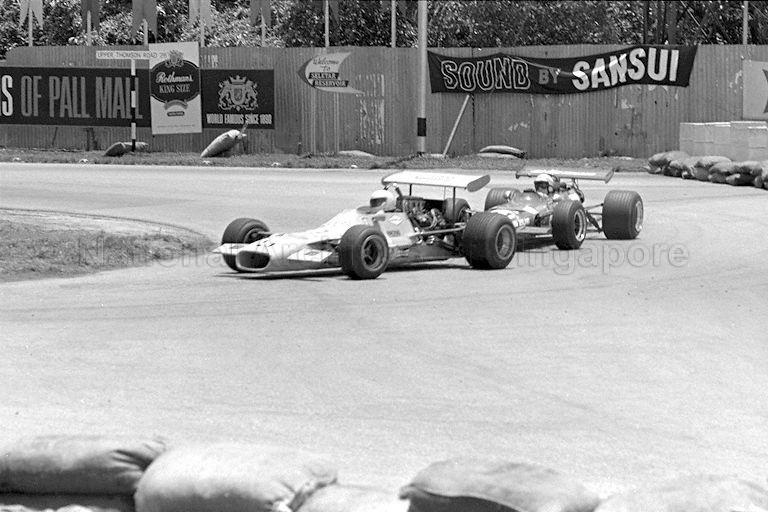
Ramsay presents an opportunity for Poon on the inside, Elfin 600C and Brabham BT30. The battle for third/fourth was won by Poon (SNL)
Right behind, a compact group was formed, involving Mike Heathcote (Singapore), John MacDonald (Hong Kong), Albert Poon (also from Hong Kong) and Hengky Iriawan (Thailand). On the second lap, these drivers would provide another one of the remarkable moments in the history of the Thomson Road circuit.
On the Thomson Mile (that’s right, almost in the same place as Matich’s accident), Mike Heathcote was trying to overtake Albert Poon. The Singapore driver, equipped with a 1.6-liter Brabham-Ford Twin Cam (Formula Libre), forced the overtake too much, skidding with the car and stopping only on trees that that dotted the sides of the circuit.
The car broke in two due to the collision, with the engine block disappearing in the middle of the dense forest that surrounded the track. Again, to the relief of the audience, the pilot left the accident almost unharmed.
As such accidents were common at the circuit, the race continued. Frank Matich, who owed a lot to the Rothmans team of mechanics, after the superhuman work of rebuilding the car in just two days, looked like he could get a reasonable finishing position in the Saturday heat race, to give all he could on Sunday. But that idea soon fell apart.
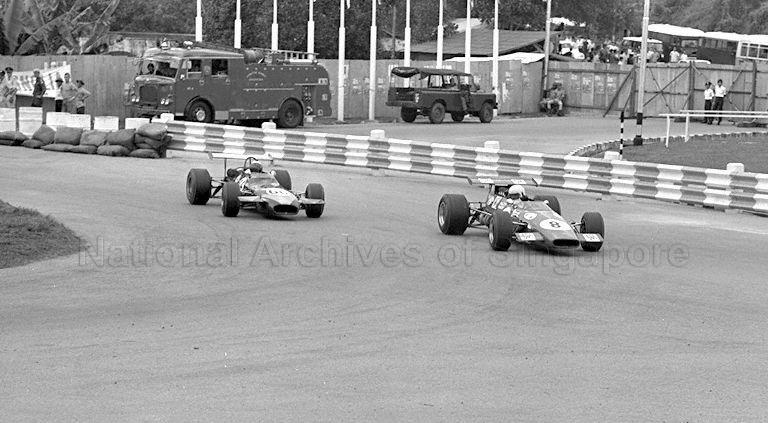
Bartlett with Lawrence right on his tail, then KB’s teammate, Max Stewart, Mildren Waggott, Iriawan, MacDonald and the rest (SNL)
On the third lap, the Australian faced his first problem, with a puncture. No big deal, this being quickly circumvented. But five laps later, a terminal problem spelled the end of any hope, as the engine gave its last breath and died.
Another one who was also struck by bad luck was Max Stewart: on the same lap that Matich made his tire change, Stewart’s Mildren-Waggott also refused to continue going forward, since his engine also had terminal problems. In the end, the pilot, who had scored the third best split time in mid-week practice session, had to abandon the race.
So with two of the top four drivers out of action, the battle for the victory would be decided between Bartlett and Graeme. Lap after lap, the duo pulled further away from the rest of the pack, with both lapping the rest of the grid.
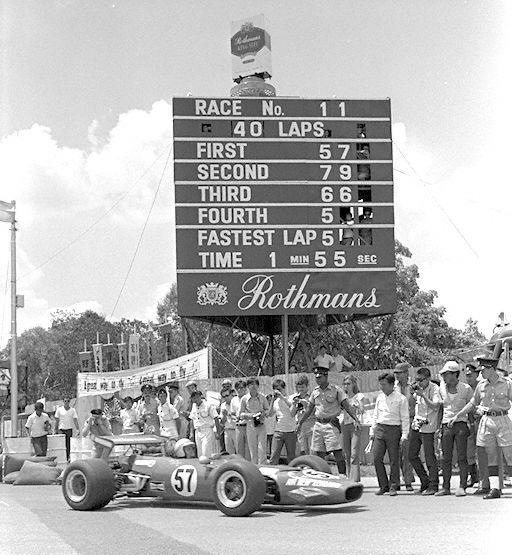
With great skill, Bartlett used the power of the Mildren-Alfa V8 against the nimbler Ferrari. And so it was, managing to slowly open up an advantage, which reached nine seconds when the final checkered flag dropped. In addition to securing pole position for Sunday and relegating Ferrari to second place, Bartlett set a new track record: 1m55’8.
Iriawan in the Elfin 600C Ford FVA, car extant and currently being restored in Sydney (unattributed)
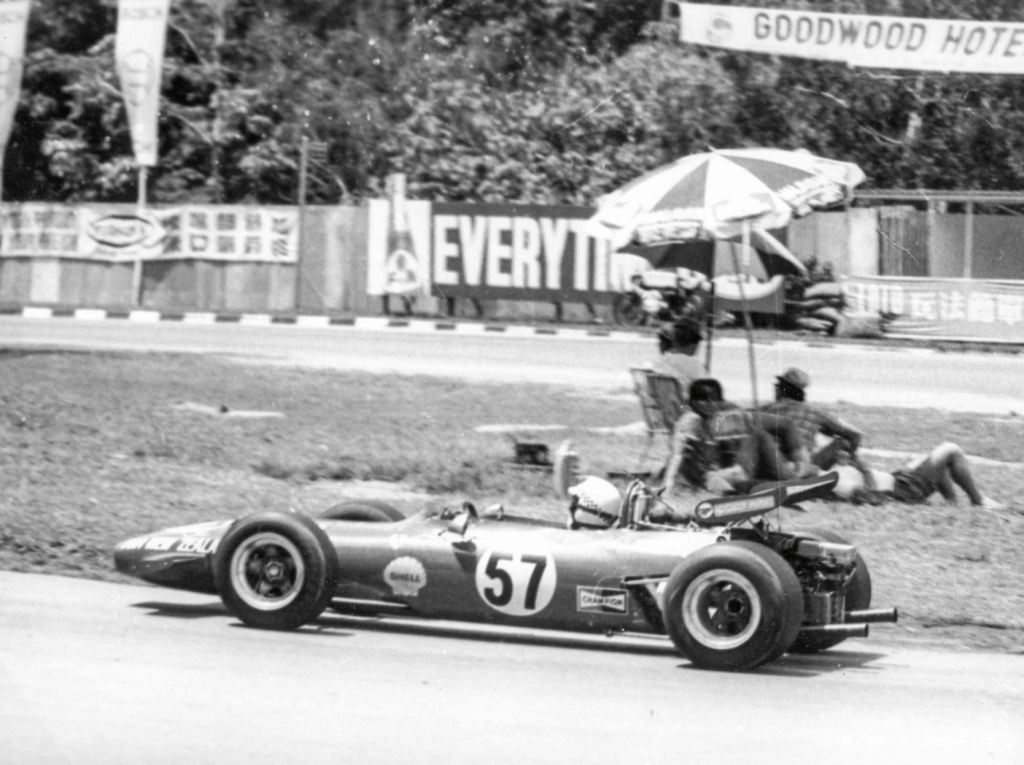
One lap behind, therefore, came the other classifieds: John MacDonald (Brabham-Cosworth FVA BT10/23C), Albert Poon (Brabham-Cosworth FVA BT30), Hengky Iriawan (Elfin-Ford Cosworth FVA 600C), Chong Boon Seng (Lotus-Cosworth 41) and Steven Kam (Lotus-Ford 23B Twin Cam).
But there was no time to celebrate and the next morning the cars lined up again on the starting line, for the race that would really define the winner of the 1970 Singapore GP.
The grid was slowly decimated by the fatigue of the long week that preceded this heat: among the drivers who did not show up on the decisive day, of the cars that were victims of accidents, mechanical problems and other failures, only 10 would start on Sunday. Even with this number much lower than expected, that did not stop the public from invading the Thomson Road circuit. According to some press reports at the time, there were about 100,000 people on the sidelines of the track on that Sunday morning.
Start, and the grid quickly pulverized into two small groups: Bartlett, Lawrence and Max Stewart (who had managed to fix his car overnight) took the lead, while MacDonald, Poon and the other drivers disputed the middle positions of the grid.
Bartlett led from the start and had a 3-sec lead from Lawrence when his Alfa V8 cried enough with 3 of the 40 laps to run (SNL)
In the first laps, Graeme Lawrence spun his car again. But, as if the script was repeating itself, it was nothing that affected the performance of the pilot. In less than five laps, the driver and his Ferrari had already reached the top two again; and on the tenth lap, Lawrence had already recovered the second position, when he overcame Max Stewart.
And Graeme’s momentum didn’t stop there. With the very strong race pace that was being set by Bartlett, the Ferrari became the only car that could catch the Mildren-Alfa. And so began the chase, which would last for most of the race.
Bartlett piled up faster and faster lap times, managing on the 27th lap to set a new track record: 1m55’5. Graeme answered, keeping close to the pilot of the Mildren.
Max Stewart sought to protect himself, accepting the third position – he didn’t have the car to compete with the leaders, but also, wasn’t threatened by the drivers that came further behind. But even going at a cruising pace doesn’t mean reaching the end of the race: during one of the laps, the pilot became distracted in the Long Loop, where lost control of the car and ended up in the middle of the trees. End of race and goodbye podium.
Graeme Lawrence on the way to another win in Ferrari 246T #008 (SNL)
So, the race was summed up between the Bartlett vs. Lawrence battle. And luck again laughed to the last. When the Ferrari driver had reduced the gap to less than 2 seconds, Lawrence saw when Bartlett had to pit, on the 37th lap. He didn’t know it, but the Australian’s Alfa engine had overheated, due to the sweltering conditions of the Singapore.
So, without competition and with only three laps to go, the driver had no trouble leading Ferrari to another victory (the second with him at the wheel, if you count his victory in Levin). Two laps behind came the drivers who would complete the podium: John MacDonald and Albert Poon, second and third, respectively.
Graeme Lawrence was crowned winner of the Singapore GP once again. The pilot had made a high stakes gamble on the race: according to what he told in an interview to The Straits Times a month later, he managed to take only one chassis and one engine to Singapore! Because of this, the pilot accepted second place in the first heat, and then waited for the opponent’s error (or car failure) in the second. We can say, apparently, that the strategy paid itself off in the end…
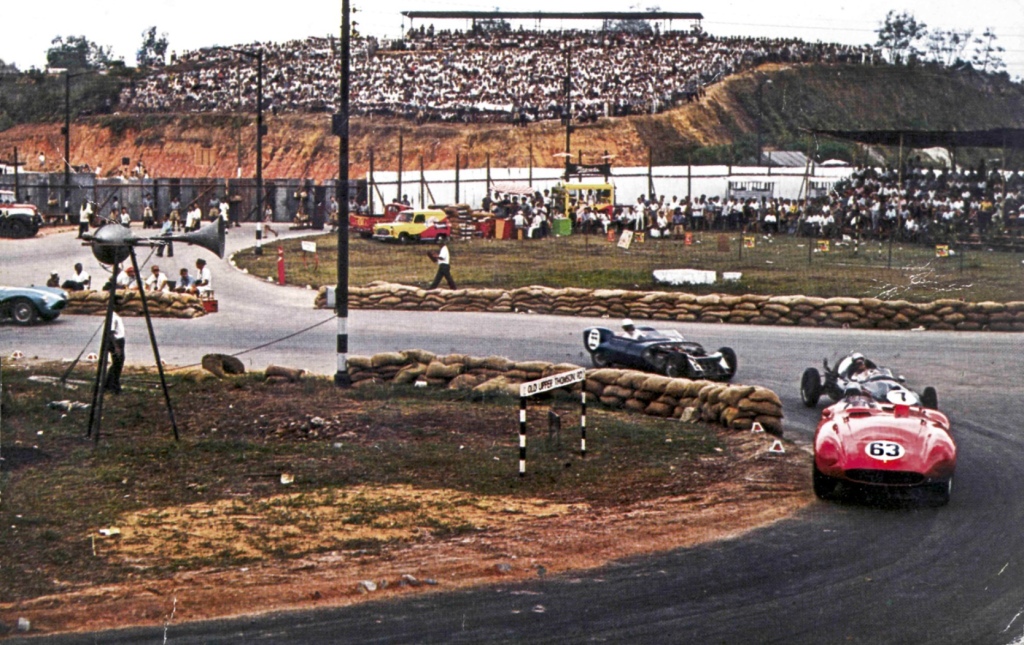
(SNL)To the victor the spoils, Graeme Lawrence (SNL)Jan Bussell’s Ferrari Monza leads the first Singapore GP in 1961. Giving chase are the Peter Cowling Cooper T51 Climax and Saw Kim Thiat’s Lotus 11 Climax. The nose of Ian Barnwell’s Aston Martin DB3S is at far left (E Solomon Collection)
Thomson Road : A distant memory in a forgotten past…
If the 1960s were marked by the technological development of competition single-seaters (mainly in F1, F2 and F3), we can say that the 1970s were marked by another transformation: the increase in concern about the safety of circuits.
Venues like Piccolo delle Madonie, Nurbürgring Nordschleife, Spa-Francochamps and many others would have a hard choice to make: adapt to the new times, or have to say goodbye to their racing times. While certain tracks did manage to make modifications that would guarantee a minimum of safety for pilots and spectators, others never reappeared. A major ‘purge’ ended up happening in the 1970s – nostalgic people can say that this was tragic for the history of motorsport; realists might say it had to be done, for the sake of the survival of the sport in a long-term.
If the blow was hard in Europe, where a large portion of the tracks had traditional events, with sponsors and captive audiences, one cannot even imagine how this was felt in the most peripheral parts of the racing world.
In this category is the Thomson Road circuit. Opened in 1961 for the Orient Year Grand Prix, it quickly became one of the most prestigious events in the Formula Libre racing series in Asia. When Singapore became independent, the venue gained even more prominence and importance, and in 1966 it was rebranded the Singapore Grand Prix.
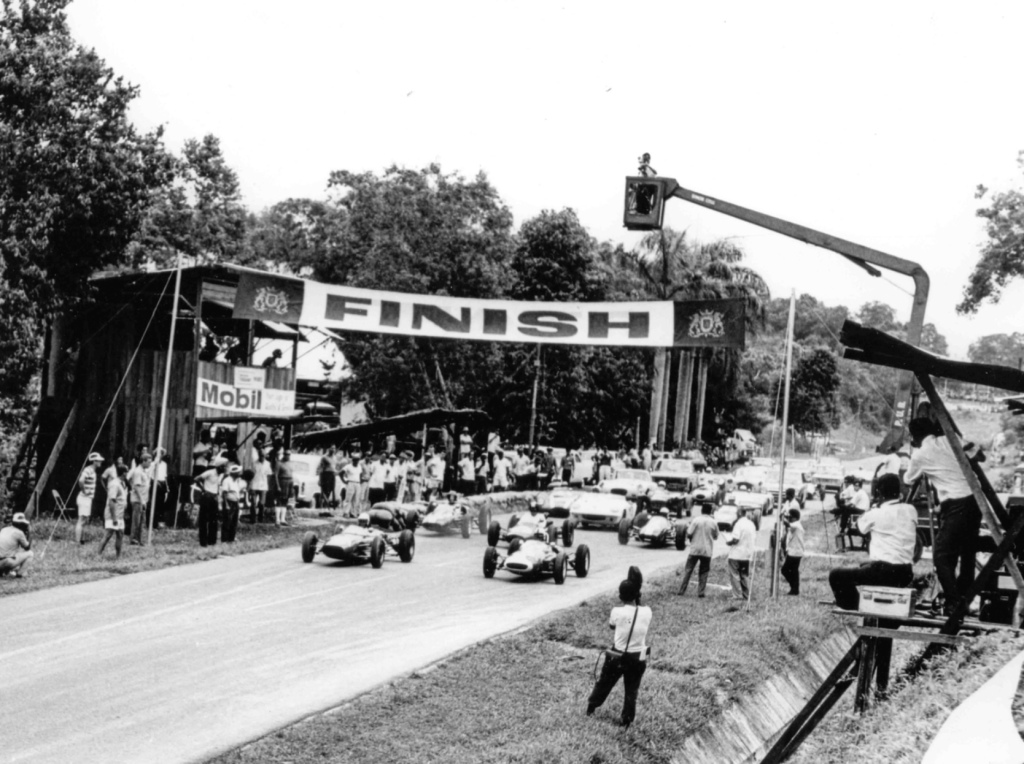
Start of the 1966 race.eclectic mix of single seaters, sportscars and sedans including the pre-war ERA R2A (E Solomon Collection)Rodney Seow ahead of the rest of the 1964 grid, Merlyn Mk5/7 Ford. The race was red-flagged after 7 laps (E Solomon Collection)
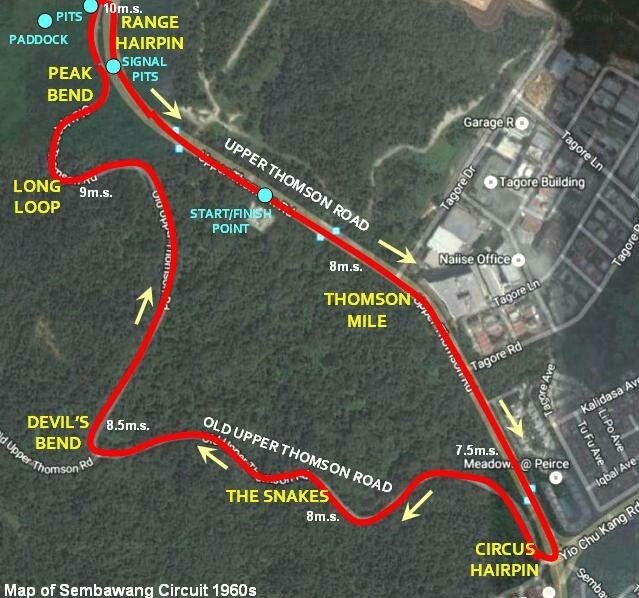
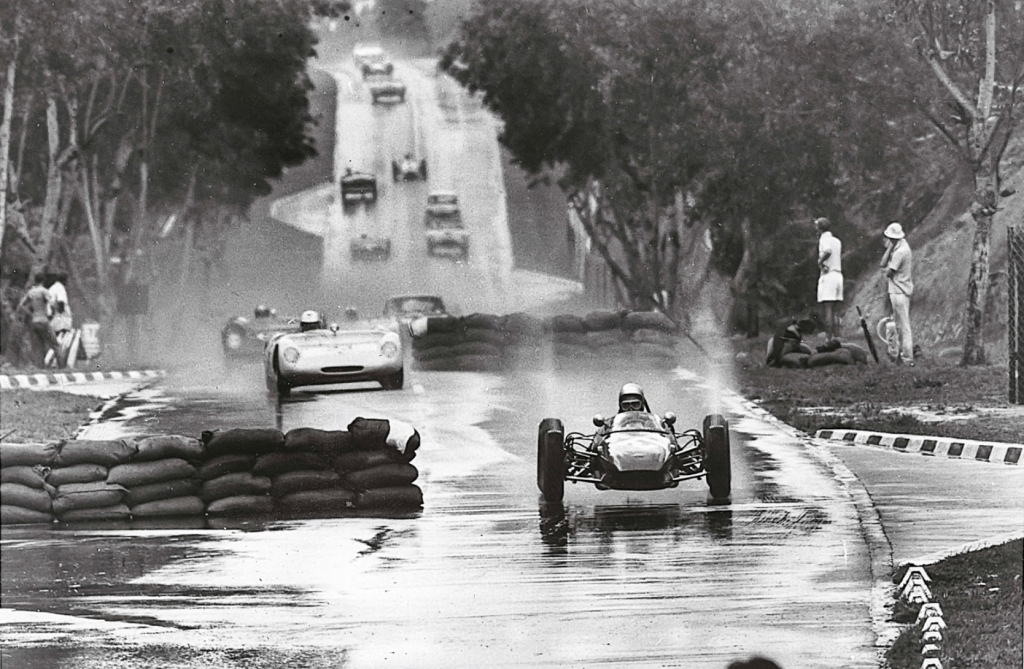
The circuit, just under 5km long, gained fame for its winding, fast and extremely dangerous layout. The track started at the Thomson Road (a.k.a. the Murder Mile), which is one of the most important roads in Singapore. The Mile was spilt in two, by the Hump, a fast right uphill turn, with a false apex on its turn-in.
The second part of the Mile ended abruptly at an elbow, known as the Circus Harpin. After this turn, the drivers began a slight access, that led to the most sinuous part of the circuit: first the 4-sequence of bends known as The Snakes, then the Devil’s Bend curve; this was the entrance to another long radius turn, which was bound for the Long Loop and Peak Bend turns. After that, the pilot was almost at the entrance to the pits and at the end of the lap, which was outside the Range Harpin.
Racing at Thomson Road circuit lasted until the mid-1970s (the 1974 edition was canceled at the last minute), when it became clear that the track was woefully out-of-date compared to other venues in the region. In just 11 years of operation, 7 people died on the circuit – not mentioning so many other terrible accidents, in which pilots and spectators miraculously left unharmed or with only minor injuries.
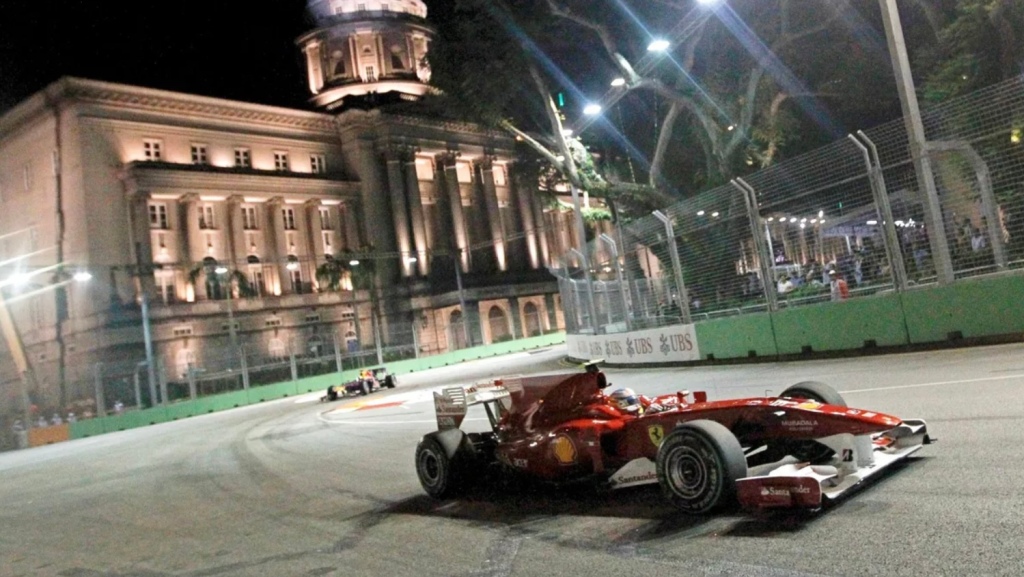
Thomson Road was a victim of its time and circumstance, like so many circuits of the past. Only 35 years later, a GP for single-seater cars would be held again in Singapore. And it would take 40 years (1970 with Graeme Lawrence / 2010 with Fernando Alonso) for a Ferrari to return to the highest place on the podium in the Island-State.
Fernando Alonso on the way to 2010 victory in a Ferrari F10 (eurosport.com)
Acknowledgments…
The Straits Times (editions from 24 March to 20 April 1970), The Eastern Sun (editions of 29 and 30 March 1970), Singapore National Library / NLB for the Photos, OldRacingCars.com for some extra data, ‘Snakes & Devil’s: A History of the Singapore Grand Prix 1961-1973’ Eli Solomon, MotorSport Images, Eurosport.com
Bill Brown in the Scuderia Veloce Ferrari 350 Can Am – aka P4 – at Bathurst during the 1968 Easter meeting. Such a marvellous evocative shot of the most seductive of cars.
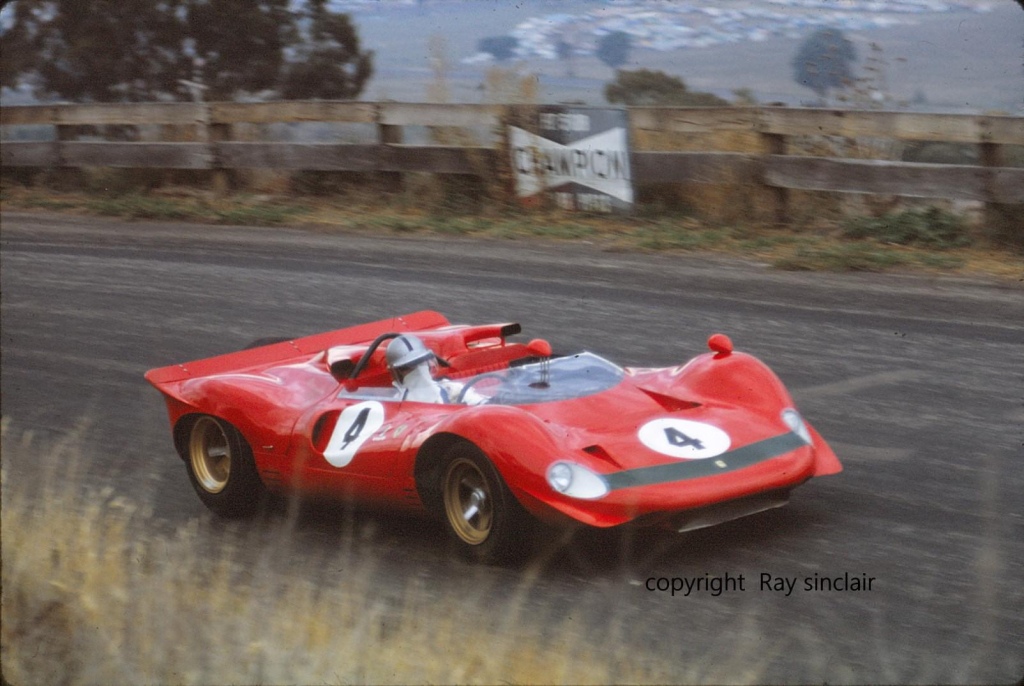
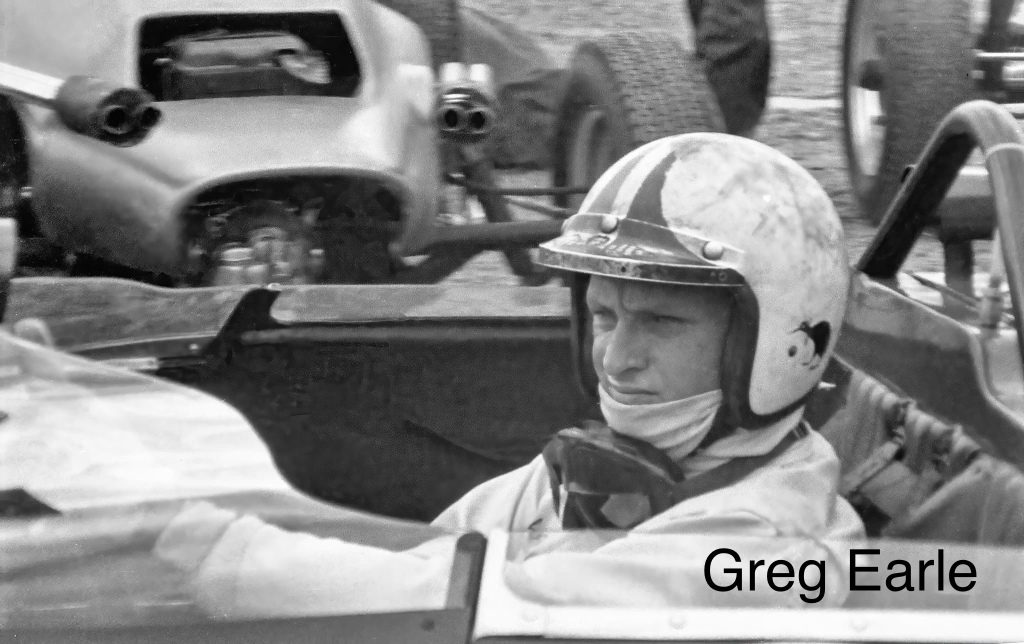
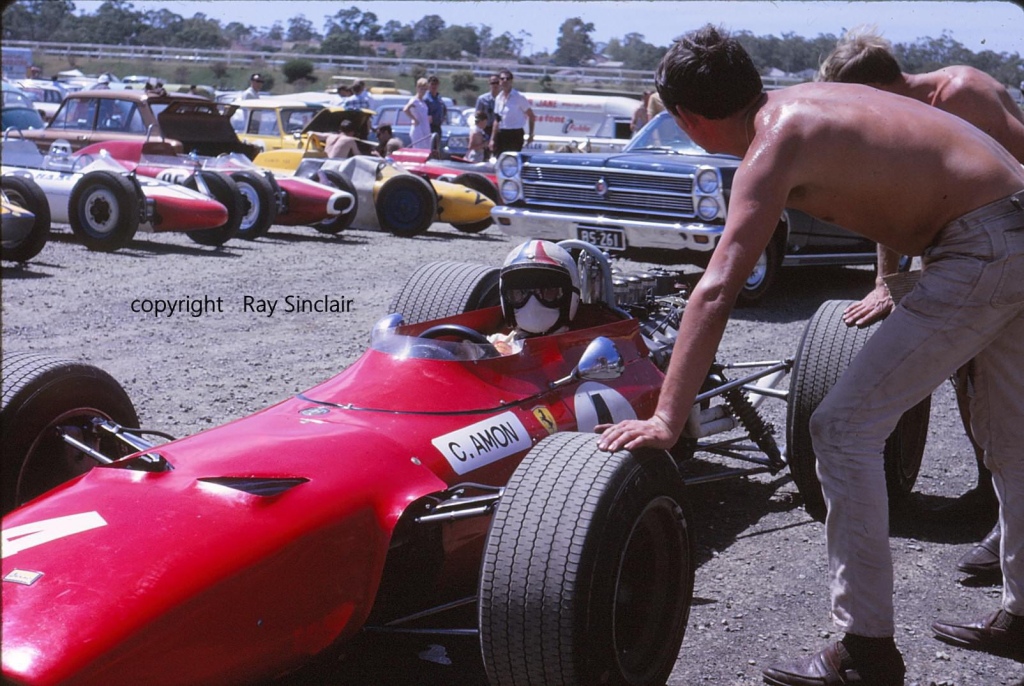
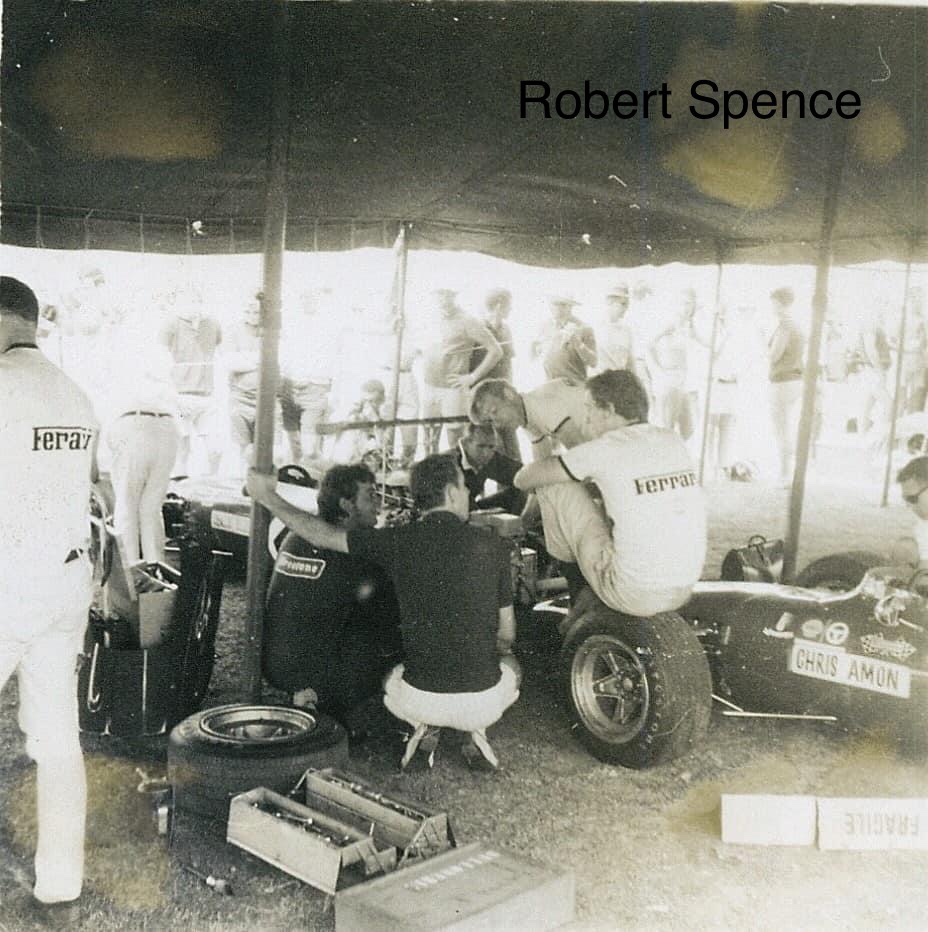
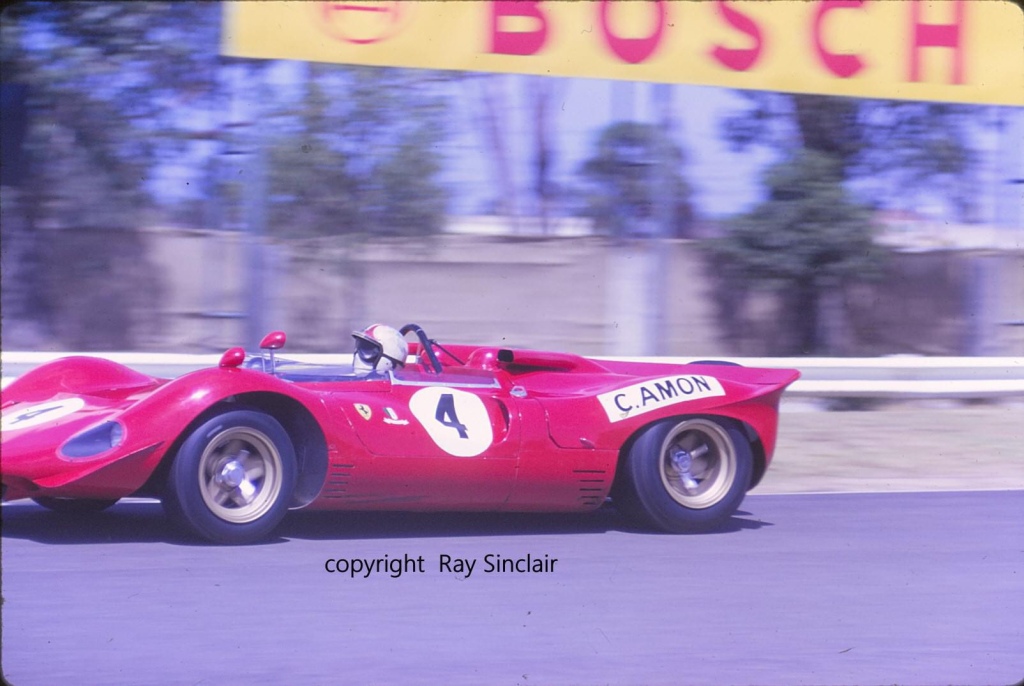
In the space of a week photographs popped up on Bob Williamson’s FB site on Scuderia Veloce topics from three different photographers, Ray Sinclair, Greg Earle and Robert Spence.
In the shot below the scowling Kiwi is motoring through the Sandown paddock, perhaps miffed that his 4.2-litre 480bhp V12 was beaten by Frank Matich in the Sydneysider’s 4.4-litre Repco V8 powered Matich SR3. See here for a feature on this Ferrari; https://primotipo.com/2015/04/02/ferrari-p4canam-350-0858/
Chris Amon at very sunny Sandown earlier in the year aboard his Ferrari 246T, with a line of Formula Vees behind, with Bib Stillwell arriving at the circuit in the Ford Galaxie.
Chris just failed to pip Jim Clark in the closest of finishes in the Sandown Australian Grand Prix Tasman Cup round the following day, the official margin was one-tenth of a second. With that the Scot took both his last final GP and championship win – the Tasman Cup – aboard his works Lotus 49 Ford DFW. See here for a piece on that weekend; https://primotipo.com/2021/03/06/1968-australian-gp-sandown-2/
350 Can Am in the Sandown paddock. The #7 Brabham is Greg Cusack’s SV machine, the BT23A Repco raced by Jack Brabham the year before. Quickie on the BT23A here; https://primotipo.com/2017/01/04/scuds/
On the blast past the old pit-counter at Sandown, paradise for a young enthusiast, with the V12 howling its fabulous song in third gear.
Amon was given the short back-and-sides by Frank Matich’s Matich SR3 Repco V8 at the three meetings they met in the sportscar Tasman Cup round supports that summer; Warwick Farm, Surfers Paradise and Sandown. I wonder why FM didn’t take the SR3 to Longford to bag the Quadrella?
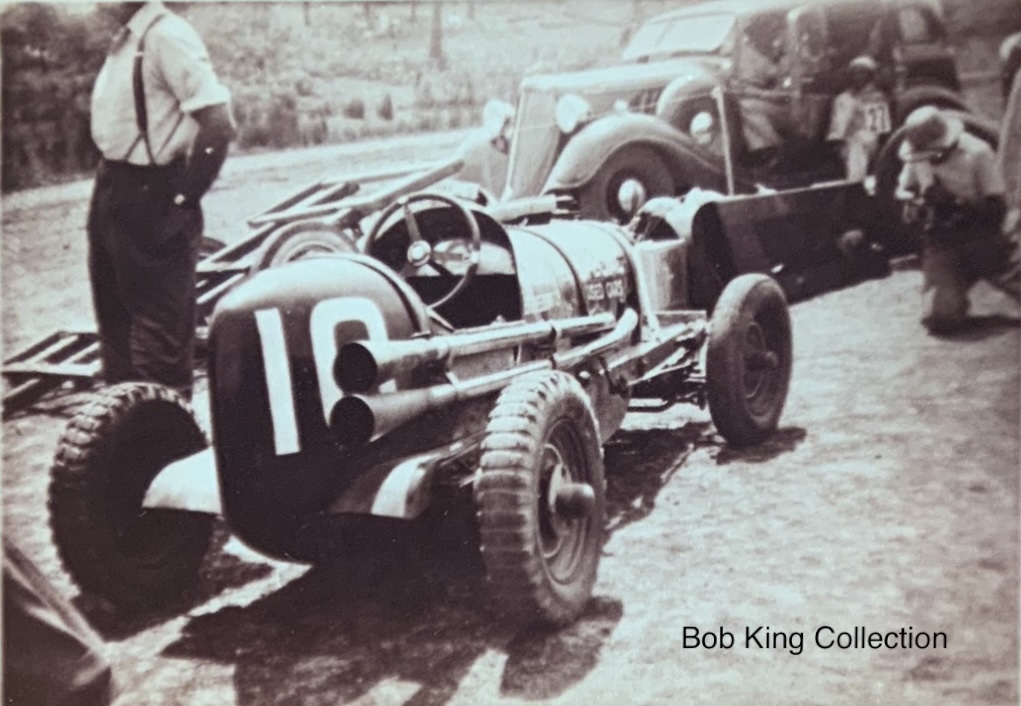
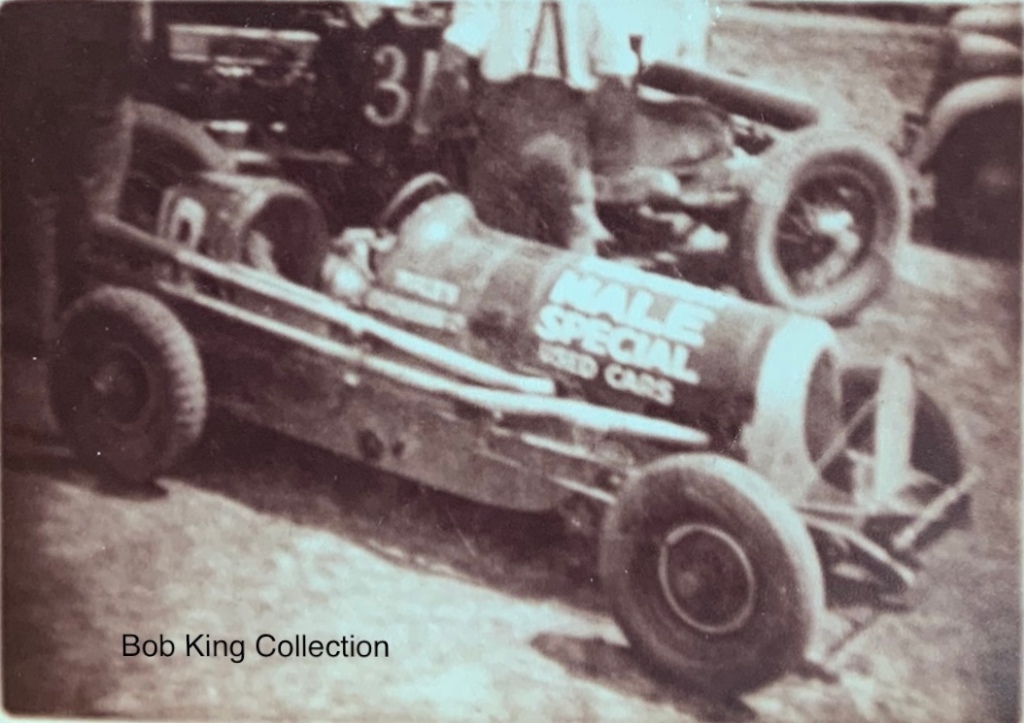
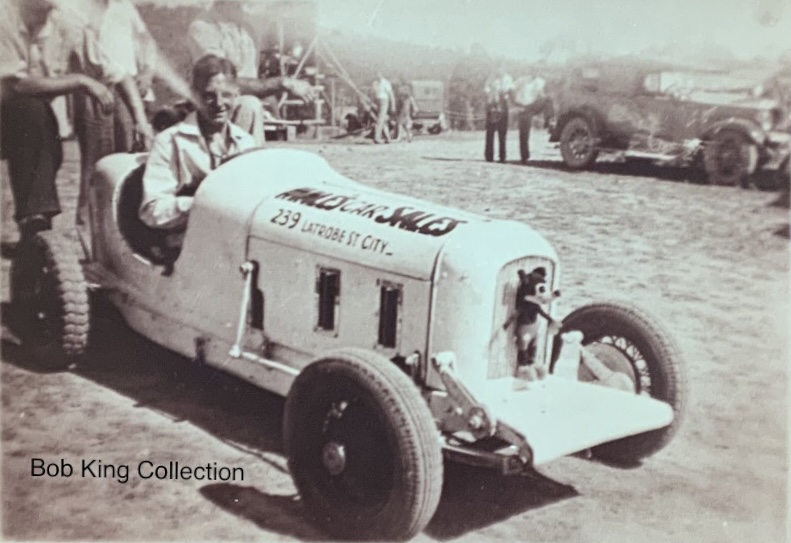
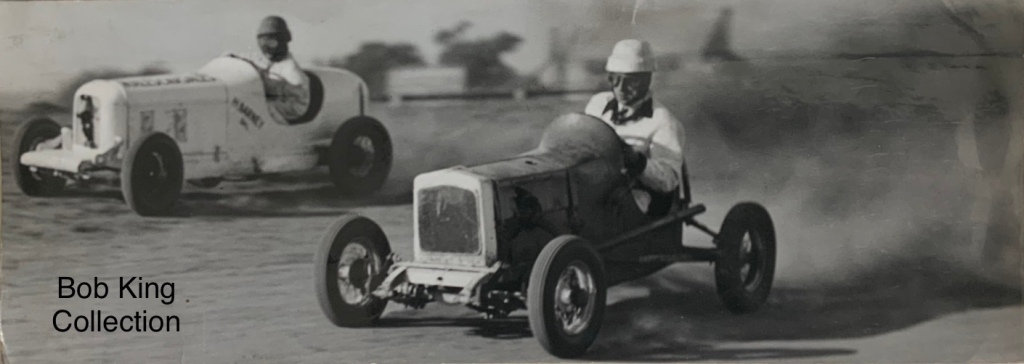
Not so much special, but three specials sponsored by Melbourne car dealer, Alan D Male and raced by Ted Gray in the immediate pre-WW2 years.
One was the JAP engined speedway midget above, the next a buggered-if-I-know powered midget and the third, Alta 21S, ex-Alan Sinclair/Bill Reynolds, and by then Ford V8 powered.
Male operated yards at 233 and 239 Latrobe Street, Melbourne named Males Car Sales and AD Male Car Sales respectively. This seemingly successful business man was important in the rise and rise of Tiger Ted pre-War, his final push into the top rank was provided post-War by Lou Abrahams.
Gray gave the visiting Peter Whitehead’s ERA B-Type a serious run for his money in the midget above during meetings at Aspendale Speedway and Rob Roy hillclimb in 1938. Leon Sims tells us that in the meeting above, Rob Roy 5 on November 20, 1938, that Gray set the FTD 0.5 seconds outside the hill record set by Whitehead only five months before. In the process “he set the committee of the Light Car Club of Australia scratching their heads in concern over the suitability of a car designed for midget racing, taking the award on their hill. It was not seen as a ‘proper car’ in their eyes.”
When Jack Brabham raced his midget at Rob Roy post-war he had the same problems but went to Sydney, fitted some brakes to his car, and returned to take the Australian Hillclimb Championship at Rob Roy in 1951. Up yours Blue Blazer Officialdom, or something like that!
This is the ‘other midget’, a rare shot with car owner Alan Male at the wheel at Rob Roy 5, he did a time of 31.5 seconds. I’d love to know the builder and specifications of this car. If Mickey Mouse seems an odd radiator-shroud fear not for the little-fella, he seems to have been adopted by the team as a mascot, he is present on the team’s Alta 21S Ford shown further below.
Ted Gray on the outside of A ‘Stud’ Beasley (as in head stud or babe-magnet?) at Aspendale in August 1938, with Mickey still hanging on for grim life. I’m rather hoping some of you may be able to tell me a little more about Alan Male in order that we can put it on the public record.
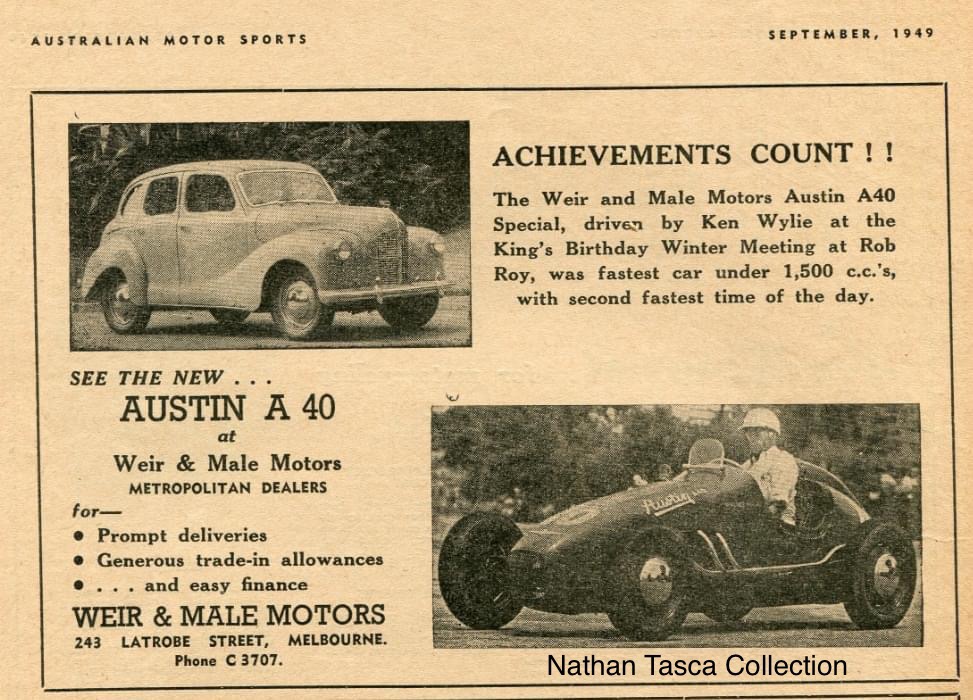
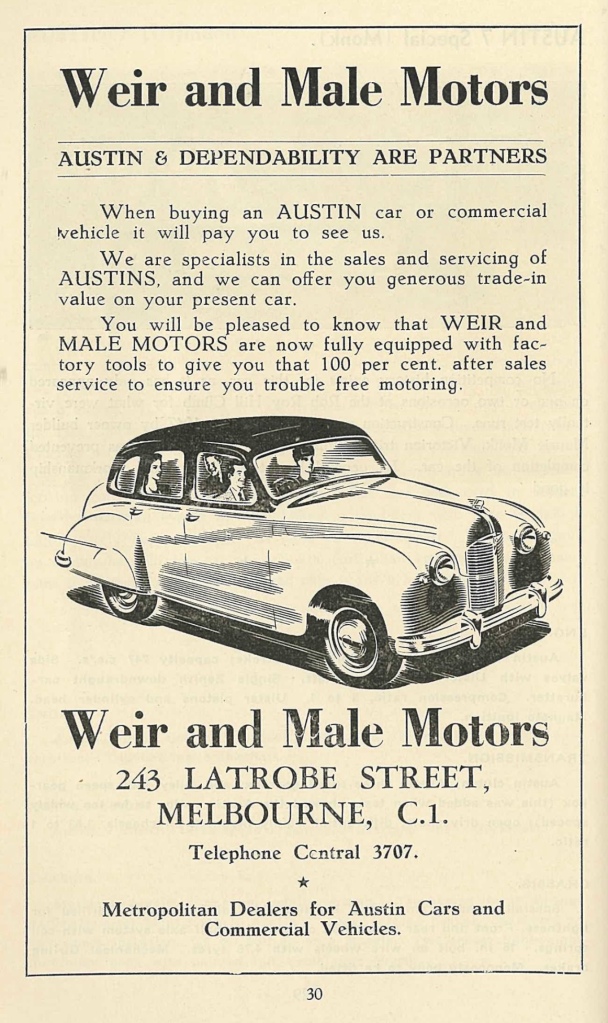
Nathan Tasca’s research shows he was still trading in cars post-War, as Weir & Male Motors at 243 Latrobe Street, familiar territory for him! He still maintained his interest in motor racing, note the AMS advertisement below. The wording of the ad, and coverage of the car in the Motor Manual 1950-51 Australian Motor Racing Year Book confirms the car was built by Ken Wylie for Weir & Male Motors, Austin dealers, and was driven by Wylie.
(Photographer-Byron Gunther)
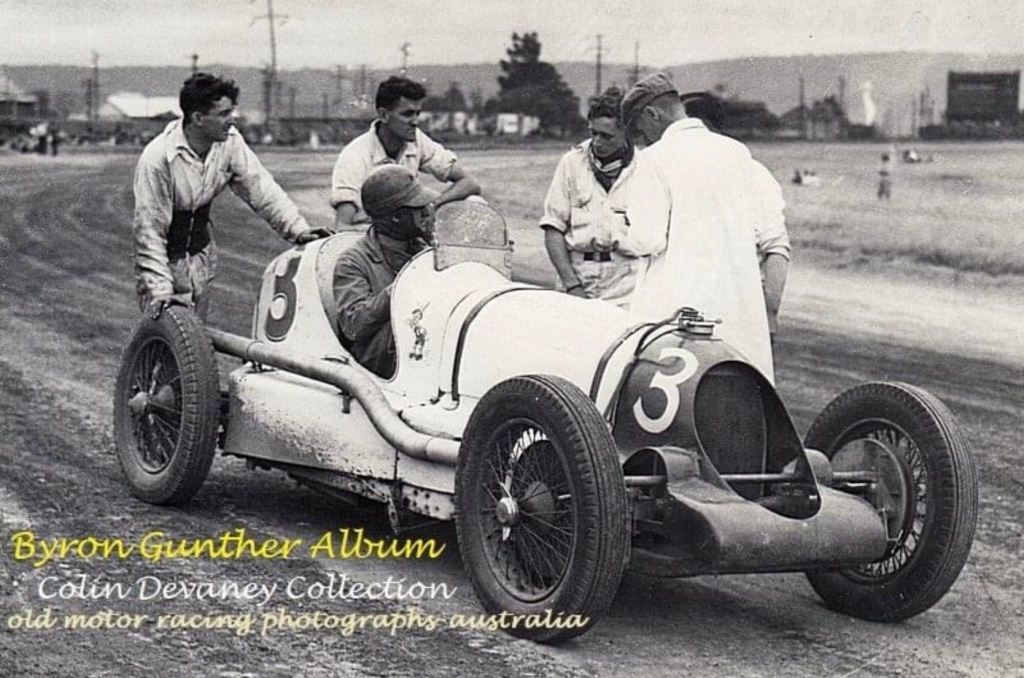
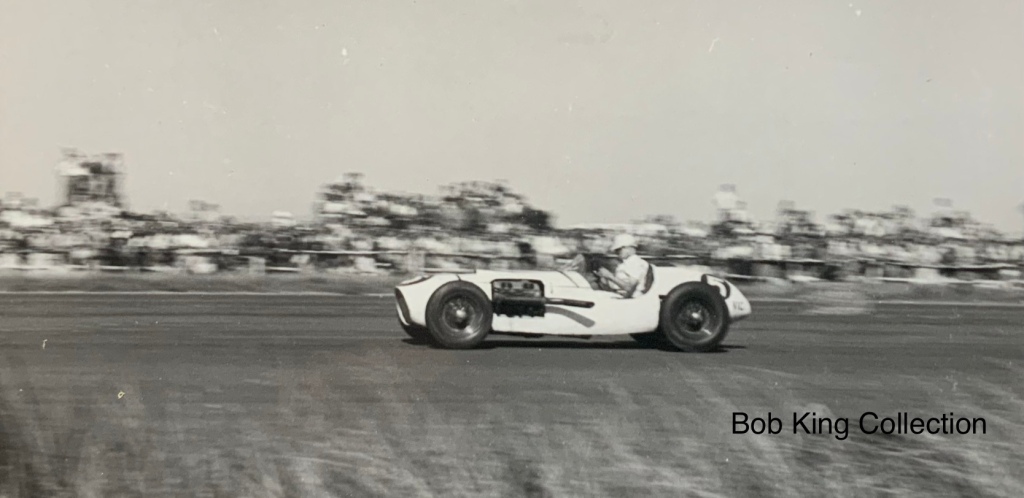
The final Male Special/Ford V8 Special – it was entered in various names – is most correctly, using the modern – make-model-engine manufacturer – ‘racing car description protocol’ Alta 21S Ford V8. Here Ted is considering proceedings with his crew and officialdom at Penrith Speedway, NSW in 1940.
While built as a road racing racing sportscar, and modified by Sinclair’s team in the UK before coming to Australia as a road racing 1100cc supercharged single-seater, the car performed well both on the roads and on dirt speedways, as here. The car was raced well into the war years, Gray in the Male Special V8 beating S Bail’s Midget V8 in a 3 lap match race at Aspendale on Sunday January 19, 1941, his final entry March-April ’41. Picking up the Austin connection, Tony Johns tells me S Bail was a partner in the Bail Brothers Austin sub-agency (Stan and Wally) in Hampton Street, Brighton in the 1960s.
By the way, the little dude on the scuttle of the Alta is Pinocchio not Mickey Mouse…there is a story there, but what is it? I know, Walt Disney was so impressed with Ted’s performances he was slipping a few greenbacks Male’s way…
Motor Manual 1950-51 Yearbook via David Zeunert Collection
Credits…
Bob King Collection, photos perhaps taken by Ted Hider-Smith, The Argus January 20, 1941, David Zeunert Collection
Tailpiece…
Tiger Ted aboard the very new Tornado 1 Ford V8 at Fishermans Bend in early 1955, date please (car #5).
When the shortcomings of Alta 21S finally became apparent after Lou Abrahams’ big-brawny Ardun-Abrahams head Ford V8 was dropped between its chassis rails the Abrahams, Gray and Mayberry team built Tornado 1. This car’s short life ended when Gray had a huge accident at Bathurst in October 1955 after brake dramas, see the articles linked above for the details.
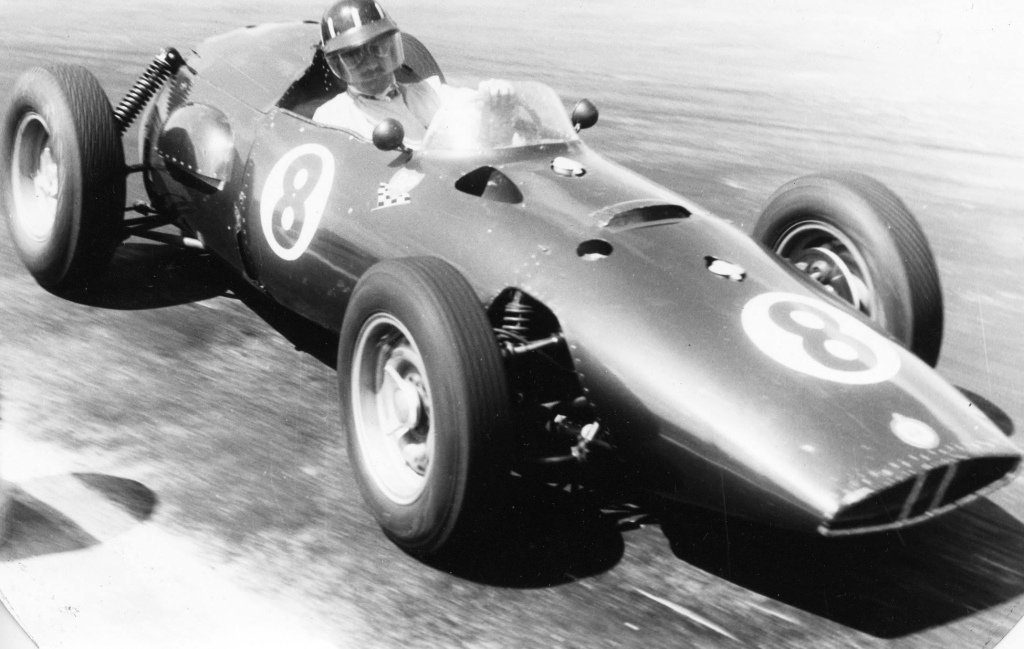
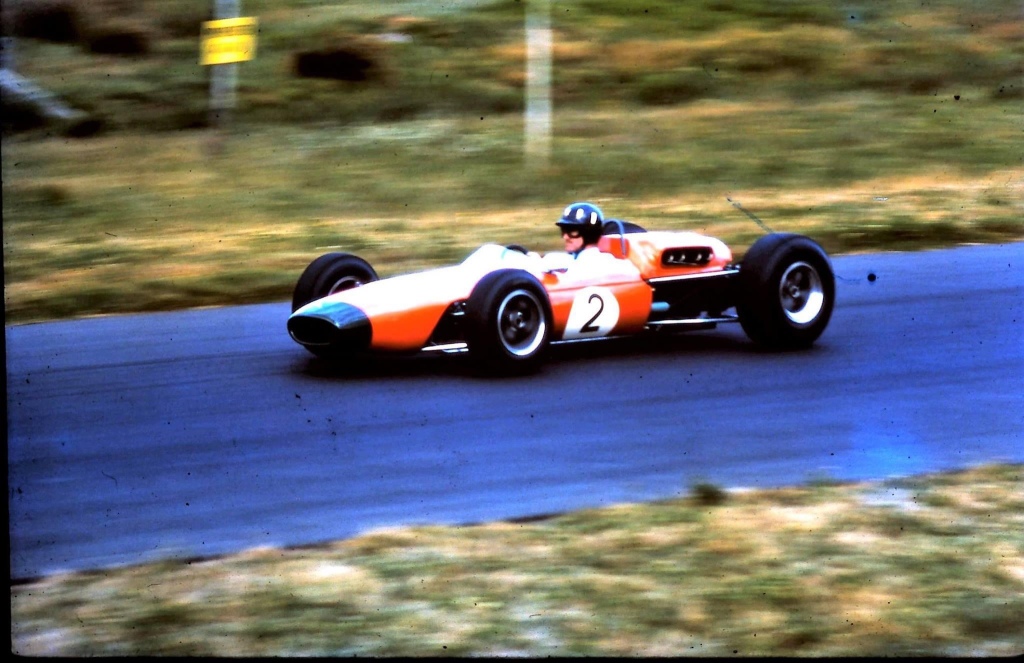
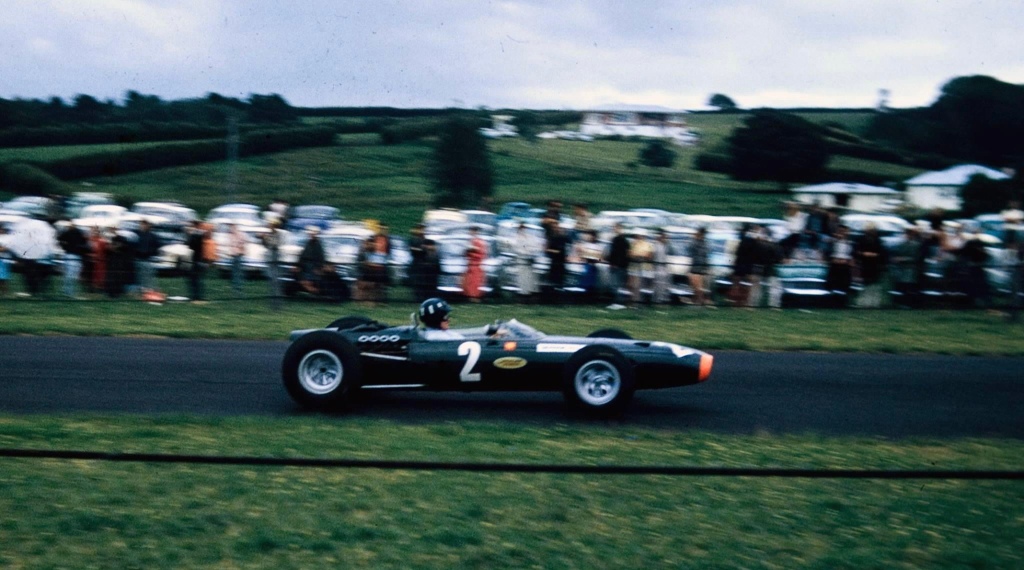
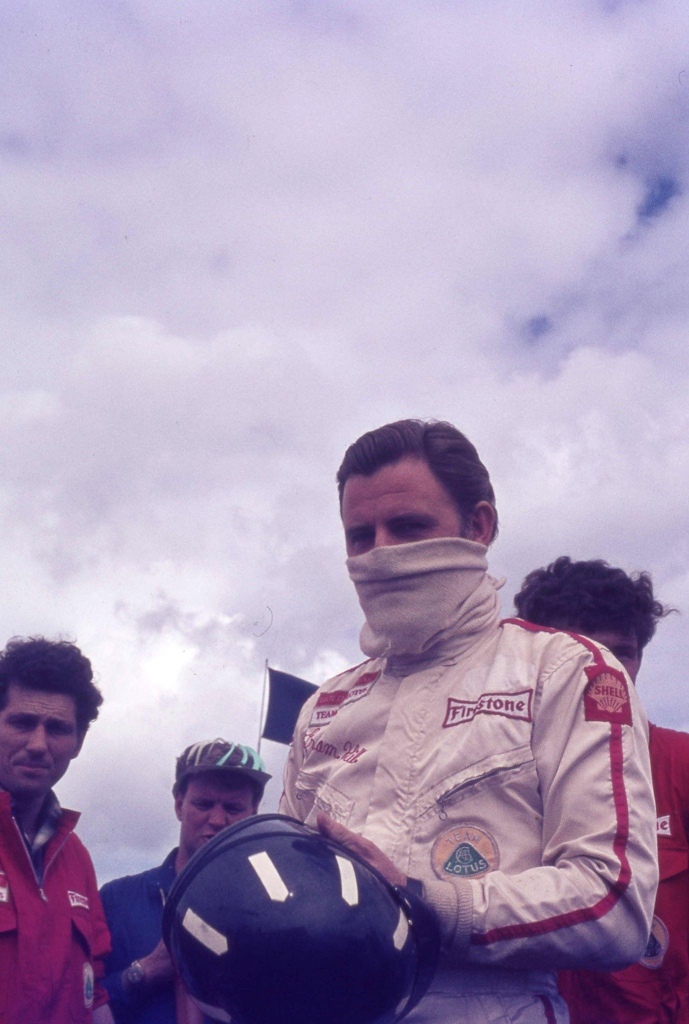
Graham Hill aboard his BRM P48 Grand Prix car in the first race of many races in New Zealand over the ensuing decade. Ardmore during the January 7, 1961 New Zealand Grand Prix.
65,000 Kiwis rocked up in searing Auckland heat to see 14 international drivers take on the locals. Hill finished third behind the two works Cooper T53 Climax 2.5s of Jack Brabham and Bruce McLaren.
The Bourne equipe were regular visitors to New Zealand, having first made the trip in 1954 when a single BRM P15 V16 driven by Ken Wharton blew the minds of Kiwis with its staggering performance and sound, if not its reliability. The Rubery Owen Group/Owen Organisation had subsidiaries in New Zealand and Australia so BRM made the long trip on many occasions to wave the flag, despite the protestations of Chief Engineer, Tony Rudd in some years when he would have preferred to prioritise development of his GP machines over the European winter.
The BRM P48 – the marques first mid-engined car – took its swansong on this trip, and its only international win in the final meeting on the Ballarat Airfield in Victoria, albeit it was Hill’s team-mate, Dan Gurney who took the chequered flag that day. That year BRM didn’t contest the other Kiwi internationals, more on the BRM P48 here; https://primotipo.com/2018/03/16/bourne-to-ballarat-brm-p48-part-2/
(E Sarginson)
Hill missed 1962 but returned for the ’63 summer as World Champion albeit he raced the revolutionary Ferguson P99 Climax four-wheel-drive car down south rather than his championship winning BRM P57/578.
He was stiff to miss out on third place in the NZ GP (above) held at the new Pukekohe track outside Auckland, he lost his clutch at the start then the gearbox cried enough on the very last lap. Hill returned home for a break, before returning for the Australian rounds. Innes Ireland raced the car at Levin for Q5/third, Wigram last/DNF o/heating and Teretonga Q5/third.
Hill’s best in Australia was a win in a greasy preliminary at Lakeside where the car’s grip showed through. In those pre-Tasman Cup 2.5 days both New Zealand and Australia had Formula Libre as their national categories. Once Coventry Climax developed the 2.75-litre ‘Indy’ FPF for Cooper’s 1961 assault on the Indy 500 that engine became the power unit de jour in Australasian events. The FPFs fitted to the P99 were 2.5-litre units so Hill and Ireland were starting behind the eight-ball compared with Brabham, McLaren, John Surtees and Tony Maggs etc who had 2.7s. So fitted we may really have seen the potential of these exciting cars which were somewhat hamstrung when raced with 1.5-litre FPFs in F1 events, where they were less able to ‘carry the additional weight’ inherent in the additional, complex transmission and associated components. What might have been?
(B Ferrabee)
In 1964 Hill contested two rounds of the Tasman Cup in Australia aboard a Brabham BT4 Climax 2.5 run by the David McKay’s Scuderia Veloce. He was third at Warwick Farm and won the South Pacific Trophy at Longford, so he happily signed up again in 1965, racing a brand new Brabham BT11A Climax, Ron Tauranac’s latest Tasman challenger which was also used by Jack and Frank Gardner.
Graham opened his ’65 Tasman account as he closed 1964 with a win at Pukekohe, the NZ GP. Hill again, as became his norm, skipped the balance of the Kiwi races to have some family time, doing the Warwick Farm and Sandown Australian rounds for fifth and DNF. More about the ’65 Tasman here; https://primotipo.com/2017/11/02/levin-international-new-zealand-1965/
Hill was complimentary about the preparation of his car by Bob Atkin and Spencer Martin, Martin raced this same chassis to Australian Gold Star championship wins in 1966 and 1967.
Graham Hill and Spencer Martin swap notes at Pukekohe. By that stage Repco were the largest supplier of FPF parts in the world having had the commercial rights from circa 1962 (K Buckley)(M Fistonic)
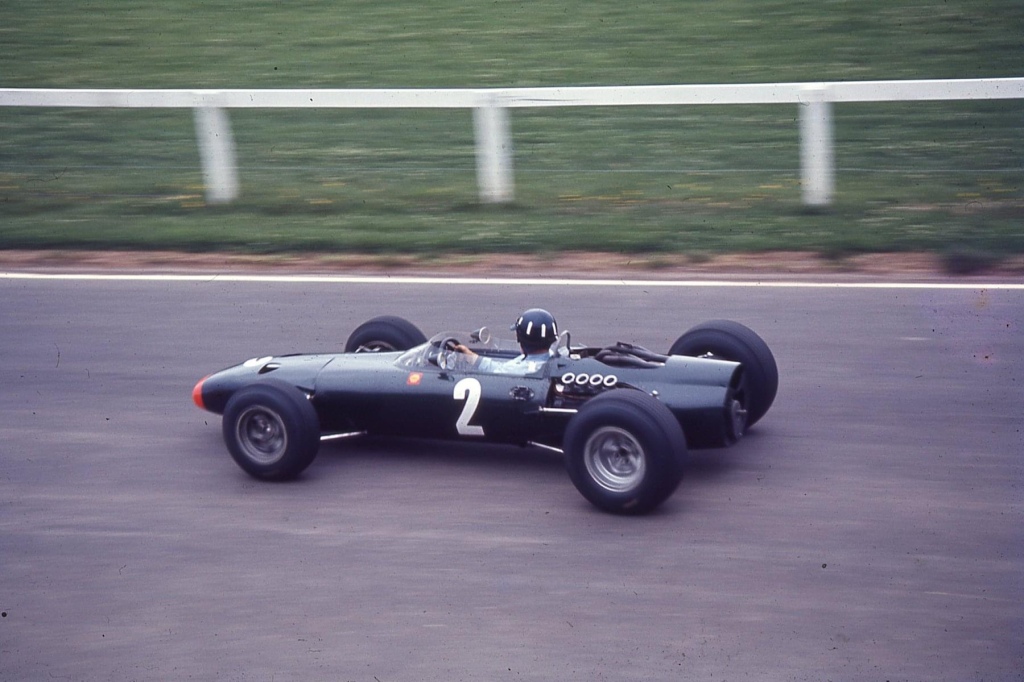
BRM returned to Australasia in 1966, figuring that their just obsolete F1 P261s, their P60 V8 engines bored from 1.5-1.9-litres would do the trick, and so it proved. Graham above at Pukekohe, where he won the NZ GP on the January 8 weekend.
In fact the series was a BRM rout, the team won seven of the eight rounds, Jackie Stewart – then an F1 newbee but with the 65′ Italian GP win under his belt – took four victories, Hill two, and Richard Attwood one at Levin, he stood in for Graham there and in the following race at Wigram. The BRM P261 Tasman story is contained here; https://primotipo.com/2020/02/22/1966-australian-grand-prix-lakeside/
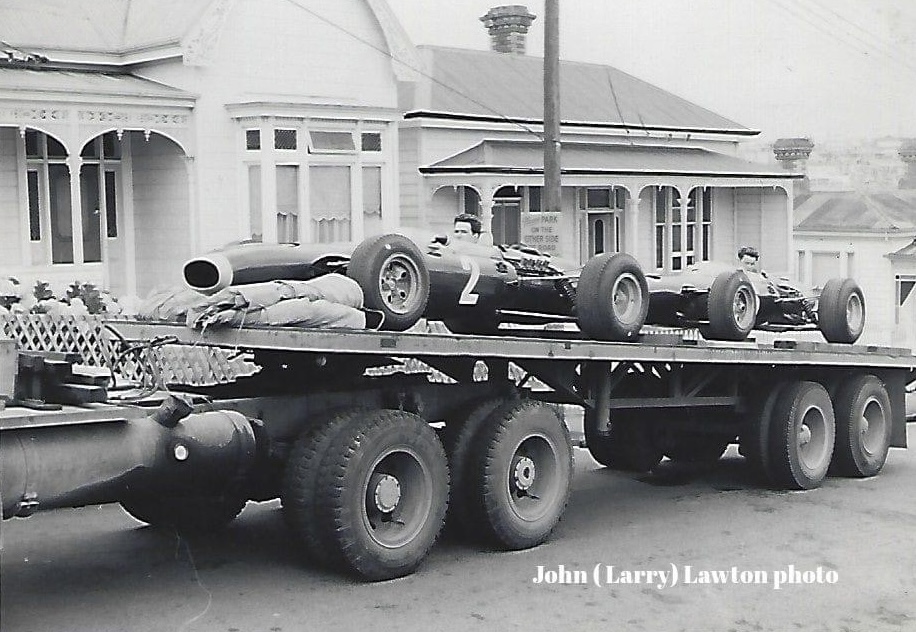
The interesting shot above shows the BRMs arriving for scrutineering before the series opener at Pukekohe in January 1966. It’s at Grey Lynn near the Auckland City car testing station
Hill in the superb BRM P261 at Pukekohe, perhaps this machine and the epochal Lotus 25-33 series of cars are the two best machines of the 1.5-litre 1961-65 F1 era, Ferrari 158 duly noted (B Kempthorne)
In 1967 and 1968 Graham missed the NZ Tasman rounds in their entirety. He decamped from BRM to Lotus at the end of 1966 in a timely move which neatly matched the arrival of the ’67 Lotus 49 Ford DFV V8, another machine which set the trend for a couple of decades.
While Jackie Stewart gave him a good run for his money at BRM, Graham jumped from the fat into the flames with Jim Clark as his Lotus teammate. Clark easily won the ’67 Tasman with a 2-litre Climax FWMV V8 powered Lotus 33 F1 chassis, and in 1968, his F1 Lotus 49 powered by the 2.5-litre Cosworth, the DFW. Graham did only the Warwick Farm Tasman round in ’67, where he raced a new Lotus 48 Ford FVA F2 car in an expensive exercise for the WF promoter, the Australian Automobile Racing Club. Again he enjoyed a holiday at home in early 1968, then did the four Australian rounds, with his bests, second to Clark at Surfers Paradise and Warwick Farm.
(LAT)
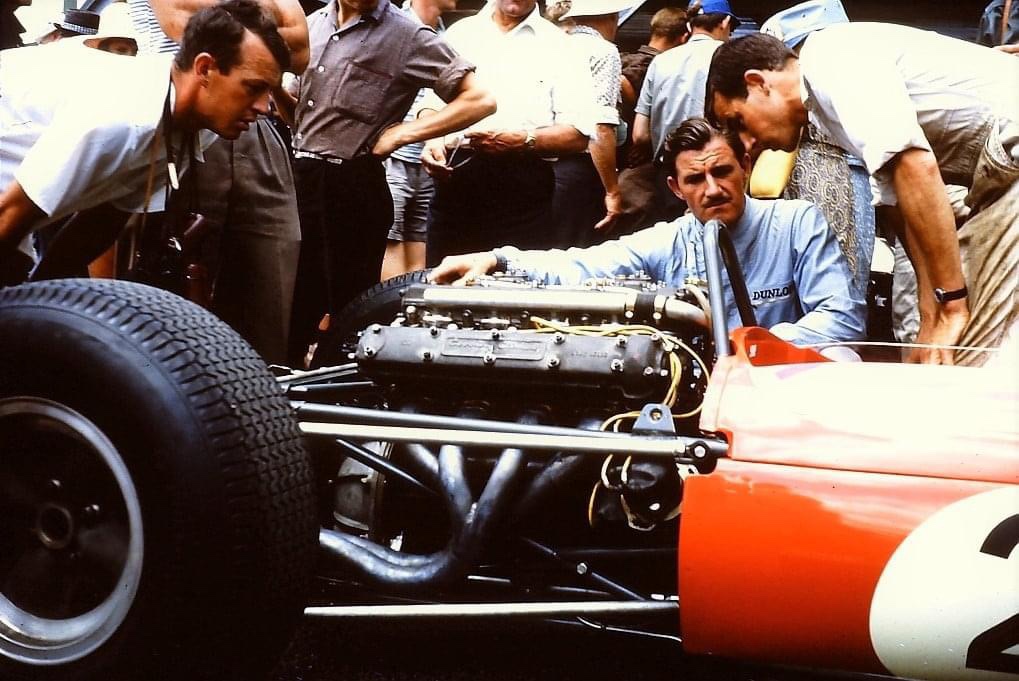
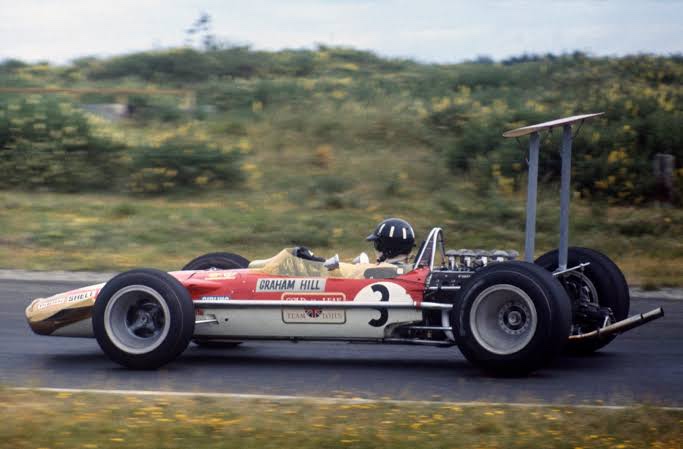
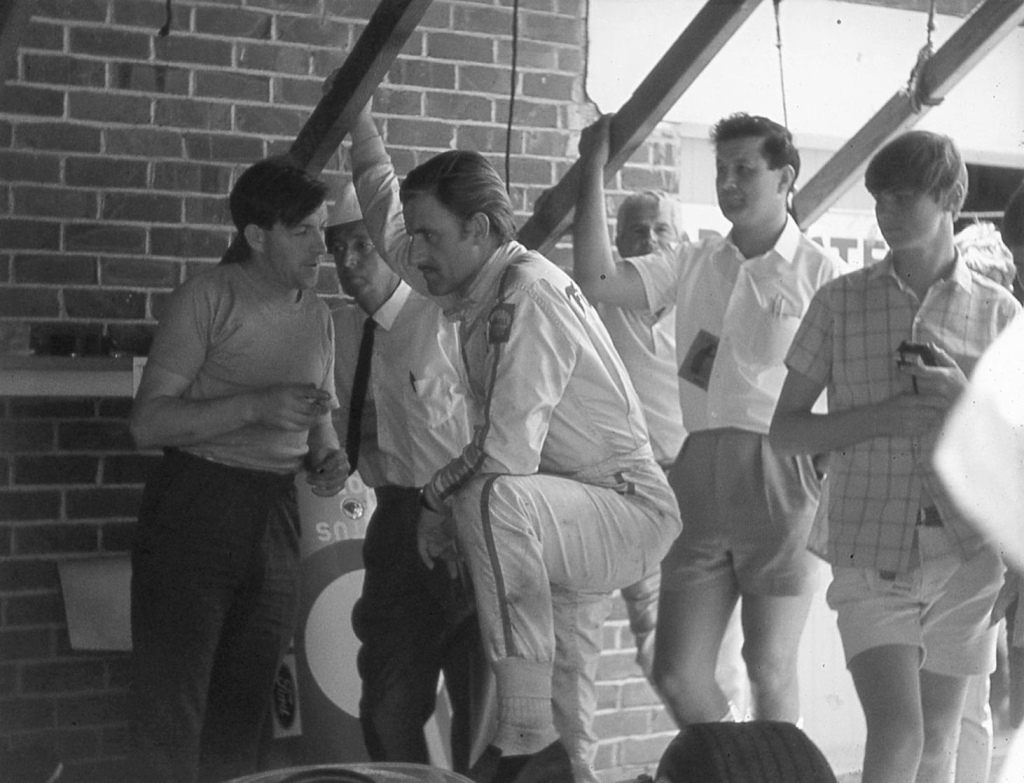
Hill aboard his Gold Leaf Team Lotus, Lotus 49B Ford DFW on his way to second place at Teretonga in 1969, and below in earnest conversation with a mechanic during the Puke first Tasman round.
(M Fistonic)
Hill arrived down south as the freshly minted World Champion after a season in which his brave leadership helped Team Lotus gather themselves together after the tragic death of Jim Clark in a Hockenheim F2 race on April 7.
It wasn’t to be a cushy summer though, Jochen Rindt was a man on a mission with a competitive F1 (and Tasman) car for the first time. His Lotus 49B Ford set the pace, winning two rounds to the four scored by Chris Amon in a title winning run of speed and consistency in a Ferrari Dino 246T.
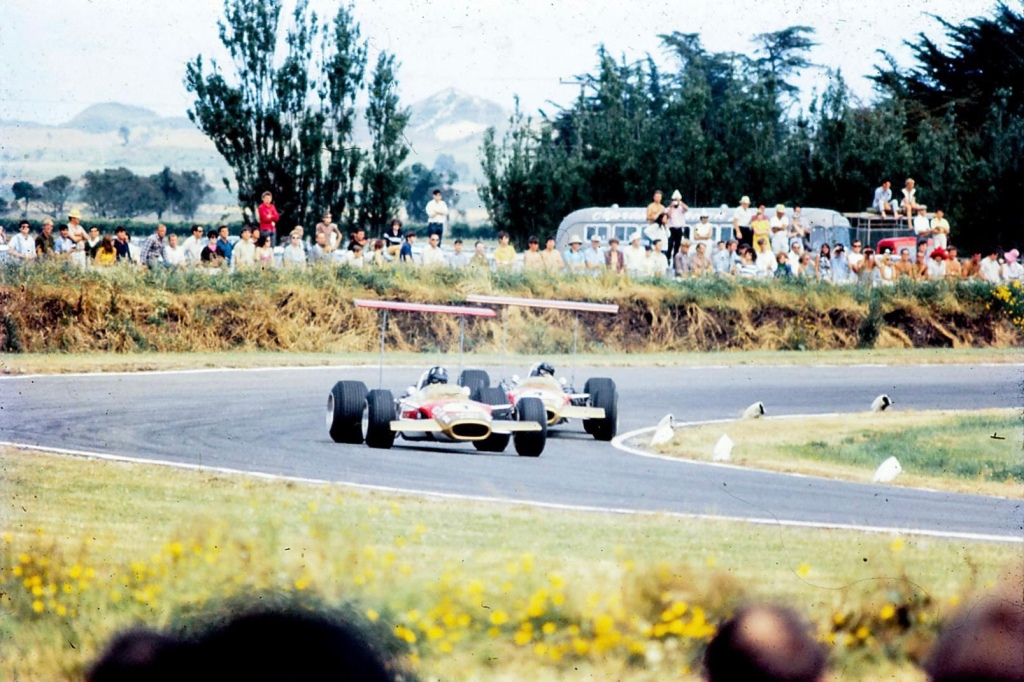
Hill with Rindt chomping away at him, Cabbage Tree corner Levin 1969, where both Lotus 49B DFW DNF, Rindt with a big accident which required a replacement car to be sent from Hethel (B Spurr)
Graham didn’t take a victory that summer, his bests were second places to Rindt at Wigram and at Teretonga behind Piers Courage in Frank Williams’ Brabham BT24 Ford DFW. More about the Lotus 49Bs in Australasia that summer here; https://primotipo.com/2022/02/26/lotus-49b-ford-chassis-r8/
The change in Tasman formula to F5000 (1970-71 transition years noted) and the growing number of F1 races in a season put paid to trips by full-time F1 drivers for a couple of months after Christmas each year. It was awfully sweet while it lasted, with Hill G one of the most popular visitors of all with the punters.
Credits…
Euan Sarginson, LAT, Ken Buckley, Brian Ferrabee, Milan Fistonic, Bryn Kempthorne, Brian Spurr, Warner Collins, John Lawton
Tailpiece…
(W Collins)
Graham Hill preparing to load up at Wigram on January 18, 1969. Jochen won from Graham that day with local hero Chris Amon third, Piers Courage and Derek Bell fourth and fifth, demonstrating the typical depth of Tasman Cup fields.
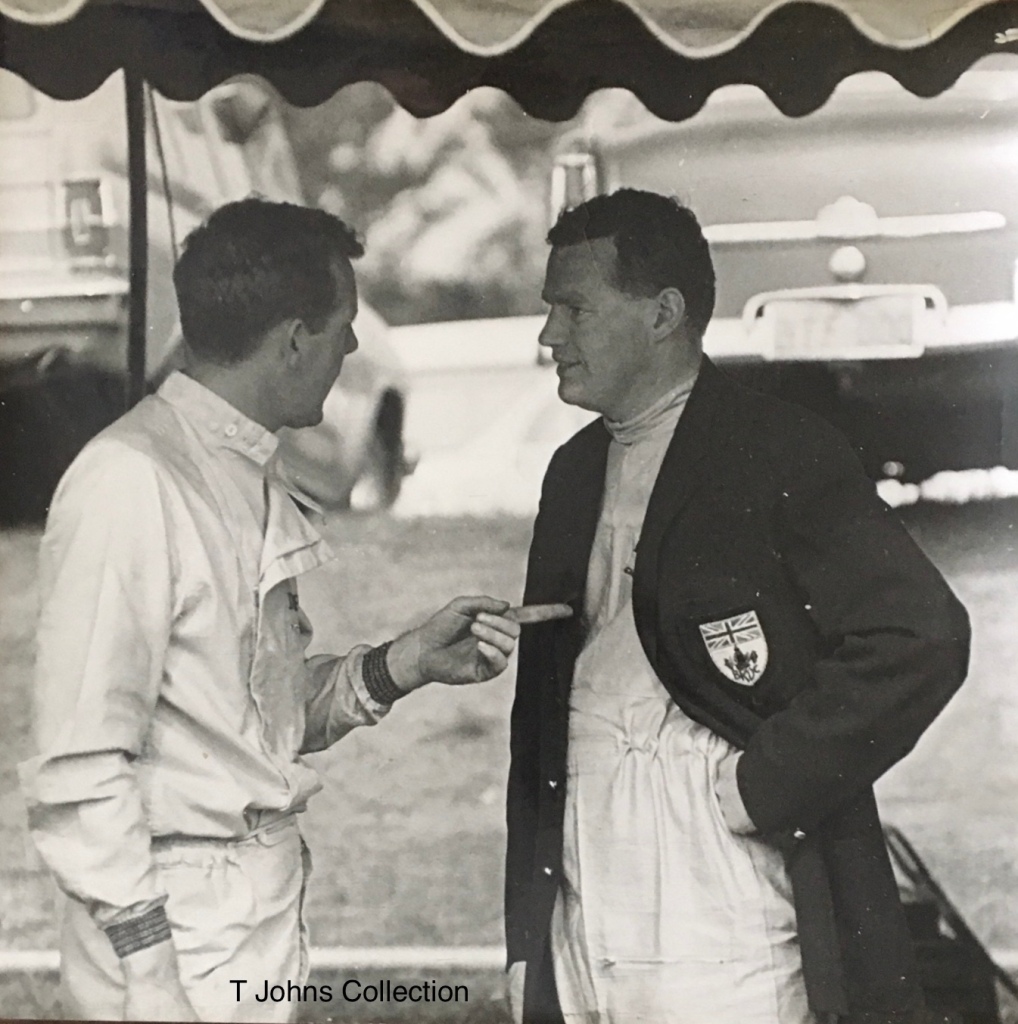
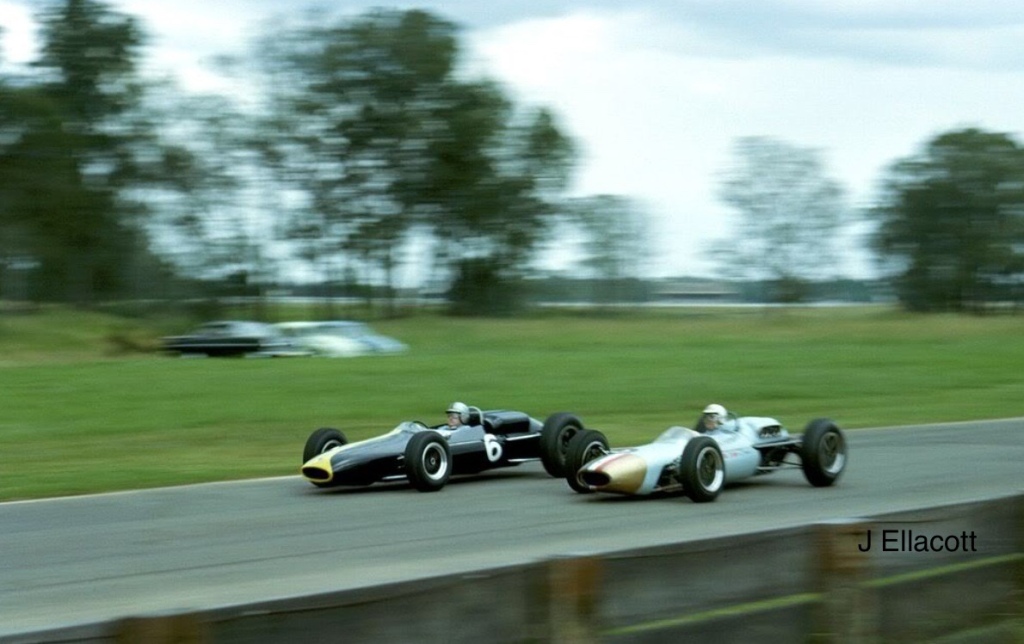
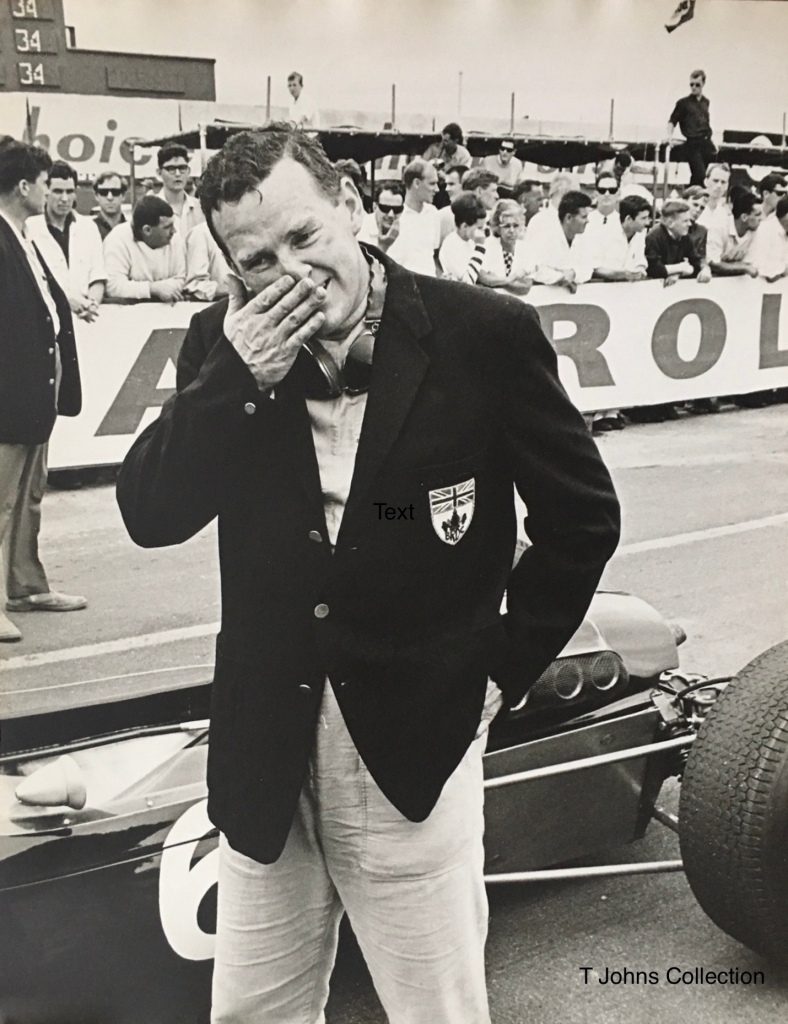
‘Christ! He’s bloody quick already!’ is perhaps the line of thought in the mind of the – at that stage – twice Gold Star Champion. Matich made his Formula Libre debut that weekend aboard a new 2.5-litre Brabham BT7A Climax, Bib’s mount a 2.7 FPF engined Brabham BT4.
















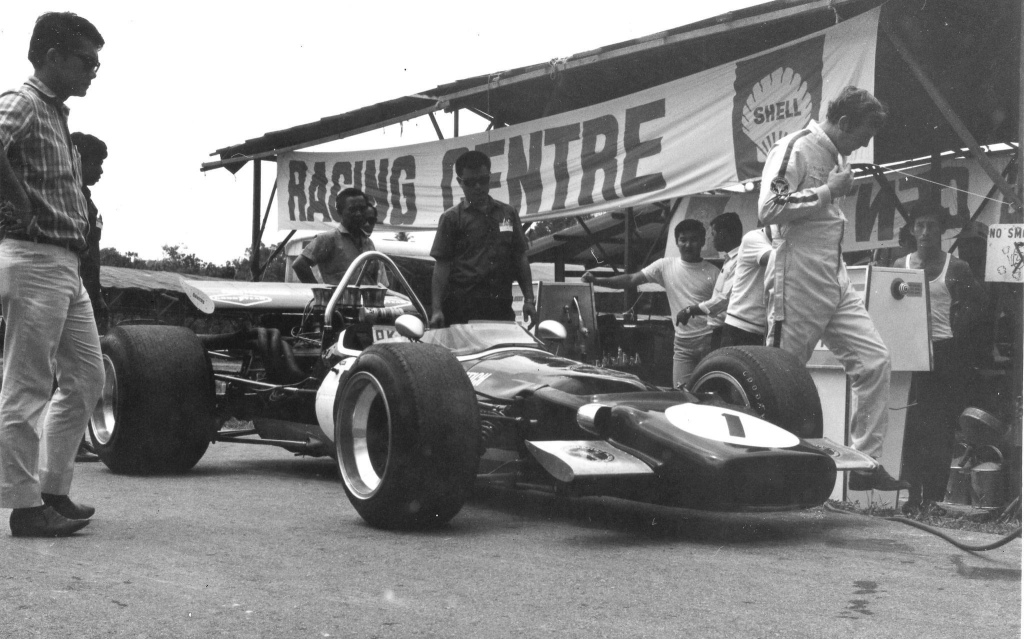
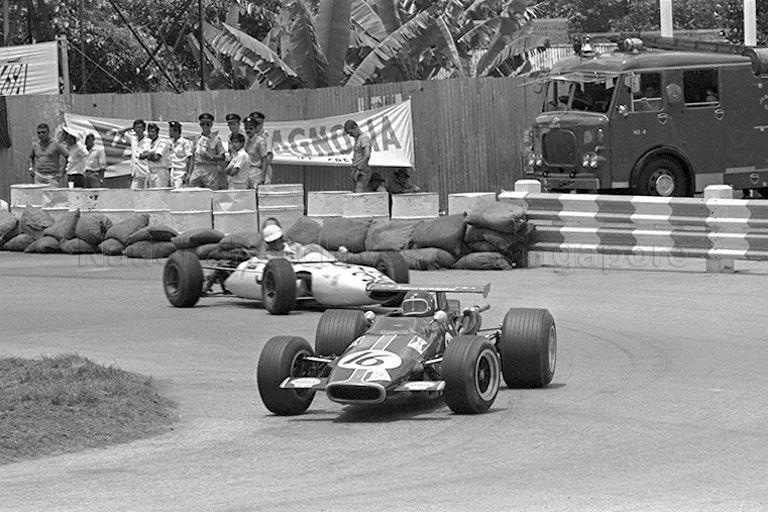
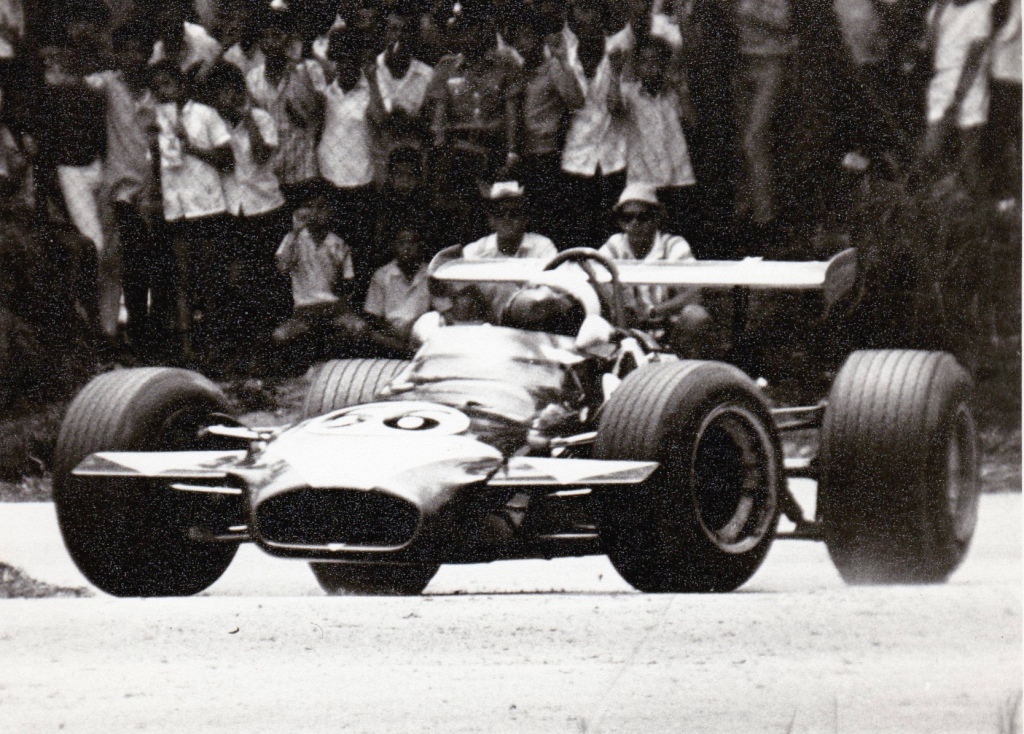

 primotipo...