Archive for the ‘Who,What,Where & When…?’ Category

(unattributed)

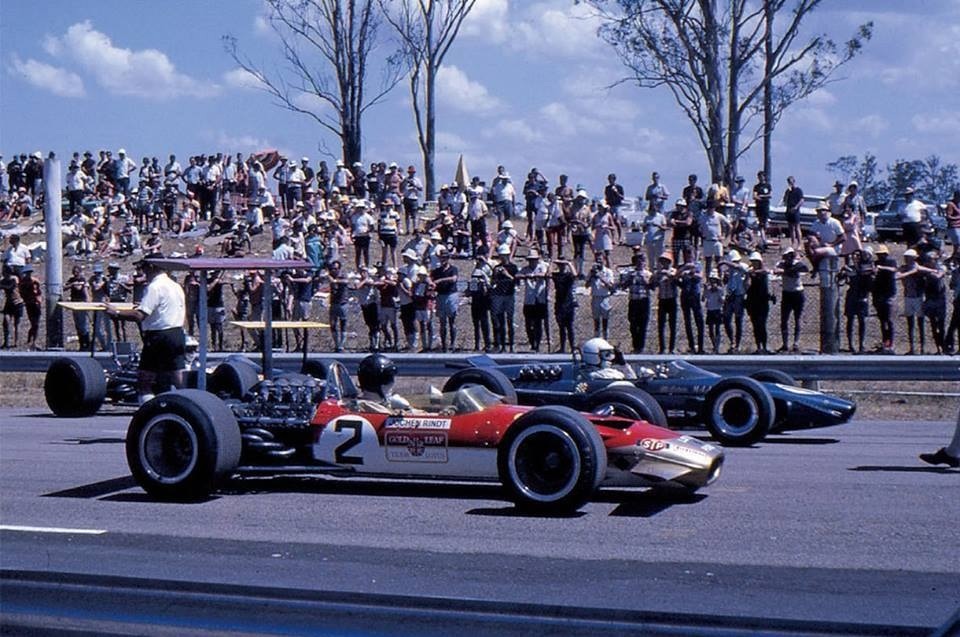
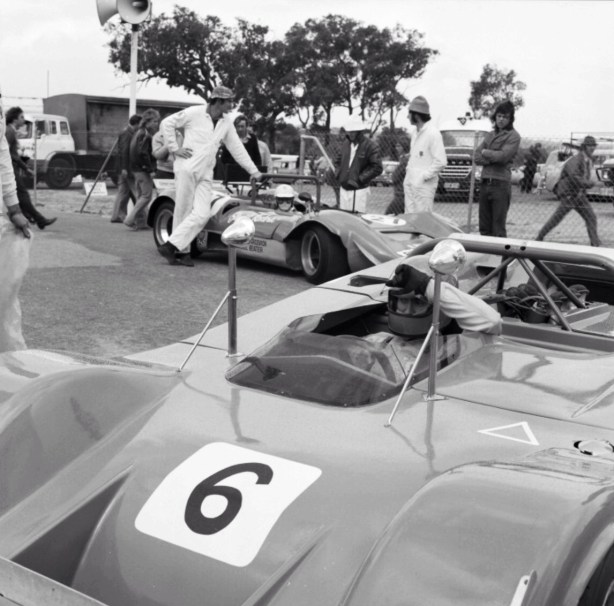
Jochen Rindt awaits the start of the Australian Grand Prix, Lakeside, Queensland on 2 February 1969…

Alongside the Austrian’s Lotus 49B is Australian Niel Allen’s ex-Courage McLaren M4A Ford FVA F2, the bi-winged device behind Jochen is the Piers Courage-Frank Williams owned Brabham BT24 Ford DFW.

Jochen switched his engine off as it tightened before it went ka-boom – having had problems in practice – on lap 43 whilst in third. Niel was fifth and Piers had an accident on lap five after a passing move on Graham Hill went pear-shaped at BMC bend. Chris Amon won aboard his works Ferrari 246T Dino.

Rindt’s Lotus 49B during dry, Saturday practice at Warwick Farm. He and Chris Amon’s Ferrari 246T had an electrifying duel for pole, won by Jochen in the final minutes of qualifying (R MacKenzie)

Allen Brown’s summary of the 1969 Tasman Series is a great one, it says a lot in the minimum of words, I like that!

“Chris Amon was back for 1969 and taking it much more seriously with two Ferrari 246T/69s for himself and teammate Derek Bell and four 300 bhp 24-valve engines. Despite the loss of Jim Clark, Lotus were present with a two-car team of Lotus 49Bs for Graham Hill and new teammate Jochen Rindt. BRM did not enter so the only other overseas entry was Frank Williams who had a Brabham BT24 for Piers Courage.”

Rindt, Brabham, Amon, Hill and Courage on Sandown’s pit straight with Rindt hooking into Peters Corner for the run up the back straight. Lotus 49 Ford DFW, Brabham BT31 Repco, Ferrari 246T, Lotus 49B Ford DFW and Brabham BT24 Ford DFW. Sandown International 100, 16 February 1969. Amon won from Rindt, Brabham and Gardner (unattributed)

“Rindt proved to be Amon’s closest rival but spun away the lead at both Pukekohe and Levin, leaving Amon to win both races, before the Austrian took a comfortabe win at Wigram. A dominant victory at Lakeside’s Australian GP for Amon meant Rindt could no longer catch him and when Amon and Courage tangled at Warwick Farm, the Kiwi was champion.” Rindt had a stunning weekend in both practice and an amazing wet weather drive which blew the minds of the Sydney spectators and his rivals. “He (Amon) rounded off the season with victory at Sandown, his sixth in two seasons.”

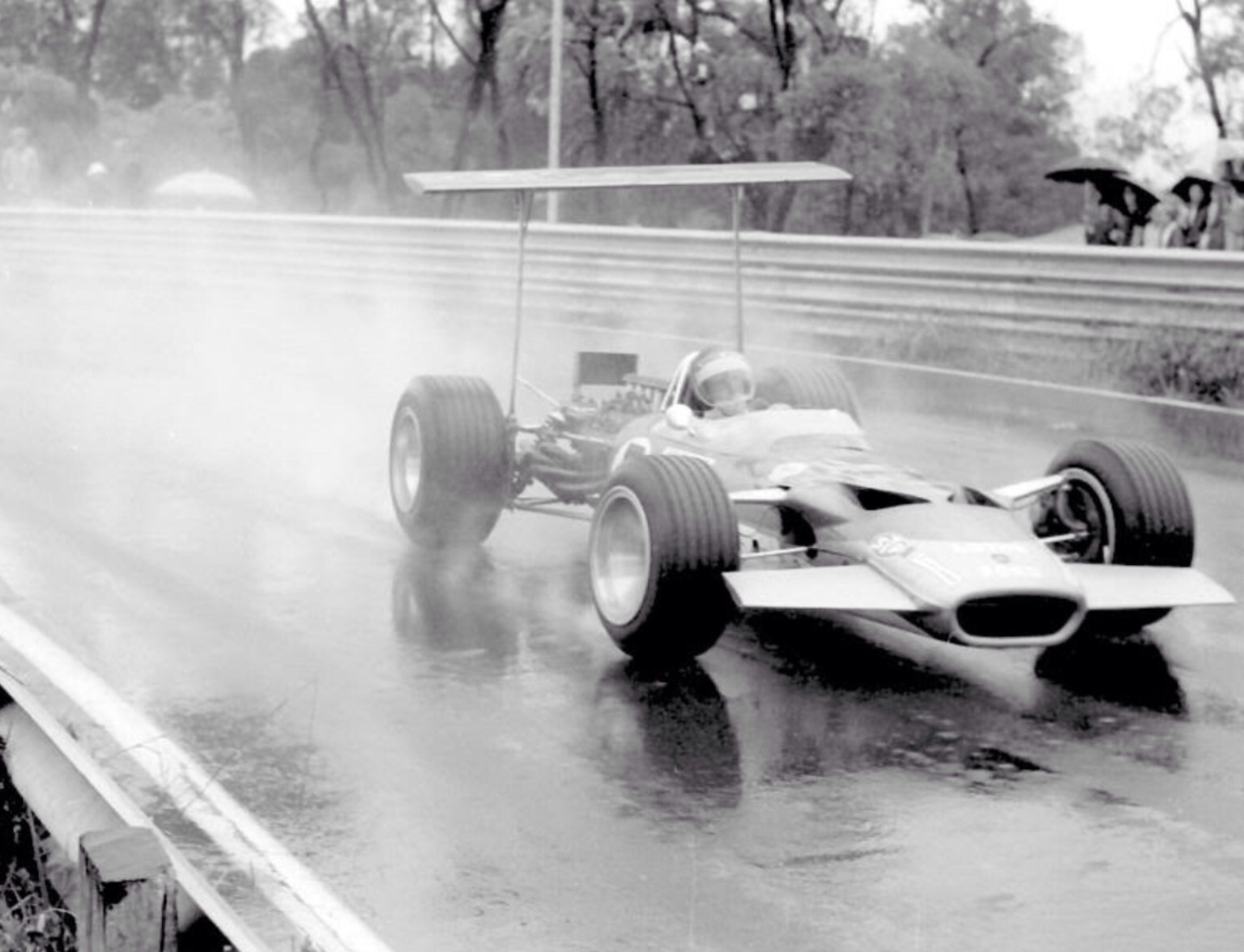
Rindt mesmerised 16,000 soggy Sydney-siders with his raceday drive during the ’69 Warwick Farm 100 on 9 February. He ran away and hid after Amon and Piers Courage collided on the first lap (R MacKenzie)

Now that the visiting British teams were using F1 cars and then taking them home, there was no longer the annual influx of new machinery for the locals. Alec Mildren had the funding necessary to commission specials but the number of competitive 2.5-litre cars was definitely dropping. David McKay’s Scuderia Veloce was the nominal entrant of Amon’s Ferraris but no longer ran their own car. That season, Mildren had installed his Alfa V8s in a car designed for him by Len Bailey and constructed by Alan Mann Racing in England, the monocoque Mildren Alfa ‘Yellow Submarine’ in addition to his ’68 Tasman Special, the Brabham BT23D Alfa driven by Kevin Bartlett.

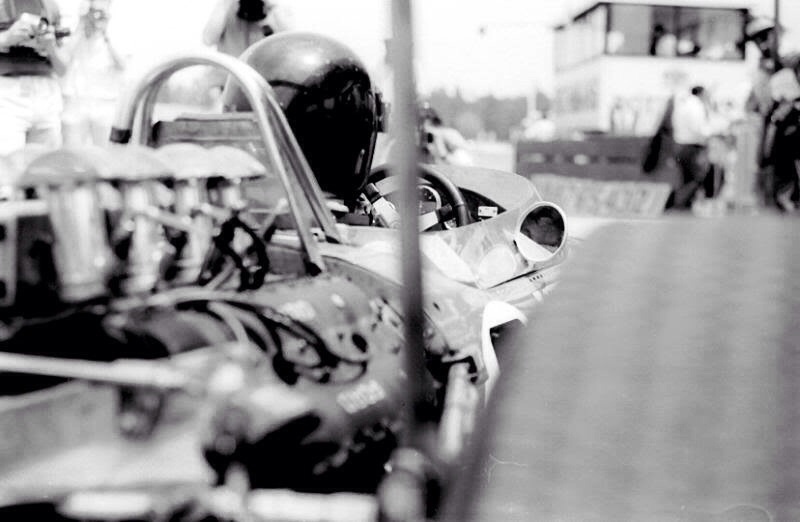
Jochen, dry practice on the Friday given the lack of punters, Warwick Farm (G Paine)

Bibliography & Photo Credits…

Allen Brown on oldracingcars.com, Rod MacKenzie, Glenn Paine

Tailpiece: Moody Rindt shot, Warwick Farm 1969- check the mirror folks…

(R MacKenzie)

Finito…

image

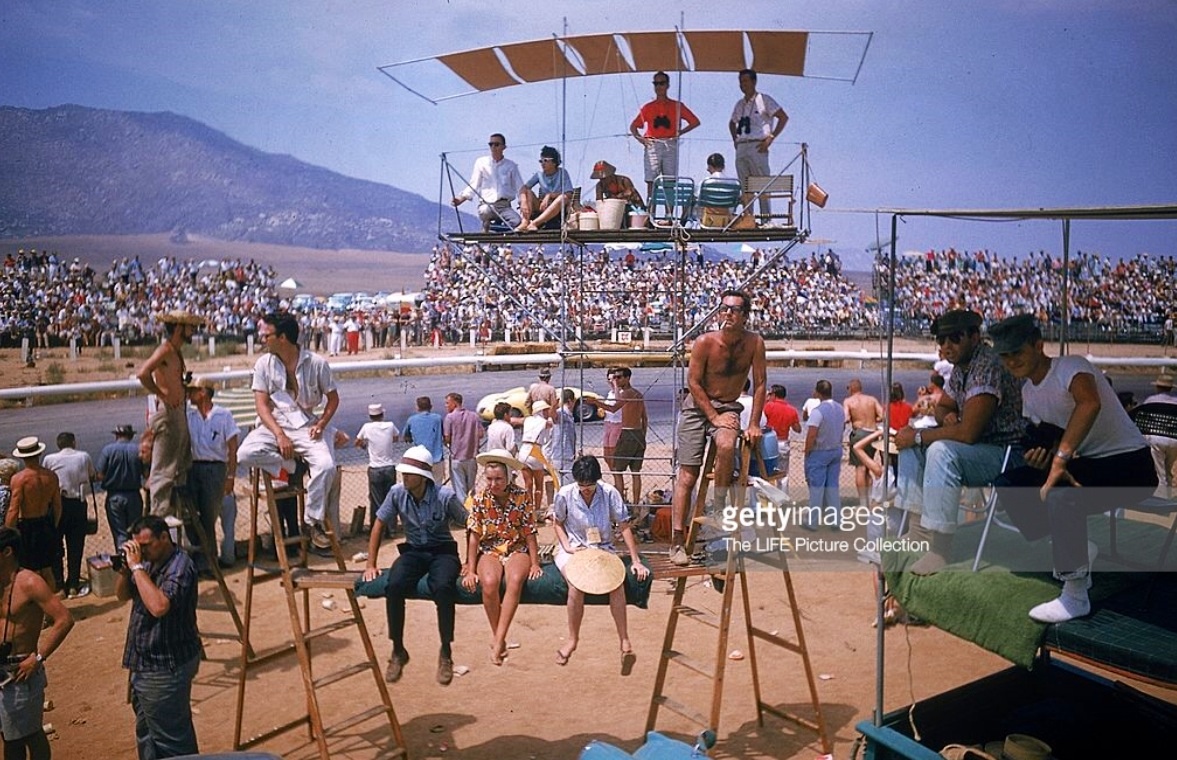
Amazing panorama of a hot, happy Riverside crowd in 1959, no details of date or race meeting, race in progress for sportscars…

These days with so much competition for our leisure dollars promoters globally find it hard to get such crowds. In the ‘immediate’ post war years there was pent up demand and plenty of money in a booming post war economy to draw a crowd to just about anything.

By the look of some of the grandstands, it would have been more dangerous as a spectator than as a racer…

Credit…

JR Eyerman


(L Richards)

A motorsport event in Kew, Melbourne even in 1954 is a new one on me?!…

Its a rather nice, leafy, green suburb through which the Yarra River flows 5 Km from Melbourne’s CBD- ‘stockbroker belt’ stuff with some of Melbourne’s ‘better’ private schools contained therein. There is plenty of wealth in the area, then and now. So how come the good citizens of Kew allowed a motor sport event to take place on their turf prey tell?!

Stan Jones’ Cooper Mk4 JAP and a motor-cyclist are about to ‘blast off’ along the Kew Boulevard at Studley Park by the look of it. The flag-man is Reg Robbins, long-time member of Stanley’s racing equipe.

It’s a stretch of road we have all done lap records upon before the long arm of the law toned things down somewhat. A ribbon of bitumen that commands respect as a fair proportion of it is open and high speed despite changes to slow things down.

I have it on good authority that the number of 911’s which go in backwards is not that much different now to the 1980’s when there were plenty of wallies with loads of money not reflected in commensurate levels of driving talent. Many an insurance tale of woe was born on this stretch of blacktop.

(L Richards)

In any event, what is going on here, some of you are Kew locals, we are all intrigued to know?

Stan has his ‘Maybach’ helmet on , it was a good year for him, he had just won the New Zealand Grand Prix at Ardmore in perhaps Australia’s most famous special, the Charlie Dean/Repco built and prepared Maybach on 9 January. No wonder he has a big smile upon his face.

For Jones it was an easy event logistically. He lived in Balwyn, an adjoining suburb and his ‘fettler’ Ern Seeliger’s garage was in Baker Street, Richmond, also a couple of kays from The Boulevard on the other side of the river.

I am intrigued. Do tell folks!?. Maybe its a promotion and i’m getting excited about absolutely nothing…

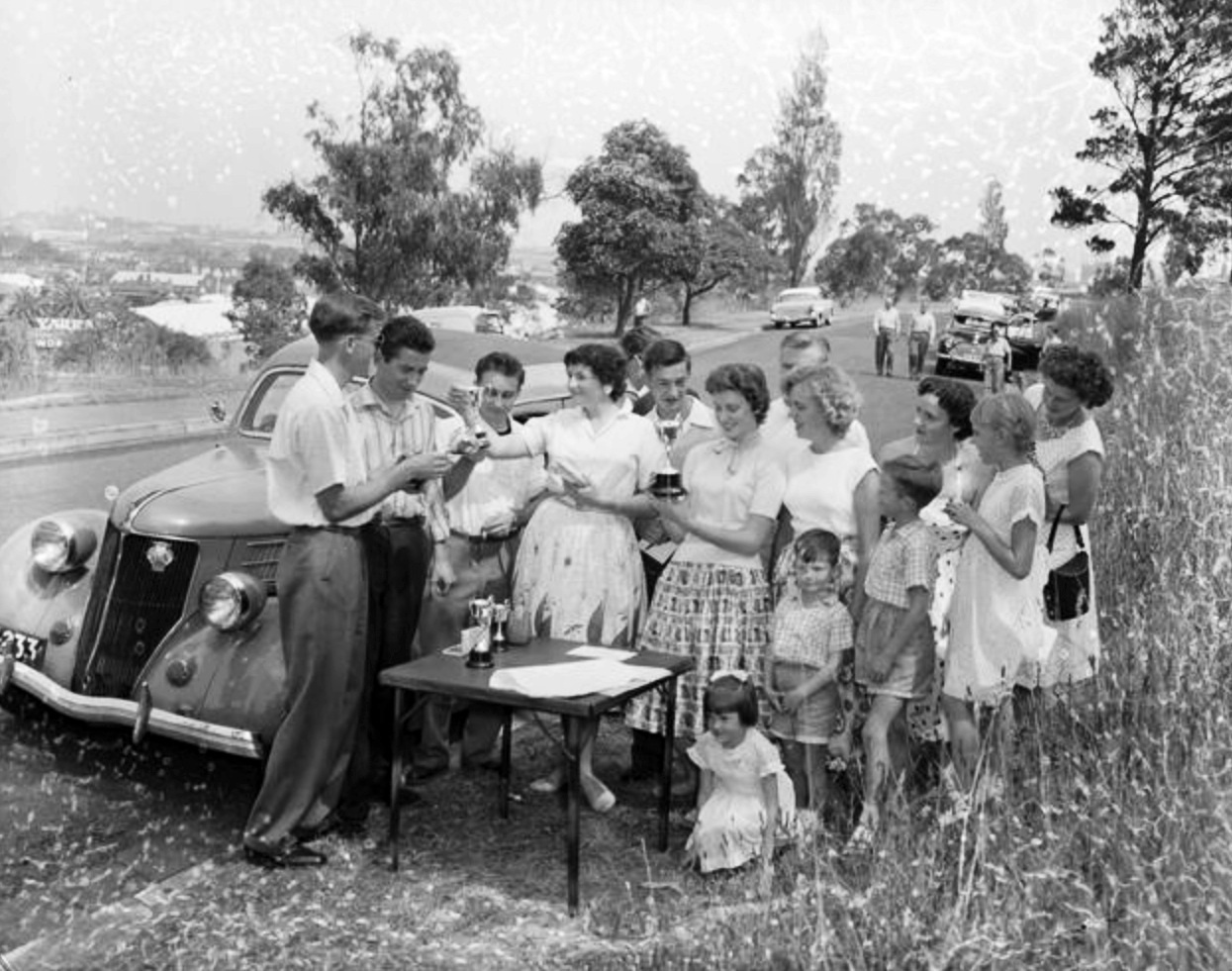
An idea of the Kew Boulevard in 1958- not much different now, leafy green and lots of curves. This is the finish of a ‘car trial’ treasure hunt social event (L Richards)

Photo Credits…

Laurie Richards, State Library of Victoria, David Zeunert

Tailpiece: Stan and Cooper JAP, Templestowe Hillclimb circa 1952…

(SLV)

Templestowe Hillclimb was not too far from Kew, where the shots above are taken, so here is a snap of the man in action there. I’ve no idea of the date in the event that one of you were there to sort that point. Jones hustled a car along, he was a physical, press on kinda driver who pushed hard, not lacking finesse mind you, but you could always see him trying to get the best from his mount.

Just as he is here, using all of the available road…

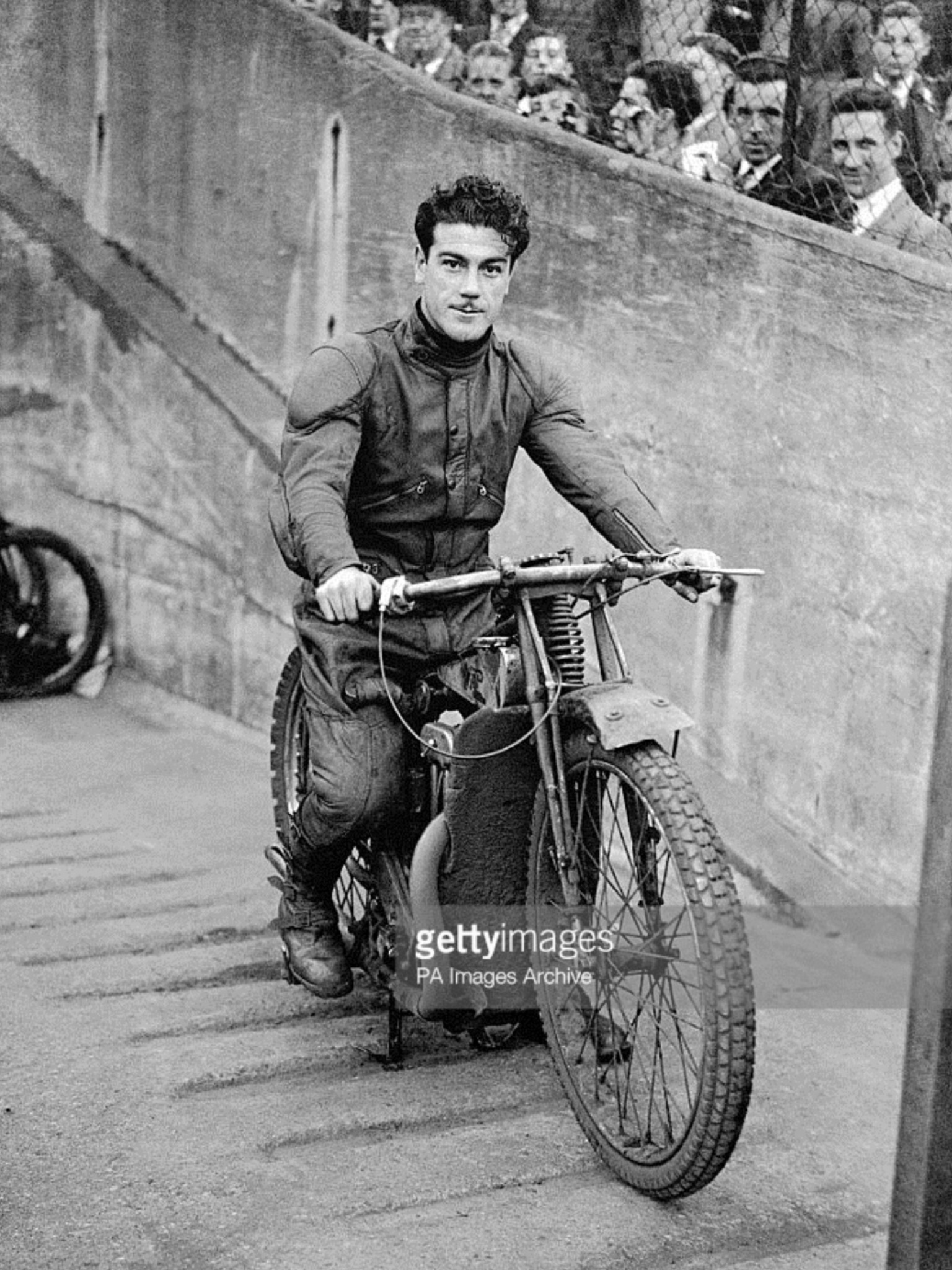
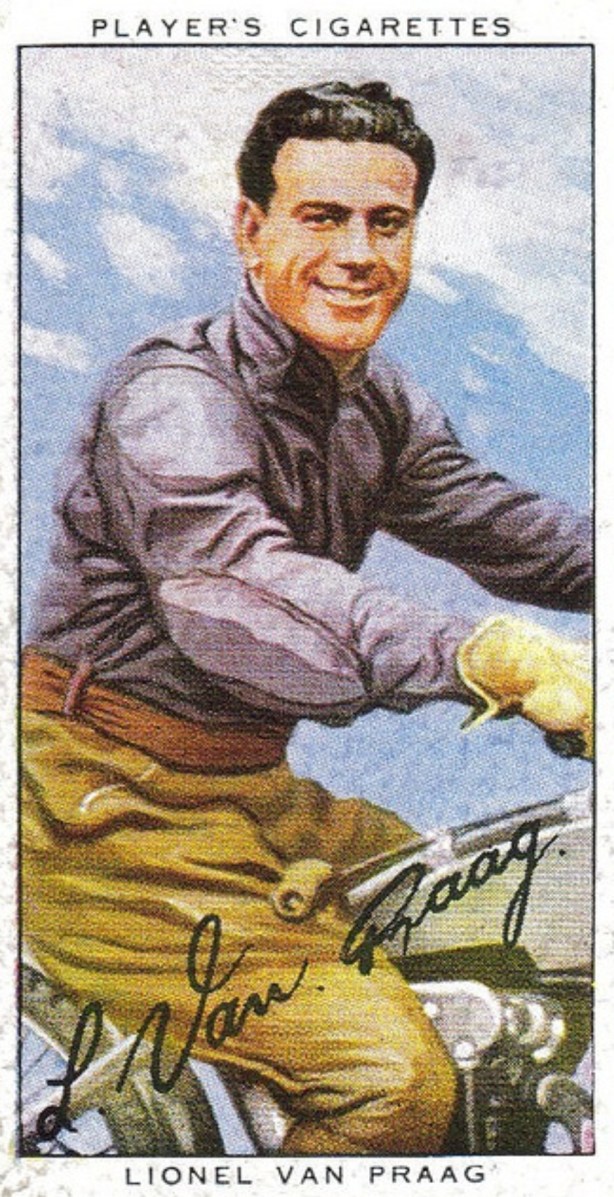
Lionel Van Praag, Wembley, London 10 September 1936…

Its amazing what you don’t know, in fact I’m never surprised at my own ignorance. I reckon I know a bit about my interest and hobby, but really I’m only scratching the surface of motor racing history in Australia.

Australian topics are hard too, the research that is- pre-War there was little in the way of local magazines, post war it becomes a bit more straight forward from the time of the publication of ‘Australian Motor Sports’ magazine and the relatively large number of publications which followed it. What is fascinating in the research adventure is the stuff you find looking for something else.

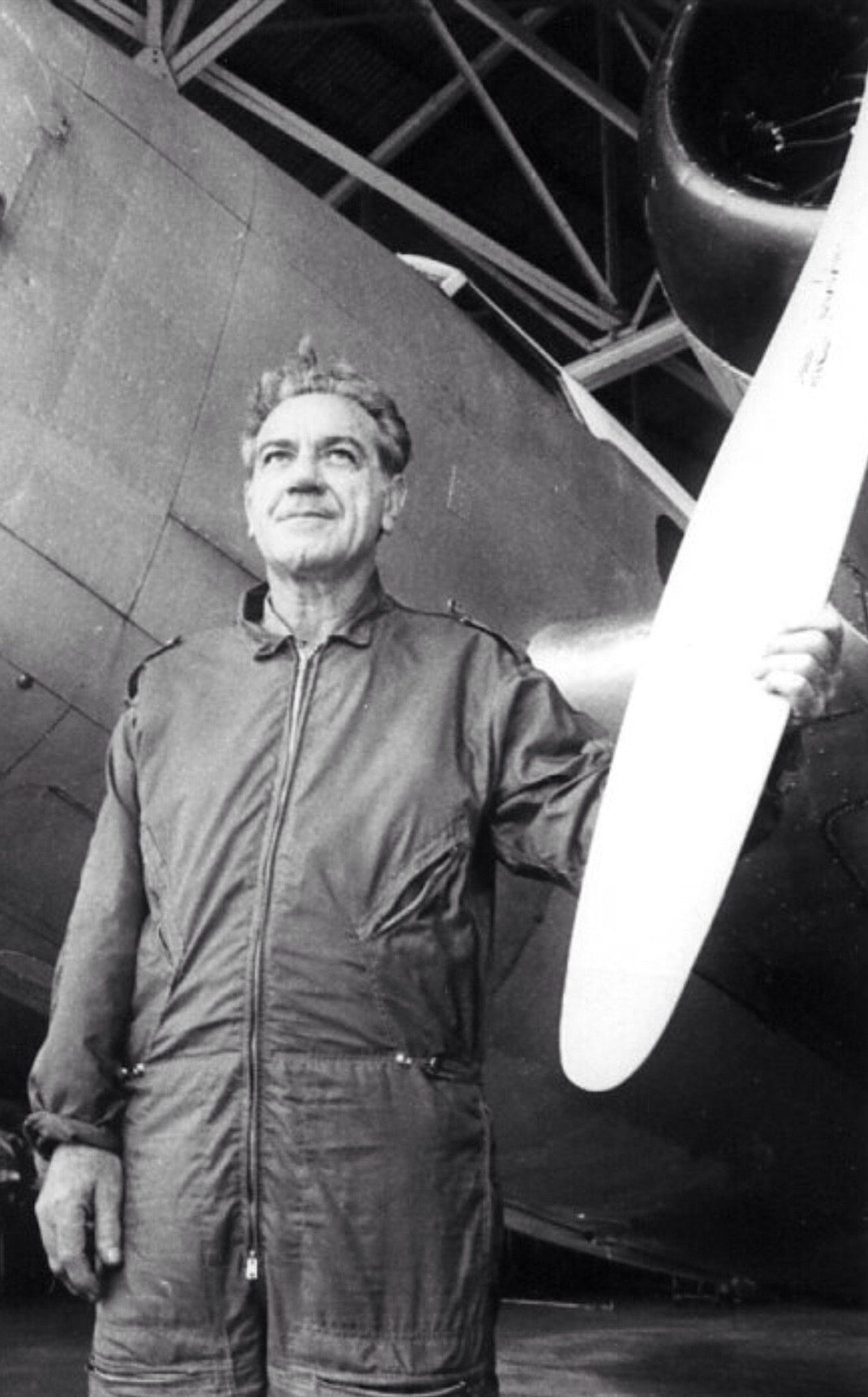
In this case it was randomly coming upon this image of Lionel Maurice Van Praag (1908-1987) after winning the inaugural World Speedway Championship at Wembley on 10 September 1936.

An Australian World Motor Racing champion pre-war, wow! And not without some controversy too. And I had never heard of the Redfern lad despite his admission to the Sport Australia Hall of Fame in recent times.
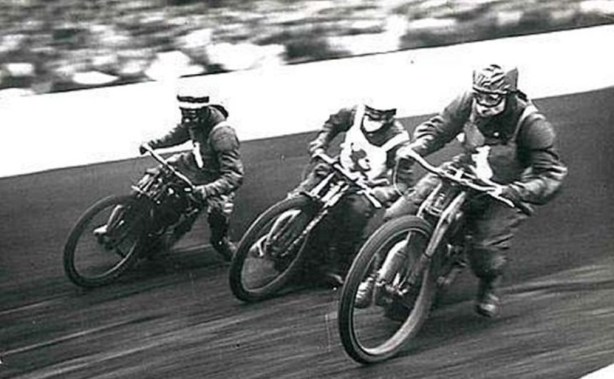
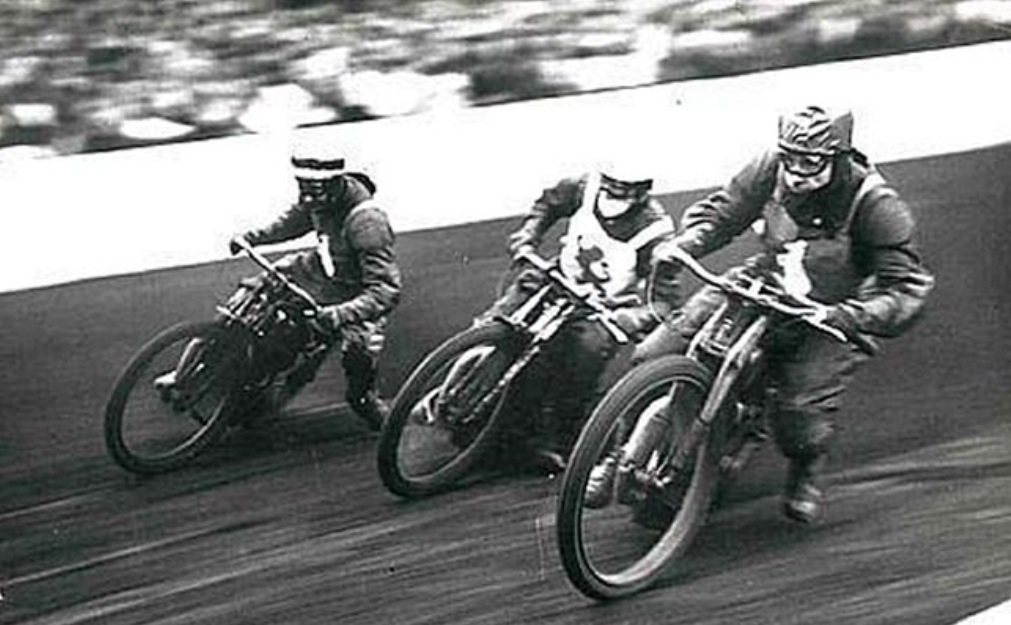
L>R- Charlie Spinks, Arthur Atkinson and Lionel Van Praag, First Test England/Australia at Belle Vue in 1938 (defunctspeedway.co.uk)

Graham Howard wrote that ‘Van Praag was a speedway rider and aviator, born on 17 December 1908 at Redfern, Sydney. The only child of Sydney-born Louis Van Praag, tram conductor, and Mozelle May. A bright student and an all-round athlete, he was educated at Cleveland Street Intermediate High and Redfern Junior Technical schools, both in inner Sydney. He was apprenticed as a typewriter mechanic, he had a natural feel for machinery that was useful all his life’.
image

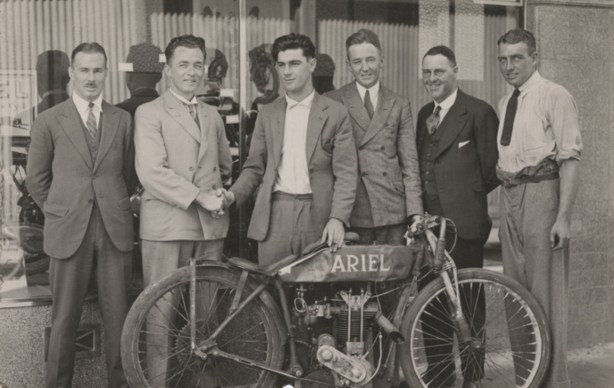
LVP, middle of shot at Speedway Royal, Wayville, Adelaide in 1928. Bike is an Ariel ‘3 and a half’ (M Gray)

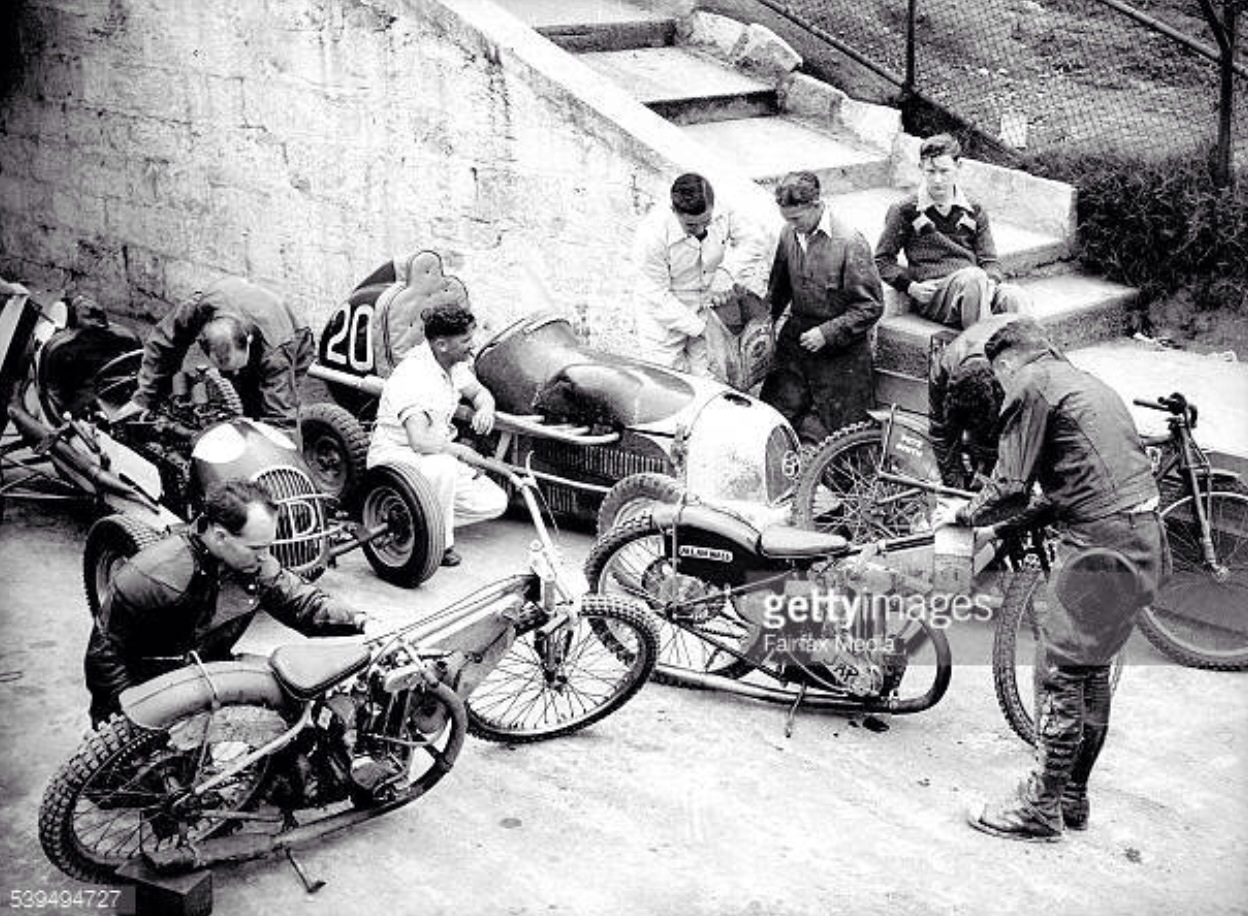
Lionel began riding motorcycles at 15. After a number of novice races at the Olympia Speedway at Maroubra he concentrated on the Speedway Royal in Sydney from July 1926, almost instantly he became a senior competitor. He then had an outstanding 1926-27 season in Brisbane. He was successful in the eastern mainland Australian States and in New Zealand. In 1931 after years of rejecting offers, he followed other Australian riders who competed in England and joined the Wembley Team, riding in both the UK and Europe during the Australian off season.
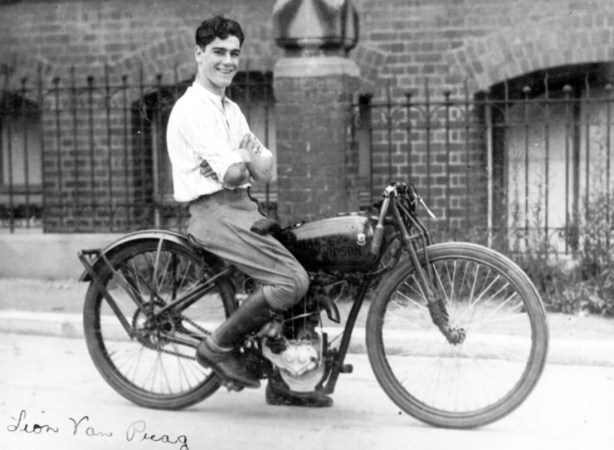
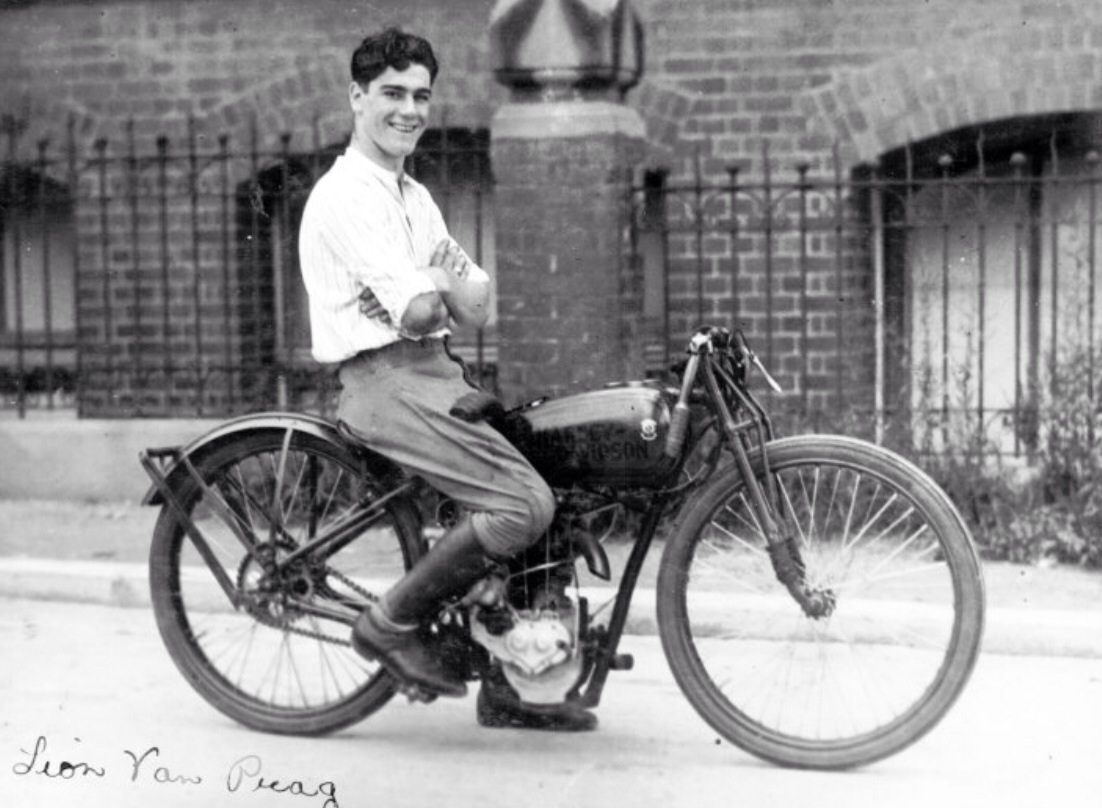
Lionel Van Praag aboard a Harley Davidson ‘Pea Shooter’ in 1927, 19 years old. Factory 1926  racer designed for US AMA races- devoid of brakes, clutch and transmission. Frame shortened, weight 215 pounds, 350cc OHV, circa 100mph (unattributed)

The first World Speedway Championship, at Wembley, London 1936…

The event was a strange one as riders carried into the meeting a score of bonus points amassed in the qualifying rounds. It was possible that the rider who scored best on the night would still not be world champion because of his qualifying record- and such was the case.

‘Bluey’ Wilkinson scored a maximum but Langton had more bonus points than Van Praag. In a night of excitement and controversy, Eric Langton and Van Praag lined up for a match race but Eric broke the tapes. Van Praag declared he would not be champion by default and sportingly demanded a re-run! Langton gated ahead and led until the final bend when leaving the smallest of gaps and he was unable to hold the dashing Australian, the Hall of Fame entry says.

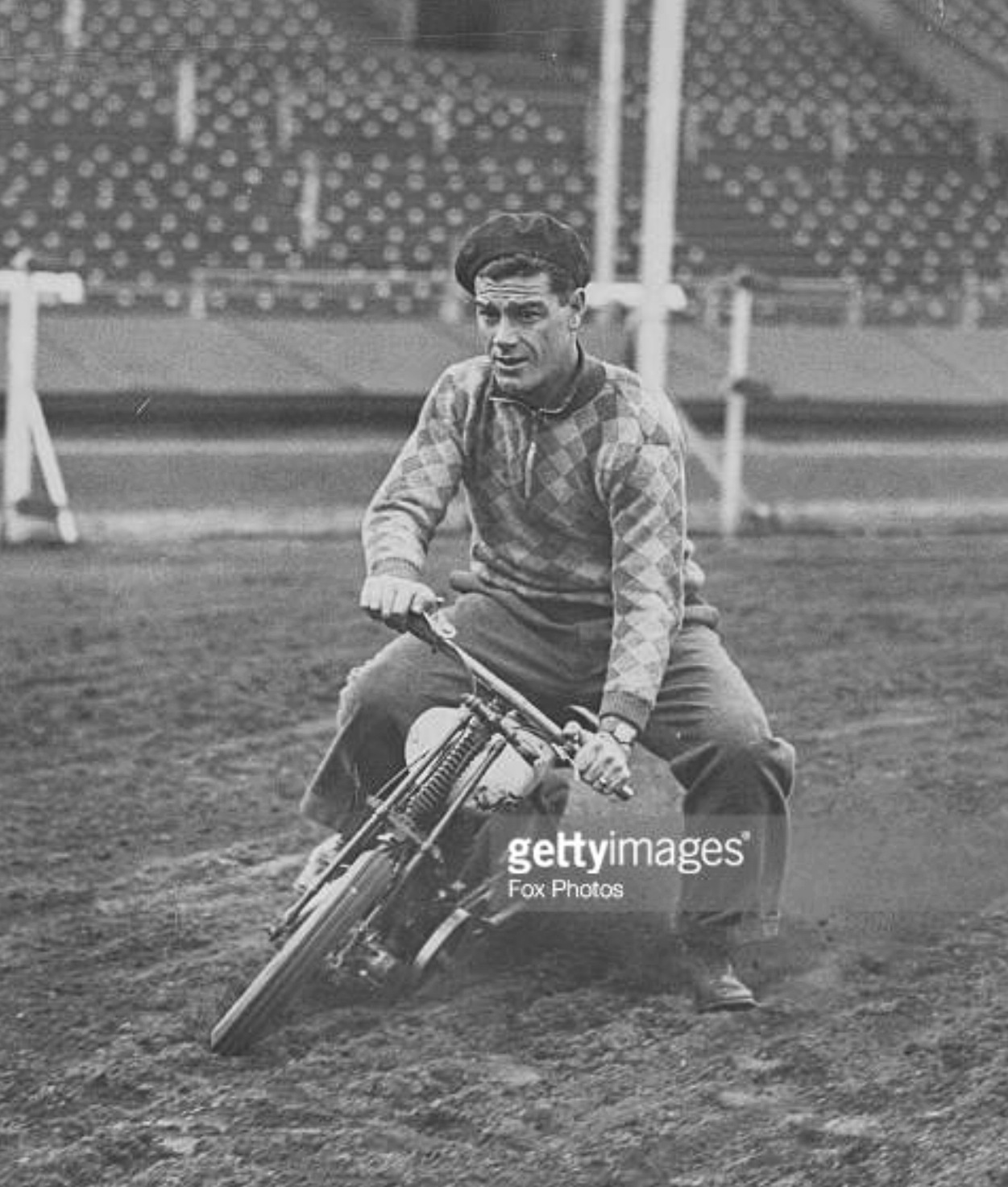
LVP on a mini-bike at Wembley in 1932 (Getty)

Further ‘Langton’s near miss …assumed a degree of controversy in later years. The deciding match race with ‘Praagy’ was ‘fixed’ between the pair according to sources close to the action. It was alleged that Eric and Lionel agreed that whoever got to the first corner in front would go on to win and they would split the prizemoney between them. It almost worked out, Langton was ahead until the final corner when he left a small gap which Van Praag couldn’t resist going for. The first ever world final was won by about a wheel width and the Australian took the title’.

Van Praag also qualified for the finals in 1937-7th, 1938-4th and 1939. In 1931-39, and again in 1947, he represented Australia in Tests against England.

He learned to fly in the UK at Broxbourne, Hertfordshire in 1931, it was a capability he put to good use throughout the rest of his life.

Graham Howard wrote that ‘Van Praag was a non-drinker and a heavy smoker, and he had a short temper if provoked. At around 5 ft 9 ins (175 cm) he was taller than most of his rivals; he was dashingly handsome, with dark curly hair and notable physical strength. He had a minor role in the British film Money for Speed (1933), but an envisaged cinema career did not materialise’.

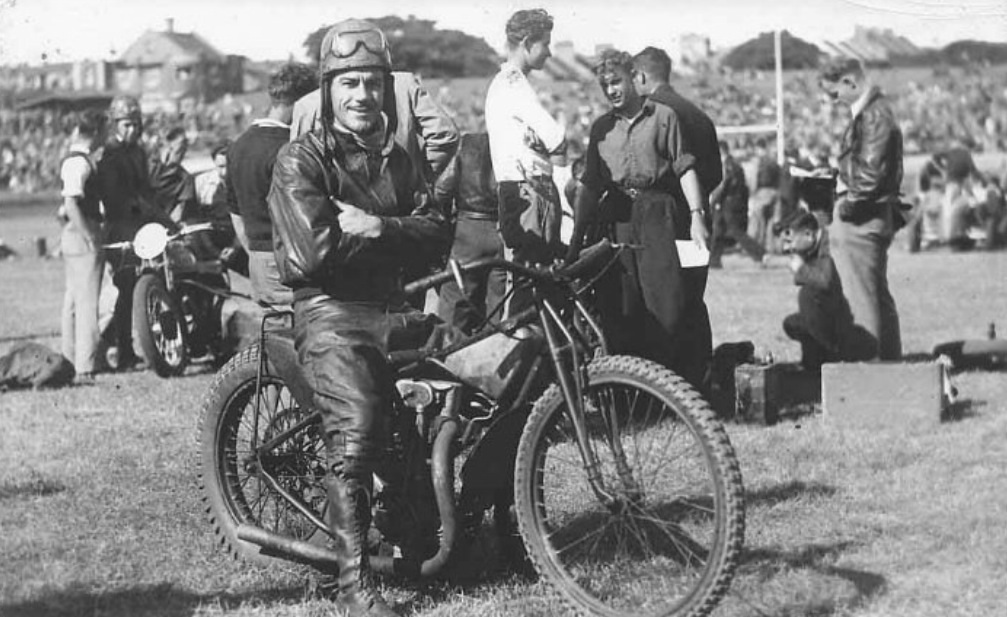
LVP on a 1930’s JAP, date and place unknown (defunctspeedway.co.uk)

On 11 August 1941 Van Praag enlisted in the Royal Australian Air Force and was appointed to No.2 Wireless Air Gunners School, Parkes, New South Wales with the rank of acting sergeant.

Engaged on flying duties, he was promoted to probationary pilot officer in October 1942 and flight lieutenant in October 1944.

In January 1942 the transport plane of which he was a co-pilot, an RAAF Douglas DC-2 A30-8, was shot down by a Japanese aircraft over the Sumba Strait, off Indonesia whilst on a flight from Surabaya, Java to Koepang/Kupang Timor. For thirty hours, whilst subject to shark attacks, he and his Captain, Flying Officer Noel Webster, supported the two crew-members, both non-swimmers and secured their survival, acts of bravery for which they were awarded the George Medal.

A full account of the incident appears in the book ‘And Far From Home’, written by John Balfe who flew with Lionel.

Balfe had this to say about Van Praag as a man ‘…in flying with Van I had perceived in his slight wiry form, a man of particular capacity and directness. He cared nothing for false values in anything or anyone and did not hide from the fact. I found him only a week out of hospital after the ditching (of the DC-2) but already back in a comprehensive engineering workshop he had behind his unpretentious home on Botany Bay’s (Sydney) north shore. He had plant and equipment there to wet the appetite of any metal engineer. One of the real Australians, Van had led a hard life racing motorcycles from early manhood and lived to standards he had not relaxed. He was moderate in thought and habit and held in quiet contempt those who were not. He valued his friendships above human faults, but chose his friends carefully and for the most part made them for life. His mind and memory remained sharp and retained an accuracy in detail that I had noted flying with him in 1943’.

After recuperating from the ditching, Lionel returned to flying C-47’s with No 36 Squadron out of Townsville, Far North Queensland. His RAAF appointment ended on 27 July 1945.
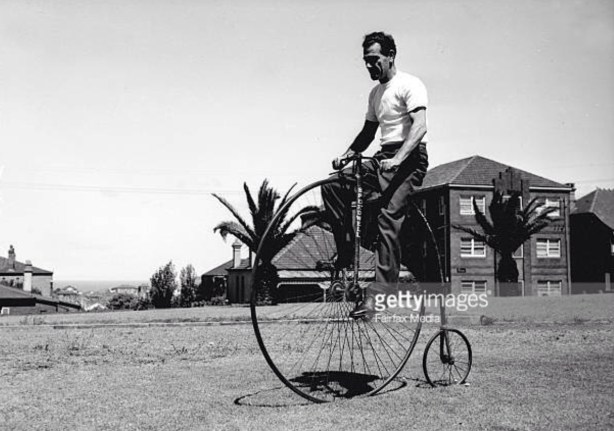
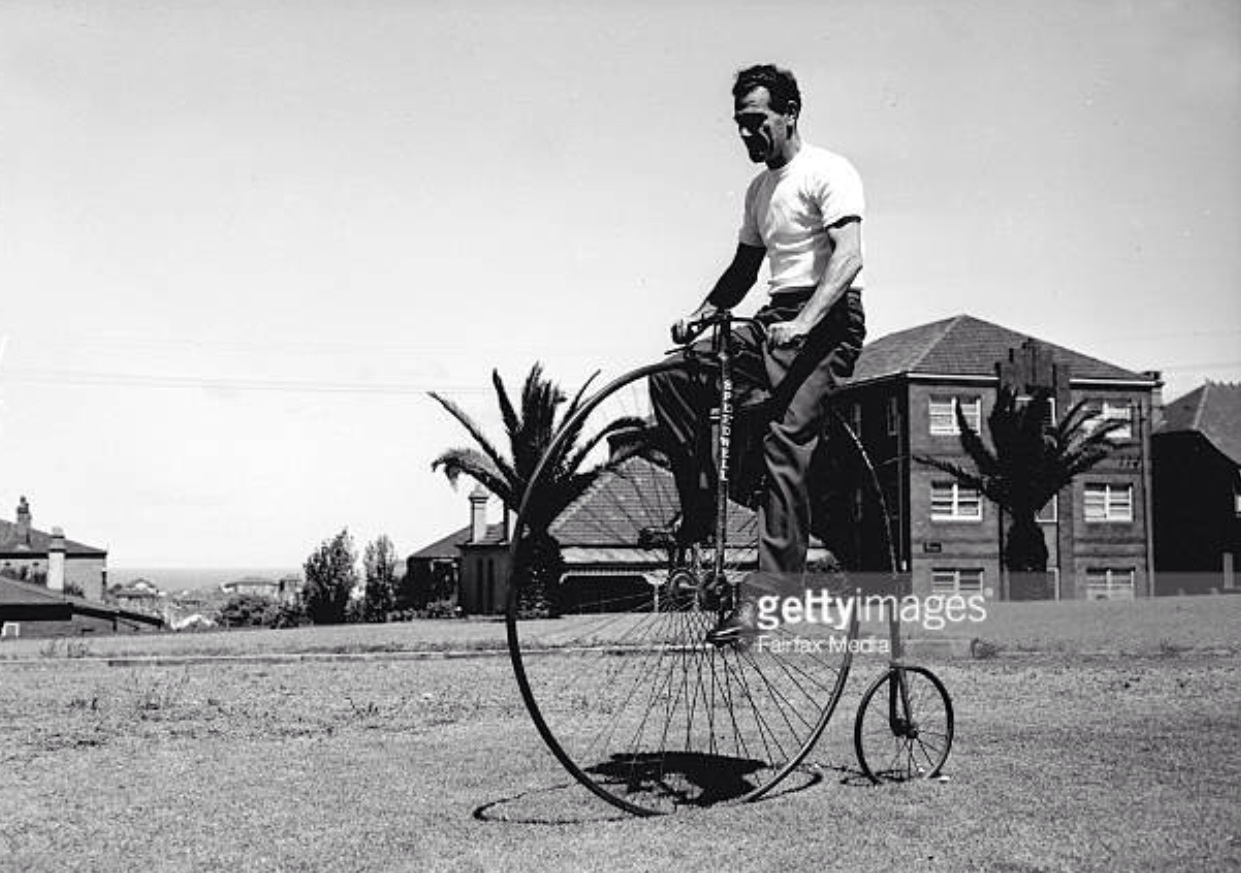
LVP aboard a Penny Farthing in 1951, interesting to know the occasion, and place! (Fairfax)

Post war Lionel resumed motorcycle racing and soon developed a career in aviation…

Van Praag headed a riders’ consortium that promoted speedway at the Sydney Sports Ground in 1945-48. He rode for the English team New Cross in 1947. After 1948 he effectively retired from racing, although in the early 1950s he briefly raced self-built small speedboats off Manly on Sydney Harbour.

In his new career as a commercial pilot in 1952 he combined his aviation and speedway interests by contracting with Empire Speedways to carry the Great Britain and Australian competitors, along with their bikes and equipment between the various Australian speedway venues in a Lockheed Lodestar.

He flew charter, and freight planes, did aerial top-dressing or crop-dusting in a Bristol Freighter, this plane was lost in December 1961 when it crashed at Wollongong after an engine failure on a freight flight. Lionel and the rest of the crew escaped injury. He later flew for an airline in Pakistan for a year before returning to Australia.
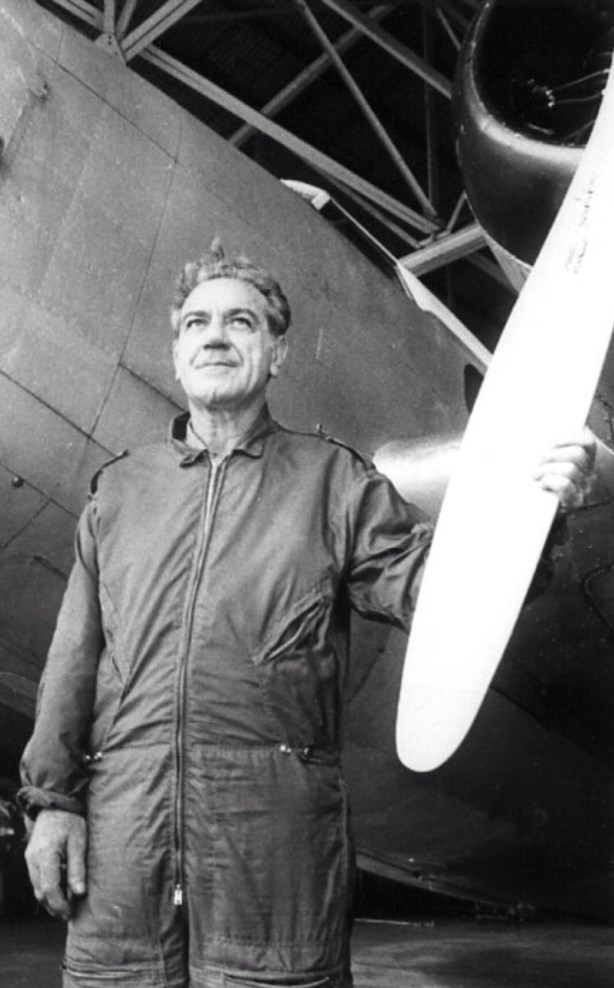
LVP in his later aviation years (adastron.com)

He joined Adastra Aerial Surveys, a company originally formed as a flying school in 1930 at Mascot, Sydney circa 1962 as a pilot and later became chief pilot. Although he had two well-publicised crashes, including the one described above, people who flew with him valued his informality and his resourceful flying ability.

In adult life, Van, as he was known, turned away from his Jewish upbringing. In 1929 at the district registrar’s office, Redfern, he married Elizabeth Margaret Pearl Cosgrove, a machinist, they divorced in April 1937. On 1 October that year at the register office, Hendon, England, he married Gwendoline Iris Hipkin, a dressmaker.

In 1968 he retired to his own Island, Temple Island, south of Mackay. In 1973, aged 65, he ferried a Hudson VH-AGJ from Sydney to Strathallan Museum in Scotland. Hudson’s were the primary survey aircraft used by Adastra.

He died on 19 May 1987 from emphysema, at Royal Brisbane Hospital. His wife, their daughter and two sons and the daughter of his first marriage survived him.

Post death recognition includes being inducted into the Sport Australia Hall of Fame in 1990. In addition, in 2000, the Government of the Australian Capital Territory decided to honour several Australian sportsmen with the naming of streets, including ‘Van Praag Place’ in the Canberra suburb of Gordon.

Three of my fathers uncles served in World War 2. As I became a teenager and understood, to an extent, what they endured in the Middle East and New Guinea I held these wonderful, private, kind, gentle but strong men in considerable awe. I always called them my ‘Boys Own Heros’ when I saw them at family events. Certainly Lionel Van Praag was a Boys Own Hero- in spades. Truly an amazing, full life of achievement.
Bibliography…

‘Australian Dictionary of Biography’ entry by Graham Howard, Australian Sports Hall of Fame, adastron.com

Photo Credits…

Getty Images, Fox Photos, PA Images, , Malcolm F Gray, State Library of South Australia, Fairfax, defunctspeedwaysuk.com

Tailpiece: LVP and friends at the Sydney Sportsground on 4 September 1945, first post-war meeting I wonder?…
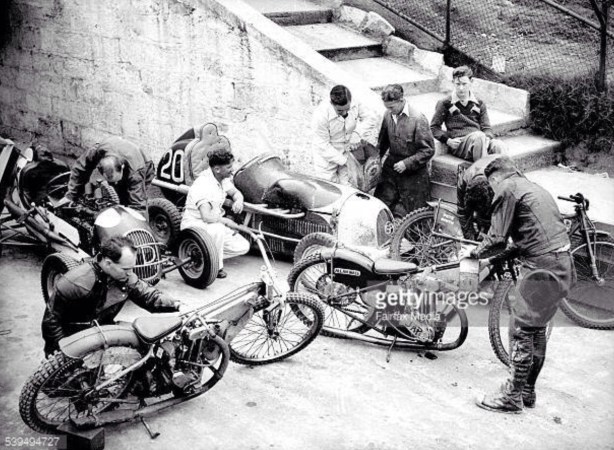


(Jack Inwood)

Three-time Kiwi Gold Star champion Jim Palmer leads John Riley during the 1964 running of the ‘Renwick 50’ held each November in the township of Renwick…
Palmer’s car is the ex-Jack Brabham works 1964 Tasman Series  Brabham BT7A Climax FPF ‘IC-2-63’, Riley’s the ex-Tony Shelly Lotus 18/21 Climax FPF.

When I initially saw this shot I imagined the cars were returning to the paddock but in fact they are entering what was in effect a single car at a time part of the track, a right-hander, the course was essentially rectangular in layout through the roads of Renwick.

The Marlborough region is a stunning part of New Zealand, its the countries largest wine growing area, in the far north of the South Island and famous the world over for some marvellous Sauvignon Blanc whites.

Palmer’s ex-Clark Lotus 32B Climax during the January 1966 Levin Tasman round, he was 5th in the race won by Richard Attwood’s BRM P261. Jim Clark won the ’65 Tasman in this car, chassis ’32-FL-8′ with 4 wins and then sold it to the Palmer family. Superbly prepared and driven, Palmer won the 1965/6 NZ Gold Star in it and then finished 4th in the ’66 Tasman with a mix of speed and reliability- only Stewart, Hill and Clark were in front of the plucky Kiwi. The car then raced in Oz in the hands of Greg Cusack and Mel McEwin. Ultimately restored by John Dawson-Damer in Sydney and sold/part exchanged for a Lotus 79 to Classic Team Lotus 20 years ago. 2.5 CC FPF and ZF 5 speed box clear in shot as is very beefy rear chassis diaphragm (TRS)

Click here for an article about the Lotus 32B and the Levin International won by Jim Clark in 1965;

‘Levin International’ New Zealand 1965…

The Renwick event was run from 1960 to 1967. Frank Shuter won the first in his Ferrari 625, but it was  Palmer who had a bit of a mortgage on it.

He won in 1964, 1965 and 1966 in Cooper T53, Brabham BT7A and Lotus 32B, the latter the car Jim Clark won the Tasman Series with in 1965. All of these cars were powered by the venerable 2.5 litre Coventry Climax FPF 4 cylinder engine- the World Championship winning engine of 1959-60. Palmer won the New Zealand Gold Star, the NZ drivers championship in 1964/5, 1965/6 and 1967/8 in the Brabham, Lotus and a McLaren M4A Ford FVA F2 respectively.

Jim Palmer aboard the Scuderia Veloce Brabham BT11A Climax, not so long before vacated by Spencer Martin, at Bathurst, Easter 1966. The shot is taken near the crest at Reid Park Gate. Palmer drove well, albeit against no other 2.5 litre competition, to win the racing car feature Mt Panorama Gold Cup. It was about this time he failed his CAMS licence due to some vision issues, a great shame as the speedy Kiwi would have been a welcome addition to our Gold Star grids, skinny as they were (John Ellacott)

A top driver he retired too early in my book, partially due to being unable to get an Australian CAMS racing licence, he was long-sighted in one eye. He also married and decided to focus on his retail motor trade and property business interests which centred on Hamilton where he still lives.

Jim Palmer in the ex-Clark Lotus 32B Climax on the way to 6th place in the 1966 Warwick Farm 100 on 13 February. Clark won from Hill and Gardner (Bruce Wells)

The 1964 Renwick 50 was run over 20 laps of the 2.414 km course (three variants of Renwick roads were used over the years) on 14 November, a smidge under 50 km in total. Palmer won and took the lap record at 1: 17.0 with Morrie Stanton, Stanton Corvette 2nd and Red Dawson in a Cooper T53 Climax 3rd.

Check out this YouTube footage which shows the undulating, narrow nature of the circuit. Whilst the caption says 1965, the footage is from several of the Renwick meetings including 1964.

Bibliography…

sergent.com, ‘Bathurst: Cradle of Australian Motor Racing’ John Medley, oldracingcars.com

Photo Credits…

Jack Inwood/The Roaring Season, John Ellacott, Bruce Wells, Marlborough Car Club

Tailpiece: Chris Amon, Maser 250F, Renwick 50 November 1962…

Chris Amon, Maser 250F just ahead of Bob Eade’s similar car with John Histed’s Lola Mk2 Ford behind. Angus Hyslop Cooper T53 Climax won from Amon and Barry Cottle, Lola Mk1 Climax. This race on 10 November 1962 was Chris’ last race in the Maser (Marlborough Car Club)

Postscript: Next stage of Chris Amon’s career…

Click here for an article on the next critical months in Amon’s career after the Maserati was put to one side and Chris drove David McKay’s Cooper T53 Climax in the 1963 Australasian Internationals; https://primotipo.com/2017/09/06/chris-amon-cooper-t53-and-the-australian-grand-prix-1963/

Finito…

Gary Knutson and Jerry Mallett with their Lotus 11 Climax at the ‘Garden of The Gods’, Colorado Springs, Colorado circa 1959…

Knutson went on to become one of the ’main men’ during the McLaren ‘Papaya Period’ after doing stints with Traco and Chaparral, but here he is posing with his later business partner and their new car just acquired from Jim Hall.

Its amazing how you find stuff such as this wonderful photograph. I was trying to find the correct spelling of Gary’s surname which I always get wrong- off to Google. Click away. Bingo! The trouble is the photo is on ‘The Nostalgia Forum’, the most content rich motorsport website on the planet. I can never deal with a new thread on TNF in less than an hour.

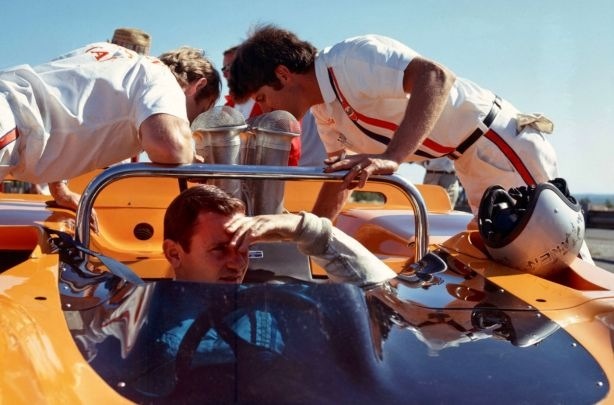
Tyler Alexander and Gary Knutson tend to their charge in the Bridghampton paddock, 1968. Bruce waits patiently. Both M8A’s had engine dramas this race- Bruce ran a bearing and Denny’s chucked a rod. Mark Donohue won in Roger Penske’s M6B Chev (P Lyons)

Contributions to this thread of TNF include bits by Wally Willmott, Howden Ganley, Jerry Entin and others. Here are some snippets, its not a comprehensive article about Knutson but a pot-pourri of bits and bobs plus a link to a fantastic, detailed article in Hot Rod magazine on development of the Big Block Chev ZL1 V8- Knutson was up to his armpits in that project of course.

The connection to Jim Hall was via Jims brother Chuck who was going to the University of Colorado, at Boulder, as was Knutson. Gary prepared Chuck’s Corvette with which he was third in class at Pikes Peak in 1958.

Knutson and Mallett shortly thereafter saw a sportscar race in Phoenix and were hooked- they then approached Jim via Chuck to buy the 1.5 litre Coventry Climax powered Lotus 11 Le Mans Series 2.

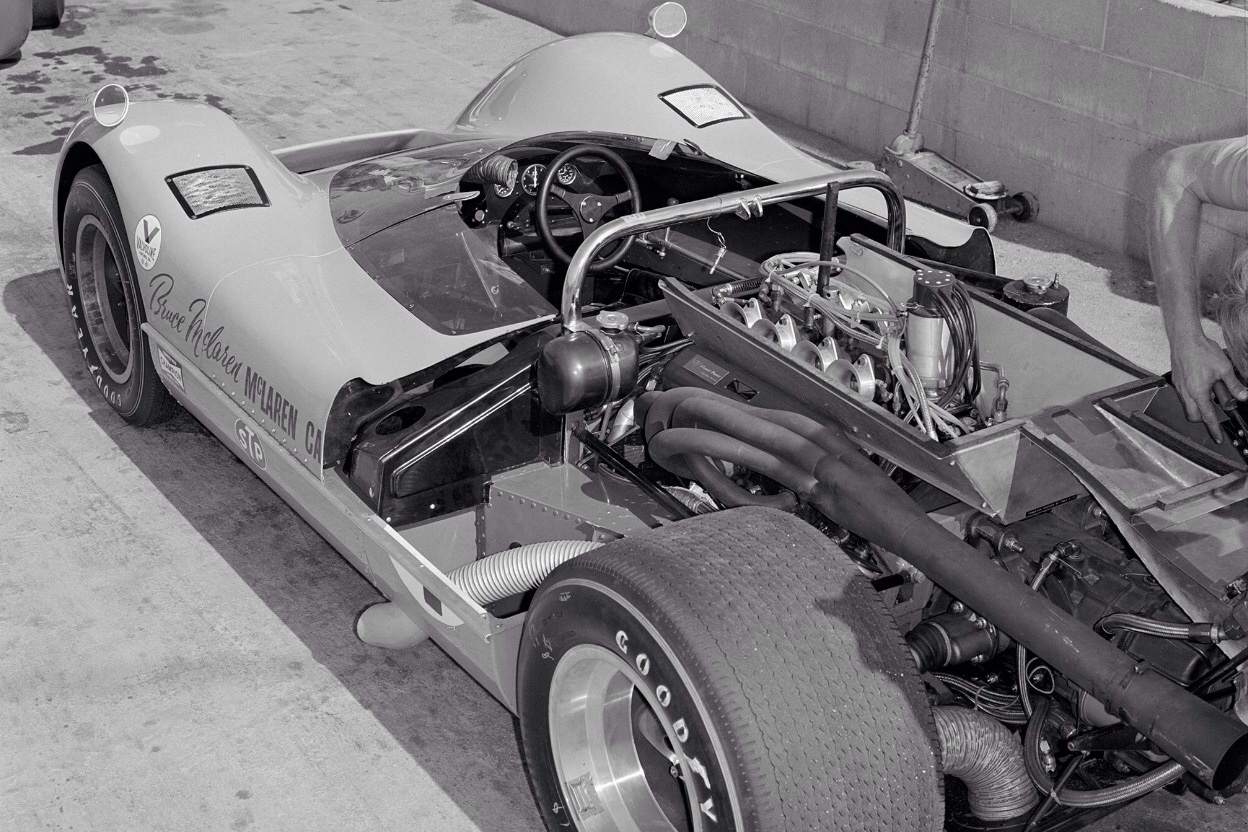
Bruce McLaren and Robin Herd’s superb, simple monocoque M6A Chev- the ’67 Can Am Champ. ’67 engines developed on Al Bartz’ dyno in Van Nuys, Cal by Knutson as McLaren then did not have a dyno- look closely on the rocker cover and you can see the Bartz tag in addition to the McLaren Flower Power one! Cast iron Chev 350, four-bolt main bearing caps, 2.02 /1.60 inch intake/exhaust valves with 4 Weber 48IDA carbs 525 bhp @ 7600 rpm. An additional 25 bhp was gained with the adoption of Lucas fuel injection- Knutson used Traco throttle bodies on a Mickey Thomson cross-ram intake manifold intended for Webers. Also used was a Corvette Rochester fuel injection distributor to drive the metering unit and a Vertex magneto instead of a distributor. McLaren was reported disappointed with the power gain but the improved throttle response and driveability was significant with the M6A’s winning 5 of the 6 rounds and Bruce the championship from Denny (unattributed)

Knutson, born in 1937 lived in Colorado Springs where his mother was a teacher and father a photographer. His mechanical interest started with Soapbox Derby devices, a Maytag washing machine motor powered trike and Briggs and Stratton lawnmower engines, then ‘Whizzer’ ‘bike engines and soon an Ardun flat-head Ford V8 engine which went into a 1932 ‘5 window’ Ford which was ‘dragged’ and hill-climbed. Gary won a dirt hillclimb event in the car aged 16 at Georgetown.

Mallett recalls ‘When we ran the Lotus 11, both of us worked two jobs each to pay for the thing, but we would roll out of Colorado Springs on Friday night at about 7 pm and drive all night to Salt Lake City, Utah, New Mexico or Texas. The first race was in Dallas, Texas and after the all night drive, a shower and a cup of coffee, we really thought we were in the big leagues. Around 8 am a trailer showed up with four Ferraris. It was a long day’.

1967 Chev 350 McLaren engine detail at Road America. Note the Traco throttle bodies and Mickey Thomson magnesium manifold referred to above. Below is the Vertex maggy and roller-rocker valve gear- by whom I wonder? (D Friedman)

Knutson worked for Chaparral in the early days when the Chap 2 was first built and the team comprised Jim Hall and Hap Sharp, chief mechanic Franz Weis, ace fabricator Troy Rogers, with Gary as the engine man. At Traco Engineering before commencing McLaren’s in-house Chevy engine program, he worked on a ‘Who’s Who of all branches of motor racing engines doing 14 hour days with Wally Willmott, with Gary having oversight of the Ford Quad Cam Indy to McLaren F1 engine project.

The in-house CanAm project started with the ’67 McLaren Chev 350 cid engines which produced about 525 bhp @ 7600 rpm on Webers, before Knutson adapted Lucas fuel injection…

At this point, click on this link to a wonderful article in ‘Hot Rod’ magazine about the development of the McLaren Chev aluminium, big block ‘Rat Motors’ in which Knutson was the major player, it’s a beauty;

http://www.hotrod.com/articles/unlimited-rat-motor-racing/

1968 7 litre Chev ally LT1 ‘Rat Motor’. Development work initially done with cast iron block and the new L88 ally heads till the blocks became available. 4.25 inch standard bore and 3.76 inch stroke with Moldex steel crank, Cloyes roller timing chains, cam by Vince Piggins group at Chev R&D. Production solid lifters, Forgedtrue pistons and Carillo rods. Dry sump pumps by Weaver and magnesium dry sump pans by Chev R&D. The L88 heads had 2.19/1.84 inch intake/exhaust valves with the ports enlarged and re-shaped. Crane aluminium roller-rockers. Magnesium intake manifolds had a 2.9 inch bore for each cylinder with a fuel injector into each of the curved and tuned length steel velocity stacks. Intakes were modified Crower with MacKay making the intakes, Lucas metering unit, Vetex magneto and tach drives from magnesium. That lot generated  a real 650 bhp @ 7600 rpm with McLaren quoting 620 in-period . In ’68 the M8A won 4 of the 6 rounds and Denny the title. McLarens won every round of the series (HotRod)

Bibliography…

The Nostalgia Forum, classicscars.com

Photo Credits…

Gary Knutson Collection, Pete Lyons, Dave Friedman Archive, hotrod.com

Tailpiece: Moss, Hulme and Knutson astride another McLaren mechanic, McLaren M6A Chev, Road America 1967…

Stirling Moss is interviewing the winner Denny Hulme whilst Knutson looks pleased that his engine has won first time out. Road Am the first ’67 Can Am round on 3 September. Donohue and Surtees were 2nd/3rd in Lola T70 Mk3B’s with Bruce #4 below out with an oil leak on lap 6 (D Friedman)

Finito…


Christmas 2017…

Posted: December 24, 2017 in Who,What,Where & When...?
Tags:

(Pinterest)

Seasonal salutations to you all, I know we don’t all celebrate Christmas, but even for those of us who are not religious its a good time to pause, reflect and be thankful for what we have.

In this case to thankyou all for your ongoing support of this magazine.

In this nutty world ruled by Froot-Loops like Donald Trump and Kim Jong-un we need to just pursue our lives and passions in the knowledge that the ‘ruling class’ to a large extent, fortunately, have limited control over what goes on.

Modern ‘narrow-casting’ and the ability to selectively consume the media you want effectively allows one to filter out the fuckwits. They are there, ever present, but one can largely ignore them.

primotipo is an example of a niche site of the type I refer to, somewhere to lose yourself for a while away from the madness. There you go, a motorsport site with medicinal qualities- and free! How good is that?

I started it whilst working in Adelaide with plenty of time on my hands, on 15 May 2014, have a giggle at my first effort!

Gibbo’s Tipo- Fred Gibson and Alfa Tipo 33/3 in Australia…

Several years later there are now over 600 articles, long and short. Some I have enjoyed re-reading, others make me cringe.

I know its getting cold in the Northern Hemisphere just looking at my site stats- when you guys go inside out of the winter chill it makes a difference of anywhere up to 10,000 additional hits a month. Its nice to think I am giving some of you something to do!

Our little community is the same in terms of  the structure of readership as last year.

The ‘Top Ten’ countries are the same as in 2016; Australia, France, United States, Germany, United Kingdom, Italy, Japan, Holland, Brazil and Spain. 35% of the articles are Australian but only 22% of the readership are ‘Aussies- 78% of you are from other countries. Which is so wonderful! I never figured I would have global readership.

51% of you are from countries where English is not the native tongue either- that amazes me. Other than our large migrant population the average Aussie isn’t bilingual, we all struggle with the Queens English if truth be known- but look at you lot, clever sods that you are!

I don’t think I have had a guest writer this calendar year, which is a pain as i’ve done it all. Freelance contributions on just about any topic are welcome- mind you I owe a few of you big-time to pop up manuscripts you have generously provided.

I continue to get great support from Australian photographers in particular, these blokes are gold- Dick Simpson, John Ellacott, Lynton Hemer, Kevin Drage, Lindsay Ross, Rod MacKenzie, David Blanch, Dale Harvey and Terry Marshall ‘over the ditch’ in New Zealand. Similarly Steve Holmes of ‘The Roaring Season’ tolerates me raiding his wonderful sites photographic archives from time to time.

‘The Nostalgia Forum’ is content rich with a whole swag of Australian enthusiasts adding vast depth to all sorts of arcane topics which has added bigtime to the depth of articles beyond that possible from my own library or experience. There are lots of them but those fellas off the top of my head include John Medley, Ray Bell, Stephen Dalton, Lynton Hemer, Terry Sullivan, David Seldon, Ken Devine (who I met in Perth a month ago- expect some great West Australian content next year folks) Lee Nicholle, Greg Mackie, Bruce Moxon, Spencer Lambert, Wirra and others- apologies to those I forgot.

What can you expect next year? More of the same I think- still pretty random, discovery of a photo inspires the articles- I don’t have a list of topics as such. In recent times various of the State Library Archive’s in Australia have yielded some gold, some of these articles, features, are in the ‘back end’ of the site awaiting up-loading. The Getty Images, staggering global archive is often a source of inspiration too.

My (real) job workload has increased quite a lot this year with regular travel from home in Melbourne to Sydney and Perth so the regime has been three posts a week- a Thursday or Friday feature (anything over 1500 words) an odd or amusing snippet on a Sunday or Monday and another shorter article mid-week is the loose regime I work to.

My favourite articles this year are all about relative obscurities- the ATS 100 GP car, Aussie single-seater ace Bill Patterson, Derek Jolly and his sportscars and the ‘Penrith World Championship’. It is nice to do stuff not every other Tom, Dick, ‘n Harry has written- the hard part is coming up with them and the necessary research material.

Speaking of which- thanks to Martin Stubbs, Stephen Dalton, Rob Bartholomaeus, Patrick Ryan, Nigel Tait, Michael Gasking and Rod Wolfe for ongoing access to their archive or other information and corrections provided. I have no sub-editor so occasionally boo-boos are made- usually when I rely on memory which is dangerous given that particular resource is ageing rapidly.

Thinking of Rodway Wolfe reminds me I have been light on in terms of our Repco articles this year- I’ve done a few but only one of substance. I need to re-focus on that aim of documenting, as best we can, the insiders view of the Repco Sixties Glory Years.

Enough. Thanks for being there, it remains fun- I get a lot of satisfaction knowing I have regular readers in places such as Namibia, Laos, Mongolia, Nepal, Albania and Greenland- not exactly global centres of motor racing!

Finally, out of interest, the three most consistently popular articles are all ‘oldies’ on mainstream global topics- ‘Porsche 917: 1969 The First Season’, ‘RB620’ V8: Building the 1966 World Champion Engine’ (written with Rod Wolfe) and the piece about the Works/Chris Amon/Scuderia Veloce ‘Ferrari P4/Can Am 350 ‘0858’.

There is a lesson there of course, if you want the numbers write on mainstream topics.

For those that have one, enjoy the break!


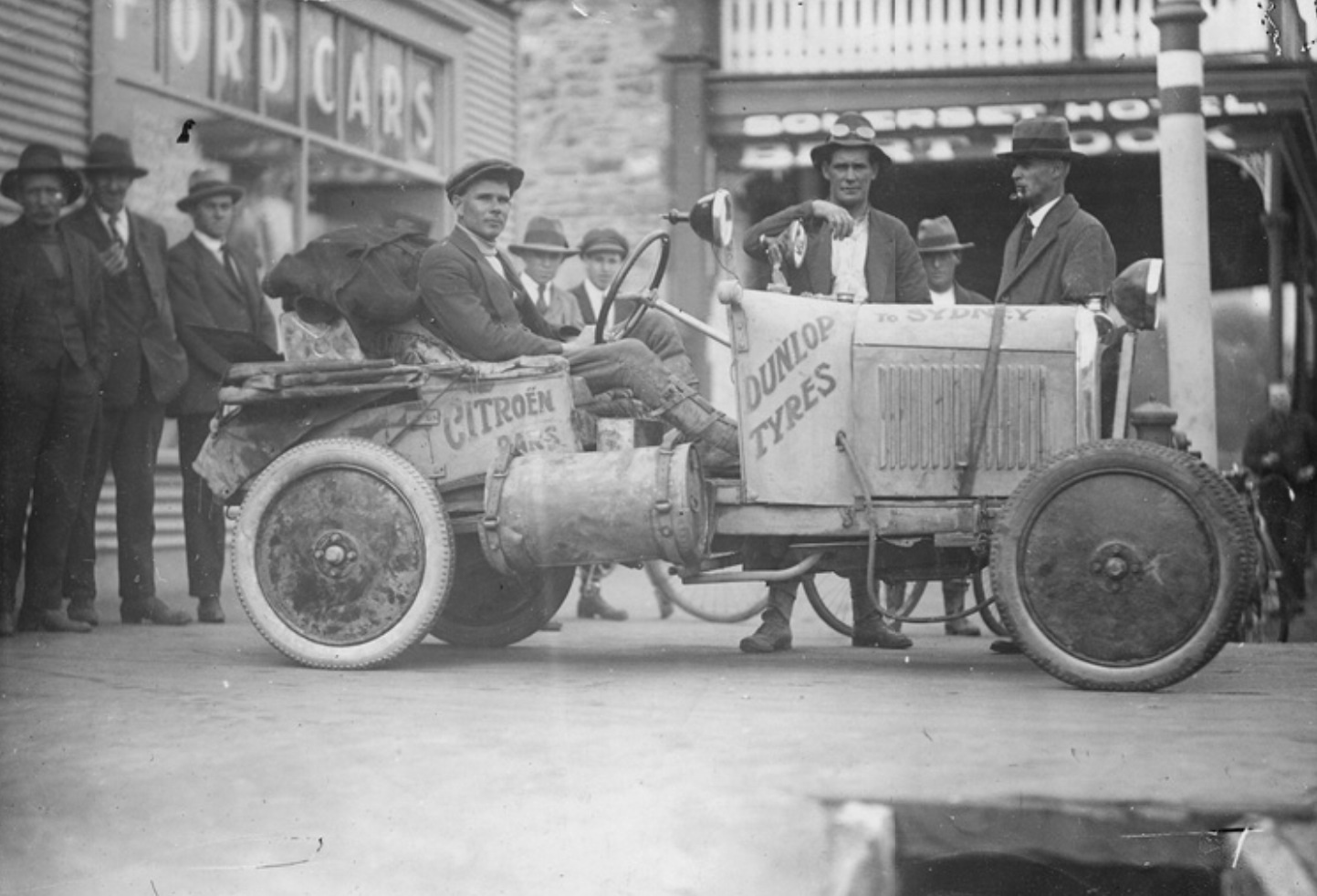
WJ Phipps and J Seery drove this 7 hp Citroen Type C from Fremantle, Western Australia to Adelaide, South Australia, Melbourne, Victoria in May 1923, and on to Sydney New South Wales, a  journey of about 3,180 miles…

The West Australian pair left Freo in the 856cc, 4 cylinder, 3 speed small car on 1 May. Phipps originally intended to make the trip on a motor cycle and sidecar but received an offer from the Citroen agents to use the small car instead, he then invited Seery to accompany him. In various reports described as a planned as an attempt on the Fremantle-Sydney transcontinental record, or to prove a small light car could make the challenging journey, the trip became a ‘more leisurely touring drive’ after the loss of four days due to hub damage.

Phipps quipped that ‘When we left Perth we were the laughing stock of all motorists because no-one dreamed we would be able to get through’. Even the cars agents were somewhat dubious about their prospects. The intrepid adventurers travelled all day and night, one sleeping whilst the other drove.

The route chosen took them from Fremantle to Kalgoorlie (WA) Port Augusta to Adelaide (SA) Melbourne and then on to Sydney (Victoria and NSW respectively).

The Perth ‘Daily News’ reported that ‘Despite the fact the whole outfit with luggage weighed 18 cwt, (including 23 gallons of petroleum benzine and 8 gallons of water) the little car had no difficulty in negotiating this heavy route’. For hundreds of miles, the pair followed the transcontinental railway line as much as possible, there was no track at all, with large limestone boulders having to be moved before they could proceed.

The car was delayed by four days near Naretha, 180 miles from Kalgoorlie on the transcontinental railway line, ‘owing to one of the wheels crashing into an obscured stump’ the Citroens hub was broken necessitating a spare to be delivered by rail from Perth. Apart from that mishap they ‘never had a spanner on the car’.

The most challenging part of the trip were the Yardu Sandhills in central WA where the Citroen got through unaided, taking five hours to go 12 miles. Other heavier cars on previous trips having to be hauled through by bullock teams.

Adelaide was reached in 157 driving hours on 11 May, this section of the trip was 1,769 miles. Behrens and Marshall (another report says Maugham-Thiem Motor Works) were the Citroen agents in Adelaide, the photograph of the car is out front of their Flinders Street showrooms.

The car then set off for the 571 miles to Melbourne at 2pm that afternoon 11 May. The other most difficult leg of the trip was the section near Kurow Lake, there, instead of being axle deep in sand, they were axle deep in mud. They arrived in Melbourne at 8 am on 14 May.

After a days rest Phipps and Seery then set of for the 594 mile Sydney leg at 10.45 pm on 16 May via the Hume Highway route. They stopped for a night in Gundagai, wet and cold from exposure and set off again on Saturday arriving that evening, 19 May ‘…in Martin Place with West Australian air’ a quip referring to the fact that the tyres had not been pumped up at any time on the journey. The car was shod with Dunlop ‘Railroad’ tyres, averaged 38-44 miles per gallon, used 1.5 gallons of lubricant with the average speed for the entire trip 16.5 mph.

In a parting shot Phipps said ‘We are on a holiday trip…we will return in the car…we intend on the way back to the West to have some dingo shooting on the Nullarbor Plain’.

I wonder if this significant Citroen survived?

Credits…

WS Smith/State Library of South Australia. ‘The Daily News Perth’ 2 June 1923, ‘Perth Sunday Times’ 20 May 1923, ‘The Express’ Adelaide 11 May 1923

image

(SLWA)

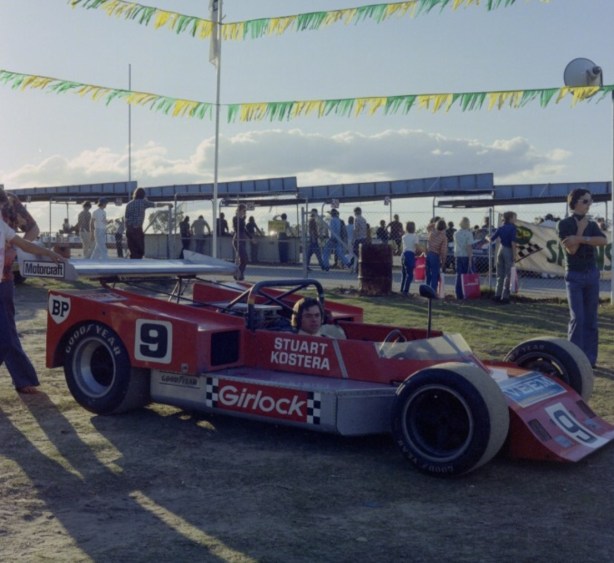
Lionel Ayers and Stuart Kostera shake hands after Ayers’ victory in the 35 lap Wanneroo Park, West Australian round of the Australian Sportscar Championship (ASC) on 12 August 1973…

Lionel’s car is a real weapon, a Rennmax, ‘the Big Bertha’ of all of the sportscars built by Bob Britton, powered by a Repco ‘740 Series’ SOHC Lucas injected, 5 litre 500 BHP V8. Stuart raced a Matich SR3 Ford into third place behind Henry Michell who was second in an Elfin 360 Repco 2.5 V8.

Both Ayers and Kostera were ‘sportscar stalwarts’, they raced two-seaters for a decade and more and all over Australia- not easy as Ayers was a Brisbane boy with Stuart from Perth.

A majority of the motor racing in Australia is in the Eastern Seaboard states of Victoria and New South Wales so these blokes would have done a million miles over the years travelling from home base to chase the Tourist Trophy or ASC. As the name suggests the ASC was a national series, the distance from Brisbane to Perth and return for Ayers was about 8600 Km for example!

image

Lionel Ayers tips his MRC Lotus 23B Ford into The Viaduct at Longford in 1968. What a shot! (oldracephotos.com/DKeep)

Ayers cut his racing teeth in an MG TC and then progressed into single-seaters such as the Cooper MG and Lotus 20 Ford before racing the first of three Rennmax Engineering built sportscars over the next decade.

The first was the MRC Lotus 23B Ford in which he contested the 1966 Australian Tourist Trophy at Longford. Later came the MRC Mk2 Repco, the last the Rennmax Repco which used the Repco ‘740 Series’ 5 litre V8 and Hewland DG300 ‘box from the MRC Mk2.

MRC ‘Motor Racing Components’ was Ayers company, which prepared the cars and part assembled them in Brisbane but the three cars were Rennmax built. Lionel was a pharmacist but he was also a pretty handy engineer.

image

John Harvey and Phil Moore, Wanneroo Park 18 August 1972. Howie Sangster won the ASC round at Wanneroo that year in a McLaren LT170 Chev- this car an amalgam of Lola T70 chassis and McLaren bits (SLWA)

Star of the sportscar ranks at the dawn of the seventies, post the sixties ‘Matich Decade’ was John Harvey in Bob Jane’s superb McLaren M6B Repco.

You could liken Harves to an Australian Mario Andretti in some ways, he was a champion in Speedway Midgets before hitting the circuits and was soon into single-seaters after an initial season in a Cooper S.

The shame is that he wasn’t in 2.5 litre Tasman cars earlier, that he never did a full Tasman Series (only the Oz rounds) and in the F5000 era Bob Jane popped the Bowin P8 to one side way too early. Sponsor, Castrol wanted Bob to run ‘taxis’, so it was tourers and sports sedans the team raced- and in which John excelled.

Harvey won the ASC title at a canter in 1971 and 1972, the car only raced sporadically after that as the team focussed on Touring Cars/Sports Sedans. Bob of course still owns it.

image

John Harvey in the Symmons Plains paddock, McLaren M6B ‘740 Series’ Repco V8, November 1972. He won the title in ’72 and that round. Love the juxtaposition of the 1967/8 ‘futuristic’ racer with the (mainly) Holden ‘roadies’ in the background (E French)

The South Australian ‘Elfin 360 Repco twins’, Phil Moore and Henry Michell won the ASC in 1973 and 1974 in two different chassis’.

Garrie Cooper built two very clever cars there (three 360’s were built, the other for Bob Romano was Ford twin-cam powered). In essence they comprised spaceframe chassis sporties built of single-seater F2 Elfin 600E hardware into which he dropped (surplus to requirements with the advent of F5000) ex-Tasman Repco Brabham 2.5 litre V8’s and FT200 Hewland gearboxes. In so doing, he created two light, chuckable, circa 300bhp little rockets which were driven with considerable skill and brio.

image

Phil Moore Elfin 360 Repco and Stuart Kostera, Matich SR3 Ford in the Wanneroo Park formup area August 1971. Pinocchios is Howie’s club (SLWA)

In 1973 Moore won the ASC convincingly taking four rounds, Phillip Island, Sandown, Symmons Plains and Oran Park, the latter a night meeting. I would love to have seen those cars, lights ablaze in the dark. Lionel won at Wanneroo and Adelaide International.

The photo below is at the Sandown round in July and shows Phil diving down the inside of  Lionel’s Rennmax at Torana/Peters Corner before the blast up the back straight where I suspect 5 litres of Repco V8 triumphed over 2.5 litres of it! Phil won the round mind you.

image

(Aust M Racing Year)

The following year, 1974, Ayers again won two of four rounds, at Adelaide and Calder with Henry Michell taking the title in a year of speed and consistency.

Garrie Cooper took the other two wins in ’74 in his new, epoch shifting, Elfin MS7 Repco Holden.

This one off car was a mix of monocoque chassis and bibs and bobs from his F5000 MR6 parts book including uprights, wheels, suspension and brake componentry, Repco Holden 500bhp V8 and of course the ubiquitous DG300 Hewland transaxle.

The car (below) was a crowd and sponsor pleaser, you can just make out the Ansett logo against the bare aluminium body on the nose of the MS7 which is making its race debut at Adelaide International, just down the road from Edwardstown, where the car was built.

Its 25 August 1974, Ayers won the two ASCC rounds before the Elfin raced, Garrie won the other two at Phillip Island and Symmons Plains. In an unfortunate turn of events Lionel broke both of his arms in a low speed motorcycle accident after the first two rounds of the series, perhaps missing out on a title it would have been wonderful to see him win- mainstay of sporties as he had been.

image

(G Cooper Elfin MS7 Repco Holden from Stan Keen, Boral Ford, August 1974 (R Davies)

He promptly retired from the sport and sold the Rennmax but remaining close to the scene. A decade ago he did a brilliant job restoring the Mildren Waggott ‘Yellow Submarine’ made famous by Kevin Bartlett and Frank Gardner. He died in 2013 but his memory lives on in that wonderful car retained and used by his family.

The Rennmax did achieve a national title though- after Lionel sold it.

It passed through Melbourne’s Jim Phillips hands, he raced the car for a few years and then sold it to the ‘Racing Gibsons’ in Benalla. There, at Winton in 1979, with yours truly watching the race, I was contesting the Formula Vee support races that weekend, Paul Gibson won the Australian Tourist Trophy- from none other than Stuart Kostera in the Elfin MS7 Repco Holden. The presentation of the Australian Tourist Trophy to Paul was a very proud moment for father ‘Hoot’ Gibson, a racer himself who raised a family of racers!

image

Stuart Kostera’s Matich SR3A Ford looking as ugly as sin. Wanneroo Park 9 June 1975 (SLWA)

Kostera cut his racing teeth in sedans but progressed through an Elfin Catalina Ford to the Matich SR3- this famous car was ex-Matich and Don O’Sullivan- who finished 2nd in the 1969 ASSC in it behind Matich’s famous SR4 Repco.

Stuart continually developed the car, 5 litre Ford, not Repco ‘620 Series’ 4.4 V8 powered as it had originally been to the stage that it won the West Australian Sportscar Championship in 1975 having finished second in 1972 and 1974. At national (ASC) level he was 9th in 1972 and 1973, 12th in 1974, and 5th in the single race ASC at Phillip Island in 1975, the winner Cooper’s MS7.

Stuart Kostera, Matich SR3A Ford Wanneroo Park 1976 (SLWA)

He bought the MS7 Repco Holden from Garrie Cooper, running it as a quasi-works machine, the car mainly based at the Elfin works in Edwardstown, Adelaide rather than Stuart’s hometown of Perth.

Kostera’s first big win in the car was at Phillip Island twelve months after Coopers MS7 victory in the one race 1975 Australian Sports Car Championship. Kostera won the 1976 Australian Tourist Trophy at the same fast, demanding circuit tailor made for powerful devices such as the Elfin.

Kostera was a talented driver, I saw him race both the SR3 and MS7 at most of the Victorian circuits on numerous occasions, he always got the best from these big, demanding cars. The Elfin drive ended after Garrie Cooper’s demise in 1982.

Lionel Ayers, Lakeside, MRC Mk2 Repco Brabham V8 circa 1970 (unattributed)

All of the cars mentioned in this article still exist, the MRC Lotus 23, MRC Mk2 Repco, McLaren M6B, Elfin 360’s, Elfin MS7 and Matich SR3.

The Rennmax has been in Jim Phillip’s ownership (back to him post the Gibsons period of ownership) for decades, and will hopefully one day see the light of day outside the outer east of Melbourne garage where it resides. So too do the two 360’s mind you one of those has been in a garage not too far from the Rennmax for about the same time period!

 Etcetera…

Matich SR3 ‘3’ Ford

This ex-Don O’Sullivan/Frank Matich car evolved, as cars do over time. Attached are a couple of shots of the chassis which defeated Chris Amons Ferrari P4/Can Am 350 during the 1968 Tasman Series sportscar races competitive against more modern designs. The story of the SR3’s and a comprehensive chassis list of all the Matich built cars is in this article on the Matich SR4;

Matich SR4 Repco…by Nigel Tait and Mark Bisset

image

Stuart Kostera Matich SR3 Ford, Wanneroo Park 18 August 1972. Body of the SR3 not too from the car as built albeit guards modified to take much wider tyres than those of 1967/8 (SLWA)


Three years earlier than the shot above, Lakeside. Ayers in the MRC Repco Mk2 from Don O’Sullivan in SR3 ‘3’ Repco from a couple of Lotus 23’s and the rest, circa 1969 (unattributed)


Lionel Ayers Rennmax Repco at home shortly after collection from Bob Britton (J Lay)

Credits…

State Library of Western Australia, Terry Walkers Place, Ellis French, Robert Davies, Jeffrey Lay, Australian Motor Racing Year

Tailpiece: Phil and Stuart, ready to roll, ASC Wanneroo August 1972…

image

Phil Moore and Stuart Kostera in the Wanneroo Park form up area in 1972. Elfin 360 Repco and Matich SR3 Ford. Howie Sangster won the ’72 Wanneroo ASC round that year, McLaren LT170 Chev from Kostera and Moore (SLWA)

Finito…

Jochen Rindt doing some Brabham ‘grass cutting’ at the Tulln-Langenlebarn airfield circuit in 1967 with the flair and precision for which he was famous…

There are the ‘thinking drivers’ of course but it’s the ones with mesmerising, other worldly driving skills that ultimately excite.

The high priests amongst these fellows are the likes of Nuvolari, Fangio, Peterson, Villeneuve and of course Jochen Rindt. Only two of these chaps died in bed. In the days when racing cars and the geography in which they raced could and did bite, the law of averages, especially if you played with the extremes of the laws of physics too often could bring you undone.

Rindt from JPB at TL in 1968. He won from JPB and Henri Pescarolo in works  Matra MS7 FVA’s. Brabham BT23C’s filled 5 of the top 10 placings (unattributed)

Rindt made his name in F2- he was the dominant player in the class from the time he entered it in 1964 until the time he left planet earth in 1970. For much of that period he raced Brabhams- the chuckability of which were tailor made for the plucky Austrians balls to the wall, tail out, crowd pleasing style. Check out this article about Jochen and the F1 Lotus 72 Ford; https://primotipo.com/2017/05/19/designers-original-intent/

The BT23 family of cars, Tasman and F2/FB variants were ripper cars. They were up there with the very best of customer Brabhams designed by Ron Tauranac, fettled by Jack as to baseline chassis setup and built by Motor Racing Developments in large numbers.

The photos in this article are of Rindt at Tulln-Langenlebaln, Vienna and Thruxton. At TL Rindt’s Winkelmann BT23 FVA won in 1967 from Jack Brabham’s works machine and Jean-Pierre Beltoise’ Matra MS5 FVA , and ‘winged in 1968 from JPB and Henri Pescarolo both aboard  works Matra MS7 FVA’s.

At Thruxton (below) in 1968 he won from JPB in an MS7 FVA and Derek Bell in a BT23C FVA. Jochen also raced a BT23C in ’68, again Winkelmann entered.

Jochen on the way to winning the ‘BARC 200’ at Thruxton on 15 April 1968, Winkelmann BT23C (unattributed)

Bibliography…

F2 Index

Photo Credits…

Unattributed

Tailpiece: Rindt, on it, as usual, BT23C, Tulln-Langenlebaln, Vienna, 14 July 1968…

(unattributed)