Archive for the ‘Who,What,Where & When…?’ Category

image

(Imagno)

 Gardner’s streamlined 1100cc Zoller-supercharged MG K3 Magnette. ‘Goldie’ storms along the Frankfurt Autobahn at nearly 150mph, 25 October 1937…

Lt-Col Alfred Thomas Goldie Gardner, born 31 May 1890, was one of the most versatile racers of the 1930s and 1940s as well as a pretty handy engineer.

After completion of his education he went to Colombo, Ceylon to take up a 3 year business contact, at its completion he travelled to Burma for business but returned to the UK for 6 months after contracting malaria in 1914. Upon the War’s outbreak he joined the army, he was commissioned as a second-Lieutenant in the Royal Artillery. He had a distinguished military career, becoming  the youngest Major in the British Forces. In 1917 his reconnaisance plane was shot down by German fire, he copped leg and hip injuries which hospitalised him for 2 years, he was invalided out of the army as a result.

A Brooklands competitor, he started racing a Gordon England modified special Austin Seven in 1924 progressing through a Salmson and Amilcar to a C-type MG Montlhery Midget in 1931, a marque with which he is synonomous.

Cecil Kimber noticed him, he raced various MG’s with a lot of success from 1930. He was the first to lap Brooklands outer circuit at over 100 mph in a 750cc car in this period.

goldie brooklands

Gardner, MG K3, Brooklands date unknown (unattributed)

After a bad 1932 Tourist Trophy crash at Ards, Ireland when he rolled his MG J4 three times he ceased road racing, his leg and hip was not strong enough to cope with its rigours.

ards

Gardner looks ok despite the wild ride which destroyed his MG J4, he crashed on lap 3 of the 1932 Tourist Trophy at Ards-Belfast. By the looks of the amazed spectators it was a ‘big one’, Gardner thrown out on one of three rollovers (Heritage Images)

He  made the occasional Brooklands appearance, by 1934 he was ‘track racing fit’. He finished 3rd outright and first in the 1100cc class in the Brooklands 500 miles with co-driver ‘Bentley Boy’ Dr.J.D.Benjafield in an MG K3 Magnette.

Gardner travelled with Sir Malcolm Campbell’s World Land Speed expedition to Daytona Beach, Florida in 1935 and was inspired by it, concentrating on speed record attempts from then on setting over 100 National and International records between 1936 and 1952.

He bought the ex-Horton offset K3 single-seater for that purpose and was soon lapping Brooklands at over 120 mph. An improved streamlined body raised this to 124.4 mph, an 1100cc class record which remained unbroken until the tracks 1939 closure.

goldie and bernd

Gardner, Bernd Rosemeyer and Auto Union record-breaker Frankfurt 12 January 1938, this is 2 weeks before Bernd’s fatal accident on 28 January. 1938 AU ‘Stromlinienwagen’ 6.5 litre variant of the 6 litre V16, 560bhp@4800-4900rpm  engine (RacingOne)

In record runs at Montlhery and Frankfurt in October 1937 Gardner clocked almost 150 mph, 148.8 to take a Class G record for the flying kilometre. Auto Union’s Eberan von Eberhorst took him aside during ‘SpeedWeek’ suggesting he would go much faster with a streamlined car. At the time Mercedes and Auto Union were not only waging battle in Grands’ Prix but also in Land Speed Record attempts and were learning much about aerodynamics.

ex135 mounting

Press shoot, not sure where, Gardner in MG EX135, photo dated 15 August 1949 (Harold Clements)

When he returned to the UK he sought to convince MG to build him a car. Lord Nuffield gave his support and rather than ‘re-invent the wheel’ it was decided to try and get hold of George Eyston’s K3 based EX135 record-breaker built 4 years before.

Donald Letts had the car which critically had the offset transmission specification which would be required and happily agreed to sell. EX135 originally had race and record breaking bodies was further modified by fitment at Abingdon of  Reid Railton designed completely enclosed bodywork. John Thornley in his book describes the aerodynamic ‘K -factor’ of EX135 as 0.000400, the later EX279 was 0.000315. Suitably refurbished and rebuilt by ‘Jacko’ Jackson, Syd Enever and Robin Jackson, the beautiful car was used by Gardner in various forms, with a variety of engines for the rest of his career.

ex color

This ‘Modern Wonder’ contemporary article describes the 6 cylinder, 1086cc circa 195 bhp Vane type supercharged, twin-SU carbed engine as having magneto ignition, sodium filled exhaust valves and a bronze cylinder head, four speed ‘box. Dimensions are given as; 16’5″ long, width 5’3″, height 2’2″ and wheelbase 8’3″. The ‘beautifully streamlined body (was) built under Jaray (German) patents…’ ‘Design and construction of the car was headed by MG’s Cecil Kimber, while Reid Railton developed the streamlined bodywork’ (oldclassiccar.co.uk)

In the November 1938 German Speedweek outside Frankfurt the ‘new’ EX135 produced two way averages of 187.62 and 186.567mph for the flying mile and kilometre respectively. Showing its aerodynamic properties the car reputedly took 3 miles to stop, Gardner allowing it to coast to a halt!

frank 1

Gardner and EX135, Frankfurt 1938 (unattributed)

The Nazi Government was improving the countries road network and created in the process a ‘record route’, the ‘Dessauer Rennstrecke’ (Dessau Racetrack) between AS Bitterfeld and Dessau South which opened in January 1939. No speed records could be set on existing closed circuits which were simply too short for the powerful high speed cars of the day.

The straight stretch of road was 10km long, 25 metres wide, had no median strip and pillarless bridges. It was also intended as a wartime auxiliary airfield and was designed around target speeds of 600kmh. In the short time before Poland was invaded on 1 September 1939, Rudy Carracciola did 399.6kmh over the measured mile with a flying start in a Mercedes W154 3 litre record car, amongst other records he set, in February 1939.

nazi

(Die Welt)

At Dessau on 31 May 1939 with a higher top gear Gardner took the 750 to 1100cc records over 2 kilometres, 1 mile and 5 kilometres, at averages of 203.5 mph, 203.3 mph and 197.5 mph. His performances left those present in a state of disbelief, it was the first time an 1100cc car had gone anywhere close to the magic 200mph.

After an overnight engine rebore in situ! to1105.5cc, on 2 June 1939 at the same venue he bagged the 1100 to 1500cc class records over the same distances at averages of 204.3 mph, 203.9 mph and 200.6 mph. The achievements were rather lost given the imminence of WW2.

Dessau 1939 (J Dugdale)


ex cockpit

EX135 before the off, Dessau 31 May 1939 before the successful 200mph attempt. Array of Smiths instruments, steering wheel shape pre-dates F1 practice by 70 years! (John Dugdale)

One of those remarkable souls who served in both wars, Goldie Gardner took EX135 with 750cc engine fitted to Belgium’s new Jabbeke motorway in 1946 achieving 159.15 mph.

In 1947 he returned to Jabbeke with the car converted to a 500cc four-cylinder by removal of two conrods and pistons and blanking off two pots! He set new records, reaching 118 mph.

ex jag

Jaguar’s and later Coventry Climax’ designer Wally Hassan fettling his 2 litre, DOHC, cast iron block alloy head, twin SU fed engine, the performance of which clearly pleases Goldie! Jabbeke, Belgium September 1948. In the event Jaguar did not proceed to a production variant of this prototype engine, the 6 cylinder XK its primary engine on track and road for decades to come (unattributed)

In September 1948, he was back at Jabbeke, the streamlined MG powered by a prototype Jaguar XK100 DOHC 2litre 4 cylinder engine. In that ‘MG Jag’ hybrid he reached 176.6 mph for which he was awarded the second of three BRDC Gold Stars. He was also awarded the OBE.

Soon he was ‘back to his tricks’ playing about with MG engines and setting more records; a 1 litre six became a 500cc three-cylinder engine achieving over 154 mph. A 1 litre four-cylinder engine was transformed into a 500cc twin, this did 121 mph at Jabbeke, again in EX135. Gardner now had records in six out of ten international capacity classes, all taken with his famous MG.

ex bonne 1

Superb lines of the 1933 EX135 at Bonneville in 1952, the car had longevity amongst its many other attributes! (unattributed)

With a supercharged MG-TD 1.5 litre engine, the car did 137 mph at Bonneville in 1951,a year later 148.7 mph with a 2 litre Wolseley engine and 189.5 mph with a new MG TD engine despite wheelspin which reduced his speed somewhat.

booe 3

Ex135 at Bonneville, 1952 (unattributed)

Gardner, at 63 and truly a ‘Boys Own’ character, retired from the sport he loved to his motor-trade businesses. He died in 1958, one of a breed which no longer exists

Etcetera…

ex cutaway

MG EX135 period cutaway drawing by Max Miller, K3 underpinnings inclusive of girder chassis, engine and gearbox all clear in this shot

ex 1

ex 2

goldie prang

Another view of Gardner and his J4 after its big shunt, Ards TT 1932 (Heritage)

k3 mont

Gardner and K3 at Montlhery in June 1937, records taken as per hand written annotation (unattributed)

ex nuff

Press shot after EX135 rebuild into its Reid Railton’s bodied form; Cecil Kimber, Lord Nuffield, Gardner, big, tall (6’2″) bugger isn’t he! and Reid Railton (unattributed)

Bibliography…

The National Motor Museum Trust

Credits…

Imagno, Heritage Images, MGAguru.com, Schirner, oldclassiccar.co.uk, Max Miller, Racing One, Ullstein Bild, John Dugdale

Tailpiece: Team MG, Bonneville 1952…

bonne 2

(unattributed)


image

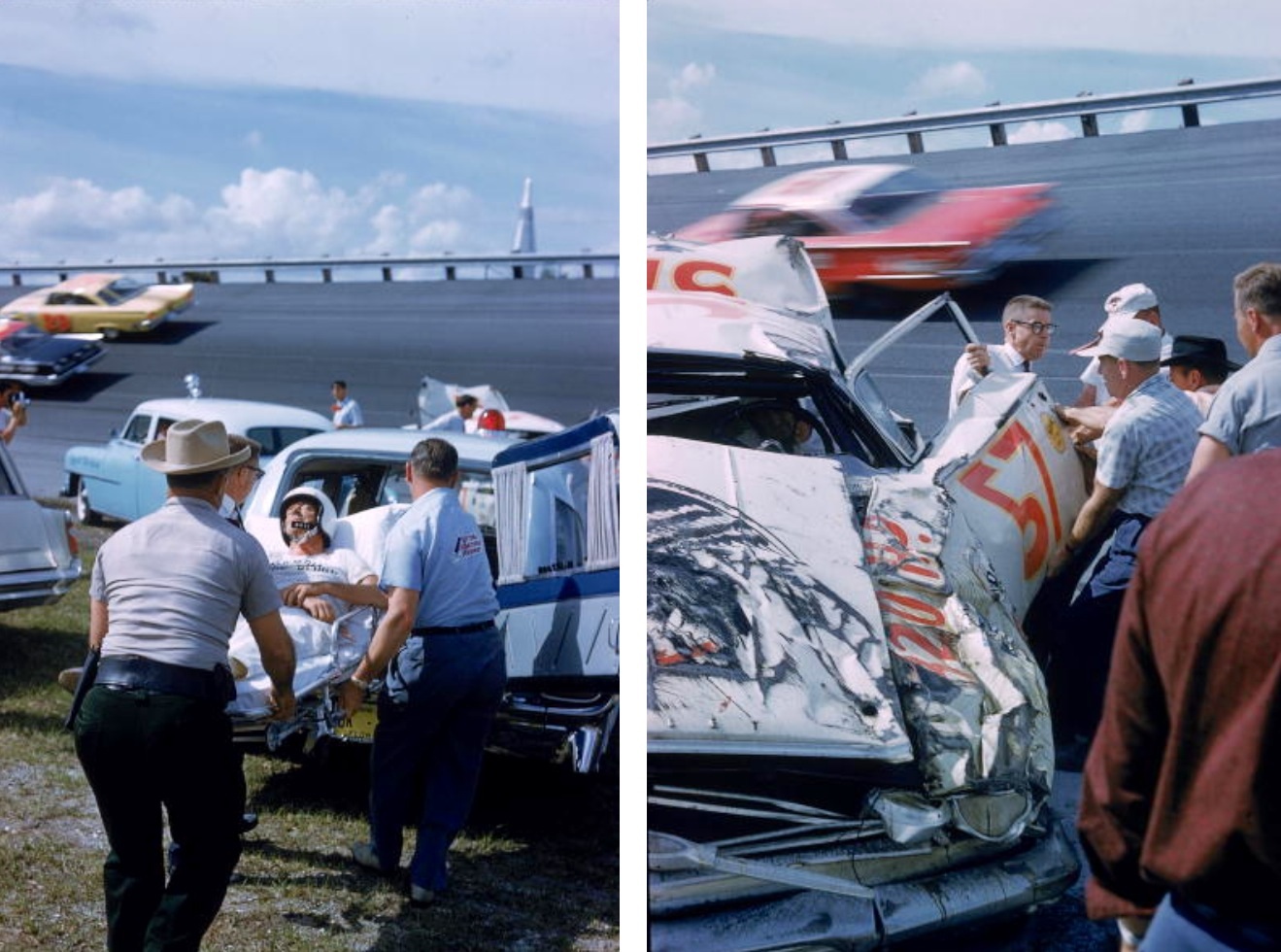
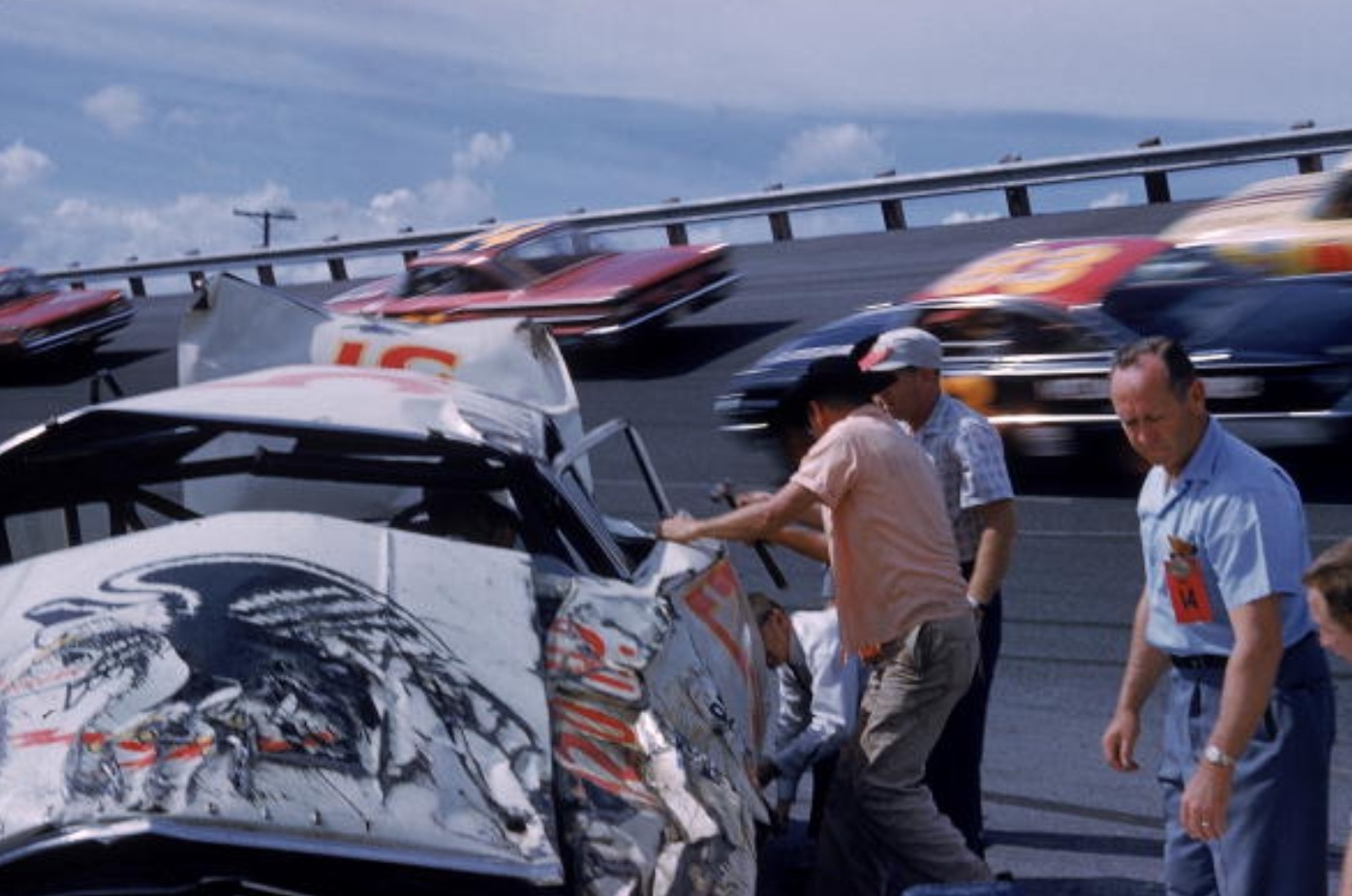
Wes Morgan being carted away from his sick Chevy after a lap 7 contretemps during race 3 of the NASCAR Grand National Series on February 24 1961 Daytona Beach event…

This race was a qualifier for the 500 itself. Fireball Roberts, a NASCAR ace won this 39 lap race in Smokey Yunick’s Pontiac. Checkout Wes’ ‘fireproof nomex’ T-Shirt!

Credit…

Leonard McCombie

image


rails

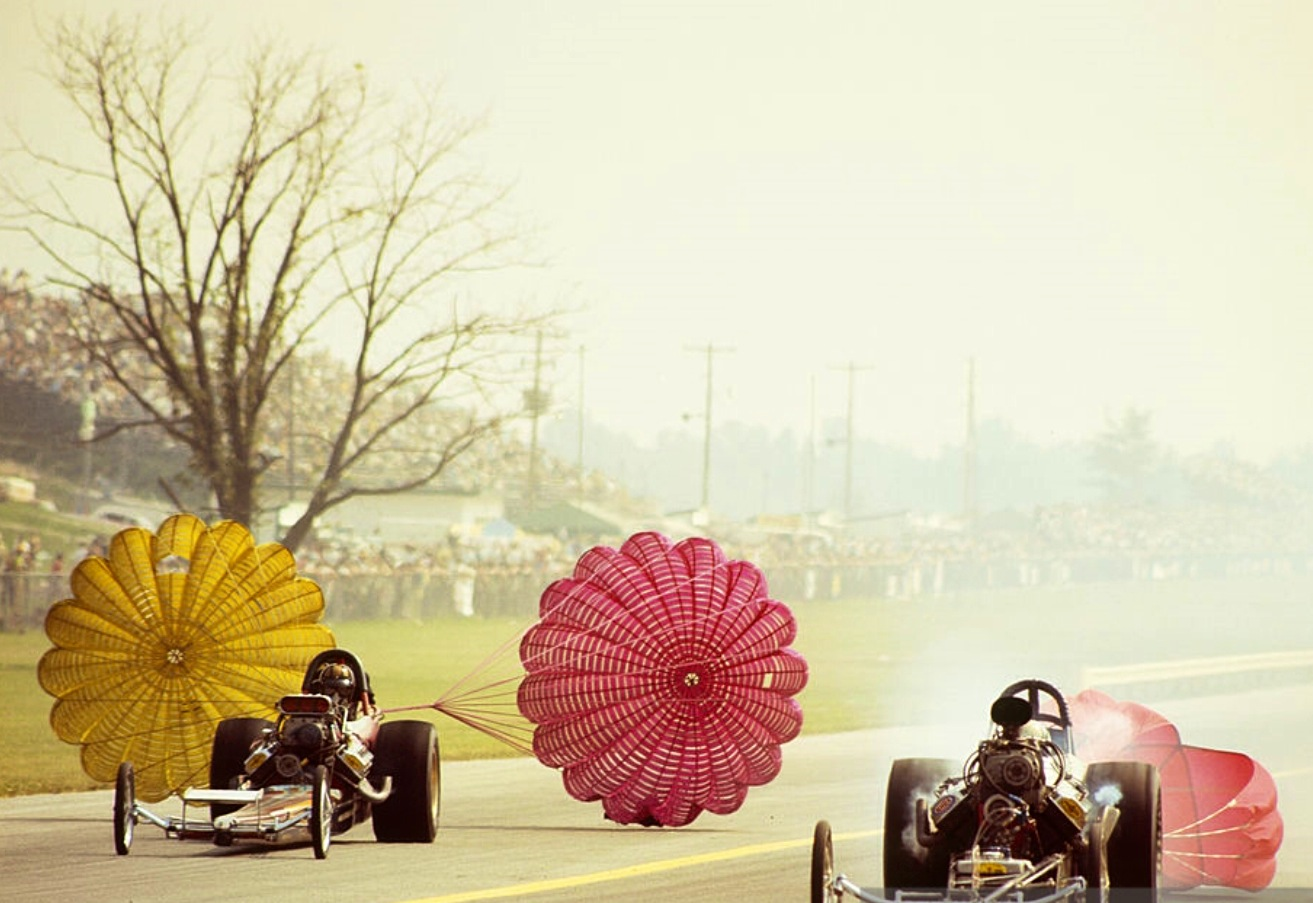
The beautiful soft light contrasts with the sheer other worldly  ferocity of these awesome ‘Top Fuel’ Rails during the 15th National Hotrod Association Nationals at Indianapolis on 3 September 1969…

There are no details on the captions of the cars and drivers, so interested to hear from any drag racing enthusiasts who may know who is who!

indy rails

Checkout the YouTube footage of the meeting…Its an interesting period piece documentary in itself.

indy danny

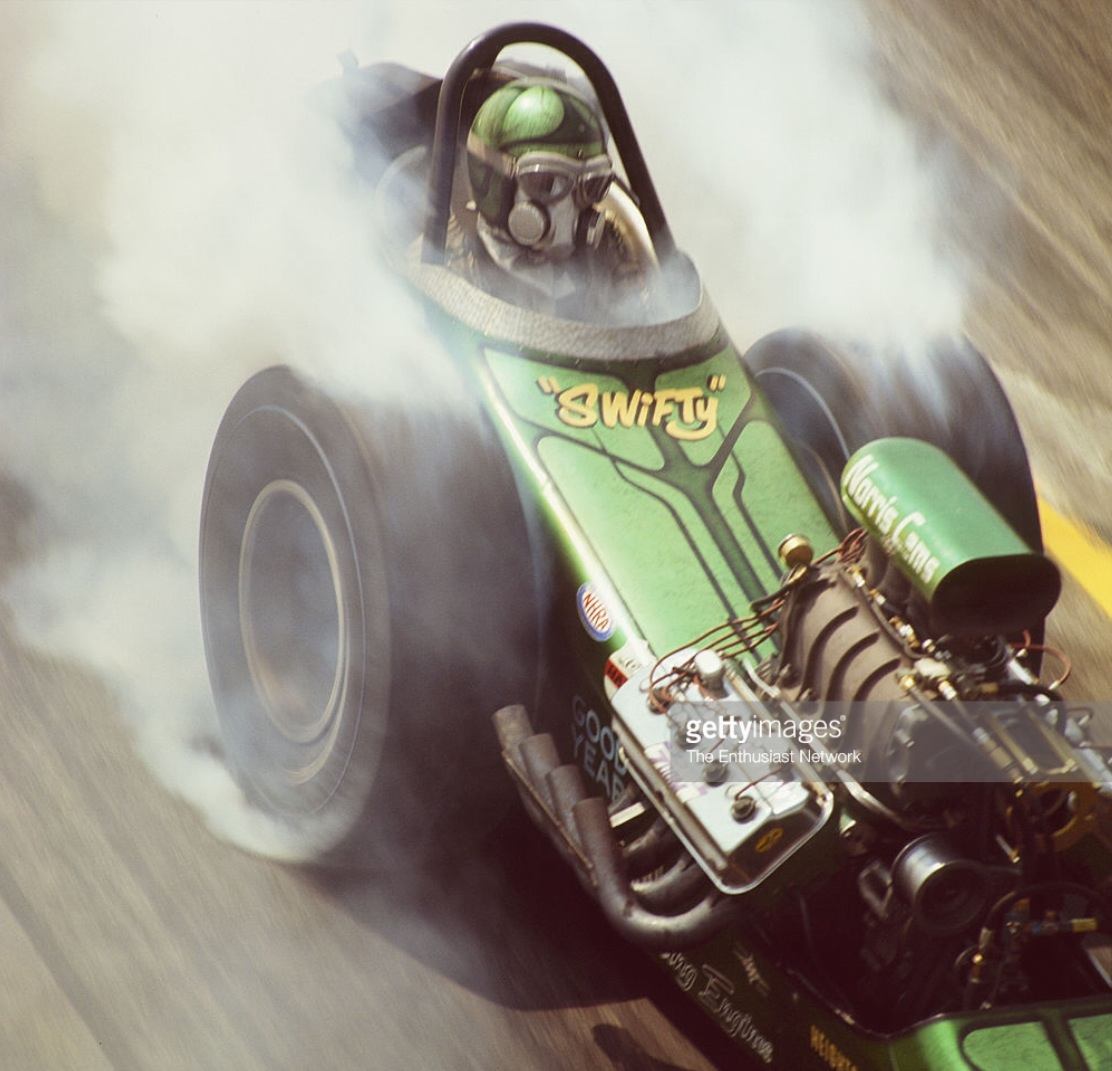
The happy dude is Danny Ongais, later CART/Indycar and several times F1 racer, he raced a Mickey Thomson entered Ford Mustang ‘Funny Car’ (The Enthusiast Network)

Credits…

The Enthusiast Network

Tailpiece…

indy swifty

image

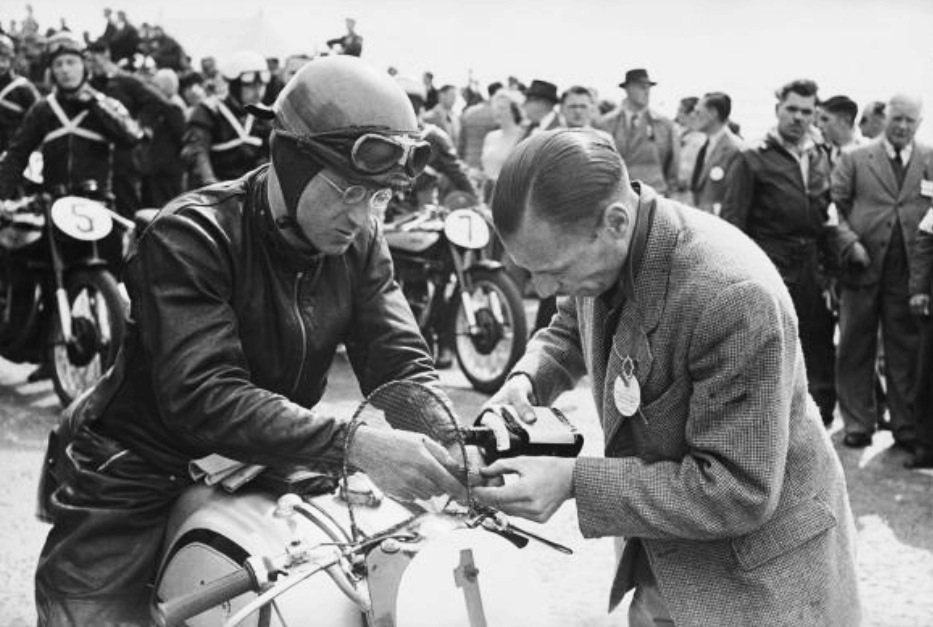
The 1950 Isle of Man meeting on June 10 was a mix of the new and old…

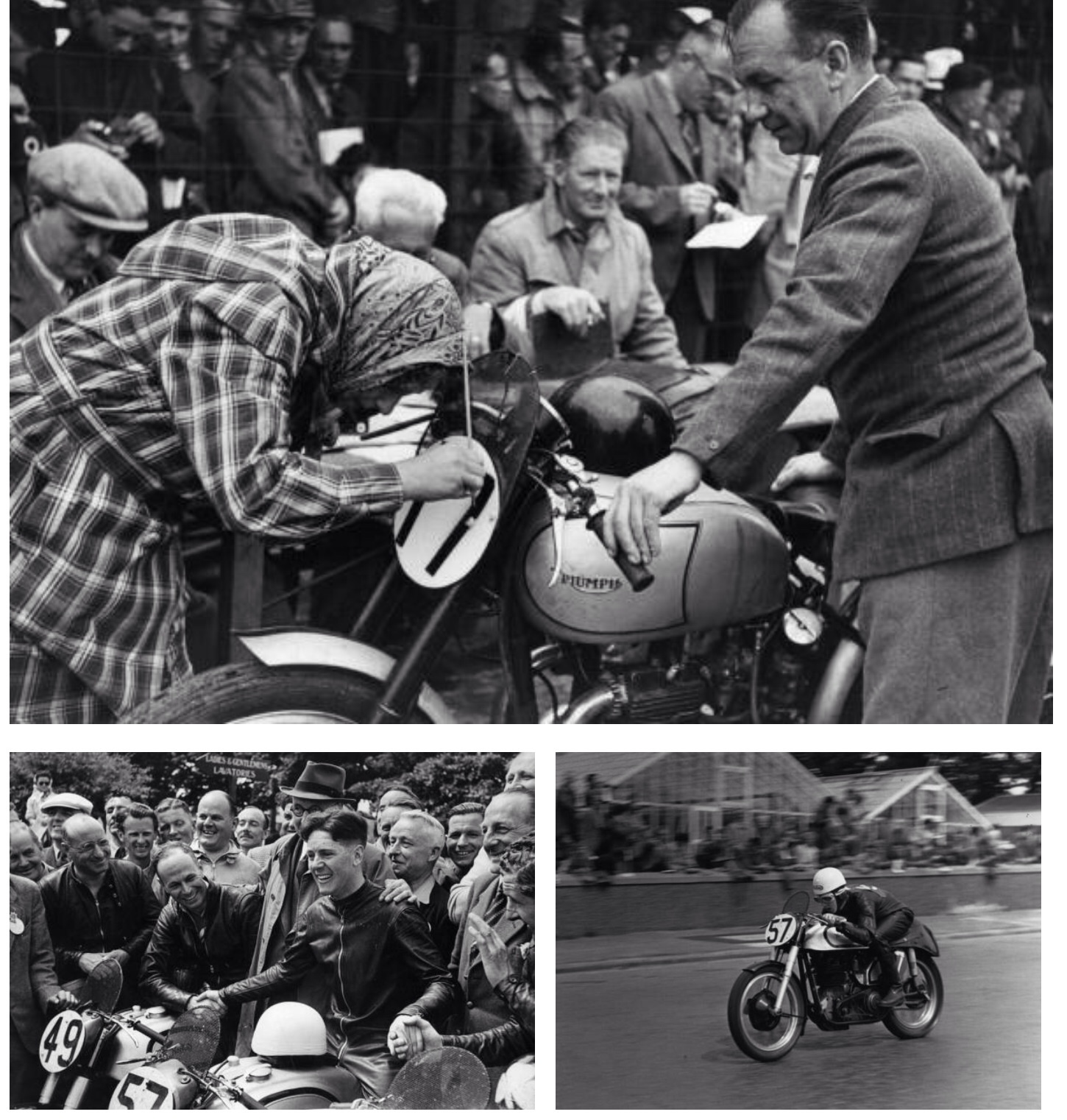
New was Geoff Duke, signed by Norton to compete in the Junior and Senior events after winning both the Clubman’s TT and Manx Grand Prix the year before.

image

Number being painted on W Hall’s Triumph 500, Bottom left the 3 Norton teammates , # 57 Geoff Duke

Norton also introduced the new ‘Featherbed’ frame, developed by the McCandless brothers, the combination of Duke and the Featherbed were instantly competitive. The light, trim, all welded (rather than lug and tube) frame lowered the bikes centre of gravity and had a shorter wheelbase which suited the challenging TT course.

image

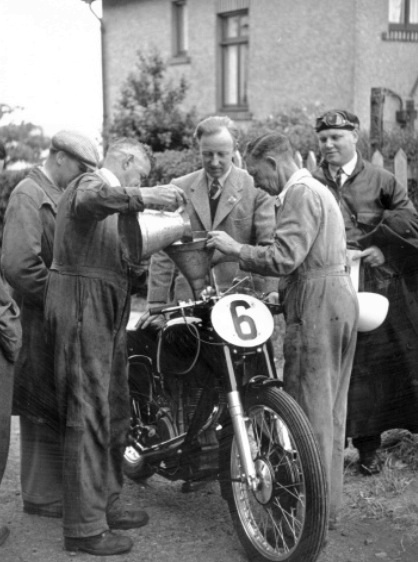
The TT said goodbye to pool petrol, and its was immediately celebrated by record laps in all three classes.

Duke’s debut in the seven-lap Senior was amazing. Riding the new Norton, he led from start to finish, smashing both race and lap records, winning in 2 hours 51 minutes 45.8 seconds.

Artie Bell’s Norton took the Junior honours with Duke runner-up as Harold Daniell filled the last podium place in his final TT. It was at the Junior prize-giving ceremony that Daniell commented ‘the new Norton was so comfortable that you could sleep on it-rather like being on a feather bed’, so creating the frames name.

Whilst Norton’s success in both Junior and Senior TT’s was clear, the Lightweight produced one of the closest finishes of all time. Just 0.2 of a second separated Italian Dario Ambrosini’s Benelli and Maurice Cann’s Moto Guzzi after 264 nail-biting miles!

Race Build Up…

image

Spectators check out H Daniell’s works Norton 500 prior to the Senior TT

The development of the Norton frame is an interesting story about advancing technology. In 1949 racer and self taught Belfast motorcycle engineer Rex McCandless began working on a new type of frame which used a welding process developed during the war. ‘Sif bronze welding’ used an alloy that melted at lower temperatures but had high tensile strength and can be built into fillets.

image

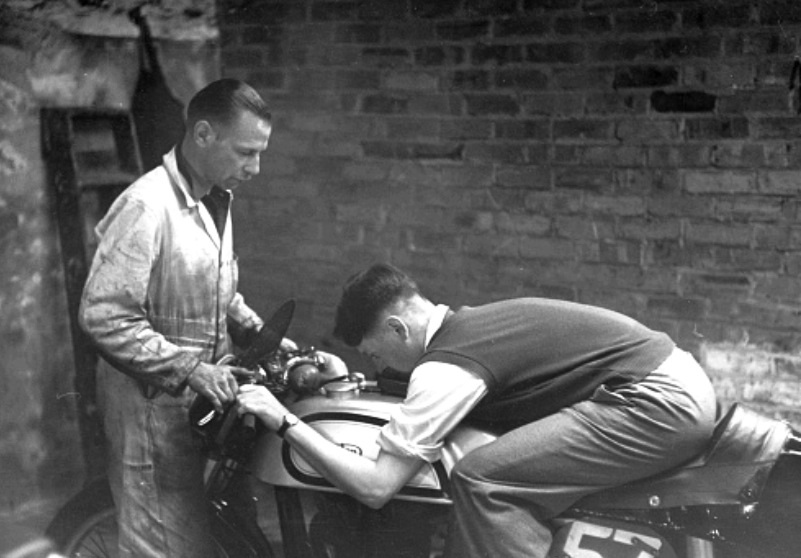
Mechanics fettle Duke’s Norton pre-race

A works 500 engine was mounted into the frame which was lighter and stronger than Nortons ‘garden gate’ frame. Tested at the IOM by Bell against a standard frame bike ridden by Duke, it was much quicker, further tests at Montlery near Paris, proved its speed.

In January 1950 McCandless and Norton’s Edgar Franks took the frame and the McCandless jigs to the Reynolds Tube Company who built the frames from their famed 16 gauge ‘531’ high tensile steel tube on their own jig adapted from the Norton approved McCandless one.

imageimage

Reynolds were to keep quiet the fact that they built the frames, rather than Norton themselves, but of course their origin soon became widely known. In a great example of ‘racing improves the breed’ the ‘Featherbed’ found its way into Norton’s production bikes in concept if not street frames actually made from ‘531’ tube.

image

Nice side on shot of Duke’s new ‘Featherbed’ Manx. Reynolds 531 alloy steel frame either made by the McCandless Bros or by Reynolds on the McCandless jig depending on the reference. Either way a great step forward, Nortons frame design until the mid-sixties ‘Isostatic’

image

Duke and his Norton teammates before the off

Whilst the IOM Official website is quite useful i haven’t been able to find a competitor list with numbers to identify the bikes, other than those which had captions which i have reproduced. If you can help with any of the captions please get in touch. Once again, the photography of  ‘Picture Post’s’ Bert Hardy inspired this article. So, whilst it may lack a little of the detail hopefully Bert’s fantastic, evocative shots make up for it!

image

image

Senior TT Race…

image

Senior TT competitors commence the race

image

C Horn, Norton

image

R St J Lockett, Norton 500

Finish…

image

Geoff Duke #57 and Artie Bell both on wworks Manx Norton ‘Featherbed’ 500’s race for the finishing line

image

Norton teammates Harold Daniell, Geoff Duke and Artie Bell, Isle of Man Senior TT 1950

Photo Credits…

All photos by Bert Hardy

References…

iomtt.com, nortonownersclub.org

Tailpiece…

image


image

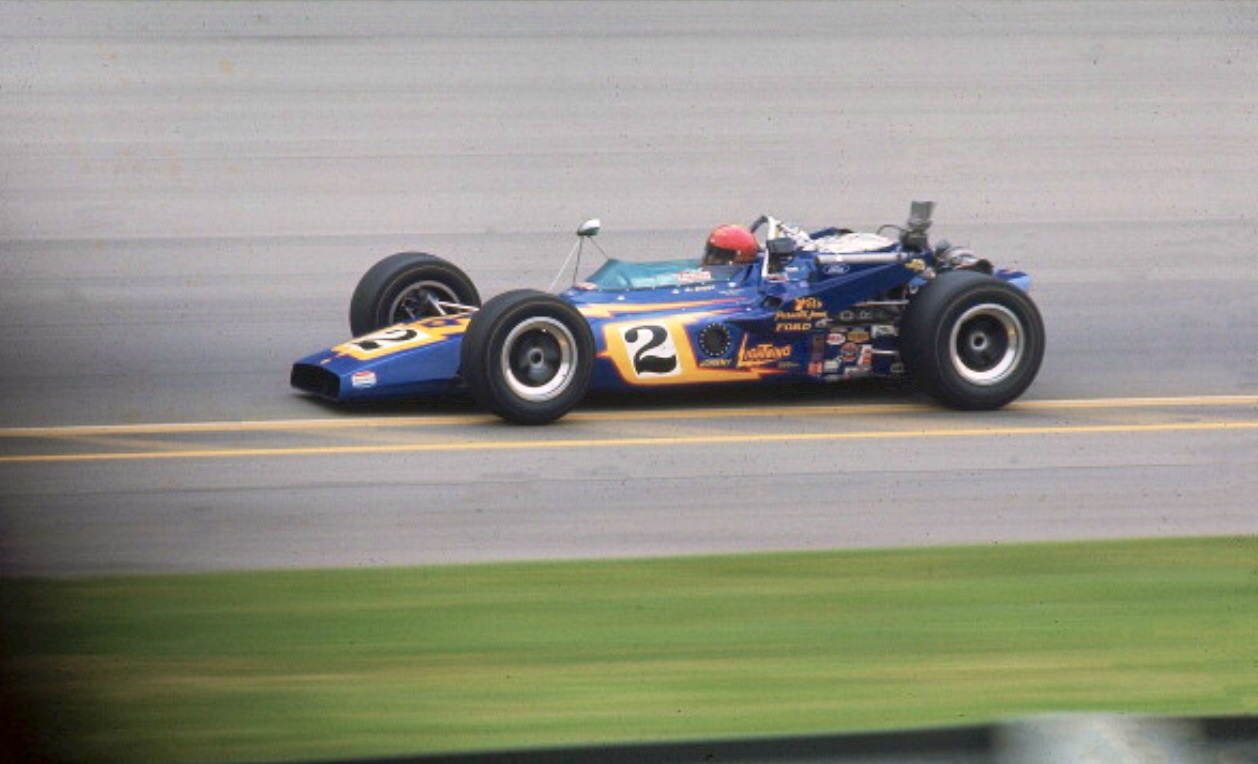
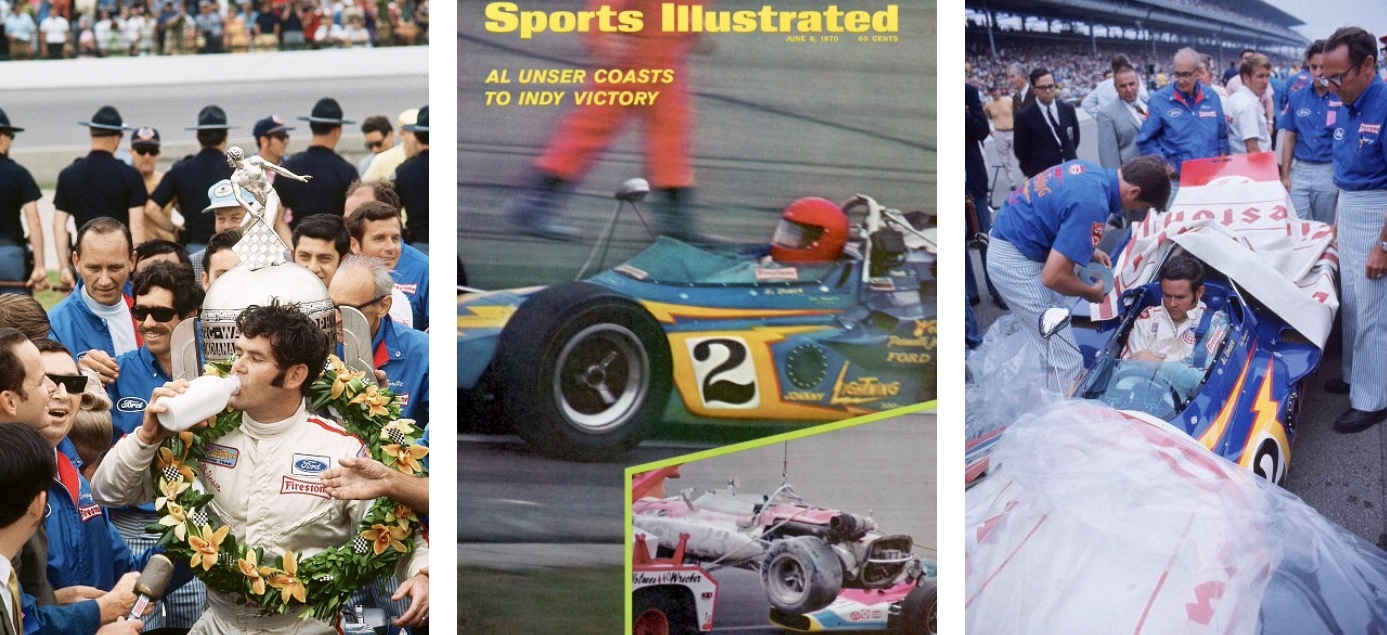
Al Unser blasts out of the pits during his victorious 1970 Indy 500 win in his Lola/Colt ‘Johnny Lightning Special’…

Opportunistic American mechanics, drivers and team owners were slow to recognise a good thing.

Jack Brabham’s first appearance at the Brickyard in 1961 with his little 2.7-litre Cooper T54 Coventry Climax FPF saw him qualify 13th, finish 9th and take home a big payday by the GP standards of the day.

indy jack

With John Cooper and Jack having made clear the advantages of mid-engined cars on their patch American team-owners and mechanics followed the path started by Cooper in the early 1950’s, their first GP win, in Argentina 1958, when Moss won in a 2 litre Cooper T43.

The first in the US to recognise the mid-engined trend was Mickey Thompson, he teamed with Dan Gurney with a proprietary chassis and aluminum Buick V8 power to qualify 8th in 1962, he was classified 20th with 92 laps.

dan in mt spl Dan Gurney in Mickey Thompson’s Buick stock block V8 powered ‘Harvey Aluminium Special’, Thompson in the dark shirt at right, Indy 1962. This engine, famously the brother of the F85 Olds, the block of which formed the basis of the Repco Brabham ‘RB620’ 1966 World F1 Championship winning 3 litre V8. Chassis designed by Brit John Crosthwaite, 3 cars built for the ’62 race (unattributed)

1963 made it clear the Indy roadster’s days were numbered when Jim Clark and Gurney brought Colin Chapman’s lightweight Ford pushrod V8 powered Lotus 29 to The Brickyard. In that first year Clark was barely beaten by Parnelli Jones in a Watson Offy roadster. Some say given the oil the Watson was dropping that only the Indy ‘establishment’ prevented a victory that was rightfully Clark/Chapman’s. Jones took the lesson to heart.

jim and dan Jim and Dan (right), Lotus 29 Ford, Indy, morning practice 18 May 1963, note offset suspension. Superb bits of kit (Bob Jennings)

In 1964, 12 of the 33 of the grid were mid-engined cars. Their builders are a directory of Gasoline Alley; Watson, Epperly, Huffaker, Vollstedt, Thompson and Halibrand, only two constructors were ‘furrin, Lotus and Brabham.

In 1965 only a single roadster, Gordon Johncock’s Watson Offy, finished in the top ten. There were only 6 front-engined roadsters in the 33 car field, Clark finally won in his Lotus 38 Ford. By 1966 there was only one roadster left. The transition was complete, in five years the Indy field and the shape of American champcar racing had been transformed.

indy lotus Lotus 38 Ford erotica Indy 1965, the year of Jim Clark’s win in one of these cars, Bobby Johns drove the other factory car. Essential elements the aluminium monocoque chassis, DOHC Ford ‘Indy’ V8, mid-engined layout of course and superb Lotus attention to detail (Bob D’Olivo)

The period of innovation continued throughout the ’60’s…

Andy Granatelli’s STP Corporation raced a four wheel drive Pratt and Whitney turbine engined car driven by Parnelli Jones at Indy in ’67. After leading nearly every lap of the rain interrupted race a 25 cent part in the gearbox failed, bringing the ‘whooshmobile’ to a halt giving the win to A.J. Foyt’s now conventional Coyote-Ford V8. Jones was classified 6th.

What made this period a golden one apart from the innovation of cars like Parnelli’s Granatelli turbine were a confluence of events which included Ford’s global drive to dominate all forms of racing; Grands Prix, Le Mans, drag strips, NASCAR and USAC. Firestone and Goodyear also battled each other like the heavyweight champs they were, in the process creating tyres of great grip as the understanding of polymer chemistry developed exponentially.

indy parnelli

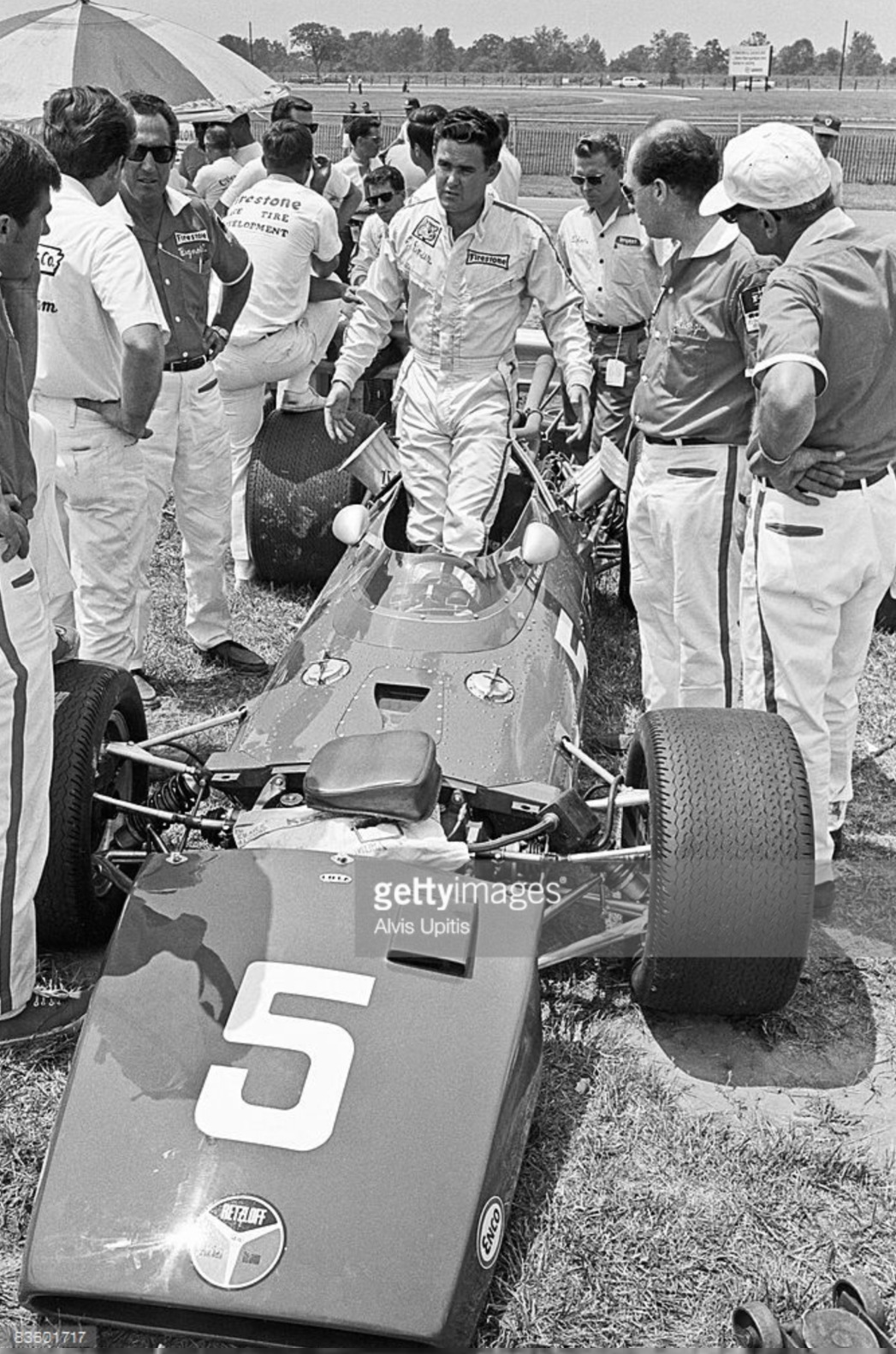
The advantages of 4WD were shown by Jones in 1967. George Bignotti sought to exploit it by combining 4WD grip with the dominant Ford V8 in 1968 with a 4WD Lola T150 for Al Retzloff , founder of a Houston based chemical company, to be driven by Al Unser. And so the basis of the later ‘Johnny Lightning Special’ was born.

I wrote an article about the equally iconic ‘American Red Ball Spl’ Lola T90 Ford, which provides some context in terms of Lola’s early Indycars and which took Graham Hill to his 1966 Indy win, click here to read it;

Graham Hill’s ‘American Red Ball Spl’ Lola T90 Ford: Indy Winner 1966…

indy al snap Al Indy ’68, Lola T150 Ford (unattributed)

In the 500 Unser qualified the new 4WD Lola outside the second row in 6th but crashed on lap 40 when a spindle broke, brother Bobby won in an Eagle Offy.

indy lola red Lola T150 Ford at Indy ’68, note the vestigial ‘wing’, their is no such thing as an ugly Lola, bias duly acknowledged! (unattributed)

After repair back at Lola’s Bromley works in England the T150 returned in time for the USAC road course race at Indy Raceway Park. Unser proved his versatility on road circuits, winning both heats. His victory came a week after taking his first USAC Championship victory on the dirt at Nazareth. He followed up both wins with another victory later in the season at Langhorne.

indy lola upright Al in the T150 on 21 July 1968, he won at Indianapolis Raceway Park, Clermont, Indiana. Aluminium monocoque tub, upper and lower wishbone and coil spring damper unit front suspension all clear. Look carefully and you can see the front driveshaft behind the steering arm (Alvis Upitis)
al and jo Unser’s Lola T150 Ford chasing Jo Leonard’s Lotus 56 Pratt & Whitney turbine 4WD, Clermont, Indiana, 1968 . The photo says everything that was good about Indy in the ’60’s, innovation! For a while anyway, inevitably political pressure was applied to maintain orthodoxy and contain ‘runaway costs’ (Alvis Upitis)

A major development in 1969 US racing was the foundation of the ‘Vel’s Parnelli Jones’ Ford team which would go all the way to F1 with Mario Andretti in 1975.

Supported by Ford and Firestone, Vel Miletich and Parnelli Jones set up their own team, buying out Al Retzloff, acquiring his Lola Fords and the services of legendary chief mechanic George Bignotti, his co-chief Jim Dilamarter and Al Unser. Their objective was to dominate USAC racing and also to race competitively in F1, taking the Firestone banner into Goodyear dominated territory.

USAC reacted predictably to the advantages of 4WD by restricting them to just 10-inch tyre widths, effectively robbing the promising but expensive technology of its advantage and protecting the status quo of USAC car owners.

Bignotti and Dilamarter converted the T150, carrying USAC #3 signifying Al Unser’s 1968 driving championship standing, to rear wheel drive with side-mounted fuel cells and the distinctive ‘coal chute’ rear decks feeding air to rear-mounted oil coolers. The Lola was renamed the Vel’s Parnelli Jones Special.

In its first race at Phoenix, Al put the VPJ Spl on pole but the Ford V8 dropped a valve on lap 14 whilst in the lead. After Hanford on April 13 the show headed for Indianapolis for the long month of May.

It rained continuously throughout the first week of qualifying. Unser was fast, but broke his leg in a motorcycle accident whilst waiting for the weather to clear! This car was given to veteran Bud Tingelstad who qualified 18th and was classified 15th when a Ford valve again broke on lap 155.

bud Bud Tingelstad in the VPJ Lola T150 Ford, at Indy in 1969 (unattributed)

Jim Malloy qualified and finished 2nd in the T150 in the ‘Rex Mays Classic’ at the Milwaukee Mile, then 7th at Langhorne. Unser crashed in practice for the 151 mile road course race at Continental Divide on July 6, taking over Malloy’s car for the feature but dropped out with broken suspension.

Al capped the car’s season with a win from pole at Phoenix on November 15, finishing 2nd in the 1969 driver’s championship to Mario Andretti, amazing given that after his motorcycle accident at Indy he had only 19 starts to Andretti’s 24.

Unser spoke to Gordon Kirby about 1969; ‘If I hadn’t broke my leg in 1969 the car was totally capable of winning the 500 in ’69,’ he said. ‘It was already there and 1970 showed it. Look at the races I won through the last half of ‘69 and in ‘70 I just dominated everything. The Indycar and the dirt car (King Ford) were both fantastic cars to drive’.

image


For 1970 the Lola-based Vel’s Parnelli Jones Special was again modified with aerodynamic improvements and changed its identity yet again to ‘Lola-Colt’… Bignotti and Dilamarter built two more cars using this proven and highly developed car as the pattern. They were known as ‘P.J. Colts’. In 1970 Unser used two cars; the 1968 continuously modified Lola T150 Ford as his short paved oval/road course car and one of the new Colts as his long circuit car including Indy.

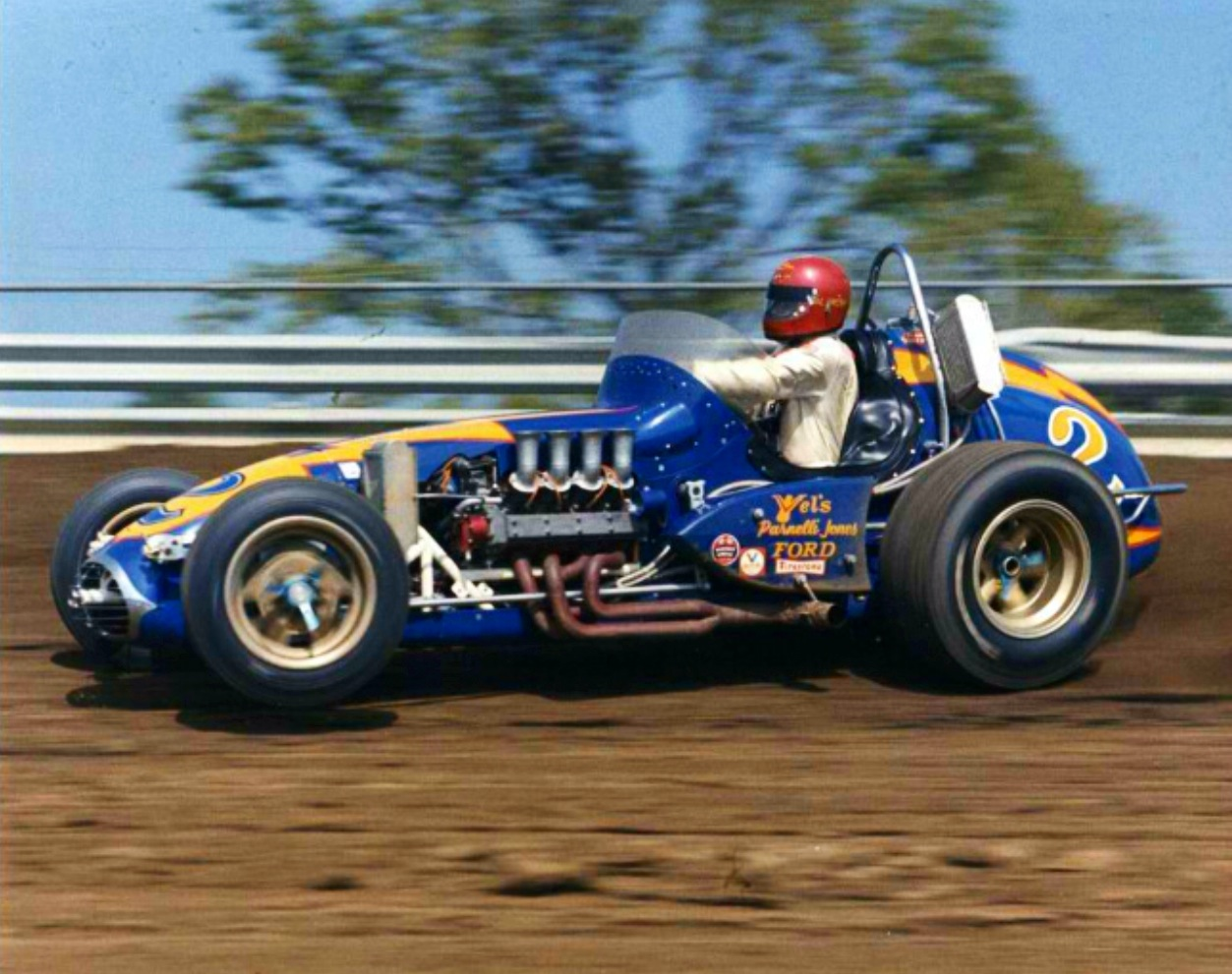
Miletich and Jones signed Topper Toys as the team’s sponsor, its ‘Johnny Lightning’ blue livery with bold yellow lightning bolts outlined in red became one of racing’s most recognized, brilliant and striking liveries.

Unser had an amazing 1970 in which he won 10 of 18 starts including the Indy 500, had a record 15 top-5 finishes and 8 poles. It was close to total domination and set Al Unser on the way to his 4 Indy 500 wins.

image Unser in the winning PJ Colt Ford ‘Johnny Lightning Spl’ during the 1970 ‘500 (unattributed)

With the Lola T150 he won at Phoenix in the season opener, at Indianapolis Raceway Park in July, the Tony Bettenhausen 200 at Milwaukee in August and the Trenton 300 in October. He was two laps in the lead in the California 500 at Ontario in September when the transmission broke with just 14 laps to go.

Other placings included 3rd at Sears Point, Trenton and in the Rex Mays 150 at Milwaukee, 2nd at Langhorne, 5th on the road course at Continental Divide and 2nd at the season-ending race at Phoenix.

image

The 54th Indy 500 was held on Saturday, May 30, 1970, Unser dominated the race, winning  pole position and leading 190 laps en route to victory in the PJ Colt Ford. He joined his brother Bobby as the first duo of brothers to win at Indy. It was the first of 4 wins there for Al.

Joint car owner Parnelli Jones, race winner in 1963, became the second person (after Pete DePaolo) to win separately as both a driver and team owner. Unser carted $271,697 back to New Mexico of a record $1,000,002 purse, the first time an Indy prize fund topped $1 million.

Rain on race morning delayed the start by about thirty minutes. On the pace lap, Jim Malloy smacked the outside wall in turn 4, which delayed the start further. All 33 cars in the field were turbocharged for the first time.

al victory lane (Getty)

In his MotorSport interview with Kirby Unser gives full credit to George Bignotti. ‘Once George understood you he was absolutely a terrific mechanic. He could figure things out. George also always hired the right people. He put a team together and made it work. George had a knack for that. He was good at performing and making sure the car finished the races. As long as I didn’t crash, i finished the races. George Bignotti made my career. Without George I would’ve never been able to handle it.’

king ford Another ‘Johnny Lightning Spl’ 1970 win for Al on the way to his USAC crown, this time in the King Ford during the ‘Golden State 100’ at California State Fairgrounds, Sacramento on 4 October 1970. Al led 99 of 100 laps of 1 mile after Mario Andretti crashed his King Ford on lap 69

Big Al has fond memories of a great era in American racing and is disgusted with modern Indycar racing and the arrival of the spec car age. ‘People were always trying new things and looking for new ways of doing things. Today there isn’t any of that. It just tears me up. There’s nothing but a spec car to buy and you’re told what to do with it. You not allowed to do anything. It’s unbelievable!’

al clermont Unser in the ‘Retzloff Racing’, see the badge on the cars nose, at Clermont, Indiana in 1968 (Alvis Upitis)

Lola T150 Specifications 1970…

Aluminium monocoque chassis, Ford DOHC 4 valve turbo-charged 159cid V8 giving circa 900bhp@ 8500rpm, 4 speed Hewland LG500 gearbox.

Suspension; Front upper and lower wishbones with coil spring/damper units. Rear single top link, inverted lower wishbone, coil spring/damper units and single radius rod. Adjustable roll bars front and rear. Disc brakes and rack and pinion steering.

Originally delivered as a 4wd car for 1968, the car was converted to normal rear wheel drive as per the text in 1969. The T150 still exists, beautifully restored as does the PJ Colt ’70 Indy winner.

michigan Unser’s Lola T150 Ford beside Ronnie Bucknum’s winning Eagle Offy prior to the Michigan International Speedway race at Brooklyn, Michif gan on 13 October 1968 (Alvis Upitis)

Etcetera…

image

al and mario Al Unser’s Lola T150 Ford leads Mario Andretti’s Hawk Ford at Indianapolis Raceway Park, Clermont, Indiana on 21 July 1968, Al took the win (Alvis Upitis)
al and jlspl Unser and the stunning ‘Johnny Lightning Spl’ graphics. Lola/PJ Colt Ford, Indy 1970 (Bettman)

Credits…

glennmason.com, Alvis Upitis, The Enthusiast Network, Bob D’Olivo, Bob Jennings

Bibliography…

MotorSport magazine interview by Gordon Kirby of Al Unser, Sotheby’s

Tailpiece: Al Unser in the Indy Museum with the 1911 winning Marmon Wasp and tyres indicative of progress…

image


image

(Fox Photos)

Dick Seaman and Herr Heck in their Mercedes’ at Crystal Palace in 1937…

This promotional shot dated 7 October preceded the ‘International Imperial Trophy’ race, ‘the first international road race organised in London’ on 9 October. The event was the decider of the 1937 ‘BRDC Gold Cup’ between B Bira and Ray Mays ERA’s.

The cars above are Seaman’s Mercedes W125 GP car and Heck’s 1903 Mercedes Tourer. Seaman, a works Mercedes driver was back in the UK having contested the 1937 Donington GP a week earlier. He retired from the Leicestershire event after a collision with Muller’s Auto Union having started on the outside of the front row, Bernd Rosemeyer’s Auto Union Type C won the thrilling race.

Seaman did not contest the International Imperial Trophy race but was scheduled to thrill the crowds with some demonstration laps in his Mercedes. The race was significant as the first ever live BBC TV outside broadcast of motor sport.

image

BBC man in evidence as one of the Maserati 4CM’s and an Austin passes. Interested to know both driver names and the name of this corner if any of you can help? (Imagno)

The entry included Britain’s best plus the Scuderia Ambrosiana, which fielded Maserati 4CMs for Count Piero Trossi, Count Johnny Lurani and a Maserati 6CM for Luigi Villoresi. Private Maseratis were driven by Robin Hanson and Peter Aitken (6CM’s) and Archie Hyde (8CM). They were challenged by the ERA’s of Ray Mays , Arthur Dobson, B Bira, Ian Connell, Peter Whitehead and Charlie Martin.

image

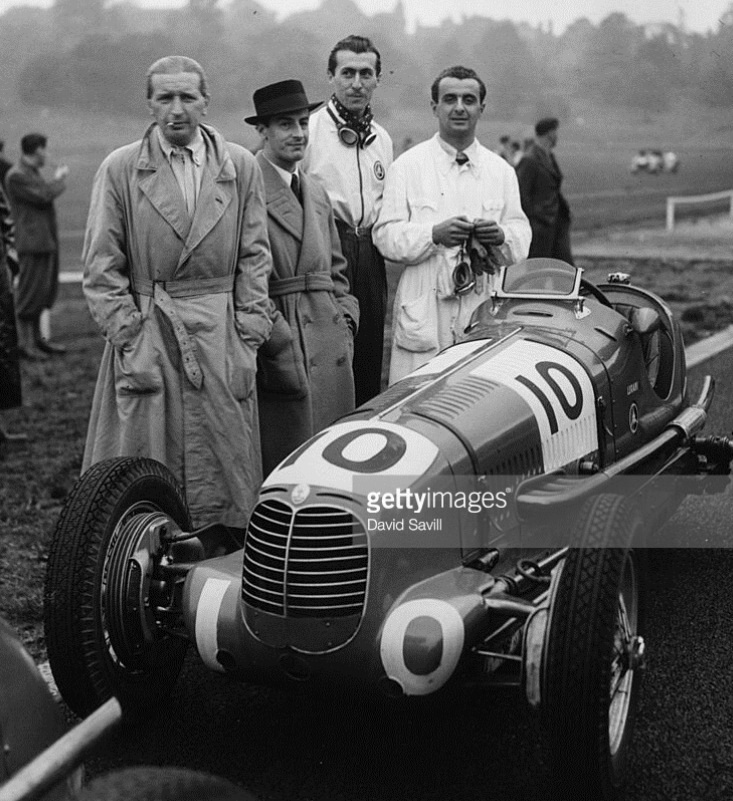
It looks a bit chilly! L>R: Trossi, Senor Rovere, Lurani and Villoresi with one of the Ambrosiana Maserati 4CM’s (David Savill)

During Thursday practice Mays blew his ERA’s 1100cc engine, becoming a non-starter and effectively giving the ‘Gold Star’ to Bira by 3 points.

Leiff Snellman reported the race in 8w.forix.com thus; ‘The race was run in two heats plus a final and raced as a handicap event with Hyde and his 3 litre Maserati starting from scratch, the 1.5 litre Maseratis and ERA’s having a 10 seconds advantage and the Austins, MGs and the MG-Riley having a 50 seconds advantage’.

‘Winner of the first 10 laps heat was Maclure (Riley) followed by Dobson (ERA), Lurani and Whitehead. Villoresi retired with an engine problem. Trossi (Maserati) won the second heat after a tough fight with Martin (ERA) and B Bira (ERA) who finished second and third with Goodacre (Austin) fourth’.

image

Top left; Seaman, Bira, Trossi. Top right Trossi Maserati 4CM (David Savill)

image

Unidentified gaggle of cars during the meeting (Central Press)

Between the races Seaman jumped into the ‘Benz W125 and carefully did several laps in 2 min 4s, about the same speed as the cars during the heats. Many of the spectators must have heard stories about the spectacular show by the German cars the week earlier and were as thrilled by the speed, wheel spin and noise from the ‘Silver Arrow’ as the Donington crowd had been.

image

Seaman practices his W125 at Crystal Palace prior to raceday, the slippery nature of the surface evident from the gloomy English day (Getty)

‘Twenty cars started in the 15 laps final to fight for the £150 first prize. The race became a great duel between ERA drivers Bira and Dobson who left the rest of the field behind. Bira won by half a car length while Dobson received the Jarvis Trophy for the fastest lap. Goodacre’s Austin finished third. The Scuderia Ambrosiana cars were unable to challenge for the lead with Trossi an early retirement and Villoresi and Lurani having problems to follow the ERA’s. Villoresi finally finished in fourth place’.

image

Bira the happy winner (Central Press)

The Mercedes W125 went on display at the Mercedes-Benz showrooms in Park Lane, as was Rosemeyer’s car at the Auto Union showrooms.

Credit…

Fox Photos, Imagno, David Savill, Central Press

Leif Snellman’s Crystal Palace article in 8w.forix.com

Tailpiece…

image


image

(Spencer Lambert)

Now that’s a ‘Wing Car’! Garrie Cooper awaits clearance for takeoff at Adelaide International, ‘Elfin 792 Cessna’ in 1979…

When I originally saw this shot on the wonderful ‘Elfin Monocoque Aficionados’ Facebook Group page I thought it a promotional pisstake, the additional wings added to get some column inches for Elfin’s sponsor, Ansett Airlines of Australia. Ansett was an Australian icon, our ‘other’ domestic airline until its corporate failure in 2001. Reg Ansett would have turned in his grave that day.

Whilst it was John Bowe’s car the helmet was Cooper’s, JB confirmed it was the Elfin chief at the wheel; ‘Garrie kept and prepared the car in Adelaide, he was always fiddling around with new ideas and this is one of them. I met the car and raced it at meetings but GC did all of the development work on the chassis’.

Elfin boss Cooper and mechanic/engineer John Porter were experimenting to understand the forces their new ‘ground effect’ designs would be subjected to by trying to create the downforce of GE tunnels by the addition of the side mounted wings.

image

Gunnar Nilsson, Lotus 78 Ford, Japanese GP 1977 (unattributed)

In 1978 Colin Chapman, Mario Andretti and Ronnie Peterson ‘swept the boards’ with their dominant ground-effects Lotus 79, Mario took the drivers and Lotus the manufacturers titles that year.

The complexities of aerodynamics, what a ‘black art’ it was then with the technology of the day was such that the dominant team of 1978 didn’t win a race in 1979!

Chapman pushed the envelope ‘too far’ with the ‘wingless’ Lotus 80 despite all of the knowledge Peter Wright, Tony Rudd, Chapman and the rest had acquired during 1976/8. The best ‘Lotus 79 copy’, the Williams FW07 was the fastest car of 1979 albeit Ferrari ‘nicked’ the title with its T4 design as Patrick Head and Frank Williams didn’t get their new car onto the grid early enough which allowed the ultra reliable, just fast enough Fazz Flat-12 to win for Jody Scheckter.

image

The technical challenges manufacturers of production racing cars like Elfin faced in 1979 were the aerodynamic forces unleashed on their structures. They both needed to understand how to create the downforce Lotus harnessed and then strengthen their structures to cope with the download and cornering forces applied to the cars chassis and suspension componentry as unheard levels of grip were created.

The difficulty for people like Cooper at the ‘far flung ends of the planet’ was not being able to see how things were evolving directly week by week at race meetings in Europe, get the ‘goss from suppliers and the press etc.

The Elfin 792 VW Golf was Cooper’s 1978 ANF2 car (1.6 litres, SOHC, carburettor formula, engines gave circa 185bhp) but it arrived late so took the 792 appellation. GC had a huge F5000 shunt in 1978 at the Sandown Gold Star round from which he was lucky to escape, a story for another time, an impact was the delay of a swag of Elfin projects including the F2 car until Garrie was back on his feet.

When laid down the little single-seater was designed as a neat, conventional aluminium monocoque with outboard suspension. It was a replacement of his Type 700, originally built as an ANF3 (1300cc) car but evolved into an F2 car by many racers when fitted with a Ford Twin-cam or various pushrod/SOHC 4 cylinder engines as the class evolved from a 1.6 twin-cam to a 1.6 SOHC formula with effect from 1978.

image

Garrie Cooper did ‘a million miles’ at Adelaide International and Mallala testing his Adelaide built cars over the decades, here the 792 is running a high airbox, with which it did race (Spencer Lambert)

Later Australian Gold Star and Touring Car Champion, John Bowe raced both the factory MR8 Chev F5000 and 792 and with more luck could have won both the Gold Star and the 1979 F2 Championship.

Bowe may not be known to all overseas readers, he is one of Australia’s pro-driver greats over 4 decades. He had a great career in single-seaters before turning to ‘the dark side’, touring cars where he was and still is, an ace. He won 6 Australian Championships in four categories including the then prestigious ‘Gold Star’ for our champion driver, 2 Bathurst 1000’s and the Australian Touring Car Championship.

bowe elfin

JB in his Elfin 500 F Vee #132 during his 1971, debut racing year in which he won the Tasmanian FV Championship, aged 16 (oldracephotos.com)

‘I grew up surrounded by cars in Tasmania, my dad had a dealership and raced, I went to lots of local meetings at Symmons Plains, Baskerville and Longford. I raced an Elfin Formula Vee when I first started and an Elfin 600 after that, and it was Garrie who gave me the chance to race on the mainland, which is something I really wanted to do’.

‘He was great to me by giving me the opportunity and also the guidance. The Elfin drives were the big boost my career got, everything that happened later was a function of the success I had in the F2 Elfins and especially the F5000 MR8 drives I had, which established my big-car credibility’.

elf dick

Dick Johnson left and John Bowe in their 1993 Ford ‘EB’ Falcon V8 Supercar heyday, JB won the Australian Touring Car Championship, for the last 30 years really the ‘Australian Drivers Championship’ in 1995 in a Falcon (Shell)

‘The 1.6 single-cam F2 formula was really good at the time, it had some young, fast guys involved; Sheady and Sambo in the Celica powered Cheetah’s, John Smith in his Ralt RT1, Davo in the Hardman, Norden in the March copy and others. The fields had depth, the racing was hard, that (younger not Shead and Sambo!) group of us were young guys pushing up so we gave the class a real shake’, said John.

‘The 792 was a good car, it was quick but it wasn’t too long before it got a bit floppy at the back. The weakness or lack of stiffness was in the mounting of the frame to the tub, in the end Garrie said we should sell it. Cooper built three of the cars and they are now all in the hands of the one guy, although none of them are running’ in historic racing.

The chassis was an honeycomb aluminium monocoque with conventional outboard wishbone suspension at the front and single top link, twin lower links and radius rods for fore and aft location at the rear. New uprights were used as well as Elfins own steering rack. Hewland’s Mk9 5 speed ‘box with slippery diff was fitted and 190’ish bhp claimed for the VW Golf engine which was built in-house at Elfins using the best Super Vee bits from the ‘States. The suspension was finished in cadminium plating, the superbly presented car glistened in the Benalla sunlight as I shared the scrutineering bay with it in at Winton in late August 1979, my Venom F Vee feeling very ‘povvo’ in comparison!

elfin mr8

John Bowe ahead of Kevin Bartlett in the ill-fated Brabham BT43 Chev and John Walkers Lola T332 Chev, Chas Talbot and Rob Butcher both in T332’s then Graham McRae McRae GM3 Chev Sandown Gold Star 1979. KB crashed the BT43 destroying the car and badly injuring himself when a wheel broke in the very quick Causeway/Dunlop Bridge section of the circuit  (Ian Smith)

The class of the 1979 F2 field was John Smith’s Ralt RT1. He raced this as an F Pac with a Cosworth BDD fitted and an AN2 with a pushrod Ford ‘Kent’ 711M, which was pretty neat. The ‘Kent’ is the same block used in Cosworth’s BDD, in pushrod form modified with lots of Cosworth bits. The car was heavy as an F2 but Smithy’s skills more than made up for any weight disadvantage the package had. He was fast but he didn’t have reliability on his side that year.

JB debuted the 792 successfully in Baskerville’s end of February meeting, he won the F2 race and set a new outright lap record. Still in Tasmania on 14 March he won 3 races and again set an F2 lap record, besting the Birrana 274 F2 twin-cam mark set by Leo Geoghegan.

At Sandown on 8 April Bowe again set an F2 lap record besting Leo’s time again but was 2nd in the race between the Cheetah twins; Brian’s Shead and Sampson in Cheetah Mk6 Toyota’s. At Oran Park 6 weeks later he was 3rd.

bowe 792

JB all cocked up at Sandown’s Shell corner, turn 1 in April 1979 chasing Brian Sampson’s Cheetah Mk6 Toyota. Note the ‘Tyrrell’ bluff nose on the 792 early in the season, both sweet little cars, Mk5/6 Cheetah a very successful series of cars (unattributed)

In the Gold Star chase Bowe was 2nd in the AGP at Wanneroo Park in WA, the winner John Walker in a Lola T332 Chev, for a change JW was the lucky beneficiary of others misfortunes. John followed this up with a flag to flag win in the first Gold Star round at Oran Park on 29 July, a great drive for an F5000 relative novice.

JB on the speed of the Elfin MR8; ‘When I stepped up into F5000 I was a young driver and by that stage the Elfin MR8 Chev was well sorted, GC built the first one around 1976. Garrie, Vern, (Schuppan) James Hunt and others had raced the things so they were developed by guys who knew these big cars, I didn’t have a yardstick but I reckon the Elfin was every bit as good as the T332 Lolas and other contemporary cars of the day’.

Bowe took the first F2 Championship round at Calder in early August beating Brian Shead over the line by less than a second, both drivers did the same fastest lap and became joint holders of the F2 lap record.

Later in August Bowe was knocked off the track at Winton whilst lapping a competitor, breaking an upright and spinning into the infield in the second AF2 championship round. John Smith was the quickest car that weekend, but went off in the wet, the winner was Graham Engel in a Cheetah Mk6 Ford.

elf smit

Late 70’s to mid ’80’s Oz single-seater aces John Smith and the forever beardly! Bowe, circa 1979/80 (Ian Smith)

On September 9 Bowe contested the last round of the Gold Star at Sandown and was convincingly in the lead after the brakes on Alf Costanzo’s Lola T430 wouldn’t release but a left rear tyre deflated. In trying to get back to the pits John damaged the rear suspension cradle. John Walker took 2nd, the series and promptly retired from the sport he loved. Costanzo won the race.

John then travelled back to Winton for the ‘Rose City 10000’ F5000 race contested by both 5 litre cars and Formula Pacific cars which were incredibly fast around twisty Winton with its multiple changes of direction. JB qualified on row 2 but was in the lead leaving behind the scrapping Costanzo Lola T430 and Smith Ralt RT1 BDD. With 8 laps to go John spun, broke the Elfin’s nose and was black-flagged, Alf won the race from Smithy by less than a half a second.

At Symmons for the final round of the AF2 championship on 11 November Ian Richards set fastest practice time in a Golf powered car called a Tudor, but Bowe was only a tenth slower with Brian Shead 3rd on the grid. JB won the first heat from Shead and had the title within his grasp but in the final, in the wet, a plug lead came loose whilst in the lead giving the round win and championship to the evergreen, muti-talented Cheetah constructor, Brian Shead.

JB’s F2 season ended at Calder’s sportscar championship round in late November with a win over Ian Richards Cheetah Golf, Ian having won the preliminary race and giving intent of his increasing competitiveness as a driver which would be fully exploited in his own, beautiful ground-effect Richards 201 Golf with which he took the 1981 AF2 Championship.

With the season ended Bowe sold the 792 putting pressure on Cooper to finish the GE225 F2 car for 1980, a story for another time. It was an amazing 1979 for Bowe, he didn’t win either title, both of which seemed a strong possibility at one point but he had absolutely established himself as one of the top drivers in the country.

image

Cooper in the AIR pitlane, 792 shorn of its wings in some ‘back to back’ tests on the same day the side winglets were tried in 1979 (Spencer Lambert)

If the Elfin looks familiar to some of you its probably its March 792’esque nose. That BMW engined car won the 1979 Euro F2 Championship for Marc Surer. The Elfin also raced with a ‘Tyrrell’ bluff nose but Bowe’s definitive spec was with this nose and an airbox fitted atop the downdraft Weber carbs.

In 1980 John Bowe contested the ANF2 title again, this time in Cooper’s GE Two-25, his first completed ground effect design, no doubt the research found on this 1979 test day was instructive in that cars design!

In the UK Ron Tauranac was struggling to get his first G-E car, the F3 Ralt RT3 to go quicker than the old RT1 (he succeeded bigtime!) whilst Cooper and Porter were simulating the sort of forces they would encounter in designing their new car by running Bowe’s 792 with this wing amidships. No way could it have legally raced with an additional wings mounted where these were.

The GE Two-25 was an F2 race winner for Bowe in 1980 but Richard Davison won the title in a Hardman JH1 Ford in an interesting and competitive ANF2 Championship, a ‘wing-car’ story for another time and one with a potentially better Elfin outcome had Cooper finished the car in time for Bowe to contest the full championship…

bowe ralt

JB is his Ralt RT4 Ford BDD at Oran Park during his successful Gold Star tilt in 1985, he won the title in 1984 as well, by 1985 the ‘aero’ of these cars well and truly resolved! The Ralt RT3/4/5 F3/Pac/S Vee series of cars one of the greatest series of production racing cars ever built (unattributed)

Bibliography…

Special thanks to John Bowe for his time and insights

Elfin Monocoque Aficionados’ Facebook Group, Barry Catford and John Blanden ‘Elfin Racing Cars’

Photo Credits…

Stephen Lambert, Ian Smith, oldracephotos.com, Peter Brennan

Tailpieces: Cooper quickly got the hang of the design of ground effect cars; John Bowe in his only Elfin MR9 Chev drive at Sandown on 22 February 1981 after Cooper was a ‘bit spooked’ by the car in Gold Star practice…

elfin mr9

(Peter Brennan)

Alfie Costanzo’s Allan Hamilton owned, Tiga converted ground-effects ex-F1 McLaren M26 Chev was the class of the field that weekend but JB drove very well to 2nd after a big fright in practice when the MR9’s left rear rocker bent after underestimation of the down force created. The components on all four corners were strengthened overnight at Porsche Cars Australia’s workshop just up the road from the circuit in Dandenong.

John; ‘I was at Sandown racing my Elfin GE225 F2 car and Bryan Thomson’s Mercedes sports sedan when Garrie asked me to have a drive of the MR9 on the Friday. He said he was a bit ‘spooked’ by the car and wasn’t sure whether it was him, he’d had a big accident at Sandown a couple of years before, or the car. It was the early ground effect days, the Elfin MR9 was a great design but the forces weren’t fully understood by many designers’.

‘One of the many wonderful memories I have of GC was being in restaurants with him all over the country and him scribbling notes or diagrams of ideas on paper napkins! What was happening was the chassis was flexing a bit, the front wheels losing alignment and any semblance of castor so the car was very unpredictable under brakes in particular, you had to stop the thing by braking down the middle of the road. And then the upright broke which was very exciting! He strengthened the car in various areas and got it sorted later on but I only drove it the once at Sandown’.

The MR9 is a story for another time…

elf cooper

Garrie Cooper testing one of his great masterpieces, the world’s only purpose built F5000, the Elfin MR9 Chev (Spencer Lambert)

Finito…

image

(oldracephotos.com)

John Goss races his new Matich A53 Repco for the very first time, the ‘Oran Park 100’ Gold Star round on 4 August 1974…

‘007’ was the last and best F5000 the Matich team built, arguably it’s the best F5000 built in Oz. The story of Frank Matich and his cars I chronicled in a long treatise a while back, have a read if you haven’t seen it;

Frank Matich: Matich F5000 Cars etcetera…

Goss extended himself, buying the car and some spares. Later he also bought A51 ‘005’ which he converted to A53 spec, racing both cars for years inclusive of the ’76 AGP win at Sandown, check this article out on Gossy;

John Goss: Bathurst 1000 and Australian Grand Prix Winner…

This short piece is inspired by these photos posted on social media for the first time this month. They are ‘mouth-watering’ for me as i’ve always loved this car especially in its Matich original ‘mellow yellow’ Repco livery. Its just the nicest, oh-so-fast bit of beautifully integrated kit.

image

Grant O’Neill at the back, he looked after John’s cars right thru from this point ex-Matich as he was. Peter Hughes in red and Repco’s Ken Symes at the right. John Davison in Matich A50 ‘004’ behind Oran Park, Gold Star, August 1974 (Neil Stratton)

To have seen FM race it in the US L&M Series in 1974 would have been really something, the A53 showed it could run and beat the best of the Lola T330/2’s in Goss’ hands in Oz. Frank would definitely have given a few folks some curry with all of the teams learnings from its unsuccessful 1973 American campaign.

In the Oran Park form up area with Kevin Bartlett’s Lola T332 Chev behind (autopics.com)


image

John Goss, Tornado Ford at Catalina Park, Katoomba in Sydney’s Blue Mountains, 1970 (oldracephotos.com)

As a young enthusiast I thought F5000 was a big step up for JG, a mere ‘touring car driver’ in my mind. I was ignorant of his pedigree in real cars though, whilst he started in tourers he quickly progressed to a largely self built, potent Falcon in-line 6 cylinder mid-engined sportscar, the ‘Tornado Ford’.

It was in that he made his name in his adopted Tasmania and later when he moved to the big smoke, Sydney, and Ford Falcon GTHO ‘Series Production’ fame. In F5000 Gossy was ‘on it’ from the start, giving the established aces plenty, he was as ‘quick as his mouth’, legend that he was for saying so little in so many, many words!

What a driver and what a car.

image

Goss in the McLeod Ford, Falcon GTHO Ph3 at Amaroo Park 1972 (oldracephotos.com)

Credits…

oldracephotos.com, Neil Stratton

Tailpiece…

image

Goss at Oran Park again in ‘007’, this time the ’75 Tasman round in February 1975, DNF with electrical problems. The first of many livery and body ‘evolutions’ over the years John raced the two A51/3 cars…

Finito…

image

Family watching the ‘Del Monte Trophy’ Pebble Beach, California road racing in October 1954…
I was going to crop out the rug etc but then noticed the ‘six’packs’ of Coke and Miller. I imagine its a quintessential American scene of the day which no doubt is the composition photographer Robert Lachenbach sought.

No details on car or driver but ’tis a top shot?! Love the period casual clothes of the ‘well-heeled’ local patrons.

Credit…

Robert Lackenbach


image # 1 Senna, then Brundle, Allen Berg in the white/red helmet, #9 Eric Lang, #4 Calvin Fish all Ralt RT3/83, first lap British GP F3 race 16 July 1983 (Schlegelmilch)

 Ayrton Senna has Martin Brundle right ‘up his clacker’ during the 1983 British GP F3 support race at Silverstone, Ralt RT3 Toyota’s both. Senna prevailed by a second over 20 laps, 16 July 1983…

And so it was for the season; Senna’s ‘West Surrey Racing’ entry took 12 wins and the title from Martin’s ‘Eddie Jordan Racing’ 6 wins but Brundle came ‘home like a train’ winning three of the last four rounds and setting up a thrilling last round confrontation, won by Senna at Silverstone on 23 October. Both drivers used the dominant Toyota 2T-G powered Ralt RT3/83, the car updated from the prior year in terms of sidepods and suspension geometry.

Both drivers jumped into Grand Prix racing in 1984; Senna with Toleman and Brundle with Tyrrell.

Credits…

Rainer Schlegelmilch, David Lister, oldracingcars.com

Tailpiece…

image Senna #1 and Brundle on the front row of the 1983 British GP F3 support race. Ralt RT3/83 Toyota (Lister)

Finito…