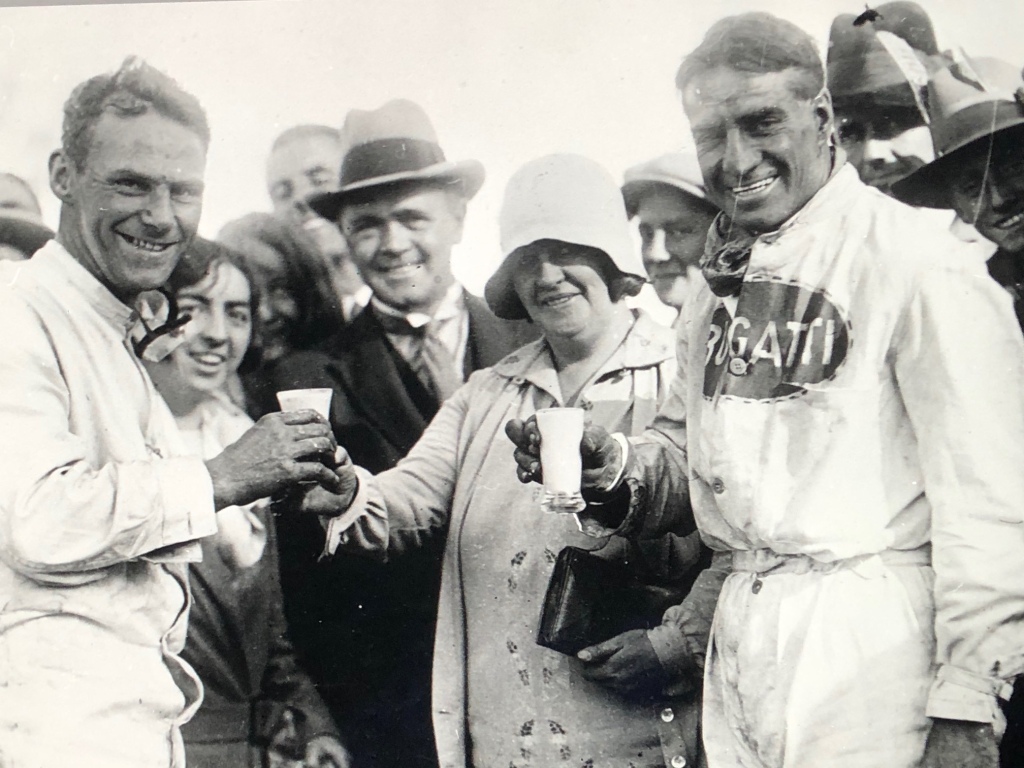
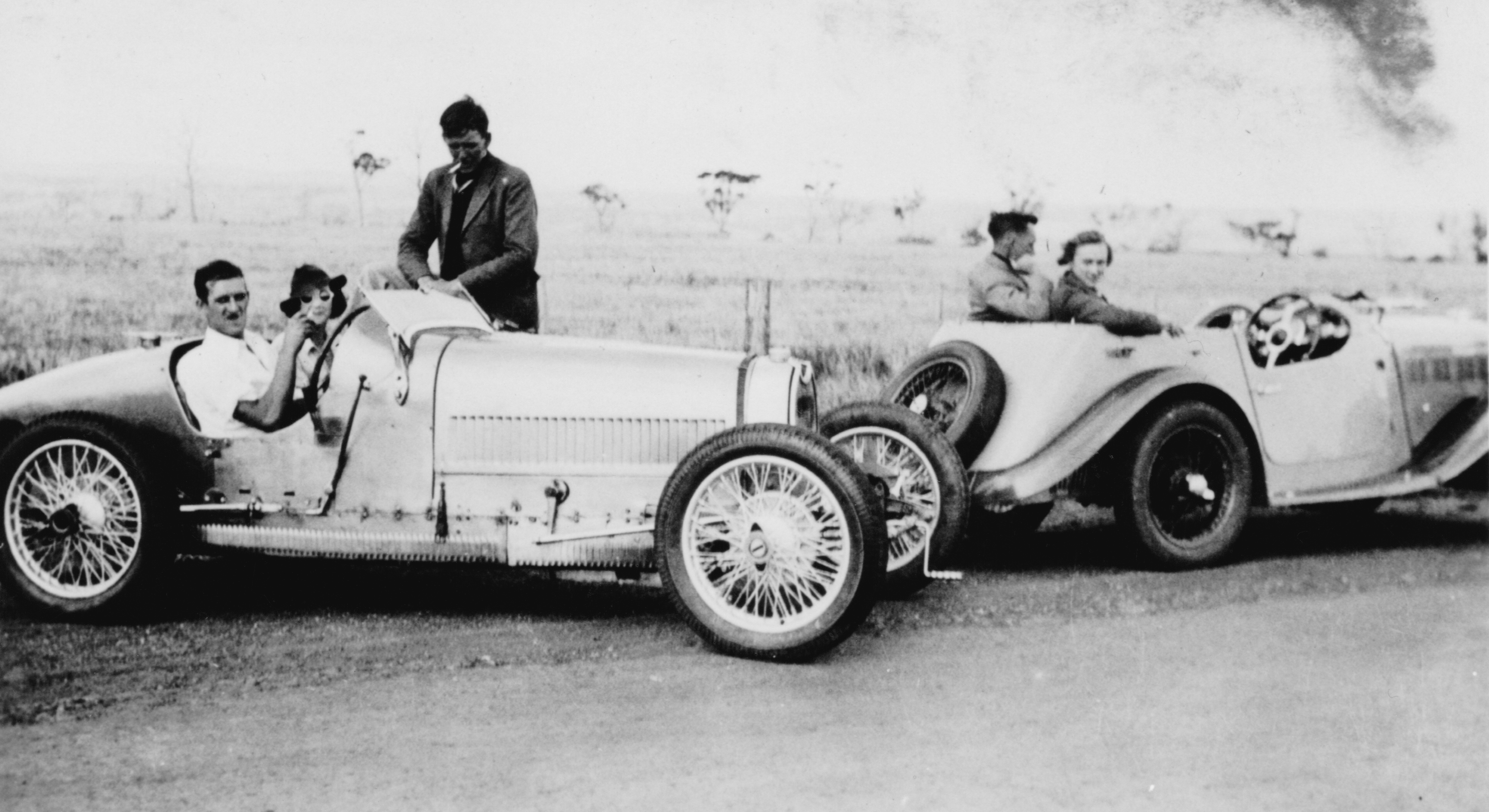
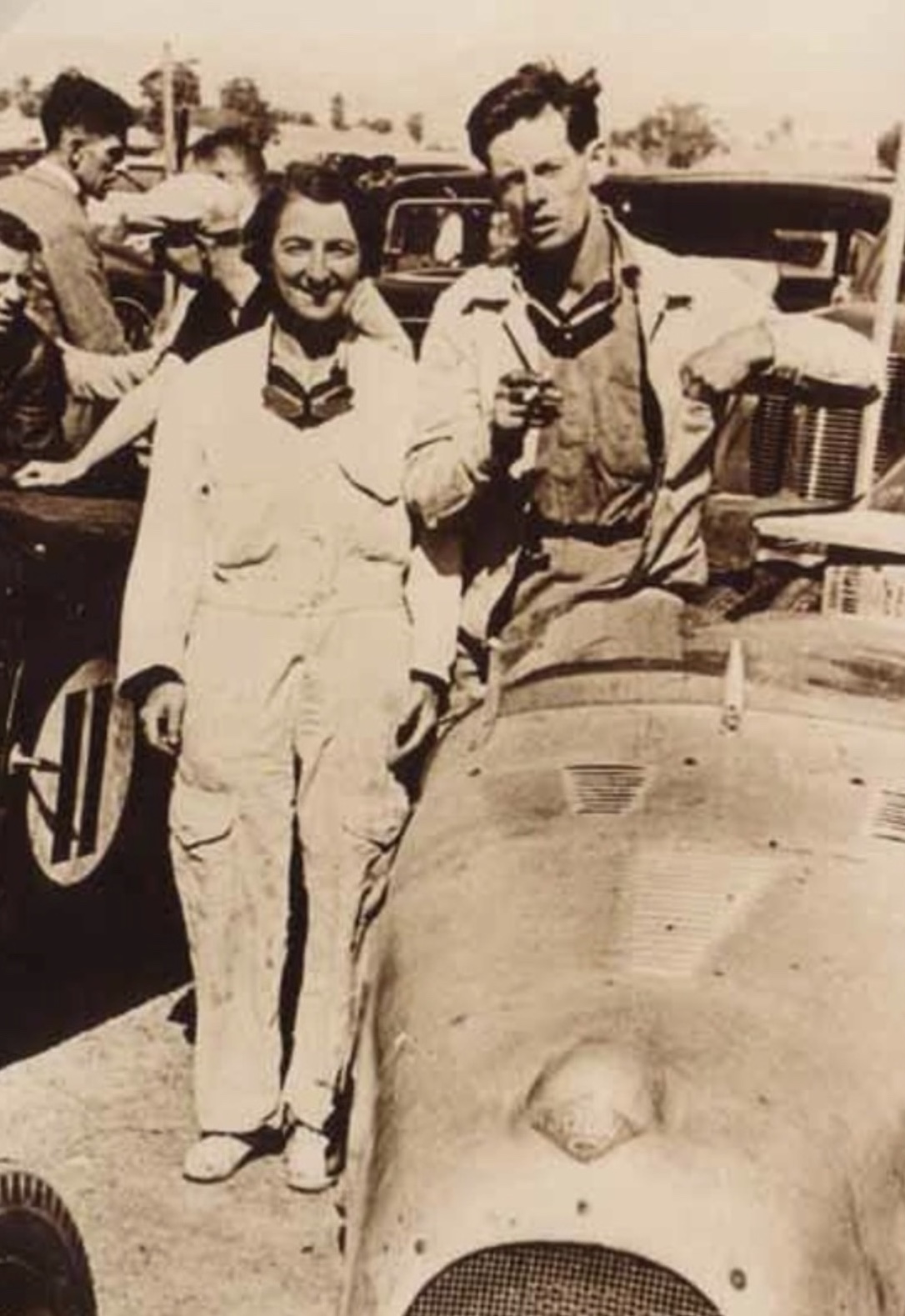
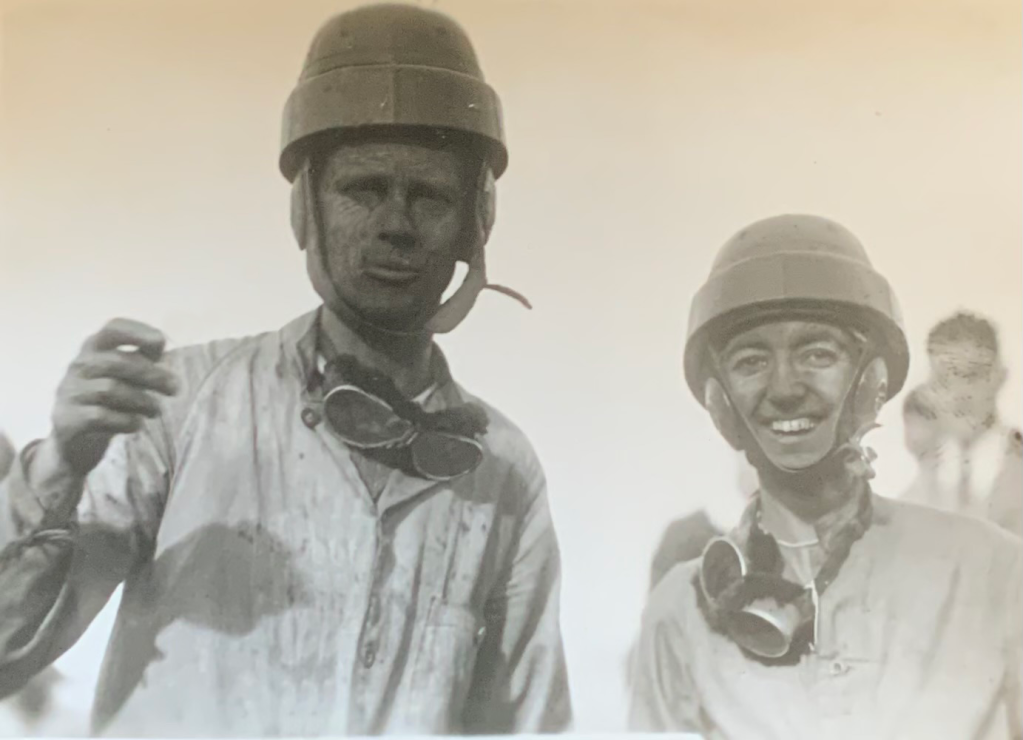
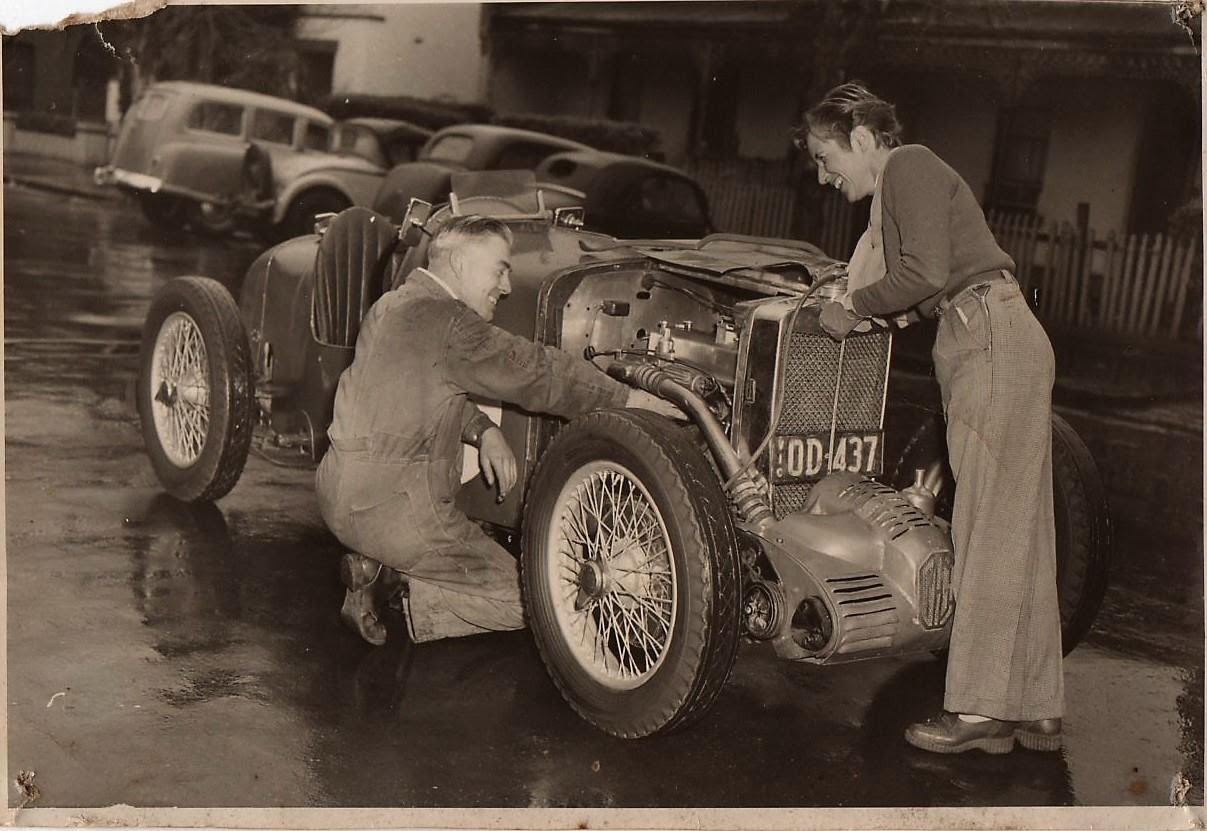
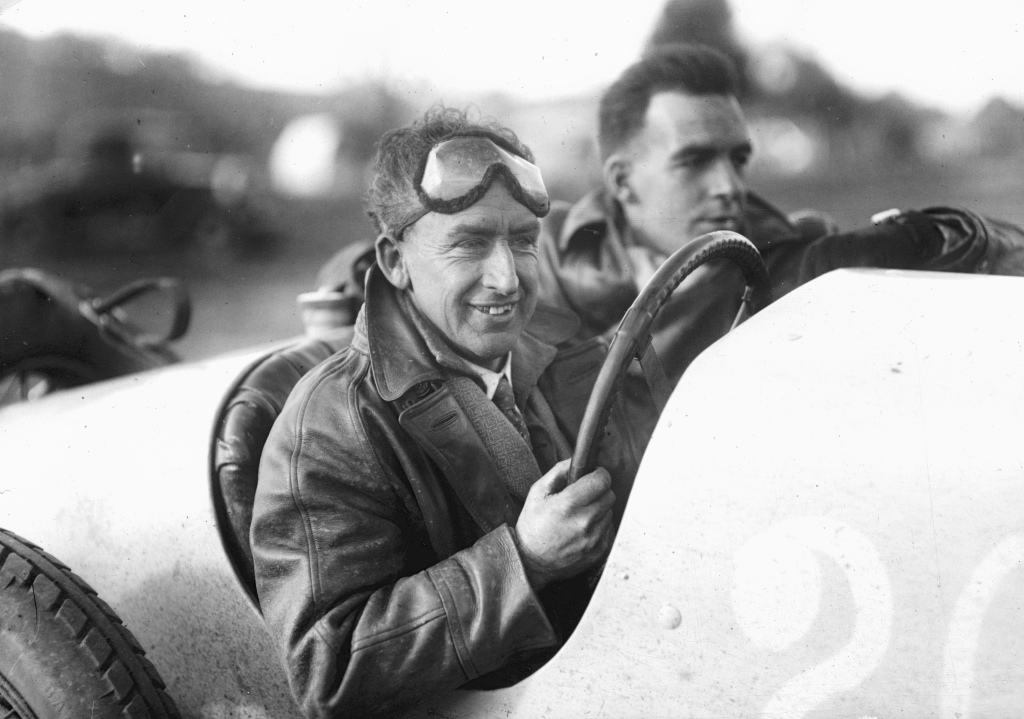
Make Mine Milk. Jack Raybould and Arthur Terdich, Bugatti T37A mechanic and driver, 1929 AGP winners, Phillip Island (B King Collection)
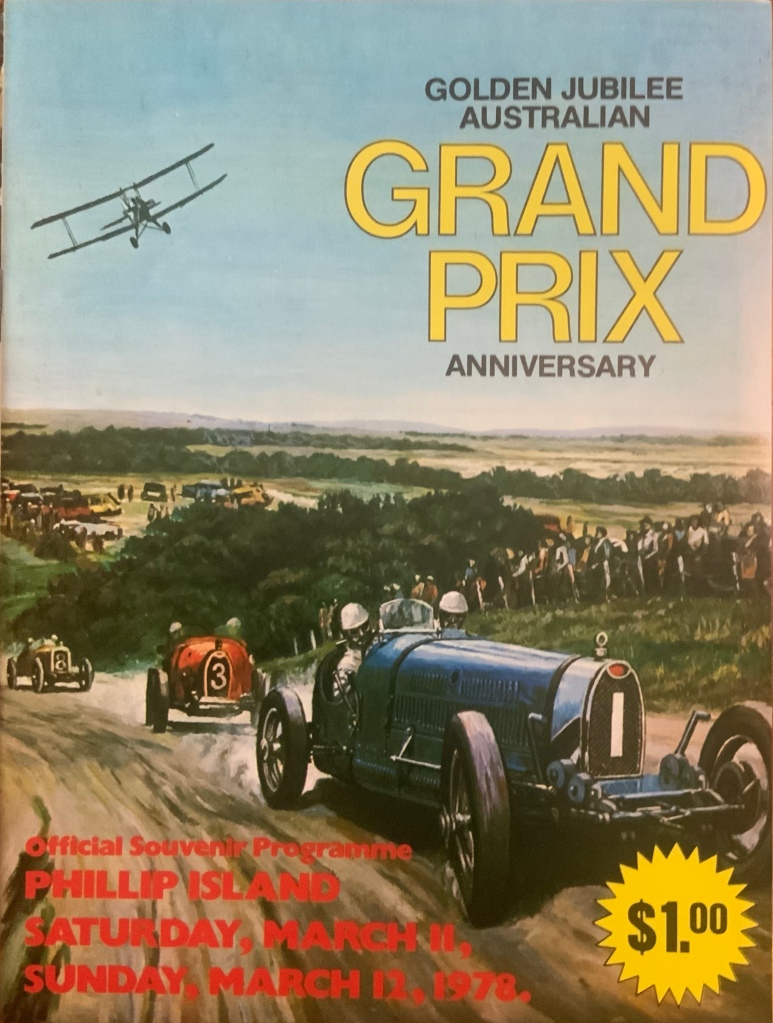
With the 100th anniversary of the Australian Grand Prix approaching, we thought it would be of interest to look at photographs taken at Phillip Island of some of the old racers shortly after the Golden Jubilee celebration on the Island.
After the highly successful GOLDEN JUBILEE celebration of the AUSTRALIAN GRAND PRIX held on Phillip Island in March 1978, some of the older LIGHT CAR CLUB of AUSTRALIA members made an annual pilgrimage to Phillip Island to reminisce, have lunch and a drive around the original track used for the 1928 100-MILES ROAD RACE – a race which was to be perpetuated as the first Australian Grand Prix. These pleasurable events were the idea of brothers Bill and Jim Leech and dreamed up at a regular Friday convivial lunch at the club premises in Queens Road, Melbourne.
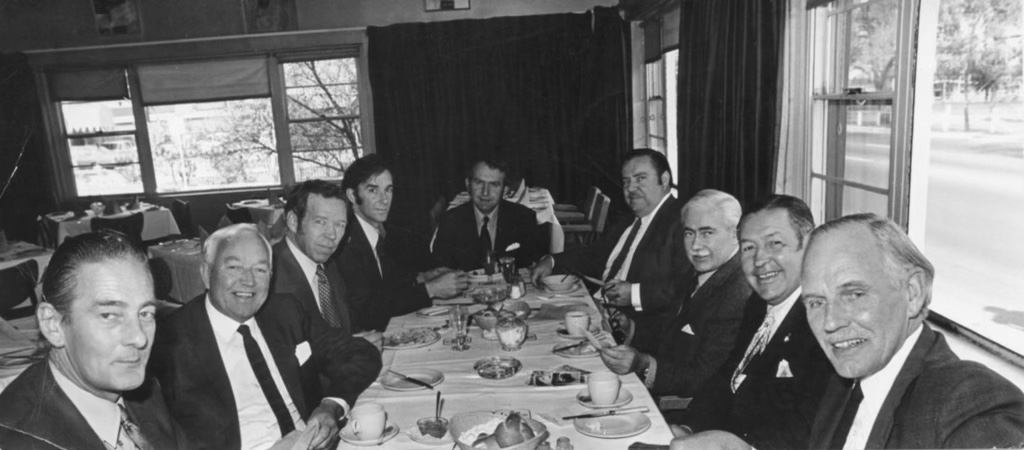
(R Simmonds Collection)
On this particular day we can see, clockwise from the front left, Peter de Wolf, Bill Leech, David Anderson, unknown, John Ould, Arnold Terdich, Ron Rawson, Ron Edgerton and Jim Leech. Bill had competed on the original Phillip Island track before the war and Jim had attended with him. The brothers’ enthusiasm led to the erection of corner signage naming each corner. In 1978 we did multiple commemorative laps of it on the Saturday of the Golden Jubilee celebration The track was unchanged from pre-war, apart from bituminisation. During that weekend a commemorative brass plaque was unveiled at Heaven Corner. See this lengthy pice on the 1928 AGP; https://primotipo.com/2020/05/28/1928-100-miles-road-race-phillip-island/
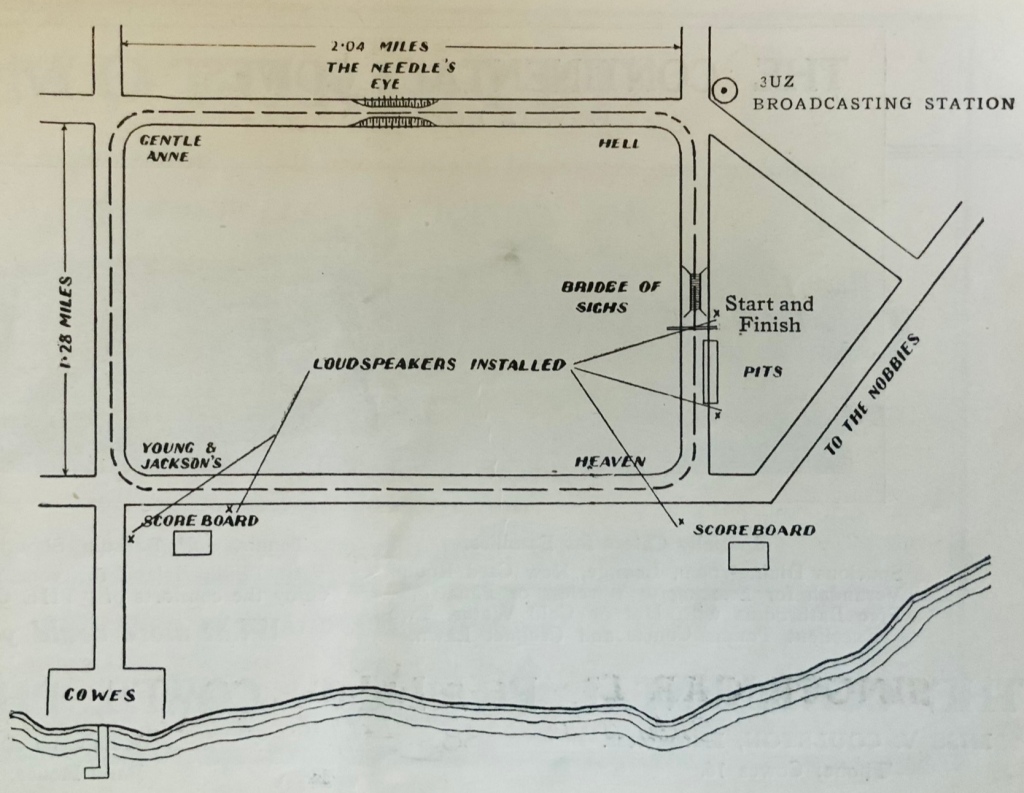
(B King Collection)
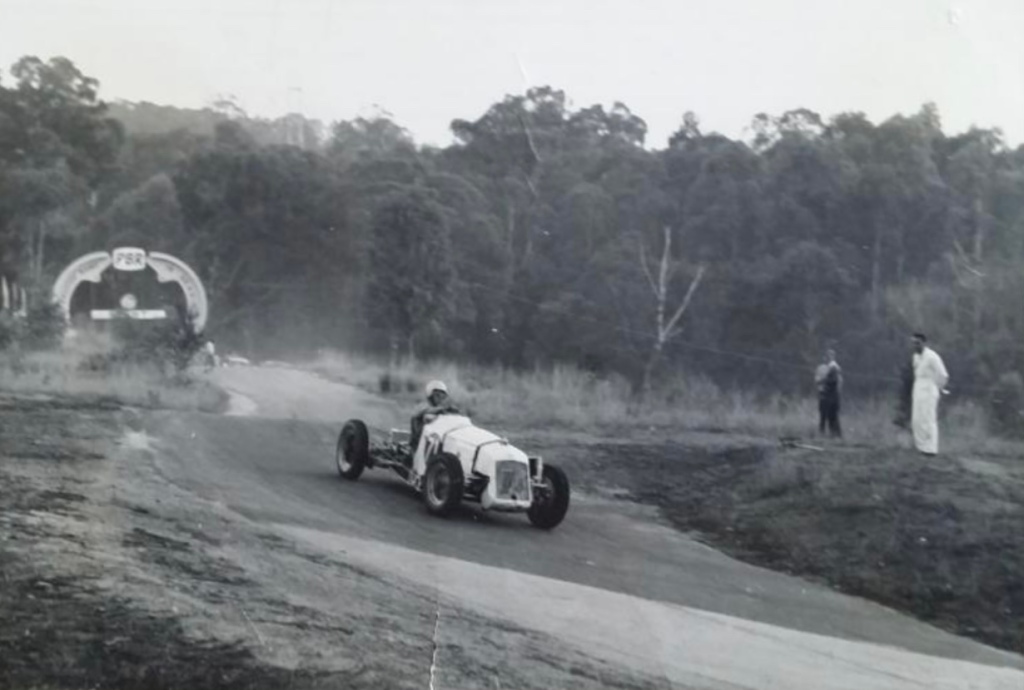
The names of the corners are of interest. The start-finish line was on the southern-most straight which led quickly to Heaven Corner. ‘Heaven’, because the previous and last corner was Hell, as it was approached downhill at maximum speed. (Hope Bartlett claimed he reached 130mph in 1931 driving his Type 37A Bugatti on this downhill stretch through ‘The Bridge of Sighs’). The next corner, just a short walk from Cowes, was named Young and Jacksons as it was nearest to the Isle of Wight Hotel, recognizing the pub of that name conveniently place opposite Flinders Street Railway Station in Melbourne. The south-east corner was Gentle Ann, named for a memorable local maiden. The track was 6 miles in length – this figure having been arrived at by a gentleman seated in a dray, drawn by a horse. To the large diameter wheel of the dray, he had nailed a flap of leather which hit his foot on each rotation and, knowing the diameter of the wheel, he was able to calculate the track’s length. Subsequent survey proved that this method was highly accurate. As the roads were unsealed, the racer’s nightmare was dust, dust so thick that in places they steered by the tops of the trees.
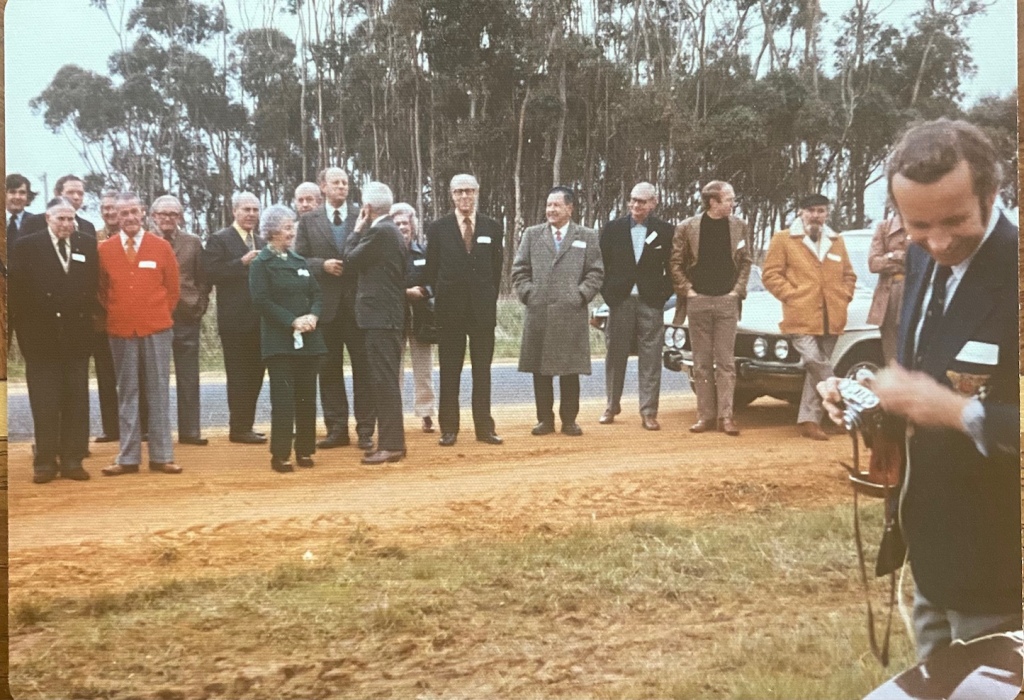
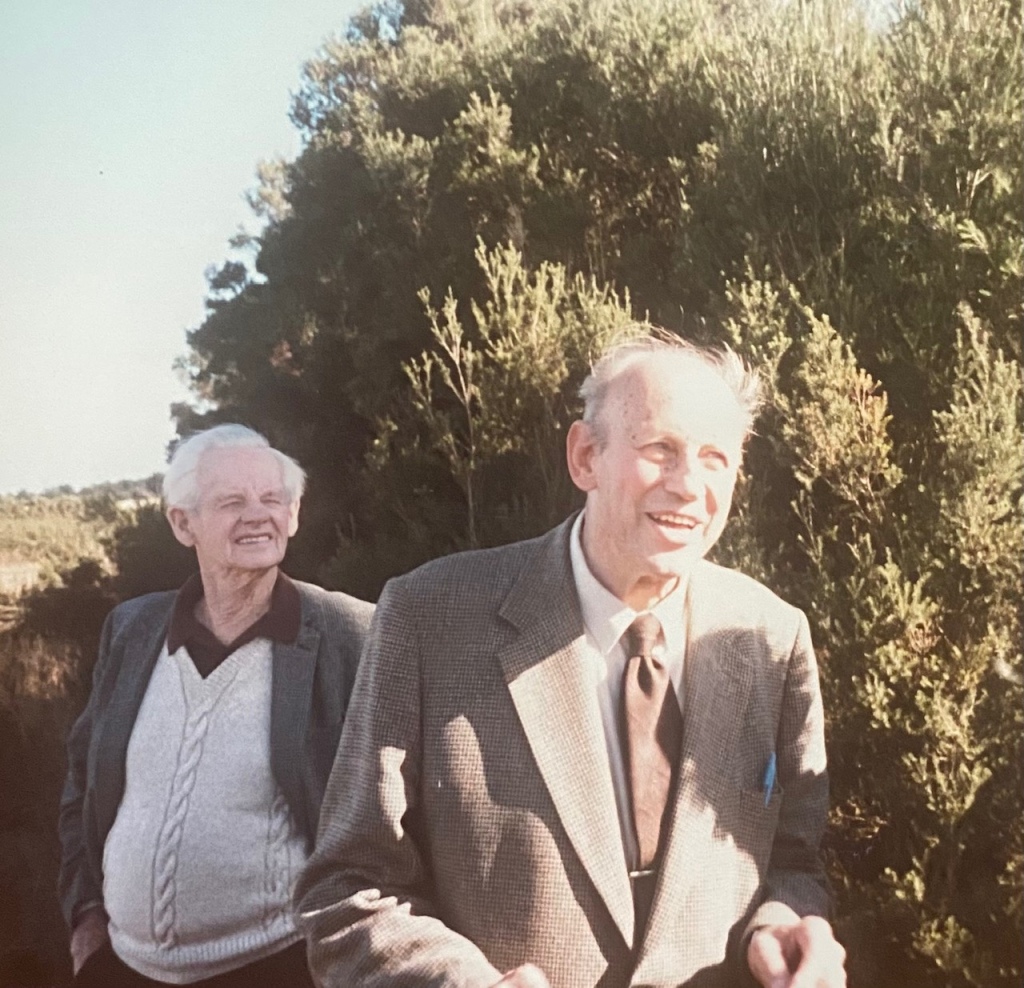
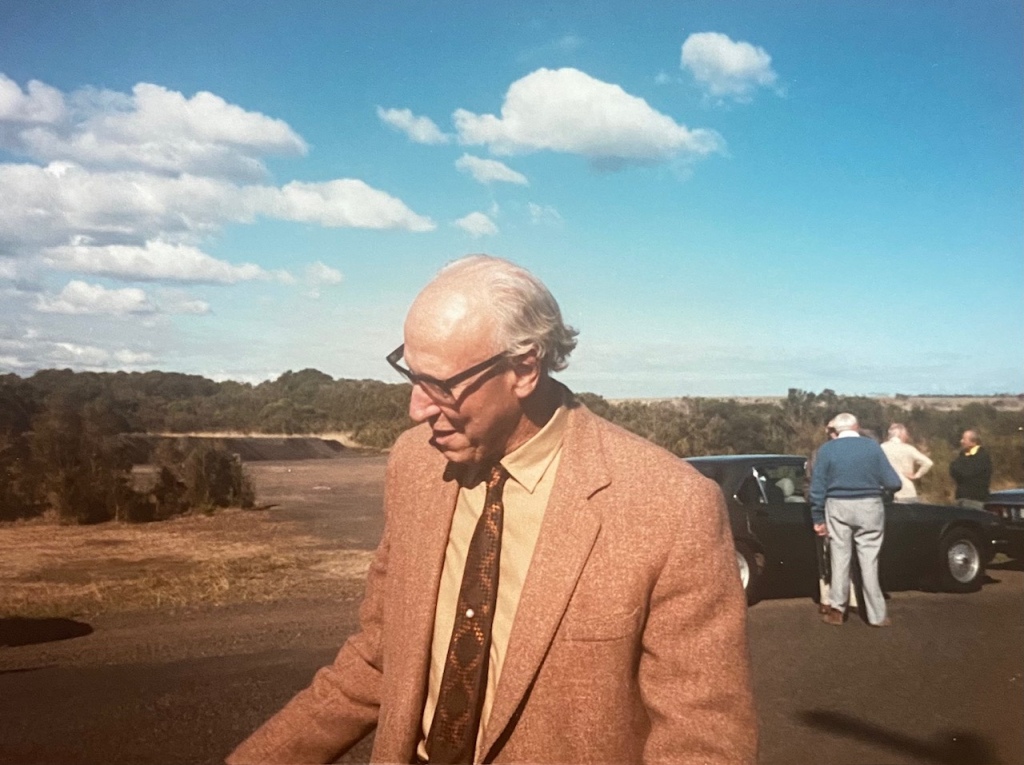
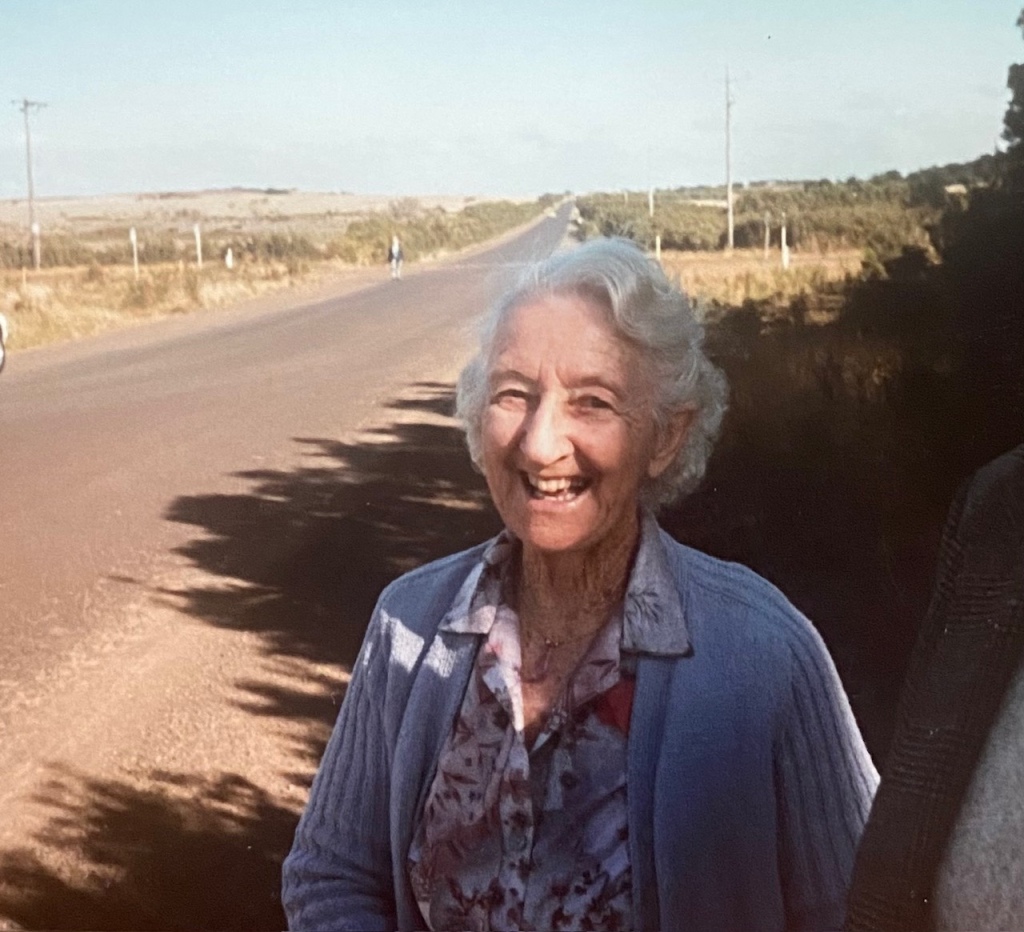
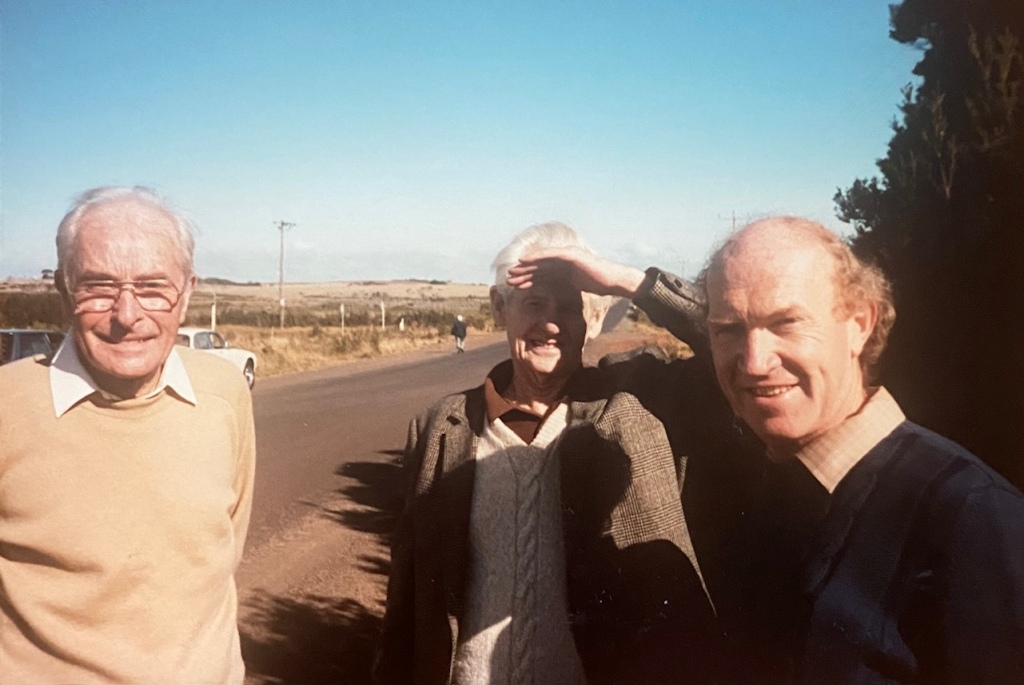
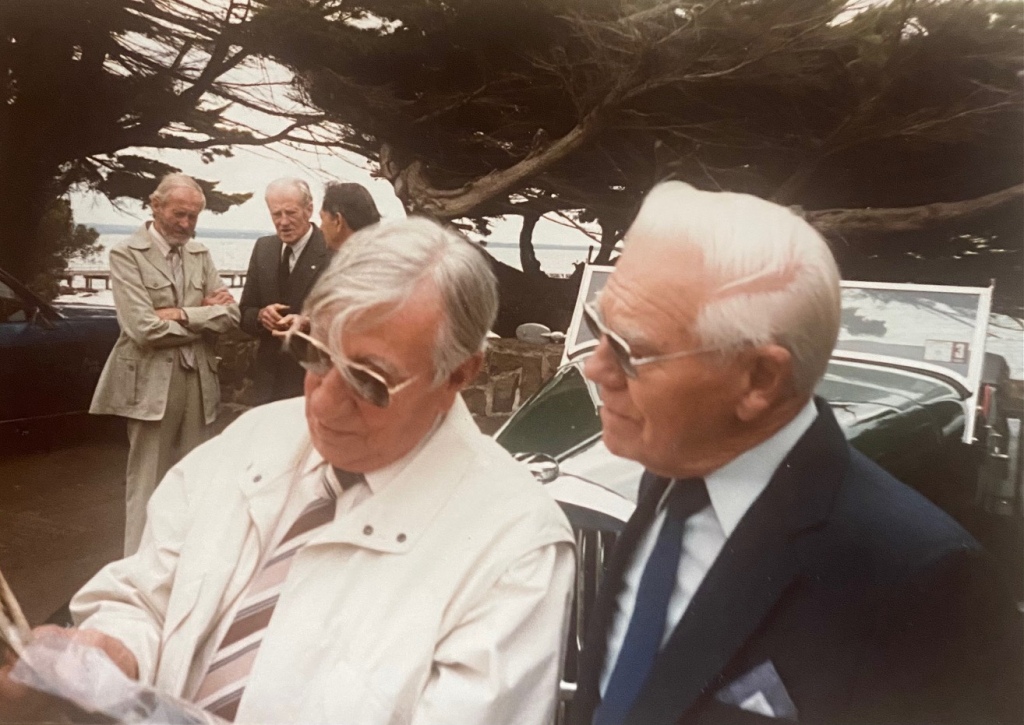
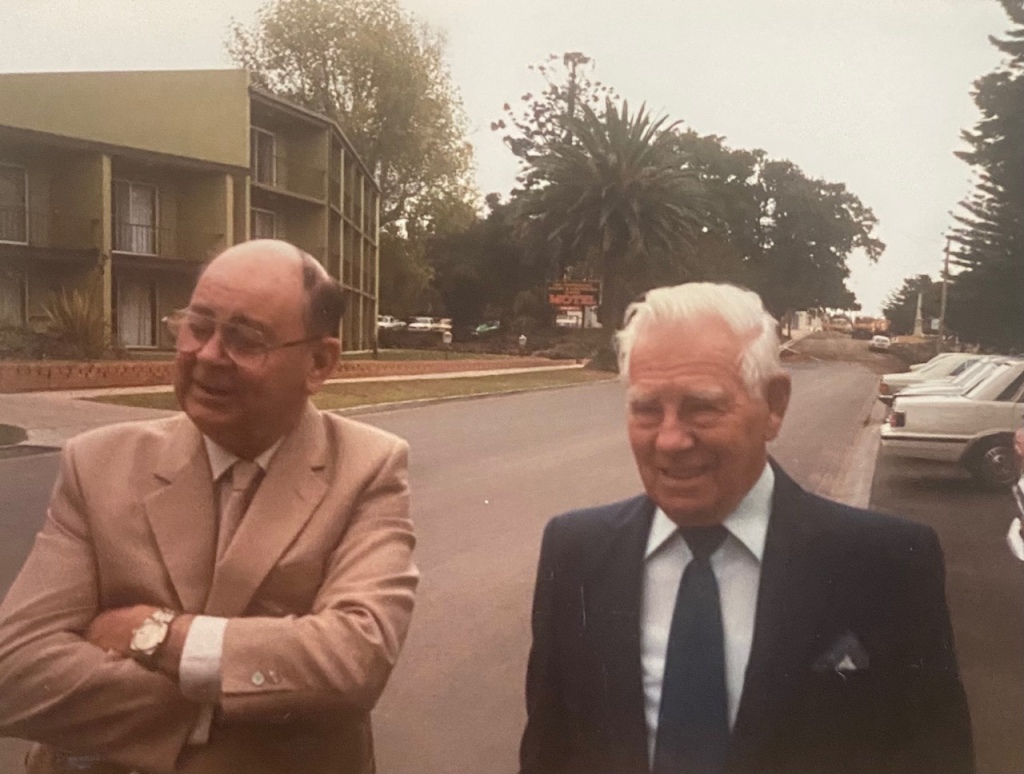
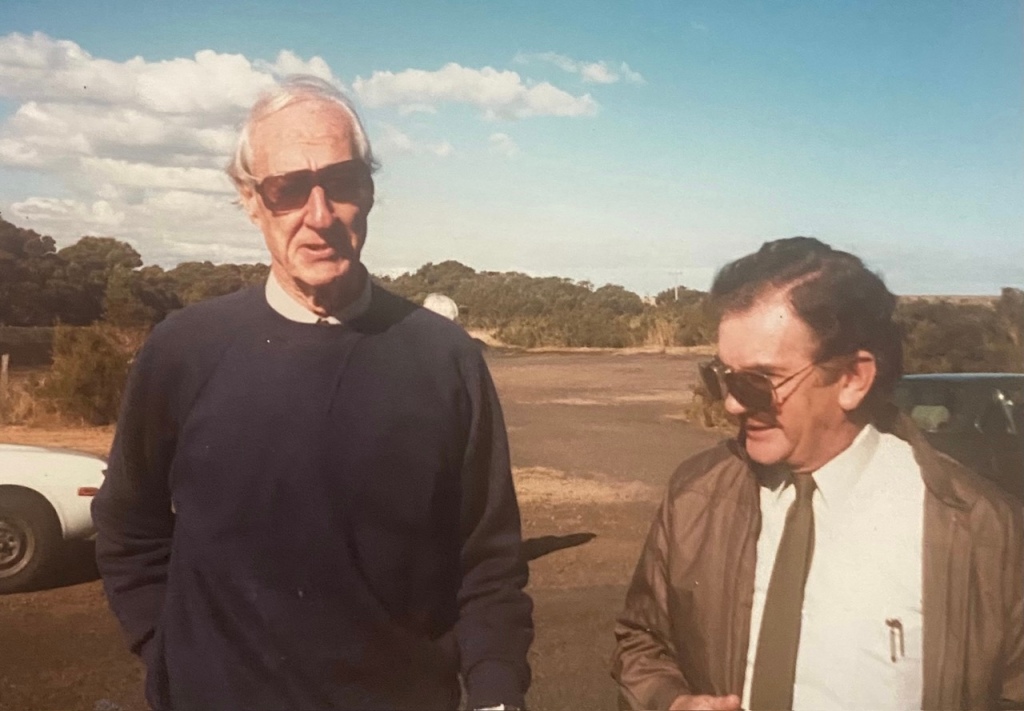
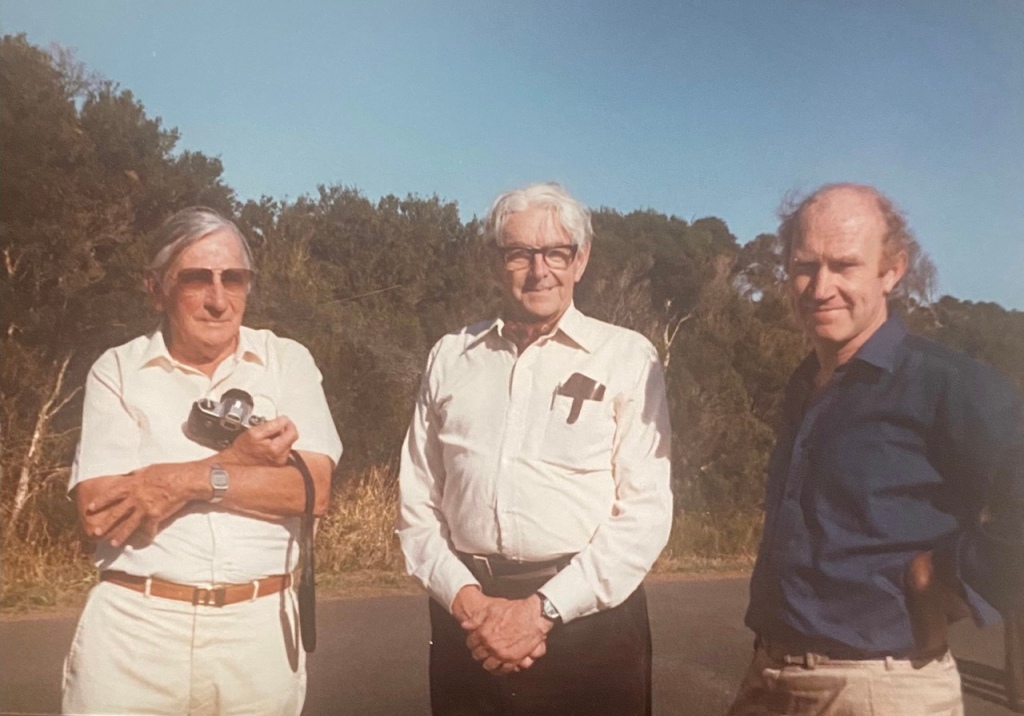
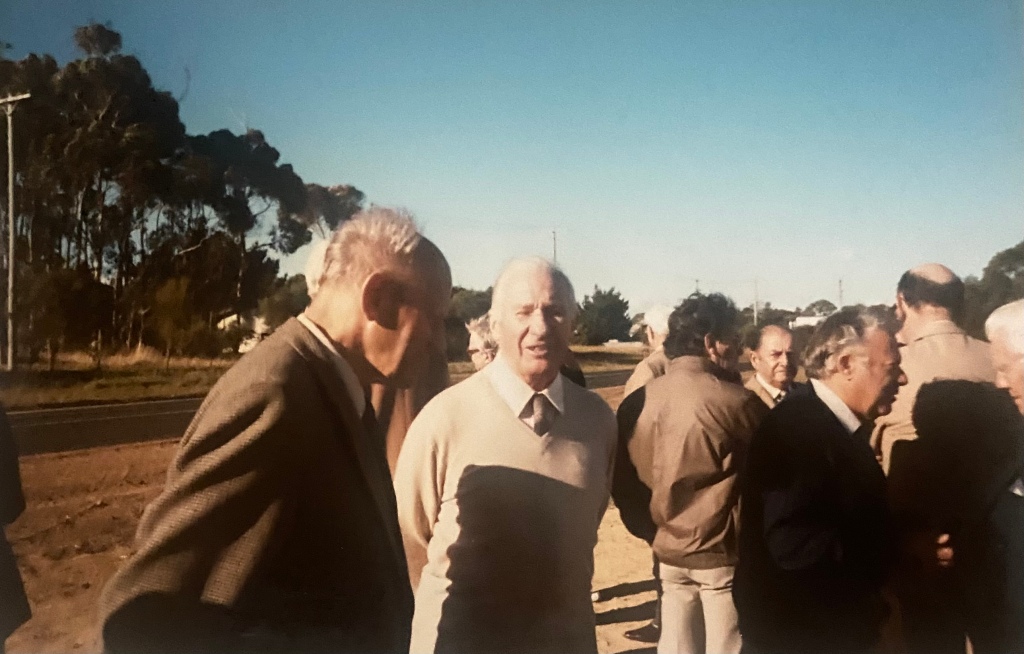
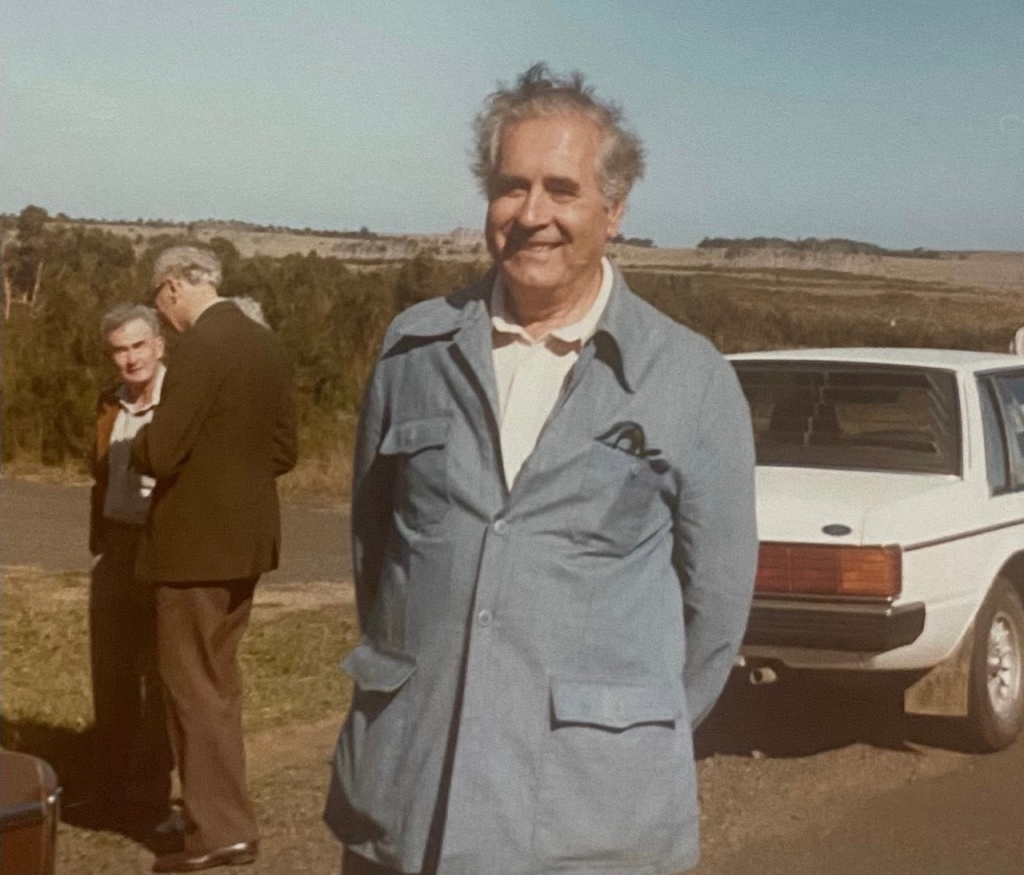
In the mid-eighties photographs were taken of attendees at the LCCA commemorative events at Phillip Island. As he is absent from the photos, it is likely they were taken by Jim Leech – they are representative of three visits to the Island. We felt that these photographs should be shared.
(B King Collection)
A group photograph with the secretary of the LCCA, Ian McKnight in the foreground. L to R: John Whiting of the Luxton family, Arthur Terdich, winner of the 1929 AGP, David Anderson, an LCCA official, Les Murphy, two times AGP winner, 1935 and 1936, Jack Ould (known as Jack Ancient to distinguish him from the LCCA president, John Ould), David Watson, Bob Chamberlain, with Barney and Bess Dentry flanking him, Bill Chamberlain, Ron Edgerton, unknown, Bob King and Peter Menere
Jim Leech in conversation with Harold Edwards and partner in Bugatti T39 #4604 – the 1931 AGP winning car driven by Carl Junker – while Bill and Lyn share the back seat of Jim’s Singer during the LCCA Ballarat Trial in the mid-thirties (B King Collection)(B King Collection)
The ever-engaged Bob Chamberlain with Barney Dentry.
(B King Collection)
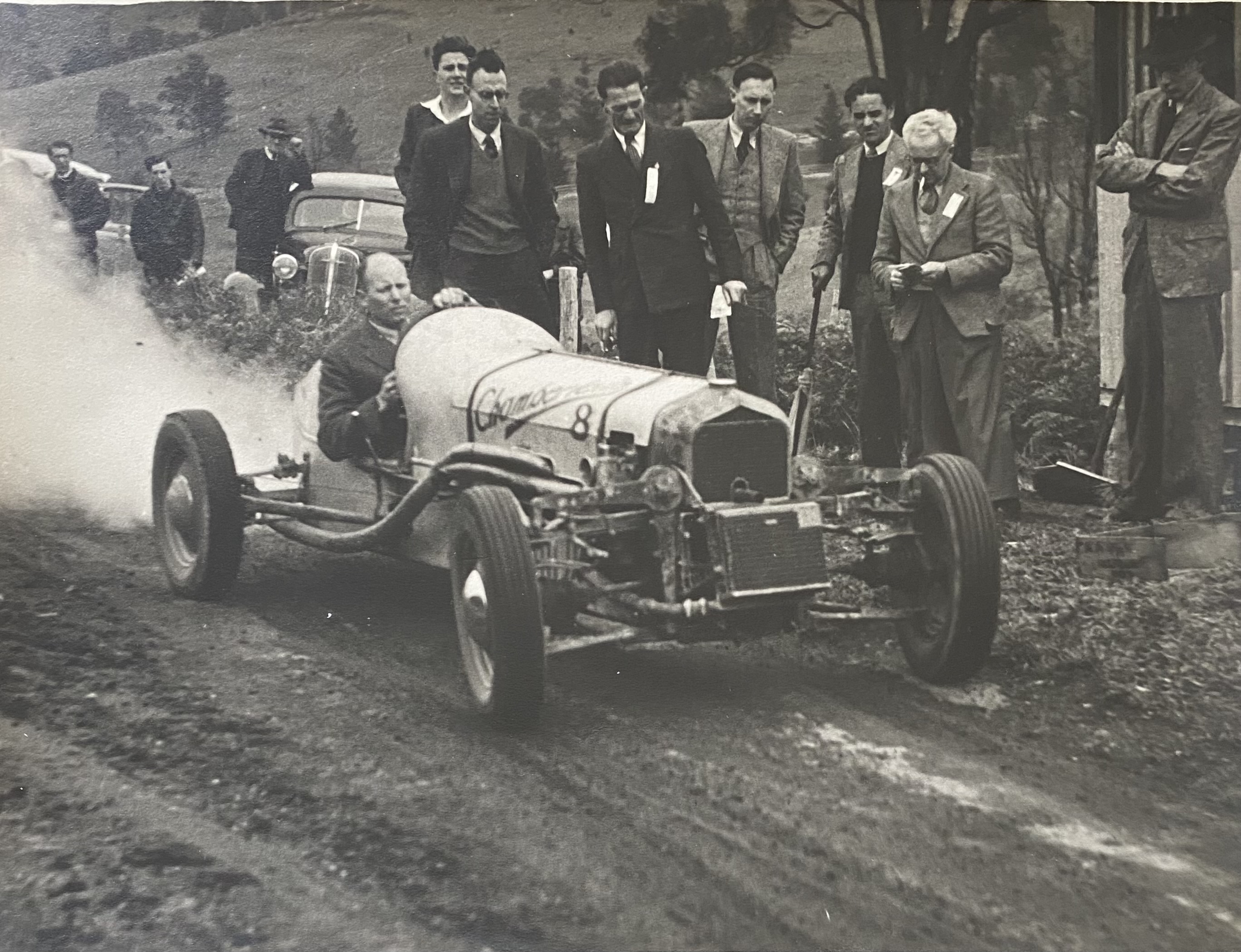
The extraordinary, avant-garde Chamberlain 8 leaves the line in a haze of screaming two-stroke fuel and exhaust music, Jim Hawker at the wheel. Rob Roy June 1946.
Godbehear attacking Rob Roy on November 3, 1959, JBS JAP 298cc. Jack Goldsmith Godbehear was a legendary mechanic/engineer/mentor to drivers such as Jim McKeown and Tony Stewart. He taught driver/mechanics like Larry Perkins and Peter Larner many of his principles and tricks in his Park Orchards shed, the dyno of which upset the bucolic splendour of the outer Melbourne suburb on many a fine day.
The inspiration for these visits, Bill Leech, at right with Jack. Bill and Jim Leech were pillars of the Melbourne business and motorsport establishment, their creative, competitive, political and organisational skills were all over the successes of the Light Car Club of Australia for a half-century. One can’t overstate their contribution behind the wheel or boardroom table.
(B King Collection)
Bill Leech at Lakeland hillclimb in the 1970s, Bugatti T37A.
‘Memories’, Len Sydney and his brother reminiscing about when they raced motorcycles on the 20-mile track that went north as far as Rhyll (Phillip Island).
Ace drivers and preparers Reg Nutt and Otto Stone.
(Davey-Milne Collection)
Otto Stone working on an MG Q-Type with Verna Davey-Milne looking on. Stone was another life-long competitor/engineer with influence across the sport not least preparing – and calming down a bit – Stan Jones and his Maserati 250F to AGP and Gold Star victories.
(S Wills)
The list of cars prepared and/or raced by Reg Nutt is a very long one – a long overdue article – here in a Cisitalia D46 Fiat at Rob Roy in the 1950s.
Eddie Thomas of ‘Speedshop’ fame and Otto Stone.
(unattributed)
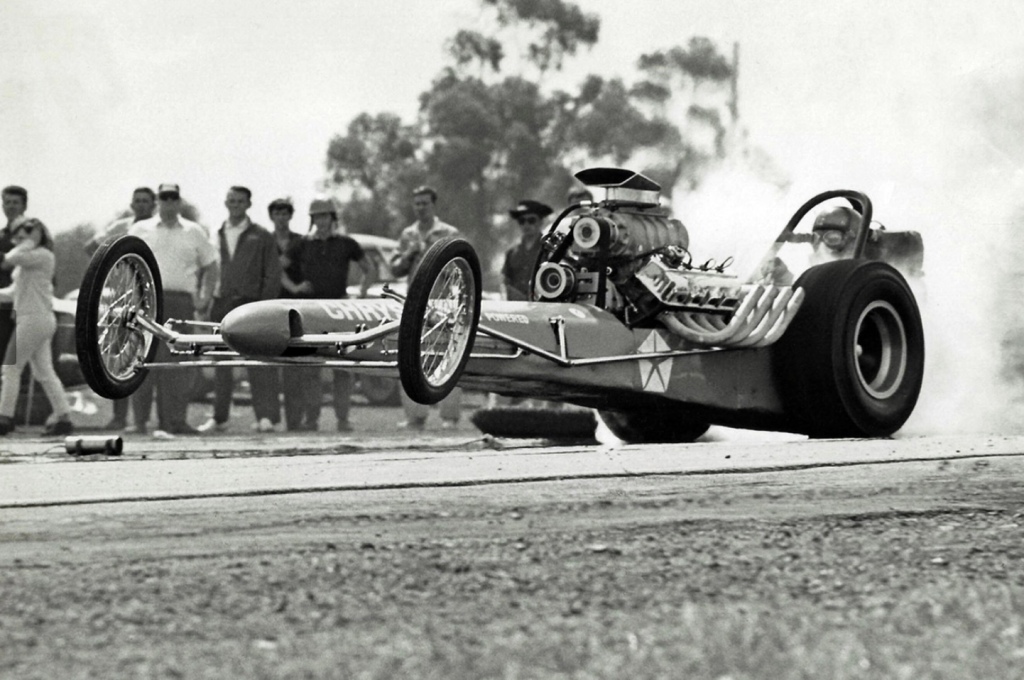
Fast Eddie Thomas about to do a career best 8.55 seconds pass during the 1968 nationals at Calder in his shed built, blown Chrysler-Hemi powered dragster, Old No 17. An ace on two-wheels and four he formed his first Eddie Thomas Speed Shop in Caulfield, Melbourne in partnership with another ace-mechanic, Pat Ratliff in 1956. Corporate and competition fame and fortune followed.
Light Car Club stalwart Alex Hay with Maurie Quincey, nine times Australian TT champion and four times Isle of Man competitor on motorcycles before success as a Honda dealer and late career Formula 2 racer in a ‘relatively safe’ Elfin 600 Lotus-Ford.
(I Smith)
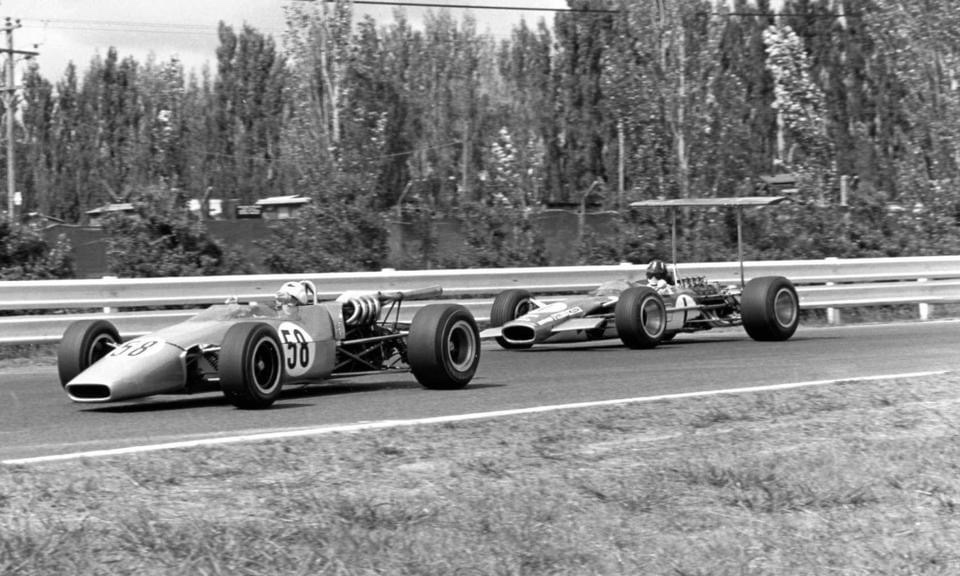
Maurie Quincey’s Elfin 600B Lotus Ford about to be rounded up by World Champion, Graham Hill’s Lotus 49B Ford during the Sandown Tasman Cup round in February 1969.
Reg Nutt, who was riding mechanic to Carl Junker when they won the 1931 AGP. He is seen with Ken McKinney who drove an Austin 7 in the AGP in 1932-34.
(B King Collection)
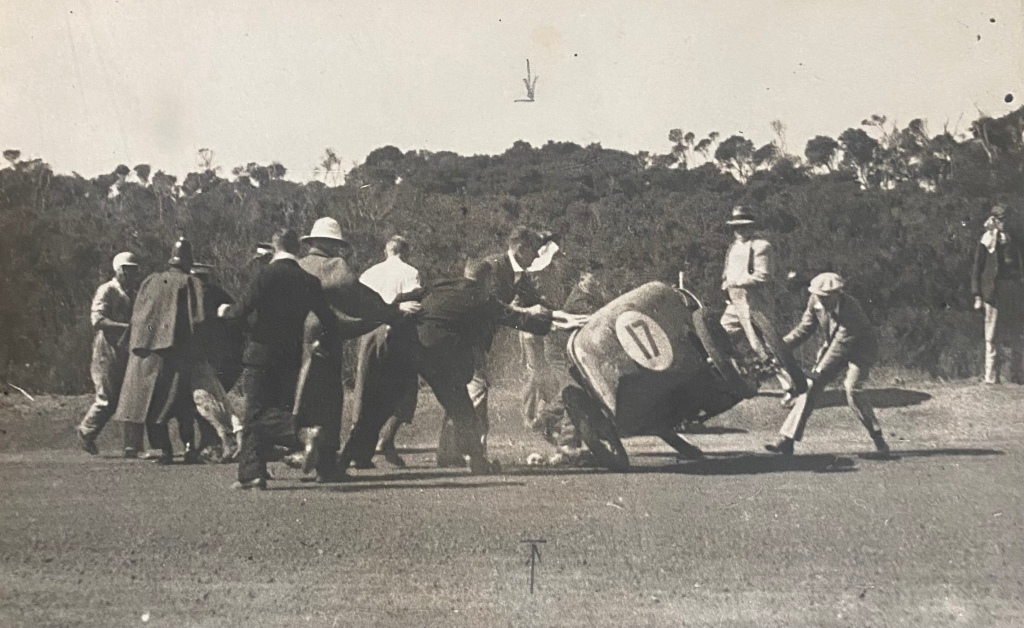
Oopsie. McKinney’s Austin 7’s dignity being restored at Phillip Island circa 1934. DNF that day, but he was fifth in 1933 to go with another DNF in 1932, all aboard Austin 7s which always punched above their handicaps on the rough Island course, Arthur Waite’s 1928 AGP victory duly mounted, noted.
Gib Barrett, brother of Alf Barrett and driver of the BWA, sometimes known as the ‘Bloody Work of Art’, seen below at Templestowe Hillclimb circa 1960.
(unattributed)(B King Collection)
Silvio Massola drove an HRG in the 1952 and 1953 AGPs at Bathurst and Albert Park
(B King Collection)
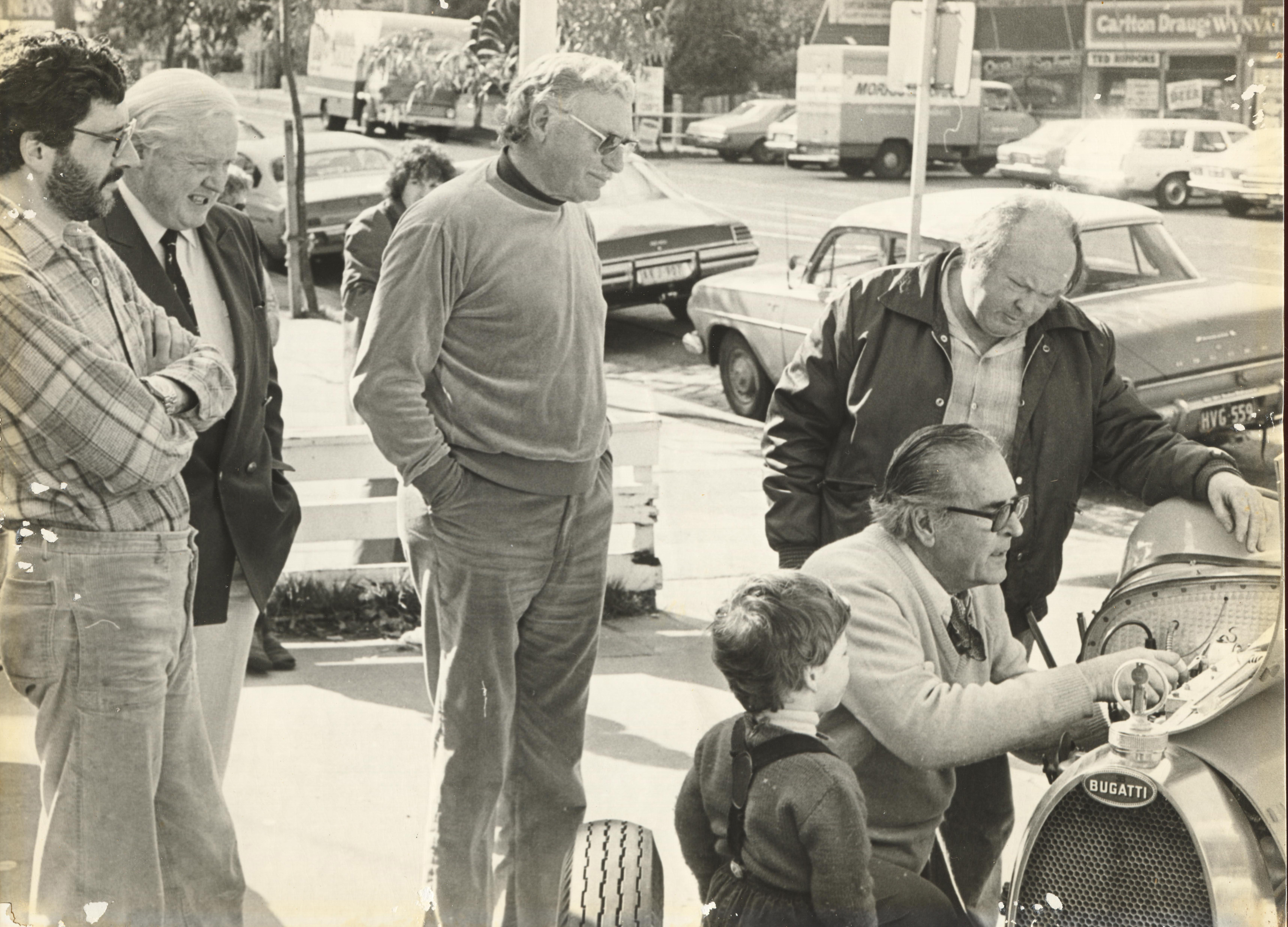
Silvio works on his Bugatti T37 supervised by his son Carlo, John Monks, Snapper-Jack Mayes and grandson, James Massola.
(B King Collection)
Credits…
Bob King Collection, Spencer Wills, Ian Smith, Ron Simmonds Collection, Dentry Family Collection, Spencer Wills, Davey-Milne Family Collection, Nathan Tasca
Tailpiece…
(B King Collection)
Jack Day was an AGP perennial who attended the modern gatherings, but he seems to have escaped the photographer. Here he is, in the day, aboard a Lombard AL3 at Safety Beach, Dromana, perhaps.
Rothman’s promo handout of the type used at race meetings back in the day.
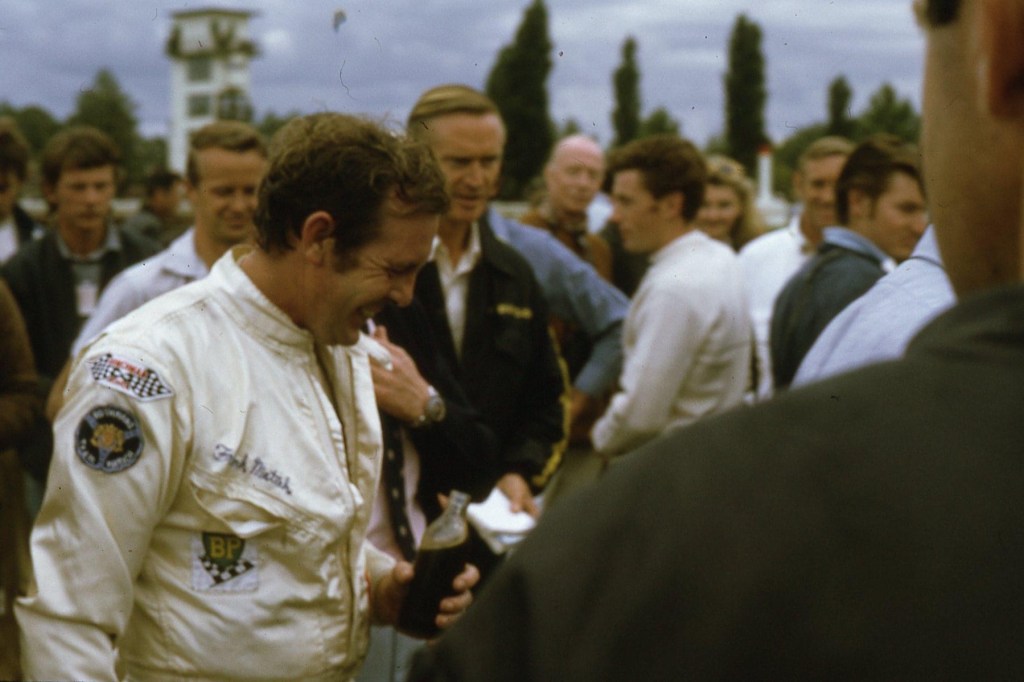
Frank Matich did well with this unique Repco-Holden F5000 V8 engined McLaren M10B, chassis 400-10, winning the Australian Grand Prix with it in November 1970. In early ‘71, after finishing second to Graham McRae’s M10B Chev in the Tasman Cup, he took he entered the first two rounds of the US F5000 Championship held in California in April/May. He won the Riverside Grand Prix and finished second in the following Monterey Grand Prix at Laguna Seca, proving the car was one of the quickest F5000s around.
Sponsorship commitments forced his return to Australia to contest the Gold Star, a pity! Given the solid US campaign you would think Repco – he was their contracted test and race driver – and Rothmans would have seen the good sense in staying a bit longer and surfing the wave of success. US wins would have created good column inches back home and promoted Repco-Holden engine sales stateside, the irony of successful Australian V8s on the ‘home turf’ of that pushrod-V8-donk genre will not be lost on most of you. When Repco and Matich returned to the US with a full-on two car works L&M F5000 Championship assault in 1973 it was a clusterfuck, a tangent covered in this article and another linked below; https://primotipo.com/2015/09/11/frank-matich-matich-f5000-cars-etcetera/
(R Wolfe Collection)
Back home things turned to custard as he collided with another car – in a zig-zag moment as two cars converged – in practice at Oran Park before the first Gold Star round on June 27.
By then FM had decided to build his own car, so rather than order a replacement M10B chassis from Trojan Cars – manufacturers of McLaren customer cars – he decided his Brookvale team should rebuild the buggered monocoque as practice for what became the Matich A50 Repco-Holden that November. FM’s cars to that point – the SR3-4 sportscars – had spaceframe chassis.
When the thrice tubbed – the original, a Trojan replacement after a July 1970 prang, plus the Matich built chassis – M10B was rebuilt it was designated M10C.
Compare and contrast. Matich shown winning the November 1970 AGP above at Warwick Farm fitted with 15-inch front and rear wheels, and below at the same circuit using 13-inch jobbies up front during the February WF Tasman round, DNF electrical. Same car, chassis 400-10, and same tub at this point! (unattributed)(Terry Russell/an1images.com)Matich in the M10C in New Zealand – where folks? – during the ’71 Tasman showing its M7/M14 13-inch front wheels. Isn’t it neat looking sans hi-airbox – that ‘innovation’ was introduced by Tyrrell during the ’71 French GP weekend – and with engine cover (D Kneller Collection)
In the lead up to the 1971 Tasman, FM developed 13-inch Goodyears as part of his test-driver role with Goodyear, he was one of about 10 in the world at the time, he was the distributor of the Akron giant’s race-tyres in Australia too. F1 cars raced on 13-inch covers and Goodyear were keen to evolve suitable boots of the same diameter for the heavier F5000s. The M10A and M10B were supplied ex-factory with 15-inch wheels front and rear. Simultaneously, the Matich crew increased the wheelbase of the car by 150mm by using redesigned front wishbones and longer radius rods, these and other subtle changes heralded the very quick C-specification.
Back to the ’71 Gold Star. Matich won at Surfers Paradise when he rejoined the Gold Star circus on August 29, 1971 but retirements at Warwick Farm and Sandown cruelled his championship aspirations. By then the main game was readying the new Matich A50 Repco-Holden for the November 21 AGP at Warwick Farm where the several days old car finished a splendid first!
Etcetera…
(G Wadsworth Collection)
Matich in the middle of the leading gaggle of cars not long after the start of the Riverside Grand Prix, that’s Sam Posey’s Surtees TS8 Chev turning in. The red car out of focus on the left looks suspiciously like Skip Barber’s F1 March 701 Ford DFV. Ron Grable’s Lola T190 Chev won the first 38 lap heat and Posey won the second, but FM’s two second placings won the day and the bubbles overall.
(M Kidd)
I like this unfinished painting, Kiwi artist Michael Kidd never got beyond his initial sketch of the McLaren M10C Repco-Holden in ‘71 Tasman specs as shown below. Matich leads Niel Allen’s M10B Chev and Frank Gardner’s works-Lola T192 Chev in the distance. Circuit folks? How ’bout completing the painting Michael?
(D Kneller Collection)
What’s interesting to we anoraks – perhaps – is that between the end of the Tasman and the trip to the US a couple of months later, Matich fitted a more substantial roll-over hoop with two rear stays mounted further back on the car at the rear. Look at the shots above and below. I wonder why? Different US regs perhaps, dunno, that’s one for Derek Kneller…
(D Kneller Collection)
The more you look, the more you see of course, here’s one for the Repco-Holden perves. Don’t the inlet trumpets on the engine above indicate that that injection slides are in use rather than butterflies? I thought by this stage slides had been given the arse by REDCO given their propensity to jam from the collection of roadside detritus on our shitty tracks?
Credits…
Rod Wolfe Collection, Derek Kneller Collection, Terry Russell, Michael Kidd, Eli Solomon
Tailpiece…
Frank Matich, McLaren M10A Chev, Thomson Road, Singapore GP, March 1970 (E Solomon)
Frank Matich’s F5000 commitment began with the purchase of this McLaren M10A Chev in late 1969, before CAMS had ‘finally landed’ on their decision for the new Australian National F1 to succeed the much loved, but running out of puff, 2.5-litre formula. That balsy-call by FM and staggering tale of ‘decision making fuck-wittery’ by the Conspiracy Against Motor Sport is contained within this exhausting epic; https://primotipo.com/2018/05/03/repco-holden-f5000-v8/
By the way, the small minded and petty (me) can still take the piss out of CAMS’ name quite legitimately. They registered the new business name Motorsport Australia with effect from January 1, 2020 but the full legal name of the organisation we all love is the Confederation of Australian Motor Sport Ltd (ABN 55 069 045 665) trading as Motorsport Australia, so CAMS it is.
Frank’s M10A, chassis 300-10, was delivered to him in August 1969, and Derek Kneller, ex-McLaren came with it. Derek and Peter Mabey immediately set to and updated the car to the just coming M10B spec – DG300, radiator, body, suspension wheels etc – and created a jet that Matich put on pole in four 1970 Tasman rounds for two wins, the NZ GP at Pukekohe and Wigram.
The last time Frank raced it – F5000 was not Gold Star legal in 1970, see fuck-wittery above – was during the March 29, 1970 Formula Libre 1970 Singapore Grand Prix on the big-balls Upper Thomson Road circuit.
Eli Solomon picks up the story, “Frank complained that his car weighed 1500lbs and carried 28.5 gallons of petrol designed for a 100 mile course. Talk that Niel Allen would also race an M10A never materialised (albeit he had a race winning M10B ready for the 1970 Tasman).”
“In Thursday practice Matich took out a bus stop doing 160mph on the Murder Mile, his best time had been 2:05.5, fifth fastest compared with the winner Graeme Lawrence, Ferrari 246T on pole at 1:57.8. Kevin Bartlett, Mildren Alfa Romeo T33 2.5 V8, did 1:58.6 and Max Stewart, Mildren Waggott TC-4V 2-litre, 1:59.6.” Lawrence won from John MacDonald’s Brabham BT10/23C Ford FVA and Albert Poon’s similarly powered Brabham BT30.
Matich’s M10A 300-10 on the NZ GP grid at Pukekohe, January 10, 1970. Guy tapping the nose folks? the Keke Rosberg look-alike is Hugh Lexington with Graeme ‘Lugs’ Adams alongside right. Matich won from Derek Bell, Brabham BT26 Ford DFW and Graeme Lawrence, Ferrari Dino 246T. Engine is a Traco prepped Chev (The Roaring Season)
Obiter…
One last final fleeting glance for me before uploading this masterpiece. The Rothmans’ shot of 400-10 isn’t a photograph of the car in M10C spec but rather M10B spec before modification, the specification sheet listing is M10B before mods too, the poor old marketers are always the last to know. So, sleep easy now with that knowledge, I’m not OCD-ADHDxyz believe it or not but I do have my uber-anal moments…
The Japanese zaibatsu (conglomerates) were exhorted by their government to build and export cars post-war after the San Francisco Peace Treaty. The Mitsubishi Corporation was happy to oblige their political masters.
The enormous transnational had a dalliance with automobiles in the early twentieth century, but they got serious with the Mitsubishi 500 – a design which drew on their wartime aircraft manufacture – which was mass-produced with the vision of becoming a ‘national car’ in 1959.
(Tetsuaki Makita)
The lure of competition was great so the company contested the 1962 Macau Grand Prix to showcase their engineering capabilities, the little cars finished 1-2-3-4 in a support race, taking the under 750cc class.
Mitsubishi raised the bar when they developed a 90bhp competition variant (cam, carbs, head/valve modifications) of the 1-litre R28 engine which was fitted into the first of a number of Brabham/Brabham copy chassis, the first car was called the 1966 Colt F3A.
In the 1960s the Japanese Grand Prix was held for Group 7 sportscars, some of which were built by local giants such as Prince/Nissan and Toyota. At the same Mount Fuji circuit meetings there were support events for other categories, including single-seaters – the blue riband of these was the J.A.F. (Japan Auto Federation) Japanese GPs – it was on these races that Mitsubishi focussed.
In later decades Mitsubishi’s competition history was celebrated with a series of calendars and posters which stimulated this article.
Ken Yamamoto’s painting depicts the Osamu Mochizuki-Osamu Masuko one-two battle aboard 1.6-litre pushrod R46 circa-160bhp engined Colt F2As in the 1967 JAF Japanese GP
The company led in domestic single-seater racing, while Honda took on the world in F1. Drivers such as Osamu Mochizuki, Tetsu Ikuzawa – the very first of the Japanese internationals who competed in F3 and F2 in Europe – Osamu Masuko, Kuniomi Nagamatsu and others competed against European and Australasian drivers, proving their ability at international level.
Single-seater engine developments spilled over into a rally program which commenced in Japan in 1965, but kicked up a couple of gears when Mitsubishi decided to enter Australia’s Southern Cross Rally off the back of a gruelling testing program to ensure the suitability of the Colt 800 (first launched in November 1965) for the country’s tough roads and vast climatic extremes.
Australian rally-driver, Doug Stewart – later appointed a Director of Ralliart along with Andrew Cowan – conducted the ‘destruction testing’ of two cars in the outback/alps and was so impressed he convinced Mitsubishi to rally the Colts in the Australian Rally Championship (from 1968) competition. Colin Bond, later Australian Rally/Touring Car Champion, also drove and helped prepare the cars.
Colt 1000F depicted during the October 1967 Southern Cross Rally. Colin Bond/Brian Hope fourth placed car (Akira Yokoyama)
Mitsubishi’s website records that, “Mitsubishi Heavy Industries’ Automotive Division considered his (Stewart’s) advice and concluded that rally participation would effectively promote road car sales and raise brand awareness.”
“They decided to contest the 1967 Southern Cross Rally with two Colt 1000Fs, pitting themselves against vehicles with much larger engines using high reliability and durability as their main assets. Colin Bond was fourth outright, also winning the small engine capacity class, while Stewart finished third in class. The foundations for what is referred to as ‘Mitsubishi Motors in Rallying’ were laid at that time.”
“1985 calendar illustration starting with the Mitsubishi 500 in 1962, Colt 1000, Colt F2, Colt F2000 – the 1971 Japanese GP winner – the Starion” (Dennis Brown)
Mitsubishi’s R39 1.6-litre (from 1968) and R39B 2-litre (1971) twin-cam, four-valve, fuel injected race engines won the 1971 Japanese Grand Prix in Colt F2000 chassis when Kuniomi Nagamatsu triumphed over Osamu Masuko in a great Colt F2D (F2000) 1-2 in an international field of depth.
Just as it seemed the company was poised as a possible engine supplier in the new 2-litre European F2 Championship which commenced in 1972, the company turned 180-degrees away from single-seaters into touring car racing and the forests and deserts where its competition focus has largely remained. From a cost-effective brand-building perspective with production-car spinoffs, it was doubtless the right call.
(Akira Yokoyama)
Mitsubishi’s first international rally win was in the 1972 Southern Cross Rally, the winning crew of the Colt Galant was Andrew Cowan and navigator John Bryson. The company won three more of the Oz internationals and two Safari Rallies between 1973-77. Their first Safari win was taken by a privately entered Colt driven by Joginder Singh. Lancer Turbo and Lancer Evolutions programmes followed.
It’s a bummer not to be able to read the detail of these posters found on-line, but I thought them worth sharing all the same.
Credits…
mit-cardesign-t.com – Dennis Brown, Tetsuaki Makita, Ken Yamamoto, Akira Yokoyama, rally-japan.jp
Another page from the 1985 calendar (Dennis Brown)
In the process of researching this story the only technician I have uncovered as involved in the race and rally programs is a man named Iwao Kimata, “a former Nissan rally driver, who was hired to help Mitsubishi learn about rally racing step by step” according to rally-japan.jp.
If any Japanese readers now the names of the key engineers/technicians/mechanics involved in Mitsubishi’s mid-1960s race and rally programmes, please get in touch with me on mark@bisset.com.au. I am keen to record such folks names and if possible communicate with them.
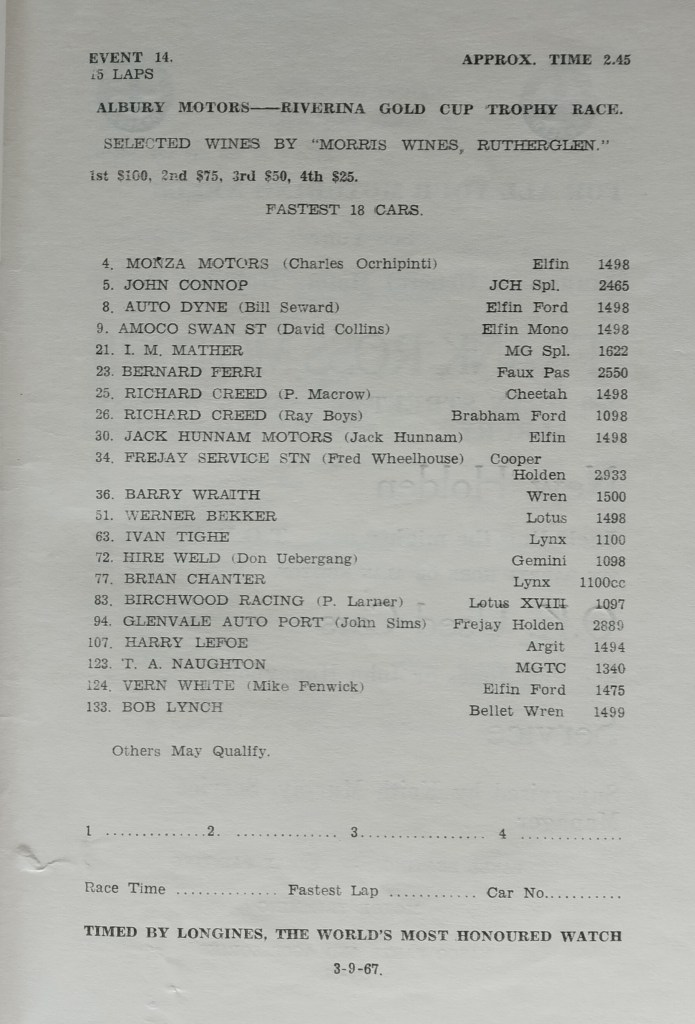
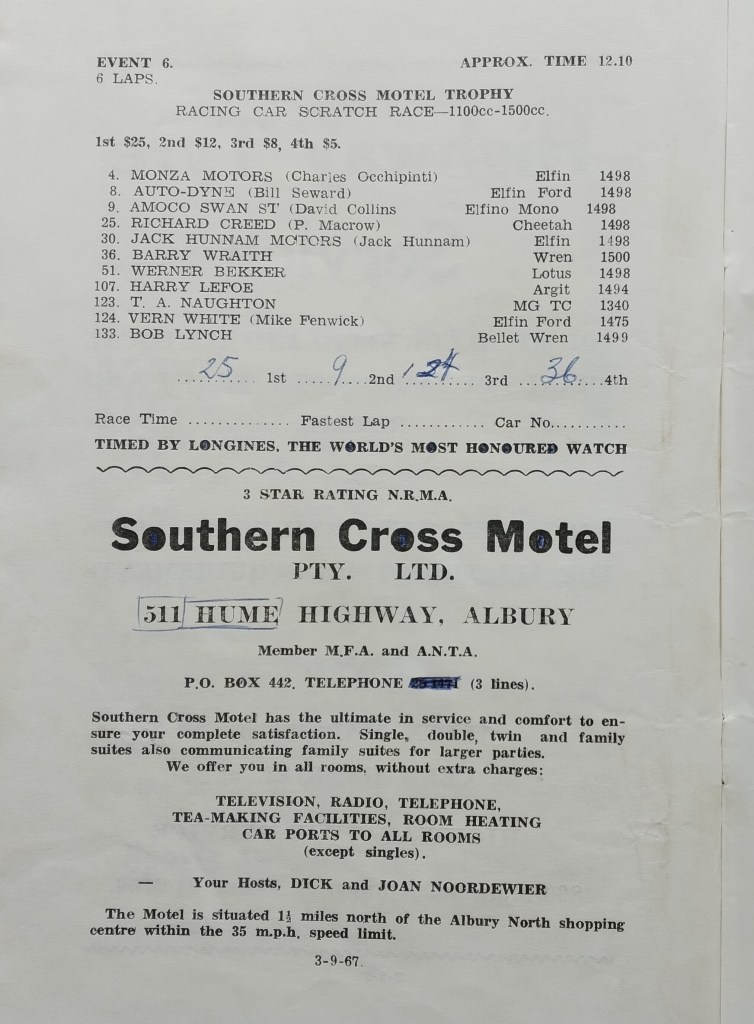
Peter Macrow, clad in fireproof woollen brown jumper, on his way to victory in the Riverina Gold Cup aboard his Brian Shead built Cheetah Mk3 Ford at Hume Weir on September 3, 1967.
It was his third Riverina Gold Cup on-the-trot! He won from a 17 car field varying in performance from future prominent Clubman and Tourer competitor Tom Naughton’s MG TC and equally capable single-seater driver/engineers Ivan Tighe, Lynx and Peter Larner, Lotus.
Shead first competed in his road-going Austin A40 in 1960, progressing to his own Cooper influenced Cheetah Mk1 in 1962. Brian regularly diced with Peter who was then racing the ex-Garrie Cooper, Cooper Austin. The evolved Cheetah Mk2 followed and all new spaceframe Mk3 in 1963.
Macrow was so impressed by the Mk3 he convinced Shead to sell it and help with its development. Brian picks up the story, “I succumbed to pressure from Macrow and sold him the car less engine, and assisted in installation of a pushrod Ford 1100cc engine. I retired from racing and helped with the running of the car and its preparation. Peter raced it extensively with considerable success in Victoria and New South Wales.”
“We continually upgraded the specifications of the car until it was running 7″ and 9″ wide wheels with disc brakes all around and fitment of a Lotus twin-cam engine. The Macrow/Cheetah combination became most successful at Hume Weir and Winton.”
Shead returned to racing when he built his first production cars, the Mk4, which was also raced successfully by Macrow, more on that here; https://primotipo.com/2021/11/16/cheetah-mk4/
The first Pingelly Speed Classic was held on a 2.5-mile round-the-houses course in the West Australian town 160km south-east of Perth on January 30, 1939.
The five event programme consisted of the handicap Great Southern Speed Classic, run concurrently with a scratch race, two five lap handicaps – one each for racing and sports cars – and a four lap handicap and relay race for stock (standard production) cars.
(K Devine Collection)
The Clem Dwyer Plymouth Special and Duncan Ord Bugatti T57T take the chequered flag during the inaugural Great Southern Speed Classic on a fabulous Wellington Street panorama.
The very successful Plymouth, powered by a side-valve straight-six was based on a damaged sedan which was heavily lightened and modified, whereas Ord’s blue-blood 3.3-litre straight-eight twin-cam Bugatti (chassis 57264, originally 57222) was an ex-Lord Howe machine. It was the race debut of the Plymouth and first Australian event for the Bugatti which had arrived from France not long before.
Alan Tomlinson MG TA Spl S/c won from Bill Smallman, MG TA with Roy Sojan third in his Chrysler Special ‘Silverwings’. Duncan Ord was fourth.
(K Devine Collection)
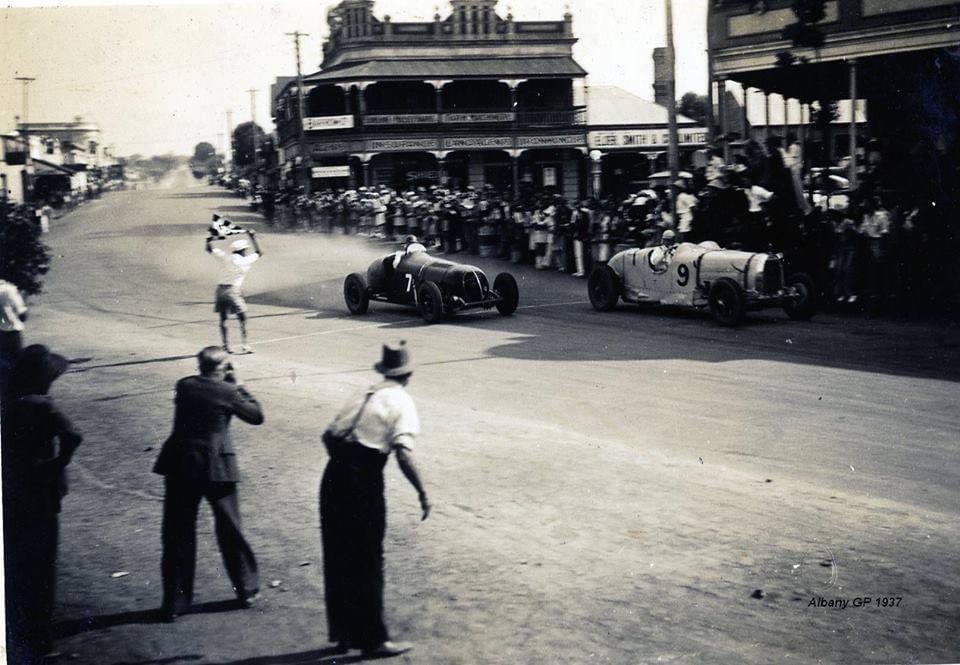
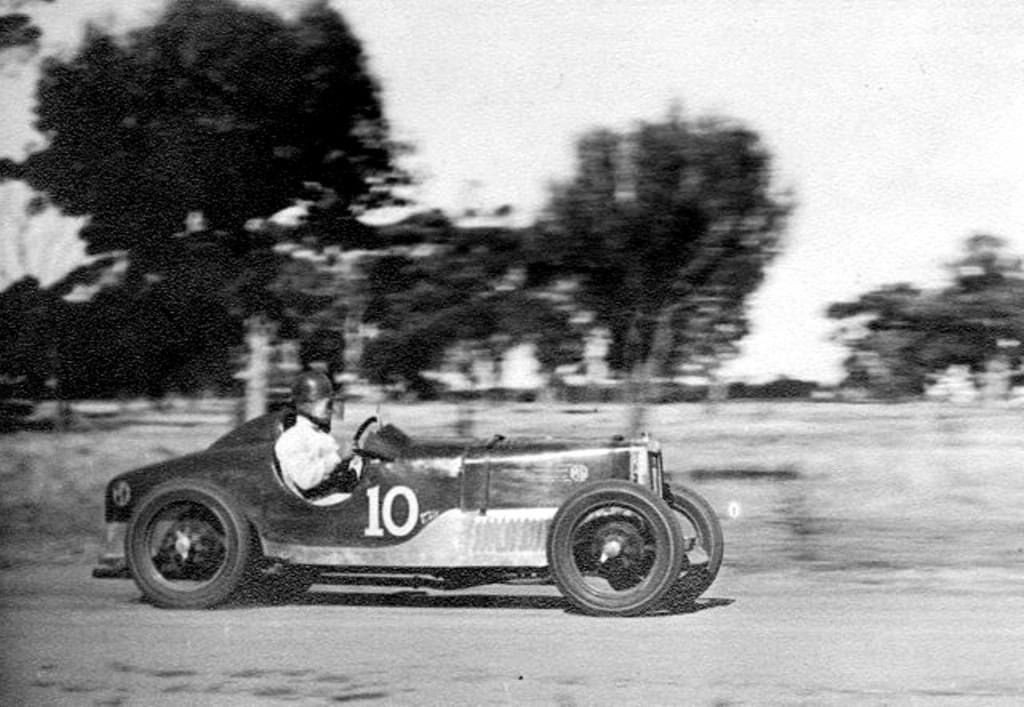
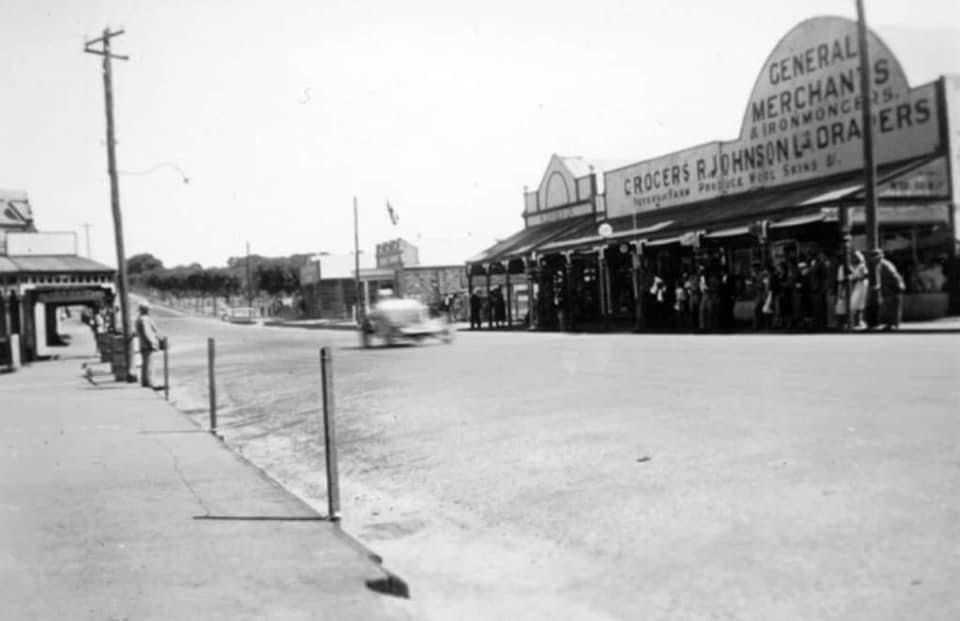
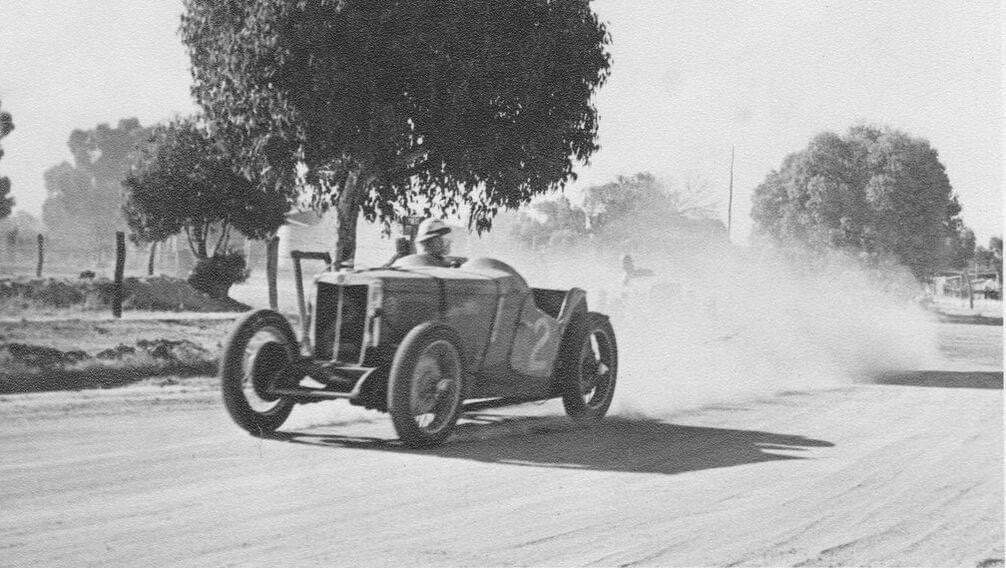
The round-the-houses racing tradition – unique to Western Australia and the envy of the other states – commenced when the good-burghers of Albany decided on a Back To Albany Festival in 1936. With that, three entrepreneurs of the West Australian Sporting Car Club – Eric Armstrong, Clem Dwyer and J Warburton – motored down from Perth and successfully pitched the notion of a Monaco style street race around their fair city to the Council.
The race became the highlight of the festival and spawned similar races at Applecross, Bunbury, Dowerin, Narrogin – at which the 1951 Australian Grand Prix was held – Pingelly and others until the gruesome 1955 Le Mans disaster frightened local councils and led to a clampdown on racing on public roads. Not that they eliminated it completely, the WASCC had a tremendous relationship with the WA cops and ran events in a variety of places right into the 1960s.
(K Devine Collection)(P Narducci Collection)
Two shots of Bill Smallwood’s MG TA Spl during the 1939 race. Smallwood and Clem Dwyer had been Tomlinson’s pit-crew in a staggering win for the young West Australian in the Australian Grand Prix held on the daunting Lobethal road circuit three weeks before.
Clem Dwyer aboard the Bartlett Special in 1939. He bought this machine, built around an 1100cc twin-cam Salmson engine on a trip to the UK. Modified with Brooklands in mind, it was fitted with a Cozette supercharger and was said to be good for 120mph.
Raced at Lake Perkolilli, he gave Ossie Cranston’s Ford V8 Spl a run for his money in 1936, but the car never achieved the success hoped, the demands of the Brooklands bowl and round-the-houses West Australian tracks being quite different.
Unattributed and unknown, perhaps Jack Nelson, Ballot Ford V8 Spl
(W Duffy Collection)
Bob Lee won the five-lap handicap aboard this Riley Brooklands in 1939, and went one better as shown here in 1940, when he won the Great Southern Flying Fifty – the race had been increased from 5 to 10 laps, 25 to 50 miles.
(K Devine Collection)
During the 1940 race. “Park Street Hospital Hill with the old nurses home in the background behind the chook-yard” quipped Jennie Narducci. It’s Harley Hammond in the Marquette Special from Barry Ranford’s Ranford Special. In a long successful career through until 1958, the latter built four specials.
The 1940 programme comprised five events: a 10 lap Tourist Trophy for under 1500cc stock machines, a 5 lap handicap for racing cars, 4 lapper for stock cars plus the 15 lap classic.
(unattributed)
Harry Squires MG PB Spl S/c – looks more like a T-Type to me?
(unattributed)
The intersection of Park and Parade Streets with Jack Nelson’s Ballot Ford V8 Spl in shot, 1940.
The bones of this car – #15 – were those of the ex-Jules Goux, Cooper brothers Ballot 2LS which met its death at Phillip Island in 1935. Les Cramp had just acquired the car and was killed. This machine raced on well into the 1950s – with no Ballot left – before Mick Geneve died at its wheel, by then Chev powered, at Caversham in 1959. A tribute car exists.
This local footbridge lasted into the 1960s, while one of the local ‘cockies tells us there are two Gilchrist sheep feeders “built by the dozen on a site between the present police station and Shire Office.” Love the power of FB! (K Devine Collection)
Harley Hammond again aboard the Marquette Special. The serving RAAF man did well in this immediate pre-war period with this attractive Buick 3.5-litre sidevalve six-cylinder powered special; Marquette was a shortlived Buick sub-brand.
He won the Great Southern Speed Classic in 1941 – the last race meeting in Australia before the lights went out – and the Patriotic Grand Prix held on the Applecross round-the-houses course 10km from the Perth CBD, several months before.
In fact the November 11, 1940 Applecross races were to have been the final event but the Pingelly organisers slipped in one final meeting on the Australia Day weekend, January 27 with funds raised from the five event programme for cars and ‘bikes in aid of the British Air Raid Relief Fund.
Credits…
Ken Devine Collection, Peter Narducci Collection, Eddy Ring Collection, Warren Duffy Collection, ‘Around The Houses’ Terry Walker
Sydney enthusiast/photographer/journalist Peter Bakalor posted these evocative photographs of the 1970 and 1971 Australian Grands Prix on social media in recent days. He covered the meetings for Autosport magazine.
Frank Matich won the November 22, 1970 event in his newish McLaren M10B Repco-Holden F5000 machine from Niel Allen’s similar Chev engined McLaren, and Graeme Lawrence’s 1969-70 Tasman Cup winning Ferrari Dino 246T 2.4-litre V6. The first shot is, I suspect, FM getting the jump on Lawrence at the start, the other car in shot that of Allen’s McLaren M10B Chev.
The two Alec Mildren Yellow cars are #6, Max Stewart’s tenth place Mildren Waggott TC-4V and Kevin Bartlett’s Mildren Chev- DNF. You can see KB beside his car – with Glenn Abbey alongside – and Leo Geoghegan with the Castrol patch on his overalls. #2 is Allen’s M10B Chev with Niel getting last minute instructions from Peter Molloy at right, they were second. 1970 Gold Star champion, Geoghegan’s immaculate white Lotus is next, he was fourth. Up the back is Ian Fergusson’s green Bowin P3A Ford twin-cam 1.6, 11th.
(P Bakalor)
Frank Matich before the off. It was the first big-win for the Repco-Holden F5000 program based on the then new locally built General Motors Holden 308 V8. Derek Kneller is looking hopefully at the engine!, with ace mechanic, handy-steerer and Adams F5000 constructor Graeme ‘Lugsy’ Adams with his arms crossed. In the distance is Len Goodwin’s Pat Burke Racing McLaren M4A Ford FVC, this ex-Piers Courage/Niel Allen car is about to pitch Warwick Brown to prominence. The shot below is post-win with The Australian motoring editor, Mike Kable in the blue jacket behind.
(P Bakalor)(P Bakalor)
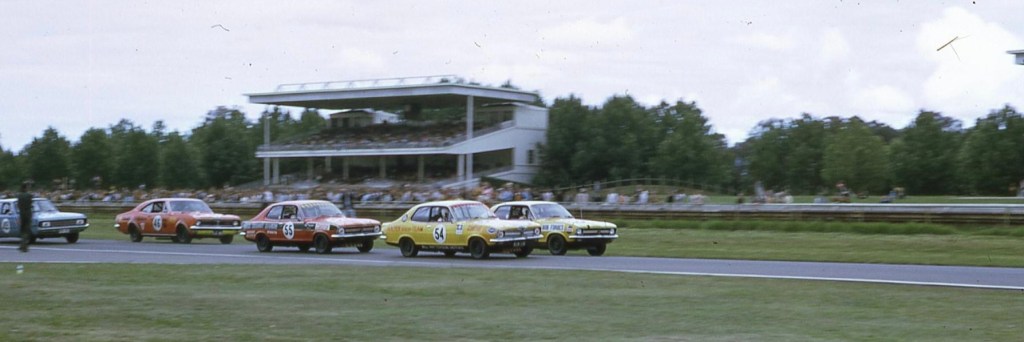
Lynton Hemer identifies this shot as the start of the Series Production event with Colin Bond, #54 Holden Torana GTR XU-1, then Bob Forbes and Don Holland in similar cars, John Harvey in Bob Jane’s Holden Monaro GTS 350 and Leo Geoghegan’s Valiant Pacer.
(P Bakalor)
In the Improved Touring race Jim McKeown’s Porsche 911S gets the jump from Brian Foley’s similar car, Allan Moffat’s Ford Mustang Trans-Am, with Pete Geoghegan’s white Mustang also just in sight.
Twelve months later, the AGP was again held at the Farm, with the star attraction John Surtees appearance (below) at the wheel of one of his own cars, a Surtees TS8 Chev F5000 car that Mike Hailwood would race in the 1972 Tasman Cup.
(P Bakalor)
The TS8 was Surtees 1971 F5000 design based heavily on the 1970 TS7 F1 car. Eight were built, with the monocoque chassis, wheels, suspension and brakes all using TS7 jigs/patterns. Mike Hailwood did the best of the drivers with his car(s) in Europe, only persistent engine problems perhaps getting in the way of the European title won instead by Frank Gardner’s Lolas: T192 and T300. For more details on the cars click here; https://www.oldracingcars.com/surtees/ts8/
(P Bakalor)(P Bakalor)
Matich again won the AGP, this time in a car of his own design and construction. The Matich A50 Repco-Holden was only days old when it took its debut win! Kevin Bartlett was second and Alan Hamilton third, both in ex-Allen McLaren M10B Chevs. Graeme Lawrence was fourth in a Brabham BT30 Ford FVC 1.8 and Max Stewart – who had just won the Gold star – was fifth in his Mildren Waggott TC-4V. Surtees was 14th after two pitstops for punctures in his first visit to Australia since contesting the NZ and Australian Internationals with a Lola Mk4 Climax in 1963.
(P Bakalor)
Nose jobs. Surtees TS8, Ian Cook, Devione LC2 Ford twin-cam, Alan Hamilton’s McLaren M10B Chev then the orange nose of Warwick Brown’s McLaren M4A Ford FVC, then two Elfin 600B/E Ford twin-cams: Clive Millis’ light yellow one at left and Henk Woelders’ white with blue stripe car on the right.
Credits…
Peter Bakalor, Bob Williamson’s ‘Old Motor Racing Photographs – Australia’ on Facebook, oldracingcars.com
Tailpieces…
(P Bakalor)
Graham McRae telling John Smailes how it is in the Warwick Farm paddock during the 1971 Tasman, McLaren M10B Chev. He must be reporting for the ABC with a suit on!
He had a blinder of a series, winning three of the seven rounds, but not here where Frank Gardner’s works-Lola T192 Chev prevailed. It was the first of three Tasmans on the trot for the oh-so-talented Kiwi driver/engineer.
P Bakalor)
Equipe Allen in natty, matching team attire! A steamy Sydney 1971 Tasman qualifying day with safety boots well to the fore. Peter Molloy and M10B front and centre. Love the nifty Bell bag.
Niel won two of the seven Tasman rounds at Levin and Teretonga, and finished third overall behind McRae and Matich. With a little more luck in Australia he could have won, but he retired from racing instead.
Barney Dentry and unknown passenger aboard the Dentry modified Riley 9 Brooklands, giving the Bill Thompson Bugatti T37A a wide berth at Heaven Corner, Phillip Island 100, January 1, 1934. The Bugatti is about to spin, possibly distracted by the Riley’s change in trajectory, DNF valve, Barney was third (Dentry Family)
Melburnians Gordon Henry Scott ‘Barney’ and Bess Dentry were stalwarts of Australian motor racing from 1925 until the outbreak of World War 2 when the perils of both parents of two young boys (Charlie born 1929 and John 1933) racing together as driver and co-pilot-cum-mechanic became all too clear and untenable.
Bess and Barney Dentry reunited with Riley Brooklands during the 1978 Phillip Island 50 Year AGP celebrations (Dentry Family)Bess and Barney with their ever-evolving Riley at Wirlinga, Albury in March 1938 (John Blanden claims Victor Harbor 1936) (Dentry Family)
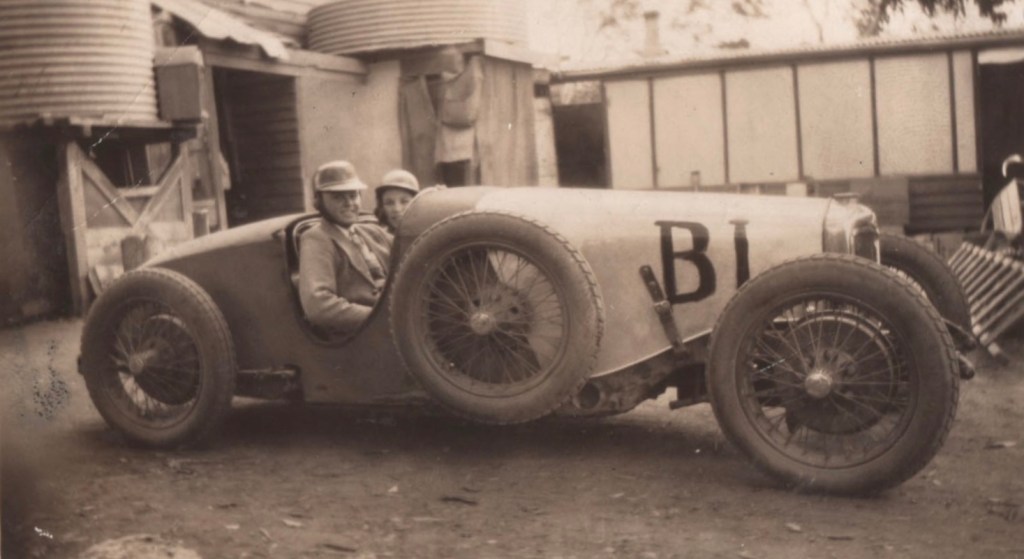
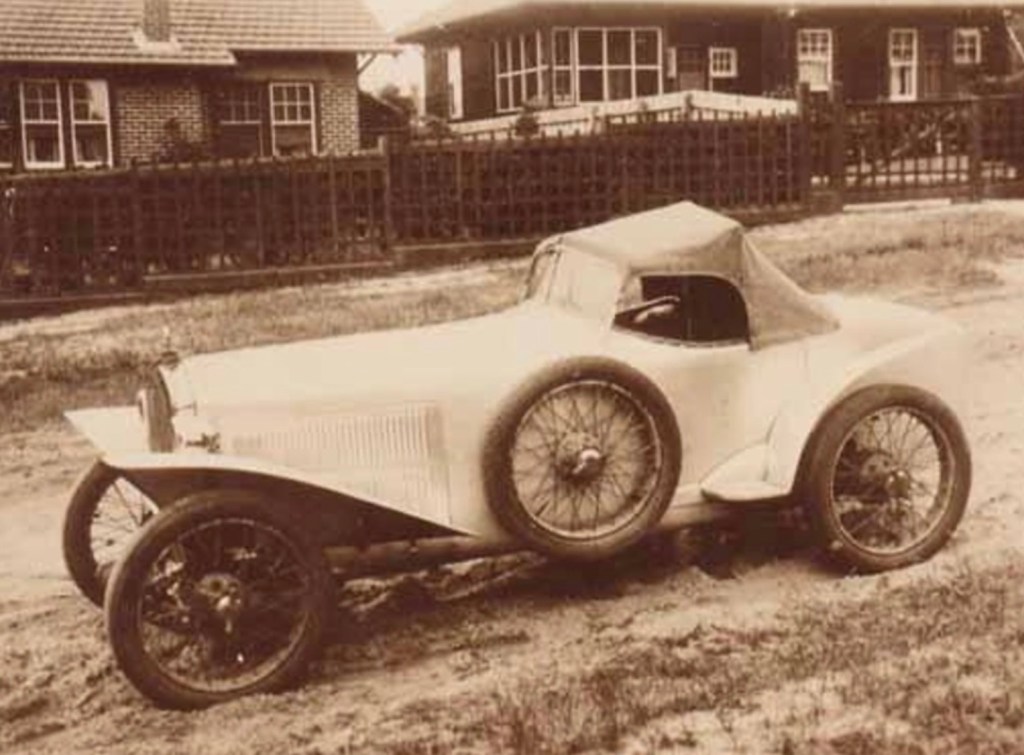
Barney, a returned soldier, built a special he named St Omer about 1920 vintage as his first car. He assembled the machine during his courting Bess Wheeler days incorporating various components including an 1100cc air-cooled 10hp Precision cyclical engine. The Senechal that followed as a roadie was progressively modified into a competitive racer.
Beanpole Barney and Ted Major during the Victorian Light Car Club’s 1928 100 Miles Road Race – aka 1928 AGP – at Phillip Island, Senechal (Dentry Family)“A Riley Specialist. This is George Dentry, one of the best known and most successful competition drivers in Victoria. He has the fastest Riley in Australia. But he is not satisfied, he is working on a supercharger of his own design” (The Referee, March 13, 1931)Barney, Senechal, on Wheelers Hill c-1927. Now an outer east Melbourne suburb of the same name – this road and hill is now a six-lane arterial (Dentry Family)
Wildwood Hillclimb and the 50-Mile Championship on the Aspendale Speedway, and Flinders Hillclimb in 1925 were the the car’s first events; with first/FTD, second place and first in the 1100cc class and second outright the results. Bess won the ladies event at Flinders.
Outings at Aspendale in 1926 and Wheelers Hill in 1927 and 1928 were followed by an entry in the 100 Miles Road Race – later appropriated by the Victorian Light Car Club as an Australian Grand Prix, the first AGP having being run at Goulburn Racecourse in 1927 – at Phillip Island in March 1928. Bess was heavily pregnant with first son Charles at the time so Barney was co-driven by Ted Major to first in class and fifth overall. Captain Arthur Waite was victorious in his diminutive, quick and robust Austin 7 s/c.
Robert Marie Georges Senechal (5/5 1892 – 30/7 1985) was a French aviation pioneer, racing driver, industrialist and winner of the first RAC British Grand Prix at Brooklands in 1926 aboard a Delage.
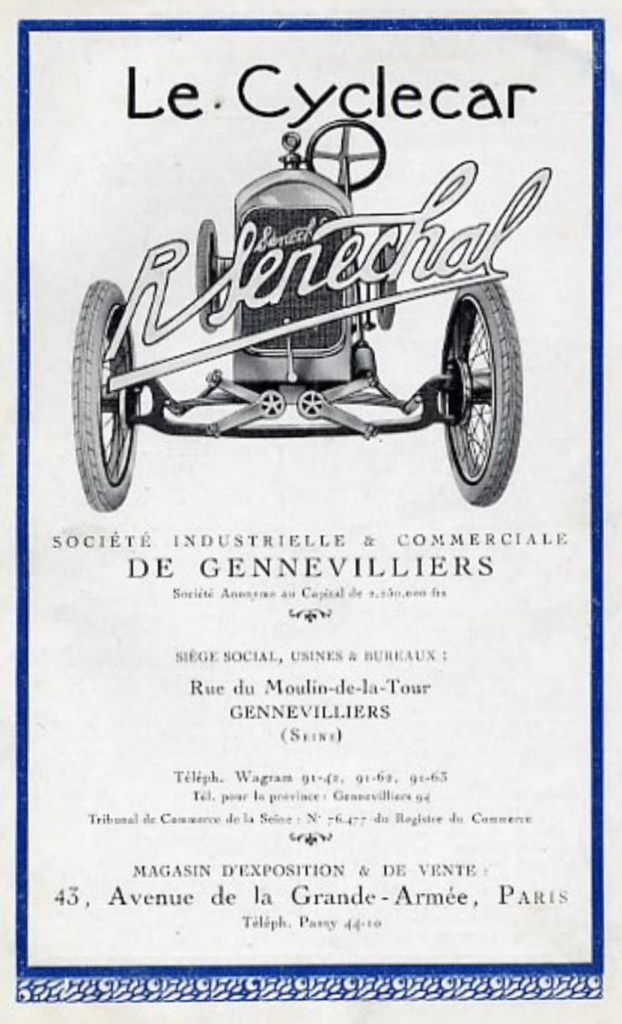
At the end of the war, the heavily decorated Senechal directed the sale of French Government owned surplus stocks of cars and trucks, together with Pierre Delage, son of Delage founder Pierre Louis Delage. Senechal then evolved the Eclair cycle-car manufacturer, in which he was an investor, into carmaker ‘Cyclecars Robert Senechal’ in Courbevoie, Paris in 1921.
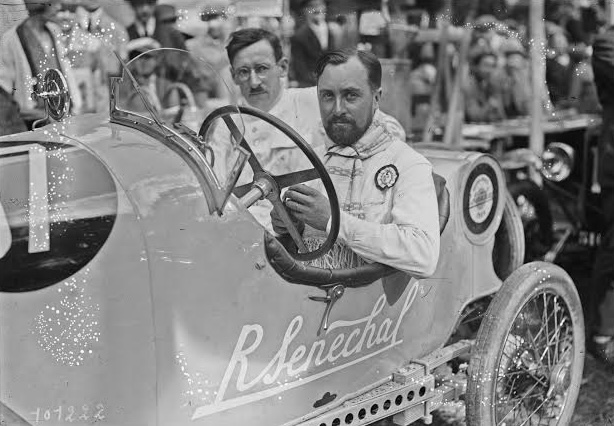
Robert Senechal aboard one of his cars (BNF)
While continuing to race successfully – 1923 Champion of France, twice Bol d’Or winner, Spa 24-hour victor etc – he did a deal with Chenard & Walcker to produce his cars. 5000 were built in their Gennevilliers, Paris factory until 1929 when Senechal left the business to establish a successful Chenard & Walcker, Delage and Bugatti dealership in Paris.
By the 1924 Paris show the product range comprised cyclecars of 972cc and 1100cc in capacity, such power units provided by outside specialists, Ruby (mainly) Trains and Chapuis-Dornier. By 1928 the company built Chenard & Walcker voiturettes of 1100 and 1500cc capacity.
Barney’s notes on the specifications of his car are as follows: “1100cc ohv engine (which perhaps implies the car was originally fitted with a 972cc Ruby manufactured engine) first used at Wildwood in 1925. The car first used a fabric body, later a metal body and later still was fitted with a hood. Bore/stroke 58x100mm, max rpm 4900, 7:1 compression ratio, wet-cone clutch, three-speed and reverse gearbox, open tail shaft, no-diff. CWP straight-tooth, ratio 4:1 and Barney made a 4.25:1 unit for Aspendale. Rear brakes only were six-inch drums with a five-inch transmission brake. Steering was rack and pinion 1:1 ratio. Carburettor was a 30mm Solex with Bosch 60 electrics.”
Dentry Senechal engine bay circa 1924 (Dentry Family)“Barney’s section of Duponts” c-1924 (Dentry Family)
During his Senechal phase, Barney was employed by LF Dupont Pty Ltd at 26 Toorak Road, South Yarra, the agents for Senechal, Chenard & Walcker and Calcott, “a sturdy little English car.”
The Senechal became a regular drawcard at Aspendale throughout 1929, the speedway had by then had its concrete surface replaced “with the original white granite”, no doubt to create more action for the punters. Six meetings yielded 4 first, 2 second, 2 third and 1 fourth placing.
Barney and Bess contested an AGP for the first time together in 1929 when they were second in class and sixth overall in the 206 mile, 3 hour 51 mins race at Phillip Island won by Arthur Terdich’s Bugatti T37A. After 10 laps the Dentrys were in a group of six cars contesting the lead, John Blanden wrote that “The best cornering was shown by Arthur Terdich who was now well clear in the lead, and by Barney Dentry who was driving the Senechal superbly, aided by his wife as mechanic.” The Great Southern Advocate reported that “Thousands of women showed great interest in the race, and greatly admired Mrs Dentry for accompanying her husband throughout in his Senechal car.”
Demonstrating its versatility – this GP car was road-registered throughout its life – the couple entered the November 1929 Herald Rally and Reliability Trial where it was first in Class-B.
With purchase of a Riley Brooklands it was time to sell the faithful Senechal, Barney’s The Car November 15, 1929 ad invited “you speedsters and all who appreciate a first-class car, here’s the chance of a lifetime, get in touch with Barney today” at 22 Rankin’s Road, Newmarket. Do get in touch with me if you know what became of this significant car.
Barney and Bess aboard their Riley 9 Brooklands during the 1930 AGP weekend at Phillip Island. Somehow the photographer has managed to make the small Riley look like a big-banger! Shot is probably in the garage area behind the Isle of Wight Hotel in Cowes (R Brownrigg Collection)
For the balance of their racing careers the couple mainly – speedway midgets duly noted – raced this Riley 9 Brooklands, chassis number 8062, competing in the Australian Grand Prix almost every year until 1938.
The pair were seventh outright and first in class B (1100cc) in 1930, where Jack Edwards was eighth outright and second in class B aboard their old-faithful Senechal. Four Brooklands Rileys were entered with the Dentry car expected to be, and was, the quickest, but they also had dramas. While running second, Barney was rammed by Harold Drake-Richmond’s Bugatti T37 in the heavy dust, then – still second outright – the Dentrys pitted with valve troubles, costing them five laps.
In 1931 the pair were fourth outright and again first in class B off a handicap of 11 minutes, with only the five Bugattis behind the Riley at the start. Carl Junker’s Bugatti T39 won from Cyril Dickason’s Austin 7 and Howard Drake-Richmond’s Bugatti T37.
In 1932 they were tenth, last of the finishers off a handicap of six minutes, with only the Bugattis of Carl Junker and winner Bill Thompson behind them at the start. It was the first AGP appearance with Barney’s slinky aluminium body. Dentry modified the body of the Riley by replacement of the fabric standard coachwork with a light, slipper-type aluminium body which placed Bess more behind, rather than beside Barney. Initially stub exhausts were used but these were replaced by a tuned length pipe which exited atop the passenger-side rear wheel.
The Riley factory was so impressed with his performances they gave him one one of only six very special Ulster engines free of charge,” wrote Blanden. Unfortunately Barney had problems with enormous oil-feed problems. “Despite having obtained a response from England as to a likely cure to the problem it was not successful and he had a number of pitstops in an endeavour to lessen the trouble. Even with those, Barney and his wife still finished tenth.” wrote Blanden.
Come 1933 they missed the race as Bess was ill, in fact it appears she was pregnant. “My wife has been my mechanic for eight years. When she drops out of the race, both the car and I do likewise,” Barney told the Barrier Miner.
“As a combination we do fairly well, but without her I would lose a certain amount of confidence. She is very cool and thinks hard during the race. I do nothing but keep the car on the road and get all I can out of the engine. Her job takes concentration, an alert brain and quick decisions. And she does it really well.”
Bess picks up the thread, “We have only had one accident, when we ran into a fence at Nar-nar-goon. I was thrown out but not hurt. It had no effect on my nerve, thankfully. A mechanic never looks ahead during a race. I watch the other cars, and touch my husband on the shoulder when one is overtaking us. With the left hand I work the fuel pump and I cast frequent glances at the gauges.”
“Along the track we have friends stationed, and I watch for their signals. The first 30-miles of this long race are the worst. Sometimes I wonder how I will manage to last the remaining 170. But the miles and minutes move so fast, there is so much to do and think about, that the end comes quickly.”
The handicapper had well and truly caught up with the Dentrys years before. In 1934, of 20 AGP starters, only three competitors had tougher handicaps: Cec Warren’s MG J2, Arthur Terdich’s Bugatti T37A and scratch-man Bill Thompson, MG K3. The Dentrys were unclassified, doing 29 of the 31 laps, but lost 14 1/2 minutes pitting to rectify a loose bonnet on their 20th lap. Bob Lea-Wright won aboard a Singer 9 from the flying Bill Thompson’s MG K3, and Jack Clements’ MG J2.
Later in the year, in a stellar field, the Dentrys led the field in the 230-Mile Victorian Centenary Grand Prix – the longest race held in Australia to that point – with three laps to go, but the usually reliable Riley had fuel-air feed problems which lost them much time and again precluded the pair from taking their long-awaited first big-win. Mick Smith and Lin Terry won aboard a Ford V8.
1935 AGP collage – note the Dentry family at top left (The Referee)
For the last of the Phillip Island AGPs in April 1935 the bar was raised again, the Dentrys and Bill Williamson’s Riley Imp had handicaps of 8 minutes 47 sec with only Thompson’s MG K3 off scratch behind them. In a strong result they were fifth in the race won by Les Murphy’s MG P-Type, despite losing four minutes with a dead engine and taking to the Gentle Anne escape road.
Ron McCallum puts some of Dentry Riley reliability down to the fitment of a taller-geared back end from a Rugby. “He just welded the pinion to the Riley tailshaft. This would have saved him a lot of revs, aiding his incredible AGP reliability,” Ron said.
In May 1935 Dentry thrilled the Phillip Island crowds during the Jubilee meeting, “One of the most consistent of Victoria’s racing motorists, was the unluckiest man on the track. Although he recorded fastest time, and fastest lap with his Riley in the two events in which he competed, his handicap in each case was too great to allow him to reap the rewards of his superior skill and speed.”
In the 50 Mile Handicap he was second to Alf Barrett’s Morris Cowley Spl, it was Barrett’s first race at the Island, “driving with superb judgement and cornering in a manner to earn the envy of veteran racers.” The Argus reported. It was very much a portent of what was to come from the wealthy, gifted Victorian who came to be regarded as one of Australia’s greats aboard an Alfa Romeo 8C 2300 Monza immediately pre and post-war.
Riley on the hop at Victor Harbor in December 1936, 1936 AGP. The aluminium body was styled and made by Barney (Dentry Family)
On Boxing Day 1936 the South Australian Centenary Grand Prix was held, a race later appropriated as an AGP. The Dentrys were again fifth in this contest run on a rectangular 7.8-mile public road course between Victor Harbour and Port Elliott on SA’s Fleurieu Peninsula. Les Murphy won again in his MG P-Type. That year the Riley was said to be equipped with an ex-George Eyston 1935 factory motor, but as John Medley wryly observed, the car “was perhaps never as quick as the handicappers expected.” Better was to come in the support Olympic 50-mile Handicap though, when the fast Dentry duo finally took the chequered flag from Lord Waleran in John Snow’s MG K3 and Les Burrows’ Hudson Eight Spl.
The first road-race in Victoria – the publicists of the day somehow forgot that Phillip Island is part of Victoria, separated from the mainland by only about 750 metres! – was the Benalla Centenary 100 mile race held on the outskirts of the north-eastern Victorian town in April. After a neck and neck struggle with Les Murphy’s P-type in front of a crowd of 20000 people, Barney and Bess had seemingly won, got the garland and the plaudits of the crowd but then lost the race after a lap-counting error. It was far from the first or last lap-counting squabble in Australian major events, Vin Maloney won in an MG Magna from the Dentrys.
The happy couple at Benalla in 1936, another big-win opportunity which eluded the Riley duo (Dentry Family)
No AGP was held during 1937, but 1938 was a biggee with the opening of Mount Panorama, Bathurst. Prominent Brit Peter Whitehead spent the better part of a year in Australia mixing duties for the family W & J Whitehead woollen mill enterprise and racing his ERA B-Type, R10B. Whitehead disappeared into the distance off scratch, winning by 1.5-minutes from Les Burrows. The Dentrys were 16th and last of the finishers off a handicap of 12-minutes, eight cars started behind them in the 30 car field.
And that, it seems was the end of the Dentry’s racing career. By then Charles Dentry would have been 8/9 and younger brother John 4/5 years old so the sensible thing to do was to quit while they were ahead. Ron McCallum recalls a race accident as the catalyst for retirement, but I can’t find an accident in which the couple were involved at this stage.
(John Mole Collection)
By 1939 the Dentry business premises were located at 2 Peel Street, Windsor (above) on St Kilda Junction, where he positioned himself as a specialist Riley, MG and sportscar repairer.
Retirement from racing wasn’t a catalyst for sale of the Brooklands Riley which was retained until 1946, then sold to Ken Wylie. The car later passed through the hands of Bill Clymer and Bill Blewett before being acquired by Ron Brownrigg in 1964. He restored it amidst his own business commitments, the car first appeared at Phillip Island in 2005.
Barney’s services were much in demand given his success as a driver and motor engineer. Both the Senechal and Riley were continually modified throughout their lives, the Riley was Cozette-supercharged for a while when used it in Aspendale Speedway competition. One example of his skills being deployed post-war was the mechanical work turning the Lex Davison owned Alfa Romeo 6C 1500 ‘Little Alfa’ into its current monoposto specifications way back when.
‘St Omer’ at Hampton, Port Phillip Bay in 1948 (Dentry Family)
The couple lived at 3 Villeroy Street, Hampton from 1925, then 69 Holyrood Street, Hampton from 1937 to 1957 and finally at number 19 Coronet Grove, Beaumaris where Bess lived after Barney’s death in 1987, aged 88. Bess died in 2000, are either of the sons still with us?
Living bayside, during 1946-48 Barney built a motor-yacht the couple named ‘St Omer’ to a US design. Initially powered by an Essex four-cylinder car engine, later a JAP marine engine enabled a top-whack, need-for-speed 24mph.
The boat was sold to release capital to build new business premises on the southwest corner of Bay Road and George Street, Sandringham in 1957. Barney operated that motor service and repair operation until 1972 when he retired and sold the building, which still exists as a tyre sales business.
AGP 1931 collage, that’s Barney at the far left (The Referee)
Let’s not forget Barney and Bess Dentry, very competitive stalwarts of Australian motorsport in the pre-war era. Until doing my research I’d not realised just how much at the pointy-end they usually raced, with only luck and the handicapper between them and greater success.
I’m happy to add to this article if any of you can help flesh out the story.
Etcetera…
(Dentry Family)
Barney Dentry and Bess Wheeler at Hampton Beach in 1924.
(Dentry Family)
The Dentry Senechal in its final form circa 1924. The diminutive machine is fitted with aluminium body, siren, ‘guards, hood, spare wheel and luggage carrier in the tail. “Total weight 8 1/2 CWT, 7 CWT in racing trim.”
(Dentry Family)
Barney perhaps giving some lucky bloke a joyride in the Dentry Riley circa 1932. Riley 9 Brooklands. Chassis 8062 was variously described in-period as a Brooklands Riley, Ulster Riley and Dentry Riley, all of which are correct depending upon the specs at the time.
(Dentry Family)
Rear of the Riley after being rammed by Harold Drake-Richmond’s Bugatti at Phillip Island on New Years Day 1934.
(Dentry Family)
Barney wrote on the reverse of this photo, “Assorted patterns I made for the St Omer car (GD Special) the St Omer launch. Note the mag alloy Riley diff using for the Ulster, special oil pumps and special gearbox units etc.”
(J Runciman Collection)
Barney, Bess, Charles and John Dentry at Phillip Island.
(J Runciman Collection)Dentry Family)
The Bay Road Sandringham workshop built by Barney Dentry in 1957, in more recent times, and fondly remembered by older Melbourne bayside resident/enthusiasts.
(D Trunfull Collection)
The Riley connection was there until the end, this sign was on the wall of the Bay Road garage well after the time of the premises’ sale.
Credits…
Tony Johns Collection, Jim Runciman Collection, Motorsport Memorial, Sandringham & District Historical Society via a David Zeunert tip-off, Barrier Miner March 11, 1933, Ron McCallum discussion with Bob King, BNF-Bibliotheque National de France, Ron Brownrigg Collection, John Medley in ‘The Australian Grand Prix:Fifty Year History’, ‘History of Australian Grand Prix 1928-1939’ John Blanden, Rob Bartholomaeus, John Mole Collection, David Trunfull Collection
Tailpiece…
(Dentry Family)
Bess Dentry aboard the Senechal with its brand new aluminium body, circa 1924.
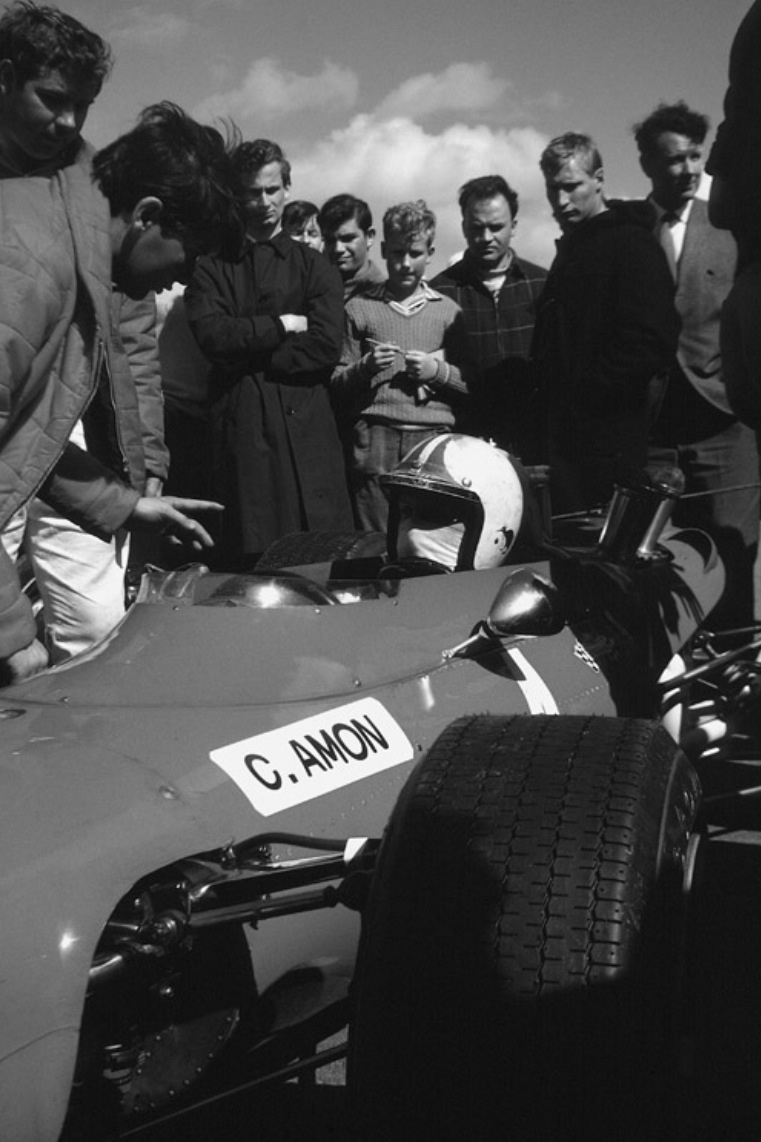
Seems to be the point Roger Bailey (or is it Bruce Wilson?) is making to Chris Amon before he takes to the Wigram circuit in January 1968…
The Ferrari lads popped a fresh engine into Chris’ Dino on Friday night so it may well be the thrust of the exchange! Terry Marshall took this wonderful shot, it was a good meeting for Chris, he was second to Jim Clark’s Lotus 49 in The Lady Wigram Trophy on Sunday, while Denny Hulme was third in an F2 Brabham BT23 Ford FVA. The shot below shows Clark’s fag-packet Gold Leaf Team Lotus, Lotus 49 Ford DFW – GLTL making its race debut and taking its maiden win – in front of Chris’ Ferrari.
(sergent.com)
I’ve done these Tasman Dinos to death in various articles so won’t prattle on again, click on the links below for more on these jewels of machines.
Terry Marshall commented about the weekend, “I was stationed at Wigram (an RNZAF airbase) doing my military service and could hear Amon and Clark howling around in practice while I was learning how to survive an atomic attack by lying down behind any brick or concrete wall that was handy. Makes me laugh just thinking about it!”
(I Peak)
The photos above, and at the end are by Ian Peak the following weekend in the Teretonga paddock. Oh to have been there?! Chris was fourth behind Bruce McLaren’s works BRM P126 V12, Clark’s Lotus 49 Ford DFW and Frank Gardner’s Brabham BT23D Alfa Romeo V8.
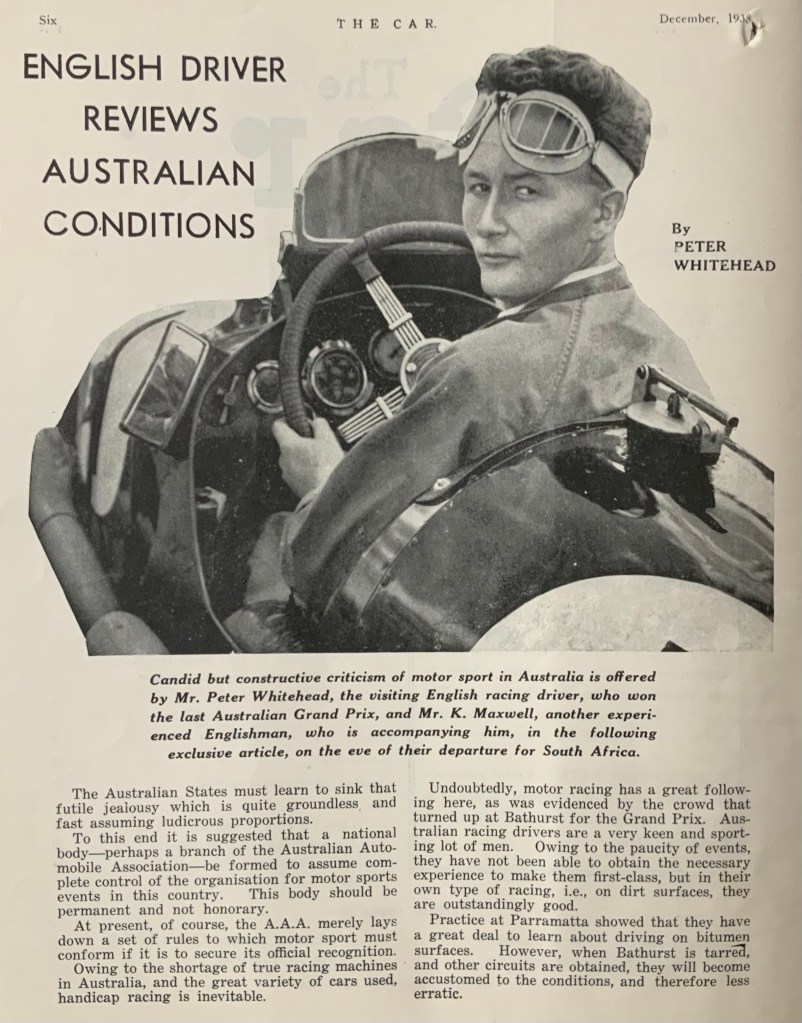
Whitehead is shown here in the cockpit of his ERA during the abortive – and aborted – Parramatta Park, Sydney meeting in 1938 (B King Collection)
English international, Peter Whitehead spent quite a bit of time in Australia during 1938 on business. One hat he wore was as a member of the W&J Whitehead family, Bradford based, wool textiles business, the other was as the driver of his much smaller motor racing enterprise.
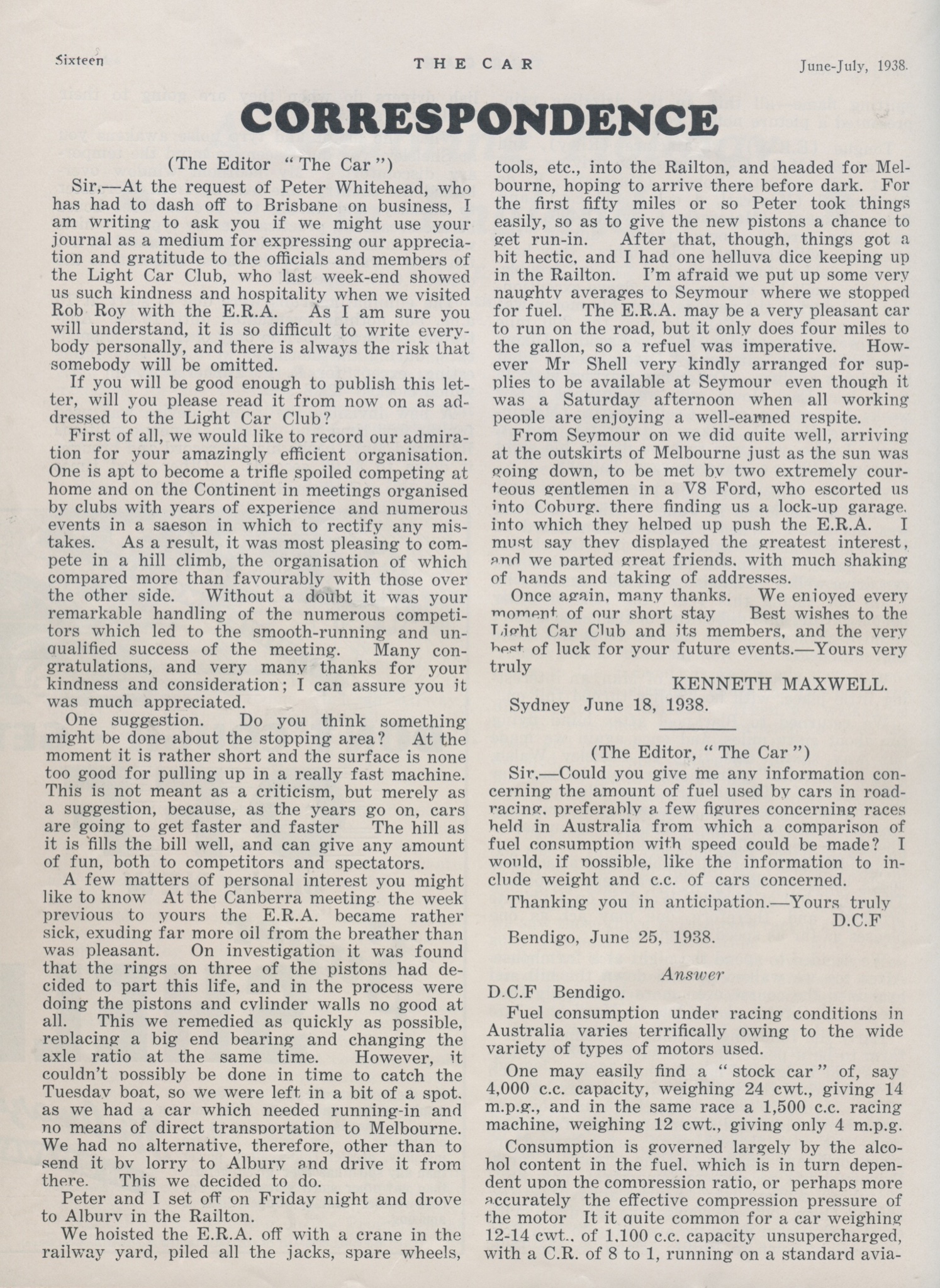
As you will appreciate from the articles, Whitehead was in Australia long enough, and travelled broadly enough, for his views to be fully formed on the state of motorsport play at that time.
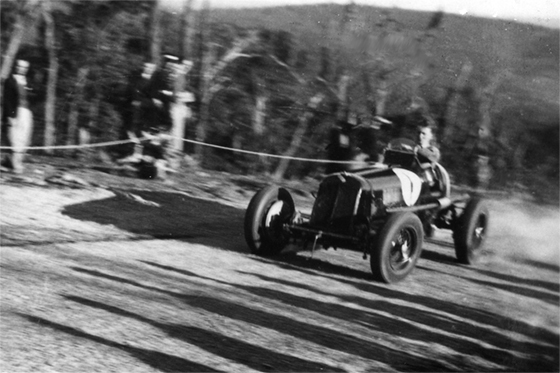
(B King Collection)Blurry and ‘Hatless’ Whitehead during the Australian Hillclimb Championship meeting at Rob Roy in June 1938. He did FTD and set the course record at 31.46 seconds on the still unsealed course which opened a year earlier (L Sims Collection)
Peter Whitehead was spot on with his observations really.
Picking up his points in the order they were made, the Confederation of Australian Motor Sport (CAMS) was formed in 1953 to manage, organise and regulate (sic) the sport on a national basis. Perhaps without World War 2 a more focused governing body would have replaced the Australian Automobile Association earlier.
Handicap racing continued throughout Australia well into the 1950s. We had a relatively small number of racing cars spread over a vast continent. Handicaps ensured everybody had a chance of victory, by this means, competitors were prepared to travel vast distances by road, rail or coastal ships to race.
Then the only Australian racers who competed ‘regularly’ on bitumen roads were the West Australians on their Round the Houses road courses in various country towns. Allan Tomlinson’s stunning Lobethal AGP win in 1939 is in part credited to his skill on such surfaces relative to the east coast based competitors, aboard his MG TA Spl s/c. See here; https://primotipo.com/2020/12/04/tomlinsons-1939-lobethal-australian-grand-prix/
A series of races to attract international competitors did eventually happen, formally with the Tasman Cup – seven/eight races in NZ and Australia in January-February each year – in 1964, and informally with a series of international races for the better part of a decade before that. Peter Whitehead returned and raced a couple of Ferraris here during that period. See here; https://primotipo.com/2020/10/10/squalo-squadron/
The bad-blood, combative relationship between the New South Wales Police and the racing community lasted well into the 1950s and is a story in itself.
This piece was written by Kenneth Maxwell earlier in the trip and was published in the June-July issue of The Car.
The Yarra Falls building site in 1918. Melburnians will note the roofline of the Convent of the Good Shepherd on the north side of Johnston Street, that building is still there on the wonderful Collingwood Children’s Farm site; a visit to rural Australia in inner Melbourne is worth a trip for any international tourist. The Falls site was redeveloped, keeping many of the original buildings, for business and residential use several decades ago (Picture Victoria)
Etcetera…
The Whiteheads were customers of Australian wool from the earliest of times. The contents of an article in The Argus (Melbourne) appealed to the economist in me. The piece reported on the business trip of Henry Whitehead, a relative of Peter Whitehead, in January 1920 who is described as having interests in “three of the largest of the great Yorkshire textile works.”
Whitehead’s visit was as a director/advisor of Yarra Falls Spinning Co Pty. Ltd. at 80-110 Trenerry Crescent, Abbotsford – on the shores of the Yarra River in Melbourne where wool was scoured/cleaned – and he commented that “Although Australia is the greatest wool producer in the world she could not have competed with England before the war in the marketing in Australia of goods manufactured out of her own raw materials…But times have changed, and today Australia has the opportunity of making more of her own goods, and particularly of making up her own raw materials.”
Funnily enough, a century on, we are still better at shearing sheep and digging holes in the ground (mining) than manufacturing, that is, value adding to the raw materials we export to others.
Henry Whitehead spoke of the need for immigration of skilled labour to aid growth of the industry and encourage further British investment.
The Yarra Falls Spinning Company was then capitalised at £200,000, “the great bulk of which is Australian money.” The other directors, with the exception of Whitehead, were Australian, the factory was commenced in 1918 and employed 200 in 1920. The only limiting factor in expanding the business right then beyond relatively simple wool scouring and combing, to the production of worsted cloth (for clothing) was the difficulty of getting specialised weaving plant and equipment made, and imported from the UK.
So, Peter Whitehead would have been busy, apart from his racing…
Credits…
The Car, December 1938 via the Bob King Collection, Leon Sims Collection, Ted Hood, The Argus January 1, 1920, Picture Victoria
Tailpiece…
(T Hood)
Peter Whitehead fettles his ERA #R10B in frigid Canberra weather in June 1938. He was taking part in annual speed record attempts in the national capital, weird though that seems.
Mind you, there was a round the houses taxi race in Canberra not so many years ago, the Canberra 400 from 2000-2002.
Mark Skaife, Holden VX Commodore V8 Supercar en-route to winning the 2002 Canberra 400, Parliament House in the background (unattributed)
Phillips-Parsons airborne on the Wirlinga road circuit (cars4starters.com.au)
The Jack Phillips – Ted Parsons 1934 Ford V8 was Australia’s fastest of the breed pre-war. Here the machine is aviating on the Wirlinga road circuit – 10km northeast of Albury – on the Kings Birthday weekend in June 1940. The duo are on what was then called Orphanage Lane (now St Johns Road), the two crests which allowed the cars to take to the sky were near Corrys Road, Thurgoona, many thanks John Medley and Ray Bell.
The car was one of the most successful of all Australian racing cars in the immediate lead up to the conflict, placing sixth and third in the 1938 and 1939 Australian Grands Prix at Bathurst and Lobethal respectively. “In Victoria for the 1937-38 season, the Phillips Ford was awarded ‘The Car Trophy’ for the most successful competitor,” John Medley wrote.
The duo also won the Interstate Grand Prix/Albury and Interstate Cup on the Albury-Wirlinga road course in 1938-39 and the South Australian 100 at Lobethal in January 1940. On the same day the pair finished second to Les Burrows’ Hudson Terraplane Special in the Lobethal 50.
Bill and Ben the Flowerpot Men? Phillips/Parsons on the way to winning the South Australian 100 on New Years Day 1940 at Lobethal (unattributed)
As the lights were progressively turned down throughout 1940, the Phillips/Parsons pair were ninth in the Easter Bathurst 150 mile race won by Alf Barrett’s Alfa Romeo Monza. The car’s final meeting before being put on display for much of the conflict in their Wangaratta Motors Ford dealership was the 75 mile Albury and Interstate Cup Race on June 17, 1940. It was the final meeting on this road course and Barrett set the all-time lap record at 2 minutes 52 seconds but broke an axle and retired from the race. Harry James’ Terraplane won in a steady performance from John Crouch’s Alfa Romeo 8C2300 Le Mans with Phillips/Parsons third.
A great shot but whereizzit? Note the Victorian rego-plate and ‘tuned-length’ exhaust which will have aided driver and passenger comfort in longer races by dispensing with fumes and noise well-aft of the conducteurs. Quality of the body and standard of presentation impressive (cars4starters.com.au)
Based on a fire-damaged ‘34 sedan with over 20,000 miles on the clock, the car was modified in the partner’s Wangaratta, Victoria Ford dealership by fitment of a special, swoopy, lighter body. Engine enhancements included twin Winfield carburettors, Scintilla magneto, modified heads and free-flowing exhausts.
Timed at 115mph in top gear, it did 80 in second – at a then heady 6000rpm – using the 3.5:1 rear axle ratio. It was a paragon of solid reliability too, not suffering the overheating afflictions of so many modified Ford flatties.
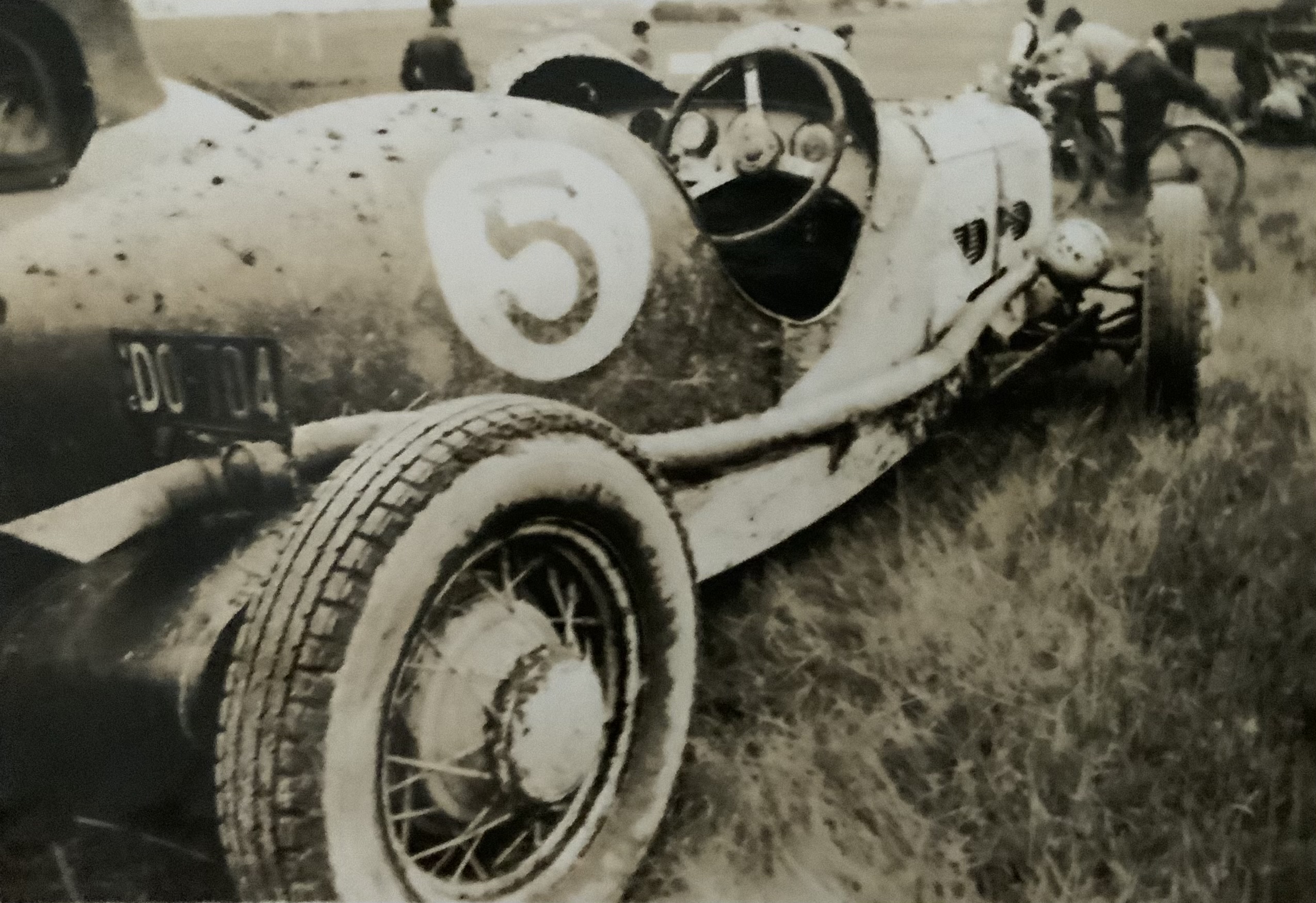
The masked avengers on the Victor Harbor – Port Elliott road circuit during the 1936 South Australian Centenary Grand Prix, well protected from road detritus and here are using all of the available real estate. DNF after completing 21 of the 32 laps (B King Collection)
John Medley observed the car’s strengths, “The Phillips Ford simply soldiered on in prewar races on dirt and gravel roads, built tough to last to the finish. It continued to race postwar particularly in Victoria and South Australia where it was raced by South Australian Granton Harrison, by which time the newer breed of generally smaller and lighter V8 Specials could out-pace it.”
“Still it had been the mould in which the later V8s were shaped. In the postwar period, with T-Series MGs, Ford V8 specials were the backbone of Australian road racing.”
The Phillips/Parsons Ford was destroyed when it was crashed into a bridge, the remains were scrapped. Ted Parsons Jnr and his son Rob recreated the car between 2008-2014, the car took its bow at Winton in 2014.
Likely lads, who is the chap at left and where was the shot taken? (B King Collection)
Historian, Rob Bartholomaeus has worked out, by looking at his photographic archive, that a rebuild involving lightening and lowering the car and replacing the ’34 grille with a 1935 unit and a change in colour scheme from the one above, to the diagonal stripes shown in most of the other shots was made in late 1938 rather than 1937 as documented elsewhere. It seems the car started with underbody exhausts, then evolved to the side exhausts as above which were retained after the car was modified and repainted.
(B King Collection)
As noted above, the car’s last pre-war meeting was at Wirlinga in 1940. Bob King has this photograph in his collection, the caption on the back lists the racer as Bill Sinclair and the place, Oakleigh in 1942. I can find no Trove reference to this meeting at what is now a southern suburb of Melbourne. It appears as though the car is running the same number/roundel combination from Wirlinga, quite probably untouched. If anybody has information about the event do get in touch.
(unattributed)
It’s not clear when Granton Harrison bought the machine but he added to its tally of Australian Grands Prix entries, racing it at Point Cook to Melbourne’s west in 1948, where he placed fourth, and in 1950 at Nuriootpa in South Australia’s Barossa Valley where he was 11th in the race won by Doug Whiteford’s Ford V8 Special ‘Black Bess’, Bess was inspired by the Ossie Cranston and Phillips/Parsons Ford V8s.
The shot above is of Granton contesting the South Australian 100 at Lobethal on New Years Day, 1948. A good day for him too, he was second behind Jim Gullan’s Ballot Oldsmobile Special – and did fastest race time in the handicap event – continuing this car’s reputation for competitive reliability.
Back to the sequence of owners. Stephen Dalton has Granton advertising the car for sale in the February 1948 issue of Australian Motor Sports, with Jack O’Dea running it at Rob Roy in January 1949, perhaps Jack ran it as a borrow/view to purchase. As we can see Granton raced on for a couple of years after that, if anyone can help with the ownership sequence, do get in touch.
Ted (Edwin) Parsons wearing Warren Safety Helmet, goggles, white overalls – the pocket of which had the Ford V8 symbol embroidered – wearing a leather kidney belt. “To look your best under the overalls it was common for Ted to wear a white shirt and tie,” Ted’s son Rob Parsons wrote. Wirlinga 1939 perhaps, chap behind unknown (Parsons Family Collection)
Etcetera: The Warren Safety Aviation Helmet…
WT Warren invented the Warren Safety Helmet in 1912. The spring-equipped pilot safety helmet, made of leather and cork with vented ear collars was padded with horse hair and designed to minimise head injuries, the major cause of aero accident deaths at the time. The helmet was part of RAF listed kit issue from 1920-24.
Later models incorporated an ear audio piece and a breathing mask. By the time Phillips and Parsons used them they had been pensioned off by the RAF. Curtis and Taut & Co made the helmets under licence, the inscription in Parsons’ helmet, retained by the family, reads ‘No 2 Tuatz & Co Patent 17855 Aviators Safety Helmet. Maker Tautz & Co, Hunting Military and Multifit Tailors, 12 Grafton St, New Bond St, London.’
Phillips and Parsons with their distinctive Warren helmets after winning at Wirlinga in 1938 (J Dallinger)
Rob Parsons explained further, “While the helmet was obsolete for aircraft, they were used by Phillips and Parsons from 1935-39. With a lack of sporting regulations, these cars lacked the safety features of safety belts which were not considered a benefit for car racing. Drivers had a steering wheel and the co-driver a grab handle to hold onto. It would be common in rollovers to duck-down and brace yourself, perhaps to be trapped or otherwise flung free of the car, all with grave consequences.”
“Ted Parsons first introduction to motor racing was at the Benalla Airstrip circuit, perhaps a likely place to find such a helmet. On the back page of his photo album, he list drivers who died racing during his involvement, a reminder of the sport’s dangers. He retired from racing after the war to pursue golf and film-making.”
“Jack and Ted wore leather face shields to protect themselves from their own flying stones and other track debris, an idea adapted from the oxygen flying mask. The leather was painted white to match the colour of the car, aviation goggles protected their eyes,” Parsons wrote.
(Der Spiegel)
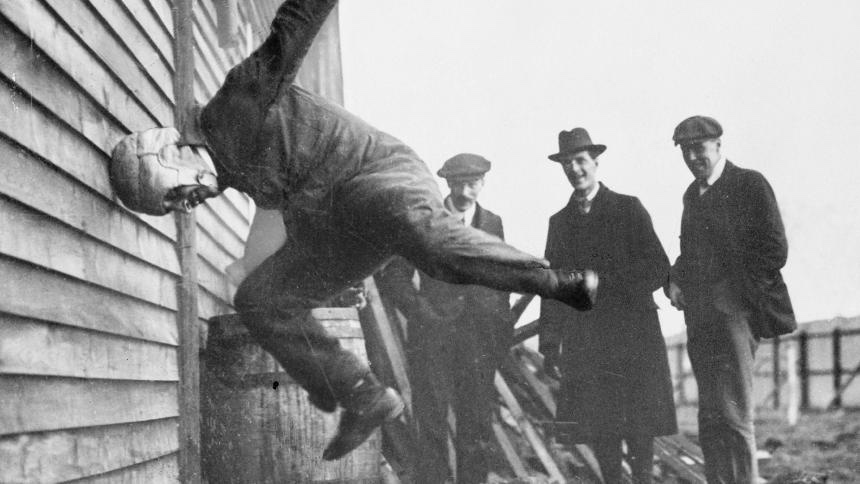
WT Warren tests his new helmet – as one does – by headbutting the wall of William Ewen’s Hendon flying school, where Warren was a trainee, in 1912.
What follows is the German-English translation from an article in Der Spiegel.
“In a 1912 issue of Flight magazine, British inventor WT Warren’s invention, a protective flight helmet is demonstrated. The image is often erroneously reported to be a football helmet.”
‘The wall against which the helmet carrier ran belongs to the flying school of William Hugh Ewen. The owner (middle) and and his chief pilot LWF Turner (left) are behind. The Lord in the foreground is his student Mr WT Warren. And, no, he has not failed the flight test and is just reacting to his anger.” Clearly the German hilarity is lost in translation.
“Dated 1912, Mr Warren is a tinkerer. He introduced his latest invention to experienced pilots: a protective helmet ‘that will attract considerable attention’, Flight magazine wrote. Warren’s leather cap was padded with horsehair: A system of steel springs should intercept any impact, thus reducing the risk of injury. Head injuries were the leading cause of death in flight accidents.”
Credits…
‘John Snow:Classic Motor Racer’ John Medley, State Library of Western Australia, cars4starters.com.au, Bob King Collection, ‘The Warren Safety Aviation Helmet’ by Rob Parsons in the July 2021 issue of ‘The Light Shaft’ – Austin 7 Club magazine, Parsons Family Collection via austin7club.org, John Dallinger, Der Spiegel
Tailpiece…
(SLWA)
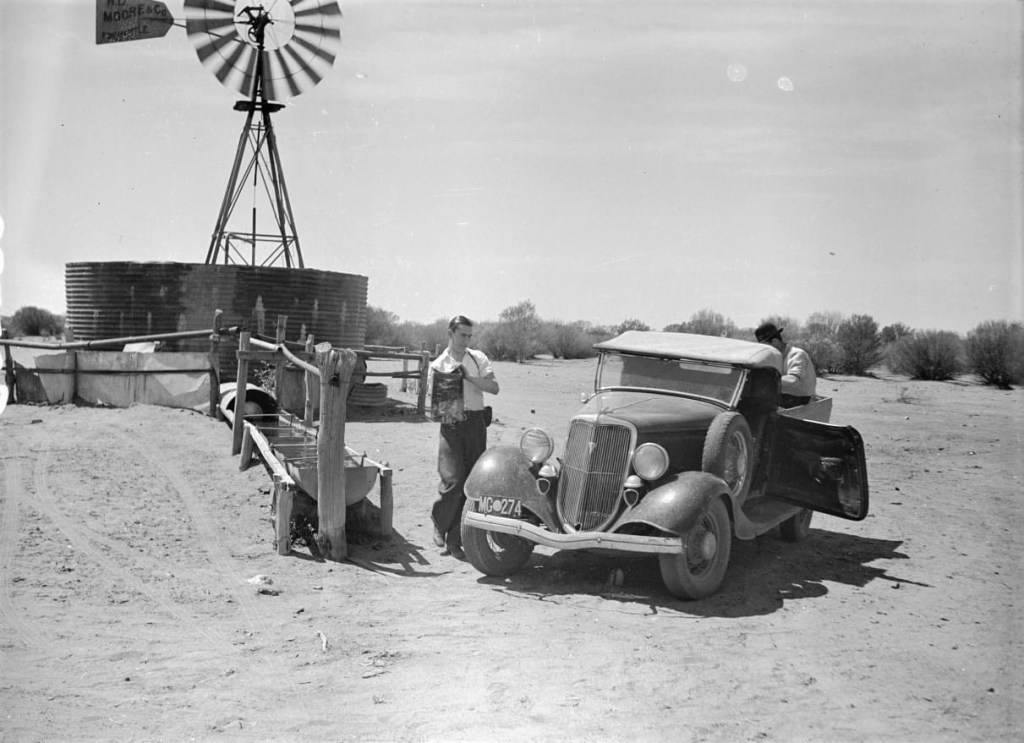
I’m cheating a bit, this 1934 Ford is a V8 ute rather than a sedan, but you get the jist of it.
The Phillips-Parsons racer was not too far removed from a roadie, rather than an out-and-out bespoke racer, reliant as it was on the standard chassis, axles wheel to wheel, differential and gearbox.
The ute is singing for its supper, doing a meat delivery in country Western Australia in 1937.































 primotipo...