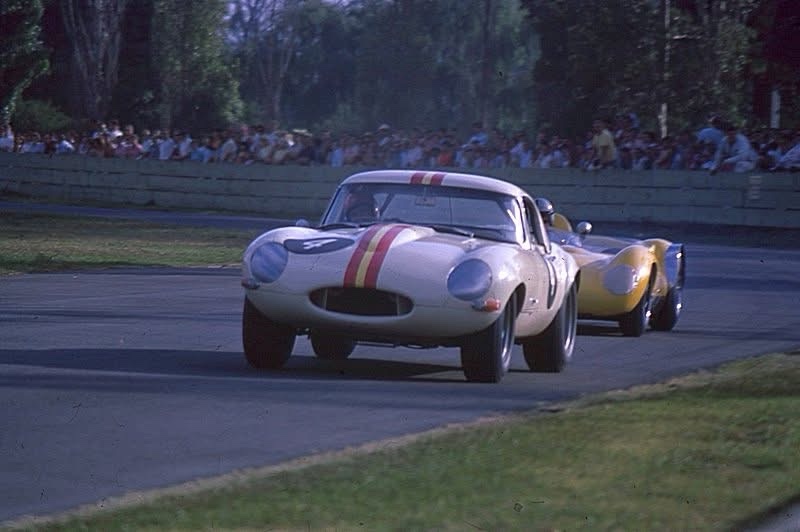
Bob Jane and Pete Geoghegan hard at it during the Warwick Farm Tasman meeting in February 1966. Jaguar E-Type Lwt and ex-McKay Lola Mk1 Climax. What were the results of these encounters folks?
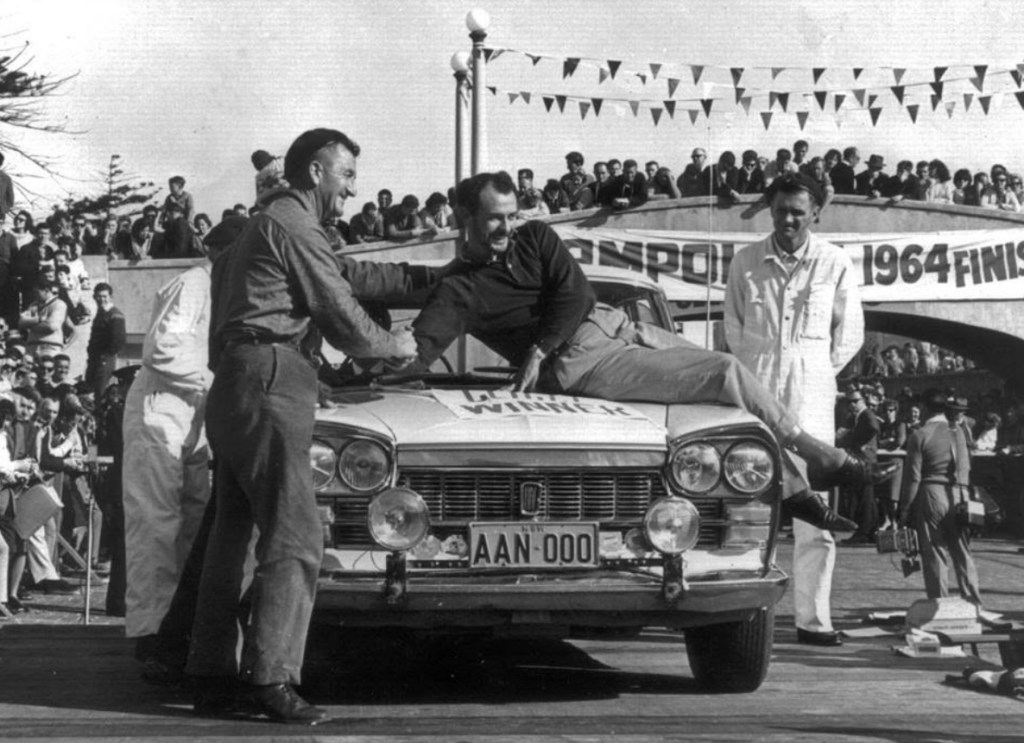
The 31st place Fiat 2300 of Bill Burns, Brian Lawler and Bruce Kaye at the end of the 11,260 km 1964 Ampol Round Australia Trial, Queen Elizabeth Drive, Bondi Beach on June 28.
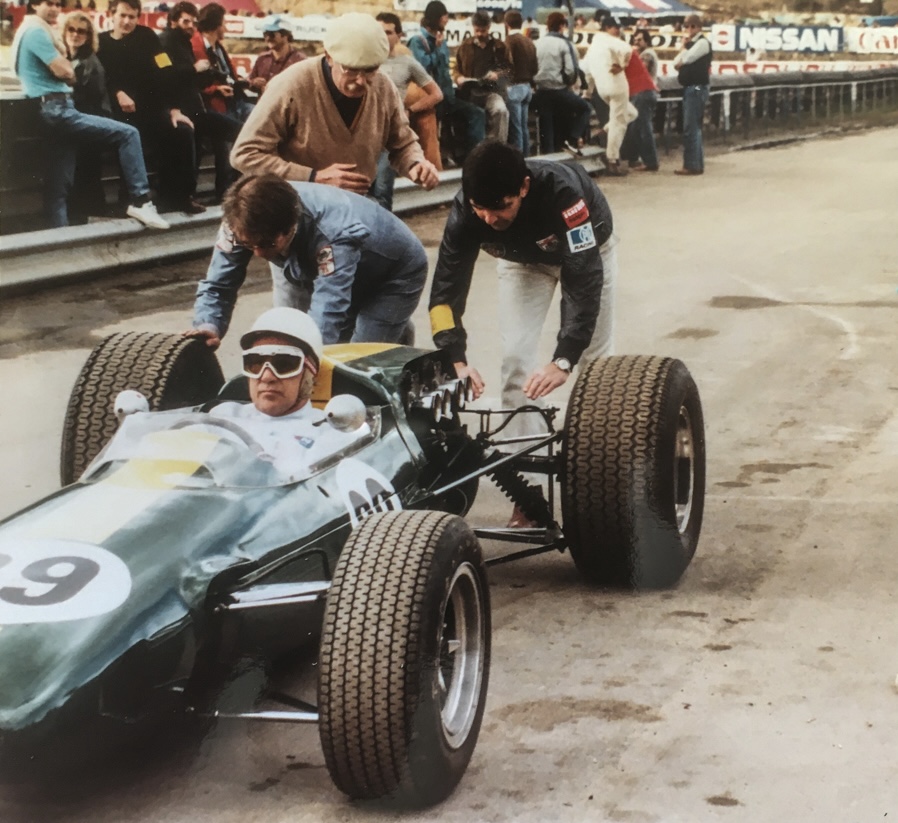
Stirling Moss giving the ex-Jim Clark-Leo Geoghegan Lotus 39 Coventry Climax 2.5 FPF a gallop during the 1984 Tribute to Jaguar meeting at Amaroo Park in the Summer of 1984.
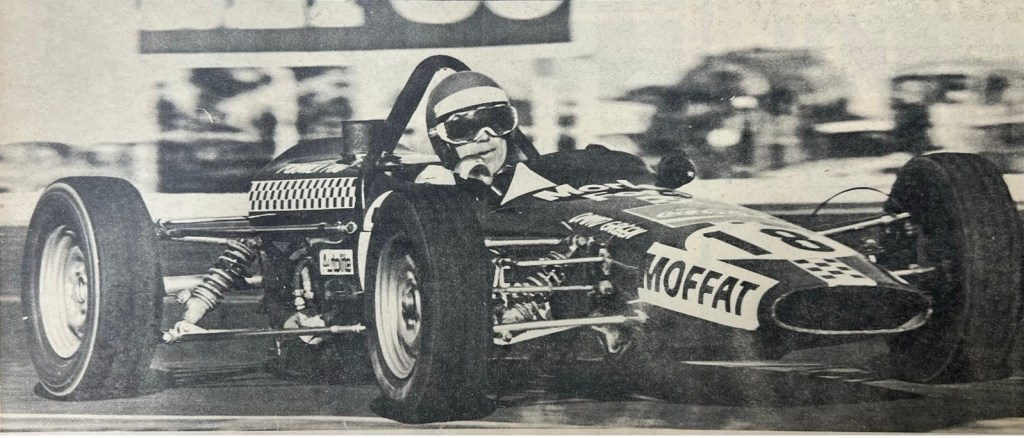
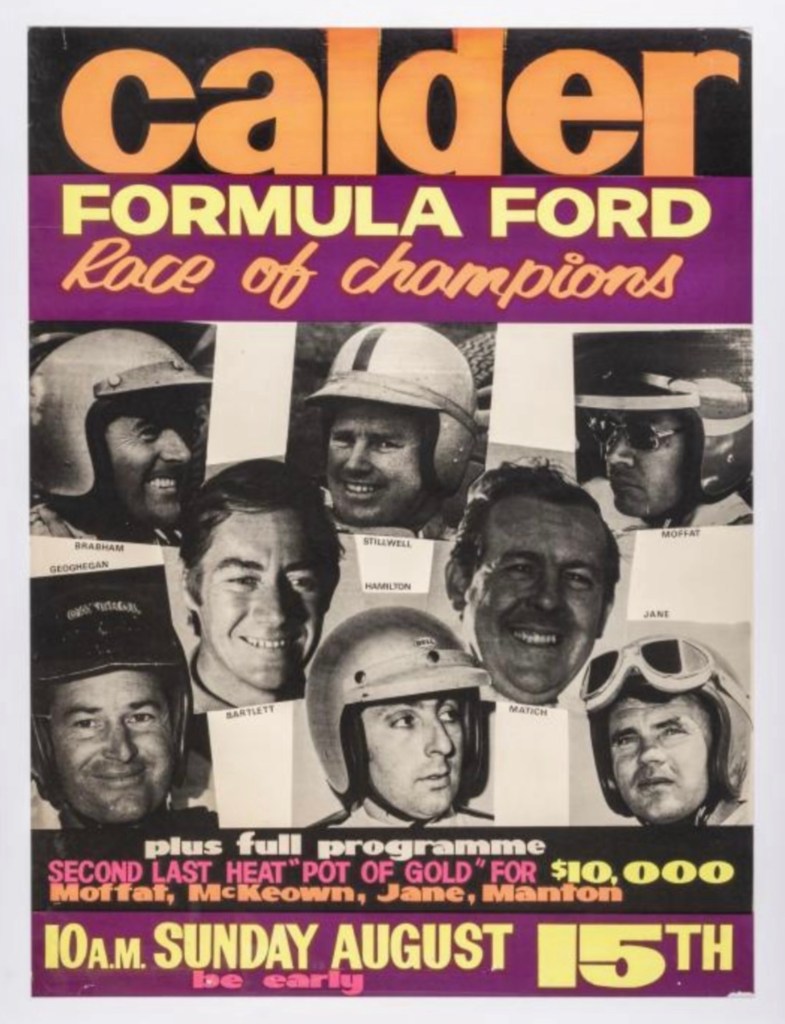
Allan Moffat – who had an open-wheeler phase in his distant past – at the wheel of a Wren Formula Ford during the ‘Race of Champions‘ at Calder on August 15, 1971.
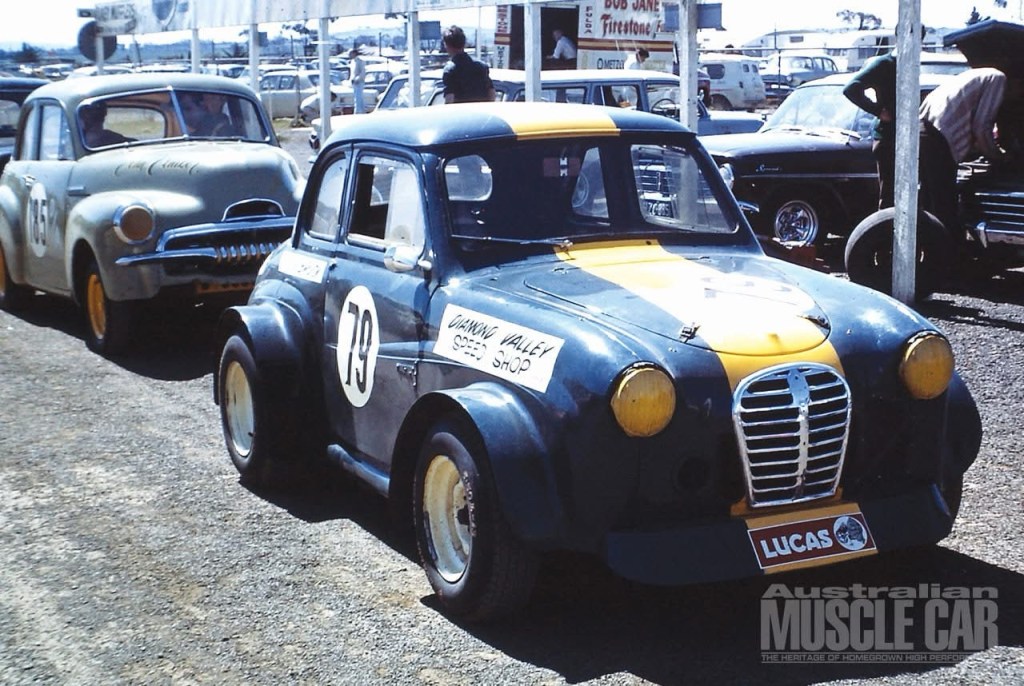
Australian Nationals drags racing meeting at Calder in October 1968. Peter Brock lines up in his famous Austin A30 Holden 179.
He was knocked out by Ken Spence’s Ford Zephyr 289 in the first round, no Top Eliminator that weekend, but there would be plenty of those to come! Article about this car, slightly!, here: https://primotipo.com/2018/05/07/brocks-birrana/
(MotorSport)
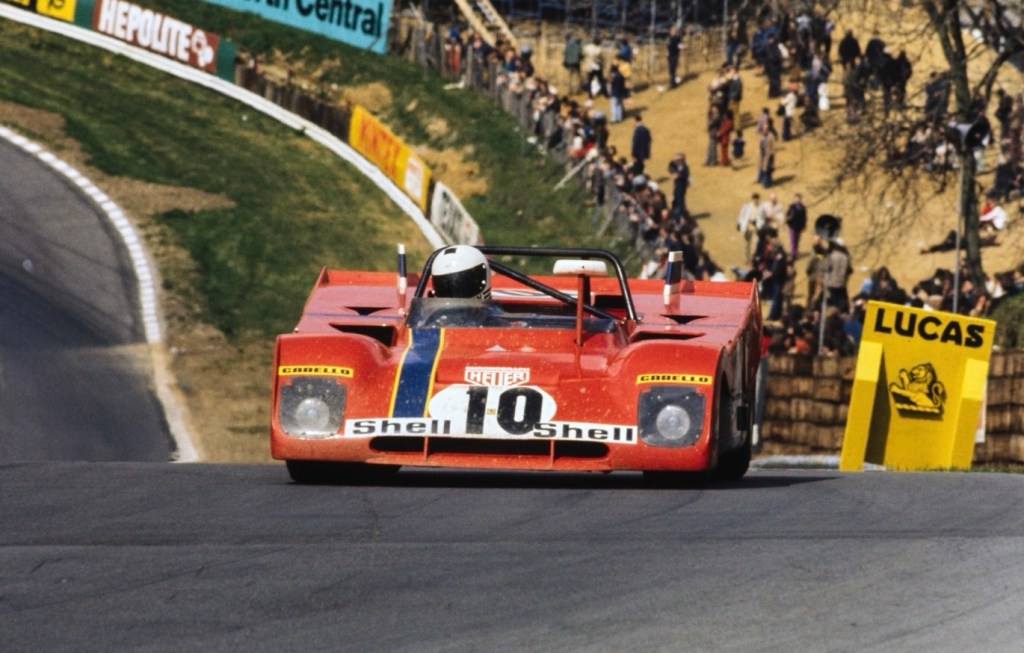
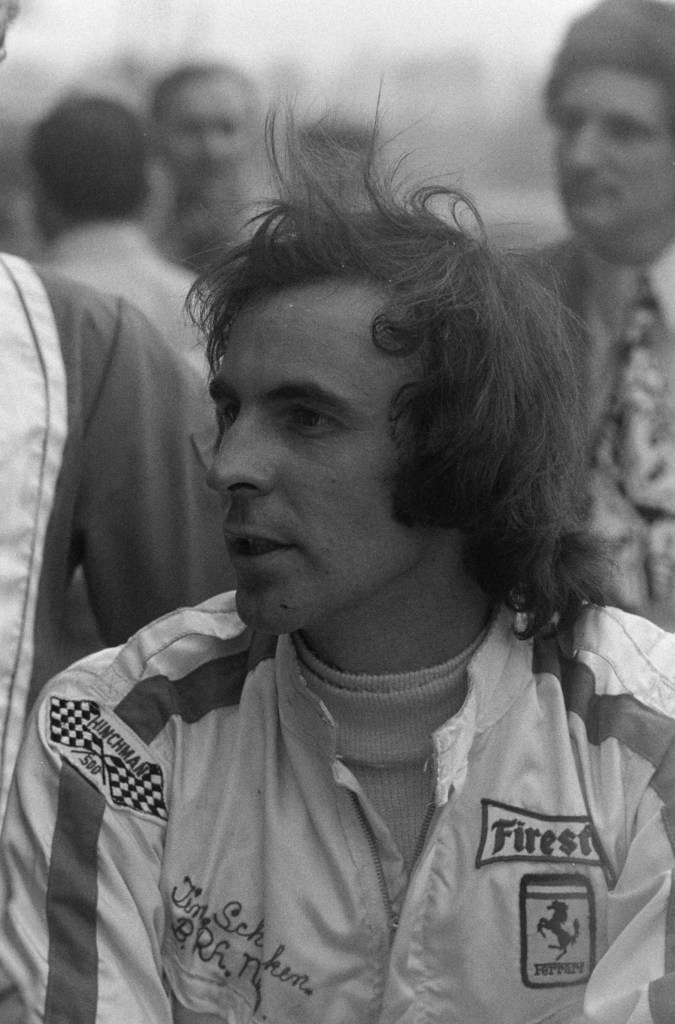
Tim Schenken was living the dream by 1972, his third year in F1 – Surtees that year – and a member of the victorious Scuderia Ferrari 312PB squad in 1972-73.
The shot above shows Tim on the approach to Druids, where the pair were second in the Brands Hatch 1000km run on April 16, a lap ahead was the winning Jacky Ickx/Mario Andretti 312PB.
His driving partner was usually his mate, Ronnie Peterson in ’72. That year the pair won the 1000km of Buenos Aires, Nurburgring 1000km on the way to Ferrari’s crushing World Sportscar Championship victory that season.
They dipped out at Le Mans – that is they piked, didnt enter – knowing the F1 derived Flat 12 engine wouldn’t last the distance, Graham Hill and Henri Pescarolo won there in their Matra MS670, its F1 derived V12 lasting the distance rather well! Noting it wasn’t their first attempt with said engine.
Matra won again the following year with a Ferrari 312PB second, six laps in arrears: Henri Pescarolo/Gerard Larrousse MS670B and Arturo Merzario 312PB.
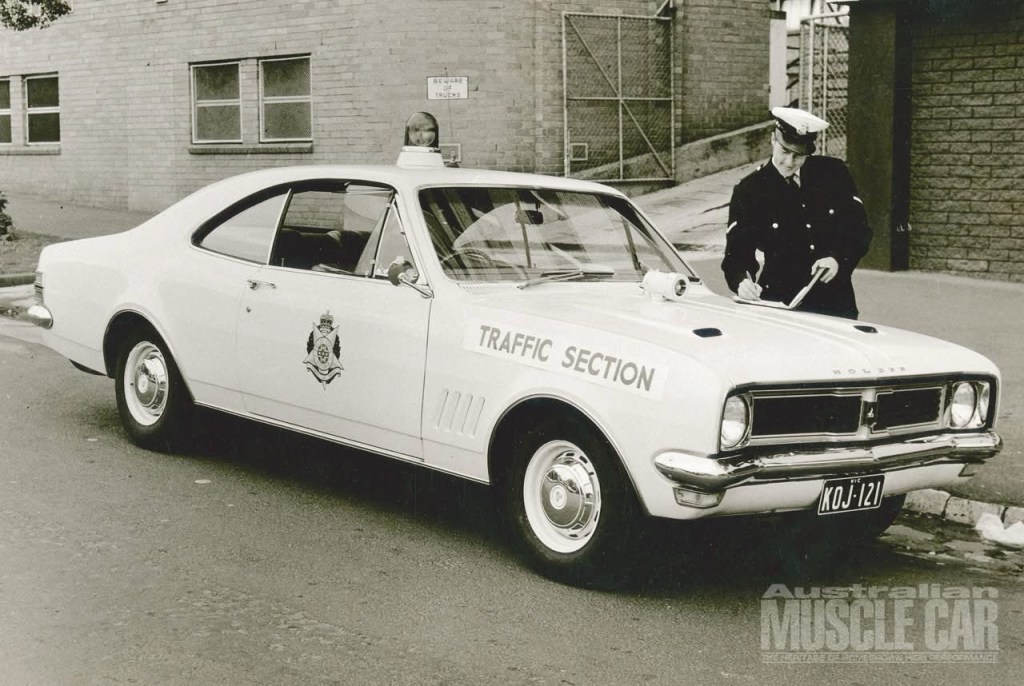
The only things missing are fatties and dice swinging’ from the mirror…two of these HT Holden Monaros were trialled by Victoria Police but rejected as fleet-mainstream additions.
Very hard for the crooks to get out of the back seat I would have thought, but maybe hard to get the corpulent ones in there. The cars would have been nice props on Homicide or Matlock Police…
(K Devine)
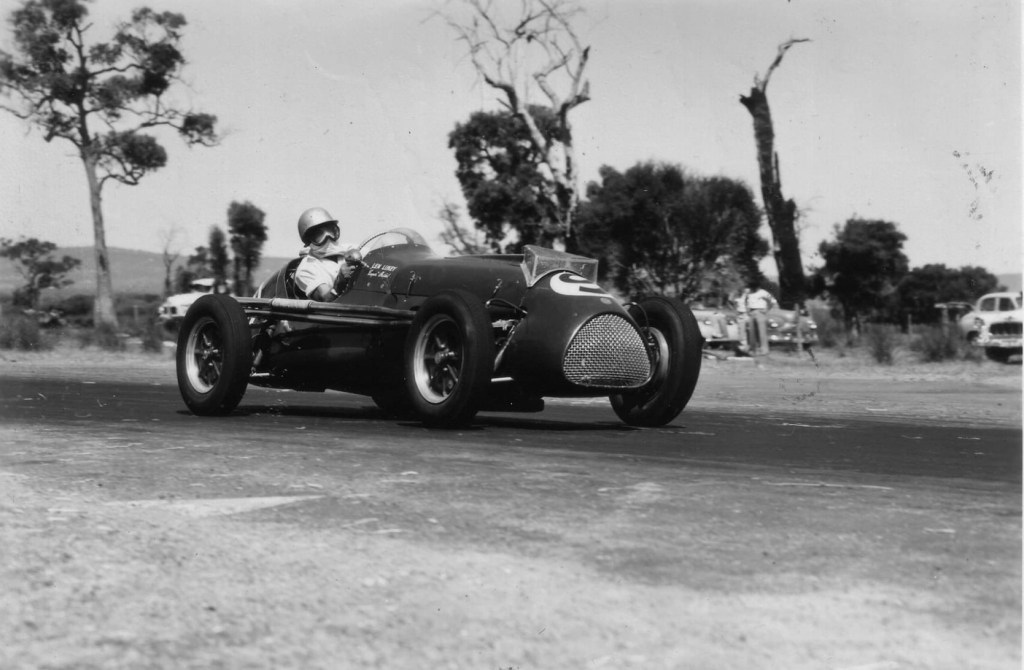
Len Lukey, Cooper T23 Bristol on the way to fourth place in the Australian Grand Prix at Caversham, Western Australia.
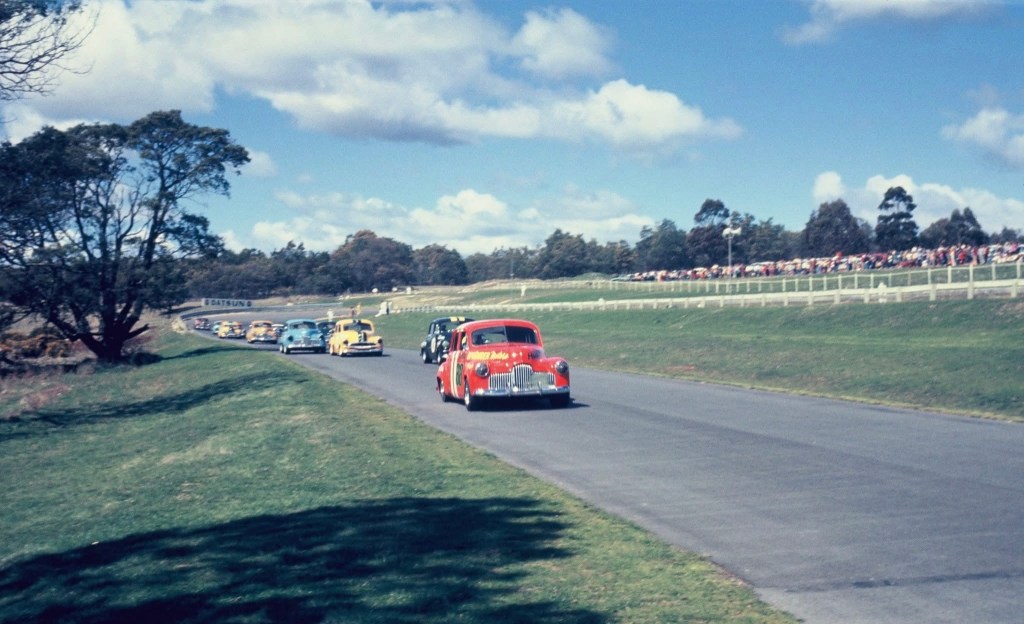
Ellis French tells us the pilots of the first four Humpy Holdens are Messrs Warner, Mather, De Pauli and and Wilcox in this fabulous, panoramic Symmons Plains shot.
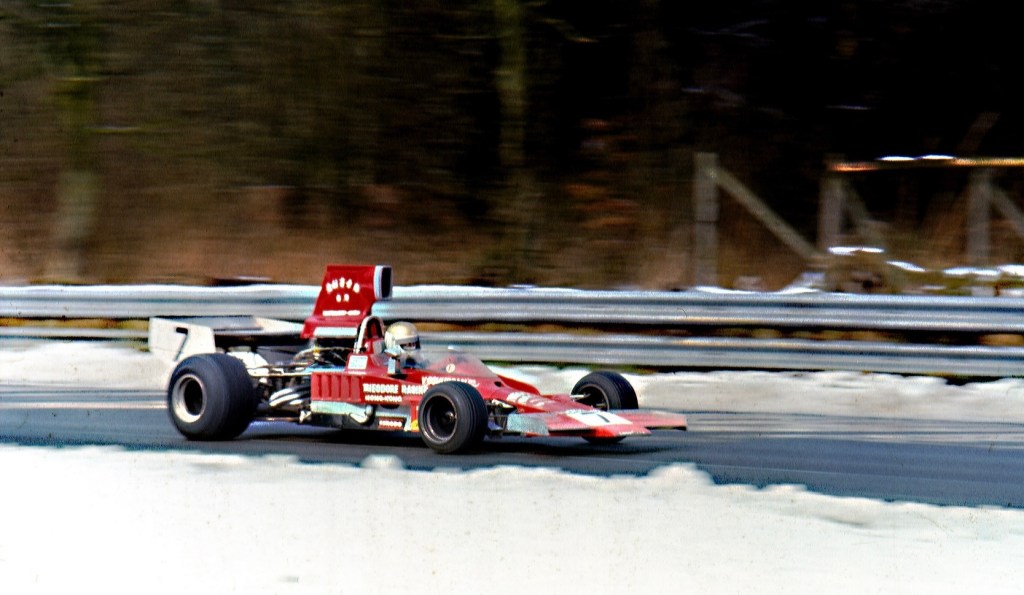
‘Make sure you keep it on the black-stuff Vern for chrissakes!’ may well have been Sid Taylor’s instructions to his driver: Yip-Theodore-Taylor Lola T332 Chev.
It’s the Oulton Park Euro F5000 round over the March 28 weekend in 1975 I believe folks. Vern was 11th, Gordon Spice won in another T332 Chev. More about Vern here: https://primotipo.com/2022/01/17/vern-schuppan-3/
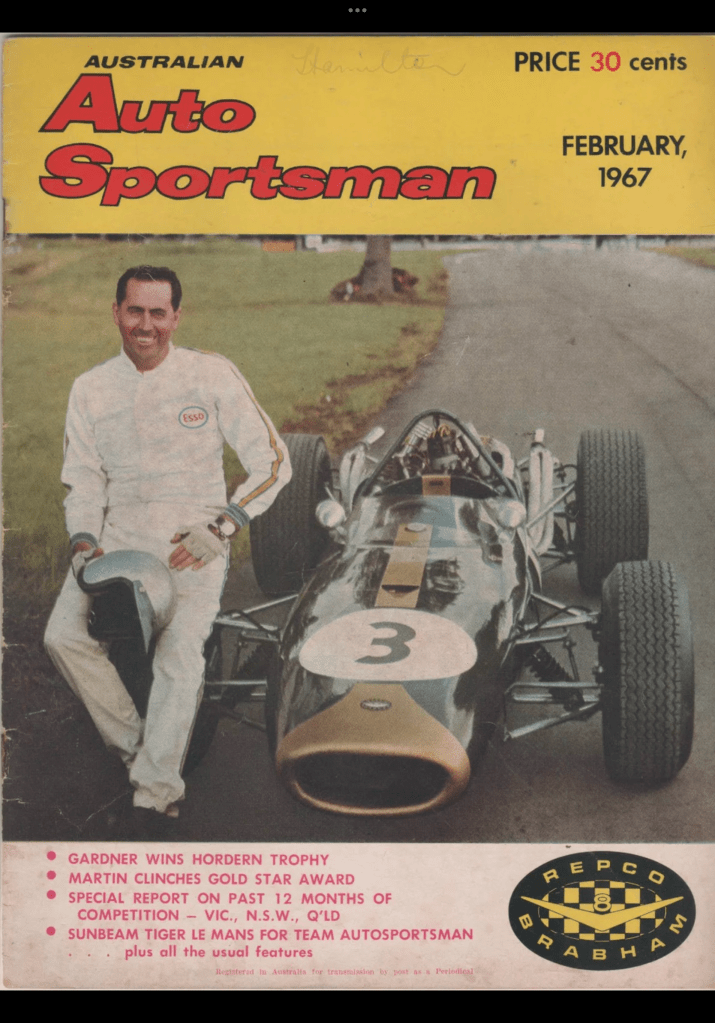
This chassis was Jack’s 1966 weapon of war in the Tasman and F1 championship and non-championship events, owned for decades by Repco Ltd or whatever the retailer is called these days.
(Stupix)
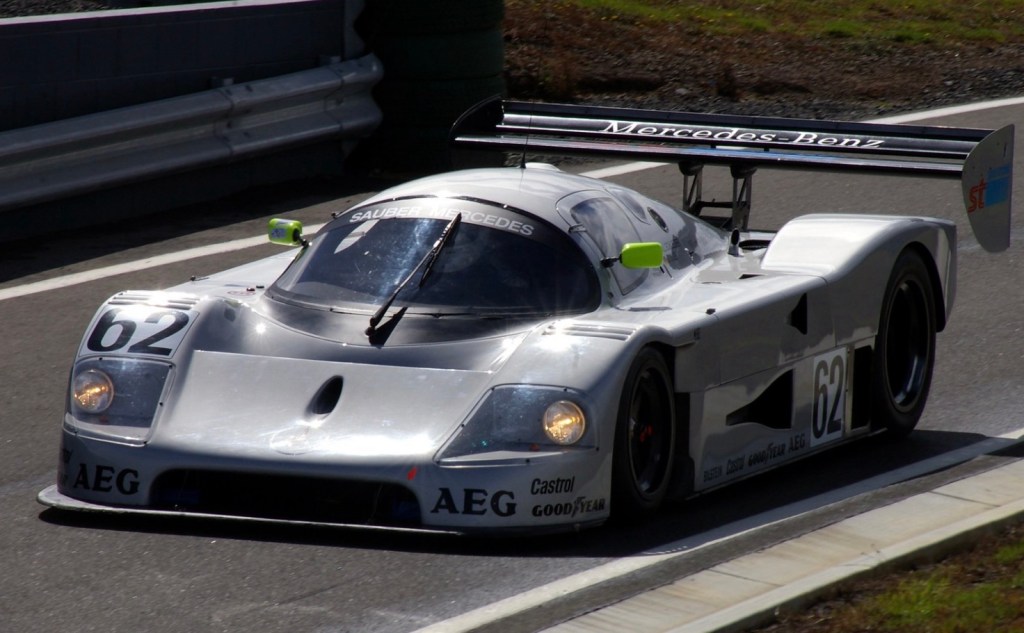
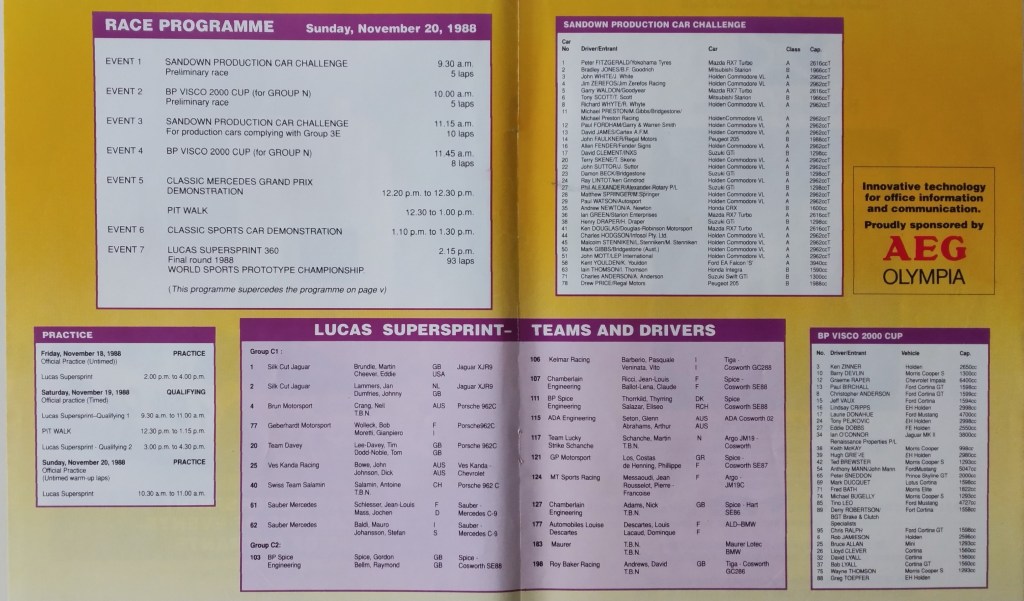
The second placed Mauro Baldi/Stefan Johansson Sauber Mercedes C9 5-litre V8 turbo during the Lucas Supersprint Sandown 360 over the November 20, 1988 weekend
While the entry for this race wasn’t as broad and deep as the 1984 Sandown 1000k the scale of the Fiscal Disaster for the Light Car Club of Australia was similar, see here: https://primotipo.com/2024/05/25/sandown-1000-1984/
(Stupix)
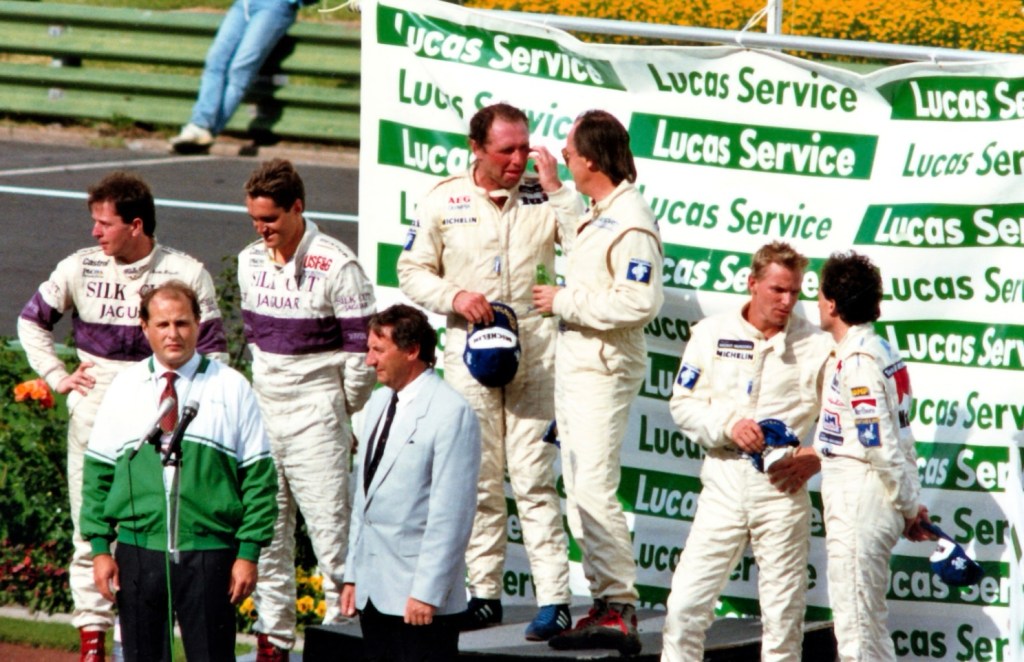
From the left, third place Martin Brundle and Eddie Cheever, Jaguar XJR9 7-litre V12, winners Jochen Mass and Jean-Louis Schlesser, and second men Johannsson and Baldi, Sauber Mercedes C9.
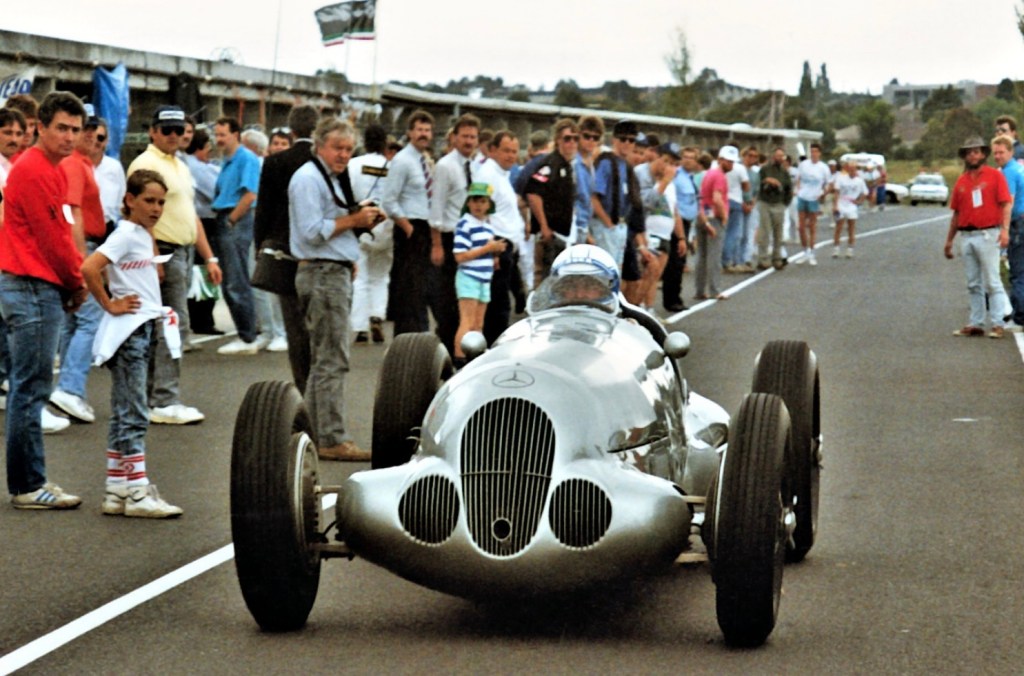
Jochen had a busy weekend not only racing his hi-tech C9 but also demonstrating a 1937 Mercedes Benz W125 Silver Arrows, very spectacular it was too!
(Stupix)(S Dalton Collection)(P Bowen)
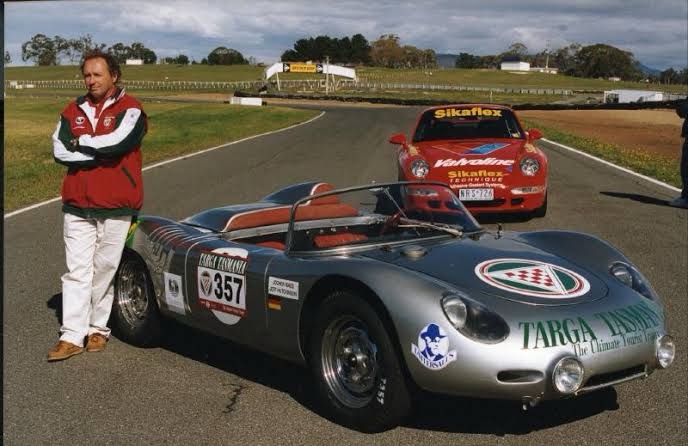
Jochen with the Porsche Museum 550 Spyder in which he had an enjoyable Historic category win in the 1996 Targa Tasmania.
Credits…
Bob Williamson Archive, Ern McQuillan via Jim Strickland, Mike Harding-Auto Action, Ken Devine, Australian Muscle Car, John Shingleton, Stupix, Peter Bowen, John Brock, State Library of Victoria, Stephen Dalton Collection
Tailpiece…
(SLV)
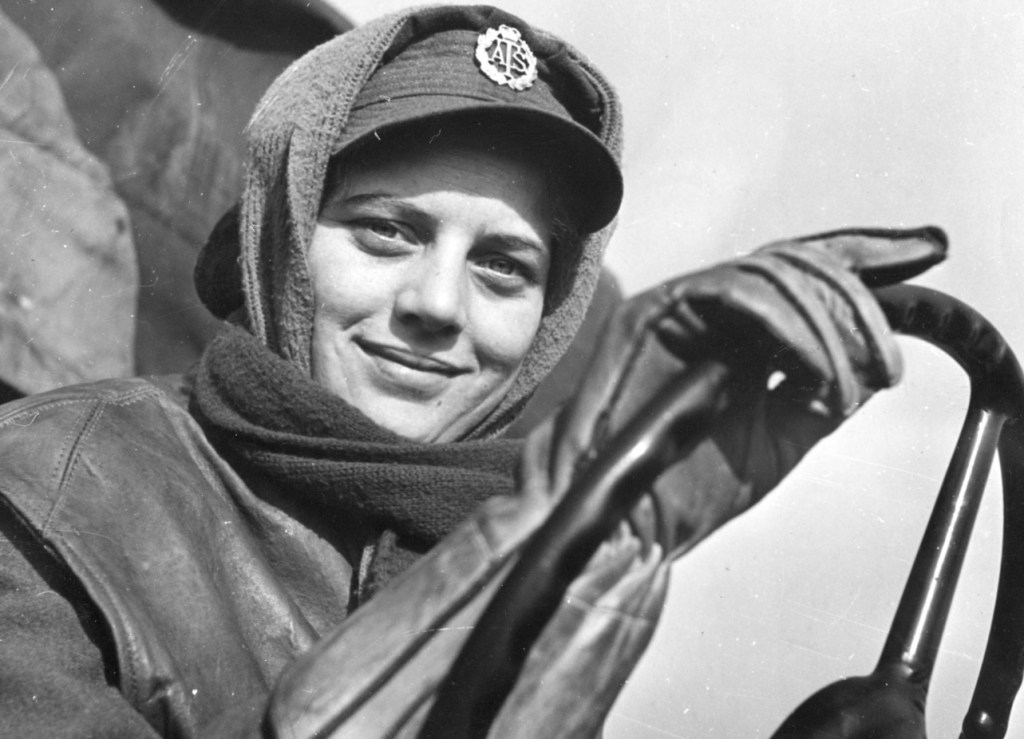
Australian Auxiliary Territorial Services Driver, Gladys Pollard, on assignment in the UK during 1942, summer by the look of it…
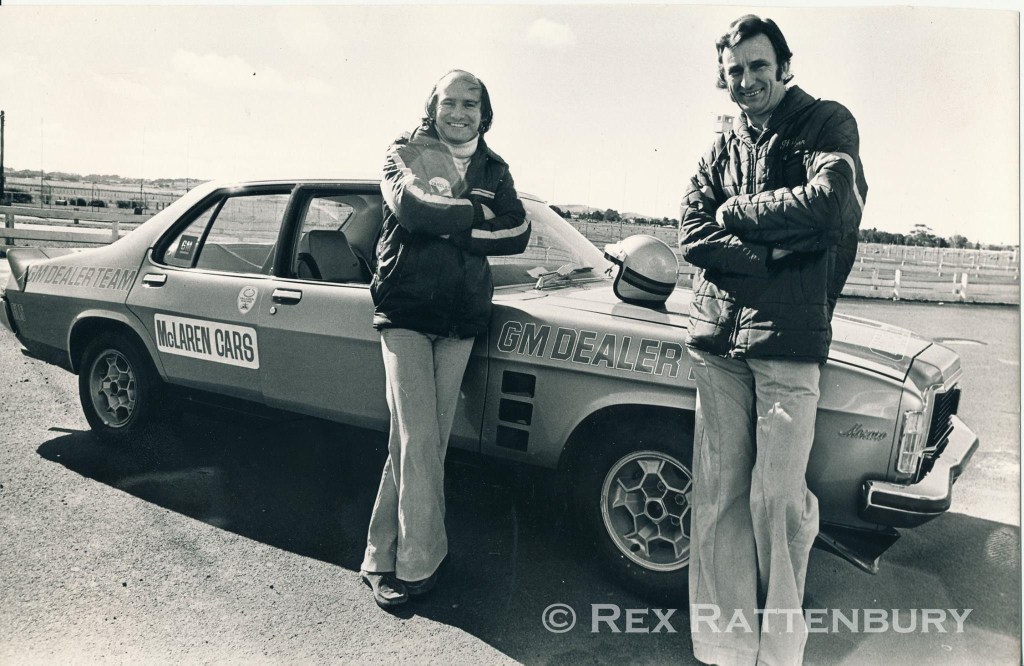
Now here’s a bit of McLaren history you didn’t know.
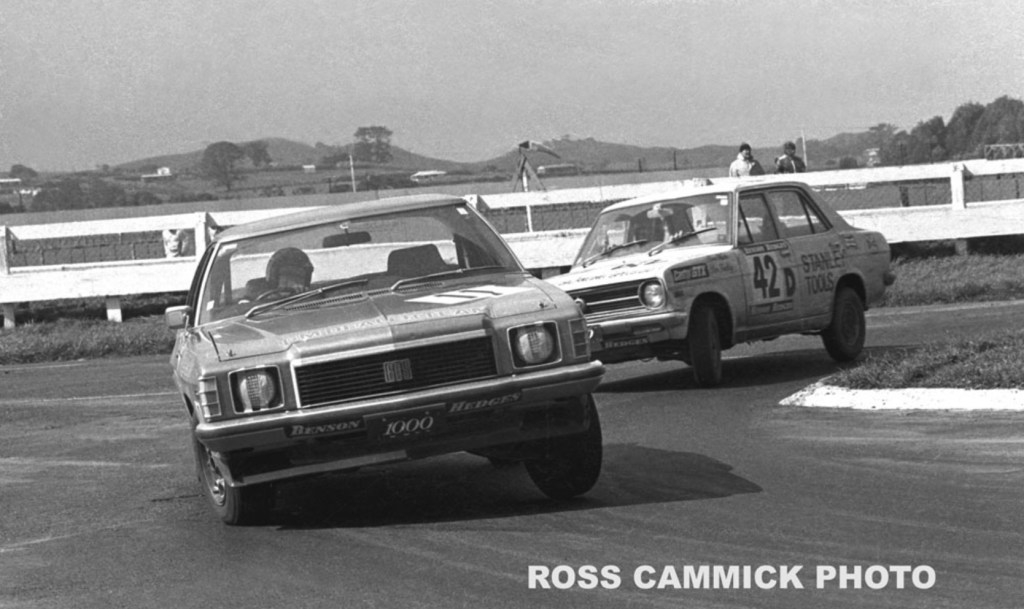
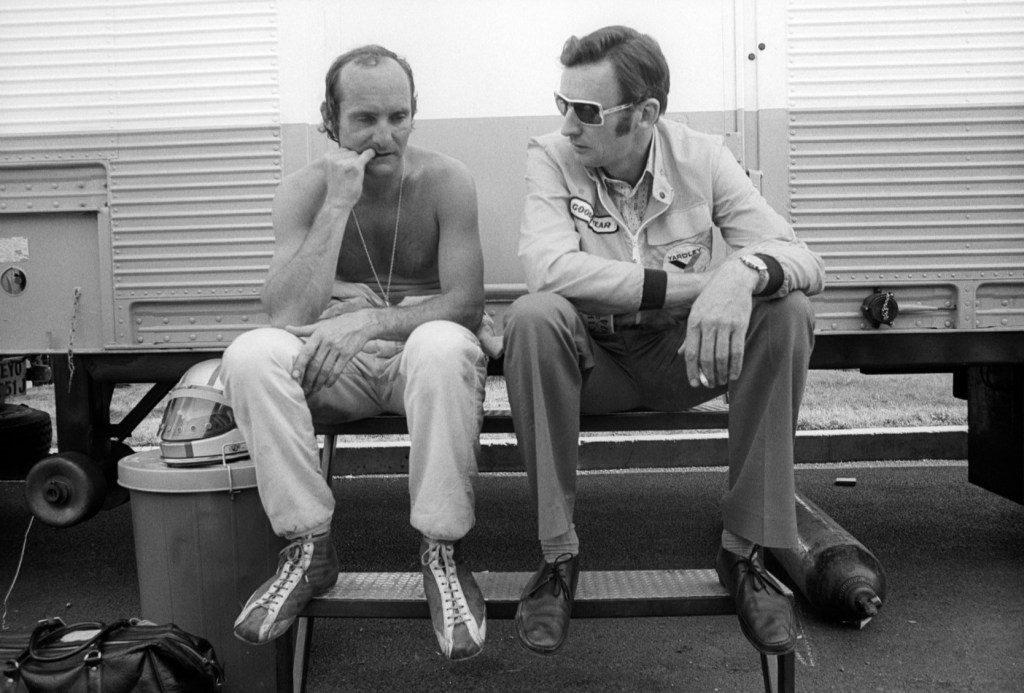
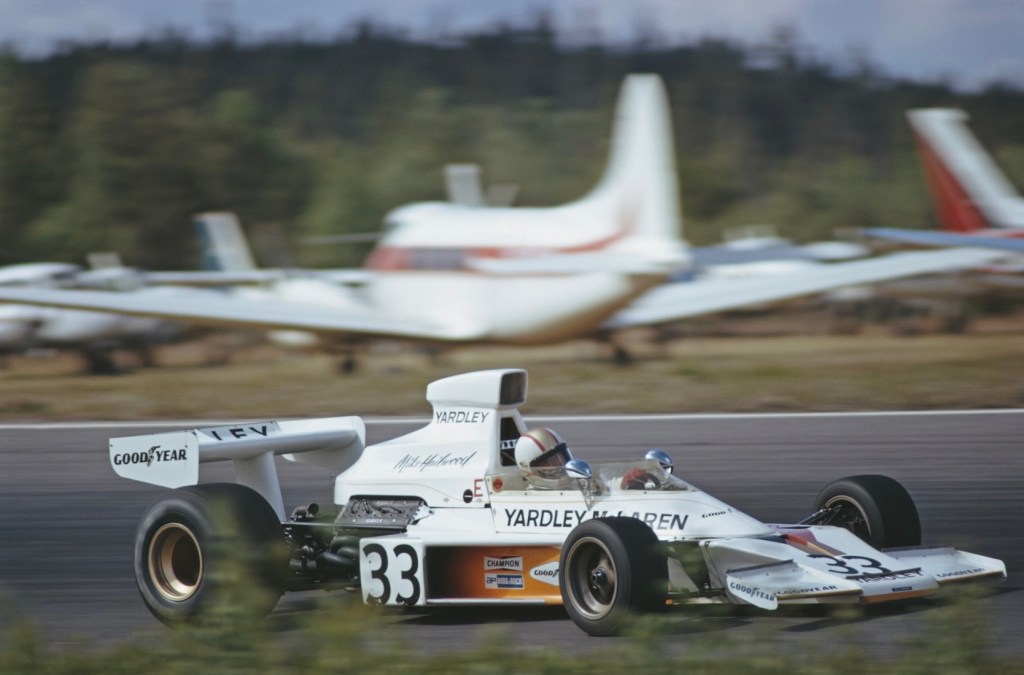
McLaren Cars ‘entered’ a Holden in New Zealand’s annual touring car endurance classic, the Benson & Hedges 1000 at Pukekohe in 1976.
The four-door Holden Monaro GTS 308 V8 was crewed by Mike Hailwood and Phil Kerr with none other than 1967 World Champion, Denis Clive Hulme as Team Manager.
Phil Kerr ahead of the Dave Winter/Ron Findlay Datsun 1200. DNF in the race won by the Jim Little/Graeme Richardt Chrysler Valiant Charger.
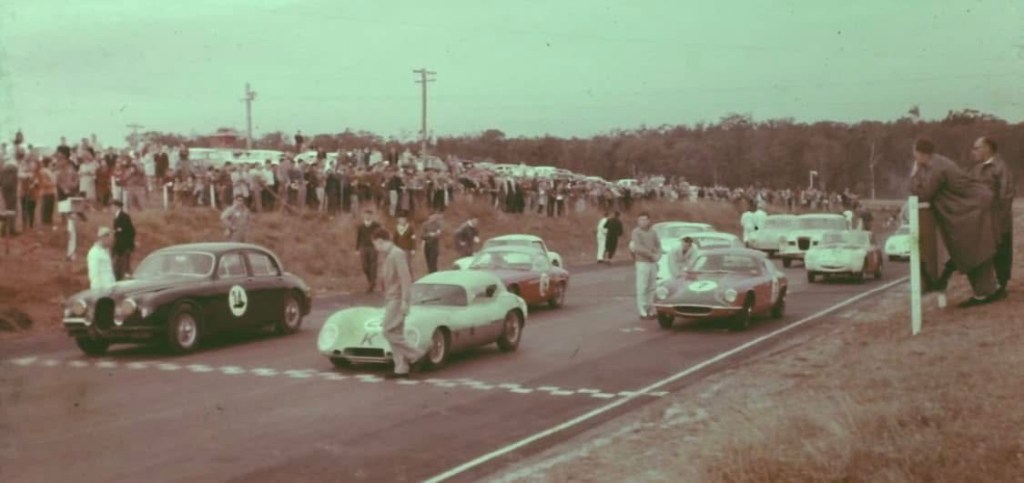
The grid for the Australian GT Championship at Lakeside, Queensland on 8 July 1962…
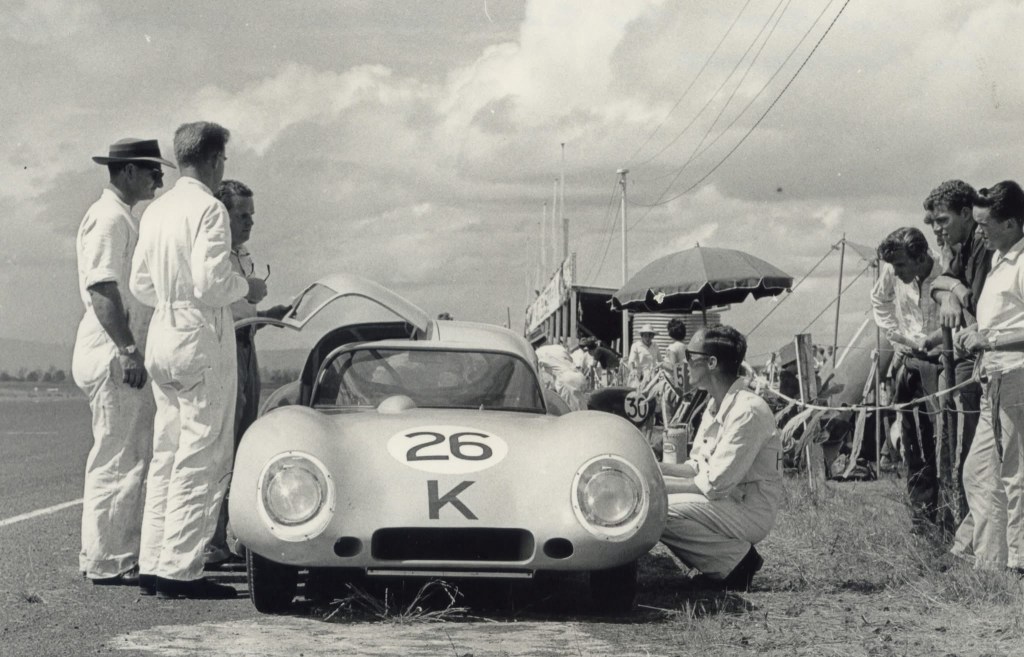
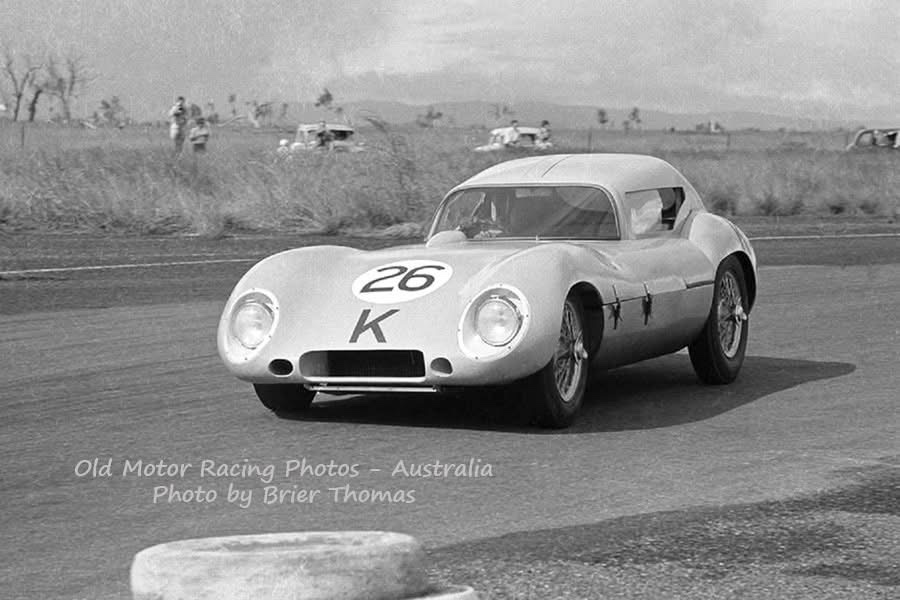
Bill Pitt, Jaguar 3.4 alongside John French in the Centaur Waggott-Holden, then the two Lotus Elites of Tony Osborne #16 and #7 Brian Foley. On the row behind is #21 Les Howard, Austin Healey Sprite Ford-Cosworth, in the middle is the partially obscured #31 Porsche 356 of Tony Basile and on the left the white #30 Renault Floride of Terry Kratzmann .
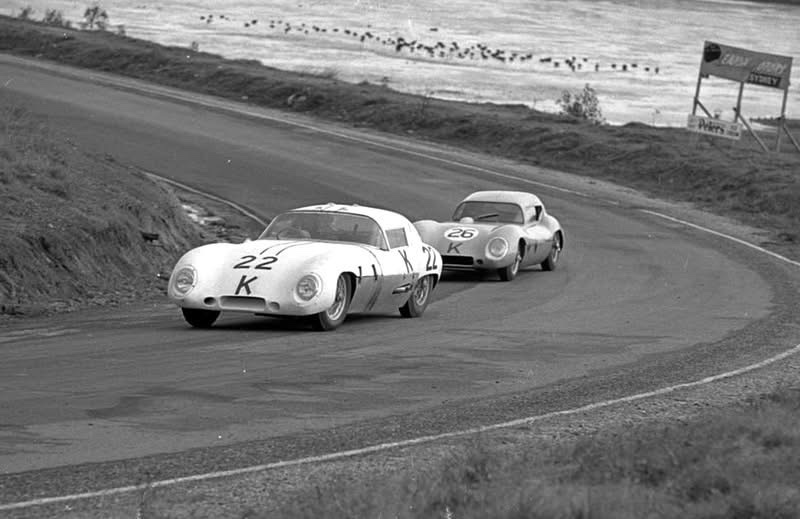
The light-coloured Sprite further back is #51 Sib Petralia, #60 Paul Fallu, Karmann Ghia, whilst the #4 Wolseley has long-time competitor Ken Peters at the wheel. The unmistakable outline of the grey Renault Dauphine is #6 M Hunt. Dennis Geary #22 was also entered in the HWM Jaguar – then in two-seat Coupe form but with the very same chassis and mechanicals of the car raced by Lex Davison to win the 1954 Australian Grand Prix – ‘just down the road’ at Southport on the Gold Coast.
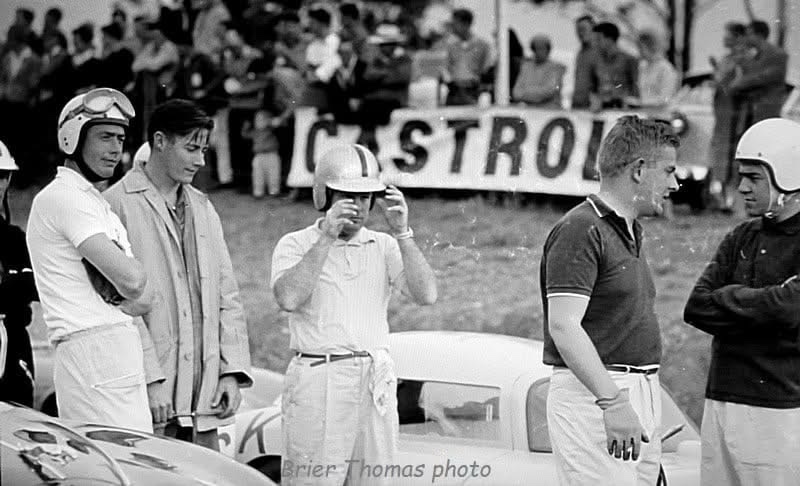
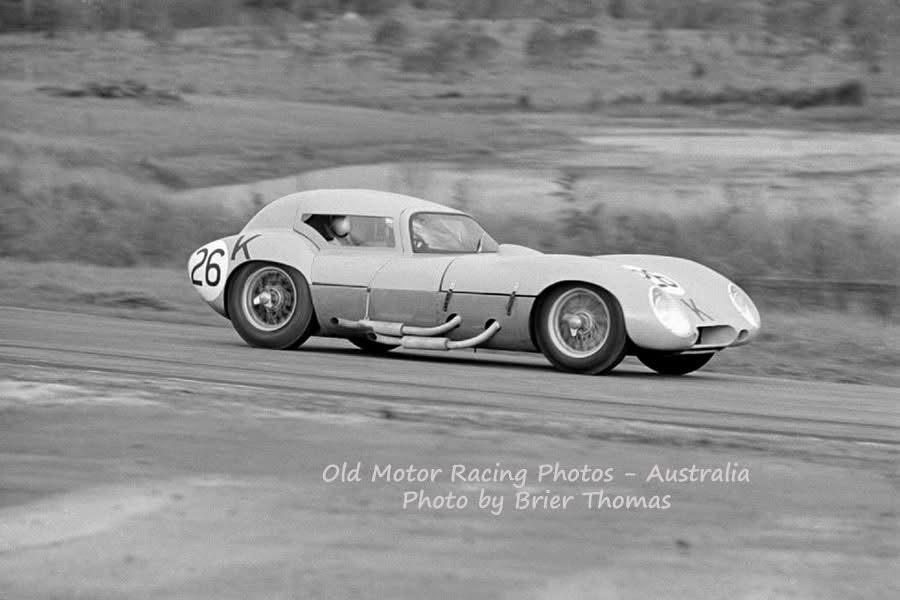
Denis Geary aboard the ex-Moss/Davison HWM Jaguar – the 1954 AGP winning single-seater chassis fitted with a coupe body – from the French Centaur Waggott during the GT Championship (B Williamson)The pit crew provides scale, isn’t the Centaur a small car? Lowood (B Thomas)Les Howard, Kevin Bartlett – looking after Howard’s car that weekend – the victor, John French adjusting his helmet, Antony Osborne and Brian Foley before the off.
The 50 lap 75 mile race was won in 62:6.06 minutes/seconds by French from Basile, Pitt, Howard then came Foley. Sib Petralia won the under 1-litre class, Basile the 1000-1600cc , French the 1600-2600cc and Pitt the 2600cc class and over.
The race was the third Australian GT Championship for Appendix K cars, the first was held at Bathurst during the October 1960 meeting and was won by Leo Geoghegan’s Lotus Elite, the 1961 event was at Warwick Farm in July, and Frank Matich won in his Jaguar D-Type.
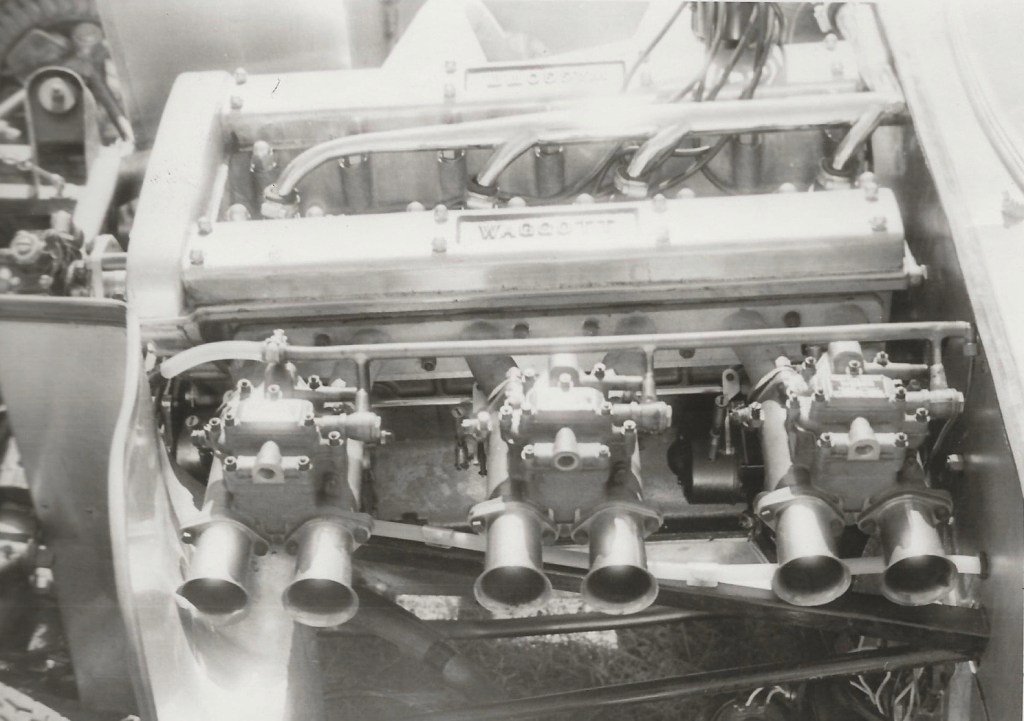
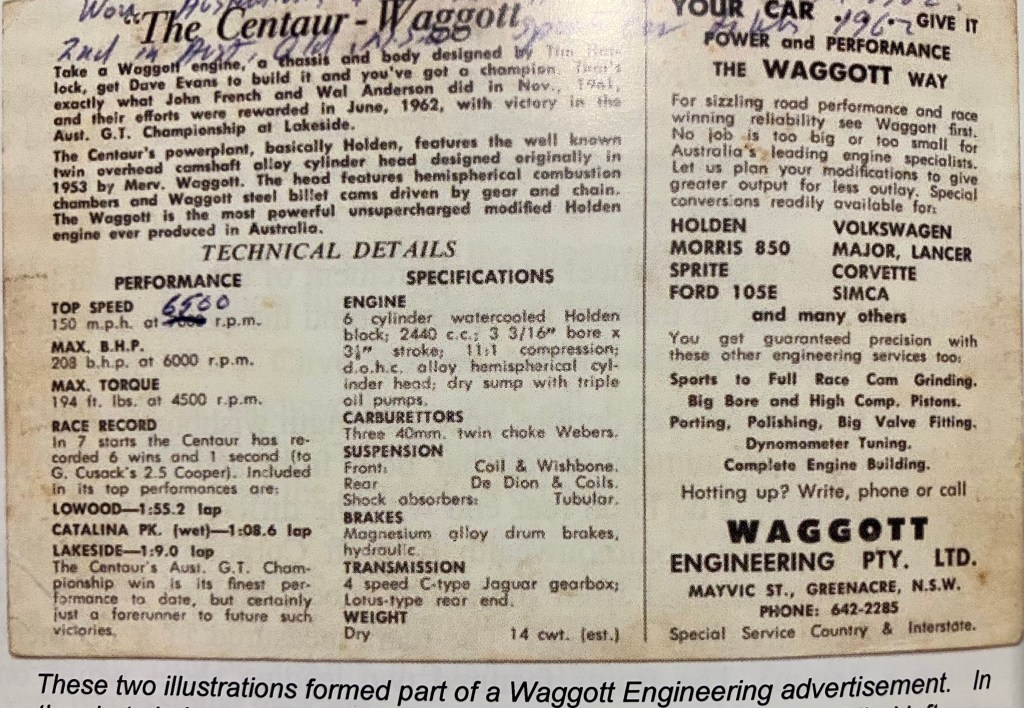
Lowood Merv Waggott built 2440cc Waggott-Holden twin-cam, two-valve, triple Weber 40 DCO fed circa 200 bhp six-cylinder engineLakeside
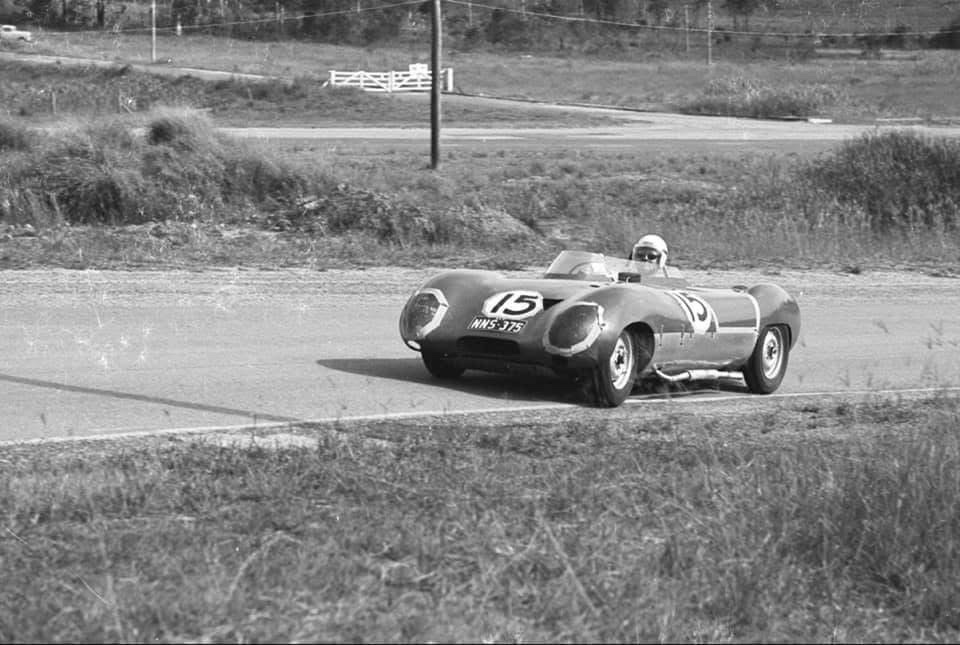
Toowong, Brisbane, University of Queensland Mechanical Engineering graduate Tim Harlock built his first car in four years, from concept to completion, commencing when he was barely out of his teens.
‘I was always mechanically inclined,’ Tim told Mildred Eden in 1962. ‘But beyond toying with a metal building set and making model aeroplanes, I had never before tackled anything of this magnitude.’
Car racing became Tim’s main interest while still at school.
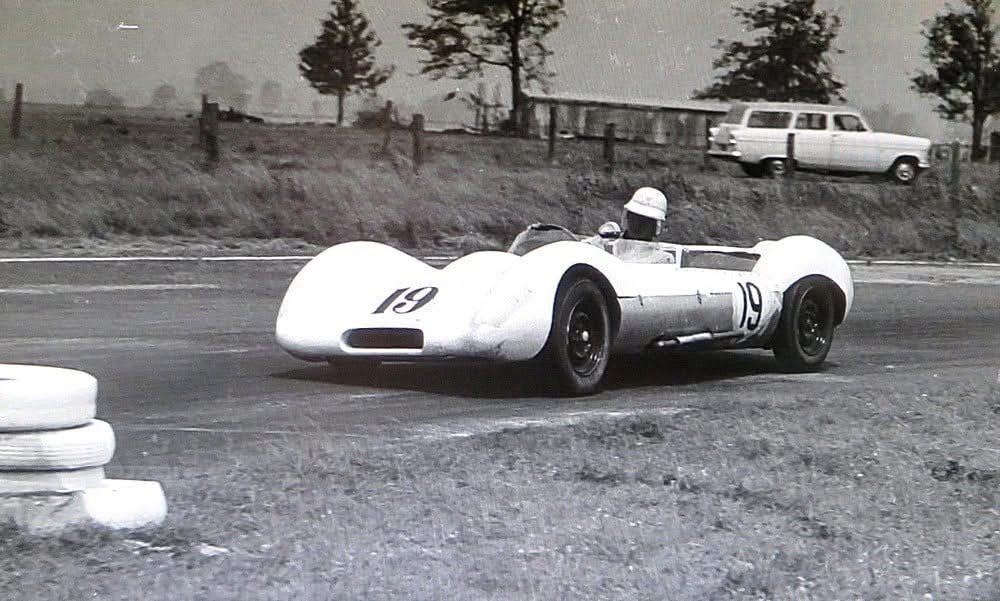
Keith Turner in the Centaur Mk1B Ford at Lakeside circa-1964 (P Lefrancke)Tim Harlock racing his Centaur Mk4 at Lowood in October 1964 (B Williamson)
‘I saw my first race about 10 years ago in England, where we lived while my father, a soldier, was stationed over there. It was at Boreham Wood, but I don’t even remember who was racing at thc time. I did not become a real enthusiast until later.” –
He was determined to race himself but couldn’t afford it so he decided to build himself a car. ‘I’d learnt the basic theory in engineering, but all the practical knowledge came from friends with years of racing experience.
‘Wal Anderson, who is a retired racing driver, was a fund of information, and my friend Keith Turner worked with me on the construction. Incidentally, we have built two cars now, one each.’
The chassis of the Centaur/Centaur Mk 1B is a multi-tubular spaceframe, with the front suspension comprising upper and lower wishbones, modified Alford & Alder uprights and coil spring damper units. The rear comprised a well located BMC A-series rear axle diff assembly.
The engine was a Ford 105E 997cc, an Anglia also provided the gearbox, drum brakes were Morris Major 9-inch front and 7-inch rear.
The nose is Lotus 11-esque!, I can read your minds. Tim did a deal with Chas Whatmore after he damaged the nose of his Lotus 11 at Lakeside, Harlock took a mould from that car, the rest of the body aluminium.
Tim and Keith began to race their cars in June 1961. It wasn’t too long before Wal Anderson introduced John French to Tim Harlock, and shortly thereafter, the 1962 Australian Championship-winning Centaur-Waggott project commenced; the championship C-W was the third of 11 Centaur sportscars built.
Centaur Waggott-Holden GT…
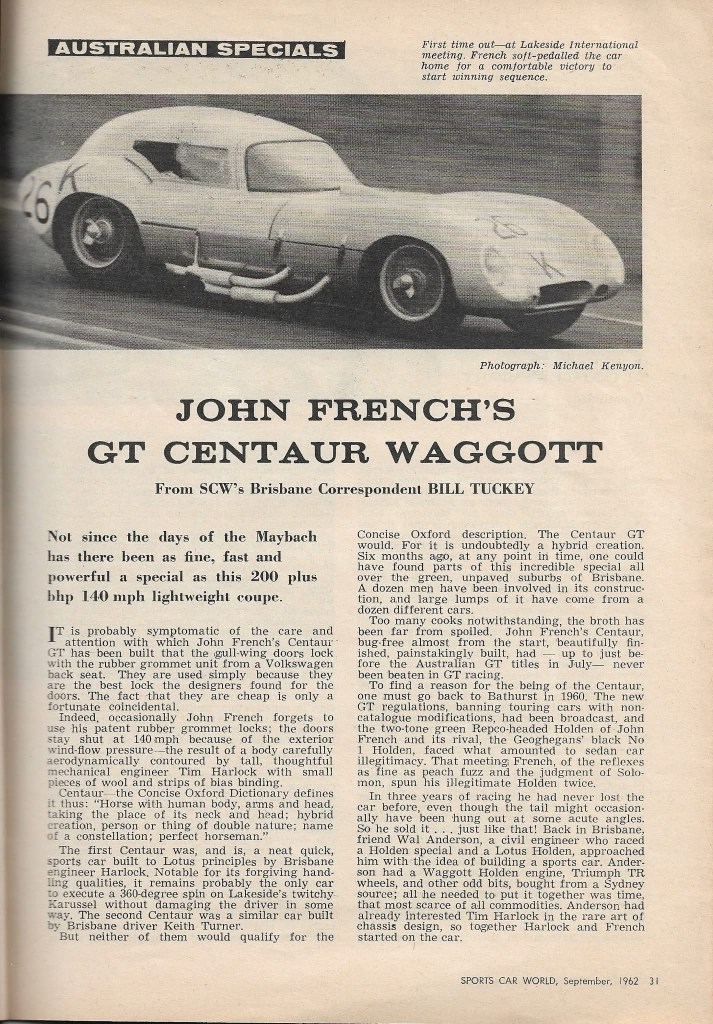
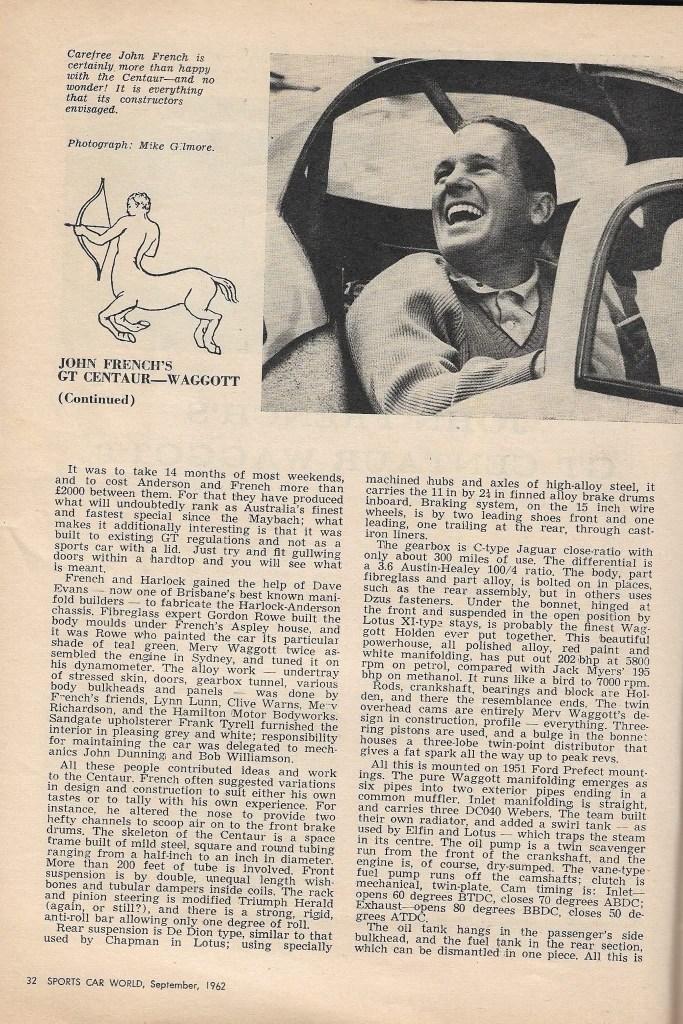
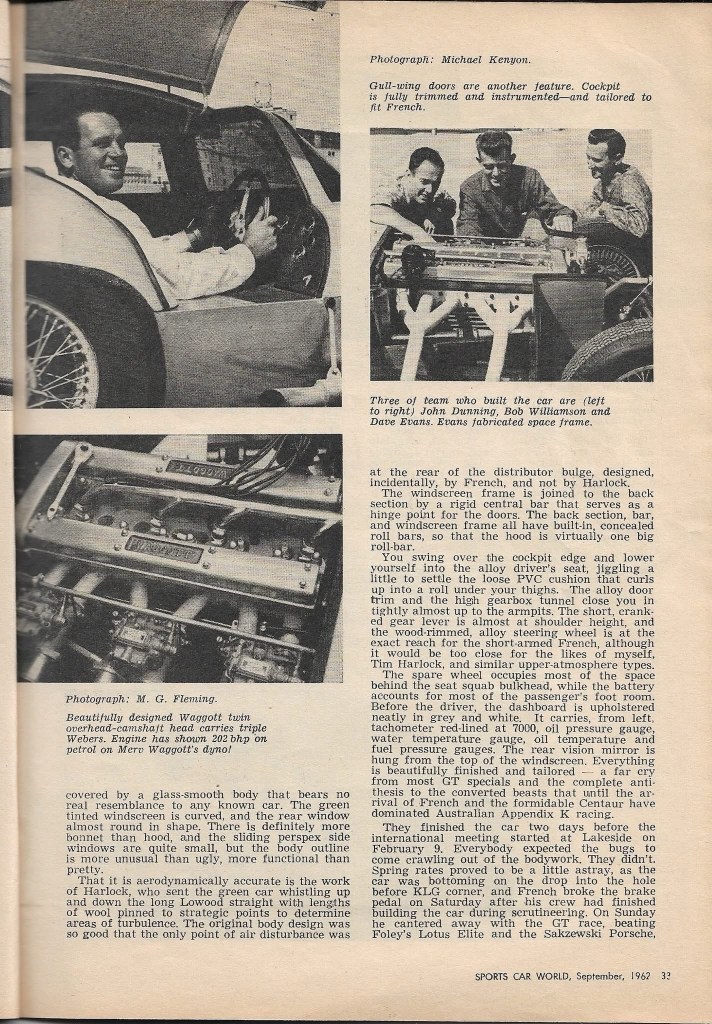
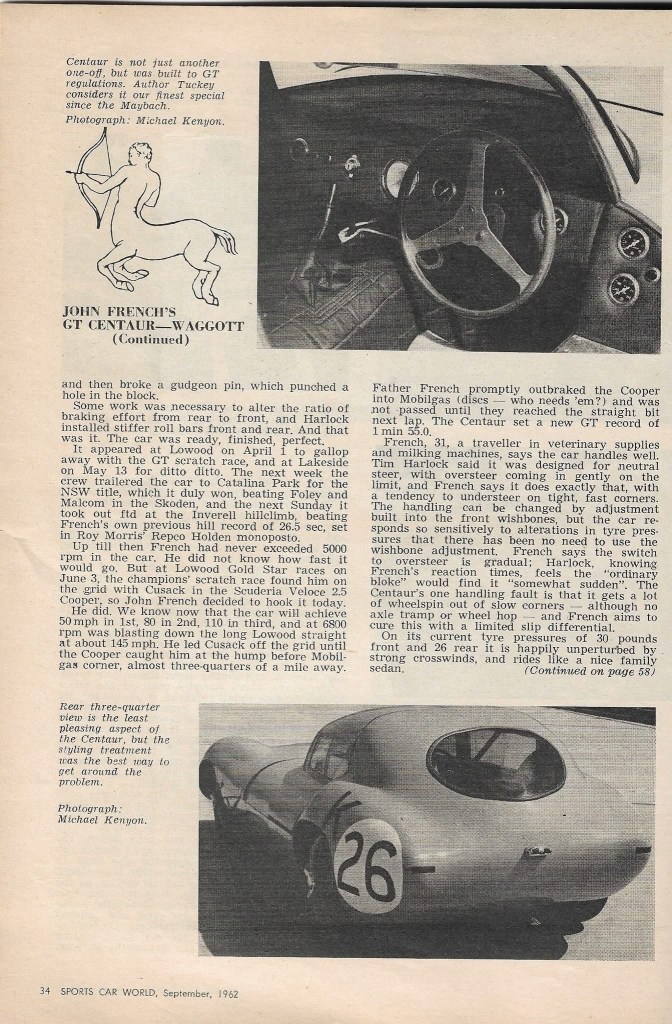
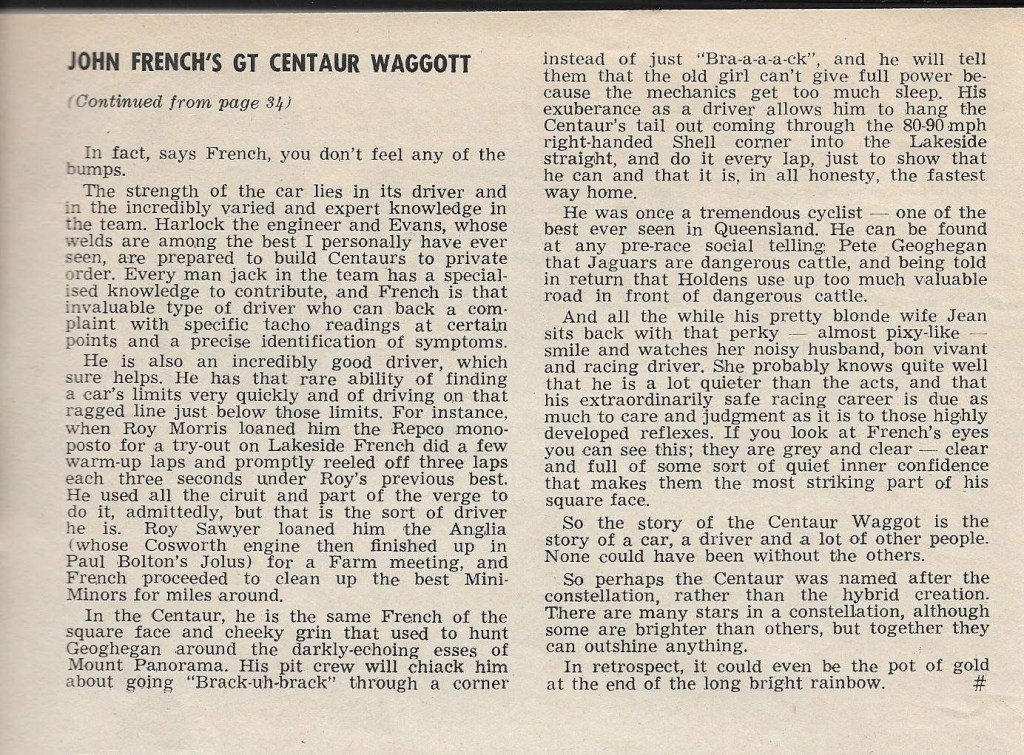
Bill Tuckey, one of Australia’s greatest motoring writers of the 1960s-70s, wrote this fantastic article about the car in the September 1962 issue of Sports Car World, easily my favourite Australian mag until its untimely demise in the 1980s.
Etcetera…
(J Campbell Collection)
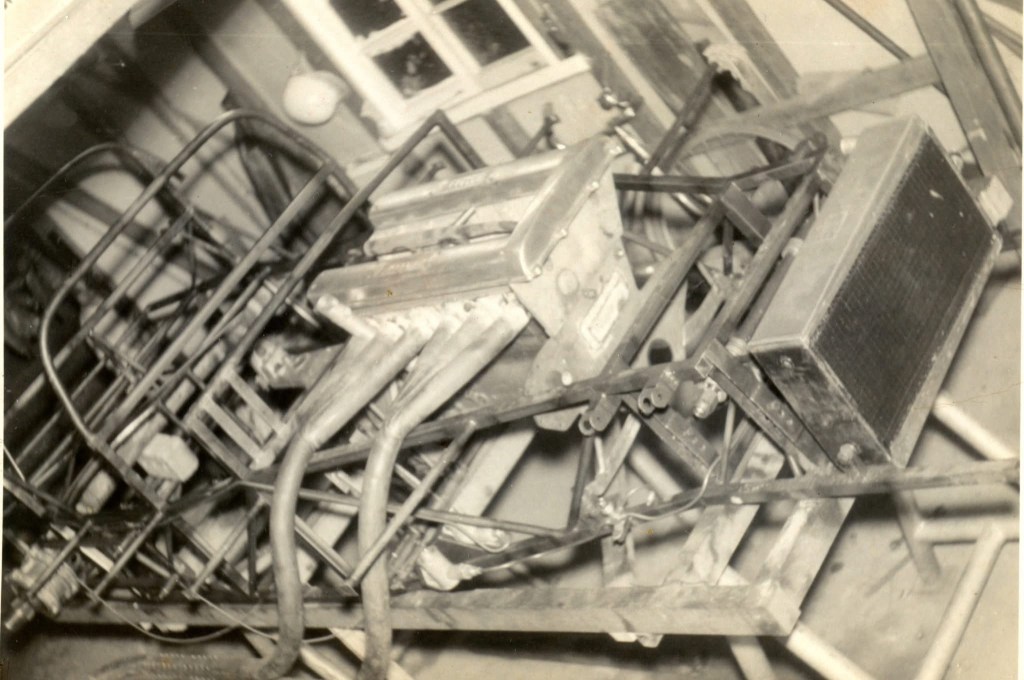
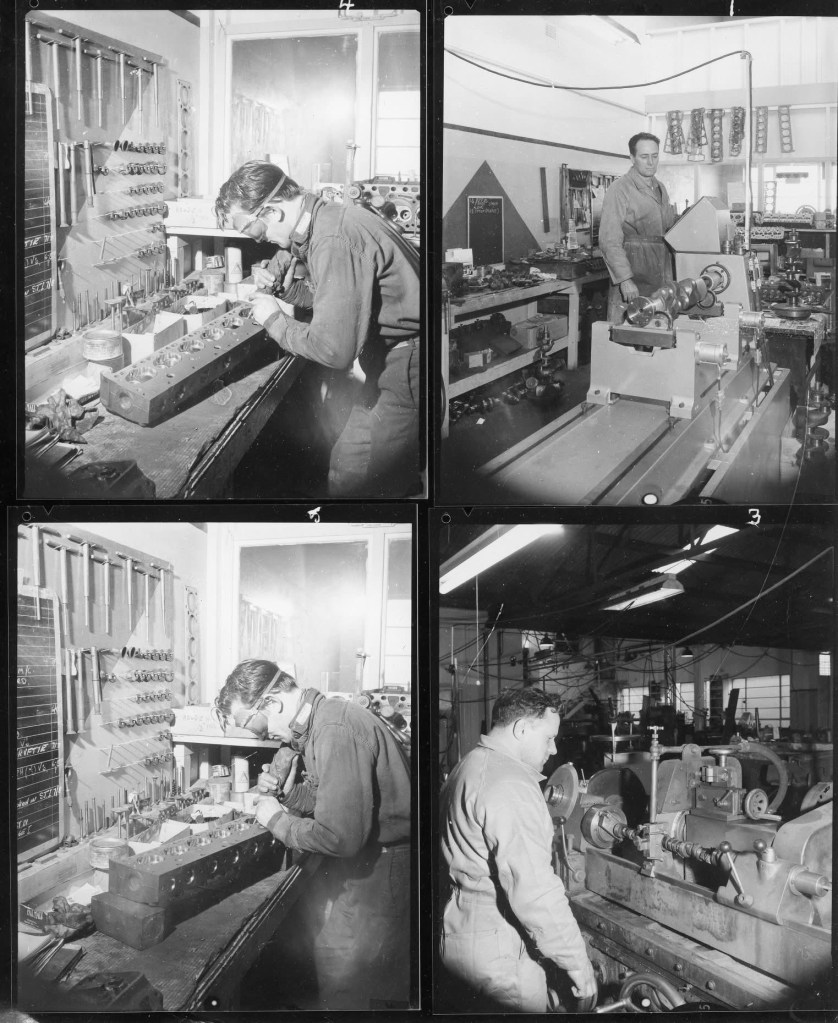
Waggott-Holden engine dummy installation in the Centaur chassis. The shot below more fully describes the engine specifications, and the bottom one is a collage of in-period Waggott Engineering photographs with Merv at top right.
(G Smith Collection)”(B Williamson Collection)
Credits…
Sports Car World, the Brier Thomas photographs are courtesy of Graham Ruckert, Mildred Eden Australian Women’s Weekly, Peter Le Francke Collection, Bob Williamson Collection, Greg Smith Collection, John Campbell Collection
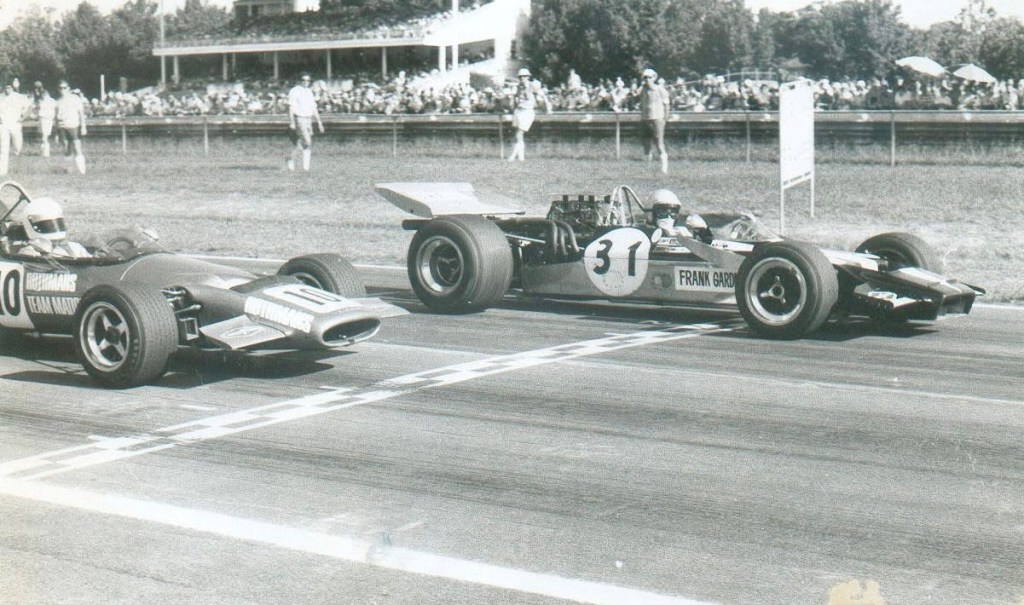
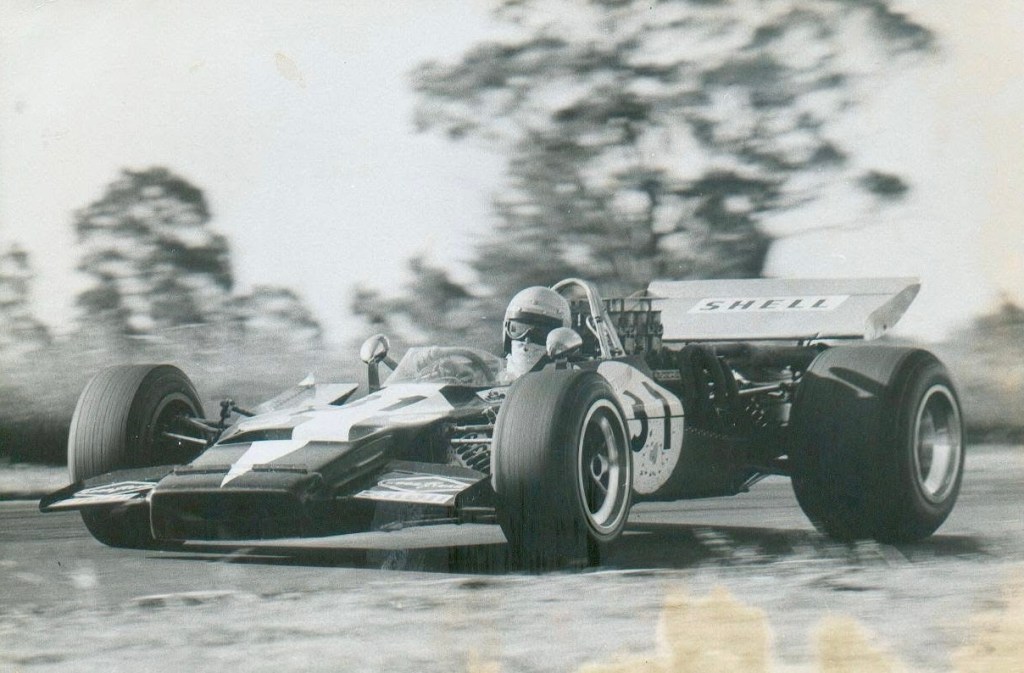
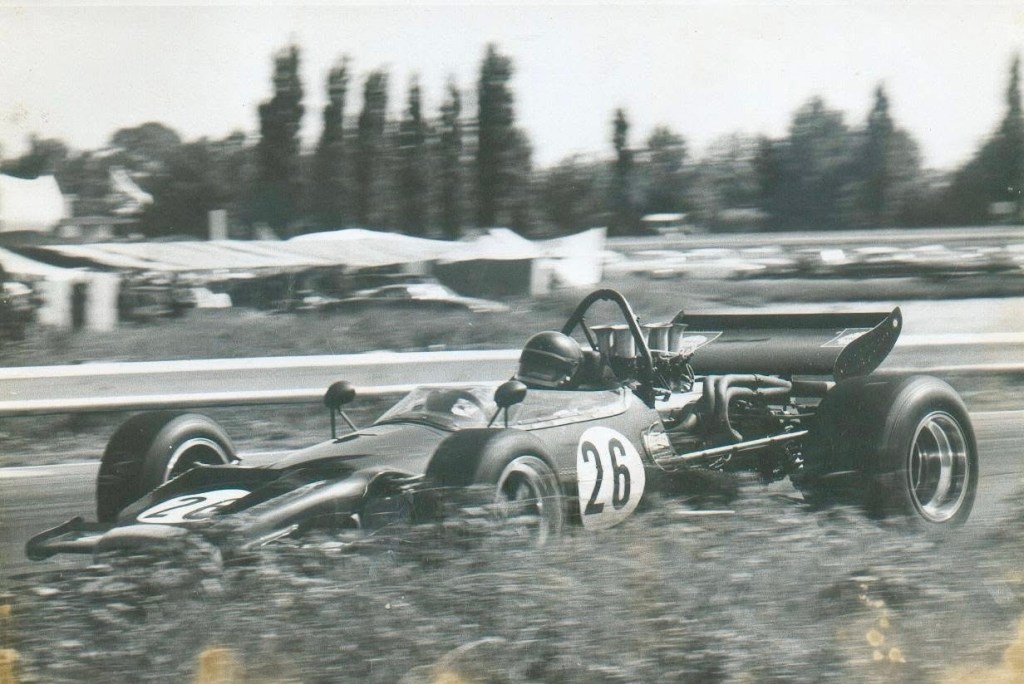
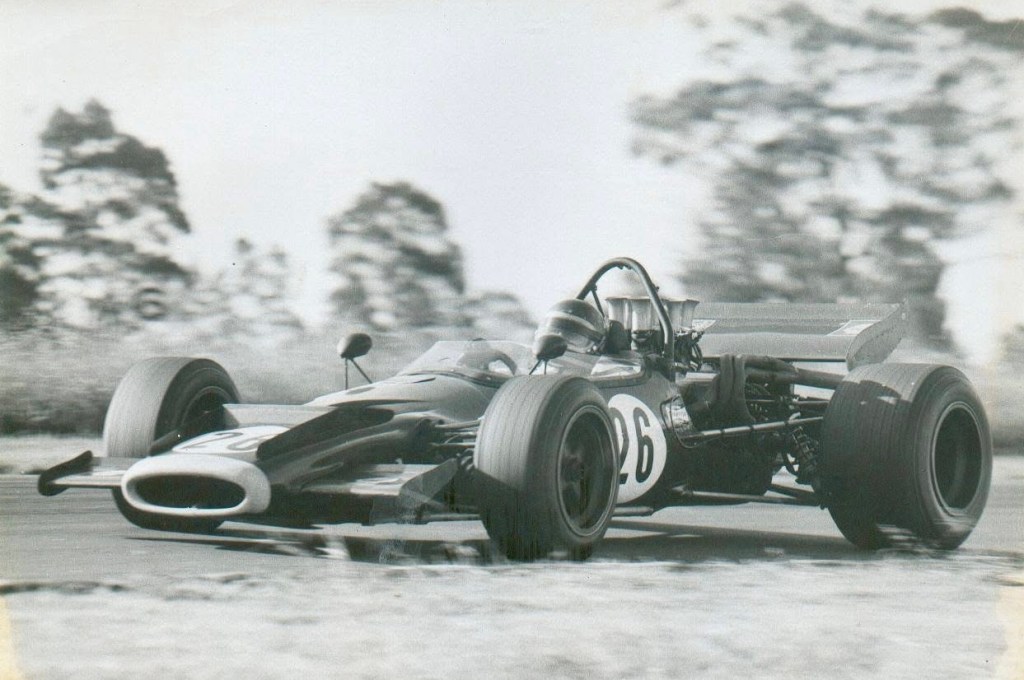
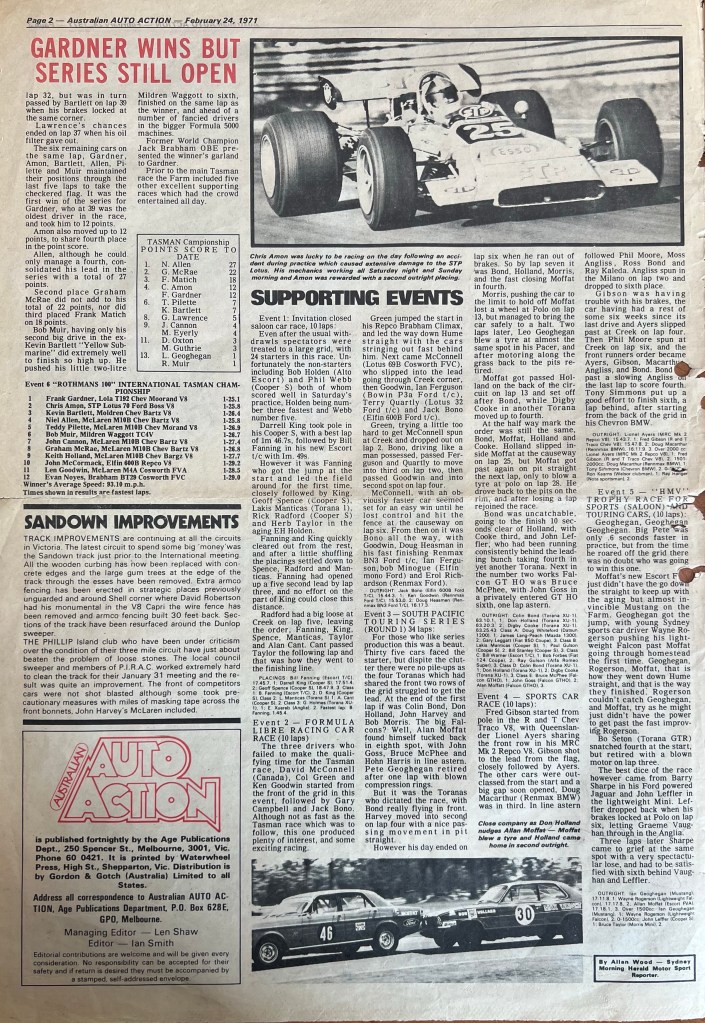
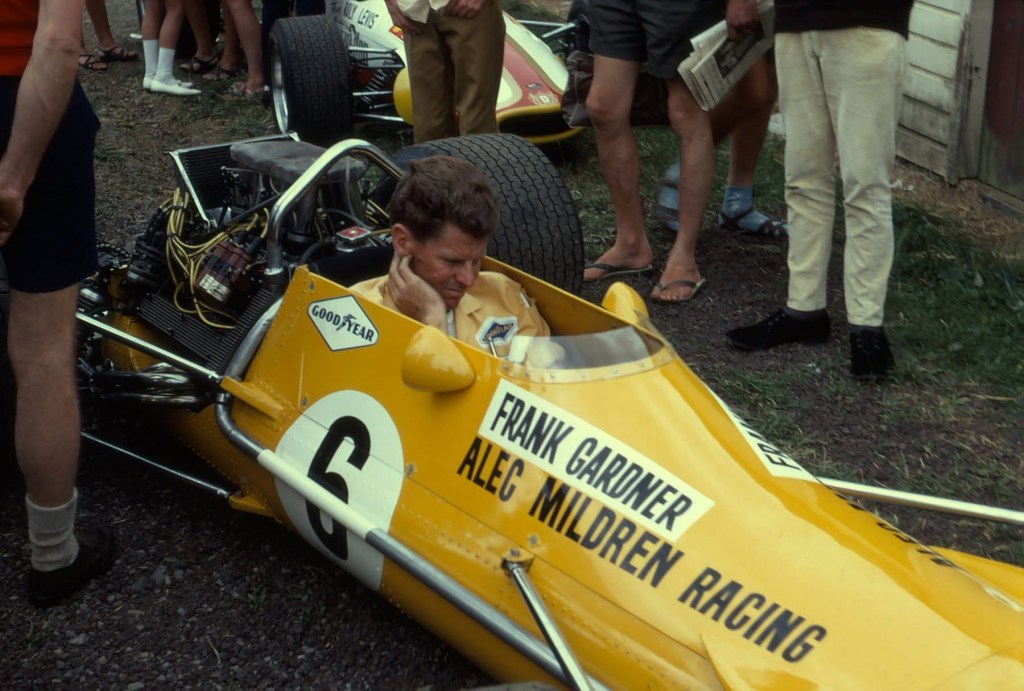
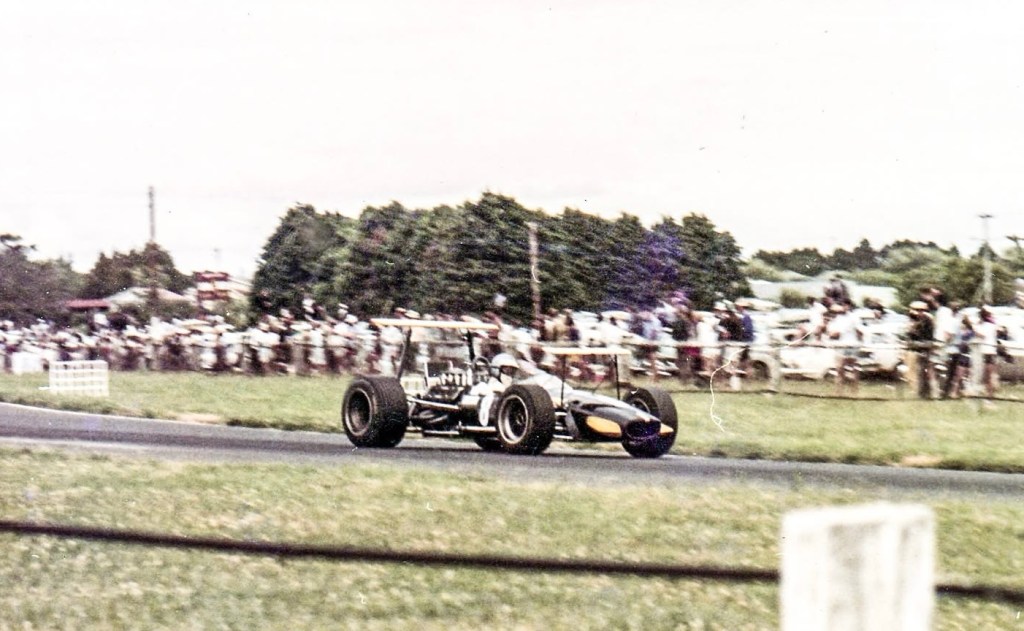
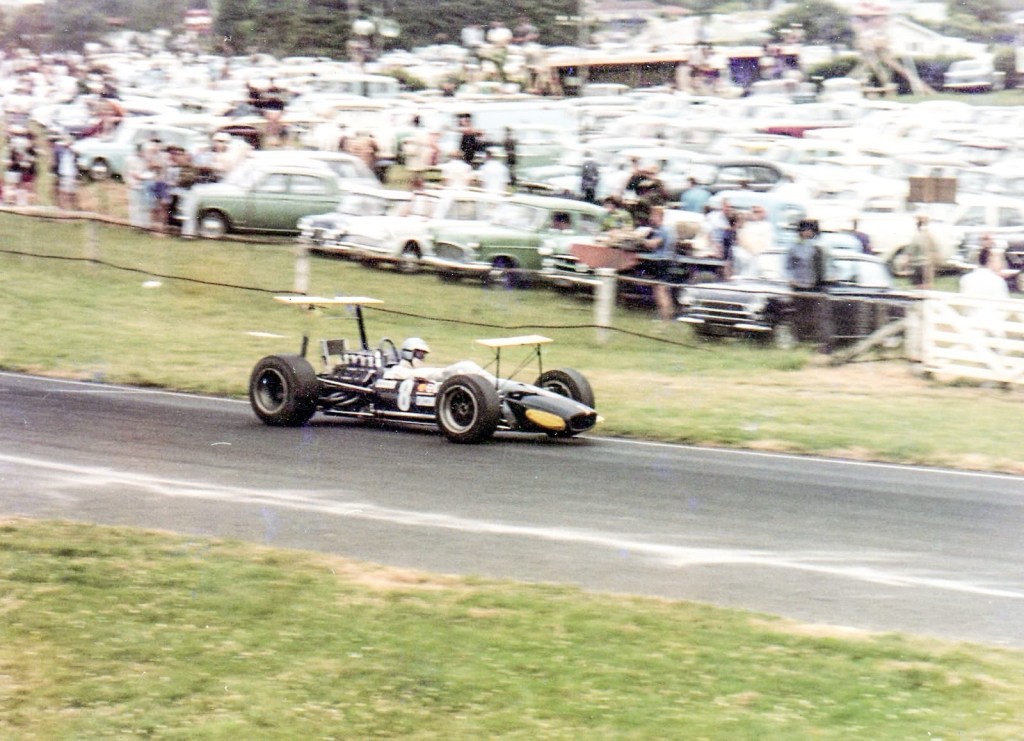
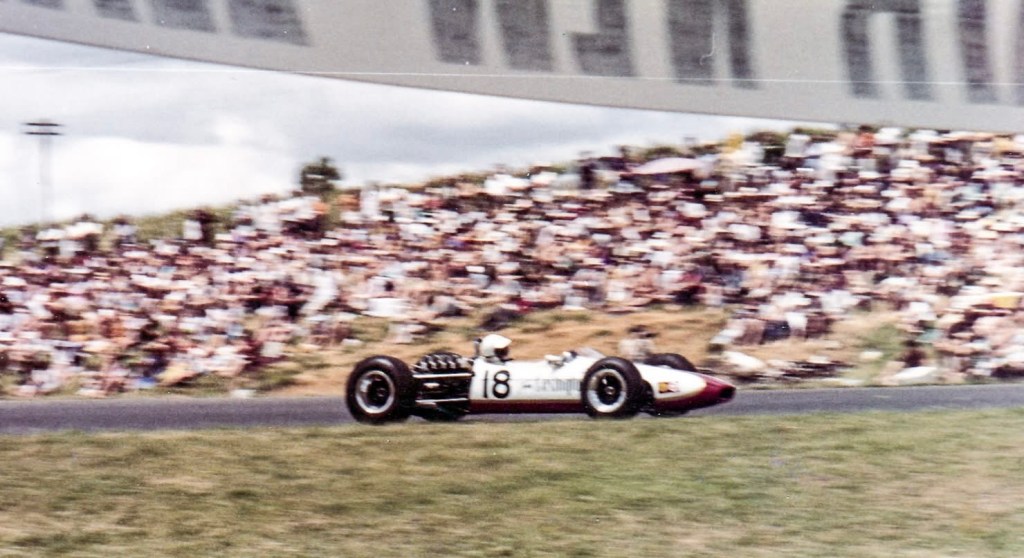
Frank Gardner on the way to winning the Warwick Farm 100, round five of the 1971 Tasman Cup held on February 14, works-Lola T192 Chev #190/F1/6 or SL/192/14.
In search of downforce, notice the small wings on either side of the cockpit. They were deemed illegal over the Surfers Paradise weekend, a fortnight later, and weren’t seen again. Those with good memories will recall Frank Matich running with a twin-rear wing setup on his and John Walker’s Matich A50 Repco-Holden in 1972-73.
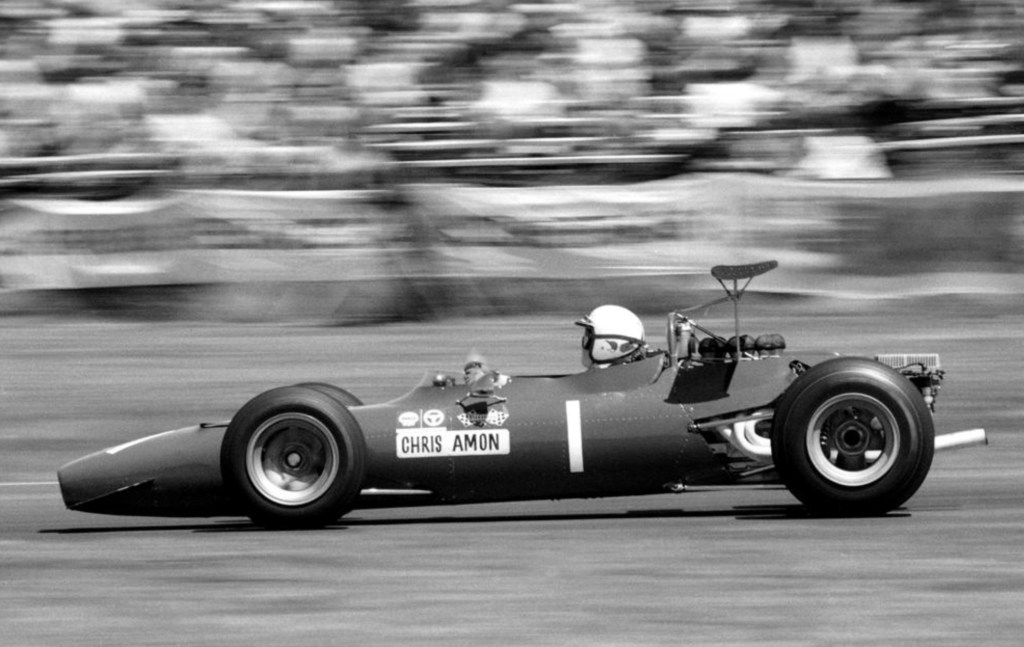
Gardner won the race from grid two with Chris Amon second in the STP Lotus 70 Ford and Kevin Bartlett third in the Alec Mildren Racing Mildren Chev V8.
That’s the nose of poleman, Frank Matich’s McLaren M10B Repco-Holden alongside FG below.
(R Cranston Archive)
Bruce Sergent wrote that ‘Matich tried everything to get past Gardner in the early stages but Gardner was too wily and experienced to be forced into an error. Each time Matich applied pressure to the Lola Gardner gave the throttle a little extra and opened a few more car lengths between them.’
(R Cranston Archive)
While Gardner’s Lola was very competitive, the series was a McLaren M10B benefit with Graham McRae victorious with three wins, from Matich with one, then Gardner and Niel Allen equal on points; Niel took two rounds.
Of the three M10Bs, Allen’s was fairly close to box-stock, whereas McRae’s LWB machine had the race-winning benefit of a year’s racing in Europe. Matich did plenty of development miles in his Repco-Holden powered car in Sydney given generous development budgets from Repco and Goodyear for whom he was the race-tyre distributor and a contracted driver.
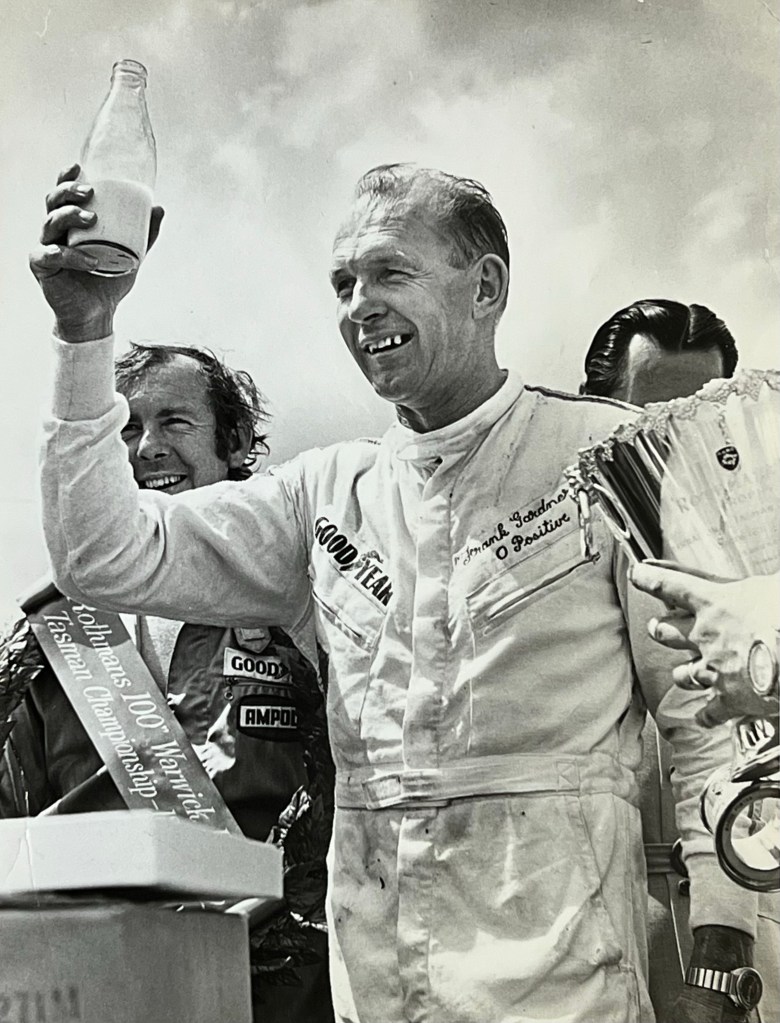
Winners are grinners! FG with Frank Matich behind at left and the distinctive Brylcreem upper dome of Jack Brabham at right (I Smith)(R Cranston Archive)
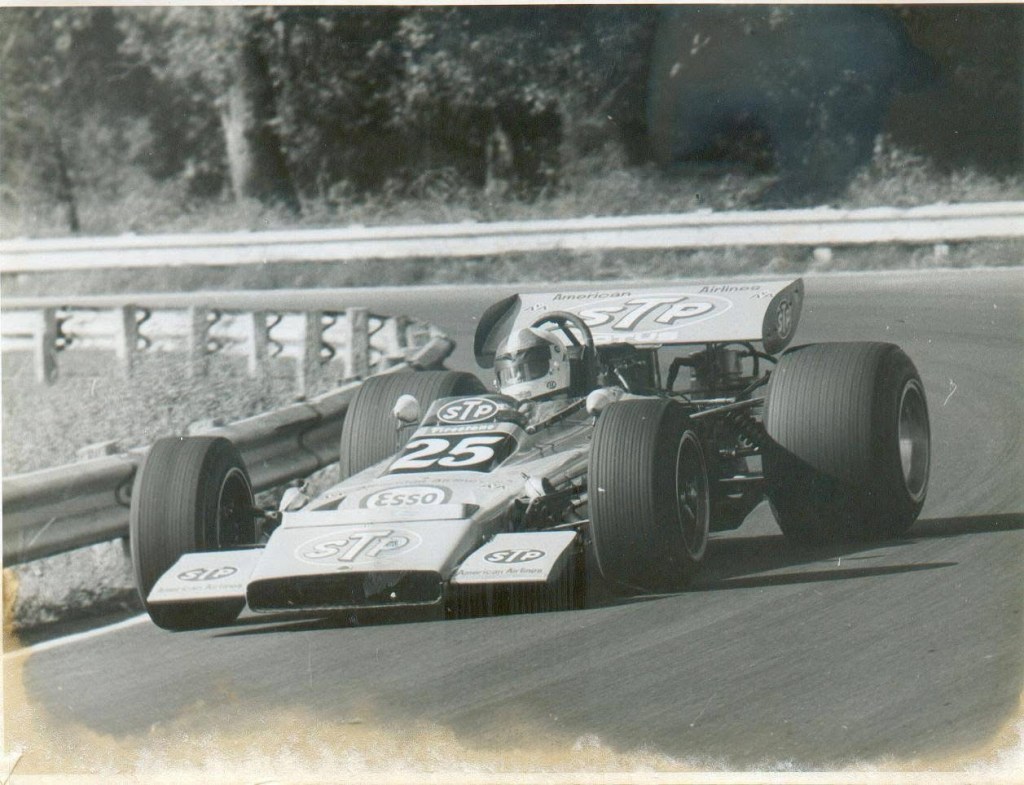
Chris Amon’s Lotus 70 Ford was the Lotus Components machine raced by Dave Walker in the November 1970 AGP at the Farm, then driven by David Oxton in the NZ Tasman rounds before being bought by STP to replace the March 701 Ford DFW 2.5 that Chris started the series in, but found uncompetitive.
Chris returned from commitments with his new F1 team Matra – winning the Argentinian GP aboard a Matra MS120 on January 24! – and ‘claimed ‘ the Lotus from Oxton, then having a lousy practice after suspension failure caused a prang. The car was rebuilt overnight. Chris ran in third place throughout, inheriting second when Matich retired with electrical problems.
Matich, Warwick Farm (R Cranston Archive)
After the Tasman Cup Matich made a two race US L&M Championship smash-and-grab raid with the same McLaren M10B Repco-Holden #400-10-2 at the Riverside Grand Prix and the Monterey Grand Prix at Laguna Seca in April-May 1971 for a win and second place. It gave the Americans and their highly developed M10B Chevs something to think about!
(R Cranston Archive)
Niel Allen from Keith Holland in another M10B – McLarens/Trojan Cars sold a lotta M10s! – Keith was ninth in the race and 11th in the series.
Local boy – and leader of the Tasman Cup on 24 points when the circus arrived in Australia – Niel Allen had handling problems with his McLaren M10B Chev during practice and could only manage Q8.
Allen and Kevin Bartlett, Milden Chev, diced throughout the race until Niel left the track after going too deep into Creek trying to keep KB at bay just after Graeme Lawrence’ Ferrari 246T blew an oil filter and liberally coated the track with Shell lubricant.
Allen, Warwick Farm (R Cranston Archive)
Allen left Warwick Farm for Melbourne with a five point championship lead from Graham McRae’s M10B Chev and bounced back in practice putting his car on pole on quick Sandown Park. Things turned rapidly sour when a small stone ingested on the pace-car parade lap before the start chewed at a piston. He led until lap 20 when McRae took over and won the race.
The Tasman Cup was a Surfers Paradise shoot-out between Allen and McRae which was decided in Graham’s favour when Niel blew a radiator hose after completing eight laps having qualified on the outside of the front row alongside Matich and Gardner.
Matich won from pole, Gardner was second and McRae third, and with it came the first of McRae’s three Tasman Cups: 1971-72-73.
Allen, Warwick Farm (R Cranston Archive)
Having given racing his very best shot – three Tasman Cup round wins in 1970-71 including the ’71 NZ GP at Pukekohe – Niel Allen retired from the sport selling his M10B #400-02 to Kevin Bartlett who had it in time for his ’71 Gold Cup campaign. Niel’s abortive brief flirtation with Lola T300 #HU4 at Warwick Farm in December 1971 duly noted…
See here for a summary of this car’s life: https://www.oldracingcars.com/mclaren/m10b/#id-M10B/02 Note that the summary is incorrect in that both the ‘Allen M10Bs’ were restored for Alan Hamilton by Jim Hardman in Melbourne. 400-02 is owned by Joe Ricciardo in Perth and 400-19 by the Estate of Alan Hamilton.
Etcetera…
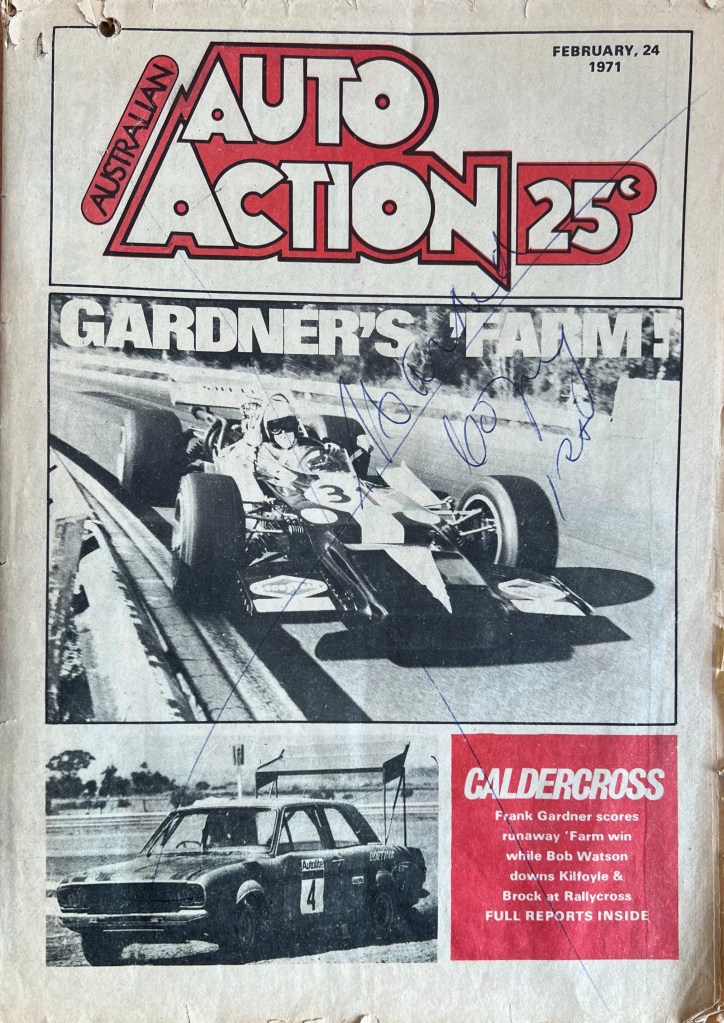
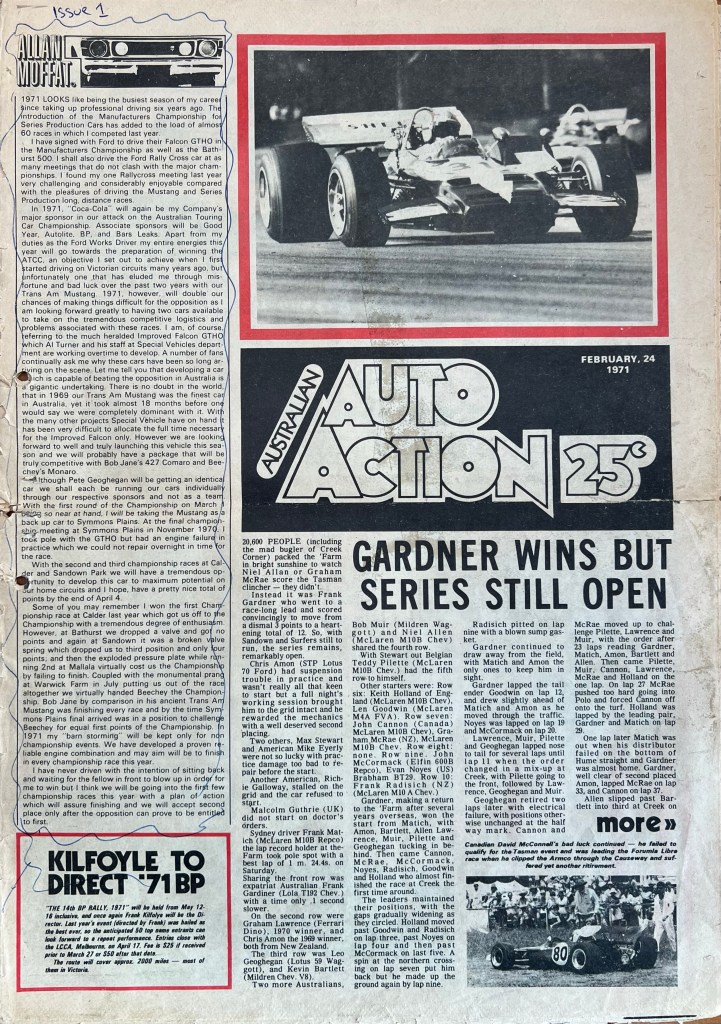
Shortly after I posted this piece, the forever prominent Melbourne-based photographer Ian Smith gave me a shout to remind me that this meeting was the front-page feature of the very first Auto Action,published on February 24, 1971.
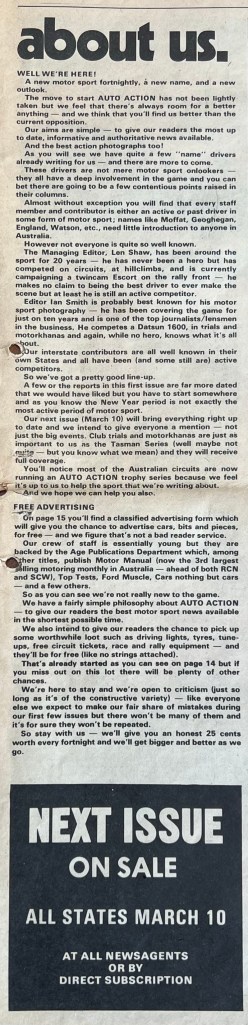
Ian was the first editor and everything else, ‘I took most of the photographs and wrote most of the articles!’
Auto Action is still going strong as a free fortnightly online racing news mag, and as a $15 features-based 132-page printed magazine. Many of you may be aware that I have a regular gig there.
Who came up with the name Ian? ‘The Age/Syme Magazines Len Shaw, Motor Manual Editor Tim Britten and I were kicking ideas around and it was Tim who offered up ‘Auto Action‘, and that was it, we all thought that was a beauty.’
‘In those early stages, the magazine was laid up and assembled in The Age premises in the Melbourne CBD, then I jumped in the company’s Kingswood and blasted up to Shepparton, where it was printed. It was distributed nationally from there. Nothing at all like today’s processes.’
Auto Action is still going strong, despite markets internationally being littered with the carcasses of magazines of all sorts. In Australia, only Wheels is older, give us a go, folks, the current iteration of the publication is world-class these days, bias hereby recognised!
‘At that Warwick Farm meeting, I can remember walking around the car park putting Auto Action leaflets on car windows, letting everybody know when the next issue was on sale. New South Wales was Racing Car News‘ home ground, the market leader then. ‘
Credits…
Robert Cranston Archive, Allen Brown’s oldracingcars.com, Bruce Sergent’s sergent.com.au, Ian Smith, Auto Action
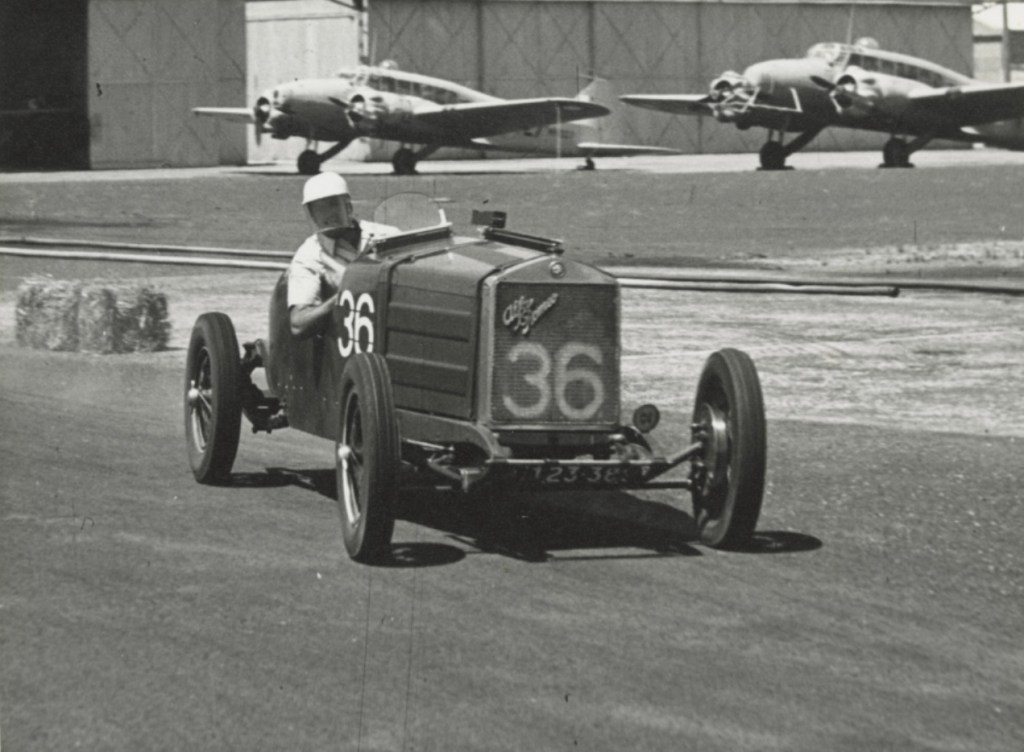
Lex Davison in the Little Alfa – Alfa Romeo 6C 1500 s/c Spl – at Ballarat Airfield with RAAF Avro Ansons in the background.
He is contesting the 75 mile Victoria Cup held on the Australia Day holiday, January 27, 1947.
The race was the first post-War ‘state level event’ held in Victoria and was promoted jointly by the Light Car Club of Australia and the Victorian Sporting Car Club.
(G Thomas)
Doug Whiteford won the handicap race in Black Bess, his Ford V8 Special which was at the start of a long run of success.
The caption says Fishermans Bend but it looks more like Altona to me, one for those with a programme collection. And below Ted again, Alta 21S Ford V8 Spl this time during the 1954 Victorian Trophy at the Bend on March 22, 1954.
It’s alive and well too, restored by Graham Lowe several decades ago, it’s used regularly on road and track by current custodian, Fiona Murdoch. I’ve driven it too, in March 2023, for articles published in The Automobile and Benzina. And yes, it is sen-‘kin-sational.
(G Thomas)
Reg Nutt aboard an MG NE Magnette Ulster, outside the Nutt/Jack Day premises in Whiteman Street, South Melbourne.
Greg Smith comments, ‘White street South Melbourne features to note : 16″ rear wheels, 18″ or 19″ front wheels, brakes still cable operated, door fitted to the original body maybe to comply with the CAMS draconian rule (what has changed since its inception in 1953 ? nothing!!) that “sports cars” must have a door of minimum dimensions.Tyres nearly bald. Expensive push bike leaning against the wall with the owners Gladstone bag on the footpath, maybe the photographer ?? Two fuel tanks out in the sun sweating the fumes out before solder repairs. The car was ex-Barraclough and very scruffy by this time.’
Nutt was both a master mechanic and driver with a pedigree going back to Phillip Island’s early days. He was Reg Brearley’s riding mechanic in 1929 when the pair placed second in a Bugatti T37A.
Better was to come when he won the race in 1931 alongside Carl Junker aboard a Bugatti T39 in 1931. T39-4907 is the very car shown below raced Jack Day’s Day Special (the car below) in the South Australian Grand Prix referred to above on daunting Lobethal, setting the fastest race time for that handicap race, and the following day did the fastest lap of the weekend…he could drive.
He got the bug early, recounting to Bob King memories of a Bugatti Brescia while doing his apprenticeship at Meaby’s Garage in Toorak Road, South Yarra.
The Day Special was Bugatti T39-4607 fitted with a Ford V8 and other modifications (G Thomas)
Apart from his on-track exploits in this car, Nutt gave Norman Ellsworth the ride of his life, when towing Ellsworth’s just purchased Bugatti Brescia back from Adelaide to Melbourne.
The deal was that Reg would tow the car through the many country towns on the long trip as the Brescia was unregistered. But Reg ‘forgot’ about the Bugatti on the end of the tow rope and did several miles outside Dimboola at well over 100mph. Ellsworth’s reaction is unrecorded!
What an evocative shot of the business end of the brilliant Wylie Javelin Spl…
The gent in the Akubra makes the shot. Perhaps it’s the ’53 AGP weekend at Albert Park but that’s a guess. That looks like a rego-sticker on the windscreen! See this lengthy epic: https://primotipo.com/2018/09/14/the-wylies-javelin-special/
Arthur Wylie at Altona in 1954 (SLV)(SLV)
A D.F.P. out front of a home, probably in Melbourne, chassis number and street address please!? It has a touch of the Elsternwicks about it but could be anywhere.
The marque were in on the ground floor of racing in Australia, Les Pound finished last in the 100 Mile Road Race run by the Victorian Light Car Club in March 1928, the second Australian Grand Prix.
Reg Hunt enroute to winning the scratch-section of the Bathurst 100 during the 1955 Easter weekend at Mount Panorama, Maserati A6GCM-250.
Despite having only his short-diff fitted the Grand Prix car still did 145 mph down Conrod.
The handicap winner of the race was Curley Brydon in his new MG Special; a mix of the ex-Tomlinson ‘39 AGP winning chassis and the supercharged engine from Brydon’s ex-Patterson TC Spl.
Manchester born Reg Hunt tootling through the Fishermans Bend paddock in his Hunt Spl aka The Flying Bedstead, date unknown but 1951 perhaps.
The Hunts arrived in Melbourne in May 1949 with Reg bringing with him various parts accumulated in the UK which he used to build this hillclimb /road racer affectionately known as the Flying Bedstead.
It was built between May-October 1949 by Hedley Thompson either in his Deepdene, Melbourne home garage or as a homer at Trans Australia Airlines, where Hedley was head of maintenance.
Thompson’s thoroughly modern chassis was a shallow multi-tubular spaceframe of welded steel construction. It had a light, tringulated front bulkhead and a more substantial rectangular one at the very rear of the car just aft of the gearbox.
Front suspension was modified Morgan pillar, and the rear comprised an upper transverse rear spring, swing axles and an underslung tubular shock absorber mounted at its top to the underside of the axle case and at its bottom to the chassis.
Bolt-on wire wheels were 3:25 inch x 18 at the front, and 3:50 inch x 19 at the rear. The ultra-light machine had hydraulic brakes with two leading shoes at the rear.
The engine was an Amal-fed 500cc J.A.P. (J.A. Prestwich) speedway engine with the power hitting the road via a Norton four-speed box.
The Flying Bedstead’s first outing was at Fishermans Bend in October 1949, where it was noticeably quicker and outclassed the numerous MG specials present. Some weeks later, at Rob Roy, it lowered the class record by nearly six seconds, to 31.4 seconds. In March 1950 he improved his time to 29.35 seconds.
Other successes followed, and soon a supercharged 998cc Vincent Black Lightning engine was fitted by Phil Irving, and the bodywork was improved; the form shown above.
‘First used in this guise at Bacchus Marsh in July 1951, at Bathurst in October it outpaced a Cooper Vincent in the first race and was pipped on the last lap in the second. The speed over the flying ¼ mile was reported at 134 mph.’ Really?!
When Hunt raced Cooper 500s in Europe in 1954, he made a side-trip to Italy on the way home and purchased the ex-works Maserati A6GCM shown above, so the Bedstead was set aside and later sold. Hunt repurchased it in 1978, and it was ultimately restored under his supervision, then later sold at auction and is extant.
(SLV)
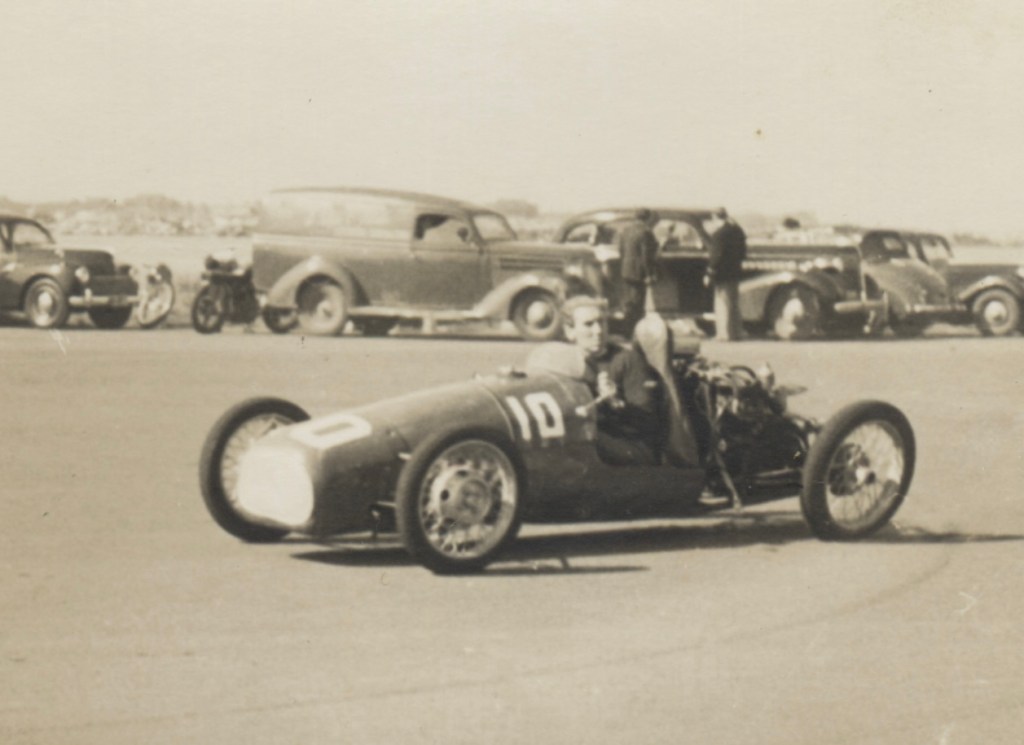
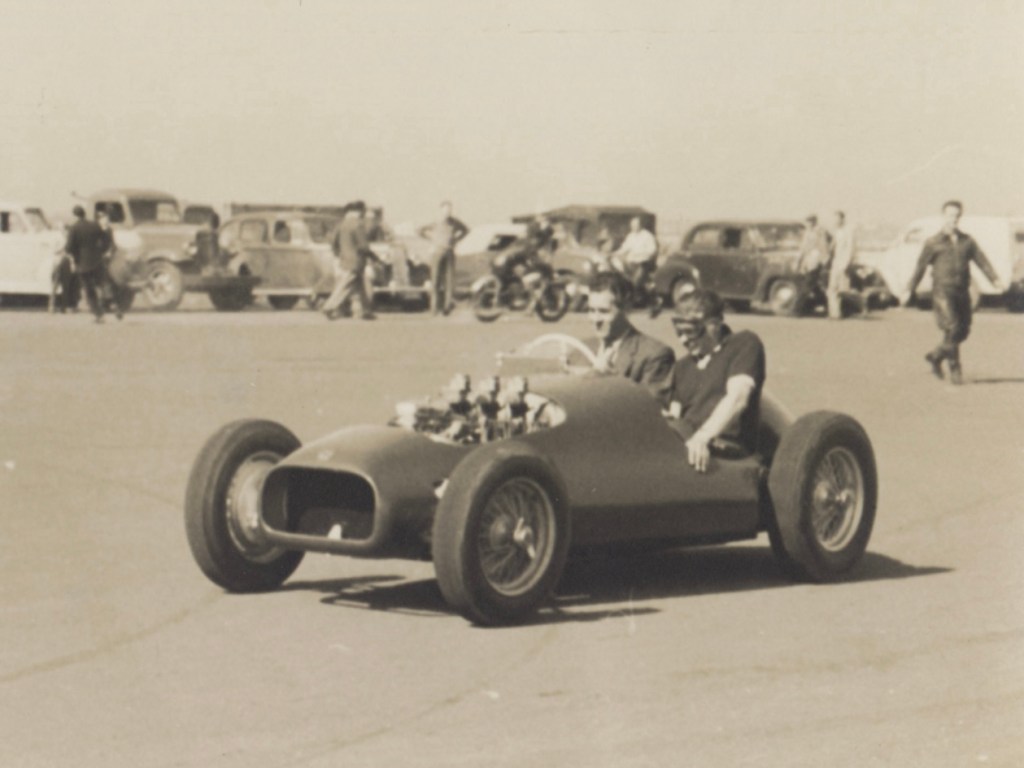
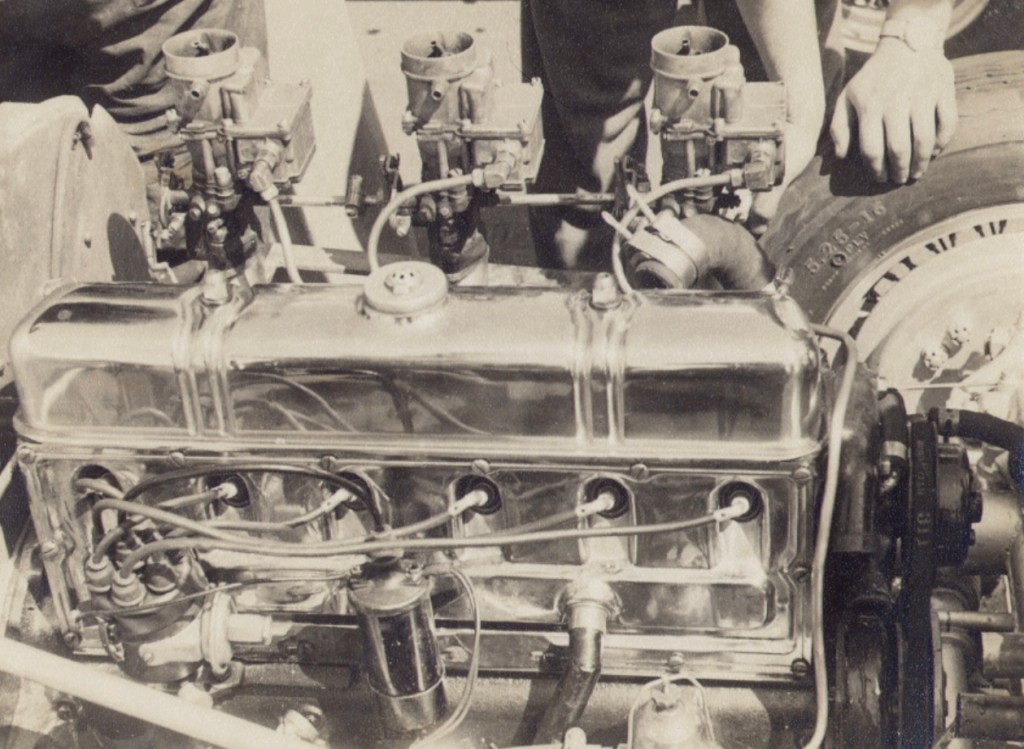
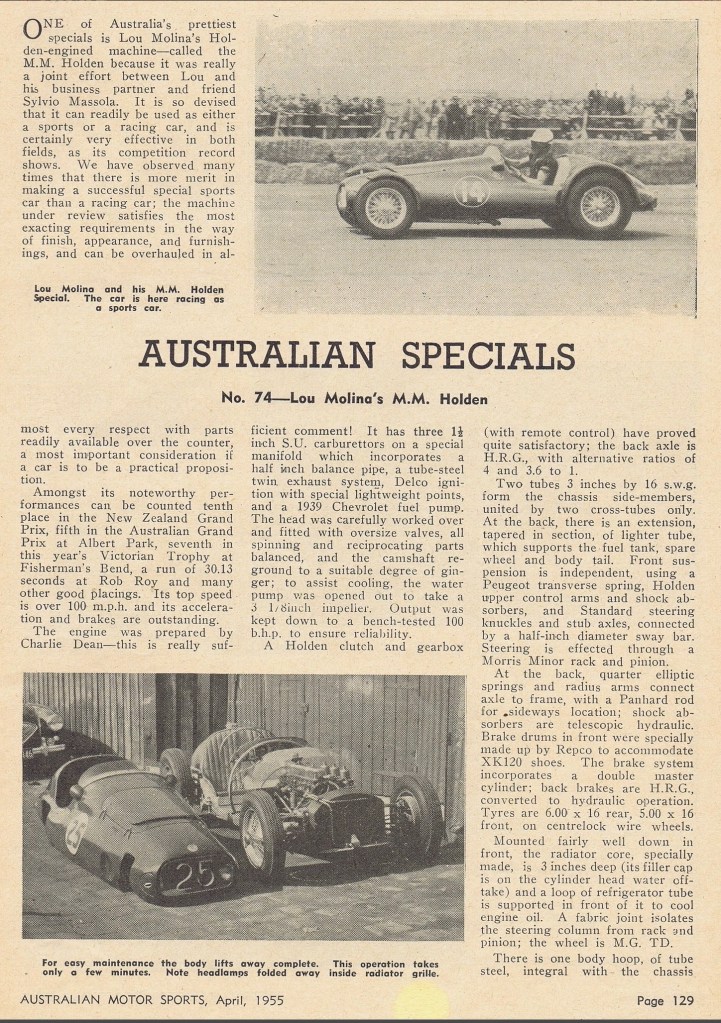
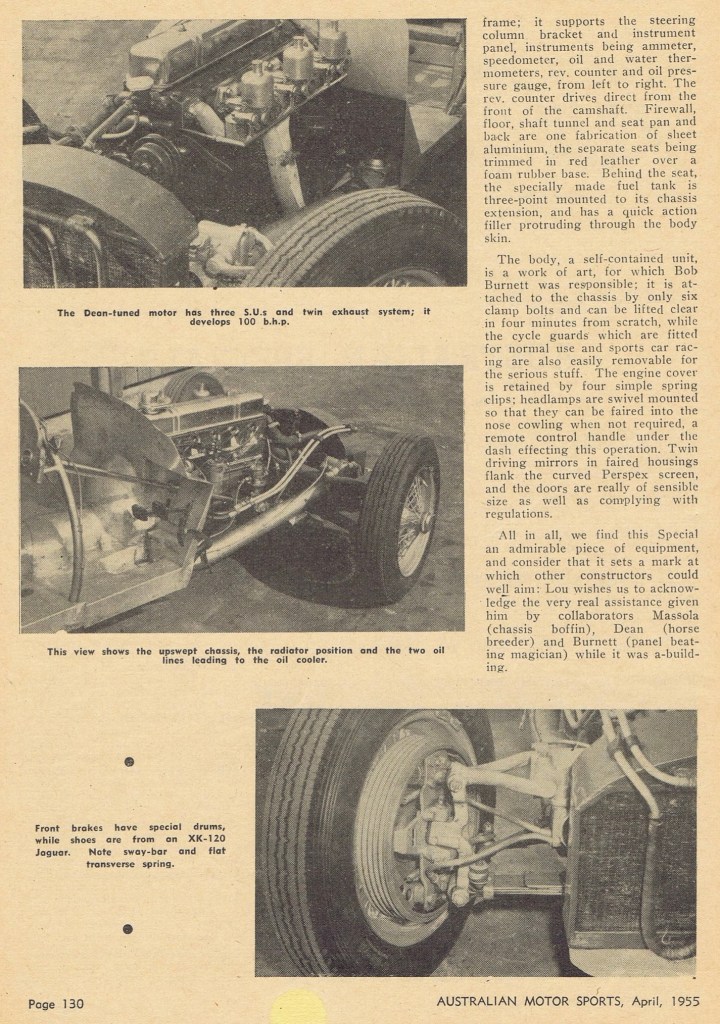
Conceived in Lou Molina’s Albert Park backyard the MM (Molina/Massola) Holden consisted of a Silvio Massola home-made chassis, Standard 12 front end, H.R.G differential and gearbox, Holden Grey six-cylinder engine and an attractive body made by Brian Burnett.
The MM had its first outing at Fishermans Bend on October 3, 1953, and I’m wondering if that’s when this photo of Lou and a Victim tootling around the paddock was taken?
MM Holden was initially fitted with triple Stromberg carbs, later replaced by SUs (SLV)
Lou then contested the November 21 1953, Australian Grand Prix at Albert Park where he was an amazing fifth in the 64-lap 200-mile event won by Doug Whiteford’s Talbot-Lago T26C. The 2290cc MM Holden started from grid 30. The car appeared exactly as it is in the photograph above, sans bonnet and with triple-Strombergs pointing loud and proud at the sun.
The MM raced the following year at the January 1954 New Zealand Grand Prix with Molina competing alongside other Australians including Jack Brabham, Stan Jones, Tony Gaze and Alec Mildren. On this occasion, the MM was not successful, retiring early with mechanical problems. Stan Jones won the day of course in another rather famous Australian special
Amongst other notable runs, in 1956 the MM finished in the top six at the Argus Cup at Albert Park and clocked 15.3 seconds for the standing quarter mile at the Geelong Sprints.
Greg Smith has given me a shedload of material about this car from Lou’s Archive, I really must do something on the two Molina Specials soon.
And below, the MM Holden and an MG?, before the off at Fishermans Bend.
(SLV)(Peter D’Abbs)
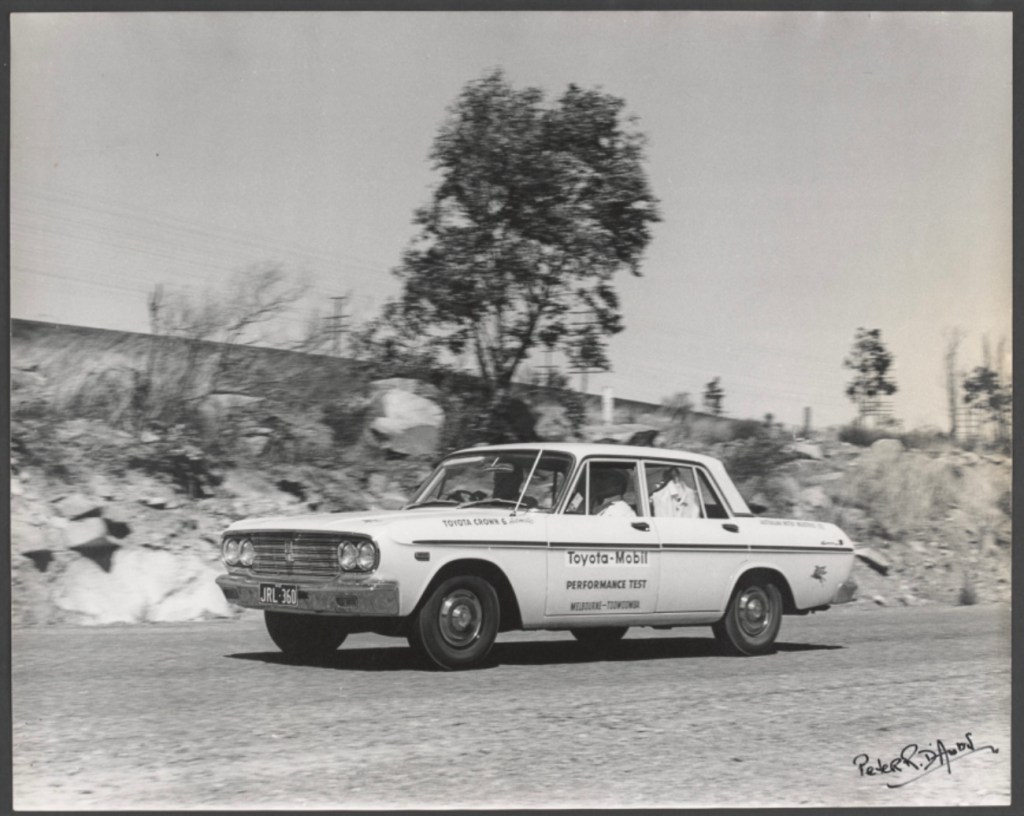
The Mobil sponsored Toyota Melbourne-Toowoomba Performance Test in 1966, Toyota Crown. It was still at the stage that ‘The Japs’ were convincing Aussies about the durability of their cars I guess, they succeeded rather well!
(H Coulson)
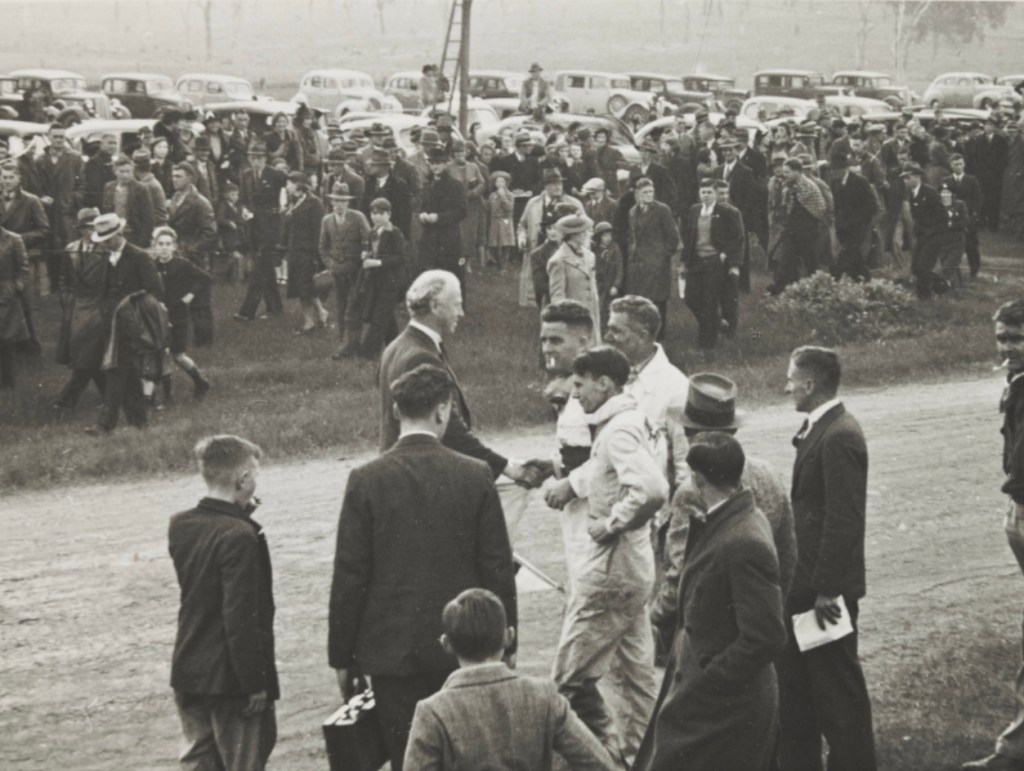
This looks awfully like Jack Phillips and Ted Parsons after one of their Interstate Grand Prix wins at Wirlinga, Albury in 1938 or 1939. Jack – with the post-race fag – still has his kidney-belt on.
Charlie Dean well and truly on the gas during this ascent of Rob Roy in Maybach 1, date unknown. Right front on the track’s verge and right rear well and truly on the roadside.
Dean’s series of three Maybachs were labelled Maybachs 1, 2 and 3. M 3 was christened M 4 when that car/chassis was modified by fitment of a 283 Chev V8 in place of the Maybach SOHC six and other changes, mainly to the rear suspension. These cars were great crowd pleasers from their first appearances in 1948 until the last in-period races of Maybach 4 Chev in the hands of Ern Seeliger and Stan Jones in 1958-59.
(SLV)
One of the great shames is that a Maybach never won an Australian GP, karma suggests that this shouldn’t be the case but shit-happened on those particular big days. Stan Jones’ 1954 NZ GP win – truly a great team effort – is duly acknowledged…More about Maybach 1 here: https://primotipo.com/2024/01/15/maybach-1-technical-specifications/
(SLV)(G Thomas)
Alf Barrett at Ballarat aboard his superb, aristocratic Alfa Romeo 8C2300 Monza, during the 1947 Victoria Trophy.
This is another combination that shoulda-coulda-woulda but never did win an Australian GP. The fastest combination in the immediate pre- and post-war periods is the descriptor that would have to do.
The centenary of the first Australian Grand Prix takes place in 2027, good news is that the current custodians of this car: Grace, Troy and Lindon Davey-Milne have its restoration underway and with a bit of luck it will take its place in the on-track centenary celebrations or as a static exhibit at Goulburn and Phillip Island in 2027-28.
‘Sydney to Melbourne 750 miles by car in December 1927’, is the caption. Make of car folks? They certainly did it the long way, and the hard way no doubt.
State Library of Victoria and photographers George Thomas, ‘Bathurst : Cradle of Australian Motor Racing’ John Medley, Hal Coulson, Gladys E Moss, JP Read, Australian Motor Sports
Tailpiece…
(G Thomas)
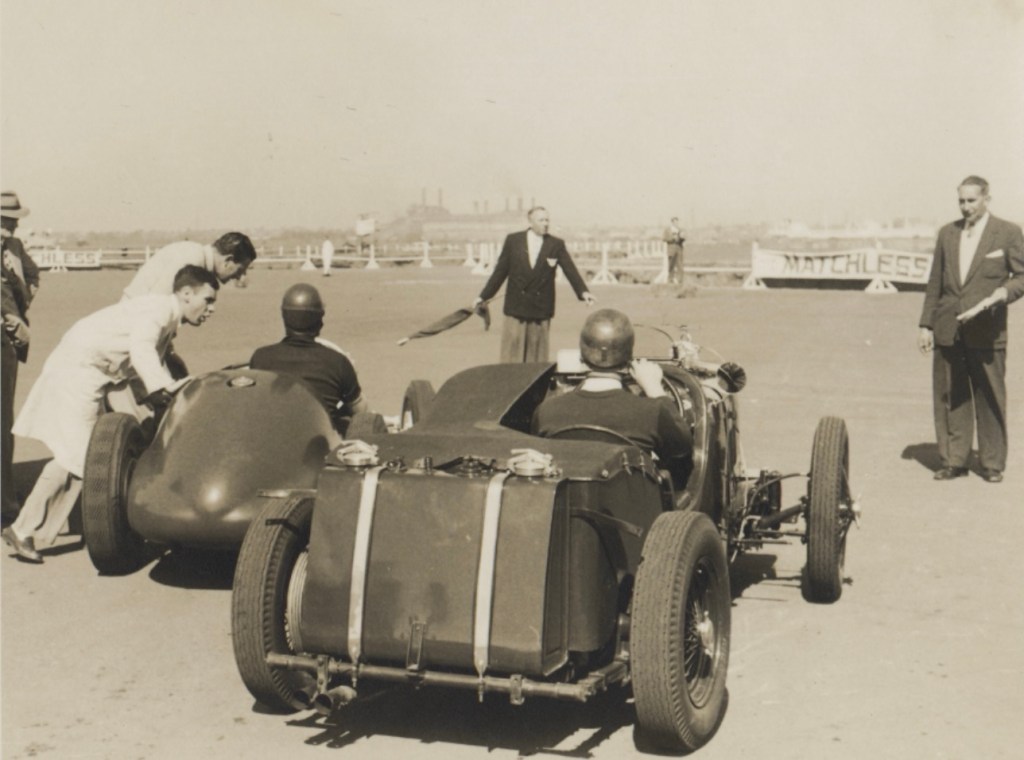
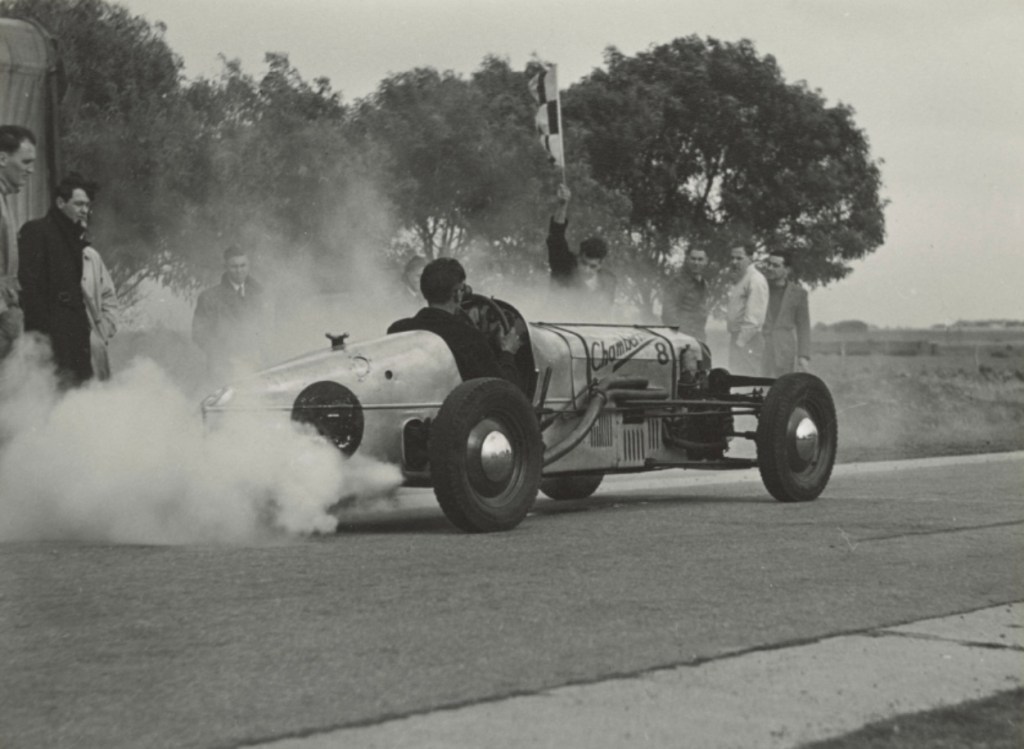
The starter drops the flag, can you see him among the clouds of two-stroke smoke!?, for Jim Hawker and the Chamberlain 8, VSCC Speed Trials, Geelong Road, June 1947; tree-huggers eat yer’ heart out.
The features of the Chamberlain brothers’ crazy-brave pre-war special included a small-tube spaceframe chassis, independent front and rear suspension, front wheel drive and eight-piston, two-stroke, supercharged 1.5-litre engine. See here: https://primotipo.com/2015/07/24/chamberlain-8-by-john-medley-and-mark-bisset/
Legendary Australian Touring Car racer/engineer/tuner/team manager/CAMS politician Harry Firth ascends Rob Roy aboard a Cisitalia D46 in 1958. What a magic, crisp pan shot.
This ex-everybody car never did much in Australia. Its arrival more or less corresponded with the end of our long handicap racing era, and we didn’t have the right class for the car, 1100cc events here and there duly noted.
‘Only months earlier (May 4, 1958) Reg Nutt took the borrowed Leech Cisitalia to the top of the Hill in 28.30 secs. Now it was Harry’s turn however he couldn’t match Reg’s time. Harry’s time of 29.52 secs was more than 1 sec slower. But Harry probably won the most money on the day driving a Hillman for a second, Triumph TR2 for a first and the Cisitalia for a second,’ wrote Leon Sims.
Firth prepared and raced plenty of sportscars before his highly successful 1960-80’ish tourer-era but he didn’t race many monopostos? That SU carb doesn’t look kosher on an Italian car either, surely it didn’t arrive here so equipped…
(G Hill)
Leon Sims, ‘This photo is from our (MG Car Club) second annual historic and classic meeting Feb 28, 1994. From the left: John Crouch, AGP winner, Australian Hillclimb Champion and Australia’s Cooper distributor in the 1950s. Harry Firth, multiple class winner and class record holder at Rob Roy. Bill Prowse, Rob Roy competitor from the 1947 LCCA years and also MGCC years.’
(L Sims Archive)
Credits…
Leon Sims, The Age via Leon Sims Archive, Gary Hill
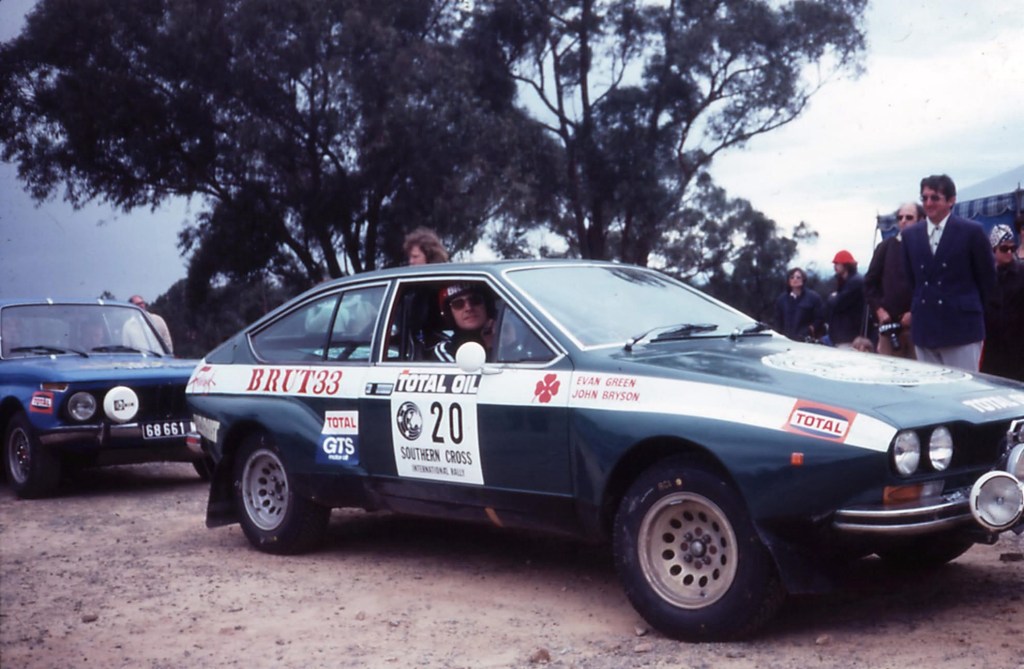
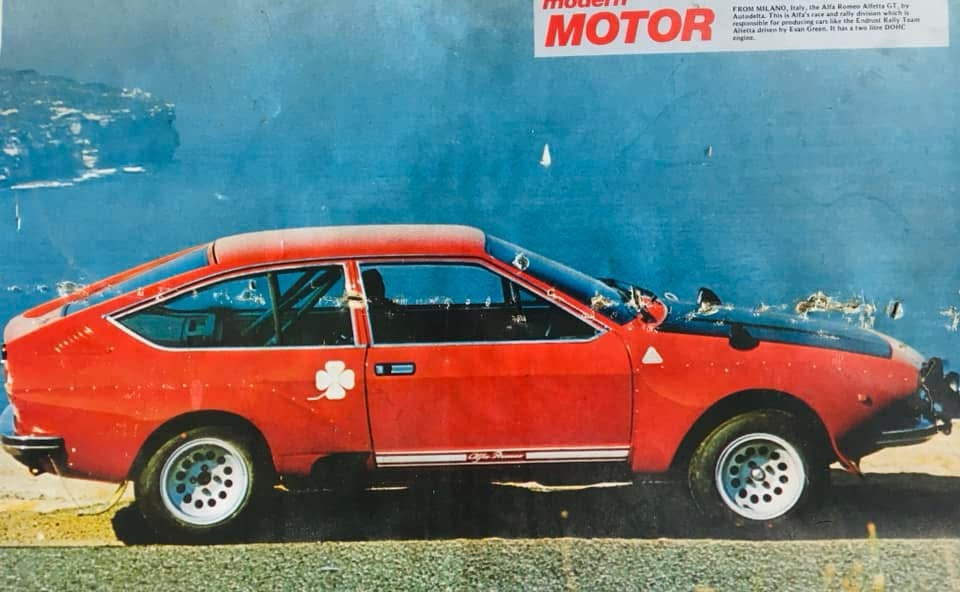
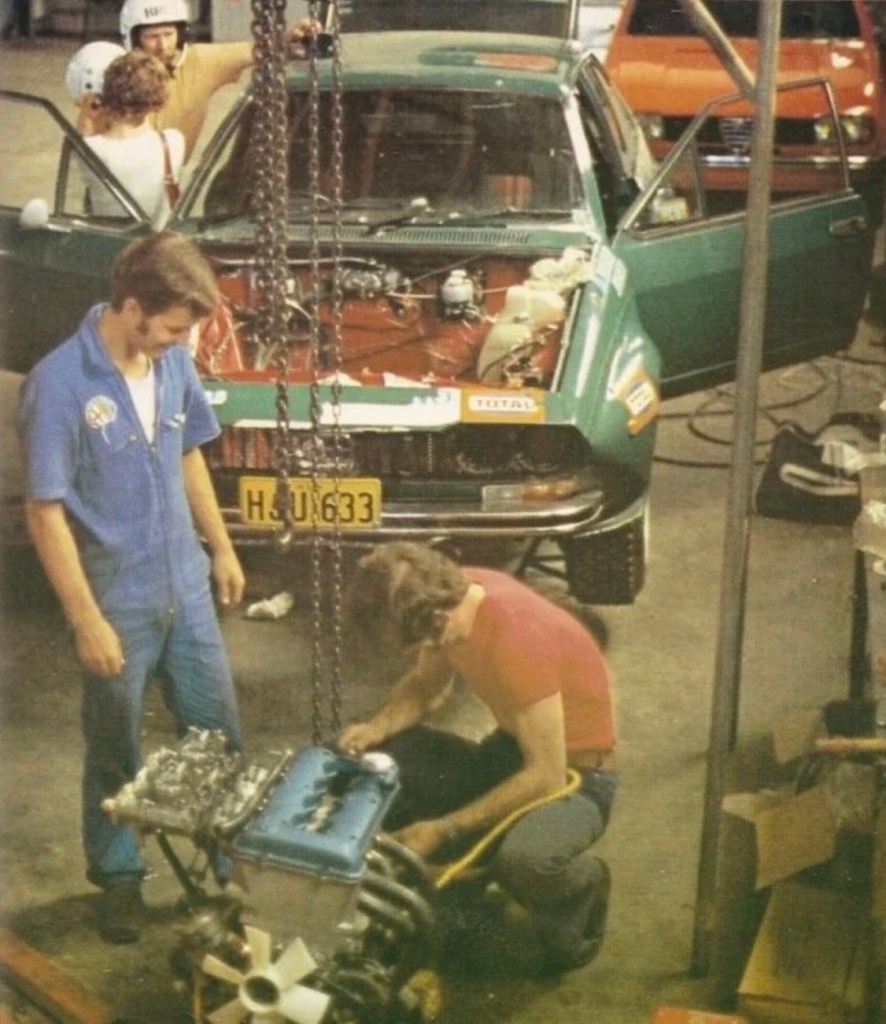
Evan Green, Autodelta built Alfa Romeo Alfetta GT before the 1976 Southern Cross Rally (P Burley)
One of the many interesting automotive escapades in the life of Australian rally driver/PR operative/journalist-author/broadcaster/entrepreneur Evan Green was his purchase of an ex-works Alfa Romeo Alfetta GT in 1975.
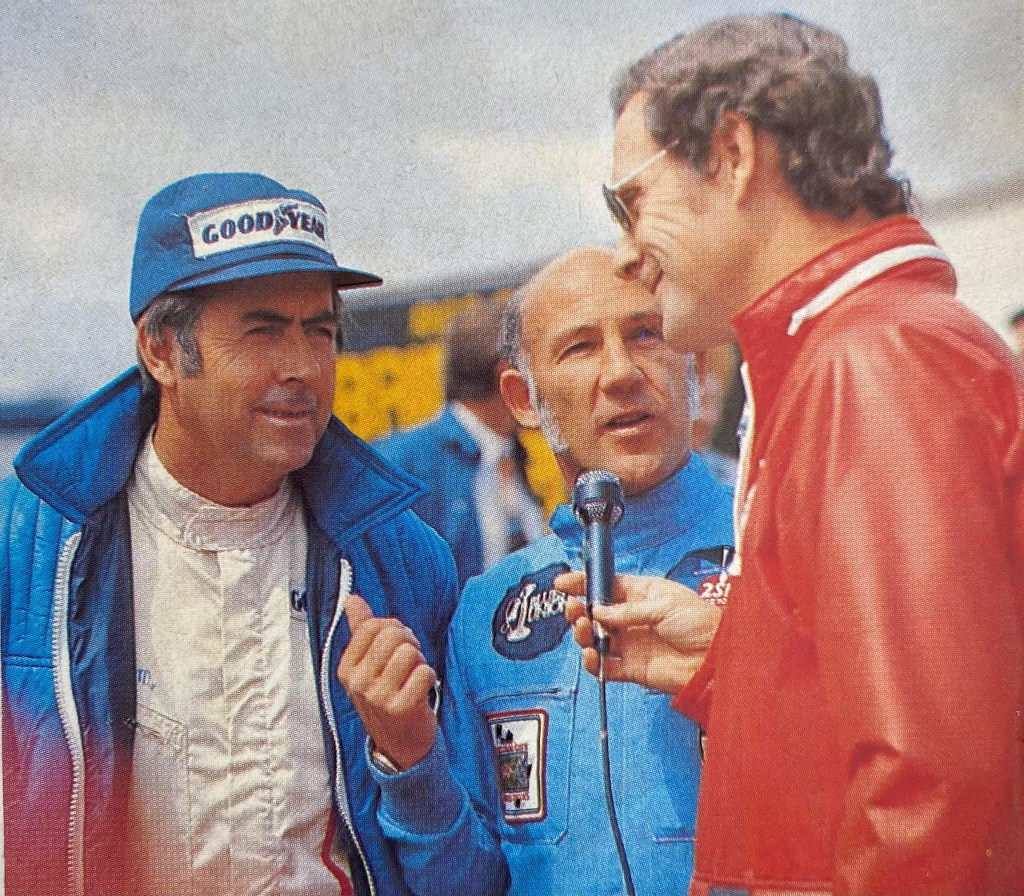
Evan Green on Channel 7 duties with Jack Brabham and Stirling Moss during the 1976 Bathurst 1000 weekend…before the start by the look of it! (unattributed)
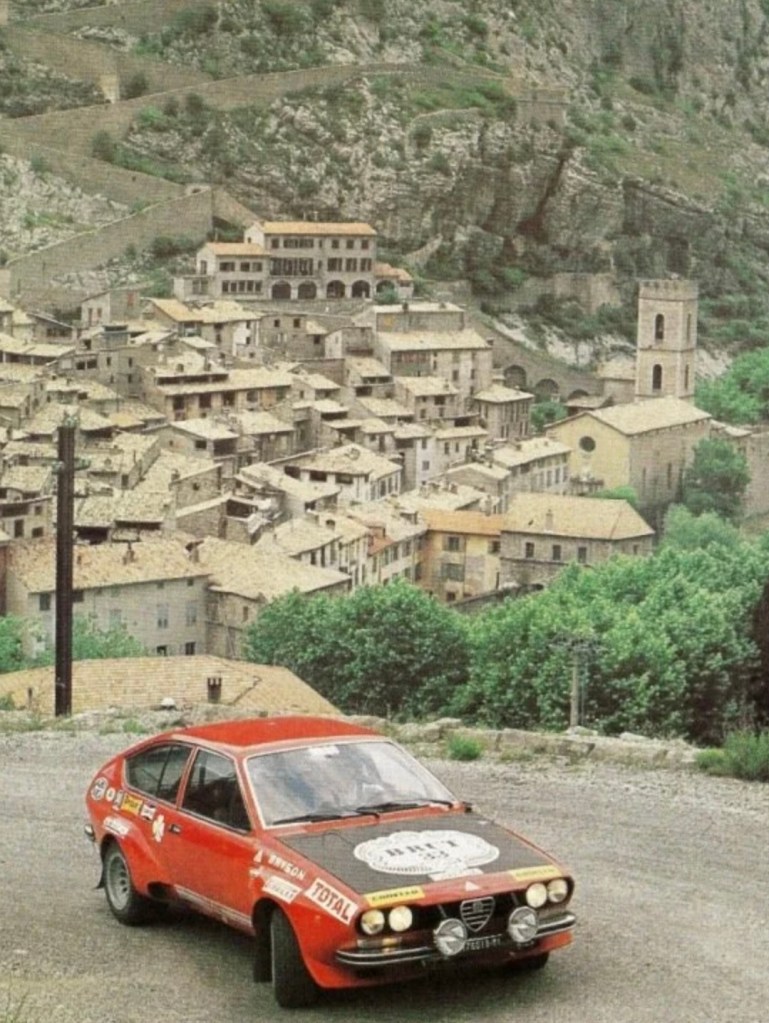
Green ran a Leyland P76 V8 with some commercial support from Faberge-Brut – remember that ‘orrible-stench!? – and parlayed that commercial relationship into the purchase of one of the nine Group 2 Alfetta 2-litres built by Autodelta in time for the 1975 season: for competition in the (third) World Rally Championship, European Rally Championship and perhaps a national championship or two.
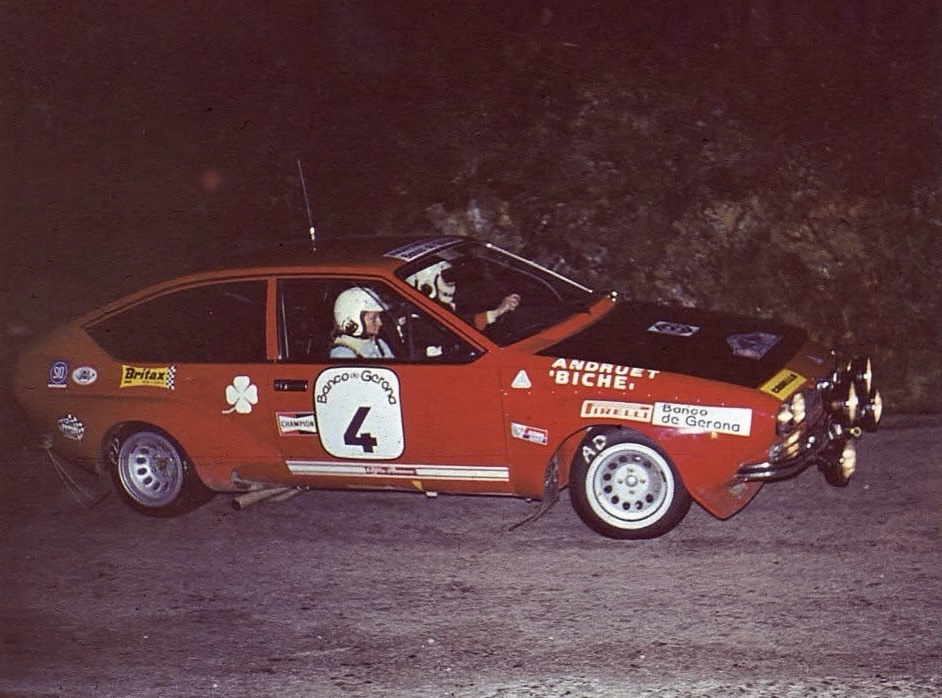
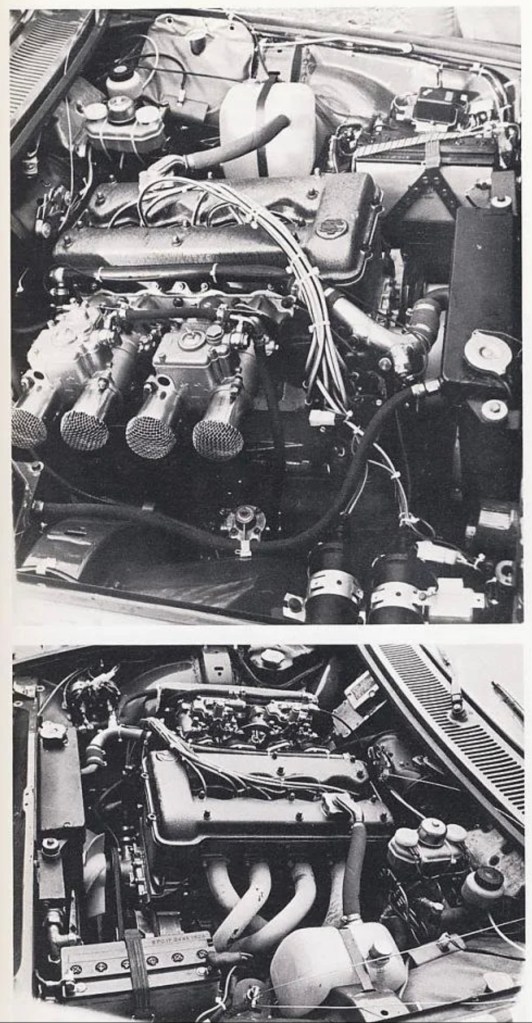
Rally Costa Brava 1975, Alfetta GT Gp 2 Andruet/Biche (unattributed)Period under bonnet shots (Marque Spotlight Series)
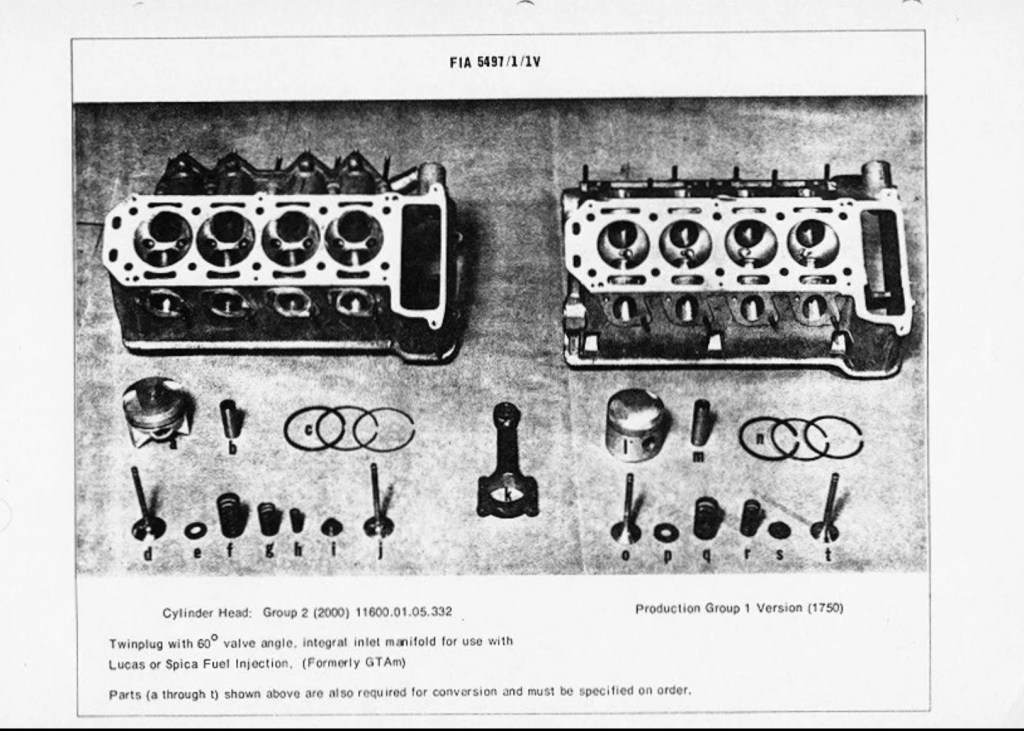
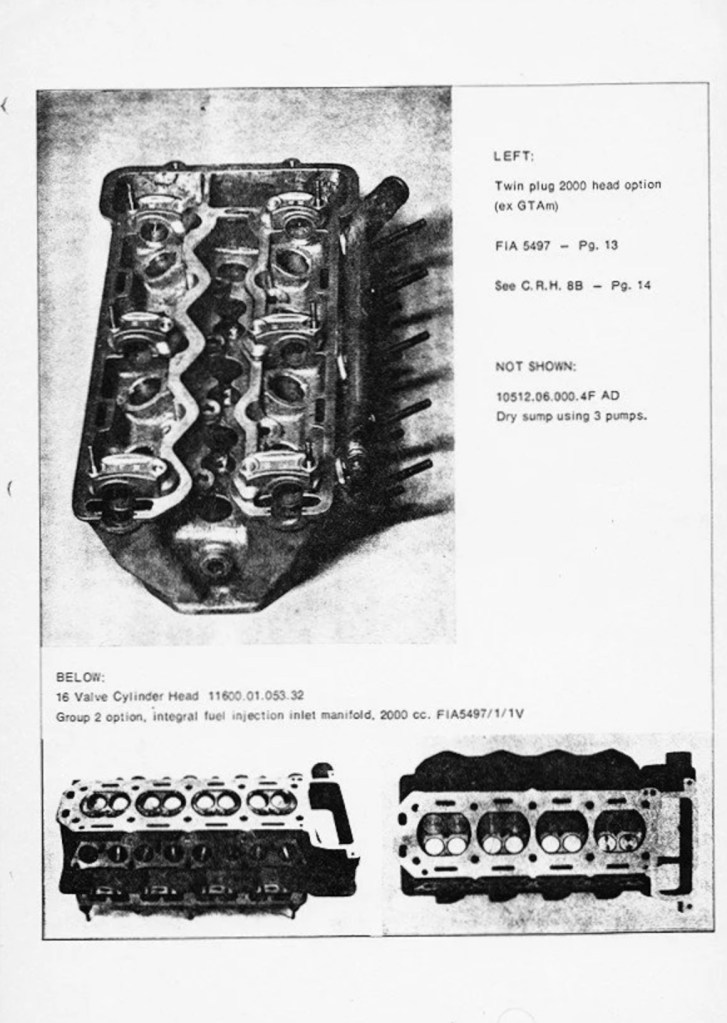
Engine capacity was increased from 1.8-litres-1779cc to 2-litres-1995cc by increasing the bore, developing around 180 bhp in two-valve spec and 210 bhp with the 16-valve head, Webers/fuel injection and special stainless steel fabricated exhaust.
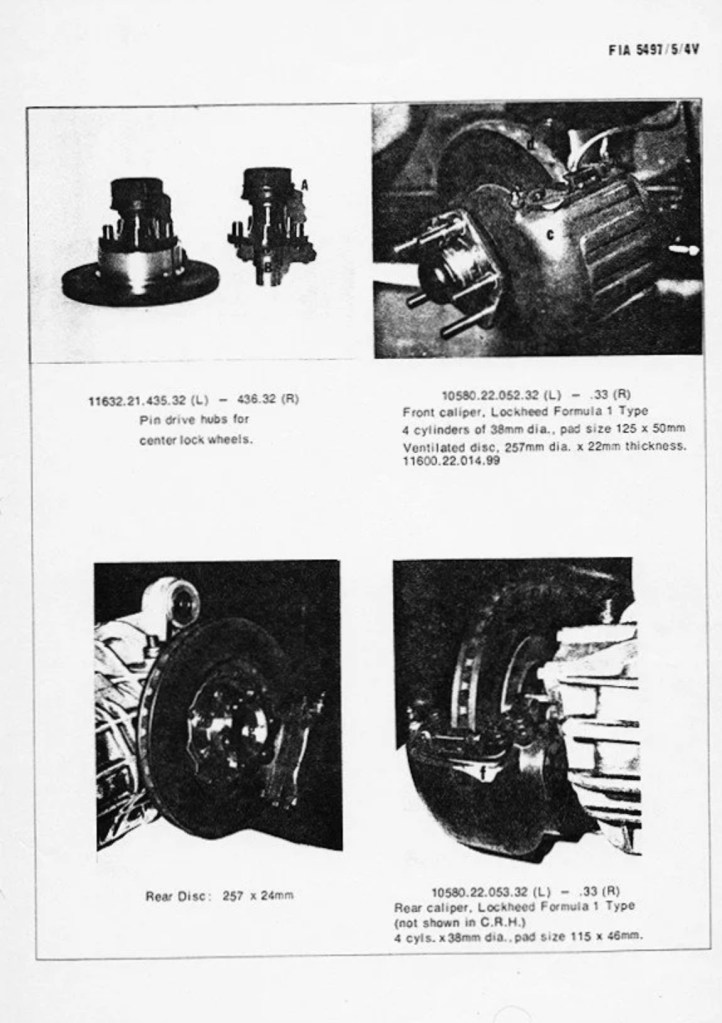
The gearbox was an Autodelta five-speed transaxle with straight-cut gears and a 50% limited-slip diff. Brakes were Lockheed calipers with ventilated rotors front and rear.
Other details of the Autodelta built Alfettas include a lightened and reinforced body, roll bar, Autodelta branded intercom, wooden gear knob, a window to access the rear shock absorbers, a battery kill-switch, Halda tripmaster, four Carello Megalux additional front headlights, widened guards, magnesium wheels and racing seats with four-point belts.
Green/Bryson Alfetta GT Rally Antibes, June 1975 (Evan Green)Carlo Chiti, Autodelta founder and chief, with the Green Alfetta upon deivery (Marque Spotlight Series)
Of the nine Autodelta Alfetta GTs two survive, but not ‘our car’, however.
The Alfa Romeo team debuted at the Costa Brava rally in February 1975. Evan Green’s machine was delivered either at, or just before the Rallye Antibes held from 21-22 June, 1975, DNF. Whether it was new or ex-works is unclear (on holiday at present, shall consult his book when I get home).
When shipped to Australia the machine was painted still painted red. ‘On the first day it arrived we took it to Middle Head for some photographs. Driving through Mosman with straight-cut gears and the short exhaust got some looks’, wrote Derek Heiler on Facebook.
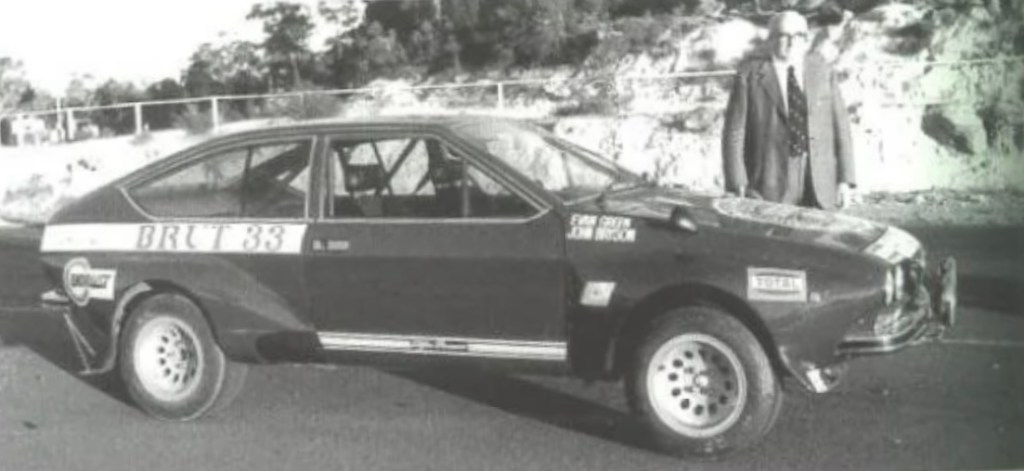
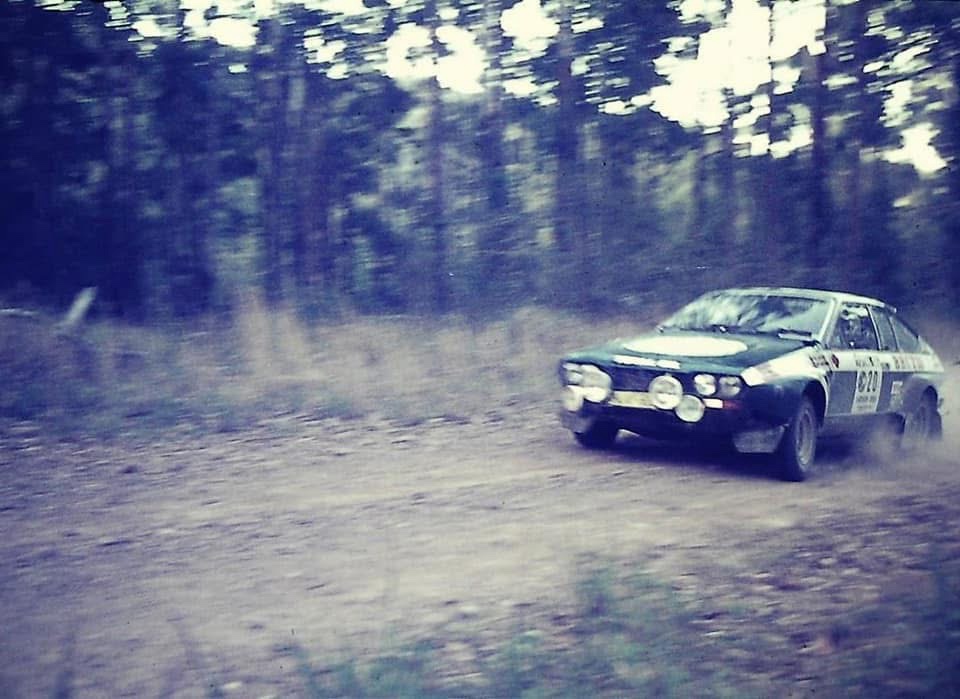
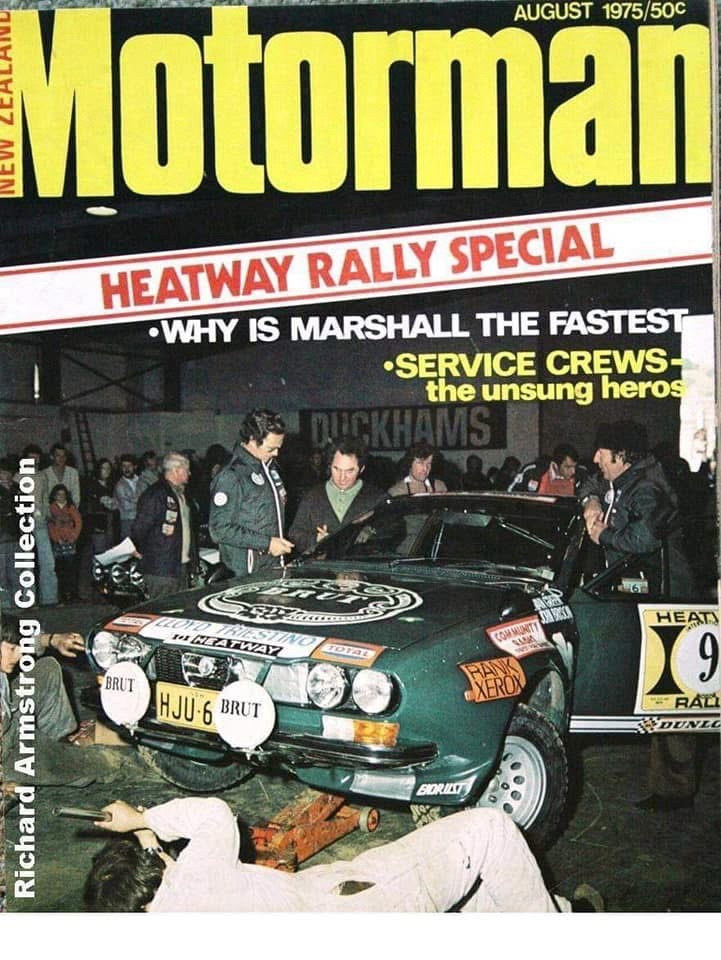
After being prepared and painted Brut blue, the Alfetta was shipped to New Zealand for the Heatway Rally held between Auckland and Wellington from 8-12 July.
Full results are unavailable but the Green-John Bryson crewed car didn’t finish. A newspaper report recorded that the car became bogged at Tokarua between Rotorua and Napier on the Wednesday night.
John Bryson was one of Australia’s most acclaimed rally navigators, with three Southern Cross Rallies alongside Andrew Cowan to his credit.
He wrote Racing Car News’ pre-1975 Southern Cross piece.
‘As most Racing Car News readers know all about the butterflies involved in doing something a little different, I hope you can understand just how I feel after breaking with a team like the Mitsubishi – and a driver as good as Cowan. As I am the one who thinks Evan is better than Andrew as a driver, and the Alfetta better than the Lancers, guess who is likely to end up with egg on his face trying to prove a point?’
‘But, more importantly, this entry is a mighty breakthrough, in that we (thanks to Endrust, Total, Lloyd Triestino and Faberge-Brut) have actually got a works-prepared Group 2 car competing in Australia. And, believe me, I want more than Japanese domination of our sport.’
Green/Bryson testing before the 1976 Southern Cross (C Pettigrew)(unattributed)
‘The Total Southern Cross rally is an international event. So, to make it International, we have obtained what I believe to be the best rally car in the world. There was a fair bit of evaluation in choosing the car. We thought of a Stratos, and we found the Escort wanting. The answer that the best is Alfa Romeo was verified by friends who know in Europe.’
‘No matter what the outcome, the Total Southern Cross Rally is going to gain a lot of publicity for Australia in Europe. If our stars are beaten, then I’ll bet a few European drivers will turn up next year with their own cars, factory standard ones, to the benefit of this sport of ours. Personally, I am hoping the lead will end up as a battle between Evan and Andrew, with the Alfa Romeo coming out on top. But, as they say, the best laid plans of mice and men “aft gang awry”.
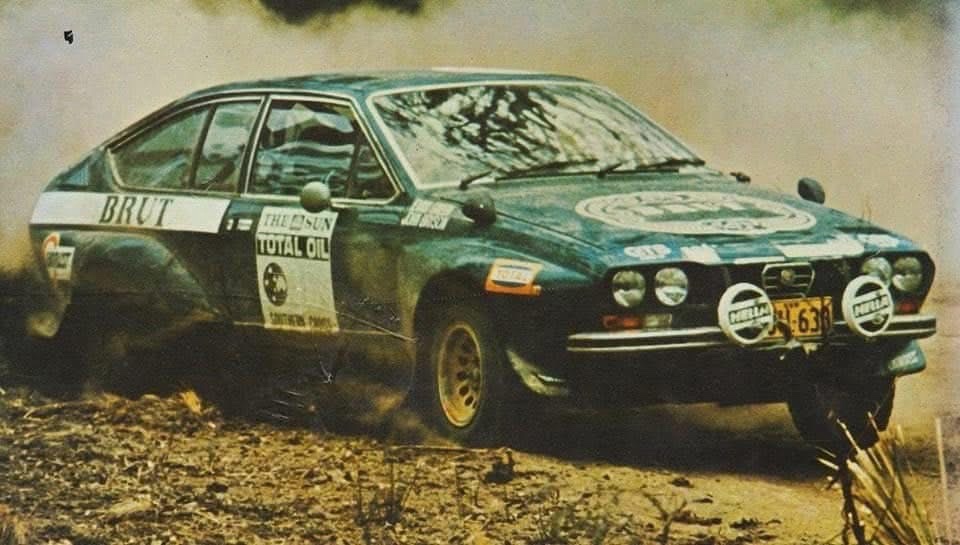
Unfortunately, the event was a disaster, Barry Lake reported in Auto Action that ‘the car didn’t make it halfway to Port Macquarie. A stick pierced a hole in a driveshaft universal joint protective boot, the oil leaked out, and the joint broke. It took their service crew over 14 hours to find them deep in the forest at Bulahdelah.’
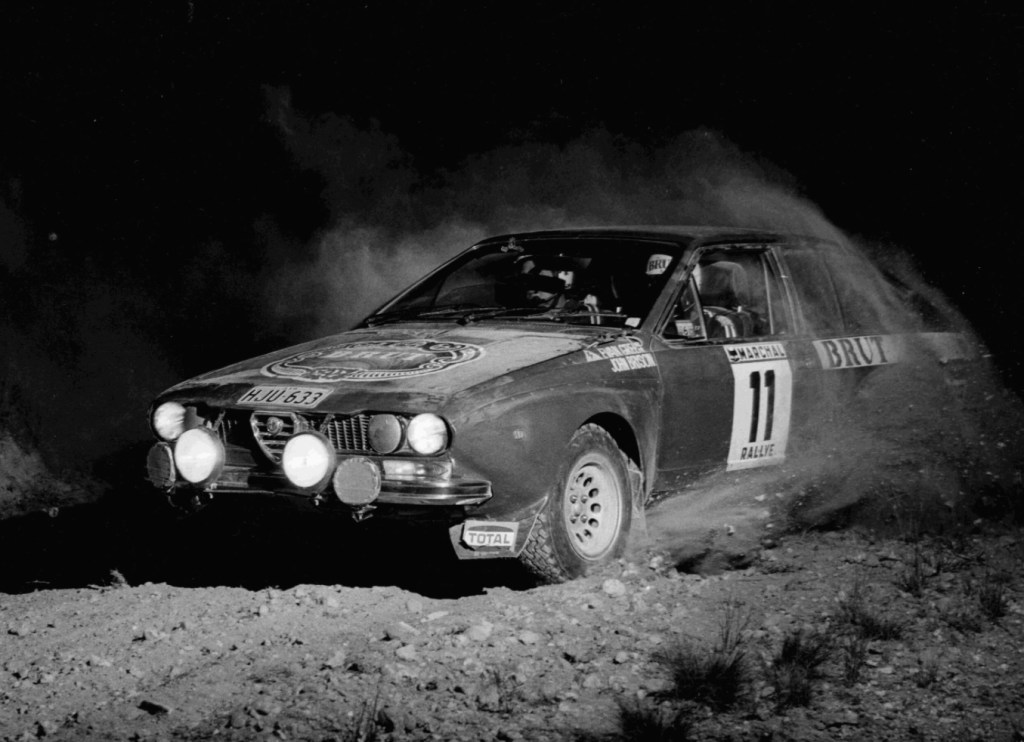
SEV Marchal Rally May 15 1976, Green/Bryson were sixth (unattributed)
In 1976 Alfa Romeo withdrew from rallying, having not won a WRC round, and sold the Alfettas into the hands of privateers.
Green and Bryson were 21st in the 1976 Southern Cross and also contested the May 15 Renault Car Club’s Marchal Rally, second round of the Australian Rally Championship.
In another poor run in countryside outside Ballarat, the duo got lost on one stage, then ran out of fuel, ultimately finishing 6th. Ross Dunkerton and Jeff Beaumont won in a Datsun 260Z.
Better was to come in the August North Eastern Rally run out of Maryborough, Victoria in August where the duo finished fourth and were runner-up in the Australian Rally Championship division in a steady, fast performance.
Despite missing most rounds of the championship, Green/Bryson were equal sixth in the ARC together with Hank Kabel and Peter Bainbridge, Mazda RX3, with Dunkerton/Beaumont the winners.
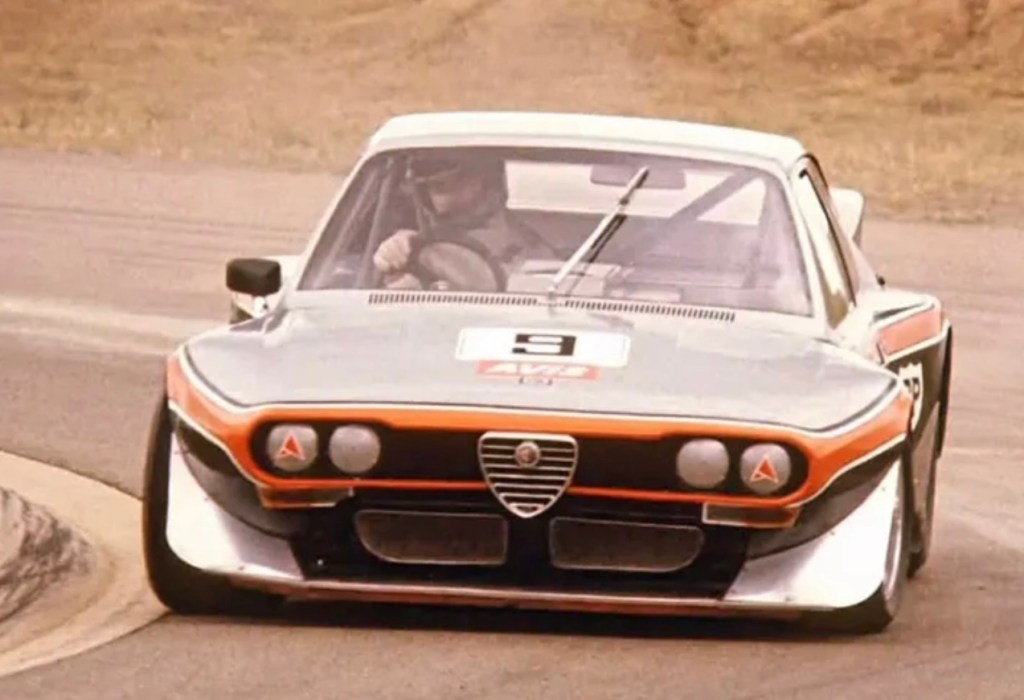
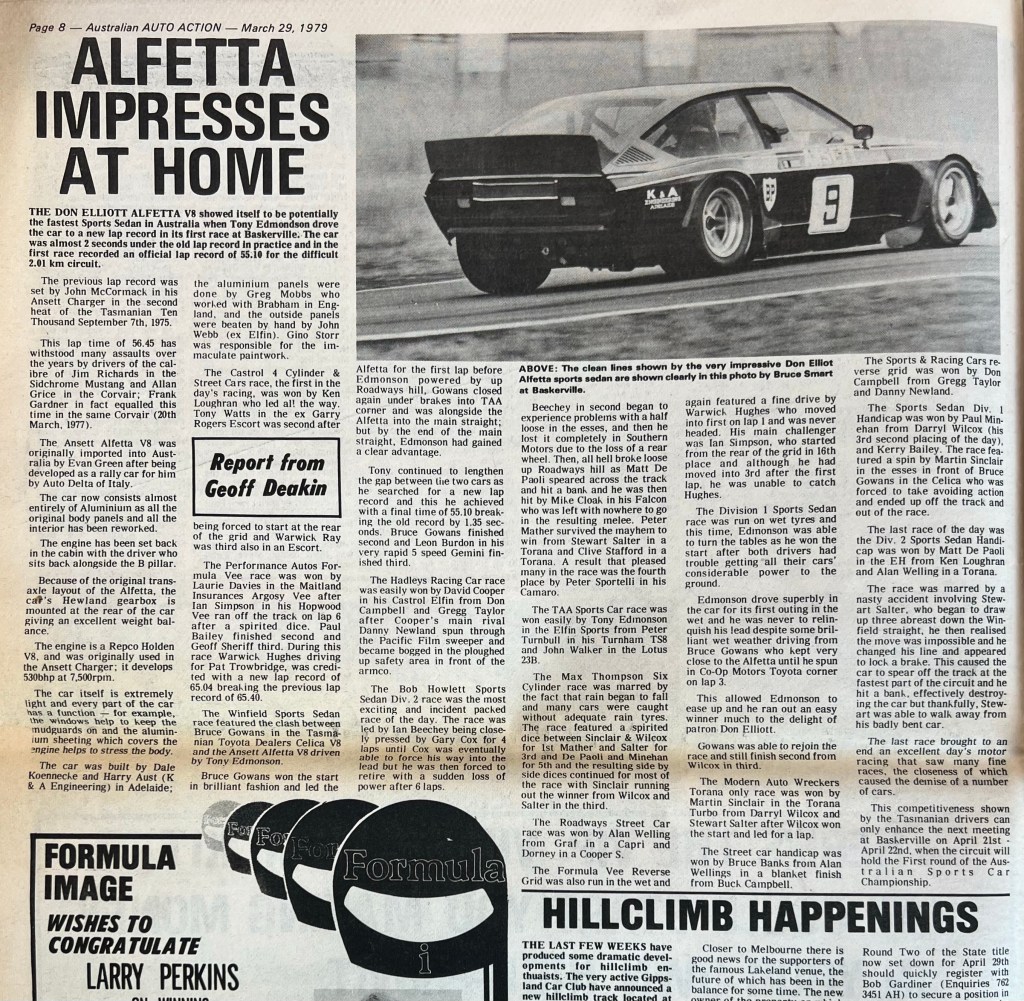
Edmondson in the Autodelta-shelled Alfetta Repco-Holden F5000 V8 at Oran Park on April 29, 1979 (ORP)
When Tony Edmondson’s ex-John McCormack Chrysler Valiant Charger Repco-Holden became uncompetitive he and Don Elliott engaged Adelaide’s K&A Engineering to build an Alfa Romeo Alfetta sports sedan in 1978.
The Alfetta’s engine and transaxle allowed the disposition of the front mounted Repco-Holden F5000 V8 and mid-rear mounted Hewland DG300 transaxle. The donor shell was the ex-Autodelta-Green car, it isn’t clear to me if the Alfetta was rallied in 1977, if you can add to the car’s history do get in touch.
Tony was on-track to winning the 1979 Australian Sports Sedan Championship until a collision with Phil Ward’s ex-Jane Holden Monaro GTS 350 at Surfers Paradise on August 26 landed Tony in hospital with life threatening burns for three months and utterly destroyed the car.
Edmondson lived to fight another day in Alfetta 2 Chev, but the Evan Green car was no more.
Alfa Romeo Alfetta GTAm…
Competition was an important part of flogging Alfas in Australia from the earliest efforts of Harold Lightburn in the mid-1960s and went up a couple of gears when Alec Mildren got the distribution rights.
Mildrens campaigned two GTAs, a TZ2, various series production Giulia Supers – Giulia Super Ti Sandown successes duly noted – 1600 GTVs and 1750 GTVs, not to forget the 2.5-litre Tipo 33 V8 powered Brabham BT23D and Mildren Yellow Submarine single-seaters.
By the mid-1970s, Alfa pretty much had the two-litre class of the Australian Touring Car Championship and Australian Manufacturers Championship (combined series duly noted) sorted, but the Ford Escort RS2000 was going to rain on the Alfetta’s parade. And it was time to push the new 116 Series Alfettas forward, rather than the 105 Series Coupes, which were no longer sold.
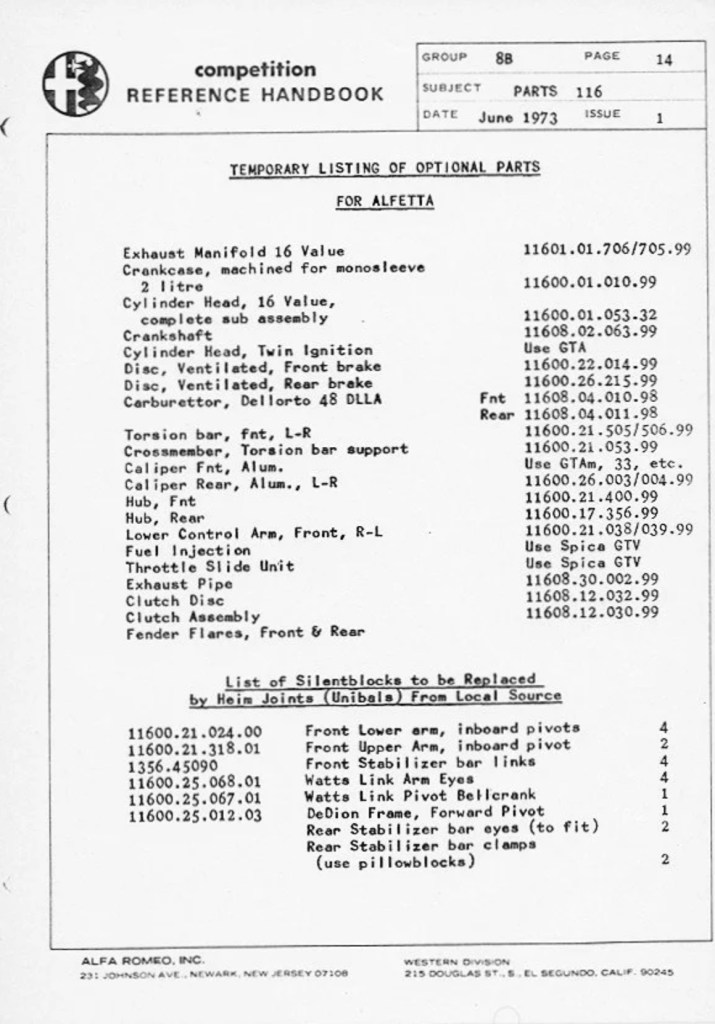
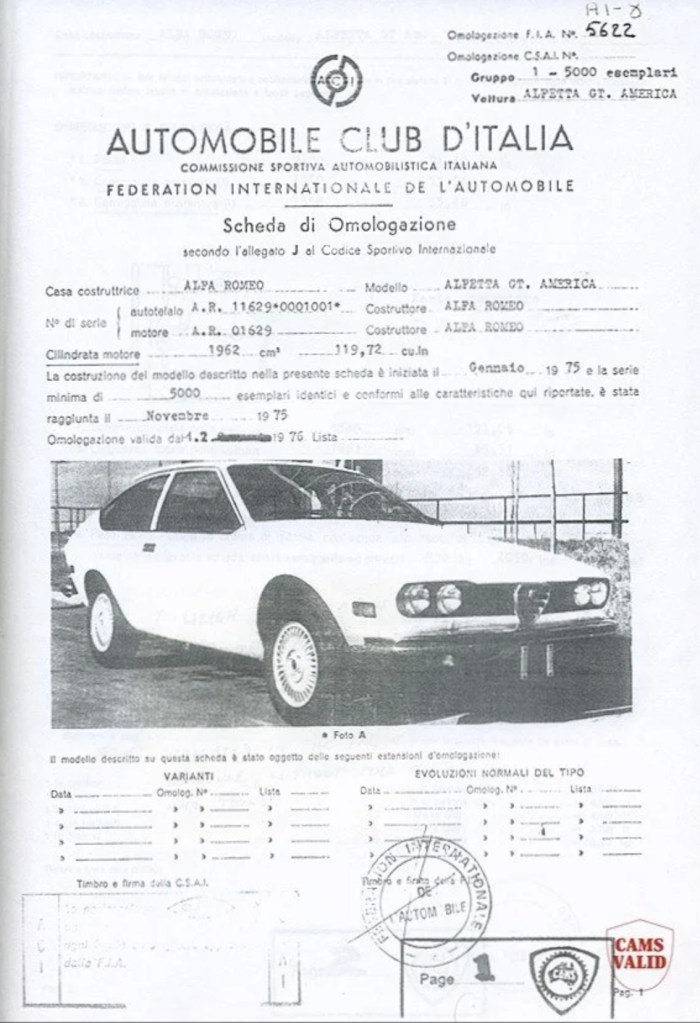
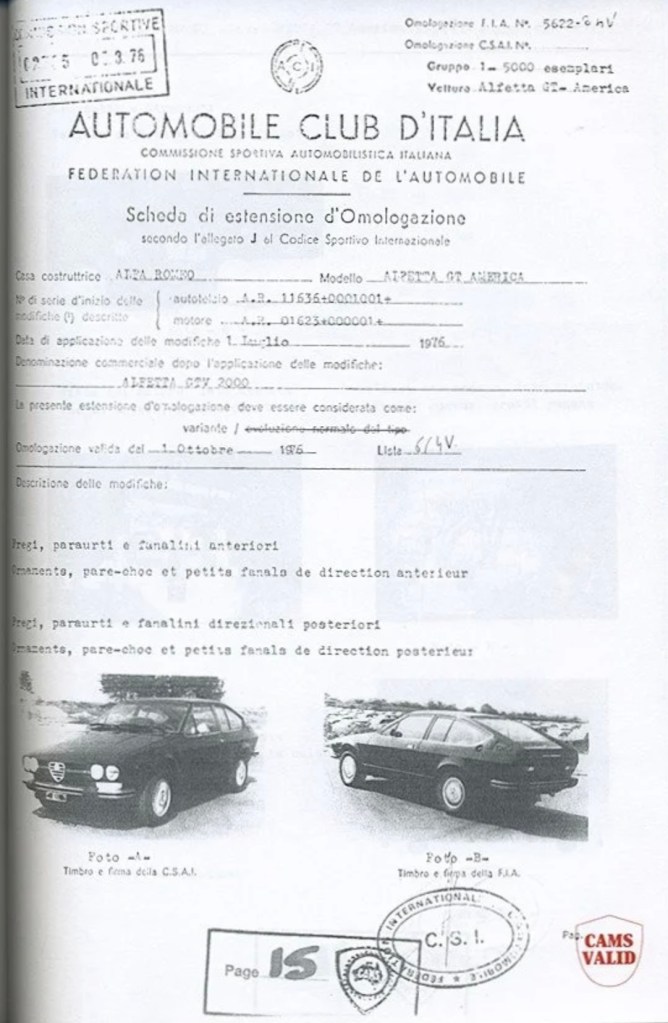
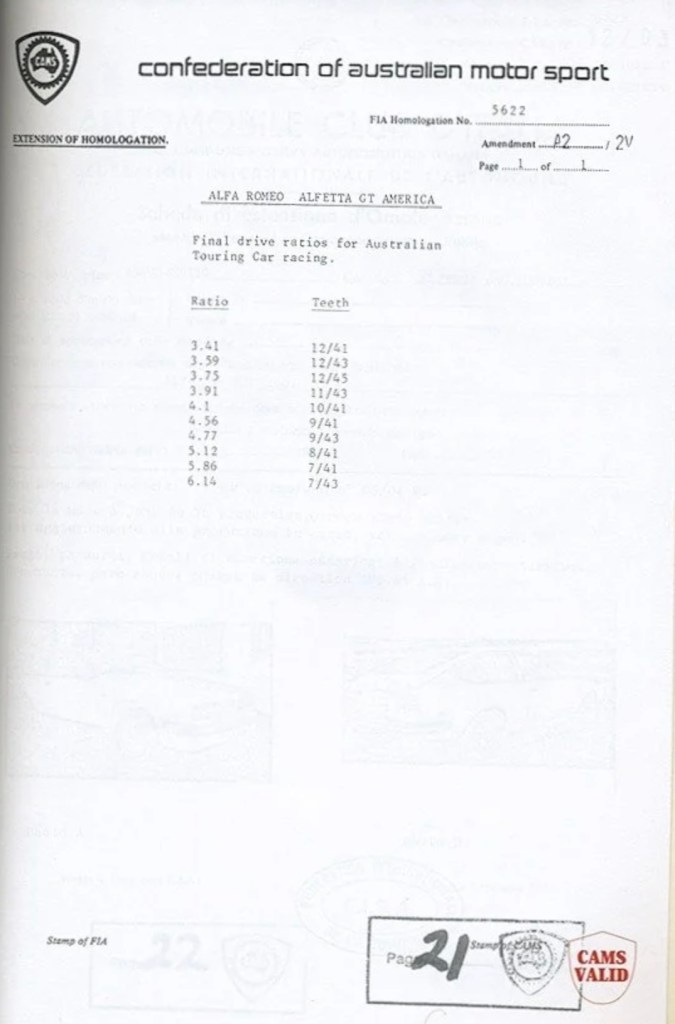
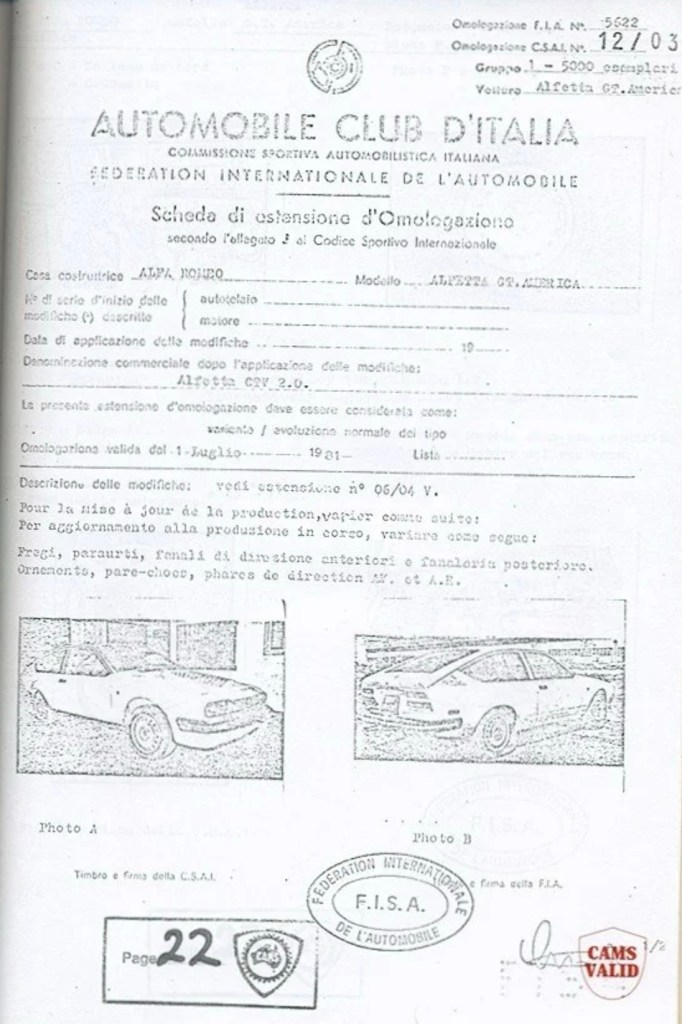
So Alfa Romeo Australia had the factory build 25 Alfetta GTAm’s to homologate a 2-litre, 1962cc Alfetta GT at a time the usual roadies were fitted with the 1.8-litre, 1779cc engine, for Group C racing for which the Bathurst 1000 and other races were held.
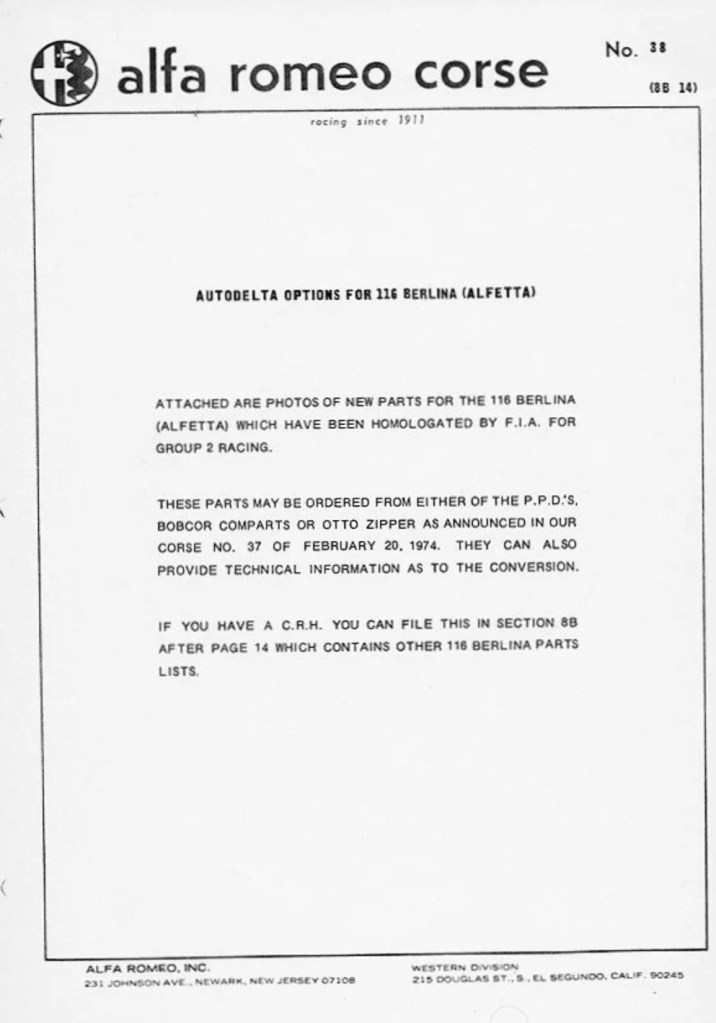
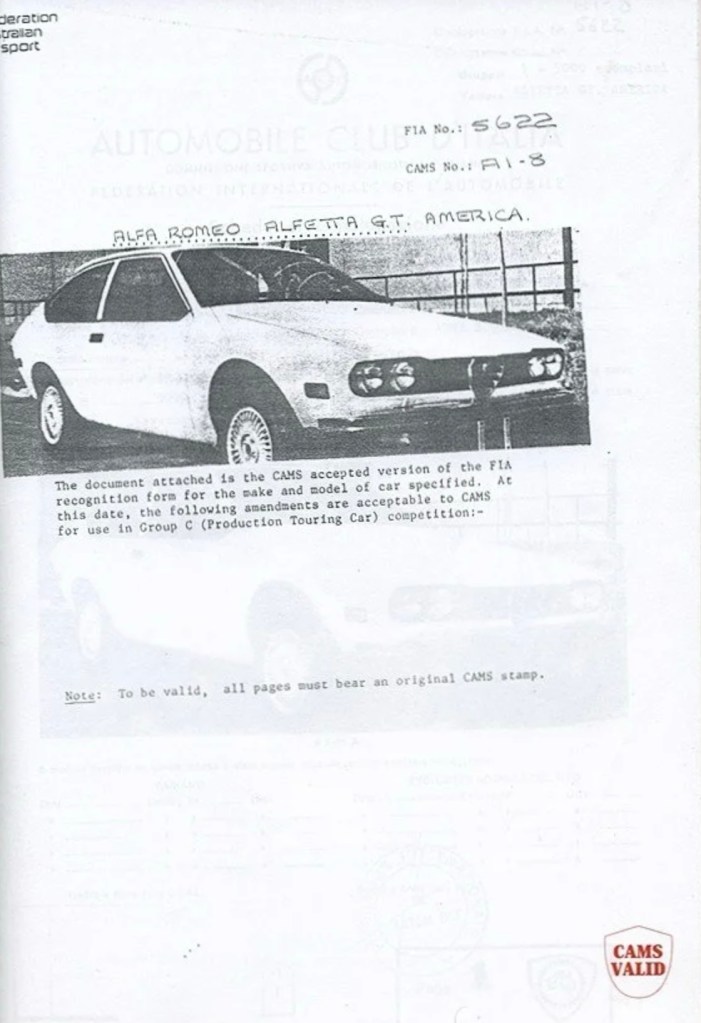
Alfa Romeo shipped 25 RHD Alfetta GTs equipped with the nasty, wheezy, Spica injected 2-litre engine calling them – see the FIA homologation documents below – the ‘Alfa Romeo Alfetta G.T. America’. They were essentially RHD versions of American Alfetta GTs devoid of the fugly-big bumpers fitted for that market, and of course later infecting us all..
A number of these Alfetta GTAm’s were converted into racing cars, one, chassis # 11611-0003206, was an Autodelta-built car for our regulations.
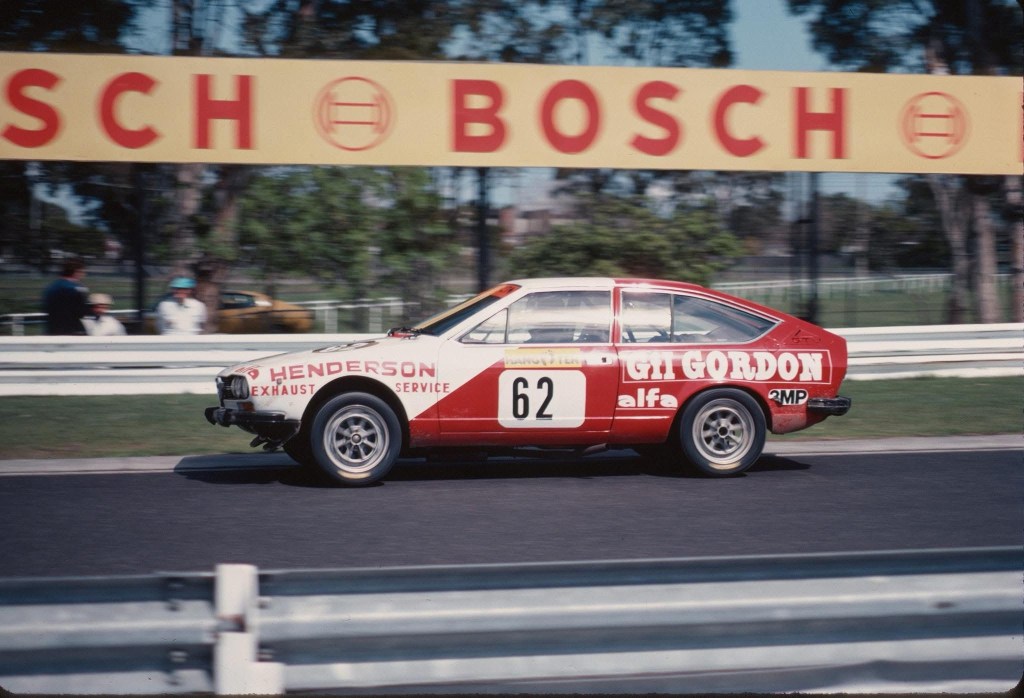
Historian/restorer/writer/Alfista Paul Newby wrote that ‘Chassis 3206 is the Group C Alfetta GTAm that belongs to Bill Magoffin, currently in Gil Gordon colours. It was entered by Autodelta (Australia) Pty for Richard Carter/John Leffler at the 1976 Bathurst 1000. It has all the Group 2 Autodelta gear that it raced with in period (gearbox, brakes, adjustable torsion bar, etc).’
The Warwick Henderson/Peter Hopwood Autodelta built GTAm #11611-0003206 on the way to 11th outright and third in class during the 1977 Sandown Hang Ten 400. The Frank Porter/Jim Murcott GTAm won the class, the best result ever for one of these cars (R Steffanoni)
‘There were two other GTAm’s at Bathurst that year. The Frank Porter Clemens Alfetta and the Brian Foley entered Alfetta for Marie-Claude Beaumont/Christine Gibson. I’m not sure what became of the Porter car but l’m pretty sure that the Foley car was converted back to road spec and sold on.’
Time was tight as Alfa Australia wanted the cars homologated before the traditional Bathurst curtain raiser, the Sandown 400 – Hang Ten 400 – held on the 10-12 September 1976 weekend.
Anthony Sharp wrote that ‘the last of the 116 GTAm homologation touring spec cars were delivered to their owners at Mascot Airport, Sydney, under CAMS supervision. They then contacted Sandown and allowed the race cars to start practice for the Hang Ten 400.’
It was only one car at Sandown however, Frank Porter’s Clemens Sporting Cars GTAm (authorised Alfa dealer) who finished second in the 2-litre class behind Ron Dickson’s ‘works’-Ron Hodgson Motors Triumph Dolomite Sprint.
At Bathurst in October the Eric Board/Tom Tymons Ford Escort RS2000 Mk1 previled in the 1301-2000cc class from the Phil McDonell/Jim Hunter 2000 GTV with the Alfetta GTAm’s of Frank Power/Tony Roberts and John Leffler/Richard Carter fourth and fifth in the class.
Sticking with Mount Panorama, in 1977 the Brian Foley Derek Bell/Gary Leggatt 2000 GTV won the class with the best GTAm, the Frank Porter/Jim Murcott car third; the best Bathurst result for a 116 GTAm.
I note that the Brian Foley prepared Alfetta GTV 2000 raced by Phil McDonnell/Derek Bell was second in class behind the winning Peter Williamson/Mike Quinn Toyota Celica at Bathurst in 1979. This appears to have been a 2000GTV not a 2000GTAm…
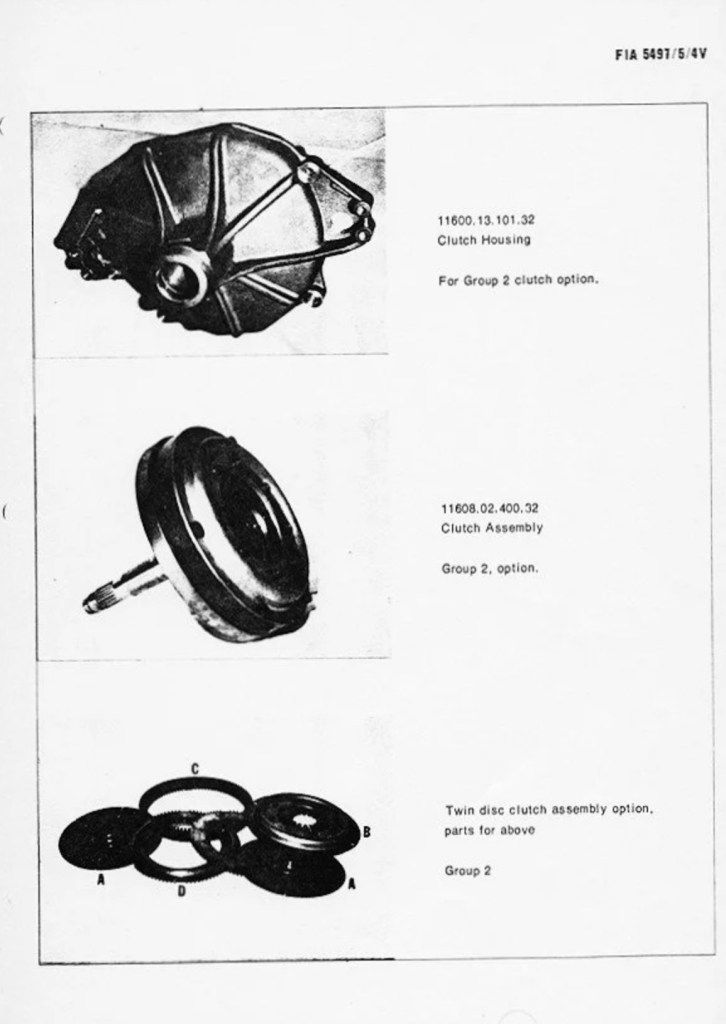
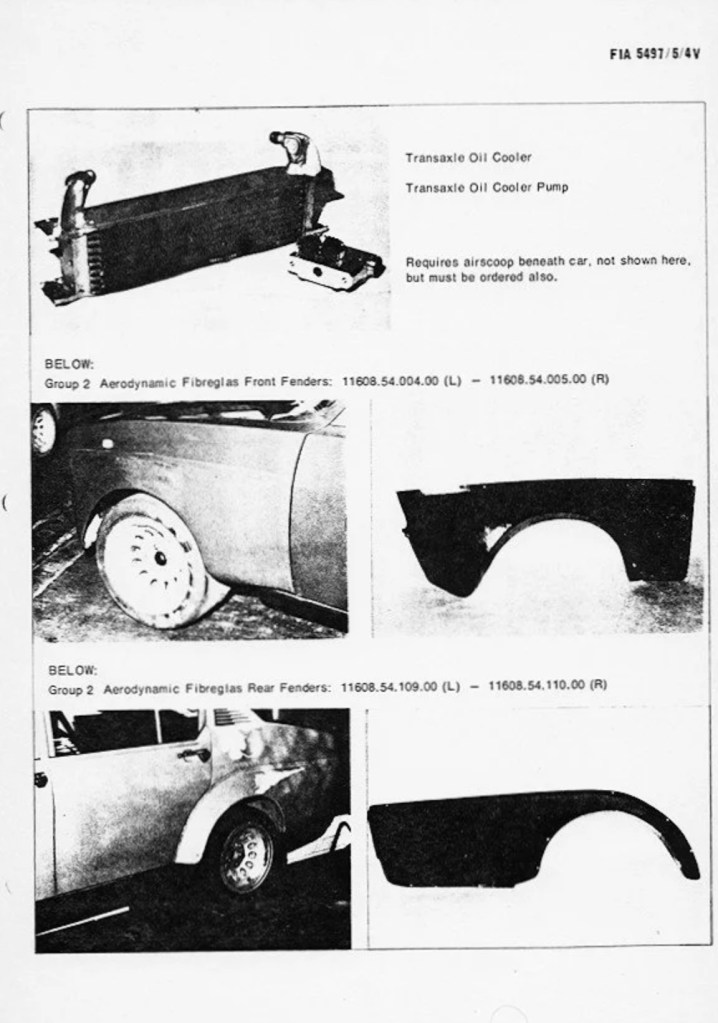
Alfetta GTGroup 2 Homologation…
Alfetta G.T. America Homologation…
Credits…
Peter Burley, Lane Louie, Evan Green, Rod Steffanoni, Racing Car News, Auto Action, Colin Pettigrew, Marque Spotlight Series, oldracephotos.com. Various Australian Alfisti historian/enthusiast/restorer/engineers including Vin Sharp, Anthony Sharp and Paul Newby on various Alfa Romeo forums; hopefully I haven’t verballed-you!
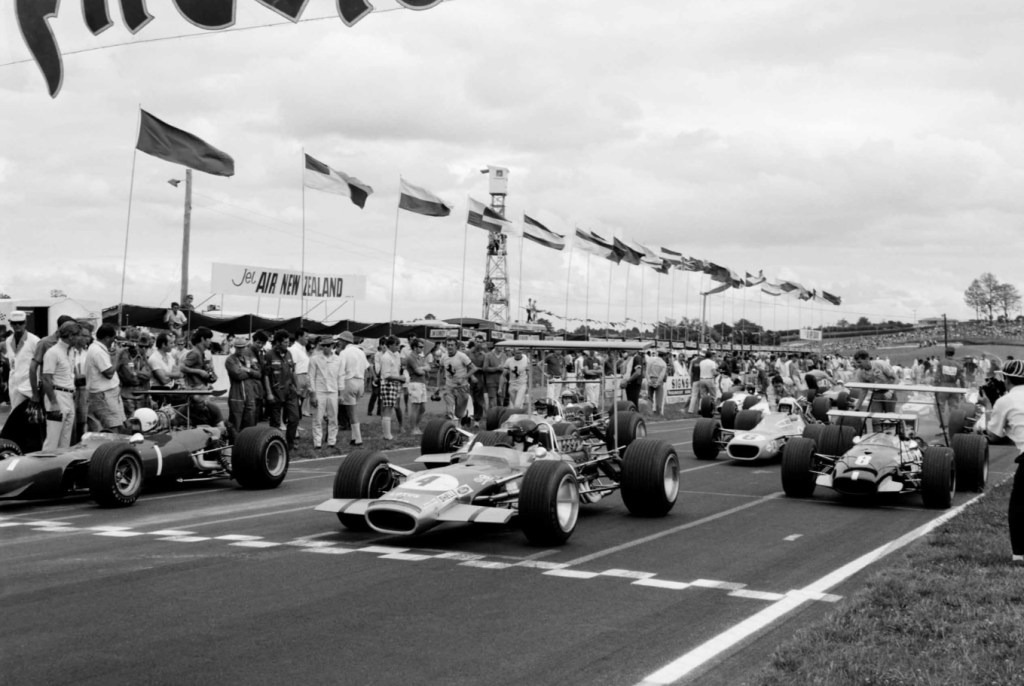
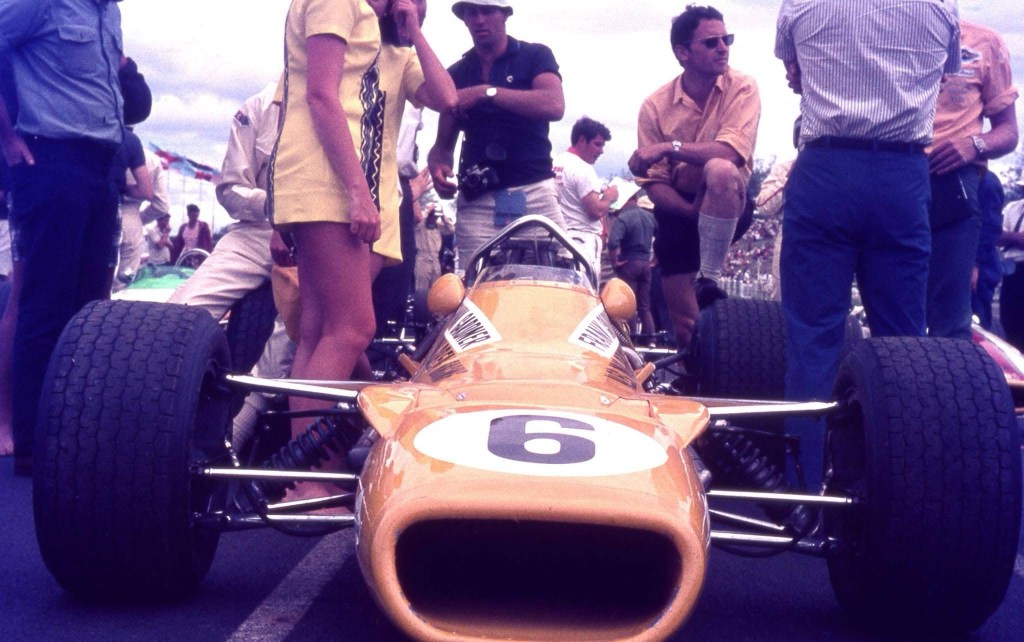
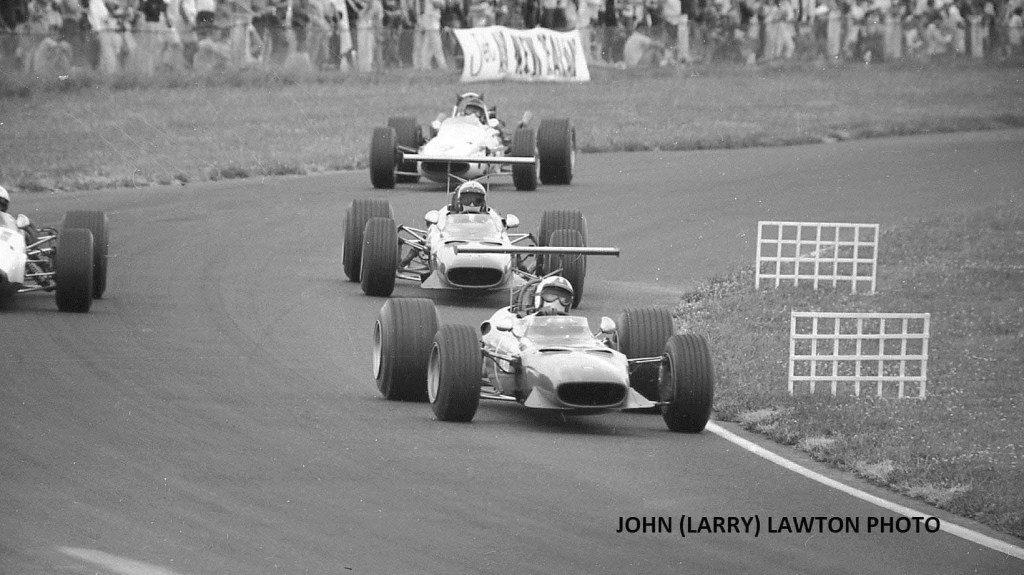
Ferrari 246T, Lotus 49 Ford, Lotus 49 Ford, Brabham BT24 Ford, and a Mildren Mono Alfa T33: Amon, Rindt, Hill, Courage and Gardner. Pukekohe NZ GP front couple of rows, January 4, 1969…
We didn’t know it at the time, but the 1969 Tasman Cup was the last for 2.5-litre cars, The Real Tasman in the minds of many. 1970 2.5-F5000 mix duly noted.
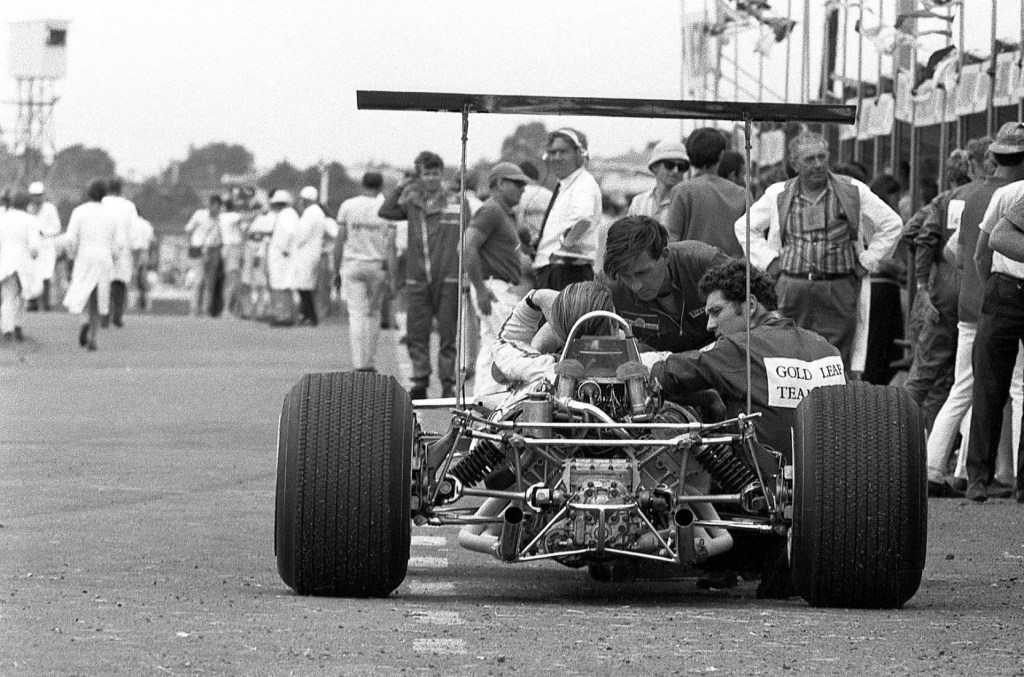
When Jim Clark appeared in a Gold Leaf Team Lotus machine during the Levin Wigram Tasman round the year before, it was the start of big bucks in ‘European Racing’. F1 was getting bigger, the season was getting longer with summer testing in the south of France and South Africa, and the drivers were ‘more valuable’. One couldn’t afford to put one’s GeePee programme at risk killing a driver on water-skis or the race track in Australasia.
Jim Clark was dead, killed at Hockenheim in a Lotus 48 Ford FVA on April 7, 1968. BRM were in F1 disarray, still struggling to throw off the shackles of the H16 debacle. Team Lotus came, with 49 Ford DFWs for just-minted World Champ Graham Hill, and fastest-kid-on-the-block, Jochen Rindt. BRM understandably stayed at home to get themselves sorted; in that regard, they failed!
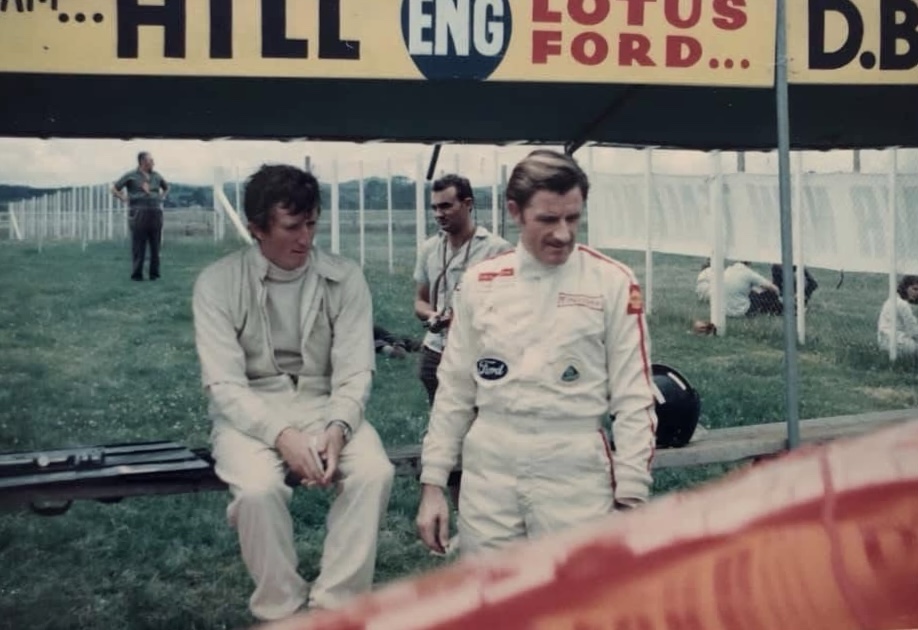
‘Take it easy, sonny, play yourself in.’ Jochen Rindt (27) and Graham Hill (39) at Pukekohe (J Copsey)Amon in the Puke pits. Note the rear electro-hydraulic angle on the wing dangle device. ‘Moveable aerodynamic devices? Don’t look this way matey!’ (P Levet)
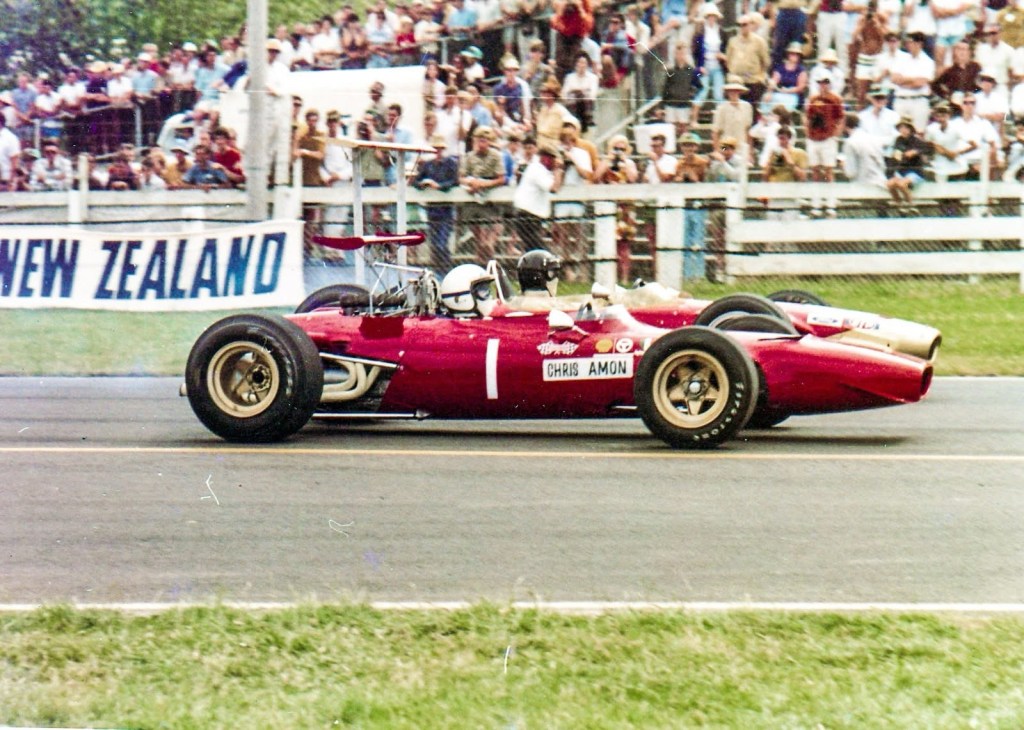
Scuderia Ferrari came too, or rather a triumvirate. Ferrari provided two Dino 246Ts with you-beaut four-valve 2.4-litre V6s, Chris Amon brought along his good self and Ace-mechanic and friend Bruce Wilson, while David McKay/Scuderia Veloce handled the on-ground logistics and team management.
Scuderia Veloce are the Ferrari Sydney dealer and McKay was an extremely capable ex-driver, journalist and auto-entrepreneur. Quite who paid for what has never been clear – by all means send me a copy of the contract if you have it – but the mix of Scuderia Ferrari, Shell and Firestone had enough lolly in the kitty to pop Derek Bell in the second car.
Jochen had a marker to put down, and did so big-time! He had been in GP racing since 1965 and finally had a car worthy of him. It wasn’t to be Hill’s happiest Tasman or Grand Prix season in any respect.
Derek Bell and Chris Amon (M Fistonic)Glenn Abbey warms up the Mildren Monos’ Alfa Romeo Tipo 33 2.5-litre V8. Engines made to Alec Mildren’s order, he was a good Auto Delta client, having bought two GTAs and a TZ2 in the mid-1960s (D Shaw)Note the beefy rear monocoque bulkhead. Hewland FT200 transaxle, twin-plug, twin-cam, two-valve 2.5-litre engine (D Shaw)
The other extremely capable Sydney ex-driver and auto-entrepreneur was Alfa Romeo Man Alec Mildren. His two cars were powered by 2.5-litre variants of Alfa Romeo/Auto Delta’s Tipo 33, twin-cam, fuel injected V8. He fielded a new monocoque designed and built by Len Bailey/Alan Mann Racing for Frank Gardner that used Brabham BT23 components: uprights/brakes, steering rack, wheels etc.
This gorgeous machine became an Oz Icon – The Yellow Submarine – driven by FG in this Tasman, and then Kevin Bartlett, and others, all of whom won in it even when it was a granny. KB’s car was the BT23D Alfa Gardner raced in the ’68 Tasman and with which Bartlett won that years Gold Star. They only had three engines, so KB only did the Australian rounds.
Leo Geoghegan, Lotus 39 Repco and the shot below (Peter Bruin)
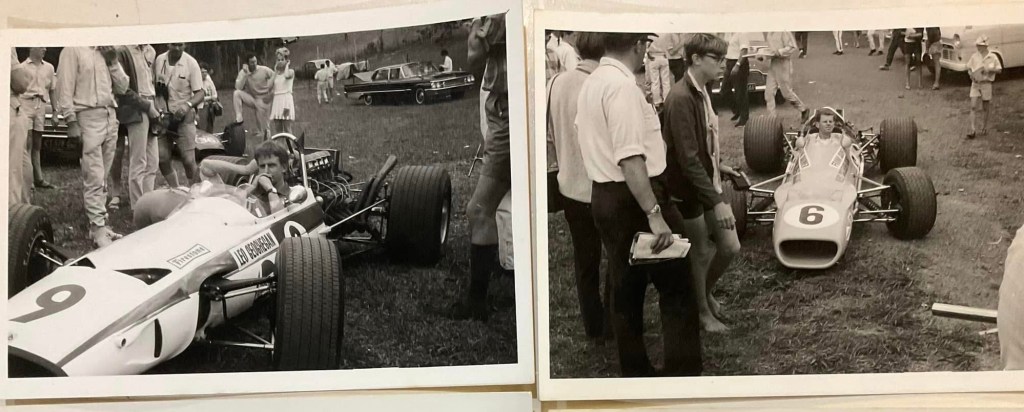
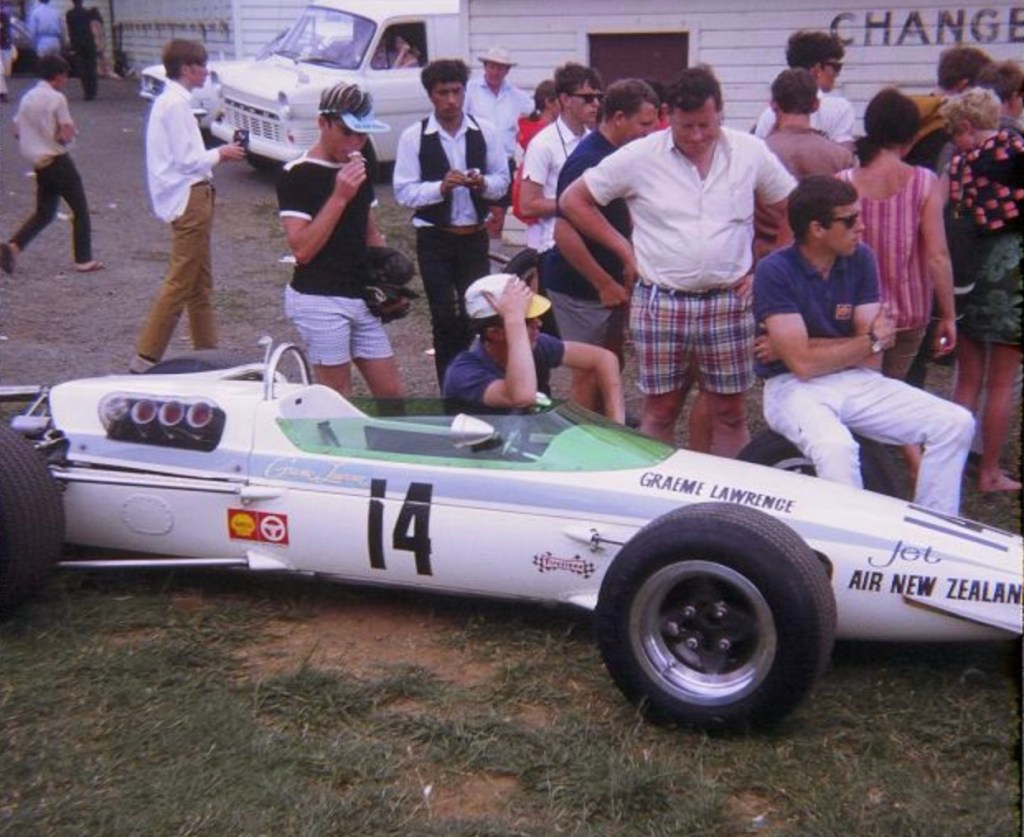
Leo Geoghegan’s ex-Clark ’66 Tasman Lotus 39 #R12 was a veteran by 1969 but ongoing development of it by John Sheppard and Leo kept it towards the front and it was now equipped with Repco-Brabham Engines latest and final Tasman 2.5 V8 730/830 crossflow, SOHC, injected V8.
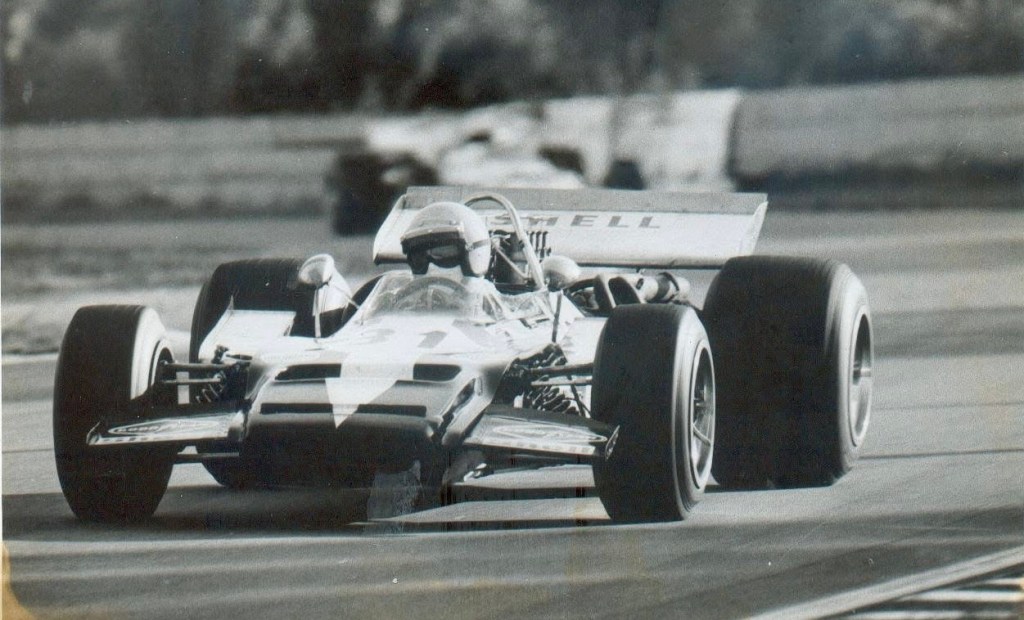
Similarly equipped was Jack Brabham’s F3 based Brabham BT31, although ultimately Brabham did only the Sandown round. It was a pity, as the very light, small car proved its competitiveness in its only gallop.
Climax 2.5 FPF-engined machines by then were also-rans, the other locals running FVAs and Lotus-Ford twin-cams didn’t have the puff to stay in the top half of the field and there were enough good 2.5s to make fast-reliable 1.6-litre runs not enough to bag a podium.
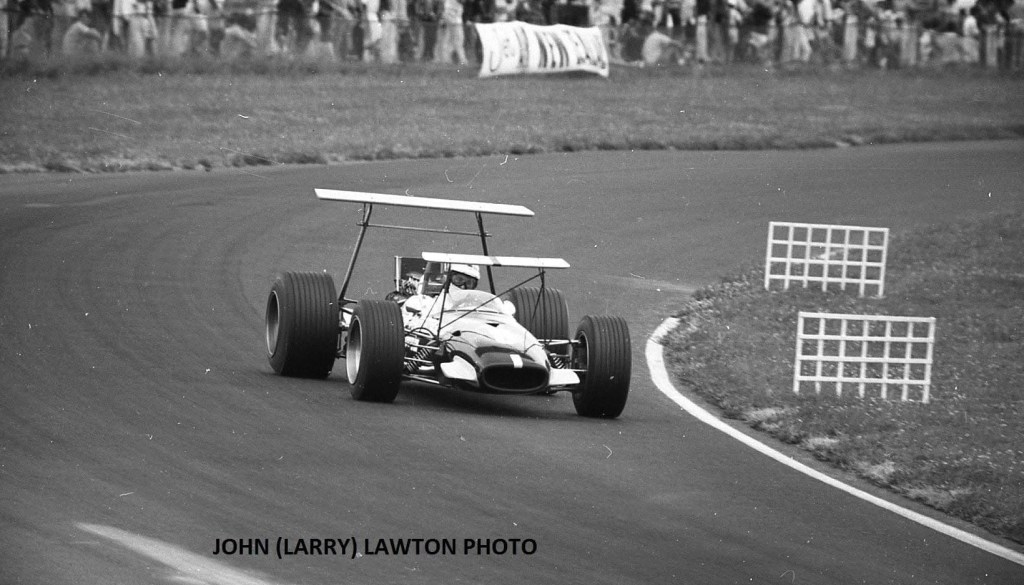
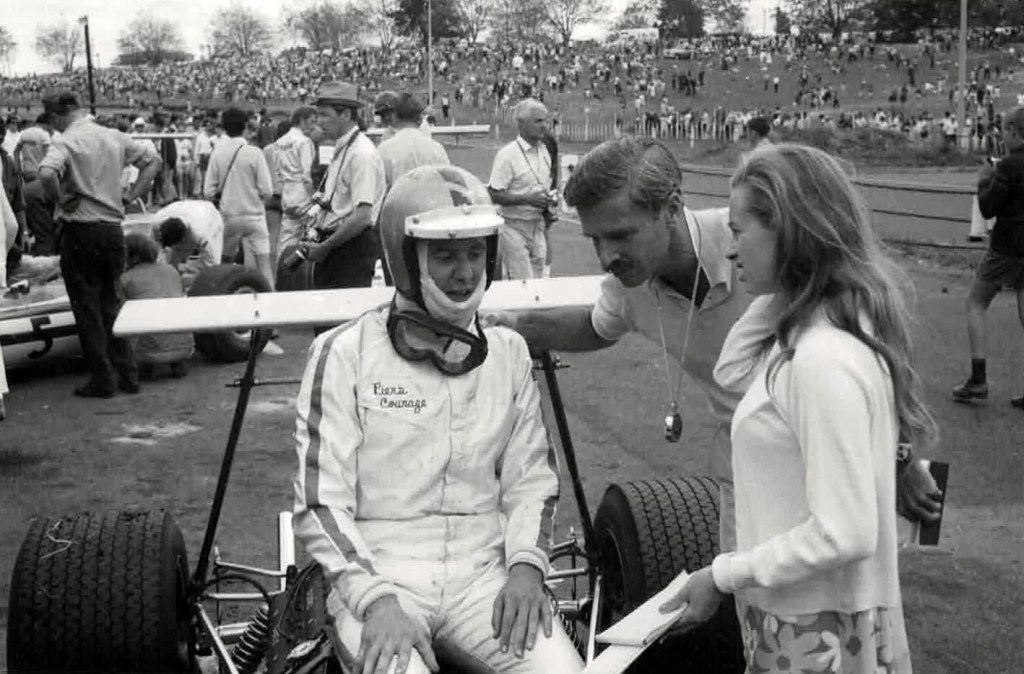
Courage, Brabham BT24 Ford DFWFrank Williams and Piers Courage at Puke, that sign is a year out of date! (J Copsey)
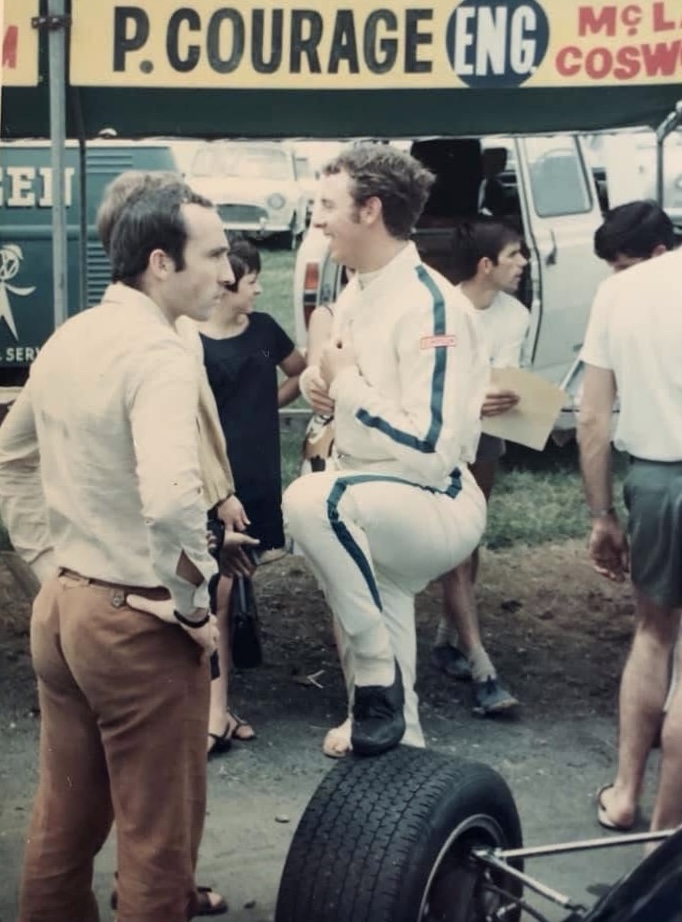
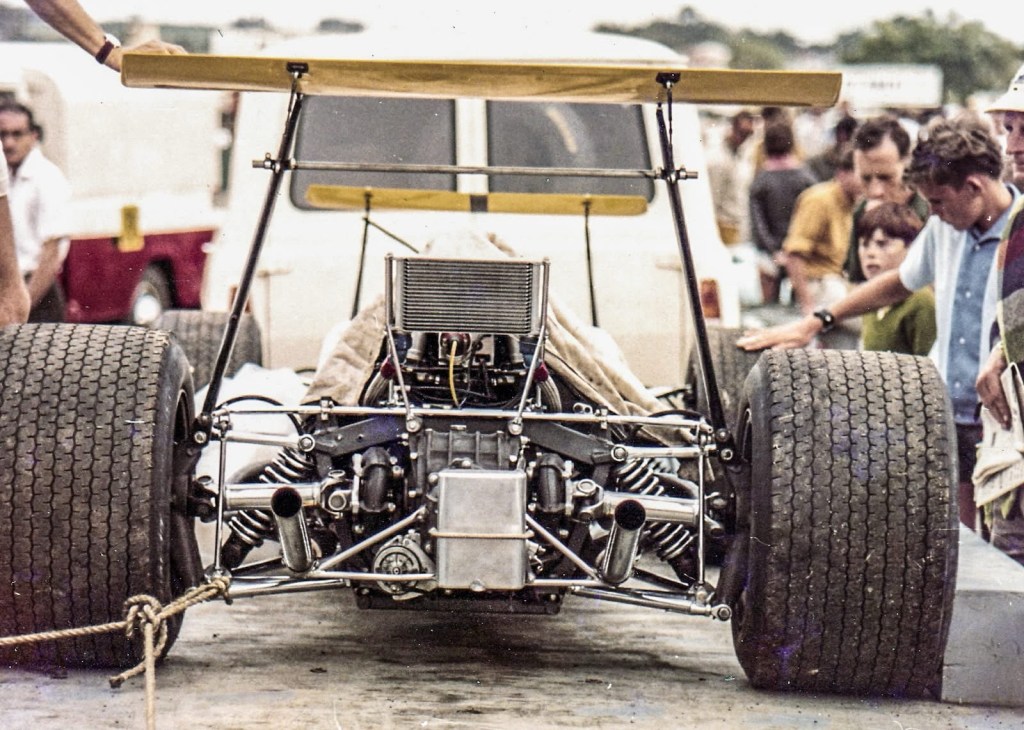
Speaking of which, McLaren M4A Ford FVA ’68 Longford winner, Piers Courage, was back with a bang. His Tasman 1968 solo run with the help of Les Sheppard provided a Ctrl-Alt-Delete reboot of his career. He had teamed up with F3-Travelling-Circus buddy Frank Williams to run a Ford DFW-powered ’67 Brabham BT24 #3 in the Tasman and was on the money throughout, winning the Teretonga round. The pair went one better in ’69 Grands Prix, running at the front all year with a ’68 Brabham BT26 converted to run a Cosworth DFV instead of the RBE 860 that first occupied the aft area. They were set to take on the world, let’s leave 1970 alone.
Graham Hill, Lotus 49B Ford DFW. Not the sturdy (sic) wing mounts attach directly to the uprights. ZF gearbox replaced by a Hewland DG300 by the series’ end (T Marshall)
Practice…
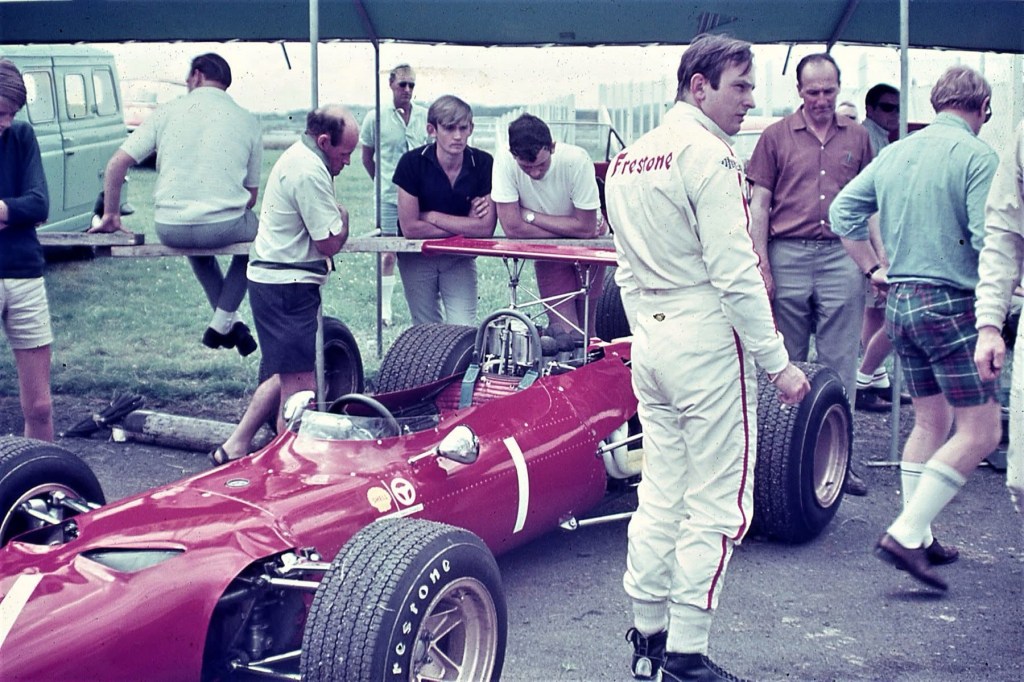
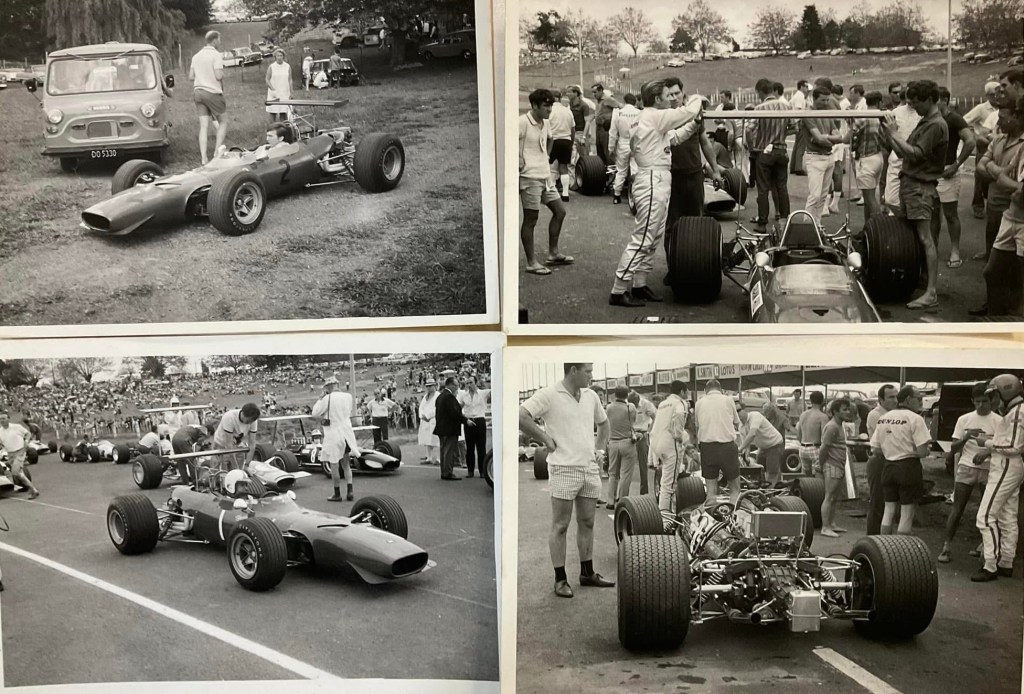
The Dinos of Amon and Bell positively gleamed in Auckland’s sunlight as the punters gazed upon them. Bruce Wilson had the cars early enough to pull them down and painstakingly assemble them with the time the Scuderia mechanics didn’t have. After the one-car learning expedition the year before, Ferrari was ready to boogie.
And so it proved during practice. Thursday was largely early sorting but Amon and Courage were the early quicks. Rindt wasn’t far behind – had he tested a 49 before heading down south? – while Hill and Gardner arrived late. Bell popped the nose of his car through railing early on, and an engine change was required of Chris’ car which was suspected of having a slipped cylinder sleeve.
Geoghegan’s Lotus 39 and Gardner’s Mildren Mono. Both started the series wingless and finished it with with them (P Bruin)David McKay checks in with Piers and Sally Courage (P Bruin)From top left, Derek Bell, Graham Hill checking his Lotus’ wing to ascertain the probability of it remaining attached to the car, Pier’s wingless Brabham BT24, and Amon heading for the grid (P Bruin)
Friday was business day with Rindt getting down to a 58.4 while wrestling with gear selection problems, including breaking the lever. Hill did a 58.8, winged-Courage a 59-dead then Amon pulled a 58.2 out of the bag to get pole. Jochen tried to better this but broke the gear lever again.
Next came Bell 59.6, wingless Gardner 60.6, Graeme Lawrence, McLaren M4A Ford FVA, Roy Levis, Brabham BT23 Ford FVA and Geoghegan, 63.5.
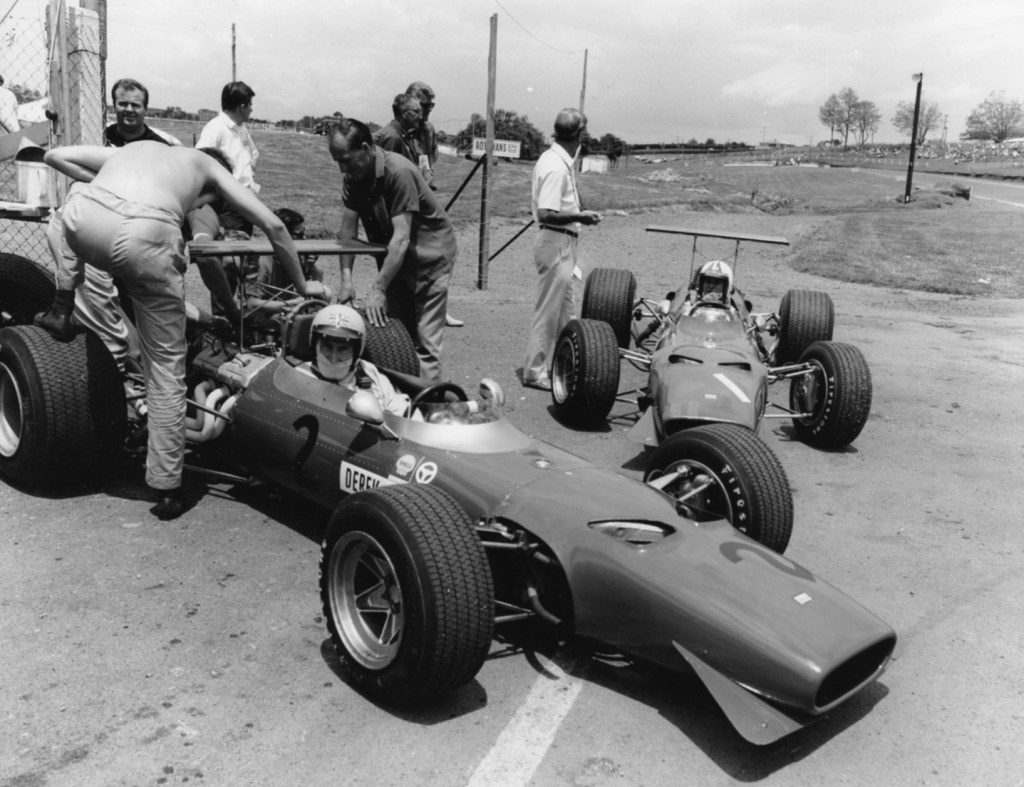
The Leo Geoghegan and Frank Gardner wingless machines out of Sydney: Lotus 39 Repco-Brabham 830 and Mildren Mono Alfa Romeo T33 2.5 V8.
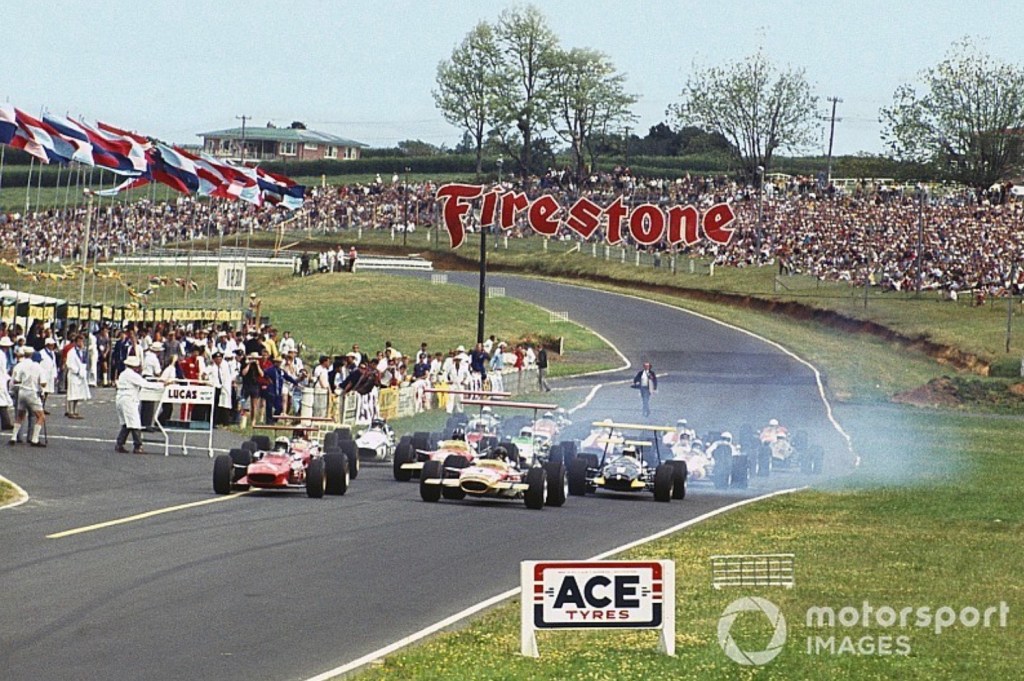
The Off: Amon and Rindt up front, behind Amon is Bell, then Hill in the middle and Courage on the outside, and the rest
Race…
Chris and Jochen light em’ up on the front row, 100 miles the standard Tasman Cup distance (T Growden)
The start of the race was fiery in a different way. Bryan Faloon’s Brabham BT4 Climax was set ablaze by an errant spark and an overfilled fuel tank. Bryan was scratched but had mild burns to his hands. In amongst this excitement, the Team Lotus mechanics replaced Jochen’s tach, which wasn’t operating. Then, as the minute board went up, Gardner’s Mildren was pushed to the side of the track with a duff fuel pump.
Twelve months before, his new Brabham BT23D Alfa won the ’67 Hordern Trophy at Warwick Farm just before Christmas, the car was fully sorted before it lobbed in NZ. They were not as far advanced with the Mildren Mono, staggering was a complete lack of wings. The car grew them as the series progressed but FG gifted his rivals time, he was the only front running 2.5 racing sans wings.
Gardner’s gorgeous Mildren Alfa takes its place on the grid immediately prior to its fuel feed problems becoming apparent (W Collins)The Amon and Bell Ferraris ahead of Leo Geoghegan’s Lotus 39 with a slower car hanging out wide Rindt coming over Rothmans (T Growden)
When the flag dropped in front of a great crowd, it was Amon, Rindt, Courage and Hill. Chris was a couple of car lengths ahead of Jochen at the end of lap 1 from Courage, Bell, Hill, Geoghegan, Levis, Lawrence, then the elderly Brabham Climaxes of Red Dawson BT7A and Dennis Marwood BT?, and then the amazing Graham McRae in his very fast, small, clever, Brabham based, McRae S2 Lotus-Ford 1.5.
Rindt passed Amon on lap 2 and by lap 4 was two-sec clear of Chris, then came Courage, a bit of a gap to Bell and Hill, then a bigger one to Leo Geoghegan’s wingless Lotus 39 Repco who had a 10 second gap from Levis, then Lawrence, Dawson, McRae and David Oxton, Brabham BT18 Lotus-Ford 1.5.
By lap 6, Chris and Jochen were rounding up the tail-end-Charlies without difficulty, but Piers Courage wasn’t so lucky and lost a lot of ground on the right-hand sweeper out of Pit Straight.
Rindt tigered to try to clear away from Amon and did the fastest race lap of 58.9 on lap 9, doing 160mph through the timing traps on the back-chute. While this was going on, Graham Hill passed Derek Bell before the Londoners’ hard work came to nothing on lap 13 when a front-suspension ball joint broke. Simultaneously, Frank Gardner joined the fray, Glen Abbey having sorted or replaced the errant fuel pump.
So…it was Rindt, Amon, Courage, Bell, then Geoghegan back a bit, then Lawrence, Levis, Dawson, McRae and Oxton.
The Courage BT24 Cosworth entering The Esses (T Growden)Rindt (T Marshall)
The race was starting to look like a cruise-and-collect copybook first Lotus win for Austria’s finest but then he ran wide on some oil on the approach to the hairpin and ceded the lead to Amon as he sorted his misdemeanour. Courage remained third, Jochen regained some ground but he had lost his clutch and the wing feathering device wasn’t doing its thing on the straights, so began to lose a second a lap.
Rindt remained clear of Courage despite that – 24 seconds clear by lap 40 – who in turn had a good gap from Derek Bell, who too had a good margin from Leo G.
With eight of the 58 lap/100 mile race to go the order was Chris Amon, Ferrari 246T, Jochen Rindt, Lotus 49 Ford DFW, Piers Courage, Brabham BT24 Ford DFW, Derek Bell in the other 246T, Leo Geoghegan’s Lotus 39 Repco-Brabham, Graeme Lawrence, McLaren M4A Ford FVA, Roy Levis Brabham BT23 Ford FVA, Red Dawson, Brabham BT7A Climax and David Oxton Brabham BT18 Lotus-Ford 1.5.
And so it remained until the finish.
(T Growden)
Winners are grinners…
(S Oliver)
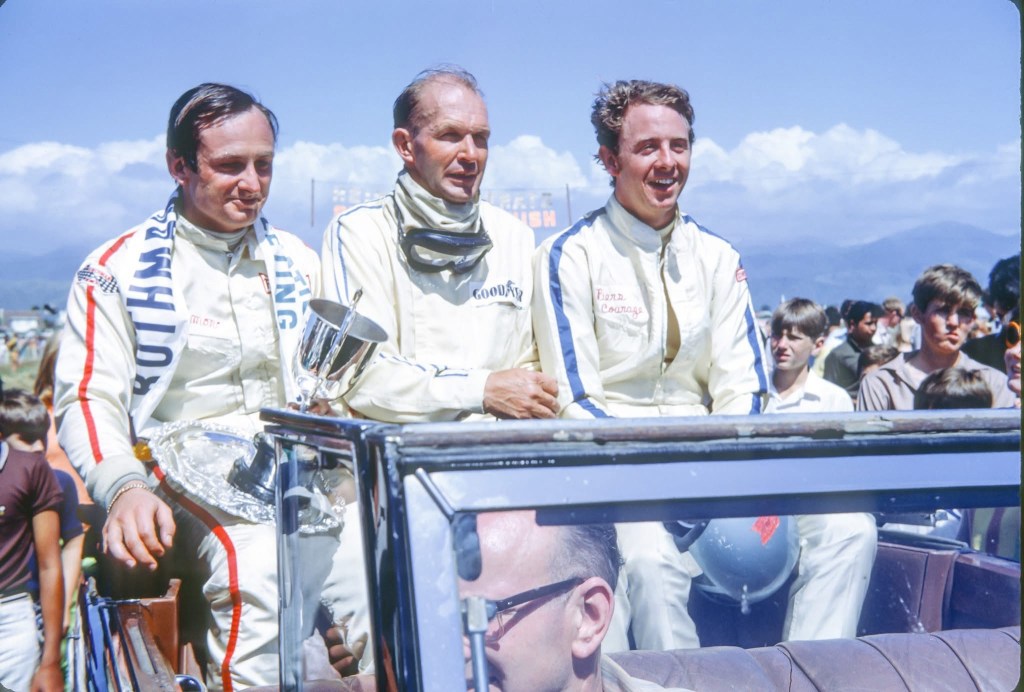
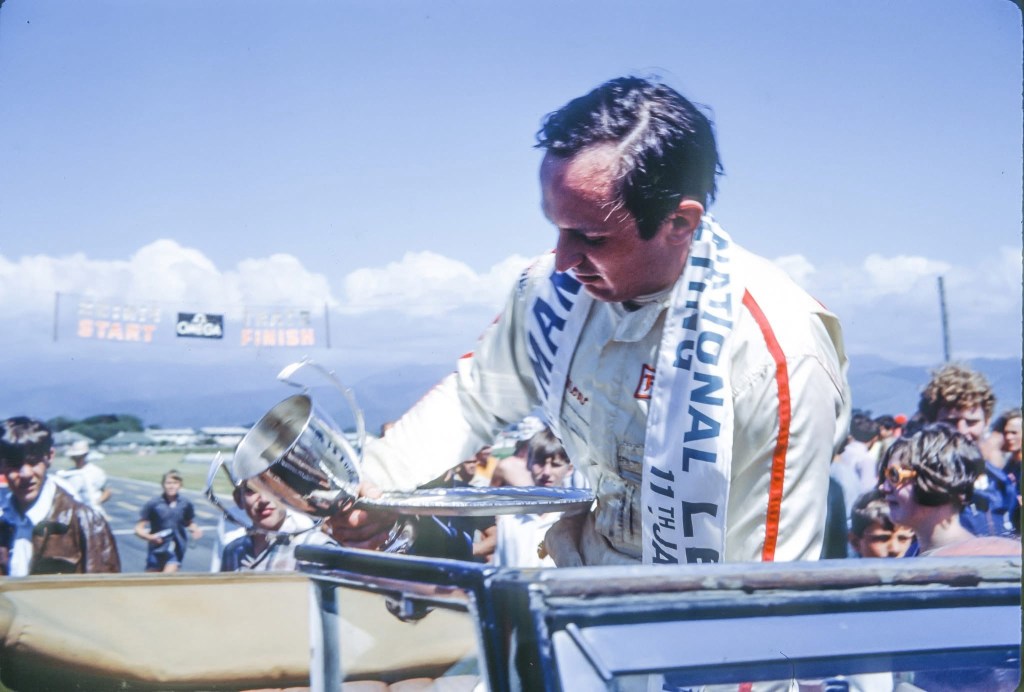
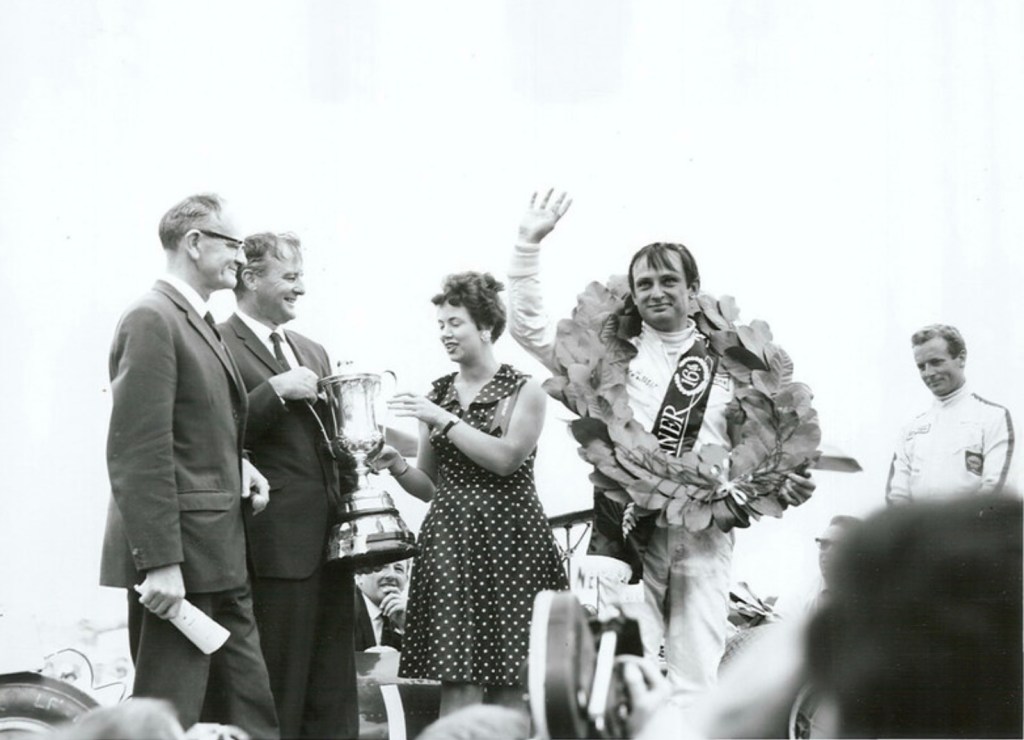
A suitably big smile on Christopher Arthur Amon’s face as he does a victory lap with the winners sash around his neck, back-to-back NZ GP victories.
246T/69-0008 was sold by Ferrari to Graeme Lawrence after the Tasman, he did well in it throughout the South Pacific inclusive of the 1970 Tasman Cup win, the little car had just enough pace and more reliability than the F5000s that year.
(S Oliver)(S Oliver)(S Oliver)
Chris Amon (1943-2016), Frank Gardner (1930-2009), and Piers Courage (1942-1970). Aged 26, Chris was already a six-year F1 veteran, maybe not such a big deal now, but his extreme youth on entry to Grand Prix racing was rare back then.
(S Oliver)Amon and at far right, Graeme Lawrence on the podium. GL was the first local home; sixth in his F2 McLaren M4A Ford FVA
Etcetera…
(T Growden)
To Wing, or Not To Wing…That is The Question…
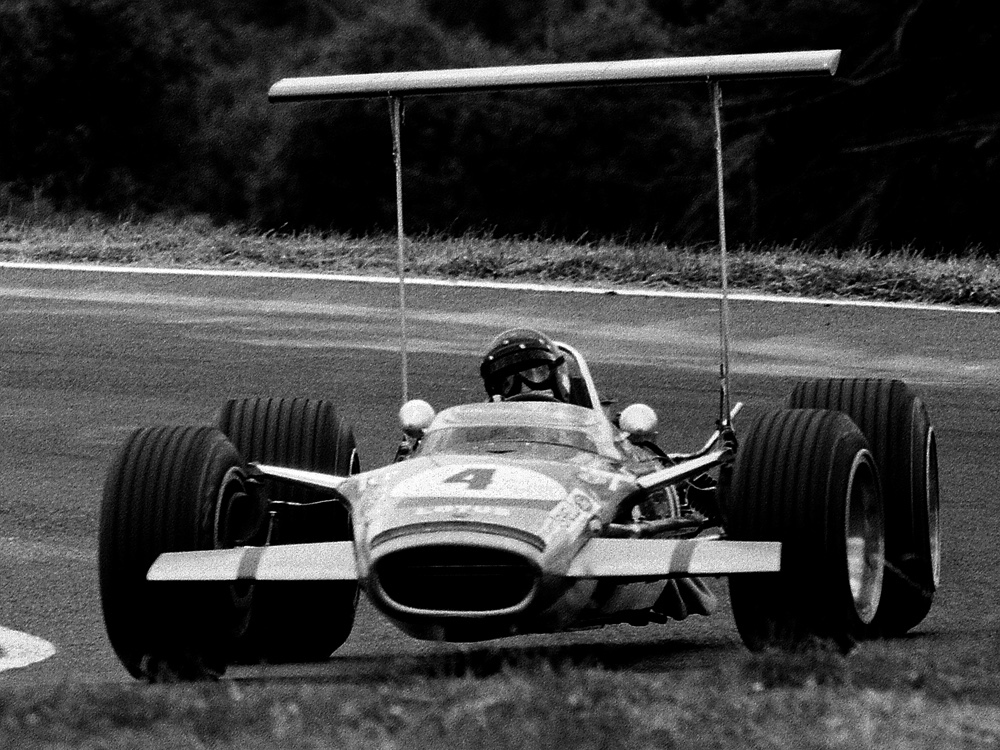
1968 was the start of it in Grand Prix racing at least, the earlier Chaparral contribution is hereby duly noted. Courage – BT24 Cosworth DFW above – practised with them on and off, and raced with them on. Those wings – note the mount directly atop the rear uprights – look very much like a works-Tauranac fabrication(s) to me.
The Boys taking it all in, ‘Do you think the wings will catch on?’ (B Homewood)(T Growden)
A couple of shots of Graham McRae’s McRaes, topics for another time.
(K Lancaster)(T Growden)
David Oxton, ex-Silvio Moser Brabham BT16 Lotus-Ford. Later an F5000 and F Pacific front-runner, Oxton won NZ’s Gold Star from 1972-74 and in 1981-82.
Graeme Lawrence’s McLaren M4A-14 Ford FVA
Credits…
Peter Bruin via Chris Denby, Tony Growden, Stewart Oliver, Peter Levet via Milan Fistonic, Doug Shaw, Warner Collins, Jeff Copsey, Bob Homewood, Kevin Lancaster, oldracingcars.com
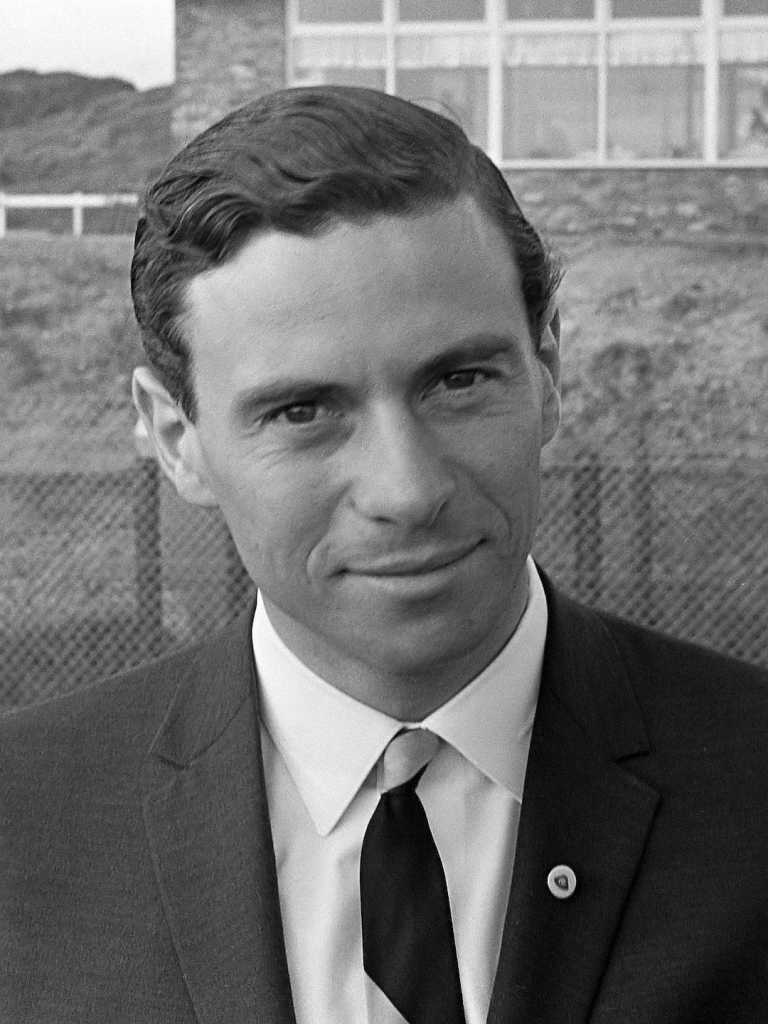
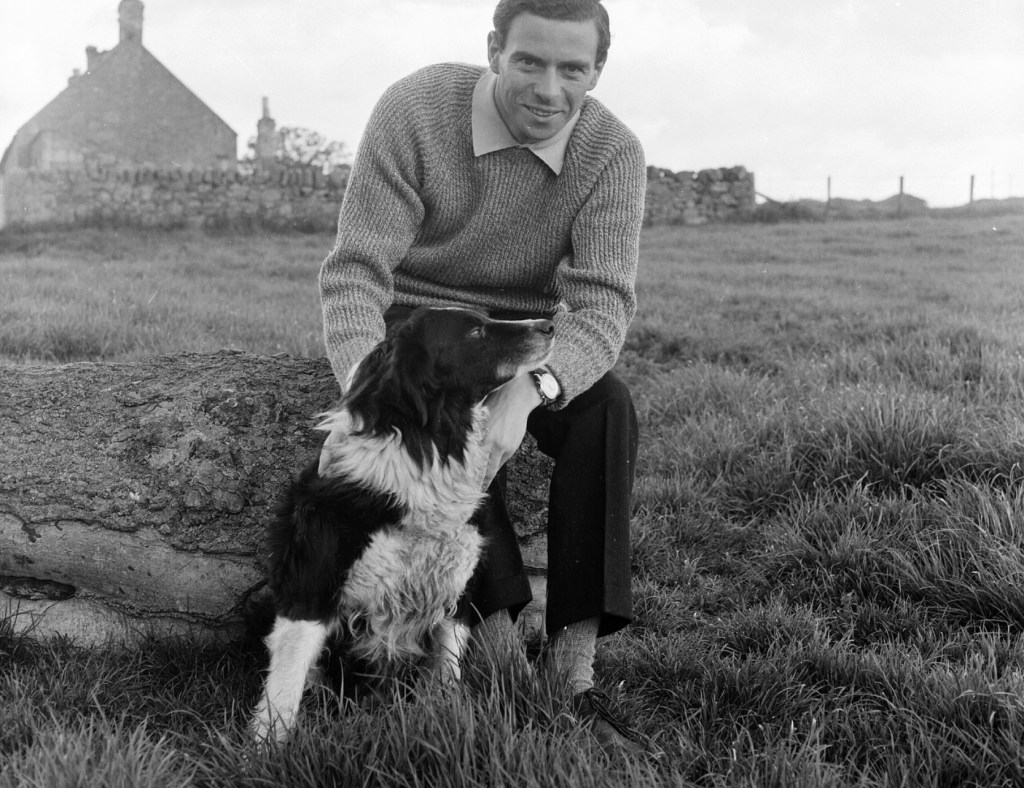
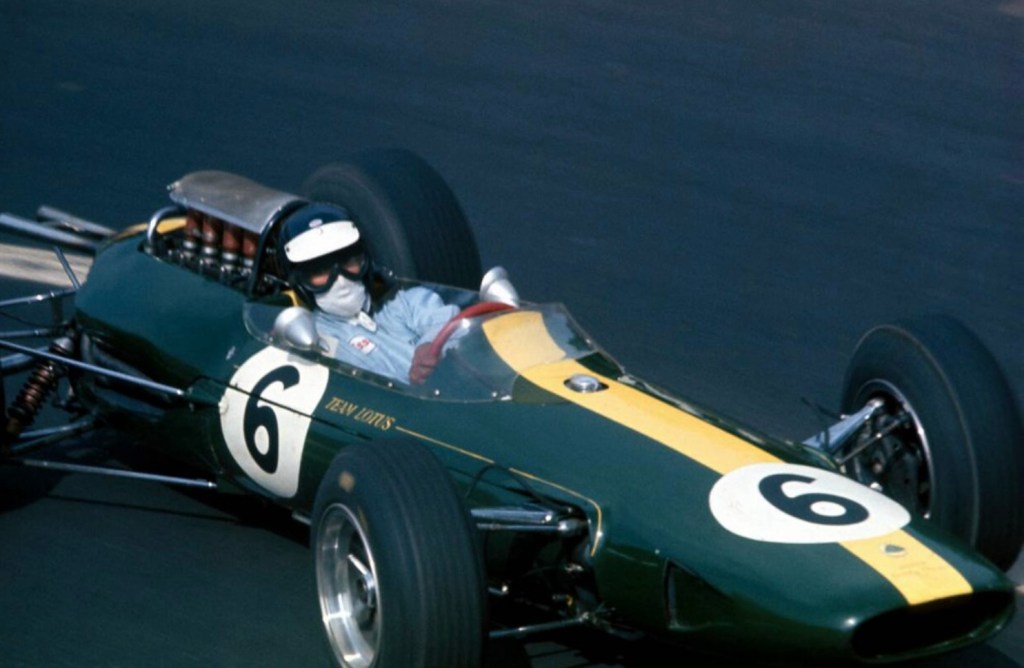
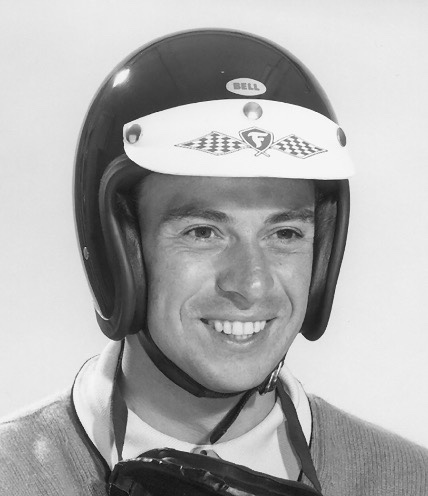
He bagged the Tasman Cup, Indianapolis 500, World Drivers Championship, the French – read Eiropean – F2 Championship plus a swag of touring car and sportscar victories.
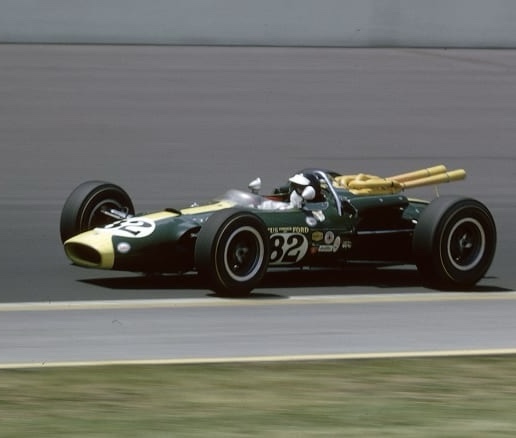
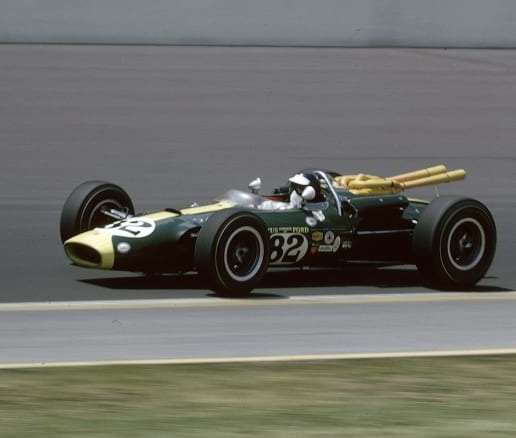
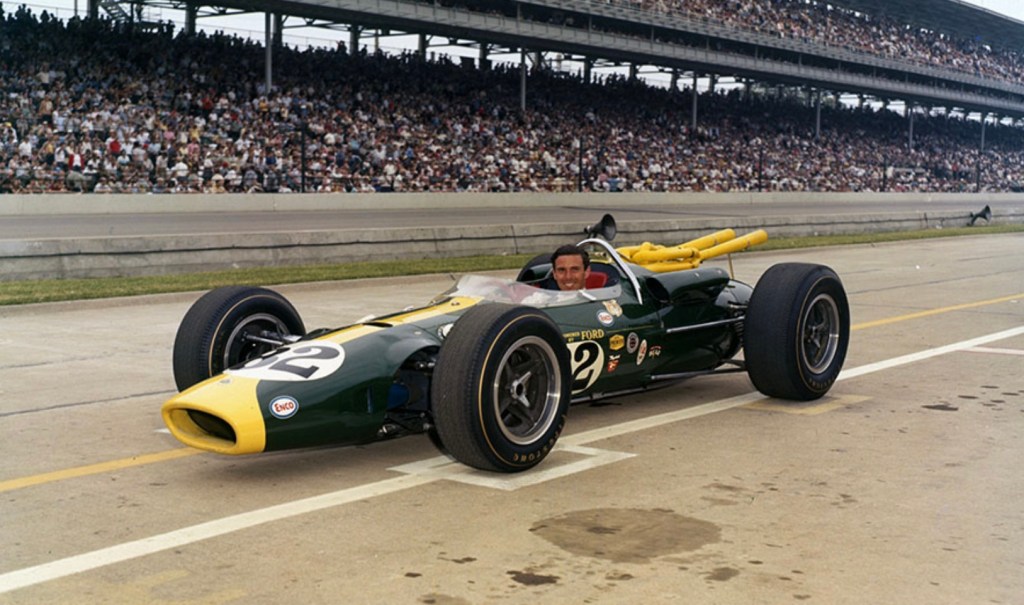
The shot above is of Clark enroute to victory at Indianapolis on May 31, 1965, Lotus 38 Ford-Indy 4.2-litre V8.
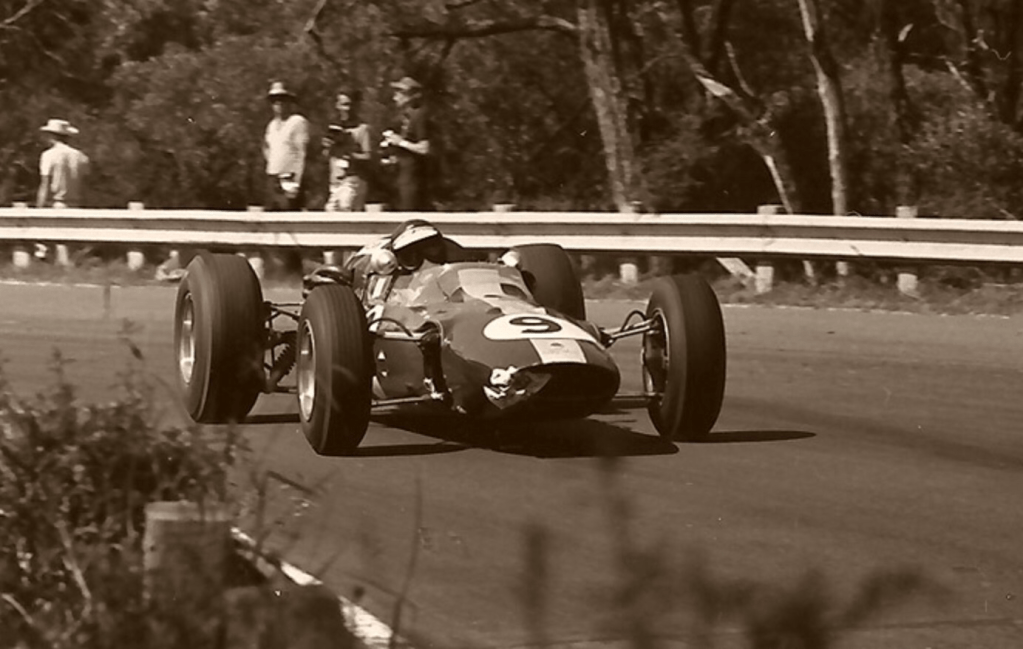
Hethel circa-1967 (unattributed)Lakeside 99, March 1965. Lotus 32B Climax. Jim won from Frank Gardner and Spencer Martin in Brabham BT11As (Daily Telegraph)
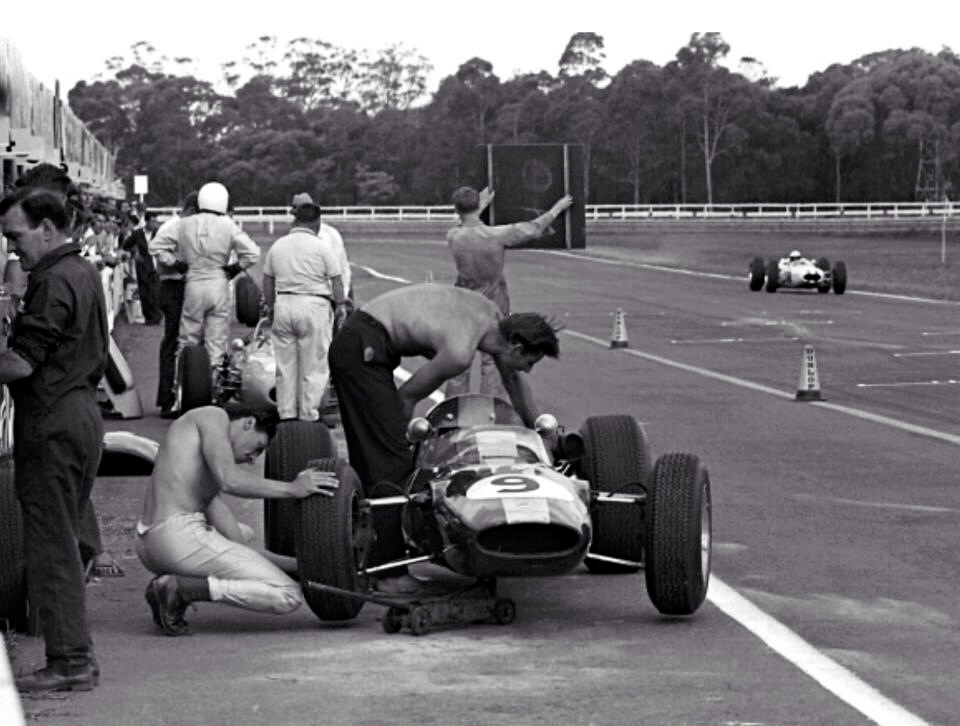
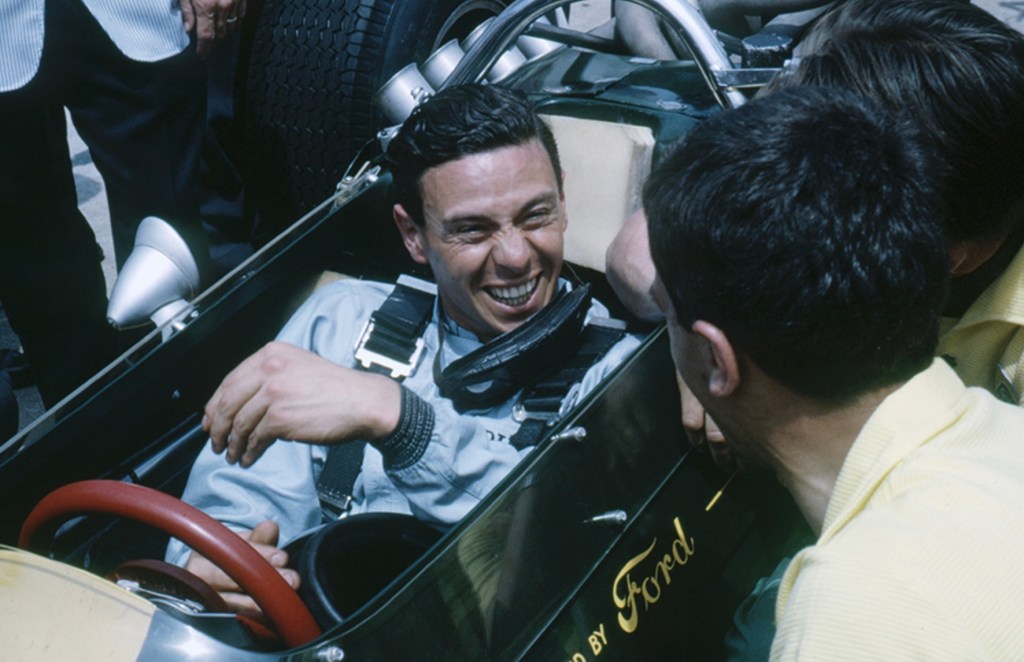
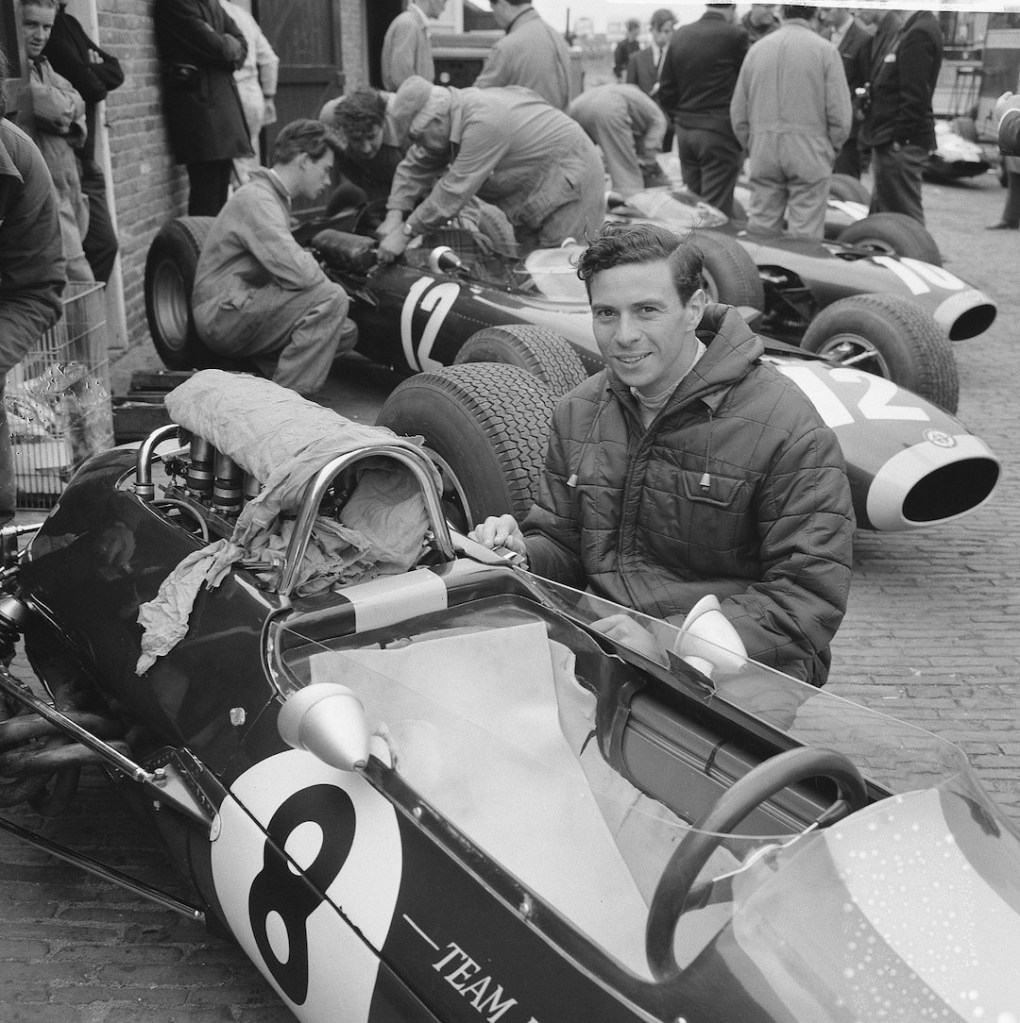
‘Can you give us a hand with the car Jimmy? Yep, no worries Ray (Parsons) I’ll do the fronts.’
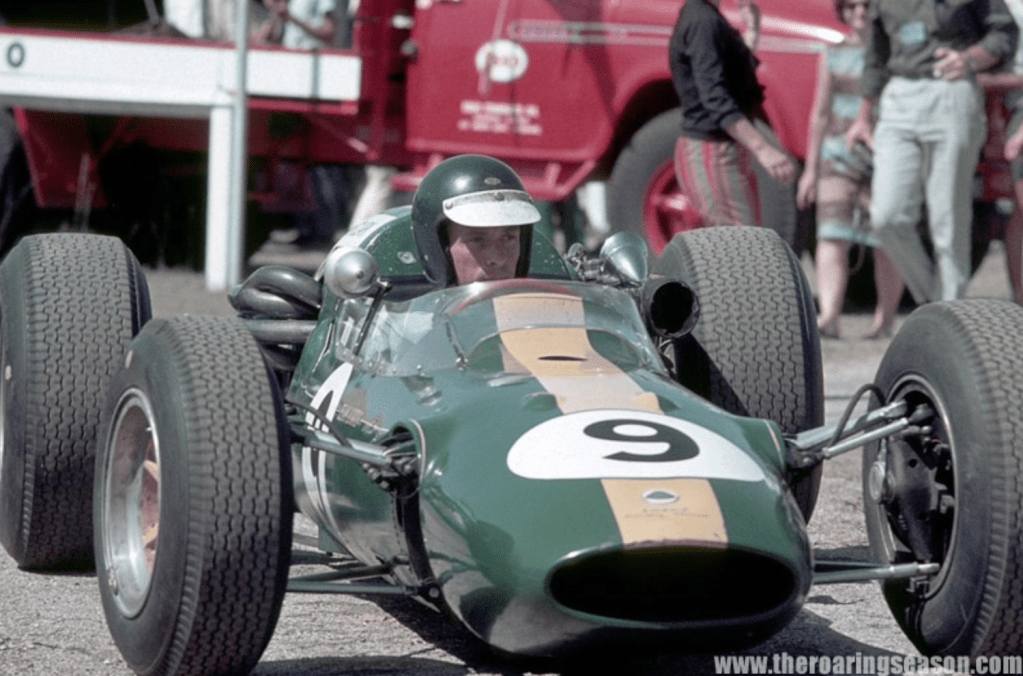
Clark and Parsons ready Clark’s Lotus 32B Climax FPF 2.5 for the Warwick Farm 100 during the February weekend. That’s Roy Billington, Jack Brabham’s mechanic on the far left by the pit counter and Lanky Frank Gardner in the white helmet. Meanwhile, Frank Matich blasts past in his Brabham BT7A Climax.
Clark romped home in the Tasman, winning four rounds. He won Levin, Wigram, Teretonga and Warwick Farm on-the-trot, then picked up the Lakeside non-championship round at the end of the tour. Bruce McLaren was second and Jack Brabham third.
No way did Jim get home to Scotland on too many occasions in 1965.
By my reckoning – aided by and improving on Peter Windsor’s article of 10 years ago – Clark had 29 winning drives in 1965, ranging from short Tasman Cup heats to the 500 miles at Indianapolis.
Peter’s list of 26 wins missed two Grands Prix, amazingly, and one F2 victory, so for mine, it’s 29 wins in that very big year.
(IMS)
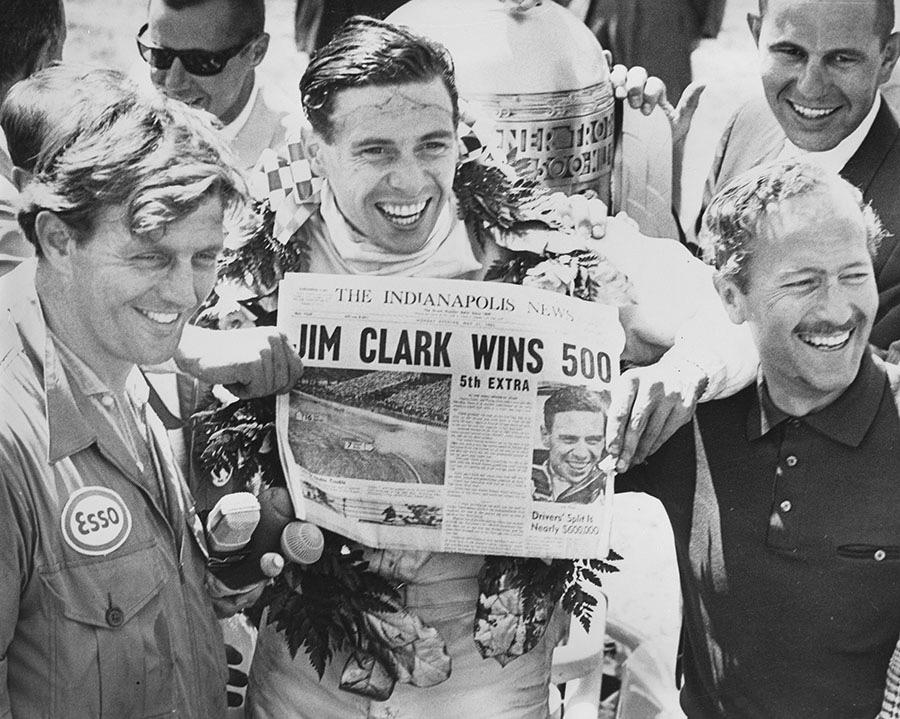
Clark was edged out of pole at Indy by AJ Foyt’s Lotus 34 Ford but Jim took the May 31 win that had been coming for two years, leading 190 of the 200 laps.
Parnelli Jones was second, Lotus 34 Ford, and Mario Andretti aboard a Hawk 1 Ford wad third. Al Miller’s Lotus 29 Ford was fourth; yes it was a great race for the Lotus lads.
(IMS)(IMS)
The win was well merited to say the least. Fortunate for Colin Chapman too, Ford would have pickled his testicles had there been a fuck-up like the year before!
In Team Lotus’ first year at the Brickyard in 1963 the Indy Establishment simply shafted the interlopers in favour of one of their own…
Of course Clark’s main programme for the year was Grand Prix racing.
That season he won three non-championship F1 races: the first heat of the Race of Champions at Brands Hatch, the Syracuse GP and the Sunday Mirror Trophy at Goodwood. He also took six of the ten championship events, four from pole: the South African, French, British, German, Italian and Mexican Grands Prix.
(unattributed)Clark on the hop at Goodwood during the August 1964 RAC Tourist Trophy, Lotus 30 Ford (Sutton)
Team Lotus wasn’t all beer and skittles. Every now and then Chapman built a shit-box, the Lotus 30 Ford 289 V8 was one of them.
While the concept of a backbone-chassis somewhat akin to the Lotus Elan made marketing, and, perhaps, theoretical sense, in practice it had a level of flaccidity the engineering equivalent of a couple of Blue-Bombers was never going to fix.
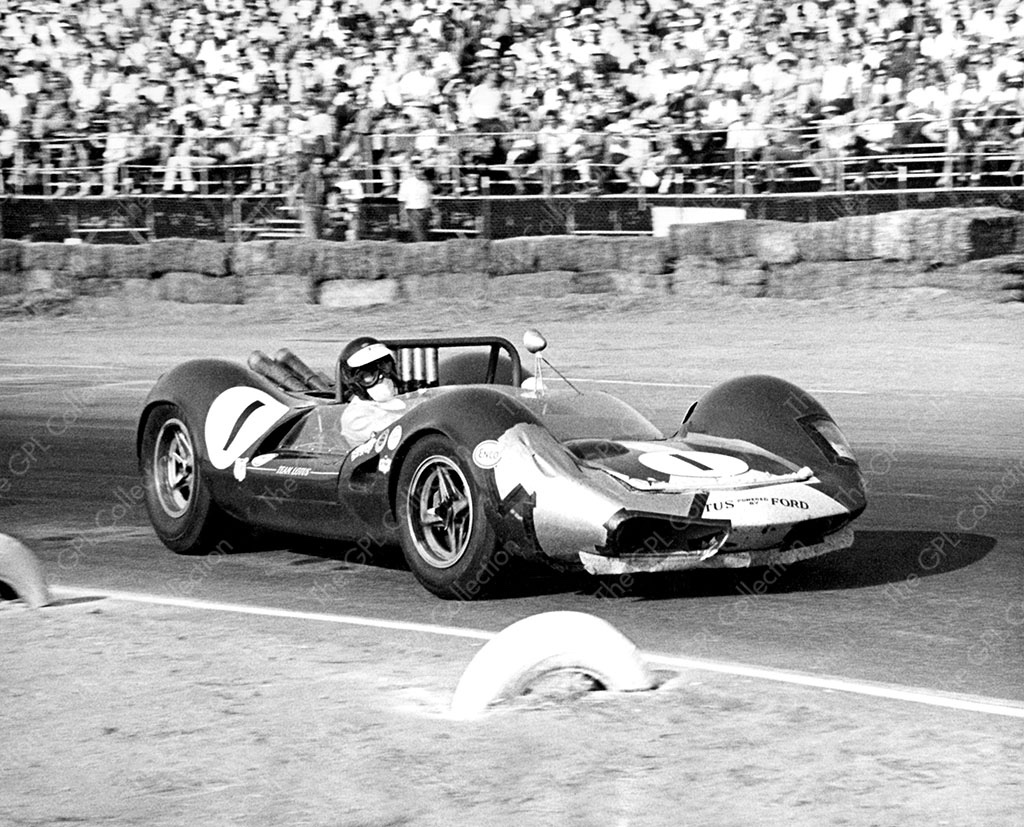
Clark wrestles with the gorgeous but recalcitrant 350bhp machine above, and with the ‘ten more mistakes’ – as Richie Ginther described it – aboard the Lotus 40 Ford in the LA Times GP at Riverside in October 1965; he was second to Hap Sharp’s Chaparral 2A Chev in a marvellous drive. One of Clark’s many attributes was to get the best out of a car, even a sub-optimal one. A bit more Lotus 30 here:https://primotipo.com/2016/08/30/rac-tourist-trophy-goodwood-1964/
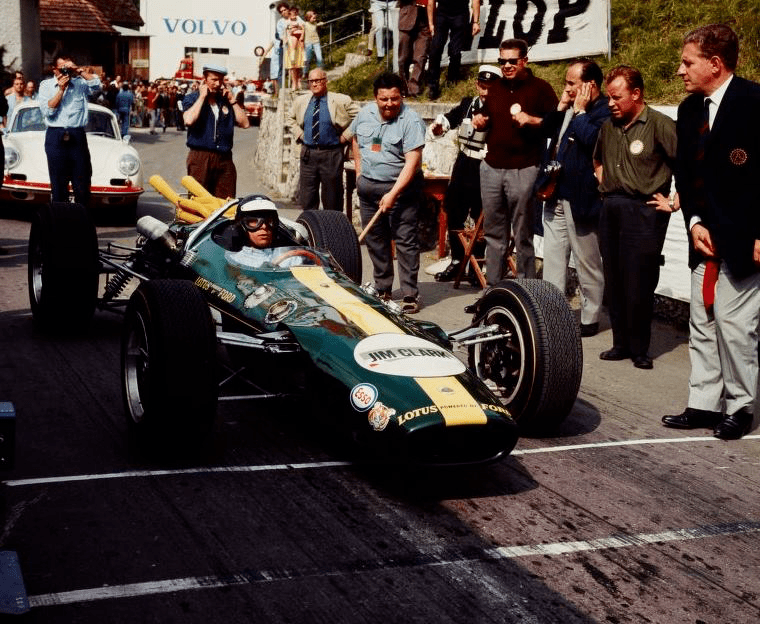
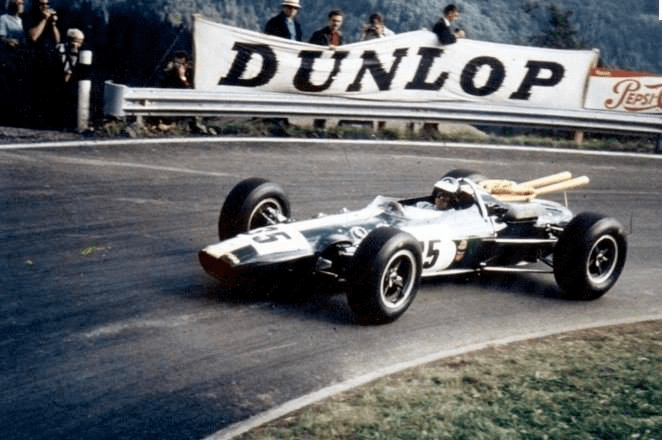
Of course, just when you think The Boss might give you a weekend off he comes up with the notion of doing a hillclimb or two in your Indy winning Lotus 38 Ford in the Swiss Alps.
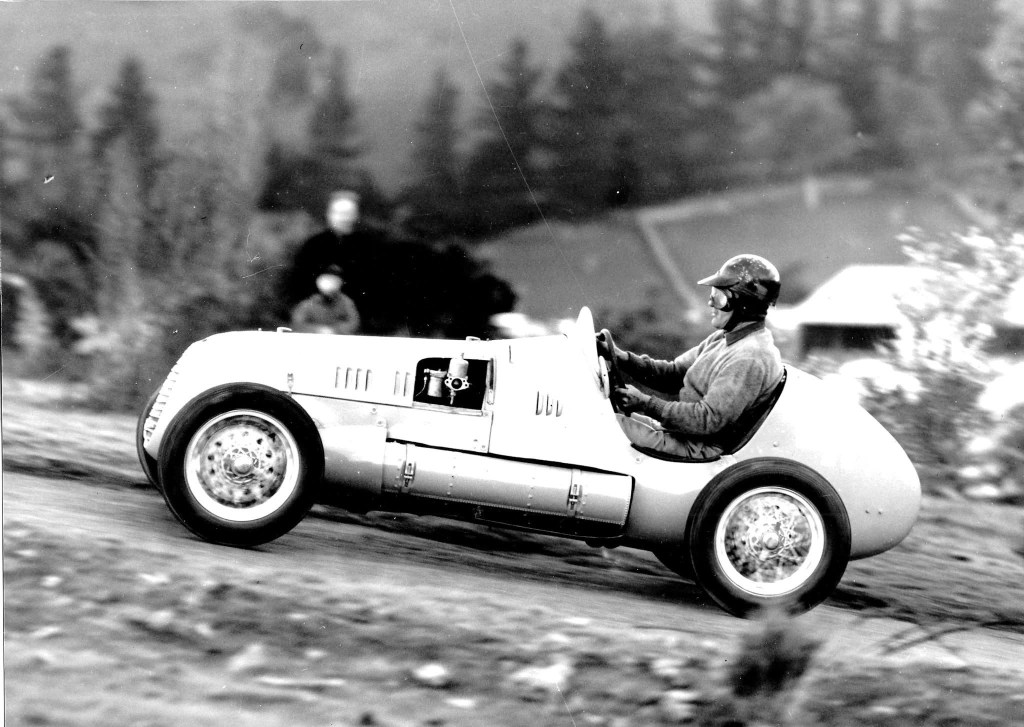
‘Don’t fret Jimmy, we’ll give you a car with symmetrical suspension – it was chassis 38-4 rather than the Indy winner, chassis 38-1 – and off to St Ursanne-Les Rangiers we go on August 22.
Clark did a demonstration run in 5:20.8 while Jo Siffert did FTD in his Brabham BRM 1.5 V8 F1 car. Charles Vogele was second and Silvio Moser third.
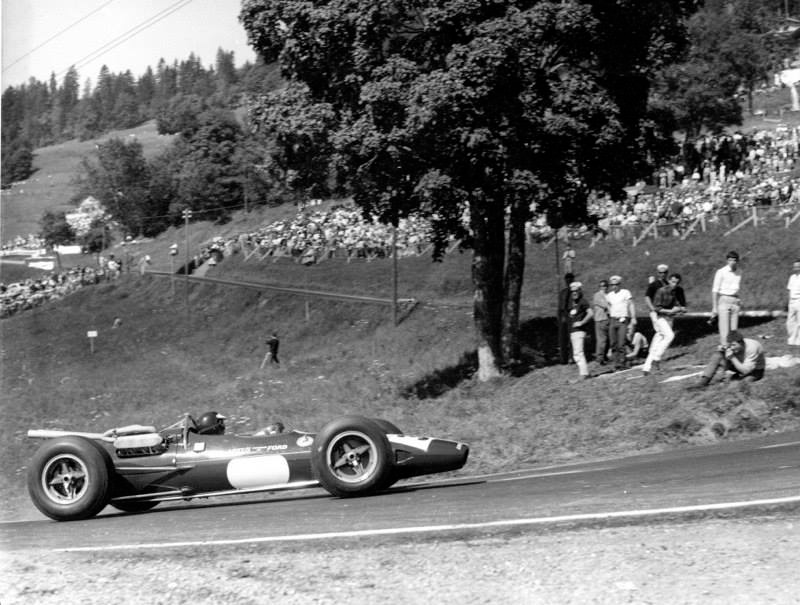
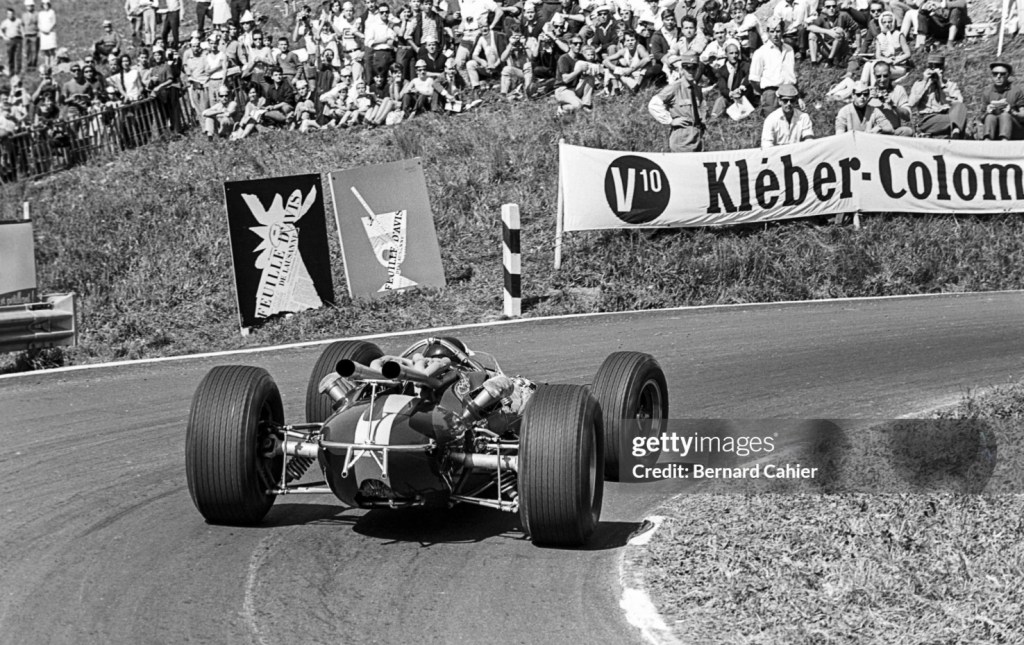
Next was Ollon-Villars also in Switzerland on the following weekend, August 29.
Lou Drozdowski wrote, ‘Clark spun off the course during practice and spent much of the afternoon among the sheep and pastures making his way back. He did however set a time of 4:34 compared to Ludovico Scarfiotti, Ferrari 206P FTD of 4:09.’ Gerhard Mitter was second and Gianpiero Biscaldi third.
Ollon-Villars (unattributed)Ollon-Villars (unattributed)Big-bertha’s butt at Ollon-Villars (B Cahier)(LAT)
Lotus’ relationship with Ford was strong and multi-faceted, one element of which was the Ford Cortina Lotus Mk 1 and 2 and the Escort Twin-Cam, all of which were fitted with the Lotus-Ford twin-cam, two-valve twin-Weber fed engine.
While it could be seen as hit-and-giggle in the context of his other ‘65 race-programmes, moving-metal was a very serious business so Clark approached his Lotus Cortina races that year in the UK and North America just as seriously as he did everything else.
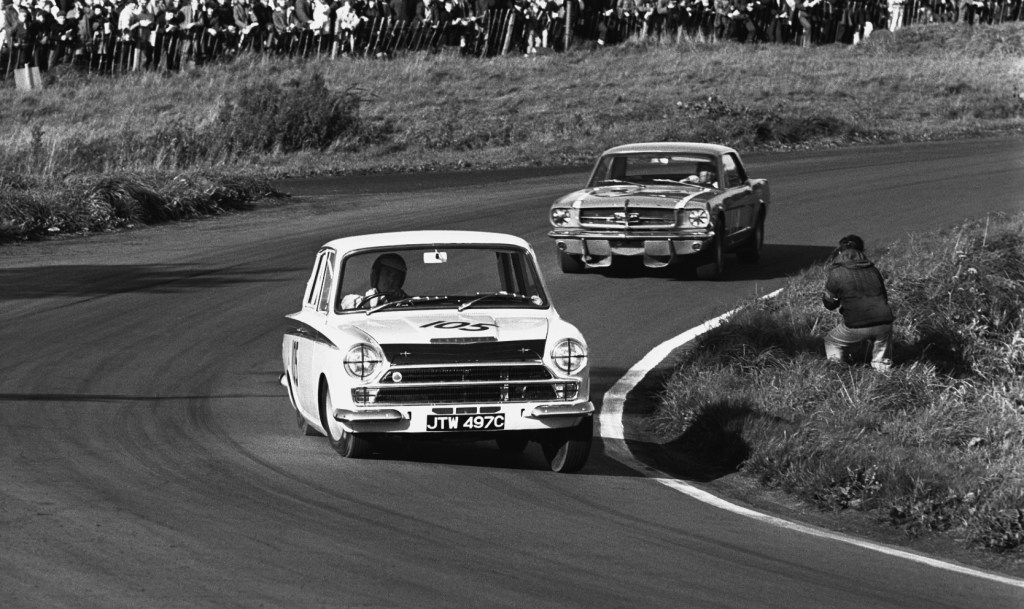
Here he is giving Jack Brabham a run for his money at Oulton Park during the British Saloon Car Championship round on September 18, 1965. Jack’s mount is Alan Mann’s Ford Mustang. More on the Lotus Cortina here: https://primotipo.com/2014/11/16/jim-clark-lotus-cortina-sebring-1964/
Etcetera…
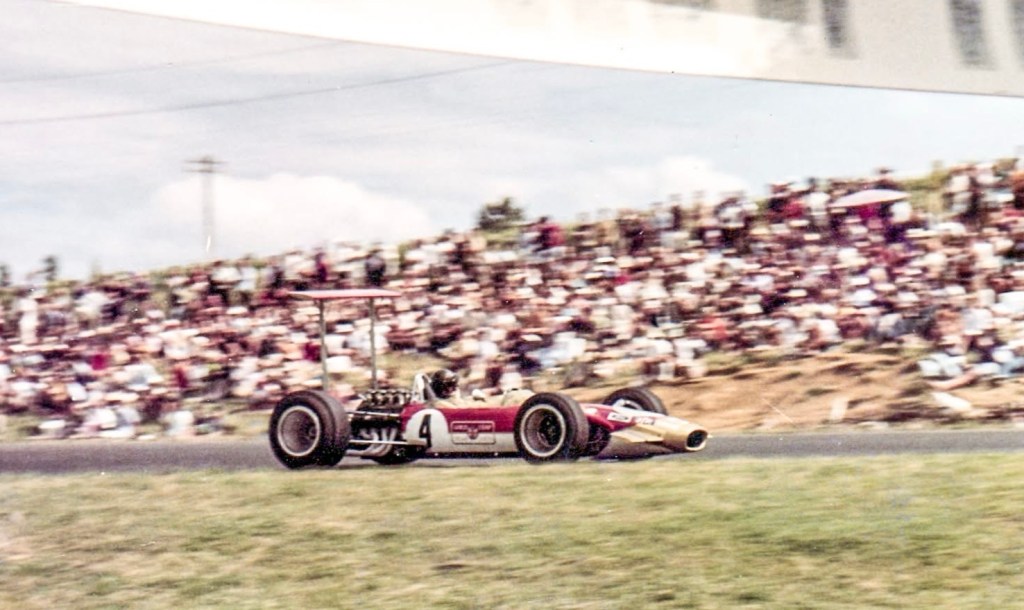
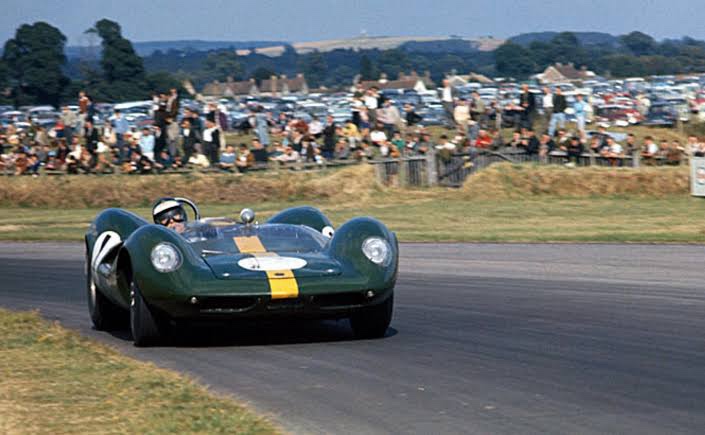
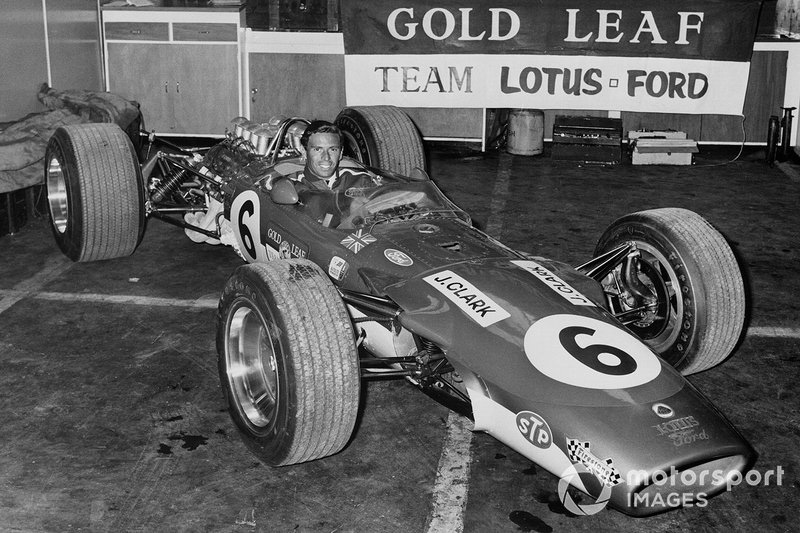
The Lotus 49 first ran in Gold Leaf Team Lotus colors during the Lady Wigram Trophy on January 20, 1968.
The transformation from Team Lotus’ perfect livery to fag-packet occurred during the week between the Levin International on January 13 and Wigram.
With a done deal in London, the Lotus team arranged for a skilled signwriter at Hutchinson Ford in Christchurch to apply the new Gold Leaf livery to Jim’s Lotus 49.
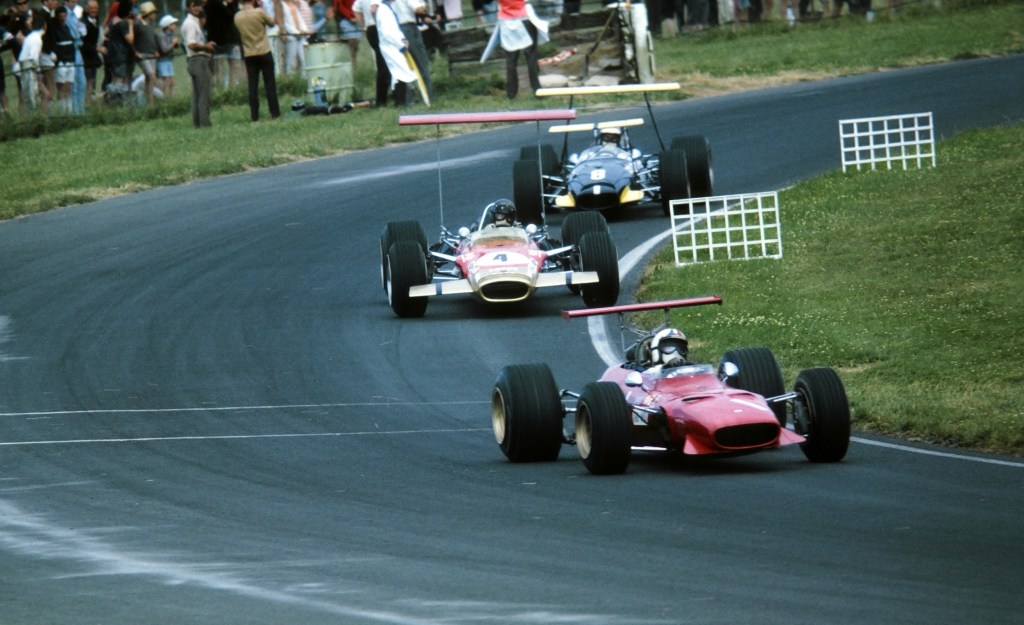
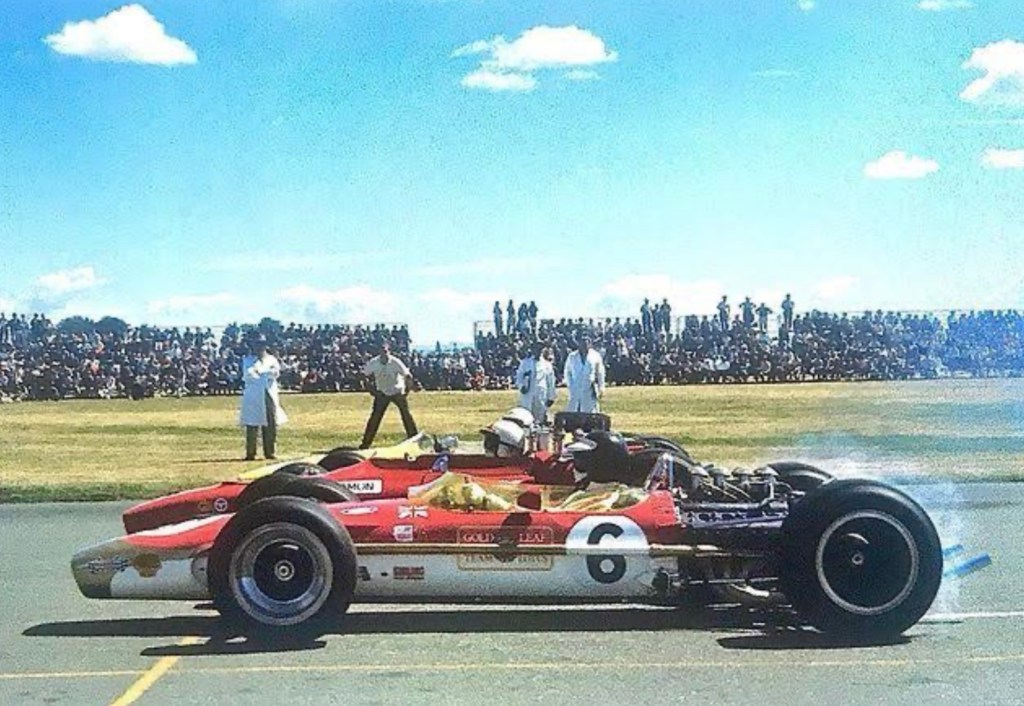
Clark, Amon, Gardner: Lotus 49 Ford DFW, Ferrari 246T and Brabham BT23D Alfa Romeo. Wigram 1968
Outside the US and some other countries it was the beginning of big corporate sponsorship in motor racing.
Ever the leader, Chapman’s quick commercial response and applying the new sponsorship colours demonstrates just how rapidly change took place once advertising restrictions in racing were lifted prior to the 1968 season.
(unattributed)
Credits…
Indianapolis Motor Speedway (IMS), Bruce Wells, The Jim Clark Trust (TJCT), Lou Drozdowski in lotuseuropa.org
Tailpiece…
(TJCT)
Jim Clark’s first race was at Crimond, aboard Ian- Scott-Watson’s DKW Sonderklasse on June 16, 1956.
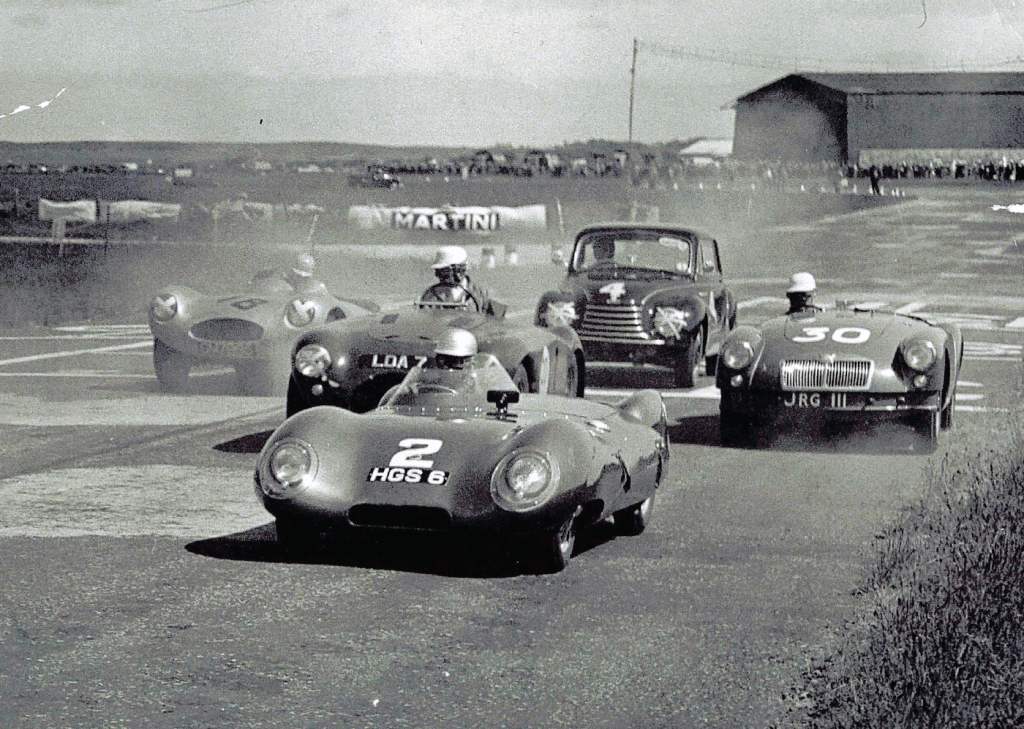
That’s JL Fraser Lotus 11 front-and-centre, then from the left #18 AR Millar Saltire, LDA7 Kenny McLennan’s Kit MG, #4 Clark in Scott-Watsons DKW Sonderklasse, and John Campbell, MGA.
The Jim Clark Trust wrote that ‘In the sportscar race there was no handicap, so the DKW was hopelessly outclassed. Clark did pass one car but his joy was short-lived. The tailender was heading for the pits with broken halfshaft and the DKW finished in last place.’
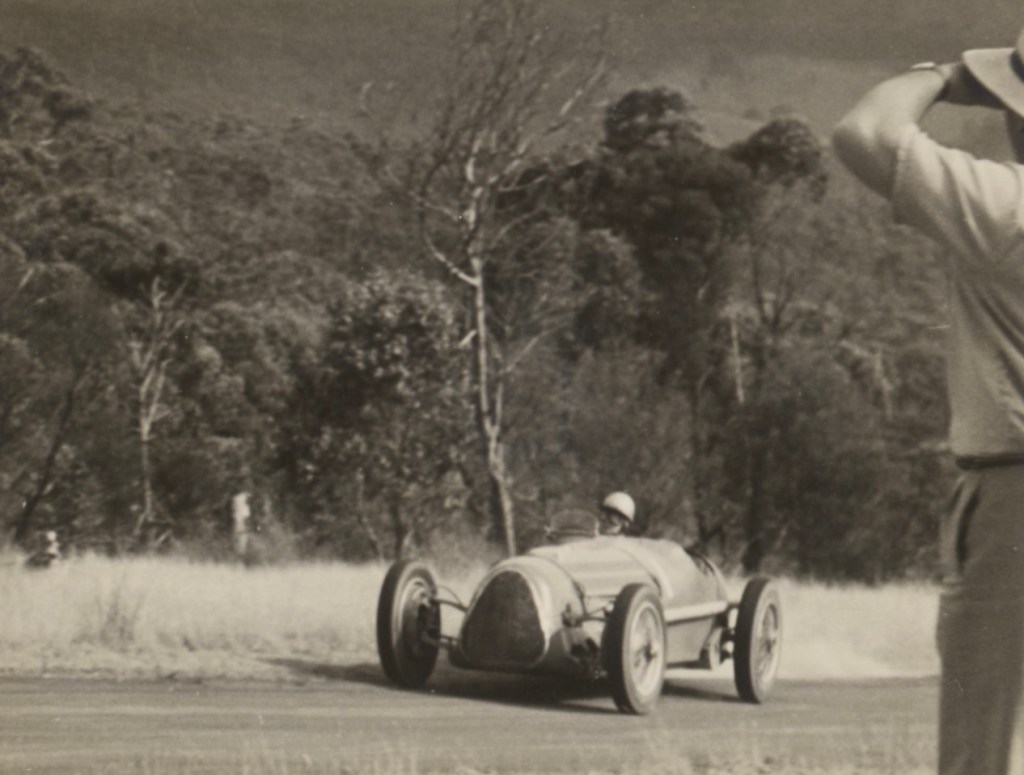
Reg Hunt working his Maserati A6GCM-250 hard at the Bathurst Easter meeting in 1955.
He won the 26 lap Bathurst 100 feature from Ern Seeliger aboard Stan Jones’ ex-Jack Brabham Cooper T23 Bristol and Lex Davison’s HWM Jaguar, below.
(I Arnold)(I Arnold)
Clive Adams’ drove Stan Coffey’s Cooper T20 Bristol skilfully but lost an early joust for third place with Davison, spinning at Forrest’s Elbow on the run down the mountain.
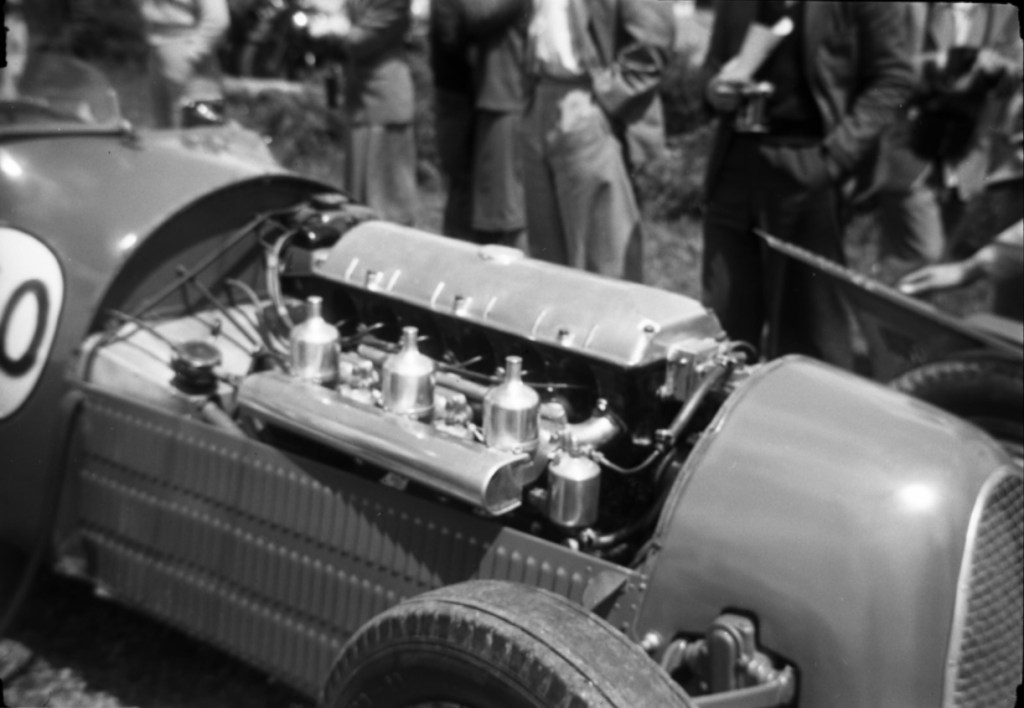
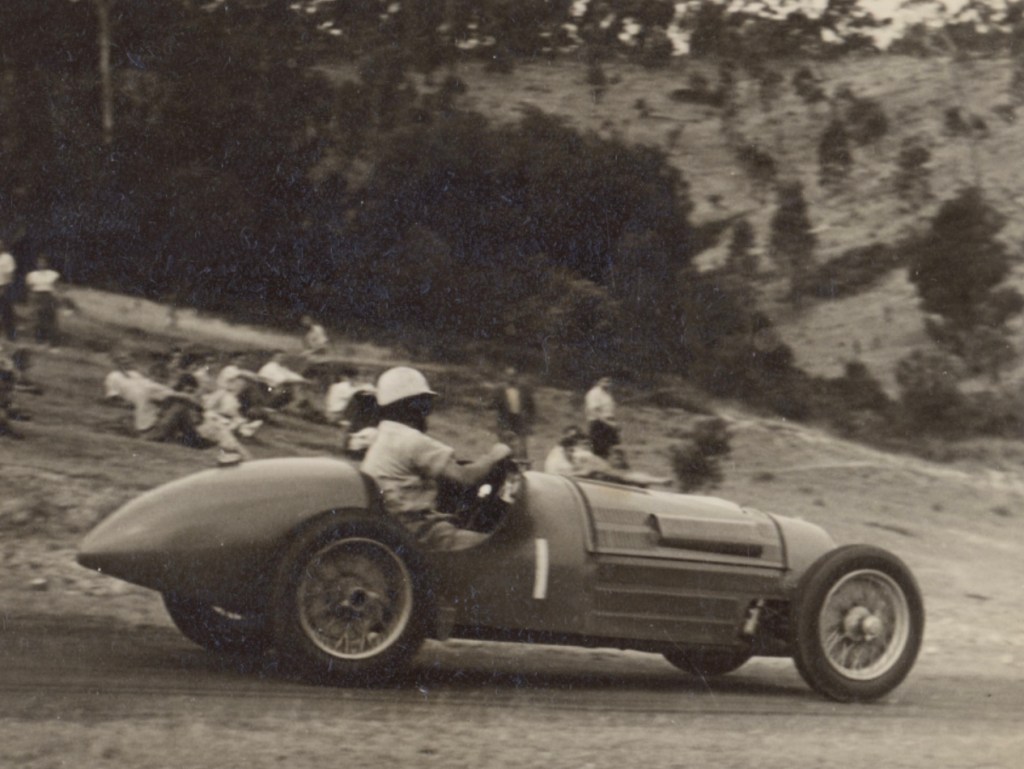
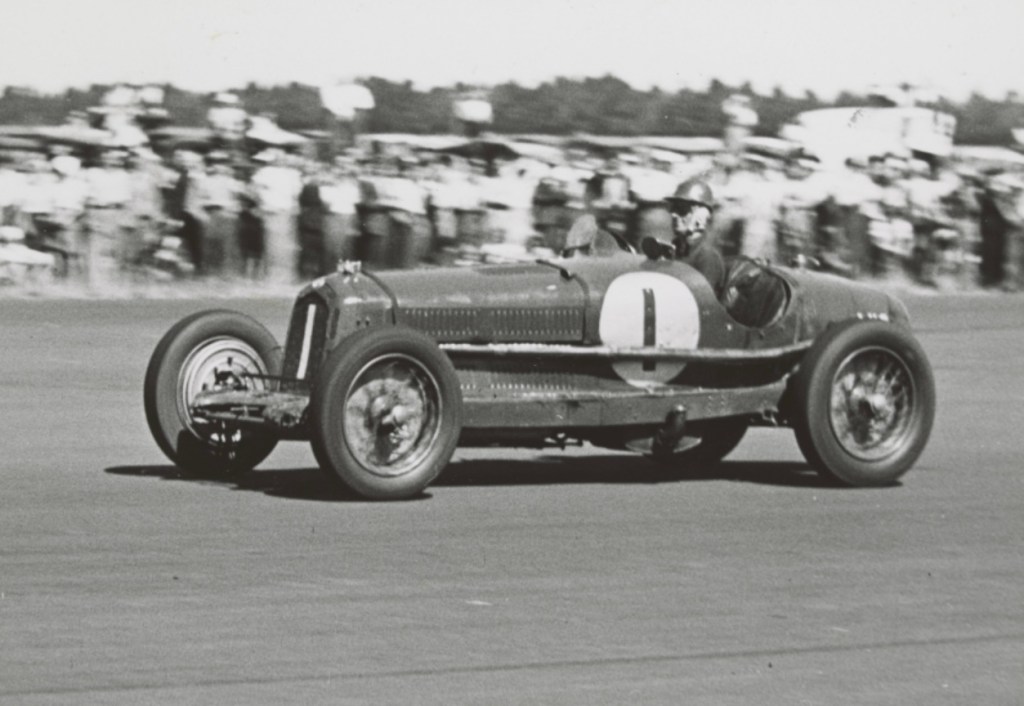
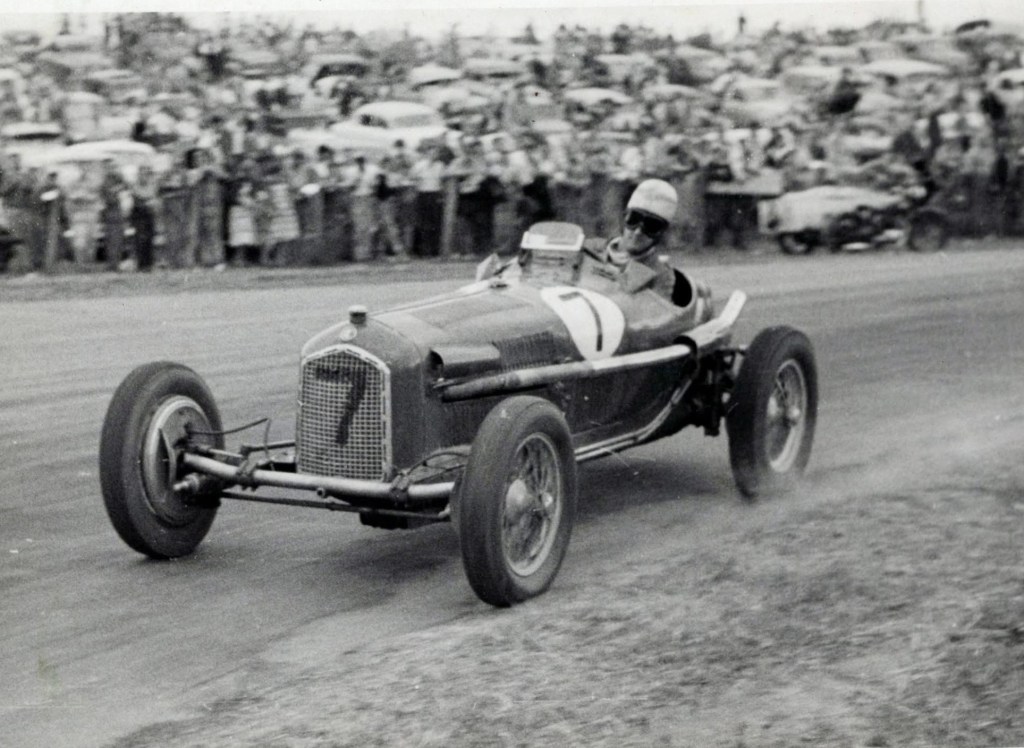
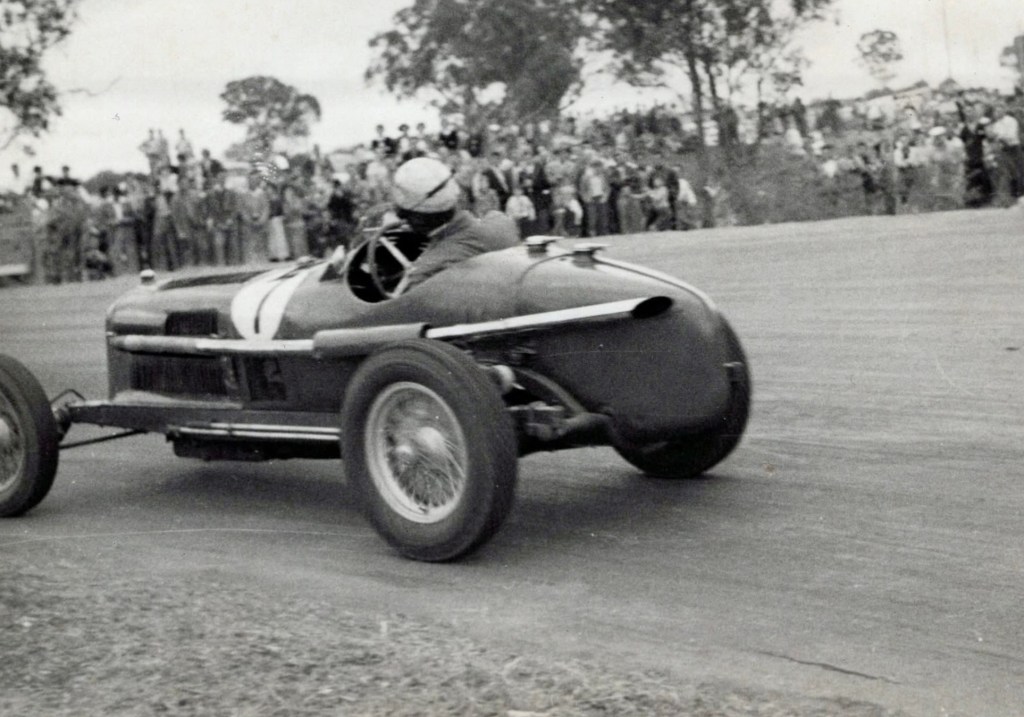
By 1955 the ex-Jack Saywell Alfa Romeo P3 had passed through the hands of Julian Barrett and Bill Murray and was powered by an Alvis engine. Sold by Murray to Gordon Greig, the car was involved in a terrible accident after Greig pitted, feeling sick, on lap 16.
Gordon Greig, Alfa Romeo P3 Alvis at Hell corner above, and below, before the disaster (I Arnold)
Tony Bourke, one of Greig’s crew, jumped aboard to finish the race and promptly lost control of the car over Conrod’s final hump, spun and went backwards off the track through the crowd killing one, mortally wounding another and injuring 20. Bourke stepped from the car unhurt and was later treated for shock.
Changes were were made to eliminate spectators from this area after the Coroner’s Inquest and public and press reaction. Bourke died after a Midget crash at Westmead Speedway in 1965.
(I Arnold)(I Arnold)
Col James MG Spl s/c and Ray Fowler, MG Spl, negotiate Hell Corner in the Group B Racing Car Scratch. They were third and fourth in this 3 lapper won by Stan Jones’ Cooper 1100.
(I Arnold)
Tom Jordan’s 1949 2.5-litre Riley engined Healey Silverstone (above) ‘was raced as a factory entry by Tony Rolt in the UK in 1949, then raced by Charles Mortimer in 1950 – he wrote a book about it, Racing a Sports Car – and was then returned to the factory, bought by Queenslander Colin Leagh Murray and raced and hillclimbed by him in Queensland before being sold to Jordan who had many successes with the car,’ wrote John Medley.
Etcetera…
(I Arnold)
It’s doubtful that Lex would have listed the HWM Jaguar – an ex-Moss HWM Alta 2-litre F2 chassis – amongst his favourite cars but he and his team coaxed enough speed and reliability out of the C-Type Jaguar powered jigger to win the 1954 AGP at Southport, aided and abetted by the breakage of a chassis weld on Maybach 2 when Stan Jones seemingly had the race ‘in the bag’.
By 1955 the HWM Jag was off the ultimate pace, Hunt had reset the local bar with his Maserati and Lex would meet the challenge in early 1956 with the purchase of Tony Gaze’ Ferrari 500/625 3-litre.
(I Arnold)
October 1955…
(I Arnold)
C James MG Spl S/c from Ted Gray, Tornado Ford, Hell corner, during the 3 lap Group A Racing Car Scratch.
On the last lap Tiger Ted lost the new car coming down the mountain near Griffin’s destroying it and hospitalising himself for months. Tornado 2 Ford would emerge in due course and Tornado 2 Chev became the fastest car in the country by later 1957, read here: https://primotipo.com/2015/11/27/the-longford-trophy-1958-the-tornados-ted-gray/
(I Arnold)
Touring car racing was steadily gaining in popularity with Jack Myers easily winning the sedan car handicap in his well developed, black-roofed, yellow Holden 48-215. ‘Holden wonder-man of the mid-1950s’ as John Medley described him. Here he is alongside George Pearse’s Ford Zephyr. See here for more on Jack: https://primotipo.com/2024/05/02/jumpin-jack-myers/
(I Arnold)
Jack Robinson’s Jaguar XK120 Special.
(I Arnold)
Dr John Boorman on the rise out of Hell corner on his way up Mountain Straight, ‘off scratch in the 6 lap Sports Car Handicap made no impression at all on Shmith’s new Austin Healey 100S which did 124mph through the timed quarter while Boorman did 125,’ Medley wrote. More about this car here: https://primotipo.com/2014/08/05/gnoo-who-gnoo-blas-circuit-jaguar-xkc-type-xkc037/
Postscript: Easter Bathurst tragedy…
After publishing this article, journalist/historian Ray Bell emailed me excerpts from ’emails I sent to the sister of Gavin Larnach’, one of the Bathurst accident victims.
1. That this whole thing is surrounded by lies and cover-ups is simply disgraceful. One can readily understand Mark’s state of mind and applaud him on his pursuit of the facts.
One such fact is that this car was very unstable after it had the very heavy Alvis engine installed. Ray Wamsley told me this, he was the next owner of the car, and he said it was absolutely transformed when he fitted a GMC truck engine after the Alvis unit failed.
2. I’ve subsequently spoken a journalist of the time, about the cover-ups. He told me that he always understood it was the local member who pushed for the hushing of everything with a view to ensuring that the racing wasn’t shut down. The local member was Gus Kelly, who was a Cabinet member with some influence and had been the local member for many years, so that makes sense.
Two factors come into play here. In 1946 there was difficulty getting the racing off the ground because of police resistance. Additionally, a driver and a spectator had been killed at the Gnoo Blas race meeting in January, 1955. The fear throughout the two organising clubs would have been quite pronounced and it was just eighteen months later that the whole of motor racing in NSW had to comply with the new Speedways Act, which introduced standards for safety fencing etc.
3. What is really bugging me is John Medley’s comment thatsomeone who gave evidence wasn’t actually in the country when the crash occurred. Not so consequential if he was just giving evidence about something technical, but still it appears from John’s comment that it might matter.



 primotipo...