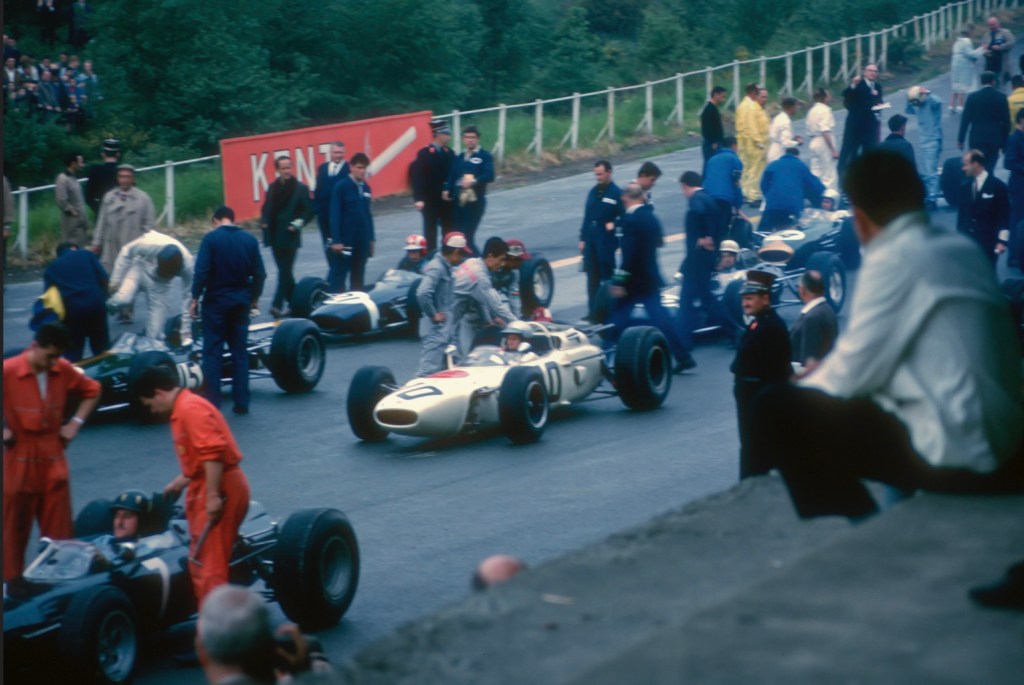
I just love pit or startline just-before-the-off shots. You can feel the tension, excitement and driver’s surge of adrenalin just before they pop their butts into the cockpits of their chariots. Here it’s the Belgian Grand Prix, Spa 1965.
Our black-snapper in some ways ruins the shot but he gives it intimacy and immediacy as well. The front row from left to right are Jackie Stewart, Jim Clark and a very obscured Graham Hill; BRM P261 by two and Lotus 33 Climax.
(wfooshee)
The only fellas I recognise are Messrs Stewart, Clark, Chapman and Hill. Can you do any better? The weather looks a bit grim, but such conditions are common in the Ardennes.
(wfooshee)
It’s a smidge out of focus but let’s not be too hard on our photographer Mr Fwooshee, I’d love to be able to credit him/her/it fully if anyone knows the correct name.
Every time I see a Honda RA271/272 I’m stunned by the audacity of a transversely mounted 1.5-litre V12, six-speed, monocoque chassis design in your first crack at a GP car; RA270 space frame prototype duly noted. Karma was Mr Honda’s originality being rewarded with that Mexican GP win several months hence, here Richie Ginther (RA272) was sixth. Graham Hill is in front, #15 is Dan Gurney’s Brabham BT11 Climax – everybody’s favourite Lanky-Yank is about to insert himself into that little Brabham – and behind him, Jo Siffert’s Rob Walker BT11 BRM. Jo Bonnier, Brabham BT7 Climax is behind the Honda, and further back the redoubtable Bob Anderson in his self-run #24 Brabham BT11 Climax. Brabhams galore, bless-em.
Who is the driver playing with his silver or white peakless helmet? Down the back, top-right there is a glimpse of Jean Stanley getting that tosspot ‘Lord Louis’ Stanley’s cravat nice and straight…
Oh yes, Jim Clark won from Jackie Stewart with Bruce McLaren’s Cooper T77 Climax in third place.
Credits…
fwooshee
(fwooshee)
Tailpiece…
Frank Gardner had an early afternoon, his John Willment Brabham BT11 BRM had ignition problems after completing only four laps. He started from grid slot 18 of 21, the best placed BT11 was the Guvnor’s works-car, Jack Brabham was fourth.
HRH Prince Phillip during a ‘cooks tour’ of Coventry Climax Ltd, Widdrington Road, Coventry on 21 June 1966…
I tripped over these photographs searching for shots of the FWMV four-valve heads- that 1.5 litre V8 was the engine Jim Clark used to win his 1963 and 1965 F1 titles in the rear of Lotus 25 and 33 chassis, the second of his cups was won using the four-valver.
Unsuccessful as i was in my search for an image of one of the final iterations of this lauded engine, i did find this beauty of a ‘normal’ two valver with HRH alongside- who are the technicians exchanging cam timing details with the chief i wonder?
(Getty)
The one below of the Prince wandering towards the 1.5 litre, still-born, FWMW Flat-16 made me chuckle as it reminded me of a DC Nye anecdote which goes along the lines of the Climax hierachy showing off the ultimate expression of their design and precision engineering capabilities- which was singing its supreme song on the test bed, but conversation was impossible, so Climax Managing Director Leonard Lee instructed revs to be cut back- a fatal mistake as 5000rpm or more was needed, below that critical number savage torsional vibration caused the quill shaft to break with plentiful mechanical mayhem following shortly thereafter- which it did. Whilst not an engineer the royal understood that something was amiss, making soothing sounds of sympathy, he wandered further along the corridors.
Check out the engines below- FWMV show engine, FWMW 16 in the right foreground, an outboard to the left of Lee, but what is the Amal fed four in front of the Prince?
Coventry Climax MD, Leonard Lee, HRH, Wally Hassan with hands in suit pockets behind and others- any clue folks? (Getty)
Prince Phillip sussing a CC dyno before sixteen cylinder carnage sets in (Getty)
None of the four FWMW engines laid down ever found their way into the cars designed for them- oil drainage, pumping and windage losses and time pressures ensured that- the 1.5 litre formula ended and Climax decided not to continue in racing so the Lotus 39, Brabham BT19 and Cooper T80 never raced with the sixteen cylinder engine for which they were designed but with a 2.5 Climax FPF four, 3 litre Repco Brabham 620 V8 and 3 litre Maserati V12 instead.
Theoretical advantages of higher revs, greater piston area and better breathing of the sixteen were never realised, but that FWMV four valve V8 delivered the goods even if its advantage over its more conventional sibling was marginal, mind you, in 1.5 litres 5 bhp makes a difference particularly if Clark J was behind the wheel of the car to which said engine was fitted.
(MotorSport)
What a jewel of a thing and what might have been had the 1.5 litre formula lasted another year? FWMW 16 on the test bed in 1965.
The antecedent engine of the Flat-Sixteen conceived by Climax Technical Director Wally Hassan and Chief Designer Peter Windsor-Smith was the 38hp ‘Featherweight’ 1020cc, SOHC four- from little things do big things grow. The two men set about design and construction of a 1.5 litre, twin-cam, two-valve, fuel injected sixteen cylinder engine with central power take off with projected power of circa 240-250bhp @ 12,000rpm after extrapolating the power of the best of the FWMV’s to the greater piston area of their proposed new engine.
Whilst twelve and sixteen cylinder engines were considered, the sixteen modelled best using the bore/stroke ratio of the successful Mk3 FWMV of 0.76:1- this provided for a bore and stroke of 54.1mm by 40.64mm giving a piston area of 23cm. Using the previously achieved 4.5bhp per square inch of piston area gave the 250bhp projection.
Lets not forget competitive pressures were the cause of this exciting engine’s birth- both Ferrari and Honda were racing twelves which showed promise, but 1964 ended up a battle of V8’s- Ferrari, BRM and Coventry Climax of course, with John Surtees’ Ferrari 158 taking the titles by the narrowest of margins.
The design influence of the Ferrari Flat-12 engine showed in that Climax contemplated the motor being used as a stressed member so chassis mounting points for the combined crankcase and cylinder block were provided on the crankcase and heads, of which there were four- four sets of four cylinders.
The crankshaft had central take off to minimise the torsional vibrations of such a long piece of exotic metal- the crank was laid out as two, four-throw single plane-units running in five main bearings but turned through 90 degrees to each other with their inner ends shrunk onto a central spur-gear. The spur gear passed power to an output shaft running below the crank at 80% of engine speed to suit the gearing of the ZF and Hewland transmissions used contemporarily.
1954 ad for the Coventry Climax Featherweight powered firepump unit. In 1951 the prototype 1020cc OHC, two valve, single carb, inline four produced 36bhp @ 3500rpm and delivered twice as much water as an existing unit which weighed double the weight of the Climax FW
Vic Berris cutaway showing the elegant simplicity…of the Climax FWMW Sixteen- oh what mighta been! Specifications as per text
The heads, as described above, used two valves and a single plug- the included angle between the valves was 48 degrees with inlet tracts designed for the port type Lucas fuel injection with which the designers were well familiar- Lucas also provided the transistorised ignition system.
Trains of spur gears running off the central power takeoff drove oil pressure and scavenge pumps down below and and the twin overhead camshafts and auxiliaries above the takeoff. Auxiliaries were located outta the way atop the crankcase comprised twin fuel injection pumps, the distributors and alternator- whilst the motor sounds huge it was small- only one inch longer than the FWMV at 30.9 inches and 22.6 inches wide.
Design commenced in 1963 with the first run on the dyno in late 1964- the major problem, as Prince Phillip will attest, was severe torsional vibration at low revs. A stronger replacement took too long and also failed- the best seen on test was 209bhp, none of the problems were insurmountable but the 1965 season was underway with developments of the good ole FWMV good enough to do the job.
Richie Ginther’s Honda RA272 V12 win at Mexico City in the very last Grand Prix of the marvellous 1.5 litre Formula in late October 1965 was perhaps a portent of what may have been an amazing battle between the Ferrari and Honda twelves and Climax sixteen in 1966 had the Formula run one more year, ignoring the small matter of Climax’ withdrawal from racing of course…
Etcetera…
(M Hewitt)
Further research- not exactly the shot of the heads I was after but a great view of the four-valver’s camshafts, plugs and gear driven cams which were characteristic of this Mk6 engine used by Clark and the Mk7 allocated to the Brabham Racing Organisation- the two only 1.5 litre FWMV four valve engines.
The mechanic (who is it folks?) got the Lotus 33 back together in time for Jim to win the Dutch Grand Prix the following July 1965 day from Jackie Stewart’s BRM P261 and Dan Gurney’s Brabham BT11 Climax.
(MotorSport)
Denis Jenkinson eliciting information on the specification of the three Lotus 33’s at Spa in June 1965.
The #17 machine is Jim’s race car fitted with the four-valve engine- note the low level exhausts fitted to his two cars whereas the #18 Mike Spence 33 has a much earlier spec Climax fitted with two-plane crank and crossover exhaust.
Jim won come raceday from Stewart and McLaren’s Cooper T77 Climax with Mike seventh on a circuit where the extra 10bhp or so would have made a hellluva difference.
(unattributed)
Still in the Spa paddock, note the distinctive ribbing on the cam covers of the four valve engine compared with the two valve motor shown in the drawing below. Low level exhausts, Lucas fuel injection- output of this FWMV Mk6 was quoted as 212bhp @ 10,300rpm and 119 lb/ft of torque at 8,900rpm.
ZF five speed transaxle, rubber donuts at the driveshaft inner ends, outboard non-ventilated disc brakes and rear suspension comprising single top link, inverted lower wishbone, two radius rods, coil spring/damper unit and magnesium upright- period typical and oh-so-effective, the rear end bite, traction of the 25/33’s was said to be one of the performance differentiators compared with the BRM P261.
Lotus 25 and early FWMV Weber carbed Mk1 or 2 V8 drawn (unattributed)
Credits…
Getty Images, Doug Nye, M Hewitt, MotorSport, Vic Berris, Coventry Climax, ‘1 1/2 Litre Grand Prix Racing: Low Power, High Tech’ Mark Whitelock
Tailpiece…
(Getty)
A capable pilot, Prince Phillip about to leave Coventry, no doubt he had promised the Queen he would be back in London before afternoon tea- Westland Wessex ‘chopper?
Team Lotus in the Spa pitlane, Saturday June 12 1965: the 33’s of #17 Jim Clark, Mike Spence and the teams spare chassis…
Sunday was wet, Jimmy ran away with the race from grid #2, Mike was 7th from grid 12. Graham Hill started from pole in his BRM P261 but finished 4th, Jackie Stewart was 2nd in the other BRM and Bruce McLaren 3rd in a Cooper T77 Climax.
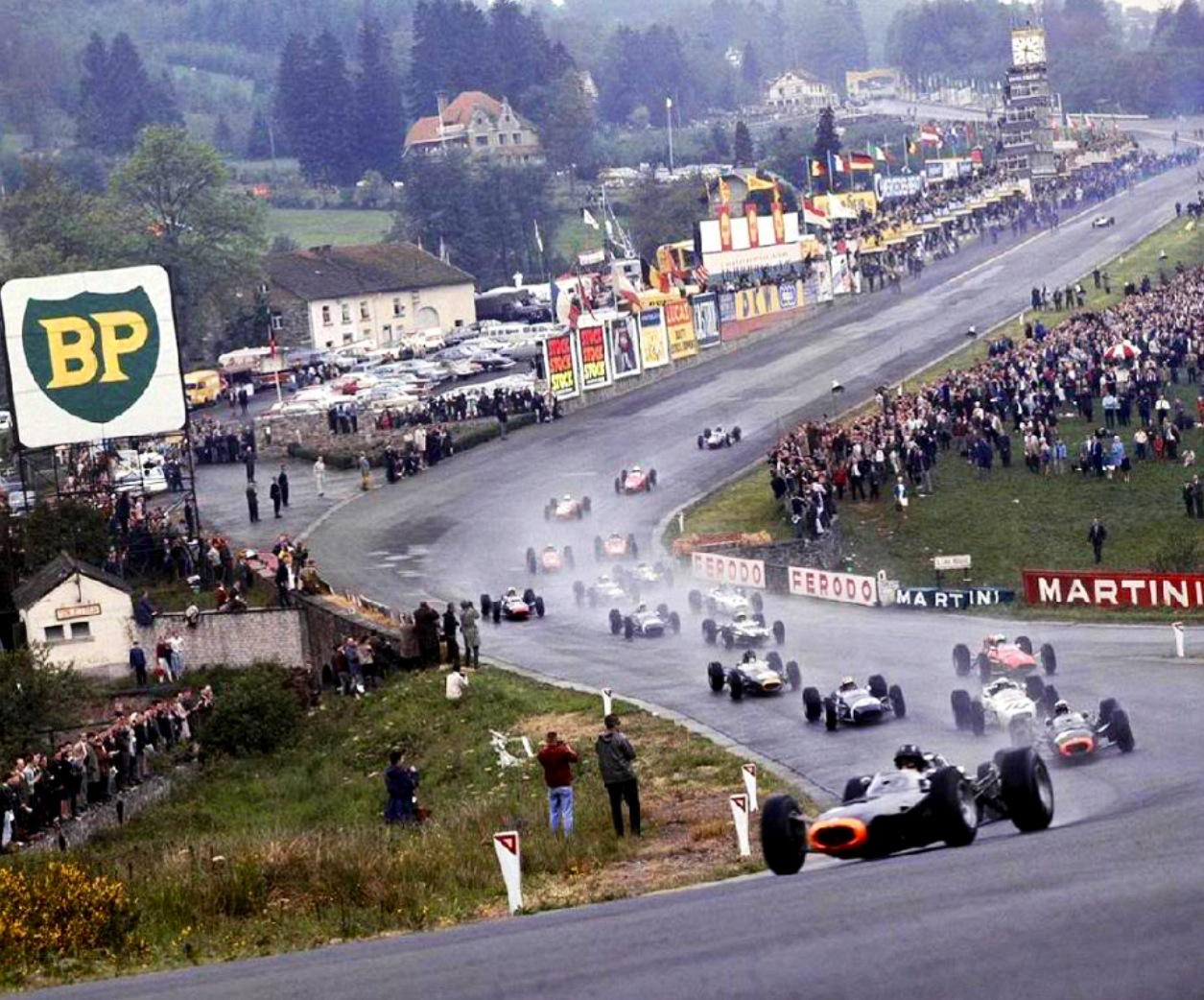
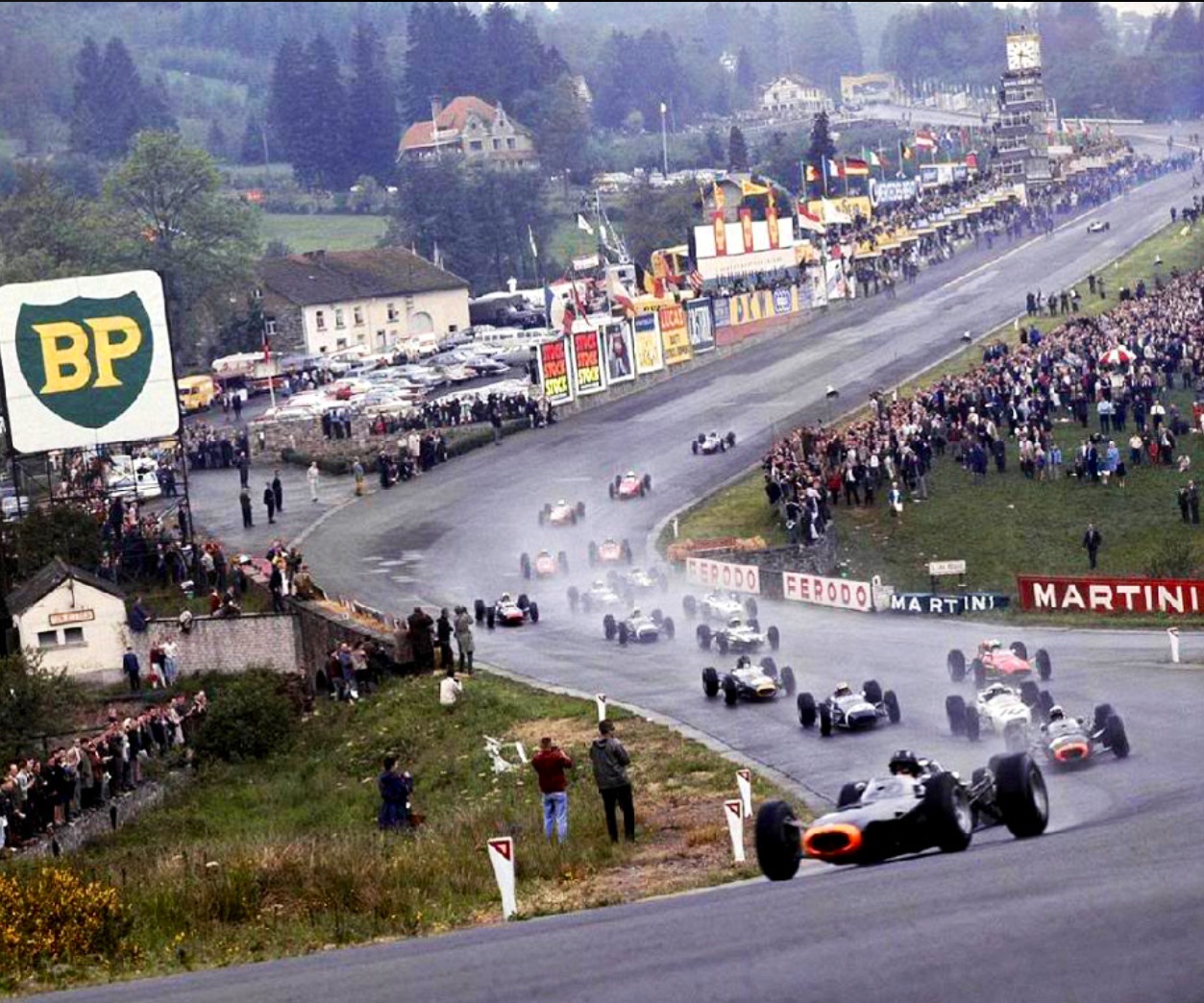
Lap 1 and Graham Hill’s BRM P261 leads into Eau Rouge from pole. You can just see the white peak of Clark’s helmet and his Lotus 33’s left rear wheel right up Hills clacker. Stewart’s sister BRM follows then Ginther’s white Honda RA272, Siffert’s Rob Walker Brabham BT11 Climax, Surtees Ferrari 158 on the outside, Gurney’s Brabham BT11 Climax, McLarens Cooper T77 Climax and the rest…(unattributed)
Daunting in the dry positively frightening in the wet. Spa. Clark speeds to victory, he took the ’65 drivers title in his Lotus 33 Climax (unattributed)
Tailpiece: Alone in the Ardennes Forest, Jack Brabham…
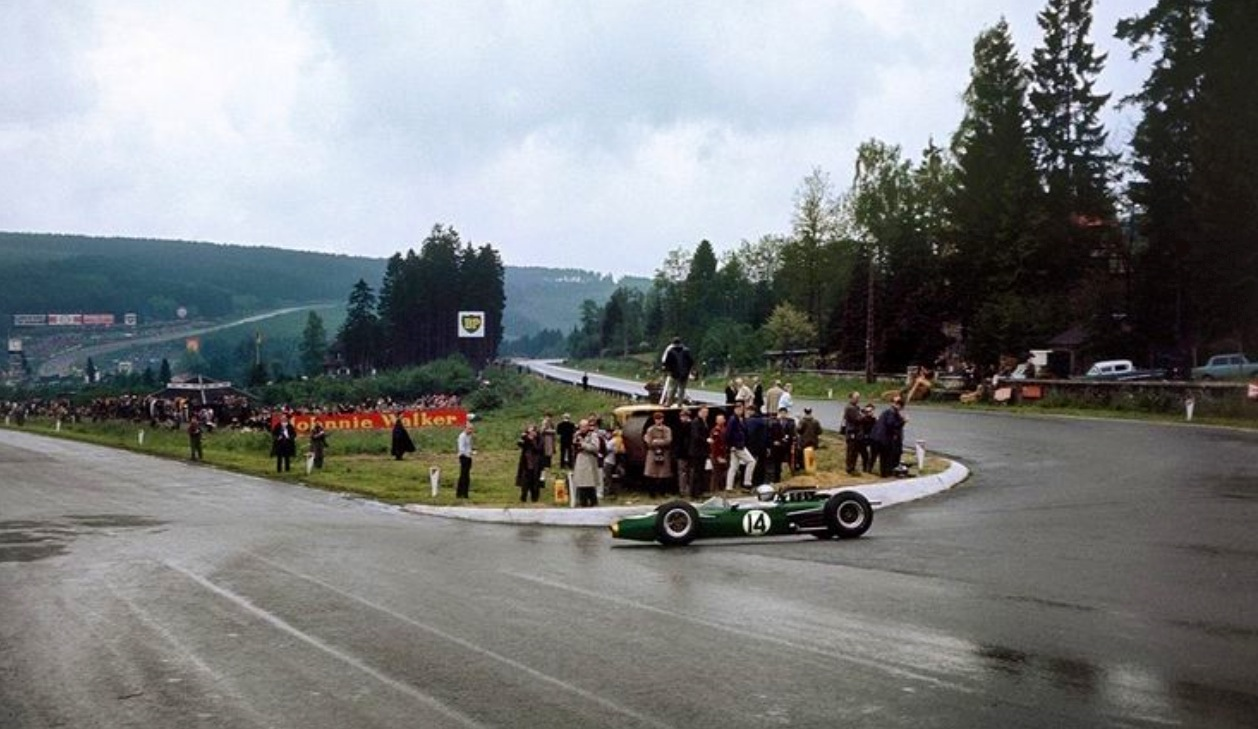
Brabham, La Source hairpin, Spa 1965- 4th in his Brabham BT11 Climax (unattributed)
Richie Ginther in search of the La Source Hairpin apex, with photographer’s assistance, Honda RA272, Belgian Grand Prix, Spa 1965…
Soichiro Honda was a talented engineer who created the largest motorcycle manufacturing company in the world, it could be said that he helped mobilise the masses in many Third World countries. He was a passionate racer and in the early 1960s challenged the dominance of the European motorcycle marques, notably MV Agusta, on the circuits of the world.
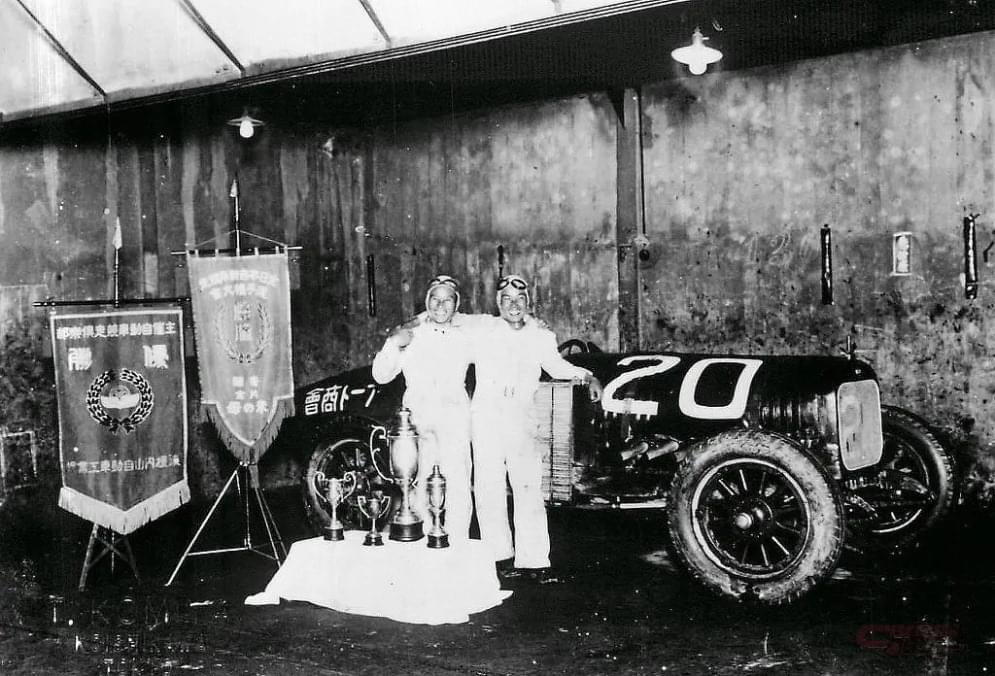
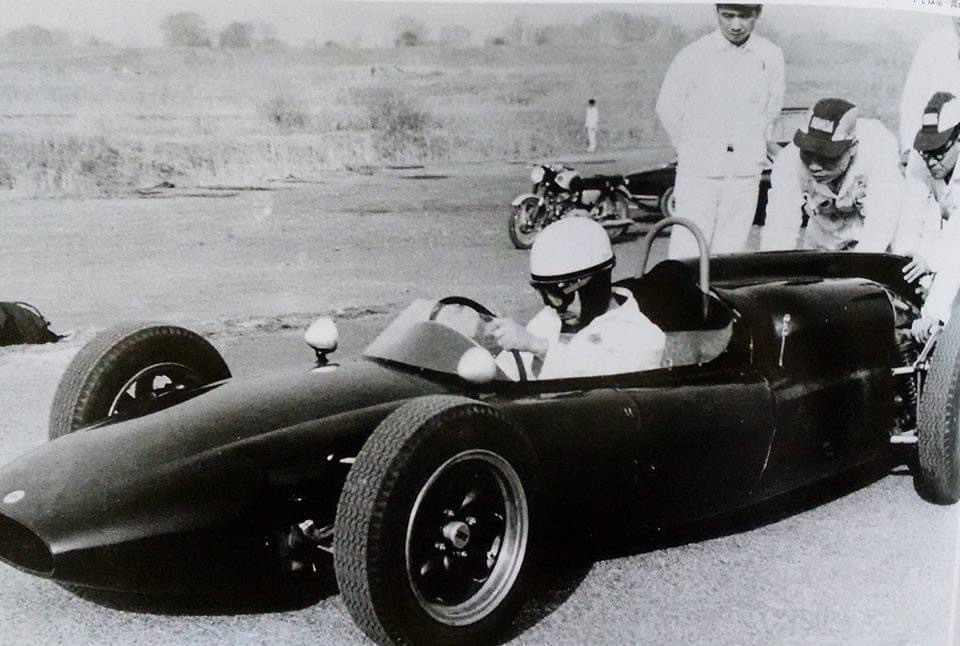
Soichiro and Benjiro Honda with their supercharged Ford powered ‘Curtiss Special’. Both were injured when they crashed and were thrown out of the car during the First Japan Auto Race at Tamagawa in 1936 (unattributed)Aussie Tom Phillis broke thru for Honda’s maiden GP win in the 1961 Spanish 125cc GP. Honda entered all the 125/250cc events from 1960 and won both titles that year. They entered 500cc racing in 1966 and took 138 wins in its first sortie to the World Championships, before taking a break in 1967 (unattributed)Honda about to test his Cooper T53 Climax #F1-19-61 circa 1962 (unattributed)
By that time Honda R&D already had a 2.5-litre Cooper T53 Climax F1 car to tinker with (above) and study, they announced their entry into Grand Prix Racing in 1964, a sensational 1.5-litre transversely mounted V12 stressed-skin chassis car their weapon of choice.
Honda had already started building road cars – the S600 and S800 sports cars – and by 1972 built their first Civic, a car which didn’t revolutionise the class but brought amazing standards of refinement and performance into the market for the time. It was the first of many outstanding mass market cars which would define the marque as the Japanese BMW in the eyes of many.
Honda were on a climb and motor racing was part of the plan to develop innovative technology, resilient engineers and promote and build the Honda brand.
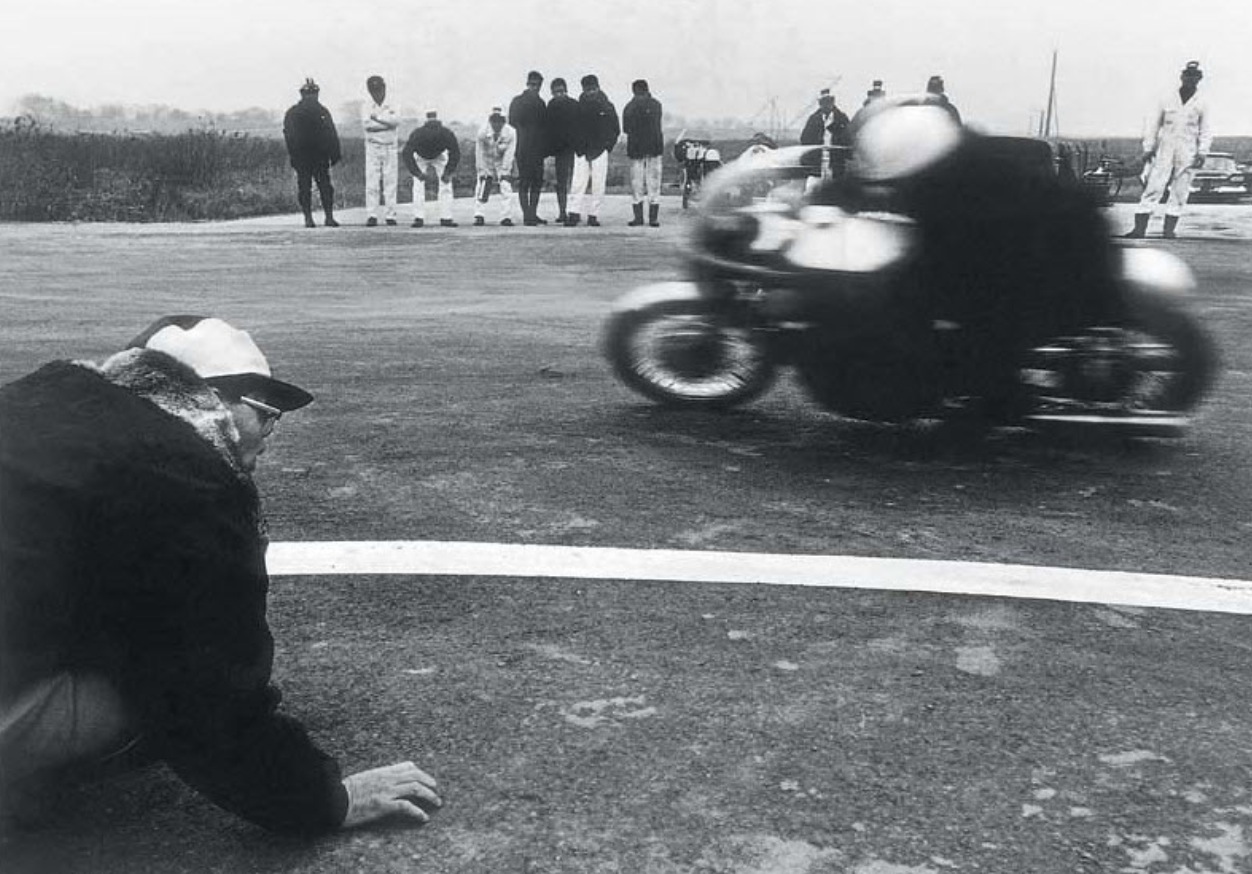
Soichiro Honda watching the performance of one of his ‘bikes at close quarters! during the 1960 Isle of Man TT (unattributed)
Honda RA271…
The chief engineer of the project was Yoshio Nakamura, later to become Honda’s CEO.
The initial prototype, the RA270F was a spaceframe car, derivative of the Cooper, and was tested extensively at Arakawa on 6 February 1964 and then Suzuka, by many including Jack Brabham. Brabham and his partner, Ron Tauranac were to race Honda 1-litre, four cylinder engines in their F2 Brabhams, winning the ‘European F2 Championship’ – there wasn’t an official one until 1967 – in 1966.
In fact Honda had decided to be an F1 engine manufacturer, not the builder of their own chassis and had entered into a partnership with Lotus, but problems with Lotuses existing Ford agreements precluded contract execution by Lotus…so Honda built the chassis after all.
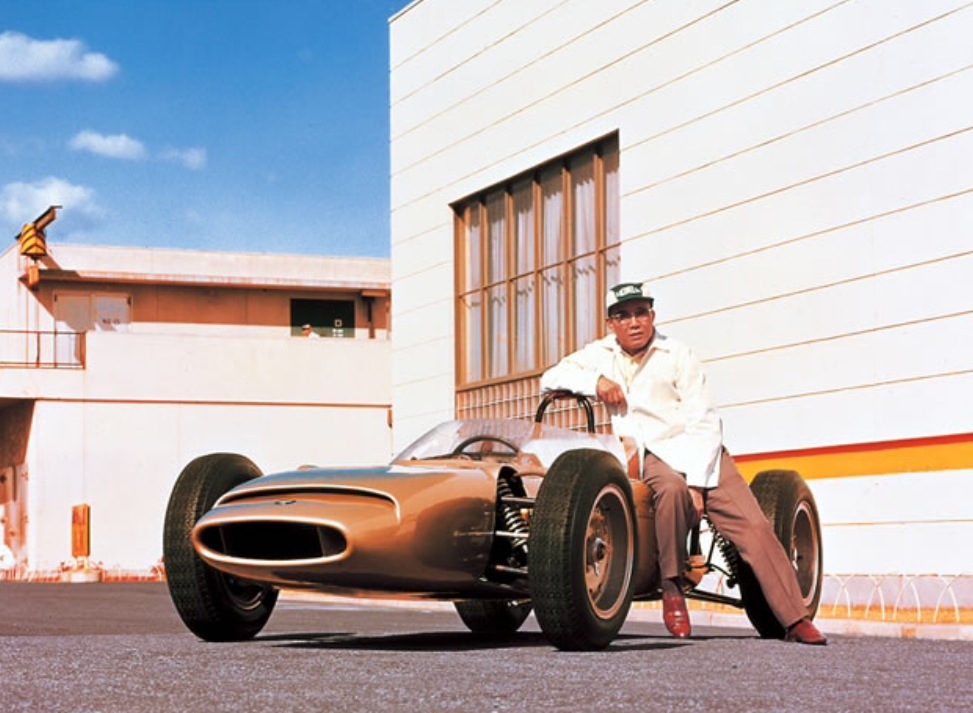
Soichiro Honda with the RA270F prototype spaceframe F1 car in 1964, he was one of many who tested the car (Honda International)
The definitive RA271 used a stressed skin monocoque chassis which ended at the rear of the cockpit to which was mounted the transverse 60 degree 1495cc V12. A tubular subframe picked up the rear suspension assembly which could be unbolted and wheeled away.
The engine was DOHC, four-valves per cylinder and was fed initially by six Keihin carburettors mounted across the frame behind the cockpit. Fuel injection was being developed and was soon adapted to the engine. Power takeoff was by spur gears from the centre of the crankshaft driving directly into a transverse shaft six-speed transaxle.
Honda RA271 at Monza in 1964 where the fuel injected version of the engine appeared for the first time. It developed circa 220bhp @ 11000rpm in 1964, more than that claimed for the BRM and Coventry Climax V8s and about what Ferrari claimed for their championship winning V8 (unattributed)
Front suspension was by top rocker operating inboard mounted coil spring damper units and a lower wishbone. The rear was by way of reversed lower wishbone, single top link with outboard mounted coil spring damper units and two radius rods providing lateral location. Sway bars were adjustable front and rear. Dunlop disc brakes were used and Goodyear tyres, Honda and Brabham were the first users of Goodyears in F1.
Things Go Better With Coke… cheap oil catch tank! RA271 rear end showing upper and lower wishbones, coil spring damper units. Rear mounted battery and alloy casing of the six-speed Honda transaxle mounted aft of the engine where it was parallel with and driven from the centre of the crankshaft. Rear Dunlop discs inboard (unattributed)A Honda mechanic, Yoshio Nakamura and Ronnie Bucknum working things out upon the RA271 race debut…Nurburgring pit apron 1964. None of the flash surroundings for mechanics of the modern era (B Cahier)
Ronnie Bucknum…
Somewhat bizarrely, the Japanese, as if to emphasise the experimental nature of the program, chose Bucknum, a little known American sportscar driver with single-seater experience, to pilot the car. His family owned a Honda dealership in the US and he raced an S600 at home, these days a Superlicence would not have been issued!
He tested the car extensively in Japan before the car’s first race in the German GP, at the Nurburgring. What a baptism of fire for car and driver in August 1964!
Bucknum qualified the RA271 slowest, no disgrace in that, and then drove a steady race in the wet, the power curve of the engine was somewhat peaky, he was in 11th place when a steering problem caused him to crash out of the race.
Ronnie Bucknum during the 1964 German GP upon Honda’s debut. He drove the RA271 sensibly in difficult, wet conditions, crashing out after steering problems (Honda International)Ginther in the RA272, wet Spa 1965, not for the faint hearted! (unattributed)
The team missed the Austrian GP but returned with the definitive fuel injected version of the engine at Monza, qualifying mid-grid and racing in fifth before overheating problems intervened. In the US he retired with a blown head gasket to finish the teams truncated first season.
1965, the final year of the 1.5-litre Formula…
Honda were more serious about its 1965 campaign, building a new car, the RA272 and signing Richie Ginther ex-BRM and Ferrari, and a noted test and development driver to lead the team, retaining Bucknum for a second year. The team were based in Amsterdam, the centre of Honda’s distribution operation in Europe.
The power of the engine was increased from circa 220bhp @ 11000rpm to 230bhp @ 12000rpm with chassis weight reduced by 30kg. Minimising heat build up became key as the engines lost power significantly as the races wore on, Ginthers ‘banzai’ starts came to nought as the engines lost grunt.
The cars appeared at Monaco, qualifying up the back and both dropped out, Richie with a UJ failure and Ronnie with gear change maladies.
Ginther’s RA272 Monaco 1965, DNF with a driveshaft failure in the race won by Hill’s BRM P261. Note the evolution of the car’s rear suspension compared with the RA271 above. Much neater and conventional single top link and inverted lower wishbone (unattributed)The sheer majesty of Spa…treacherous wet ’65 race won by Clark’s Lotus 33 Climax. From the start it’s Hill and Stewart in BRM P261s, Ginther, Honda RA272, Siffert, Brabham BT11 BRM, Surtees, Ferrari 158, Dan Gurney, Brabham BT11 Climax, Bruce McLaren, Cooper T77 Climax, Jo Bonnier, Brabham BT7 Climax and the rest…(unattributed)
The Belgian GP was typically wet, Ginther qualified fourth and finished sixth while Bucknum’s transaxle failed. Both cars failed to finish at the French GP with ignition problems although Richie qualified seventh.
The Honda was well suited to the wide open spaces of ex-RAF airfield Silverstone, one car was entered for Ginther which he duly qualified third and led from the start, the Honda yowling its way out front. He ran third for much of the race but again ignition problems ended his race.
British GP, Silverstone 1965. Ginther is third on the grid, Clark is on pole in his Lotus 33 Climax, Hill alongside in BRM P261, then Ginther’s RA272 and on the outside Jackie Stewart’s #4 BRM P261. The Ferrari 1512 #1 is John Surtees (unattributed)
Ginther again qualified third at Zandvoort and led the race but then spun twice and finished sixth. Honda missed the Nurburgring, but reappeared at Monza with engines mounted lower and using sleeker bodywork, Bucknum qualified sixth and Richie 17th after various dramas. Both popped engines again failing to finish. Both cars finished for the first time at Watkins Glen in the US Grand Prix, Bucknum an uninspired 13th and Richie seventh having again qualified third.
And so, onto the last race of the season and of the 1.5-litre formula. The Magdalena Mixhuca circuit at Mexico City was the venue for the Mexican Grand Prix, famous for the difficulties caused to engines at a height 7500 feet above sea level.
Ginther again! qualified third and Bucknum tenth. At the drop of the flag Richie simply took the lead and ran off into the distance, the little jewel of an engine never missing a beat and scoring Honda’s, Goodyear’s and Ginther’s first Grand Prix victories. Bucknum was a strong fifth. Hondas fuel injection system, problematic at times was one of the reasons for the Mexican success, thriving at the higher altitude.
And so Honda won a famous and well deserved win and would be back late in 1966 with a heavy but powerful 3-litre V12 engined car, the RA273…
Richie Ginther led the Mexican GP in 1965 from start to finish, heat and altitude notwithstanding. He is swinging his RA272 into Horquila Corner, the hairpin (B Cahier)Soichiro Honda (unattributed)
As an enthusiast I love those marques which have racing as part of their DNA, for that Honda have their founder to thank. Soichiro Honda gave the following press conference speech after the Mexico win, I love the insights it provides into his thinking about how racing improves the breed.
He said, ‘Ever since we first decided to build cars we have worked hard and been willing to take the most difficult path. Now we must study the reasons why we lose, and do the same when we win, so that we can use that knowledge to improve the quality of our cars and make them safer for our customers. That’s our duty. Once we had established our goal, we decided to choose the most difficult path to get there. This is why we entered the Grand Prix series. We will therefore not be content with this victory alone. We will study why we won and aggressively apply those technologies to new cars’.
Honda RA272 cutaway drawing by Yoshiro Inomoto
Etcetera…
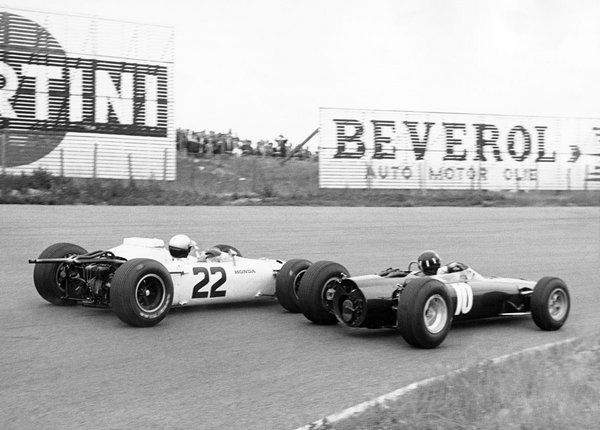
Honda unload their RA271 at the Nurburgring upon their GP debut, German GP 1964 (unattributed)Graham Hill and Richie Ginther dicing at Zandvoort, Dutch GP 1965. Hill fourth in his BRM P261 and Richie sixth in his Honda RA272 in the race won by Clark’s Lotus 33 Climax, Clark was the ’65 Champ (unattributed)Honda RA272 engine. 1495cc 60-degree, transversely mounted, DOHC, four-valve, fuel injected V12. Circa 230bhp @ 13000rpm in 1965 (B Cahier)Honda RA272 cockpit (unattributed)
Sources…
Doug Nye ‘The History of The Grand Prix Car 1945-65’, Honda International, Bernard Cahier, Yoshiro Inomoto
Tailpiece…
Ginther and engineer Nakamura celebrate their 1965 Mexican GP victory (unattributed)














 primotipo...