Posts Tagged ‘1968 French Grand Prix’

bruce

(R Schlegelmilch)

Bruce, Tyler Alexander and and Alastair Caldwell…a new set of Goodyears for McLaren’s M7A. He put them to good use, qualifying sixth on the fast swoops of Rouen…

I’m drawn to the papaya McLarens thanks to their visual splendour and absolute respect for Bruce the man, engineer, test driver, racer and motivator of men.

He was the full-enchilada with the lot as a package, as well rounded a racer as it’s possible to be.

Here Chris Amon is tootling past him in the pitlane, his fellow Kiwi no doubt hoping the Firestone shod Ferrari 312 will cope with the fast swoops of Rouen better than Bruce’ M7A, a mighty fine design which carried the Ford Cosworth DFV.

I’ve posted a piece on this race before so don’t want to dwell on the awful fiery accident which cost Jo Schlesser’s life early in the event. Jacky Ickx took his first GP win in a Ferrari 312 from John Surtees’ Honda RA301 and Jackie Stewart’s Matra MS10 Ford.

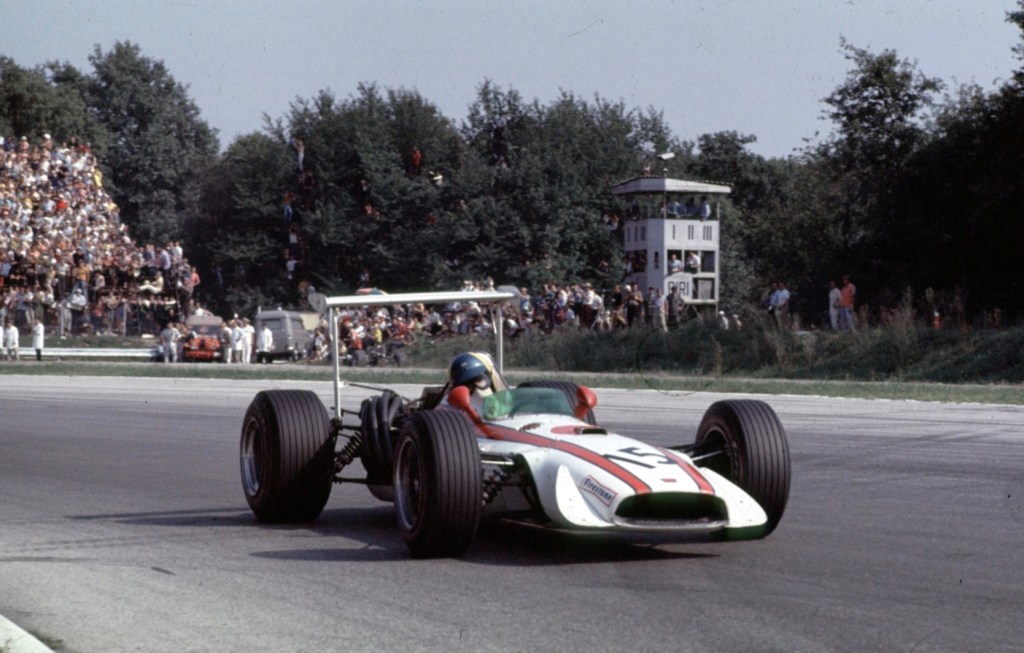
The shot below is Graham Hill’s Lotus 49B Ford in grid slot nine surrounded by other fellas. The flash of blue to his left is Jean Pierre-Beltoise’ V12 powered Matra MS11 (ninth), Surtees Honda, with the blue flash down his white helmet and Chris Amon’s Ferrari, see its distinctive, white, between the Vee exhausts.

1968 was the last time an F1 GP was held at the wonderful 6.542Km road course near Orival and Rouen. The track was used for European F2 Championship races until 1978 and French national events after that, economic forces resulted in its 1994 closure.

hill lotus 49

French GP, Rouen 1968 (Schlegelmilch)

Credit…

Rainer Schlegelmilch

Finito…

French GP, Rouen 1968…

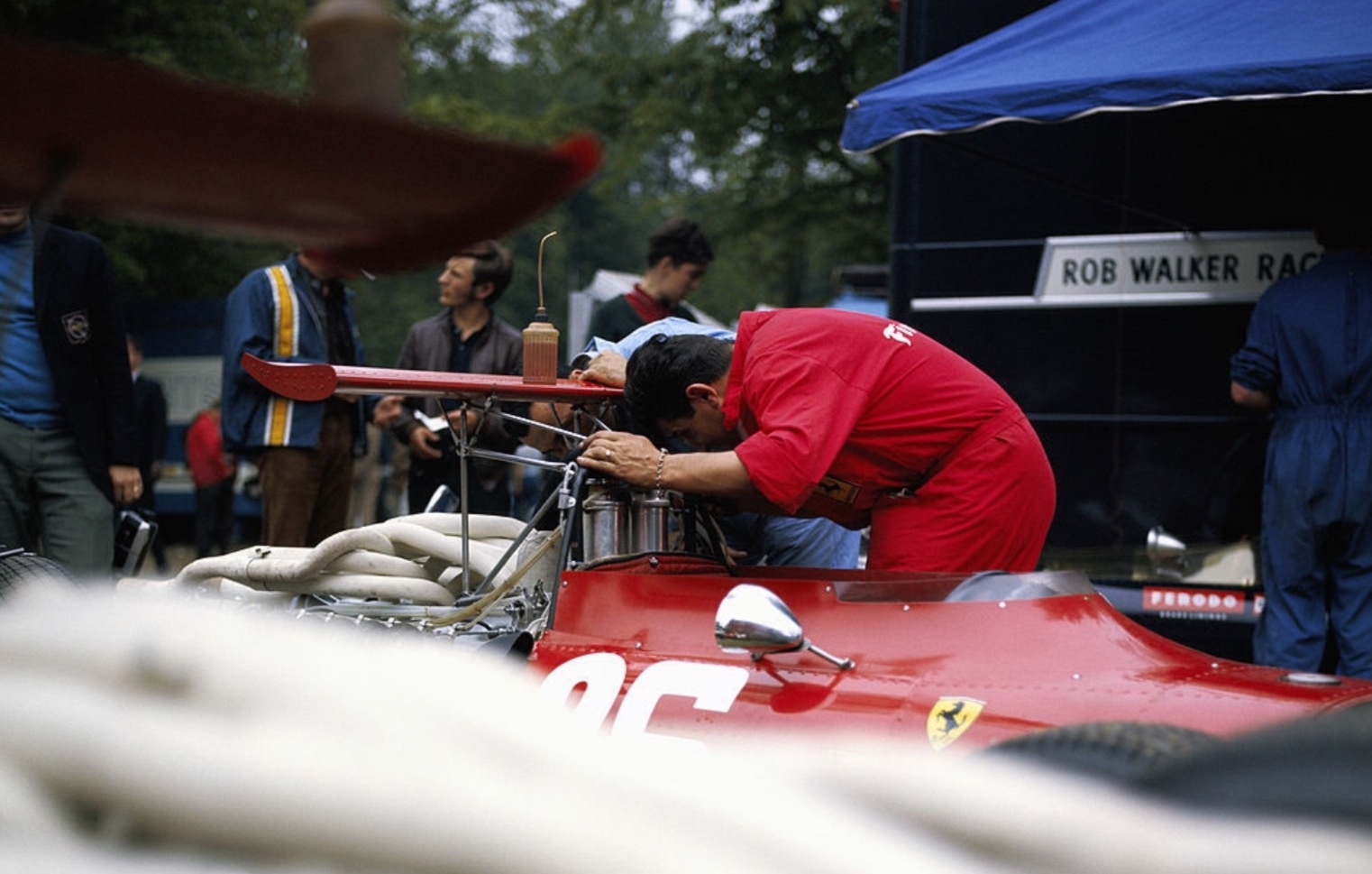
It has the feel of final practice/qualifying about it doesn’t it? The wing in the foreground is either Jacky Ickx’ winning Ferrari 312 or Chris Amon’s sister car.

Graham Hill stands patiently at left whilst the mechanics make adjustments to his car with Lotus boss Colin Chapman leaving the boys to it, resting against the pit counter.

At far left, obscured, Jack Brabham is being tended to in his Brabham BT26 Repco 860 V8. Jochen Rindt popped his BT26 on pole proving the car had heaps of speed if not reliability from its new 32-valve, DOHC V8. The speedy Austrian took two poles with it that year.

The dude in the blue helmet is Jackie Oliver who is about to have the mother and father of high speed accidents when wing support failure saw him pinging his way through the French countryside, clobbering a set of chateau gates and dispensing aluminium shrapnel liberally about the place at around 125 mph. He survived intact – shaken but not stirred you might say. It wasn’t the last of his career ‘big ones’ either. Click here; https://primotipo.com/2017/01/13/ollies-trolley/

In the distance is Goodyear blue and white striped, jacket wearing Tyler Alexander so there must be a couple of McLaren M7As down that way.

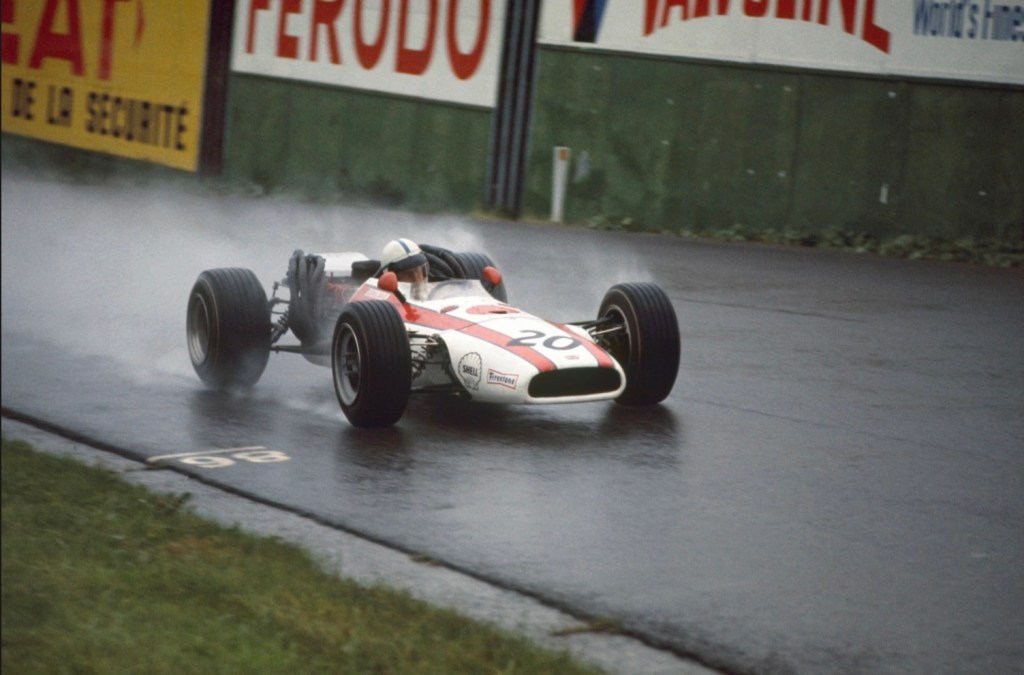
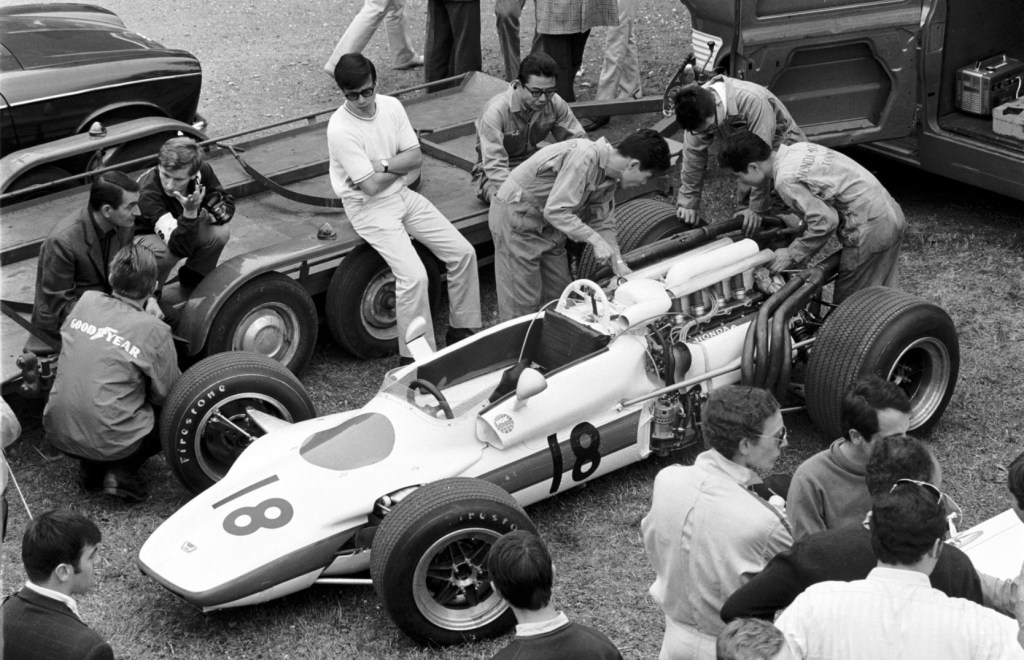
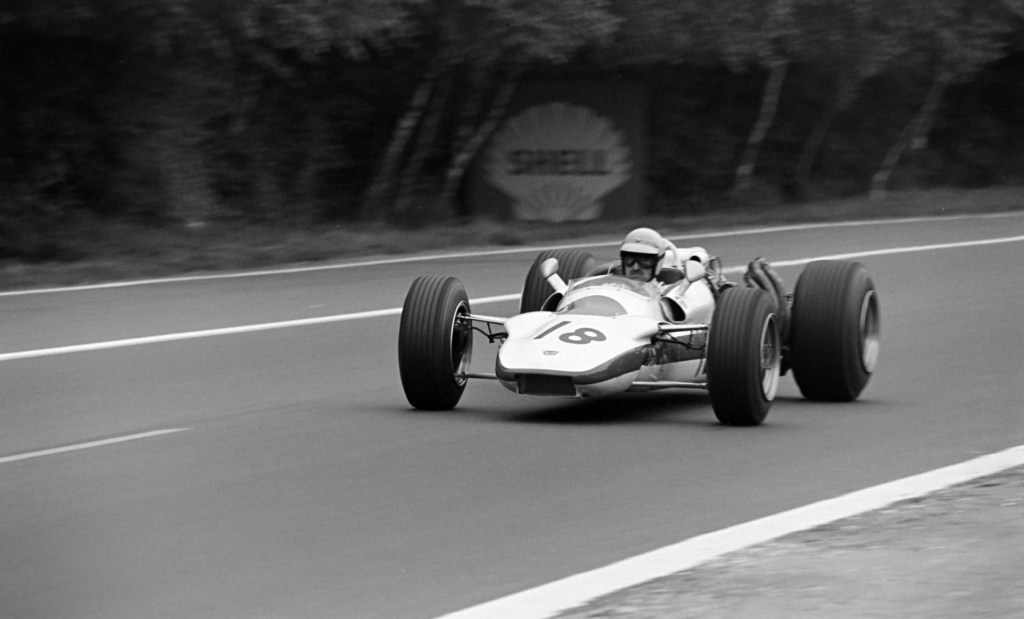
Ickx won a tragic wet race in which French racer Jo Schlesser died on lap two when he lost control of the unsorted Honda RA302 in the fast swoops past the pits, burned alive in the upturned car, it was a grisly death. Ickx’ first GP win, no doubt was memorable for the Belgian for all of the wrong reasons. He won from John Surtees, below, in the conventional Honda RA301 V12 and Jackie Stewart’s Matra MS10 Ford.

Surtees did not have a great Honda season retiring in eight of the twelve GPs, his second place at Rouen and third at Watkins Glen were the two high points of the season.

Honda withdrew from GP racing at the end of the year “to concentrate their energies on developing on new road cars (S360, T360 and S500), having cemented the Honda name in the motorsport hall of fame.” A racing company to its core, its interesting how Honda still use racing past and present to differentiate themselves from other lesser marques: https://www.honda.co.uk/cars/world-of-honda/past/racing.html

Click on this article for a piece on the 1968 French GP and also the evolution of wings in that period; https://primotipo.com/2016/08/19/angle-on-the-dangle/

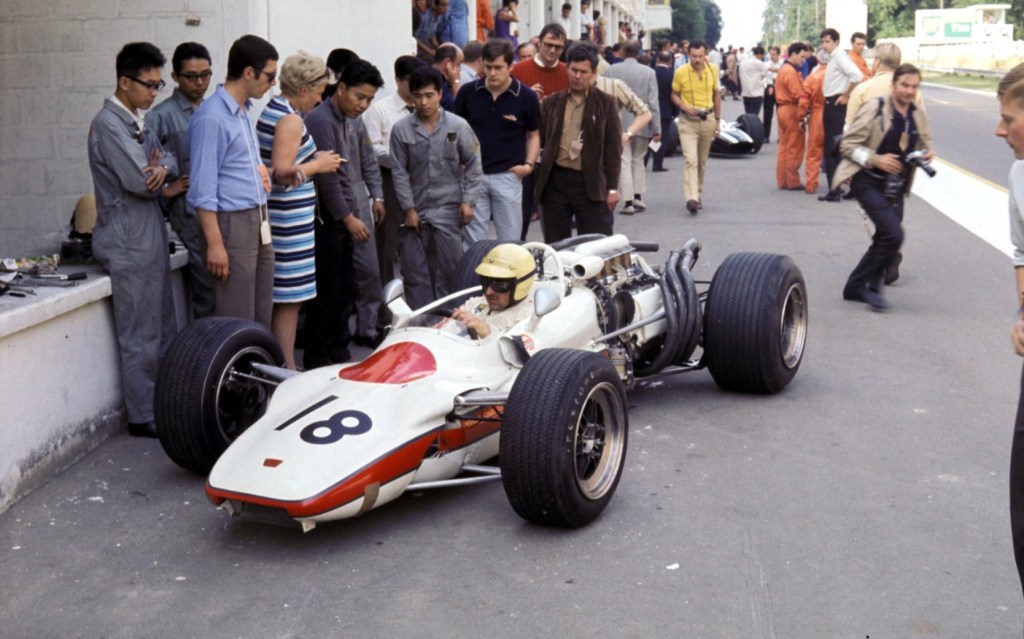
Jo Schlesser and the Honda RA302…

You would have to have a crack wouldn’t you?

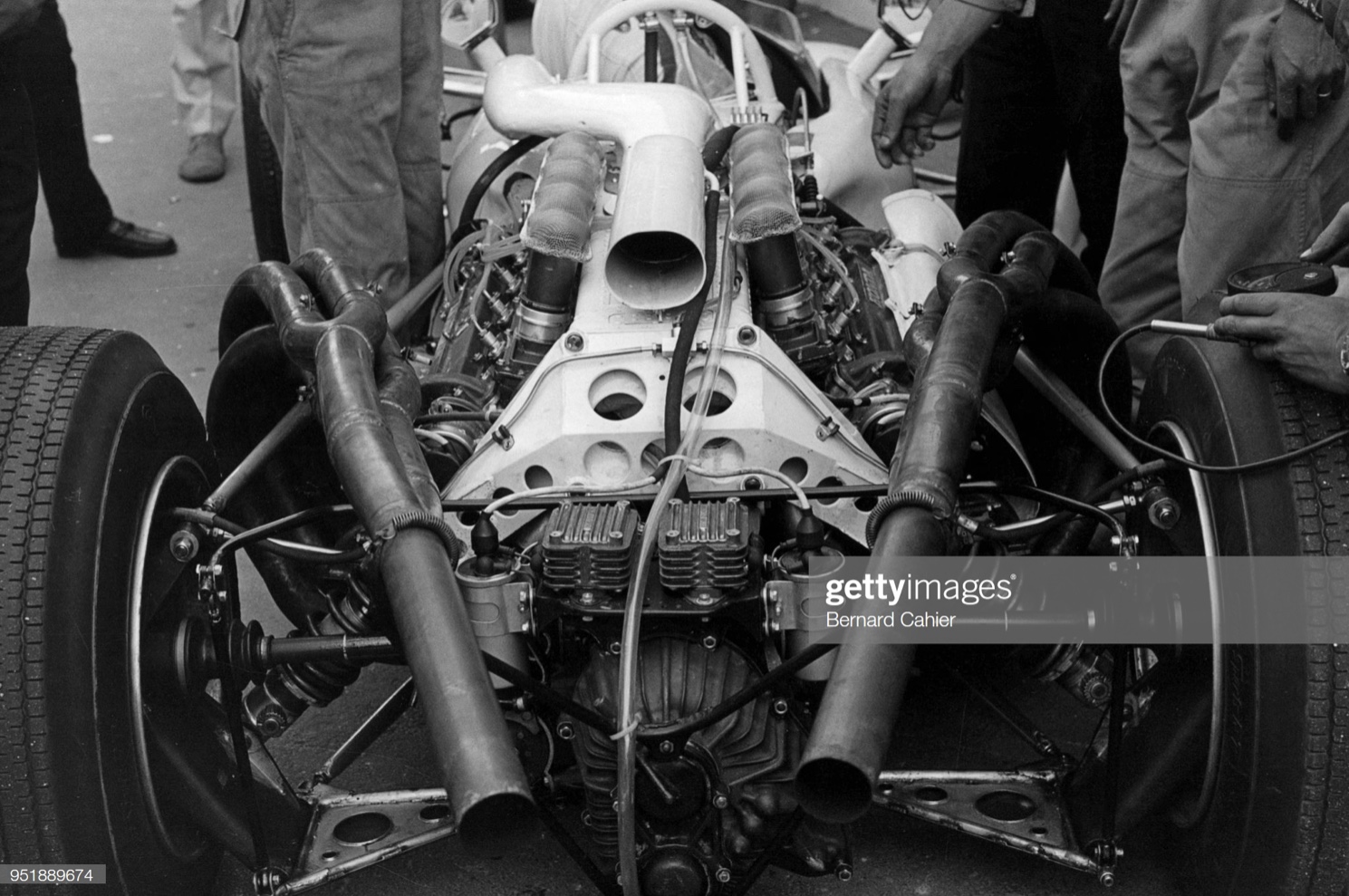
The offer of a works car (Honda RA302 #in your home Grand Prix, however badly your vastly experienced team leader felt about the radical magnesium chassis, 3-litre (88mm x 61.4 mm bore/stroke, four-valves per cylinder -torsion bar sprung – 2987cc) 120-degree air-cooled V8 machine would have been too much to resist?

The new car bristled with innovation, including the mounting of the engine, which was in part located via a top-boom extension of the monocoque aft of the rear bulkhead. This approach was adopted by the Mauro Forghieri led team which designed the Ferrari ‘Boxer’ 312B in 1969, one of the most successful 1970 F1 machines.

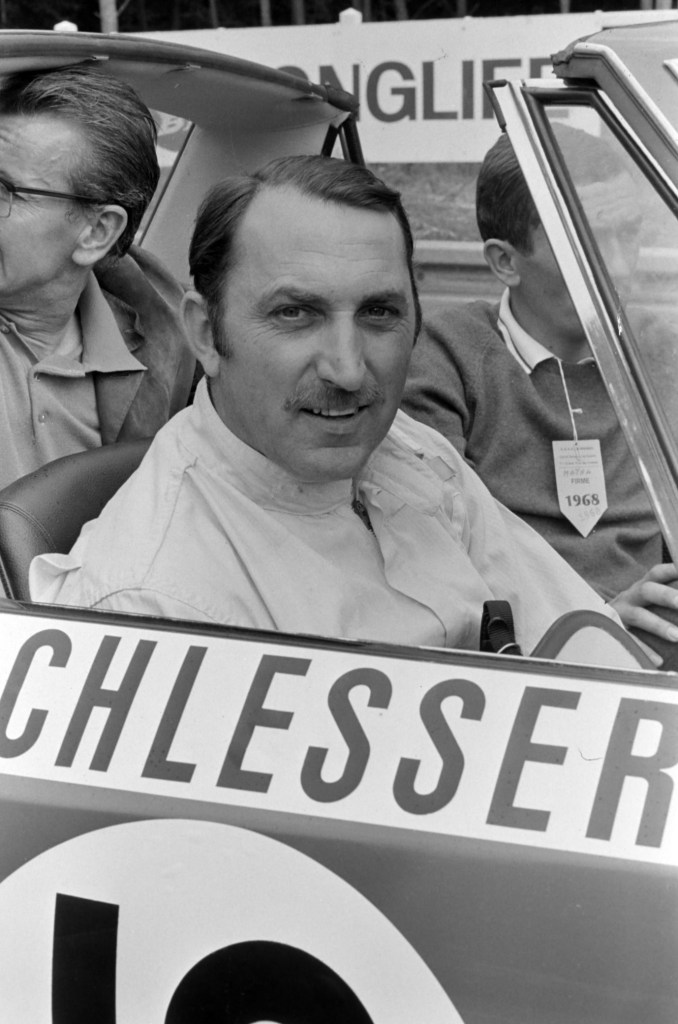
And so it was that poor, forty years old, Jo Schlesser died having a red hot go after completing only 12km of the race.

Denis Jenkinson looks on, above, as Schlesser prepares for the off during practice, the look on the great journalists face says everything about his interest in this new technical direction. The car behind is Richard Atwood’s seventh placed BRM P126 V12.

Douglas Armstrong wrote of the Honda RA302 as follows in his review of the 1968 Grand Prix season published in Automobile Year 16. “Although it was ill-fated the car was immediately recognised as a new and formidable approach to Formula-1 racing.”

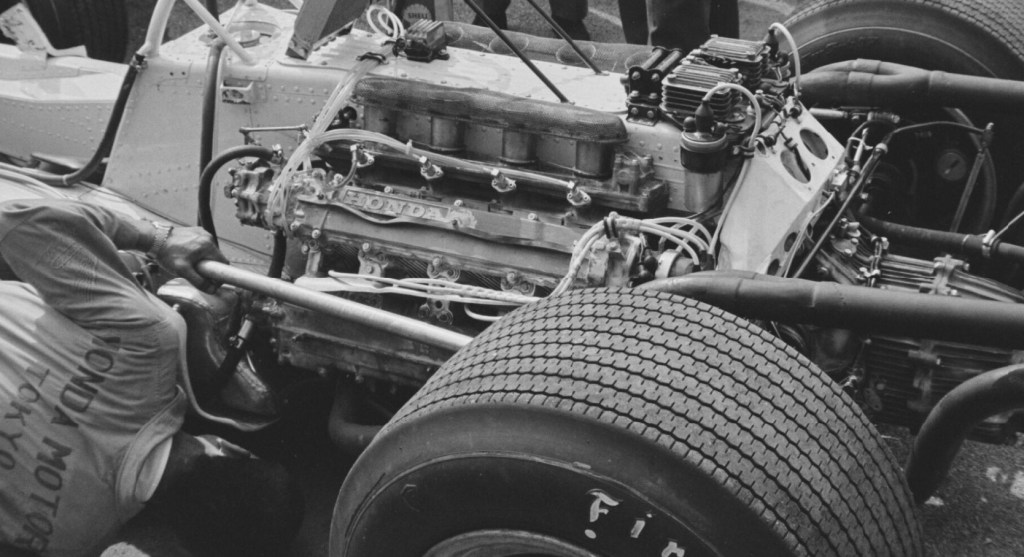
“Taking a leaf from the Porsche air-cooling technique, Honda had mounted a large oil-tank behind the right of the driver, and this was meant to dissipate much of the engine heat. On each cockpit side was a light-alloy scoop to convey air to the engine, and the sparking plugs were also duct enclosed for cooling. To the left of the drivers head another scoop took cooling air into the crankcase where it became involved with oil mist and was then drawn out by a de-aerator which retained the oil but expelled the air from a vent on top of the magnesium backbone.”

(MotorSport)
(unattributed)

A magnesium monocoque chassis supported the unstressed, fuel injected V8 which is variously quoted at between 380-430bhp at this early stage of its development, I am more at the conservative end of that range.

Inboard rocker front suspension and outboard at the rear, note the ‘boxed’ inboard lower inverted wishbones, single top link and two radius rods. As Doug Nye noted, “The suspension was the only conventional part of this wholly Japanese designed and built new comer.”

All the attention to weight saving and compactness – the Lotus 49 Ford DFV would have been very much top-of-mind in Japan – resulted in a car “reportedly weighing close to the minimum requirement of 1102lb.”

Politics and priorities…

John Surtees tested another RA302 (chassis #F-802 remains part of the Honda Collection) during the Italian GP weekend at Monza in September but declined to race the car, that chassis still exists. Instead Il Grande John put his RA301 V12 on pole!

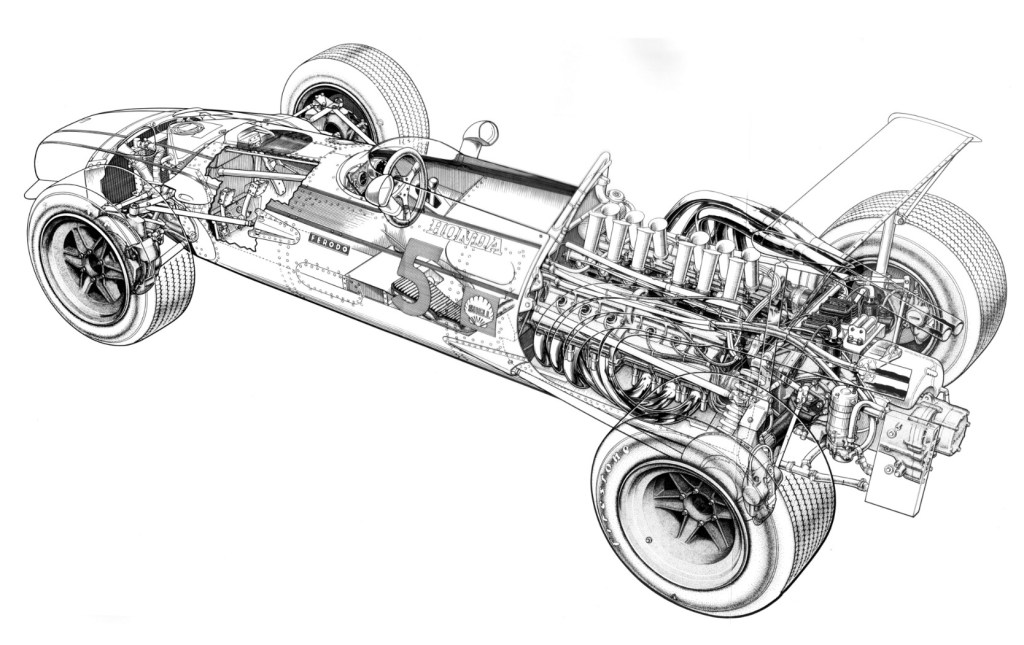
Lola’s Derrick White developed an evolution of the ’67 Honda RA300 for 1968, the lighter, but still 649kg, RA301 was blessed with a 430bhp Honda V12. Let’s not forget these Hondolas spun out of, or off Lola’s very successful 1966 T90 ‘Indycar’.

A careful review of the year reveals a better performing car than the results suggest. Surtees was second at Rouen, third at Watkins Glen and fifth in the British GP at Brands Hatch despite a broken rear wing. Elsewhere, he ran well in Spain and at Monaco until the gearbox failed, then led at Spa and set fastest lap before a rear wishbone mount broke. At Zandvoort he was delayed by wet ignition, then alternator trouble ended his run. In a notable wet season, he was impacted by wet ignition and then overheating caused by a long delay before the start. Surttes started from pole at Monza, then led, and crashed…He was up-there in Canada until gearbox failure , then led after the start in Mexico before falling back and retiring with overheating.

Surtees, RA301, Spa June 1968 DNF (MotorSport)
Honda RA301 cutaway (unattributed)
Business end of Surtees Hondola RA301 in Spain 1968. 3-litre quad-cam, central power take-off V12 (MotorSport)

MotorSport wrote that the the ill-fated debut of the Honda RA302 took place against a background of strong opposition from Surtees. He had been expecting an improved V12 for the RA301 – a lighter 490bhp V12 with conventional power take-off at the rear of the engine – and was therefore surprised when the all-new RA302 was delivered to Honda’s UK base at Slough. Its 120-degree air-cooled V8 was a mobile test bed to showcase the technology Soichiro Honda was to use in his new road cars; remember the sensational air-cooled Honda 7 and 9 Coupes of the early 1970s for example?

“I tried it at Silverstone,” recalls Surtees. “You’d drive out of the pits and it would feel quite sharp, but it was impossible to drive any distance with it performing as it should. Mr Nakamura told Japan we could not take this to a race.”

During that Silverstone test, the car ran for only two laps before the oil blew out, even after modifications it still wouldn’t go far because the engine overheated rapidly. John refused to race it – not unreasonably given the pace of the RA301 – before further tests could proved its speed and endurance. In addition Surtees suggested they build an aluminium version to replace the flammable magnesium chassis machine.

Jo Schlesser during practice, Rouen 1968 (MotorSport)
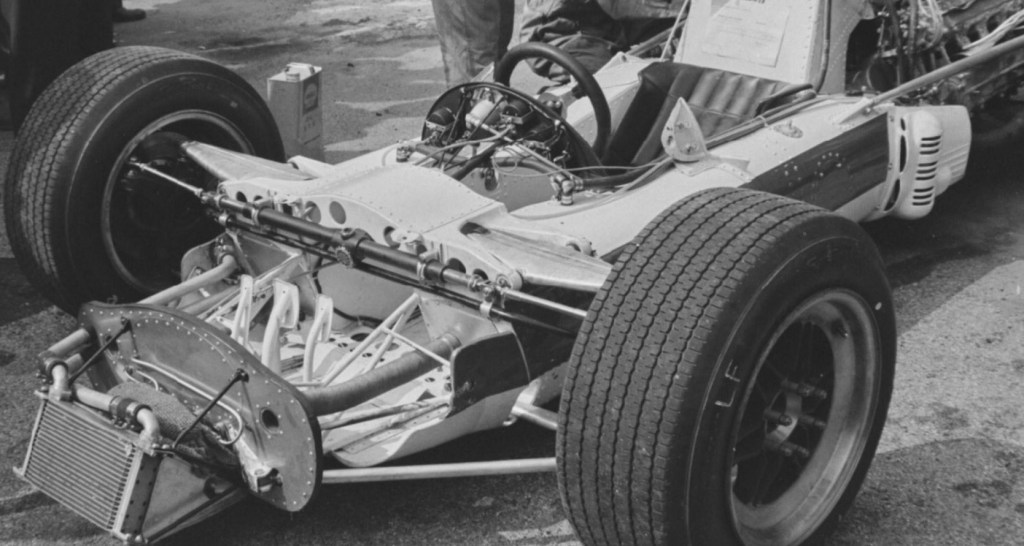
RA302 far forward driving position and distribution of weight, contrary to the trend of most teams then. Small oil radiator, steering rack, front bulkhead and rocker/wishbone front suspension clear (unattributed)
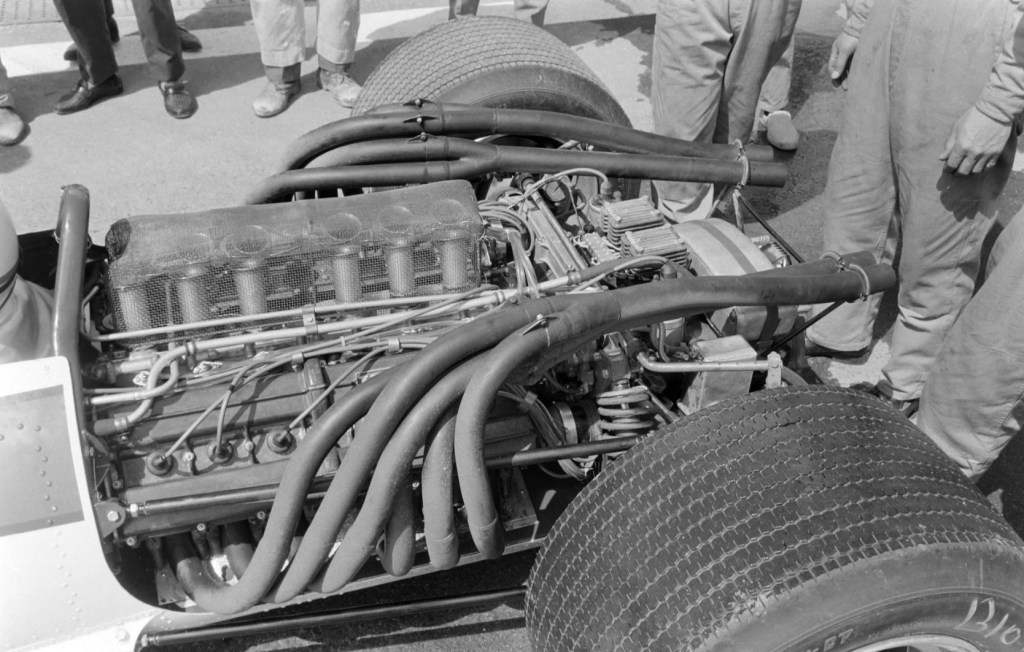
With the cooling duct removed, look closely at lower left and you can see the cooling fins on the block. Fuel metering unit actuated by the inlet camshaft (unattributed)

When Honda arrived at the French GP in 1968, the French arm of Honda urged the team to race the new RA302 to promote its small but growing range of cars. Soichiro Honda was in France on a trade mission that week and, doubtless influenced by his local representatives, he decided to enter the RA302 under the Honda France banner, with Schlesser as the driver.

Surtees, and even team boss Nakamura, didn’t know of the plan until 7.30am on the Thursday, the first day of practice. “It was not run by the existing Honda team,” says John, “but people who’d previously worked with us were brought over from Japan. They worked as a totally separate unit” to the guys looking after Surtees V12 engined RA301.

Surtees shed no light as to the cause of Schlesser’s crash, but acknowledges the circuit is tricky at the site of the accident, describing it as “the sort of place on the circuit where you were fully occupied”.

It is thought a misfire or complete engine cut-out caused Schlesser to lose control. Honda acquired film showing him getting into a ‘tank-slapper’ before going off – but there were never any official conclusions. Engine designer and future Honda boss Nobuhiko Kawamoto was in Japan that weekend. “I thought the cause may have been a transmission seizure,” he says. “After three months, the residuals came back, small amounts of steel parts, the engine and transmission, but we found it was really clean. The cause was not revealed.”

Surtees in the Monza pitlane in September 1968, RA302. Note the additional oil cooler mounted atop the chassis boom not present at Rouen (unattributed)
Rouen. Aren’t the spring/shock units mounted high on the uprights and relatively horizontally (unattributed)
David Hobbs aboard the other Honda RA301 at Monza in 1968 (MotorSport)

Surtees would briefly drive a second RA302 in practice at Monza, but by then it was academic.

With Soichiro Honda present, Surtees refused to race it and the popular 40 year old, very experienced single seater and sportscar driver, was appointed to drive the new car. Unfortunately, Surtees’ doubts were proven true, when Schlesser lost control of the car in the downhill sweepers and crashed. The car overturned and caught fire. The full fuel tank and magnesium chassis burned so intensely that nothing could be done to save Schlesser. He became the fourth F1 driver to die that season (after Jim Clark, Mike Spence and Lodovico Scarfiotti).

“The episode of that car and the accident brought Honda’s whole Formula One programme to an end,” says John. “The fact that it didn’t work meant there weren’t the resources to go back to what we were originally going to do.”

Rouen paddock. Engine cover all-enveloping with all ducts in place. Ex -Ferrari team manager by then journalist, Franco Lini is the focus of Goodyear man and AN Other at left, is that Rolf Stommelen in the driving suit and glasses in the group at the right? (MotorSport)
Monza. Good shot of the monocoque structure and top mount of the engine. Fuel metering unit at the front of the inlet cam, distributor at the rear. Note two coils and electronic spark-units at the rear of the top monocoque boom (unattributed)

“When you add up how far we progressed (in 1968) on a very limited budget we didn’t do too badly. If you add up how competitive we were and of we hadn’t had the silly problems, we could have been champions that year,” Surtees said to David Tremayne.

“Derrick White had drawn up a good chassis and Nobohiko Kawamoto had promised us a new lightweight 490bhp V12engine and gearbox for 1969.” The increasing focus on emissions and the road cars obliged Honda to cut their budget, and the F1 project was cancelled.

Surtees, “I understood why of course, but I really believe that Honda’s later situation in Formula 1 could have come sooner. The 301 was the right car, and with the new engine and gearbox it would have been shorter and much lighter…Instead it was a case of what might have been…”

Tremayne wrote, “Many years later when Honda were winning championships with Williams, Honda Motor Company boss Tadashi Kume – who had been a senior engineer on the RA301 in 1968 – sent Surtees a telegram which said in part, “None of this would have been possible without your investment.”

Credits…

Getty Images, oldracingcars.com, ‘History of The Grand Prix Car 1966-85’ Doug Nye, MotorSport, David Tremayne ‘Honda’s First F1 Chapter’ in hondanews.eu

Tailpiece…

(MotorSport)

Jo, drivers parade immediately before the race.

Finito…

image

Jack Brabham ponders wing settings on his Brabham BT26 Repco during the Canadian Grand Prix weekend at Mont Tremblant, 22 September 1968…

I blew my tiny mind when Nigel Tait sent me the photo, neither of us had any idea where it was. A bit of judicious googling identified the location as Mont Tremblant, Quebec, a summer and winter playground for Canadians 130km northwest of Montreal.

Regular readers will recall  Nigel as the ex-Repco Brabham Engines Pty. Ltd. engineer who co-wrote the recent Matich SR4 Repco article (a car he owns) and has been helping with the series of articles on Repco’s racing history I started with Rodway Wolfe, another RBE ‘teamster’ a couple of years ago.

When Nigel left Repco in the ACL Ltd management buyout of which he was a part, he placed much of the RBE archive with his alma mater, RMIT University, Melbourne. Its in safe hands and available to those interested in research on this amazing part of Australian motor racing history. The archive includes Repco’s library of photographs. Like every big corporate Repco had a PR team to maximise exposure from their activities including their investment in F1. The Mont Tremblant shot is from that archive and unpublished it seems.

Its one of those ‘the more you look, the more you see’ shots; from the distant Laurentian Mountains to the pitlane activity and engineering of the back of the car which is in great sharpness. It’s the back of the BT26 where I want to focus.

The last RBE Engines article we did (Rodway, Nigel and I) was about the ’67 championship winning SOHC, 2 valve 330bhp 740 Series V8, this BT26 is powered by the 1968 DOHC, 4 valve 390bhp 860 Series V8. It was a very powerful engine, Jochen plonked it on the front row three times, on pole twice, as he did here in Canada in 1968. But it was also an ‘ornery, unreliable, under-developed beast. Ultimately successful in 4.2 litre Indy and 5 litre Sportscar spec, we will leave the 860 engine till later for an article dedicated to the subject.

image

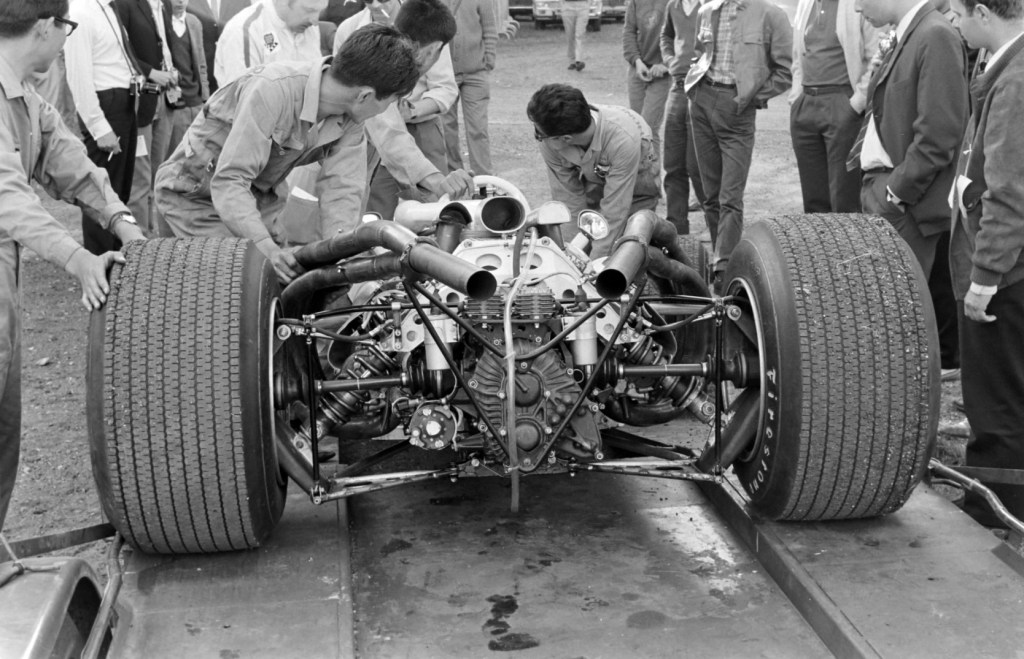
Check out the DG300 Hewland 5 speed transaxle and part of the complex oil system beside it to feed the 860. Also the big, beefy driveshafts and equally butch rubber donuts to deal with suspension travel. It’s interesting as Tauranac used cv’s in earlier designs, perhaps he was troubled finding something man enough to take the more powerful Repco’s grunt, the setup chosen here is sub-optimal in an engineering sense.

The rear suspension is period typical; single top link, inverted lower wishbone, radius rods leading forward top and bottom and coil spring/damper units. It appears the shocks are Koni’s, Brabham were Armstrong users for years.

The uprights are magnesium which is where things get interesting. The cars wings that is, and the means by which they attach to the car…

See the beautifully fabricated ‘hat’ which sits on top of and is bolted to the uprights and the way in which the vertical load of the wing applies it’s force directly onto the suspension of the car. This primary strut support locates the wing at its leading edge, at the rear you can see the adjustable links which control the ‘angle on the dangle’ or the wings incidence of attack to the airflow.

I’ve Lotus’ flimsy wing supports in mind as I write this…

Tauranac’s secondary wing support elements comprises steel tube fabrications which pick up on the suspension inner top link mount and on the roll bar support which runs back into the chassis diaphragm atop the gearbox.
image

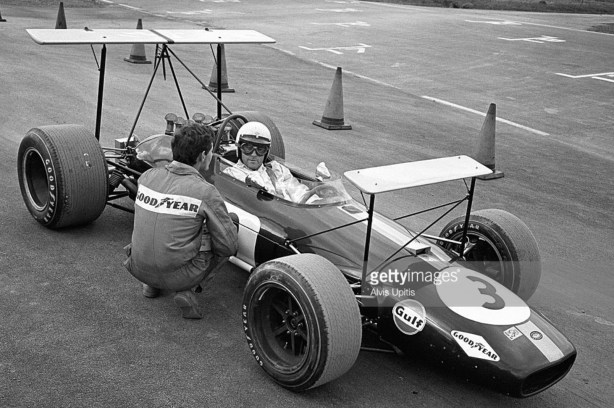
The shot above shows the location of the front wing and it’s mounts, this time the vertical force is applied to the chassis at the leading front wishbone mount, and the secondary support to the wishbones trailing mount. This photo is in the Watkins Glen paddock on the 6 October weekend, the same wing package as in use in Canada a fortnight before. The mechanic looking after Jack is Ron Dennis, his formative years spent learning his craft first with Cooper and then BRO. Rondel Racing followed and fame and fortune with McLaren via Project 4 Racing…

image

Jim Hall and Chaparral 2G Chev wing at Road America, Wisconsin 1968 (Upitis)

The great, innovative Jim Hall and his band of merry men from Midlands, Texas popularised the use of wings with their sensational Chaparral’s of the mid sixties. Traction and stability in these big Group 7 Sportscars was an issue not confronted in F1 until the 3 litre era when designers and drivers encountered a surfeit of power over grip they had not experienced since the 2.5 litre days of 1954-60.

During 1967 and 1968 F1 spoilers/wings progressively grew in size and height, the race by race or quarter of a season at a time analysis of same an interesting one for another time.
image

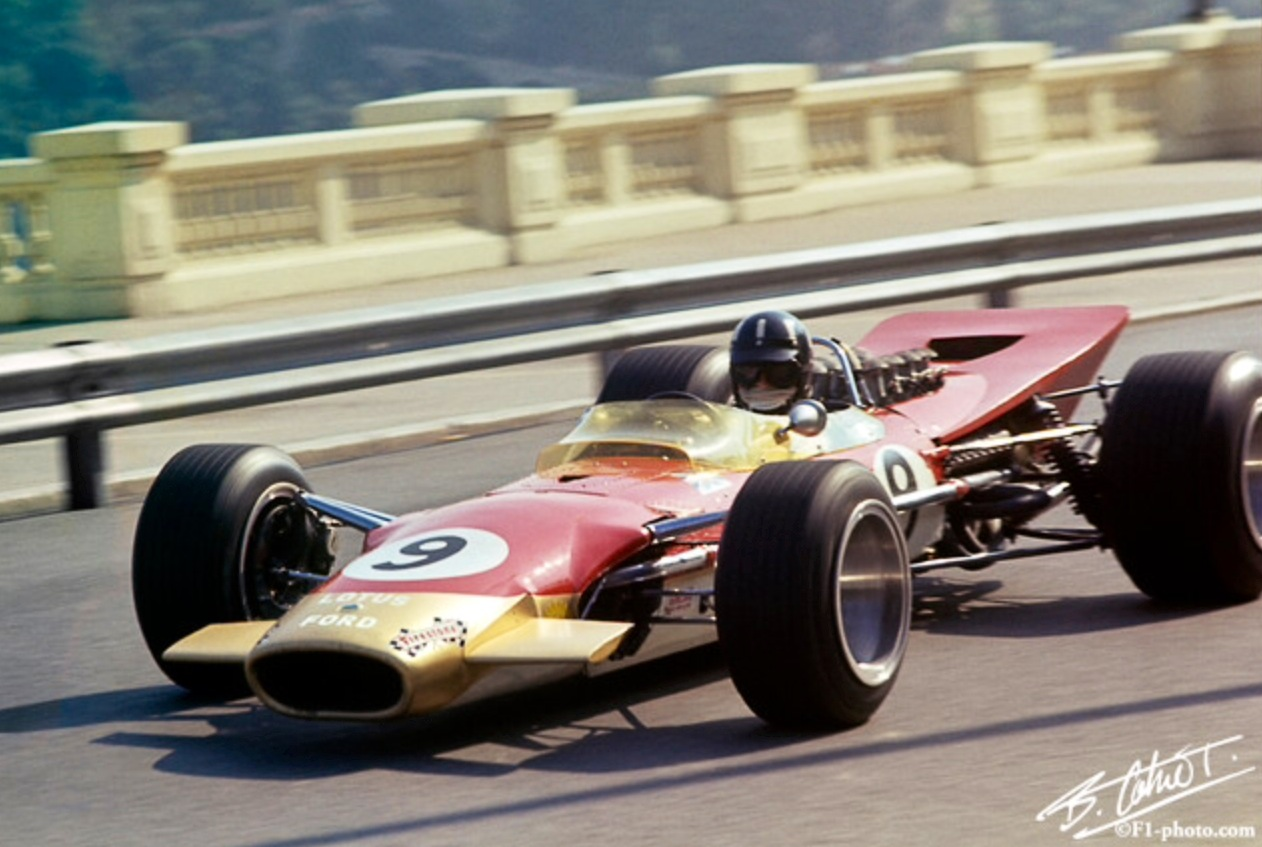
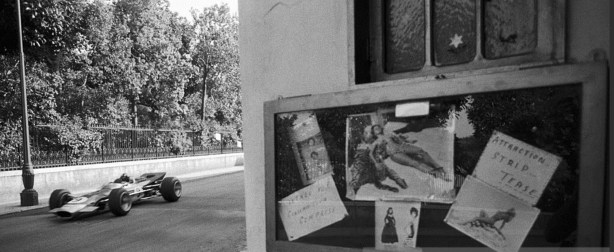
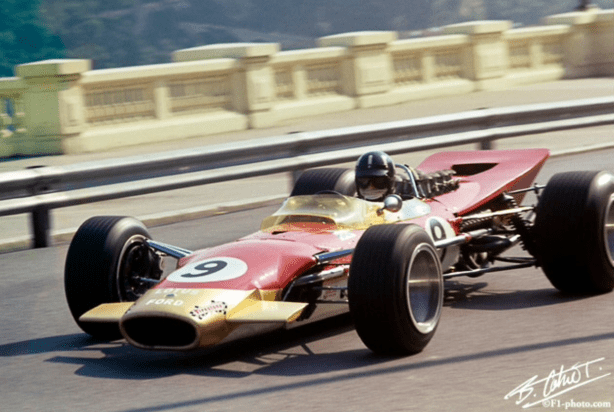
Hill’s winged Lotus 49B, Monaco 1968 (Schlegelmilch)

In some ways ‘who gives a rats’ about the first ‘winged Grand Prix win’ as Jim Hall pioneered ‘winning wings’ in 1966, the technology advance is a Group 7 not F1 credit; but Jacky Ickx’ Ferrari 312 win in the horrific, wet, 1968 French Grand Prix (in which Jo Schlesser died a fiery death in the air-cooled Honda RA302) is generally credited as the first, the Fazz fitted with a wing aft of the driver.

But you could equally mount the case, I certainly do, that the first winged GeePee win was Graham Hill’s Lotus 49B Ford victory at Monaco that May.

Chapman fitted the Lotus with front ‘canard’ wings and the rear of the car with a big, rising front to rear, engine cover-cum-spoiler. Forghieri’s Ferrari had a rear wing but no front. The Lotus, front wings and a big spoiler. Which car first won with a wing?; the Lotus at Monaco on 26 May not the Ferrari at Rouen on July 7. All correspondence will be entered into as to your alternative views!

image

Jacky Ickx’ winning Ferrari 312 being prepared in the Rouen paddock. The neat, spidery but strong wing supports clear in shot. Exhaust in the foreground is Chris Amon’s Fazz (Schlegelmilch)

Lotus ‘ruined the hi-winged party’ with its Lotus 49B Ford wing failures, a lap apart, of Graham Hill and then Jochen Rindt at Montjuic in the 1969 Spanish GP. Both drivers were lucky to walk away from cars which were totally fucked in accidents which could have killed the drivers, let alone a swag of innocent locals.

A fortnight later the CSI acted, banning high wings during the Monaco GP weekend but allowing aero aids on an ongoing basis albeit with stricter dimensional and locational limits.

image

Mario Andretti has just put his Lotus 49B on pole at Watkins Glen in October 1968, Colin Chapman is perhaps checking his watch to see why regular drivers Hill and Jackie Oliver are being bested by guest driver Andretti who was entered at Monza and Watkins Glen at seasons end! Andretti put down a couple of markers with Chapman then; speed and testing ability which Chapman would return to nearly a decade later. More to the point are the wing mounts; direct onto the rear upright like the Brabham but not braced forward or aft. Colin was putting more weight progressively on the back of the 49 to try and aid traction, note the oil reservoir sitting up high above the ‘box. Stewart won in a Matra MS10, Hill was 2nd with both Andretti and Oliver DNF (Upitis)

Chapman was the ultimate structural engineer but also notoriously ‘optimistic’ in his specification of some aspects of his Lotus componentry over the years, the list of shunt victims of this philosophy rather a long one.

Lotus wing mounts are a case in point.

Jack Oliver’s ginormous 125mph French GP, 49B accident at Rouen in 1968 was a probable wing mount failure, Ollie’s car smote various bits of the French countryside inclusive of a Chateau gate.

Moises Solana guested for Lotus in his home, Mexican GP on 3 November, Hill won the race whilst Solana’s 49B wing collapsed.

Graham Hill’s 49B wing mounts failed during the 2 February 1969 Australian Grand Prix at Lakeside, Queensland. Then of course came the Spanish GP ‘Lotus double-whammy’ 3 months after the Lakeside incident on 4 May 1969.

image

Faaaarck that was lucky one suspects the Lotus mechanics are thinkin’!? The rear suspension and gearbox are 200 metres or so back up the road to the right not far from the chateau gate Ollie hit. It was the first of several ‘big ones’ in his career (Schlegelmilch)

For the ‘smartest tool in the shed’ Chapman was slow to realise ’twas a good idea to finish races, let alone ensure the survival of his pilots and the punters.

I’m not saying Lotus were the only marque to have aero appendages fall off as designers and engineers grappled with the new forces unleashed, but they seemed to suffer more than most. Ron Tauranac’s robustly engineered Brabhams were race winning conveyances generally devoid of bits and pieces flying off them given maintenance passably close to that recommended by ‘Motor Racing Developments’, manufacturers of Ron and Jack’s cars.

The Brabham mounts shown earlier are rather nice examples of wings designed to stay attached to the car rather than have Jack aviating before he was ready to jump into his Piper Cherokee at a race meetings end…

‘Wings Clipped’: Click on this article for more detail on the events leading up to the CSI banning hi-wings at the ’69 Monaco GP…https://primotipo.com/2015/07/12/wings-clipped-lotus-49-monaco-grand-prix-1969/

Credits…

Nigel Tait, Repco Ltd Archive, Rainer Schlegelmilch, Cahier Archive, Alvis Upitis

Etcetera…

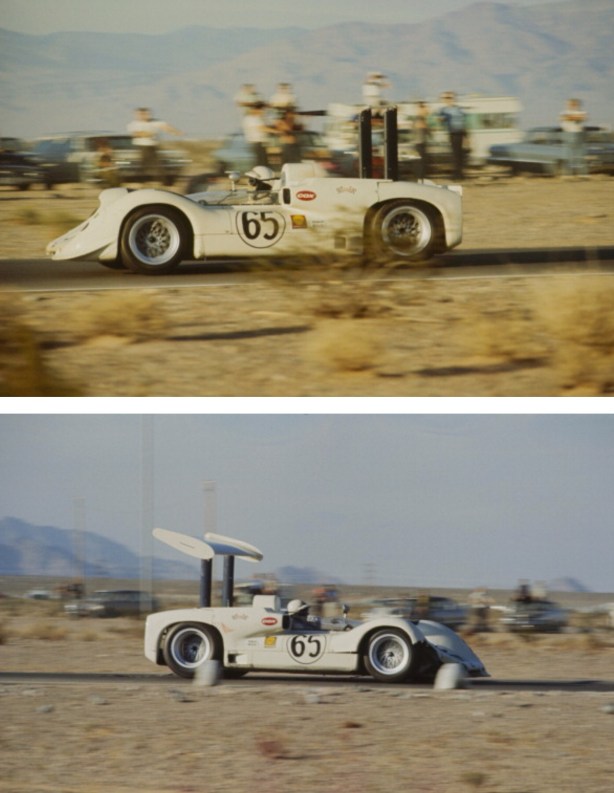
Hill P, ‘Stardust GP’ Las Vegas, Chaparral 2E Chev 1966
image

Now you see it, now you don’t; being a pioneer and innovator was the essence of the Chaparral brand, but not without its challenges! Phil Hill with 2E wing worries at Las Vegas in 1966, he still finished 7th. Jim Hall was on pole but also had wing problems, John Surtees’ wingless Lola T70 Mk2 Chev won the race and the first CanAm Championship  (The Enthusiast Network)

The 13 November 1966 ‘Stardust GP’ at Las Vegas was won by John Surtees Lola T70 Mk2 Chev, CanAm champion in 1966. Proving the nascent aerodynamic advances were not problem free both Jim Hall, who started from pole and Phil Hill pictured here had wing trouble during the race.

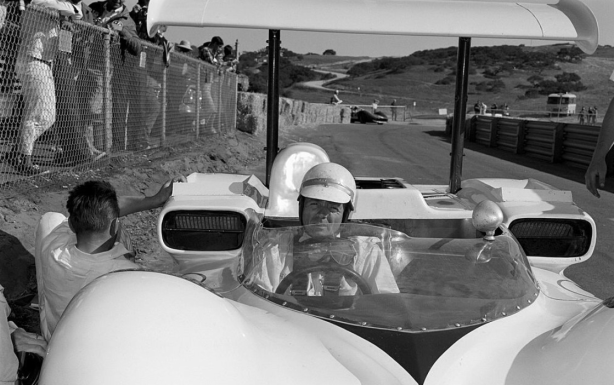
The Chaparral 2E was a development of the ’65 2C Can Am car (the 2D Coupe was the ’66 World Sportscar Championship contender) with mid-mounted radiators and huge rear wing which operated directly onto the rear suspension uprights. A pedal in the cockpit allowed drivers Hall and Hill to actuate the wing before corners and ‘feather it’ on the straights getting the benefits in the bendy bits without too much drag on the straight bits. A General Motors ‘auto’ transaxle which used a torque converter rather than a manual ‘box meant the drivers footbox wasn’t too crowded and added to the innovative cocktail the 2E represented in 1966.

Its fair to say the advantages of wings were far from clear at the outset even in Group 7/CanAm; McLaren won the 1967 and 1968 series with wingless M6A Chev and M8A Chev respectively, winning the ’69 CanAm with the hi-winged M8B Chev in 1969. Chaparral famously embody everything which was great about the CanAm but never won the series despite building some stunning, radical, epochal cars.
phil

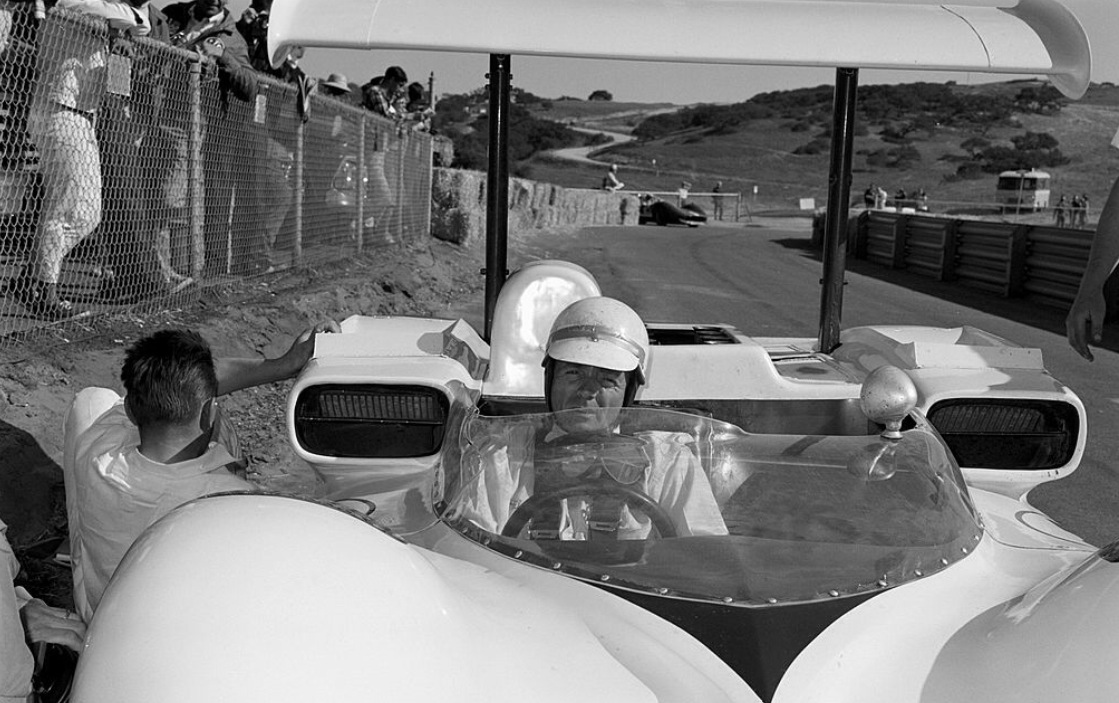
Phil Hill relaxed in his 2E at Laguna Seca on 16 October 1966, Chaps wing in the foreground, Laguna’s swoops in the background. Phil won from Jim Hall in the other 2E (TEN)

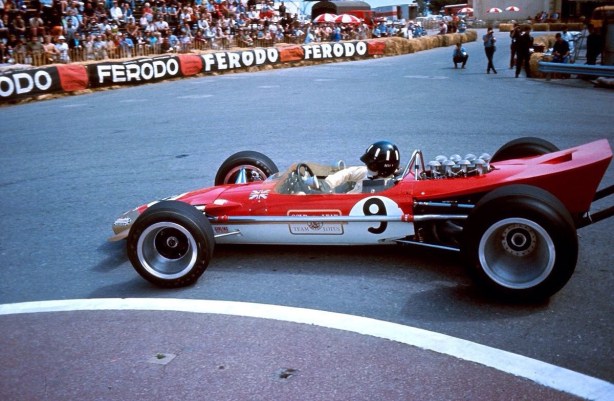
Hill G, Monaco GP, Lotus 49B Ford 1968
image

Interesting shot of Hill shows just how pronounced the rear bodywork of the Lotus 49B was. You can just see the front wing, Monaco ’68 (unattributed)

Hill taking a great win at Monaco in 1968. Graham’s was a tour de force of leadership, strength of mind and will. Jim Clark died at Hockenheim on 7 April, Monaco was on 26 May, Colin Chapman was devastated by the loss of Clark, a close friend and confidant apart from the Scots extraordinary capabilities as a driver.

Hill won convincingly popping the winged Lotus on pole and leading all but the races first 3 laps harnessing the additional grip and stability afforded by the cars nascent, rudimentary aerodynamic appendages. Graham also won the Spanish Grand Prix on 12 May, these two wins in the face of great adversity set up the plucky Brits 1968 World Championship win. Remember that McLaren and Matra had DFV’s that season too, Lotus did not have the same margin of superiority in ’68 that they had in ’67, lack of ’67 reliability duly noted.
graham

Hills 49B from the front showing the ‘canard’ wings and beautifully integrated rear engine cover/spoiler (Cahier)

Ickx, Rouen, French GP, Ferrari 312  1968

image

Mauro Forghieri, Ferrari’s Chief Engineer developed wings which were mounted above the engine amidships of the Ferrari 312. Ickx put them to good use qualifying 3rd and leading the wet race, the Belgian gambled on wets, others plumped for intermediates.

Ickx’ wet weather driving skills, the Firestone tyres, wing and chaos caused by the firefighting efforts to try to save Schlesser did the rest. It was Ickx’ first GP win.

jacky

It looks like Rainer Schlegelmilch is taking the shot of Jacky Ickx at Rouen in 1968, note the lack of front wings or trim tabs on the Ferrari 312 (Schlegelmilch)

Tailpiece: The ‘treacle beak’ noting the weight of Tauranac’s BT26 Repco is none other than ‘Chopper’ Tyrrell. Also tending the car at the Watkins Glen weighbridge is Ron Dennis, I wonder if Ken’s Matra MS10 Ford was lighter than the BT26? If that 860 engine had been reliable Jochen Rindt would have given Jackie Stewart and Graham Hill a serious run for their money in 1968, sadly the beautiful donk was not the paragon of reliability it’s 620 and 740 Series 1966/7 engines generally were…

image

Finito…