Posts Tagged ‘Dan Gurney’

baghetti lotus 49

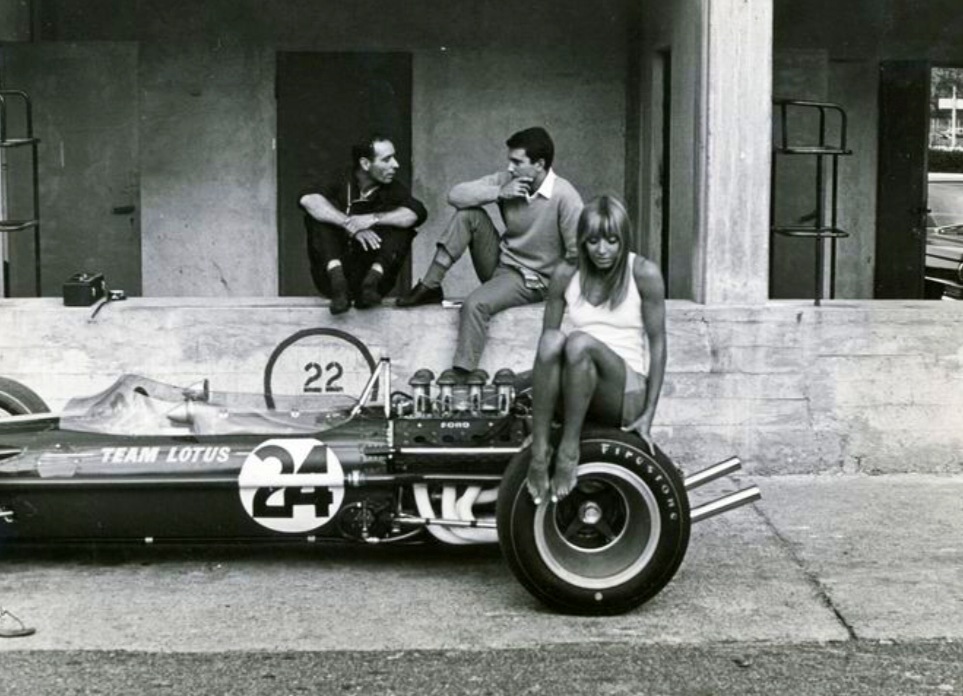
Giancarlo Baghetti relaxes during the Italian Grand Prix weekend, he had a ‘one off’ drive of the Team Lotus spare ’49, backing up Jim Clark and Graham Hill…

He qualified well back on the grid, 17th, and retired on lap 50 whilst running 6th with an engine failure. John Surtees took a fabulous last corner win from Jack Brabham, winning Hondas’ first Grand Prix since Ginthers’ victory in the last race of the 1.5 Litre Formula in Mexico, 1965.

Baghettis’ career started with immense promise, famously winning his first championship Grand Prix, the French in a great dice with Dan Gurney (Porsche) in a Ferrari 156 in 1961….
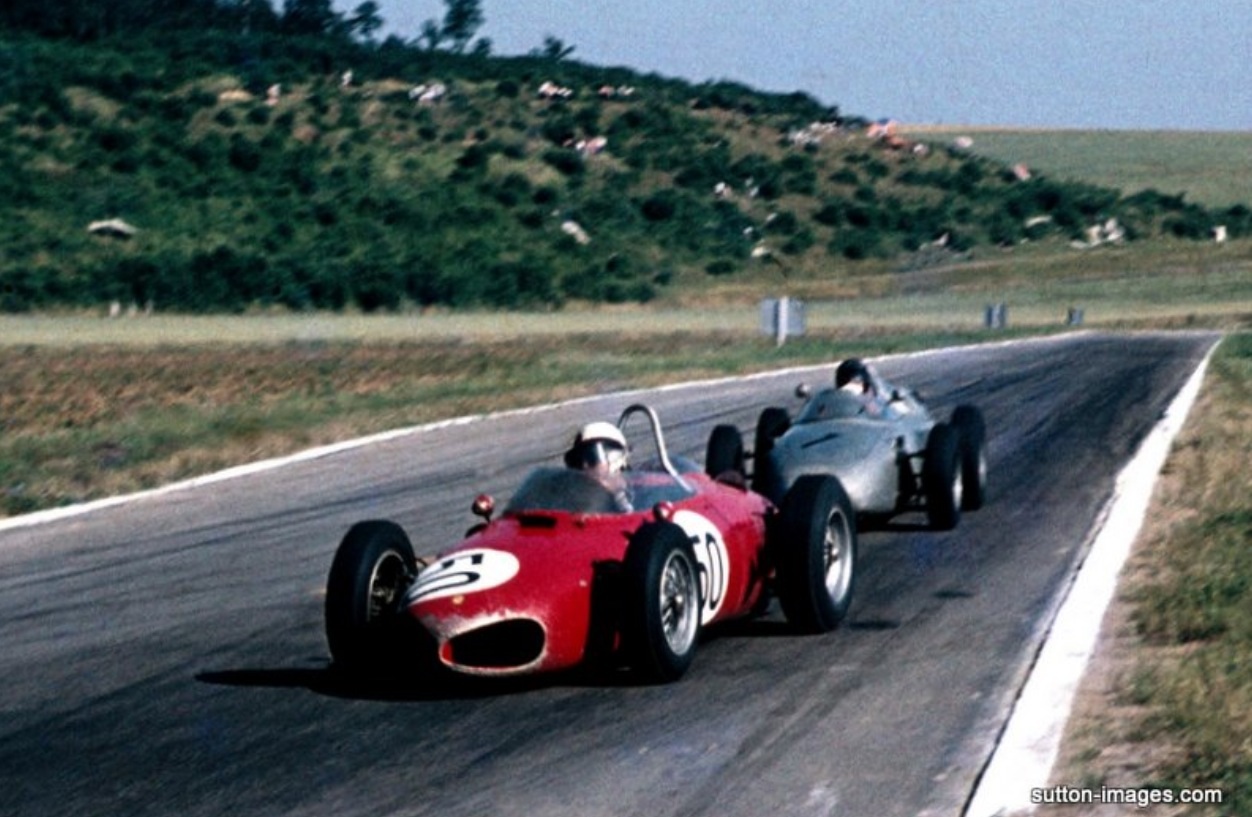
Baghetti French GP 1961

The stone chips on the nose of Baghettis’ 156 bear witness to the closeness of the race, third place went to Jim Clarks’ Lotus 21 Climax. (sutton images)

French GP finish 1961

Toto Roche waves the chequered flag for Baghetti, winning a famous victory over Dan Gurneys’ Porsche 718, French GP Reims 1961, his championship race debut. (Unattributed)

Baghetti started racing in 1956 in an Alfa Romeo 1900Ti and built a solid reputation as he moved into Formula Junior in 1959. In early 1961 he was selected to drive for the Italian FISA team, an organization formed to promote young Italian drivers by entering them in Non-Championship Grands’ Prix.

FISA struck a deal with Scuderia Ferrari to run a 1960 F2 Ferrari Dino 156 (in effect the prototype of the 1961 F1 car) in the first non-championship races of 1961. The results were amazing, Baghetti, not necessarily the best credentialled candidate won on his GP debut in Syracuse in front of Gurney, Surtees, G Hill, Brabham, Moss, Salvadori, Ireland and Bandini.
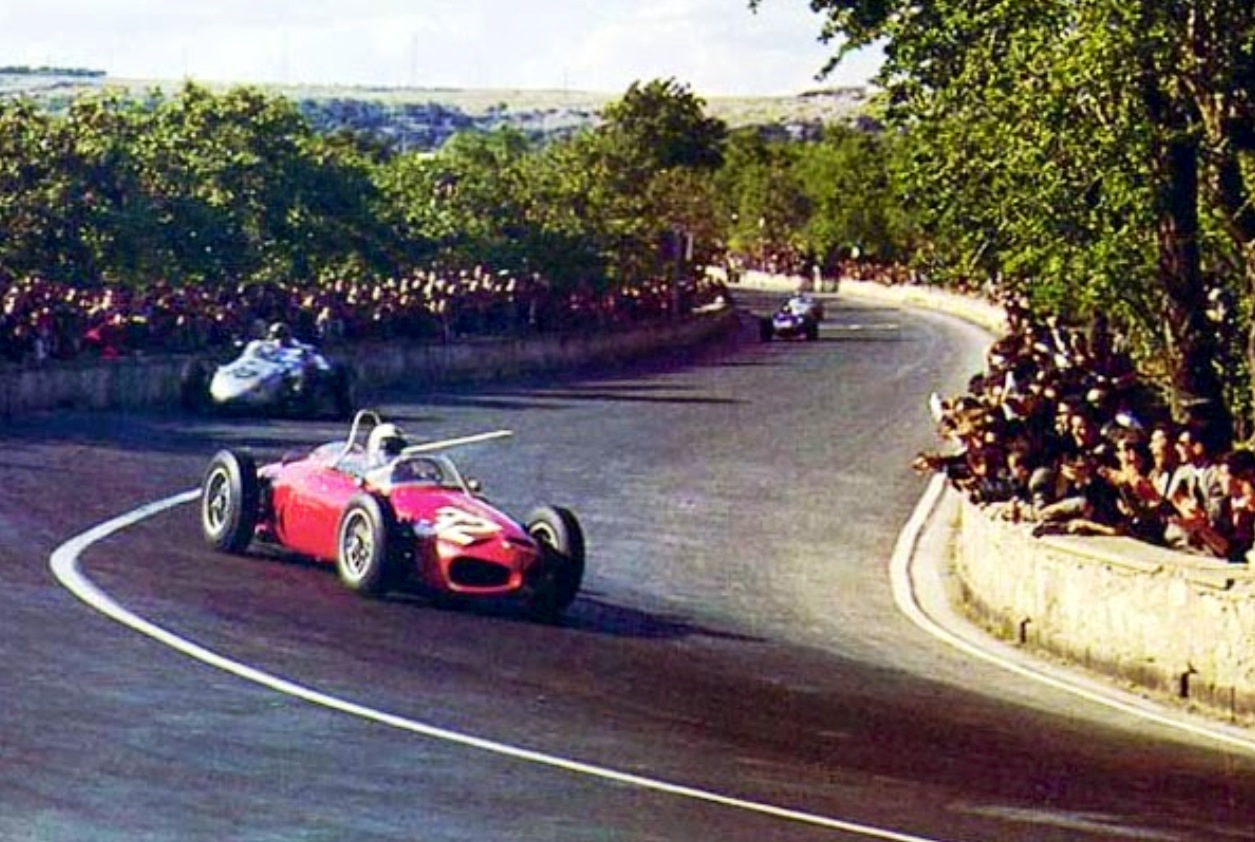
syracuse GP baghetti

Giancarlo Baghetti ahead of Dan Gurney Syracuse GP April 1961. Ferrari Dino 156 from Porsche 718. The first of Giancarlos’ wins against stong opposition. (Unattributed)

He followed up with another win in the Napoli GP in May beating Ashmore, Lotus 18 Climax and Bandini Cooper T53 Maserati 2nd and 3rd as well as Roy Salvadori, Andre Pilette and Tim Parnell.

FISA persuaded Ferrari to hire them a 1961 ‘Shark Nose’ for their driver to make his championship GP debut at Reims, he was allocated the car which was to be driven by Equipe National Belge driver Olivier Gendebien, the car quickly repainted from yellow to red.

Phil Hill took pole from Ferrari teammates Von Trips and Ginther, Baghetti 12th fastest. The 3 works Ferrari’s disappeared at the start, only Moss managed to stay near them. Even a quick spin by Ginther dropped him behind the Lotus, but he was soon able to re-pass Moss such was the Ferraris’ power advantage.

Baghetti had made his way to the front of the chasing pack. When Moss was forced to pit with brake problems, the four Ferrari’s lead, this didn’t last as Von Trip’s engine died in the heat.

Hill spun on the melting road surface. The American lost over 2 laps as he tried to restart his hot engine. This left Ginther in the lead with Baghetti fighting the Porsches of Dan Gurney and Jo Bonnier to hold on to second place, a battle that became even more significant a couple of laps later as Ginther pulled off the track with no oil pressure.

Baghetti recounts the last laps …’It was a very hard race. It was hot. The asphalt was melting, the radiator was blocking up and I saw the temperature starting to soar. Luckily I was behind the two Porsches of Gurney and Bonnier and relied on getting a tow along the straights. What you must remember is that this was my first Grand Prix and both Gurney and Bonnier were trying to frighten me by running on either side of me, but I thought that if they could do things like that and get away with it, then I could do it too.

Three laps from the end Gurney and I were fighting for the lead and I realized that to finish first I needed to be in the perfect position to slipstream. Going into the last corner I was right behind Gurney so that as we came out I was on his tail. He sat right in the middle of the track because he obviously knew what I was going to try to do. I waited and when I saw him glance in his mirror when I was on his left, I quickly switched to the right and got past him to win the race.’

Giancarlo Baghetti became the first man in history to win his debut World Championship Grand Prix.
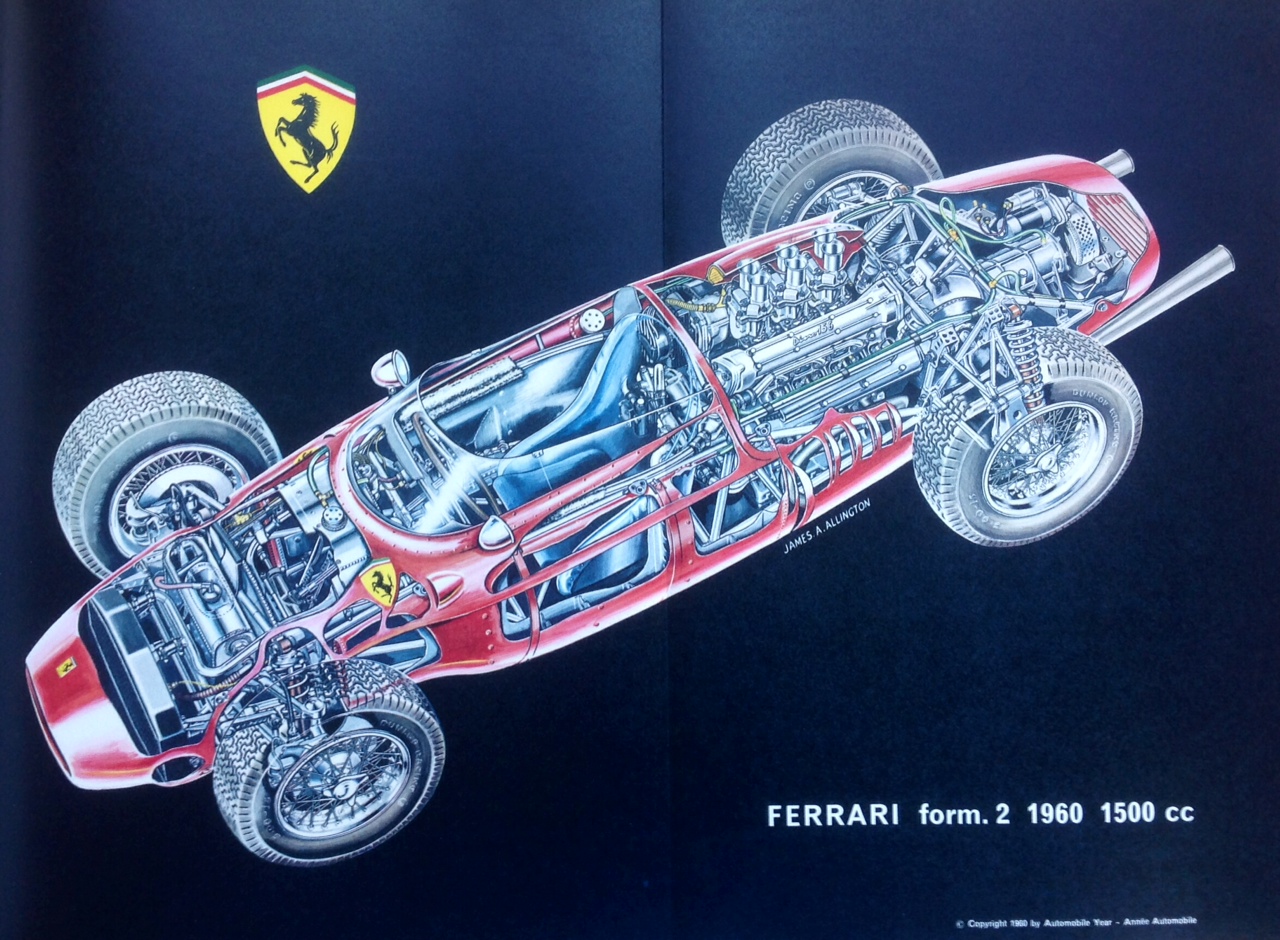
ferrari 156 cutaway

James Allingtons’ cutaway drawing of the 1960 Ferrari 156 F2 car, chassis ‘008’ the car used by Baghetti at Syracuse and Naples was the prototype 1960 car fitted with ’61 ‘Sharknose’ body. Multi-tubular spaceframe chassis, suspension by upper and lower wishbones front and rear. 1476cc 65 degree DOHC 2 valve Weber carbed V6, 185bhp@9200rpm. 5 speed ‘box. Later spec ’61 cars had the 120 degree V6 190bhp@9500rpm. (James Allington)

Baghetti qualified mid-grid for the British GP, spinning off the wet Aintree circuit during the race. For his home GP at Monza he qualified 6th, the other four Ferrari’s were faster. This was the day that von Trips was expected to win the world title, but it was not to be, ‘Taffy’ crashed to his death after contact with Clarks’ Lotus 21, the car flew into the crowd killing 11 spectators on lap two. Baghetti raced at the front until his engine blew on lap 14 and Phil Hill won the race to seal the first World Championship for an American driver. Giancarlo set the fastest lap.

His season ended with his 4th and last GP win, he took victory in a little known event to decide the ‘Prima Coppa Italia’ (Italian Championship for Drivers) at Vallelunga, Baghetti won the 2 heats in a Porsche 718 when his Ferrari was not available for the event. Lorenzo Bandini and Baghetti were tied for the Championship , this event was organised to decide the winner.

What a debut GP season!
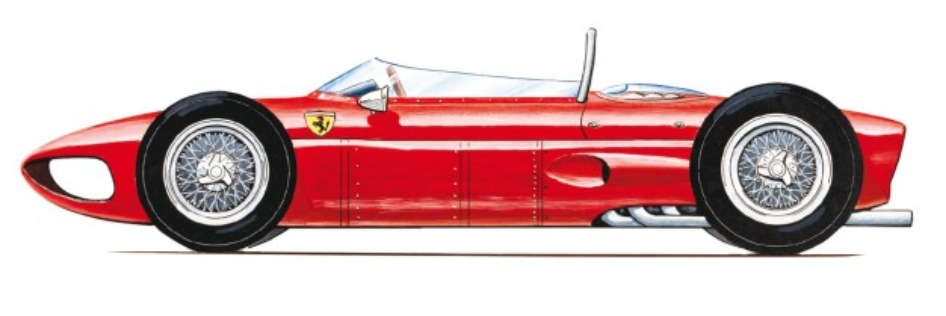
ferrari 156 drawing

1961 spec Ferrari 156. (Scuderia Ferrari)

For 1962 Baghetti joined Phil Hill, the ’61 champion in the works Ferrari team (Rodriguez driving a third car occasionally). Enzo rested on his laurels thinking that the 156’s didn’t require evolution to continue their dominance but the Brits had caught up.

BRM, Lotus and Cooper produced cars to beat the Ferrari’s. Lotus debuted the epochal monocoque chassis Lotus 25 at Zandvoort and Coventry Climax produced their FWMV 1.5 V8 in quantities, the BRM team also built a V8, the Type 56 available to customers as well as the ‘works’ BRM P57’s. The British teams shortcomings in 1961 were their engines, the relatively old 1.5 litre variant of the Climax FPF not ‘man enough’ for Ferrari’s powerful V6. It was different in 1962 when their engine power was equivalent to their chassis mastery…

Baghetti scored points at Zandvoort and Monza, but Ferrari was in total turmoil and for 1963 he joined Hill in the mass exodus to Carlo Chiti’s ATS team, an unmitigated disaster for all involved, it effectively destroyed his F1 career. Baghetti drove Centro Sud’s old BRM P57 in 1964, he returned to race in F2, F3 and sports and touring cars, also making an annual apperance at the Italian GP, his last in the Lotus 49 in 1967.
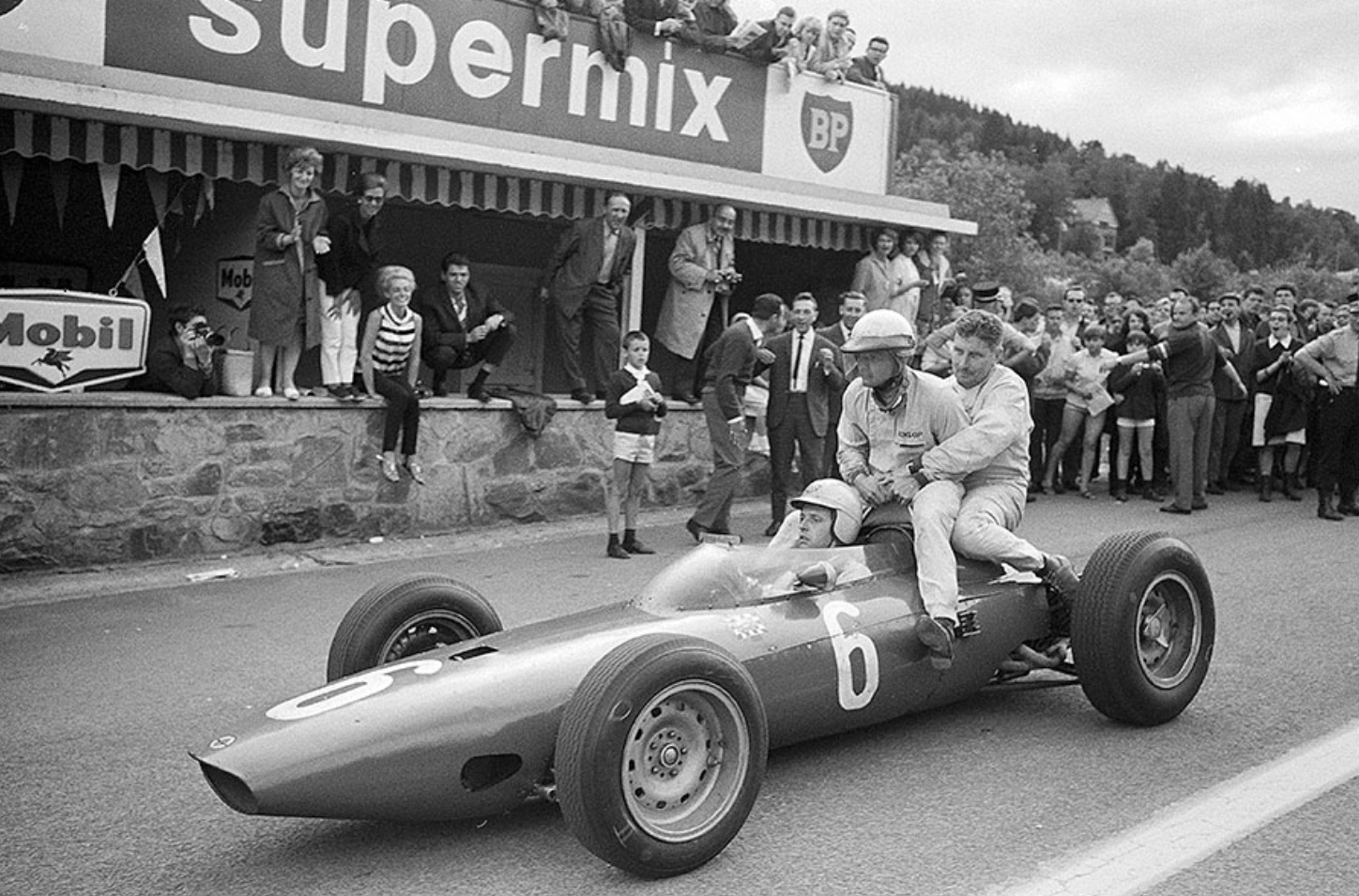
baghetti spa

‘Hitchin a ride’: Baghettis’ BRM P57 gives Phil Hill and Bob Anderson a lift at the end of the 1964 Belgian GP, Spa. Giancarlo was 8th in the race won by Clarks’ Lotus 25 Climax. Hill raced a Cooper T73 Climax and Anderson a Brabham BT11 Climax (G Clayton)
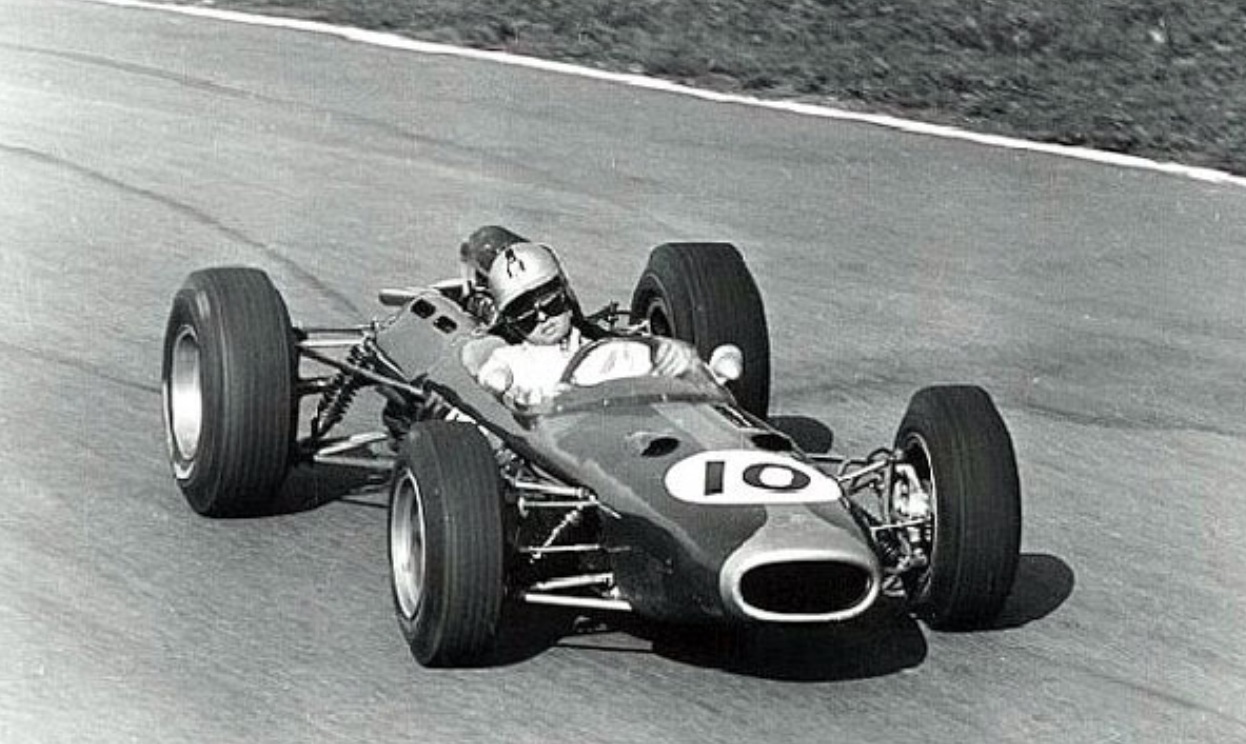
baghetti brabham 65 italian

Brabham entered a third car for Giancarlo at the 1965 Italian GP. He qualified the BT7 Climax poorly in 19th, the engine failed on lap 12 in the race won by Stewarts’ BRM P261. (Unattributed)
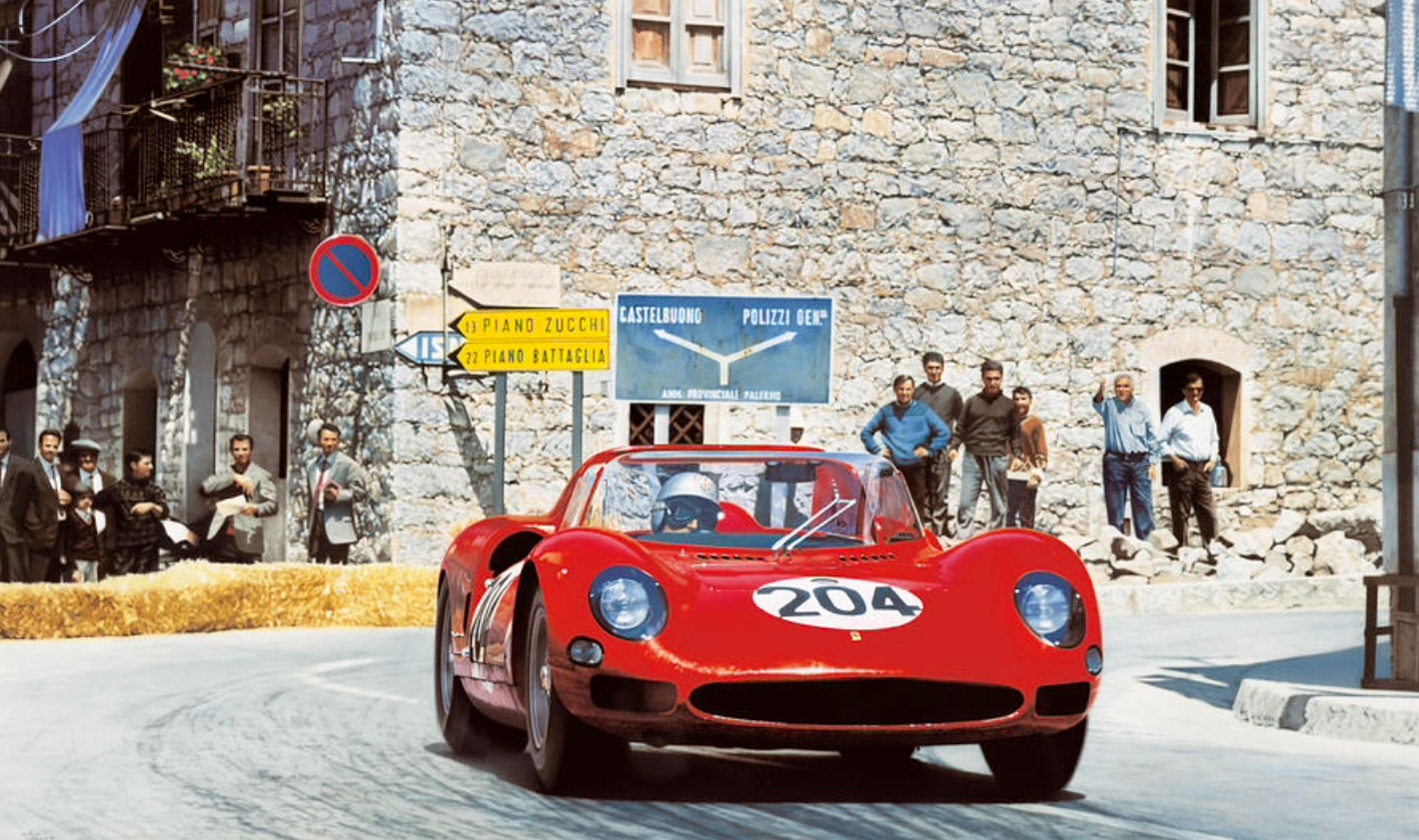
baghetti targa 1965

Baghetti at the wheel of a factory Ferrari 275 P2 during Targa 1965, DNF with Jean Guichet. (Unattributed)

After a huge accident at Monza in a Ferrari Dino 166 F2 car in the ‘Monza Lottery GP’ in June 1968 he retired from driving, working as journalist and photographer. He succumbed to cancer in 1995 age 60.

No-one has ever repeated the feat…a quasi factory Ferrari drive on the results of a ‘journeyman’, won his first 3 GP’s, 4 for the year, one of them a championship event and then so rapidly disappeared from sight…

baghetti italian gp 1966

Baghetti at the wheel of a Ferrari Dino 246, Monza, Italian GP 1966. Q16, raced Spences’ Lotus for 5th until the car failed in the race won by Scarfiottis’ Ferrari 312. Car was lent to him by Scuderia after his Parnell  Lotus BRM failed in practice. (Unattributed)
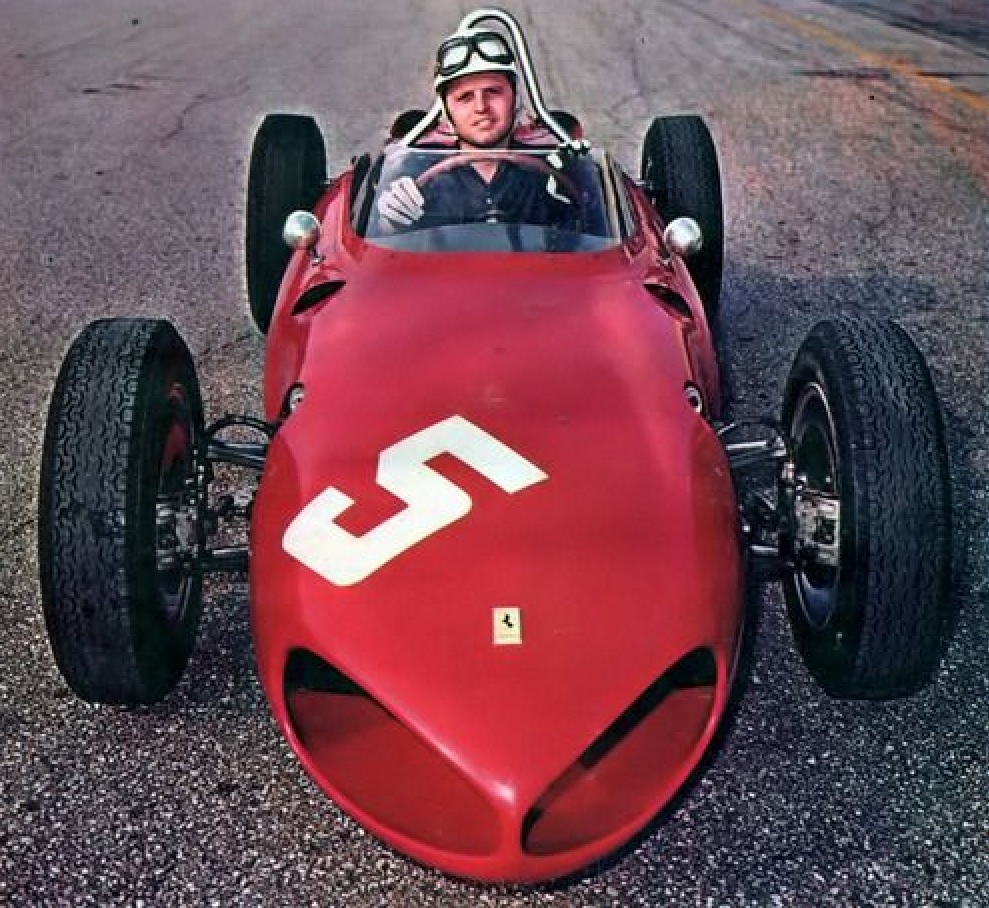
Baghetti Ferrari 156 1962

Giancarlo Baghetti, Ferrari 156 1962. The class of the field in 1961 were at best also-rans in 1962. He is smiling so it must be at the seasons commencement… (Unattributed)

Photo and other Credits…

Mel Turbutt, motorsportretro.com, Sutton Images, James Allington, Scuderia Ferrari, The Auto Channel

Finito…

tony marsh

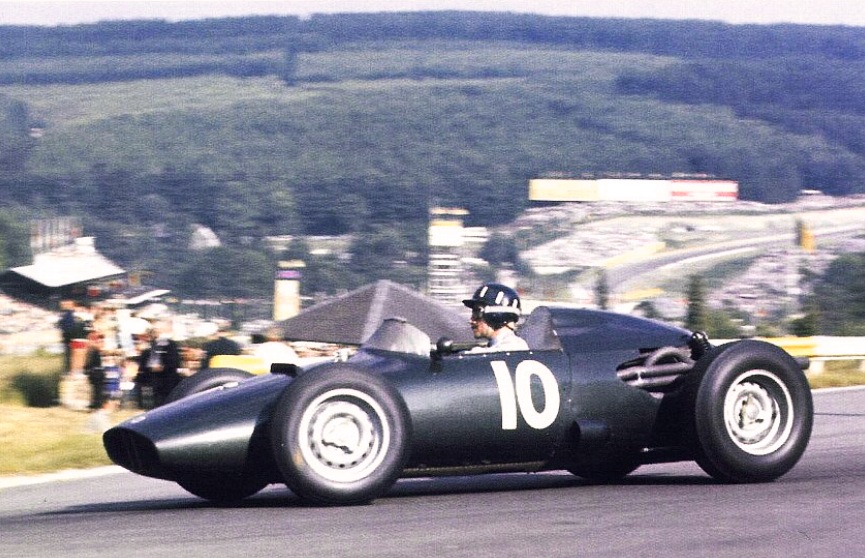
Tony Marsh working his 1960 BRM P48 chassis ‘484’, 2.5-litre ex-Bonnier 1960 F1 car very hard, lifting an inside rear wheel into ‘The Courtyard’, Bo’ness Hillclimb, Scotland 1966…

Two of the reasons why the content of this blog is eclectic are that it suits my broad racing interests and that a photo is usually the inspiration for an article, this shot is one of those! I tripped over it on ‘The Nostalgia Forum’, which is a wonderful place for those of you who may not paid it a visit. You can get lost in there for weeks! http://forums.autosport.com/forum/10-the-nostalgia-forum/

p48
The old and new…P25 and mid-engined P48 prototype ‘481’ on test, circuit unknown, August 1959 (Unattributed)

Lots of ex-GP cars have found their way into British Hillclimbing over the years, the Tony Marsh BRM P48 is one of those…

The 1951 BRM P15 supercharged 1.5-litre V16 racer was a disaster, too complex, too late but a fabulous bit of kit and the greatest sound in motor racing, full-stop. Aural orgasm is not going too far to describe its musical, mechanical, sonorous howl!

The design which followed, the Type 25 was the reverse, a simple 2.5-litre, DOHC, Weber carbed, front-engined, spaceframe chassis car which served BRM from 1955 to 1959, finally achieving a breakthrough win for Bourne in the 1959 Dutch Grand Prix, Jo Bonnier the driver.

But by then the game had moved on, Cooper dominated the grids with their Coventry Climax engined, simple mid-engined cars. Jack Brabham and Cooper took the drivers and constructors titles in 1959 and 1960 with Cooper Types 51 and 53, Tony Rudd and his team needed to respond.

BRM were famous for their engineering process and toolroom quality but the P48 was a quick fix, utilising as many of the Type 25 components as possible, in essence the P48 was a mid-engined variant of the Type 25, right down to its controversial, less than reliable cookie-cutter, single, gearbox mounted rear disc brake.

brm p 48
(Vic Berris)
monza
The prototype chassis #481 BRM P48 was tested in practice at the 1959 Italian Grand Prix in September by Harry Schell and Jo Bonnier. They stayed on at Monza for further testing, the P48 was then developed over the winter of 1959-60 and made its race debut at Silverstone early in 1960 (John Ross Motor Racing Archive)

1960 was the last year of the 2.5-litre Formula, the P48 Mk II was more competitive than the first iterations used for most of the season and were devoid of the cookie cutter and used the wishbone rear suspension which formed the basis of BRM’s 1961 contender’s design intent.

This 1961 car, the P57, was Coventry Climax 1.5-litre FPF powered until BRM’s fabulous and successful P56 1.5-litre V8 was developed for use from the 1962 season. See this link; https://primotipo.com/2014/10/12/graham-hill-brm-p57-german-gp-1962/ The P48 evolved into the P57 which delivered BRM’s first and only Manufacturers and Drivers Championships for the marque and Graham Hill in 1962.

BRM P48 engine and rear suspension
BRM P48 spaceframe chassis, P27 2.5-litre DOHC four ex-Type 25 front engined car. Strut type rear suspension, cookie cutter single rear disc, not the most elegant of mid-engined cars but a good first up effort given the design wasn’t clean sheet and BRM learn’t fast! (Unattributed)
g hill
(unattributed)

Graham Hill’s P48 485 (above) took third place in the 1960 Belgian GP at Spa won by Brabham’s Cooper T53 Climax. The weekend was one of racing’s worst, Stirling Moss broke both legs after an axle failure, Mike Taylor’s steering broke so he crashed into trees suffering grievous injuries which made him paralysed, eventually with therapy he walked again, both were driving Lotus 18s, those accidents took place in practice. In the race Chris Bristow crashed his Cooper T51 Climax at Malmedy whilst pushing too hard and crashed to his death while Alan Stacey (Lotus 18 Climax) was hit in the face by a bird near Masta, he crashing and died instantly.

Tony Marsh German GP 1957
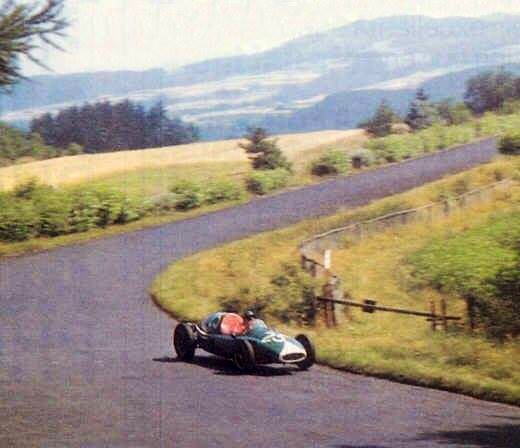
Tony Marsh attacking the Nurburgring in his Cooper T43 Climax, German GP 1957 (unattributed)

Tony Marsh…

Marsh was an iconic hillclimber, first taking the British Hillclimb Championship title in a Cooper Mk8 Jap in 1955. After two more successive wins he turned to circuit racing winning the British F2 Championship in 1957 with a Cooper T43 Climax. He also contested the 1957 German GP, finishing fifteenth in his F2 car and eighth in 1958 aboard a Cooper T45 Climax.

Marsh raced a private Lotus 18 Climax and his own BRM P48/57 1.5 V8 engined car in 1962 in some Non-Championship F1 events – best placings were fourth in the Pau GP and seventh in the International Trophy at Silverstone.

He returned to hillclimbing in the mid-1960s, winning the championship a further three times and was still competing right up until his death at 77 years of age in May 2009.

tony marsh brussels gp
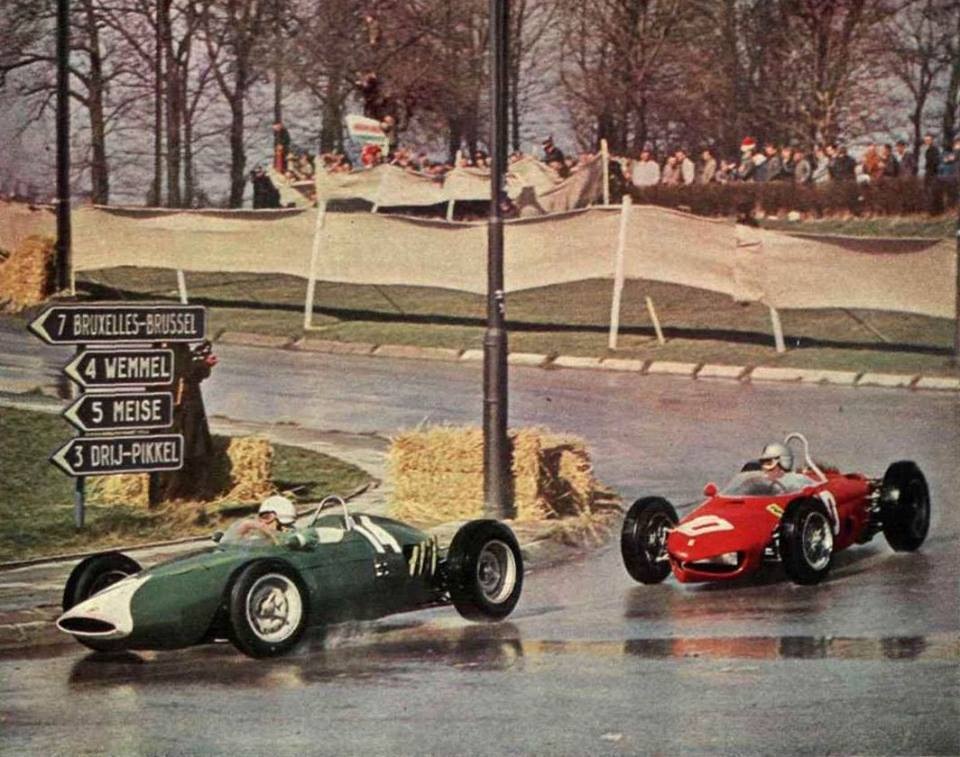
Tony Marsh ahead of Willy Mairesse in the 1962 Brussels GP, 1 April. His BRM P48/57 was factory entered along with Graham Hill’s P57, both non-classified. The race was won by Wild Willy in his Ferrari 156 (unattributed)
tony marsh 2
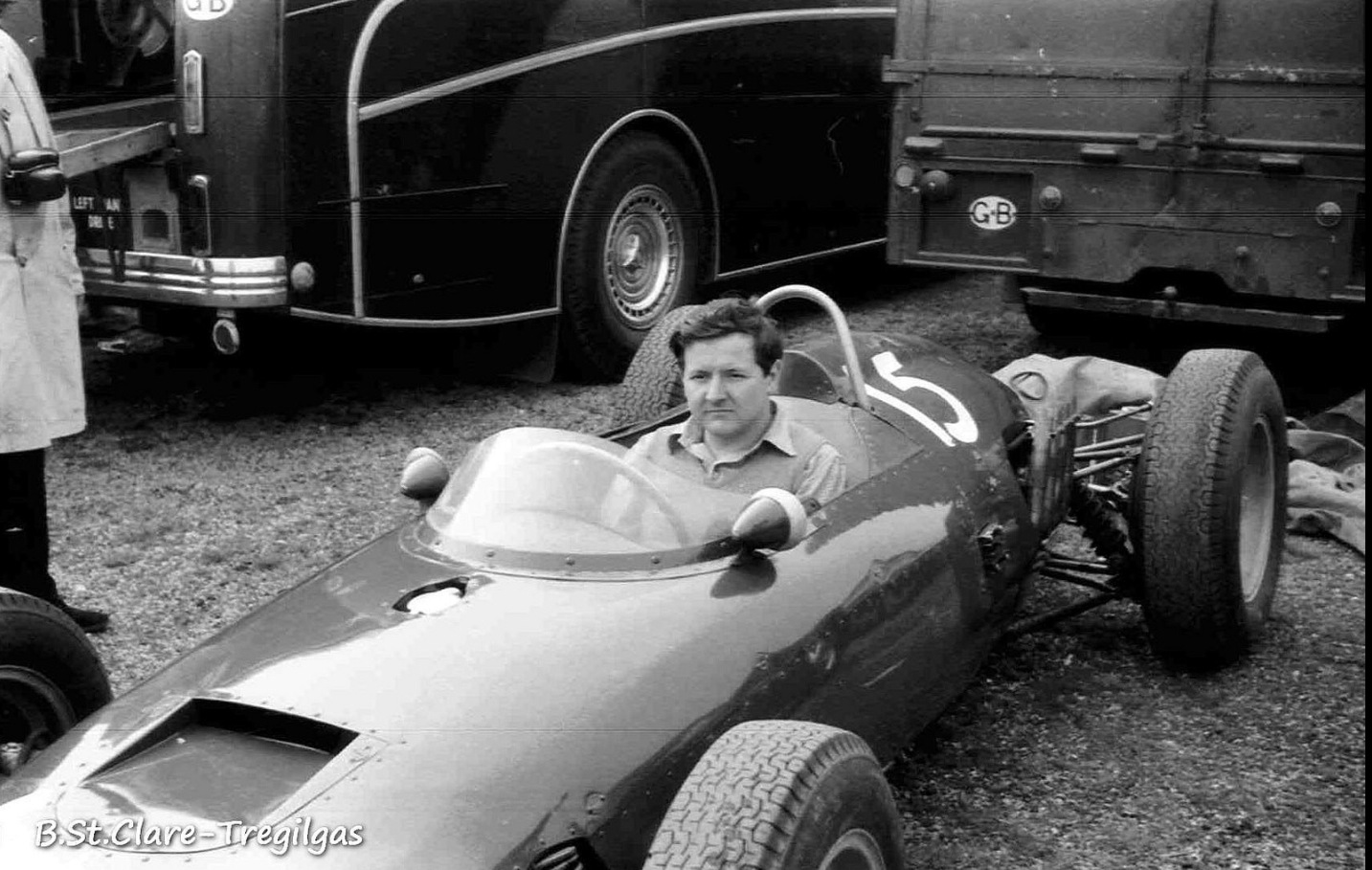
Tony Marsh warming up his BRM P57 1.5 V8 prior to practice of the Aintree 200 in April 1962. He qualified 10th and retired on lap six with an oil leak, he had a lot of problems with this car! (Brian Tregilgas)

Bo’ness Hillclimb…

Bo’ness is 17 miles north-west of Edinburgh, the hillclimb was used from 1934 to 1966 and ran through the grounds of Kinneil House. James Watt of steam engine fame lived there, the grounds contain the ruins of his cottage and the boiler of his Newcomen Engine.

Tony Marsh set the record for the climb in June 1963, one which stood for all time, the last meeting at the venue was held in June 1966, revival meetings have taken place in recent years.

Some former motor racing greats held the climbs’ record including Bob Gerard, Ken Wharton, Ron Flockhart and Jim Clark, the latter with a Lister Jaguar in 1959.

Etcetera…

Dan Gurney P48 Silverstone 1960
Dan Gurney awaits adjustments to his P48 486 , Silverstone, British GP 1960. That transmission mounted ‘cookie cutter’ single rear disc and caliper clearly shown (unattributed)
Jo Bonnier P48 BRM Monaco 1960
Jo Bonnier in the Tony Marsh BRM P48 484 at Monaco in 1960, he finished fifth. ‘Up his chuff’ is Stirling Moss, heading for victory in Rob Walker’s Lotus 18 Climax (unattributed)

Credits…

The Nostalgia Forum, John Ross Motor Racing Archive, Brian Tregilgas, Doug Nye, Vic Berris

From Ballarat to Bathurst, BRM P48’s in Australia, Part 2…

Finito…

clark

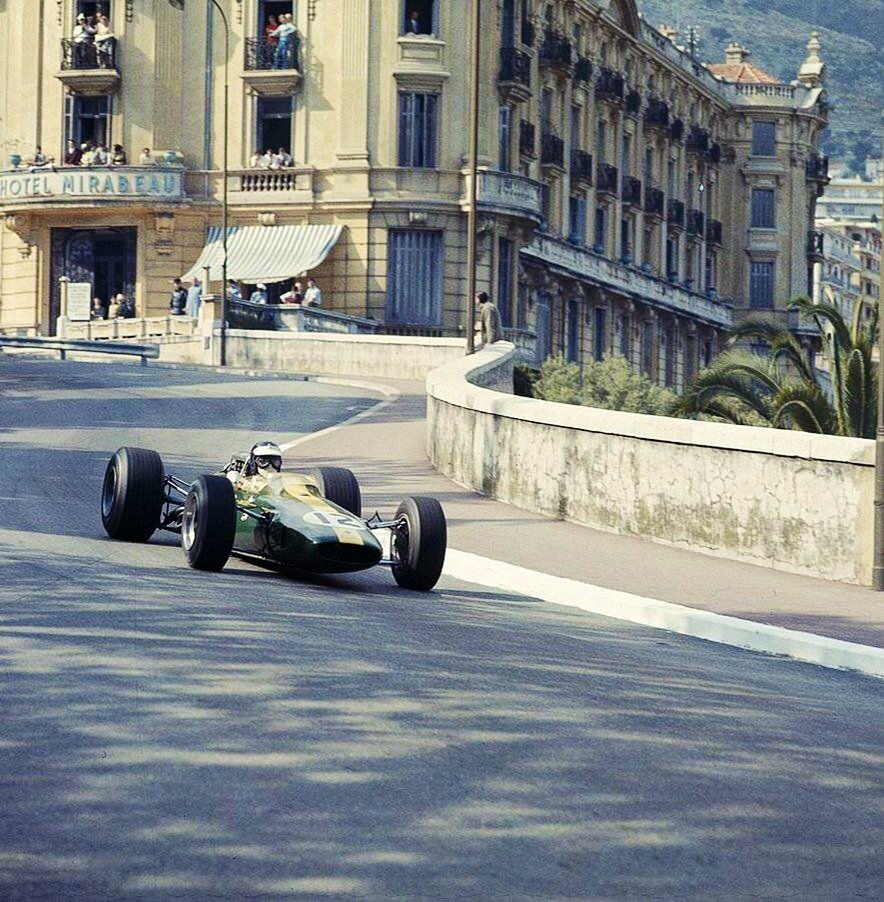
Jim Clark in his last Championship drive of a Lotus 33…

Colin Chapmans’ revolutionary family of cars, the Lotus 25/33 had been kind to Jim, World Championships in 1963 and 1965 in his symbiotic relationship with Chapman, his Team, his Cars.

The ’25’, introduced at Zandvoort in 1962 was not the first ‘monocoque’ chassis but it was the first ‘modern one’, all Grand Prix cars, indeed most racing cars can trace their parentage back to the 25 and the trends it set.

The good ‘ole multi-tubular spaceframe wasn’t dead mind you, Brabham were still winning Grands’ Prix in 1969 with their BT26, but even Brabham changed to aluminium sheet ‘tubs’ in 1970 as the use of ‘bag’ safety fuel tanks effectively precluded spaceframes.

At Zandvoort in 1967, the following race Chapmans’ Lotus 49, and its Ford Cosworth engine again set a standard all others followed, much as the ’25’ did in 1962, the ’72’ did in 1970 and the ’78’ did in 1977…

clark 2

Clark qualified his 2 litre Lotus on the third row amongst the 3 litre cars, spun on lap 2, battled his way up to fourth from fourteenth, his race ending on lap 43 with a duff shocker. This tragic race claimed the life of Lorenzo Bandini who died when his Ferrari caught fire after an accident with the straw bales on the outside of the corner where Clark is pictured. Denny Hulme won the race in a Brabham BT 20 Repco. (Pinterest)

hill

Graham Hill in the other Lotus 33, BRM powered did better than Clark, finishing second, always a happy hunting ground for Hill who won the race 5 times. Amazing shot, he looks a bit wide! (Cahier Archive)

lotus 33

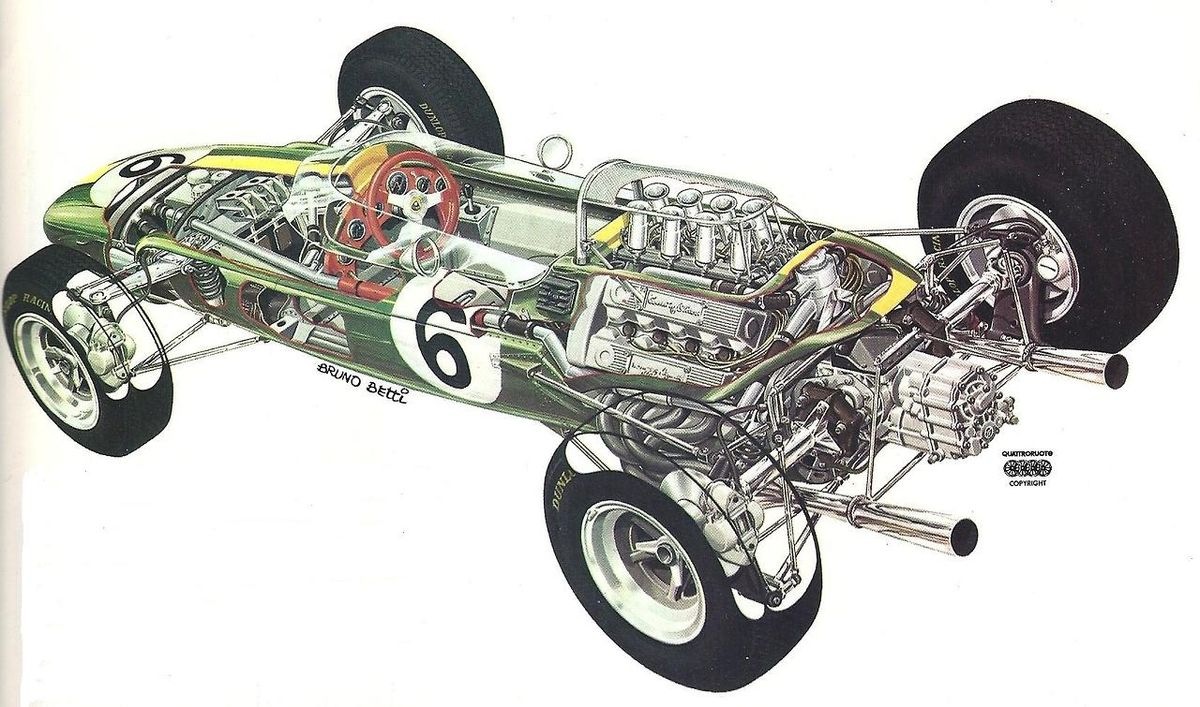
Lotus 33 : aluminium monocoque or stressed skin chassis, inboard suspension at front by top rocker and lower wishbone, coil spring damper unit within the tub. Rear suspension outboard by single top link, inverted lower wishbone, 2 parallel radius rods and coil spring/ damper unit. Coventry Climax 2 litre, by this stage, DOHC, 4 valve V8, 5 speed ZF gearbox, just a lovely, successful bit of kit…! (Bruno Betti)

Photo Credits…

Pinterest, Bruno Betti cutaway drawing, Cahier Archive

Tailpiece: You don’t often see the super smooth Clark with so much attitude on a car. Here he is giving the 33 plenty of welly ahead of Dan Gurney’s Eagle T1G V12, Dan’s car out on lap 4 with fuel pump problems so ’tis early in the ’67 race…

jim

(unattributed)


dan 1

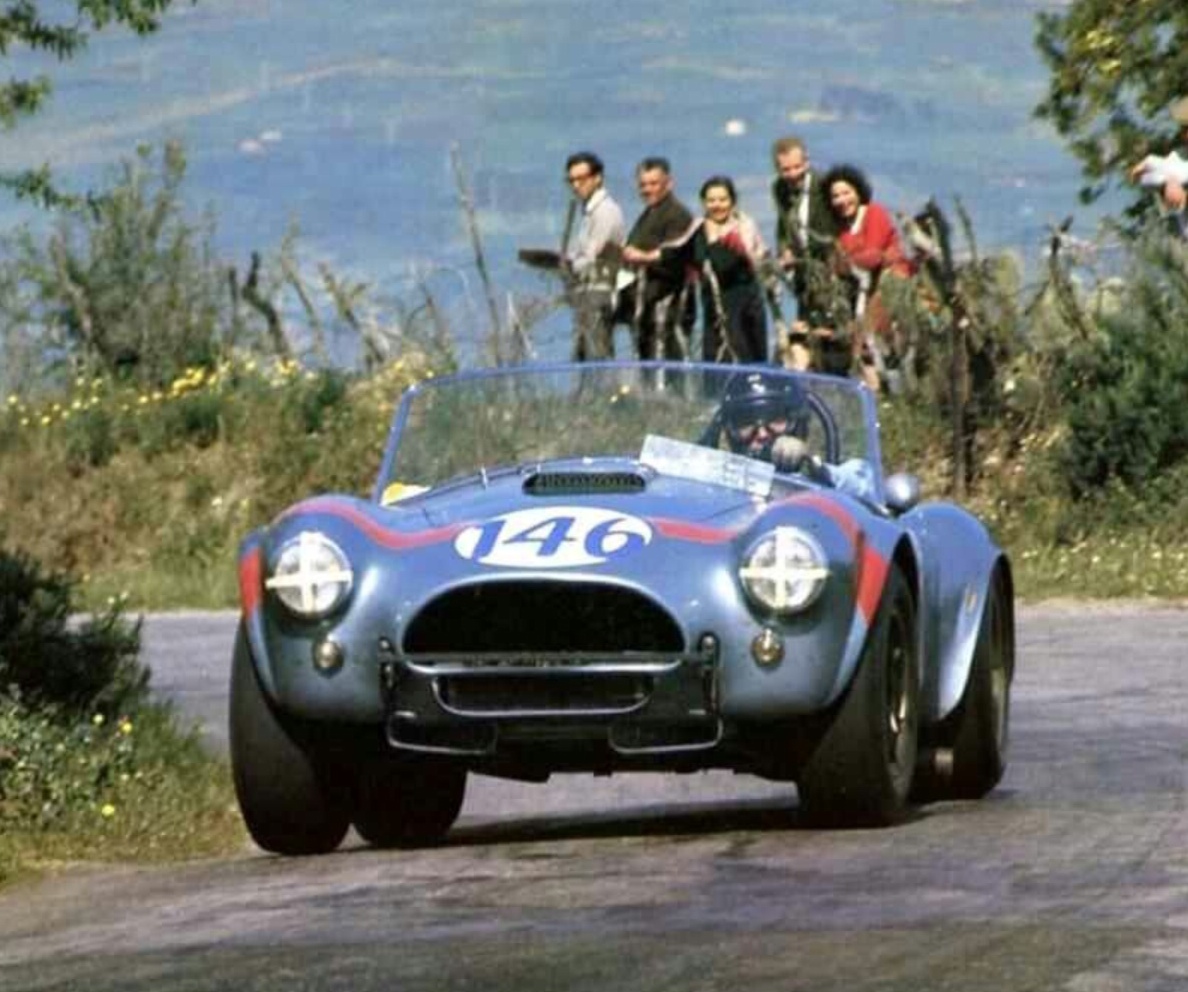
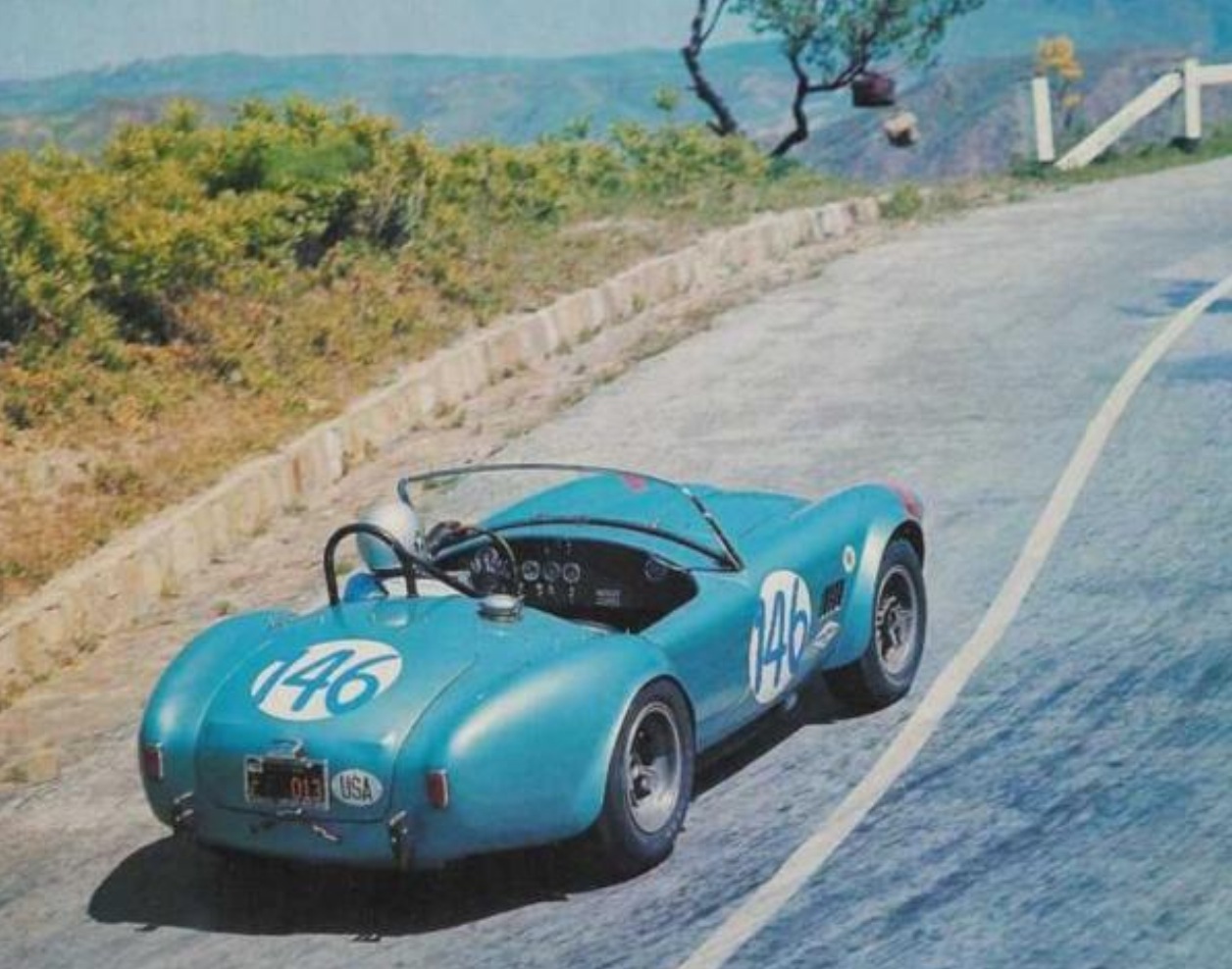
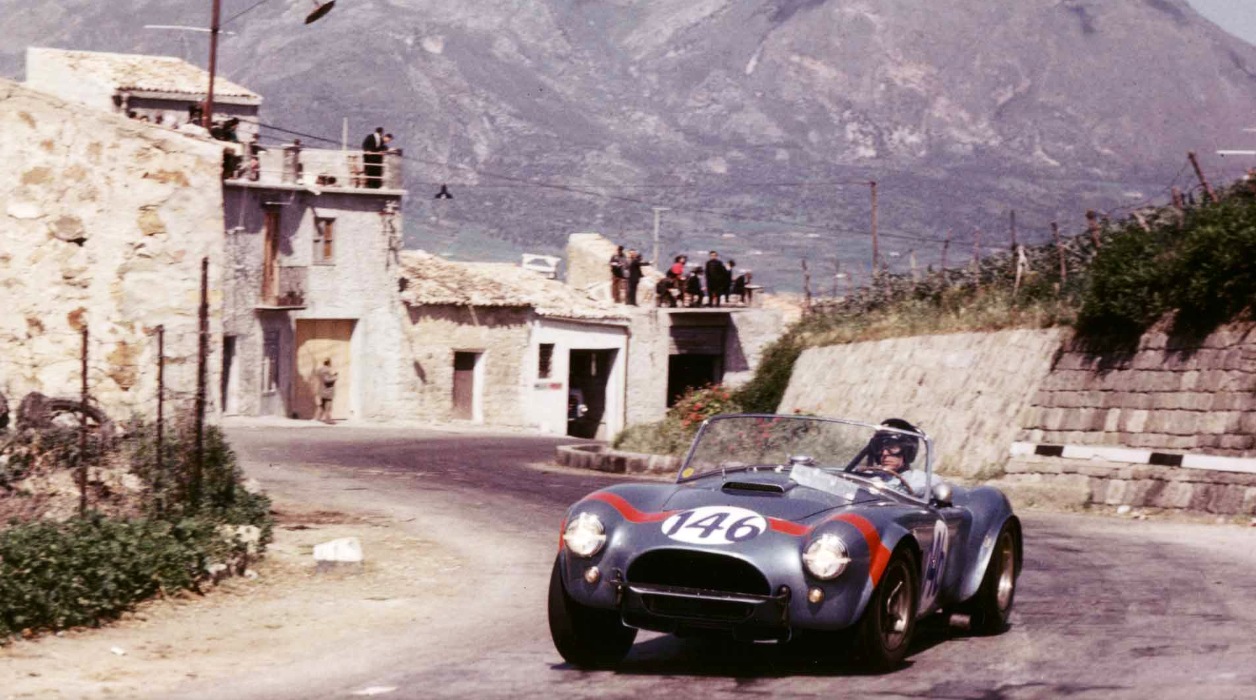
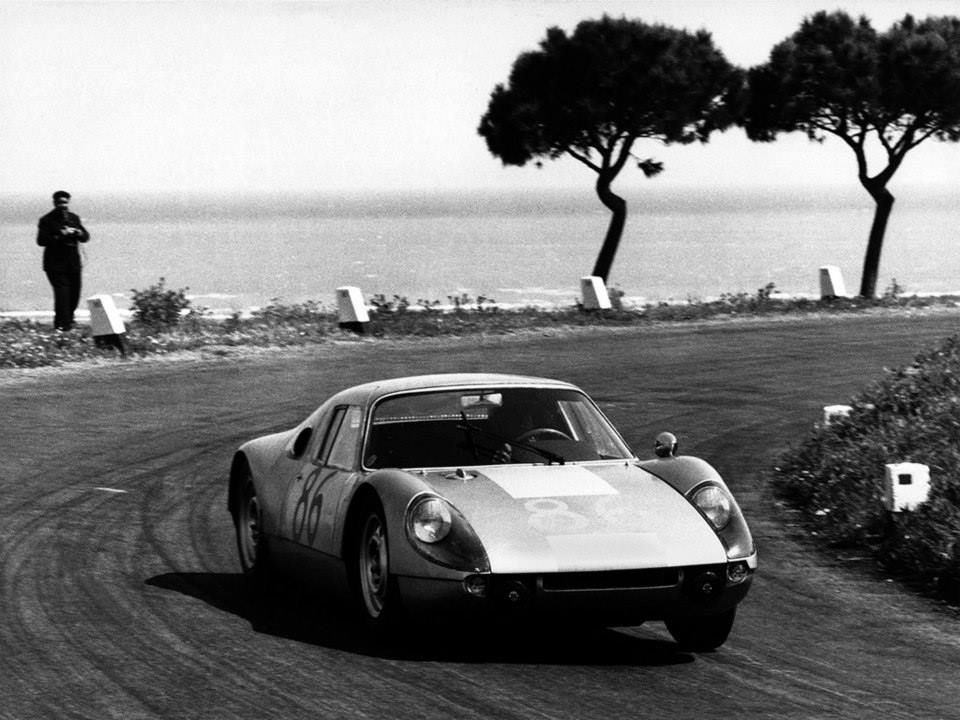
One of my Top 10 Motor Racing Shots of all time, Dan Gurney AC Shelby Cobra, Targa Florio 1964…

The photo is by Ami Guichard, he put it on the cover of his acclaimed Automobile Year # 12. It captures everything which was great about this fantastic and oh so Italian event. Dan Gurney and Jerry Grant finished eighth outright and first in class in the event won by the much more suitable Porsche 904 GTS of Colin Davis and Antonio Pucci.

The 1964 GT Manufacturers Championship was won by Ferrari with Shelby Cobra second. The advent of the Cobra Daytona Coupes ensured Ferrari would get more of a run for their money in 1965!

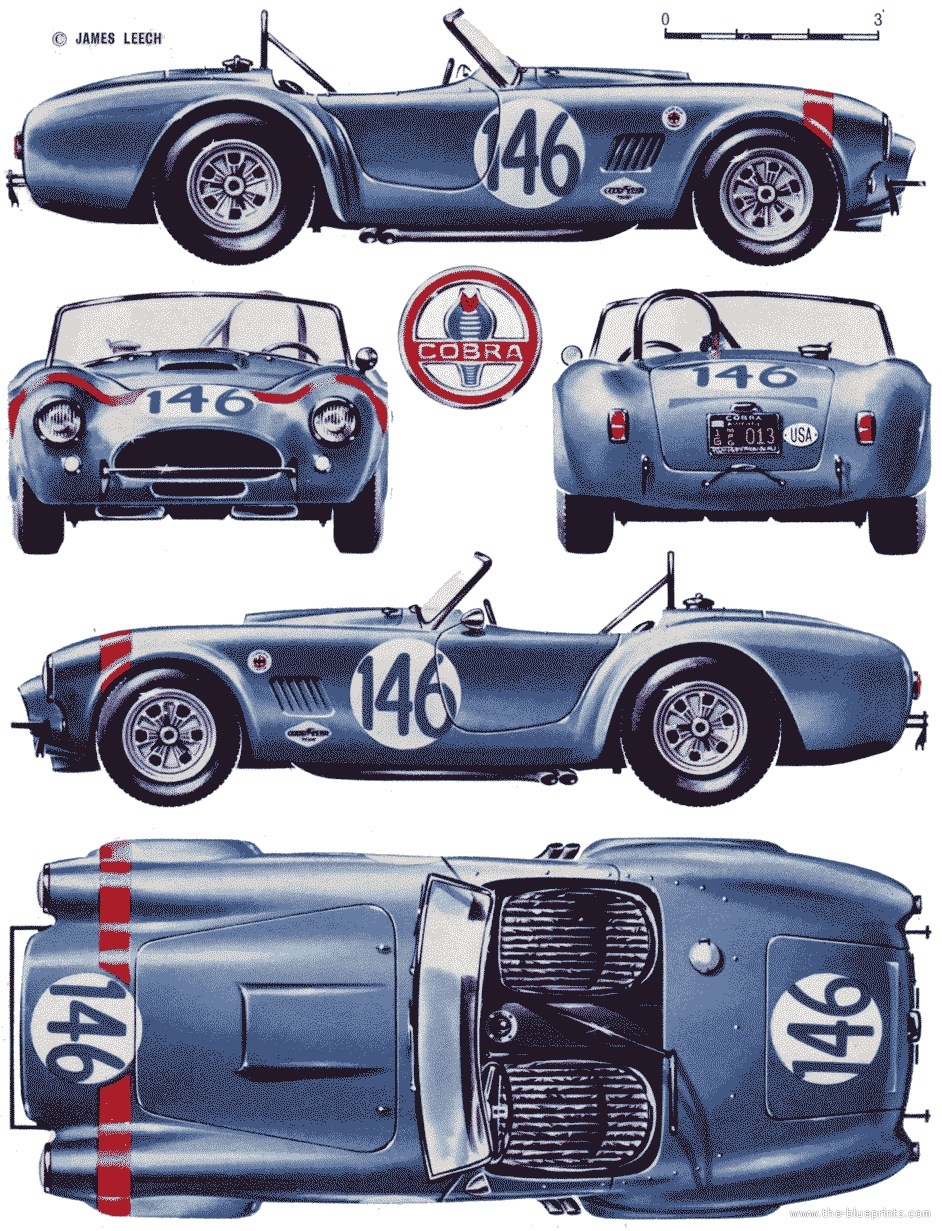
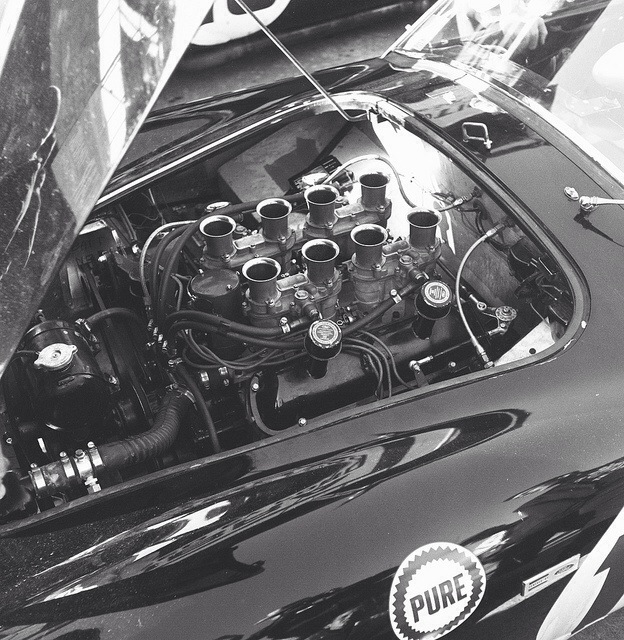
Specifications of the FIA Roadster cars in 1964 included Ford’s pushrod OHV 4.7-litre or 289 V8 fitted with four 48IDA Weber carburettors giving circa 400bhp. Borg Warner four speed gearbox, four wheel disc brakes and independent suspension using transverse leaf springs. 140-litre fuel tank, six-spoke cast alloy wheels. These cars were the ultimate development of the original small-block Cobra.

an at rest
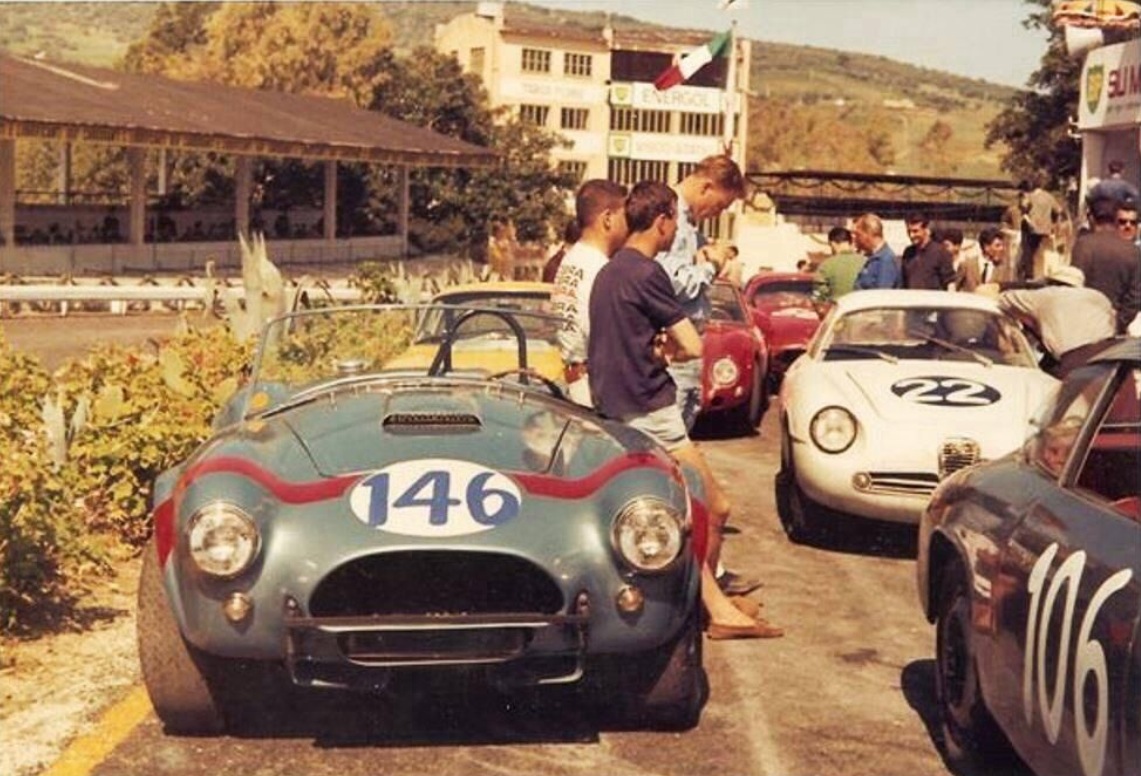
Before the off at Cerda, Targa ’64, Gurney with Shelby team mechanics. AC Cobra # 106 a Lancia Flaminia DNF and # 22 Alfa Giulietta SZ, 19th (Pinterest)
jerry
Jerry Grant in the Cobra shared with Dan Gurney, Targa 1964 (Pinterest)
dan 2
Gurney through the Sicilian countryside, Targa Florio 1964. In addition to the Ford sportscar program he raced for Brabham in Grand Prix Racing winning the team’s first championship race that year (Pinterest)

Etcetera…

leech
cob
Engine of Hill’s Cobra, Sebring 1963
davis
The 1964 Targa winning Porsche 904 GTS of Colin Davis and Antonio Pucci (unattributed)

Photo Credits…

James Leech drawing, Ami Guichard Automobile Year 12

Finito…

gurney

Dan Gurney heading for third place in his Ferrrari Dino 246 despite running up Trintignants’ chuff…

The organisers moved the race from Oporto to Monsanto Park, Lisbon that year, also a very dangerous circuit with tram tracks, uneven surfaces and plenty of telegraph poles to hit.

Brabham was saved by one of said poles. Having spun avoiding a twice lapped car, a pole saved him from going down a ravine but spat his Cooper T51 back onto the circuit. He was then thrown out of the cockpit and nearly mown down by teammate Masten Gregory zipping past at the time. Jack always rated that prang his greatest escape.

Tony Brooks’ Dino was four points adrift of Brabham in the drivers championship at that stage, the margin he won the title from Brooks by at season’s end.

The mid-engined era was underway, the gorgeous Dino was passé, it was the last front-engined car to win a title in Mike Hawthorn’s hands in 1958, and also the last to win a Grand Prix, the 1960 Italian, a race boycotted by most of the teams as it was run on the Monza Banking. The Italian race organisers did so to advantage Ferrari, in 1960 still racing the Dino 246 which was way past it’s use by date but still had straight-line speed; scallywags those Italians.

Moss won in Portugal a canter, leading all the way in Rob Walker’s Cooper T51 Climax…

gurney & hill

Phil Hill, Luigi Bazzi, Carlo Chiti, and Dan Gurney discuss the need for more speed at Monsanto Park, Lisbon 1959. (Getty Images)

hill porto 1960

dino

Ferrari Dino 246 cutaway showing, ladder frame, 2417cc 65-degree DOHC V6, four speed gearbox, double wishbone front suspension, De Dion or IRS at rear depending upon the year, this car appears to be IRS and therefore a later specification car.

cooper

(James Allington/Tony Matthews)

The Cooper T51 Climax cutaway shows the space frame chassis Coventry Climax DOHC 2490cc four cylinder engine, Cooper/Citroen four speed gearbox, wishbone front independent, and wishbone and transverse leaf spring independent rear suspension.

Photo Credits…

Pinterest unattributed, Getty Images, James Allington/Tony Matthews cutaway

Finito…