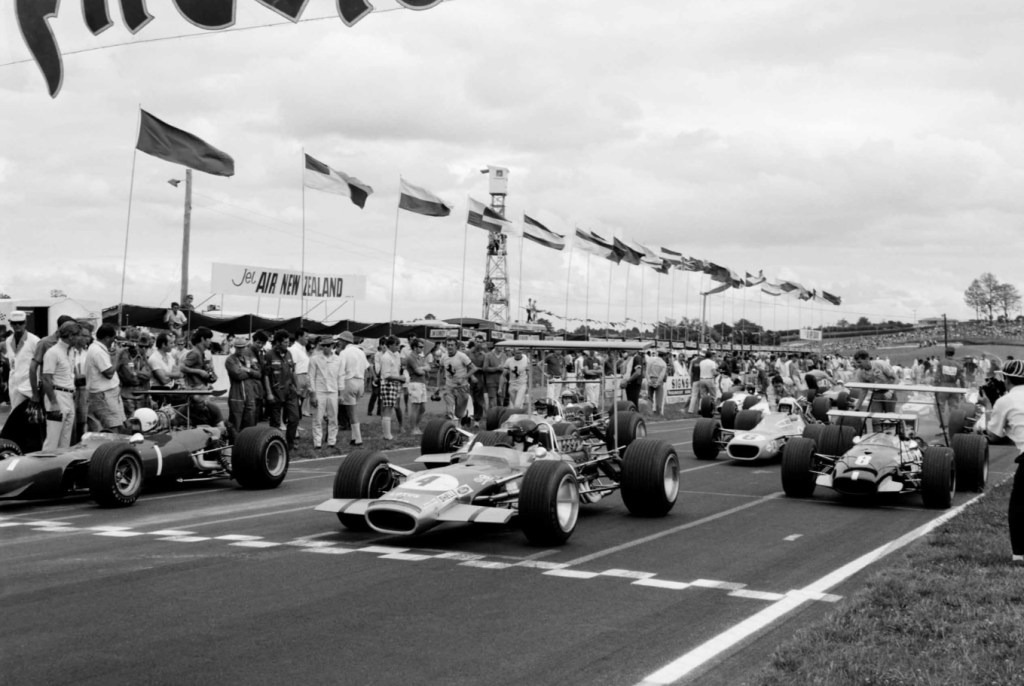
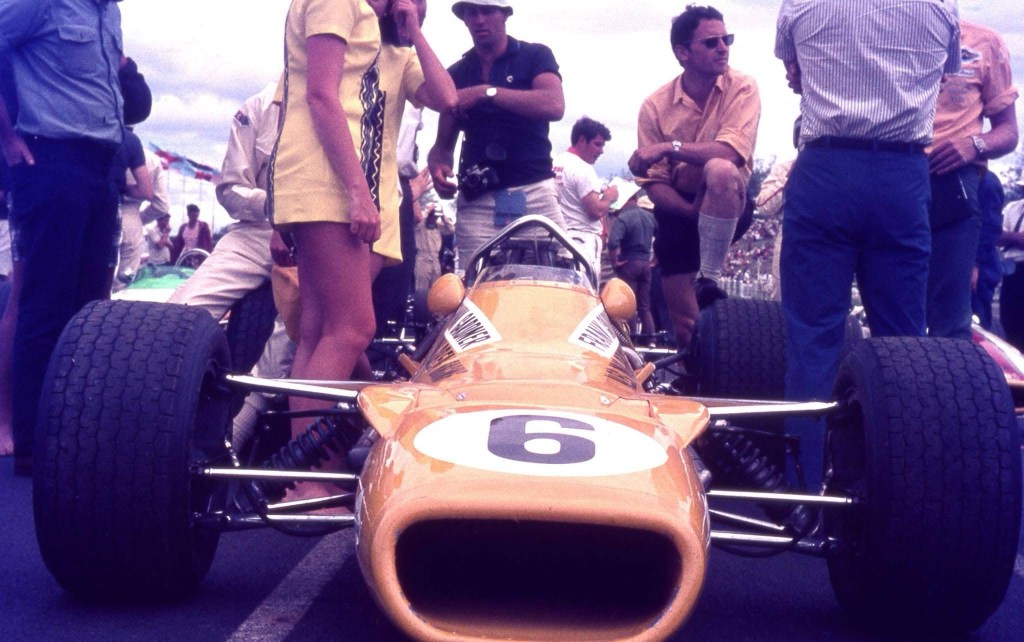
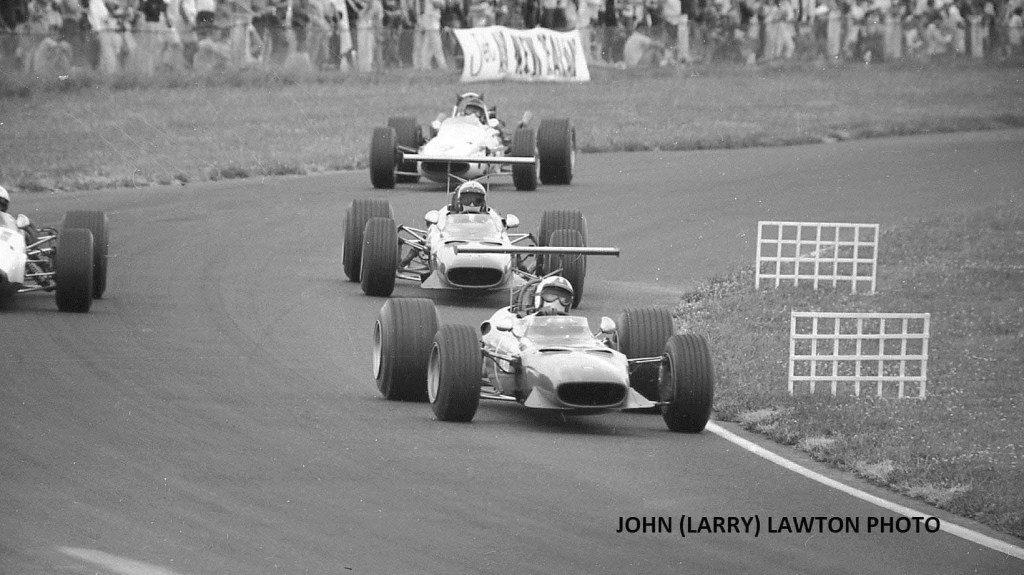
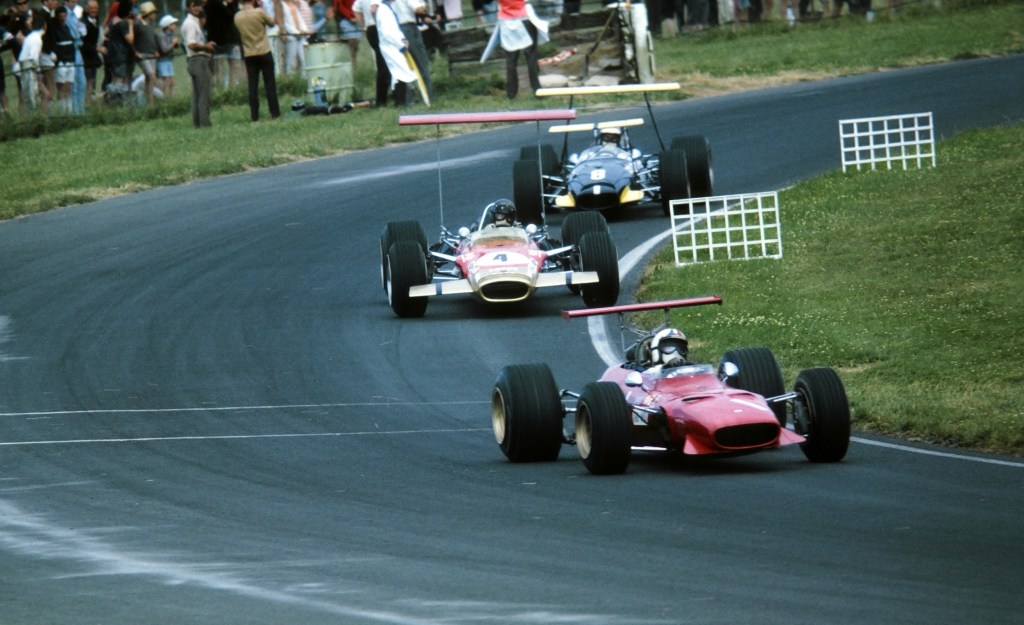
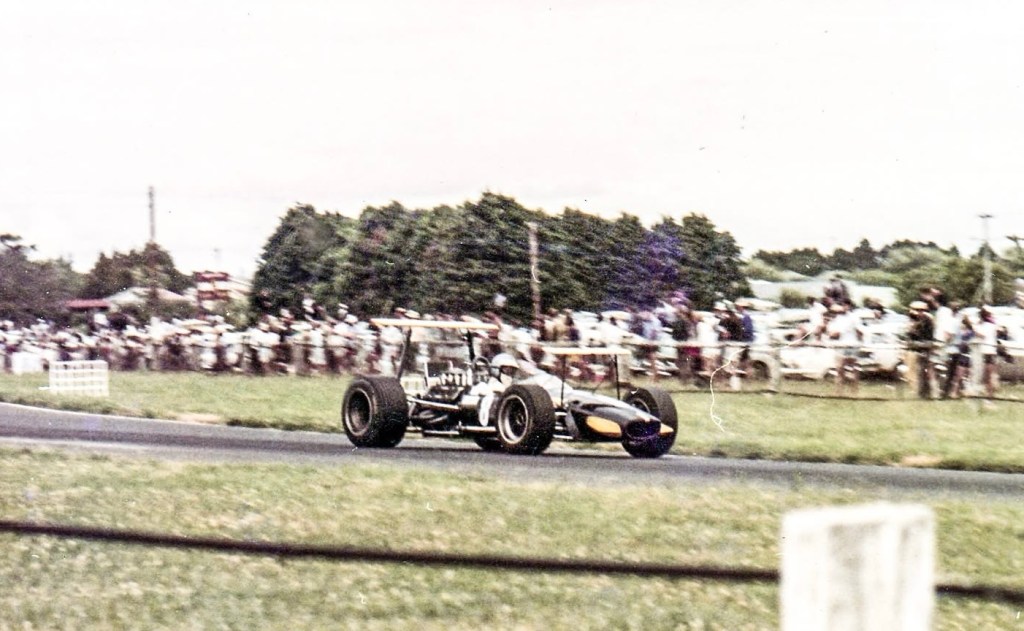
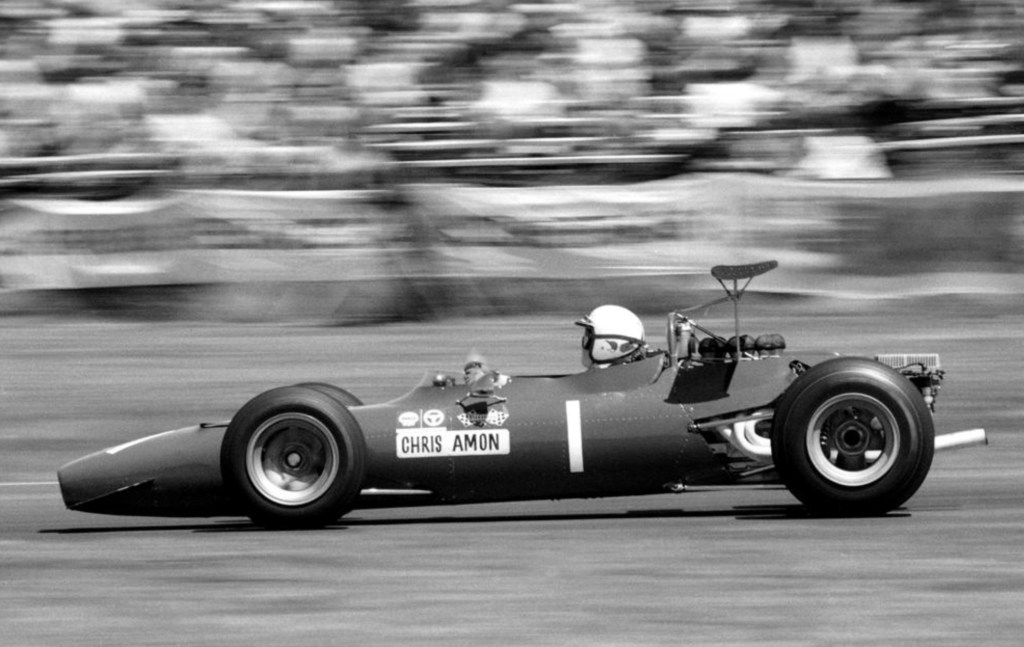
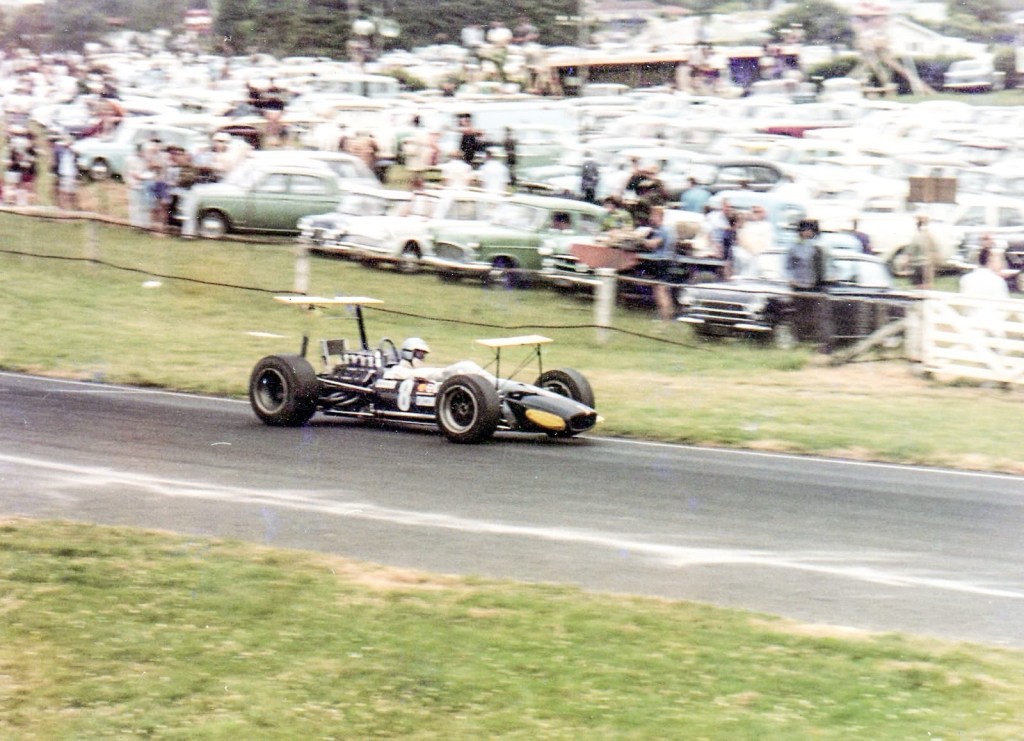
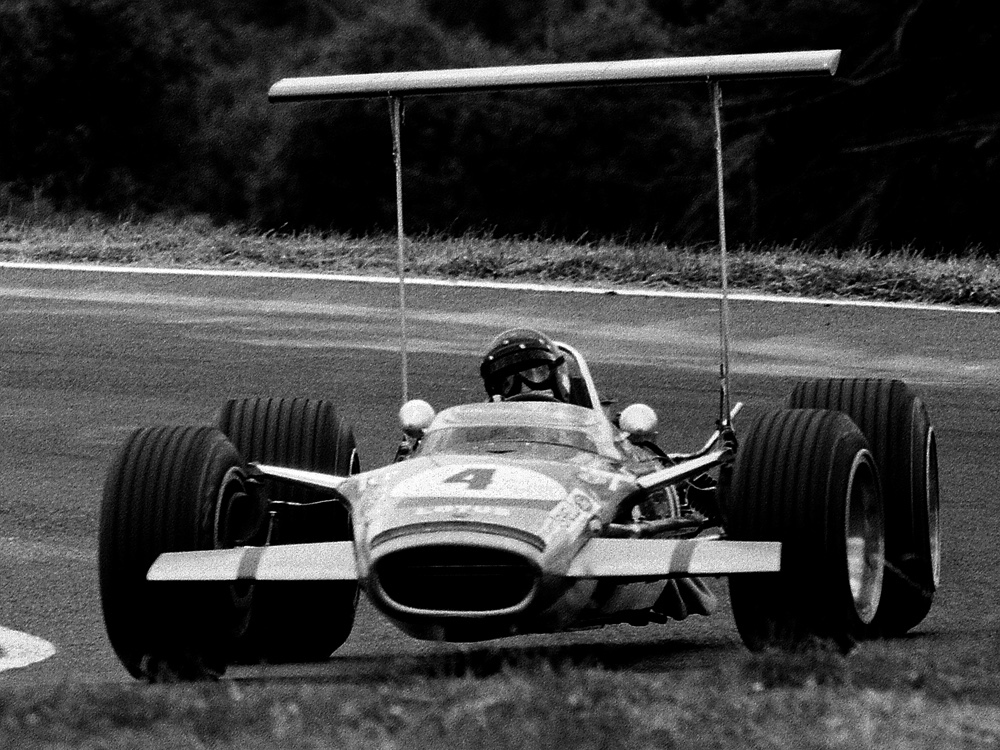
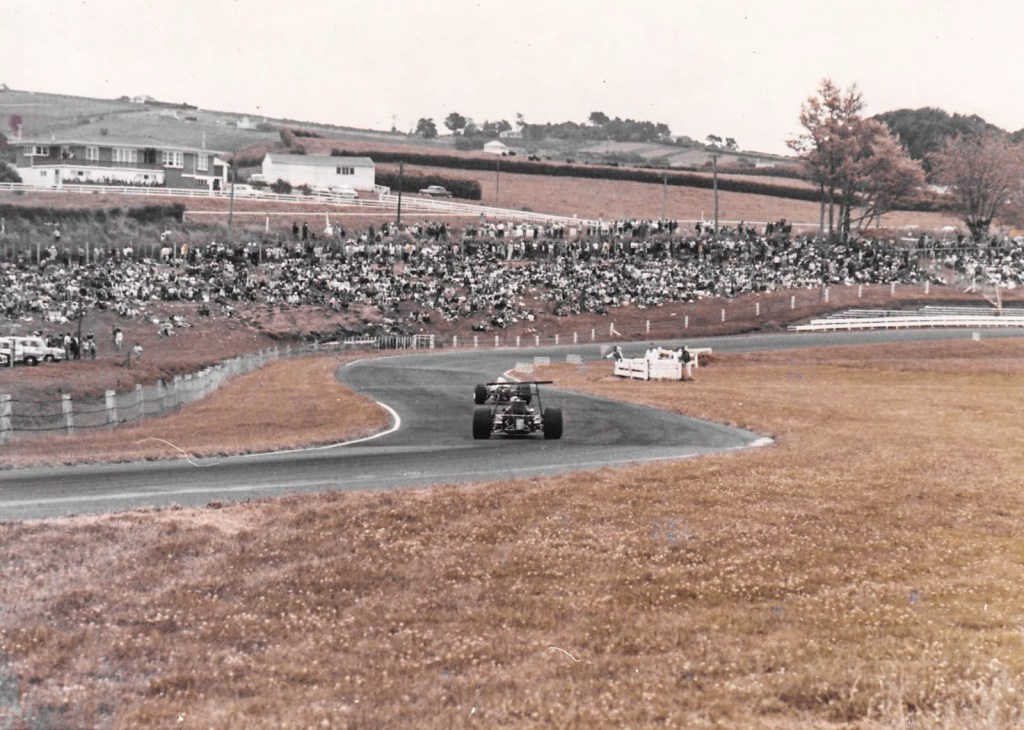
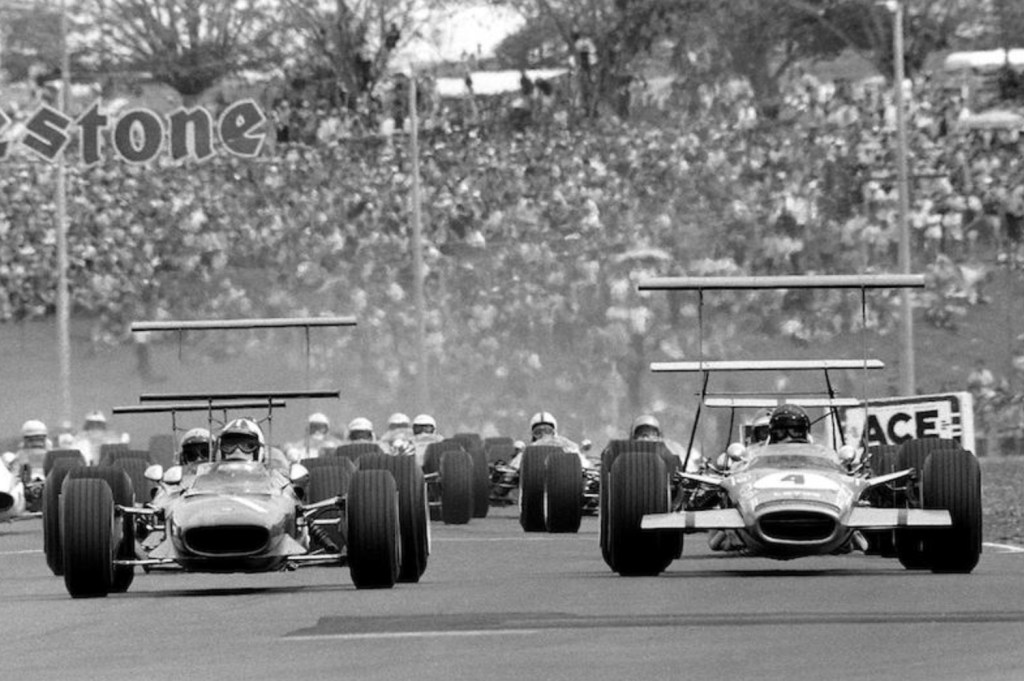
Ferrari 246T, Lotus 49 Ford, Lotus 49 Ford, Brabham BT24 Ford, and a Mildren Mono Alfa T33: Amon, Rindt, Hill, Courage and Gardner. Pukekohe NZ GP front couple of rows, January 4, 1969…
We didn’t know it at the time, but the 1969 Tasman Cup was the last for 2.5-litre cars, The Real Tasman in the minds of many. 1970 2.5-F5000 mix duly noted.
When Jim Clark appeared in a Gold Leaf Team Lotus machine during the Levin Wigram Tasman round the year before, it was the start of big bucks in ‘European Racing’. F1 was getting bigger, the season was getting longer with summer testing in the south of France and South Africa, and the drivers were ‘more valuable’. One couldn’t afford to put one’s GeePee programme at risk killing a driver on water-skis or the race track in Australasia.
Jim Clark was dead, killed at Hockenheim in a Lotus 48 Ford FVA on April 7, 1968. BRM were in F1 disarray, still struggling to throw off the shackles of the H16 debacle. Team Lotus came, with 49 Ford DFWs for just-minted World Champ Graham Hill, and fastest-kid-on-the-block, Jochen Rindt. BRM understandably stayed at home to get themselves sorted; in that regard, they failed!
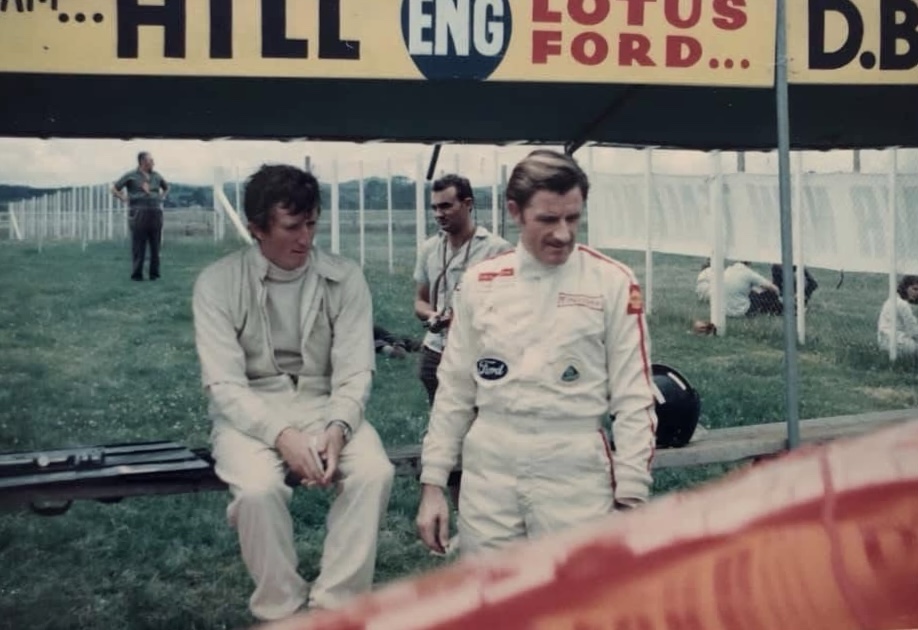
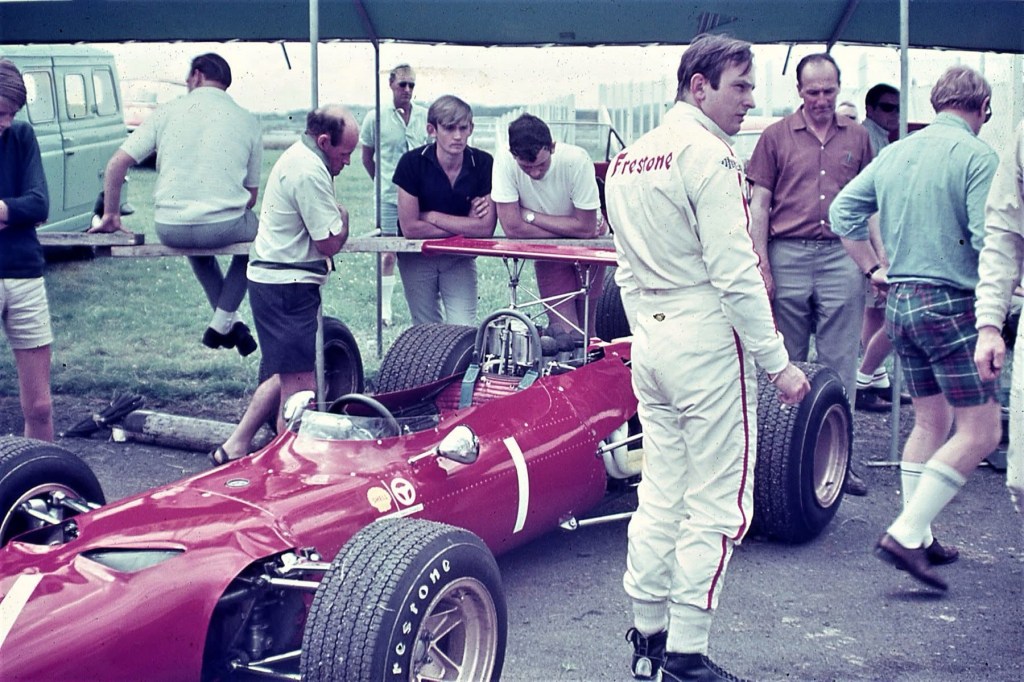
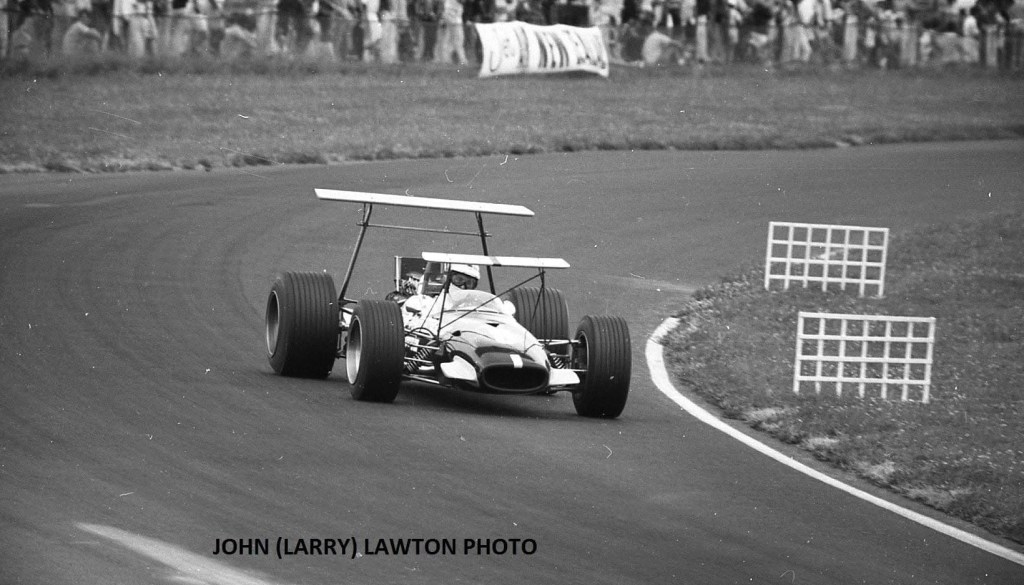
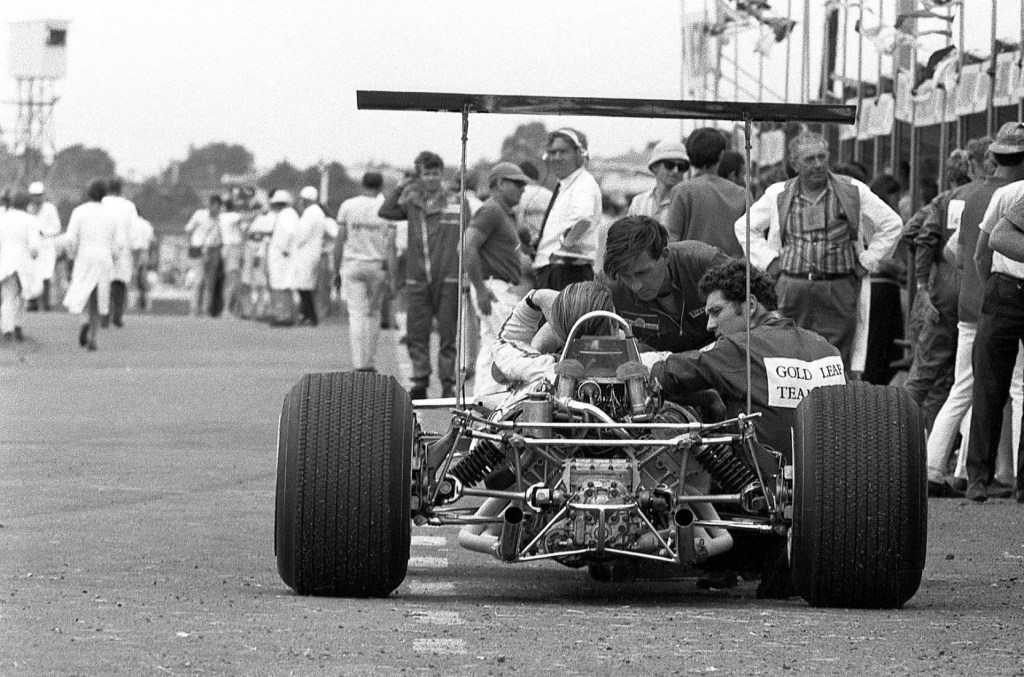
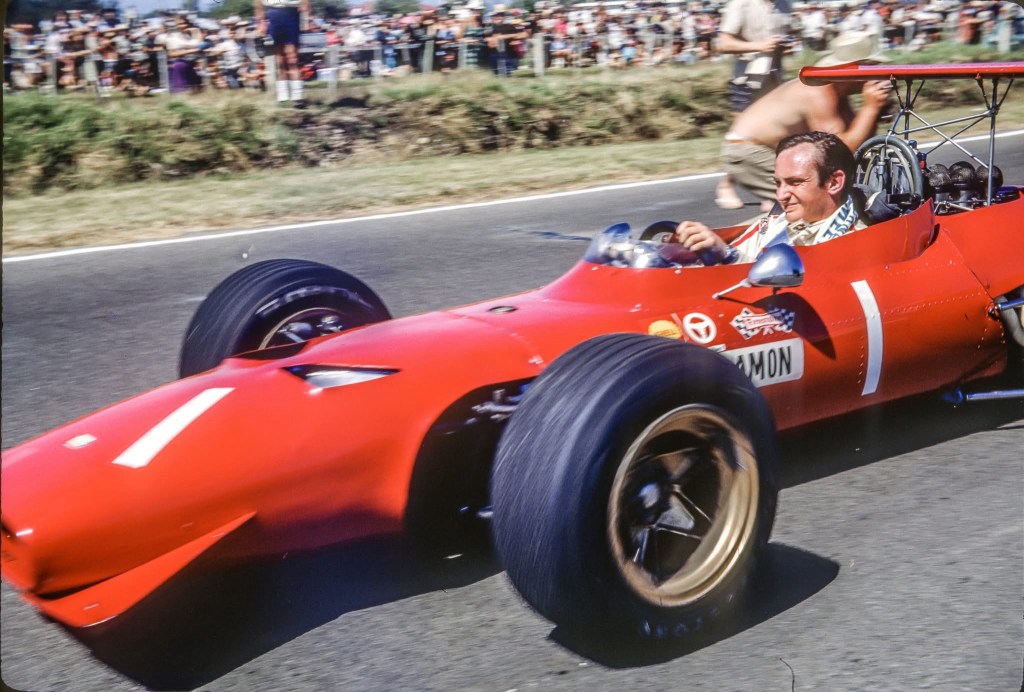
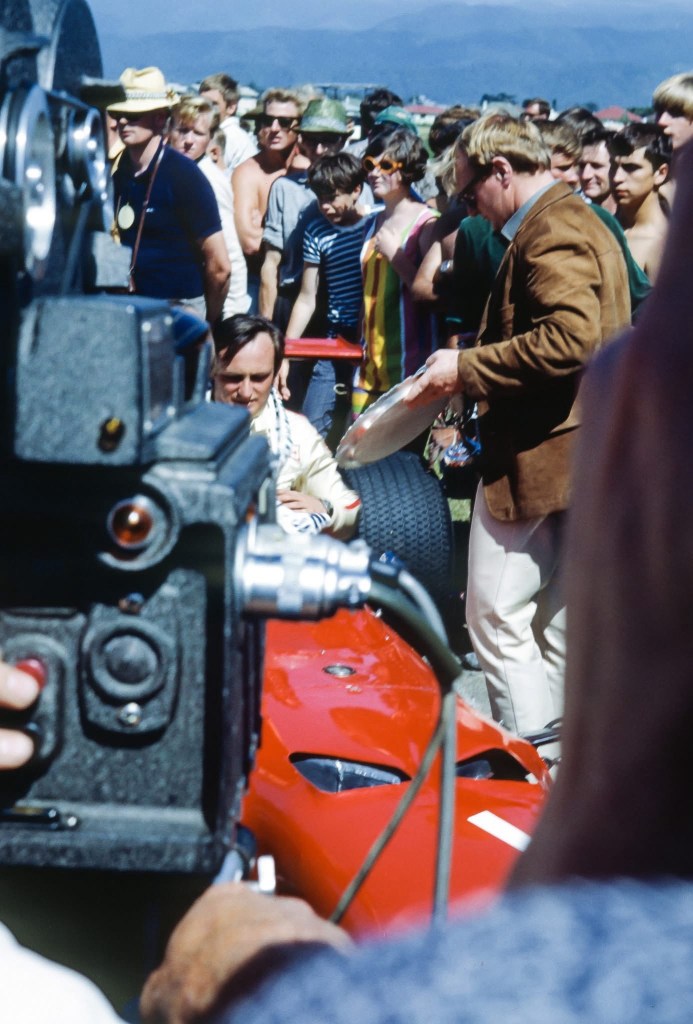
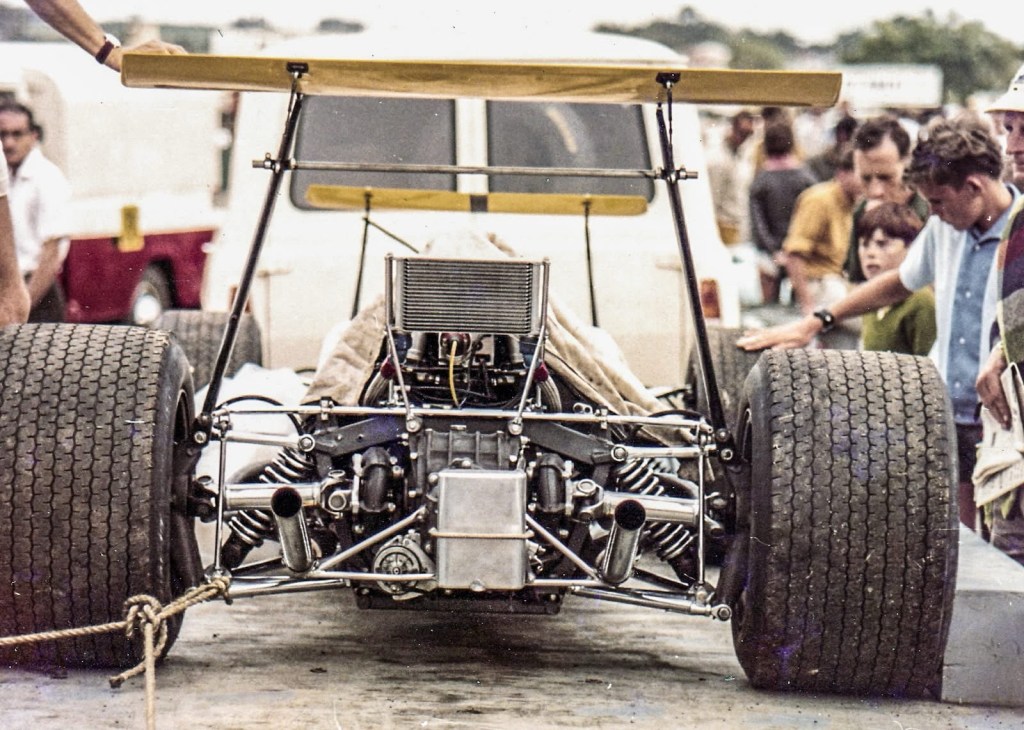
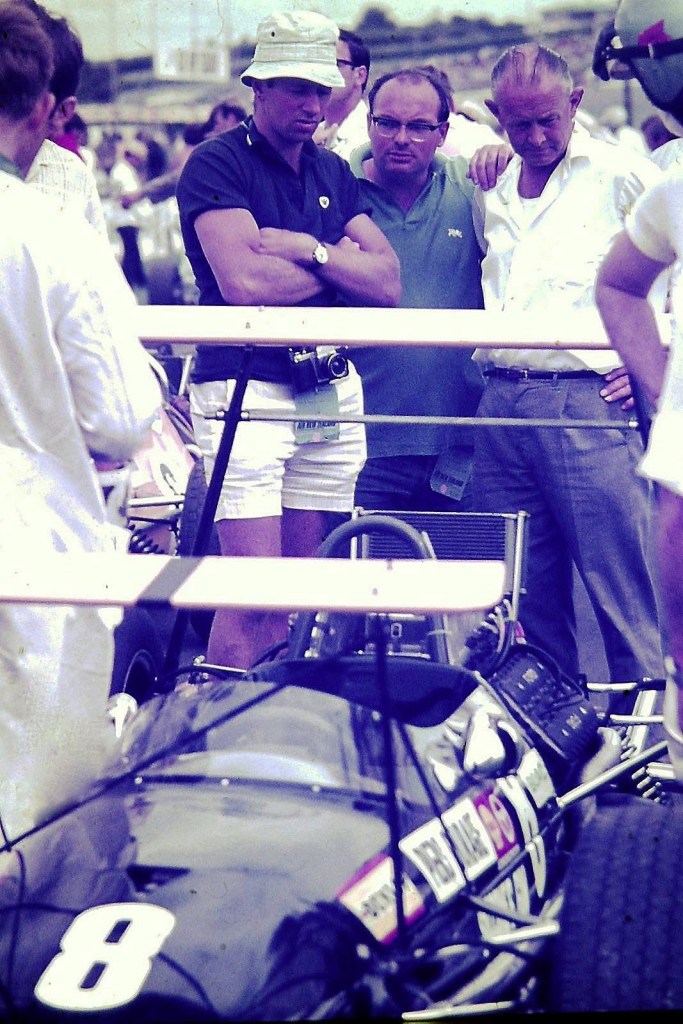
‘Take it easy, sonny, play yourself in.’ Jochen Rindt (27) and Graham Hill (39) at Pukekohe (J Copsey)Amon in the Puke pits. Note the rear electro-hydraulic angle on the wing dangle device. ‘Moveable aerodynamic devices? Don’t look this way matey!’ (P Levet)
Scuderia Ferrari came too, or rather a triumvirate. Ferrari provided two Dino 246Ts with you-beaut four-valve 2.4-litre V6s, Chris Amon brought along his good self and Ace-mechanic and friend Bruce Wilson, while David McKay/Scuderia Veloce handled the on-ground logistics and team management.
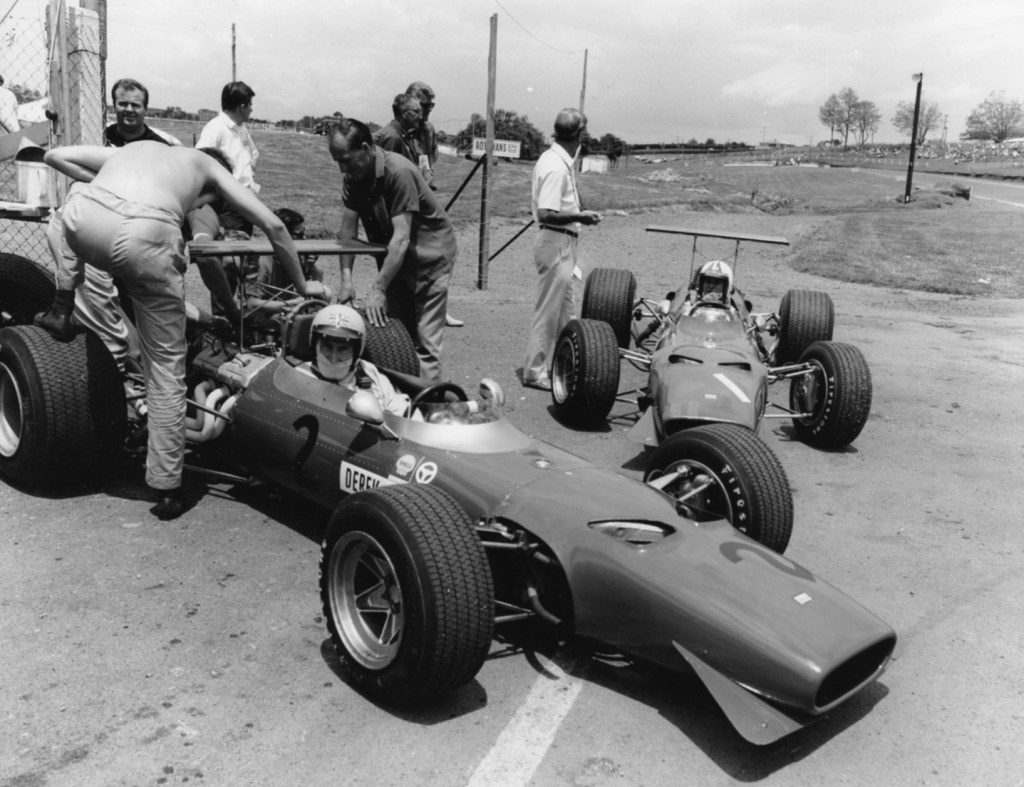
Scuderia Veloce are the Ferrari Sydney dealer and McKay was an extremely capable ex-driver, journalist and auto-entrepreneur. Quite who paid for what has never been clear – by all means send me a copy of the contract if you have it – but the mix of Scuderia Ferrari, Shell and Firestone had enough lolly in the kitty to pop Derek Bell in the second car.
Jochen had a marker to put down, and did so big-time! He had been in GP racing since 1965 and finally had a car worthy of him. It wasn’t to be Hill’s happiest Tasman or Grand Prix season in any respect.
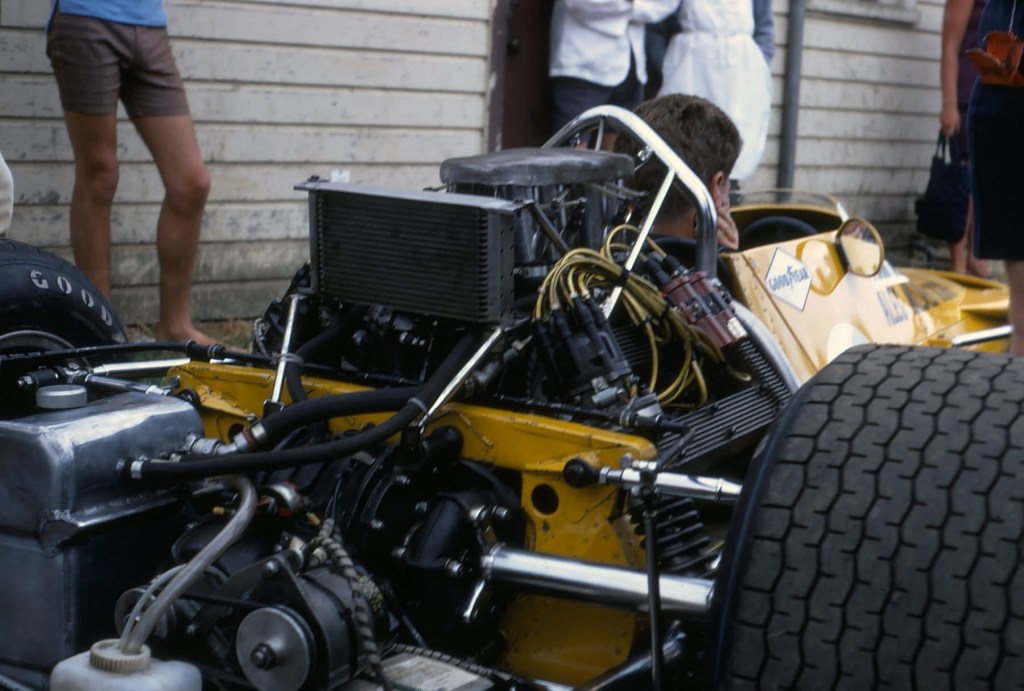
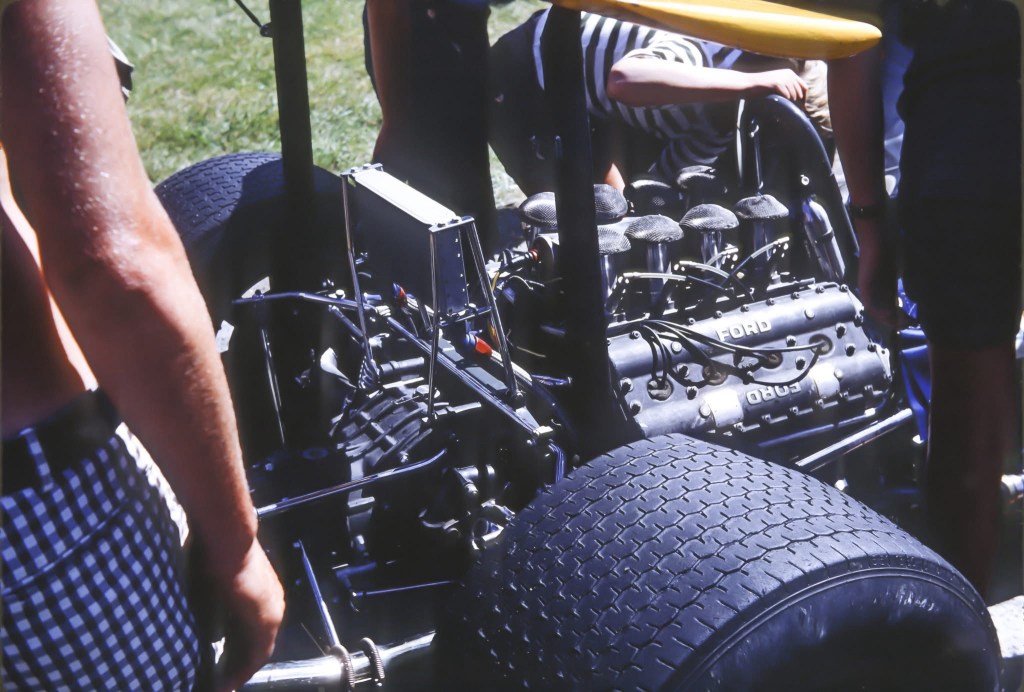
Derek Bell and Chris Amon (M Fistonic)Glenn Abbey warms up the Mildren Monos’ Alfa Romeo Tipo 33 2.5-litre V8. Engines made to Alec Mildren’s order, he was a good Auto Delta client, having bought two GTAs and a TZ2 in the mid-1960s (D Shaw)Note the beefy rear monocoque bulkhead. Hewland FT200 transaxle, twin-plug, twin-cam, two-valve 2.5-litre engine (D Shaw)
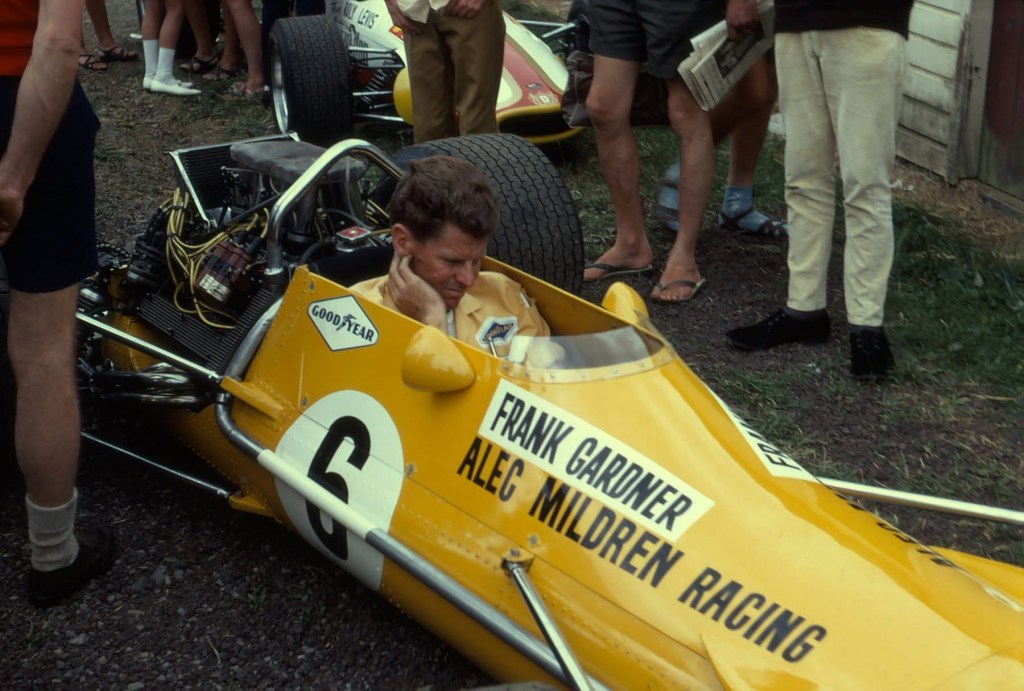
The other extremely capable Sydney ex-driver and auto-entrepreneur was Alfa Romeo Man Alec Mildren. His two cars were powered by 2.5-litre variants of Alfa Romeo/Auto Delta’s Tipo 33, twin-cam, fuel injected V8. He fielded a new monocoque designed and built by Len Bailey/Alan Mann Racing for Frank Gardner that used Brabham BT23 components: uprights/brakes, steering rack, wheels etc.
This gorgeous machine became an Oz Icon – The Yellow Submarine – driven by FG in this Tasman, and then Kevin Bartlett, and others, all of whom won in it even when it was a granny. KB’s car was the BT23D Alfa Gardner raced in the ’68 Tasman and with which Bartlett won that years Gold Star. They only had three engines, so KB only did the Australian rounds.
Leo Geoghegan, Lotus 39 Repco and the shot below (Peter Bruin)
Leo Geoghegan’s ex-Clark ’66 Tasman Lotus 39 #R12 was a veteran by 1969 but ongoing development of it by John Sheppard and Leo kept it towards the front and it was now equipped with Repco-Brabham Engines latest and final Tasman 2.5 V8 730/830 crossflow, SOHC, injected V8.
Similarly equipped was Jack Brabham’s F3 based Brabham BT31, although ultimately Brabham did only the Sandown round. It was a pity, as the very light, small car proved its competitiveness in its only gallop.
Climax 2.5 FPF-engined machines by then were also-rans, the other locals running FVAs and Lotus-Ford twin-cams didn’t have the puff to stay in the top half of the field and there were enough good 2.5s to make fast-reliable 1.6-litre runs not enough to bag a podium.
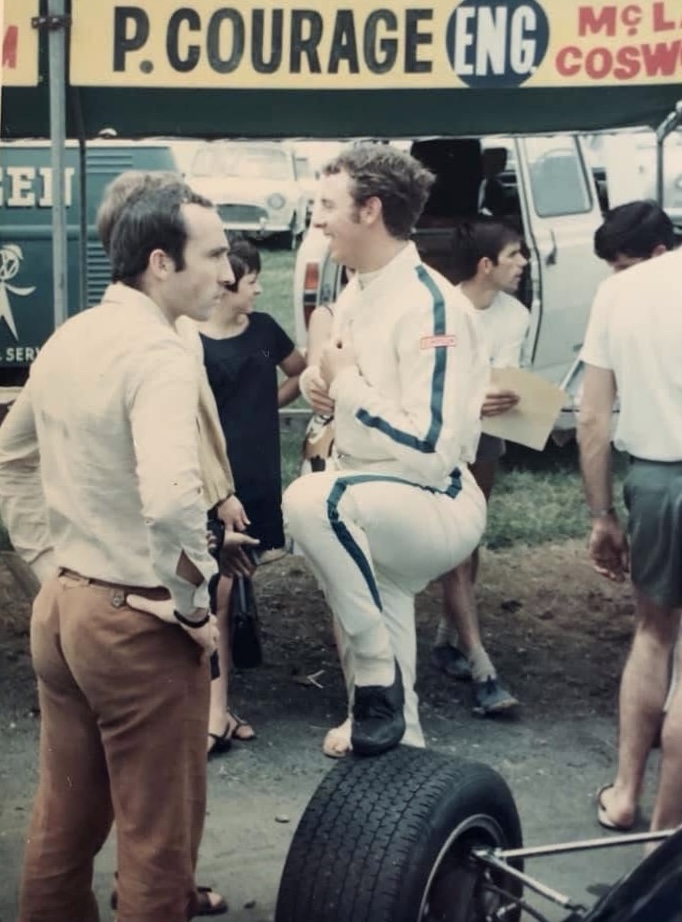
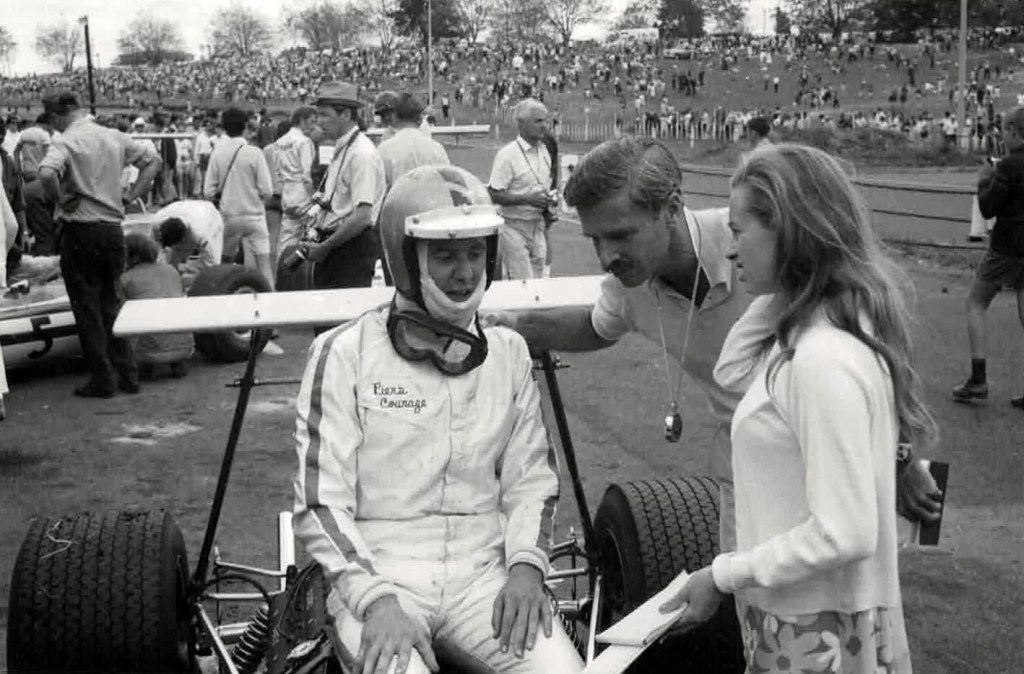
Courage, Brabham BT24 Ford DFWFrank Williams and Piers Courage at Puke, that sign is a year out of date! (J Copsey)
Speaking of which, McLaren M4A Ford FVA ’68 Longford winner, Piers Courage, was back with a bang. His Tasman 1968 solo run with the help of Les Sheppard provided a Ctrl-Alt-Delete reboot of his career. He had teamed up with F3-Travelling-Circus buddy Frank Williams to run a Ford DFW-powered ’67 Brabham BT24 #3 in the Tasman and was on the money throughout, winning the Teretonga round. The pair went one better in ’69 Grands Prix, running at the front all year with a ’68 Brabham BT26 converted to run a Cosworth DFV instead of the RBE 860 that first occupied the aft area. They were set to take on the world, let’s leave 1970 alone.
Graham Hill, Lotus 49B Ford DFW. Not the sturdy (sic) wing mounts attach directly to the uprights. ZF gearbox replaced by a Hewland DG300 by the series’ end (T Marshall)
Practice…
The Dinos of Amon and Bell positively gleamed in Auckland’s sunlight as the punters gazed upon them. Bruce Wilson had the cars early enough to pull them down and painstakingly assemble them with the time the Scuderia mechanics didn’t have. After the one-car learning expedition the year before, Ferrari was ready to boogie.
And so it proved during practice. Thursday was largely early sorting but Amon and Courage were the early quicks. Rindt wasn’t far behind – had he tested a 49 before heading down south? – while Hill and Gardner arrived late. Bell popped the nose of his car through railing early on, and an engine change was required of Chris’ car which was suspected of having a slipped cylinder sleeve.
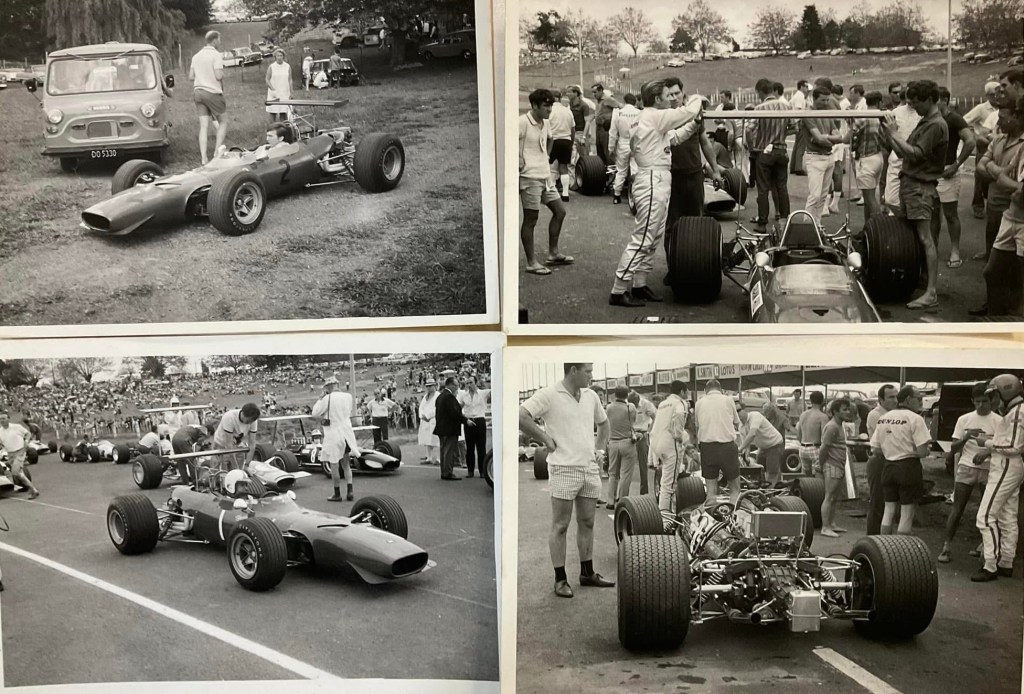
Geoghegan’s Lotus 39 and Gardner’s Mildren Mono. Both started the series wingless and finished it with with them (P Bruin)David McKay checks in with Piers and Sally Courage (P Bruin)From top left, Derek Bell, Graham Hill checking his Lotus’ wing to ascertain the probability of it remaining attached to the car, Pier’s wingless Brabham BT24, and Amon heading for the grid (P Bruin)
Friday was business day with Rindt getting down to a 58.4 while wrestling with gear selection problems, including breaking the lever. Hill did a 58.8, winged-Courage a 59-dead then Amon pulled a 58.2 out of the bag to get pole. Jochen tried to better this but broke the gear lever again.
Next came Bell 59.6, wingless Gardner 60.6, Graeme Lawrence, McLaren M4A Ford FVA, Roy Levis, Brabham BT23 Ford FVA and Geoghegan, 63.5.
The Leo Geoghegan and Frank Gardner wingless machines out of Sydney: Lotus 39 Repco-Brabham 830 and Mildren Mono Alfa Romeo T33 2.5 V8.
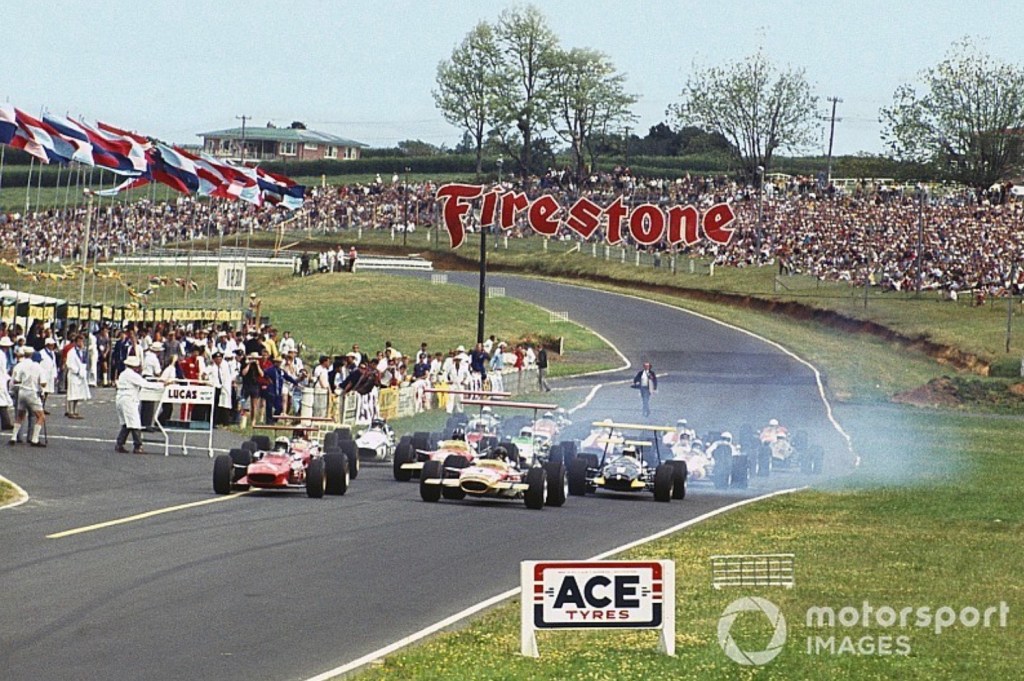
The Off: Amon and Rindt up front, behind Amon is Bell, then Hill in the middle and Courage on the outside, and the rest
Race…
Chris and Jochen light em’ up on the front row, 100 miles the standard Tasman Cup distance (T Growden)
The start of the race was fiery in a different way. Bryan Faloon’s Brabham BT4 Climax was set ablaze by an errant spark and an overfilled fuel tank. Bryan was scratched but had mild burns to his hands. In amongst this excitement, the Team Lotus mechanics replaced Jochen’s tach, which wasn’t operating. Then, as the minute board went up, Gardner’s Mildren was pushed to the side of the track with a duff fuel pump.
Twelve months before, his new Brabham BT23D Alfa won the ’67 Hordern Trophy at Warwick Farm just before Christmas, the car was fully sorted before it lobbed in NZ. They were not as far advanced with the Mildren Mono, staggering was a complete lack of wings. The car grew them as the series progressed but FG gifted his rivals time, he was the only front running 2.5 racing sans wings.
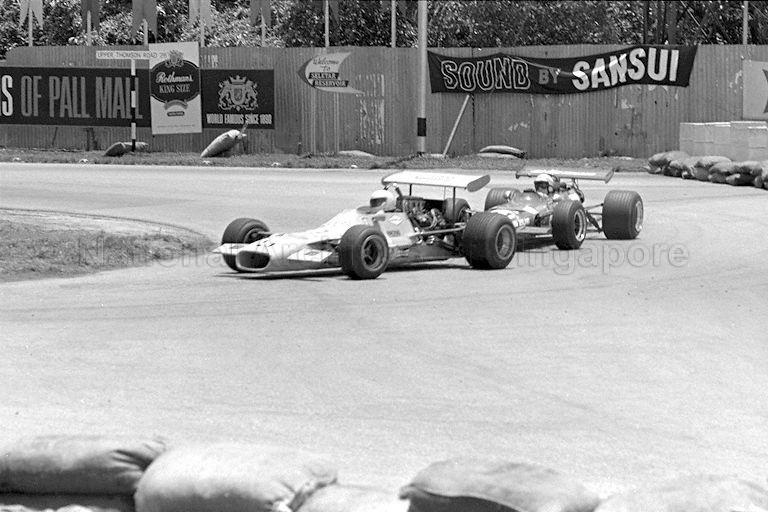
Gardner’s gorgeous Mildren Alfa takes its place on the grid immediately prior to its fuel feed problems becoming apparent (W Collins)The Amon and Bell Ferraris ahead of Leo Geoghegan’s Lotus 39 with a slower car hanging out wide Rindt coming over Rothmans (T Growden)
When the flag dropped in front of a great crowd, it was Amon, Rindt, Courage and Hill. Chris was a couple of car lengths ahead of Jochen at the end of lap 1 from Courage, Bell, Hill, Geoghegan, Levis, Lawrence, then the elderly Brabham Climaxes of Red Dawson BT7A and Dennis Marwood BT?, and then the amazing Graham McRae in his very fast, small, clever, Brabham based, McRae S2 Lotus-Ford 1.5.
Rindt passed Amon on lap 2 and by lap 4 was two-sec clear of Chris, then came Courage, a bit of a gap to Bell and Hill, then a bigger one to Leo Geoghegan’s wingless Lotus 39 Repco who had a 10 second gap from Levis, then Lawrence, Dawson, McRae and David Oxton, Brabham BT18 Lotus-Ford 1.5.
By lap 6, Chris and Jochen were rounding up the tail-end-Charlies without difficulty, but Piers Courage wasn’t so lucky and lost a lot of ground on the right-hand sweeper out of Pit Straight.
Rindt tigered to try to clear away from Amon and did the fastest race lap of 58.9 on lap 9, doing 160mph through the timing traps on the back-chute. While this was going on, Graham Hill passed Derek Bell before the Londoners’ hard work came to nothing on lap 13 when a front-suspension ball joint broke. Simultaneously, Frank Gardner joined the fray, Glen Abbey having sorted or replaced the errant fuel pump.
So…it was Rindt, Amon, Courage, Bell, then Geoghegan back a bit, then Lawrence, Levis, Dawson, McRae and Oxton.
The Courage BT24 Cosworth entering The Esses (T Growden)Rindt (T Marshall)
The race was starting to look like a cruise-and-collect copybook first Lotus win for Austria’s finest but then he ran wide on some oil on the approach to the hairpin and ceded the lead to Amon as he sorted his misdemeanour. Courage remained third, Jochen regained some ground but he had lost his clutch and the wing feathering device wasn’t doing its thing on the straights, so began to lose a second a lap.
Rindt remained clear of Courage despite that – 24 seconds clear by lap 40 – who in turn had a good gap from Derek Bell, who too had a good margin from Leo G.
With eight of the 58 lap/100 mile race to go the order was Chris Amon, Ferrari 246T, Jochen Rindt, Lotus 49 Ford DFW, Piers Courage, Brabham BT24 Ford DFW, Derek Bell in the other 246T, Leo Geoghegan’s Lotus 39 Repco-Brabham, Graeme Lawrence, McLaren M4A Ford FVA, Roy Levis Brabham BT23 Ford FVA, Red Dawson, Brabham BT7A Climax and David Oxton Brabham BT18 Lotus-Ford 1.5.
And so it remained until the finish.
(T Growden)
Winners are grinners…
(S Oliver)
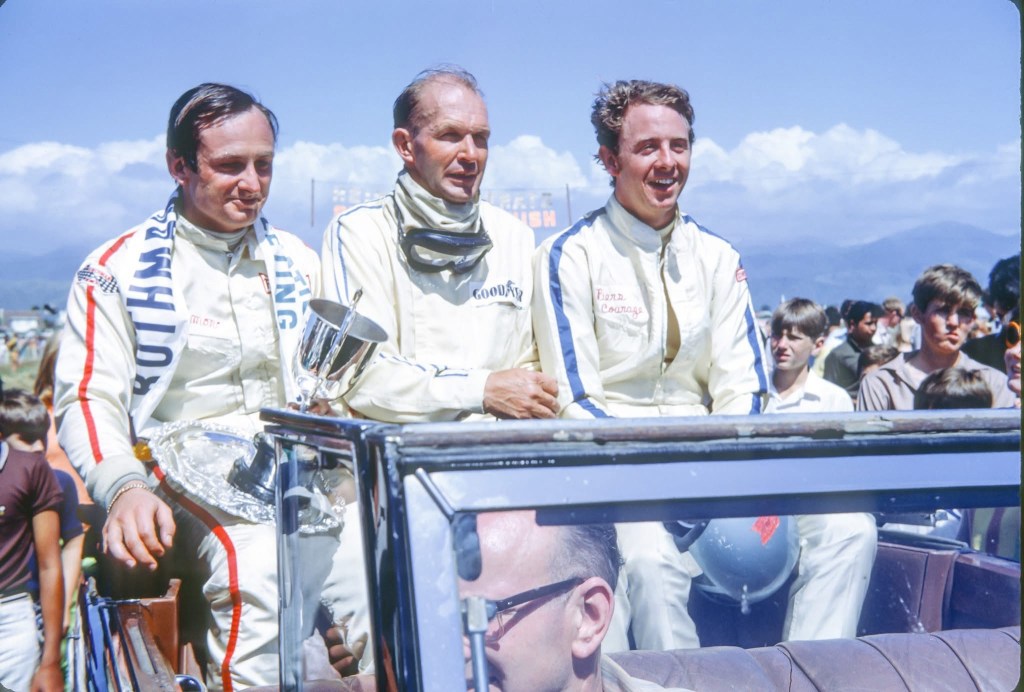
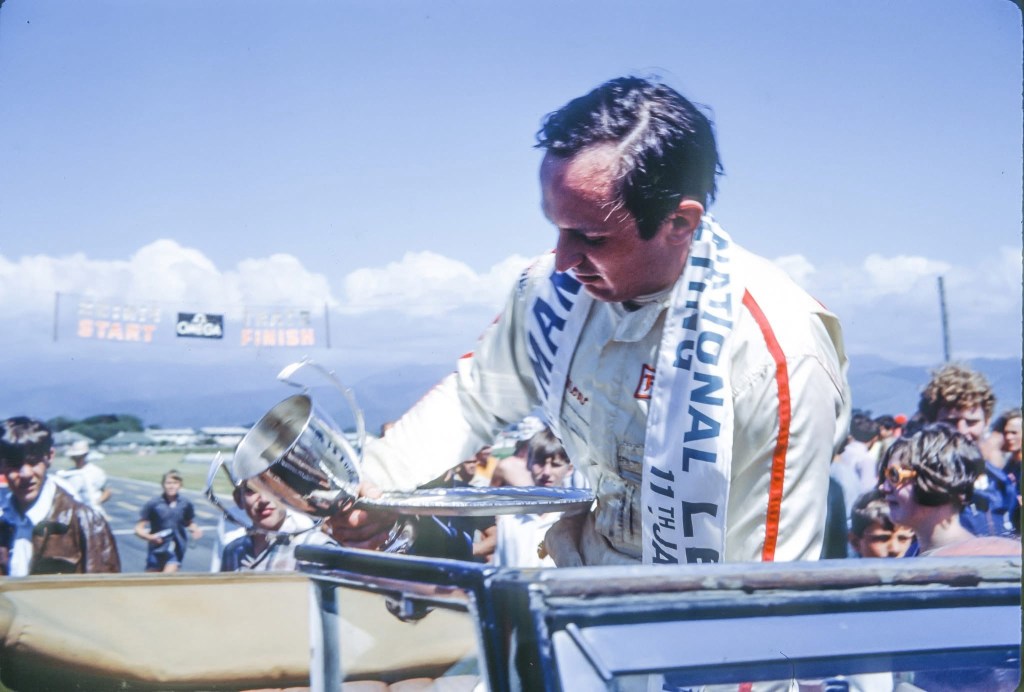
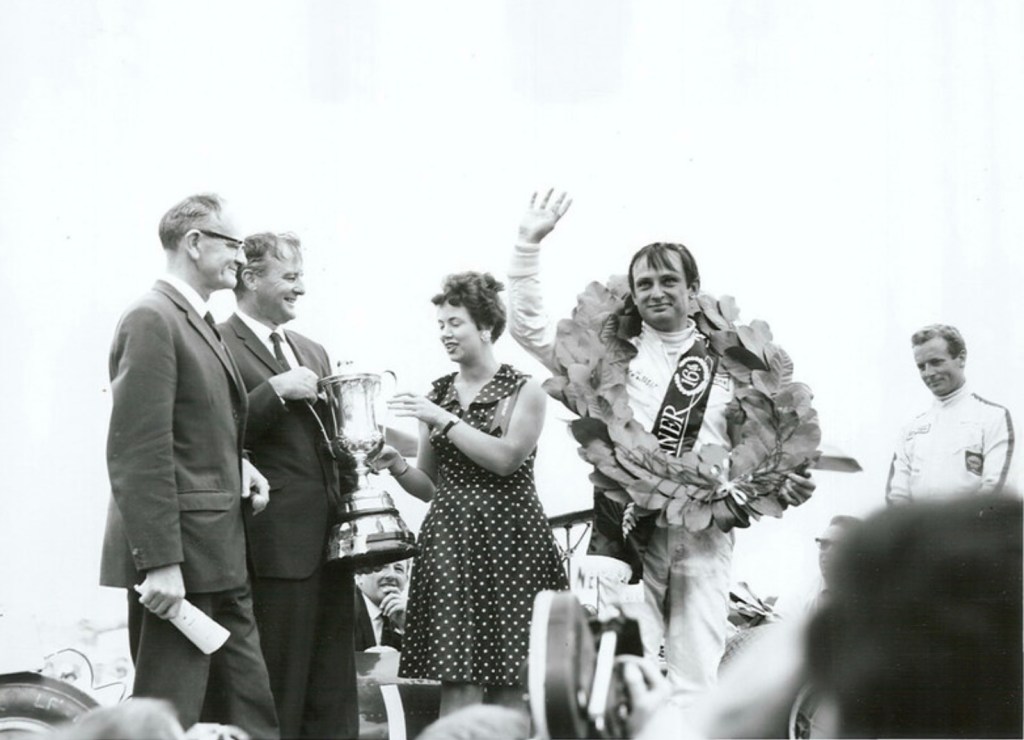
A suitably big smile on Christopher Arthur Amon’s face as he does a victory lap with the winners sash around his neck, back-to-back NZ GP victories.
246T/69-0008 was sold by Ferrari to Graeme Lawrence after the Tasman, he did well in it throughout the South Pacific inclusive of the 1970 Tasman Cup win, the little car had just enough pace and more reliability than the F5000s that year.
(S Oliver)(S Oliver)(S Oliver)
Chris Amon (1943-2016), Frank Gardner (1930-2009), and Piers Courage (1942-1970). Aged 26, Chris was already a six-year F1 veteran, maybe not such a big deal now, but his extreme youth on entry to Grand Prix racing was rare back then.
(S Oliver)Amon and at far right, Graeme Lawrence on the podium. GL was the first local home; sixth in his F2 McLaren M4A Ford FVA
Etcetera…
(T Growden)
To Wing, or Not To Wing…That is The Question…
1968 was the start of it in Grand Prix racing at least, the earlier Chaparral contribution is hereby duly noted. Courage – BT24 Cosworth DFW above – practised with them on and off, and raced with them on. Those wings – note the mount directly atop the rear uprights – look very much like a works-Tauranac fabrication(s) to me.
The Boys taking it all in, ‘Do you think the wings will catch on?’ (B Homewood)(T Growden)
A couple of shots of Graham McRae’s McRaes, topics for another time.
(K Lancaster)(T Growden)
David Oxton, ex-Silvio Moser Brabham BT16 Lotus-Ford. Later an F5000 and F Pacific front-runner, Oxton won NZ’s Gold Star from 1972-74 and in 1981-82.
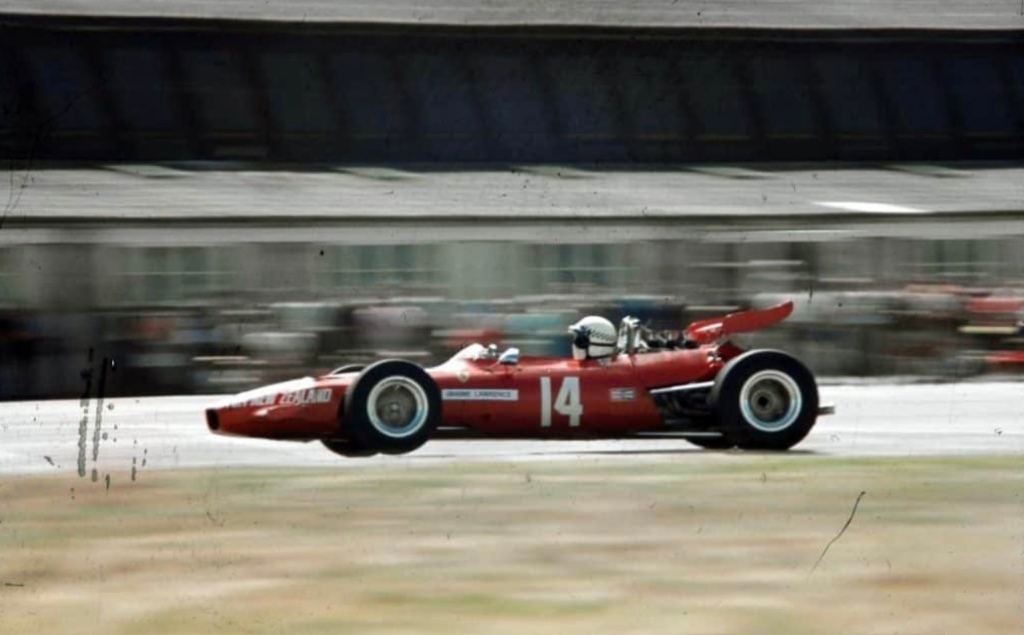
Graeme Lawrence’s McLaren M4A-14 Ford FVA
Credits…
Peter Bruin via Chris Denby, Tony Growden, Stewart Oliver, Peter Levet via Milan Fistonic, Doug Shaw, Warner Collins, Jeff Copsey, Bob Homewood, Kevin Lancaster, oldracingcars.com
Kevin Bartlett and Graeme Lawrence at the start, Mildren Mono Alfa V8 and Ferrari 246T (SNL)
1970 SINGAPORE GP: THE FERRARI FROM THE ORIENT
Why the Kiwis always get along with the Ferraris?…
The history of Scuderia Ferrari in F1 and F2 has always been marked by being a team that rarely gives its “official” equipment to third parties. Ferrari single-seaters have always been known to race only under the aegis of Scuderia Ferrari itself. Even in more turbulent times, such as in 1961, when Giancarlo Baghetti raced a Ferrari 156 for both FISA and Sant’Ambroeus teams, there was always an attentive team of Ferrari mechanics on hand to take care of the car. Another case was the N.A.R.T., in the years 1964, 1965 and 1969; they were nothing more than fancy names for Scuderia Ferrari itself and its squad of mechanics and engineers.
We can name rare occasions when the scarlet cars were given to third parties and took part in races by this way: one of them was the British Racing Partnership/UDT-Laystall Ferrari 156, driven by Innes Ireland, in the XIV BDRC International Trophy of 1962; another was Scuderia Everest (the forerunner of Minardi) in 1976, which with a Ferrari 312T competed in the Race of Champions and the International Trophy.
Giancarlo Baghetti, Ferrari 156 chases a BRM and Cooper on way to winning the April 1961 Syracuse GP (MotorSport)Giancarlo Martini, Ferrari 312T, 10th in the BRDC Intl Trophy, Silverstone April 1976 (MotorSport)
Moving on to categories below F1, we can highlight the Australian Scuderia Veloce. It was another one of those peculiar and picturesque stories that happened in motorsport in the 1960s and, who really stood out in the 1968/69 Tasman Series. Thereupon, stay tuned, because the real story of this text starts here.
But, as expected, without the support and protection of the Scuderia, most of these attempts ended in a resounding failure; we can credit this to the very complexity of the material, which required a team of technicians who knew how to put in motion an equipment as sophisticated as a Ferrari F1 car.
Perhaps one of the few successes reported by a single-seater Ferrari without being bankrolled by the Scuderia itself was due to the duo of Graeme Lawrence and his Ferrari 246T F2 Dino (the same Scuderia Veloce´s car from the beginning of the text – I’ve told you that the story started there). With successes in the main events of Southeast Asia in 1970, the pair proved to carry on the prestige of the Italian team.
The first example of the success of the partnership between the 246T and Lawrence came in the 1970 Tasman Series. This, which was the first edition in many years that did not feature the big European stars, opened the door for many smaller pilots and teams, mainly from the axis Australia-New Zealand, to have a chance to stand out.
And so it was with the New-Zealander, who, in the first race of the series, in Levin, already gave the first victory for the private Ferrari. And after a positive sequence of results in the next six races, the pilot would clinch the overall title of that season.
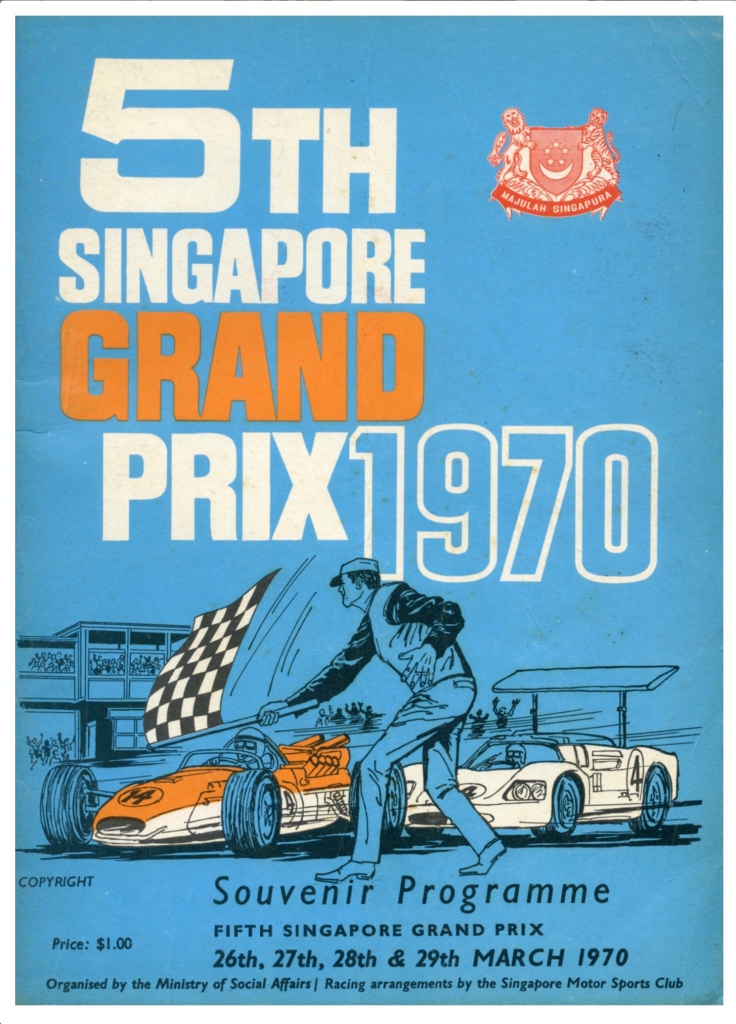
The next challenge would be the Singapore GP, which would take place at the end of March. The race, which was one of the most prestigious sport events in Asia-Oceania, always brought together the cream of the region’s pilots.
Graeme Lawrence, Ferrari 246T #008, during the 1970 Lady Wigram Trophy. DNF overheating in the race won by Frank Matich, McLaren M10A Chev (unattributed)(progcovers.com)
1970 Singapore GP…
Today, we always think about how F1 and F2 are almost interconnected categories, dependent on each other. Where one goes, the other’s circus usually follows. We also think about how F2 itself has gone beyond continental limits to become a global category – we have F2 races in Arabia, Australia, Azerbaijan – all of which form part of a unified international FIA Championship.
Well, the reality of the 60’s and 70’s was quite different. The F2 championships were as spread out as possible: there was one in Europe (which was considered “official”, in terms of historical classification); another two levels (of second tier single seater racing) in Oceania such as the Tasman Series and the Gold Star, which were a hybrid between the F1, F2 and, later, the F5000); several smaller tournaments in South America (such as the Argentine Temporada); and one in Asia.
The last one on this list was also one of the most peculiar: even though it was the most obscure, when it comes to the story itself, the racing season in Southeast Asia was made up of quite prestigious GPs, even for the time: for example, the Grand Prix of Malaysia, the Singapore Grand Prix and the internationally coveted Macau GP, were some of the races that made up the season.
For many pilots of Southeast Asia, this championship was the only opportunity that existed to compete in a real Grand Prix. Far from the magnitude and professionalism that took European motor racing by storm in the late 1960s, the GPs in Asia were almost a spectacular exercise in execution – but they were Grand Prixs, nonetheless.
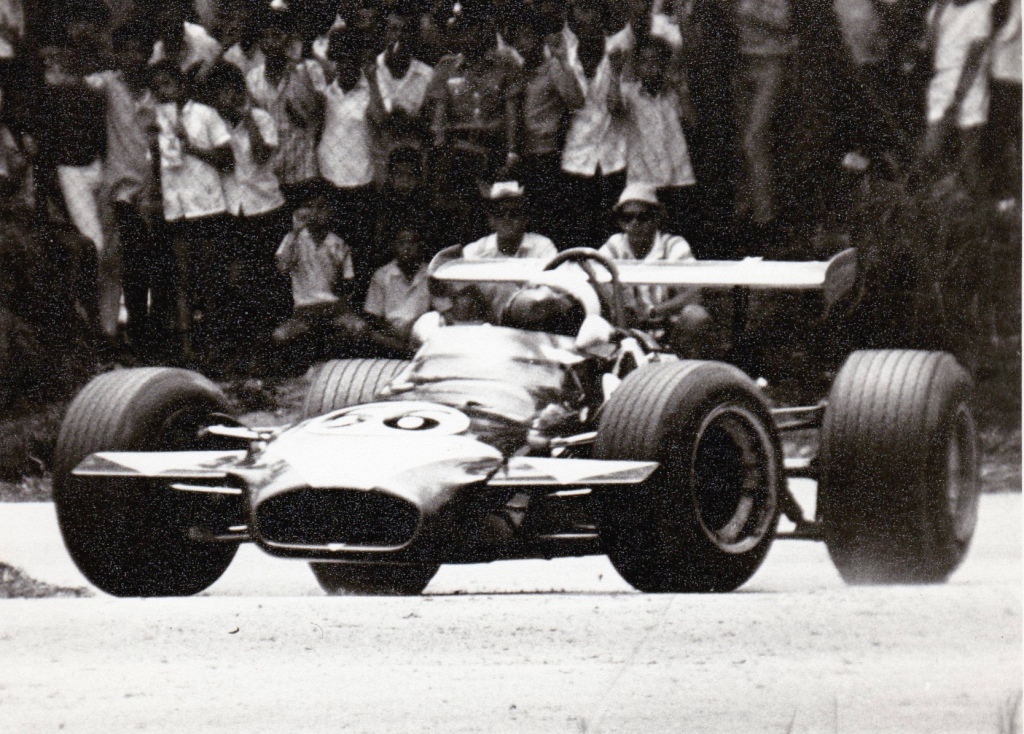
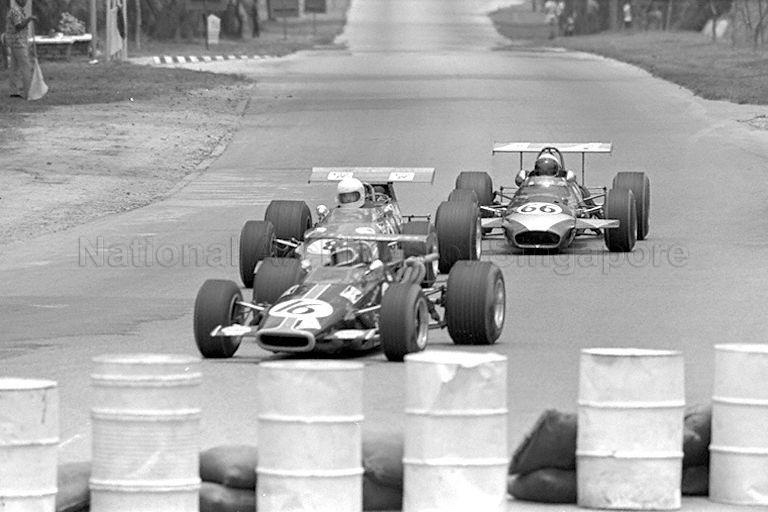
Bartlett and Lawrence on the front row with John MacDonald, Brabham BT10 Ford FVA, Hengkie Iriawan, Elfin 600C Ford FVA and Albert Poon, Brabham BT30 Ford FVA #66 behind. Lawrence won from MacDonald and Poon (SNL)From the other side of the road (SNL)
The issue is that, even with the knowledge of the European teams about these races, there was no interest in sending representatives to compete in these GPs. Why? Well, we can draw some assumptions about it: first, to mention the commitment to European F2, which already drained a large part of the resources; the calendar, which conflicted with some of the big races in Europe; and, more obviously, the cost and logistical problems of keeping these complex cars in such precarious locations as those in Malaysia, Thailand or Singapore.
Therefore, it was up to the region’s drivers to fill the grids of these races. As varied as the origins, as there were drivers from Australia, New Zealand, Malaysia, Hong Kong, were the cars that made up these grids. Even though ‘theoretically’ qualified as non-championship F1 races, most of them took place under Formula Libre regulations. So it was common to see F2 cars, modified F3 chassis, F5000 and Tasman Specs competing with each other in the late 1960s and early 1970s.
Following this script, we set the stage to the 1970 Singapore GP. After the great balance of the Tasman Series, which ended just a month before, it was expected that a large contingent of drivers who participated in that series would also participate in what was one of the great automobile events of Southeast Asia. And a great show was promised, especially with the tone of revenge that was publicized by the press: would the runner-up of the Tasman Series, Frank Matich, give the payback on Graeme Lawrence?
And the lift-off over the Java Sea really happened. The main drivers to confirm their presence were Graeme Lawrence, Frank Matich, Kevin Bartlett and Albert Poon; in addition to them, another eighteen pilots were registered in the GP’s preliminary list.
The main attraction was, of course, the newly crowned Tasman Series champion (and also 1969 Singapore GP champion) Graeme Lawrence and his Ferrari Dino 246T Tasman. With chassis number 0008, this was the same car that was “lent” to Chris Amon to compete in the Tasman Series one year before.
By itself, this car already had a rather peculiar history. Scuderia Ferrari loaned two chassis to Chris Amon to compete in the 1969 season of the Tasman Series: the 0008 itself, in addition to the 0010. With this loan, conditions arrived: the first was to have another official Ferrari driver in the second car; and the chosen one was Derek Bell. Another point is that the car would not be officially managed by Maranello, but by Amon himself, for the duration of the championship – but the results achieved would be attributed to Ferrari. (The cars were entered by SEFAC Ferrari (oldracingcars.com), were managed on-the-ground by Amon and Scuderia Veloce and the cars tended by a mix of Scuderia Ferrari, Scuderia Veloce and Amon’s longtime friend and personal mechanic, Bruce Wilson.)
The cars themselves were basically the same as those that contested the 1968 European F2 season and the Argentine F2 Temporada later in the year, the biggest differences being the engine, modified to a 2.4 -liter Tasman, and the expanded power boost, up to 285 bhp. Even with these modifications, and the great results achieved by the car in the last races of 1968, Chris Amon had doubts if this would be enough in 1969. To his own surprise, it was, and Amon himself became champion of the 1969 Tasman Series.
After this victory, the car did not even return to Europe (I think it may have been rebuilt by the factory and returned to New Zealand-Mark). Amon handled the sale of chassis 0008 to Graeme Lawrence, who continued Ferrari’s legacy in Australia and New Zealand after the team announced that after the 1969 edition, it would not return to the Tasman Series next year.
Frank Matich and McLaren M10A Chev before the high speed accident (E Solomon Collection)Hengkie Iriawan, Elfin 600C Ford FVA ahead of Allan Bond, car unknown (SNL)
Lawrence’s biggest challenger was the Australian Frank Matich, who had been runner-up in the 1970 Tasman Series (the difference between Matich and Graeme was only 5 points). He would drive a McLaren M10A, a car built to Formula 5000 specifications. With chassis number 300-10, the car would use a new 5-liter Traco-Chevrolet V8 engine. With strong sponsorship from the Rothmans cigarettes, Matich was arguably the main threat to Lawrence’s victory.
Kevin Bartlett was also another standout in the 1970 Tasman Series and was one of the big favorites for the race. Driving an English-built Mildren-Mono (nicknamed Yellow Submarine), he had achieved a string of good results earlier in the year, culminating in victory at Warwick Farm.
The last of the highlights was Albert Poon, a well-known driver on the Southeast Asian GPs, mainly for his appearances in Macau. Poon had one of the most advanced cars on the grid: the Brabham BT30. This model, which was one of the most used in European F2 between 1969 and 1970, would now have the chance to demonstrate its potential in the lands of the East.
Specifically, Poon’s car was an ex-Frank Williams, having been driven by Piers Courage and Richard Attwood in several races in Europe during 1969. At the end of that same season, the car was sold to Albert Poon.
Poon, Brabham BT30 Ford FVA at the Hairpin (unattributed)
The drivers began arriving in Singapore on March 25th. Upon arrival, the first concern was not about present events, but future ones. As a rumor circulated that the race would not be held the following year, and an appeal was made by the pilots: for the creation of a Grand Prix of South East Asia or a fixed series of races that could attract international interest.
Some participants even gave their opinion on the subject, such as Kevin Bartlett: “Most of them (pilots and teams) are not keen to spend big sums of money just for one race. If you have four held in a row, they will certainly be attracted”.
Frank Matich even suggested a union between the Australian Championship and this possible series of races in the region: “If the idea of the Far East circuit failed, then Singapore should go ahead to arrange a series of three races with Malaysia. This could in time join the Tasman Series”.
But the great demonstration of what the cogitated South East Asian Grand Prix might be could only be given on the track; and on the 26th, activities began on the dreaded Thomson Road circuit. Right in the first track reconnaissance session, Graeme Lawrence made it clear that he would not give his opponents any chance. He pulverized the track record, set the previous year, lowering it by 1.8s, establishing a time of 1’57”8.
Iriawan leads Malcolm Ramsay, Elfin 600C Repco V8 and Poon along the Thomson Mile (SNL)
With less than a second difference and setting the second fastest time, came Kevin Bartlett and his Mildren Mono Alfa Romeo V8. And the dominance of the Tasman Series drivers did not end there, because Max Stewart, in a characteristic Mildren-Waggott 2-litre, managed to snatch the third position, closing a lap in 1’59”6 (same time as the 1969 record). With two drivers beating the track record and another equaling it, it was soon demonstrated that the 1970 edition would be one of the fastest in the history of the circuit.
And that speed almost proved fatal on the first day, when Frank Matich lost control of the car at more than 257 km/h and ended up in a tree, near a bus stop. According to what the pilot reported at the time, when leaving the first part of the Thomson Mile and going over the Hump, the car went out of control due to the track condition, which was extremely slippery as a result of a light drizzle that was falling on the circuit. Without being able to do anything, the driver simply became a passenger in his own car.
Fortunately, the pilot was completely unharmed from the accident; the same cannot be said of McLaren, which had the front almost ripped off due to the impact. At the time of the accident, the driver had the fifth best time, but the crash basically ended Matich’s chances of trying to duel with Graeme. It was now up to Rothmans’ team of mechanics to try to get the car in the best possible shape for the next day’s official time stamps.
The 27th arrived and with it, a phenomenon so common on the island of Singapore: the traditional tropical storms in the afternoon. Weather conditions became so adverse (even by local standards) that all activities on the circuit had to be cancelled.
Bartlett and Lawrence hard at it (SNL)
The one who was grateful for the downpour was undoubtedly Frank Matich, who had already accepted his fate of starting in the last position of the grid; but now, with one more day to prepare the car, the pilot believed that his mechanics could put the McLaren in conditions to dispute the victory again.
The 1970 Singapore GP would be held in 2 heats: the first, on Saturday (28), would be a more sprint race, with 20 laps. On the following day, Sunday, the other 40 laps would be carried out, making a total of 60. For the final result (and the title of Singapore GP winner), only the outcome of the second heat would be taken into account.
Some of the drivers were not very fond of this dispute format, mainly because it favored certain cars over others. For example, Albert Poon highlighted how his Brabham would have an advantage over the monstrous Australian engines, if the dispute was held in only one-full heat: “My car is specially fitted with a 21-gallon tank which is more than sufficient to last the race without refueling”.
Liking it or not, the riders lined up on the grid for the first heat. The starting order was defined by the times of the free sessions: therefore, Graeme Lawrence and Kevin Bartlett were the ones who opened the grid, followed by Stewart, Matich, MacDonald and Poon.
With the checkered flag lowered, the cars shoot off on the 4,865-metre circuit. It quickly became clear that the fight would be between the two Italian-made engines: Bartlett’s Alfa Tipo 33 2.5 V8 and Graeme’s Dino/Ferrari 2.4 V6.
But Graeme had a scare on the second lap, when the driver missed the braking point on the Range Harpin and ended up on a spin. Nothing to worry about, as both the car and the pilot emerged unscathed; so, Graeme resumed his hunt for Bartlett.
Ramsay presents an opportunity for Poon on the inside, Elfin 600C and Brabham BT30. The battle for third/fourth was won by Poon (SNL)
Right behind, a compact group was formed, involving Mike Heathcote (Singapore), John MacDonald (Hong Kong), Albert Poon (also from Hong Kong) and Hengky Iriawan (Thailand). On the second lap, these drivers would provide another one of the remarkable moments in the history of the Thomson Road circuit.
On the Thomson Mile (that’s right, almost in the same place as Matich’s accident), Mike Heathcote was trying to overtake Albert Poon. The Singapore driver, equipped with a 1.6-liter Brabham-Ford Twin Cam (Formula Libre), forced the overtake too much, skidding with the car and stopping only on trees that that dotted the sides of the circuit.
The car broke in two due to the collision, with the engine block disappearing in the middle of the dense forest that surrounded the track. Again, to the relief of the audience, the pilot left the accident almost unharmed.
As such accidents were common at the circuit, the race continued. Frank Matich, who owed a lot to the Rothmans team of mechanics, after the superhuman work of rebuilding the car in just two days, looked like he could get a reasonable finishing position in the Saturday heat race, to give all he could on Sunday. But that idea soon fell apart.
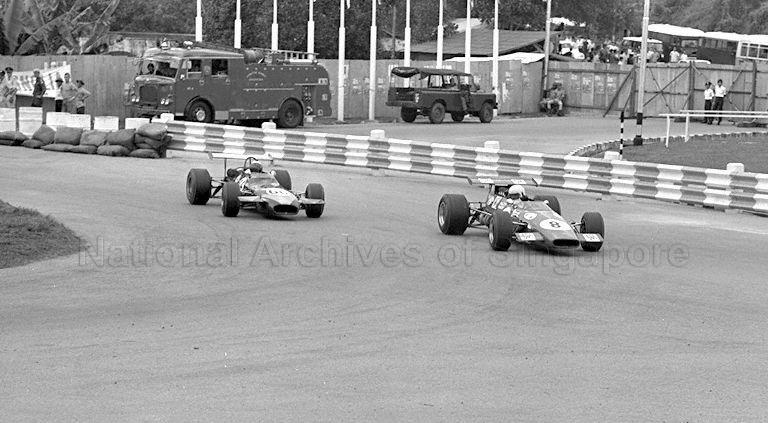
Bartlett with Lawrence right on his tail, then KB’s teammate, Max Stewart, Mildren Waggott, Iriawan, MacDonald and the rest (SNL)
On the third lap, the Australian faced his first problem, with a puncture. No big deal, this being quickly circumvented. But five laps later, a terminal problem spelled the end of any hope, as the engine gave its last breath and died.
Another one who was also struck by bad luck was Max Stewart: on the same lap that Matich made his tire change, Stewart’s Mildren-Waggott also refused to continue going forward, since his engine also had terminal problems. In the end, the pilot, who had scored the third best split time in mid-week practice session, had to abandon the race.
So with two of the top four drivers out of action, the battle for the victory would be decided between Bartlett and Graeme. Lap after lap, the duo pulled further away from the rest of the pack, with both lapping the rest of the grid.
With great skill, Bartlett used the power of the Mildren-Alfa V8 against the nimbler Ferrari. And so it was, managing to slowly open up an advantage, which reached nine seconds when the final checkered flag dropped. In addition to securing pole position for Sunday and relegating Ferrari to second place, Bartlett set a new track record: 1m55’8.
Iriawan in the Elfin 600C Ford FVA, car extant and currently being restored in Sydney (unattributed)
One lap behind, therefore, came the other classifieds: John MacDonald (Brabham-Cosworth FVA BT10/23C), Albert Poon (Brabham-Cosworth FVA BT30), Hengky Iriawan (Elfin-Ford Cosworth FVA 600C), Chong Boon Seng (Lotus-Cosworth 41) and Steven Kam (Lotus-Ford 23B Twin Cam).
But there was no time to celebrate and the next morning the cars lined up again on the starting line, for the race that would really define the winner of the 1970 Singapore GP.
The grid was slowly decimated by the fatigue of the long week that preceded this heat: among the drivers who did not show up on the decisive day, of the cars that were victims of accidents, mechanical problems and other failures, only 10 would start on Sunday. Even with this number much lower than expected, that did not stop the public from invading the Thomson Road circuit. According to some press reports at the time, there were about 100,000 people on the sidelines of the track on that Sunday morning.
Start, and the grid quickly pulverized into two small groups: Bartlett, Lawrence and Max Stewart (who had managed to fix his car overnight) took the lead, while MacDonald, Poon and the other drivers disputed the middle positions of the grid.
Bartlett led from the start and had a 3-sec lead from Lawrence when his Alfa V8 cried enough with 3 of the 40 laps to run (SNL)
In the first laps, Graeme Lawrence spun his car again. But, as if the script was repeating itself, it was nothing that affected the performance of the pilot. In less than five laps, the driver and his Ferrari had already reached the top two again; and on the tenth lap, Lawrence had already recovered the second position, when he overcame Max Stewart.
And Graeme’s momentum didn’t stop there. With the very strong race pace that was being set by Bartlett, the Ferrari became the only car that could catch the Mildren-Alfa. And so began the chase, which would last for most of the race.
Bartlett piled up faster and faster lap times, managing on the 27th lap to set a new track record: 1m55’5. Graeme answered, keeping close to the pilot of the Mildren.
Max Stewart sought to protect himself, accepting the third position – he didn’t have the car to compete with the leaders, but also, wasn’t threatened by the drivers that came further behind. But even going at a cruising pace doesn’t mean reaching the end of the race: during one of the laps, the pilot became distracted in the Long Loop, where lost control of the car and ended up in the middle of the trees. End of race and goodbye podium.
Graeme Lawrence on the way to another win in Ferrari 246T #008 (SNL)
So, the race was summed up between the Bartlett vs. Lawrence battle. And luck again laughed to the last. When the Ferrari driver had reduced the gap to less than 2 seconds, Lawrence saw when Bartlett had to pit, on the 37th lap. He didn’t know it, but the Australian’s Alfa engine had overheated, due to the sweltering conditions of the Singapore.
So, without competition and with only three laps to go, the driver had no trouble leading Ferrari to another victory (the second with him at the wheel, if you count his victory in Levin). Two laps behind came the drivers who would complete the podium: John MacDonald and Albert Poon, second and third, respectively.
Graeme Lawrence was crowned winner of the Singapore GP once again. The pilot had made a high stakes gamble on the race: according to what he told in an interview to The Straits Times a month later, he managed to take only one chassis and one engine to Singapore! Because of this, the pilot accepted second place in the first heat, and then waited for the opponent’s error (or car failure) in the second. We can say, apparently, that the strategy paid itself off in the end…
(SNL)To the victor the spoils, Graeme Lawrence (SNL)Jan Bussell’s Ferrari Monza leads the first Singapore GP in 1961. Giving chase are the Peter Cowling Cooper T51 Climax and Saw Kim Thiat’s Lotus 11 Climax. The nose of Ian Barnwell’s Aston Martin DB3S is at far left (E Solomon Collection)
Thomson Road : A distant memory in a forgotten past…
If the 1960s were marked by the technological development of competition single-seaters (mainly in F1, F2 and F3), we can say that the 1970s were marked by another transformation: the increase in concern about the safety of circuits.
Venues like Piccolo delle Madonie, Nurbürgring Nordschleife, Spa-Francochamps and many others would have a hard choice to make: adapt to the new times, or have to say goodbye to their racing times. While certain tracks did manage to make modifications that would guarantee a minimum of safety for pilots and spectators, others never reappeared. A major ‘purge’ ended up happening in the 1970s – nostalgic people can say that this was tragic for the history of motorsport; realists might say it had to be done, for the sake of the survival of the sport in a long-term.
If the blow was hard in Europe, where a large portion of the tracks had traditional events, with sponsors and captive audiences, one cannot even imagine how this was felt in the most peripheral parts of the racing world.
In this category is the Thomson Road circuit. Opened in 1961 for the Orient Year Grand Prix, it quickly became one of the most prestigious events in the Formula Libre racing series in Asia. When Singapore became independent, the venue gained even more prominence and importance, and in 1966 it was rebranded the Singapore Grand Prix.
Start of the 1966 race.eclectic mix of single seaters, sportscars and sedans including the pre-war ERA R2A (E Solomon Collection)Rodney Seow ahead of the rest of the 1964 grid, Merlyn Mk5/7 Ford. The race was red-flagged after 7 laps (E Solomon Collection)
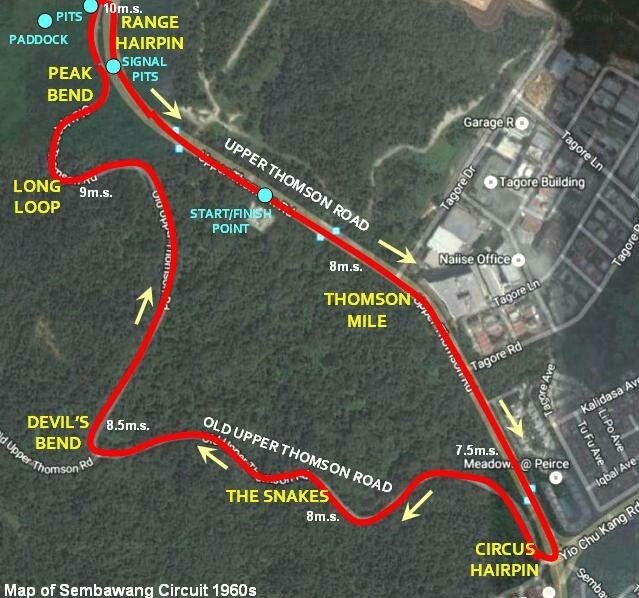
The circuit, just under 5km long, gained fame for its winding, fast and extremely dangerous layout. The track started at the Thomson Road (a.k.a. the Murder Mile), which is one of the most important roads in Singapore. The Mile was spilt in two, by the Hump, a fast right uphill turn, with a false apex on its turn-in.
The second part of the Mile ended abruptly at an elbow, known as the Circus Harpin. After this turn, the drivers began a slight access, that led to the most sinuous part of the circuit: first the 4-sequence of bends known as The Snakes, then the Devil’s Bend curve; this was the entrance to another long radius turn, which was bound for the Long Loop and Peak Bend turns. After that, the pilot was almost at the entrance to the pits and at the end of the lap, which was outside the Range Harpin.
Racing at Thomson Road circuit lasted until the mid-1970s (the 1974 edition was canceled at the last minute), when it became clear that the track was woefully out-of-date compared to other venues in the region. In just 11 years of operation, 7 people died on the circuit – not mentioning so many other terrible accidents, in which pilots and spectators miraculously left unharmed or with only minor injuries.
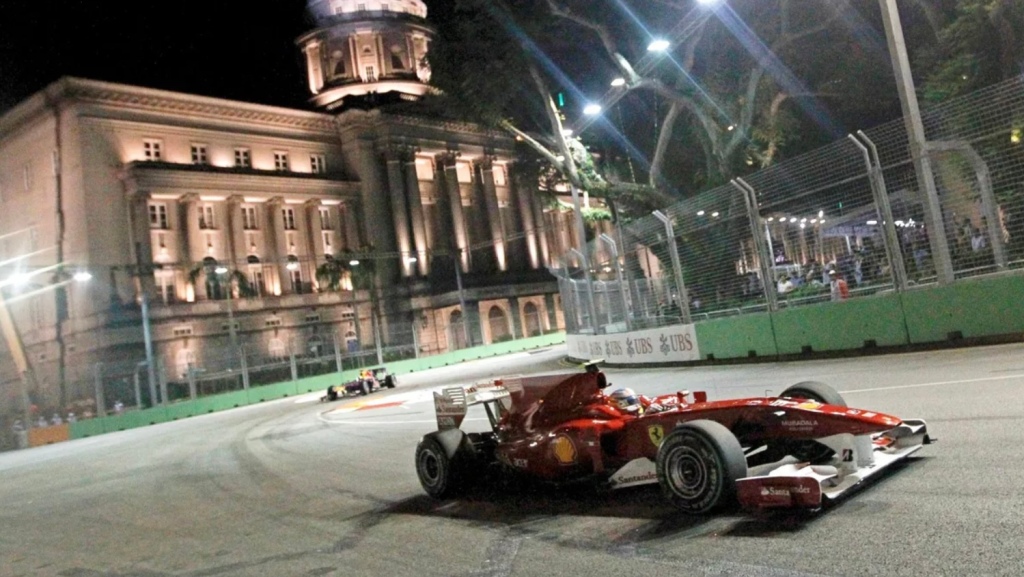
Thomson Road was a victim of its time and circumstance, like so many circuits of the past. Only 35 years later, a GP for single-seater cars would be held again in Singapore. And it would take 40 years (1970 with Graeme Lawrence / 2010 with Fernando Alonso) for a Ferrari to return to the highest place on the podium in the Island-State.
Fernando Alonso on the way to 2010 victory in a Ferrari F10 (eurosport.com)
Acknowledgments…
The Straits Times (editions from 24 March to 20 April 1970), The Eastern Sun (editions of 29 and 30 March 1970), Singapore National Library / NLB for the Photos, OldRacingCars.com for some extra data, ‘Snakes & Devil’s: A History of the Singapore Grand Prix 1961-1973’ Eli Solomon, MotorSport Images, Eurosport.com
Yes, yes, yes, I know I’ve done these Dinos before many times. But I rather like the two photographs of the great Lancastrian, Brian Redman, racing Dino 166 #0008 in the XXXI ADAC Eifelrennen Euro F2 round at the Nurburgring in 1968.
That 21 April day was his Ferrari debut, Motoring News reported the sight of the great-Brit three-wheeling the car around the South Circuit’s turns as quite startling.
Redman finished a fine fourth despite a stop after his goggles were smashed, cutting one eye. Chief Engineer Mauro Forghieri was so impressed he telephoned Enzo Ferrari and recommended Ferrari contract him, an offer he turned down then. Later, Redman was a valued member of the Scuderia’s sportscar squad.
0008 was a new car for 1968. Chris Amon raced it at Montjuïc Parc, Barcelona on its March 31 debut, finishing third behind the Ford FVA engined Matra MS7s of Jackie Stewart and Henri Pescarolo.
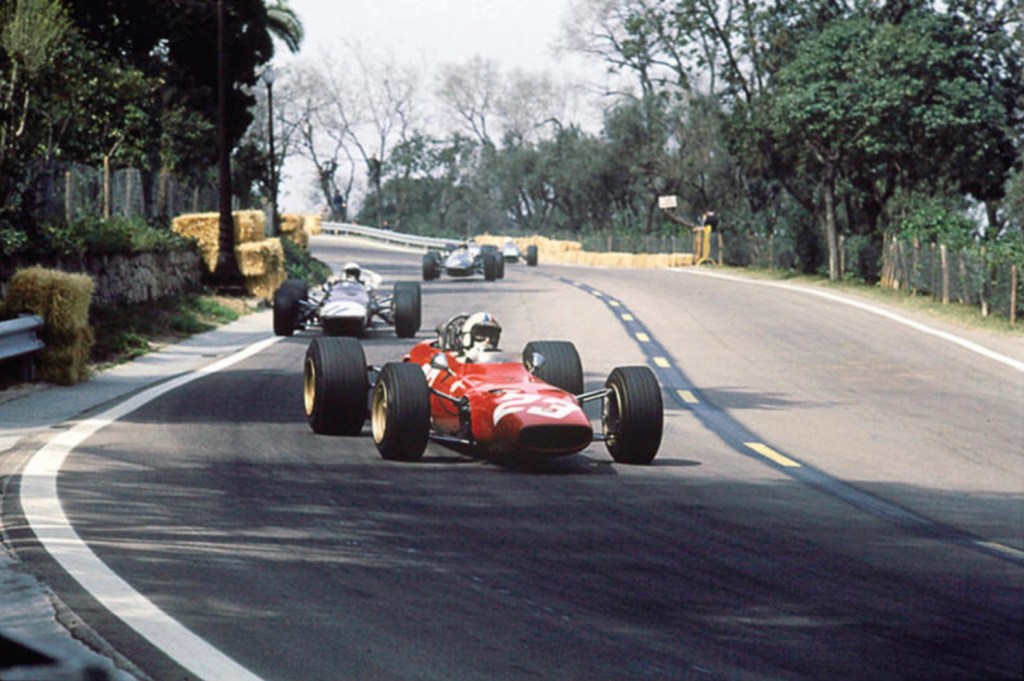
Amon amid the trees and high speed swoops of marvellous Montjuïc Parc, behind is the #11 Lola T100 Ford of…Brian Redman, DNF engine (unattributed)
Amon raced it at Hockenheim in mid-June (eighth) before it was damaged in a multiple-car accident in the Monza Lotteria GP in June driven by Tino Brambilla.
Chris raced the repaired car at the Tulln-Langenlebarn airfield circuit in mid-July (classified twelfth) before Brambilla was third in a heat at Zandvoort, and bagged fastest lap. At Sicily in late August he was again third in the Mediterranean GP at Enna, this time behind F2 King Jochen Rindt’s Winkelmann Brabham BT23C Ford and Piers Courage’ similar Frank Williams entry.
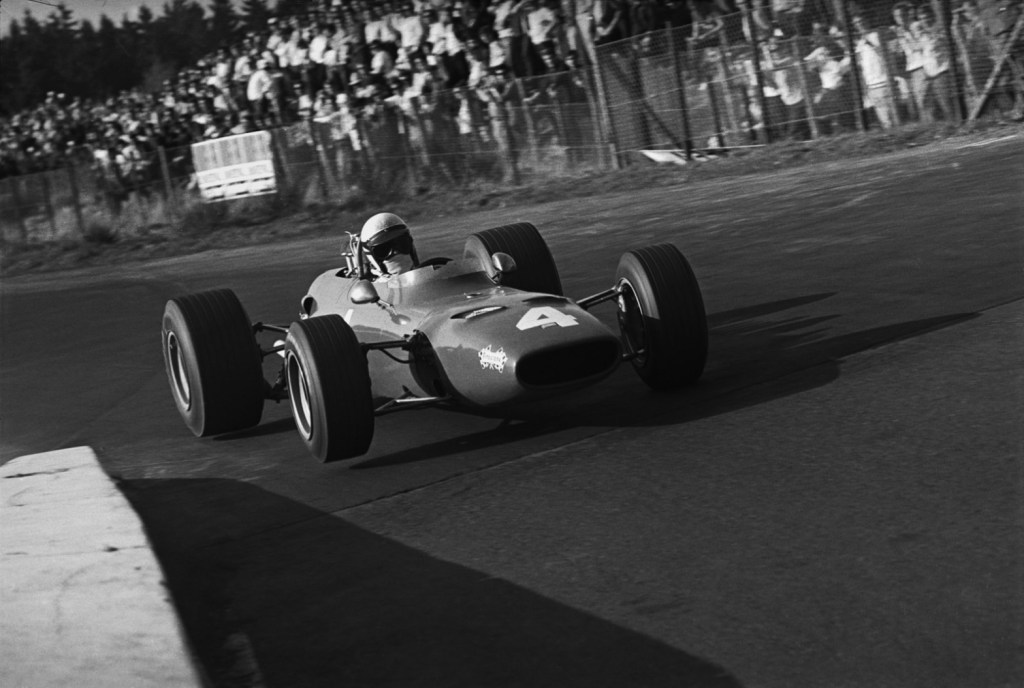
Brian Redman three-wheeling on the Nurburgring in 1968 (MotorSport)
The little F2 1.6-litre Ferrari V6, even in four-valve spec, never had the legs of a decent Ford FVA four. Funnily enough, the 2.4-litre Tasman spec V6 gave very little away to the Ford Cosworth DFW, the 2.5-litre variant of Cosworth’s 3-litre DFV V8, GP racing’s most successful engine.
0008 was then prepared for the 1969 Tasman Cup, as part of a successful two car assault on the championship together with Derek Bell in #0010. As I’ve written before, Chris won the championship in fine style with 2.4-litre engines fitted – four wins of the eight rounds including the NZ GP – before selling the car to Graeme Lawrence who repeated the dose in 1970.
Graeme Lawrence on the hop during the 1970 Lady Wigram Trophy, DNF overheating #0008. (G Lawrence Collection)
Credits…
MotorSport, F2 Index, Graeme Lawrence Collection, oldracingcars.com
Tailpiece…
(MotorSport)
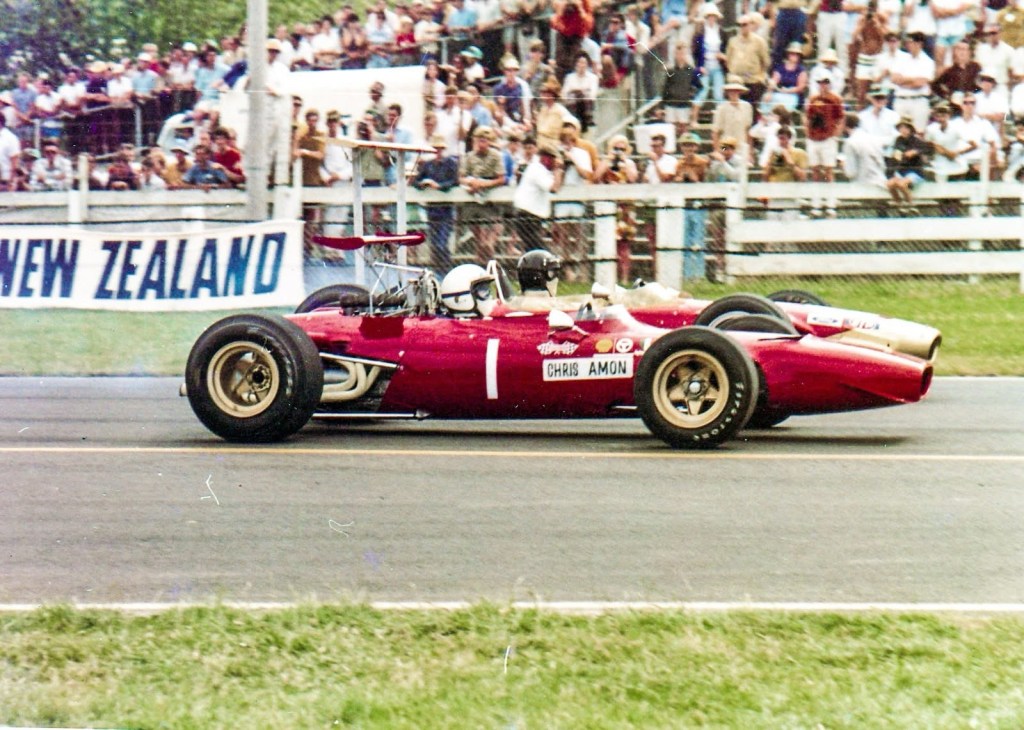
Chris Amon and Jochen Rindt, Ferrari 246T and Lotus 49 Ford, on the front row at Pukekohe, start of the New Zealand Grand Prix, first round of the 1969 Tasman Cup on January 4.
Amon won from Rindt and Piers Courage in Frank William’s Cosworth DFW powered Brabham BT24. All three were stars of the series, Chris won four races, Jochen two and Piers one.
Warren Reid’s photographer father’s Sandown habits as a spectator were similar to my own. Prowl the paddock and watch the action from there – cars rounding Shell Corner and heading into Peters or Torana Corner.
The first one is Pedro Rodriguez about to head out in the Len Terry designed BRM P126 V12- we were lucky enough to see Bourne’s new GP car in 2.5-litre form before commencement of the GP season. The high point of their summer was Bruce McLaren’s Teretonga win. BRM P126 here; https://primotipo.com/2018/01/25/richard-attwood-brm-p126-longford-1968/
That’s Kevin Bartlett’s Mildren Racing Brabham BT11A Climax in the background.
(W Reid)
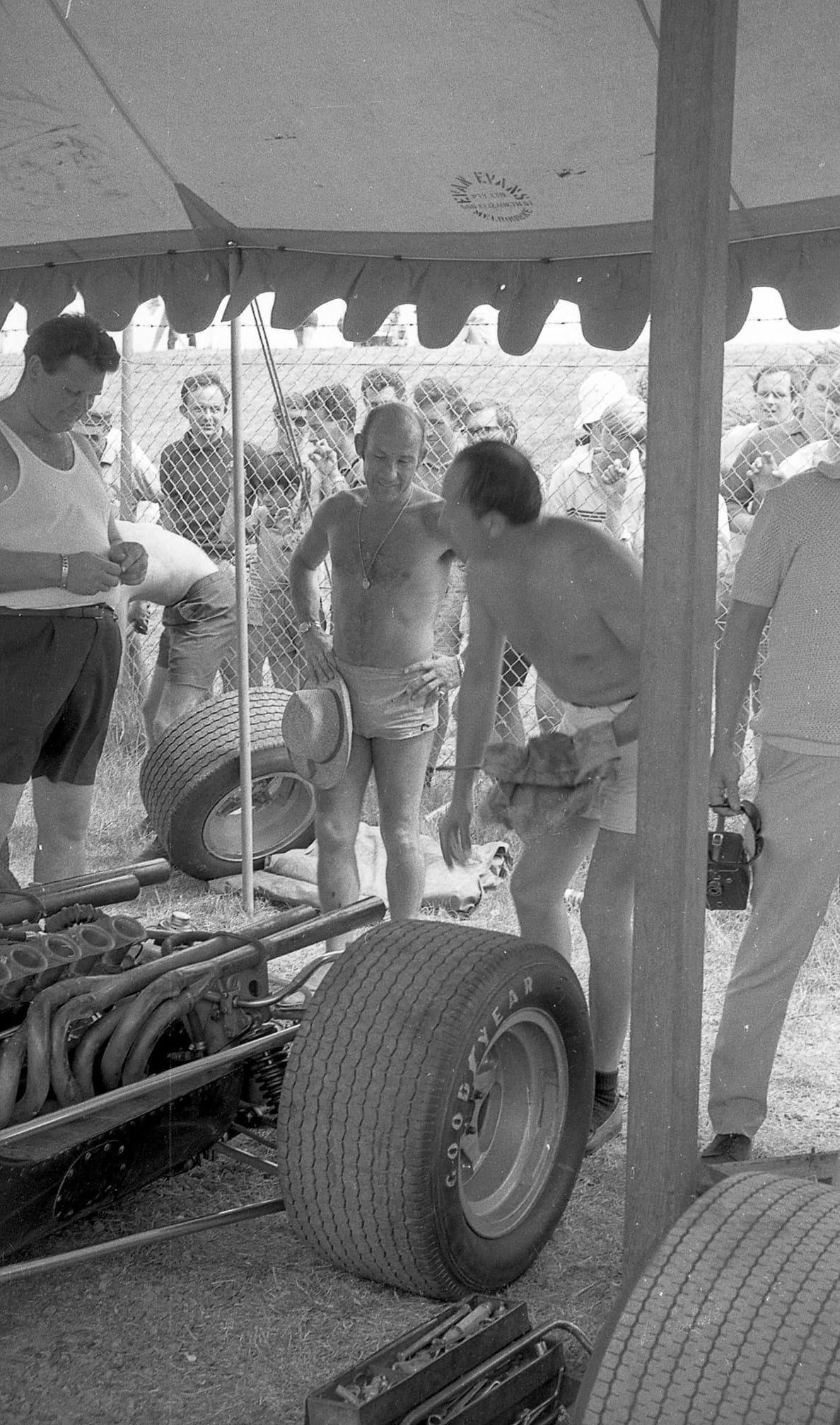
An overdressed Stirling Moss offers big Tim Parnell and one of the BRM mechanics some suggestions about coping with Australian heat.
There was nothing terribly wrong with this car that a Cosworth DFV couldn’t have fixed. BRM were in the wilderness from 1966 to 1969, finally hitting their straps again with Tony Southgate’s P153/P160 chassis and potent enough variants of their four-valve V12 in 1970-71. It was a long time coming for BRM fans.
(W Reid)
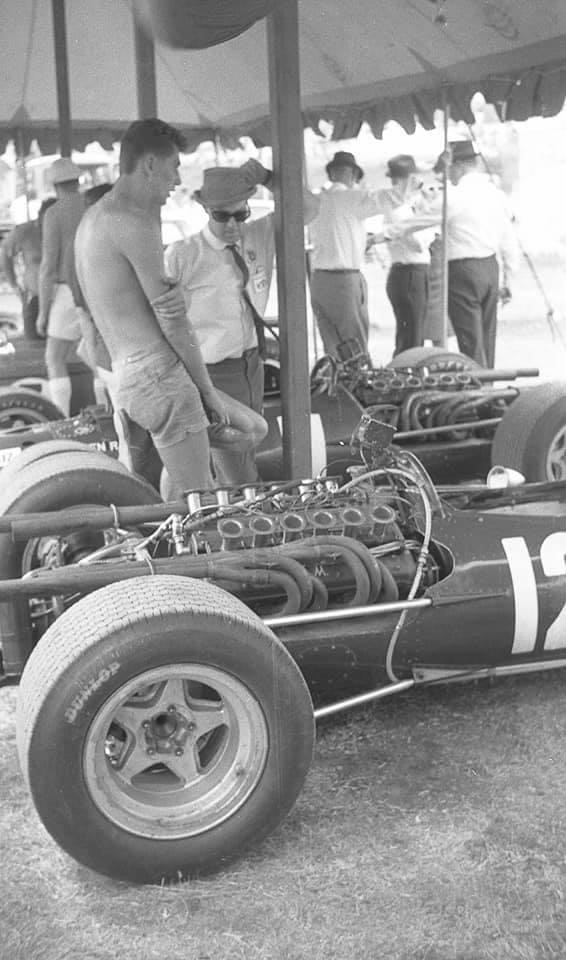
Car 12 is Richard Attwood’s P126 ‘02’. #11 is Pedro’s ‘01’.
(W Reid)
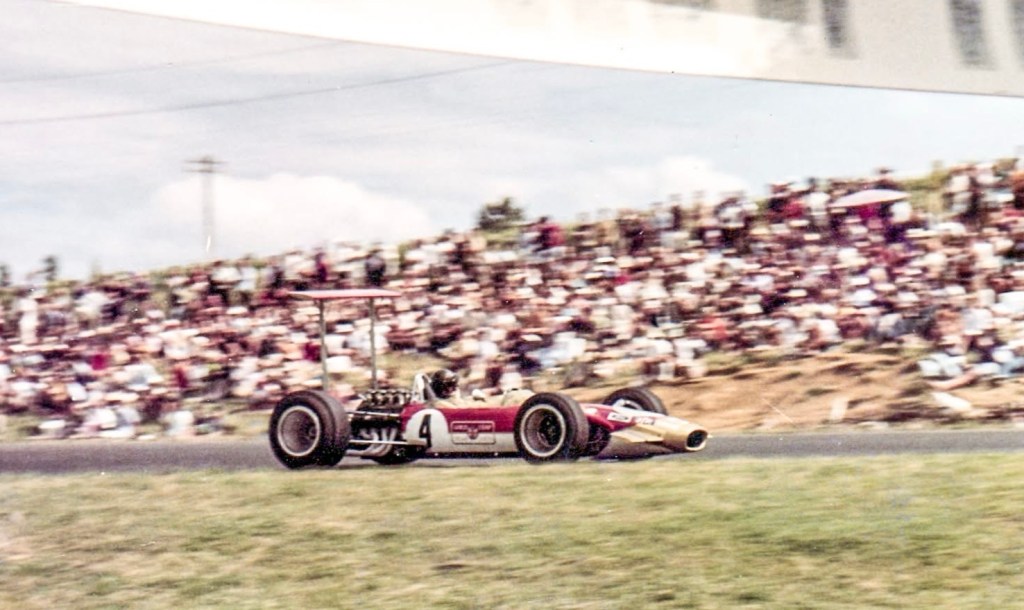
In many ways the stars of the show were the fastest GP cars on the planet at the time- the two Lotus 49 Fords of Graham Hill above in ‘R1’, and Jim Clark below in ‘R2’.
Clark and Chris Amon provided a thriller of a GP dice with Jim taking the flag by an official margin of one-hundredth of a second after an hour and three minutes of racing. Yet again Chris proved his talent and the potency of the Ferrari V6 relative to the 2.5-litre variant of the Ford Cosworth DFV 3-litre V8 dubbed DFW.
The 49 used a ZF five-speed transaxle initially, they were progressively replaced by the Hewland DG300 but at least one of the cars raced in the 1969 Tasman Cup was still ZF equipped.
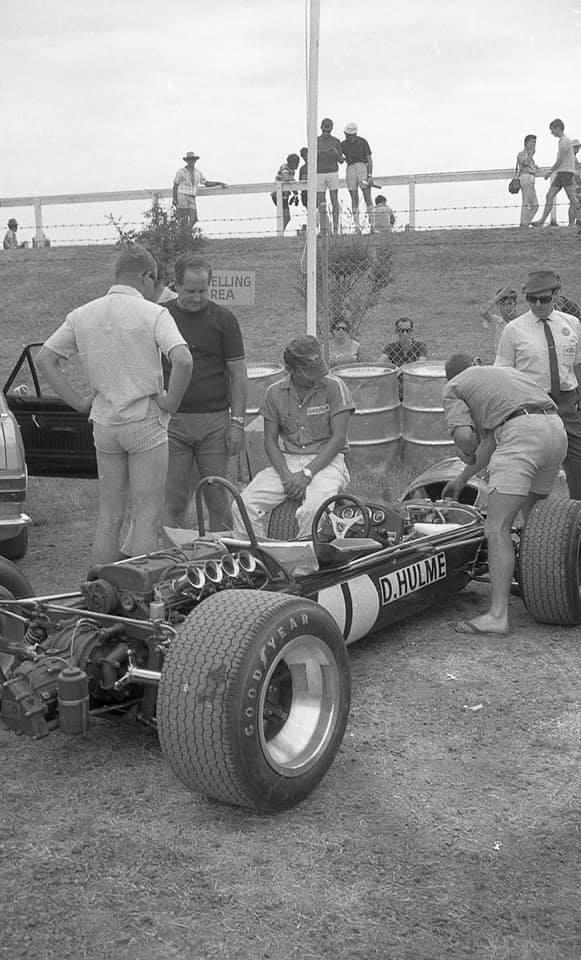
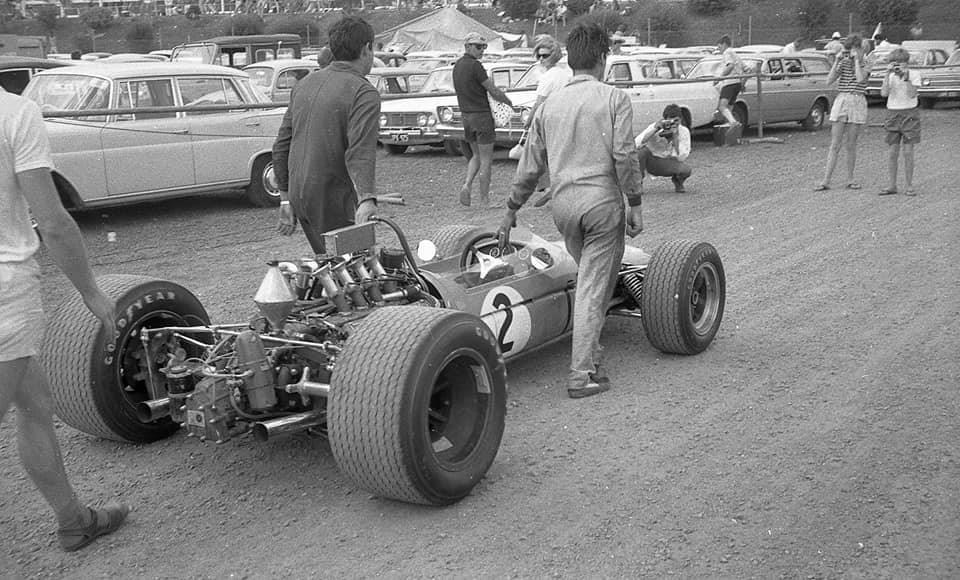
Denny Hulme ran his own show in 1968. When the Kiwi won the 1967 World Championship and let Jack know he was off to McLaren, any chance of Brabham running another car for him went out the window. In the end Brabham only did two rounds anyway.
Hulme (in the dark shirt below) ran an F2 Brabham BT23 Ford FVA to keep faith with his Australasian fans. He used two cars actually. He boofed the first at Pukekohe in a bad accident with Lawrence Brownlie and had to bring out another from England. This is the second car, BT23-2. The first was BT23-5 which became the basis of Bob Britton’s Rennmax BN3 chassis jig, a story well ventilated here a number of times. Brabham BT23 and ’67 Euro F2; https://primotipo.com/2019/11/02/the-wills-barc-200-f2-silverstone-march-1967/
(W Reid)
(W Reid)
Above is Jack Brabham’s bespoke 1968 Tasman car, BT23E’1’ being pushed through the paddock on raceday.
That SOHC, crossflow RBE830 Repco 2.5 V8 is making its race debut. The team fitted the engine and a jury-rigged oil system- the strange structure sitting atop the Hewland FT200 gearbox overnight. Jack was quick in the two rounds he contested, but the yield was seventh at Warwick Farm and a DNF at Sandown.
While Repco-Brabham V8s were F1 Champions in 1966-7 they didn’t win a Tasman Cup despite the engine being originally designed for the Tasman. In five years of Tasman competition Repco won a single round – Jack at Longford in 1967 in a ‘640’ engined BT23A. Repco were pretty happy with the competition dividend of said engines mind you…
Chris Amon, what a mighty racing driver. Ferrari Dino 246 chassis ‘0004’, his 1969 Tasman winner was chassis ‘0008’, the same jigger Graeme Lawrence raced so well to victory in 1970.
Those in attendance that Sandown Sunday still speak in reverential terms about the fantastic dice up front. It was Jim’s last win in Australasia and the ‘68 Tasman Cup was his last championship before that awful day at Hockenheim in 1968. Dino 246T here; https://primotipo.com/2017/07/21/amons-tasman-dino/
Moss and friends.
(W Reid)
These gorgeous Ferraris were unsuccessful 1.6-litre F2 cars, the Cosworth FVA despatched on ongoing belting to them from 1967 to 1971. As Tasman Formula, 2.4-litre machines they were a brilliant bit of fast packaging- light, nimble and powerful. Perhaps with a full works effort in 1968 Ferrari would have carted away another Tasman Cup.
Credits…
Warren Reid Family Collection
Tailpiece…
(W Reid)
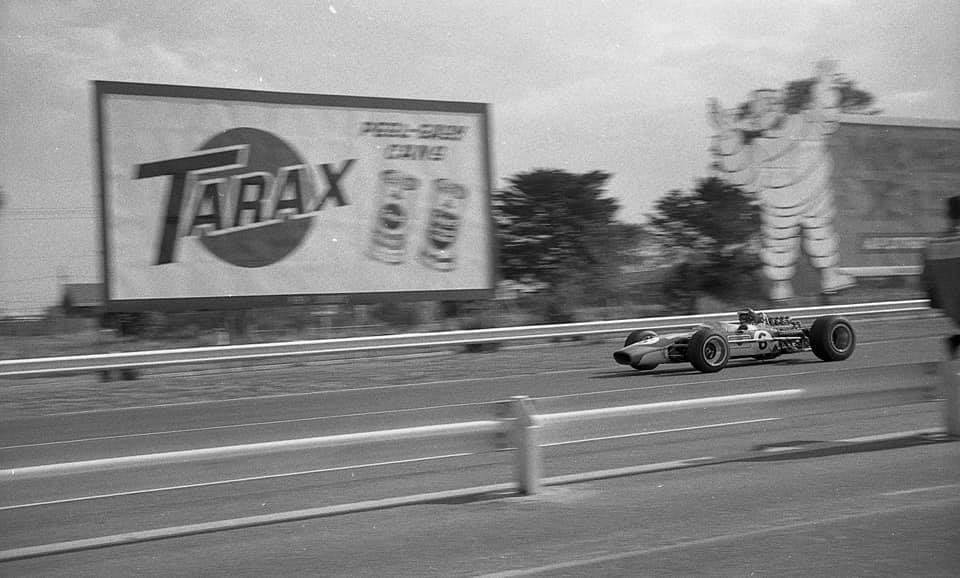
Jim Clark blasts his Lotus 49 ‘R2’ along Pit Straight, third gear in Jim’s ZF gearbox.
Tarax is a long-gone brand of soft-drinks, since then swallowed (sic) by a bigger rival.
Grand Prix cars; Ferrari 156/63 F1 1963, red Lotus Climax FPF, at left a Lotus 18 Climax FPF and Lotus 33 Climax FWMV (M Bisset)
The Ferrari 156/63 holds centre-stage at the Musee National de l’Automobile, Mulhouse, France in July 2019…
When I saw it I didn’t recognise the car at all.
The 156 went from 1961 World Champ to 1962 World Chump. Then, to me, along came Ferrari’s ‘Aero-framed’ semi-monocoque 1.5-litre V8 engined 158 with which John Surtees won the 1964 championship in a great battle with Jim Clark’s Lotus 15/33 Climax and Graham Hill’s BRM P261.
Not so fast. Between the 156 and 158 were the T56, 156, 156/62P, 156/63, 156 F1-63 and Aero 156 depending upon your source as to model names, the 156/63 is one of those cars.
Ferrari raced on with the 156 largely unchanged in 1962 given their sudden paucity of team leaders. Mr Ferrari had a mass-departure of top executives, including 156 designer, Carlo Chiti, that winter. Their exodus to Automobili Turismo e Sport (ATS) was an unmitigated disaster, that story is here; ‘Automobili Turismo e Sport’ : A.T.S. F1… | primotipo…
But Ferrari had depth in the ranks, young engineer, Mauro Forghieri set to work on a series of cars more akin to British chassis design orthodoxy, and ultimate success in 1964.
Forghieri (born 13 January 1935) joined Ferrari in 1960 after completing an engineering degree at Bologna University the year before.
The key team which took the Scuderia forward included engineers Rocchi, assisted by Bellei – with oversight provided by Vittorio Jano – on the new V8 (1964). Ing Salvarini looked after gearboxes and suspension with Bussi doing dyno engine testing and development.
The Flat-12 (1964-65) design was Forghieri’s, as was the at circuit role and liasion between the race-team and technical group. In short, he was team-leader.
John Surtees, Ferrari 156/63, 1963 US GP at Watkins Glen. Grid three and DNF valve failure was his haul that weekend (MotorSport)
With time short that winter, there was little time to develop the existing 156s. Before Chiti left, V6 developments included a two-valver with twin-plugs, a two-valver with three-plugs, a three-valver with two-plugs and a four-valver with one-plug (!), for which 210bhp @ 10,000rpm was claimed.
Chassis changes involved a move towards a lower polar moment of inertia which was achieved by moving the masses within the a wheelbase. A new 6-speed gearbox was also available. It could be mounted conventionally, overhung behind the rear axle, or within the wheelbase, albeit the former was preferred.
That year Forghieri tried wide track 156s, but lost top-speed wasn’t exceeded by greater cornering ability. In effect, Ferrari had a stand-still year as Forghieri developed a more competitive ’63 car and established the foundations for mid-term success.
Mauro’s early cars, the spaceframe 1962 156/62P and 1963 156/63, and semi-monocoque 156 Aero, were still powered by the trusty Tipo 178 1.5-litre, twelve-valve V6, by then Bosch direct fuel injected.
This engine was well trumped by the British Coventry Climax FWMV and BRM P56 V8s in 1962, but Forghieri’s chassis’ were much nicer modern affairs than the 1961 156. Gradually Ferrari bridged the opposition’s gap in 1962-63 setting up its driver and manufacturer titles in 1964.
Lorenzo Bandini in Forghieri’s new Ferrari 156/62P #0008 during the German GP, Nurburgring August 1962 (MotorSport)
Ferrari 156/62P…
Ferrari had built nine 156s by the end of 1961, they built another three in 1962; #0007, #0008 and #0009. #0007 was a new 156 of evolved design as mentioned above, while #0008 and #0009 were Forghieri’s new 156/62P experimental machines.
These two cars were smaller, neater small-tube spaceframes with rear suspension practice and geometry akin to the British opposition, albeit the archaic, heavy, and beautiful Borrani wire wheels were retained.
Bandini’s 156/62P in the Nurburgring paddock. Behind him are Phil Hill’s #1, and Giancarlo Baghetti’s #2 normale 156s (MotorSport)
Forghieri’s 156/62P #0008 was finally ready and raced by Lorenzo Bandini in the German GP that August, he qualified 18th but was out after an accident on lap five.
Mauro Forghieri was further empowered late season when John Surtees joined the Scuderia. His engineering knowledge and interest, and fierce determination to effectively use Ferrari’s vast resources ensured significant progress was made that winter and into 1963.
Willy Mairesse at Monza during the 1962 Italian GP weekend in 156/62P #0008. He did well, fourth place. Note the changes to the rear bodywork in the shot below compared with the car as appeared at the Nurburgring a month earlier
Willy Mairesse was given the car at Monza. He qualified 10th, finished fourth and was the best placed of the 156 Dinos on the grid and in terms of race results. Clearly progress was being made.
That weekend Willy also tested #0009, it had only just been completed with its beautiful hand formed aluminium body still unpainted (below)
Apart from differences in the nose of the car compared with its 156/62P sibling #0008, the rear suspension of this car is completely different. Gone is the top link and wide-based lower wishbone, in its place is a multi-link set up more akin to contemporary British practice, viz; single top link, inverted lower wishbone and two radius rods, adjustable roll bar and coil spring/Koni dampers.
Big Ferrari news for 1963 was Surtees recruitment, latterly of the Bowmaker Lola Team. During this period of change, Surtees tested at Modena, including a drive of what appears to be 156/62P #0009, above.
The photograph is dated November 26, 1962 (Getty Images’ dating of shots is often wrong). Note that the rear suspension of the car at this time is different to that over the Italian GP weekend when Mairesse tested it.
Ludovico Scarfiotti, Ferrari 156/63 at Zandvoort, 1963 Dutch Grand Prix. The young Italian was sixth in his first championship GP (MotorSport)
Ferrari 156/63…
Forghieri worked over the winter on the 156/63, another neat multi-tubular spaceframe car of small gauge tubes. An evolution of the existing V6 was bolted to a new six-speed gearbox with lightweight, magnesium alloy Campagnolo wheels part of an attractive package. As stated Mauro was greatly empowered by Surtees arrival, progress was enhanced.
Ferrari 156/63 cutaway, technical specifications as per text (Vic Berris)
Willy Mairesse displaying the beautiful lines of his new Ferrari 156/63 at Monte Carlo in May (MotorSport)
Business end of a 156/63 (MotorSport)
In 1963 spec the two-valve, fuel injected DOHC V6 gave a claimed 205/210bhp. Michael May adapted Bosch direct fuel injection to the motor.
Noteworthy is that by the end of 1963 F1-was-fuel-injected by Lucas and Bosch. There were still downdraft Webers to be seen on customer V8s, but up at front fuel injection was the go.
The gearbox had six speeds, front suspension the usual outboard fare of upper and lower wishbones and coil spring/shocks. At the rear the regime was again period typical, single upper link, a lower inverted wishbone and twin radius rods with coil spring/Koni shocks and adjustable roll bars front and rear. Steering was rack and pinion with Campagnolo magnesium alloy wheels finally replacing the Borrani wires. Brakes were Dunlop disc, inboard at the rear.
Three 156/63 machines were built; chassis #0001, #0002 and #0003, the team missed early season non-championship races to focus on testing at Modena and Monza.
Surtees started the season strongly in Monaco, qualifying third and finishing fourth, Mairesse was Q7 and DNF with a final drive failure. Up front Graham Hill won for BRM.
At Spa Mairesse qualified third at home but failed to finish with fuel injection problems. Surtees qualified 10th, he too had fuel injection problems, a faulty pipe. Jim Clark won and commenced an amazing run in his Lotus 25 Climax which saw him take his first World Championship.
At Zandvoort Surtees was a great third from Q5, and Scarfiotti sixth from Q11. At Reims John was out with a split fuel pipe failure from Q4, a good effort after fuel injection problems in practice which were sorted by Bosch technicians. Scarfiotti didn’t start after a practice crash.
At Silverstone for the British Grand Prix, Surtees qualified fifth and finished in the same spot while Scarfiotti wasn’t entered. Up front, it was Clark’s Lotus all the way.
(MotorSport)
On that most challenging of tracks, the Nurburgring, the teams hard work was vindicated with a dominant win from Surtees from grid two (above), while Willy Mairesse was out with an accident.
A fortnight after the German GP, Ferrari contested the non-championship GP del Mediterraneo at Enna where Surtees took a pole to flag victory.
Then, tails-up, it was off to Monza in September where the Tifosi were ecstatic with anticipation after Surtees plonked his new 156 Aero on pole, sadly he was out with engine failure during the race. Bandini started sixth in a 156/63 but was outted with gearbox failure, Clark’s Lotus 25 won again.
Let’s deal with the specifications of the 156 Aero – an interim model put together with great attention to detail due to the 158’s V8 engine running late – in a little bit.
Surtees shows the massive 1963 Monza crowd his new Ferrari 156 Aero in September 1963, the ultimate expression of the 156 type, or family of cars first tested throughout 1960 (MotorSport)
Beautiful 156 Aero at Monza, key elements as per text but note entirely paradigm rear suspension, injected V6, inboard brakes and long-overhang 6-speed transaxle (MotorSport)
Butt-shot of Surtees’ 156/63 at Watkins Glen (MotorSport)
At Watkins Glen, Surtees qualified a strong third aboard a 156/63 on the fast, challenging Watkins Glen course but had valve failure in the race. Bandini started ninth and finished fifth. In Mexico Surtees 156 Aero was disqualified after receiving outside assistance from grid two, while Bandini had engine failure from seventh on the grid.
John Surtees’ consistently strong performances yielded 22 points, placing him fourth in the 1963 drivers championship behind Clark’s Lotus 25 Climax, then Hill G and Richie Ginther aboard BRM P57s. The Surtees/Scuderia Ferrari combination approached 1964 with plenty of optimism and two new cars, the 158 and 1512.
Bandini on the way to victory on the Zeltweg Airfield circuit, Austrian GP, Ferrari 156 Aero in August 1964. He is passing Trevor Taylor’s abandoned BRP Mk1 BRM, broken suspension. It was the only GP win for the Italian and the 156 Aero Ferrari (MotorSport)
Ferrari 156 Aero…
Despite the arrival of the Aero semi-monocoque chassis 158 and 1512 the venerable 156 still played an important role in 1964.
As we have seen, with development of the new V8 behind schedule, a 120-degree V6 was adapted to Forghieri’s new Type 579 chassis to allow its debut at Monza in September 1963.
The chassis was based on a simple un-triangulated tubular internal frame to which were riveted stress bearing aluminium skins. This hybrid monocoque was unlike that pioneered by Len Terry and Colin Chapman at Lotus, but served Ferrari very well for nearly two decades.
“Two parallel fuel tank pontoons, each of which was fabricated and riveted aircraft style over a sketchy framework of two tube longerons staggered slightly in the vertical plane” wrote Doug Nye.
“These tubes doubled as water and oil feeds between engine and coolers. The completed pontoons were then united laterally throughout their length by a stressed floor panel with angle stiffening plates, and at each end were riveted to transverse bulkheads.”
“That at the front was doubled to sandwich inboard coil spring damper units operated by top rocker arms like Lotus’s, while the entire hybrid monocoque terminated behind the cockpit in a hefty fabricated rear bulkhead.”
Look carefully at Surtees’ 156 Aero chassis at Monza in 1963. You can see the rivet lines where the aluminium skin is attached to the tubes underneath. Visible also is the boom extension to the tub on this side to support the engine, it also carried the V8 which was never a fully stressed part of the chassis as Forghieri originally intended. Note the the twin-plugs and Bosch injection with the metering unit between the Vee, also the inboard Dunlop calipers rotor/disc, and six-speed transaxle (MotorSport)
Ferrari 156 Aero cutaway. It’s not so easy to quickly pick the spaceframe 156 from the semi-monocoque Aero. The most obvious difference in addition to the chassis, is top rocker front suspension on this car as against the wishbones of the earlier 156/63 (James Allington) 156 Aero front detail at Monza in 1963. Top rocker and hat of coil spring/Koni, note the bulkheads on which the rocker pivots, water radiator/cap and oil tank behind, master cylinders for brakes times two, and clutch. Under these is the steering rack and arm attached to a cast magnesium upright.
The design of the V8 and Flat-12 engines was radical in that their blocks were cast to allow them to form stress bearing components of the car, rather than the engine being attached to pontoons or an A-frame in the more traditional manner. That is, the motors bolted to the rear chassis bulkhead and accepted suspension loads.
Using the engine structurally then was rare. Vittorio Jano designed his 2.5-litre, quad-cam V8 as a stress bearing member of his front-engined Lancia D50 in 1954. BRM achieved it with Big-Bertha, the 1966 BRM P83 H16, so too did the similarly engined Lotus 43.
Forghieri and Ferrari team did so in 1964 with their Flat-12 Ferrari 1512. They didn’t persevered long enough with the V8 crankcase/block design to achieve the feat with the 158. Jano was retained by Ferrari as a consultant during this period, this path was perhaps a suggestion he made to Forghieri and the design team?
The new V8 was running late in its development, so, as related, the V6 was adapted to allow testing and racing the Aero chassis.
Support trusses were added to its rear to carry the V6, which had not of course been designed to be a stressed member. Mind you, some references have it as “partially stressed”. The Aero’s front and rear suspension was contemporary standard British design practice.
Lorenzo Bandini aboard his 156 Aero in the Brands Hatch paddock during the 1964 British GP weekend. Note the different wheels to ’63. #1 is Jim Clark’s winning Lotus 25 Climax, #24 is Peter Revson’s Lotus 24 BRM (MotorSport)
The 156 Aero raced into 1964 in Bandini’s hands as the definitive 158 was made competitive and reliable by Surtees and Forghieri. Until then the 156 was reasonably kind to him.
While ‘Il Grande John’ won the German GP in a 158, Bandini popped a 156 Aero on the outside of the front row and finished third. He went two better at Zeltweg winning the race run on the rough-as-guts broken concrete airfield surface as other cars, including Surtees’ 158, were shaken to bits!
It was the last win for a V6 engine in F1 until the turbo-charged Renault V6s a decade or so hence. It was rather a nice last hurrah for engines which had delivered so much for so long since 1957.
Not that it was over yet for this family of Ferrari engines. An engine adapted for the 3-litre F1 Formula, the 246 raced in Bandini’s hands in 1966. Not to forget the 246 Tasman Formula engines for Chris Amon, Derek Bell and Graeme Lawrence fitted in multiple different specifications to 246T chassis from 1968 to 1971…
Chassis numbers…
Doug Nye provided the following explanation of the chassis numbers attributed to the 156/62P, 156/63 and 156 Aero.
“According to the hand-written chassis allocation record which Mr Ferrari’s Lieutenant Dr Franco Gozzi sent me in 1978 when I was compiling the ‘Dino book’ the chassis numbers are as follows.”
“1962 German GP – Bandini – chassis ‘0008’ – which was a number identifying the prototype ‘Sharknose’ chassis in which Baghetti had won at Syracuse and Naples in 1961, then crashed by him in the British GP and quite badly damaged. It was then – by inference – rebuilt into the ‘P’ form (156/62P) in time to reappear at the Nurburgring in 1962.”
“1962 Italian GP – Bandini drove chassis ‘0006’ – which was another 1961-series ‘Sharknose’ serial first identifying the car which Ricard Rodriguez drove in the ’61 Italian GP. Into 1962 it became Willy Mairesse’s Brussels GP winning chassis, then Bandini placed it fifth at Pau and second at Naples. Ricardo Rodriguez was then sixth in the German GP before Lorenzo raced it at Monza…There, ‘Wild Willy’ drove the rebuilt ‘0008’ – or at least a car entered under that identity. Remember this is as prepared from the Ferrari records supplied to me back in ’78.”
“Incidentally, the ‘0008’ serial derives from the preceding front-engined Dino 246 F1/156 F2 family of chassis IDs. They ran from ‘0001’ to ‘0007’ front-engined, with the rear-engined 246MP (‘Motore Posteriore‘) given its sole F1 outing by Ginther at Monaco in 1960, then being converted to 156 F2 form to be raced by Trips, winning the 1960 Solitude GP before finishing fifth overall and as F2 winner in the dual-class 1960 Italian GP at Monza.”
“I believe it is highly likely that the ‘0008’ prototype F1 which ran at the Nurburgring 1962 was a different and brand-new entity probably exploiting the team’s existing old Customs carnet so far as the serial ID is concerned.”
“The 1963 cars launched a whole new chassis number sequence, three 156/63s being built serialled ‘0001’-2-3 (surprisingly enough). The prototype 156/63 ‘Aero’ was given the same-series chassis ID ‘0004’ promptly qualifying on pole at Monza.”
“For the US GP Ferrari works records indicate that Surtees raced ‘0004’. Without checking further I don’t think that’s right. A wishbone mount pulled out of the chassis in practice and John raced the spaceframe car instead (Doug’s conclusion is consistent with race photographs). This was perhaps ‘0003’ rebuilt after Willy’s Ring crash, or entirely replaced under the same serial.”
“In the following 1963 Mexican GP both John and Bandini drove ‘Aero’-chassised cars, with John listed by the works as having been in ‘0003’ and Bandini in ‘0001’. I would lay good money on them having simply used the old spaceframe-series chassis numbers – and Carnets – for those cars, and for this having been dutifully entered in the factory records by the pen-pusher responsible.”
Etcetera: 1963 Ferrari 156/63…
Giulio Borsari tops up the Ferrari 156/63 125-litre fuel tank, with a dose of Shell’s finest Avgas at Monaco in 1963. Oh to have a pair of those overalls!
It looks like Surtees’ car, #21, he was fourth in the race won by Graham Hill’s BRM P57. Note the leather bound steering wheel and chassis cockpit bracing tubes. What sort of Dunlop in 1963, R5 perhaps?
(G Goddard/GP Library)
Graham Hill chasing John Surtees at Monaco in 1963 aboard a Ferrari 156/63 and BRM P57 or P578 depending upon your preference. Graham won from Richie Ginther in the other Owen Racing Organisation entry from Bruce McLaren’s Cooper T66 Climax, then Surtees.
They are such pretty little cars these 1.5-litre GP machines, mighty fast of course.
(unattributed)
Surtees’ 156/63 failed to finish with an inert fuel-pump, perhaps he is seeking to diagnose or rectify the problem, concentration not so easy on this high speed part of Reims.
Clark won from Tony Maggs and Graham Hill aboard Lotus 25 Climax, Cooper T66 Climax and BRM P61.
(LAT)
At first glance I thought it was Surtees at the Nürburgring in 1963. But it’s 1964, he’s aboard a Ferrari 158, he won the German GP in both years. It’s a Cooper T73 Climax behind, either Bruce McLaren or Phil Hill. Surtees won from pole ahead of Graham Hill’s BRM P261, with Lorenzo Bandini’s Ferrari 156 Aero a splendid third. See here for a short piece on the Ferrari 158; N.A.R.T. Ferrari 158’s… | primotipo…
Photo and reference credits…
Getty Images, Sutton Images, GP Library, LAT, Bernard Cahier, Ferrari website, grandprix.com, racing-reference.info, James Allington, ‘The History of The Grand Prix Car’ Doug Nye – special thanks to Doug for his note on the chassis number details
Tailpiece…
(unattributed)
Pretty as a picture at Silverstone, British GP 1963. The driver looks to sit quite far forward, or is it an optical trick?
Surtees’ 156/63 among the Silverstone fields with perhaps not quite the mumbo to really challenge Clark’s winning Lotus 25 Climax. The BRM duo of Graham Hill and Richie Ginther completed John’s V8 sandwich, in P56 V8 engined P57s.
‘My signature shot, Jim Clark Lotus 49 Ford DFW and Chris Amon Ferrari Dino 246T. Two of the best drivers of their time. Taken early in my photography journey. Not only is it a record of the 1968 Surfers Tasman race, the pic is pretty well balanced and shows the scenic aspect of the old Surfers Paradise track. I describe in the Tasman book, the trauma experienced in getting to and from the race’ (R MacKenzie)
I finally bought the Tasman Cup bible at Sandown a while back, what a ripper book it is!…
There are some heavy dudes involved in it. Publisher Tony Loxley has assembled a swag of ‘in period’ talent- journalists, photographers and drivers to contribute, forty in all. I blew my tiny mind when I got it home and penetrated the thick plastic, protective cover to unveil content rich words and images. That Sunday afternoon was completely shot.
At $A95 it’s a snip, nearly 500 pages of beautifully printed and bound hardcover with about ninety percent of the (900’ish) images unfamiliar to me. Mucking around with primotipo I’ve seen plenty of shots in the last four years or so- it was awesome to view a vast array of unseen images, some from the archives of ‘snappers ‘I have met online’ who have kindly allowed me to use their work on my ‘masterpiece’.
Which brings me to Rod MacKenzie’s work.
I’ve used his images before but the material in the Tasman tome is sensational for its compositional artistry. So I gave him a yell and said you choose two photos (Clark and Muir) and I’ll choose two (Gardner and Walker) to showcase the work and support this article. The photo captions are Rod’s, his ‘artists notes’ if you will. We plan some occasional articles going forward, many thanks to Rod.
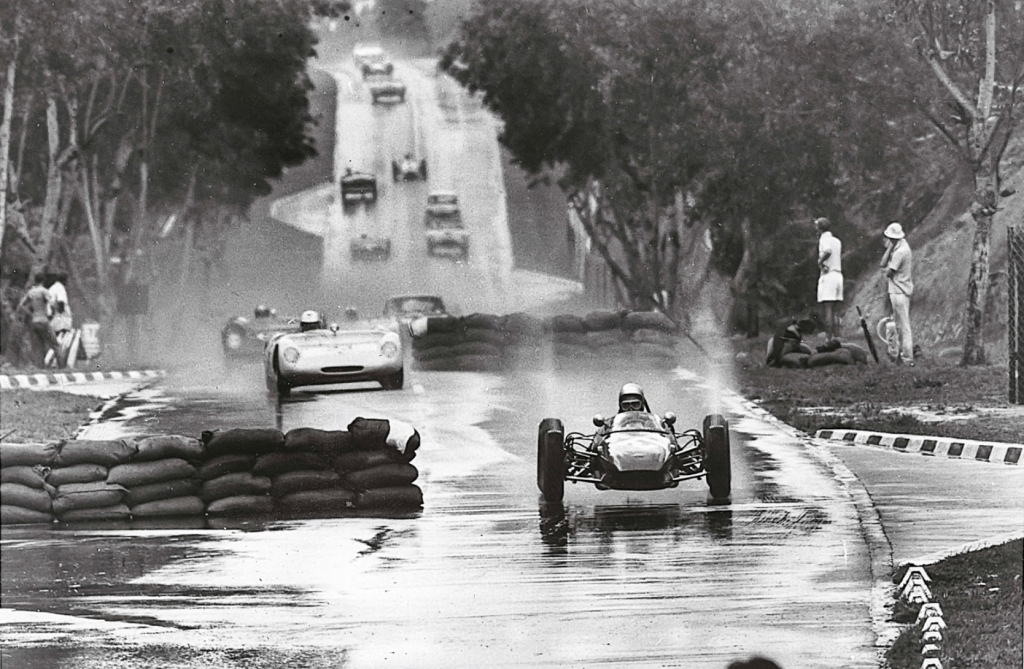
‘Frank Gardner, Brabham BT23D Alfa Romeo negotiates Newry Corner at Longford, Tasmania 1968. Perhaps one of the wettest races i have attended. At least i was taking photos, not driving! This pic has its own appeal, i just pressed the button. Frank’s skills were tested and you can see the race was on public roads with spectataors in the most unsafe areas. Fences were barbed wire, no run-off and badly cambered roadway.’ (R MacKenzie)
Rod writes about his work…
‘We all have favourites.
In over fifty years of motor racing photography some of my earlier photos remain dear to me.
However, the photos were not quite as important as the spectacle of close racing between highly skilled ‘pilotes’ in competition with their cotemporaries.
They at the time were the source of income to attend the many race circuits and were sold to magazines in Australia and overseas.
Now the photos have become most important.
These photos are now historical records of these men and some women whose exploits have been written about and add reality to reports and clarity to memories.
I also endeavoured to photograph many of the competitors ensuring not only ‘the stars’ were captured.
Without the photos, memories become clouded and distorted. Not by intent, but by the passage of years.
My photos of several Tasman Series spent some time in the proverbial shoebox during a period of having a new family to bring up.
They were revisted to be included in two books (so far) from Tony Loxley of ‘Full Throttle Publishing’ about Formula 5000 and The Tasman Cup and have been included in many other books now. I have released some of the photos on social media and they are still appreciated judging from some of the comments received.
I take pride in my photos as i try to add ‘something’ above and beyond a picture ‘of a car on asphalt somewhere’. A good black and white photo in my view is more difficult to produce than a colour photo and just suits the history of races.
My photos should convey the ‘atmosphere’ of motor sport- the drama, the commitment, the excitement, the humour, the unusual, and the extraordinary when that is possible.
Consequently my shots can be moody and dark, bright and clear, or show incidents capturing moments of drama.
They generally also have content to ensure recognition of the location of the subjects. The content may be from background, the cars, the weather or the occasion.
Together, Mark Bisset and i plan a small series of ‘favourites’ chosen between us from my vast collection.
These random photos will continue to appear as time and subject allow, and i also invite you to sample a few more from my http://www.rodmackenziecollection.com/ website and Facebook Group.
Until the next offering, enjoy the photos here’.
Rod MacKenzie
‘One of those shots that work even when most things are not right for composition. The car is too far away, the foreground is irrelevant, the background does not relate to much. BUT John Walker, Matich A50 Repco, in a 1973 wet Tasman race came undone at the Warwick Farm Causeway, and used the short circuit to recover. The pic shows how lost he seemed to be!’ (R MacKenzie)
This weighty addition to my shelves got me tangentially thinking about what ‘The Essential Library of Books on Australian Motor Racing History’ comprises. I reckon its these works, in no particular order…
.‘The Official 50 Race History of The Australian Grand Prix’ Graham Howard (and others)
.‘Bathurst: Cradle of Australian Motor Racing’ John Medley
.‘Lex Davison: Larger Than Life’ Graham Howard
.‘David McKays Scuderia Veloce’ David McKay
.‘John Snow: Classic Motor Racer’ John Medley
.‘As Long As It Has Wheels’ James Gullan
.‘Phil Irving: An Autobiography’
.‘Jack Brabham Story’ Brabham and Doug Nye
.‘Tasman Cup 1964-1975’ Tony Loxley (and others)
.‘History of The Australian Touring Car Championship’ Graham Howard and Stewart Wilson
.’Historic Racing Cars In Australia’ John Blanden
The above books don’t cover the Repco Racing story in anything remotely approaching full. Two that sorta do are Malcolm Preston’s ‘Maybach to Holden‘ and Frank Hallam’s ‘Mr Repco Brabham’ but both have warts. Malcolm’s is good, mind you, my Repco Brabham Engines buddies say it has quite a few errors. Hallam’s book is 70% insight and 30% arrant bullshit, but you need a fair bit of Repco knowledge to separate, page by page, the gold from the crap. I’ve stayed clear of marque specific books- Catford on Elfin and King on Bugatti for example, as I’m trying to get spread of topics from a small number of books not a long list of works…
I’m really interested to hear from you all on additions or deletions to the list.
The debate isn’t ‘my favourite books on Australian motor racing’ but rather the minimum number of books which most thoroughly tells the history of Australian motor racing. What books should a young enthusiast with limited funds buy is perhaps the filter to apply to your thinking?
Whilst the biographies listed may seem specific- they are, but they also cover heaps of related racing stuff over the period of the subjects life, so have great breadth.
Pre-war Oz racing books are thin on the ground, few were written- in that sense Medley’s and Gullan’s books are gold. So too are the relevant chapters of the ‘History of The AGP’ which provide lots of context in addition to the race reports themselves.
Howard, McKay and Medley were/are enthusiasts/racers who have wonderful historic perspective and deep insight that only masters of subject matter have. Bringing all of the threads about a topic together and drawing conclusions is hard, all have that ability.
All of the books listed are out of print except ‘John Snow’ (Medley still has copies) ‘History of the AGP’ and ‘Tasman Cup’, but all can be obtained with patience on eBay. The only one which is a bit on the exy side is Phil Irving’s book, the prices of which are high given huge global Vincent enthusiast demand in addition to us car guys.
In any event, all debate on the topic is invited, and yes, lets hear of your favourite books as well…
Credits…
Rod MacKenzie Collection
Tailpiece: Bob Muir, Lola T300 Chev, Warwick Farm 1972…
(R MacKenzie)
‘Action! Getting close to Bob Muir’s Lola T300 in the Esses at Warwick Farm in 1972. This remains my favourite Warwick Farm location although getting it right was really difficult. There were only a few places that were close enough to warrant an uninteresting background.
So we have the best location, best looking Lola, and a great photo that shows Muir’s speed and commitment at the most difficult section of the ‘Farm’.


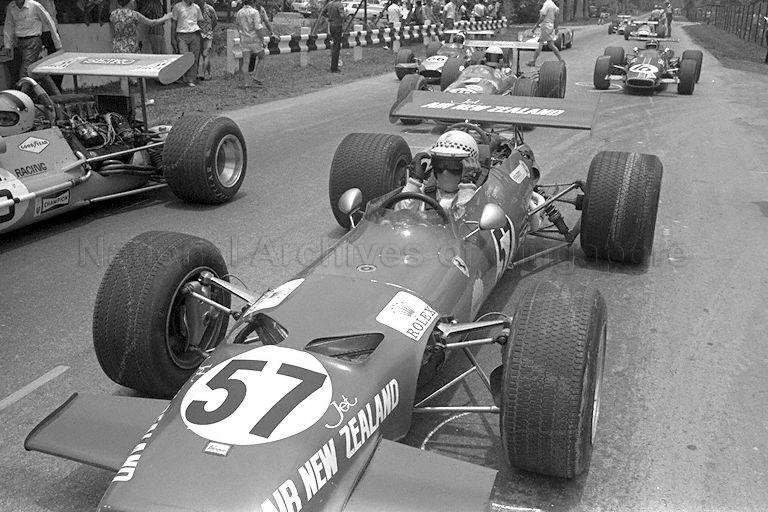
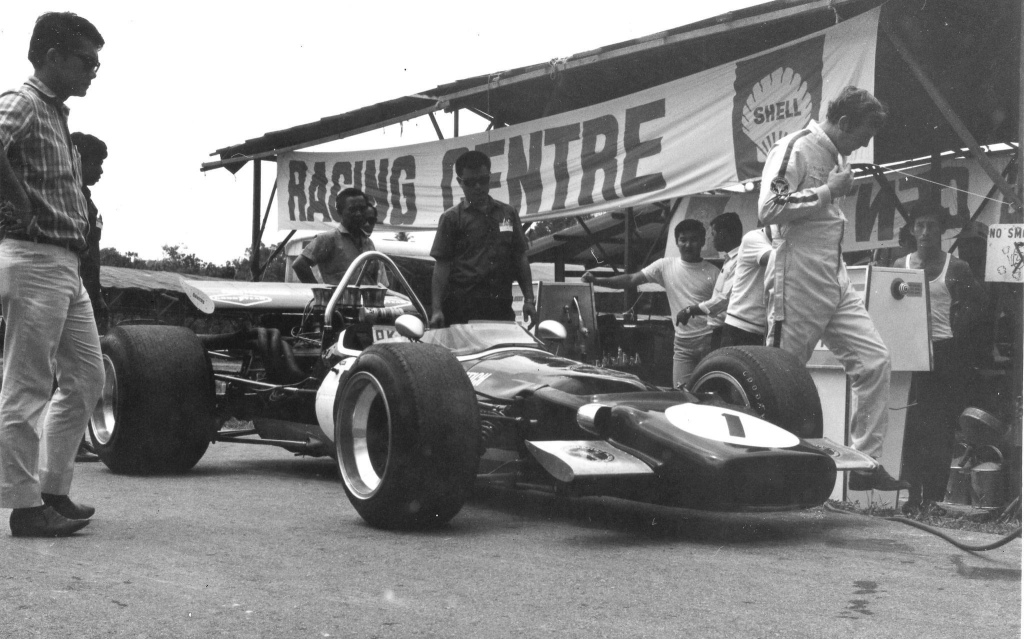
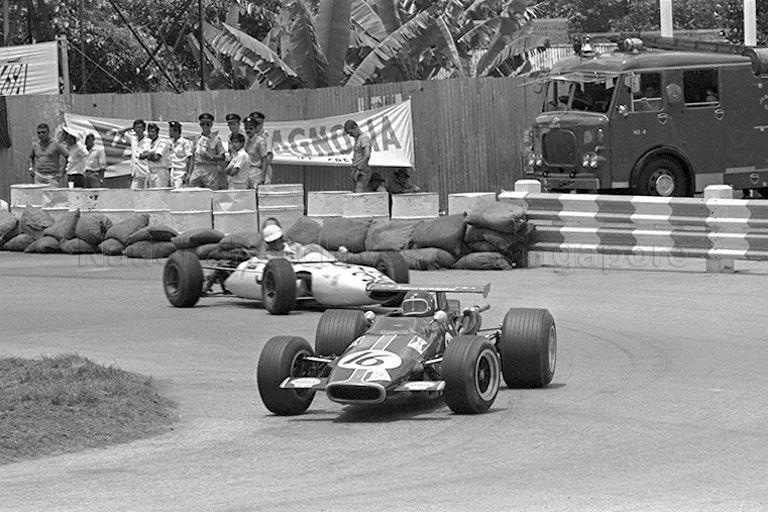









 primotipo...