Jo Siffert and JW Automotive’s John Horsman with Jo’s Porsche 917K during the Brands Hatch 1000 km meeting on the 4 April 1971 weekend…
This is a bit of a signature Rainer Schlegelmilch shot- framed through the engine cover of another team car in the Brands pitlane- that of Pedro Rodriguez and Jackie Oliver to be precise.
It was always going to be tricky winning in the 917 at Brands- and so it was that more nimble 3 litre prototypes finished in front of the Siffert/Derek Bell machine.
Stommelen Alfa T33/3, Ickx #51 Ferrari 312PB, Pedro in the #7 JW 917 and the rest, gotta be the warm up lap (unattributed)
Future sportscar ace Henri Pescarolo in the winning Alfa T33/3- his first Le Mans win was in 1972 aboard a Matra with Hill G (unattributed)
Andrea De Adamich and Henri Pescarolo won the race in an Alfa T33/3 V8 from the flat-12 engined Ferrari 312PB of Jacky Ickx and Clay Regazzoni.
The Alfas were pretty pacey that weekend, Rolf Stommelen popped the T33/3 he shared with Toine Hezemans on grid 2 in addition to the efforts of the winning car.
Ickx was on pole in the 312PB which had a limited campaign in 1971 as a dress rehearsal for the great pace the evolved 312PB had in 1972 when the cars won pretty much everything except Le Mans. They entered but did not appear such was the lack of confidence in the F1 derived engines ability to last 24 hours.
Regga aboard the 312PB whilst Ickx looks on from the rear.
I always thought it a huge shame that Scuderia Ferrari didn’t race the 512M as a factory entry in 1971- it would have been great to see the 5 litre cars with both ‘factory teams’ going at it for the final year of the championship under those Group 5 rules.
Ferrari certainly spent 1971 wisely developing their 312PB for 1972 however, dominant as they were in the first year of the 3 litre prototype formula.
Rodriguez, Stommelen and Siffert (unattributed)
Carlo Chiti and his merry band at Autodelta built a really nice bit of kit in the 1971 iteration of their long running series of Tipo 33 sportscars.
With an aluminium monocoque chassis, double wishbone/coil spring dampers at the front and single upper link, inverted lower wishbone/coil spring damper and twin radius rods at the rear the chunky looking design was an expression of sportscar orthodoxy of the time.
The 90 degree all aluminium 2998cc, quad cam, 4 valve, Lucas injected V8 gave around 420 bhp @ 9400- and with a decent roster of drivers the car won Targa (Vaccarella/Hezemans), Brands and the season ending Watkins Glen 6 Hour (De Adamich/Pescarolo) in a very good year in which the 5 litre monsters again took the bulk of the wins, and Porsche the manufacturers championship for the second year on the trot.
De Adamich, Alfa T33/3, Brands 1971 (unattributed)
Credits…
Rainer Schlegelmilch
Tailpiece: Derek Bell, Porsche 917K from the winning car in Henri Pescarolo’s hands- Alfa T33/3…
Jochen Rindt doing some Brabham ‘grass cutting’ at the Tulln-Langenlebarn airfield circuit in 1967 with the flair and precision for which he was famous…
There are the ‘thinking drivers’ of course but it’s the ones with mesmerising, other worldly driving skills that ultimately excite.
The high priests amongst these fellows are the likes of Nuvolari, Fangio, Peterson, Villeneuve and of course Jochen Rindt. Only two of these chaps died in bed. In the days when racing cars and the geography in which they raced could and did bite, the law of averages, especially if you played with the extremes of the laws of physics too often could bring you undone.
Rindt from JPB at TL in 1968. He won from JPB and Henri Pescarolo in works Matra MS7 FVA’s. Brabham BT23C’s filled 5 of the top 10 placings (unattributed)
Rindt made his name in F2- he was the dominant player in the class from the time he entered it in 1964 until the time he left planet earth in 1970. For much of that period he raced Brabhams- the chuckability of which were tailor made for the plucky Austrians balls to the wall, tail out, crowd pleasing style. Check out this article about Jochen and the F1 Lotus 72 Ford; https://primotipo.com/2017/05/19/designers-original-intent/
The BT23 family of cars, Tasman and F2/FB variants were ripper cars. They were up there with the very best of customer Brabhams designed by Ron Tauranac, fettled by Jack as to baseline chassis setup and built by Motor Racing Developments in large numbers.
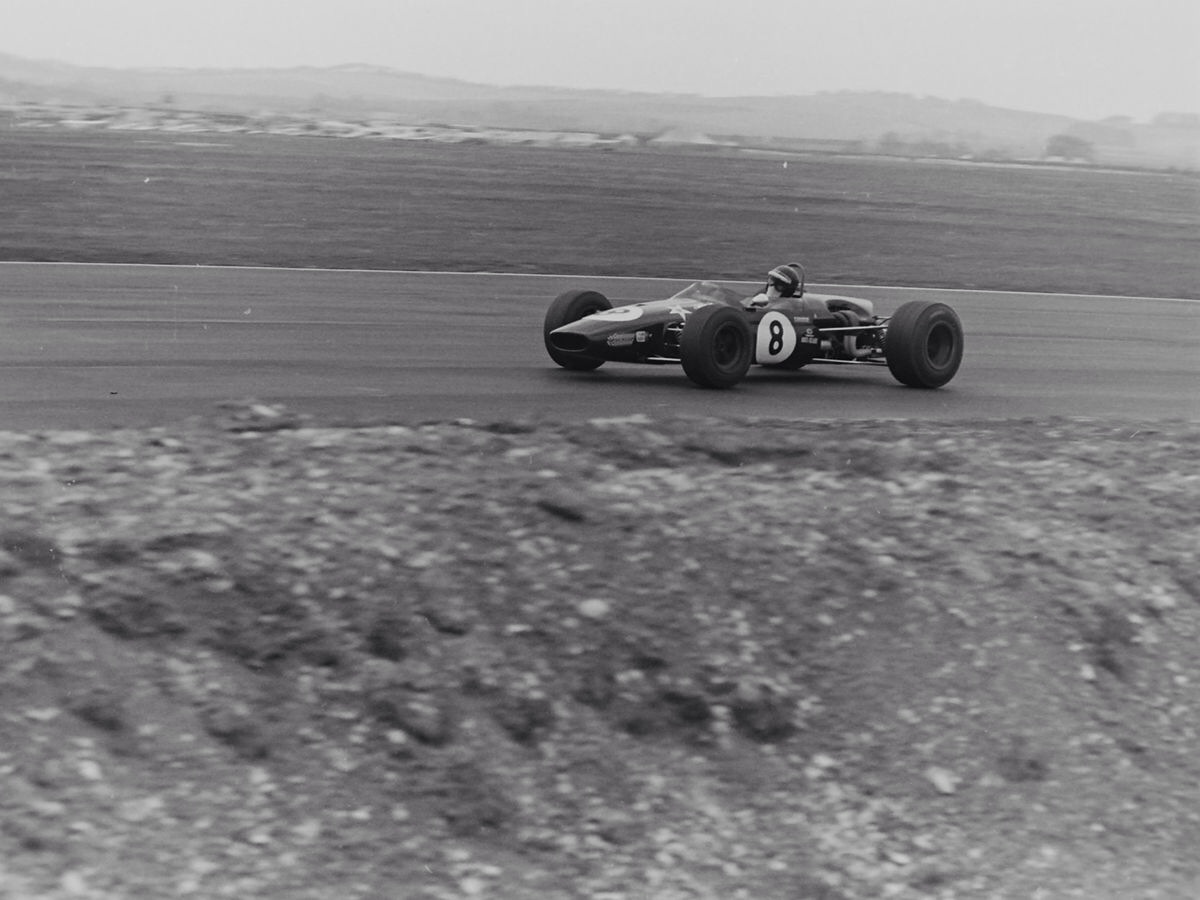
The photos in this article are of Rindt at Tulln-Langenlebaln, Vienna and Thruxton. At TL Rindt’s Winkelmann BT23 FVA won in 1967 from Jack Brabham’s works machine and Jean-Pierre Beltoise’ Matra MS5 FVA , and ‘winged in 1968 from JPB and Henri Pescarolo both aboard works Matra MS7 FVA’s.
At Thruxton (below) in 1968 he won from JPB in an MS7 FVA and Derek Bell in a BT23C FVA. Jochen also raced a BT23C in ’68, again Winkelmann entered.
Jochen on the way to winning the ‘BARC 200’ at Thruxton on 15 April 1968, Winkelmann BT23C (unattributed)
Bibliography…
F2 Index
Photo Credits…
Unattributed
Tailpiece: Rindt, on it, as usual, BT23C, Tulln-Langenlebaln, Vienna, 14 July 1968…
The big F3 field gets away on the first lap of of the 1967 ‘Coupes de Vitesse’ on 2 April. Pau such aspectacular race locale…
The race was won by Jean-Pierre Jaussaud from Roby Weber both in works Matra MS6 Ford Cosworth’s, Peter Gethin was third in a Brabham BT21 Cosworth. The field had plenty of talent including Derek Bell, Patrick Depailler and Tico Martini. Amongst the non-qualifiers were Patrick Depailler and Jean-Pierre Jabouille. Their speed would improve!
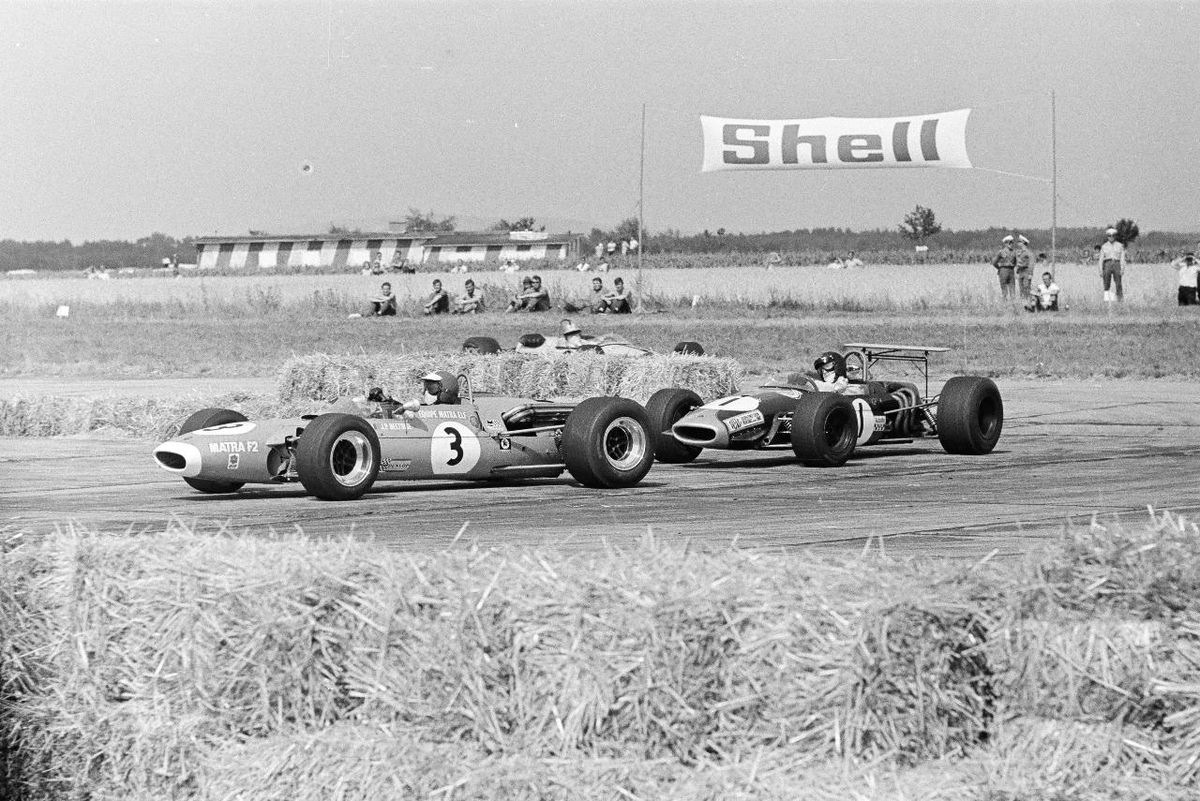
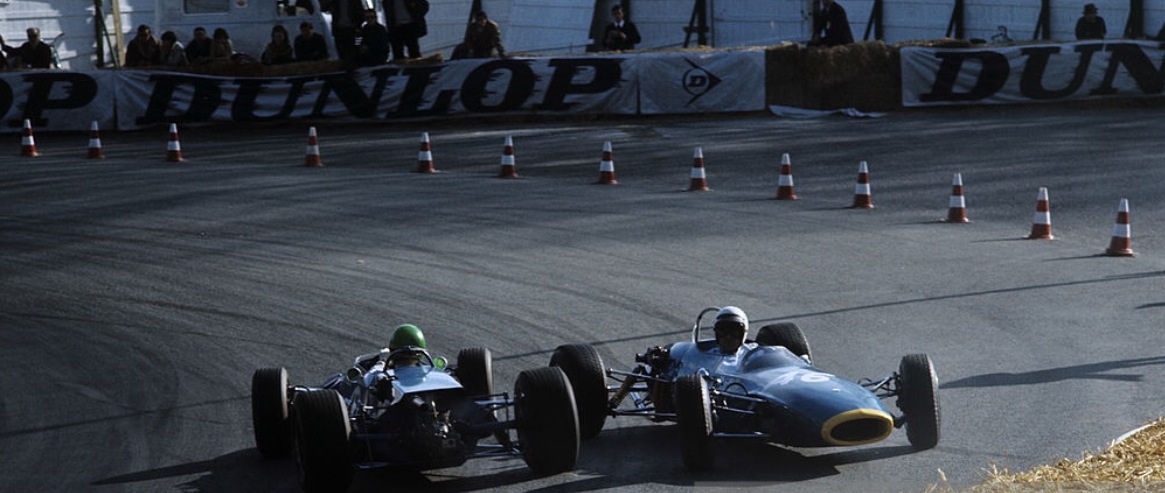
The shot above shows green helmeted Henri Pescarolo in another works Matra MS6 having a territorial dispute with Mauro Bianchi in a works Alpine A310 Renault. Henri won the French F3 Championship that season from Jaussaud.
Credits…
Jean Tesseyre
Tailpiece: Frantic Pau…
Weber from Jausaud, Gethin, Chris Williams and the nose of Pescarolo. Matra MS6 x 2, Brabham BT21 x 2 and Matra MS6 (Tesseyre)
Henri Pescarolo in BRM P160E-10 18th, ahead of Ian Scheckter Lotus 72E Ford, 13th during the 1974 South African GP, Kyalami (unattributed)
One of my favourite designers is Tony Southgate, ‘tops’ for me of his many great cars are the 1970 P153 and updated and evolved 1971-4 BRM P160 GP winning machines…
‘Every man and his dog’ drove these cars from champions to journeymen, the last of the 10 built, the ex-Lauda/Pescarolo ‘P160/10’ is now owned by Sydneysider John Gale who is writing a fascinating, detailed blog as he and his team of artisans restore the car, here ‘tis, have a look at it;
Niki’s ‘brand spankers’ BRM P160E-10 upon its race debut at Monza in 1973, DNF (unattributed)
I thought my series of articles on the reconstruction of Peter Brennan’s ex-Lombardi Lola T330 Chev ‘HU18’ were detailed but they were ‘high level summaries’ compared with this engaging blog!
I’ve a piece in process about the BRM CanAm car with P153/160 tangents I’ll upload in the next month or so but in the meantime lose yourselves in this wonderful site for an hour or three!…
Tailpiece: BRM team at Watkins Glen 1973, Lauda’s #21 new P160E-10, Beltoise #20 and Regazzoni’s similar cars…
Model Venetia Day tries to get comfy atop the monocoque of Matra’s 1970 F1 challenger, the MS120. This famous shot was taken on the preview day of London’s Racing Car Show at Olympia in January 1971. The compound curvature of the Matra is more than matched by Venetia’s lissom lines, the raincoats of the ‘snappers seem apt, all struggling with the correct focal length of their shot.
Matra make their GP debut at Monaco in 1968. Beltoise’ Matra MS11 with MS9, induction between the cams V12. Q8 and DNF after an accident. Short snub-Monaco nose fitted (Cahier Archive)
Matra MS120…
Jackie Stewart won the Drivers and Constructors World Championships for Matra in 1969 with the Tyrrell Team’s Ford Cosworth powered MS80. Matra entered F1 with Ken Tyrrell’s team in 1968, his cars were Ford powered, in addition their own V12 engined MS11 debuted.
In 1969 Matra focussed on developing their V12, the MS80 was designed for the Ford DFV only, the strategy was successful, few new teams have won a World Championship so soon.
Jackie Stewart in his ’69 championship winning Matra MS80 Ford. French GP, Clermont Ferrand.(unattributed)Monaco GP 1970. Henri Pescarolo ahead of Pedro Rodriguez’ BRM P153, the Matra V12 powered car finished third , Pedro finished sixth in his car, also V12 powered. Rindt’s Lotus 49 achieved a great victory having pressured Jack Brabham into a last lap error (unattributed)
Commercial Considerations…
For 1970 Matra went it alone running cars powered by the French aerospace company’s own V12. Matra boss, Jean Luc Lagarde, did a deal to sell his Matra 530 sports car through the Simca dealer network. Simca were owned by Chrysler, who were not about to have a Ford engine powering ‘their racing car’.
Tyrrell was offered the MS120 for 1970. Stewart tested the car at Albi but felt that the DFV was the more competitive engine and after most of 1970 running a customer March 701, Tyrrell’s own Ford DFV powered cars made its debut, with Stewart taking two more titles in 1971 and 1973. Tyrrell and Stewart were correct in their assessment, Tyrrell’s first Derek Gardner designed 001 was similar in many ways to the MS80 which was always one of Stewart’s favourite cars.
Equipe Matra, British Grand Prix 1970, Brands Hatch. DNF for both Beltoise and Pescarolo. Rindt’s Lotus 72 won the race after Brabham’s BT33 ran short of fuel. These paddock shots clearly show the different aerodynamic approach adopted by Matra’s Bernard Boyer (unattributed)
MS120 Design…
Chassis Designer Bernard Boyer created a new monocoque with cockpit sides and upper surfaces shaped to use the airflow over the car to develop downforce. New approaches to aerodynamics in 1970 by the March 701, the stunning wedge shaped Lotus 72 and the MS120 were stark contrasts to the cigar shapes of the 1960s. The other aero approach was the pregnant-coke-bottle adopted by the BRM P153 (see picture of Rodriguez in Monaco) to get the fuel load as low as possible in the car.
Front suspension geometry was developed directly from the MS80 but the wheelbase was 10cm longer due to the difference in length of Matras V12 relative to the DFV.
Matra’s 48-valve, 3-litre V12 was further developed by Gerard Martin’s team with a new block, which, DFV style, allowed the engine to be attached directly to the rear bulkhead of the monocoque to carry the loads of the rear suspension and Hewland FG400 five-speed transaxle. The engine developed around 435bhp @ 11000rpm, about the same as the DFV, but it was lighter and more fuel efficient.
The DFV was the-engine of the 3-litre formula, Ferrari’s flat 12 its only true competitor over the longer term and even then it was hamstrung by the chassis which sometimes carried it…the DFV had no such problem given so many teams used the ubiquitous engine.
Matra MS12 3-litre, 60 degree, 48-valve, Lucas fuel injected V12. It developed circa 435bhp @ 11000 rpm from 2993cc. The engine was used as a stressed member, suspension mounts bolting directly to the engine. Aeroquip brake lines running along top radius rod, Lucas fuel injection and metering unit in shot(unattributed)
Drivers and Results…
The MS120s were driven by Frenchmen Jean-Pierre Beltoise and Henri Pescarolo in 1970, they finished 9th and 12th respectively in the Drivers Championship. Whilst both were fast, neither was an ace, Matra finished seventh in the Manufacturers Championship. Jochen Rindt won the drivers title posthumously and Lotus the constructors for points gained by both its old 49 and revolutionary, new 72.
1970 was a very competitive season with the Brabham BT33, BRM P153, Ferrari 312B, Lotus 49 and 72 and March 701 all winning Grands’ Prix. The MS120 was a little heavy, was thirsty and lacked the reliability of much of its competition, JPB had five retirements out of 13 rounds and six top-6 finishes whilst Pesca had three retirements and four top-6 finishes.
The team lacked an ace behind the wheel and someone with real depth of F1 testing and race experience to be able to fully develop the car. French Car, French Engine, French Sponsors and French Drivers all sounds great and made political sense given the Government funds involved, but in reality, in 1970, they needed Ickx, Amon, Rodriguez, Rindt or Stewart. Of course this analysis excludes drivers rusted-on to their own teams.
Clermont Ferrand, start of the 1970 French GP. Stewart March 701, Rindt Lotus 72, Pesca MS120, Rodriguez BRM P153 obscured, Jack Brabham Brabham BT33, Denny Hulme McLaren McLaren M14A, Ronnie Petersen March 701, Ignazio Giunti Ferrari 312B, Francois Cevert March 701…talent aplenty in 1970…(unattributed)French Grand Prix 1970, Pescarolo fifth in his MS120 at Clermont Ferrand, Beltiose 13th in the race won by Rindt’s Lotus 72 (Cahier Archive)
Withdrawal from F1…
Matra withdrew from F1 as a chassis constructor at the end of 1972, despite blinding speed shown on occasion by Chris Amon in 1971-72. They eventually won Grands’ Prix as an engine supplier in Ligier chassis in the late 1970s and into the 1980s.
The 3-litre V12 was fabulous, its screaming note one of racings most evocative, shrill best. It also achieved endurance success, the French company winning Le Mans in 1972-73-74 with its ‘670’ series of cars.
Matra’s were superbly designed, distinctively different and exquisitely built racing cars, the aeronautic background of the company was obvious in the execution of the cars construction. The Grand Prix scene was the poorer for their absence, but from a commercial perspective it was mission accomplished for Matra with an F1 Constructors Championship and three Le Mans victories on the trot.
The other car behind Venetia is a Surtees TS9 by the way, or perhaps you didn’t notice…
Etcetera…
JPB MS 120 1970…the more you look the more you see! Just a beautifully engineered and built carBeltiose all ‘cocked up’ at Monaco ’68, this kiss of the kerb causing his retirement. MS11 (unattributed)Matra MS120 family: top to bottom 1970 MS120, 1971 MS120B and 1972 MS120C (Pinterest)MS12 cutaway…3-litre, 60-degree, 48-valve V12. Lucas fuel injection. Designed to be used as a stressed member, bolted directly to the monocoque rear bulkhead.
(Matra)The 1969 Matra Squad: Matra’s Henri Pescarolo and Jean-Pierre Beltoise, and the Tyrrell duo of Johnny Servoz-Gavin and Jackie Stewart (unattributed)






 primotipo...