Posts Tagged ‘Jim Clark’

image

The beautifully finished and trimmed cockpit of Clarks’ Lotus 25 at Monaco 1963. Leather bound Mota-Lita steering wheel, a dash full of Smiths instruments including its famed chronometric tach and right hand change for the 5 speed ZF ‘box. Naked aluminium of the monocoque chassis below the shift lever. (Yves Debraine)

The tell-tale on Jim Clarks Lotus 25 after his retirement from the 1965 Monaco Grand Prix is at 9500rpm…

He was comfortably in the lead of the race by 14 seconds when the car engaged 2 gears at once on the entry to the Gasometer hairpin. Graham Hill inherited a lead he maintained to the race’ conclusion.

image

Clark in classical pose. Lotus 25 Climax. (Eric Della Faille)

The Lotus 25, the first ‘modern monocoque’ appeared at the Dutch Grand Prix in 1962 and was much copied for the 1963 season. For ’63 the car remained much unchanged other than small details and power increases from the Coventry Climax FWMV 1.5 litre quad cam, 2 valve V8.

Lucas fuel injection was adopted and a changed bore/stroke ratio allowed higher rpm and power.

Lotus retained the ZF gearbox but also tried a 6 speed Colotti-Francis ‘box and later in the season a Hewland 5 speed transmission which would soon become ubiquitous.

image

Surtees gesticulating at the fast approaching Ginther. (Marti)

John Surtees and Richie Ginther in Ferrari T56 and BRM P57 respectively scrapped for much of the race, this shot is on the entry to the Gasometer hairpin. Ginther tries to pass with Surtees gesticulating in protest.

Ginther finished second to teammate Hill, with Surtees, sitting in a pool of oil and with falling oil pressure finished fourth and set fastest lap on the last lap and the lap record. McLaren was third in his Cooper T66 Climax.

image

John Surtees eyes focused on a Monaco apex, Ferrari T56/156. (Yves Debraine)

Ferrari competed with interim cars for much of the season using the V6 engines which won the World Championships in 1961. The 1964 car appeared at Monza powered by a V8, the development of the car in ’63 setting up Surtees’ tight title victory in 1964.

dark

Surtees again, here chasing winner Graham Hill’s BRM P57. (unattributed)

clark monaco lotus 25

Clark enroute to what seemed a certain victory, before the intervention of gearbox dramas in his lithe, lissom utterly luvverly Lotus 25. (Unattributed)

hill winner

To the victor, the spoils. Graham Hill ‘The King of Monaco’ after the first of his 5 wins in the Principality. (Getty Images)

image

Lotus 25 Climax cutaway drawing by James Allington…

This short article makes no attempt to put into perspective one of the most successful and influential racing cars of all time, the first ‘modern monocoque’ includes amongst its relatives all monocoque racing cars built since its debut at Zandvoort in May 1962.

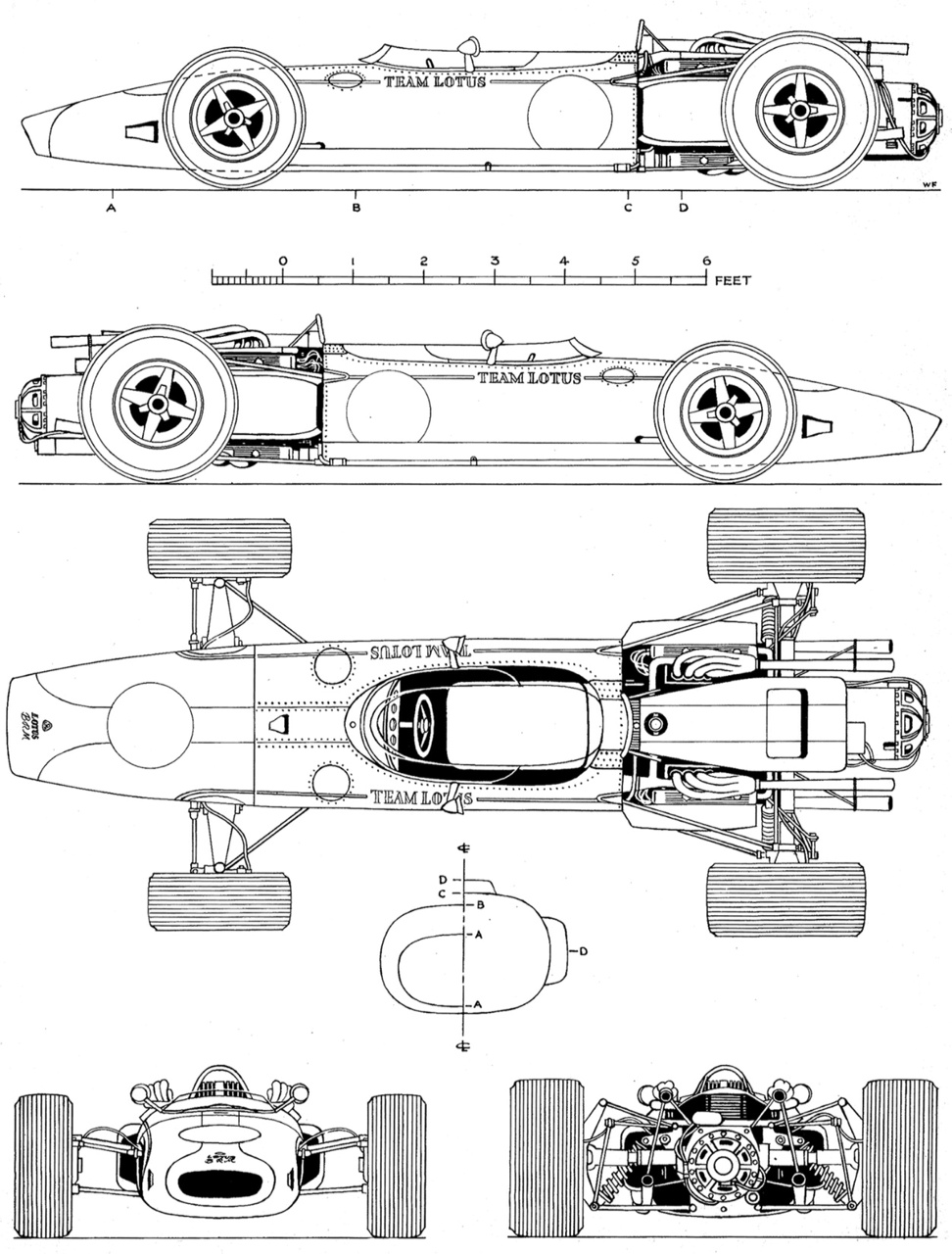
‘Monocoque’ construction by riveted ‘D section’ light alloy longerons attached to fabricated steel bulkheads front and rear.

Front suspension by upper top rocker operating inboard mounted coil spring /damper unit, lower wishbone and adjustable sway bar. Rear suspension by upper top link, inverted lower wishbone and coil spring/damper unit and adjustable sway bars. Cast alloy uprights front and rear.

Girling disc brakes, rack and pinion steering.

Wheelbase 91 inches, track front 51.5 inches, rear 51.75 inches, overall length 146 inches, dry weight 990 pounds. Wheel sizes 5X15 front and 6 or 6.5X15 inches at rear.

Coventry Climax FWMV 1.5 litre 90 degree V8. Bore 67.8mm, stroke 51.6mm, 1496cc, Lucas fuel injection, compression ratio 10.5:1, weight 290lb, 194bhp @ 8500rpm.

ZF gearbox mainly used in 1963 but Colotti and Hewland also tried.

Clark and Chapman

Clark and Chapman with a ’63 spec 25, its essential elements as described above. (Unattributed)

Clarks 1963 Championships…

Clark Zandvoort 1963

Jim Clark, Dutch Grand Prix June 1963. Jim zooms his Lotus 25 between the North Sea sand dunes at Zandvoort on his way to victory. (Yves Debraine)

That Jim Clark and the Lotus 25 were the fastest combination in 1962 was not in doubt but Coventry Climax reliability was not as great as BRM’s that year. In 1963 the promise of ’62 was realised with Clark winning five Grands’ Prix and both the Drivers Championship for himself and the first Manufacturers Championship for Lotus.

Clark finished second in a Lotus 29 Ford in his first foray to Indianapolis and further demonstrated his versatility with wins in cars as diverse as the Lotus 23 sports car and Ford Galaxie touring car/saloon that year.

Clark became the standard by which other drivers were judged in 1963, if not earlier.

Auto Year 13

The cover shot of Clark is at the Dutch Grand Prix, Clark won on the 25’s debut there in 1962 and in 1963 and 1964, all in 25’s and in 1965 in the updated Lotus 33 also Climax FWMV V8 powered.

Oulton Park Gold Cup 1963…

clark winning oulton gold cup 1963

Not only did Jim Clark win the Oulton Park Gold Cup during 1963 but he also recorded some stunning in car footage at the Cheshire circuit in his Lotus 25, such footage very rare at the time.

http://m.youtube.com/watch?v=PffCawETtK8&autoplay=1

There were four Non-Championship F1 races in the UK alone in 1963, lucky Brits! The footage is amazing on so many levels not the least of which is a drivers eye period view of the circuit; typical track edges, the lack of run off areas and the topography of trees, ditches and the like for the unwary…and this is a circuit devoid of the ‘special obstacles’ of the ultra dangerous road circuits of the day on which Clark raced. The Nurburgring, Spa, Reims, Pescara and Longford here in Australia spring to mind.

Ok, he is not racing but the precision and accuracy for which he was renowned is also on display…

An ace in every sense of the word.

clark atop 25 oulton park 63

Etcetera…

Lotus 25 camera car

Clark tootling thru the Oulton paddock in his ‘camera car’, its a bit hard to pick out the beefy mount against the dark background. And to think in the day of the ‘GoPro’ this was how it was done only a short time ago. Even when the specialists at Channel 7 in Australia popularised in car footage in the ‘Bathurst 1000’ in the late 70’s the heavy rig occupied a good percentage of the rear seat area…progress! (Unattributed)

image

Photo Credits…

Yves Debraine, Eric Della Faille, Marti, James Allington cutaway drawing, Automobile Year 13, Peter Windsor

Finito…


image

Jim Clark takes a deep breath as he aims his big, heavy Lotus BRM around Oulton Park in 1966…

The Oulton Park Gold Cup was one of  numerous non-championship F1 races run in the mid-sixties.

Clark practised the car but discretion was the better part of valour, he raced his reliable, nimble Lotus 33 Climax in the race won by Jack Brabham’s BT19 Repco, the dominant car of 1966. The great Scot finished third in the 33, a car he took over from teammate Peter Arundell after the H16 engine in his Lotus blew up shortly after setting the third fastest time, a time equalled by Jackie Stewarts’ BRM ‘H16’.

The H16 engine famously had its only victory, in a Lotus 43 in Clark’s hands in the US Grand Prix several months later.

image

Brian Watson’s shot of the smoky H16 engine in Clarks’ Lotus 43 about to pop at Oulton Park!

The Lotus 43 was a much maligned car, the facts tend to suggest it wasn’t quite as bad as many would have us believe.

Clark raced one four times- in the 1966 Italian, US and Mexican GP’s and in the first of the 1967 Grands’ Prix, in South Africa. He scored one win at Watkins Glen, qualified on the front row three times, once on the second and was competitive in all four events. I’m not saying he wasn’t happy to race a nimble 33 at Monaco, rather than the 43, or that he was sorry to forsake the 43 for the 49 at Zandvoort however!

It’s also technically interesting in that the P75 BRM engine was used as a stressed member of the chassis in the same way the Ford Cosworth DFV in the  49 which followed was. Much is made of this aspect of the Ford DFV’s attachment medium to the car, but Vittorio Jano used the technique in his 1954 Lancia D50 GP car. It wasn’t the first time it was done whatever the Ford/Lotus PR machine of the time would have had us believe.

The BRM engine was attached to the rear bulkhead, as was the DFV to the 49. The suspension was mounted to the engine and gearbox as was the case with the 49.

Look at the 43 and 49 from the front and they are hard to pick. Conceptually they are similar in terms of chassis and suspension. Look aft of the rear bulkhead and the massive girth of the BRM engine is in marked contrast to the svelte Keith Duckworth designed, Ford Cosworth 3-litre DFV V8. Chapman famously concepted the engine he wanted, and the means by which it was to be attached to his chassis.

Jim Clark Lotus 43 BRM Italian GP 1966

The BRM P75 engine was a massive lump, essentially it was two of the P56 BRM 1.5-litre V8’s, but at 180 degrees, placed on top of each other.  Its designed weight of of 380lbs ballooned to 555lbs, the DFV weighed less than 400 pounds.

Road and Track magazine published the scrutineered weights of the cars at the 1966 Italian Grand Prix. The Twiggy-like Brabham BT19 weighed 1,219lb, a marked contrast to the Cooper Maserati at 1,353lb. The pork-chop BRM and Lotus 43 were 1,529lb and 1,540lb respectively.

Mind you, the Honda topped the scales at 1,635lb. Interestingly the Hondola (Lola designed chassis) which won at Monza in 1967 weighed 1,309lb, a loss of 150 pounds in twelve months, whereas the BRMs, without a visit to Jenny Craig had porked up to 1,570lb- the Lotus 49 weighed 1,200lb.

The DFV at that stage developed about 405bhp, whereas the BRM P75 H16 never developed its claimed 400bhp, and had a lot of weight to carry.

The Lotus 43 was far from the worst Lotus ever built. Many of its GP cars didn’t win a GP, for sure the BRM P75 H16 engine was never to have the reliability of the 49’s Ford Cosworth DFV – one wag described it as ‘the spacer between the rear bulkhead and the gearbox’, such was its dependable nature!

The 49 deserves its place in the pantheon of Great Grand Prix cars but the 43 is conceptually closer to the 49 than Chapman- and Ford wanted to admit at the time.

Jim Clark Lotus 43 BRM US GP 1966

Clark launches his Lotus 43 off the line at the start of the 1966 US GP. He is using the BRM teams spare ‘H16’ engine, his own failed at the end of practice having just qualified behind Brabhams BT19 on pole. Clark, against the odds won. That’s Surtees Cooper T81 Maserati behind and the nose of Bandini’s Ferrari (unattributed)

Jim Clark Lotus 43 BRM Monza 1966

Clark looks happy enough as he mounts his Lotus, Monza 1966. It looks like Brabham’s BT19 Repco being pushed alongside – bulk obvious, weight of engine and gearbox 675 lbs! (unattributed)

Lotus 43 BRM drawings

Etcetera…

Jim Clark Lotus 49 Ford Dutch GP 1967

 (unattributed)

Front shot of the Lotus 49 Ford at Zandvoort 1967, Clark up.

He won on debut after Hill’s car retired whilst in the lead – not so different from the 43 at the front at least!

Lotus 49 Ford rear, Clark Dutch GP 1967

(unattributed)

The delicate rear end of Jim Clarks’ Lotus 49 Ford on its debut at the Dutch Grand Prix in 1967. In marked contrast to the big, butch BRM ‘H16’!

ZF five-speed gearbox, suspension and chassis design oh, so similar to the Lotus 43, as was attachment of engine to chassis and its use as a stress bearing member

BRM H16 engine article

Photo Credits…

The Nostalgia Forum, Brian Watson

Finito…

jim clark wf lotus 49 1968

Jim Clark enjoying the plaudits of the crowd after his Warwick Farm win, 18 February 1968…

Its a wonderful shot on his victory lap, the crowd wandering onto the track, absolute joy on Jims’ face after a stong win, a man at the top of his game, he still hadn’t peaked as a driver and only 31 years old…

He is at the wheel of his Lotus 49 Ford DFW, the DFW the 2.5 litre variant of Cosworths’ dominant DFV 3 litre GP engine. Clark won by 10 seconds from his teammate Graham Hill, he left our shores at the end of the Tasman Series 2 weeks later as the 1968 Champion and sadly never returned.

Clark was a regular and immensely popular visitor to Australasia, the gentlemanly Scot admired and respected by fellow competitors, the media, fans and the general public alike.

His final GP win was the 1968 season opening South African GP at Kyalami, he perished in a Lotus 48 F2 car, after a tyre failure at Hockenheim on April 7 1968.

Photo Credit…Wirra TNF

Denny Hulme and Jackie Stewart, Levin NZ Tasman 1967 (Digby Paape)

Denny Hulme Brabham BT22 Repco and Jackie Stewart BRM P261, the natty tartan attire of the BRM Equipe a contrast with the more casual Australian approach…Hulmes’ engine is Repco ‘640 Series’ 2.5 litre; original ’66 series Olds ‘600 Series’ block with the ’67 F1 Championship winning ’40 Series’, exhaust within the Vee, heads. Definitive Repco 1967 F1 Championship winning variant is the ‘740 Series’, Repco’s own ‘700 Series’ block and aforementioned ’40 Series’ heads. Early and very important 1967 F1 testing days for Repco, engine making its debut the weekend before at Pukekohe (Digby Paape)

Denny Hulme and Jackie Stewart awaiting adjustments to their cars setup, Levin, New Zealand, Tasman Series 13 January 1967…

Digby Paape took these fantastic, evocative shots of Stewart, Hulme and Jim Clark-‘I was 22 at the time, my father had been president of Motor Sport NZ, and though I was unknown on the North Island I felt I could go anywhere with my Contax, i was masquerading as a journo for the ‘Hutt Valley Motoring Club’. I took all the shots @ F8 @ 250th of a second. Each car only had a couple of mechanics, it was hard to know what was being said. Later on I was the Radio NZ and TVNZ commentator for these and other events, Levin was always hot and the action was close. Close enough for good shots without a telephoto lens’.

Stewart beat Clark in the first Tasman round at Pukekohe the previous week, winning the NZ Grand Prix, the two drivers were the class of the field at Levin as well, despite intense pressure Clark won the 50 mile ‘Levin International’ by less than a second from Stewart’s BRM. Richard Attwood was third in another BRM P261 and Frank Gardner finished fourth in the first of the four cylinder cars, a Brabham BT16 Climax. Denny Hulme retired with ignition problems.

It’s interesting to reflect upon the year to come for each of the drivers…

Denny Hulme, Brabham BT22 Repco, 1967 NZ Tasman, Levin

Denny Hulme, Brabham BT22 Repco, Levin NZ, 1967 (Digby Paape)

It was a tough Tasman for Denny and his team leader Jack Brabham…

They had great unreliability from the new, exhaust between the Vee Repco ‘640 Series’ engines, mainly centred around fuel injection and ignition dramas, but the primary object of the exercise was really to get the engines raceworthy for the 1967 GP season in any event. Jack did have a good win at Longford in his BT23A, the power circuit in Tasmania and last round of the series.

Repco sorted the problems, the new Repco (as against the 1966 Oldsmobile blocked ‘620 Series’) blocked ‘740 Series’ engines were reliable early in the GP season.

Denny broke through for his first GP win at Monaco, 620 engined, but there was no joy in the victory as Lorenzo Bandini perished aboard his Ferrari 312 in a gruesome, fiery accident, which finally helped galvanise action to improve safety standards on the world’s circuits.

In a season when five different drivers won a Grand Prix, his consistency paid off, he won the title with two wins, the Nurburgring the other, from Jack with Jim Clark third in the epochal Lotus 49 Ford Cosworth DFV.

image

Hulme en route to his first Grand Prix victory, Monaco 1967 in his Brabham BT20, still fitted with the ’66 series ‘RB620’ engine. Jacks car was fitted with the new ‘740 Series’ the engine blew early in the race. Hill and Amon second and third in Lotus 33 BRM and Ferrari 312 respectively (unattributed)


1967 CanAm Road America

Can-Am Road America 1967 parade lap: #4 Bruce McLaren, Hulme alongside in the other McLaren M6A Chev, Dan Gurney Lola T70 Ford behind Bruce, Jim Halls’ winged Chaparral 2G Chev easy to pick…and the rest maybe some of you can help me with the caption? Denny won the race from Mark Donohue and John Surtees , both in Lola T70 Mk3B Chevs (unattributed)

In a full season, Hulme was recruited by his compatriot Bruce McLaren as his teammate in the Can-Am series. Robin Herd’s McLaren M6A Chev was a stunning car, concepted by he and Bruce, and started the teams domination of the series which finally ended when Porsche joined the series, and ruined it! with its 917/10 in 1972.

Denny narrowly lost the series to McLaren but the relationship started a commitment to the team by Denny which endured to the end of his career and saw him race the team’s F1, Can-Am and Indy Cars through to the end of 1974, when he finally returned to NZ.

Jim Clark, Lotus 33 Climax, NZ Tasman, Levin 1967

Jim Clark, Lotus 33 Climax, Levin 1967. ‘R14’ was the last of the trendsetting Lotus 25/33 series built, the first ‘modern-monocoque’ which made its debut in Holland 1962. Clarks 2 litre V8 was giving away some power to most of his serious competition, the 2.1 litre BRM’s and 2.5 litre Repco’s but his driving abilities were more than up to closing the deficit (Digby Paape)

Clarks Lotus 33 ‘R14’ was a chassis which had been kind to him…

He first raced it at Brands Hatch in July, and, fitted with the super trick 2 litre version of the Coventry Climax FWMV V8 had served him well in 1966, he drove the car when the heavy BRM ‘H16’ engined Lotus 43 was unsuited to the circuit or circumstances- his best result against the new 3 Litre F1’s was a strong third in Holland.

He won the Tasman series in ‘R14’, assisted greatly by the unreliability of the Brabham Repcos and the BRM P261’s, the latter so dominant the year before. The two 2 litre FWMV V8’s were shipped to the Antipodes, the Mk8 1976cc engine was created by using the big 72.39mm bore of the 1964/5 Mk4-7 engines with the 1961/2 Mk1-2 60mm longest stroke to create a circa 245bhp motor. With the ‘R14’/2 litre FWMV combination Clark won five of the eight Tasman Series 100 mile races, three- at Wigram, Lakeside and Sandown were Tasman Cup championship events, the other two at Levin and Teretonga were non-championship races.

Clark raced a Lotus 43 BRM in South Africa, the first GP of 1967, then ‘R14’ for the last time at Monaco, finally getting his hands on the Lotus 49 at Zandvoort. By that time he was a British tax exile so the first time the Scot saw the car was when he drove it in Holland, he hadn’t even tested the thing, those duties had been faithfully carried out by Graham Hill.

Jim Clark, Lotus 49 Ford, Dutch GP June 1967

Jim Clark on his way to a debut win with the Lotus 49 Ford, Dutch GP, Zandvoort June 4 1967…both engine and chassis changed the face of GP racing in an instant (unattributed)

The car was ‘right’ from the start, he won on its debut and then a further four 1967 races, but Dennys’ consistency got him over the line that year in the equally new Brabham BT24, lets not forget that it, too, was cleansheet in terms of chassis and engine that year. Click here for a piece on the Brabham BT24; https://primotipo.com/2017/12/28/give-us-a-cuddle-sweetie/

The Lotus 49 package was dominant in 1968, but sadly Clark’s 1968 South African GP triumph, off the back of his third Tasman Cup win, was his last, he died tragically in a Lotus 48 Ford FVA  as a consequence of probable tyre failure in the during the ‘Deutschland Trophae’ Hockenheim F2 race on 7 April.

The king of the 1.5 litre formula proved he was also king of the 3 litre formula in 1967, and anything else he drove!

Graham Hill heroically galvanised the Team Lotus after Clark’s death, winning the title in 1968 and provided leadership Chapman initially did not, grieving for Clark as he understandably was.

Jackie Stewart took two Tasman Cup wins…

Mechanical woes, particularly weaknesses in the BRM P261’s transmission crown wheel and pinion cost him victories, but his speed was apparent and close to Clark’s- the two races he won were biggies too- the NZ GP at Pukekohe and AGP at Warwick Farm. Unlike Jim, who had the F1 Lotus 49 to look forward to, BRM persevered with the heavy, complex and slow ‘H16’ engined BRM P83/115 in 1967.

It was to be a long, character building year, a second and third in Belgium and France respectively but retirement in all eight of the other championship rounds awaited the young Scot.

He had won his first Grand Prix in the lithe, nimble P261 in Italy in 1965 but it was then a ‘long time between drinks’ in F1, his undoubted speed was finally reflected in wins when he departed to Team Tyrrell which started running Ford DFV engined Matras in 1968, his first title came in 1969 aboard the glorious MS80. Click here for an article on that Matra; https://primotipo.com/2016/07/01/matra-ms80-ford/

Jackie Stewart, BRM P83, Nurburgring 1967

Jackie Stewwart wrestling his big BRM P115 ‘H16’ BRM, Nurburgring 1967. He was running fourth when the transmission failed, ‘yumping’ hard on the ‘tranny at the ‘Ring! Hulme won the race in his light, nimble Brabham BT24 Repco (unattributed)


image

Team Tyrrell ran Matra F2 cars in 1967, Jacky Ickx taking the Euoropean F2 title, and Jackie Stewart, pictured here in an MS7 FVA at ‘Oulton Park’ took one championship win…and critically the team took the view the cars would be successful in F1 (Eddie Whitham)

What duels there may have been as Stewart matured as a driver and took on his friend and countryman Clark- mind you we saw it in the 1967 Tasman as they were in essentially cars of equal performance, albeit JYS’ BRM often did not run for long enough for the duels to run their course…

As Digby Paape says ‘how lucky we were to see the international drivers in current F1 cars as we did in those wonderful 2.5 Tasman years, the equivalent of seeing Schumacher in that years winning Ferrari’. Indeed it was.

Photo Credits…

Digby Paape, Eddie Whitham, Doug Shaw Collection

Tailpiece: Pukekohe 1967…

Love the hats on the gals at the motor racing!

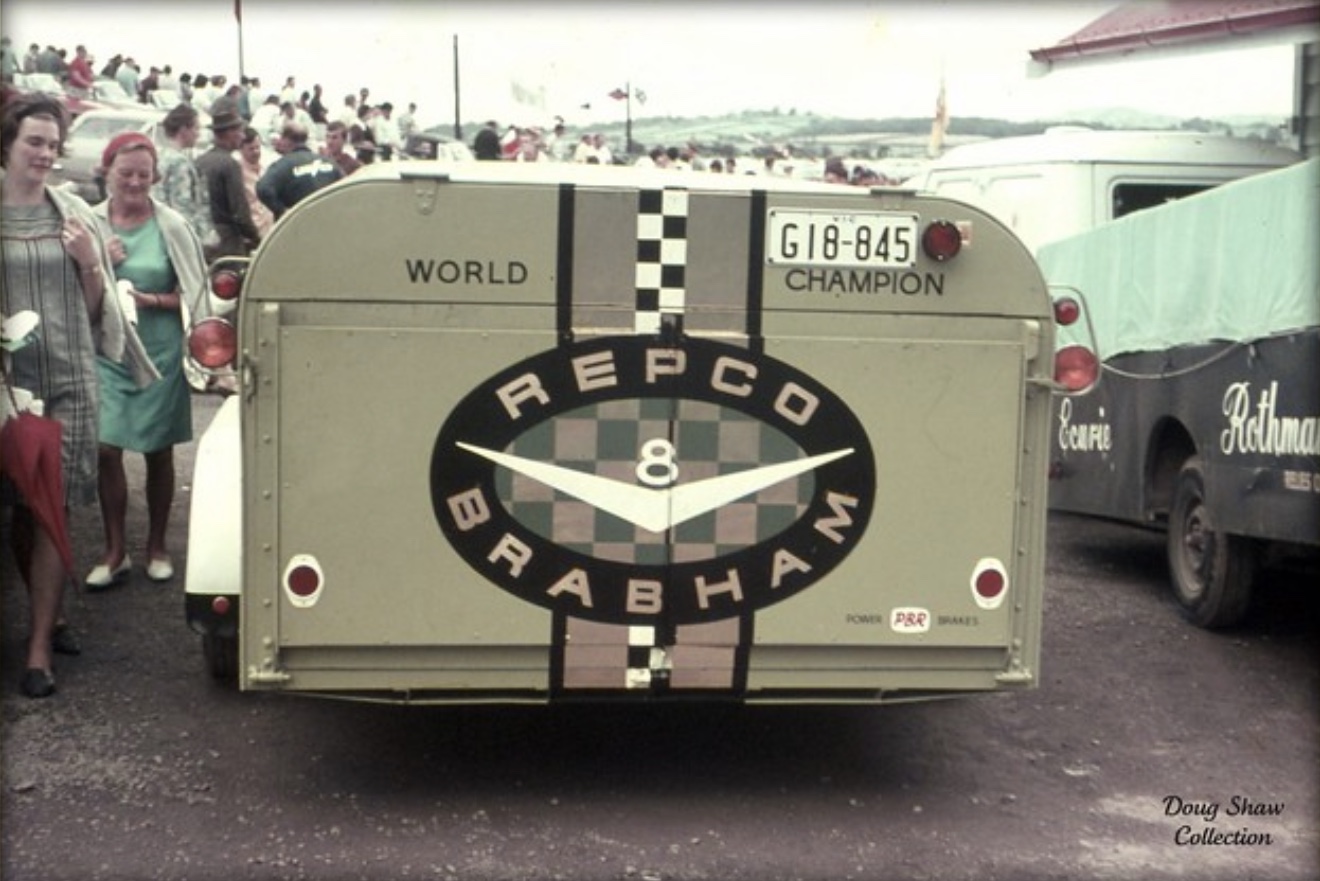
Clearly they have a penchant for ‘Rice Trailers’- it seems said equipment made the trip across the Tasman as well as the two cars, not the happiest of Tasmans for the Repco-Brabham crew despite an ‘all out’ effort to take the Tasman Cup.

Finito…

image

Jim Clark explores the limits of adhesion of his Cortina during the Sebring 3 Hour Enduro in March 1964, he finished first in class…

MotorSport magazine road test of the car from January 1964, this Bill Boddy road test of the car ‘in period’ well worth the read.

‘A £1,100 competition saloon which is also a very practical road car, possessing extremely usable acceleration, very powerful Girling brakes, a top speed of over 100 m.p.h. and good handling qualities.

Soon after that man Chapman had been signed on by British Ford, Dagenham announced the Lotus-Cortina, which was to have a 1 1/2-litre twin-cam 105 b.h.p. engine in a Consul Cortina 2-door saloon body-shell using light-alloy doors, bonnet top and boot-lid, a close-ratio gearbox, modified suspension with a properly-located back axle with aluminium differential housing sprung on Chapman coil-spring struts, Corsair-size servo-assisted front disc brakes, larger tyres and other modifications to improve performance and handling. This Lotus-Cortina was announced enthusiastically in Motor Sport last February, when I remarked that it sounded like the most exciting British car since the Jaguar E-type.

Team Lotus were to run a trio of these Fords in saloon-car races, but the project was a long time coming to fruition, probably because the twin-cam engines were needed for Lotus Elans before they found a place in Cortina body-shells. And competition work with these exciting new cars, for which a top speed of 115 m.p.h. and 0-100 m.p.h. in around 30 sec. is still hinted at in Ford publicity material, was not possible until they had been homologated, which meant that at least 1,000 had to be built. Ford Dealers, promised these fast Cortinas, grew restive, the Ford Board wrathful, but gradually these outwardly normal-looking Cortinas with the colour-flash along the bodyside began to appear on the roads and, occasionally, by the date of Oulton Park’s Gold Cup meeting, on the circuits, while Henry Taylor drove one in the recent R.A.C. Rally.

image

(James Allington)

At last, late in November, a test car was placed at our disposal for a brief period, and let me say right away that we were not disappointed! The Lotus-Cortina is a very commendable all-round car of truly excellent performance, the acceleration being an outstanding feature, very usable from the low speeds at which the average motorist drives, and going on and on most impressively as upward gear changes are made, so that overtaking is rendered not only safe but a positive pleasure!

This Ford is not a 100 m.p.h. car in the sense that the “ton” can be attained almost anywhere, but it achieves an easy 85-90 m.p.h. on give-and-take roads and certainly has a three-figure top speed. Such performance will leave behind, say, a Porsche 1600 Super or Mini-Cooper S or Alfa Romeo Giulia T1, and it is accomplished without sense of fuss or stress, merely that nice “hard” sound of busy but efficient machinery associated with a twin o.h.e. engine. However, although the r.p.m. limit is set between 6,500 and 8,000 r.p.m., the engine in the test car would not go beyond the first of these figures.

Road-holding is another strong feature of Colin Chapman’s modified Cortina, the standard being extremely satisfactory, remembering that the basis of the exercise is a low-priced family saloon. The back suspension creaks a bit but the combination of coil springs, tying up the axle and reducing its weight has transformed the mediocre handling of the bread and margarine Cortina.

Cornering is mainly neutral, with a tendency to understeer. probably accentuated by the small-diameter wood-rimmed steering wheel, which makes the steering ratio seem rather low geared on acute corners; in fact, the wheel calls for 3 1/2 turns, lock-to-lock, including some sponge not noticeable when on the move. On normal bends the gearing feels just right and the steering very accurate and positive. Roll on fast corners is very moderate. The front-end feels softly sprung if sudden changes of direction or a heavy application of the brakes are made, when the weight of the twin-cam engine tends to be noticeable, but even over bad surfaces the front wheels retain firm adhesion with the road and the ride is comfortable. Even at 80 m.p.h. over a bad road the ride is very reasonable and the car in full control. At high speed there is a slight weaving action, accentuated by rough going, as if the back axle resents the restraint Colin Chapman has wisely put on it, but this does not develop into anything serious. Round fast, wide-radius bends the Lotus-Cortina holds the desired line most commendably, even with the inner wheels running along a rough verge, while the car goes exactly where it is directed when tucking in quickly after overtaking. There is some lost movement in the transmission, probably another product of restricting rear axle movement, just as the absence of a propeller shaft accentuates harshness of take-up in rear-engined cars. Had Chapman been allowed to instal i.r.s. this tendency to weave, and transmission of noise from the road wheels, might have been eliminated. As it is, there is very little judder through the rigid Cortina body shell but the axle does build up some shudder or mild vibration, which releases a number of body rattles. Reverberations from the engine can be cured by using the two lower gears when pulling away from low speeds.

image

The clutch of the Lotus-Cortina is extremely heavy, but engages progressively. The short remote gear lever is splendidly placed, and has a neat wooden knob. It controls a gearbox with the most commendably closely spaced and high ratios I have used for a long time, bottom gear being as high as 9.75 to 1. Chapman has clearly designed this gearbox for enthusiasts and doesn’t intend you to use a Lotus-Cortina for towing a caravan up Porlock.

The gear change is very quick and positive but the action is notchy and the synchromesh can be beaten if very rapid changes are attempted or the clutch not fully depressed. I rate this a good but not a superlative gear change. Reverse is easily engaged by lifting the lever beyond the 2nd gear position and the gears are quiet, but at certain speeds the lever rattles. The synchromesh bottom gear is as easy to engage as the rest of those in the box, which enables quick use to be made of the lowest ratio to keep the revs. up on sharp corners and steep hills.

The Girling brakes, 9 1/2 in. disc at the front, 9 in. drums at the back, with a suction servo on the n/s of the engine, are just the job for a car with Lotus-Cortina urge. They are light to apply, yet not too light and never sudden, and stop the car very powerfully and progressively with no vices, except for a tendency to pull to the right under heavy applications, on the test car. The hand brake is a normal Ford pull-out and twist affair. The combination of speed, acceleration particularly, road-clinging and powerful retardation possessed by this remarkable Ford enables 60 m.p.h. averages to be achieved on British roads effortlessly and safely, the Lotus-Cortina being easy to drive, no special techniques being called for, while its only notable disadvantages are some rather tiring engine noise and an uncomfortable back seat.

However, the outstanding impression imparted by this excellent saloon car is of willing, purposeful acceleration, which goes on and on with no trace of hesitation or flat-spot. For this I feel quite certain the two twin-choke, side draught Weber 40DCOE18 Carburetters deserve most of the credit. The performance does not come up to the publicity estimates, as our figures show, but even so the Lotus-Cortina is a very rapid vehicle by 1.6-litre standards, quite apart from the fact that it is a 4-seater saloon! Because bottom gear can be held to nearly 50 m.p.h. and because acceleration commences to be really effective from around 3,000 r.p.m., a snick into 2nd gear produces extremely useful acceleration that leaves loiterers far and cleanly behind! Especially when it is realised that the rev.-counter needle only just touches the red mark at 70 m.p.h. in this gear, or at over 90 in 3rd gear!

clark, lotus at the wheel

The ‘light hands’ of Jim Clark at the wheel of a Lotus Cortina (unattributed)

In spite of its racing-type engine this Ford is perfectly docile in traffic, although if you motor through the thick of the rush-hour it is seemly to use 1st and 2nd more frequently than the 3rd and top gears, the water temperature will rise to 90˚ C but will stay at that, and your clutch leg may get rather tired. Starting from cold presents no problems.

I have dealt with the performance and controllability aspects of the Lotus-Cortina first, instead of commencing, as I do usually, with details of controls, instruments and decor. This is because anyone contemplating this particular and so very acceptable version of the popular Ford Consul Cortina sill regard these aspects as of major importance, and also because in general layout the car is like the normal, staid Cortina.

The separate front seats are comfortable and offer good support; they adjust in two planes, forward and upwards, in one movement. Upholstery is in matt black p.v.c., with a light roof lining. The dials are on a neat hooded panel before the driver, as on the latest Cortina GT models, but the instruments are better contrived, and in this case the background simulates metal instead of grained wood. The 110 m.p.h. speedometer has trip with decimal and total milometers, the tachometer is marked in red between 6,500 and 8,000 r.p.m., although the engine peaks at 5,500 r.p.m. The small fuel gauge is properly calibrated but shows a very definite zero some 30 miles or more before the 8-gallon tank empties. There is a combined oil-pressure gauge and water thermometer matching the fuel gauge in size; the oil pressure reading shows barely 40 lb./sq. in. at normal engine speeds, and falls to a depressing 5 lb./sq. in. at idling revs., although the green warning light does not show. In view of the fact that the twin-cans Harry Mundy-designed head has been grafted onto a standard Ford engine-base, this low pressure may prove disturbing to sensitive-minded engineers. No doubt proprietory oil-coolers will soon be offered to owners of these cars! Normal water temperature is 80˚ C. The two main dials are notable for steady-reading needles, white against a black background and moving in the same plane, which, with the steady-reading small dials and black interior trim, imparts an air of luxury, not found in lesser Fords. The usual Ford fixed r.h. stalk carries lamps and winker switches, the lamps control faired off, unlike that on other Cortina models. This makes it even less easy to use. That no lamps flasher is fitted is a serious omission; the horn push on the wheel, which is inoperative, might well be employed as such, enabling the push on the stalk-extremity to be used as a lamps-flasher.

image

On this Ford the screen-washers knob is adjacent to the starter-key, and the wipers knob, on the other side of the dash, pulls out to start the single-speed wipers. There is the usual choke knob. The bonnet is opened from outside the car and has to be propped up, although the self-locking boot-lid is self-supporting. The bonnet opens to reveal the neat twin-cam engine, with those big Webers on the o/s and a 4-branch exhaust system dropping away efficiently on the n/s. The ignition distributor is inaccessible beneath the carburetters. The latter have a cold air box led through a flexible pipe from a filter in the grille. The dip-stick is close to the dynamo bracket, but accessible. Blue cam-box covers signify the 105 b.h.p. version of this 1,558 c.c. Ford engine, but for competition purposes the “red” 140 b.h.p. engine is available.

This “blue” engine has a 9.5-to-1 c.r., so 100 octane petrol is called for. On a last run from Hampshire to Somerset and back this was consumed at the rate of exactly 25 m.p.g. The absolute range on a tankful, which holds within 1/20th of a gallon what the makers specify, was 200 miles. The horizontal filler pipe is unsuited to refuelling from a can.

The Lucas 60/45 watt sealed-beam headlamps enable most of the Lotus-Cortina’s performance to be used after dark and the illumination provided in the dipped position is to be highly commended. There is nothing else to mention that distinguishes the car from its less powerful brethren, except that the spare wheel lies on the boot floor, the battery and two strengthening struts are found in the boot, the boss or the 15 in. racing-type steering wheel and the gear-lever knob are endowed with Lotus badges, which are repeated on the radiator grille and on each rear quarter of the body, and that the 6 in.-section Dunlop tyres look imposing.

We obtained the following performance figures, two-up, using an electric speedometer on the test track (average of several runs, best time in parenthesis, best Cortina GT acceleration times within square brackets):—

If these figures disappoint anyone, there is the Cheshunt-built 140 h.h.p. race-tuned 1,594 c.c. Lotus-Cortina to bring smiles of satisfaction – if you can afford £1,725 or get your hands on one of the 30 to be constructed! But for all practical purposes the ordinary Ford Lotus-Cortina (or the 125 b.h.p. Special Equipment version) should provide amply sufficient speed and acceleration and, with its good road manners, will soon be giving joy and rapid travel to many discerning sportsmen. It is a much better car than I had dared to hope and there is something very pleasing in the knowledge that Lotus racing “know-how” has been handed on to this outwardly sober Ford saloon, which goes so well, is such great fun and so safe to drive, and which enjoys the widespread Ford spares and servicing facilities. Under the circumstances this Ford Lotus-Cortina is a good car to buy for £1,100 3s. 1d., or £9 10s. extra if front-seat safety belts are specified. (Other extras are a 4.1 to 1 back axle and a reversing light).

Time will show just how reliable this combination of Ford and Lotus components proves but in 600 hard-driven miles the only failures were the Smiths tachometer, which just couldn’t believe the engines high rev.-limit, and a loose bolt holding the carburetters intake box in place. The rubber fell off the clutch pedal. Twin-cam engines are sometimes thought to consume oil but none was used by the Lotus power unit in 600 miles.

In conclusion, I approve very strongly of Colin Chapman’s idea of a British Giulietta, which Ford sells at a price poor men can afford! As for the race-tuned version…!! – W. B.’

Melburnian Peter Coffey brought the first Lotus Cortina to Australia, after a secondment at Ford, Dagenham, in July 1963. The car was soon sold to Victorian Jim McKeown who turned it, over the following years into one of the worlds fastest Lotus Cortina racers

Credits…

James Allington, MotorSport January 1964

Finito…


clark

Jim Clark in his last Championship drive of a Lotus 33…

Colin Chapmans’ revolutionary family of cars, the Lotus 25/33 had been kind to Jim, World Championships in 1963 and 1965 in his symbiotic relationship with Chapman, his Team, his Cars.

The ’25’, introduced at Zandvoort in 1962 was not the first ‘monocoque’ chassis but it was the first ‘modern one’, all Grand Prix cars, indeed most racing cars can trace their parentage back to the 25 and the trends it set.

The good ‘ole multi-tubular spaceframe wasn’t dead mind you, Brabham were still winning Grands’ Prix in 1969 with their BT26, but even Brabham changed to aluminium sheet ‘tubs’ in 1970 as the use of ‘bag’ safety fuel tanks effectively precluded spaceframes.

At Zandvoort in 1967, the following race Chapmans’ Lotus 49, and its Ford Cosworth engine again set a standard all others followed, much as the ’25’ did in 1962, the ’72’ did in 1970 and the ’78’ did in 1977…

clark 2

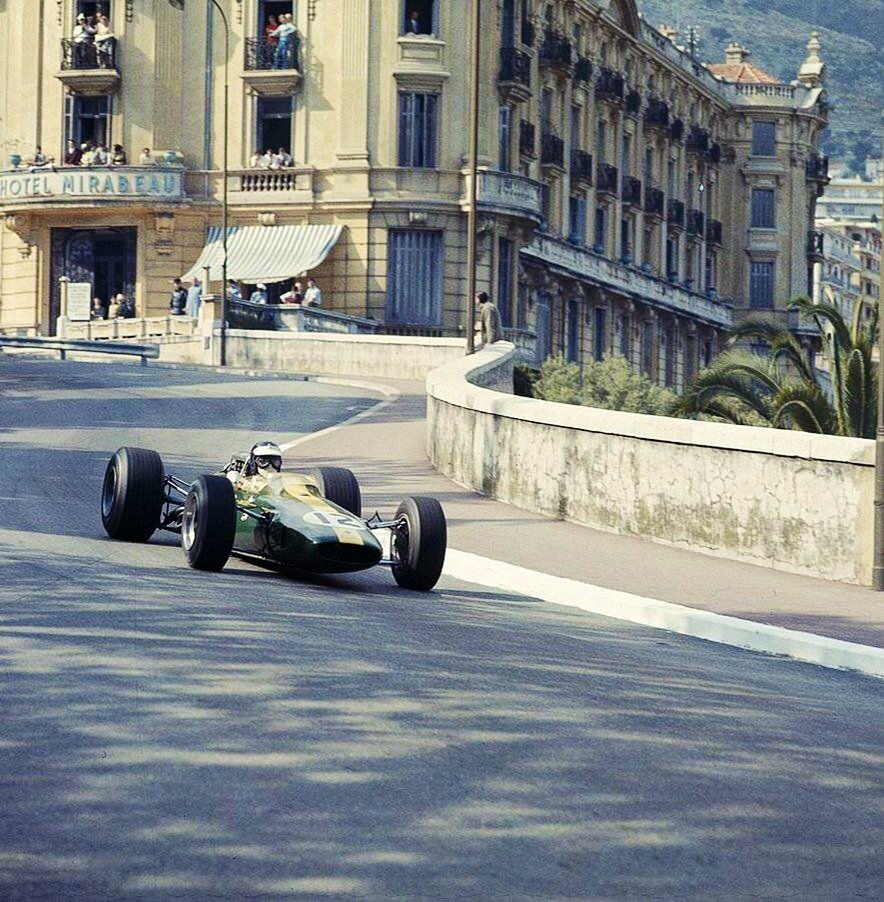
Clark qualified his 2 litre Lotus on the third row amongst the 3 litre cars, spun on lap 2, battled his way up to fourth from fourteenth, his race ending on lap 43 with a duff shocker. This tragic race claimed the life of Lorenzo Bandini who died when his Ferrari caught fire after an accident with the straw bales on the outside of the corner where Clark is pictured. Denny Hulme won the race in a Brabham BT 20 Repco. (Pinterest)

hill

Graham Hill in the other Lotus 33, BRM powered did better than Clark, finishing second, always a happy hunting ground for Hill who won the race 5 times. Amazing shot, he looks a bit wide! (Cahier Archive)

lotus 33

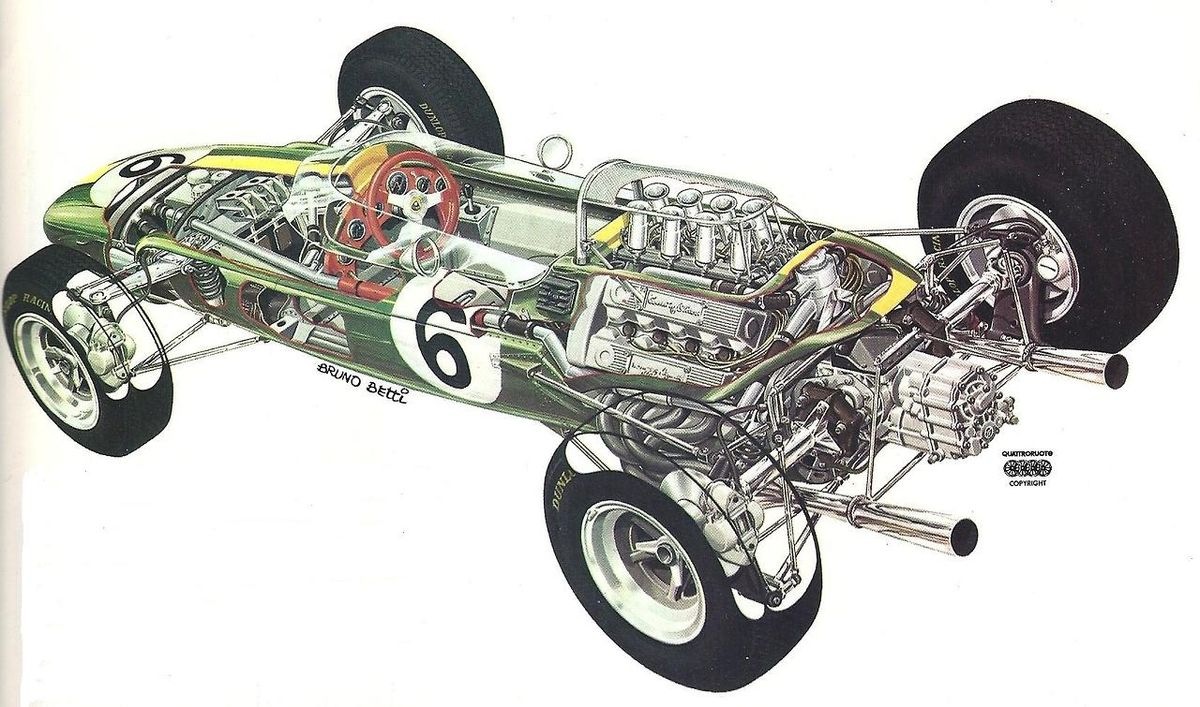
Lotus 33 : aluminium monocoque or stressed skin chassis, inboard suspension at front by top rocker and lower wishbone, coil spring damper unit within the tub. Rear suspension outboard by single top link, inverted lower wishbone, 2 parallel radius rods and coil spring/ damper unit. Coventry Climax 2 litre, by this stage, DOHC, 4 valve V8, 5 speed ZF gearbox, just a lovely, successful bit of kit…! (Bruno Betti)

Photo Credits…

Pinterest, Bruno Betti cutaway drawing, Cahier Archive

Tailpiece: You don’t often see the super smooth Clark with so much attitude on a car. Here he is giving the 33 plenty of welly ahead of Dan Gurney’s Eagle T1G V12, Dan’s car out on lap 4 with fuel pump problems so ’tis early in the ’67 race…

jim

(unattributed)