Posts Tagged ‘John Surtees’

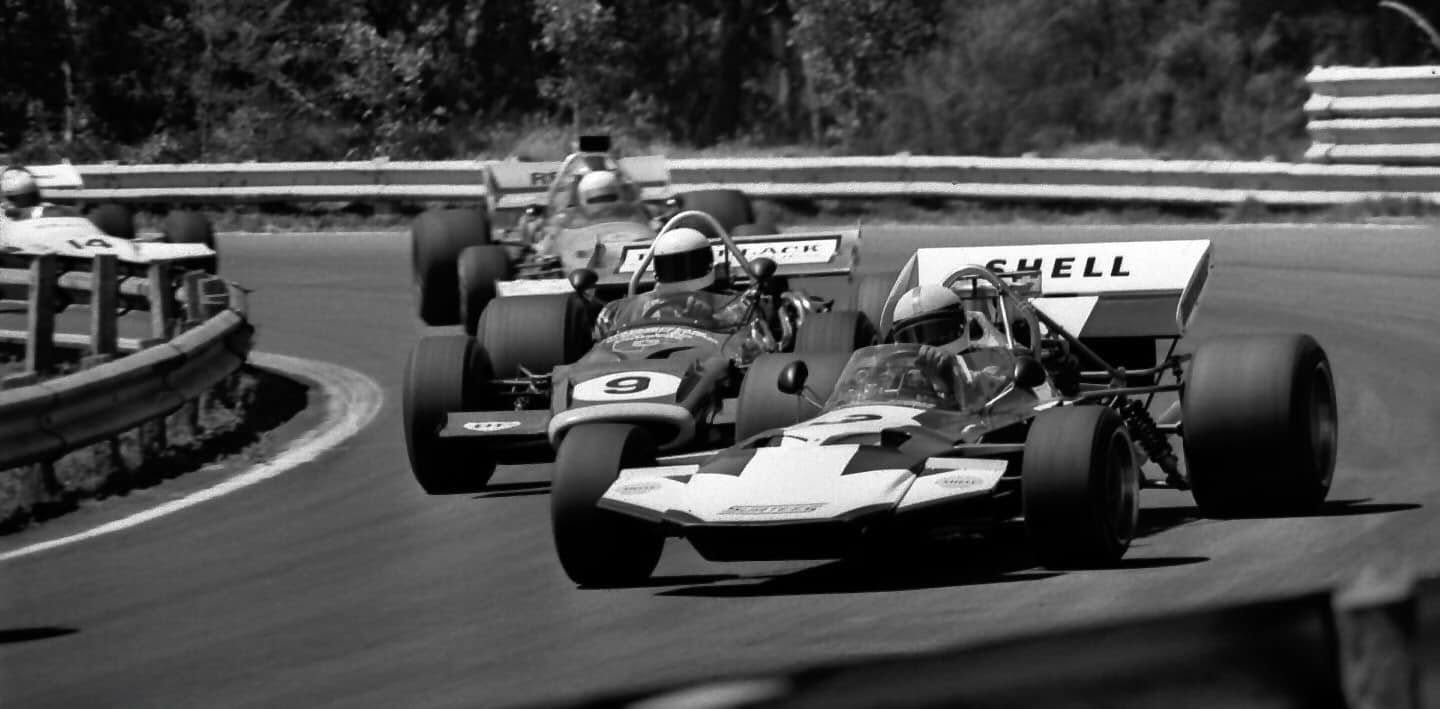
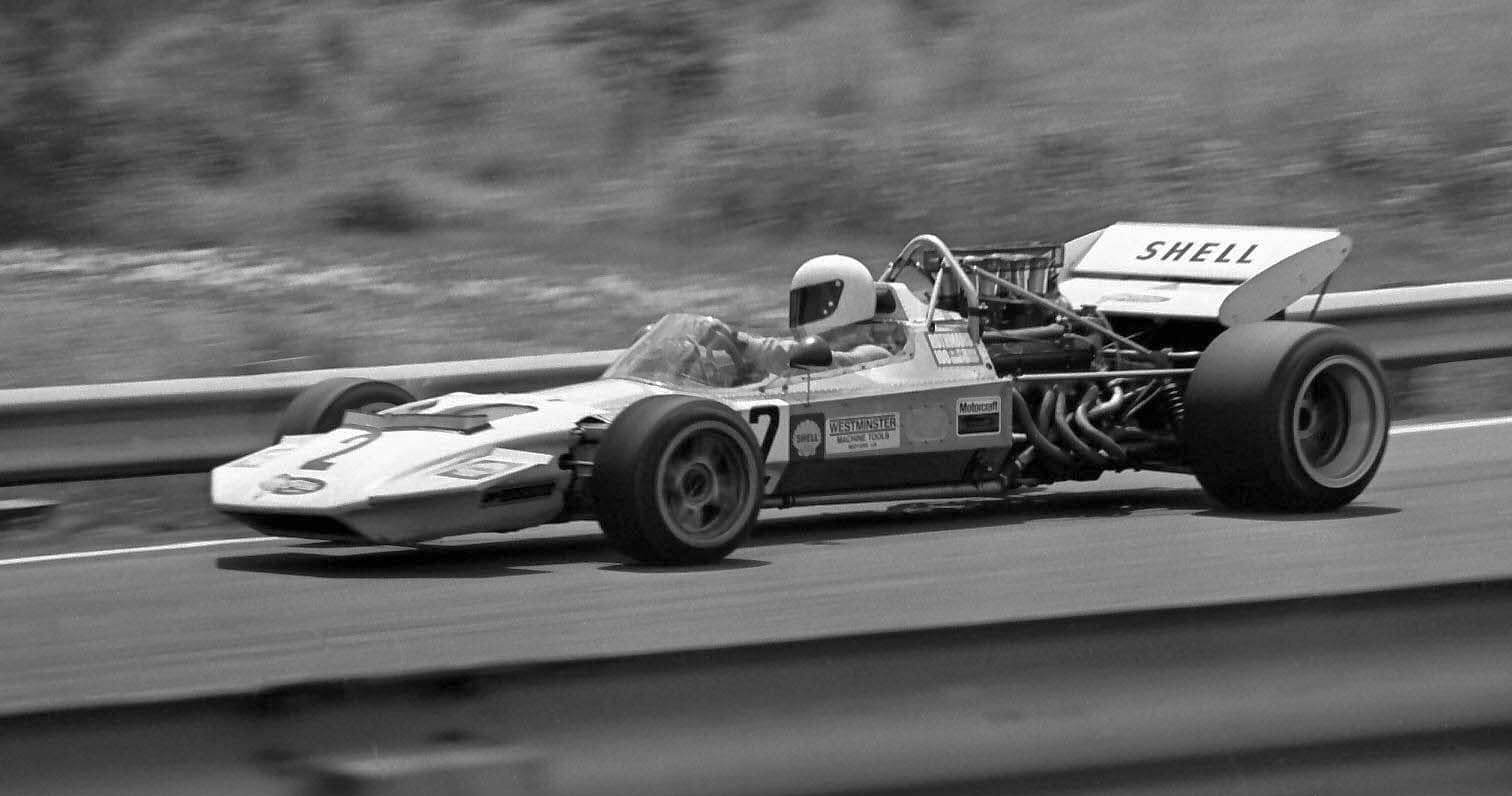
Mike Hailwood had a fantastic season with Matchbox Team Surtees in 1972, winning the European F2 Championship in a pair of Surtees TS10 Ford BDAs.

The lovely lady above is shown with an almost visually identical – but quite different under the skin – 1973 TS15 during the International Racing Car Show held at London Olympia on January 1, 1973.

Hailwood commenced the year in Australasia in the Tasman Series, then returned to Europe for F1 and F2 campaigns in early March.

In the European F2 Championship he bagged maximum points in five of the 14 rounds – Rouen-les-Essarts, the Österreichring, Mantorp Park, the Salzburgring and the Hockenheim finale – to win the title with 55 points from Jean-Pierre Jaussaud, Brabham BT38 Ford 37, and Patrick Depailler, March 722 Ford on 27. The impact of Graded Drivers on the results will be shown below.

(Y Hirano)

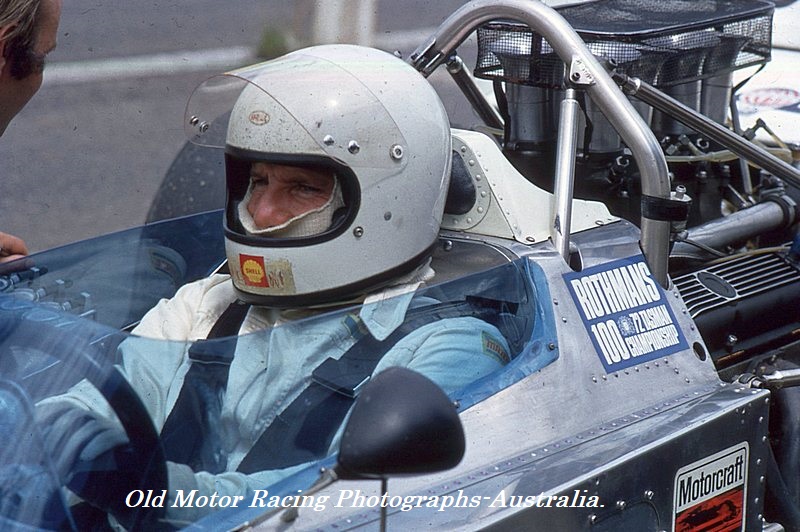
Mike Hailwood arrived in New Zealand for the Tasman in sparkling form. He did two late-season ’71 Grands Prix for Surtees at Monza and Watkins Glen, and then a full South African series of sportscar races before arriving in Auckland to race the Surtees TS8/9 Chev #TS8-002 that John Surtees raced in the November 21, 1971 Australian Grand Prix at Warwick Farm, DNF.

He started the Tasman with a bang: second behind Frank Gardner’s works-Lola T300 Chev in the NZ GP at Pukekohe, second again in the Lady Wigram Trophy, then third at Levin. Then the momentum he had was lost when the car was badly damaged at Teretonga, the final NZ round.

A TS11 monocoque #TS11-03 was shipped to Australia. The team had the car ready for the fifth round at Surfers Paradise, but the win that had seemed likely didn’t happen; his best in the four Australian rounds was second in the final round at Adelaide International.

Hailwood in the Sandown dummy grid over the AGP weekend. TS11-03 is fitted with the TS8/9 nose of the damaged car rather than the sportscar type usual TS11 nose
Warwick Farm 100, February 13, 1972. Hailwood, Surtees TS11 Chev from David Hobbs’ McLaren M22 Chev, Teddy Pilette’s McLaren M10B Chev, Tony Stewart, Mildren Waggott 2-litre TC-4V and Warwick Brown, McLaren M10B Chev (R MacKenzie)

I attended my first car race at Sandown for the Australian Grand Prix, Hailwood was on my list of four to watch all weekend: Hailwood, Gardner, Matich and Bartlett. Mike had an aura to 15 year old me for sure and seemed a good bloke. You know, the way you can tell when you watch the way someone interacts with those around them, the familiar and the fans?

So I followed his fortunes in F1 and F2 that year, rejoicing in his successes in both categories that cemented his place in Grand Prix racing.

When Mike flew out of Adelaide on February 27, it was to South Africa where the Grand Prix at Kyalami was held the following weekend. His year of F1 intent started with Q4 and challenging Jackie Stewart’s Tyrrell 003 Ford for the lead before a rear suspension breakage on the TS9B Ford after 28 laps.

Hailwood, Surtees TS9B Ford, Italian Grand Prix, Monza 1972. A great second behind Emerson Fittipaldi’s Lotus 72D Ford (unattributed)

Surtees TS10 Design and Construction…

John Surtees seized a commercial opportunity in 1972, that season F2 changed from 1.6 to 2-litres, potentially throwing the paradigm up into the air. Surtees had reasonable success with both his F1 works designs and F5000 cars.

In addition to those programs, the team designed and built a neat, conventional aluminium monocoque racer with a Tyrrell/sportscar type nose section powered by Brian Hart prepared, fuel-injected Ford Cosworth BDA engines quoted as 1850/1860cc. An F1 spec Hewland FG400 five-speed gearbox was used, stronger but heavier than the FT200 used by many.

Surtees poses for the cameras in his Edenbridge factory in early 1972, Surtees TS10 (Popperfoto)
Carlos Ruesch’s TS10-05 in the Hochenheim paddock over the October 1 weekend. Brian Hart built 1790cc BDA, DNF engine which gave circa 265bhp.
Simple slab sided aluminium monocoque chassis, the engine was mounted to the rear bulkhead and supported by an A-frame which is visible. Suspension single top link, inverted lower wishbones, two radius rods, mag-alloy uprights and Koni/coil springs. Inboard brakes, Hewland FG400 5-speed transaxle (unattributed)
Upper and lower wishbones, coils/Konis, mag-alloy uprights, adjustable roll bar and outboard brakes. Hailwood’s car behind Ruesch’s (unattributed)

The engine de jour in ’72 was the BDA in various capacities, generally those who ran engines of 1860cc did better than those of over 1.9-litres as the good-old cast iron Ford 711M block simply couldn’t be bored out that far within the pistons coming awfully close to one another and water passages.

Cosworth’s BDE was 1790cc and gave a quoted 245bhp @ 9000rpm with a bore of 85.6mm. Their 1972 1927cc BDF used an 88.9mm bore that was achieved by brazing liners into the standard block, which gave 270bhp @ 9250rpm.

Hart’s alloy 1975cc 275bhp @ 9250rpm BDG solved all those problems when it was homologated later in the year, then in 1973, March Engineering did their exclusive deal with BMW Motorsport for the supply of the BMW M12/7 2-litre F2 engine and the poor old BDG then never got the works-team attention it really deserved.

Surtees and Hailwood aboard TS10-01 at Mallory Park over the March 12, 1972 weekend; first round of the Euro F2 Championship, fifth (unattributed)
Variety is the spice in chassis at least!…Carlos Reutemann, Brabham BT38, Ronnie Peterson, March 722, Jody Scheckter, McLaren M21 – then race winner David Morgan, Brabham BT35, and ? Mallory Park, Euro F2 Champ round 1 March 12, 1972 (P Amoudru)

1972 European F2 Championship…

The array of talent that contested the series in whole or part that year was typically deep. Graded Drivers – drivers who participated but were not be awarded championship points, see definition at the end of this piece – included Jean-Pierre Beltoise, Francois Cevert, Emerson Fittipaldi, Graham Hill, Ronnie Peterson, Tim Schenken, John Surtees and Reine Wisell.

Future World Champions in the ’72 mix comprised James Hunt, Niki Lauda, Jody Scheckter, while the GP winner roll call included Vittorio Brambilla, Peter Gethin, Patrick Depailler, Jean-Pierre Jabouille, Jochen Mass, Carlos Pace, Carlos Reutemann and John Watson, not to forget Le Mans victors Derek Bell, Jean-Pierre Jaussaud, Henri Pescarolo, Vern Schuppan and Bob Wollek.

It’s an interesting pub fact – perhaps – that no winner of the old European F2 Championship 1967-84, or modern FIA Formula 2 Championship 2017-present, has ever won the F1 World Championship. Oscar Piastri, the 2021 victor, has a chance, therefore, of making history this year, depending on how things go over the next couple of months!

By the time Hailwood got his bum into TS10-01 Surtees had the car nicely sorted, with Mike taking fifth place overall from the two heats of the opening round of the European F2 Championship at Mallory Park on March 12.

Privateer, Dave Morgan sensationally won the round in a year-old spacframe Brabham BT35 BDA 1860cc from Niki Lauda’s works-March 722 BDA 1825cc, Carlos Reutemann, Brabham BT38 BDF 1927cc, Jody Scheckter’s one-off McLaren M21 BDF 1927cc, then Hailwood using a BDA prepared by RES (Race Engine Services) of 1825cc.

That variety of cars set the pattern of lots of different car-driver winning combinations for the season. The subtext, for F2 anoraks, were the BDA battles between the various engine builders/preparers.

Ronnie Peterson’s works-March 722 BDF-1927cc won at Thruxton, then Jean-Pierre Jaussaud’s Brabham BT38 BDA-1850cc at Hockenheim in mid-April, before Hailwood collected fifth place points in the Pau GP on May 5-6 using one of Brian Hart’s 1850cc BDAs; Peter Gethin’s Chevron B20 BDA took the champers that weekend.

John Surtees raced TS10-02 at Oulton Park and Thruxton then took that chassis to Japan to contest the Japan Auto Federation Grand Prix of Japan at daunting Fuji Speedway on May 3. He splendidly won the race using new a Hart-prepped 1930cc alloy block BDG. Japanese drivers Hiromu Tanaka and Hiroshi Fushida were second and third aboard a March 722 and Brabham BT38, both powered by 2-litre Mitsubishi Colt R39B engines.

John Surtees on the way to winning the 1972 JAF Japanese GP at Fuji in TS10-02 from Hiromu Tanaka, March 722 Mitsubishi R39B 2-litre (Y Komura)
Hailwood from Jody Scheckter, McLaren M21 Ford BDF, Crystal Palace 1972

Back home in London, Hailwood and Scheckter thrilled the crowds at Crystal Palace on May 29. Reutemann’s Rondel Racing – Ron Dennis and Neil Trundle – Brabham BT38 won the first heat, Hailwood the second and then Scheckter, works-McLaren M21 Ford BDF 1927cc the final in a thriller-diller dice with Carlos third. Mike’s best lap of 48.4 seconds set in the second heat of the Greater London International Trophy is the all-time lap record of a venue then in its final season.

By mid-season, there was no lack of Surtees TS15s in circulation, but they were all works-run cars; no customers stumped up to buy one. Argentinian Carlos Ruesch raced TS10-03, Andrea De Adamich, TS10-04 and later in the season Carlos Pace, TS10-07.

See here for Allen Brown’s TS10 fantastic chassis-by-chassis analysis: https://www.oldracingcars.com/surtees/ts10/. My other chassis/race results reference is the F2 Index-Fastlane: https://www.the-fastlane.co.uk/formula2/F272_Index.htm People like me cannot do what we do without these stunning online repositories of accurate information and data…

Andrea De Adamich, Surtees TS10-04 Ford BDE-Novamotor 1790cc Imola 1972, fourth (Autosprint)
Emerson Fittipaldi, works-Lotus 69 Ford BDF, Hockenheim October 1972. DNF engine – BDF – after eight laps (P Amoudru)

Emerson Fittipaldi, in amongst winning his first F1 World Championship for Lotus (72? Ford DFV) made a number of successful F2 raids in a modified Lotus 69 fitted with 1927cc Cosworth BDFs. He won at Hochenheim on June 11 and Rouen Les Essarts on June 25. Hailwood got the points for the latter win as Emerson was a Graded Driver.

The same pair did the one-two at the Osterreichring on July 9, this time Mike was 36 seconds adrift of Emmo on the road, but again got the nine championship points. Carlos Ruesch was seventh in a good weekend for Matchbox Team Surtees.

Vic Elford, works-Chevron B20 BDA and Richard Scott, Brabham BT38 BDE on the inside at Crystal Palace 0n May 29; fourth and DNF valves. David Purley in the March 722 behind? (unattributed)
A shit shot, but it’s the only one I can find of John Surtees TS10-07, taking his last in-period race win, the Imola Euro F2 round on July 23, 1972 (unattributed)

At Imola the boss showed his fellow motor-cycling ace how to do it! Surtees was fourth in the first 28 lap heat, was third in the second and won on aggregate with Bob Wollek, Brabham BT38 BDA and Niki Lauda, March 722 Ford BDA third. Wollek won a heat, and Peter Gethin, Chevron B20 the other…there was no shortage of race winners that year as I wrote earlier! Mike was second in the first heat but failed to finish the second after his fuel pump failed.

Hailwood bounced back at Mantorp Park, Sweden, a fortnight later, he was second in the first heat behind Gethin, won the second from Jean Pierre-Jabouille (March 722 Ford BDA) and the round overall. It was a timely win at the business end of the season, capped by Ruesch’s sixth place.

Hailwood had his tail up at Enna on August 20, winning the first heat from Henri Pescarolo but bombing out of the second with transmission failure. Patrick Depailler won that one, Alpine A367 Ford BDA, but veteran-Pesca was again second and won the round on aggregate. Carlos Ruesch got his best result for the year in TS10-05, third place, having placed third in both heats.

Mike Hailwood and Peter Gethin in the Brands Hatch Race of Champions paddock on March 19, 1972. Hailwood was second in his Surtees TS9B Ford DFV, and Gethin fourth in a BRM P160B. The race was won by Emerson Fittipaldi’s Lotus 72D Ford. Straight from Carnaby Street by the look of it
Carlos Pace, GP del Mediterraneo Enna-Pergusa 1972, TS10-07 NC (A De Brito)

On the fast Salzburgring, Hailwood again showed his class, winning on aggregate after beating Carlos Pace in the second heat and placing second behind David Morgan’s Brabham BT38 BDA in the first. Pace was second overall aboard TS10-07, and Ruesch TS10-05 tenth, giving Matchbox Team Surtees its best result for the year, and perhaps securing Pace’s place in Team Surtees F1 for 1973.

Jean-Pierre Jaussaud won the penultimate round, the Albi Grand Prix in his Brabham BT38 BDA from Depailler’s March 722 and Bob Wollek’s BT38 in a French one-three. Reusch was sixth and Hailwood 14th; disappointing as Mike won the second heat but isn’t listed in my results of the first. What was the problem, folks?

Tim Schenken won the final round of the European F2 Championship at Hockenheim on October 1 from his Surtees F1 teammate Hailwood: Rondel Brabham BT38 BDF and Surtees TS10 BDA. Ronnie Peterson, March 722 BDA, was third.

Ronnie Peterson in his works-March 722 Ford BDF at Thruxton in April 1972. Winner of the Jochen Rindt Memorial Trophy (LAT)
Hailwood TS10-01, or TS10-07, third in the final October round of the Euro F2 Championship at Hockenheim (R Schlegelmilch)

Mike won the championship with 55 points from Jean-Pierre Jaussaud – the Le Mans winner, sometimes a forgotten Frenchie? – Brabham BT38 on 37 points, and Patrick Depailler March 722 third on 27 points.

With adequate funding, John Surtees ran a strong program: chassis, engines and driver, Matchbox Team Surtees delivered the goods.

As to the best-chassis of 1972? The Brabham BT38 won four European F2 Championship rounds – Jean-Pierre Jaussaud won at Hochenheim-Jim Clark Memorial Trophy and Albi, Tim Schenken Hochenheim-Preis von Baden-Wurttemberg, Henri Pescarolo, Enna – not to forget David Morgan’s BT35 victory at Mallory. The Surtees TS10 won three rounds – Hailwood at Mantorp Park and Salzburgring, and Surtees at Imola. Emerson Fittipaldi took three in his works-Lotus 69 at Hochenheim-Rhein-Pokalrennen, Rouen and the Osterreichring with single round wins to the March 722, Peterson at Thruxton, the Chevron B20, Gethin at Pau and finally Jody Scheckter won at Crystal Palace in his McLaren M21.

Jody Scheckter on the way to winning the London Trophy at Crystal Palace in May 1972, McLaren M21 Ford BDF 1927cc (T Legate)
Carlos Reutemann, Brabham BT38 Ford BDF, Mallory Park, March 1972, third (D Btiot)

So, drum-roll, the Champion F2 Constructor for 1972 – was there such a title – would have been Brabham, who, after years of ‘F2 Dominance’, got their come-uppance the year before with March. I’ve always thought the ultimate test of a customer racing car is the number of different drivers to have been victorious behind its steering wheel.

While Ron Tauranac was rightly famous for his spaceframe Brabhams, there was nothing wrong with the BT38, Brabham’s first production monocoque design, the work of Geoff Ferris. New owner Ecclestone would soon get rid of all this production racing car rubbish, of course…

Etcetera…

(T Legate)

Mike Hailwood enroute to setting the all-time lap record at Crystal Palace on May 29, 1972, aboard TS10-01, such an attractive car, doesn’t it look the goods!

(LAT)

John Surtees aboard TS10-07 at Oulton Park over the September 16, 1972 weekend, DNF with electrical problems without completing a lap of the final round of the British F2 Championship. The race was won by Ronnie Peterson from Niki Lauda and James Hunt; works March 722 by two, and Hesketh Racing March 712M BDA.

The British championship was won by Lauda – a flicker of light in a pretty grim March year for him – from Peterson and David Morgan.

The Matchbox Team Surtees transporter in the Oulton Park paddock on that same weekend below.

(R Kalatayud)

Imola 1972 is a kaleidoscope of Formula 2 colour and variety that would over-stimulate the poor punters of today who are swamped in dull, shit-boring one make drossful classes.

Foreground car folks? Mike is facing us, shielding his eyes from the sun, with Surtees #3 behind. #14 Hiroshi Kazato March 722, #11 is Carlos Reuttemann, Brabham BT38, #27 Adrian Wilkins March 722, #25, Jose Dolhem March 722, #6 Peter Getin, Chevron B20. All BDAs of one sort or another…

Mike Hailwood, John Surtees and Helmut Marko in the Monza paddock during the 1972 Italian Grand Prix weekend on September 5.

(H Fohr)

Carlos Ruesch, Surtees TS10 BDA, NC, and Claudio Francisci, Brabham BT38 Cosworth BDE, ninth, at Hockenheim during the Jim Clark Memorial meeting in April.

(Getty)

Niki Lauda, March 722 BDA-RES 1927cc, Rouen, June 25, 1972, DNF with a popped engine. Fittipaldi’s Lotus 69 won and Mike bagged the nine points, placing second behind the Graded Driver.

Niki was fifth in the Euro F2 points standings.

(J Regami)

Hailwood’s TS10 in the paddock during the Pau Grand Prix weekend. You can see the top wishbone, front suspension was conventional upper and lower wishbones, coil spring/Koni dampers, adjustable roll bar and mag-alloy uprights. Perhaps Mike wiped a nosecone off in practice?

(F Kraling)

Graham Hill’s Brabham BT38 Ford BDA-RES 1927cc has aero modifications neatly exercised by KayDon Racing. David Kaylor and John Donnelly, being ex-MRD employees who ran the car for owner Graham Hill with Jäegermeister sponsorship. This shot is at Hockenheim on October 1, fifth.

Hill won the non-championship Gran Premio della Lotteria at Monza with BT38-1 in June.

(J Regami)

At Pau Emerson Fittipaldi’s Lotus 69 Ford BDF – apart from its Moonraker Yachts livery – didn’t look much different to the 69s of 1970-71 but the adoption of a sportscar type nose brought the old, very fast jigger up to snuff aerodynamically. Lotus 69 bias declared herein!

The shot below is at Hockenheim during the October Preis von Baden-Wurttemberg meeting, DNF engine. Lotus 69 Ford BDF Cosworth and sports nose. There is a useful snippet about Chapman and Moonraker in this forum: https://forums.ybw.com/threads/jcl-boats-and-moonraker-the-history.532631/

(W Harbers)

Graded Drivers…

By courtesy of Vitesse 2 on The Nostalgia Forum.

From 1/1/72:

1. Grand Prix Graded Drivers

World Champion drivers of the previous five years.

Drivers who, in one and the same year, have been classified at least twice among the first six in a race of the World Championship for Drivers, while taking into account the Championship of the two previous years.

The winner of the Indianapolis 500 Miles of the previous year.

The winner of the Can-Am Series of the previous year.

The winner of the European Championship for Formula 2 drivers of the previous year on condition, however, that he has won at least three first places in the Class B drivers’ classification (ie non-graded) of an event qualifying for the said Championship.

Drivers who, in the same year, won at the same time one classification among the first six in an event counting for the World Championship of Drivers, and one classification among the first three in the general results of an event counting for the Makes’ Championship. Only the Championships of the two previous years shall be taken into consideration.

2. Long Distance Graded drivers

Drivers who, in one and the same year, havew been classified at least twice among the first three in an event of the Makes’ World Championship, while taking into account the two previous years. However, only those teams of not more than two drivers, and that for the whole duration of the event, will be retained for inclusion on the list of graded drivers.

The text for 1975 is identical, except that it omits the winner of the Can-Am title.

Credits…

Team Surtees and Formula 2 Facebook pages, Yoshiaki Hirano, Popperfoto, Michael Lee, Yoshinori Komura, Alejandro De Brito, Patrick Amoudru, Walter Harbers, Rafael Kalatayud, Denis Btiot, LAT, Rainer Schlegelmilch, Joe Regami, Caz Caswell, Hans Fohr, Trevor Legate, F2 Index-Fastlane, oldracingcars.com, Joe Regami, Ferdi Kraling

Tailpiece…

Hailwood on the hop at Crystal Palace in May…

Finito…

(D Waldron)

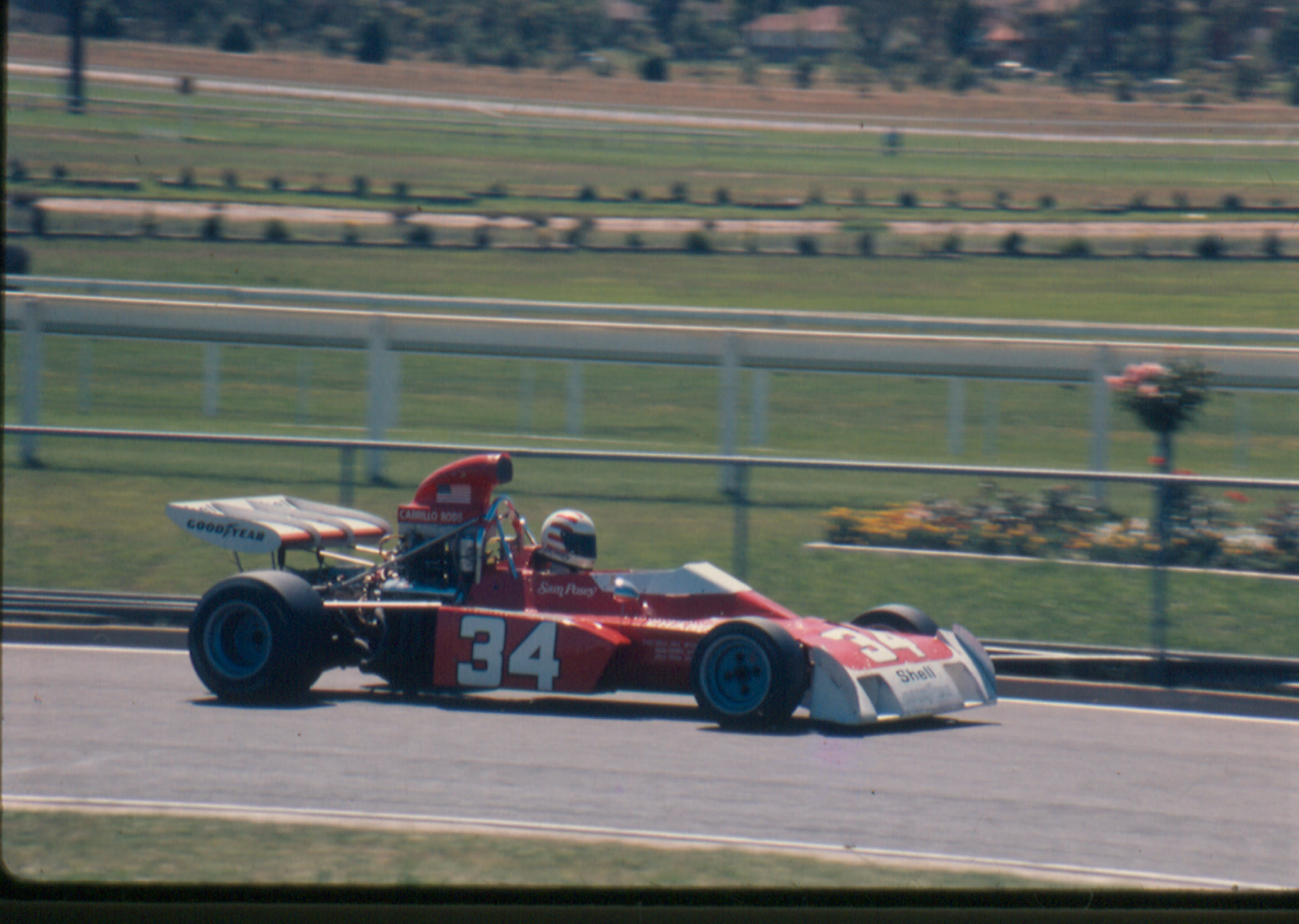
Sam Posey, Surtees TS11 Chev in the Wigram pitlane during the January 20, 1973 Lady Wigram Trophy weekend.

John Surtees’ first two F5000 designs – the Len Terry designed 1969-71 TS5/TS5A and 1971 TS8 – sold well and were quite successful.

The TS11 was Surtees 1972 F5000 car. Based on the Grand Prix TS9B the prototype was tested by Big John at Goodwood but was written off shortly thereafter when Mike Hailwood hit a patch of oil and crashed it at Brands Hatch on October 28..

That curtailed plans for John Surtees to race it, and win the November 1971 Australian Grand Prix at Warwick Farm to help generate some sales.

Sam Posey at Tyler Graphics, Mount Kisko, New York in 1987. This photograph by Marabeth Cohen-Taylor was given to the National Gallery of Australia
John Surtees, Surtees TS8/9-002 battling with Alan Hamilton’s McLaren M10B Chev, Colin Bond, McLaren M10C Repco-Holden and Graeme Lawrence’s Brabham BT30 Ford FVC in the Warwick Farm Esses during the 1971 AGP (L Hemer)

Surtees’ and Hailwood‘s TS8/9 and first TS11…

An alternative car, a TS8 (with TS9 chassis 002) was sent to Sydney instead. Surtees qualified it ninth and was well placed for a decent finish before a slow puncture forced an even slower pitstop and tyre change.

That same car was then raced very competitively by Mike Hailwood in the 1972 Tasman Cup. Hailwood crashed the TS8 (chassis TS9-002) in the final New Zealand round at Teretonga so a new TS11 chassis was sent to Sydney and a front-radiator TS11 – tagged TS11/03 – was built up from the pile of parts to complete the final four Australian rounds.

Mike was second in the championship behind Graham McRae despite not winning a round: Q3 and second at Pukekohe, Levin Q4/third, Wigram Q4/second, Teretonga Q1/DNF crash. In Australia, this time with the outwardly similar TS11: Surfers Paradise no time/sixth, Warwick Farm Q17/fifth, Sandown Q7/fourth and Adelaide Q4/second.

Mike Hailwood at Warwick Farm during the February 1972 Tasman Cup round, Surtees TS11 Chev (L Hemer)
NZ (T Marshall)

Build numbers and competitor set…

Five TS11s were built, including the Hailwood Tasman car, and there are another four mystery-cars as Allen Brown correctly describes such machines, see here: https://www.oldracingcars.com/surtees/ts11/

The most successful TS11 was TS11/04, the Champcarr Inc – Doug Champion and Fred Carrillo – machine based in San Juan, California raced by Sam Posey in the 1972 US F5000 L&M Championship, the most competitive of the F5000 competitions globally.

Posey testing TS11/04 at Ontario Speedway in 1972. That venue was not part of the ’72 L&M (M Rizzo)
Posey in TS11/04 in the Lime Rock pitlane in 1972. Q9 and third behind Brett Lunger and Brian Redman (G Rickes)

1972 was the year of the McRae GM1 and Lola T300 so the going was tough, but the talkative, talented American racer of single-seaters, Can-Am, Champcars – plus an occasional F1 drive – got the best out of the car, finishing second behind Graham McRae and then Brian Redman and Brett Lunger tied in third in Chevron B24/Lola T300 respectively: 87, 69 and 60 points respectively.

Posey didn’t win a round but placed second at Laguna Seca, Road America and Riverside in a season of consistency and reliability.

Bomb Bay, Wigram Q11 and DNF engine on January 20. McRae won from Warwick Brown and Steve Thompson (B Hopping)
Posey at Surfers Paradise in February 1973. Fifth from Q9, Frank Matich won (P Overell)

Posey’s Tasman…

When Sam crossed the Pacific his reliability seems to have deserted him! What didn’t change was the pace of McRae, and there were a few other quicks at the front of the 1973 Tasman Cup field too: Frank Matich, John McCormack, Steve Thompson, Allan Rollinson, Max Stewart and Warwick Brown to name a few.

In the four Kiwi rounds he was: Pukekohe NZGP Q11 DNF throttle, Levin Q7 DNF engine, Wigram Q11 DNF engine and Teretonga Q9 and second behind Alan Rollinson. So, a good finish to the first half of the series before crossing the Tasman for Surfers Paradise.

Surfers Q9 and fifth, Warwick Farm Q6 and seventh, Sandown Q6 and sixth, Adelaide Q2 and DNF undisclosed. It was all pretty uninspiring, the sheer pace evident in the US was missing and four DNF’s in eight races doesn’t win championships.

McRae won the championship with three wins aboard his McRae GM1 Chev, 40 points from John McCormack, Elfin MR5 Repco-Holden two wins and 29 points and Frank Matich, Matich A50 Repco-Holden, one win, 27 points.

Posey is a most interesting renaissance man, I like this Motor Trend article about him: https://www.motortrend.com/features/racer-same-posey-shines-bright/

Posey in the Sandown pits, and paddock below in February 1973. Q6 and sixth, McRae won (stupix)
(J Blanden)
Pukekohe pits 1973. Q11 and DNF throttle. John McCormack won the NZ GP in an Elfin MR5 Repco-Holden (B Kempthorne)

Specifications…

Gijs van Lennep won the European F5000 Championship with his car (TS11/02) but was lucky in that the quicker McRae and Brian Redman biased their F5000 seasons on both sides of the Atlantic to the US L&M rather than the British Rothmans Formula 5000 Championship.

As mentioned above the, TS11 was a development of the F1 TS9B. It had a period typical aluminium alloy monocoque chassis, a Chev 5-litre engine to the choice of the customer, and used Hewland’s ubiquitous DG300 five speed transaxle.

It had a Tyrrell or sportscar type nose, side radiators and inboard front suspension, the top rocker actuating a coil spring damper unit, magnesium uprights with an adjustable roll bar. The brakes were outboard. At the rear was magnesium uprights, a single top and parallel bottom yonks with a pair of radius rods doing fore and aft locational duties on either side. Brakes were inboard, note the oil-rads under the wing.

Posey on Sandown’s main straight during the 1973 Tasman round. That Sandown is part of a horse racing complex is readily apparent…and a might fine venue it is (G Moulds)

Etcetera…

This shot of Mike Hailwood in the Sandown Park, Australian GP dummy grid on February 20, 1972 gives us a better look at the unpainted full-monocoque Surtees TS11 chassis – TS11/03 – of the three-week old car.

The structure extends right up behind behind the drivers shoulders in the photograph below. Mike was fourth from Q7, the was race won by Graham McRae’s Leda GM1 Chev.

(B Jackson)

Mike Hailwood chats with a mechanic in the Warwick Farm 100 paddock over the February 13, 1972 weekend.

Note the inboard rocker front suspension and single radius rod doing locational duties at the rear.

(B Jackson)

Rear wing area very busy, to the detriment of it doing its job!

Note the faired oil coolers either side of the vertically mounted oil tank, and Varley battery underneath it. The rear suspension has only one – top – radius rod on each side but the lower suspension comprises a wide based wishbone and an additional ‘toe’ link.

(B Jackson)

Roll bar mounted directly to the rear bulkhead and in nicely braced both fore and aft, note the single radius rod.

There was nothing wrong with the assembly of the new car by Mike’s mechanics. It finished all four races in Australia, well up too.

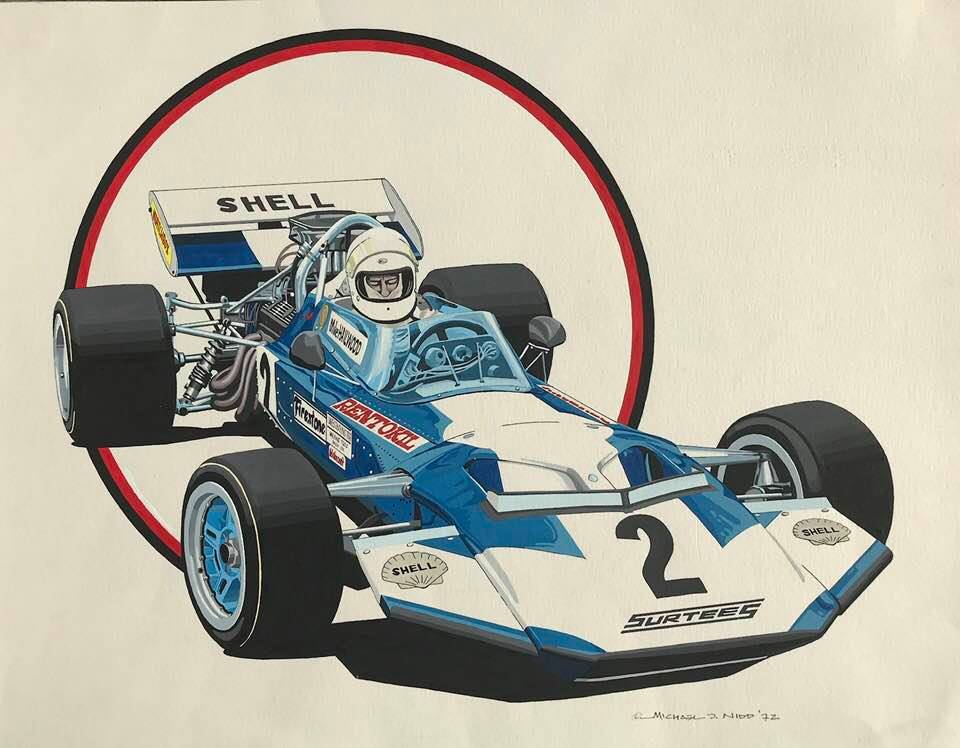
(M Nidd)

Without wanting to confuse things further, see above a wonderful painting of Hailwood’s Surtees TS8 as it appeared in New Zealand in the summer of ’72…

(S Love)

John Surtees and Sam Posey in the Laguna Seca paddock in 1971. ‘Well, keep going the way you are and there probably is an F1 drive at home for you Sam.’

(Pinterest)

Sam Posey in front of Mike Hailwood during the October 1972 US GP at Watkins Glen.

The pair are racing Champcarr/works-Surtees TS9B Ford DFVs. Sam was Q24 and 12th, Mike Q14 and an accident impacted 17th. Jackie Stewart won in a Tyrrell 005 Ford DFV.

Credits…

Dave Waldron via Gerard Richards, Bryn Kempthorne, Maurizio Rizzo, Marabeth Cohen-Tyler, Brian Hopping, Paul Overell, Greg Rickes, Glen Moulds, Michael Kidd, Steve Love, Stupix, Old Motor Racing Photographs Australia Archive, Pinterest, Brian Jackson photos via Glenn Paine, John Blanden

Finito…

surtees
(Central Press)

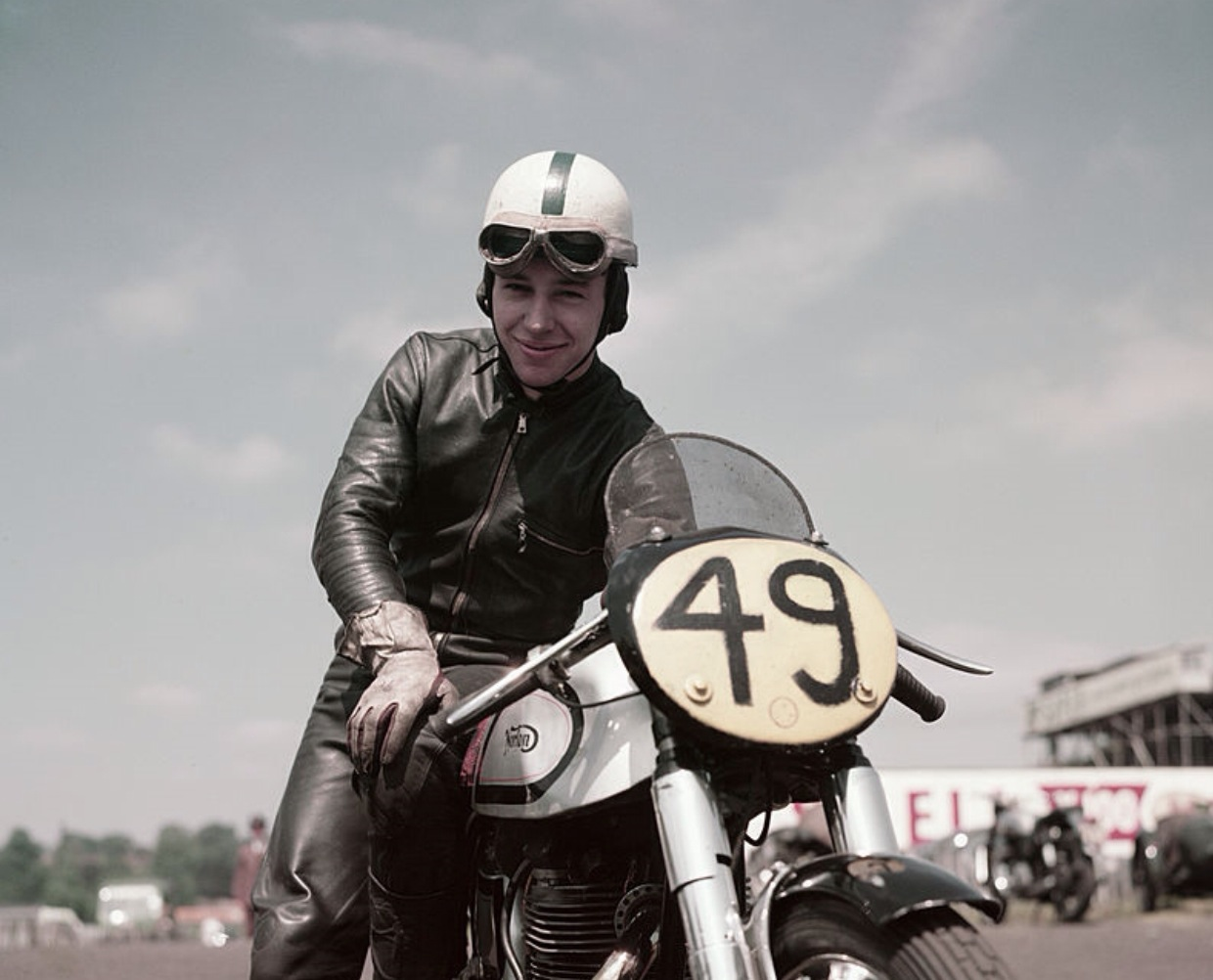
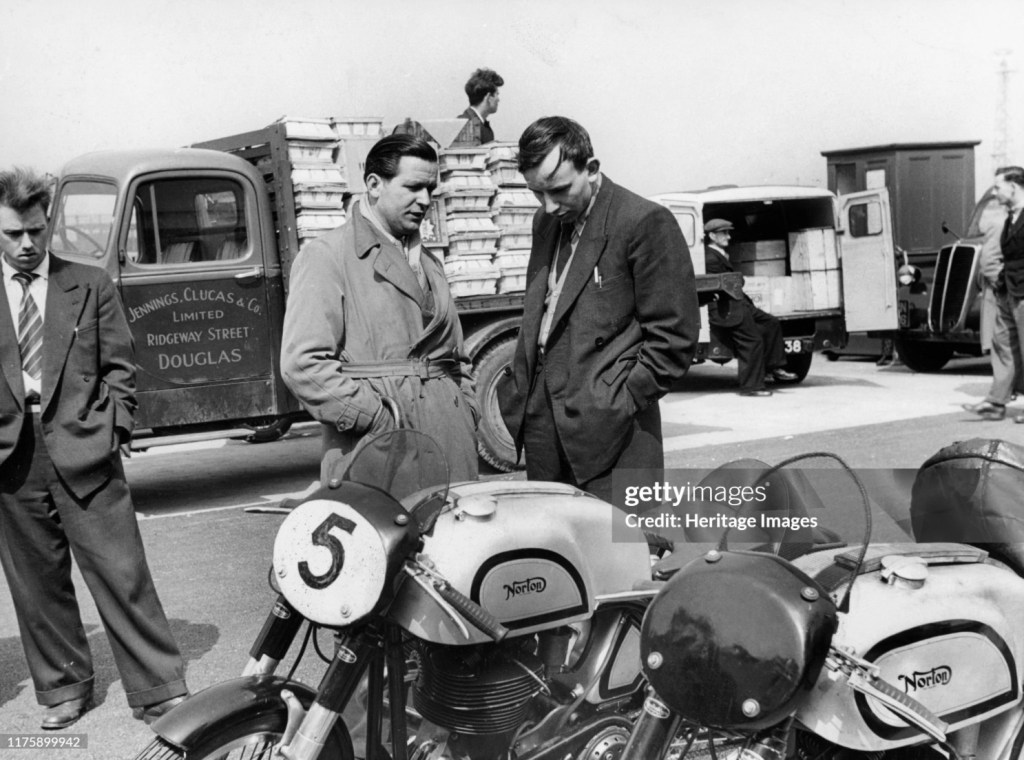
John Surtees and works-Norton Manx 500 prior to the start of a race at the International Meeting, Silverstone 9 April 1955…

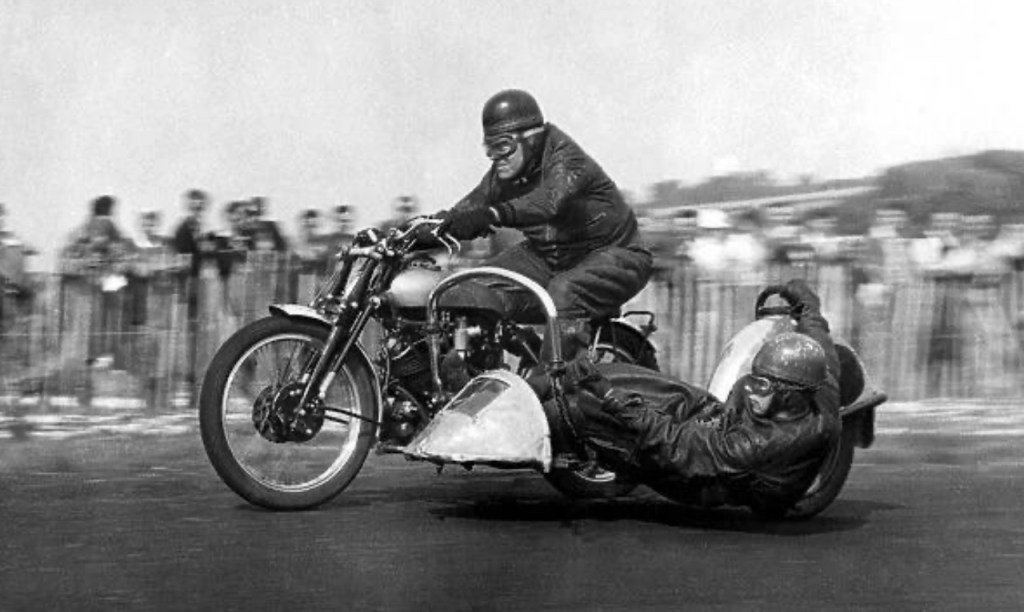
Born in 1934 (11 February 1934-10 March 2017) at Tatsfield, Surrey, Surtees famously grew up working in his dad’s South London motorcycle shop. Jack Surtees was a former bus driver turned sidecar racer, it was on his father’s Vincent 1000cc sidecar-outfit that John first competed at 14.

As a school leaver at 15, John contested grass track races at Brands Hatch on a Excelsior-JAP B14 500, soon graduating to road racing, initially aboard a Triumph Tiger 70 250, at Brands in April 1950. After commencing his apprenticeship with Vincents’ Stevenage factory the same year he soon commenced racing a self-prepared Vincent Grey 500 single, taking his first win at Aberdare Park, South Wales.

Jack and John Surtees on Jack’s Vincent 1000cc outfit at Brands Hatch in 1952 (J Topham)
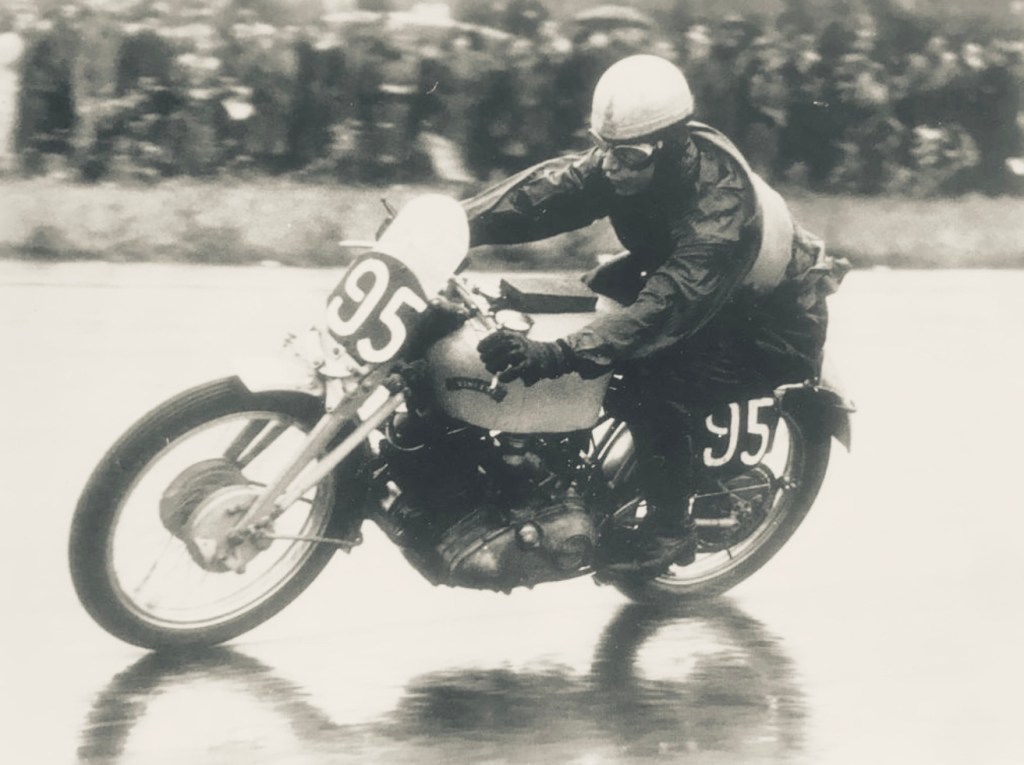
On the Vincent Grey Flash 500 single, circuit folks? (John Surtees World Champion)

In 1951 he hit the headlines after giving World Champion Geoff Duke’s factory twin-cam Norton curry on his pushrod single at Thruxton, soon establishing himself as one of Britain’s future stars, graduating from the Vincent in 1952 to a 500cc Manx Norton on which he contested his first World Championship race, finishing sixth in the Ulster GP.

In 1953 John made his Isle of Man debut having been loaned a pair of factory Nortons by race chief Joe Craig. But he got himself in Craig’s bad-book as he’d already committed to run Dr Joe Ehrlich’s works 125cc EMC two-stroke, only to crash it in practice and break his wrists after front-fork failure.

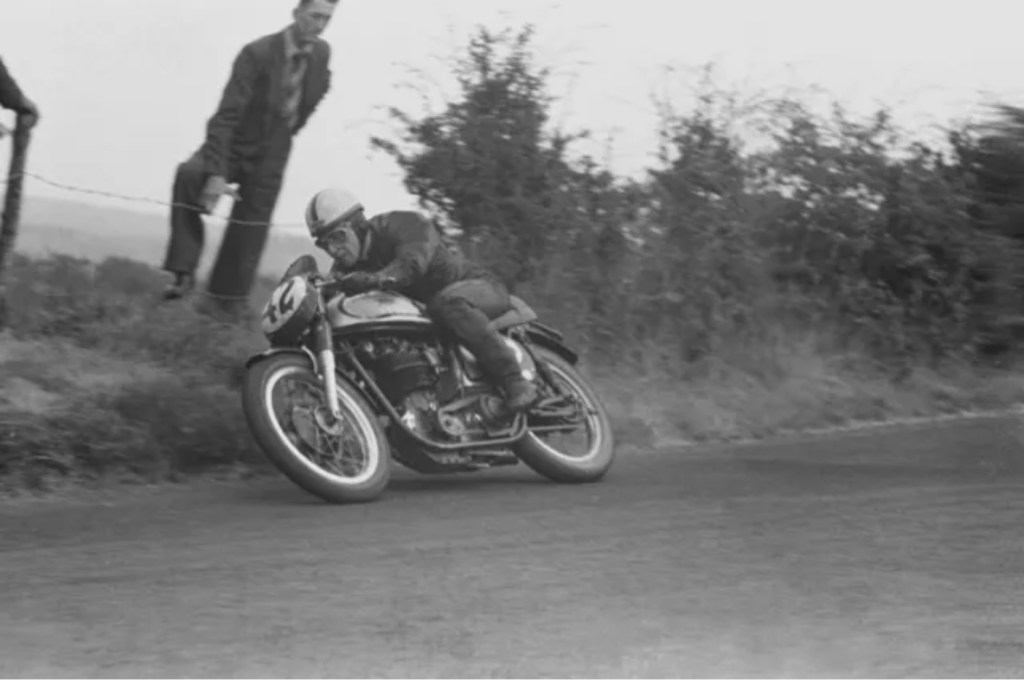
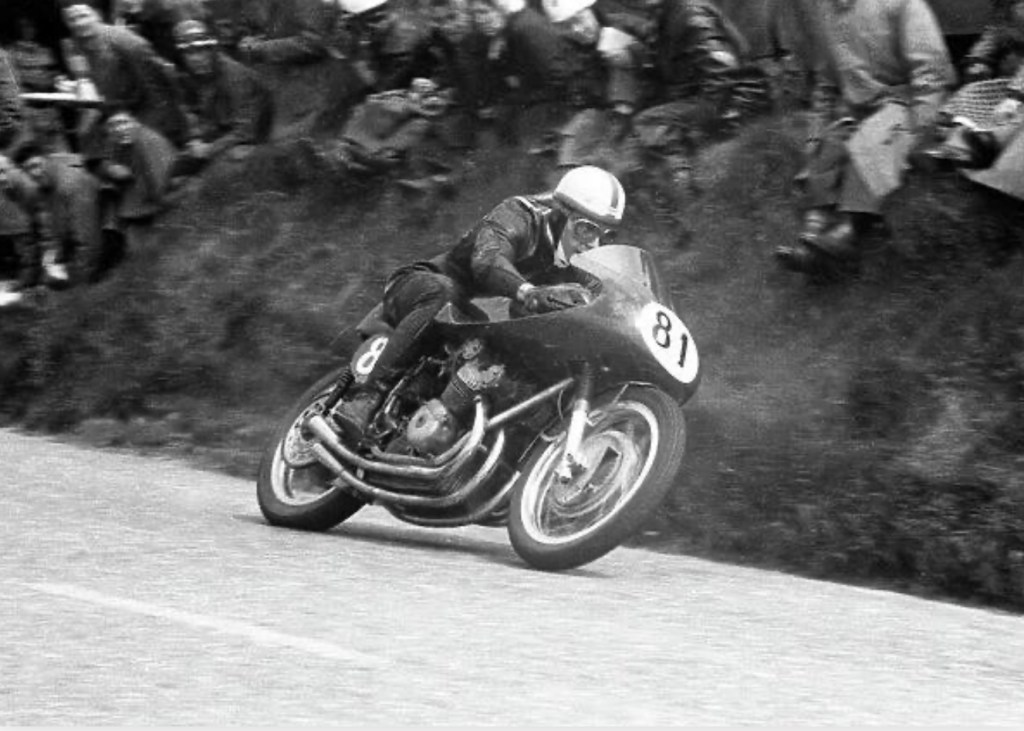
John Surtees at right during the June 1954 IOM TT weekend: 15th in the Senior and 11th in the Junior TTs on his privately entered machines. #5 is perhaps the 350

Craig cracked the shits when he couldn’t race his Nortons so John raced a pair of customer Norton 350/500s with great success in 1954. On these bikes he was 11th in the IOM 350cc Junior race and 15th in the 500cc Senior, also taking the British 250cc championship that year by winning 15 races of 17 starts on the unique R.E.G. 250 DOHC parallel-twin built by talented businessman Robert E Geeson.

As a consequence of that great season, Craig finally gave Surtees his first works Norton rides in what proved to be the British manufacturer’s final season of racing what were by then outclassed singles in 1955. John won 69 of 75 races that he started in Britain and raced regularly on the Continent, but it was on an NSU Sportmax that he recorded his first GP win, the 250cc Ulster GP at Dundrod on August 13.

Surtees, NSU Sportmax, 250cc Ulster GP winner, Dundrod August 13, 1955 (unattributed)
Surtees, works-Norton Manx 500, Ulster GP, Dundrod, 1955 Senior TT. Led until his fuel stop then DNF with mechanical failure. Bill Lomas won both the 350 and 500 races on Moto Guzzis (A Herl)

With Norton’s end-of-season retirement from racing imminent, John finished the year by twice beating reigning 500cc World Champion Geoff Duke’s Gilera 500-4 at Silverstone and then Brands Hatch. Gilera, Moto Guzzi and BMW (for whom he’d ridden in the German GP on an RS500 Boxer) all chased his signature on a contract for 1956.

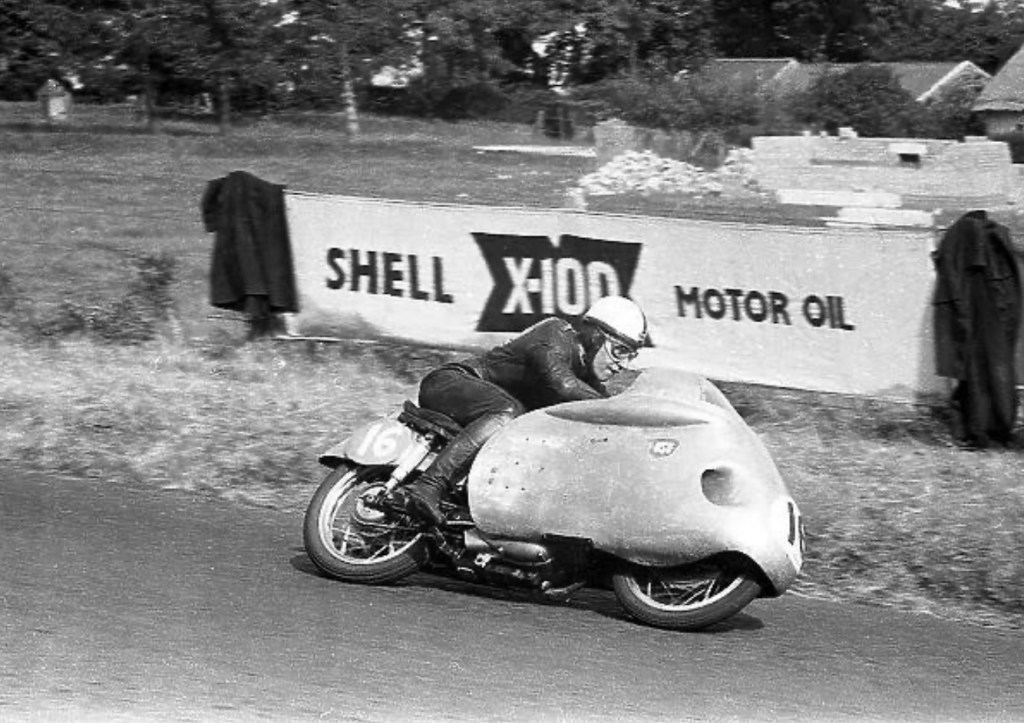
Instead Surtees began a five-year association with MV Agusta – after Count Domenico Agusta’s elderly mother had inspected him to decide whether she liked the cut-of-his-jib – winning his first seven races on the sonorous Italian in early-season British national races before winning the Isle of Man Senior TT, his debut World Championship Grand Prix race on the MV 500-four. And the rest, as they say, is history…click here for my article on the champion: https://primotipo.com/2014/11/30/john-surtees-world-champion-50-years-ago/

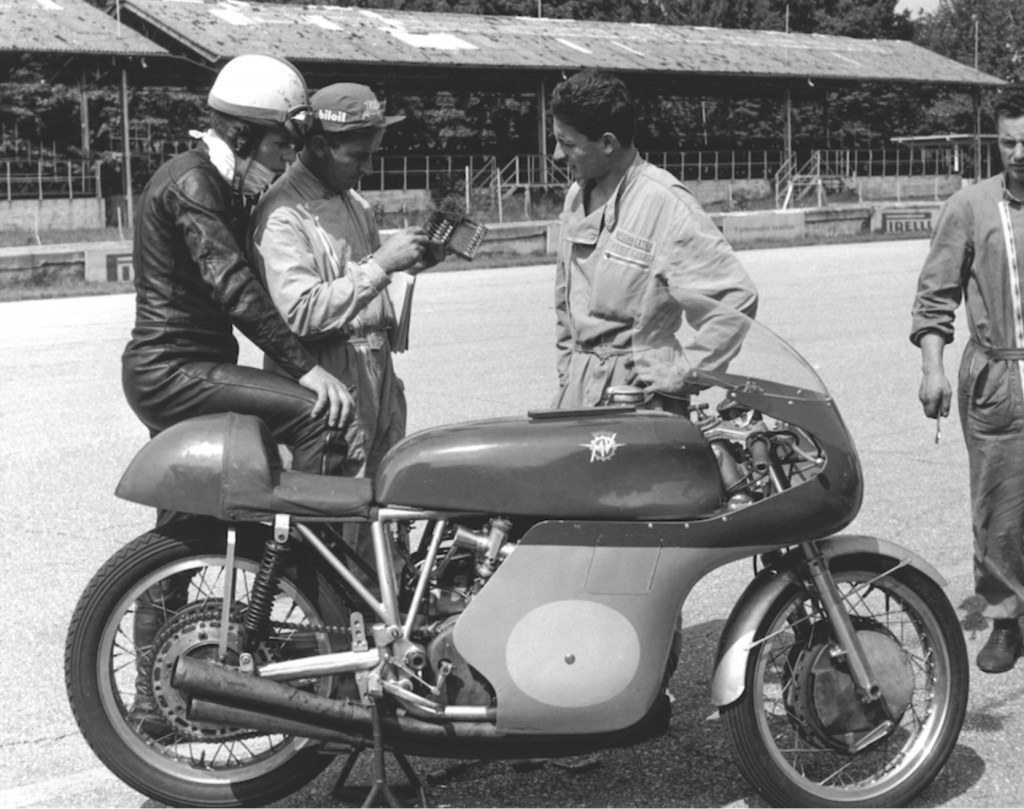
Surtees testing an MV, date and place unknown (unattributed)
Surtees on the way to winning the Senior TT at Kates Cottage on the Isle of Man in 1956, MV 500 (ttracepics.com)

Credit…

Central Press, ridersdrivemag.com, A Herl, ttracepics.com, ‘John Surtees-World Champion’ by John Surtees and Alan Henry, J Topham-TopFoto, Rodger Kirby

Etcetera : R.E.G. 250…

(R Kirby)

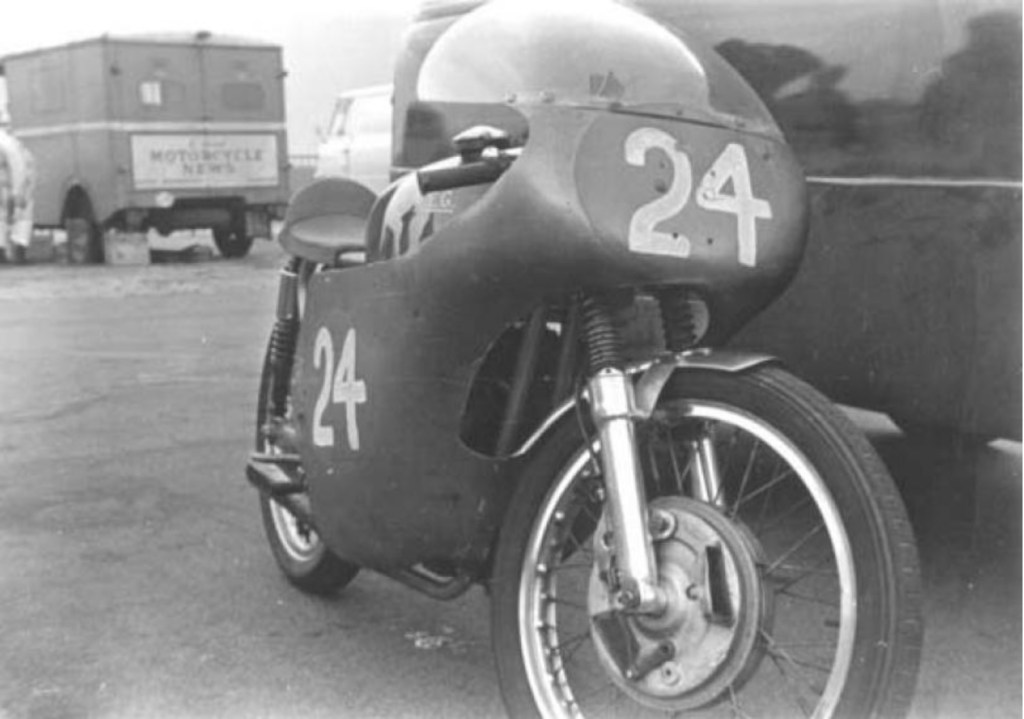
Robert E Geeson built R.E.G 250cc twin-cam, two valve, parallel twin racing motorcycle shown here at Silverstone in April 1962. See here: https://cybermotorcycle.com/marques/british/reg.htm 

(R Kirby)

Finito…

(B Donaldson)

John Surtees is chasing Jack Brabham hard in the latter stages of the 1963 Australian Grand Prix at Warwick Farm on February 10, 1963. He is racing a Lola Mk4A Climax 2.7 FPF chassis #BRGP44.

Jack’s Brabham, Brabham BT4 Climax passed him late in the race, John fell short by 12 seconds in a race run in intensive heat, but he had a good southern summer, winning two of the eight Australasian internationals, the NZ GP at Pukekohe and the Lakeside International.

I’ve had a crack at this topic before, but there are a swag of shots looking for a home, so why not? See here: https://primotipo.com/2017/10/05/cruisin-for-a-bruisin/ And here too, Lola Heritage have a great article: http://www.lolaheritage.co.uk/type_numbers/mk4/mk4.html

Dick Ellis cutaway of an F1 Lola Mk4 Coventry Climax FWMV 1.5 V8
Surtees, Team Lotus Lotus 18 Climax at Ardmore during the 1961 NZ GP, DNF (M Fistonic)

1963 wasn’t his first trip Down Under. Il Grande John did the Kiwi Internationals with Team Lotus in 1961 when Innes Ireland, Jim Clark and Surtees raced Lotus 18 2.5 FPFs fitted with the dreaded Queerbox. In a grim tour for the team, Surtees didn’t finish any of his three races at Ardmore, Levin or Wigram.

He was back again in 1962, running a Reg Parnell Cooper T53 2.7 in Australia, finishing second at Sandown and winning from Jack Brabham’s Cooper T55 2.7 on Longford’s daunting mix of roads, undulations, railway viaduct and barbed wire.

Parnell ran a pair of Lola T4 Climaxes, 1.5 FPF powered early on, then 1.5 FWMV V8 engined when the engine became available in Grand Prix racing that year. Surtees finished a great fourth in the World Drivers Championship during the season in which the monocoque Lotus 25 Climax rewrote the chassis design rulebook.

Surtees winning Lola Mk4A and Bruce McLaren, Cooper T62 on the front row at Pukekohe, NZ GP 1963. That’s Brabham’s #4 BT4, and Tony Maggs in the other Parnell Lola Mk4 at far left (D Oxton)
Later Kiwi Ace, David Oxton attends to a Colotti ratio change on Surtees’ car, Pukekohe (D Oxton)

Reg (Bowmaker-Yeoman Racing Team) fitted 2.7FPFs to two of his T4s in place of the smaller F1 V8 for the 1963 Formula Libre Australasian Internationals for Surtees and South African driver, Tony Maggs use. Parnell knew the local-ropes, having raced a Ferrari Super Squalo 3.4 as part of a two car team together with Peter Whitehead in the 1957 New Zealand Internationals. He did well too, winning the NZ GP and the Dunedin Road Race in what was his last hurrah as a driver before taking on Aston Martin team management duties.

Other hot-shots that summer included Jack Brabham in his new F1 BT3 derived BT4 2.7 FPF, while Bruce McLaren raced the similarly powered Cooper T62 with which he won the 1962 Australian Grand Prix at Caversham, near Perth that November. Graham Hill (and Innes Ireland in some NZ races) raced the radical, fast Ferguson P99 albeit he lacked the mumbo of his completion, running 2.5 FPF’s rather than the more fancied 2.7 ‘Indy’ variant.

Young Cooper T53 mounted thrusters included Chris Amon, Jim Palmer and Angus Hyslop. In Australia the local quicks included David McKay and Bib Stillwell in new BT4s, while Lex Davison and young grazier John Youl raced Coopers T53 and T55 respectively.

Surtees’s Lola Mk4A #BRGP44 was quick everywhere, starting the tour with a bang by winning the NZ GP at the new Pukekohe circuit near Auckland, then gearbox problems caused DNFs at Levinand Wigram. He failed to finish at Teretonga as well, albeit Maggs placed second behind McLaren at the track near Invercargill at the very south of the South Island.

Surtees in the Wigram – RNZAF airfield – paddock. That Ferrari 250 SWB belonged to ‘Richardson’ for those wanting to do further research (W Collins)
Surtees and handsome Mk4A at Teretonga, ninth after undisclosed problems (G Woods)

There was then a fortnight to ship the cars across the Tasman Sea to Sydney Harbour for the AGP to be held on the challenging, technical Warwick Farm on February 10.

Surtees put down a marker, popping his Lola on pole in Jack’s backyard. He then led the race until Brabham – who started well back on the grid having sorted a new BT4 chassis during practice – passed him with 14 laps to run, the Brit suffering along with many others in the intense heat. John had the consolation of meeting fastest lap.

Then it was off to Lakeside, north of Brisbane. There Surtees started from Q3 and won from Hill, bagging the P99’s best result for the tour, with Stillwell third in his new Brabham BT4. Chris Amon was fourth and impressing pit-pundits with every drive. At the end of the summer Reg Parnell took the 19 year old off to Europe where he did rather well…initially racing #BRGP44 FWMV powered throughout 1963.

Shell drivers at Warwick Farm: David McKay, Tony Maggs, Graham Hill, John Surtees, Jim Palmer and Chris Amon (C Galloway)
Surtees hooks into the right-hander at the end of Pit Straight, Paddock, at Warwick Farm 1963 (B Donaldson)

Surtees returned to Europe to meet his new Ferrari team commitments, missing the final two races at Longford and Sandown, with Tony Maggs, sixth and second in the Parnell Lolas respectively.

Had there been a Tasman Cup that summer – the first was contested and won by Bruce McLaren in 1964 – Bruce would have won it. Brabham won at Levin and Warwick Farm, Surtees at Pukekohe and Lakeside, while McLaren was victorious at Wigram, Teretonga, Longford and Sandown.

The Lolas had proved very competitive Formula Libre machines but were thoroughly outclassed in ’63 GP racing: Amon, Maurice Trintignant, Lucien Bianchi, Mike Hailwood and Masten Gregory all failed to bag a point for Reg Parnell Racing.

Surtees Mk4 during 1962. The idea of that yellow enamelled spaceframe chassis was to make it easy to see any cracks that arose (unattributed)

Etcetera…

(MotorSport)

Pretty car. Surtees during the soggy German Grand Prix was second behind Graham Hill’s BRM. He first raced the chassis he used throughout his 1963 Australiasion Tour, T4A #BRGP44, at Karlskoga in August, there he led until a valve spring broke.

(MotorSport)

Main Men. Reg Parnell, Surtees and who? during the May 1962 Dutch Grand Prix weekend at Zandvoort. John popped his car on pole but crashed in the early laps after a wishbone failure.

(MotorSport)

More Main Men. Surtees and Lola’s Eric Broadley at Aintree during the British GP meeting in July. And below, John with the car in the paddock. FWMV is on Webers, a bit cheaper, but less powerful than the Lucas injected alternative.

Lola had a fantastic weekend with Surtees qualifying and finishing second in the race. The cars gained pace after the cockpit area was found to be flexing by Surtees in the lead up to the Belgian Grand Prix, when additional tubes were added to the suspect area.

(MotorSport)
(N Beresford Collection)

Don Beresford – father of engineer Nigel Beresford of Ralt, Tyrrell, Penske Cars et al fame – working on a T4 at Bromley during 1962. It’s after the chassis cockpit section was strengthened, note the additional tubular section which has been added, so it’s probably the chassis Surtees raced carrying #6 in the December 29, 1962 South African Grand Prix at East London, DNF.

The ’63 New Zealand GP was a week later on January 5, no rest for the wicked!

Credits…

Bob Donaldson-State Library of New South Wales, Dick Ellis, Colin Galloway, Milan Fistonic, David Oxton Collection, Graham Woods Collection, Warner Collins, Lynton Hemer, Dick Simpson-oldracephotos.com, Michelle Glenn, Nigel Beresford Collection

Tailpieces

Surtees, Surtees TS8/9 Chev, Alan Hamilton, McLaren M10B Chev, Colin Bond, McLaren M10C Repco-Holden and Graeme Lawrence, Brabham BT29 Ford FVC (L Hemer)

John Surtees was a busy lad throughout the 1960s with Grand Prix, World Endurance Championship and Can-Am programmes in most seasons, so he never did do a Tasman.

Scuderia Ferrari had plans afoot for Surtees to race a Ferrari Dino V6 – the ‘Surtees Tasman Special’ Ferrari 246 #006 – in 1966 but a late season Can-Am accident at Mosport in a Lola T70 Chev hospitalised him that winter so that didn’t happen. Chris Amon subsequently went rather well with updated 246 variants in 1968-69.

(M Glenn)

By 1971 Surtees’ commercial imperatives had evolved somewhat. Not only was he contesting Grand Prix racing with a two car team, he was also a constructor of customer racing cars, including Formula 5000 machines, which had been adopted as the Tasman Formula from 1970.

So it made sense for Surtees to contest the November 1971 Australian Grand Prix at Warwick Farm in a Surtees TS8/TS9 Chev, perhaps selling a car or two, then leave the car here for his protege, Mike Hailwood to race in the following 1972 Tasman.

Surtees in front of Max Stewart’s Mildren Waggott TC-4V in the Farm’s Esses (D Simpson-oldracephotos.com)

Surtees qualified ninth after fraught practice sessions sorting handling problems, then had a miserable race without his preferred Firestones, but he still got as high as fourth before pitting for a new left-front tyre, losing three laps in the process, before having another puncture late in the race, finally finishing 14th. “He certainly gave the crowd good value while he was going, “The History of The Australian Grand Prix” recorded.

Frank Matich triumphed that day in his brand new Matich A50 Repco-Holden with Kevin Bartlett and Hamilton second and third in their McLaren M10B Chevs.

Finally, Mike Hailwood did well in the 1972 Tasman Series, he was second to Graham McRae’s Leda GM1 Chev despite not winning round, and was then the best of Team Surtees F1 drivers that season; eighth in the World Championship.

Finito

fina

(unattributed)

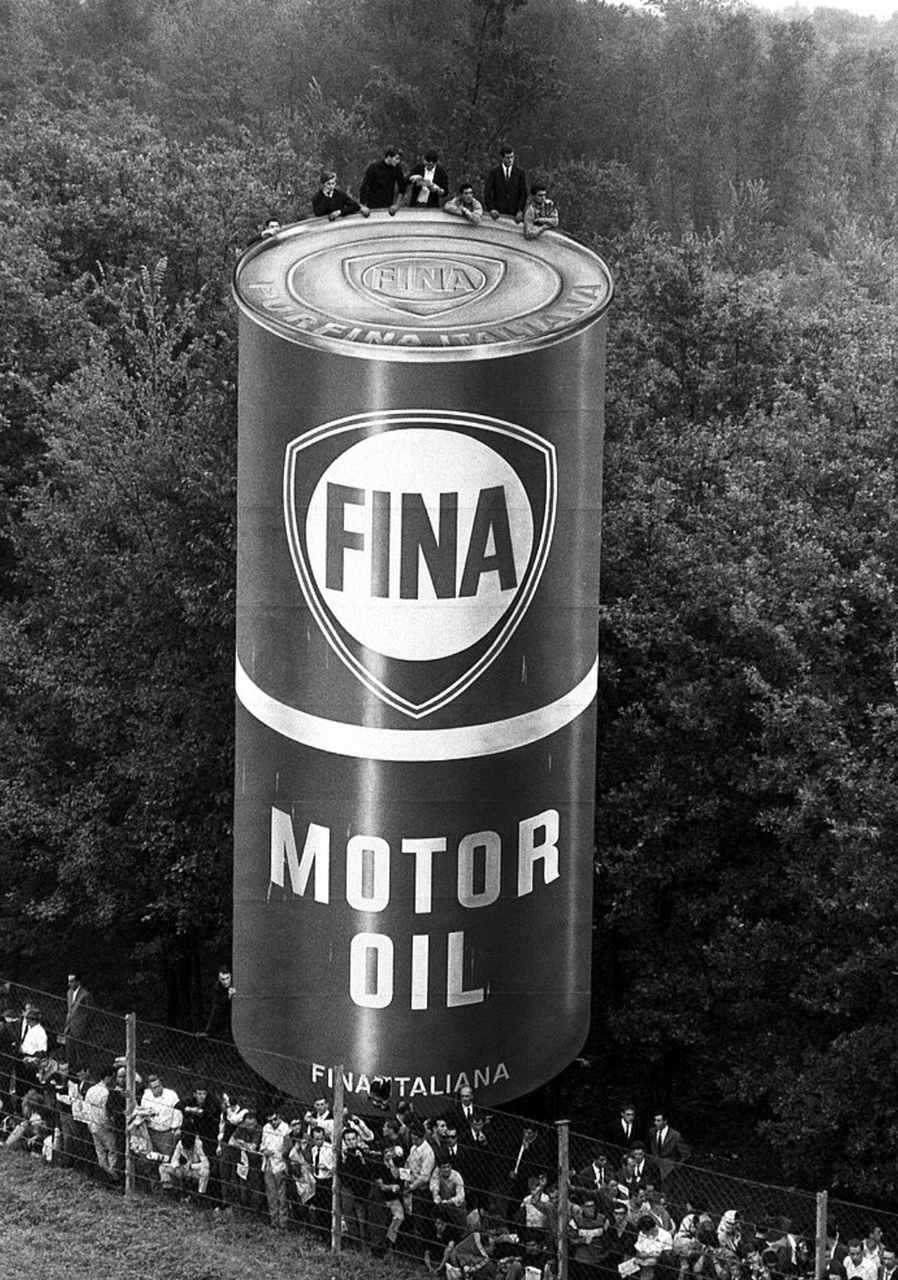
The crowd had plenty to cheer about. Bandini’s Ferrari had just won the 1964 Austrian GP and John Surtees took victory before their eyes on the way to his and the Scuderia’s 1964 World Championships. Italian Grand Prix, Monza September 6 1964…

In a thrilling race with slipstreaming battles down the field for which the circuit was famous, Surtees won in his Ferrari 158 from Bruce Mclaren’s Cooper T73 Climax and Bandini’s 158.

john

(unattributed)

John Surtees and Dan Gurney diced for much of the race until the Climax engine in his Brabham BT7 cried enough. Gurney had a few of these occasions when on the cusp of a win during his Brabham years.

lorenzo

(The Cahier Archive)

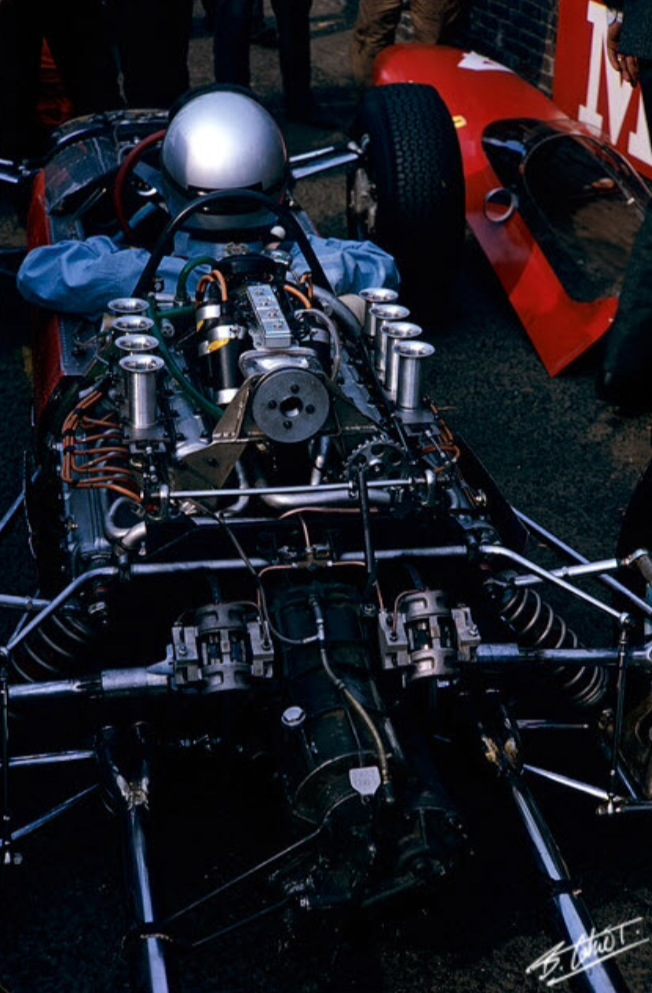
The business end of Lorenzo Bandini’s Ferrari 158 during practice.

Photo Credit…

The Cahier Archive

Finito…

(MotorSport)

It’s not what you know that gets ya, it’s what you don’t know.

I thought I’d done a nice piece on Ferrari’s 156 variants, that is, the cars which bridged the gap between the 1961 World Championship winning 156 Sharknose and 1964 158, victorious in the hands of Phil Hill and John Surtees respectively.

Then Doug Nye posted the photograph above on an internet forum. It’s Lorenzo Bandini at the Nurburgring during the 1962 German GP weekend in a Ferrari 156/62P. The prototype was designed by Mauro Forghieri in 1962 as the young engineer explored smaller, lighter-tubed spaceframes of the type built by the British manufacturers.

He sought to bridge the performance gap which had widened even more after Jim Clark debuted the first modern monocoque Lotus 25 Climax at Zandvoort that May.

Oopsie, missed that car, hmmm, back to the drawing board I thought. Sure enough, there are a few photographs of the 156/62P, which raced only at the Nurburgring and Monza 1962 if you look closely.

(MotorSport)

Forghieri’s learnings with this model were then applied to his 1963 spaceframe 156/63, a GP winner on the Nurburgring in Surtees’ hands that year. The shot above shows Il Grande John hard at it through the Dutch dunes at Zandvoort in June 1963.

So, do check out this article, Ferrari 156/62P, 156/63 and 156 Aero… | primotipo… I’ve re-written it and doubled the number of photographs. Hopefully it’s now a decent record of the 1.5-litre V6 engined 1962-1964 Ferrari 156/62P, 156/63 and 156 Aero…

(MotorSport)

The final variant of the 156 was the 156 Aero, here Lorenzo Bandini is on the way to his – and the 156 Aero’s only championship GP victory – at Zeltweg, Austria in August 1964.

This model was created to contest the 1963 Italian GP. When the Tipo 158’s engine was running late the venerable V6 was skilfully adapted to fit the new Aero chassis. The car was still competitive in 1964 too, Bandini raced them for a while as Surtees and Forghieri got the 158 up to snuff.

Credits…

MotorSport Images

Tailpiece…

(MotorSport)

“We could have a party in here Colin! It’s so roomy and comfy.”

Jim Clark trying Bandini’s new Ferrari 156/62P for size at the Nurburgring in 1962. “Our car may be a bit snug Jimmy but it’s 48 seconds a lap quicker than that little clunker”, may well have been Chapman’s retort.

Ferrari were way off the pace in 1962 but won a nip-and-tuck world title in 1964. As much as anything else it was text book stuff about having depth in the team when the 1961-62 Winter of Ferrari Discontent resulted in eight senior employees leaving the Scuderia. In the overall scheme of things they barely missed a beat, ahem, 1962 aside…

Finito…
image

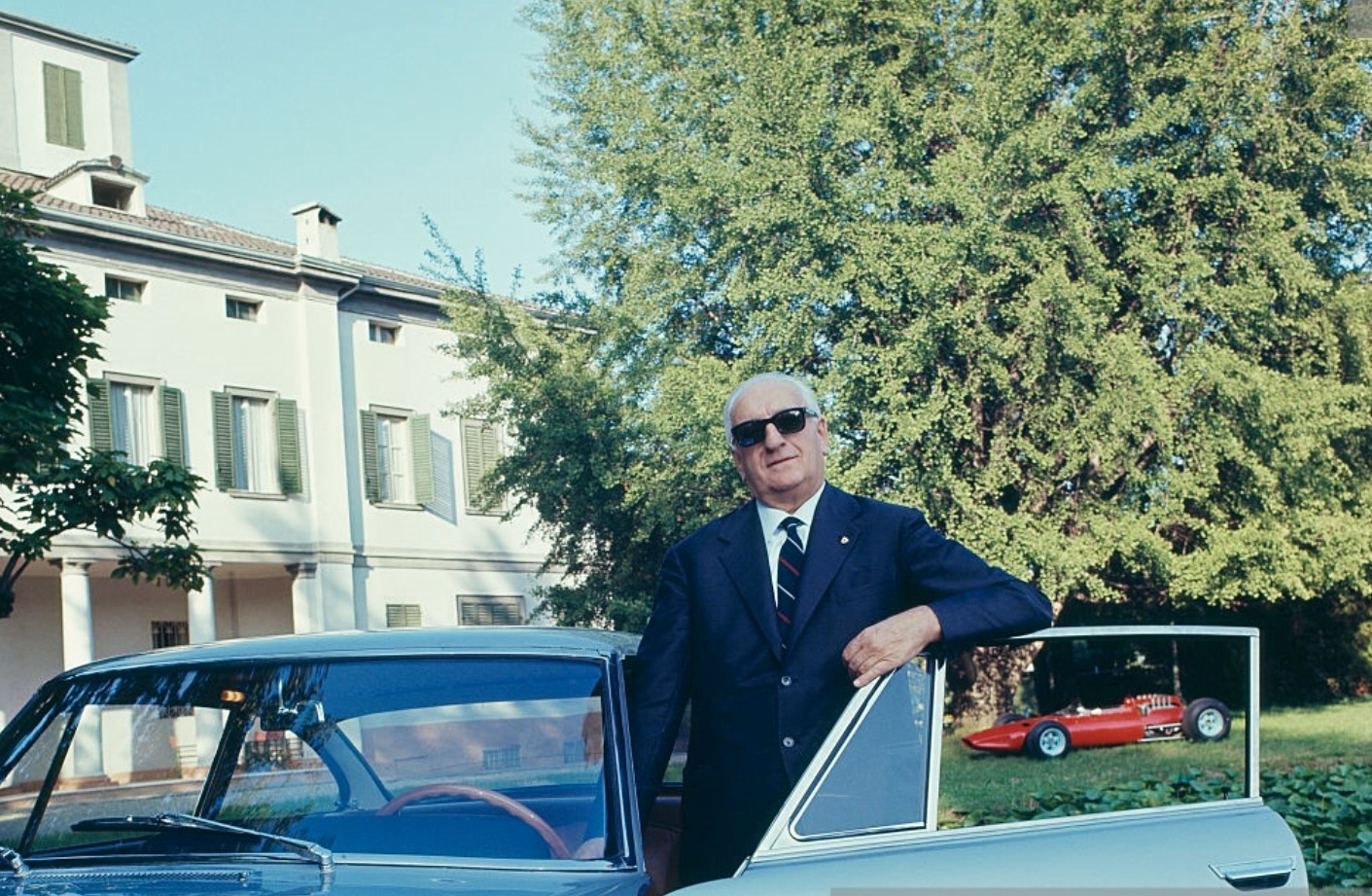
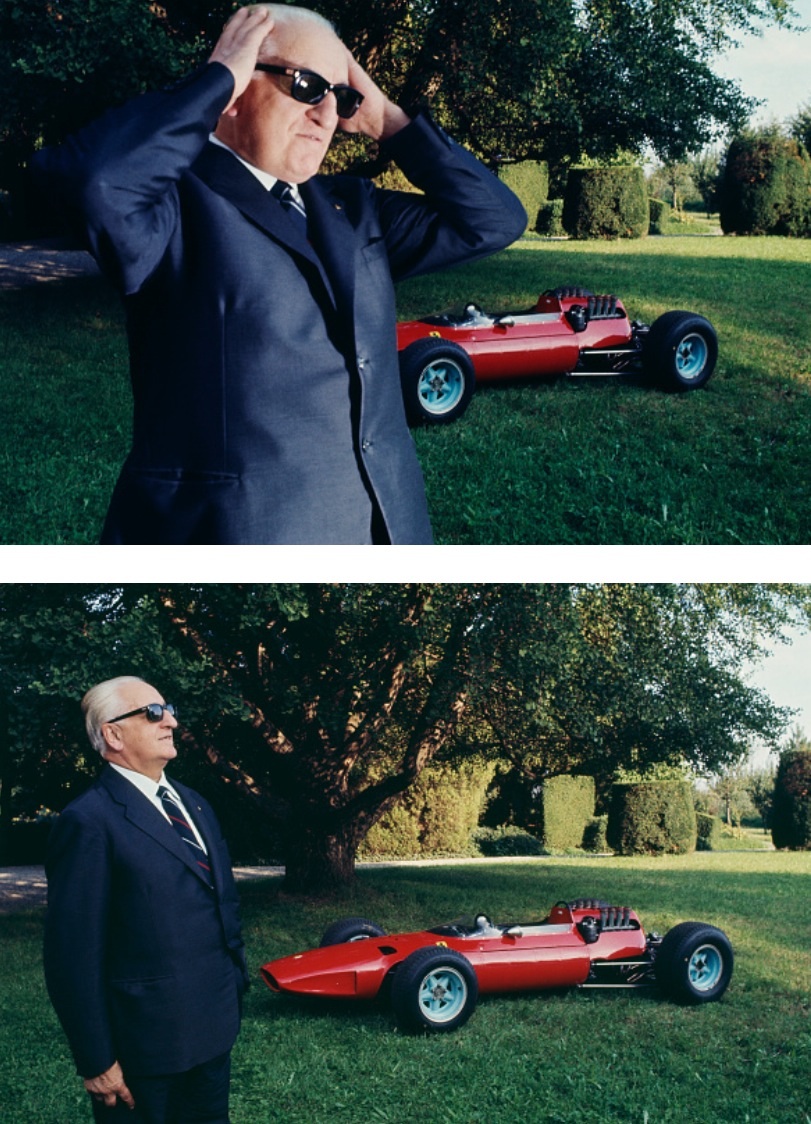
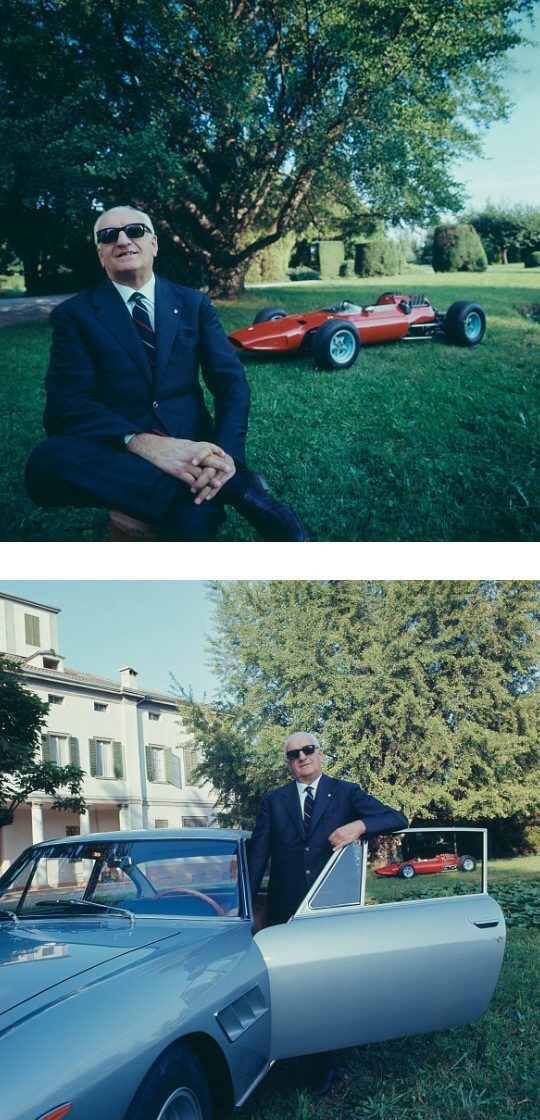
These images are captioned as Enzo Ferrari at home in Bergamo, the shoot isn’t dated but either at the start or end of 1964 makes sense…

The Grand Prix car is the Ferrari 158, the weapon John Surtees used to win the 1964 Drivers and Constructors championships for Ferrari, the GT is a 500 Superfast I think. I covered ‘Big John’ and his career in this article, which includes a piece about the 158 and its specifications; https://primotipo.com/2014/11/30/john-surtees-world-champion-50-years-ago/ also check out this pictorial of the 158; https://primotipo.com/2016/05/24/n-a-r-t-ferrari-158s/

Tailpiece: Enzo straightening his toupee…

image

Credits…

Manuel Litran – Getty Images

Tailpiece…

image

Yes, the weather is beautiful, but just get on with it and nick-off, I’ve next years flat-twelves to attend to.

Finito…

Grand Prix cars; Ferrari 156/63 F1 1963, red Lotus Climax FPF, at left a Lotus 18 Climax FPF and Lotus 33 Climax FWMV (M Bisset)

The Ferrari 156/63 holds centre-stage at the Musee National de l’Automobile, Mulhouse, France in July 2019…

When I saw it I didn’t recognise the car at all.

The 156 went from 1961 World Champ to 1962 World Chump. Then, to me, along came Ferrari’s ‘Aero-framed’ semi-monocoque 1.5-litre V8 engined 158 with which John Surtees won the 1964 championship in a great battle with Jim Clark’s Lotus 15/33 Climax and Graham Hill’s BRM P261.

Not so fast. Between the 156 and 158 were the T56, 156, 156/62P, 156/63, 156 F1-63 and Aero 156 depending upon your source as to model names, the 156/63 is one of those cars.

Ferrari raced on with the 156 largely unchanged in 1962 given their sudden paucity of team leaders. Mr Ferrari had a mass-departure of top executives, including 156 designer, Carlo Chiti, that winter. Their exodus to Automobili Turismo e Sport (ATS) was an unmitigated disaster, that story is here; ‘Automobili Turismo e Sport’ : A.T.S. F1… | primotipo…

But Ferrari had depth in the ranks, young engineer, Mauro Forghieri set to work on a series of cars more akin to British chassis design orthodoxy, and ultimate success in 1964.

Forghieri (born 13 January 1935) joined Ferrari in 1960 after completing an engineering degree at Bologna University the year before.

The key team which took the Scuderia forward included engineers Rocchi, assisted by Bellei  – with oversight provided by Vittorio Jano – on the new V8 (1964). Ing Salvarini looked after gearboxes and suspension with Bussi doing dyno engine testing and development.

The Flat-12 (1964-65) design was Forghieri’s, as was the at circuit role and liasion between the race-team and technical group. In short, he was team-leader.

John Surtees, Ferrari 156/63, 1963 US GP at Watkins Glen. Grid three and DNF valve failure was his haul that weekend (MotorSport)

With time short that winter, there was little time to develop the existing 156s. Before Chiti left, V6 developments included a two-valver with twin-plugs, a two-valver with three-plugs, a three-valver with two-plugs and a four-valver with one-plug (!), for which 210bhp @ 10,000rpm was claimed.

Chassis changes involved a move towards a lower polar moment of inertia which was achieved by moving the masses within the a wheelbase. A new 6-speed gearbox was also available. It could be mounted conventionally, overhung behind the rear axle, or within the wheelbase, albeit the former was preferred.

That year Forghieri tried wide track 156s, but lost top-speed wasn’t exceeded by greater cornering ability. In effect, Ferrari had a stand-still year as Forghieri developed a more competitive ’63 car and established the foundations for mid-term success.

Mauro’s early cars, the spaceframe 1962 156/62P and 1963 156/63, and semi-monocoque 156 Aero, were still powered by the trusty Tipo 178 1.5-litre, twelve-valve V6, by then Bosch direct fuel injected.

This engine was well trumped by the British Coventry Climax FWMV and BRM P56 V8s in 1962, but Forghieri’s chassis’ were much nicer modern affairs than the 1961 156. Gradually Ferrari bridged the opposition’s gap in 1962-63 setting up its driver and manufacturer titles in 1964.

Lorenzo Bandini in Forghieri’s new Ferrari 156/62P #0008 during the German GP, Nurburgring August 1962 (MotorSport)

Ferrari 156/62P…

Ferrari had built nine 156s by the end of 1961, they built another three in 1962; #0007, #0008 and #0009. #0007 was a new 156 of evolved design as mentioned above, while #0008 and #0009 were Forghieri’s new 156/62P experimental machines.

These two cars were smaller, neater small-tube spaceframes with rear suspension practice and geometry akin to the British opposition, albeit the archaic, heavy, and beautiful Borrani wire wheels were retained.

Bandini’s 156/62P in the Nurburgring paddock. Behind him are Phil Hill’s #1, and Giancarlo Baghetti’s #2 normale 156s (MotorSport)

Forghieri’s 156/62P #0008 was finally ready and raced by Lorenzo Bandini in the German GP that August, he qualified 18th but was out after an accident on lap five.

Mauro Forghieri was further empowered late season when John Surtees joined the Scuderia. His engineering knowledge and interest, and fierce determination to effectively use Ferrari’s vast resources ensured significant progress was made that winter and into 1963.

Willy Mairesse at Monza during the 1962 Italian GP weekend in 156/62P #0008. He did well, fourth place. Note the changes to the rear bodywork in the shot below compared with the car as appeared at the  Nurburgring a month earlier

Willy Mairesse was given the car at Monza. He qualified 10th, finished fourth and was the best placed of the 156 Dinos on the grid and in terms of race results. Clearly progress was being made.

That weekend Willy also tested #0009, it had only just been completed with its beautiful hand formed aluminium body still unpainted (below)

Apart from differences in the nose of the car compared with its 156/62P sibling #0008, the rear suspension of this car is completely different. Gone is the top link and wide-based lower wishbone, in its place is a multi-link set up more akin to contemporary British practice, viz; single top link, inverted lower wishbone and two radius rods, adjustable roll bar and coil spring/Koni dampers.

Big Ferrari news for 1963 was Surtees recruitment, latterly of the Bowmaker Lola Team. During this period of change, Surtees tested at Modena, including a drive of what appears to be 156/62P #0009, above.

The photograph is dated November 26, 1962 (Getty Images’ dating of shots is often wrong). Note that the rear suspension of the car at this time is different to that over the Italian GP weekend when Mairesse tested it.

Ludovico Scarfiotti, Ferrari 156/63 at Zandvoort, 1963 Dutch Grand Prix. The young Italian was sixth in his first championship GP (MotorSport)

Ferrari 156/63…

Forghieri worked over the winter on the 156/63, another neat multi-tubular spaceframe car of small gauge tubes. An evolution of the existing V6 was bolted to a new six-speed gearbox with lightweight, magnesium alloy Campagnolo wheels part of an attractive package. As stated Mauro was greatly empowered by Surtees arrival, progress was enhanced.

Ferrari 156/63 cutaway, technical specifications as per text (Vic Berris)

Willy Mairesse displaying the beautiful lines of his new Ferrari 156/63 at Monte Carlo in May (MotorSport)

Business end of a 156/63 (MotorSport)

In 1963 spec the two-valve, fuel injected DOHC V6 gave a claimed 205/210bhp. Michael May adapted Bosch direct fuel injection to the motor.

Noteworthy is that by the end of 1963 F1-was-fuel-injected by Lucas and Bosch. There were still downdraft Webers to be seen on customer V8s, but up at front fuel injection was the go.

The gearbox had six speeds, front suspension the usual outboard fare of upper and lower wishbones and coil spring/shocks. At the rear the regime was again period typical, single upper link, a lower inverted wishbone and twin radius rods with coil spring/Koni shocks and adjustable roll bars front and rear. Steering was rack and pinion with Campagnolo magnesium alloy wheels finally replacing the Borrani wires. Brakes were Dunlop disc, inboard at the rear.

Three 156/63 machines were built; chassis #0001, #0002 and #0003, the team missed early season non-championship races to focus on testing at Modena and Monza.

Surtees started the season strongly in Monaco, qualifying third and finishing fourth, Mairesse was Q7 and DNF with a final drive failure. Up front Graham Hill won for BRM.

At Spa Mairesse qualified third at home but failed to finish with fuel injection problems. Surtees qualified 10th, he too had fuel injection problems, a faulty pipe. Jim Clark won and commenced an amazing run in his Lotus 25 Climax which saw him take his first World Championship.

At Zandvoort Surtees was a great third from Q5, and Scarfiotti sixth from Q11. At Reims John was out with a split fuel pipe failure from Q4, a good effort after fuel injection problems in practice which were sorted by Bosch technicians. Scarfiotti didn’t start after a practice crash.

At Silverstone for the British Grand Prix, Surtees qualified fifth and finished in the same spot while Scarfiotti wasn’t entered. Up front, it was Clark’s Lotus all the way.

(MotorSport)

On that most challenging of tracks, the Nurburgring, the teams hard work was vindicated with a dominant win from Surtees from grid two (above), while Willy Mairesse was out with an accident.

A fortnight after the German GP, Ferrari contested the non-championship GP del Mediterraneo at Enna where Surtees took a pole to flag victory.

Then, tails-up, it was off to Monza in September where the Tifosi were ecstatic with anticipation after Surtees plonked his new 156 Aero on pole, sadly he was out with engine failure during the race. Bandini started sixth in a 156/63 but was outted with gearbox failure, Clark’s Lotus 25 won again.

Let’s deal with the specifications of the 156 Aero – an interim model put together with great attention to detail due to the 158’s V8 engine running late – in a little bit.

Surtees shows the massive 1963 Monza crowd his new Ferrari 156 Aero in September 1963, the ultimate expression of the 156 type, or family of cars first tested throughout 1960 (MotorSport)

Beautiful 156 Aero at Monza, key elements as per text but note entirely paradigm rear suspension, injected V6, inboard brakes and long-overhang 6-speed transaxle (MotorSport)

Butt-shot of Surtees’ 156/63 at Watkins Glen (MotorSport)

At Watkins Glen, Surtees qualified a strong third aboard a 156/63 on the fast, challenging Watkins Glen course but had valve failure in the race. Bandini started ninth and finished fifth. In Mexico Surtees 156 Aero was disqualified after receiving outside assistance from grid two, while Bandini had engine failure from seventh on the grid.

John Surtees’ consistently strong performances yielded 22 points, placing him fourth in the 1963 drivers championship behind Clark’s Lotus 25 Climax, then Hill G and Richie Ginther aboard BRM P57s. The Surtees/Scuderia Ferrari combination approached 1964 with plenty of optimism and two new cars, the 158 and 1512.

Bandini on the way to victory on the Zeltweg Airfield circuit, Austrian GP, Ferrari 156 Aero in August 1964. He is passing Trevor Taylor’s abandoned BRP Mk1 BRM, broken suspension. It was the only GP win for the Italian and the 156 Aero Ferrari (MotorSport)

Ferrari 156 Aero…

Despite the arrival of the Aero semi-monocoque chassis 158 and 1512 the venerable 156 still played an important role in 1964.

As we have seen, with development of the new V8 behind schedule, a 120-degree V6 was adapted to Forghieri’s new Type 579 chassis to allow its debut at Monza in September 1963.

The chassis was based on a simple un-triangulated tubular internal frame to which were riveted stress bearing aluminium skins. This hybrid monocoque was unlike that pioneered by Len Terry and Colin Chapman at Lotus, but served Ferrari very well for nearly two decades.

“Two parallel fuel tank pontoons, each of which was fabricated and riveted aircraft style over a sketchy framework of two tube longerons staggered slightly in the vertical plane” wrote Doug Nye.

“These tubes doubled as water and oil feeds between engine and coolers. The completed pontoons were then united laterally throughout their length by a stressed floor panel with angle stiffening plates, and at each end were riveted to transverse bulkheads.”

“That at the front was doubled to sandwich inboard coil spring damper units operated by top rocker arms like Lotus’s, while the entire hybrid monocoque terminated behind the cockpit in a hefty fabricated rear bulkhead.”

Look carefully at Surtees’ 156 Aero chassis at Monza in 1963. You can see the rivet lines where the aluminium skin is attached to the tubes underneath. Visible also is the boom extension to the tub on this side to support the engine, it also carried the V8 which was never a fully stressed part of the chassis as Forghieri originally intended. Note the the twin-plugs and Bosch injection with the metering unit between the Vee, also the inboard Dunlop calipers rotor/disc, and six-speed transaxle (MotorSport)

Ferrari 156 Aero cutaway. It’s not so easy to quickly pick the spaceframe 156 from the semi-monocoque Aero. The most obvious difference in addition to the chassis, is top rocker front suspension on this car as against the wishbones of the earlier 156/63 (James Allington)
156 Aero front detail at Monza in 1963. Top rocker and hat of coil spring/Koni, note the bulkheads on which the rocker pivots, water radiator/cap and oil tank behind, master cylinders for brakes times two, and clutch. Under these is the steering rack and arm attached to a cast magnesium upright.

The design of the V8 and Flat-12 engines was radical in that their blocks were cast to allow them to form stress bearing components of the car, rather than the engine being attached to pontoons or an A-frame in the more traditional manner. That is, the motors bolted to the rear chassis bulkhead and accepted suspension loads.

Using the engine structurally then was rare. Vittorio Jano designed his 2.5-litre, quad-cam V8 as a stress bearing member of his front-engined Lancia D50 in 1954. BRM achieved it with Big-Bertha, the 1966 BRM P83 H16, so too did the similarly engined Lotus 43.

Forghieri and Ferrari team did so in 1964 with their Flat-12 Ferrari 1512. They didn’t persevered long enough with the V8 crankcase/block design to achieve the feat with the 158.  Jano was retained by Ferrari as a consultant during this period, this path was perhaps a suggestion he made to Forghieri and the design team?

The new V8 was running late in its development, so, as related, the V6 was adapted to allow testing and racing the Aero chassis.

Support trusses were added to its rear to carry the V6, which had not of course been designed to be a stressed member. Mind you, some references have it as “partially stressed”. The Aero’s front and rear suspension was contemporary standard British design practice.

Lorenzo Bandini aboard his 156 Aero in the Brands Hatch paddock during the 1964 British GP weekend. Note the different wheels to ’63. #1 is Jim Clark’s winning Lotus 25 Climax, #24 is Peter Revson’s Lotus 24 BRM (MotorSport)

The 156 Aero raced into 1964 in Bandini’s hands as the definitive 158 was made competitive and reliable by Surtees and Forghieri. Until then the 156 was reasonably kind to him.

While ‘Il Grande John’ won the German GP in a 158, Bandini popped a 156 Aero on the outside of the front row and finished third. He went two better at Zeltweg winning the race run on the rough-as-guts broken concrete airfield surface as other cars, including Surtees’ 158, were shaken to bits!

It was the last win for a V6 engine in F1 until the turbo-charged Renault V6s a decade or so hence. It was rather a nice last hurrah for engines which had delivered so much for so long since 1957.

Not that it was over yet for this family of Ferrari engines. An engine adapted for the 3-litre F1 Formula, the 246 raced in Bandini’s hands in 1966. Not to forget the 246 Tasman Formula engines for Chris Amon, Derek Bell and Graeme Lawrence fitted in multiple different specifications to 246T chassis from 1968 to 1971…

Chassis numbers…

Doug Nye provided the following explanation of the chassis numbers attributed to the 156/62P, 156/63 and 156 Aero.

“According to the hand-written chassis allocation record which Mr Ferrari’s Lieutenant Dr Franco Gozzi sent me in 1978 when I was compiling the ‘Dino book’ the chassis numbers are as follows.”

“1962 German GP – Bandini – chassis ‘0008’ – which was a number identifying the prototype ‘Sharknose’ chassis in which Baghetti had won at Syracuse and Naples in 1961, then crashed by him in the British GP and quite badly damaged. It was then – by inference – rebuilt into the ‘P’ form (156/62P) in time to reappear at the Nurburgring in 1962.”

“1962 Italian GP – Bandini drove chassis ‘0006’ – which was another 1961-series ‘Sharknose’ serial first identifying the car which Ricard Rodriguez drove in the ’61 Italian GP. Into 1962 it became Willy Mairesse’s Brussels GP winning chassis, then Bandini placed it fifth at Pau and second at Naples. Ricardo Rodriguez was then sixth in the German GP before Lorenzo raced it at Monza…There, ‘Wild Willy’ drove the rebuilt ‘0008’ – or at least a car entered under that identity.  Remember this is as prepared from the Ferrari records supplied to me back in ’78.”

“Incidentally, the ‘0008’ serial derives from the preceding front-engined Dino 246 F1/156 F2 family of chassis IDs.  They ran from ‘0001’ to ‘0007’ front-engined, with the rear-engined 246MP (‘Motore Posteriore‘) given its sole F1 outing by Ginther at Monaco in 1960, then being converted to 156 F2 form to be raced by Trips, winning the 1960 Solitude GP before finishing fifth overall and as F2 winner in the dual-class 1960 Italian GP at Monza.”

“I believe it is highly likely that the ‘0008’ prototype F1 which ran at the Nurburgring 1962 was a different and brand-new entity probably exploiting the team’s existing old Customs carnet so far as the serial ID is concerned.”

“The 1963 cars launched a whole new chassis number sequence, three 156/63s being built serialled ‘0001’-2-3 (surprisingly enough).  The prototype 156/63 ‘Aero’ was given the same-series chassis ID ‘0004’ promptly qualifying on pole at Monza.”

“For the US GP Ferrari works records indicate that Surtees raced ‘0004’.  Without checking further I don’t think that’s right. A wishbone mount pulled out of the chassis in practice and John raced the spaceframe car instead (Doug’s conclusion is consistent with race photographs). This was perhaps ‘0003’ rebuilt after Willy’s Ring crash, or entirely replaced under the same serial.” 

“In the following 1963 Mexican GP both John and Bandini drove ‘Aero’-chassised cars, with John listed by the works as having been in ‘0003’ and Bandini in ‘0001’.  I would lay good money on them having simply used the old spaceframe-series chassis numbers – and Carnets – for those cars, and for this having been dutifully entered in the factory records by the pen-pusher responsible.”

Etcetera: 1963 Ferrari 156/63…

Giulio Borsari tops up the Ferrari 156/63 125-litre fuel tank, with a dose of Shell’s finest Avgas at Monaco in 1963. Oh to have a pair of those overalls!

It looks like Surtees’ car, #21, he was fourth in the race won by Graham Hill’s BRM P57. Note the leather bound steering wheel and chassis cockpit bracing tubes. What sort of Dunlop in 1963, R5 perhaps?

(G Goddard/GP Library)

Graham Hill chasing John Surtees at Monaco in 1963 aboard a Ferrari 156/63 and BRM P57 or P578 depending upon your preference. Graham won from Richie Ginther in the other Owen Racing Organisation entry from Bruce McLaren’s Cooper T66 Climax, then Surtees.

They are such pretty little cars these 1.5-litre GP machines, mighty fast of course.

(unattributed)

Surtees’ 156/63 failed to finish with an inert fuel-pump, perhaps he is seeking to diagnose or rectify the problem, concentration not so easy on this high speed part of Reims.

Clark won from Tony Maggs and Graham Hill aboard Lotus 25 Climax, Cooper T66 Climax and BRM P61.

(LAT)

At first glance I thought it was Surtees at the Nürburgring in 1963. But it’s 1964, he’s aboard a Ferrari 158, he won the German GP in both years. It’s a Cooper T73 Climax behind, either Bruce McLaren or Phil Hill. Surtees won from pole ahead of Graham Hill’s BRM P261, with Lorenzo Bandini’s Ferrari 156 Aero a splendid third. See here for a short piece on the Ferrari 158; N.A.R.T. Ferrari 158’s… | primotipo…

Photo and reference credits…

Getty Images, Sutton Images, GP Library, LAT, Bernard Cahier, Ferrari website, grandprix.com, racing-reference.info, James Allington, ‘The History of The Grand Prix Car’ Doug Nye – special thanks to Doug for his note on the chassis number details

Tailpiece…

(unattributed)

Pretty as a picture at Silverstone, British GP 1963. The driver looks to sit quite far forward, or is it an optical trick?

Surtees’ 156/63 among the Silverstone fields with perhaps not quite the mumbo to really challenge Clark’s winning Lotus 25 Climax. The BRM duo of Graham Hill and Richie Ginther completed John’s V8 sandwich, in P56 V8 engined P57s.

Finito…

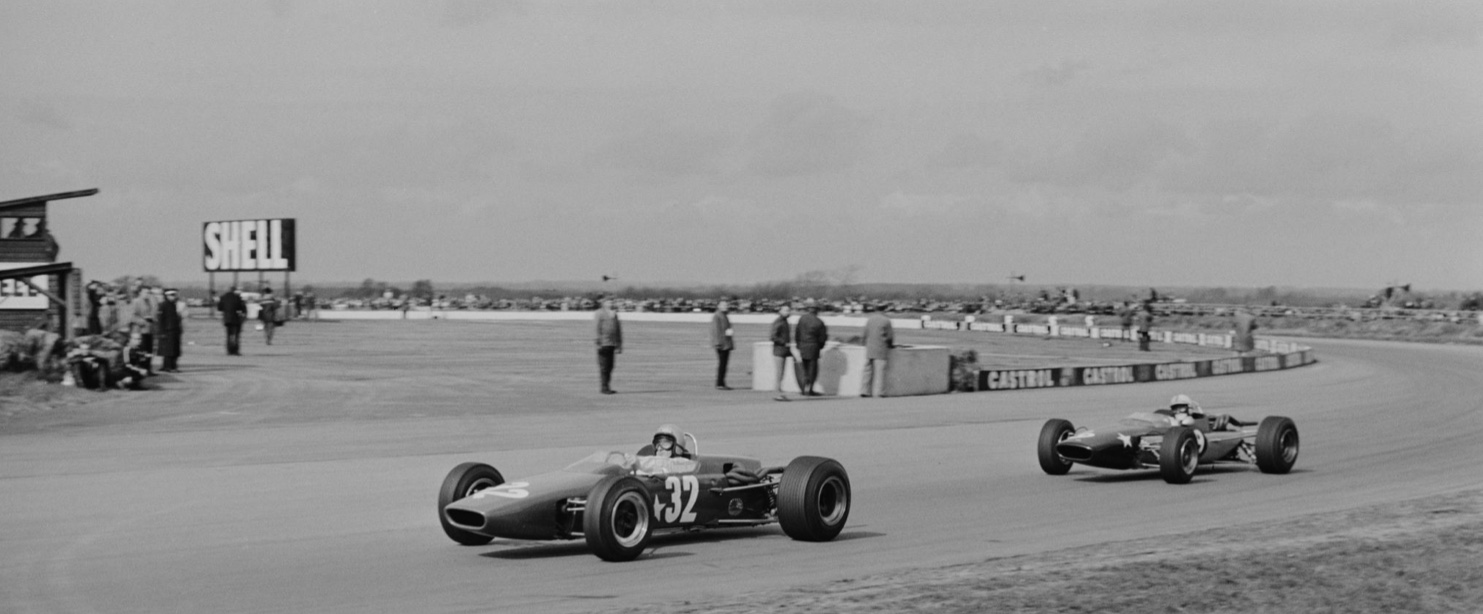
Jack Brabham awaits the start of one of the ‘Wills Trophy’ heats at Silverstone on 27 March 1967…

Is that John Cooper saying gedday before the off?

Jack is aboard BT23 chassis number 1- the very first in a long line of successful F2 and Tasman Formula cars- let’s not forget the BT23 spawned Ron Tauranac’s F1 Championship winning BT24 Repco design too.

Denny Hulme’s Brabham BT24 Repco during the 1967 US GP at Watkins Glen- he was 3rd behind the Clark/Hill Lotus 49 Ford duo (LAT)

Weren’t British enthusiasts blessed with championship F2 choice over Easter 1967?

They could have watched Jochen Rindt win at Snetterton on Good Friday and see him do it all again at Silverstone 180 Km away on Easter Monday aboard the same BT23-5 he used throughout a dominant 1967.

In a small tangent of Australian motor racing history this chassis is the one Denny Hulme raced in the 1968 Tasman Series- he boofed it at Pukekohe in a terrible accident involving Lawrence Brownlie’s Brabham and replaced it with BT23-2 in time for the Lady Wigram Trophy two weeks later.

Feo Stanton and Alec Mildren bought the remains less suspension and sent them off to Rennmax Engineering in Sydney for Bob Britton to built a jig and a run of new cars, the ‘Rorstan’ for Feo and ‘Mildren’ for Alec. Numerous cars really, the Rorstan, Mildren and Rennmax BN3’s all owe their lives to Jochen’s dead BT23-5.

Jochen blasts off at the start of heat 1- wheel on the right is Rees. Stewart’s Matra MS5 behind his Austrian buddy, Brabham’s BT23 #1- behind Brabham is Gardner, BT23 and alongside him in the red helmet is Widdows’ similar car with the red/orange tipped nose to the right on the same grid row, Mike Spence Parnell ex-F1 Lotus 33 FVA (Getty)

The Snetterton ‘Guards 100’ was the first championship race for the new 1.6 litre Formula 2 which commenced on 1 January that year, the category was enormously popular and successful even if, from the off it was ‘Formula FVA’, with special mentions for the Ferrari Dino V6 and BMW M11 in-line four.

Rindt came into 1967 as the acknowledged F2 King and left it with his crown polished ever more brightly, a quick perusal of ‘F2 Index’ results suggests he won all of the rounds in which he started and finished- Snetterton, Silverstone, the Nurburgring and Tulln-Langelbarn.

He had a DNF, a puncture at Jarama, that race was won by Clark’s Lotus 48- whilst he was occupied elsewhere the other race wins were taken by Stewart at Enna, Gardner at Hockenheim and 1967 European Series Champion, Jacky Ickx in a Ken Tyrrell Matra MS5 FVA was victorious at Zandvoort and Vallelunga.

McLaren and Surtees, McLaren M4A and Lola T100 (V Blackman)


Surtees in Lola T100 ‘SL/100/4’ given I am bandying chassis numbers around. Surtees primary programs that year were leading Honda’s F1 campaign and his Team Surtees Can-Am Lola program in the US- busy boy. That’s Ickx’ Matra MS5 behind and Mike Spence, Lotus 33 further back

As a ‘Graded Driver’ Jochen was ineligible for F2 Championship points, so Ickx won in 1967 from Gardner’s works BT23 and Jean-Pierre Beltoise’ works Matra MS5, Piers Courage in John Coombs McLaren M4A, Alan Rees in the other Roy Winkelmann BT23 and Chris Irwin’s works Lola T100 FVA and T102 BMW.

Creation of a new category brings forth a wonderful commercial opportunity with Cosworth Engineering flogging heaps of FVA’s (putting aside the derivatives of the motor which followed and the DFV proof of cylinder head design concept Duckworth’s FVA in part represented), Hewland Engineering dozens of FT200’s and of course availed the chassis manufacturers a great opportunity too.

Jack’s new BT23-1 and new Hewland FT200- in front of that 5 speed transaxle is a Ford Cortina blocked, Cosworth four-valve, Lucas injected 1.6 litre circa 210 bhp powerhouse. Tauranac’s typically simple combo of spaceframe chassis and outboard suspension provided a phenomenally fast, chuckable, robust, winning combination year after year. I don’t think he ever built a dog- Brabham or Ralt?


Bruce McLaren is aboard chassis number 1 too. M4A-1 was the first car designed by the McLaren/Robin Herd combo

The class of 1967 included the monocoque Lotus 48, Matra MS5/MS7, Lola T100 and McLaren M4A but arguably the car of the year, even putting aside Rindt’s dominance as a driver, was the spaceframe Brabham BT23- bias hereby declared by the way! Perhaps the BT23/23C are the ‘winningest cars’ of that 1967-1971 1.6 F2 period?

I really should prove that assertion statistically I guess, when and if I can be bothered. ‘Nicer cars’ in my book are the Lotus 59 and 69, Matra MS5/MS7 and Ferrari Dino, but more successful, I’m not so sure.

Whatever the case, in this immediate pre-wing year these cars were and are a mouth watering, very fast selection of single-seater racing cars.

Jackie Stewart above and below in one of the two Tyrrell Racing Organisation Matra MS5’s-Ickx in the other car.

Another year of the GP BRM H16 in 1967 was one too many for Jackie, and so it was that Ken Tyrrell stitched together a winning F1 combination of Matra, the Ford Cosworth DFV, Stewart and of course his own team’s preparation and organisational skills.

Bruce McLaren is behind Jackie in the shot below.

Silverstone’s BARC 200 was run over two heats of a little over 30 minutes in duration, Rindt won both with John Surtees third in the two events, Alan Rees was second in one and Graham Hill runner-up in the other.

The aggregated results gave Rindt the round from Rees’ BT23, Surtees T100, Bruce’s M4A, Stewart’s MS5, Gardner’s BT23 and Jacky Ickx’ MS5.

The entry lists right from the get-go of the new category were top notch, other drivers who raced at Silverstone included Robin Widdows BT23, Mike Spence in a Tim Parnell ex-F1 Lotus 33 fitted with an FVA, Denny Hulme BT23 (DNF with a busted conrod in heat 2), Piers Courage M4A, Jean-Pierre Beltoise MS5, Jo Siffert in the BMW factory Lola T100 BMW (all three of whom had injection dramas) Mike Costin, Brian Hart and Trevor Taylor. The list of Did Not Arrives was equally impressive.

Siffert, Lola T100 BMW M11, fuel injection dramas brought an end to Jo’s run (unattributed)

Of twenty-four starters, four were fitted with Lotus-Ford twin-cam motors, Siffert’s Lola (above and below) the very interesting BMW M11 Apfelbeck, the balance were toting Ford FVA’s so Duckworth and the lads had the production line in Northhampton humming along nicely.

There were a couple of FVA users with Lucas injection dramas, but Denny’s buggered rod was the only example of greater mechanical mayhem in a package which proved a paragon of reliability over the ensuing years.

(unattributed)


This has to be the most distinctive, simple piece of personal branding ever- in colour or black ‘n white Hill G or Hill D are so easy to pick in their London Rowing Club colours aren’t they? Lotus 48 Ford FVA.

Sydneysiders had the chance to see a Euro F2 1.6 car earlier than most, Warwick Farm promoter Geoff Sykes did a one race deal for Graham to race Lotus 48 ‘R1’ in the Australian Grand Prix that February.

Having come all that way the car’s FT200 expired after 25 laps of the race, Jackie Stewart’s BRM P261 2.1 prevailed, the series was won that year by Jim Clark racing an F1 Lotus 33 Climax FWMV 2 litre V8.

Graham raced ‘R2’ back in Europe with Jim Clark using ‘R1’ as his mount in 1968.

Stewart, BRM P261, Clark, Lotus 33 Climax and Hill, Lotus 48 Ford FVA, row 2 Brabham left Brabham BT23A Repco and Leo Geoghegan, Lotus 39 Climax and against the fence, Denny Hulme, Brabham BT18/22 Repco. AGP, Warwick Farm, February 1967 (B Wells)


Rindt and Hill- and Rees to the right jump similarly at the start of heat 2.

Thats Brabham, Surtees and McLaren on row two and Hulme, Gardner, Ickx and far right in the red McLaren- Piers Courage. The result was Rindt, Hill, Surtees.

(V Blackman)

Jochen with a delicate slide out of Woodcote, the proximity of ‘snappers to the action back then never ceases to amaze.

Rindt’s car control is right up there with the rest of the Gods of that art- Nuvolari, Fangio, Peterson, Villeneuve et al.

Etcetera…

Jack looks happy enough before the off.

Its only several weeks after the end of the Tasman Series- Brabham finished a pretty skinny series for the full on Repco-Brabham two car works assault on the championship that year well, he won the Longford final round in his one off Brabham BT23A on 5 March.

Two Repco ‘640’ engined cars were raced by Jack and Denny in all eight meetings of the six round championship- that season Levin and Teretonga were not championship rounds.

In fact there were a whole swag of blokes on that Silverstone grid who had raced in Australasia that summer- Stewart, Brabham, Gardner, Irwin, McLaren, Hill and Hulme- Clark was the only absentee from the roll-call.

(L Ruting)

Brabham fries a set of Goodyears and proves just how chuckable a BT23 can be in the hands of an Ace- AGP Warwick Farm 1967.

Its BT23A-1, JB’s 1967 Tasman weapon, a one-of-a-kind BT23 variant powered at that stage by a 640 Series Repco 2.5 litre Tasman V8, this machine is still in Australia, it was acquired by the National Motor Museum in 2018.

Article on the Tasman Brabham Repco’s here; https://primotipo.com/2016/09/29/bathurst-1969-and-jacks-tasman-brabhams/

(Getty)

An imperfectly executed pan of Hill’s Lotus 48 chasing Brian Hart’s Protos 16 FVA. Now there is a interesting marque topic to explore one day!

Who are those fellows looking after Bruce?

Piers Courage in John Coombs M4A behind McLaren, and in the photograph below. This car, ‘M4A-2’, Piers acquired from Coombs and raced in the 1968 Tasman and brained everybody with his speed and commitment.

He capped off an amazing summer with a blinding wet weather drive at Longford, his deft pace won the race from the 2.5’s which were hampered in their ability to put their power down on the slippery, bumpy bitumen.

The car was bought by Niel Allen at the end of the series, he did well in it and survived an almighty car destroying accident in it at Lakeside, it was rebuilt around a Bowin Designs built tub and then was one of the cars in which Warwick Brown made his name when owned by Pat Burke. Not so sure its still in Oz?

Article on Piers @ Longford here; https://primotipo.com/2015/10/20/longford-tasman-south-pacific-trophy-4-march-1968-and-piers-courage/

(LAT)

The photographs of the Courage McLaren in Australia below are during the Warwick Farm 100- he was second in the race won by Clark’s Lotus 49 Ford DFW.

The two monochrome photos below are during his victorious Longford weekend in March 1968, the great circuit’s final meeting.

(P Hudson)

Piers nipping the right front brake of M4A-2 on the entry to Mountford Corner during the dry, earlier over the Labour Day long weekend.

Courage ran the car on a shoestring assisted by Australian ex-Lotus mechanic Ray Parsons with two FVA’s, his performances that summer in many ways re-launched his career.

(oldracephotos.com.au)

It really did piss down on raceday, sadly for all, not least for the venues future, crowd numbers were way down although better than the ‘three men and a dog’ perspective provided by the shot below.

The hardy natives saw one of the great drives, Courage won from Pedro Rodriguez’ BRM P261 and Frank Gardner’s Brabham BT23 Alfa with Richard Attwood’s BRM P126 fourth.

(oldracephotos.com.au)


(unattributed)

‘And to think Jack pays me to do this shit! Its such a blast!’

Denny having a ball at Silverstone, he seems to have lost his front number but no doubt this was addressed by race day. The stars affixed to the cars are part of the Wills corporate identity i guess, sponsorship became less subtle from 1 January 1968!

Denny is racing BT23-2, his regular mount during 1967, although his primary commitments that year were winning the World Championship, which he managed nicely, and running the second of McLaren Cars, McLaren M6A Chevs in the Can-Am Challenge Cup- he was second to Bruce.

(D Simpson)

Max Stewart is shown above in the Mildren Waggott during the 1970 Sandown Cup, Tasman round.

Niel Allen won that day in his F5000 McLaren M10B Chev from Graeme Lawrence’s ex-Amon Ferrari Dino 246T, Ulf Norinder, Lola T190 Chev and then Max in the 2 litre Waggot TC-4V engined car- Max ‘won everything’ in Australia in this jigger including the 1971 Gold Star.

The photo is included for the sake of completeness to show one of the seven cars built by Bob Britton from the jig created from Rindt’s dead BT23-5, which these days of course is alive and well and racing in Europe.

Speaking of which, the photo below is of Denny ranging up on Lawrence Brownlie at Pukekohe during the 1968 NZ GP on 6 January in BT23-5, Lawrence’s car is a Brabham BT15/23 Ford t/c.

In a move which is still hotly debated by Kiwi enthusiasts decades later, Denny and Lawrence collided destroying both cars and ending Brownlie’s career.

(Classic Auto News)

1.6 F2 Reference Resource…

Most of you know Allen Brown’s oldracingcars.com is a primary reference source for me inclusive of F2 1.6, click here for his F2 homepage and then navigate the site easily to look at seasons, individual races and in many cases car and individual chassis histories; https://www.oldracingcars.com/f2/

Here is one of my own pieces on the Lotus 48;

Lotus 48 Ford FVA: AGP Warwick Farm 1967: Graham Hill and Jim Clark…

Credits…

Getty Images, LAT, F2 Index, oldracingcars.com, LAT, Lance Ruting, Paul Hudson, Dick Simpson, oldracephotos.com.au, Victor Blackman, Bruce Wells, Classic Auto News

Tailpiece: Six 210 bhp F2 Missiles whistle into Copse at speed…

(Getty)

Finito…

(D Simpson)

Ken Cox’ Cooper T53 Ford at Hume Weir’s ‘New Year’ meeting on 29 December 1968…

The wise owls of The Nostalgia Forum have determined this Cooper ‘Lowline’ as either #F1-4-61, the ex Yeoman Credit/Reg Parnell Racing 1961 Intercontinental Formula car raced by John Surtees and then Roy Salvadori in Australasia, or #F1-7-61 the ex-Rob Walker car raced by Stirling Moss in F1 and the Australasian Internationals in 1962. Perhaps the latter is more likely Allen Brown surmises on his excellent oldracingcars.com, see the link at the end of this piece. The car still exists in the hands of the Banister Family in Sydney.

Whatever the case isn’t it a fantastic looking car? Dick Simpson has captured it and Ken’s style marvellously!

I can feel and hear the rumble of the 289 Ford small-block bent-eight. Its not Australia’s ‘first F5000’ mind you, that honour goes to Austin Miller’s Geoff Smedley built Cooper T51 Chev which set an Australian Land Speed Record at Bakers Beach in Tasmania in 1961 at 163.94mph or thereabouts.

Cox from Bob Minogue, Elfin Mono Ford, Hume Weir circa 1969 (C Baron)
And again out of Scrub- who and what is the third car I wonder (C Baron)

The essentials of the Cox Cooper are as follows, sourced from a ‘Motor Racing Australia’ story written by Ray Bell in September 2001.

Cox raced anything and everything- speedway, dirt tracks and bitumen from the forties onwards. One of his main supporters was a timber-cutter named John Cierpicki, he acquired the Cooper in a sale of Stan Jones’ assets after Stan got into terrible strife off the back of the 1961 Australian recession- the car was extricated from an old chook-shed in Camberwell, Melbourne circa 1966. As a former long time Camberwell resident I am fascinated to know the whereabouts of said chook-shed…

Norm Beechey’s engine man, Claude Morton with assistance from Kerry Luckins at Paul England Engineering in Moonee Ponds soon had a 179 Holden six-cylinder ‘Red Motor’ race-prepped and inserted into the rear of the T53. It’s said only one frame tube had to be removed in this process, the tube was returned when the Ford engine went in.

The car raced with the Holden engine for a few years, the Colotti gearbox was rebuilt by Claude Morton and adapted to the Holden-six with a bell-housing made by someone long since forgotten. The 289 had modified heads and a cam, it was fed by a four-barrel carb with ‘the exhausts made by Alan King’s Panel Shop over a dozen VB’s’. Later a 302 bottom end went in and a mismatched installation of 351 heads.

The car first raced in V8 engined form at Hume Weir on the 30 November- 1 December 1968 weekend which makes this meeting surely its second outing? The machine raced at the Weir, Winton, Calder and Phillip Island and ‘took on some minor kind of prominence at a time when the argument was raging about whether or not Australia should adopt F5000,’ Bell observes.

Bryan Thomson raced the car at Winton in 1970, Bob Minogue owned it for a bit, then Des Lascelles with the car even contesting an F5000 race – the Motor Show Trophy meeting at Warwick Farm in September 1972 – it no doubt looked a bit out of place in amongst the T300 Lolas, Elfin MR5s and McLaren M10s…

Click here for Allen Browns piece on Cooper T53’s- all you wanted to know but were afraid to ask;

https://www.oldracingcars.com/cooper/t53

(C Baron)
(C Baron)

Doesn’t it look like a great, race long dice between the nimble, light Elfin and big, booming Cooper- Minogue was that impressed, or needing the challenge he bought the car.

Credits…

Dick Simpson, oldracingcars.com, The Nostalgia Forum, Ray Bell, Charles Baron

Finito…