Posts Tagged ‘Kevin Bartlett’

de ad dutch flowers
(Rainer Schlegelmilch)

Andrea de Adamich hustles his McLaren M14D Alfa through the Zandvoort sand dunes and flowers, Dutch GP practice June 1970…

This is yet another of my nutso articles in terms of flow.

It started as a quickie around some of Rainer’s (Schlegelmilch is a favourite of mine as you may have guessed) shots of the McLaren Alfa. Then I got interested in Andrea’s career, so off I went that way.

Then I thought ‘the F1 program really started in Tasman Formula single-seaters here in Australia’ – that is Alec Mildren’s Brabham BT23D and Mildren ‘Yellow Submarine’ with the engines Autodelta-Alfa Romeo T33 2.5 V8’s – but I didn’t want to go too far with that as I want to do the topics justice, with Kevin Bartlett’s intimate knowledge of both the program and cars. So that aspect of this article is no more than a teaser. Anyway, here ’tis, a bit weird, and with the ‘full job’ on the Alfa engined Mildren Brabham and Sub still to come…

The McLaren/Alfa Romeo partnership started reasonably well at Montjuic Parc in Barcelona but the grid had ten places reserved for seeded drivers and only six for the other twelve competitive cars, Andrea’s thirteenth quickest was just 0.05 seconds too slow to make the cut. Same problem at 1970 Monaco with the same system, again he was thirteenth fastest overall but this time he fell short by 0.1 seconds.

de ad dutch
Andrea, Dutch GP practice June 1970. M14D Alfa DNQ (Rainer Schlegelmilch)

The team missed the Belgian Grand Prix on June 7, McLaren took the time to adapt the Alfa Romeo V8 to its latest M14 chassis, which they designated ‘M14D’, unfortunately again failing to qualify for the Dutch GP at Zandvoort by 0.01 seconds where most of these shots were taken.

Peter Gethin was the quickest of the Cosworth engined McLarens with Denny Hulme missing the meeting due to hands burned at Indianapolis. Gethin’s car qualified eleventh but retired on lap 18 after an accident, writing off Denny’s M14 in the process so the M14D was quickly converted back to Cosworth spec to give Denny a competitive car when his hands recovered.

Back in the older chassis, de Adamich qualified his M7D at Clermont-Ferrand sixteenth, a good effort but only completing 29 laps retiring after a water pipe came adrift and he lost 9 laps in the pits. He qualified eighteenth at Brands Hatch, again in the M7D but was a non-starter with a leaking bag fuel tank.

de ad dutch exiting car
The bespectacled Italian lowers his lanky frame into the McLaren M14 monocoque, Dutch GP 1970 (Rainer Schlegelmilch)
de ad mcl group of cars
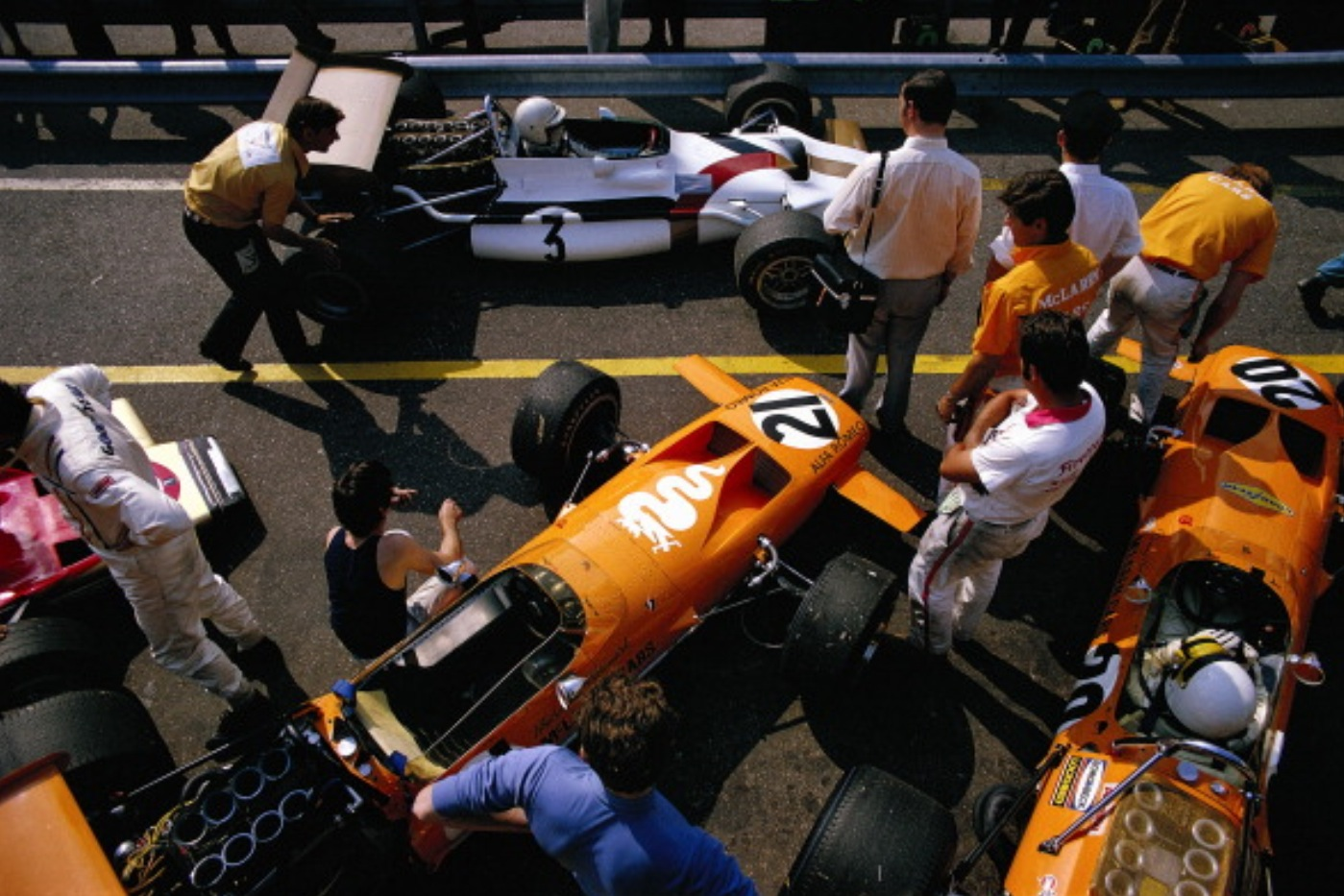
George Eaton’s BRM P153 passes the #21 de Adamich McLaren M14D Alfa and #20 Hulme McLaren M14A Ford, Zandvoort pitlane, Dutch GP practice June 1970 (Rainer Schlegelmilch)

The 1970 German GP was held at the fast Hockenheim circuit which places an emphasis on power/top speed, the Alfa engine lacked sufficient punch, Andrea again failing to qualify, he had complained about handling and the engine not pulling properly. The speed of the chassis was thereabouts though, Hulme finished third in a Cosworth DFV powered M14.
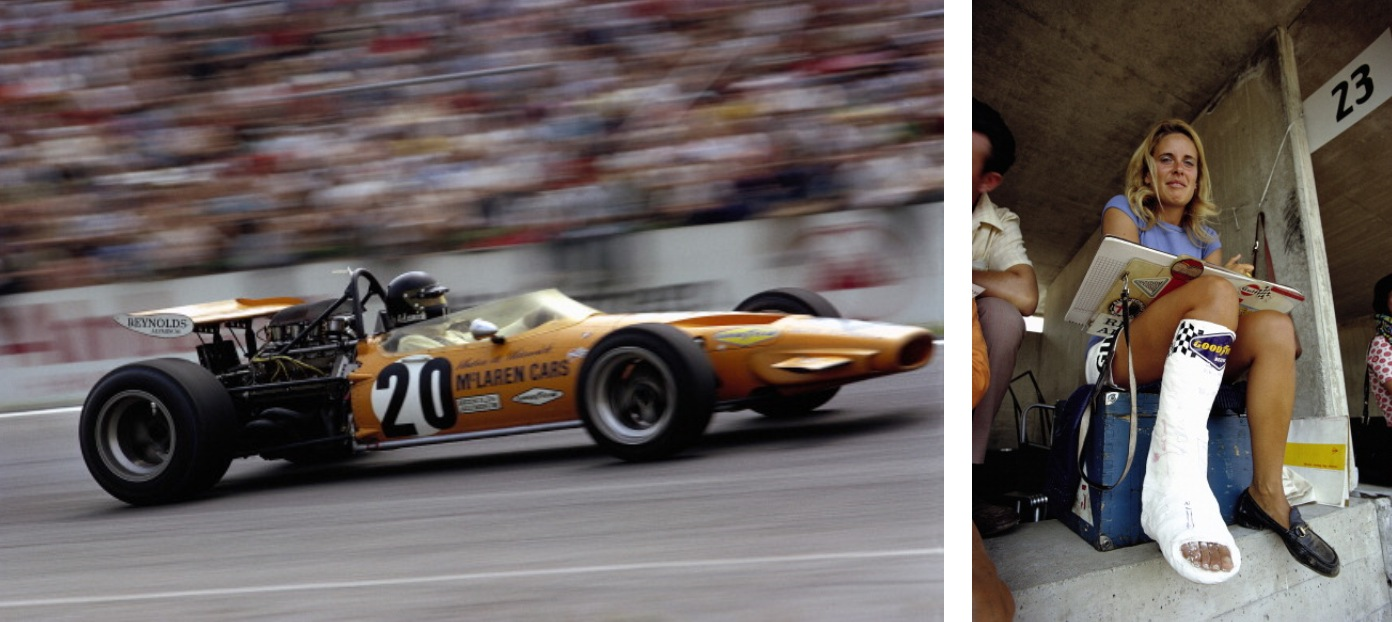
de ad donna
#20 de Adamich McLaren Alfa Hockenheim, German GP practice 2 August 1970 and Donatella de Adamich in the Zeltweg pits 18 August 1970 (Rainer Schlegelmilch)

Zeltweg’s 6Km layout places a similar premium on power and high speed handling too, the car qualified well in fifteenth for the Austrian GP, finishing twelfth, the decision to change the engine before the race went awry when the replacement pulled 1000rpm short of the engine used in practice giving Andrea a long race labouring down the back.

Allen Brown wrote that a lot of work was done by Autodelta in the lead up to the team’s home race at Monza with emphasis on the sumps- which had been identified as the main problem. Andrea qualified twelfth and finished eighth having run well for the first few laps in the race won by Regazzoni’s Ferrari 312B albeit seven laps in arrears. It was Regga’s first GP win. Nanni Galli, another Autodelta racer had a go in the M7D but did not qualify having experienced camshaft trouble.

In Canada Andrea again qualified twelfth of twenty, starting really well and ran as high as ninth, but he hadn’t started with full tanks knowing he had to stop for fuel but diddn’t get to that point, pitting with low oil pressure from eighth position after completing 69 laps. At Watkins Glen he failed to qualify after big dramas gave him limited circuit time, first a fuel leak and then a behind dash fire, perhaps as a consequence the team didn’t take the Alfa powered chassis to the season ending race in Mexico City on 25 October.

McLaren had no incentive to continue with development of the Alfa engined car given the competitiveness of its Ford Cosworth DFV engined machines, a purpose built F1 engine. Alfa’s engine started life as a more robust, long distance unit, and was never, without the commitment of sufficient money and engineering resources, going to approach or eclipse the dominant DFV.

andrea portrait
de Adamich at the wheel of his Alfa 33TT3, Targa 1972. He was third in the car shared with Toine Hezemans (velocetoday.com)

Andrea de Adamich…

Tall, scholastic and patrician, the bespectacled Italian began racing whilst still a law student, making his name driving a works Autodelta Alfa Romeo in the European Touring Car Championship, which he won in 1966 at the wheel of a GTA.

andrea ti super
Andrea de Adamich corners the Alfa Ti Super he shared with Carlo Scarambone in the Tour de France 20 September 1964 . Nouveau Monde Hairpin, Rouen (Rainer Schlegelmilch)

He attracted Ferrari’s attention with some promising runs in Alfa T33 sports cars (which he continued to race whilst pursuing a single-seater career) and was recruited to the Scuderia for the non-championship 1967 Spanish GP, at Jarama north of Madrid.
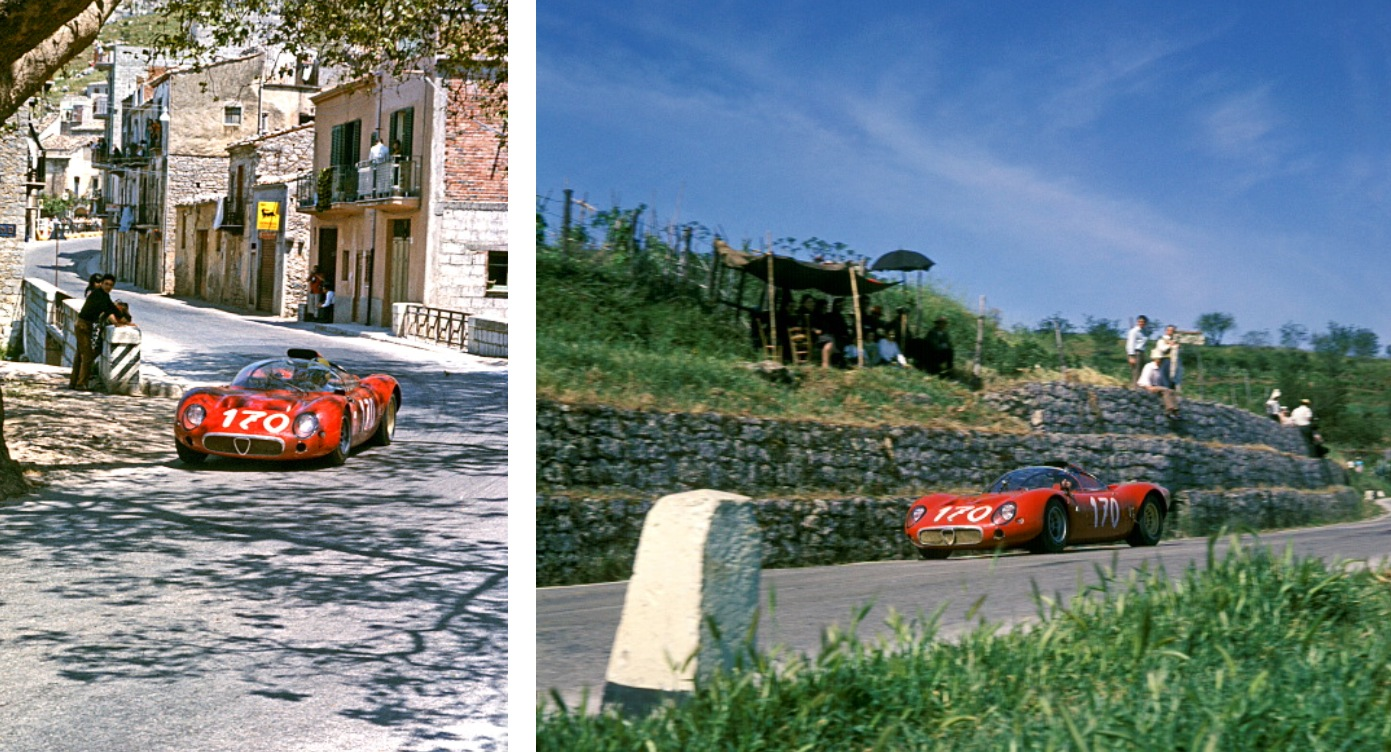
de ad targe
Traga 1967 in the 2 litre Alfa T33. DNF suspension failure in the car shared with Jean Rolland. Race won by the Hawkins/Maglioli Porsche 910 (Getty)

In 1968 Andrea was scheduled to drive full-time for Ferrari alongside Chris Amon and Jacky Ickx, but he crashed during practice for the Brands Hatch Race of Champions and suffered neck injuries which took a long time to heal fully.

He returned to racing, winning the Argentine Temporada series the following winter with the powerful F2 works Ferrari Dino 166. De Adamich’s Ferrari 166 F2 Season is covered in this article; https://primotipo.com/2014/07/09/temporada-f2-series-argentina-san-juan-1968/

andrea dino
de Adamich’s Ferrari 166 winning in front of F2 king Jochen Rindt’s Brabham BT23 Ford FVA, San Juan Argentina, Temporada Series 1968 (Andrew Marriott)

‘In 1970 McLaren was offered the opportunity of experimenting with an Alfa V8, a possibly tempting alternative to the then-ubiquitous Cosworth DFV, and one of the Italian engines was installed first in an M7D chassis and latterly an M14D for de Adamich to drive’, wrote McLaren.

‘To say this technical combo achieved modest results would be a dramatic understatement. The McLaren Alfa generally failed to qualify and when it did, could only muster twelfth in the Austrian GP followed by a distant eighth place in front of the Alfa top brass at Monza. McLaren, still reeling from Bruce’s death that summer, reckoned that the Anglo-Italian alliance was all a bit of a waste of effort and called time on the partnership at the end of the season’.
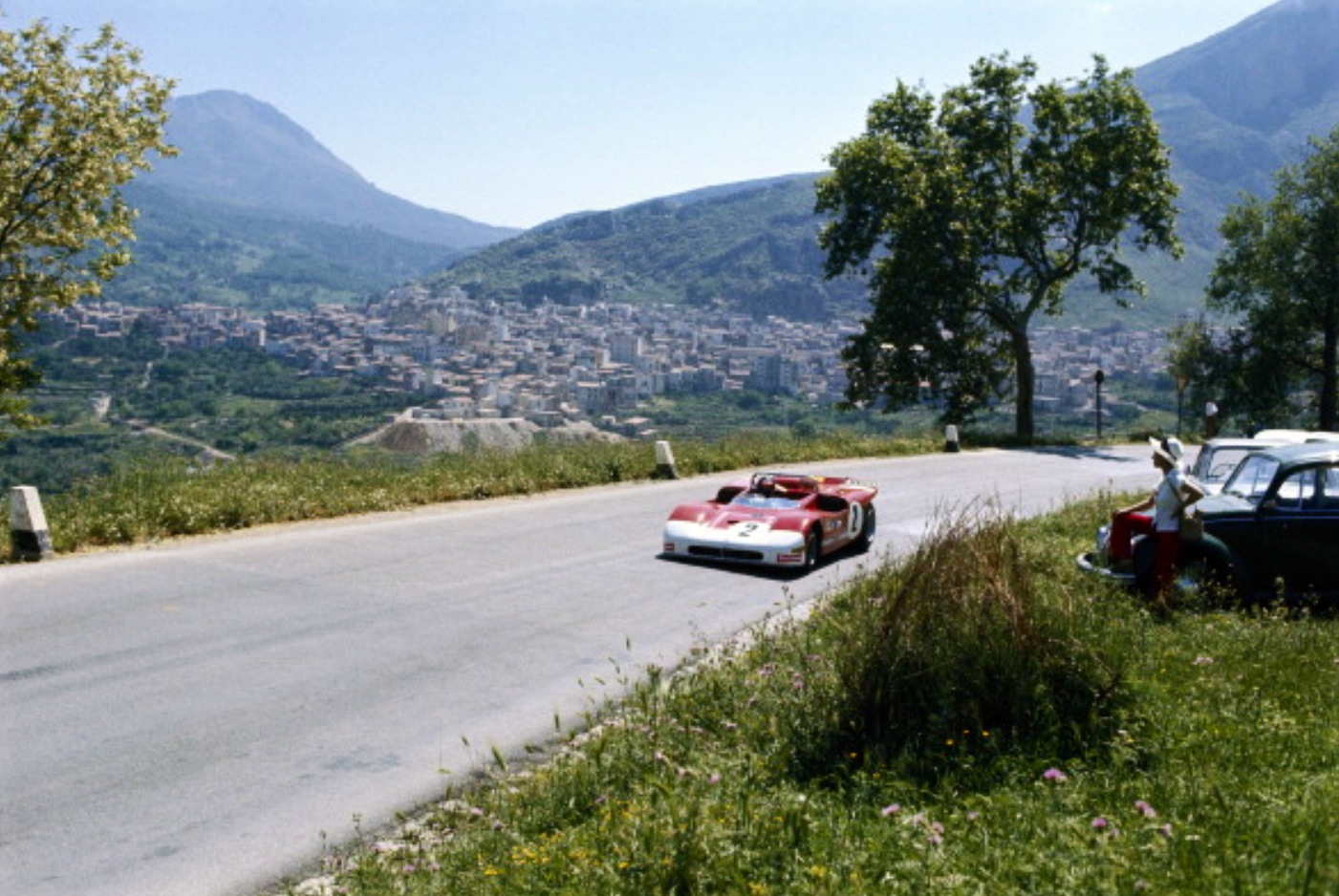
de ad targa
de Adamich at the wheel of the T33/3 he shared with Gijs van Lennep in the 1971 Targa, second to teammates Vaccarella/Hezemans (Rainer Schlegelmilch)

De Adamich took his Alfa engines off to March in 1971, with no significant improvement in their performance. Andrea was thirteenth at Kyalami and eleventh at Watkins Glen whilst Nanni Galli was fifth in the non-championship Jochen Rindt Trophy at Hockenheim in July gaining the best ever F1 result for these engines.

Nanni was eleventh, twelfth and twelfth at Silverstone, the Nürburgring and the Osterreichring in a good run of finishes at least in July/August, but then had three downers to end his season at Monza, Mosport and the Glen. The engine was again unreliable with DNF’s for Andrea at Montjuic, Paul Ricard, the Nurburgring and Monza. He was unclassified at Silverstone.

image
De Adamich, March 711 Alfa, German GP Nurburgring Q20 DNF  fuel injection lap 2. Stewart won in a Tyrrell 003 Ford (unattributed)
The business end of the De Adamich March 711 Alfa in the 1971 Nürburgring paddock

March team leader, and one of the fastest guys on the planet at the time, Ronnie Peterson used the Alfa engines in chassis 711-6 at Hockenheim, Zandvoort and at Paul Ricard, where he raced that chassis from grid 12. He only lasted 19 laps before engine failure, Andrea started from grid 20 which provides some measure of how much more improved the performance of the car/engine could have been with an ace behind the wheel, whilst putting reliability to one side

The Italian driver switched to Team Surtees in 1972 which got him back behind the wheel of a Cosworth-engined car, a step in the right direction.

de ad surtess
French GP, Clermont Ferrand July 1972. de Adamich Surtees TS9B Ford Q12 P14, ahead of Derek Bell who was a race non-starter in his Tecno PA123 V12. Jackie Stewart won the race in Tyrrell 003 Ford.  (Rainer Schlegelmilch)

For 1973 de Adamich switched to the Bernie Ecclestone owned Brabham team after driving for Surtees in the season opener at Kyalami. His Brabham BT42 fell victim to Jody Scheckter’s first lap McLaren M23 Ford multiple car shunt at the end of the opening lap of the British GP at Silverstone, Andrea suffered serious injuries which brought an end to his career.

In more recent times he has built an impressive business career. In 1990 he bought the circuit at Varano and created a highly specialised  driving school for the owners of Ferrari, Maserati, Alfa Romeo and Abarth cars. He also puts on special days for Philip Morris, a legacy of his longstanding relationship dating back to the days when he and Giacomo Agostini were the first Italian contracted Marlboro drivers/riders.

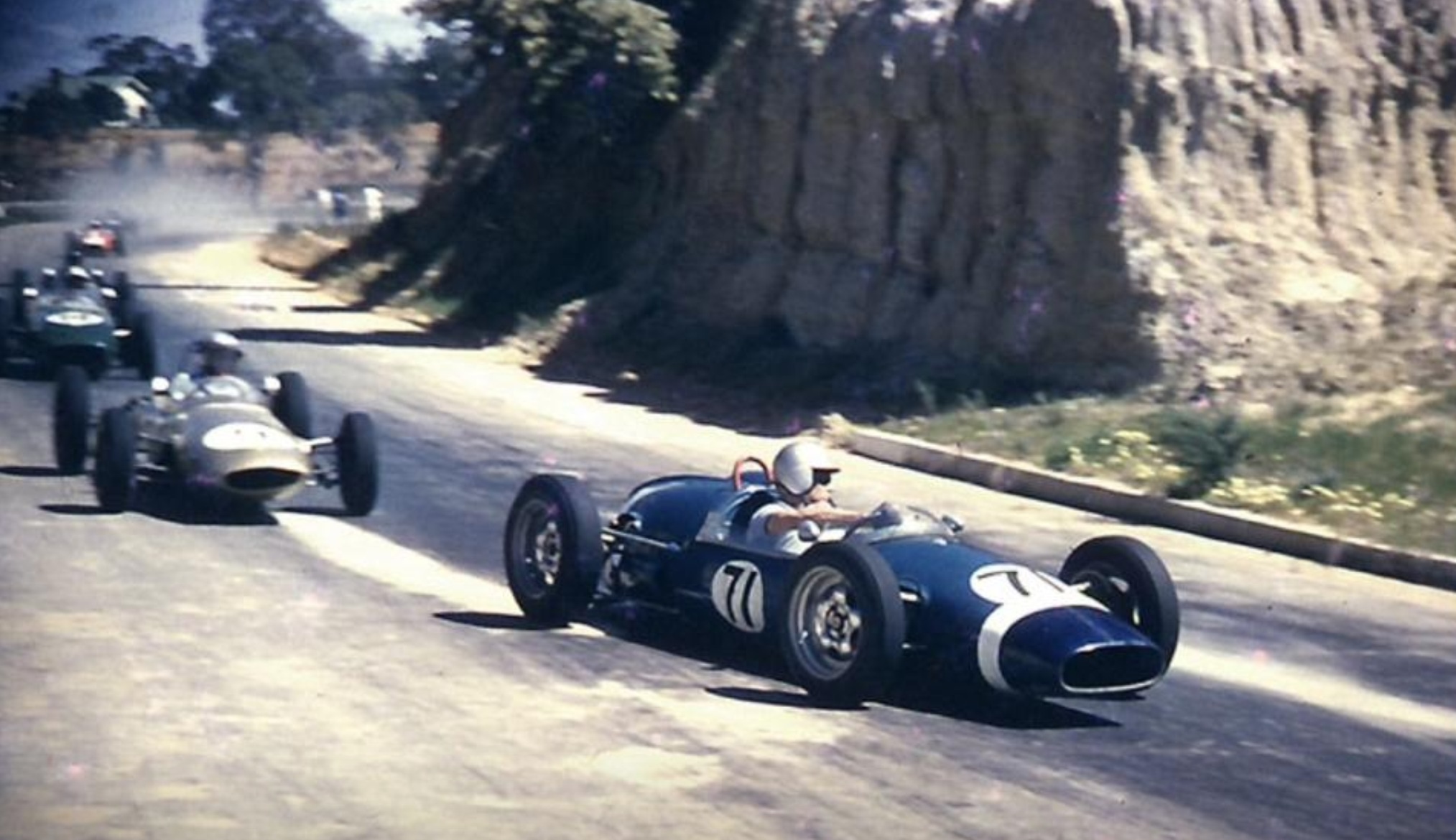
Kevin Bartlett setting off to test the Mildren Brabham BT23D Alfa Romeo just vacated by Frank Gardner after the 1968 Tasman Series at Oran Park before the Gold Star series- she grew wings as the year progressed. Bob Grange at right (P Garrad)

The 1960s Alfa Romeo Engined Single Seater V8’s…

Alfa’s Tipo 33 V8 was first used in elite single seater racing by Australia’s Alec Mildren Racing Team.

Mildren, a Sydney Alfa Romeo dealer, former Australian Gold Star Champion and AGP winner ran one of the most professional teams in Australia. He had impeccable Alfa Romeo/Autodelta connections having acquired and raced two GTA’s and a TZ2 in the early to mid-sixties and in the process ‘polished’ Alfa’s Australian brand, one of the greatest of the Grand Marques but then relatively new to the ‘Oz market.

Click on this link for an article about the Mildren Autodelta Alfa’s;

The Master of Opposite Lock: Kevin Bartlett: Alfa Romeo GTA…

and on Alec Mildren; https://primotipo.com/2018/06/08/mildrens-unfair-advantage/

Mildren’s 2.5 litre Coventry Climax FPF engined Tasman Brabhams were being given a very hard time by the Repco Brabham and BRM V8’s amongst others circa 1966, so he sought an appropriate response, a sprint variant of the Tipo 33 engine was the obvious choice given his Alfa connections.

Mildren ordered three 2.5 Tipo 33 V8s which were initially fitted to a bespoke Brabham BT23D chassis, a variant of Ron Tauranac’s new for 1967 Ford FVA powered BT23 F2 car.  The machine was first raced in the 1967 Hordern Trophy Gold Star round at Warwick Farm, Frank Gardner won, which was a portent of the cars 1968 Tasman Series speed- he was fourth in the championship against stiff opposition including two works Lotus 49 Ford DFW’s in the hands of Messrs Clark and Hill, Chris Amons Ferrari Dino 246T, works BRM’s and the rest.

The engines were then fitted to the Mildren ‘Yellow Submarine’, a monocoque car built for the team by Alan Mann Racing, designed by Len Bailey, for the 1969 Tasman Series where again Frank was ‘best of the rest’ behind the Lotuses, Ferraris and Piers Courage in a Frank Williams Brabham BT24 Ford.

After both cars were raced by Frank Gardner in the Tasman they were ‘handed over’ to Kevin Bartlett for the Gold Star Championship when Gardner returned to the UK at the end of each Australasian summer. Bartlett won the Gold Star in 1968 and 1969 with each chassis respectively, for the sake of completness, in 1969 the ‘Sub’ was also powered by Merv Waggotts’s TC-4V 2-litre, DOHC four-valve 275bhp engine for part of the season, and into 1970 and beyond.

image
(Ian Peak/The Roaring Season)

The 2.5-litre, two-valve, four-cam, Lucas fuel injected, twin-plug Alfa Tipo 33 V8 installed in Alec Mildren’s Gardner driven Brabham BT23D at Teretonga (above) during the 1968 Tasman. Gardner was equal fourth with Graham Hill in the series behind Clark, Amon and Courage in Lotus 49 Ford DFW, Ferrari Dino 246T and F2 McLaren M4A Ford FVA respectively.

image
(Dick Simpson)

What a beautifully integrated bit of kit the Mildren Brabham BT23D Alfa was?

Here just before it progressively grew wings. Kevin Bartlett drove the wheels off the thing, here at Hell Corner Bathurst during the 1968 Easter Gold Star round. KB was on pole by 9! seconds but DNF with a broken rear upright, Phil West took the win in David McKay’s ex-JB Brabham BT23A Repco. Bartlett won the 1968 Gold Star in this car and was equal ninth in the 1969 Tasman in winged form.

image
(Wirra)

Frank Gardner in the Mildren Alfa ‘Yellow Submarine’ in the Warwich Farm pitlane during the ’69 Tasman round on 9 February. The Aussie international was third behind Rindt’s Lotus 49 DFW and Derek Bell’s Ferrari Dino 246T. Gardner was sixth in the 1969 Tasman behind Amon, Rindt, Courage, Bell and Hill in Ferrari Dino 246, Lotus 49B DFW, Brabham BT24 DFW, Ferrari Dino 246 and Lotus 49B DFW respectively.

Kevin Bartlett had this to say about the Alfa Romeo 2.5 litre Tasman V8 and Waggott DOHC 4 valve engines. ‘My memory tells me the Alfa had around 350lbs (of torque) and the Waggott about 230lbs. Usable power range was quite different with the Alfa workable between 4500-8800 rpm and Waggott 6800-8750rpm. Not perfectly accurate as i work from  memory but around that kind of difference’.

‘The driving difference was the main change, as the power to weight felt little different behind the wheel, mainly due i suppose to the fact full throttle was used much sooner with the 4-cyl 2000cc Waggott. The turn in changed to a marked degree with the lighter power plant (Waggott) having less moment of inertia allowing the car to be literally flung into a turn. As it happens i am the only driver to experience both configurations.’ (Gardner having raced only the Alfa variant).

‘Len Bailey was the (Mildren’s) designer of the tub, which flexed a little at the rear with the Alfa’s torque, less so when the Waggott went in, with suspension being a (Brabham designer) Ron Tauranac adaption’.

Alfa Romeo claimed 315bhp at 8800 rpm for the 2.5 litre variant of the V8 engine. Click here for a short piece on the Sub; https://www.oldracingcars.com/mclaren/m14d/

Bartlett doing his thing aboard the Mildren ‘Sub’ Alfa at Oran Park. Its an interesting photo in that this car was winged by the end of the 1969 Tasman – and KB is driving it after that – perhaps a day of back to back testing? The car, like all such machines globally, lost its big wings after the 1969 Monaco GP weekend where such aero was banned. Superb machine superbly driven by KB, Oz Gold Star and Macau GP winner in 1969 (D Simpson)
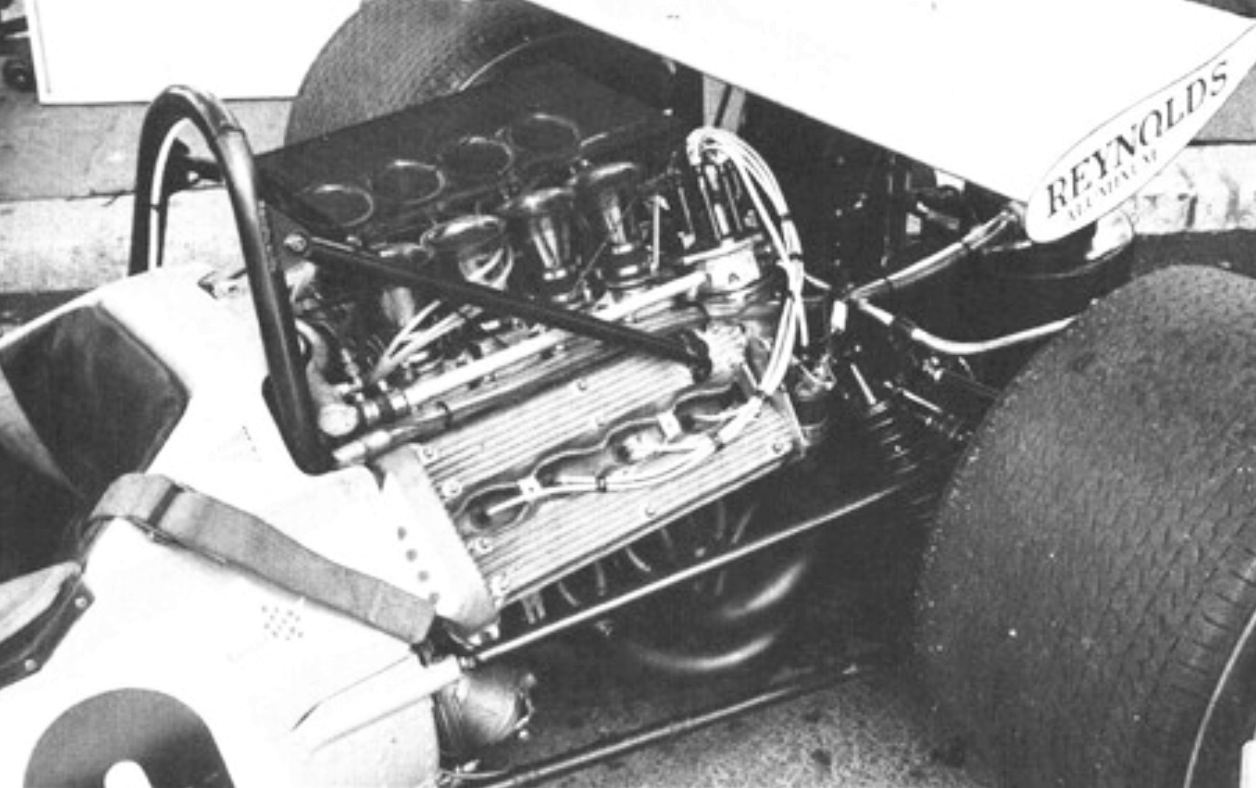
mac engine
Alfa Romeo 3-litre four-valve F1 engine in a McLaren chassis in 1970 (unattributed)

A similar 3-litre four-valve per cylinder, 32 valve engine – the Mildren V8s were all chain driven two-valvers – was developed for Cooper in F1 but wasn’t used before the team’s demise.

Lucien Bianchi tested an Alfa Romeo engined T86C (T86C-F1-3-68) once but was unimpressed given its lack of power. Two further, more powerful motors were built but didn’t survive the bench tests, Alfa then withdrew their engines from that proposed program.

The 1970 variant of the engine was all aluminium with a bore/stroke of 86mm x 64.4mm for a total of 2998cc. Five main and camshaft bearings were used. The four-valves were inclined at 30 degrees, the inlets were 32mm and exhausts 27mm in size, Alfa claimed an output of 400bhp @ 9000rpm in sportscar form.

With gear driven cams for F1 use Autodelta claimed 430bhp @ 10500 rpm at a time the Ford Cosworth DFV gave circa 440, the Matra V12 445-450 and Flat-12 Ferrari 460bhp @ 12000 rpm. It wasn’t enough really but Alfa had put their toes back into F1 water and would return soon with works Brabhams, as they had started with a Mildren Brabham a decade before…
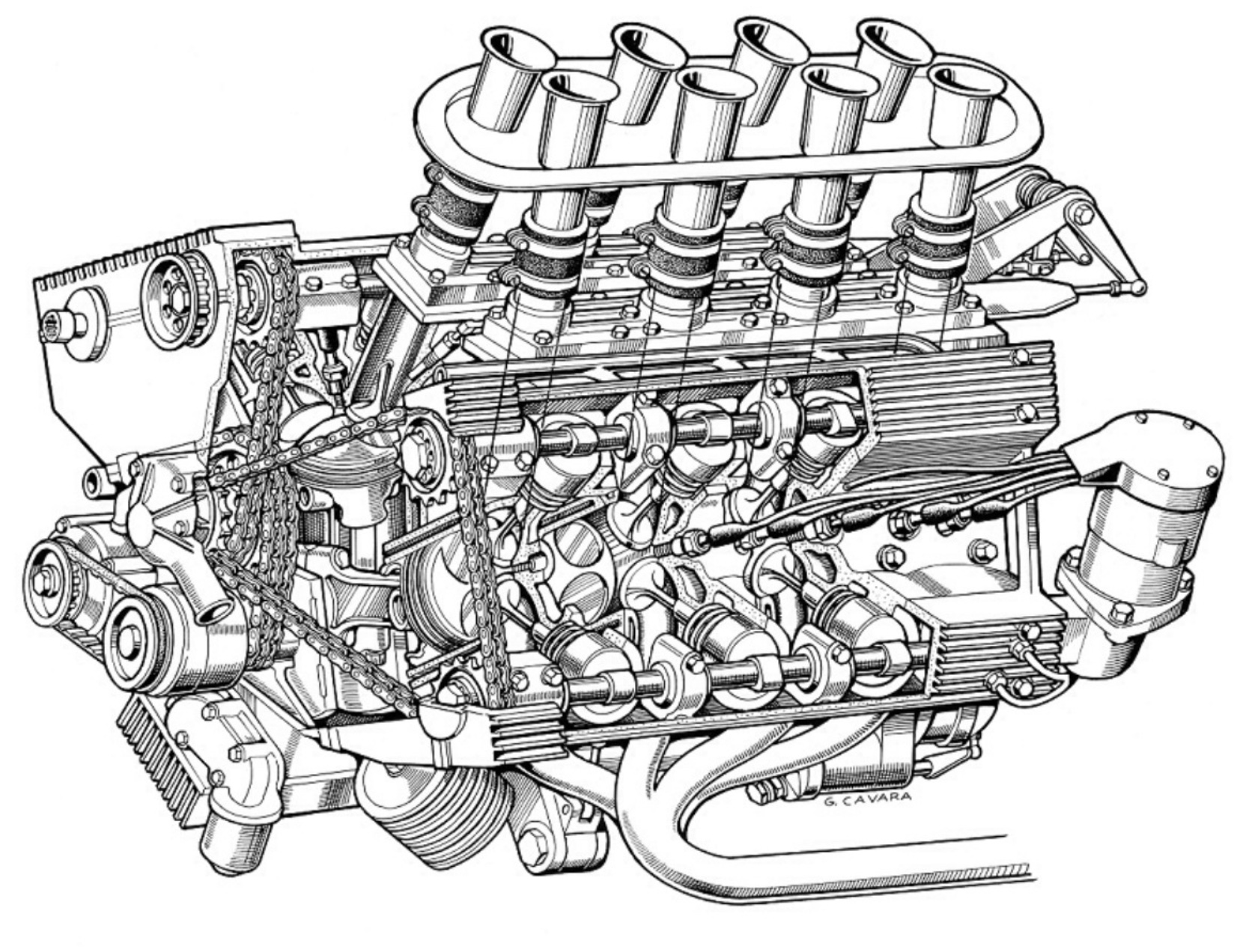
Cutaway of the first 2-litre variant of the Tipo 33 V8 with detailed specifications as per text but chain driven DOHC, two valve, twin plug and Lucas fuel injected with engine a non-load bearing member of the car.

Etcetera…

The seven or eight race Tasman Cup was conducted over eight or nine weeks with a ‘hop across the ditch’- the Tasman Sea between New Zealand and Australia, put great pressure on team logistics and repaid a mixture of speed and, critically, reliability and consistency. Major chassis damage and engine unreliability were severely punished and it was the latter which meant that Mildren/Gardner’s campaigns in the Brabham BT23D and Mildren did not fare better, FG only finished half the races in each year.

Both cars were mighty fine machines but the Lotus 49 was the F1 car of the era and the F2 based Ferrari Dino 246 was far from shabby. In addition, Frank, whilst the equal of most on his best days, was not of the same level as Clark, Rindt, Hill, Amon, Brabham, McLaren or Rodriguez, to rattle off some of the Tasman competition in 1968 and 1969.

Was the Mildren Yellow Submarine a race winner in 1969? – yes, if the planets were aligned – and it was ‘winged’ from the start of the series. Quite how FG, having had a front row seat racing in Europe in ‘the year of the wing’ in 1968, arrived in Australia without said appendages on the Sub is an interesting question.

By Lakeside – at the halfway mark of the series the car was winged – they grew again at Warwick Farm as below where FG is leading Graeme Lawrence’s McLaren M4A Ford FVA, but it was all a bit late. They were third and eighth in the sodden race won by the dominant Jochen Rindt’s Lotus 49B Ford DFW. Derek Bell’s Dino 246 was second.

And in any event the reliability wasn’t there…Would, say, Rindt have made the Sub sing? Absolutely, but he didn’t have Frank’s mechanical sympathy so he would rarely have finished I suspect. So, perhaps the Alfa Romeo engined cars under-delivered in the Tasman Cup but Bartlett’s 1968 and 1969 Australian Gold Star wins were glorious and enhanced the Alfa Romeo brand for a generation of impressionable youth, me included…
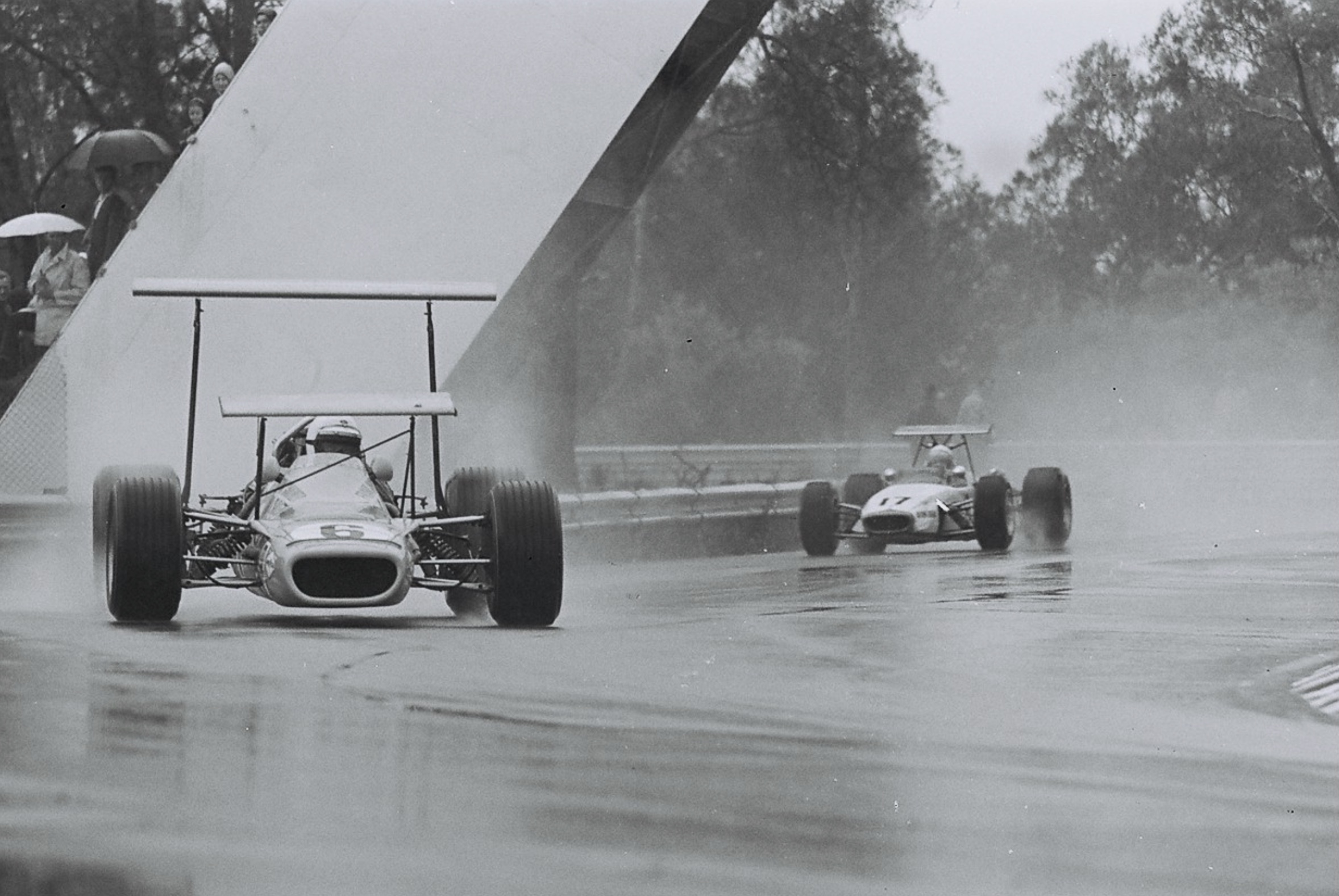
(B McInerney)

Photo and other credits…

Rainer Schlegelmilch, velocetoday.com, mclaren.com, Doug Nye ‘History of The GP Car’, Dick Simpson, Wirra, Kevin Bartlett, Peter Garrad, LAT, Brian McInerney

oldracingcars.com. See Allen Brown’s M7D and M14D detailed chassis records;

https://www.oldracingcars.com/mclaren/m7d/  and https://www.oldracingcars.com/mclaren/m14d/

Tailpiece…

andrea targa
de Adamich/Vaccarella  Targa 4 May 1969. DNF lap six with engine failure. Alfa T33 2.5 V8 Spider (Schlegelmilch)

Finito…

(J Saldanha)

This Macau Grand Prix has always had the exotic allure of the east for me.

The artwork by Joao Saldanha depicts Hong Kong’s John Macdonald, one of Macau’s stars, winning the 1973 Grand Prix aboard his Brabham BT40 Ford, he is approaching the Lisboa Hotel right-hander at the end of the straight.

Joao comments that ‘The British driver from Hong Kong is  the only one to have won the Macau GP in the events three categories, the Grand Prix (1965, 1972, 1973 and 1975), the Motorcycling GP (1969) and the Guia Touring Car Race (1972) which granted him the “King of Macau” title…’

I remember reading about Macau in the publication which got me interested in motor racing, the ‘Australian Motor Racing Annual 1969’ of Kevin Bartlett’s win in the Mildren ‘Yellow Submarine’ Alfa Romeo V8 and thinking how cool it would be to race in Australia and up in Asia.

One minute board is up Macau GP 1969. Kevin Bartlett, the winner at left in the Mildren Alfa V8, John Macdonald, Brabham Ford FVA and O Masuko, Mitsubishi Colt F2C- the Colt behind is S Kato, #66 is Albert Poon, Brabham BT30. Bartlett won from Poon and Kato  (SCMP)
Porto Interior-Macau’s old inner harbour with China in the background. Lots of traditional Chinese junks and the old steam ferry to Hong Kong 1973 (K Petersen)
Dieter Quester, BMW 270- 2 litre 265bhp engine, 1970 victor. BMW raced these cars with 1.6 litre M11 engines in Euro F2 during the late sixties into the dawn of the seventies. Not a bad backdrop for a car race! (SCMP)

Whilst the race is on the bucket list i’ve never quite made it despite being in and out of Singapore and KL- not too far away, very regularly from 1990 to 1992- the Formula Atlantic/Pacific era would have been the one to see too. F3 just didn’t float my boat as much as the F Pacs did- but I still do want to go.

1958, G Baker, Ferrari Monza, T Reynolds, Jaguar XK140 and N Barnes, Porsche 356. Nose of Aston DB3S is Chan Lye Choon- the winner (unattributed)


1957. G Baker, Ferrari Mondial, A Pateman, Mercedes Benz 300SL and R Hardwick, AC Ace. On row 2 F Wong, Ford Spl and M Redfern, Jag XK140. #6 is Teddy Yip, Jag XK140. #22 is F Pope, Jag Spl. Pateman won (unattributed)
Triumph TR and Martin Redfern Lotus 11 in the Guia hill section, Maternity Bend, near the Police Barracks says Kevin Bartlett. Portuguese Police doubled on crowd control and ‘flag marshalls’ in the early days of the race (unattributed

The first event, held in 1954 was initially conceived as a treasure hunt around the streets and Guia hillside of the city by friends Fernando de Macedo Pinto, Carlos da Silva and Paulo Antas.

Not long after, having given Paul Dutoit of the Motor Sports Club of Hong Kong a lap of the suggested the 3.9 mile track, he excitedly exclaimed, ‘This is not a treasure hunt. What you have here is a Grand Prix!’.

And so it was that the first Macau Grand Prix meeting on 30 and 31 October 1954 comprised two events- the ‘Speed Regularity Trial’ was for production cars on the Saturday, the feature event, the Grand Prix the following day.

Robert Ritchie won the reliability trial in a Fiat 1100, thereby becoming the first to win a ‘race’ at Macau and Eddie Carvalho the GP in a Triumph TR2, in fact TR2’s took home first to third places in the four hour race- Carvalho from Dutoit and da Rocha. From these far from modest beginnings began a great annual carnival.

1954 GP with Le Mans start at 3 minutes after noon on Sunday 31 October 1954. R Pennels, Healey 100, G Bell, Morgan, then the E da Rocha, P Dutoit and E Carvalho Triumph TR2’s, F de Macedo Pinto, MG Spl, A White/J Bartlett Riley 2.5 and the rest (C&N)
Pennels Healey chases Carvalho’s winning TR2 through the Guia hillside in 1954. The trackside dust caused plenty of visibility problems (C&N)
The permanent pit and grandstand complex was indicative of a strong level of Government support- commenced in 1956, it was extended in 1958. Porsche 550 is Grant Wolfkill in 1960 (C&N)

In 1960 the GP was included on the international racing calendar as a ‘national race with foreign participation’ and thus became subject to FIA rules.

The South China Morning Post suggested the race as an amateur event until 1966 when Belgian driver Mauro Bianchi entered an Alpine A220. Alpine Renault sent engineer Jean-Paul Castilleux to assist Bianchi in the cars preparation, his win led to greater exposure and increased professional team presence in the ensuing years.

The same circuit layout is used now as back then and comprises two distinct sections.

The back stretch around the seaward slopes of the Guia Hill is a roller-coaster ride of up hill and down dale curves and corners. In 1954 this seaction was not paved. The fast outer section along the harbour had a wide straight avenue with a relatively smooth sealed surface ‘Though the approach to what is now known as Fisherman’s Bend was often under a few inches of water since reclamation of this part of Macao from the sea had only recently taken place’ (!) Philip Newsome wrote.

The track is a flat-out roller coaster which has been likened to a cross between Monaco and Spa- it combines the technical complexity of a street circuit with the speed of the most challenging track in the world.

Most unforgiving, Arsenio ‘Dodjie’ Laurel’s death in 1967 was the circuits’ first tragedy.

‘Skips and Kiwis were regular and successful competitors in increasing numbers throughout the sixties- the Formula Libre regulations assisted in the events growth as one could race whatever you owned within reason.

The event evolved from a sports car race in the initial seven years, to Formula Libre from 1961 to 1973, Formula Atlantic/Pacific- a ‘Golden Era’ through to 1982 and Formula 3 since then.

In the ‘BDA years’ big names or up-and-comers included Ricardo Patrese, Alan Jones, Vern Schuppan, David Purley, Steve Millen, Andrew Miedecke, Roberto Moreno, Derek Daly, Keke Rosberg, Brett Lunger, Kevin Cogan, Tiff Needell, Geoff Lees, Sataru Nakajima, Desire Wilson, Jean-Pierre Jarier, Roberto Guerrero and others.

Ricardo Patrese, Chevron B40 Ford BDA, 1977 winner. This car was raced by Ken Smith and was later acquired by Brian Sampson in Melbourne until Peter Whelan convinced Sambo to release the car from his Aladdins Cave in Moorabbin. Peter and the Murphy brothers in Adelaide did a beaut job restoring it, Whelan raced the car for some years in Oz historics, its now in a museum in Macau I believe (SCMP)
Vern Schuppan, enters Melco on his way to taking pole, March 722 Ford 1972. John MacDonald won that year in a Brabham BT36 (SCMP)
Vern Schuppan, March 722 ahead of the John Dimsdale Lotus 69 in 1972
Graeme Lawrence, March 76B Ford 1977 (SCMP)
Teddy Yip again, this time in a Porsche 906, unplaced in 1972. Is this the car he acquired from Alan Hamilton?
Mal Ramsay, Elfin 600C Ford 1970. This practice accident was caused when the Aussie co-founder of Birrana cars borrowed some goggles which slipped off- he instinctively sought to grab them and before he knew it he was off course. He was ok and the car not too badly damaged (SCMP)

Lots of Australasians raced up there (i’m including up there as Macau, Singapore, Malaysia and Japan) including internationals Vern Schuppan, Alan Jones and Bruce Allison.

Nobody did better business in the region for a couple of decades than Graeme Lawrence ‘who should have been given the keys to the city’ with multiple Singapore GP wins, victories in Malaysia but no win at Macau. Mind you, John Macdonald’s achievements across disciplines trumps even Graeme.

Max Stewart was very popular too- no win in Macau,, but one in Singapore. Speaking of which, Garrie Cooper won on the tough Thompson Road, Singapore track in 1968 aboard the very first Elfin 600- Garrie sold quite a few cars up there, particularly 600’s- twin-cam, Repco and Ford FVA engined (Hengkie Iriawan’s 600C).

Lanky Max acknowledges the plaudits of the crowd after finishing second in 1972. Results say Dolphin but it looks like a Rennmax BN3 Ford to me
Harvey Simon, Elfin 600B Ford sixth place in 1972 (SCMP)
Michael Schumacher aboard a Reynard 903 VW in 1990- won from Eddie Irvine and Mika Salo

European F3 was adopted in 1983- none other than Ayrton Senna won the GP in a Ralt RT3 Toyota. Michael Schumacher followed suit in 1990. Over the years the event has taken on great stature- a win in Macau means a lot- the list of later F1 drivers who raced there is long and deep, too long to include.

Motorcycles first raced at Macau in 1967- bonkers! Aces like Kevin Schwantz, Carl Fogarty, Ron Haslam and Michael Rutter have all participated.

The Singaporeans were onto the opportunities of Touring Cars from early in the piece with guys like Brian Foley and John Leffler visitors- in Macau the ‘Guia’ Touring Car races commenced in 1972.

The photo below is of Allan Moffat aboard a Bob Harper sponsored Ford Capri RS2600 in 1973- he must have been impressed with the car, acquiring a later ex-works RS3100 a couple of years later which raced all too briefly in Australia.

1973. Obscured John Macdonald, Brabham BT40, Vern Schuppan, March 722 and Sonny Rajah at the right, March 712 Ford. Macdonald won from Max Stewart’s Dolphin Ford and Rajah


Wonderful panoramic shot of the Main Straight in 1962 ‘taken from where the Mandarin Oriental Hotel now stands…the timekeeprs enjoyed a better line of sight from their small stand, though this was perched somewhat precariously over the harbour.’ Not sure of the Triumph and Porsche drivers (C&N)

Etcetera…

(unattributed)

1956 start with a Mercedes 190SL of D Steane, L da Costa Ferrari Mondial and R Ritchie, Austin Healey 100- R Pennel’s Healey 100 on row 2 beside the F Pope, Jag Spl. Steane won from da Costa.

(Getty)

Modern vignette over the last 5 years, cars are 2 litre Euro F3.

Ken Araoka, Suzuki RG500.

(C&N)

Race poster has a touch of the Mike Hawthorn/Ferrari 500 about it.

This is the crowd Kevin Bartlett confronted in 1969- no doubt a few more folks than even the ‘Warwick Farm 100’!, perhaps the premier Australian Tasman round at the time.

Allan Moffat at left in his Group C Mazda RX7 during the 1981 Guia race.

Sonny Rajah’s March 712 Ford-Hart during the 1973 GP.

Rather a famous car in that Ronnie Peterson won the European F2 Championship in it in 1971- here the car wears 732 bodywork.

In Australia we got a close look at the car/driver combination as the likeable, quick Indonesian did a few of our ANF2 Championship rounds in 1974. I wonder who owns the car now?

Edward Irvine Esq, Schumacher and Mika Salo.

Where is Mika Hakkinen? Michael is thinking, oh yeah, he ran into me, pity about that! Hakkinen had the two heat contest in the bag and made a way too optimistic attack on Schumi in the final lap of the second heat which came undone.

(SCMP)

1971 GP- beautifully framed shot shows Sonny Rajah, Lotus 69 Ford from Albert Poon’s Brabham BT30.

Jan Bussell won in a McLaren M4C.

(unattributed)

1957. The R Pennels Healey 100 from Pateman, Benz 300SL- #6 is the Yip XK140.

(J Santos)

Holden LC Torana GTR in 1973, driver anybody?

(unattributed)

Ayrton Senna won in 1983 aboard a Ralt RT3 Toyota- the first year of Euro F3 in an F3 season when he slugged it out with Martin Brundle- both graduated to F1, Toleman and Tyrrell respectively.

Vern Schuppan certainly received plenty of support from Teddy Yip throughout his career.

Here he is running the Theodore Racing March 772 Ford BDA during the 1980 GP- fifth. The race was won by Geoff Lees Ralt RT1 Ford. Lees was later a factory Ralt pilot inclusive of an F2 Championship in a Ralt RH6 Honda V6.

(SCMP)

John Macdonald’s Brabham BT36 Ford en-route to 1972 victory. Ex-Rondel Racing?

1990 warm up lap- look at that field.

Hakkinen, Ralt RT34 Mugen, Schumacher, Reynard 903 VW, #1 Irvine, Ralt RT34 Mugen and #15 Mika Salo, RT34 Mugen.

Talent in this field of great depth included Alex Zanardi, Laurent Aiello, Richard Rydell, Eric Helary, Heinz-Harald Frentzen, Pedro Chaves, Olivier Panis, Otto Rensing and Oliver Beretta.

Glen Abbey with bottle of Coke and KB sans top body panel with the victorious ‘Sub’ after the Alec Mildren Racing victory in 1969. Car in repose in the Macau paddock below.

Glorious looking engine is an Alfa Romeo Tipo 33 2.5 litre, DOHC 2 valve, injected V8. Later a Waggott TC-4V 2 litre, DOHC 4 valve, injected four was fitted.

(SCMP)

Gerhard Berger, BMW 635CSI during the 1984 Guia race.

Vern Schuppan gives team owner and ‘father of Macau’ Teddy Yip a ride aboard his Ralt RT1 Ford BDA after his second and final Macau GP win in 1976. His 1974 victory was aboard a March 722 Ford BDA.

Businessman, racer and entreprenuer Yip is a story, a long one, in himself. Suffice it to say his contribution to this race as a racer, entrant, team owner, ‘global ambassador’ and sponsor was extraordinary.

Credits…

‘SCMP’- South China Morning Post, Getty Images, Natalino Couto, ‘C&N’- ‘Colour and Noise’ Philip Newsome, Jose Santos

Tailpieces: The Ages…

D Steane, Mercedes Benz 190SL 1956.

Dallara Mercedes circa 2017.

(J Santos)

Art at the start and art at the finish.

Stunning image by Jose Santos of Leo Geoghegan’s works Birrana 273 Ford-Hart ANF2 car during the 1973 Grand Prix.

Just marvellous.

Finito…

(H Federbusch)

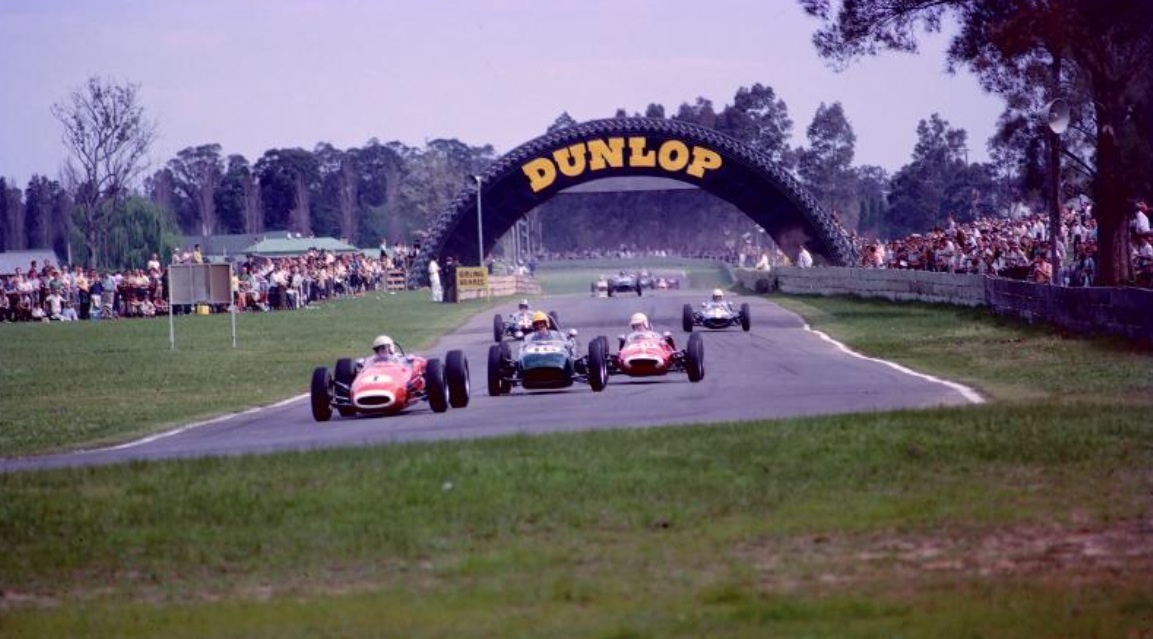
Greg Cusack Brabham BT6 Cosworth-Ford, Tim Schenken #16 green Lotus 18 Ford and Phil West, red Lotus 20 Cosworth on the outside. Then Kevin Bartlett, Elfin Catalina Hillman Imp on the inside in the distance and lanky Max Stewart, Rennmax BN1 Ford in the dark coloured car on the outside- Warwick Farm’s Creek Corner on 19 September 1965…

Some pretty handy drivers amongst that lot!, thanks to Rob Bartholomaeus and John Medley as well as Ray Bell for identifying the car/driver combinations.

Bell recalls the meeting ‘I thought it must be Cusack out front, but the white nose had me tossed. It turns out he borrowed his car back from new owner, Alan Felton, who had put the stripe there. He made a mess of the start and had to work his way through, this scene appears to be when he hit the front…there’s another Lotus 18 ranging up though, probably McCaughey.’

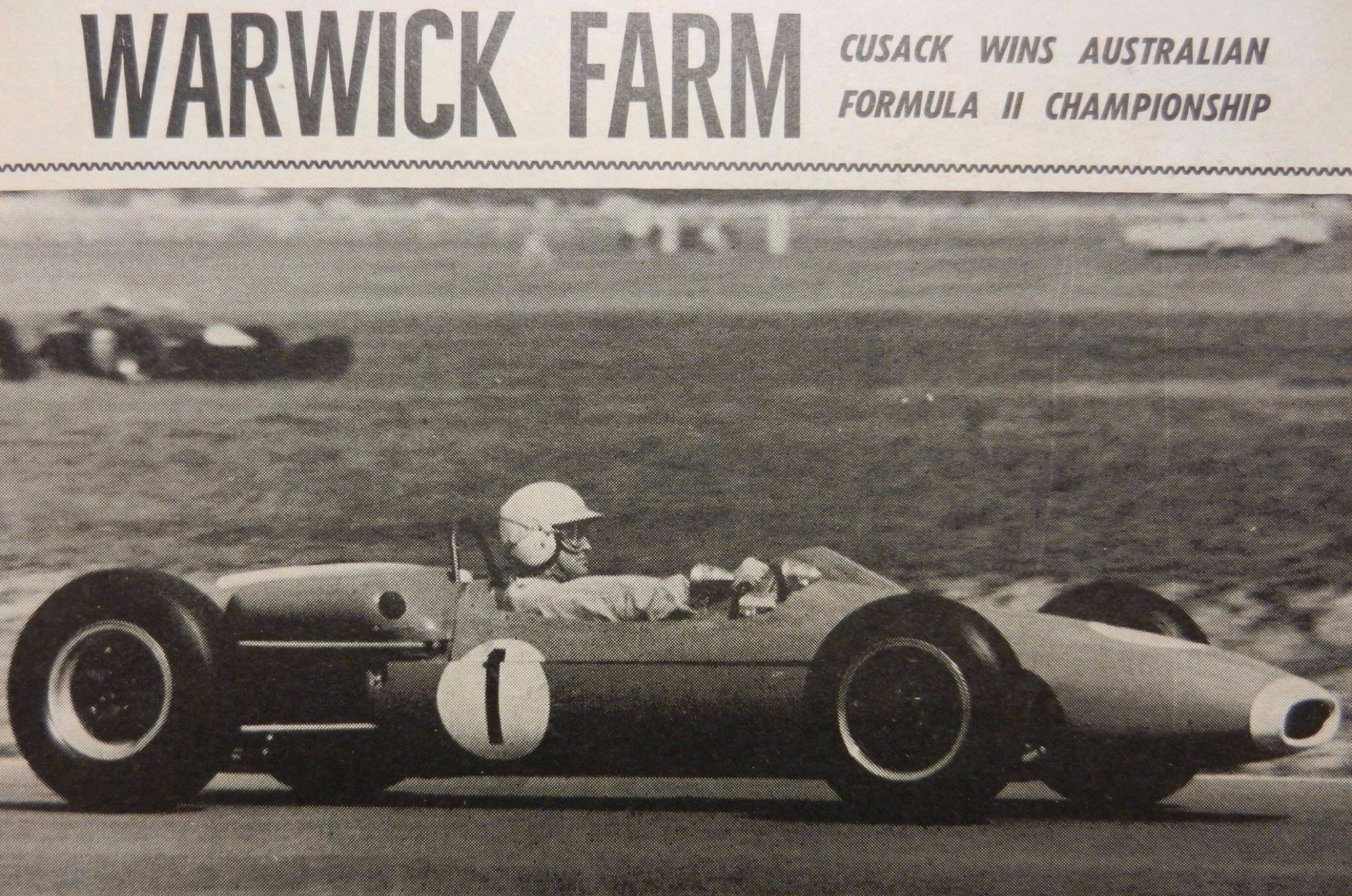
Fifteen competitors contested the title over 34 laps- 76.5 miles of Warwick Farm, Cusack, the reigning champion (he won at Lowood in an Elfin Catalina FJ in 1964) won from pole in his borrowed Brabham Cosworth from Max Stewart’s Rennmax BN1 Ford, Kevin Bartlett in the McGuire Family owned Elfin Imp and Ralph Sach in Alec Mildren’s Brabham.

Other ‘notables’ contesting the event included Ken Shirvington, Lotus 20B Cosworth and Les Howard aboard a Lotus 27 Ford.

Cusack, Brabham BT6 (Bob Williamson)

ANF2 at that time, from 1964 to 1968 was an 1100cc production-engine based class, it embraced what had been in 1962/3 Formula Junior, and engines of 1000cc free design.

Which sort of begs the question of what the single-seater Australian Formulae of the day were in 1965’ish.

I’ve used the ‘Australian National Formula’ or ‘ANF’ descriptor in my narrative which is not to say the CAMS used it at the time, here it is applied to make clear the classes were Australian ones, which in most cases were different to the categories similarly named in Europe. Here goes;

ANF1…

The ‘Tasman’ 2.5 category reigned supreme from 1964 to 1970 inclusive- the Australian Drivers Championship- the Gold Star, was run to this class. It was our best ever premier domestic elite category albeit however blessed were the Tasman grids, once the ‘furriners returned to Europe our domestic fields were not generally flash in quantity.

An anomaly was 1971 when 2.5’s were out, 2 litres were ok, F5000 was the Gold Star class of the next decade- and Max Stewart nicked the title in his reliable, fast 2 litre Waggott TC-4V engined Mildren nee Rennmax BN3 from under the noses of the new 5000’s. Just thought i’d get this in before you sticklers do- this articles ‘limit’ in terms of discussion is circa 1969/70.

Here is a rare ANF2.5 car!

It’s a Wren Coventry Climax 2.5 FPF commissioned from St Kilda’s Bill Reynolds by Tasmanian Brendan Tapp to compete with the other front-running Apple Isle locals- John McCormack in his ex-Jack Brabham 1962 Caversham AGP Brabham BT4 and David Sternberg’s ex-Clark Tasman 1965 Lotus 32B, both 2.5 FPF powered.

(oldracephotos.com.au/Harrisson)

In essence the spaceframe chassis car raced once or twice at Sandown and Symmons Plains in 1969 before being damaged in a towing accident. Bob Wright then acquired it from Tapp, fixed it and raced it as above before using it as the basis of his ‘Tasma Climax’, later Repco 2.5 V8 engined, sportscar. The chassis was widened for this purpose.

ANF1.5…

1964 to 1968. A production based twin-cam, two valve category which de-facto became a class for the Lotus-Ford twin-cam engine, the quickest of which gave 2.5’s driven in ‘average fashion’ a serious run for their money. ANF1.5 was critical to pad out increasingly skinny Gold Star grids throughout this period.

The national championship was a single race affair in 1964, won by Greg Cusack in a Brabham BT6 Ford at Warwick Farm and in 1965 when Bib Stillwell, Brabham BT14 Ford, prevailed at Bathurst. It was then a series of races in 1966, 1967 and 1968 when the winners were John Harvey, ex-Stillwell Brabham BT14 Ford, Max Stewart, Rennmax BN1 Ford and Max Stewart/Garrie Cooper in Rennmax BN1 Ford/Elfin Mono and Elfin 600 Ford respectively.

Its only in recent times that i have appreciated just how important this class was, and what great racing it provided as both a ‘stepping stone’ for young thrusters and as a destination for some single-seater stalwarts.

(oldracephotos.com.au/DKeep)

Another unusual car above is the ex-David Sternberg ANF1.5 Alexis Mk6 Ford t/c raced by Brian Bowe, here being watched over by a couple of fellows including a youthful, bespectacled John Bowe at Symmons Plains in 1968.

I wonder what has become of this little car generally referred to as the ‘Lotus Alexis’ in Tassie at the time?- he did pretty well in it including a third place in the 1967 Symmons Gold Star round behind Greg Cusack’s Brabham BT23A Repco and John McCormack’s Brabham BT4 Climax- both ANF 2.5 cars.

ANF2…

1964 to 1968. Australia recognised Formula Junior for only two brief years as a championship class, as noted above.

In 1962 Frank Matich won the title in an Elfin FJ Ford at Catalina Park, in 1963 Leo Geoghegan won at Warwick Farm aboard a Lotus 22 Ford- in both years the title was decided over one race.

F2 was a class for cars powered by 1100cc production based engines which embraced what had been FJ.

There were plenty of FJ’s around even though Australia was slowish in picking up the class which exploded globally from its European start in 1958. In Oz the cars raced in Formula Libre in 1960, by 1961 FJ only races were being run in Victoria and New South Wales.

In addition F2 allowed 1 litre race engines, not that I think anyone raced such a machine?

Front row L>R Geoghegan Lotus 22, Jim Palmer Elfin Catalina and Greg Cusack Brabham BT6. Thats Kent Price in the other Geoghegan Lotus on row 2 (B Wells)

The photos above and below are of Leo Geoghegan during and after winning the 8 September 1963, 75 mile, Australian Formula Junior Championship at Warwick Farm. Leo’s Lotus 22 Ford won from Greg Cusack, Brabham Ford and Jim Palmer in the ex-Cusack Elfin Catalina Ford.


In the photo above that’s Kingsley Hibbard losing his Rennmax Ford comprehensively as he goes over the Western Crossing (of the horse-racing track international folks).

Up front Leo leads Jim Palmer, Elfin Catalina Ford, Kent Price in the other Geoghegan Lotus 20 and then perhaps Greg Cusack alongside Hibbard- in a Repco-Brabham Ford, to give the racer the name on the badge of the car at the time!

Look at those packed grandstands!

(oldracephotos.com.au/Phillips)

Leo’s Lotus 22 Ford won from Greg Cusack, Brabham Ford, Jack Hunnam in a Catalina, David Walker and then Hibbard, who did well to finish fifth after his first lap misdemeanour. Palmer’s car expired after 13 laps.

(oldracephotos.com.au/Phillips)

Many of the FJ drivers fitted Cosworth Ford 1500 pushrod engines to their Elfin FJ/Catalinas, Brabham, Lotus and Lynx chassis and entered Gold Star rounds so equipped, which then made them ANF1.5 cars.

In 1969 and 1970 the ANF2 championship was for cars fitted with 1.6 litre race-engines, so there were two years of the Ford FVA and Waggott TC-4V before the very successful 1970-1977, 1.6 litre DOHC 2 valve production based class. This ‘Lotus-Ford twin-cam’ class was a beaut but it too was in the seventies, not the decade earlier which is our focus.

ANF3…

Apparently from 1964 to 1968 we had European F3- 1000cc production based with overhead camshafts not permitted. How many of these cars did we have ‘in period’, I certainly don’t recall these things rocketing around here in any numbers?

The ‘heyday’ of ANF3 was the 1100cc era from 1969 and especially the 1300cc period from 1972 to 1977- production based and SOHC by then ok. Lets not go there as its outside the sixties period too.

Then there is the 2 litre European F3 period even later when the Gold Star was awarded to ‘Australia’s Champion Driver’, demeaning the award in the process. European F3 as our elite level single-seater category- ya gotta be friggin’ jokin CAMS? Lets not go there either as my blood-pressure tablets are way too light a dose to deal with the angst so caused by such fuck-wittery.

(Stride Family)

Formula Vee…

Formula Vee commenced in Oz in 1965 when ex-VW rallyist and dealer Greg Cusack demonstrated an imported American Formcar whilst Frank Kleinig Jnr is credited as winning the first FV race in Australia at Warwick Farm that December.

However FV historian, John Fabiszewski notes that the first to race Vees were Pat Stride in his Scarab and George Gessophilis in a Nota, in Formula Libre races in Tasmania (what circuit folks?) and Oran Park respectively on the same weekend in September 1965 (what date folks?).

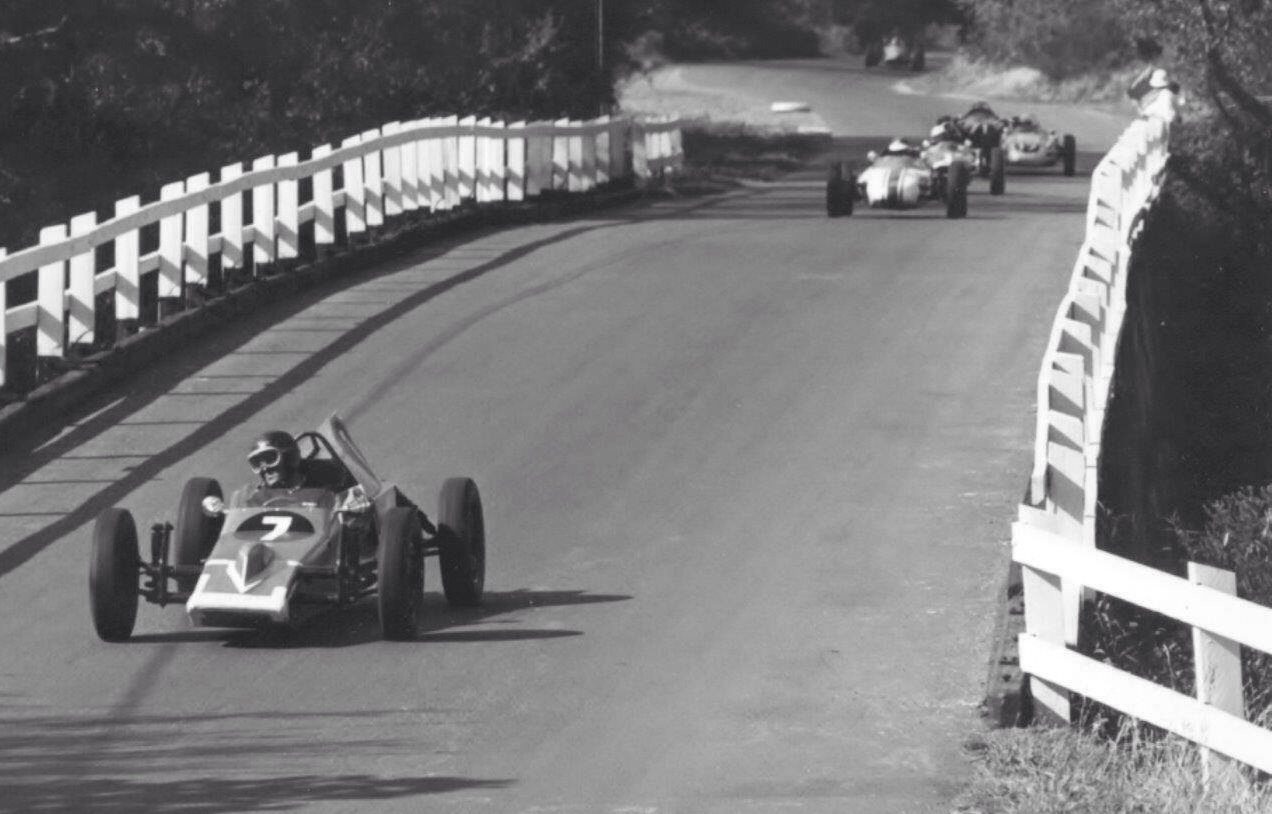
The photograph above is of the only Vee race ever held at Longford, in its final year, 1968. Winner Pat Stride is coming off Kings Bridge in his Gremlin ahead of Mike Bessant- he was third in his Scarab with Lyn Archer second in an Elfin 500.

(R Thorncraft)

Formula Ford…

FF came a bit later of course, created in England in 1967, it commenced in Australia in 1969 with a race at Sandown that November, its first ‘National Championship’, the ‘Formula Ford National Series’ was run and won in 1970 by Richard Knight in an Elfin 600.

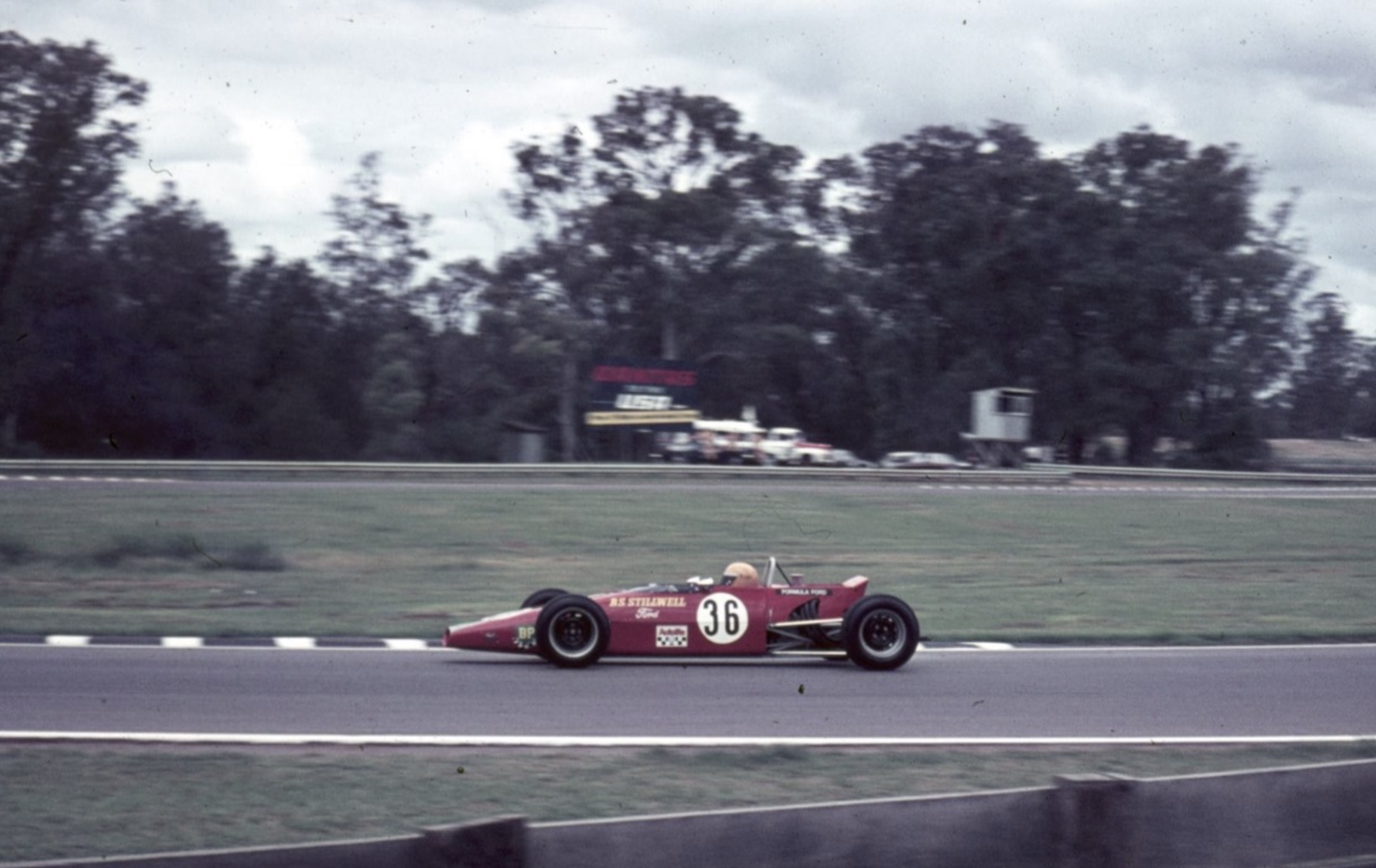
The photograph above is of Richard in his Bib Stillwell Ford Elfin 600 at Creek Corner, Warwick Farm during 1970- in a convincing display he won five of the six championship rounds.

Noel Potts, Elfin Catalina Ford 1.5, Warwick Farm circa 1964 (B Wells)

Etcetera…

Quintessential Australian cars of this period in Formula Junior, 1.5 litre pushrod Ford powered ‘Juniors’ and ANF1.5 per-se are Elfins (bias hereby declared) FJ/Catalina/’Works Replica 275 and 375′, Garrie Cooper’s first spaceframe single-seater design, and the monocoque T100 ‘Mono’ which followed it.

Arguably the best two drivers to come through the Catalina were Frank Matich and Kevin Bartlett- which is cheating really as FM had already ‘arrived’ (in sportscars) when he started to race the FJ/Catalina. So maybe my other choice is Greg Cusack.

Applying the same approach to the two best Mono pilots is a harder as there were plenty built and a lotta good guys raced them. On balance i’ll go with John Walker and Alfie Costanzo, you can’t go too far wrong with a couple of Gold Star champions, and AGP winner in Walker’s case.

I did say arguably, happy to enter into correspondence in relation thereto!

(J Ellacott- G Burford Collection)

To me the Elfin Mono is pretty much single-seater sex on wheels.

They were a very competitive piece of kit from 1964 to the arrival of the 600 replacement and also looked the goods. Garrie Cooper’s ‘eye’ for an attractive car should not be overlooked in any and all of his designs.

They were not without controversy in terms of the effectiveness of the ‘swept back upper wishbone’ rear suspension setup of the early cars- Bob Jane’s Mono Mk1 Ford t/c one such example. Here he is shown at Warwick Farm, probably during the 1966 Tasman meeting. Bob’s cars were always superbly prepared and presented, the Mono is no exception.

Credits…

Heinz Federbusch, Ray Bell, Bruce Wells, Dick Simpson, Lindsay Ross’ oldracephotos.com.au, Bob Williamson Collection, John Ellacott via Grant Burford, Stride Family, Russell Thorncraft

Tailpieces…

(B Wells)

Kevin Bartlett clad in a Nomex t-shirt aboard his Lynx BMC from Wally Mitchell’s Lotus 20 Ford during a Formula Junior race at Hume Weir on 23 September 1962. KB was first and third in the two races that day, the other victor was Leo Geoghegan in a Lotus 20.

(D Simpson)

Jack and Ron sold plenty of Brabhams in Australia at the time, surely they were THE manufacturer of ‘small bore’ production racing cars of the sixties.

The photo above is of later ANF2.5 pilot Phil West in a Brabham BT6 (or is it BT2) Ford at Oran Park in 1967, chosen, despite a blemish of age on the negative, as it shows the lines of the car to great effect.

The very first Brabham or MRD and BT2, BT6 and BT14 smaller capacity chassis scored lots of race wins/success/played a part in the success of many careers in Australia including West, Gavin Youl, Greg Cusack, Bib Stillwell, John Harvey, Kevin Bartlett, David Walker, Warwick Brown and others.

Finito…

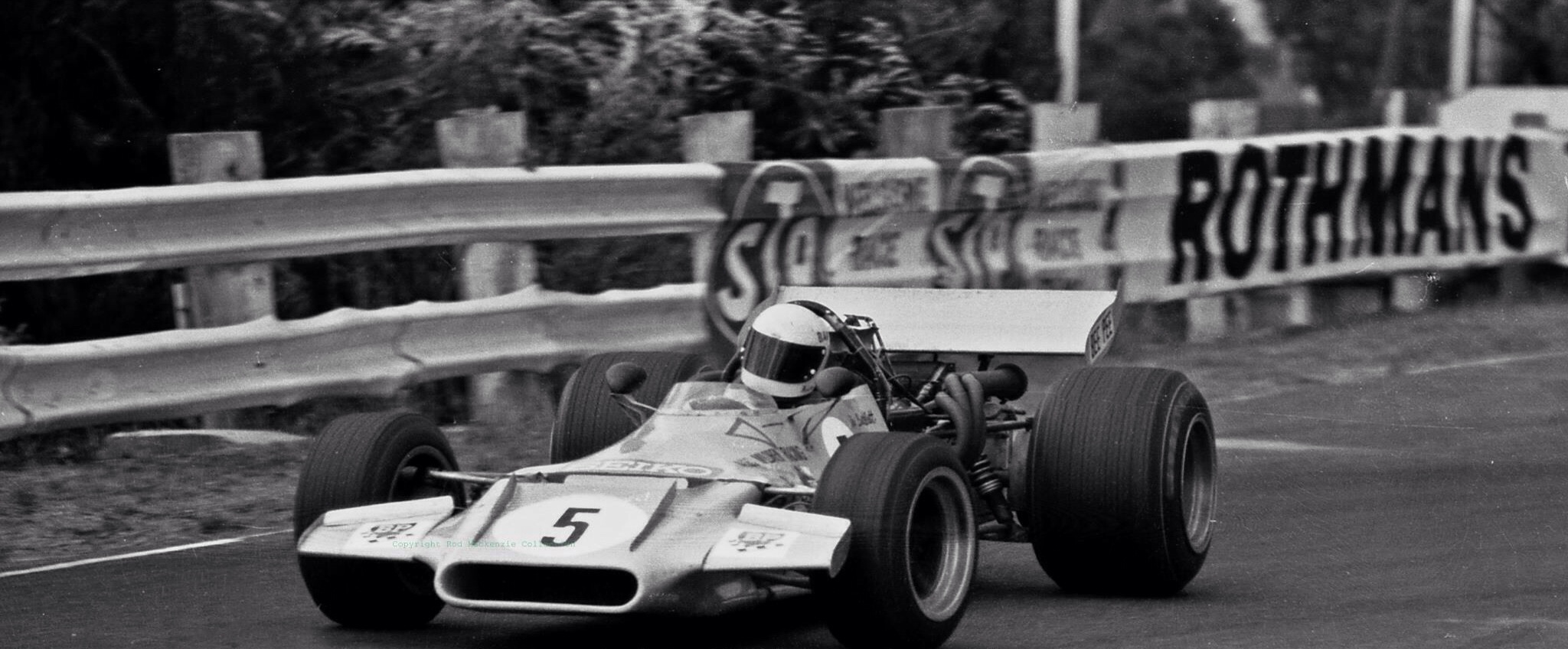
Rod MacKenzie captures Kevin Bartlett shaving The Esses Armco during the 1971 Warwick Farm 100, Tasman round on 14 January 1971…

The car is the Franklen/Palliser/Mildren/Wortmeyer F5000- a car designed by Len Bailey and built by Frank Gardner’s business as detailed in Allen Brown’s oldracingcars.com article here; https://www.oldracingcars.com/f5000/franklen/

Alec bought the car off the back of the prodigious speed of the Mildren Alfa/Waggott ‘Yellow Submarine’ also designed by Bailey and raced initially by Frank Gardner in the 1969 Tasman Series and then with great success by Bartlett in 1969/70 Gold Star/Tasman Championships.

The thrust of Bartlett’s 1970 was racing in the US (which we should talk to him about)- he contested the Symmons and Lakeside Gold Star rounds for third and a DNF and then missed Oran Park, Warwick Farm, Sandown and Mallala.

When he returned to Oz his beautiful Mildren Yellow Submarine had been sold to Bob Muir, the F5000 Mildren Chev was his new mount for the November 1970 AGP at Warwick Farm and beyond.

KB decamps from the Mildren Chev during the 1970 AGP. Glenn Abbey hands on hips at left, not sure of the other crewman- Alec Mildren back to us at far right

In a performance which flattered to deceive KB popped the car fifth on the grid but failed to finish with electrics problems after completing 21 laps. Frank Matich triumphed that day in his McLaren M10B Repco from Niel Allen’s similar Chev engined car (the chassis KB bought after Allen’s retirement) with Graeme Lawrence third in the little Ferrari Dino 246T which had been so fast in his and Chris Amon’s hands since 1968.

KB didn’t have a great run in the Mildren, his best finishes in the seven 1971 Tasman rounds was third at Warwick Farm and fourth at Teretonga- niggles elsewhere included a broken wishbone at Levin, coil at Wigram, engine failure at Sandown and a crash which precluded the speedy Sydneysider starting the final round at Surfers.

That was pretty much the end of Mildren Racing, sadly. Bartlett bought one of Niel Allen’s McLaren M10B’s shortly thereafter and was immediately a front-runner in one of the great production F5000’s.

(R MacKenzie)

KB’ boots the Mildren out of Peters Corner at Sandown and unleashes 500 or so neddies up Sandowns longish back straight and the left-right high speed kink and plunge into Dandenong Road.

Upon the sale of the Mildren Racing assets the car was bought by Jack Wortmeyer and re-named Wortmeyer SC/SC5 Chev and driven by hillclimb ace Erol Richardson, he made two Tasman appearances at Warwick Farm in 1973 and Oran Park in 1974. The car never left Wortmeyer’s hands- it was acquired after his death by the ACT’s Matt Veal who has completed, almost, the machines restoration.

Erol Richardson, Wortmeyer SC5 Chev, aka Mildren Chev at Hume Weir in December 1972. Uber rare for an F5000 to compete at the tight, twisty border circuit (B Keys)

This article is written in memory of great Australian photographer Rod MacKenzie who died in the last few days, on 1 February…

In fact it was looking at Rod’s archive for other photos of this car in addition to the lead one which he sent to me some months back that I became aware of his passing.

He was a man of great talent, check out his website if you have not done so and this article we did together in September which explains his ethos or creative approach.

Some of you will be familiar with his work via ‘The Tasman Cup 1964-1975’ book published two years ago whereas many of us first saw his art in ‘Racing Car News’ in its heyday.

Oz Racing Books…

and; http://www.rodmackenziecollection.com/

(R MacKenzie)

The photo above is of Rod on a fantastic trip to Scotland last 7 April 2018 to attend the Jim Clark Exhibition in Chirnside to commemorate the fiftieth anniversary of the Scot’s death at Hockenheim.

Some of Rod’s wonderful work- photos taken at Longford in 1968 formed part of the display.

RIP Rod MacKenzie

Credits…

Rod MacKenzie, Bruce Keys, oldracingcars.com, Fairfax Archive

Tailpiece: Bartlett, Peters/Torana Corner, Sandown Tasman 1971…

Great spot for photographers to get up cockpit close and intimate. Engine an Al Bartz injected Chevy.

Finito…


frank

(Rod MacKenzie)

Frank Gardner using all of his Mildren Alfa’s 310bhp chasing Jochen Rindt’s Lotus 49 ‘Warwick Farm International’ pole time, 8 February 1969…

Alfa’s Tipo 33 V8 sportscar engine was first used in elite single seater racing by Australia’s Alec Mildren Racing- a step on its way to F1 competition by the Arese marque.

Mildren, a Sydney Alfa Dealer, former Australian Gold Star Champion and Australian Grand Prix winner had one of the most professional teams in Australia. He had impeccable Alfa Romeo/Autodelta connections having acquired and raced two GTA’s and a TZ2 in the early to mid sixties, and in the process ‘polished’ Alfa’s Australian brand, one of the greatest of the ‘Grand Marques’ which was then relatively new to the ‘Oz market.

Click on these links to articles about Alec Mildren and the Mildren Racing Autodelta Alfa’s;

Mildren’s Unfair Advantage…

The Master of Opposite Lock: Kevin Bartlett: Alfa Romeo GTA…

Mildren’s 2.5 litre Coventry Climax FPF engined Tasman Brabham BT11A/BT16 being raced by Gardner on his annual trips home from Europe was being ‘flogged’ by the Repco Brabham, BRM and Coventry Climax V8’s in 1966/7, so he sought an appropriate response- a sprint variant of the Tipo 33 engine was the obvious choice given his Alfa connections and local marketing needs.

image

What a beautifully integrated bit of kit the Mildren Brabham BT23D Alfa was? Here just before it progressively grew wings. Kevin Bartlett drove the wheels off the thing, here at Hell Corner Bathurst during the ’68 Easter Gold Star round. KB was on pole by 9! seconds but DNF with a broken rear upright, Phil West took the win in the Brabham BT23A Repco. Bartlett won the ’68 Gold Star in this car and was equal 9th in the ’69 Tasman (Dick Simpson)

Mildren ordered eventaully three 2.5 litre Tipo 33 V8 engines which were initially fitted to a bespoke Brabham BT23D…

The car arrived in Australia in time for the final round of the domestic Gold Star Championship- the Hordern Trophy at Warwick Farm in 1967- FG won upon the cars race debut. He then contested the 1968 Tasman.

The motors were then installed 12 months later into the Mildren ‘Yellow Submarine’, a monocoque car designed by Len Bailey and built for the team by Alan Mann Racing for the 1969 Tasman Series.

Both cars were raced by Frank Gardner in the Tasman Series and then ‘handed over’ to Kevin Bartlett for the Gold Star Championship, when Gardner returned to the UK at the end of each Australasian summer.

Bartlett won the Gold Star  in 1968 and 1969 with each chassis respectively- BT23D and ‘The Sub’ respectively.

In 1969 the ‘Sub’ was also powered by Merv Waggotts’s 2 litre ‘TC4V’ 4-cylinder, DOHC, 4 valve, Lucas injected 275 bhp engine for part of the season.

image

(Ian Peak/The Roaring Season)

Above is a beautiful photograph of the 2.5 litre, 2 valve, 4 cam, fuel injected, 2 plug Alfa Tipo 33 V8 installed in Alec Mildren’s Gardner driven Brabham BT23D at Teretonga during the 1968 Tasman.

Gardner was equal fourth with Graham Hill in the series behind Jim Clark, Chris Amon and Piers Courage in Lotus 49, Ferrari Dino 246T and McLaren M4A Ford FVA respectively.

Kevin Bartlett had this to say about the Alfa Romeo 2.5 litre Tasman V8 and Waggott DOHC 4 valve engine, both of which powered the Mildren ‘Yellow Submarine’…

‘My memory tells me the Alfa had around 350lbs (of torque) and the Waggott about 230lbs. The useable power range was quite different with the Alfa workable between 4500-8800 rpm and the Waggott 6800-8750rpm. Not perfectly accurate as i work from  memory but around that kind of difference’.

‘The driving difference was the main change, as the power to weight felt little different behind the wheel, mainly due i suppose to the fact full throttle was used much sooner with the 4 cyl 2000cc Waggott.’

image

Kevin Bartlett won the Macau Grand Prix in 1969 in the Mildren Alfa ‘Sub’, here in the paddock. What a handsome bit of kit the car was and still is- restored by Lionel Ayers a decade ago to Waggott engined spec and retained by his family (Natalino Couto)

‘The turn in changed to a marked degree with the lighter power plant (Waggott) having less moment of inertia allowing the car to be literally flung into a turn. As it happens i am the only driver to experience both configurations. Frank Gardner having raced only the Alfa Romeo engined variant of each car’.

‘Len Bailey was the (Mildren’s) designer of the tub which flexed a little at the rear with the Alfa’s torque, less so when the Waggott went in, with suspension being a (Brabham designer) Ron Tauranac adaption’.

image

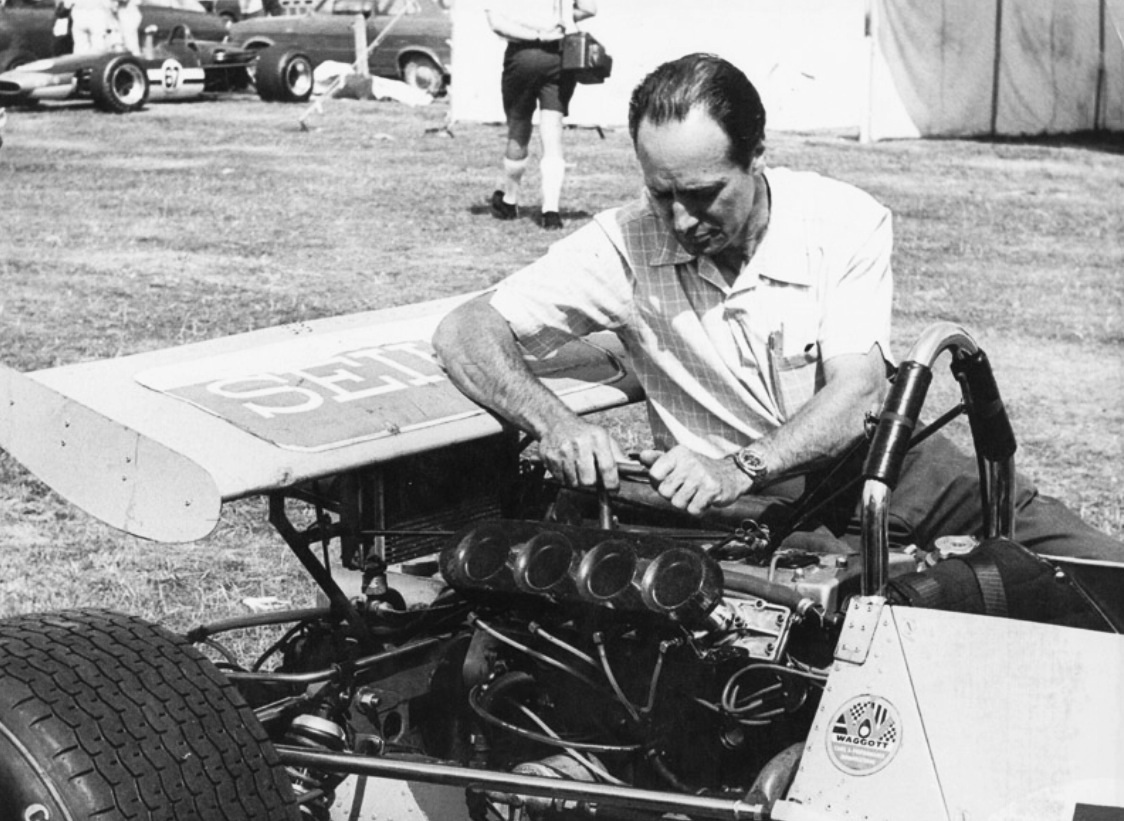
Mildren’s Glenn Abbey fettling the ‘Sub’ in the Singapore GP paddock , 1970 (Eli Solomon)

Alfa Romeo claimed 315bhp at 8800 rpm for the 2.5 litre variant of the engine. A similar 3 litre, four valve per cylinder, 32 valve engine (the Mildren V8’s were all chain driven two-valvers) was developed for Cooper in F1 but wasn’t used before the teams demise.

The F1 Alfa Romeo 3 litre V8…

Was an all aluminium unit with a bore/stroke of 86mm X 64.4mm for a total of 2998cc. Five main and camshaft bearings were used, the four camshafts driven by chains.


mac engine

Andrea de Adamich, McLaren M14D Alfa Romeo during 1970 (unattributed)

The valves were inclined at 30 degrees, the inlets were 32mm and exhausts 27mm in size, Alfa Romeo/Autodelta claimed an output of 400bhp @ 9000rpm in sportscar form. Modified with gear driven camshafts for F1 use, Autodelta claimed 430bhp @ 10,500 rpm at a time the 3 litre F1 competition- Ford Cosworth DFV gave circa 440, the Matra V12 445-450 and Flat-12 Ferrari 460bhp @ 12,000 rpm.

It was not enough really, not without impeccable reliability, but Alfa had put their toes back in F1 waters with McLaren in 1970 and then March in 1971- and would return with Brabham in the mid-seventies, as they had started with Mildren’s Brabham BT23D a decade before.

Etcetera…

image

Another photo of the Tipo 33 V8 in the spaceframe BT23D- FT200 gearbox clear as are the four coils and two distributors for all those plugs- 2 per cylinder. Car had a chequered history but still exists happily in restored form in Australia (Ian Peak)


Frank Gardner in the BT23D during the 1968 Warwick Farm Tasman round- very soggy outfield that year, this is in The Esses before Shell Bridge (oldracephotos.com/DSimpson)


image

Just to show the ‘Sub’ was yellow! Bartlett the cover boy of this terrific seasonal publication of the 1969 Australian Racing Season. Here the car is in 2 litre Waggott spec


Bartlett all ready to go- BT23D with Alec Mildren at right

Bibliography…

Kevin Bartlett, Doug Nye ‘History of The GP Car’

Photo Credits…

Dick Simpson, Rod MacKenzie, Ian Peak Collection/The Roaring Season, Eli Solomon, Natalino Couto, oldracephotos.com/Dick Simpson

Tailpiece: Rod’s initial Frank Gardner ‘Yellow Sub’ photo at the articles outset, uncropped…

image

Finito…


(P Ansell)

It does all get a bit serious these days doesn’t it!?

Here Jim McGuire and Alan Tatham are enjoying their Cooper Mk4 Norton at Gnoo Blas, circa 1957…

Aren’t these an amazing group of colour photographs of a race meeting at the popular, relatively shortlived Orange, NSW circuit. Such vivid images of race meetings in Oz at the time are not exactly plentiful.

These shots were posted on Bob Williamson’s Old Motor Racing Photographs – Australia Facebook page by Paul Ansell and immediately provoked a response from a swag of enthusiasts contributing information about the car and that day.

McGuire works, Tatham poses for the babes, as drivers do (P Ansell)

Australian Ace Kevin Bartlett recognised his ‘blue Morris Minor Series 2 fitted with a fibreglass top…’, that’s KB in blue standing beside the door of the car in the background. In fact Jim McGuire and his wife Carmen aided and abetted the careers of several drivers including KB, who raced the Elfin Imp for them in the mid-sixties and Peter Wherrett- the latter raced this very Cooper Mk4 with a Hillman Minx four-cylinder engine installed in the early sixties.

Here the Cooper is fitted with a Norton Manx engine. The red car over the back in the first photo is the Profilio MG Spl which still exists in historic racing as indeed does the Cooper Minx- restored by David Kerr a couple of decades ago.

By the time McGuire acquired the car, chassis # ’10/54/50′ was already a veteran of the 1954 Australian Grand Prix, Charlie Swinburne raced it, Manx Norton powered, to tenth place. Its thought when first imported to Australia the car was originally supplied to Les Taylor in Queensland fitted with a JAP 1100 motor.

Later raced by Queensland’s Ray Lewis as the ‘LPS Cooper Norton’ (Lewis/Bill Pitt/Charlie Swinburne) during 1953, Jim McGuire bought it from Tony Crick of Wellington, NSW, initially racing the machine with Tatham at the wheel.

Barry Collerson in the Cooper Minx leads an Elfin Catalina at Oran Park circa 1961 (Alan Stewart)

Later, in 1959 or early 1960, Jim mated a Hillman Minx 1500 engine and VW gearbox to the frame, the car in this form contested the 1960 Australian Grand Prix at Lowood.

The photo below shows Tatham aboard the Cooper Mk4 Hillman together with the #37 D Russell MG TD, #49 N Barnes MG TC s/c. I’m mystified by a couple of the cars but it appears to be the great Tornado 2 Chev down the back, by that stage driven and owned by Mel McEwin.

(F Pearse)

Up front a thriller of an AGP was won by Alec Mildren’s Cooper T51 Maserati by a whisker from Lex Davison’s Aston Martin DBR4/250, the little Cooper retired with an undisclosed ailment. Not so long after Lowood Tatham ceased to drive the car but it raced on, still owned by Jim at Strathpine, Tarrawingee, Hume Weir, Oran Park and Warwick Farm driven by Peter Wherrett and Barry Collerson.

Peter Wherrett, Cooper Minx, Warwick Farm May 1961 (P Wherrett)

Both Sydneysiders were talented coming-men of the day with Collerson racing an ex-Doug Whiteford GP Talbot-Lago in Australia before chasing the  FJ circuit in Europe for a couple of years. He has written a book too- i must buy ‘Mount Druitt to Monza’, been meaning to for ages.

Wherrett is incredibly prominent in the memories of several generations of us for his racing, his ‘Racing Car News’, for many years THE Australian motor racing monthly bible- race reports, ‘Peter Wherrett Advanced Driving’ school and ‘Torque’ the seminal, defining, brilliant ABC television motoring program of the mid-seventies. The genre popularised by Jeremy Clarkson much later started with Wherrett and a team at the ABC. Remember PW’s track test of Warwick Brown’s Lola T332 Chev?, it just blew my tiny, teenaged mind!

The Cooper Minx later fell into the tender, loving hands of David Kerr who restored and raced it extensively in historic racing with John Herman the last reported owner.

Lets Get Physical! Little Barry Collerson trying to stay aboard the Cooper Minx at Warwick Farm in August 1962. Note the different, later fibreglass nosecone in this shot (P Wherrett)

Credits…

Paul Ansell- photos. Dick Willis, Kevin Bartlett, Greg Smith, ‘Historic Racing Cars in Australia’ John Blanden, Fred Pearse Collection, Alan Stewart Collection and Peter Wherrett Collection on aussieroadracing.homestead.com

Etcetera: Cooper Minx, circa 1961, perhaps at the McGuire’s home in Sydney- Peter Wherrett Collection photos…

Water radiator neatly integrated given air-cooled engines originally fitted

Front transverse leaf suspension as standard Cooper Mk4

Rear suspension and wheels appear as standard Cooper Mk4

Hillman Minx 1500 four fed by a couple of downdraft Strombergs, transaxle is modified 4 speed VW

Tailpiece: Gnoo Blas officialdom, Cooper Mk4 unwell…

Never seen so many crisply laundered white overalls! Tatham in Cooper Mk4 Norton. Bucolic Gnoo Blas (P Ansell)

Finito…

It’s the end of the swinging-sixties- the Andy Warhol, Roy Lichtenstein and others ‘Pop Art’ phase is in full bloom…

It’s interesting to look at the graphic design and advertising imagery of the period which is wonderfully full of it, the style even extended to some stickers in Australia’s ‘Racing Car News’ magazine.

For the princely sum of 20 cents the six decals would be in your letterbox within the week, don’t you love the immediacy of snail-mail? The cheap giveaway was a time honoured technique in the pre-internet days of building a database of potential customers, oh for simpler times when identity fraud was rare rather than something to be mindful of in our daily online interactions.

The cars and drivers are all well known to Australian enthusiasts and include some of the stars of the day many of whom I have written about in whole or in passing.

The first image is Kevin Bartlett’s Alec Mildren Racing Mildren Waggott ‘Yellow Submarine’, a car first raced by Frank Gardner in the 1969 Tasman Series and then used by KB to win the Gold Star later that season. Click here for more; https://primotipo.com/2017/11/14/missed-it-by-that-much/

Frank Matich’s Matich SR4 Repco was built to contest the 1968 Can-Am series but ran hopelessly late so crucified local opposition in the 1969 Australian Sportscar Championship instead. Click here for a long feature on it;

Matich SR4 Repco…by Nigel Tait and Mark Bisset

Whilst the Niel Allen sticker says McLaren M10B, the car depicted is the M4A he acquired at the end of the 1968 Tasman Series from Piers Courage. This piece on the ’68 South Pacific Trophy at Longford, won by Courage tells a bit about this car; https://primotipo.com/2015/10/20/longford-tasman-south-pacific-trophy-4-march-1968-and-piers-courage/

The final three cars featured are Pete Geoghegan’s Australian built Mustang above (as in built for racing), Norm Beechey’s Holden HK Monaro GTS 327 with Bob Jane’s Shelby constructed Mustang as the ‘Tailpiece’. All of these machines are covered in an article I wrote about the 1969 Australian Touring Car Championship won by Geoghegan. Here ’tis; https://primotipo.com/2018/02/01/1969-australian-touring-car-championship/


Credits…

Bob Williamson Collection

Tailpiece…

Finito…

Kevin Bartlett from Spencer Martin and Greg Cusack on the plunge down the mountain, Bathurst March 1967…

David Atkinson’s depiction of Kevin Bartlett’s dice and achievement of the first over 100 mph lap of Mount Panorama shows the Brabham BT11A Climaxes of  KB and Spencer from Greg’s Brabham BT23A Repco V8.

Bartlett first raced a Morris Minor at Bathurst in the late fifties, he knew the place as well as anyone- the sense of achievement was great. ‘Bathurst: Cradle of Australian Motor Racing’ is the title John Medley gave his wonderful ‘biography of Bathurst’ and goes a long way to making clear the significance of this wonderful place and it’s importance in the continuing pantheon of Australian motor racing.

Only Lobethal and Longford match it for its majesty and Warwick Farm, Phillip Island and Albert Park it’s importance.

During a couple of torrid dices in a preliminary race and in the NSW Road Racing Championship round Bartlett and Martin both broke the lap record and 100mph mark repeatedly but Kevin was the first to do so.

Frank Gardner casts a paternal eye over his younger teammate and his old BT11A in the Longford paddock in 1968. It’s not wet so it’s not raceday! (oldracephotos)

In many ways I see Kevin and Spencer as the Australian ‘Bobsy Twins’ of the time…

Both Sydney boys, both born in 1940, both motor mechanics by profession, both drove for one of the best teams of the day in Alec Mildren Racing and Bob Jane Racing- both raced Brabham BT11A’s powered by 2.5 litre Coventry Climax four cylinder ‘thumpers’ and both were sublime practitioners of the single-seater driving art. Driver’s-Drivers if you will.

Spencer had greater experience of these powerful single-seaters than Kevin but the Curl-Curl Kid was learning fast, a classicist with god-given intuitive feel and car control that thrilled the crowds and record books for decades.

Oopsie. Spencer post WF Tasman contretemps with The Causeway, 1967- late in the race won by Jackie Stewart’s BRM P261 from Jim Clark’s Lotus 33 Climax (B Wells)

Bartlett from Martin during the WF 100 race, Tasman Series 1967. KB was 6th, Spencer’s shown in the shot above. Both cars Brabham BT11A Climax (B Wells)

Bartlett declared his intent in practice with an over 100 mph lap of  2:18.6 with KB setting a time of 2:17.7 in a 6 Lapper for Racing and Sports Cars in a fierce battle with Spencer- in the process Martin matched KB’s 2:18.4 he had set on lap 3, only for Bartlett to do a 2:17.7 late in the race.

In an amazing weekend for Bartlett he contested four races winning three- two single-seater events in the Brabham and a touring car race in Alec Mildren’s Alfa Romeo GTA- he was second to Bob Jane ‘s Mustang in the other race. But the thriller of the four was the feature race.

Peter Wherrett, then racer and later immensely gifted automotive TV broadcaster covered the meeting for Max Stahl’s monthly Australian motor racing bible ‘Racing Car News’, his account brings the thrilling weekends racing to life.

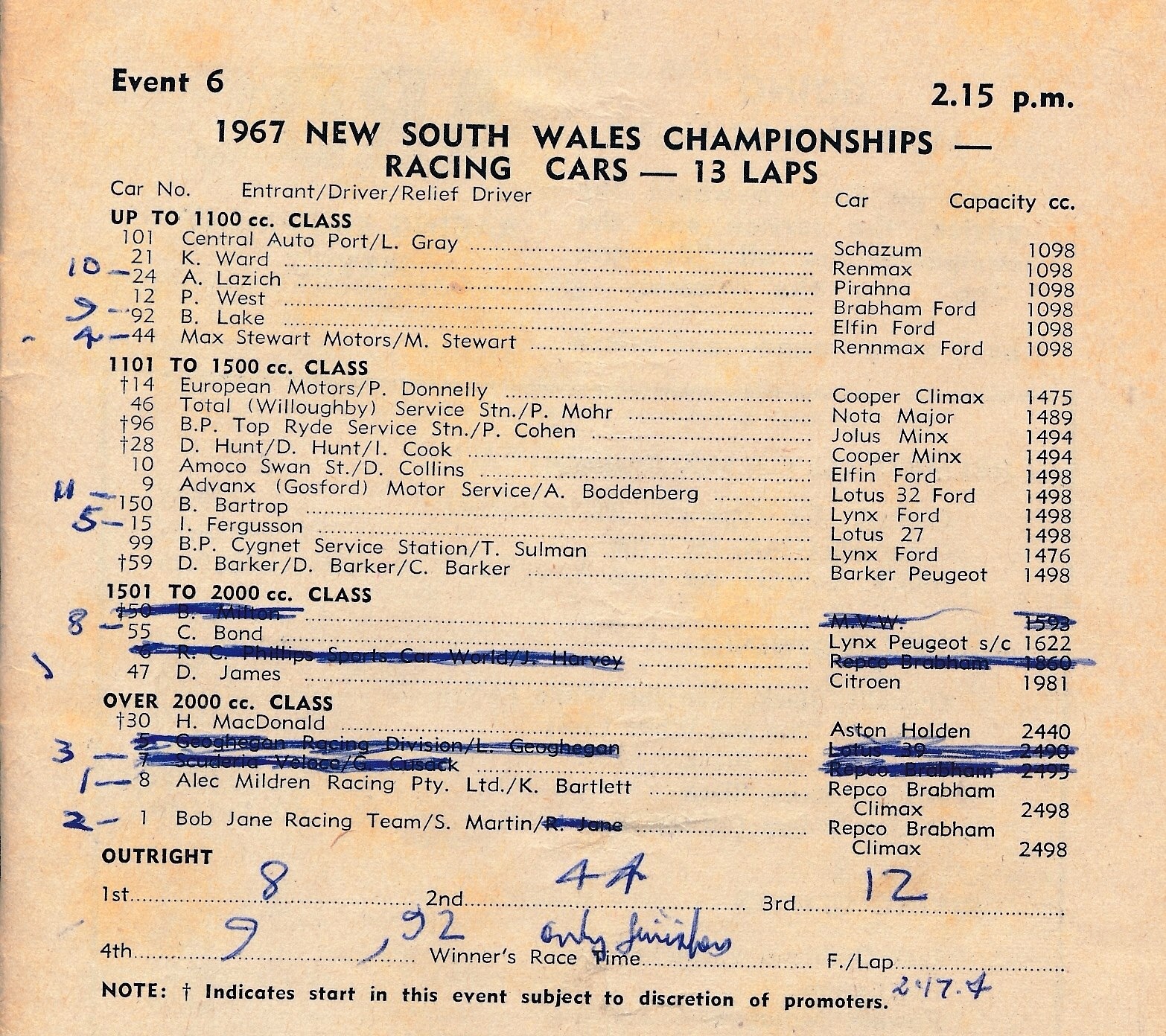
‘The feature event in the nine race program was the 1967 NSW Championship for Racing Cars…it was a thriller but disappointing as well…Geoghegan and Harvey were installing new engines and were indisposed…Then right there on the grid…poor Greg Cusack and his team pushed and shoved the Brabham all over the place, but the big Repco V8 refused to start’.

‘Bartlett had pole after his fabulous practice time, but there was determination written clearly all over Spencer Martin’s face. When the flag dropped they raced neck and neck for Hell Corner. Since Bartlett had the inside running he also had the advantage and was first out but accelerating away up Mountain Straight Martin again drew alongside. Up and over the mountain they raced with Bartlett leading Martin by the depth of his tread.’

‘Down Conrod and into the braking area it was still Bartlett, now by a car’s length , as they crossed the line after a standing lap of 2:21.3, already 4.4 seconds inside the lap record. Martin again caught up going up the hill but once more it was Bartlett who led down Conrod.’

‘Those who saw them said none have ever gone down the Esses like this pair. Bartlett, particularly was breathtaking!’

‘It seemed he simply twitched the car from one corner to the next, setting the booming Brabham up in the middle of one corner so that it was as near as possible to be spot on line for the one following, and then upsetting the whole thing in the middle of the corner so that he would be right for the next one and so on.’

‘Already way back in the field Max Stewart led the 1500’s…F2 Rennmax…Phil West 1100 Brabham running in close company with Alton Boddenberg in the Lotus 32’.

Start of the championship race- not quite because Greg Cusack’s red Brabham BT23A Repco is on row 2 and he didn’t start so its a preliminary. KB on pole, Spencer alongside- Brabham BT11A’s times 2, Niel Allen, Elfin 400 Chev at left, behind him is Bob Jane, Elfin 400 Repco, then Cusack alongside and the Rennmax Ford with the driver well into the airstream is Big Max- Stewart, and the rest (unattributed)

(P Maslen)

Brian Caldersmith’s wonderful painting of the battle

‘But it was the Bartlett-Martin duel which was drawing the attention of the masses. Bartlett’s second lap put him 30 yards in front and this was not surprising when it was announced that the lap record was now  2:17.4. Too much!’.

‘Spencer was right in there though, and on the third he picked up a bit. Into the fourth they went and again Spencer seemed to catch Kevin going up the hill and Kevin seemed to gain it all back again on the straight.

On the fifth of thirteen, people began to doubt they could both withstand the pace. Again Bartlett was in the 17’s but this time Martin joined him with a personal best of 2:17.8 and then…it was just too good to last.

We crazy money-paying enthusiasts are just not deserving of such joy. Going up to XL Bend for the sixth time Spencer slowed and with oil pressure failing withdrew the ailing Brabham. Bartlett slowed (?) to the low 20’s and could not be beaten. Stewart took second place, mad with glee, and Phil West gained a creditable third from Boddenberg, Barry Lake and Peter Cohen, who was in and out of the pits and only completed three laps’.

‘All but one of Bartlett’s laps were under the old lap record, and six of them were under the magic 100 mph lap (2:19.5)’.

Warwick Farm 100 1968, The Causeway, KB Brabham BT11A Climax DNF halfshaft in the race won by Jim Clark’s Lotus 49 Ford (oldracephotos)

Its interesting to look at the speeds recorded through the flying 1/8th of a mile that Easter long weekend. Cusack’s Repco V8 powered Brabham was the quickest open-wheeler at 162.45 mph, a time he recorded in practice with Bartlett and Martin doing identical times in their identical cars during the NSW Championship race- 159.57 mph. The quickest car over the weekend in a straight line was Bob Jane aboard his 4.4 litre Repco RB620 V8 engined Elfin 400 sporty, with 163.63 mph.

‘Ron Hodgson, who probably thought he was on a good thing with his offer, had to part with 100 bottles of bubbly for the first 100 mph lap, and these were added to Kevin’s 25 bottles scored on Sunday for fastest practice lap’ Wherrett wrote.

Martin inside Bartlett at Murray’s Corner

Bartlett from Martin across the top of the Mountain (L Walker)

Bartlett’s recollections are recorded in Alec Mildren’s biography-

‘…We were at it hammer and tongs. We were both pretty gung-ho. I was probably a bit more aggressive…Alec was really on the ball…I wouldn’t have attempted what I did otherwise. I came in after first practice and he said “Where do you reckon you can get the laptime” He knew the circuit, look, he knew it…”What if you short shift here, leave it that gear there, what revs are you using? He was at me’.

‘I was the train (engine) and Spencer was the guards van. He broke the 100 mph mark, too don’t forget. Always remember that. But because I was leading and crossed the line first, I got the credit. And when it came to the run of the race. I out braked him by outbraving him- it was one of those do or die things. I said to Alec later “Spencer and I got pretty close, Alec”. “We nearly lost the lot”. He said “Yeah, but you outbraved him didn’t you?” That was the way he talked’.

Later ‘When  Alec asked me what I was going to do with the champers, I said I don’t want it, you have it, and he said “Good, I’m going to throw a party”. Anyone and everyone in motor racing was invited to the splash-out at the Mildren Newport (Sydney North Shore ocean beach suburb) residence…Alec was never a boozer- he was an orange juice man. But I’m sure he had a champers or two that night’ Bartlett recalled.

Bartlett amongst the Repcos in 1967: Leo G Lotus 39, KB Brabham BT11A and John Harvey Brabham BT14, ‘Angus & Coote Trophy’ Oran Park (Rod MacKenzie)

Whilst Bartlett was the hero of the day at Bathurst, Martin again won the 1967 Gold Star, as he did in 1966 with two wins (Surfers Paradise, Mallala) to Cusack and Bartlett’s one apiece (Symmons Plains and Lakeside).

The two BT11A’s would have been the most highly developed cars of their type in the world with Martin and Bartlett both having, just, the legs of the Repco V8 engined cars of Cusack, Leo Geoghegan and John Harvey- Brabham BT23A, Lotus 39 and Brabham BT14 respectively. Spencer’s Bob Jane Brabham was more reliable than KB’s however, Spencer took the title with a points haul of 30 from Cusack 23, and Bartlett 16.

Formative KB single-seater years, 17 December 1961 Warwick Farm in the Lynx BMC FJ. Race won by Leo Geoghegan’s Lotus 20 (J Ellacott)

Another Big Bathurst Moment…

Bartlett and John Goss in the Bell cap (Greg Bartlett is the kiddo with his back to us) on the Bathurst 1000 victory dais in 1974.

What a sweet win for them both- especially KB who had a bad accident at Pukekohe at the seasons outset during the Tasman Series, he became a ‘Lola Limper’, breaking a leg when his T330 Chev came to grief, a lengthy recovery period followed.

That’s a walking stick in the young veteran’s left hand, quite a few of his fans shed a tear watching his gritty performance that day and this presentation on the telly, me included.

(autopics)

Etcetera: Spencer Martin HDT Holden Monaro GTS 350 alongside Allan Moffat’s works Ford Falcon GTHO Phase 1, warm up lap, Sandown 3 H0ur, September 1969…

There are plenty of Fords behind- Moffat/John French won from Tom Roddy/Murray Carter and Fred Gibson/Bo Seton all in HO’s.

Spencer had been retired for a year or so when he took a call from new Holden Dealer Team team manager Harry Firth to share a Monaro with KB during the HDT’s first event, the 1969 Sandown Datsun 3 Hour.

Ex-Ford racer/engineer/team manager, now Holden new boy Harry Firth was prevailed upon to hire a couple of single-seater drivers to race his new toy, Firth more of a believer in taxi drivers racing taxis, so to speak.

In a story for another time Martin had a massive brake failure at about the 45 minute mark of the endurance classic at the end of Sandown’s main straight, he skilfully backed the car into the Shell Corner armco minimising the damage to his good self but the car caught fire. The accident is variously attributed to boiled fluid, ‘brake booster system’ or standard brake pads being mistakenly fitted to the car prior to the race.

The Monaro was repaired after the race and sold by tender, it still exists. Spencer retired from a meeting he only entered after agreement with his new wife that a race in a touring car was relatively safe! His comeback to racing in the historic scene was a couple of decades hence.

In 1969 Bartlett had many successes in front of him including the second of his two Gold Stars aboard the Mildren Alfa/Waggott, in Asia and the US with much Formula 5000 and plenty of touring car wins including a Bathurst crown…

Slightly singed but not fatally damaged Monaro in the slip road on the outside of the Sandown track on pit straight, scene of Spencer’s high speed handbrake turn into the fence. KB did not get a drive during the race (unattributed)

Photo & Other Credits…

Racing Car News May 1967, Rod MacKenzie, autopics.com.au, Brian Caldersmith, oldracephotos.com.au, Bruce Wells, John Ellacott, Bob Jane Collection, ‘Driven To Succeed: The Alec Mildren Story’ Barry Green, ‘Bathurst: Cradle of Australian Motor Racing’ John Medley, Peter Maslen Collection, Lionel Walker

Tailpiece: Bartlett at the wheel of the McLeod Ford / John Goss Ford Falcon GT during the Bathurst 1000 in 1973- they won in the same car in 1974 but I like the look of the big yella beastie the year before…

Finito…

(Rod MacKenzie)

…in the words of Maxwell Smart, for you aficionados of Mel Brooks’ wonderful sixties TV show ‘Get Smart’.

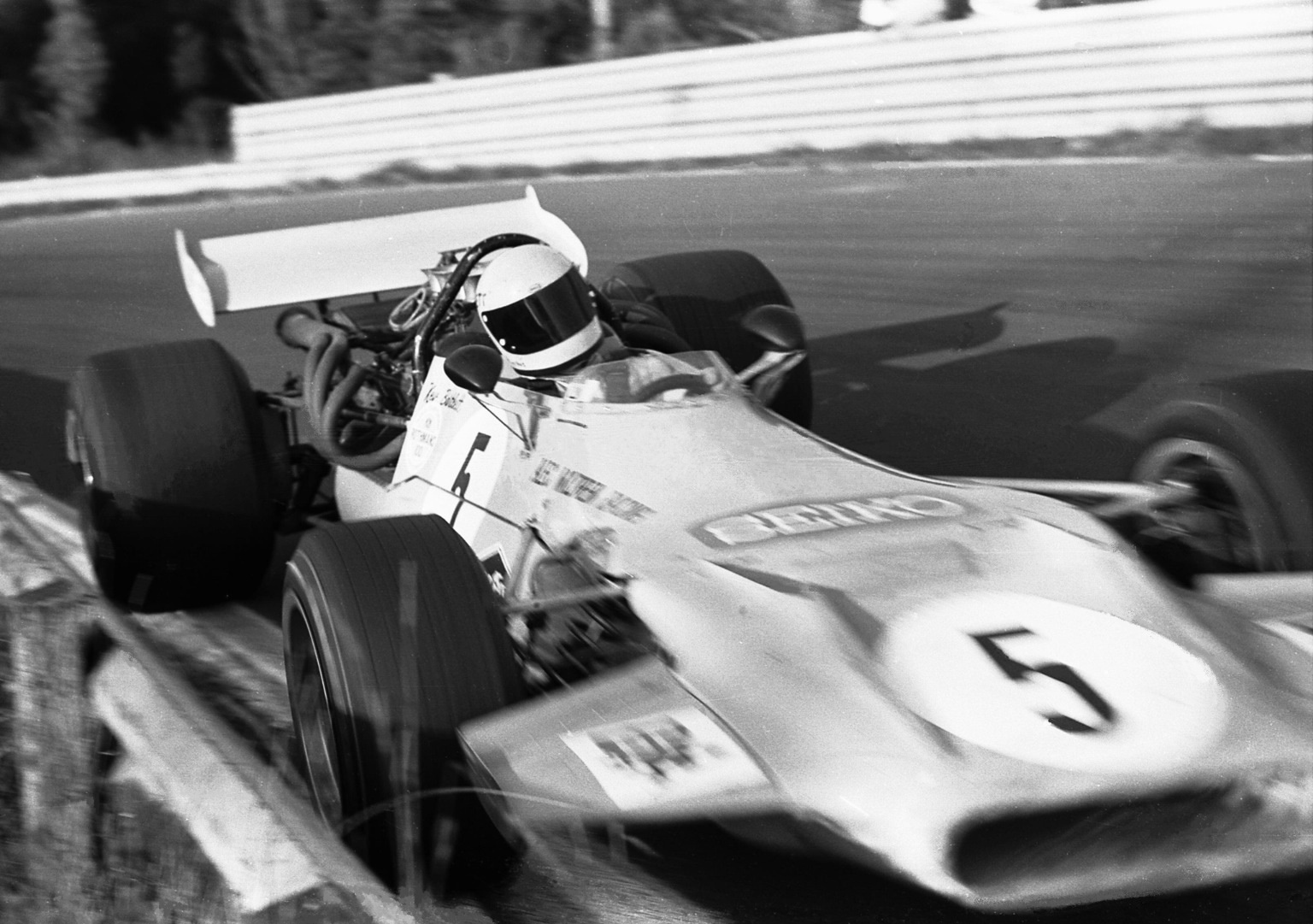
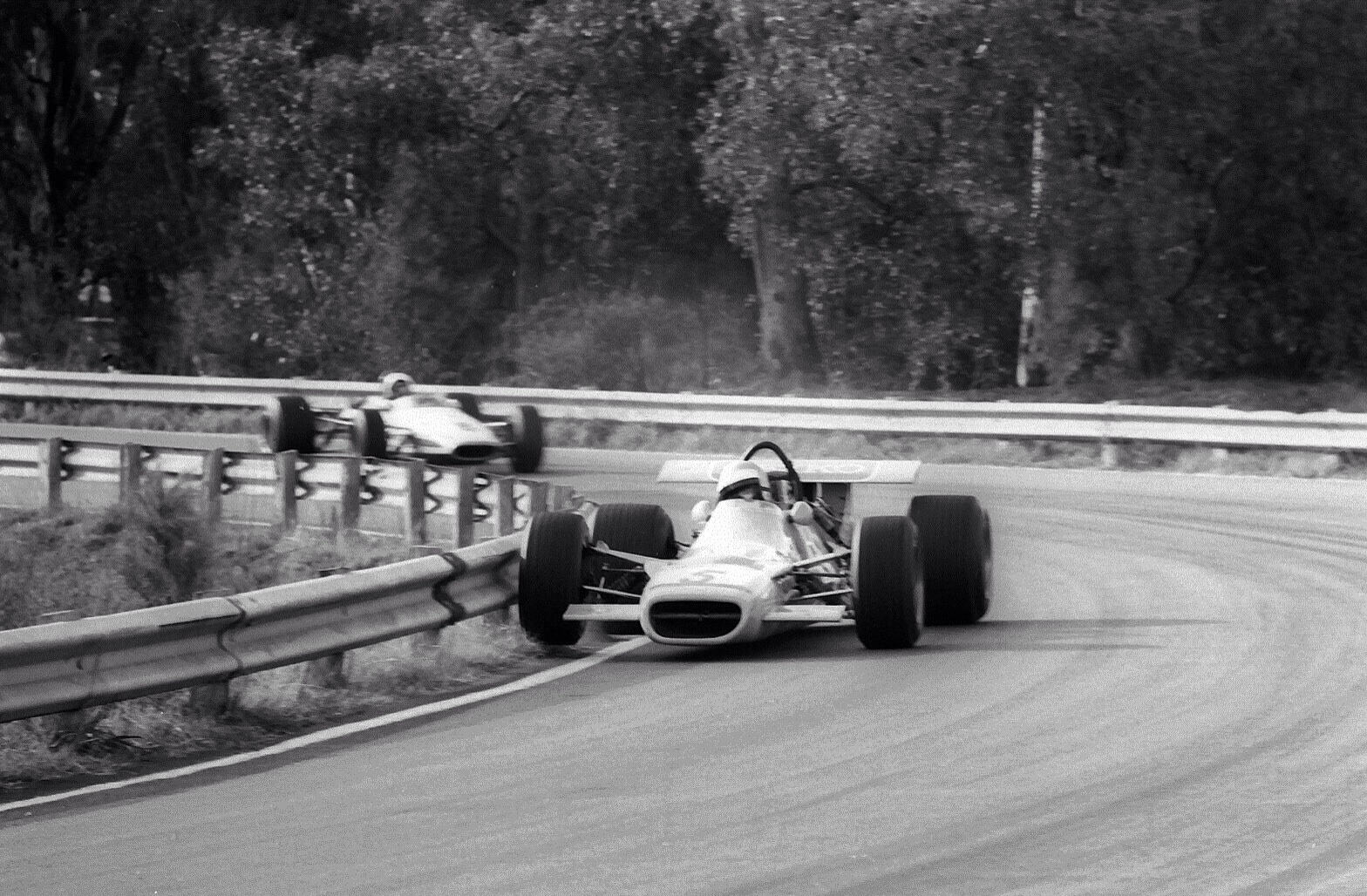
Kevin Bartlett with an inside wheel off the deck demonstrating the millimetre precision for which he was famous aboard the Mildren ‘Yellow Submarine’ Alfa in Warwick Farm’s Esses, September 1969. Rod MacKenzie has opened his shutter at precisely the right moment.

Another inch or so and the talented Sydneysider would have ripped an expensive corner off the front of a car which was so kind to him. I’m not sure of the racer behinds identity. A Lotus 27 or 32 perhaps?

Bartlett inherited the Len Bailey designed, Alan Mann Racing built, Alec Mildren owned car after Frank Gardner raced it in the 1969 Tasman Series. KB used it to great effect in that years Australian Gold Star Series winning three rounds and the title in it- Symmons Plains, Surfers Paradise and in Bartlett’s Warwick Farm backyard in December.  During a busy season KB and the Sub also won the Macau Grand Prix on 16 November and contested the JAF Japanese Grand Prix at Fuji.

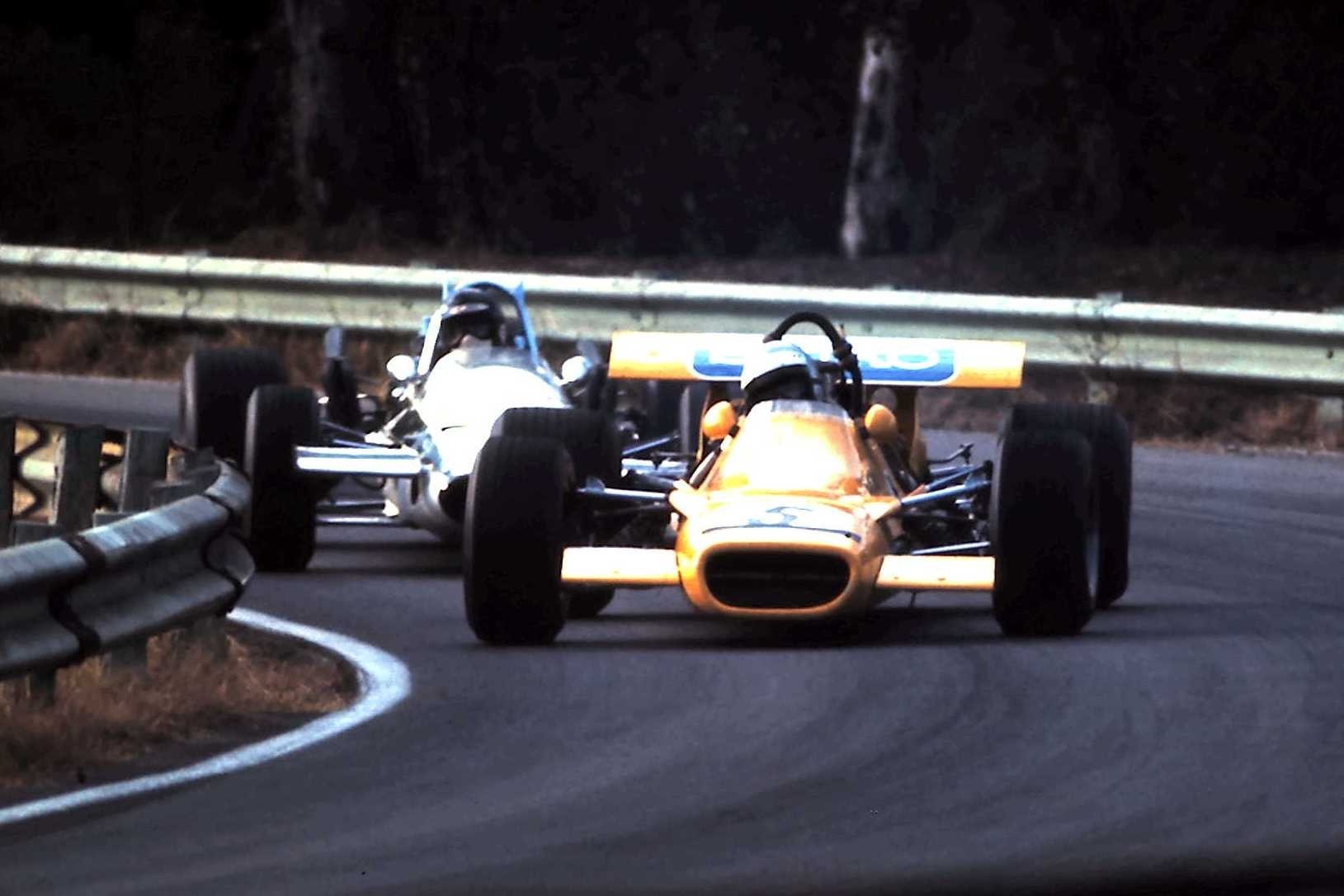
Every inch a GP car of its day isn’t it, just magnificent. Mildren Alfa in its ‘Alfa ultimate form’. Lynton Hemer’s shot captures the car at WF on Hume Straight in July 1970- interesting shot as the Alfa engine is back in the car long after its first Waggott engined race (L Hemer)

It wasn’t the ‘same car’ by the end of the year though as the Alfa Romeo Tipo 33 2.5 litre V8 engines with which the chassis was originally designed and built were put to one side and replaced by Merv Waggott’s Sydney built, 2 litre all alloy, DOHC, 4 valve, Lucas injected 275 bhp engine.

The history of my favourite ‘Australian’ racing car is one for another time- it’s a long story as this jewel of a car’s ‘in period’ history starts with 1969 Alfa V8 wins, continues with Waggott engined victories and ends with 1.6 litre Hart 416B success in Australian National F2 form in 1974/5. A fellow named Ray Winter was campaigning this famous car by then.

(Bill Pottinger)

High Speed Precision too…

Bartlett was famous for his tail out style, he was ‘the absolute master of opposite lock’ as Sam Posey described him having raced against KB during the 1973 Tasman Series and in the ‘L&M F5000 Championship’ in the ‘States in 1972/3.

This shot of the car is in ‘neutral to very subtle oversteer’ attitude, a very high speed, delicate drift- was taken by Bill Pottinger whilst Kevin traversed Teretonga’s ‘loop’.

The 1970 Tasman was tough in a 2 litre car, it was the first year of the Tasman F5000 Formula. KB was still quick enough to take 5th at Pukekohe and Teretonga- a second at Surfers Paradise, very much a power circuit was amazing and first at Warwick Farm brilliant but understandable. Bartlett, Matich and Leo Geoghegan were surely the quickest blokes around ‘Gods Own Acre of Motor Racing ‘ out Liverpool way?!

A mighty fine car and a mighty fine driver- thankfully both are still alive and well in Australia, Queensland to be precise…

(Bill Pottinger)

Merv Waggott fettles…

Sydney’s engineering genius Merv Waggott doing a plug change in ‘The Sub’ during the 1970 Teretonga weekend. Alec Mildren had been using Merv’s talents for years and specifically the smaller variants of Waggott’s engines in his other car, the Rennmax Engineering built Brabham BT23 copy ‘Mildren Waggott’ raced by Max Stewart.

When Merv decided to build a bespoke aluminium block to allow a capacity of 2 litres, something the Ford Cortina blocks used hitherto could not, it was an easy decision for Alec to go the more cost effective route with the local engine rather than the 2.5 litre Alfa V8.

The Alfa unit had received no development since first fitted to Mildren’s Brabham BT23D chassis in late 1967. Alfa were focussed on 3 litre engines for both their Tipo 33 Sportscar program and F1. Two litre Waggotts won Australian Gold Stars for Leo Geoghegan in 1970 (Lotus 59B) and Max Stewart in 1971 (Mildren Waggott)

(H Ellis)

Etcetera: Australian Competitor Set 1970…

Startline of the first round of the 1970 Gold Star Series at Symmons Plains, Tasmania in March 1970.

John Harvey’s #2 Bob Jane Racing Brabham BT23E Repco on pole alongside KB in the Mildren ‘Yellow Sub’ Waggott with Leo Geogheagn’s Lotus 39 Repco on the outside, and behind him in the other yellow Mildren Racing entry is Max Stewart in the Mildren Waggott spaceframe Bob Britton/Rennmax built car. Harvey won a top race from Leo and KB.

In a season of change it was Leo’s last championship race in the venerable ex-Clark Lotus, Harves was about to switch to the Britton/Rennmax built Jane Repco V8- yet another car, like the Mildren Waggott built on Britton’s Brabham BT23 jig whilst KB spent much of 1970 racing in the US so did not defend his Gold Star title. It was also the last year of the Tasman 2.5 Gold Star Formula- Geoghegan taking the title in a new Lotus 59B Waggott 2 litre as noted above.

KB gets a shove during the 1970 Tasman meeting- he won in front of the F5000’s. Glen Abbey, Ian Gordon and another fella. Stewart’s Mildren Waggott in the paddock behind (unattributed)

Photo Credits…

Roderick MacKenzie, Bill Pottinger on The Roaring Season, Lynton Hemer, Russell Thorncraft, Harold Ellis

Tailpiece: Bartlett from Geoghegan, Warwick Farm Esses during 1969- Mildren Alfa from Lotus 39 Repco…

(R Thorncraft)

Finito…


image

Warwick Brown, Lola T332 Chev, Riverside 1974 (TEN)

‘WB for 73’ was the T-Shirt catch phrase of Warwick Brown’s team during the 1973 Tasman Series…

The good looking, well heeled young bloke from Wahroonga on Sydney’s North Shore had graduated from the relatively forgiving McLaren M10B Chev in which he cut his F5000 teeth in 1972 Australian Gold Star competition to an altogether more demanding mistress for the Tasman  Series, a Lola T300 Chev.

His ex-Niel Allen/Bob Muir car, chassis ‘HU4’ was a very good one, but the T300 was a fast, albeit flexy, twitchy little bugger. With guidance from mentor and engineer Peter Molloy, Warwick quickly adapted well to his new mount.

He didn’t finish the first Tasman round at Pukekohe, the Lola out of fuel but was third behind Graham McRae and Frank Matich in their own designed and built cars, two very hardened professionals at Levin. He was second the following round at Wigram behind McRae. Warwick then went to Australia feeling great despite a poor seventh at Teretonga with undisclosed car dramas.

image

WB, Team Target (retail stores) Lola T300 Chev, New Zealand, Tasman 1973

At Surfers Paradise though he became a ‘Lola Limper’ bigtime…

His car got away from him on the fast, demanding circuit spreading bits of aluminium and fibreglass over the undulations of the Nerang countryside and broke both of  Warwick’s legs. He got wide onto the marbles on the entry to the flat out in fifth right-hander under Dunlop Bridge and bounced across the grass into the dirt embankment surrounding the circuit. The light aluminium tub folded back, in the process doing horrible things to Warwick’s feet and lower limbs. He had a very long recovery, made somewhat easier by the promise of a new car from his near neighbour patron, mining millionaire Pat Burke.

That September 2nd in 1973 i attended the ‘Glynn Scott Memorial Trophy’, the F5000 Surfers Paradise Gold Star round in 1973, and hobbling around on crutches was Warwick talking to his fellow F5000 competitors and the fans.

He really was struggling just to get about and obviously in pain. Unbelievably, I couldn’t believe it when I saw the race report, he contested the next Gold Star round on October 7, one month later in Adelaide. No way could he get in and out of the car unaided.

To me it was madness, given his state, but to Warwick it was everything. He withdrew his old M10B after 8 laps and spent the following months getting properly fit for the 1974 Tasman but he had put down a marker as one determined, tough hombre!

Pat Burke bought him a new Lola T332 Chev, chassis ‘HU27’, the first production T332 and WB had a very consistent Tasman series in it…

He never finished worse than seventh, only failing to complete the NZ GP at Wigram, and won the final round, the Adelaide International. The ’74 Tasman had depth, the field included Teddy Pilette, Graeme Lawrence, John Walker, Max Stewart, Kevin Bartlett, John McCormack and Graham McRae- Peter Gethin won it in a VDS Chevron B24 Chev.

Warwick, Pat and Peter Molloy had plans to take on the best in the US by taking their Lola to the ‘States, ‘match fit’ as it was after the rigours of the eight race Tasman program.

image

WB in ’73 (John Lemm)

In 1974 the SCCA/USAC F5000 field included Mario Andretti, Brian Redman, Jackie Oliver, Sam Posey, Graham McRae, Brett Lunger, David Hobbs, Al Unser, Lella Lombardi, Vern Schuppan, James Hunt, John Cannon and others.

By the time Warwick and his crew got to the Ontario round on 1 September it was ‘Formula T332’- Mario Andretti had won two rounds, Brian Redman a couple and David Hobbs one, all in Lola T332’s, the greatest F5000 car ever.

Brown was eleventh at Ontario and then fifth at Monterey in mid-October behind Redman, James Hunt in an Eagle 755, Andretti, and Eppie Wietzes in another T332. In the series final round, the Riverside GP, he was third behind Andretti and Redman.

As a WB fan reading about these performances in Australian weekly ‘Auto Action’ I remember being blown away by his speed in such august company viewed through the prism of just how badly hurt he was- and would be again, he had three ‘Big Ones’ in his pro career. I could see his pain getting around at Surfers.

It takes extraordinary guts to get back into these things after big accidents in which you are hurt.

The mind management and sheer courage involved has always intrigued me. Not that he was the only ‘Lola Limper’ in Australasia, Graeme Lawrence and Kevin Bartlett spring readily to mind.

But those three US races in ’74 made him really, he proved to himself he could do it. The crew came back to Oz later in 1974 and Warwick was running away with the AGP at Oran Park until mechanical problems intervened. He then won the ’75 Tasman in a close fought battle with fellow T332 drivers Graeme Lawrence and John Walker and set up a US pro-career for the next few years with Jack McCormack’s Talon nee McRae cars in 1975 and then Team VDS.

It’s not an article about the entirety of WB’s career rather a reflection on mind over matter, toughness, passion, resilience and the fierce desire to compete and win that separates elite drivers like Brown, Lawrence and Bartlett from we mere mortals…

(unattributed)

Etcetera…

Pat Burke acquired the ex-Niel Allen (spare tub) /Allan Hamilton McLaren M10B Chev chassis ‘400-19’ in time for the 1972 Australian Tasman Cup rounds.

As I wrote above, under the tutelage and guidance of Peter Molloy- and using Mighty-Molloy Chevs, Warwick quickly adapted to these savage beasts- he was seventh at Surfers Paradise, ninth at home at Warwick Farm, fifth at Sandown and failed to finish at Adelaide International.

The photograph above is of Warwick with the dominant 1972 Gold Star combo of Frank Matich and his Matich A50 Repco at Oran Park during practice for the ‘Belle Magazine Trophy’ in June- they were fifth and first respectively.

He was equal fourth, together with John Walker, Matich A50 Repco in the 1972 Gold Star series with Matich, Kevin Bartlett, Lola T300 Chev and John McCormack, Elfin MR5 Repco in front of him- but he was well and truly on his way.

Credits…

oldracingcars.com, Bob Harmeyer, The Enthusiast Network, John Lemm

Tailpiece: Brown winning in the Lola T333CS Chev, Watkins Glen 1978…

image

(Bob Harmeyer)

Warwick Brown’s VDS Racing Lola T333CS Chev enroute to a single-seat Can Am win at Watkins Glen on 9 July 1978.

He won from Al Holbert and Rocky Moran both also Lola T333CS mounted. The car following WB is George Follmer’s Prophet Chev. Brown was second in the championship that year but the class of the field was his countryman, the three years older Alan Jones who took five victories and the title in the ‘works’ Carl Haas T333CS.

Jones was ‘moonlighting’ in 5 litre cars having gained a toehold in F1 which he was in the process of capitalising upon with Williams Grand Prix engineering.

Finito…