Posts Tagged ‘March 701 Ford’

(MotorSport)

“Och aye! That really is more like it” or thoughts to that general effect. Jackie Stewart in his brand new Tyrrell 001 Ford Cosworth DFV at Oulton Park during the August 22, 1970 Gold Cup weekend.

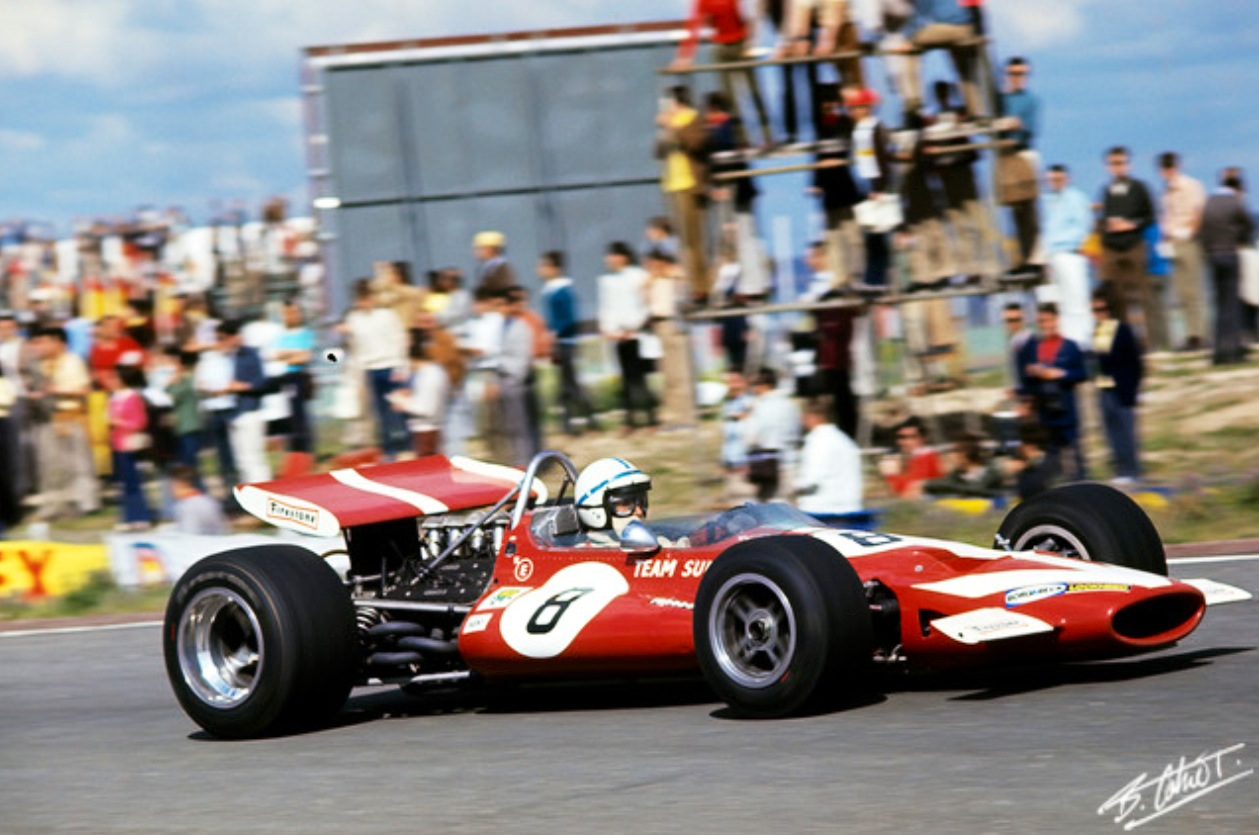
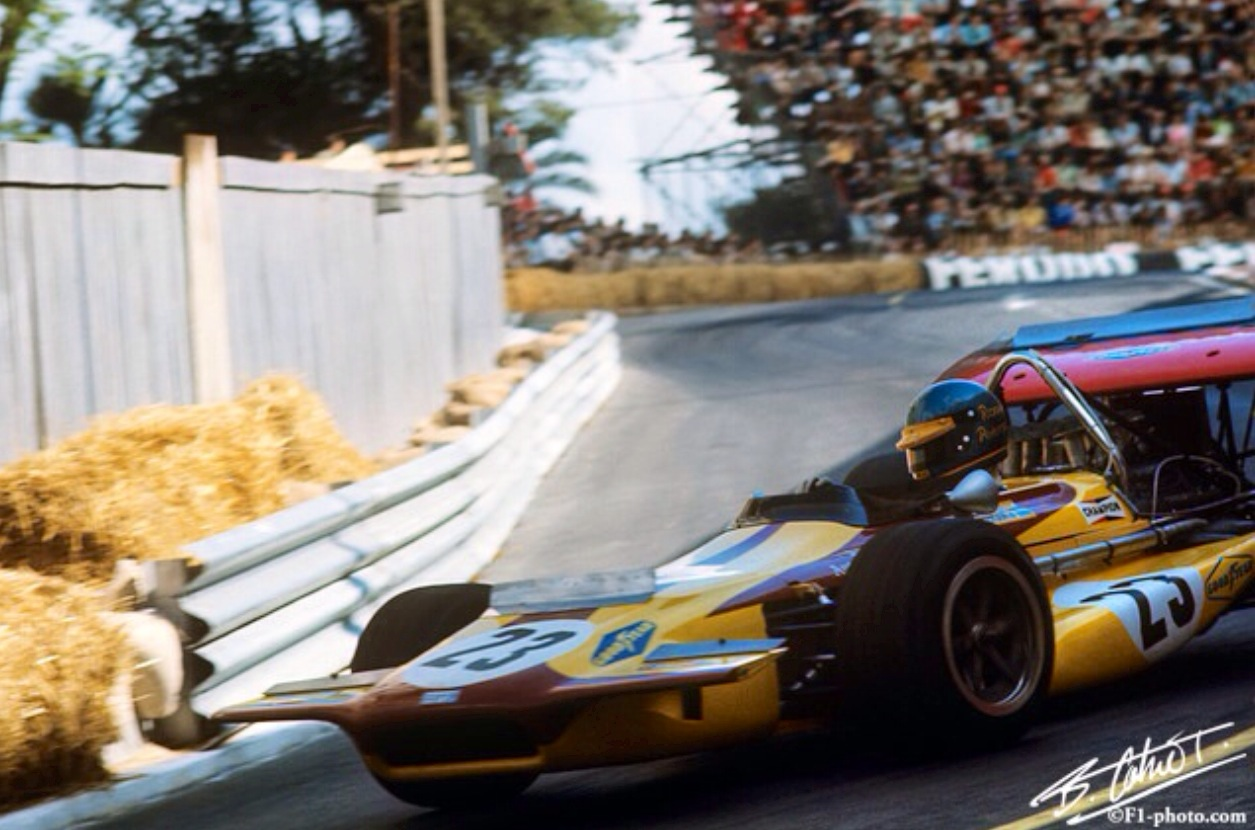
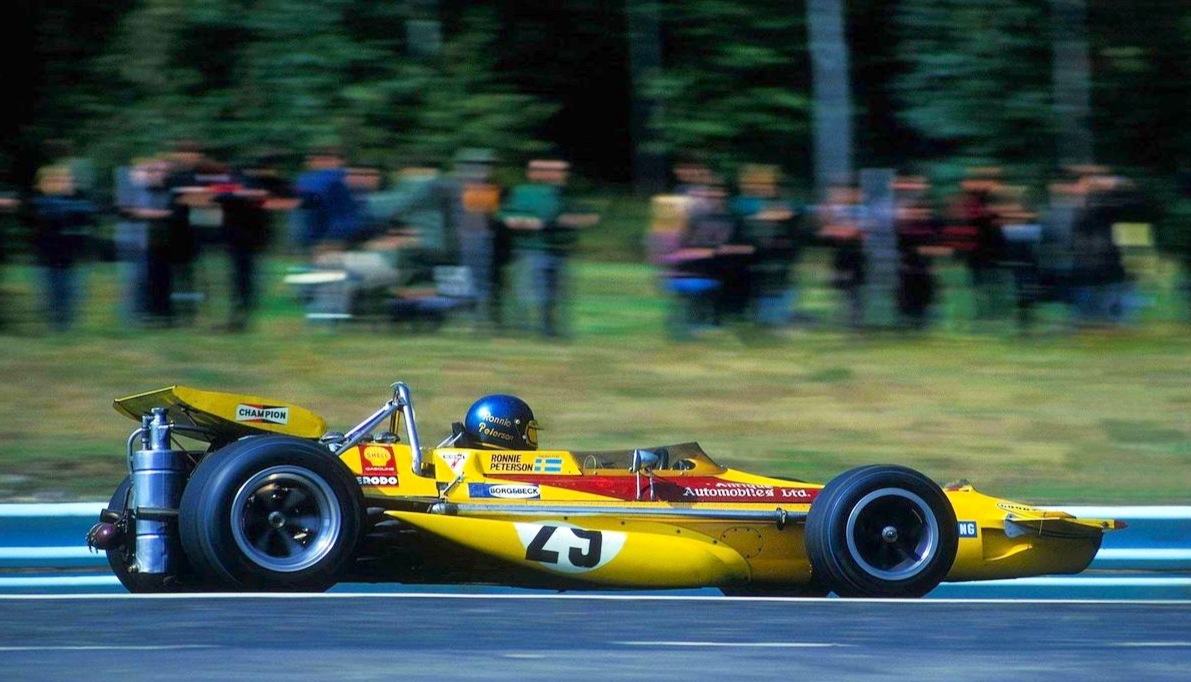
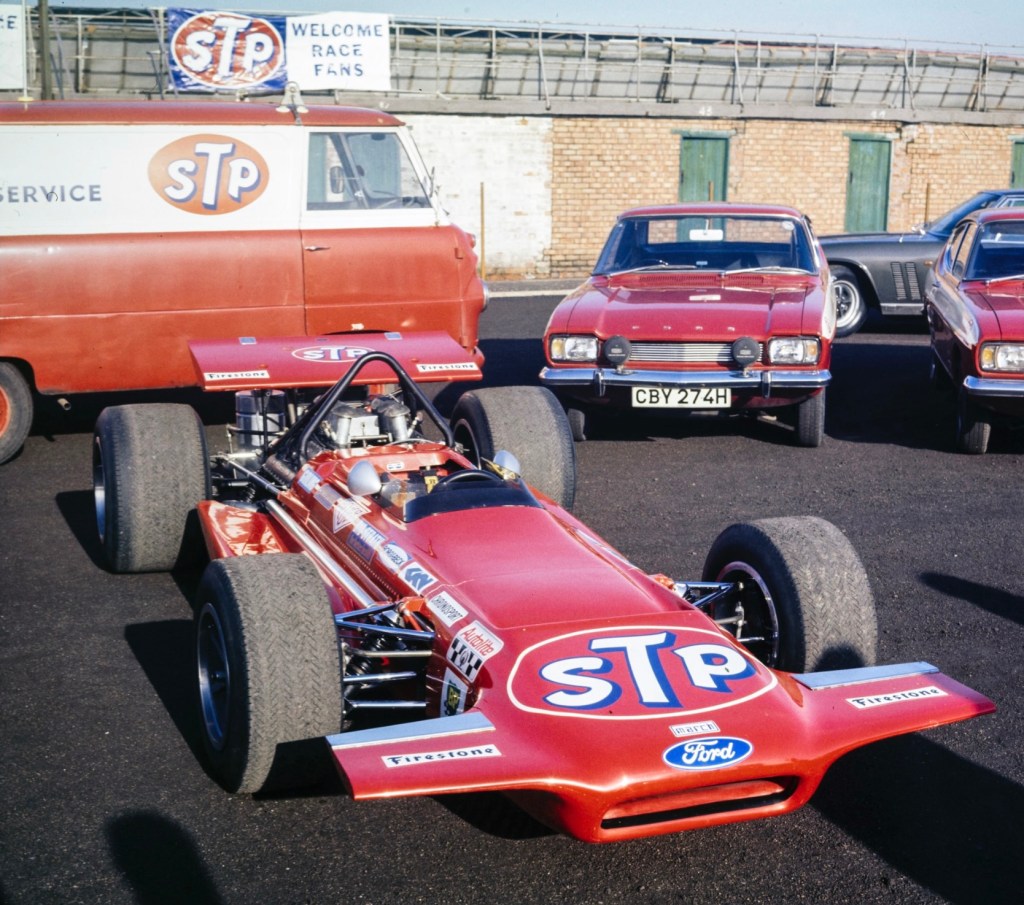
Derek Gardner’s first F1 design was only days old and already it felt better than the customer March 701 Ford – victories in the Race of Champions and Spanish GP (Stewart) and International Trophy (Chris Amon) notwithstanding – that he had been racing that season.

Press release of the Tyrrell 001 at Ford’s London premises, August 18, 1970

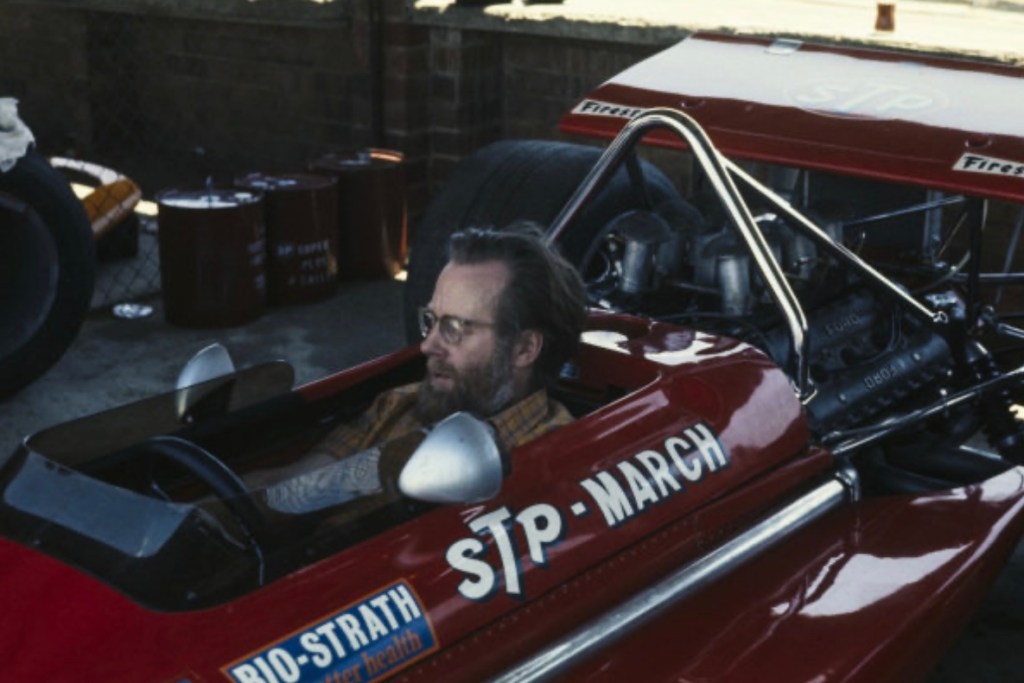
Stewart and Tyrrell’s Matra International team had won the 1969 World Drivers and Manufacturers Championships with the superb Matra MS80 Ford. For 1970 the French aerospace giant wanted to race only Matra V12 engined cars. After Tyrrell and Stewart travelled to France and Stewart tested the new Matra MS120 the pair decided they preferred to stick with the Ford engine; hence the acquisition of March 701s. See here for a short piece on the 701: https://primotipo.com/2014/05/15/blue-cars-rock/

Tyrrell quickly realised he needed to build his own car to control his destiny, rather than be at the mercy of a chassis manufacturer, so Gardner was engaged and secretly set to work in a design studio he established at his Leamington home.

Ken got to know and respect Derek during the occasions on which Matra International raced the Matra MS84 Ford 4WD drive car in 1969, Gardner was then employed by Ferguson Research and was responsible for the transmission in that car.

“…and then it does that, really suddenly!’ OR “…it doesn’t matter what I do, it just doesn’t respond!” JYS and March 701 Ford (MotorSport)
Stewart at Brands Hatch in the Tyrrell March 701 Ford during the July 1970 British GP (MotorSport)

The guidelines were, amongst others, that the design needed to be simple and competitive with minimal development, with a deadline of the August 22, Oulton Park Gold Cup meeting.

Gardner decided upon a light, aerodynamic car with very lower polar moment of inertia and optimum front-rear weight distribution. He had a wooden buck of the chassis made by a local joinery firm for Stewart to try. At that point the Tyrrell mechanics were let in on the secret with comments invited about what went where and maintenance – important design considerations for someone who hadn’t designed a racing car before

Hockenheim, Germany Q7 and DNF engine in the March 701, Jochen Rindt won(Schlegelmilch/MotorSport)
March 701 Ford cutaway drawing (G Piola)

Given Tyrrell’s famous Ockham timber yard operation was equipped to prepare racing cars, not build them – something that would change quickly enough – a swag of well known industry suppliers and ‘subbies were soon busily making components to the account of this fella named Gardner D.

A Ford DFV engine and Hewland FG 5-speed gearbox were sent over to Derek, while Maurice Gomm’s Gomm Metal Developments fabricated Gardner’s open, bath-tub, pregnant-belly, monocoque chassis out of 18-gauge NS4 aluminium alloy. Derek had modelled a tenth-scale model of the car in the University of Surrey’s wind-tunnel. The front of the chassis covered Wee-Jackie’s feet, while a subframe extended forwards to carry the radiator and front lower wishbone pick-up points.

Doug Nye wrote that “A massive front bulkhead structure extended into Matra-like wings on each side, supporting tiny, split upper wishbones and top mounts for the outboard coil spring/damper units. Very wide-based fabricated lower wishbones were used.”

Jackie Stewart in 001 ahead of Mike Hailwood, Lola T190 Chev and Reine Wisell, McLaren M10B Chev Oulton Park Gold Cup, August 1970 (MotorSport)

The Ford DFV engine was mounted, as the design intended, to the bulkhead aft of the driver, while the rear suspension was attached to the DFV and Hewland transaxle via tubular subframes. Len Terry’s ‘industry standard’ parallel power links were used with a single top link, twin radius rods and again outboard coil springs/Koni shocks.

Brakes were outboard at the front, and inboard at the rear: rotors were ventilated and 10.5 inches in diameter front and rear. Aeroplane and Motor provided many of the castings: uprights, wheels and other items, Laystall made the stub axles and Jack Knight Engineering did most of the machining.

The unusual nose and cowling shape were informed by the ‘tunnel-work, the central spine designed to divert relatively clean air around the side of the cockpit back onto the two-tier rear wing mounted atop a gearbox strut.

“When the prototype car (#001) was first assembled and weighed it scaled some 100 lb less than the team’s proprietary March 701s, and was only 32 lb above the minimum weight limit. It had cost Ken Tyrrell £22,500 less engine and gearbox, compared to the purchase price of £9000 for his March 701s.” Nye wrote.

Messrs Gardner and Tyrrell looking youthful in 1970 (MotorSport)
Tyrrell 003 Ford cutaway drawing, the eagle-eyed may pick the Girling twin-disc brakes (T Matthews)

After completion and dealing with all of the press-release niceties the car was despatched to Oulton Park where 18 cars faced the starters flag: five GP and thirteen F5000 cars.

Niggles that weekend included metering unit failure and a blocked fuel injection unit, so JYS also practiced and qualified his March fifth, but elected to start from the rear of the grid in 001 having not set a time.

On lap two of the first heat he pitted after the throttle jammed, to have the linkage eased a bit, and to have loose bodywork made good. He returned to set the lap record (twice) before an oil pick-up problem caused the engine to fail. John Surtees’ TS7 Ford won that heat, and Jochen Rindt’s Lotus 72C Ford the second, with John victorious overall.

Mosport, Canada 1970 (MotorSport)
Stewart and team at Mosport where keeping wheels on 001 was a problem, and a broken stub axle (MotorSport)

Given a choice of cars Stewart did the logical thing and plumped for the new Tyrrell 001 for the final four championship round of the season at Monza, Mosport, Watkins Glen and Mexico City.

At Monza the car’s main fuel tanks weren’t picking up enough fuel to the collector to run at sustained maximum rpm so he raced his 701 – despite being distraught after the death of his close friend Jochen Rindt in practice – to second place behind Clay Regazzoni’s Ferrari 312B, Regga’s first GP win.

Things improved big time in North America. Jackie started from pole in Canada and was on the front row in the US and at Mexico City. At Mosport the wheels kept coming loose in practice, and then a left-hand-front stub-axle failed while Jackie led the race. Gardner designed stronger parts which were machined from solid magnesium by the Jack Knight crew and used on the car at the Glen and in Mexico.

Jackie lost in upstate New York when an oil-line retaining clip parted, “causing the plastic line to fall against a hot exhaust manifold and burn through, which allowed the lubricant to haemorrhage away.” Emerson Fittipaldi took his first GP win that weekend in a Lotus 72C Ford.

The Mexican GP was an entirely forgettable weekend all round, not least for Jackie Stewart, who hit a stray dog at 160mph. “It disintegrated and the car veered violently to the left towards a bank where spectators were sitting cross-legged a few metres from the tarmac. I only just managed to regain control and prevent my car from ploughing into that area and scything through the crowd.”

Importantly, despite the somewhat predictable niggles, the car was fast: Team Tyrrell, Stewart, Ford, Elf and the other sponsors looked forward to 1971 with plenty of optimism.

The Big Three at Kyalami in 1971: Stewart, Gardner and Tyrrell (MotorSport)
Stewart in 001 during the ’71 South African GP (MotorSport)

Over that 1970-71 winter the team built up another car, chassis #002 for Francois Cevert. A taller chap than his team-leader, the chassis was four inches longer than #001, the wheelbase 1.5 inches longer, and the side-skins of the tub were thicker 16-gauge NS4 aluminium. In addition, Derek simplified the front bulkhead structure and braced the roll-bar forward, rather than aft. “This latter change was to allow the engine to break away from the chassis in an accident without compromising the drivers protection, and would become standard practice in all categories over the next four to five years,” wrote Allen Brown.

Longtime tyre provider, Dunlop withdrew from F1 at the ned of 1970 so Tyrrell did over 1400 trouble-free miles (two engines) with Goodyear in warm Kyalami over the annual break. Trouble-free but not incident free: a pebble jammed between the throttle pedal and bracket causing a crash which crushed the tub’s left-front corner and jarred Stewart’s wrist. The car was sent home, the monocoque unstitched, the skins repaired then the chassis was reassembled and returned to South Africa.

Stewart in his new Tyrrell 003 on the way to victory at Montjuïc Park, Barcelona in 1973. Rainer Schlegelmilch photographic brilliance (MotorSport)

Not much was wrong with 001, Stewart started his first three races in 1971 from pole…and finished second in all them: the South African GP, Race of Champions at Brands Hatch and the Questor GP at Ontario Motor Speedway in California.

From then JYS moved to Tyrrell 003 – identical in spec to 002 – and immediately won in Spain (Montjuich Park) and Monaco with it. He had brake dramas in the Zandvoort dunes but bounced back at Paul Ricard, Silverstone and the Nurburgring putting the World Championship in-the-bag. Later in the season Jackie won at Mosport and Francois took his first – and sadly his only – GP victory at Watkins Glen. Tyrrell won the Constructors Championship in its first full year of competition as a manufacturer.

Great cars! Doug Nye named his chapter in ‘The History of The Grand Prix Car 1966-1985’ about the 1970-73 championship Tyrrells ‘Uncomplicated Craftsmanship’, which about says it all…

Not a shot of Francois! Let’s fix that, here in during the September 5, 1971 Italian GP weekend in 002. Ronnie Peterson at left in his March 711 Ford, Cevert in 002, Mike Hailwood, Surtees TS9 Ford and one of the BRMs. Peter Gethin’s BRM P160 took a famous win by a bees-dick – one-tenth of a second – from Peterson then Cevert (MotorSport)

Etcetera…

Oulton Park 1970

(MotorSport)

This overhead shot of Tyrrell 001 at Mosport in 1970 – sans rear wing – is a great one to show the overall packaging of the car – body features as per earlier text – and the period typical Ford Cosworth DFV, Hewland transaxle and outboard suspension. Quality of design, execution and preparation outstanding.

Contemporary photograph of 001’s cockpit.

(MotorSport)

Mechanics work on Francois Cevert new #002 at Kyalami in 1971. Note the forward facing roll bar bracing

Tyrrell 002 Ford (G Piola)
(MotorSport)

Race of Champions March 21, 1971. Stewart in 001, Denny Hulme, McLaren M19A Ford and Clay Regazzoni, Ferrari 312B2. Regazzoni won from Stewart and Surtees in his TS9 Ford.

French GP 1971, Tyrrell 003, note Girling twin-disc set up (MotorSport)

Tyrrell experimented with Girling twin-disc front brakes fitted to 001 at Silverstone during the May 1971 International Trophy weekend. After Monaco both regular cars: 002 and 003 were fitted with the double-disc brakes as here, to Jackie Stewart’s 003 at Paul Ricard.

Doug Nye explains the set-up, “There were twofold discs on each hub, spaced by a double thickness of pad material, and with pistons on only one side of the caliper. The discs were given a degree of side-float which allowed them to move sideways, cramped by the pads, when the brakes were applied. The idea was to double pad and disc area and provide better heat dissipation plus the opportunity to reduce line pressures which permitted the use of smaller pistons and less deflection on pad wear. The problem had been that conventional discs were wearing the brake pads into a taper form. This in turn promoted knock-off when the drivers braked hard, giving a spongy pedal feel and slashing driver confidence.”

The twin-discs were removed from both cars at Ricard, “after Stewart had a harmless spin into the catch-fencing, for Girling seemed happy with the lessons learned thus far.” Nye wrote.

(MotorSport)

Two of Derek Gardner’s innovations are shown in the shot above, Stewart’s 003 at Paul Ricard, and Peter Revlon having this final in-period race of 001 at Watkins Glen in 1971 below.

The ‘Tyrrell nose’ first appeared in scutineering over the Dutch GP weekend and made its race debut at Ricard. The bluff nose extended to the maximum allowable width ahead of the front wheels, reducing the lift they caused and reducing drag.

With that, Gardner introduced the second alternative nose treatment until the ground effect era, the other was the wedge nose inspired by the Lotus 56/72.

Doug Nye notes that Stewart was “simply uncatchable on the long (Ricard) Mistral straight”. After the Tyrrell 1-2 in France and Stewart’s strong win at Silverstone a fortnight later, his engine was sealed and checked, and a fuel sample was taken in France with no irregularities found. Tyrrell simply had two very quick cars and drivers…

Note also the engine snorkels on the two cars. Lotus fitted ducts to the 72 from the 1970 British GP, and Matras snorkels, but Gardner’s design was sealed allowing clean air and a mild ‘supercharging’ effect.

It was far from the end of Derek Gardner’s innovations of course!

(MotorSport)

Peter Revson had a long international apprenticeship. Six years after winning the Monaco F3 GP and some promising top-five F2 performances in Ron Harris-Team Lotus 35s in 1965, at the ripe old age of 32 he returned to F1.

In 1971 he won the Can-Am Cup aboard a works McLaren M8F Chev and popped the team’s McLaren M16 Offy on pole at Indianapolis, then finished second behind Al Unser’s Colt Ford.

Tyrrell engaged Revson to race 001 at Watkins Glen. He qualified 19th but only did a lap after clutch failure. It was the last in-period ‘race’ for Tyrrell 001, Peter raced for McLaren in Grand Prix racing in 1972-73. See here: https://primotipo.com/2014/07/24/macs-mclaren-peter-revson-dave-charlton-and-john-mccormacks-mclaren-m232/

Happily, #001 is owned by the Tyrrell Family.

(MotorSport)

Credits…

MotorSport Images, Rainer Schlegelmilch, ‘History of The Grand Prix Car 1966-85’ Doug Nye, ‘Winning Is Not Enough’ Jackie Stewart, Automobile Year 19

Tailpiece…

(MotorSport)

February 2010 in the Ockham woodyard.

Finito…

image

Johnny Servoz-Gavin poses with a Talbot-Lago T26, Paris in early 1970…The photo is a PR shot to promote the ‘First Racing Car Fair’.

By the end of 1969 with a European F2 Championship and two strong F1 performances in 1968 under his belt; front row at Monaco and second place at Monza in a Matra MS10, Johnny Servoz-Gavin was in the minds of some ‘The French Driver Most Likely’. But by the end of the 1970 Monaco GP weekend he had failed to qualify and retired from the sport. Few flames have shone so brightly and been extinguished so soon…

Born in Grenoble of parents who owned a local bar, Servoz-Gavin became ‘Johnny’ from his days as a teenage ski instructor on the slopes above his home town. With long blond hair and an easy manner that ‘slayed the babes’, he developed a playboy image which stuck with him throughout his career.

ser boat

On a canal boat in Paris 1970 with actor Olga Georges-Picot (Getty)

Inspired by the exploits of René Trautmann and Robert Neyret, Servoz-Gavin commenced rallying after driving his Simca Oceane and Dauphine Gordini with great abandon and speed on local Grenoble roads like his heroes.

In 1964 driving his Volvo, he contested various rallies including the Snow and Ice, the Lyon-Charbonnières and other events in Burgundy, the Ardennes and in Bordeaux. During the Bordeaux event former F1 driver André Simon noticed his on-circuit skill. René Cotton, director of the Citroen rally team, hired him as co-driver to Jean-François Piot for the Coupe des Alpes.

In January 1965 he contested the Monte Carlo Rally with co-driver Jean-Claude Ogier in a Citroen DS21, they passed through a terrible snowstorm on the side of Chambery finishing twelfth, the event won by the Cooper S of Rauno Aaltonen and Henry Liddon.

Johnny did a half a year at the Magny-Cours Jim Russell school in 1963 and at Montlhéry in the Lotus Seven of the Automobile Club Dauphiné-Savoie within the Ford-operation youth in 1964, these experiences giving him a greater taste for circuit racing.

jon brab

Servoz, Henri Grandsire and Roby Weber in 1965. Interested to know where and when and car details from any of you French F3 experts (G Gamand)

With the help of a friend, he enrolled in the Volant Shell organised by the Winfield School (formerly the Jim Russell School) at Zolder, Belgium. His engine misfired in the final, finishing second to Belgian Dominique Lledo. The Volant winner in 1965 was Roby Weber, who won the Alpine F3 prize for 1965. Undeterred but disappointed Johnny bought a Brabham BT15 Ford maintaining it himself with the help of Tico Martini, settling in a caravan at the Magny-Cours circuit near Tico’s workshop!

jon shell

Servoz looking cool despite the pressure! Volant Shell, Zolder 27 April 1965 (Faille)

The Brabham BT15 first appeared at championship level at Rouen on 11 July when Johnny was 8th. It was variously entered by Johnny, the Jim Russell/Winfield race schools with results as follows; Magny Cours DNQ, Montlhery 5th, Albi 3rd and finally the Coupe du Salon at Montlhery on October 3. The Matra factory F3 pilots in 1965 were Beltoise and Jaussaud, (who finished first and second in the French Championship) a seat Johnny secured for 1966 given his performances during the season and end of season tests, a drive for a great team he sustained until the end of his career.

Jean-Luc Lagardère arranged the works F3 Matra drive, his faith in Servoz justified with a French championship win in an MS5 Ford. He won the title with consistency taking 3 wins, 2 at Montlhery and 1 at the Bugatti Circuit, Le Mans.

lem 41

JPB/Servoz Matra MS620 BRM 2 litre V8, Le Mans 1966. DNF gearbox on lap 26, the sports 2000 class was won by the Siffert/Davis Porsche 906, race won by the McLaren/Amon Ford GT Mk2 (Getty)

ser lem

(Friedman)

There was plenty of talent amongst the French F3 grids that year including Peter Revson, Henri Pescarolo, JP Jaussaud, Piers Courage, Chris Irwin, Jonathon Williams, Wilson Fittipaldi, Allan Rollinson, JP Beltoise and many others.

jom mont

JSG at Montlhery 25 September 1966, victorious in the F3 ‘Coupe de Paris’ Matra MS5 Ford, Pesca in another MS5 2nd and Chris Lambert, Brabham BT15 Ford 3rd (unattributed)

He contested Le Mans for the first time in a Matra and was a member of the company’s sportscar squad until the end of his career. In 1966 the MS630 was 2 litre P56 BRM V8 powered, the car failed to finish with gearbox dramas, JPB shared the drive.

ser mon 67

Denny Hulme won the 1967 Monaco GP in his Brabham BT20 Repco, his first win. JSG plopped his F2 Matra MS7  FVA 11th of 19 cars on the grid, 7 slots in front of JPB in a similar car. Servoz DNF with fuel injection dramas, it was valuable circuit practice for 1968…(Getty)

In 1967 he drove a Matra MS7 Ford FVA car in the Monaco GP, qualifying a sensational 11th but failed to finish with fuel injection problems on lap 4.

Still not finished with rallying, he participated again in the Monte Carlo Rally in early 1967 with Francois Janin in a Matra Djet but failed to finish the event won again by a Cooper S, this time crewed by Timo Makinen and Paul Easter.

In sportscars he contested Le Mans and again failed to finish, this time the MS630 BRM had an oil pipe fracture giving Servoz and JPB an early finish to their weekend.

ser lem 67

Johnny ahead of the Klass/Sutcliffe factory Ferrari P4 DNF during Le Mans 1967 won by the Ford Mk4 of Gurney/Foyt. The Matra BRM DNF with an oil pipe problem, JPB the co-driver. Prototype 2000 class won by the Siffert/Herrmann Porsche 907 (unattributed)

Johnny’s main program in 1967 was the European F2 Championship. 1967 was the first year of the 1.6 litre F2 formula, the era (1967-71) dominated by the Ford (5 bearing Cortina block) Cosworth FVA 210bhp, 4 valve, Lucas injected engine. The Matra factory pilots were Johnny and JPB in the MS5 and later MS7 monocoque chassis.

Jochen Rindt was the dominant F2 driver of the decade, and whilst a regular race winner, he like the other ‘graded drivers’ was ineligible for championship points. The beauty of the class was ‘young thrusters’ like Jean Pierre and Johnny could test their mettle against the established GP aces of the day who ‘moonlighted’ in the class. In those days the top pro’s needed to race outside F1 to be paid start and prize money to supplement their GP incomes which were decidedly skinny by the standards on the later 70’s and beyond. By the dawn of the 70’s F1 driver contracts were becoming more restrictive to preclude the sorts of activities which cost Servoz his career…

Johnny had a strong first year in the MS5, his results as follows; Rome GP, Vallelunga 3rd, GP Spain, Madrid 4th, 5th’s at the Madrid GP at Jarama and Mediterraneo GP Enna. 6th at the Pau GP early in the season, 8th’s at Crystal Palace, Rouen GP, Tulln-Langenbarn, 10th at Zolder, 11th at the Albi GP and DNF’s at Montjuic, the Eifelrennen, and Reims and Zandvoort GP’s.

Jacky Ickx won the title in Ken Tyrrell entered Matra’s, MS5 and the later MS7 from Frank Gardner’s works Brabham BT23 and Beltoise’ MS5/7. Servoz was 7th with Piers Courage, Alan Rees and Chris Irwin in fourth to six places.

ser london

Servoz in the Crystal Palace paddock in June 1968. DNF in his Matra MS7 Ford, Jochen Rindt won the race in a Brabham BT23C Ford (motorsportfriends.ch)

Servoz-Gavin’s dazzling talent was on full display during a couple of drives substituting for Jackie Stewart in Ken Tyrrell’s Ford Cosworth DFV powered Matra MS10…

Jackie Stewart was forced to miss the race with a damaged wrist ligament as a result of a Jarama F2 shunt and was out for a month. JPB stood in and raced the Matra Ford in Spain but Jean Pierre was debuting the new V12 engined Matra MS11 at Monaco so Servoz-Gavin was offered the drive after Ken Tyrrell conferred with his sponsor, Elf.

ser mon 1

MS10 ‘T-Car’, early practice, Monaco Station Hairpin, 1968 (Schlegelmilch)

What a baptism of fire, it was Johnny’s first ever drive of a 3 litre 400bhp machine on the most demanding circuit of all in terms of 200 miles of sustained accuracy! The degree of difficulty was high, the power delivery of the early DFV, until Jack Brabham got hold of the fuel cams notoriously abrupt, JSG was to learn the nuances of the Cossie in the most unforgiving of environments.

Denis Jenkinson’s MotorSport race report captures both the atmosphere and Johnny’s spirited, confident approach wonderfully;

‘As practice got under way it was difficult to know which way to look or which way to listen, with the fantastic sound of the V12 Matra engine, the V12 Honda and the V12 Eagle. The slightly less raucous noise of the V12 B.R.M. engines, the efficient sound of the Cosworth V8 engines, and all that was missing was the sound of the 4-cam Repco V8 from its two megaphone exhausts. All this echoing off the rock faces and hotel fronts made the most incredible noise that seemed to lift you off the ground with excitement. Quite soon most drivers were accelerating, sliding, braking and cornering with enormous vigour and the invited ones were out for a high place on the starting grid and the uninvited ones were out to make sure they were not the slowest or next to slowest’.

ser mon

First time out in a 3 litre F1 Car! Johnny giving the throttle a tickle and displaying the delicacy of his car control, in Casino Square, Matra MS 10  Ford, Monaco 1968 (unattributed)

‘Servoz-Gavin and Beltoise were a joy to watch, their uninhibited handling of new cars with lots of horsepower being refreshing. The 12-cylinder Matra engine seemed to require keeping well up near its 10,000 r.p.m. limit, which kept Beltoise busy, but he looked to be enjoying himself. Servoz-Gavin was obviously happy to have such a responsive and powerful car as the Matra-Cosworth V8 and was really using its potential, not being afraid to give it full-throttle out of corners and travel a long way in an ‘opposite-lock’ power slide. Oliver was also showing up well on his first outing with a real Grand Prix car, but he was less spirited than the two French lads. The McLarens were riding the humps on the concrete of the promenade in a very impressive manner, but Rindt’s Brabham-Repco V8 looked terrible, its front suspension too hard, though the driver seemed oblivious to it’.

‘Servoz-Gavin made the excellent time of 1 min. 31.1 sec. with the newer and lighter Matra-Cosworth V8 on his first outing in a Grand Prix car…’

The start of the race, DSJ again; ‘Hill seemed a bit jumpy and began to creep forward and Chiron warned him to ‘hold it’ so that when the flag dropped he was beaten away by Servoz-Gavin who roared away in a perfect start to lead the pack up the hill from Saint Devote. This was the big moment for the young French driver and he made the most of it, leading the opening lap in a cloud of dust and using all the road and a lot of the edges, and he was followed by Hill keeping a discrete distance away, so that Siffert, Surtees and Rindt were close behind him. Only fourteen cars completed the first lap for in the tunnel McLaren slid outwards, probably on petrol overflow from a car ahead of him (because oil overflows should be in the catchtank!) and his left rear wheel hit the guard rail and bent the suspension…’

mon lap 1

Wow! Thats a lead, Servoz pushing hard, too hard in reality, from the Hill Lotus 49 Ford 1st, Surtees Honda RA301 DNF and Siffert Lotus 49 Ford DNF (unattributed)

The courageous and brave Servoz-Gavin stayed out in front for three laps, followed by Hill, Siffert, Surtees and Rindt, and as they went away on their fourth lap Courage stopped at the pits with the fluid gone from the rear brakes of his B.R.M. and Scarfiotti stopped at the Cooper pits as he thought he only had neutrals in the gearbox…Meanwhile the moment of glory for the leading Matra had come to an end for the left-hand drive shaft broke in two, clean through the tubular part, the flailing ends breaking the top suspension link, and he limped into the pits to retire. (Johnny always insisted he never hit anything but onlookers at the chicane were adamant his car kissed the barrier upon exit) Hill now had a clear road ahead and he settled down to lead the race, but Siffert stayed with him’…Jo’s Lotus ZF gearbox failed leaving the lead to Hill in the first of the Loti fitted with a Hewland DG300 gearbox, which he held to the races end.

mon kaput

Onlookers say he boofed the fence, Johnny said he didn’t touch it, the result the same, DNF. Sits up high in the thing, doesn’t he?! (unattributed)

Importantly, JSG had popped down an amazing marker, it was a GP debut only bested by Mario Andretti that season when he popped his Lotus 49B on pole at Watkins Glen albeit Mario was a ‘big car’, if not GP car driver, of considerable experience.

Nigel Roebuck was also at Monaco that 1968 weekend and recalled; ‘Servoz was one, it seemed to me then absolutely right for his time. If the name looked great on the side of the cockpit, so also the man looked the part. After an era in which too many grand prix drivers…were to be seen pushing prams around the paddock, Johnny had the free-wheeling ways of my childhood heroes. He was a throwback to Alfonso de Portago, a reminder that not all racing drivers lived like monks. Servoz emphatically did not live like a monk…a playboy then and something of a hippy too…Very louche in a James Dean kind of way but not contrived. Simply he seemed like a free spirit who had found the perfect job. The abiding problem was that he lacked the commitment to do justice to his talent’.

Jackie Stewart returned to the grid from the following race but JSG was offered the works Cooper drive at Rouen, the French Grand Prix, after Ludovico Scarfiotti’s death. The V12 Matra powered T86B was not as powerful or nimble a conveyance as the Matra but he popped it 15th on the grid, in front of Vic Elford in the other Cooper but retired on lap 15 after an accident on the greasy surface. This was the horrific race in which Jo Schlesser died in the experimental Honda RA302, the race surface awash with rain and all sorts of horrid liquid used by firefighters to quell the inferno.

ser engine

Servoz, Pescarolo, Beltoise, Matra boss Jean Luc Lagarde, Jackie Stewart 11 January 1968 press launch of the new quad cam, 4 valve, 3 litre injected V12 (Keystone)

The Matra V12 engine, ‘doubled up’ in both Grands Prix and Sportscar competition. JPB debuted the MS11, qualifying the powerful, peaky, screaming car a strong 8th and then retiring it after ‘kerbing’ it amidst the tight confines of the principality notoriously hard on anything less than absolute precision.

On the Monaco GP weekend in nearby Belgium, Henri Pescarolo and Robert Mieusset gave the V12 its endurance debut at the Spa 1000Km but it was a short weekend, the car retired on lap 1 with ignition failure.

ser lem 68

Matra MS630 3 litre V12 at Le Mans in 1968, Servoz-Gavin, Pescarolo (André Rousseau)

It was a whole different ballgame at Le Mans in a drive Johnny shared with Henri Pescarolo.

The performance of the new V12 engined MS630 at Le Mans in 1968 was one of those great ‘mighta been’s. The whole Matra team returned from the Canadian GP fitting LeMans, held that year on 28 September, between the Canadian and US GP’s.

The pair qualified 5th, the Siffert/Hermann Porsche 908 was on pole, not that it matters much given the classic events duration. From the start the car was into the pits after one lap to get the windscreen wipers working but after an hour they were 16th and after 8 hours in second behind the JW Automotive Ford GT40 which ultimately won in the hands of Pedro Rodriguez and Lucien Bianchi.

The rain poured down,  without wipers and whilst Johnny was pissed off, Pesca kept at it and did 3 stints in a row during the night, keeping the car in second or third. With a little over 4 hours to go he was up to second, the home crowd getting more and more excited…but at 11.49 am the Matra came in for a wheel change but a new tyre burst and the car caught fire. It was put out but the cars rear end was destroyed, a great effort at an end.

ser lem 68 2

Servoz, Le Mans 1968, 11th in terms of laps completed but not running at the finish (Klemantaski)

The Cooper F1 rides were shuffled amongst local drivers in the following GP’s but JSG’s speed was not lost on Ken Tyrrell who entered a second car for the speedy Frenchman in the 1968 Italian GP, at Monza. He qualified the car mid grid, 13th of 24 cars, 4 of which did not qualify.

After Stewart retired his Matra-Ford MS 10 with engine failure, Johnny kept his sister car in the thick of battle to the chequered flag and pipped the Ferrari 312 of Jacky Ickx for second place behind Denny Hulme’s McLaren M7A Ford. Johnny was dicing with Ickx and Rindt during the battle behind the reigning world champ. Exalted, and vastly more experienced company indeed. Ickx pitted for fuel in the final laps but it was a mighty fine performance by Servoz.

johnny italian

2nd in the Italian GP 1968 behind Denny Hulme’s McLaren M7 A Ford, in ‘winged’ Matra MS10 (unattributed)

The circus moved on to Canada on 22 September, the race held at the very picturesque Mont Tremblant, JSG qualified 13th on this track new to him. He raced as high as 5th before spinning and retiring on lap 71, the race won by Denny Hulme’s McLaren again, all of which ensured the 1968 title would ‘go down to the wire’.

Johnny didn’t race at Watkins Glen but did so in the season ending, exciting mano-et-mano Mexican GP battle between Stewart and Hill after Hulme, the other championship contenders car retired with accident damage caused by a spin the result of a broken rear suspension mount. Then JYS had a fuel problem which dropped him back, he finished 7th, and the title was Hill’s.

JSG’ s race was far from certain. He hoped to race the spare Matra but his entry was only allowed by the organisers 2 hours before the race start; JSG practiced Elford’s Cooper when he arrived late for first practice, setting a quicker time than Bianchi in the other car. He did some laps in the spare Matra before JYS took it over having damaged his own car, in the end JSG qualified 16th with limited laps.

He raced exceedingly well, running as high as 4th before retiring on lap with ignition trouble very late in the race, on lap 57.

jon nurburg f2

Servoz contesting the F2 section of the German GP, Nurburgring 1969. He qualified his Matra MS7 Ford 15th but DNF, just behind Francois Cevert’, Tecno Ford. Ickx won in a Brabham BT26A Ford, F2 winner Pescarolo’s MS7  (unattributed)

By any assessment it had been a great start to his GP career, JSG appeared to have the world at his feet, perhaps the most promising of his generation of French drivers at that precise time. His lot for 1969 though was the European F2 championship and some F1 drives in the experimental 4WD Matra MS84, this direction, a blind alley for Lotus, McLaren, Cosworth and Matra, all of whom built all wheel drive cars, a story for another time.

Servoz-Gavin won the European F2 championship for Matra, he took three rounds in his MS7 Ford Cosworth FVA; the Madrid, Meditteranean and Rome GP’s at Jarama, Enna and Vallelunga respectively. Second and third in the championship that year were Hubert Hahne and Francois Cevert in Lola T102 BMW and Tecno 68 FVA.

thrux

Winged F2 cut and thrust 1969 style; ‘BARC 200’, Thruxton 7 April 1969. Motor cycle champ Bill Ivy Brabham BT23C Ford DNF leads another car, then Tino Brambilla’s Ferrari Dino 166 6th and Servoz Matra MS7 Ford 5th (unattributed)

The grids were awash with both ‘graded’ drivers ineligible for F2 championship points and coming-men; Jackie Stewart, Piers Courage, JPB, Clay Regazzoni, John Miles, Jo Siffert, Jochen Rindt, Henri Pescarolo, John Watson, Graham McRae and Graham Hill to name a few.

In 1969 the Velizy team elected to have a ‘sabbatical’ from GP racing choosing to extensively redesign and develop their V12 for a renewed two car assault in 1970. JPB drove the Ford engined MS80 alongside Jackie Stewart during the Scots successful assault on the 1969 World Championship.

ms 84 silver

Matra MS84 Ford at Silverstone, British GP, July 1969, where it was raced by JPB, here in practice its his ‘T-car’. Note beautifully strong, triangulated spaceframe chassis, inboard front brakes and, you can just see it, front driveshaft (unattributed)

In the ‘Year of The 4WD GP Car’, a story for another time, JSG both tested and raced the MS84 Matra 4WD car. Whilst the car looked similar to the MS80 it was totally different, the cars chassis a multi-tubular steel spaceframe of similar quality of design and construction as the companies monocoques. I will write a separate article about MS84, in layout it was similar to the Lotus 63 and McLaren M9 in mounting the Ford Cosworth DFV V8 engine was ‘back-to-front’ with the gearbox directly behind the driver. The Ferguson transmission and other necessary additions made the car circa 10% heavier than the MS80.

ms 84

Matra MS84 cutaway drawing showing the 4WD cars essential elements; beautifully made heavily triangulated and braced spaceframe chassis, Ford Cosworth 3 litre DFV mounted ‘arse about’, Ferguson transmission, inboard brakes front and rear (unattiributed)

The MS84 appeared first at the Dutch GP in June where it was practiced but unraced by Stewart. It was also tested amongst the Dutch sand dunes a week before the race. The Lotus 63 was also practiced but Rindt would not have a bar of it, plonking his Lotus 49B Ford on pole after returning to racing post his monster Spanish GP shunt the result of rear wing failure. Hills car was also destroyed as a result of the same failure, he was unable to flag Jochen down before the wing failed at the same point on the Barcelona circuit the following lap.

ser clermont

Ken Tyrrell’s Matra International equipe in the Clermont Ferrand paddock, French GP July 1969. In the foreground is the spaceframe, 4WD Matra MS84 Ford, practiced by Jackie Stewart, the other chassis’ are the Stewart/Beltoise MS80’s, Stewart the race winner (Schlegelmilch)

Naturally the MS84 also appeared at Clermont Ferrand for the teams home race but again whilst the car was practised it was not raced. Stewart ran the car on the second day of practice lapping the magnificent, challenging Charade road course in 3:6.3 compared with his best in the MS80 of 3:0.6. Stewart won the race from Ickx in a Brabham BT26 and JPB in a wonderful event for Matra.

The car was finally raced in the British GP at Silverstone when JPB was forced to use the car upon Stewart taking over his MS80, the Scot having spun his car at high speed after a tyre failure entering Woodcote at around 150mph, he later won the race with JPB bringing the MS84 home in 9th.

The MS84 wasn’t run at either the Nurburgring or Monza. JSG contested the German GP, racing his F2 Matra MS7 in the F2 class, DNF amongst the big engined cars.

ser can

Johnny on the way to 6th place at Mosport and the first points for a 4WD GP car , Ickx won the race in a Brabham BT26A Ford (unattributed)

At Mosport Johnny was entrusted with the MS84 for the first of three ‘away North American’ races in Canada, the US and Mexico. The bias of the cars drive from front to rear was gradually dialled out of the car (that is progressively less to the front) exactly how much a point of contention, but by Mexico it’s said the car was a RWD car, albeit a rather heavy one!

In Canada Servoz-Gavin put the car on the 6th row on 1:21.4 compared with the 2WD MS80’s of Beltoise and Stewart, both of whom recorded 1:17.9, Ickx and Brabham were 1/2 in BT26 Fords but Johnny persevered with the car and in a steady, careful drive brought it home 6th; achieving the first championship point for a 4WD car, ever.

ms84 watkins

JSG 7th but non-classified in the 1969 USGP at Watkins Glen, the race won by Rindt’s Lotus 49B Ford (unattributed)

At Watkins Glen on 5 October Jochen Rindt finally broke through and won his first Championship GP aboard his Lotus 49B Ford.

In practice, in rainy, foggy conditions tailor made for 4WD even Jackie Stewart and Mario Andretti in MS84 and Lotus 63 respectively were slower than conventional cars. Ultimately the traction solution sought by engineers was provided by improvements in tyre technology and the understanding of aerodynamics as they applied to F1 cars wings; both cheaper and simpler solutions than the complexity of 4WD in the absence of electronics which was the great 4WD leap forward of a decade or so later.

Johnny qualified the heavy, complex car on the second last row and again brought it home, this time in 7th place.

In Mexico he was 5 seconds adrift of Stewart in the fastest MS80, but again he finished, 3 laps behind winner Denis Hulme’s McLaren M7A Ford in 8th place.

ser lem 69

JPB looks on as Servoz is about to head off for some practice laps in the Nanni Galli/Robin Widdows car at Le Mans in 1969, 7th. Servoz shared #34 with Herbie Muller, DNF lap 158 with an electrical short circuit. Race won by the Ickx/Oliver Ford GT40  (Universal)

Servoz was again part of Matra’s sportscar squad and contested Le Mans in an MS630/650 with Herbie Muller, his run of bad luck in the classic event continued, this time retiring with electrical problems. With Jean Guichet he raced the Monza 1000km, DNF fuel feed and the Watkins Glen 6 Hour and Osterreichring 1000Km where he was paired with endurance ace Pedro Rodriguez for 4th and DNF after an accident respectively. That year Matra ‘ramped up’ their sportscar program, the success of which finally came in the years 1972-4.

In a strong 1969 season JSG impressed with his results in F2, endurance racing and in F1 where he played a key team role with the MS84. For 1970 Matra returned to F1 with their own V12 powered MS120 machines, with Ken Tyrrell racing customer March 701 Fords. The circumstances of this change from the Matras with which the Tyrrell team had so much success, to the March is explored at the end of my article on the Matra MS80, rather than repeat it all here;  https://primotipo.com/2016/07/01/matra-ms80-ford/

ser wat sport

Servoz in the Matra MS650 he shared to 4th with Pedro Rodriguez in the Watkins Glen 6 Hour in July 1969, the Siffert/Redman Porsche 908/2 won the race (unattributed)

The 1970 Matra GP rides went to Beltoise and Pescarolo, it was an easy decision for Ken Tyrrell and sponsor Elf to pick JSG to partner Jackie Stewart in the March 701 Fords with which the great entrant started the 1970 season.

I’ve always thought the chassis somewhat maligned given it won the Spanish GP in JYS hands and Non-Championship ‘International Trophy’ at Silverstone in Chris Amon’s, although it took these two, ‘Top 5’ drivers at the time to extract everything possible out of the car. Suffice it to say that whilst Servoz wasn’t in the quickest car in 1970 he was in far from the slowest, so he looked forward to the season with great optimism.

The damage to his career, the end to it in fact was done during the off-season winter when the plucky Frenchman damaged an eye in a ‘semi-rally’ event for vehicles such as Jeeps and Land Rovers. In a simple, no pressure, amateur, fun event run in a woodland, a small branch caught him in his right eye. He was aware of the possible consequences for his career and initially said nothing about it. He was treated in hospital and then awaited recovery spending most of his time in a darkened room for 5 weeks…

ser sebring

Servoz in the 4th placed Matra MS650 at Sebring in 1970, race won by the Giunti/Vacarella/Andretti Ferrari 512S (Galanos)

In 1970, Servoz raced with teammate Henri Pescarolo in the Matra 650 in the 12 Hours of Sebring, Brands Hatch 1000Km and the 1000 km of Monza finishing fifth, DNF with engine problems and sixth.

s afr

Servoz in his brand new March 701, Kyalami 7 March 1970, DNF lap 57 after engine failure, Brabham won his last GP in a BT33 Ford (unattributed)

Despite a lack of pre-season seat time, and with the eye injury Servoz was 2 seconds adrift of Stewart’s identical March 701 the Scot popped on pole at the season opening South African GP at Kyalami. Jack Brabham won the race, his last GP win in his BT33, Johnny DNF with engine failure on lap 58.

Some observed that the old panache and pace had gone in the early races of 1970 but onto Madrid for the Spanish GP Servoz was only a second adrift of Stewart.

ser spain

Servoz goes thru the Ickx/Oliver conflagration. a deadly mix of a first lap accident caused by a BRM stub axle failure and lots of litres of Avgas. Jarama 1970. No serious injury, thankfully and miraculously in this accident (unattributed)

ser spain

Johnny at Jarama 1970, the sidepods of Robin Herd’s March 701 clear in this shot (unattributed)

Given his relative lack of testing and a DFV giving less power than Stewart’s, in practice at least he proved he could still be quick. Jackie won the race after the chaos caused by the fiery crash a consequence of the stub axle failure of Jackie Oliver’s BRM P153 and subsequent collision with Jacky Ickx’ Ferrari 312B, both of which went up in smoke full of fuel on lap 1. Johnny was 5th, 2 laps adrift of Stewart his last GP start and finish…

ser mon car

Merde! I’m in trouble here. Servoz-Gavin deep in thought in this Rainer Schlegelmilch portrait during Monaco practice in 1970. March 701 Ford (Schlegelmilch)

Going to Monaco ‘he knew his peripheral vision was fundamentally and permanently impaired. Placing the car accurately for right handers was now impossible, for he had the impression he was putting a wheel off the road, when in fact he was still a few inches from the apex’ wrote Roebuck.

At Monaco in his GP debut in 1968 when he was a sensation with his speed he didn’t qualify and had a big accident in practice at the chicane. ‘I wasn’t enjoying it anyway, he said “and I thought back to Lorenzo Bandini’s accident at the same place three years earlier, he was burned to death”. By the end of the weekend, he had made his mind up to quit…”I told everyone I was retiring because I was scared. There was much more to it than that, of course but saying it that way avoided hours of discussion. I just wanted to break free, get away”.

Servoz departure of course created the opportunity for Francois Cevert, another story and another flame extinguished way too early but in a much more gruesome kind of way. Click here for an article on Francois early years; https://primotipo.com/2014/11/07/francois-cevert-formative-years/

ser car above

Servoz, Monaco practice 1970, Tyrrell March 701 Ford (Schlegelmilch)

Johnny found sailing as a passion after motor racing, he bought a 37 metre yacht and learned to sail properly by taking it across the Atlantic! “That was when I realised there was something else harder than F1, the sea! When things go wrong you can’t pull off by the trackside or go into the pits. You’re alone with the elements, it made me feel very humble but I loved it”.

In the early 1980’s Servoz was badly hurt when a gas canister exploded on his boat sustaining awful burns so bad that for a while it looked as though he would not survive, but he recovered and continued to sail.

Roebuck; ‘Who knows how good Johnny Servoz-Gavin really was, or what, had his eye sight not been damaged, he might have made of his grand prix career? Probably not too much, because he simply didn’t want it enough, it got in the way of the good life. Just on the evidence of that wet (1968) morning in Casino Square, though it seemed to me he had talent to throw away. Which, of course, is precisely what he did with it’…

Georges-Francis ‘Johnny’ Servoz-Gavin, born January 18 1942, died May 29 2006. Survived by his second wife Annicke and his son from his first marriage.

ser port

Servoz circa 1968, Matra MS7 Ford F2 (unattributed)

Bibliography…

The Guardian, F2 Index, Automobile Year #17/18, MotorSport 1968 Monaco GP race report by Denis Jenkinson and September 2000 article by Nigel Roebuck,

Photo Credits…

Patrick Jarnoux, Rainer Schlegelmilch, Getty Images, Louis Galanos, G Gamand, Klemantaski Collection, motorsportfriends.ch, Eric Della Faille, André Rousseau

Etcetera…

image

Servoz, Talbot T26 friends and Matra MS7 Ford FVA F2 (Patrick Jarnoux)

ser monaco

Servoz MS7 FVA before the ’67 Monaco GP. You can just see Dan Gurney on the far right behind the gendarme, the red car is Bruce McLarens McLaren M4B BRM 4th and to the left is the butt of Dans Eagle T1G Weslake DNF (unattributed)

lem 67

Johnny in the Matra MS630 BRM, Le Mans 1967 (Friedman)

ser nurburg

Servoz bi-winged Matra MS7 Ford en-route to 6th in the April 1969 ‘Eifelrennen’, Nurburgring Euro F2 round. Race won by Jackie Stewart;s similar car (unattributed)

ser mex

Servoz-Gavin in the MS84 at Mexico City in 1969, th in the race won by Hulme’s McLaren M7A Ford (unattributed)

ser britt

Three glamorous celebrities of the era; Johnny Servoz-Gavin, Brigitte Bardot and Francois Cevert, racing car show 1970 (unattributed)

Tailpiece: Johnny and Ronnie Peterson swapping notes on March 701 chassis set up at Monaco in 1970: For Johnny its his last GP meeting at 28, for Ronnie his first at 26. 1970’s grids should have had these two slugging it out, fate is such an unforgiving thing all too often…

ser mon ron

(Schlegelmilch)

Finito…

image

(Schlegelmilch)

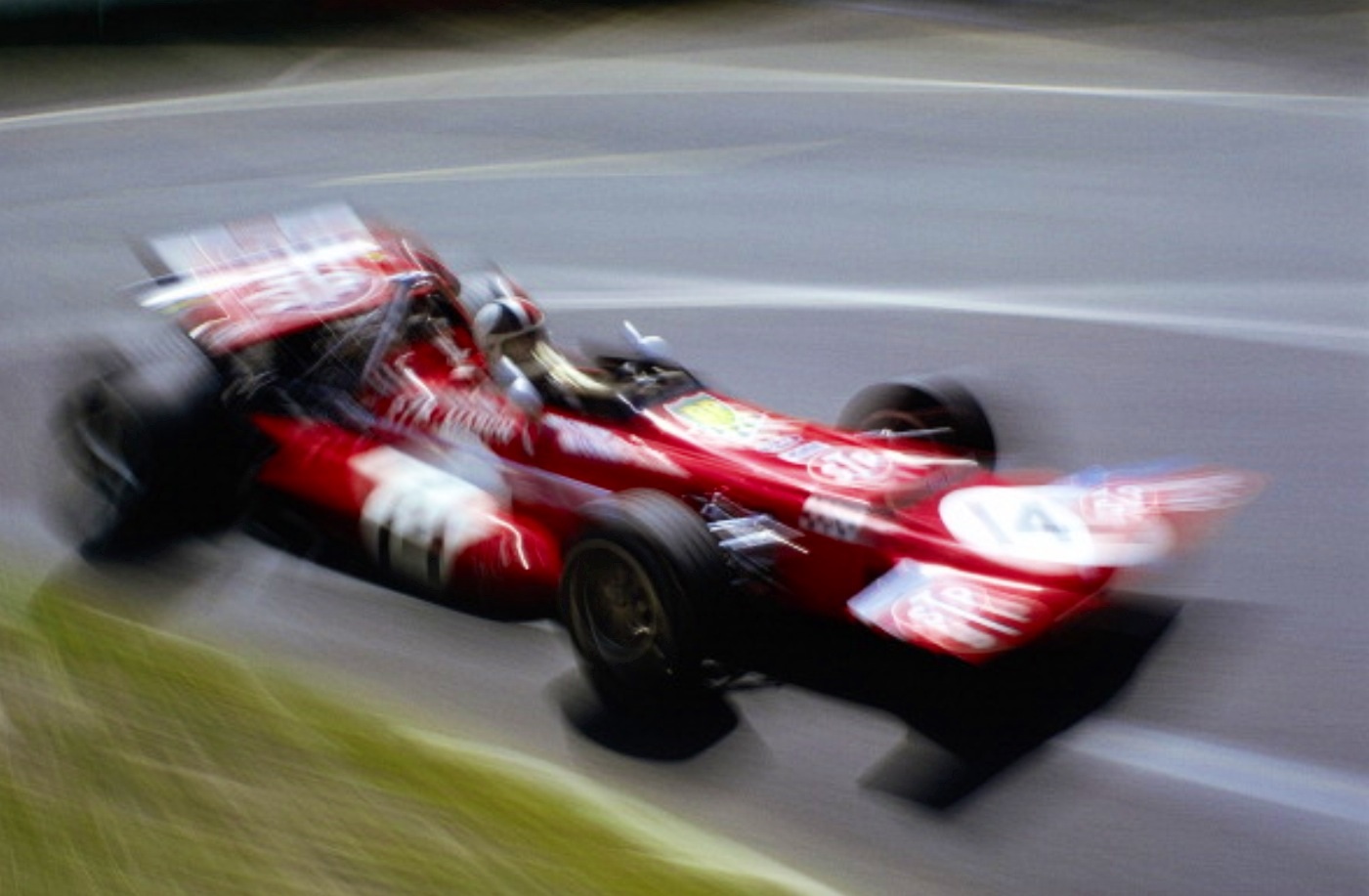
Chris Amons STP March 701 Ford, at Clermont Ferrand, French GP weekend 4 July 1970, reflected in the gals ‘sunnies’, this is a signature Rainer Schlegelmilch shot but I never tire of them!…

image

Amon, French GP, Clermont Ferrand 1970, ‘works’ March 701 Ford (unattributed)

Chris qualified the car well in 3rd, one slot in front of Jackie Stewart in Ken Tyrrell’s similar, albeit Dunlop, rather than Firestone shod car. Chris raced the car into 2nd behind Rindt’s winning Lotus 72 and in front of Brabham’s Brabham BT33, all cars Ford Cosworth powered.

image

Amons March 701 at Clermont in 1970. he won the Non-Championship BRDC International Trophy at Silverstone in April in it but no championship Grands Prix despite a very close 2nd to Pedro Rodriguez’ BRM P153 in a Belgian GP Spa, slip-streaming thriller (Cahier)

Credit…

Rainer Schlegelmilch, The Cahier Archive

Tailpiece: Blurry Amon…

image

(Schlegelmilch)


stewart spain

(unattributed)

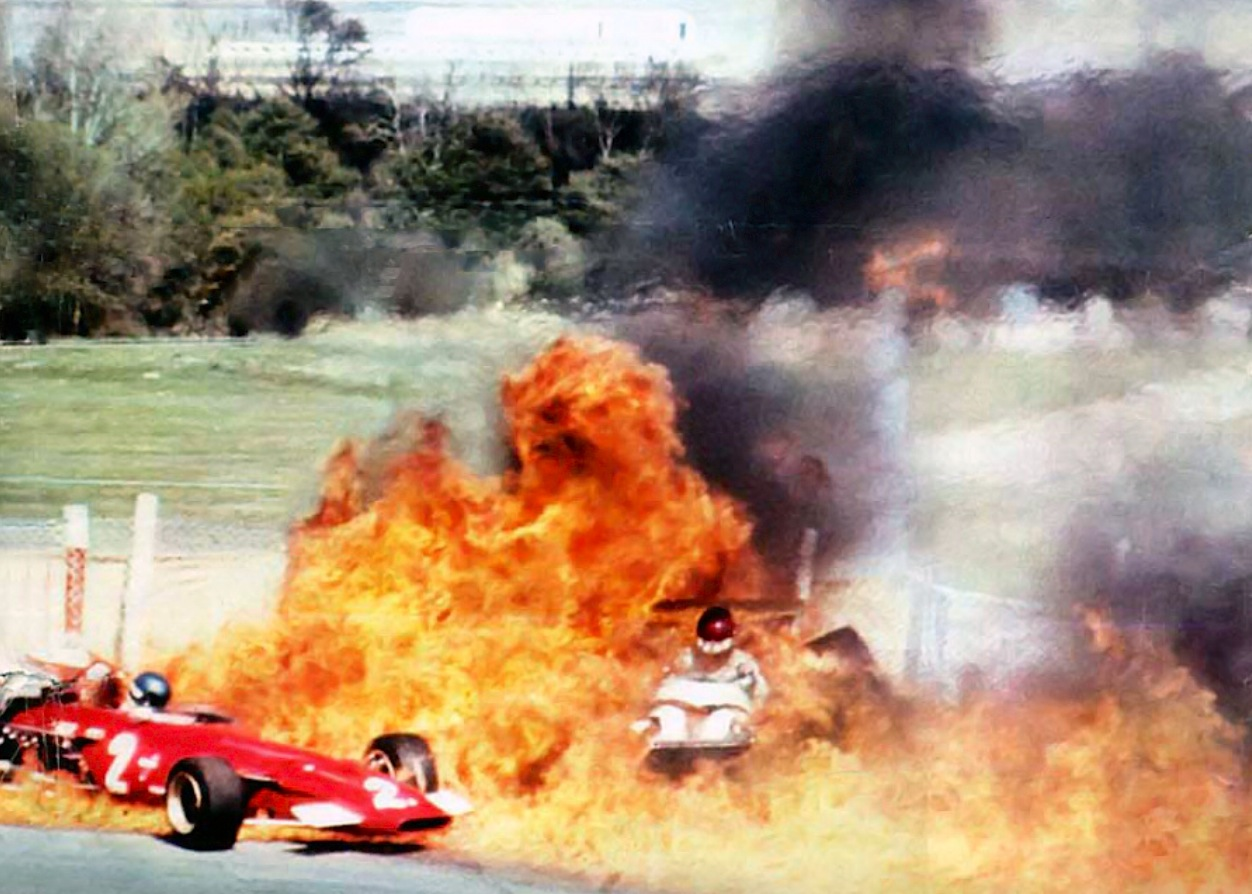
Jackie Stewart passes the burning molten alloy remains of Jackie Oliver’s BRM P153 and Jacky Ickx’ Ferrari 312B, fortunately both drivers escaped with only minor injuries, burns in Ickx’ case, lucky, it could have been much worse…

On the first of the 90 lap 19 April 1970 event Oliver had a suspension failure at the Ciudalcampo, Jarama, Madrid circuit, ploughing into Ickx and puncturing his fuel tank. The other P153 BRM of Pedro Rodriguez was withdrawn as a precautionary measure, Ollie reported stub axle failure as the accident’s cause.

ickx ablaze

#2 Ickx Ferrari 312B and Oliver’s white BRM P153, inside an inferno. ‘Bag type’ safety bladder fuel tanks mandated from the start of the 1970 season. The FIA at this time, pretty much year by year changed the regulations to improve safety around fuel tanks; safety foam around tanks in ’72, crushable structures around tanks in ’73, self-seal breakaway tank/hose coupling in ’74. (unattributed)


conflagration

The full horror of the situation confronting the two drivers; Oliver has punched the release on his Willans 6 point harness and is jumping out of the BRM, Ickx is in the process of popping his Britax Ferrari belts. Johnny Servoz-Gavin’s Tyrrell March 701 Ford 5th passes. (unattributed)


ickx

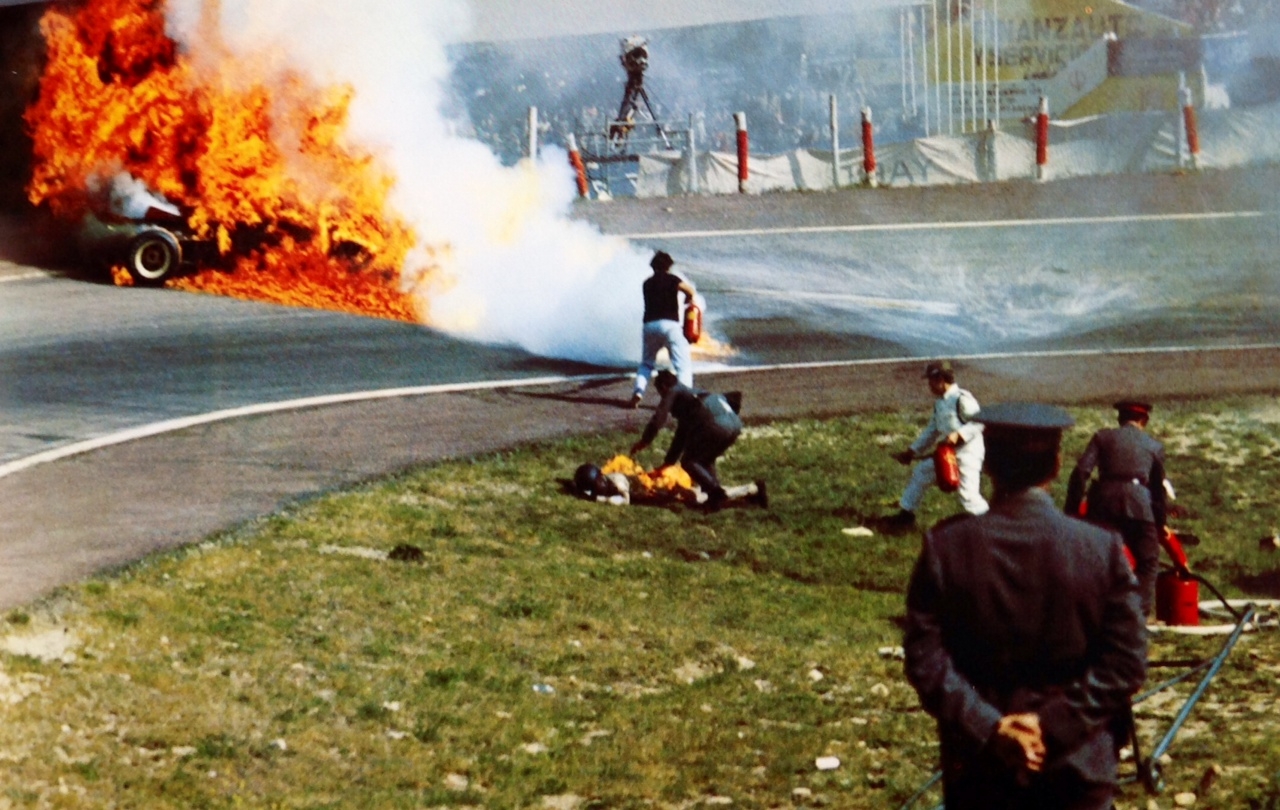
Ickx disoriented and on fire in search of a marshall (Automobile Year 18)


ickx running

A soldier beckons in Jacky’s direction. (Automobile Year 18)


ickx on the ground

The soldier, not a marshall puts Ickx’ overalls fire out. At this stage foam is being sprayed on the car fire but the foam extinguishers were soon emptied leaving water only, the impact on the molten magnesium componentry was to make the fire worse. (Automobile Year 18)

Jack Brabham’s Brabham BT33 Ford was on pole, reinforcing the speed of Ron Tauranac’s first monocoque GP contender, but Jackie Stewart won the race in one of his least favourite cars, the March 701 Ford.

The accident happened at the ‘Esses Bugatti’, a stub axle failed and Oliver’s BRM rammed Ickx’ Ferrari puncturing its fuel tanks and releasing 45 gallons of avgas, a similar amount aboard the BRM. Oliver got out quickly, Ickx finally emerged with his overalls on fire, the flames were put out by a soldier. Ickx suffered as a result of keeping his fuel soaked overalls on.

‘The accident created race havoc, not only the visibility being dangerously reduced for drivers…but the flaming petrol constituted another hazard. The fire-fighting was abysmal, vast quantities of water being hosed on the flames for a long time-a procedure which caused the magnesium elements to ‘gas’ and flare up time and time again. The BRM was still burning at the end of the race, but miraculously no-one was hurt’ the Automobile Year race report said.

Stewart didn’t have the race to himself; he initially pulled away from Brabham and Hulme, electronic dramas causing the Kiwi’s demise. Despite spinning twice Jack chased Stewart and Pescarolo, taking second when the Frenchman’s Matra V12 seized, he was five seconds behind JYS. Only a few metres separated them when Brabham’s Ford Cosworth failed, allowing Jackie to ease off to take victory.

Bruce McLaren was second, McLaren M14A and Mario Andretti in another privately entered March 701, third.

jack spin spain

The 1970 speed of BT33 was reinforced by Jack’s pole. He won the season opening South African GP. Here spinning on the ‘extinguisher foam rink’. He spun twice but despite that was right on Stewart’s tail when his engine blew. Jarama 1970. (unattributed)

Jarama 1970 was also notable for the race debut of Chapman’s latest design the Lotus 72.

Jochen Rindt qualified his 8th, John Miles in the sister car did not make the cut. Rindt was out of the race on lap 8 with ignition failure.

It would take intensive development by Colin Chapman and his team to make the car competitive, the cars monocoques had to be ‘unpicked’ to make the suspension changes to eliminate a lot of the anti-dive/squat geometry and many other modifications but by June they had a winning car; victorious for Rindt in the sad Dutch Grand Prix, unfortunately the fire on that day had far more serious, fatal consequences for Piers Courage and his De Tomaso 505 Ford.

The sad reality of days like Jarama and Zandvoort in 1970, look how ill equipped in terms of fire protective clothing the marshalls are in the photos above, was the acceptance that safety standards in every respect; circuits, car construction and race support services had to improve to societal levels of acceptability. Thankfully we are on a different level in every respect today…

rindt spain

Rindt, Lotus 72 Ford, Jarama 1970. Look at the suspension travel on that early 72! (unattributed)


jochen

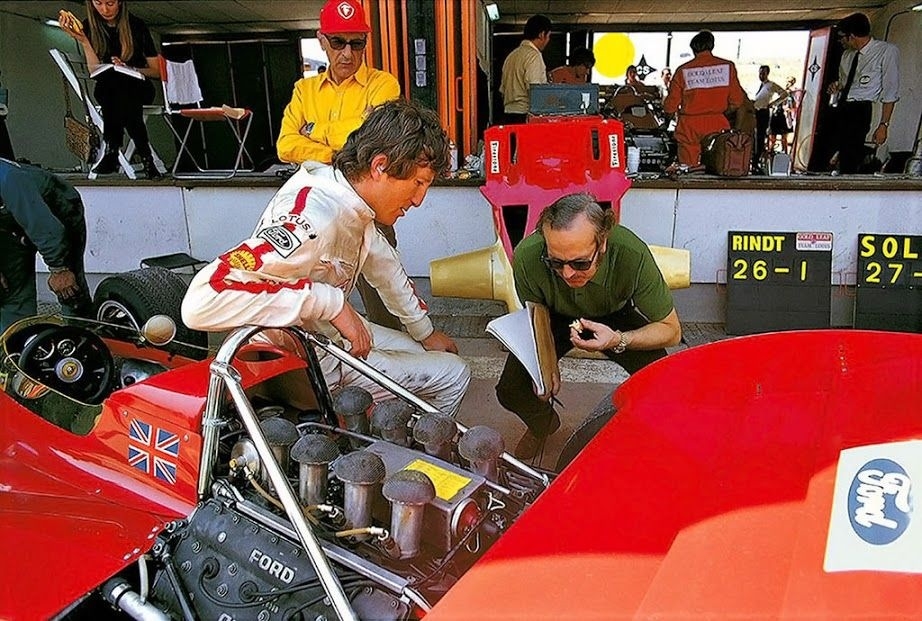
Jochen and Colin making a long joblist during Spanish GP practice. The car which won at the Dutch GP in June was a 72C which shows how much change there was in 2 short months. ‘Sol’ pitboard is Alex Soler-Roig who failed to qualify a Lotus 49C. (unattributed)


surtees

John Surtees ran as high as 3rd in his ex-works McLaren M7C Ford but faded and then retired with gearbox problems. Back at base his team were building John’s first F1 car the ‘TS7’ which made its debut at the British GP in July. (The Cahier Archive)


piers courage

Piers Courage during Jarama practice 1970. His Frank Williams De Tomaso 505 Ford non-started after a practice accident. (The Cahier Archive)

Tailpiece: Stewart’s winning March 701 passes the conflagration…

stewart spain 2

(The Cahier Archive)

Credits…

Automobile Year 18, The Cahier Archive

Finito…


Francois Cevert, Tecno 68 Ford F3 1968

(Automobile Year)

Francois Cevert applies some gentle correction to his Tecno 68 Ford F3 car, Rouen, France 1968…

I was researching another article and tripped over some photos of a very young Francois Cevert in an Alpine in his F3 days…

It reminded me of how many talented young drivers were killed before their prime well into the 1970’s- Francois, Tom Pryce, Gerry Birrell, Roger Williamson, Piers Courage and Tony Brise all spring readily to mind.

The monocoque chassis of the 1970’s were far stronger than the spaceframes of ten years before but as the width and grip of tyres and the aerodynamic downforce the cars produced improved, it meant that accidents, when they occurred at the higher cornering speeds could be particularly horrific. It was a collision with an armco fence, in an accident of this type when his Tyrrell got away from him which killed Francois at Watkins Glen in 1973.

John Barnards’ pioneering use of a carbon fibre chassis in the first McLaren MP4 in 1981 was a driver safety ‘game-changer’.

Francois Cevert 1968

Cevert in his ‘Bell Magnum’ 1968 (unattributed)

As a young teenager just getting interested in racing Cevert ‘had it all’- dazzling film star looks, talent aplenty and racing for a team which was carefully nurturing his talent.

Ken Tyrrell recruited Francois into his Elf sponsored team after the retirement of Johnny Servoz-Gavin due to an eye injury. Jackie Stewart spotted Cevert in 1969 when contesting F2 races and suggested to Tyrrell he keep an eye on him.

Stewart immediately clicked with the young Frenchman, they had a remarkably mature relationship as teammates by the standards of today (Piquet/Mansell, Prost/Senna, Rosberg/Hamilton for example!) with Stewart mentoring the younger man, exactly as Graham Hill had done with the young Scot in 1965. Francois fitted into the ‘family team’ that Tyrrell was. Norah and Ken, Jackie and Helen Stewart, Derek Gardner and the mechanics was a famously friendly place to be- albeit a very competitive one.

Cevert made his Grand Prix debut in the team’s March 701 Ford at the 1970 Dutch GP, by the end of 1971 he won his one and only GP victory at Watkins Glen, ironically the circuit at which he would lose his life.

Stewart freely admitted Ceverts’ equal or superior speed in 1973, the team leading role Cevert was to play in 1974, when JYS retirement was planned was cruelly stolen from him.

Francois Cevert, Alpine A280 Renault, Brands Hatch F3 October 1967

(unattributed)

Francois in the Brands Hatch paddock (above) for the ‘ER Hall Trophy’ Meeting October 29 1967.

Alpine A280 Renault, DNF in a race flagged off after 10 laps due to the conditions, the top 10 finishers included future F1 drivers Henri Pescarolo, John Miles, Peter Gethin, Reine Wisell, and Derek Bell- the field also included future F1 drivers Ian Ashley, Gijs Van Lennep, Jean-Pierre Jaussaud, Dave Walker, Clay Regazzoni, Piers Courage, Howden Ganley…a field of some depth!

This article and photographs celebrate Francois’ time in his formative F3 and F2 years.

Cevert, born in 1944, originally became interested in racing via Jean Pierre Beltoise, his sister was dating the future French champion at the time.

After two years doing National Service he enlisted in a racing school at Magny Cours, winning the ‘Volant Shell’ competition, the prize was an Alpine A280 Renault F3 car.

Francois’ Magny Cours drive was funded by a married woman ‘Nanou’, he met her aged 19 and  she fell for him during a holiday in which she too was completing the race course- the shot below is of his wet, winning drive in a Merlyn Mk 7.

cev vol

(unattributed)


cev dep

Francois and Patrick, Volant Shell 1966 (unattributed)

Patrick Depailler also contested the final, finishing second, here the pair of them are looking very sodden after the race.

The Winfield Racing entered car was underfunded and relatively uncompetitive in 1967 but Francois did enough to be offered a works Alpine drive for 1968 but he turned this down and talked his way into the Tecno team, who had a much more competitive machine.

Francois Cevert , Pau F3 1967, Alpine A280 Renault

Early in the 1967 season, April 2 with the Alpine A280 Renault, at Pau. DNF in the race won by Jean-Pierre Jaussaud’s Matra MS6 Ford (unattributed)

He missed five rounds of the French Championship but won the first he entered at Monthlery on May 12, he was immediately competitive in his Tecno. A strong fourth place followed in the  Monaco F3 GP and  put his name into prominence, Ronnie Peterson placed third, he too would make his F1 debut in a March 701 in 1970.

Francois then took further wins at La Chatre, Nogaro and Albi winning the French F3 championship that year.

Francois Cevert, Albi 1968, Tecno 68 Ford F3

1st place in the 1968 French F3 Championships’ final 1968 round at Albi. Tecno 68 Ford (unattributed)

Francois progressed to a factory F2 Tecno in 1969…

The Ford FVA powered Tecno 69 was a very competitive car also driven by fellow 1970 F1 ‘newbee’ Clay Regazzoni. The class was hotly contested by drivers including Jochen Rindt, Jackie Stewart, Graham Hill and Piers Courage, the class contained both pretenders to the thrones of current champions and the champions themselves.

Johnny Servoz-Gavin won the European F2 Championship that year in a Matra MS7 Ford from Hubert Hahne in a Lola T102 BMW/ BMW 269 from Francois in third, it had been a strong debutant F2 season in a field of great depth.

Francois Cevert, Tecno 68 Ford FVA, Pau 1969

Francois Ceverts Pau 1969 was more successful then his 1967 visit- fourth in the F2 race in the Tecno 68 Ford FVA  won by ‘F2 king’ Jochen Rindt Lotus 59B Ford FVA. High wings banned shortly thereafter by the FIA during the 1969 Monaco GP weekend (unattributed)


Francois Cevert, Tecno 69 FVA, German GP 1969

Francois in the Tecno 69 Ford FVA F2 car during the 1969 German GP. He qualified sixteeth, and second quickest of the F2 cars in a field of 26 cars. DNF after 9 laps with gearbox failure (unattributed)

Into 1970 Francois continued in F2 and was also picked up by Matra for their endurance program, the 3 litre V12 sportscars provided his first taste of real power.

Cevert drove for the team for the rest of his life, Servoz retired and the rest, as they say, is history and one of Grand Prix Racings’ great ‘mighta-beens’…

Other Cevert Reading…

Francois and Jack Brabham at Matra in 1970; https://primotipo.com/2016/09/09/jack-and-francois-matra-ms660/

Tyrrell Aerodynamic Evolution; https://primotipo.com/2016/05/31/tyrrell-002-monza-1972/

Etcetera…

Francois Cevert , Matra MS660, Monthlery 1970

(unattributed)

Jack Brabham and Francois Cevert teammates at Matra in 1970.

Jack was in his last year of F1 and Francois his first- winners of the Paris 1000Km at Monthlery in 1970, Matra MS660

Francois Cevert, March 701 Ford, Dutch GP 1970

(unattributed)

First Grand Prix, the Dutch in 1970, Team Tyrrell March 701 Ford.

Q 15 of 24 cars and DNF with an engine failure on lap 31 of the race won by Jochen Rindt’s Lotus 72 Ford. This was the tragic race in which Piers Courage lost his life in a high speed crash in his De Tomaso 505 Ford.

Francois Cevert, TecnoTF71Ford FVA , Imola 1971

(unattributed)

Cevert continued to do the occasional F2 race after he had broken into GP racing.

Here he is aboard a Tecno TF/71 Ford FVA, in the ‘City of Imola GP’ in July 1971. He was non-classified tenth in the race won by Carlos Pace’ March 712M Ford FVA. ‘Tyrrell nose’ quickly adopted by others after appearing at the French Grand Prix earlier in July, but pioneered by Chevron in F2.

Brigitte and Francois 1971

(unattributed)

Francois and Brigitte Bardot at the Paris Racing Car Show in 1971.

By this time Cevert is a GP star if not an ‘ace’- the car is Graham Hills F1 mount of 1970, the Rob Walker owned Lotus 72 Ford- they make an attractive couple!

image

Cevert F3 victory celebration with parents, Tecno 68 Ford , 1968

(unattributed)

Francois celebrates a 1968 F3 victory with his parents, circuit not disclosed. Tecno 68 Ford F3.

Below, Ceverts #44 Tecno in the Monaco F3 paddock 1968- #39 Francois Mazet also Tecno 68 Ford mounted and #40 Etienne Vigoureux Martini MW3 Ford.

Monaco F3 pit scene 1968

(unattributed)


Francois Cevert, Tyrrell 002 Ford, USGP 1971

(unattributed)

Francois, Monza 1971, Tyrrell 002 Ford.

He was third in that blink of an eye finish between Peter Gethin, Ronnie Peterson, March 711 Ford, Francois and Mike Hailwood, Surtees TS9 Ford- Gethin’s BRM P160 V12 was the victor by a tenth of a second from Peterson and Cevert.

Tecno logo

Credits…

Automobile Year 16, DPPI, The Nostalgia Forum’, F2 Index, oldracingcars.com

Finito…

photo (2)

Ronnie Peterson and Colin Crabbe…

This superb shot is of Ronnie Peterson at La Source hairpin, Spa 1970 aboard privateer Colin Crabbe’s Antique Automobiles March 701 Ford.

In the good ‘ole days one could, if one had the readies, buy a car, pay the entry fees and race in Grands Prix.

Perhaps the greatest in modern times was Rob Walker’s Team (he of the whisky company) which scored the first championship victories for Cooper and Lotus (in Stirling Moss’ hands) and the last victory for a privateer team when Jo Siffert triumphed in Walker’s Lotus 49 in the 1968 British GP.

Since the early 1980s the FIA have mandated that F1 entrants own the intellectual rights to the chassis they enter, in essence this means that the entrant builds the car and races it, ending the long tradition of private entrants buying and racing cars built by others in the sport’s highest echelons.

Crabbe’s Antique Automobiles business entered Vic Elford in a Mclaren M7 in 1969. March’s Max Moseley offered Crabbe/Peterson a 701, all Colin needed to provide were the engine and ‘box both of which he happened to have from the previous years campaign with Elford. And the readies of course which he was confident of securing through trade support.

Peterson jumped from the F3 ruck in 1969 winning the European F3 Championship, including the Monaco F3 GP race in a Tecno. At the end of the the year he raced the very first March, the 693 F3 car which James Hunt also raced that winter.

ronniw monaco 69

The Birth of March…

Due to unusual circumstances March’s first year in the sport resulted in them supplying customer F1 701 cars to the reigning world champion Team Tyrrell who were unable to run Matras with a Ford Cosworth engine as they had in the previous two years. The French concern wanted their own V12 to be used exclusively in their cars.

Jackie Stewart tested the MS120 but was convinced the DFV remained the superior engine. Lotus and Brabham were not prepared to sell Tyrrell cars, so off to Bicester Ken went; no pressure on designer Robin Herd in designing a car for the reigning world champ!

Matra never won a GP with their own V12 engined car, despite going very close with their single car Chris Amon entries in 1971-72, that  Matra honour going later to Ligier with Jacques Laffite’s first GP win in Sweden in 1977.

That Tyrrell couldn’t buy a competitive car was the reason he became a manufacturer rather than a privateer, he set designer Derek Gardner to work on the first Tyrrell which appeared in late 1970.

But I digress. March also sold a privateer 701 which was driven occasionally by Mario Andretti in addition to the March works cars for Chris Amon and Jo Siffert, a remarkable roll call of drivers in a constructors first year, not the full list either!

Aussie rival, friend and 1972 Ferrari 312P sports car teammate, Tim Schenken nicknamed Peterson Mad Ronald, observing up close one of the sport’s automotive acrobats sublime car control, tail out balls-to-the-wall style in the mould of Nuvolari, Rindt and Gilles Villeneuve.

The 701 wasn’t the ‘cream of the 1970 crop but it was good enough to win the Spanish GP in Stewart’s hands plus non-championship events in Stewart and Amons hands.

peterson

Ronnie did well in his car #701-08 justifying March’s faith in him and the rest, as they say, is history. Petersen won nine Grands Prix for Lotus as well as March’s only factory team win, their prodigal son returned in mid 1976 frustrated by the uncompetitiveness of his Lotus 76 and took the Italian GP in a March 761 Ford.

Peterson, racing a Lotus 78 was an innocent victim of an accident at the start of the 1978 Italian Grand Prix and died of his injuries the following day.

watkins

march cutaway 701

March 701-08 cutaway drawing.

Aluminium monocoque chassis, Ford DFV 3-litre V8, Hewland DG300 gearbox, classic and very effective ‘British F1 Kit Car’ of the period. Ronnie’s car first raced at Monaco in May 1970.

11 March 701 chassis were built, see Allen Brown’s old racing cars for the chassis by chassis list: https://www.oldracingcars.com/march/701/

(LAT)

Etcetera…

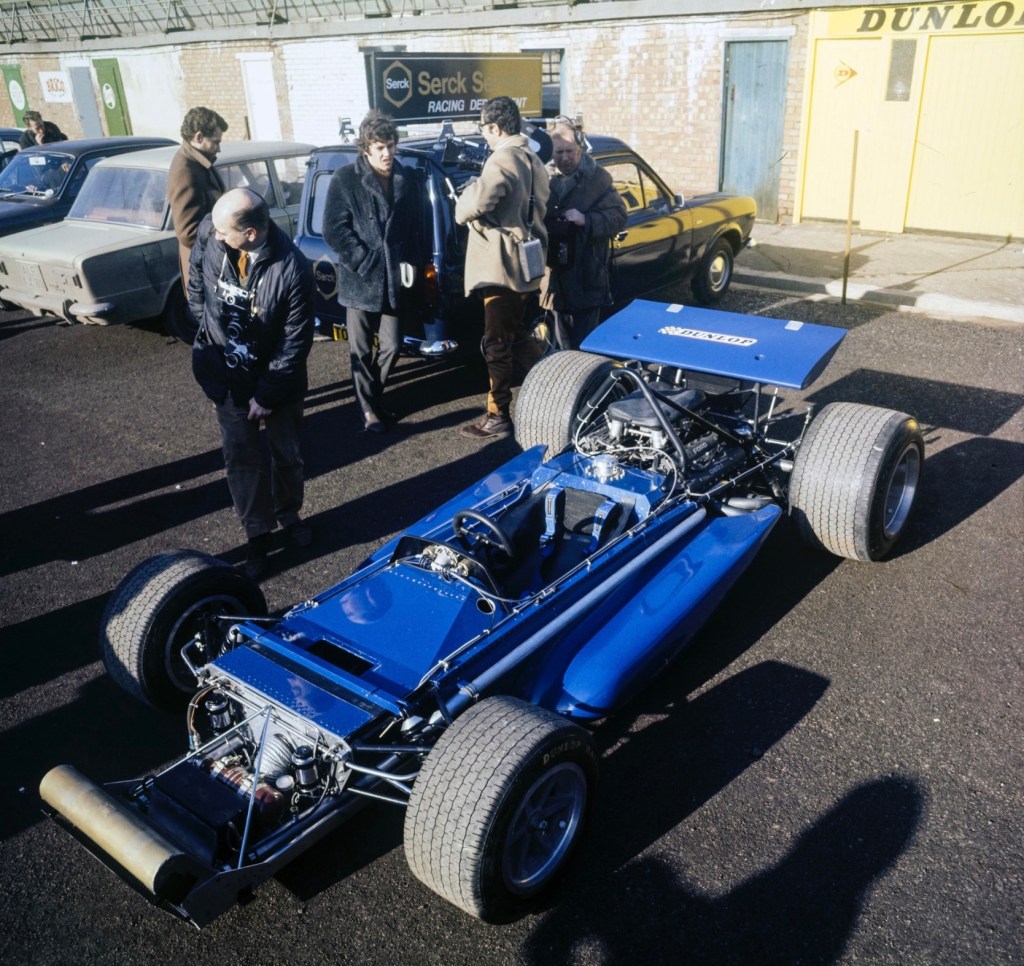
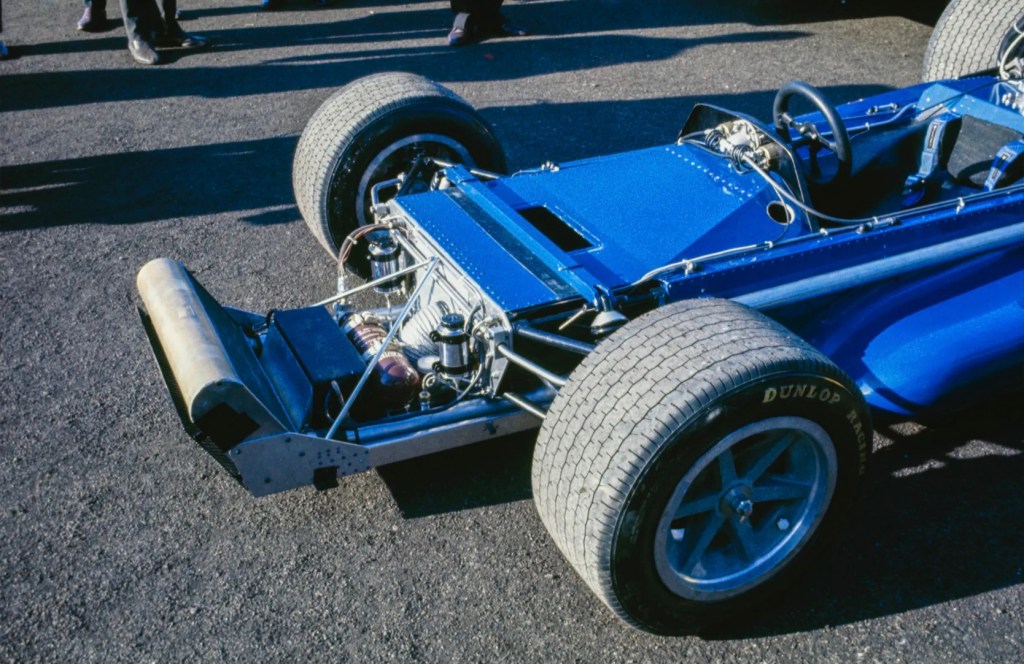
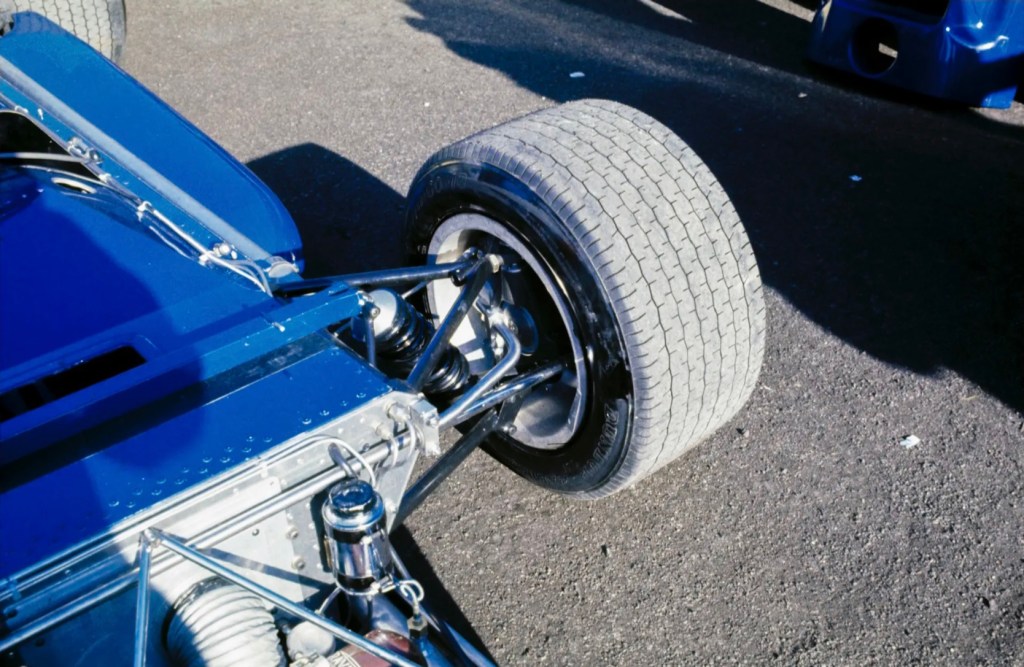
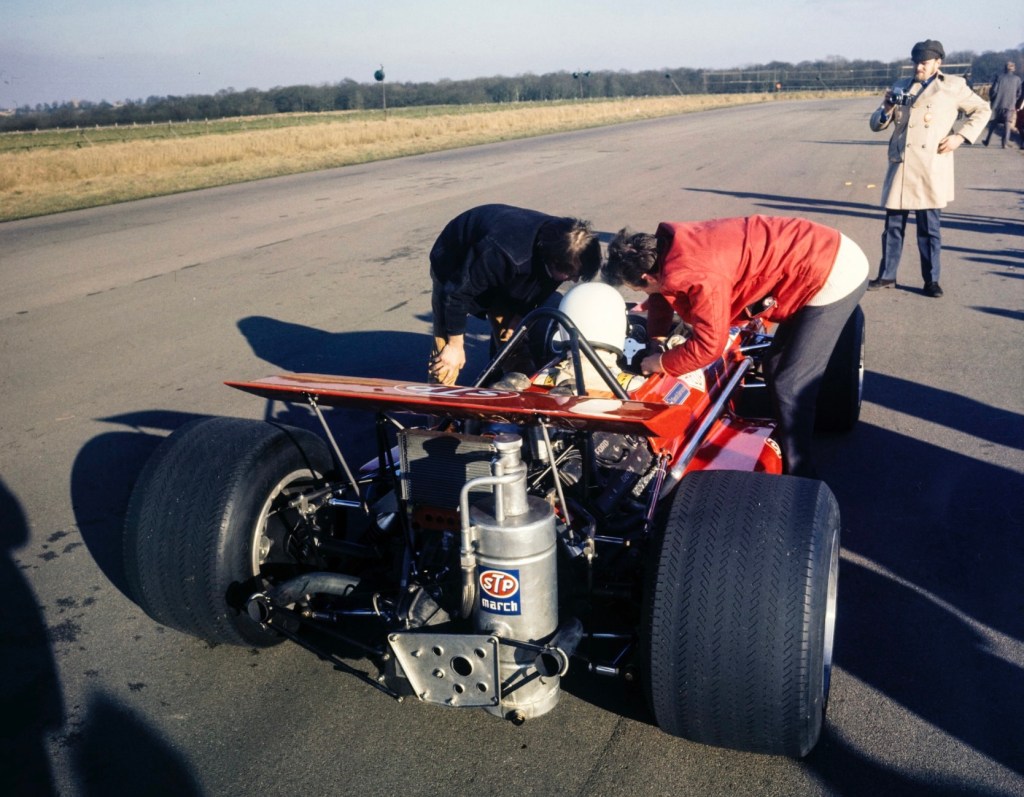
This group of photographs were taken at Silverstone on February 6, 1970 at what appears to be the press launch of the 701, you will note the presence of both works and Ken Tyrrell cars.

(LAT)

John Bolster, notebook in hand, takes in Robin Herd’s new design. Chris Amon’s chassis 701-01.

(LAT)

This shot of Chris Amon’s second placed car at Spa on June 7, 1970 is out of sequence with the rest. It shows the elegant simplicity of the design, which simply, given the number of orders in hand, had to work right outta the box. Its biggest shortcoming was perhaps its weight.

(LAT)

Jackie Stewart’s Ken Tyrrell March 701-02.

(LAT)
(LAT)
(LAT)

A journalist about to go for a whirl in Amon’s car, I wonder who?

(LAT)

Photo Credits…

Rainer Schlegelmilch, The Cahier Archive, oldracingcars.com, LAT Images

Tailpiece…

(LAT)

“Vrooom, vrooooom. I’m only a little bloke, maybe they won’t see me and I can do a touring lap!?”

Denis Jenkinson tries Chris Amon’s car for size at Kyalami during the 1970 South African GP weekend.

Finito…