Posts Tagged ‘Peter Whitehead’

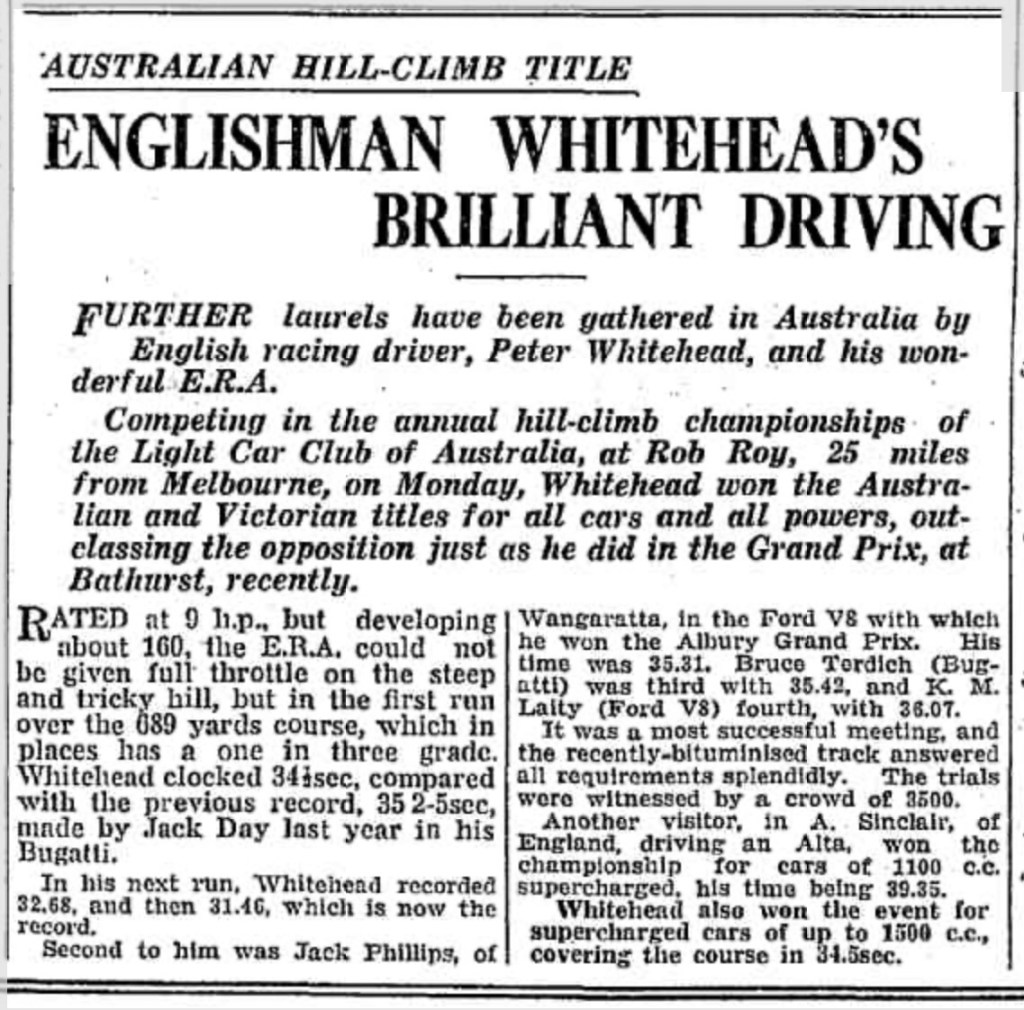
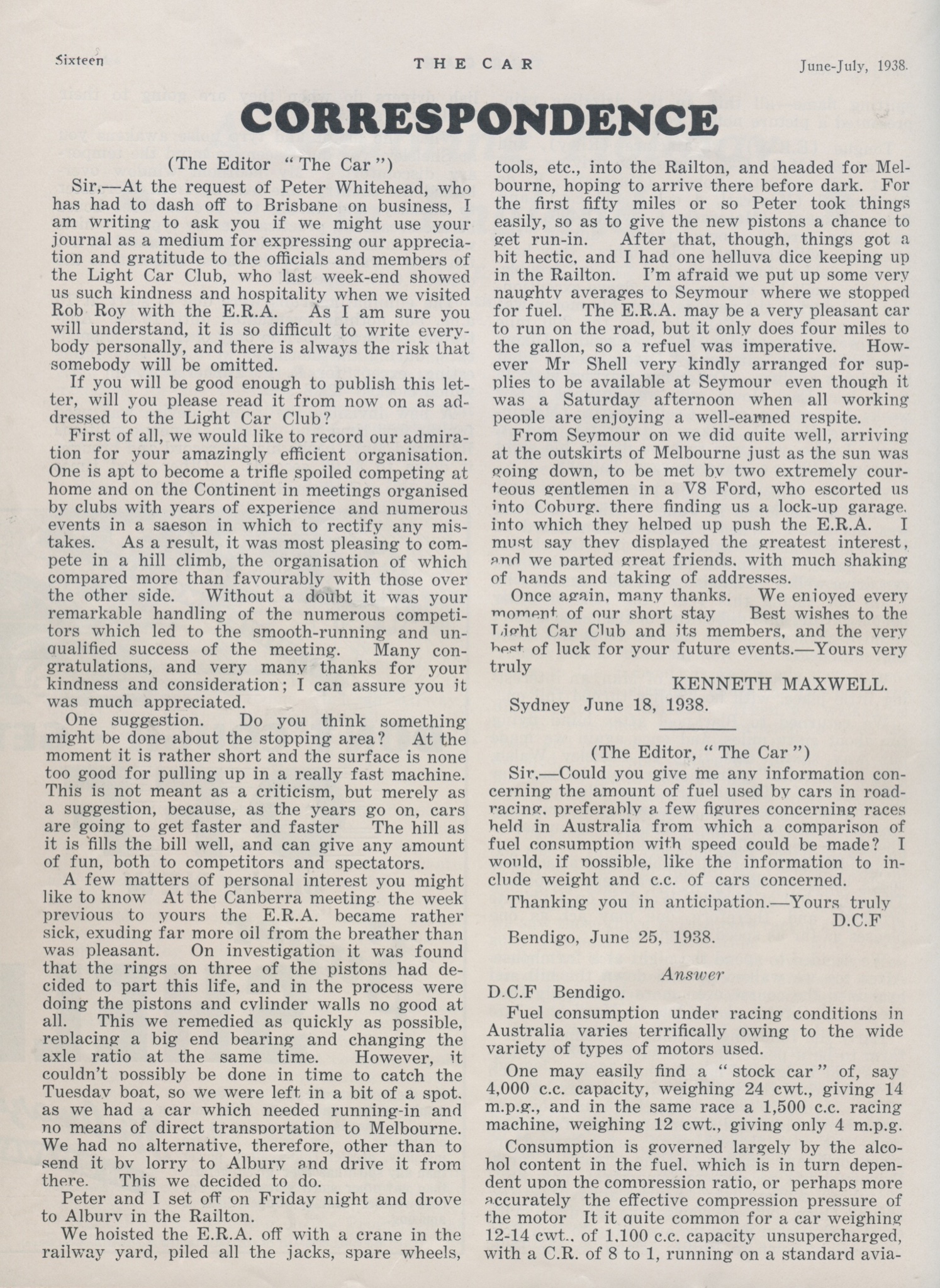
The Referee Sydney, June 16, 1938
(L Sims Collection)

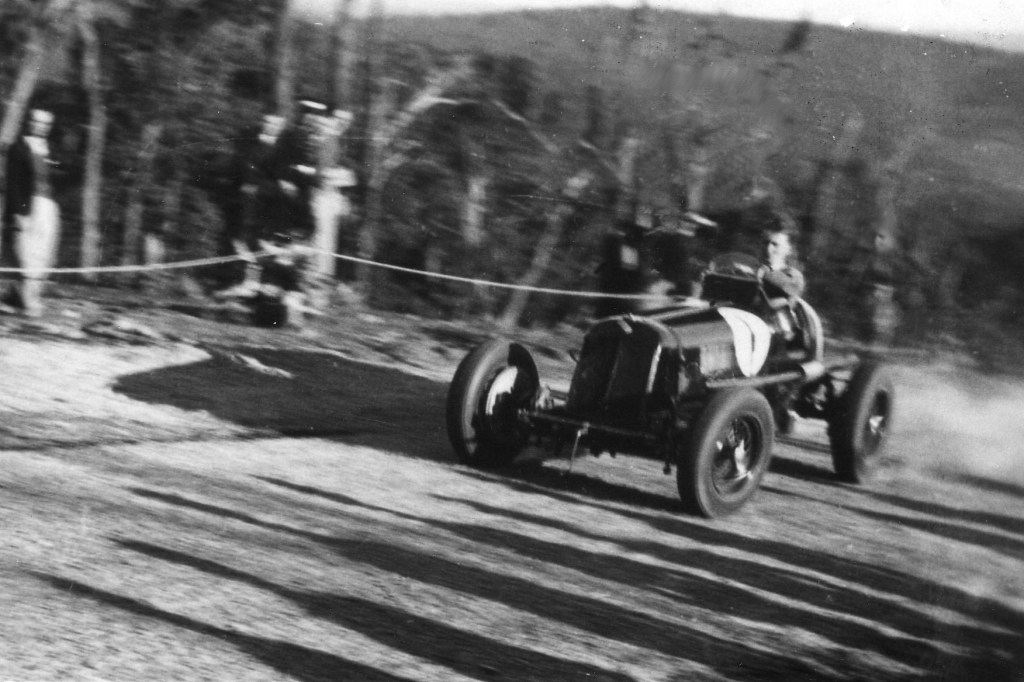
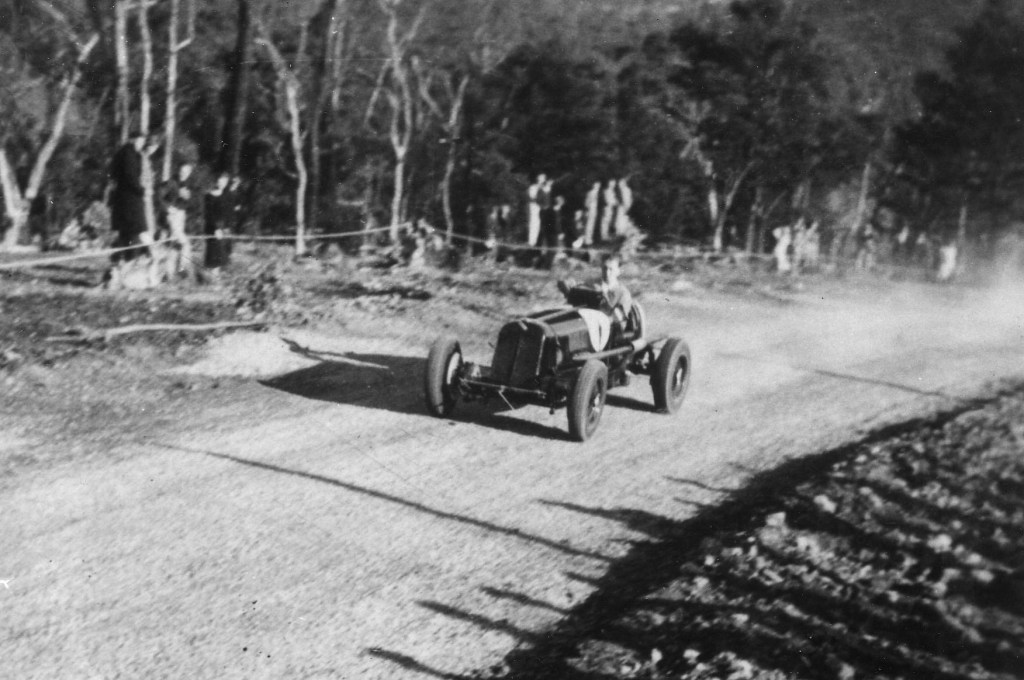
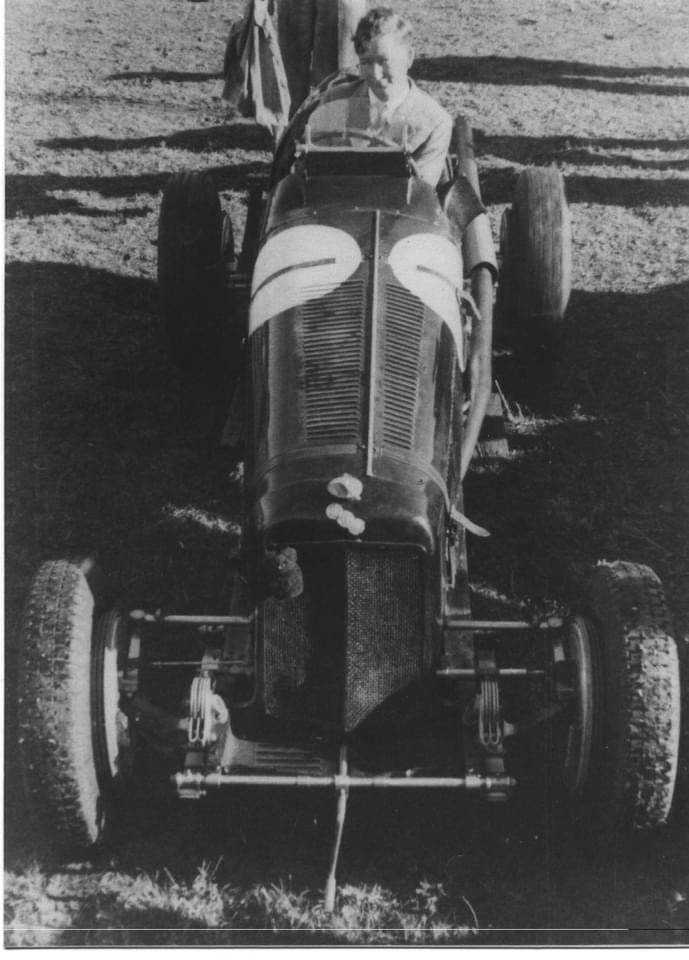
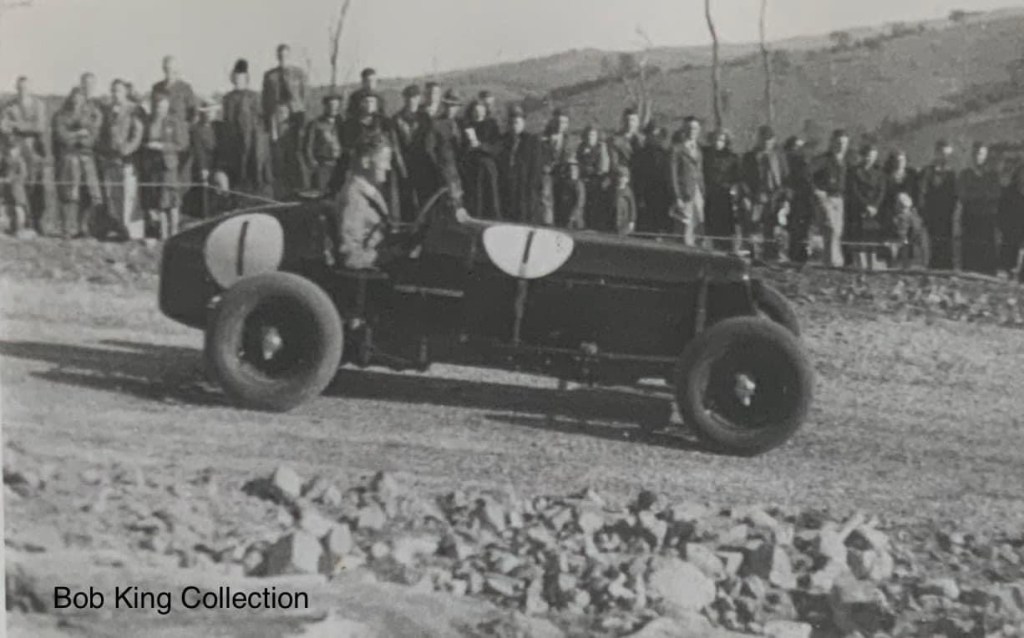
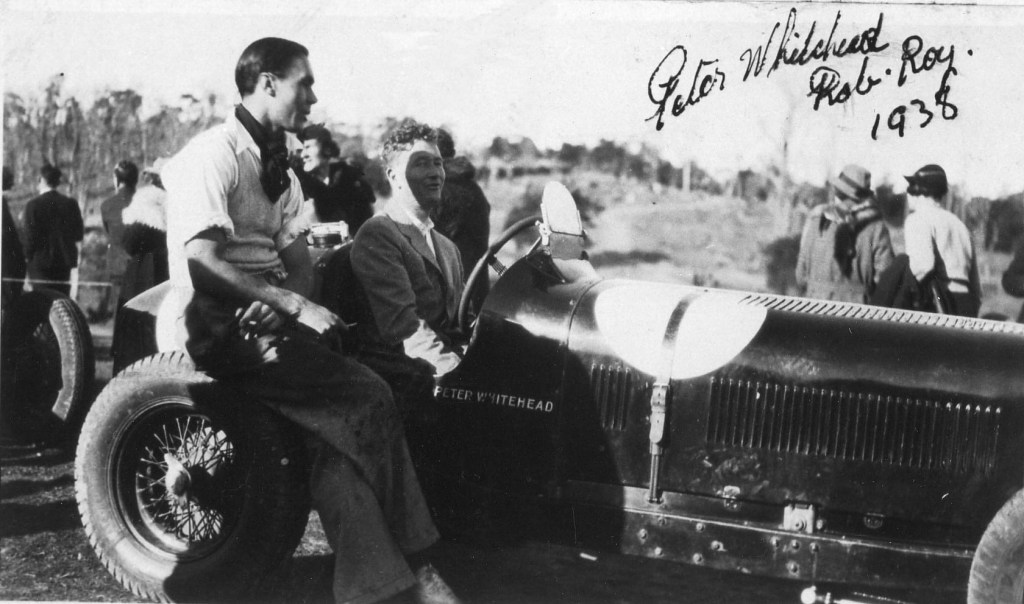
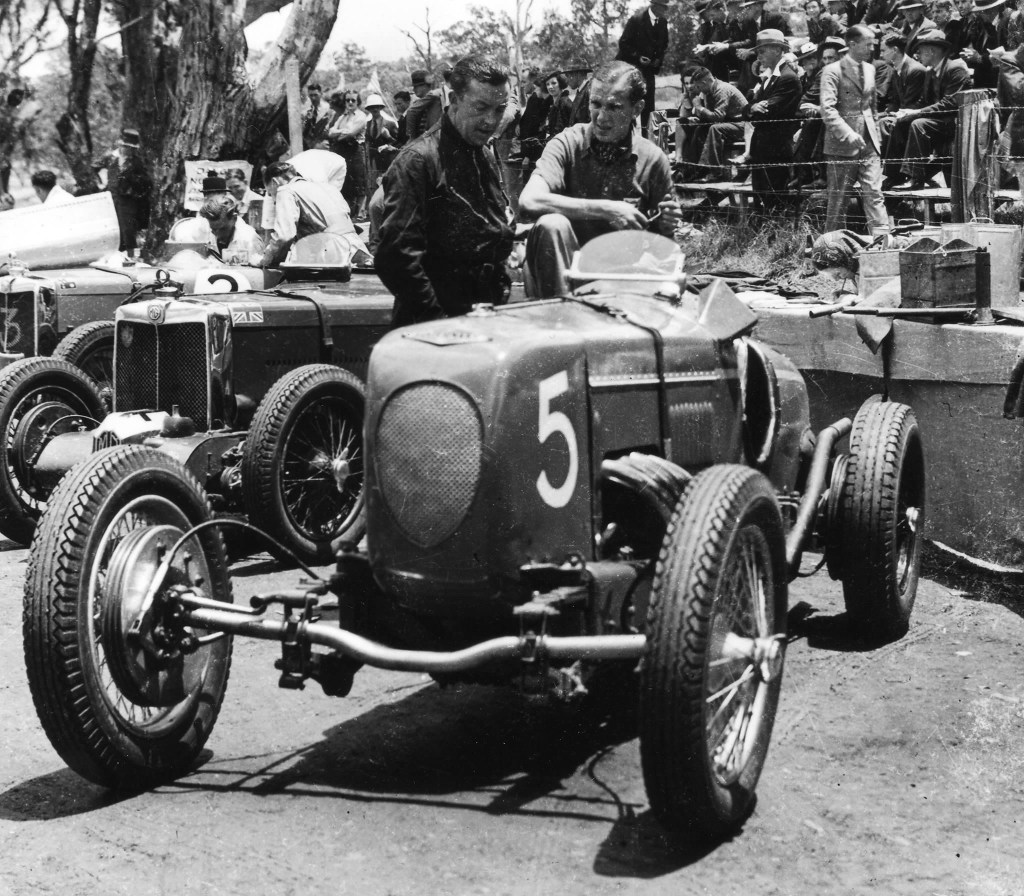
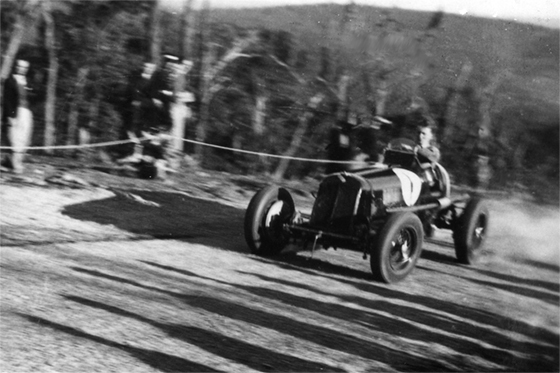
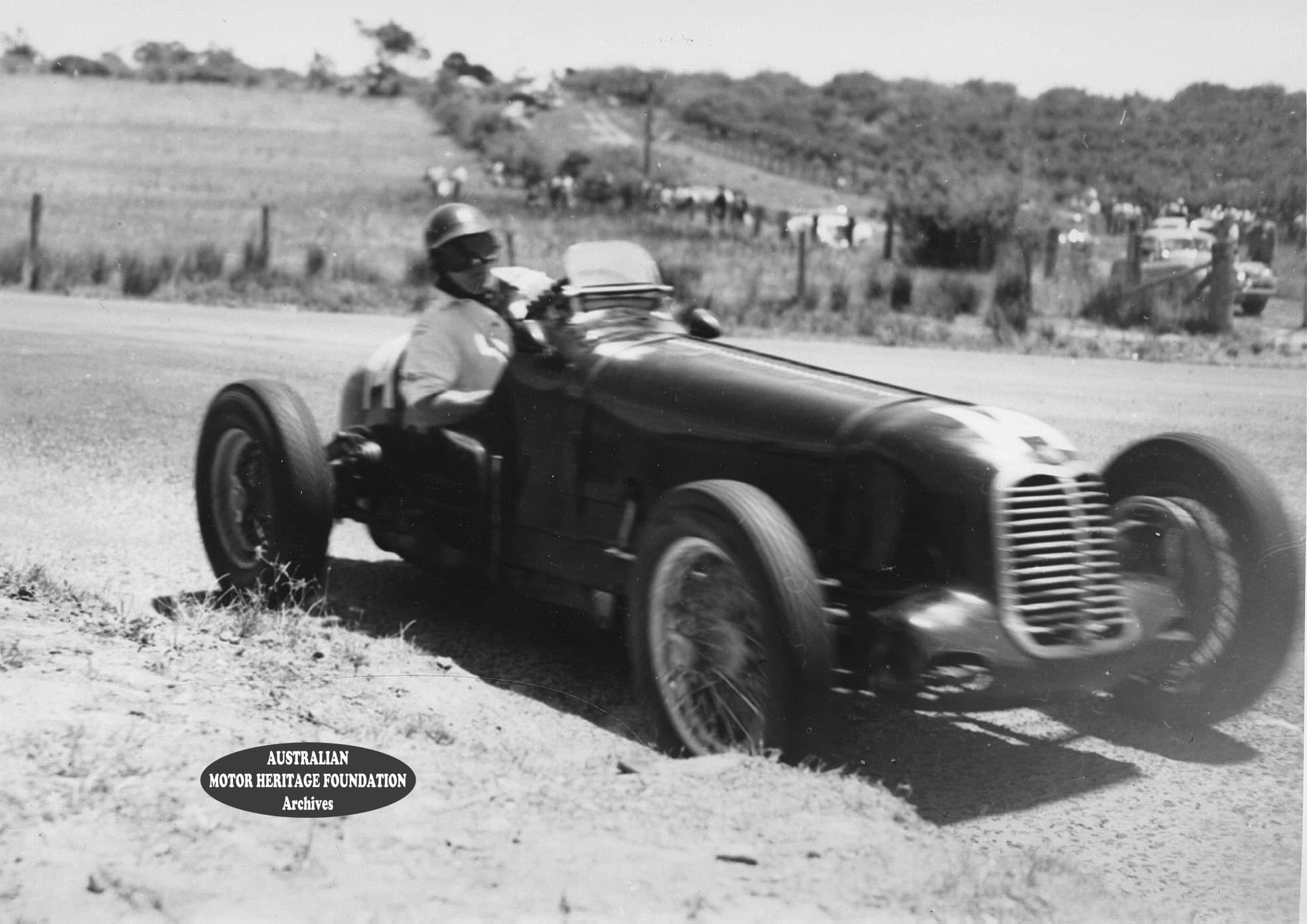
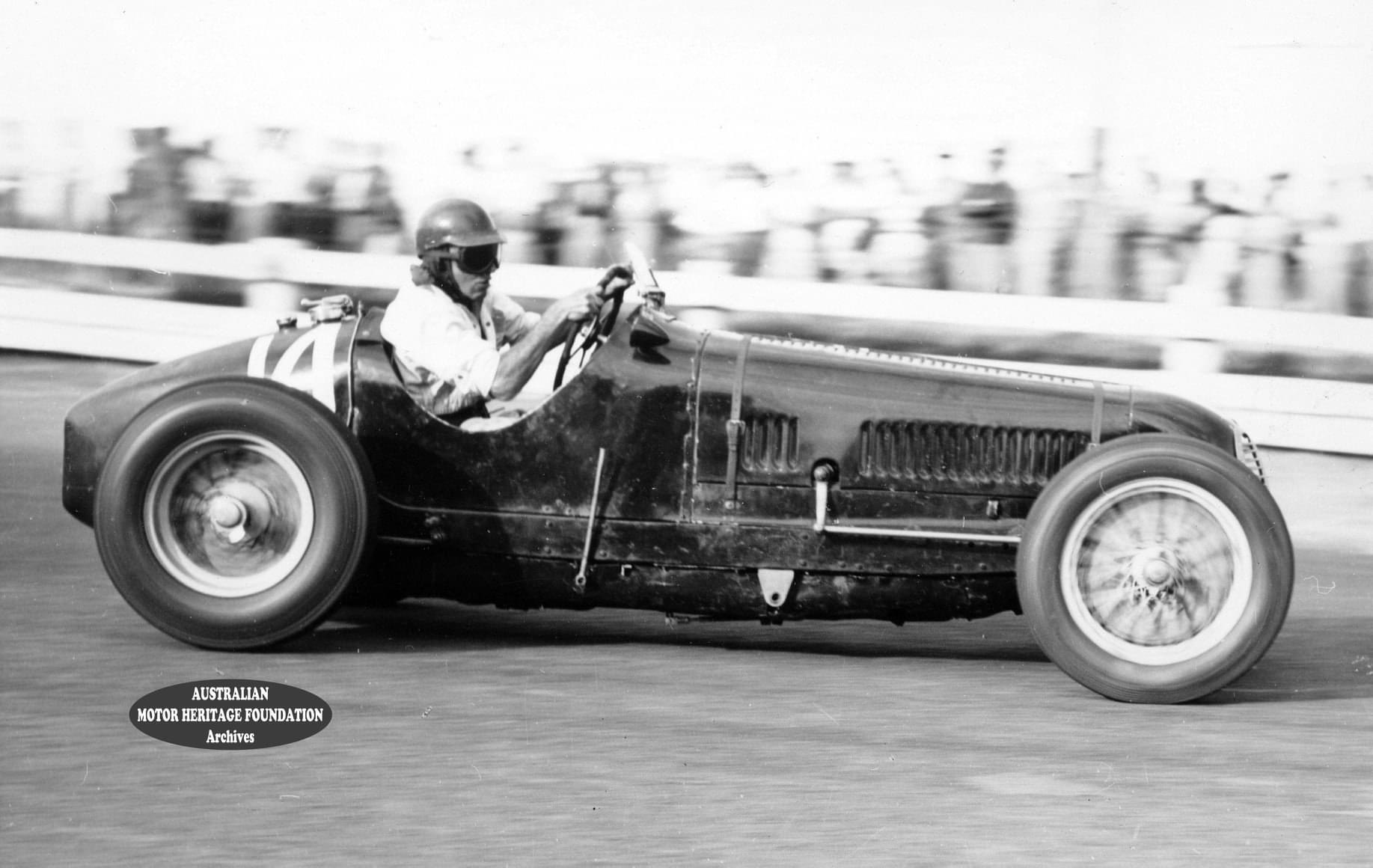
Peter Whitehead sans helmet on the way to an Australian Hillclimb Championship win aboard his ERA B-Type #R10B, then 1.5-litres supercharged, on Monday, June 13, 1938, at Rob Roy, 40 km east of Melbourne.

He came, saw, and conquered Australia in 1938, winning the Australian Grand Prix and Hillclimb Championship and attended to the needs of the family wool processing and spinning business too.

See here: https://primotipo.com/2015/04/16/peter-whitehead-in-australia-era-r10b-1938/ here: https://primotipo.com/2016/02/24/peter-whiteheads-1938-oz-tour/ and here: https://primotipo.com/2023/03/17/whiteheads-1938-review-of-australian-racing/ and here:

(L Sims Collection)

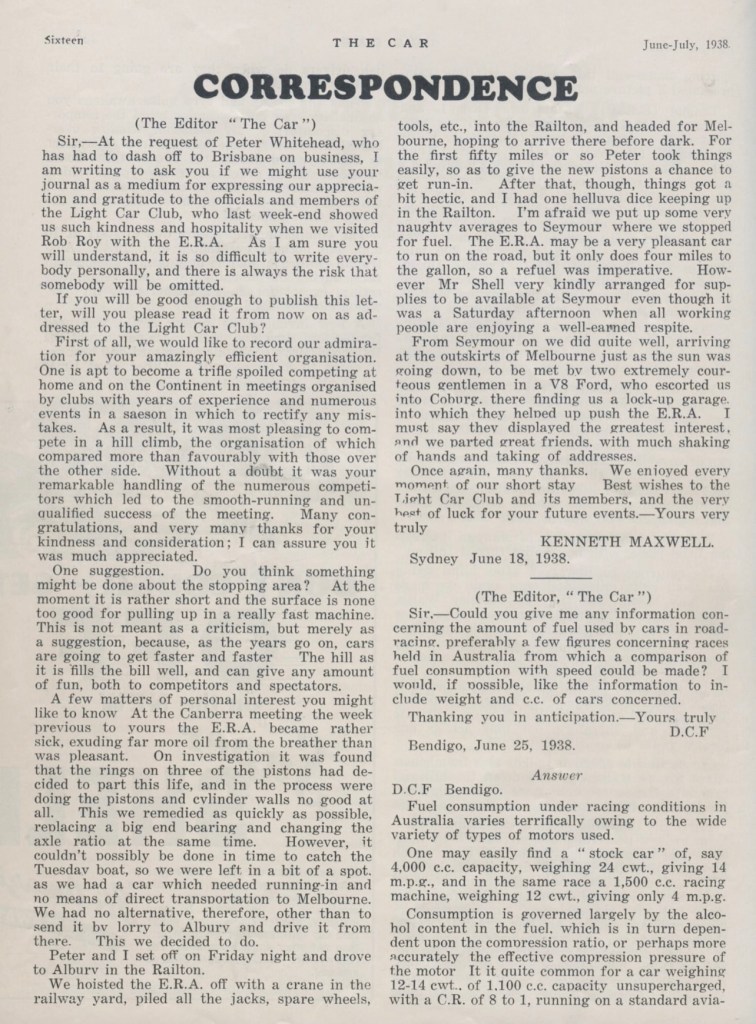
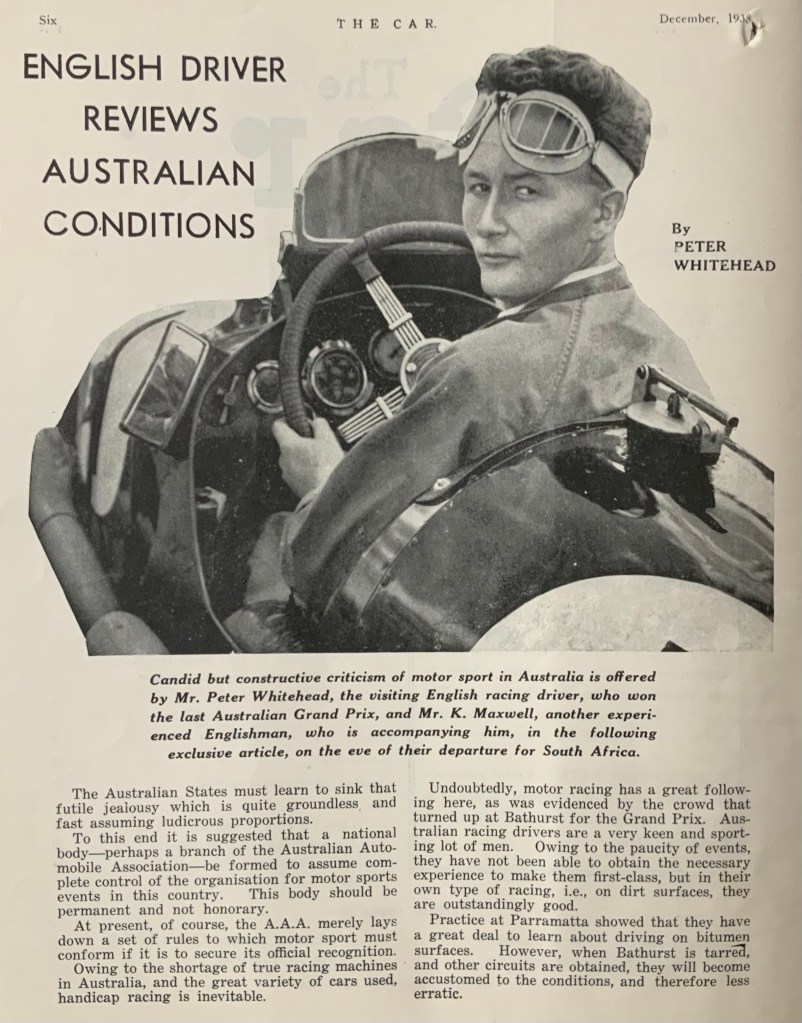
What follows are Whitehead’s observations about Rob Roy and related adventures, as told to his Australian friend, Kenneth Maxwell, and published in The Car, the official organ of the Light Car Club of Australia, the organiser and promoter of Rob Roy.

(T Johns Collection)
(L Sims Collection)

She’ll be comin’ down the (Rob Roy) mountain as she comes…

Etcetera…

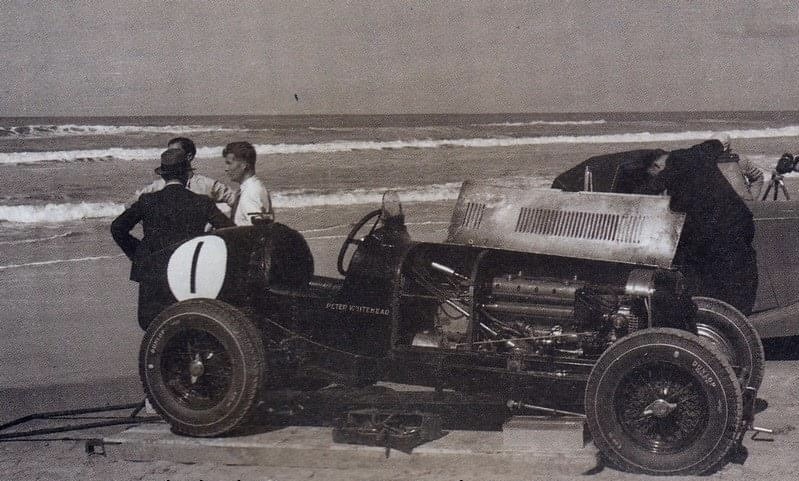
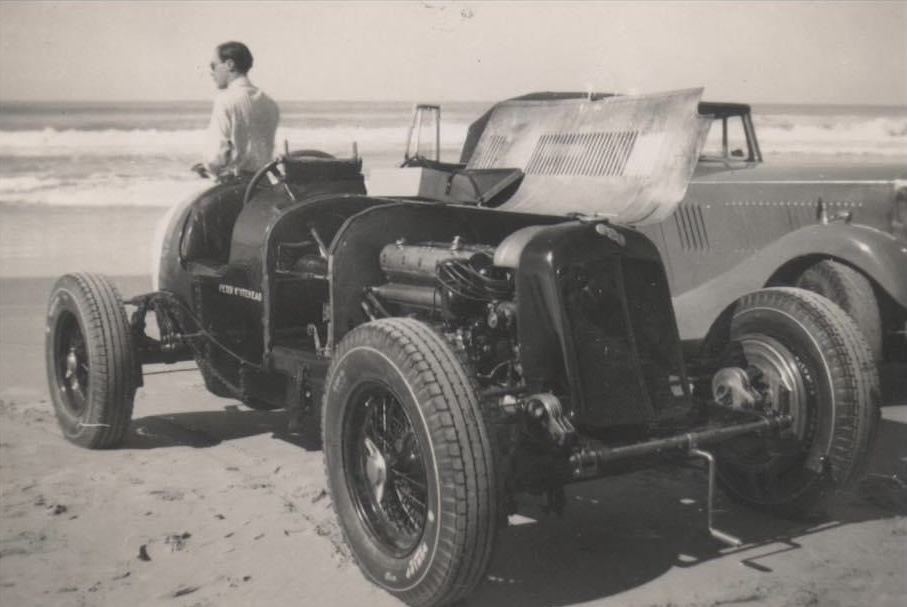
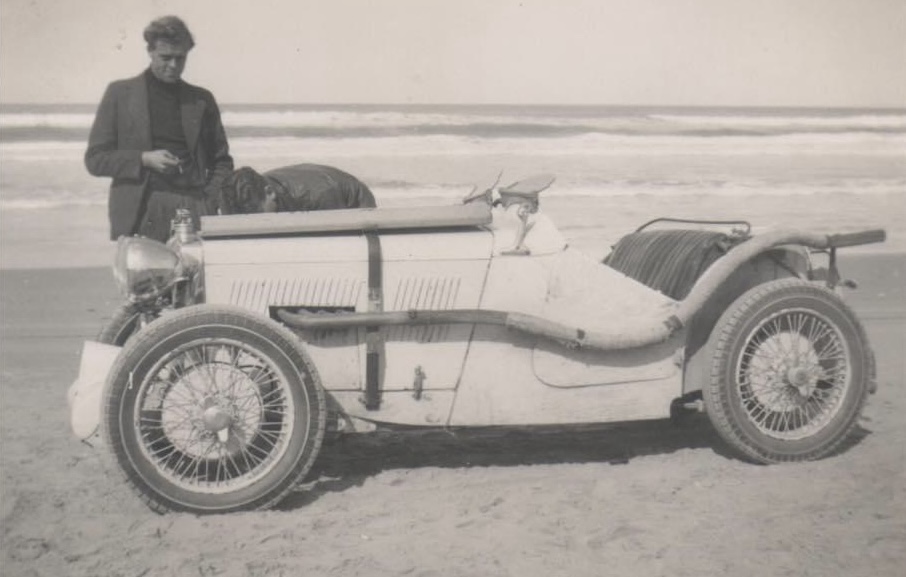
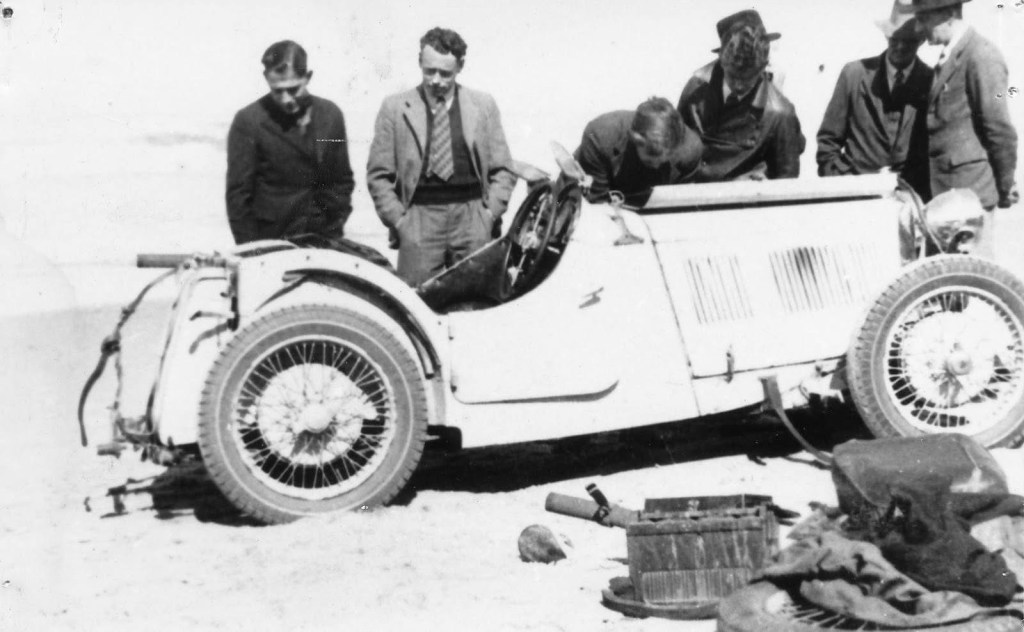
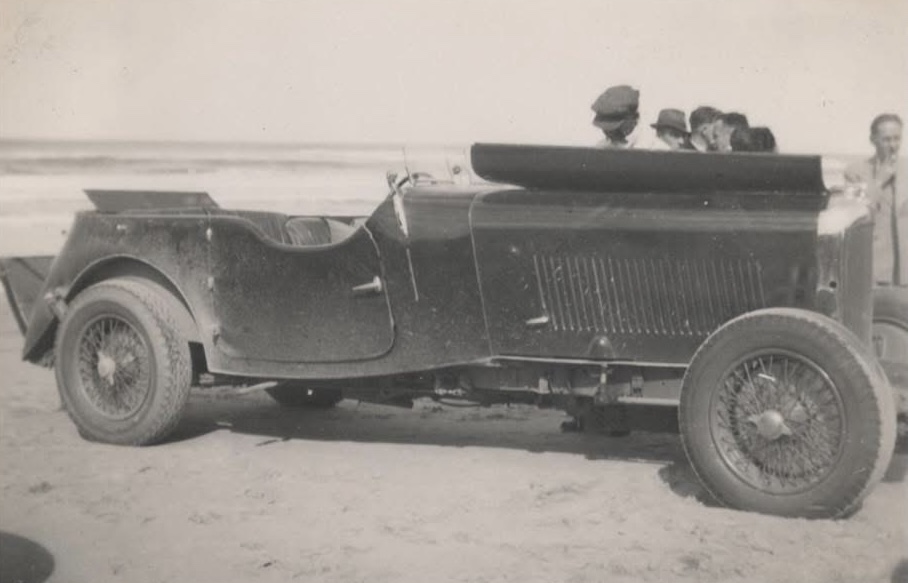
Surfs-Up albeit not that much! Whitehead and entourage keep a close eye on the 90 Mile Beach’s rising tide during a spot of land speed record breaking in Victoria

Greg Smith wrote that ‘A young bloke from Orbost rode his pushbike to 90 Mile Beach to watch this car on the sand in the speed trials and it was his inspiration to get involved in motorsport. That bloke was (Oz driving and engineering legend) Harry Firth.’

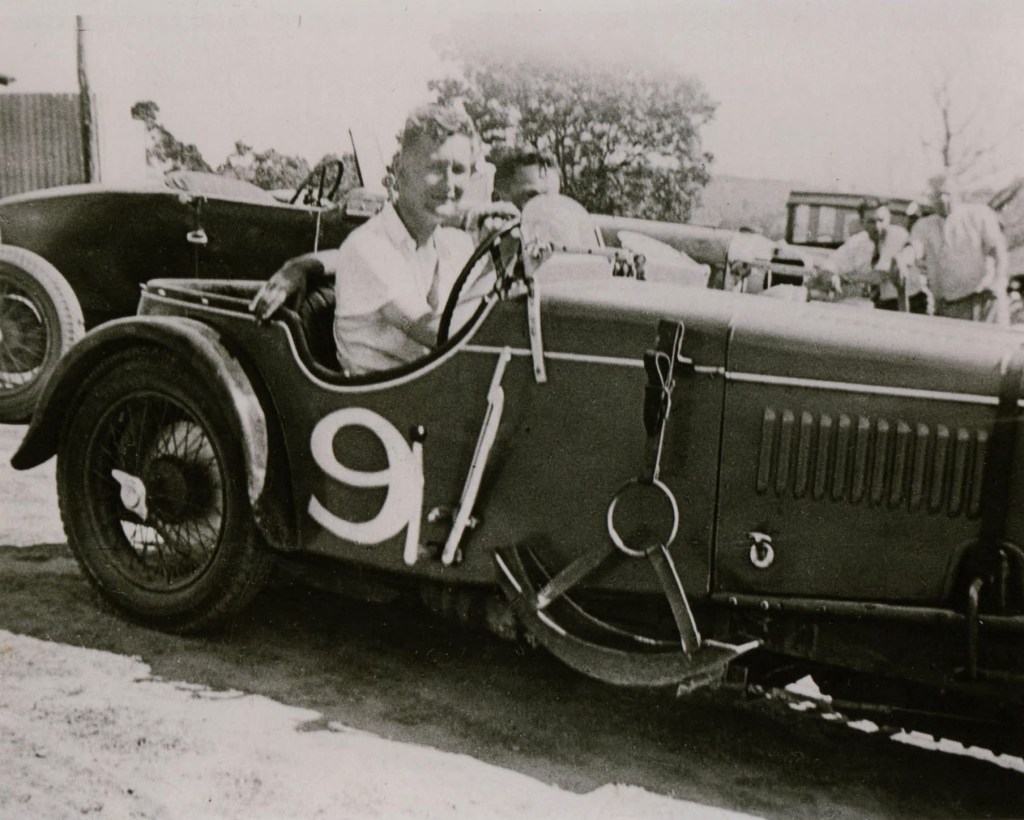
Peter didn’t run the ERA in Rob Roy’s November 20, 1938 meeting but LCCA stalwart, Jim Leech gave him a run in his Frazer Nash, he did an amazing 34.77-sec run. Car now owned by the Davey-Milne brothers.

(Cummins Collection)

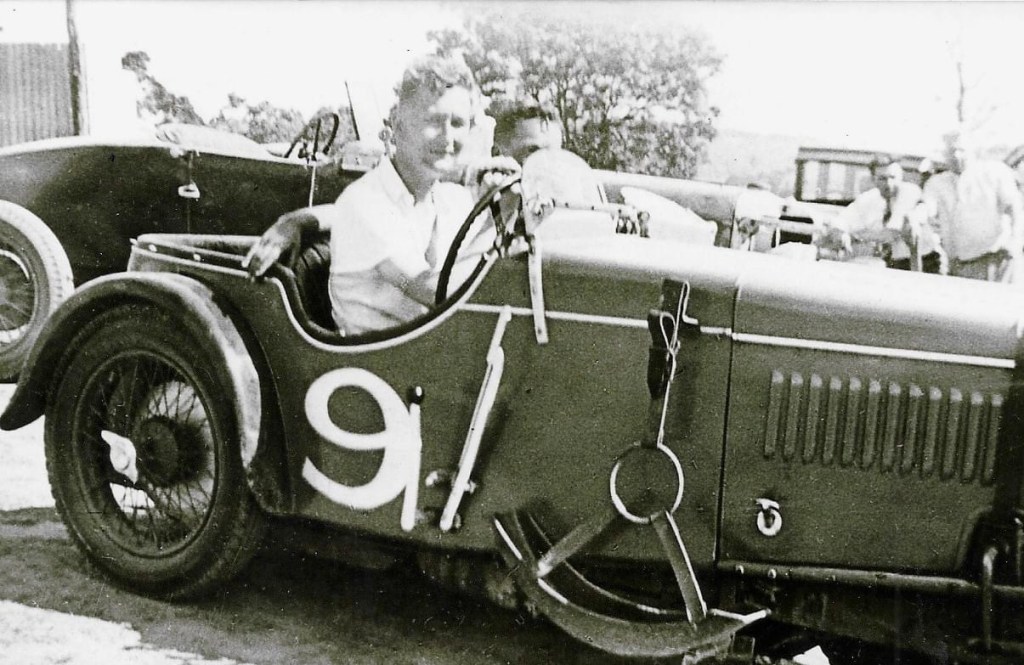
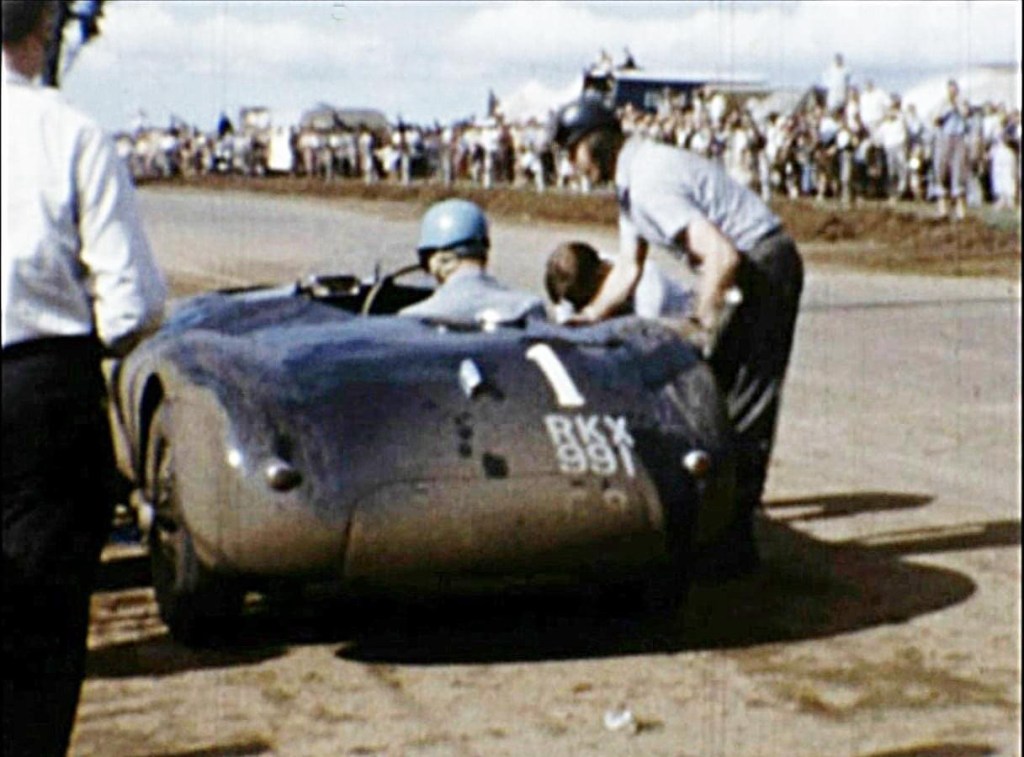
Peter returned to Australia a number of times, the visit I tend to forget is when he entered his Jaguar C-Type in the Mount Druitt 24-Hour in January 31-February 1, 1954.

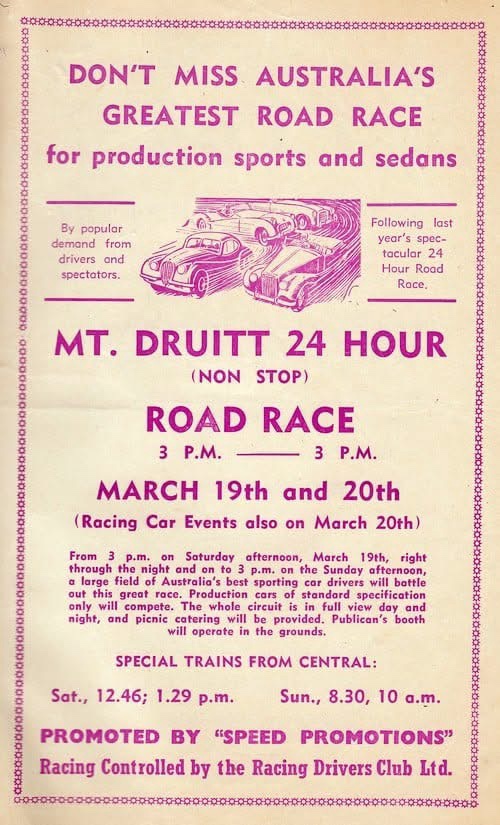
Paul Cummins tells the story, ‘Whitehead’s Jaguar ‘C’ Type XKCO39 was co-driven by Tony Gaze and Alf Barrett. The race started at 2 pm on January 31st, with a Le Mans Start. Organised by Belfred Jones and his company Speed Promotions and run under the ARDC for unmodified production cars, it was the first 24-hour race in Australia and attracted 22 cars.’

It all looks good other than the dates! (B Williamson Collection)
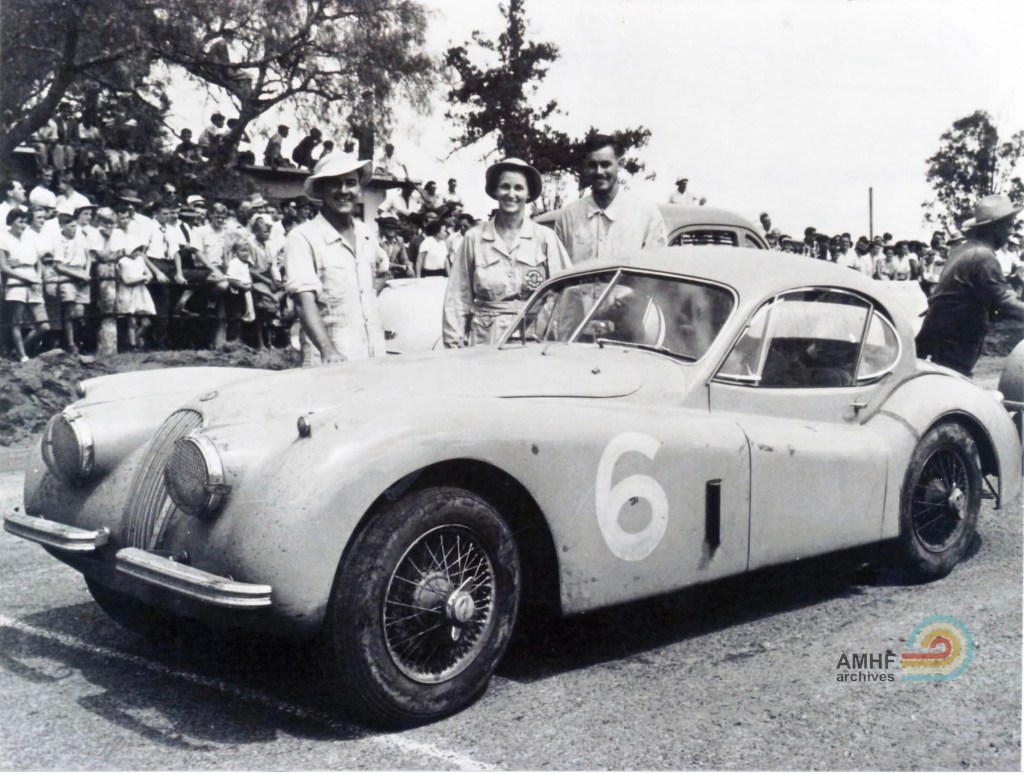
The Mount Druitt 24-Hour winning Jag XK120 FHC crewed by Geordie Anderson, Bill Pitt and Charlie Swinburne (B Caldersmith-AMHF)

‘There was no crowd control and the road surface gradually disintegrated making it a rough going and forcing the ‘C’, which was leading, to pull out with rear suspension problems. Peter Whitehead started the race and by the third lap had already started overtaking slower cars. By the end of the first hour he overtook the Geordie Anderson XK120 FHC that was in second.

By the eight hour mark the ‘C’ had completed 217 laps and was 23 laps ahead of the second placed Holden of Shaw. Hitting a pothole at midnight put an end to the ‘C’ Type’s race. All 22 cars finished as the ‘retirements’ rejoined at the end. The car race wasn’t repeated but amazingly in October the world’s first 24 hour bike race was run there.’

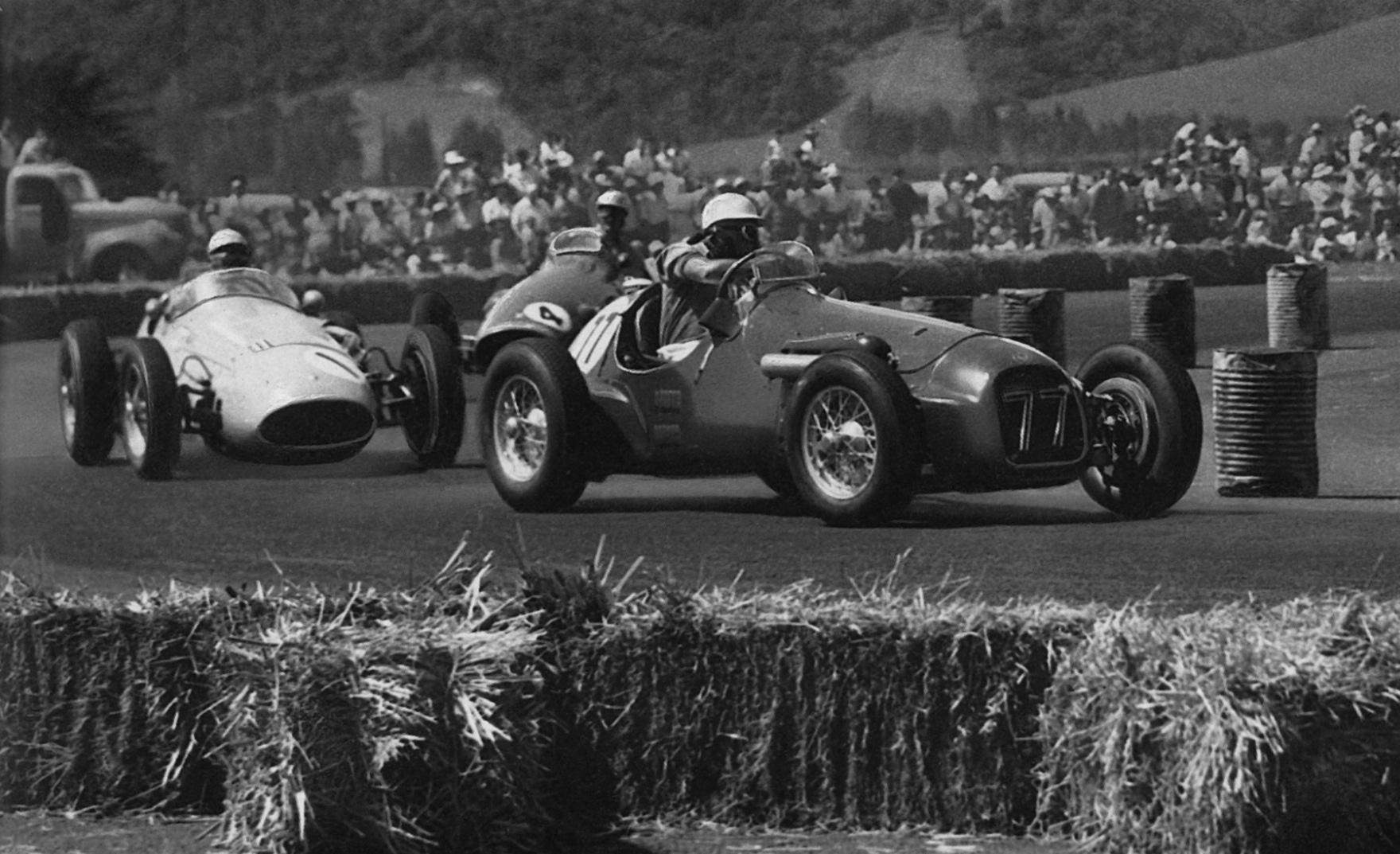
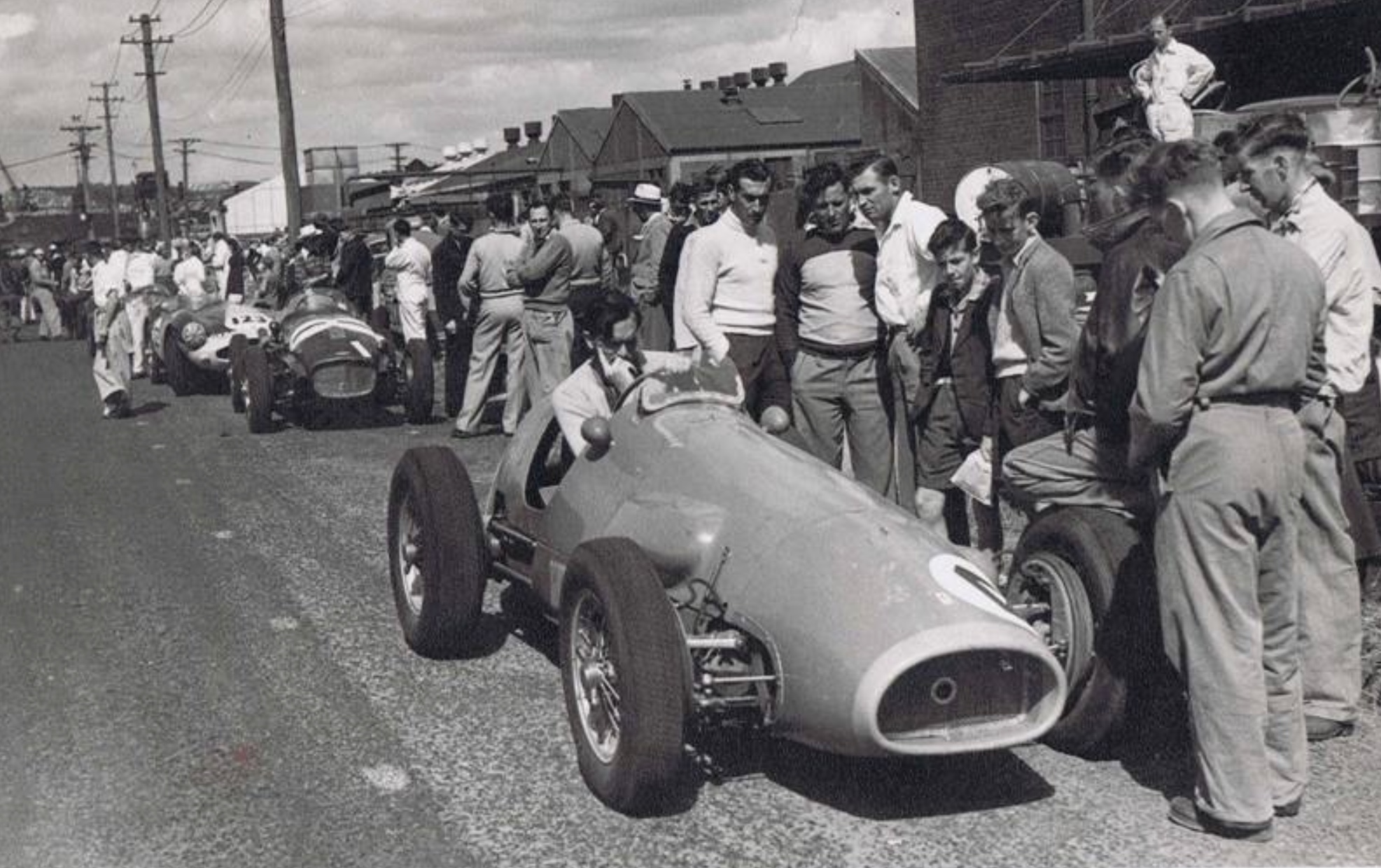
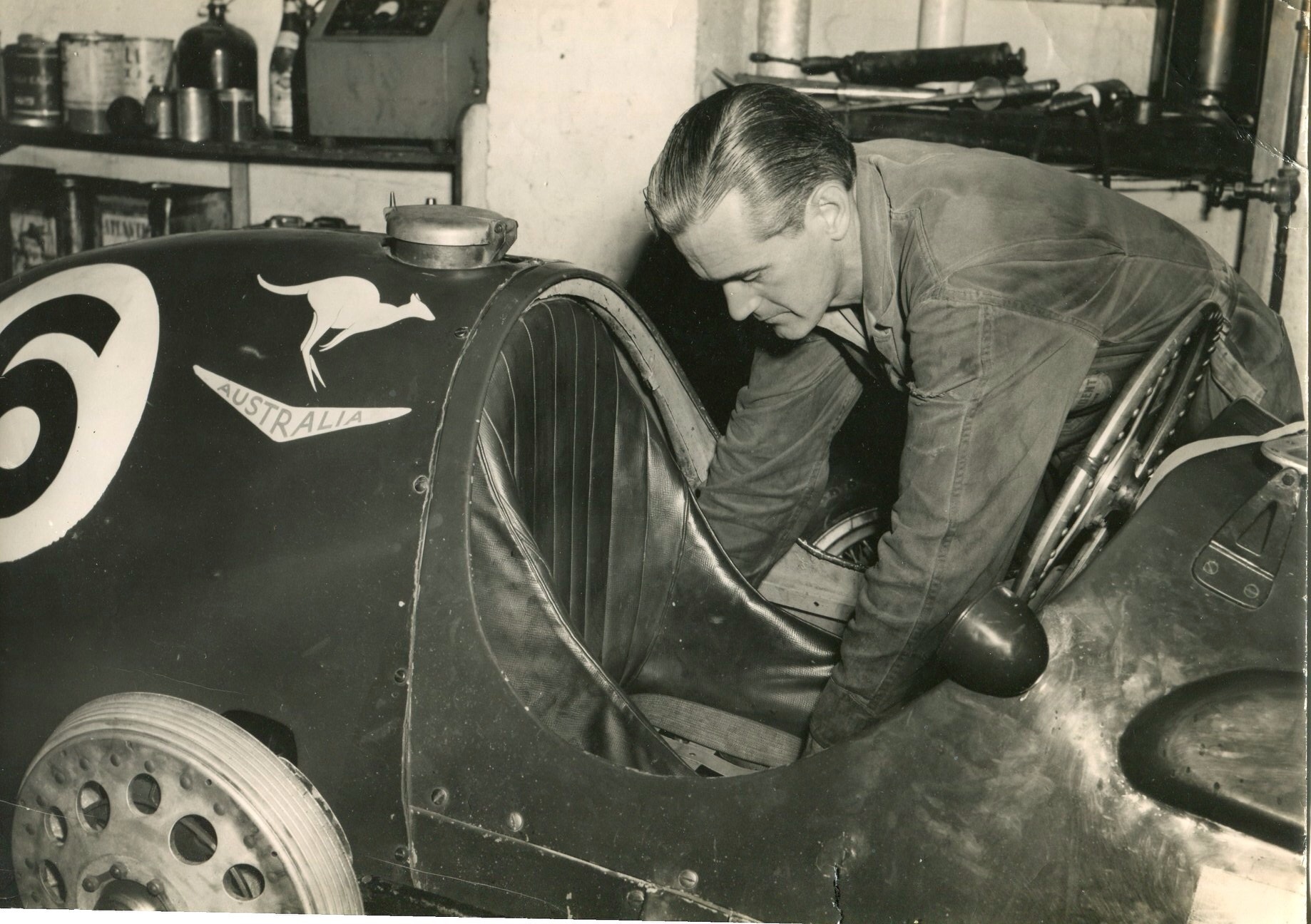
The November 1956 ‘Olympic’ Australian Grand Prix at Albert Park attracted a stellar field including the Officine Maserati 250Fs raced by Stirling Moss and Jean Behra. See here: https://primotipo.com/2018/01/16/james-linehams-1956-agp-albert-park/

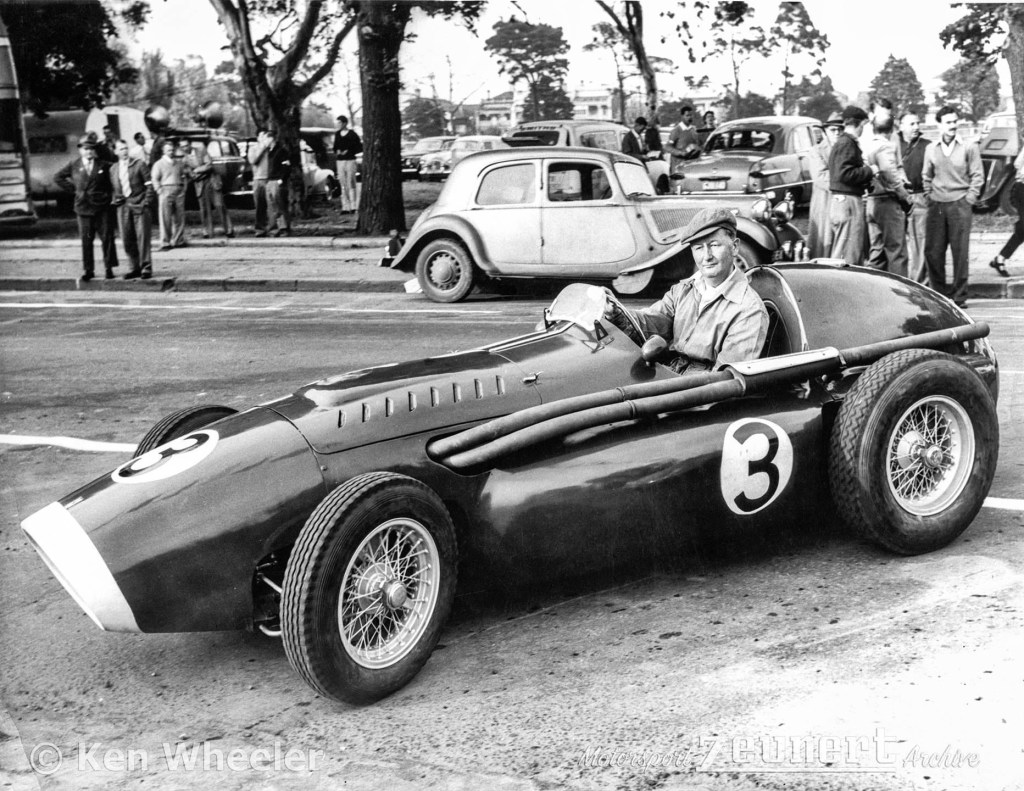
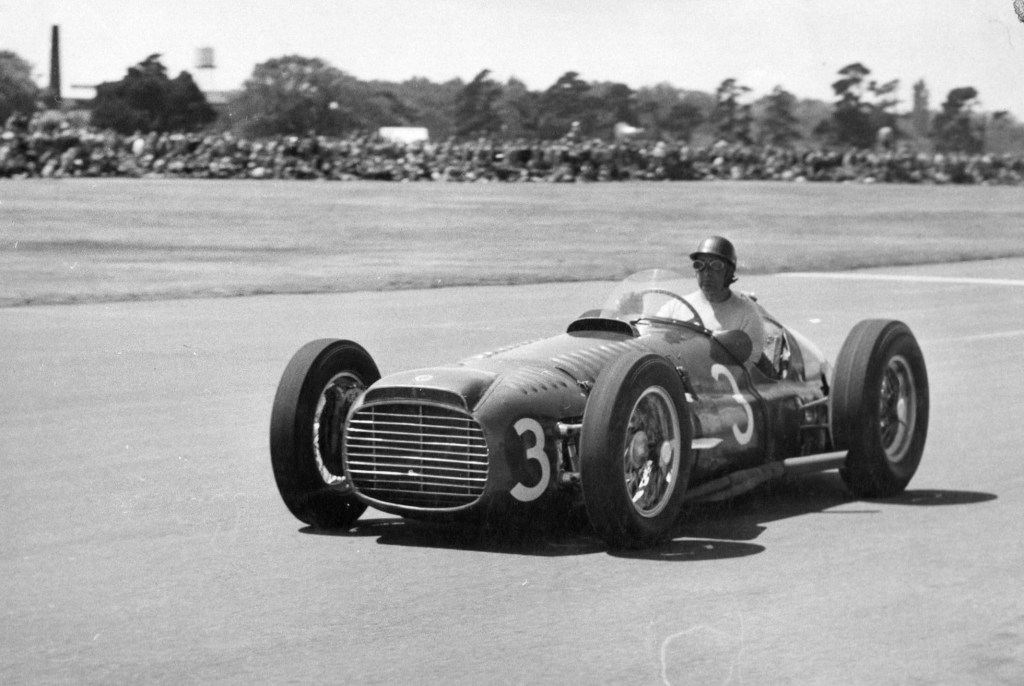
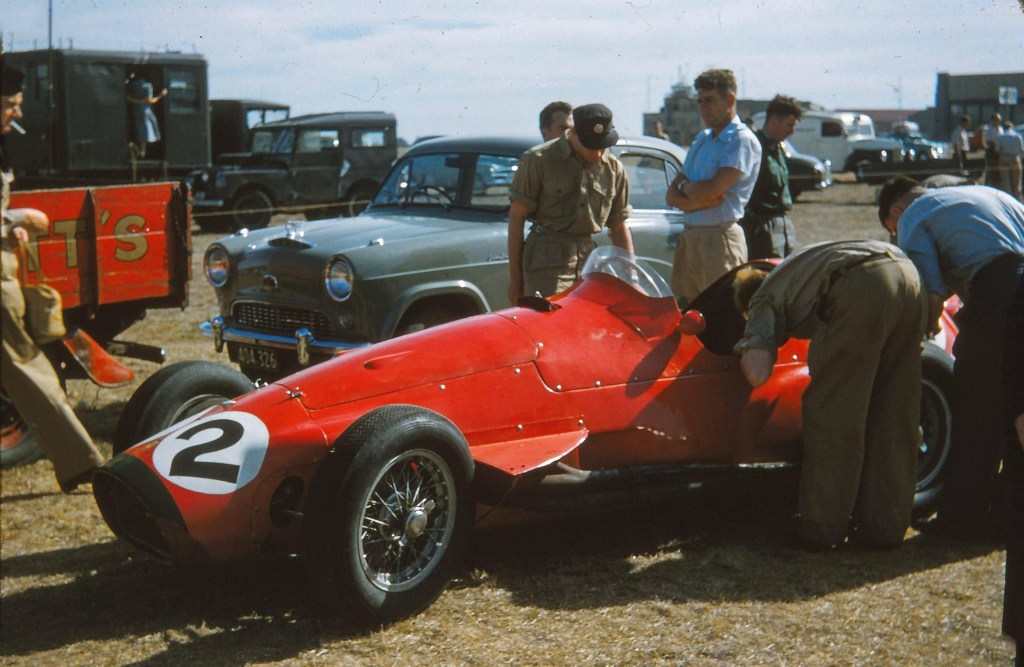
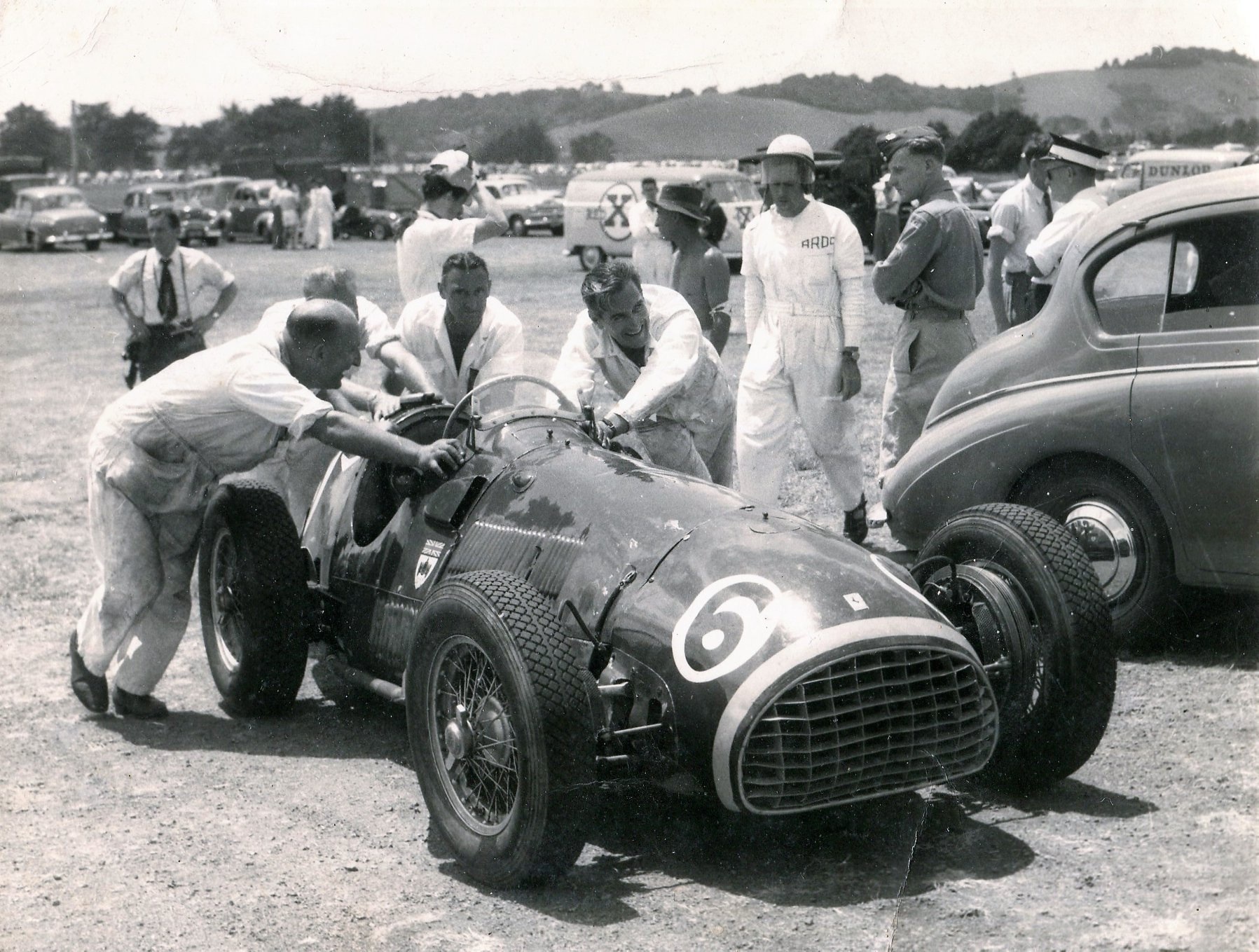
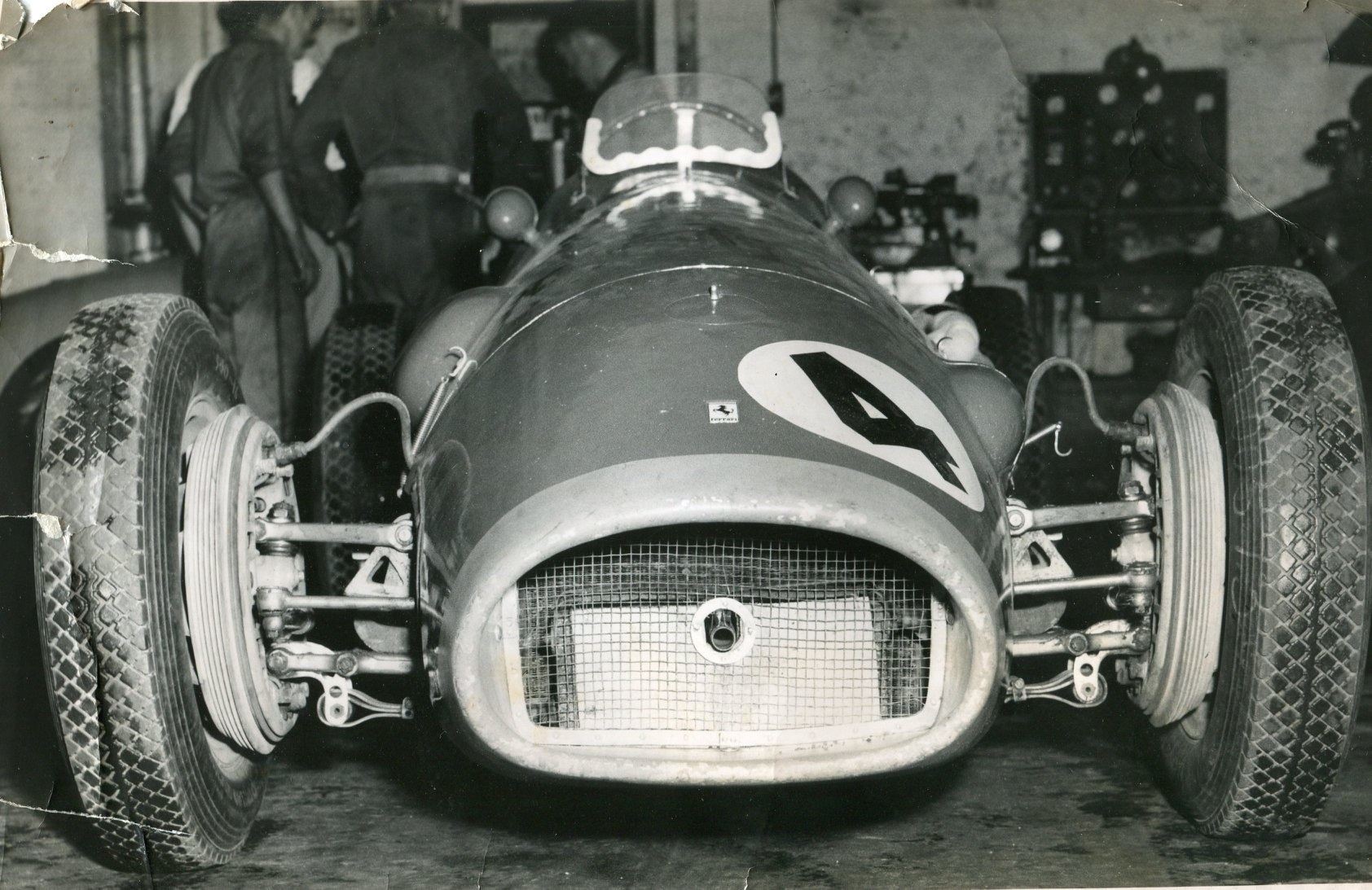
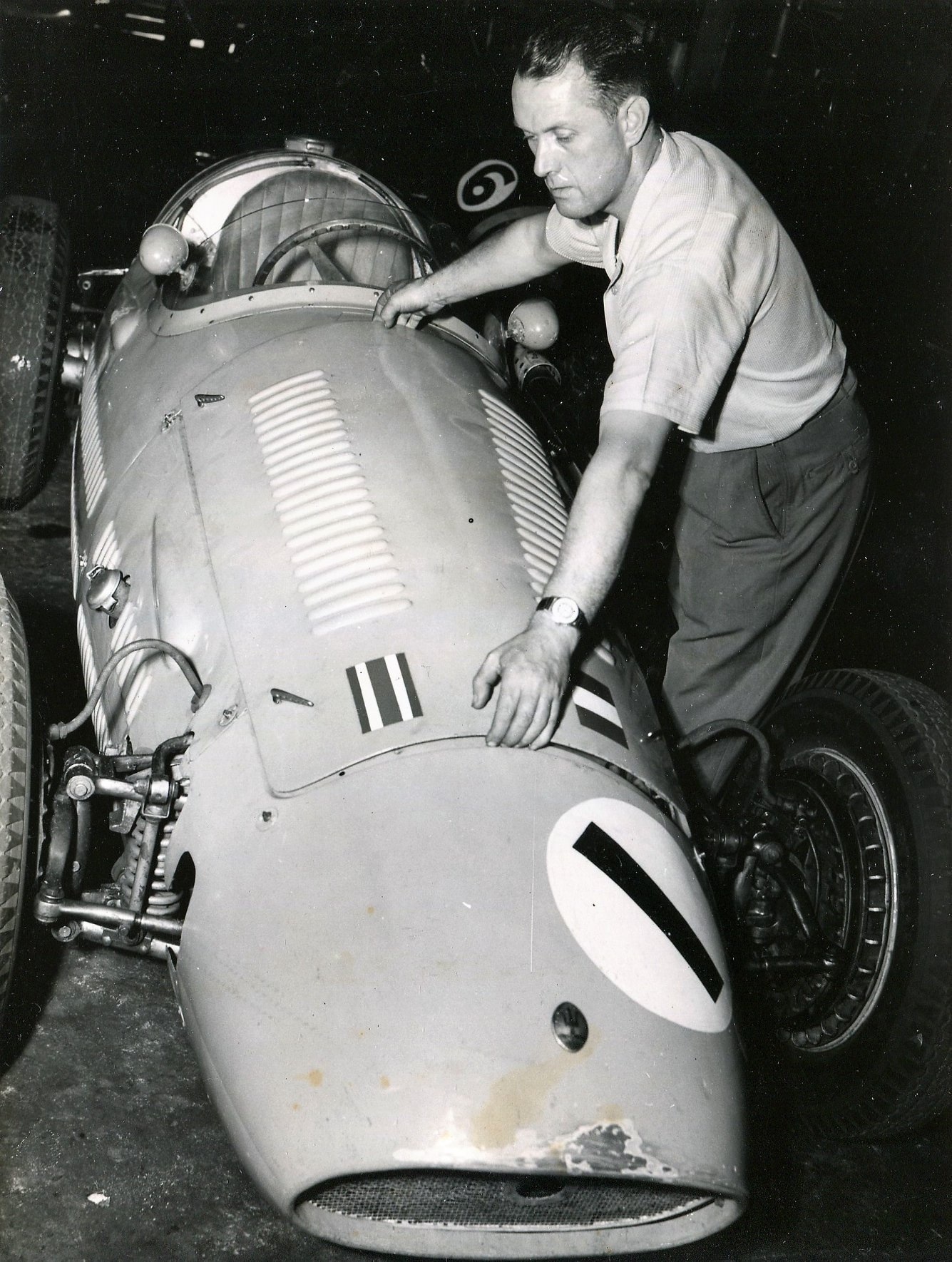
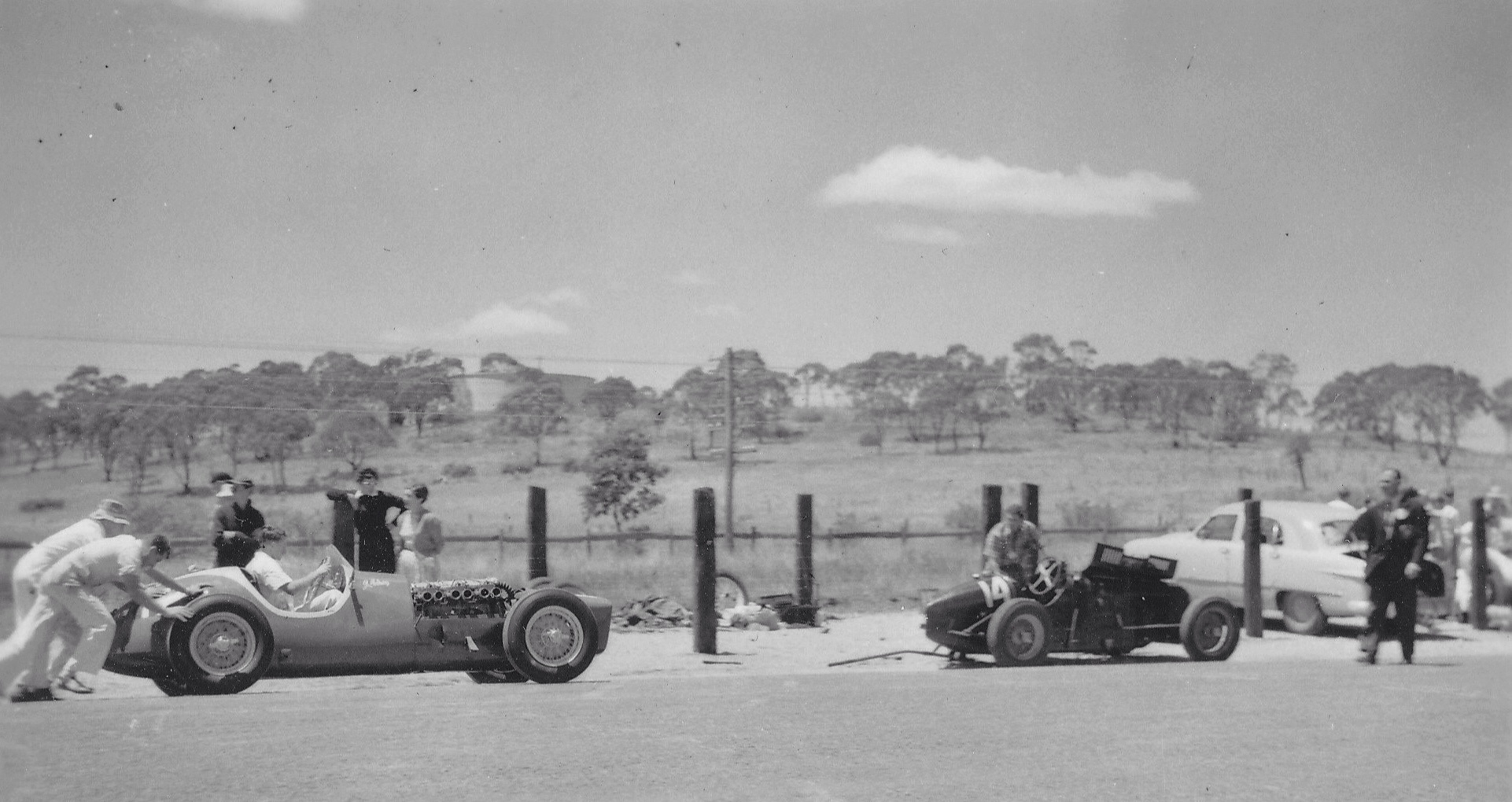
Peter is shown above manoeuvring his Ferrari 555 Super Squalo 3.4-litre in the paddock. He was third in the race, behind Moss and Behra, in his final competition appearance in Australia. I wonder if he continued to travel to Melbourne on business in the period between then and his untimely death during the September 1958 Tour de France.

Credits…

The Referee Sydney June 16, 1938, Leon Sims Collection, Bob King Collection, Ian & Paul Cummins Collection, Ken Wheeler via David Zeunert Collection, Bob Williamson Collection, AMHF Archive

Tailpiece…

(L Sims Collection)

Finito…

(unattributed)

The Australian Land Speed Record session held at Woodside on the Ninety Mile Beach in Gippsland on September 4, 1938 was the first held in Victoria.

The Light Car Club of Australia promoted it, while the Yarram branch of the Royal Automobile Club of Victoria (RACV) ran the event which used you-beaut electrical timing apparatus accurate to one-hundredth of a second approved by the Australian Automobile Association.

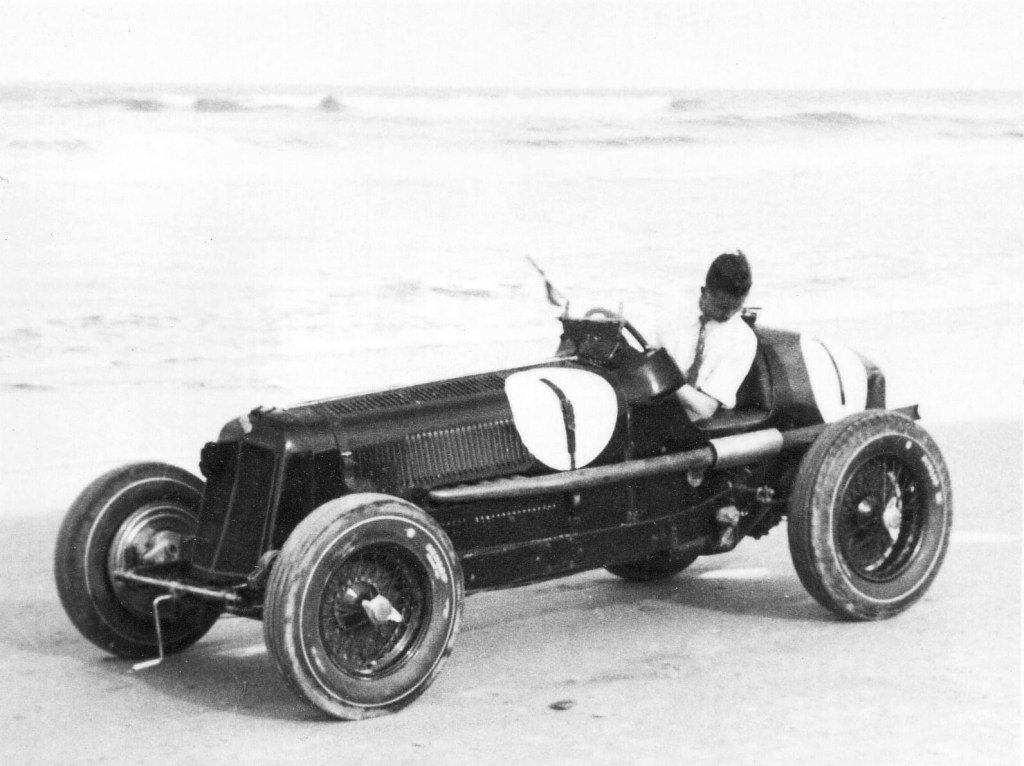
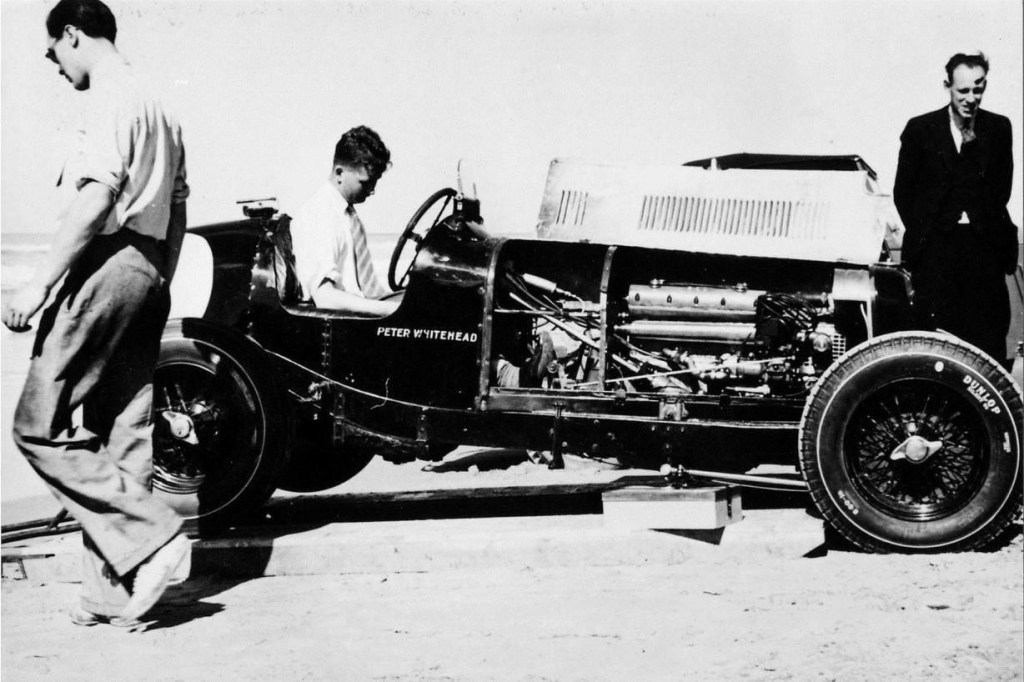
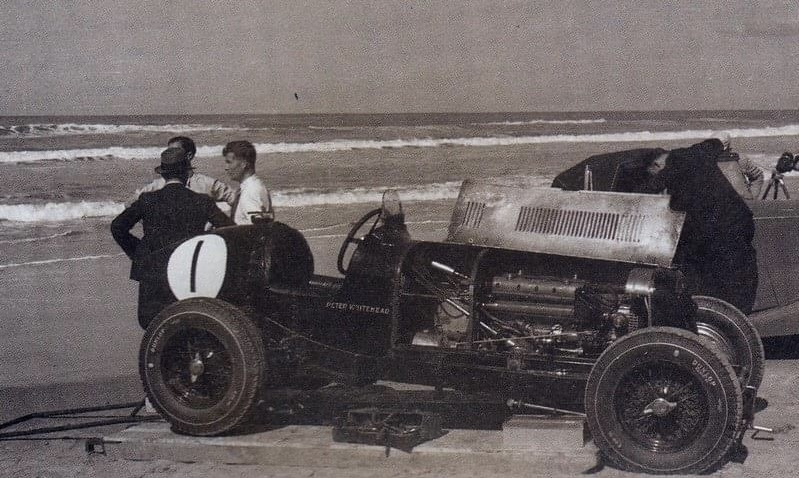
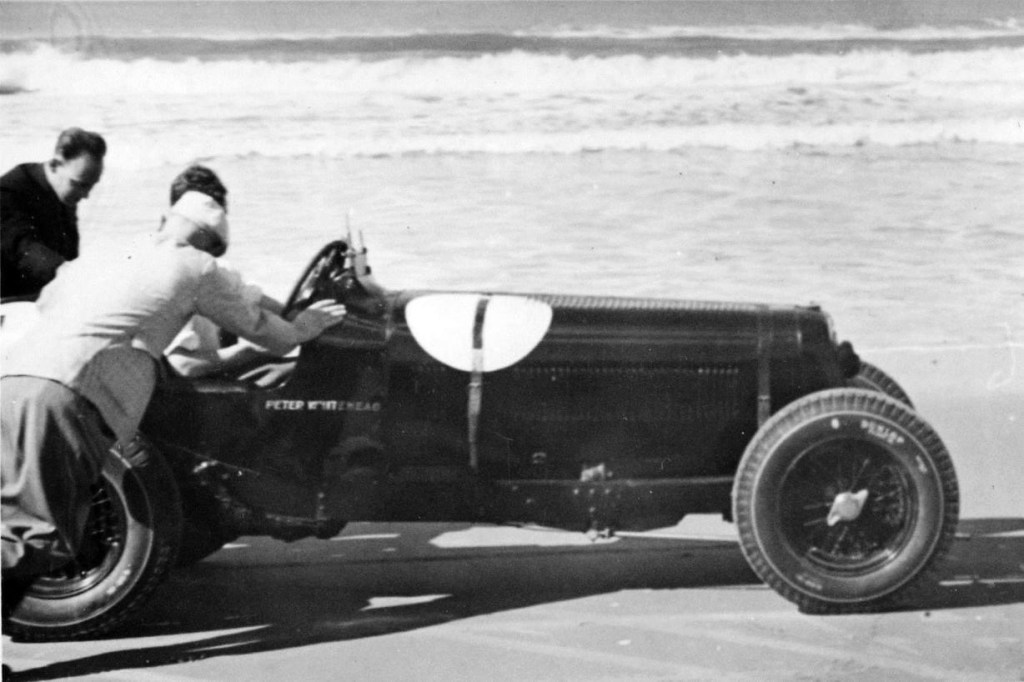
The drawcard was Peter Whitehead and his ERA B-Type R10B. The photograph above shows him warming the engine and transmission of the car at Woodside, collar, tie and all.

He was in Australia on behalf of the family firm W&J Whitehead of West Yorkshire, and doing a spot of motor racing, hillclimbing…and record breaking here at Woodside and in Canberra. All of this lot is covered in this epic: https://primotipo.com/2015/04/16/peter-whitehead-in-australia-era-r10b-1938/

(M Gallagher Collection)
(unattributed)

Other drivers granted permission to have a crack were the following: Class C 3-5-litres: RND Miller, Vauxhall 30-98 and AH Oliver, Lagonda Class D 1.5-2-litres: JN Derham, Vauxhall Class F 1-1.5-litres: JP ‘Jim’ Leech, Frazer Nash TT Replica and Class H 500-750cc: DM George MG J4 supercharged.

The stretch of beach chosen was four miles long and 60 feet wide, the existing outright record was held by three-times Australian Grand Prix winner Bill Thompson on a supercharged 1.5-litre Bugatti T37A.

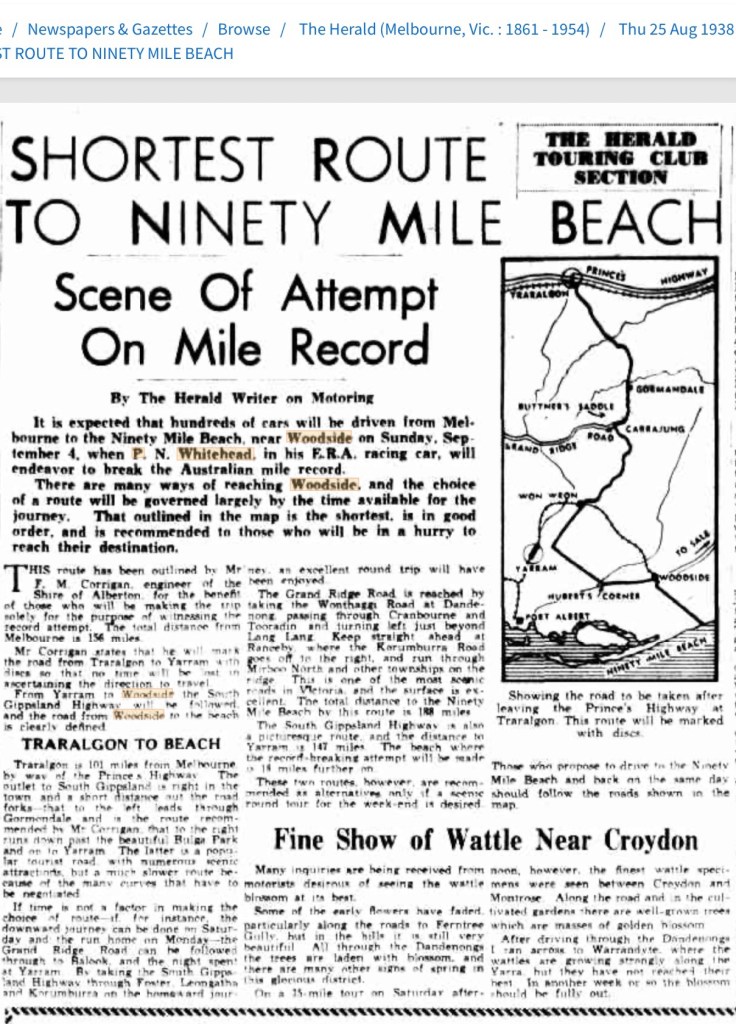
The 156 mile trip from Melbourne was quite a journey for the time. It’s amusing now to look at how much of the newspaper (the what?) coverage in the week before the event was devoted just to getting there, the three suggested routes were explored by the papers in some detail inclusive of maps. Different to the Google maps exercise on ‘yer iPhone today…

Peter Whitehead and Jim Leech aboard the latters Frazer Nash TT Rep #2134 at Rob Roy Hillclimb – where Peter had won the Australian Hillclimb Championship in R10B not long before – November 20, 1938. Whitehead did a 34.77 sec best (Davey Milne Archive)
(unattributed)

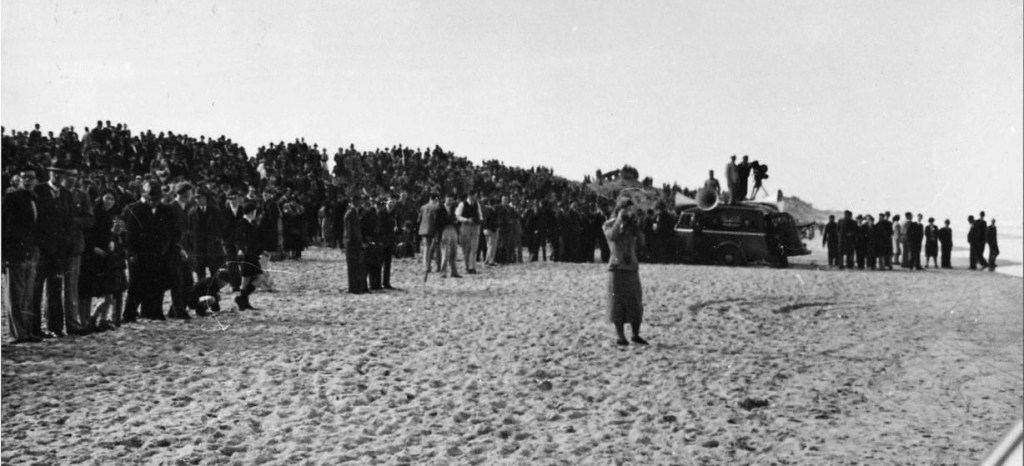
Poor Jim Leech ran off the road on the way to the event in his Frazer Nash, but 6,000 others came from far and wide to see the spectacle before the fickle finger of weather fate ruined the day.

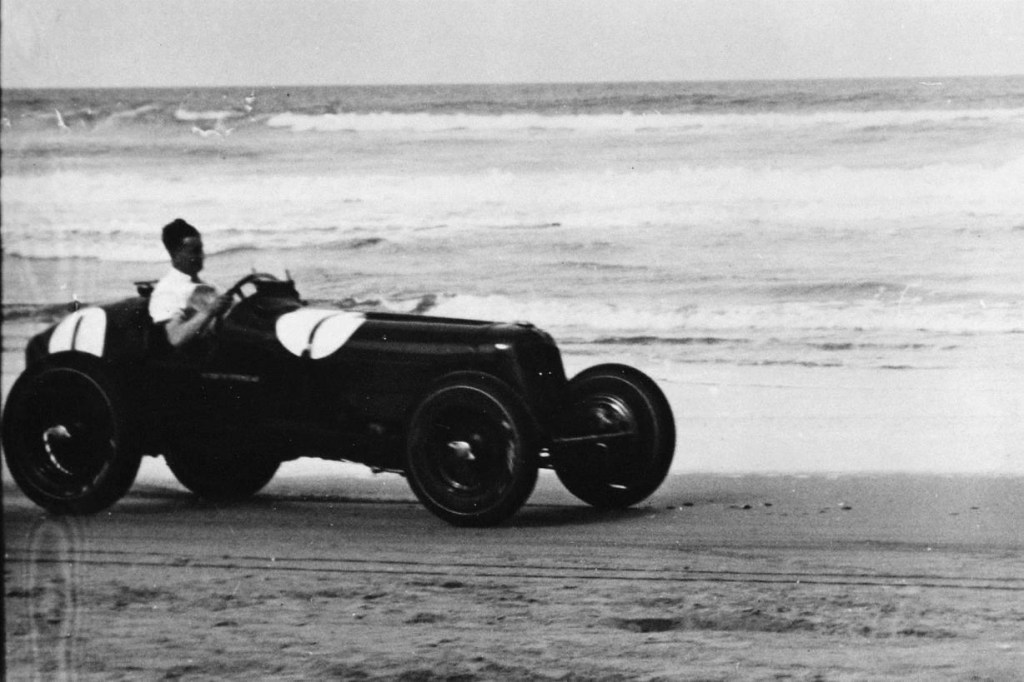
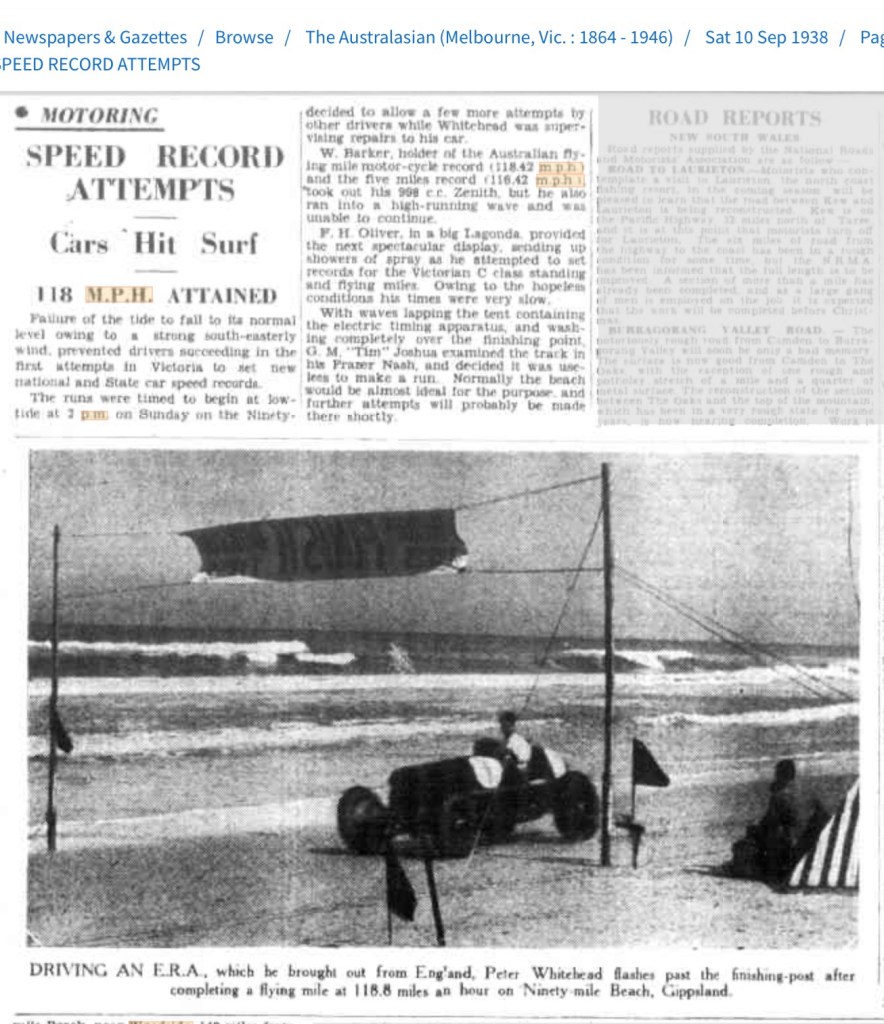
A strong south-easterly wind prevented the usual fall of the tide, ‘after the English driver Peter Whitehead had covered a flying-mile at an average of 118.8mph in his special 1500cc E.R.A. car the waves washed over the track and prevented any further serious attempts,’ recorded the Melbourne’s The Argus.

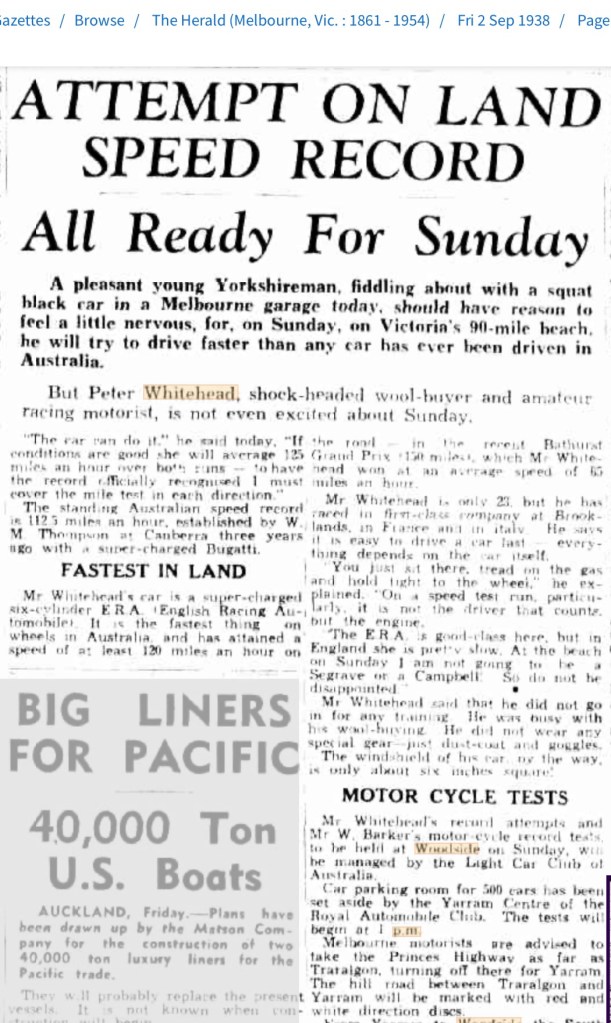
As Peter’s speed was set on one run, rather than the required each-way average of two, Thompson’s one-mile record of 112.5mph set in Canberra on May 11, 1935 still stood; Bugatti T37A.

No helmet for Whitehead, as at Bathurst when he won the AGP, proximity of Bass Straight clear and threatening (unattributed)

An estimated 2,000 cars conveyed the punters into the sand hummocks along the picturesque track many hours before the events were scheduled to begin.

‘Trials were impossible owing to the tide. With only a few yards of wet sand between the flags and the waves on the four mile course. Whitehead pluckily started up so as not to disappoint the crowd. He was obstructed by water on his first run, however, and although he averaged 118.8mph in his next run, his car plunged through the lip of a wave, tearing away apparatus for cooling the brakes, ripping off the oil filler cap, and partially flooding the crankcase with salt water.’

‘He maintained control, but it was evident that he had no chance of putting the record up to 135mph which was his hope.’

Derry George, MG J3 #3763 this shot and below (M Gallagher Collection)
(unattributed)

The AAA, LCCA and RACV reps then met and decided to allow some attempts by other drivers while Whiethead and his crew effected repairs to R10B.

W Barker, holder of the flying-mile motorcycle record (118.42mph) and five miles record (116.42mph) took out his 998cc Zenith but he also clouted a wave and was unable to continue.

Next up was Big Bertha. F Oliver’s Lagonda provided a spectacular display sending up showers of spray in attempting to set Class C records but the conditions ensured his times were slow.

The AH Oliver Lagonda (M Gallagher Collection)
Tim Joshua’s Frazer Nash Single Seater (what chassis number folks, ‘SS1’ is I think the chassis type, not the number?) at Lobethal during the 1938 South Australian GP weekend. Ron Edgerton at left, later owner of the FN, Joshua on the right alongside the MG K3s #3 Colin Dunne and #2 Lyster Jackson (Leon Sims Collection)

‘With waves lapping the tent containing the electric timing apparatus and washing completely over the finishing point, GM ‘Tim’ Joshua examined the track in his Frazer Nash and decided it was useless to make a run. Officials prevented any further attempts and there was a rush to get cars off the beach before the tide rose farther. The crowd had to lend willing hands to help several vehicles out of difficulties.’

‘Afterwards, the director of the trials, Mr JW Williamson, expressed supreme disappoint with the result. The crowd, who had enjoyed the outing in brilliant sunshine, took it in good part.’

‘It was the first attempt made in Victoria to set such records. Normally the beach would be almost ideal for the purpose, and further attempts will probably be made there shortly.’ The Argus concluded…

Not so, as it transpired.

(unattributed)

Etcetera…

(T Johns Collection)

The Car was ‘the official organ of the Light Car Club of Australia’, so this is the way the organiser saw the day.

(T Johns Collection)

Kenneth Maxwell was a member of Whitehead’s ’38 Touring Party and wrote this letter to the editor of The Car about the equipe’s experiences early in the trip, published in the June-July issue.

The Car was the Light Car Club’s magazine, the trip to run-in the ERA between Albury and Melbourne sounds interesting!

The Fraser Nash TT Rep and Single Seater, MG J3 and the ERA are still alive and well, all but the latter remain in Australia.

Coincidentally, both the J3 and TT Rep were brought to Australia and first raced by George Martin, the Melbourne based Cunard White Star Line representative who died on the way home from the 1938 AGP at Bathurst. He and his wife crashed the BMW 328 in which George had finished 15th near Wagga Wagga.

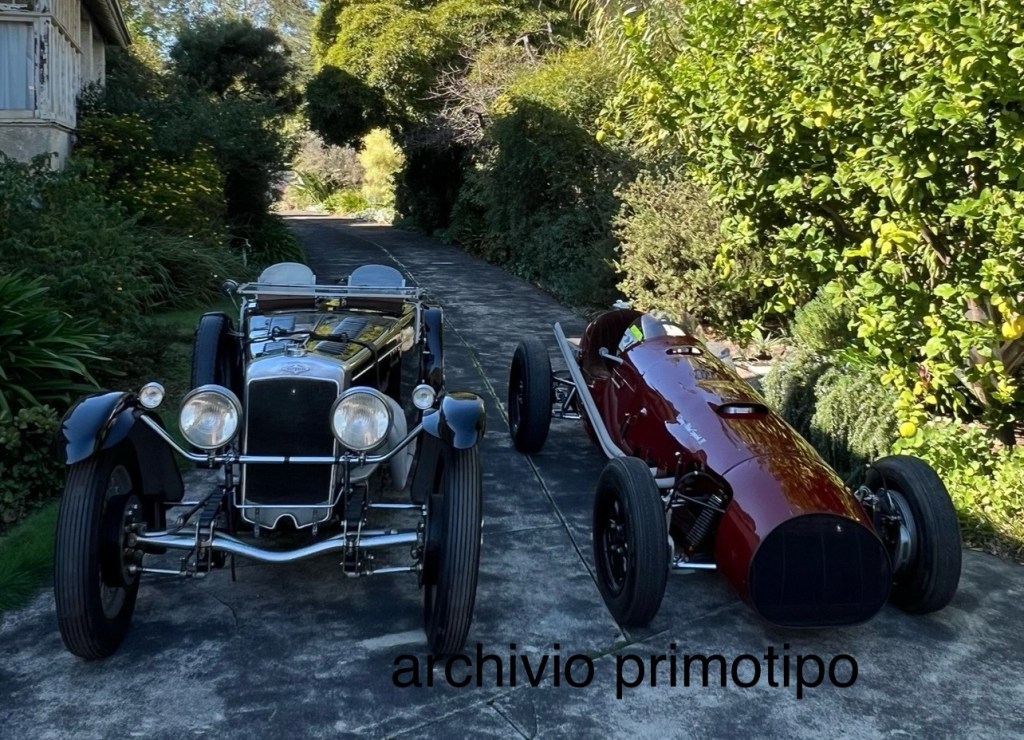
The shot above shows the Frazer Nash TT and ex-Brabham Cooper T23 Chev aka RedeX Special, at the Davey Milne home in April. The FN requires recommissioning but the Cooper is a runner, ask the neighbours!

Credits…

The Argus September 5, 1938, Martin Gallagher Collection, Davey Milne Archive, Leon Sims Collection, Tony Johns Collection

Finito…

(J Manhire)

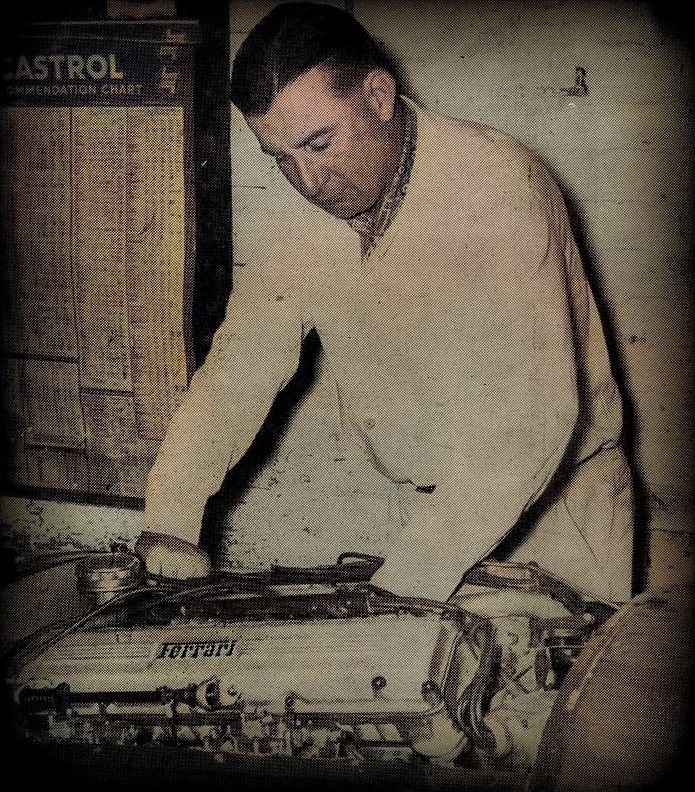
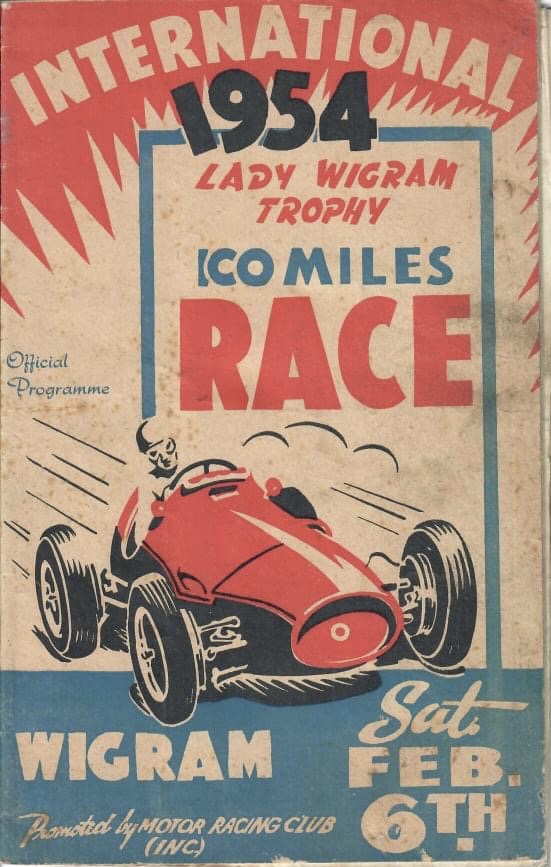
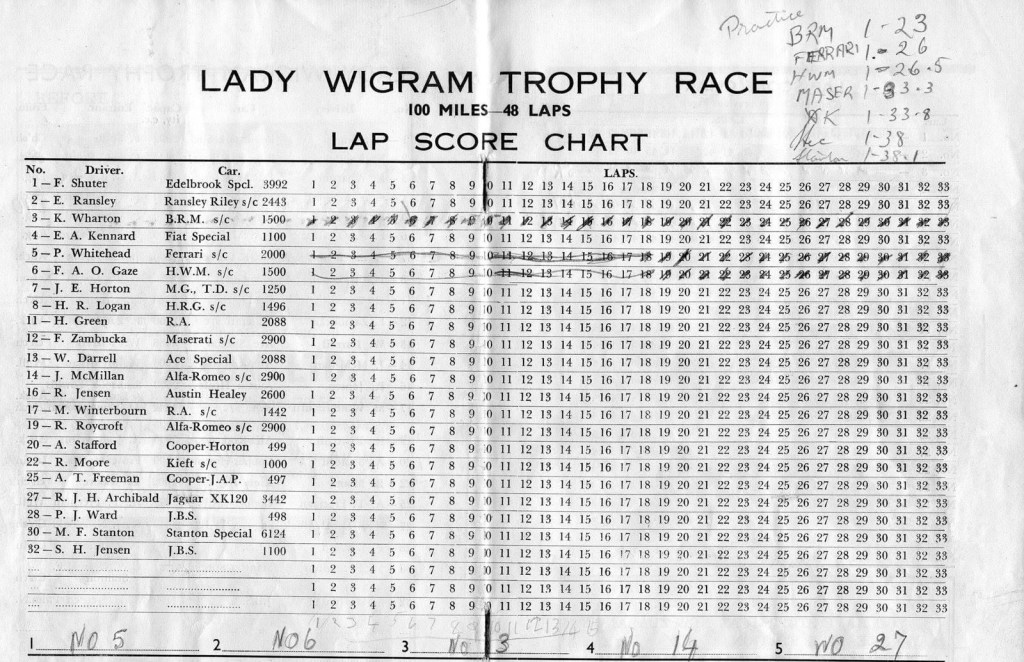
Superb shot of British International Peter Whitehead’s Ferrari 125 (#0114) enroute to winning the Lady Wigram Trophy in 1954.

He won the race from Tony Gaze’s HWM Alta 2-litre s/c and Ken Wharton’s BRM P15 1.5-litre V16 s/c. Whitehead’s mechanic brings the car back into the paddock to a most appreciative crowd below.

(VC Browne)

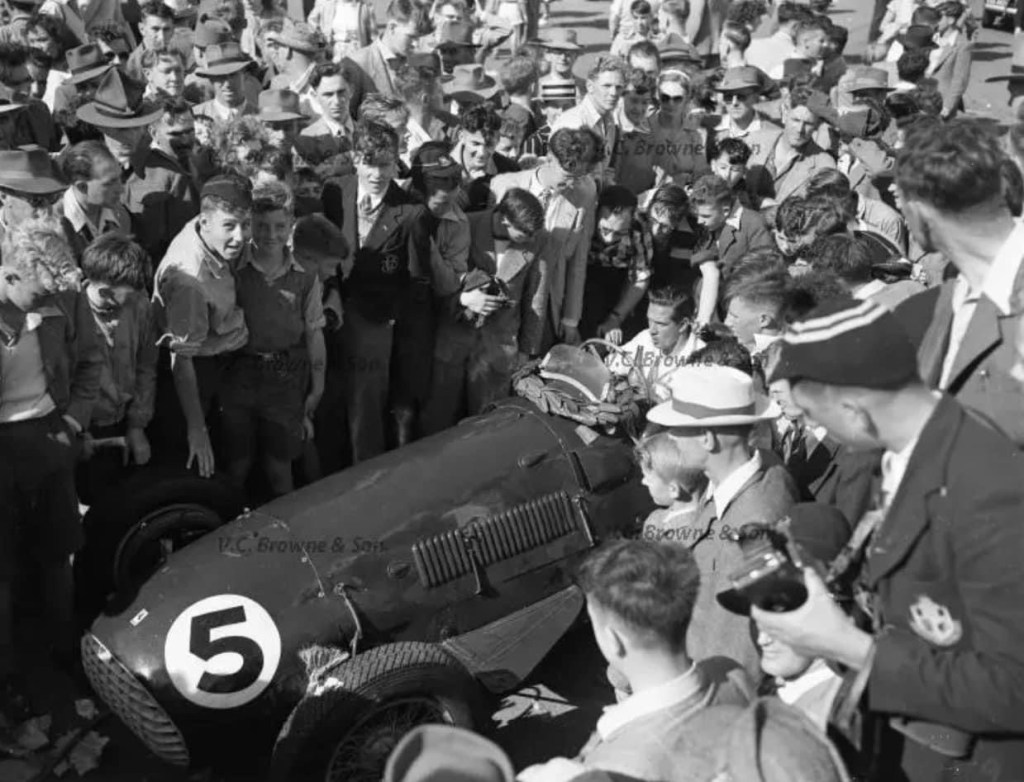
The Ferrari is shown in the Ardmore paddock below during the NZ GP weekend, that race was won by Stan Jones’ Maybach 1 after the star of the show, Ken Wharton’s BRM retired with mechanical problems. See here for a piece on the 1954 NZ GP: https://primotipo.com/2019/11/18/ken-wharton-and-brms-grand-turismo-south-in-1954/ and on Whitehead’s Ferrari 125, later sold to Dick Cobden, and later still one of Tom Wheatcroft’s first Grand Prix car purchases here: https://primotipo.com/2020/04/09/1955-south-pacific-championship-gnoo-blas/

Upon reflection, nobody did more to build the Ferrari brand in New Zealand way back then, than Peter Nield Whitehead. Others quickly followed mind you!

(N Tait)
Ferrari 125 (unattributed)
Ken Wharton, BRM P15, Wigram 1954 (G Nimmo)

Whitehead had a nice little earner going with his Grand Prix Ferraris. By carefully specifying his ex-F1 Formule Libre cars he made a nice little earner from start and prize money post-war, visiting New Zealand from 1954-57 and doing exceptionally well.

In 1955-56, Peter and his Australian buddy, Tony Gaze raced a pair of F1/F2 2-litre Ferrari 500s fitted with 3-litre Monza engines. With these Ferrari 500/625s they did rather well: at Ardmore Whitehead was second in the’55 NZ GP, and Gaze third, while Whitehead won at Wigram and Ryal Bush, and Gaze at Dunedin in 1956. Peter was third in the NZ GP that year in the race won by Moss’ Maserati 250F.

More about the Ferrari 500 here: https://primotipo.com/2019/06/24/1956-bathurst-100-lex-davison/

Whitehead at Ryal Bush in 1956, Ferrari 500/625 (J Manhire)
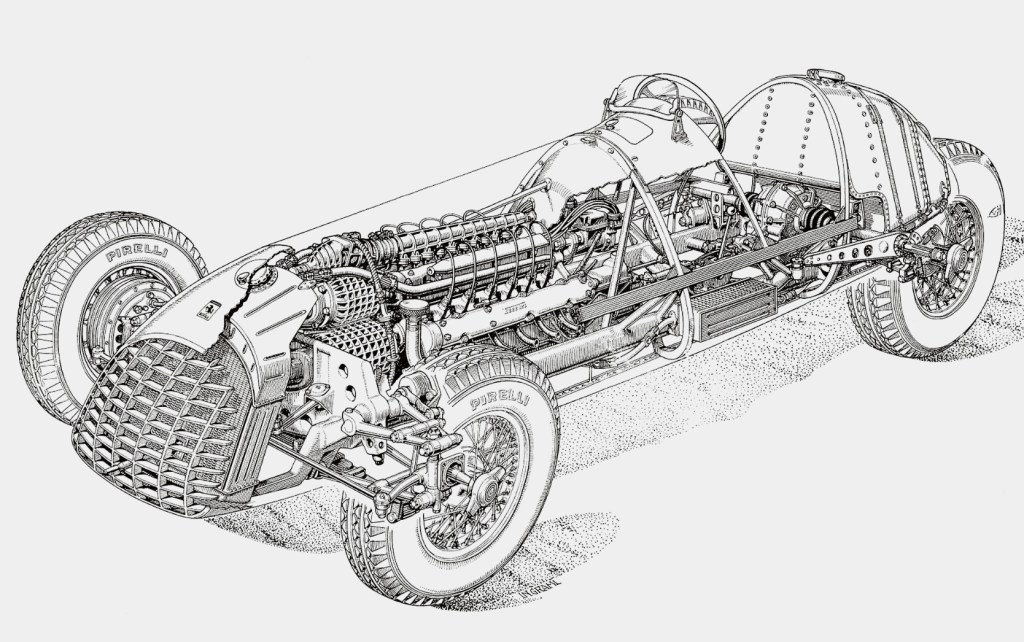
Ferrari 625 cutaway (G Cavara)
Whitehead’s Ferrari 500/625 in the Wigram paddock in 1956 (T Adams)
(K Brown)

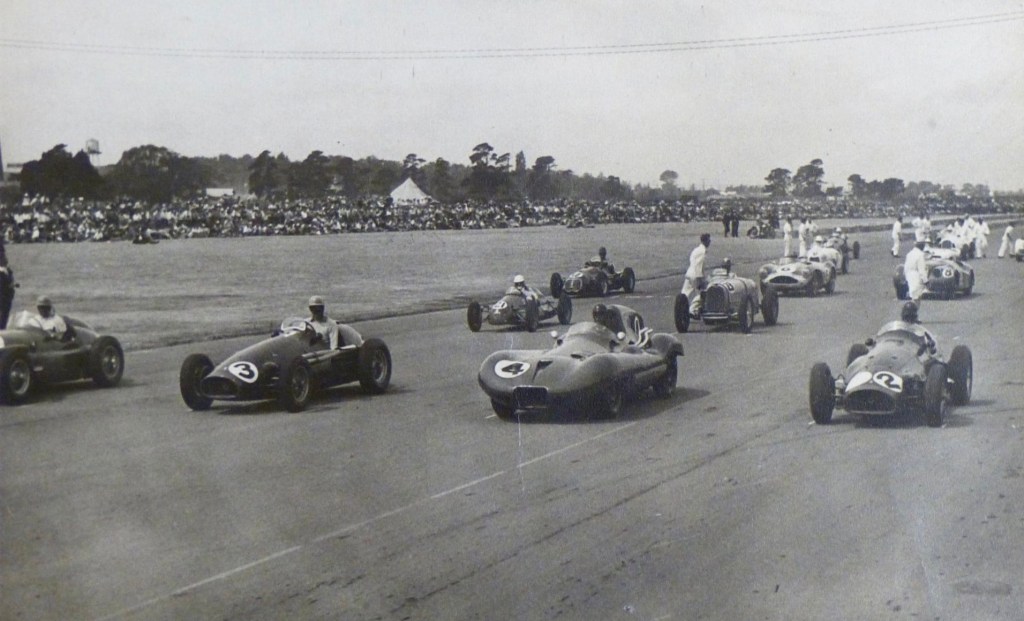
The grid at Wigram in 1956 with the partially obscured Reg Parnell at left aboard the one-off Aston Martin DP155. Then Whitehead’s Ferrari 500/625, Lesley Marr’s Connaught B-Type Jaguar and Tony Gaze’s Ferrari 500/625. On row two is Ron Frost, Cooper 500, and Ron Roycroft’s Bugatti Jaguar

With no shortage of quick Maserati 250Fs racing in non-championship F1 and Formule Libre racing around the globe Whitehead returned to Maranello for a faster car. Unsurprisingly, wily Enzo Ferrari palmed Peter – no fool by any stretch – off with a pair of 3.5-litre Monza engined 555 Super Squalos, one of the unsuccessful series of cars that led Enzo to beg for the Lancia D50 programme after Gianni Lancia’s profligacy drove his family company into the wall at warp-speed.

These Ferrari 555/860s were driven with great skill by Whitehead and his new ‘teammate’ Reg Parnell. The factory Aston Martin racer was another worldly businessman who enjoyed his tour of NZ with an uncompetitive Aston Martin DP155 the year before and was keen to return for more with a competitive mount.

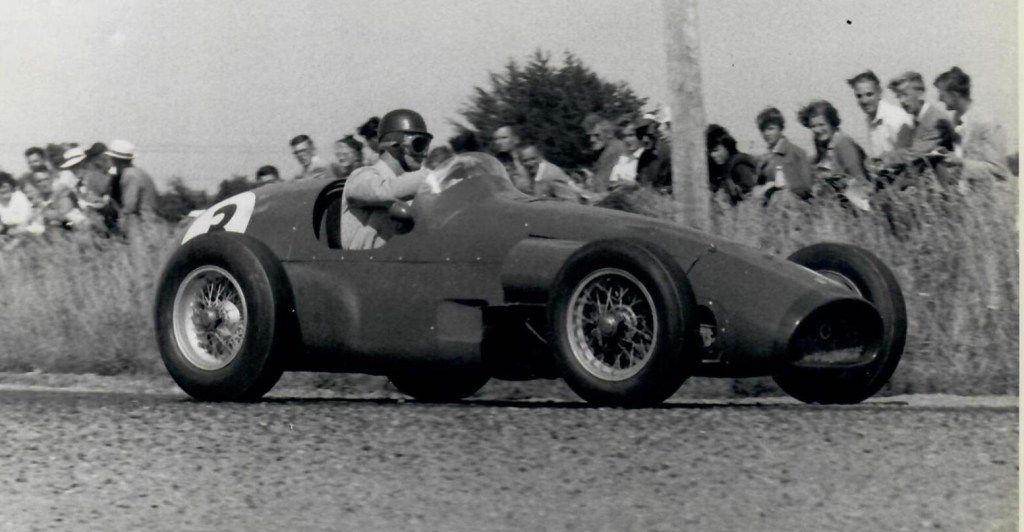
The pair finished one-two in the NZ GP with Parnell ahead of Whitehead after 120 laps/240 miles. Reg repeated the dose at Dunedin, while Whitehead won at Wigram and Ryal Bush.

Parnell in front of Whitehead at Ryal Bush in 1957, Ferrari 555/860 – chassis 555/2, later FL/9002 from 555/1 later FL/9001. Whitehead won from Parnell (Manhire/Woods)
Whitehead’s winning Ferrari at rest, Wigram 1957 (N Logan)
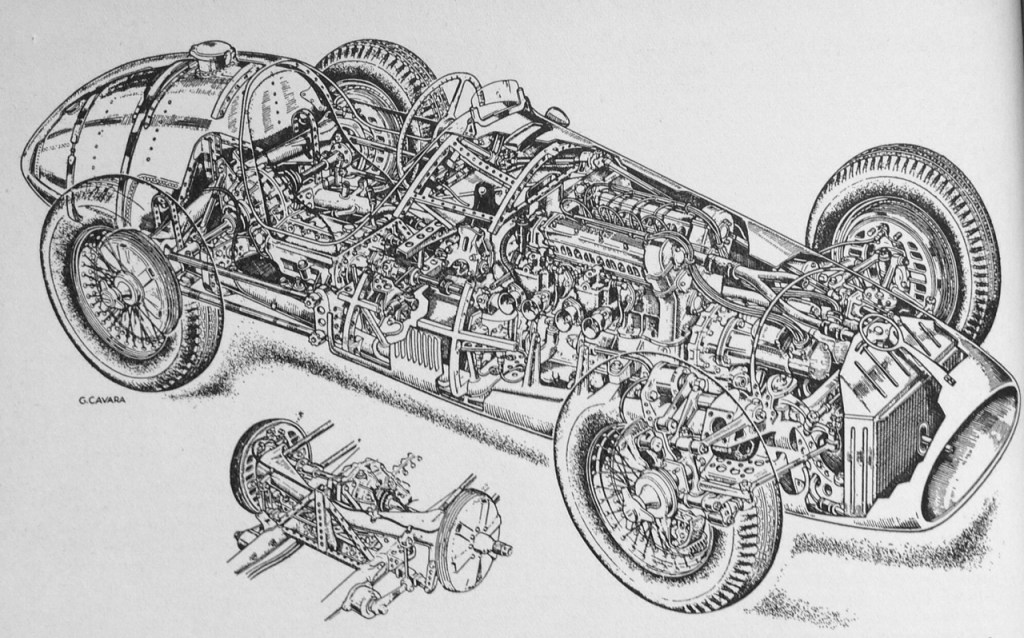
Ferrari 555 Super Squalo (G Cavara)

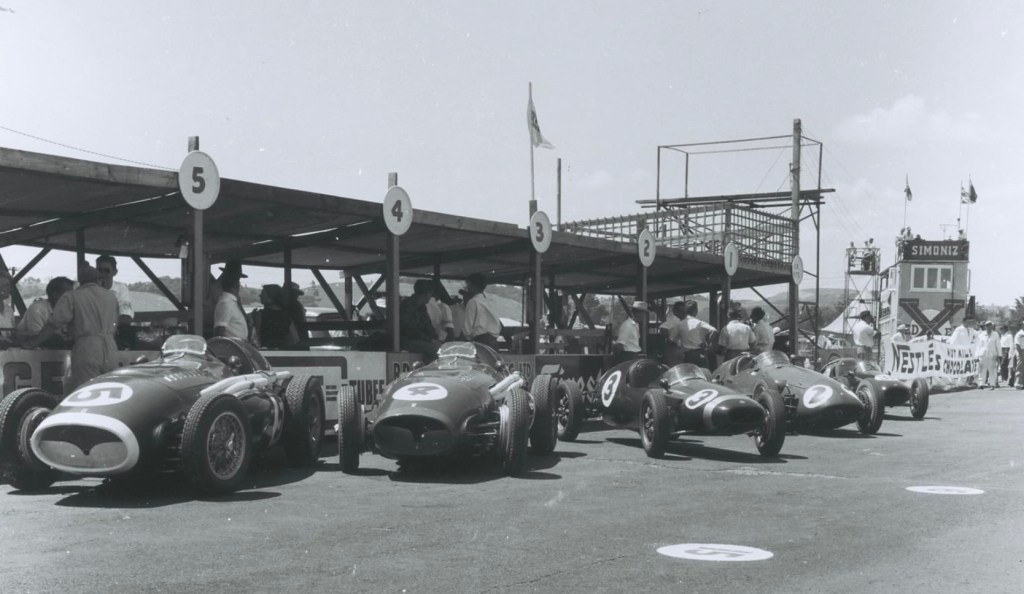
I love this ‘the times are a changin’ shot below, not that said paradigm shift was clear at the time. The big beefy Ferrari 555/860s of Reg Parnell and Peter Whitehead stand at left with no shortage of presence in the Ardmore pitlane during the January 1957 New Zealand Grand Prix weekend.

#3 is Jack Brabham’s Cooper T41 Climax 1.5 FWB, and at far right is Alex Stringer’s similar Cooper T41 Climax FWA 1100 he had leased from the by then dead Ken Wharton. #2 is Horace Gould’s Maserati 250F. It’s the sheer economy of the Cooper’s packaging – and ride height – that grabs the eye.

(B Sternberg)

Parnell won from Whitehead and Stan Jones’ Maserati 250F. Brabham and Stringer were 10th and 12th, while Gould dropped a valve in the 250F. As the Cooper’s Climax engines approached 2-litres the mid-engined packaging advantages became abundantly clear.

More on the Whitehead and Parnell Super Squalo’s here: https://primotipo.com/2015/08/25/arnold-glass-ferrari-555-super-squalo-bathurst-1958/ and on the epochal series of Coopers here: https://primotipo.com/2019/10/04/cooper-t41-43-45-51-53/

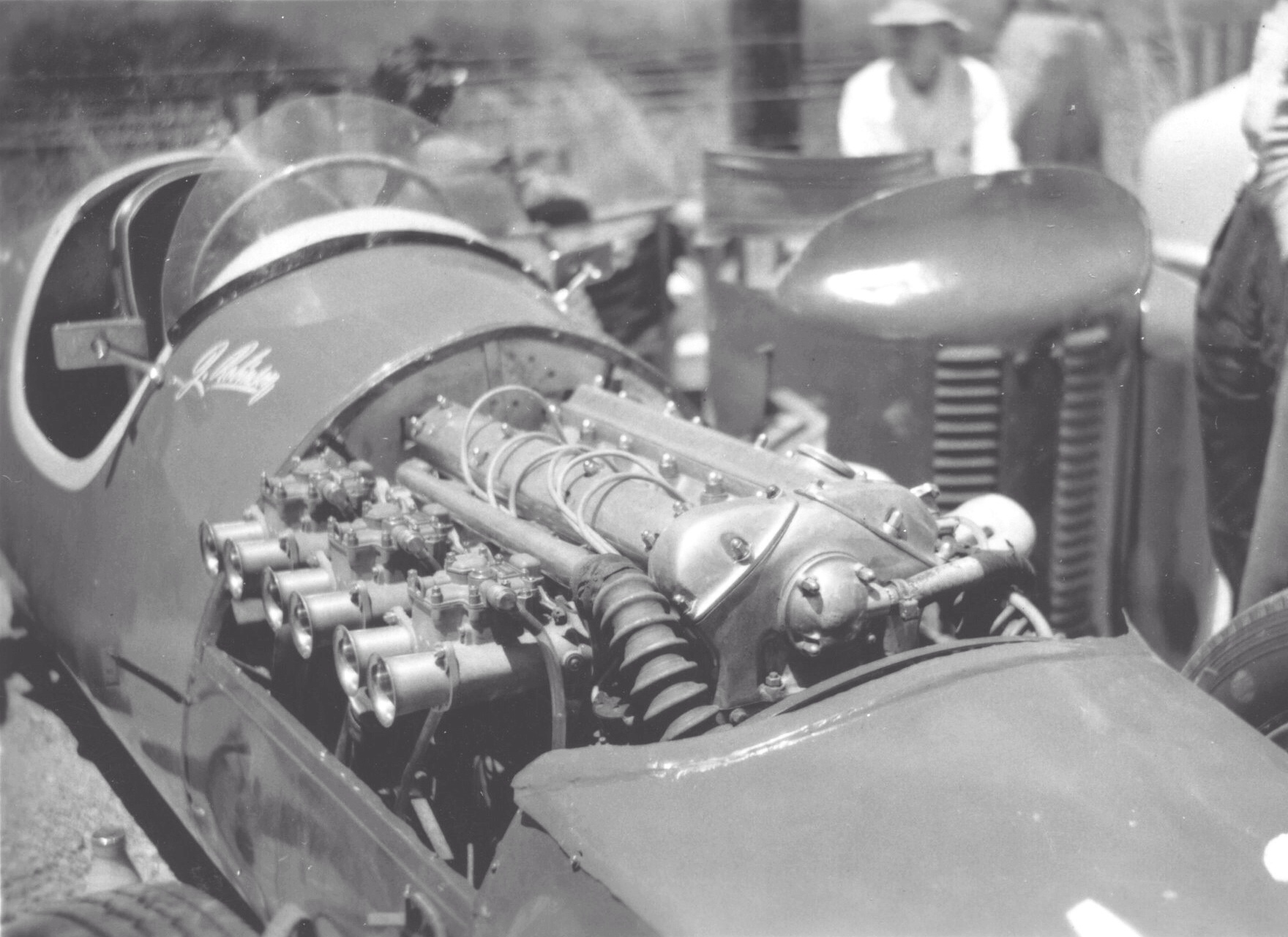
Tom Clark with the engine of his ex-Whitehead Ferrari 555 Super Squalo’s 860 Monza 3.5-litre four-cylinder, DOHC, two-valve engine (unattributed)

Etcetera…

(N Tait)

The front row of the Lady Wigram Trophy grid in 1954. Ken Wharton, BRM P15, Whitehead’s Ferrari 125, then Tony Gaze’ HWM Alta and on the far side, #12 Fred Zambucka, Maserati 8CM.

(G Woods)

Peter Whitehead ahead of Leslie Marr at Ryal Bush in 1956, Ferrari 500/625 and Connaught Jaguar. And below being pushed into the dummy grid.

(J Manhire)
Ryal Bush 1956 (G Woods)
(J Manhire)

Whitehead with the spoils of victory at Ryal Bush in 1956, and below aboard his Ferrari 555/860 in the two shots below in 1957.

(J Manhire)
(J Manhire)

Credits…

John Manhire, Graham Woods, Vic Browne, Tony Adams, Kelvin Brown, Gordon Nimmo, Milan Fistonic, Nigel Logan, Giuseppe Cavara, MotorSport Images, Naomi Tait, Robert Sternberg

Tailpieces…

(MotorSport)

Peter Whitehead didn’t start 1958 as he had the previous four years, but had one more great result before his untimely death.

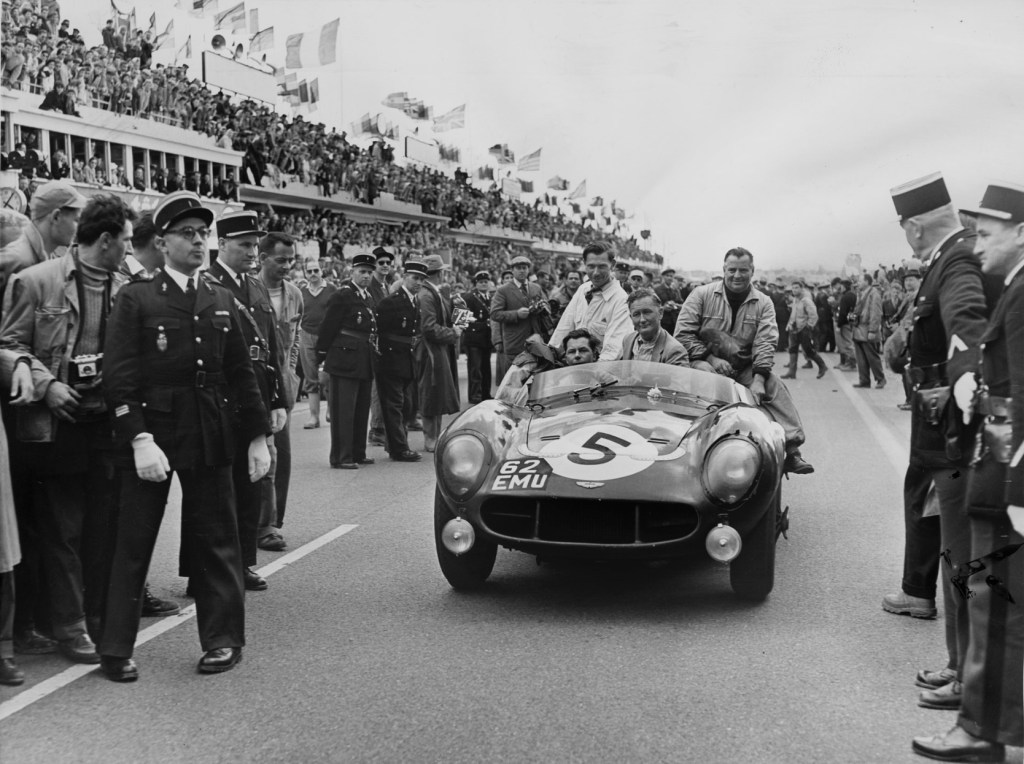
Peter and his half-brother, Graham Whitehead contested the June 1 Nurburgring 1000km in a privately entered Aston Martin DB3S and finished eighth in a warm up to Le Mans, which was held three weeks later. Peter had won at Le Mans with Peter Walker in 1951, taking Jaguar’s first historic win aboard a C-Type.

There, the Whiteheads finished a magnificent second behind the winning Olivier Gendebien/Phil Hill Ferrari TR/58 – the two cars are shown in the shot above. It was an amazing save for Aston Martin after all three of the works DBR1 300s failed to finish.

(MotorSport)

On September 20 the pair were contesting the fourth stage of Tour de France Auto in a 3.4-litre Jaguar Mk1. They were leading the touring car category when Graham lost control on a dark, foggy transport section between Mont Ventoux and Pau. The Jag plunged off a bridge in Cros landing upside down in a stream in a ravine 35 feet below. Poor Peter, still only 43, was killed instantly, Graham survived with minor leg injuries.

It was a sad end for the popular, talented wealthy sportsman who served his country in the war and barely bent a panel on any of the cars he raced…

Finito…

Whitehead is shown here in the cockpit of his ERA during the abortive – and aborted – Parramatta Park, Sydney meeting in 1938 (B King Collection)

English international, Peter Whitehead spent quite a bit of time in Australia during 1938 on business. One hat he wore was as a member of the W&J Whitehead family, Bradford based, wool textiles business, the other was as the driver of his much smaller motor racing enterprise.

His success in ‘chasing sheep’ is unknown but his motorsport endeavours were well rewarded with victories in the Australian Grand Prix at Bathurst, and the Australian Hillclimb Championship at Rob Roy in Victoria’s Christmas Hills. See here; https://primotipo.com/2016/02/24/peter-whiteheads-1938-oz-tour/ and here; https://primotipo.com/2015/04/16/peter-whitehead-in-australia-era-r10b-1938/

As you will appreciate from the articles, Whitehead was in Australia long enough, and travelled broadly enough, for his views to be fully formed on the state of motorsport play at that time.

(B King Collection)
Blurry and ‘Hatless’ Whitehead during the Australian Hillclimb Championship meeting at Rob Roy in June 1938. He did FTD and set the course record at 31.46 seconds on the still unsealed course which opened a year earlier (L Sims Collection)

Peter Whitehead was spot on with his observations really.

Picking up his points in the order they were made, the Confederation of Australian Motor Sport (CAMS) was formed in 1953 to manage, organise and regulate (sic) the sport on a national basis. Perhaps without World War 2 a more focused governing body would have replaced the Australian Automobile Association earlier.

Handicap racing continued throughout Australia well into the 1950s. We had a relatively small number of racing cars spread over a vast continent. Handicaps ensured everybody had a chance of victory, by this means, competitors were prepared to travel vast distances by road, rail or coastal ships to race.

Then the only Australian racers who competed ‘regularly’ on bitumen roads were the West Australians on their Round the Houses road courses in various country towns. Allan Tomlinson’s stunning Lobethal AGP win in 1939 is in part credited to his skill on such surfaces relative to the east coast based competitors, aboard his MG TA Spl s/c. See here; https://primotipo.com/2020/12/04/tomlinsons-1939-lobethal-australian-grand-prix/

A series of races to attract international competitors did eventually happen, formally with the Tasman Cup – seven/eight races in NZ and Australia in January-February each year – in 1964, and informally with a series of international races for the better part of a decade before that. Peter Whitehead returned and raced a couple of Ferraris here during that period. See here; https://primotipo.com/2020/10/10/squalo-squadron/

The bad-blood, combative relationship between the New South Wales Police and the racing community lasted well into the 1950s and is a story in itself.

This piece was written by Kenneth Maxwell earlier in the trip and was published in the June-July issue of The Car.

The Yarra Falls building site in 1918. Melburnians will note the roofline of the Convent of the Good Shepherd on the north side of Johnston Street, that building is still there on the wonderful Collingwood Children’s Farm site; a visit to rural Australia in inner Melbourne is worth a trip for any international tourist. The Falls site was redeveloped, keeping many of the original buildings, for business and residential use several decades ago (Picture Victoria)

Etcetera…

The Whiteheads were customers of Australian wool from the earliest of times. The contents of an article in The Argus (Melbourne) appealed to the economist in me. The piece reported on the business trip of Henry Whitehead, a relative of Peter Whitehead, in January 1920 who is described as having interests in “three of the largest of the great Yorkshire textile works.”

Whitehead’s visit was as a director/advisor of Yarra Falls Spinning Co Pty. Ltd. at 80-110 Trenerry Crescent, Abbotsford – on the shores of the Yarra River in Melbourne where wool was scoured/cleaned – and he commented that “Although Australia is the greatest wool producer in the world she could not have competed with England before the war in the marketing in Australia of goods manufactured out of her own raw materials…But times have changed, and today Australia has the opportunity of making more of her own goods, and particularly of making up her own raw materials.”

Funnily enough, a century on, we are still better at shearing sheep and digging holes in the ground (mining) than manufacturing, that is, value adding to the raw materials we export to others.

Henry Whitehead spoke of the need for immigration of skilled labour to aid growth of the industry and encourage further British investment.

The Yarra Falls Spinning Company was then capitalised at £200,000, “the great bulk of which is Australian money.” The other directors, with the exception of Whitehead, were Australian, the factory was commenced in 1918 and employed 200 in 1920. The only limiting factor in expanding the business right then beyond relatively simple wool scouring and combing, to the production of worsted cloth (for clothing) was the difficulty of getting specialised weaving plant and equipment made, and imported from the UK.

So, Peter Whitehead would have been busy, apart from his racing…

Credits…

The Car, December 1938 via the Bob King Collection, Leon Sims Collection, Ted Hood, The Argus January 1, 1920, Picture Victoria

Tailpiece…

(T Hood)

Peter Whitehead fettles his ERA #R10B in frigid Canberra weather in June 1938. He was taking part in annual speed record attempts in the national capital, weird though that seems.

Mind you, there was a round the houses taxi race in Canberra not so many years ago, the Canberra 400 from 2000-2002.

Mark Skaife, Holden VX Commodore V8 Supercar en-route to winning the 2002 Canberra 400, Parliament House in the background (unattributed)

Finito…

(Classic Auto News)

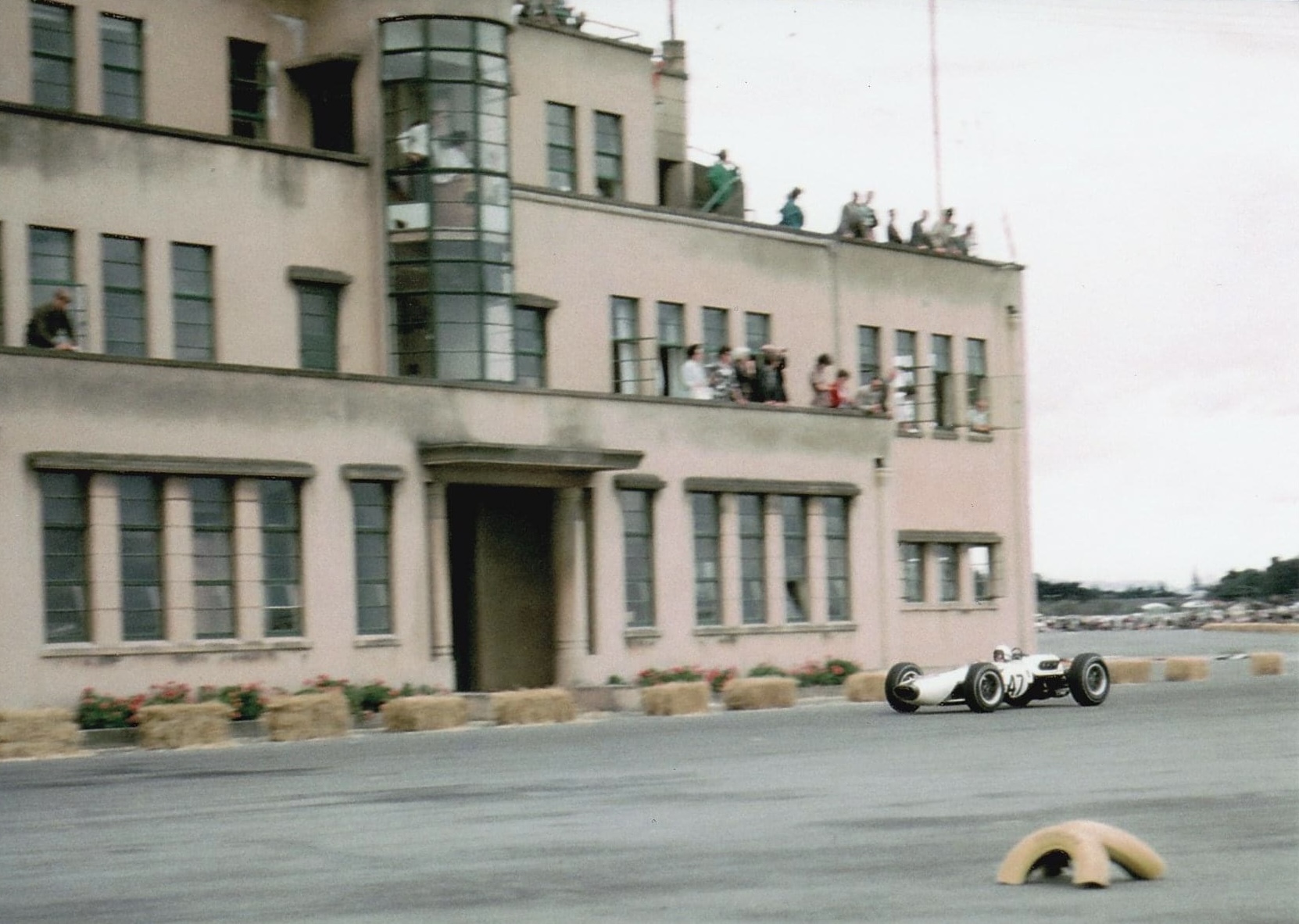
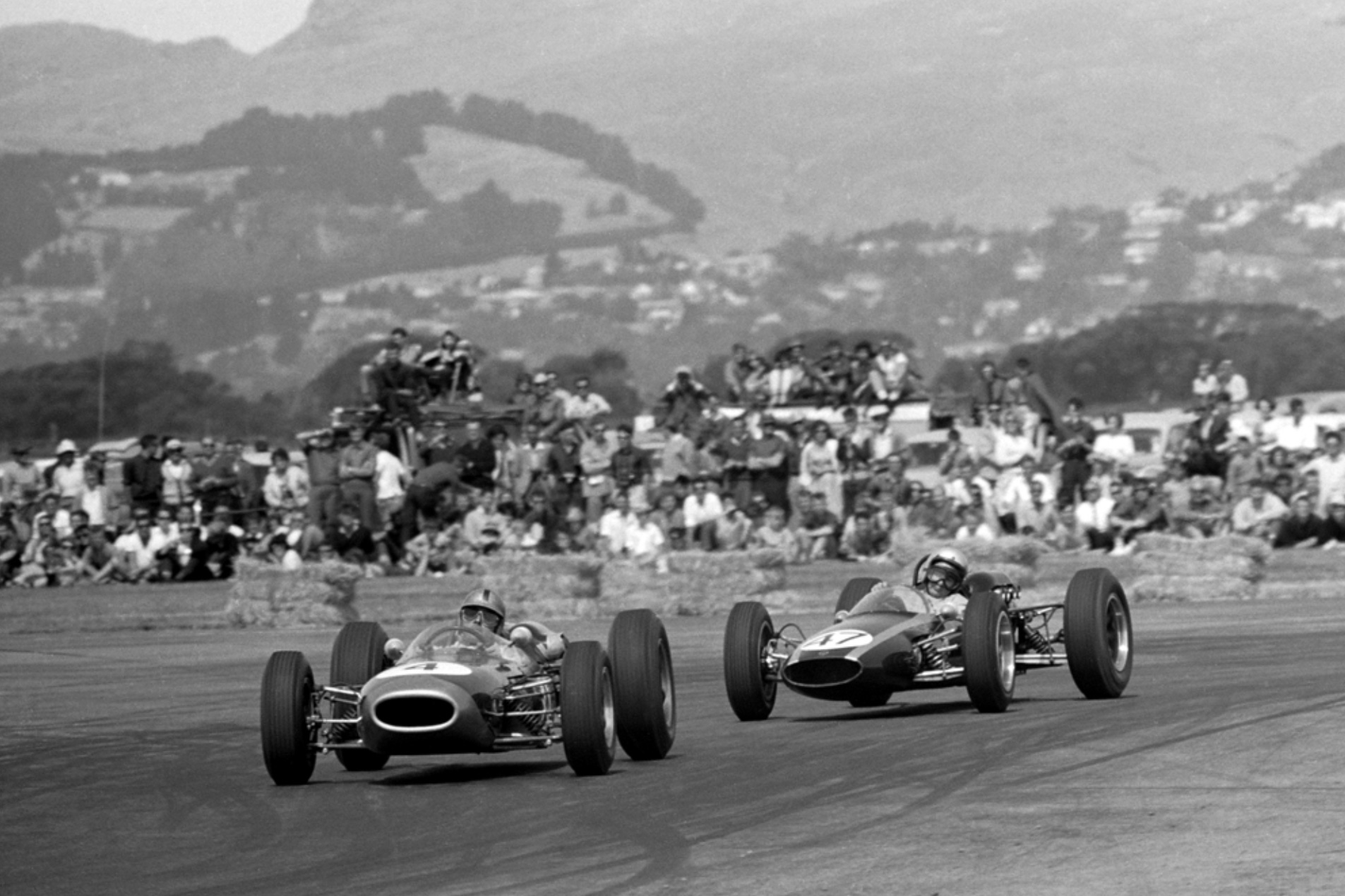
Bruce McLaren blasts past the Royal New Zealand Airforce control tower building during the 1965 Lady Wigram Trophy.

The reigning Tasman Cup champion finished second in his Cooper T79 Climax to Jim Clark’s Lotus 32B Climax with Jim Palmer’s Brabham BT7A Climax third. Clark won the title that summer with wins in four of the seven rounds.

Wigram Aerodrome was located in the Christchurch suburb of Sockburn, now named Wigram/Wigram Skies. It operated as an airfield from 1916, and as an RNZAF training base from 1923 to 1995.

Sir Henry Francis Wigram was a successful Christchurch businessman, politician and promoter of the fledgling aviation industry. He gifted land for the airfield to the Canterbury (NZ) Aviation Company (Sockburn Airport), later the land was re-gifted to the RNZAF.

The Lady Wigram Trophy was named in his wife’s honour.

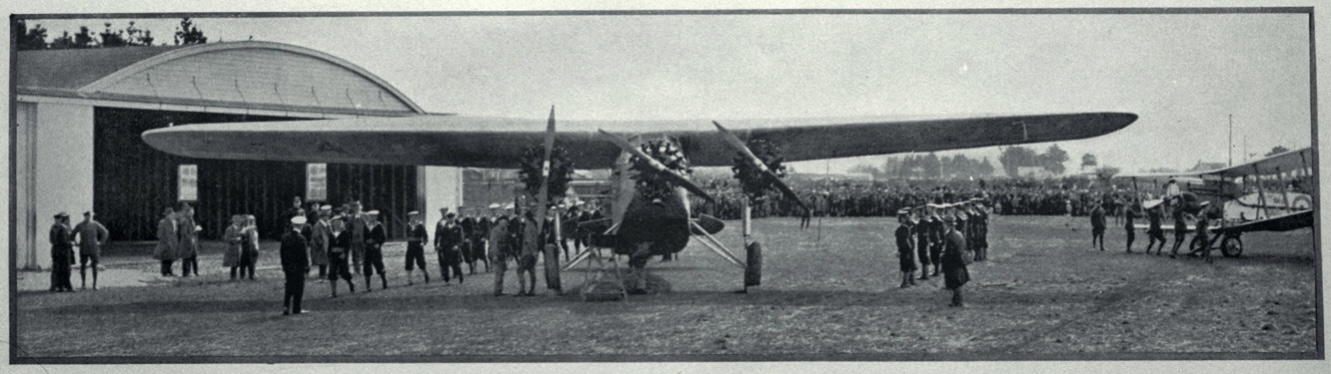
Charles Kingsford Smith’s Fokker F.VII Trimotor Southern Cross at Wigram having made the first Tasman flight from Sydney to Christchurch on September 10, 1928 (discoverywall.nz)


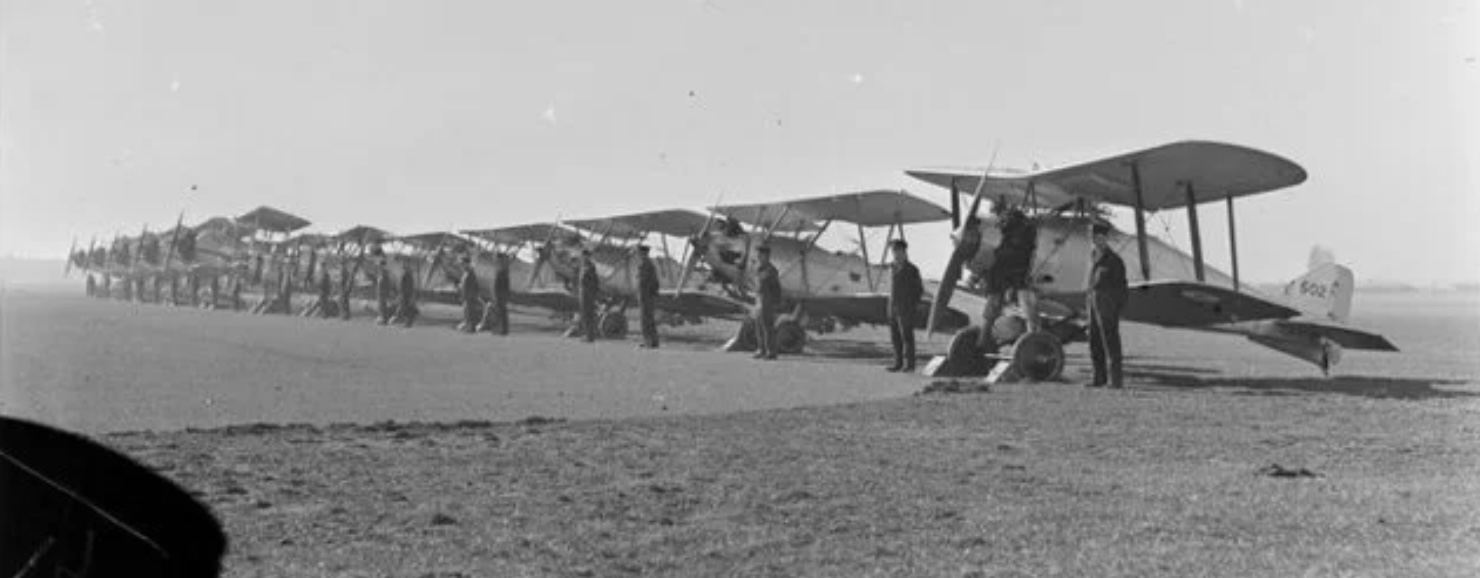
Wigram August 1937. The first aircraft is a Gloster Grebe, others include De Havilland Tiger Moths, with Vickers Vildebeests at the end. Happy to take your input/corrections (natlib.govt.nz)

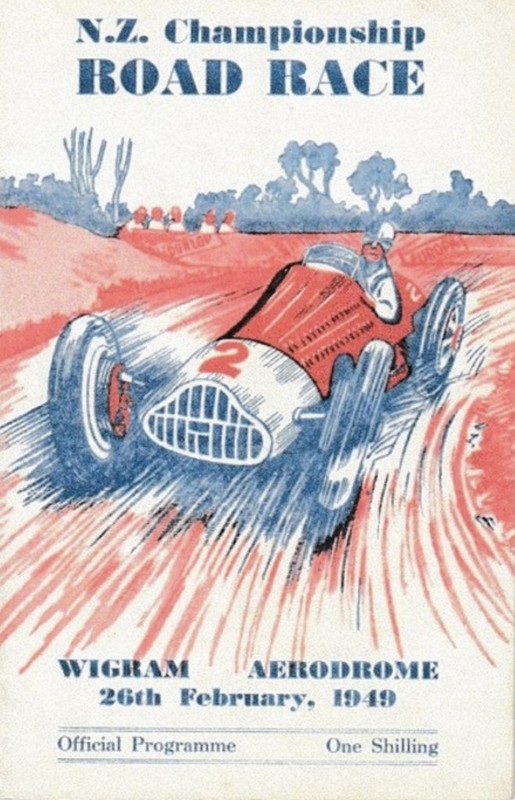
The first motor racing event took place at Wigram in 1949 when the Canterbury Car Club organised the NZ Championship Road Race meeting on February 26.

Winners of the Lady Wigram Trophy subsequently included many internationals such as Peter Whitehead, Archie Scott Brown, Ron Flockhart, Jack Brabham, Bruce McLaren, Stirling Moss, Jim Clark, Jackie Stewart and Jochen Rindt. Other F1 drivers who won around the hangars include Graham McRae, Larry Perkins and Roberto Moreno.

Suss this series of excellent Talk Motorsport articles which tell the Wigram motor racing tale in full; Wigram Motor Racing: The First Decade | Talk Motorsport

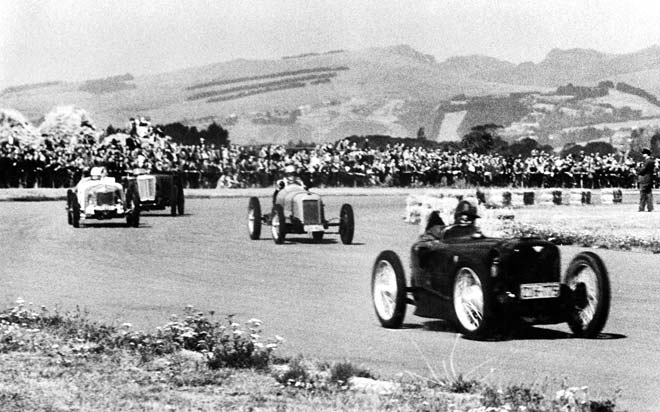
The 1949 feature, the NZ Championship Road Race was won by Morrie Proctor’s Riley 9 at the far left of this photograph.

The legendary Ron Roycroft leads in his ex-works/Sir Herbert Austin, Austin 7 Rubber-Duck s/c from Hec Green in a Wolseley Special with Bob Christie aboard an MG TA Spl at the tail of this group.

(teara.govt.nz)

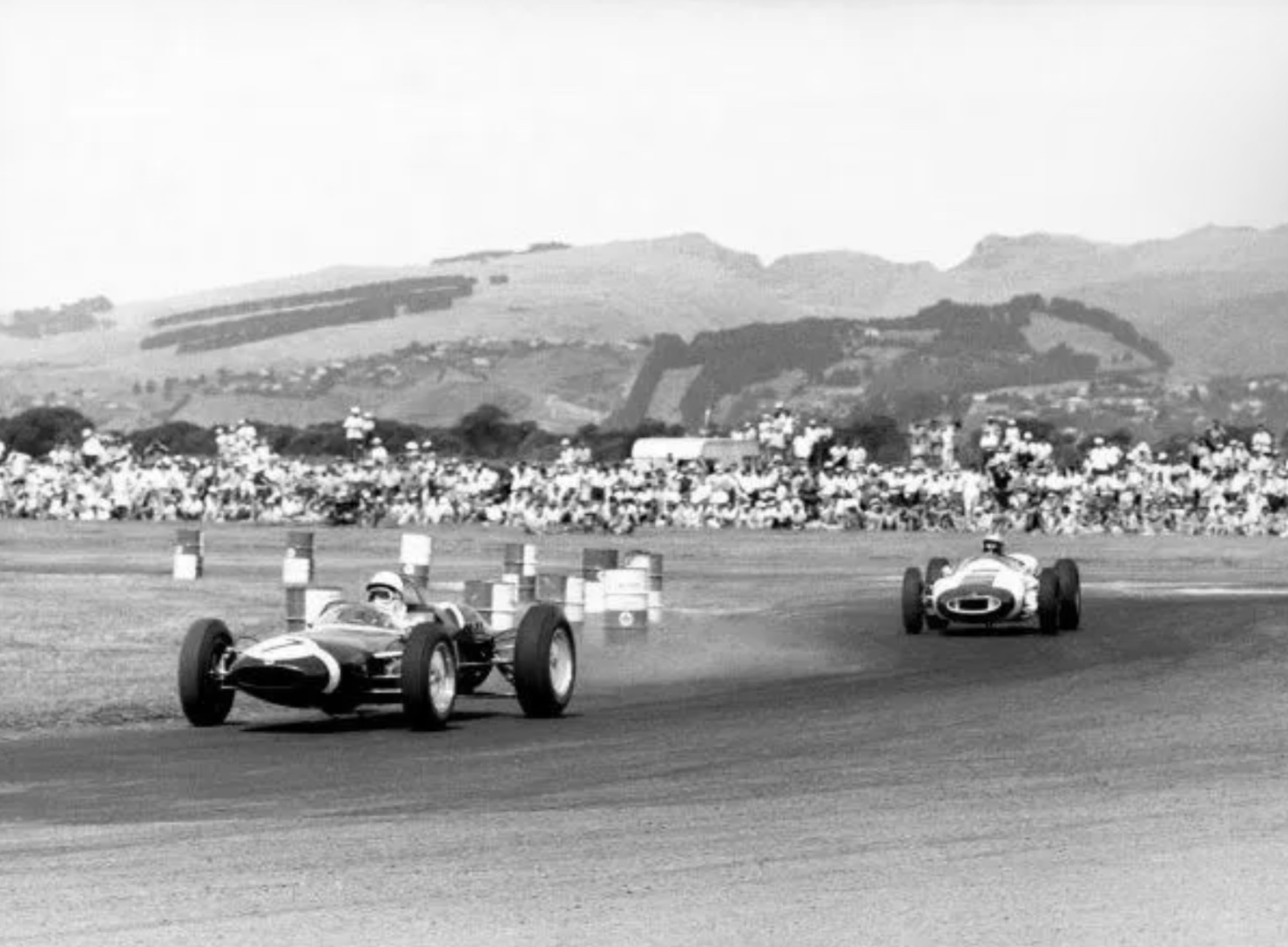
Jack Brabham leads Bruce McLaren, Brabham BT7A Climax and Cooper T70 Climax, at Wigram with the Port Hills forming a lovely backdrop in 1964.

Bruce won the 44 lap race from Jack with Denny Hulme’s works Brabham BT4 Climax third.

McLaren won the inaugural Tasman Series. His three wins in New Zealand matched Brabham’s in Australia, but Bruce’s 39 points haul trumped Jack’s 33. 

Brabham was the dominant marque that summer, Graham Hill and Denny took a race win apiece aboard their BT4s giving Motor Racing Developments a total of five wins in the eight rounds.

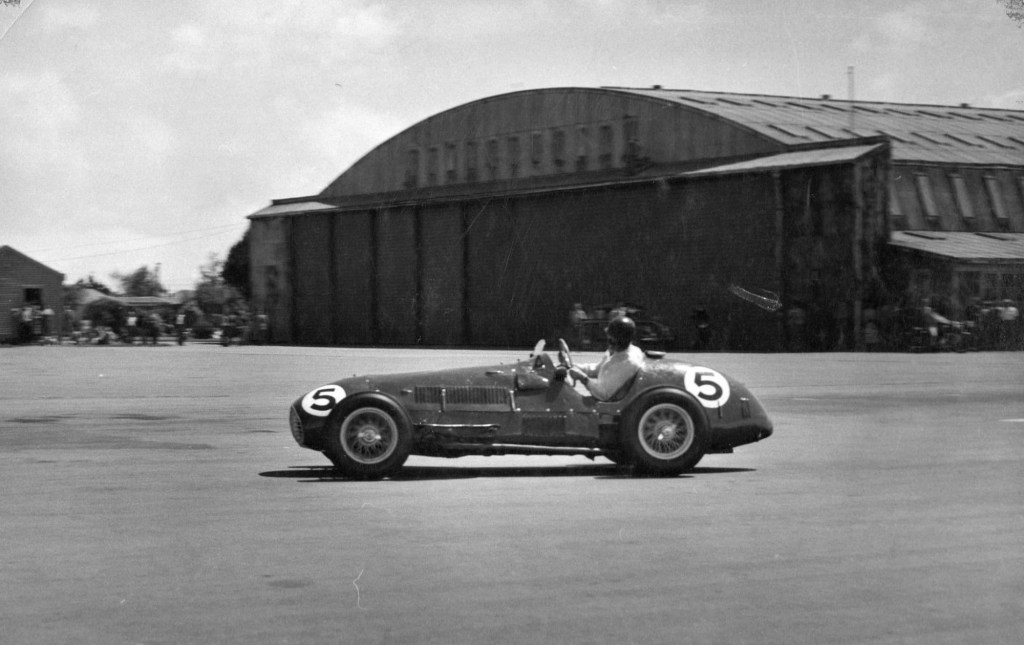
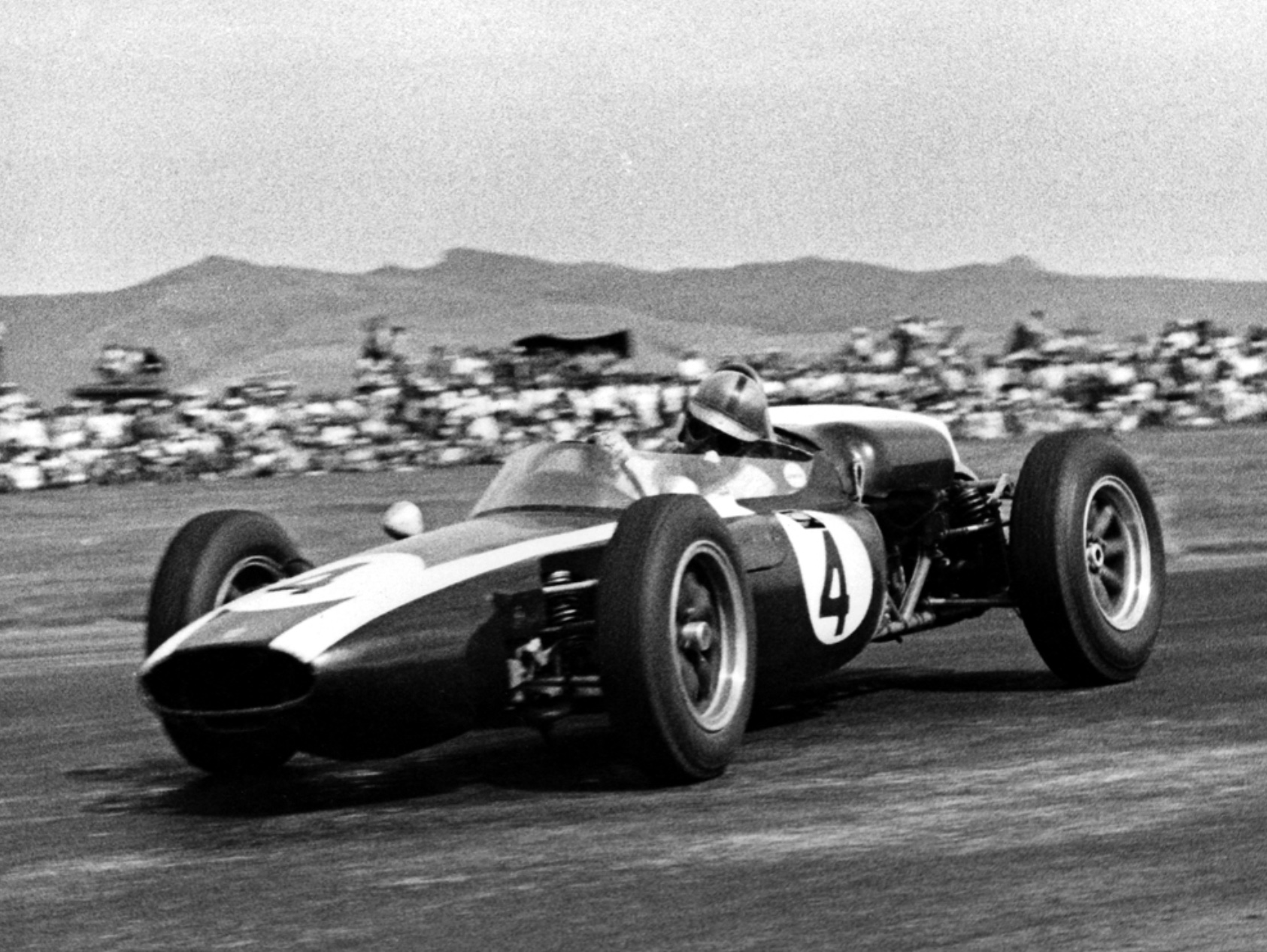
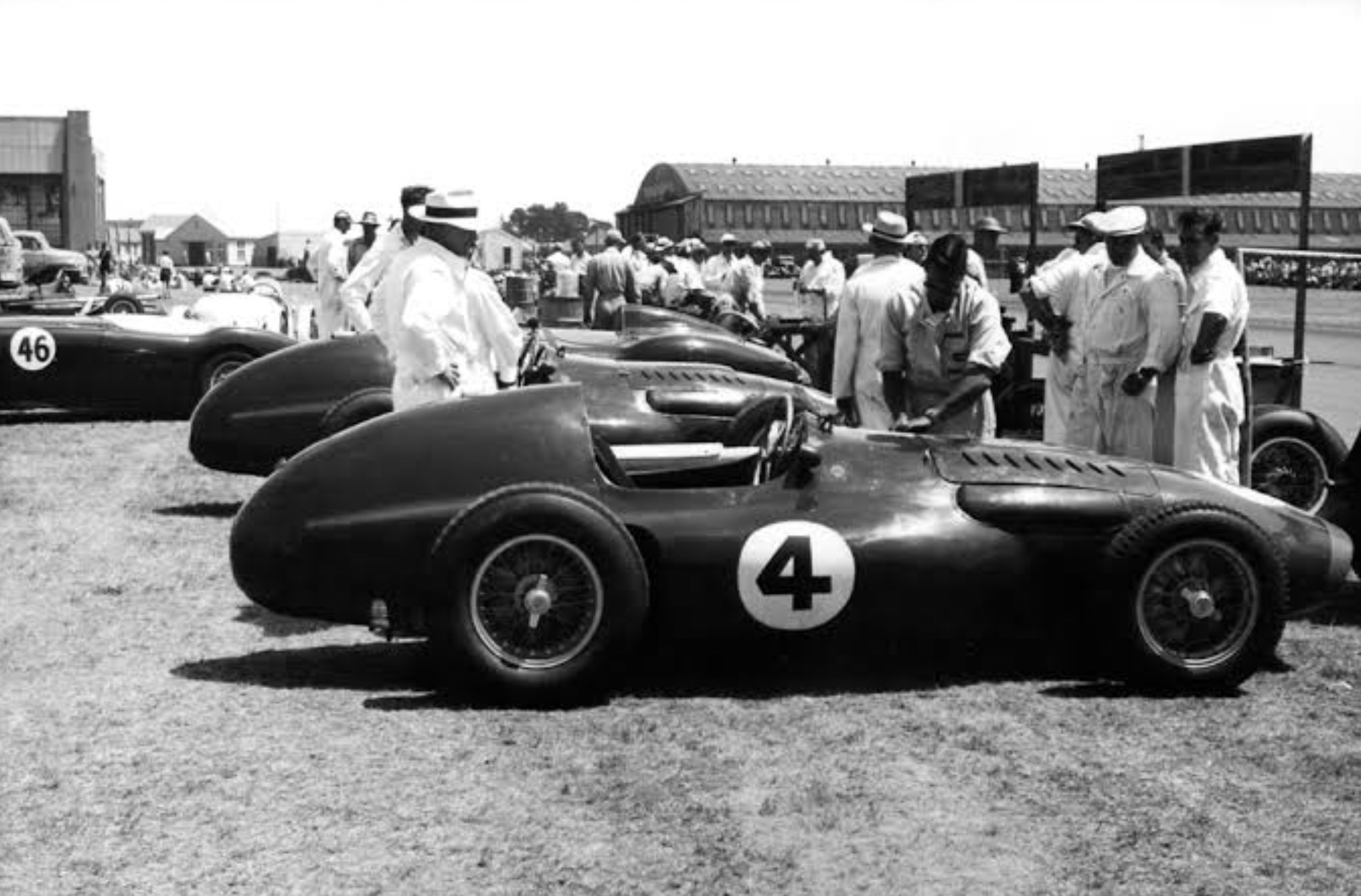
Reg Parnell’s 3.5-litre Ferrari 555 Super Squalo alongside teammate Peter Whitehead’s similar car in the Wigram paddock – note the hangars – in 1957.

Whitehead took the win from Parnell with Horace Gould’s Maserati 250F third. See here for more these cars; Squalo Squadron… | primotipo…

1957 starting grid panorama (I Tweedy)

BRM’s Ron Flockhart won the 1959 race from pole in a convincing display, he gets the jump in the P25 here with the obscured Coopers of Brabham and McLaren immediately behind, and Syd Jensen’s at right.

Frank Cantwell’s Tojeiro Jaguar is on the left, then Ross Jensen’s light coloured sharknose Maserati 250F, then Tom Clark’s Ferrari 555 Super Squalo #22.

Jack Brabham crouched in the cockpit of his Cooper T55 in typical style during the 1962 running of the Wigram classic.

Stirling Moss won again in his final New Zealand victory, aboard a Rob Walker Lotus 21 Climax (below) from Brabham, with John Surtees third in a Cooper T53 Climax. Jack and John used 2.7-litre Indy FPFs, while Moss’ was a 2.5.

Moss motors away in Rob Walkers’ Lotus 21 Climax #935, who is aboard the chasing Cooper T53? (MotorSport)

We have lift-off in 1967.

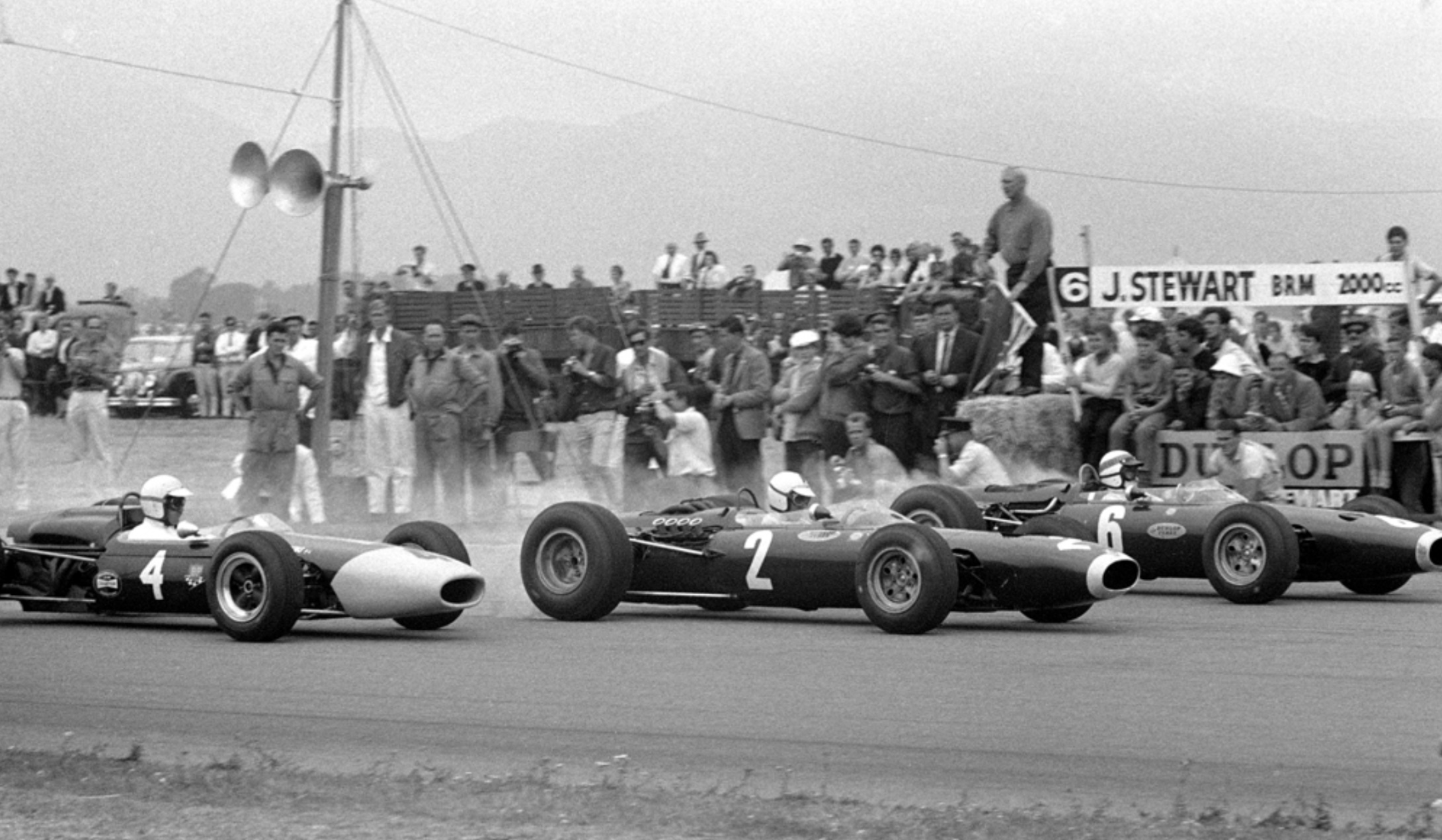
Frank Gardner’s four cylinder Coventry Climax FPF was going to struggle against the 2.1-litre BRM V8s of Dickie Attwood and Jackie Stewart on the right.

Frank finished a good fourth in a series of great speed and reliability, but up front at Wigram were three different V8s; Jim Clark’s 2-litre Lotus 33 Climax, Attwood’s BRM P261 and Denny Hulme’s 2.5-litre Brabham BT22 Repco.

Clark won the series with three wins from six championship rounds. Stewart won two and Jack Brabham, Brabham BT23A Repco one. The BRMs were quick, as they had been in 1966 – Stewart won the Tasman that year – but the transmissions wouldn’t take the additional punch of the V8s, which that year were bored out to 2.1-litres, rather than the 1.9-litre variant of the original 1.5-litre F1 V8 which did the trick the year before.

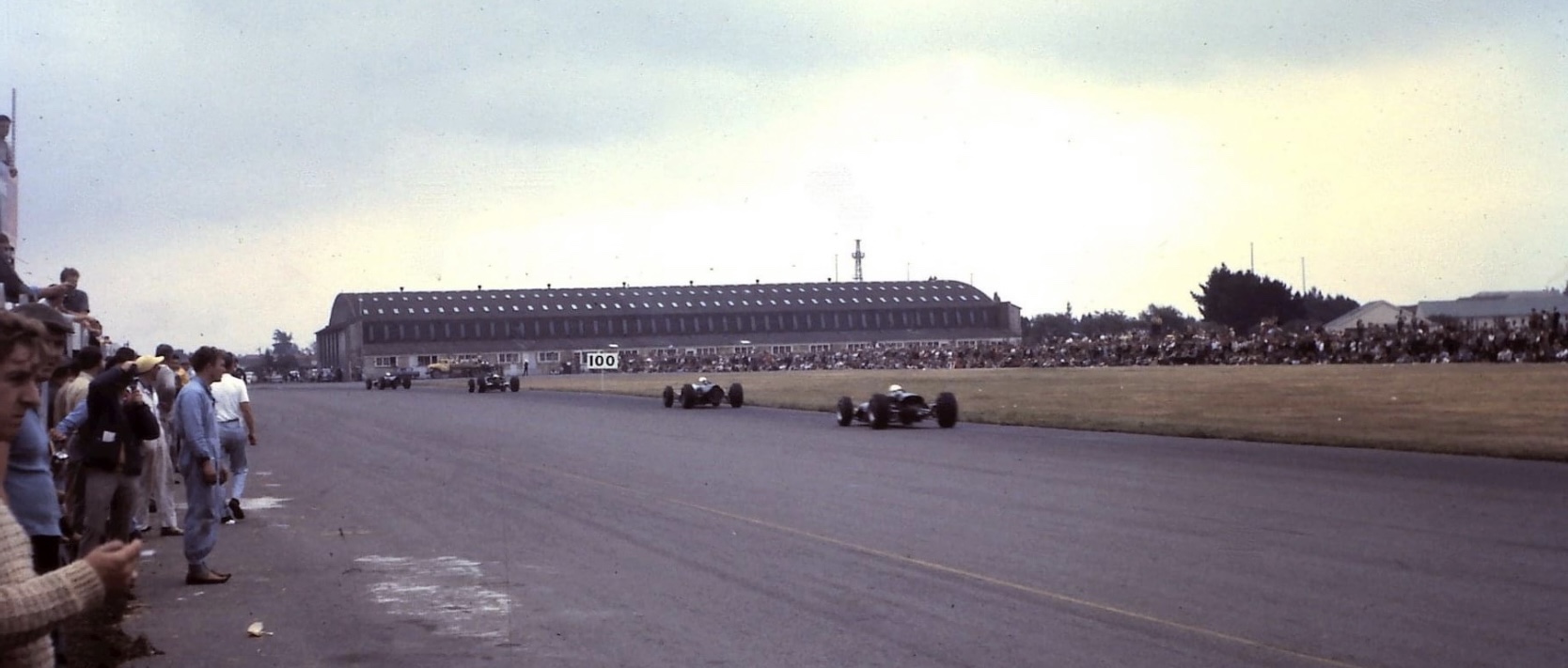
The cars are on the start-finish straight and lining up for Hangar Bend. Look closely, there are two BRM P261s in the mix so it’s probably 1966 or 1967, not 1968 I don’t think.

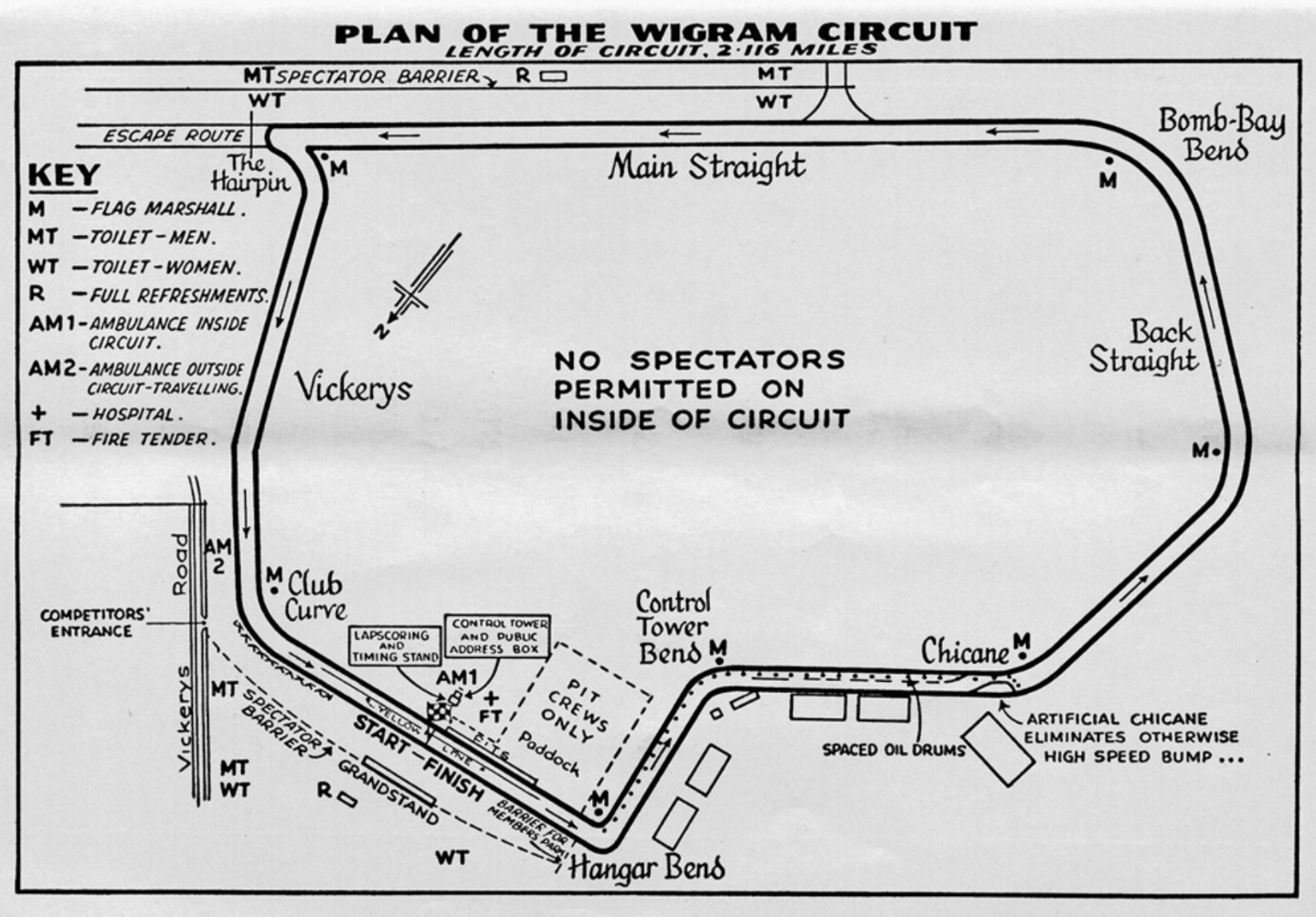
Christchurch enthusiast Geoff Walls remembers this era well, “It was the most fabulous fast circuit as those airfield situations can be, particularly rounding Bombay Bend onto the main straight/ runway at 100mph before really opening up for the length of the straight.”

“The Lady Wigram Trophy weekend was always in the Summer school holidays so on the Thursday, practice day, and again on Friday, some mates and I used to bike to the airfield, hide our bikes in the dry grass covered ditch parallel with the main runway, crawl through the wire fence and then sprint across the track at the right time and into the middle of the circuit where all the cars and drivers were for the day, great stuff!”

“In later years the Country Gentlemen’s Historic Racing and Sports Car Club used to hold a race weekend there with 250 entries and I was Clerk of the Course, also great occasions on the circuit. That was a great social occasion too and I do have photographic evidence!!”

(G Danvers)

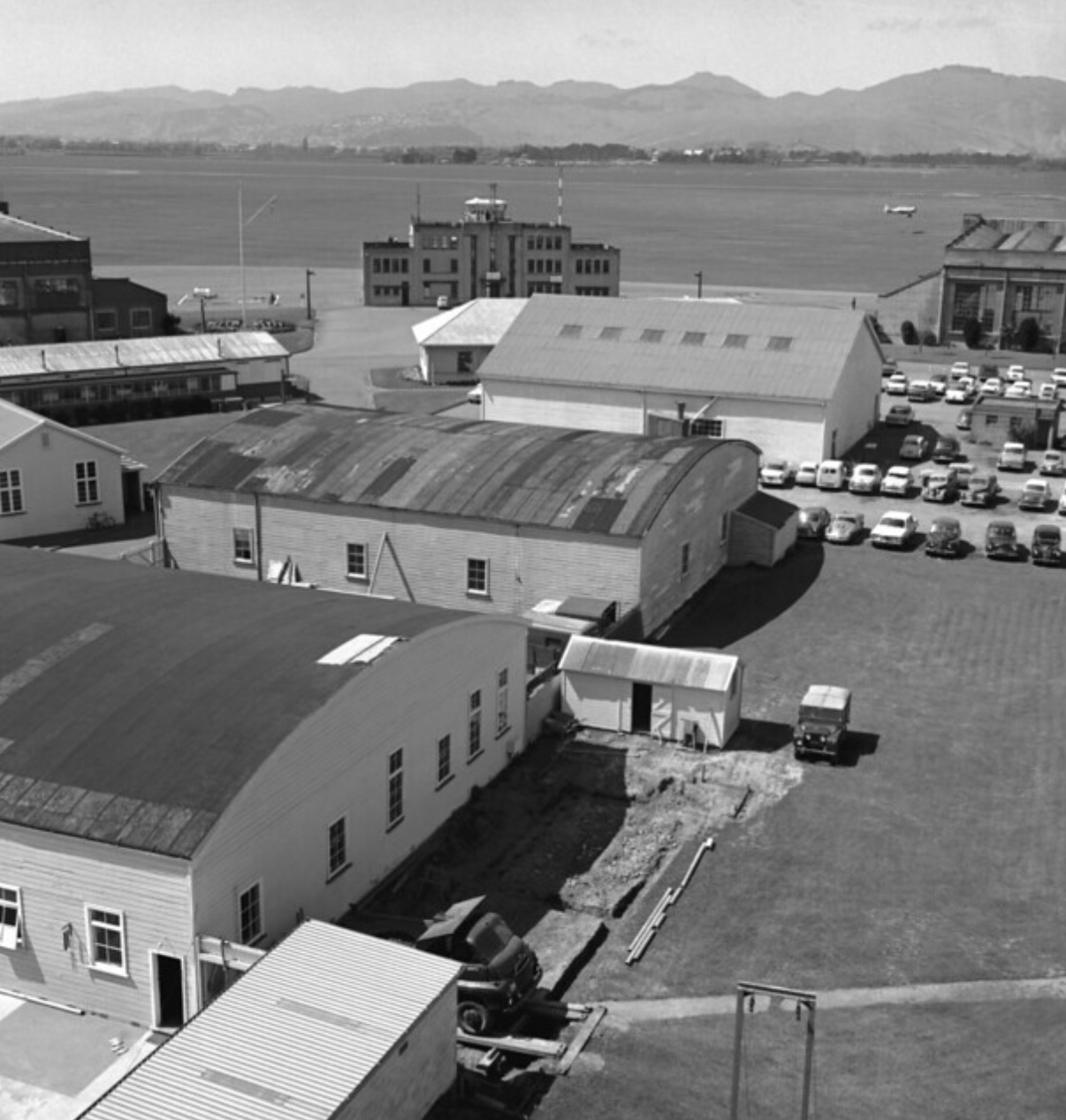
This photograph was taken in October 1968 from the top of the water tower, looking east towards the control tower. Don’t the hangars in the foreground make the control tower building which looms large over Bruce McLaren in our opening shot seem small!

(T Marshall)

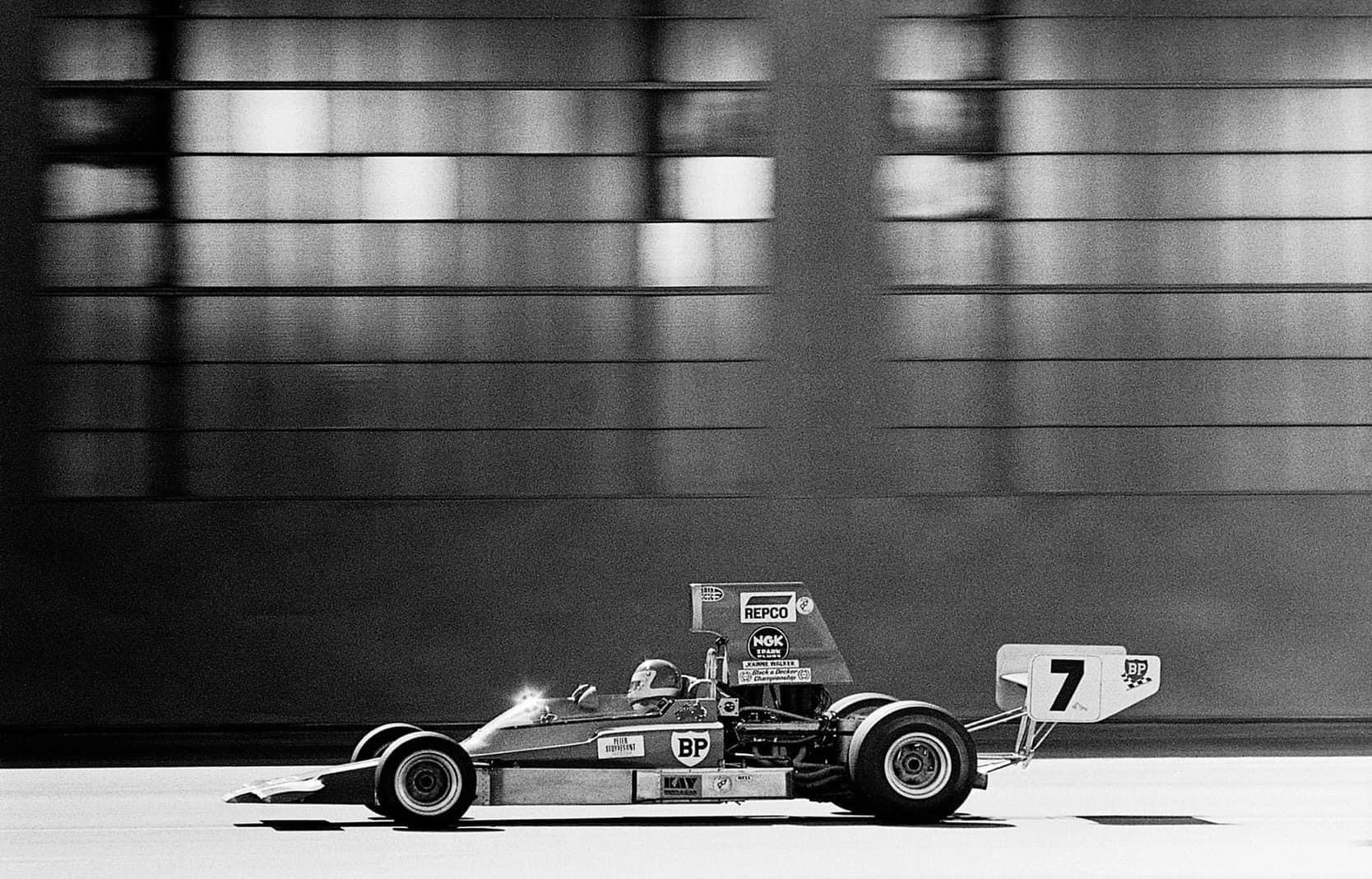
Adelaide Ace John Walker – later 1979 Australia GP and Gold Star winner – with Repco-Holden F5000 V8 fuel injected thunder echoing off the hangar walls.

It’s the ’74 Tasman round, the tremendously talented Terry Marshall has captured the perfect profile of JW’s unique Repco-Holden powered Lola T330 with a perfect-pan. His DG300 Hewland was hors d’combat after 20 laps. John McCormack won in another Repco-Holden powered car, Mac’s Elfin MR5 was timed at 188mph on Wigram’s long straight, the two VDS Chevron B24 Chevs of Teddy Pilette and Peter Gethin were second and third.

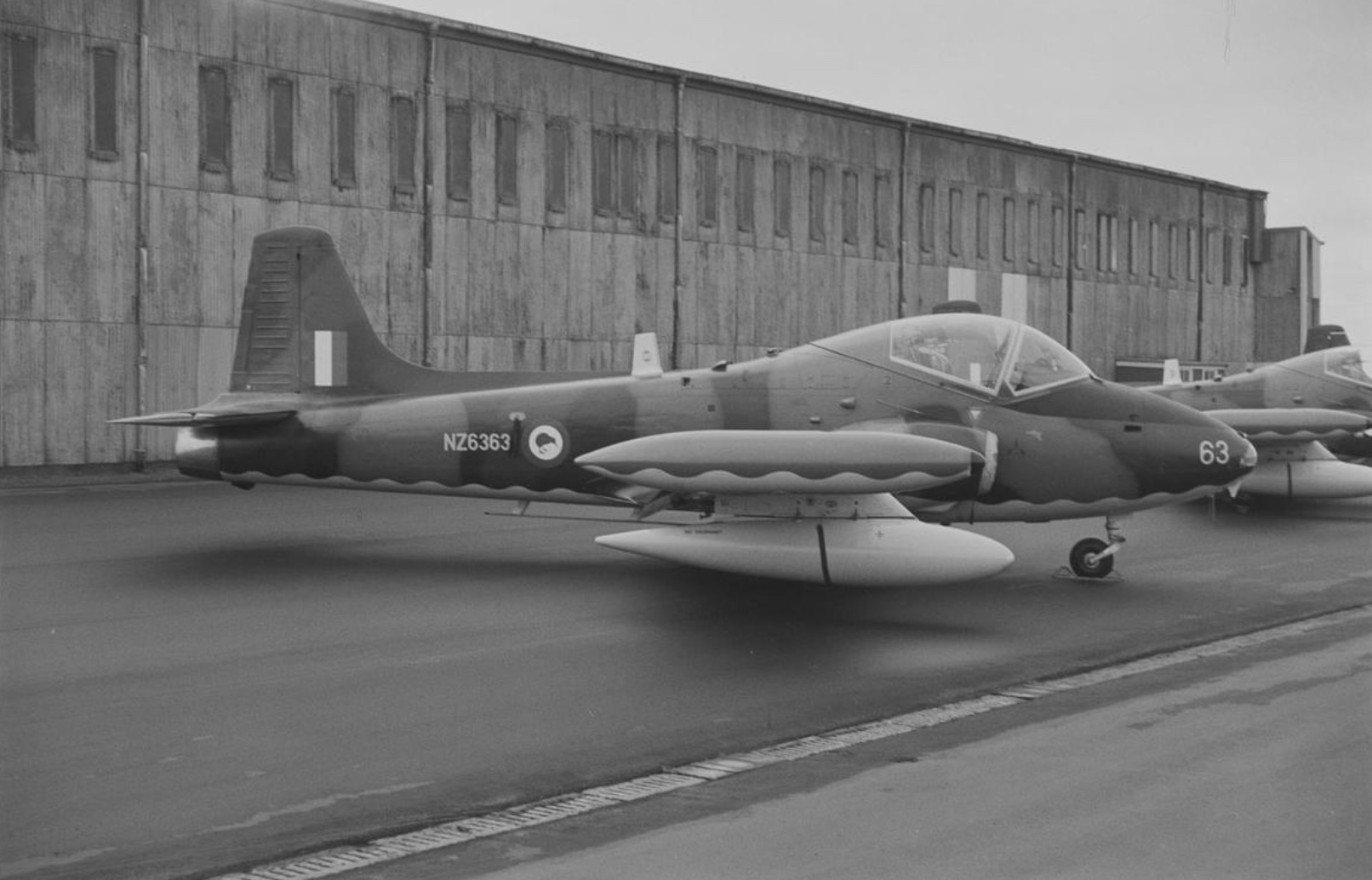
Six months earlier, closeby, this BAC 167 Strikemaster Mk88 was pictured in repose. The jet-powered trainer and light attack machine had bones dating back to the 1950 Percival Provost.

(John Page)


(T Marshall)

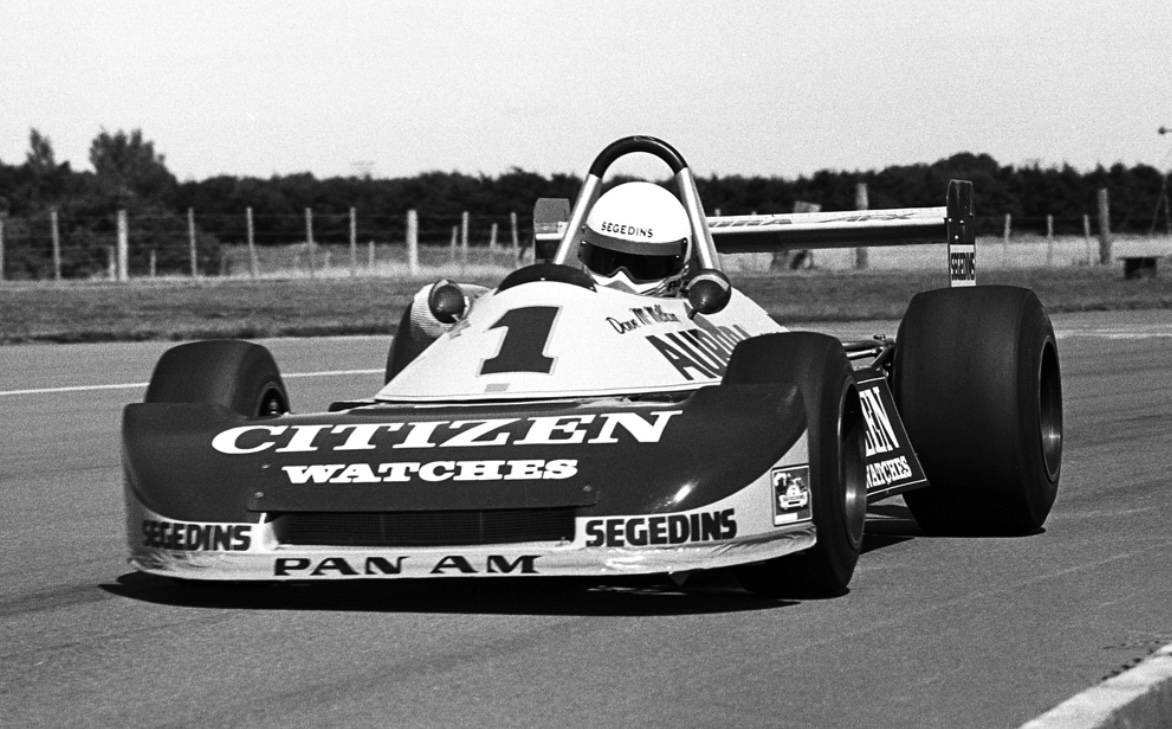
Dave McMillan won two Wigram Trophies on the trot in 1979 and 1980 aboard one of Ron Tauranac’s most successful designs, a Ralt RT1 Ford BDA Formula Atlantic/Pacific.

They were good wins against strong opposition too. He won both races in 1979, in front of Teo Fabi and Larry Perkins in one race, and Fabi and Brett Riley in the other. In 1980 he was in front of Steve Millen, second in both, and Ian Flux and David Oxton in third.

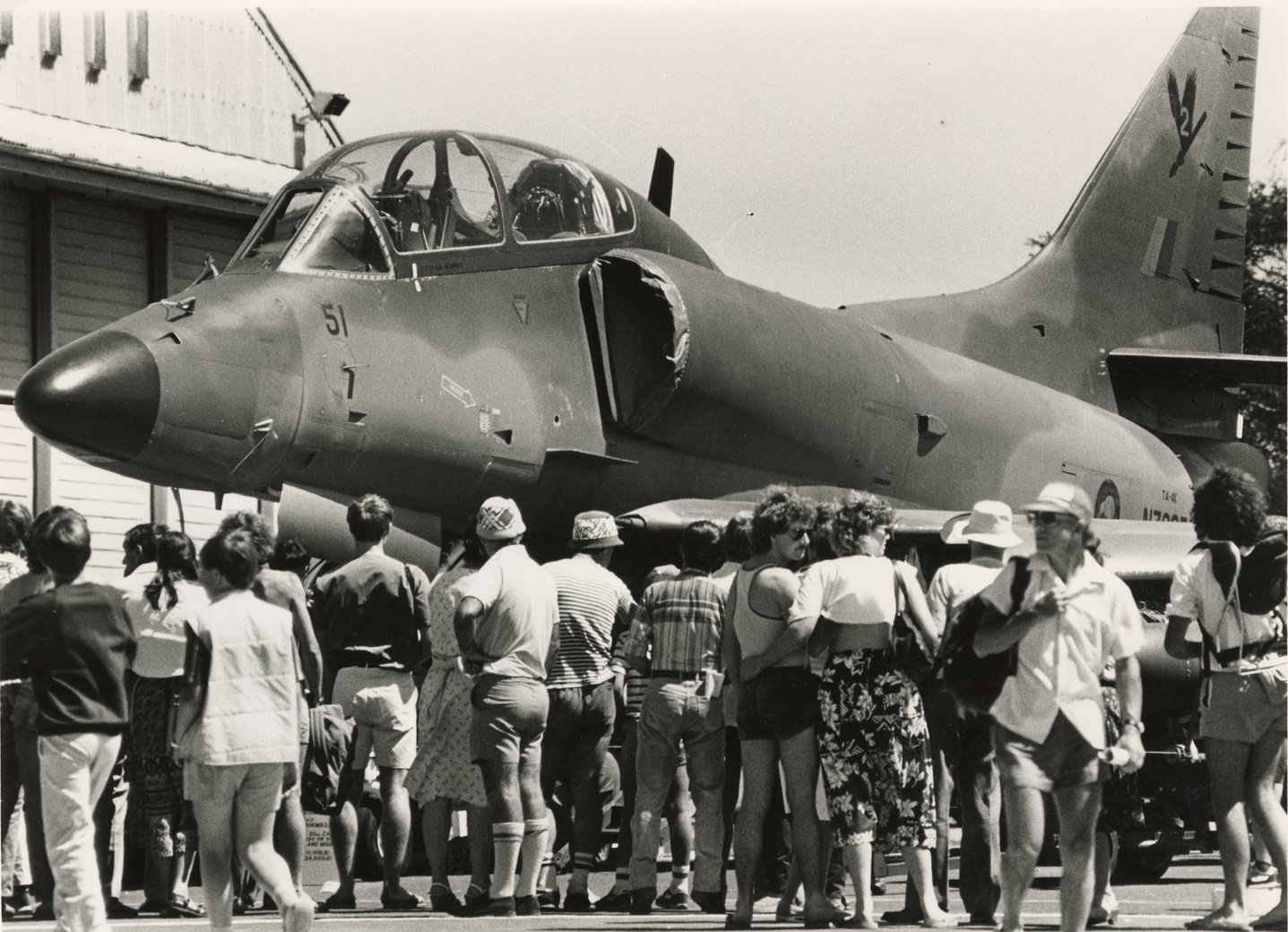
An RNZAF Douglas A-4 Skyhawk single-seat subsonic fighter on display during the Wigram Wings and Wheels Exhibition February 1986 weekend.

(canterburystories.nz)

Credits…

Classic Auto News. The talkmotorsport.co.nz website provided most of the photographs, I’d love to provide credits to the snappers concerned if any of you can oblige. Terry Marshall, John Page, canterburystories.nz, Isabel Tweedy, the Gary Danvers Collection, discoverywall.nz, teara.govt.nz

Tailpieces…

Piers Courage, Brabham BT24 Ford DFW alongside the similarly powered Lotus 49Bs of Graham Hill and Jochen Rindt at Wigram in January 1969.

Chris Amon’s Ferrari Dino 246T is behind Jochen, Frank Gardner, Mildren Alfa V8 behind him.

Perhaps the Tasman Cup high point was 1968 when the field included two works Lotus 49 Ford DFW V8s, Amon’s factory Dino V6, works BRM P261 V8 and P126 V12s, Jack Brabham’s Brabham BT23E Repco, and various other Repco V8 engined cars, Alec Mildren’s Brabham BT23D Alfa V8 and the rest.

Jochen Rindt won the 1969 LWT, it was the great Austrian’s first Team Lotus, ok, Gold Leaf Team Lotus, victory.

He won from Hill and Amon with Chris winning the Tasman that year with four wins in the seven rounds.

(G Danvers Collection)

RNZAF Wigram in 1992 complete with a Tiger Moth and 11 Airtrainers ready to boogie, the wonderful building is still with us, and as a Listed Heritage Place always will be.

The government rationalised their military properties in the 1990’s, in that process RNZAF Wigram was closed in September 1995. Wigram Aerodrome then operated until March 2009 when it was progressively redeveloped for housing. The aviation connection continues though, the Christchurch Air Force Museum is located on the northern side of the old aerodrome.

Finito…

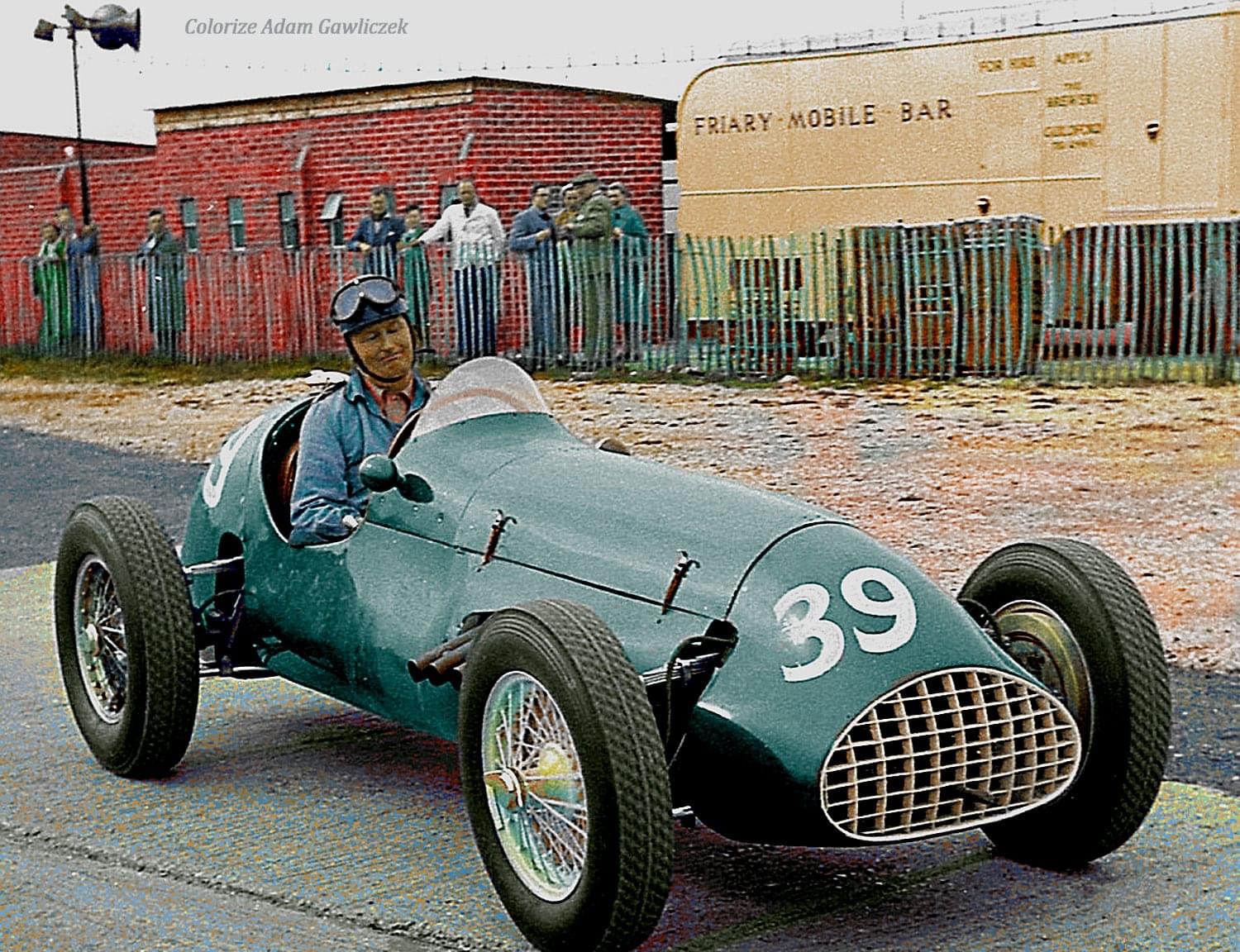
I guess most of us have marvelled at technology which has recently allowed the colourisation of monochrome images from the earliest days of racing to more recent times.

Adam Gawliczek is one of the better practitioners of the art, his early stuff was a bit how’s-yer-father, but like everything, practice makes perfect.

I’ve chosen a few shots of Australian relevance, checkout Adam’s Facebook page Colorize Auto Moto archive, there is enough to keep you going for days.

Good ‘ole Adam slaps his watermark on the images to indicate his work (ok) but he is the usual intellectual property thief otherwise; no acknowledgement of the original photographer to respect his/her art anywhere. I recognise some as Getty Images material, some will be out of copyright of course, but it’s still good form oulde-bean to acknowledge the snapper I reckon. Not saying I get it right all the time either. End of rant.

The first shot above is Doug Whiteford on the way to winning his second Australian Grand Prix at Bathurst in 1952, car is the first of his two Talbot Lago T26C’s. The trees are a bit euro-green rather than Oz blue-green but let’s not get too pernickety, I think Byron Gunther took this shot. ‘Fill Her Up Matey’: Talbot-Lago T26C, Melbourne 1957… | primotipo…

From Stephen Dalton pointing out that Motor Manual had a crack at hand colouring this photograph in the mid-fifties

The shot above is of a 1.5-litre, straight-eight Grand Prix Talbot Darracq 700 taking shape in the Suresnes, Paris, factory in 1926, read about ‘Australias’ example here; ‘Australia’s’ Talbot Darracq 700: 1926/7 GP car… | primotipo…

TD 700 chassis #3 was brought to Australia by Jack Day in May 1949.

Two of the more exciting cars raced in Australia during the 1920s and 1930s were the 2-litre Ballot 2LS and 4.8-litre straight-eight 5/8 LC raced by Alan and Harold Cooper (and later others) in New South Wales and Victoria. The shot above shows Jules Goux’ 2LS during the French Grand Prix weekend at Le Mans in July 1921.

He finished an amazing third in the 2-litre, DOHC, 16-valve Ernest Henry designed machine behind Jimmy Murphy’s Duesenberg and Ralph de Palma’s 3/8 LC Ballot – both 3-litre cars; I’m not suggesting this 2LS came to Australia.

Peter Whitehead had a several successful visits to Australia in the thirties and fifties including a win in the ’38 AGP at Bathurst in his ERA B-Type, and the South Pacific Trophy at Gnoo Blas in a Ferrari 500/625 in 1955.

This beautiful shot shows Peter on his way to third place in his supercharged Ferrari 125 V12 during the 1951 GP International de Rouen.

Chassis #114 was sold to Aussie, Dick Cobden, and raced by him for a bit, fitted with a Chev V8, it was an early acquisition by Tom Wheatcroft’s Donington Collection. 1955 South Pacific Championship, Gnoo Blas… | primotipo…

Lex Davison (in blue above) beside his Aston Martin DBR4 3-litre in the Longford paddock during the 1961 March long-weekend.

He was fifth in the Longford Trophy won by Roy Salvadori’s Cooper T51 Climax. One of Adam’s earlier efforts, the colour of the racer isn’t close nor is the Holden behind, but better than nothing.

See here for the DBR4; Lex’ Aston Martin DBR4/250’s… | primotipo…

One of the more exotic cars to reach these shores in the fifties was Bira’s Maserati 4CLT-48 Osca 4.45-litre V12 – quite a mouthful.

He brought it as a spare for his Maserati 250F on his Summer of ’55 NZ-Oz Tour. Both were tired shit-heaps, poor Alf Harvey bought the Maser, he had a couple of runs in it between bouts of complex mechanical carnage. I’d love to see a decent shot of that car in action in Australia if any of you has one.

The photograph of the Thai Prince is on the Richmond Trophy grid at Goodwood in 1951. He won the 12 lap race from two ERA B-Types of Brian Shawe and Duncan Hamilton #28. Car #34, another ERA, isn’t listed on either of the results sites I use.

(Twitter)

Another regretful purchase was Jack Brabham’s acquisition of Peter Whitehead’s Cooper T24 Alta (above) when he arrived in England in 1955. He was later to say he would have been far better to have taken his highly-developed Cooper T23 Bristol with him from Australia.

The shot above shows Whitehead at Goodwood in April 1954 – he only completed a lap of the Lavant Cup before throttle problems intervened. More on the Cooper Bristol here; The Cooper T23, its Bristol/BMW engine and Spaceframe chassis… | primotipo…

Credits…

Photographers unknown, Stephen Dalton Collection

Tailpiece…

French derriere to finish. Louis Wagner’s Ballot 3/8 LC at Le Mans during the 1921 French GP weekend – seventh. One of the most beautiful racing cars ever built.

Finito…

(unattributed)

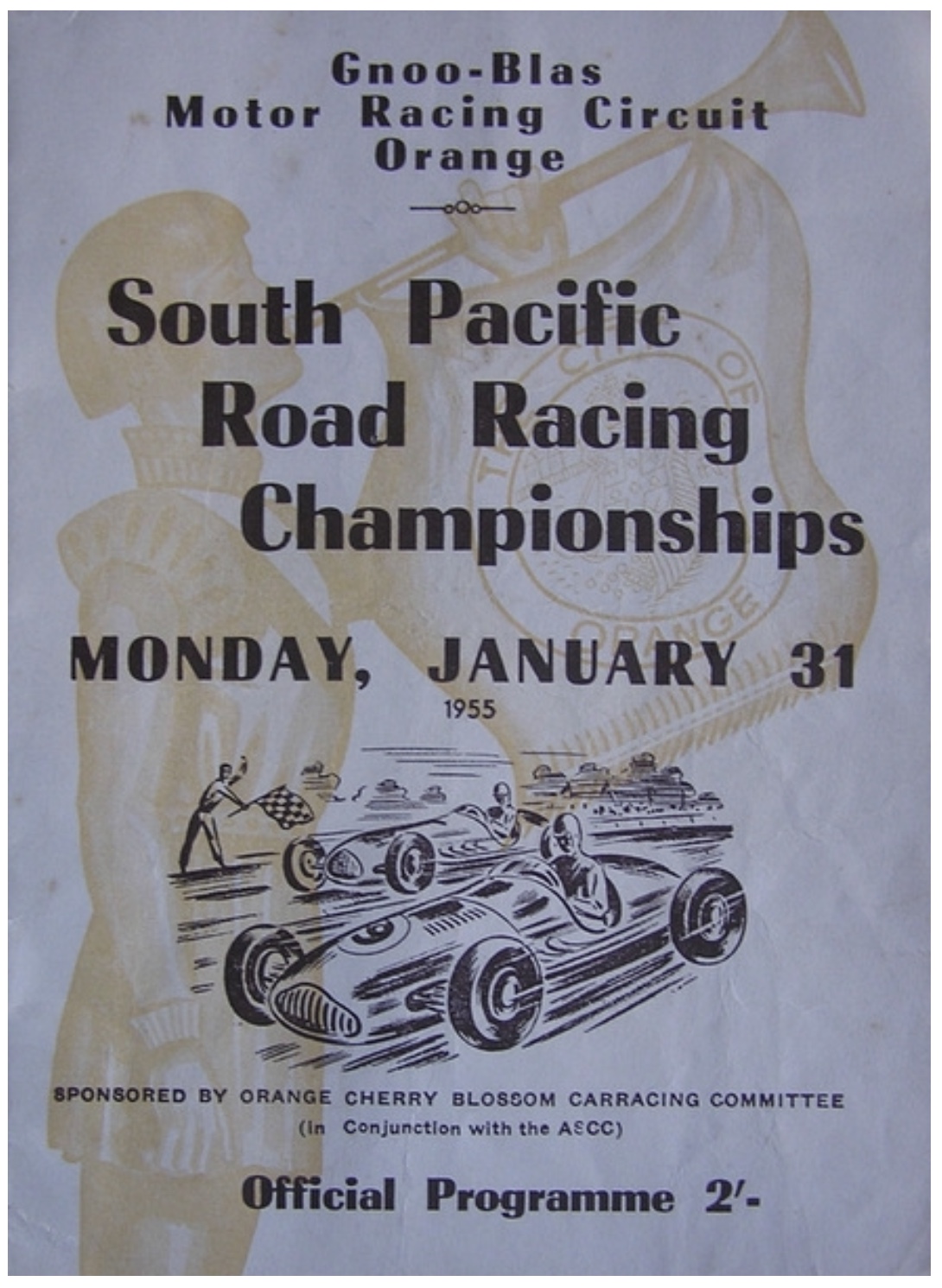
If the 1938 Australian Grand Prix at Bathurst was our first international event, by virtue of visiting Brits Peter Whitehead and his ERA B Type, and Alan Sinclair, Alta 1,100 s/c, our second international, and first of the modern era, was the South Pacific Championship at Gnoo Blas held in January 1955.

Peter Whitehead liked the place so much he came, saw, and conquered again, just as he did seventeen years before at Mount Panorama, albeit the 1955 field had a bit more depth that of 1938.

Peter and Tony Gaze raced Ferrari 500/625s, Bira a Maserati 250F with the better equipped locals Dick Cobden’s Ferrari 125 and Jack Brabham’s Cooper T23 Climax. Kiwi’s John McMillan and Fred Zambucka in Alfa Romeo Tipo B and Maserati 8CM respectively came across the ditch but both cars were too long in the tooth as was Tom Sulman’s Maserati

Non starters were Reg Hunt, short of parts for his new Maserati A6GCM, and Lex Davison’s HWM Jaguar

Whitehead won from Brabham and Gaze with Joe Murray, Allard Cadillac, Tom Sulman, Maserati 4CM and Curley Brydon, MG TC Spl in fourth to sixth places, I’ve written a feature in this race here; https://primotipo.com/2020/04/09/1955-south-pacific-championship-gnoo-blas/

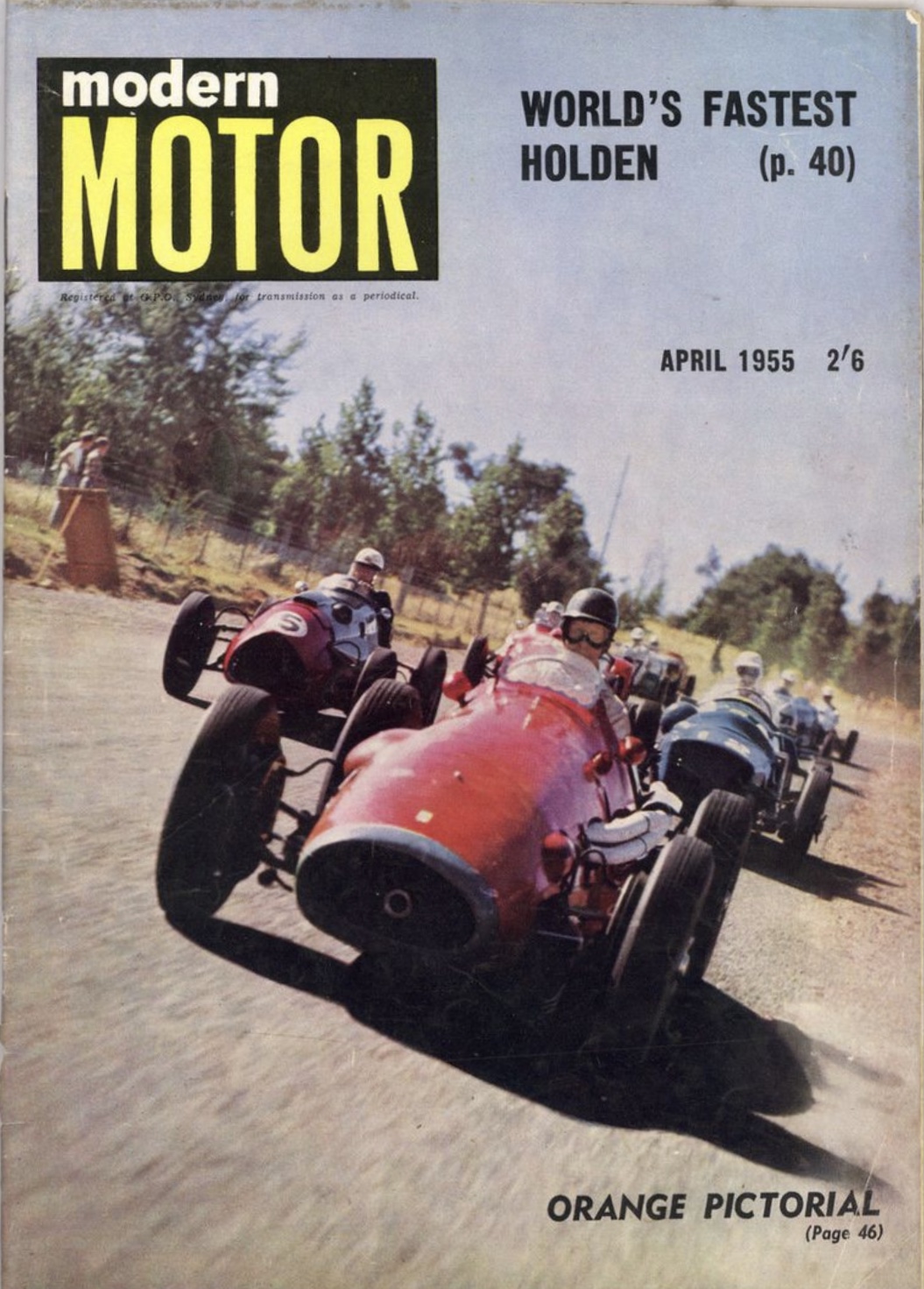
(Modern Motor)

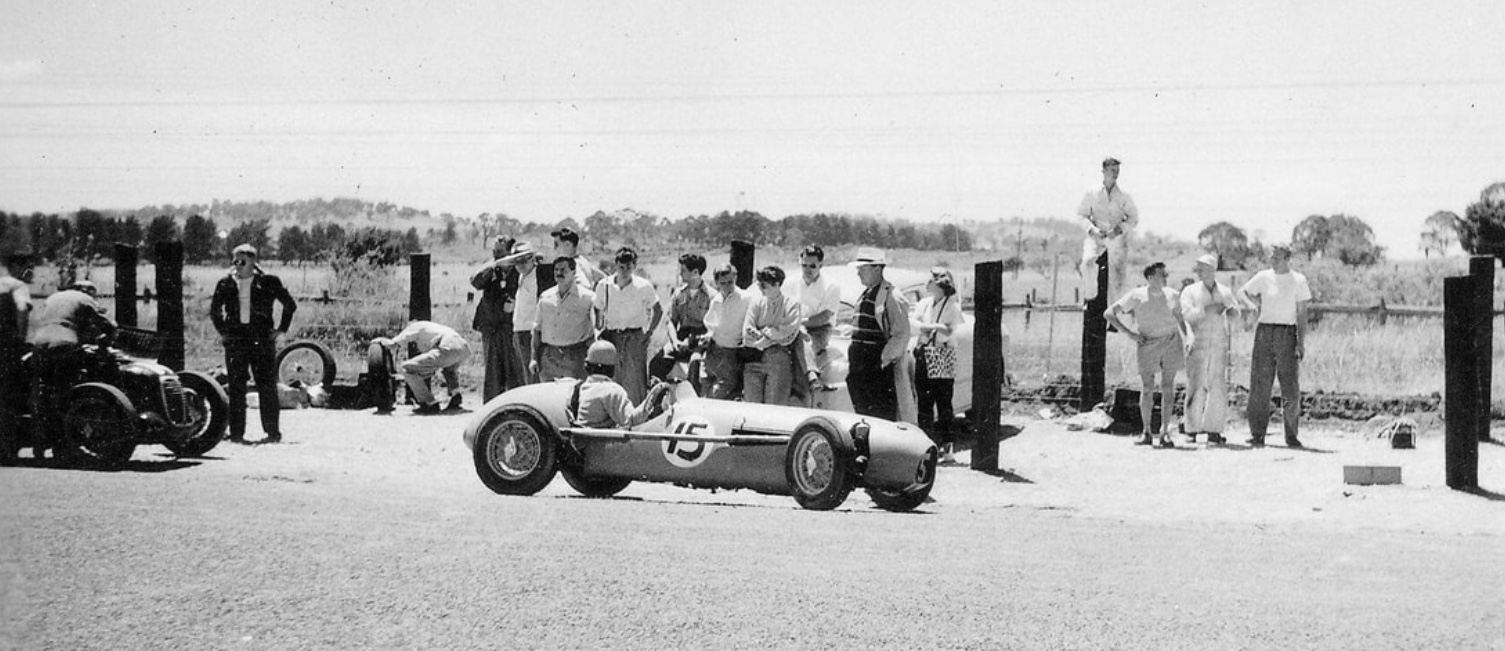
This shot isn’t kosher, it was staged for Modern Motor magazine but is still a cracker showing the Whitehead Ferrari, Brabham Cooper off to the left and Jack Robinson’s Jaguar Special aft of Peter. Further back is the unmistakable shape of a Bugatti, perhaps the John Hall Holden engined Type 37.

The grid on Huntley Road. From left, Jack Brabham, Cooper T23 Bristol, John McMillan, Alfa Romeo Tipo B, Peter Whitehead, Ferrari 500/625 and Jack Robinson, Jaguar Special (unattributed)


(unattributed)

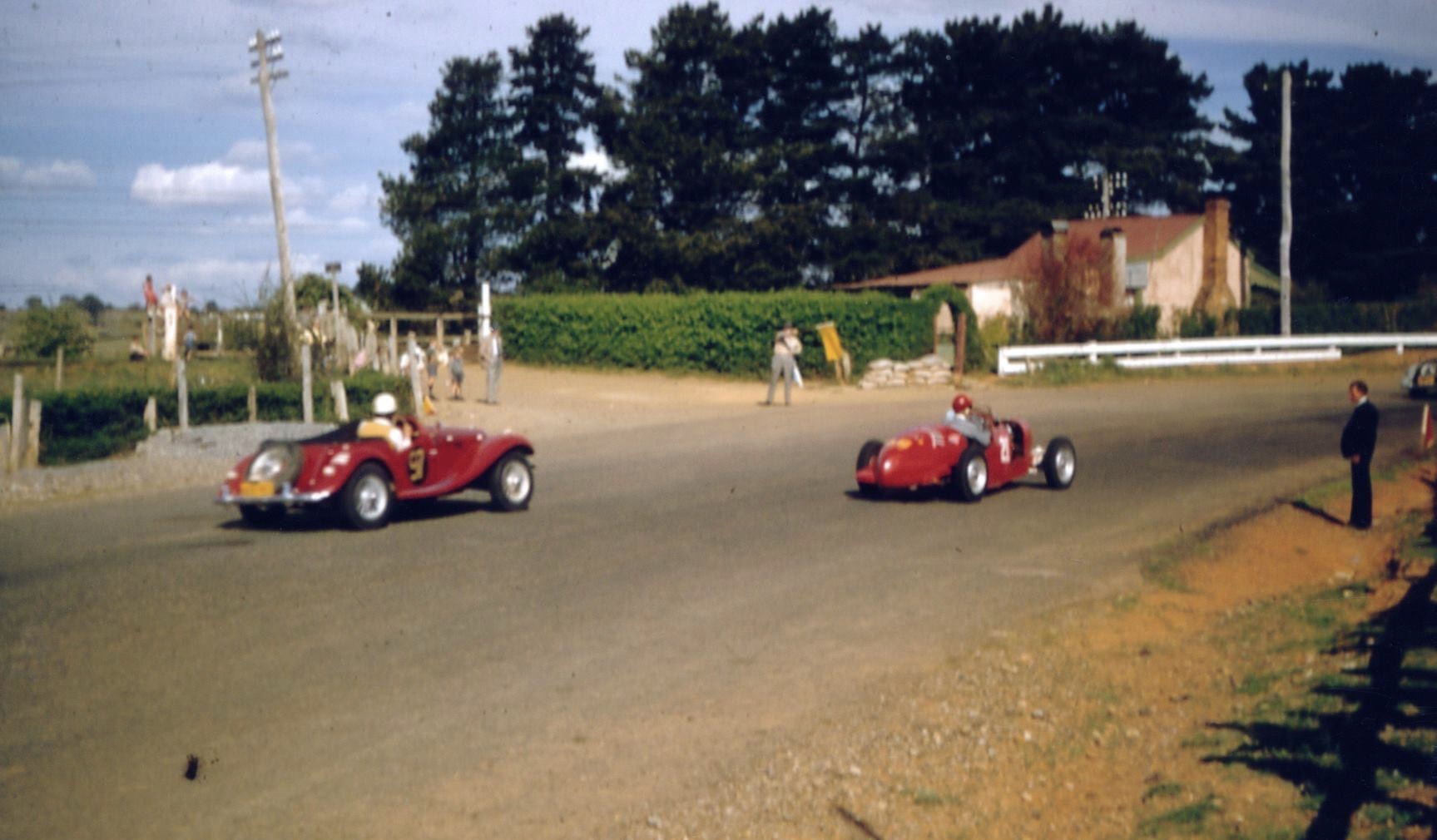
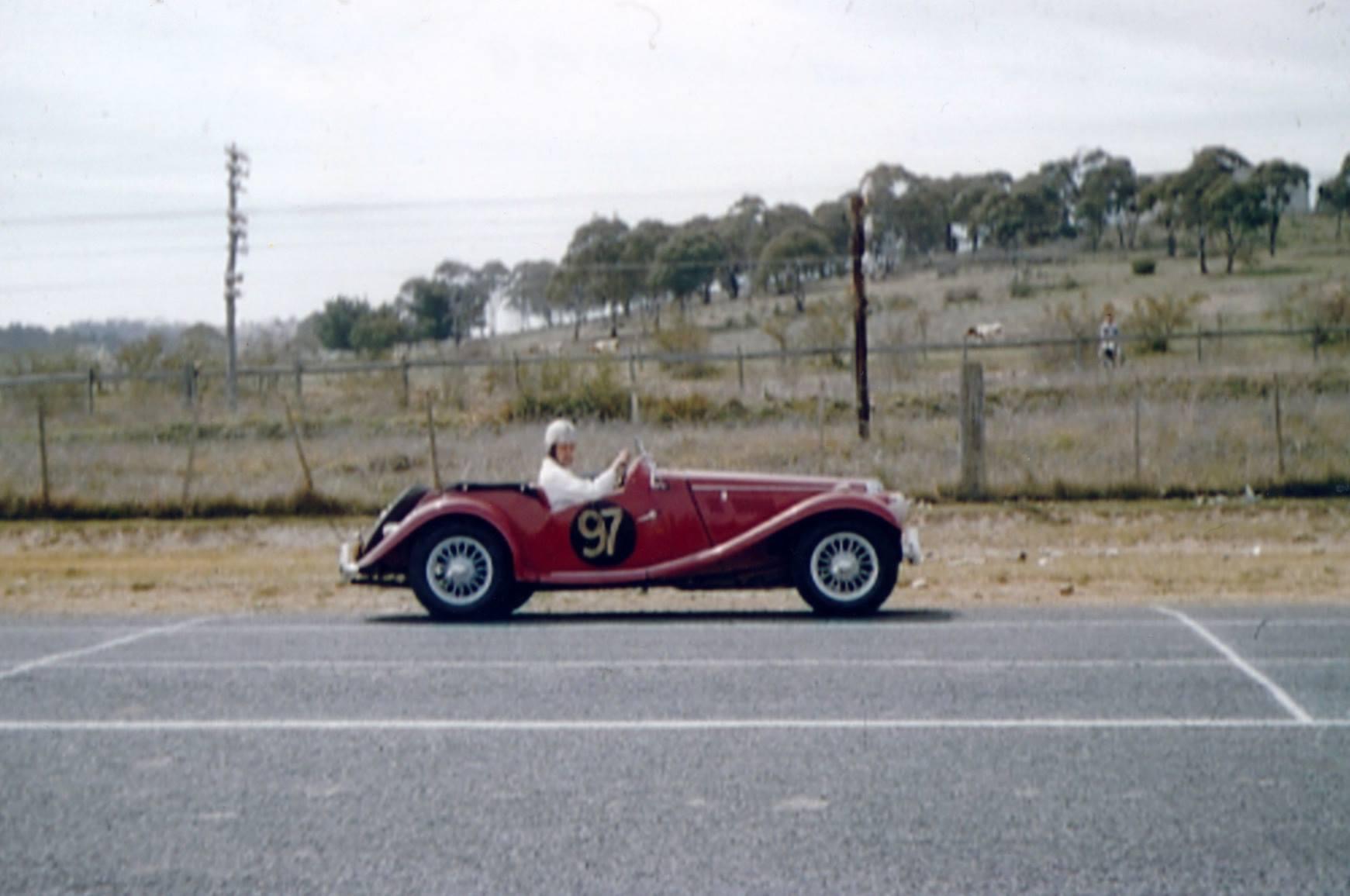
This group of wonderful colour photographs were taken by George Causbrook, an Orange electrician who worked at the time for Tom Barrett, owner/driver of the #97 MG TF.

Barretts Milk was a successful local business with a factory/depot including an airstrip. Causbrook’s family, the Beasleys, made available the shots to the Gnoo Blas Classic Car Club from whom I have shoplifted them, with thanks!

George had a fine eye, his colour shots of this challenging road course help us understand better its nature sixty years after the final Gnoo Blas meeting.

Ted Gray is shown below fussing over his brand new Lou Abrahams owned Tornado 1 Ford, just finished in Gray’s workshop in Melbourne.

By the October Bathurst meeting the team were starting to get the new beast sorted, but a huge accident in practice destroyed the car and came close to killing its plucky driver who took six months to recover from his injuries. See here for Tornado; https://primotipo.com/2015/11/27/the-longford-trophy-1958-the-tornados-ted-gray/

(unattributed)


(unattributed)

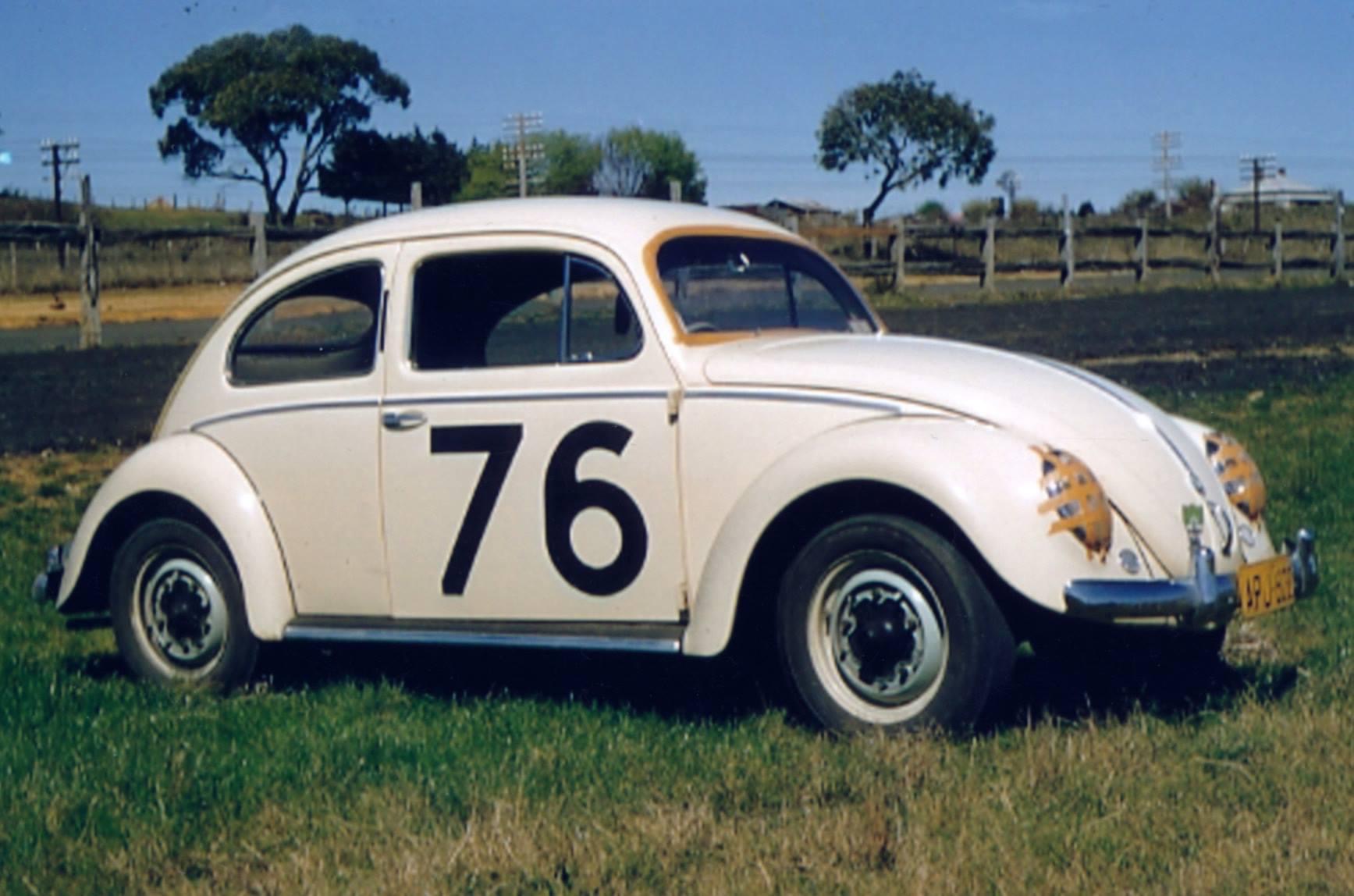
T Borrer’s VW Beetle entered in the production car race, October 1954 meeting.

The sportscar race grids (October ’54) seemed to be particularly well supported, with T Jordan’s 2.4-litre Riley-engined Healey Silverstone, Austin Healeys, #90 W Kelly and #104 Robert Page Jaguar XK120s in the shot below.

(unattributed)


(unattributed)

The ‘pretty boy’ with the Ray Bans in the XK120 is none other than local Cake Shop proprietor Bill Kelly, he would be as in fashion at an historic meeting in 2020 as he was in 1955!

Clearly there was plenty of money in pies and lamingtons in the fifties.

(unattributed)

The great Eldred Norman’s least favourite car was this 1937 Maserati 6CM 1.5-litre six cylinder Voiturette.

Chassis ‘1542’ was originally raced by Franco Cortese throughout 1937, but the going was tough against the dominant ERAs. The machine then made occasional appearances as part of Ciro Basadonna’s various teams both pre and post-war. It was imported to the UK for Gilbey Engineering in 1947, Colin Murray raced it in the UK throughout 1949 and 1950 then brought it to Australia to contest the Narrogin 1951 AGP before its sale to Norman.

When the engine blew shortly thereafter Norman fabricated a steel block and cast detachable bronze heads then cobbled together Fiat 1500 conrods and BSA pistons when Maserati originals were unavailable. Eldred raced it for a year or so before he sold it to Edward David ‘Ted’ McKinnon who finished fifteenth in the 1953 Albert Park AGP.

‘1542’ then passed to Eddie Thomas briefly, before Albury’s Seaton Brothers bought it in poor shape, they solved the engine reliability issues by fitting a Holden Grey six-cylinder unit. In this form Jack Seaton ran it and Ken Cox raced it on the country tracks of Victoria between 1957-1959.

Stephen Dalton places the above shot as during the October 1954 Gnoo Blas meeting with Tom Sulman the driver. Ted Gray was entered but he has been crossed off Stephen’s program and Sulman substituted- well familiar with Maseratis.

The car went through a variety of hands before passing to Doug Jarvis, then some years later to Alf Blight, a talented engineer who did a great job over a decade with its restoration, it left Australia in the early eighties.

(unattributed)

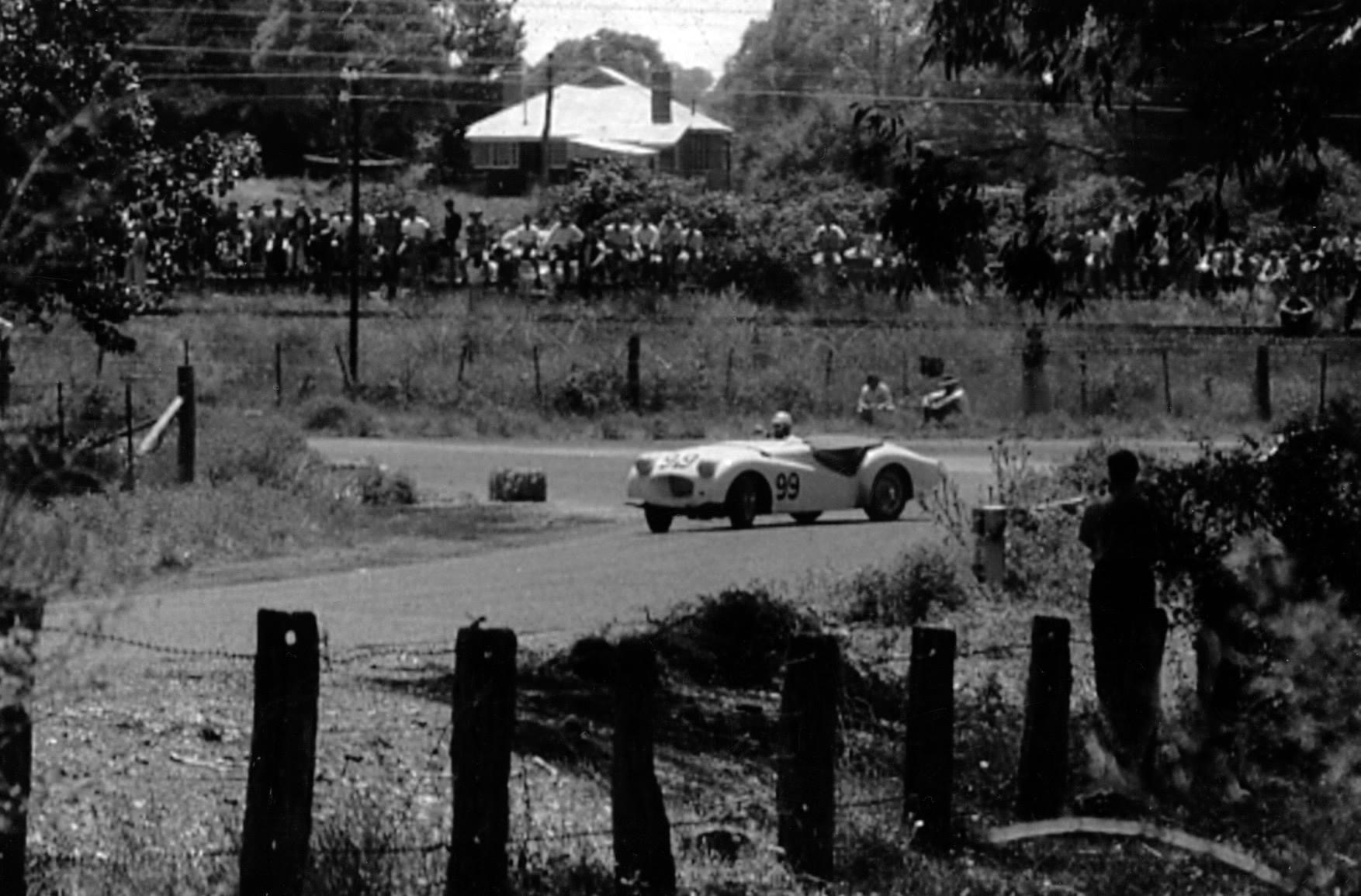
Tom Barrett, now racing a Triumph TR2 during the January 1956 meeting. I wonder if he caught it?

The fences to catch the wayward or unfortunate at ‘Mrs Muttons Corner’, the intersection of what is now Bloomfield and Huntley Roads, are clear and poignant in the context of Ian Mountain’s fatal accident during January 1955.

Stan Coffey, Cooper T20 Bristol, at Windsock Corner ‘due to the location of the old windsock when the Orange Aerodrome was in Jack Brabham Park during October ’54. The picture is looking towards Applebar/Pybar. The area that is now Leewood is in the background to the right, and in the middle of the background one can see what is now Blowes Road when it was dirt!’

Our friend Tom Barrett in the MG TF ‘at what is now the intersection of Huntley Road and Leewood Drive, where the level crossing now is’ and a special entering, the high speed Connaghans corner.

(unattributed)

Mr Barrett and MG TF.

Credits…

Modern Motor, Stephen Dalton

George Causbrook via Deidre and Brett Beasley and the Gnoo Blas Classic Car Club Facebook page

Tailpiece…

Finito…

Reg Parnell and Peter Whitehead in line astern- Ferrari 555 Super Squalo 3.5’s during the Southland Road Race, Ryal Bush, New Zealand 16 February 1957…

The two Brits had a very successful New Zealand summer taking this race in a one-two in Whitehead’s favour with Horace Gould’s Maserati 250F third.

The Kiwi international season opened at Ardmore with the New Zealand Grand Prix, it was a Parnell-Whitehead one-two there, in fact it was the last major victory of Parnell’s very long career. There was little joy in the win though, fellow Brit Ken Wharton died after a tragic ‘racing incident’ accident aboard his Ferrari Monza in the sportscar preliminary immediately prior to the feature race.

At Wigram it was Whitehead from Jack Brabham’s Cooper T41 Climax 1.5, in Dunedin, Parnell from Brabham with Whitehead third, then Ryal Bush before the circus proceeded on to Mairehau although by that stage the two Brits had returned to Europe.

Parnell on the Dunedin Wharf road circuit, 2 February 1957- he won from Brabham’s Cooper T41 Climax and Whitehead’s Ferrari  (G Paape)


Peter Whitehead with his crew during the 1958 Le Mans 24 Hours. First Englishman since Dick Seaman to win a major European GP in taking the 1949 Czechoslovakian GP aboard a supercharged Ferrari- the first also to coax such a car from Enzo- the man really did have impeccable Ferrari connections (Motorsport)

Whilst these cars were never the weapons in Grand Prix racing the predecessor 2 litre Ferrari 500 was, they were pretty handy Formula Libre cars when fitted with 3431cc Tipo 860 Monza four cylinder motors rather than the 2.5 litre fours which sat below their bonnets in F1 events.

By January 1957 Ferrari’s frontline weapon was the Lancia-Ferrari D50 V8, variants of which they ran in F1 from the 11 September 1955 Italian GP, indeed the lack of pace of the 555 (and 625) was one of the reasons for the deal brokered gifting the cars to Ferrari when Lancia went bust. I really must get to the D50 at some stage, it’s one of my favourite Grand Prix cars.

The Parnell #2 and Whitehead in the Albert Park AGP practice in December 1956- the tail of car #9 is Lex Davison’s ex-Ascari/Gaze Ferrari 500/625 3 litre (J Lineham)

While the drivers returned to England after Ryal Bush the two Ferraris stayed in the Antipodes. Whitehead’s ‘555-1’ aka ‘FL/9001’ was bought by (later Sir) Tom Clark of Crown Lynn Potteries fame, later still becoming the famous ‘Morrari’ before its resurrection.

Parnell’s ‘555-2’ aka ‘FL/9002′ passed through the hands of McMillan/Glass and others including the Gilltrap Collection on the Gold Coast and eventually into Bernie Ecclestone’s hands. Click here for an article about this chassis’ ‘Australian phase’; https://primotipo.com/2015/08/25/arnold-glass-ferrari-555-super-squalo-bathurst-1958/

Reg Parnell in the Goodwood paddock in April 1954. Happy chappy that weekend- he won the Lavant Cup in this Ferrari 625 from Roy Salvadori’s Maserati 250F- a very good win

Both machines were works entries in 1955 but were surplus to requirements once the D50’s were unloaded at Maranello before being eagerly snapped up by existing customers Whitehead and Parnell after fitment of Tipo 860 Monza engines. The chassis’ were lengthened to allow them to fit, new chassis plates were affixed to the frames during this process.

Some older enthusiasts remember these cars in Australia as both contested races during the two weekend 1956 ‘Olympic’ Australian Tourist Trophy/Grand Prix carnival at Albert Park in late November/early December. The ‘Scuderia Ambrosiana’ duo were third and sixth, Peter was behind the ‘Officine Alfieri Maserati’ 250F’s of Stirling Moss and Jean Behra.

It was then off to Port Melbourne and across the Tasman Sea then, the NZ GP was on 13 January.

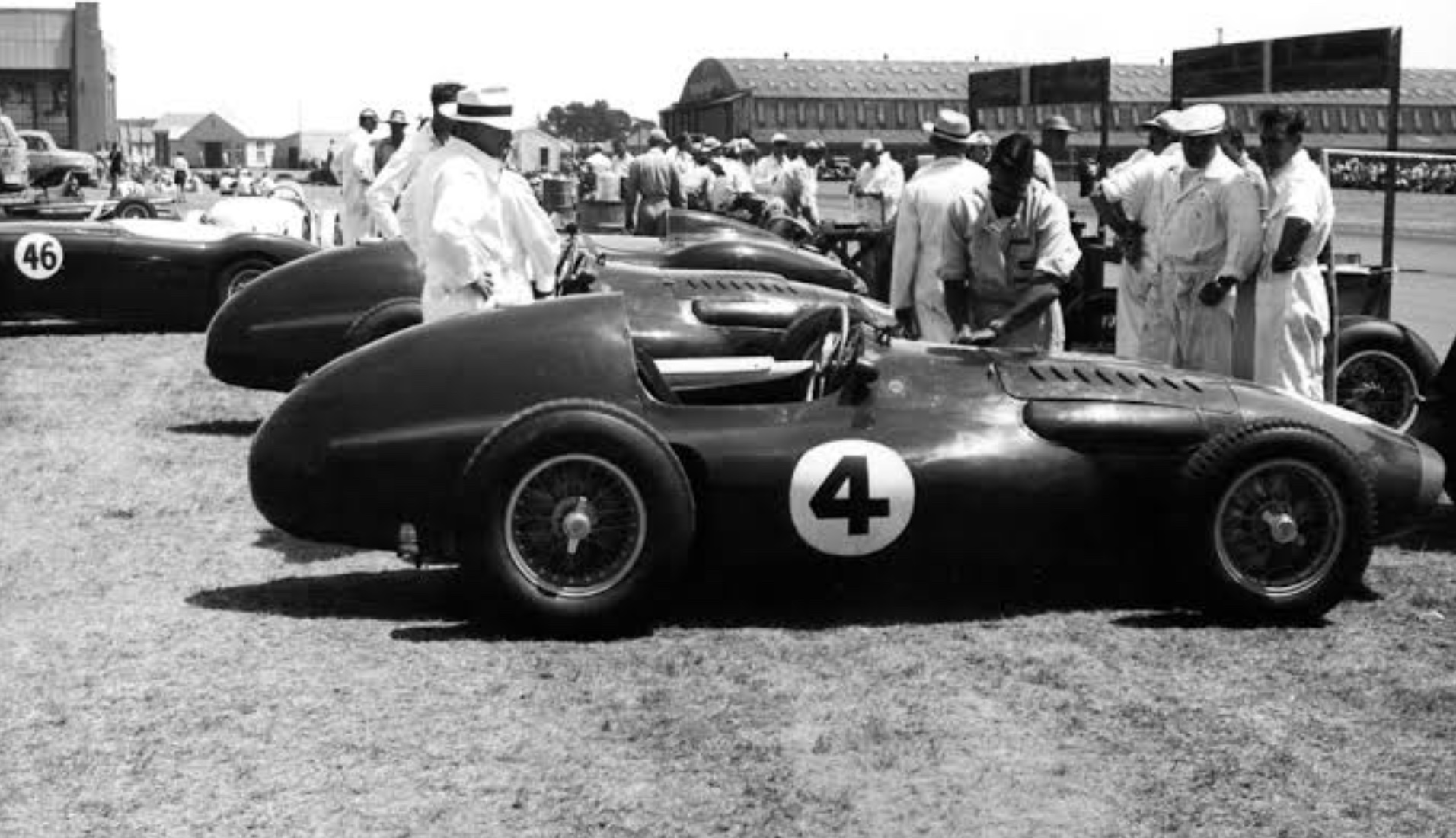
The #4 Parnell Ferrari 555 and Whitehead’s behind at Wigram in 1957, note the aircraft hangars in the background. Car #46 and driver folks? (Library NZ)


(CAN)

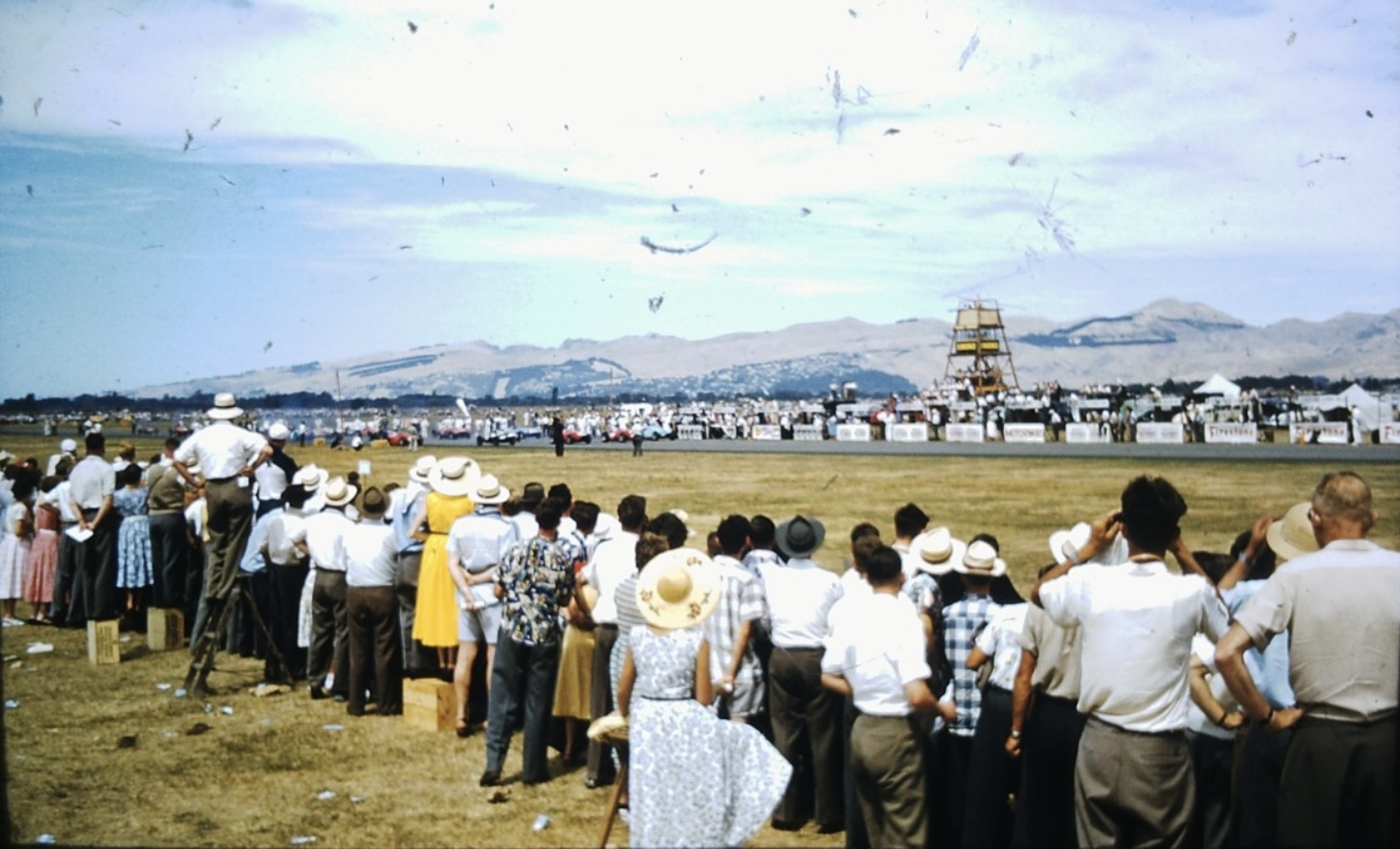
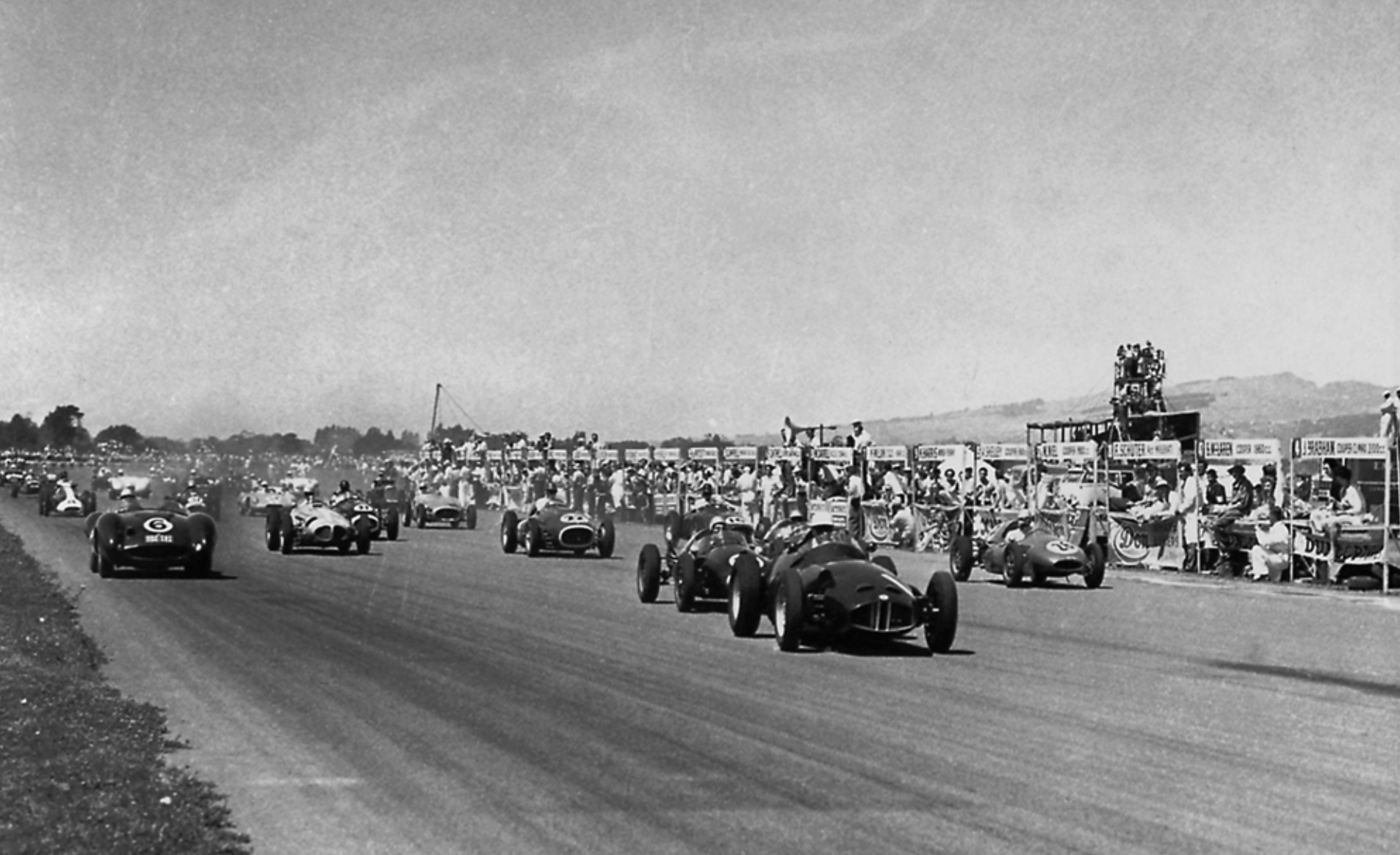
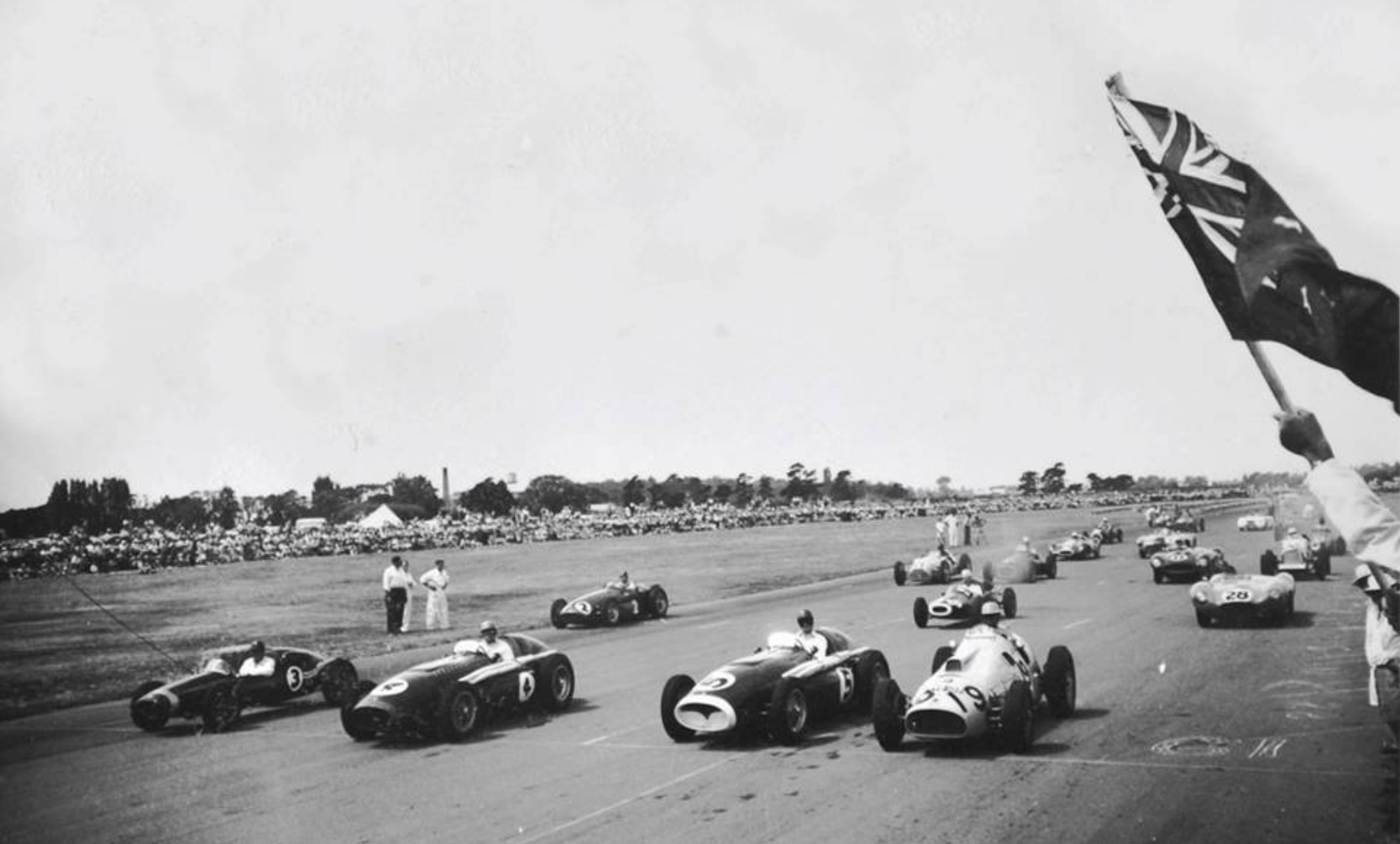
Lady Wigram Trophy start 1957.

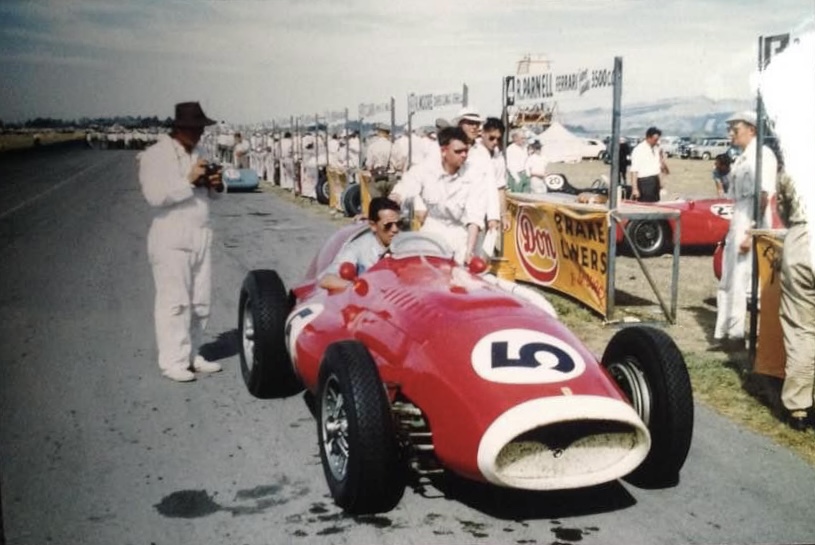
Ron Roycroft, Ferrari 375, Parnell and Whitehead Ferrari 555’s and Brabham’s tiny Cooper T43 Climax at far left on row one. Gibbons, Jensen and Gould on row two and Shuter, Jensen, Clark and Freeman on row three. Whitehead won from Brabham and Roycroft- the shot below shows the Whitehead crew in the Wigram pitlane, make that runway!

(J Manhire)


Tom Clark at Levin circa 1957, he first raced the car- having graduated through a pre-war Maserati 8CM and the ex-Macklin/Gaze supercharged HWM Alta, in February 1957.

He contested six meetings in it from then until February 1959, his best result was a victory in the South Island Championship Road Race at Mairehau in 1957.

(CAN)

Stunning Hillclimb vista in New Zealand with Tom Clark right on the apex- whereizzit I wonder Kiwis?

(M Clayton)

Ferrari 555 Super Squalo cutaway drawing, perhaps by Giuseppe Cavara, technical specifications as per text.

Etcetera…

The front view of Paul Frere’s Ferrari 555 ‘555/1’ during the 1955 Belgian GP meeting at Spa- the local boy did well in what would become Whitehead’s car.

He was fourth behind Farina’s third placed 555 but the first and second placed Mercedes Benz W196’s of Fangio and Moss were nearly a couple of minutes up the road. Castellotti was on pole that day in a Lancia D50- a single car final entry for the team, with Farina’s third slot the best of the four Ferrari 555’s which practiced.

And the rear view of Eugenio Castellotti’s ‘555/2’ at Zandvoort in 1955- Mike Hawthorn raced ‘555/1′ at this meeting for seventh place. Castellotti (in Reg’s car) was fifth with the ole’ Mercedes W196 one-two delivered by Fangio from Moss.

The Ferrari’s weren’t quick though, Maurice Trintignant’s was the best of the Ferrari qualifiers with eighth slot in his 555.

Its interesting to see how the bodywork of the cars evolved from F1 to Formula Libre specifications.

Lady Wigram Trophy 1957 start. #4 Parnell, Ferrari 555, #19 Ron Roycroft, Ferrari 375, #2 Horace Gould, Maserati 250F, #5 Whitehead, Ferrari 555, #3 Brabham, Cooper T41 Climax (S Dalton)

Credits…

John Manhire Collection, Godfrey Paape, James Lineham, Getty Images, Ellis French, Stephen Dalton Collection

Tailpiece…

(E French)

Arnold Glass in the #2 ex-Parnell ‘555-2’ alongside Doug Whiteford’s Maserati 300S at Longford in March 1958 before the Gold Star race won by Ted Gray in Tornado 2 Chev. The bit of blue is the tail of the Bruce Walton driven, Norman Hamilton owned Porsche 550 Spyder.

Finito…

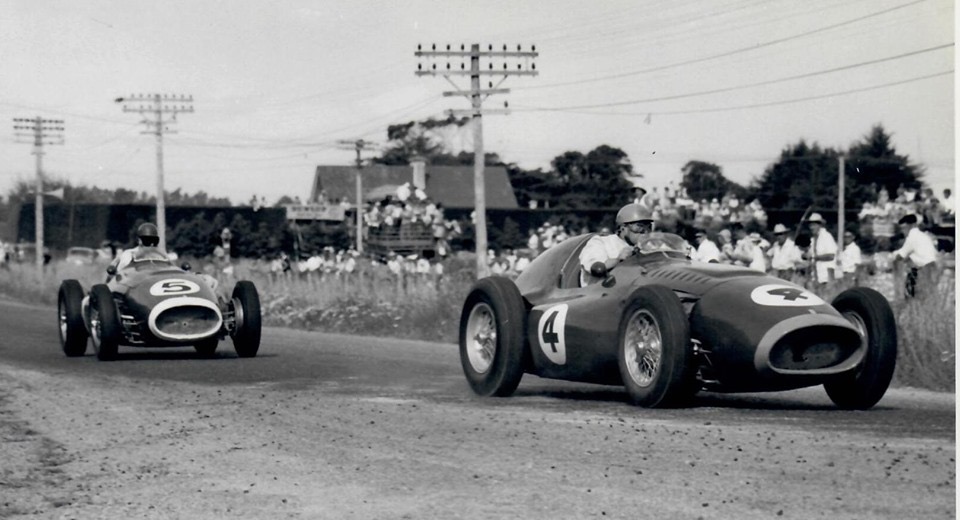
Jack Brabham’s tiny Cooper T41 Climax takes on the big Ferrari 555 Super Squalo’s of Peter Whitehead #5 and Reg Parnell #4- to the right is Syd Jensen in another T41, Ardmore, New Zealand Grand Prix 1957…

Jack’s ‘slingshot’ didn’t topple the big guys that weekend but Stirling Moss ‘put the writing on the wall’ with his Argentinian GP Cooper win twelve months hence and by 1959 it was all over-red rover for the big front-engined glorious Grand Prix cars.

Brabham built this car at Coopers late in 1956 racing racing it twice in the UK before shipment to Australia- in the 22 September Oulton Park Gold Cup, DNF, the race won by teammate, Roy Salvadori’s T41, and then the BRSCC F2 race at Brands Hatch on October 14 where he again failed to finish with piston failure, again a T41 headed the field, Tony Brooks was at the wheel of Rob Walker’s car.

Off to the Antipodes he contested the NZ Internationals, the AGP at Caversham in March, and then the Victorian Trophy at Albert Park the following weekend- he then returned to Europe at the end of the summer having sold the car to Alec Mildren.

T41 chassis number ‘F2/P/56′ was fitted with a 1476cc Coventry Climax FWB sohc, two valve engine which gave circa 100 bhp @ 6500 rpm- it was a trend-setter in that it was the first of many, very many Climax engined Coopers to come to Australia. The design and construction progression of these Coopers (T41-T53) is covered in detail here; https://primotipo.com/2019/10/04/cooper-t41-43-45-51-53/

Despite giving away 2 litres in engine capacity to the Ferraris, Brabham was third at Ardmore until lap 100 of the 120 lap race when his engine temperature soared and he retired with a burst radiator hose which had fried the Climax engines cylinder head gasket- Parnell won from Whitehead and Stan Jones’ Maserati 250F.

Brabham was Q3 and second at Wigram behind Whitehead, started from pole in the Dunedin Road Race this time finishing second to Parnell and then retired after completing 9 laps of the wild Southland Road Race at Ryal Bush where Peter Whitehead again prevailed.

Brabham at Oulton Park during the Gold Cup weekend, Cooper T41 Climax FWB (MotorSport)


Brabham during the 1957 AGP at Caversham in March 1957- behind him is the Fred Coxon driven Amilcar Holden Spl DNF (K Devine)


Caversham AGP start 1957- Brabham, Cooper T41 Climax, Davison, Ferrari 500/625, Lukey, Cooper T23 Bristol and Jones Maserati 250F. Car #12 Syd Anderson, Alta GP2, #14 Syd Taylor, TS GMC Special, #8 Tom Hawkes, Cooper T23 Holden- behind him is Tom Sulman’s Aston Martin DB3S, #6 Alec Mildren, Cooper T20 Bristol and #5 Jack Myers, Cooper T20 Holden (K Devine)

Off to Perth for the 4 March AGP Jack was third in the scorching hot event behind the 3 litre Ferrari 500/625 of Lex Davison and Bill Patterson and Stan Jones’ Maserati 250F which did that event with its 300S motor.

Then it was back across the continent for the Moomba meeting at Albert Park where the little car contested the 32 lap 100 mile Victorian Trophy Gold Star round finishing second behind Davison’s Ferrari 500/625 and in front of Doug Whiteford’s Maserati 300S.

Jack then returned to Europe but not before, Graham Howard wrote, driving Ron Tauranac’s new Ralt Vincent at Mount Druitt- i wonder who has a shot of that test day?

Alec Mildren raced the T41 only briefly ‘finding that the chassis kept breaking due to it being too light’ John Blanden wrote- in short order the car was owned and raced by Arthur Griffiths and John Roxburgh before passing to Lyn Archer in Tasmania who raced it very successfully, ultimately with a highly modified Hillman Imp engine, he sold it to buy an Elfin Catalina Ford, a machine he raced for years and is still owned by his family.

The T41 passed through many hands in the decades which followed before Tom Roberts acquired it with David Rapley heading up the restoration of the car, which made its debut at the 2003 Albert Park AGP.

Etcetera…

Australian colours aren’t they?- green with the gold nose, lovely profile shot by racer/photographer David Van Dal at Caversham, ditto below in the paddock.


(K Devine)


Jack aboard a Cooper T43 Climax FPF 1.5 at Brands Hatch, 8 August weekend 1957, he won both heats of the Rochester Trophy F2 event (unattributed)

Credits…

‘History of The Australian Grand Prix’ Graham Howard and others, ‘Glory Days: Albert Park 1953-58’ Barry Green, ‘Racing Cars in Australia’ John Blanden, sergent.com, Ken Devine Collection, David Van Dal, MotorSport, F2 Index

Tailpiece…

(unattributed)

Lets go back to where we started, Ardmore 1957, and another cracker of a shot, this time just after the start.

Up front it’s all Ferraris- Ron Roycroft’s 375 V12 from the two four cylinder Super Squalos of Whitehead and Parnell. Then out wide on the left is Jack’s Cooper, the Peter Whitehead owned, fourth placed #18 Ferrari 750 Monza driven by Ross Jensen and far right the HWM Alta I wrote about not so long ago being driven by Tom Clark.

The Cooper T39 Climax Bobtail is Ronnie Moores- to the right of him is the Talbot Lago T26C of Allan Freeman, and then, perhaps, Horace Gould’s #2 250F, whilst in the middle of the pack the unmistakable, regal lines of the Alfa Romeo Tipo B/P3 raced by John McMillan, the almost as ancient Maserati 4CLT-48 of Pat Hoare is out to the right- alongside him is the Jones 250F. I’ll take advice on the rest…

Click here for an article on the Super Squalo; https://primotipo.com/2015/08/25/arnold-glass-ferrari-555-super-squalo-bathurst-1958/ and here for the HWM Alta; https://primotipo.com/2019/12/13/tony-gaze-hwm-alta-new-zealand-1954/

Finito…

Dick Cobden’s Ferrari 125 being pushed through the Gnoo Blas paddock- that’s lanky, slim Jack Brabham with helmet on behind (F Pearse)

The natural or established order of Australian motor racing was shaken up and greatly changed by events over the summer of 1955…

The Ardmore, New Zealand Grand Prix in January was won by Prince Bira’s Maserati 250F from Peter Whitehead and Tony Gaze in their matching Ferrari 500/625 3 litre, four cylinder hybrids, Jack Brabham’s Cooper T23 Bristol and Reg Hunt’s new Maserati 250F engined A6GCM, fifth.

Other Australians who made the trip but failed to finish were Stan Coffey, Cooper T20 Bristol, Lex Davison, HWM Jaguar and Dick Cobden in the Ferrari 125 V12 s/c he acquired from Peter Whitehead after the NZ GP the year before.

Lex Davison being chased by Bira and Tony Gaze at Ardmore, 1955 NZ GP. HWM Jaguar, Maserati 250F and Ferrari 500/625 (thechicaneblog.com)

(CAN)

A group of the front running cars at Ardmore in ‘Phil Neill’s showroom a day or two before the race.’

Bira’s 250F and Gaze Ferrari 500 in front with Whitehead’s #2 similar 500, #3 is Reg Hunt’s Maserati A6GCM, #77 Lex Davison’s HWM Jaguar, #9 George Palmer’s Mercury powered Palmer Spl, #6 Cobden’s Ferrari 125 and hidden, unfortunately, in the corner Bira’s ‘second-string’ Maserati 4CLT Osca V12 with a Ford Consul providing marvellous context!

Tony Gaze warms up his 3 litre Ferrari four with plenty of admiring Kiwis by the Dunedin wharves, Ferrari 500/625, January 1955. Reg Parnell’s Aston Martin DP155 is behind and then an Aston Martin DB3S (unattributed)

By the end of the Ardmore weekend, Brabham, buoyed by his speed and his mind filled with ambition, ideas of opportunity and success paid bonuses from trade suppliers in the UK by the visiting RAC’s Dean Delamont- had determined to sell his Cooper and chance his luck in the UK.

Dick Cobden, another of the fast-men in Australia- his dices with Brabham during 1954 had drawn fans to meetings from far and wide, also planned a racing holiday in England in between continuing his stockbroking career in a London brokers office.

‘He was accompanied by mechanic Fred Pearse and the fascinating, frustrating Ferrari (125), and enjoyed some mobile spectating…Cobden hoped to collect the D-Type he had ordered, but long delays led to him cancelling the order, and the overseas trip was effectively his farewell to motor racing’ Graham Howard wrote.

Fred Pearse attending to Cobden’s Ferrari 125 (F Pearse)

Pat Ratliff and Tony Gaze with Gaze’s Ferrari 500/625- the oh-so-famous ex-Alberto Ascari 1952 and 1953 World Championship winning chassis- one of the ‘winningest’ if not the most, GP cars ever (F Pearse)

But first the travelling circus headed by sea to Sydney and then by road west to the Gnoo Blas road circuit at Orange for the ‘South Pacific Championship’ international held on 31 January. Bira, Whitehead and Gaze then planned to race their cars in South Africa.

Whilst Brabham and Cobden contested Gnoo Blas, Hunt and Davison, Lex the winner of the 1954 Southport AGP did not- Hunt was short of some critical parts for his A6GCM whilst Lex did not make the trip.

Hunt’s pace had always been apparent in Australia and in the year he raced a Cooper 500 in the UK and Europe- with the purchase of  the A6GCM he vaulted over the top of everyone in Australia- the speed of car and driver was THE combination of 1955.

Whilst Lex’ HWM Jag was fast, it wasn’t fast enough nor, despite ongoing development was it sufficiently reliable, it did of course hold together at Southport some months before, the 1954 AGP win was the first of Lex’ four victories in Australia’s premier event.

Davison no doubt showed more than passing interest in his good mate Gaze’s Ferrari 500 in the early months of 1955- a purchase he would consummate later in the summer of 1955-1956 and as a consequence set the standard- along with the local 250F’s of Hunt and Jones and Ted Gray’s bellowing V8 Tornado 2 Ford/Chev in the coming years.

Gaze #4 and Whitehead Ferrari’s getting a tickle- car behind is Bira’s Maserati 250F and at the rear the Broadbent/Haig Hurst Bentley (F Pearse)

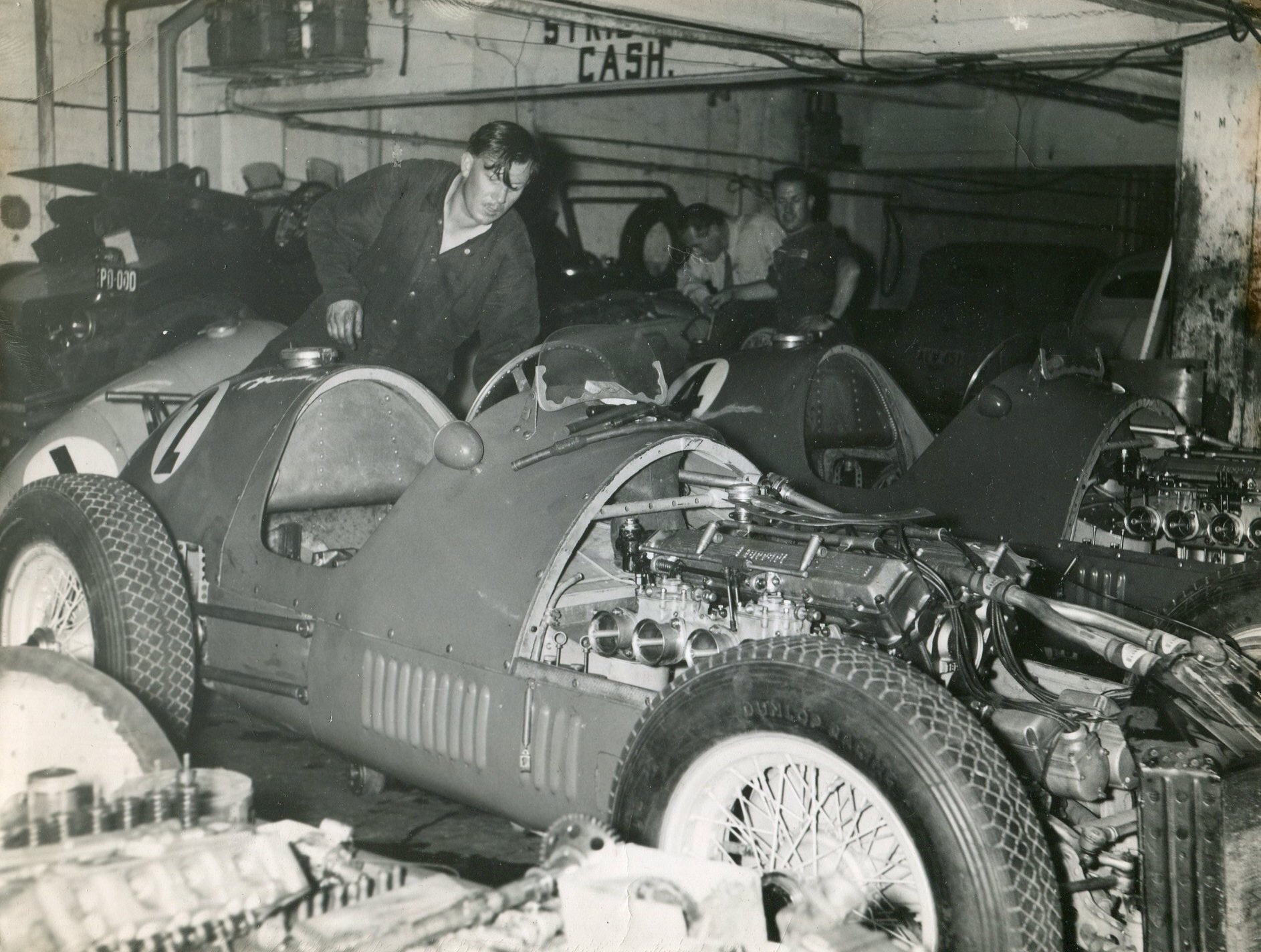
In Orange the ‘star cars’ were garaged in a workshop where several of these photographs were taken. The images by Fred Pearse, kindly circulated on social media by Peter Reynell who cared for Fred in his final years, take ones breath away.

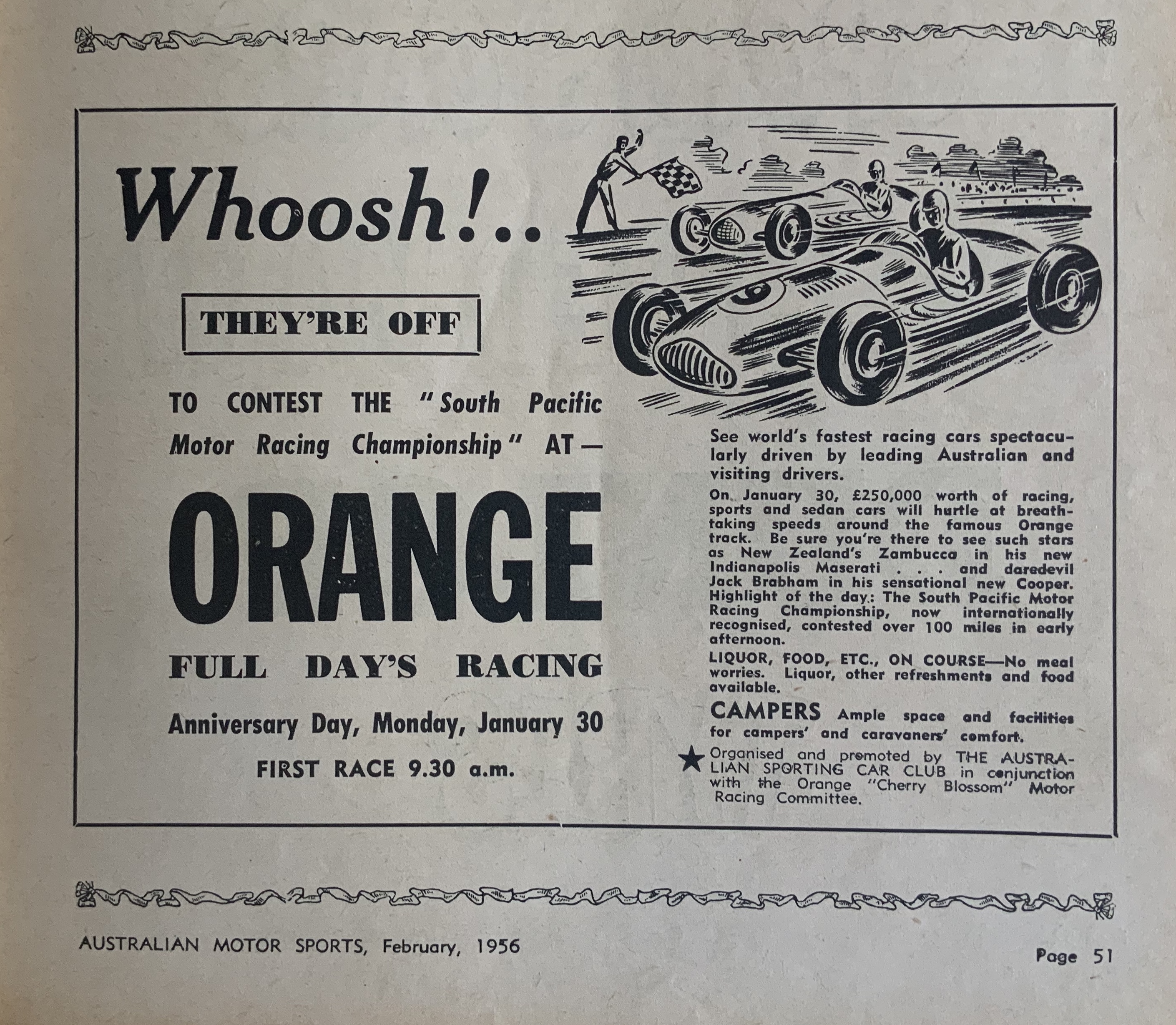
Bob Pritchett makes mention in his AMS report of the race, of the OSCA being looked after at Lapham’s Garage in Orange, Mr Lapham was the Chairman of the Orange ‘Cherry Blossom Car Racing Committee’ which staged the event along with the Australian Sporting Car Club. Laphams is most likely the venue of the garage shots.

Tony Gaze Ferrari 500 (F Pearse)

Ratliff and Gaze (F Pearse)

Thirty-nine cars entered the 100 mile South Pacific Championship, there were also events for sport and touring cars, a purse of two-thousand five hundred pounds was offered for the feature race, very good money at the time.

The entry included Kiwis Fred Zambucka in the Maserati 8CM he raced in the ’54 AGP and John McMillan’s Alfa Romeo Tipo B- both pre-war machines which were at that stage a little too long in the tooth to be a threat, the race was a scratch event, even if, in a nod to the past, handicap placings would also be awarded.

Jack Murray, Allard Cadillac, Ted Gray aboard Tornado 1 Ford was fitted with the Lou Abrahams developed fuel injection setup for the first time. Tom Sulman had rebuilt his Maserati 4CM after a blow up at Gnoo Blas’ last meeting with parts flown specially from Italy to Sydney. Curly Brydon’s supercharged MG T single-seater special was one of the fastest in the country. Albury’s Jack Seaton entered a Maserati, Jack Robinson his Jaguar Special and Stan Jones had Maybach, a Cooper JAP and his Lancia GT entered- in the end Stan raced only the Lancia .

A special practice session was laid on before breakfast on the Sunday for the benefit of Bira, Gaze and Whitehead but it wasn’t of much benefit to the member of the Thai Royal Family when his Maserati 250F threw a rod after only 3 laps of practice, the car had done some miles in New Zealand, was rather tatty and overdue for a rebuild- this was the precursor to the tragedy which followed involving Iain Mountain and his very clever Mountain Peugeot Special the following day.

Practice itself started after breakfast and continued with breaks through until 5.30pm. No appearances were made by Hunt, Zambucka, Davison, the Jones Cooper 1100, James Barclay Special, the Moy MG Magnette Holden or the Peek MG Q Type.

Both Gordon Greig and Sydney’s Bill Reynolds appeared at the wheel of the Alfa Tipo B Alvis which Greig had only just acquired from Ash Marshall. Cobden’s Ferrari was spewing oil out of its breathers, Gaze’s had clutch and magneto problems and Bira’s crew had work to do on the exotic V12 OSCA’s oil scavenge pumps, so there would be no shortage of midnight oil poured in Lapham’s workshops.

Alf Harvey, ex-Bira Maserati 4CLT Osca V12 aka Osca V12 from Dick Cobden’s Ferrari 125 at Gnoo Blas during the 1956 South Pacific Trophy – Can’t find a shot of Bira in the car the year before (Gnoo Blas)

The ill fated Ian Mountain aboard his neat Peugeot Special, Sulman’s Maserati behind (K Devine)

Brabham’s Cooper T23 Bristol

Raceday started at 10.20 am with the ‘KLG Handicap’ for closed cars under 1100cc won by R Long’s Fiat 1100. The 5 lapper for Sports and Closed cars was taken by Jack Myers Holden, was he the ‘King of The Holdens’ at that stage?

Bira’s spare car was his OSCA V12- a marriage of a 4.5 litre, circa 300 bhp OSCA V12 with his old Maserati 4CLT/48 chassis, as noted earlier his crew had been trying to adequately prepare the car the evening before the race.

In the preliminary 5 lap ‘Gnoo-Blas Handicap for Racing Cars’ event it too suffered a major mechanical failure- a scavenge pump, the motor dumped its oil all over the road with Iain Mountain, who was following closely, lost control on the oil, left the road and crashed through a barbed wire fence at Connaghans Corner killing himself and 26 year old Ballan, Victoria, spectator James Young. Several spectators were injured, two of them were admitted to hospital- all were standing in restricted areas.

The MotorSport account is the one above, the Australian Motor Sports report of the race attributes the accident to driver error ‘Ian had been cautious about the corner on which he came to grief and it could be that he was off line to avoid stones thrown up by Curly Brydon’s car, which he was chasing; Curly actually saw him behind, and slowed down, having discussed the corner with Ian and knowing how he felt about it…’

Whatever the case it was a tragic motor racing incident, the ‘lotsa-money superb preparation of car’ Bira days were long gone. Poor Mountain, 26, had only married four months prior to the 1954 AGP weekend at Southport and had only been racing the beautifully built car from its first appearance at Fishermans Bend in early 1954.

Jack Robinson’s Jaguar Special won the race in which Mountain died, the South Pacific Championship for Closed Cars and another similarly titled 14 lap 50 mile race were won by Les Cosh’ Aston Martin DB2 and Bill Kelly’s Jaguar XK120 respectively.

South Pacific Championship…

The main event was delayed by 50 minutes for obvious reasons, with some indecision about the grid- it was to be 4-3-4, then decided to be 3-2-3 given the narrow road and ended up being 3-2-4. What follows is a summary of the AMS race report.

As the flag quivered before dropping, Jack Murray shot his Allard Cadillac between Gaze and Whitehead and led the field out of sight of the hill crest; Gaze somehow managed to get his clutch operational enough for the getaway and almost as soon as the last sound of the last cars had died, Jack Brabham flashed past the pits, his Cooper Bristol a good fifty yards ahead of Whitehead’s Ferrari, then Murray, Gaze, Cobden, and MacMillan in close quarters.

Gaze was past Murray in the next lap, but Cobden’s Ferrari was smoking and retired after 2 laps at Muttons Corner with a cylinder full of water and a bent rod which was shades of the last Orange meeting.

Brabham (K Devine)

Murray, Allard Cadillac (K Devine)

Tom Sulman, Maserati 4CM

Brabham’s lead was shortlived, it was not many laps before Whitehead was past the Cooper Bristol- but he drew away slowly indeed and, on the fast sweep and slow right angle corner, Brabham was very visibly fastest of any car in the race, drifting the sweep beautifully with all four wheels leaning outwards, braking late and going through Muttons Corner as clean as a knife…

Gaze, hampered by not having a fully operational clutch and only one effective magneto, was not as happy as he could have been.

For some laps there was a good duel between MacMillan in the Alfa Tipo B and Greig in the Alfa Tipo B Alvis, the two red cars looking very impressive as they came around in close company. Jack Robinson and Joe Murray went at it for most of the race, the Jaguar just ahead until towards the finish when he stopped briefly at the pits and lost two laps.

Curly Brydon, always quick and neat, kept hard on Tom Sulman’s hammer, and Bill Wilcox went very well in his green Ford Special until it went bad over a space of 3 laps or so and he retired. Noel Barnes had the ex-Ron Ward MG Special sounding very sweet and healthy even though he was lapped several times by the faster cars.

Finally, the sun well down on the Western horizon, Peter came around grinning and without his crash hat and we knew the race was finished. As Brabham was less than a minute behind at the end he naturally won the handicap, Peter had fastest lap in 2:21.

Peter Whitehead Ferrari 500/625, won from Brabham, Cooper T23 Bristol, Gaze, Ferrari 500/625, Jack Murray Allard Cadillac, Tom Sulman Maserati, Curly Brydon MG Spl, G Greig Alfa Tipo B Alvis

Whitehead’s top speed was 149 mph, Gaze 147, Brabham 136, Sulman 110 and Brydon’s 115mph.

Cobden about to go out, Sulman readies his Maserati (K Devine)

One of the Ferrari 500s at Laphams (F Pearse)

Snippets by AMS’ Bob Pritchett…

‘The 3 litre motors of Gaze and Whitehead have a bore and stroke of 104 x 90 mm and the inlet valve is open for, wait for it, 330 degrees of the revolution…I saw Gaze’s motor stripped later; the valves are simply tremendous, and the pistons are like outsized salmon tins with bumps on them, rods like a short length of RSJ and the five bearing crankshaft a beautiful piece of work’.

Big Muvvas: Weber sand cast 58 DCO’s (F Pearse)

Hunt didn’t race but was present in person ‘…With no Maserati, marooned in Melbourne with a broken back plate. He tried to borrow one of Bira’s spares but received the rather discouraging reply, that he could have them all and the car for 4000 sterling. Slightly different to the Australian approach- Tony Gaze did the race with a magneto coil out of Cobden’s Ferrari for instance.’

Bira’s Maserati 250F (F Pearse)

‘I reaped some sort of macabre delight out of watching the Clerk of Course Daimler steaming around festooned with advertising matter during the wrangle about slogans on cars which resulted in Coffey’s dramatic retirement on the (start)line, masking tape all over Murray’s Allard Cadillac, funny little blobs of green paint on Brabham’s Cooper Bristol and such.’

Stan Coffey’s Cooper Bristol, after a stoush with CAMS about advertising he did not take the start, I see Clive Adams prepared the car. Cobden Ferrari 125 at rear (K Devine)

Etcetera…

(K Devine)

Jack Robinson being push-started in his Jag Special whilst alongside Tom Sulman fettles his Maserati, photo below of Robinson’s Jag XK engine.

(K Devine)

#2 Whitehead, Ferrari 500 #4 Gaze’s similar car and #1 Bira’s 250F (F Pearse)

Tom Sulman, Maserati 4CM

Bibliography…

MotorSport May 2006 article by Jim Scaysbrook, Australian Motor Sports February 1955 race report by Bob Pritchett

Photo Credits…

Fred Pearse Collection, Ken Devine Collection, Stephen Dalton Collection, Allan Dick’s ‘Classic Auto News’, Australian Motor Heritage Foundation, Russell Hawthorn, Doug Chivas Collection

(D Chivas)

Postscript…

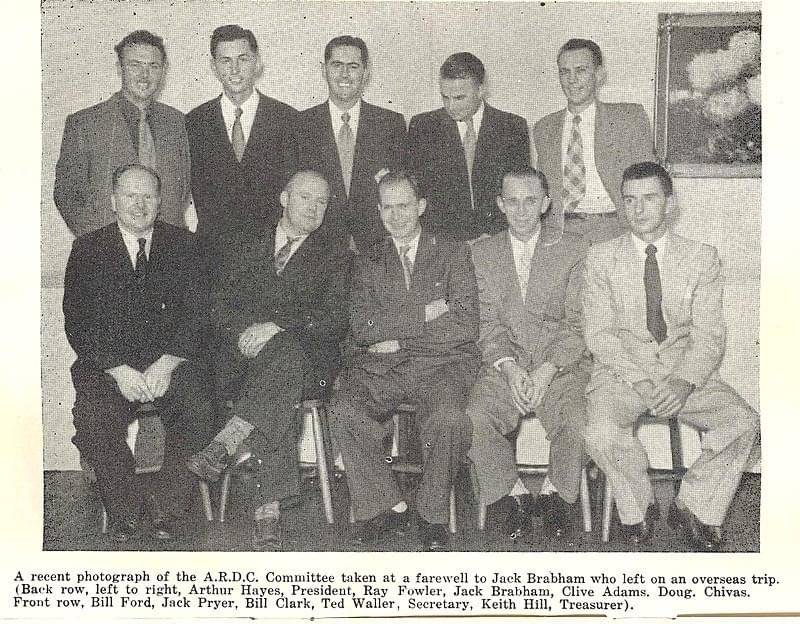
Brabham left for the UK in mid-March 1955 after a function held at Jack’s parents home in Hurstville attended by over 100 guests including the Mayor and Mayoress- at that stage he was expected to be away for six months.

It turned out to be rather longer than that of course, the great Australian finally retired from Grand Prix racing at the end of 1970 having been a front runner that season inclusive of one GP win which but for poor luck should have been three- competive to the very end of his long career.

He couldn’t stay away from racing for too long though, by August 1971 he was back in the seat of the Jack Brabham Ford sponsored Bowin P4X Formula Ford and won the ‘Race of Champions’ at Calder from Frank Matich, Kevin Bartlett, Bib Stillwell, Alan Hamilton, Allan Moffat and others.

I think it was his last ever real ‘race win’, 1978 Sandown demo with JM Fangio duly noted?…

(R Hawthorn)

Tailpiece: Smorgasbord of ‘Big Red Cars’…

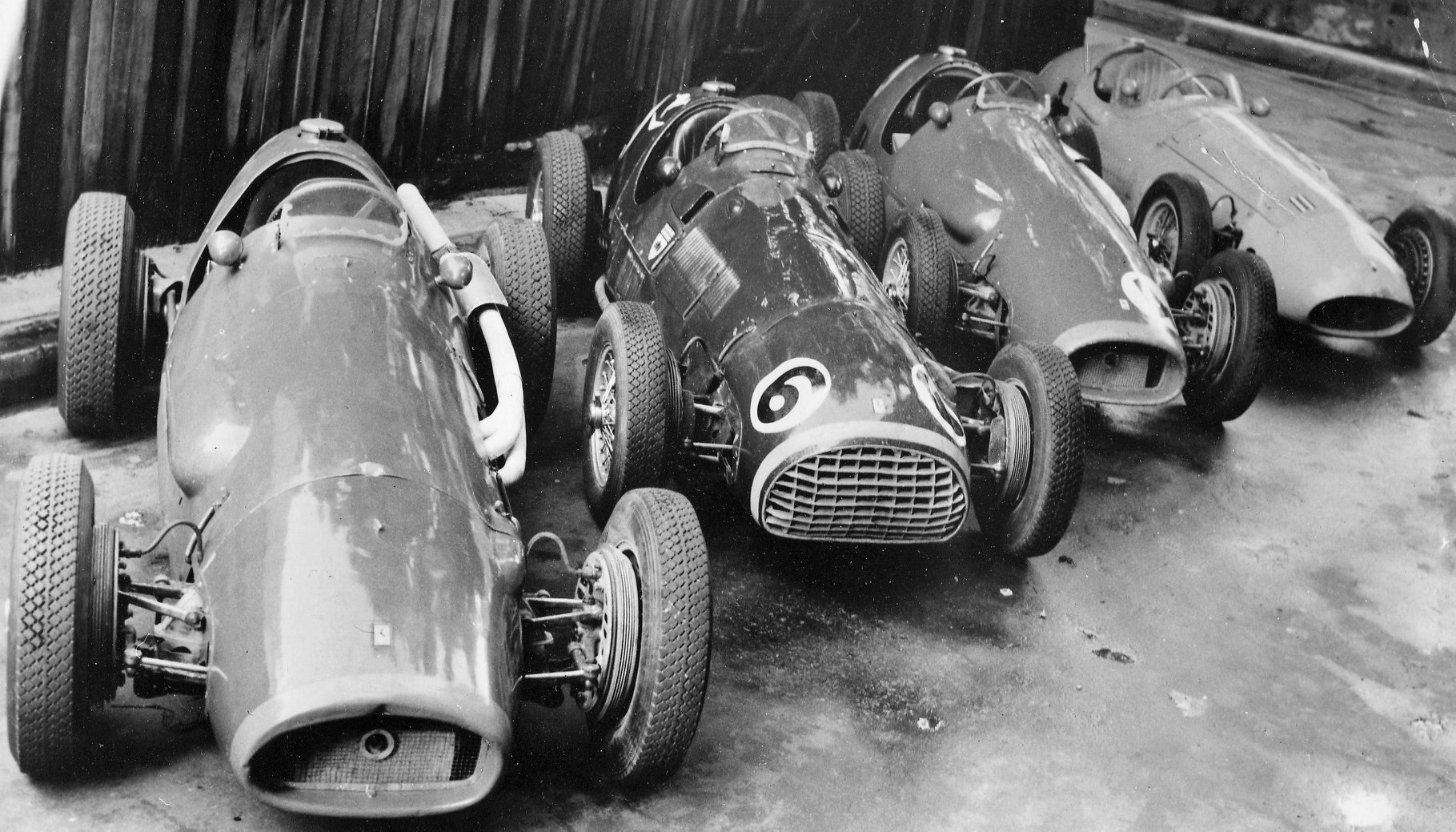
Whitehead, Cobden, Gaze and Bira, not that his 250F was red (F Pearse)

Finito…