
(P D’Abbs)
Beautiful Peter D’Abbs photograph of Lex Davison’s Aston Martin DBR4/250, chassis #1 3-litre with Austin Miller, Cooper T51 Climax in the background, Phillip Island, 23 October 1960…
Lex became famous for his retirements from racing and Dame Nellie Melba type returns to the grid. His 1958 AGP win at Bathurst was the final time he raced the marvellous ex-Ascari/Gaze Ferrari 500/625. He took a break from racing, but heading into 1960 he planned to take a holiday in Europe with his wife Diana, and to acquire a new racer.
He had watched the ‘Cooperisation’ of Australian racing from the sidelines and decided that a modern incarnation of his (ex-Moss 1954 AGP winning) HWM Jaguar would be competitive with the growing number of mid-engined cars.
Lex pitched the idea of a DB4 3.7-litre engine fitted to a DBR4 GP chassis to Aston Martin Racing Manager John Wyer. Wyer assured him the motor wouldn’t readily fit and that the David Brown five-speed transaxle, already marginal, would be pushed beyond its limits.
After plenty of argy-bargy Lex did a deal to buy DBR4 chassis #1 fitted with a 3-litre DBR1 sportscar engine, and a DB4GT road car. A rather nice combination of roadie and racer!
After the cars rebuild in March 1960 it was tested at Goodwood by Jack Fairman, and Roy Salvadori over two days before shipment to Port Melbourne. Davison drove the car on the second of the days to within a fraction of a second of Fairman’s best.
Chassis 1, unsurprisengly the first of the DBR4s built, was raced by Salvadori during the 1959 and four times in 1960.
After an initial test session with Allan Ashton and the AF Hollins crew at Phillip Island Lex raced it to THAT missed-a-win-by-a-bees-dick Australian Grand Prix at Lowood on 12 June. There, Alec Mildren’s Cooper T51 Maserati led Davo home by an official margin of one half of a second after a little over an hour of Grand Prix motor racing of the first order- click here for a feature on Mildren inclusive of a full race report on the AGP; https://primotipo.com/2018/06/08/mildrens-unfair-advantage/

Davison in his new car, Aston DBR4/250-1 during the 1960 AGP at Lowood, Queensland (B Thomas)

Davison and Mildren hard at it at Lowood. The flaggies are absorbed in the battle, not sure if it’s Glynn Scott or Jon Leighton’s Cooper Climax behind (B Thomas)
Lex and the boys made the long trip back to Queensland in September and ran again at Lowood in another Gold Star round for third place behind Alec and Bib Stillwell, both T51 mounted, then at the non-championship meeting at Phillip Island in October. Davo then raced in the soggy Warwick Farm opening meeting on 18 December where he was fourth behind the T51s of Stillwell, John Youl and Austin Miller having started from the front row.
Famously these Aston Martins were at least two years late to be competitive in Grand Prix racing. Honours as the successful front-engined GP cars go to the Ferrari Dino 246 and Vanwall, winners of the 1958 drivers and manufacturers respectively. While handing out gongs, perhaps the most sophisticated front-engined GP car was the Lotus 16 Climax, if not the most reliable.
Two of the magnificent Aston Martins came to Australia in 1960. Davison’s ‘DBR4/250 (1) and Bib Stillwell’s ‘DBR4/250 (3)’.
Unlike Lex, Bib had an each way bet, his Kew, Melbourne Holden dealership was spitting out wads of cash so he had a Cooper or three in his garages as well as the Feltham beastie. Lex’ eggs were in one basket, until he borrowed one of Stillwell’s Cooper T51s and nicked the 1961 AGP at Mallala, South Australia from under the noses of the established water-cooled Cooper aces.
I say that as Lex had been winning races and hillclimbs in two Phil Irving fettled Vincent engined Coopers for years, he was hardly unfamiliar with the handling characteristics of these small, light mid-engined missiles.

Ain’t she sweet our friend is thinking. Ballarat 1961 (P Skelton)

Davison’s DBR4-1 in the Ballarat paddock with Warwick Cumming at the wheel, and perhaps Allan Ashton doing the pressures. I’m not sure whether #4 or 14 is correct but both shots are at the Ballarat Airfield (P Coleby)
Into 1961 Lex raced the Aston in the late January Warwick Farm 100- Q11 and DNF oil leak, the race was won by the Walker/Moss Lotus 18 Climax. Davison then contested the Victorian Trophy at Ballarat Airfield on 12 February- the colour photo taken above by Phillip Skelton at that meeting could almost be a BP PR shot!
This time the car was out after completing nine laps with gearbox dramas, the hot and dusty race was won by Dan Gurney from Graham Hill in BRM P48s. It was the only international win for these cars.
Three weeks later, Davison and Stillwell took the cars to Longford. While Bib practiced the Aston he raced his Cooper whereas Davo raced to the finish of the 24 lap 100 miler, finishing in fifth behind Roy Salvadori, Bill Patterson, John Youl and Austin Miller in 2.2-litre and 2.5-litre Coventry Climax engined Cooper T51s.

Davison howls off Kings Bridge during the 1961 Longford Trophy, Aston DBR4/250-1 (oldracephotos.com.au/JSaward)

Dunlop HQ at Longford in 1961. Doug Whiteford’s Maserati 300S and Bib Stillwell’s Aston Martin DBR4/250-3 in attendance. This car was built to a later spec than Davo’s DBR4/250-1. In fact it was of the same specs of Davo’s new in 1961 chassis 4 inclusive of Maser transaxle and 80-degree engine (R Lambert)

Davison, during practice at Longford in 1961, DBR4-1 (G Smedley)
After Longford Lex shipped the car back to the UK. It needed a major rebuild as “the chassis was breaking up” wrote Graham Howard. The AF Hollins crew had repaired chassis tubes and added strengthening gussets to the machine in their Armadale, Melbourne workshop between the Ballarat and Longford meetings.
Lex’ plan was to race an Aston Martin at Le Mans and contest a number of Intercontinental Formula races in 196. In the event, after ongoing discussions with John Wyer, Aston Martin provided Davison a later chassis, “the sister car to Stillwell’s later model DBR4”, chassis 4 which was built but unraced in 1959, for Lex to use at Silverstone in July and Brands Hatch in August.
It was equipped, as was chassis 1 with a five speed Maserati transaxle instead of the heavy, recalcitrant David Brown unit, the latest cylinder head design which had valves arranged at an included angle of 80 degrees rather than the earlier variants 95 degrees. In 3-litre form it was good for circa 296bhp @ 6,700rpm, a good deal more mumbo than the 230 or so bhp of an FPF 2.5, but of course the chassis was no svelte nymph.
This article tells a bit of Bib and Lex’ 1961 European Adventures; https://primotipo.com/2015/09/22/aston-martin-db4gt-zagato-2vev-lex-davison-and-bib-stillwell/

(TC March)
Davo above having his first race in the second Aston DBR4/250-4 3-litre at Silverstone during the July 8 1961 British Empire Trophy Intercontinental Formula race. DNF gearbox quill-shaft after 17 laps, up front after 245km was Moss and Surtees in Cooper T53 Climaxes.
Davison had a busy weekend as he also contested the GT race in John Ogier’s Aston Martin DB4GT, “a bit of an old nail” and finished third behind the Ferrari 250 GTs of Stirling Moss and Graham Whitehead.
The Australian’s DBR4 drive received good press coverage, but Graham Howard wrote that it added to confusion for later historians as to which car Davo raced. The Motor described the machine as an ex-works DBR4 Grand Prix car fitted with a much modified 3-litre sportscar engine, while Autosport added to the confusion by noting that “a new chassis was fitted.”
Aston Martin themselves didn’t help either. In a late 1961 letter to Lex about a variety of things including shipment of the car to Australia, Wyer advised “the Aston had now been shipped, although there had been a mix-up with chassis numbers and it had been stamped DBR4-1 rather than DBR4-4”.
To be clear on this point, Graham Howard makes no comment about the chassis number of Lex’ first Aston, nor does Doug Nye, while Anthony Pritchard – his book was published later – says that the car is generally accepted to be DBR4-1. John Blanden in the second edition of his book simply lists one car and applies two chassis numbers to the “one entity”.
The correct position seems to be that the two cars were quite separate. Lex raced DBR4-1 in Australia, returned it to Feltham in early 1961, then raced DBR4-4 (the unused 1959 built chassis) in the UK and then later in Australia. The chassis, body and engine were different, built to a later spec. Whether the Maserati gearbox and other componentry fitted to chassis 1, which was interchangeable, was carried over to #4, who knows.
What is clear is that Lex was unhappy with his new car after Silverstone, Autosport quoted Lex as saying its “handling was nothing like the original car.”
A month later Davison contested his second and last Intercontinental race, the Guards Trophy at Brands Hatch on 7 August. This time, in dry, sunny conditions he brought the “new dinosaur” home in sixth place, ‘bruising’ the nose of the car; up front, four laps up the road in fact, Jack Brabham headed Jim Clark home in Cooper T53 Climax and Lotus 18 Climax respectively.

The relative size of the Aston Martin is put into context by Lorenzo Bandini’s Centro Sud Cooper T51 Maserati going underneath Davison into Surtees at Brands. The Italian was seventh and last of the finishers, and several months later was a popular contestant in our 1962 summer internationals (Getty)

Davison cruising through the Silverstone paddock during the July 1961 International Trophy meeting, his first race in DBR4/250-4 (unattributed)
A week or so after Brands the family headed home to Australia with the Aston Martin left behind at the factory for further work. This included repair of the panel damage sustained at the Kent circuit and to fit 12.5:1 pistons to suit the alcohol based fuel Lex used in Australia.
Howard reports that Davison was still unhappy with the handling of the car. He quotes from a letter written by Lex to Brian Josceleyne of the Aston Martin Owners Club, “My Grand Prix car is still at the works, where they are endeavouring to sort out some of the handling bugs, for the new chassis proved rather twitchy, unlike my earlier one which was a superb handling car and could be thrown about in a rather flippant way.”
Davo returned home via America including Hawaii, in time to win the AGP in South Australia on 9 October in one of Stillwell’s Cooper T51s. It was a car he rented from Bib after it became clear the DBR4 wouldn’t arrive in Australia on time for the race, that story is here; https://primotipo.com/2018/03/29/the-naughty-corner-renta-gp-winner/

Pat Hawthorn in the second of the Davison DBR4/250 Astons, chassis 4. The eagle eyed will note that the induction and exhaust ports of this car/engine are the reverse of the earlier machine (P Hawthorn)
There was still life in the old design though, Davison raced the Aston Martin to second place in the Victorian Trophy at Calder behind Stillwell’s Cooper T53 Climax in late February 1962. Not too far from home, at Sandown’s opening meeting he contested the Sandown Park International on 12 March where he was eighth behind a swag of Climax engined Coopers and Lotuses as well as the Chuck Daigh driven Scarab RE Buick 3.8-litre V8, it too was a mid-engined machine.
By that stage Lex had got-with-the-strength and was racing a Cooper T53 Lowline which famously met its maker in a huge accident at Longford on March 4. A gust of wind caught the car while airborne on the hump in the road before the Longford pub, it was a very lucky escape. The Yeoman Credit Cooper was geared for 170mph @ 6,700rpm that weekend, Davison described the accident, raconteur as he was, to John Wyer in one of the many letters they exchanged.
“I was managing to lap at 110 to 112 mph, some three seconds faster than Brabham’s lap record of the year before, when I became airborne over a hump some 200 yards prior to a 90-degree corner in the middle of a little town. A gust of wind caught me and I landed in a drain beside the road. I motored along this at some 140 mph causing some uneasiness to the police, radio announcers, officials, television cameramen and various others cluttering up the entrance to the escape road. I regained the road again but the heavy rear-engined end slid in the gravel and I shot down the road sideways. I hit a tree with the nose, which plucked everything forward of the soles of my feet off the car and spun the car around in the process. It then shot along a hotel wall at window height, demolishing the floral display, pot plants etc, then a 360 degree spin around the entrance porch of the hotel and back up the wall again. The car then fell off the hotel wall and back into the road and shot across the road backwards into a grain mill. I shook what was left from me and went back into the pub and ordered a brandy. They even made me pay for it, which was the cruelest blow of all.”
After the international visitors returned home Lex ran the Aston at Sandown in May 1962, winning a race for front engined racing cars. He didn’t run it again until February 1963 when he gave it a gallop at Calder, in part to demonstrate it to potential purchasers. In the process he provided five thrilling laps for spectators in a three car match race with Bryan Thomson’s supercharged Cooper T51 Climax and Frank Matich’s new, works, Elfin Catalina Ford pushrod 1.5.
The Aston Martin was advertised for sale in Australian Motor Sports during 1962 and was soon acquired by garage proprietor and Calder Raceway part owner, Pat Hawthorn. He is photographed above proudly showing off his new acquisition at his Clayleigh Service Station in Clayton, not too far at all from Sandown where, by March 1963, he was mixing it with the heavies in the Sandown Park International.

Pat Hawthorn on the way to fourth place in the Advertiser Trophy, 1963 Mallala Gold Star round. And kids just want to have fun below!, circuit uncertain, Winton perhaps. Aston Martin DBR4/250-4 (P Hawthorn)

(P Hawthorn)
Hawthorn raced the car through until 1966 in Victoria and South Australia. Perhaps the last championship points the car scored were in the 14 October 1963 Advertiser Trophy, Mallala Gold Star round. There he was fourth among the mid-engined hordes, behind the Cooper T55 of John Youl, Bib Stillwell’s Brabham BT4 and Wally Mitchell’s MRD (aka Brabham BT1) Ford Formula Junior.
Pat sold the car to UK historic racer Neil Corner in 1966, there he was a consistent race winner, the Calder Raceway signed Rice Trailer cut quite a dash on UK Motorways! DBR4-4 of course still exists.

Aston Martin DBR4/250 cutaway drawing, 95 degree engine spec (conceptbunny.com)
Chassis numbers and development of the Aston Martin GP cars in summary…
My standard reference for all things chassis numbers is Allen Brown’s great site, oldracingcars.com (ORC). I say great in the sense that most of the standard texts were written in the pre-internet days before it was possible to debate the merits of ‘what is what’ and ‘which is which’ amongst knowledgeable enthusiasts to land on generally agreed positions based on facts which have been often vigorously debated.
Using ‘Howard’ (see bibliography) published in 2004, ‘Nye’ in 1993, ‘Blanden’ in 2004, ‘Pritchard’ in 2006 and ‘ORC’ as my source material the Aston Martin Grand Prix cars built are as follows and their destiny, I think and hope is as follows…

Reg Parnell does all the work as Peter Whitehead and Tony Gaze share a joke. Aston Martin DP155/1 at the Dunedin Wharf rail head, New Zealand, January 1956 (T Selfe)
1. DP155 and the DBR4/250
Aston’s first toe in the water GP exercise was the DB3S based DP155 I wrote about a while ago. Its most significant racing was with Reg Parnell at the wheel during the 1956 New Zealand Internationals, click here; https://primotipo.com/2019/09/05/the-gp-aston-martin-dp155/
‘Its bones’ were converted back into a DB3S albeit there is a car doing the rounds in the UK ‘sorta in the style’ of DP155. It has none of the original car’s core componentry.
Getting more serious, in the summer of 1956 – at the same time they started development of the DBR1 – Aston Martin’s engineers commenced the design of the DBR4/250 GP car.
The spaceframe chassis was fitted with a short-stroke version of their 3-litre sportscar RB6 engine. This 2493cc DOHC, two valve, 50DCO Weber fed engine produced 250bhp @ 7,800rpm on the Avgas which was mandatory from 1958.
The design was period typical in having upper and lower wishbone suspension at the front, with torsion bars and co-axial shock absorbers, and De Dion rear suspension with torsion bars again the springing medium. The axle was located by a Watts linkage and radius rods. Armstrong provided the shocks front and rear.
A transaxle was used at the rear – the unpopular with drivers – David Brown CG537 five-speeder. Girling provided the brakes, Borrani the wire wheels. Initially Morris Minor rack and pinion steering was used, later the DB4 rack and pinion was adopted.

Roy Salvadori in practice aboard DBR4-1 during practice at Zandvoort, 1959 Dutch GP weekend. DNF overheating after 13 laps. Jo Bonnier won in a BRM P25, it was BRM’s first championship GP win (Getty)
2. DBR4/250 chassis number 1
‘This prototype’ was built in time for testing by Reg Parnell and Roy Salvadori at MIRA in December 1957. It was further testing again there in February 1958 before being put to one side as sportscar racing was prioritised.
Stirling Moss won the Argentinian GP in a Rob Walker Cooper T45 Climax in early 1958. Time was of the essence with the DBR4/250. The oh-so-sexy-beast, was, in effect obsolete by the time of its launch in April 1959.
By then the car was fitted with modified DB4GT coil and wishbone front suspension which was more practical than the torsion bar arrangement, but was 15 pounds heavier – in a car which was already a pork-chop.
Salvadori’s second place in the BRDC International Trophy at Silverstone flattered to deceive. Initial problems were an engine at the wrong end of the car (cheap shot), too much weight, and, most critically engine bearing lubrication issues which meant revs had to be kept down to an uncompetitive level.
Aston Martin won at Le Mans in 1959, Salvadori and Carroll Shelby took a splendid win in the DBR1. Poised to win the World Sportscar Championship, the F1 program, rightfully, took second place in the allocation of scarce corporate resources.
In the winter of 1959/1960 chassis 1 and 2 were modified. After surgery they were two inches slimmer and some 55lb lighter. ‘”Merely replacing Brown’s own heavy and baulky CG537 transaxle with one from Maserati (Type 5M-60) saved 50lb. The Aston gearchange, reliable, but heavy and slow – tolerable in a sportscar, was out of place in Formula 1″ Doug Nye wrote.
After negotiations between Davison and Wyer DBR4 1 was fitted with engine number RB6/300/1 from sportscar chassis DBR1-1 and shipped to Australia, John Blanden wrote.
DBR4 1 was returned to the UK by Davison in early 1961 and was eventually bought by Neil Corner, to use as a spare for his DBR4-4 he ran in historic racing with chassis 1 built into a complete car by Geoffrey Marsh in the early eighties.

Front and rear suspension of Trintignant’s DBR5-1, British GP weekend, Silverstone 1960. Upper and lower front wishbones, torsion bar, roll bar, Armstrong shock, Girling solid disc brakes. The major difference to the DBR4 is the use of a torsion bar instead of a coil spring. De Dion rear suspension, Armstrong shock and radius rods – same as DBR4 (Getty)

Carroll Shelby during the 1959 Portuguese GP at Monsanto Park, eighth in DBR4-2. Moss won in a Cooper T51 Climax (LAT)
3. DBR4/250-2
Was Carroll Shelby’s chassis in 1959, and like #1 contested only the Dutch, British and Portuguese GPs that year. 1959/1960 winter modifications as above. DBR4-2 was scrapped.

Bib Stillwell susses his equipment, DBR4-3 in the Ardmore paddock, NZ 1962 (E Stevens)
4. DBR4/250-3
This car was lighter than the first two built by virtue of a stressed skin body centre section, one piece De Dion tube and lighter Maserati gearbox. Its race debut was at Monza in September 1959.
Salvadori retired it while running sixth, Moss won in a Rob Walker Cooper T51 Climax. Front engined Ferrari 246 and BRM P25s filled six of the top eight places so a good front-engined machine could still do well, on fast circuits at least!
Stillwell bought the car on a bit of a whim, frustrated as he was by not being able to buy a 2.5-litre Coventry Climax FPF engine for his Cooper T51 at the time. The motors were in short supply, allocation preference was to the works favoured or contracted Cooper, Walker and Lotus teams.
In the event, no sooner had Bib committed to the Aston Martin, he was able to buy the Cooper T51 Jack Brabham raced in Australia that year…fitted with a 2.5-litre FPF.
In fact the Kew, Melbourne Holden Dealer had possibly fallen out of love with the Aston before its arrival in Australia. Bib raced his new 2.5-litre T51 to first at Port Wakefield in October, then second at Caversham, and third at Phillip Island on consecutive December weekends. He topped off his late season form by winning the (non Gold Star) Warwick Farm Trophy on 18 December, back in fourth place was Lex’ DBR4 surrounded by a sea of Cooper T45/51s.
Fitted with 3-litre RB6/300/7 sportscar engine, DBR4/250-3 arrived in Australia in late 1960 and was almost immediately shipped to New Zealand to contest the NZ GP at Ardmore, Auckland in early January 1961. He placed fifth in a heat and was classified twelfth in the GP, Jack Brabham won in a Cooper T53 Climax.
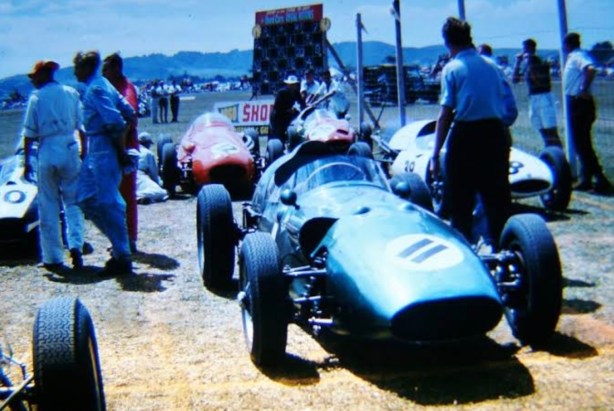
Bib Stillwell’s Aston DBR4-3 in the Ardmore paddock during the January 1961 NZ GP weekend. Jo Bonnier’s Cooper T51 Climax right rear, David McKay’s Stan Jones owned Maserati 250F #12, and the #38 Cooper is uncertain. Denny Hulme drove a car with that number in this race but the car shown is not the dark coloured Yeoman Credit T51 Denny raced (TRS)

A nice compare and contrast shot. Stan Jones’ Cooper T51 Climax alongside Stillwell’s DBR4-3 before practice at Longford in March 1961
Back In Australia, he practiced the car for the Warwick Farm 100 in late January but didn’t race it. Running the T51, he finished third behind the Moss and Innes Ireland Lotus 18 Climaxes. Bib’s crew then took the car across Bass Straight to Longford in early March, Bib practiced it, but the engine burned a piston so he raced his Cooper T51, retiring with plug problems in the Longford Trophy won by Roy Salvadori’s Ecurie Vitesse (Jack Brabham) Cooper T51 Climax.
Bib continued to race his T51 but returned with the Aston Martin to Warwick Farm in May. He won the (non Gold Star) 10 lap Racing Car Scratch from Alec Mildren’s Cooper T51 Maserati 2.9 and Noel Hall’s Cooper T51 Climax 2.2. Was this the only race win of a DBR4 in-period anywhere?
And that was it. Bib displayed the car at Jim Abbott’s Melbourne Racing Car show in August before racing it again in the 1962 NZ GP, doubtless, given his flotilla of Coopers, with a view to selling the car in New Zealand. He was tenth in the sopping wet race won by Stirling Moss – having qualified seventh – inclusive of a mid race plug-change.
Bay of Islands driver Lionel Bulcraig acquired the car after the race, running it in NZ through to 1965, his time in the car is covered here; https://primotipo.com/2019/09/02/waimates-aston-martin-dbr4-250/
Bulcraig advertised it in Car and Driver, the American international magazine, in late 1965. It was acquired by Peter Brewer who dominated Historic Racing in the UK in the late sixties with it. Bought by Tom Wheatcroft’s Donington Collection in 1970, it was “a collection of horrible bits”, as Doug Nye described it, for restoration to original 1959 specifications.

Stillwell, DBR4-3 during the 1962 NZ GP, site of a Stirling Moss Lotus 21 Climax wet weather master-class. Stillwell was tenth, 6 laps in arrears (Ardmore)

DBR4-3 chassis in recent times in the Hall & Hall workshop. Rare chassis photograph (H&H)

Plug change for Salvadori’s IRS “diabolical handling” DBR5-2 during the 1960 British GP weekend, nice cockpit shot. Trintignant’s de Dion DBR5-1 is in front (Getty)
5. DBR4/250-4
This chassis built at the same time as #3 but was unraced in F1 in 1959 and 1960.
After DBR4-1 was returned by Davison to Feltham in early 1961, DBR4-4 was built to ultimate spec; De Dion rear, Maserati gearbox, 80 degree cylinder head and magnesium alloy block RB6/300 engine specifications for use in the Intercontinental Formula in the UK. Then limited use in Australia before its sale to Pat Hawthorn in early 1963.
Later to Neil Corner in 1966, who also acquired DBR4-1 which was eventually built up as an historic car.

Trintignant’s DBR5/250-1 being unloaded from Aston Martin’s AEC transporter at Silverstone during the July 1960 British GP weekend at Silverstone- a poor eleventh was the result (LAT)
Cars 6. and 7. DBR5/250-1 and 2- sometimes also referred to as DP201
For 1960 Aston Martin designed a new car – still front engined mind you – the DBR5/250 was 3 inches shorter than the DBR4 with a wheelbase of 7 ft 3 inches and used torsion bar independent front suspension.
Two cars were laid down, DBR5/250-1 which was built with a De Dion rear and chassis 2 which was fitted with independent rear suspension by torsion bars.
Both DBR5s were scrapped after unsuccessful performances in the International Trophy, at Zandvoort and in the British GP.
Doug Nye wrote that “The new rear end merely made the cars handle worse, so following the British GP, David Brown wisely withdrew his team from the dying Formula”,- the 2.5-litre F1 ended on 31 December 1960.
In summary, Aston Martin built seven Grand Prix cars; one DP155, four DBR4s and two DBR5s with three now extant – DBR4 1, 3 and 4.

Zandvoort 1960, two cars for Roy Salvadori. DBR4-3 at left was brought along as the practice hack and DBR5-1 is at right, the racer. DNS along with the Scarabs when the Dutch GP organisers reneged on the start money deal. The cars were rumbling back towards the Channel by the time the race commenced. It’s a nice side by side shot, the only obvious difference is the 95-degree engine in the DBR4 and 80-degree exhaust on the left motor in the DBR5 (D Friedman)

DBR5-1 with Lucas fed 80-degree twin-plug 2.5-litre six – 245bhp @ 7,500rpm. Zandvoort 1960 (D Friedman)
Anthony Pritchard wrote that “By this time (Zandvoort) Aston Martin realised the hopelessness of their position.”
Team Manager Reg Parnell asked Stirling Moss to try the car, the best that he could manage was a 1:40 compared to 1:33.2 in his Lotus 18 Climax. Trying his very hardest, Salvadori achieved 1:37 seconds.

Zandvoort, (D Friedman)

British GP July 1960. Nice compare and contrast of the Weber DCO and Lucas injected engines. The independent rear suspension shot is Salvadori’s DBR5-2 which handled atrociously; upper and lower wishbones, roll bar, Armstrong shock and two radius rods, torsion bar (Getty)
Etcetera…

(Michael Oliver Collection)
After publication Lotus historian and author Michael Oliver got in touch and sent these two marvellous shots of Lex during the Brands Hatch Guards Trophy meeting taken by his father, and his dad’s mate, below.
Whilst Lex damaged the nose of the car during practice he also knocked off the right-front corner of the Aston. The shot captures the damage and is a rare colour image of the suspension.

(Michael Oliver Collection)

(K Harley)
Ecurie Australie at Longford in 1961.
Photo Credits…
Peter D’Abbs via Mark Ellery Collection, Pat Hawthorn Collection via Russell Hawthorn, Phillip Skelton via the Tony Johns Collection, Getty Images, Ron Lambert, oldracephotos.com.au/JSaward, Peter Coleby Collection, Tony Selfe, David Friedman Collection, LAT, E Stevens, Brier Thomas, Hall & Hall, TC March, conceptbunny.com, Michael Oliver Collection, Kim Harley
Bibliography…
‘Lex Davison: Larger Than Life’ Graham Howard, ‘History of The Grand Prix Car 1945-65’ Doug Nye, ‘Aston Martin: A Racing History’ Anthony Pritchard, ‘Historic Racing Cars in Australia’ John Blanden, oldracingcars.com
Tailpieces…

(P D’Abbs)
The opening shot of Lex again but cropped a tad tighter to focus that little bit more on the car- DBR4/250-1. While below is the same car eighteen months before in the Dutch sand dunes rather than the Australian ones, Roy Salvadori at Zandvoort during the 29-31 May weekend in 1959.

(LAT)
Finito…







 primotipo...