Posts Tagged ‘Rob Roy Hillclimb’

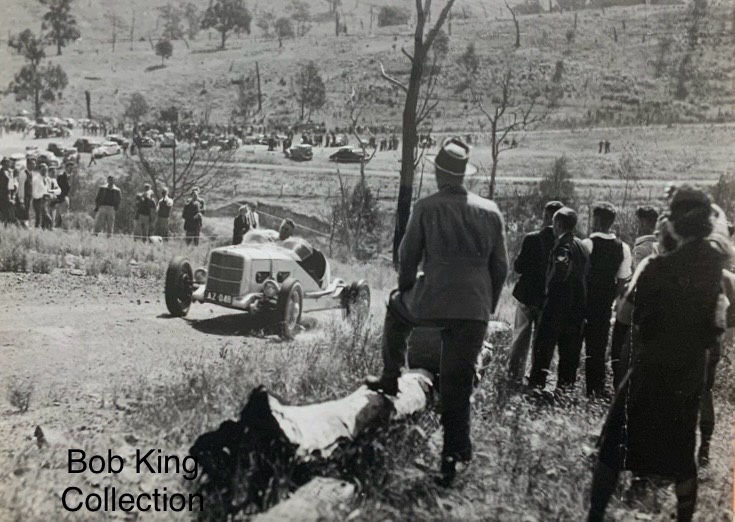
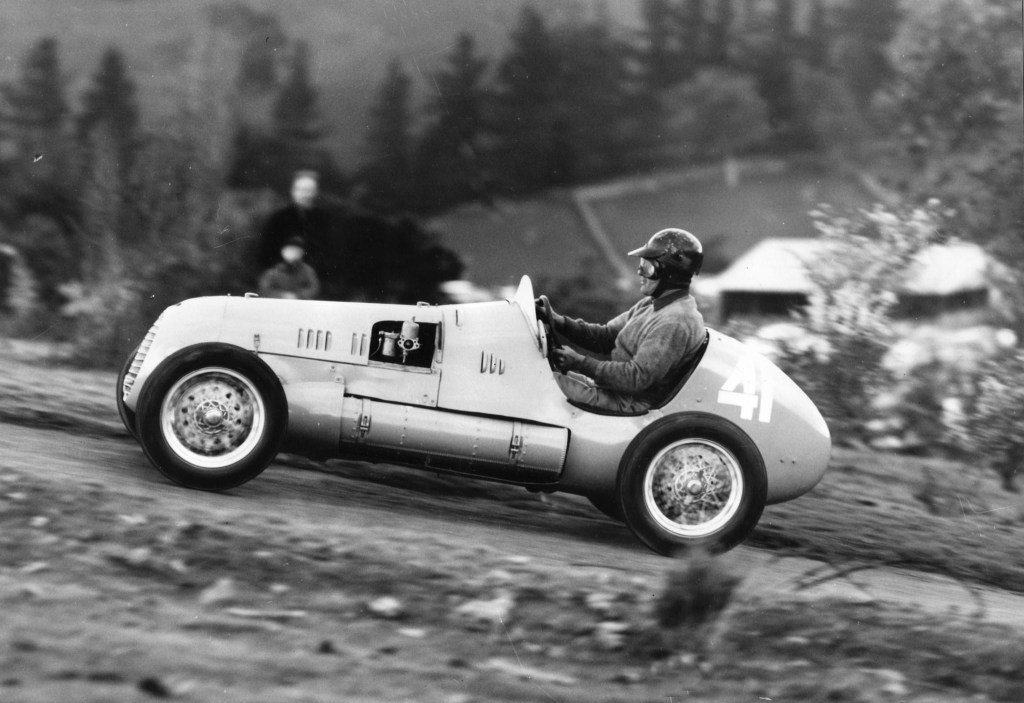
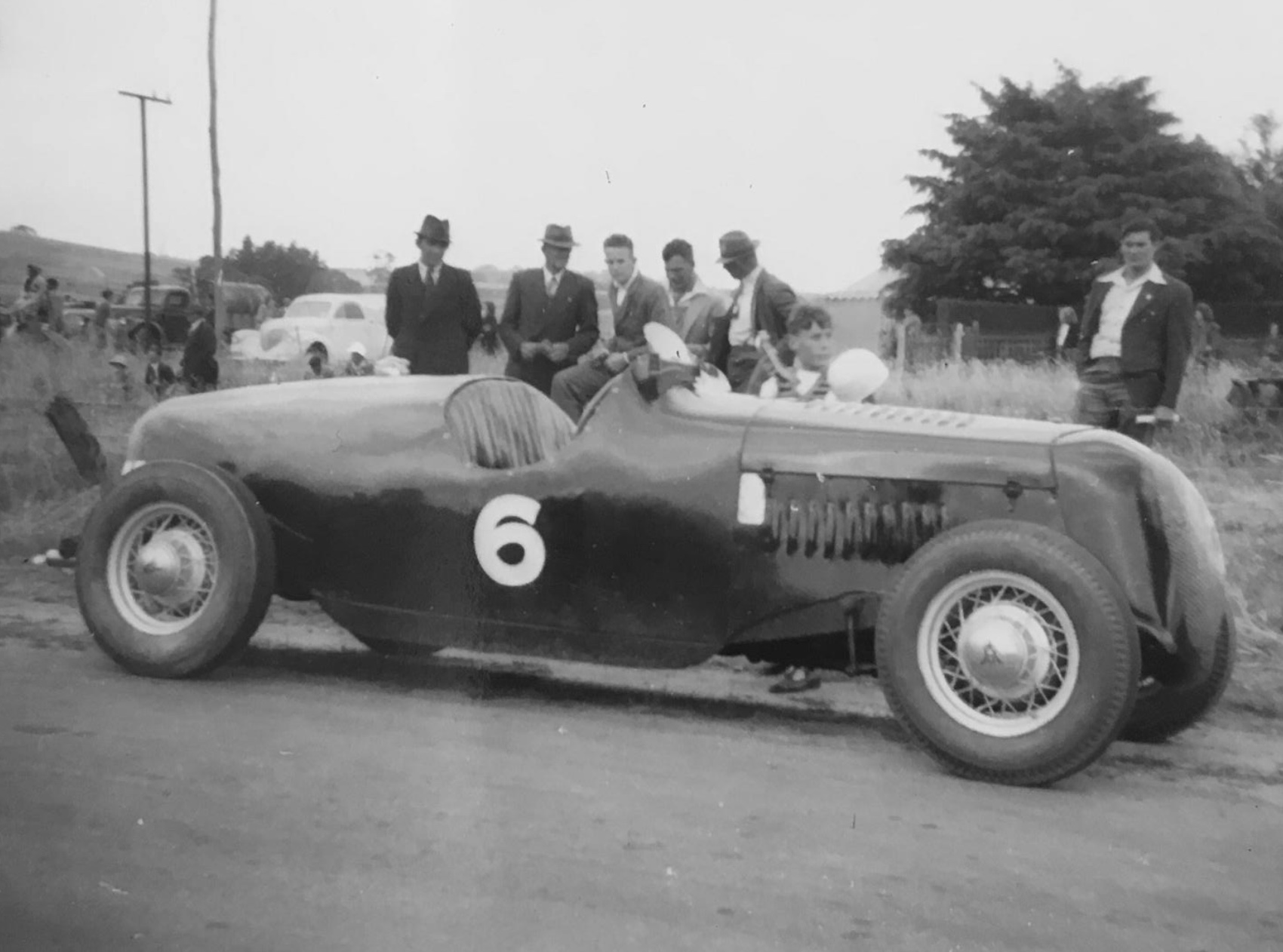
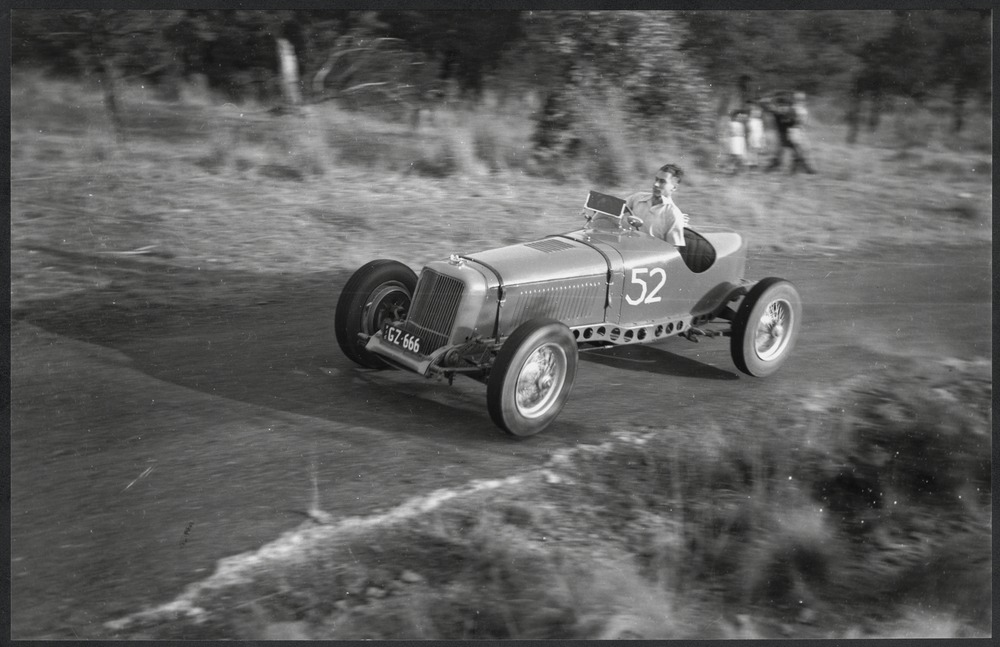
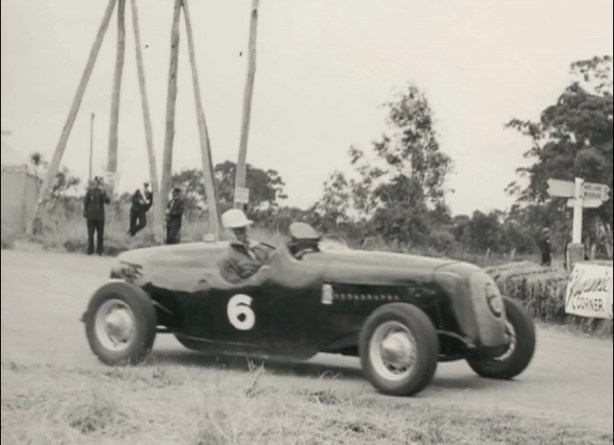
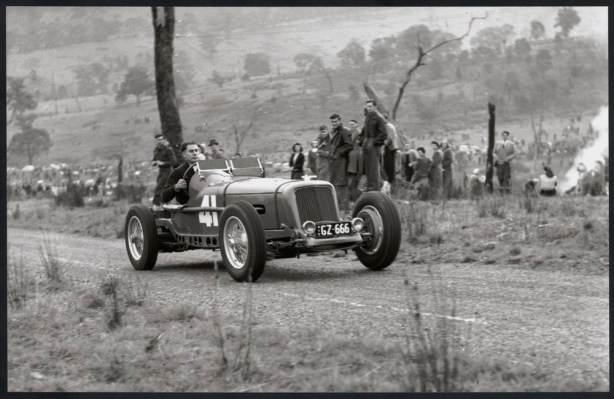
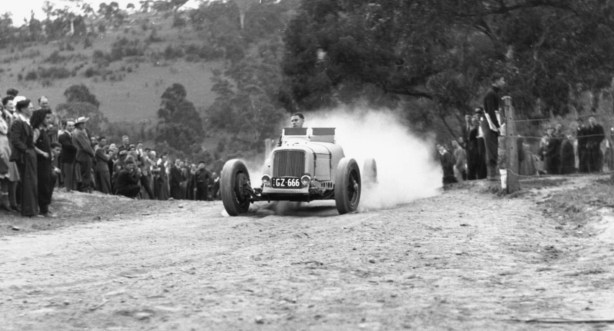
Evocative shot of Jack Phillips’ Ford V8 Special ascending Rob Roy hill in the Christmas Hills, 50km east of Melbourne

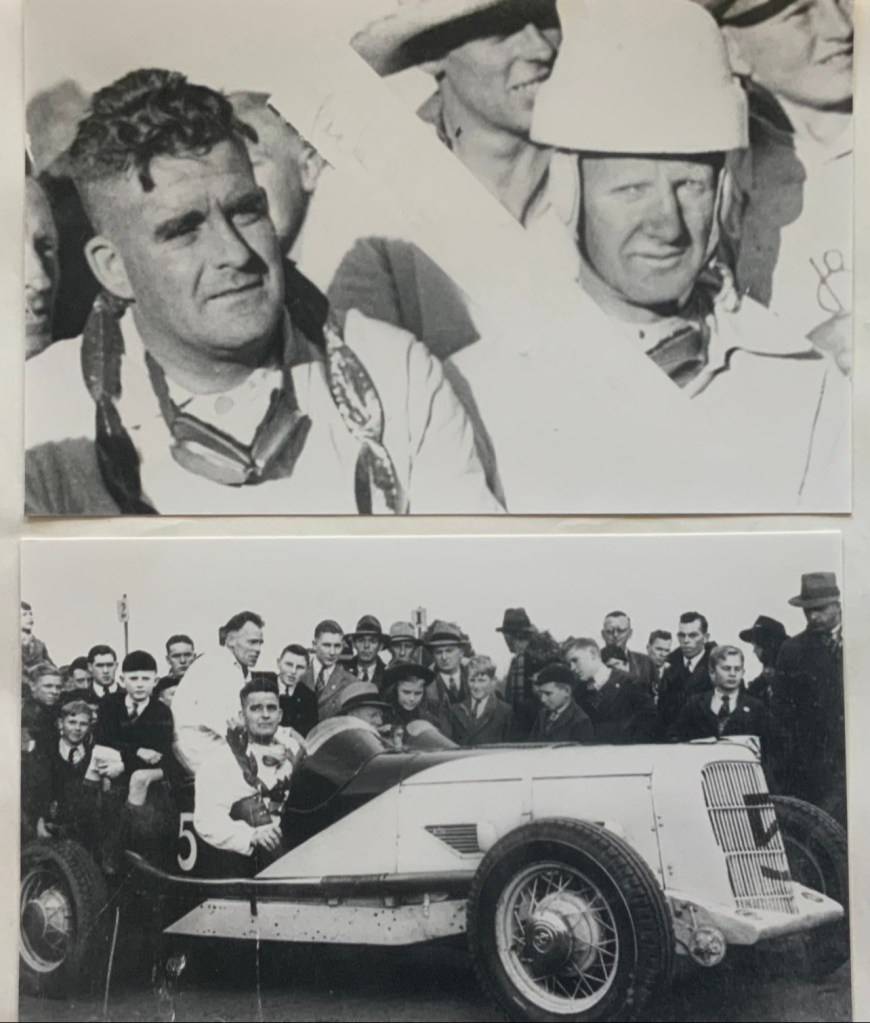
This car was one of the fastest and most successful racers in Australia – where handicap events then were standard fare – in the immediate pre and post-War period. Built by Phillips and Ted Parsons, his riding mechanic and partner in a Wangaratta Ford dealership, I’ve written about the combo before: https://primotipo.com/2023/03/07/jack-phillips-ted-parsons-ford-v8/

I’d love to know the date of the meeting and how Jack went? Before the January 13, 1939 Black Friday fires it seems?

(B King Collection)

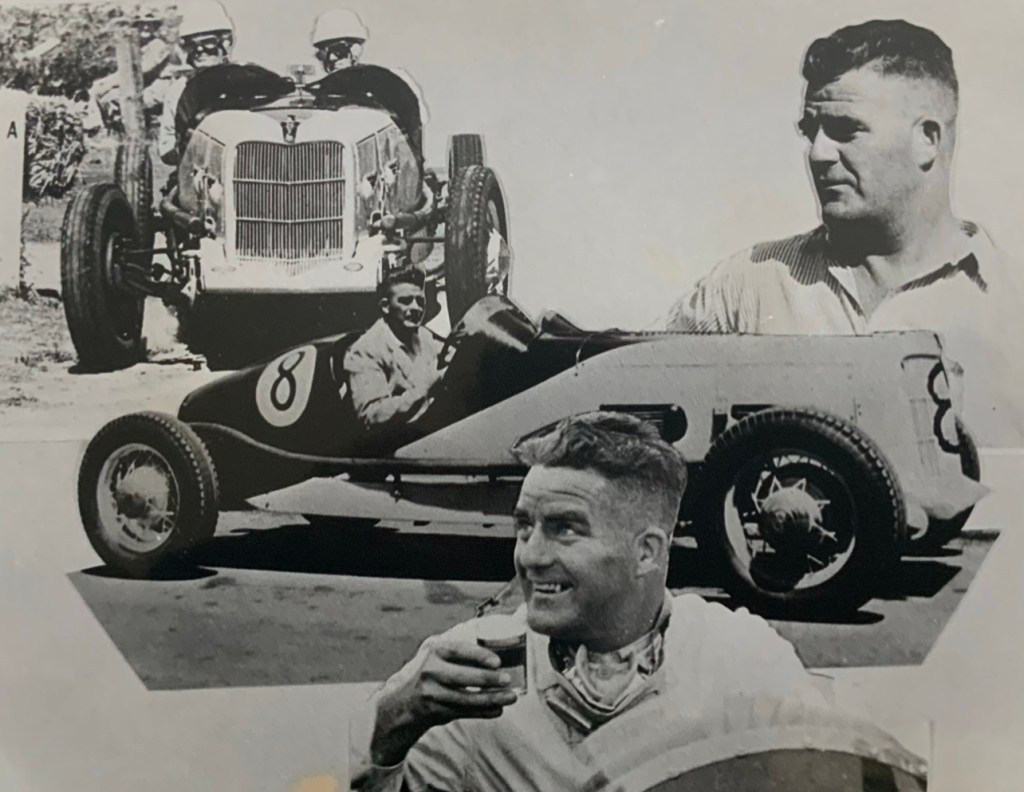
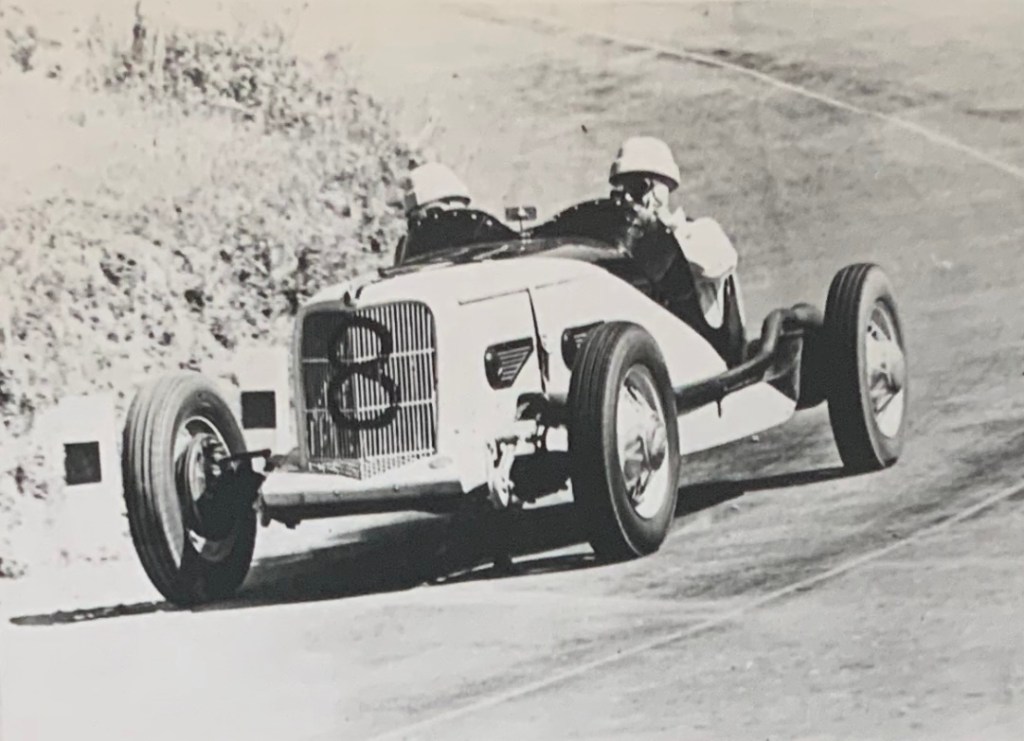
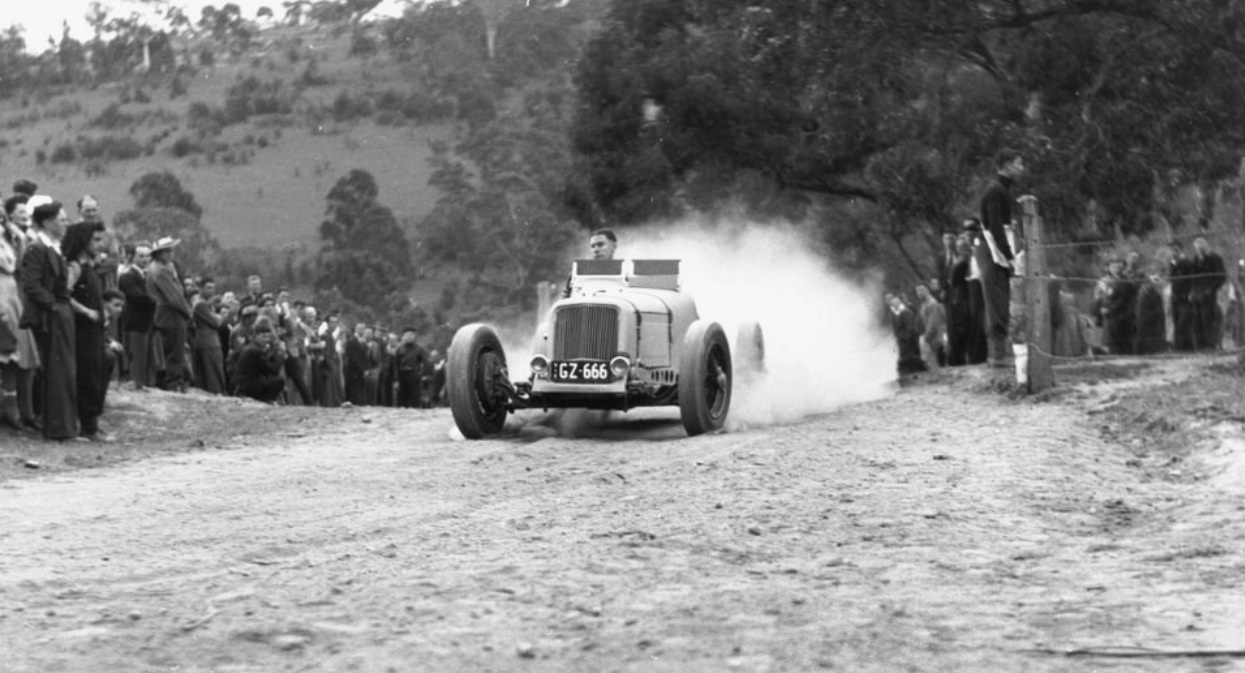
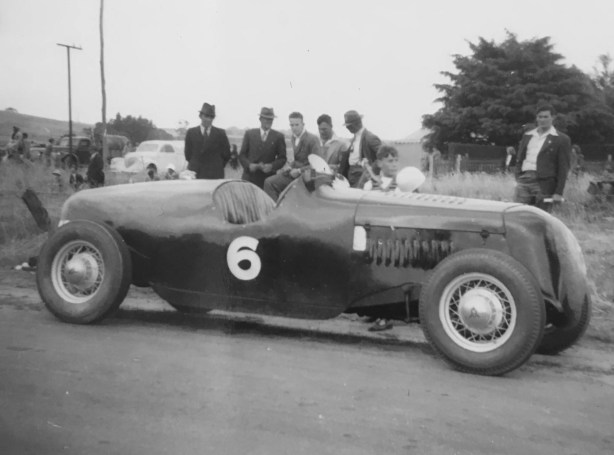
Phillips/Parsons (above and below) on the way to a win in the South Australian Hundred on formidable Lobethal in 1940.

(B King Collection)

Credits…

Bob King Collection

Tailpiece…

(B King Collection)

Finito…

(R Nutt Collection)

Favourite shot of a favourite car…

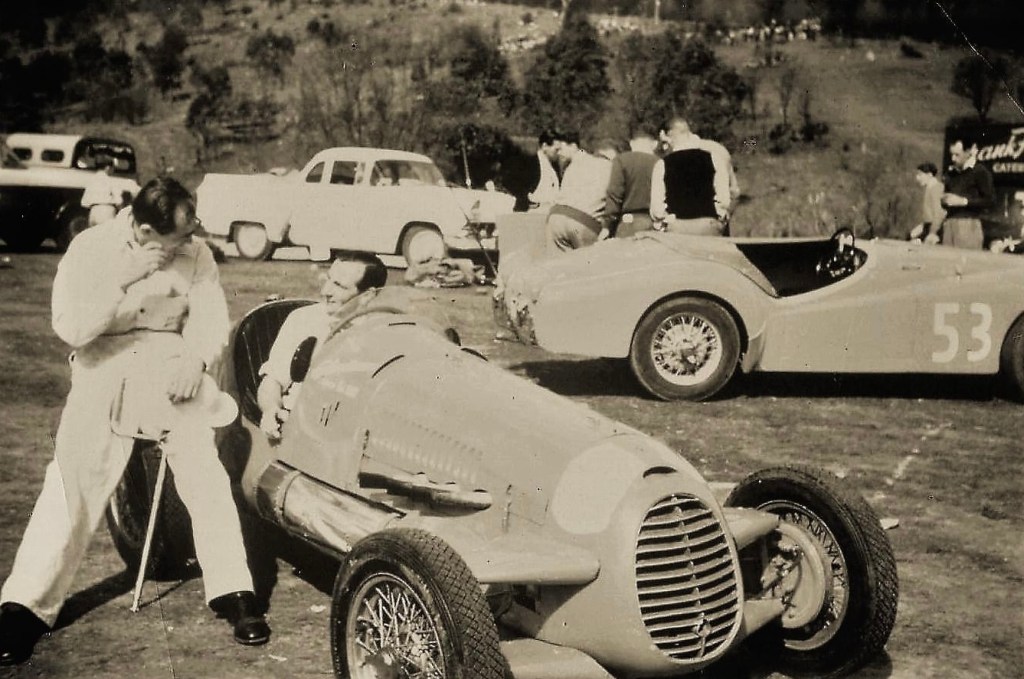
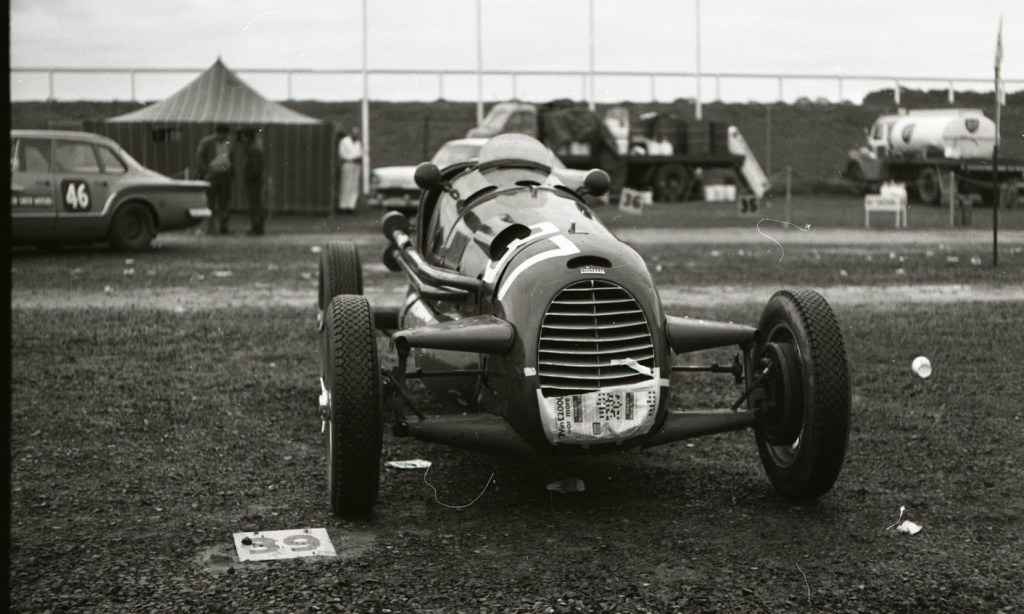
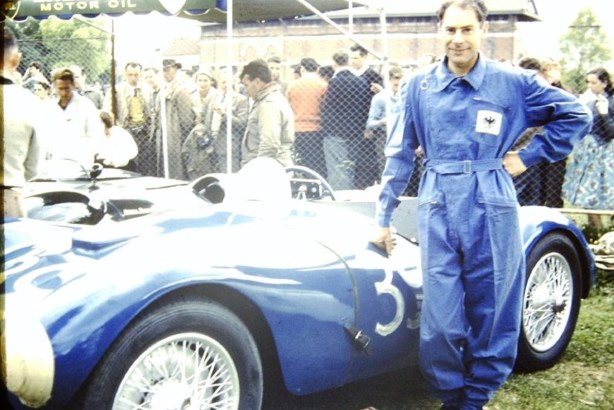
Reg Nutt aboard the Leech Brothers owned Cisitalia D46 Fiat at Rob Roy hillclimb in Melbourne’s glorious Christmas Hills on May 4, 1958. He ran second in his class that day behind multiple Australian Hillclimb Championship winner, Bruce Walton, Walton J.A.P with a time of 28.30 seconds.

Nutt was a riding mechanic in the first decade of Australian Grands Prix at Phillip Island in the 1920s and 1930s and then a racer of note in his own right, including AGPs. “Reg told me that he had raced 27 cars and never owned any of them,” recalled Bob King. What a lucky man.

Nutt in the Rob Roy paddock on November 5, 1947 when the car was owned by Fred Gibbs’ Sabina Motors (Davey-Milne Family Collection)
Harry Firth in the D46 at Rob Roy in 1958. Later Oz 1960s and 1970s touring car star driver/engineer/team manager (L Sims Collection)

The car – chassis D461.1 according to John Blanden, and #0020 “the 20th of approximately 30 D46s built” according to a dealer in more recent times – was built in 1947 and sold to Frenchman, Roger Loyer (5/8/1907-24/3/1988) of the Ecurie de Paris. See here for a full-profile of Roger; https://gprejects.com/centrale/profiles/drivers/profile-roger-loyer

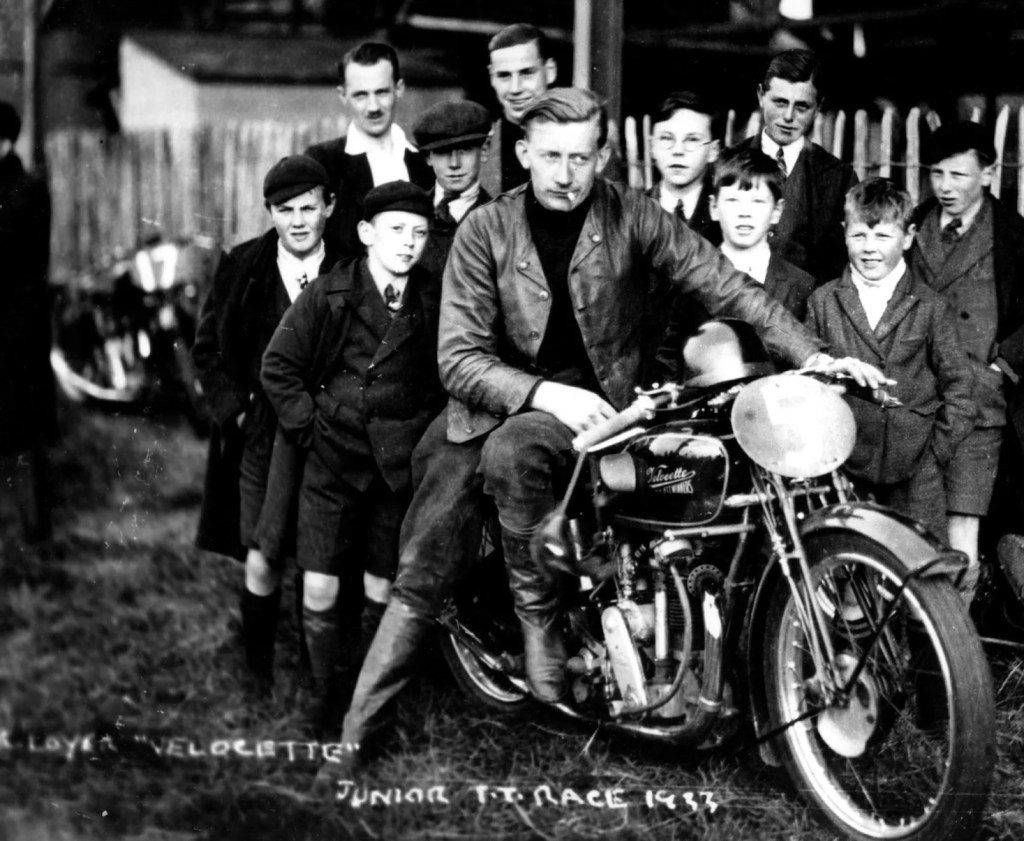
Loyer was a two time French national motorbike champion who switched from two wheels to four postwar aboard an old Delage D6. He then bought the Cisitalia – two D46s in fact, the other Ecurie de Paris car was driven by ‘the mysteriously self-styled Robert’ – which was prepared in his Ecurie de Paris garage located in the swish 17th Arondissement.

His D46 debut was at the Circuit des Remparts, Angouleme on June 15, 1947 and netted a heat victory, and third in the final sharing the car with Raymond Sommer. In the Coupe des Petites Cylindrees at Reims he was ninth, much better was third in the Coupe de Paris at the Bois de Boulogne in central Paris. Another strong fourth in a field of depth in the 330km GP du Comminges followed at St Gaudens in August, the three cars in front were Talbot Lagos. Late in the month Roger was third in a field of 12 Cisitalia D46s on the Circuit del Montenegro in Italy. A DNF late in the season at Lyon wasn’t representative of qualifying pace, fourth again at the Prix de Leman at Lausanne in October was followed by a season ending DNF with rear axle failure at the GP du Salon, Montlhery.

Roger Loyer and Velocette at the Isle of Man in 1933 (unattributed)
GP des Remparts, Angouleme in 1949. Maurice Trintignant, Simca Gordini T11 in front won sharing with Jean Thepenier. Bruno Sterzi, Ferrari 166 #26, with Roger Loyer at right D46 Fiat DNF, and Harry Schell, D46 Fiat behind Trintignant (unattributed)
Roger Loyer with his Cisitalia D46 Fiat at Lyon in September 1947 (Jannaud)

In a limited 1948 season – when the D46 was still very competitive in F2 events – Loyer raced at Pau in March, then Geneva in May for a DNF, then shared a car to third in the Circuit des Remparts with Robert in July. 1949 was worse in an even more limited campaign. DNQ at the Circuit du Lac in June and a crash at the Circuit des Remparts in July despite finishing second and setting fastest lap in the second heat. Robert and Roger shared a drive to sixth in the Circuit de Lac in a Simca, then contested the Grand Prix of the Nurburgring, where Roger was again a DNF.

Loyer then joined the Simca Gordini F2 team, selling one of the D46s to Melbourne’s Dale Brothers in April 1951 – https://primotipo.com/2018/08/23/words-from-werrangourt-1-by-bob-king/ .

Alan Watson was the buyer, but he didn’t use it much, notably giving it a run at Longford in March 1955. The car passed through several owners hands, albeit who were owners and who were drivers is lost a bit in the mists of time; the roll call includes Tony Osborne, John Doherty, Harry Firth, Syd Fisher, Ian Wells, Ray Gibbs and Ian Wells.

Lou Burke sold it to the Leech Brothers in 1964 and they used it for decades in Eastern Seaboard Australian historic events. The car was painted red circa 1980 when the pretty-Italian formed the bloke-magnet for the Lombard Insurance stand at motor shows. The car left Australia for the ‘States in 1987 and has pinged around the auction scene, some of the sales-prose Arthur Daley would be proud of.

More about Dante Giacosa’s most significant design here; https://primotipo.com/2017/02/24/the-cooper-t23-its-bristolbmw-engine-and-spaceframe-chassis/

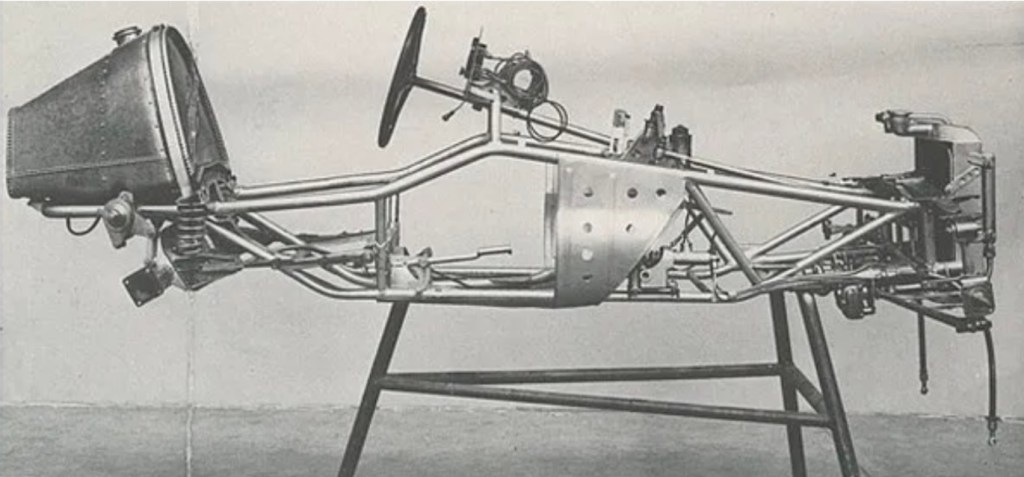
The lack of straight tube-runs would have offended Colin Chapman (but not Owen Maddock), however, the Cisitalia D46 spaceframe – here in definitive production form – was simple, light and stiff for its day. So elegant in its simplicity (unattributed)

Design and Production…

While the Piero Dusio founded (1943) and funded – Compagnia Industriale Sportiva Italia or Cisitalia – Dante Giacosa 1946 spaceframe design is rightly lauded as one of the world’s first, certainly of one built in volume, Australian historians point to the Chamberlain Brothers’ Chamberlain Indian/Eight of 1929 as a stunning much earlier expression of multi-tubular spaceframe brilliance. See here; https://primotipo.com/2015/07/24/chamberlain-8-by-john-medley-and-mark-bisset/

In 1944 Dusio, via an interlocutory contacted and contracted Giacosa (to the end of 1945), a Fiat engineer to design ‘the outline and technical hypothesis of a racing car using Foot 500 and 1100 components.’

Giacosa’s small team comprised draftsman Edoardo Grosso, and from August 1945, Giovanni Savonuzzi, Dante’s replacement. ‘The project number 201 in keeping with those used by Giacosa at Fiat. While the car was later called D46, this remained the basis of the subsequent numbering of Cisitalias: 202, 204, 303, 505, 808 etc.’

‘Giacosa’s project 201 (first version with low sides and straight tube-runs) had a tubular spaceframe, the first time (it wasn’t) this revolutionary construction system was used’ (Cisitalia)
(D Giacosa)

Overcoat clad Giacosa susses one of his early D46s. He later remarked, “When I came to build the chassis it was in my mind to make it of tubing. That’ll appeal to Dusio, I thought, since he builds Beltrame bicycles in his workshop.” It’s also thought that the tubular cockpits of the Rosatelli designed aircraft Giacosa worked on during the war was also influential.

Whatever the case, the ‘framework chassis’ adopted was light and stiff and provided a platform to ‘which the mechanical parts could be easily mounted in a low position…using existing equipment and staff already specialised in this kind of procedure. The molybdenum chrome plated steel (remember how scarce high quality material was in this immediate post-war period) used came from leftover Aeritalia stock ‘used by Rosatelli in the construction of CR and BR aeroplanes during and after the war.’

‘An interesting system was chosen for the gear change using three semi-automatic gears. The rear axle with its upside-down differential was another novelty’ (Cisitalia)
‘The design envisaged two ways of lowering the drive: using a crown wheel and pinion or turning the differential upside down and using driving gear. The second solution was adopted’ (Cisitalia)

To better exploit the chassis further lateral thinking was applied to other key components. The rear axle and diff was turned upside down, with a small aluminium crankcase developed for the Fiat engine allowing a bevel gear pair to take the drive from front to back passing under the differential towards the driveshaft turned from a steel billet -the gear pair offered a range of ratios to driver choice. This lowered the engine by 12cm.

Front suspension was lifted straight from the Fiat 500. ‘Hydraulic shock absorbers were fitted on the prolongation of the lower triangle’ (wishbone), but turned upside down compared to original Fiat fitment. An upper transverse leaf spring performed compliance and locational duties.

Equally brilliant was the Grosso drafted three-speed, semi-automatic mechanical gearbox ‘intended to save time for the drivers during races’, later in the D46’s life (1948) four-speed conventional Fiat ‘boxes were used.

Short tests of the prototype took place on a short circuit backing onto the railway at the rear of the factory in Corso Peschiera in February 1946: Adolfo Macchieraldo, Carlo Dusio, Giacosa and Savonuzzi all had a steer. More importantly the vastly experienced engineer/racer Piero Taruffi drove the disc-wheeled, sketchy bodied prototype a short while later, and was appointed the official test driver. Evolution of the then car progressed quickly.

Rear axle with short coil springs and lever action friction shocks. Frame member and diff also in shot (Cisitalia)
A Giacosa sketch which shows the differences in the original solid rear suspension location medium and quarter elliptic setup adopted – as per text. Also shown is the clever diff/driveshaft arrangement (Cisitalia)

Initial problems included rear end judder rectified by replacing the two rigid lateral suspension arms with two quarter elliptic springs ‘five to the axle, rotating freely on two pinions integral with the chassis, offering only resistance to torsional stress like an anti-roll bar, leaving the real springing to two short coil springs. The axle was connected to the chassis via a hinged triangle mounted to the diff and a spring at the point of chassis attachment which allowed suspension adjustment.’

The chassis cracked in the central area so was strengthened, in part by enlarging the body side and inserting a welded shaped metal panel of greater size. Note the differences clear in side views of the frame of the prototype and production cars, it evolved from Colin Chapman straight tube-runs to Owen Maddock wonky-ones! and worked as well as Owen’s!

‘From the first model with a small tubular lattice-work frame, the D46 moved swiftly to the definitive version with a modified chassis and a sophisticated semi-automatic gearbox’ (Cisitalia)

By September 1946 seven D46 Fiat 508B/1100cc powered 62bhp @ 5500rpm, 370kg Voiturettes had been built. ‘The line of the car was fascinating and aggressive at first sight, offering pleasing solutions such as the double fairing on the front suspension which gave it something of the air of a biplane. The nose was perfect oval which incorporated a small upper air intake which fed the carburettor via a duct, brining a certain amount of overpressure when racing.’

The steering wheel could be tipped to allow easier access for the portly. The six-piece, beautiful, quick-fitting Itallumag body was made by Turin’s Rocco Motto, the riveted 45 litre duralumin fuel tank by De Gregori, another local.

The initial batch of seven cars were raced in the Coppa Brezzi at Valentino Park, Turin on September 3. Piero Dusio won from Franco Cortese and Louis Chiron, poor Tazio Nuvolari had the steering wheel come away in his hands when it broke away from its hinge, below.

(Wikipedia)
‘The definitive version of the little 1100cc D46 with fairings on the front wheels and the curious system of the tip-up steering wheel’ (Cisitalia)
(Cisitalia)

‘Selection of first gear or reverse was carried out by means of a lever set on the side of the steering column, while to change from first to second or from second to third or back down again the clutch pedal had to fully depressed. To change from second or third to first or neutral, the clutch pedal had to be fully depressed again, but after having moved the hand lever to the desired position. To use the clutch without changing gear, the pedal had to be depressed about halfway, when a hardening was encountered beyond which the gear shift was operated.’ Yeah right, buggered if that makes sense to me despite driving a couple of cars with pre-selector ‘boxes recently…

(Cisitalia)

Towards the end of 1947 Rudolf Hruska and Carlo Abarth joined Cisitalia as Technical General Manager and Racing Manager respectively. The D46 was modified and shown at the October 1947 Milan Motor Show (above).

The nose was still oval but more horizontal, the fairings deleted, sides extended to house two lateral fuel tanks. ‘The overall line of the car was influenced by the design of its big sister, the supercharged 1500cc Grand Prix car taking shape on the firm’s drawing boards.’

In addition, the semi-automatic gearbox was dropped in favour of a standard Fiat 1100 4-speeder, the rear suspension modified by fitment of twin torque arms on each side, and telescopic hydraulic shock absorbers adopted all-round.

Etcetera…

(Sud Ouest)

Cisitalia D46s at the Circuit des Remparts, Angouleme in 1949. #2 is Loyer, #28 is Guy Michelot and future, fast GP driver Harry Schell is on the move in the family Ecurie Bleue #20 machine.

(unattributed)

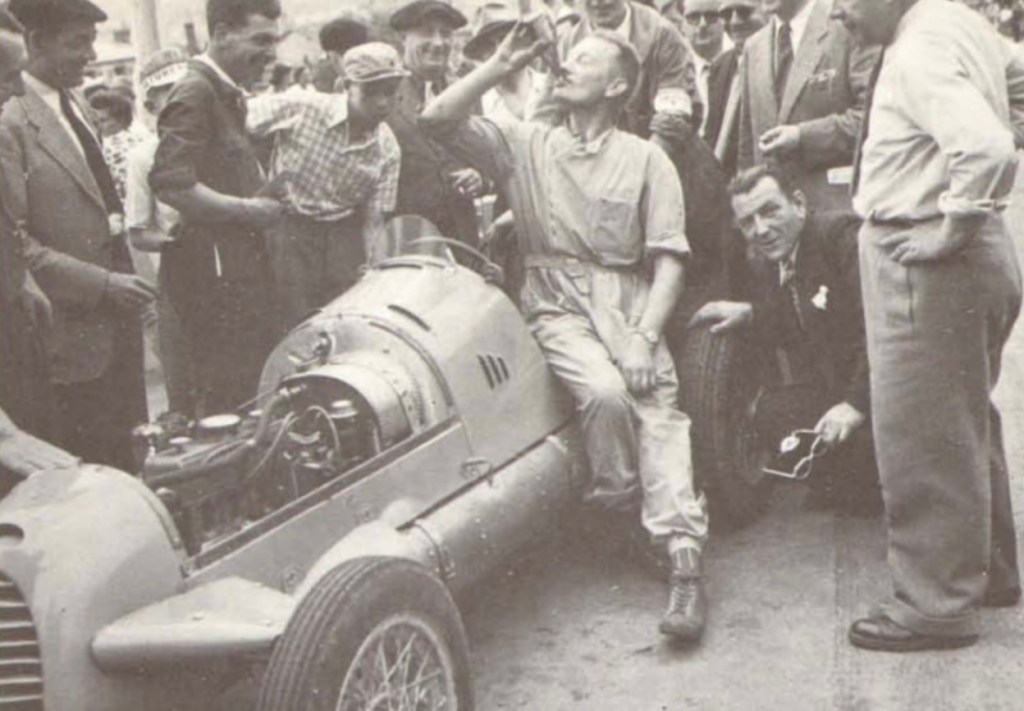
Roger Loyer having a gargle alongside ‘our’ D46, perhaps, Ecurie de Paris raced two, after a strong showing, place unknown. Fosters Lager stubby perhaps…

(M Wells Collection)

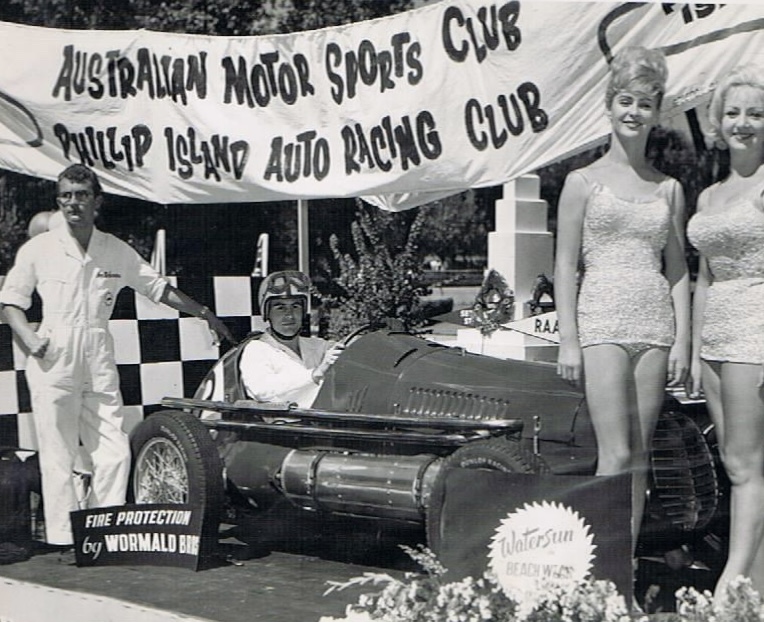
Who said tits don’t sell, it’s always worked with me? A couple of delightful lasses resplendent in much less than acceptable attire these days, during Melbourne’s March Moomba festival in the early 1960s.

(R Jackson)

Looking quite the beauty queen at Sandown in the 1970s above, and below in the old pits at the same venue in June 1963; so distinctive from every angle, form and function…

(A Tracey)
(G Shepherd)

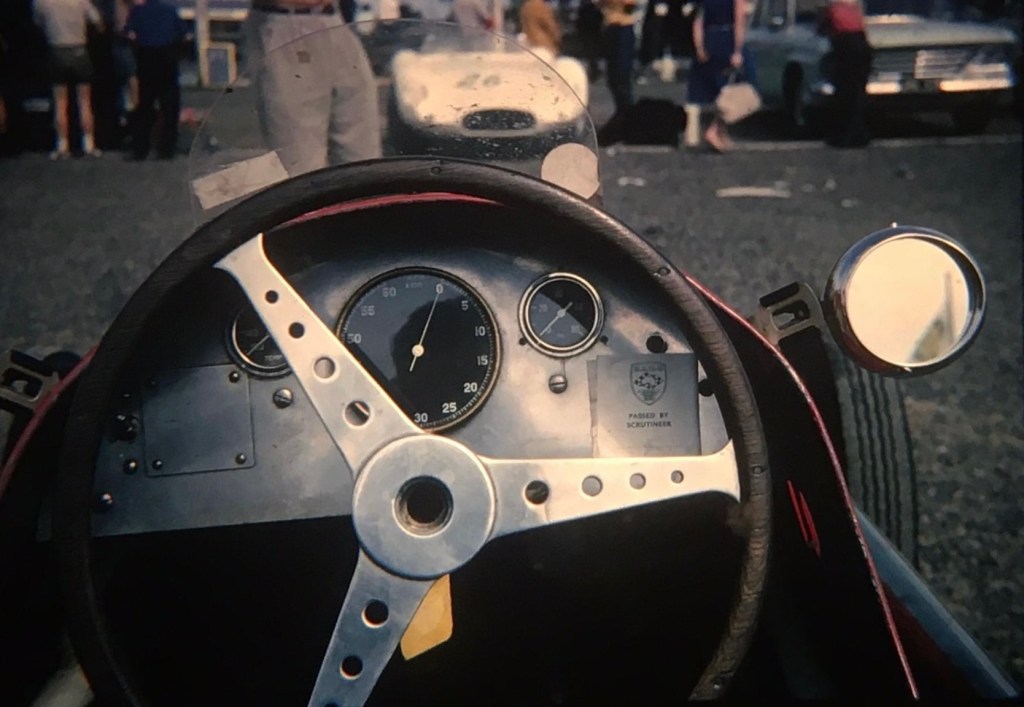
Not Tazio’s tiller but the altogether more flash one of ‘our’ D46 at Calder when owned by the Leech boys circa 1966.

(M Wells Collection)

Ian Wells with elbows out at Calder in the early 1960s. The car in strife behind is the “Platypus MG”, Greg Smith tells us. “By this time it was fitted with a big Healey-four, later to be reconfigured by Lou Molina as Vulgarilla (famous Oz MG Special raced by Molina, an equally legendary racer/hotelier/raconteur) and still sports the same alloy tail, maybe Murray Nankervis at the wheel.”

(A Tracey)

Jim Leech taking on the challenging Mount Tarrengower hill, in Victoria’s Goldfields region, 1964. The Brothers Leech had a small but very select collection of old cars they used extensively.

(Australian Motor Racing No 2 1952 – S Murray Collection)

WTF…

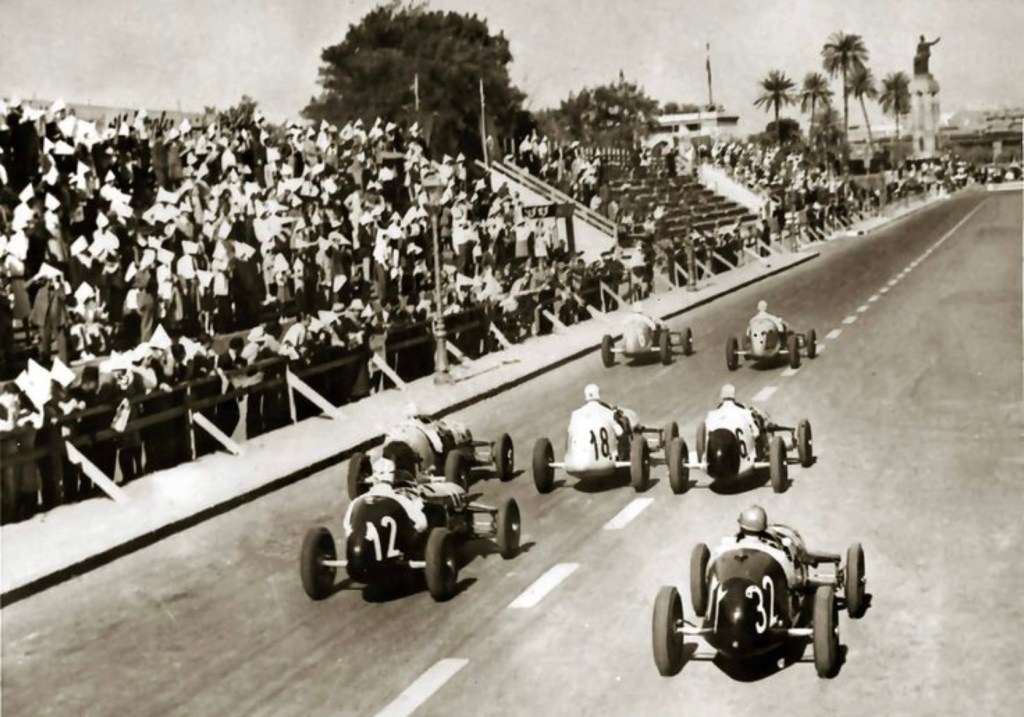
The Sehab Alma Bey Trophy was an invitation race for Cisitalia D46s held on the 1.48km Circuit El Guezireh – The Pyramid Circuit around the Guezireh Park – Cairo on March 9, 1947.

Franco Cortese won the first heat and Piero Taruffi the second, and Cortese the 50 lap final from Alberto Ascari, Taruffi, Piero Dusio and Mario Tadini (below entrant numbers unknown).

(New York Times)

Credits…

Reg Nutt Collection via Leon Sims, Troy Davey Milne, Mark Wells Collection, Graham Shepherd via David Zeunert, Jannaud, Russell Jackson, Ashley Tracey, New York Times, ‘Profile – Roger Loyer’ Jeremy Scott, ‘Historic Racing Cars in Australia’ John Blanden, ‘Cisitalia’ Nino Balestra and Cesare Agostini via Tony Johns, Stuart Murray Collection

Tailpiece…

Rendition by Martin Vins of a famous original photograph of Felice Bonetto – replete with fag – sliding his D46 Fiat at the Circuito di Mantova in 1948.

Finito…

image

(Adelaide Advertiser)

Jim Gullan dealing with a delicate slide on turn-in to Kayannie Corner , Ballot Oldsmobile. He is on the way to winning the 12 lap 105 Mile Road Race on the fearsome, Lobethal, Adelaide Hills circuit…

The race was held on New Years Day, 1 January 1948, the Victorian won from Granton Harrison’s Phillips Ford V8 Spl and Ron Egerton’s MG TC Spl which is in shot behind Gullan above.

Amongst the 21 ‘South Australian 100’ entries were later champion drivers Tony Gaze, Bill Patterson, Doug Whiteford and Ern Seeliger as well as then current fast-man John Barraclough.

Tony Gaze, HRG Aerodynamic, DNF after completing 11 laps (N Howard)

Gaze’s HRG Aerodynamic in Lobethal village, functional rather than pretty (Lobethal Museum)

The limit man was D Howard’s MG PA with a handicap of 16.5 minutes, Jim Gullan’s Ballot was away at the 7.05 mark, Doug Whiteford off 2.5 minutes with the scratch car Denneston’s Itala Mercury Spl.

Whiteford stunned onlookers with an 85mph standing lap, Ern Seeliger was an early retirement after being badly baulked at over 110mph, assaulting two trees in the process. The car was destroyed, the owner presented the rooted chassis and body to a local farmer! Ernie suffered only a bruised wrist and severe shaking and lived to be a formidable engineer and competitor until late in the 1950’s.
Doug Whiteford, Black Bess, DNF after 3 laps (N Howard)
Bess at rest, Lobethal 1948 (Lobethal Museum)

By lap 4 the positions on handicap were the Harrison Ford Spl from Ron Edgerton’s MG TC and Whitefords Ford Spl, the latter on a path, at the speed he was going, to win the race before a rear tyre threw a tread. With no spare the Melbourne driver was out.

By lap 7 Gullan led from local driver Harrison in the ex-Phillips Ford V8 from Skinner in the Ballot Ford and Andrews Austin 6 in 4th. Barraclough withdrew due to low oil pressure on lap 9 and Bill Patterson was out of fuel on the same lap.

On the last lap Gullan still lead by several hundred metres from Harrison and Edgerton’s MG TC. Harrison did the races fastest time and Whiteford its fastest lap at 6 min 7 seconds, 88mph and won the Lobethal 50, the final event of the program.

R Hamilton, MG TC , 4th (N Howard)

Ballot Oldsmobile…
ballot

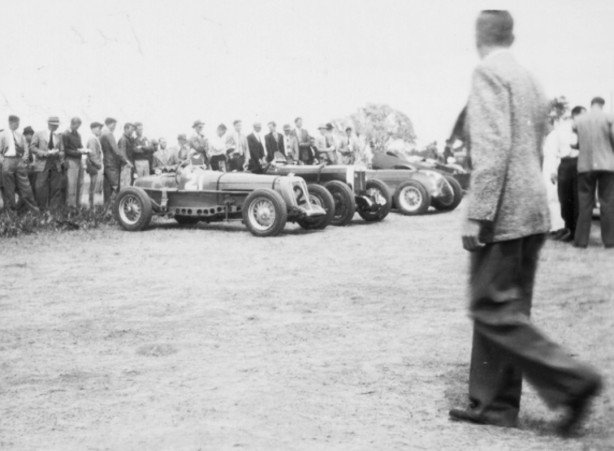
Jim Gullan, #21 Ballot Olds, an MG then the Dennis Curran Curran Ford V8 Spl DNF Australian Grand Prix, in the Nuriootpa paddock, Barossa Valley, South Australia 1950. Gullan 3rd outright and 1st on handicap (State Library of SA)

Jim Gullan replaced his Ballot Ford in 1944 with a 2 litre Ballot bought nearby to his families garage in South Melbourne, a chassis for the car was designed and built by Gullan styled on the ERA, the racer was fitted with an Oldsmobile engine and gearbox.

Noted journalist and historian Ray Bell; ‘Jim Gullan’s Ballot will always rank as one of those cars that looks the part of an Australian Special. The raked nose, the heavily drilled chassis, steering wheel close to the chest and mandatory straps over the bonnet, its wire wheels carried a car that mixed European and American as well as any other’.

Gullan’s book, ‘As Long As It Has Wheels,’ is a fascinating account of a drivers career which evolved from road racer pre-war, to racing an Alta in Europe after hostilities ceased, through being a pioneer of drag-racing in Oz in the 1960’s and finally as a club racer in his dotage living on Queensland’s Gold Coast. Amazing. Jims book covers the Ballot in detail.

Gullan’s Ford V8 powered Indianapolis Ballot, his new acquisition was a 2 litre with sohc engine and knock-on wire wheels, it had a poor body and as inspection proved, the chassis was in even worse shape.

image

Gullan, AGP, Nuriootpa 1950, 3rd place outright and 1st on handicap, Ballot Olds. Doug Whiteford won in his Ford V8 Spl, ‘Black Bess’ (unattributed)
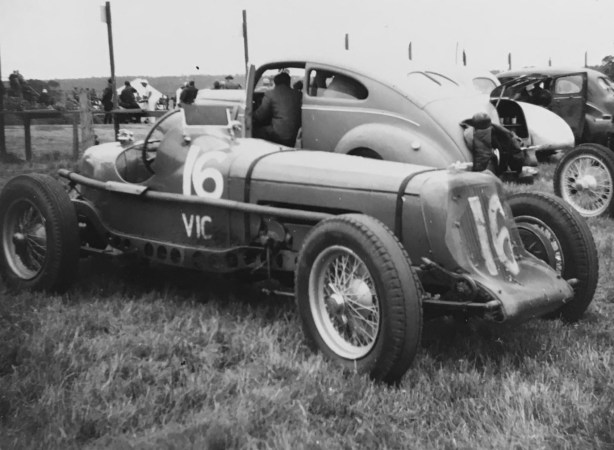
Ballot Olds in the Lobethal paddock during the 1948 SA 100 meeting (Lobethal Museum)

Soon after buying it a workmate offered money for the engine, gearbox and radiator to fit into a Bugatti chassis. Said Gullan, ‘It seemed a dubious exercise but I suppose any engine was better than none.’  Having just the chassis left, he was reluctant to go for another Ford engine having had bad experiences with the V8, so an ad for an Oldsmobile unit and ‘box (unused spares purchased for a taxi) overcame his problems. It was to have triple Ford carbies and extractors.

A chassis was made styled on the ERA but lower in profile, and used nothing from the Ballot chassis such was its parlous condition. ‘By the time the Ballot Olds was completed, about the only parts left of the original Ballot were the wheel hubs. The only reason the Ballot name was retained was for (ease of) registration purposes’ wrote Gullan.

It new chassis was 760mm shorter and 230mm narrower than the Ballot, designed to be ‘strong in the middle,’ boxed and drilled liberally ‘as on the SSK’ for lightness. ‘To lower the car new, new springs and hangers were made to sit outside the chassis rails. To stop front axle movement and to assist steering geometry, the spring shackles were located at the front of the spring instead of at the rear, this also assisted the brake reaction cables to keep the axle from turning whilst braking. Wheels were built to suit the wider, smaller diameter, modern tyres.’

With new cross members the engine and gearbox were installed into the chassis and the body shape was outlined using welding rods and strands of string.

Bob Baker lived only a few doors away from Gullan and built the body round an angle iron frame, which was screwed to the chassis with small reject aircraft bolts. A deliberate effort was made to reduce frontal area, hence the car’s low appearance. Quick-fill petrol and radiator caps were fabricated by Jim and the instruments (like the carbies) came from army disposals.

jim-rob-roy

Gullan at 16th Rob Roy, 2/5/1948 Ballot Olds. Superb looking body built by Bob Baker, the first of many racing cars he built bodies for. Gullan’s design was ingenious in its amalgam of parts and a consequence of his vast experience with previous cars (Thomas)

With Baker’s assistance a 3 carb inlet manifold and extractor exhaust system was made and a Ford radiator shell reworked to look like an ERA, the gorgeous little car was painted blue with silver wheels. Finned alloy drums off a spare 2-litre Ballot Jim bought and sold were the first of many modifications over the years.

image

Ballot Olds cockpit shot taken at the SA Grand Prix 70 year celebration at Lobethal in 2008 (Veloce)

The Ballot’s first meeting was at Greensborough Hillclimb in 1945 (see below), teething problems were limited to the throttle linkage bending and as a consequence full power could not be applied. The rear axle ratio was made taller, the drawings for the 3.5:1 ratio done by Gullan.

The first post-war race was at Ballarat at the beginning of 1947. Gullan had a good meeting including winning the Ballarat Cup, after this meeting the cars braking system was converted to hydraulic operation.

The next race was the Lobethal 100 covered at the articles outset, ‘The main reason for my quick times was my familiarity with the track. I had driven there in 1938 and 1939…in handicap racing it was our policy (Jim and his time-keeper wife Christine) and although the handicappers kept putting us up the field, we just made the car quicker’.

Gullan was a close friend of and in business with Doug Whiteford. When Doug imported an Edelbrock cam and heads (he’d melted a pair of alloy heads at Lobethal in 1940!) Bruce Rehn copied the cam profile and lift for the Olds.

By the time of the Point Cook AGP (1948) ‘…at a Dutch auction at the Light Car Club before the race, the Ballot was selected as the car most likely to win, a bad omen as far as i was concerned’,  quipped Gullan.

For the AGP there was yet another higher lift cam lifting rpm’s to 6000 and special ratios in the gearbox. As a result of the intense heat at Point Cook, with the Olds running so cool and well, the engine was subsequently bored by 5mm and also fitted with an enlarged sump with cooling tubes. Gullan had tyre problems in practice, but retired the car in the extreme heat after 15 laps. ‘I finished up sitting next to Alf Barrett, in the back of a van getting cooling down treatment’.

At Fishermans Bends first meeting Gullan won the Victorian TT, but the stop-start nature of the airfield circuit made it clear the cars brakes needed development. Jack Pearce at Repco PBR supplied some light commercial brake drums and made appropriate shoes with aluminium backing plates. ‘…They were so powerful they were bending the chassis making the car almost unsteerable when braking on the rough roads. The only thing to do was to apply them gently’.
ballot olds 1946

Gullan, 10th Rob Roy 17/6/1946, the bucolic Christmas Hills are pretty much the same today (Thomas)

In the months leading up to the 1950 Australian Grand Prix at Nuriootpa the Ballot was run in various minor events to get it sorted. Jim started 21st of 43 starters. The race was billed as a handicap race, Gullan won the handicap but not the Grand Prix which was awarded to Doug Whiteford in Black Bess. Jim was not happy about the result and emphasis given to the ‘fastest time’ as against the ‘handicap winner’, the AGP having been run as a handicap since it’s start at Phillip Island.

‘Normally the car would run 130 miles on a tank of fuel, but with the car developing more power, it was decided that if i was far enough in the lead i would pull in for a quick stop to add 10 litres. This i did and drove over the line to win what i thought was the Australian Grand Prix. There were still 20 litres of fuel left in the tank at the end of the race’ and therefore he could have completed the race without a stop.

‘The Adelaide Advertiser ran a big headline ‘Big Car Handicap to J Gullan’, the article didn’t even mention that Doug Whiteford had finished in 5th place. At the presesntation i got the wreath, the trophy and the prize money, Doug received equal money for fastest time. Once again i had driven a copybook race, but was later disappointed it would not be recorded as a Grand Prix win. Sometimes i wish i had just gone for broke…’

A counterpoint to Gullan’s viewpoint is contained in ‘The History of The AGP’ which makes it clear, quoting the Australian Motor Sports contemporary magazine coverage of the race. It says, that consistent with the 1949 policy of the Australian Automobile Association, from 1949 the AGP would be a scratch title,’The Australian Grand Prix will be run as a handicap but the Grand Prix winner will be the competitor finishing with the fastest time for the race’, that is, Doug Whiteford in his Ford V8 Special Black Bess.

Gullan raced the car one last time at Fishermans Bend before selling it.

Interestingly the two great mates, Whiteford and Gullan who had developed their clever specials together drove one anothers cars one evening at Albert Park ‘Dougs impression of the Ballot; very smooth high revving engine, steering and brakes too sensitive, difficult to drive!’ wrote Gullan. Albert Park is a public park, it would have been interesting to be going for a post-dinner walk and seen two Grand Prix cars being driven at high speed around the sleepy confines of Albert Park, the first GP there was still several years away at the time!

image

Love this shot for its vibe, Fishermans Bend, October 1953. Greg McEwin HRG left, O’Donohue’s now red Ballot Oldsmobile and Otto Stone’s MG K3 (SLV)

It was now 1950, the Ballot had reached the end of its development, and Jim decided to race in Europe, an interesting story for another time. Alan Watson and John Cummins (the latter very sadly died only last weekend) bought the car for 850 pounds.

Ray Bell, a writer of the ‘History of The Australian Grand Prix’ puts Gullan’s wonderful car and his design and development skills in context ‘The car was Gullan’s expression of all he’d learned from observing racing and running his own Salmson, Wolseley, Austin and Ballot V8′.

‘Considering just how it came together – the bits that just happened to be there, the chance acquisitions – it worked very well. Gullan was a handicap specialist, with his wife Christine timekeeping and acting as strategist, and they beat the handicaps with monotonous regularity. He comments that he just had to keep on making the car quicker to keep on beating them, so it was well developed when sold to Alan Watson.’

‘He mentions getting airborne over the top of the hill approaching Lobethal at 110mph, touching 116mph on the straight and holding it flat all the way from Lobethal to within sight of the pits at that early stage of its development. By the time it won the handicap section of the 1950 AGP it must have been a fairly quick car’.

The car passed through many hands over the next 20 years, raced as late as 1963 at Calder, Victoria. It has been used since 1970 in historic events, and is still alive today in Frank Moore’s Collection of Australian Specials in Queensland.
image

Jim Gullan, Ballot Olds, Greensborough Hillclimb. Crowd control and safety barriers well to the fore! (Thomas)

Greensborough Hillclimb…

Its interesting this internet thingy, data and images are being uploaded all the time. When I wrote the article about the Lobethal AGP 1950 12 months or so ago some of the images in this article weren’t there, but information is being continually shared through this wonderful medium.

The shot above is of Jim’s car at the second Greensborough Hillclimb on 7 October 1945, an Australian Motorsport article describes the casual nature and speed at which a new venue could be created all those years ago!

The Australian Motor Sports Club sought the use of the LCCA’s Rob Roy Hillclimb to run its first post war event. When the LCCA refused the club permission they sought other venues. Every alternative ‘smooth enough and close to Melbourne’ failed until the club secretary George Beecham fluked on a market gardner, an ex-motorcycle rider…His property had a very stiff hill. It was decided at the club meeting on the Thursday night before the Sunday scheduled for the climb to hold it at Greensborough on the market gardners hill. The owner of the property Bill Halliburton, did everything in his power to knock the hill into shape for the club…to get the hill right in time’.

Try getting a hillclimb built and certified by the FIA/CAMS in two days today, different times weren’t they!

Jim Gullan recalls the event in his book, he was Vice President and Doug Whiteford President of the AMSC. The two great mates loaded up a utility filled with reject concrete slabs from the Hume Pipe Company, for whom they worked and set off for ‘Orchard Farm’ to lay out a starting grid, completing the exercise in pouring rain.
image

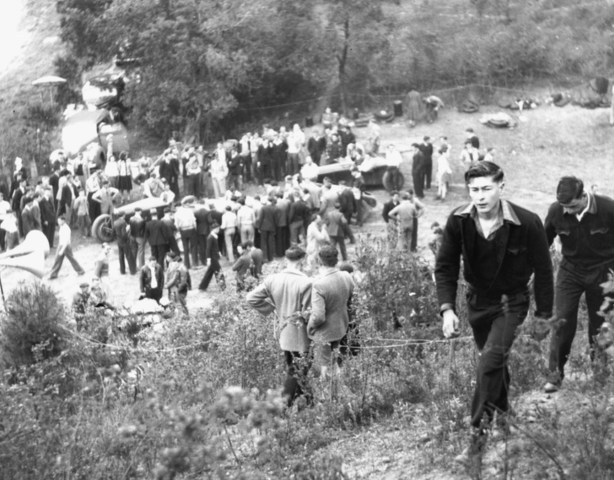
A couple of young-bloods take to the Greensborough Hill to get a better vantage point, marshalling/start area below. Public address system you can just see to the bottom left, crowd numbers would be interesting to know in immediate post war-starved of entertainment, Melbourne (Thomas)

So much rain fell on the Saturday the event looked to be a washout but the can-do attitude of the members, starved of competition during the war years prevailed and after the track dried competition took place with FTD going to Ern Seeliger’s Ford V8 Spl. (the car destroyed in the SA 100 event in 1948 described at this articles outset)  It was the union of an Itala chassis, with large drum brakes, a 3:1 diff ratio powered by a modified ’38 Ford V8 modified with high compression heads and a Vertex magneto providing the spark. The engine was mounted low in the chassis, the car raced in chassis form devoid of body.

‘Greensborough No 2 was just as well organised and ran as smoothly as the No 1 event was bad. Everything seemed to go right, even the Melbourne weather! The hill had been prepared at some very substantial cost to the club and was as smooth as a table-a good table too’, you will note from the photographs that the surface was gravel.

The AMS report notes the pace got hotter as the day progressed with several cars leaving the track, notably an elderly Morris Spl, a Vauxhall, Stud Beasley’s Speedcar and Ted Gray’s Ford V8 powered Alfa Romeo 6C1750, Ted broke the diff of the car in the process.

Ken Wylie set fastest time of the day in his Speedcar but ‘in doing so rushed through a fence after he had completed his climb, cleaned up half a dozen push-bikes leaning against said fence, bowling over a gum tree and ended up in a ditch…’.

Gullan notes ‘…luckily we had plenty of money to be able to compensate the cycle owners…We were not prepared for the huge crowd that turned up. The narrow country road was blocked for kilometres, many never reached the entry gate. The entry fee was a ten shilling note, to get his share the farmer stood at the gate and stuffed his shirt full of banknotes (not much different to BC Ecclestone today really). By the time the hundreds of spectators had left, the place was in a shambles, the irate farmer said “never again”, but we figured a shirt full of banknotes more than made up for it!’
wolseley

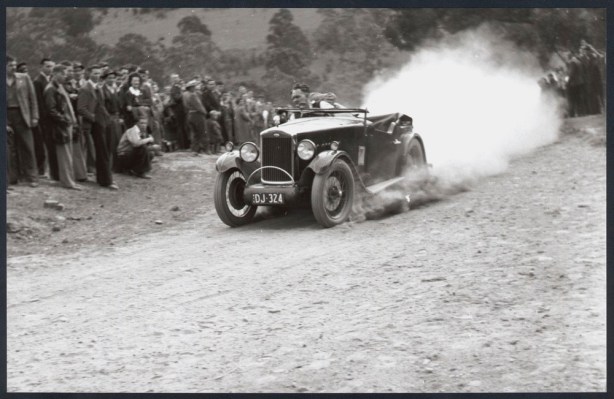
Unknown Wolseley and driver, Greensborough (Thomas)

Doug Whiteford fitted dual rear wheels to his Ford V8 engined 1950 AGP winning special ‘Black Bess’ but struggled to get traction, as did Ern Seeliger’s car the AMS report noted. That report concludes by listing other competitors cars; Ken Hume’s 8/60 Buick engined Talbot, Tom Hollindrake’s MG s/c, Les Phillips Austin Spl. Gullan’s Ballot Olds only had two runs, as the event organiser he was preoccupied, Bob Chamberlain’s Chamberlain 8 and Stud Beasley’s Willys 77 Speedcar also competed.

What is interesting is the way a large number of hillclimbs relative to the population of Melbourne at the time, popped up in an arc on the cities outskirts from the north-east to the east of the city; Greensborough is 23 km from town, Templestowe 19, ‘Rob Roy’ at Christmas Hills 43Km and the two climbs at Lilydale, the Davisons ‘Killara Park’ property and Ern Abbott’s ‘Lakeland’ circa 45 Km from Melbourne. They weren’t all running concurrently mind you, some were. I suppose the reasons are availability of the right terrain and proximity to the city for competitors.
image

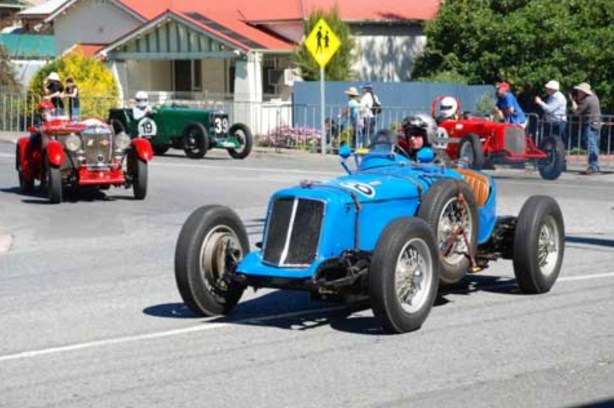
Frank Moore, who still owns the Ballot Olds, at the Lobethal carnival in 2008, lines of Gullan’s car still look great don’t they? The ERA influence clear (Veloce)

Bibliography…

‘As Long As It Has Wheels’ James Gullan, ‘History of The Australian GP’ G Howard and Ors

Ray Bell on The Nostalgia Forum, ‘Australian Motor Sports’ February 1946
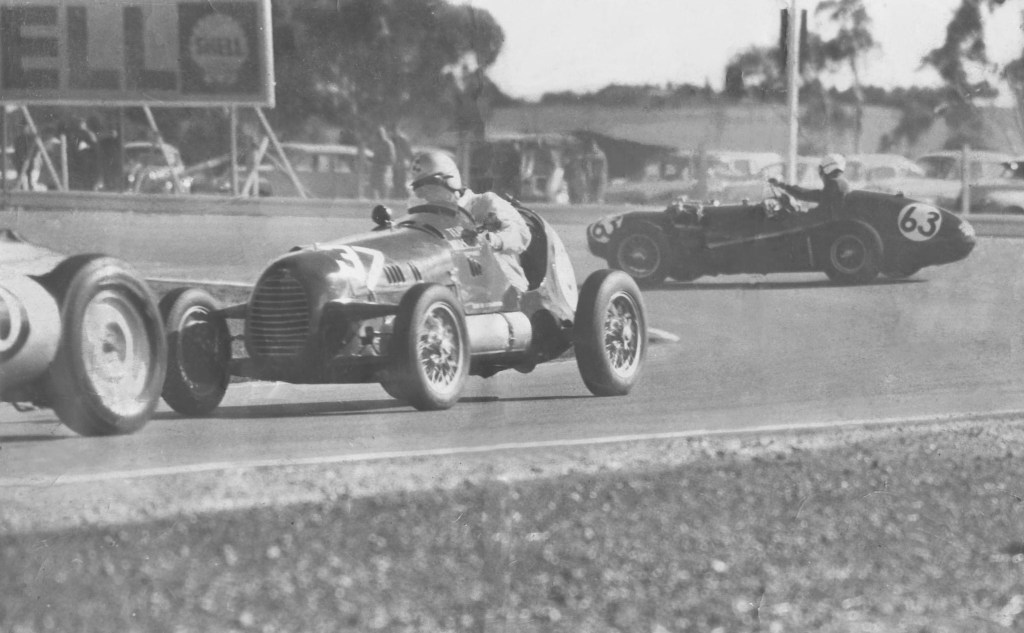
Jim Gullan, MG K3, Albert Park 1956 (J Millard)

Credits…

Adelaide Advertiser, George Thomas, Veloce Magazine, John Millard, Norman Howard

Tailpiece: Gullan and Ballot Olds, Geelong Road, Australian Motor Sports Club, sprints, 4 August 1946…

jim-geelong

(Thomas)

bmw 328 11 rob roy 1946

The year is 1946, it isn’t Germany!…

Many thanks to Stephen Dalton for identifying the car and driver who are famous in the pantheon of Australian motor racing indeed. Frank Pratt drove this 328 to victory in the Australian Grand Prix at Point Cook, not too far away from Rob Roy in January 1948. The event featured is the 11th Rob Roy on 24 November 1946, one of Pratt’s first drives in the car.

This much raced 328, chassis #85136, was imported to Oz by Sydney driver/businessman John Snow on one of his trips to Europe. He bought it from a German General in 1937, Snow acquired it on behalf of George Martin, president of the Light Car Club, Melbourne.

Martin raced it in the ’38 AGP at Bathurst won by Peter Whitehead’s ERA R10B, then unfortunately lost his life in the car on the return trip to Melbourne in an accident near Wagga Wagga.

image

George Martin in the 328 at left 15th, and John Crouch MG TA 5th, 1938 AGP at Bathurst, some of the challenges of the gravel track obvious in this shot (Dave Sullivan)

Repaired, by 1946 the car passed into the hands of Geelong motor cycle racer/dealer Frank Pratt who famously won his first circuit race in it; the 1948 Australian Grand Prix, at Point Cook airforce base west of Melbourne.

As a very successful motor cycle racer he was not new to competition and racecraft. He also had a favourable handicap, the AGP was run to F Libre and handicapped for many years. Pratt scored a lucky win with high speed consistency, the car prepared by racer/engineer Harry Firth.

Dalton adds; ‘..Les Murphy (was) mentioned as a possible driver of the car, because Pratt was injured at a Ballarat Motorcycle meeting. But not car preparation, Harry Firth said he did the brakes, chassis and gearbox on the BMW. Mick Scott did the engine. Harry also mentions preparing the Gaze HRG 1500, but wasn’t allowed to do the Alta’ which Gaze retired after 5 laps.

In a race run in horrid, stifling hot summer conditions which took their toll on both cars and their pilots especially the highly strung single-seaters and racing cars, Frank triumphed.

image

Pratt on his way to victory on a horrible Melbourne summers day, AGP, Point Cook, January 26 1948, BMW 328 (George Thomas)
Click here for an interesting article about Frank Pratt, little has been written about him. ‘Pratt and Osborne’ still exists as a motor-cycle dealership in Geelong, a port city 75 Km from Melbourne on Port Phillip Bay. http://www.smcc.com.au/docs/Leonard%20Frank%20Pratt.pdf

The BMW was later raced by Peter McKenna all over Australia; at Fishermans Bend, Ballarat Airfield and Albert Park in Victoria and as far afield as Southport’s 1954 Australian Grand Prix. The car passed through various custodians hands in Oz before leaving the country in the 1990’s.

image

The BMW in the Nuriootpa paddock, Australian GP meeting 1950, Peter McKenna (SLSA)
Credits…

‘Historic Racing Cars in Australia’ John Blanden’, George Thomas, Stephen Dalton, Dave Sullivan, State Library of South Australia

lex davo rob roy

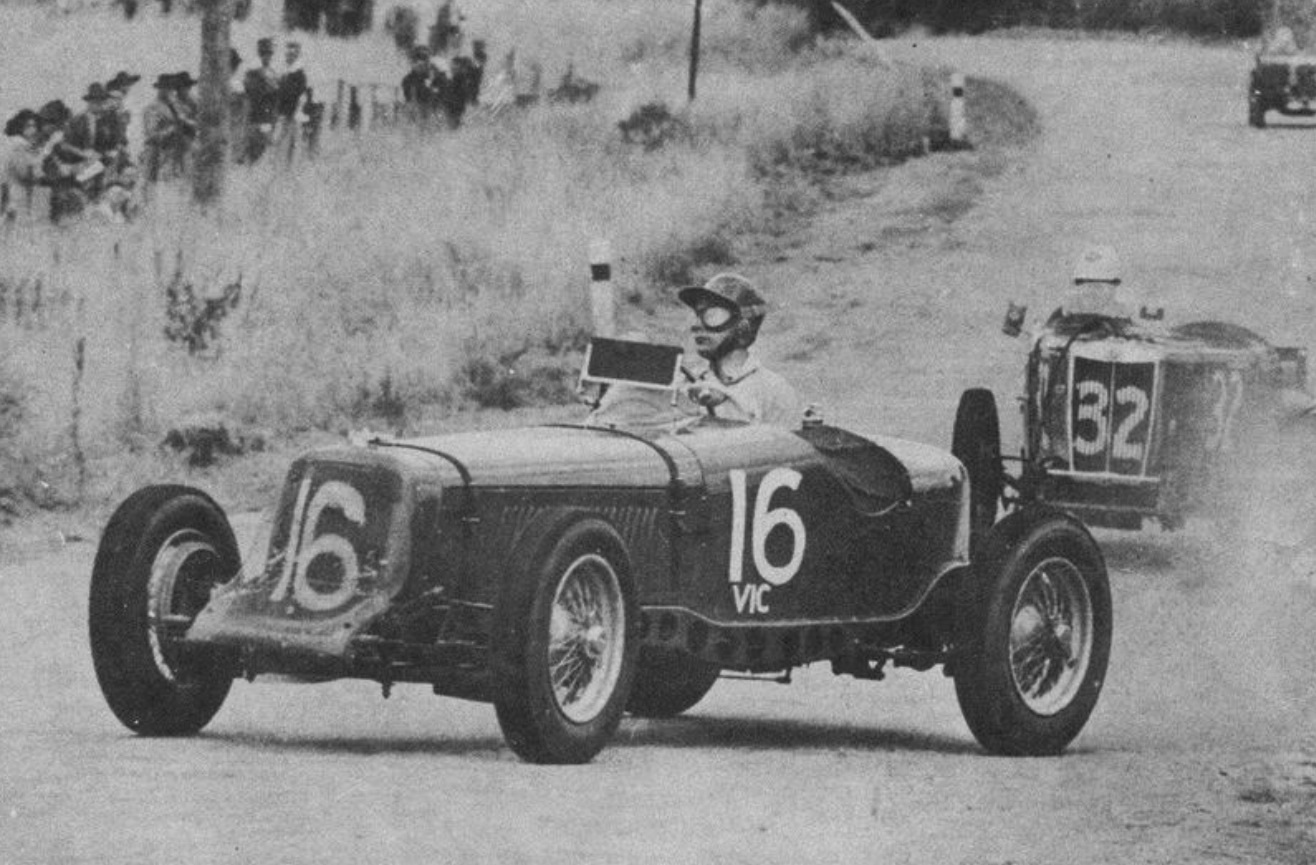
This fine George Thomas shot of Lex Davisons’ Alfa Romeo P3 ‘50003’ is undated but is in the mid-fifties, its become exposed over time which adds to its patina and drama of the occasion…

This wonderful Grand Prix car had to ‘sing for its supper’ in Australia, events were few and far between in the early post-war years. Davison was a keen competitor who raced his cars far and wide in trials, rallies, circuit races and hillclimbs like this one at the ‘Christmas Hills’ in Melbourne’s outer east.

The venue is still used by the MG Car Club, perhaps one of their historians can help date the shot.

Photo Credit…

George Thomas