
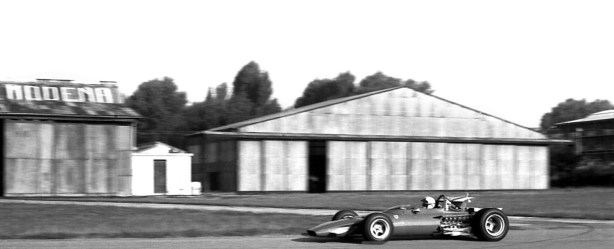
Chris Amon is not a driver one readily associates with the very successful 1970 Ferrari 312B and even then only in a ‘lost opportunity’ kind of way…
As he drove from his digs in Maranello the 20km to the Modena circuit Ferrari used for testing each time in mid 1969 he did so with an increasingly heavy heart.
Chris had motor racings dream job, Ferrari’s ‘number one’ driver and the considerable resources of the famed Scuderia at his disposal. He tested and raced F2 and Tasman Dino’s, Sports Prototypes, big Can-Am Group 7 cars and of course GP cars. The company car was not to be sneezed at. Ferrari’s drivers were only marginally less popular than the Pope, he loved living in Italy, enjoyed the food, people, the vibe in Maranello and testing the cars, Mauro Forghieri rated him one of the teams greatest test drivers and of course his racing of them.
But in his terms, as one of the five best drivers in the world at the time, he was not achieving the grand prix winning success he deserved, so many times he had led races in 1968 and early in 1969 only to have the car fail beneath him. And now, a car he thought looked fabulous and was testing well had an engine which consistently ‘grenaded’ behind him at Modena in the most spectacular fashion.
What should he do? Stay with Ferrari in the belief the engineering problem would be solved or move to another team with a Ford Cosworth powered car was the decision which tortured him…
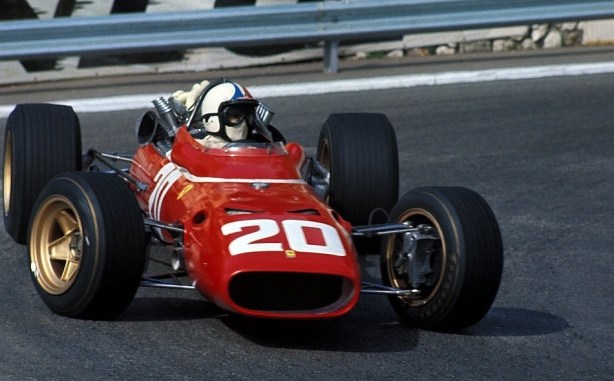
Amon, Monaco 1967 in the awful race in which his teammate Lorenzo Bandini died the most gruesome, fiery death. Denny Hulme’s Brabham BT20 Repco won from Hill’s Lotus 33 BRM and Amon (unattributed)
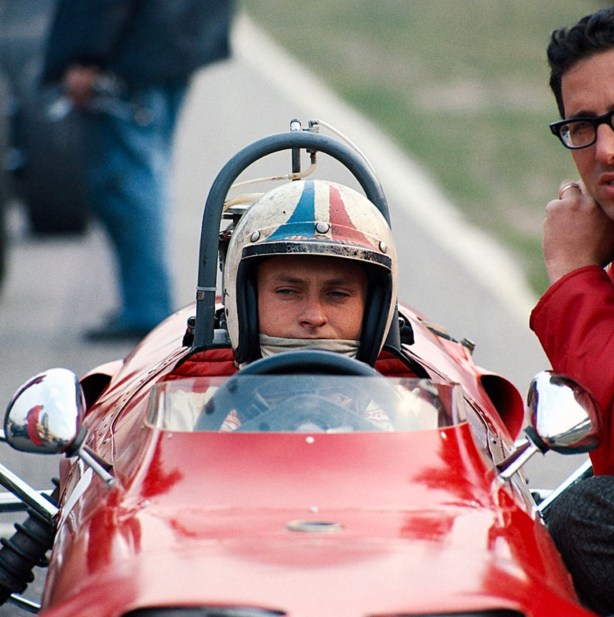
The partnership between Amon and Mauro Forghieri was a fruitful one based on great mutual respect, which is not to say they always agreed! Here with 312 at Zandvoort in 1967. How young does he look?! Ferrari team-leader at 24 by the end of 1967 (unattributed)
He joined Ferrari in 1967 as one of four drivers- Lorenzo Bandini, Mike Parkes, Ludovico Scarfiotti and himself. The ‘pudgy’, heavy 312 of 1966 evolved into the 1967 car, quite the sexiest looking of any GP car. After the end of the sports car season it became a very fast one fitted with a lightweight block and F2 derived gearbox- and from Monza with four-valve heads the car flew. Amon believed the 390bhp claimed for it and described the (’67 and ’68) chassis as ‘an absolute dream to drive’. Chris should have won at Watkins Glen in front of the two Lotus 49s but the engine blew 12 laps from the end. In Mexico Chris qualified well in second but pitted for fuel.
A road accident early in the 1967 season put him out for a while, his speed had been demonstrated in all types of car, his place in the team was cemented despite an awful season for Ferrari- the tragic death of Bandini at Monaco and the effective end of Mike Parkes’ career in a huge, high speed Belgian GP, Spa shunt.
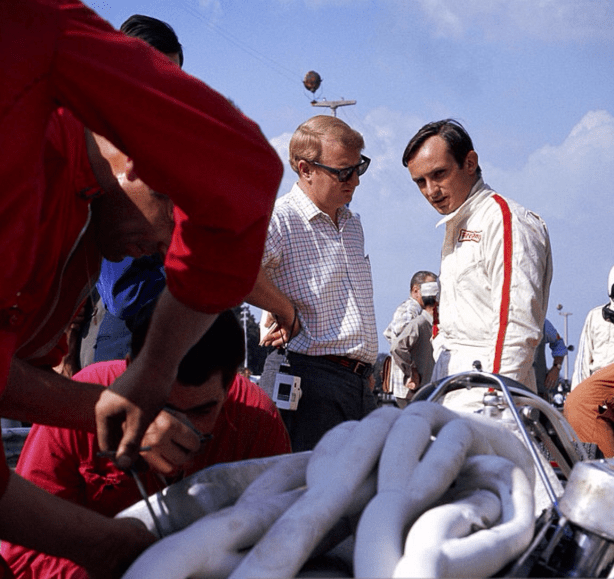
Amon with Ferrari 312 in the Monza pits, Italian GP 1967. Q4 and 7th in the race won by John Surtees Honda RA300 (Schlegelmilch)
For 1968 his teammate was Belgian ‘Wunderkind’ Jacky Ickx.
One of the ‘crosses Ferrari F1 drivers sometimes bore’ was Enzo Ferrari’s obsession with sports car racing, particularly Le Mans. Whilst the team had better resources than most, the impact of the sports car program on F1 was great or little depending upon the competitiveness of said GP cars at the time! In mid-season, the focus was on the Sports Cars, after that F1 was re-prioritised.
In 1968 Ferrari ‘spat the dummy’ at CSI rule changes (ending unlimited cars and changing to 5 litre Sports Cars and 3 litre Prototypes) not building a car for the season with a consequent focus on F1 and development of a car which could have won both ’68 world titles.
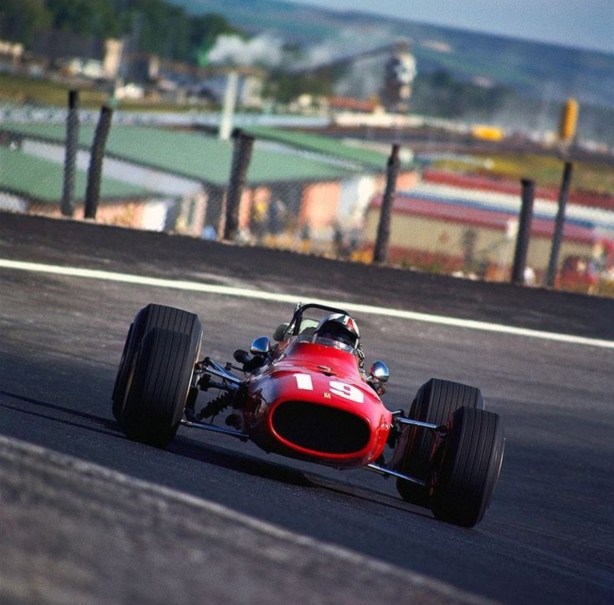
1968 Spanish Grand Prix. Ferrari 312/68 Q1 and led until fuel pump failure on lap 58. Hills Lotus 49 Ford won (unattributed)
The 48 valve V12 was developed to give circa 410bhp at a time the Ford Cosworth DFV gave much the same, albeit the Fazz lacked the mid-range punch of the DFV, Amon quipped that ‘there was nothing at home below 9800rpm’. The engine also had high water and oil temperatures with consequent power loss. The Ferraris went to the grid carrying 8-10 gallons more ‘juice’ than the Cosworth cars, a weight penalty of 55-70 pounds, despite all of that the 312/68 was a very competitive, if unreliable beast.
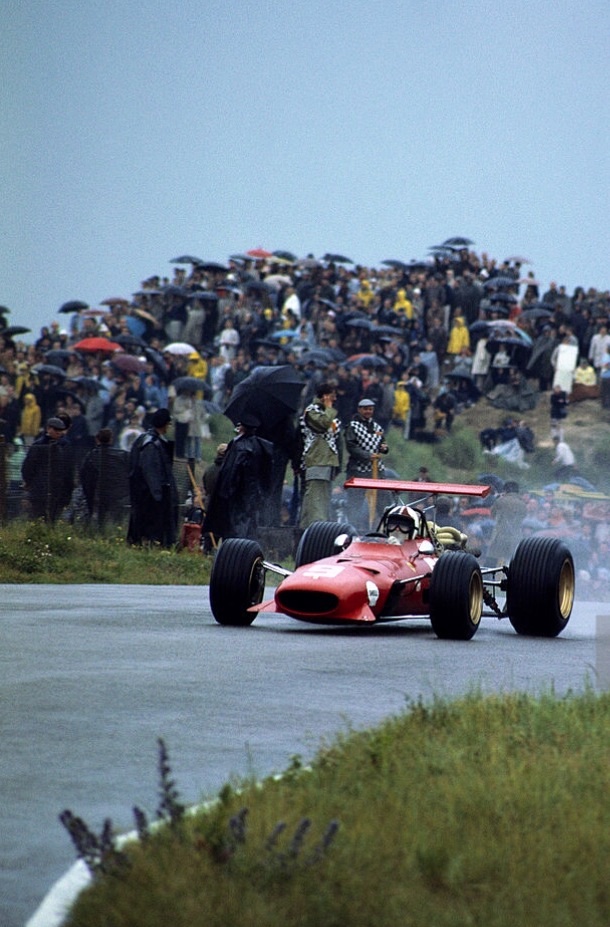
In amongst the damp North Sea dunes at Zandvoort in 1968. Dutch GP Q1 and 6th, the race won by Stewart’s Matra MS10 Ford (Schlegelmilch)
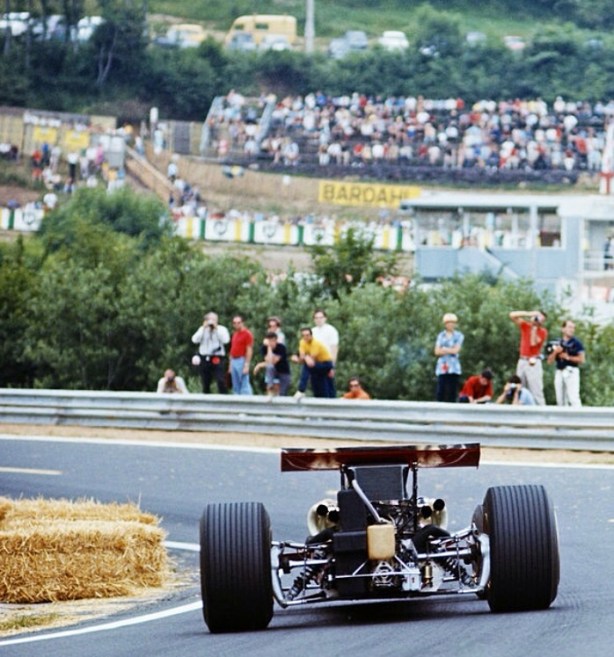
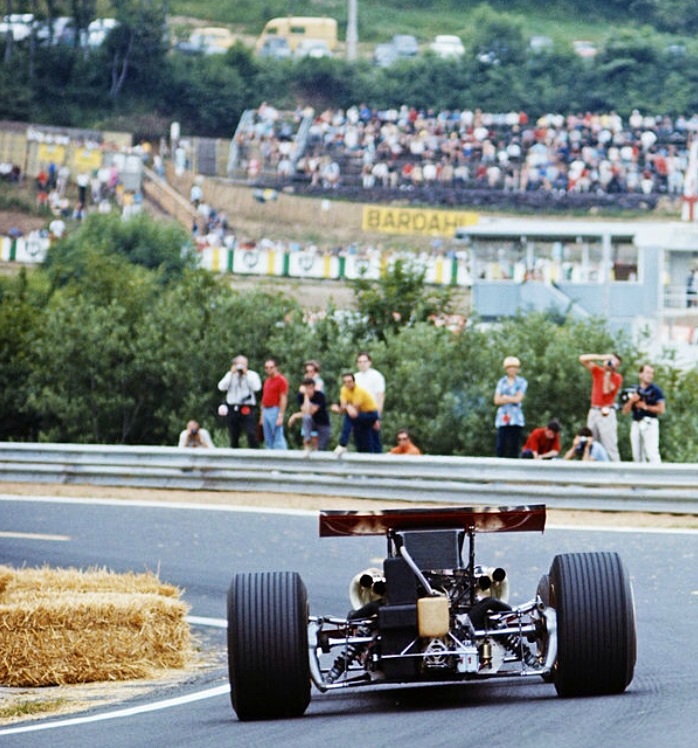
French GP, Rouen 1968. Q5 and 10th in the race won by teammate Ickx, the ‘rainmaster’ who started the damp race on full wets and drove away in the early laps when, again, a driver, Jo Schlesser, died in another fiery accident in the Honda RA302. These accidents accelerated changes to circuit and car safety, not that they were the last horrible fiery deaths in the period. Amazing Rainer Schlegelmilch shot of Rouen and the butt of Amons 312; look at the hay bales, tyre distortion and the presence of wings which grew thru ’68 (Schlegelmilch)
In 1968 the grid was ‘awash’ with Ford Cosworth DFV’s- Lotus, McLaren and Ken Tyrrell’s Matra’s were fitted with them. Colin Chapman waived his exclusivity agreement to the engines upon Ford’s Walter Hayes request that he do so ‘for the good of GP racing’ such was Hayes’ fear of Lotus dominance. Not that Ford’s position was diminished by more DFV powered cars on the grid than less!
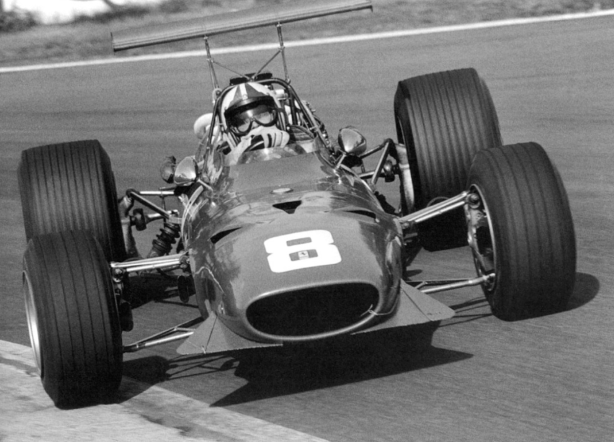
Amon in the Oulton Park Gold Cup 17 August 1968. I had this shot on my bedroom wall for years as a scho0l kid! Wings are growing…Amon 2nd to Stewart’s Matra MS10 Ford (unattributed)
For Ferrari, BRM, Weslake and Honda the impact of the Ford engine was great. The DFV was built on modern, tape controlled equipment bought for the purpose which meant the quality of the product was consistent, parts made would fit all engines. Prior to that some GP engines were to an extent hand fettled and bits needed to be modified to fit each engine, which was effectively bespoke. Cosworth’s quality control and the pressure on them to rebuild the engines in a timely consistent way for all took a while to get sorted, but the writing was well and truly on the wall, the Ford engine a considerable F1 weapon of course right into the eighties and beyond in F3000 guise.
None of this was lost on Amon of course, the competitiveness of his compatriot Bruce McLaren’s cars in 1968 was something he observed and discussed with both Bruce and Denny Hulme.
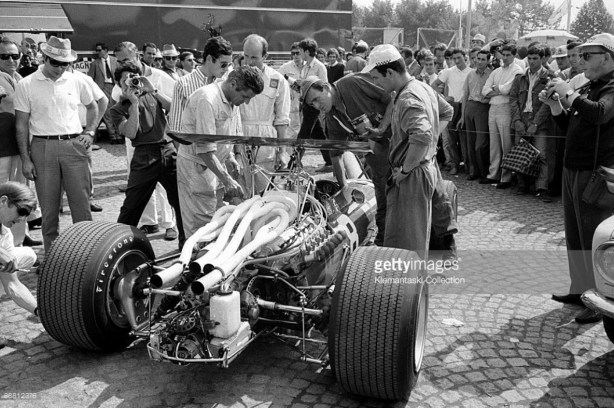
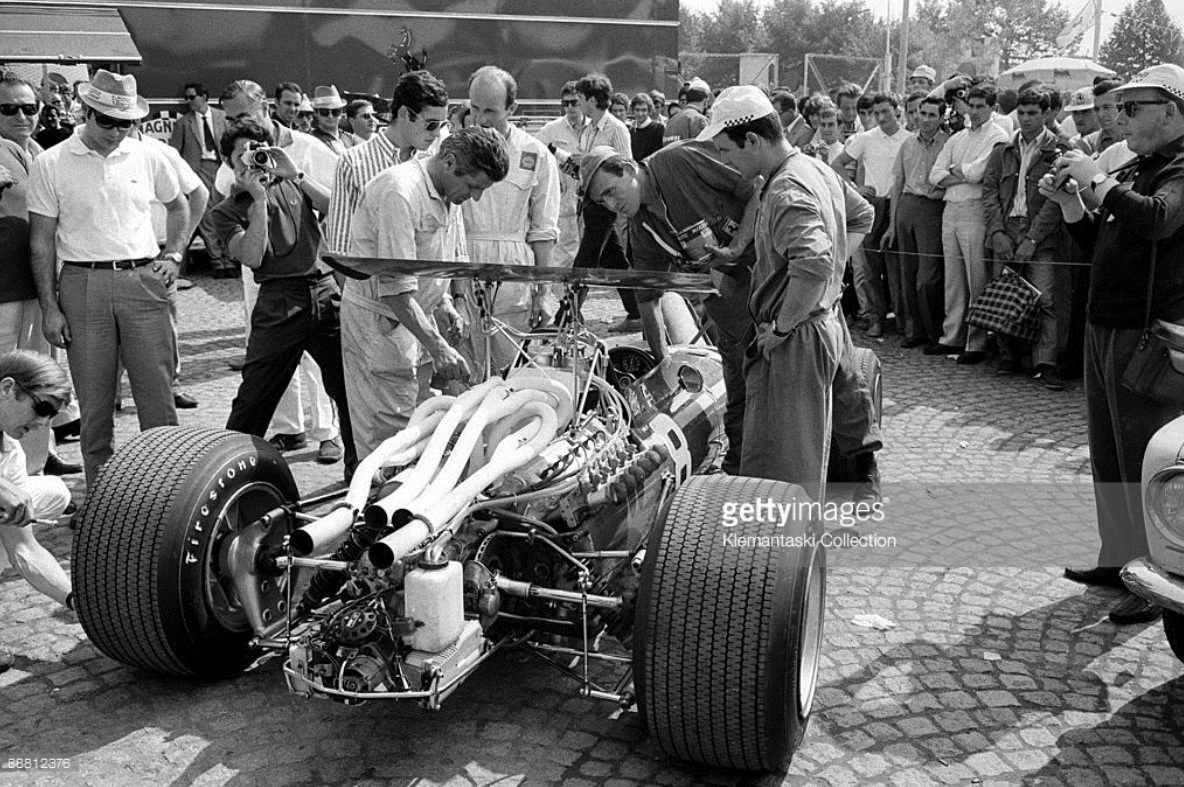
Italian GP, Monza 9 August 1968. Giulio Borsari makes some adjustments to Ickx’ 312. Forghieri devised this ‘movable aerodynamic device’ operated by oil pressure. The wing went to hi-angle mode in 1/2/3rd gears but feathered for low drag with the throttle open in 4/5th gears. It returned to download position in those gears when the brakes were applied. An override switch was fitted which Chris liked and Ickx had removed (Klemantaski)
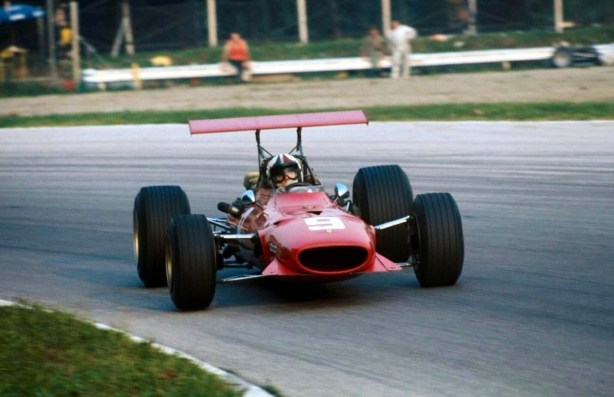
Amon putting the movable wing to good effect at Monza in 1968. Q3 and DNF after an accident, Hulme won in a McLaren M7A Ford (unattributed)
But Chris was ‘on fire’ in 1968. Ferrari were on the front row nine times, eight to Amon and took four poles, three to Amon, but unreliability robbed them, and Chris of three probable wins. Ickx took the only race win at Reims during the tragic French GP in which Jo Schlesser died in the Honda RA302.
At Monza Chris led until an oil leak onto a rear tyre caused an almighty accident which destroyed the car. He dominated in Canada despite clutchless gear changes from lap 12 but of course the gearbox broke under the strain, the clutch should not have failed.
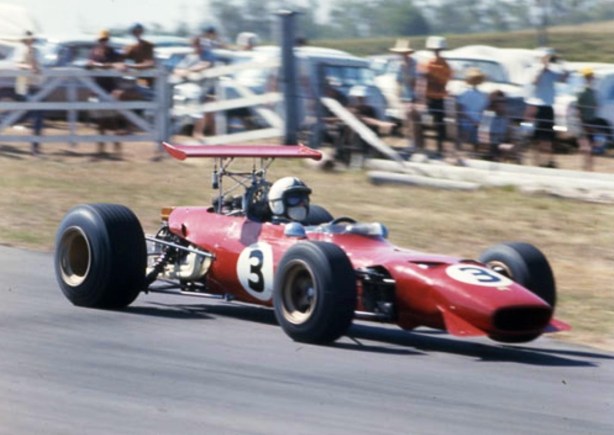
Chris on the way to a 1969 Australian GP victory at Lakeside, Queensland on 2 February. He won the Tasman Series beating the Team Lotus Rindt/Hill duo and others. Left front of the Dino 246T off the deck thru the very fast kink opposite the pits (Rod MacKenzie)
1969 started well, Chris tested his 246 Dino Tasman cars thoroughly at Modena before shipping the cars home to New Zealand.
He convincingly won the Tasman Cup in 300bhp, 24 valve cars he helped develop and a team he put together. He collaborated with David McKay’s Sydney based Scuderia Veloce who provided on ground back-up for the mix of speed and reliability needed for this championship of intensity- eight races in eight weeks.
He beat the factory Lotus 49s of Hill and new-signing and probable ‘fastest guy on the planet’ Jochen Rindt taking four wins including the NZ GP at Pukekohe and AGP at Lakeside. The series of depth also included Derek Bell (in the other Dino), Frank Gardner (Mildren Alfa T33 V8) and Piers Courage (Brabham BT24 Ford DFW).
Back at Maranello the finishing touches were being made to the 312P, Ferrari were back in endurance racing that year, and the latest evolution of the 312 GP car.
Strategically the future for Ferrari was bright despite the financial difficulties the team were in early in the year.
Discussions underway with Fiat were consummated in June, Enzo Ferrari had effective control of the racing department for his lifetime whilst Fiat took over the development of the road cars, and a considerable amount of cash changed hands.
The injection of working capital allowed Ferrari to build the 25 512S Sports Cars required for homologation into Group 5 for 1970 and to develop Ferrari’s first ‘clean sheet’ 3 litre F1 car, the flat-12 312B.
Ferrari authorised Forghieri to start this program early in the year well before the Fiat deal was done, the Fiorano test facility, opened in 1972 is another example of the sort of investment which would not have been possible without Fiat’s investment.
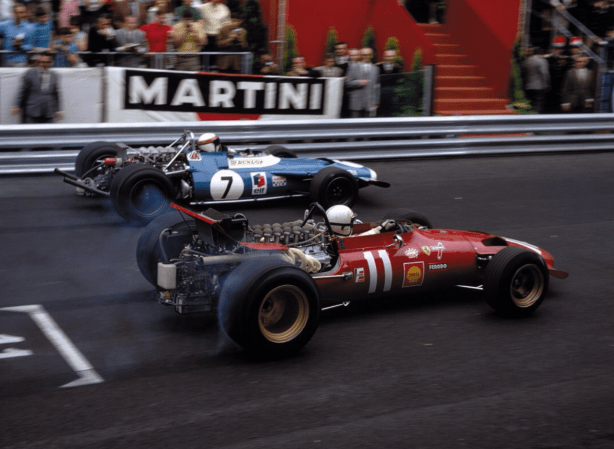
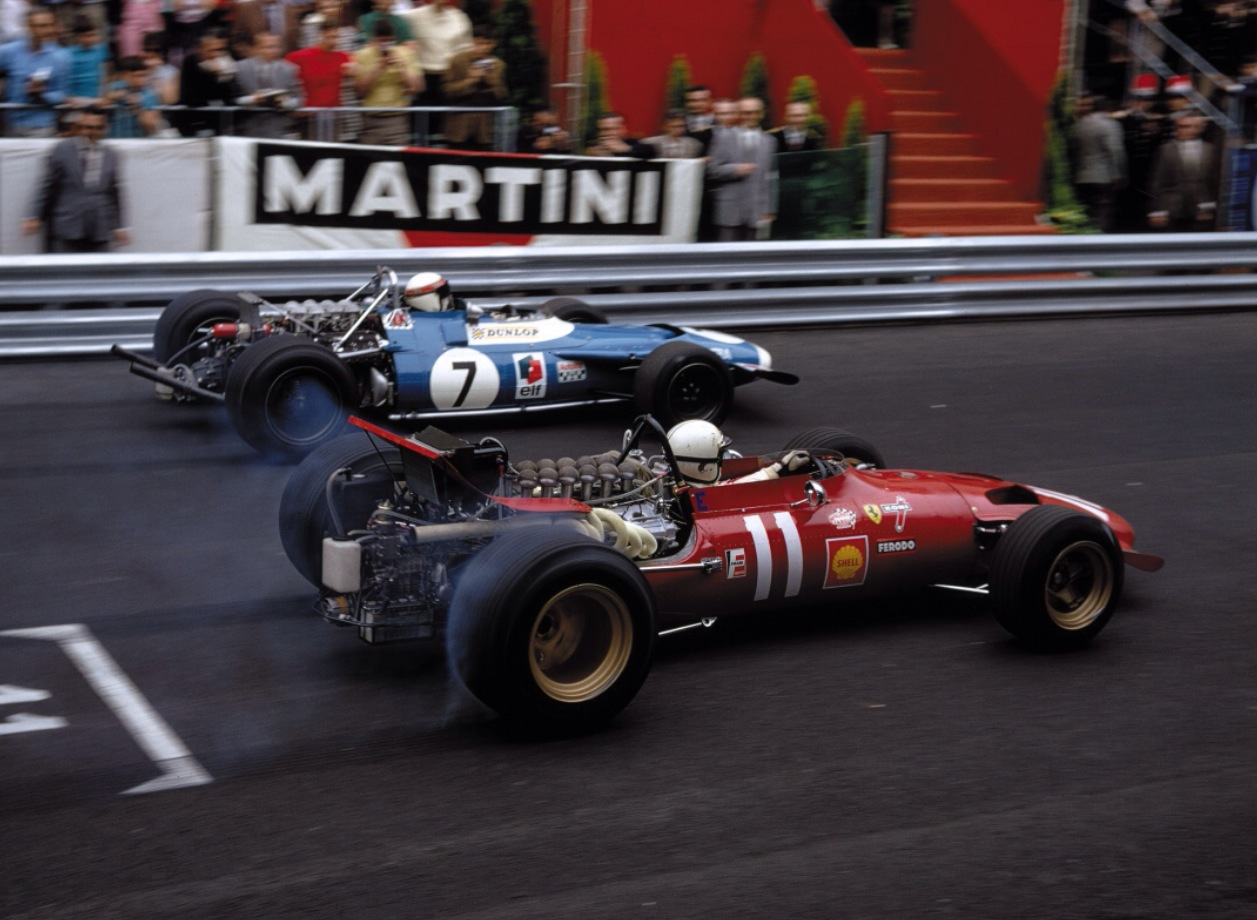
Monaco 1969 Amon beside Jackie Stewart’s Matra MS80 Ford which won the title that year . Q2 anf a failed diff. Note the lack of wings, banned overnight by the CSI. Hill won in a Lotus 49 Ford (Yves Debraine)
From Amon’s perspective then, he was potentially in the right place.
He was esconced in one of the sports greatest teams, he had won the Tasman, Ferrari was in the process of doing a deal with a partner with deep pockets, a new car was underway for 1970 but 1969 could be a challenge with an evolution of the ’68 cars and more Cosworth powered cars on GP grids! It was critical to Chris the 312B tested well.
Whilst Mauro Forghieri worked on the design of the 312B Ing Stefano Jacoponi was responsible to do what he could with the obsolescent V12. The chassis was much the same although the cars appearance was different with a flatter nose and evolution of wings, partially at the whim of the (CSI) rulemakers who banned, rightly, high-wings during the Monaco GP weekend.
The V12 was changed with heads which reversed the porting, returning the exhausts to outside the Vee lowering the cars centre of gravity and reducing turbulence around the rear wing. Inlets were in the Vee, more radical cams were developed and disastrous efforts made to reduce frictional losses and release power by reducing main bearing area…

Amon, Q2 DNF engine, Spanish GP, Montjuic Park, Barcelona 1969. Stewart won in a Matra MS80 Ford. Look at that oil cooler trying to do just that (unattributed)
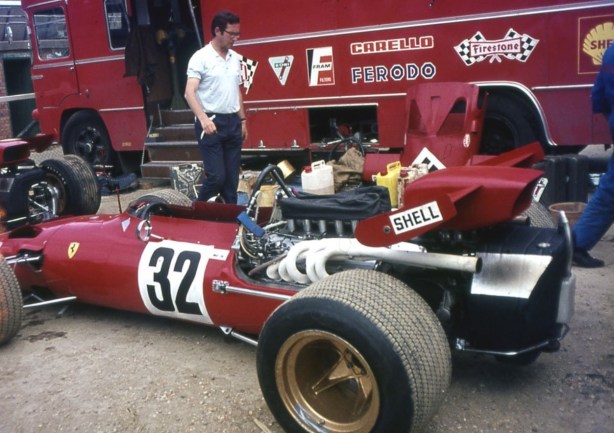
Forghieri with the 312/69 in the Silverstone, British GP paddock. V12 cooling issues clear by the ‘orrible oil cooler/duct incorporated into the rear wing. Amon Q5 and DNF lap 45 with gearbox failure. Stewart’s Matra won after a titanic battle with Rindt’s Lotus. 3 Ferrari’s were entered #32 the spare (unattributed)
Early in the season Ferrari entered only one car for Amon. He was second on the Spanish GP grid and inherited the lead after the two Lotus 49’s crashed with wing failure, with a lead of over 30 seconds the engine seized. At Monaco he was second when the diff failed and at Silverstone, joined by Pedro Rodriguez both retired with ‘box and engine failures.
To add to these frustrations and be in no doubt elite sport is as much mental as physical, his erstwhile teammate Ickx- Amon had been demonstrably the quicker of the two in 1968 was winning races in Brabham’s year old spaceframe chassis BT26. That car was now as consistently fast and reliable with a DFV in 1969 as it was consistently fast and unreliable with a Repco ‘RB860 Series’ V8 in 1968. Amon’s disappointment with his situation was immense, he was a race-winner in a reliable Ferrari or another car.
Such were their problems Ferrari withdrew from the German GP on 3 August, Ickx won there, to prepare the new 312B for Monza, it simply was not worth racing the fast but unreliable 312/69.
Amon had great hopes for Mauro Forghieri’s new for 1970 car, the ‘clean-sheet, Flat-12 engined 312B…
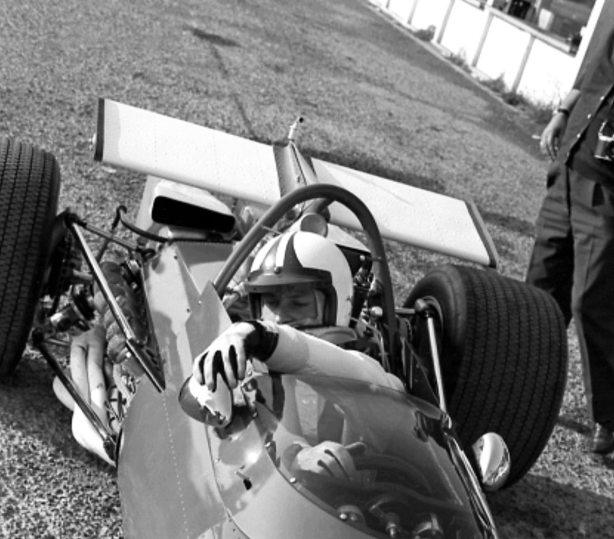
Amon readies himself for the off, Modena, exact date unknown (GP Library)
Mauro Forghieri’s Ferrari 312B was one of the most beautifully integrated Ferrari’s ever built, whilst much is made of the engine the success of the car was about far more. Doug Nye; ‘The 312B…was quite the best integrated 3 litre F1 package yet created. It would remain the best packaged of all Ferrari’s until the Postlethwaite 156 appeared in 1985’ he said writing in 1986. I always thought the 312T/T2 were pretty handy bits of integrated kit, but the point is, the car was a beautifully designed and executed car!
The talented Modenese born engineer saw at close hand as an at thecircuit race-engineer the success of the Lotus 49 and its imitators, the engine beautifully integrated with the chassis and the powerful, torquey, compact, relatively frugal and reliable nature of the Cosworth DFV itself. The engines basic dimensions and valve angles gave instruction to a whole generation of engine designers.
The suspension of the competition were all period conventional; wishbones/wishbones or rocker/wishbones at the front and single top-link, lower wishbones and radius rods for fore and aft location. The 312B followed that course.
Aerodynamics were still a black art but the CSI’s mandated lower wings meant airflow to the critical rear wing needed thought as the wing could no longer be mounted high in ‘clean air’. Remember, at the time traction was important, the cars had a wonderful surplus of power over grip.In the end that problem solved as much by tyre alchemy as wings let alone the 1969 4WD blind-alley of which Ferrari was not a part.
A 12 cylinder engine was a ‘Ferrari given’. Forghieri’s challenge was to unlock sufficient power to combat the DFV despite the inherent packaging issues of the longer engine and frictional losses and other bottom end shortcomings which were such problems in the existing V12.
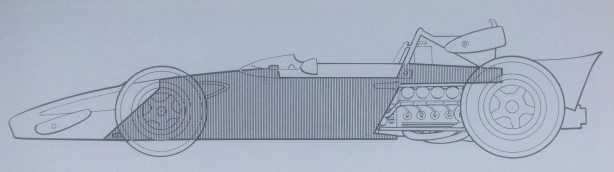
Ferrari 312B 1970 showing the chassis structure and rear ‘boom or beam’ to which the engine attaches (Nye)
Forghieri’s chassis was another of Ferrari’s ‘aero constructions’. They were not monocoques in the British sense but rather a tubular internal frame stiffened by riveted on ‘ally panels. Not a problem, Ron Tauranac’s old-fashioned spaceframe BT26’s were race winning GP cars in 1969 until effectively outlawed by the ‘bag tank’ rules of 1970.
The clever bit, ‘praps learning from the DFV’s simple chassis mounts mandated by Lotus designer Colin Chapman to Cosworth’s Keith Duckworth was the use of a ‘beam’ aft of the usual drivers bulkhead to which the engine mounted. This provided a very stiff structure but also very good, better than all other cars in 1970, airflow to the rear wing. It promised more downforce and therefore grip for less angle, drag, than the other cars.
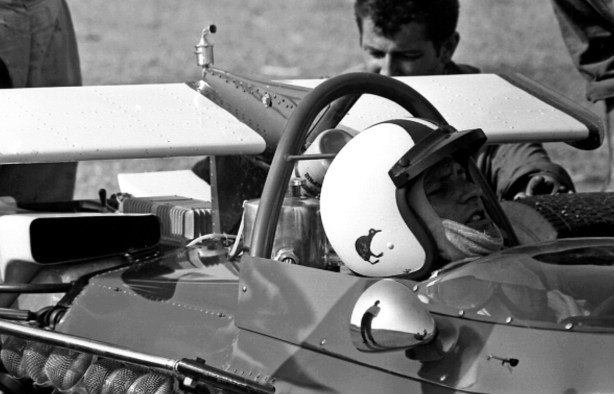
Note the rivets on the rear beam which is part of the cars chassis to which the engine attaches, it also biolts to the bulkhead behind the driver. Low nature of engine and good airflow onto the wing. Oil cooler ducts also in shot (GP Library)
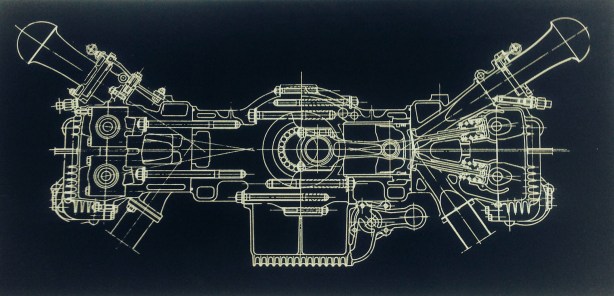
Ferrari factory drawing of the Flat-12 312B engine showing its deep base chamber, roller bearing mains, narrow included valve angle, induction tracts above the heads, exhausts below and extensive cross-bolting of the split crankcase castings (Nye)
Engineers Forghieri, Rocchi and Bussi’s 3 litre Flat-12 engine was conceived in that horizontally opposed configuration to get the cars centre of gravity low and get the engine out of the airstream to the wing. The need for lower frictional losses was met by the use of just 4, the old V12 had 7, main bearings. The design used 2 plain bearings in its centre and ball bearing races at each end.
Bore and stroke were 78.5mm x 51.5mm, vastly oversquare, for a capacity of 2991cc. Four overhead camshafts and 4 valves per cylinder were used, the heads evolved from ’69 V12 practice. Lucas fuel injection was carried over onto the new engine. The cams were driven by gears from the crank’s nose.
Doug Nye; ‘The light alloy block was cast in 2 parts and united on a crankshaft centreline bolted flange…Light alloy cylinder liners were used, cooled by water circulation at their upper ends, by oil circulation down below. The crankshaft was machined from a steel forging, each of its six crankpins carrying two con-rods. The crankshaft nose gear drove alternator, ignition distributor and and fuel metering unit via gears and pinions. The crank tail drove the valvegear train. A tiny flywheel assembly incorporated a rubber vibration damper. Forged titanium con-rods were used…and Mahle forged aluminium pistons…a single oil pressure pump was driven off the rear of the RH cylinder timing gear fed the oil filter mounted behind the fuel metering unit.’
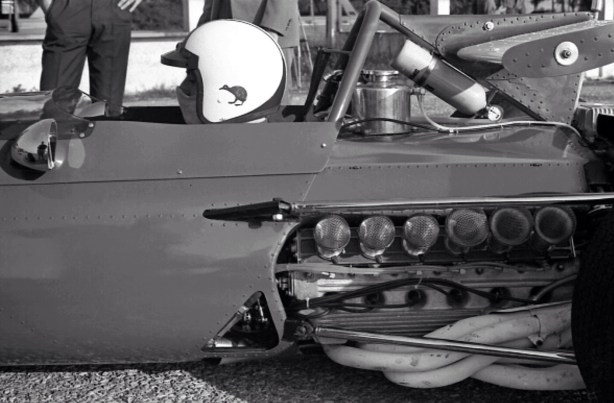
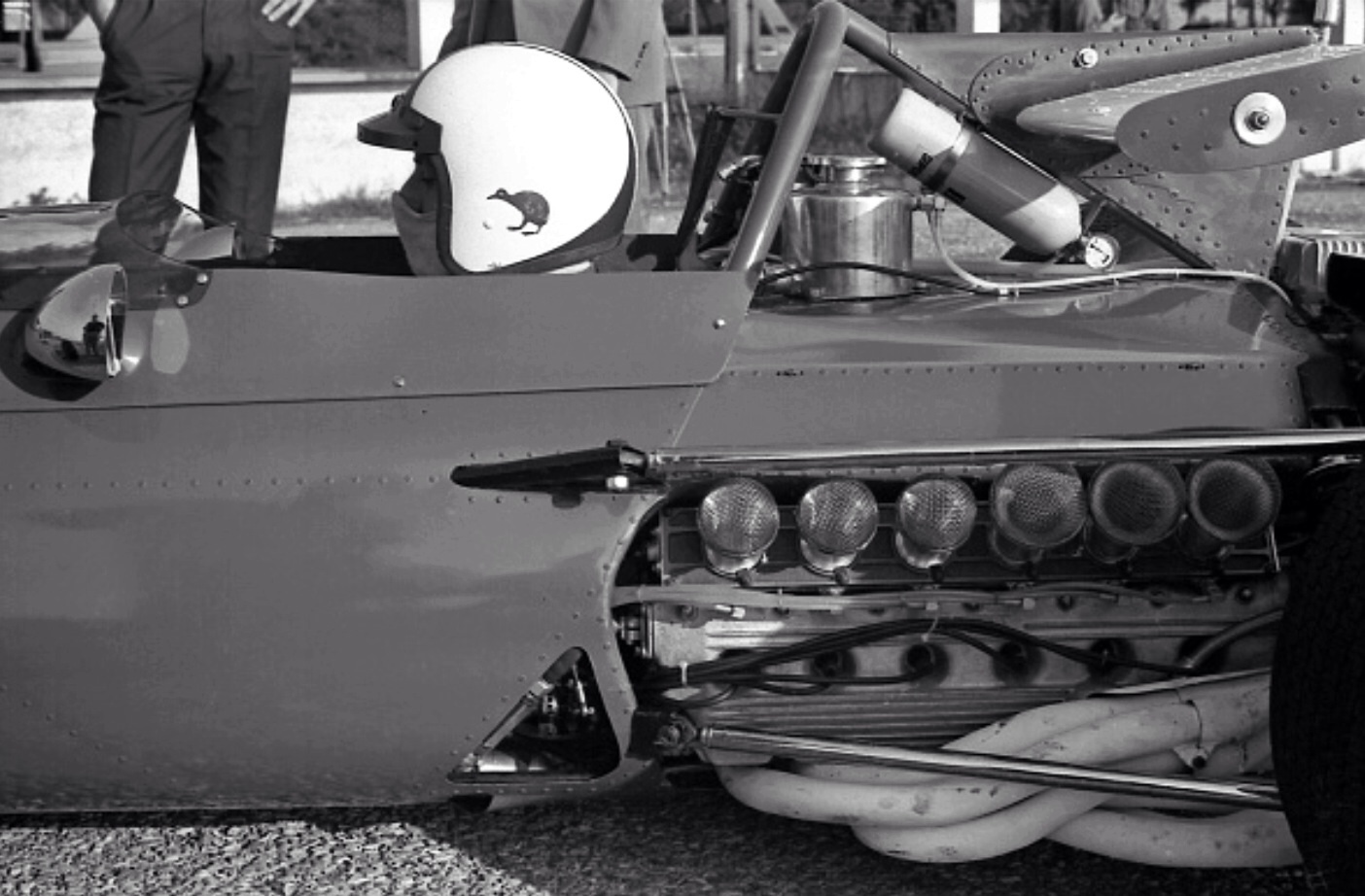
Side on flat-12 engine detail, DOHC, 4 valve, Lucas injected, single plug, how low do they take the CofG with this approach?! See rad header tank and extinguished bomb, the latter messy in terms of flow to the wing and exposed! Check out the very clever roll bar brace; it triangulates and stiffens the rear beam structure as well as providing a neat, faired mount for the wing itself (GP Library)
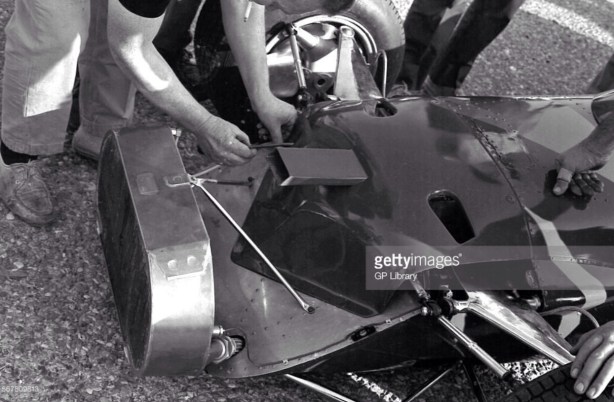
312B front end detail. Suspension top rocker actuating coil springs and Koni shocks and lower wide based wishbone. Note ally ducting behind rad to exhuast hot air via ducts in the fibre-glass nose (GP Library)
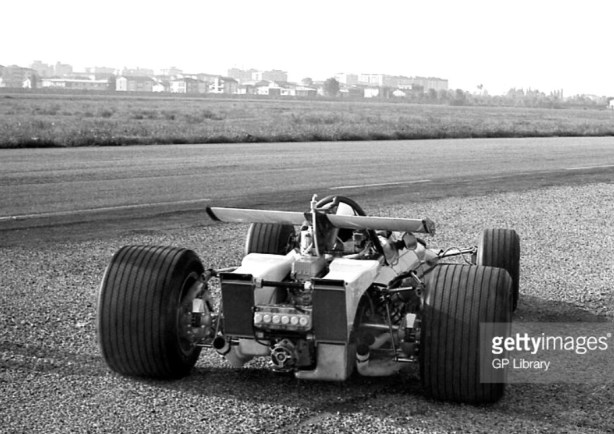
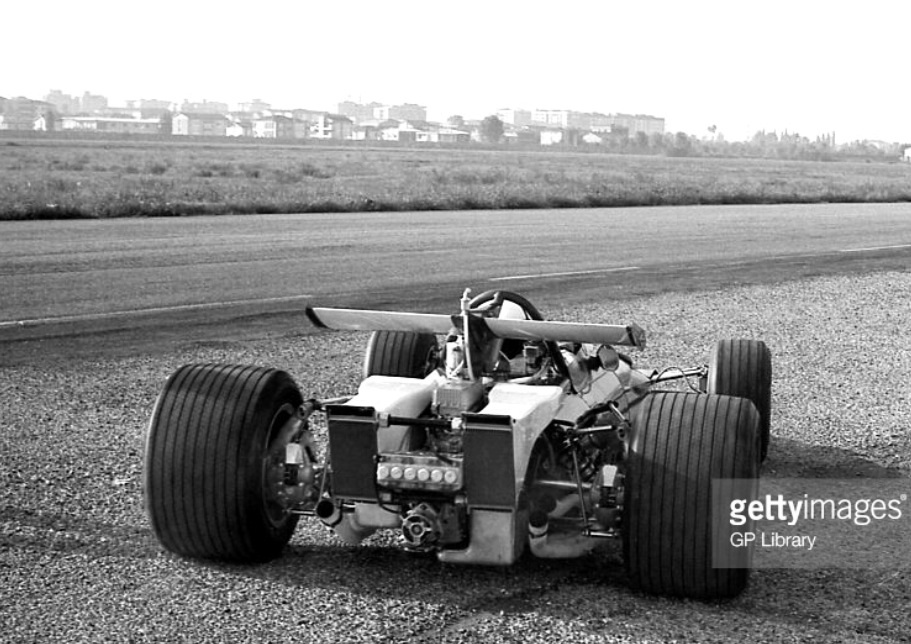
Butt shot of the 312B as it heads out onto Modena Autodrome with Amon saying a few silent ‘Hail Marys’ as to engine life no doubt! Ducting to oil coolers, rear mounted battery and outboard brake discs/suspension all clear (GP Library)
Amon watched the jewel of a car evolve at Maranello, it was with a great deal of optimism that he approached his early tests at Modena.
Right from the start he and Forghieri were happy with the chassis, the sort of balance they achieved with the earlier V12’s was still present. The car was lighter, was good under brakes had good traction and top speed for as long as the new, powerful engine lasted…
With Chris in the car the 312B had a series of monumental, catastrophic engine failures due to piston, crankshaft and lubrication problems. Amon; ‘I could feel that it was tremendously strong and powerful during those early tests, but it kept flying apart, i thought hell i can’t stand any more of this…’
After one of these sessions in August Chris said ‘enough’ and decided to leave the team.
Its ironic that Amon made the decision to leave due to the early failures of an engine which became a paragon of powerful reliability for a decade winning 3 drivers, 4 manufacturers and 1 sportscar championship for the Scuderia. Its performance was only compromised by its low/bulky architecture, a strength but an impediment in the ‘wing car ‘ era when the engine took space needed for ground-effect tunnels.
The engines bottom end failings were resolved by building a tilting dyno-bed at Maranello to reproduce oil surge in corners. The crank torsional issues were sorted by the addition of a Pirelli cushion coupling between the crank and flywheel. In this form the 1970 spec engine developed 460bhp from 11500-11700 rpm rising to 510bhp@12000 rpm in 1979/80.
But for Chris it was all too much, he could see another season of Ferrari DNF’s caused by the repeated engine failures which had cost him victory or good placings on so many occasions. He saw his immediate future best served by driving a Ford Cosworth DFV powered car, the dominant engine of the time, so off to the nascent March concern he went.
He hadn’t burned his Ferrari bridges though, he was invited to be a member of the teams 512S sportscar squad in 1970…but Enzo Ferrari did say to the Kiwi that he, Ferrari, would win a race before Chris did!

Ickx, having made a smart move to Brabham in 1969 came back to Maranello for 1970 as ‘numero uno’ and was unlucky in some ways, in a season of great cars, not to win the title in the 312B!
The 312B came on strong, all issues solved in the second half of the season, the car won in Austria, Mexico and Canada for Ickx and at Monza for Regazzoni. Had the car started the season as well as it finished, noting Rindt’s death at Monza took out the seasons fastest combination, Ickx would have won the title. Mind you, there are plenty of new cars down the years that if they had reliability from the start of the season would have taken the title.

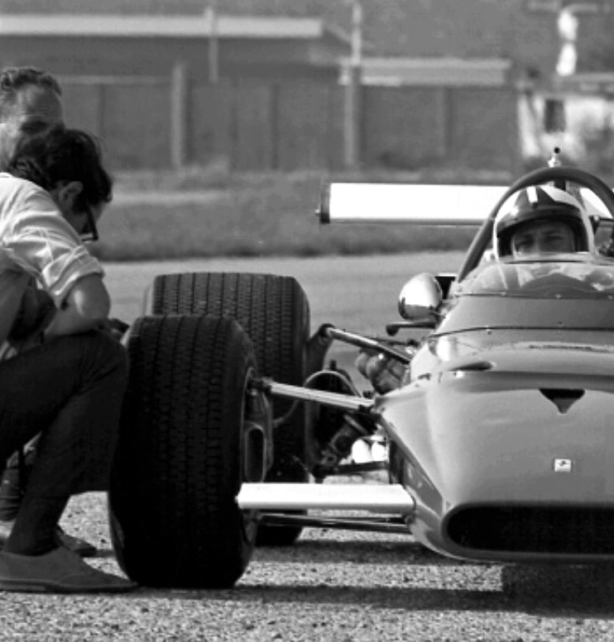
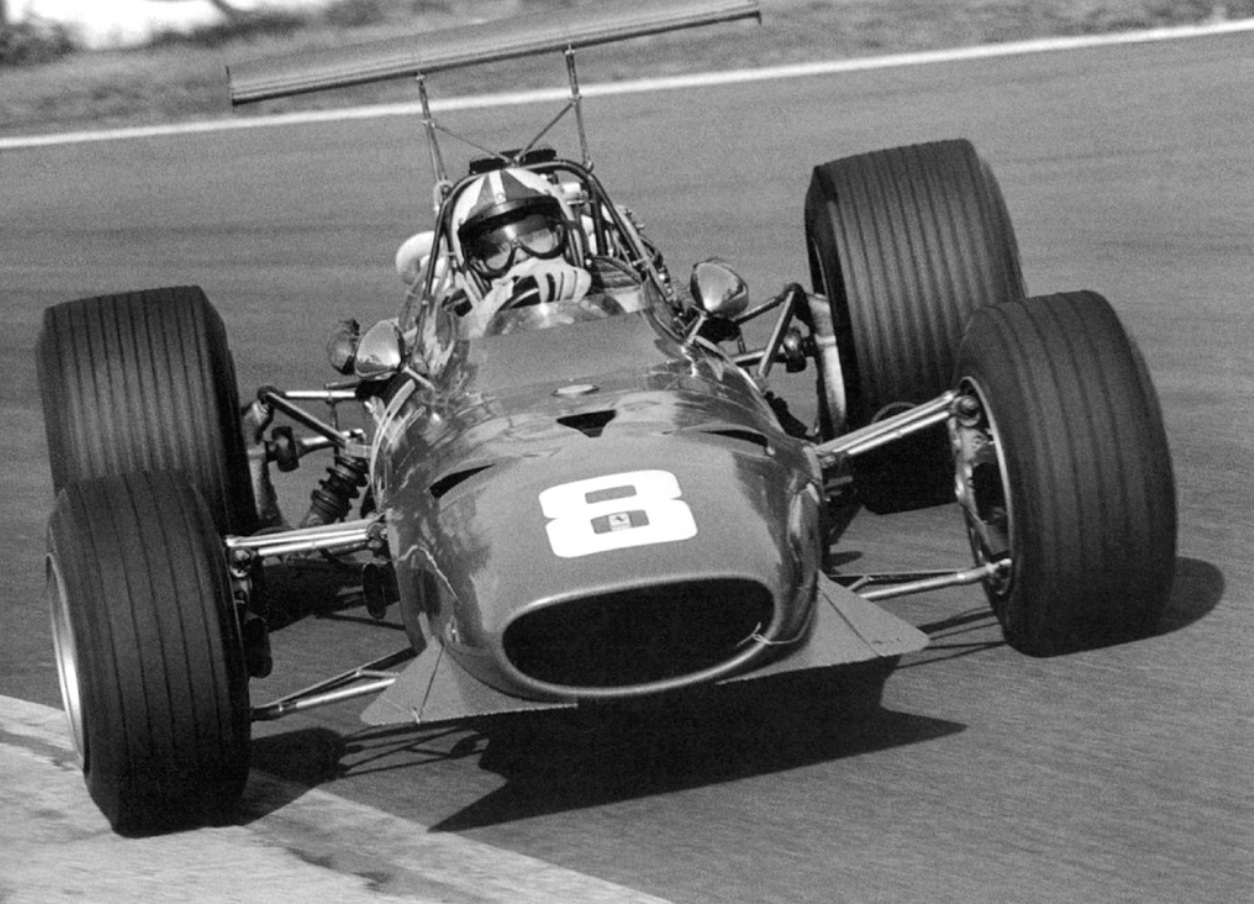
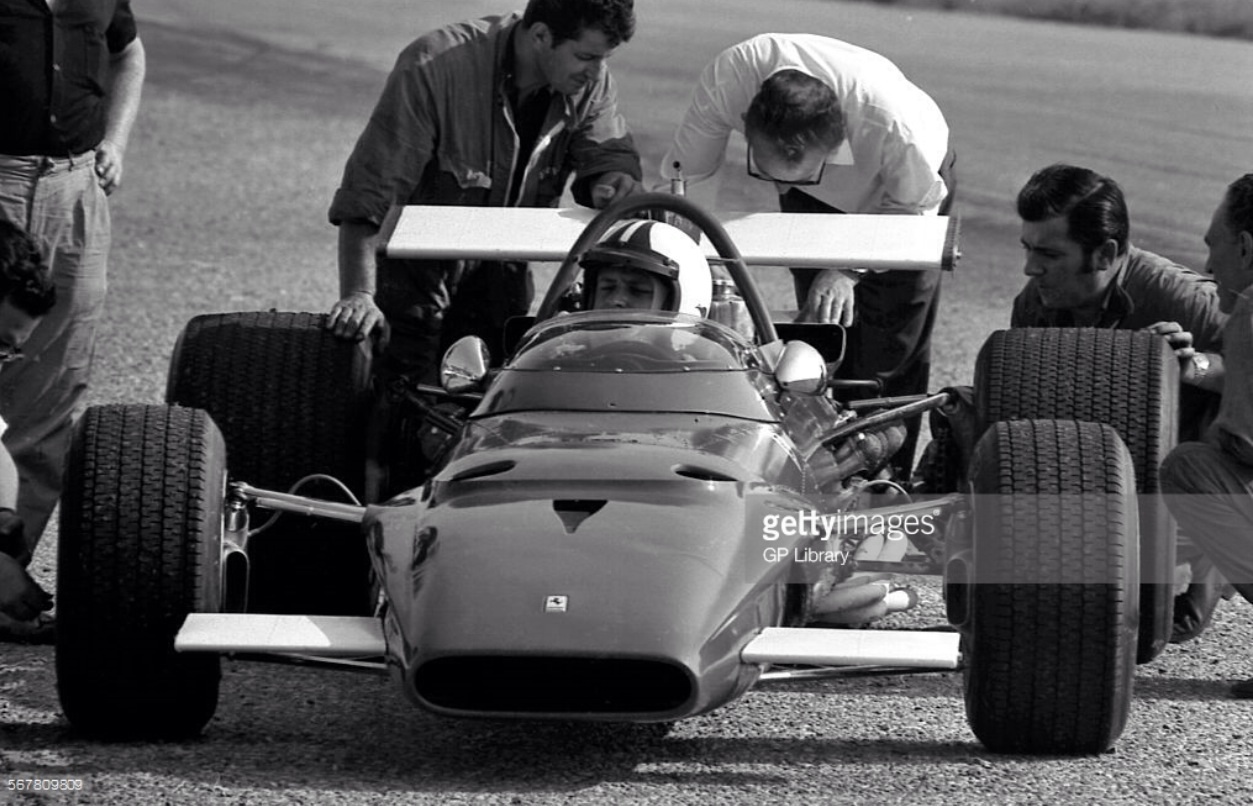
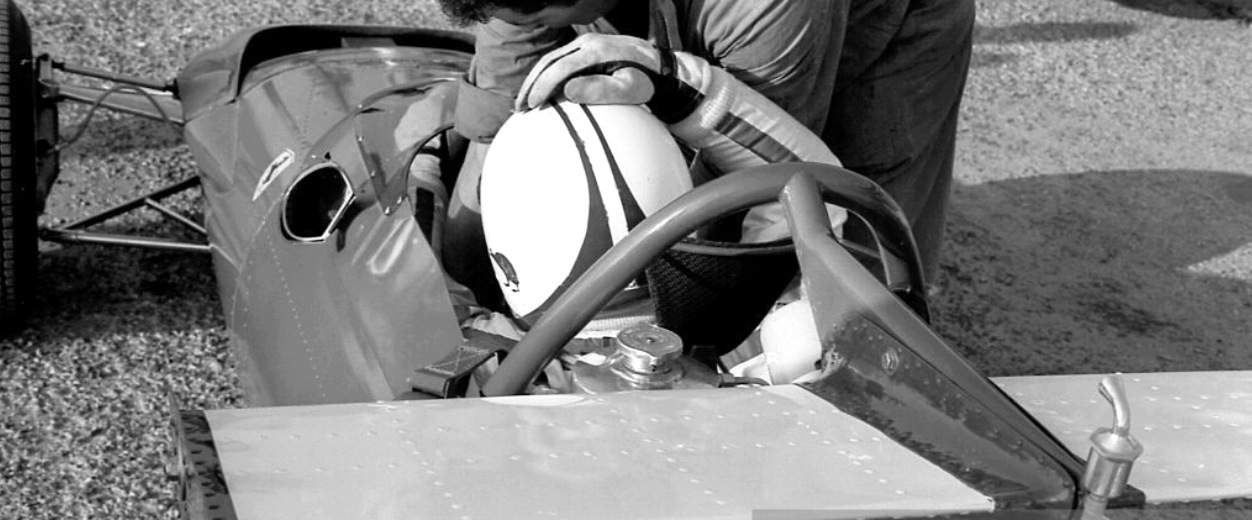
This group of shots (the one above and those at Modena below, all are undated sadly) are included for the sake of completeness; they are all of the same session. They show the beauty of this incredibly good, important for Ferrari car.
The photos convey a certain sense of calm as well, despite the problems which were apparent with the engine from the start. Apart from Chris of course, i am sure he felt far from calm trying to best assess his short and longer term options!
Driving careers are fickle things; he felt he had to seize the moment having in his mind stayed at Ferrari a season too long. Hindsight is brilliant of course, in fact he stayed a season too little, his testing skills may well have meant the car started the season better prepared than it did. Ickx wasn’t a noted test driver and new-boys to F1 Regazzoni and Giunti weren’t in a position to make the contribution Chris could and had made since 1967…
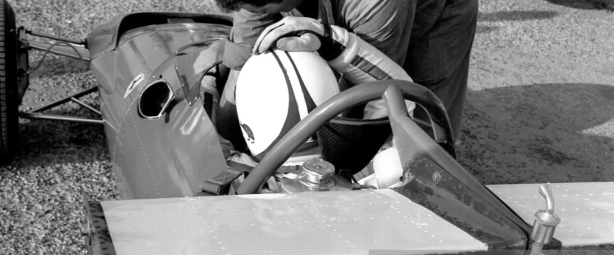
Another view of the roll bar/wing mount covered earlier (GP Library)

Forghieri with the pad, sans rear wing in this shot (GP Library)
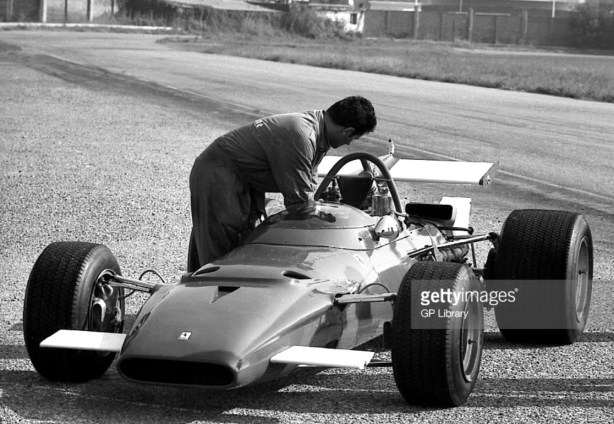
Who is the belle of the ball!? Lotus 72 was ‘the radical’ of 1970: side rads, rear weight distbn, torsion bar suspension but all the other race winners that year were ‘conventional’ front rad cars; 312B, BRM P153, Brabham BT33, March 701. Best aero direction not clear at this point in GP history nor would it be until the Lotus 78 started the ‘wing car’ trend (GP Library)
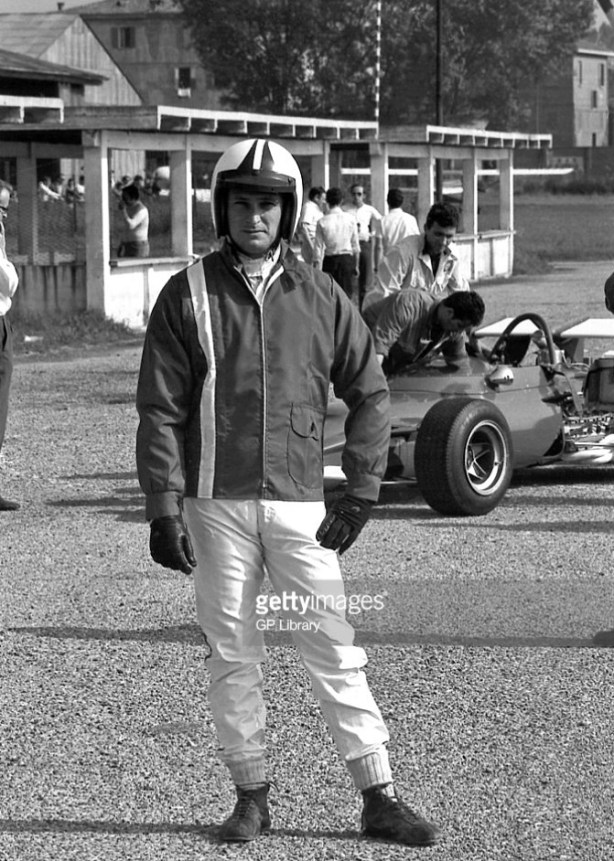
Chris Amon, Modena June/July 1969. He lost many races due to bad luck, the decision to leave Ferrari tho wasn’t so much bad luck as a judgement call which time proved was the wrong one. Wonderful hindsight i know (GP Library)
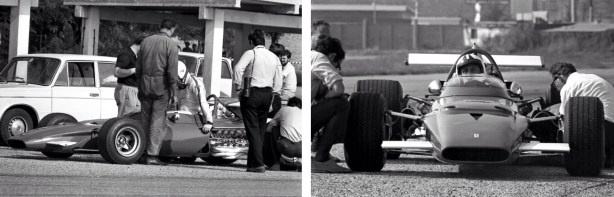
(GP Library)

Amon lost in his thoughts, Modena 1969 (GP Library)
Amon Post Ferrari…
This article is not about Amon’s career, rather Ferrari elements of it. What follows is not a full summary of the balance of his wonderful career.
For Chris 1970 was frustrating!
The March 701 was not the best car of the season but both he and Jackie Stewart in Ken Tyrrell’s car ‘made it sing’. Stewart took a Spanish GP win and Chris the BRDC International Trophy at Silverstone, an F1 win but not the GP win he sought.
He came close to that in a titanic battle with Pedro Rodriguez’ BRM P153 at Spa in a test of the brave, bold, skilful and precise, just coming second.
He proved as quick as anyone in 1970, again. His record head to head in the 10 Championship GP’s he and Stewart raced the 701, the Scot in a Dunlop rather than Firestone shod car was 8/2 in Stewart’s favour. In all but 2 occasions Chris was only 1 or 2 grid slots behind Stewart who was arguably the best driver in the world at the time if not its fastest. Until his death most would argue that was Jochen Rindt. There is little doubt the Tyrrell 701 was a better prepared car than Amon’s March works car. The point to take here is that Amon was ‘right thereabouts’ with the best driver in the world at the time.
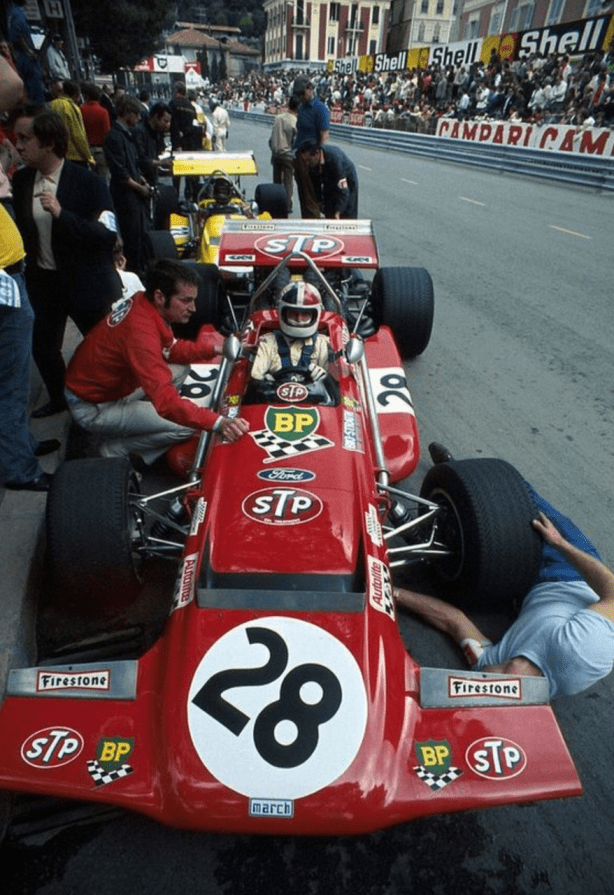
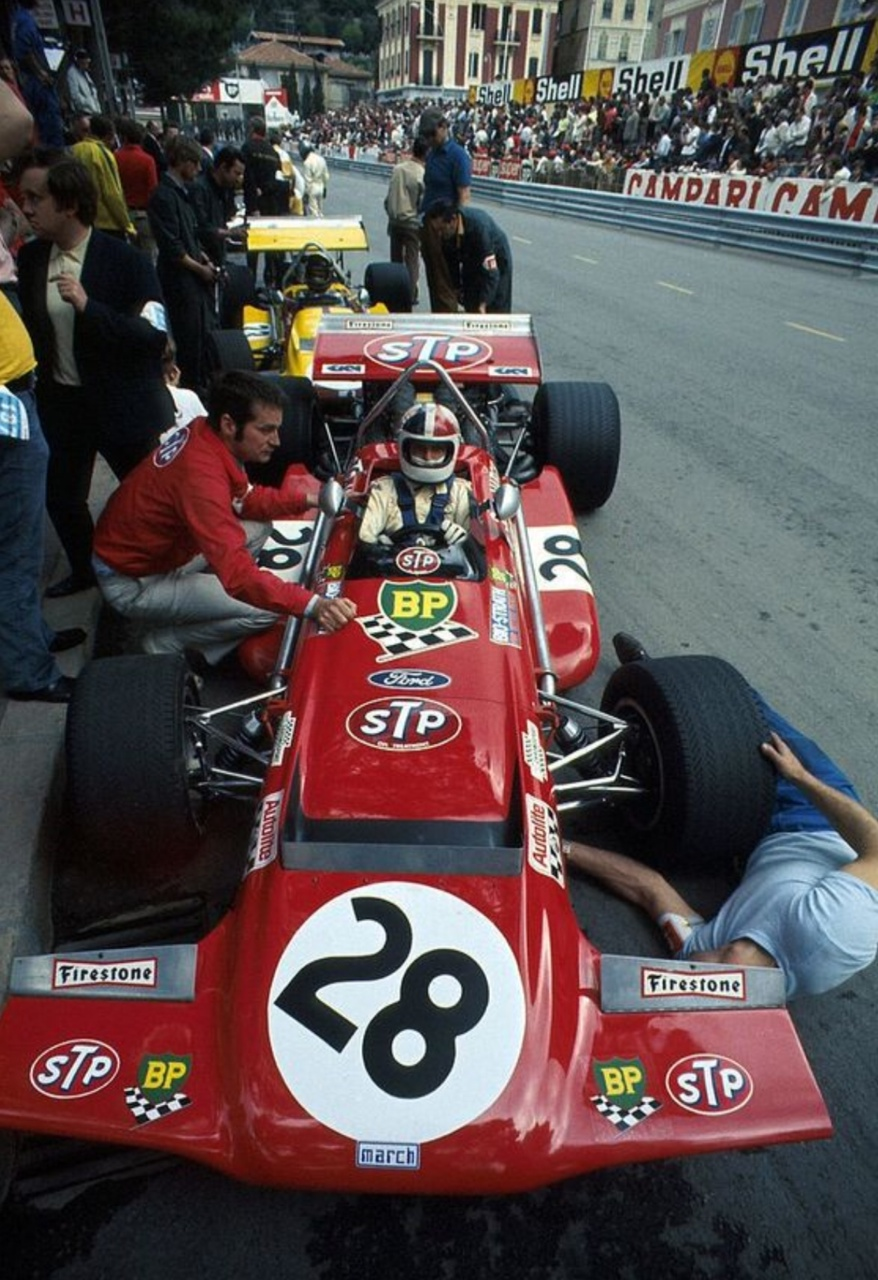
Amons March 701 being tended by the cars designer Robin Herd at Monaco 1970, Q2, DNF suspension failure,Ronnie Peterson’s customer, Colin Crabbe owned yellow March 701 behind. Rindt won in a Lotus 49C Ford (unattributed)
If the departure from Ferrari was not strategically the right one for all the reasons outlined earlier in the article, the departure to the new March outfit was a ‘leap of faith’ largely i suspect in designer Robin Herd which provided a competitive Cosworth powered car if not the quickest one. Amon knew Herd from their March days, Robin designed the first McLaren F1 car, the M2B and the ’67 CanAm Championship winning M6A Chev.
March were a company whose very successful raison d’etre was the construction and sale of production racing cars, its works teams secondary considerations. Its not hard in that context to work out what Max Mosley and Robin Herd’s prime focus was in 1970; to win in FF, F3 and F2 to flog cars for the coming year. Chris signed relatively early for March, before he knew they were selling 701′ s to ‘every man and his dog’ including the 1969 world champion for 1970. In 1970 Amon, Siffert, Stewart, Servoz-Gavin, Cevert, Peterson, Andretti and others raced 701’s. Works drivers Amon and Siffert didn’t have the cars to themselves.
Brabham, McLaren and BRM would have been better places to be in 1970 than March. Not that BRM was an attractive option in 1969.
Chris joined Matra who made him an offer he couldn’t refuse, back to a V12 for 1971 and 1972, taking a Non-Championship GP win in Argentina in 1971 and again lead races more than once only to experience car failures or punctures.
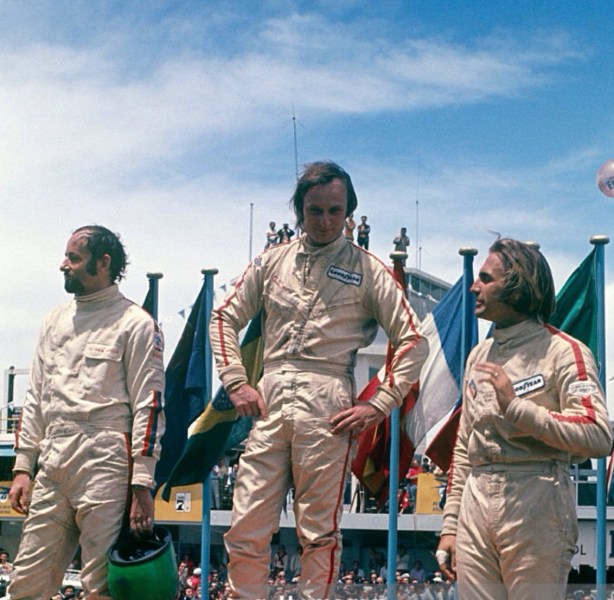
1971 Argentinian GP placegetters; Henri Pescarolo March 701 Ford, Amon 1st where he belongs! Matra Ms120 and Carlos Reutemann McLaren M7C Ford Ford (GP Library)
During 1972 Matra were mainly a single-car entry for Amon its focus increasingly on Endurance Racing success.

German GP 1972. Amon Matra MS120D Q8/15. Ickx won in a Ferrari 312B2 (unattributed)
Tecno in 1973 was a disaster but Chris raced a third Tyrrell in Canada (Q11 2 slots behind Stewart in the unfamiliar car and 10th in the race) and the US (Q12 at the time the team withdrew from the race) for Tyrrell but not converting that into a 1974 drive after the death of Francois Cevert and retirement of Jackie Stewart at Watkins Glen.
His own Amon F1 car was also a disaster in 1974, a project commenced after a return to March in ’74 ‘evaporated’ over the Christmas New Year period seemingly after a failure in communication between Max Mosley and Chris. An engine development business with ex-BRM engineer Aubrey Woods also cost the Kiwi a lot of money. Looking at Chris’ career and some of the decisions suggests he needed a decent business manager, or a better one if he had one!
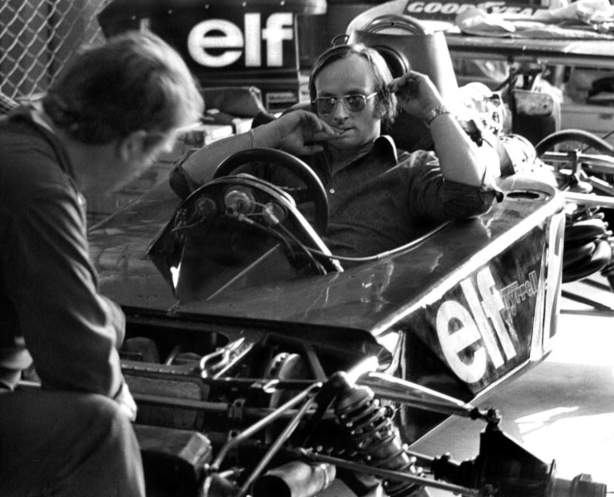
In Tyrrell 005 in the Kendall Centre, Watkins Glen. Note the inboard front brakes of Derek Gardner’s design. Tragic weekend with teammate Francois Cevert’s high speed, fatal practice crash in an 006 chassis. Both remaining cars withdrawn and Jackie Stewart didn’t get the chance to race in his last, planned GP (Mike Glynn)
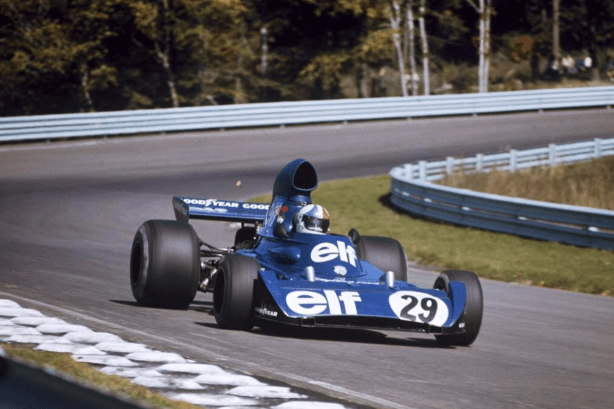
Amon in Tyrrell 005 Ford, Watkins Glen, USGP practice, 6 October 1973 (unattributed)
In 1975 he raced the Talon MR1 Chev F5000 (nee McRae GM2) in the Tasman Series and in the US showing he had lost none of his skill despite a car not as good as the ubiquitous, highly developed Lola T332’s.
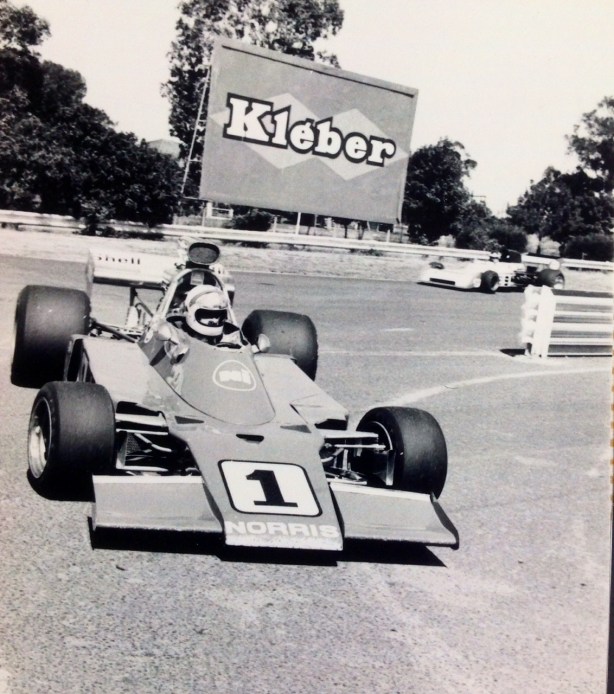
Amon enters the Sandown paddock, Saturday 22 February 1975. 5th in the race, Talon MR1 Chev, car behind is John McCormack’s 2nd placed Elfin MR6 Repco. John Goss won in a Matich A53 Repco (M Bisset)
The only time i saw Chris race was in the final round of the ’75 Tasman at Sandown in February, he did the full series in one of Jack McCormack’s Talons, not the ‘fastest tool in the shed’ but Chris made the car sizzle despite junk engines which failed 3 times. He took a win at Teretonga, the final Kiwi round and was quick everywhere whilst the car stayed together.
I was a starstruck teenager who didn’t stray too far from his pit the whole weekend. On circuit what was impressive was his speed which was deceptive. He drove the car in a very ‘neutral’ fashion through the slow/medium corners where so many others were ‘tail out’. Across the top of ‘Marlboro Country’ a fast entry quicker corner his carrying speed and control was a joy to watch as was his precision under brakes into ‘Dandy Road’. I still recall the toe/heel too; on the brakes late and a change down late as well, a short/few revs blip at the throttle, easy on the DG300 box. A pro.
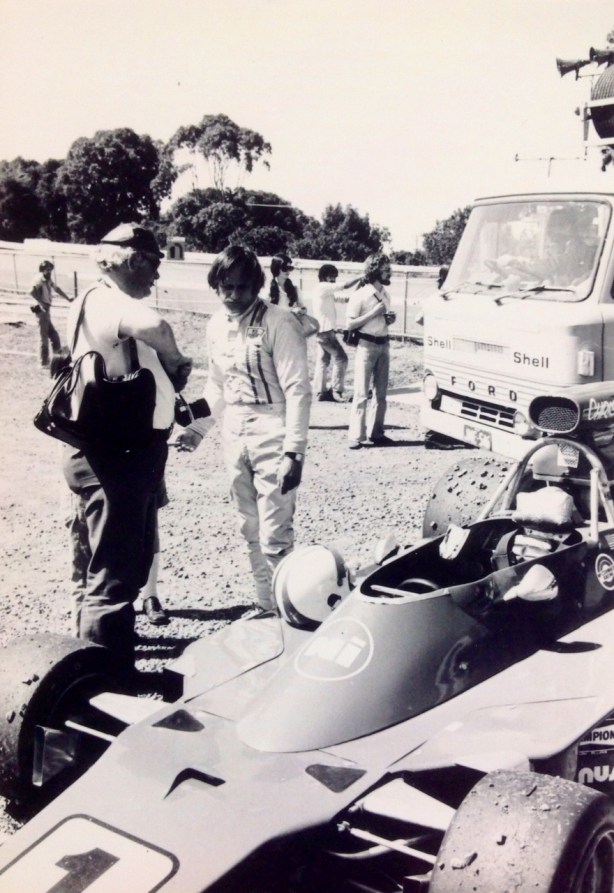
‘Auto Actions’ Paul Harrington gets the gen from Amon, Sandown Tasman ’75 practice Saturday, looks like its tough going! McRae GM2/Talon MR1 clones lovely cars (M Bisset)
Late in 1975 he had some drives of Mo Nunn’s Ensign GP cars, he and Nunn developed these pretty, effective cars into machines which shaded many of the big budget teams in 1976.
He was 10th on the Spanish GP grid, finishing 5th, 8th on the Zolder grid but lost a wheel and flipped the car emerging unscathed in the race. At Monaco he was Q12 and 13th. At Anderstorp he was a terrific 3rd on the grid but crashed out of 4th on lap 39 when the cars suspension failed.

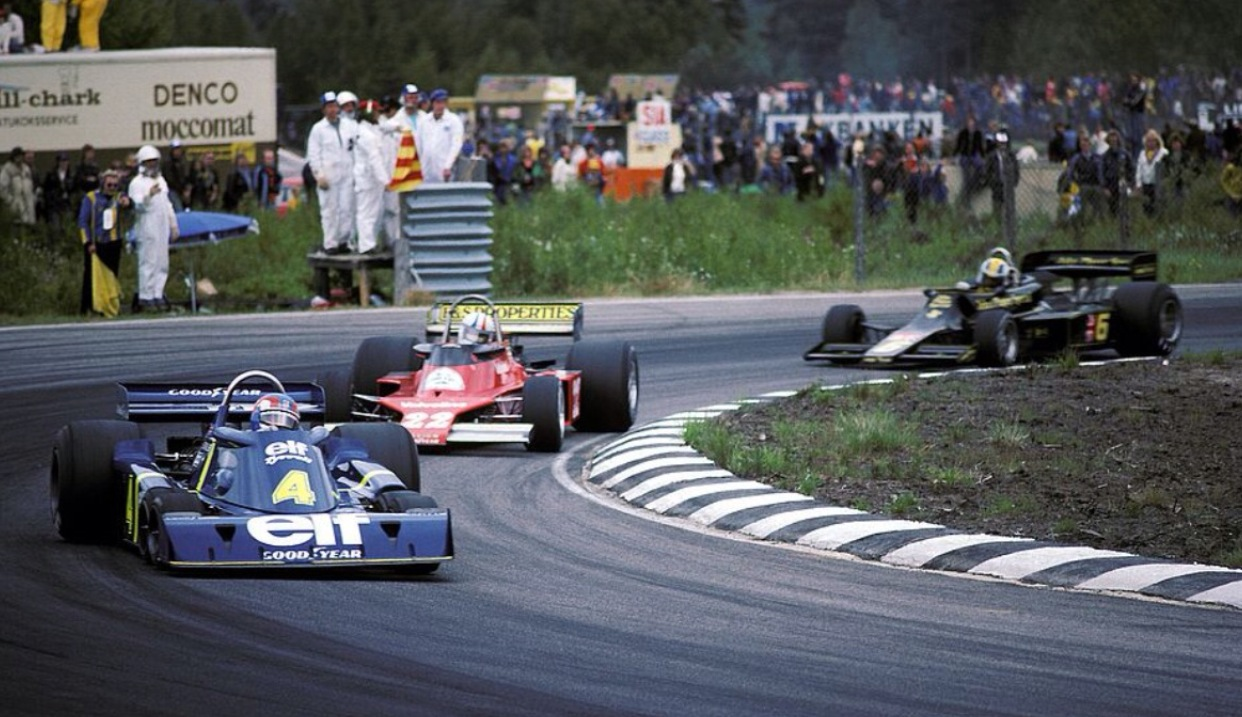
Swedish GP, Anderstorp 1976; Amon Ensign N176 Ford in between Patrick Depailler’s Tyrrell P34 Ford and Gunnar Nilsson’s Lotus 76 Ford. Scheckter won in the other P34, Amon an amazing Q3 and accident caused by suspension failure (unattributed)
Chris missed the French GP injured after Sweden, Patrick Neve qualified the car 26th, perhaps more indicative of the machines pace without an ‘ace’ at the wheel…
At Silverstone for the British GP, Chris qualified 6th, this time a water leak the cause of a DNF.
The problems of a low budget team in terms of design and preparation were clear, Chris decided he had ‘had enough’ of GP racing in this way and elected not to take the re-start of the German GP after Niki Lauda’s accident. The risk of something breaking on that circuit in that car was simply too great.
1976 showed he had lost none of his sublime, deceptively fast skill, speed and testing ability. He was still only 33 despite having his first Championship GP drive in 1963.
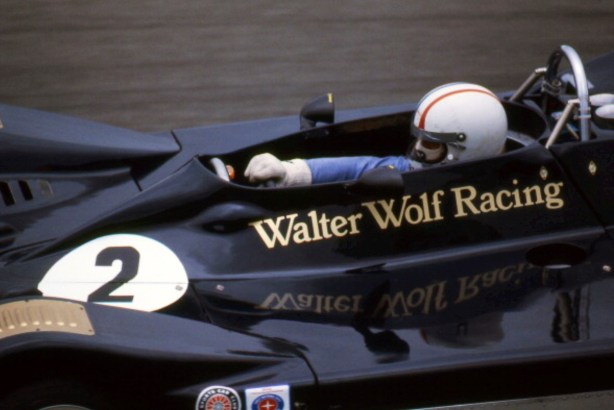
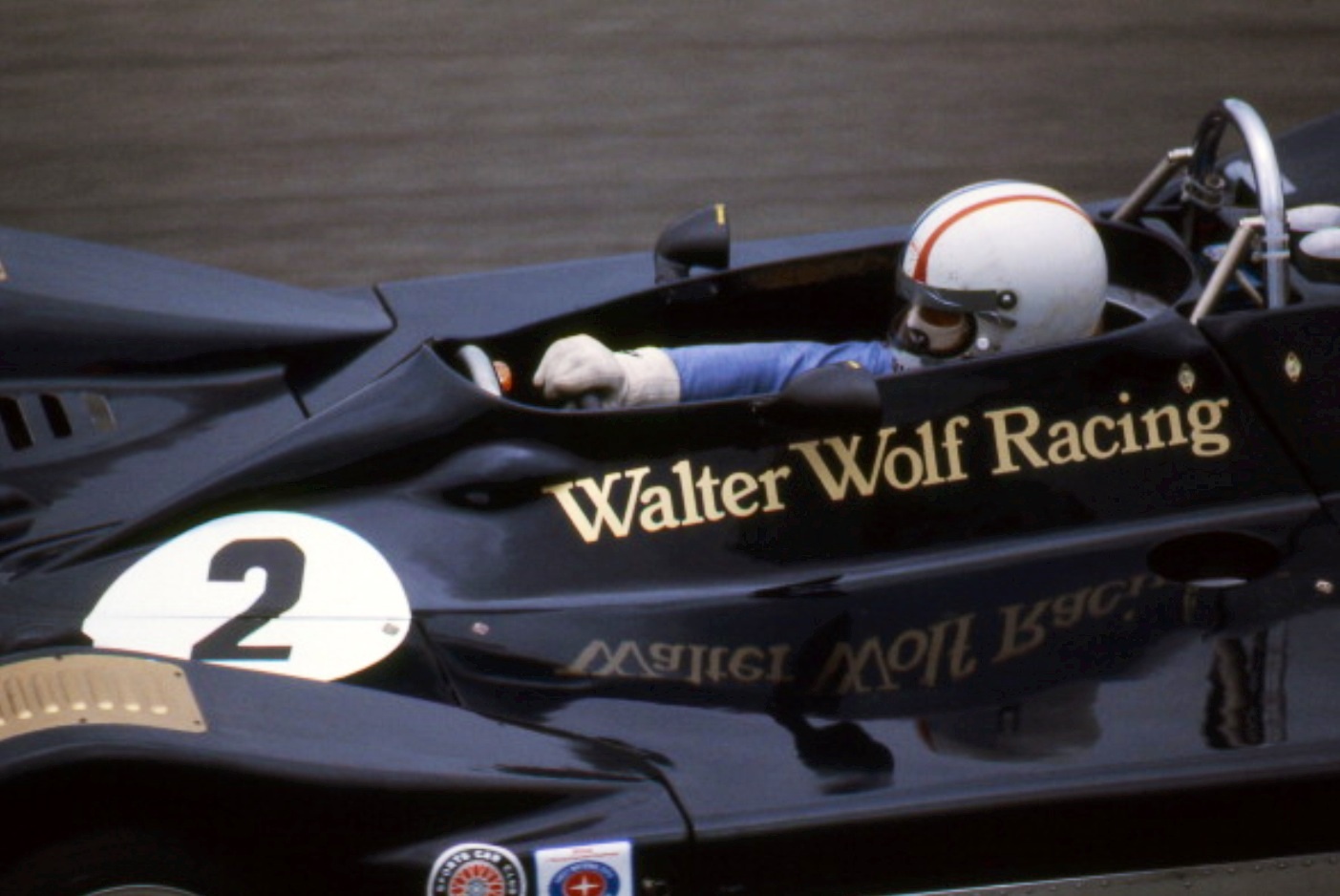
Amon’s last pro drive. Mont Tremblant CanAm 12 June 1977 in Walter Wolf’s Wolf Dallara WD1 Chev, grid 2 and DNF. Race won by Klauser’s Schkee Chev (Bob Harmeyer)
Amon’s last race was in Walter Wolf’s single-seat Can Am car in 1977 before saying ‘enough’, recommending Gilles Villeneuve for the ride before returning to his native New Zealand and farming at Bulls in the ‘Land of The Long White Clouds’ North Island. He sold the property some years ago but is not too far from the local racing scene and maintains a long-standing commercial relationship with Toyota.
Chris Amon had a career most of us can only dream about, life is all about the decisions we take, perhaps the decision to leave Ferrari in 1969 was the worst he ever made but in the same circumstances i suspect many of us would have made the same call.
To me though he should be remembered for what he achieved rather than what he didn’t: wins at Le Mans, Daytona 24 Hours, Monza 1000Km, a Tasman Championship, NZ (2) and Australian GP wins against some of the best drivers in the world, two non-championship F1 races and many individual race wins and the respect and fear of his peers. From 1967 to 1972 he was in the top 10 drivers in the world, for some of those years top 5.
Bot wow, Amon in a 312B in 1970, if only…
Etcetera…


Ferrari 312B cutaway (unattributed)
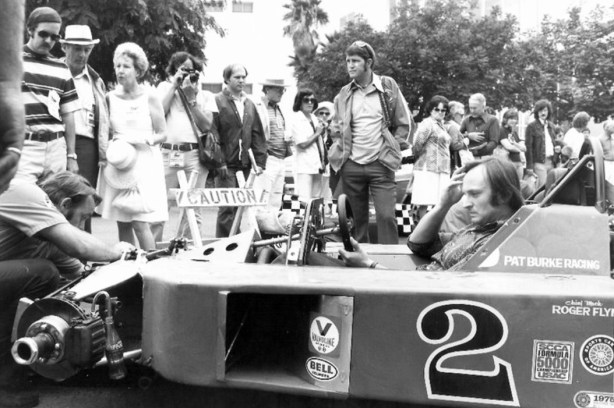
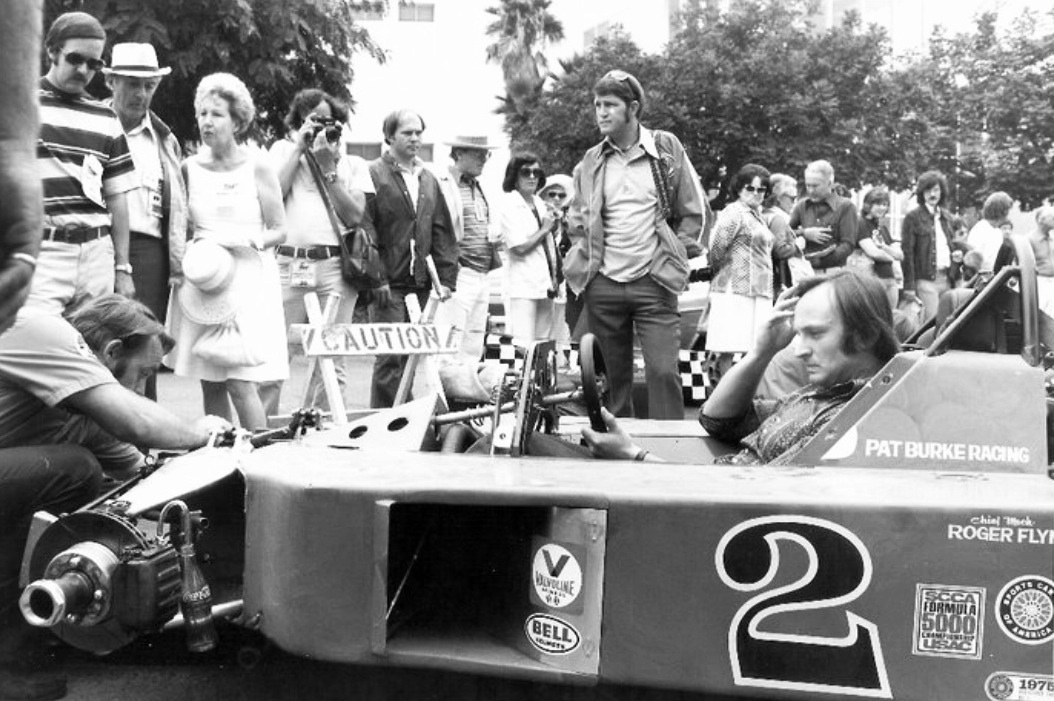
Bleeding the brakes with Dave Ramsay, F5000 Talon MR1A Chev during the Long Beach GP weekend in September 1975. Amon 4th, race won by Brian Redman’s Lola T332 Chev (D Ramsay)
Bibliography…
Automobile Year 16, 17 and 18, Doug Nye ‘History of The GP Car 1965-85’, GP Encyclopaedia, MotorSport March ’84 Amon article by Alan Henry
oldracingcars.com is one of my standard, always reference sources- checkout Allen Brown’s piece on the cars and each chassis built here; https://www.oldracingcars.com/ferrari/312b/
Photo Credits…
Getty Images, Rainer Schlegelmilch, Mike Glynn, Klemantaski Collection, GP Library, Rod MacKenzie, D Ramsay, Bob Harmeyer, Yves Debraine
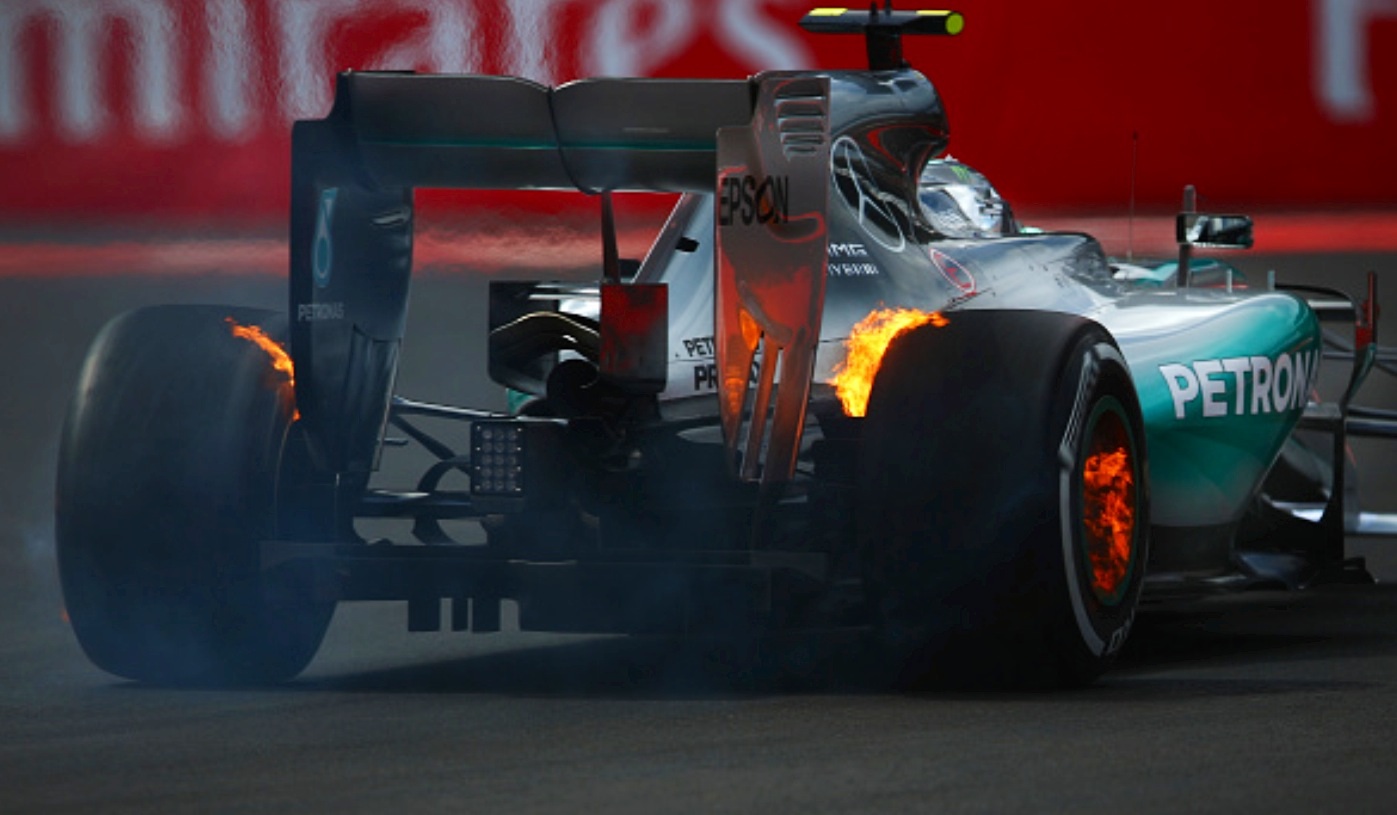
Tailpiece: ‘This thing is a Jet if only they could keep it together for more than 10 laps?!’ …
Finito…
























 primotipo...