Archive for the ‘Obscurities’ Category

(ANU)

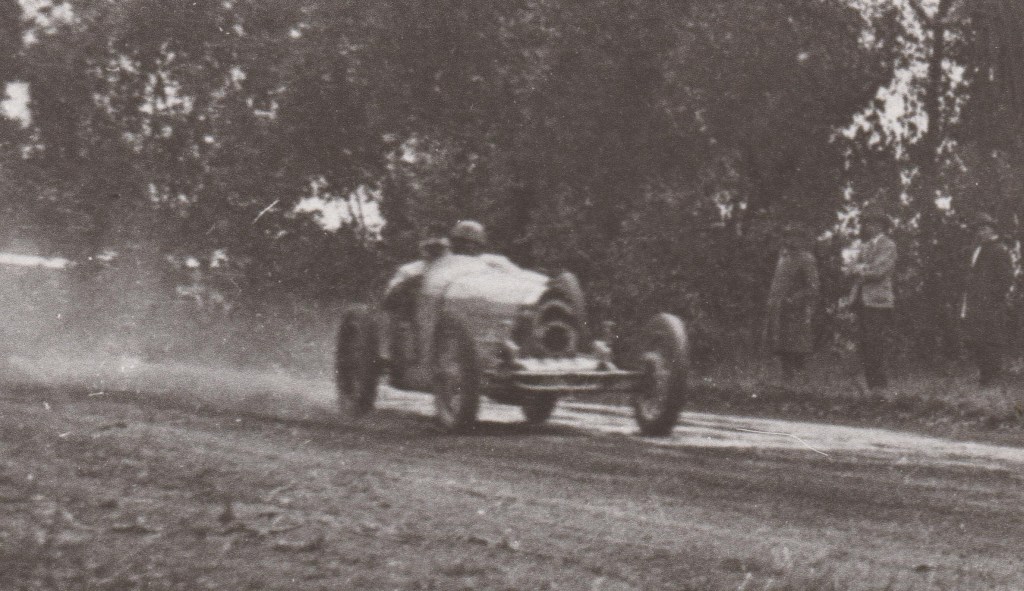
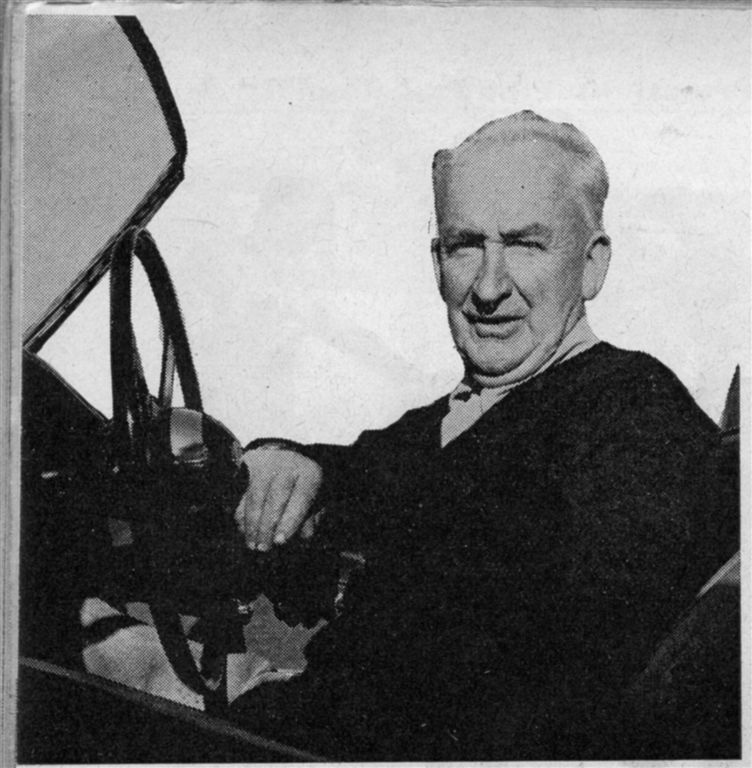
Jack Burton aboard his Vauxhall 30-98 in the Gambier Ranges during his 2,889 mile drive across Australia, from Fremantle to Sydney between December 8-14 1923…

He and Bill Bradley were hoping to do the transcontinental journey in five days but a crash in a deep hole in Meningie necessitated repairs which cost the pair twelve hours of valuable time. They still bagged a new record of six days, 15 hours and 57 minutes, 39 hours less than the previous record and in so doing they also set new marks for Fremantle to Adelaide and Fremantle to Melbourne.

The reputation of these mighty Vauxhalls as robust, beautifully built machines was polished yet again, this car had already done over 40,000 miles in previous attempts.

‘Daily Telegraph’ 15 December 1923

Burton was the husband of famous Australian equestrian, Emma Roach, whilst based in Sydney they travelled the continent to agricultural shows where Roach plied her trade whilst Burton worked in car sales and as a motoring writer. Along the way he was involved in a number of record breaking drives in the pioneering days of motoring in this earliest branch of motorsport in Oz. See here for a feature on this important aspect of Australian motoring history; https://primotipo.com/2018/12/21/city-to-city-record-breaking-and-car-trials/


Hi-ho Silver, giddy-up (ANU)

Credits…

Sydney Daily Telegraph 15 December 1923, The Mercury, Hobart 15 December 1923, Dunlop, Australian National University

Tailpiece…

(ANU)

Finito…

(P Vestey)

A cold, snowy and wet Ferrari 250LM sits out front of the Hotel des Alpes, Aosta, between Courmayeur and the Mont Blanc Tunnel in 1968, this establishment is now closed.

Paul Vestey’s car is on its way back to the United Kingdon, or perhaps heading direct to Le Mans from Piero Drogo’s Carozzeria Sports Cars in Modena, via Emilia Ovest  524, near the old Autodromo. The tow vehicle is a Mercedes 250SE, either belonging to Paul Vestey or his friend and motor trader Don Parker.

These shots popped up whilst doing a ‘Getty Images Le Mans 1968’ search. I’m certainly not the first to post them, the story goes something like this, with thanks to DC Nye, whilst noting that some of the conclusions drawn are mine and therefore, so too are any errors.

Paul Vestey acquired 250LM ‘6167’ from Maranello Concessionaires in September 1967, after a successful life in the hands of Richard Attwood and Mike Parkes earlier in the year, to run throughout the 1968 endurance season.

In the early laps of the Targa Florio, his co-driver, David Piper, lost the car, probably after a steering arm parted company with the balance of the front suspension assembly, whereupon said vehicle tripped over a stone roadside marker and ended up, tit over arse, in a field about 50 feet below. Nye’s MotorSport article relates an amusing tale of Piper being fed some wonderful tucker by the owners whose real estate he smote, whilst the balance of the race was completed!

Targa 1968, ‘6167’ before the off in Cerda (unattributed)


Cripes, what a mess, or words to that general effect. David Piper surveys his ‘walk on the wild side’ into a Sicilian field, the morning after the day before. Paul Vestey took the shot from the point at which Piper left the road (P Vestey/GP Library)


It doesn’t look any better up close (P Vestey/GP Library)


Franco Zucchi, British racer F3 ace and occasional F1 driver Tony Lanfranchi and Piper ponder pre-Le Mans repairs (P Vestey/GP Library)

The wreck was dragged up to road level by the teams transporter with a bit of additional assistance from British racer Tony Lanfranchi, who co-drove Mark Konig’s Nomad Mk1 Ford in the race, and looked quite a sad and sorry sight.

Shortly thereafter Vestey acquired George Drummond’s sister 250LM rolling chassis ‘6053’ into which ‘6167’s engine and gearbox were fitted at Piero Drogo’s workshop in time for him to co-drive with Roy Pike at Le Mans, where, Nye notes, the salvaged transaxle broke.

This is the repaired car ‘6053’ heading back in the direction of the UK in the care of Paul Vestey, who took the photographs, and Don Parker.

(P Vestey/GP Library)

Oh yes, what became of ‘6167’ you ask? The ‘Barchetta’ website records that the original chassis remains, left at Carozzeria Cars were sold to Stefano Sebastiani, a Roman in April 1969 with a new chassis and body built by Franco Ferrari in 1992.

Final exchange on price, extra unanticipated additional work and all that kind of stuff between Paul Vestey and Piero Drogo above before the off and lunch in The Alps- Modena to Courmayeur is 400 km, a four to five hour tow i guess.

This set of panels are fibreglass unlike the hand formed aluminium originals.


Tony Lanfranchi, BRM P261, Oulton Park Gold Cup, August 1968. He was fifth in the 2 litre V8 engined car behind four 3 litre machines, Jackie Stewart won in a Matra MS10 Ford

Etcetera: Tony Lanfranchi…

Gee, i really did a flashback when i saw the photograph of Tony Lanfranchi, the very first motor racing book i ever had was an X-Mas stocking filler from Santa, bless the old fella, circa 1967.

The wonderful book has a shot of Tony, his psychedelic helmet caught my eye and mind, so much so that my first Bell Star was subjected to the same treatment a decade later, so i always followed his career and must get a copy of his book.

Tony Lanfranchi, Mike Spence and Jack Brabham in the 1968 publication ‘Car Sports Book’,


Lanfranchi lifts the singer ‘Lulu’ into a Lotus 51 Formula Ford at Brands Hatch in February 1967, she had just failed her road licence test, no doubt Tony knocked her into shape

Of Swiss extraction but Yorkshire born, Lanfranchi was a ‘doyen’ of British national racing, all the way up to non-championship F1 mind you, he was no slouch behind the wheel at all, of anything; single-seaters, sports cars and taxis.

He died of cancer in 2004, i like this tribute from MotorSport ‘He was the archetypal racing driver of yesteryear- booze, birds and cars, though in which order of priority was always up for debate.’

Tony aboard a Lola T140 Chev at Brands Hatch early in 1969, must be a Libre race, it does not appear to be a Guards F5000 round (unattributed)

Credits…

Paul Vestey, GP Library, Alamy, ‘VIP Hospitality at the Targa Florio’ Doug Nye in MotorSport June 2009, Marcel Massini, Miki Paki, barchetta.cc, ‘Car Sports Book’ Young World Productions 1968, Getty Images

Tailpiece…

What a lovely bit of kit the Nomad Mk1 Lotus-Ford is. Here at Targa in 1968 at the start.

The car was designed by ex-Lotus man Bob Curl, it has a spaceframe chassis and a body built in aluminium by Williams and Pritchard, it was very quick in endurance events in the UK and Europe in 1969 and still exists.

Finito…
Garrie Cooper exported a couple of Elfin sportscars to South Africa in the mid-sixties, both of which were competitive cars. It would be interesting to know how many of the great Edwardstown outfits products left our shores?

The shot above shows the brand spankers Elfin Mallala Ford Cosworth having perhaps its first run at Roy Hesketh, in June 1964 M Lester having a good look at the Smiths tell-tale to ensure Henri le Roux hasn’t buzzed the fresh motor. G Goetzer looks on at left.

The Mallala was essentially a sports version of the Catalina single-seater, five cars were built and delivered between December 1962 and March 1964, Henri’s car, chassis ‘S6418’ was the last of these.

The car sang for its supper immediately, Le Roux entered it in the 1964 South African Sports Car Championship, his first event was the Republic Day Races at Kyalami on 6 June where he won his class and finished second outright. The race report observed ‘Henri le Roux’s Australian Elfin Mallala with Cosworth Ford engine was most impressive and will certainly be a car to watch, though the final drive ratio was wrong and he reached peak revs early in the straight instead of near the end’ a malady rather easy to fix with a Hewland gearbox of course.

Henri raced the car at Kyalami, Roy Hesketh, East London, Killarney and Lourenco Marques with his best results first in class at Kyalami in June, second outright at Laurenco in July and third in class at the Rand GP meeting at Kyalami in December. By 1967 the car was owned and raced by Joss Viljoen, Stephen Knox brought the car back to Australia in the eighties.

Henri le Roux, Elfin Mallala Ford, circuit unknown, assistance welcome. Beautiful shot (R Winslade)


McGillewie Elfin 300 Climax at Roy Hesketh 1968- first place in the 15 April SA SCC race

Perhaps the pace of the Mallala inspired Garth McGillewie to acquire the second of seven Elfin 300s built. Chassis ‘SS67-5’ was completed by Elfins in September 1967 and shipped to South Africa shortly thereafter.

Durban motor trader McGillewie, with a careful eye on the local and international class structure, fitted his machine with a 2-litre Coventry Climax FPF four-cylinder engine and five speed Hewland transaxle.

Barry Catford wrote ‘…this car was shipped to South Africa where it performed exceptionally well in the hands of Garth McGillewie, holding many records in its category for some years. In the Capetown 3 Hour race the Elfin finished fourth outright behind a Ferrari P4 and two 6-litre Lola GTs. During the Rand 9 Hour race, driver Tony Jeffries shadowed the Ford GT40s until he was forced to retire after colliding with Frank Gardner and Mike Spence. The Elfin went on to take out the 1968 South African Sports Car Championship.’ McGillewie bought at Chevron B8 to replace the Elfin.

‘The car was later restored for a subsequent owner, Ron Watt of Zimbabwe, by Ivan Glasby who was responsible for returning the car to Australia some years later’ Catford concludes.

(M Hall Collection)

Etcetera: Elfin Exports…

My inquisitive nature usually gets the better of me. Having posed the question as to Elfins exported, i think the number of Garrie Cooper Elfins sold overseas when built is 15 cars of 264 built, the first of which was the Le Roux Mallala.

My methodology was to add the production numbers in the Catford/Blanden book then list those which were exported viz;

1964: Mallala ‘S6418’ Henri le Roux, South Africa

1967: 400 ‘BB67-4’ Andy Buchanan, New Zealand, 300 ‘SS67-4’ Chuck Krueger USA, 300 ‘SS67-5’ Garth McGillewie South Africa

1969: 600C ‘6910’ Hengkie Iriawan Indonesia, Ford FVA engined

1970: 600B ‘7015’ Teddy Yip Macau, 600FF ‘70005’ David Oxton New Zealand, 600FF ‘70009’ Frohlich Golding & Co South Africa

1973: 620FF ‘73421’ Dante Silverio, Toyota engine fitted Philippines, 622 ‘73422’ Dante Silverio Toyota engine Philippines

1974: 620/BFF ‘73430’ Mike Hall USA, ‘73432’, ‘73433’ and ‘73434’ all USA, seemingly Chuck Jones Racing

1977: MR8A-C ‘8783’ Vern Schuppan USA (i appreciate he isn’t American but he was an Oz International then so i am treating the car as such- it bombed in the Can-Am and was also raced in F5000 guise in Oz

So, fifteen cars, as always, happy for input.

(M Hall Collection)

Mike Hall was Elfin’s man on the ground in the US for a bit and i really must give him a call. Elfin 620FF American style, the Americans were running on the same Goodyear slicks we were at the time so the suspension should have worked nicely.

Interesting for FF buffs is that Larry Perkins debuted the 620 in the UK Formula Ford Festival in late 1972 doing well enough at Snetterton to launch his international career- that chassis returned to Oz.

(M Hall Collection)

Bibliography…

‘Australia’s Elfin Sports and Racing Cars’ Barry Catford and John Blanden, ‘Hieronymus’ on The Nostalgia Forum

Credits…

Roy Hesketh Circuit Heritage, Richard Winslade, Michael Hall Collection

Tailpiece…

(Roy Hesketh Circuit Heritage)

Jos Viljoen’s Elfin Mallala Ford alongside Ray Emond’s Lola Mk1 Ford on the Roy Hesketh grid during the Easter 1967 long weekend.

Finito…

When I think of the pioneers of mid-engined racing cars, it’s always the Auto Unions of the thirties which pop most readily into my mind, but that does the 1923 Benz Tropfenwagen a huge disservice.

Dr Edmund Rumpler’s ‘Tropfenwagen’ (teardrop vehicle) was the hit of the 1921 Berlin Motor Show, it was said to resemble a Zeppelin Airship. Rumpler’s aeronautical design in particular and automotive experience went back to 1903, click here for more and Rumpler and the significance of this design; http://8w.forix.com/rear-engines-prewar.html

Rumpler 10-50 PS 1925


Mice have well and truly attacked those chassis longerons, making something which would have never been stiff positively flaccid- fuel tank forward and engine and gearbox aft must have given the pit pundits of the day something to ponder- the opposite of existing orthodoxy (GP Library)

The car had low drag coefficient of 0.28, a rear engined layout and independent suspension. Benz’ Berlin representative and future Auto Union Team Manager Willy Walb could see the potential of the design concepts when applied to a racing car. ‘Benz obtained the reproduction rights for this car immediately’ according to Mercedes Benz. In 1922 Chief Engineer Hans Nibel led a team which designed and developed the Benz ‘Type RH’.

The chassis was of the period typical ladder frame type, it was ‘underslung’ resulting in the racers low build.  Nibel specified a six-cylinder, two litre, DOHC, 12 valve motor of 1991cc, fed by two Zenith carburetors the unsupercharged motor gave about 90 bhp @ 5,000 rpm. The Benz had a three speed gearbox behind the engine with a diff which was attached to the frame, short halfshafts with universal joints provided the drive to the rear wheels. Leonard Setright accords the car the honour of having the first independent rear suspension of any racing car. Brakes were inboard at the rear, outboard at the front with supreme streamlining of course- the machine had a rounded nose, a tapering tail and a radiator which sat proud of the rear bodywork, aft of the driver mimicking some early seventies F1 airboxes.

Franz Horner, Benz Tropfenwagen, Monza- cars said to handle very well but lacked power sans supercharger


(GP Library)

Whilst four cars were commenced in 1922 they were not completed until the following year ‘due to the economical situation at the time’ Mercedes wrote. Finally ready, the design only contested one major race, the 9 September 1923 Grand Prix of Europe at Monza, attended by the most enormous crowd.

Drivers were Willy Walb, Franz Horner and Fernando Minoia. The pace up front was set by the Fiats and Millers but the unconventional cars finished fourth and fifth- Minoia from Horner but both were 4 laps adrift of the winners. Walb’s machine had engine troubles.

The race was won by Carlo Salamano from Felice Nazzaro in Fiat 805s powered by Tipo 405 eight cylinder, supercharged, DOHC, two-valve, 2 litre motors- the winner covered the 80 laps of the 6.214 mile course in 5 hours 27 minutes 38.4 seconds. Jimmy Murphy was third in a Miller 122, over 5 minutes adrift of the victor, then came Minoia, Horner and Martin de Alsaga in another Miller.

It was an important race for the supercharged 146 bhp Fiat 405s given their French GP failures at Tours earlier in the year- the cars placed first and second establishing the dominance of supercharged engines in the sport until Ferrari challenged the orthodoxy with their 4.5 litre V12 normally aspirated 375 in 1951.

The five hour race was not an exciting one. The 120 bhp Miller straight eight, normally aspirated, DOHC, two-valve 122s were nowhere near as quick as the Fiats and the Benz’s were further back again, nonetheless to have two of the three new cars entered finish the long race was a portent of greater performance in the future with development.

The three Benz RH lined up at Monza- Franz Horner at left #13 Willy Walb and #1 Fernando Minoia (Mercedes Benz)


The front two cars of Minoia and Bordino are not shown- the light coloured car is the Avions Voisin of Eugenio Silvani and on this side the #4 Rolland Polain of Albert Guyot, then Franz Horner ina Tropfenwagen on this side and  alongside perhaps Felice Nazzaro, Fiat 805- the strange looking car on the outside left of row two is one of the Voisins (Popperfoto)


Minoia at Monza in 1923, Tropfenwagen (Agence de presse Meurisse)

The cars were evolved, but not in the most critical manner. The rear brake drums changed from inboard into a more conventional location within the wheel hubs, the cars were also fitted ‘with a new dropped rigid steering stub axle instead of the straight front axle’- the translation from German to English seems to have suffered here!- i’ve no idea what that means. Most importantly, a supercharger was not fitted…

From 1923 a sports version was built which also competed in races and trials as well as the GP machines, but as dly, post Monza 1923 the cars were deployed in minor events only.

Horner was fifth in a hillclimb at Solitude in 1924, Walb won others at Konigstuhl and Freiberg in 1925. Future Mercedes works driver Rosenberger was quickest at Herkules. The car also did well in races held to open Opel’s new test track, Tigler won a ten lap event.

Rosenberger’s winning run in the Rund um die Solitude on May 16 1925 was the cars last run ‘in period’, at which point the company returned to building conventional cars. It’s worth noting that Benz & Cie and Daimler Motoren Gesellschaft formally merged after two years of cooperation into Daimler-Benz on 28 June 1926, their joint automotive products called Mercedes-Benz.

Ferdinand Porsche was appointed Technical Director of Daimler in 1923, there is little doubt he took a long hard look at the Tropfenwagen design and used some of its concepts in his later Auto Unions.

Etcetera…


(Mercedes Benz)

What an enormous crowd.

That is a Miller 122 amongst the masses in the foreground- three of them were entered and driven by Murphy, Martin de Alsaga and Louis Zborowski.

Benz up the road a bit surrounded by another big crowd.

Such a distinctive shape for the time- it is a shame that the machines were not supercharged which would have gone most of the way to bridging the gap to the dominant Fiats of the day- click here for a piece on those epochal Fiats; https://primotipo.com/2019/11/22/fiat-806-gp-1927/

Overhead shot shows the location of major components, the 130 litre fuel tank up front must have given the crews pause for thought.

Inline six, three speed gearbox and differential behind it and swing axle rear suspension, 4.53 metres long, 1.58 metres wide, wheelbase 2.78 metres and a quoted weight of 750 kg.

(Mercedes Benz)


That is the radiator mounted forward and above the rear wheels.

Ignore that though and take in the ‘pure tear-drop’ shape as it tapers from front to rear.

Great rear suspension detail- swing axles, notice the inner pivots alongside the diff and leaf springs which are performing locational duties and are inwardly inclined where they bolt at their inner ends to the engine. Note too the curvy radiator overhead.

The originality of the thing takes your breath away really.

(Mercedes Benz)


Carefully posed shot at Monza with probably the three drivers and two of the technicians- perhaps Franz Horner at left then Fernando Minoia on the other side of the car and in front Willy Walb.

Induction side of the engine with the two Zenith carbs prominent- note the inner spring mount under the carb closest to us.

The six cylinder, gear driven DOHC, two valve Type ‘Bz 6516’ engine is of built up construction- steel cylinders with welded on steel water jackets, the cylinder head is fixed, welded to the cylinders.The crankshaft is Hirth type and has seven main, roller bearings. Notice how the front section of the crankcase spans the chassis longitudinal members.

The bore and stroke are 65 x 100 mm, 1997 cc, one spark plug per cylinder, Bosch magneto ignition, compression ratio 5.8:1. Maximum power 90 bhp @ 5000 rpm with a maximum rev limit of 5,400 rpm.

(Mercedes Benz)


Exhaust side of the engine.


(Mercedes Benz)

Minoia on the inside of two Fiat 805 on the first lap of the Monza race.

And below in the pits, note the additional small radiator alongside the driver, which is shown more clearly in the final photograph in this piece below.

(Mercedes Benz)


Steering is worm and nut, front suspension by rigid axle, leaf springs and friction shock absorbers. Wire wheels of course, 105 cm in diameter with mechanically operated drum brakes all around, initially inboard at the rear.

Bibliography…

‘The GP Benz Tropfenwagen’ Bill Boddy in September 1986 MotorSport, ‘Benz Tropfenwagen’ in grandprixhistory.org, Mercedes Benz public archive, ‘The Grand Prix Car’ Leonard Setright

Credits…

Brian Hatton, Popperfoto, GP Library, Mercedes Benz AG, Agence de presse Meurisse

Tailpiece: Fernando Minoia, Monza 1923…

Finito…

(T Marshall)

Bryan Faloon, Rorstan Mk1a Porsche during the 1971 New Zealand Grand Prix weekend, at Pukekohe, it’s practice, he didn’t race due to gear selector problems, twelve months hence he died in this car…

Its strange the stuff buried in the back of your head. This racer and car are a couple of fragments of my earliest racing memories.

By the summer of 1972 I was a motor racing fan even though I’d never been to a race meeting. My heroes were Kevin Bartlett and his Mildren Yellow Submarine, and Graeme Lawrence’s Ferrari Dino 246T- these attachments came via magazines.

Finally, I attended the Sandown Tasman meeting, the Australian Grand Prix that year. In anticipation of the big day, I was keeping a close eye on my heroes Tasman progress via press reports,  Sandown was the second last of the eight rounds.

KB was going well in an ageing McLaren M10B Chev. The ex-Niel Allen 1971 NZ GP winning car was doing its third Tasman, but Bartlett picked up points in three of the four rounds including a splendid wet weather win at Teretonga, before heading back across the Tasman to Surfers Paradise, for the first Australian round.

Things were not so hot at Team Lawrence however.

Graeme had a new Lola T300 Chev – arguably THE F5000 car of 1972 (McRae GM1 duly noted) – so he looked a good bet to take on Hailwood, Gardner, Matich, McRae and the rest of the hotshots in the best cars. The machine was assembled in NZ, an initial sortie at  Baypark yielded a first race win, and a DNF later in the day with fuel feed problems.

At the Pukekohe, NZ GP Tasman Cup opener he started sixth on the grid, about a second aft of McRae’s Leda GM1 Chev on pole. He went right to the back of the field on the first lap when his feet and pedals got tangled in the tight Huntingdon tub, and ran on at the Lion Hairpin, or copped a tap up the chuff, depending upon the race account- he let the field go and then started a long climb back through the field.

Up front, Frank Gardner’s works T300 took a lead he didn’t relinquish. By lap 52 Graeme and John McCormack, Elfin MR5 Repco had been in a torrid dice for 20 laps in a battle for eighth, and it was then that an awful racing accident occurred involving poor Bryan Falloon and Graeme, shown below.

(T Marshall)

Bruce Sergent described the accident thus “…Coming up the back straight on lap 52 Lawrence was slip-streamimg McCormack while Falloon, seeing the red Elfin bearing down on him, pulled to the left at the kink to let him through. At the same split second, Lawrence pulled out of the slipstream to pass McCormack, and ran into the back of the Stanton-Porsche at 155mph.”

“The Stanton was launched headlong into an earth safety barrier, taking to the air before crashing down onto its wheels again. The Lola was cartwheeled down the track, totally disintegrating on the way. The Stanton looked intact while the Lola was totally wrecked. The head injuries Falloon sustained in the impact proved fatal. Lawrence suffered broken legs, wrists and concussion.”

Back in Australia, I read about the high speed accident which befell Graeme and Bryan. Whilst relieved Lawrence would survive, it was the first time I realised this racing caper sometimes goes horribly wrong.

So, that incident and Bryan Falloon’s name have been in the back of my brain for decades. This batch of photos took me straight there, whilst I’ve seen a couple of photos of the T300, I’d never seen a photo of the Rorstan aka Stanton Porsche before, what an interesting car it was too.

Rorstan Racing was a partnership of quarry and truck fleet owner Ian Rorison, and Tauranga car dealer Feo Stanton. They had run a number of older cars for a variety of drivers for years, Bryan took the ride prior to the 1970 Tasman.

The car was one of eleven chassis built by Bob Britton on the Brabham BT23 jig he created when asked to repair the ex-Denny Hulme Brabham BT23-5 Ford FVA  F2 car destroyed in another awful Pukekohe crash in 1968. Denny collided with local racer, Lawrence Brownlie, destroying Brownlie’s Brabham, causing him grievous injuries and ending his career prematurely, but not instantly. The prang was one many regard as not exactly Hulme’s finest moment.

The Rorstan Partners bought the Brabham wreck sans engine and sent it to Sydney for repair. They received back a new BT23 copy they called Rorstan Mk1, chassis number ‘RMR1’ to which they initially fitted a Coventry Climax FPF 2.5-litre four cylinder engine.

Britton’s own copies were called ‘Rennmax BN3’, Alec Mildren’s a ‘Mildren’. Whatever the name, the cars were built by Britton at Rennmax Engineering on the ‘BT23-5’ jig.

Australian enthusiast/historian Terry Sullivan wrote an interesting story on the Rorstan Partners cars and drivers on ‘The Roaring Season’, click here; http://www.theroaringseason.com/showthread.php?1824-RORSTAN-TASMAN-SERIES-RACER

For 1969, Rorstan engaged Jim Palmer to drive the machine on the basis that it was to be powered by a 2.5 litre Repco V8. He exited stage left when it became apparent that the car was to be Climax FPF powered- its days were long since past as a competitive Tasman engine.

Dennis Marwood then took the drive. With prior Cooper T66 Climax experience in 1966-1967, he was well aware of the challenge. He achieved little in the way of results, retiring from the Levin and Wigram rounds. He too decamped, out of the fat and into the flames one might say, in the shape of a fairly agricultural old F5000 Eisert JE67 Chev owned by Ian Rorison.

Bryan Faloon was then approached to drive the Rorstan Climax. He  had experience of the demanding 2.5-litre cars aboard an old ex-Stillwell Brabham BT4 Climax in some 1968 and 1969 NZ Tasman rounds. Bryan struggled against a 1970 field of good depth and breadth- a fast mix of 2-litre, 2.5-litre and 5-litre cars.

He was seventh and tenth at Wigram and Teretonga, with DNFs in the other two rounds, both due to engine problems at Levin and Pukekohe.

Graeme Lawrence, Ferrari 246T, Max Stewart, Mildren Waggott, Kevin Bartlett, Mildren ‘Yellow Submarine’ Waggott and then Bryan Faloon, Rorstan Mk1 Climax at the Levin hairpin 1970- Lawrence won from Stewart and Frank Matich, McLaren M10A Chev (T Marshall)

Without funds to buy a new car, the Rorstan partners parted ways. Feo Stanton then looked at alternative, more competitive engines, and decided upon a Porsche flat-eight from Alan Hamilton, racer and head of Porsche Cars Australia – from that point the car was known as the Stanton 1 Porsche.

Alan picks up the story “We assisted Feo Stanton in the purchase of the Type 771 eight-cylinder engine from our Porsche 906 along with a large amount of spare parts.”

“The type 771 engine was developed from Porsche’s attempt at Formula 1 participation. They first modified an
RSK sports car to be a central seater for the then new Formula 2, still using the 1.5-litre four-cylinder quad-cam engine. This car then developed into an open-wheeler F2 car with the cooling system modified to a horizontal fan on the air-cooled four-cylinder engine.”

“In the meantime, Porsche were working on a completely new 1.5-litre, eight-cylinder engine to use in the new F1. Dan Gurney won the French GP, and the GP of the Solitude (a non championship race) with this car/engine combination, known as the Porsche Type 804.”

“Whilst the 1.5-litre version of the engine was retired into history, it spawned the development of its bigger sisters in 2- litre and 2.2-litre capacities. These engines were very successful winning in both under 2-litre, over 2-litre and prototype categories.”

“My original ‘Bergspyder’ 906-007, ran at the Targa Florio as a 2-litre, eight-cylinder prototype, finishing second overall.”

“These engines in both 2 and 2.2-litre capacities were used in the Type 907. It should be remembered that in those days, our premier formula was F5000, but the regulations also provided for cars with pure race engines of a maximum capacity of 2 litres.”

(T Marshall)

“Bobby Britton did all the chassis modifications necessary to fit the engine. The engines were quite complex being the
ultimate development of the original four-cylinder, quad-cam Carrera engine. Just the setting up of the bevel gear drive camshafts took a long time. The factory used to allow about 240 hours to assemble an engine from scratch.”

“I’m sure that the first race for the car was at Sandown, and some of my staff and I joined Feo’s team to watch practice. Bryan Faloon was Feo’s accomplished driver and we all watched as Bryan commenced his first laps. At the start of the second or third lap, a great plume of oil smoke belched from the car as it went past the old pit area between Shell Corner and the start of the back straight. We all kept thinking that Bryan would see the smoke and stop, but the trail continued up the back straight, around Dandenong Road corner and onto the main straight, continuing into the paddock area.”

“My specialist mechanic, Eddy Hackel, quickly removed the oil filter and found it full of bearing material. There was a quick conference, with confirmation that we had spare bearings etc, and the decision was made that Eddy and I would try to rebuild the engine in time for the race.”

“Porsche racing engines were not only air cooled but also oil cooled. They circulate a vast amount of oil compared to conventional race engines. Not only were the oil pipes between the engine and the cooler too small, they had also not been swaged. These restrictions had caused the oil hoses to dislodge from the steel tubes. Never having had any experience with this type of engine, Eddy and I managed to totally dismantle and reassemble the engine overnight, and get it back to Sandown in time to be put in the car for the race. I have no recollection of what happened in the race or even if the car raced at the meeting.”

The car missed the first 1971 Tasman round at Levin, had gear selector problems prior to the NZ Grand Prix and failed to start- and also missed the last two rounds at Wigram and Teretonga. That is, it was entered but did not start.

Hamilton, “Subsequently, in the 1972 NZ Grand Prix, Bryan, driving the Stanton Porsche and Graeme Lawrence, driving an F5000, collided, with Graeme sustaining critical injuries. Bryan’s car finished up in the in-field, somewhat out of sight over a rise. When rescuers approached, it was clear that Bryan was dead, probably from the first impact with Graeme’s Lola, the engine was still running and the nose of the car was buried into a bank and a tree.”

“I obtained the damaged car from Feo Stanton as I wanted the engine and transmission. The chassis went to a friend of mine who wanted to rebuild the car to it’s original condition, before the Porsche installation. The damaged body was given to ‘Women For Wheels’ for fire-fighting practice.”

“And finally, what happened to the engine? In the rebuilding of the engine after the Sandown incident, Eddy and I discovered that it was really a 2.2 litre-unit with around 285 hp. This engine, complete with the type 907 transmission, was sold to Pat Burke who had purchased the Bingham Cobra, my original 906-007 1965 Targa Florio factory Porsche.”

“Pat had also purchased from me, a new 771 engine, but without the air cooling ducting, the whole of the fuel injection system, exhaust system, generator and distributor. Pat had sent the Bingham Cobra to Bill Bradley Racing to restore 906-007 back to its Targa condition, and now there were original engines available to complete the restoration. Pat had the restored car at one of the Adelaide F1 meetings before it was sold overseas.”

Follow this link for an article about Alan Hamilton and his Porsche sports-racers; https://primotipo.com/2015/08/20/alan-hamilton-his-porsche-9048-and-two-906s/

The story/summary of all of the Rennmax BN3s, inclusive of the Rorstan is told here on Allen Brown’s oldracingcars.com; https://www.oldracingcars.com/rennmax/bn3/

Bryan during the 1972 NZ GP weekend, Pukekohe (T Marshall)

Etcetera…

(S Dalton Collection)

Donn Anderson’s tribute to Bryan Faloon from the February 1972 issue of ‘Motorman’.

Photo and Other Credits…

Terry Marshall, Rorstan Racing thread piece by Terry Sullivan on ‘The Roaring Season’, oldracingcars.com, Classic Auto News, Stephen Dalton Collection

Special thanks to Alan Hamilton for his recollections

Tailpiece: Rorstan Climax…

(T Marshall)

Terry Marshall captures Bryan in a nice Rorstan Mk 1 Climax slide during the 3 January 1970 Levin Tasman round- DNF engine after 25 of the 63 laps, Graeme Lawrence won in his Ferrari 246T.

Bryan was a talented driver. With the Stanton Porsche better sorted it would have been fantastic to see what he could have achieved in New Zealand that summer of 1972. Very sadly, at 28 years young, the planets and gods were not aligned in his favour on January 8.

Finito…
(JJ Dallinger)

I’ve long been of the view that one needs to see a racing car in the context of its time to be able to appreciate just how much it sat at the apex of engineering achievement of its time…

So that’s where I am going here. Trying to anyway.

Stuff is sometimes meant to be ‘doncha reckon?

I was looking for racers in a favourite hidey hole and came upon this magnificent photograph of an S Class, Art Deco styled ‘Spirit of Progress’ near Albury on the Victoria/New South Wales border in the early 1950’s.

Then Paul Cummins sent some magic Talbot-Lago T26C shots taken at Southport in 1955- Ken Richardson in Rex Taylor’s car, I popped the shot up a month or so ago.

(Cummins Archive)


(L Hemer)

On the same day, in response to seeing the S Class shot I sent him, our photographer buddy, Lynton Hemer sent his shot taken of ‘a couple of NSWGR Garratts north of Gosford dragging coal to Newcastle’ in 1967.

I was really surprised to see steam locos in Australia then, I thought we were all-electric close to town and diesel otherwise by that stage. At the same time I was fiddling about with the image of Jack below aboard one of his Tasman 2.5 mounts- BT22 Repco in front of the Wigram Hangars in, you guessed it, 1967.

How modern do both cars, roughly twenty years apart in conception, look in the context of, or in camparison with the trains?

Steam was at the end of a two hundred or so year reign, not a bad effort really, whilst the internal combustion engine, in its most edgy, racey form, was in the middle years of its era which will surely be at an end in ten years or so.

Then again, maybe I just have my hand on it and am merely seeking an excuse to use a couple of great non-racing car shots…

Context is everything my friends.

(Brabham Family)

Mind you, if i’m a smart-arse and some of those with strong knowledge of my inclinations may well agree with such a characterisation, the technology deployed in Jack’s 1967 Brabham is about the same or better than that used in Australia for our interstate train services NOW- none of yer ‘very high speed’ trains here that we have all travelled on in France, Italy, Japan and China.

Even the Brits with their high population densities managed better than 100 mph on my short commuter trip from Bourne End to London last year, ditto the Spaniards from San Sebastian to Barcelona, don’t even think about 100 mph plus here folks, we are well and truly rooted in train technology that Stephenson fella could relate to…

The NSW Trainlink diesel-electric ‘XPT’ entered service in 1982, the design was based on a Brit Rail High Speed Train- the current Paxman Valenta VP185 12 cylinder six-turbo engines develop 2001 horsepower. The things can theoretically do 125 mph but the tracks don’t allow it, the most recent accident in February 2020 cost the train’s driver and pilot their lives (NSW TrainLink)

I’m a big cheat really.

In 1967 that whilst Jack was sitting aboard BT23A and the Garratts were plying their trade in New South Wales the Royal Australian Air Force Dassault Mirage III’s were flying in the skies above- all of a sudden Jack and Ron’s machine does not look so edgy at all, and doubtless some of the ‘American Aviation Heavy Metal’ of the time made the Mirage look like an ‘F2’ machine.

Again, context is everything my friends.

(HARS)

Etcetera…

The S Class were the first ‘Pacific Class’ locos on the Victorian Railways, renowned for their power and speed they did the ‘broad gauge’ Melbourne-Albury run of 190 miles where passengers changed to a New South Wales train running on ‘standard gauge’- adoption of ‘standard gauge’ between Melbourne and Sydney took place in April 1962.

For international readers, Australia was comprised of separate independent colonies until Federation as a country in 1901 so lots of crazy stuff happened, different railway lines/locos/trains across the great brown land being far from the most stupid of decisions.

Only four of these three-cylinder locos were built- fitted with long-range tenders they did the trip non-stop and ran up annual mileages double that of other loco classes used by the VR. Their size and axle load made them unsuitable for regular service other than the Spencer Street-Albury North Eastern line run so within six months of the introduction of new B Class Diesel loos in April 1954 the S Class were withdrawn and scrapped.

Such a shame!- the silver lining in the cloud was the lobbying of the Victorian Government to preserve remaining examples of VR steam locos- all of us Victorian kids have had a trip or two to the Railway Society Museum at Williamstown- ‘Heavy Harry-H220’ is forever etched in my childhood mind, opened in 1962.

The ‘Garratts’ are an AD60 Class Beyer-Garratt patent articulated four-cylinder heavy goods, steam train locos built by Beyer, Peacock and Co in Openshaw, Manchester for the NSW Government Railways.

The final NSW railways steam service was operated by one of these monsters on 22 February 1973- four of them were preserved, well done!

And the Mirage.

A3-42 is a Commonwealth Aircraft Corporation built (CAC built CA-29) IIIO(F) interceptor delivered on 1 August 1966 and served at Butterworth, Malaysia, then Williamtown, NSW before retirement from service in October 1987 with 4,015 hours on the airframe, it was then used for apprentice training at RAAF Wagga Wagga. All Mirages were retired in 1988 and replaced by the General Dynamics F/A-18 Hornet.

‘HARS’- Historical Aircraft Restoration Society Museum at Shellharbour Airport, Albion Park bought the aircraft in March 2015.

Credits…

John J Dallinger, Lynton Hemer, Brabham Family, Wikipedia, HARS, oldracingcars.com, Bob King, NSW TrainLink

Tailpiece…

(B King)

A couple of Bugatti T35B replicas at the Williamstown, Victoria Railway Museum in recent times- the blue Des Dillon and black Bob King machines.

Finito…

Whaddya do starved of media buzz when the lights go off simultaneously around the globe? Think of a great cost effective promotional idea like this.

The Australian S5000 guys, SS Media have come up with the notion of applying retro liveries to the silhouette of their new 5 litre Ligier JS F3-S5000 Ford V8 rockets- and doesn’t this late 1971 early 1972 Matich A50 Repco scheme look sensational- remove the halo and its perfect! My S5000 piece is here; https://primotipo.com/2019/10/26/progress/

The photograph is Frank Matich on the way to winning the November 1971 Australian Grand Prix at Warwick Farm in his just finished, very first race Matich A50 Repco F5000- but for the VHT and Hoosier branding the livery is period kosher. Matich’s F5000 career in terms of cars and competition results is here at length; https://primotipo.com/2015/09/11/frank-matich-matich-f5000-cars-etcetera/

Not to forget Ansett Team Elfin circa 1977, Alec Mildren Racing circa 1970 or Equipe Graham McRae circa 1972.

Luvvit.

Credits…

SS Media, autopics.com.au

Tailpiece…

Finito…


(SLNSW)

Its amazing the interesting stuff ya trip over sometimes…

I’ve written abut the racing career of Wangaratta’s Ted Gray favourably but tangentially in two pieces- in one about his Alfa Romeo Ford V8 and the other about the Lou Abrahams owned Tornado V8s- they are here; https://primotipo.com/2018/02/15/mrs-jas-jones-alfa-6c-1750-ss-zagato/ and here; https://primotipo.com/2015/11/27/the-longford-trophy-1958-the-tornados-ted-gray/

The shot above shows him in his ex-Mrs JAS Jones Alfa Romeo 6C 1750 Zagato Ford V8 in front of Frank Kleinig, Kleinig Hudson Special during the handicap 1946 New South Wales Grand Prix at Bathurst. Ted was fourth and Kleinig DNF in the race won by Alf Najar MG TB Monoposto- article here; https://primotipo.com/2019/11/15/1946-new-south-wales-grand-prix/

I was researching another Wangaratta driver, Ron Phillips when I came upon this gem about Ted’s legendary Wangaratta to Melbourne record breaking run in his race Alfa in a blog by KB Hill…

‘What about the celebrated record attempt, undertaken in the late forties by two Wangaratta personalities, Ted Gray and North Eastern Car Club President, Jack Cox. Here’s a condensed version of the story that Jeff Whitten recounts in one of his publications:

A group of men had been chatting in a local hotel when the conversation turned to how fast a car could travel from Wangaratta to Melbourne (145 miles). Ted Gray drained the last drop of ale from his glass, planted it on the bar and told the small group in a confident tone: “I’ll do it in less than two hours.”

A boast became a bet, and hundreds of pounds changed hands during the next few days. Speculation raged around town. On the day (in April 1946 according to Tony Parkinson) of the attempt Wangaratta’s taxi fleet did a roaring trade, shuttling people to the ‘S’ Bend just south of Glenrowan, for 2 shillings a time. Many spectators thought the Alfa Romeo may fail to negotiate the sharp turn over the railway line. Visions of a wrecked car, hurtling over and over, were probably foremost in the minds of those who were waiting there.

That evening, more than 1,000 people lined Murphy Street as Gray, the Australian Land Speed Record Holder, and his passenger Jack Cox, a Faithfull Street engineer, sat waiting in the Alfa Romeo. The moment the Post Office clock struck 5.30 the Alfa’s engine roared and the pair took off, accompanied by the cheering of the crowd. All along the route, thousands stood in the darkness, shuddering with cold, and expectation.

Telephones ran hot, as people sought updates. In many places the Alfa, with Gray at the wheel, exceeded 110 miles per hour, while Cox hung on for dear life. The car clipped the railing on the sharp bridge over the river at Seymour, but sped on and recorded 112mph over Pretty Sally (Hill).

The railway-gate keeper at Tallarook had been bribed, to make sure that he kept the gates open at a certain time.

With misty rain falling, Gray spent much of the trip peering over the top of the windscreen, ensuring he wouldn’t tangle with cars and transports that hadn’t yet turned on their tail-lights. It enabled him to reach Bell Street, Coburg, in record time.

The trip from Bell Street to the Melbourne GPO took six and a quarter minutes. The pair pulled up in front of the Post Office exactly one hour and 59 minutes after leaving Wangaratta.

Jack Cox climbed out of the car, knees still shaking, while Ted Gray acknowledged the cheers of the crowd…’

Ian Virgo in the Alfa Romeo V8 from Tom Stevens MG TC Spl at Port Wakefield in the mid-fifties , date folks?- the Ford V8 engines Alfa Romeo 6C 1750 SS Zaato was by this stage was owned by Broken Hill’s Bob Jervies (T Stevens)


(J Cox Family)

Postcript…

The power of the internet.

Racer/restorer/historian Tony Parkinson got in touch with the fabulous material below, he wrote ‘I found references to the Alfa Romeo sent to me by John Cox, son of Jack Cox, riding mechanic on the infamous Wangaratta to Melboune run, also shots at Fishermans Bend pus Jack Cox (with blindfold) and Pat O’Keefe, the Alfa front on in Murphy Street Wangaratta, a glorious shot of the Cox & Gray garage and a very young John Cox on a trike in Roy Street Wangaratta with the 6C1750 V8 up the drive.’

Just wonderful stuff, in addition there are various newspaper reports, if anyone can help with the date of the run in April 1946 that would be the candle atop the cake!

(J Cox Family)

Jack Cox and Pat O’Keefe aboard the Alfa Romeo and hamming it up for the local press.


(J Cox Family)

The old beast still looked pretty good in 1946 despite a very active competition life from the time it arrived in Australia- here in Murphy Street, Wangaratta with road equipment- well lights anyway!

Late 1950’s report or retrospective on the run probably from the Melbourne ‘Herald’ at a guess (J Cox Family)


Big sister looks after John Cox whilst his Dad, Jack Cox and Ted Gray’s big V8 engined racer is at rest up the drive.

Imagine the drives possible from there- Wang to Corryong, Wang to Mansfield via the King Valley, Wang to Echuca and so on…apart from the car’s racing of course.


(J Cox Family)

There was obviously plenty of consternation after the veracity of the elapsed time given plenty of money wagered on the outcome- a close run thing it seems!


(J Cox Family)


(J Cox Family)

The two shots of the Alfa at Fishermans Bend- be great to know the date and have the identities of other cars and drivers.

(J Cox Family)

Credits…

Excerpt of an article by KB Hill ‘A Lifetime Passion for Motor Sport’, December 2019 in kbonreflection.wordpress.com, State Library of New South Wales, Australian Motor Sports Tom Stevens Collection via Tony Parkinson, Jack Cox Family Collection via John Cox and Tony Parkinson

Tailpiece…

(J Cox Family)

Jack Cox and Ted Gray’s ‘Hume Garage’ in Wangaratta.

His pre and post war speedway and road racing career across the country was conducted using Wang as a base- was his move to Melbourne from the time he started to race Tornado 1 Ford with Lou Abrahams circa 1954?

You need luck in motor racing of course, Lex Davison made his own with great preparation of his cars by AF Hollins (and others early on), Ted Gray was keeping Lex’ Ferrari 500/625 and Stan Jones Maserati 250F at bay at Bathurst in October 1958, he really, coulda-shoulda-woulda won the Australian Grand Prix that year, cracked suspension mountings caused his retirement.

An under-rated driver i reckon…

Jones, Gray and Davison, Hell Corner, Mount Panorama during the 1958 AGP (AMS)

Finito…

Allan Moffat, Brabham BT16 Ford from John Grames, Woodward DKW at Waterford Hills in July 1967- AM set both the class and outright lap record on that day (B Gordon)

Allan Moffat and John Smailes in ‘Climbing The Mountain’ provided the snippet…

‘Barry Nelson and Peter Thorn helped me conduct a fire sale of the Cortinas as well as a Brabham BT15 open wheeler in which i’d had one run and one win at Waterford Hills using a Cortina engine, and then they returned to Australia’.

Hmm, I thought, that’s interesting (to someone with a small mind like mine anyway), so Moff had a crack at Formula B in the US- bugger me, i’d not heard of that one.

I tried hard to find a photo of the car but had no luck other than the cockpit shot below before uploading my ‘Moffat Epic’, have a look here; https://primotipo.com/2020/03/06/moffats-shelby-brabham-elfin-and-trans-am/ but the Brabham topic was ‘unfinished business’ until this week when American enthusiast/racer Bob Gordon uploaded some of the photos in this article and some results- research gold.

Bob and his father, Hugh Gordon were both racers who competed against Moffat in Cortinas in the day at Waterford.

It gets better though.

Gordon’s photographs show that not only did Moff compete in Formula B in 1967 but also the season before, 1966. Allen Brown’s oldracingcars.com race results support Gordon’s photos, the Canadian raced a Lotus 35 Ford in 1966 and a Brabham BT16 Ford in 1967. No wonder my BT15 internet searches were fruitless, I punched the wrong details into Google.

Barry Nelson with Allan Moffat and Brabham BT16 Ford at Road America on (B Nelson)


Allan Moffat leads Bob Gordon at Waterford from the July 1965 ‘Waterford Digest’- both in Lotus Cortinas (B Gordon)


Moffat, mechanic Vince Woodford, Jim McKeown and Cortina at Daytona in early 1967, Jim’s engine went ka-boomba causing un unplanned change of direction for AM in 1967- all of which turned out ok (CTM)

The engine failure of the Moffat/McKeown Lotus Cortina Trans-Am class challenger at Daytona early in 1967 basically put an end to any prospect of Ford support of another Lotus Cortina under 2 litre campaign. Ford’s Peter Quenet threw Allan a lifeline though, giving him the remnants of the Alan Mann Racing Lotus Cortina team to use that year with a guaranteed $300 for each race start per car.

Allan therefore ran ‘start money Lotus Cortina specials’ for renta-drivers as well as running a car himself. With a few engines to spare, he did a deal with Fred Opert, the US Brabham importer to acquire the BT16 inclusive of part exchange of one of his powerful Lotus-Ford twin-cams.

Barry Nelson recalls collecting the car from Opert’s on Interstate 78, Newark, New Jersey, a journey of 2050 kilometres there and back from Moffat’s base in Detroit- ‘Holiday Cars’ was a small second hand dealer/workshop in Telegraph Road, Southfield, a Detroit suburb where Moffat rented space.

‘I don’t remember Allan racing the Lotus 35 at all. But with the BT16 we dry-sumped one of our engines, fitted it all up and used it only three times- once at Road America and twice at Waterford Hills. I drove the car in a test session at Waterford as well as a Scot, John Addison, who had raced one of the Cortinas at Sebring and another guy.’

Formula B, a bit like the introduction of Australian National 1.5 (which evolved into Australian Formula 2 later) was in part born to find somewhere to put suddenly homeless Formula Juniors and as a ‘next-level’ up single seater category below ‘elite level’. The release of the Lotus Elan provided the engine de jour- the class was a production based, two-valve, twin-cam on carbs category. For the usual English car builders, this was money-for-jam, FBs were adapted F3 designs- the Brabham BT16 was a dual purpose F2/FB version of the F3 BT15 for example.

The class boomed from its creation in 1965, in 1967 for example, there was a five race ‘Continental Championship’, the national title if you will, run from mid-May to 1 October which was won by Gus Hutchinson’s Lotus 41C Ford t/c, in addition there were seven divisions of regionally based competitions across the length and breadth of the ‘States all of which had big, healthy grids.

Moffat competed in the ‘Central Division’. In 1966 he was fourth in the standings with 9 points, ‘Allan Moffat, prior to moving (back) to Australia, had a surprisingly new Lotus 35’ Allen Brown wrote. There were nine rounds in the Central Division Championship that year, what is unclear is how many meetings Moffat contested in the Lotus 35.

In the 1967 pointscore, Allan was seventh despite contesting only one of the seven rounds, at Road America on 17 June, the first round in fact.

Waterford Hills was (and still is) a local Detroit track near Moffat’s base, the two meetings he ran there were not on the ‘Central Division’ championship tour but were local meetings. Brown wrote in his 1967 Central Division summary ‘…An interesting name further down (the points table) is that of Allan Moffat, a future Australian touring car legend but then just a 27 year old Canadian-born budding racing driver…’

Allan made quite an impression on the local scene in his ‘two years as a local’ with online fans of the era describing him as ‘bad-ass’, as in a full on aggressive racer, Carl Zahler, a Waterford marshall observed that ‘when Allan was there, we knew we would see some good racing.’

Bob Gordon- Allan in a Lotus 35 at Waterford in July 1966 (B Gordon)


(Instagram)

A couple of young ‘Australian’ roosters going for it at Riverside in September 1966- Horst Kwech in the Alfa Romeo GTA and Moffat in one of his Cortinas.

Moff would say he had the inside line- he does, and Horst would say his nose was in front- hmm, maybe, but not a second before…For sure these two had a high degree of respect for each others abilities by the time they shared the Shelby Trans-Am at Daytona and Sebring in early 1968.

Jerry Titus’ Mustang won at Riverside with Horst sixth and Allan seventh.

The question which then occurs to we anoraks is ‘ok, cool, so which particular Lotus and Brabham did he use?’- the answer is, despite ‘pokin around, ‘I dunno!’

Brown gives us a hint though, ‘Steve Griswold, who would drive this ex-Moffat Brabham (BT16) a year or so later, believes Moffat brought it with him from Australia’, but we know from Barry Nelson now that is not the case- he got it from Opert. Griswold was both a racer and a dealer- a lot of cars passed through his hands, whilst his name pops up a lot in online searches I can’t get a sniff of a chassis number- ditto the Lotus 35- no mention on any of the online forums. Help required please?

So, what became of AM’s single-seater aspirations?

It may well be that after the Brabham race meetings Moffat’s focus changed from his first very impressive Mustang drive in mid-August, which segued, in Moffat’s view with some assistance from Peter Quenet, into the Mercury Trans-Am works drive from the Modesto round on 10 September, the first of four drives in the series final rounds. In essence he had no time for the Brabham when his future pro-career hinged on these critical races- Barry agrees with this theory, ‘We simply put the Brabham to one side in the Southfield shop’.

Nelson, ‘The last race we did was in the Cougar in Washington, after that we closed things down, transported the Cortinas and spares back to Ford and sold the Brabham back to Opert. I returned to Australia in the new year and freelanced with Maurie Quincey for a while but that turned to crap- a very difficult guy to work with.’

‘My dad, Lionel Nelson knew Bob Jane very well, they were mates, so via that connection I did some engine work for Bob. Later in the year Allan joined Jane doing some promotional work and raced a couple of the cars’- the Elfin 400 Repco sportscar and an abortive attempt to race the Brabham at Sandown, a wheel came off the car.

‘My dad was the Technical Service Manager of motor sport of S Smith & Sons in Australia who sold ‘Smiths’ automotive gauges and KLG sparkplugs- that’s how I met Allan, he knocked on my dads door looking for sponsorship for the Cortina he brought back from the States and dad made the introduction when he found out he needed help with the car’s preparation.’

‘After he left Jane’s he let me know he had got something happening, when the Trans-Am arrived we got together again, I was there until the end of 1972. I love the guy to this day and still see him- I come down from Shepparton where I’m retired and catch up with him usually at Romeos or Duttons. Sometimes he is gruff “What do you want?” and others you can’t shut him up- like the last time I saw him two months ago.’

‘His health is not bad, you can still have a great conversation with him, sometimes his memory lapses a bit- a combination of Andrew Moffat, Phil Grant and Larry Perkins look after him.’

Barry, when asked about his driving said ‘If the car was great he was awesome- no-one could get near him but sometimes we would struggle to understand the changes he wanted because he couldn’t tell you what he wanted. He had huge self-belief but could also have a negative mindset so getting him in that zone- “all fixed, off you go” was important. But wow, when things were perfect…’

‘After I left Allan, Ron Harrop and I built Kingsley Hibbard’s GTHO-  we both went to the states and sourced some parts from Bud Moore similar to the Trans-Am and then got the engine bits from Falconer and Dunn in California but that was a disaster as he wasn’t paying his bills- I got paid and left.’

‘I then raced a Torana GTR-XU1 for a while and occasionally tried bits and pieces on my car for Harry Firth, who was close to my father. When my kids grew up they both raced- Warren ran in the Sprintcar World Series for five or six years with the younger bloke, Brooke having some fun in Midgets’

Barry Nelson’s Holden Torana GTR-XU1 leads Bernie McLure, Holden Torana SLR5000 L34 Improved touring cars at Calder’s ‘Tin Shed’ during 1974 (unattributed)


Allan contemplates the ex-Brabham 1968 Tasman tool- a Brabham BT23E Repco ‘740’ 2.5 V8 on the day of his run at Sandown, which ended early when a wheel parted company with the just rebuilt car. He is in the back lane aft of the Bob Jane Racing workshops at the rear of the Chrysler/Valiant dealership fronting 740 Sydney Road, Brunswick. Barry Nelson notes the facility housed the dyno, Finance Department ‘Blackwood Investments’ and was the first home of Bob Jane T-Marts (B Nelson)


Moffat extricates himself from David Green’s Wren Formula Ford after the Calder 1971 Formula Ford Race of Champions. Allan recalled in ‘Climbing The Mountain’ ‘…after I ran up the back of Jack Brabham’s Formula Ford and retired hurt’. This car still exists in Queensland, owned by racer/enthusiast/official Ian Mayberry (CTM)


AMR team members at 711 Malvern Road, Toorak very early 1969- the Trans-Am still lacks its red paint of war. Barry Nelson, AM and Peter Thorn were all blooded together in the US- and Brian Fellows at right (CTM)

Postscript…

So, it seems thus far on the evidence we have, that Allan Moffat’s single-seater career comprises a race in the Lotus 35 at Waterford Hills in July 1966, three races in the Brabham BT16 in 1967, an ill-fated attempt to race Bob Jane’s Brabham BT23E Repco Tasman 2.5 Formula machine in the Sandown Gold Star round in late 1968 and one Formula Ford event/meeting- the ‘Race of Champions’ won by Jack Brabham at Calder in 1971.

Did Allan test an Elfin MR5 Repco-Holden F5000 car ‘in the day’, or is my imagination getting the better of me yet again?- mouth watering thought that, Moffat in a Boss 302 powered F5000 during the peak period of his long career…

As originally completed this was where i left off the story as it relates to Moff’s single-seater career and then David Hassall and Glenn Moulds got in touch as below.

David confirmed that Elfin’s Garrie Cooper ran a test day at Calder on Monday 13 September, the day after the 1971 Gold Star ‘Victorian Trophy’ round at Sandown won by Kevin Bartlett’s McLaren M10 B Chev- John McCormack was second in the first completed Elfin MR5 Repco, chassis ‘5711’ in its first race.

From its inception Elfin were supported by BP, a production run of four high value F5000 cars was a big investment for the small Edwardstown concern so it is no surprise that the drivers who tested the car on that day were mainly supported by BP- Moffat, Elfin 600E F2 driver and 1971 ANF2 Champion Henk Woelders, speedway star and then Elfin/Bowin Formula Ford driver Garry Rush with the interlopers being Castrol sponsored John Harvey and Scuderia Veloce owner/journalist and ex-racer David McKay.

By that stage Bob Jane Racing’s Bowin P8 F5000 would have been very close to delivery so Harves’ drive is interesting. Sadly, whilst Kevin Bartlett was there, he didn’t have a run in the MR5- his opinion would have been fascinating given he was peddling one of the two quickest F5000s in Australia at the time- the class of the field was KB’s ex’Allen McLaren M10B and Frank Matich’ Repco-Holden engined M10B- both fellas were Shell drivers with FM’s Matich A50 Repco only a couple of months away from its 1971 Australian AGP debut and win.

(Auto Action 17 September 1971- D Hassall)


(Motoring News 1 Oct 1971- D Hassall)

As you can see from David’s Auto Action and Australian Motoring News magazine collection Moffat did a good number of laps in a car which was as it finished Sandown fitted with too tall gearing, well used tyres and full tanks doing a best of 44 seconds dead.

Cooper’s run of four cars were raced by he and McCormack as works ‘Ansett Team Elfin’ entries and sold to John Walker and Max Stewart, both of whom were BP supported and fitted with Repco Holden engines.

There seems little doubt that BP’s John Pryce was keen to get one of his star drivers into F5000, the snippets show the media ponderings at the time about the potential support of Moffat’s then core sponsors Ford, BP and Coca-Cola- as Australian enthusiasts well know the Coke dollars applied to his Trans-Am Mustang racing not his Ford factory GTHO Falcon Series Production program.

The dollars had to make sense to Allan as a pro-driver.

Interestingly the car Moffat appears to have been considering and ordered was John Surtees’ 1972 F5000- the TS11 which did end up a competitive car albeit the ‘Class of 1972’ was the Lola T300.

Moffat’s car had to be Ford powered which was not a huge deal even if the Chev was de-riguer in the US and Europe. There were a smattering of Ford 302 Boss engines in use with Falconer & Dunn probably the logical choice of engine builder- Allan’s boys obviously knew their way around these motors pretty well in terms of maintenance.

(Motoring News 5 November 1971- D Hassall)


(Motoring News 17 November 1971- D Hassall)

As the 1972 Tasman got closer the speculation continued about the Surtees until Auto Action reported in January that the order for the car had been cancelled ‘following pressure from his chief sponsor, Coca Cola, not to get involved in open-wheeler racing.’

For the record the ’72 Tasman was a ripper series won by Kiwi Graham McRae’s Leda GM1 Chev.

So that seemed to be that, no single-seaters for Moffat, at least preferably not on Coke’s watch.

(Motoring News 31 December 1971- D Hassall)


(Auto Action Allan Moffat column 24 December 1971- D Hassall)


(Auto Action 7 January 1972- D Hassall)

But then, perhaps with his appetite whetted by the ‘Race of Champions’ at Calder in 1971 Allan had a drive of BP sponsored Bob Skelton’s Bowin P4A Formula Ford in a BS Stillwell Trophy Series (FF and ANF3) round at Calder on 15 May 1972- Skello raced his Bowin to victory in the Driver to Europe Series that year but there was no DTE round at that meeting.

Skelton was Sydney based, doubtless it was in his interest to get in some practice at Calder, which he did in a 5 lap preliminary but Moffat did the Stillwell Series race but had an off at Repco and retired after only a few laps.

Moffat didn’t race the Mustang at that meeting but had wins aboard the works HO Phase 3 in the 10 lap heat and 20 lap final- but i bet the races which held the most interest for him were the ‘Repco Birthday Series’ F5000 events both of which were won by Matich’s A50…

It seems he really was keen to keep his open-wheeler hand in and perhaps harboured thoughts of a Gold Star or Tasman run in 1973…

Bob Skelton’s Bowin P4A in front of Enno Buesselmann’s (?) Elfin 600 during a Warwick Farm Formula Ford DTE round in 1972- do get in touch if you have a photo of AM driving this car at Calder (FFA)

Waterford Hills…

Waterford Hills is a 1.5 mile long road-racing circuit located just north of Detroit, the circuit map below gives us the picture of a circuit many of us are unfamiliar with.

Allan is a much respected Waterford racer/graduate with a large number of followers amongst their community who can be followed by a very active Facebook page- just key Waterford Hills into the FB search engine.

Moffat has had a couple of visits back there, most recently in July 2018 when he caught up with old friends and made acquaintance with younger folks who are only aware of his racing exploits from afar.

(Instagram-unattributed)

Moffat pushes his Lotus Cortina hard at Waterford Hills in 1965- lets avoid the tangential dissertation on early Lotus Cortina rear suspension Mark, stay on point man…

(Official Allan Moffat)

Lapping Waterford in July 2018 in an open car if not an open-wheeler- how’s it handle Moff- soften the front bar or what!

(B Gordon)

I really like this photo as it shows Ford’s Peter Quenet’s Ford Anglia racing with Allan Moffat (front) and Hugh Gordon- Bruce’ father in Lotus Cortina’s at Waterford in the summer of 1966.

What comes through strongly in Moffat’s book are the pivotal roles a relatively small number of people made in advancing Allan’s career at key points in time, Quenet is one of those.

(J Melton)

A couple more shots of Peter Quenet, who was a very good racer in addition to his Ford executive responsibilities.

Whilst running with the ‘FB’ grid, the car is a Lotus 51 Formula Ford, no doubt Peter is doing his bit to get the class off the ground in the US in 1968.

We get a bit better look at his face in the photo below- this self built Anglia still exists, in ultimate spec Peter created a ‘spaceframe’ type of chassis, this shot is circa 1968 at a guess, Waterford?

(Instagram)


Etcetera…


Bruce Jennings, Plymouth Barracuda, two Mustangs, then Kwech, Alfa Romeo GTA, the red Alan Mann Lotus Cortina of Frank Gardner, Bob Tullius’ blue Dodge Dart- Allan Moffat at the back of this lap 1 pack and the rest- assistance welcome (Instagram)

Moffat’s outright Trans-Am win in the 1.6 litre Lotus Cortina of the 1966 Bryar Motor Sport Park 250 Trans-Am in London-Laconia, New Hampshire, July 1966 really was a big deal.

The scale of the achievement is given some context from the photo above- the ‘yellow speck’ at the back of this group of cars just after the start is Moffat’s winning car.

The win ‘earned him the title of the only outright winner of a Trans-Am in a Cortina. He quite often out qualified and finished ahead of the factory Alan Mann Racing cars in the ’66 series, which compared to other AMR’s other campaigns, was a failure. It isn’t even mentioned in the Alan Mann biography’ Gramho posted on Instagram.

Moffat won from Bruce Jennings, Plymouth Barrcuda, Horst Kwech, Alfa GTA and the Yeager Ford Mustang, only Moffat and Jennings finished the full 156 laps of the tight 1.6 mile course, the third and fourth placed cars were 2 laps further adrift.

Moffat takes the chequered flag at Bryar- that is a pond in the background (auslot.com)


(auslot.com)

All smiles from AM and the Miss New Hampshire contestants. Doesn’t he look young!- note Goodyear support at this early stage- an enduring business relationship all through Moffat’s career.

Lotus Ford Twin-Cam…

Always follow the money is a business basic and so it was that the tuners of the Lotus Ford ‘twinc’ saw the natural advantage the engine had in Formula B, a buoyant economy and plenty of young racers keen to compete.

Cosworth, BRM, Vegantune and others in the UK and US produced engines with power outputs progressively rising from the Cosworth’s Mark 12’s 140bhp @6000 rpm up through 170/180bhp to around 205bhp of the early seventies Brian Hart prepped 1.6 litre, injected ‘416B’ common in Australian National F2 from 1972 onwards.

Of interest to Lotus-Ford twin-cam nutters are the ‘data-sheets’ of the Cosworth built Marks 12-15 variants.


Research and Photo Credits…

Special thanks to Bob Gordon for the material which stimulated this piece and Barry Nelson for his photographs and time by phone- he is happy to assist with a ‘Racing the Lotus Cortinas’ piece in the future which promises to be good.

Thanks too to Glenn Moulds and David Hassall for their contributions and access to David’s extensive magazine collection. oldracingcars.com, Cosworth Engineering

Bob Gordon Collection, Barry Nelson, Waterford Hills Facebook page, ‘CTM’- ‘Climbing The Mountain’ Allan Moffat and John Smailes, ‘AMC’- Allan Moffat Collection on Official Allan Moffat Facebook page, Gramho on Instagram, auslot.com, racecarsdirect.com, Jerry Melton on etceterini.com

Tailpiece…

Formula B lap record in the Brabham BT16 Ford and ‘Sedan 4’ mark in one of the Lotus Cortinas.

Finito…

image

(R Lambert)

Austin Miller’s Cooper T51 Chev during his Australian Land Speed Record setting day-163.94mph at Bakers Beach, Tasmania watched by ‘four men and a dog’ on Monday 20 November 1961…

Only in Australia would a significant event like this have been achieved in such a clever, low key kind of way, still, the fellows involved were doers and goers not spruikers and bullshitters.

Watching him blast through the timing gear at over 160mph are car-builder Geoff Smedley, Bruce Burr, a few members of the local press and a small number of onlookers who have made their way to the quiet stretch of beach on Tasmania’s far north coast, 80 km from Launceston, the ‘Northern Capital’ of the island state.

When I first saw Ron Lambert’s image it simply blew my mind on a whole lot of levels other than its purely visual impact, powerful as it is. It says so many good things about this country and the understated, pragmatic, often ingenious way we tend to go about things.

Miller was born in Melbourne in 1923, in common with most of his contemporaries from around the world he enlisted to fight in WW2. He joined the army and became a tank instructor but he was keen to fly so moved from the Australian Army to the Royal Australian Air Force where he learned to fly in Tiger Moths before graduating progressively through the Wirraway trainer and on to Mustang and Spitfire fighters.

Post war, keen to stay in aviation- and there were plenty of great pilots in the world at that point in time, Aussie and his friend Ernie Tadgell formed Super Spread Aviation Pty. Ltd. a commercial crop dusting enterprise they commenced in 1952- Austin was Victoria’s first ‘Ag-pilot’.

Miller commenced racing a TQ Midget on Victorian and New South Wales’ speedways, then switched to circuit racing, first coming to prominence in 1958 when he won his class of the Victorian Road Racing Championship and the Victorian Trophy in the ‘Miller Special’, a Cooper T41 Climax FWB acquired in the UK. His good mate, Stan Jones won the Gold Star that year in a magnificent Maserati 250F with Austin taking second and third places in the Port Wakefield and Phillip Island rounds.

Austin identified the Cooper for sale in England albeit the Australian connection was that fellow Victorian Paul England had been racing the ex-Ken Wharton ‘F2/2/56’ or ‘F2/4/56’ machine throughout Europe in 1957 and was now ready to come home. I wrote about the car a while back, click here to read about it; https://primotipo.com/2015/05/20/aussie-miller-cooper-t41-climax-trevallyn-hillclimb-launceston-tasmania-1959/

One of the apocryphal Miller stories concerns the delivery of two Percival EP.9 aircraft (see the link at the end of the article about these interesting planes built in the UK by Australian born designer Edgar Percival) from Stableford Aerodrome in Essex where they were designed and built, back to Australia in 1957.

The duo were looking for replacements for their ageing fleet of Tiger Moths and first visited the US in 1956 where they test flew Stearman, Fletcher and Cessna aircraft before going to the UK in 1957 where the choices were the Auster Agricola or Percival EP.9 with the latter finally getting the nod.

Austin ‘on arrival at home base Moorabbin after he and partner Ern Tadgell flew G-APFY and G-APBR in company from England on delivery’ Percival EP.9 (Goodall)

Aussie and Ern left England on 19 September 1957, included amongst the bits and pieces in the planes’ holds as ‘aircraft spare parts’ were the Cooper T41 and a Lotus 12 Climax which had been disassembled into their constituent parts and boxed as spares, crop spraying equipment etc.

This type of ruse, that is bringing racing cars into the country in parts was a well travelled path for Australian racers for decades to avoid the net of the ‘fiscal fiend’ whose import duties were punitive in nature and rapacious in quantum. The cars were called the ‘Miller Special’ and ‘Sabakat’ respectively when they arrived in the Great Brown Land with the chassis plates kept well away from the two machines and prying eyes.

The intrepid Percival pilots made thirty-two stops between the Old Dart and Oz before arriving at home base, Moorabbin Airport in Melbourne’s south on 27 October 1957- what an adventure! In fact it was very much so as Austin’s plane barely made it in to Darwin from Kupang as a result of heat from the exhaust causing the thermostatically controlled carburettor to lift the needle, burning excessive amounts of fuel, the tank was so dry, its said, that he couldn’t taxi the Percival to the hangar in Darwin.

Needless to say the ‘aircraft parts and crop spraying equipment’ were soon assembled into a couple of handy looking racing cars by the pair of aviation scallywags. Tadgell’s first Australian appearance in Sabakat was at the South Pacific Trophy meeting at Gnoo Blas, Orange over the Australia Day long weekend in January 1958 whereas Austin’s first run aboard the Miller Special/Cooper T41 was at Longford in 1959. Checkout this epic on the Lotus 12 here, inclusive of Sabakat; https://primotipo.com/2019/08/22/just-add-lightness/

Austin, Cooper T41 Climax, Trevallyn Hillclimb, Launceston 1959 (unattributed)

Miller first raced the Cooper at Phillip Island in January 1958 and over the next few years ran it in everything going- races, sprints and hillclimbs, self preparing the machine amongst the aircraft in his Moorabbin hanger, but he didn’t race much that year due to an extremely nasty Percival accident at home base on 15 April.

Super Spread by that time had three EP.9’s, the final aircraft was assembled in Australia from components acquired in the UK. The EP.9 ‘VH-SSW’ had just been rebuilt following a crash at Flinders Island in February, with the work complete Austin took off at dusk together with engineer Bill Symons- immediately after takeoff he climbed steeply, the aircraft stalled and crashed close to the Moorabbin Control Tower. The Department of Civil Aviation investigation found the cause of the accident to be elevator cables which had been installed wrongly so as to reverse normal operating sense. Both Miller and Symons were badly hurt, the severely damaged airframe was struck off the register and scrapped.

After recovery and with the responsibilities of a young family- Austin met Judy, later to become his wife, a nurse at the Alfred Hospital in Melbourne recovering from another nasty accident at Thorpdale, Victoria, Miller moved to Launceston to take over as the licensee of the Hotel Monaco. Aussie had been a Longford regular during the late 1950’s so the move across Bass Straight from Victoria to Tasmania was an easy one to a place he loved.

(E French/R Knott)

Cooper T41 Climax, Trevallyn Hillclimb March 1959 Tasmania, Aussie took FTD (Miller)

Miller’s Cooper T41 Climax at Port Wakefield during the October 1959 Gold Star meeting- Greg McEwin in the Mac-Healey alongside (K Drage)

Aussie continued to develop the T41 further by replacing the standard Citroen derived gearbox with a more sturdy Porsche 356 unit and installation of trailing arms (radius rods) to better locate the rear suspension. Austin again won his class of the Victorian Road Racing Championship and the Phillip Island Gold Star round in his new Cooper T51.

Single-seater racing expanded strongly in Australia at the time partially because of improved economic times and in large measure due to the ready availability of Grand Prix Coopers and Coventry Climax engines at ‘reasonable cost’. An international season was developing nicely in Australasia which morphed into the ‘Tasman 2.5 Formula’ and Tasman Cup in 1964- in short, if one had a car you could test your abilities against the best in the world in more or less equal machines and have a crack at the domestic Gold Star Series which itself grew and grew in stature, before dying on the vine a couple of decades hence.

Austin saw the opportunity to progress, he sold the T41 and jumped aboard a Cooper T51 in October 1959. Chassis ‘F2-20-59’ was imported new by Bib Stillwell and raced briefly by Bib and Stan Jones before passing to Miller, his first race in the 2.2 litre FPF engined car was at Island as stated above.

In a ‘Chinese deal’ Jones raced the car once or twice after Aussie owned it, during this period Jones collided with Len Lukey’s Cooper at Phillip Island- as a result the car was fitted with a frame made on the jig Lukey had created for this purpose. It would be very interesting to know just how many T51 jigs there were and still are in Australia! Jones then raced the car to fourth in the 1960 NZ GP at Ardmore before Miller next- finally got his hands on it.

Austin in a Ferrari Monza on the set of ‘On The Beach’ (Miller)

In an eventful 1959 Miller had a brush with Hollywood when he was contracted to perform as a stunt and stand-in driver for Fred Astaire in the movie ‘On The Beach’, filmed in Australia and based on Neville Shute’s novel of the same name, topically it is about the end of the world…

Into 1960 Aussie had some success with the T51 in Gold Star and other competition, perhaps it was his his busiest year of competition.

By that stage there was plenty of depth in Australian single-seater Formula Libre fields with some serious money was being spent by the likes of Stan Jones, Bib Stillwell, Alec Mildren, Lex Davison, Len Lukey and others, so Austin’s efforts in the self prepared, reliable Grand Prix Cooper should be seen with that perspective.

He was unplaced in the season opening March Longford Trophy despite qualifying up the pointy end of the field, the race was won by Jack Brabham from Alec Mildren and Bib Stillwell- all in Cooper T51s, but Austin made a big impression in the Monday Scratch Race for racing and sportscars. AMS reported that ‘One of the finest duels of the meeting occurred in this event when Austin Miller in a 2.2 litre Cooper Climax fought a long battle with Jon Leighton in a 1960cc model. Miller held the advantage and led, but ignominiously lost face and position when he misjudged a corner and was forced to take an escape road.’

Off to Westernport for the next round at Phillip Island in Victoria on 13 March the circus rumbled across the old wooden bridge from San Remo to Newhaven and settled in Cowes for a few days where the ‘Isle Of Wight’ was and still is the centre of social activity.

Brabham had still not returned to Europe and would again win the feature race, The Repco Trophy but Aussie started from the third row and raced in third place for some laps before tyre wear meant he yielded to Bib and finished fourth behind Jack, Bill Patterson and Bib Stillwell, all, again, T51 mounted.

The Victorians took in the Phillip Island Easter Saturday meeting before heading up overnight to Bathurst with Austin second and third in his two races won by Stillwell each time. It would have been interesting to see Stan Jones having a run in the ‘old girl’ Maybach 4 Chev in the last race of the day winning from Ray Gibbs’ Cooper Climax and Stumpy Russell’s Holden Spl whilst the serious Coopers had commenced the tow north towards the NSW border.

Alec Mildren was well into his stride with his Maserati engined Cooper T51, the locally developed car concepted by Alec and built up by Glenn Abbey was the class of the field during the Easter weekend at Mount Panorama on 17/18 April but Austin raced well jumping into an immediate lead of the first heat, finishing second aft of Alec but ahead of Bill Patterson and Queenslander Glynn Scott’s Coopers.

Mildren led from the starters flag of the Bathurst 100 from Stillwell and for 8 laps the pair provided a great dice, the lead of the race changed a number of times but near the end of the eighth tour Bib slid on oil near Murray’s and hit the wooden fence near the Timing Tower.

Bib was ok but the car was out for the day leaving Miller in a strong second place until brake trouble forced him to ease back a bit- Arnold Glass caught and passed Aussie when he went up the escape road at Hell Corner (end of Conrod Straight). ‘Miller had returned to the fray to come sixth’, whilst in front of him were Mildren, Glass, Patterson, Noel Hall and John Roxburgh- all in Coopers with the exception of Arnold Glass aboard the ex-works/Hunt/Stillwell Maserati 250F.

Bib Stillwell and Austin at Reid Park Gates, Bathurst in October 1960 during the ‘Craven A International’ won by Brabham’s similar Cooper T51 Climax (J Ellacott)

Miller, Cooper T51 Climax 2.2, Mount Panorama October 1960. The sign says ‘Superior Cars’- one of Stan Jones dealerships in Melbourne, very naughty of Austin too- such flagrant commerce was crass and not in accord with CAMS rules on advertising on cars at all- I wonder how many meetings it took before they spanked him? (J Ellacott)

What a tonic that second place would have been! Austin didn’t take his car to Lowood, Queensland for the ‘thriller-diller’ June AGP won by the hair on your chinny-chin-chin slimmest of margins by Mildrens’s Cooper from ‘Dame Nellie Melba’ Lex Davison, the comeback kid missed by the smallest of margins winning another Australian Grand Prix aboard a newly prepared 3 litre but old school, front engined Aston Martin DBR4/250.

Crazy were the Victorians who raced at Lowood competing at Phillip Island the following day, the 13 June Queens Birthday meeting- whilst Austin was fresh Stillwell and Patterson were not having contested the AGP the day before but both were there (in their second T51s I guess?)- Austin took a second and third in minor events but in the 10 lap Reg Hunt Motors Trophy race finished a strong second behind Bill Patterson but in front of the Stillwell and John Roxburgh Coopers, and Stan Jones- giving his Maserati 250F a run.

Speaking of Jones, Austin ran his Cooper at the Fishermans Bend Sprints on 5 June to get the final tuning of his T51 sorted for the Island the week later and who should be running on the same day but Alan Jones, ‘Following in fathers footsteps…he made a spectacular entry into open competition by cleaning up his young opponent in true G.P style, his mount- a Whirlwind go-kart powered by a 125cc motor mower engine…his time of 28.3 seconds after a push-start over the line wasn’t all that bad and it accounted for the under 1100cc racing class.’ I wonder if this is the first time AJ made it into a race report and results sheet? Now when did he start hill-climbing the Motor Improvements built Mini I wonder…

Fishos Sprints results listed for posterity- see A Jones and A Miller

Jack Myers tells Austin where to go- WM/Cooper Holden and T51, Bathurst Easter 1960

Austin didn’t enter the Queensland Road Race Championship, again at Lowood, in September, but returned to the Gold Star fray (make that serious competition fray because this event wasn’t a Gold Star round) in the Craven A International race at the traditional Bathurst October meeting where Jack Brabham prevailed, over the biggest grid of the year, as the 1960 World Champion won from Patterson and Stillwell all in 2.5 litre FPF powered Coopers with Miller a DNF- engine problems.

He failed to start at Mallala in October or at Caversham- Perth is such a long tow! but raced in the Lukey Trophy at Phillip Island in mid-December and finished a strong second, seven seconds adrift of Patterson’s T51- Stillwell was third.

The Warwick Farm Trophy was held the weekend after the Island, and whilst the new, fantastic circuit constructed around one of Sydney’s horse racing tracks was not a Gold Star round it attracted a good entry with Stillwell winning the 10 lap feature from John Youl, Miller, Davison having another run in the Aston Martin but also having lustful thoughts about Coopers however much he didn’t like the ‘Mechanical Mice’, and Doug Whiteford- all but Lex in T51s.

Mildren won the 1960 Gold Star from Stillwell and Patterson.

Longford Trophy paddock March 1961, Roy Salvadori won in a Cooper T51 Climax. #6 Bib Stillwell’s Aston DBR4/250 3 litre DNS- raced his Cooper T51, Doug Whiteford’s Maser 300S and Aussies Cooper T51 Climax 2.2 (R Lambert)

Longford Trophy paddock March 1960, Brabham won in a Cooper T51. Austin topless, Cooper T51 2.2, Arnold Glass Maser 250F and Alec Mildren’s Cooper T51 Maserati (R Lambert)

Aussie sets to work on the 2.2 litre Coventry Climax FPF, Longford 1960 (G Richardson)

In early 1961 Austin continued to campaign the Cooper in the summer internationals, opening his account with a strong fourth in the Warwick Farm 100 behind Stirling Moss in Rob Walker’s Lotus 18 Climax, Innes Ireland’s works Lotus 18 Climax and Stillwell’s Cooper T51 Climax. All three cars were fitted with full 2.5 litre FPF’s compared with Aussie’s 2.2, by this stage other locals Jones, Mildren, Glass and Patterson were using 2.5 litre engines whilst Davison’s Aston Martin DBR/4 was fitted with a 3 litre DBR/1 sportscar unit.

That summer internationals contestants included Jack Brabham and Ron Flockhart in Cooper T51s and Graham Hill and Dan Gurney in works BRM P48s- the first time BRM, having raced on and off in New Zealand since 1954, added Australia to their Southern Summer tour.

Austin was eighth in the Victorian Trophy at Ballarat Airfield, won by Gurney’s BRM, fourth in the Longford Trophy won by Roy Salvadori in a Cooper T51 and sixth in the Craven A International at the short, tight, new, Hume Weir circuit close to the New South Wales/Victorian border near Albury in March- Brabham prevailed in the two races that weekend in his T53 Lowline.

At that point Austin’s Cooper became Australia’s first Formula 5000 car…

Miller had become obsessed with a desire to break the Australian Land Speed Record which was then held by one of his fellow Gold Star competitors, Mel McEwin, in Tornado 2 Chev, a car I wrote about a while back. Click hear to read about this amazing front engined Australian special; https://primotipo.com/2015/11/27/the-longford-trophy-1958-the-tornados-ted-gray/

Not having the budget to purchase or build a purpose-built car capable of breaking the record, Aussie and his engineer/mechanic Geoff Smedley set about modifying Miller’s Cooper T51 in the loft of the building next to the Hotel Monaco.

Shots above and below are perhaps press shots in Launceston immediately after the modified T51’s build (G Smedley)

(G Smedley)

Geoff Smedley’s story of this amazing adventure is set below.

‘This is perhaps the most unlikely but successful challenge to a Land Speed Record ever staged and it comes with a story that is equally remarkable.

I had known my friend, the late Austin Miller, for a number of years previously. We had raced cars together in earlier times. Around 1959 when Austin came to live in Tasmania after recovering from a fairly major air crash in Victoria- he had operated an aerial crop spraying business for many years and decided at that time that perhaps a slower pace of life would be better suited to his well-being. So he bought a hotel in Launceston, renovated it and renamed it The Monaco Hotel which soon became the hub for motor racing fans from far and near.

 It could be argued that the array of beverages served at the Monaco may have instigated the record attempt! Not so! But it was Aussie’s infectious desire and persuasive talents that eventually won out and the idea grew into reality early in 1960, I was entrusted in putting together a vehicle that could better the current record of 157.5 MPH set by Ted Gray in the ‘Tornado Chev Special’ at Coonabarabran in 1957.

 Some of the difficulties soon became clear, firstly there was no money in the kitty. Meaning that all work had to remain ‘in house’. The only equipment available was the 1959 Cooper T51 F2 fitted with a 2.2 Coventry Climax FPF motor that was Austin’s current race car, but certainly not suitable for the job in hand.

 A friend of Aussie’s in Melbourne had just set a water speed record using a Corvette V8 engine. This engine was offered on loan as a starting point to our quest. The thought of stuffing 400 bhp of cast iron Chev into a petite Cooper F2 seemed almost as ridiculous as attempting the record itself.

 An assessment of the work needed to adapt the chassis to take the big, brutal Corvette engine proved it would need to be a bit of a ‘suck it and see’ effort or do it as she goes with all chassis work to be undertaken before the transplant could take place’.

Bruce Burr, Miller and Geoff Smedley- the ‘heavy Chevvy’ looks an easy (cough!) fit (G Smedley)

The engine provided by boat raced Keith Hooper (or Syd Fischer depending upon the source) was highly modified by fitment of some of the best ‘go faster’goodies available for the small-block Chev at the time- Isky cam, ported and polished heads, six twin-choke carbs sitting atop an Offy manifold, lightweight aluminium flywheel and a clutch capable of coping with 400 BHP and equivalent amounts of bulk torque. The fibreglass body of the Cooper was changed marginally in some respects but substantively by the incorporation of a ‘Perspex bubble’ which sat on top of the normal cockpit opening providing better high speed streamlining than the shallow road racing surround.

Geoff picks up the story again.

‘Also the transmission drastically needed modification from the existing Citroen Light 15-based box used by Cooper. To this end I was fortunate in respect of engineering facilities with the family business (Bedford Machine Tools) at my disposal and being a trained engineer I was able to modify this box to a beefy 2 speed specialised unit. With savage cross bolting of the housing, in theory, it would withstand the short lived punishment expected of it. All this together with special beefed up drive-shafts to cope with the extra power were made and, as it seemed, a never ending general tweek in all the right places, eventually we were starting to see some result and the project began to take shape into the car we hoped would bring us success.

 The only thing I was fully confident of was the fact that Aussie Miller was one of very few blokes in the world who could steer this mish- mash of bits to success. His long career in flying and driving at the top echelon of open wheeler racing in this country certainly proved he had not only the courage but also the anatomy to do the job’.

(Gray Family)

(Gray Family)

Photographs of the car show just how beautifully engineered and integrated the modifications to the standard Cooper T51 were. They were put to the test at Symmons Plains, the circuit built on the Youl family property of the same name 10 miles south of Launceston during October 1961. Austin achieved 140 mph in top gear of his two-speed gearbox before running out of circuit. The car also ran at Trevallyn Hillclimb on 22 October finishing second in the Tasmanian Hillclimb Championship behind John Youl’s Cooper T51 Climax.

 ‘After the work on the car was finished there was the hassle of setting up the legalities and finding a location suited to such an attempt. We had looked at a few areas as possibilities but each had drawbacks and we needed a course that would give us the very best of chances and a remote beach on the North-West coast of Tasmania at Bakers Beach looked like the ideal place, a little out of sight in case of failure and some 4.5 miles of good surface to set up a good surveyed strip to test our hopes. It took quite a few weeks for our little band of helpers to arrange all the last minute problems including being told that the official timing gear was in Hobart the night before we were about to contest the run which meant someone had to drive the 250 mile journey to retrieve this very important bit of gear.

While this was being attended to my friend Bruce Burr and I decided it would be prudent to take the car to the beach the evening before to eliminate any hold-up on the following day. The best laid plans were in place, we were armed with arrowed placards to be placed on trees showing the way into this well hidden beach, and the evening turned into night before we reached the last mile or so of very dense bush and not having ever tried to visit this remote place in darkness we became hopelessly lost and had diligently placed our signs in areas that have never been found to this day.

Our problems didn’t stop there. Eventually arriving on the Western end of the beach it required about a 4-mile drive in the Land Rover, with car and trailer on tow behind to the Eastern end to a base site we had previously chosen. We were finding this spot hard to locate in the darkness and required driving in the softer sand further up the beach and of course the trailer and race car became bogged and things became hopeless, so we simply unhitched the trailer and moved the Land Rover to a little higher ground and turned in for the night.

We were woken just after daylight by a local TV crew that had somehow found us without the aid of our signs and to our horror we found that the tide was in and was lapping the deck of the trailer and the car looked to be sitting on the water, which presented more of a comedy act than a serious record attempt. Anyhow with the aid of the TV crew we managed to get things into a more respectable state before officialdom and others started arriving, none of whom had seen any of the dozen or so directional signs we had placed the night before.

One of the early runs at Bakers Beach with canopy intact Cooper T51 Chev (SLV)

The timing equipment had been brought from Hobart and set up and it was time for the first test runs up the beach. Bearing in mind that this would be the first test of the car itself, it was a very nerve-racking time for me but if Aussie felt the same way he certainly didn’t show it climbing into the car as if heading off on a fun drive up the beach. The first couple of runs looked well but a problem with the timing equipment held proceedings up for some time giving and making all previous runs null and void, but it did give us a chance to delve into a possible gearbox problem which turned out to be a minor adjustment. Stripping a transmission on a beach in the open is not really recommended, soon all was ready for the first official run from East to West.

The car achieved 172 MPH, well on target. We had the car geared for around 202 mph @ 6,500rpm and this first run was looking good. The reverse run was a little down which was expected against a growing wind and adjustments were made to the car before the next speed run. While working on the engine it was necessary to remove the canopy I had made to try and wind-cheat the car. I had rigged up a quick release arrangement for this canopy should the need arise but somehow the mechanism got damaged in the refitting after the previous run causing a major drama on the next attempt.

At an estimated 170 mph the canopy ejected and went skywards also releasing the whole back half of the body and certainly shocked the observers and dimmed the hope of taking the record somewhat, but the ‘never say die Aussie’ the pilot was determined to have a go without such refinements even though beach conditions had deteriorated and the wind was lifting the sand into a heavy haze and pulling down his goggles, the intrepid Miller lad set off, disappearing into a wall of sand and into the record books by pushing the record up to 164.7 MPH, not what we hoped, but a record that would stand for almost 4 years all on the smell of an oily rag.

To reminisce on a time when this sort of thing was possible and practical learning was still in vogue. For me I later entered into F1. As a race engineer where in those early days your skills were required on every aspect of the car, you featured dirty hands but acquired a lot of private satisfaction. It was an era in time we will never see again in the name of motorsport, it was four years later when Donald Campbell in his jet powered Bluebird officially became the fastest man on wheels putting the record up to 403 mph on Australia’s Lake Eyre, but the successful Miller challenge remained for some 4 years and certainly must always remain as a dinkum piston engined record done on a shoestring by a man of his time……… Austin Miller (My Mate!)’ Geoff Smedley.

Miller raced the car on into 1962 albeit only briefly.

The Cooper retained its Chev engine and was entered in both the local South Pacific Championship at Longford retiring on lap 2 with valve problems and at Sandown’s opening meeting where the car also failed to finish. Another similar car in concept to Miller’s made a huge impression on Jack Brabham that weekend.

In a one-off Australian entry- it was the only time this car ever raced, Lance Reventlow’s mid-engined Scarab, powered by an aluminium Buick V8- from the same family of engines as that used by Repco in their 1966 F1 World Championship year, the Repco Brabham RBE620 motor was based on a modified production Oldsmobile F85 block. Miller was very much ahead of his time with the thinking behind the V8 engined Cooper.

Austin strolls with his T51 Climax the wrong way up Sandown’s Main Straight from the old paddock onto the grid for the start of the feature race at Sandown’s first meeting on 12 March 1962, the ‘Sandown Park International’. Brabham won is his 2.7 litre Cooper T55 Climax- Aussie DNF in the Chev engined T51 (unattributed)

With that, and the local scene becoming ever more professional and expensive, Miller retired from racing to concentrate back on his agricultural spraying business and commercial aviation career.

The Cooper T51 passed through many hands during the sixties and early seventies before John Caffin acquired its remains which comprised the chassis, seat and a fuel tank. The car was fully restored by John, Aussie took great delight in running it a number of times, his T51, like so many of them left Australia many years ago.

Austin, in a very full life was married twice- to Florence with whom he had Vicky and Guy (a handy steerer of historic FFs), and to Judy with whom he had four children- Todd, Ashley, Tracey and Brett. After sale of the hotel in Tasmania he moved back to Victoria to aerial crop spraying- at that stage he bought a de Havilland Beaver and operated out of Derrinallum in Victorias’s Western District, two hours from Melbourne.

Aussie maintained his interest in cars, guesting in demonstrations of his Cooper in the historic era and he applied his mechanical talents to the restoration of the ex-Brabham/Davison Brabham BT4 (‘IC-2-62’) remains but that car was sold to John Coombs in the UK without ever seeing the light of day here.

Miller died aged 85 in 2009 but his name lives on, he is discussed when competitive drivers of that period are being looked at in the manner in which they went about their business and drove- and owner/driver/preparer Miller is much respected for his achievements but I guess racing the Cooper was a soda compared to the daily in-cockpit rigours of an ag-pilot!

(Miller)

Austin aboard a 235HP Piper Pawnee, Dookie College, between Benalla and Shepparton, Victoria, 1976.

Percival EP.9 Aircraft in Australia…

http://www.goodall.com.au/australian-aviation/percival-ep9/percivalep9.html

Etcetera…

(Miller)

Works touring car driver- Graham Hoinville and Austin drove an Australian Motor Industies Triumph Herald in the 1960 Armstrong 500 at Phillip Island, DNF in the race won by the Roxburgh/Coad Vauxhall Cresta

Aussie frightening the Elizabeth Street locals, Launceston circa 1961 (unattributed)

What a road car!

Lady at left seems pretty calm about the vivid yellow Cooper T51 Chev’s presence on the Launceston streetscape. Some type of car show or procession I guess- can someone help with the occasion and date?

(G Miller)

‘Lukey Trophy’ Gold Star round at Phillip Island in December 1960.

Austin’s T51 with John Roxburgh’s T45 2 litre FPF in the distance on the drop into ‘MG’ corner- Bill Patterson won from Aussie and Bib Stillwell, T51’s all.

(J Ellacott)

Longford Trophy grid, March 1960.

Brabham #4, Stillwell #6 and Miller in yellow- all in Cooper T51s with Glass’ Maserati 250F beside Austin, before the off. Brabham won from Mildren and Stillwell- the dominance of Cooper T51’s in Australia throughout this period comes through in all of this article.

The tables only turned from Cooper when Jack and Ron’s ‘Intercontinental’ Brabham’s- the BT4/BT7A and later BT11A started to come into the country in numbers circa 1962/3 and beyond, but Coopers were dominant in number from 1958/9.

(NMRM)

1960 ‘Craven A’ International grid just before the off, Bathurst October 1960.

I’ve used this shot a couple of times before- it does illustrate the point made a moment ago about Cooper dominance at the time. Stan Jones’ blue T51 is on the outside of row 1, then Alec Mildren’s ‘Mildren green’ Maserati engined variant and then Brabham. John Leighton’s almost invisible T45 and Bib Stillwell’s red T51 on row two. Arnold Glass’ Maserati 250F on row three beside the crowd, then Noel Hall and Austin’s T51s. A row further back its Bill Patterson’s white T51 alongside John Youl’s. The other yellow car at far right rear is Doug Kelley’s ex-Miller Cooper T41 Climax.

Brabham won from Patterson and Stillwell.

(unattributed)

Bathurst I think- Austin, T51 Climax from Alec Mildren, Cooper T45 Climax- then again it may be Alec’s T51 Maserati but it must be 1961 not 1960 as the induction side on the engine in Mildren’s car in 1960 was on the other side, whereas in 1961 it was on ‘this side’ as above. I don’t think Austin’s T51 ever met Alec’s T45 at Bathurst- the T51 Maserati yes. Then again this might not be Bathurst…help, I think.

Arcane but sorta relevant…

Austin was a very highly rated pilot, when Commonwealth Aircraft Corporation boss (later Sir) Lawrence Wackett was after a test pilot for his new Wirraway Trainer based CA-28 ‘Ceres’ heavy payload agricultural aircraft in 1958/9 it was to Miller he turned.

Miller and Tadgell, familiar with the Wirraway from their RAAF days, decided to trial the plane as an alternative to their growing fleet of DH.82 Tiger Moths. After obtaining the licence endorsement they needed the Department of Supply sold them two aircraft for 500 pounds each. Both were fitted with a hopper behind the front seat and various designs of spraying equipment, also installed were RAAF underwing extra fuel tanks.

The experiments were successful, so, given Austin’s technical and analytical skills it was to Miller Wackett turned but he was too busy with Super Spread’s operation which by then included Victoria, Queensland, South Australia and Tasmania, not to forget his racing…and family so he let the opportunity pass.

Ultimately 20 of the aircraft were built, CAC transferred the production capacity then released at Fishermans Bend to the RAAF Mirage jet fighter project.

Super Spread CA28-10. Reg VH-CEK and later VH-SSY- Ceres Type C, which was the definitive final production type CA-28 to which most earlier series aircraft were field modified. First registered 20 September 1960. Here in 1962 it’s dropping a load of live fingerling trout into Lake Eildon, in Victoria’s Alpine region between Eildon and Mansfield 150 km from Melbourne- superb shot. This aircraft has, like a racing car, had a few decent hits down the decades, been de-registered and registered again when rebuilt and is still extant (Ben Dannecker Collection)

The most hours on the type were recorded by Super Spread pilot John McKeachie who commented about the plane as follows; ‘The Ceres carried a good load and had an excellent braking system. The Pratt & Whitney R-1340 radial was very reliable and the engine cowls were designed to give easy access for maintenance. It had a 3 second dump with the dump doors not being retractable as the whole bottom dropped out.’

‘The later models were designed to allow the loader driver to be carried behind the pilot. Spare parts were readily available. The aircraft had several negative features, being very heavy on the controls, slow on the turn and very tiring to fly. It was also heavy on fuel, needed a long runway and gave a rough ride when on the ground.’

Bibliography…

Austin Miller profile by Martin Agatyn, article by Geoff Smedley, oldracingcars.com, Aviation Safety Network, Geoff Goodall’s Aviation History Site, various issues of Australian Motor Sports 1958-1960, ‘Glory Days: Albert Park 1953-1958’ Barry Green, oldracingcars.com

Photo and other Credits…

Ron Lambert, John Ellacott, Guy Miller Collection, Greg Richardson, Rob Knott via Ellis French, National Motor Racing Museum, Ben Dannecker Collection, Kevin Drage, State Library of Victoria

Special thanks to Guy Miller and Geoff Smedley

Tailpiece: We have lift-off…

image

(G Smedley)

Finito…