Archive for the ‘Obscurities’ Category

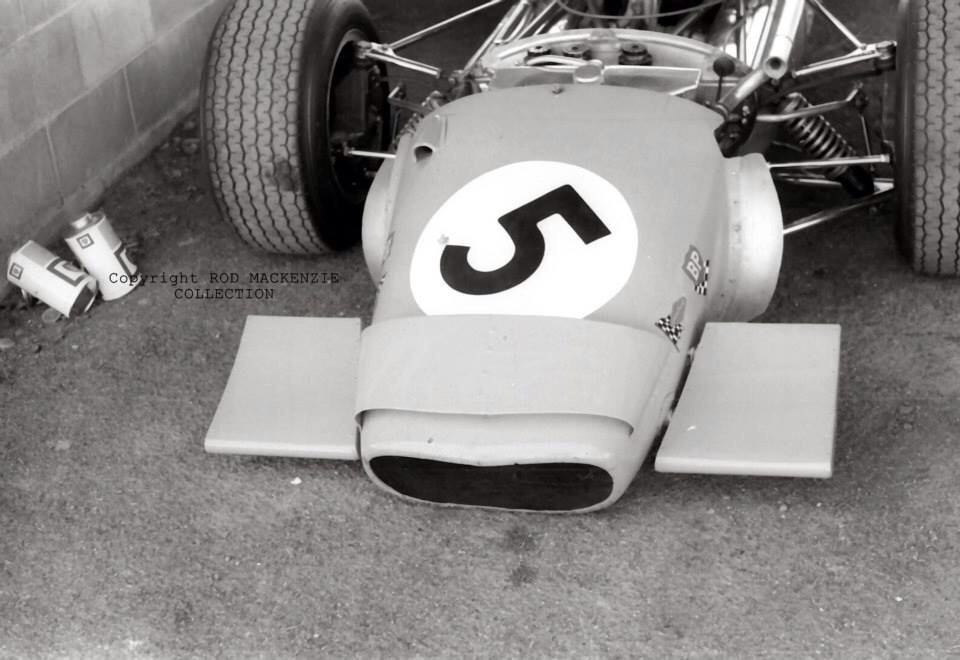
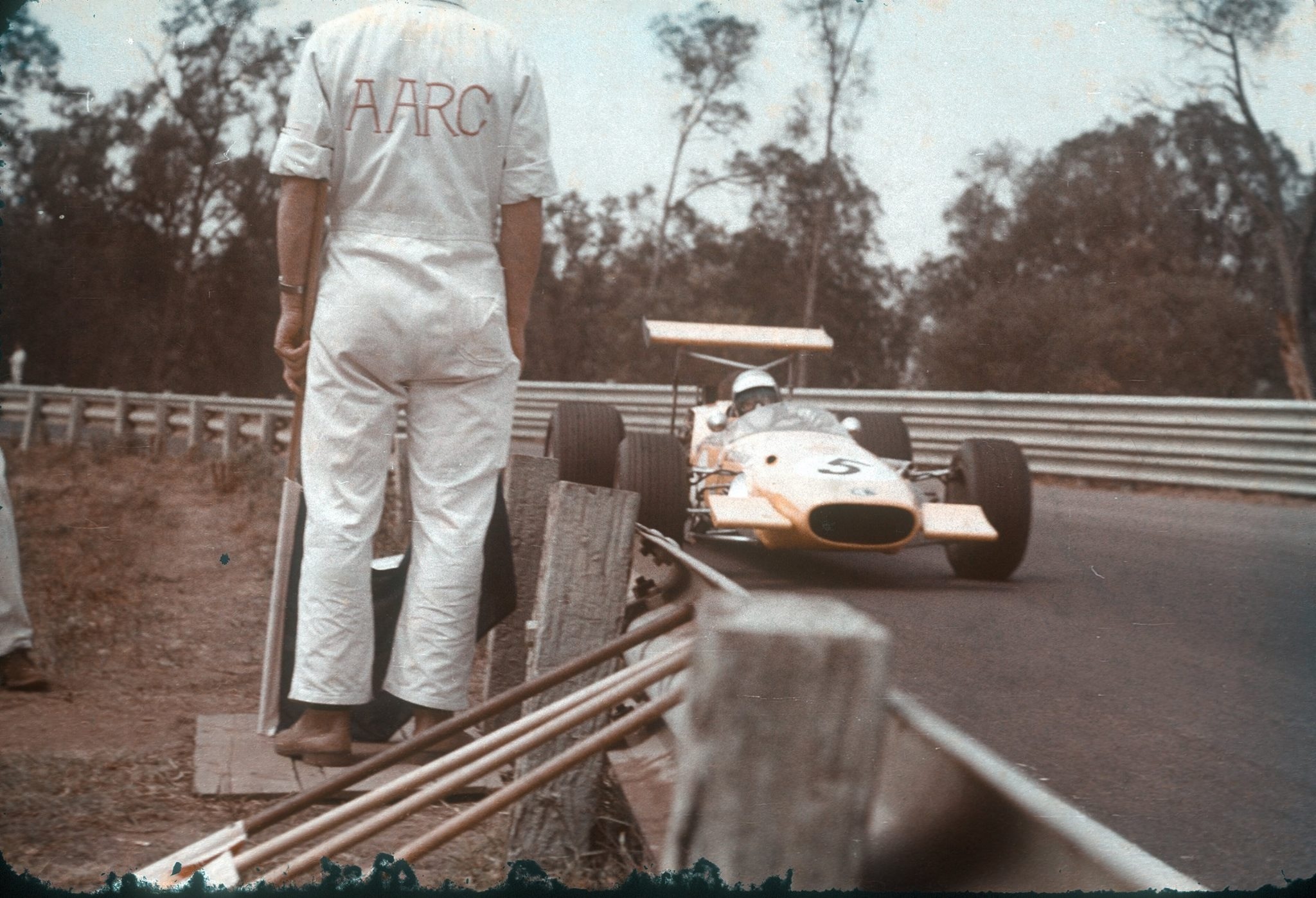
Bryan Falloon’s Rorstan Mk1a Porsche at rest in the Pukekohe paddock during the 1972 New Zealand Grand Prix weekend.

I’ve written about this rare car, built by Bob Britton at Rennmax Engineering in Sydney on his Brabham BT23 jig in early 1968. The story of the car is here, including poor Bryan’s demise on this Pukekohe weekend; https://primotipo.com/2020/08/17/rorstan-mk1a-porsche/

The rare colour photograph was too good to simply add to the existing piece.

By 1972 this 1967 spaceframe design – a modified F2 car was an old-clunker among the latest F5000s which made up the bulk of the field. But the impecunious Ian Rorstan / Bryan Falloon combination were having-a-crack.

The car was powered by a Porsche Type 771 twin-cam, two-valve, flat-eight. The design started as a 1962 1.5-litre F1 engine fitted to the Type 804. Engines grew to 2-litres – and here 2.2-litres, as measured by Alan Hamilton – for Porsche 907 sports-prototype use later in the sixties.

Incredibly complex in terms of bevel-drive operation of the camshafts and auxiliaries – Hamilton advises that the factory allowed 240 hours for the assembly of each engine – Rorstan bought the engine off Porsche Cars Australia when looking for a replacement for the geriatric Coventry Climax 2.5 FPF which powered the machine before.

The engine looks bulky and heavy, it is not – of magnesium and aluminium construction, it’s light. The disposition of horizontally opposed cylinders pops the weight nice and low too. The vertically mounted Bosch high-pressure fuel injection pump – driven off the inlet cam – and fuel metering unit add to the impression of size. Inboard of that, hidden, are eight-inlet trumpets.

Note the throttle linkage and small wing – given its shallow shape and chord, you wonder how much downforce was generated.

I’m intrigued to know exactly how Britton mated the engine and chassis, critical of course. Clearly, from the way he has strengthened the roll bar area, by bracing it down into the cockpit, the top horizontal mount heading aft is important.

More questions than answers of course, my curiosity about this car is at least partially stated!

Porsche 771 cutaway, yes it’s wonky, best I could find. Note, inter alia, the bevel-drive to the cams

Credits

Bill Mason

Finito

In recent times I’ve been writing for a few ‘real magazines’ in addition to my primotipo fix.

It’s been an interesting learning exercise writing to a 2,500-3,000 word limit. That about maxxes things out in print-land, rather than my 5,000-11,000 word (FFS) rambling epics.

I’ve had no formal training in this journo caper as you would have worked out. But in the last couple of years I’ve been beaten into shape a bit by some great mentors/advocates/supporters in Tony Davis, John Smailes and Geoff Harris.

Editors Bruce Williams, Gordon Cruickshank, Jonathan Rishton and Steve Normoyle have been great in giving me a crack, the hardest bit in any new gig is getting a foot in the door.

Funnily enough, the first commission I bagged was with MotorSport- no harm in shooting for the top-end after-all!

Elfin T100 Clisby 1.5-litre V6

The timelines for the international publications are long though, my 7-page piece on the only All-Australian F1 car – the 1965 Elfin T100 Clisby 1.5-litre V6 appeared in the April 2021 issue, I wrote it last June.

It’s long gone from the United Kingdom shelves and probably still a month away from being in-store in Australia, and maybe elsewhere.

Given newsagents are now an endangered species, and that MS is carried by only a tiny number of that endangered species, you might want to buy one online, or even better, subscribe for a year see here; Subscribe to Motor Sport Magazine • All Access from £5/month

Its a ripper piece.

Car owner James Calder, and Clisby Project Engineer Kevin Drage became friends via the lengthy process. KD is the only one of three (together with designer Harold Clisby and machinist Alec Bailey) who built the engine still with us, “On the right side of the turf” as he amusingly puts it. So it’s chockers with first-hand stuff and a swag of photographs never printed before.

Auto Action is Australia’s Autosport.

The fifty year old fortnightly is last-man-standing in a market which for decades offered choice. Only AA survives and thrives. Subscription link here; https://issuu.com/store/publishers/me8674/issues/aa_digital.1809

The timelines of AA, a 62-70 page news magazine, are much tighter than those of MotorSport or The Automobile. The production process might be of interest to you?

The absolute sub-edited, and approved by editor Williams, deadline is 9pm, every Monday fortnight in Oakleigh, Melbourne- much over that incurs financial penalties from the printer.

The design files go up the cloud-thingy to the printer in Windsor, 60km north-west of Sydney (they were under several metres of Hawkesbury River water a couple of issues ago). They print the magazine in the early hours of Tuesday morning.

Pallets of magazines are in the hands of the Liverpool, western Sydney, distribution house before lunch on Tuesday. They go onto trucks heading around this rather large country before the end of the day.

A couple of bundles of the mag are at AA HQ after lunch on Wednesday, and in the shops on the east-coast on Thursday morning – the South Island and the West receive it on Mondays.

I’m writing an historic, newsey column called Chronometric every other issue and features in every issue so keep an eye out- the historic content of Auto Action is now usually no less than 10-pages.

The Automobile is one of many successful magazines founded, or made by Australian automotive publishing giant, Douglas Blain.

My feature in the current, May issue, is about a topic I tripped over by accident.

Harold and Alan Cooper raced Ballots 2LS and 5/8LC in the twenties and thirties at Aspendale and Maroubra and all-points in between. Alan’s life of staggering excess was funded by his much older ‘man-friend’, in the polite yibba-yabba of the day.

It’s an eight-page, never before told story chockers with material and photographs from the archives of my partners in crime; Alistair McArthur, Brian Lear, Bob King, Stephen Dalton, Tony Johns and David Rapley- a team effort indeed.

In most of Australia your chances of buying The Automobile on a news-stand are five-eighths of bugger-all, so you might want to jump online; http://www.theautomobile.co.uk/subscribe/

Alan Cooper, Ballot 4.8-litre straight-eight 5/8LC ‘Indy’ at Maroubra in 1925, not long before it had a high-speed capsize

I can’t believe the paucity of newsagents in this country! While I have had my head up my bum creating content, and not buying too many magazines since 2014, news-agencies have dropped like flies in February. I had not realised how many have closed and how many have halved, or less, their size.

A small sample.

I live in trendo-funko inner-Melbs, Windsor. It’s a great place to live, there are spunk-muffins as far as the eye can see, if you like that sort of thing.

The best Chapel Street can muster is the standard pissant mum and dad pocket-shop size newsagent selling copies of the fascist-daily (Herald-Sun), Womens Weekly, bugger-all-else and a few corn-ball cards.

I’ve got no answers of course, questions are my strong-suit and post-event sagacity is a specialism.

The internet has a lot to answer for. It’s democratised the masses. We can all have our say. Even that primotipo dickhead hops-in-for-his-chop. Everyone expects everything for free.

For gods-sake support a couple of magazines, it doesn’t have to be the ones above, but buy a couple you like, coz if you don’t, very soon they won’t be there. Like newsagents.

The Easter Rabbit bounced past me early this year.

‘Me mates Stephen Dalton and Bob King each gave me an Australian Motor Racing Annual; the first 1951 edition and the fourth 1954 edition – who needs more chocolate anyway? Easter reading sorted, thanks muchly blokes!

Like way too much Oz pre-1960 racing publications, these little gems passed me by until a couple of years back but I’d never seen the gizzards of one before, chockers with information as they are.

The first edition covers the history of racing in Australia, a summary of the leading clubs, one-pagers on 80 of our contemporary racing cars, quickies on personalities, beautiful drawings of circuits, a tuning guide by Dicer Doug Whiteford and an article on The Modern Racing Car.

By 1954 the format had evolved to include a summary of the year’s major events and their results, more features while continuing the summary of contemporary racing cars. Great stuff indeed.

By the time I came down the magazine purchasing pike in 1971, Motor Manual, publishers of this summary, produced almost annually from 1951 to 1967, were a distant third in my personal rankings of road car magazines, behind Modern Motor and Wheels.

Mind you, once I discovered Sports Car World I didn’t touch M-M or Wheels for a couple of decades – SCW was the roadie bible of cars which mattered.

When Motor Manual stopped producing their racing annuals, the Australian Motor Racing Annual published by the SCW/Wheels/KG Murray Publishing mob took up the cudgels, this evolved into their sensational Australian Competition Yearbook, an Oz touch of Autocourse. This 200-pager covered each F1 GP and had a season summary, the same format was used for each of the ‘major’ Oz racing categories; F5000, F2, F3, FF, sportscars, rallying, and taxis. Other motorsport copped a couple of pages or so each; hill-climbing, motorkhanas, karting and perhaps the drags.

I still refer to these publications all the time for research purposes, or just coz I always have – sad little unit that I am.

Stan The Man in Maybach 1, Jones suffering from uncharacteristic understeer. I can’t quite make out the artist’s name but would like to know who it is and credit appropriately
Stan Jones winning the New Zealand Grand Prix at Ardmore in 1954, Maybach 1
Jack Brabham, RedeX Special, Cooper T23 Bristol. The artist has the ‘Brabham Crouch’ nailed!

In the mid-2000s The Annual Australian Motorsport was fantastic. Perhaps publisher Grant Rowley should have had more steak ‘n chips maxi-taxis to have a sales smash – the 2005 edition devoted only 46 of 218 pages to the big swingin’ V8s while commendably giving all other categories a fair crack of the whip.

Since then no-one has been stupid enough to step up to the annual-summary plate, sadly.

Those Annual Australian Motorsport mags were $20 in 2007. I’d quite happily pay $40-50 for a 200-page annual now, even one with 100 pages of the big shit-fighters – there is the rub, it’s probably got to be that way to flog enough mags to hit break-even print numbers.

Auto Action are probably the only ones who could do it these days. Publisher/owner/editor/cook Bruce Williams is passionate enough, but whether he is that stupid is another thing.

Anyway, if you think an annual is a good idea email him on bruce@autoaction.com.au, he doesn’t believe a word I say. Don’t tell him I sent you, this is an un-sanctioned jolly of my own.

Maybe people-power can get us back something I still miss each January/February.

Tailpiece…

Finito…

(NAA)

Launceston artist, gallery owner and teacher, Mary Jolliffe, aboard her Gremlin Formula Vee in 1968.

The shot made me chuckle. I wish I had one of my grandmothers pose for a shot in my Venom Vee a decade later. My old man ‘useter say there were only two brands of the the new-fangled radial tyres to buy, Michelin X and Pirelli Cinturato- these are Cints.

Launceston boy, Pat Stride, ex-RAF pilot, by day an air-traffic controller, built a number of Gremlins during the mid-sixties to mid-seventies, both single-seaters and sportscars.

Jolliffe, one of Tasmania’s best known water colourists, opened the Mary Jolliffe Art Gallery- a gallery, studio and art school, at 118 St John Street, Launceston in 1965. A decade later she was an immensely popular teacher at the Kalori Marist Brothers College in Burnie.

One of Pat’s former work colleagues wrote this brief piece about him when he died in 2014. ‘Pat Stride arrived in Australia on November 1st, 1963, along with 21 other hopeful  ATC recruits  who were destined to become short term course 22, the first of many  Australian ATC courses comprising personnel  recruited overseas, mainly in the UK.  Pat was accompanied by his wife, Wendy, and three children under 10 years of age, Trish, Jeremy and Andrew. Prior to his emigration Pat had been a pilot in the RAF, flying  Vampires, Meteors and Sabres, mainly in Germany.’

Kings Bridge, Longford during the final, 1968 meeting. The only Vee race held at Longford was won by Pat, here in the Gremlin ahead of Lynn Archer in Brian Roberts’ Elfin 500 and Mike Bessant’s Scarab. For we Longford nutters it’s an interesting and unusual shot as it gives us a great view of the approach to Kings- in the distance, well behind the final car is the Viaduct (Stride Family)

‘Having passed the theoretical ATC training he commenced field training in Melbourne and completed this in Launceston where he went on to be rated in both aerodrome and approach control. Being of an entrepreneurial nature, when an opportunity arose to establish a caravan park situated at the Tasmanian terminal of the catamaran service from Welshpool in Victoria he and Wendy embraced it with enthusiasm.  After 9 successful years they were shattered to learn the catamaran service was about to be withdrawn and chose this time to retire.

Pat had one enduring passion, other than for his family, and that was for speed. He was an avid racing car driver, building and competing in his own cars with a significant degree of success. This continued well into his eighties and his last road car was a Mazda MX5 sports.’

The Australian Government’s Department of Immigration was after migrant success stories in sport, the arts and entertainment for PR purposes. It is in that context that Mary and Pat, both Brits, were sought, photographed and doubtless an article was written and published somewhere.

I quite randomly found other photographs of the same ilk of Bernie Haehnle; https://primotipo.com/2018/11/13/bernie-haehnle-rennmax-mk1-fv/ and Henk Woelders; https://primotipo.com/2018/12/30/henk-woelders/

How the connection between Mary and Pat was made, who knows, Launceston is a small place now let alone in the mid-sixties. Mary owned the car built and raced by Pat.

Credits…

National Archives of Australia, Stride Family, Stride tribute piece from Rob Tanner via Geoff Harris

Tailpiece…

(NAA)

Same locale as the opening shot, Pat’s home in suburban Lonny seems about it. Low res (bumma) shot of Pat at the wheel of ‘the Formula Vee Scarab Gremlin he designed, built and drove for Mary Jolliffe.’ I wonder what the correct name for the car is? Andrew and Jeremy Stride do the brmmm-brmmmmm thing with Dad.

Great stuff, a quintessential Oz outer-burbs sixties shot many of us can relate to!

In an earlier article I wrote ‘FV Historian John Fabiszewski notes that the first to race Vees (in Australia) were Pat Stride in his Scarab and George Geshopulous (later Geshos) in a Nota, in Formula Libre races in Tasmania (what circuit folks?) and Oran Park respectively on the same weekend in September 1965 (what date folks?).

Finito…
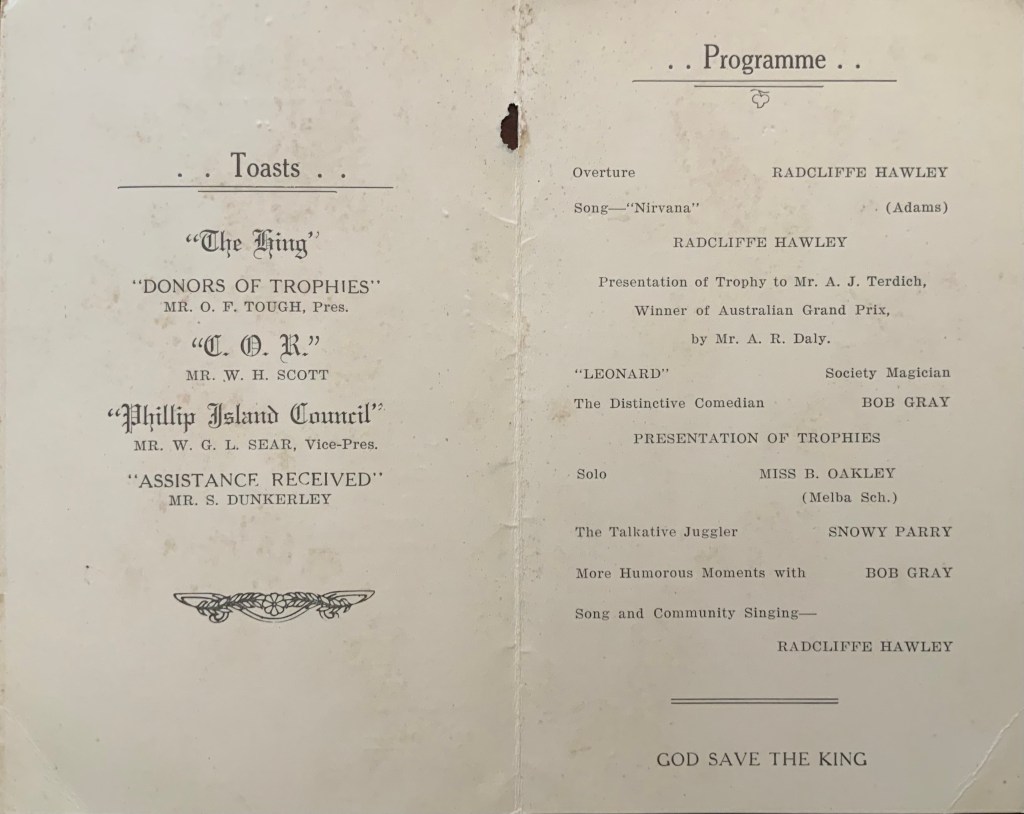
 

One of my favourite Facebook pages is the Repco-Brabham one Jay Bondini started for us Repco nutters yonks ago.

It’s chock full of good stuff, much of it contributed by the boys who produced the RBE V8 magic at Maidstone in the day- it has cred you might say!

This shot gave me a chuckle.

The works Repco billy-cart is poised on Bendigo’s View Street hill during the 1954’ish Easter Fair. The team’s #1 driver aboard the exotic machine is Les Holt. His old-man, Arthur Holt, worked at Repco Bendigo.

Then I thought, in the words of the great George Pell, bugger-me! that’s Mac’s machine. I’m sure I’ve seen it before somewhere!

Sure enough there is later Elfin/McLaren triple Gold Star champion John McCormack aboard the same missile at Burnie, Tasmania at roughly the same time. Dunno if he won but it seems a reasonable assumption.

You will all be pleased to know John is in great shape, sharp as a tack. I had a good chat to him at Baskerville a fortnight ago, all was good until I asked about the MR6, which was not his favourite car…

(M Preston)


McCormack’s MR6 Repco-Holden hooks into Sandown’s Shell Corner during the 1975 Sandown Park Cup- second behind John Goss’ Matich A53 Repco (I Smith)

It begs the question of course. Why?

The MR5 may have been getting a bit long in the tooth by the ‘74 Tasman but it was very successful in McCormacks hands – the 1973 Gold Star and 1973-4 NZ GPs at Pukekohe are the most notable of the combinations victories.

Ansett Team Elfin’s ‘unfair advantage’ was to have been the Repco-Leyland aluminium V8 fitted to a new, compact chassis designated MR6. This gave a lighter car than the opposition and handling balance those using cast-iron Chevs and Holdens could only dream of. That all turned to custard when Repco withdrew from racing in mid-1974, pretty much leaving Leyland Australia and Ansett Team Elfin high and dry.

The P76 V8 (P38 was the joke of the day ‘wannit- the P76 was only half a car) block was structurally weak, the standard nodular crank was junk for racing purposes and the ports were a poor shape which limited flow, and therefore power. Ignoring the fact the block probably couldn’t handle any extra mumbo anyway. Most of this would have been fixed had Repco applied their full engineering armoury to the problems but that was not the case. So the thing was slow and unreliable throughout the 1974 Gold Star.

On top of the engine issues Garrie Cooper repeated some of the MR5’s chassis shortcomings in his new MR6. The front bulkhead was weak, the car had bulk understeer as the front suspension geometry was sub-optimal and the critical engine to monocoque attachment wasn’t stiff enough so the whole package flexed- inspiring little confidence in its intrepid pilot.

MR6 Repco-Holden, perhaps Surfers Paradise 1975 (autopics.com)


Bruce Allison, Lola T332 Chev, McCormack’s MR6 Repco-Holden to the left and Vern Schuppan, Elfin MR8 Chev to the right. Calder ‘Soccerpools’ F5000 race, March 14, 1976. Max Stewart won both heats. Significant shot as it’s Vern’s first race drive of the MR8, having tested it at Adelaide International in early March (unattributed)

Mac and his crew, Dale Koenneke and Simon Aram fixed the chassis problems step by step. The engine dramas were solved by removing the light, gutless, unreliable Leyland and bolting in the heavy, potent, reliable Holden. Putting the smart-arse line to one side, the Repco-Holden had by then five years of development under its rocker-covers, the best of them gave a good 520bhp. The Leyland unit was a babe in the woods in terms of comparative development.

So equipped, McCormack finished fourth in the 1975 Tasman Cup behind the very quick Lola T332s of Warwick Brown, Graeme Lawrence and John Walker. He was second at Wigram, Teretonga and Sandown finishing seven of the eight rounds. At home he won the Gold Star taking victories at Oran Park and Calder. John Walker was second and Max Stewart third, both in Lola’s, again the MR6 was reliable, finishing four of the five rounds.

McCormack contested both the 1976 NZ GP and Australian Rothmans Series that summer, but the combo was off the pace of the fast boys at the very pointy end.

Mac had fallen out of love with the MR6 and Elfin more generally. He acquired a 1973 F1 McLaren M23 sans 3-litre Ford Cosworth DFV V8 from Dave Charlton in South Africa. Into that engine bay John, Dale and Simon very skillfully fitted the Leyland V8 which McCormack had not given up on!

After much test and development work from McCormack and Phil Irving, including new cylinder heads, the circa-435bhp M23 Leyland won its first Gold Star round at Calder in October 1976. He was victorious in the 1977 championship from John Leffler’s Lola T400 Chev.

The MR6 became a display car before its sale while the M23 raced on in F5000 and had a trip to the US where McCormack ran in a couple of races as a central-seat Can-Am car. See here for a feature article on the MR6 and particularly the M23; https://primotipo.com/2014/07/24/macs-mclaren-peter-revson-dave-charlton-and-john-mccormacks-mclaren-m232/

McCormack’s McLaren M23 Leyland from Garrie Cooper, Elfin MR8 Chev and Dave Powell, Matich A50/51 Repco at Dandenong Road, Sandown International Cup 1977. Max Stewart’s Lola T400 won, Cooper third, Powell fourth and Mac fifth (autopics.com)

Credits…

Gary Nichols and Robert Reid for the Bendigo information, ‘From Maybach to Holden’ Malcolm Preston, Ian Smith, autopics.com, oldracingcars.com, Repco

Tailpiece…

(Repco)

Repco publicity shot of their Repco-Leyland F5000 engine in its original form as fitted to the Elfin MR6 in 1975. See the McLaren M23 link above for engine specifications and the changes made as it evolved when fitted to the McLaren.

Finito…
(B King Collection)

Geoff Hine’s Bugatti T23 Brescia is shown above during a meeting held on November 27, 1954.

The Tasmanian Motor Cycle Club used a stretch of road at Collinsvale, 20km north-west of Hobart for ‘demonstrations of durability and speed’ as early as October 26, 1924, it is still in use.

On that day the fastest time was set by K Sutherland aboard a 2 3/4 horsepower BSA- the smallest bike entered. ‘A word of praise is due to this young rider, for he is only a beginner’ The News reported. ‘The races were over a distance of a mile, in which there were a number of nasty bends, but except for a few minor accidents, all the events were disposed of satisfactorily.’

Hine raced the Bugatti at various Tasmanian venues including the Brighton Showgrounds where ‘long straights and wide grassy corners were perfect for high speeds’ in November 1953. At Longford he did 23.22 seconds during a Light Car Club acceleration test in May 1954.

T23 chassis ‘2467’ was owned by Herbert Hine for many years. His grandson, Michael Dunbabin, recalls the car in his Darcy Street, South Hobart home garage along with ‘Some old Bentleys and a Rolls Royce. As kids we used to jump up into the Rolls and play with all of the levers and buttons- it was such fun in that dusty, dark garage full of old cars and loads of stuff he bought at the Burns Mart auctions.’

‘After Geoff had finished racing the car it was restored to perfection over many years by my grandfather. He was really skilled, he worked for the Hobart Marine Board as a fitter and turner. He eventually moved from Hobart back to Bacchus Marsh in Victoria where he was brought up. On his death the Brescia passed to his sons, Geoff and Warwick.’

See here for a feature on Brescias, more detail on the Hine car to come; https://primotipo.com/2018/07/27/country-spin/

‘The News’ Hobart 27 October 1924

Etcetera…

I’ve included this November 3, 1951 article published in the Launceston Examiner I found fishing for information on Collinsvale.

That the newspaper felt the need to explain the history of motor racing is perhaps indicative of the local populace’ knowledge of our sport at the time. The piece makes clear the need for a racetrack in the Apple Isle. The use of Longford from 1953 and construction of Baskerville in 1958 and Symmons Plains in 1961 would solve the problem of course.

I note the article records the first road race in Tasmania as taking place in May 1911 and won by JK Heritage, does anybody have more information on this event?

Valleyfield is covered tangentially in this piece on Quorn Hall; https://primotipo.com/2020/12/17/quorn-hall-tasmania/

Credits…

Bob King Collection, Michael Dunbabin, The News

Finito…


(B Young)

Fabulous photographs of Christmas at The Hunting Grounds, 15km west of Dysart, Tasmania in 1958.

Santa’s Elf is a Mr Cussin, a confused MG Car Club member driving a Triumph TR2.

The very best of seasonal salutations whatever brand of religion you consume- no doubt a faith has given enormous succour to many in this most challenging of years. Time I found one.

In Melbourne, Victoria we had six months of mild and then wild lockdown in the process of getting the Covid Beast ‘under control’. We are all, of course, impacted.

Best wishes to each and every one of you. Lets put 2020 to one side and approach 2021 with optimism. And hope.

Thankyou for your ongoing primotipo support.

Mark

(B Young)

Credits…

Bob Young Collection via the Historic Racing Car Club of Tasmania

Finito…
Australian Auto Action…

Posted: December 7, 2020 in Obscurities
Tags:

Make sure you buy Auto Action this week as it has a piece by yours truly, a six page feature on the Tornados. It has some ripper shots not published before. Keep buying it too, if I can help drag in a few extra readers the historic content will grow.

AA boss-cocky Bruce Williams is expanding his historic coverage to help broaden the appeal of a magazine which has been with us since 1971. Time flies. When i got hooked on cars in 1972 my magazine diet was Racing Car News, Sports Car World and Auto Action, only the latter endures sadly.

AA has more V8-taxis than you can poke a stick at of course. The F1 coverage is great, ditto Indycars, sports-prototypes, off-road and a halfway decent national event summary – and the rest. You might be surprised at the historic content already, about eight pages and above. My loose brief is to waffle on about older single-seaters, sportscars and people.

Anyway, give us a go, revisit the magazine if you’ve not bought it for a while.

primotipo and the like are free, I suppose as a group the ‘primotipos’ of the world have knocked around the sales of traditional publications. But it’s important we keep the magazines we have. Of course said publications must have punter appeal. My current favourites are MotorSport, The Automobile, Australian Musclecar and Auto Action– a diverse selection. All are privately owned which I rather like as an SME owner for most of my business career.

I’m pluggin’ away on some other commissions as well. The Auto Action piece is the first to be published. Many thanks to Geoff Harris, Bruce Williams, Heath McAlpine and the Auto Action crew.

primotipo.com rolls on unchanged, it’s a fix I can’t do without!


(B Pottinger)

The only things missing are the chief and three screaming kiddy-wids in the back seat.

Love this fantastic shot of John Colvin’s Haitch-Arrr Holden Station Wagon X2 during a club meeting at Teretonga, New Zealand in 1967.

The HR X2 option on the new ‘186’ three-litre OHV six gave only 145bhp, 5bhp more then the similar twin-Stromberg carb equipped ‘179’ X2 of the fugly predecessor HD.

Me dad had turd brown HD and blinding white HR wagons but ole’ Pete never developed slip-angles like this on the Great Ocean Road.

(gallery.oldholden.com)

Credits…

Bill Pottinger, gallery.oldholden.com

Tailpiece…

Finito…
 

Ian Mountain and his mates with his self-built, very clever IKM Peugeot Special on the AGP grid at Southport on Queensland’s Gold Coast, November 7, 1954.

Ian gives the photographer a big grin, it’s none other than champion racer Reg Hunt, who is sharing his previously unpublished shots with us via his friend and confidant, Melbourne enthusiast/historian David Zeunert.

The young Montclair Avenue, Gardenvale (now Brighton) engineer first came to prominence racing the MYF (Mountain Young Ford) Special he built together with fellow Royal Melbourne Institute of Technology civil engineering student, Bruce Young.

In the finest traditions of the day, this Ford 4.2 litre V8 two-seater provided day to day transport and a multi-purpose racer including a mount for the 1952 AGP at Mount Panorama. Up front Doug Whiteford won in his Talbot-Lago T26C, while Ian retired after 24 of the 38 laps.

Ian awaits the off in the MYF Ford Spl at Rob Roy circa 1952 (L Hatch)


IKM Spl. Chassis, engine and suspension detail as per text (AMS)

Despite his training, Ian was up to his armpits in all things automotive. He was employed as a Peugeot salesman by Canada Cycle and Motor Co in Latrobe Street, Melbourne. It was to them he turned for components for his next car, the IKM (Ian Keith Mountain) Peugeot Special.

The machine’s chassis was of typical ladder frame type, longerons were of 16 gauge 2 3/4 inches diameter steel tube with four cross members – one at the front, one behind the engine then two at the back, in front of and behind the final drive unit.

Front suspension used Peugeot 203 transverse front springs and stub axles with fabricated top wishbones and telescopic shocks. Steering was 203 rack and pinion, as was the steering wheel.

Rear suspension was de Dion. The bowed tube picked up the hub-carriers and a 1946 Ford V8 diff housing mounted on the frame. This had specially cast side-plates with Dodge pot-type universal joints at each end of the driveshafts. Semi-elliptic springs, radius rods and telescopic shocks completed the package.

The hydraulic brakes use MG TC backplates and shoes with Alfin drums. The wheels were Holden FJ ‘laced’ onto ‘TC hubs- 5 inches x15 in front and 5.5 x 15 at the back, whilst the heart of the matter was a modified 203 crossflow engine.

IKM engine and front suspension. Peugeot suspension and steering components with fabricated top wishbones, MG TC/Alfin brakes. Peugeot engine 1490cc- 80.5mm bore and 73mm stroke, big Wade blower and SU carb (AMS)


IKM ally fuel tank and rear suspension detail- de Dion tube, radius rod and shock mount (AMS)

The standard Peugeot four-cylinder OHV 1290cc unit was bored to 1490cc using custom made Rolloy pistons and sleeves. A big Wade R020 blower fed by a 55mm SU carb giving about 6 pounds of boost was mounted on a frame ahead of the front suspension and chain-driven from the front of the crank. Extractors were fabricated, a Scintilla Vertex magneto gave the sparks, Peugeot provided a competition fuel pump and exhaust valves. Inlets and valve springs were standard but the valve gear was lightened and polished as were the rods and crankshaft before balancing. The compression ratio was 6:1.

The engine was mounted to the left in the frame to allow a driveline left of centre and therefore a nice, low seating position. An MG TC gearbox mated to the bellhousing easily, 22 gallons of fuel were carried in a rear mounted tank.

Neil Coleman’s ‘shop in North Melbourne built the light aluminium body with the light, low purposeful car beautifully built and finished. IKM weighed 9cwt, had a wheelbase of 7′ 6″, front track of 4′ 2″ and a rear track of 4’, ‘so the car is not really a small one, belying its looks’ AMS reported.

After testing in the quiet(!) of the Geelong Road Ian ran the machine at the Beveridge and Templestowe Hillclimbs in chassis form, and then at Fisherman’s Bend with its body fitted. He finished two races despite fuel feed problems caused by shortcomings in the manifold design.

Ian married Laurel Duguid in the Scotch College Chapel at Hawthorn on November 2, 1954 then the couple set off for Southport and the 1954 AGP, what a honeymoon! Lex Davison won in his HWM Jaguar with the IKM retiring after 11 laps. Ian’s radiator drain tap was opened slightly by vibration of the body panels which allowed the water to escape, the travails of new cars.

Peugeot 203 and IKM Spl ready for the long Melbourne-Gold Coast November 1954 AGP trip, Gardenvale to Southport is 1,725km each way (L Hatch)


Ian looking around for his crew at Gnoo Blas, long, low lines of the innovative IKM Pug clear (K Devine)

After a relaxing Port Phillip Bay Christmas/New Year the newlyweds set off from Melbourne for the South Pacific Trophy at Gnoo Blas, Orange, New South Wales over the January 31, 1955 weekend.

Australia’s first FIA listed international meeting featured the Ferrari 500/625s of Peter Whitehead and Tony Gaze, Jack Brabham’s Cooper T23 Bristol, Dick Cobden’s Ferrari 125 and Bira’s Maserati 250F and Osca V12 amongst others.

Two cars in Connaghan’s Corner after the right-hand Mrs Mutton’s Corner and then the downhill The Dip. Ian has lost adhesion and left the circuit on the outside, his crashed car is visible with officials well away on the left as, perhaps, the South Pacific Trophy takes place. Superb, rare angle of this section of this road circuit whilst noting the sad scene Reg Hunt reveals


Sadly, oil which spewed from Bira’s Osca V12 probably led to the awful accident which cost 25 year old Ian and a young spectator in a prohibited area their lives on the fast, downhill run out of Connaghan’s Corner, see here for a feature on this meeting; https://primotipo.com/2020/04/09/1955-south-pacific-championship-gnoo-blas/

Reg Hunt’s Maserati A6GCM 2.5 litre was entered for the meeting but necessary spares were late arriving from Italy so he prowled the circuit with his camera instead.

Laurel remarried in 1960, the IKM remains passed to Ian’s brother Ken who later sold them to Harry Firth. Ian Tate, who admired the car in the day, later acquired it and is in the gradual process of restoration.

Path of the car clear through the fence from the previous shot from up the hill towards Connaghan’s Corner.

Whilst components off the crashed machine have been placed on the wreck and in the cockpit the barbed wire fence, wrapped around IKM Spl, which provided some of Ian’s fatal wounds is clear. When the worst happened on those tracks in those days, lady luck either was, or was not present. Unseen by Ian that day sadly

Stunning, most significant photographs, many thanks Reg, David.

Credits…
Australian Motor Sports, December 1954, ‘Ian Mountain: Potential Unfulfilled’ Paul Watson, Reg Hunt photographs via David Zeunert Archive, Ken Devine Collection, Gnoo Blas Classic Car Club

Tailpiece…

Finito…