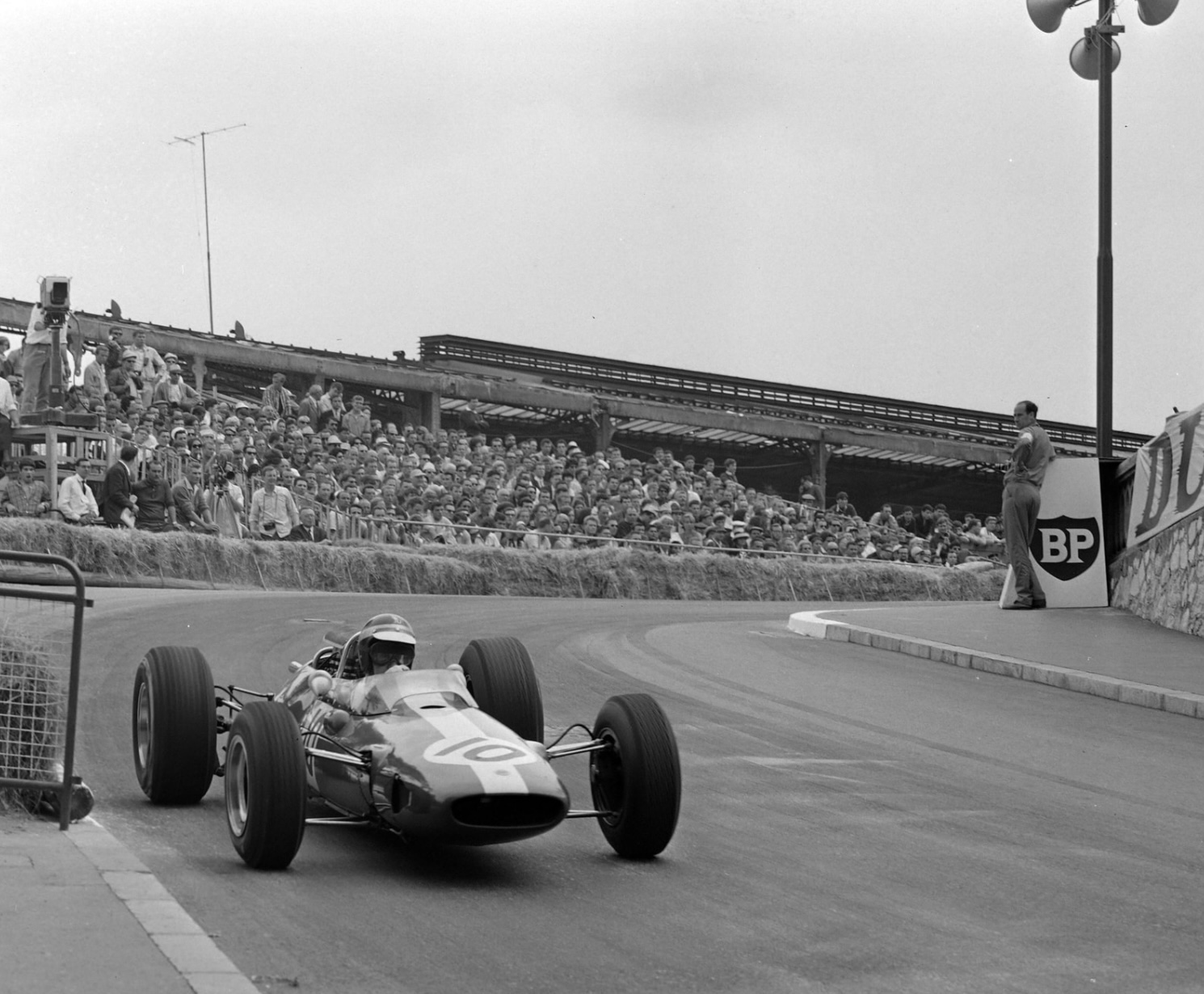
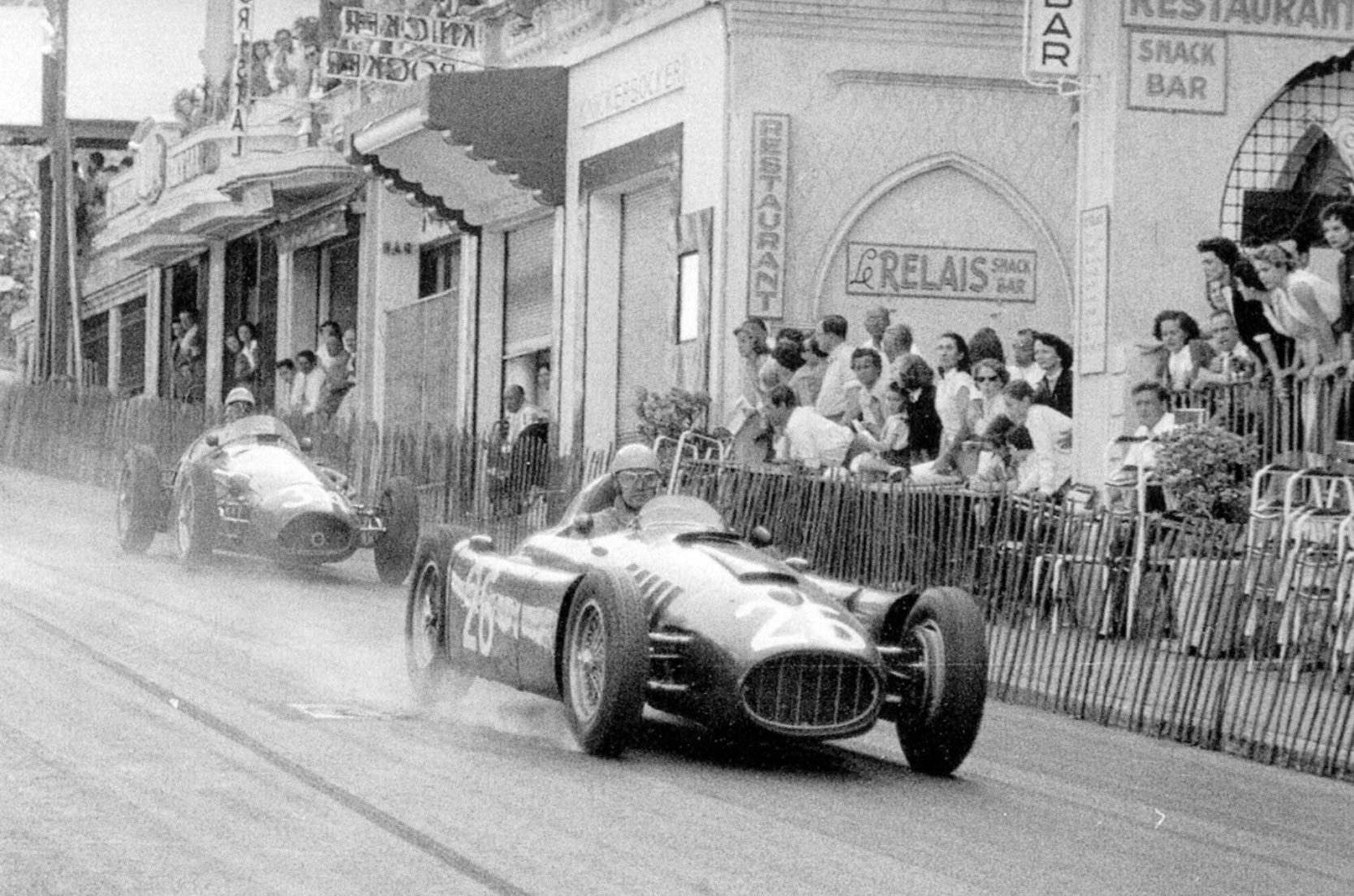
It’s amazing given that the Monaco quayside was unguarded for so many decades, that only two drivers took involuntary Monte Carlo Harbour dips, Ascari, aboard a Lancia D50 in 1955, and Hawkins in a Lotus 33 Climax a decade later.
The Australian was still making his name, while Ascari was at the top of his game, and enjoying somewhat of a renaissance at the wheel of Vittorio Jano’s masterpiece. The fates of both Monaco bathers were similar, both died aboard sports-racers. Poor Ascari in a pointless testing accident aboard a Ferrari 750 Monza at Monza on May 25, 1955, only three days after Monaco. Hawkeye died a grisly, fiery, probably component failure caused death aboard a Lola T70 Mk3B Chev at Oulton Park on May 26, 1969.
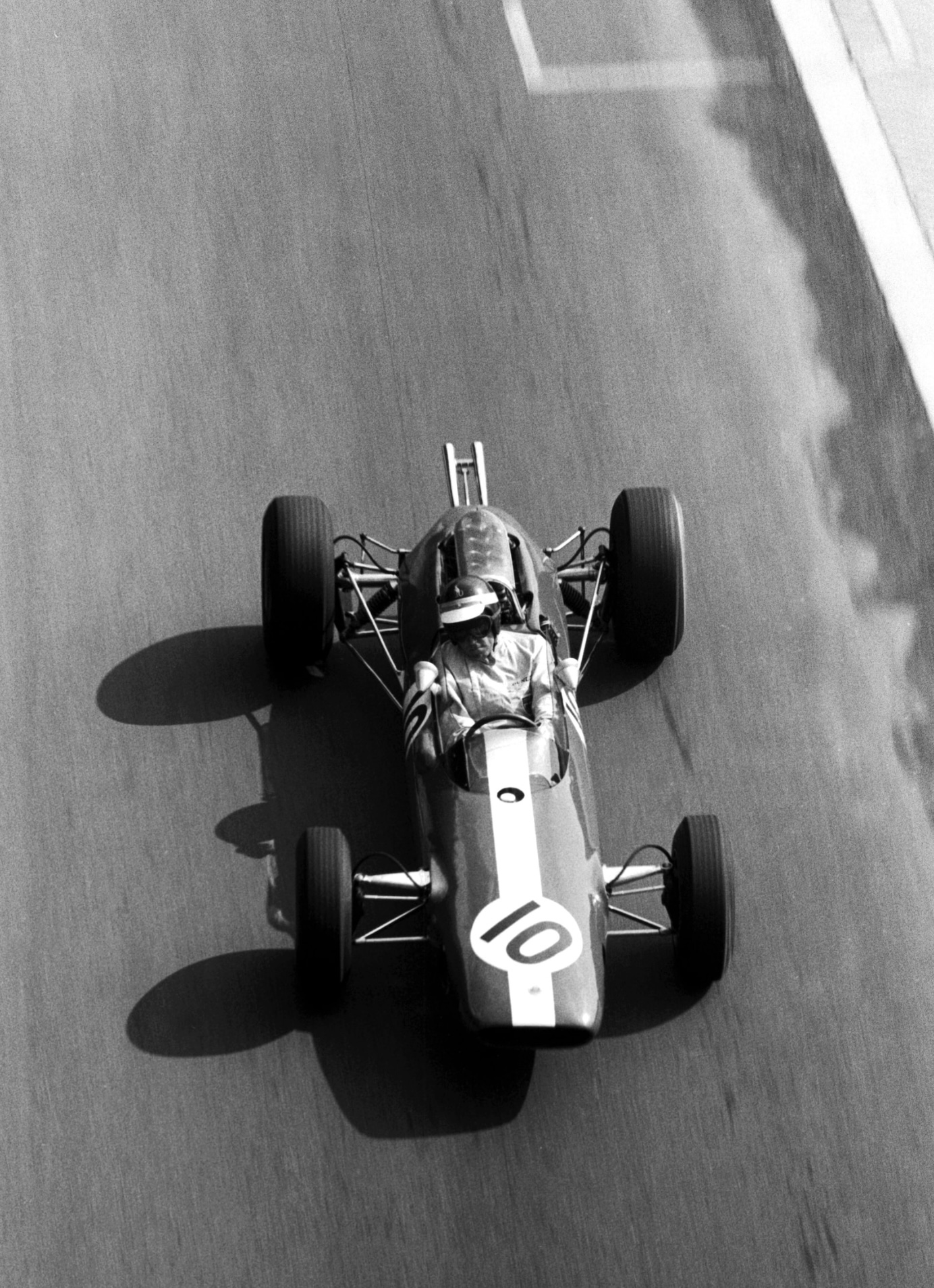
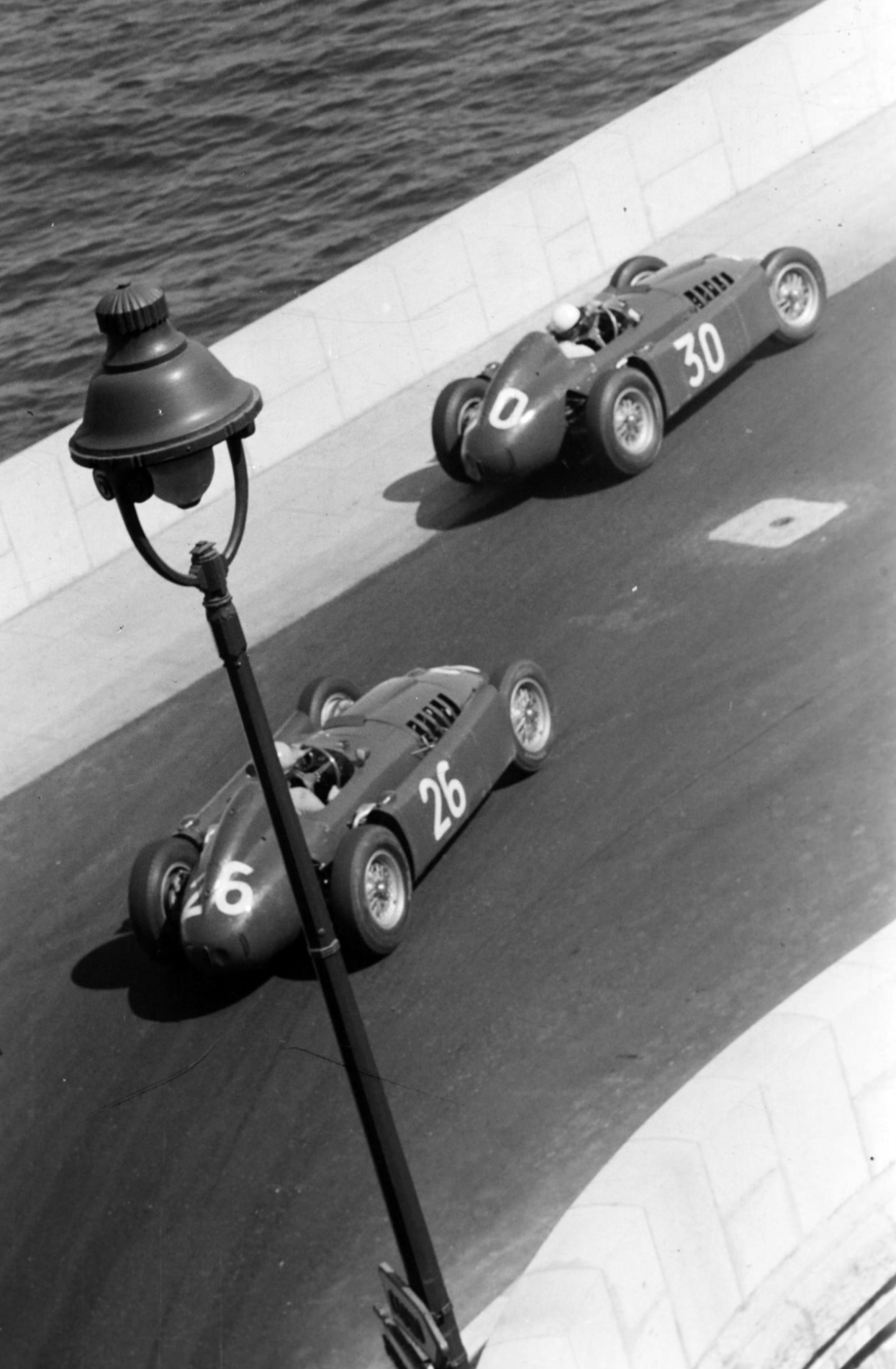
Paul Hawkins in the ex-Clark/Spence Lotus 33 Climax R8 early in the 1965 Monaco GP (MotorSport)Alberto Ascari, Lancia D50 ahead of the Maserati 250F shared by Jean Behra and Cesare Perdisa. Monaco 1955 (unattributed)
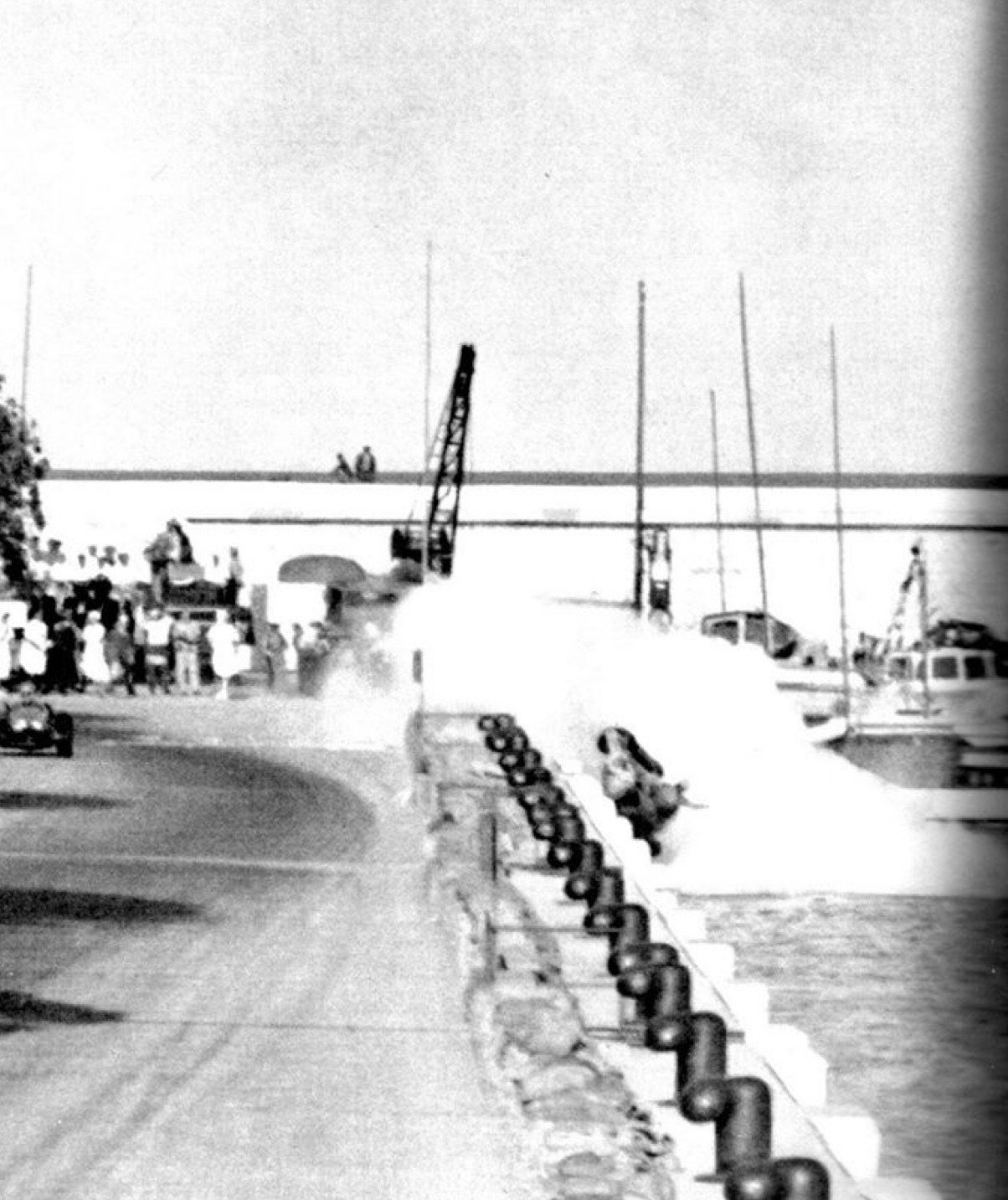
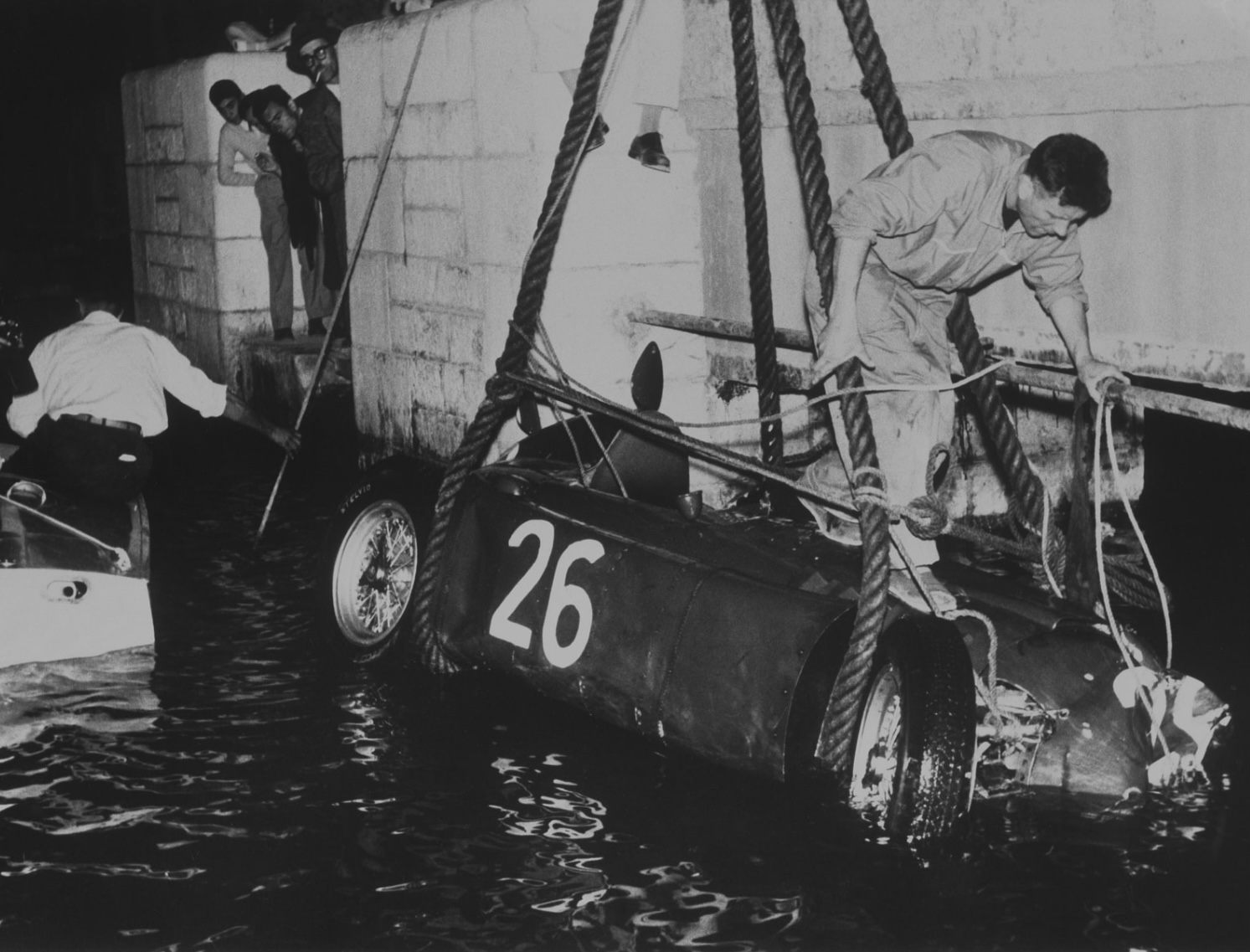
In 1955 Ascari inherited the lead after the Mercedes W196 duo of JM Fangio and Stirling Moss dominated the first half of the race; Fangio retired with transmission trouble, then Moss blew an engine on lap 80. Ascari approached the chicane too quickly – perhaps distracted by crowd reaction to Moss’ retirement, or the lapped Cesare Perdisa behind – and burst through hay bales and sand bags into the harbour, having missed a huge steel bollard by only centimetres.
The Lancia bubbled to the bottom of the harbour while the crowd were mesmerised with fear for his safety, only three seconds passed before Ascari’s familiar blue-helmet appeared above the surface. He was taken aboard a boat, with a broken nose, but otherwise ok.
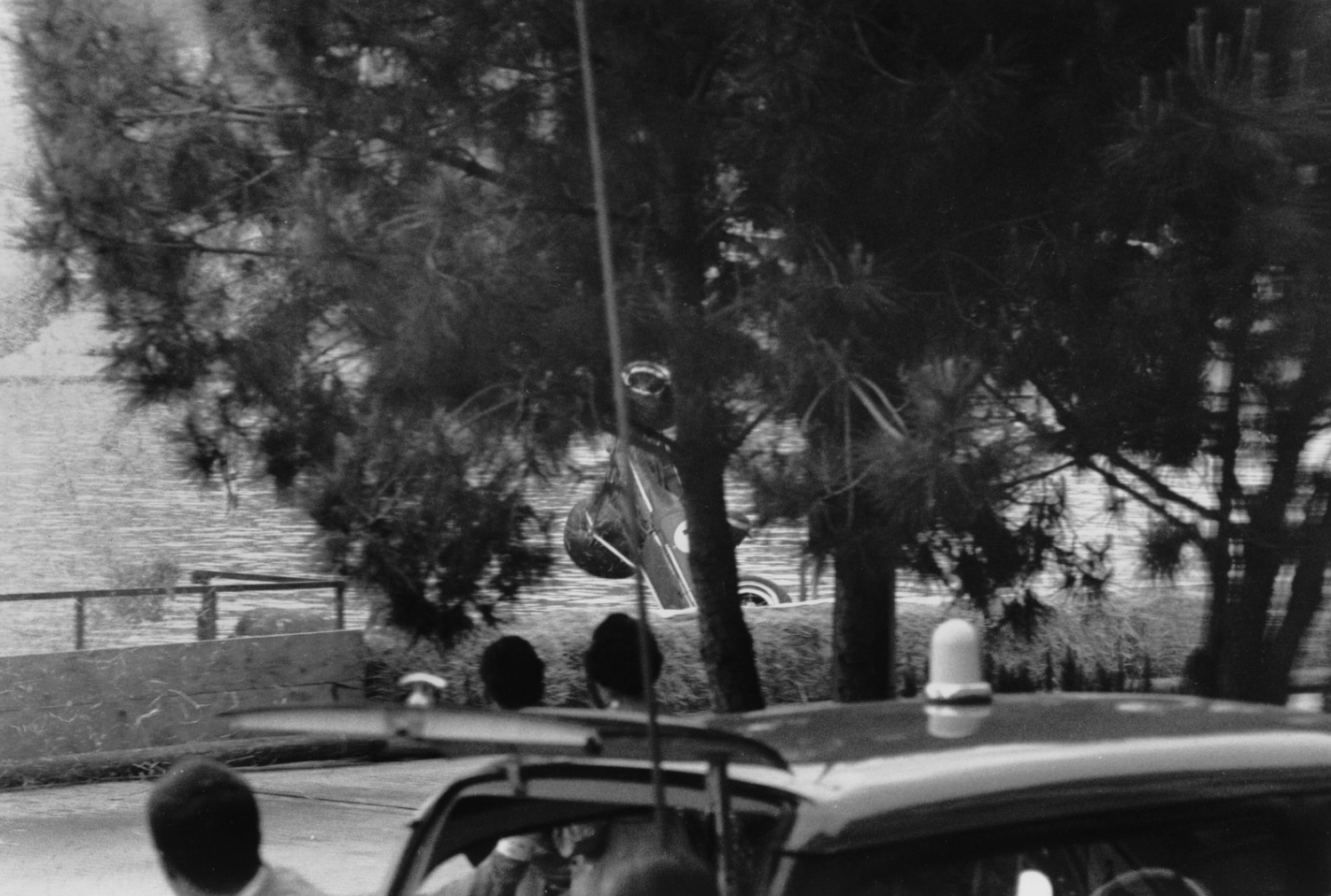
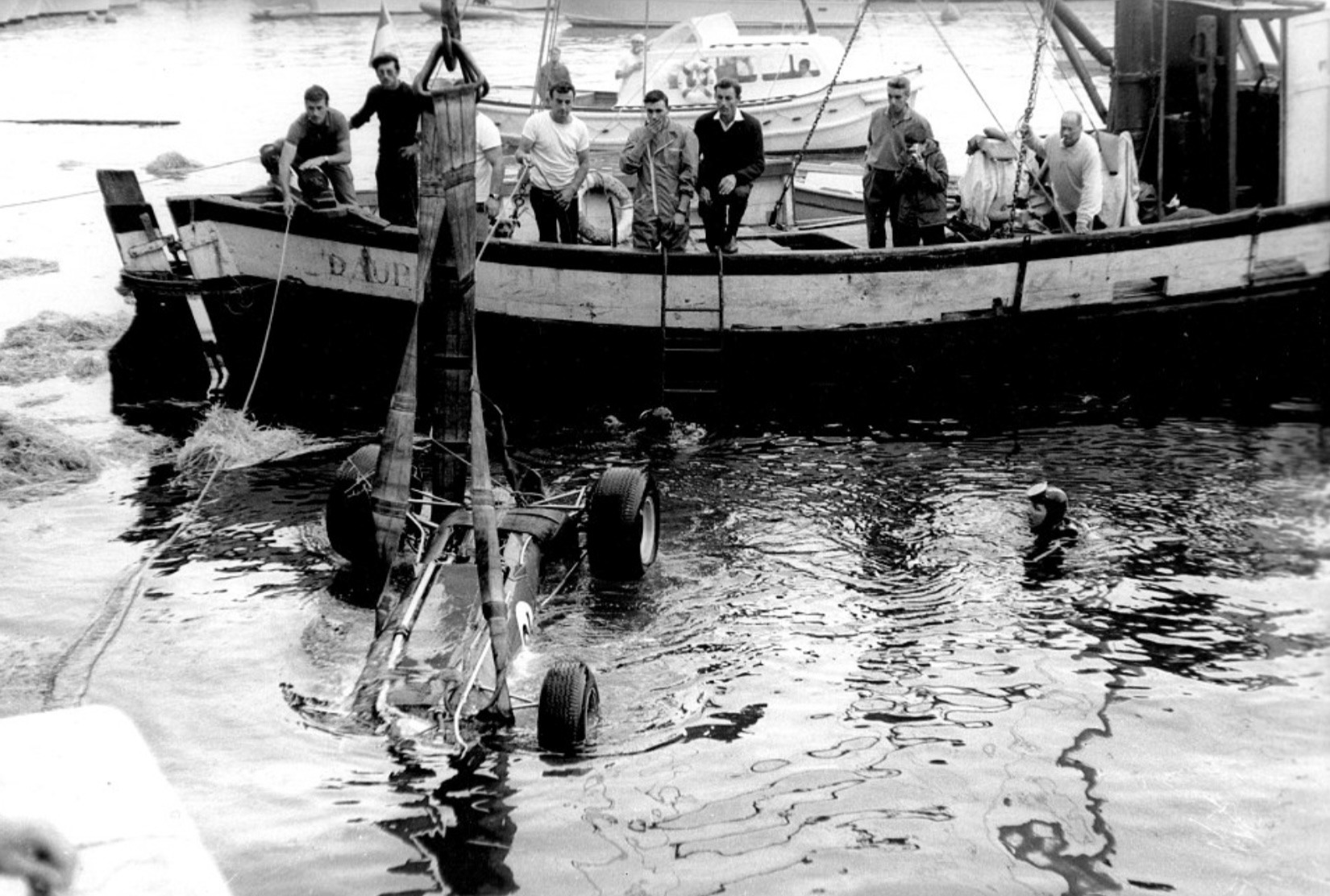
Ascari a split second before his swim (unattributed)One shaken and plenty stirred Lancia D50 being recovered from the depths after the race (MotorSport)
Lancia had given dispensation to Ascari to race a Ferrari 750 Monza with his friend, Eugenio Castelotti in the Monza 1000km on May 29. Ascari travelled to Monza only to watch Castellotti test the car, then decided late in the day to do a few laps wearing jacket, tie and Castellotti’s helmet. On his third lap he inexplicably crashed on the high-speed Curva del Vialone, he died within minutes of having been thrown out of the somersaulting car.
All of Italy grieved.
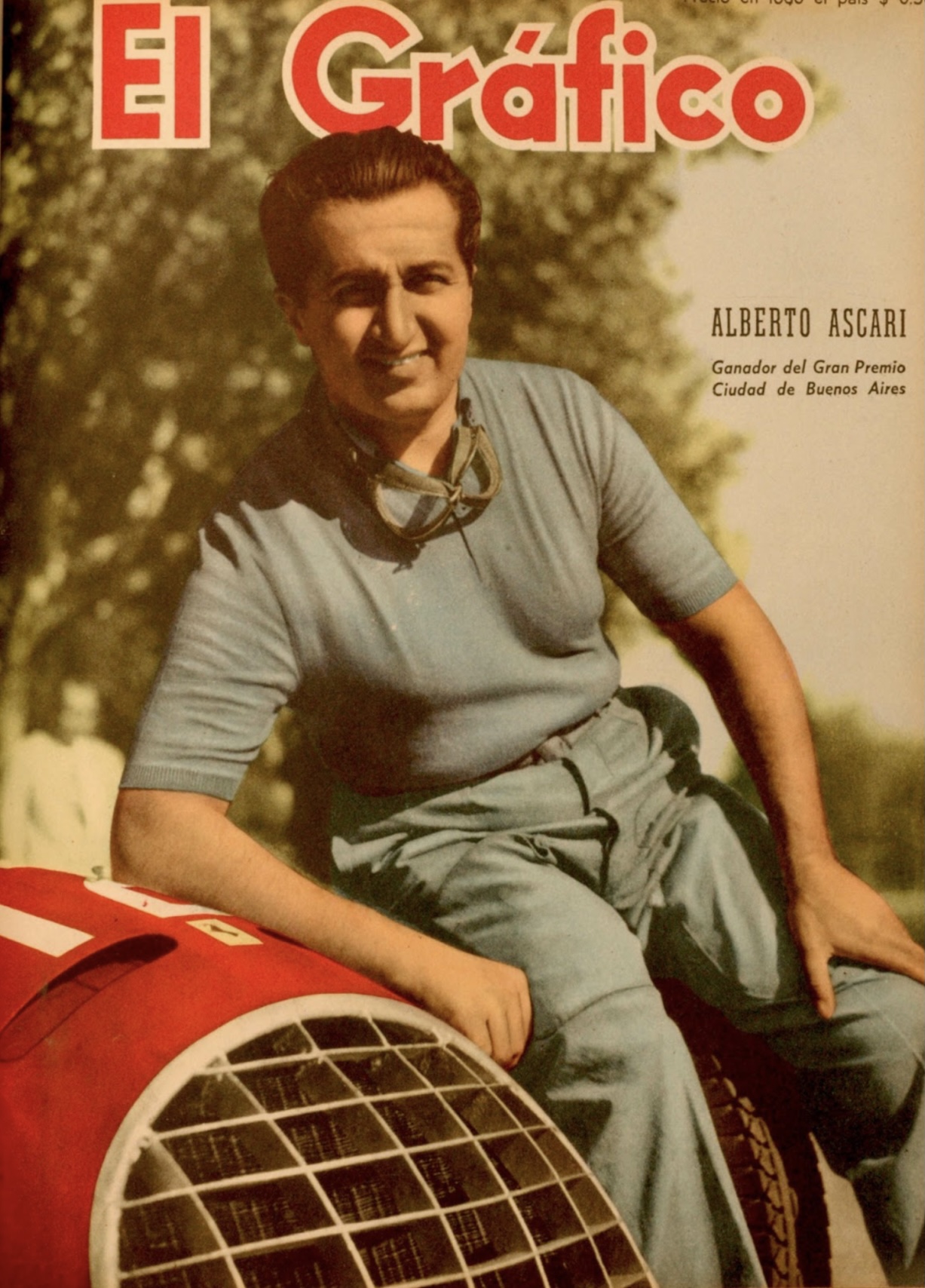
Wonderful Alberto Ascari portrait from El Grafico, an Argentinian magazine. 1950 Ferrari 125
British Boys Own Character – WW2 Spitfire pilot, highly credentialled amateur racer and man of independent means – James Richard ‘Dickie’ Stoop (July 30, 1920-May 19, 1968) acquired the first Lotus 33, chassis R8, for Paul Hawkins use in early 1965. See here for its history; Lotus 33 R8 race history | OldRacingCars.com
The Equipe’s first race was at the Sunday Mirror Trophy at Goodwood in mid-May, there Hawkins started from the rear of the grid after mechanical dramas which continued in the race, he was out after one lap with oil scavenge problems. Jim Clark won in a Lotus 25 Climax.
The BRDC International Trophy followed at Silverstone a month later. He had a better weekend, qualifying on the second last row and finishing tenth, up front was Jackie Stewart’s BRM P261 and John Surtees Ferrari 158.
Then it was off to Monte Carlo for Hawkins’ championship debut.
He qualified the car 14th and was running well, then, on lap 80 (of 100) he clipped the barrier on turn-in, causing the car to turn sharp-left – between the bollards, exactly as Ascari had managed – then sank 10 metres to the bottom. “Only when it settled on the bottom and rescue divers arrived did Hawkins extricate himself, take a huge gulp of air from the proffered mouthpiece and rocket back up to the surface,” John Smailes wrote.
The elegance of simplicity belies the deep underlying insights of Lotus 25/33 conception. Paul Hawkins flat-chat in R8 at Monaco in 1965 (MotorSport)It ain’t perfect, but David Hudson’s shot catches Hawkins mid-flight just before splashdown (MotorSport)
“He’d had the extraordinary presence of mind to hit the engine kill-switch just as the car entered the water, saving the very expensive motor owned by the very poor team from instant destruction. It was dried out and used again in the following Grand Prix.”
R8 recovery post race. That the car is upside down makes you wonder if that is the way it settled on the bottom of the harbour. And therefore that Hawkeye made his escape on the way down – which cannot have been easy (Getty)
Well, not quite actually! While Paul was ok, the team missed both following GPs at Spa and Silverstone while the car was dried out, and carefully made-good, before reappearing at the Nurburgring on August 1.
Paul again failed to finish, having qualified 19th, he was out with undisclosed mechanical dramas after four of the 15 laps.
It was the final race for Paul aboard R8, Stoop sold it to MGM for a planned film, it then passed via Jo Siffert to Sweden’s principal museum of modern art, the Moderna Museet in Stockholm, where it remains as a prized exhibit.
No shortage of comedians during the German GP weekend. R8 looks no worse the wear for its dunking two months before! (MotorSport)Paul Hawkins at right, with fellow Porsche colleagues, Huschke von Hanstein, and co-driver Rolf Stommelen, after winning the 1967 Targa Florio in a Porsche 910 (MotorSport)Dickie Stoop aboard his Porsche 911S at Snetterton, March 24, 1968 (MotorSport)
Etcetera…
Dickie Stoop : Autosport Obituary May 24, 1968.
“It is very sad to have to record the death during a club meeting at Croft last Sunday of Dickie Stoop. Apparently Dickie suffered a coronary thrombosis and died at the wheel of his Porsche 911S, which veered off the track into the bank.
James Richard Stoop had been an amateur racing driver of considerable standing for many years. His first race was the supporting F3 event at the Daily Express Silverstone in 1948, when he drove a GS1, and over the last 20 years he campaigned many types of car, but remained faithful for most of his racing to the marque Frazer-Nash.
He competed at Le Mans no fewer than 10 times: in 1950 he was 9th overall and won the 2-litre class, in 1951 he was 19th and in 1955 he was 10th. In 1958 he drove the works spaceframe AC into 8th place, again winning his class. He also took part in long-distance racing at Spa, Rouen, Montlhery and elsewhere, and in 1964 was 3rd overall in the Rand 3 hours co-driving Peter Sutcliffe’s E-type.
He performed prolifically in club racing, not only in Frazer-Nashes but also in triumphs, Healeys, a D-Type Jaguar and a Lotus 11. He also drove a Formula 2 Cooper in the late ‘50s, and with the passing of Frazer-Nash line he transferred his loyalties to Porsche. His successive Type 356 Carreras, registered YOU 4 and 5 HOT, brought him a lot of wins; having been co-victor in the 1959 Autosport Championship with the Sebring Frazer-Nash, he won the Autosport 3 hours at Snetterton the following year in YOU 4 after a tremendous battle with Chris Summers’ Elite, won his class in 1961, and then won the 2-litre division of the championship in 1962 and 1963. He also had a few races with an RS60 Porsche Spyder, and in 1964 drove a 904.
More recently he had concentrated on club production sports car racing with his silver 911S Porsche, also registered YOU 4; this car was a frequent class winner. A retired RAF officer, he was only 47.”
Credits…
MotorSport, Getty Images, Allen Brown’s Oldracingcars.com, ‘Formula One: The Australian and New Zealand Story’ John Smailes
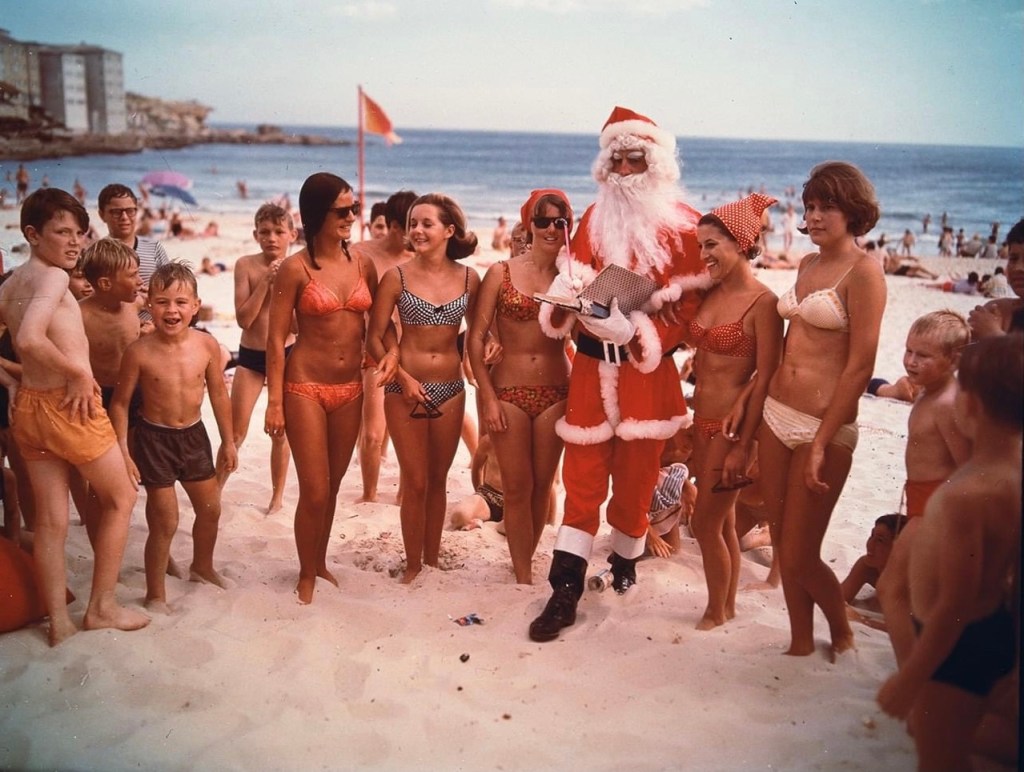
You lucky bastard Santa, a Bondi Beach smorgasbord by the look of it.
This type of wanton abuse of the female form is unacceptable these days of course, but it was kosher in 1969, thankfully.
We are a multi-cultural lot over here, Christmas seems to be ‘celebrated’ by most of the religious brands, even those where it isn’t strictly part of the worship-regime.
Thanks for reading primotipo again this year, hopefully we – Bob King and I – have provided some solace from the dreaded Covid-lurgy.
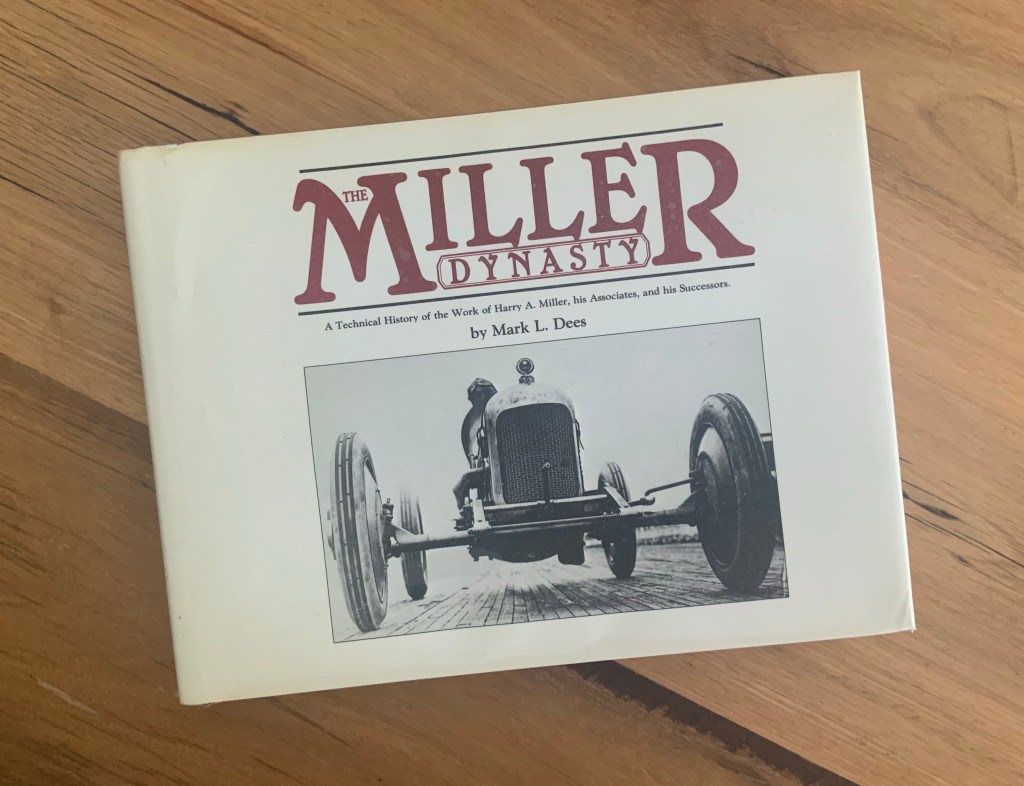
I’m off to the beach for a few days armed with my just arrived Miller Bible, ‘The Miller Dynasty’ by Mark Dees. ‘Me mate, Big-Bad-Brucie bagged it on Ebay for $A260 – a snip he tells me. It’s the poverty pack First Edition, the ducks-guts Second Edition is more like $A800, hells-bells. All I’ve got to do is find somewhere to hide from she-who-must-be-obeyed for a few days. @ 527 pages, ’tis weighty and substantive.
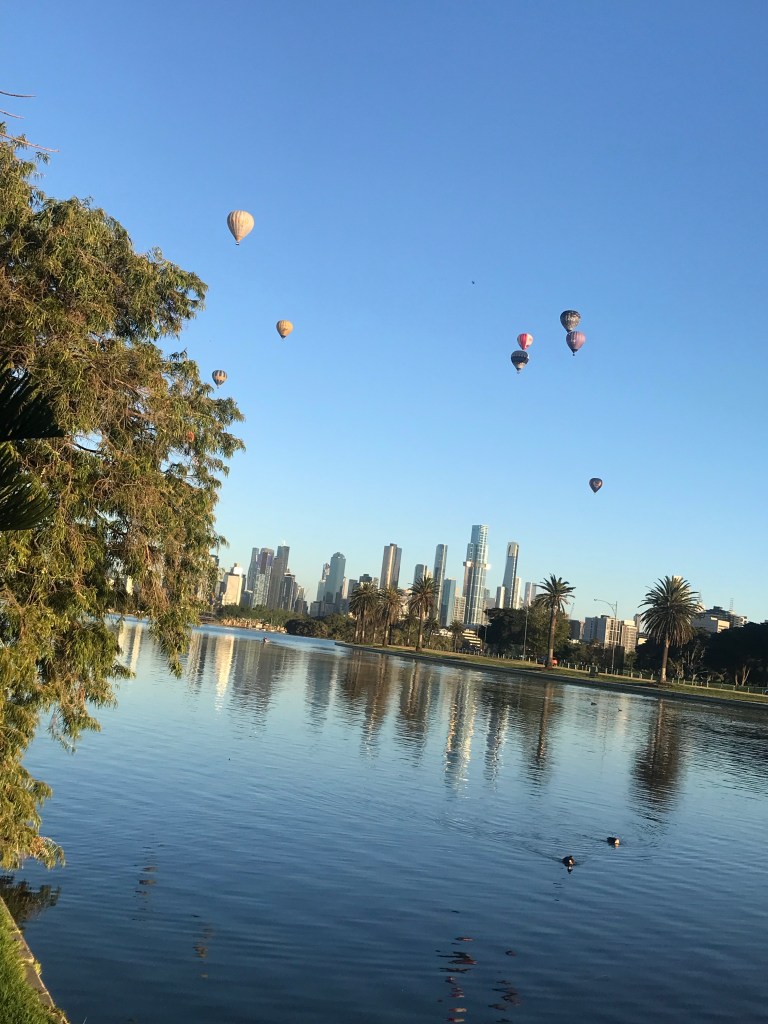
Racing of a different kind at Albert Park! It’s a dropkick from my doorstep, most days start with a run or walk of the joint, roll on the April 10 Australian GP. Covid permitting…
Stay well all! And thanks.
Etcetera…
The Auto Action magazine dudes have created an Historics section within their website. You may find some of these digitised (what a painful process it is!) old articles of interest, the tab is here; Historics Archives – Auto Action Keep an eye on it, expect a couple of posts a week.
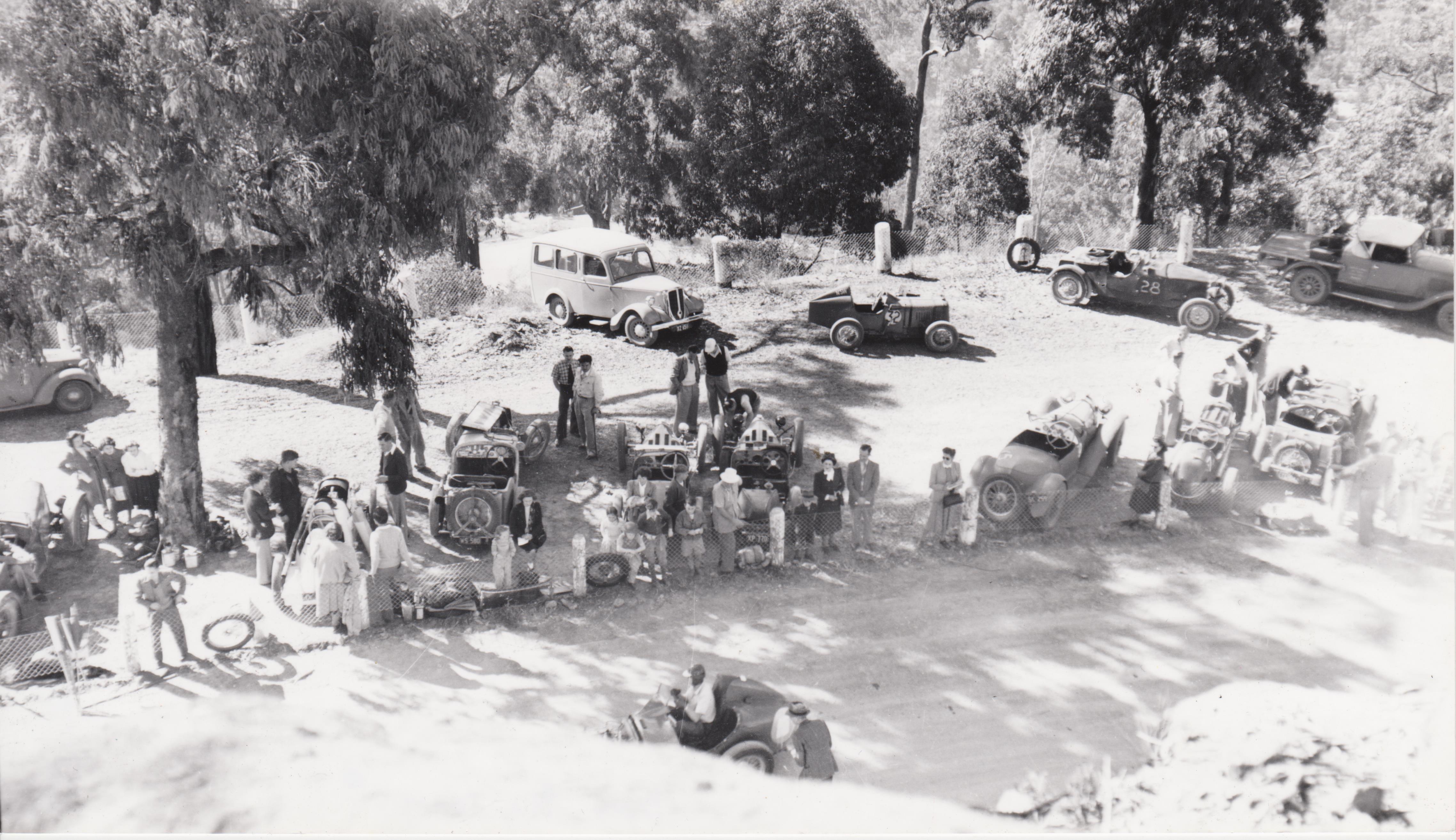
A Bill Daley photograph of Hawkesbury hill climb, circa 1948.
How many of these cars ran in an Australian Grand Prix, is the question which pops into my mind?
In the absence of a programme for the event, this classic study of racing cars taken at Hawkesbury Hillclimb has left the experts unable to identify all the cars; we call on our readers to fill the gaps.
The photograph came from the VSCCA (NSW) collection, per favore of Richard Walton. Note the spectating ladies with their handbags; they look as though they may have come straight from church.
Surprisingly, the owner of the Jowett Bradford van has been identified. John Medley says it belonged to Bob Pritchett – familiar to many of us as the ‘RBP’ of ‘Spotlight’ in Australian Motor Sports (R. Beal Pritchett). Kent Patrick describes the van as: “The bronchial Jowett Bradford – (which will) roll over with its engine stopped”. Within coughing distance to the right of the van is the unmistakeable shape of the Sulman Singer (#32) as it appeared pre-war in Tom Sulman’s hands. Kent speculates that the Riley, next in line (#28), might be Len Masser’s Lynx Sprite. I guess the next is a ubiquitous Ford A ute.
The nearest line of cars, backed up to the fence, pose some real problems. The car to the left of the tree is a mystery; the one to the right has an external exhaust on the left side – what is it? We then have the ex-Bill Thompson K3 MG (with bonnet open) – Kent suggests it might have been owned by Ken Tubman around this time. Ken was a graduate of Fort St School, a pharmacist, and is best remembered for winning the first Redex Round Australia Trial in a Peugeot 203. He still had the K3 in the sixties; we recall him bringing it to the Geelong Speed Trials as a spectator.
The first Grand Prix Bugatti with the folded full width windscreen is probably the Type 37 of Frank Lyell, chassis number 37160. This car had been discovered abandoned in a shed behind the Federal Hotel in Narromine a few short years before – it changed hands for 10 pounds! To its right is Type 37, chassis number 37209 owned by Irwin ‘Bud’ Luke, who was very competitive in the car; he finished seventh in the Australian Grand Prix at Leyburn in 1947. Kent thinks it might be Bud attending to the front wheel with his partner Ida at the rear of the car.
The touring bodied Bugatti bears elegant coachwork by Carrosserie Profilée and is chassis number 4264. It was probably owned by Doug Helsham and likely powered by a Chrysler Six. ‘Gelignite’ Jack Murray’s Day Special is next (second car from the right), a Ford V8 powered Type 39 Bugatti, chassis number 4607, which won the 1931 Australian Grand Prix driven by Carl Junker. The last parked car appears to be an Austin ‘7’ special, possibly Frank Lyell’s car. Of course, the car leaving the starting line (partially obscured at the bottom) is Frank Kleinig in his eponymous special.
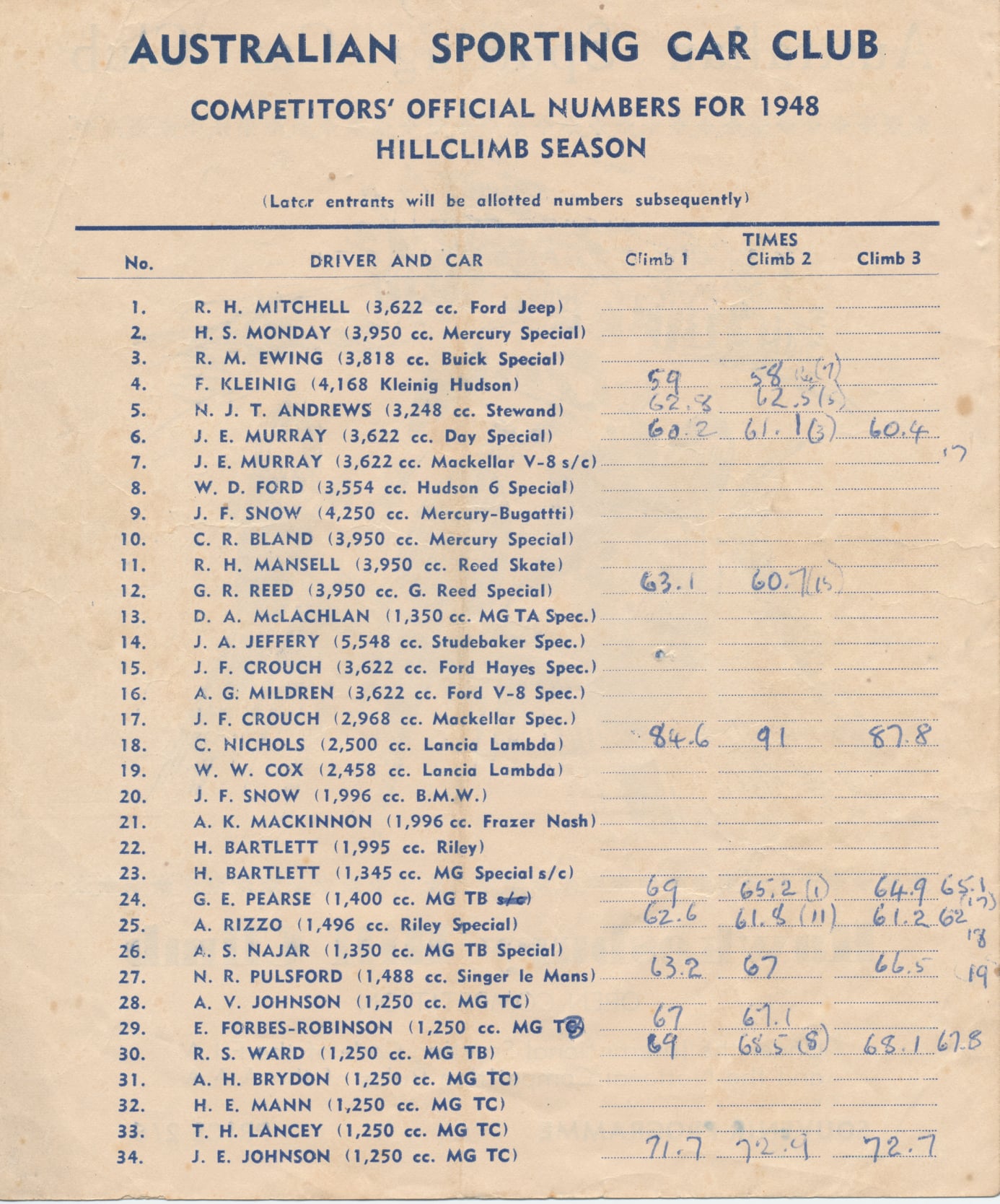
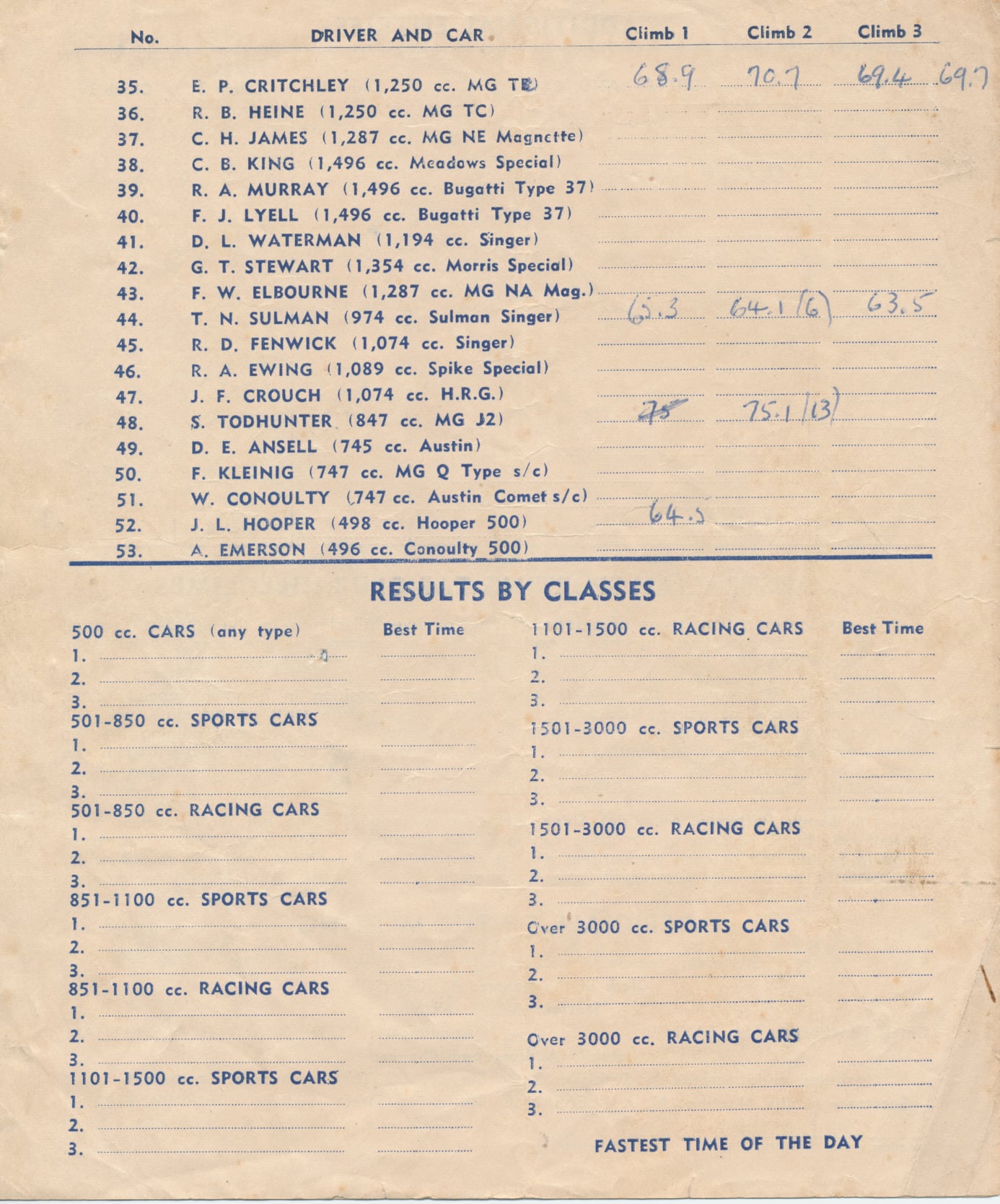
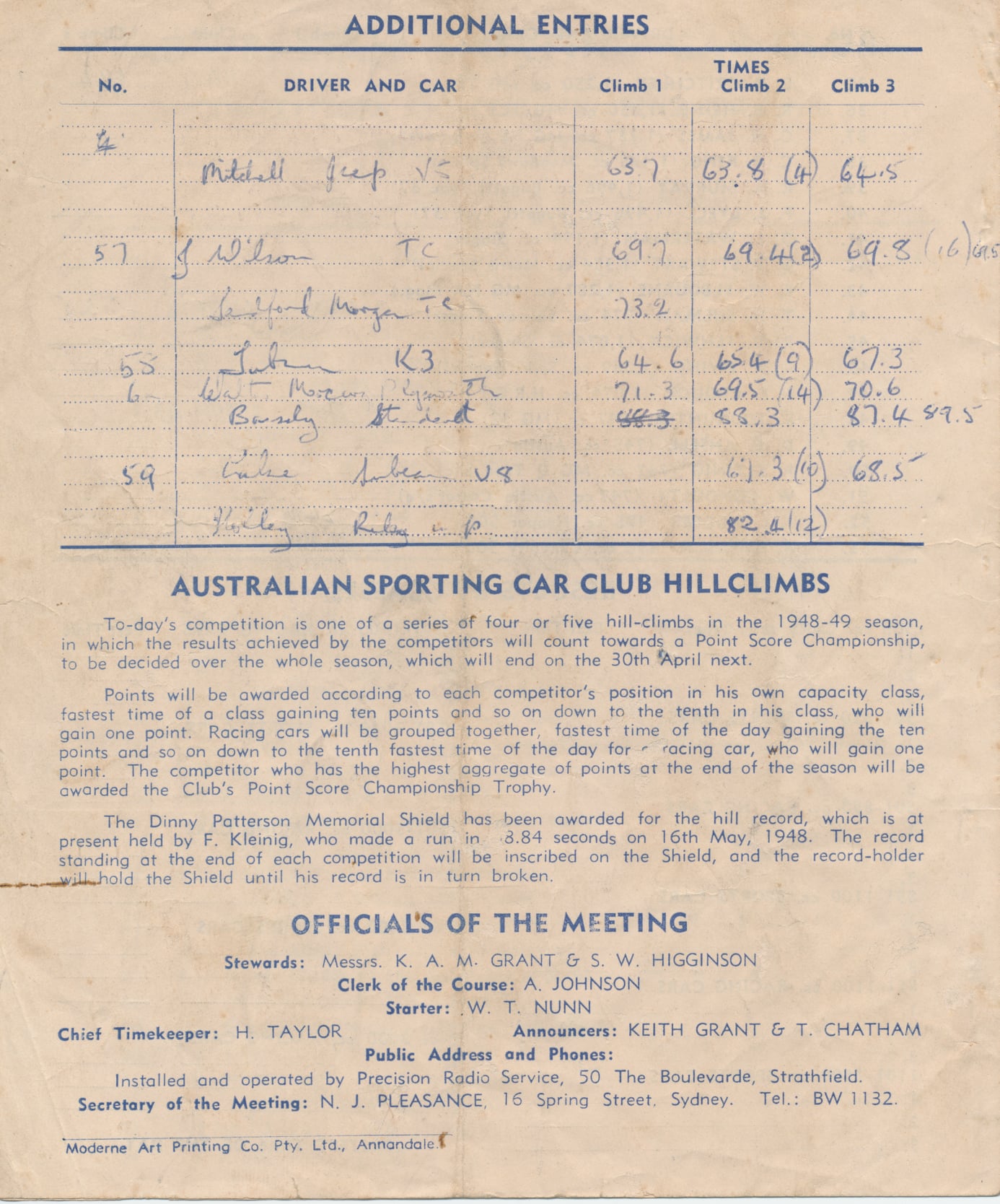
Since writing this, Cummins Archive (Paul Cummins) have posted on Facebook a 1948 programme for Hawkesbury hillclimb. It is not ‘our event’ as the numbers on recognizable cars differ – viz. Sulman Singer 32 in the photo and 44 in the published programme. This programme might help with the identification of some of the other cars – could Riley number 28 be the Rizzo Riley and the last car, which appears to be an Austin ‘7’ special be that of Ted Ansell? The list of competitors, which is a virtual Who’s Who of immediately post-war NSW racing drivers, appears to confirm Kent Patrick’s suggestion that the K3 MG is that of Tubman – see his listing under ‘Additional Entries’.
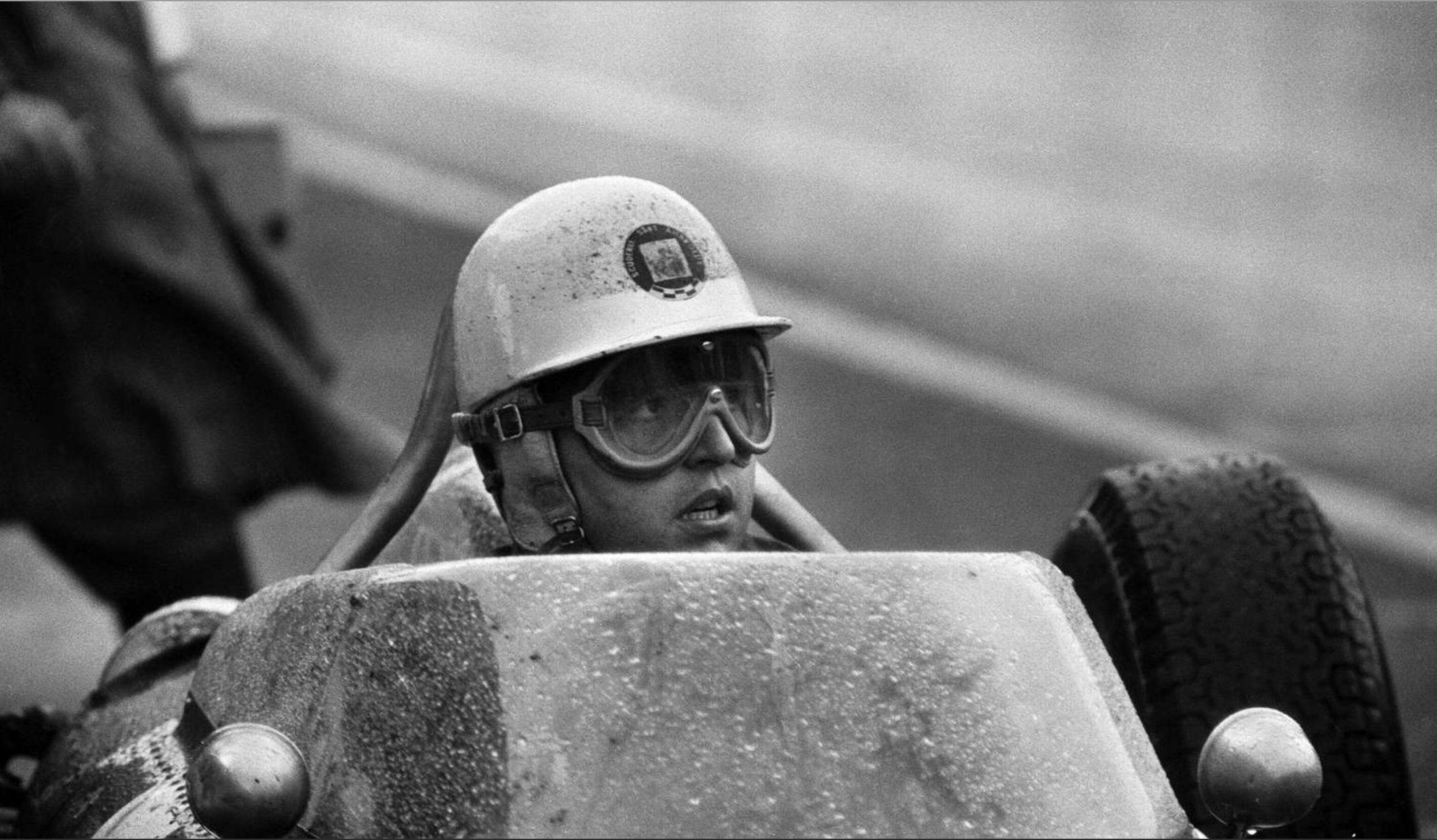
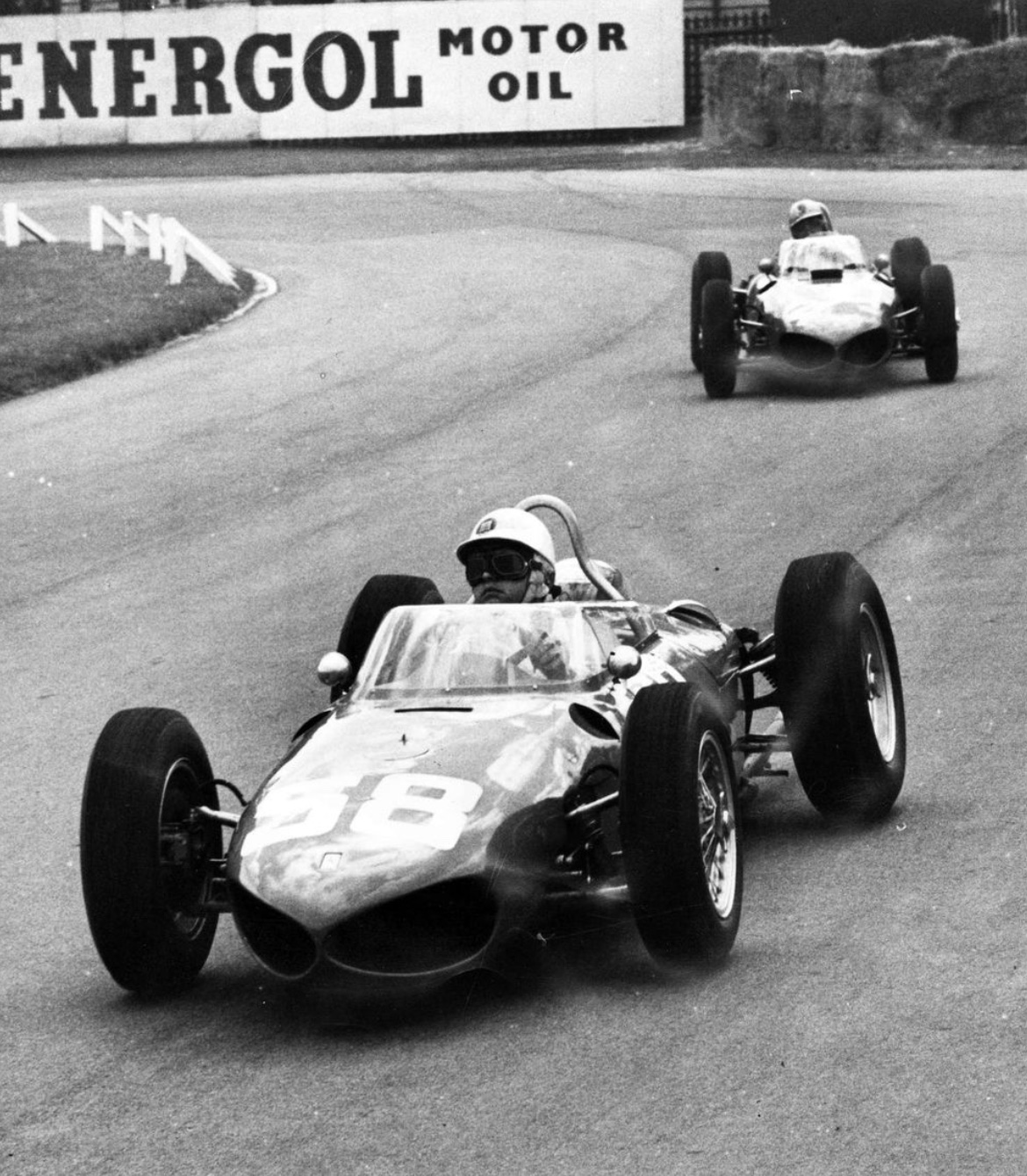
Giancarlo Baghetti on the way to his maiden Grand Prix win in his very first GP aboard Ferrari 156 chassis 0008. He won four Grands’ Prix in 1961; the French at Reims, and three non-championship events here at Siracusa on April 24, in Napoli three weeks later, and the Coppa Italia at Vallelunga in October …
The Syracuse locals are enjoying Giancarlo’s delicate touch and the glorious howl of the little 1.5-litre V6 around the 3.478 mile Sicilian street circuit, look closely at the kids in the trees!
While the 156 was the class of the field in 1961, Baghetti beat a field of depth in Syracuse. Dan Gurney and Jo Bonnier were second and third in Porsche 718s, then came Jack Brabham’s works Cooper T55 Climax, Roy Salvadori’s Cooper T53 Climax, and in sixth and seventh places were Jim Clark and Lorenzo Bandini in Lotus 18 Climax and Cooper T51 Maserati respectively.
John Surtees’ Cooper Climax sandwiched by the Gurney and Bonnier Porsche 718s at Syracuse in 1961 (Motorsport) Moss chasing Baghetti and Gurney; Lotus 18, Ferrari 156 and Porsche 718 (B Cahier) Moss in a Rob Walker Lotus 18 Climax chases Jo Bonniers’ Porsche 718 at Syracuse. Jo was third and Moss eighth with a misfiring engine (unattributed
Despite the presence of the-greats, Baghetti popped the Ferrari into second slot on the grid behind Gurney on pole. He didn’t make a great start, appearing in seventh place at the end of the first of 56 laps, but used the power of the car to progress forward through the field to lead Gurney and Surtees by the end of the sixth lap.
Once in front he led with calm, consistent precision, keeping Dan at bay to win by five seconds. The youngster’s only mistake was to whistle up the escape road at the hairpin on his victory lap when he missed his braking point whilst waving to an adoring Sicilian crowd!
The car Giancarlo raced is the very first mid-engined Ferrari – the 246P Richie Ginther debuted at Monaco in 1960, chassis 0008. This morphed progressively from a 2.5-litre GP car into the prototype 1.5-litre GP 156 by the 1960 season’s end. See this story about a most significant Ferrari, it is a great pity Enzo destroyed it along with all of its other 156 brothers and sisters; https://primotipo.com/?s=ferrari+246p
0008 always raced with the 65-degree 1.5-litre V6 rather than the definitive 1961 120-degree variant which Richie Ginther was to give debut at Syracuse, but didn’t at the last minute due to oil scavenge problems revealed in testing at Modena. Checkout this article on the testing of the 120-degree motor here; https://primotipo.com/2018/09/11/ferrari-156-testing/
Innes Ireland and Jim Clark- #20 is Jim’s Lotus 21 Climax (B Cahier) Graham Hill, BRM P48/57 Climax FPF (unattributed) Giancarlo, Syracuse 1961 (unattributed)
By the start of 1961 0008 was already an old nail, so Ferrari were happy to hand the machine over to a grouping of Italian car clubs – the Federazione Italiane Scuderia Automobolistiche (FISA) as a means of developing promising Italian drivers. While the car was entered by FISA, it was prepared by the factory – very well prepared as it transpired!
Giancarlo had impressed in 1960 at the wheel of a Dagrada Lancia Formula Junior, and was awarded the FISA drive. About ten of these front-engined FJ’s were built by Milanese, Angelo Dagrada who was known to Giancarlo via modifications he had made to Baghetti’s industrialist father’s Alfa Romeo 1900 road car, the family owned a foundry in Milan. Giancarlo cut his racing teeth with this Alfa and Abarths in local events.
These interesting cars bucked the Italian trend of using the ubiquitous Fiat inline-four in favour of the Lancia Appia 1098cc ten-degree V4 which was light and compact – and powerful after vast development of the standard cylinder head turned it into a crossflow unit.
Giancarlo aboard his Dagrada Lancia FJ at Monza on 25 April 1960 (unattributed)
Giancarlo was seventh in the 1960 Campionato ANPEC/Auto Italiana d’ Europa Formula Junior Championship with one win from only three point scoring rounds. In front of him was Colin Davis, Jacques Cales, Denny Hulme, Lorenzo Bandini, Henri Grandsire and Henry Taylor.
Baghetti’s win depicted in the advertisement below was a big one, the VIII Trofeo Bruno e Fofi Vigorelli at Monza on April 24-25 attracted 43 cars, 16 were non-qualifiers. Giancarlo won both his heat and one of the two finals, to win on aggregate from Juan Manuel Bordeu and Henri Grandsire aboard Stanguellini Fiats. The class field included such notables as Colin Davis, Carlo Facetti, Carroll Smith, Lorenzo Bandini, Rob Slotemaker, Ludovico Scarfiotti, Geki Russo, Gerhard Mitter, Eric Carlsson, John Whitmore, Teodoro Zeccoli and Tony Maggs.
In the Campionato Italiano, he was equal fourth with Geki Russo behind Renato Pirocchi, Roberto Lippi and Antonio Maglione, and second in the Prova Addestrativa behind Antonio Maglione.
Some sources have it that Giancarlo was a controversial choice for the FISA ride, but if you look at the races entered/won, his strike rate looks pretty good. In addition, his Dagrada was generally felt to be an inferior weapon to the Stanguellini Fiat used by most of his rivals; the choice stands the sniff test I think, whatever the case, he certainly grasped the opportunity with both hands.
Baghetti’s purple patch continued at Posillipo a month later when he won the Gran Premio di Napoli on May 14, again at the wheel of 0008.
On this occasion he finished the 60 lap, 150km road course race in front of Peter Ashmore’s Lotus and Bandini’s Centro Sud Cooper T51 Maserati, after Roy Salvadori gave chase early in the race, only to be thwarted by a puncture in his Yeoman Credit Cooper Climax.
The entry was devoid of championship front runners on this occasion, they were otherwise engaged at Monaco, Stirling Moss in one-of-those drives won the race aboard Rob Walker’s Lotus 18 Climax, one of three championship events which didn’t go to the 156 that season. The German GP also fell to Maestro Moss in the nimble, less powerful Lotus 18, and at Watkins Glen Innes Ireland won the first GP for Team Lotus, and himself, aboard a Lotus 21 Climax.
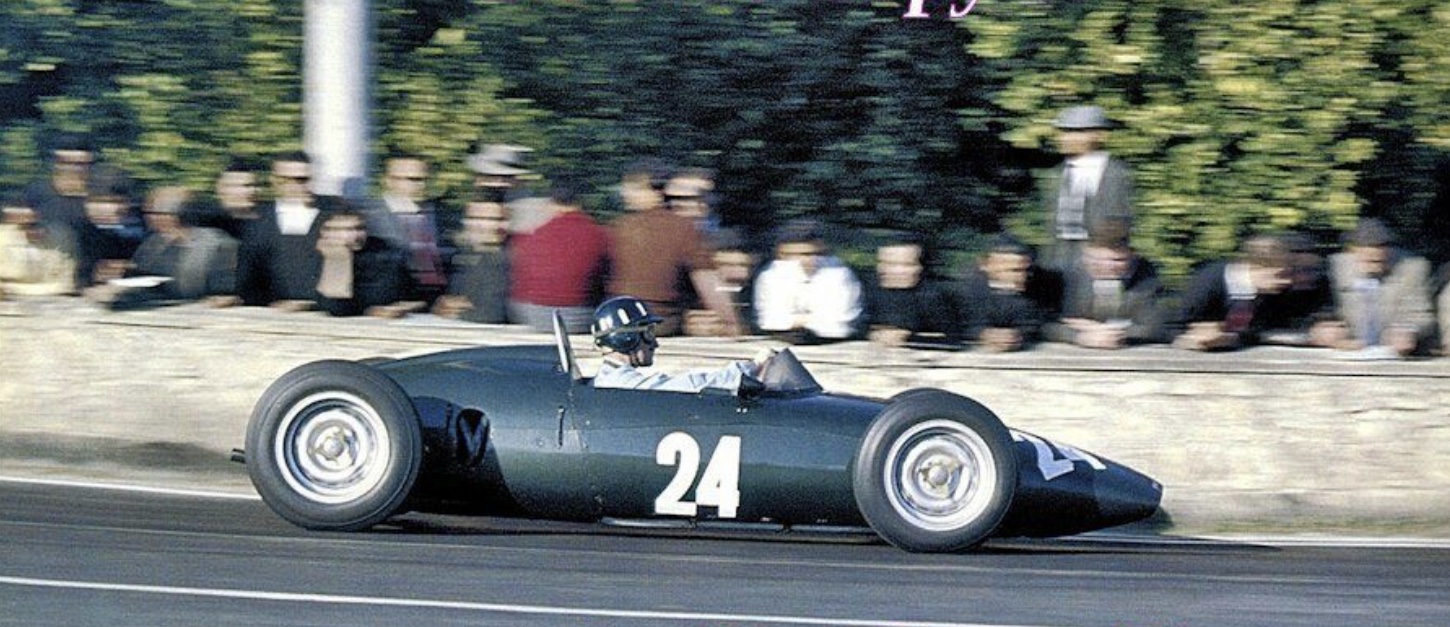
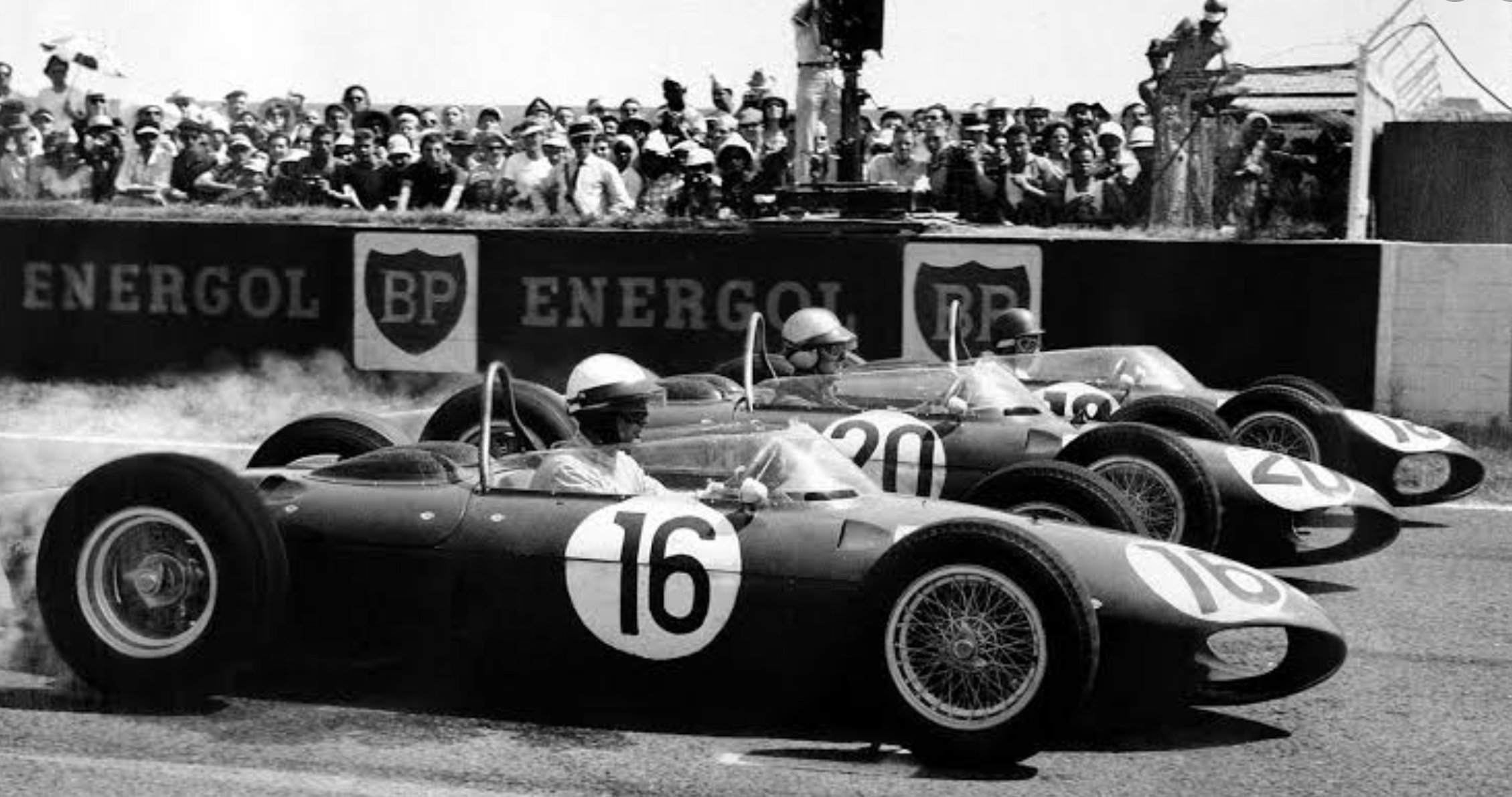
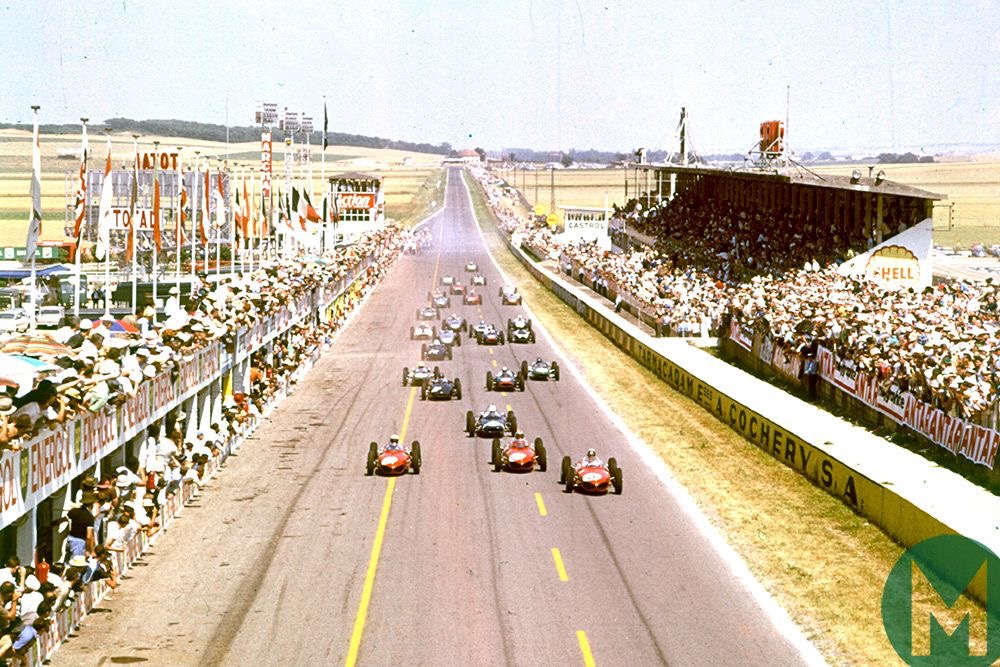
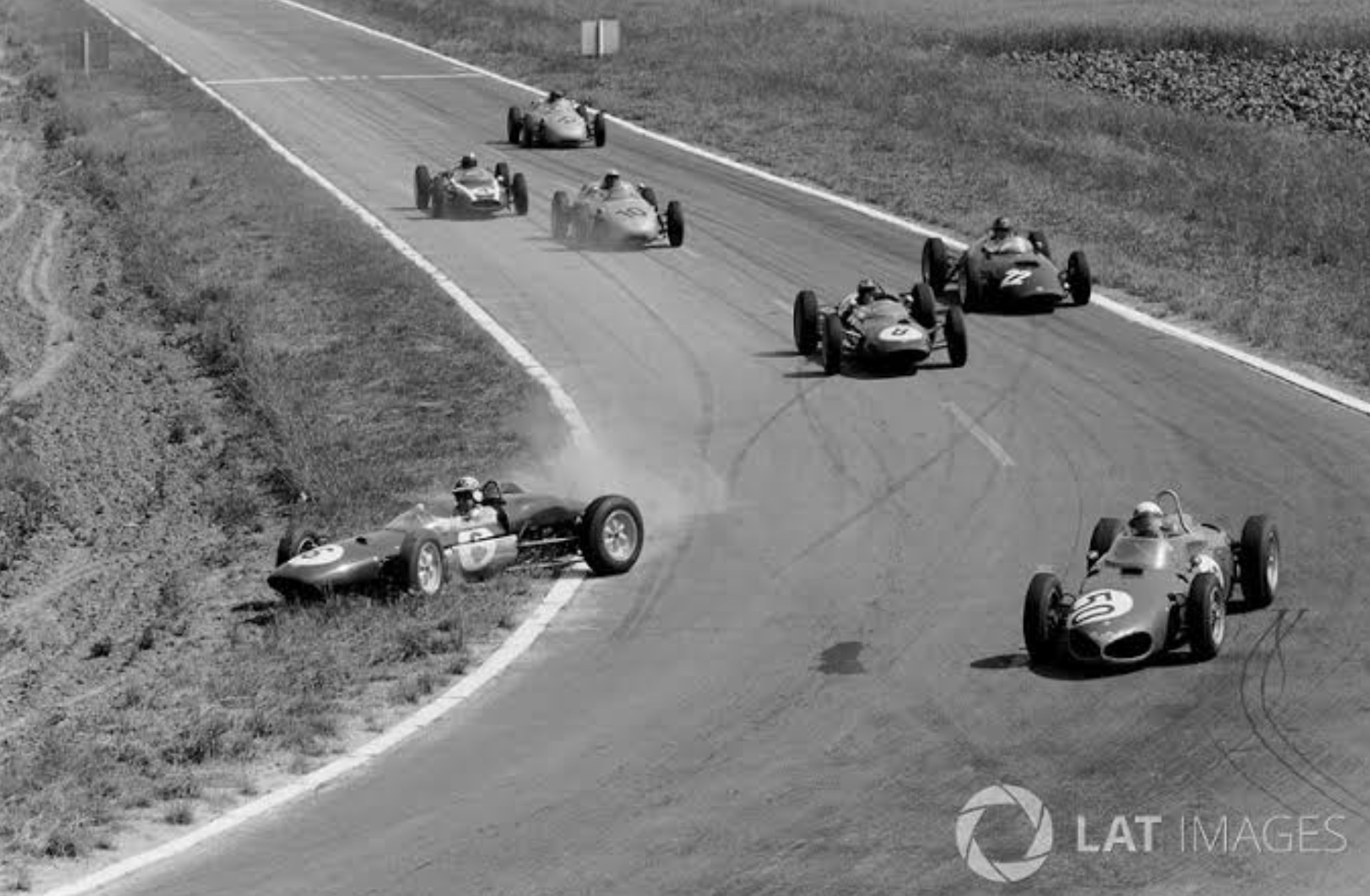
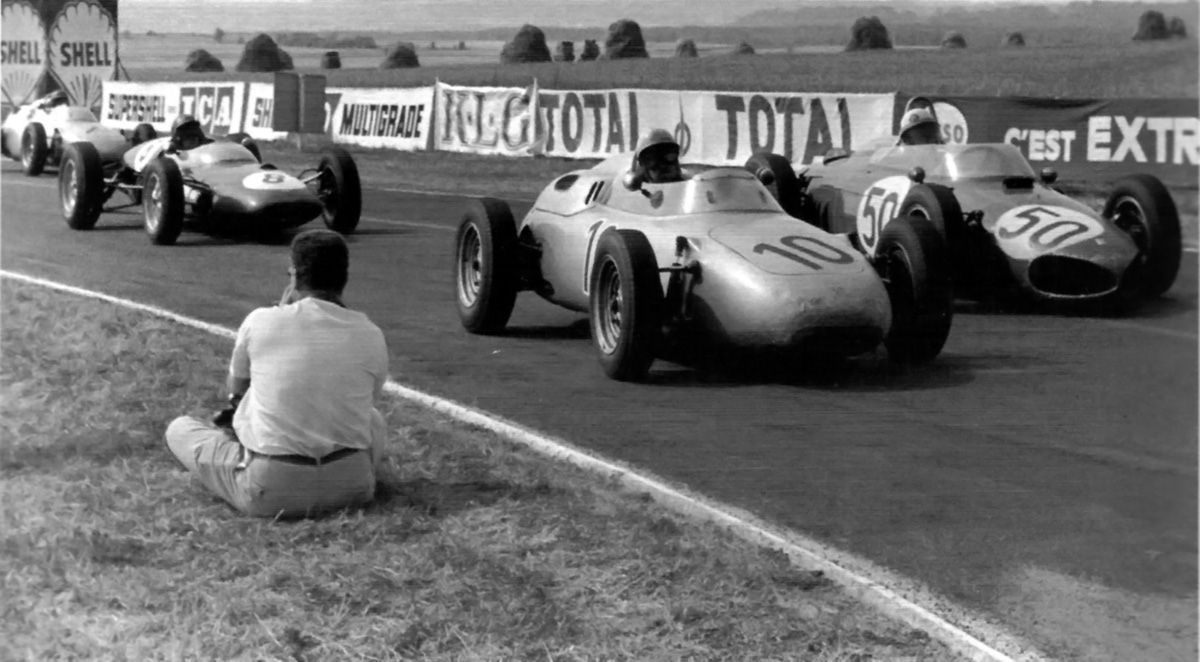
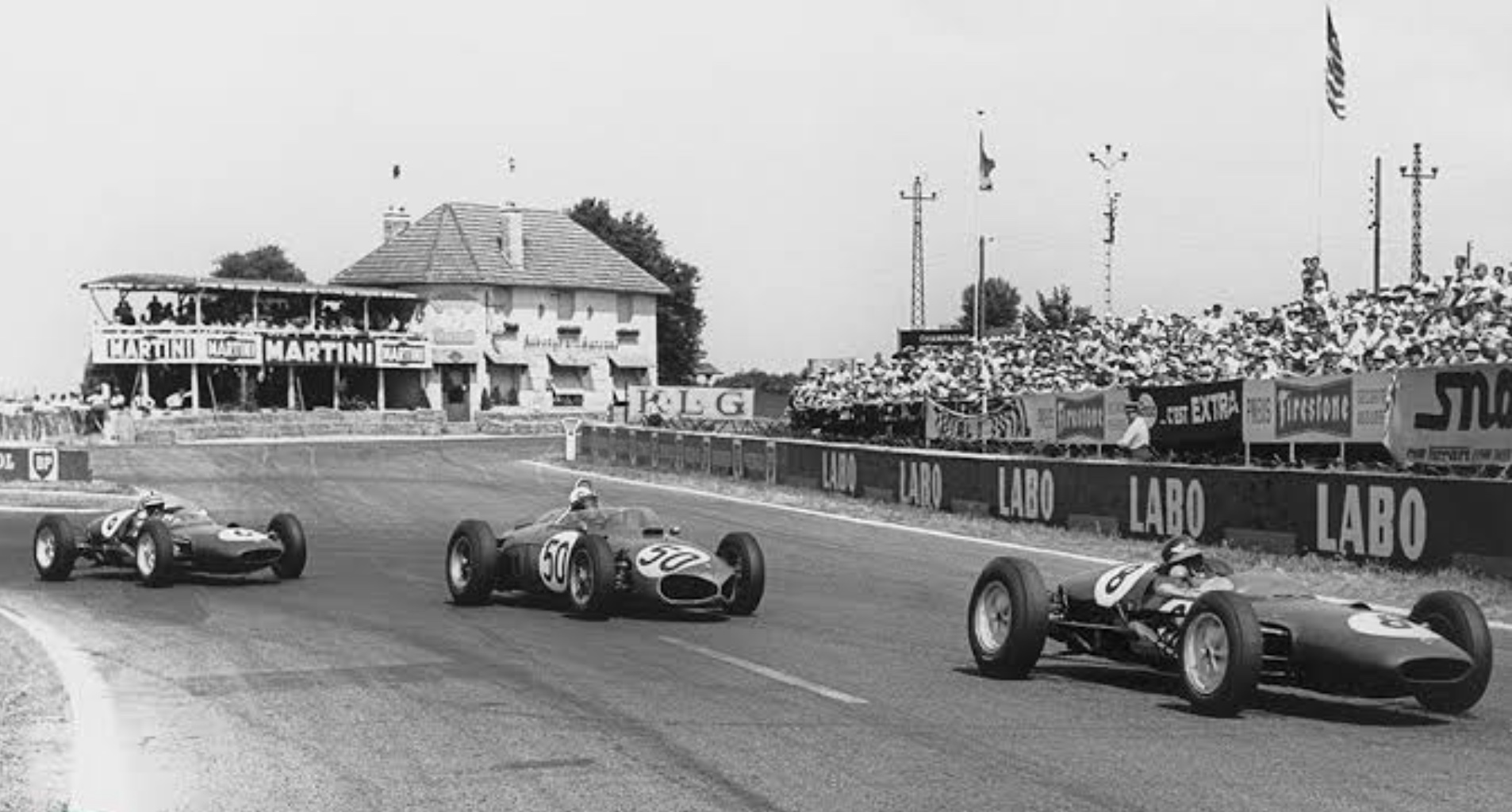
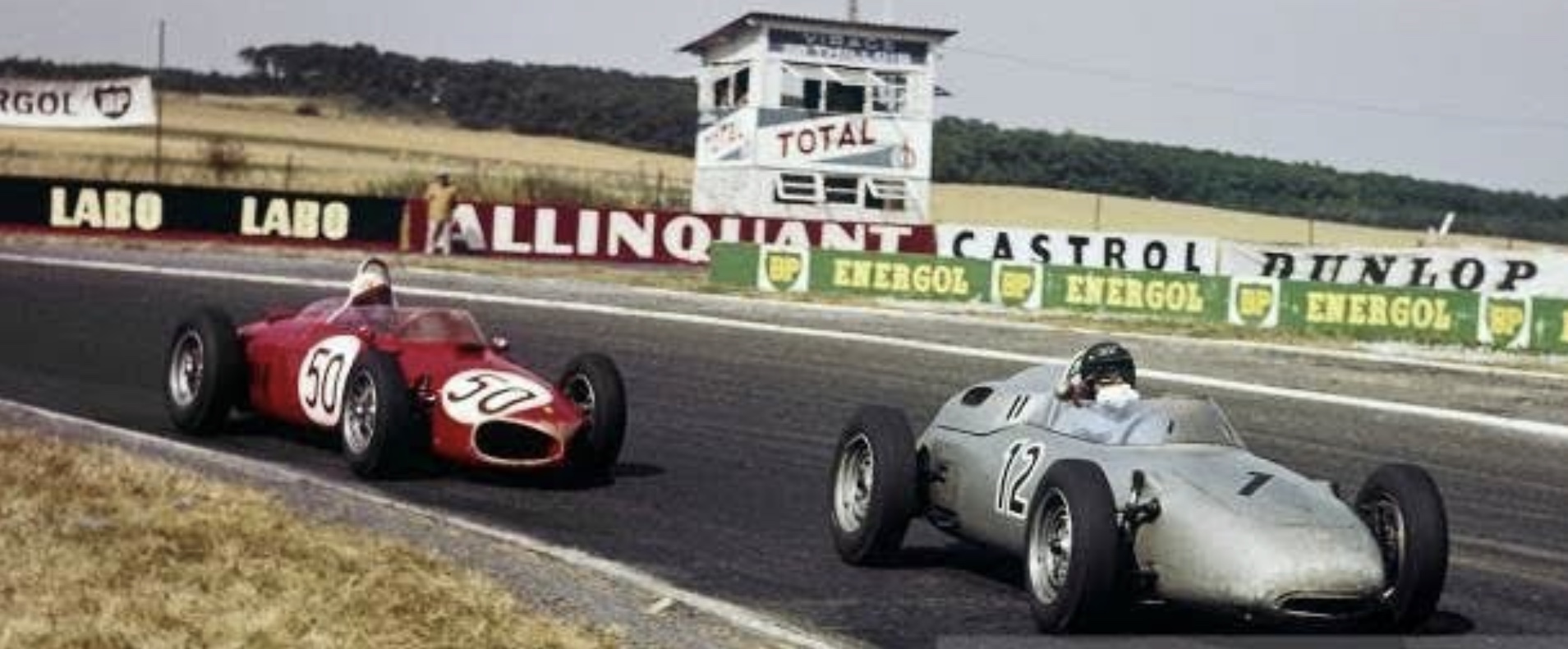
GP di Napoli, Posillipo 14 May 1961 grid. Baghetti 156 at left, Roy Salvadori, Cooper T53 Climax and then Gerry Ashmore’s Lotus 18 Climax at right. Row two is Ian Burgess’ Lotus 18 Climax at left and Lorenzo Bandini’s Cooper T51 Maserati at right. Row three is Giovanni Alberti, de Tomaso Osca at left and Menato Boffa, Cooper T45 Climax at right. Baghetti won from Ashmore and Bandini (unattributed) Hill, Ginther and Von Trips – Ferrari 156 by three front row at Reims in 1961 (unattributed) Reims start with Thillois in the distance, July 2, 1961. Up front its Hill, Ginther and von Trips from left to right, with Moss in the Walker Lotus 18/21 Climax on his own, and the rest- winner Giancarlo was Q12 but started poorly and is the red spec almost straddling the dashed-yellow line, about six cars from last. All of which says a lot about the Italian cars power and torque out of the slow Muizon and Thillois corners (Motorsport) Who said the Lotus 21 had better brakes than the Ferrari 156?! Innes Ireland runs into strife under brakes whilst attempting to slip under Giancarlo watched by Jim Clark in another 21, Graham Hill, BRM, Jo Bonnier, Porsche 718, Bruce McLaren’s Cooper T55 Climax and Dan Gurney in the other works Porsche 718, Reims 1961
0008 went back to the factory for a freshen up and then joined the three factory entries of Phil Hill, Taffy von Trips and Richie Ginther at Reims on the July 2 weekend for the French Grand Prix.
There he took a stunning victory a tenth of a second clear of Gurney’s Porsche 718 with Jim Clark’s Lotus 21 Climax a further minute adrift. It was an all Ferrari front row with Hill on pole and Ginther and von Trips alongside, Giancarlo was Q12.
Hill led from the start, in that order, until Richie spun giving third place to Moss’ Lotus 18 Climax – behind this group there was a massive slipstreaming battle involving the Gurney and Bonnier Porsche 718s, the works Lotus 21 Climax’ of Jim Clark and Innes Ireland, Graham Hill’s BRM P48/57, Bruce McLaren’s Cooper T55 Climax and Giancarlo.
Two of the most important aspects of longevity for a race photographer are a sense of self preservation and fleetness of foot …Bonnier, Baghetti, Clark and Gurney, Reims 1961 (unattributed) Clark, Baghetti and Ireland exit Thillois (Motorsport) Spinner Ginther in front of Lucien Bianchi, Lotus 18/21 Climax (B Cahier) Gurney and Baghetti in the final stages (B Cahier)
Taffy had engine trouble after 18 laps so he was out, Phil Hill spun on the surface which was becoming very slippery in the intense heat on lap 38, he managed to restart but was a lap down. Then Ginther led, but he too spun, and had no sooner recovered before having engine problems – no oil pressure after 40 laps, Moss had brake problems so he too retired after completing 31 laps.
Progressively the challengers fell away leaving a man-on-man battle which went on for many laps, with the lead changing by the lap between Dan Gurney – one of the finest drivers of the era – and still to win his first championship Grand Prix, and GP debutant Giancarlo Baghetti.
On the final lap, Dan out-braked Giancarlo into Thillois, the last corner, but on the sprint to the line – with more punch than the four-cylinder Porsche – Baghetti dived out of Gurney’s slipstream a couple of hundred yards before the finish in a perfectly timed move to win by the narrowest of margins from Gurney, Clark, Ireland and McLaren.
Giancarlo’s 1961 run of success wasn’t over yet, as noted at the outset, he won the minor, Prima Coppa Italia at Vallelunga on October 12. This time he raced a Porsche 718, winning both 30 lap, 106 km thirty minute heats from pole, taking the overall win on aggregate from Ernesto Prinoth, Lotus 18 Climax, and Nino Vaccarella’s Cooper T51 Maserati.
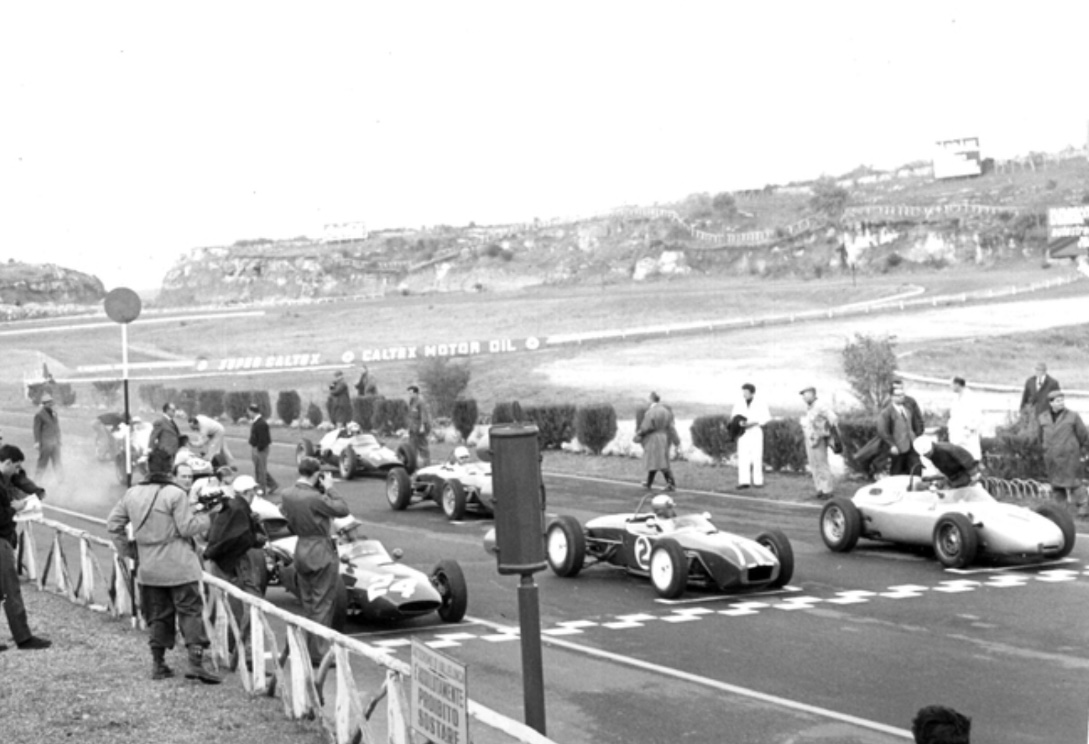
Aintree 1961 (Echo) Coppa Italia, Vallelunga October 12, 1961. #24 Nino Vaccarella rebodied Cooper Maserati T51, #2 Ernesto Prinoth, Lotus 18 Climax and at right Giancarlo Baghetti, Porsche 718. The Lotus 18 Maserati on row two is Gaetano Starrabba (unattributed)
The 1961 Ferrari 156 : Technical…
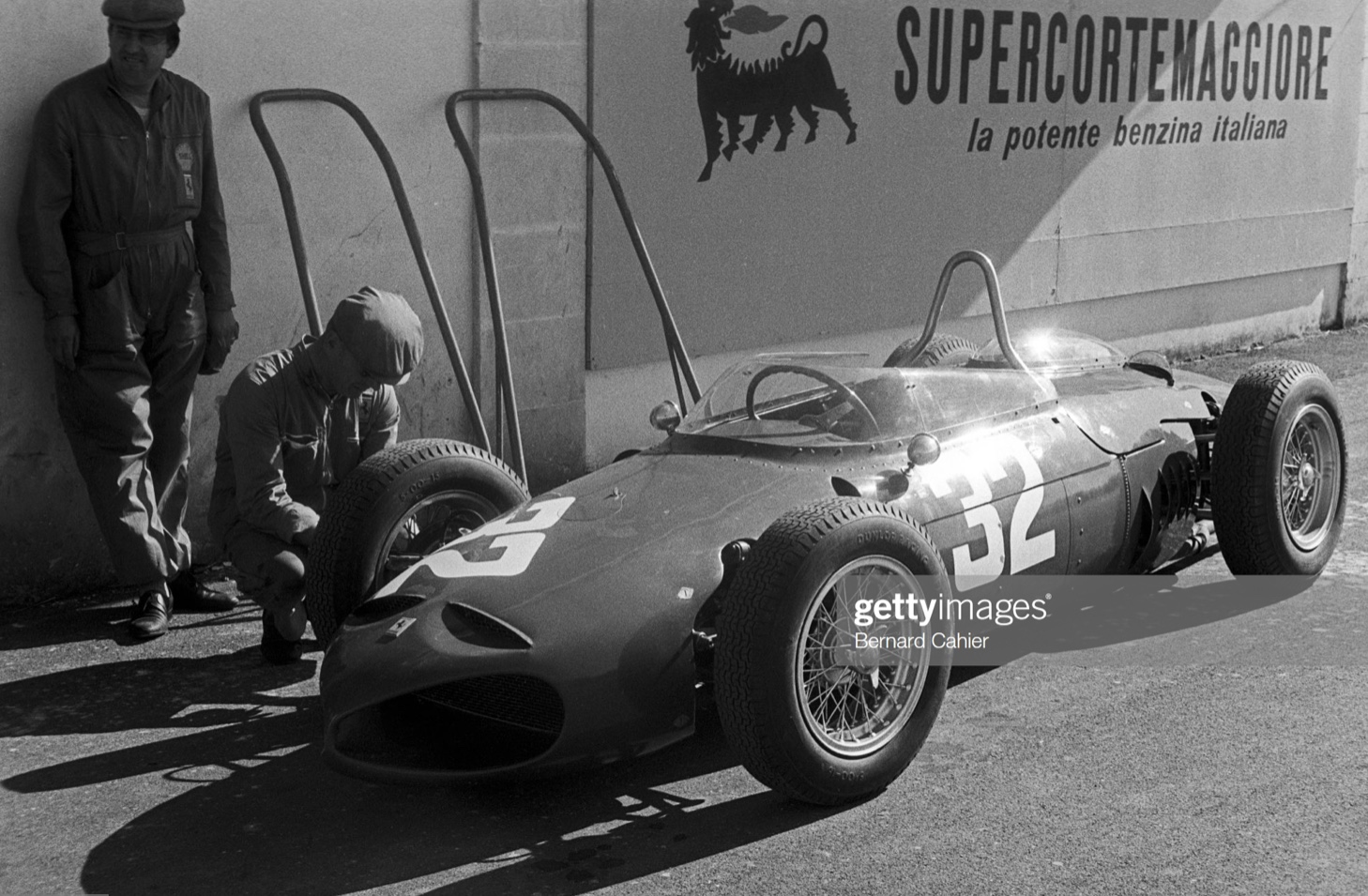
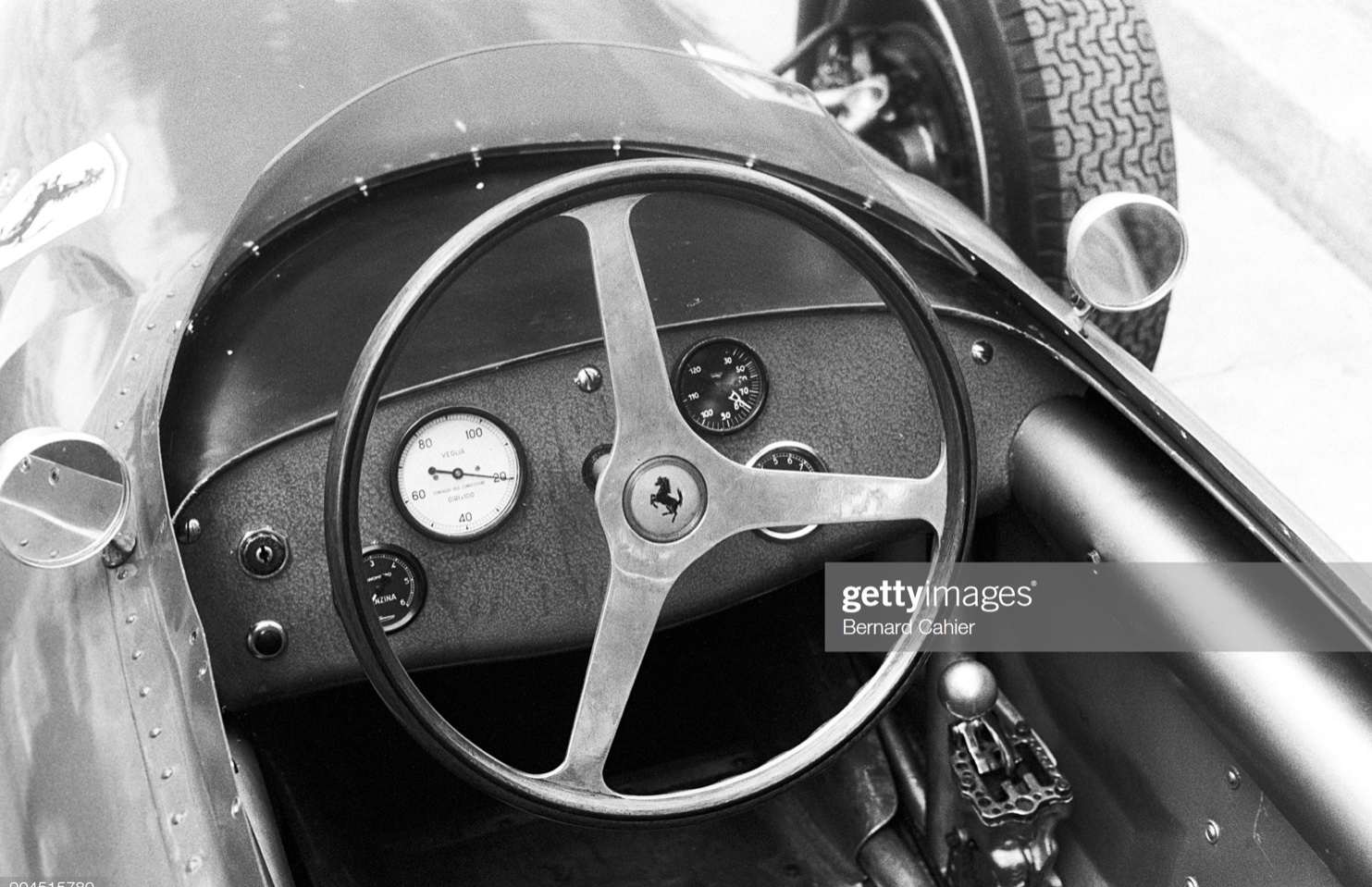
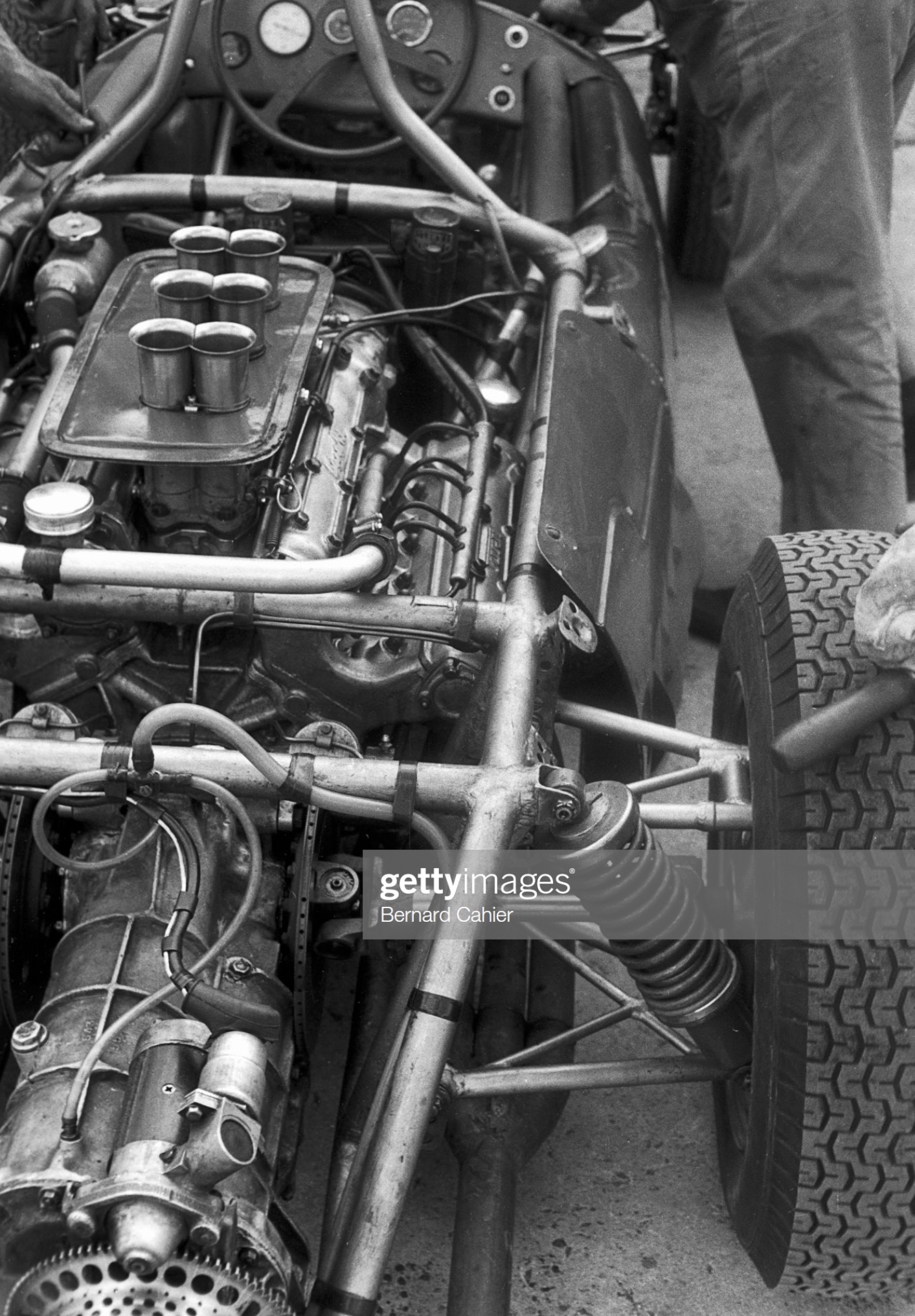
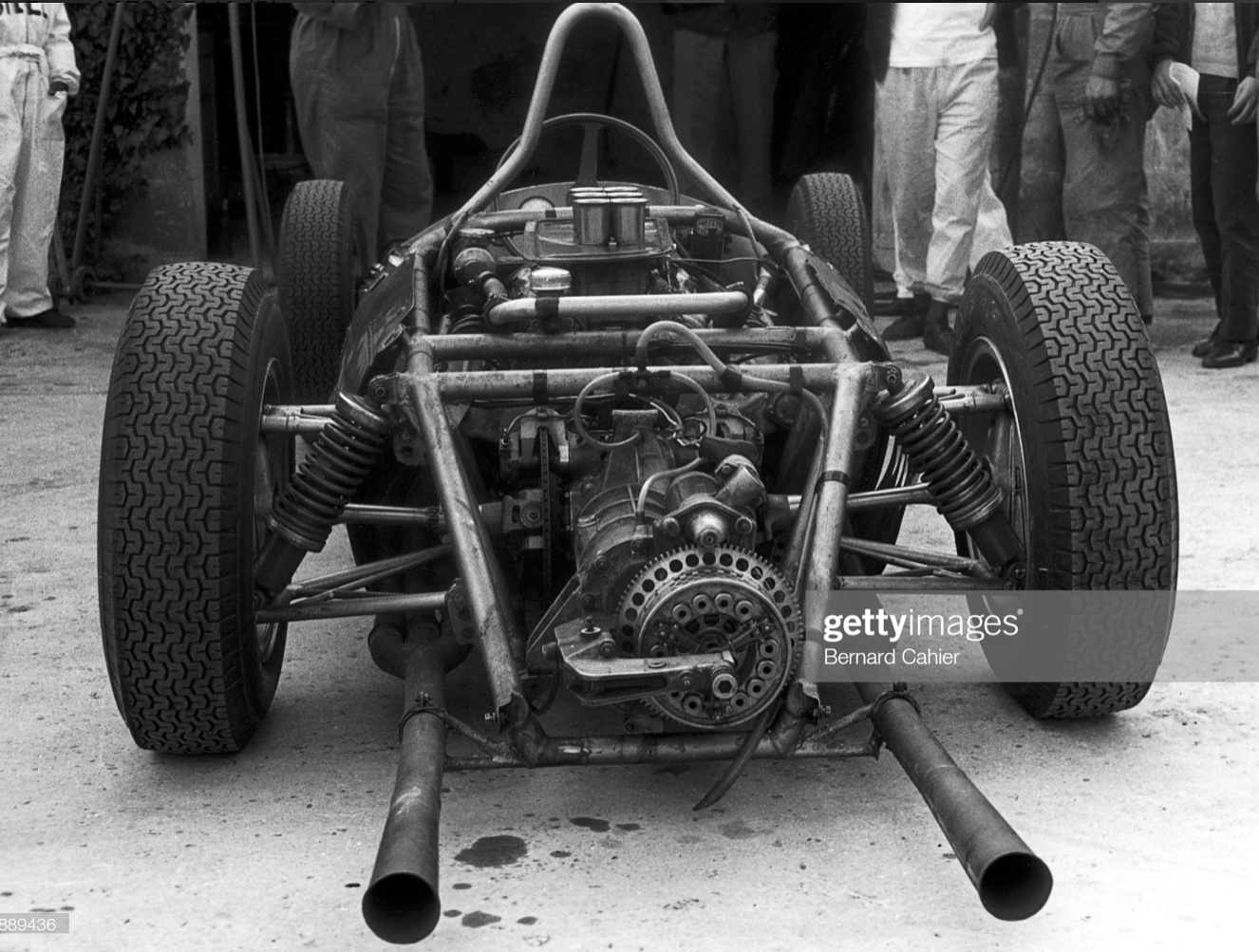
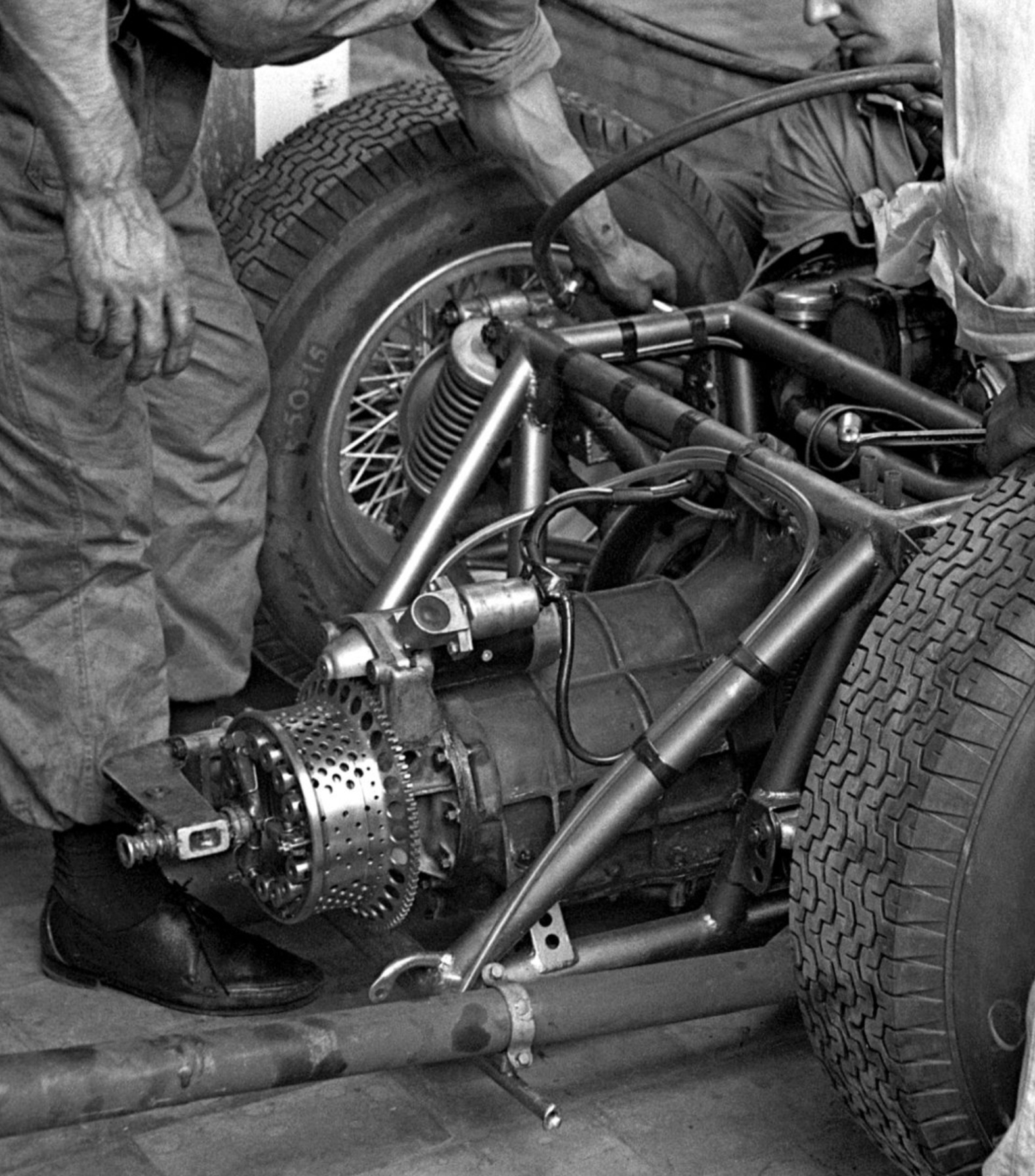
For early 156 Dino enthusiasts these photographs of 0008 taken by Bernard Cahier at Siracusa on this Tuesday April 25, 1961 long-weekend will be of great interest as they show the first chassis in its definitive 1961 form.
All 156’s built and raced in 1961-1962 started right here, or I guess twelve months before if you argue that the original 2.4-litre 246P version of 0008 was the starting point, which of course factually it was.
The bodywork of the car is ‘unique’ in that it has two supplementary air intake slots on the cowling, it’s very sleek compared to 0008 as it was in early 1960, to the form shown above. The shark-nose was supposedly low-drag, Carlo Chiti deployed it in his 1961 sportscar designs as well, the approach was a function of work in Ferrari’s scale-model wind tunnel.
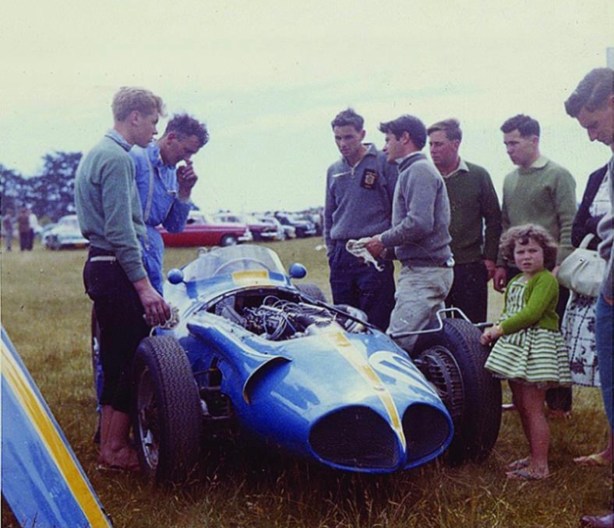
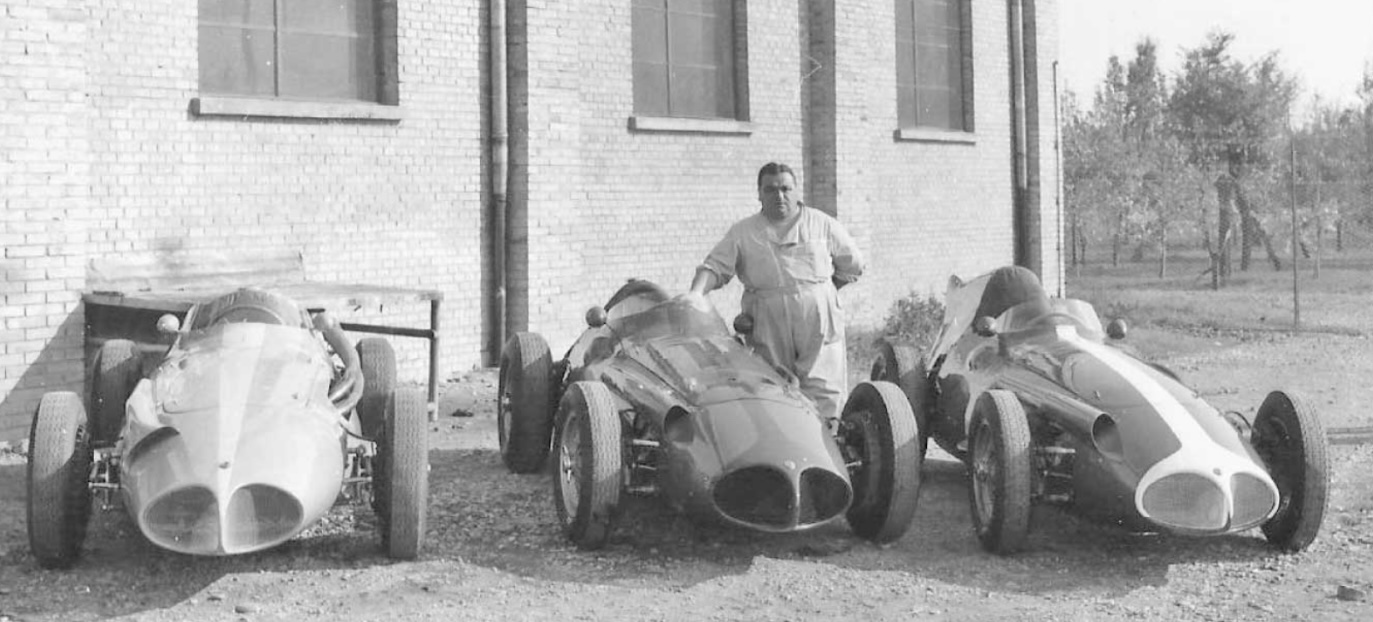
It may well be that the shark-nose design was suggested to Chiti by Medardo Fantuzzi, one of Ferrari’s favoured external body-builders. He modified a Maserati 250F for Kiwi Ross Jensen (#2508) in this manner in late 1957, and then two other 250Fs for Temple Buell (#2533 and 2534). Fantuzzi built the 156 and sportscar bodies.
Maserati 250F ‘2508’, ex-Moss/Jensen, when owned and raced by Brian Prescott at Wigram, NZ in April 1961. Medardo Fantuzzi nose to the fore (Classic Auto News)
Medardo Fantuzzi with the three ‘shark nose’ Maserati 250Fs at his Modena factory in late 1957 or early 1958. Jensen’s at left – he finished second to Jack Brabham in the January 11, 1958 NZ GP in his upgraded car – the two Temple Buell machines alongside (unattributed)
Doug Nye described the chassis thus ‘The multi-tubular chassis itself was crude and hefty looking, not as unimpressive as a Cooper’s – not least of all its tube runs were straight – but not a patch on the lightweight lattice of a Lotus, BRM or even a Porsche.’ Big, butch, beefy and crude the chassis was, but it certainly did the job in 1961. It was only when the chassis sophistication of the Brits was harnessed to the power of the Coventry Climax and BRM V8s in 1962 that the class of ’61 became the dunce of ’62.
The main chassis rails were made of 1 1/2 inch steel spaced vertically 15 inches apart, the 120-degree motor required bulged top rails for installation, whereas the 65-degree unit did not, its rails were straight. The 120-degree frame swallowed the earlier motor whereas the wide engine wouldn’t fit into the narrower 65-degree frame.
Suspension front and rear comprised upper and lower braced wishbones and coil spring/damper (Koni) units, roll bars were adjustable both front and rear although it appears Giancarlo didn’t race with a rear fitted in Siracusa. Chiti set the cars up with bulk static negative camber, I guess the race Dunlops fitted to the 156 liked the setup.
156 cockpit, Monaco 1961 Engine bay of 0008 at Syracuse. Note the beefy spaceframe chassis Doug Nye described as being welded together by ‘Mr Blobby’. 65-degree second series Tipo 156 V6, bore/stroke 73×58.8mm, circa 180bhp fed by three 38mm Webers. The 120 degree engine had two bespoke triple choke Weber 40IF3C carbs. Note the large transaxle and starter motor, no rear roll bar fitted, suspension by upper and lower wishbones, ventilated disc brakes are inboard
The 1.5-litre Vittorio Jano (and team) designed 65-degree V6 first appeared as a front-engined F2 car in 1958. The DOHC, chain-driven, two-valve, twin-plug, triple Weber fed motor developed circa 180bhp @ 9000rpm and was fitted to a scaled down version of the then current 2.5-litre Lancia D50 derived – and then further evolved – V8 engined 801 F1 chassis, then designated 156.
The capacity of Jano’s V6 engine grew progressively to 2417cc in which form the Ferrari Dino 246 won the 1958 drivers championship for Mike Hawthorn.
As time went on it became clear Ferrari had the makings of an excellent car for the new 1.5-litre F1 which commenced on January 1, 1961, and which was expressed in the evolution of 0008 from a chubby, pudgy 2.4-litre F1 car at Monaco in May 1960 a svelte shark-nosed 1.5-litre F2 machine before Monza in September.
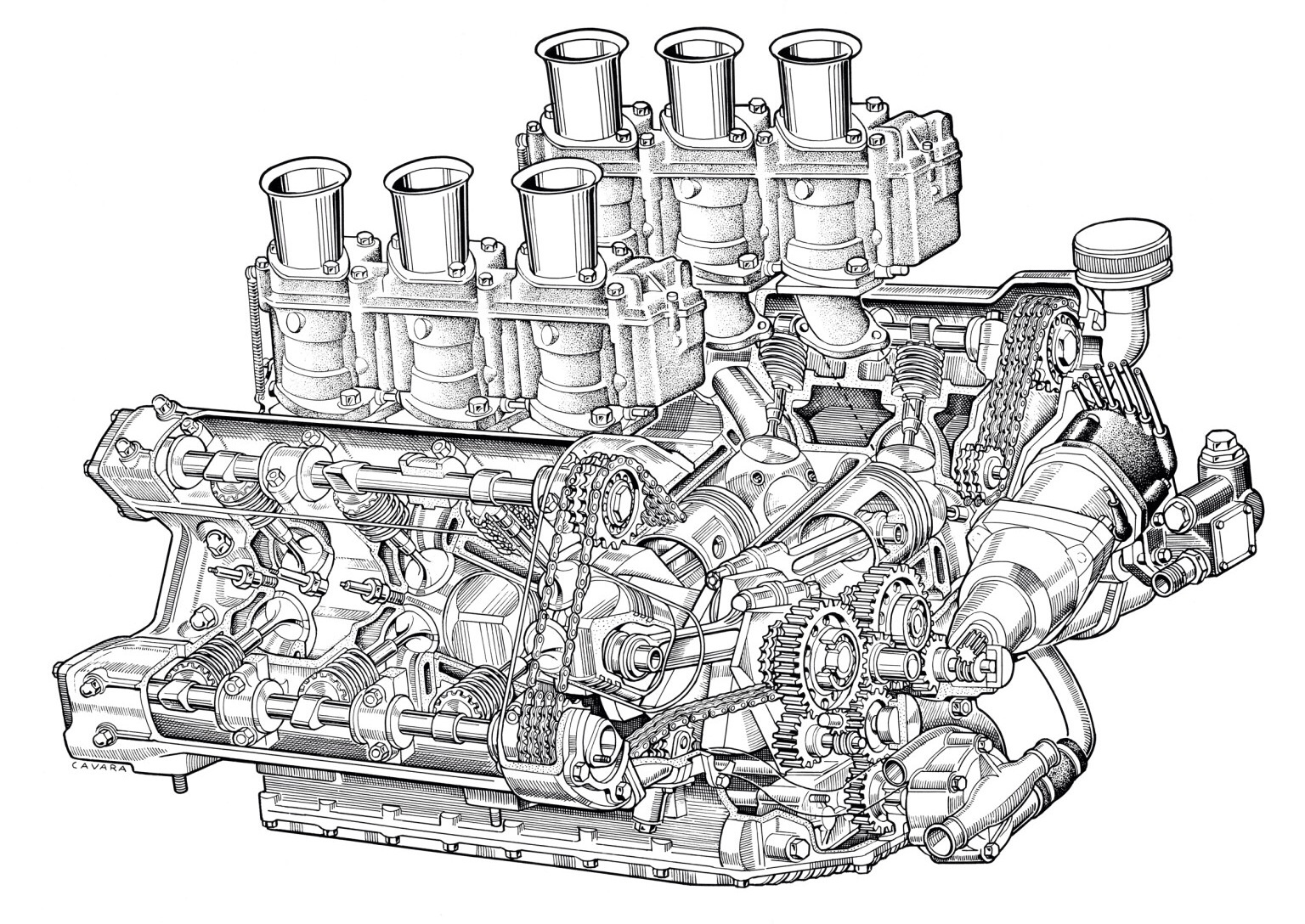
Chiti’s definitive engine for 1961 was a new variant of the Dino using a very wide-angle V6 of 120-degrees to lower the engines centre of gravity, and simplify manufacture of the engine’s crank. A motor of this width would not have fitted comfortably into the front-engined Dino 246/256 chassis.
The two camshafts were still chain driven, the heads still two-valvers, and still twin-plug. The dimensions of the 1960 Solitude 65-degree engine were adopted – bore/stroke of 73mm x 58.8mm for a capacity of 1476.6cc. Nye reports that all of the major castings were made in Siluminum, the 120-degree engine weighed 225 pounds, 30 pounds less than the good ‘ole Coventry Climax 1.5-FPF four cylinder motor.
Carburettors were bespoke, beautiful Weber triple-choke type 40 IF3C. Ferrari initially claimed 190bhp @ 9500rpm but ‘initial tests only yielded 177, which was still 30 more than the FPF’ used by the English teams in 1961. Jano also gave the existing 65-degree engine a bit of a tickle as a second-string unit, pending enough 120-degree engines to go around the three car Scuderia Ferrari team. When the FISA team were present four 156s presented a formidable challenge to the opposition…
Compare and contrast. Richie’s 156 0001, the prototype 120-degree engine chassis during the 1961 Monaco GP weekend. Note how low that engine sits in the chassis, trick triple throat Webers clear (G Cavara) 0008 butt, Syracuse 1961 (B Cahier)
While the V6s in either format were delicate, compact little things, the transaxle was anything but- however it did prove problem free, as Ferrari gearboxes down the eons have tended to be. The same ‘boxes were used with both engines – these 16.25 inch long units were developed versions of the five speed and reverse transaxle used in 0008, with the clutch assembly exposed to the breeze on the end plate. The thing looks bigger than it actually was due to a wide bell-housing between engine and transmission to push the engine forward in the frame to obtain the weight distribution Chiti sought.
Nye records that Ferrari appear to have built eight chassis during 1961. 0008 was numbered in the 246 Dino sequencing, in addition there were new chassis’ serials 0001-0006, with two appearing under the 0003 number. Von Trips won the Dutch and British GP’s in 0004 which was destroyed in his fatal Monza accident, Hill won at Spa in 0003, and Monza in 0002 while Giancarlo won at Reims in our friend, 0008.
And what about poor old 0008 you ask?
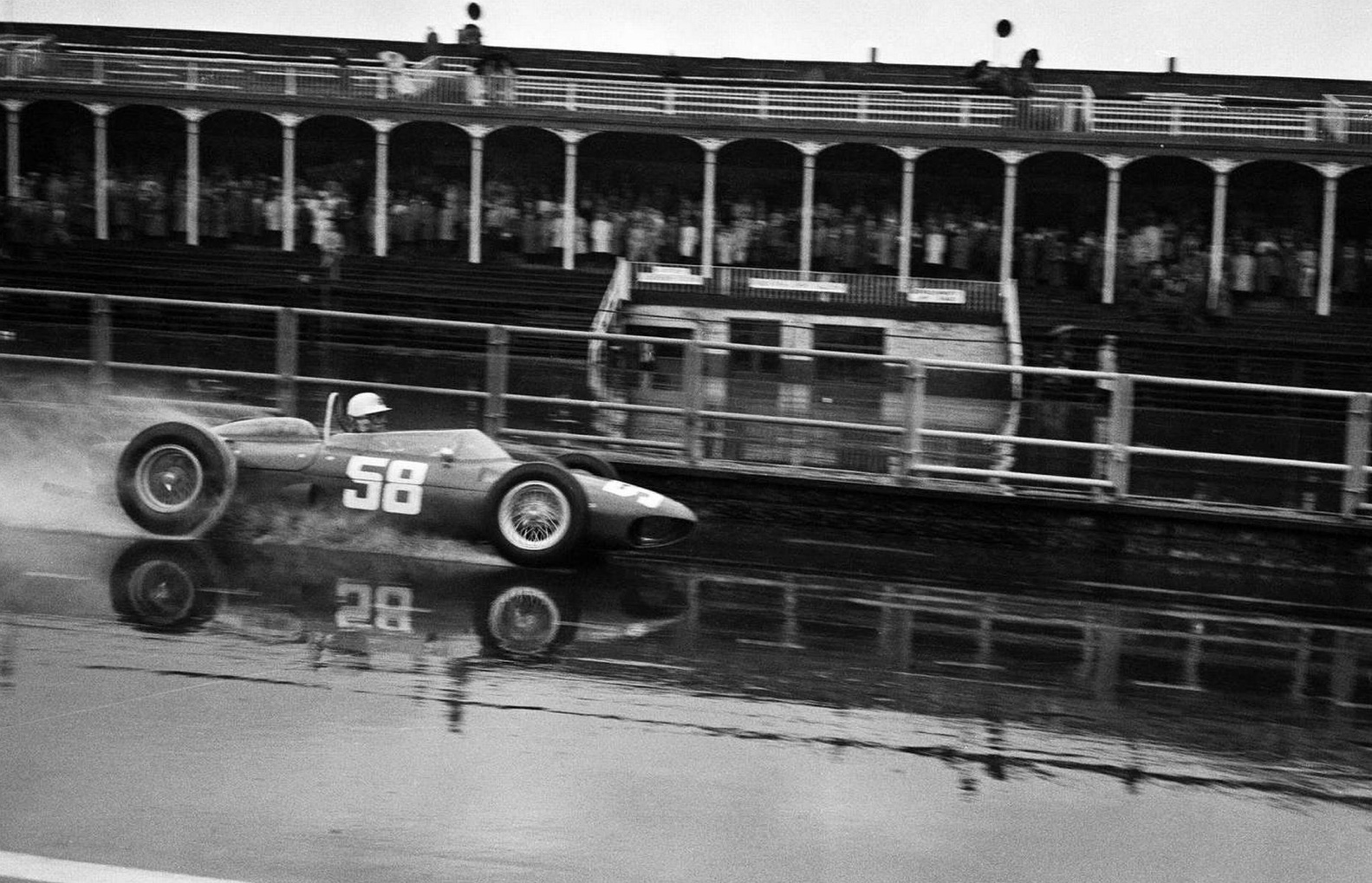
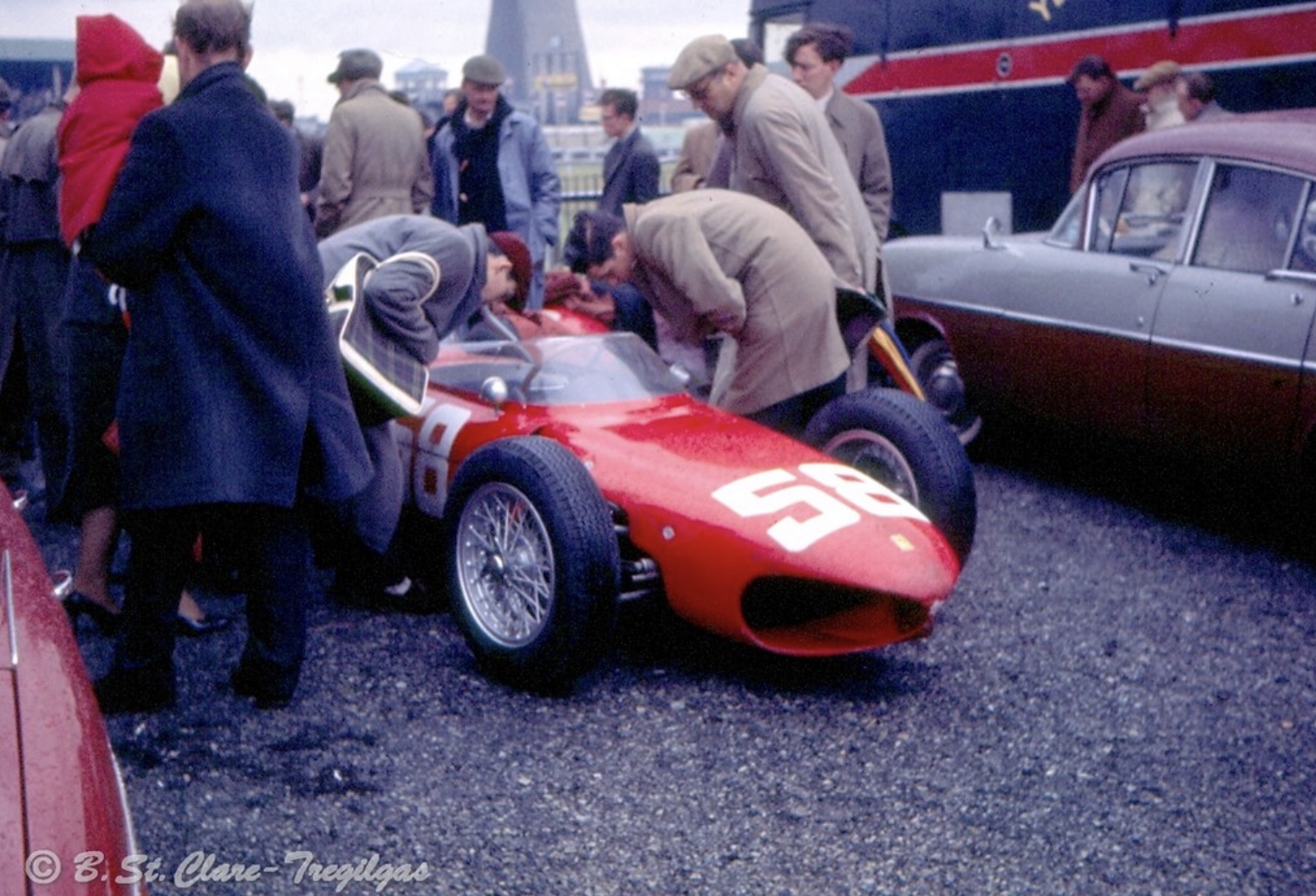
Giancarlo raced it at Aintree in the British GP the week after Reims (#58 below) doing enough damage to the prototype for it to be scrapped; he crashed at Waterways Corner while avoiding another competitor having his own moment when running in twelfth place from Q19. Of course all the 156s were ultimately destroyed, but if only one of the many chassis built between 1960-1962 were to have been preserved surely it would be this one…
(Echo)
Giancarlo above while up front Taffy von Trips won the July 15 British Grand Prix from his teammates Hill and Ginther, Jack Brabham was best of the rest, 68 seconds behind Von Trips in his Cooper T55 Climax.
0008 in the Aintree paddock, note the different nosecone fitted to the car compared to that used in the Syracuse heat. Wire wheels were very much old hat by this stage, Ferrari retained them in 1962 but Campagnolo’s were part of the 156/63 package in 1963.
Etcetera…
(B Cahier)
Whether the shark-nose was more aerodynamic or not is a moot point. Didn’t Carlo Chiti put his styling stamp on the Ferraris of the time with these oh-so-distinctive visual cues.
I’m cheating a bit here, this Ferrari launch shot in Maranello was in February 1962 not that the 156 was much different, to its cost – 246SP at left.
(B Reeves)
Baghetti in the FISA 156 from Moss’ Rob Walker Lotus 18 Climax at Syracuse in 1961. Nice.
(Echo)
Dry practice at Aintree, Baghetti from Von Trips, the winner, chassis 0008 from 0004. The former was scrapped after this race, the latter destroyed in Taffy’s horrific accident at Monza in September.
Bibliography…
‘History of the Grand Prix Car’ Doug Nye, Veloce Today article by Pete Vack, F2Index, Wikipedia, F1.com
Photo Credits…
LAT, Motorsport, Bernard Reeves, Giuseppe Cavara, Getty Images-Bernard Cahier, Echo Liverpool, B St. Clare-Tregilgas, Classic Auto News
Tailpieces: Giancarlo Baghetti at the wheel of his Ferrari 156 during 1961…
(unattributed)
(unattributed)
Listen Mauro, I think we need to try this. Baghetti, place unknown in 1961, Ferrari 156.
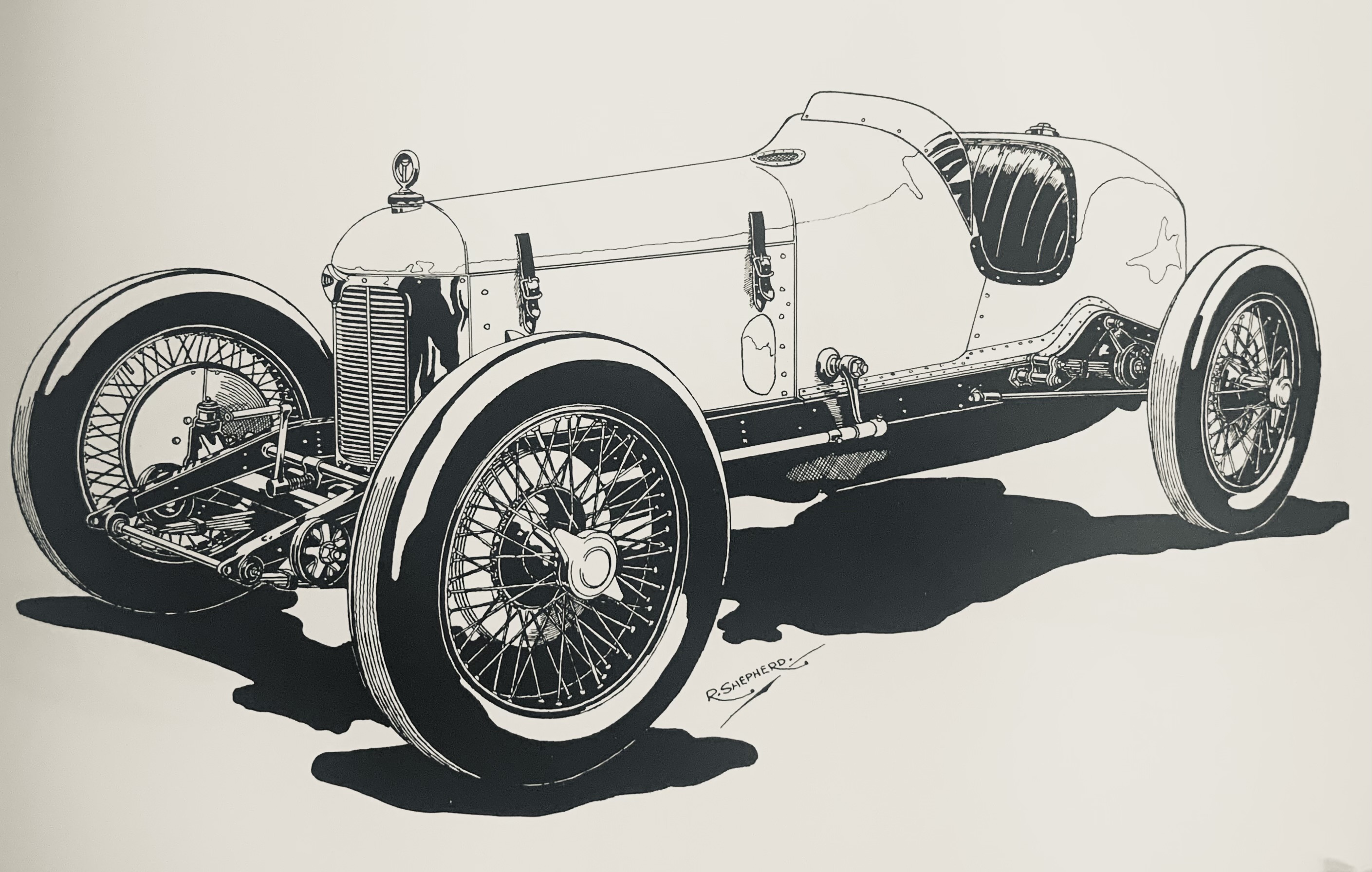
My first exposure to Bob Shepherd’s artistry was in the first issue of the late Barry Lake’s marvellous and way too short-lived Cars and Drivers magazine published in early 1977.
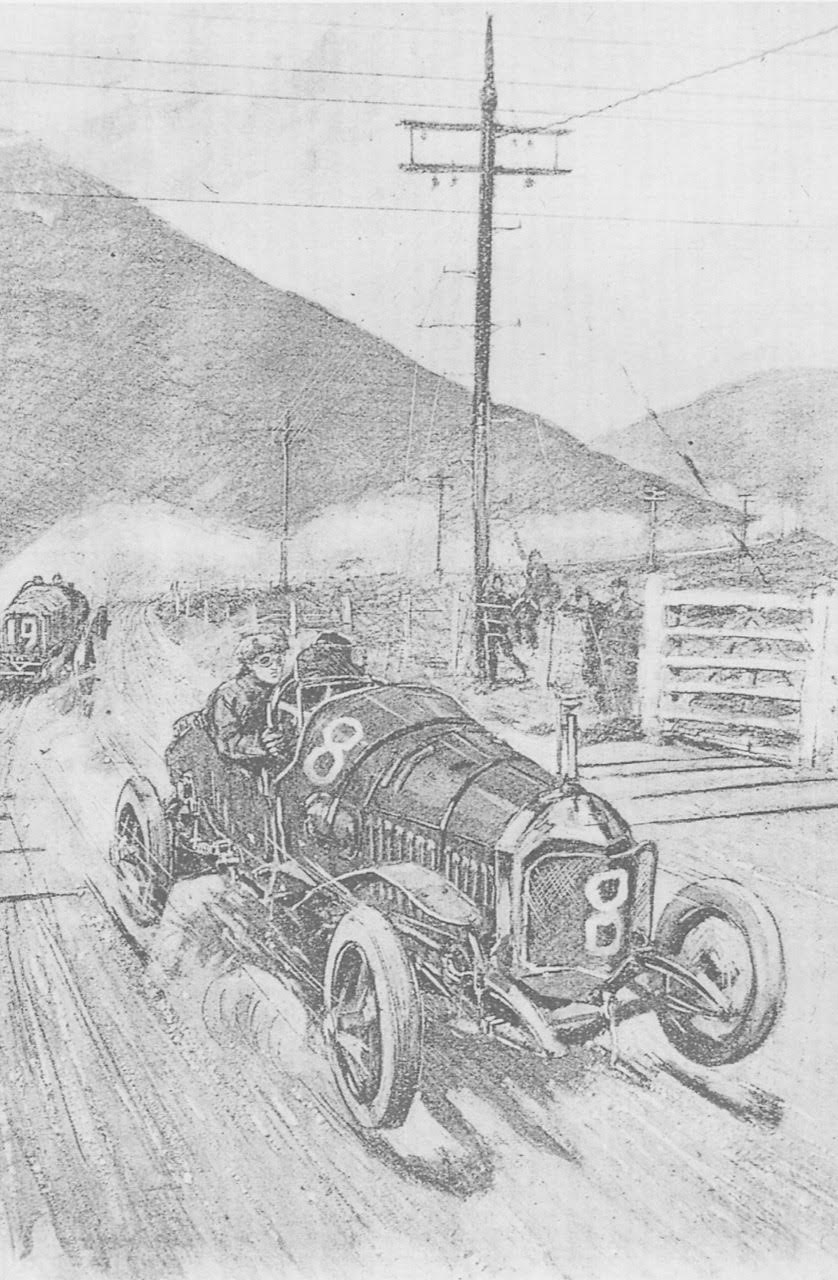
John Medley chose a Shepherd drawing of a Miller 122 to support an article he wrote about the ex-Zborowski machine which raced in New Zealand, and briefly in Australia pre-war, after the untimely death of the wealthy Briton at the wheel of a Mercedes during the 1924 Italian GP.
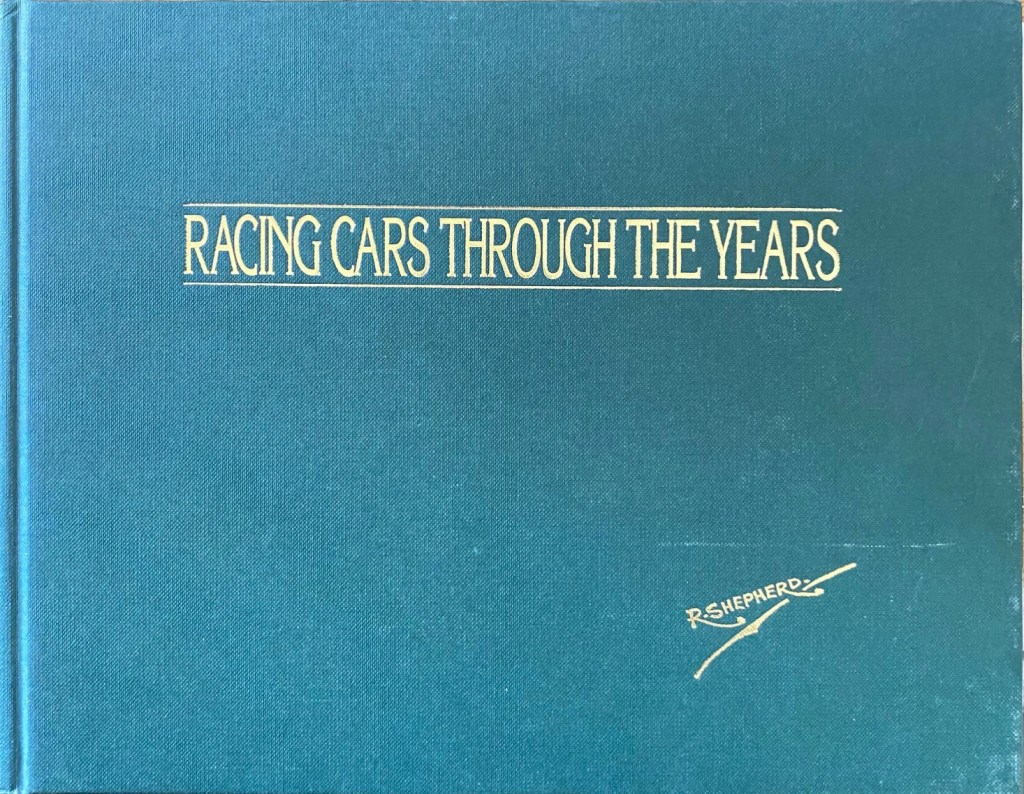
I’ve always been blown away by Shepherd’s work when I have tripped over it. Discussions with Bob King about the Miller led us to his copy of Graham Howard’s book (Racing Cars Through The Years) of Shepherd’s drawings published in 1993. Diana Davison/Gaze made available the Davison Family Collection of Shepherd images to Howard to allow the book to be published.
So little is known about Bob Shepherd we figured it was time to put something on the record more widely available than those lucky enough to have a copy of that marvellous book.
I asked Bob to do a bio, but after re-reading Graeme’s Introduction in the book, he said “How can I top that!”
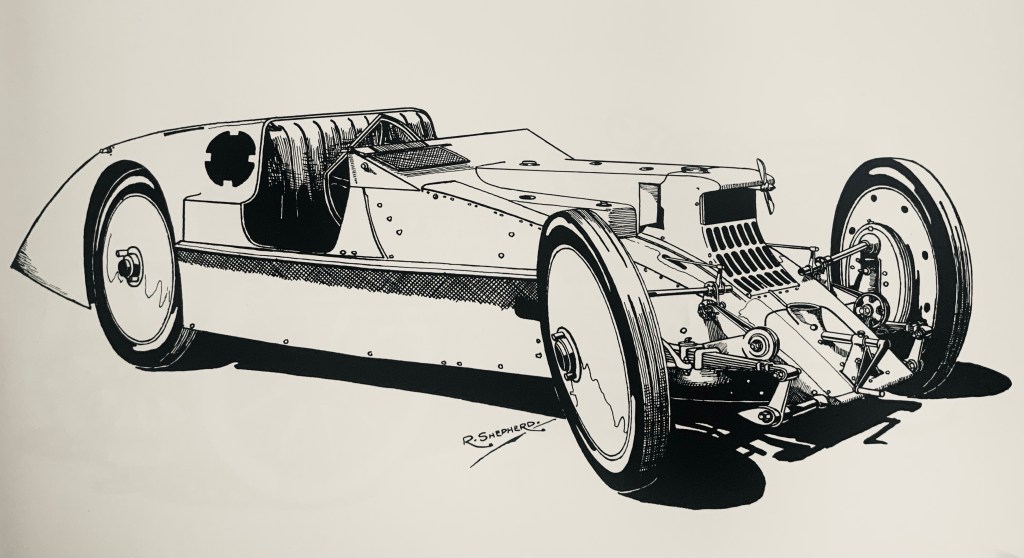
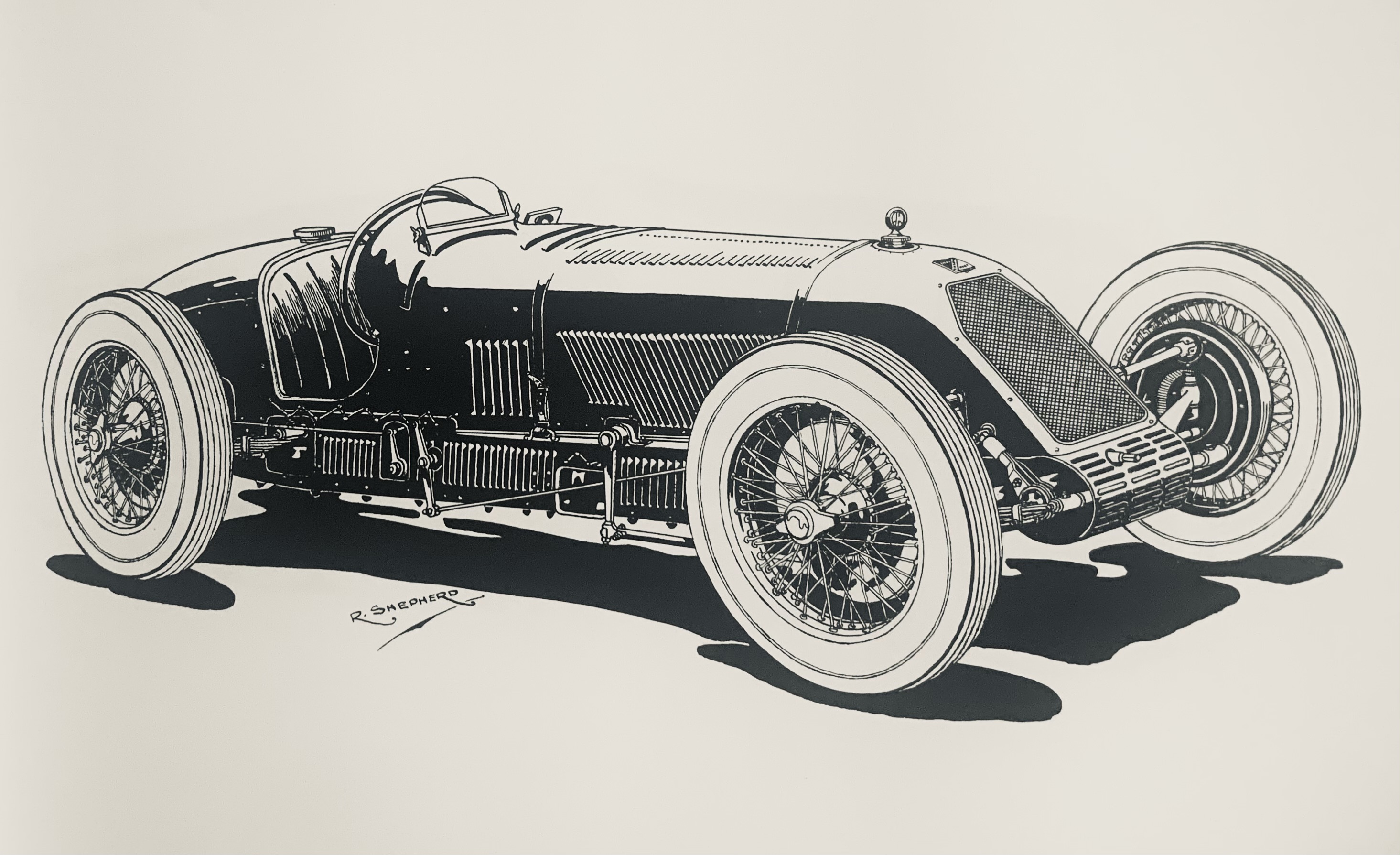
So, here it is, Howard’s words shortened only a smidge, and a small selection of drawings which I think demonstrate Bob’s mastery of his art. The descriptions of each car are exactly as they appear in the book.
MG R-type Midget, 1935. Zoller blown at 24-28lbs, MG’s tiny single-cam four (57mm x 73mm, 746cc) delivered 120bhp – more than the Q-type’s leaf-spring chassis could handle. Hence the all independent 750cc R-type, MG’s first ever pure-racing car, with far-sighted backbone chassis and torsion bar parallelogram wishbone suspension. Drawing appeared in the March 1958 AMS.Bob Shepherd in 1960
“To countless Australians Bob Shepherd the artist was also Bob Shepherd the historian, primarily because of the series of articles he wrote and illustrated for the magazine Australian Motor Sports, starting in August 1946 and continuing for than 15 years.
With a distinctive combination of knowledge, passion and flair, he carried his audience into the magic world of the racing and high performance cars of Europe and (to a lesser degree) America, broadly from the time of the French Grands Prix through to the end of the 1930s. Month by month, car by car, Shepherd spread before his readers the treasures of the Vintage era and the legendary cars of the 1930s which laid the foundations for post-WW2 motor racing. Over the years he gave AMS readers an education in motoring history unrivalled anywhere in the world.
Not that he confined his energies to Australia. He sent drawings overseas to MotorSport and to the Bugatti Owners Club journal Bugantics and was singled out by British engineer-historian Laurence Pomeroy, in the second edition of his milestone book The Grand Prix Car, for having been particularly helpful in suggesting improvements and corrections to the original work. The significance of this acknowledgement needs to be emphasised – that, while far removed from the Northern hemisphere’s factories, archives and authors, Shepherd was nonetheless the master of details which had eluded even the most eminent of British motoring historians.
Even more remarkable was that Shepherd had no formal training, either as an engineer or as an historian, or for that matter as an artist. The writing and illustrating of his monthly AMS pieces, and the maintenance of his correspondence with enthusiasts around the world, was done from the lounge room of his house in the time he had spare from family life and his job as a stores clerk.
Itala 12-cylinder fwd, 1926. Tested but never raced, these innovative cars would have competed against such classics as the 1.5-litre Delages. They were true single-seaters with fully independent suspension; the supercharged V12 engines were built in 1500cc and 1100cc form, the single central camshaft flanked by its two rows of horizontal valves. Drawing appeared in the August 1952 AMS.
He was born in 1914 in the Sydney suburb of Pagewood, where his father was a hairdresser. He was the oldest of three children; he and his brother Sydney were each dux of Daceyville Primary School in their respective years, and Bob was later also dux of Cleveland Street High School, but university was out of the question. Cars and drawing were his great interest, but work in the motor trade was impossible to find: eventually a family friend heard of a job at Davis Gelatine, and he worked there until his retirement in 1979, holding a staff position from 1964. He married Joan Manhood in 1940, they had three children.
As a schoolboy Shepherd had started writing to overseas car manufacturers for catalogues; these catalogues, his voluminous international correspondence, and dissected copies of The Motor, The Autocar and MotorSport formed the basis of his archives, kept in rows of manila folders in large glass-fronted cupboards.
His drawings were made using the simplest of methods and materials. A pencilled grid, or a pair of dividers, would be used to transfer dimensions and proportions from the chosen source photograph onto a sheet of his favourite cartridge paper, and the drawing would start in HB pencil, which would be rubbed out after the final version had been inked-in using mapping pens. All his work was freehand – there were no rulers or artificial aids like French curves. He did most of his drawings on Sundays after church, working for four to five hours, resting his paper on a wooden board and taking advantage of natural light. It would usually need two Sundays to produce a drawing; those for AMS were sent to Melbourne (always by registered mail) in cardboard cylinders accompanied by the text for his article which – like his letters – would be written in copperplate script, blue ink on unlined paper.
He was not comfortable drawing vehicles in action, or drawing people, and he showed no interest in drawing aircraft or motorcycles. Almost all his work was black and white: AMS itself was not printed in colour. In some drawings he used a wash, rather than hatching, to provide shading: when he did use colour, for example for private commissions, it was with complete success. His black box of watercolour pigments, bought when he was 12, is still in use by one of his grandchildren.
Bob Shepherd’s colour drawing of a 1922 Bugatti Type 30 (B King Collection)Delage 2-litre V12, 1923-1925. After two relatively unsuccessful years as unsupercharged cars, the V12s were supercharged for the 1925 season (as illustrated) and finished 1-2 in the French Grand Prix. The four-camshaft engines (51.3mm x 80mm, 1984cc), unusual in having the exhausts in the centre of the Vee, gave about 190bhp in supercharged form. This drawing appeared in the June 1954 AMS.
As well as his work for AMS, he provided illustrations for many club magazines and illustrated ‘Vintage Types’ for the Vintage Sports Car Club of Australia, he was one of its founding members. His first published drawings may have been the series ‘Australia’s Best Known Speed Cars’ in Motor in Australia and Flying in 1939. He was sometimes asked to suggest shapes for rebuilds or of new racing cars. As a boy he had watched racing on the banked concrete saucer at Maroubra but went to few race meetings in later years. More surprisingly, he never owned a car (although he had part shares in several), seldom drove, and did not hold a licence, he never travelled outside New South Wales.
Yet he was in no way reclusive or narrow in his interests. While a reluctant partygoer, he was a most entertaining teller of stories, had an astonishingly broad general knowledge, was a keen reader, loved opera (he did his drawings with ABC radio playing) and was well enough known as a fisherman for there to be an unofficial ‘Shepherd’s Rock’ at nearby Kurnell.
There was little to single out the family house in Maroubra Bay Road. Shepherd took his research seriously – he shared in some ferocious debates in his correspondence columns – but there was absolutely no pretence; there was nothing in his manner to hint that here was one of the foremost authorities on motoring history. Joan and Bob Shepherd made everyone most welcome, whether they were famous names or awed tram-travelling young admirers (for which all those young admirers remain very grateful).
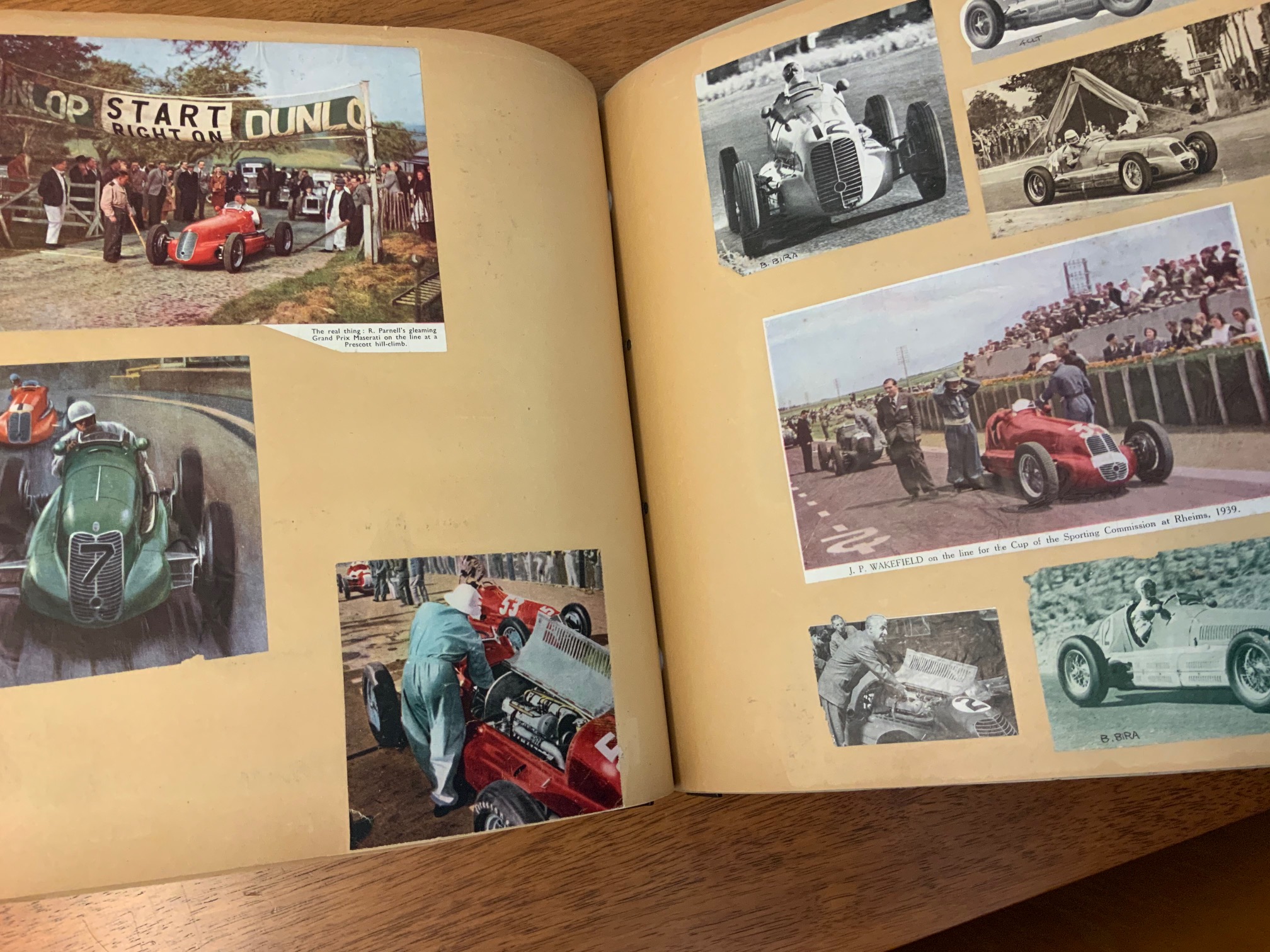
Voisin Grand Prix, 1923. Gabriel Voisin was a pioneer French aviator and aircraft manufacturer, as well as an innovative car maker. His cars for the 1923 French GP had only around 75hp from their 2-litre six-cylinder Knight double-sleeve-valve engines, but had aerodynamic body work and disc covered wire wheels and a true monocoque chassis of plywood and sheet metal. The drawing appeared in the September 1956 AMS.This is a spread from Bob Shepherd’s Maserati scrap-book, a simple but effective way of archiving material, I guess we all have one, or many! (D Zeunert Collection)
Like many remarkable people, Bob Shepherd was a paradox. He almost never drove a Vintage car, seldom went to the Vintage club meetings, yet was – without realising it – the Australian Vintage movement’s finest publicist. He never travelled outside Australia, never saw any of his beloved cars in their heyday, yet he knew them in minute detail and could picture them with elegant clarity. He had rare gifts yet remained a modest and gentle man. With this book we remember that man.”
Graham Howard, Sydney, 1993.
Talbot-Darracq 1.5-litre, 1926 (above). Continuing Darracq’s pre-1914 racing tradition, the company’s cars for the 1926 1.5-litre formula were 140bhp supercharged twin-cam straight-eights (56mm x 75.5mm, 1488cc). Engine and gearbox were slightly offset to the drivers left. A much modified version of one of these cars (still in 2021) survives in Australia, imported after WW2. The drawing appeared in the October 1951 AMS.
Oops, nearly forgot the Miller 122 at this pieces outset. Miller, 1923. Influenced by Fiat, Harry Miller used two valves per cylinder in hemispherical chambers when he scaled down his 183-cubic inch straight-eight for the 122-inch (2-litre) limit applying from 1923, obtaining an unrivalled 120bhp. Supercharged from 1924, and reduced to 91c.i. from 1926, these engines won Indianapolis in 1923, 1926, 1928 and 1929. That drawing appeared in the April 1957 AMS.
Credits…
‘Racing Cars Through The Years’ Bob Shepherd and Graeme Howard, Bob King Collection, David Zenuert Collection
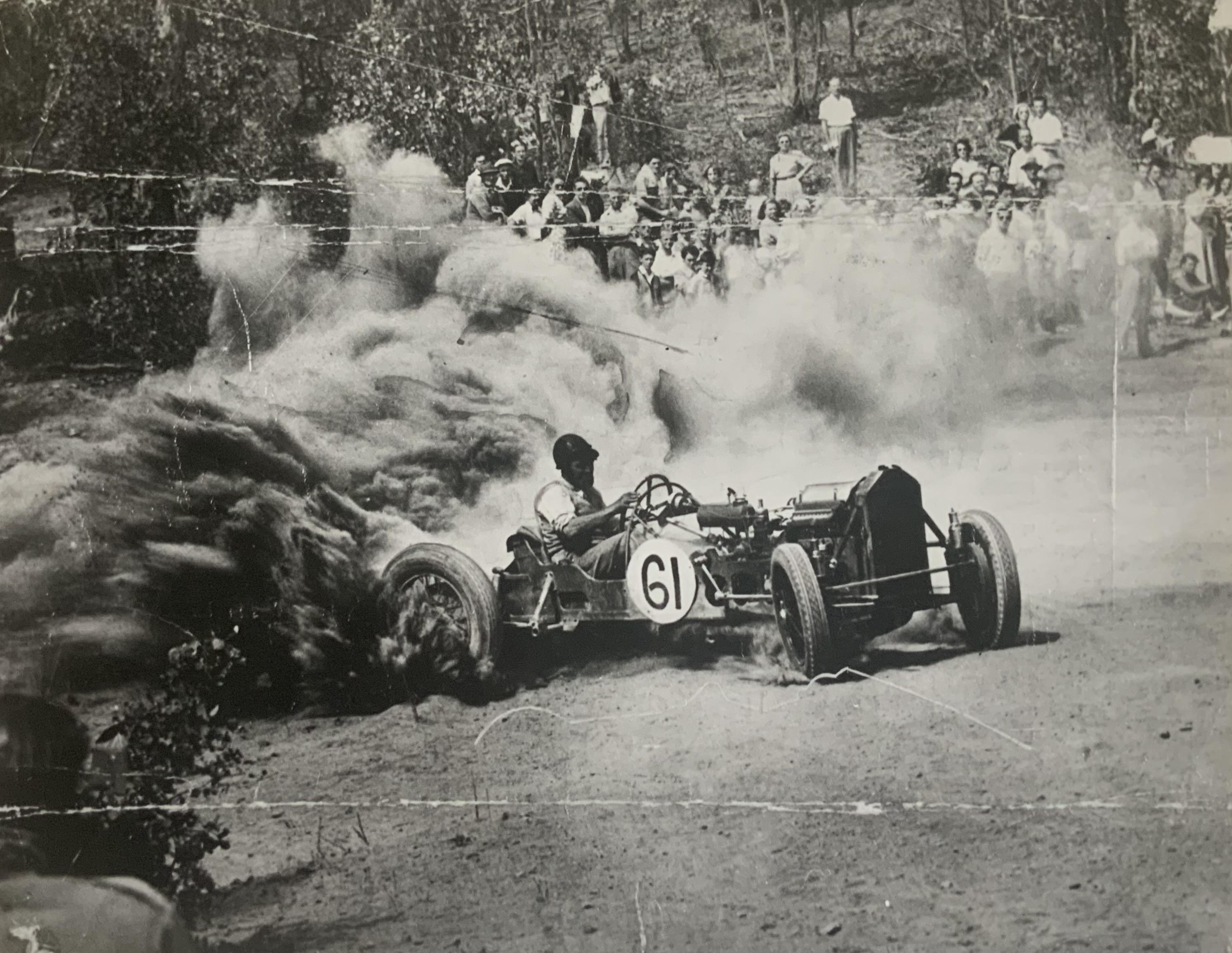
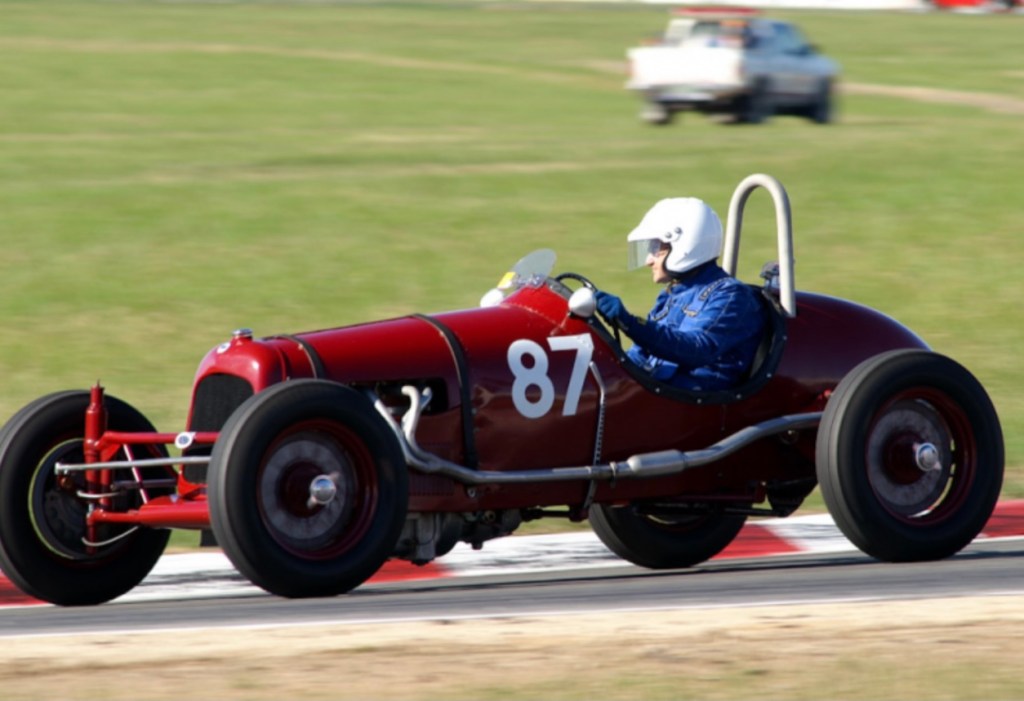
A one-armed paper-hanger! Ron Chandler, Lancia Lambda Special (Chandler Special) at Mount Tarrengower, post-war, date folks? Isn’t it a marvellous shot, gotta be summer with that much dust.
Plenty of Vincenzo Lancia’s outstanding cars came to Australia and no shortage of them were adapted as racing cars as they aged. The mix of stiff monocoque chassis, SOHC V4, four-speed gearbox and independent front suspension was irresistible to enthusiasts. The Chandler was a mix of narrowed fifth series chassis and eighth series components. Ron had no shortage of knowledge or parts, he was a Lancia dealer/wrecker in Melbourne’s inner-eastern suburb, Hawthorn.
(J Hickford)
The shot above shows Eddie Perkins (Larry’s dad) at the wheel of the Chandler. Note the ‘sprint’ fuel tank (‘snot water I think) and support structure, the chassis and exhaust are also clear. Perkins built a mid-engined Lancia Special of his own circa 1951 – a story for another time.
This car later morphed into the Lambda based, monoposto Meadows Special built by Rob Harcourt, shown below at Winton. It marries a narrowed fifth series chassis and seventh series Lambda components mixed with a 3-litre 4EH Meadows engine first fitted to an Australian assembled Chic circa 1925. With around 200bhp, it’s a very quick car.
(A Cox Collection)
Etcetera…
(Classic Cars in Profile)
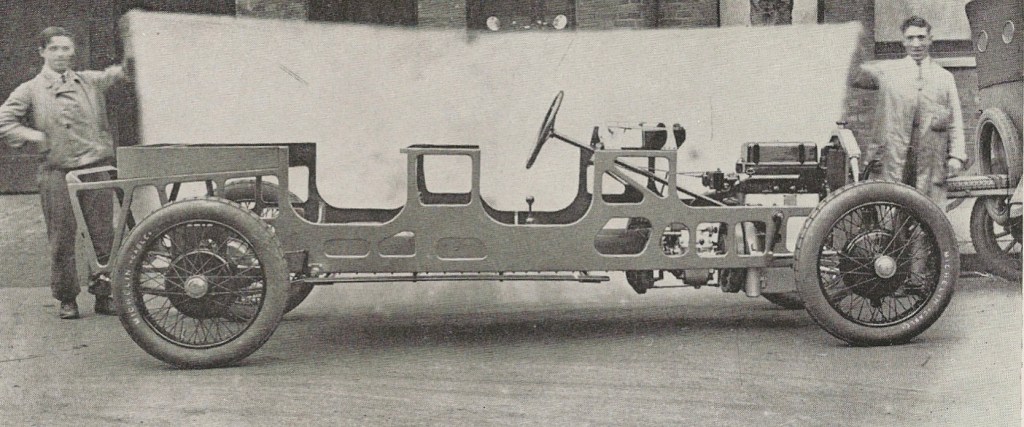
Stripped Lambda shows the key elements of the design to good effect – that pressed steel unitary/monocoque chassis was so far ahead of its time…Ease with which it can be cut-and-shut obvious.
(unattributed)
Credits…
Bob King Collection, Andrew Cox in the Lancia Motor Club website, Colin Marr, John Hickford, Classic Cars in Profile
Tailpiece…
(C Marr Collection)
Rob Harcourt’s Lancia Meadows Spl during the Australian Grand Prix carnival at Albert Park in 2000. The dude on the right is Sir Stirling Moss in an HWM Jaguar – which HWM Jaguar?
‘Daily Express’ motoring writer David Benson races a Lotus 31 at the Racing Car Show, Olympia, London January 19-26, 1966…
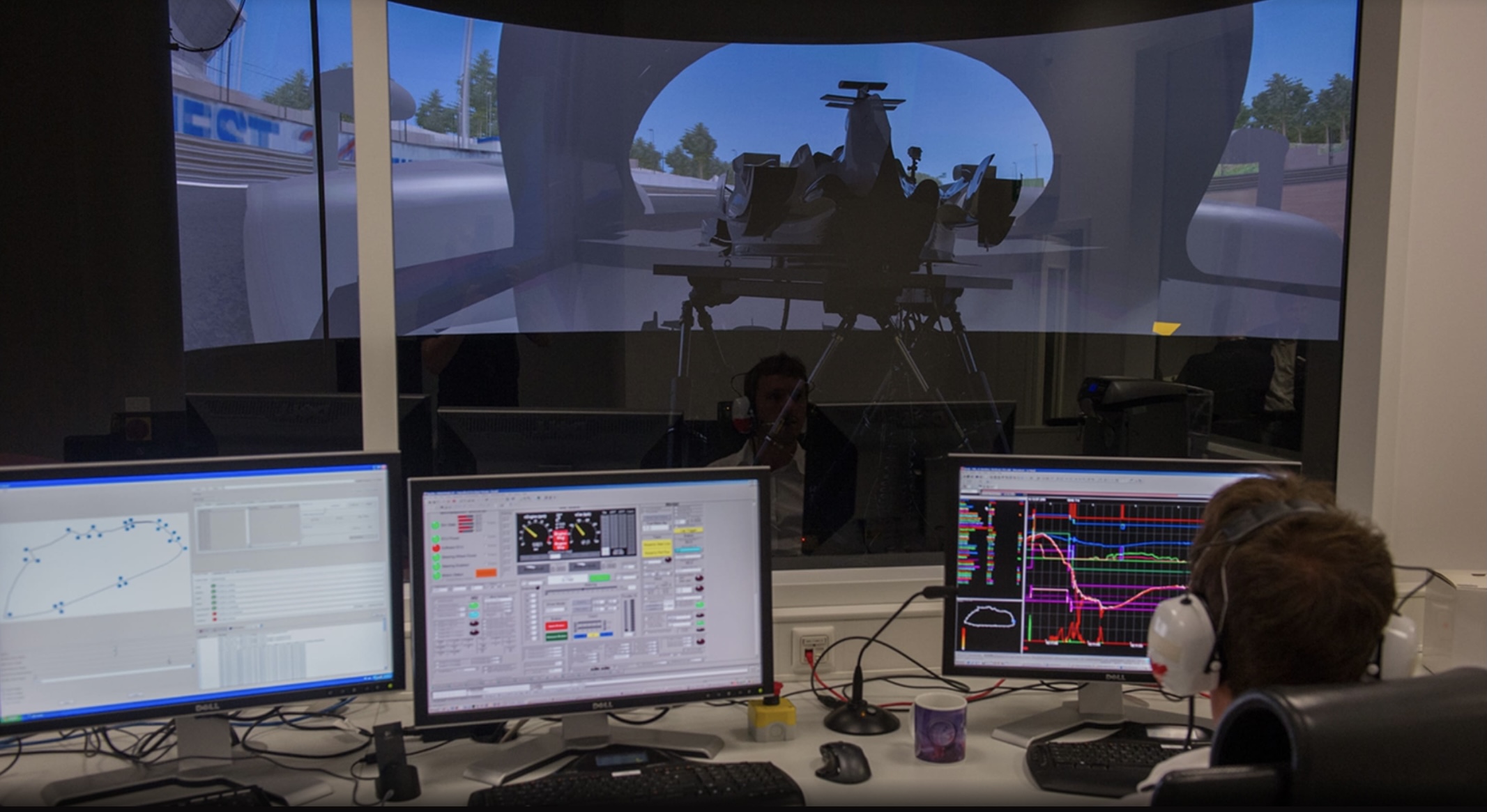
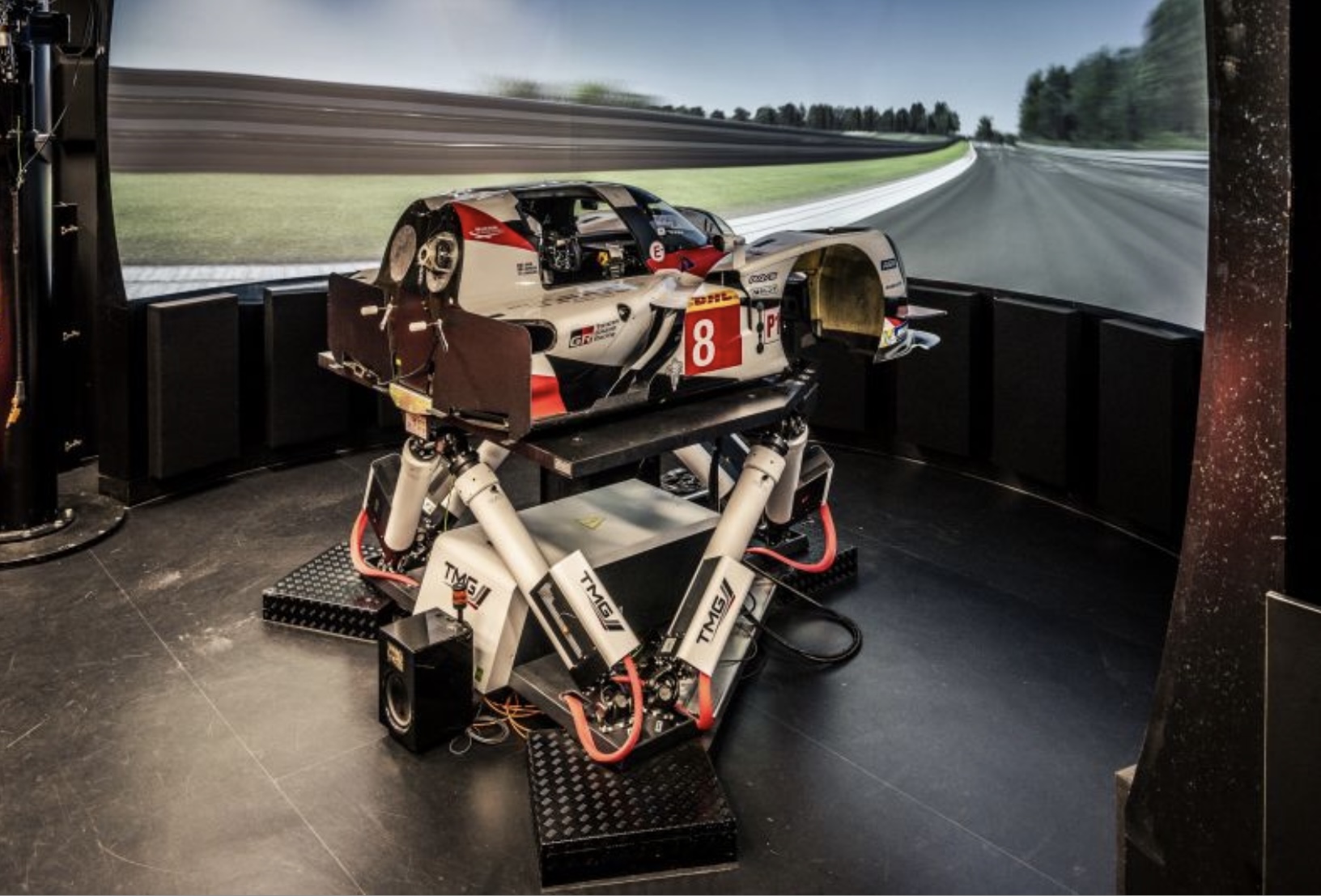
These days no self-respecting race-team from F1 down would be without their race simulator to sharpen their drivers preparation and performance. Like so many innovations from the mid 1950s to the mid 1980s, Lotus paved the way with a small number of sims they built for commercial/entertainment use in the sixties.
Aviation led the simulation way of course. French commanders Clolus, Laffont and Clavenad built the Tonneau Antoinette, regarded as the first ground training aircraft. Progress was swift, by World War 2 The Allies produced 10,000 Link Trainers to assist 500,000 new pilots into the sky.
Whether Colin Chapman’s motivation was broadening the appeal of racing by putting anyone in the driving seat, building the Lotus brand, or perhaps another profitable line of business is unclear. A small number – about 18 – were built and sold to dealerships and large corporates such as BP. The Avengers tragics may recall the ‘Dead Mans Treasure’ episode in which the woman behind the wheel had to keep driving fast or otherwise receive a deadly electric shock…
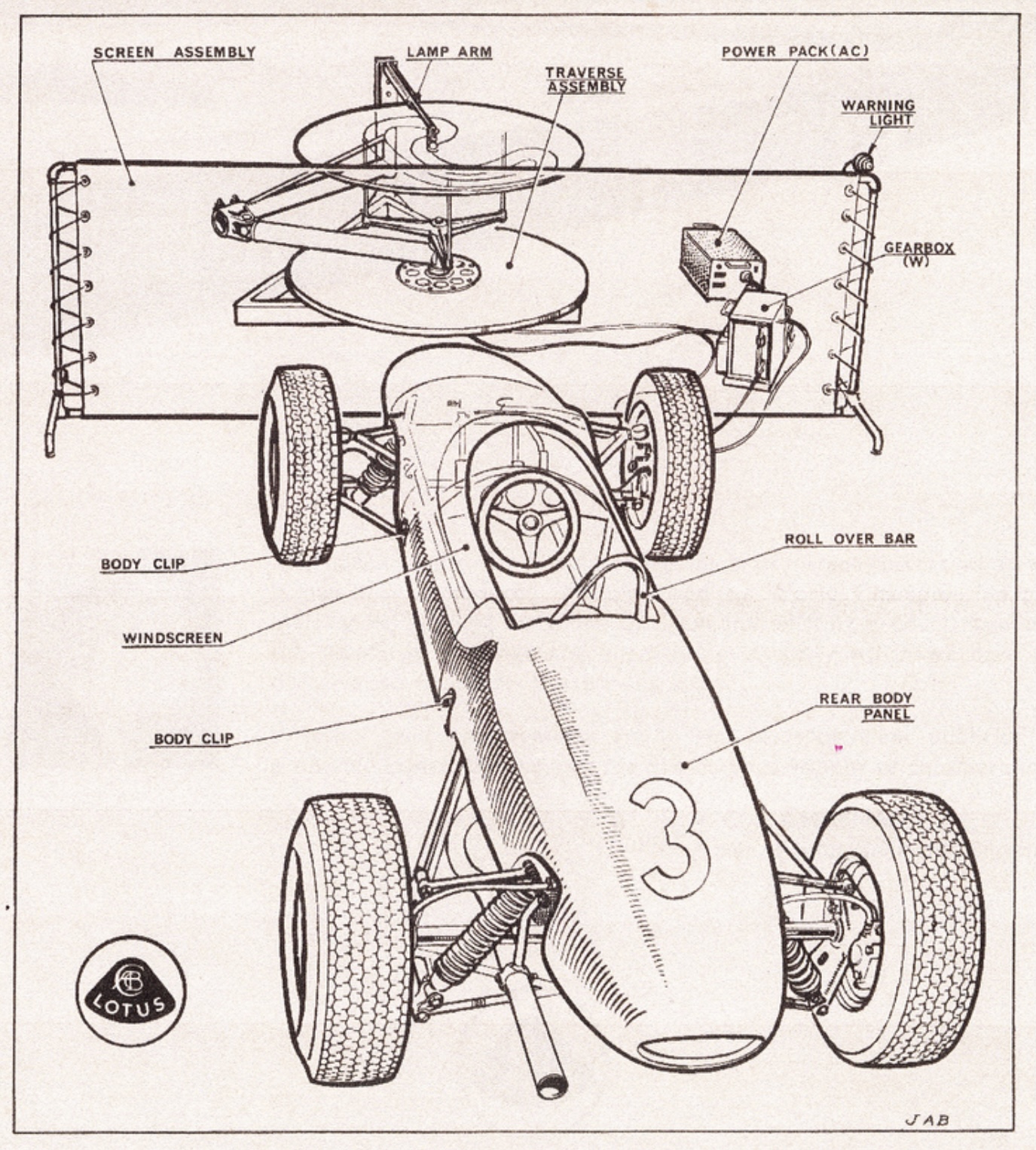
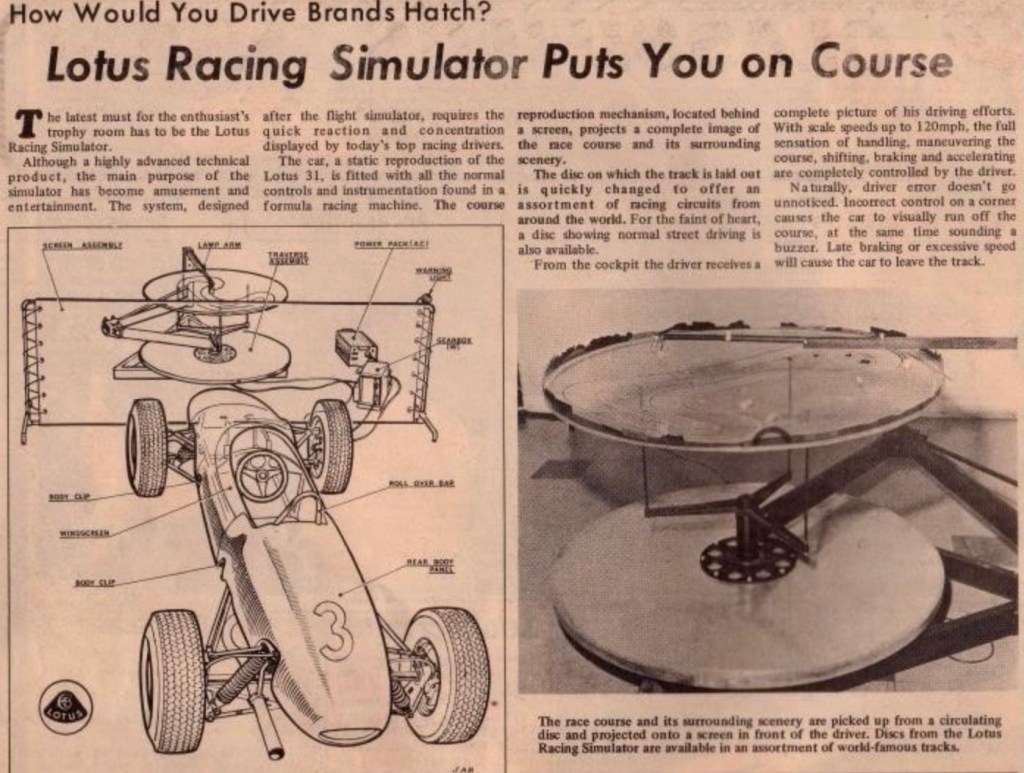
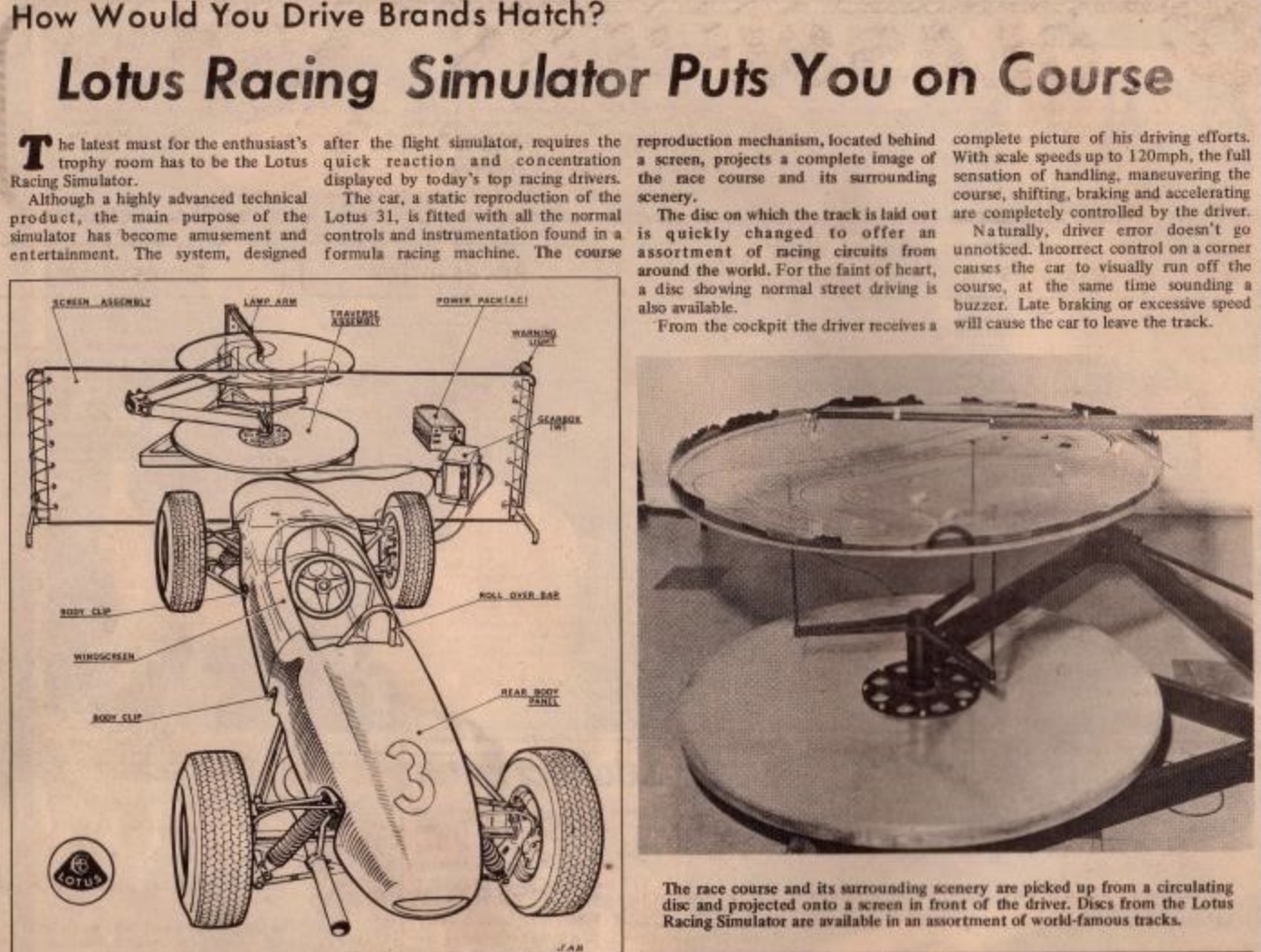
The car is a reproduction of an F3 Lotus 31 (it would be intriguing to know the differences between the real deal and the sim cars) fitted with all of the track-bound instruments and controls. “The course reproduction mechanism, located behind a screen, projects a complete image of the track and its surroundings.”
“The disc on which the track is laid out is quickly changed to allow a change of circuits. For the faint of heart, a disc showing normal street driving is available. From the cockpit the driver receives a complete picture of his driving efforts. With scale speeds up to 120mph, the full sensation of handling, maneuvering the course, braking and accelerating are completely controlled by the driver.”
“Naturally, driver error doesn’t go unnoticed. Incorrect control on a corner causes the car to virtually run off the course, at the same time sounding a buzzer. Late braking or excessive speed will cause the car to leave the track,” – while technology has advanced a tad, that much remains unchanged!
Etcetera…
(Grant Craft Collection)
Credits…
Victor Blackman, Golden Gate Lotus Club, Grant Craft Collection
Tailpiece…
(Toyota)
The elapse of a half-century – Toyota F1 race simulator circa 2008, and current TS050 Hybrid sim below, pretty much the only thing which cannot be replicated are the g-forces but doubtless that will come!
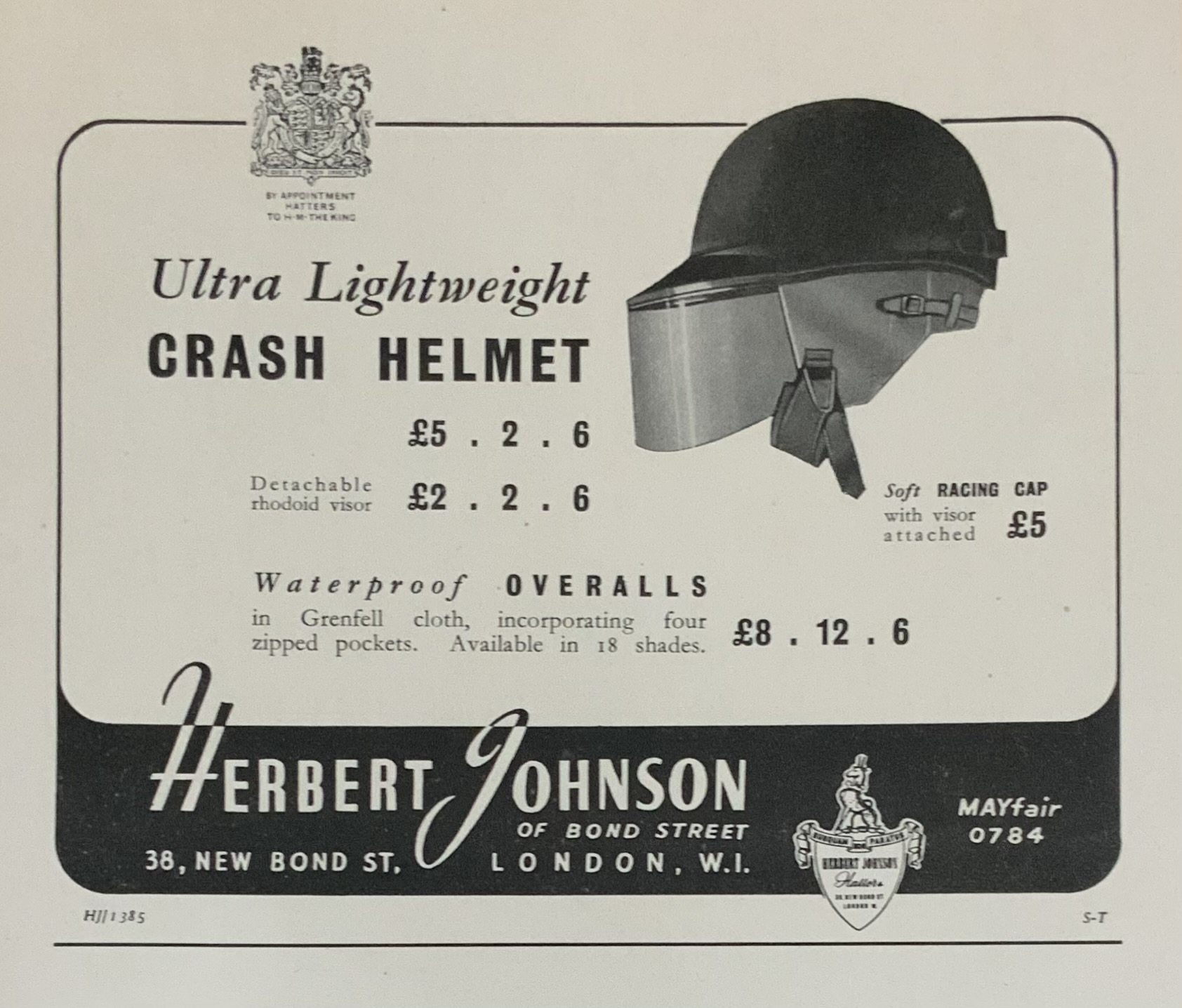
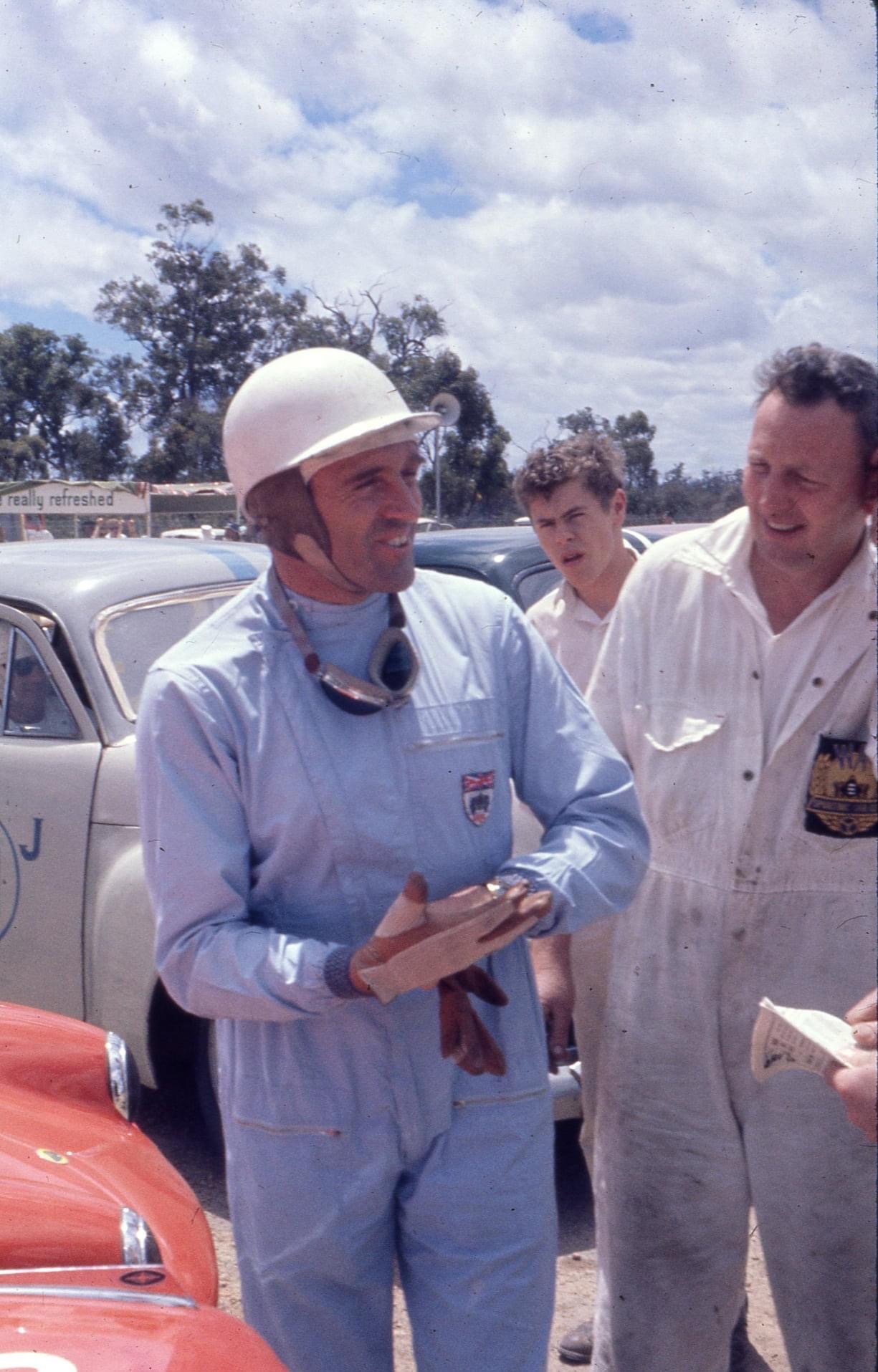
Herbert Johnson were one of the preferred purveyors of bash-hats to racing’s elite in the pre-Buco, pre-Bell early-mid 1960’s era.
The company, founded in 1889, made its name for its silk-velvet top-hats. By the outbreak of World War 1 its output was dominated by the demands of the military. Goldie Gardner was the first racer to commission a ‘protective hat’ from then proprietor, Geoffrey Glazier. Stirling Moss was a later customer as demand for the firm’s race products grew.
(K Devine)
Lex Davison is shown so equipped at Caversham, near Perth in November 1962. It’s the Australian Grand Prix meeting, the four-times AGP winner is shown on the dummy-grid – looking very pucka in Herbie Johnson with British Racing Drivers Club badge on his overalls – about to jump aboard Len Lukey’s Ford Galaxie in a mixed touring/sportscar support race. The nose of the Elite belongs to Anthony Osborne.
Credits…
Ad from Motor Racing 1948-1949 BRDC Yearbook, Ken Devine
Tailpiece…
‘If yerv’ got a $10 head wear a $10 helmet’ was Bell’s compelling mid-sixties tagline. A mix of technology and innovation, quality, marketing and a great distribution network ensured the Bell Corporation did their bit to improve the safety of our sport. Dan Gurney’s Eagle depicted is his 1966-68 F1 Mk1 Weslake V12
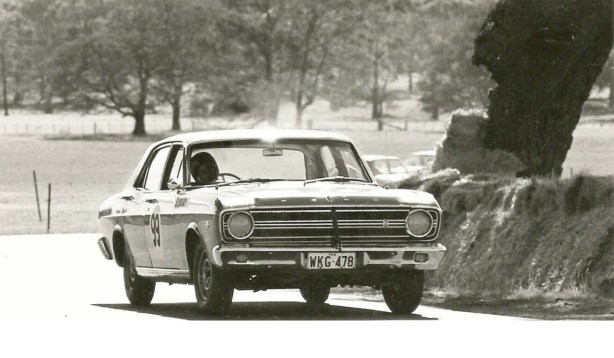
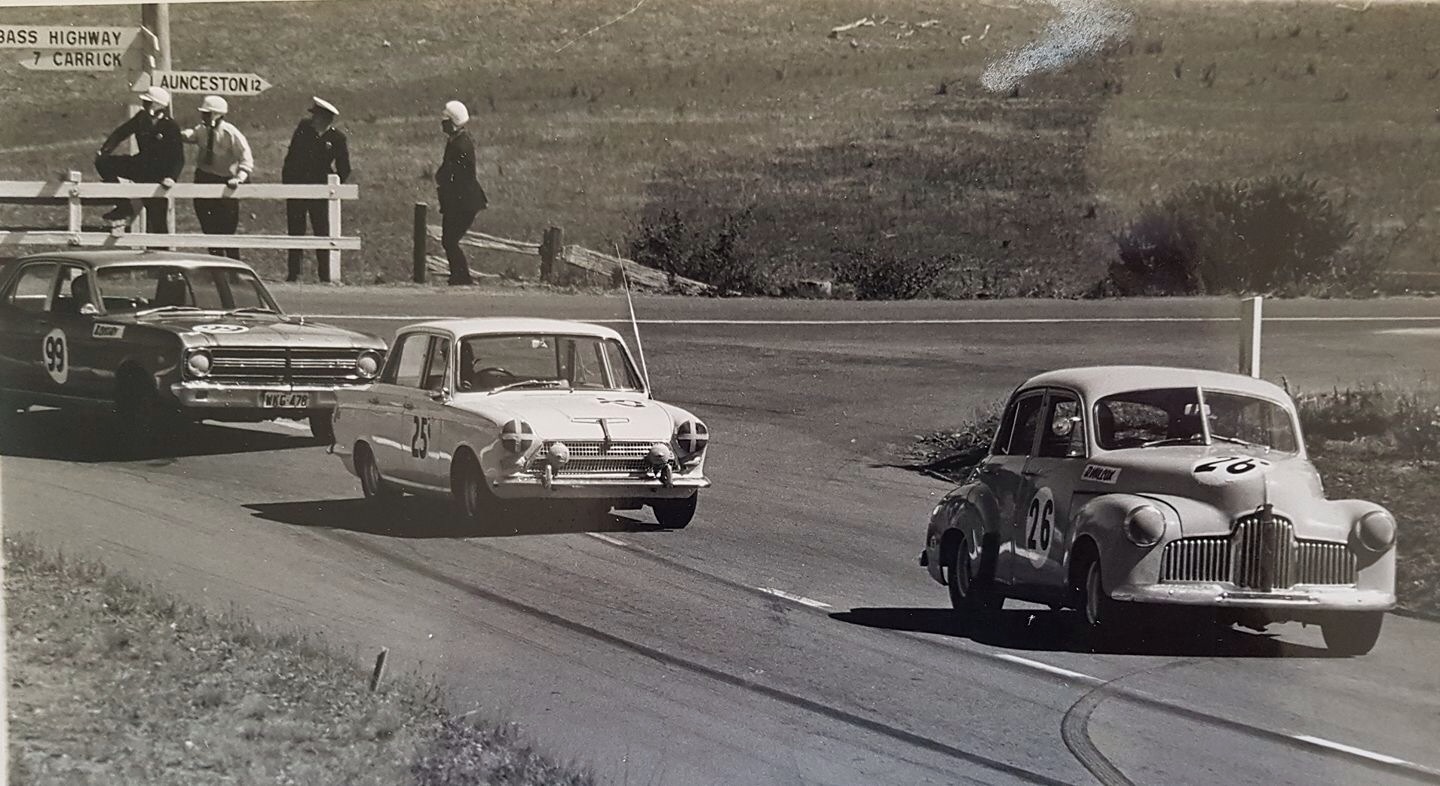
Barry Cassidy’s Ford Falcon XR GT ahead of Bill Brown’s Ferrari 350 Can-Am, Newry Corner, Longford 1968…
Series Production or showroom stock racing was hugely popular in Australia during a golden period to the end of 1972 when the Supercar Scare forced the rule-makers to change tack – a story in itself! Actually there is about it in the middle of this Holden Torana XU-1 V8 epic here; Holden Torana GTR XU1 V8… | primotipo…
Here, local lad and long time racer Cassidy is practicing for his event during the Tasman weekend in his brand new, straight off the showroom floor, 289cid V8 powered Australian pony-car. It was the first in an amazing series of road legal and oh-so-fast Fords built from the late sixties to the late seventies. Most of them won the Bathurst 500/1000 classic including the XR GT which triumphed at Mount Panorama in the hands of Harry Firth and Fred Gibson in 1967.
Cassidy showing delicacy of touch exiting Mountford, Longford 1968 (oldracephotos.com)
Cassidy had a top speed of 120mph or thereabouts, Brown about 170, and is about to swallow him on the uphill run to the right, then to the left onto the Flying Mile. He recalls that Brown was “probably not too impressed about being passed under brakes by the XR GT and signalled his thoughts about it as he blasted past on the Flying Mile!”
Cassidy raced the car for a bit, and was later at the vanguard of ‘Formula’ HQ Racing, a series for lightly modified Holden HQ Kingswood/Belmont of the early seventies, a hugely popular cost effective way to get into, and stay in motor racing. He is still racing too.
Cassidy chasing Graham Parsons’ Cortina GT and Darryl Wilcox’ Humpy Holden through Newry Corner. Barry was off a low grid position after being pinged by scrutineers for having a spare tyre not of identical section width as the four on the car! (HRCCT)
Credits…
oldracephotos.com, Historic Racing Car Club of Tasmania
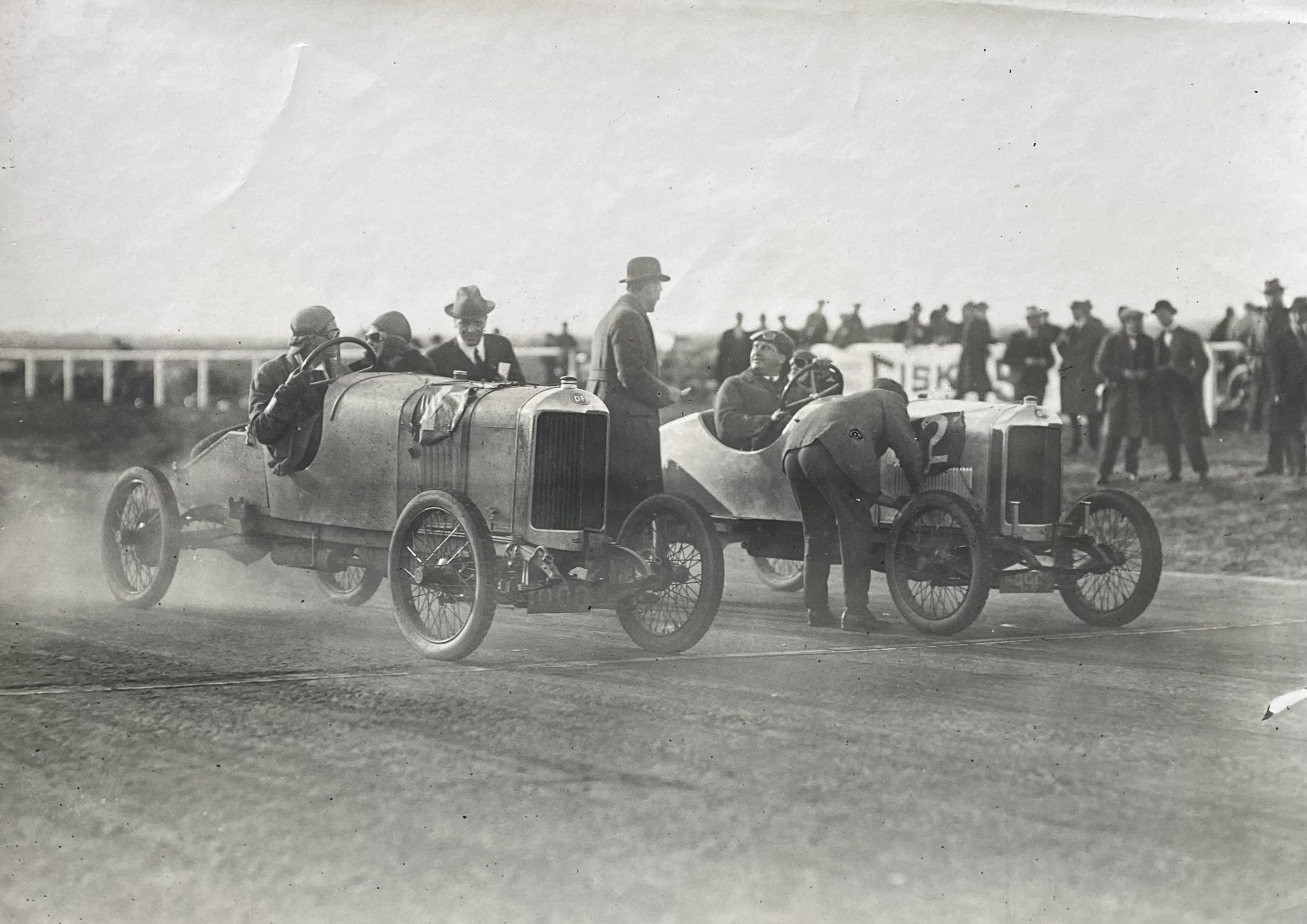
John Williams, DFP takes the chequered flag for The Sun, from HW Miller’s similar car for The Herald, in a five lap battle of the Melbourne Motor Editors at Aspendale on June 9, 1924
Fragments on a forgotten make
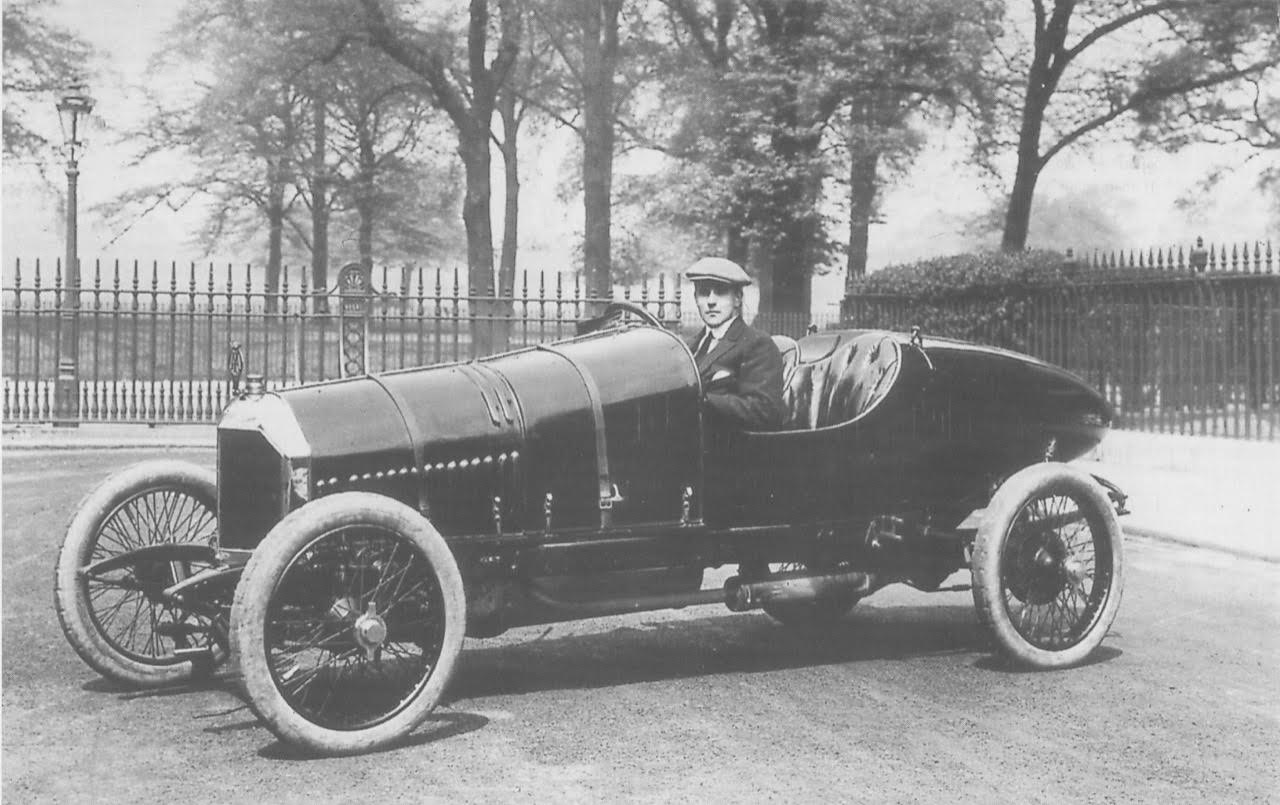
Mssr. Dorian, Flandrin and the Parant brothers made light cars of no great distinction in Courbevoie (Seine) between 1906 and 1926. Chronically underfunded, they relied on proprietary engines. They are best remembered by the reflected glory from their London agent W. O. Bentley’s use of aluminium pistons in DFP’s which led him to success at Brooklands. WO claimed that the idea to use aluminium pistons came to him in 1913 during a visit to their Parisienne factory. He said they allowed him to obtain ‘much more’ power from the engine – the main advantage being greater thermal efficiency, rather than weight saving. In regard to novelty, it should be noted that Aquila Italiana had been using aluminium pistons from 1906 under the guidance of their talented designer Giulio Cesare Cappa.
‘WO’ in a very smart looking DFP (B King Collection)Rendering of a similar DFP to WO’s (T Johns Collection)
Whether through ‘reflected glory’, improved performance or clever marketing, the DFP was not an uncommon entrant in post-WWI motor sport in Australia. It seems that the sporting motorist had a love affair with French cars, possibly engendered by their panache. This was distinctly lacking from the majority of Italian and English light cars of the period. It should also be remembered that cars from ‘former enemy’ countries were forbidden to take part in motorsport in the early post-war years– at least in Victoria.
My motoring archive has several splendid photos of DFP’s in action and Mark Bisset felt I should share them with you on primotipo.com
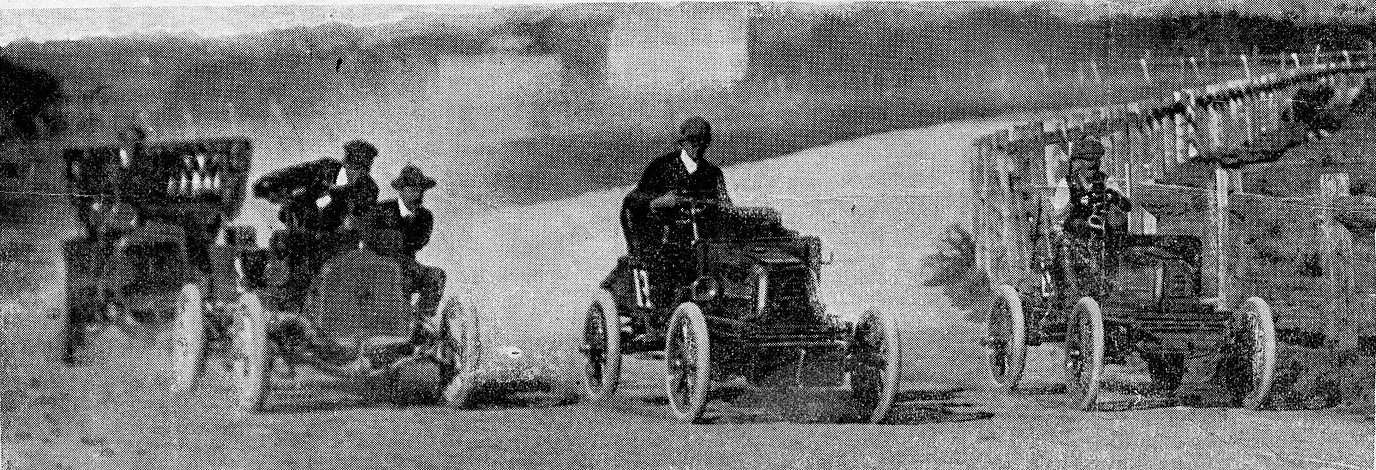
The first race at Aspendale on ANA day, 1906 (J Crooke Collection)
Aspendale
Situated in a sandy bayside suburb of Melbourne, Aspendale Motor Racing Club had a history dating back to the dawn of motoring. James Robert Crooke had a horse racing track built on his father’s land in 1889. The name of the venue played tribute to his champion horse ‘Aspen’, which had won the Newmarket Cup in 1880 and 1881.
Entrepreneurial Crooke had won Australia’s first motor race at Sandown Park in 1904 driving his steam powered Locomobile. By January 1906 they were motor-racing at Aspendale Park on what he claimed to be the world’s first purpose built racing track. After only a few events the track went into hibernation until a new banked concrete/bitumen track was built in 1923. The first event was held on this surface on 1 March 1924.
(J Crooke Collection)
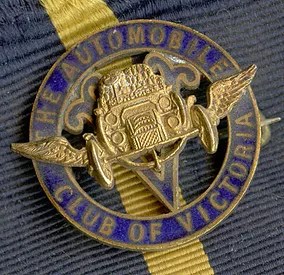
The promoter’s club badge
(J Crooke Collection)
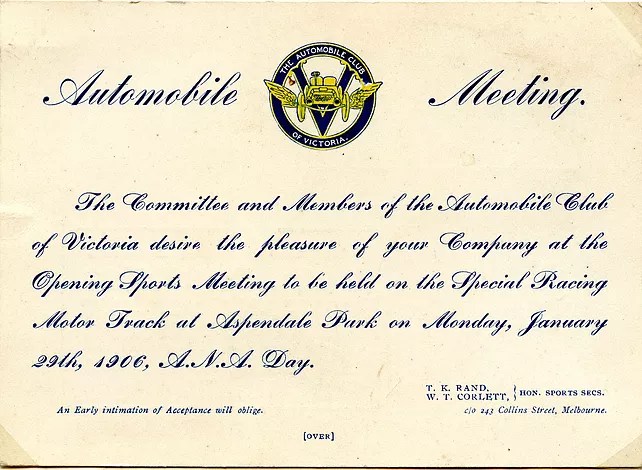
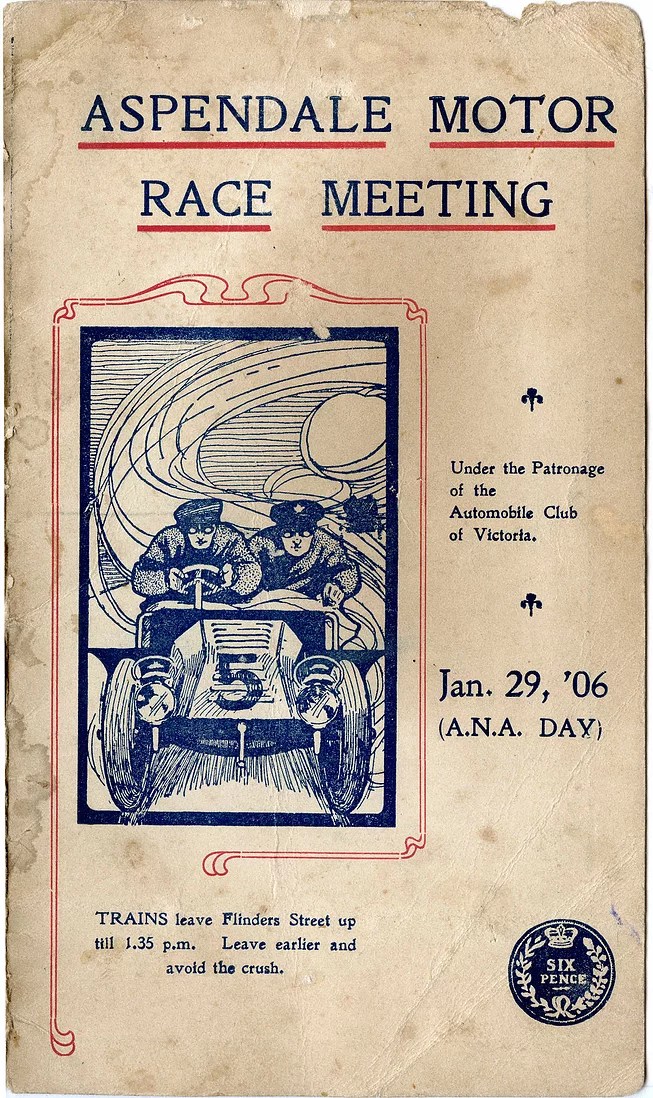
The ACV’s invitation to attend – love the formality of the day, and program, or programme, more correctly!
(J Crooke Collection)(J Crooke Collection)
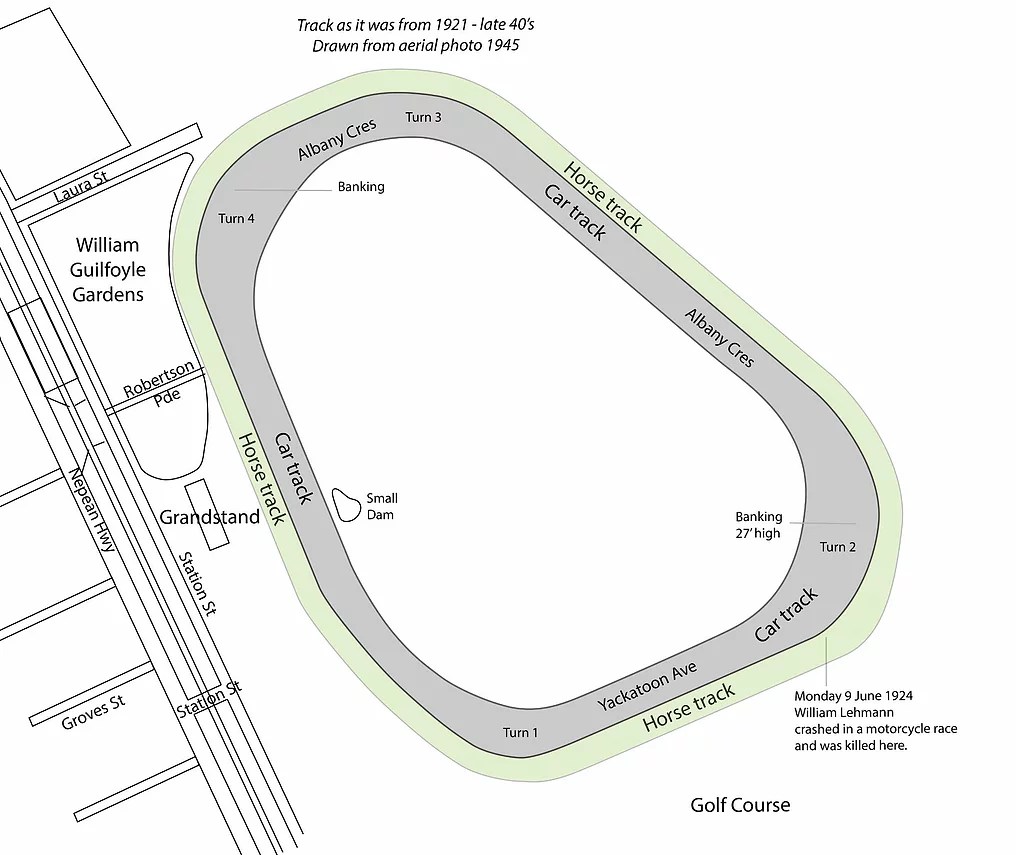
The track layout.
John Williams and the DFP at Aspendale
John was a jovial beret-wearing, Gauloise smoking motoring journalist who had a preference for French cars. He was the second owner of a Brescia Bugatti in 1929 and was still driving a Ballot 2LT in post-war years. As Motoring Editor for the Sun News Pictorial and later the Argus, his knowledge of cars was encyclopaedic. He came into our realm through friendship with Lou Molina and attendance at Lou’s Brighton Central Hotel in the 1970s.
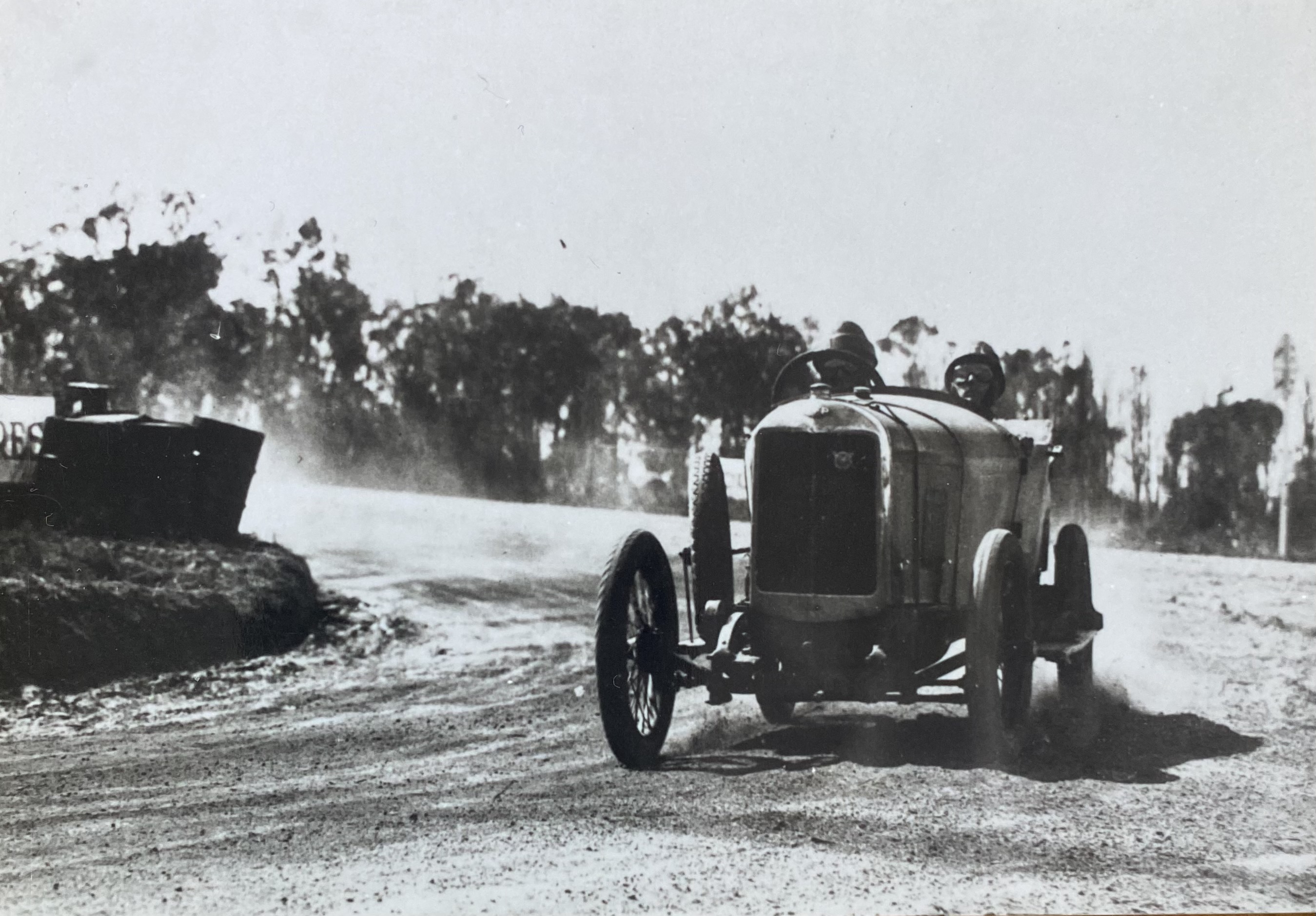
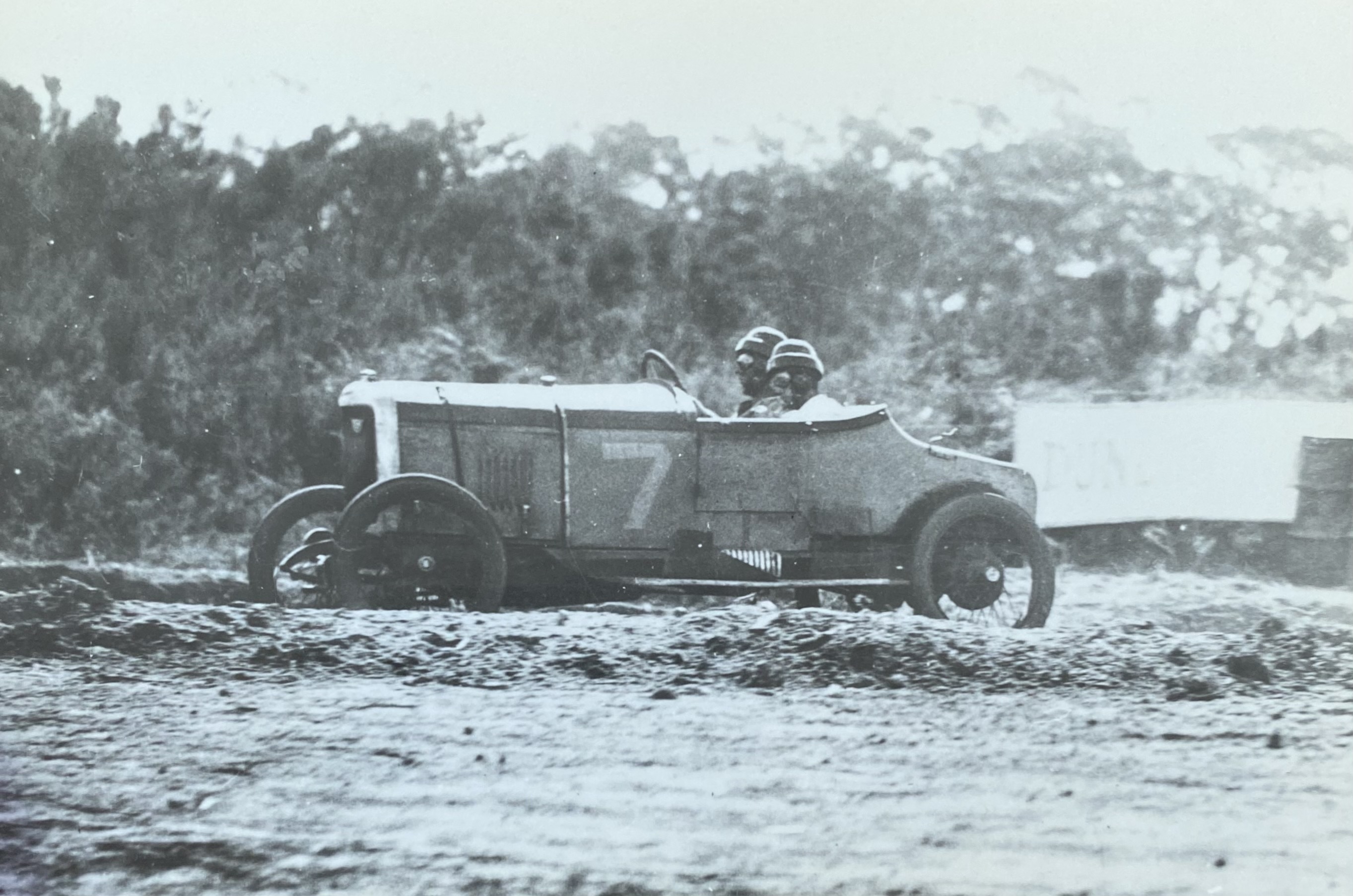
John took part in an unusual event at Aspendale on 9 June 1924 – a match-race between the Motor Editors of the Sun and the Herald. Fortunately, photographs survive of this encounter, showing that the drivers were accompanied by their wives. John annotated the back of one photograph, stating that this was the first time that women had travelled as mecaniciennes in a motor race in Australia. John’s wife Pegg is quoted as saying “What a damned row 24,000 people can make!”
(Bob King Collection)
The start of the motoring journalist match-race.
(Bob King Collection)
John and Pegg Williams ensconced in the DFP. Winners are grinners, the rest can make their own arrangements.
Sporting Cars, DFP and Miss Marie Jenkins
If clever marketing contributed to the DFP’s popularity here in Victoria, the responsible party is likely to have been Sporting Cars, the future agents for Bugatti, who used the attractive Marie Jenkins to promote their brand (Sex sells).
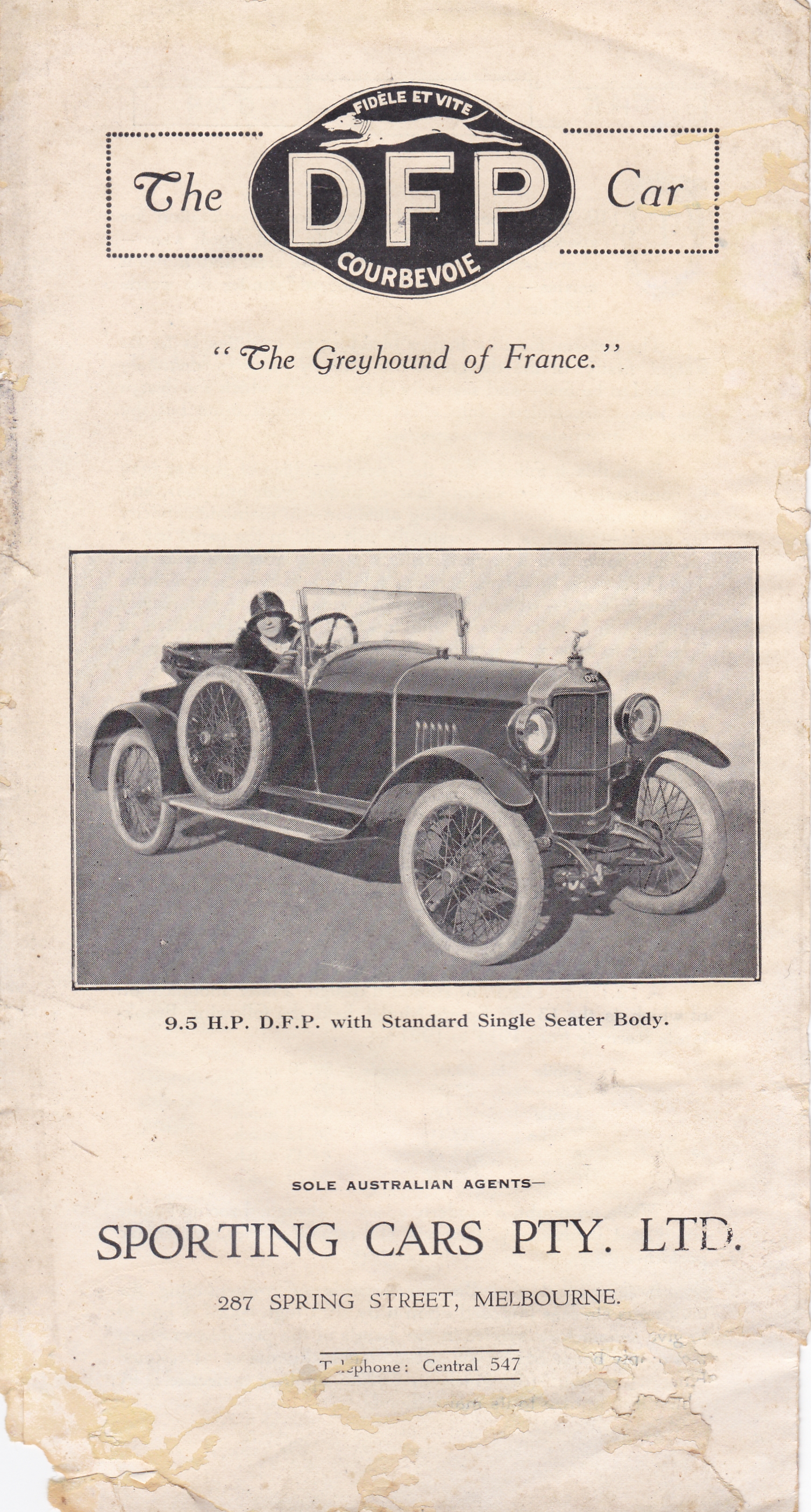
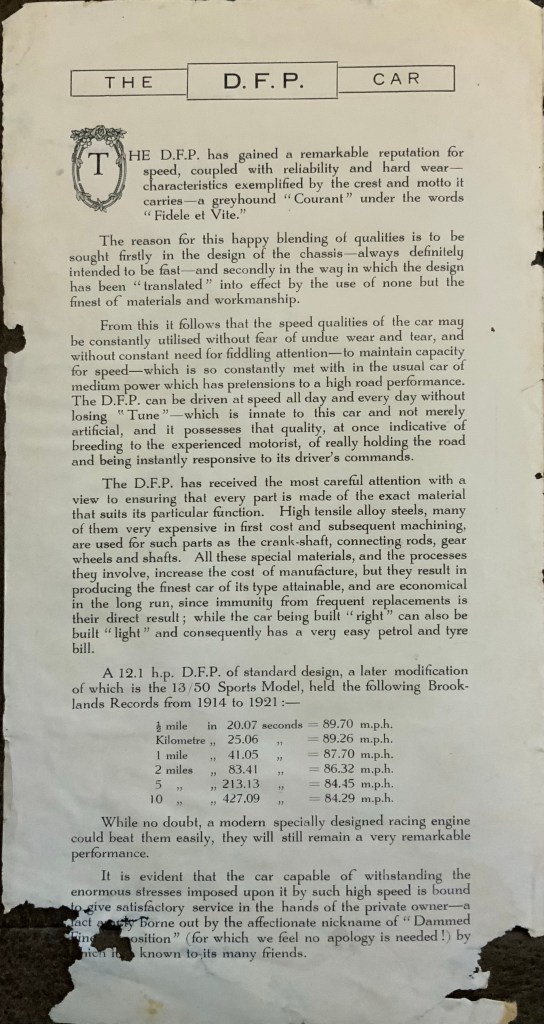
Sporting Cars claimed that the DFP had ‘a remarkable reputation for speed, coupled with reliability and hard wear’ – these characteristics being exemplified by the crest and motto on the radiator badge – a greyhound ‘Courant’ under the words ‘Fidele at Vete’. Marie was often seen in the company of Sporting Cars directors; their relationship has not been established.
(B King Collection)
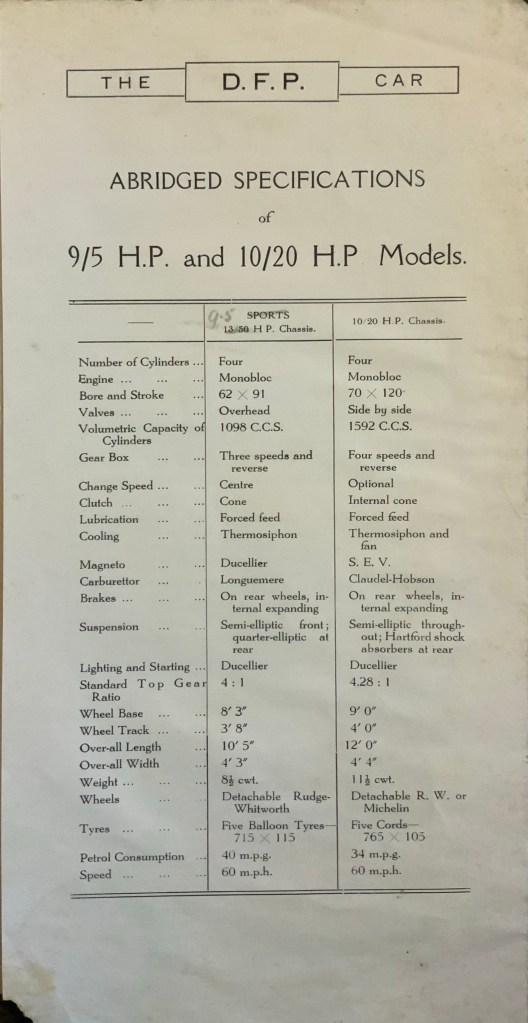
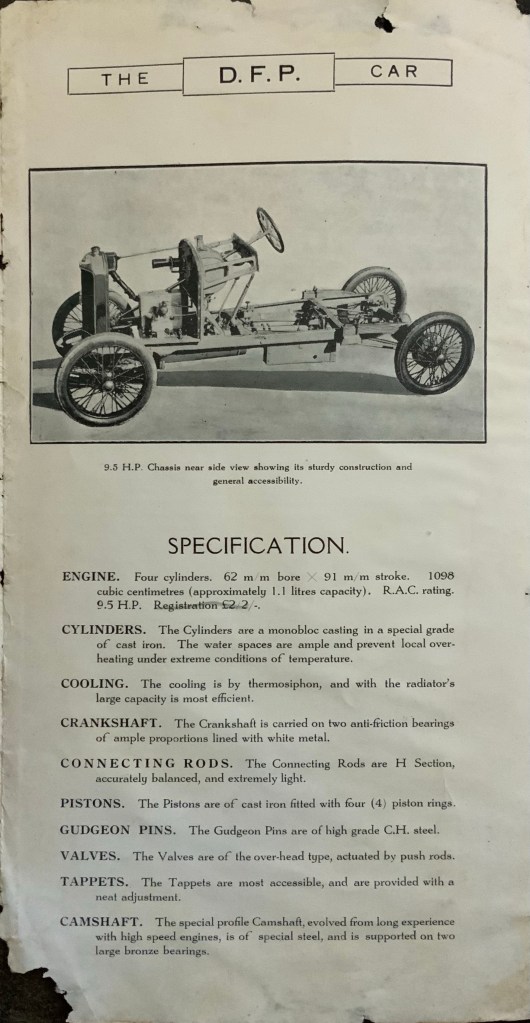
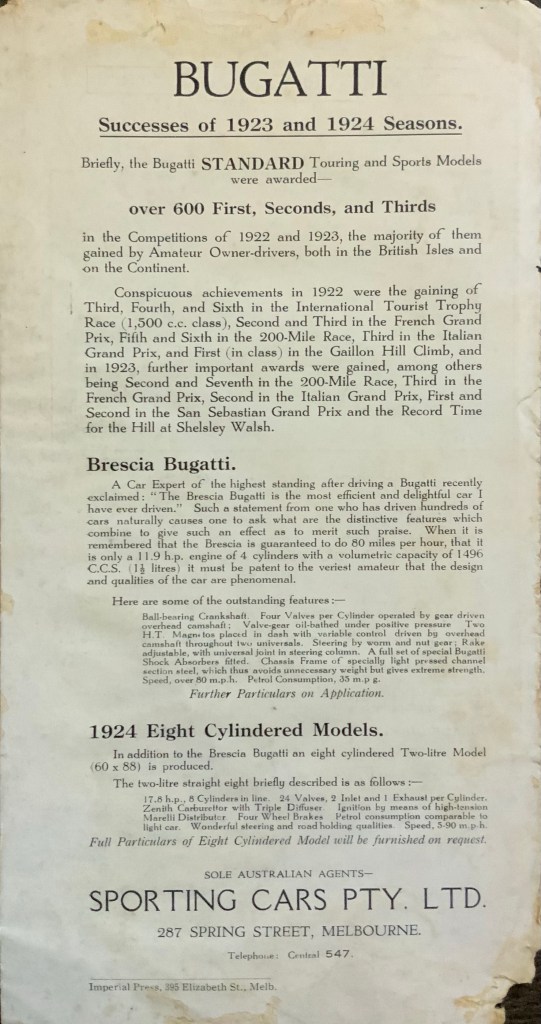
Marie Jenkins was used to promote the make in this Sporting Cars pamphlet, the rest of it, providing detailed specifications is at the end of this article.
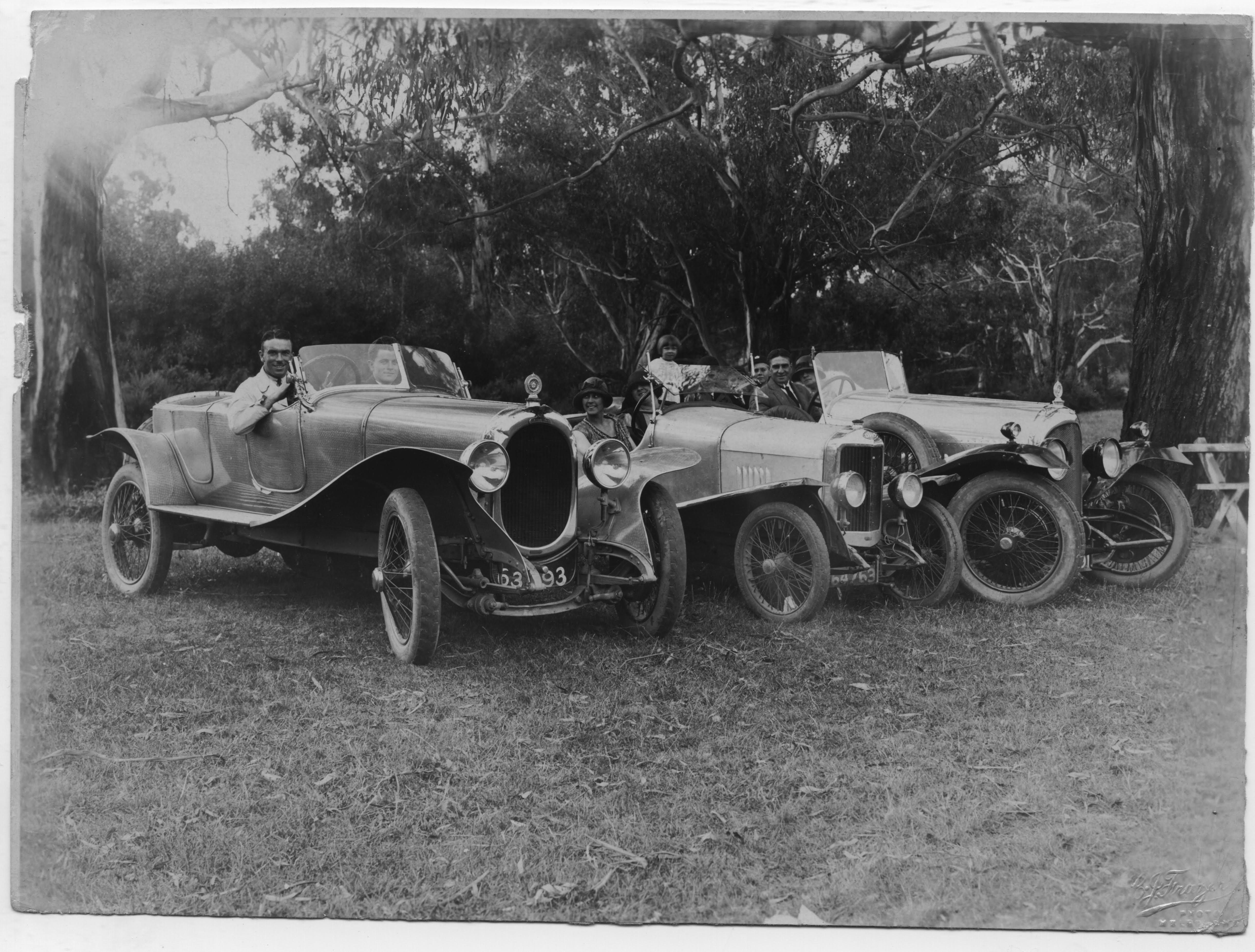
Dudley Barnett, Chenard Walcker, Marie Jenkins DFP and Arthur Terdich Bentley 3-litre, with Maude. 1924 Davies Bay, Victoria (B King Collection)
Marie in her little DFP is dwarfed by Sporting Cars director Dudley Barnett’s Chenard Walcker (left) and Arthur Terdich’s 3-litre Bentley
(G Jarrett)
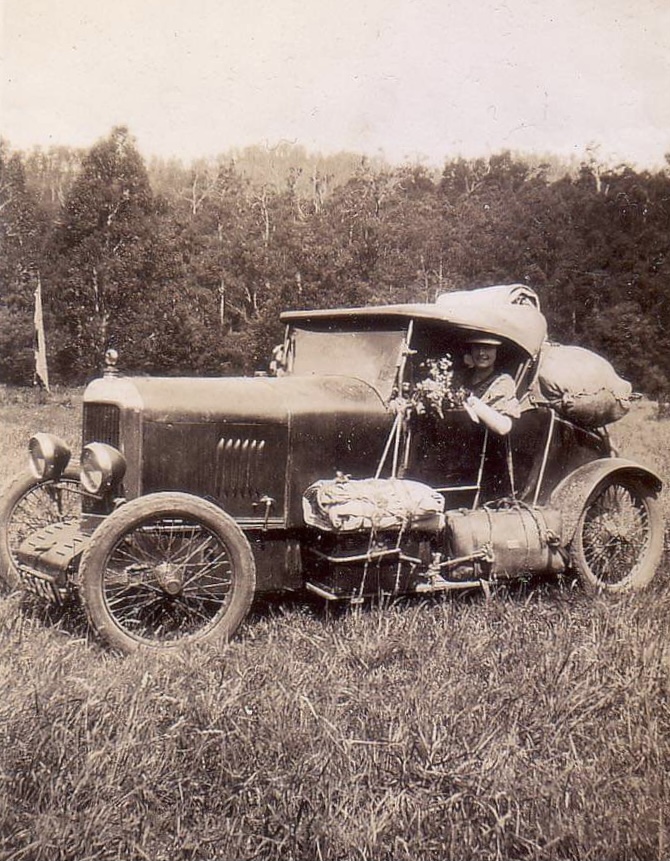
Marie goes camping, the only thing missing appears to be the kitchen sink! Poor liddl’ darlin’ would have struggled carrying that lot.
(Fairfax)
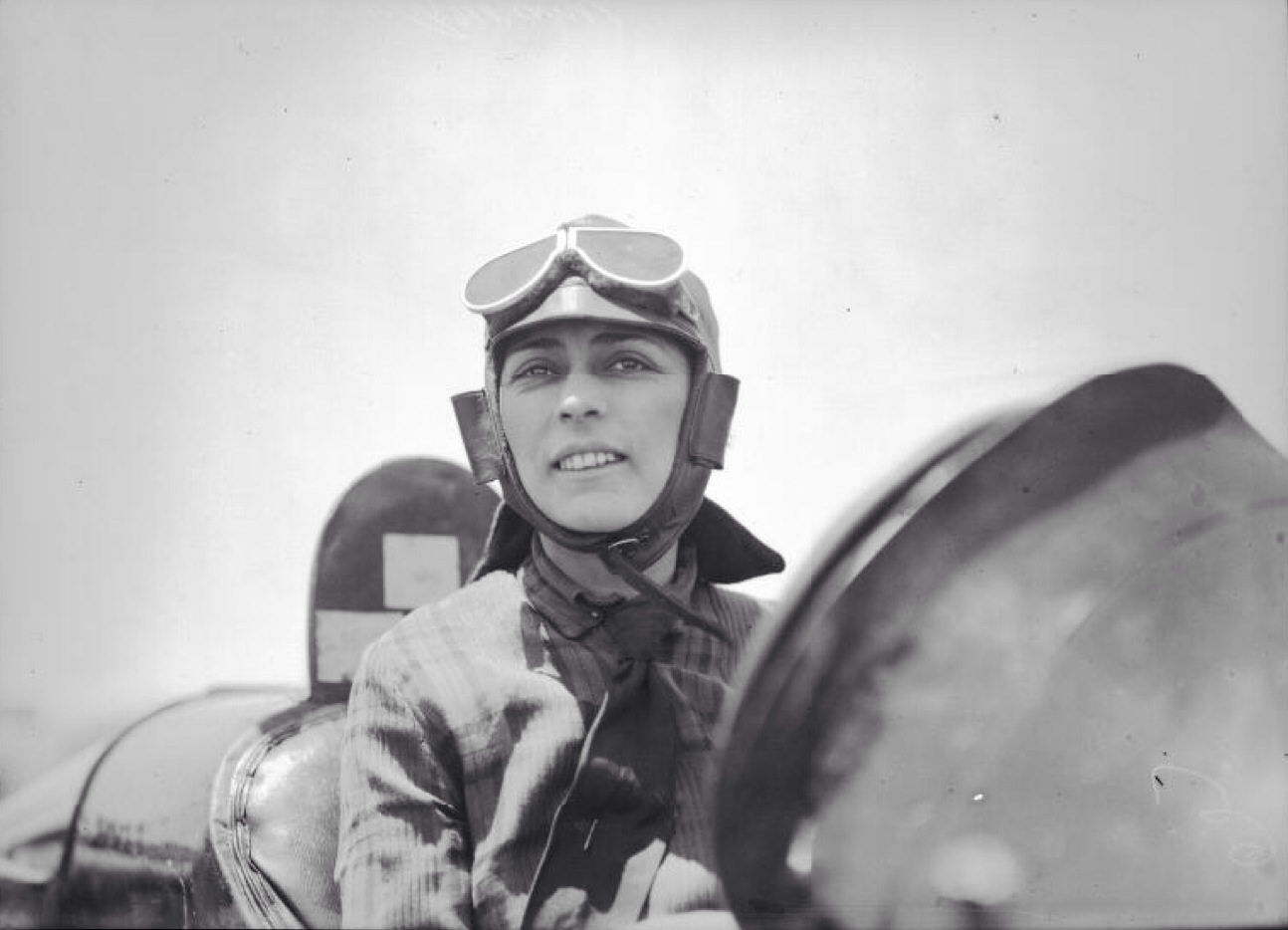
Here she is, looking rather marvellous, at Sydney’s Maroubra banked, concrete Saucer of Speed in her victorious Brescia Bugatti in 1925.
(B King Collection)
1928 Australian Grand Prix
Two DFPs took part in the 100-Mile Road Race, aka the 1928 Australian Grand Prix at Phillip Island.
Ab. Terdich was the brother of Arthur whose Bugatti faltered while he was leading the race; he won in 1929. Ab’s DFP retired with engine trouble. The other car shown, driven by Les Pound, had better luck, completing the distance in a little under 2½ hours at an average speed of 41.6 mph, he was thirteenth and last. Les became a well-known name in post-war years as proprietor of Volkswagen dealers, Pound Motors. The Pound DFP is nearing the end of a long restoration.
(B King Collection)
Les Pound made slow progress in the 1928 AGP, but had the satisfaction of completing the distance.
DFP random
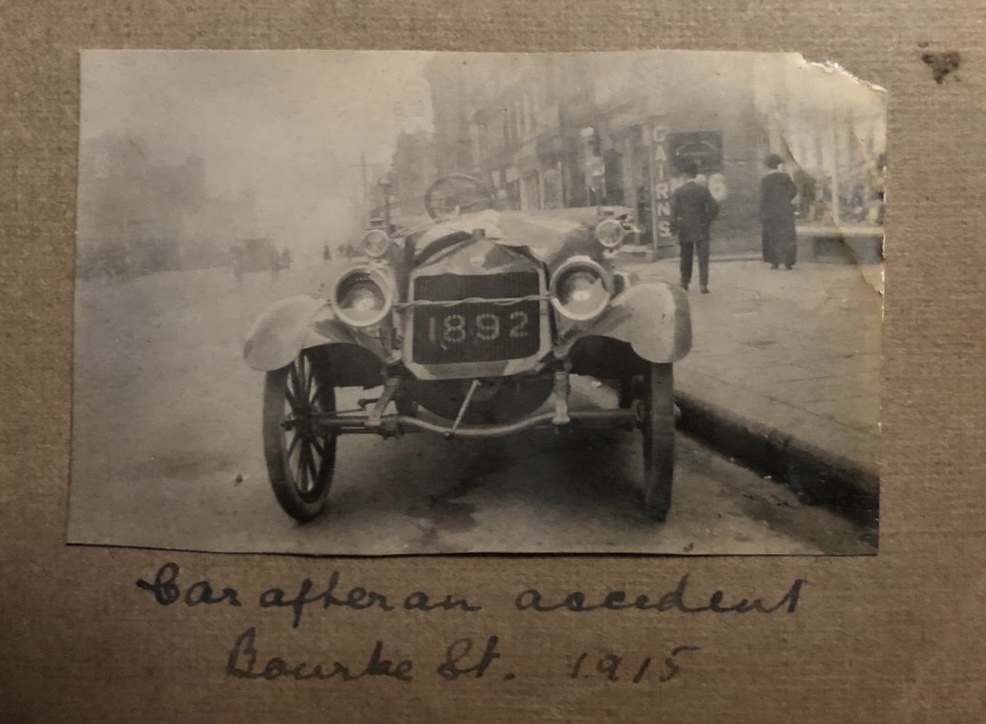
Nigel Tait of Repco and ACL fame had an ancestor with a DFP that managed to have an accident in Bourke St, Melbourne in 1915. That must have been hard to achieve – perhaps an errant horse?
(N Tait Collection)(N Tait Collection)
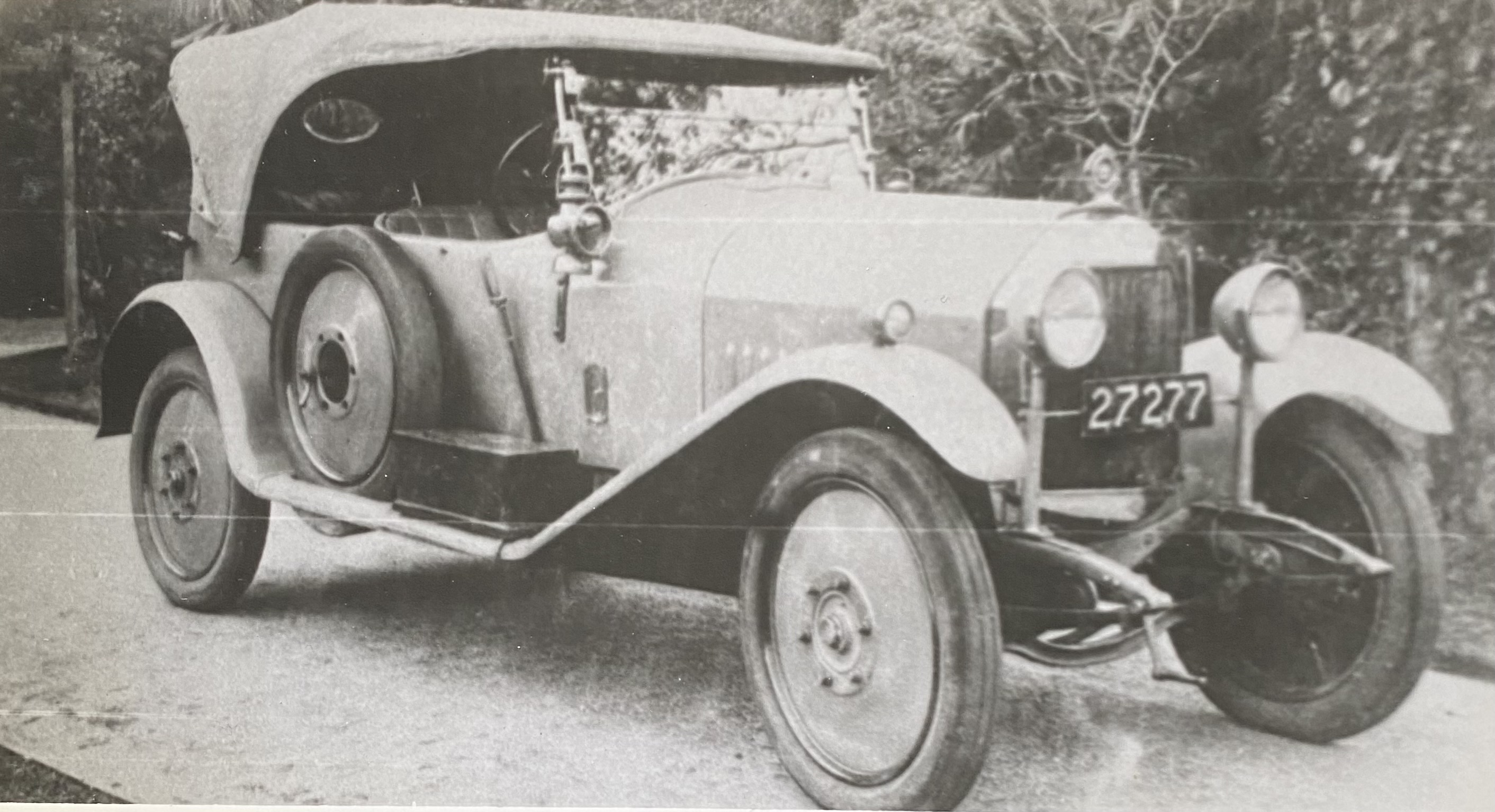
This Tait family photograph shows the same car (above) which was driven by George McCarey below.
(B King Collection)
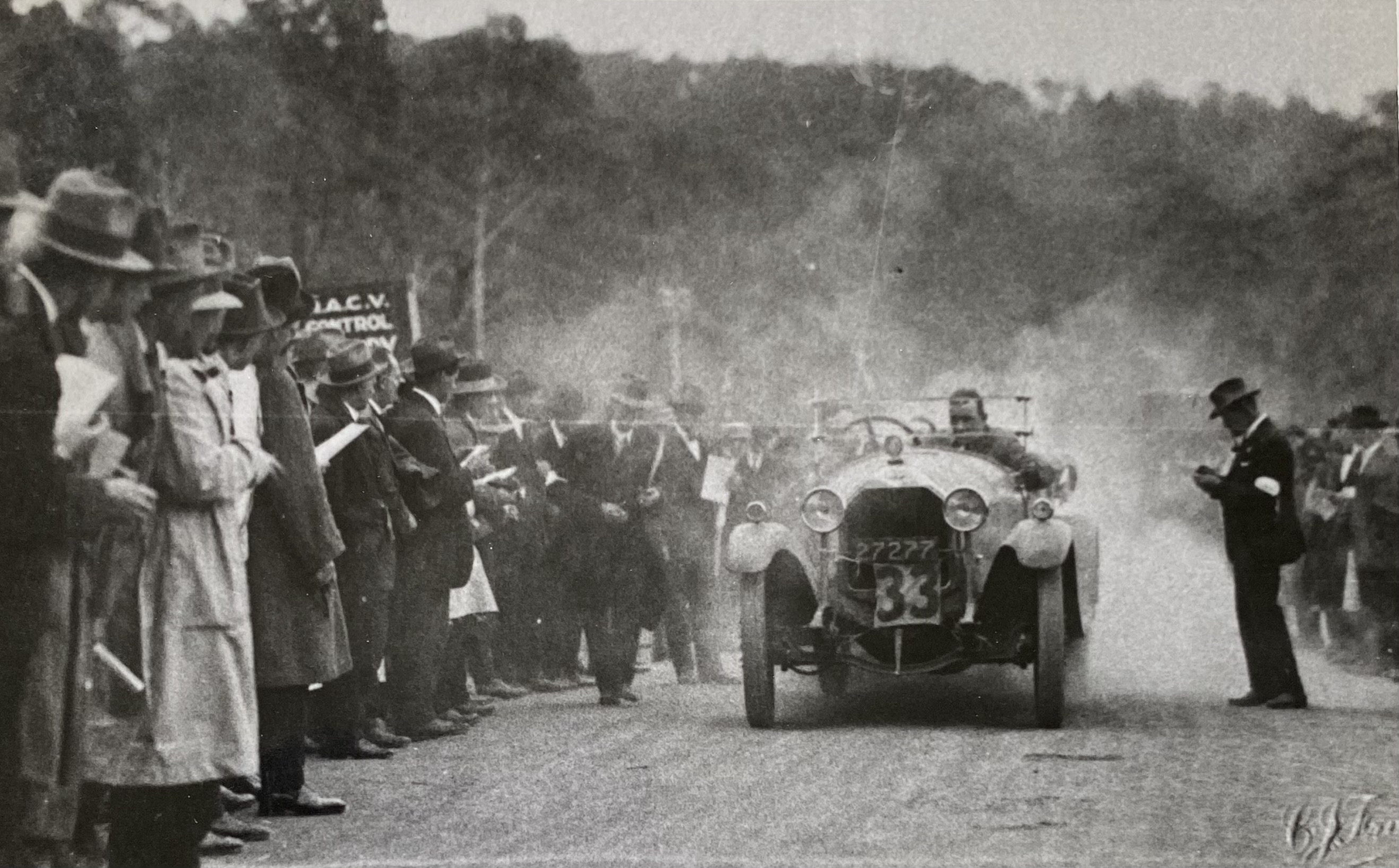
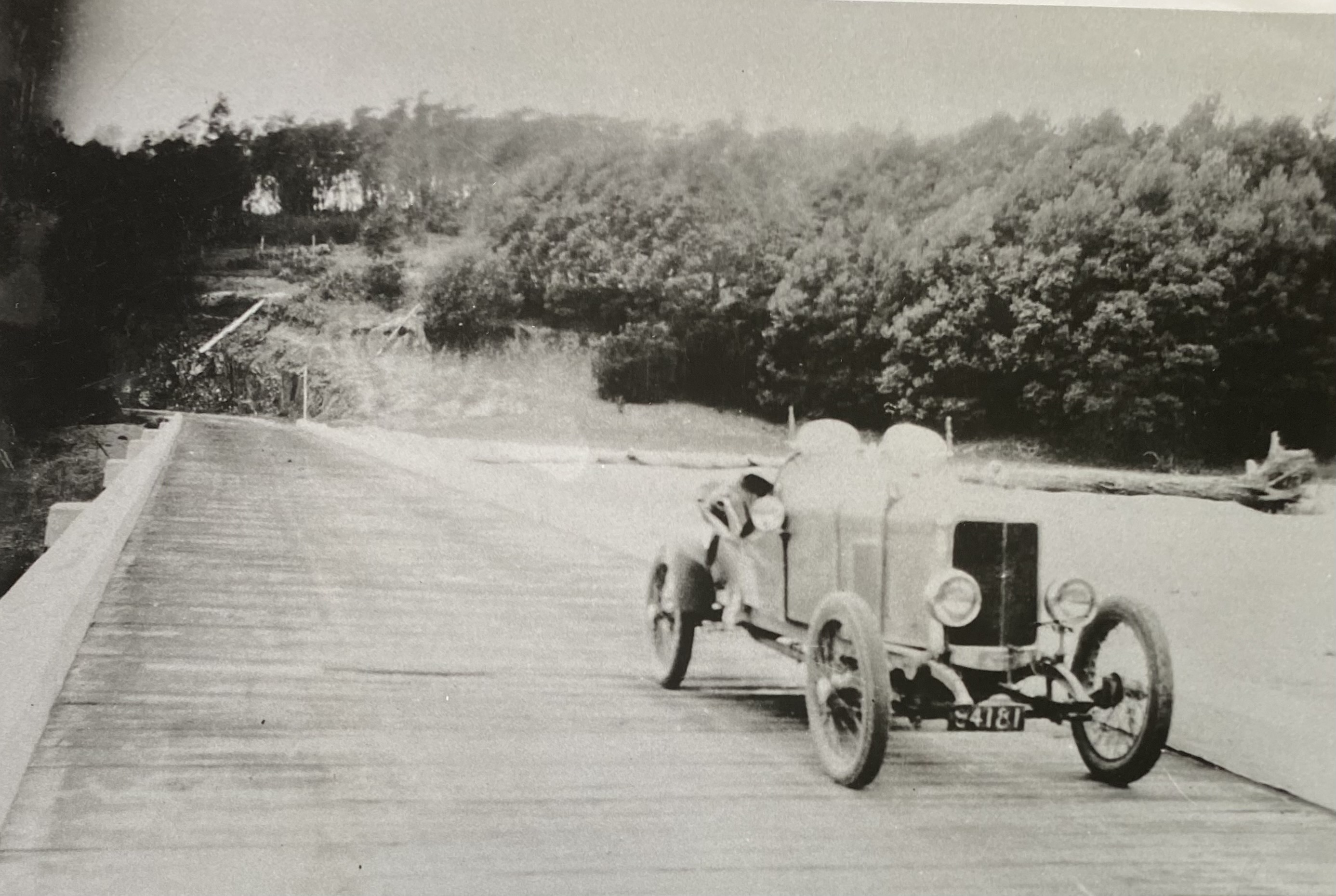
I suspect the photo of car with registered number 27277 is being driven by George McCarey in the 1921 RACV 1000-mile Reliability Trial. This was an earlier 2-litre car of the type raced by WO Bentley, rather than the more popular 1.1-litre car which was introduced in 1922.
(T Johns Collection)
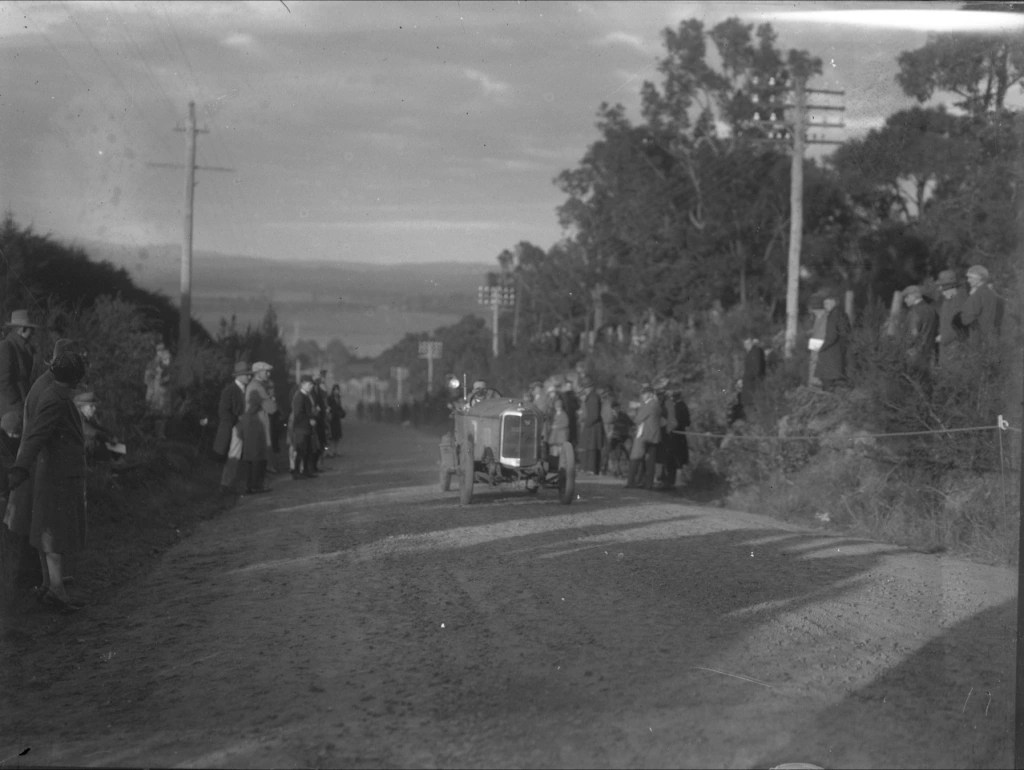
Les Pound completes the hill climb at Wheelers Hill with the same DFP he raced in the AGP at Phillip Island in 1928.
(B King Collection)
Doug Benson’s DFP on a bridge over the Kiewa River.
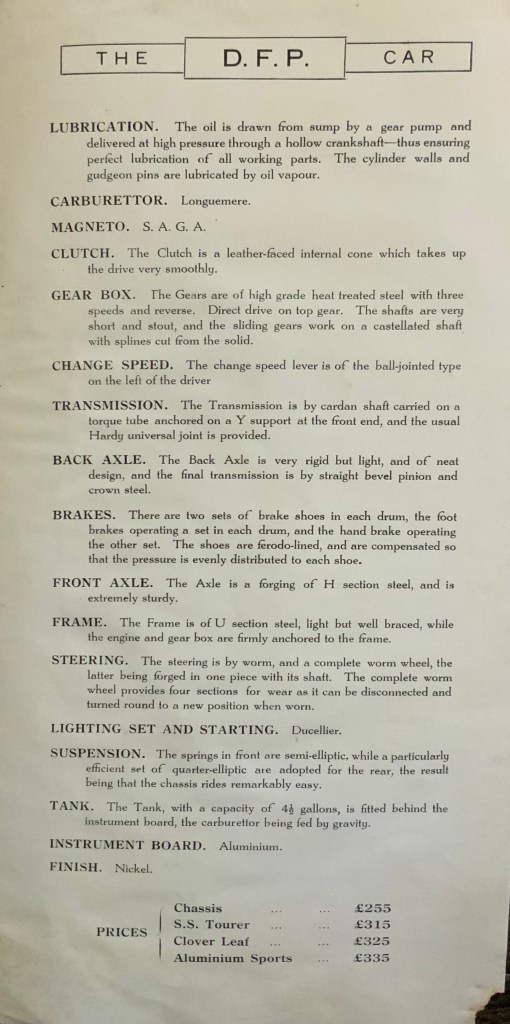
DFP Technical Specifications…
(B King)(B King)(B King)(B King)(B King)
Credits…
Bob King, John Crooke, Tony Johns and Nigel Tait Collections, Fairfax, Graeme Jarrett