Archive for the ‘Obscurities’ Category

gethin 1

(Schlegelmilch)

Peter Gethin subbing for Denny Hulme in the tragic 21 June 1970 Dutch Grand Prix, McLaren M14A Ford…

1970 was a tragic season for driver deaths, Piers Courage perished in a gruesome fiery accident in his De Tomaso 505 Ford in this race.

Peter was drafted in the McLaren team after Bruce’s death at Goodwood on 2 June. To make matters worse Denny Hulme burned his hands at Indianapolis so McLaren were represented at Zandvoort by Dan Gurney, Gethin with Andrea de Adamich in an Alfa Romeo V8 engined M14A, the other team cars Ford Cosworth DFV powered.

What draws the eye to this shot is the helmet, Gethins and Jackie Olivers designs were so similar to Jim Clark’s at the time.

McLaren’s weekend was poor; Andrea DNQ and both Dan and Peter retired with a mechanical problem and accident respectively. John Surtees M7C was the best placed McLaren in 6th, the race won by Jochen Rindt’s Lotus 72 Ford, the iconic car scoring its first win. Surtees drove the ex-works 1969 car until his own Surtees TS7 made its debut later in the season.

Credit…

Rainer Schlegelmilch

image

Helmut Polensky and Walter Schluter on the way to outright victory in the event also known as the Marathon de la Route in their 1.5 litre Porsche 356…

An early important win for the marque in this Gmund built Coupe, a bit lighter than the Stuttgart cars. Porsche were 1st, 3rd, 4th, 9th and 10th taking the Team Prize as a result.

Credit…Unattributed

image


image

Prince Bira grabs a nip of ‘Red Bull’ between practice sessions in his Maserati before the Crystal Palace Cup on 14 August 1937…

Bira is standing beside his Fiat Topolino, these cars in some ways the ‘Cooper S’ of their day. The Franco Fessia designed car was noted for its safe road-holding, good ride and willing performance. The ‘mouse’ had hydraulic brakes, independent front suspension and a synchro 4 speed ‘box.

In an article about the cars in MotorSport’s November 1995 issue Bill Boddy noted that they were the ‘in-thing’, the cars competition history included entries and finishers at Le Mans in 1937-9 and a class win in the 980 Mile Tobruk-Tripoli race which replaced the Mille Miglia in 1939.

Post-War the cars components were a feature of the Cooper 500 and thirteen other Italian racing cars.

image

Bira in his ex- Whitney Straight, Reid Railton modified Maserati 8CM at Crystal Palace in 1937 . The car was fitted with a Wilson pre-selector box and other tweaks, the ‘heart shaped’ radiator giving the car, very successful in both drivers hands, a distinctive look (Dennis Oulds)

Bira raced his Maserati 8CM in the Cup Race, having rebuilt it after its International Trophy race blow up, Lord Austins cars were driven by Hadley and Kaye Petre. Hanson and Aitken raced 1.5 litre Masers and Connell a 1.5 litre ERA. ‘Crack-runners’ (rather a different meaning that phrase these days!) were non starters included the brothers Dobson ERA and Maserati, Tony Rolt’s Triumph and Peter Whitehaeds ERA.

The race was a handicap Bira giving away 75 seconds to the 1.1 litre cars, and 25 seconds to the 1101-2500cc cars.

Hadleys Austin lead away with Bira eventually away with lots of wheelspin and by lap 15 all cars were on the same lap. Bira was up to 2nd and within striking distance by the last lap but he ‘got into a slide at Ramp Bend’ but despite restarting finished 44 seconds behind Hadleys Austin 744cc, Reg Parnell was 3rd in an MG Magnette 1087cc and P Maclure 4th in a Riley C 1486cc.

image

Bira in the Maser again, this time practicing at Brooklands in March 1938 (David Savill)

Credits…

Imagno, David Savill, John Stephenson, MotorSport September 1937

Tailpiece: ‘White Mouse Stable’ Dalling Road, Hammersmith, Maser 8CM preparation in 1938…

image

Bira’s Ex-Whitney Straight Maser 8CM #’3011′ in 1938. Car still alive and well in Peter Gidding’s loving care (John Stephenson)


image

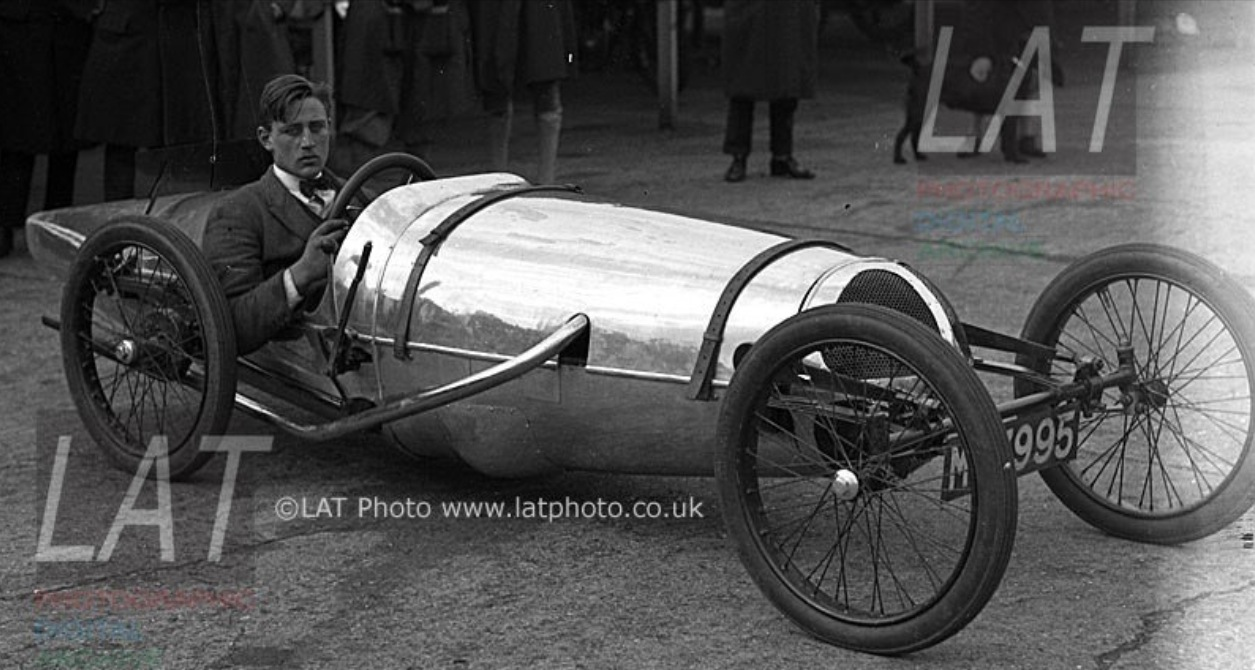
The Jappic billed as ‘the smallest racing car in the world’ in a very bleak Wimbledon streetscape in April 1925…

The cars ‘main advantages are it’s lightness and portability’ is the prosaic caption.

My problem, one of the many!, is I struggle to finish projects, articles that is, I’ve started.

I have owed Rod Wolfe the next chapter of our Repco Engine story for about 12 months. I get distracted by the lure of ‘something new’ like this Jappic shot I’ve just spotted.

I see the picture, ‘go wow WTF’ and then can’t help myself with research and then jump from tangent to tangent, all of which takes loadsa time. In this case the Jappic led to Gwenda Stewart who drove it, she is an interesting character herself, then there is Montlhery as a record breaking venue and so it goes on.

End of confession! And yes Rodway, I need to complete my research of the ’67 Brabham Repco F1 year!

jappic side

The location of this luvverly Jappic profile shot is no doubt well known to you Londoners, 1925 (Topical Press Agency)

Isn’t the Jappic the most amazing looking little creation, though!? Other worldly.

It was a JAP engined cyclecar designed by motor-cycle racer HM Walters who intended it as a road racer for sale to special order, equipped with front brakes and fitted with either 350 or 500cc engines.

When announced in early 1925 the car was to make its first appearance at the Brooklands Easter Meeting on 11-13 April. Bill Boddy in a short piece about the car in the January 1983 issue of ‘MotorSport’ said that photos ‘were circulated of the car in front of a K Type LGOC omnibus…presumably…taken somewhere near the premises of Jarvis & Co Wimbledon, who handled the Jappic and made its shapely body. The day previously the Jappic (Reg MH3995) had broken Class1 (up to 350cc) records at Brooklands at from 63 to over 70mph, so it might have been returning’ to Wimbledon.

In fact it appears Jappic attacked the 350cc cycle-car record at the 6 June 1925 Brooklands meeting ‘races confined to drivers and motorcyclists who had never competed at the track before’ so the first photo above is probably either April or June 1925.

jap lat

Walters and his creation, Brooklands meeting in 1925 (Austin Harris,LAT)

May the lord above bless MotorSport. If something happened in the UK, from circa 1920 you can pretty much guess Boddy, Jenkinson or one of their merry band covered it ‘in period’, which is rolled god for schleppers like me. Give me a report written in period, or the recollections of a dude who was there at the time over a modern interpretation any day.

In a more comprehensive article in the August 2000 MotorSport issue Boddy wrote again about the Jappic; ‘Cyclecars and other small cars had been encouraged to race at Brooklands before and after WWI, but the former were mostly crude devices, if one excludes the Morgans and the GNs, which had engines of around 1100cc. Anyway, apart from the latter two, the Austin 7 rather ousted cyclecars from the Weybridge scene as the 1920s rolled along. So when visitors to the Track opened their programmes on Easter Monday in 1925 and saw that a 344cc car had been entered for the second race they could be excused for being mildly surprised’.

jappic cant

Refer to Boddy’s text for details of Jappic’s specifications, it appears to be rather light! Brooklands 1925 (unattributed)

‘The tiny racing car was called the Jappic, in deference to its JAP engine. It had been designed by motorcycle racer H M Walters, and built by the coachbuilders Jarvis of Wimbledon in London. The Jappic’s entrant was J V Prestwich of the JAP engine company’.

‘The baby was no lash-up. It was a proper miniature racer. The frame was of ash with 3/32in steel flitch plates and tubular cross-members, with another cross-member of T-section channel by the cockpit. The tubular front axle had forward-facing, underslung quarter-elliptic springs, the shock absorber anchorages adjusting the steering castor angle.

At the back, reversed quarter-elliptic springs supported an axle of tubular transverse rods instead of a solid casing, this enabling the final-drive sprocket to be accommodated in a three-armed spider, roller and ball bearings being used for the driveshafts. Expanding rear wheel brakes sufficed, and the wire wheels were shod with minuscule 650×65 tyres. The engine was a two-port ohv 74x80mm single-cylinder JAP, driving by chain to a three-speed gearbox giving ratios of 6, 8 and 12:1, and fitted with a kick-starter. Another chain drove the back axle’.

‘The slender body was actually a two-seater, because production of Jappics at 1,150 pounds each was contemplated, though this was in the end never proceeded with. But this Jarvis-bodied 5cwt car, its hemispherical nose admitting air to the engine, looked every inch a racing car. The cramped cockpit had seats of sheet aluminium and the bottom half of the steering wheel was cut away to improve access. The driver sat at a head level of 2.1/2ft. Minute gear and brake levers were mounted externally, as were the two exhaust pipes’.

image

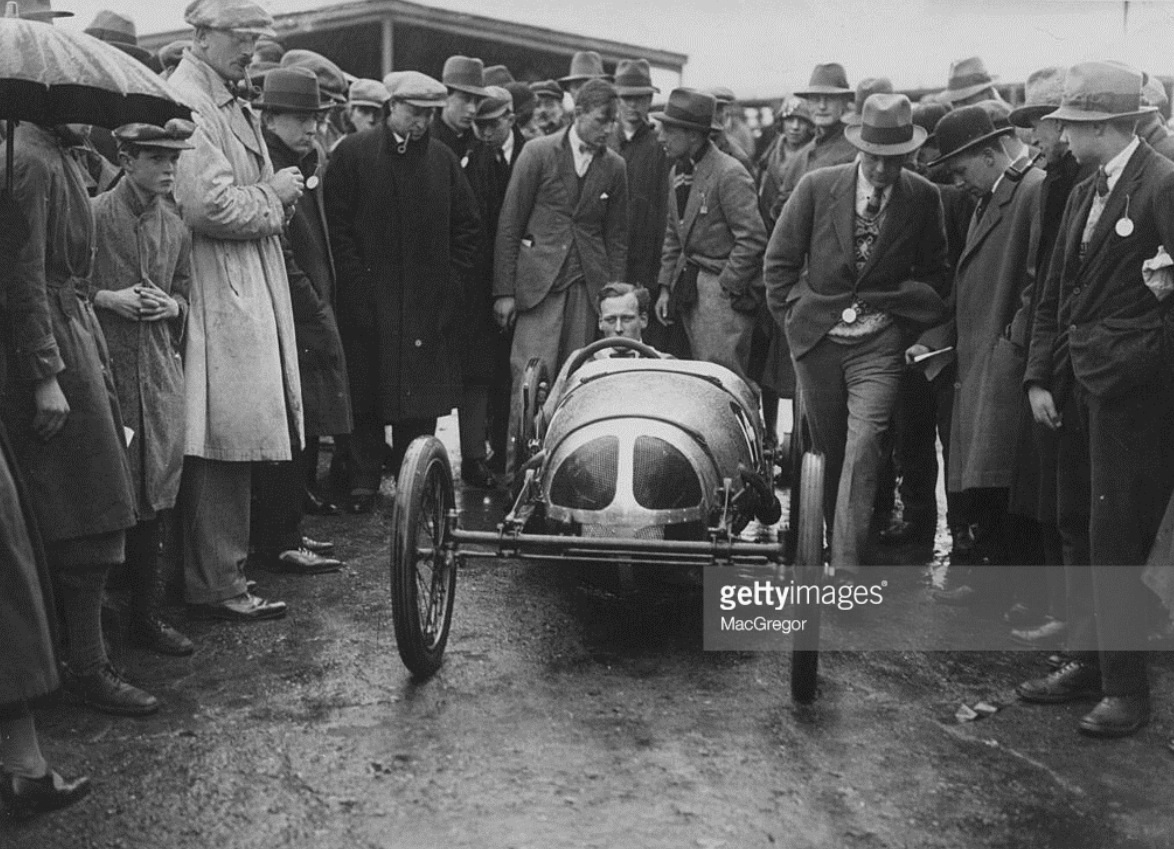
Brooklands, 13 April 1925 during the Easter meeting, crowd undaunted by the chill rain and fascinated by Jappic’s small size in relation to some of the Brooklands giants! 30000 attended on the Monday, tho racing was curtailed by poor weather. Note front suspension described in detail by Boddy in text (MacGregor)

‘On that long-ago Bank Holiday afternoon the Jappic was driven by Walters, who had l min 14sec start from the scratch cars, Victor Gillow’s sidevalve Riley and a 1914 GP Nazarro, with Reid Railton’s Amilcar, an entry probably prompted by Parry Thomas, leaving 1 sec after the tiny cyclecar, in the 5.3/4-mile race.

Walters was not placed, but did a lap at 66.85mph, implying a top speed of some 70mph. Enough for one day. But the Jappic was out again at Whitsun, lapping at 68.03mph and just missing a third place. Walters then used it to break records, such as the Class J flying mile at 70.33mph.

In 1926 Kaye Don, the famous Sunbeam driver, was not averse to driving cyclecars, attempting records with the Avon-JAP and the Jappic, the latter now with a 495cc JAP engine, which gave Don some Class I records of up to 10 miles, at around 65mph.

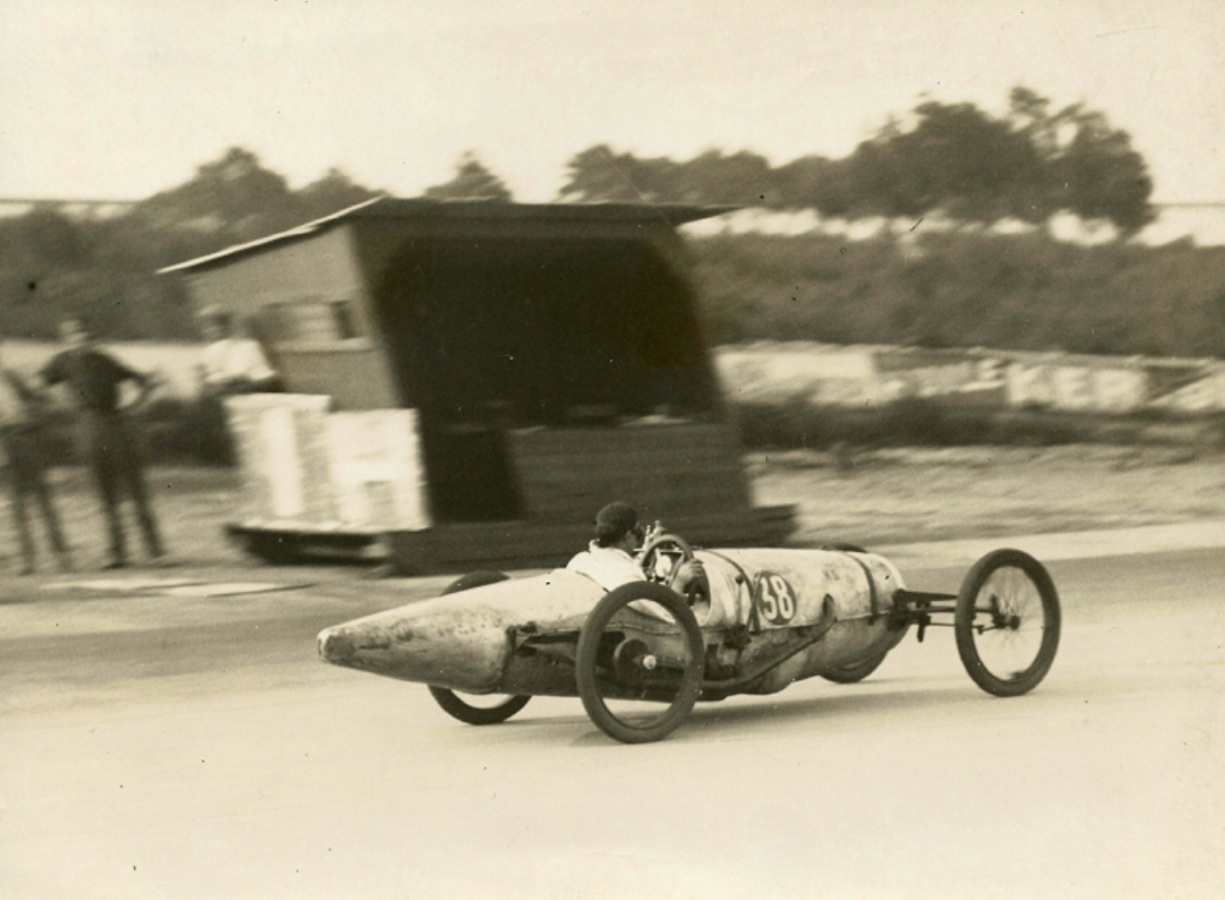
After which Mrs Gwenda Stewart, of Derby-Miller fame, took it over, changing the mite’s identity to HS (Hawkes-Stewart) and refitting the 344cc engine. At Montlhery in 1928 she set the Class J 10-mile record to 70.95mph. Alas, in the garage fire at that circuit in 1932 the HS was completely destroyed’.

jap mont

Gwenda Stewart in the Hawkes Stewart aka Jappic JAP ‘breaking records 50Kms to 1oo miles in June 1929 at Montlhery’ (Adrian Ward)

The Jappic story isn’t entirely over, an exacting replica is being built by Adrian Ward so enthusiasts of today can enjoy HM Walters design brilliance 100 years or so after the cars original construction. Check out his progress on this link;

http://thekneeslider.com/jappic-racing-cyclecar-re-creation-project-in-progress/

For ‘Facebookers’ there is a fascinating, ongoing diary by Adrian of his progress in recreating the car, its a ripper, with loads of information, just key ‘Jappic recreation’ into the FB search engine and ‘like’ in the usual way.

I’m on FB BTW, pop primotipo.com into the same search function.

Etcetera…

jap sunbac

Walters at the Brooklands June 1925 ‘SUNBAC’ meeting (Austin Harris/LAT)

jap article

(Light Car & Cyclecar)

Credits…

Topical Press Agency, MacGregor, Light Car & Cyclecar, Stefan Marjoran, Adrian Harris/LAT

Graces Guide to British Industrial History, Adrian Ward

Tailpiece…

jap pic

(Stefan Marjoran)


Tintin…

Posted: June 29, 2016 in Obscurities
Tags: , , ,

image

The Adventures of Tintin was a post-war weekly Belgian/French comic, subtitled (luvvit) ‘The Journal for Youth from 7 to 77’, it was originally published by Le Lombard in 1946 and ceased publication in 1993…

I was researching an article on Alberto Ascari’s Lancia D50 Monte Carlo ‘harbour swim’ in ‘55 and tripped over the Tintin cover below featuring that amazing event and more recently the Nuvolari Alfa Romeo P3 cover above. Unfortunately I don’t speak French and therefore understand the articles the covers relate to, a shame as the artwork itself is so arresting. Maybe one of you Tintin fans can tell me what the articles were about!?

As usual, not knowing much about the publication, my enquiring mind got the better of me, this precis of Tintin is the result.

tin tin

As a kid I sorta missed the ‘comic phase’ altogether. I dunno why, the only time I looked at cartoon mags was in Steve The Barbers Fine Emporium of Short Back n’ Sides waiting chair and even then only when their were no ‘nudie-rudie’ publications in the rack. ‘Truth’ (‘Lies’ would have been more apt) was a naughty paper in Oz then and much in demand by barber customers for its page 3 ‘editorial direction’. The back pages were also pretty good if I recall.

The first magazines of any sort I bought were about racing cars; dragsters for 6 months before circuit racing made more sense, ‘round and round’ rather than ‘a standing quarter’ looked to be the go from my 12 year old perspective.

I think I ‘found cars’ via the cheap annuals mum and dad gave as Xmas stocking fillers. No Autocourse or Automobile Year ever found their way into those sacks sadly! My diet of young kids books was all Pommie stuff by Enid Blyton. ‘Noddy’, very politically incorrect these days segued into her ‘Secret Seven’ and ‘Famous Five’ series. Next came Capt WE Johns ‘Biggles’ (dads books) and then the more demanding and interesting stuff mandated once I ascended to Secondary School. Quite wot happened to the ‘Batman’, ‘Mad’ etc phase I dunno, a lost opportunity I suspect. The compensation being I am NOT collecting those comics now being afflicted by that obsession enough already! There is only so much space to keep all this shite.

Tintin’s primary content focused on a new page or so from several coming but unpublished comic albums. There were always several ongoing stories at any given time, all of which provided wide exposure to lesser-known artists.The content included ‘filler material’; alternate versions of pages of Tintin stories, interviews with authors and artist etc.

Raymond Leblanc and his partners started a small publishing house after World War II, the concept an illustrated youth magazine. Tintin was perfect, as the intrepid reporter hero was already well known, having been created by Belgian artist Georges Remi aka ‘Hergé’ in 1929 for Le Petit Vingtieme. A deal was done, Tintin and Le Lombard publishing group was away.

The first issue was published in September 1946, a Dutch edition, titled Kuifje, was published simultaneously, 40000/20000 Belgian/Dutch copies were published. In 1948 it grew from 12 to 20 pages and a French edition was created. Hergé had artistic control over the magazine for decades.

In the 1950s new artists and series commenced, the magazine became more international and successful: at one time there were French, Swiss, Canadian, Belgian and Dutch versions with  600,000 copies a week published.

Jean Graton joined Tintin in 1957 and soon created the very popular character, F1 driver ‘Michel Vaillant’, that series was about his racing exploits and those of the family race team. It was so successful that it was published in album format by Lombard until 1976, the character still going strong today.

image

image

In the 1960s the magazine kept attracting new artists, its editorial direction biased in favour of humor. In the 1970s the comics scene evolved to reflect the changing times, its characters given psychological dimensions, ‘real women characters appeared’ and sex. New foreign artists series were added, moralising articles and long biographies disappeared. These changes were successful, Tintin won the prestigious ‘Yellow Kid Prize’ at the Lucca Comics Festival in 1972.

In the 1980s demand steadily declined despite attempts to attract new audiences. At the end of 1980 the Belgian edition was cancelled. The French edition remained, by 1988 its circulation dropped to 100,000. The name was changed to Tintin Reporter, but attempts to revive the magazine ceased after six months of significant losses. The Dutch version ended in 1992 and the French title renamed ‘Hello BD’ disappeared in 1993.

Time and time again we see that everything has a ‘shelf life’!?

In our own specialist world the efforts of MotorSport are a good example of a great publication which has ‘picked the windshifts’ proactively or reactively enough to survive and thrive since 1923, long may it and others of its ilk continue!

Credits…

Wikipedia, tintin.com

Tailpiece: Ascari being rescued from the Monte Harbour deep…

image


a jack

Brabham, Cooper T23 Bristol, Altona, 9 March 1954 (SLV)

Jack Brabham thrilled a crowd of over 12000 with his Cooper Bristol’s speed during the inaugural car meeting of the new Altona circuit in Melbourne’s inner west on 9 March 1954…

Brabham made the switch from speedway to circuit racing in, one of the characteristics of his driving style was the ‘Brabham Crouch’ over the wheel, its much in evidence down the years and very much present at the 2 1/4 mile Altona track.
a jack b

Brabham crouch, Cooper Bristol, Altona 1954 (SLV)

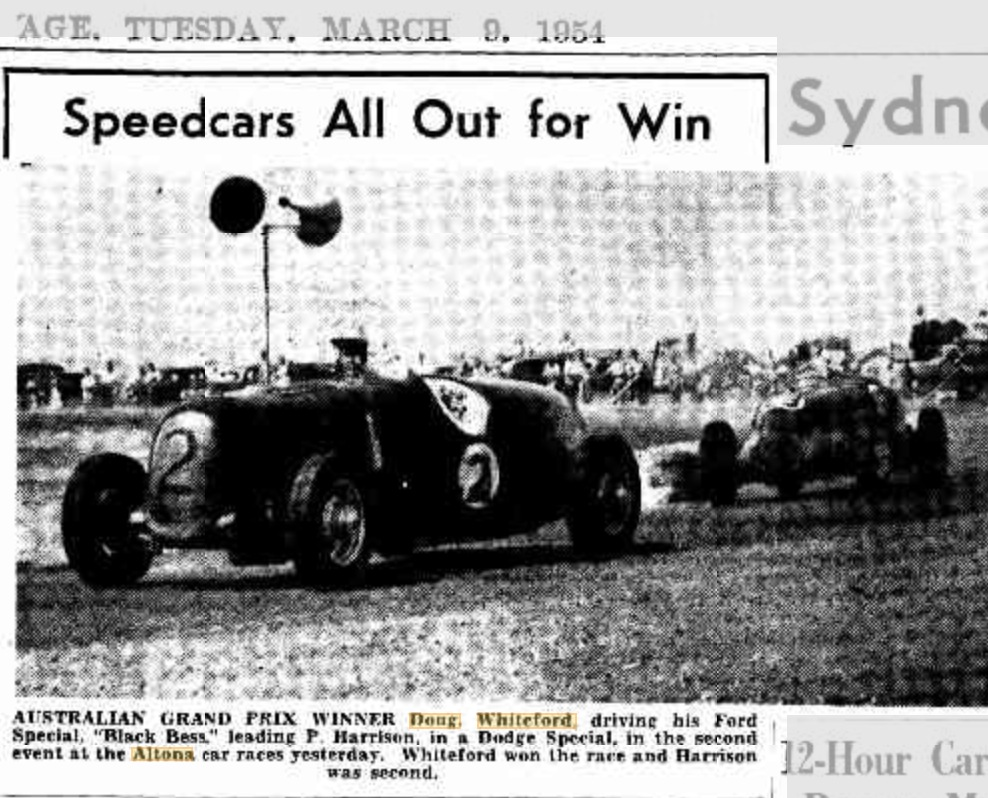
Jack set a lap record of 1:50, an average speed of 73.5 mph, the Cooper was timed at nearly 130 mph. Stan Jones won the F Libre open event after Jack’s Cooper sheared the magneto drive of its Bristol engine. ‘The duels between Brabham and Jones Cooper 1100 were a feature of the meeting, the brilliant cornering of the latter helping him hold the bigger faster car’ The Age newspaper reported.
a whiteford

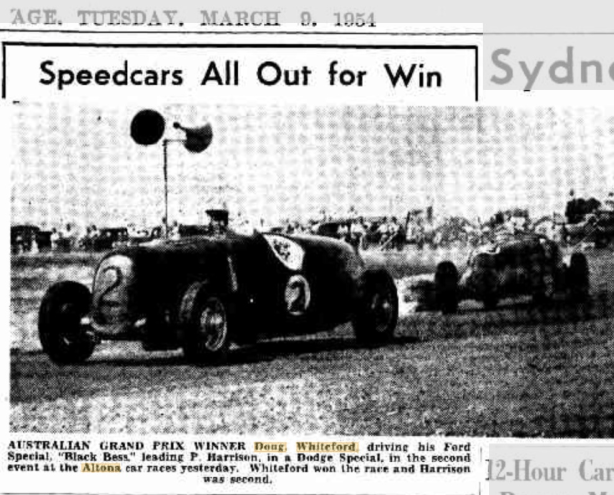
Many of the noted racers of the day entered the meeting; Jones, Reg Smith, John O’Dea and Lex Davison in 1100 Coopers and Bill Patterson in a 500. Cec Warren’s Maserati 4CLT, Ted Gray’s Alta Ford, Tom Hawkes Allard, Doug Whieford in his Ford Spl ‘Black Bess’ as well as Lex Davison’s HWM Jaguar, it won the AGP at Southport on Queensland’s Gold Coast, later in the year completed a strong line-up
a map

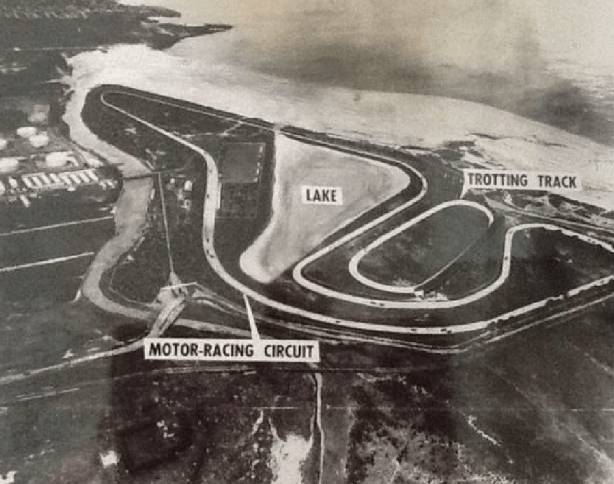
Aerial view of the Altona Circuit and Williamstown horse racing course taken in 1958 after the circuits closure , at the top of the shot is Port Phillip Bay (SLV)

Over the years there was motor racing at Point Cook (one race only, the 1948 AGP on the airforce base) Fishermans Bend and Altona, they are all in the ‘same part of the world’, respectively 26/6/16 Km from Melbourne’s CBD. Of the three, Altona was the least successful, only six meetings were held.

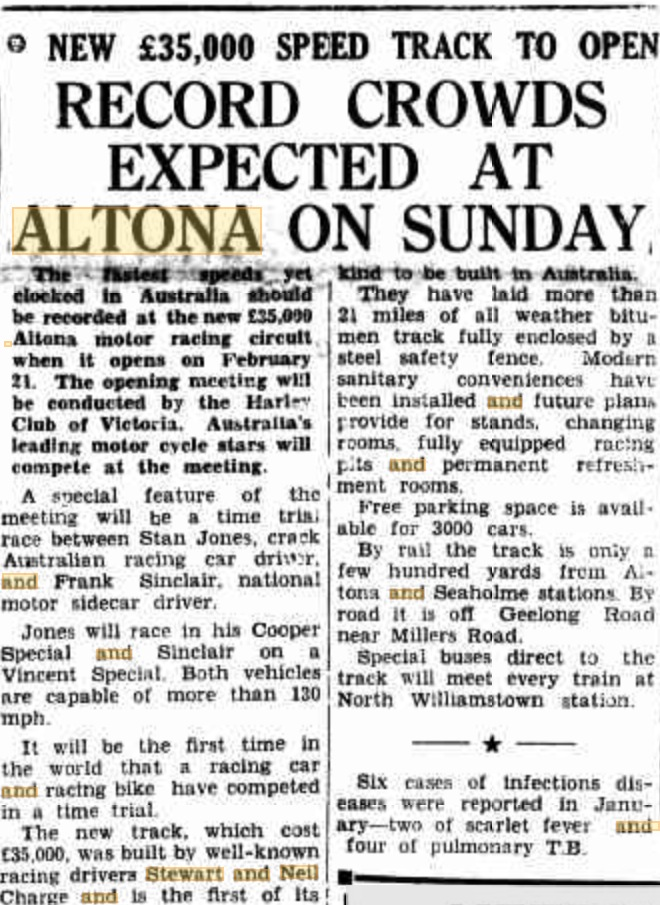
Well known Melbourne racer/businessmen Stewart and Neil Charge invested between 35000-40000 pounds in the venture. They acquired land on the west side of Millers Road transforming ‘ a swamp into a GP track…they formed the Altona Motor Racing Co with preliminary work to commence in two weeks’ the ‘Williamstown Chronicle’ reported on 2 April 1953.

Neil Charge took leave from the family trucking business to pull the enormous project of creating the facility, ‘the track was built from fly-ash from the South Melbourne gasworks’

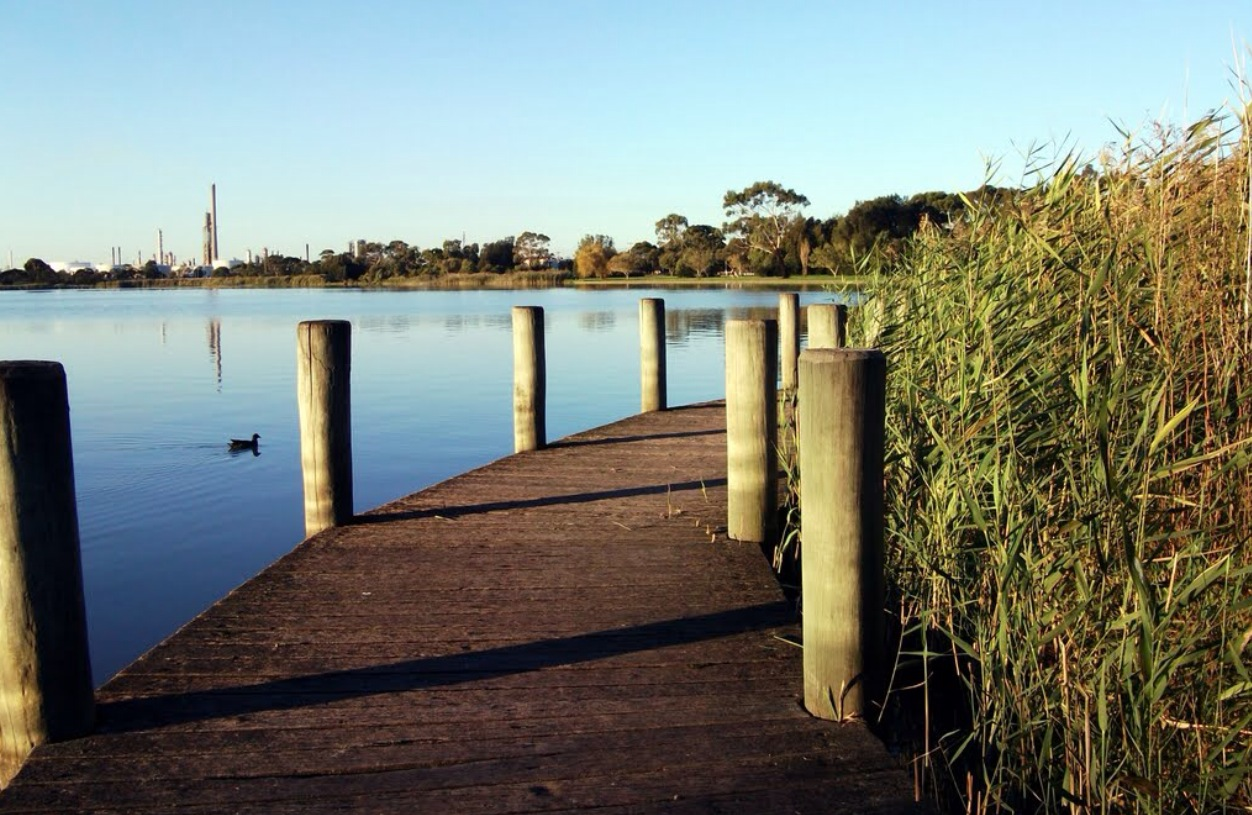
The swamp was converted into ‘Cherry Lake’, later reports suggested the promoters intention to ‘dredge the lake (deeper) to form a speedboat circuit’. Six meetings year were planned with local charities to benefit to the tune of about 4000 pounds per year.

Somewhat prophetically ‘The Chronicle’ noted the circuit may pose new problems for the promoters of Phillip Island, the expectation that Altona because of its close proximity to Melbourne may draw larger crowds. In the event, Phillip Island is still with us, despite a few ups and downs over the decades and Altona is long gone and largely forgotten!
a nes pap

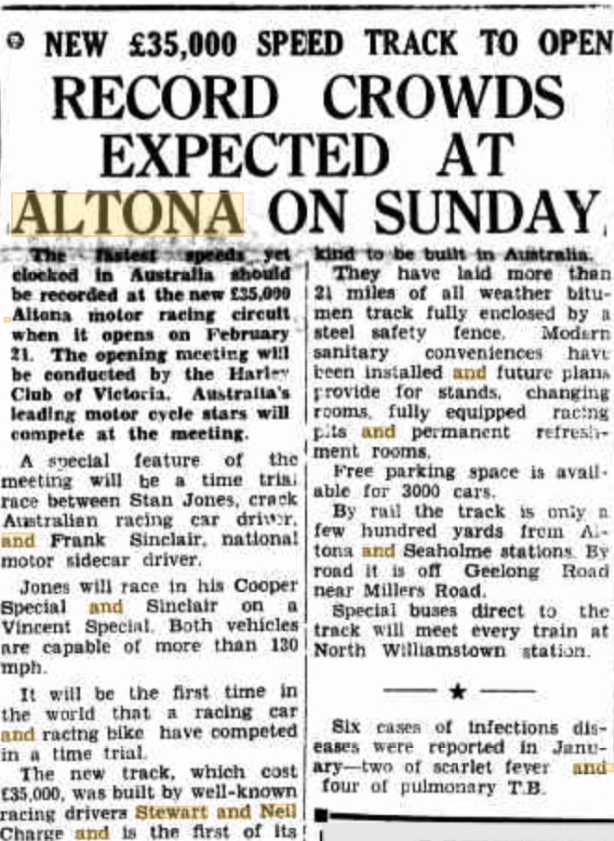
‘Williamstown Chronicle’ 19 February 1954

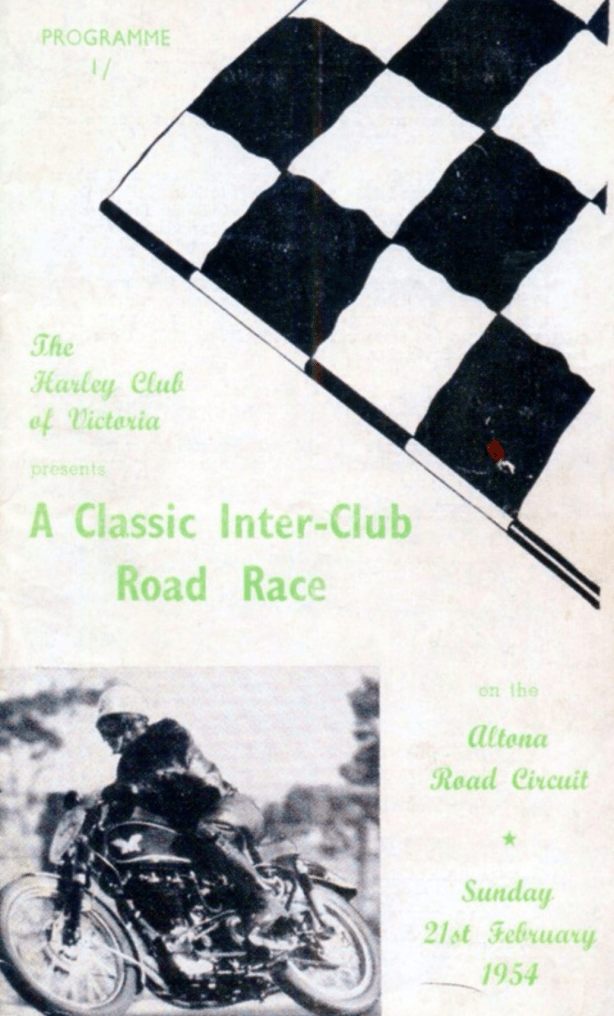
Altona was completed on time, its first meeting, for bikes, was opened by former Australian Olympic cyclist, Federal Parliamentarian, Sir Hubert Opperman on 21 February 1954…

Before the opening meeting the Williamstown Chronicle described the circuit as the first of its type in Australia, the Charges ‘have laid more than 2 1/4 miles of all weather bitumen fully enclosed by a steel safety fence…future plans provide for stands, changing rooms, fully equipped racing pits and permanent refreshment rooms’. The opening included a novelty match race between Jones Cooper and F Sinclair’s Vincent Spl sidecar, its not reported who won!

Car racing events were promoted by the Victorian Sporting Car Club, there were problems with the surface from the start. The track was ‘re-surfaced and built up where necessary after the recent ‘consolidation’ meeting. The track surround is safer with the removal of boulders and an encircling safety fence’. Edges were levelled to give a safe emergency run-off area. The Argus reported the improvements cost 4000 pounds with speeds expected to be higher by 20% compared with the first meeting.

In a 2013 interview Altona owner Neil Charge said that had the investors in the consortium, (there were 6 he said, not just he and his brother as reported by the media at the time) known that Albert Park was to be used for motor racing they would not have proceeded with their investment. International readers will understand the inherent beauty of Albert Park and its proximity to Melbourne’s CBD. Imagine the exact visual opposite; what was then flat, featureless, muddy or dusty, industrial land on the cities outskirts. In short, in a popularity contest close to Melbourne’s CBD, Albert Park wins hands down every time from a spectators perspective.

That the Charge brothers didn’t know about Albert Park as a racing possibility is a little hard to fathom, they were well connected Melbourne businessmen and stalwarts of the local racing community, which was even more incestuous then than now.

Other issues which inhibited the circuits success was the converted swamp land upon which it was built, land consolidation not understood as well then as now. The land continually subsided making the track difficult to maintain and dangerous, which is the reputation it gained from competitors. Entry numbers suffered as a consequence. If you can’t attract the cars, the ‘punters’ don’t come to watch and so a bit of a downward spiral started.

The Phillip Island Auto Racing Club in its own history relating the trials and tribulations of getting their circuit running have this to say; ‘ One example of a circuit hurriedly built and opened was Altona in 1954. With sharp corners, narrow straights and a dangerous lack of shoulders running along the edge of the circuit the track started to deteriorate from the very first (motor cycle) race. With four cars rolling over the same spot and several parts of the track crumbling to powder, it was clear the track was doomed from the beginning. This was despite an average lap speed of below 65mph’
alt cherry

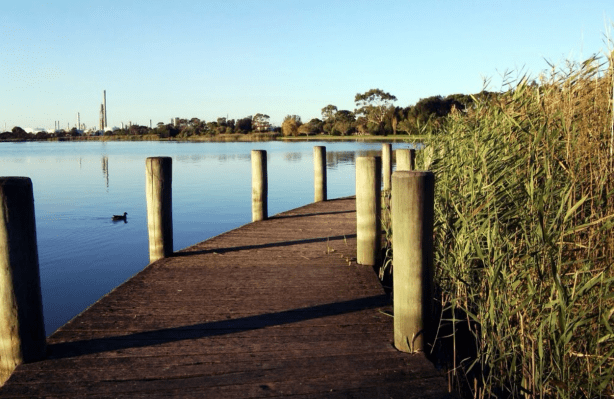
Cherry Lake, Altona in modern times, the industry of the Inner West is in the distance (unattributed)

Ultimately the Altona investors made the commercial decision to sell the land, the acquirer, local authorities who used it as parkland. Charge said the transaction resulted in a small profit which must have been some kind of miracle given the sum invested and paucity of spectator numbers in the 6 meetings run. Now the area is a residential one, the local amenity very much enhanced by Cherry Lake!

There are few photos to be easily found of this interesting track, if any Australian readers have an image or three you would like to share I am sure we would all like to see them! Please get in touch.
jack cooper

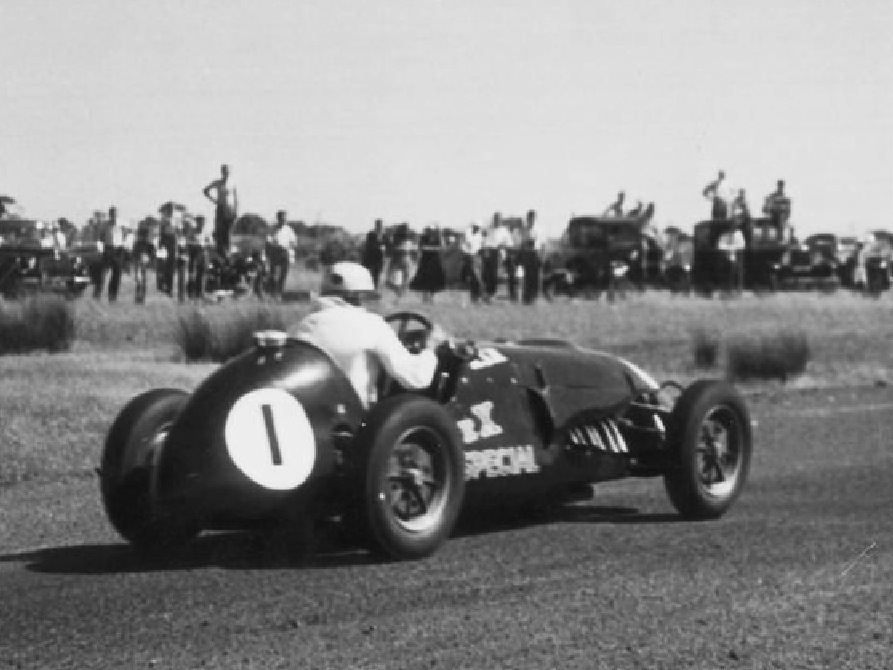
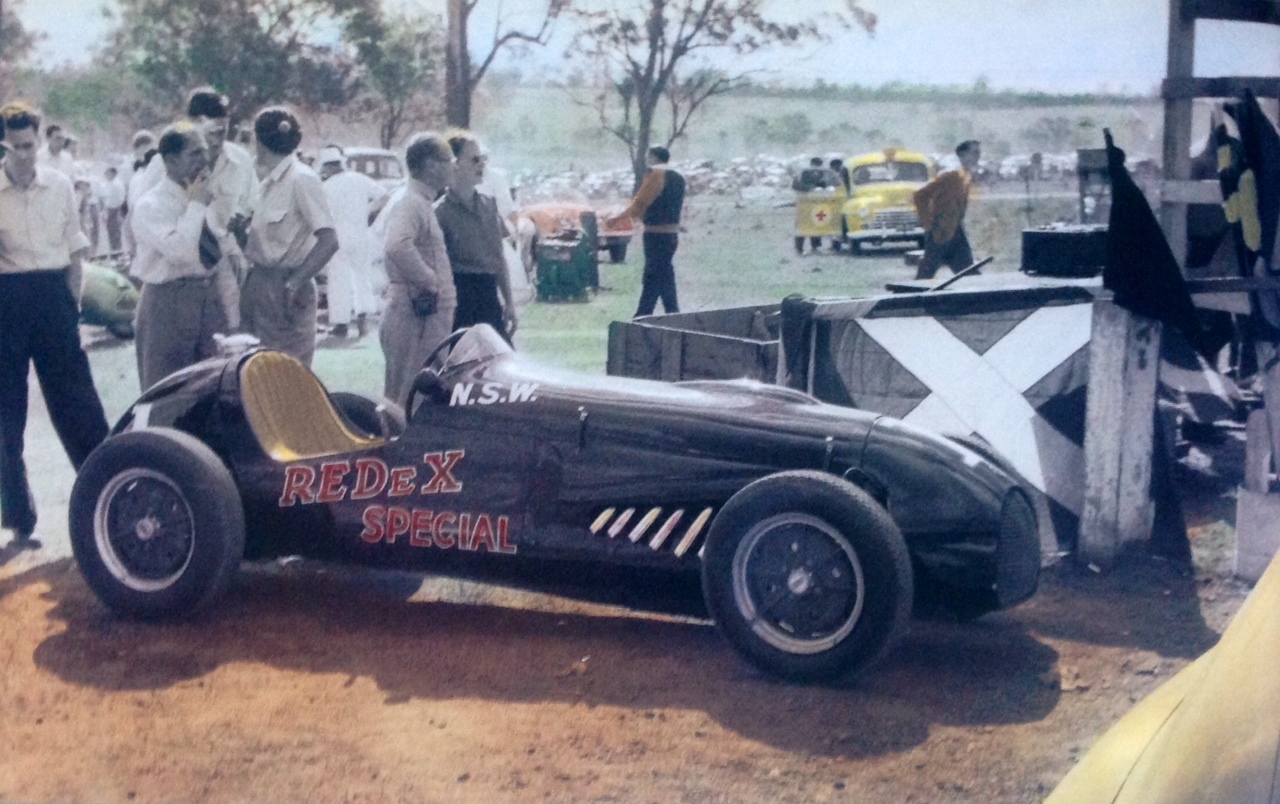
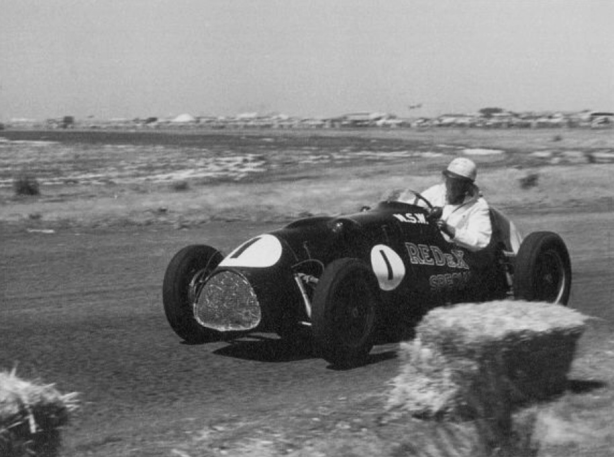
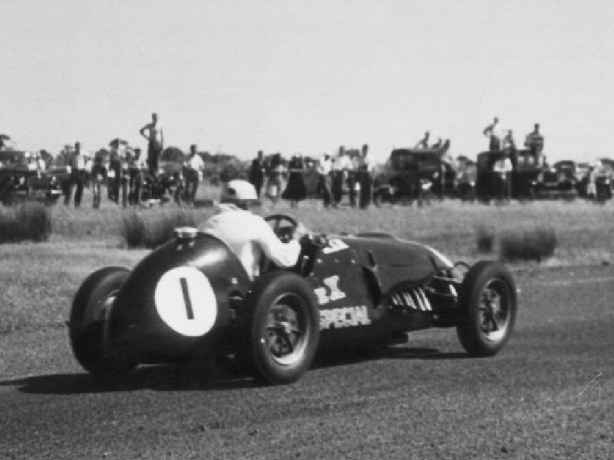
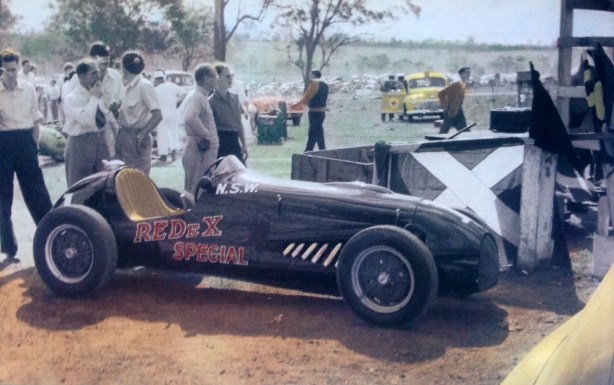
Hand colored print of the Redex Spl prior to the 1954 AGP at Southport on Queenslands Gold Coast. (Kev Bartlett reckons its Mt Druitt not Southport) The Bristol engines front camshaft bearing turned in its housing blanking off the drilling for lubricating oil, seizing le moteur. Stub exhausts interesting, not they way they were raced in the UK (Nye/Brabham)

Jack’s Cooper T23 Bristol…

I have done the ‘Cooper Bristol to death’ in terms of articles written, check these links out for information and photos about these important, wonderful cars, rather than me repeat it all again;

The shots of Jack’s car do beg the question about its history though, important as it was in his development as a driver. His success in it directly lead to his decision to try his hand in England in 1955, in fact he regretted selling the car in Oz, carefully developed as it was. Peter Whitehead’s Cooper Alta, the car he bought and raced when he first arrived in the UK was not a patch on the car he left behind.

The summary of the car is based on an article from John Blanden’s book, that research largely based on Doug Nye’s Cooper tome albeit its somewhat truncated. The best source of information on Jack’s formative years is the biography he wrote with Doug Nye, picking that book up always brings a smile to my face.

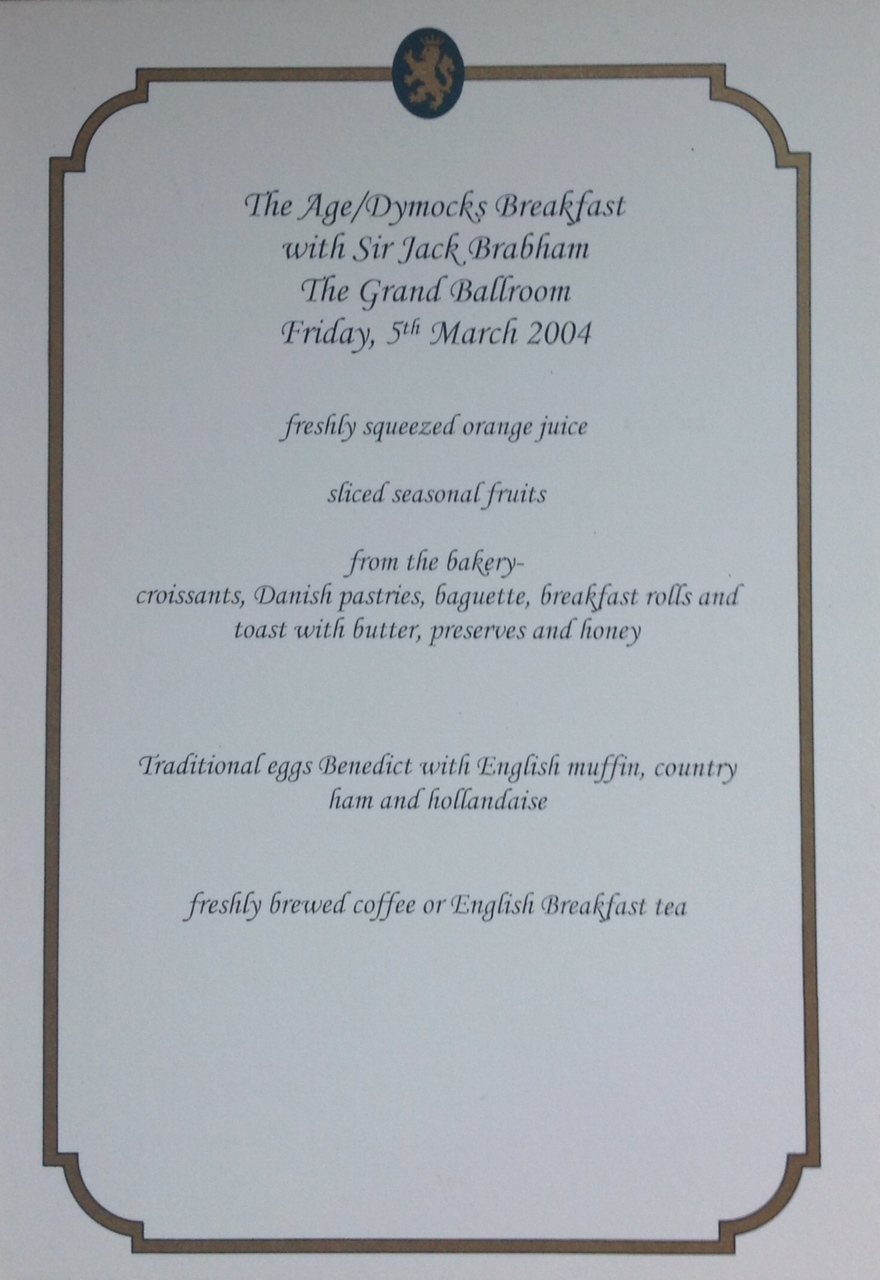
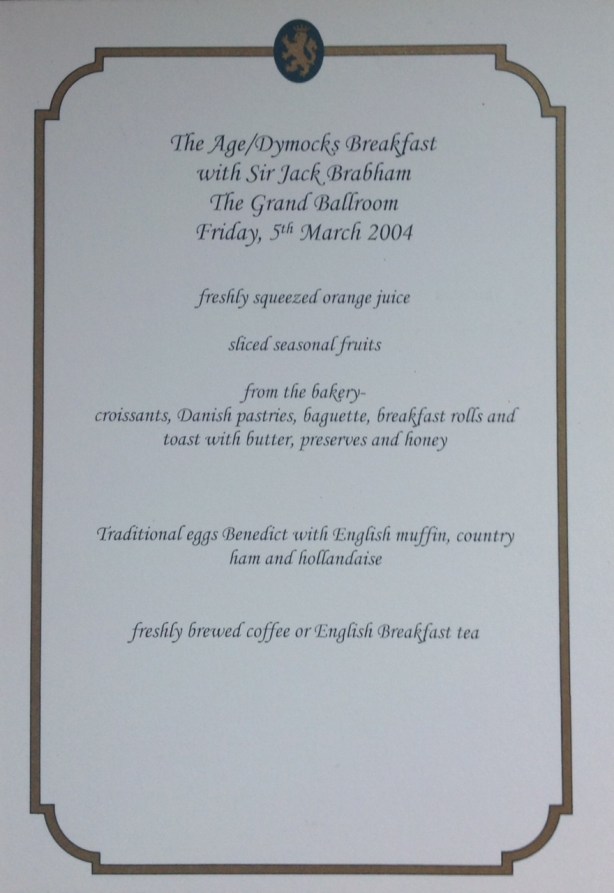
JB publicised ‘The Jack Brabham Story’ in Melbourne shortly after it was published and in the Friday before the 2004 AGP. He spoke at a function at the Windsor Hotel, the book was sold after the event and autographed by the champ for those prepared to stand in a long queue. My youngest son was 8, the only kid amongst 300 businessmen at the breakfast.
jack tucker

Windsor Hotel menu of the day! I wish i had the presence of mind to get Jack to sign this as well as the book! Sponsors are the Age Newspaper and Dymocks, a book retailer

Local ‘motor-noter’ and TV commentator Will Hagon was MC for the event, they used a question and answer format which worked well. Hagon was a great choice as the ‘right questions’ were asked rather than the crap someone with no knowledge of the sport, ‘how fast did she go Jack?’ ask.

Brabham was an absolute prince in the way he dealt with Nick when we collected his signature. ‘Bic’ still remembers that gig, Jack and the long day we had together strolling the wide open spaces of Albert Park. We still do the wide open spaces of Albert Park but all three sons are as interested in the beers on dad as much as the racing! You would think I would get one racer outta them given the number of events they did with me racing my Historic FF!? (Lola T342 at that time)
alt brab

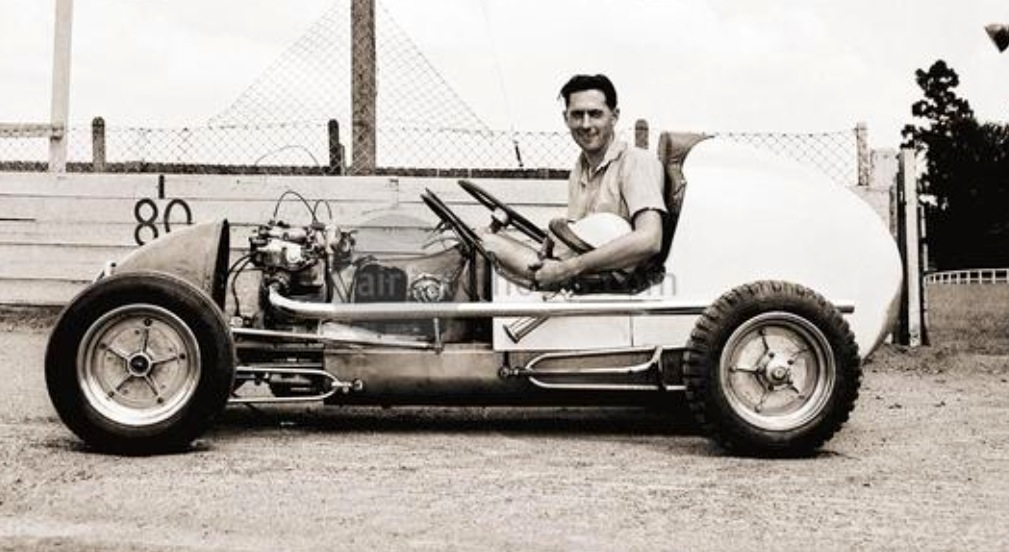
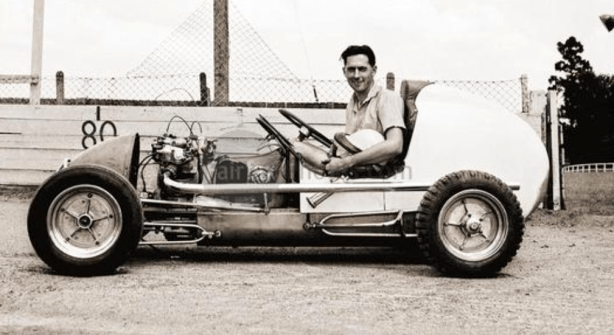
Brabham at Parramatta Speedway on 26 February 1954. Harley V twin engined speedcar owned by Spike Jennings modelled on Jack’s old car (Fairfax)

Brabham cut his racing teeth in the immediate post-war years on Sydney Speedways. By the early fifties he was essentially making his living on his prizemoney, racing three times a week made it difficult to keep up with the workload of his machine shop as well. He ran his Speedcar in some hillclimbs, and, fitted with front brakes won the 1951 Australian Hillclimb Championship at Rob Roy in outer Melbourne.

Beating the road racers with his Speedway car caused quite a stir, but also ‘put his name and capabilities up in lights’. He was effectively a professional in an amateur sport (road racing in Oz) well before he left for the UK. It was during these years he met Ron and Austin Tauranac who were racing their Ralts at the time, RT of course the other half of the ‘BT’ partnership.

Jack enjoyed the hillclimbs which convinced him to give circuits a go. In quick succession he acquired and raced Coopers Mk 4 and 5. To fund his road racing he sold his speedcar, continuing to race on the dirt tracks in a car owned by Spike Jennings with whom he shared the prizemoney.

The big step up was purchase of the Cooper Bristol.

Chassis ‘CB/Mk2/1/53’ was despatched to Australia as a new car to the order of David Chambers, prior to the cars arrival by sea, he committed suicide as a consequence of the financial trauma in which he was engulfed. The car was offered for sale on behalf of his deceased estate, Brabham’s bid of 4250 pounds, supported by some funds from his father and Redex, his sponsor, was the successful one.

Jack recounts how, upon testing the new car at Mt Druitt, an old WW2 emergency landing strip just outside Sydney for the first time, the Bristol engine lost oil pressure within a few laps. A subsequent tear-down revealed a bent crank and badly worn bearings. It soon became apparent that the new car was thoroughly ‘shop-soiled’, it had been raced by its first owner, John Barber in Argentina. Upon return to the UK, it was given a ‘cut and polish’ and then despatched to Chambers as a new car. It was not the first or last time ‘colonials’ were shafted by ‘nasty furriners’ in the UK and Europe a long way from the South Pacific!
jack mechanic

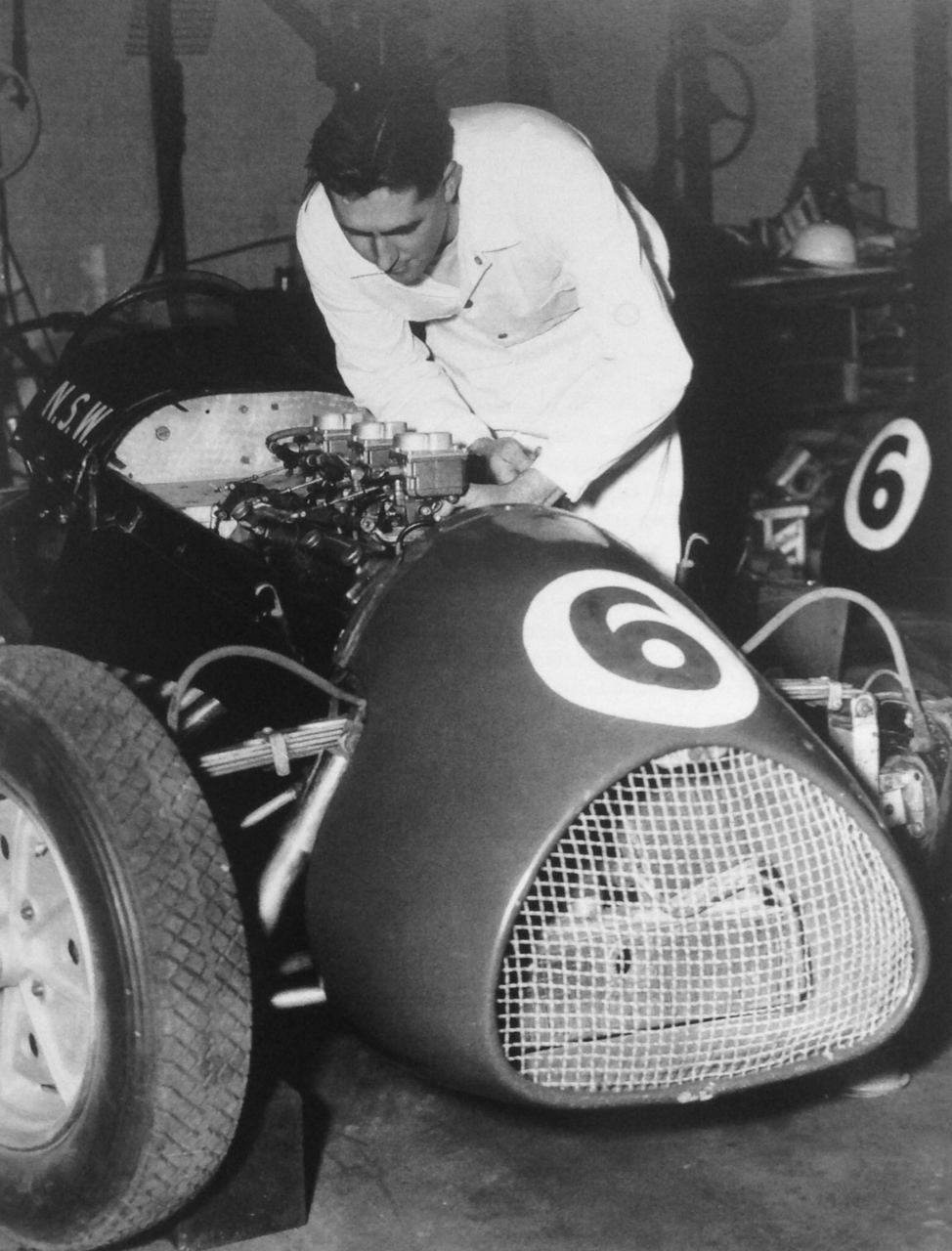
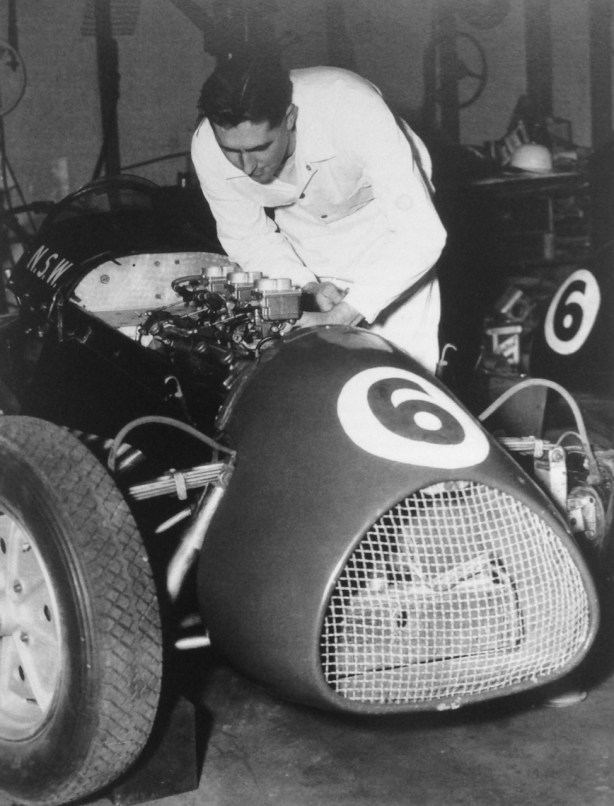
Jack fettles the Cooper in his Penshurst workshop. He recounts the story of welding a crack under the engine, the torch ignited some fuel vapours. Brabham’s extinguished was in another locked shed, he ripped the lock off in his bare hands to get the ext and doused the fire but ‘that day i could have lost everything’ (Nye)

When Jack carefully assessed the Bristol engine, having raced the car a few times, he couldn’t believe the hefty flywheel and quickly modified it along the lines of the Harley Davidson clutch assembly used on his Speedcar. He lightened the clutch/flywheel assembly from around 34Kg to 7kg thereby vastly improving the responsiveness of the engine and its reliability. The long, thin crank of the Bristol engine was a weakness because of the vast weight of the flywheel assembly. Further improvements to the engine were made with the assistance of British pre-war racer Frank Ashby who had moved to Sydney’s Whale Beach.

Jack had already replaced the Bristol’s Solex carbs with ex-Holden Stromberg units which were modified further after Ashhby’s suggestion to incorporate smoothly shaped bell mouths to aid air entry with consequent increases in power. Jacks hands-on engineering capabilities were part of his ‘competitive back of tricks and unfair advantage’ which never left him.

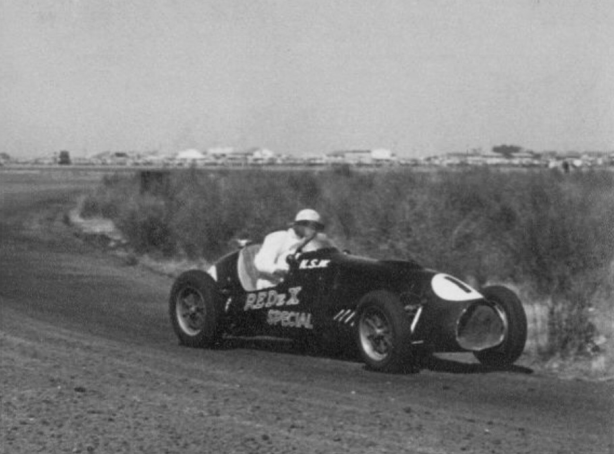
Brabham quickly established himself as one of the men to beat with the Cooper winning many events. His battles with the nascent Confederation of Australian Motorsport and their ‘no advertising on cars’ policy became  a constant thorn in his side, RedeX’ commercial involvement essential to his ability to run the car.
jack

Brabham at Altona again in 1954 (SLV)

In Europe and the UK the ‘no advertising thing’ didn’t seem to hold the sport back, there were enough wealthy individuals to make up the numbers and manufacturers to give worthy drivers without wealth a steer. Here in the mid fifties the drivers of ‘ANF1’ cars were either ‘silvertails’ like Lex Davison, mind you he made much more than he inherited or ‘self made’ blokes, a whole swag of whom were motor traders (Mildren, Jones, Stillwell, Patterson, Hunt, Glass and others, I’ve included Patto and Stillwell on this list but they too had family $ behind them from the start). The point is it was RedeX money which helped fund Brabham’s campaign, without it he probably wouldn’t have achieved what he did. What am I saying? The Americans goddit right from the start with a totally commercial approach which allowed those with talent access to sponsors funds to help them progress.

The cars race debut was at Leyburn, Queensland on 23 August, he won the ’53 Qld Road racing Championship. Brabham set quickest time in the NSW GP at Gnoo Blas, Orange but non-started the 1953 AGP at Albert Park after he ran the Bristol’s rear camshaft bearings in practice due to excessive friction.

Brabham contested the 1954 New Zealand Grand Prix, finishing 6th, meeting Tony Gaze, Reg Parnell, Peter Whitehead, Ken Wharton and a VERY young Bruce McLaren. Jack stayed in the McLaren home, Leslie McLaren a local racer and garage owner. The race was won by Stan Jones Maybach .

The car continued to do well throughout Australia, his clashes with Davison’s HWM Jag, Dick Cobden’s Ferrari and Jones Maybach were highlights of the period.

At the ’55 NZGP meeting two visitors from the UK, Dunlop Racing Manager Dick Jeffrey and Dean Delamont, Competition Manager of the RAC, convinced him he should try his hand in the UK the following year. By the time he alighted the ship on the journey back to Sydney he determined to do just that, and the rest as they say is history.
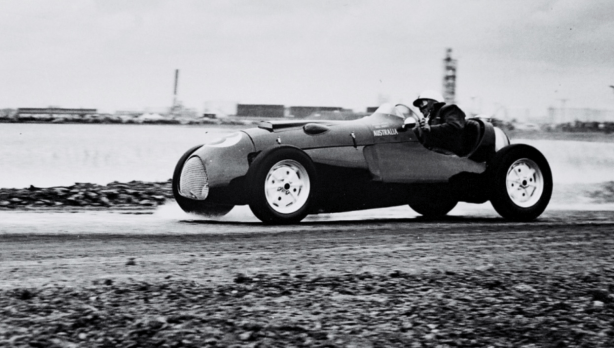
stan

Stan Jones in the ex-Brabham Cooper T23 Bristol, Altona, date uncertain (unattributed)

Stan Jones was the eager buyer of the Cooper having destroyed his new Maybach 2 whilst leading the 1954 AGP. Stan was lucky to survive a very high speed journey backwards through Southport’s trees. Whilst Charlie Dean and his band of merry, Repco men designed and built Maybach 3, Stan first raced the CB in the Victorian Trophy at Fishermans Bend on 19 February. The nose of the car was slightly modified before his next race at Albert Park in March 1955.

Stan retained ownership and had Ern Seeliger race at Bathurst Easter 1955, Ern was 2nd in the ‘Bathurst 100.’ Jones was forever buying and selling racing cars, ‘moving metal’ was his business after all! Have a read of my article about the champion racer if you are unfamiliar with Alan’s father and his own impressive racing CV;

Stan Jones: Australian and New Zealand Grand Prix and Gold Star Winner…

Later in 1955 Jones sold the car to ‘Ecurie Corio’s’  Tom Hawkes, the Geelong businessman raced the car for 3 years before leaving for Europe.
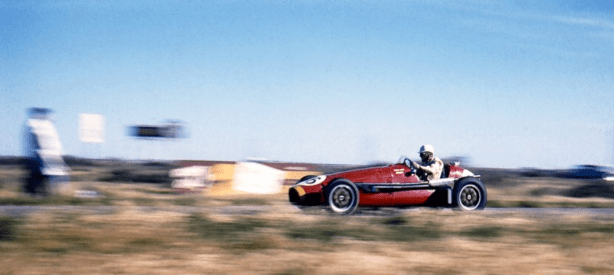
hawkes

Hawkes in the Cooper T23 Holden at Port Wakefield, SA, Labor Day meeting 1957. Top shot! (Geoff Chennells)

Hawkes first race was the 1955 AGP at Port Wakefield, winning a heat but DNF in the race itself with fuel feed problems. Tom then modified the car by lengthening the nose, altered the front suspension and most importantly fitted a Holden ‘Grey Motor’ incorporating a Phil Irving Repco ‘Hi-Power’ head. The car raced in this form at Albert Park in March 1956 and over the next 2 years in this spec.
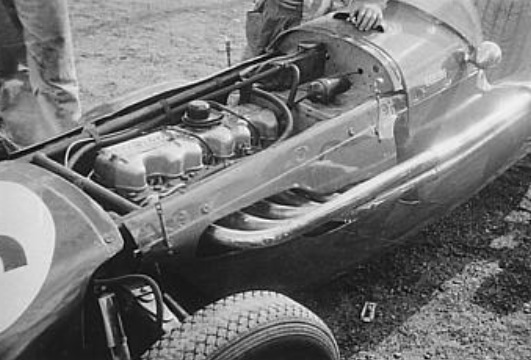
hawkes holden

Cooper T23, with its neat 6 cylinder Holden Repco engine Gnoo Blas or Bathurst (Ian McKay)

The car was very fast in this form, not quite an outright contender amongst the ‘heavy metal’ of 250F’s, Ferrari 500/625 and Ted Gray’s V8 engined Tornado but still quick enough to finish 2nd in the 1957 Gold Star series to Davison. Those points were amassed by finishing 4th in the Victorian Trophy, 2nd in the Qld Road Racing Championship, 2nd in the NSW Road Racing Championship. He was a terrific 3rd in the 1958 AGP at Bathurst.
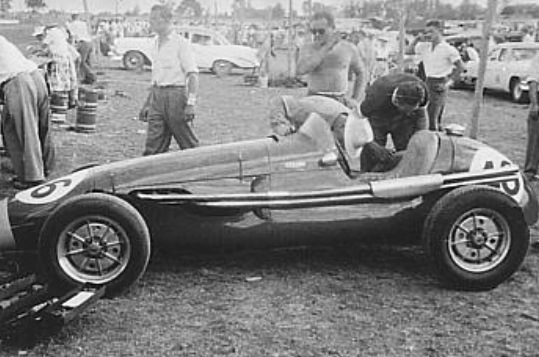
hakes

Same meeting as the pic above, longer in the nose and all the prettier and quicker for it. Gnoo Blas or Bathurst (Ian McKay Collection)
hawk in car

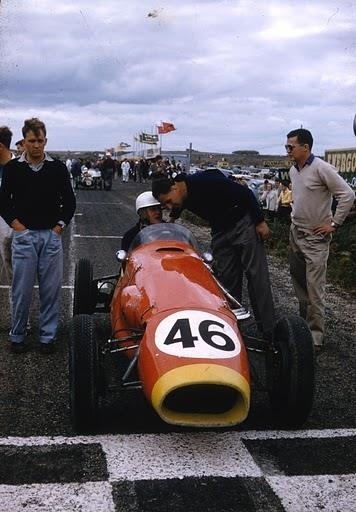
Tom Hawkes, Cooper T23 Holden Repco, about as pretty as racer of the period can get, and mighty fast in ‘Hi-po’ Repco head form (Ellis French)

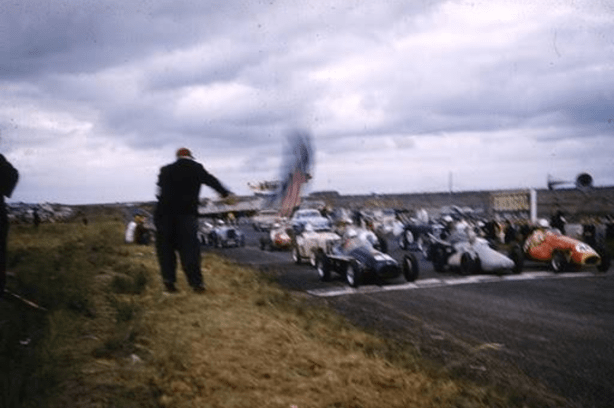
Ace historian/researcher Stephen Dalton dates these Phillip Island shots (above and below) of Tom’s T23 as during the October 1957 meeting, note the mixed grid of MG T Spls. The shots show just how sleek the car has become in its ‘definitive’ later Repco headed Holden form. It may not have quite been an outright car in terms of outright performance by then but Hawkes did a mighty fine job of extracting all the car could give.
hawk on grid

Next to Hawkes Cooper T23 Holden on the right is Eddie (father of Larry) Perkins, Porsche Spl and Ted Gray in the Tornado Chev at left, Unlimited Racing Car event, October 1957, Phillip Island (Ellis French)

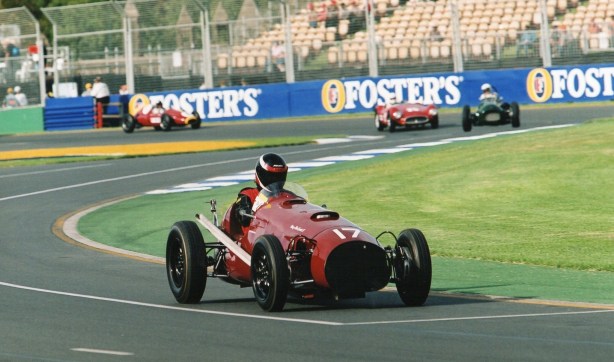
When Hawkes left for the UK at the end of 1958 he retained the car but tasked Murray Rainey to fit a Chev Corvette 283cid ‘small block’ V8 into the Coopers lissom spaceframe chassis.

This job was completed by Earl Davey Milne who bought the car in April 1962. Gearbox used was  Borg Warner T10, a slippery diff was also fitted and the bodywork modified. The car is still retained by his family 50 years later. Because it never raced ‘in period’ in this form the Cooper is ineligible for a CAMS ‘Certificate of Description’ and appropriate logbook.

The car appears in demonstrations from time to time, looking immaculate, its importance as the first Mk2 CB and its role in the ‘Brabham Ascent’ appreciated by all enthusiasts.
coop 2

The ‘Cooper Corvette’ ex-Brabham T23 driven by Troy Davey-Milne at Albert Park  in one of the historic demonstrations during the AGP carnival (Davey-Milne)
coop 1

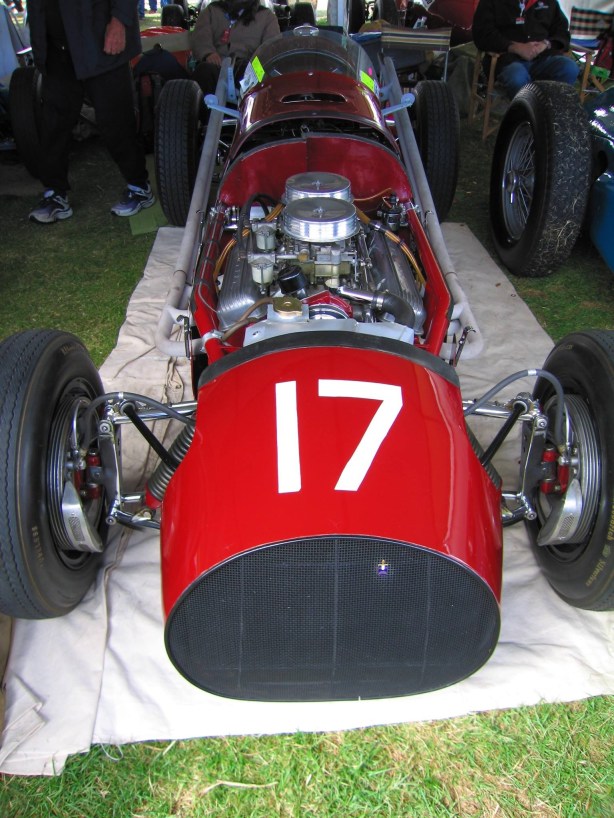
Chev 283 Corvette ‘small block’ with 2 big Holleys atop, installation very neatly done ‘in period’ but ‘Cooper Corvette’ never raced in this form. Albert Park 2006 (Davey-Milne)
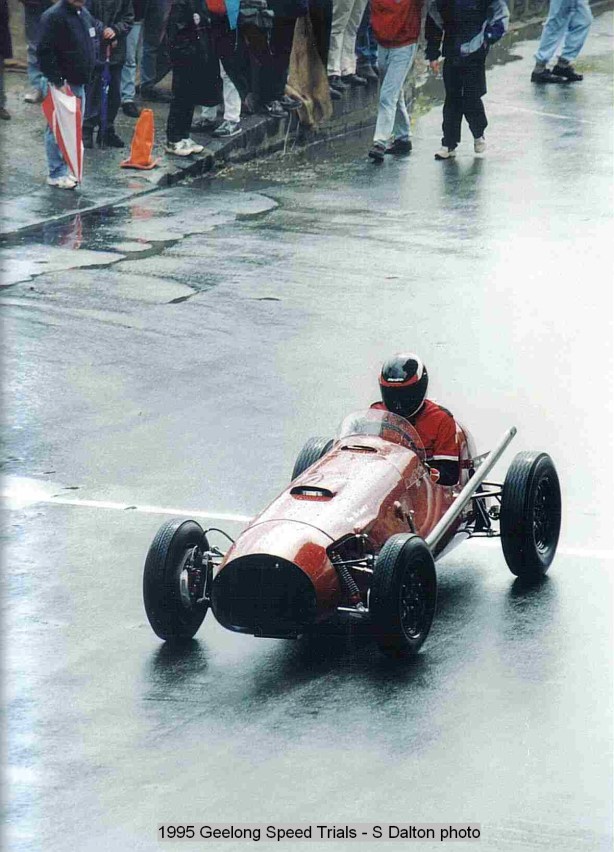
1995 Geelong Sprints - Davey-Milne 01

Troy Davey-Milne in #CB/Mk2/1-53 Cooper T23 Chev at the wet Geelong Sprints, Ritchie Boulevard in November 1995 (Stephen Dalton)
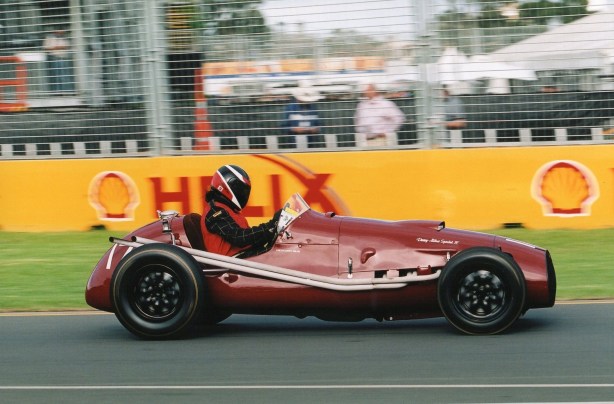
coop 3

Still a handsome car, Troy Davey Milne at Albert Park in 2006 (Davey-Milne)

Etcetera…

Probably too arcane a topic for international readers but some Australian enthusiasts may find this short photo based article about the Charge Brothers on the great ‘Aussie Homestead’ site, of interest. None of the photos of the brothers cars are at their Altona circuit. In fact they are everywhere in Victoria but the place which is not what I wanted at all! Click on this link to have a look;

http://aussieroadracing.homestead.com/Charge-Bros.html
altona prog

Photo Credits…

State Library of Victoria, Stephen Dalton Collection, Fairfax Media, Troy Davey-Milne, Ellis French, Ian McKay Collection, Geoff Chennells

Bibliography…

The Age 3/3 and 9/3 ’54, Williamstown Chronicle 2/4/53, 19/2/54, The Argus 17/2/54, 28/4/54

Doug Nye ‘The Jack Brabham Story’

Tailpiece…
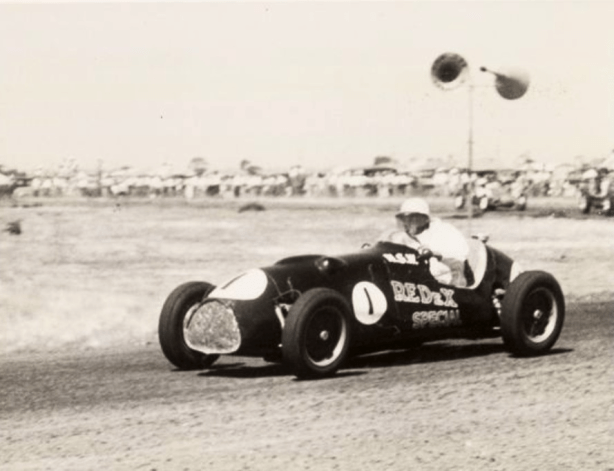
a brabs

JB again @ Altona in 1954 (SLV)


image

Gilbert Klecan won the first post-war ‘All American Soap Box Derby’ by covering his machine and himself in graphite, his ‘Unfair Advantage’, Akron, Ohio on 9 August 1946…

This shot gave me a chuckle, reminding me of my own ‘billy-cart’ days. The tight ’46 finish is shown below, the wonderful tradition of these events continues to this day.

Credit…

Racing One

image


image

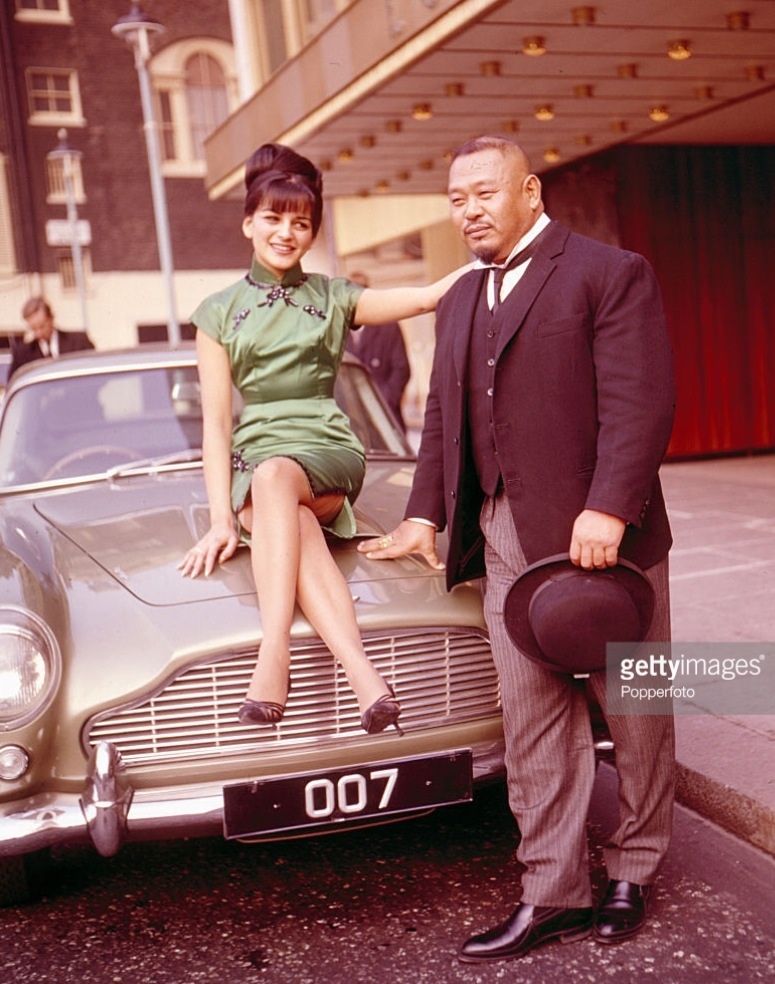
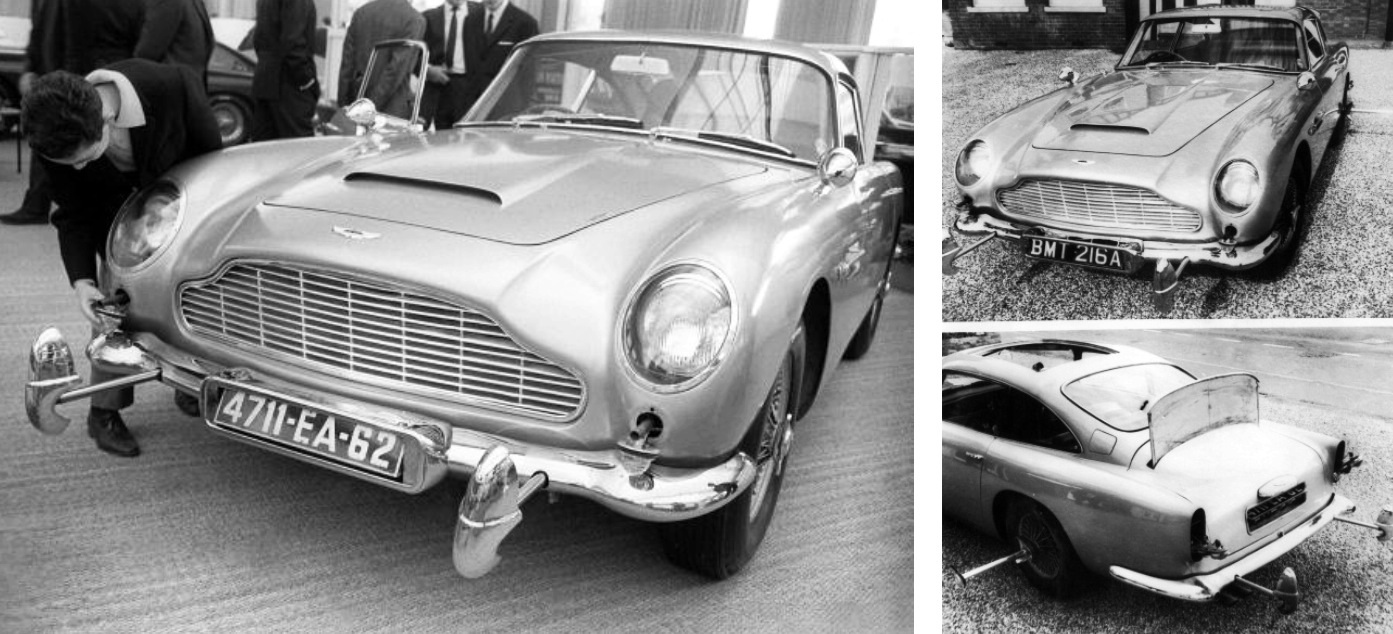
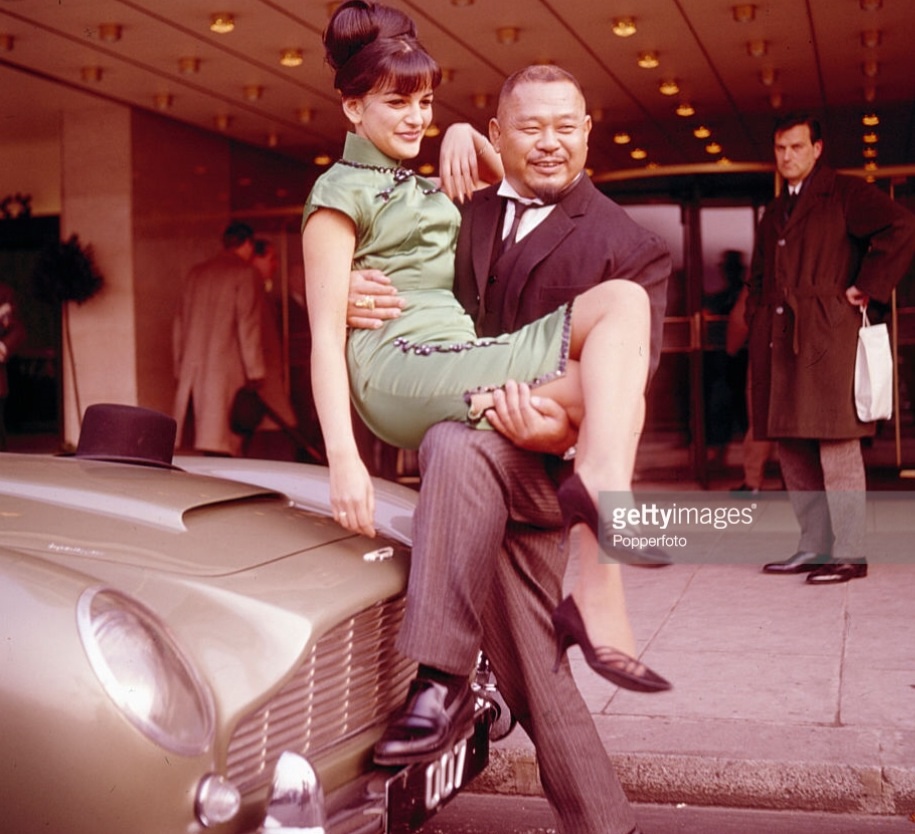
Oddjob shows off James Bond’s Aston DB5 outside the Hilton Hotel in the PR hoopla around Goldfinger’s release in 1965…

image

(Popperfoto)
Goldfinger was the third film of the Bond ‘franchise’, James copped a new company car of course, an Aston DB5 and so commenced a relationship between Bondy and Aston’s which has endured down the decades. It was an astute bit of product placement on the part of David Brown and his marketers, sales and company profile grew as a consequence.

Aston Martin’s haven’t been Jame’s only conveyance of choice, click on this link for a list of all the cars used in the Bond films;

http://www.007james.com/articles/list_of_james_bond_cars.php

image

Sean Connery on ‘Goldfinger’ location with DB5 (Donaldson Collection)

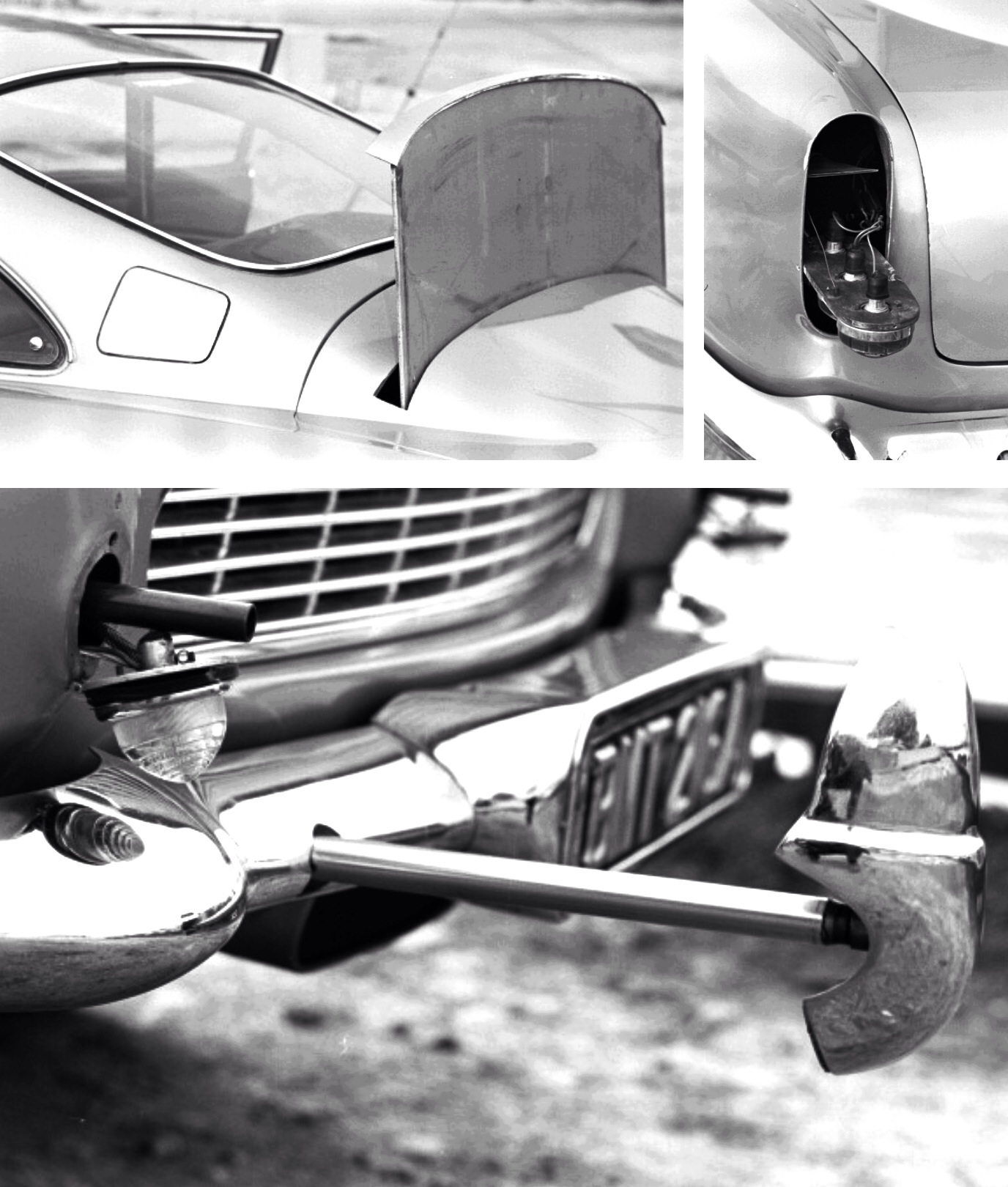
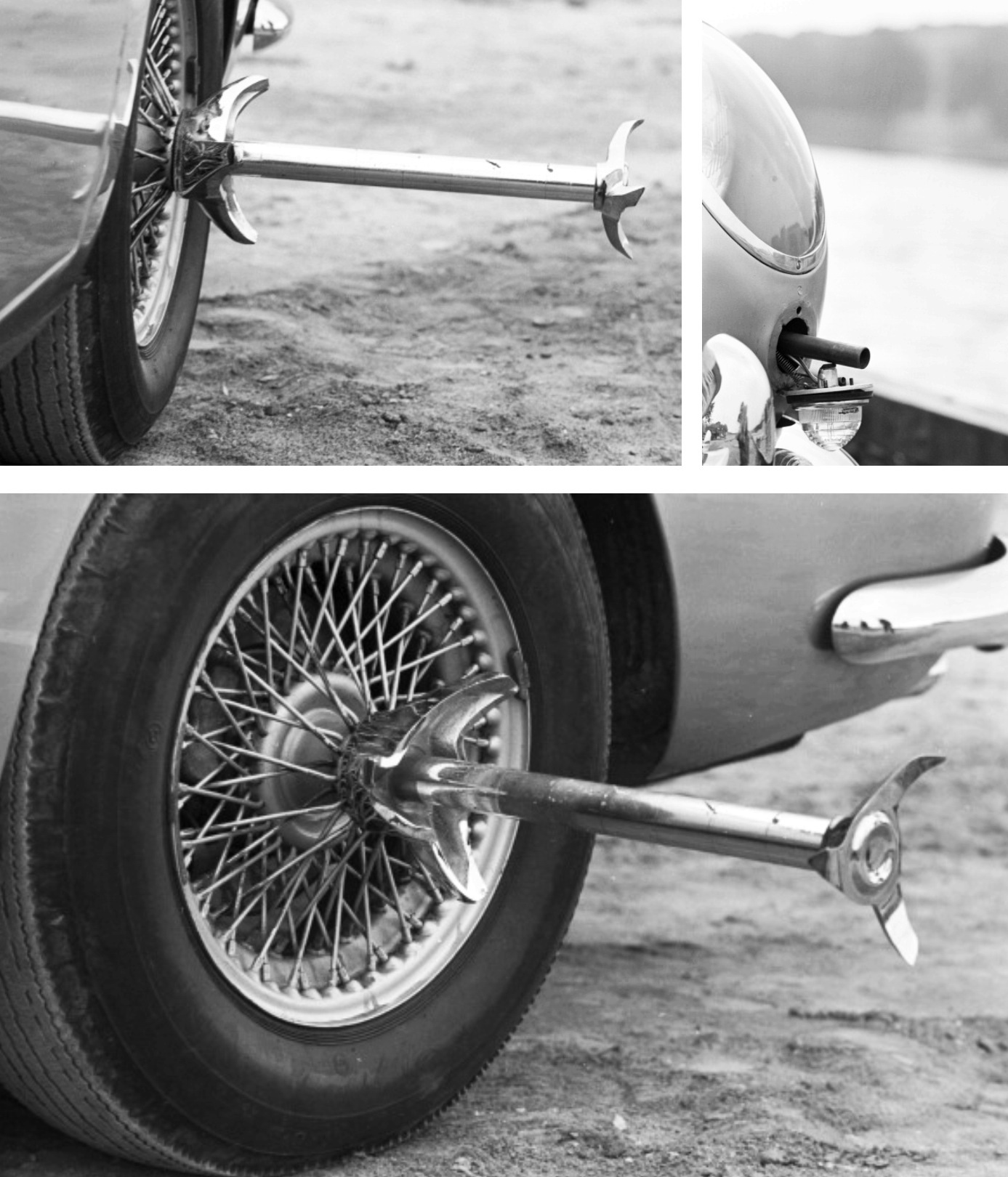
Because I know you simply have to know, here’s a comprehensive list of all the goodies ‘Q’ fitted to the DB5 to keep James away from the baddies;

http://www.007james.com/gadgets/aston_martin_db5.php

image

(Popperfoto)

image

(Popperfoto)

And One for the Rich Kids…

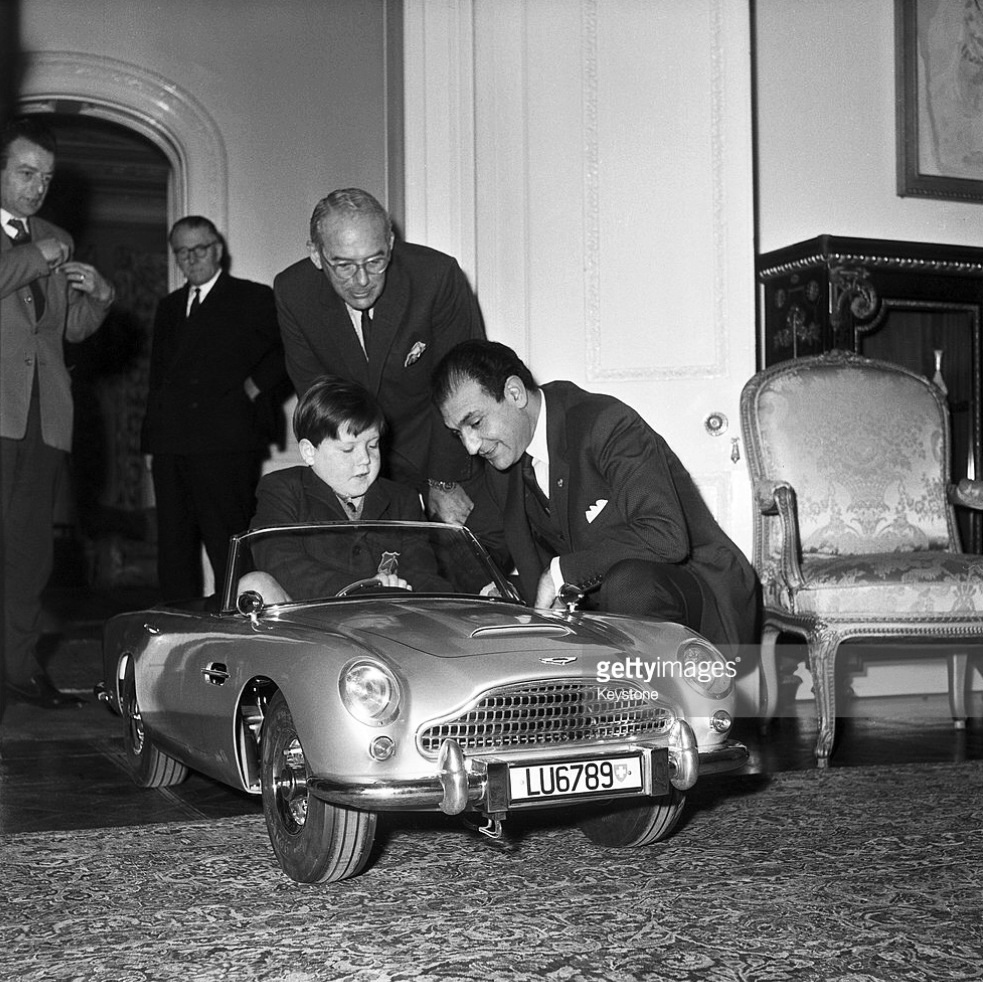
image

The portly young chap is at the wheel of a DB5 ‘Junior’ in the Iranian Embassy, London December 1966. Its a gift from Aston’s to the Shah of Persia or Crown Prince of Iran, dude at right the Iranian Ambassador


Credit…

Popperfoto

Tailpiece…

image

image

Family watching the ‘Del Monte Trophy’ Pebble Beach, California road racing in October 1954…

I was going to crop out the rug etc but then noticed the ‘six’packs’ of Coke and Miller. I imagine its a quintessential American scene of the day which no doubt is the composition photographer Robert Lachenbach sought.

No details on car or driver but ’tis a top shot?! Love the period casual clothes of the ‘well-heeled’ local patrons.

Credit…

Robert Lackenbach


image

The ever innovative Derek Gardner with an ‘aero-tweak’ being tested on Francois Cevert’s Tyrrell 002 Ford during Italian GP practice at Monza on 10 September 1972…

This huge sleeve over the exhausts is cowled from the oil coolers back, the idea being to harness the exhaust gas energy to entrain air through the sleeve and enhance airflow and hence better cooling thru the oil rads.

Francois hadn’t done too many laps when the ‘prophylactics’ parted company with the car at very high speed, bouncing their way into lightweight schrapnel around the famous autodrome, fortunately ‘002’ was well clear of any following cars at the time!

The shot below shows a standard ‘006’ rear end to give an idea of how the car appeared sans ducts.

Ken Tyrrell and Jackie Stewart discuss the sublime weather before Francois is sent on his way. These cars evolved a lot throughout 1972/3, the Tyrrells arguably (Lotus 72 pace duly noted!) the quickest cars of the era from the time ‘001’ first raced at Oulton Park later in 1970 until Stewart’s retirement and Cevert’s death at Watkins Glen at the end of 1973.

tyr arse

Date and place unknown, 1973 Tyrrell 006 Ford, Cevert up (unattributed)

Monza 1972 wasn’t a good race for the ‘Boys in Blue’ at all though, JYS popped a clutch on the line and was lucky not to get ‘whacked up the clacker’ at a million miles an hour and Francois’ engine ‘popped’ on lap 14. Emerson Fittipaldi took the race and the ’72 title in his Lotus 72D Ford.

tyr franc

FC looking very ‘chillaxed’ prior to the ’73 British GP at Silverstone, Tyrrell 006 Ford (unattributed)

You might find this story about Cevert’s early career of interest if you haven’t already seen it;

Francois Cevert: Formative years…

I wrote an article a while back about Team Tyrrell and innovation…

Have a read of it if you haven’t, its amazing just how ‘edgy’ Ken’s boys were over the years given their resources relative to bigger, better funded teams;

https://primotipo.com/2014/09/16/tyrrell-019-ford-1990-and-tyrrell-innovation/

tyr fran silvers

Roll on into mid-1973 and Derek was considering his overall design and aero alternatives for his 1974 car…

Here Francois is testing ‘005’ during British GP practice at Silverstone in mid July, JYS did a few laps in the same car carrying #42. It looks remarkably cohesive for a car designed originally with a totally different bluff nose aerodynamic concept!

tyr brit

Compare and contrast the ‘normal’ bluff nose Tyrrell ‘006’ Cevert races here in front of James Hunt’s March 731 Ford at the British GP, Silverstone in 1973, with the ‘005’ chisel nose he tested in practice above. Hunt was a splendid 4th, Cevert 5th, Revson took his first GP win in a McLaren M23 Ford (unattributed)

It was a good year until the US GP, JYS took his third title in the ‘low polar moment of inertia’, short wheelbase, twitchy but very quick in both Stewart and Cevert’s hands, Tyrrell 005/006 cars.

Click on this link for a short story about those cars;

https://primotipo.com/2014/08/25/jackie-stewart-monaco-gp-1973-tyrrell-006-ford/

Gardner had a pretty handy additional test pilot in Chris Amon who was contracted the drive the spare Tyrrell 005 in the end of season North American GP’s at Mosport and Watkins Glen.

Chris was always rated as a test-driver by all he raced with from Ferrari’s Mauro Forghieri ‘down’.

Amon raced ‘005’ in side radiator/chisel nose spec in Canada. He didn’t race it at Watkins Glen after Francois’ fatal accident on the Saturday resulted in Ken Tyrrell withdrawing the teams cars for the race, which would have been the retiring Stewart’s 100th GP.

tyr amon

Chris Amon 10th in Tyrrell 005 Ford in the Canadian GP, Chris has ‘modified’ the cars nose during the race. JYS was 5th in 006, Cevert DNF after a collision with Scheckter, Peter Revson won the race in a McLaren M23 Ford (unattributed)

Derek Gardner tested the ‘chisel nose, side radiator’ aerodynamic approach pioneered by the Lotus 56 at Indianapolis in 1968.

After the history making changes at the 1973 seasons end Derek Gardner threw out the conceptual approach he had decided upon for 1974.

The proposed car was to be a ‘highly strung thoroughbred’ from which maestro’s Stewart and Cevert could extract every ounce of performance. His change was to a much more forgiving chassis attuned to the developmental needs of ‘cub drivers’ Jody Scheckter and Patrick Depailler for 1974, his ‘007’ design was the very effective result.

tyr 007

(unattributed)

Tyrrell 007 Ford cutaway above. The design comprised an aluminium monocoque chassis, Ford Cosworth 3 litre DFV V8, Hewland FG400 5 speed transaxle, disc brakes inboard front and rear, wishbone front suspension with coil spring dampers, rear suspension by single upper link, lower parallel links, radius rods and coil spring/damper units anf adjustable roll bars.

Checkout Allen Brown’s oldracingcars piece on ‘007’ inclusive of chassis by chassis history; https://www.oldracingcars.com/tyrrell/007/

Tailpiece: The ’74 Tyrrell 007 Ford in Depailler’s hands, Swedish GP in which he was 2nd and Scheckter’s 1st, winning the South African’s  first GP. Evolution of Derek Gardner’s aero thinking clear from ’73-’74, mind you he went back to a bluff nose for his outrageous P34 6 wheeler for 1976…

tyr pt

(unattributed)

Credits…

Rainer Schlegelmilch, Doug Nye ‘History of The GP Car’

Finito…