Start of Coupe de Robert Benoist. #2 Amedee Gordini, Gordini, #17 Creuchet Bugatti, in between them the Ferry Riley, #5 Brunot Riley, #3 Cayeux Simca Gordini, #14 Boucard Salmson and #9 Pozzoli Lombard at the rear. (unattributed)
The horror of World War 2 ended, the first post-war race meeting in Europe was in Paris 70 years ago on a circuit which passed in front of the Porte Dauphine, went off into the Bois de Boulogne and around the Lake…
The guns fell silent in Europe on 8 May 1945 but not until 2 September in the Pacific, the efforts of the ‘AGACI’ an independent club for racing drivers and it’s president Maurice Mestivier in running the event on September 9 in the context of the times is amazing.
It was a time of immense devastation and mourning, industry was having trouble restarting and ‘coupons’ were required to get basic foodstuffs let alone fuel, metals and tyres.
With the agreement of the acting government of France, the American authorities provided fuel, and Major Rogers, the area commander a group of MP’s to assist local gendarmes with crowd control.
There were two and four wheeler races, the car events comprised the ‘Coupe Robert Benoist’ in memory of the Pre-War GP driver and Le Mans winner who had joined The Resistance and been executed by the Nazis, the ‘Coupe de la Liberation’ and ‘Coupe des Prisonniers’.
Competing cars were a mixture of ‘Specials’ and Bugatti, Maserati, Alfa Romeo, Delage, Delahaye and Talbot cars.
The big event was the ‘Coupe des Prisonniers’ for over 3 litre racing cars, the race a short one of 75 miles given materials shortages with Jean-Pierre Wimille victorious in his Bugatti T59/50B 4.7 litre supercharged car ahead of Raymond Sommer in the Talbot T26 ‘Monoplace’.
Racing on an international scale did not really begin until the spring of 1946 but the Bois de Boulogne was deeply symbolic of change and renewal…
‘Coupe des Prisoniers’ start with the #3 Philipe Etancelin Alfa Monza 8C2300, #4 Louis Gerard Maserati 8CM to the left Raymond Somners’ Talbot Lago T26 ‘Monoplace’ and #17 Roger Wormser Delahaye 135S in shot. (Unattributed)
Jean Pierre Wimille, at left in the dark driving suit and Ettore Bugatti in light colored suit holding hat, beside his victorious Bugatti T59/50B, Coupe des Prissoniers 1945. (Unattributed)
British multiple world champion Geoff Duke on his way to second place aboard his Manx Norton 500 at Assen in 1952, winner Umberto Masetti, Gilera 500/4…
Duke was world champion six times with 33 GP wins and dominated 1950’s racing. He won three of his titles on Nortons (1950/51/52). His pace was critical to Norton who were fighting to maintain competitiveness as their ‘singles’ struggled against the more advanced, powerful multi-cylinder engines of the Italians and AJS at home.
Norton’s ‘Featherbed’ racing frame was at the cutting edge though. Isle of Man TT racer Harold Daniell was quoted as saying that it was like ‘riding on a featherbed’ compared to conventional racing frames- the frame featured a lower centre of gravity and shorter wheelbase, combined with careful engine placement to maximise handling.
Duke more successful in 1952 350cc GP at Assen, victorious on a Norton (unattributed)
In 1953, being underpaid by Norton he moved to Gilera, the pay deal was sweetened by inclusion of a new Lancia B20 as part of his package. He repaid Gilera’s faith in him winning three 500 championships ‘on the trot’, from 1953-5.
Duke also dabbled in cars, securing a podium finish in the 1952 Goodwood Easter handicap in a works Aston Martin DB3 behind 2 Jaguar XK120’s. Aston Martin Team Manager John Wyer, wrote of Duke’s immediate pace in his autobiography; ‘Duke really was sensational right from the start. The car was one of the lightweight DB2’s and he asked me not to time him during the first session as he was just going to go out and get the feel of the car. In fact i did time him, just for my own interest and in that first spell he was only a second slower than the best time any of our drivers had done on that track. In the very next session he lapped faster than any of our team drivers had ever done-i promptly signed him up!’
Reg Parnell in DB2 #14 with Duke immediately behind him at the start of sports car race at the 1952 Berne GP meeting. Benz SL300’s, Lancia B20, Ferrari et al (Vantage)
In May 1952 he and Reg Parnell contested a sports car race at Berne during the Swiss GP meeting, Duke was fourth in an Aston DB2 behind three factory Mercedes Benz 300SL’s, after qualifying fifth but starting at the rear of the grid, having used his teammate Reg Parnell’s car in qualifying. Duke’s machine was the only car not lapped by the Mercs’ until his car lapsed onto five cylinders for the last 2 laps of the race. Alfred Neubauer was so impressed he offered Geoff a Mercedes test drive on the spot, two years before the same offer was made to Stirling Moss. In a demonstration of his virtuosity Duke also won the 350cc Berne GP for bikes aboard his Manx Norton on the same weekend.
A youthful Geoff Duke and hirsute Stirling Moss at the ‘British Empire Trophy’ meeting IOM 1952. Moss drove Frazer Nash Le Mnas Rep DNF. Handicap race won by Pat Griffith in a Lester MG (unattributed)
Duke was to win the Isle of Man TT six times, his circuit knowledge was put to good effect by Astons’ who entered him in a DB3 in the British Empire Trophy race in late May 1952. His car, DB3/1 was the 2.6 litre engined prototype which had already done considerable miles at Montlhery. Duke led for most of the race and set the fastest lap but retired with a broken crankshaft- ‘Motorsport’ magazine observed that ‘His run was a fine introduction to long distance motor racing’.
He also led the 1953 Sebring 12 Hour in another DB3 until crashing the car he shared with Peter Collins, the two young Brits retired on lap 52. Duke recalled that ‘Peter was a very fine driver, he drove the first stint and built up a commanding lead, which i then managed to maintain. Unfortunately i went for a gap on the inside of an MG on a slower corner when i really should have waited and powered by on the next straight…anyway i drifted into a collision with the MG and then spun into a concrete filled oil drum which broke the suspension.’
Geoff Duke, Aston Martin DB3, ‘British Empire Trophy’, Isle of Man 1952 (unattributed)
When the next race at Silverstone ended in disappointment and frustration after clutch problems, the atmosphere in the team was also tense as the ‘mere motorbike rider’ was the subject of some resentment from the established drivers and ‘starlet’ Peter Collins. Duke decided to quit cars and focus on a lucrative ‘bikes only’ deal with Gilera, as related above, Geoff then won three 500cc titles for the Italians on the trot. The Gilera deal meant he never did take up the Mercedes test drive offer…
Duke at the wheel with Peter Collins testing or demonstrating a DB3 Aston. Despite the frivolity their was tension in the team between ‘newbee’ motorcyclist Duke and some of the drivers, including, according to Duke, Collins who was also recruited in 1952 (Vantage)
His 1955 world title with Gilera was his last, he led a riders strike over the levels of privateers pay from circuit promoters and was then banned from racing for 6 months. Injuries and Gilera’s withdrawal from racing interfered with the following seasons, he finally retired from ‘bikes in 1959 returning to cars one last time contesting several 1960 Formula Junior events in a Chequered Flag entered, front engined Gemini Mk2 Ford.
His best result was seventh in the International Trophy meeting at Silverstone in May, Jim Clark won in his Lotus 18. It was a good run, future GP drivers, Jim Clark, John Surtees, Peter Arundell and Mike Spence were in front of him in mid-engined cars. Duke also contested the Monaco GP FJ curtain raiser in May but spun on the first lap. He qualified tenth, those in front of him included Henry Taylor, Trevor Taylor, Jim Clark, Peter Arundell and Colin Davis.
Monaco GP, FJ pits. #102 Graham Warner 15th # 98 Geoff Duke DNF spin Gemini Mk 2 Fords. Thats Duke in the driving suit to the right of his car. #60 Kurt Lincoln Cooper T52BMC 5th (Brad Ward)
Duke also raced a Reg Parnell Racing Lotus 18 Climax in several later 1960 F2 events at Aintree, Snetterton and Brands Hatch in August for DNF’s in all events. His final race was also Duke’s only F1 race. He was entered in the Fred Tuck owned, outdated Cooper T45 Climax in the 1961 non-championship ‘Kanonloppet’ at Karlskoga, Sweden on 20 August. The cars gearbox locked on lap 10 causing a huge crash which damaged his ribs, broke a collar bone, cracked his pelvis as well as causing a collapsed lung and trauma to the heart muscle.
It was a sad end to a great racing career by any measure.
The schoolboy idol at the start of an Ulster GP year uncertain. Manx Norton. Duke was ‘British Sportsman of The Year’ in 1951, a ‘Superstar’ before the term was invented. (Vantage)
From a car racing viewpoint- hindsight being a wonderful thing, Duke was 37 when he returned to four wheels. He should have focused on sports cars or if hell bent on single-seaters, on them given the promise he showed in the outmoded front-engined Gemini in 1960. Then do done another year in a Lotus 20 FJ and used any success as a launchpad into a decent GP car, racing an ‘old nail’ Cooper in F1 was not a smart thing to do- hindsight of course as i say…
The last word on Duke’s potential in a car is from Astons’/JW Automotive’s John Wyer; ‘The generally accepted judgement is that Duke was a very great motorcyclist who failed to make the transition to cars. But i maintain that i had more opportunity to evaluate him than anyone else and i am convinced he had great potential. I will always regard his early retirement from the Aston Martin team as a real loss to motor racing’.
Duke aboard one of his beloved Gilera fours at The IOM. (unattributed)
Duke ran his own motor cycle racing team in 1963, ‘Scuderia Duke’ ran John Hartle and Derek Minter on old Gilera’s. He ran one of his old bikes in a demonstration at Oulton Park and was immediately quick on modern tyres. Hartle took a 500cc win at Assen but only after Mike Hailwood retired his dominant MV. It was a brave season and was largely funded by Duke when promised backers withdrew.
Geoff then focused successfully on a number of business interests mainly centred on The Isle of Man, where he lived, including hotels, shipping and the Duke Video company which was run by his son.
He died on 1 May 2015, born 29 March 1923.
Duke in Aston Martin racing ‘clobber’ 1952. (unattributed)
Click on this link to a tribute to Geoff Duke…
Etcetera…
(unattributed)
Duke and his Gilera company car, a Lancia B20 (unattributed)
Credits…
Russell Burrows, selvedgeyard.com, Brad Ward, ‘Vantage’ magazine, Patrick Ryan Collection, John Wyer ‘The Certain Sound’
Jonathon Williams blasts through the French countryside on the way to 9th place in Steve McQueen’s Porsche 908 camera car during Le Mans 1970…
Porsche 908/02 ‘022’ was completed on 10 January 1969, making its race debut as a factory car at Daytona in 1969. It was rebuilt as a Spyder before acquisition by Solar Productions for use as a camera car in the iconic, endurance classic movie.
McQueen raced the car during 1970; at Riverside and at Phoenix winning the race and then famously finishing second at the Sebring 12 Hour, McQueen co-drove for Peter Revson in a plaster-cast with a recovering broken ankle, injured in a motorbike accident.
A short account of the Sebring race is contained in this article about McQueen i wrote a while back;
The 908 was to be driven by McQueen at Le Mans but the risk was too great; the films management, backers and insurers vetoed his participation.
The important drive was offered to ex-works Ferrari driver, Jonathon Williams and Herbert Linge, a factory Porsche driver. Despite constant, long pitstops to change cameras and an accident, the ever reliable 908 finished in 9th place on laps completed, albeit technically unclassified.
On 27 February 2005 Mark Webber did ’10 laps’ of Sydney Harbour Bridge in his Williams FW26B BMW F1 car…
Webber had just joined Williams from Jaguar and much was expected of his shift to a top team. The Harbour Bridge run promotion was part of the build up to that years AGP held at Albert Park on 6 March.
The Bridge, a critical part of Sydney’s traffic flow was closed for 5 hours for the sortie which itself took only 10 minutes, he was flagged away by New South Wales Premier, Bob Carr.
The 2004 spec, V10 engined car was based at the City end of the Bridge and went backwards and forwards between the CBD and Kirribilli, Mark flicking the car to make the ‘tight u turns’ required. The FW26, a race winning car in Juan Pablo-Montoya’s hands in 2004, was fitted with wets in deference to Sydney’s ‘moody weather’ on the day.
Webber’s two seasons with Williams were not especially successful ones although 2005, 10th in the Drivers Championship, 3rd place at Monaco his best was better than 2006 when he was 14th in the standings. The move to the nascent Red Bull team the following year was the critical move to get into an ultimately race-winning team/car. And some celebrated duels with ‘enfant-terrible’ teammate Sebastian Vettel!
Giancarlo Fisichella won the 2005 AGP, confirming the renaissance of Renault as a team, teammate Fernando Alonso won the first of his World Championships in 2005 in the 3 litre V10 Renault R25. Mark Webber qualified 3rd and finished 5th at Albert Park in a good start to the season.
YouTube Footage…
Happy chappy prior to the start of the 2005 season. I always thought Williams and Webber could have and should have achieved more, the problem was the team not MW, Williams having a fall-off in competitiveness at the time. A pity. Sydneysiders may know this spot, photo taken from the Rotunda at Observatory Hill Park looking North. Webbo would have had to elbow aside a couple of wedding groups which are booked solidly back to back for ‘happy snaps’ in the warmer months. Its my old neighbourhood, i lived there for 9 years,.The Rocks, Millers Point, Barangaroo, Observatory Hill and Sydney Observatory itself all worth a good look on foot.
John Surtees Ferrari 158 leads Jo Siffert and Jim Clark, Brabham BT11 BRM and Lotus 33 Climax at the start of the 1965 Syracuse GP, Sicily April 4 1965…
Clark won the race from Surtees and Lorenzo Bandini in another Ferrari 158. A solid entry contested this non-championship GP including Mike Spence Lotus 33 Climax, Masten Gregory BRM P57 and Mike Hailwood and Innes Ireland in Lotus 25 BRM’s. What a fabulous track this must have been.
Clark was well into his very successful 1965 season, he finished a successful Australasian summer in March winning the Tasman Series in a Lotus 32B Climax, took the ‘Indy 500 in the Lotus 38 Ford in May and won the world title, his second in the Lotus 33…apart from whatever F2, touring car and sports car victories he took that year!
The event was held on a road course in Syracuse, right in the corner of the southeast of Sicily. The GP was first and last held in 1951 and 1967, the events won by Ferraris’; Luigi Villoresi’s Ferrari 375 in 1951 and Mike Parkes AND Ludovico Scarfiotti’s Ferrari 312’s dead-heating in honor of their recently killed teammate Lorenzo Bandini, who died at Monaco in 1967.
Those 400bhp cars must have been awfully quick around that track in 1967…
Mike Parkes #28 and Ludovico Scarfiotti #16, Ferrari 312’s stage their dead-heat in the 16th and last Syracuse GP on 21 May 1967 in honour of their just killed teammate, Lorenzo Bandini at the ’67 Monaco GP. A wonderful gesture of respect. (Getty Images)
Pininfarina designed, 1969 Ferrari 512S Berlinetta Speciale. And admirer. (Rainer Schlegelmilch)
‘A rather permissive rear end reveals part of the five speed transmission on the Pininfarina Ferrari 512S. There is the almost customary louvered backward look but its Wellsian. The chassis was a tubular structure with riveted light alloy panels contributing to the rigidity.
The naughty nakedness around the car’s nether regions and the upswept slotted effect adjacent to the rear wheels assists with the expulsion of hot air that can be generated by such a projectile-from brakes, tyres, transmission exhaust system etc. Forward visibility from the two seats was remarkably good-useful with such performance’.
So said Automobile Year 17’s summary of the rear of the Pininfarina designed Ferrari 512S Berlinetta Speciale in 1969. Amazing how appropriate a caption it is for this shot taken 45 years later!
512S Berlinetta Speciale. (Rainer Schlegelmilch)
The original appeal in writing this article was the juxtaposition of ‘les derrieres incroyables!’ of car and model, but upon closer inspection the fusion of a racer, which had a ‘big hit’ at Monza in 1969 and then contributed its chassis as the basis for Pininfarina’s Ferrari ‘512S’ Speciale show car is an interesting one in itself.
This article is a story about the two Ferrari ‘512S’ based Pininfarina designed Show Cars; the ‘Berlinetta Speciale’ of 1969, actually based on the chassis of a 312P, and ‘Modulo’ of 1970, actually based on a 512S chassis which raced as a 612P. Simple really!
The chassis of the ‘512S Speciale’ was the first of the 1969 312P endurance racers completed. It was the car launched to the press at the Hotel Fini, Modena on December 14 1968. In early 1969 it was damaged testing at Vallelunga and therefore didn’t make the season opening championship round at Daytona, but was rebuilt in tine for the Sebring 12 Hour in March.
Chris Amon and Mario Andretti drove the car, the curvaceous 3 litre V12 winning its class and finishing 2nd overall to the venerable 5 litre Ford GT40 of the ‘Jacks’ Ickx and Oliver.
Chris Amon in Ferrari 312P ‘0868’ he shared with Mario Andretti at Sebring in 1970. (Dave Kutz)
Pedro on his way to 4th place in 312P ‘0868’ or ‘0870’…Brands 500 Km 1969. (unattributed)
Amon was paired with Pedro Rodriguez at Brands Hatch, the pair finished 4th in the 500Km race won by Jo Siffert and Brian Redman in a Porsche 908/2. Note that some sources say the Chris/Pedro car was ‘0870’ not ‘0868’ which they say did not arrive. Whatever.
Rodriguez in 312P ‘0868’ boxing in winner Jo Siffert’s Porsche 908 behind the Hanrioud/Martin Ford GT40.(15th) Monza 1000Km 1969. (unattributed)
A fortnight later, on 25 April the car was entered at Monza for the 1000Km home event, Pedro back behind the wheel this time paired with Peter Schetty, later a successful Ferrari Team Manager.
During the race a left rear Firestone blew, damaging the rear bodywork, Pedro nursed the car back to the pits on lap 66. The crew quickly got him going but had not properly affixed the rear bodywork which blew off the car at high speed causing a huge accident of the type which took Bruce McLaren’s life 12 months later at Goodwood, fortunately without injury to Pedro but comprehensively ‘rooting’ the car.
It was taken back to the factory and put to one side whilst the other two 312P chassis were used for the racing at hand.
Pedro Rodriguez alights the Ferrari 312P ‘0868’ he shared with Peter Schetty at Monza in 1969. This was after the first ‘light hit’ when a tyre blew. When he got back into the car, on its first ‘out lap’ the separation of rear bodywork from the car caused the accident which all but destroyed it, Pedro shaken but ok. (unattributed)
Later in 1969 the chassis and an engine block (as against a complete engine) from 612P CanAm car #0866 was given to Pininfarina as the basis for their ‘Berlinetta Speciale’ styling exercise, the chassis at that point stamped ‘002’ noting the chassis was a 312P not a 512S despite the name…
Chris Amon in Ferrari 512S ‘1012’ shared with Arturo Merzario in the very wet Brands Hatch 1000Km in 1970. They were 5th in the race famously won by Rodriguez’ stunning wet weather drive in a Porsche 917K. (unattributed)
So, why call the Berlinetta Speciale a 512S if twasn’t?
Whilst Enzo’s coffers were full of Fiat lire given the Italian corporates 1969 Ferrari investment, the Scuderia had the not insignificant problem of flogging the 25 512S’ required to be built for homologation into the FIA’s Group 5 to race in 1970.
And no amount of Ferrari homologation ‘jiggery-pokery’ with promises of cars to be built would satisfy the CSI given the hoops Porsche had to jump to achieve certification of production numbers of their 4.5 litre 917 ‘Panzer-Wagen’ which created the need for all those 512S to be built in the first place… Given the working capital involved in designing, building and carrying the holding costs of unsold cars on his Balance Sheet be in no doubt about just what a priority Le Mans was to Ferrari for all those years.
He would not readily hand victory to the Germans without a fight. So, i suspect the 512S nomenclature was a marketing exercise to do everything possible to promote the car he needed to sell rather than one he was about to drop as works entry at seasons end. (putting the 312PB of 1971 and beyond to one side, that car is still a regulation change away, in 1969 the main game was 5 litres not 3)
‘In period’ studio shot of the 512S Berlinetta Speciale. (Pininfarina)
Ferrari’s Design Evolution…
Filippo Sapino longest creative stint was 30 years as design director at Ghia but his most stunning project was the ‘Ferrari 512S Berlinetta Speciale’, completed whilst at Pininfarina for a short while in the late 1960s. Launched at the 1969 Turin Motor Show, the car caused enormous interest as it was the first Ferrari with ‘wedge styling’, a design trend of the late sixties.
Regardless, ‘Sapino had made the most of the floor-hugging physique of the chassis, adding some unorthodox surface treatments to visually transform static into supersonic. Flourishes such as the flip-up canopy completed the Speciale’s theatre’.
Automobile Year 17 said this about the car in its annual review of 1969 ‘Quite the most exciting looking closed car to emanate from the Pininfarina establishment for some time, the Ferrari 512S Berlinetta Speciale pursued the wedge line and with the 5 litre four ohc V12 engine behind the seats it should be one of the worlds fastest cars. The shape was determined after research in collaboration with the Turin Polytechnic, and was the work of 29 year old Filippo Sapino before he left to join the new Ford styling centre in Turin.’
Pininfarina’s Ferrari Modulo, displayed in 1970, based on a 512S chassis was the definitive Ferrari wedge…
The truly stunning Pininfarina Ferrari Modulo. As stunning now as when first launched at Geneva in 1970. This shot was in Automobile Year 18.
Even though the Modulo was originally designed by Paolo Martin in 1968 the Berlinetta Speciale was the first built and therefore could or should be said to be the more influential in showing the path and creating the inspiration for Ferrari angular/wedge road cars such as the 365GTC/4 (also designed by Sapino), 365 Berlinetta Boxer and 308-328 series of Dino’s
Ferrari publicity shot of Niki Lauda and Clay Regazzoni checking out the ‘wedgey’ Pininfarina designed, Dino 308 at Fiorano in 1976. They are during a lull testing the 312T2 F1 car which is clear to see. (unattributed)
In fact the choice of Sapino’s design as Pininfarinas 1969 Show Star rather than Paolo Martin’sis an interesting bit of Pininfarina politics, which worked out rather well for PF, Ferrari and i suspect both designers.
In 1968 at Pininfarina he was wrestling with the design of a dashboard of the Rolls Royce Camargue when he conceived the design of a car which became known as the Modulo, which he described as ‘The craziest dreamcar in the world, the most unique, violent, inimitable and conceptually different’.
Sketches were drawn, Martin had an ally in PF Director Franco Martinengo but Sergio Farina was not convinced even by Martin’s full scale polystyrene model of the car which he completed by August 1968. ‘Why would you draw a car like this?’ he asked Martin. “Its important that they will speak of it’ he replied. Farina’s rejoinder ‘Yes, but they will speak ill of it’.
And so, as its showcar in 1969 Pininfarina went with Sapino’s more conservative, i hesitate to use the word, the car is stunning but in relative terms the car is conservative beside the Modulo, as was everything else was when the car appeared at Geneva in 1970.
Emboldened by the success of the Berlinetta Speciale in 1969 Pininfarina was ready to endorse Martin’s Modulo which made its show debut in 1970, it truly was and is a remarkable milestone in automotive design, still fascinating audiences when it makes occasional show appearances now.
The Modulo is an interesting story for another time, it was based on a 512S chassis but the account is far from clear. The consensus seems to be that 512S chassis ‘1027’ was built up as Ferrari 612P ‘0864’, the car one of 2 (‘0866’ the other) raced by Chris Amon in the 1969 Can Am series. At the end of the cars unsuccessful campaign, the McLarens M8B Chevs dominant that year, its remains including the original chassis less chassis plate was given to Pininfarina to be used as a base of the Modulo.
Ferrari 612P CanAm car, Ferrari factory shot. The car grew wings and other aero appendages but fundamentally lacked grunt whatever its chassis shortcomings relative to the Mclaren M8B Chevs dominant that year. One 612P was built using 512S chassis ‘1027’, and then at the end of the season the car was dismantled and the chassis used as the basis for the Modulo. (Sefac Ferrari)
The photo shoot atop a mountain top at Como, Italy which inspired this article was shot by noted racing photographer Rainer Schlegelmilch, Who knows what its all about, and who cares…both car and babe shown to great effect!
Etcetera…
512S Speciale engine compartment filled with the 6 litre V12 ex 612P ‘0866’. Its a dummy engine, original block but no internals, the car is not and has never been ‘ a runner’. Looks the goods all the same. (Rainer Schlegelmilch) Berlinetta Speciale, great from any angle. (Pininfarina)
Bibliography and Credits…
barchetta.cc, ferrarichat.com, Automobile Year 17, Classic Driver
Jim Hawker launches the Chamberlain 8 off the start at Rob Roy, 17 June 1946, the car enveloped in a haze of acrid, blue, two-stroke smoke, spectators ears ringing with the sound of the ‘banzai’ engine at 7000rpm…
Introduction…
As you will see from this article, the Chamberlain 8 is a remarkable car built by equally amazing men, Bob Chamberlain and his brother Bill Chamberlain with later support of some of Australia’s most talented engineers.
This long piece is in two parts with several subsections;
The first is a reproduction of an article about the car written by John Medley published in a marvellous magazine, Barry Lake’s ‘Car’s and Drivers’way back in 1977.
John is one of Australia’s best known Racing Historians having written for numerous publications in Australia and overseas for years. He is also a racer and author of two books; ‘Bathurst Cradle of Australian Motor Racing’ and ‘John Snow Classic Motor Racer’. In addition he contributed 3 chapters to Graham Howard’s seminal ‘History of The Australian Grand Prix’.
A subsequent ‘Letter to The Editor’ of ‘Cars and Drivers’ by John Cummins, who worked on the car at Chamberlains’ post war is included as Part 1B to add more detail.
A summary of the cars history post war is written by me (Mark Bisset) based on John Hazelden’sbook ‘The Chamberlain: An Australian Story’, John owned the car after the Chamberlain brothers deaths, the book chronicles the ‘Beetles’ full history inclusive of every event in which it participated. This subsection is Part 1C of the article.
The second part draws from a book written about Bob Chamberlain, ‘Chamberlain Australian Innovator’and his significant engineering and business achievements which were so much a part of the first century of automotive engineering in Australia. The book was was written by Bruce Lindsay.
Part 1.by John Medley…
That which hath been is that which shall be; and that which hath been done is that which shall be done; and there is no new thing under the sun. Is there a thing whereof men say ‘See, this is new?’ It hath been already in the ages that were before us’- Ecclesiastes…
The Chamberlain Special ‘The Beetle’ with the Indian motorcycle engine in 1929. The light, multi-tubular, triangulated, spaceframe chassis is clear in this shot. 1929 remember! (The Chamberlain)
Australian motor sporting history has seen some quite remarkable instances of original thinking-the V6 1.5 litre Clisby engine, the Waggott four-cylinder engine, Eldred Norman’s Eclipse Zephyr Special, Jim Hawker’s Peugeot V8 engine, the Offenhauser copy based on Salmson engine, to name but a few.
Perhaps the most remarkable of them all, however, was a car created almost 50 years ago in Melbourne. It was (and is) living proof that there is little new under the sun. The mind boggles at the time, patience effort, and skill that went into its construction.
Bob Chamberlains original layouts of the ‘Beetle’ done under candlelight whilst Bob worked in the Mallee, rural Victoria. (The Chamberlain)
Imagine, if you can, a one off special built almost 50 years ago (now 90) and having the following features;
1. A 4 cylinder stepped bore, 8 piston, vertically opposed, supercharged, 2-stroke engine with 2 crankshafts one of which runs through the skirt of the top pistons.
2. An engine which runs to 8000rpm.
3. Twin plugs per cylinder producing 64000 sparks per minute (from 8 coils) at 8000rpm.
4. Front wheel drive with inboard brakes.
5. Four wheel independent suspension.
6. A space frame chassis of small diameter tubes, much of it triangulated.
7. An 1100cc 85+ BHP motor.
8. Virtually the whole car built in Australia.
Any one of these features would have been remarkable and distinctive in 1929 when the car itself was built, or in the early 1930’s when the present engine was inserted. In combination the assemblage of features makes for one of the most amazing cars the world has seen. That it was constructed by a small group of enthusiasts rather than a large and experienced factory makes it all the more remarkable.
Bob Chamberlain at the wheel of the Chamberlain ‘Beetle’. Circa 1929, car in its original motor cycle engined form.(Chamberlain Australian Innovator)
The car is the ear-splitting Chamberlain Special and its builders are Alan (Bob) and Howard (Bill) Chamberlain(with a little help from their friends). Bob built the original car while Bill built the 8-cylinder, 2-stroke engine.
The Chamberlain last appeared when entered for the Historic racing events at Sandown in 1973. In the early 1950’s it had been put away in a corner of the Chamberlain workshop and more or less forgotten-except when a bit was needed for some project or other, when it was robbed of parts. When it was decided to run the car again in 1973 the Chamberlains found one of the coils, a collection of sprockets, a 2 inch Vacturi carburettor and a large number of racing spark plugs were missing. Replacements had to be found before the car could be enticed from its lair.
It started at the second try after lying idle for about 20 years! The car ran well in private practice on the Thursday before Sandown (mainly practice for Bob Chamberlain who hadn’t raced for 40 years!) A water leak from a corroded engine cover plate was fixed and the car returned to Calder the following day. After an uneventful session Bob stopped and then promptly everything locked solid. At the time they thought it was the clutch but after some dismantling they realised that the problem was the engine bearings. Castrol ‘R’, the vegetable based racing oil which had been in the engine for 20 years had oxidised and gummed up the crankshaft bearings. Castrol supplied a solvent in an attempt to dissolve the mess although they weren’t very confident of its success and, in fact, it didn’t work.
The job of dismantling the complicated engine was just too great in the time available so the car did not race at Sandown, although it was brought along as a static display-a bitter disappointment to its owners and to those who had come to experience the sight and sound of this remarkable car.
Bob Chamberlain in later years with his recreation of the Napier L48 racer. (‘Chamberlain Australian Innovator’)
Bob Chamberlain built the car in 1929, all except the engine being virtually as it is today. The car’s first engine was a big-valve Daytone Indian motor cycle unit. In this form, the road registered car covered thousands of miles but trouble was experienced with the valve gear. A slightly smaller capacity four cam Altoona Indian motorcycle engine was installed, proving more reliable. To increase the capacity and the performance, Norton barrels were fitted to the Indian crankcase. The car now became quite competitive, particularly in sprint events, easily holding the Wheelers Hill (in outer Eastern Melbourne) record for example. It ran in the numerous sprint events run by the Light Car Club of Australia, Junior Car Club and the Royal Automobile Club in Victoria during the period, as well as circuit races at Aspendale (inner Melbourne bayside suburb) and Safety Beach (holiday destination on Melbourne’s Port Phillip Bay).
The innovative nature of the car was widely recognised at the time, in this case ‘The West Australian’ 30 October 1930.
Entered 3 times for the AGP at Phillip Island, the car was not successful. At the first attempt a piston seized due to the alloy being unsatisfactory. By the following year the Chamberlains had made their own pistons from ‘Y’ alloy and the car completed practice without any troubles. In the race it only lasted 3 laps, when a crankpin broke.
Bob had trouble recalling a third attempt at the Island but checked his records and found that the car was indeed entered and listed as supercharged, although he is sure the car did not actually race in this form. Bob says that the blower was fitted to the Indian motorcycle engine and the compression lowered in the hope of improving big-end bearing life. It didn’t work out that well but this 2 cylinder supercharged engine powered the car at several meetings at Mebourne’s Aspendale Speedway as well as a number of hillclimbs, with some success.
Then, in 1934, in Bob Chamberlain’s first attempt at Mount Tarrengower, the car crashed not too far from the site of Peter Holinger’s 1977 accident. It has been said of Mount Tarrengower that if you make a mistake you have to fight for airspace with the pigeons. Bob Chamberlain was saved from that battle by a stout tree, which he scored at top speed just beyond the finishing line.
This photo ‘was taken at the second or third Sprint Meeting held by the Australian Motor Sports Club (quite illegally) on the Old Geelong Road, which ran into the back of the Point Cook Air Base (site of the 1948 AGP) . The pits were on the deep verge on either side of the road so ‘The Law’ couldn’t see the line up of cars from the New Geelong Road. You can easily see in this photo a deep crease on the radiator shell. This is the result when Jim Hawker and George Wightman (who was riding passenger) discovered the hard way at the first sprint meeting that a strand of barbed wire across the road was the demarkation of Air Force property and public road. The deep scuttle served to save them from decapitation-only the car bore the scars to tell the tale.(!) John Cummins. (Cars and Drivers)
Shortly after this Bob Chamberlain went overseas, handing the car over to brother Bill, who built and fitted the engine which is in the car now.Even on the plugs specially made in the UK for the car, oiling up was a problem and the Chamberlain did not appear often in the late 1930’s. Significant advances in spark plug design in World War 2 and the deeper involvement of Jim Hawker gave the car a new lease of life in the early post-war years. Once again hillclimbs and sprints echoed to the high-pitched scream of the Chamberlain.
The 4 cylinder, 8 piston 2 stroke engine being fitted to the Chamberlain in 1934. (The Chamberlain)
The engine resembled a design by W Jamieson(not to confused with the famous Murray Jamieson who designed the twin-cam Austin 7 engine and later the ERA engine) which was publicised in the early 1930’s. To the Chamberlains to build one for fun ‘seemed like a good idea at the time’.
The layout, though similar to the Jamieson design, used stronger parts. A Henderson motorcycle crankcase casting, suitably machined, formed the basis. This, rather like the Morris Mini motor, uses unit construction so that crankshaft, clutch, flywheel and gearbox all live in the same oil. On top of this was the block, a very complex casting (which was to cause problems later on). A multi plate cork insert clutch was built and the bottom crankshaft was machined from a 6.5 inch solid steel billet. Fully counterbalanced, this crankshaft runs in three roller main bearings. The bottom pistons have a bore of 62.5mm and a stroke of 75mm, giving the lower pistons a swept volume of 968cc while the upper, opposing, pistons have a swept volume of 100cc giving a total of capacity of 1068cc.
The main crankshaft with one rod and piston. The power is taken off this crankshaft while the top crankshaft operates the small top pistons to give favourable port openings. (Cars and Drivers)
The top part of the bore is narrower, at 35mm, with intake ports at the top and exhaust ports at the bottom. The small piston which moves up and down to open and close the intake ports is of unusual shape, being bottle shaped. The ‘neck’ slides in the bore, exposing and closing the ports. The ‘body’ of the bottle are two holes, one small hole for the gudgeon pin and one large hole through which the top crankshaft (linked to the gudgeon pin by a little 1.5 inches long conrod) passes. This top crankshaft spins in five main bearings and is linked to the bottom crankshaft by chain.
The two pistons per cylinder design allows quite independent timing of the inlet and exhaust ports-thereby overcoming one of the inherent shortcomings of a normal one piston per cylinder two stroke design. The top crankshaft is actually timed 27.5 degrees behind the lower crankshaft. This allows the intake ports to remain open after the exhaust closes, to take advantage of the higher blower pressure-which then can actually pressurise the ingoing gases in the cylinder.
An upper and lower piston. The very short throw upper crank passes thru the centre of the top piston to the gudgeon pin seen at the top via a very short connecting rod. The projecting parts where the 2 pistons meet are bosses to facilitate machining-are later taken off. JM. (The Chamberlain)
The distinctive feature of the engine is the short inverted top connecting rod. With this design feature the great angularity of the conrod produces very much greater movement of the piston near outer dead centre (port opening position ie: when the opposing pistons are furthest apart) than near inner dead centre (firing position when the pistons are closest together) for any particular crank angle. This enables a much greater port area to be obtained for a particular timing.
A snag, though, proved to be the complicated casting of the block. Because of this, the ports were not all in line, so it was necessary to alter the height of every piston in order to get the port timing correct for each cylinder. Then, to maintain the right compression ratio for each cylinder, the shape of the head of each piston had to be machined differently and the pistons were therefore not interchangeable. Once all this was done, by trial and error, educated guesswork and continued experimentation, the engine ran well.
After much experimentation, electrics were supplied by eight coils, one for each plug. The pre-war mica-insulated plugs with thick copper electrodes were a continual source of worry; aluminium oxide insulated plugs developed during WW2 solved this.
Jim Hawker, Chamberlain 8, 16th Rob Roy 1948. (George Thomas)
Carburetion is by a huge device of SU design but built entirely in Australia. A 1/2 inch diameter fuel line feeds pure alcohol via huge float needles and huge jets and needles to this hungry motor. Getting the needle taper correct and mixtures right over the whole range required an immense amount of patience and hard work. A large Rootes-type supercharger sometimes running at 28lbs boost, is driven by chain from the top crankshaft.
Firing order is 1-2-3-4 and the engine runs anti-clockwise when viewed from the front. For reasons of balance the 90 degree angle between the crankpins is made at the centre bearing so that crankpins 1 and 2 are opposite one another, likewise 3 and 4.
No true power figures are available. Apparently the engine has been dynoed’ once, showing 84bhp at 5800rpm, although this was with the engine running on standard petrol, with low compression (6:1) pistons fitted and with only 12lbs boost from the supercharger. The ultimate power output was probably quite a bit higher than this figure.
A chain transmits power from a bevel drive on the front of the bottom crankshaft to a 3 speed ‘crash’ gearbox (also built by the Chamberlains).
Front shot shows FWD, CV joints made by the Chamberlains. IFS by transverse top leaf spring with locating ‘radius rod’, lower wide based wishbones, Hartford friction dampers not fitted in this shot. Gearbox and chain drive clear as is the tiny nature of the car. Brakes inboard drums. ‘Less is more’ ignoring the complexity of the engine! Car here in its early motor-cycle engined form. (The Chamberlain)
The tubular space frame chassis is very light and strong, having been lengthened by 4.5 inches to accommodate the present engine. Rear suspension is by transverse leaf spring and swing axles. Front suspension is also by transverse leaf spring and lower wishbones. Typically vintage Hartford shock absorbers provide damping. Front drum brakes (cable operated) are inboard to reduce unsprung weight. Chamberlain designed constant velocity joints are used to transmit the drive.
The radiator is in 2 halves, the top half above the axle, the lower half in front of the axle. The large radiator core thus permitted does not spoil the frontal appearance.
The narrow body is typically late twenties in appearance, with the passengers seat staggered back from the drivers. Only a little over 2 feet wide at its widest, the body was built to accommodate the 9 stone Bob Chamberlain in 1929, plus riding mechanic. Now, nearly 50 years later the car has only enough room for 14 stone of Bob!
At a mere 11 cwt, the Chamberlain is very light for a car of its period, and possesses healthy acceleration even now.
It is, without doubt an astonishing car, a monument to the enthusiasm, dedication and sheer mechanical ingenuity of a small group of enthusiasts ‘because it seemed like a good idea at the time’.
Let us hope that we once again will be able to hear the ear-splitting scream and see the tyre destroying acceleration and characteristic cloud of dense blue, 2-stroke smoke of the inimitable Chamberlain 8.
Cutaway drawing of the Chamberlain done by RMIT Engineering students. Car in its definitive 2 stroke, 4 cylinder form. (The Chamberlain)
Part 1B.by John Cummins…
Australian Racer John Cummins worked for the Chamberlains and wrote a letter to the editor of ‘Cars and Drivers’ #3 to recount his experiences having read John Medley’s article above.
These are truncated excerpts from that letter…
‘I was very interested in the article on the Chamberlain 8 as it formed the basis for most of my early motorsport experiences in the workshop and at the few hillclimbs and events held in the immediate post war period. I was apprenticed to the Chamberlain’s organisation from 1946 to 1950 and this was the time when the ‘Beetle’ as it was known inside the factory was rebuilt and developed’.
The team involved in the car comprised most of the brains in Australian automotive engineering.There was Bill Bargarnie, representative at the 1936 Isle of Man Motorcycle races, speedcar builder/driver…Allan Ashton of AF Hollins who used to look after Alf Barrett’s Alfa Monza, BWA builder and also prepared the cars of Lex Davison, Reg Hunt and others…Phil Irving…Len Sidney responsible for the invincible Mussett Velocettes of the period and Co-Founder of the 500cc Car Club in Australia…Jim Hawker who at the time had only trials experience…was involved in many projects including building a V8 Peugeot engine from ‘two fours’.’
‘Some additional background material to John Medley’s excellent article…It took Grimwade castings 32 tries before they were able to cast a block that was usable and was not completely porous’.
‘After the post-war period it had so much power that the Henderson crown wheel and pinion wouldn’t stand the torque, pushing the crown wheel away from the pinion. Being front wheel drive, it was necessary to strip the engine down to the bare crankcase before a complicated machining job could be done with the Kearns horizontal borer, which allowed enough room to fit a very thin, but large diameter thrust race between the crown wheel and the inside of the gearbox casing.’
‘The conrods in the engine were from an A-Model Ford and the SU carburettor,which was later replaced by a Vacturi, was of 2.5 inch diameter and was brought to Australia by Bill Bargarnie before the war as partly machined castings-Alan Ashton and Bill making the rest of the parts in the Chamberlain factory.’
‘Jim Hawker tried all over the world to get the correct type of spark plugs for the engine before finally giving up and making them himself. The centres were obtained from Olympic and the body and locknuts came from Pyrox Australia. Templates were made for each heat range, special drills ground for the correct internal shape of the plug body and a large number of grinding wheels of the aluminium oxide type were ordered. With 8 plugs to a set plus spares in each number of the heat ranges, a formidable total number had to be made. Jim set up a turrett lathe with the hexagon bar and started producing the outer bodies. Yours truly had the job of rough grinding the centres by hand on a pedestal grinder. The bodies were then heat treated and the spark plugs assembled. The pattern maker made a beautiful wooden box in which to hold this enormous range of hand-made plugs.’
‘The reason behind all this effort, of course, was that the correct mixture and the correct heat range of plugs were essential as a holed piston in that complex engine meant hundreds of hours of stripping and rebuilding’.
Rear cutaway. (The Chamberlain)
Jim Hawker and George Wightman, Chamberlain 8, Mt Tarrengower, April 1947. (The Chamberlain)
Part 1C.Chamberlain 8 Post-War: A Summary…
As the War was finally over the minds of enthusiasts turned again to motor racing. Engineer and 1934 Isle of Man competitor Bill Balgarnie worked for Chamberlain Industries during the war, he prepared the car for the first event in Victoria post-war, a Hillclimb at Greensborough, in Melbourne’s outer north-east in November 1945.
As usual, the car misfired. Bill was convinced the engine was starved of fuel and set about machining an SU type carburettor of around 2 inches in diameter from castings he acquired in the UK pre-war. He also made changes to the ignition system.
Bill Chamberlain took over the car when Balgarnie went to WA to work on the Chamberlain tractor manufacturing project. Chamberlain only raced it once at Rob Roy before he too moved to WA, giving the car to his cousin Jim Hawker to develop after he was demobbed from the RAAF.
Hawkers two fundamental changes were to make higher compression pistons to suit the better post-war racing fuel and making his own spark plugs, as related by John Cummins above.
These used local ‘Olympic’ aluminium oxide insulators, Jim forming by hand, a range of ‘hot ends’ to make a range of ‘cold’ plugs. A quick test run down Salmon Street, Port Melbourne was successful, Hawker entered the Mount Tarrengower, Easter 1947 meeting winning its class. Pakenham Airstrip in May followed, then the Geelong Road illegal, as in unauthorised by the authorities, sprints in June resulted in FTD. Rob Roy in November was also entered.
George Wightman checking the cars tyre pressures. Geelong Road sprints, September 1947. (The Chamberlain)
There were still ignition problems so Jim came up with a solution; 8 coils, 1 for each plug, 4 contact breakers, 4 complete double ignition systems , 64000 sparks per minute. The result 96bhp @ 7000 plus rpm. The new ignition system passed with flying colors, no problems at all with a sprint at Killara Park, the home of Lex and Diana Davison near Lilydale.
Having got the car running really well Hawker then sought more power. He made some higher compressions pistons, about 10.5:1 and increased the speed of the blower to run at above engine speed, this produced 15 pounds of blower pressure, previously this was 12 pounds. He increased it further to 18 pounds .
An event at Rob Roy in May 1948 convinced Jim, when he failed to better his previous Rob Roy time that 15 pounds was the optimum. ‘Rootes type superchargers were notoriously inefficient above 15 pounds pressure, and to obtain 18 pounds pressure I was running at about 7500 rpm and losing out by the increased power required to drive the blower’ said Hawker.
Rob Roy 1948 was to be the last race for Jim although he did do a demonstration at Rob Roy 47 years later!
The Beetle was parked at the back of the workshop in Salmon Street and Jim concentrated on marriage, his role as factory foreman and his role in taking new Chamberlain Industries products to market
And so, the Chamberlain was moved around the workshop, contributed the odd part to other cars until 1973, when as John Medley’s article explains the car was entered at Sandown 1973, missing this meeting as a competitor it was present as a static display which aroused enormous interest from those who knew about it and young ones like me who were gobsmacked at its specification and significance.
Bob Chamberlain and Eric Price rounding Heaven Corner, on the original Phillip Island road circuit during the 50th Anniversary AGP Celebrations in March 1978. Car cornering hard, shot shows how well the cars all independent suspension geometry works! (The Chamberlain)
The car was again prepared to run at the 1978 50 Year anniversary of the first Australian GP at Phillip Island.
The engine and supercharger were overhauled by Bill, with some modifications to the clutch, the addition of an electric Bendix fuel pump to replace the hand operated one, some paint touch-ups and removal of Hawkers dent in the radiator shell caused by the Geelong Road mishap all those years before…
The car set off on the touring assembly but overheated, then the supercharger seized on Sunday, upon inspection post event the nut screwing the rotor to the shaft of the supercharger had unscrewed and jammed against the cover. But the car had at least run again!
Bob Chamberlain blasts away at the Mount Tarrengower start, October 1989. (The Chamberlain)
The old car then raced occasionally at Historic Events; Sandown September 1978, Mount Tarrengower November 1980, Geelong Speed Trials, along Eastern Beach in 1982 and 1984, 1984 and 1986 Mount Tarrengower misbehaving at most of these events.
Bill, left and Bob Chamberlain, Geelong Sprints November 1986. (The Chamberlain)
Geelong 1986 was the wonderful cars final event with the Chamberlains, Bill fell seriously ill and died, with Bob passing way in 1992.
Bill Chamberlain’s children inherited the car after Bob’s death. After consultation with Jeff Dutton, local auctioneer and purveyor of fine cars the Beetle was auctioned… and bought by Dutton who planned to pop it on his wall as a static exhibit in his fine Church Street, Richmond, Melbourne premises.
Historic Winton 1995. Chamberlain 8 and L>R Jim Hawker, George Wightman, John Cummins and then owner John Hazelden. (The Chamberlain)
The car was a static exhibit at a function to launch the reopening of Rob Roy Hillclimb by the MG Car Club. John Hazelden, a Melbourne enthusiast with diverse car interests, and passionate about the Chamberlain 8 did a deal with Dutton, the car was his, to be used as the Chamberlains intended, the deal done in March 1993.
The scope of this article does not extend into the the modern era, Hazelden used the car…and enlisted Jim Hawkers help to prepare it competing at Geelong, Winton, Mount Tarrengower, Rob Roy, the Adelaide Grand Prix and at the Albert Park Grand Prix carnival…in more recent times the car has changed hands, the engine is being rebuilt, the car at the time of writing is the star exhibit at the ‘Shifting Gear: Design, Innovation and The Australian Car’ exhibition at Federation Square, Melbourne.
What follows is Bruce Lindsay’s synopsis of his book, reproduced in full, as it is a summary of Bob Chamberlain’s life and achievements.
‘CHAMBERLAIN – Australian Innovator
Alan Hawker (Bob) Chamberlain inherited a legacy of engineering innovation. His maternal uncle was one of Australia’s most outstanding pioneer aviators, Harry Hawker. His father had established an engineering business in suburban Melbourne, which later led to the incorporation of the Australian Ball-Bearing Company Pty Ltd which survived to 1969.
He was born on 16th July, 1908. Raised in an environment where inventiveness and lateral thinking supplanted textbook designs, he graduated in Mechanical Engineering and joined the family firm. The Australian Ball-Bearing Company spread its activities very much more widely than may be assumed from its name. Commencing with the reconditioning of roller bearings, at a time when imported bearings were almost impossible to obtain, the company was incorporated on 4th October, 1922. It augmented its strong market position by expanding into the design and manufacture of kerbside petrol dispensing equipment, general engineering applications, and construction of major industrial plant such as factories and fuel depots. In all such ventures the young Bob Chamberlain was deeply involved.
From his late teens he was captivated by motor racing, and was fired to enter competitive events. In 1929, barely 20 years old, he designed and built a purpose-built hillclimb racing car, notable for its all-welded triangulated steel tube space frame, front wheel drive, and independent suspension on all four wheels. He raced this car with some success, but the modified motorcycle engines used in the car were so highly stressed by racing conditions that they frequently expired due to piston failure. His brother, HF Bill Chamberlain, built a revolutionary 4-cylinder, opposed piston, supercharged two-stroke engine for the car in 1934, in which form it survives in racing condition in private ownership in Melbourne.
Motivated by the necessity of producing replacements for their racing car, the family company embarked on the manufacture of pistons for internal combustion engines, Bob negotiated the rights for the aluminium-and-copper alloy patented by Rolls-Royce Motors in England, and the family established in April, 1937 the Rolloy Piston Company. From humble beginnings, this company grew to be the principal supplier of pistons to manufacturers including General Motors-Holden and the Ford Motor Company, in the 1950s producing 90% of original equipment pistons for the Australian motor industry, and 100% of pistons required by all Holden vehicles up to and including the FC model.
As early as 1931, Bob designed and patented a revolutionary hydraulic transmission, some years before General Motors first marketed their “Hydramatic” hydraulic gearbox. It was known in the works as “Bob’s oil gear”. Bob continued to be active in the design and patenting of a range of mechanical applications, including wheel suspension, novel transmissions and pistons. As late as 1955, the income from royalties paid on his patented designs was yielding more than £49,000 per annum.
Bob at the wheel of his 1937-8 prototype car chassis, under its own power for the first time in Port Melbourne. The car was much later fitted with a body by Jim Hawker, completed by Alan Hawker, and survives in the York Motor Museum in Western Australia.(Chamberlain Australian Innovator)
Late in the 1930s, the Federal Government sought actively to encourage the development of Australian secondary industries, as the nation emerged from its agricultural heritage into a world demanding self-sufficiency in manufactured goods. The Government of the day elected to encourage such development through a series of legislative inducements, offering “bounties” for the local production of manufactured items ranging from barbed wire to traction engines. Bob Chamberlain responded to the Engine Bounty Act and the Tractor Bounty Act of 1938 by designing and constructing novel prototypes.
His motor vehicle displayed once again his original and lateral thinking, utilising a tubular space frame, independent four wheel suspension, and a mid-mounted engine driving the rear wheels. This was at a time when conventional designs employed a heavy cruciform or ladder chassis frame, seldom were even the front wheels independently sprung, and heavy motors were almost invariably located above the steered wheels. Two prototypes were laid down, one survives at the York Motor Museum in Western Australia. Events such as the Second World War and the decision by General Motors-Holden to start local production killed off the venture.
The Chamberlain 8 with the first of the Chamberlain tractors, also designed and built by the Chamberlains, in 1946. JM. (Cars and Drivers)
In response to the tractor bounties being offered, Bob designed revolutionary prototypes, in Melbourne, of a new type of tractor specially suited to the conditions of Australian broadacre farming. A growing national population needed more food, and State Governments hastened the opening of marginal lands. In Western Australia, for example, the minimum size for an economically viable wheat farm in such lands was in 1950 deemed to be 2000 acres. Parts for the prototypes of the tractor were constructed at Port Melbourne as early as 1943, but War interrupted the development of a promising design.
Bob Chamberlain was then commissioned to work with local and American designers on War machines, at the express direction of the Rt Hon R G Menzies, then Prime Minister of Australia. He utilised the experience gained in the USA to contribute to the Australian Tank Project, intended to supply the Australian Army with a medium-weight tank in such quantities as would serve to repel the expected invasion of northern Australia by the Japanese armed forces. The Australian Cruiser AC1 tank incorporated much of his conceptual, design and engineering work, even though for political reasons it never saw quantity production. He worked on a range of significant wartime projects as part of the Directorate of Ordnance Production until 1943.
Drawing upon his experience in the remanufacture of ball bearings, he was required to plan and equip a roller bearing manufacturing facility intended to serve the War effort, and which was to be located in Echuca in northern Victoria as part of the Commonwealth Government’s decentralisation program. Although hostilities ended before this facility saw full production, it remained operational to serve the needs of an emerging industrial and manufacturing infrastructure.
Immediately following the end of the War, the need for expanded agricultural production was made more pressing by the return to Australia of servicemen and servicewomen requiring to be absorbed into the workforce, many of whom were to be resettled on the land. Imported tractors were scarce by virtue of their high cost, and their subjection to rigorous quotas because of tight restrictions on foreign exchange. So there was renewed Government interest in Bob’s prototype tractor.
Remarkable for its audacity and its dimension, a plan was in 1946 agreed between the Federal Government (who made available a new but unused munitions factory in outer suburban Perth, sold now-unwanted munitions and associated machinery to the new venture at 50% of new price, and assured Loan Council approval for the provision of funds to the West Australian Government to establish a new tractor manufacturing industry); the West Australian Government (which agreed to establish a high-powered Government Committee to oversight the project, and deputed senior bureaucrats to assist at every stage of its development); the State-Government-controlled Rural & Industries Bank of Western Australia (which supplied an overdraft facility upon which Chamberlain Industries may draw in order to develop their manufacturing facility, and which by 1954 had reached the staggering amount of £3.5 million – representing more than 60% of the Bank’s total capitalisation); and the new company.
The first Chamberlain tractor – the 40K – built in Welshpool WA and displayed in 1946. (Chamberlain Australian Innovator)
Although the first tractor was not completed until three years after announcement of the “WA Tractor Project” – in 1949 – it was immediately evident that its large size and weight giving outstanding traction in rough country; its ability to haul large implements to more quickly prepare large acreages and to similarly harvest their product; its ability to travel at relatively high road speeds between distant land holdings; its competence to run on cheap and available kerosene during times of petrol restrictions; and its ruggedly simple design requiring minimal attention beyond routine maintenance, made the new design instantly successful. The “40K” model as that first tractor was known remains operational in sizeable numbers, fifty years after they were built, supported by a cult following amongst the enthusiasts of agricultural machinery.
With an eye to lifting the profile of his new designs, Bob produced in 1955 a one-off version of his new medium tractor capable of high road speeds. This tractor followed the highly publicised “Redex” (and later “Mobilgas”) Around Australia Trials. Images of the 110 kph-tractor were flashed around the world, as “Tail End Charlie” mopped up a field of bedraggled, bogged, broken and expired vehicles between Perth and Darwin (initially), and later along the entire route. Its performance was a promotional coup for the company, and the original vehicle remains on exhibit in Perth.
Bob continued to design new and evolutionary tractors and farm implements suited to attachment to the new style of large tractor, working from Melbourne, while his brother FH managed the Perth operation and designed a highly successful version of the “stump jump” plough. Bob saw the need for a smaller tractor, adaptable to industrial applications and specialist roles in the growing of crops such as grapevines, cotton and sugar cane. His “intermediate” tractor – dubbed the “Champion” – was introduced in 1956 and, like its predecessor, was an immediate success despite its extended gestation period. Bob had assumed the role of Managing Director of the company in 1954, when Chamberlain Industries faced growing financial difficulties, leading to the exclusion of the Chamberlain family in 1956.
Bob Chamberlain designed his prototype touring car in 1938, later passing it to Jim Hawker for completion. Jim in turn passed the car to his cousin, Alan Hawker, seen here with the car known as the ‘Hawker 8’ outside the Hawker-DeHavilland headquarters in Sydney. (Chamberlain Australian Innovator)
Returning to Melbourne, Bob continued work on the design of yet another tractor, this time a small machine capable of competing with products of the smaller imported brands like Ferguson, Massey-Harris and Fiat. He built two prototypes, of which one survives in Melbourne’s Scienceworks Museum. It was intended to be powered by either a sophisticated (and imported) German M.A.N. air-cooled diesel engine, or the ubiquitous Holden motor car engine, in which latter form the survivor exists.
It was always his intention to franchise rights to manufacture the small tractor, for which purpose he formally registered its design in 1959. Approaches to a number of farm machinery implement manufacturers unfortunately came to nothing, probably because the landscape of tractor design and sales had changed markedly between 1946 and 1959, and competing makes were already well established.
He continued to work for his family companies, developing the motor car oil filter system containing magnetic elements to extract metal particles from lubricating oils. This design was in 1942 taken up by the firm which to this day manufactures oil filters under the Ryco brand name.
In 1969 the Chamberlain family elected to sell their interests in both the Australian Ball Bearing Company and the Rolloy Piston Company to Repco Holdings Pty Ltd, itself an iconic Australian motor engineering company, against which Rolloy had for some time been operating in direct competition.
Undeterred, Bob in 1970 registered a new company under the name of Alan Chamberlain Engineering Pty Ltd, operating from premises within easy walking distance of the former Chamberlain headquarters, in Dow Street, Port Melbourne. This company’s stated purpose was to involve itself in “marine engineering”. Bob had for many years shown a passionate interest in powered boats, and now applied his engineering skills to the development of new products in that field. He took with him two long-serving and very highly skilled staffers – Alan Morgan as a machinist, and Vic Gray as a pattern-maker.
He designed, built and then manufactured a “vertical starter motor” for use with inboard-engined power boats. For this invention he was awarded a Prize of the National Safety Council for 1974. On the premise that inboard-engined boats utilised motor car engines, he observed that their electric starter-motors were located at the bottom of the engines. This placed them dangerously close to the boat’s bilge, which all-too-frequently contained surplus petrol drained from the fuel system above. The sparks generated by the starting procedure regularly ignited the petrol-doused bilge water, resulting in explosions and fires.
The prototype Chamberlain Ace 4 cylinder twin overhead cam 4 stroke outboard motor. (Chamberlain Australian Innovator)
He also designed and built a form of cushioned vee-drive for inboard powered boats, which was markedly commercially successful. His intended triumph – a brand new four-stroke outboard boat motor, the “Chamberlain Ace” – was like his small tractor probably too late into a market developing rapidly, and whose tide he was sadly too slow to catch. His design parameters called for an economical, 4-stroke motor which would produce 40 hp from a sophisticated design utilising four cylinders and 2 gear-driven overhead camshafts. He laid down parts for eight such motors, but it would appear that only one was built, which failed to reach its designed output, and caught fire on test. The sad reality was that, while under development by such a tiny company, the engine was outstripped in output by motors which were readily commercially available, before it could reach the market.
Bob then turned his attention to the reconstruction of highly significant sporting and racing cars which had come into his possession since 1945. Two of these were 1910-built “Prince Henry” Benz sporting cars; and another was the highly significant 1904-built Napier L34 “Samson”.
In the case of the Benz sporting cars, Bob used all of his considerable ingenuity to rebuild these cars from wrecks to driving condition, under the envying eye of the original manufacturers. The Napier L34 had been built in 1904, and had held the World Land Speed Record amongst its pantheon of racing achievements. Although the car was broken up in 1911, its remarkable engine found its way to Australia, and into the racing power boat “Nautilus”. After being campaigned in this form for many years, the motor had lain idle in a factory workshop in Brunswick, Melbourne, from where Bob rescued it.
Bob Chamberlain with his re-creation of the L48 Racing Napier. (Chamberlain Australian Innovator)
Finding that the original detailed plans for the car’s construction survived in London, he travelled to England and copied sufficient material to enable him and his tiny team to construct a faithful replica of the original car, which he first drove on the road in 1982, and which he shipped to England for the Jubilee of the Brooklands racetrack in 1983. This most significant motor car survives in the Fremantle Motor Museum in Perth, Western Australia.
He continued to work on his historic motor vehicles, and lecture on his life’s work, right up to within weeks of his death in 1992. During his unusually productive life, he had been an important part of the transition of Australia from an agricultural to an industrial economy, charting a path through the hazardous shoals of new experience in the innovative application of engineering principles to industrial design.
This book seeks to catalogue his achievements in the evolution of the new industrial order in Australia, in a way not previously attempted. It uses source documents which include Bob Chamberlain’s comprehensive personal diaries, Government records, patent documents, Federal and State Government Hansard, personal accounts from staffers and customers, and the recollections of his family, friends and employees. It also offers to enthusiasts of his products detailed technical descriptions of his output, a collection of data not previously attempted. While the inclusion of such data in a biography may be seen as being unusual, in this case the engineering output is inseparable from the man, and his biography would be sadly incomplete without it.
The book chronicles the man’s legacy in terms of the respect in which his designs are still held, and the efforts which are being maintained to keep alive his memory.’
Bruce Lindsay.
Etcetera…
Bill Chamberlain Engine.
Cutaway of Bill Chamberlain’s 2 stroke, 4 cylinder, 8 piston, 2 crankshaft, supercharged engine (The Chamberlain)
A summary of the engines salient features is as follows; ‘The Chamberlain engine is a water cooled, vertical, inline, 4 cylinder 2 stroke with 2 pistons per cylinder. Supercharged.
The bottom pistons have a bore of 62.5mm and a stroke of 80mm. These bottom pistons control the exhaust ports while the top pistons are much smaller, having a bore of 35mm and a stroke of 25mm. These small pistons control the inlet ports and are of a peculiar shape.
The large hole in the base of the piston allows the small crankshaft to pass through with the gudgeon pin secured at the opposite end to the head. The small crank has 5 main bearings, the conrods are only 1.5 inches long. the bottom crank is much heavier, was machined from solid and has 3 main bearings. The throws are such that the 4 cylinders fire each revolution of the engine. The 2 cranks are coupled together by chain.
With this 2 piston per cylinder design, considerable overlap can be achieved, which is impossible with the single piston 2 stroke design. In this engine the inlet ports are open for 25 degrees of crankshaft rotation after the exhaust ports have closed and, with the inlet ports mounted in the top of the head and the exhaust ports at the bottom of the cylinder wall, better scavenging is possible. The lower connecting rods are from an A Model Ford.
Each cylinder has a sparkplug mounted on either side of the block. (you can see from the overhead photo below the exhaust layout). Two Bosch aero magnetos were obtained in the hope they would cope with the high engine revolutions’, (The Chamberlain)
Rare overhead shot shows the basic layout and symmetry of the design. (The Chamberlain)
Pre War.
Bob Chamberlain attacks the first corner of Arthurs Seat Hillclimb, Dromana, Mornington Peninsula in 1933. Car motor cycle engined at this stage. Chamberlain. (The Chamberlain)
1935, trialling the car, now in 2 stroke form, note water tank on the front. (The Chamberlain)
February 1936 testing the car on the backroads near Keilor, close to where Calder Raceway now is. (The Chamberlain)
Bill Chamberlain’s wooden model of the engine, made in 1:1 scale, it was used to demonstrate the engines operation and complexities, and to help assess the impact of proposed tuning changes. (The Chamberlain)
Post War.
Chamberlain at Calder Raceway 1973, the first time the car had run in over 20 years. (The Chamberlain)
Bob Chamberlain and Eric Price, Phillip Island 1978. 50th AGP Anniversary. But for the ‘Hawaiian’ shirt it could be 1935…(The Chamberlain)
Two shots of the Chamberlain 8 at Queensland’s ‘The Speed on Tweed’ in recent years.
John Hazelden’s excellent, and out of print, book. ‘The Chamberlain: An Australian Story’
Bibliography and Credits…
John Medley, special thanks for allowing his 1977 ‘Cars and Drivers’ article to be reproduced. ‘Cars and Drivers’ magazine, wonderful brainchild of the late, talented Barry Lake, Number 2 1977.
Martin Stubbs for the research assistance and encouragement
‘The Chamberlain An Australian Story’ John Hazelden
Dean, Head of Repco Research, the large transnationals ‘Skunkworks’ turned his attention to the creation of a road car which would form a test bed for the companies products, a promotional tool and an expression of Repco’s innovative capabilities.
Dean recruited Tom Molnar (Chief Engineer of Patons Brakes) and Wally Hill (Repco Research) to assist with development of the car; Molnar with its engineering and brakes, Hill built the body with some assistance from Bob Baker to Deans design, a process completed in Dean’s spare time at his Kew, Melbourne kitchen table!
The cars construction took 4 years, the yellow coupe made its debut at the 1959 Melbourne Motor Show, where it was ‘The Starlet’ painted a distinctive shade of yellow.
The ‘Repco Experimental Car’ as it was then unimaginatively called was a mobile test beddesigned to trial the groups products, but that didn’t stop contemporary reports speculating about series production. In the context of its time it was a highly specified, comfortable high speed car of potentially modest cost using largely production based components.
When originally built it was fitted with a Ford Zephyr engine with a Raymond Mays cylinder head Dean bought to fit to his company car, and an MG TC gearbox. A Holden engine was slotted in when the Repco ‘Hi-Power’ head was developed, a David Brown Aston Martin ‘box replaced the MG unit at the same time.
‘Sports Car Worlds’ Peter Costigan tested the Record with Dean on board and raved about its comfort, performance, roadholding and handling. Less impressive was the David Brown ‘box and brakes which faded after repeated high speed applications. The car cruised comfortably at 100mph with a top speed of 120 mph, the Repco modded Holden engine in ‘touring tune’. Heavier shocks, improved brakes and an oil cooler were suggested improvements.
Repco shot with the car posed in front of Repco Research’ new home in Dandenong, Victoria. Late 50’s. (Repco/From Maybach to Holden)
The pretty Coupe was used during the filming of ‘On The Beach’, a Hollywood movie shot in Australia featuring Gregory Peck, Ava Gardner and Fred Astaire during 1959.The film was based on a novel by British/Australian author Nevil Shute.
The car was one of several used in the productions racing scenes filmed at Phillip Island. It was during breaks in filming that SCW magazine drove the car, it was about this time someone dubbed the car ‘Repco Record’ a name never officially endorsed by Repco but an appellation which stuck!
Repco ‘Hi-Power’ headed Holden ‘Grey Motor’ 2.3 litre OHV 6 cylinder, cross-flow engine fed by 2 Weber carbs. Circa 133 bhp with a ‘cooking cam’ and extractors. (SCW Magazine)
After testing of various Repco subsidiary components and the changing of the cars livery and especially rear window treatment the Record was sold after a few years into private hands, it is still in Australia, last sold several years ago and pops up occasionally at historic events.
Contemporary shot of the Repco Record at Phillip Island in 2014, changed frontal treatment not for the better. (Stephen Dalton)
Specifications…
The Record used the then contemporary (1948-1962) Holden 6 cylinder ‘Grey Motor’ bored to 2360cc. It featured a cast iron block, 4 bearing crank fitted with Repco Hi-Power crossflow, OHV semi-hemispherical cylinder head, 2 Weber 36 DCLD7 downdraught carburettors. On a compression ratio of 8.7:1. the engine developed circa 133bhp@5500 rpm and 141lbs/ft of torque@4000 RPM. For more on the Repco Hi-Power head see the separate section below.
The chassis was of integral construction with a tubular backbone, the steel body was welded to the frame to provide stiffness.
Suspension comprised modified Holden components; wishbones, coil springs and telescopic dampers at the front. At the rear a Holden live axle, quarter elliptic leaf springs and telescopic dampers was used. Rear axle was ENV spiral bevel, its ratio 3.66:1, Gearbox was a David Brown 4 speed manual with synchromesh.
Brakes were hydraulic drums front and rear with a Repco PBR booster, Steering by recirculating ball. Tyres: 6.40-13 on steel wheels
Fuel Capacity: 42 litres (9.5 gal) Height: 1320 mm (52 in) Length: 3810 mm (150 in) Weight: 1018 kg (2240 lbs) Wheel Base: 2286 mm (90 in)
Repco Record contemporary press ad. (Stephen Dalton Collection)
Repco Hi-Power headed Holden engine complete with optional aluminium rocker cover. Engine variously named ‘HighPower’ ‘Hypower’ and ‘Hi-Power’ the latter the name it was finally marketed as…notwithstanding the name on the rocker cover! (Maybach to Holden)
Repco Hi-Power Head…
All countries have production car engines which, with tuning provide a staple for road going sedans, racing or sportscars, sometimes all three!
The BMC ‘A and B Series’, Ford 105E through Kent engines, the small block Chev and Ford V8’s and more recently Ford Zetec and Toyota 4AGE engines spring to mind. In Australia the Holden ‘Grey’ and ‘Red’ 6 cylinder engines were the tuners weapon of choice for 2 decades starting in the early ’50’s.
Repco were active in racing throughout this period, largely starting with the efforts of Charlie Dean and his Repco Research colleagues based in their Sydney Road, Brunswick, inner Melbourne base.
Phil Irving of Vincent and Repco Brabham RB620 Engine fame, his exploits well covered in the articles I have written about the 1966 World Championship wins by Brabham and Repco, designed the ‘Hi-Power’ cylinder head to meet market needs and exploit the knowledge Repco had gained about improving the performance of Holden’s 2200cc, 6 cylinder, iron, 4 bearing, OHV engine which in standard tune gave, according to Irving, a claimed and real 62 BHP at 4000 rpm. Click here for an article about Irving’s 1966 F1 Championship Winning Repco engine;
Contemporary ‘horsepower press’ ad from ‘Wheels’ magazine July 1962 edition. (Wheels)
Irving, a noted author himself wrote about the Repco head in Barry Lake’s late, lamented and sadly shortlived ‘Cars and Drivers’ magazine in 1977, this piece is based on Irving’s article, the quotes are just that…
Irving’s simple proposal to Dean was to design a head which would increase the engines power, Dean agreed on the basis that the design be interchangeable with the original head, inexpensive and simple enough to be machined with little or no special equipment. In effect this precluded the head being made of aluminium so cast iron it was.
‘The valves were arranged in two rows with the 1.375 inch exhaust valves vertical and on the near side, while the inlets were inclined at 25 degrees on the opposite side, their heads being 1.56 inches in diameter’.
‘The 6 circular exhaust ports were short and direct, while the rectangular shaped inlets were arranged in two groups of 3, springing from the 2 galleries, these formed partly in the head and partly in the manifolds. The manifolds were simple open sided castings, made in several types to suit vertical or horizontal carburettors’.
The pressed steel side plates were replaced by an aluminium plate. ‘This feature enabled the head to be widened to give room for desirably long inlet ports and inclined rockers which oscillated on a hollow bar… Another bar carried the exhaust rockers, both bars mounted to pedestals integral to the head and thus free from flexure under load.’
Cost pressures meant the rockers were made of nodular iron, hardened locally and proved failure free.
Most of the development work was done by Repco subsidiaries; Warren and Brown the patterns, Russell foundry the head castings, Brenco the heavy milling and Repco Research the final machining.
‘There was no fancy work done on the ports, the first head was slapped on an FE Holden engine that was fired up in the middle of the night…after playing about with jet sizes and ignition settings we obtained 85bhp with a single Holden carburettor on a mocked up manifold’
‘The compression ratio was only 7.5:1 to suit the 90 octane fuel of the day which most people today (1977 at the time of writing) wouldn’t even put in their lawn mowers!’
‘It was an encouraging start with 100bhp, it was enough to push a road car along at over the ton…but more was needed for serious racing…which wasn’t difficult to get by changing camshafts, raising the compression ratio and boring .125 oversize…with each carburettor supplying 3 cylinders it was discovered the induction system came into resonance at around 4000rpm’.
Ropey shot of Phil Irving and Paul England, ‘Racers’ in thought word and deed both! They are fettling the first Hi-Power head on the Russell Manufacturing Co dyno, Richmond, Melbourne. This was the same cell in which the first RB620 F1/Tasman engine burst into life in 1965. This first head was fitted to England’s Ausca sportscar, the car very successful, a car i must write about. (P Irving/Cars and Drivers magazine)
The bolt on kit was priced at £150, a fully rebuilt engine with camshafts and carburettors of the clients choice was £450. ‘The most popular choice was the 140bhp version with 2 double choke progressive Weber down-draft carburettors which gave a road speed (in a Holden sedan with three ‘on the tree’ speed gearbox) of 114mph’.
‘The harmonic balancer was the weak link with bad, critical oscillations at 6200rpm…crankshafts were prone to break if run consistently near 6200rpm…’
103 heads were made most going into road cars or speed boats ‘In a couple of seasons Hi-Power heads just about dominated sedan racing with drivers like John French, the Geoghegans, Stan Jones, Bob Holden and Ray Long on top of the pile’. Lou Molina fitted one to his MM Sportscar, (later supercharging the engine), Tom Hawkes to his Cooper in place of the Bristol original for a while holding the Phillip Island lap record together with Lex Davison’s Ferrari 500/625.
‘General Motors failed to evince any interest in our design which would have kept them ahead of the game for years…The end of the engine was hastened by the advent of big V8’s…and by a change in (racing) regulations which prohibited replacing the heads on production cars’.
Phil Irving’s drawing of a cross section of his Repco Hi-Power head, his notes self explanatory. (P Irving/Cars and Drivers magazine)
Etcetera…
The Record worked hard as test bench, promotional tool and ‘function starlet’, here at such a function. The controversial and ever evolving rear fin is well shown in this shot. In the context of its time, an attractive car, front on view arguably its best angle? (Repco/From Maybach to Holden)
‘Repco Record’ at the Phillip Island Classic in 2008. Front treatment has changed along the way, not for the better! (Dick Willis)
Repco Hi-Power head and related parts price list 1956. (From Maybach to Holden)
Credits…
Stephen Dalton and his collection for the provision of ‘Sports Car World’ March 1960, ‘Australian Motor Sports’ May 1959 and ‘Modern Motor’ January 1960 as reference sources, Dick Willis, ‘Maybach to Holden’ Malcolm Preston, ‘Cars and Drivers’ Magazine Number 2 1977 Phil Irving Repco Hi-Power head article, Don Halpin Collection
Tailpiece…
(D Halpin Collection)
Love this shot of Phil Irving and Charlie Dean trying to keep a straight face during a Repco promotional shoot to promote their new head. FE Holden, lovely head, extractors and twin-Strombergs clearly visible.
Who What Where and When?…its Lex Davison in his Alfa Romeo P3 ‘50003’…the where is a little more interesting?…
My writer/historian friend Stephen Dalton thinks its Fishermans Bend, Victoria at the 13 March 1949 meeting…the background looks bucolic to me so it may be Ballarat Airfield in 1950? All correspondence will be entered into.
The shot itself is by George Thomas, i tripped over it…ripper shot which catches the essence of these airfield circuits.
I will get around to writing about this wonderful Alfa in due course, on the basis that it is Fishermans Bend Davo won the 12 lap, 25 mile scratch race from Charlie Dean in Maybach 1, those of you who have read my Stan Jones article will be familiar with this car, Arthur Wylie in a Ford V8 Spl was 3rd.
Credits…
George Thomas, Stephen Dalton, ‘Australian Motor Sports’ 14 April 1949
Doug Whiteford was one of Australia’s racing greats, he won the Australian Grand Prix thrice- in 1950 aboard ‘Black Bess’ his Ford Spl and in 1952/53 in this Talbot-Lago T26C ‘110007’ here on the forecourt of his ‘BP Servo’, 200 Burwood Road, Hawthorn, Melbourne in 1957…
I tripped over the photograph in the National Library of Australia archive, it’s clearly a BP promotional shot, the ‘Snapper’ was Wolfgang Sievers. ‘COR’, the other brand on the pump, is the acronym of the ‘Commonwealth Oil Refineries’, which was acquired by BP some years before, the pumps were co-branded for a while as part of the evolution of one brand to the other.
These establishments are all of an age aren’t they? The owner operated service station with generalist mechanics working on all makes and models is sadly a thing of the past. The ‘counter jumper’ in the average ‘Mega Servo’, if you can make yourself understood at all, is unlikely to know a dipsticks location let alone anything of real use.
The shot didn’t make sense actually.
By 1957 Doug had well before sold this car to Owen Bailey who owned and raced it at the time, Doug had acquired an older, but more advanced in specification T26C, chassis ‘110002’.
Owen’s son Rob is a fellow racer/Alfista, he and Stephen Dalton have helped with the facts or a theory anyway… we think the car is at Doug’s ‘Temple of Speed’ for fettling, Whiteford was the expert on these cars in this part of the world.
‘110007’ is in BC Ecclestones’ collection, ‘110002’ still in Oz. I am beavering away on an article about these two fabulous Lagos which should be finished soon…
(Clem Smith via Ray Bell)
Doug Whiteford’s T-L ‘110007′ leads Stan Jone’s Maybach onto the main straight at Woodside, the Adelaide Hills road circuit in October 1951, Whiteford won the race with Stan second.
Just look at the nature of the place- ‘Stobie’ telephone poles, fence posts, railway crossing etc. A tragic accident in a motor-cycle handicap race where an early starter completed his first lap before the scratchmen had gotten away and killed two people in the starting area gave rise to police and State Government concern causing the imposition of a ban on racing on public roads in South Australia.


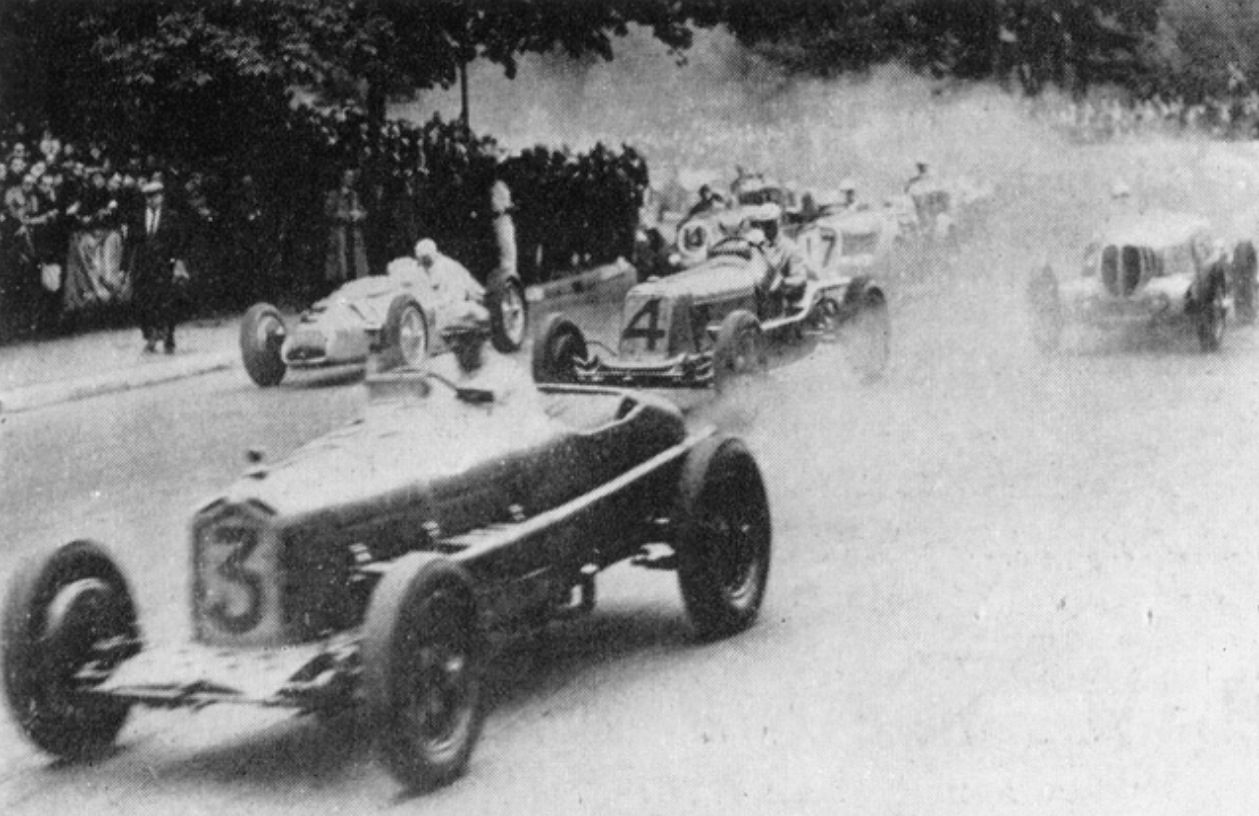
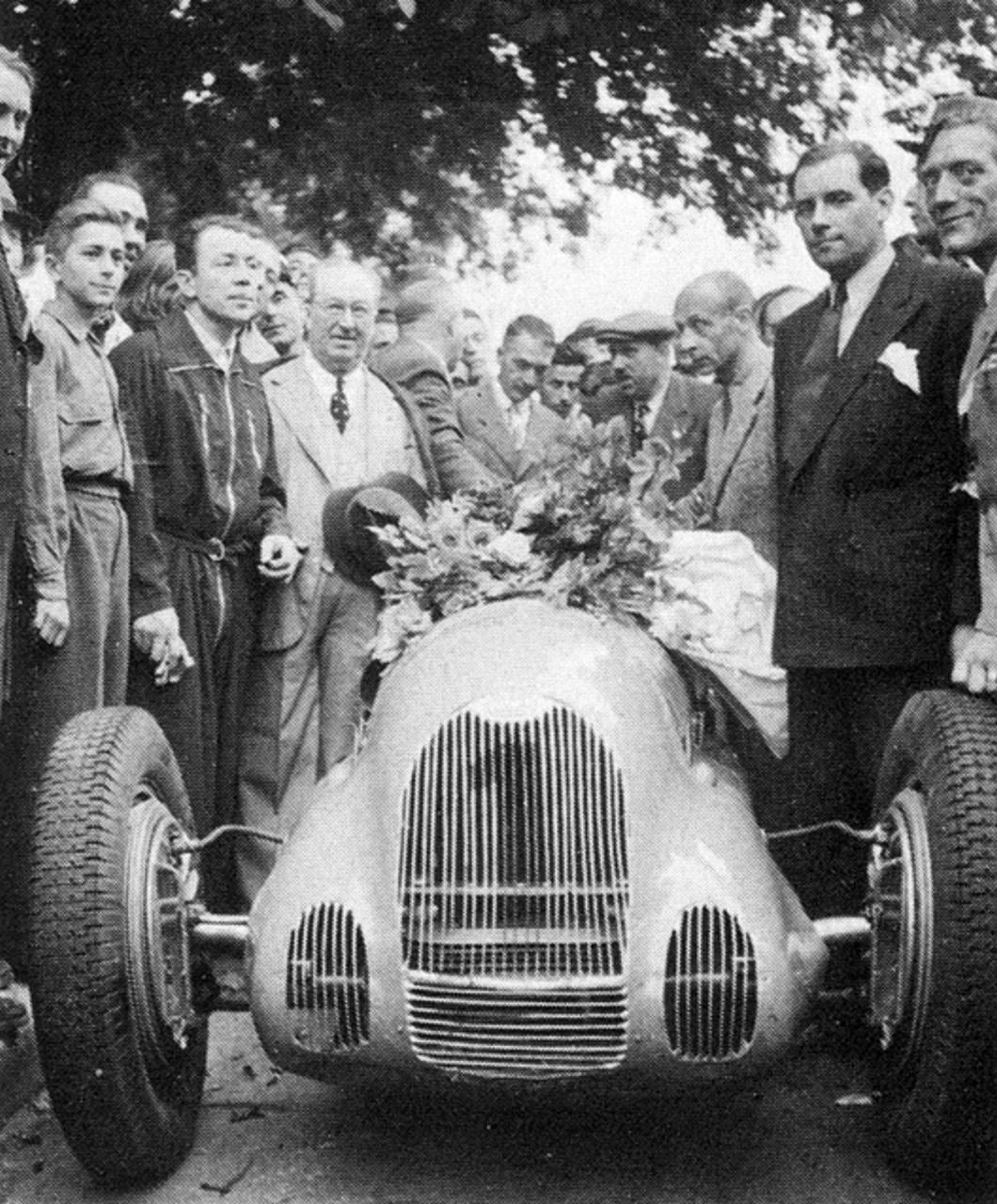
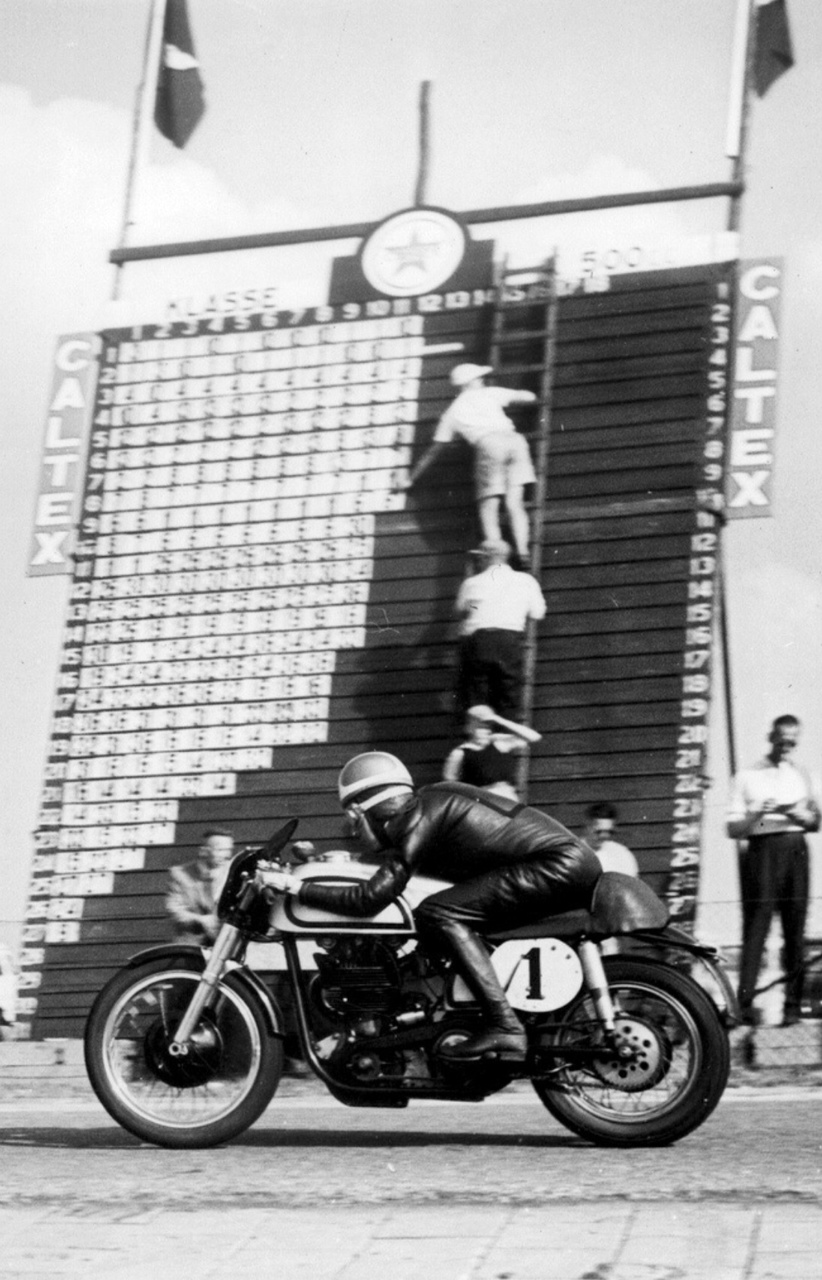
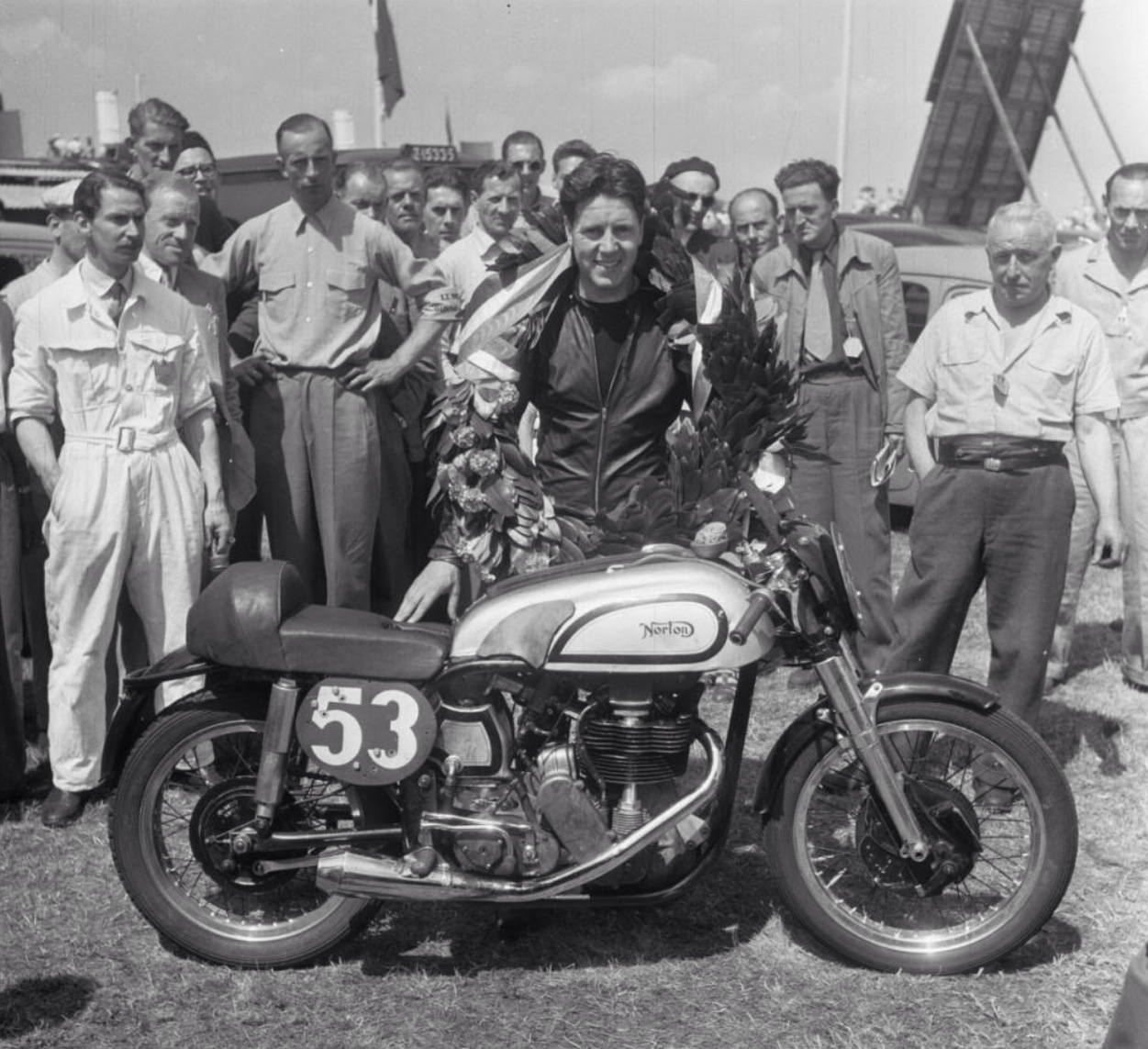
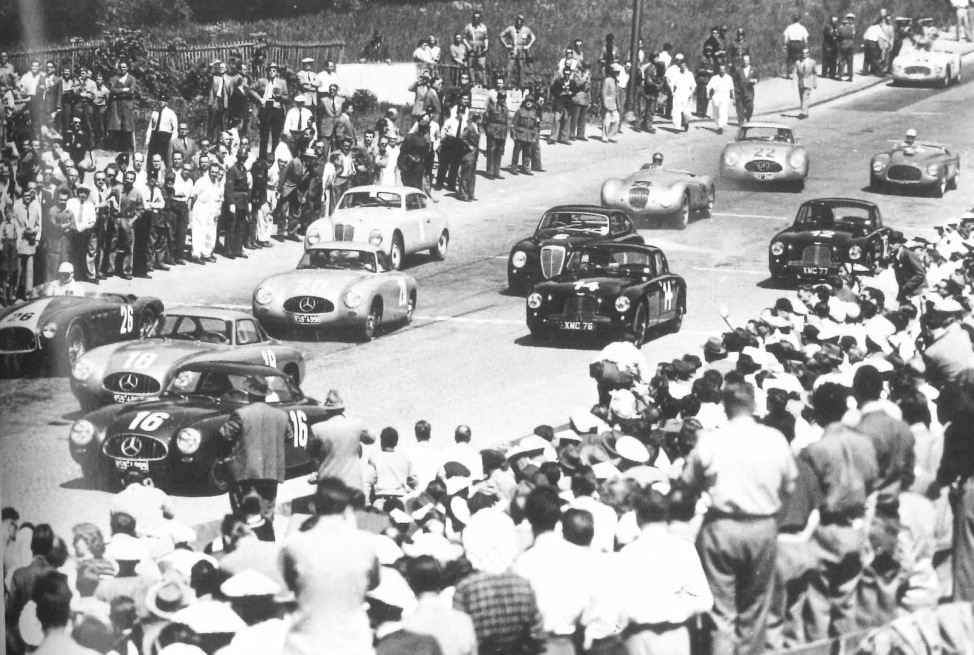
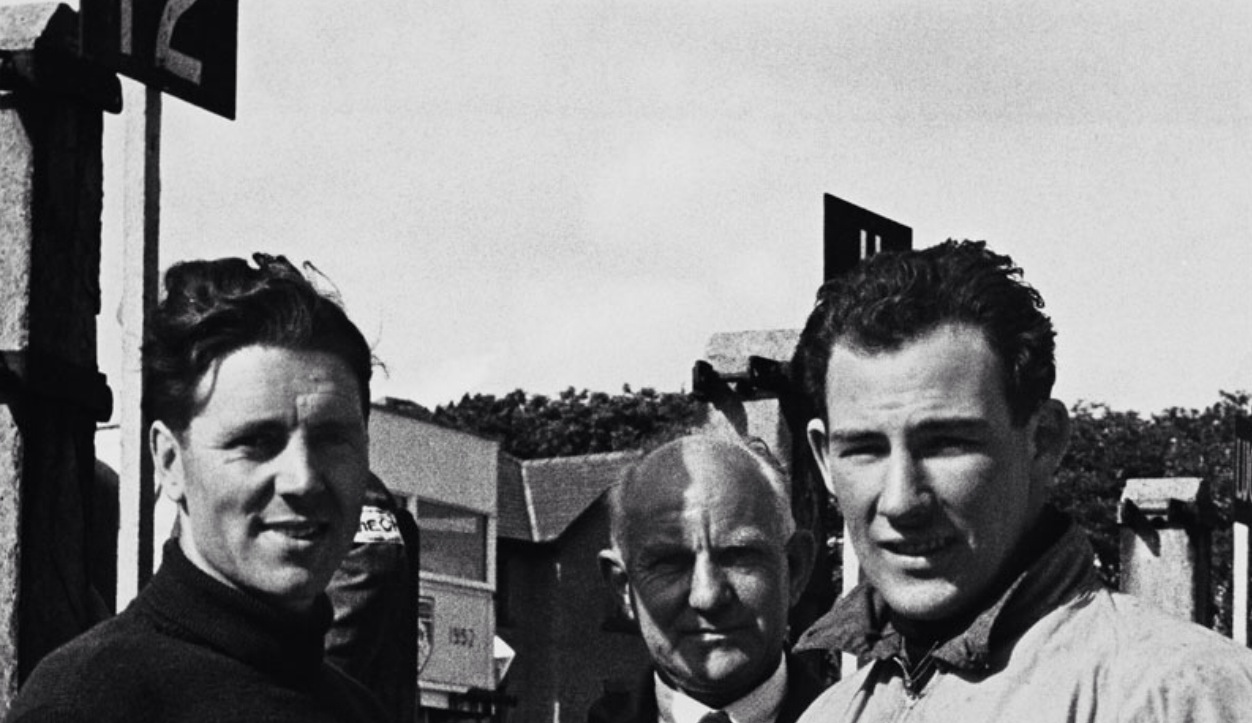


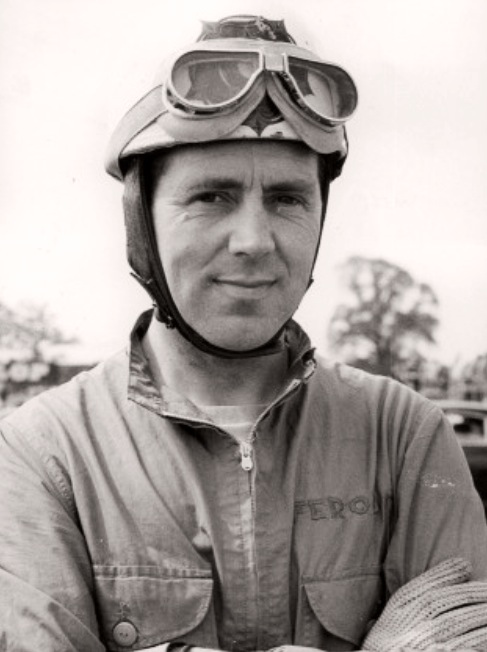
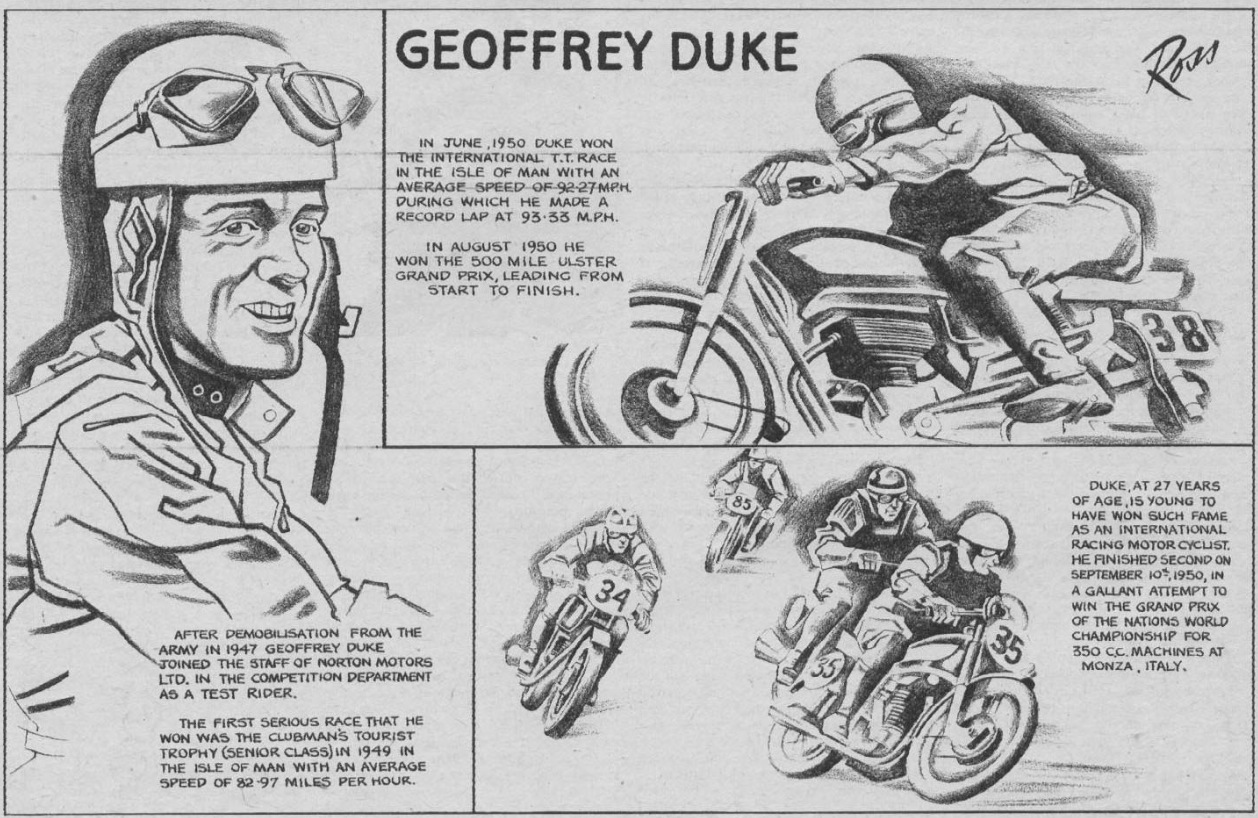


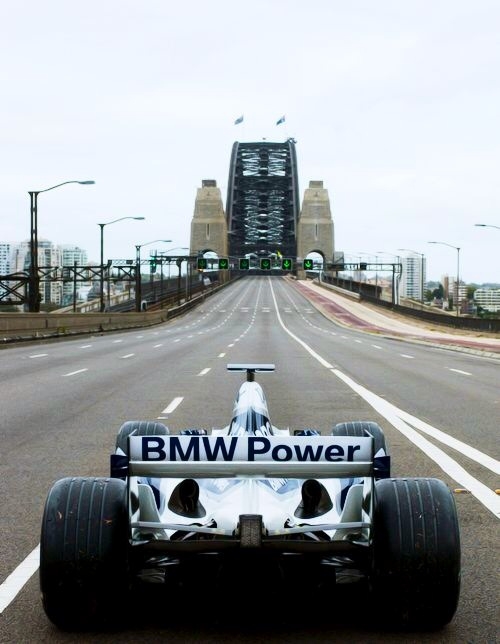
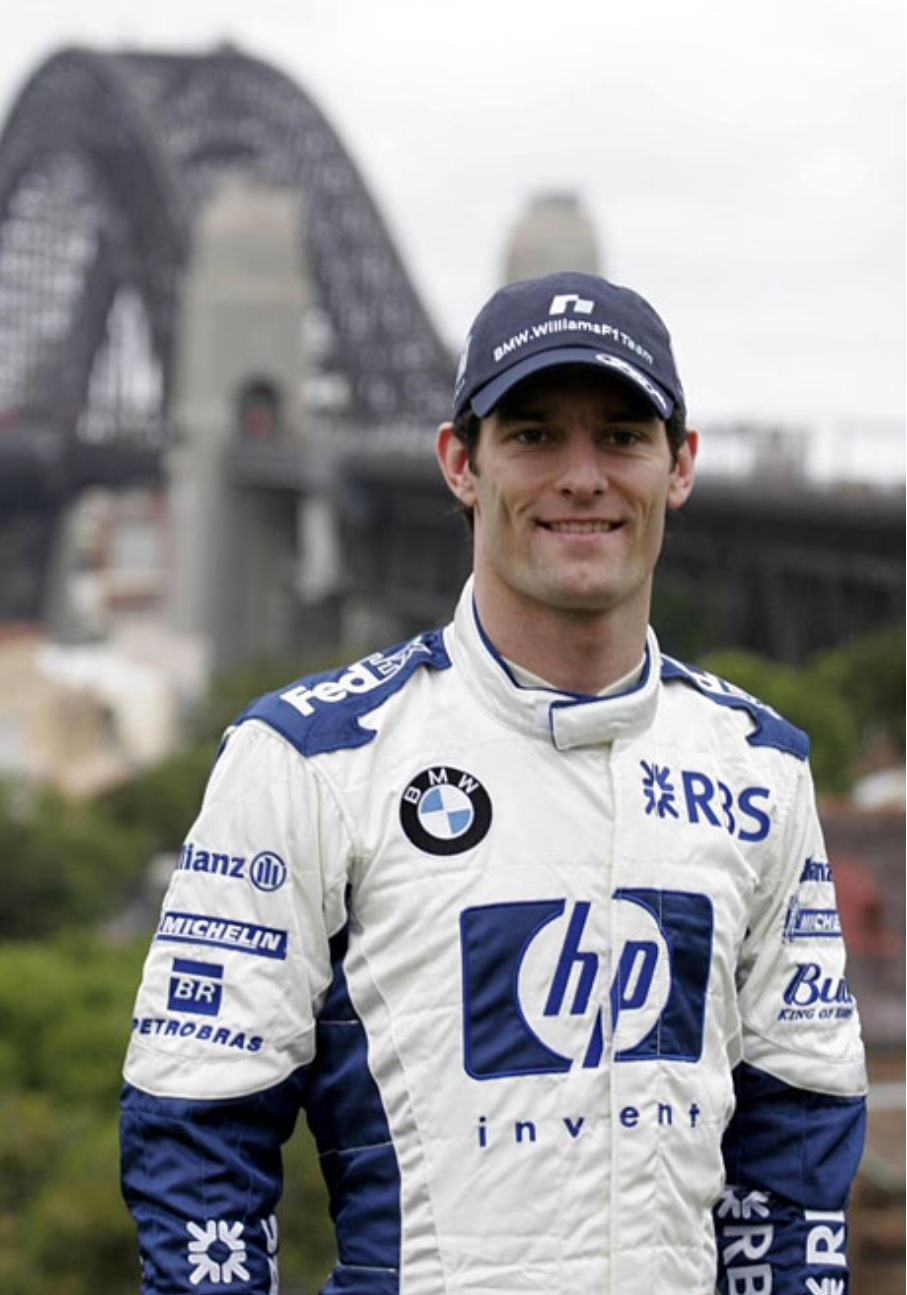
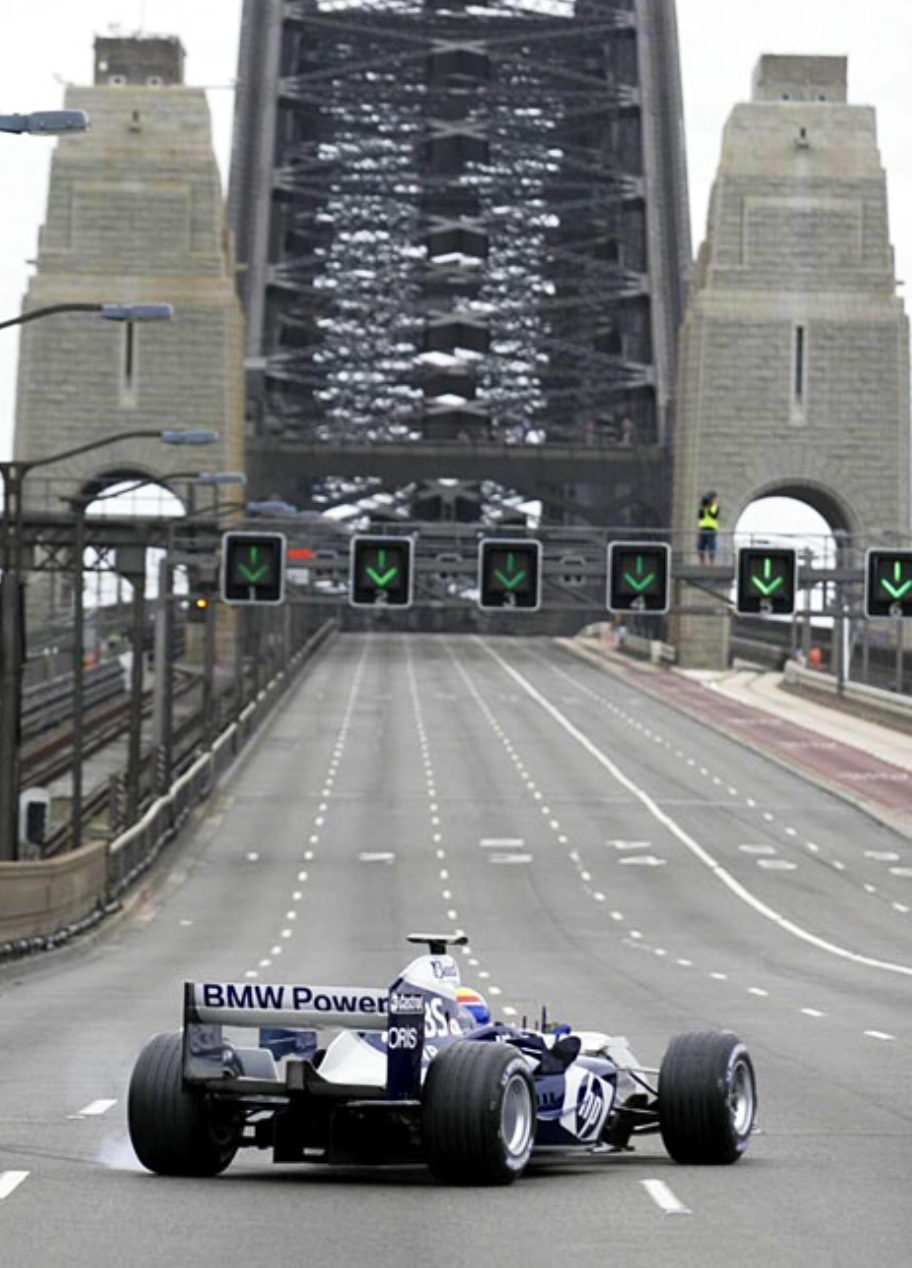
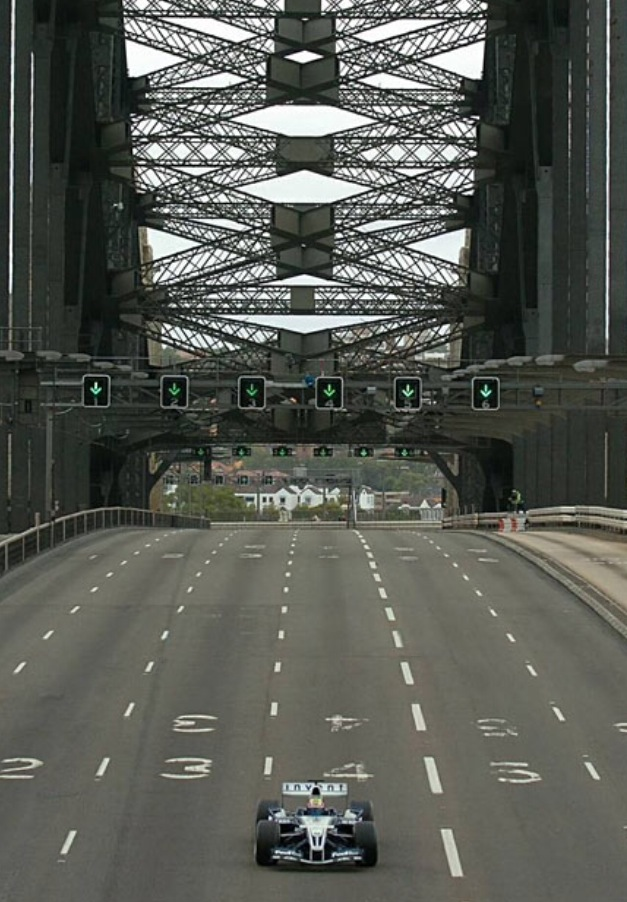
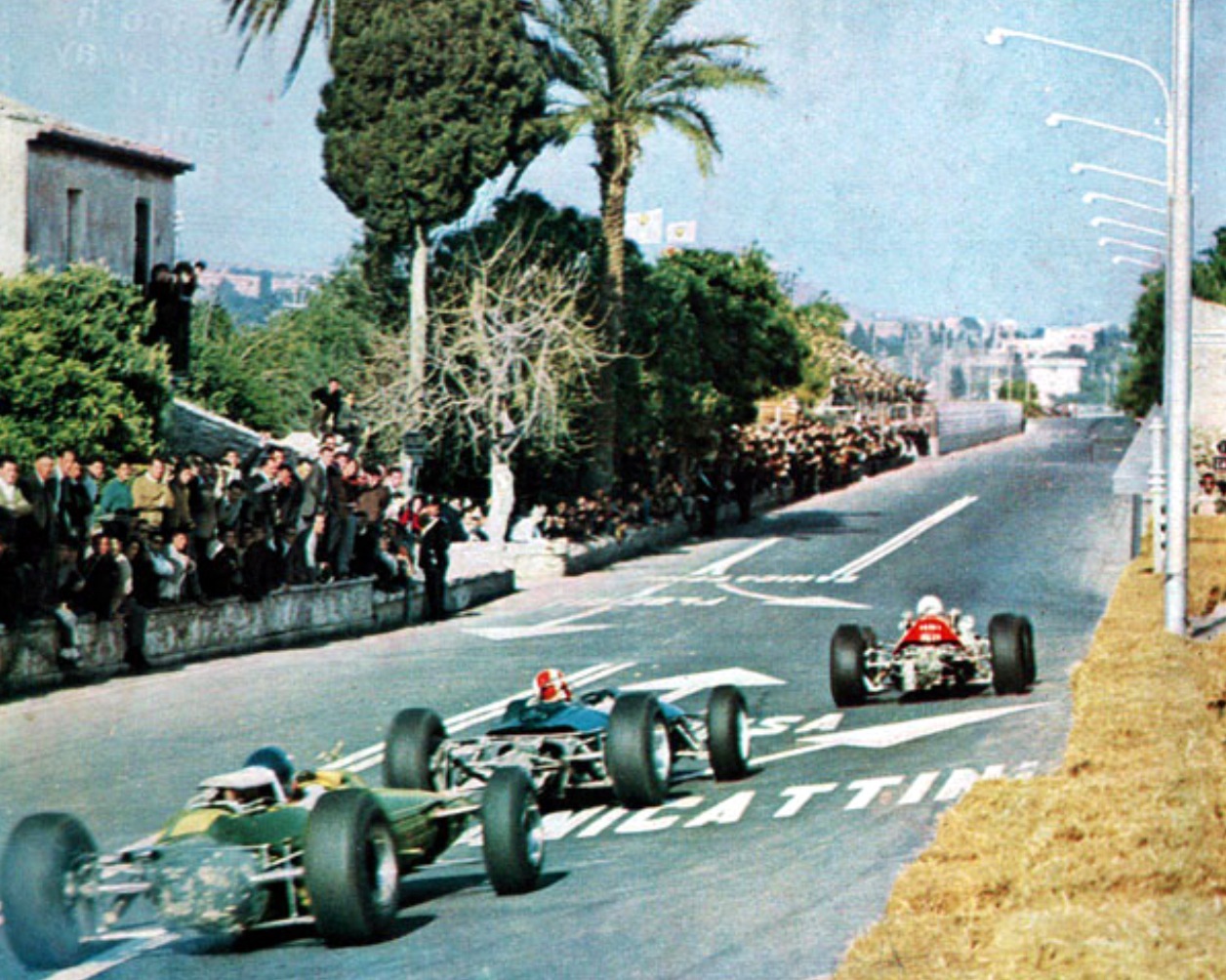
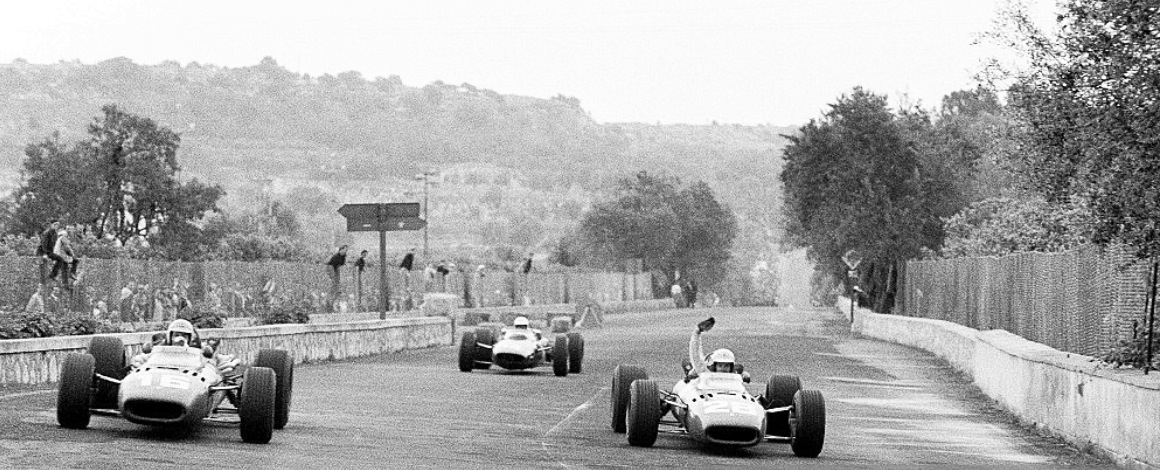


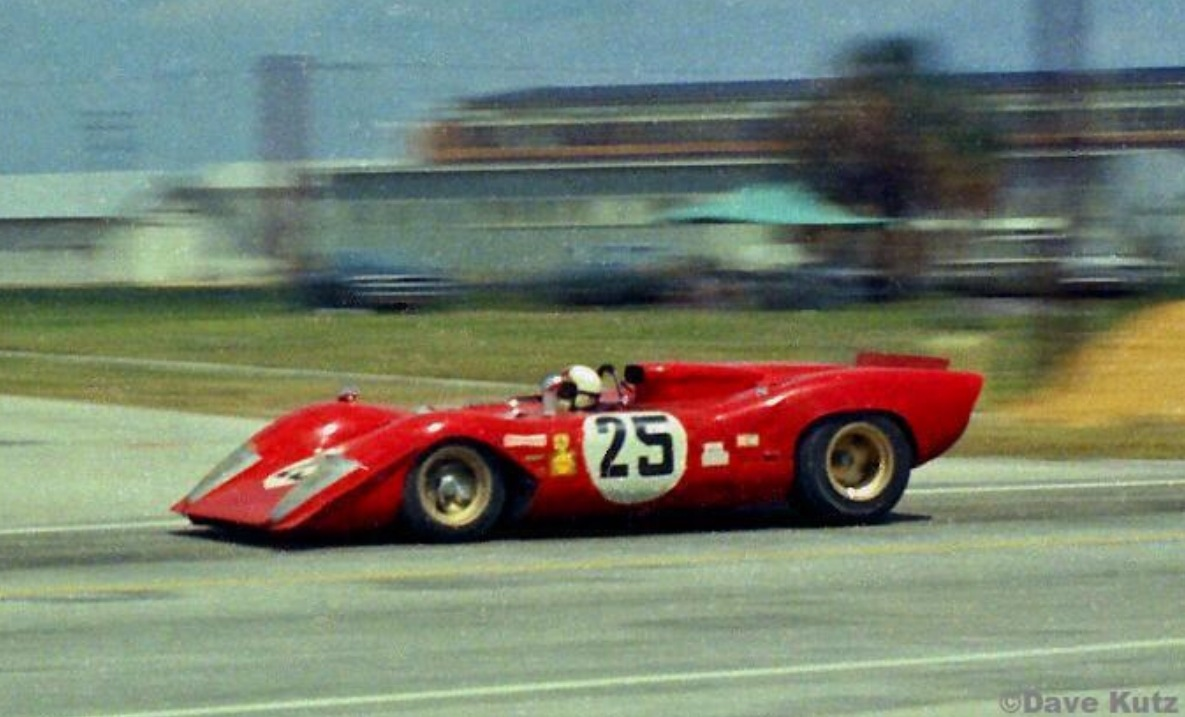


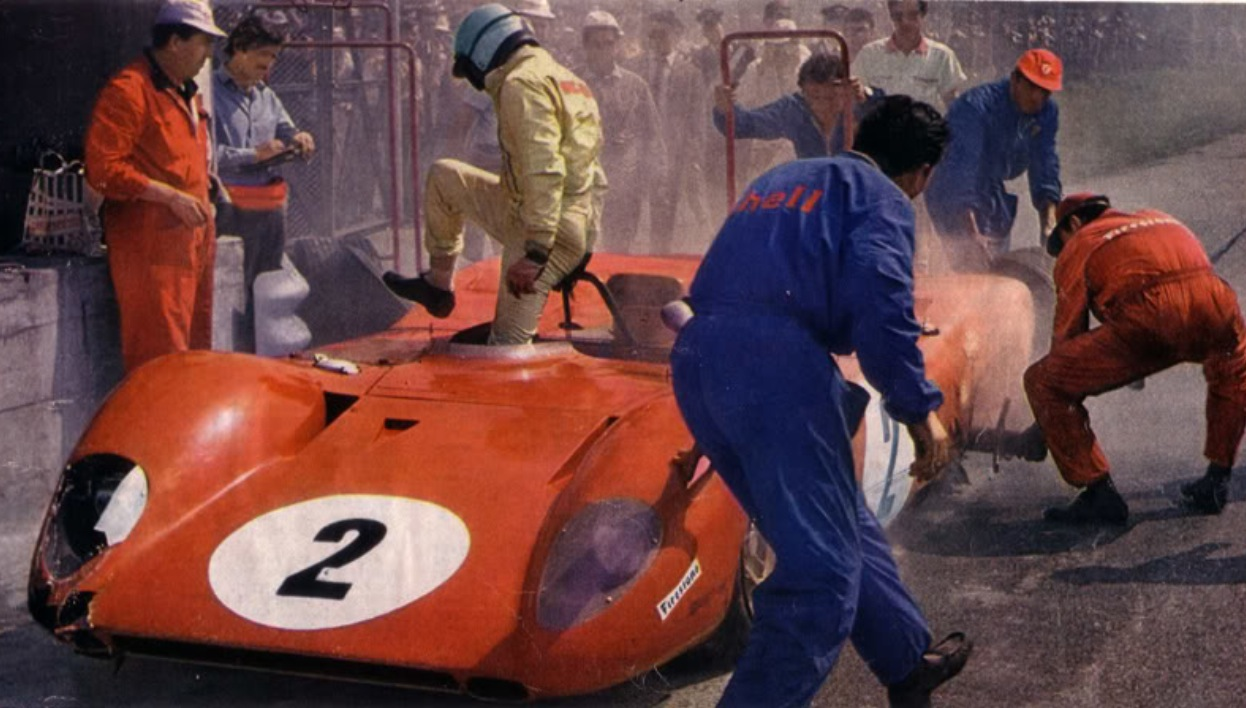


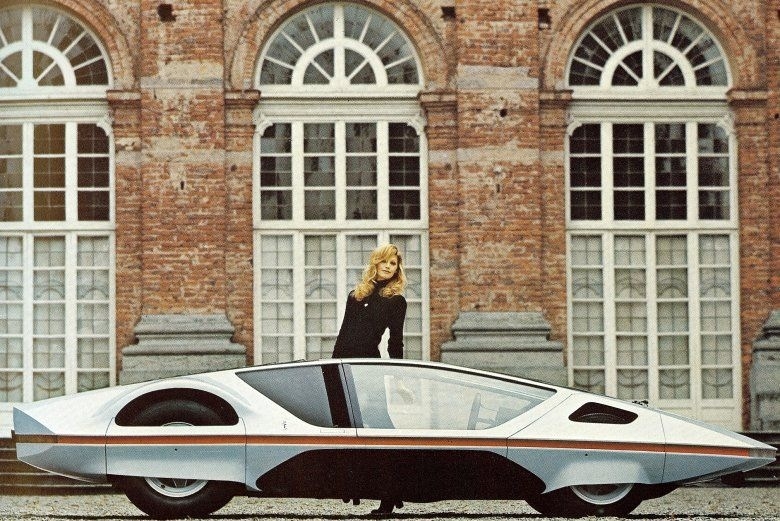


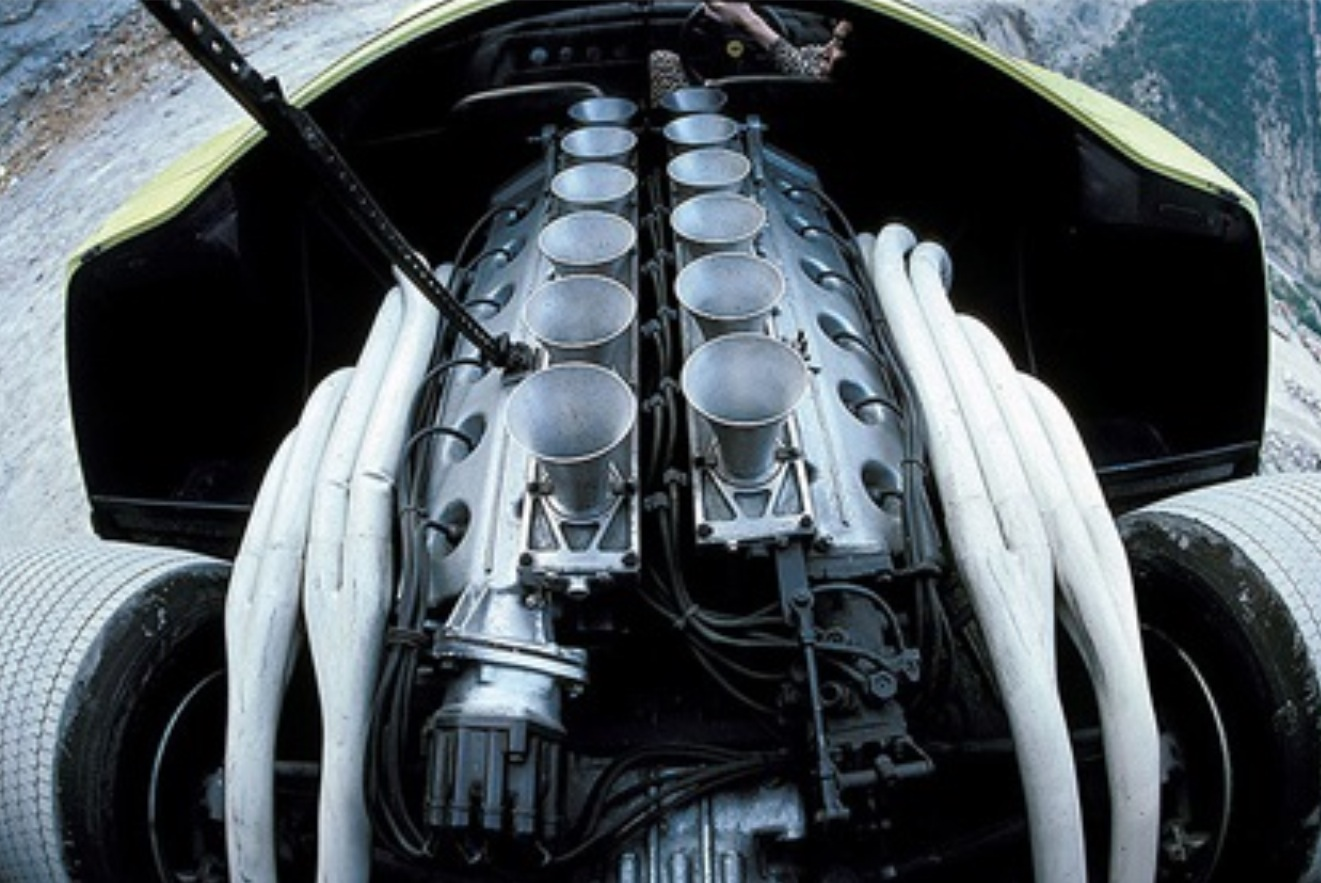
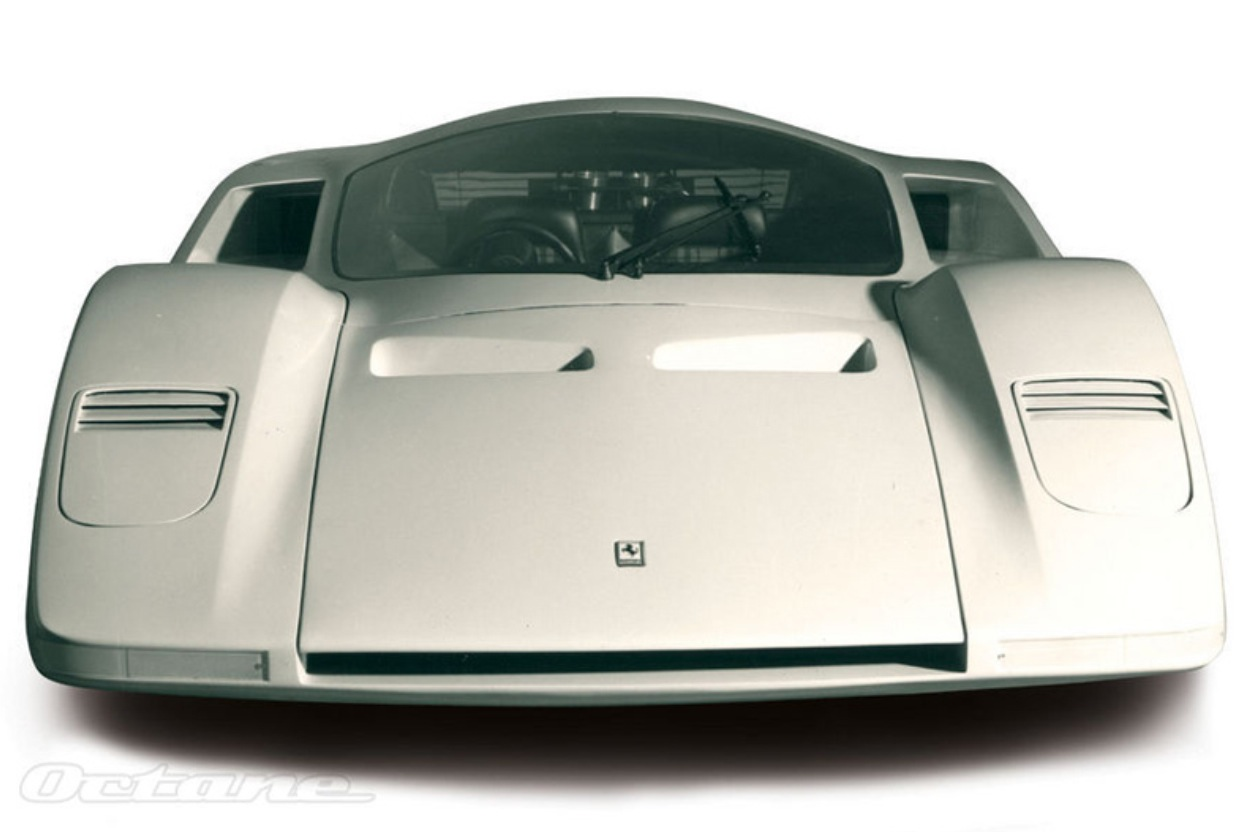
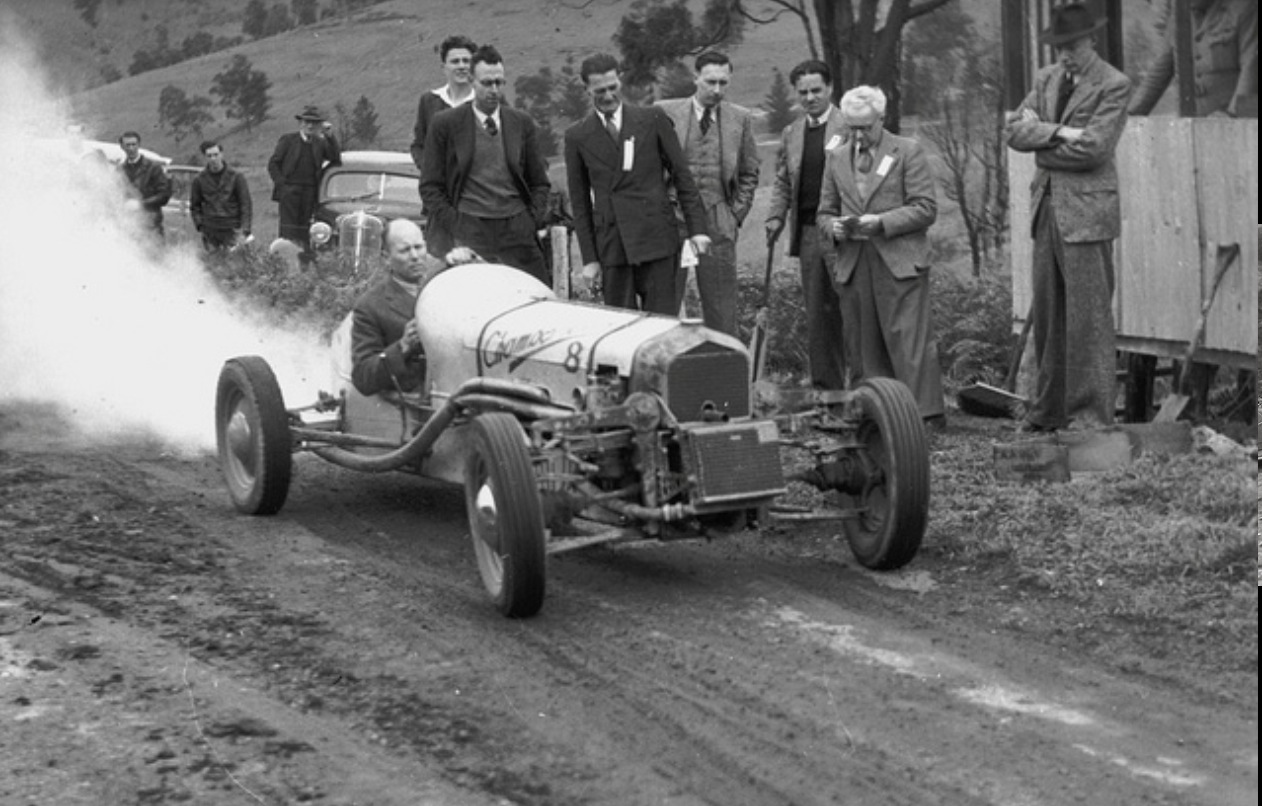
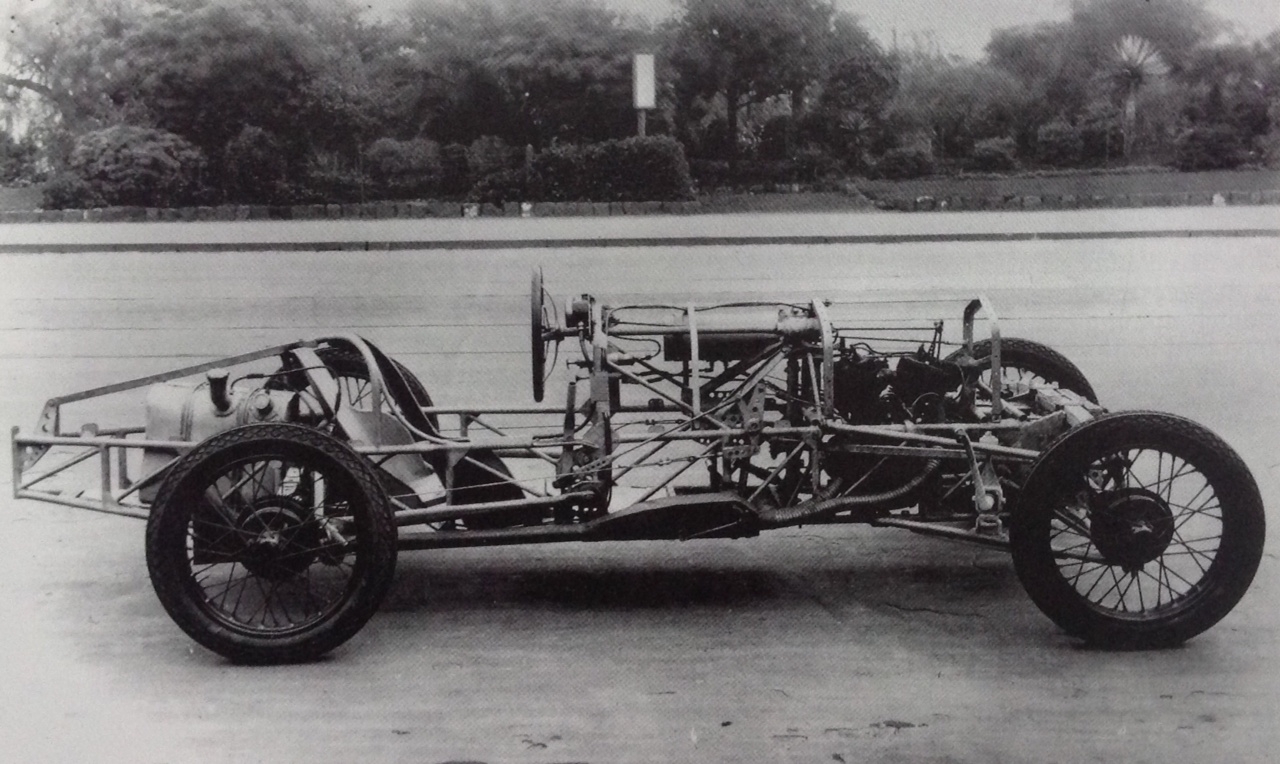

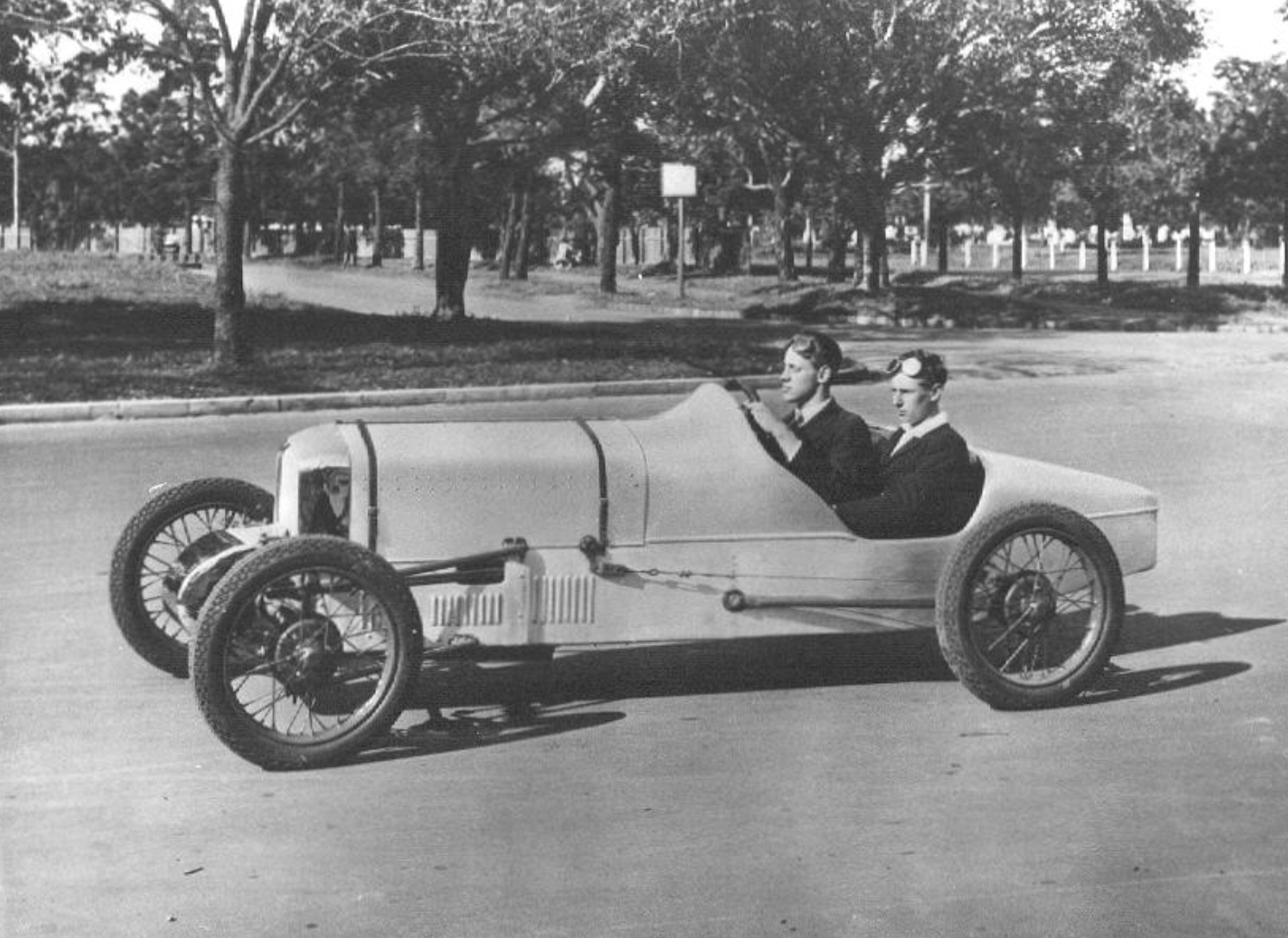


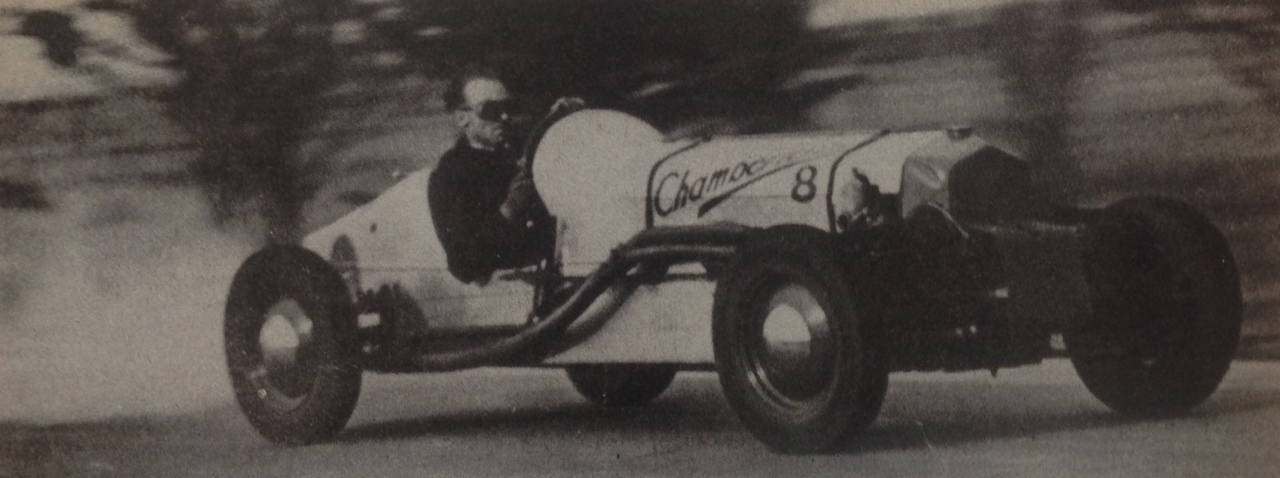
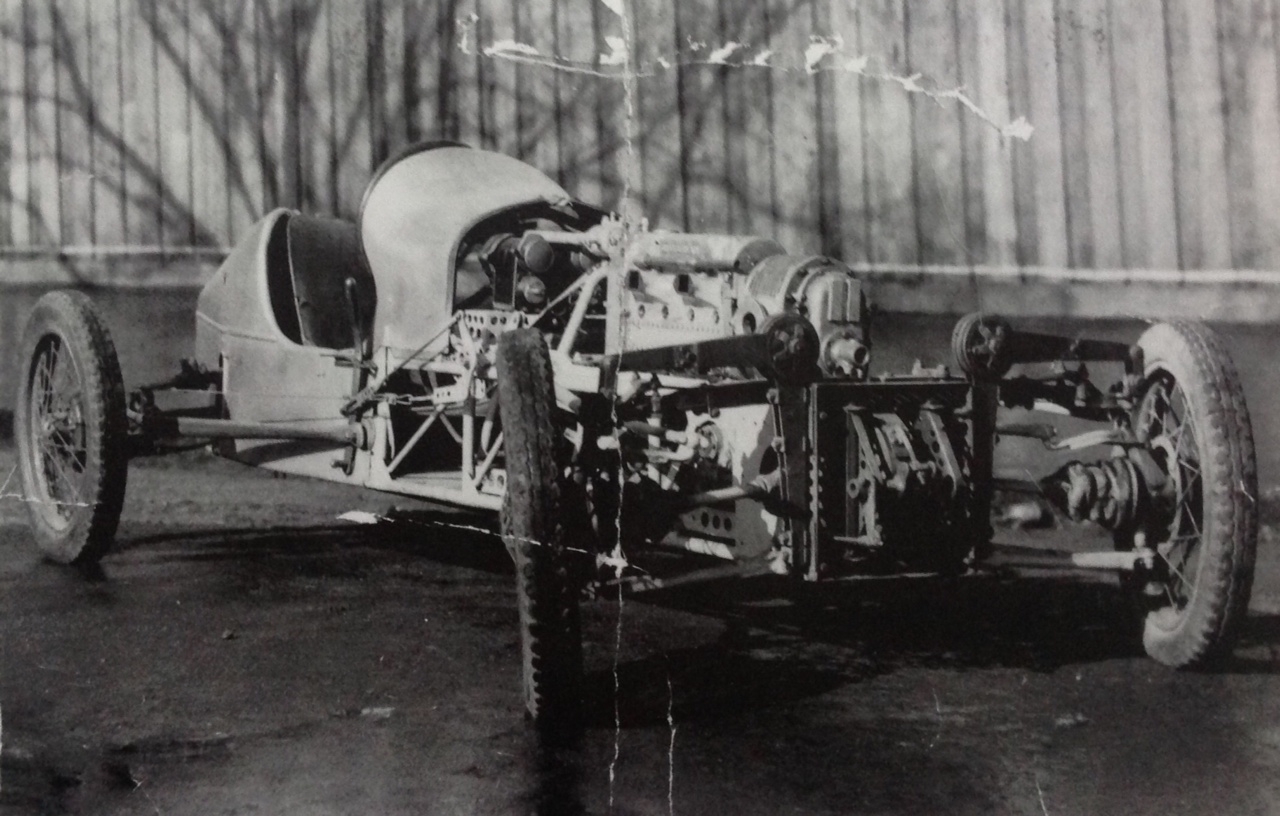
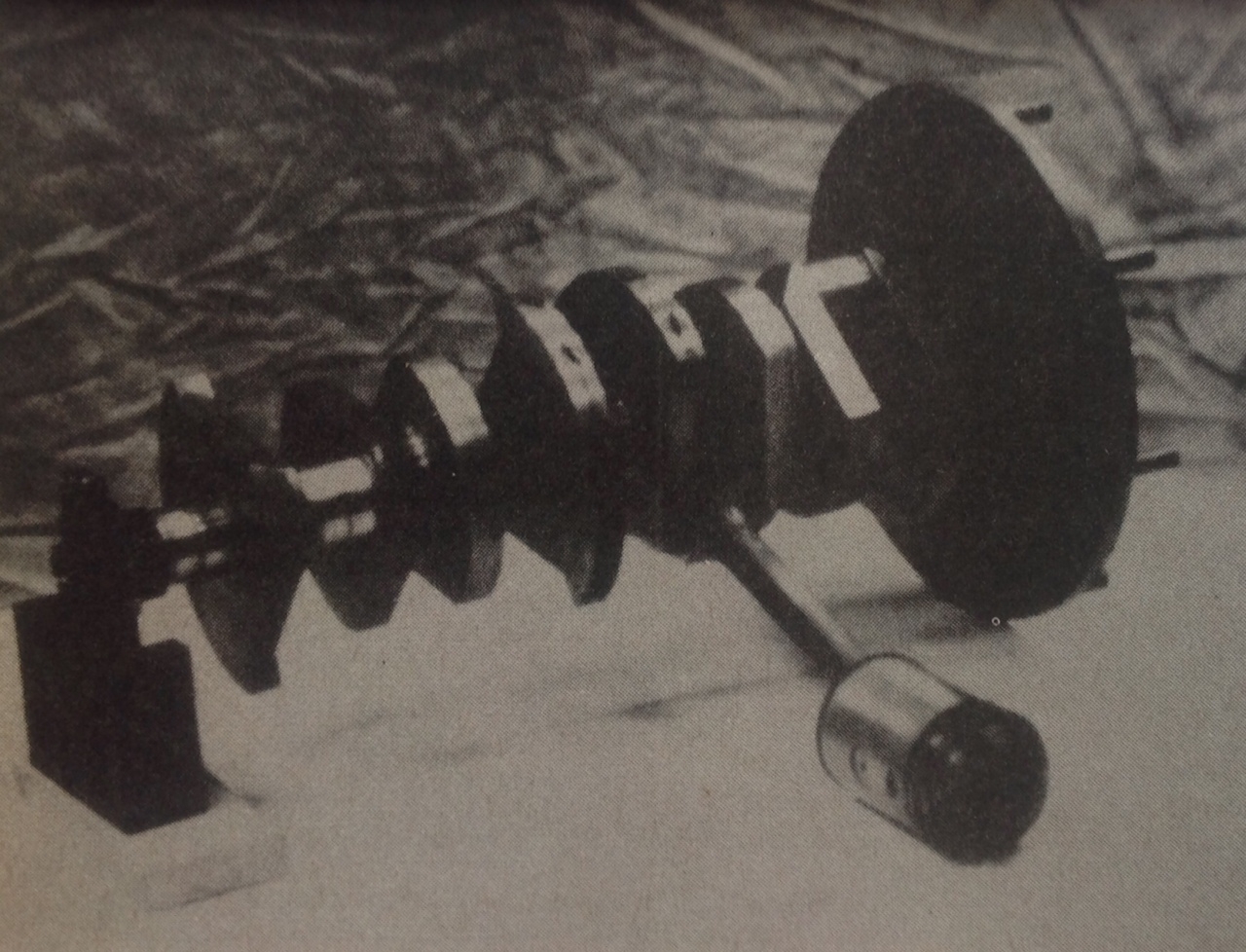
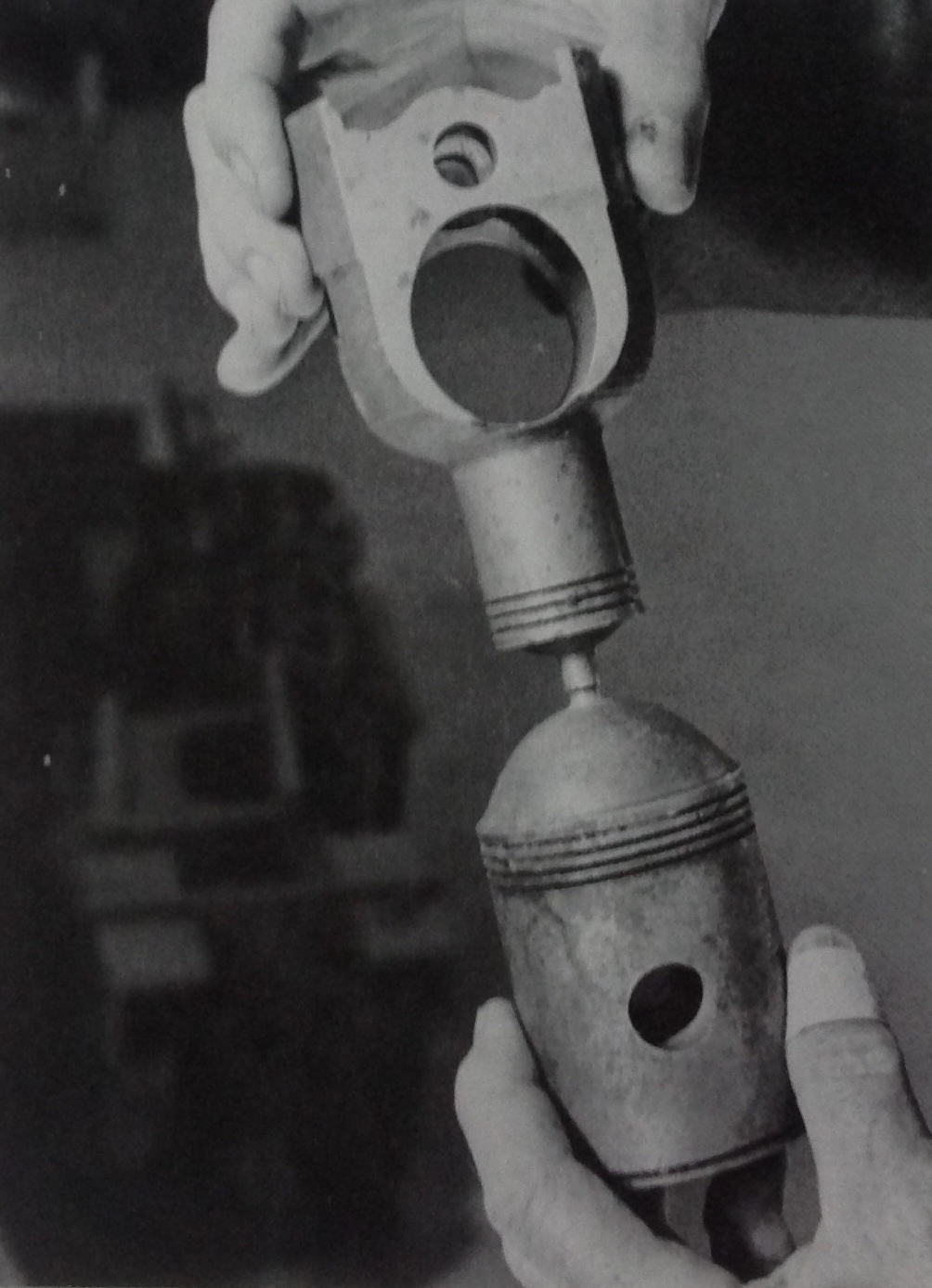
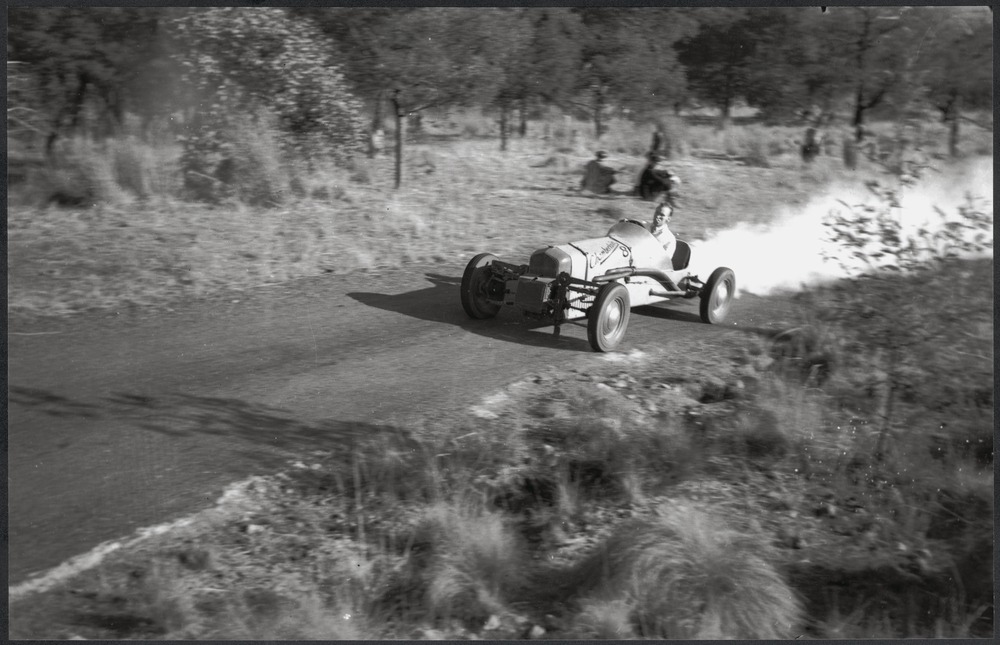
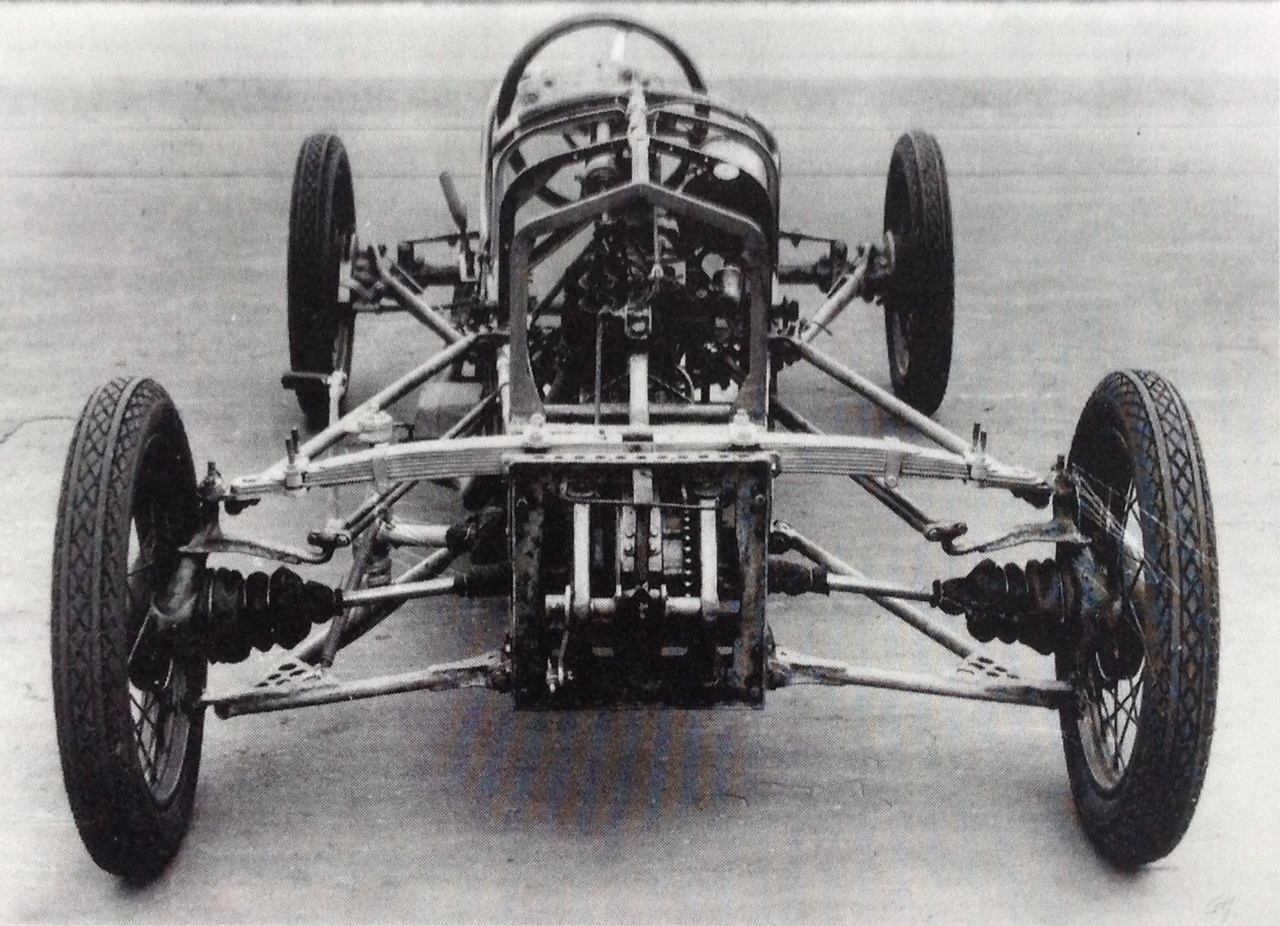
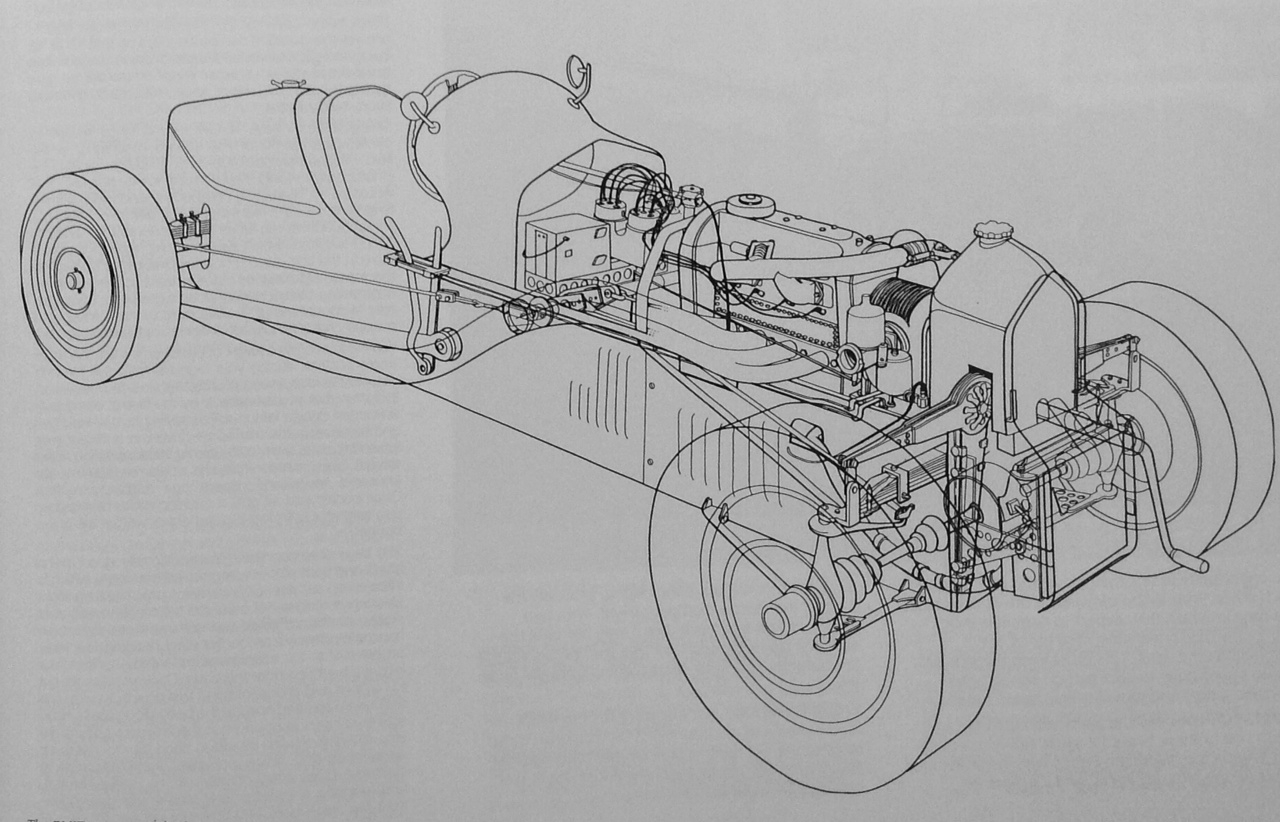
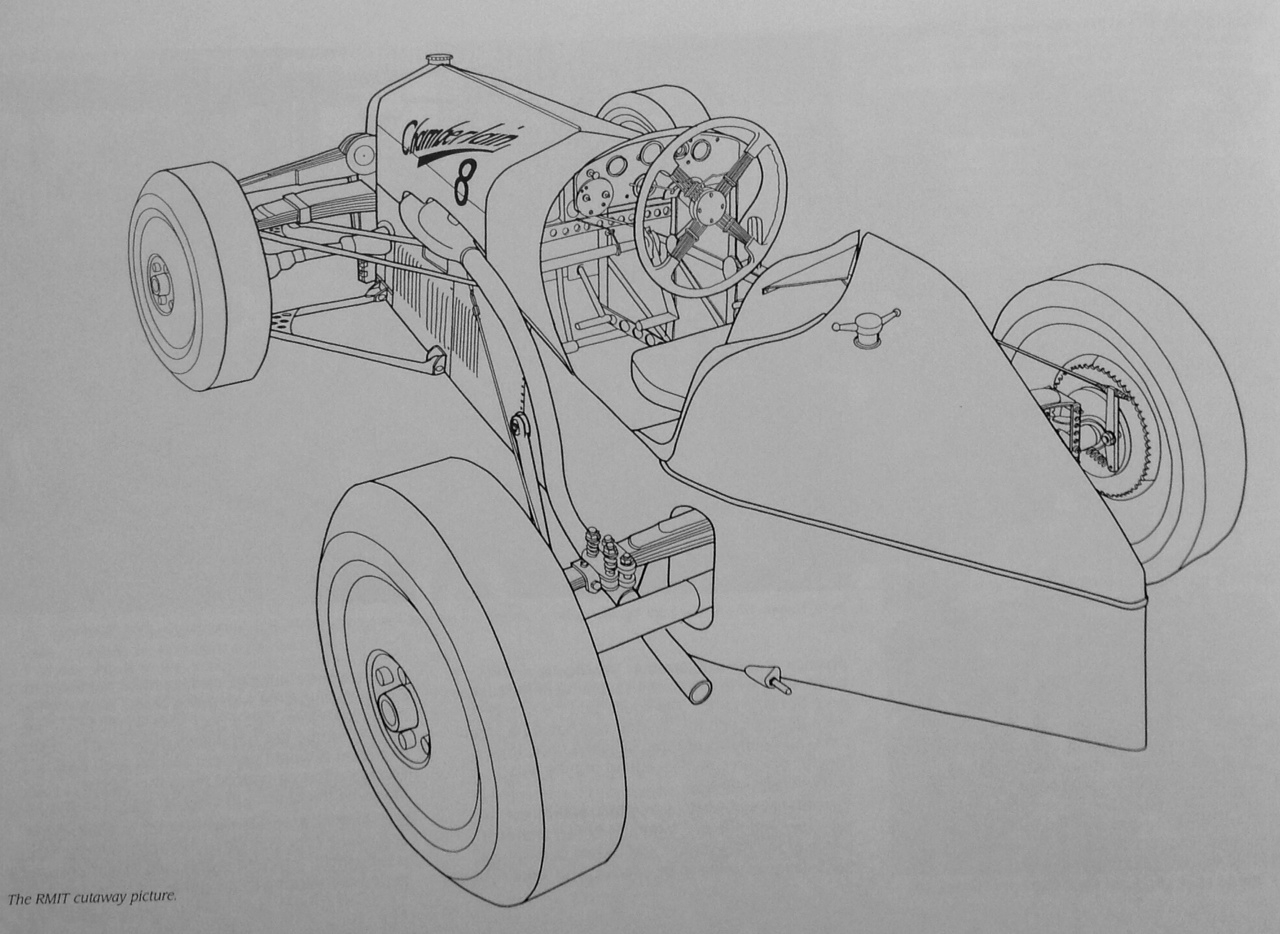
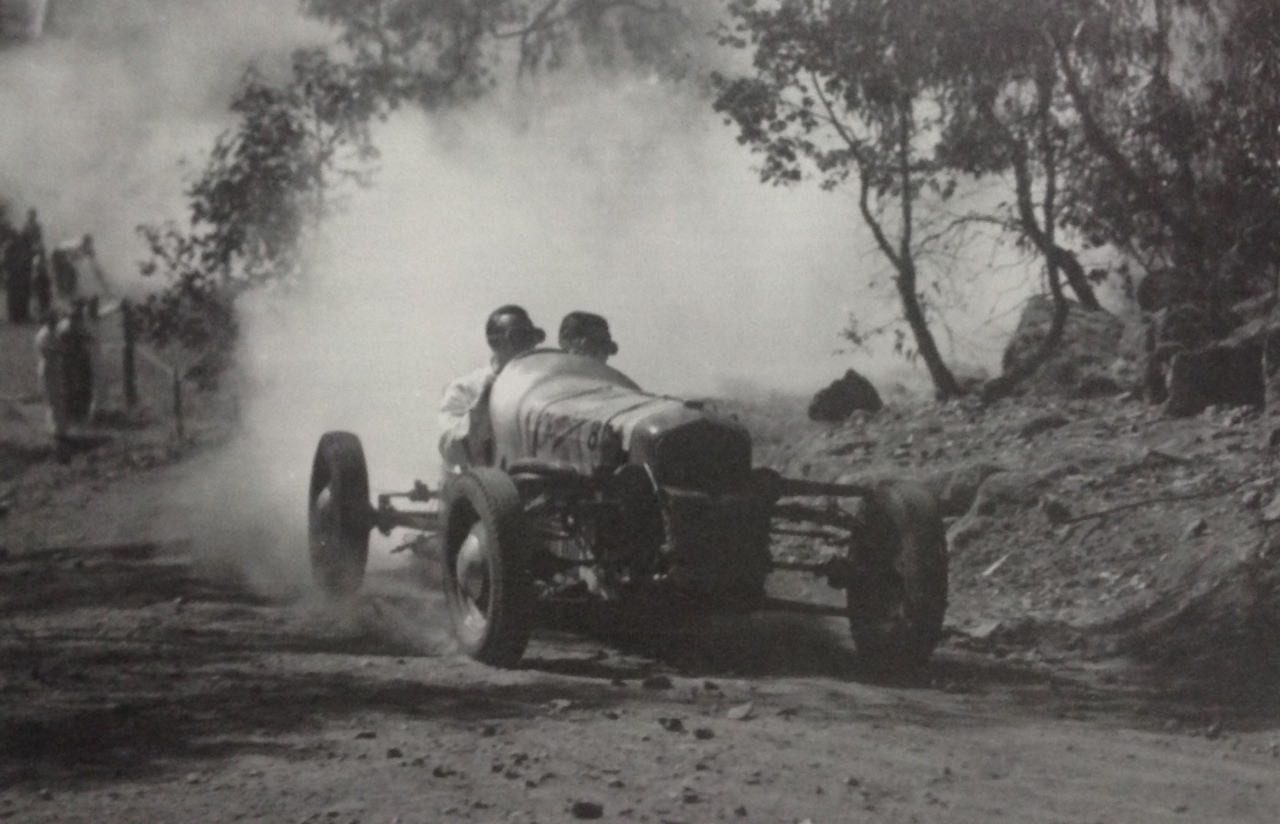


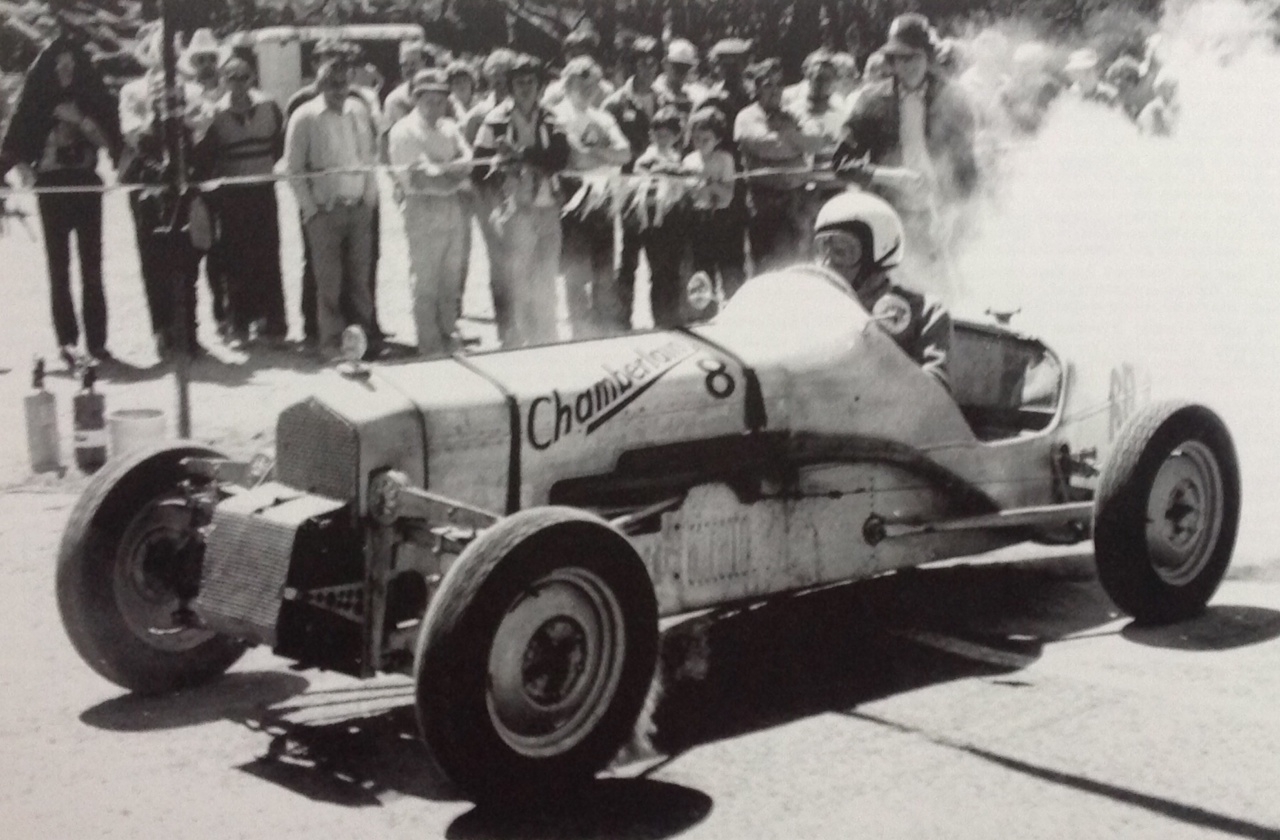

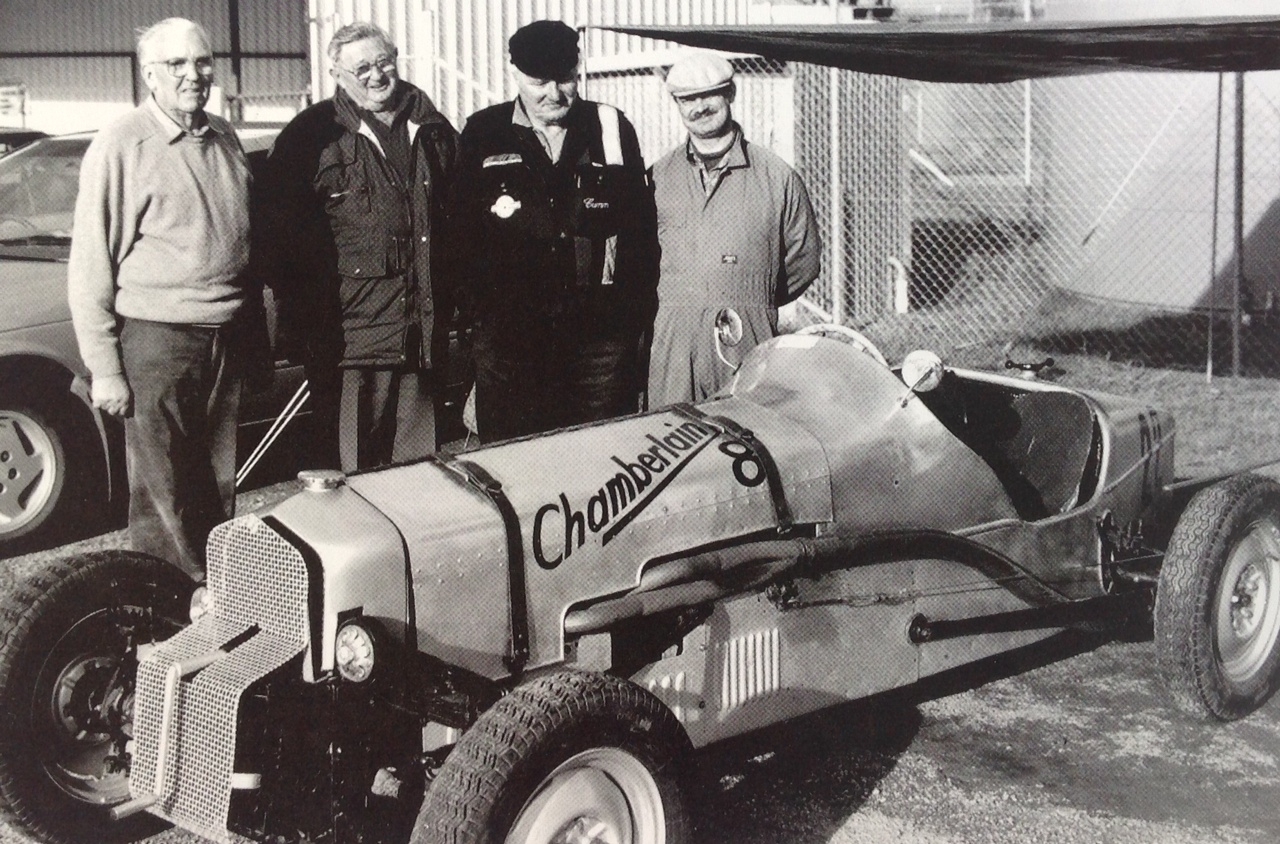
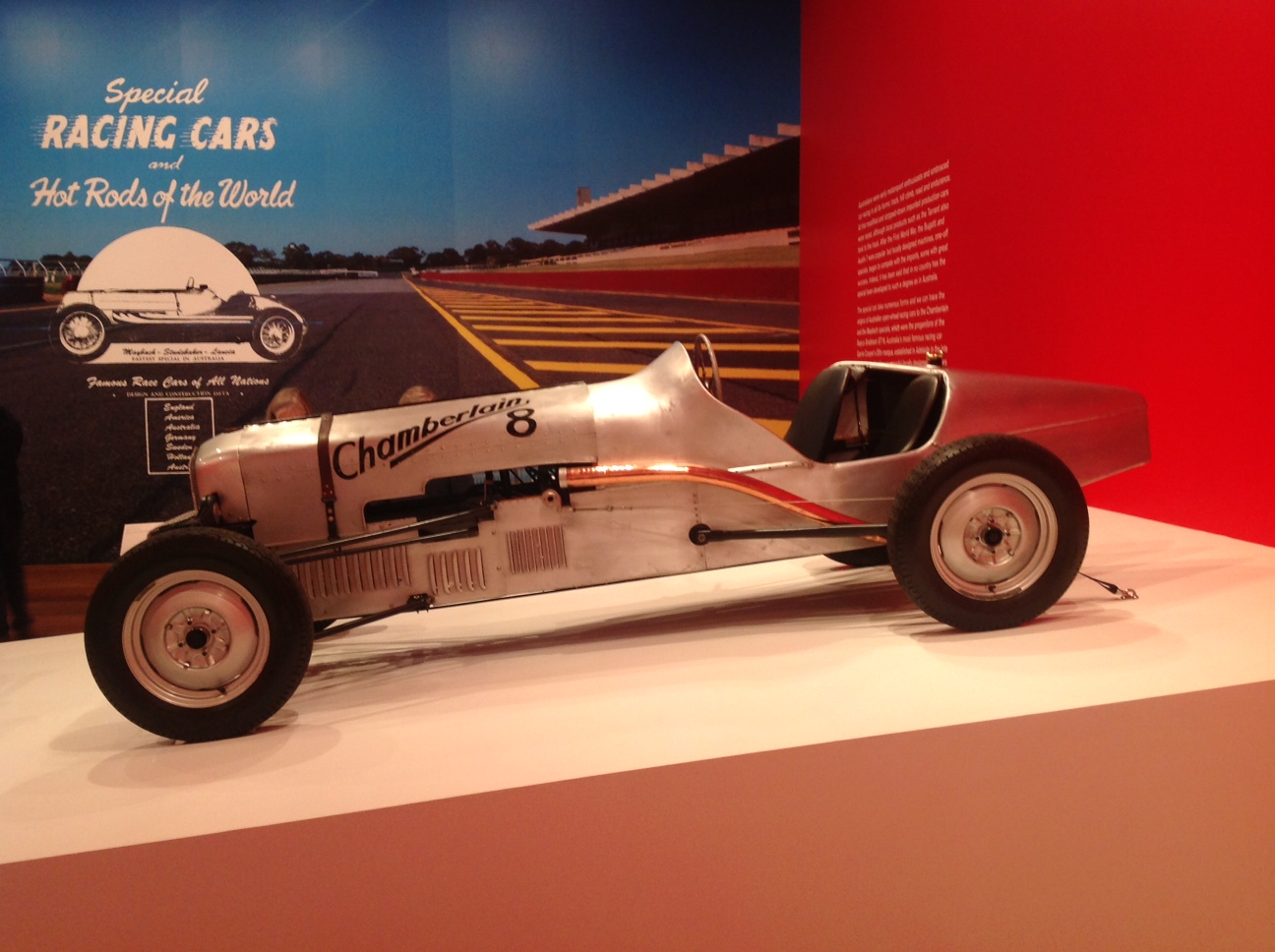
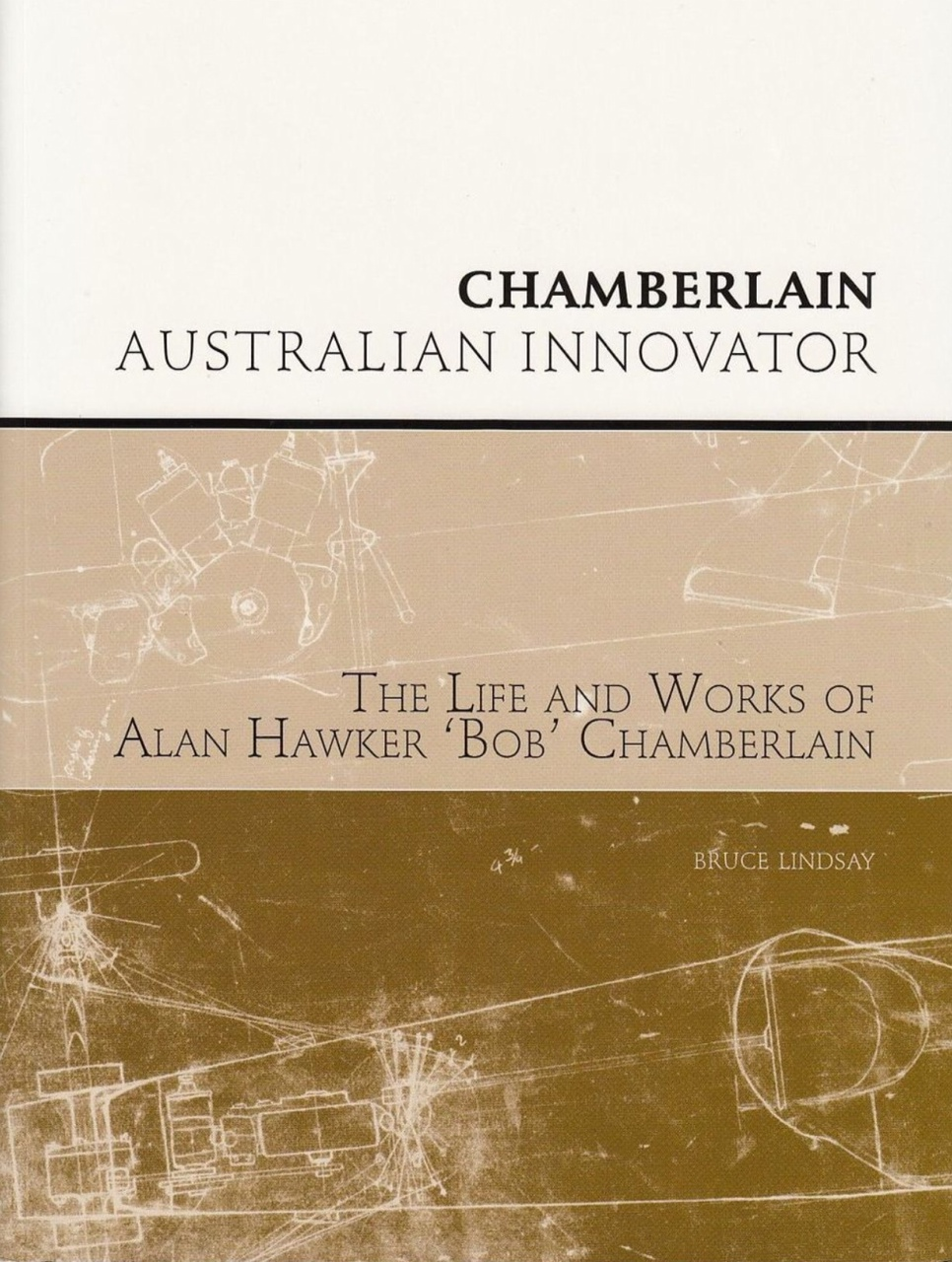

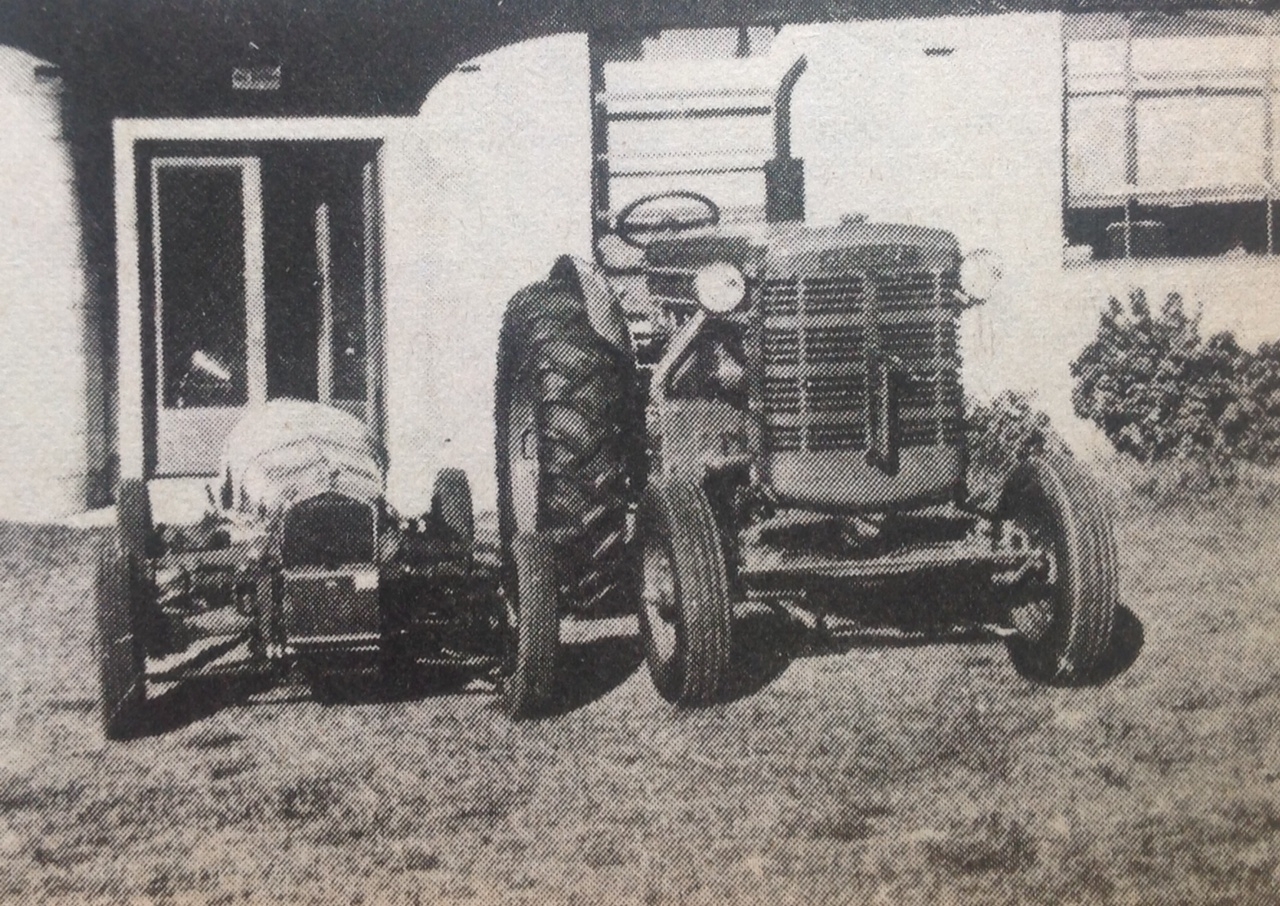


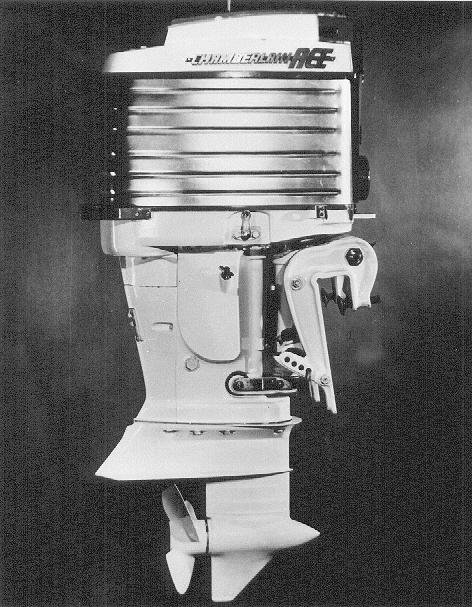
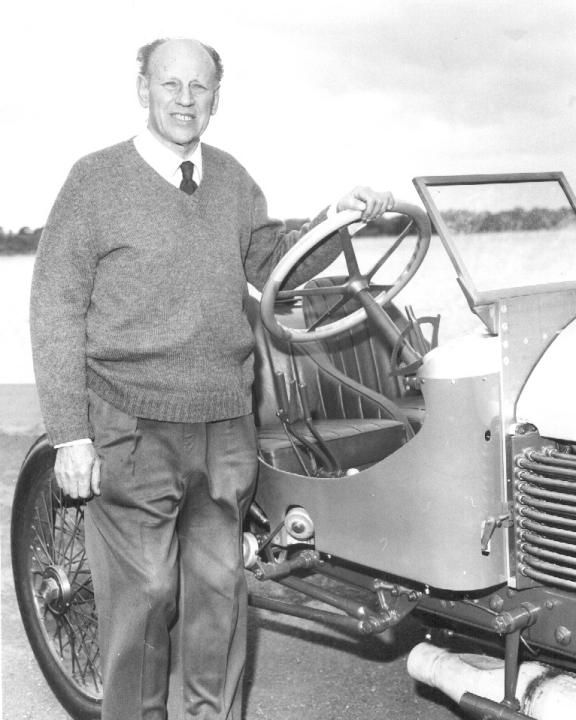
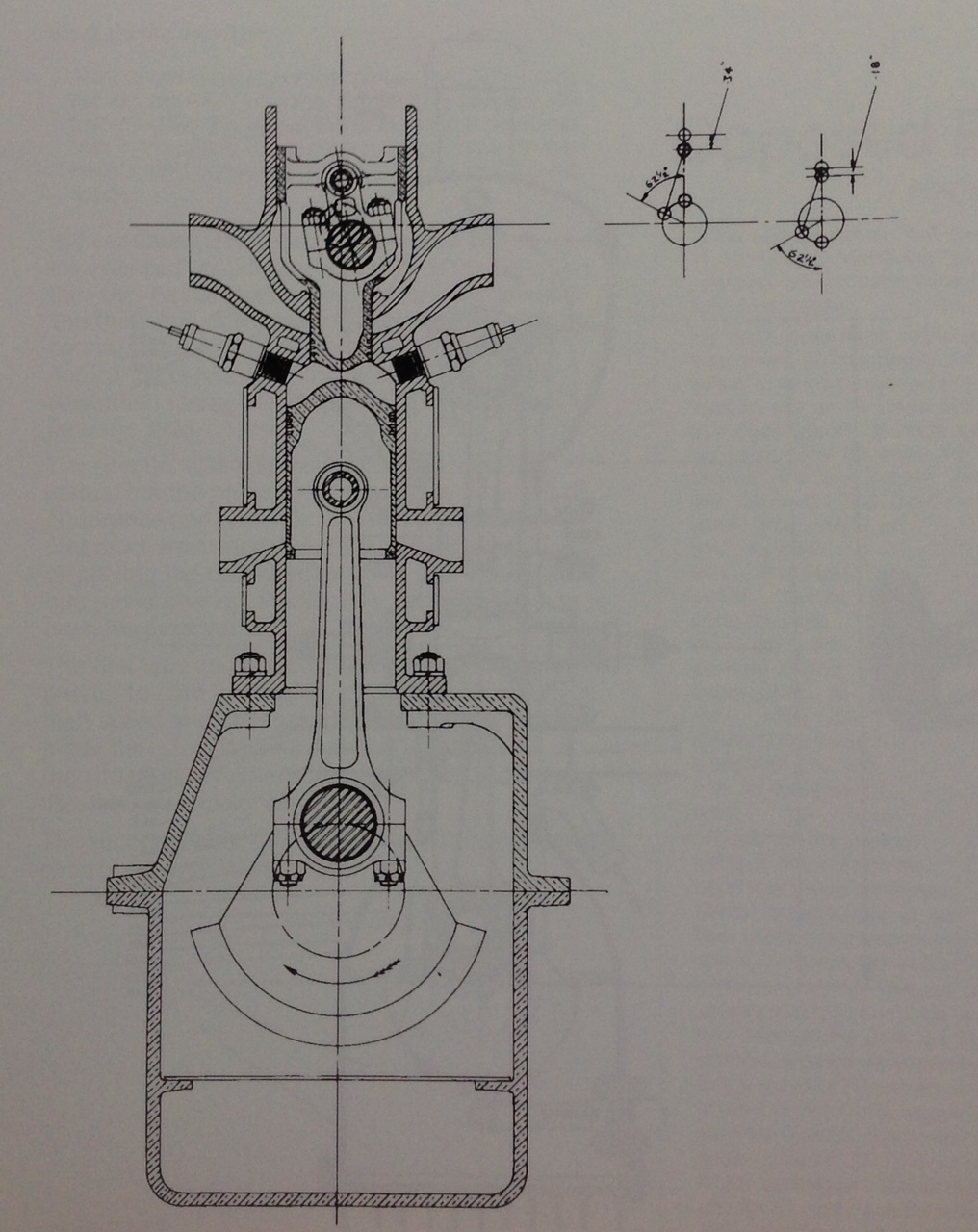
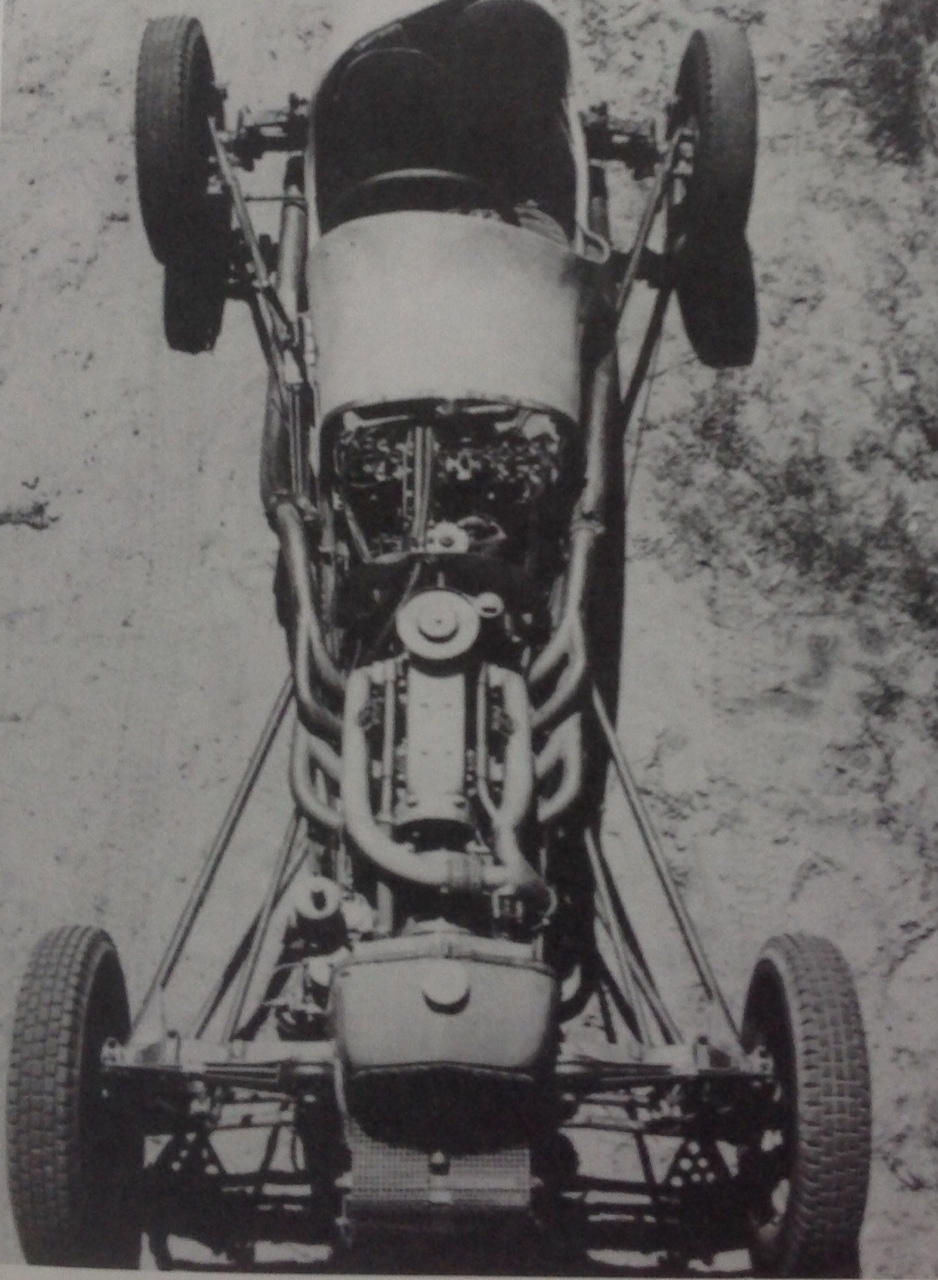
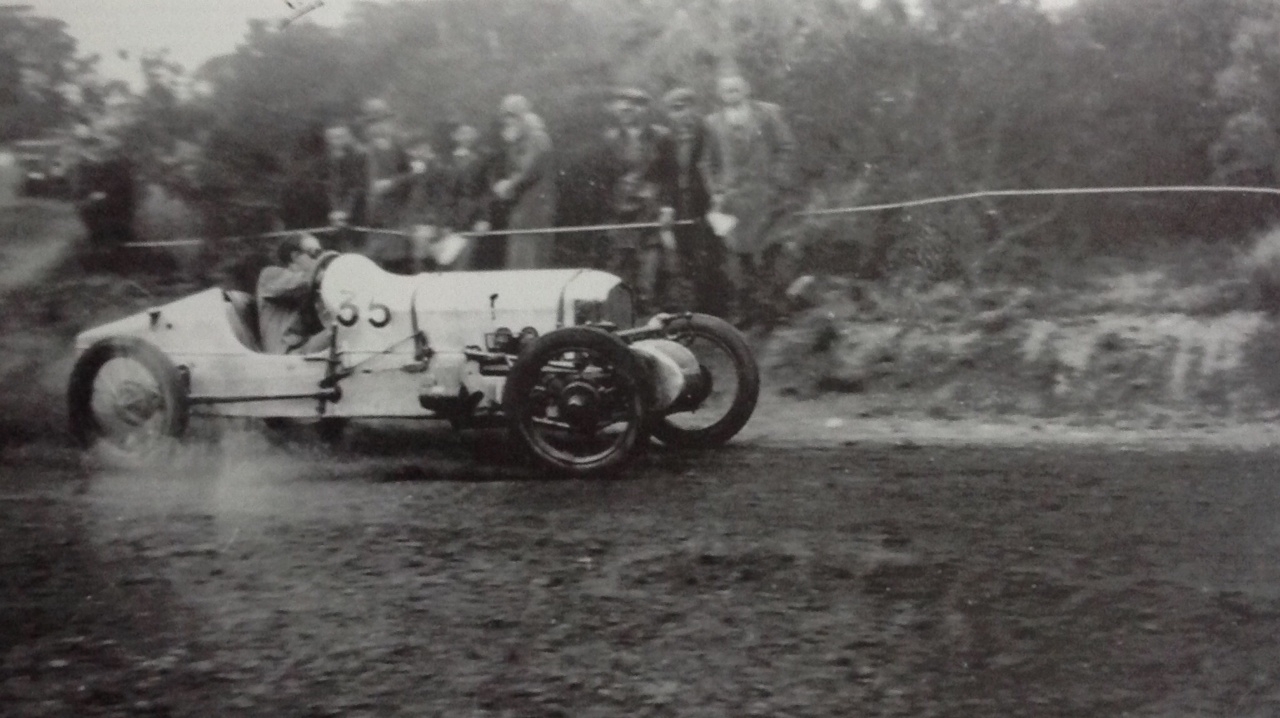
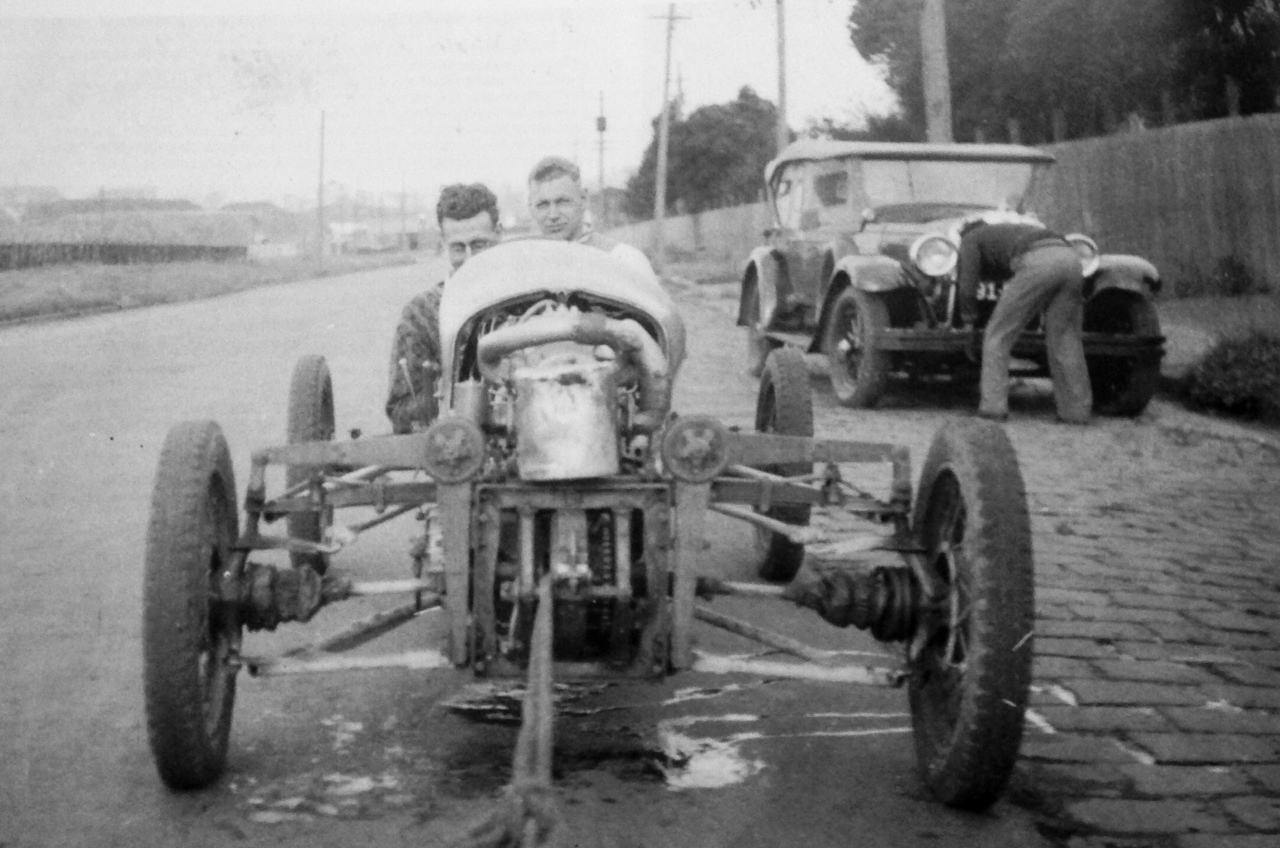
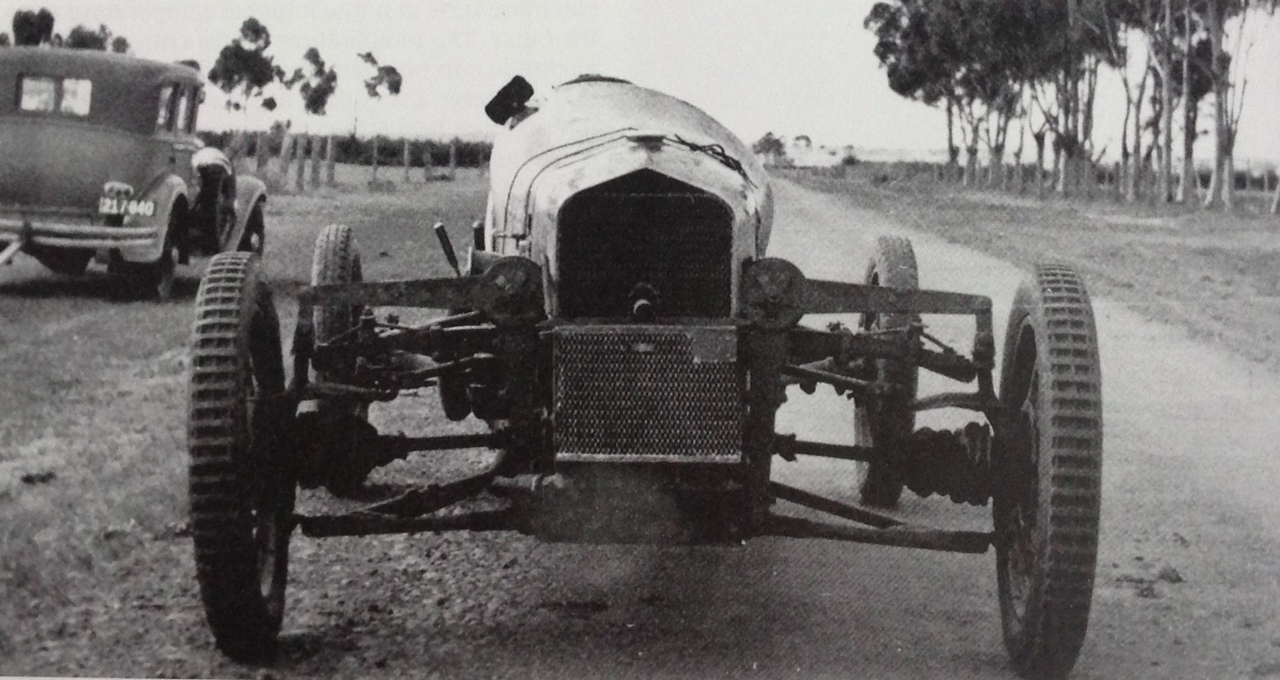
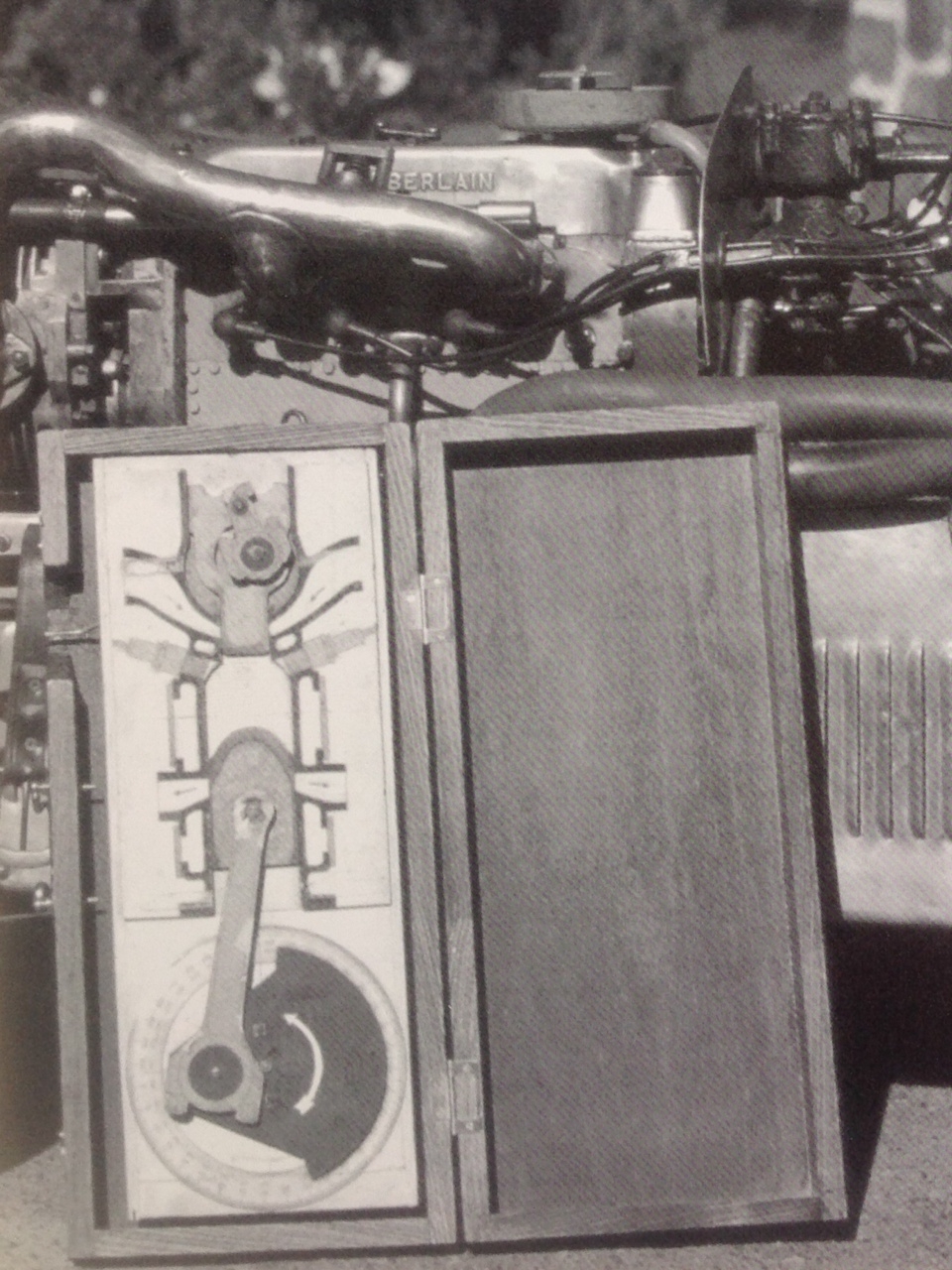
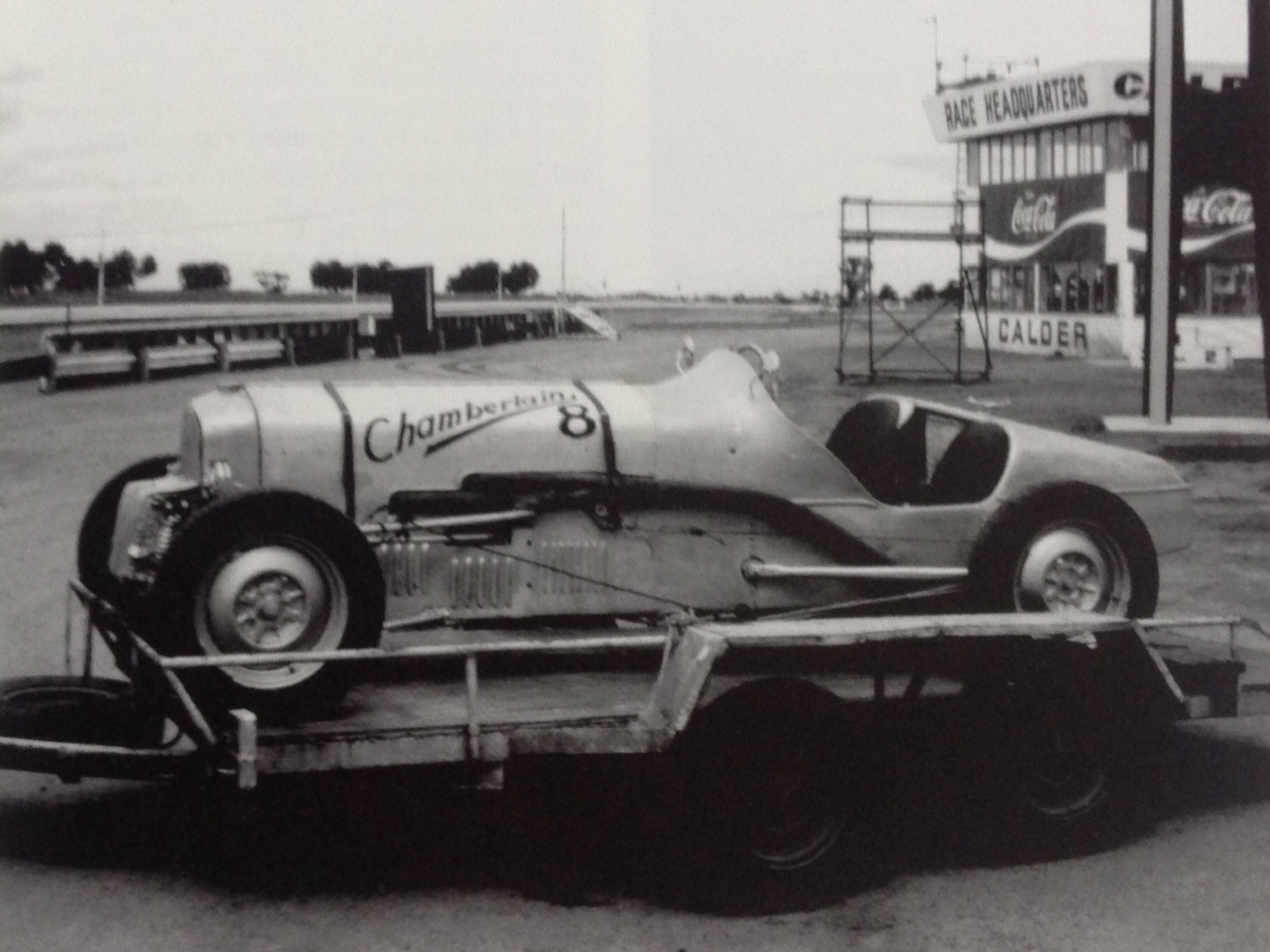
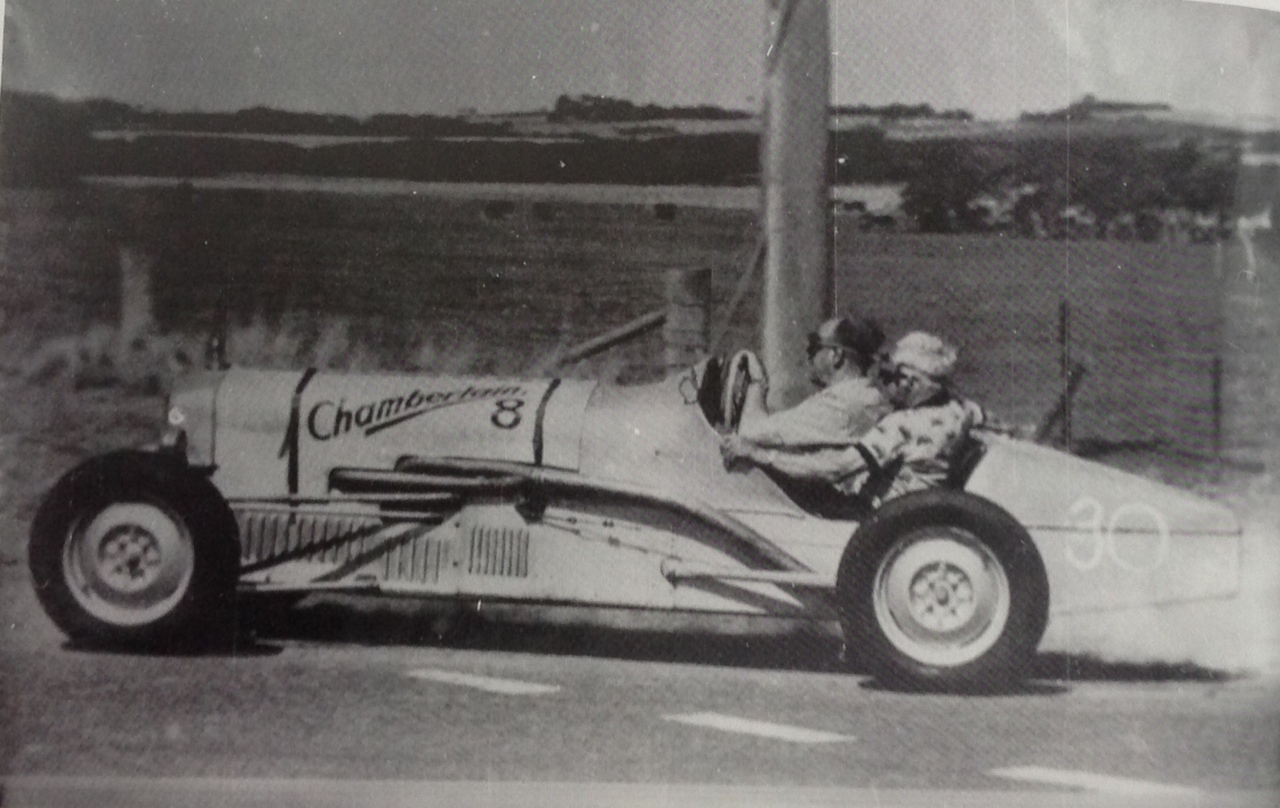

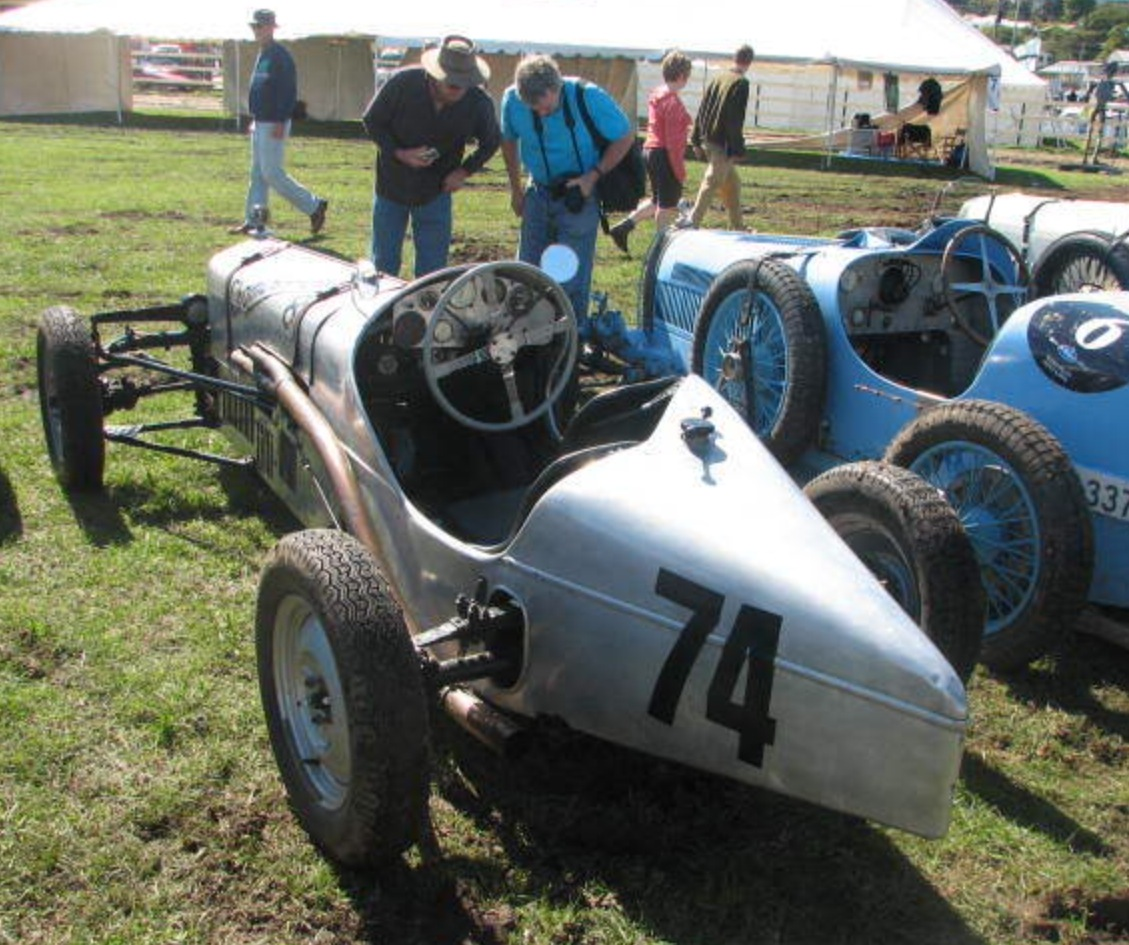
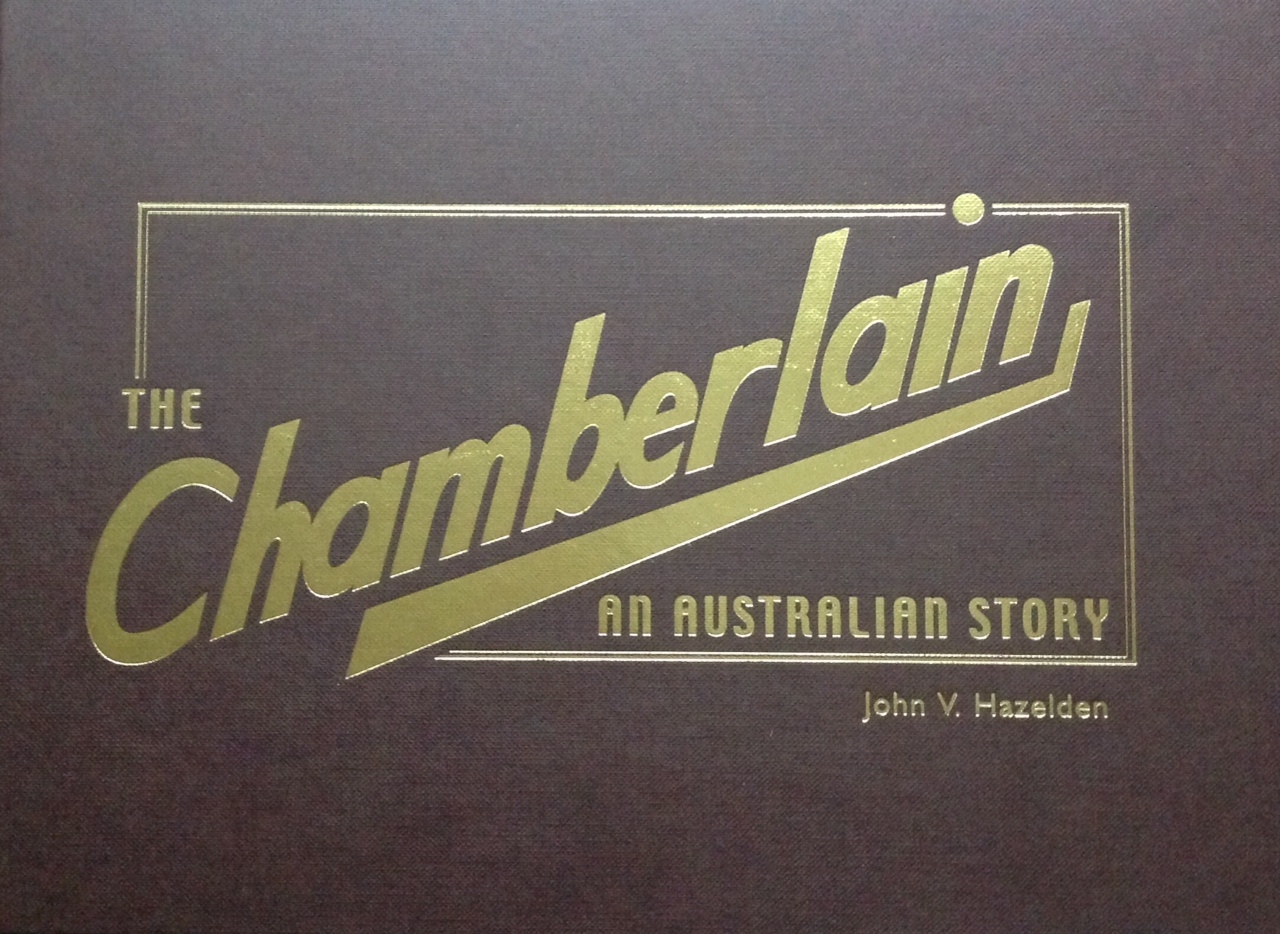


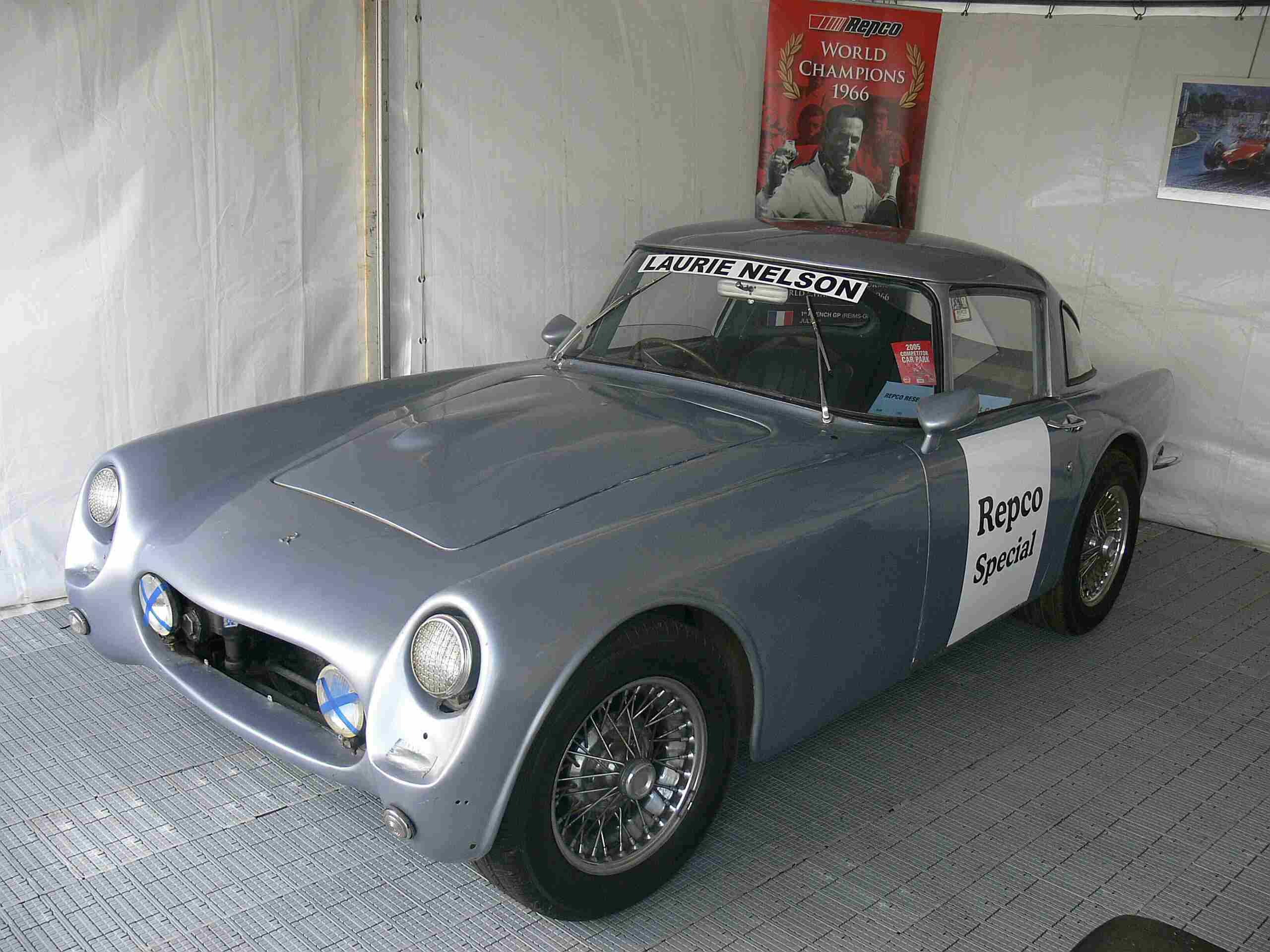
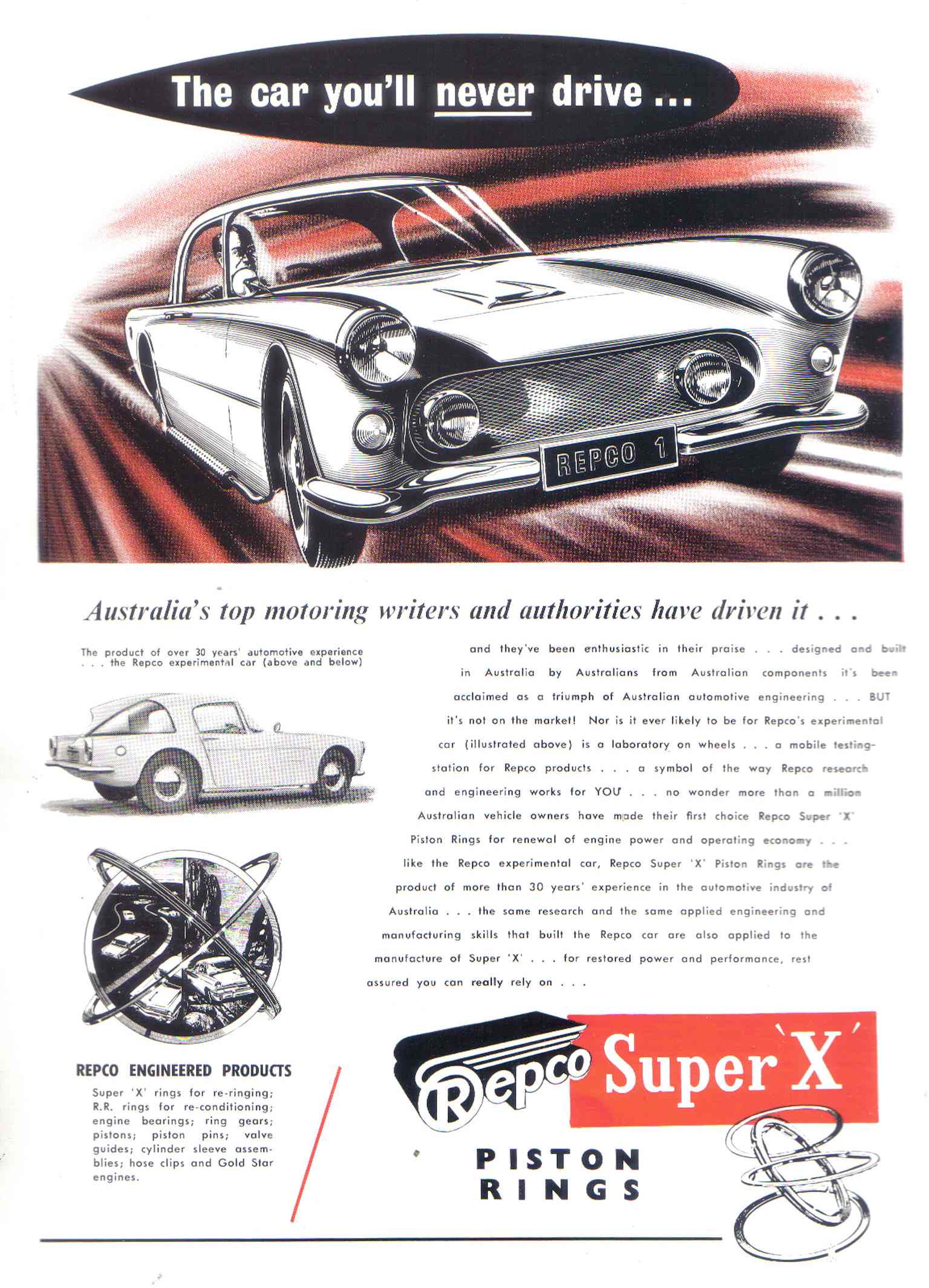
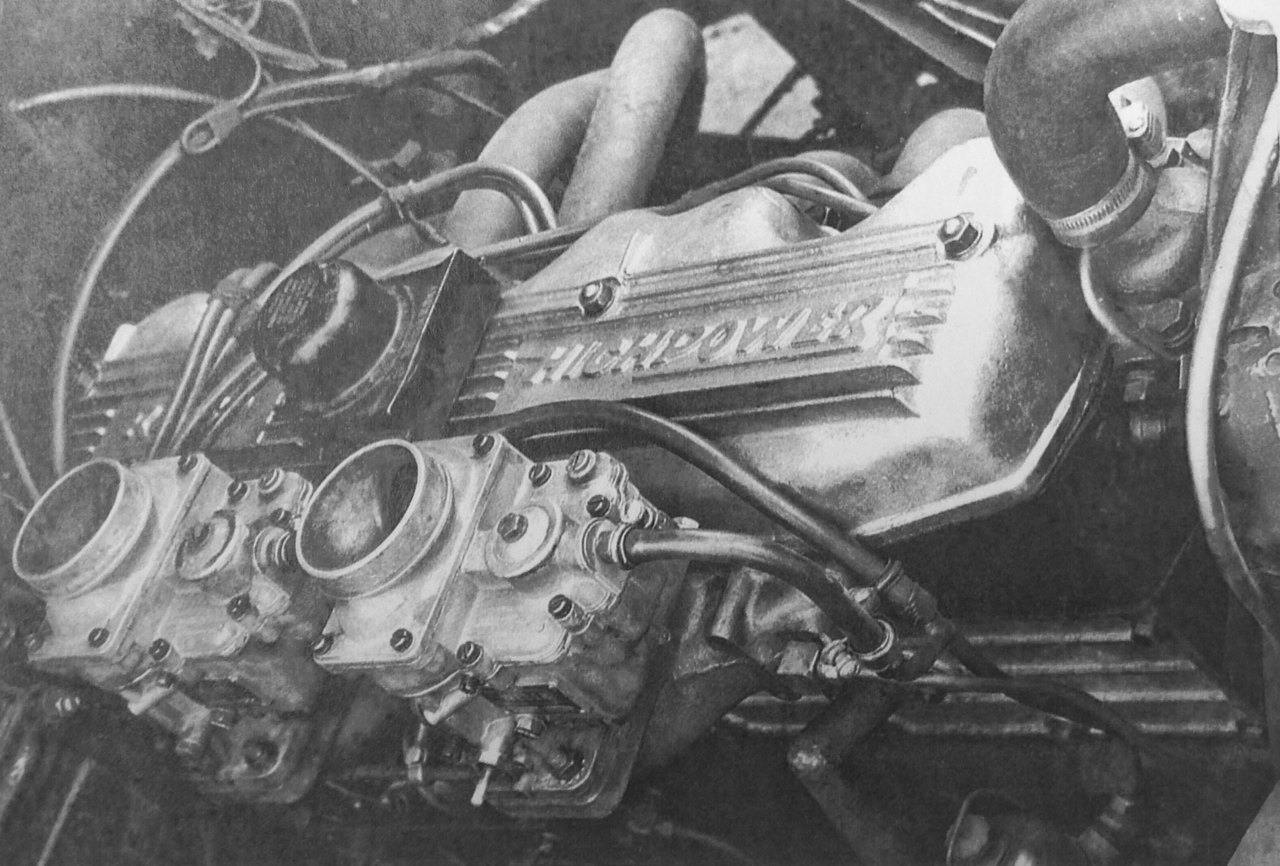

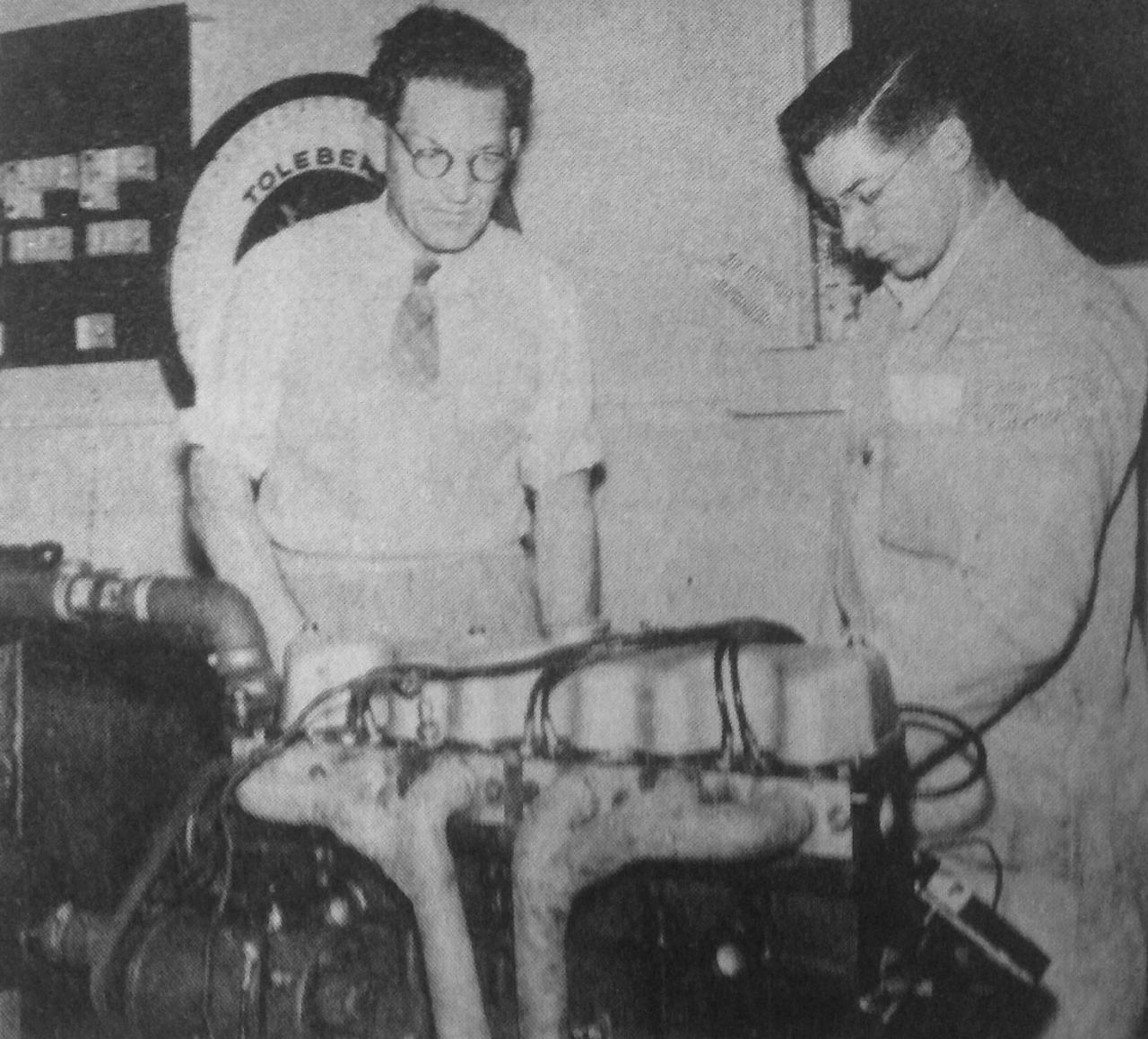


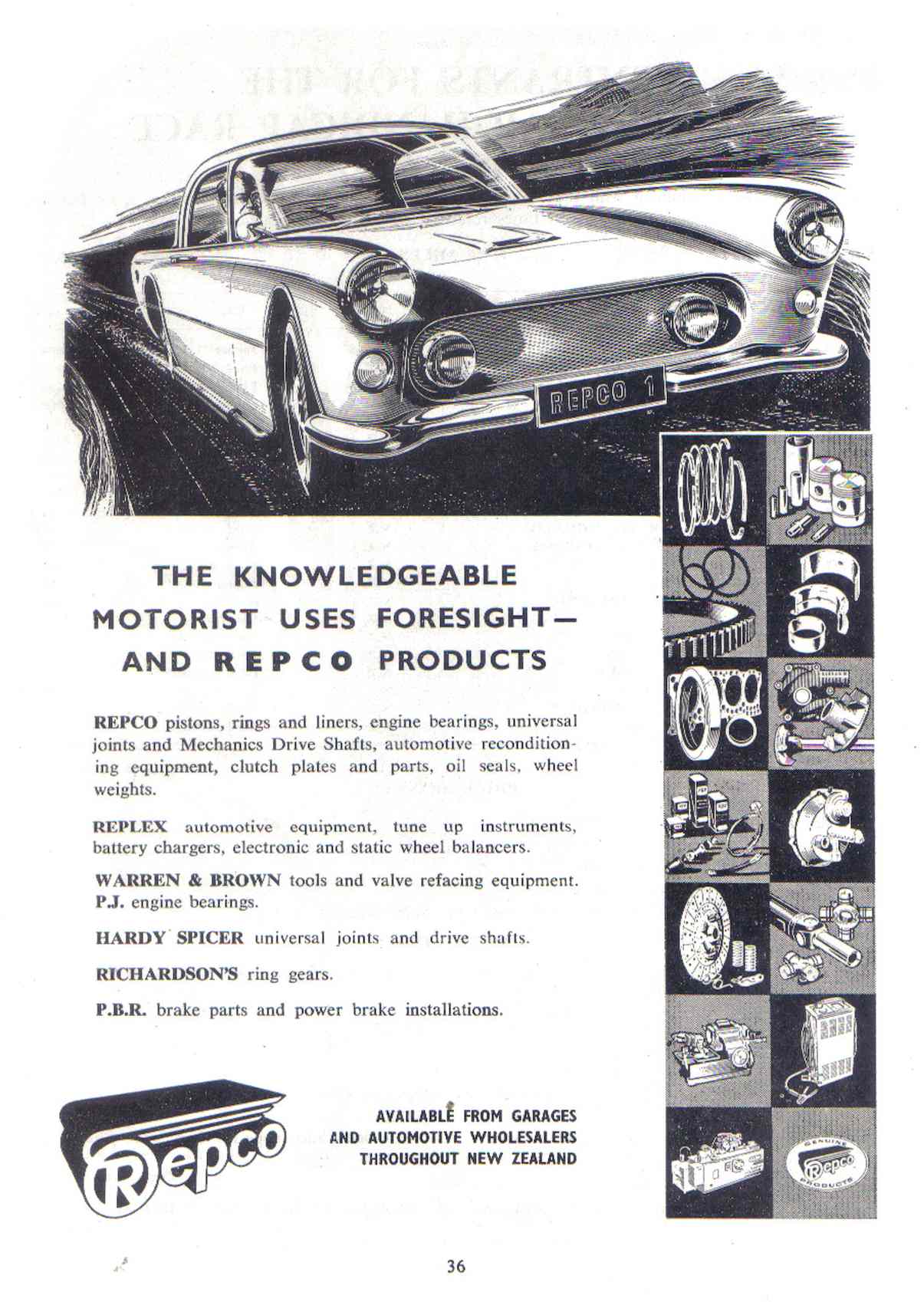
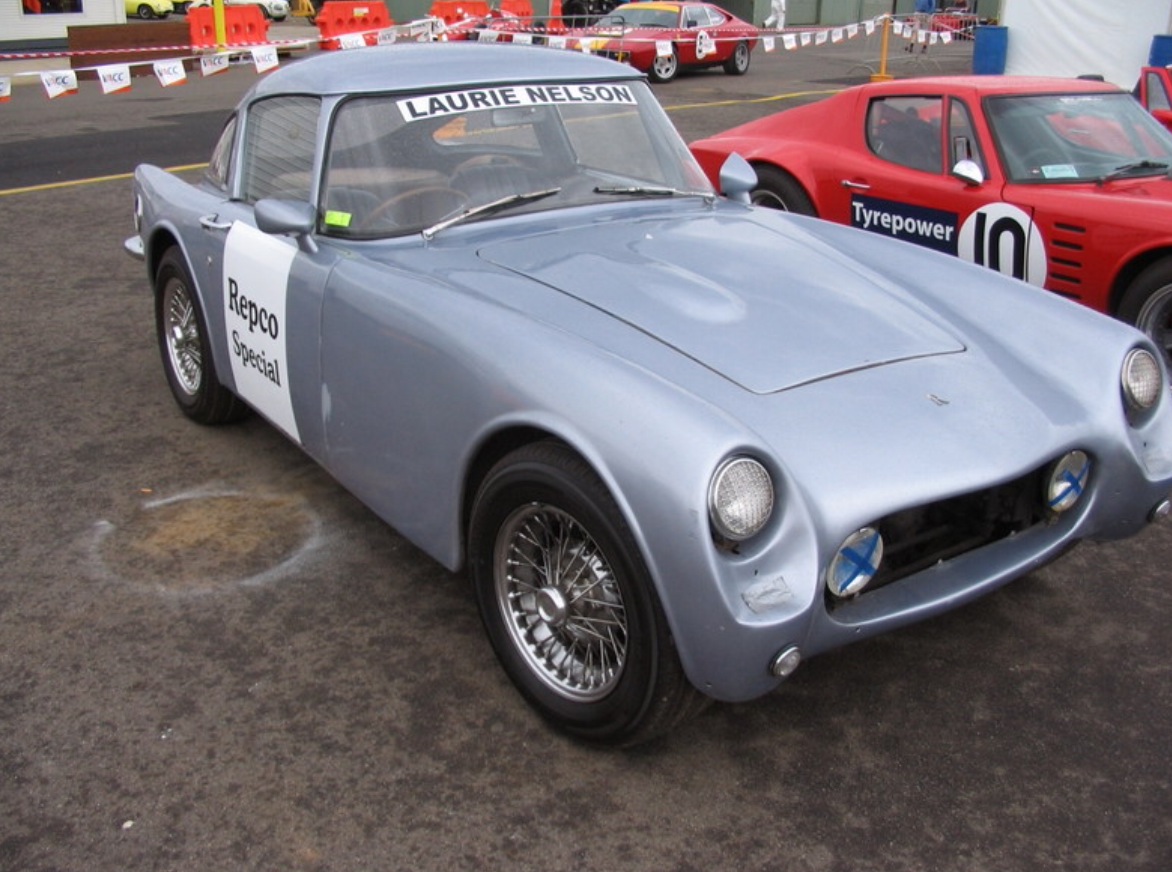


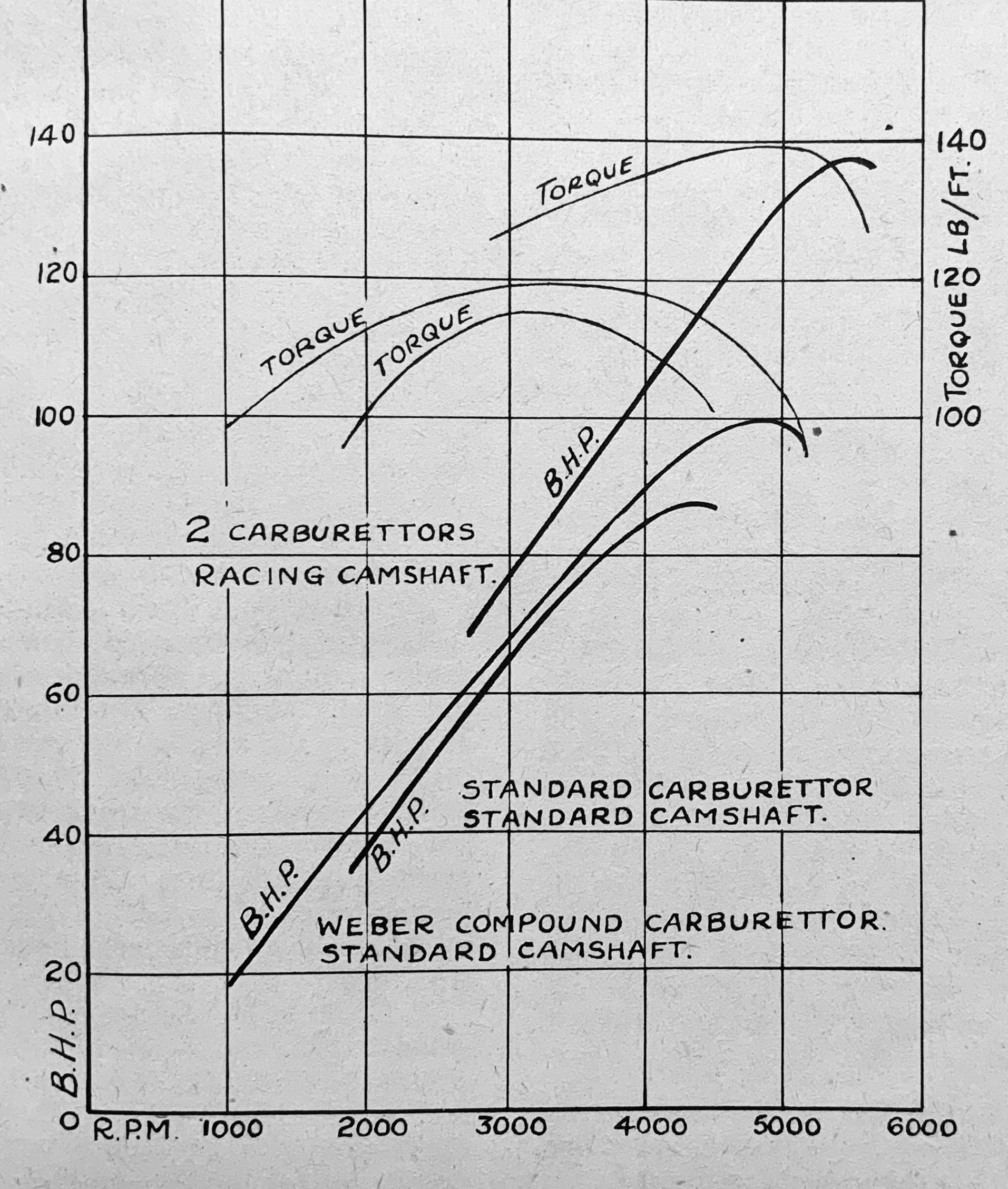

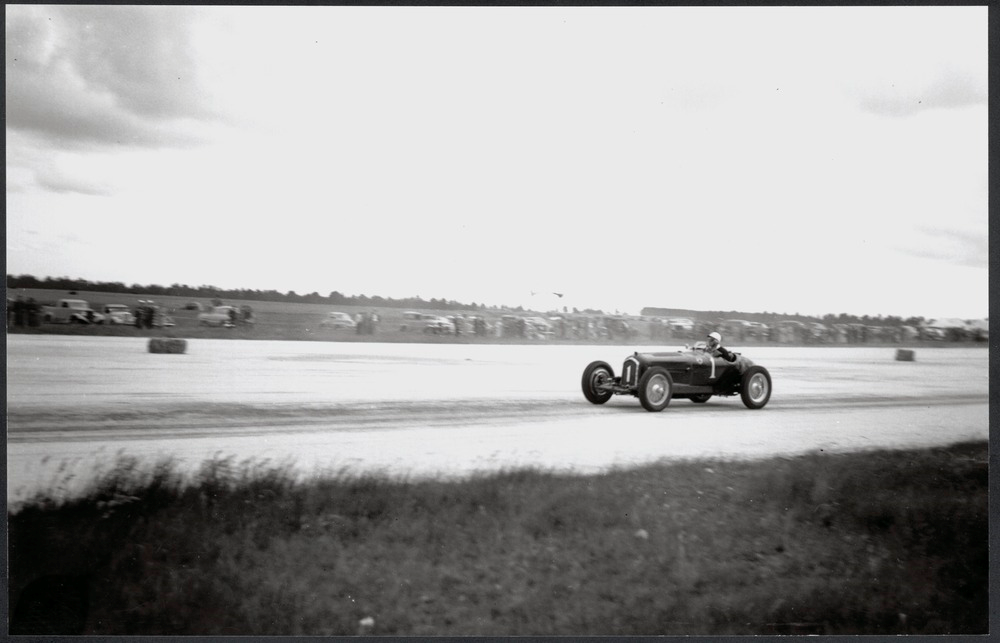


 primotipo...