Archive for the ‘Obscurities’ Category

Reg Hunt 'Sports Cars and Specials'

I wrote an article a while back about Reg Hunt…a little known Australian Champion Driver of the 1950’s and a very successful business man subsequently. At the time i was searching for ‘that shot’ to go with the article but my own library of 50’s stuff is a bit skinny and ‘google’ wasn’t friendly either, so i went with what i had.

Reg Hunt: Australian Ace of the 1950’s…

I enjoy country drives with ‘der Fuhrer’ for a whole lotta reasons not the least of which are the places in the country with  some automobilia, i do that whilst the chief looks at retro-dresses, art and other such chick stuff.

Throw in a nice meal, a bottle of vino and everybody is happy, a temporary state i grant you!

One of our favourite day trips from Melbourne takes in Kyneton/Daylesford/Maldon and return, a run up Mount Tarrengower hillclimb at Maldon is a plus. Overseas readers should add these locales to your Victorian travel agenda, essentially the villages are in the old Victorian Goldfields,

http://www.visitvictoria.com/Regions/Goldfields

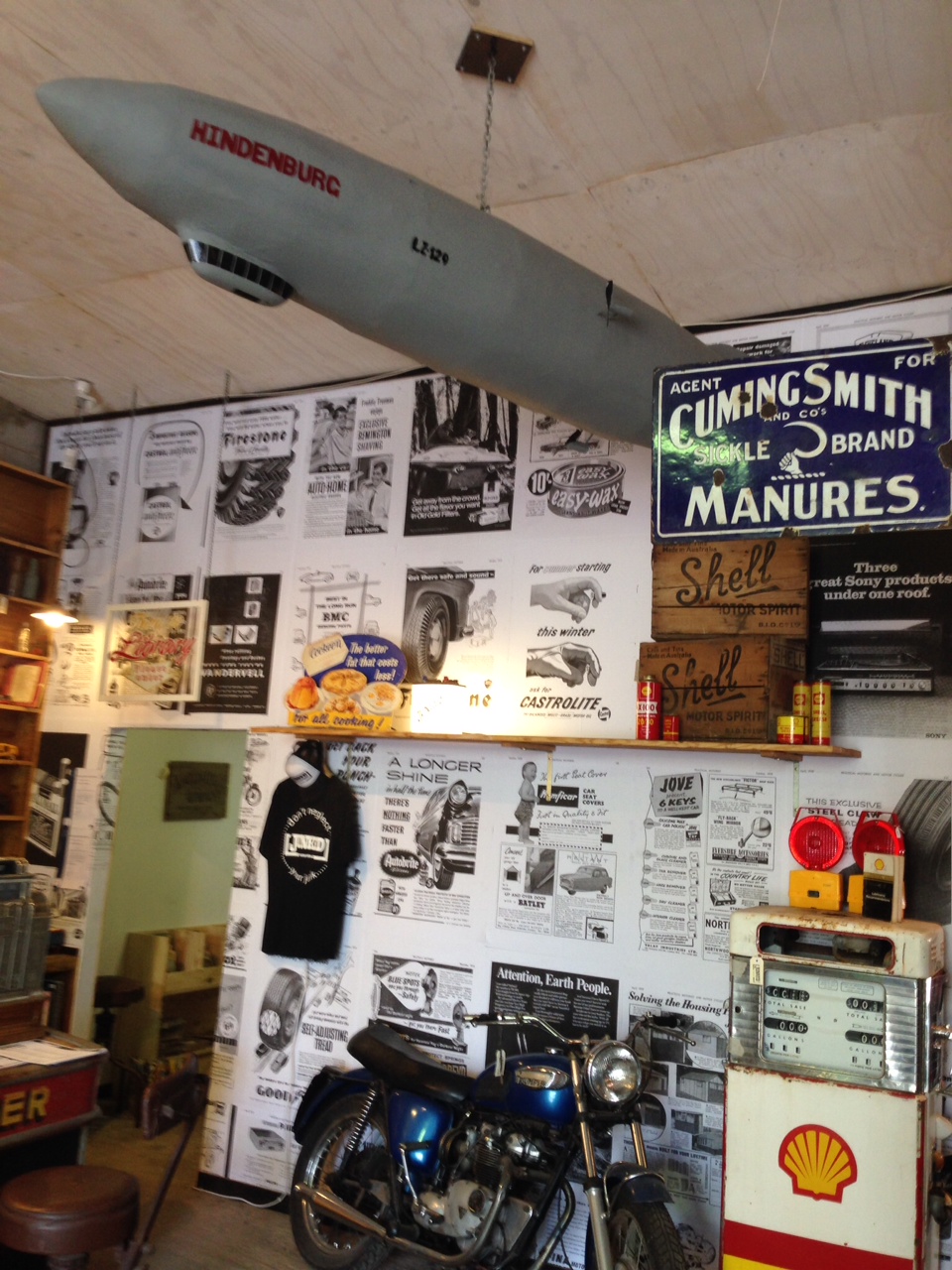
‘Junked Restoration’at Kyneton has become a stopover on these jaunts, it has rather a nice gallery/design studio as well as the car stuff so the ‘mutual satisfaction’ criteria above are met.

http://www.junked.com.au/

At the weekend i approached the magazine racks and there staring me in the face was Reg in his Maser 250F, on the cover of ‘Sports Cars and Specials’ October 1956, its not even a local magazine i had heard of.

Even more bizarre is the article on the cover comparing Reg Hunt, Stan (father of Alan) Jones and Lex Davison…it just so happens i was in the process of  completing the article on Stan, i uploaded two weeks ago, about whom little has been written.

Stan was an interesting character and successful driver, i had been searching the blogosphere for some contemporary information on where he ‘sits in the pantheon of Australian champion drivers’ of the day and found nothing.

What are the chances of finding that!?

I would rather have won ‘Lotto’ of course but its still an amazing bit of chance, i literally didn’t move a magazine, it was just there waiting for me to pick it up, ’twas meant to be.

The magazines’ writers include Ian Fraser, decades later the editor and ultimately owner of English magazine ‘Car’, the best road car magazine in the world…so not only did the article fall into my lap but its also credible.

Some days yer can be lucky!

Mind you, i did get ‘pinged’ for speeding on the return trip to Melbourne!

'Junked Restoration'

‘Junked Restoration’ is at 98a Piper Street, Kyneton, there are many top spots for food and wine on this street…then do Daylesford/Castlemaine/Maldon and come back thru tiny Blackwood which has a good pub…The Daylesford Market, open every Sunday is also a good place for automobilia hunting, whilst i am playing tour guide!

Ferrari Dino 246 Alps

When I started this blog in May I hadn’t thought about the global nature of the thing, I figured I would be writing for an Australian audience. I started it to give myself something to do during the week ‘with all that useless information in your head’ as my partner so delicately put it, as I live in Melbourne but work in Adelaide, an hours flight away. I have some time on my hands.

So, I understand that many of you in some parts of the world don’t celebrate Christmas but seasonal salutations to you all. I hope wherever you live the period is an enjoyable family one and time to reflect and relax a bit.

In Australia it’s also our summer holiday so pretty much the ‘whole joint’ closes down for January and goes to the beach. It’s a time to watch the comatose excitement of cricket, a most peculiar activity, a ‘Test’ takes longer to complete than a Grand Prix weekend, and even then there is sometimes no victory. Only the English could have invented the game, bless ’em.

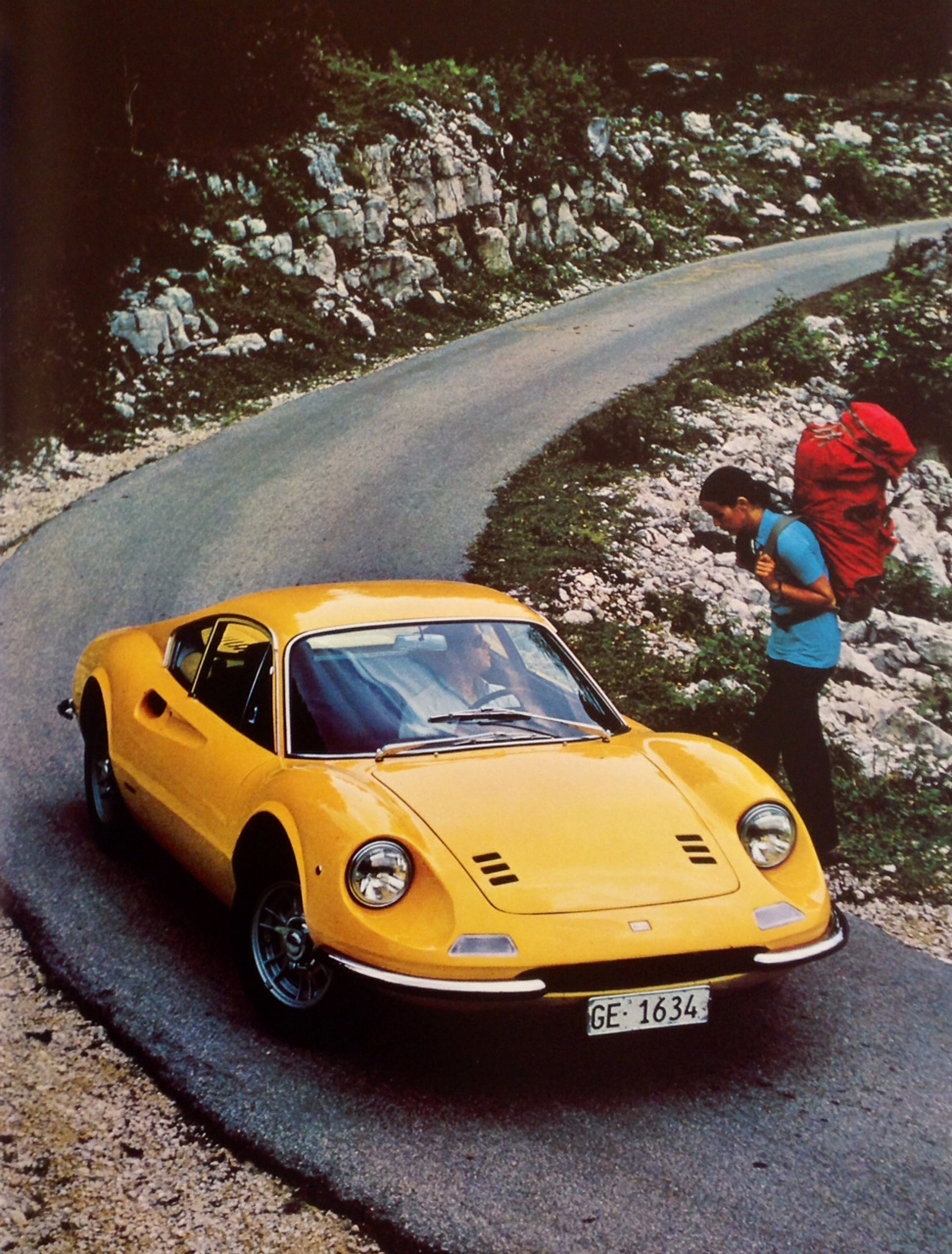
At Christmas my mind always turns to the Ferrari Dino 246GT, still my favourite road car.

The book which piqued my interest in motor racing was ‘Automobile Year 18’, the 1970 season review. I can pretty much remember every page, I used to borrow the book from the school library over and over again. Its no surprise that some of my favourite racing cars are from that season; the Lotus 72 F1, Ferrari 512S Sports Car and McLaren M8D CanAm being three of them.

These photos of the Dino and a road test featured large in the book, I fell for the cars perfect, pert Pininfarina lines well before I saw my first one in the metal.

Every year since 1971 I have asked good ‘ole Santa for a Dino in ‘Fly Yellow’, clearly I have been a naughty boy as said Italian temptress has never appeared. Still, many of my automotive and racing dreams have been realised although the # 1 seat at Ferrari seems to have passed me by.

May your dreams and aspirations for 2015 be realised.

A happy, healthy, wealthy and wise year to you all.

And thankyou for reading the blog!…

Ferrari Dino 246 profile

Photo Credits…

Automobile Year 18

image

Jock Walkem and his mate ponder changes to their Cooper and it’s moody Jap ‘V-twin’ engine before the next run…another of those ‘just so period’ shots…

Lots of interesting details to grab the eye…the gear lever for the ‘positive stop’ motor cyle ‘box, mirror mounted on the transverse leaf, equipe logo on the cars side, i wonder whose it is? Relaxed look and feel of the event and the formal clothing of the kids on a Tasmanian Sunday compared with today…

Penguin is a tiny village on the North-West Coast of Tasmania, the Hillclimb still holds race meetings.

Cooper MkV/41/51 is significant in the pantheon of the many air-cooled Coopers which came to Australia in the 1950’s. Perhaps the most successful, it was owned and raced by Tom Hawkes and ‘Gold Star’ (Australias’ national drivers championship) winners Stan Jones and Bill Patterson earlier in their careers.

An interesting article about this particular car is in the magazine ‘Loose Fillings’, which specialises in these air-cooled racers.

Click to access LooseFillings-44Print.pdf

F3 racing in the UK provided both the training ground for some of Britains Champions of the 1950’s…Stirling Moss, Peter Collins, Stuart Lewis-Evans being good examples, and also for engineers. The class also accelerated the growth of the infrastructure of subcontractors which formed one of the bases of Britains global dominance as a manufacturer of racing cars which continues today.

500cc Clubs

Those with an interest in these cars should check out the ‘500 Owners Association’

http://www.500race.org/index.htm

Technical details…

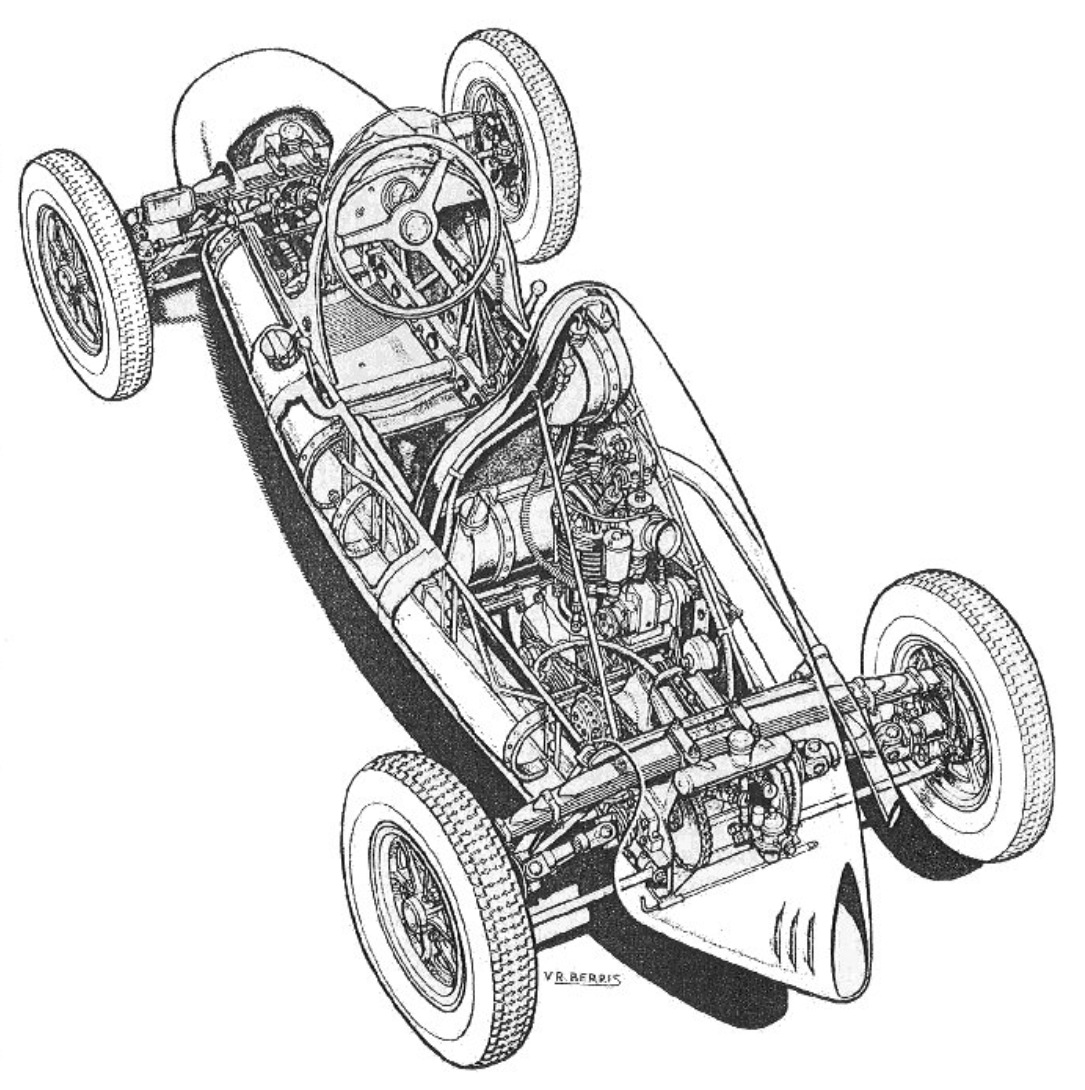
Cooper Mk5 cutaway

Chassis is box-sections, with transverse leaf springs and wishbones front and rear. Burman steering, Lockheed hydraulic drums front and rear provide the stopping power. Chain drive. Circa 520Lb in weight. Cast alloy wheels 4 or 5 X 15 inch diameter wheels. (Vic Berris)

Cooper Mk5 sales ad

JAP 8 80 drawing

The Walkem MkV was fitted with a ‘JAP’ 8/80 V Twin, 996cc, pushrod OHV, engine. Circa 76.5 bhp@6300rpm. The 500cc ‘ JAP’ single produced around 40bhp, both engines used compression ratios of 14:1 and used alcohol fuel provided by Amal carb(s)

Etcetera…

Cooper Mk5 Motorsport article

Photo Credits…

Check out the archive of oldracephotos

http://www.oldracephotos.com/content/home/

Vic Berris cutaway drawing, MotorSport Magazine

Finito…

Senna Mc Laren lambo
(Sutton)

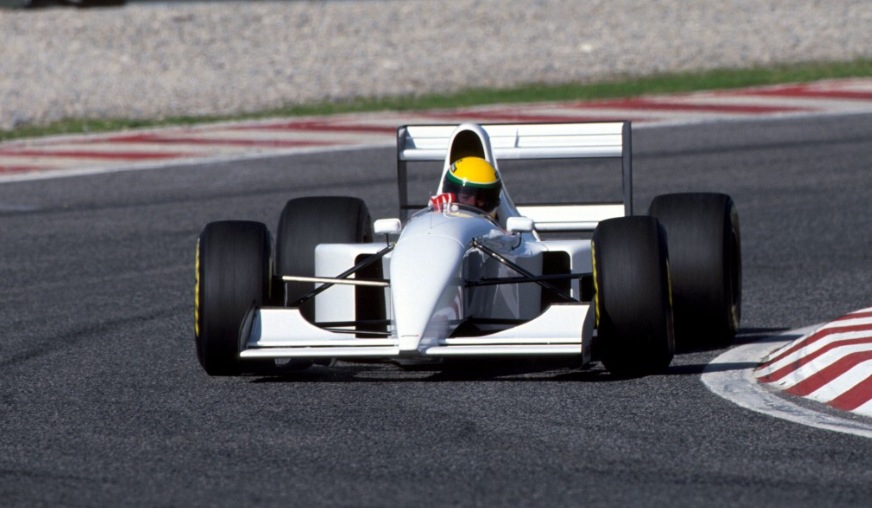
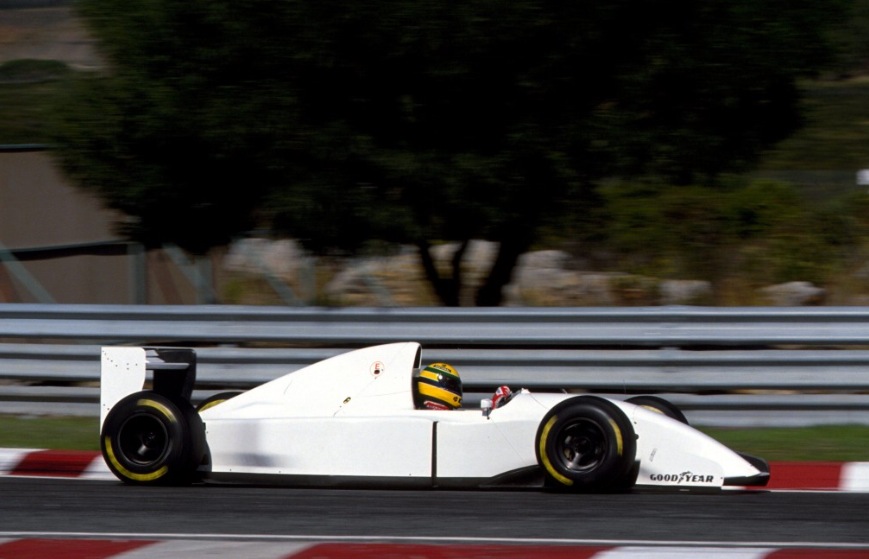
Ayrton Senna testing the McLaren MP4/8B Lamborghini at Estoril, 27-29 September 1993…

By Senna’s standards 1993 had not been a successful year. He won five races in his McLaren Ford as a customer Cosworth user, Schumacher’s Benetton with the more powerful factory Ford Cosworth engines only won a single event. Even worse, arch rival Alain Prost won the title for Williams Renault.

Scrambling to find an engine deal to keep its star driver happy and with the team for 1994, Ron Dennis signed a test contract with Chrysler who then owned Lamborghini.

McLaren modified one of its MP4/8 Ford chassis to take the jewel like little 3.5-litre V12.

Lamborghini 3.5 litre V12 F1 engine

The Mauro Forghieri designed Type 3512 Lambo V12 was first used in F1 in 1989. Larrousse, Lotus and Minardi used the engines in the following years. A new engine for 1993 was the smallest, lightest V12 ever, it gave circa 750bhp @ 14500rpm without pneumatic valves, more than the Cosworth V8 of the day.

Senna tested the car initially at Pembrey, at Silverstone twice, and later at Estoril. He wanted to race it in the three final races of the year at Portugal, Japan and in Australia but Dennis wouldn’t allow it given the contractual arrangements already, and in the process of being put in place with sponsors and the like.

Senna suggested to the engines designer, Ferrari legend Mauro Forghieri, that the V12 would be better with a less brutal top end and more mid range torque, these changes were made, the engine producing around 750bhp.

Mika Hakkinen was the team’s test driver that year, Senna’s race teammate was Michael Andretti until Mika took over the race seat from the Portuguese GP. Hakkinen was 1.5 seconds faster at Silverstone in the Lambo powered MP4/8B than the Ford engined MP4/8 had been during the ’93 British GP weekend.

McLaren MP4 8 Lamborghini Silverstone 1993
Senna, Estoril (Sutton)
Hakkinen at Estoril (MotorSport)

Adrian Burgess was a member of McLaren’s test team in 1993 and was one of three mechanics who worked on the MP4/8B and spoke about his experiences to Which Car? magazine.

“I remember going to Estoril the day after the Grand Prix (it was a three day test, September 27-29, 1993 involving Senna and Hakkinen) Ayrton loved the engine. Within half a day we were 4.9 seconds quicker than the Larrousse LH93 was the day before with the same engine.” Philippe Alliot and Eric Comas were 10th and 11th in their Larrousse Lamborghinis in the race won by Michael Schumacher’s Benetton B193 Ford.

“The problem with it was that by the time it was warm it normally had hand-grenaded itself. I think the furthest we went was 19 laps before all of a sudden you could look down through the inlet trumpets and actually see out the bottom! It hand-grenaded itself in the most magnificent ways. It was like Scalextric car dragging con-rods down the front straight at Estoril. The thing just blew up.”

(Sutton)

As the balance of the 1993 season played out, Prost resigned, Senna won the last two races in Australia and Japan in his MP4/8 Ford. McLaren did a deal with Peugeot and Senna went to Williams for 1994…and the rest as they say is history, a sad one at that.

Photo Credits…

Sutton Images, Autosprint

Tailpieces…

Finito…

bartlett torana

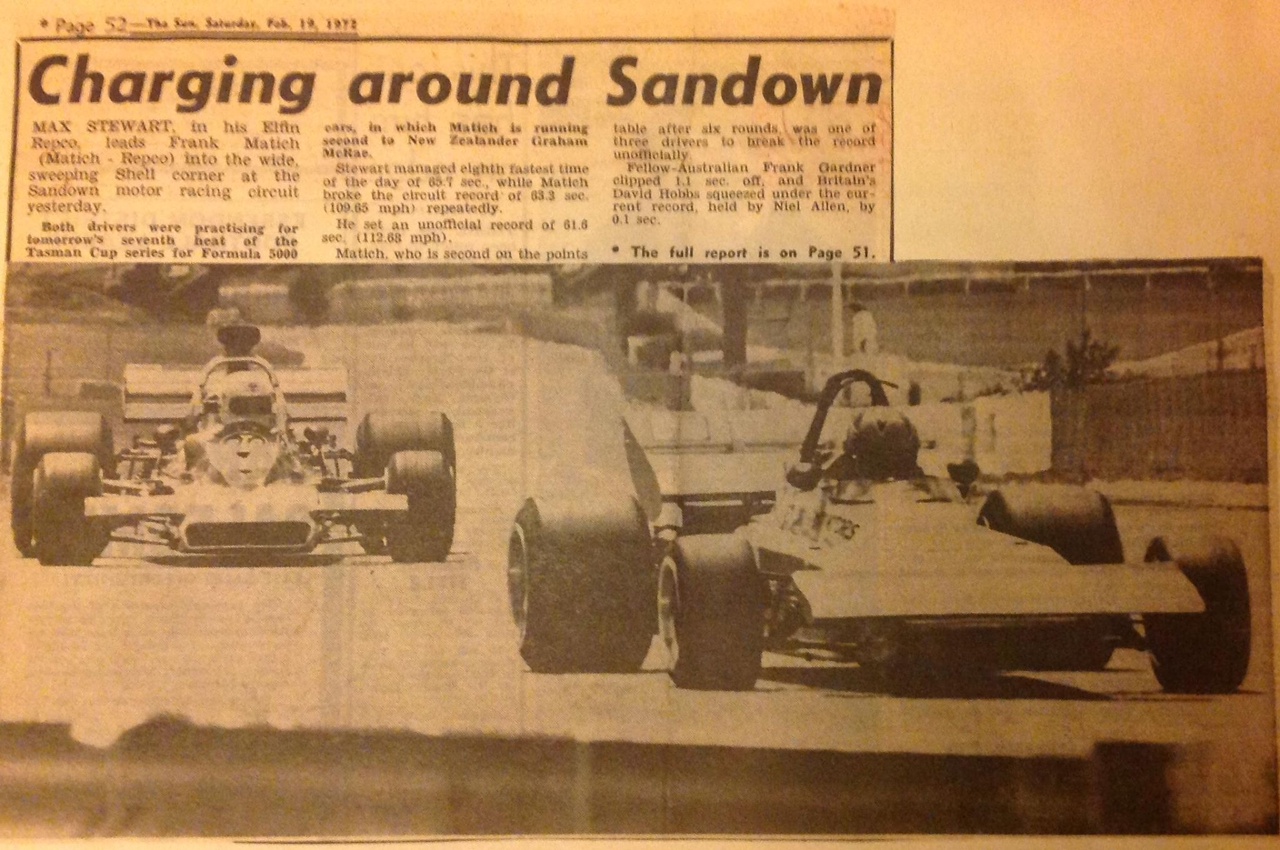
My First Race Meeting…Sandown Tasman F5000 Meeting February 20 1972…

We can all recall the meeting or event which hooked us on the sport, right?

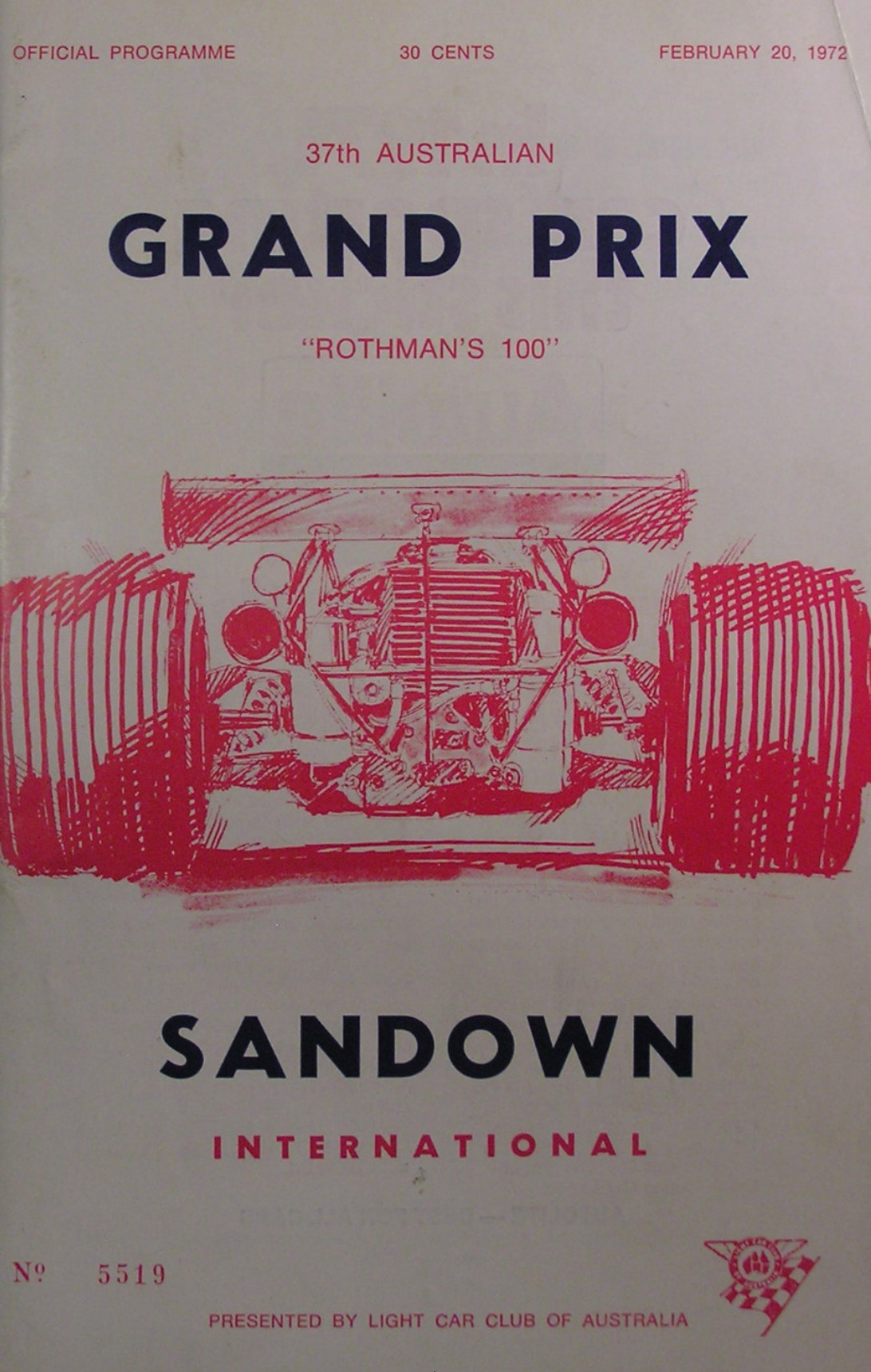
For me it was the 1972 Sandown Tasman Meeting, the Australian Grand Prix no less, contested by Formula 5000 cars.

I was up for it mind you, one of my friends, Simon Roberts’ father Ron worked for Castrol and amongst his responsibilities was the racing budget in some shape or form.

Critically, he went to race meetings and gave me Castrols’ copy of ‘Racing Car News’ each month after it had done the rounds of their execs. It was always a month or so outta date and well thumbed by the time I got it, but I lapped up every word.

Finally i was invited to my first meeting.

We cruised out to Sandown from North Balwyn in Rons’ metallic brown Valiant with the big ‘265 Hemi’…not a bad ‘Dad Car’ at the time. The Val joined the endless stream of weekend traffic on Warrigal and Dandenong Roads, my excitement building seeing lots of performance cars of the day; GTR’s, XU1’s, GT’s, GTV’s, Monaro’s and plenty of souped up EH’s and HR’s ‘chromies’ gleaming in the sun amongst the other weekend warriors heading to a Mornington Peninsula beach on that hot summers day.

Reading RCN didn’t prepare me for the sheer visceral thrill, excitement, speed and ground shaking, gutterall thunder of the 5 Litre 500 BHP V8’s.

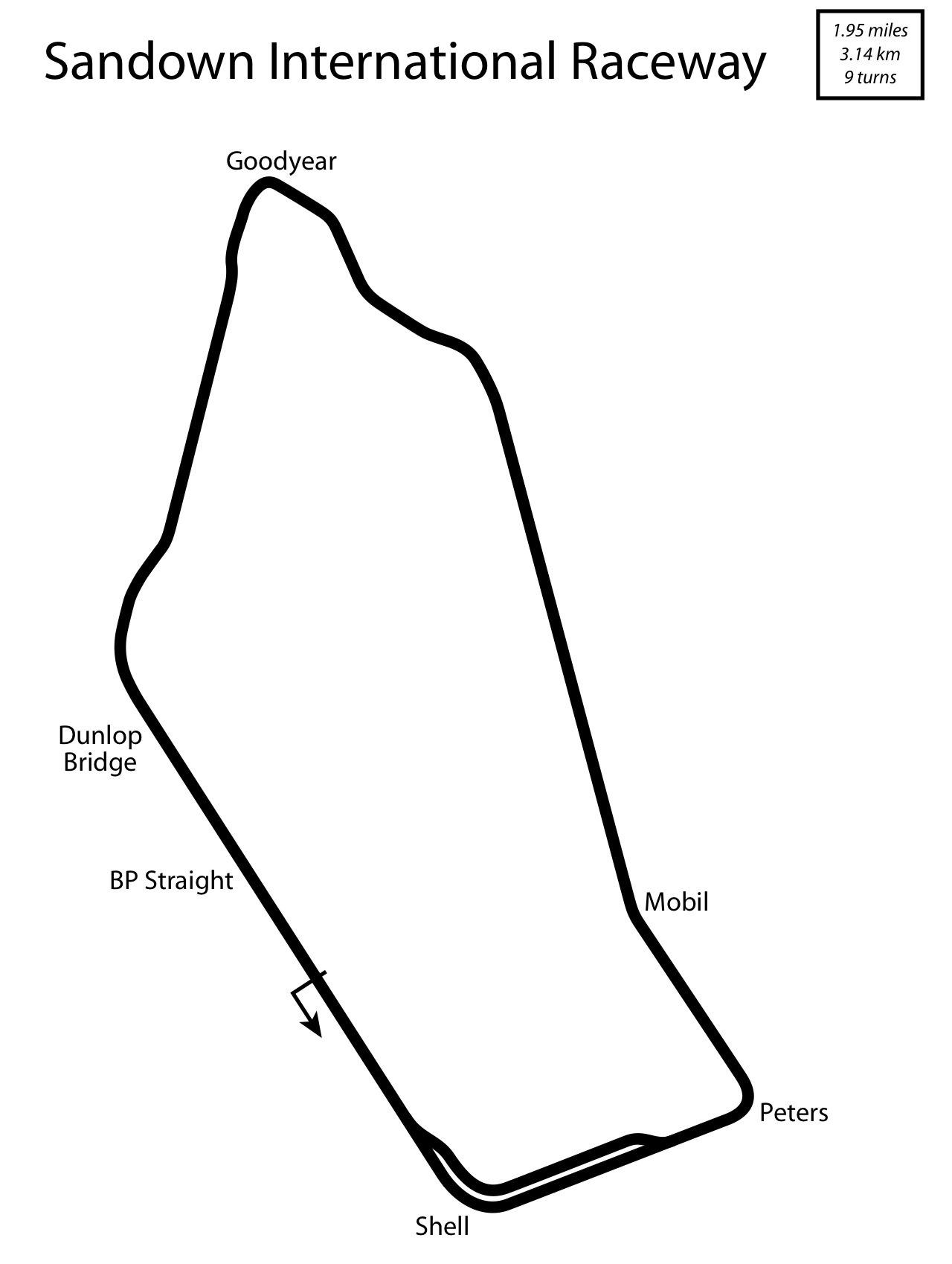
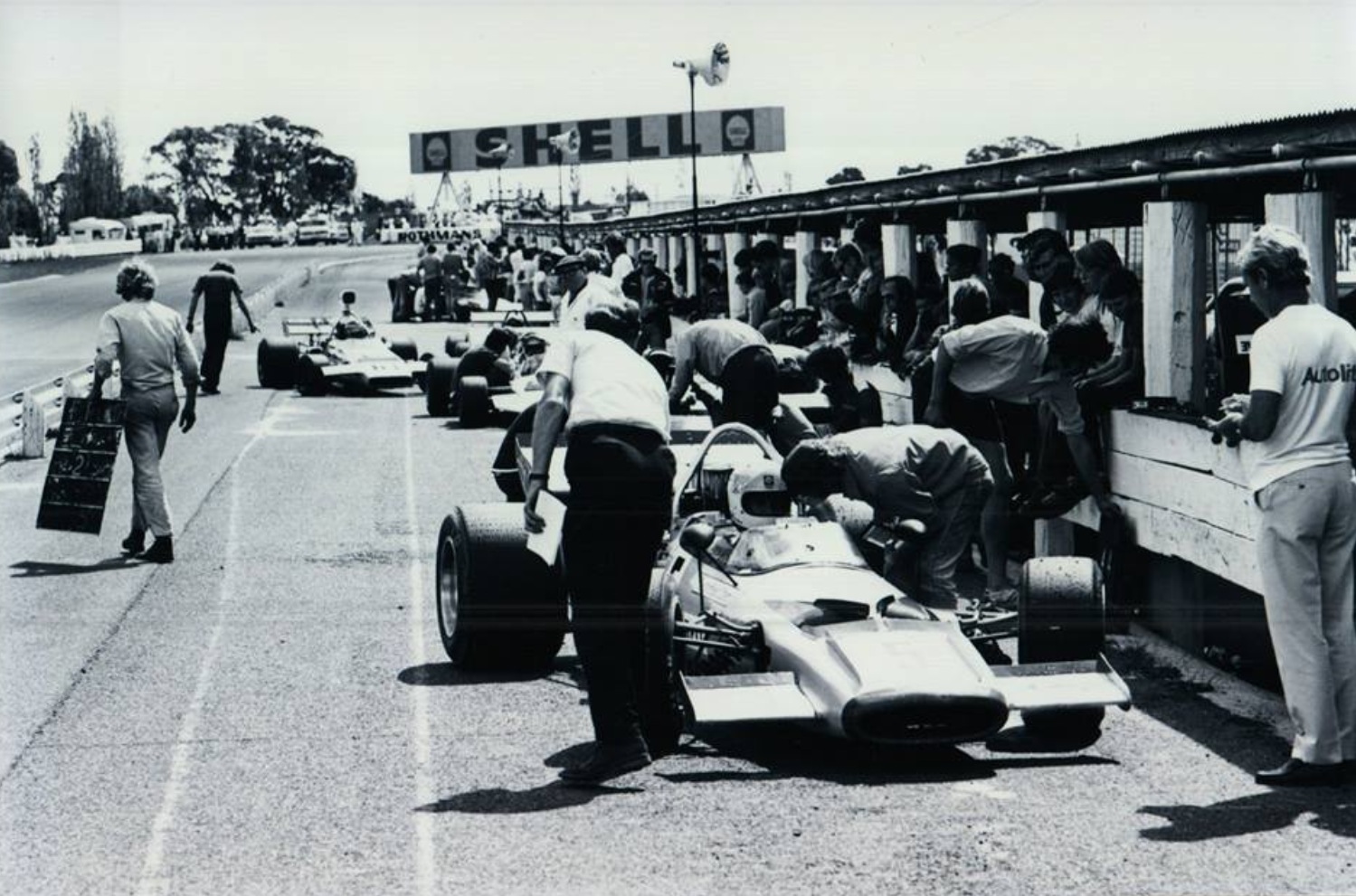
In those days the paddock was in the infield, inside Shell Corner, or turn 1 and extended across the track to the inside of Peters or Torana Corner, now turn 3, or the Corner onto the back straight. It was lower than the surrounding infield and was like a private little Mecca for racers and enthusiasts alike.

I recall 2 things vividly from that weekend all these years later.

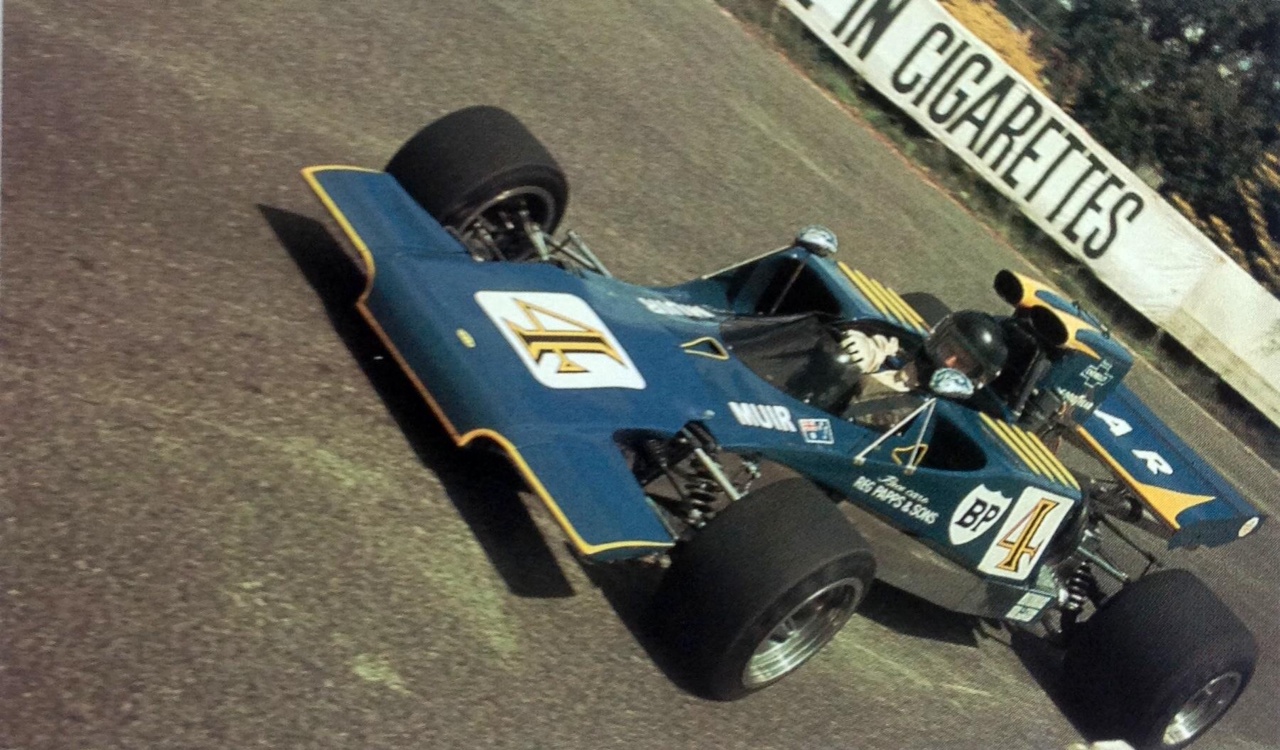
The first was walking from the carpark behind the grandstand, the excitement building hearing cars being warmed up in the distance and crossing the track into the dusty, gravel paddock area and seeing Bob Muirs beautiful, exotic, automotively erotic, concours, gleaming blue Lola T300 just about to enter the scrutineering bay.

muir sandown

I was stunned, gob-smacked. I couldn’t move I was so awed by its amazing combination of wedge shape, curves, fibre-glass, chrome tipped exhausts, scoops, ducts, wings and oh-so-wide tyres! It was immaculate, yellow pinstriping contrasting the blue bodywork, the finish of the racer a ‘Von Dutch’ work of art.

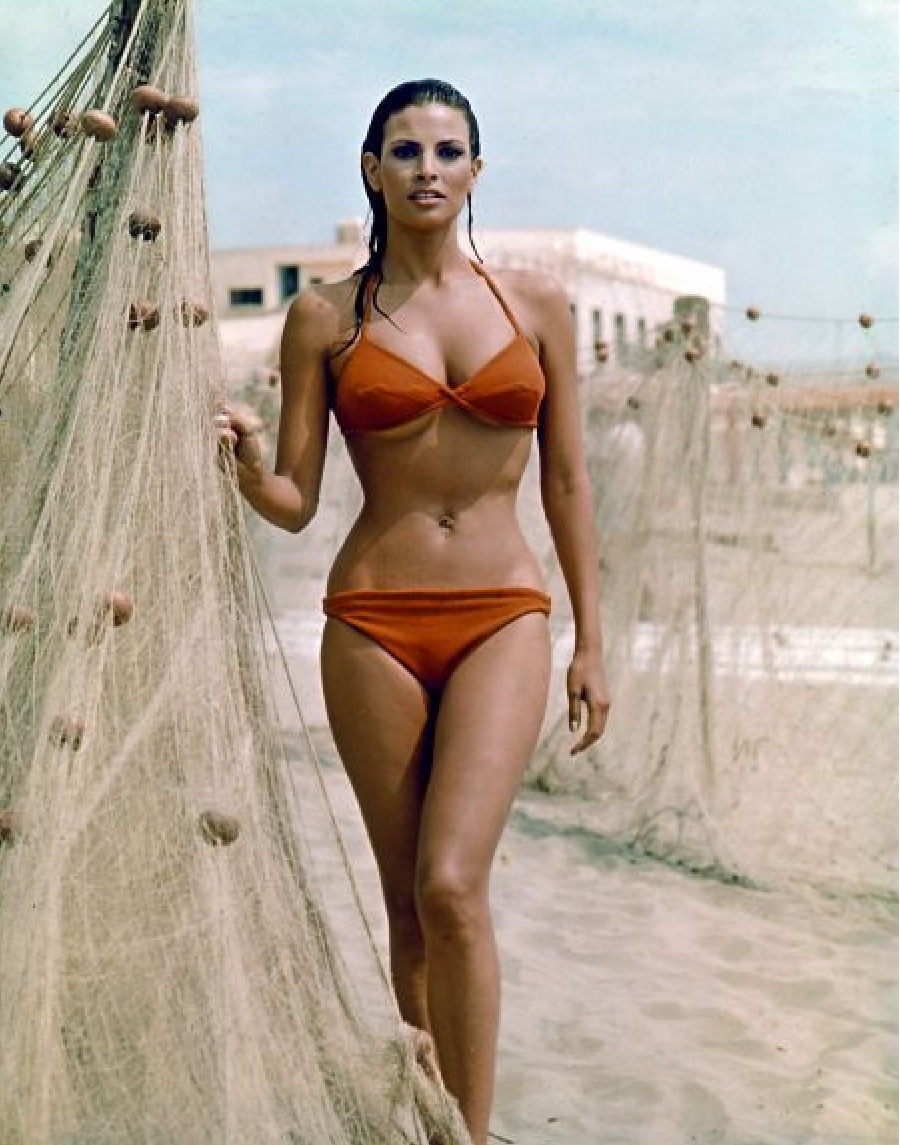
Lola was as curvaceous as Raquel Welch who adorned my bedroom wall. Her appeal was far more carnal, but the compound curvature of both car and screen siren was undeniable.

Fairly soon a poster of Lola was alongside Raquel. Dad related to Raquels’ charms, more than once we compared and contrasted her ‘on screen’ attributes with Sophia Loren but to me she was too old, I took his point all the same. He did find the car thing more of a challenge than babes.

Eventually I regained my senses and did a slow lap of  Lola taking in every bit of it. ‘Drinking’ visually every feature. The T300 was a new design, none of my old RCN’s had pictured it. Most racing cars then were still cigar shaped, Lola took her cues from the radical 1970 F1 Lotus 72, not the cars of the 60’s.

raquel

We wandered off to the Castrol tent meeting Peter Brock and Colin Bond and whilst the Touring Cars were of interest they didn’t really float my boat. Moffat’s Mustang raced that weekend, it was and still is impressive. Surely the best looking ‘taxi’ of all time?. With an honorable mention to Brian Foley’s Alfa GTAm.

The beauty of the old Sandown setup was that you could see most of what you wanted within a 500 metre walk. Watch the cars coming down the main straight and into Shell Corner on either the inside or outside of the track. This was a great spot to watch braking manoeuvres and hear and work out the best practitioners of the ‘heel’n toe art’.

old Sandown circuit map

My other favourite spot was coming into or exiting Torana/Peters from the inside of the circuit. This was the place to watch and hear the cars accelerate away from you, always impressive to watch an F5000 doing that on its own bellowing up through the gears on it’s way up towards ‘Marlboro Country’, the fast combination of corners into ‘Dandy Road’, it was and still is a great part of the track to drive.

Access and egress from the Paddock was via a pit pass or jumping the fence for the impecunious. The Light Car Club guys always turned a blind eye to this teenage activity, proper chaps those blokes.

My preferred locale though, was in the paddock. You could wander around seeing as much as you liked, talk to the drivers and get an autograph if you picked your moment, watch the cars form up on the dummy grid, see them take off, and watch them from the pit counter, on circuit until told to ‘piss-orf matey’ by the ever polite LCCA officials.

It was from that pit counter that the second indelible memory of the weekend took place.

bartlett in pits

We watched the cars grumble, crackle, spit back through their intake trumpets and ‘pig-root’ their way past us… down the pitlane, the exotic sound of Hewland gear whine audible and onto the circuit, the pack disappearing in one massive rumble of fuel injected thunder as they accelerated up to The Rise and down into Dandenong Road.

The first car to approach us exiting Shell was yellow.

It was Kevin Bartlett in his McLaren M10B, he kicked the car sideways…teasing the thing on the throttle, the engine note changing minutely but perceptibly as he balanced the beasts sticky, wide Goodyears with throttle and steering. I was stunned, it looked and sounded so fast and spectacular and easy. It wasn’t of course, but he did it lap after lap in this third gear corner. To see the thing accelerating hard past us and then almost as quickly the wonderful sound of the big Chev on the down-change into ‘Torana’ all too much.

I was in sensory overload, Raquel did that to me as well mind you, but in a different kinda way.

But I was hooked as a Bartlett, F5000 and race fan for life.

I don’t remember too much of the race itself but Graham McRae in his own car (Leda aka McRae GM1 designed by the recently deceased Len Terry) won the AGP from Frank Gardner’s Lola T300 and David Hobbs in a McLaren M22. KB and Bob Muir were both retirements with gearbox and engine maladies respectively.

But the race didn’t matter to me, i lived that wonderful weekend for months, I had found my lifelong interest and passion, it’s been my sport as a competitor and fan ever since.

muir sandown 2

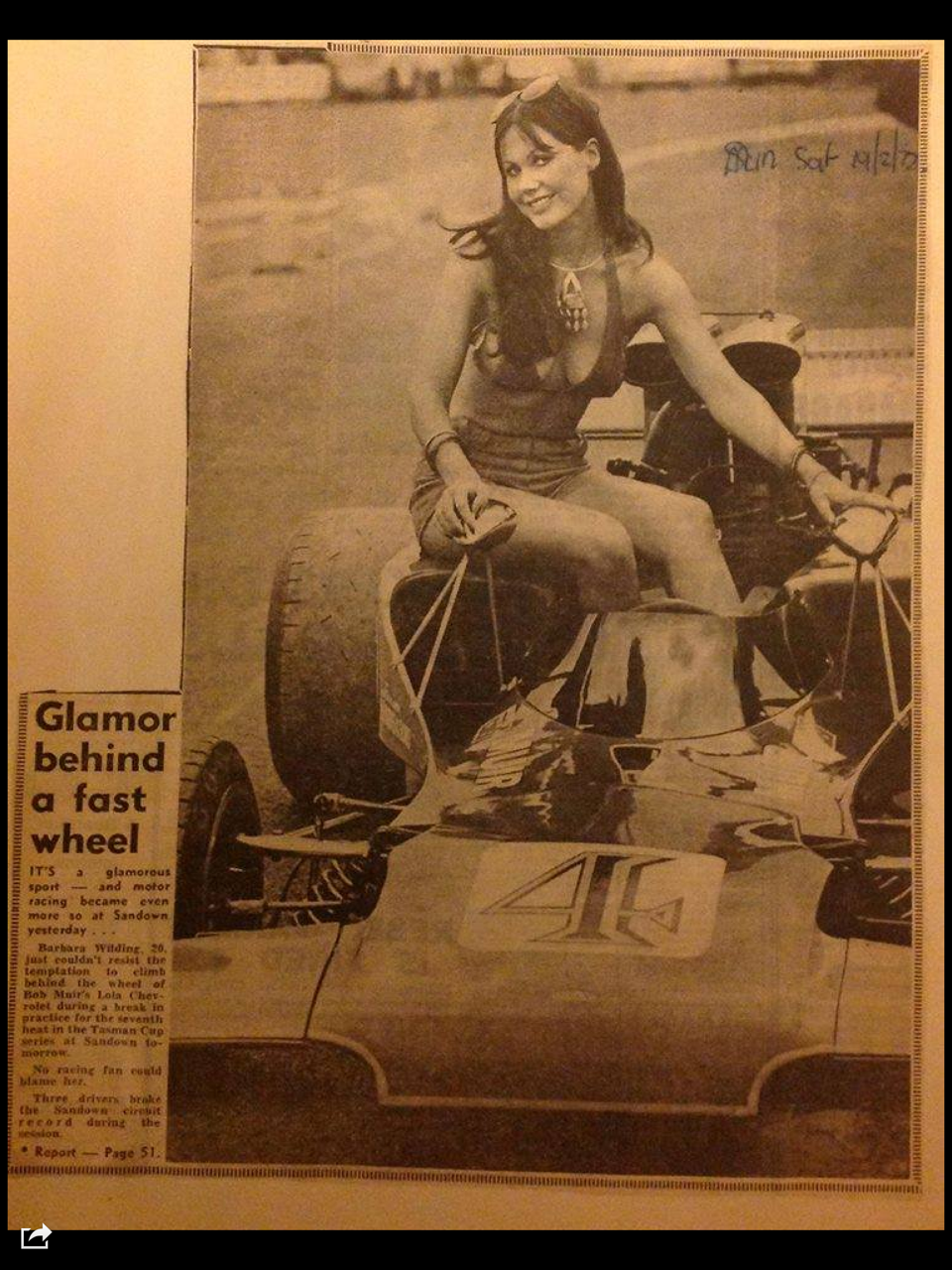
Etcetera…From my scrapbook all those years ago

babe and lola
sandown 3
sandown psoter

Photo Credits…

Thanks to Chris Parker and his archive for some of the shots, Stupix

Finito…

Mercedes Benz T80…

Posted: October 6, 2014 in Obscurities
Tags:

t80

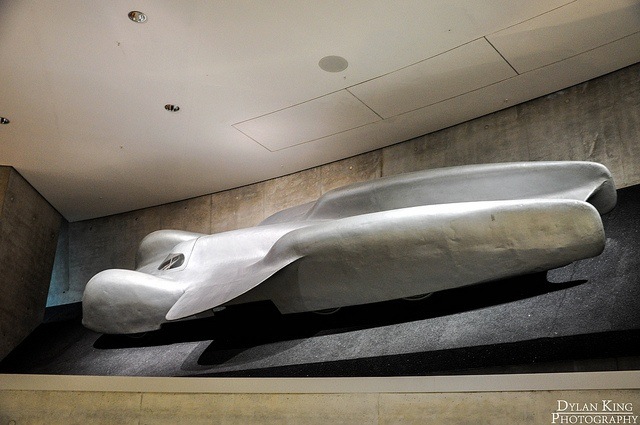
The Mercedes Benz T80 1939 World Land Speed Record contender on test in 1939…

Pre-War Grand Prix Ace Hans Stuck Senior was keen to take the WSR, convincing Mercedes to build him a car, the program approved by Der Fuhrer as another of the technological triumphs of the Germans young Adolf was keen to show the world.

It was to be the first outright WSR attempt in Germany but the Nazis had World Domination in mind so the program lapsed as World War 2 commenced.

Designed by Dr Ferdinand Porsche…

t 80 body

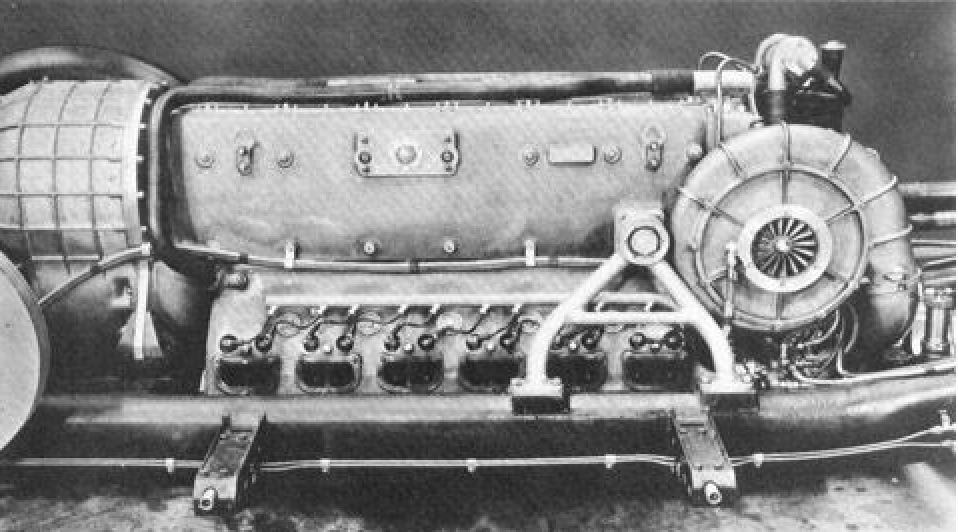
Car design by Ferdinand Porsche. Steel body, three axles, rear two driven. Drum brakes front and rear. weight 2896Kg, length 8.2 metres, width 3.2 metres, height 1.7 metres. Drag coefficient 0.18

The car was powered by a massive Daimler-Benz DB603 44.5 inverted V12 giving around 3000BHP. It had three axles, two driven, weighed 2.7 metric tons, was over 8 metres long and had a projected top speed of 470MPH.

Aerodynamicist Josef Mickl designed the body which had a drag coefficient of 0.18, astonishing even now.

mb engine

Daimler-Benz DB 603 Aero engine. 44.5 litre, fuel injected, supercharged V12. Circa 3000BHP@ 3200RPM

Record Week…

Stuck was to take the record on a length of autobahn between Berlin-Leipzig, the road 25 metres wide and 10 Km long in January 1940, the car nicknamed “BlackBird’ by Hitler himself.

The event was cancelled, the car stripped of its engine was stored during the war in Karnten, Austria and is now on permanent display at the Mercedes Benz Museum in Stuttgart.

It took untill 1964 for Art Arfons to exceed the projected speed of the T80 in 1940, the turbo-jet powered ‘Green Monster’ attaining 544MPH on the Bonneville Salt Flats.

driving position

Hans Stucks’ far forward driving position, hefty steel girder frame chassis, drum brakes and tyres of the day designed to cope with projected speeds of the T80…

front

T80 in Mercedes Museum, Stuttgart (Dylan King)

rear

Photo Credits…

Pinterest, Dylan King Photography

Finito…

steve

Steve McQueen (or is it John Whitmore) at the wheel of a Lotus 30 shooting some of the million feet of unused footage for this cancelled movie…

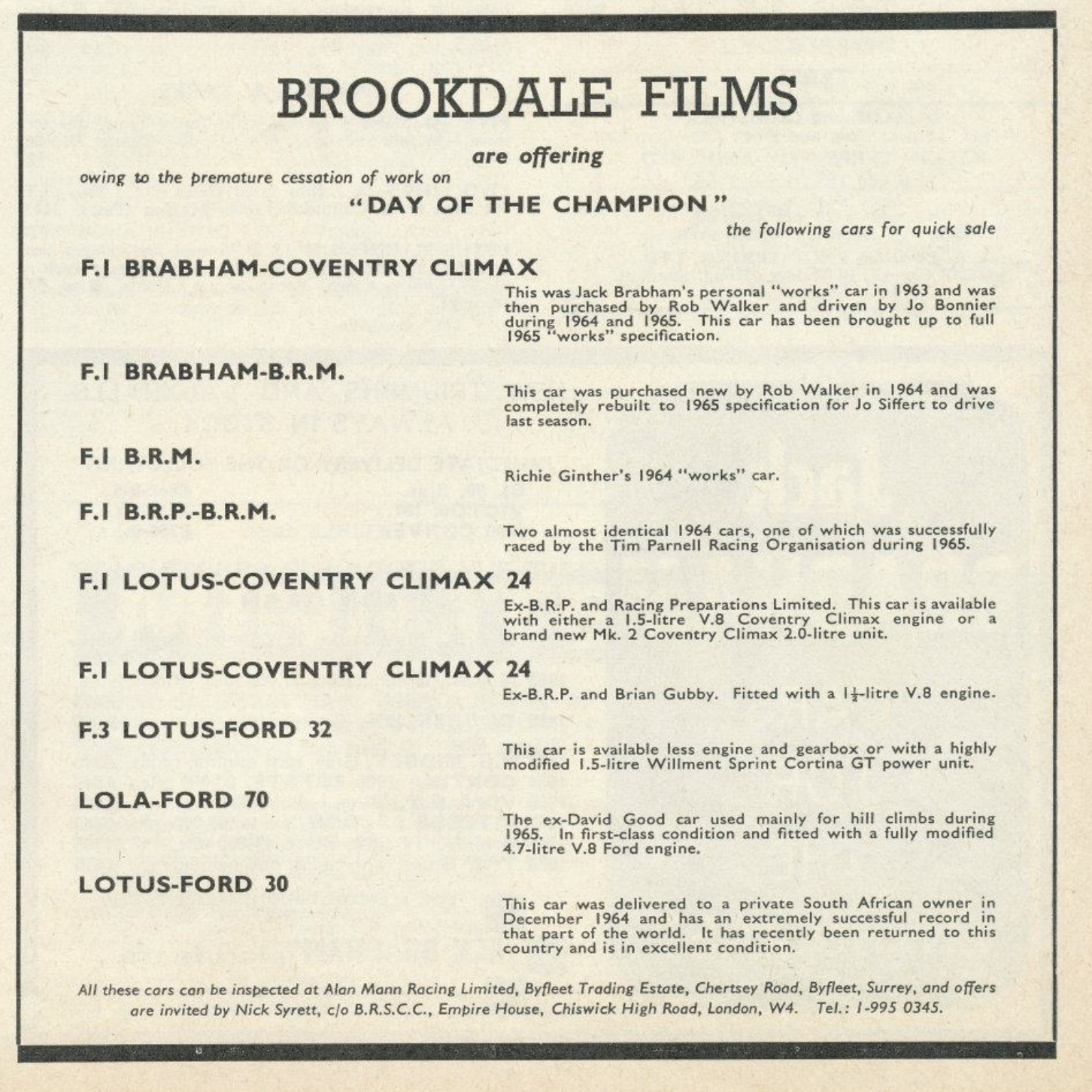
John Frankenheimer and MGM were in a race with Steve McQueen and Warner Bros to make a movie with Grand Prix racing as its theme.

John Sturges was the Director of Day of The Champion, filming of footage, using many cars specifically acquired for the purpose commenced in 1965.

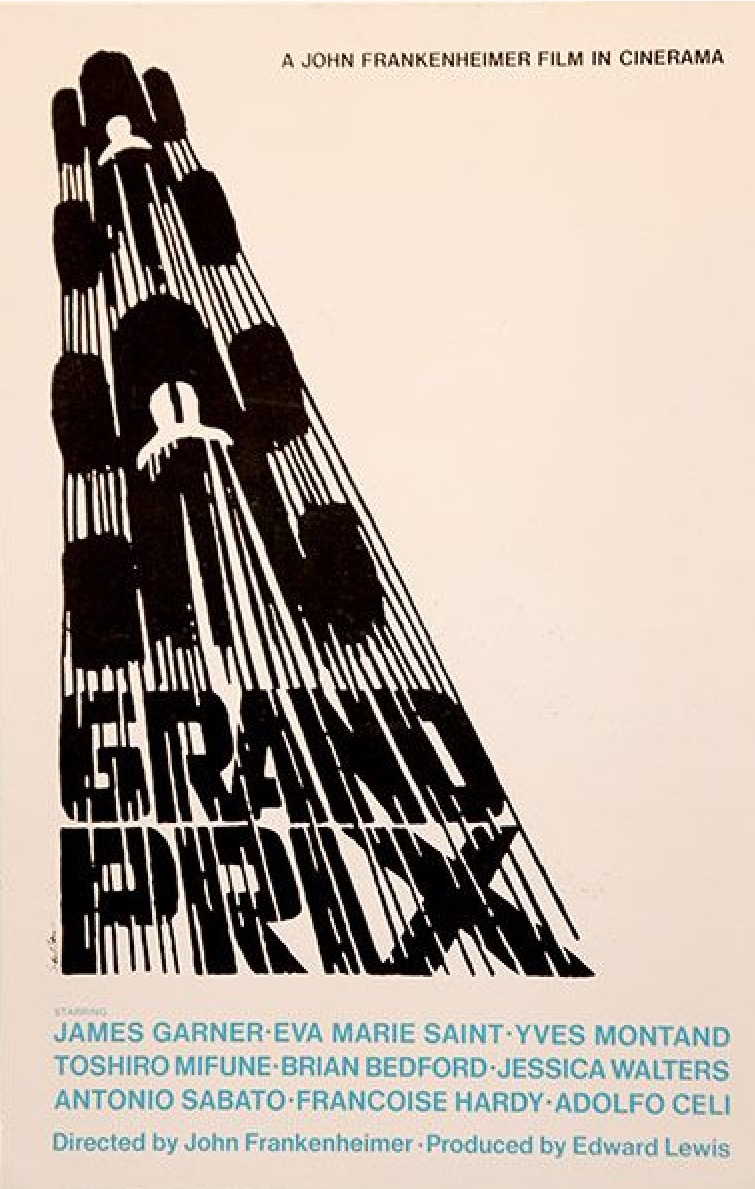
‘The Sand Pebbles’ in which McQueen starred, and for which he received his only Academy Award Nomination ran over time, delaying the production of ‘Day of The Champion’, his Hollywood neighbour James Garner played the lead role in ‘Grand Prix’, the iconic 1966 F1 movie and a huge commercial success, beating ‘Day of a Champion’ into the cinemas.

The pin was pulled on the “Day of The Champion’, there was no value in two similar movies appearing at about the same time.

McQueen didn’t speak to Garner for over two years…but came back with a vengeance in ‘Le Mans’, not much of a story, a commercial flop but a sensational racing movie!

John Sturges famously quit ‘Le Mans’ after arguments with McQueen who wanted a documentary style ‘slice of racing life’ film, Sturges equally adamant that a strong story line was essential for commercial success…’I’m too old and rich to put up with this shit’ was his parting line.

‘Le Mans’ was completed, after running hopelessly over budget, but only after Steve tipped his acting fee and forfeited his gross in the films takings to fund it…

But what a movie!

dotc

‘Day of The Champion’ production teaser (Pinterest)

surplus

Getting rid of cars now surplus to stock…(Pinterest)

steve 2

‘Day of The Champion’ morphed into ‘Le Mans’ several years later, a commercial flop but a triumph as McQueens creative tribute to motor racing (Pinterest)

pete

‘Pete Arron’ ready to race… James Garner proved himself a dab hand at the wheel during the filming of ‘Grand Prix’ (Pinterest)

gp

‘Grand Prix’ cut it creatively, commercially, and as a racing movie. Iconic to this day, and one of the top ten grossing films of 1966 (Pinterest)

Photo Credits…

Pinterest


image

Doncha’ love old automotive street advertising signs!?

 I was tootling home after my early morning coffee on Sunday and came upon this sign for ‘Perdriau Master Cord Tyres’.

For Melburnians the sign is on a development site on the corner of Malvern Road and Francis Street, Hawksburn.

In most of Australias’ cities, as I guess elsewhere in the world, people are moving closer to town with old industrial buildings converted into interesting residential places or more often modern ones constructed. Often their are interesting old signs exposed when demolition occurs.I don’t recall what was on this corner before, but this sign on the adjoining building wall has been exposed, looking at the history of the Perdriau it’s been hidden since the 1920’s!

The developer has erected a hoarding so thus far it’s been spared the ravages of graffiti-ists.

perdriau rider sydney

Perdriau sidecar delivery service; out front of 21 Wentworth Avenue, Sydney date unknown. (Tedd Hood)

My friend Google tells me Henry Perdriau commenced importing rubber into Sydney in 1897 and manufacturing tyres in 1904, older motorists may remember the company as a market leader. Corporate consolidation is not new of course, the company was absorbed by what is now Pacific Dunlop Ltd in 1929.

I’ve not heavily cropped the shot, I love it juxtaposed with the modern inner urban environment in which it sits.

Still, it will be covered again within 12 months or so, to be exposed by another group of ‘archaeologists’ in 100 years time when once again the site is adapted for whatever use is appropriate then. I have a feeling by then ‘we’ will be getting around in ‘The Jetsons’ style of vehicles than something using rubber tyres. Who knows?

This Shell sign is a ripper as well. It’s on the Horrocks Highway, in the small village of Auburn in South Australia’s Clare Valley, i  spotted it on a cruise up there a month ago.

sheell

It’s interesting what you can spot out and about, mind you I’ve nearly been hit ‘up the chuff’ a couple of times in the process, these sightings are always accompanied by an application of brakes Daniel Ricciardo would be proud of! In fact my partners Cooper S has a neato coffee stain on the dash of said vehicle as a consequence of one of these manouevres.

My quip that the ‘brakes grab a bit’ didn’t remotely come close to making up for the mess i made in her otherwise pristine car…it does have a nice coffee smell, almost cafe like, inside however!

The follow up jibe that ‘car manufacturers would pay for that coffee smell’ didn’t work either…No sense of humour these women.

patz

‘WUB’ speeding past the MCG…in the words of Basil Fawlty…’don’t mention the coffee stain…i did it once and i think i got away with it’…

Mini Cooper S …

That Cooper S is a great car by the way. Its an R56, the just superseded jobbie. 1.6 litre DOHC turbocharged, circa 128KW and 240 Nm of torque.

Patrizias car is an auto, sub-optimal I know but the ‘box and its operation is great, almost enough to convince me to change to the ‘dark-side’.

The auto is a bit ‘clunky’, in fact you can drive the thing smoother manually than in auto mode. Perversely the thing starts in first (of 6) in auto but second in manual mode, unless you select first. Its much less aggressive on lift off in manual mode as a consequence around town. Counter intuitive, but Der Deutschlanders have their ways I guess. That aside the steering wheel, and shift mounted manual controls work a treat.

Its fast, has heaps of mid-range punch, has beautiful turn in, great brakes and sharp steering in a ‘modern car sense’ but lacking compared to my personal road car benchmark, my S1 Elise which I should not have sold!

They are not the most practical of things though, the rear seats a bit of a joke, one of my ‘well-nourished mates’ couldn’t get out of it for a fortnight until his girth disappeared a tad. Not feeding him helped.

I looked at an R53 when they first came out, under pressure from the ‘little sabre-toothed tiger to whom I was betrothed’ to get a more practical car than ye olde 3.2 Carrera, much to the disappointment of my sons who rather liked riding in the old bus. The Mini had less rear seat space than the ‘parcel-shelf’ type seats of the 911!

‘WUB’ has done a lotta trips since acquisition 6 months ago, the only touring downside is a fair amount of road-noise from the sunroof, even when closed, the price you pay for the pleasure of the thing. The car has done 85000Km so its no ‘spring-chicken’ but is still as ‘tight as a mackerals bottom’ in terms of ‘shake, rattle and roll’. Panel fit and the detailing of the thing inside and out is a designers delight. More ‘Audi flair’ than ‘BMW spartan’.

Its far from the rorty original Cooper S’ driven in my youth none of which were standard, all taken out from 1275cc to 1293 or 1310cc, had a 45DCOE Weber, extractors and the factory rally cam ‘AEA 544’ if memory serves…but still a nice small, fast jigger albeit far more refined than the original.

Worth considering if you are in the market for a small, stylish, fun, fast, well built, practical car…for two!

min 1

Australian Grands’ Prix at Nuriootpa & Lobethal…Suggested Driving Tour

map

Back to the earlier thread about the Clare Valley. It ocurred to me having driven through the Clare for the first time on one of my weekends here a month ago (i work in Adelaide but live in Melbourne), that other interstaters with a penchant for Australian GP history may enjoy a tour, if you are ever in Adelaide, which takes in the Clare, Barossa Valley, and Nuriootpa and Lobethal.

A nice loop to the Clare, back through the Barossa, which contains Nuriootpa, then on to Lobethal, and back to Adelaide.

The AGP is one of the oldest Grands’ Prix in the world. It started at Phillip Island in Victoria and for many years each state held it in turn annually. Over the decades in South Australia its been held at Victor Harbour in 1937, Lobethal in 1939, Nuriootpa in 1950, Port Wakefield in 1955, Mallala in 1961, and from 1985 to 1995 at the fantastic Adelaide GP circuit.

My suggestion is a tour which could be done in a day but would be best over 2 days depending upon how large an element you want to make of the wineries as against the driving. I won’t advise on the wine as there is red stuff and white stuff, i like to drink both but am no connoiseur. You COULD, if you wanted add Mallala, and Port Wakefield into the loop, in the first half-day as both are West of Adelaide, which is the direction in which we head. This is all GPS stuff so i won’t go into too much detail.

1.Punch ‘Auburn into your GPS. Head West up the A20 and A32 bypassing Gawler .(116Km)

2.At Auburn by all means check out the Shell sign! Then do a ‘Clare Valley Loop’, i suggest (and South Australian readers please chip in with comments)…Auburn, Mintaro (stop and have a good look its a really interesting little historic village with a good Pub), Farrell Flat then into Clare itself. Check out Clare.

Then go through Emu Flat and Emu Flat to Skillogallee’ for a meal or a look. Its at Trevarrick Road, Sevenhill. It was very good.

3. Now we head for Nuriootpa in the Barossa. go via Kapunda, and Koonunga to Nuriootpa. (90Km) There are lots of wineries in the Barossa so do your research accordingly.

nuri

With the AGP due to be run in SA in 1950, the search was on to replace, ‘vast, fast, treacherous Lobethal’ as historian Terry Walker put it. With lots of local support a circuit was laid out which included the Nuriootpa main street. Its all still there to see, but only the starting stright , Research Road looks the way it did in 1950, the sweeping curves over the river are smoother, wider and armco lined (‘Lost Circuits’ Terry Walker)

black bess

Doug Whiteford , winner of the 1950 AGP at Nuriootpa in ‘Black Bess’, his Ford Mercury engined cut down ex Forests Commission Ute Special. In those days the AGP was a Handicap event, but Black Bess was a fast car by any standards

bess

A better shot of # 8 Black Bess driven by Bill Hayes albeit at Fishermans Bend, Victoria in 1953. Lex Davison is leading in an Alfa P3, with Bill Pitt #1 Alta. ‘Bess was built for Whiteford in an Albert Park, Melbourne backyard in 1939. Ford ute chassis , bed iron frames and panneling from the Footscray tip. A coat of black paint gave its name. When Whiteford returned from the war a Mercury engine was fitted, benefitting from US Hot Rod experience. From 1946-52 the car was one of the fastest in the country, inclusive of the AGP win. As imported cars came in it became obsolete, being tracked down and restored before its debut in the 1977 City Of Sydney Trophy (Old English Sports Cars)

4. Now go through Tanunda in the direction of Birdwood (42 Km)  where the National Motor Museum is. There is not a lot of motor racing stuff in it to really float my boat but if you haven’t been before its worth a look. Go via Lyndoch, Williamstown, and through Mount Crawford Forest, on to Birdwood.

5. Birdwood to Lobethal (17Km)

lobethal 1

tommo

Alan Tomlinson came all the way to Lobethal from WA and won the 1939 AGP in his very fast, light, powerful,supercharged MGTA Spl. He returned to compete in the 1940 SA Grand Prix and was hospitalised after crashing the same car at high speed. In second and third places were Australian Specials’: Bob Lea Wright in the Terraplane Spl, and Jack Phillips in a Ford Spl.(Google)

lobethal

Lobethal was developed as a motor sporting centre off the back of the successful 1936/7 SA Centenary/ Australian GP’s at Victor Harbour. WA driver Alan Tomlinson won the race in both the fastest elapsed time and on handidcap, he drove a self prepared superchaged MG TA Spl. Lobethal was revived in 1948, but three sensational accidents saw it fall into disuse in favour of Woodside, and Nuriootpa. In 1951 the SA Government banned motor-racing on public roads, such ban was in place until the 1985 Adelaide AGP.

6.Lobethal to Adelaide (45Km). key in your location and away you go…


Etcetera…

perdy

Contenporary magazine advert for Perdriau tyres…late 1920’s (ANU Archives)

enzo

Enzo Ferrari was a big Cooper S fan, and driver! Modena circuit mid 60’s (Pinterest)

nuri

AGP Nuriootpa 1950. 3 MG TC Spls…#30 David Harvey (4th), #29 Vin Maloney (12th), and # 35 Don Cant (8th). MG’s of all kinds were the backbone of Australian Racing including AGP’s for decades (Unattributed)

References…

Pinterest, Wikipedia, ANU, ‘Lost Circuits’ Terry Walker

Finito…

image

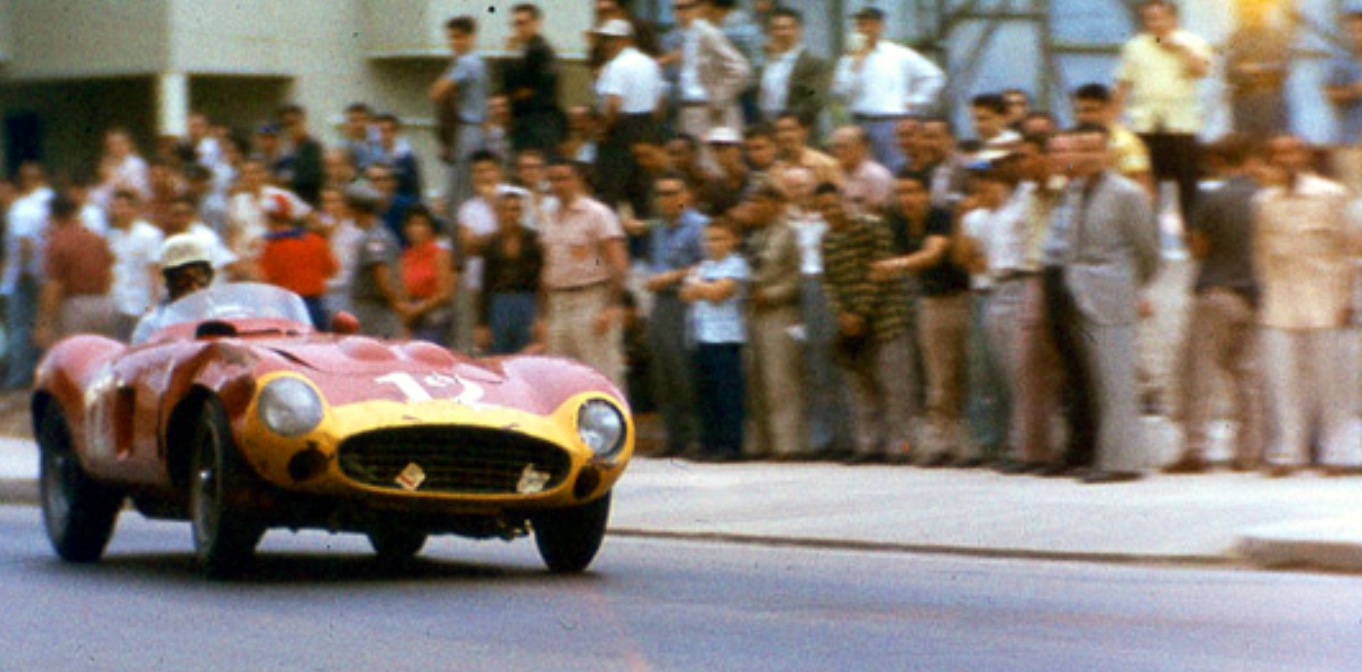
Despite its sculptured Scaglietti flanks, never has an 860 Monza looked quite so good…actress Linda Christian adorns Fon de Portago’s Ferrari

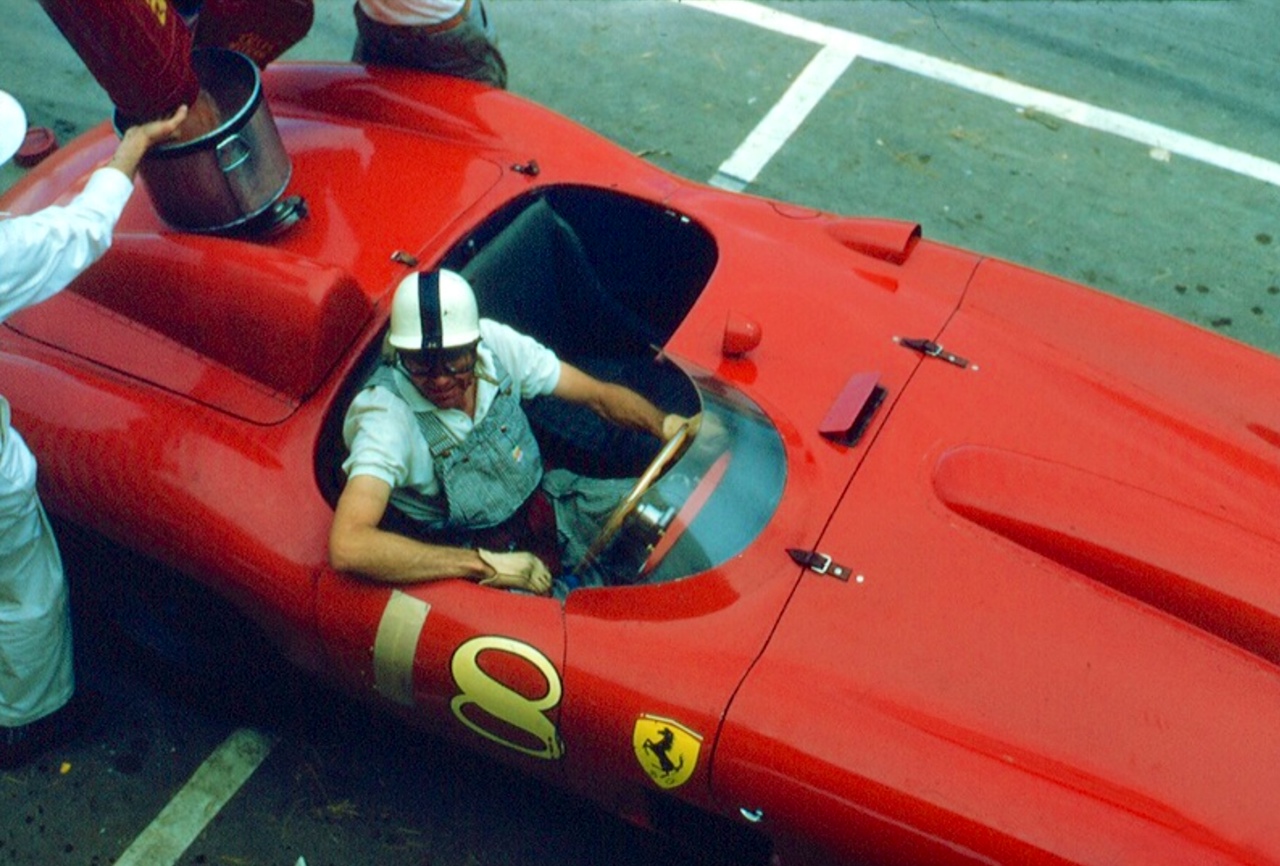
The Marquis Alfonso De Portago, Spanish nobleman and journey-man driver was accompanied by Linda Christian at the 1957 Cuban Grand Prix sports car event.

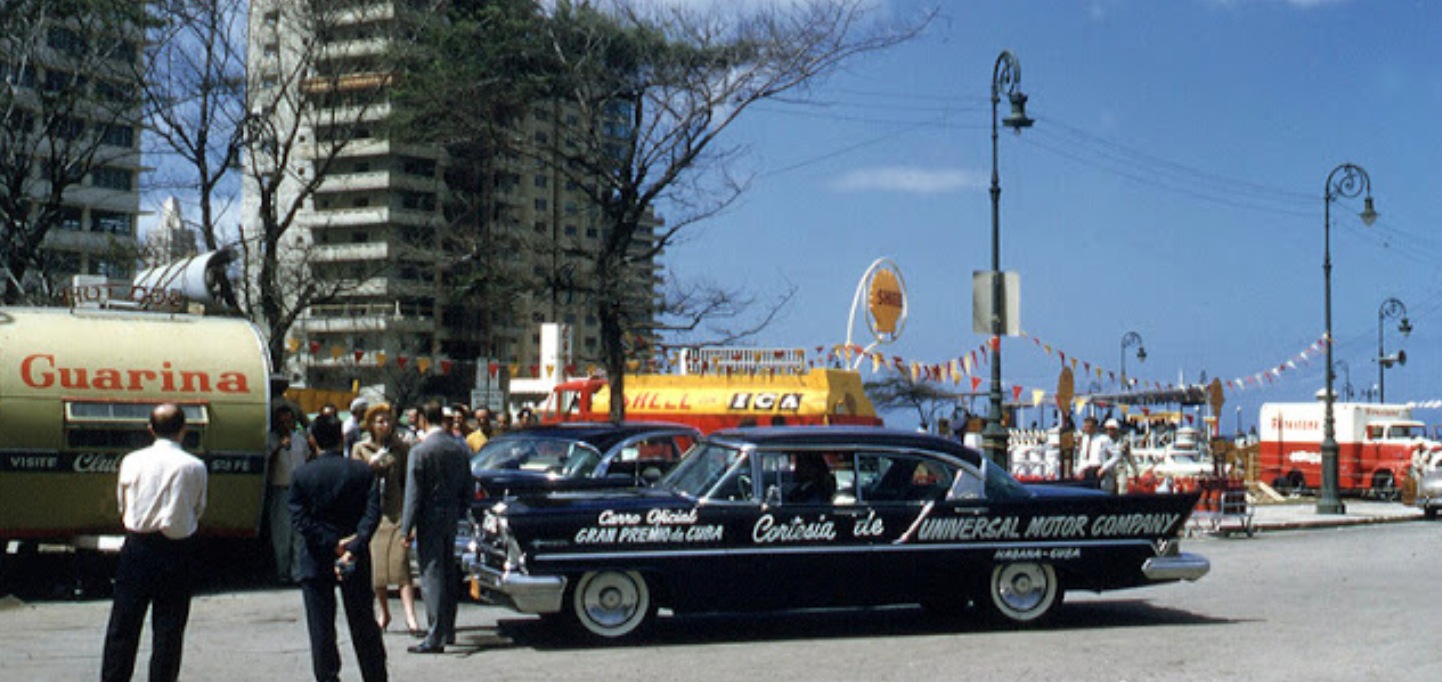
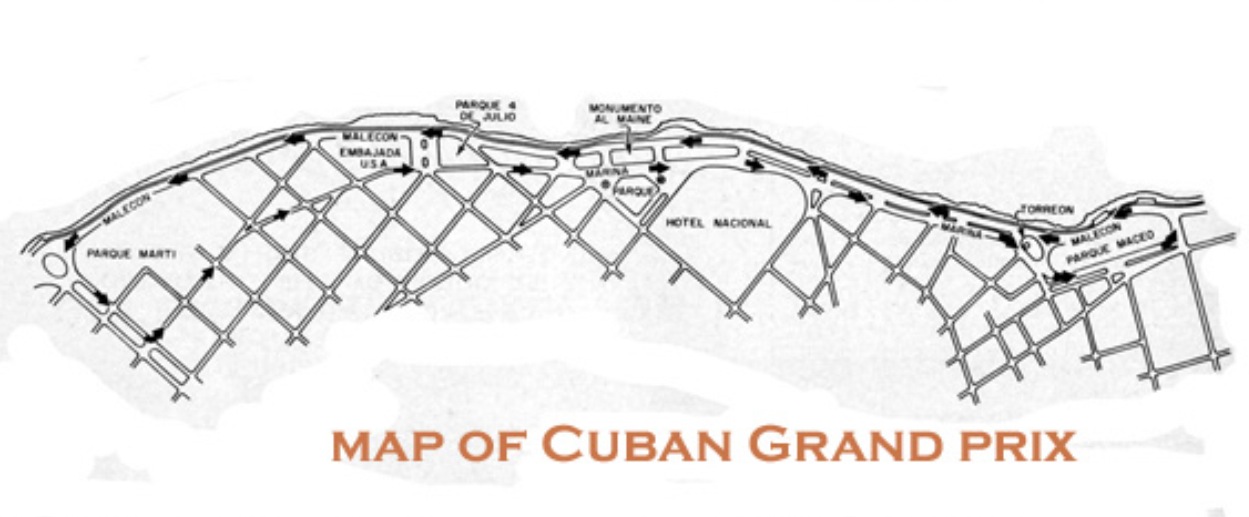
Fidel Castro’s insurgents were on the move in the countryside but for the Batista’s’ life went on. Keen to attract wealthy American tourists to the country to pump much needed funds into their moribund economy, an annual motor race was part of a plan to raise Cuba’s profile and provide an event to attract the punters.

malecon
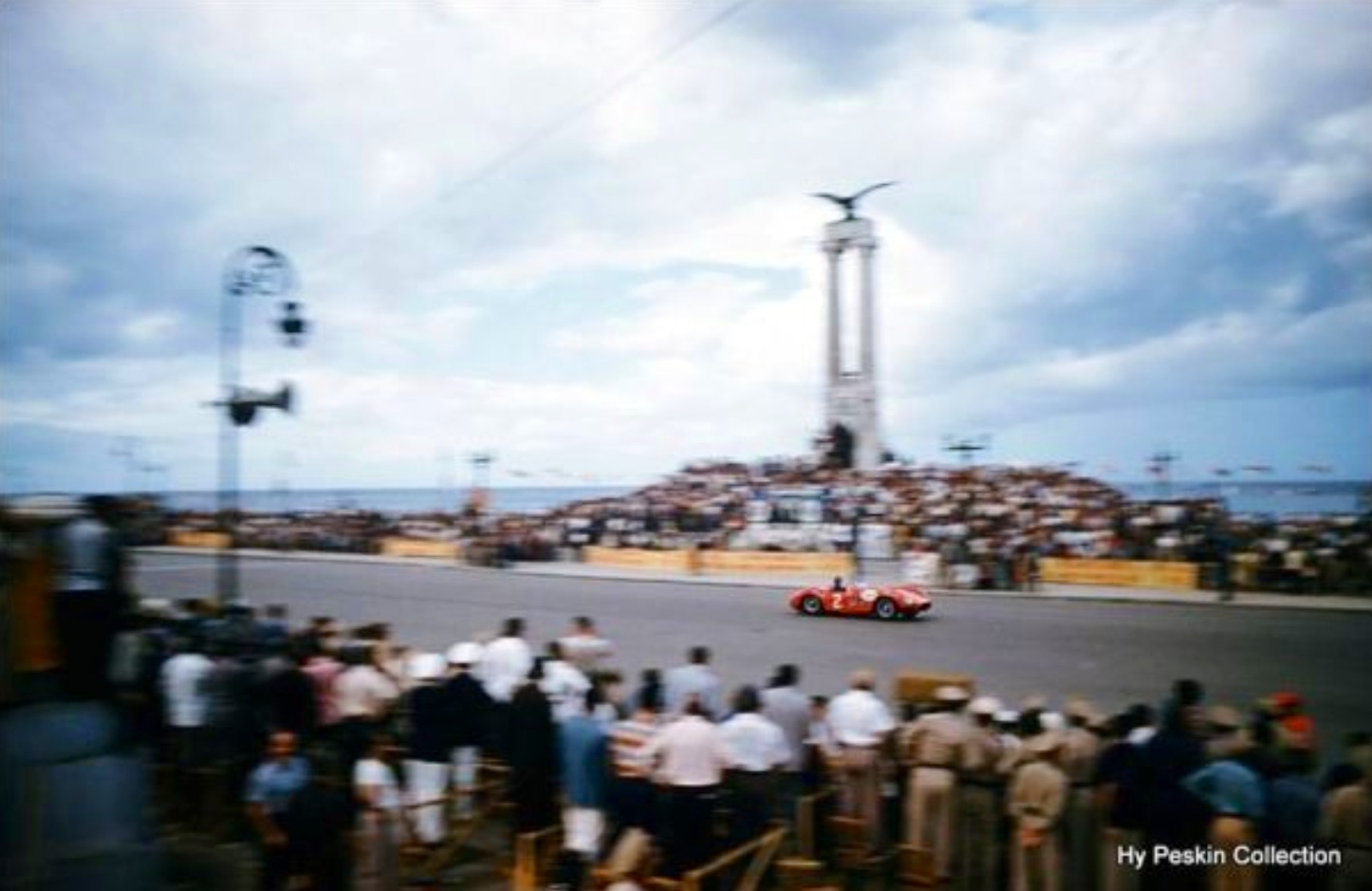
Out of focus and slightly surreal as a result…Fangio in his Maserati 300S, Malecon Boulevard, Havana, 1957 (Hy Peskin Collection)
cuba 2
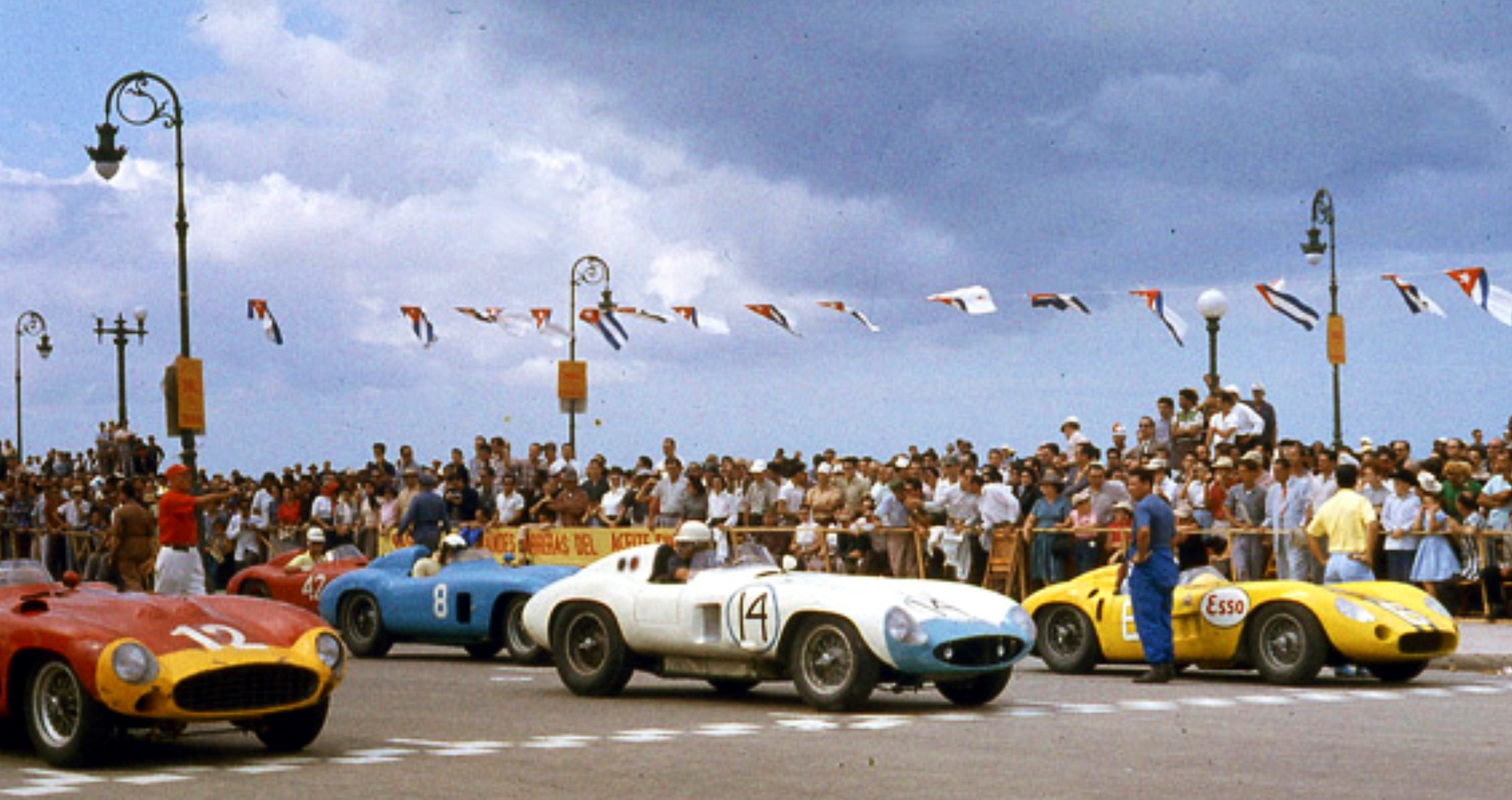
Wonderful panorama of Havanas Malecon circuit. 14 is the Phil Hill Ferrari 857S, De Portago’s Monza behind it with Linda Christian alighting. #16 also a Ferrari, driver unknown (Pinterest)

Ferrari 860 Monza…

port
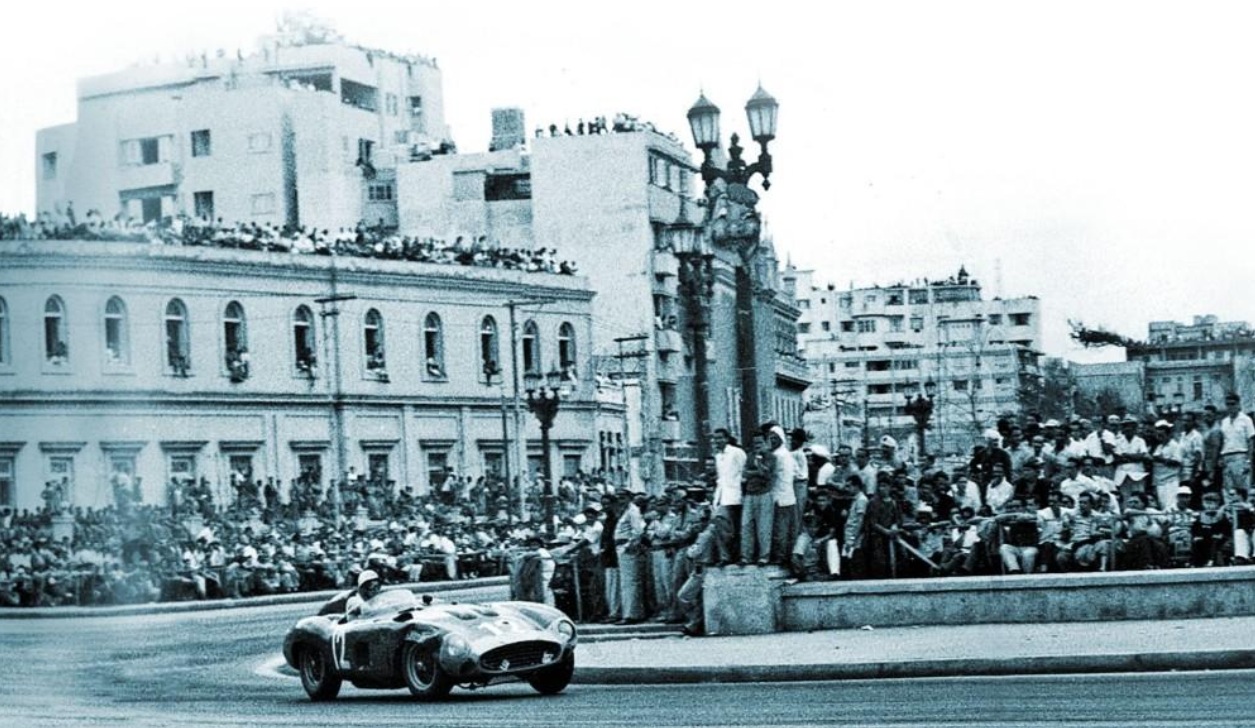
‘Fon De Portago Ferrari 860 Monza, unprotected nature of the circuit clear, seven spectators were killed in the 1958 event (Pinterest)

The 860 Monza was Ferrari’s front line sports car weapon, together with the V12 290MM in 1956.

It was part of the family of sports cars built over much of the ’50’s based on the Lampredi designed DOHC, two valve, Weber carbed four cylinder engine which first found success in the Tipo 500 F2/F1 cars. Ascari won the World Drivers Championship in 1952 and 1953 in the Tipo 500.

The engine gave circa 310bhp from its 3431cc, gearbox was four speed. The usual Ferrari ladder frame of the period was used, drum brakes all round stopped the relatively light car which tipped the scales at 860kg. The cars curvaceous body was built by Scaglietti.

Independent front suspension by wishbones and coil springs was new for the 860, and effective. A De Dion rear axle was at the rear, sprung by a transverse leaf spring.

 Three cars were built, the model’s most notable victories were at the ’56 Sebring 12 Hours and the Rouen GP.

port 3
The field before lining up pre grid on Malecon Avenue, Havana

The Race and Aftermath…

grid
On the front row, De Portago Ferrari Monza, Phil Hill Fazz 857S Monza and Schell in the yellow Maser 300S, all the fun of the fair, over 100,000 spectators (Pinterest)

De Portago fought a race long battle with Fangio’s 300S and Carroll Shelby’s Ferrari 410, finishing third on the Havana waterfront street circuit.

The public relations opportunities for Batista evaporated when the Presidential motorcade, enroute to his palace, was confronted by a relatively small group of ‘natives’ seeking favours from the President. Armed escorts beat them with unbelievable ferocity and brutality. This fueled the flames of the resistance movement further .

port 4
Start of the race, Moss Maserati 300S, D Type Jag #24 of local driver Alfonso Gomez-Mena (Pinterest)
fang
Fangio #2 passes De Portago who is slowing a bit on lap 69 in Parque Mart. Maserati 300S and Ferrari Monza (Pinterest)

Jumping forward a year Fangio was kidnapped at gunpoint from his hotel the evening before the race by the rebels. He was returned to the Argentinian Embassy after the abortive event in which 40 spectators were injured and seven died after local driver Armando Cifuentes lost control of his Ferrari and ploughed into the unprotected crowd.

The race lasted 15 minutes or six laps, Stirling Moss was declared the winner in his Maserati 300S.

Fangio was later to say he was never concerned for his safety, he was held in a comfortably appointed apartment, was fed well, given a radio to listen to the race, and was personally apologised to by Castro’s second in command.

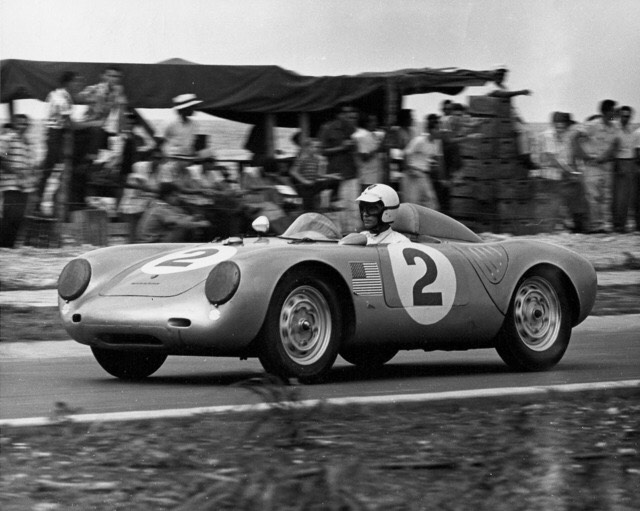
Joe Sheppard races to victory at Ala-Mar in 1959 aboard Porsche 550RS #550A-0144 (J Shea Collection)

In 1959 a four hour race held around a 2.8-mile course at Ala-Mar, a Havana suburb, was won by ‘The Tampa Hotshoe’, Joe Sheppard and Fritz Schiedel in a Porsche 550RS. It was Sheppard’s first race in his new car – very familiar though he was with 550s – so it was quite a debut! Schiedel was Sheppard’s mechanic.

With Castro’s revolution in its final stages, in 1960 he had power, anxious to create a sense of normality, the race proceeded, albeit on a circuit at army Camp Freedom, Moss was the winner in a Maserati Birdcage.

Such grubby bourgeois activities as motor racing ceased and Camp Freedom was used to house the sort of people who attended such events…

city
The beauty of the city and enthusiasm of the crowd, and its size come thru in all these shots! De Portago, Ferrari Monza 860 (Pinterest)

Linda Christian and De Portago…

Linda Christian was a successful Mexican/ American actor who starred in the first TV adaptation of the Bond novel Casino Royale and in Tarzan, amongst many others. She was with De Portago during that fateful Mille Miglia weekend later in 1957.

De Portago kissed Christian, jumped into his Ferrari 335S, and 70km before Brescia the car blew a tyre, ploughed into the crowd killing Portago, co-driver Ed Nelson, nine spectators and the Mille Miglia.

portage
De Portago and Phil Hill before the race, Havana 1957 (Pinterest)

Etcetera…

pits
Hill/O’Shea Ferrari 857S Monza, Malecon Circuit pits, Cuba 1957 (Pinterest)
image
The Castellotti Ferrari 290MM, V12 engined compared with the Monza four cylinder engine, both were Ferrari works 1956 Sports Car Championship entries. Castellotti in yellow polo shirt (Pinterest)
shelby
‘Chicken-plucker’ Carroll Shelby in trademark farmers overalls in the third place Ferrari 410, 1957 would be a great year for him (Pinterest)
start
Military very much to the fore. Fangio Maserati 300S #2 and Castellotti Ferrari 290MM #10 (Pinterest)
fang 2
Juan Manuel Fangio beside his Maserati 300S in Cuba at the start of his final full season of racing in 1957. He drove for Maserati in both Sports and Grand Prix events, winning his fifth F1 World Title in the fabulous, and by that time evergreen Maserati 250F; that car finally getting the title it long deserved (Pinterest)
moss
Moss Maserati 300S beside the John Edgar owned #78 Ferrari 4.9 driven by Carini (Pinterest)
hill
Hill/O’Shea Ferrari 857S Monza, Cuba 1957. Paul O’Shea checking out the engine (Pinterest)
building
malecon 4
malecon 3
image
Fangio after the 1958 Cuban Grand Prix and release by his Castro captors…(Pinterest)
che
It is not recorded if Che and Fidel attended one of Cuba’s Grands Prix…
Entry list for the 1960 event at Camp Freedom (J Shea Collection)
circuit
poter

Photo and Other Credits…

Pinterest, Havana May Blogspot, Hy Peskin Collection, John Shea

Finito…

hunt

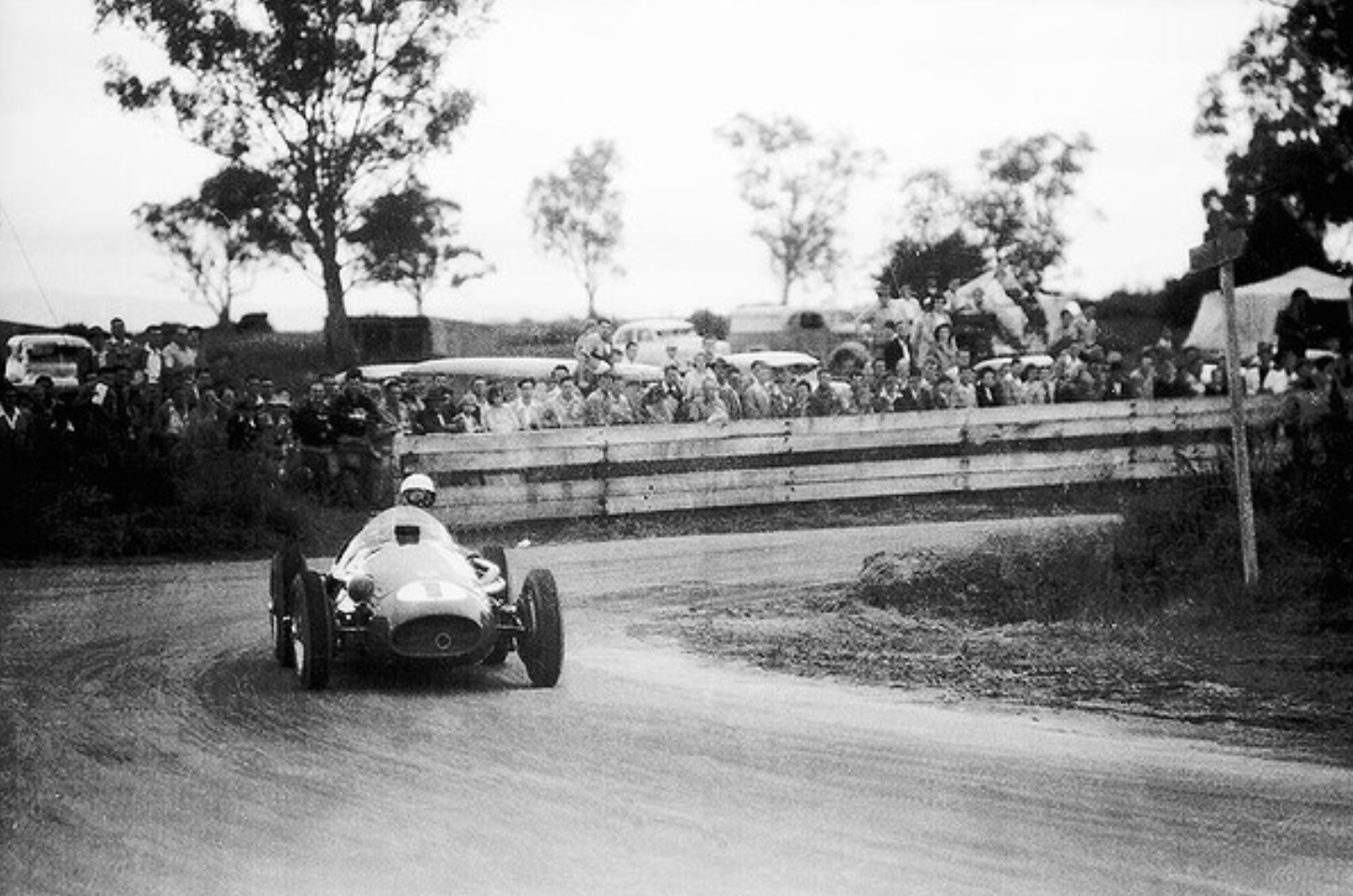
Reg Hunt, Murrays Corner, Bathurst, Bathurst 100 in April 1956 driving his recently acquired ex-works Maserati 250F ‘2516’. Hunt set fastest race time, the race a handicap won by Lex Davison’s Ferrari 500/625.

Reg Hunt, Bathurst 100 April 1956…
Many Melburnians will recognise the name as a very successful retailer of Holdens and many other makes from his acreage’s of dealerships fronting the Nepean Highway in Elsternwick.

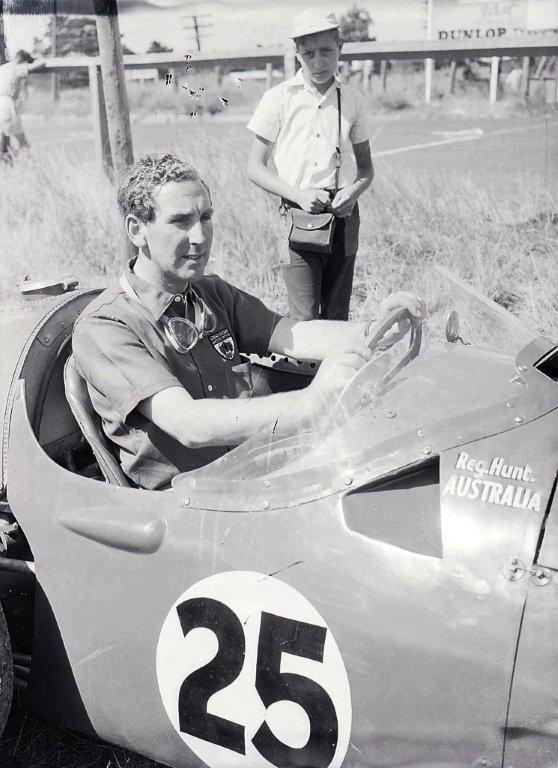
He was also a very successful racer in the 1950’s who retired in his mid 30’s. Little has been written about him. He was ‘up there’ with all of the businessmen/motor dealer/racers of the day; Stan Jones, Lex Davison, Bib Stillwell, Alec Mildren and the rest .

His last racer was an ex-works Maserati 250F  ‘2516,’ a car driven by Moss and Jean Behra early in 1956. In this car he was as quick as any of the locals, a great ‘mighta-been’ is what he could have achieved had he not retired to focus on family and his expanding automotive empire.

This interesting article about the little known Hunt, was written by Richard Batchelor and published in the Maserati Club of Victoria magazine;

https://www.google.com.au/#q=reg+hunt+article+maserati+club+of+victoria

gnoo-blas-reg-hunt-Jan-29-1956-2

Hunt winning the ‘South Pacific Championship’ at Gnoo Blas, Orange, NSW on 30 January 1956. He beat a class field in his recently acquired Maserati 250F, Brabham was 2nd in his Cooper Bristol. Fantastic shot of this road circuit. (Gnoo Blas Classic Car Club)

Reg Hunt Unsung ace of the 1950’s…

Reg Hunt 'Sports Cars and Specials'

Reg in his 250F on the cover of the October 1956 issue of ‘Sports Cars and Specials’ magazine

Etcetera…

gnoo-blas-reg-hunt-maserati

Reg Hunt, Maserati 250F, Gnoo Blas, Orange 30 January 1956. (Gnoo Blas Classic Car Club)

port wakefield

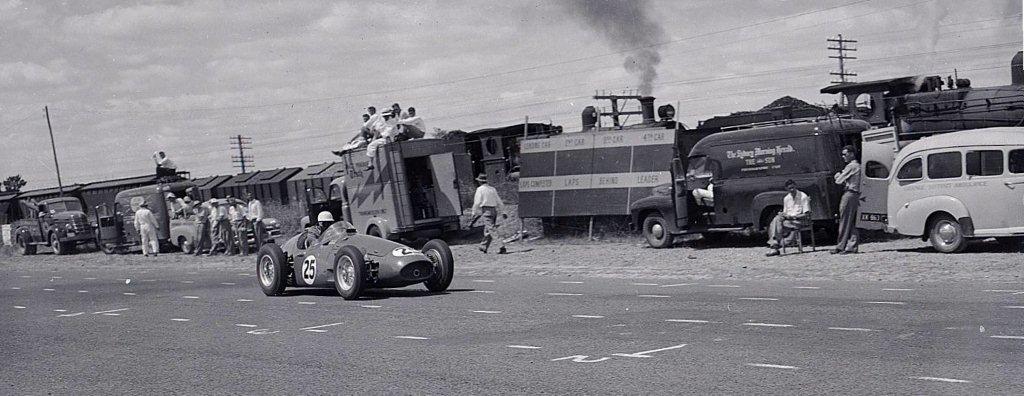
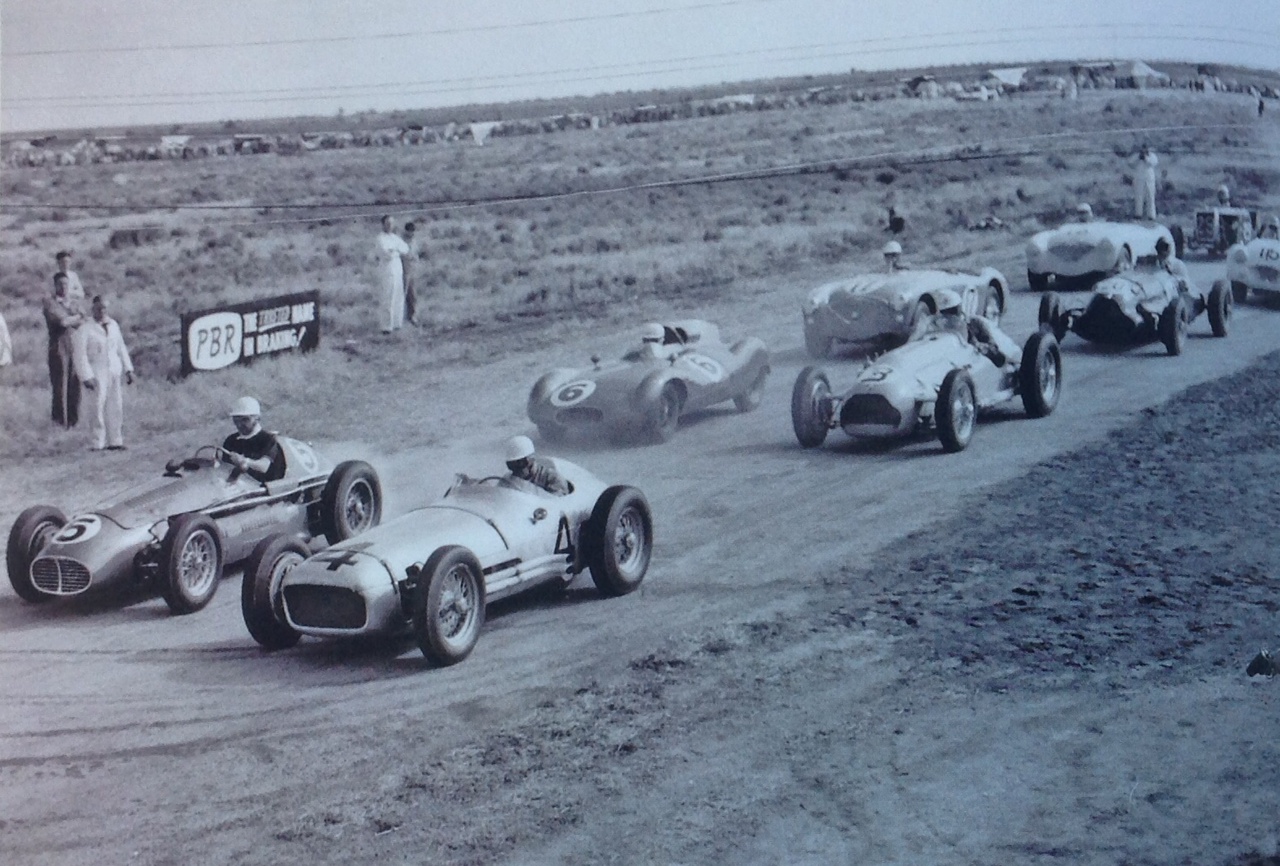
Start of the 1955 Australian Grand Prix, Port Wakefield, SA. Reg Hunt Maser A6GCM  and stan Jones Maybach 3, on the front row left and RH side. Jack Brabham and Doug Whiteford, Cooper Bristol and Lago Talbot respectively on row 2, the race won by Brabham. (‘From Maybach to Repco’ Malcolm Preston’)

port wakeforedl grid

Hunts’ Maserati A6GCM on the AGP Grid Port Wakefield 1955. Hunt was leading this race by 23 seconds in this 250F engined car, broke a cam-follower and then slowed allowing Brabham’s Cooper T40 Climax through for the win, finishing second. Saltbush country, Port Wakefield, 80 Km from Adelaide was a shortlived circuit but the first permanent circuit built in Australia post war (Max Fotheringham)

a6gcm

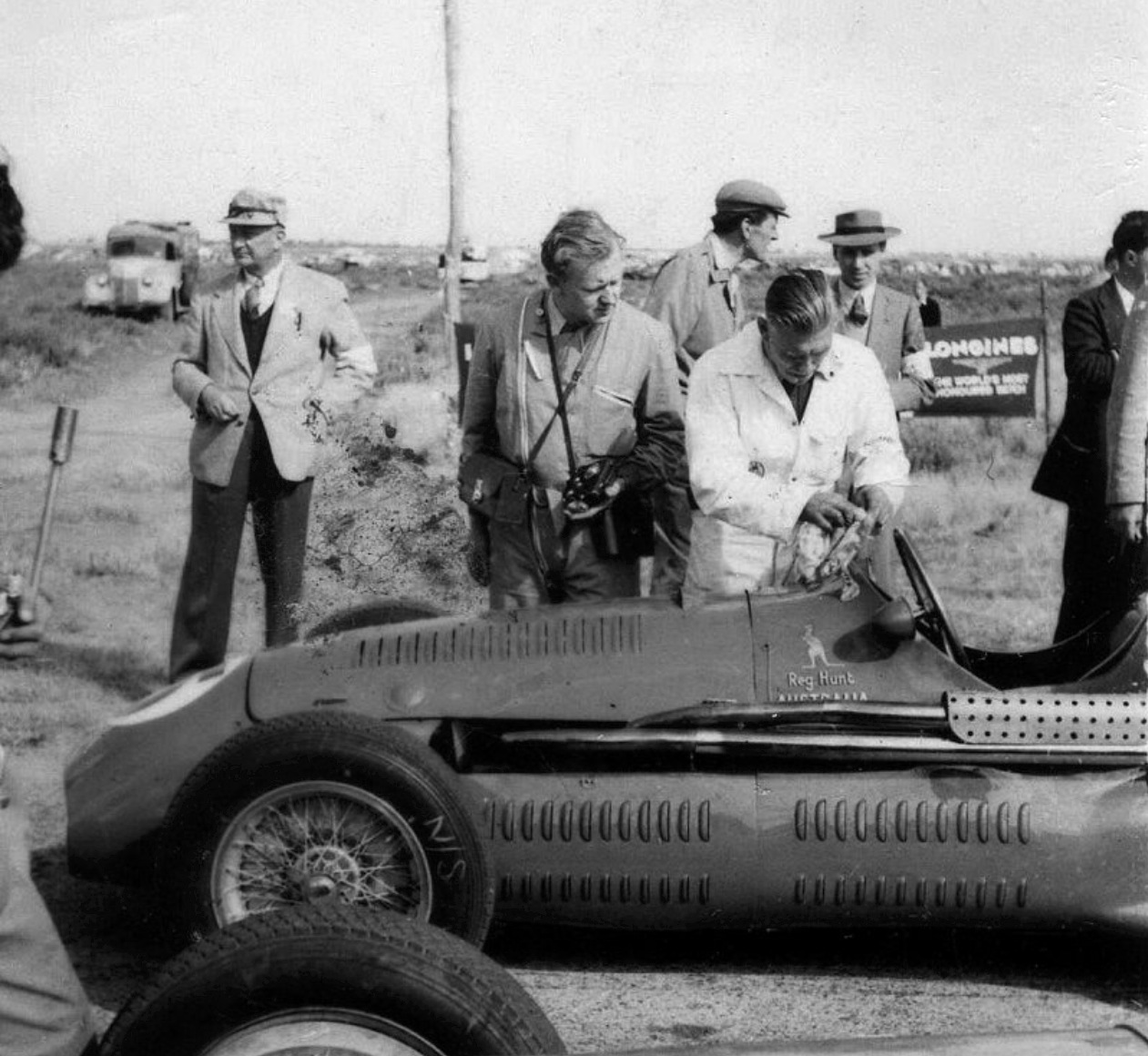
Hunt’s A6GCM Maserati prior to the 1955 AGP Port Wakefield paddock, this model was the precursor to the 250F, it was an interim car using the chassis of Maser’s F2 car and the 250F engine…4 or 5 built (Kevin Drage)

cockpit maser

Cockpit shot of Hunts Maser A6GCM in the Port Wakefield paddock, 50’s driver safety to the fore…4 speed box aft of engine, 250F’s transaxle mounted at rear in front of De Dion tube giving much better traction (Kevin Drage)

prep

Hunt supervises preparation of the 250F in his Elsternwick, Melbourne, workshop. He was close to the factory team who based themselves here during the 1956 AGP at Albert Park…2493 cc straight 6, 2 valves per cylinder, twin ‘plugs, 3X Weber DCO3 Webers, circa 250BHP in 1956. ‘Space frame’ rails can be seen, ditto front wishbones, roll bar, big 14 inch finned alloy brake drums and the rest…(Garry Baker Collection)

Photo Credits…

Garry Baker Collection, Kevin Drage, Max Fotheringham, ‘From Maybach to Repco’ Malcolm Preston