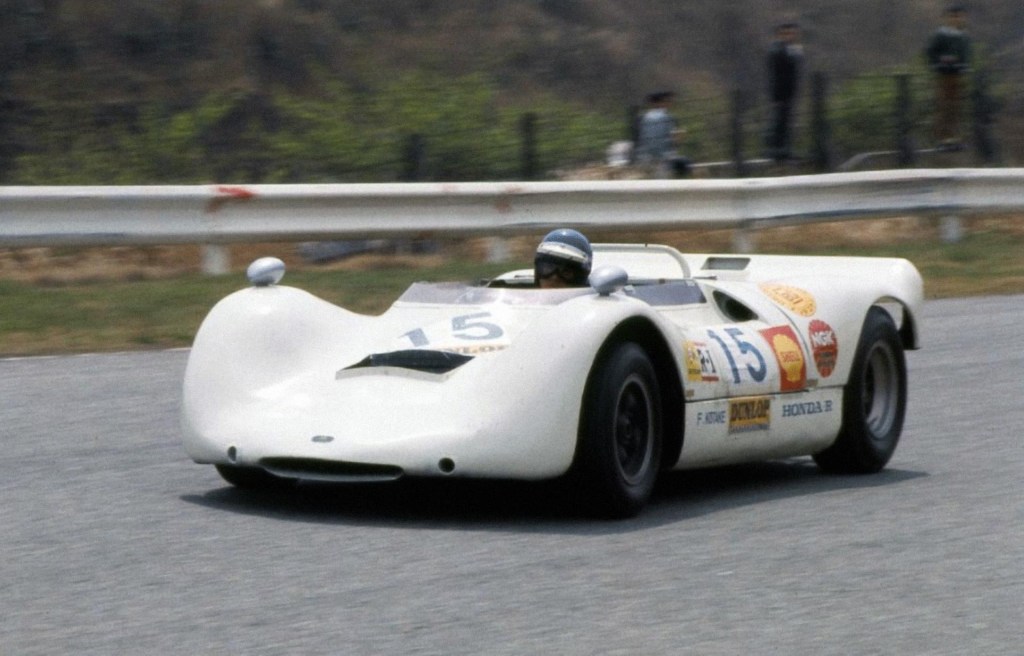
Fukumi Takatake – sometimes written Fukumi Kotake, born in Fukuoka, December 3, 1944 – at the wheel of the works Honda R800 during the 1969 Suzuka 500km, he finished second outright and first in the R1 class.
A very attractive car(s) new to me, the machine was of spaceframe construction, the design seemingly inspired by an F3 Brabham Honda owned by the Suzuka circuit, itself owned by Honda of course.
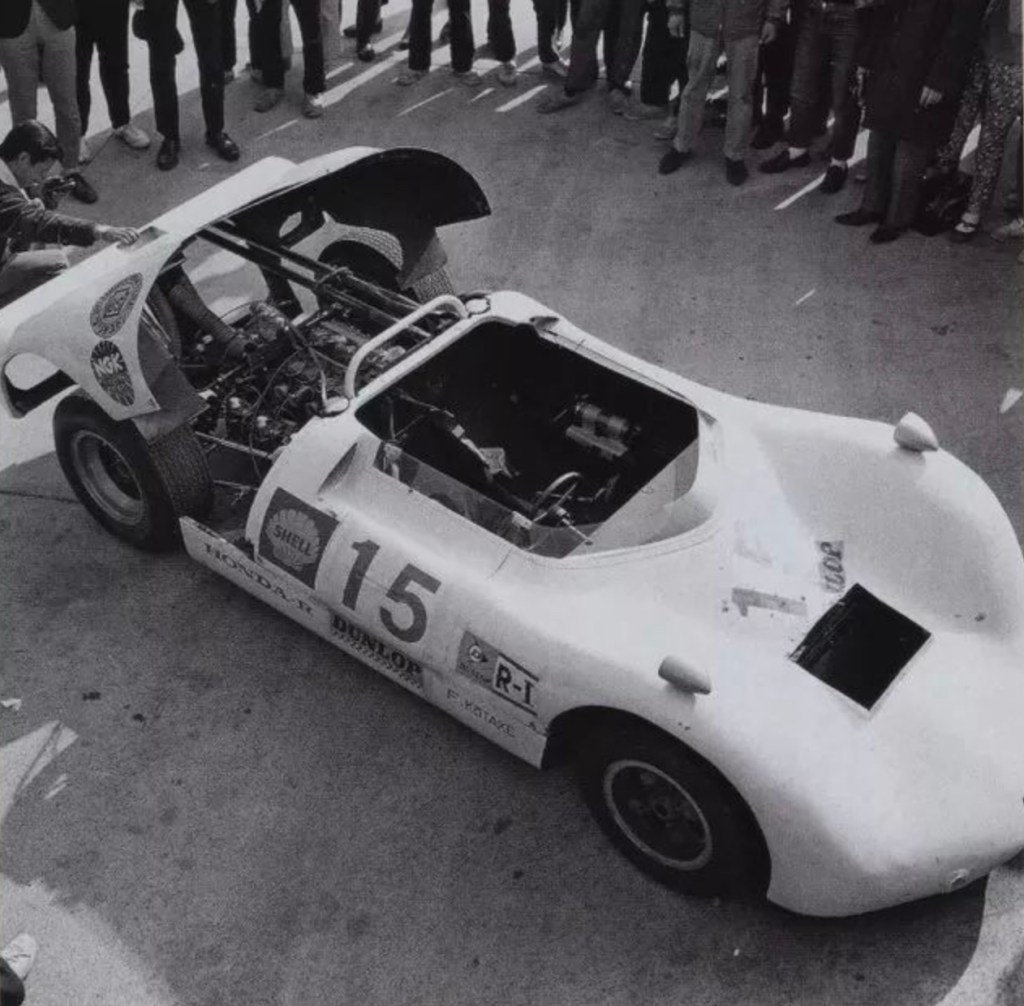
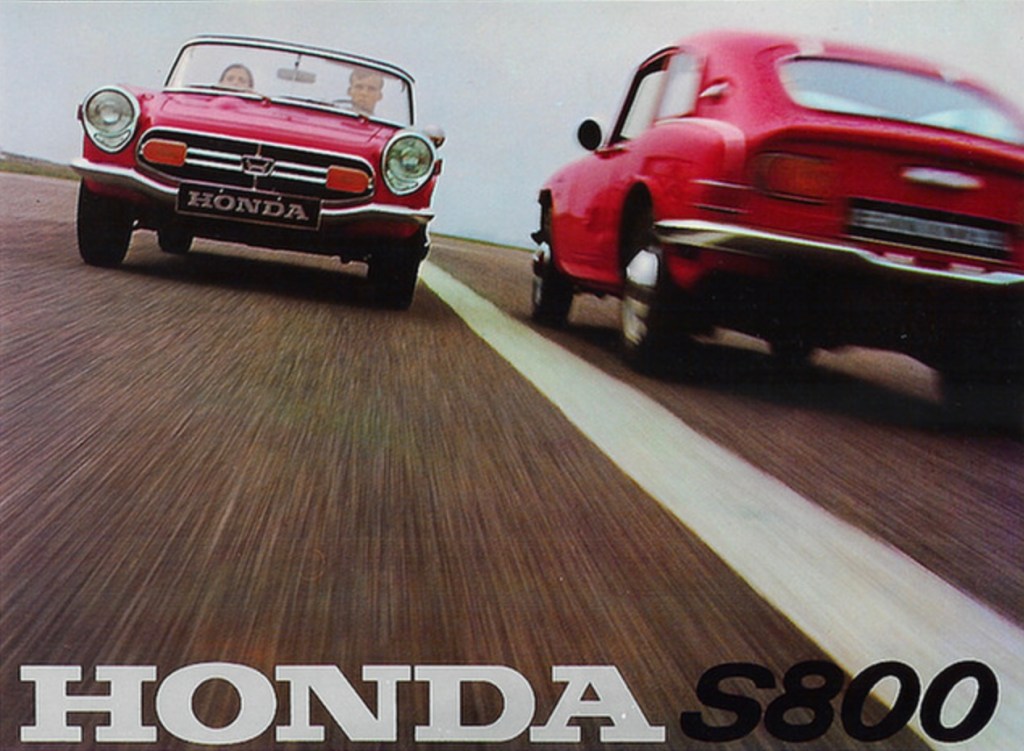
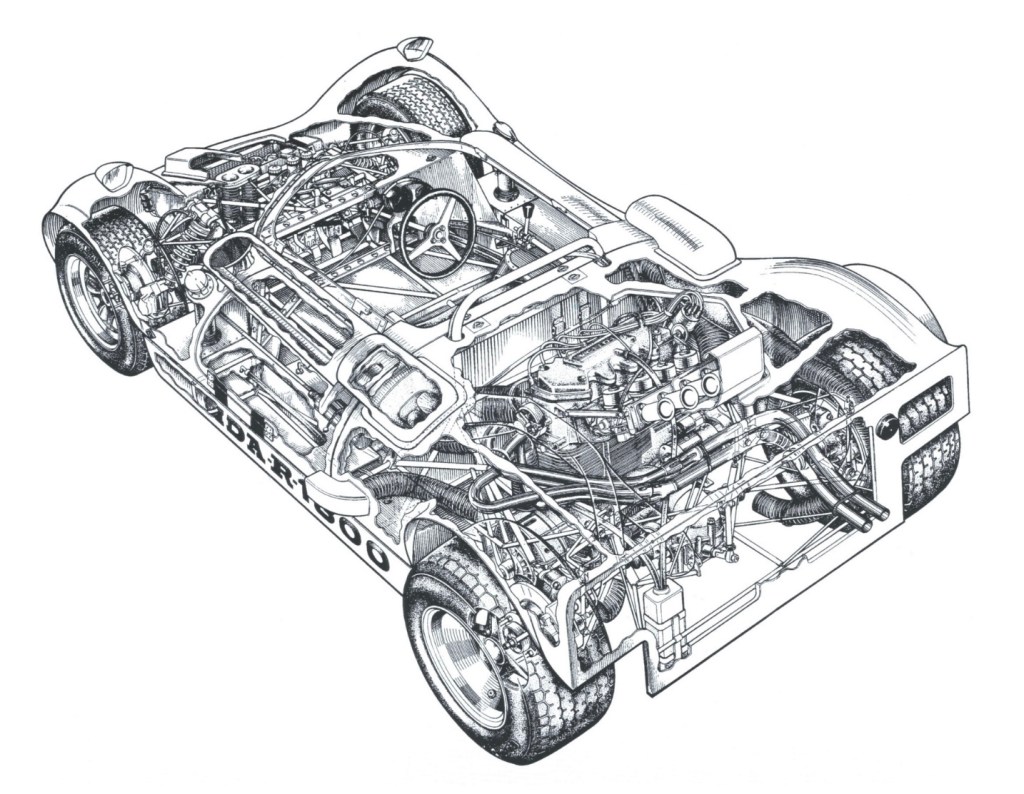
As the rear body-up photograph of the R800 shows below, its tiny air-cooled engine – mounted north-south at the front of the S600-800 roadies – was mounted conventionally in the rear of the sports-racer.
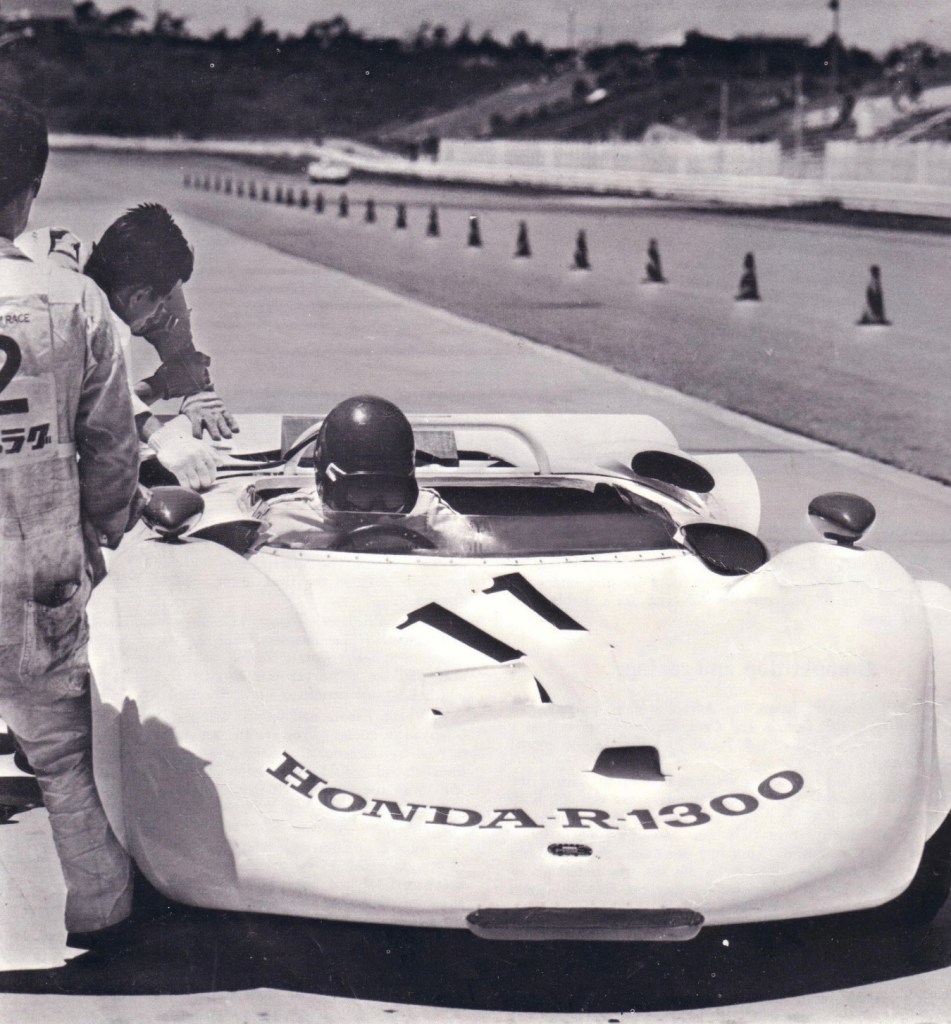
Honda R800 in the Suzuka paddock 1969 (unattributed)791cc all alloy DOHC, two-valve, water cooled four fed by two twin-choke Keihin carbs, 70bhp @ 8000rpm. With roller bearings supporting the crank – and its dizzy rpms – Honda delved straight into its motorbike practice book for this engineHonda R1300 during the 1969 Suzuka 1000km (unattributed)
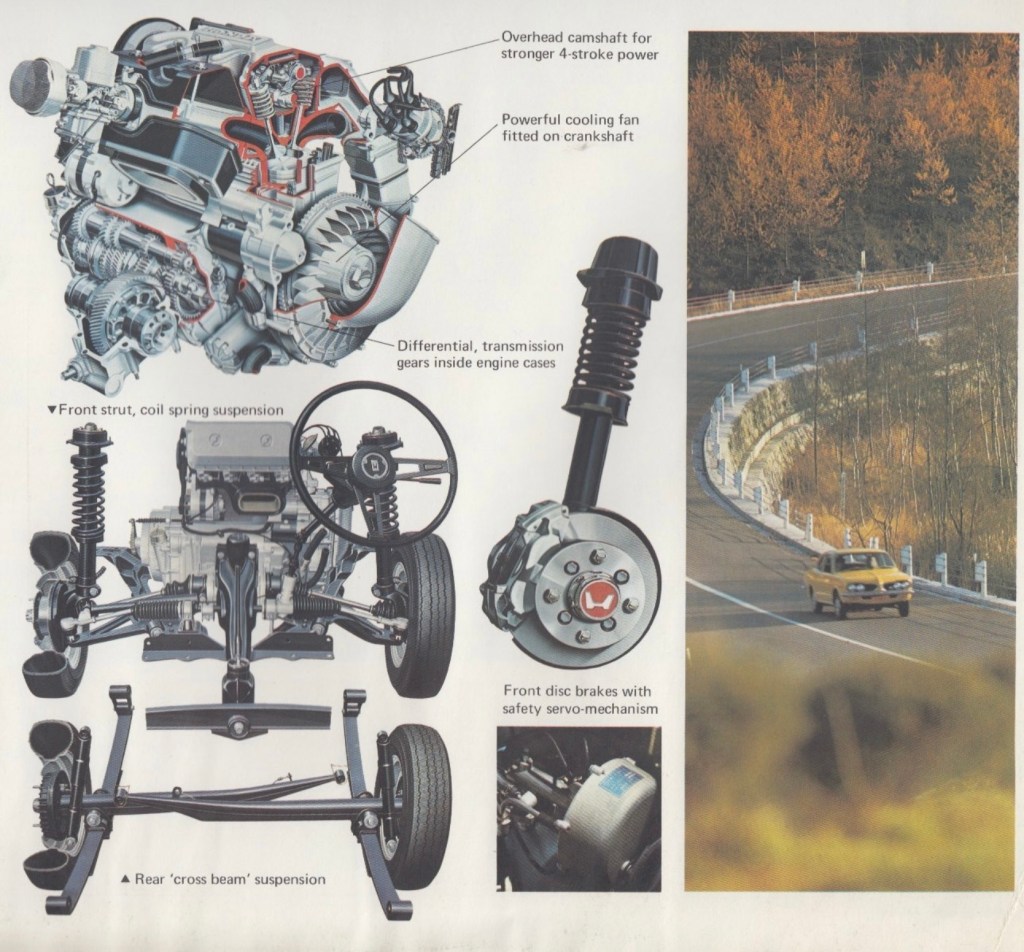
The cutaway drawing of the R1300 below – the engine was mounted east-west in the Honda 9 – shows the engine-transmission unit is mounted transversely at the rear as was also the case on Honda’s stunning, successful 1964-65 1.5-litre V12 RA271-272 GP machines. The suspension, brake, wheels and other specifications are otherwise 1960s period typical. See here for a feature on the Honda 1.5-litre GOP cars; https://primotipo.com/2014/12/12/honda-ra271272-1-5-litre-v12-19645-gp-cars/
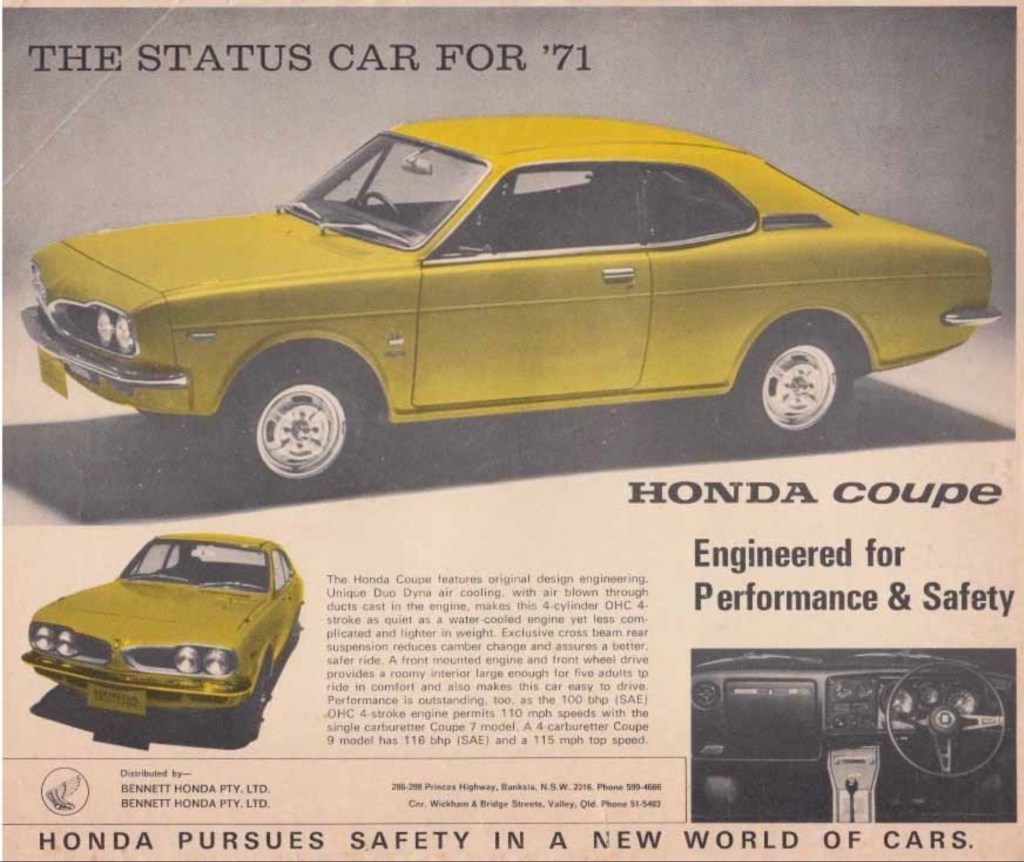
Honda R1300 cutaway (unattributed)Series 99 1299cc all alloy, SOHC, two-valve, air cooled transversely mounted four cylinder engine is fed by four Keihin carbs, dry-dumped, 116bhp @ 7300rpm (Honda Australia)(unattributed)
The R800 was built by Honda RSC the competition arm of Honda. The Racing Services Club was formed in 1965, then became the Racing Service Center and finally in 1982 morphed into Honda Racing Corporation. The car made its race debut that Suzuka 500km weekend and was Honda’s response to the Coniglio and Macransa (later Dome) Honda S-Series based kit/racing cars.
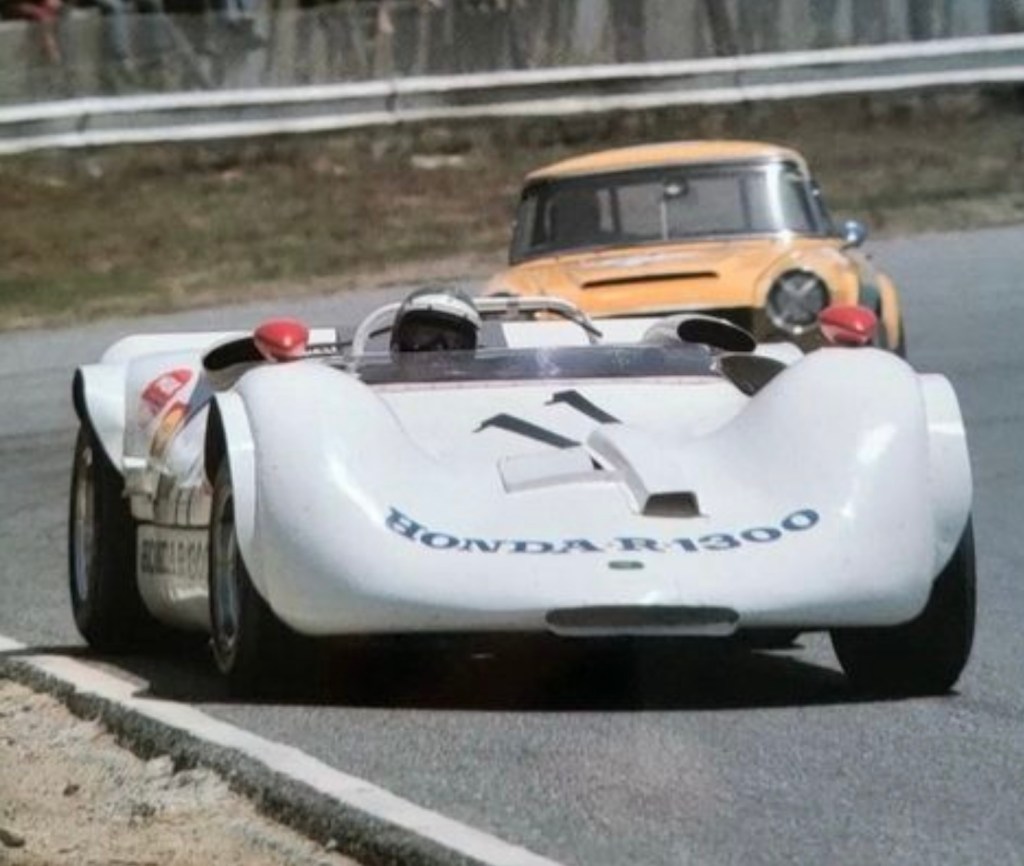
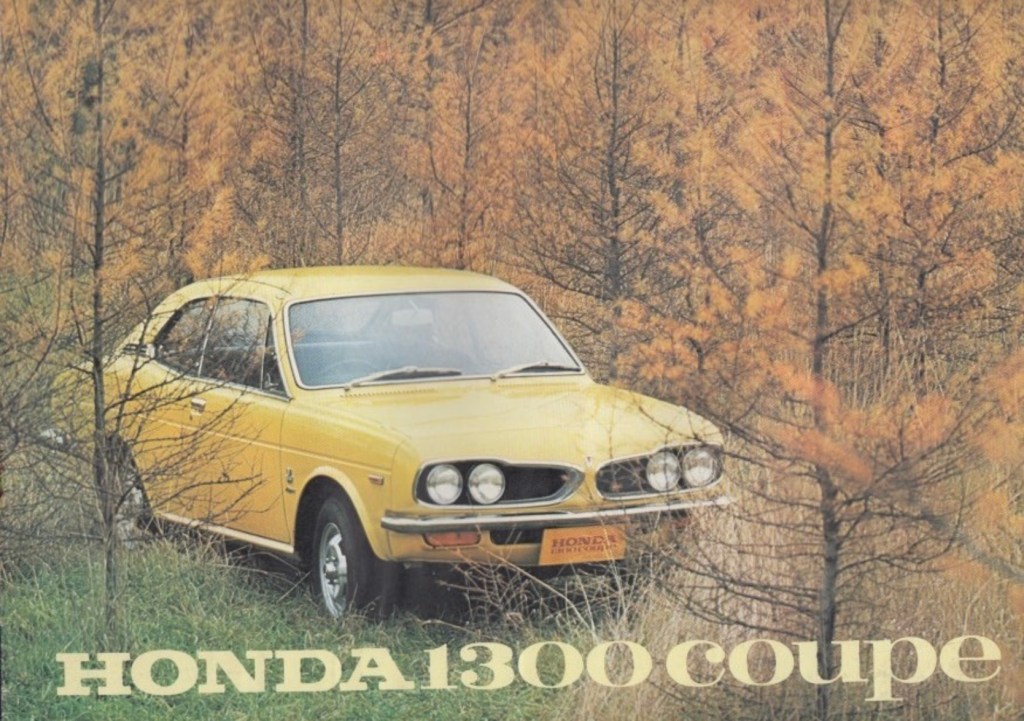
Shortly after the Suzuka ’69 500km race, Honda upgraded the machine by fitment of the 1.3-litre, air-cooled, four-cylinder engine fitted to their then new Honda 7/9 Coupe, a vastly underrated car. The 1300cc SOHC, crossflow, all alloy engine had a unique engine cooling system named Duo Dyna Air Cooling. The head and block had airways akin to the water passages of liquid called engines cast with short, stubby vertical fins. An impeller mounted directly to the crank pumped air through the passages, assisted by additional fins on the outside of the block. The dry sump carried plenty of lubricant, in a sense the engine was also oil cooled.
I’m having trouble finding the race record of the R800/1300, my Japanese is limited other than when excessively lubed. Information welcome.
Fukumi Takatake commenced racing motorcycles at 17 and was a contracted Honda rider at 19, winning the All Japan 250cc title in 1966. When Honda withdrew from two-wheel competition in 1967 (for a while!) he switched to four wheels, racing single-seaters, sports and touring cars. He ceased as a racer in 1987 after competing in the All Japan Touring Car Championship.
Etcetera…
(Honda Australia)
The Honda 1300 Coupe 9 was famously the last project Soichiro Honda personally led before retiring as Honda’s ‘Supreme Advisor’ in 1973.
His originality showed through in the design too, albeit times, safety and emissions legislation required a changed more conventional approach to become relevant and appealing to the masses. The brilliant Civic followed, there was nothing particularly novel about it, just great, bullet-proof engineering and build quality. Australian conditions are tough.
(Honda Australia)
My Mk2 Cortina GT was the typical student shit-fighter, but it was all-mine! I felt like I was jilting a babe after a chance drive of a very affordable Coupe 9, by 1976 they were el-cheapos, high risk ones too. My big-mistake was talking to Dad about it, I needed a bridging loan while I flogged Corty and bought 9 Outta 10.
“I’ve spoken to the car guy (the Fleet Manager who thought HQ Kingswoods were edgy) at work!” he said to me the next night, here we go I thought. “He reckons you’re a bloody idiot, it will cost you heaps. You’re looking after the Ford, he reckons you’ll have to rev the ears off it – just like the last bloke did…” And so on…
So I never did buy it but man it was a nice thing. A weird mix of old-tech like the rear axle, then that out-there engine and sweet gearbox. But it was so cohesive as a package, a howling but torquey engine, shitty looking nose tho. Time to drive one again, an interesting Classic Car article perhaps…
Credits…
Sanei Shobo, Historic Japanese Racing Cars Facebook page, Yukio Kobayashi, honda-rsc.com, yoshimura-rd.com
Tailpieces…
(unattributed)
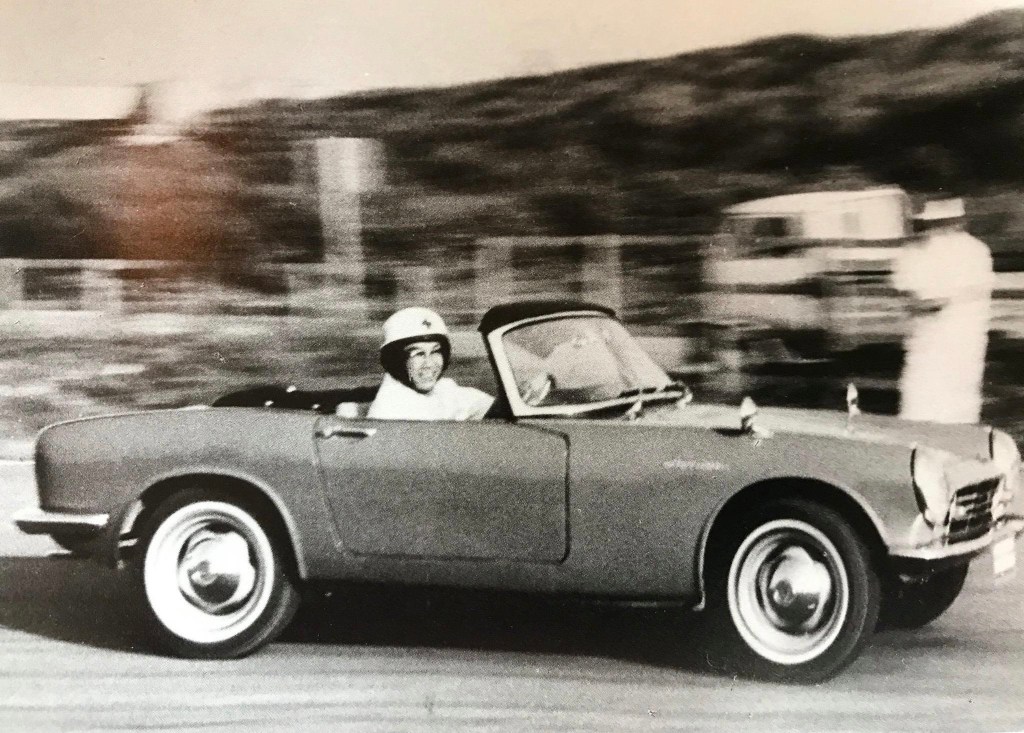
Soichiro Honda looking pretty happy at the wheel of an S600 or S800 Honda.
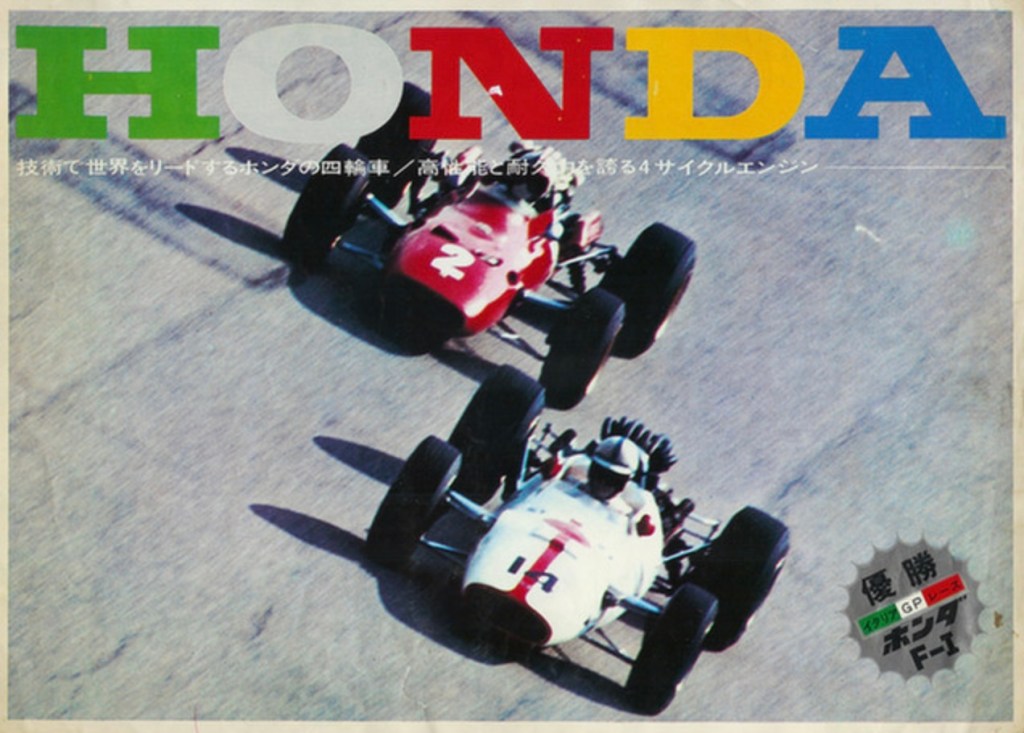
John Surtees Honda RA300 ahead of Chris Amon’s Ferrari 312 at Monza in 1967. Big John won the race in a last lap duel and last corner fumble from Jack Brabham’s BT24 Repco, two-hundredths of a second the official margin.
Maybe Honda had mercy on Jack – their F2 partner in 1965-66 – saving him the embarrassment of the more obvious corporate shot! See here for a piece on that partnership; https://primotipo.com/2021/12/17/brabham-honda/
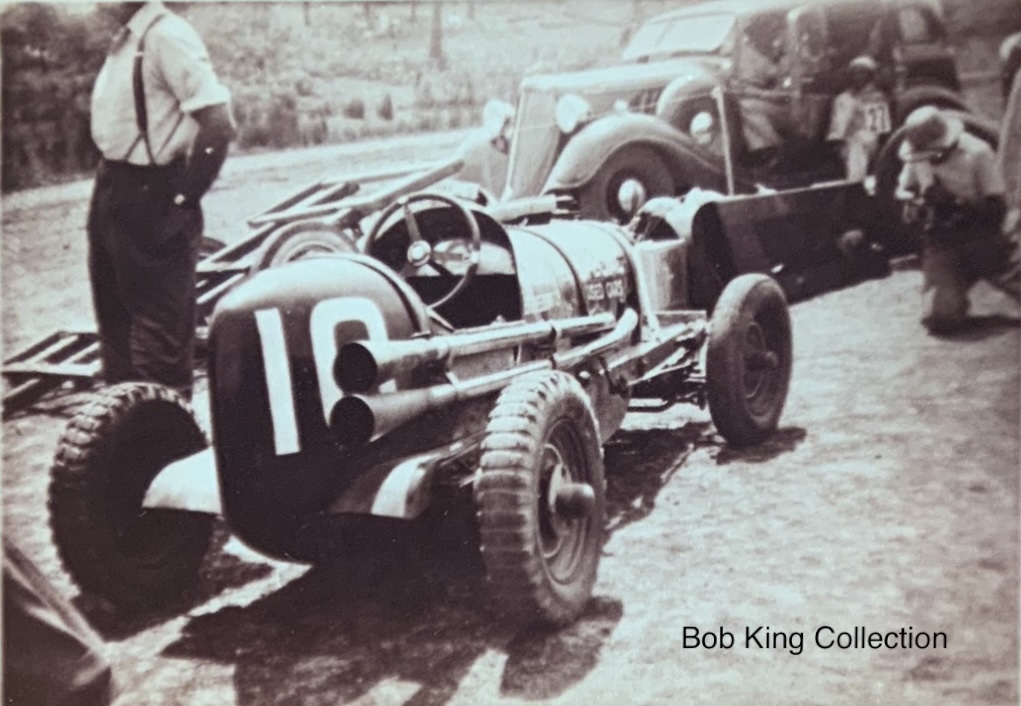
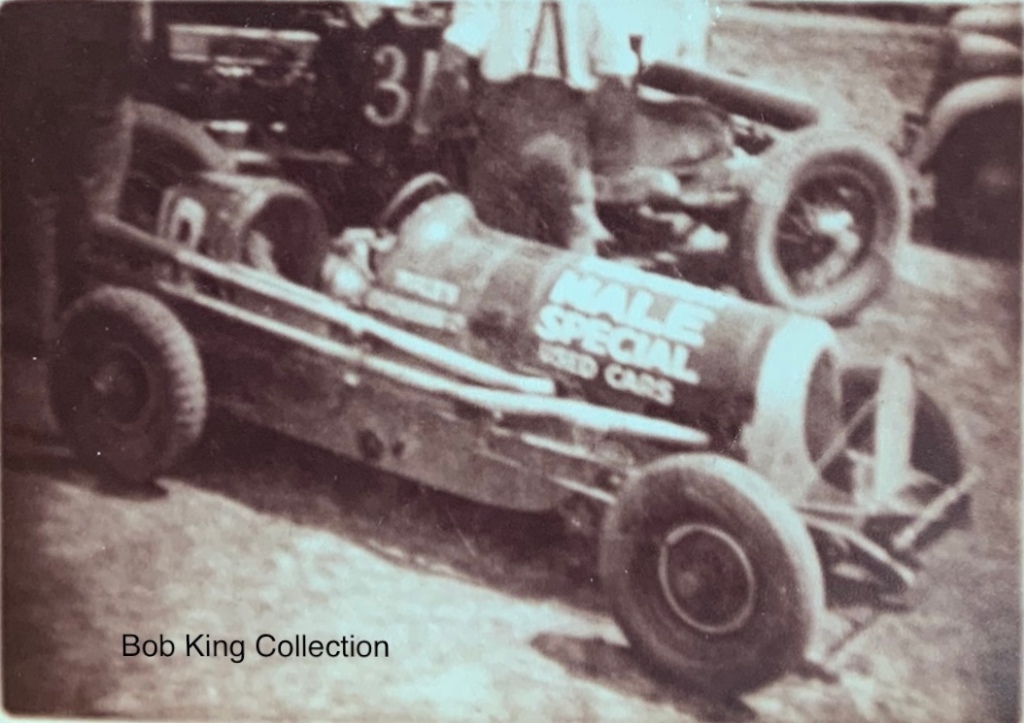
Not so much special, but three specials sponsored by Melbourne car dealer, Alan D Male and raced by Ted Gray in the immediate pre-WW2 years.
One was the JAP engined speedway midget above, the next a buggered-if-I-know powered midget and the third, Alta 21S, ex-Alan Sinclair/Bill Reynolds, and by then Ford V8 powered.
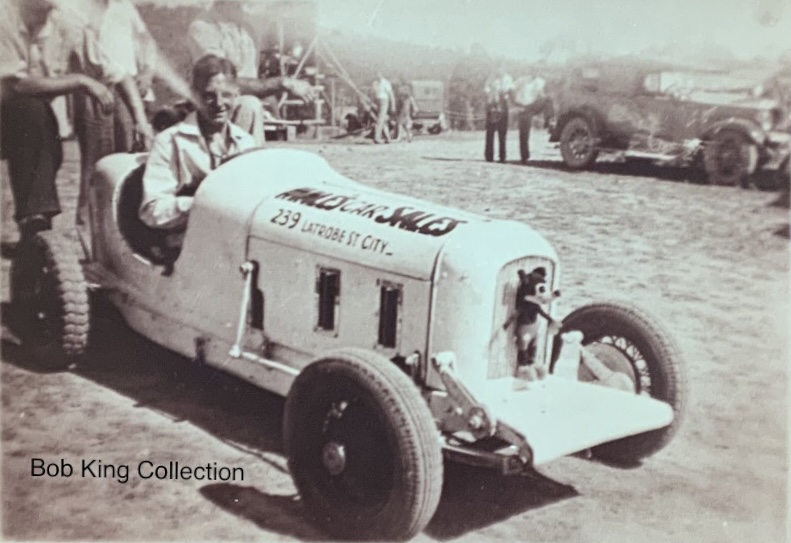
Male operated yards at 233 and 239 Latrobe Street, Melbourne named Males Car Sales and AD Male Car Sales respectively. This seemingly successful business man was important in the rise and rise of Tiger Ted pre-War, his final push into the top rank was provided post-War by Lou Abrahams.
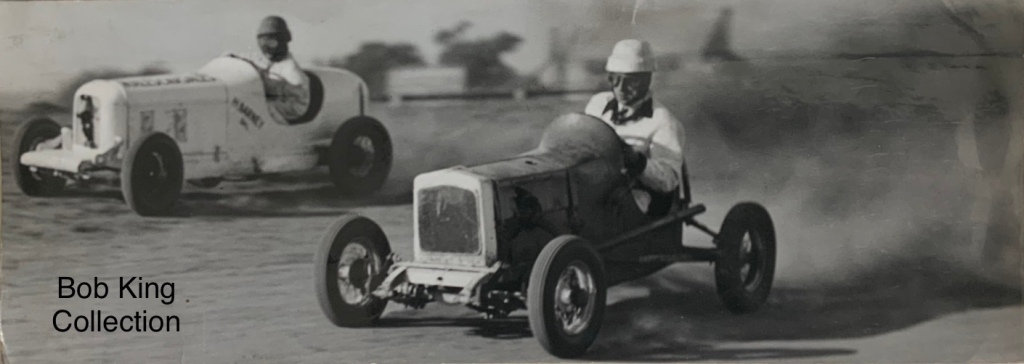
Gray gave the visiting Peter Whitehead’s ERA B-Type a serious run for his money in the midget above during meetings at Aspendale Speedway and Rob Roy hillclimb in 1938. Leon Sims tells us that in the meeting above, Rob Roy 5 on November 20, 1938, that Gray set the FTD 0.5 seconds outside the hill record set by Whitehead only five months before. In the process “he set the committee of the Light Car Club of Australia scratching their heads in concern over the suitability of a car designed for midget racing, taking the award on their hill. It was not seen as a ‘proper car’ in their eyes.”
When Jack Brabham raced his midget at Rob Roy post-war he had the same problems but went to Sydney, fitted some brakes to his car, and returned to take the Australian Hillclimb Championship at Rob Roy in 1951. Up yours Blue Blazer Officialdom, or something like that!
This is the ‘other midget’, a rare shot with car owner Alan Male at the wheel at Rob Roy 5, he did a time of 31.5 seconds. I’d love to know the builder and specifications of this car. If Mickey Mouse seems an odd radiator-shroud fear not for the little-fella, he seems to have been adopted by the team as a mascot, he is present on the team’s Alta 21S Ford shown further below.
Ted Gray on the outside of A ‘Stud’ Beasley (as in head stud or babe-magnet?) at Aspendale in August 1938, with Mickey still hanging on for grim life. I’m rather hoping some of you may be able to tell me a little more about Alan Male in order that we can put it on the public record.
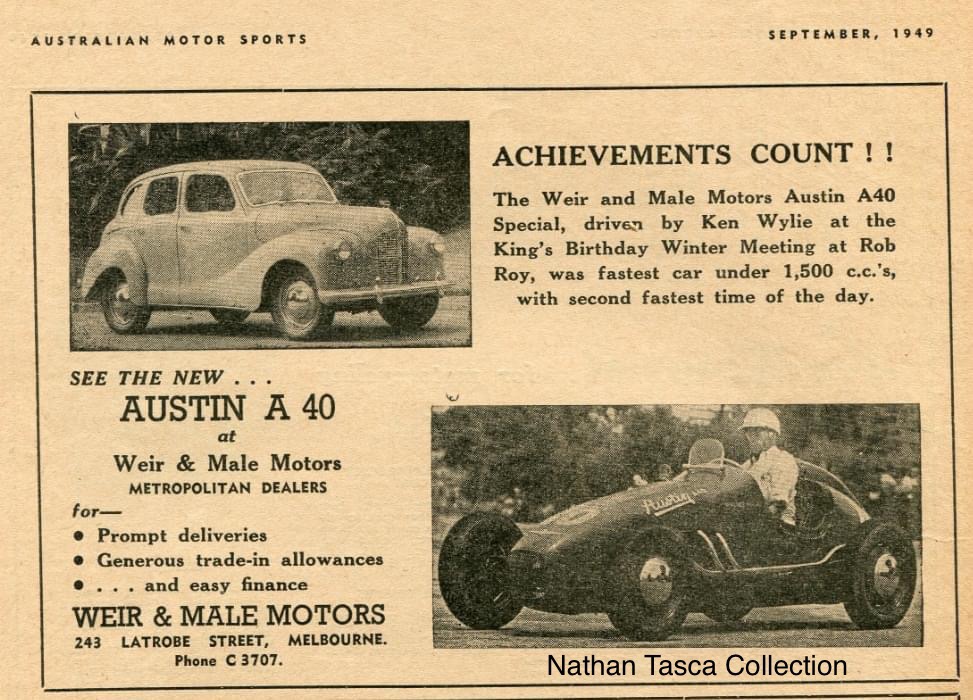
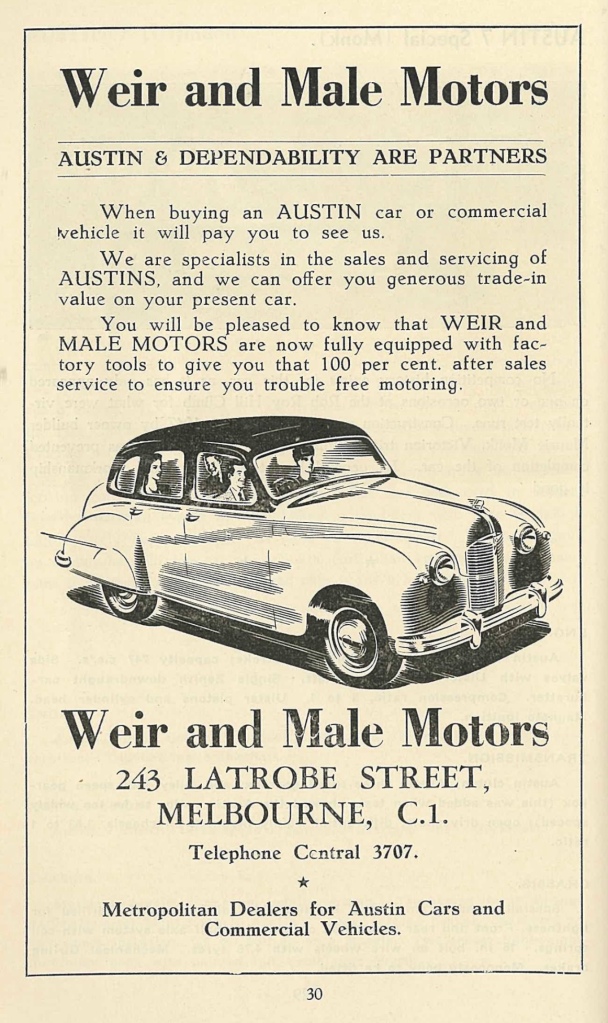
Nathan Tasca’s research shows he was still trading in cars post-War, as Weir & Male Motors at 243 Latrobe Street, familiar territory for him! He still maintained his interest in motor racing, note the AMS advertisement below. The wording of the ad, and coverage of the car in the Motor Manual 1950-51 Australian Motor Racing Year Book confirms the car was built by Ken Wylie for Weir & Male Motors, Austin dealers, and was driven by Wylie.
(Photographer-Byron Gunther)
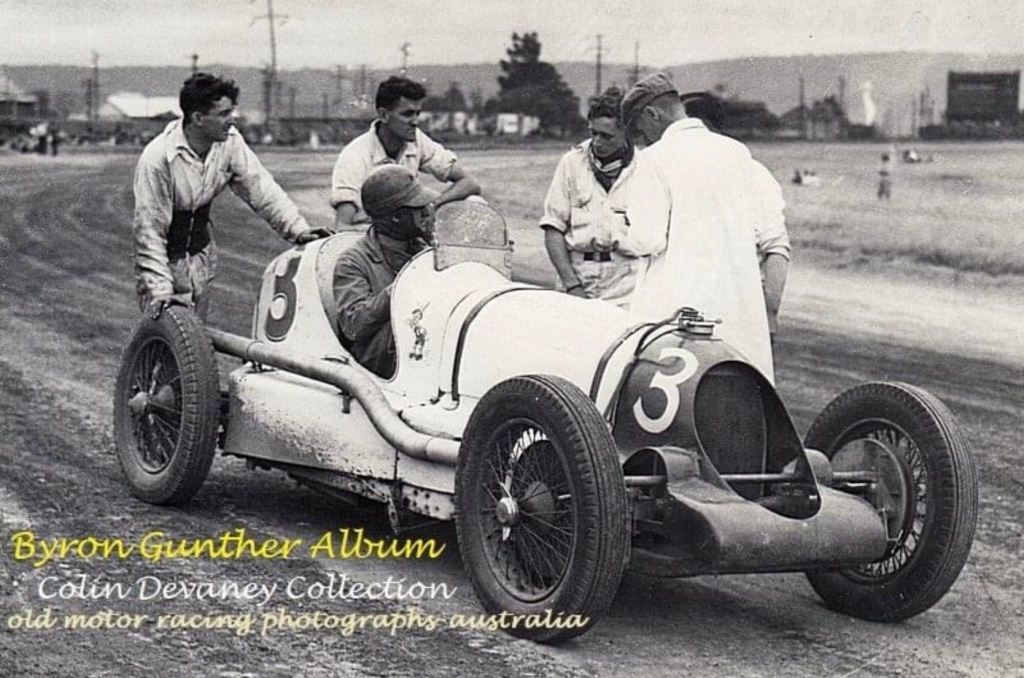
The final Male Special/Ford V8 Special – it was entered in various names – is most correctly, using the modern – make-model-engine manufacturer – ‘racing car description protocol’ Alta 21S Ford V8. Here Ted is considering proceedings with his crew and officialdom at Penrith Speedway, NSW in 1940.
While built as a road racing racing sportscar, and modified by Sinclair’s team in the UK before coming to Australia as a road racing 1100cc supercharged single-seater, the car performed well both on the roads and on dirt speedways, as here. The car was raced well into the war years, Gray in the Male Special V8 beating S Bail’s Midget V8 in a 3 lap match race at Aspendale on Sunday January 19, 1941, his final entry March-April ’41. Picking up the Austin connection, Tony Johns tells me S Bail was a partner in the Bail Brothers Austin sub-agency (Stan and Wally) in Hampton Street, Brighton in the 1960s.
By the way, the little dude on the scuttle of the Alta is Pinocchio not Mickey Mouse…there is a story there, but what is it? I know, Walt Disney was so impressed with Ted’s performances he was slipping a few greenbacks Male’s way…
Motor Manual 1950-51 Yearbook via David Zeunert Collection
Credits…
Bob King Collection, photos perhaps taken by Ted Hider-Smith, The Argus January 20, 1941, David Zeunert Collection
Tailpiece…
Tiger Ted aboard the very new Tornado 1 Ford V8 at Fishermans Bend in early 1955, date please (car #5).
When the shortcomings of Alta 21S finally became apparent after Lou Abrahams’ big-brawny Ardun-Abrahams head Ford V8 was dropped between its chassis rails the Abrahams, Gray and Mayberry team built Tornado 1. This car’s short life ended when Gray had a huge accident at Bathurst in October 1955 after brake dramas, see the articles linked above for the details.
I got terribly excited when I found this letterhead among the Vintage Sports Car Club of Victoria’s photo archive. What a discovery, a speedway in inner Melbourne, on the current AGP site way back in 1903!
Yes and no. The speedway was built but for the use of our equine friends, just as the first automobiles were trickling into Australia.
(SLV)
The speedway was one mile long “on the seaward side of Albert Park. 145 feet wide, the course was divided into two tracks with a space in the middle for pedestrians. “It is well laid out, planted with ornamental trees with rockeries interspersed,” Table Talk recorded.
The track was open to the public when not in use “and beautified a portion of the park that has hitherto been an eyesore.” As one who walks/runs around Albert Park daily I’m intrigued to know about this aspect of the park and fascinated to know exactly where the horse-course was 120 years ago.
At the opening ceremony on August 29, 1903, the club president outlined that the purpose of the speedway “would stimulate the desire to possess first-class horses, and so improve the breed of our carriage and trotting horses.” The club “wanted to provide a track where a gentlemen with a horse that had a turn of speed could exercise it without the risk of prosecution for furious driving.”
(SLV)
The Governor, who had been given a golden-key to open the gates of the speedway, replied that he hoped it (the key) “would open the eyes of the local councillors to the fact that it was a good thing to have a Speedway in their midst, and in a portion of Albert Park that had been up to the present but an indifferent cow paddock.”
The Gov concluded by observing that American Speedways had improved the quality of their horses, and that “the Albert Park Speedway was in the hands of good sportsmen, and good men, and in declaring it open, wished the club all prosperity.” Tally-ho, jolly good show and happy hockey-sticks…
I do find interesting the history of a part of the world, dear to my heart, but by March 1907, with little interest in the venues activities, the Melbourne Speedway Club had to relinquish its use of that part of Albert Park.
While the horse-men were keen on building best-of-breed, devotees of new-fangled-horsepower were ‘racing’ already. Harley Tarrant, Argyll 10HP at left won a 3-mile race ‘for heavy automobiles’ at Sandown Park on March 12, 1904. That’s Tom Rand’s second placed Decauville 16HP alongside.
When I billed this as Australia’s First ‘Motor Car Race’ in the second of the two articles above, ‘Prof’ John Medley – Australia’s foremost motor racing historian – told me how brave I was, which was his polite way of saying “I wouldn’t be so sure about that Sonny-Jim!” Whatever the case, the ‘competition’ was one of the first between cars in Oz. And lookout horses, we are coming through…
Credits…
Vintage Sport Car Club of Victoria, State Library of Victoria, Table Talk September 3, 1903, Algernon Darge – State Library of Victoria
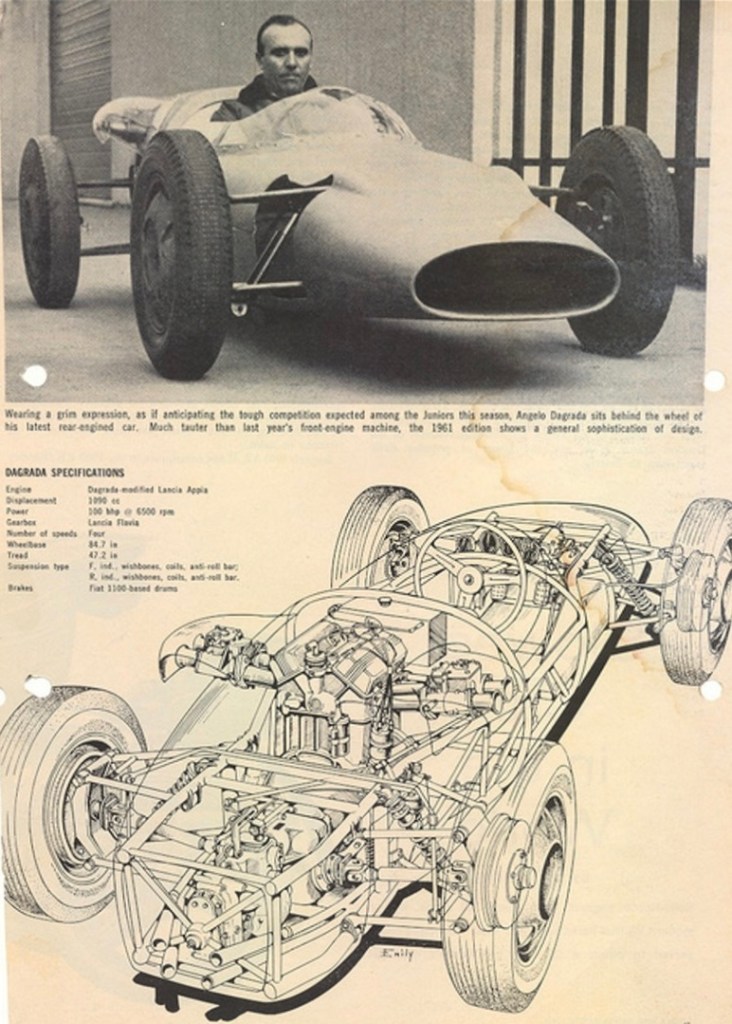
With the announcement of Formula Junior in 1958 the floodgates opened to chassis builders from around the globe using 1100c BMC, Fiat, Ford, Renault and Lancia engines. The latter provided one of the loudest, potent engines to ten or so front and mid-engined cars built by Milanese mechanic, Angelo Dagrada.
Born in 1912, he initially made his name building cars for the post-war Italian 750 and 1100cc classes. He improved the Fiat 1100-Siata head and achieved some significant wins before road accidents slowed him. By 1955, Dagrada was again tuning cars, this time Alfa Romeos.
Angelo Dagrada with Franco Bordoni, Scuderia Ambrosiana Dagrada Lancia #001 at Monza in 1959, during the Trofeo Bruno e Fofi Vingorelli meeting. He was 12th in the race won by later Alfa Romeo factory driver, Roberto Businello – this shot and the one below (unattributed)(unattributed)Lancia Appia 1090cc (68x75mm bore/stroke) V4.Monobloc, crankcase and head made of duraluminium, hemispherical combustion chambers, modified crossflow head with two chain operated camshafts in the crankcase, two-overhead valves per cylinder inclined at 67 degrees to each other operated by pushrods and rockers. Two Weber 38DCO3 carburettors, compression ratio 8.75-9:1. Short, counter-weighted crankshaft (velocetoday.com)
The Baghetti’s, owners of a successful Milan foundry were customers. Dagrada aided and abetted teenage would-be-racer Giancarlo Baghetti by modifying the family Alfa 1900, without telling Baghetti senior.
Just as Baghetti started racing Alfas and Abarths, Dagrada concocted a new Formula Junior design for 1959, just as the British mid-engined hordes took over the class.
Always an engine man, Degrada good look at the 1090cc Lancia Appia engine rather than go the Fiat route like most other Italian FJ manufacturers. With a sturdy 10-degree cast-iron V-4, the Appia unit was available and light. The design’s shortcoming was an intricate aluminum head that stymied attempts to make it breathe deeply.
Dagrada’s solution was to substantially redesign the head. By creating new intake and exhaust ports, he achieved a crossflow design which was fed by a Weber 38DCO3 carburettors mounted either side of the block. With carefully calculated tuned-length-exhausts the horsepower gain of the 1090cc (68x75mm bore/stroke) engine was huge, up from 48bhp to circa 95bhp @ 6700-7000rpm.
The gearbox was a modified Lancia Flaminia/Flavia unit. With a simple ladder-frame chassis – the engine was offset to allow the driveshaft to pass alongside the driver – wishbone and coil spring/dampers and adjustable roll bars front and rear, modified Fiat 1100 brakes and an aluminum body reminiscent of a 250F Maserati, the car was ‘the goods’.
All smiles for Giancarlo Baghetti after winning the Vigorelli Trophy at Monza on April 25, 1960 (unattributed)
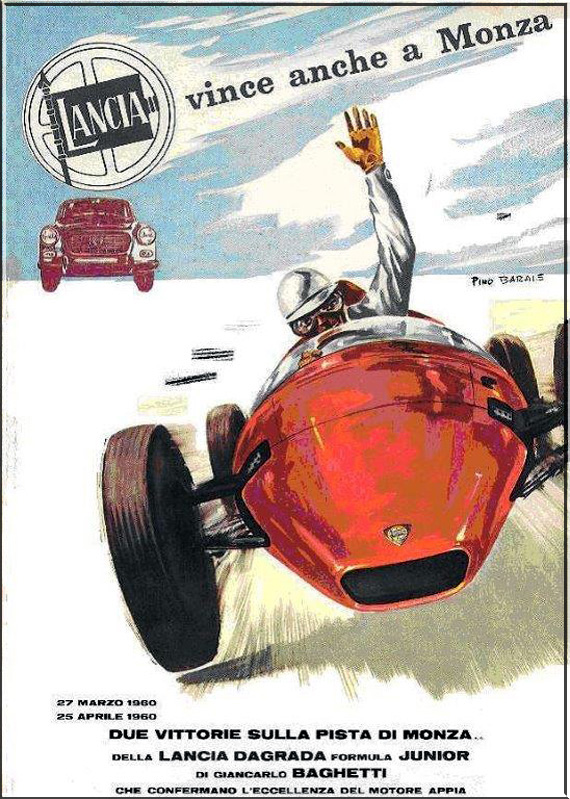
Giancarlo Baghetti demonstrated his burgeoning talent with a new Dagrada doing well in the junior-leagues before winning the more professional Prova Addestrativa on March 27, and Vigorelli Trophy races on April 25, 1960 both at Monza. He was equal fourth in the Italian FJ Championship together with Geki Russo – the title was won by Renato Pirocchi, Stanguellini Fiat. Giorgio Bassi was the other driver who did well in his Dagrada that year. By the spring of 1961 Baghetti was on Enzo Ferrari’s radar with an F1 seat his shortly thereafter.
The British rear-engined revolution started by Cooper and refined by Lotus ensured the days of front engined Formula Junior were nearing their end, one of the sweetest of that breed was the Degrada Lancia…
Angelo’s mid-engined design (below) which followed wasn’t a success, Giorgio Bassi took one race win for the chassis in the Coppa Junior Italian Championship round at Monza on May 13 1962, when the top-Brits were elsewhere…
(Leo Schildkamp)
Etcetera…
The donor of the Dagrada engine. 107,000 Lancia Appia’s were built between 1953 and 1963.
(unattributed)
Dagrada was not the only marque to use the Appia engine, others included Raf, Raineri and Volpini.
(unattributed)
Giorgio Bassi in his mid-engined Scuderia Sant’Ambroeus Degrada Lancia, 22nd during the Preis von Tirol at Innsbruck on October 8, 1961, car #15 is the Andre Rolland Stanguellini Fiat and #7 Bernard’s Foglietti Fiat.
Credits…
‘Emily’-Vladyslav Shapovalenko, velocetoday.com, Leo Schildkamp
Lamberto Leoni at the Formula 2 Grand Prix de Nogaro (ninth), aboard his Scuderia Everest Ralt RT1 Ferrari 206 in 1977.
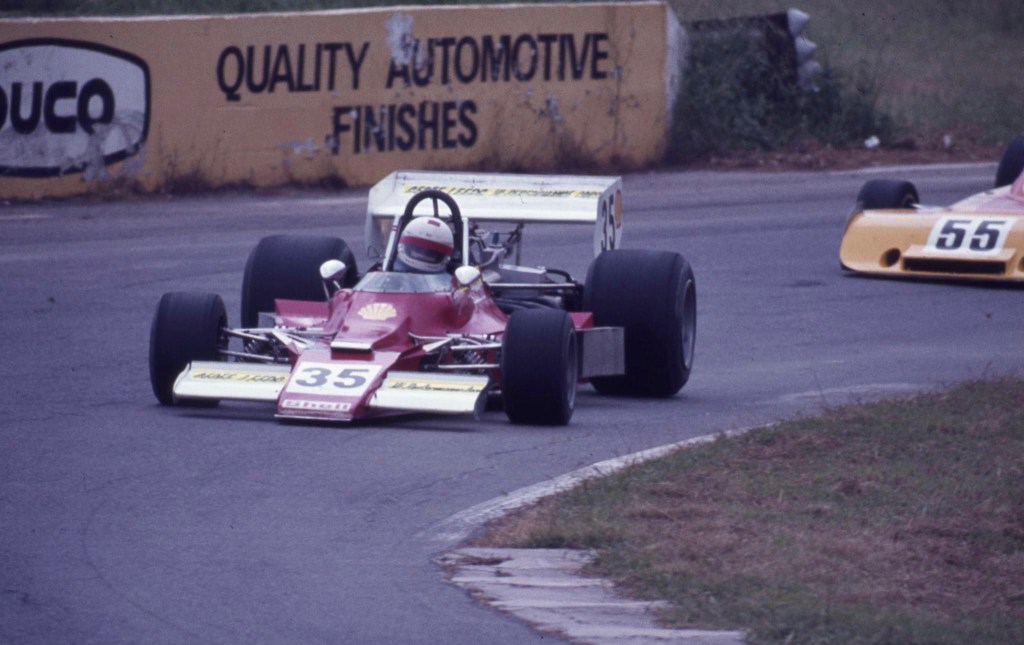
Ferrari entered into an arrangement with Giancarlo Martini and Giancarlo Minardi’s Scuderia Everest – originally Scuderia del Passadore and from 1975 Scuderia Everest, after obtaining sponsorship from the Italian rubber products manufacturer Everest Gomma – and another ex-racer, Pino Trivellato’s Trivellato Racing to provide 2-litre Dino V6 engines to be fitted to Ralt/Chevron chassis run by each team to bring-on young Italian drivers through Formula 2. The program ran for two years, 1977-78 with only modest success.
Enzo Ferrari, Giancarlo Minardi, Roberto Farnetti keeping an eye on Lamberto Leoni at Fiorano in 1975, March 752 BMW (F Minardi)
Martini drove March BMWs for the team, during this 1975-76 period Minardi developed a strong relationship with Scuderia Ferrari team manager – and decades later Ferrari CEO – Luca di Montezemolo. Via this connection Everest tested their cars at Fiorano, and at the end of 1975 Minardi secured a deal with Enzo Ferrari to run a Ferrari 312T F1 car to race in the Race of Champions at Brands Hatch and the BRDC International Trophy at Silverstone, way back when in the days of non-championship F1 races.
Giancarlo Martini, Ferrari 312T, International Trophy, Silverstone 1976 (unattributed)
The deal was reminiscent of the arrangement whereby a Ferrari 156 was raced by Giancarlo Baghetti under the Federazione Italiana Scuderie Automobilistiche (FISA) banner in 1961. Maurizio Flammini was offered the Everest 312T drive but knocked back the opportunity so Martini got the gig. With very limited practice at Fiorano he was Q13 and DNF prang at Brands, and Q10 and 10th in the rain at Silverstone. Giancarlo Minardi would of course return to F1 a decade later.
The Scuderia Everest Ferrari connections were immaculate and led to the agreement to run Dino engined Ralts in 1977. Everest ran Lamberto Leoni and Gianfranco Brancatelli in RT1 Ferraris, while to broaden their coverage, Pino Trivellato, the Chevron agent in Italy, planned to run Riccardo Patrese in a Chevron B40 Ferrari.
Just the view of the Prancing Horse on the steering wheel must have been good for an extra couple of tenths! Chevron B42-78-07 Ferrari, the ex-De Angelis 1978 chassis (Legends Automotive)
Ferrari F2 206 V6 engine and lineage…
The Ferrari Dino V6 family(ies) of engines were incredibly versatile, fitted as they were to single seaters and sportscars and winning World F1 Championships in 1958 (drivers) and 1961 (drivers and manufacturers). They were built in capacities of between 1.5 and 2.4-litres, with two, three and four valves per cylinder, fed by carburettors and fuel injection, not to forget the turbo-charged and experimental radial valve variants. In mid-life 2.4-litre Ferrari 246T open-wheelers – a derivative of the Ferrari 166 F2 car – won the 1969 and 1970 Tasman Cups for Chris Amon and Graeme Lawrence. Who could forget the 206/246 Dino roadies and the similarly powered Lancia Stratos, competition variants of which were winning rallies into the 1980s.
The challenge of building an engine to match the competitor set, the modern as tomorrow 300bhp Hart 420R and BMW M12/7 fours, and Renault-Gordini CH1B V6, was given to long-time Ferrari mechanic, ex-F1 chief mechanic Giulio Borsari. He was handed an all-alloy 65-degree 24-valve Dino V6 with the four camshafts driven by chains! The bore/stroke of the new Ferrari 206 was 86mmx57mm. This was achieved with a visit to the parts-bin and mating the short stroke of the 1965 Dino 166P (sportscar) with the “86mm bore of the unlamented Dino 166 1.6-litre F2 engine,” wrote Doug Nye in ‘Dino:The Little Ferrari’.
The compression ratio was 12:1, 10mm Champion plugs were used and titanium conrods. While dry-dumped, the long engine was also very tall as the pressure and scavenge pumps occupied a lot of space, while the sump itself was deeper than what had become modern practice. Ferrari claimed 300bhp @ 10,500rpm for the 120kg engine “which was outdated before it had begun to race.” Nye wrote.
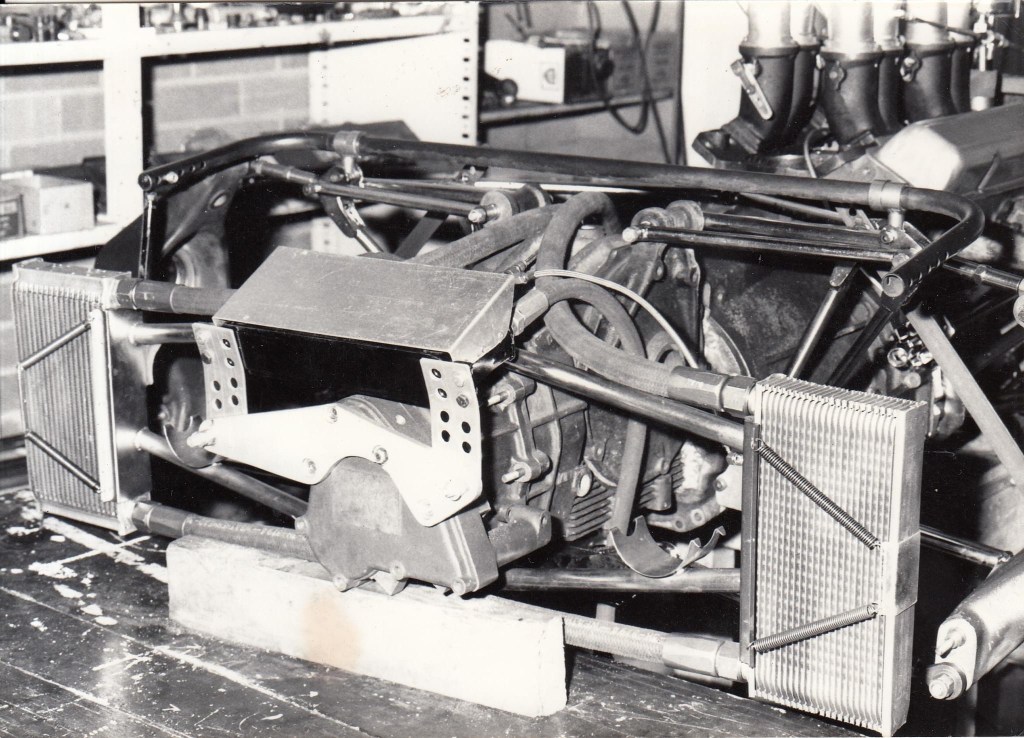
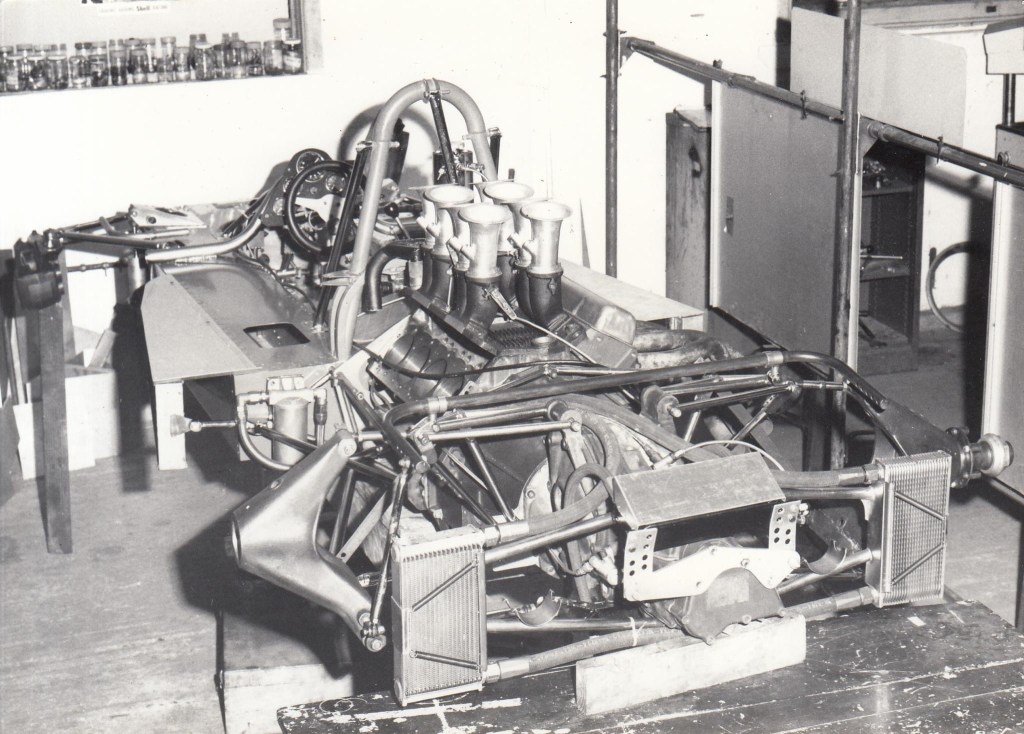
The immediate concern of the Ralt/Chevron proprietor/designers Ron Tauranac and Derek Bennett was the engine installation challenges, particularly its height. Tauranac and his lads in Snelgar Road, Woking simply took the handling penalty implicit and mounted the motor as low as they could into an RT1.
Derek Bennett and Paul Owens up in Bolton thought “stuff that” and designed a 1 1/2 inch lower sump, “so that the gearbox would come down to the right level and the driveshafts could be put on at a sensible angle” wrote David Gordon in ‘Chevron:The Derek Bennett Story’. They had the sump cast and along with a new oil pump, fitted the modified engine to a B40 and headed to Fiorano to test it shortly before the first Euro F2 round at Silverstone in late February/March.
Paul Owens and Derek Bennett ponder the installation challenges of the tall Ferrari 206 V6 into a Chevron B40 chassis (Autosprint)Lamberto Leoni, Chevron B40 Ferrari, Estoril 1977 (MotorSport)
The Ferrari folk were delighted with the look of the Chevron but flipped when they saw the modifications to their engine. The Mona Lisa had been desecrated, Chevron/Trivellato were forbidden to race the car and Paul Owens copped a major pull-thru in a meeting with Mauro Forghieri and Piero Lardi Ferrari.
Ferrari then tested the modified engine, which performed well on the dyno under static conditions but lost power when rotated through 45-degrees, a technique used to simulate cornering loads, the pumps were not scavenging properly.
Another slanging match ensued in a subsequent meeting when Paul Owens and Dave Wilson, who spoke Italian, met again with Ferrari. The Chevron boys asserted strongly that the car wouldn’t handle properly – which was pretty much proved by the poor performance of the Ferrari engined RT1s compared with Hart and BMW powered Ralts throughout the season – while the Ferrari people wouldn’t agree to lower the engine.
“After much shouting and thumping on the table, the meeting broke up acrimoniously, with Paul declaring that Chevron were no longer interested in pursuing the project because it would be detrimental to their reputation. Although that was exactly what Paul and Derek believed, it still felt extremely strange to be telling Ferrari that running their engine could be bad for Chevron.” Gordon wrote.
The stalemate was broken when Pino Trivellato negotiated a process whereby B40s would be tested back to back at Fiorano, one fitted with the Ferrari engine in its original form and one BMW M12/7 powered. The Ferrari engined car was the slower.
Leoni awaits a ready mount at Fiorano in early 1977, Ralt RT1 Ferrari (F Minardi) Brancatelli overhead shows the cohesive look of the RT1 Ferrari (unattributed)206 Dino V6 installation – which appears to be at least a semi-stressed member – in an RT1 (G Gamand)
While all this was going on the European F2 Championship was well underway. Rene Arnoux won the Silverstone season-opener on March 6 in his works Martini Mk22 Renault Gordini V6. Then Brian Henton won in a Boxer PR2 Hart at Thruxton, with Lamberto Leoni’s RT1 Ferrari a DNF oil pressure. Leoni failed to qualify in the following Hockenheim round where Jochen Mass’ March 722P BMW prevailed. Mass won again at the Eifelrennen at the Nurburgring in May with both RT1 Ferrari’s DNAs.
In the first ‘home race’ for the Ralts at Vallelunga, Brancatelli had his first RT1 start and finished 13th while Leoni was outted with clutch failure. Bruno Giacomelli’s works March 772P BMW won. The Pau GP was similarly disastrous, Leoni DNQ and Brancatelli DNF with oil pump failure, somewhat ironic given the Chevron-Ferrari chitty-chats taking place at the same time! Arnoux won from Didier Pironi in a Martini Renault 1-2. To make matters worse, Riccardo Patrese was one of the season smash hits aboard a Trivellato B40 BMW. Pino did a deal to get Patrese works BMW engines when the Ferrari dramas appeared impassable…
Both RT1 Ferraris finished at Mugello on June 19, in seventh/eighth Leoni/Brancatelli, while up front the top-four were Giacomelli/Patrese/Alberto Colombo/Alessandro Pesenti-Rossi. Italian drivers seemed to be doing quite well without Ferrari’s help thank you very much.
Leoni, Trivellato Chevron B40 Ferrari, Mediterranean GP, Enna Pergusa, July 1977. Eighth in the race won by Keke Rosberg’s Opert Chevron B40 Hart 420R (MotorSport – E Colombo)
Eddie Cheever’s Ron Dennis-Project Four Ralt RT1 BMW won at Rouen from Patrese’s Chevron B40 BMW – there was nothing wrong with both chassis if a decent engine sat in the back – while Brancatelli’s RT1 Ferrari was an encouraging fourth but Leoni again was a DNQ. While the Chevron-Ferrari soap-opera continued Leoni was ninth at Nogaro in his Everest RT1 Ferrari on July 3 with Brancatelli a DNF with suspension damage, Arnoux again won.
At Enna – the Gran Premio del Mediterraneo – Gianfranco Trombetti guest-drove an RT1 Ferrari to sixth, which was frustrating for Leoni, but he was eighth in a Trivellato Chevron B40 Ferrari which finally made its race debut!
Up front Keke Rosberg, off the back of a career enhancing win at the start of the year in the competitive New Zealand Formula Pacific Championship aboard a Fred Opert Chevron, won in an Opert B40 Hart. Brancatelli was unclassified in the other Everest RT1.
Leoni’s placing was just reward as he had taken over the testing duties of the Trivellato B40 Ferrari after Patrese signed with BMW. After even more angst Ferrari “made a sump the same height as the original one we made, almost a copy of it,” said Paul Owens. “From then on we started to make progress.”
The F2 cirus then moved on to Misano for the Adriatic GP where Leoni took a sensational win (above) in the B40 Ferrari! In an ominous start to the weekend, 19 year old Elio De Angelis outqualified Lamberto in practice aboard an Everest RT1 Ferrari in his first F2 race. He earned the drive after bagging second place in the Monaco F3 GP (Chevron B38) and then a win at the F3 Monza Lottery race aboard an RT1.
Leoni was second in the first heat, then won the second and the round overall. It was a much needed victory for all concerned, Ferrari were delighted and it also proved Chevron’s stance had been correct all along. De Angelis was eighth in his F2 debut (shots below) and Brancatelli unclassified in the other RT1 Ferrari (chassis numbers RT1-65 and RT1-66 by the way).
(unattributed)
Then it was off to Estoril where the Martini V6s did a Pironi/Arnoux 1-2 with Leoni the best of the Ferraris, he was ninth in the B40 Chevron, while De Angelis was out with suspension damage on lap two, with Brancatelli a DNQ.
For the final Euro F2 round Giancarlo Minardi pursuaded Pino Trivellato to lend him Leoni’s B40 Ferrari for Elio de Angelis to drive at Donington on October 29. That all came to nothing when the car jumped out of gear and hit a concrete retaining wall. Repaired overnight, the car wasn’t as quick as the day before, with Elio finishing tenth. Up front, Bruno Giacomelli indicated his intent by winning in the new – very fast – March 782 BMW.
Reno Arnoux won the championship for Martin Renault with his team mate Didier Pironi third, while Eddie Cheever was second in a Ralt RT1 BMW. Leoni was the best placed of the Ferrari powered drivers with nine points in 11th place.
Elio De Angelis, Chevron B40 Ferrari at Donington in 1977De Angelis during the GP di Roma at Vallelunga in June 1978. Eighth in the Martini/Everest Chevron B42 Ferrari, race won by Derek Daly’s Chevron B42 Hart 420R (unattributed)
Chevron B42 Ferrari Dino 206, 1978…
The Minardi/Everest Ralt Ferrari deal ended at the end of the year but Trivellato continued the Chevron Ferrari program with De Angelis as driver into 1978. Scuderia Everest also ran a Chevron B42 Ferrari for Beppe Gabbiani.
Bruno Giacomelli dominated the season in the superb March 782 BMW – an all new March F2 design, the first in years – and the Chevron B42, a best-seller with 21 chassis built, took its share of wins as well despite the tragic loss of founder and guiding light Derek Bennett after injuries sustained in a hang-glider accident claimed him on March 22.
Elio only had five races with the Ferrari 206 V6 engined B42, for two DNFs and three placings – none better than tenth – then gave up the unequal struggle and fitted a Hart 420R. Gabbiani ran in 11 of the 12 rounds for three DNQs, three DNFs with his best in the other rounds a fifth at Vallelunga – elbowing Rosberg off the track in the process – and seventh at Thruxton. The Argentinian, Miguel Angel Guerra ran one of the cars in the last five events for a best of seventh at Donington.
Bepe Gabbiani, Chevron B42 Ferrari, Nogaro 1978 (A Simmonel)The business end of the ex-De Angelis Chevron B42-78-07 Ferrari Dino V6 in modern times (Legends Automotive)Guerra, Chevron B42 Ferrari, Nogaro 1978 (A Simmonel)
Giacomelli won the championship in fine style on 78 points from Marc Surer in another works March 782 BMW with Derek daly third in a Chevron B42 Hart. The Ferrari engined Chevron B42 drivers were 14th and 20th – De Angelis and Gabbiani.
After such an appalling season of reliability and results, Ferrari canned the project. And that seemed to be the end of it, but Giancarlo Minardi and Ferrari were drawn to each other…
Guerra, Minardi 281 Ferrari 206, Misano pits 1981 (F Minardi)
Minardi 281 Ferrari Dino 206, 1981-82 …
On his inexorable rise to the top echelon of motor racing Minardi was after an unfair advantage to take his F2 team above the BMW M12/7 ruck, his mind turned to the Ferrari Dino 206 which had caused him so much pain a few years before. Surely with a little development it could be a winner…
Before too long, Minardi had done a deal with Enzo Ferrari and a truckload of engines, parts, patterns, drawings and much, much more were on their way to to Minardi HQ in Faenza. The project to squeeze more power from the old-gal was given to chief mechanic, Bertoni Tonino di Piangipane together with engineers Giacomo Caliri and Luigi Marmiroli. They managed to extract 325bhp from it, a little more than the BMW.
Miguel Angel Guerra, Minardi 281 Ferrari, Misano 1981 (MotorSport)
Miguel Ángel Guerra debuted the Minardi 281 Ferrari during the 1981 GP dell’Adriatico, Misano, finishing 13th. In 1982 Paolo Barilla practiced the 281B Ferrari, but raced a 281B BMW at Thruxton in April, then raced the Ferrari engined car at the next round on the Nurburgring to 15th.
At Mugello Sigi Stohr had engine failure after 2 laps…and that really was it for the incredibly long-lived Ferrari Dino V6, a shortage of funds made it untenable to fight the good fight against the thoroughly modern Honda V6 fitted to Ralt and Spirit chassis.
Of course those with a keen interest in Minardi – and who didn’t love the little guys that always punched above their weight – know the ‘Bromance’ between Minardi and Ferrari still wasn’t over.
Pierluigi Martini aboard the Minardi M191 Ferrari at Monaco in 1991 (MotorSport)
Giancarlo Minardi negotiated the use of the Ferrari Tipo 037 3.5-litre 65-degree V12 – shown below during the 1991 US GP weekend – for the M191 F1 car designed by Aldo Costa and raced with some success by Pierluigi Martini – Giancarlo’s nephew – Gianni Morbidelli and Roberto Moreno throughout 1991. Pierluigi’s pair of fourths in San Marino and Portugal were the best results of the season.
Leoni aboard his RT1 Ferrari at Thruxton during the B.A.R.C. 200 in April 1977, DNF with falling oil pressure after only nine laps, the popular winner was Brian Henton in a Boxer PR2 Hart 420R.
Graeme Adams, Adama GA01 Chef in front of Chris Middleton, Elfin MR5 Chev, Oran Park 100 February 26, 1978 (N Stratton)
Graeme ‘Lugsy’ Adams (24 September 1941-24 September 2013) is one of many talented mechanics who jumped the fence from the paddock onto the grid. He quickly graduated from a self-built Holden Torana GTR XU-1 Group C tourer to the equally home-grown Adams GA01.
Adams worked for the very best of Australian outfits in F5000 from 1969 including Niel Allen Racing, Frank Matich’s Repco sponsored team and Warwick Brown’s team where he worked again with Peter Molloy, one of the country’s most gifted mechanics-cum engineer-cum Driver Whisperer. He worked on McLaren, Matich and Lola chassis and therefore knew his way round these machines better than most.
He acquired and built a 3.3-litre, two-OHV, straight-six Holden Torana GTR XU-1 racing the machine to some Australian Touring Car Championship points in 1974 and a great fifth place at the 1974 Bathurst 1000, sharing his car with Bob Stevens, in a real smell-of-an-oily rag operation.
Adams/Stevens during the 1975 Bathurst 1000, DNF that year – and with a few $ from Amex. I wonder how much!(D Cratchley)(D Cratchley)
Turning his mind to Formula 5000 – Australia premier single-seater category for both our summer internationals and domestic Australian Drivers Championship, the Gold Star – Lugs considered his options and decided to build his own car.
He set to work on the car in an office within his workshop, progressing the project as customer commitments allowed. The machine was Lola T400-esque in appearance and in the overall look of the aluminium monocoque chassis.
Surfers Paradise, February 1978, and yes, the day is fine! (G Simkin)Adams built 5-litre, injected Chev (G Simkin)
The uprights are Lola, so too the steering rack, while the top bodywork section is Matich, as used on the A50-53 series of cars. The transaxle is of course the good ‘ole Hewland DG300 five-speeder and the engine a fuel injected Chev of Adams’ own assembly.
Adams during his F5000 race debut weekend at Surfers Paradise in February 1978. Lost in thought but enjoying every minute (G Simkin)Allan Newton, McLaren M18/22 Chev and Adams dicing down the back of the field during the February 19, 1978 Surfers Paradise 100. DNFs for both
Graeme finally completed the car, extricating it from the office by knocking down a wall, and entered all four of the 1978 Rothmans International rounds, racing the car at two, the Surfers Paradise 100 and Oran Park 100 in February 1978.
Garry Simkin, friend of Graham and for many years a salaried mechanic/technician member of Racing Team VDS picks up the story. “Money was really tight, in the shots below he is getting a push-start at Surfers as he hadn’t fitted starter motor yet. His initial tyre setup (below) for exploratory laps comprised three wets and a dry! I have a funny feeling that Count Rudy Van der Straten may have bought a set of tyres for him.”
(G Simkin)
“I remember Lugs telling me that he thought he was going ok, really fast, when WB (Warwick Brown) passed him on the outside of the corner onto the main straight with one wheel in the dirt and waving to him. ‘The bastard!’ Lugs said with a laugh.”
He was Q23 and completed 31 of the 40 laps of the Surfers race won by Brown’s VDS Lola T333/332C Chev. The new car completed too few laps to be classified.
Adams GA01 side profile at Oran Park (A Betteridge)
Things were pretty tough in his home race at Oran Park, where again he qualified 23rd, and this time retired the car with a thrown oil pump belt after completing only 12 laps. Bown won that race too, and the championship from Vern Schuppan’s Elfin MR8B-C Chev and Bruce Allison, Chevron B37 Chev.
Graham Bristol with the Adams GA01 being rebuilt to original spec (G Simkin)
Those were the only occasions the car raced, “Then Lugs crashed it badly into a concrete pylon at Oran Park. He didn’t ever repair it, with the engine and gearbox sold over time.”
“Graham Bristol was working for Lugs and eventually bought the remains of the car. Up Lake Macquarie way he is working steadily on the GA01. I’m helping him piece together a DG300 and he’s built an injected engine and is keen to get it up and running.”
So treat this article as WIP, I shall report further about this valiant attempt at F5000 on an FF budget, in due course.
Etcetera…
(G Simkin)
Simkin, “That’s Graeme in the black singlet looking longingly at the VDS 332 (T333/T332C HU2) outside his workshop in Silverwater, where we assembled the car in 1978. On the far right of the shot is Herve, Count VDS’s son.”
(G Simkin)
“I love this one, it’s Graeme at a Sandown historic meeting in the mid-1980s when WB had a run in his old Lola T332 HU27. This was the Pat Burke owned car prepared by Peter Molloy, John Wright and Phil Harris with me and Michael Truman as gopher that won the 1975 Tasman Cup at Sandown. It was the first and only time an Aussie won that title.”
“All of my shots taken with my trusty Minolta 101B.”
Credits…
Neil Stratton, autopics.com.au, David Cratchley, Bob Quinlan Collection, Arn Betteridge, eldougo, Australian Broadcasting Commission, Garry Simkin
Tailpieces…
(eldougo)
A few words from Graeme at Surfers Paradise in 1969 when he was working with Frank Matich, here shown with Don O’Sullivan who had just acquired a Matich SR3 Repco from Matich; https://youtu.be/nxQILr8mgUE
Graeme Adams and Don O’Sullivan during the 1969 Surfers Paradise 6 Hour (ABC)(G Simkin)
A racer in approach and mindset to his core, Graeme Adams all set for battle at Surfers Paradise in February 1978.
What caught my eye are the cool-dude Simpson Firestone works-driver fireproofs and his even more schmick Heuer Autavia watch. I defer to you horologists on such matters, but I think that’s what it is. And yes, to head off the state-the-obvious among you, the watchband is different.
(unattributed)
Credits…
Nigel Tait Collection
Tailpiece…
FM tips the SR4 into Peters corner at Sandown in 1969, points awarded for ID’ing the driver of the Lotus 23 or whatever it is.
By the time this ad appeared in late 1969 or 1970, Matich had switched his affections away from this sportscar to a McLaren M10A Chev single-seater, with the Repco-Holden F5000 5-litre V8 in its early stages of development. See here; https://primotipo.com/2015/09/11/frank-matich-matich-f5000-cars-etcetera/
This is the first in an ongoing series of pieces based on my (vulgar) first response to a photograph that makes no sense to me. Regular readers will appreciate that an inferior intellect like mine elicits such responses often.
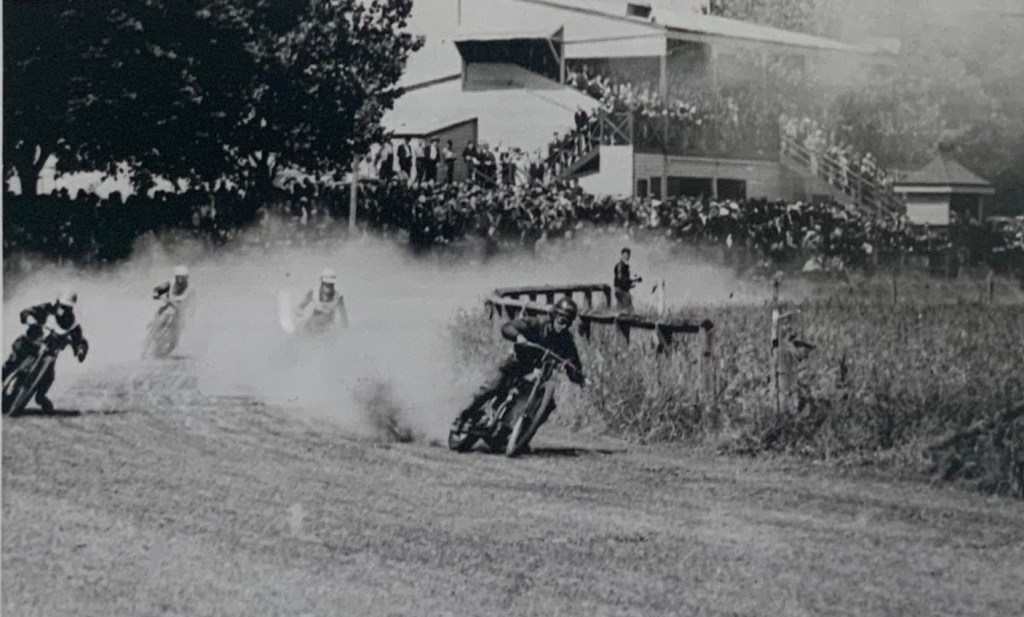
When I first saw the photos – the first one above and the second last – I thought no way were they in Australia, both had a USA feel to me, wrong on both counts.
The first is from me’ mate Bob King’s Collection and was taken at the Warragul Showgrounds pre-War. The last was shot at Drouin, just up the road, that both photographs were taken in two small West Gippsland townships close together 100km to Melbourne’s east is coincidental.
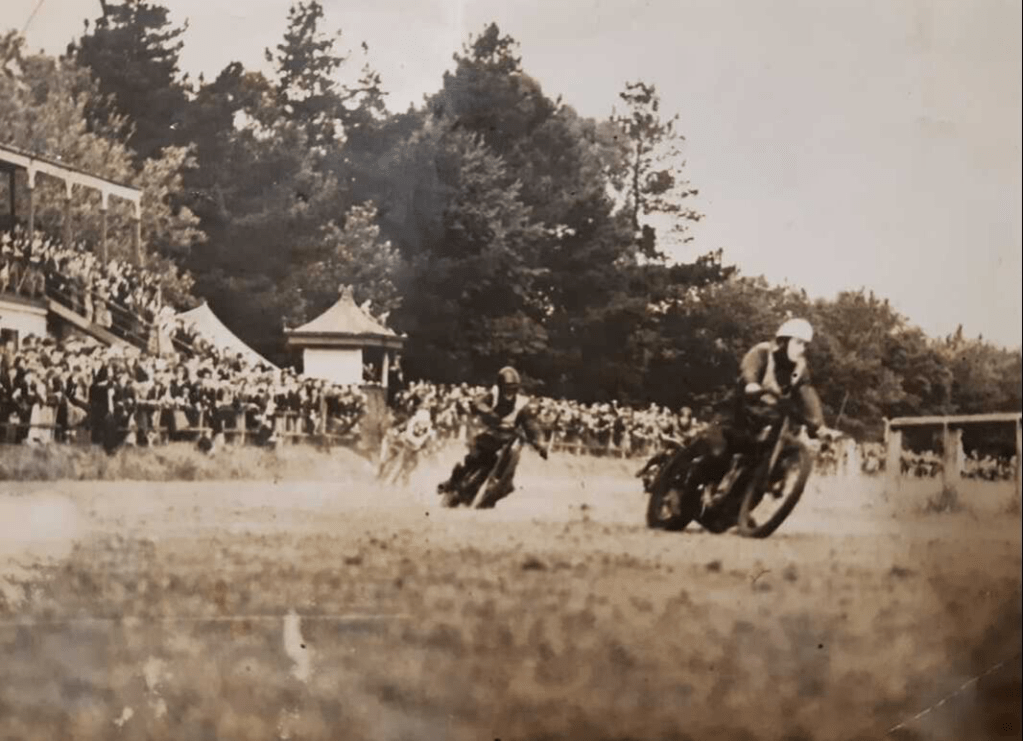
King’s caption for the ‘bike race photograph reads “Darby – in front – was killed in this race.” Sadly that is the case. A bit of judicious Troving confirms that the small Warragul community ran grass-track meetings on their local showgrounds from the mid-1920’s until 1941, with a final meeting, perhaps, in 1953. Ploughing through the results of meetings in the 1930s revealed that Leslie Edwin Darby is our man.
The Auto Cycle Union of Victoria sanctioned events were usually run over the Easter long-weekend on a track “6 1/2 furlongs” (1308 metres) long, timed after the speedway and trotting (nags) seasons had ended, these ran from November-April. As the photo shows, the crowds were huge, 6000-8000 people, not bad for community of less than 500 at the time.
Warragul Showgrounds really looks a nice place, it’s still there too. I often go the long way to Phillip Island via Drouin-Poowong-Loch-San Remo, a fabulous driving road devoid of The Fuzz, so time to do a Warragul detour next time. No details of the above (SRRH) Two riders at Warragul, no details (SRRH)
Darby was a star of the sport, holding over 30 Australian and Victorian grass track championship wins and over 150 placings. He had won four Victorian and Australian championships at Warragul in the 350 and 500cc classes. He also competed with success in road racing, holding the 250cc lap record at Phillip Island, in 1937 he set FTD at Rob Roy hillclimb, besting all the cars present.
Showing his adaptability, Darby also contested sidecar events, winning the Victorian Sidecar Championship in 1934, and placing third in the famous Victorian Tourist Trophy at Phillip Island held over 75 miles that same year.
Les had a lucky escape at Warragul in April 1936 when he crashed at high speed, somersaulting over a perimeter fence when his ‘bike struck it. Unharmed, other than by cuts and abrasions, he jumped aboard another machine and won the Australian All Powers Three Mile Championship. Warragul claimed three lives, its variety of ever present dangers were demonstrated by Bud Morrison who was thrown from his bike into an adjoining creek and nearly drowned before ambulance officers intervened, during the same 1936 meeting.
Poor Darby’s luck ran out in tragic circumstances on Boxing Day 1940. Shortly after passing the finish line at the end of the the final of the Gippsland Solo Scratch – in which he was battling Edward Smith for the win – Smith, narrowly the victor, lost control of his machine just after the line and fell. Darby swerved in avoidance and hit the fence at over 70mph before cannoning into the crowd. He was declared dead at West Gippsland Hospital shortly afterwards, aged 32. Two spectators were seriously injured but survived.
Les Darby is buried at Kew Cemetery, close to where I grew up, I shall make a pilgrimage to pay my respects soon.
(The Gazette – Warragul & Drouin)
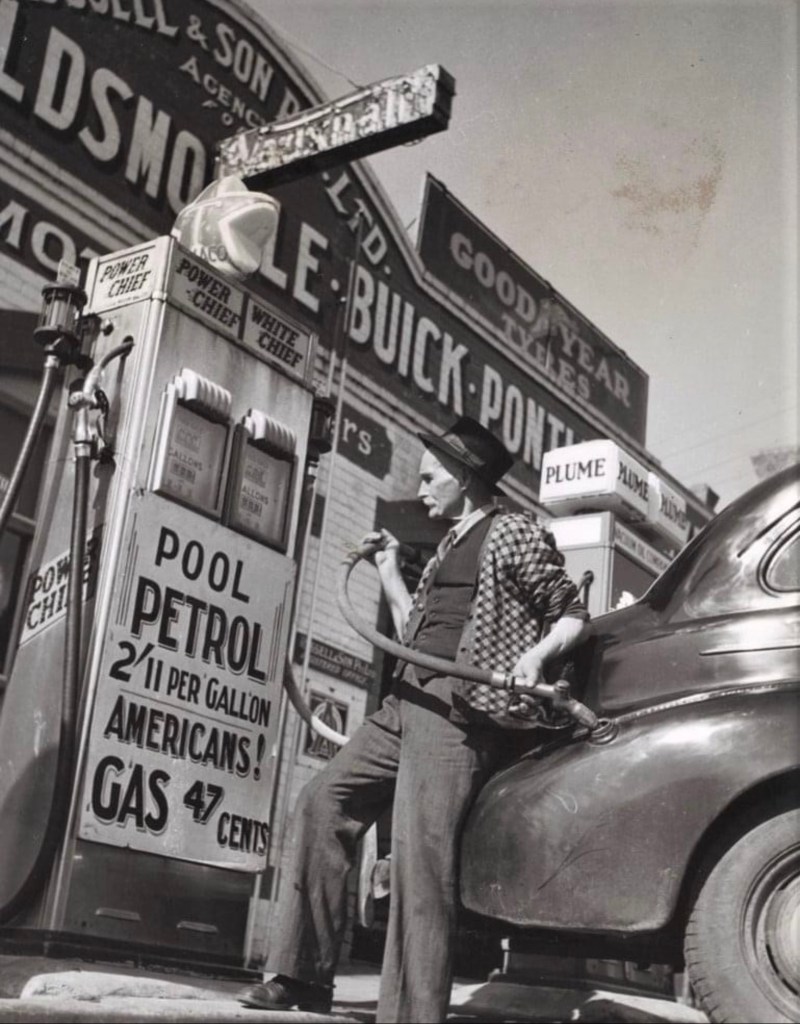
Thankfully the Drouin shot is happier but no less impactful.
William Russell is putting the four-gallon monthly ration of petrol into a customers car at Drouin in 1944. The sign is for the benefit of United States servicemen using the Princes Highway, a main Melbourne-Sydney artery.
The photo is one of a series of Drouin shots taken by government photographer Jim Fitzgerald (Australian Dept of Information) to document the impact of the war on ordinary people, they were used here and in the US.
William Russel & Son Pty. Ltd. the biggest servo in Drouin had two sites employing 16 people and appears a good business with franchises for Oldsmobile, Buick and Pontiac. Aged 80, William was still on-the-tools…
Born in Brechin, Scotland in 1865, a year later he emigrated to Australia with his parents and older brother, a voyage which took 95 days. William was apprenticed as a blacksmith, wheelwright and coach builder, acquiring the Monroe and Morse, Drouin business in 1890. As horsepower evolved from hooves to wheels the business evolved into a garage, car showroom and servo. William died on May 11 1950 and was such a highly respected member of the local community the hearse taking him on his final journey was followed by over 100 cars.
Credits…
Bob King Collection, Trove – various newspapers, The Gazette-Warragul and Drouin, motorsportmemorial.org, Speedway and Road Race History – SRRH
(B King Collection)
Tailpiece…
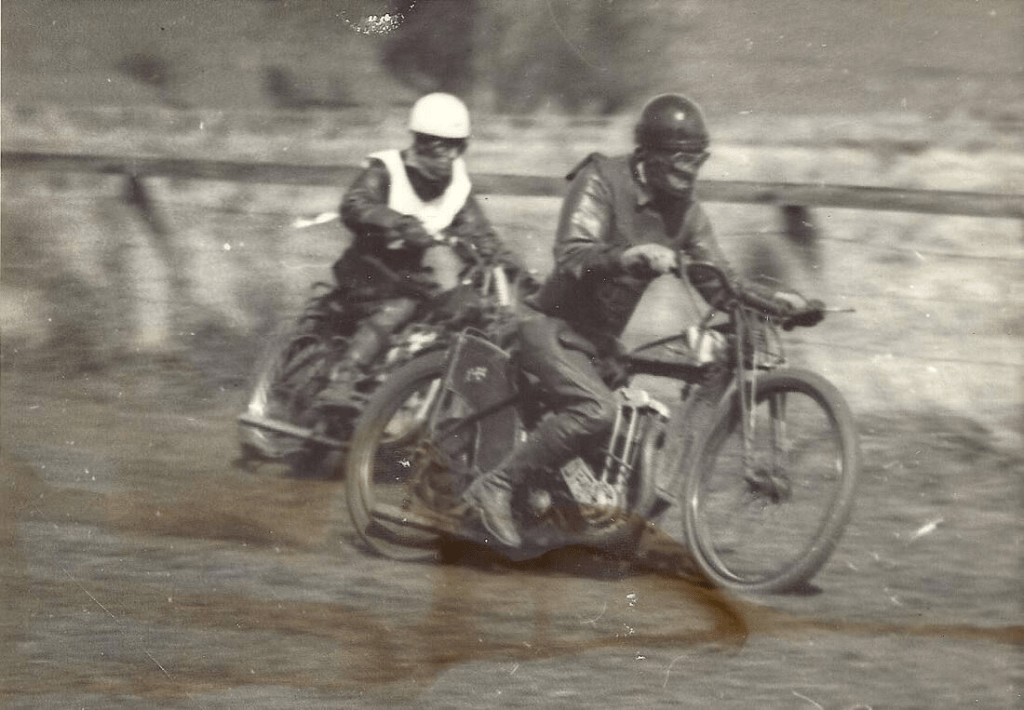
After I posted this article I sent it straight to Bob King who provided the shot, or more specifically I scanned it during one of our many illicit, keep-ya-sanity, Covid 19 trysts at his place in the winter of 2020. We Victorians were locked up tighter than a nun’s chastity belt by our beloved Dictator Dan (State Premier Dan Andrews) for most of that year, and a good chunk of 2021, bless the Chinese Alchemists and their magic potions.
His response was “All good stuff, I now recall the name of the patient who gave me the Darby photo, John Soutar, I believe. I think he raced against Darby, my last contact with him was 30 years ago, I just googled Soutars Garage, which is still in Warragul, may be worth a visit.”
There ya go, that explains the WTF photo above.
King’s caption for it is “John Soutar”. The scan was in Bob’s album above the one of Darby in action. I’m sure he made the connection two years ago when we were scanning away, this time the geriatric at fault is me not him…Still, we got there in the end, albeit I think Mr Soutar was a young fan rather than a competitor.
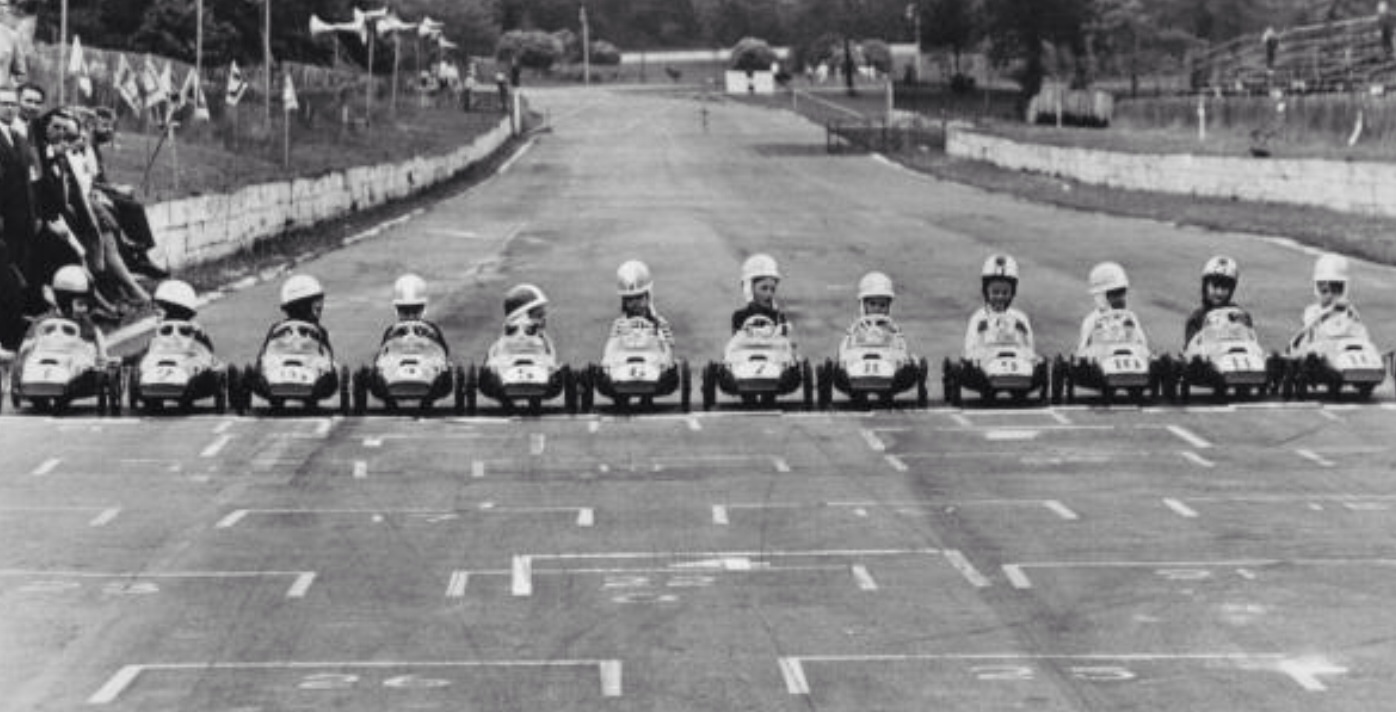
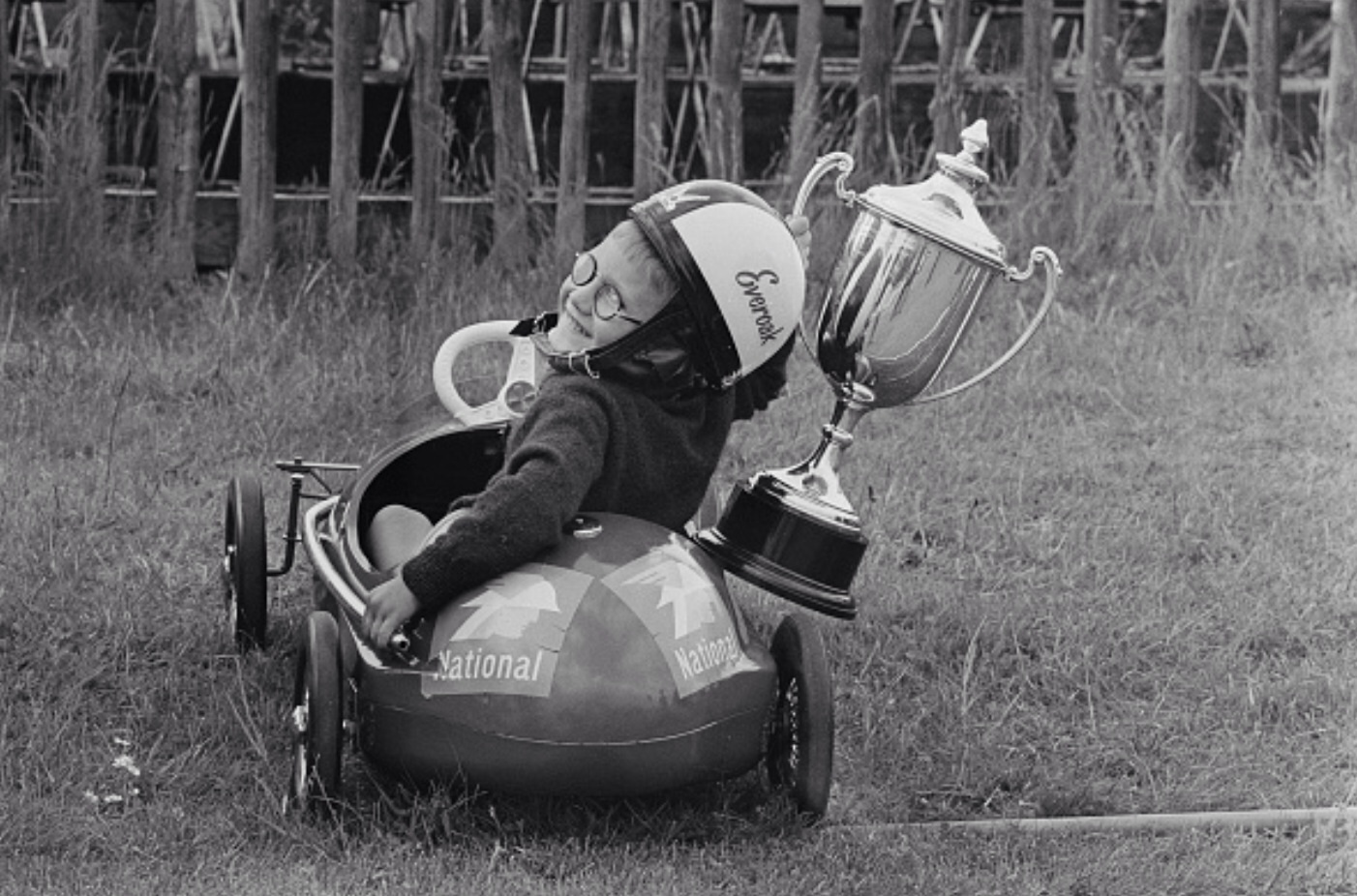
RAC Officials hold aloft Andrew Coombe, winner of the Junior Pedal Car GP at Crystal Palace in June 1967…
With specs like that the little fella probably didn’t have a successful racing career?! Are you out there Andrew, he would be about the right age to be reading about historic motorsport if he did get the bug?
Credit…
Peter Keegan
Tailpiece: Legend…
Done well too, it looks like Andrew had the capability to bring a race-budget to a team. I wonder what goods or services ‘National’ provided?
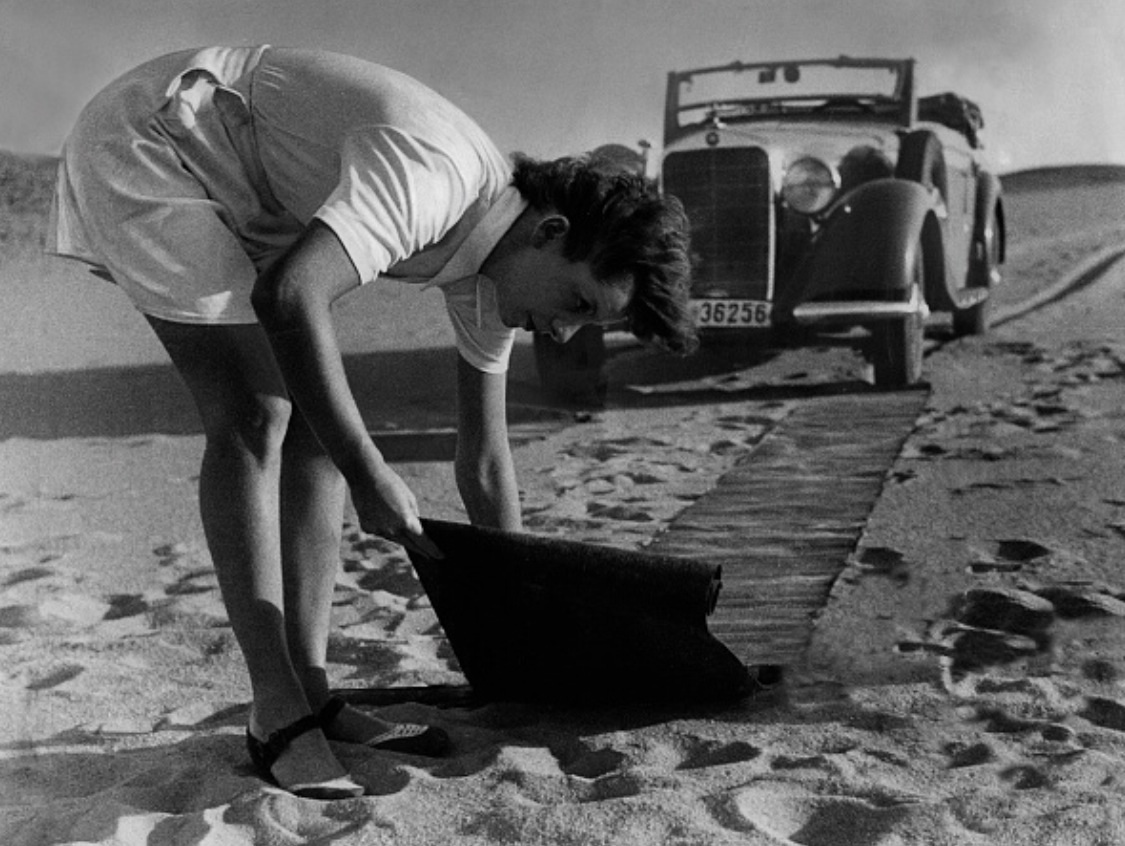
Google translate is pretty good but it choked on the German-English translation of this unusual scene…
Published in 1937, it’s probably a Benz magazine advertorial piece of some sort. I wonder what model it is – the car? Explanatory input welcome, I don’t think Mercedes were building ML’s back then.
















 primotipo...