Archive for the ‘Sports Racers’ Category

richie

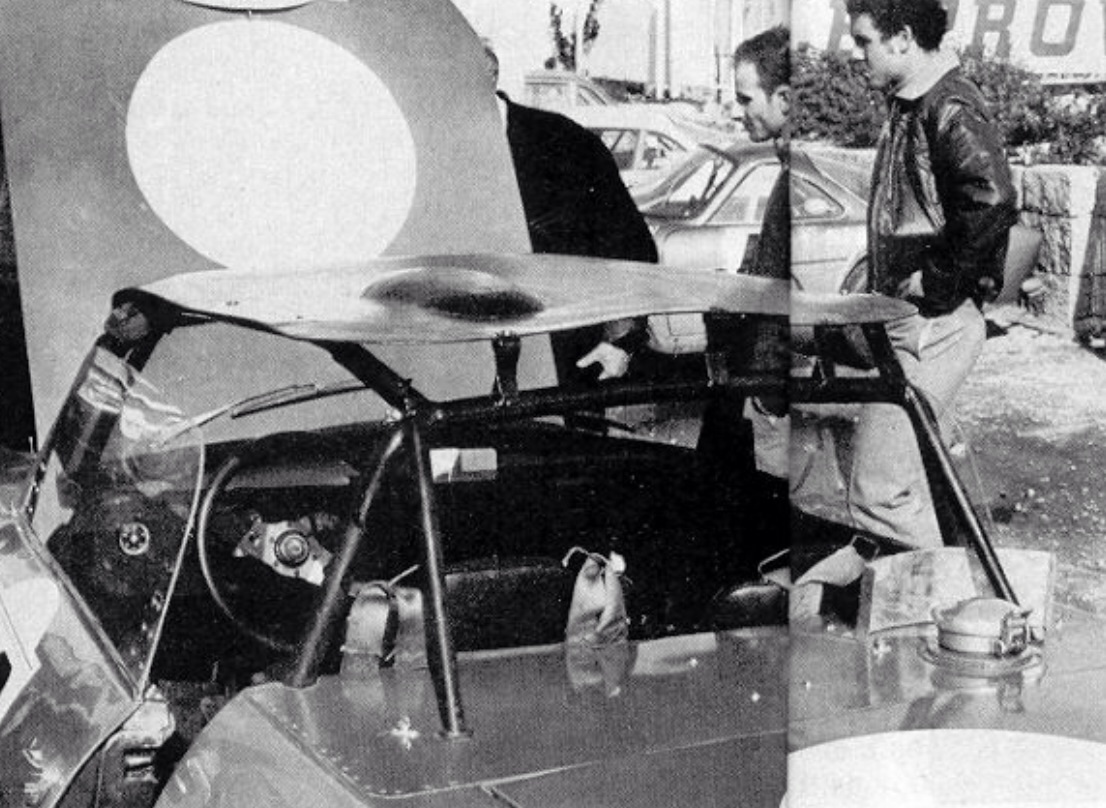
Richie Ginther surveys the damage he has inflicted upon his factory Ferrari during the 1960 Targa weekend…

The local kiddo’s are either surveying the scene with sympathy or thinking about what they can liberate from Enzo’s nice, new red car!

In fact the shot is a bit of a mystery upon doing a bit more research.

The Ferrari drivers were reshuffled after several accidents in practice of which this seems to be one as it isn’t the car in which Richie started the race with Cliff Allison. That was the #202 de-Dion rear axled TR59/60 pictured below; and in which Richie went off line passing a car and smote a tree a fatal blow for the car on lap 5.

image

Cliff Allison before the Targa start in the 250 Testa Rossa shared with Richie Ginther (unattributed)

Allison himself had a huge ‘character building’ accident in practice when a tyre failed in the Ferrari TRI/60 (independent rear suspension Testa Rossa) he was scheduled to share with Phil Hill.

So, the question is what model Ferrari is the one pictured at the articles outset? It looks as if it may have side-draft Webers, is it an old Monza ‘praps? One for you Ferrari experts.

The race was won by the Jo Bonnier/Hans Herrmann Porsche 718 RS60 a much more nimble conveyance around this circuit than the 3 litre V12 front-engined Fazz…

image

Graham Hill sitting in Jo Bonnier’s winning Porsche 718 RS60, Graham was cross-entered in the car. Don’t bend it Graham please! Hill was 5th is a similar car shared with Edgar Barth (unattributed)

Credit…

GP Library

image

This amazing 1931 poster advertising the Fiat 514 caught my eye, as its designer intended…‘Its of ‘monumental style design’, the 514 likened to a statue on a plinth, beaming out light into the darkness’.

The 514 was built between 1929 and 1932 in sedan, cabriolet and spyder bodies. The engine was a 1438cc 4 cylinder sidevalve with power outputs ranging from 28-37bhp for the 514A/MM performance variant.

Although Fiat stopped racing in the early 1930s, concentrating on road cars in the twenties they produced cars of sporting intent. Its most successful design was the Tipo 509, which dominated the Italian small-car market. The 509 was powered by a four-cylinder 990cc OHC engine.

image

1932 Mille Miglia; the #9 37th place Fiat 514MM of ‘Frate Ignoto’-Arturo Mercanti/Francani ahead of the Bettinazi brothers 35th placed Fiat 514 CA Spider in the Montalcino/Radicofani area near Siena. the race was won by the Borzacchini/Bignami Alfa 8C2300 Spider Touring (Guerrini)

The 1929 514, its replacement was introduced into much tougher economic times and used a simpler 1.5-litre sidevalve four. The 514 was conventional; it had semi-elliptic springing all round, a 4 speed gearbox and 4 wheel mechanical brakes, adoption of hydraulic brakes part way through the cars production cycle being the models most important development.

Together with the standard cars Fiat introduced a trio of sporting roadsters; the 514S, 514MM and 514CA, ‘MM’ signifying Mille Miglia and ‘CA’ Coppa del Alpi (Alpine Cup). The 514S and 514CA used the standard (2,555mm) wheelbase whilst the MM used the longer (2,770mm) chassis shared with the 514 van. All used tuned engines; the 514S had 34.5bhp, the MM and CA had engines developing 37bhp. Top speed of these cars was circa 112km/h (70mph).

Credit…

Hutton Archive, Bruno Guerrini, Bonhams

Tailpiece: 1930 514 Roadster…

image


Kieft De Soto…

Posted: October 18, 2016 in Fotos, Sports Racers
Tags: ,
image

(Richard Taylor)

Terry Cornelius unleashing all of the Kieft De Soto’s 350 V8 horses, blasting the car he co-constructed along Eastern Creeks long main straight…

Regular readers may remember the article I wrote some months back about the Kieft De Soto… https://primotipo.com/2016/06/03/kieft-de-soto-v8/

A few days ago Terry Cornelius, builder of the cars curvaceous body got in touch with a photo and this anecdote, I’ve put it into the article, but wanted to share it as well rather than just ‘lose it’ in the archive.

Here tis…

‘I got to be part of the Goodwood Revival Team with the two cars (Kieft Coventry Climax GP car and Kieft De Soto Sportscar) and its something I’ll never forget!

Your article told how upon return from Goodwood, the Kieft De Soto raced in the Eastern Creek ‘Summer Historics’, and perhaps understandably did not mention that Victoria Morris very kindly put yours truly behind the wheel in the regularity events, with Greg Snape at the wheel in the races.

I had driven the car on the road, but this was a new experience in spite of having accomplished many years of motor racing, mostly in the Historic arena.

The start of Regularity events is a casual affair, and its ok to go as fast or slow as you choose, preferably regularly! I found myself, in the last of my events, at the rear of the field with a beautiful C Type Jaguar replica just in front. Well, I knew what I had to do, and I felt I had come to grips with the Kieft after the previous couple of events. At the end when the chequered flag eventually dropped, I had a substantial lead on the Jag.

So what? I hear you say. Well, let me explain…

When Bill Morris (the driver/engineer/entrepreneur who owned and reconstructed both Kiefts) was weighing up the pros and cons of the resurrection project of the Kieft sportscar, he took into consideration the method used by the English authorities to separate the various historic classifications. It seems that the Kieft, via its drum brakes, would fall into a category which was being dominated by the C Type Jags, also drum braked. Bill felt at the time, taking that booming V8 engine into consideration, he could well be on a sure winner. Little did he realise that he wouldn’t be around to enjoy his prophecy.

I think its only fair that I be allowed to feel that I had brought some poetic justice home in Bill’s memory’…

Credit…

Terry Cornelius, many thanks

Richard Taylor photo
mille miglis

(Max Staub)

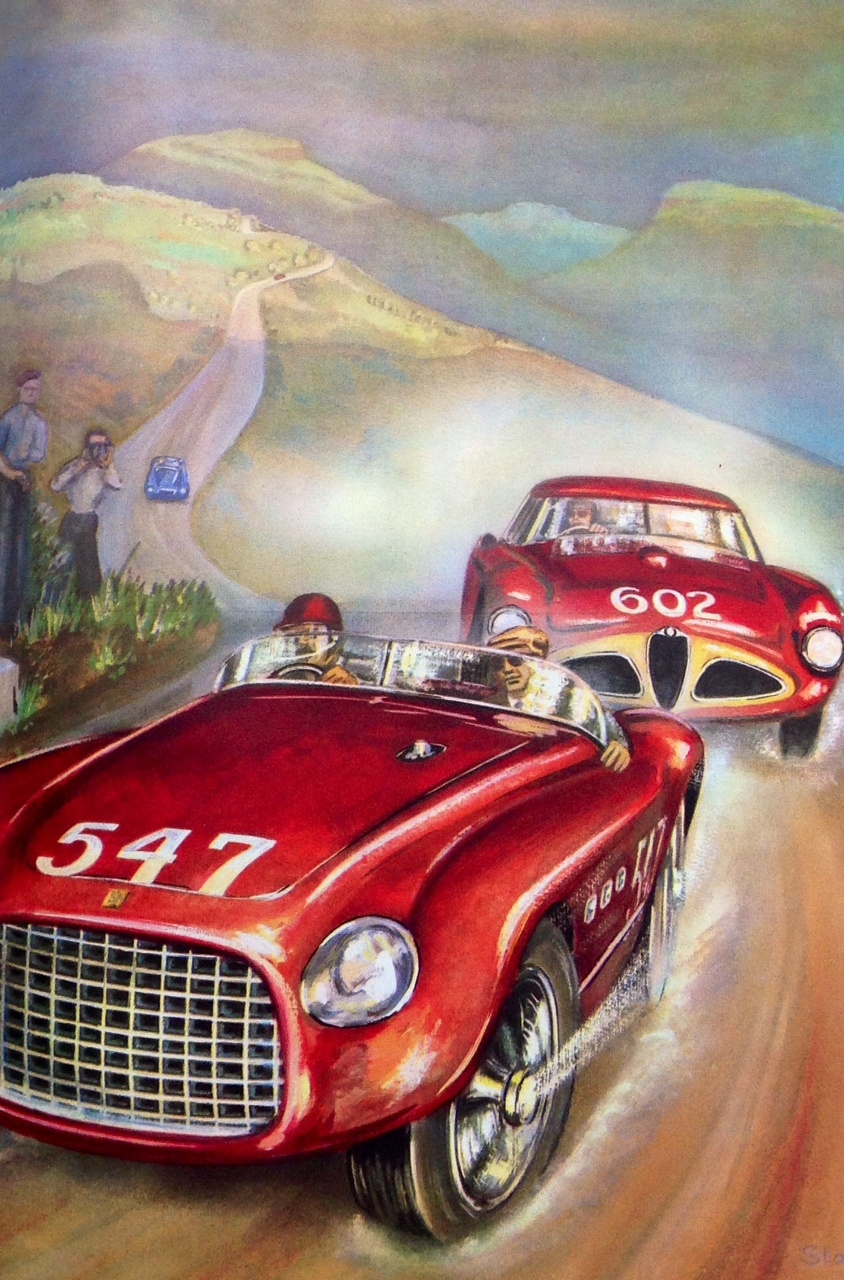
Count Giannino Marzotto and Nearco Crosaro spur their Ferrari 340MM on ahead of Fangio’s Alfa Romeo 6C3000CM during the 1953 Mille Miglia…

The Italian duo won the race, held from 25-26 April by nearly 12 minutes over Fangio’s car navigated by Giulio Sala and Felice Bonetto/U Peruzzi Lancia D20.

The new Alfa’s, powered by a 3 litre DOHC 6 cylinder engine led 4/5ths of the race but Marzotto’s victory was emphatic, he broke  the average speed record set in 1938, leaving it at 142kmh.

Credit…Max Staub

image

(Jarnoux)

Jack Brabham and Francois Cevert ecstatic after winning the 1970 1000 Km of Paris at Montlhery on 18 October, Matra MS660…

Its interesting to look at the absolute delight they have and reflect on their relative careers right then and there; for Jack it was his last ‘International’ win before his ‘retirement’. Yes he did have a few appearances in touring cars in Oz in the 1970’s, not to forget his works Porsche 956B drive at Sandown’s World Endurance Championship race in 1984 but in reality 1970 was ‘it’ after a long, vastly successful career.

For Francois it was the year he broke into F1, Johnny Servoz-Gavin’s premature retirement with an eye injury gave Francois his opportunity in Ken Tyrrell’s March 701, one he embraced with both hands and capitalised upon. The world was at the talented Frenchman’s feet.

I wrote articles about Jack’s 1969/70 seasons and Francois’ early years, click on these links to read the articles which remain amongst my ‘most read’; https://primotipo.com/2014/09/01/easter-bathurst-1969-jack-brabham-1970-et-al/ and; https://primotipo.com/2014/11/07/francois-cevert-formative-years/

image

Brabham in the works Aston DBR1 he shared with Stirling Moss at the Nurburgring 1000Km in 1958, JB very much in a support role that day (unattributed)

I don’t think of Jack as a sportscar driver although he started his professional sportscar career with a bang really; first in the 1958 Nurburgring 1000Km with Stirling Moss and second in the Tourist Trophy at Goodwood with Roy Salvadori in works Aston Martin DBR1’s.

But he was such a busy boy in the 1960’s he simply didn’t have the time for sporties; driving and testing Coopers, then forming Motor Racing Developments with Ron Tauranac. Brabham Racing Organisation entered and raced the F1 cars, he had garage and conversion businesses, ghosted magazine articles and depending upon the season raced in F1, F2, Indy not to forget the 7 or 8 Internationals/Tasman Series events he did in Australasia in January/February. Commercially it also made sense, other than the BT8, MRD didn’t build sportscars, so why not focus on what you sell?

So, his events in two seaters are relatively rare in the pantheon of his long career, a good obscure topic for an article actually!

image

Monaco collage 1970, 2nd in the race won by Jochen Rindt’s Lotus 49D Ford. Brabham BT33 Ford (Schlegelmilch)

1970 was his ‘last racing season’ though. He had promised his wife Betty he would retire at the end of 1969 and having got the ‘leave pass’ which was pretty much forced upon him when Jochen Rindt decided to stay at Lotus, had one of his busiest season in ’70.

Jochen told Jack he was returning to Brabham but changed his mind when Colin Chapman made him an offer too good to refuse. So Jack raced on, a rethink forced upon him as by that stage no other number 1 drivers were available. So Jack made every post a winner; he raced F1, F2, Indy and most of the endurance events Equipe Matra Elf contested in 1970.

It wasn’t a ‘cruise and collect’ year for Jack though, he was still razor sharp, famously winning the season opening South African GP in Tauranac’s first monocoque F1 car, the Brabham BT33. He lost Monaco to Rindt after a last lap fumble under pressure from Jochen and the British GP to Jochen again, when, leading and driving away from the Austrian’s Lotus 72, he ran light on fuel, an error ‘credited’ to Ron Dennis, then his mechanic.

image

Nice portrait of Jack at LeMans in 1970; at 44 he was as fast as the ‘quicks’ of the era, anyone who can hang onto Rindt at the peak of his powers is not too shabby, at 44 Jack was still ‘up there’ to say the least (Getty)

Brabham spoke about the pleasure of just ‘rocking up to drive for Matra’ in the biography he wrote with Doug Nye; ‘…to drive a car someone else had to develop and prepare was a rare luxury, which i really enjoyed’.

In 1970 Matra contested the Daytona 24 Hours and Sebring 12 Hours in America, then in Europe the Brands Hatch and Monza 1000Km events and of course the Le Mans 24 Hours in June. They elected not to race Targa, the Spa and Nurburgring 1000Km events and the championship season ending Watkins Glen 6 Hour back in North America on 18 October.

The endurance championship that year was dominated by the 5 litre, 12 cylinder Porsche 917 and Ferrari 512S, the dominant ‘small car’, the 3 litre Porsche 908/3 which mopped up the events on circuits so suited; Targa and Nurburgring.

image

Brabham in the MS650 he shared with Jean-Pierre Beltoise to 12th, Pedro Rodriguez beat the rest of the field in a blinding Porsche 917 display . Brands 1000Km 1970 (Schlegelmilch)


Matra’s primary 1970 tool was an updated 1969 Matra MS650, the new MS660 made its debut in the hands of Jean-Pierre Beltoise and Henri Pescarolo at Le Mans. The car raced at the Sarthe by Brabham and and Francois Cevert was the earlier MS650, both cars retired with engine failure within 3 laps of each other (laps 79 and 76 respectively)

Brabham was paired with Cevert at Daytona, the duo bringing the V12 engined car home in 10th place, the race run on 31 January/1 February 1970. Brabham didn’t contest the next round at Sebring, ‘his car’ paired Dan Gurney with Francois in a one-off drive. Henri Pesccarolo and Johnny Servoz Gavin achived the best championship Matra result for the season in 4th place, the race won by the Ferrari 512S of Ignzio Giunti, Nino Vaccarella and Mario Andretti.

The Brands Hatch 1000Km on April 12 was a famous demonstration of driving mastery by Pedro Rodriguez, the Mexican sportscar ace flinging his demanding, fidgety 5 litre Porsche 917K in the wet as though it were a Merlyn Formula Ford from one of the support races. Jack was paired with JPB, the duo were 12th.

At Monza later in the month the duo were 5th in the race won by the Rodriguez/Kinnunen JW Automotive Porsche 917K.

image

Brabham ahead of a Lola T70 Mk3B Chev, Montlhery 1970 (Jarnoux)

With the Manufacturers Championship decided in Porsche’s favour from Ferrari and Alfa Romeo the Montlhery race was a chance for Matra to win in front of its home crowd.

The annual enduro wasn’t a Manufacturers’ Championship round, as stated above, but always had a good amateur entry. Matra entered two cars, the Linas-Montlhéry circuit only a few miles from its Velizy home base. Both cars were MS660’s, Beltoise and Pescarolo, drove a ‘sprinter’ variant, lightened a lot compared to Le Mans spec. The weight loss was achieved by deletion of lights, the charging system and the use of a Hewland gearbox rather than heavier, stronger ZF unit. The engine was the GP variant of the V12, able to use 11,000 r.p.m. against the normal 10,500 r.p.m. endurance limit. The other heavier ‘Le Mans spec’ car was driven by Jack and Francois.

There was no factory opposition to Matra but the Martini International Racing Team/Team AAW, had a 917 Porsche driven by Gerard Larrousse and Gijs van Lennep, as well as their Porsche 908’s, piloted by Rudy Lins/Helmut Marko and Claude Ballot-Lena/ Guy Chasseuil, the other 29 cars were private entries.

image

‘MotorSport’s’ race report said; ‘A circuit of 7.821 kilometres long was used, comprising half of the banked track, with chicanes at each end of the banking, and part of the road course, and the race was over 128 laps and was run in warm and fine weather. Beltoise set the pace with the lightened Matra 660 and only van Lennep proved to be any sort of challenge, but the 917 engine broke early in the race leaving the Beltoise/Pescarolo car unchallenged. Robbed of his drive in the 917, Larrousse took over the 908 of Ballot-Lena/Chasseuil, and after a slow start Brabham and Cevert moved up into second place.

The leading Matra ran into trouble with its Hewland gearbox, due to the oil breather system not being right, and after some delays at the pits the car was forced out of the race by horrid noises in its transmission, this letting the second Matra take command. In second place was the carefully driven, privately-owned Ferrari 512S of the Spaniard José Juncadella, with the young French driver Jabouille as his partner. In spite of retiring, the lightweight Matra was classified in fourth position’.

660 drawing

Matra MS660…

The MS630/650 had multi-tubular spaceframe chassis, the 660 one of Velizy’s famed aluminium monocoques clothed in a very sexy, swoopy aerodynamically clean and efficient Spyder body.

The 2993cc 60 degree, all aluminium, quad cam, 4 valve, Lucas injected V12, ever evolving in detail spec, engine was a common element of both cars and gave circa 400bhp. The ZF 5 DS25 5 speed gearbox was also a common element although the Hewland FG400 unit was also used.

Ventilated brakes used ATE calipers, steering was Matra rack and pinion, the suspension period typical; upper and lower wishbones and coil spring/shocks at the front and single top link, twin parallel lower links, two radius rods and coil spring/shocks at the rear. Adjustable roll bars front and rear. Weight was circa 700Kg dependent upon spec.

Credits…

MotorSport December 1970, Patrick Jarnoux, Rainer Schlegelmilch

Tailpiece: Francois Cevert caressses the sleek, swoopy MS660 around Montlhery, 1970…

image


image

(GP Library)

The 1952 German Grand Prix was won by Alberto Ascari’s Ferrari 500, a fairly predictable result in 1952/3…


image

The dominant F2 GP 1952/3 combo of Ascari and Ferrari 500, on his way to a Nurburgring 1952 victory. Teammates Farina and Fischer were 2nd/3rd in similar Fazz 500’s (GP Library)

A huge field of cars contested the sportscar supporting event, after a spirited dice pre-War Mercedes GP ace Hans Hermann #21 won from post-War Mercedes GP driver Karl Kling #24 both driving the Benz W194 300 SL heading into the North Curve (below).

The 300SL Coupe won the LeMans 24 Hours that June, Lang shared the drive with Fritz Riess, the win important in a series of steps which took the company back into GP racing in 1954. And in putting into production a road-going variant of the 300SL!

Click here for my article on the 300SL; https://primotipo.com/2014/05/15/i-like-the-smell-of-leather/

image

(unattributed)


image

Start of the sportscar race, i’ll take any help you have with car/driver combinations; #21 Hermann, #24 Kling excepted! (GP Library)

image

Top Down; Victory ceremony with Hermann and Klings cars in shot. No idea in 300SL!. #23 Theo Helfrich in 300SL, the ‘slight’ frame of Benz famous team-manager Neubauer readily evident (GP Library)

Credit…

GP Library

Tailpiece: 300SL Coupe Beauty…

image

Famously it was Max Hoffman, the New York based importer of VW at the time who insisted the 300SL W194 racer be ‘productionised’, selling like hotcakes given its beauty and technical specifications, the Americans taking circa 80% of the 1400 cars built. This car has Klings #24, clearly he raced the Sporty rather than the Coupe. Nurburgring 1952 (GP Library)

image


image

Jack Sears chases Graham Hill, #21 Dan Gurney, Denny Hulme and Mike Salmon in line astern; AC Shelby Cobra, Ferrari 330P, Shelby Cobra Daytona Coupe, Brabham BT8 Climax and Aston Martin DP214, 29 August 1964…

This group of cars is indicative of the quality of the field, Hill won the race of changing fortunes from David Piper’s Ferrari 250LM and Dan Gurney’s Shelby Cobra Daytona Coupe.

image
Clark and Lotus 30 Ford during practice. Thats Team Lotus’ Jim Endruweit behind the car and deer-stalker topped John Bolster with the headset on. Pitstops during the race not so serene! (unattributed)

Entry…

The Tourist Trophy is a much coveted sportscar victory, the 29th running of the classic at Goodwood on 29 August 1964 was no exception to the strong field of entrants…

The drawcards were GeePee drivers Bruce McLaren, Jim Clark and Graham Hill in outright contenders: ex-Penske ‘Zerex Spl’ Cooper Olds, works Lotus 30 Ford and Maranello Concessionaires Ferrari 330P respectively. Other potential frontrunners were David Piper’s Ferrari 250LM and five AC Shelby Cobras driven by Dan Gurney, Phil Hill, Jack Sears, Bob Olthoff and Roy Salvadori.

Denny Hulme and Hugh Dibley raced Brabham BT8 Climaxes. John Surtees, Richie Ginther, Innes Ireland and Tony Maggs Ferrari GTOs. Most of the drivers elected to race the 132 miles solo, it was a  typically spectacular international grid of sporties of the day.

image
Goodwood paddock; #23 Jack Sears Shelby Cobra, #22 Phil Hill and alongside him, Dan Gurney in Shelby Cobra Daytona Coupes (unattributed)

Graham Hill ponders the speed of his Maranello Concessionaires entered 4-litre Ferrari 330P chassis #0818 during practice. It may not have been the quickest car in the race but it had the endurance the Group 7 sprinters lacked.

image
goo start
The start, front row L>R; McLaren, Clark and Hill, Hugh Dibley in the white Brabham BT8 Climax, #4 Piper Ferrari 250LM (unattributed)

The Race…

Bruce popped the Zerex on pole from Clark, Hill and Dibley. Dan was the quickest of the GTs in his big, booming Cobra.

From the start McLaren led from a ‘very busy’ Clark, the Lotus much more of a handful than Bruce’s mongrel-Cooper T51 based special! Denny was third in his nimble Brabham with Trevor Taylor’s Elva BMW in fourth. Bruce’ clutch failed to transmit the power of his ally-Olds V8 and retired. The order was then Clark, Hulme, Taylor and Hill G. After 25 laps Piper and Salvadori were a lap back such was the pace of the frontrunners.

image
Dan Gurney was third in the best placed Shelby American entered Daytona Cobra Coupe (Getty)
image
(LAT)

Graham Hill spun the Ferrari at Woodcote on lap 17, Tony Maggs whips past in David Piper’s Ferrari GTO, the South African finished tenth.

Graham started to push, coming up to third, then second. Clark pitted for fuel on lap 64 giving Hill the lead, more drama for Clark as the Lotus had been under-filled, another 15 gallons were added, and oil, then the hot motor wouldn’t fire; by this stage Hill was nearly a minute up the road.

Clark then treated the crowd to a superb demonstration of on the limit driving ‘… in a hurry, needing all the road. He would come out of Woodcote, dust rising as the tail of the Lotus 30 touched the verge, accelerate in a burst of power that lifted the nose, slip through the chicane and like as not use the kerb out of it to bounce the car straight. Stop watches were out, Clark might close on Hill a couple of laps from the end…’

But it was not to be, Clark made a third pitstop when the car felt odd, the diagnosis was a bottom wishbone locking ring had slackened off and was contacting a front wheel, so Graham Hill’s 330P Ferrari won from Piper’s 250LM, then came the AC Cobras of Gurney, Sears and Olthoff in coupe, sports and hardtop respectively! Hills average speed was 97.13mph and Bruce McLaren set a new sportscr car lap record of 1:23.8 in the Zerex Cooper Olds before his retirement early in the race.

Etcetera…

goo piper
David Piper’s Ferrari 250LM (unattributed)
goo hill
Hill, Fazz 330P (unattributed)

Credits…

MotorSport October 1964, Sutton Images, LAT

Tailpiece…

image
(Sutton)

The TT would have been a nice win for the Lotus 30 Ford, not Chapman’s greatest bit of work. Clark at speed…

Finito…

jean behra portrait

(Yves Debraine)

Jean Behra portrait taken by Yves Debraine in 1959, the year in which he died at the wheel of a Porsche RSK at Avus…

Not an article about this great and perhaps underrated driver but rather some 1959 snippets.

The shot below is of Behra at the wheel of the works Ferrari 250TR59 at Brunnchen, the Nurburgring on 7 June 1959. He and Tony Brooks were 3rd in the race won by Stirling Moss and Jack Fairman in an Aston Martin DBR1.

image

(Klemantaski Collection)

The great Frenchman switched from BRM to Ferrari in 1959, he started the year well winning the non-championship ‘BARC 200’ at Aintree, one of three non-champ events in the UK before the first F1 title events commenced at Monaco in May.

‘BARC 200’ Aintree on 18 April

In an encouraging start to the season Jean won the race from teammate Tony Brooks and Bruce McLaren’s works Cooper T45 Climax.

image

Monaco Grand Prix…

At the tiny principality Jean (below) was both a driver and entrant, he had built a Porsche RSK based F2 car which he entered for Maria de Filippis.

image

Despite her best efforts she couldn’t qualify the car amongst the mixed grid of F1 and F2 cars. In a sign of the times, and Porsche’s commitment to open-wheelers the factory built and entered their own car which was raced by Taffy Von Trips until a collision with Cliff Allison in an F2 Ferrari Dino.

The car, based on a new RSK had a tubular chassis built by Valerio Colotti (then of Maserati and later of transmission fame) which picked up the original front and rear suspension. The machine followed the general principles of the donor with track and wheelbase the same. The driver was placed centrally of course, the 4 cam spyder engine, gearbox, battery ignition, dynamo starter were all retained.

Colotti’s neat aluminium body was beautifully formed, the result low, streamlined and small given the cars underpinnings. DSJ’s Motorsport report of the event likened it to the Sacha-Gordini of several years before. The circa 150bhp F2 car proved to be prodigiously fast. Hans Hermann raced it for Behra at the Reims GP on 5 July finishing 2nd only to Stirling Moss’ Rob Walker Cooper T45 Borgward…in the process beating the factory Porsches of Von Trips and Bonnier and Allison’s Ferrari 156 much to the consternation of the Maranello management.

Click here for further details on this interesting car;  https://revsinstitute.org/the-collection/1958-porsche-behra-formula-ii/

image

The shot above is de Filippis in Behra’s Porsche Spl during Monaco practice, the lines of Colotti’s car sleek and low.

Below the field blasts off at the start, Behra in the middle is first away in the snub-nosed Dino from Moss on the left and Brabham on the right in Cooper T51 Climaxes, Rob Walker’s for Stirling and the works car for Jack, the latter on the way to his first GP win.

image

(unattributed)

Further back is #48 Phil Hill’s Dino 4th, #50 Tony Brooks 2nd placed Dino and Jo Bonnier #18 in the first of the BRM P25’s DNF.

The photo below shows Stirling Moss chasing Behra’s Ferrari, the Frenchman led the race until Stirling got past on lap 21 and then Brabham, after the Ferrari had engine failure on lap 22. Jack went on to take his first championship win.

image

Moss, Cooper T51 Climax chasing Behra Ferrari Dino early in the race (unattributed)

Sportscars…

Jean contested 4 of the World Sportscar championship events from March to June in the Ferrari TR250, his best results 2nd at Sebring with Cliff Allison and 3rd at the Nurburgring with Tony Brooks. The latter combination failed to finish Targa and at Le Mans Jean and Dan Gurney were out on lap 129 with gearbox problems.

jean sebring

Behra during the 21 March 1959 Sebring 12 Hours, he was 2nd in this Ferrari 250 TR/59, the winning car the sister entry driven by Gurney/Daigh/Hill/Gendebien (TEN)

image

Talking to co-driver Tony Brooks during the Targa weekend on 24 May, the winner was Barth/Seidel Porsche 718 RSK, the factory cars all DNF (unattributed)

Dutch Grand Prix, Zandvoort, and 1959…

Behra’s Ferrari Dino 246 being fettled in the Zandvoort paddock, cars were entered for him, Cliff Allison and Phil Hill qualifying 4th, 8th and 12th respectively with Bonnier’s BRM P25 on pole. His promise in practice was fulfilled in the race with the first championship win for the Bourne concern.

image

(Inside the motorsport paddock)

Behra below chasing Stirling Moss’ Cooper T45, he qualified 4th and finished in the same position, Brabham and Gregory were 2nd and 3rd underlying the performance of the 2.5 Coopers on a course which required a blend of power and handling.

image

Behra chasing Moss, the lines of the ’59 Dino about as good as a front engined GP car got? (Cahier)

French GP…

Onto Reims, Jean’s home race of course where things totally unravelled.

In a year in which the mid-engined revolution took hold, full 2.5 litre FPF Coventry Climax engines made clear the performance advantage of the Coopers, Ferrari only had an advantage on the faster courses of which Reims was one.

Some reports have it that Behra, a handy mechanic with great mechanical sympathy was over driving and abusing his engines in the final months of his life in his efforts to remain competitive.

image

Beautiful Reims first lap, 5 July 1959. Brooks winning Dino from Jack’s Cooper T51 3rd, #26 Hill’s Dino 2nd #10 Gregory’s Cooper T51 DNF, #2 Moss’ BRM P25 and McLaren’s Cooper T51 5th then the rest strung out thru Champagne country (unattributed)


Brooks was on pole with Phil Hill 3rd on the grid, Jean was on the 2nd row. Tony Brooks Ferrari 246 convincingly won the race in a great display of high speed precision driving in an event made incredibly demanding due to heat and stones thrown up by cars as the tracks surface suffered.

Jean qualified 5th and raced hard, having been left on the line, he made a lunge for 2nd on lap 25, but spun and dropped back to 4th. He equalled the lap record set by Trintignant on lap 28, he was racing for a hometown win after all, only for the cars engine to cry ‘enough’ on lap 29, he was out with piston failure.

The only member of the Scuderia driver line-up that year that didn’t speak English, fired up after the race, he had a ‘spirited’ exchange with team manager Romolo Tavoni. Tavoni glanced at the cars rev counter ‘tell tale’ in the pits and began, very unwisely, his driver full of adrenalin, to remonstrate with him about one-too-many over-rev and subsequent engine failure. The stocky Frenchman thumped him, knocking him over with one punch. Inevitably and predictably Jean was ‘shown the Maranello door’ giving Dan Gurney a Ferrari opportunity he took full advantage of.

image

Behra hustling his Dino hard, too hard perhaps, at Reims during the ’59 French GP (unattributed)

Ferrari missed the following GeePee at Aintree with industrial strikes in Italy but returned to the fray at Avus for the 2 August German GP.

Jean made contact with Raymond Mays to return to the BRM team there, but there was not the time or resources to make available a P25.

Jean therefore entered and qualified the 1.5 litre F2 Behra Porsche (pictured above) 16th of 17 cars but didn’t take the start of the GP after crashing, in the wet at over 100mph in a Porsche RSK in a support race. He died instantly in the awful accident in which he was flung from the car, hit a flagpole on the bankings outer extremity and then dropped into the outfield below.

A bright, charismatic light was extinguished.

Credits…

Yves Debraine, Louis Klemantaski, Cahier Archive, The Enthusiast Network, MotorSport June 1959/March 1998

Tailpiece: Le Mans 20-21 June 1959. Behra at the wheel of the car he shred with Dan Gurney DNF with gearbox problems on lap 129…

image

This race famously won by the Shelby/Salvadori Aston Martin DBR1, none of the factory TR’s finished the race (unattributed)


image

‘The good news is the car isn’t completely rooted, the bad news is I can’t get it going…’

Eric Thomson giving the Aston Martin team the sad news that the impressive run by the big Lagonda (Development Project) DP115 V12 has come to an abrupt halt. As the pictures show it was not for lack of trying. He spun and crashed the car in The Esses.

Thomson got the car mobile and back to the pits but it was retired after completing 26 laps, co-driver Dennis Poore didn’t get a drive in the race. Froilan Gonzalez and Maurice Trintignant won in a Ferrari 375 Plus, click on this article i wrote a while back;

Le Mans 1954…

image

No doubt there were plenty of yellow flags but Thomson was exposed as he successfully got the car running. Passing is the Pilette/Gilberte Gordini T17S DNF and Moss/Walker Jag D Type DNF, ’54 the D’s first Le Mans (Jack Garofalo)


image

(Klemantaski)

Eric Thomson blasts the brutally handsome Lagonda DP115 towards ‘White House’ during the early hours of the ’54 Le Mans…

He was running strongly in 3rd place at that stage of the race in a field that year which included the Ferrari 375 Plus, D Type Jags making their Le Mans debut, Cunningham C4R Chrysler V8’s, the DB3S were also potential outright cars in the ‘right circumstances’, the V6 Lancia D24’s and Porsche 550 Spyders to ‘pick up the scraps’.

image

Some ‘delicate’ panel beating of the Lagonda’s aluminium flanks by Eric (Jack Garofalo)


image

Lagonda DP115; Chassis tubular, front suspension trailing links, transverse torsion bars. Rear de Dion, trailing links & torsion bars, roll bars front and rear. Drum brakes.  Engine; 60 degree, aluminium 4486cc DOHC, 2 valve V12. 3 Weber IFC4 carbs, bore/stroke 82.5mmx69.8mm, compression ration 8.5:1. Circa 310bhp@7500rpm. Gearbox DB S32 5 speed. Weight circa 1140Kg (Klemantaski)

Lagonda’s new car during early tests on 22 April 1954.

Gearbox/transmission manufacturer David Brown bought Aston Martin and Lagonda, the acquisitions made as he admired the newly developed box-section Aston Martin chassis and the W.O. Bentley/’Willie’ Watson designed Lagonda straight-six engine. Initially he made the focus on road car development, the Aston’s used the old four cylinder engines.

One of these was hurriedly prepared for the 1948 Spa 24 Hours and won! It was the start of Aston Martin’s renewed racing efforts, both as a works team and selling racers as customer cars into the dawn of the sixties.

Using the Lagonda design as a basis, Aston Martin developed a new ‘DB3S’ sports racer at the start of the 1953 season. It was a  good 3 litre class car, but as an outright car it was bested by Lancia, Ferrari and Jaguar ‘heavy metal’. The CSI didn’t mandate a 3litre capacity upper limit for Sports Cars, to slow them down, until the start of 1958.

To compete for outright victory Aston Martin needed a larger more powerful engine, but there was no road going Aston into which to fit such an engine to make the project economically feasible.

Brown therefore decided to revive the Lagonda name and design a new V12 for both a racer and Lagonda road car.

image

Thomson in DP115 ‘neatly parked’ in The Esses. Car looks okey-dokey both front and rear in this shot. Note difference in cars nose compared with the earlier images of Brown at the wheel above and Parnell below (Jack Garofalo)

‘Willie’ Watson developed a 4.5 V12 engine. Following the basic design elements of the straight six, the new engine featured twin overhead camshafts and two plugs per cylinder. To keep weight down, the engine was cast in aluminium. Equipped with three quad-choke Webers it initially produced 280 bhp, but with development there was the potential for much more. Mated to a four speed ‘box, the engine was installed into an enlarger and ‘beefed up’ DB3S chassis. Similarly the body was DB3S derived albeit with three separate front air intakes.

image

Reg Parnell racing DP115 in its debut race, Silverstone BRDC International Trophy Meeting on 15 May 1954. Great looking car (GP Library)

During its first test, with David Brown at the wheel ‘DP115’ caught fire! The car was hurriedly repaired to contest the 1954 Silverstone ‘International Trophy’ F1 meeting supporting sportscar race, Reg Parnell finished 5th, well behind the Ferraris and Jaguars, but ahead of its 3 litre class winning sibling Astons.

By then after some fettling the engine produced circa 310 bhp, whereas the Ferrari’s claimed outputs were of greater than 350bhp. Initial problems included cold starting and handling characteristics, but there was no time to do the necessary development work before Le Mans on 12/13 June.

image

First lap Le Mans 1954, 2nd placed D Type of Rolt/Hamilton and #10 Bouillin Talbot Lago T26 GS. Check out the photographer? atop the pole!  (GP Library)

For Le Mans the four speed gearbox was replaced by a stronger five speeder and the nose of the modified with a single larger air-intake similar the DB3S.

Aston Martin entered 2 DP115s, but one was withdrawn and replaced by a 4th DB3S. The cars handling contributed to Eric Thompson’s spin after 2 hours, whilst lying in 3rd place. After the strenuous efforts clear in the photos he managed to coax the big V12 back to the Aston pits, but it was damaged too badly to be made raceworthy. In a poor race for the team none of the other Astons finished.

image

Thomson beavering away, he did ‘cut and shut’ the rear of the thing considerably, other shot is of Gonzalez in thw winning Ferrari 375 Plus (Getty)

The other DP115 first raced in the 1955 British Grand Prix support sportscar race, it finished 4th behind three DB3S. Neither car was raced again.

The cars 1954 results were poor but unsurprising with a relatively new and underdeveloped chassis and engine. Undeterred, for 1955, Brown’s team built two new multi-tubular spaceframe/backbone chassis to which the engine was fitted, the cars were designated  ‘DP166’.

image

The Parnell/Poore Lagonda DP166 in the Le Mans pits 1955 (unattributed)

One car was entered at the ’55 Le Mans, driven by Reg Parnell and Dennis Poore the Lagonda DP166 retired after 93 laps of the tragic race with fuel feed problems. That was the effective end of the V12 program. Encouraging for Brown was the 2nd place finish of the DB3S driven by growing GP star Peter Collins and equally developing endurance racer Paul Frere.

The focus for the next few years was the DB3S program. The chassis of both DP166s were later used to form the basis of the Aston Martin DBR2s. Le Mans and World Sportscar Championship success came of course in 1959 with the glorious 3 litre DBR1’s…

Le Mans 1959: Aston Martin DBR1/300…

Checkout this website of Michael Green’s, his mother, father and uncle worked at Aston’s during these years, his recollections fascinating reading…

http://www.offroadexperience.com/wcb/aminfo.htm

Credits…

ultimatecarpage.com

Tailpiece: Merde! Thomson gets plenty of advice from the Aston pit…

image

Finito…


image

Shit! Whereizzit?, the engine in the TZ2 was in the front!…

Gustave Gosselin tries hard to get his Team VDS Alfa Romeo Tipo 33/2 going by the Little Madonie roadside during the 1969 running of the Targa Florio. The joy of the punters in getting a close look at a racer and souvenir or two was not shared by the driver focussed on his fussy, recalcitrant car.

The race was won by Vic Elford and Umberto Maglioli (below in a works Porsche 907, the best placed T33 was the Autodelta entry of future GP drivers Ignazio Giunti and Nanni Galli. Gosselin’s car, shared with Serge Trosch is by the roadside on the lap one, where it stayed.

image
(unattributed)

Finito…