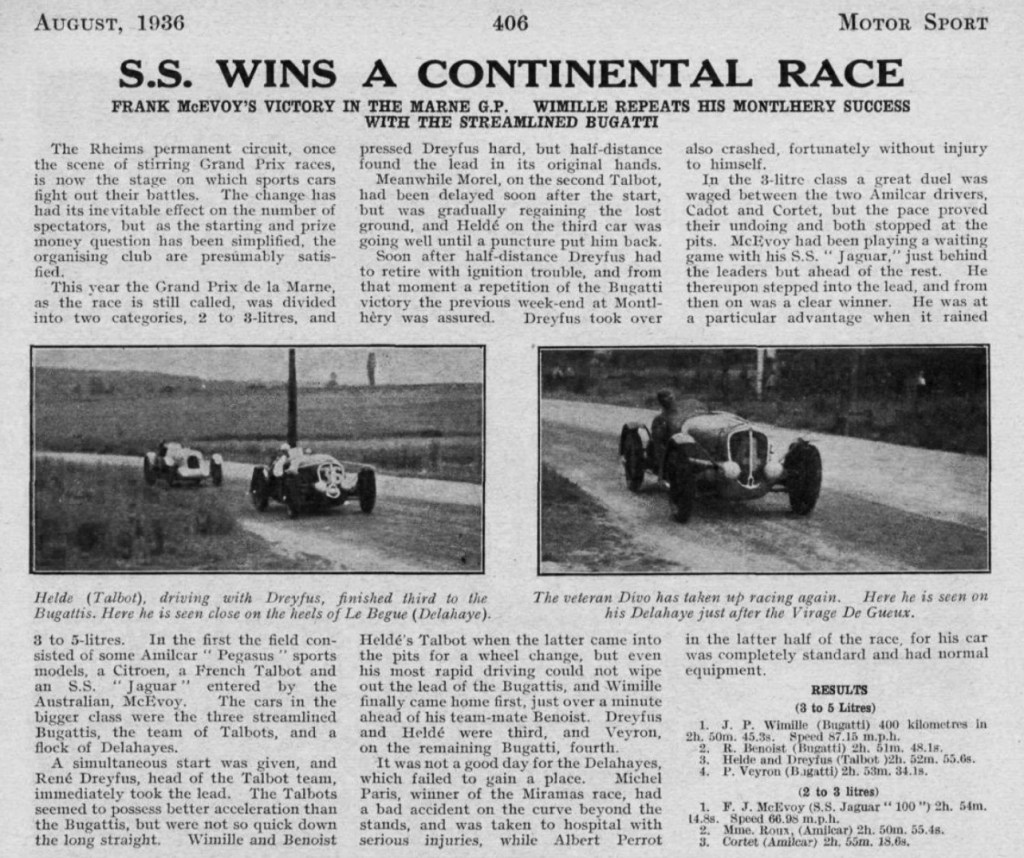
There is bit of overreach in this MotorSport claim for an SS 100 Jaguar win …
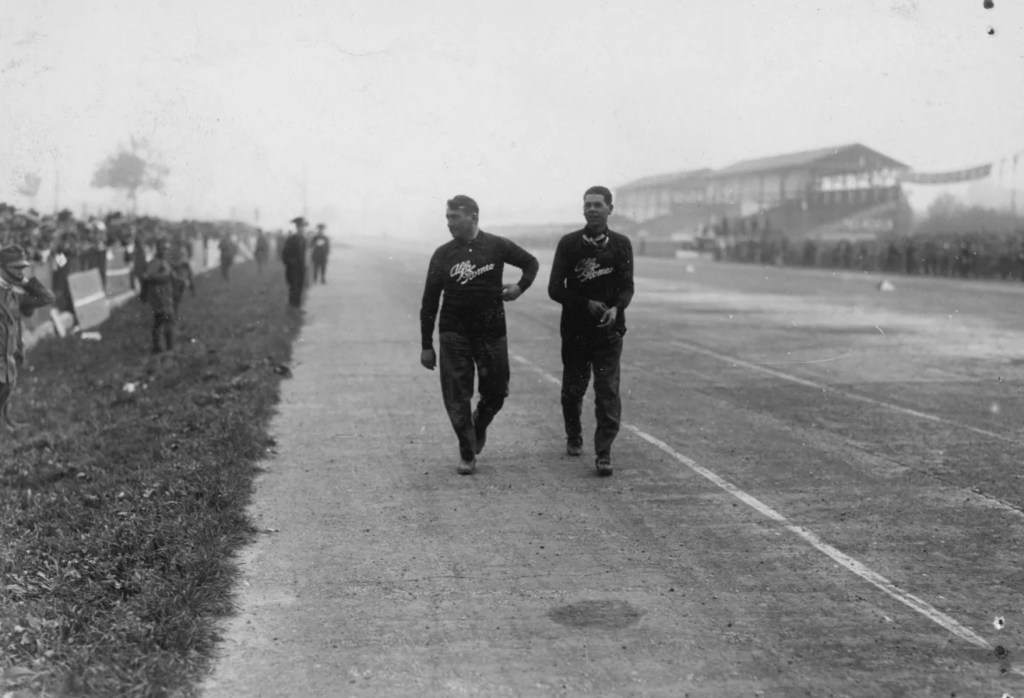
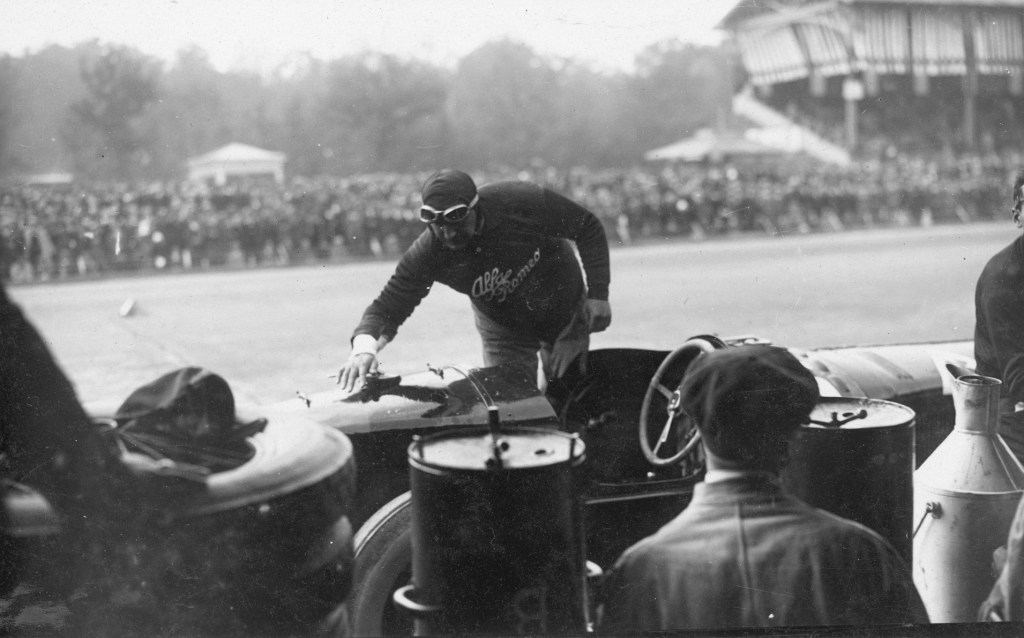
While the 11th Grand Prix de la Marne field was split into two classes as above, there seems little doubt that Australia’s cad, bon-vivant, gigolo, Olympian, and sometime occasional racing driver, Frederick Joseph McEvoy finished 15th of 21 starters in the July 5, 1936, 51 lap, 399km race.
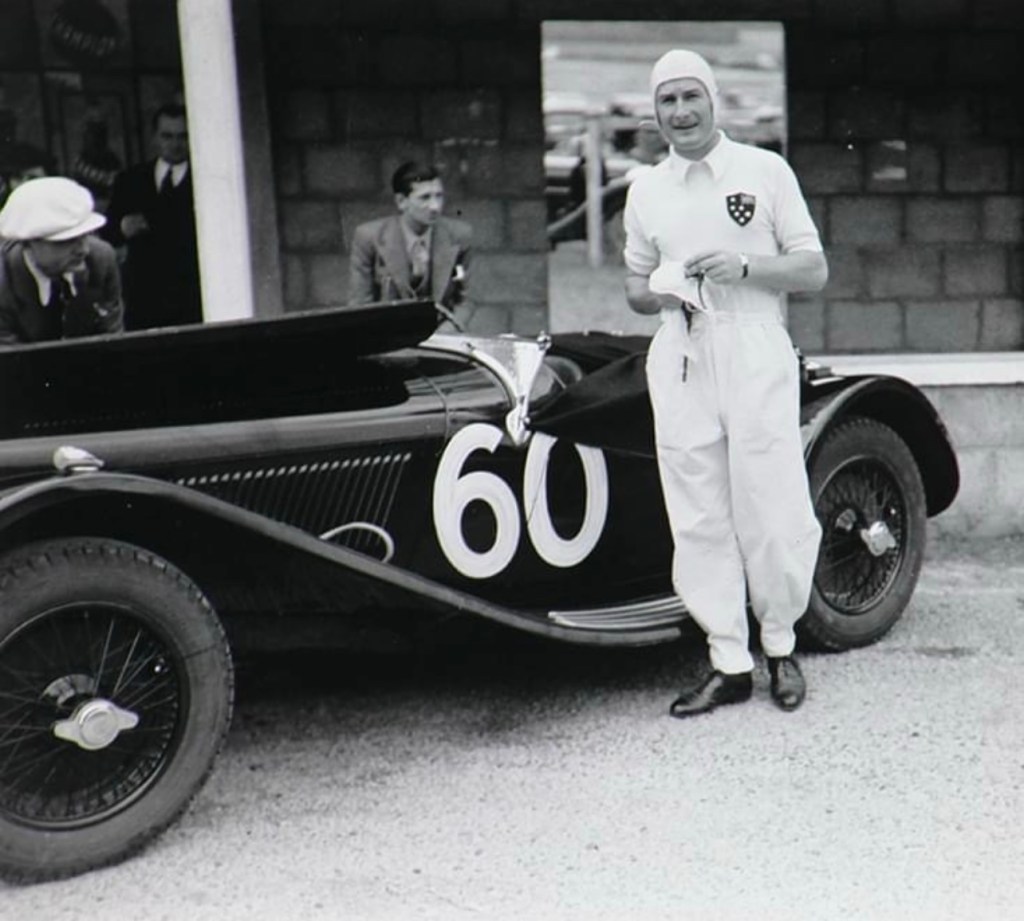
McEvoy and 2663cc, OHV, six-cylinder SS 100 chassis #18007 (?) at Reims before the off. I wonder what club logo is on Freddy’s chest? (MotorSport Images)
I do find McEvoy a most interesting character, not long after I wrote this masterpiece: https://primotipo.com/tag/freddie-mcevoy/ a book was published about him. It’s worth a read albeit I cover McEvoy’s racing and alpine career more fulsomely than the book. By the way, McEvoy signed his name Freddy, not Freddie, so I’ll stick with that. It’s not Frank either…
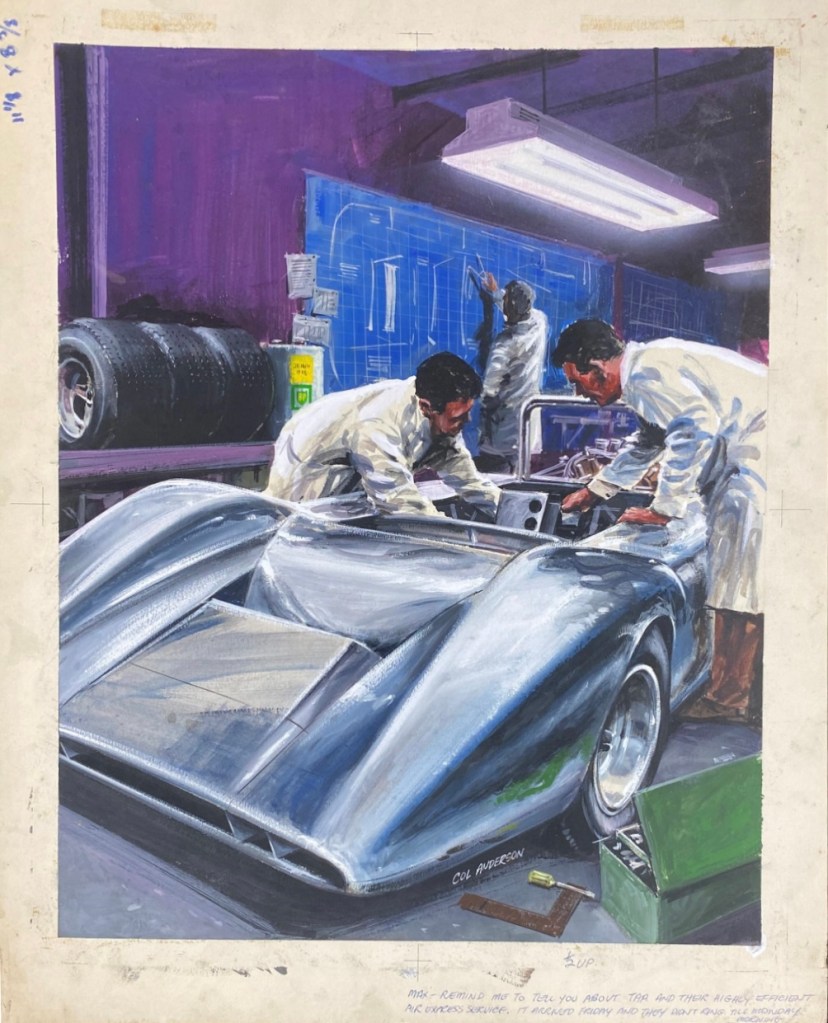
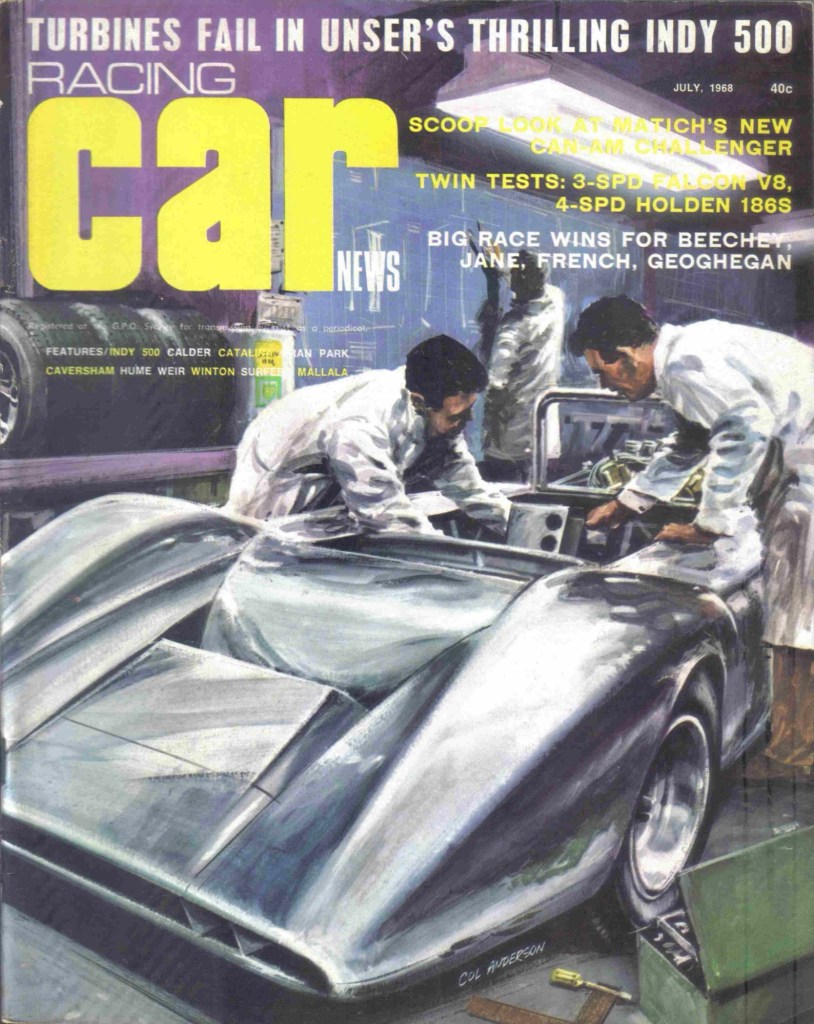
I’ve got Peter Finlay to thank for this piece. I was pondering the name of one of the artists who did the Racing Car News covers in the day on my Facebook page. I got the name right – Colin Anderson – and Peter included a link in his post that took me to this image, original artwork of the cover of the July 1968 issue, still some time away from the car’s first appearance I might say…
(S Dalton Collection)
Oh yes, the fine print on the bottom right of the artwork? Small-talk whinge from Col to RCN owner/publisher Max Stahl about TAA air-express and their shit service. Timelines being rather important and more complex in that pre-Internet age!!
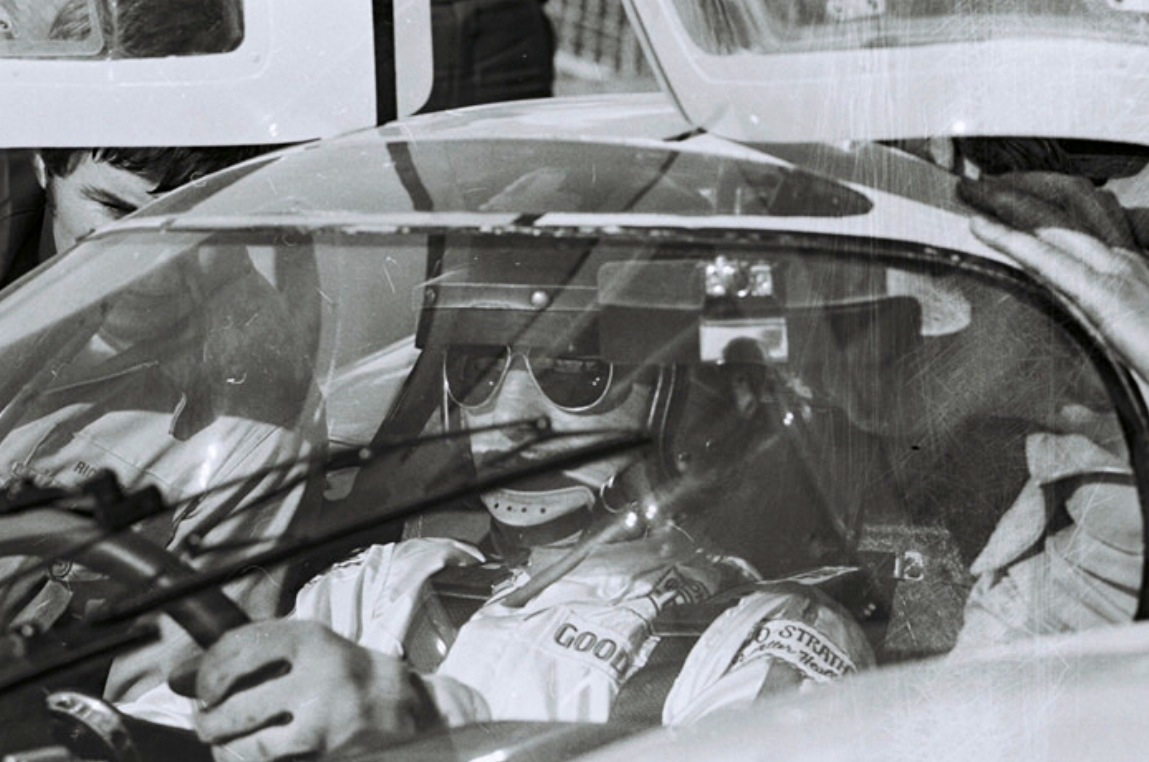
Jo Siffert’s night-time Porsche 917 pitstop at Daytona made more dramatic by the exposure used by photographer Dave Friedman…
You can see Seppi’s distinctive helmet in the murk to the left of the car as Brian Redman gets ready to rejoin the race.
It was not to be Siffert’s race, the first in which the dominance of the 917 generally and John Wyer entered cars specifically was displayed in the Sports Car Championship that year. The Ferrari 512S (Ignazio Giunti/Nino Vaccarella/Mario Andretti) took a Sebring victory in March but otherwise it was a Porsche year, what the 4.5-5 litre flat-12 917 didn’t win, the 3 litre flat-8 908 did on courses for which it was designed.
Siffert/Redman led the race until after the three-hour mark. Not long after a driver change to Redman, Brian came into the pits with a punctured tyre, worse was the brake-pipe broken by the rotating tyre tread. It took a critical 17 minutes to make the car good. The pair’s day of drama wasn’t over yet though. They lost an hour to replace the clutch, and later still had another stop to ‘straighten the Porsche after a wall-scraping episode.’
Pedro Rodriguez and Leo Kinnunen won the race in the sister John Wyer entry, 45 laps ahead of Siffert/Redman with the Andretti/Merzario/Ickx Ferrari 512S three more laps in arrears, third.
Seppi in the 917 cockpit with old school Bell Magnum helmet and chinstrap (D Friedman)(MotorSport)
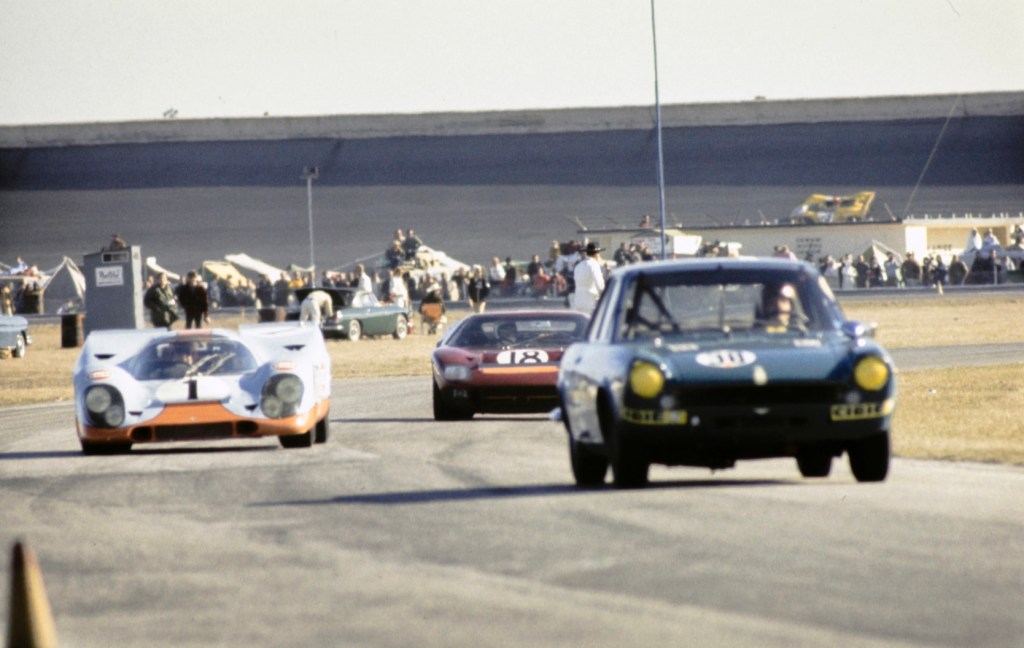
I love the variety of cars in these events putting aside the performance differential arguments and issues. The Siffert/Redman cat-amongst-the-pigeons 917 amidst the Fleming/Johnson/Fleming Fiat 124 Coupe and Wonder/Cuomo Ford GT40.
And below in the midst of the Waldron/Lanier/Barros MGB and Clutton/Tatum Ferrari 275 GTB/C. Eyes on your mirrors folks…
(MotorSport)(MotorSport)
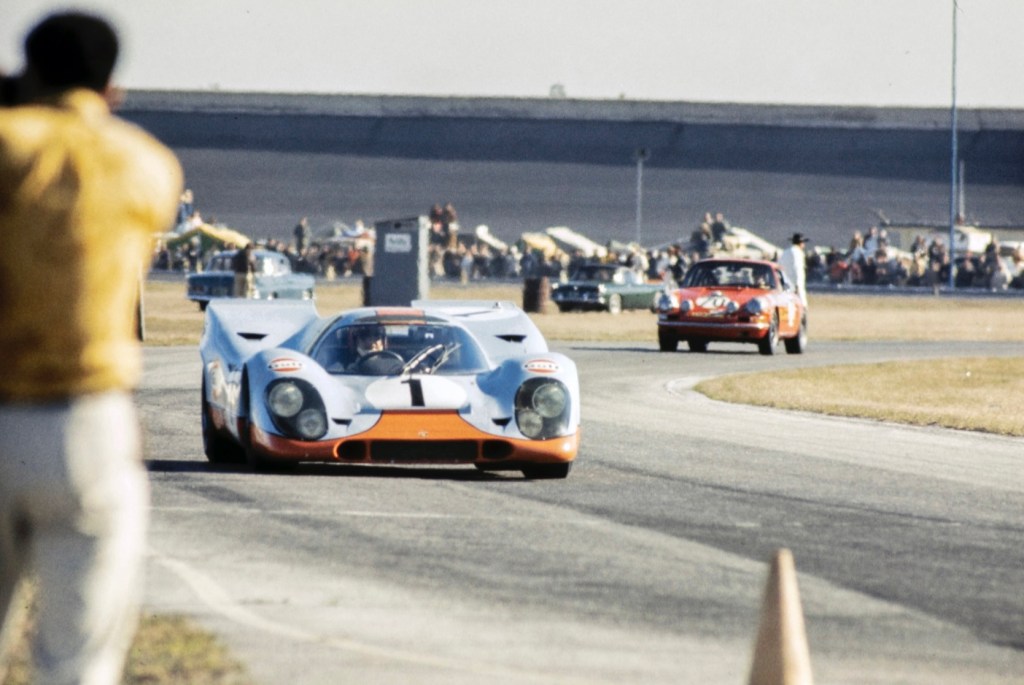
Seppi again, this time in front of the Patterson/Sanford Porsche 911T.
Bibliography…
Automobile Year 18, Team Dan, MotorSport, Dave Friedman Archive
Tailpiece…
(MotorSport)
‘I’m leavin’ on a jet plane…that’s Daytona Beach International Airport behind. DC9.
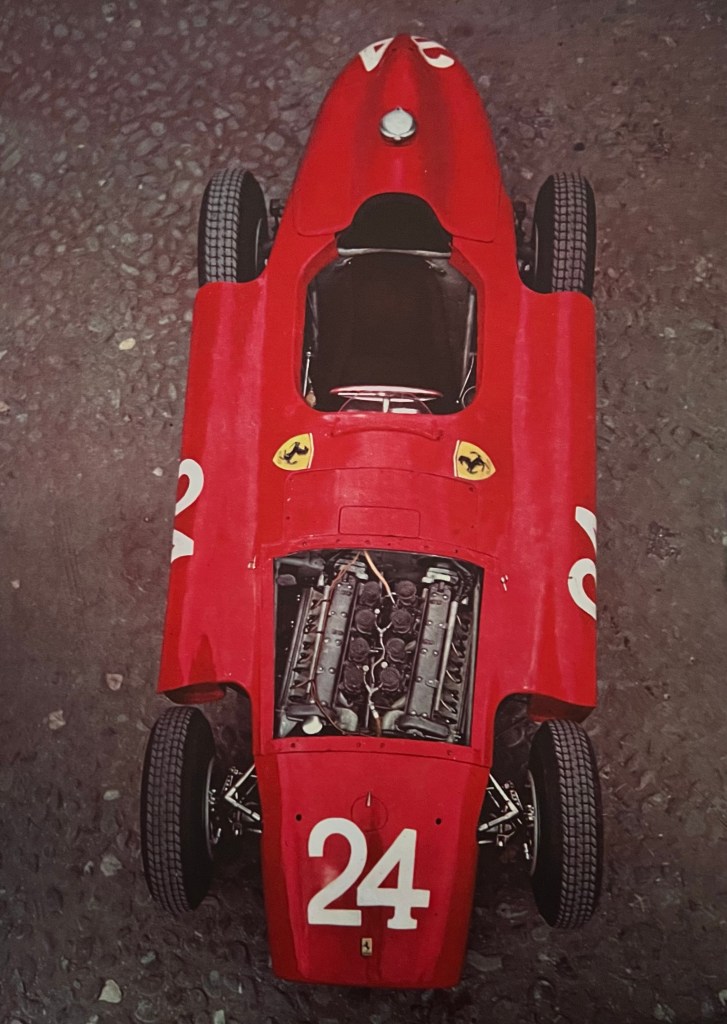
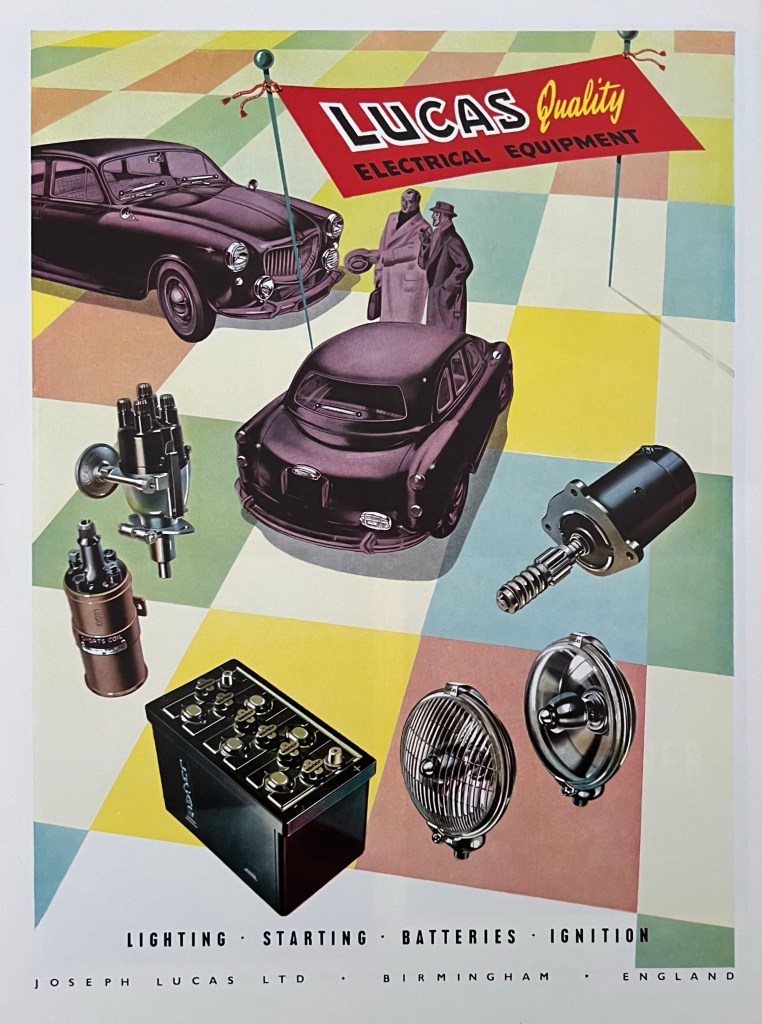
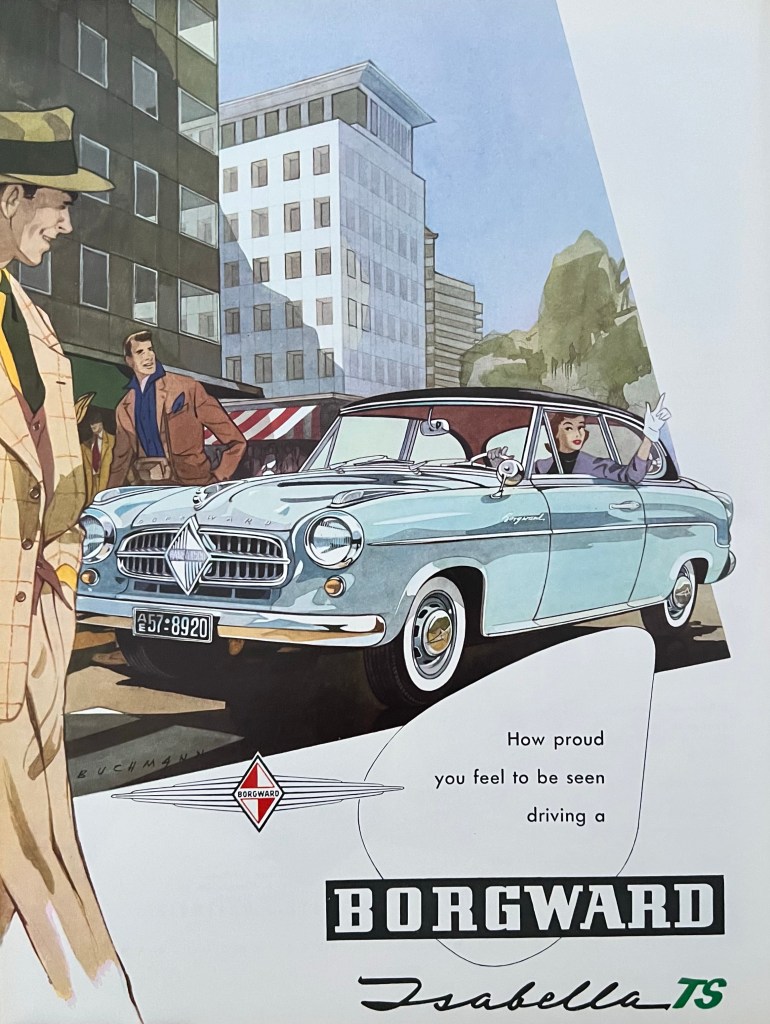
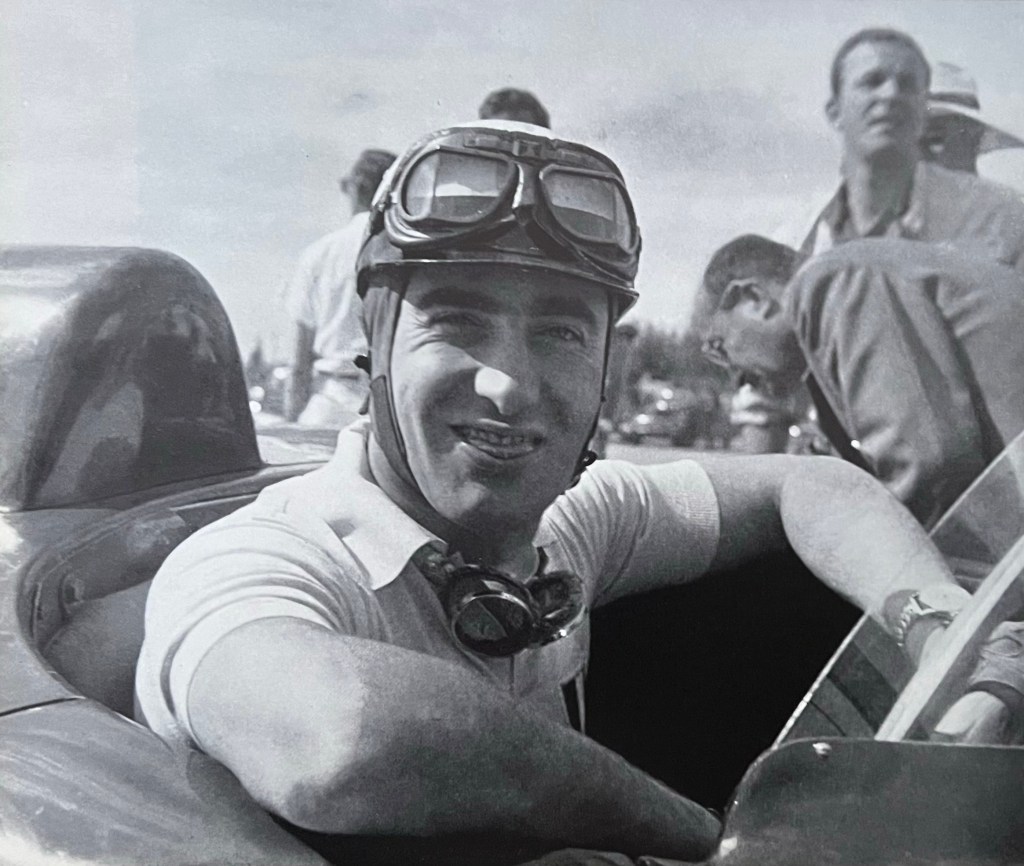
My friend Tony Johns lent me a couple of early AutoCourses that I turned into a couple of interesting posts. I’ll continue with that but thought I’d add an occasional piece based on my own collection of Automobile Years.
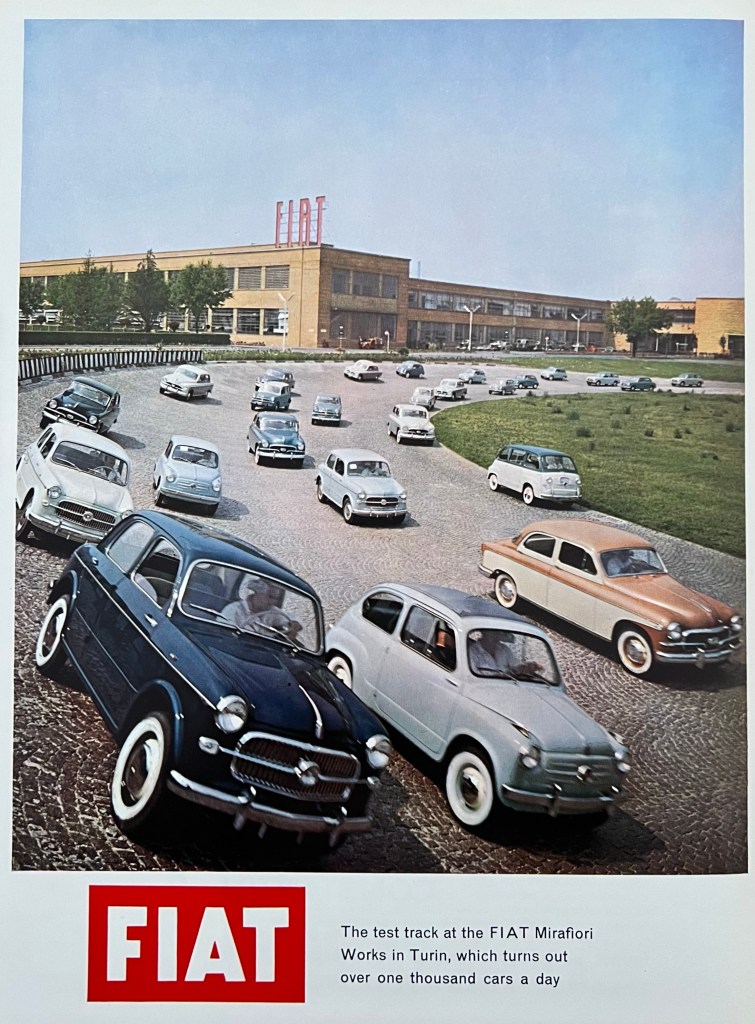
It’s the beauty of the some of the ads that really caught my eye. The reproduction of small monochrome racing shots isn’t that flash so I’m sharing the best of the relatively small number of colour shots and a few monochrome photographs within the mix of ads.
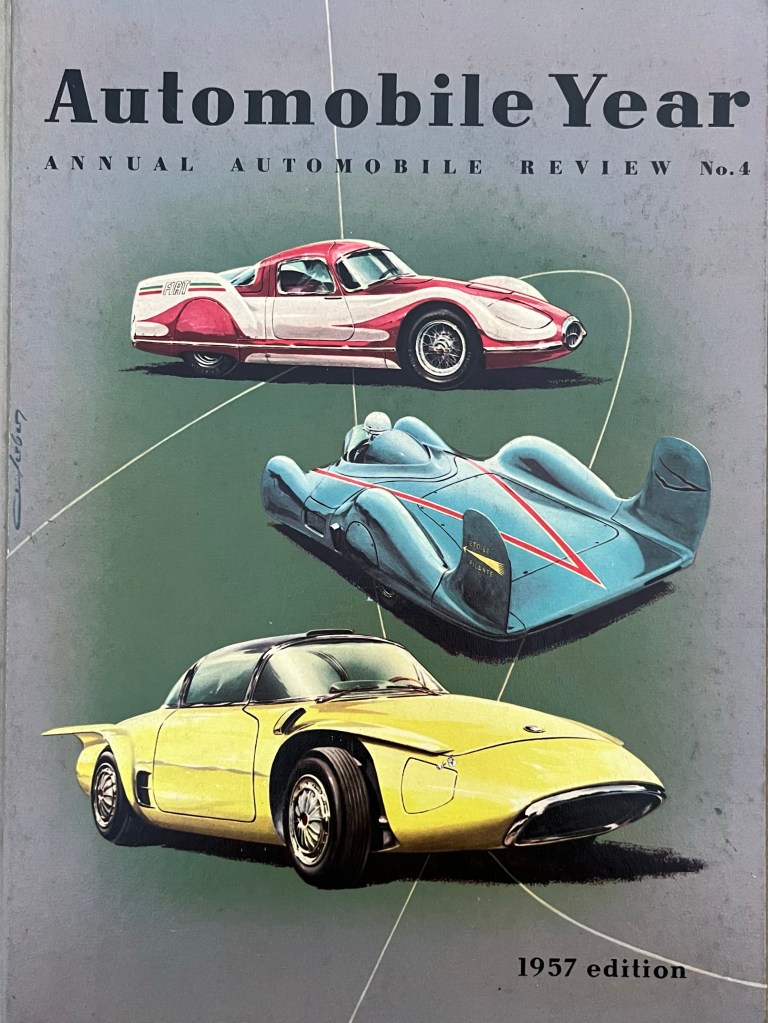
The artwork on the cover has a name but I can’t read it, nor is it disclosed elsewhere. The cars shown are a Fiat 8001 Turbina, Renault Shooting Star, General Motors XP-500 gas turbines.
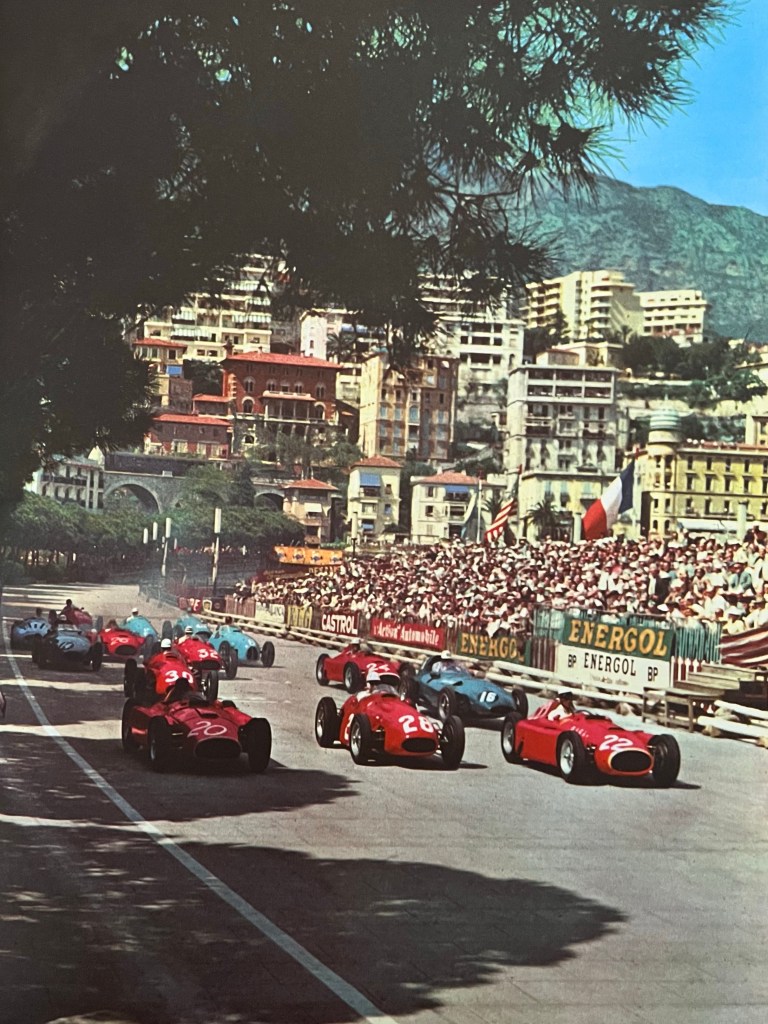
Superb Yves Debraine shot of the start of the 1956 Monaco Grand Prix.
The two Lancia-Ferrari D50s of JM Fangio and #22 Eugenio Castellotti sandwiching Stirling Moss in a works-Maserati 250F. #16 is Harry Schell, Vanwall VW1, #30 Jean Behra, 250F, #24 Luigi Musso, Lancia-Ferrari D50, #32 Cesare Perdisa in another works Maserati 250F.
(Yves Debraine)
‘Stirling Moss had been in the lead from first to last and gave a faultless display of brilliant driving and faultless race strategy (being under great pressure from Fangio’s Ferrari late in the race). The discovery of the day was Peter Collins (Ferrari second) . Behra drove a steady race into 3rd place, with no incidents (250F).’ See here for more: https://primotipo.com/2014/08/21/stirling-moss-monaco-gp-1956-maserati-250f/
(Y Debraine)
Le Mans 24-Hours.
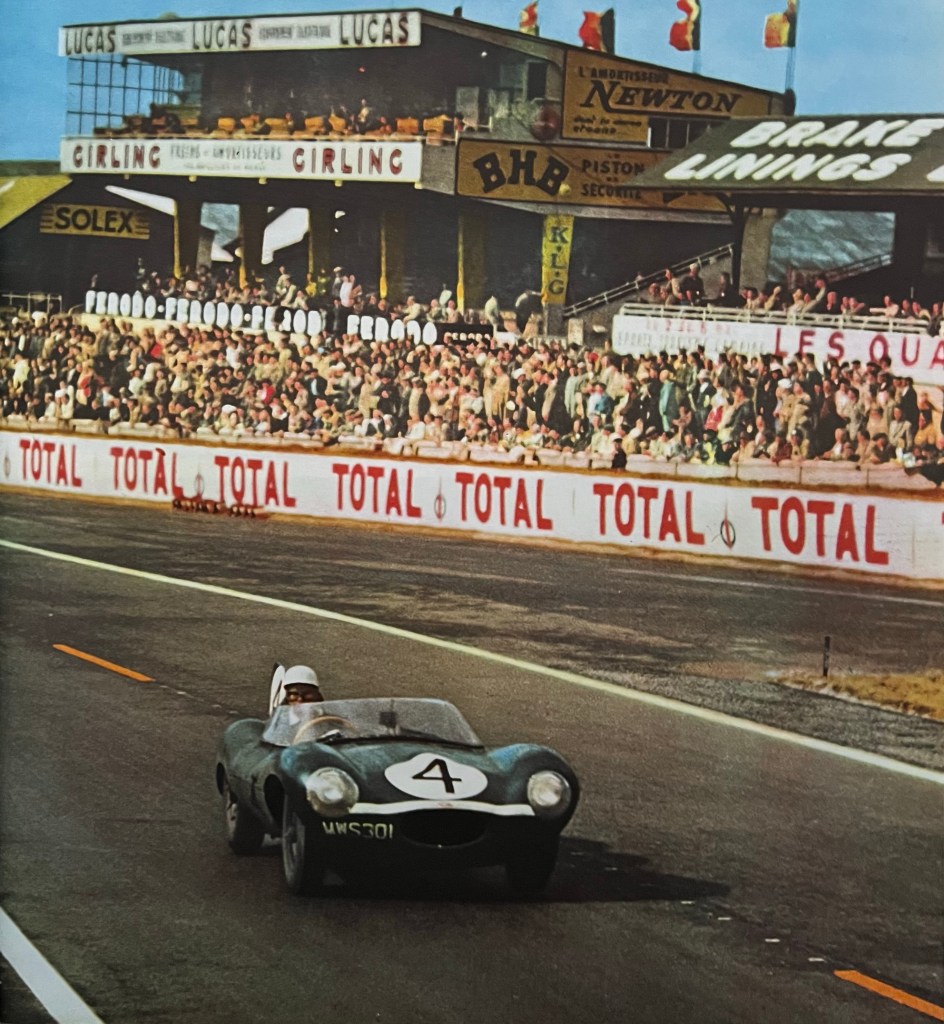
‘The privately entered Ecurie Ecosse Jaguar D-Type driven by Ron Flockhart and Ninian Sanderson gave Jaguar an unexpected victory – the fourth since the war – after bad luck had struck the works team.’
‘Mike Hawthorn was in magnificent form and held the lead (of the British Grand Prix at Silverstone) for 15 laps.’
‘The BRM (Type 25) showed again that it is probably the fastest of all current Grand Prix cars, but Hawthorn was eventually passed by Moss (Maserati 250F) and others before being forced to retire at 23 laps by loss of lubricant to a rear universal joint, which produced incipient seizure.’
Moss the led until the 68th lap when misfiring intervened with Roy Salvadori driving the race of his life in the Gilby Engineering 250F, holding second place for 30 laps in front of all of the works cars! Fangio, Lancia-Ferrari D50 led to the finish after Moss retired, with Peter Collins/Alfonso de Portago second and Jean Behra, Maserati 250F third.
(B Cahier)
JM Fangio’s F1 Drivers Championship winning Lancia-Ferrari D50.
‘Front engine, V8 mounted at an angle. Bore and stroke 76 x 68.5mm, 2495cc. Maximum power 285bhp @ 8500rpm, 4-overhead camshafts, chain driven. 4 downdraught Solex twin-choke carburettors. Dual ignition: 2 magnetos, 16 plugs. Clutch at rear in unit with 5-speed gearbox and differential. Front suspension by double wishbones with transverse leaf spring. Rear suspension De Dion, with transverse leaf spring. Drum brakes. The tanks in the wheel fairings are no longer used, all the fuel being carried in the tail.’
(Y Debraine)
The Big Red Cars to the fore at the start of the French GP, Reims, July 1: Peter Collins, Eugenio Castellotti and JM Fangio in Lancia-Ferrari D50s ahead of the Moss Maserati 250F, Harry Schell’s Vanwall VW1 #22, and Jean Behra’s 250F, then one of the Gordinis, and the rest…
Fangio led until he pitted on lap 40, but he joined the fray after a change of plugs. Harry Schell raced brilliantly, retired his own Vanwall, then took over Hawthorn’s while it was in seventh place, and then chipped away at the leading Ferraris passing all but Fangio until injection pump trouble intervened.
Collins won from teammate Castellotti by three-tenths after 2 hr 34 min of close racing, then Behra 30 seconds back.
Sebring 12-Hour
‘The victory of the Fangio-Castellotti team (in the Sebring 12-Hour) was largely the work of the young Italian. Fangio, feeling unwell, had handed the car to him for the last hours of the race. The 3422cc four-cylinder Ferrari (860 Monza) covered a distance of 1008.72 miles in twelve-hours and put up a new record by doing twelve more laps than the winning Jaguar (D-Type) in 1955.’
Luigi Musso and Harry Schell were second in another Scuderia Ferrari 860 Monza with the Bob Sweikert/Jack Ensley Jaguar D-Type third.
Mille Miglia 1956…
I was going to give the shot below the same treatment as the rest and then I read the prophetic piece that went with it…not too long before the 1957 Mille disaster. It’s worth sharing in full I thought, an insiders view of the time clearly expressed.
‘For a long time after the catastrophe at the Le Mans Twenty-four Hours in 1955, motor-racing circles feared that the XXIInd Mille Miglia had been the last of the series. That race, in which 365 cars competed over 1,000 miles of roads lined by hundreds of thousands of spectators, is the most dangerous of all motor races for the drivers and even more so for the spectators.’
‘Therefore those who love the sport were all the more pleased when, after long and bitter disputes, the XXIII edition of the race was permitted-for it was a triumph over the enemies of motor racing-but they felt some uneasiness nonetheless. So few changes had been made in the regulations that the old risks were still there. The competitors were still to start off in the pitch dark and charge at headlong speed along roads lined – and in some places obstructed – by enthusiastie spectators many of whom had taken up their stand at the most dangerous points.’
‘The rain that fell incessantly throughout the race made the surface slippery in the extreme. Several cars left the road and the day closed with 7 fatal casualties – two of them among the spectators – and 16 injured. Indeed it was really only by sheer good luck that there were not a great many more. For these reasons we are against the Mille Miglia in its present form.’
‘Sooner or later it is bound to lead to a catastrophe fraught with the direst consequences because it could be so easily avoided. There must be fewer starters with a severe selection of the entries, and the most dangerous points-especially where the cars come out of a bend-must be closed to spectators. If these conditions, which without eliminating all danger would reduce the risk to reasonable proportions, cannot be satisfied the Mille Miglia will have to be considered anachronistic. We have nothing against the organizers. We simply believe that in common sense it must be admitted that the pleasure and interest of a limited number of people together with the technical advances brought about by the event are no justification for the terrible risks involved in a race where for 20 hours on end thousands of spectators without the slightest protection are within arm’s length of meteors unleashed at terrific speed.’
(‘A fine colour study which catches the typical atmosphere of many Mille Miglias. Rain pelting down from a leaden sky, spectators huddled together under umbrellas, and a brilliantly coloured car, headlamps blazing, as it roars on towards the finish at the end of the long day. The car is Collin’s Ferrari (860 Monza Scaglietti), taking second place in the XXIIIrd Mille Miglia with photographer and journalist Louis Klemantaski acting as navigator’ Y Debraine)
‘The XXIIIrd Mille Miglia was run in appalling weather which prevented the repetition of performances on a par with those recorded in 1955. The times chalked up by all the classes were slower than last year with the sole exception of Michy on RENAULT 750 c.c, who broke the record set up by Galtier in 1955. All in all one may say that the small, and therefore less speedy, cars were less severely handicapped by the rain than the powerful machines capable of doing over 125 m.p.h.’
‘Victory smiled on Eugenio Castellotti on a 3 ½-litre 12-cylinder FERRARI (290 MM Scaglietti). He took 1 hour 29 minutes 22 seconds more than Moss last year to cover the 1,597 kilometres of the course but his average speed was most impressive in view of the atmospheric conditions he was up against. Second place was taken by another FERRARI – a 3 1/2 litre 4-cylinder model – driven by Peter Collins whose passenger was our contributor Klemantaski, a bearded British journalist like Jenkinson.’
‘FERRARI won all the laurels taking 3rd, 4th and 5th places with Musso, Fangio and Gendebien, the latter being the winner of the “Grand Tourisme” class. In the next three places we find three MERCEDES 300 SL privately entered but prepared by the works. The MASERATIs were a disappointment although Scarlatti took first place in the class for sports cars under 2,000 c.c., while Perdisa was first in the under 3,000 c.c. class but only 28th in the general classification. Stirling Moss, No. I member of the team, whose car was not quite up to scratch, ran off the road before Rome and withdrew from the race.’
‘The ALFA ROMEO GIULIETTA which had disappointed in 1955 put up a magnificent show this year. As usual PORSCHE took first place in the “Grand Tourisme” class under 1,500 c.c. but was defeated in the sports class by Cabianca’s OSCA 1500 and Jean Behra’s MASERATI. All four RENAULT DAUPHINES entered by the works finished the race although Paul Frère capsized when leading the team. The winner was Gilberte Thirion at an average of 65.85 m.p.h. Our contributor Bernard Cahier, at the wheel of his own DAUPHINE – a production model in every respect – covered the course at 58.28 m.p.h. Michy on a modified 4 H.P. RENAULT produced a fine performance, as already mentioned, by lowering the record for his class established in 1955 on a dry surface by Gaultier with a car of the same type.’
‘Of the 427 entries, 365 started but only 182 reached the finish – a wastage of 50 per cent.’
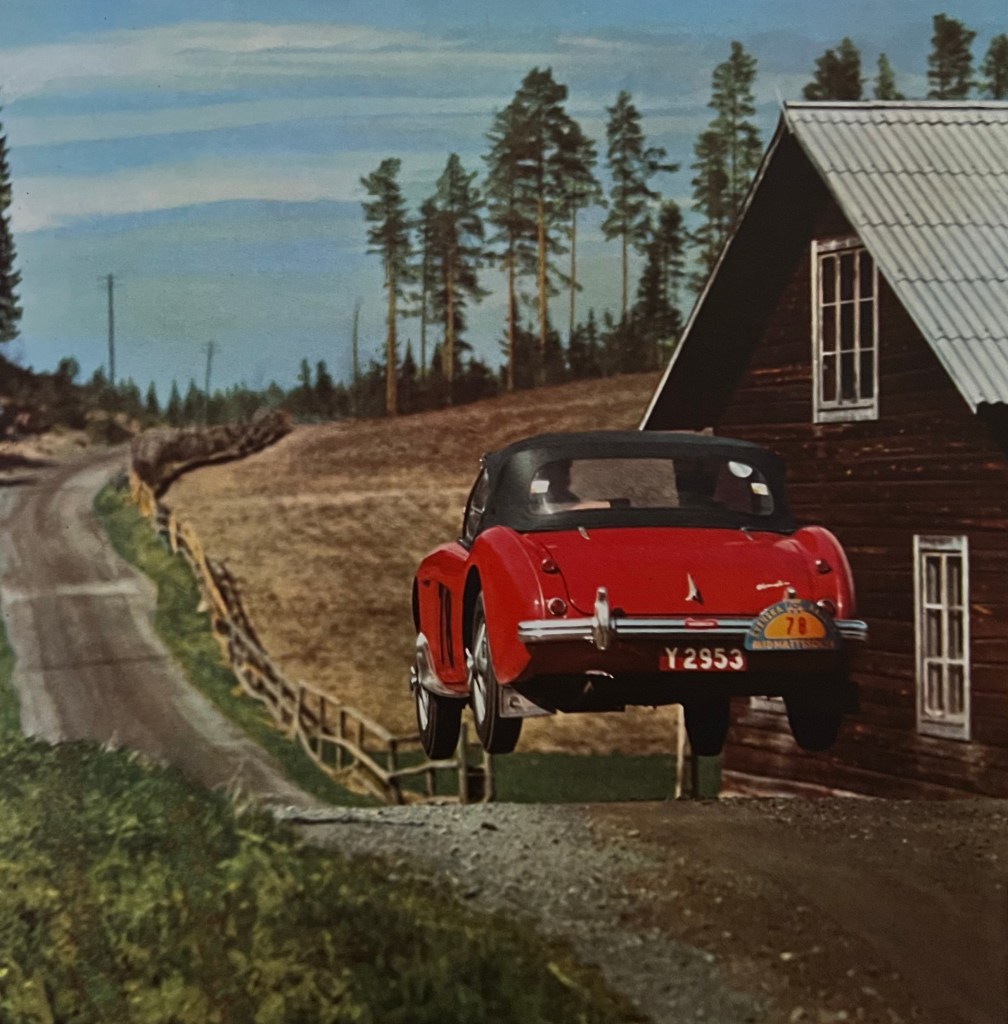
‘The Frölander and Lindbergh, shortly after take-off, on their flight to the Midnight Sun in a single-engined (?) Austin Healey.’ This crew didn’t finish in the top-10, the May 29-June 3, 1956 event was won by a VW 1200 driven by H Bengtsson and navigator A Righard.
Credits…
Automobile Year, Yves Debraine, Louis Klemantaski, Junior, Bernard Cahier, B Gronlund
Tailpiece…
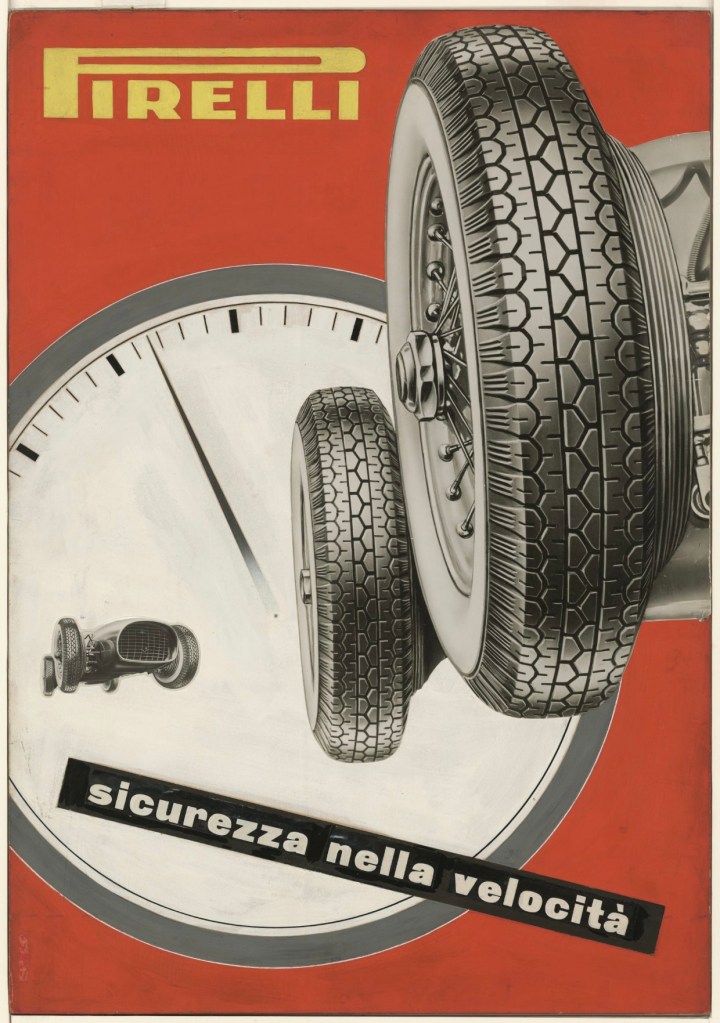
I’ve long thought the power of an ad is inversely proportional to the word count…particularly if the visual imagery is up to snuff!
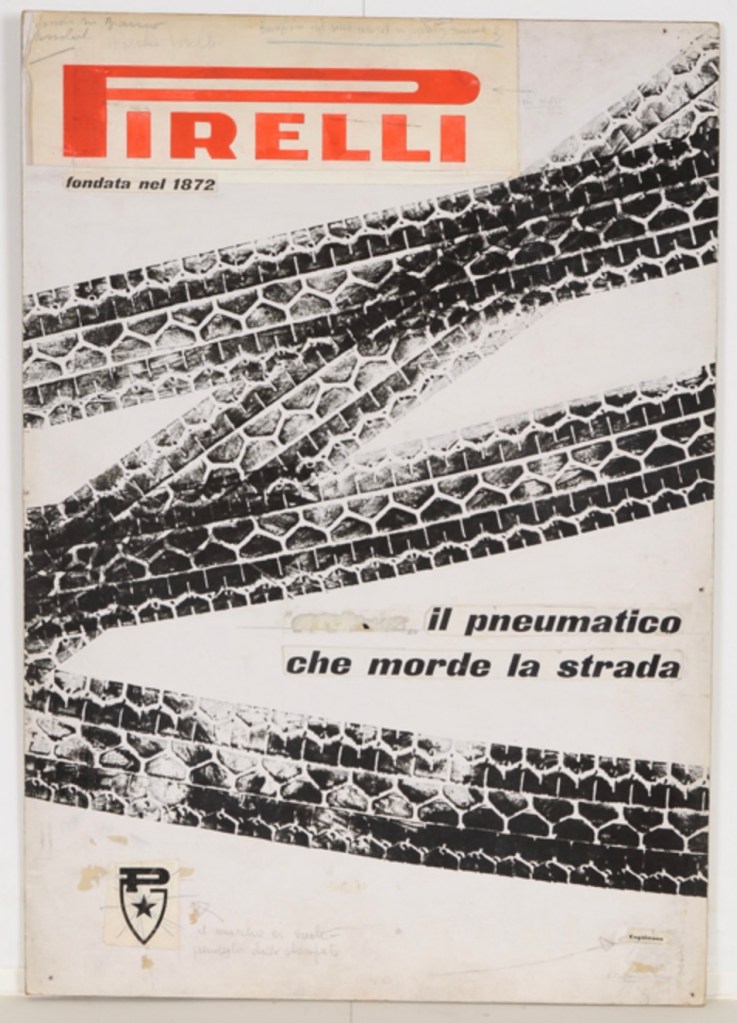
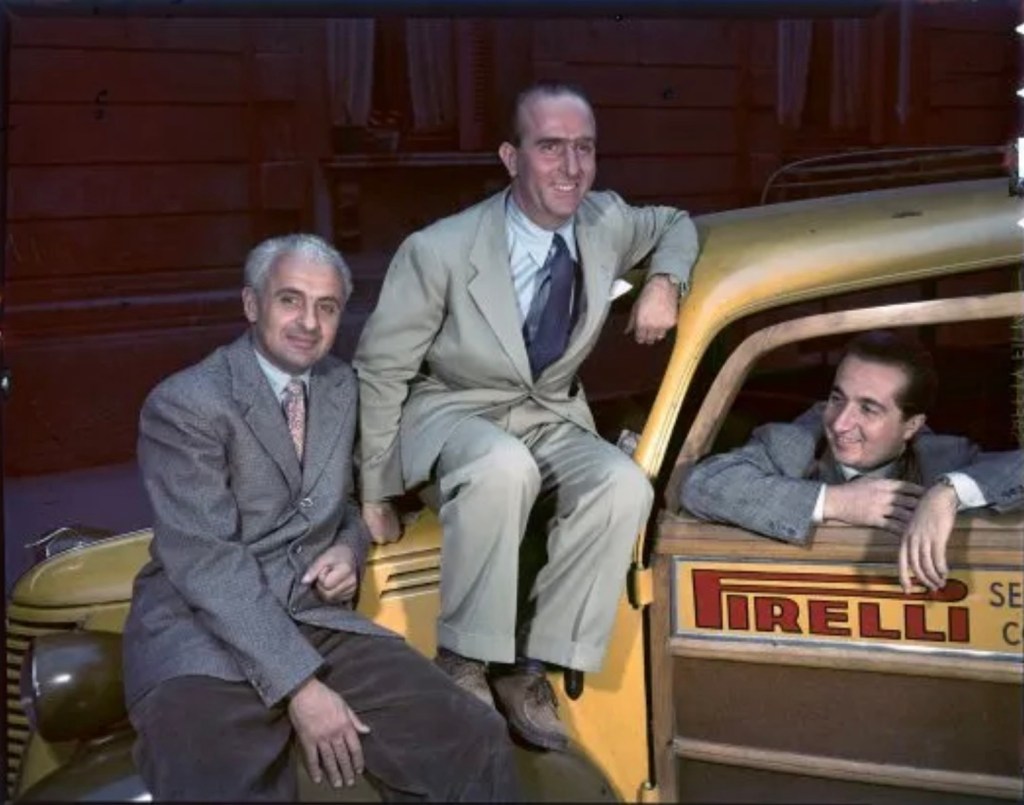
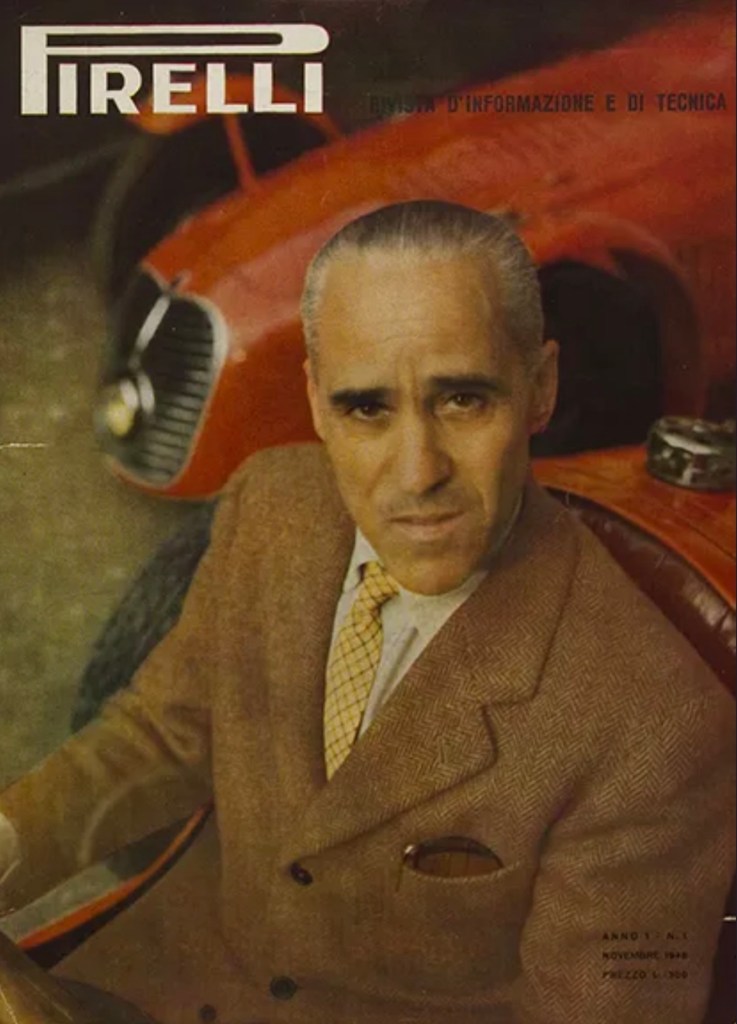
One thing leads to another. I was researching Giuseppe Luraghi, a longtime CEO of Alfa Romeo. Apart from mega talent as a corporate leader he was somewhat of a renaissance man, a gifted writer and poet. He initiated the Pirelli magazine way back in 1948 when he headed up Linoleum, a Pirelli Group subsidiary.
Pirelli, “Addressed it to the general public, it was a way of reaching out to the consumer with much more than a simple advertising message. Above all it was a way of conveying business culture.”
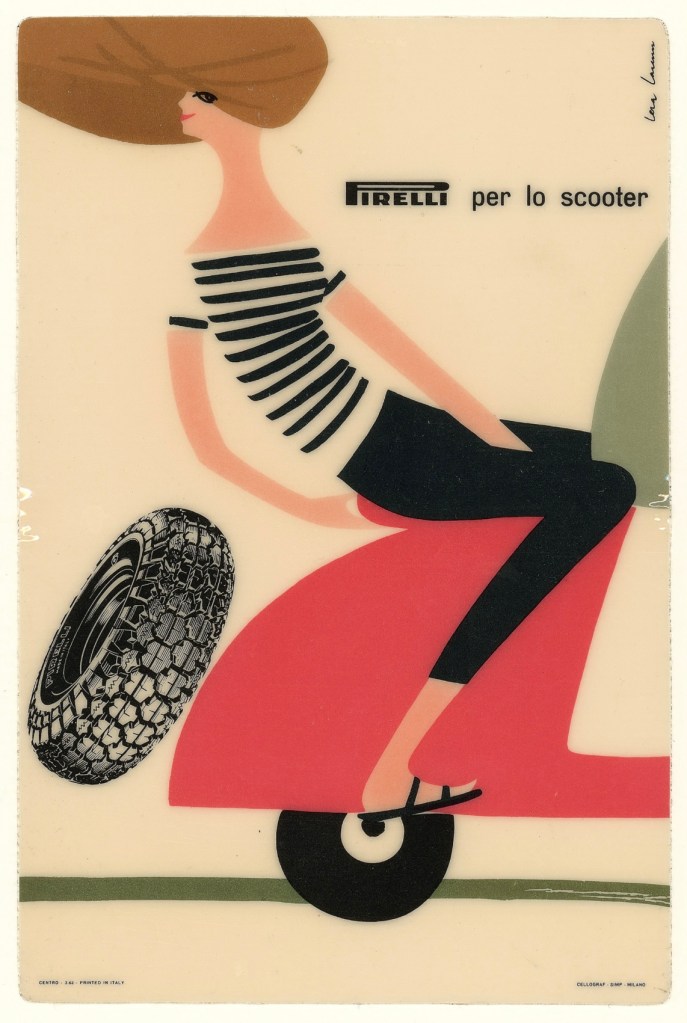
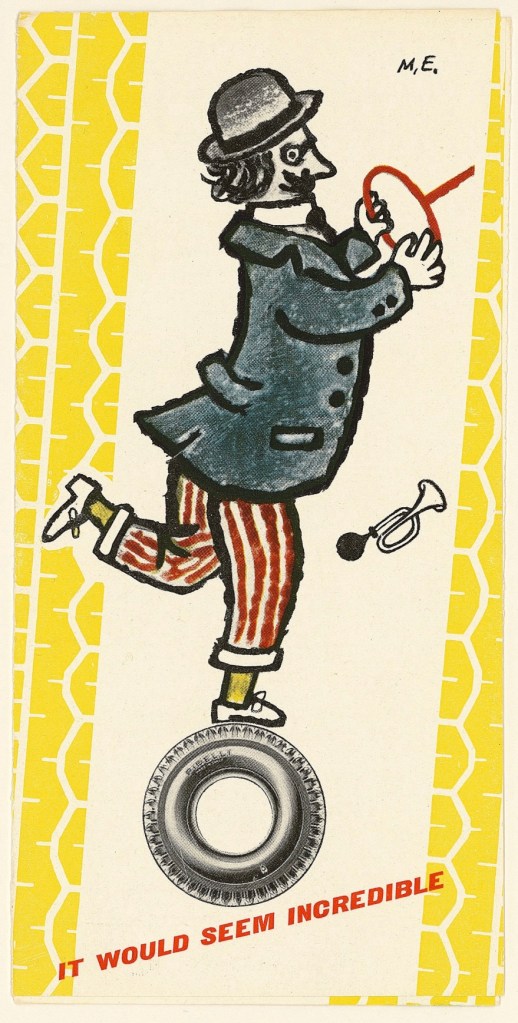
So, then yer go digging on that internet thingy and find Pirelli’s archives, these shots are the amazing result. I’ve mixed them up, they aren’t placed in chronological order so I’ve visually separated them by choosing Pirelli magazine covers or impactful or clever advertisements so you know when we are onto another subject. I’ve kept the words to a minimum, let the pics do the talkin’…
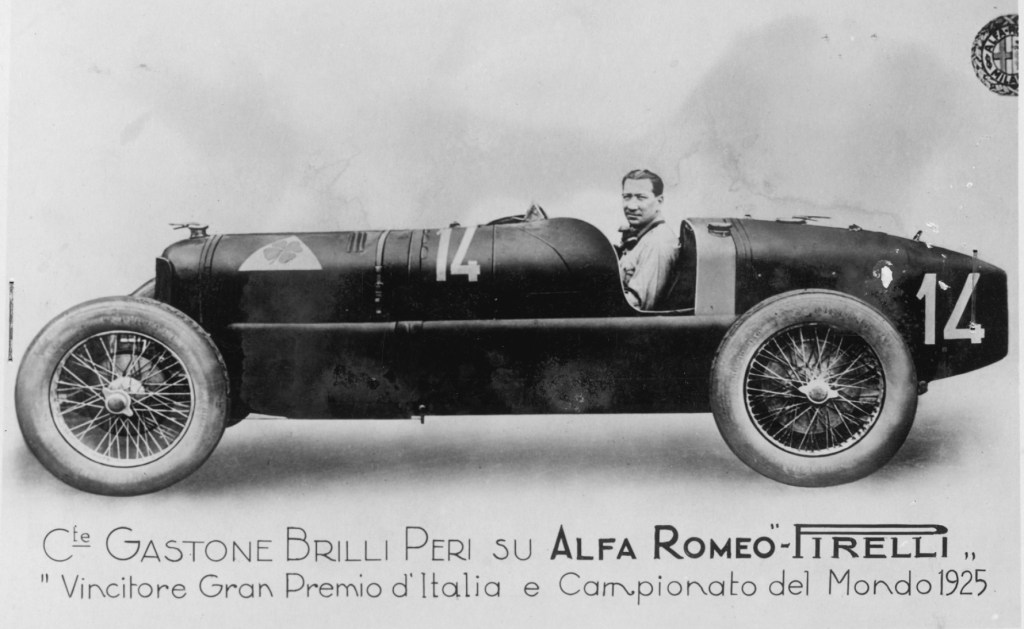
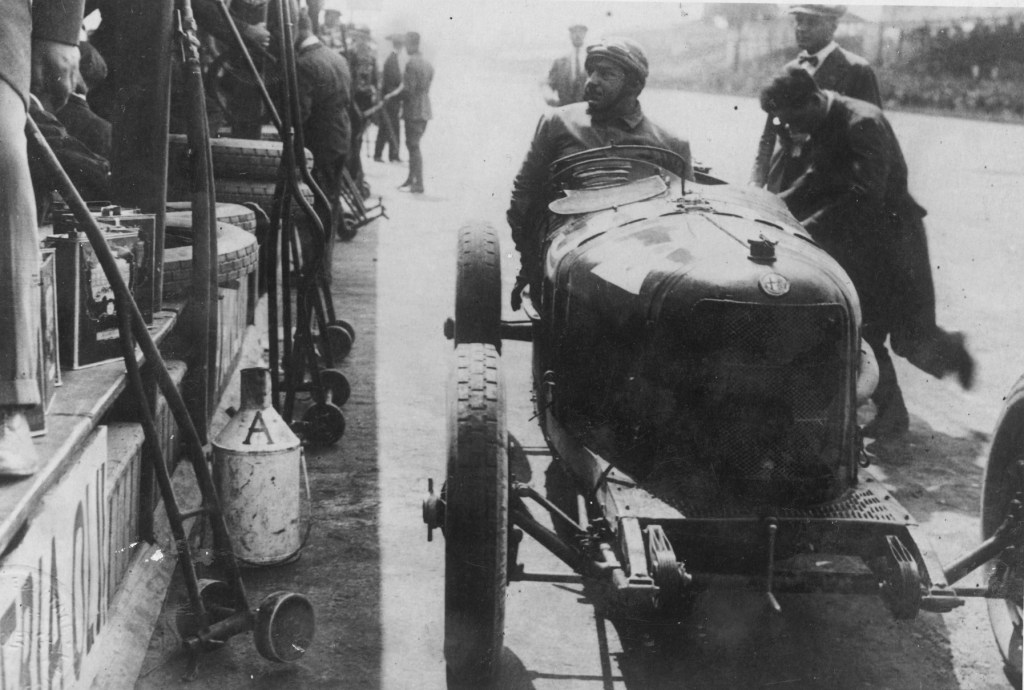
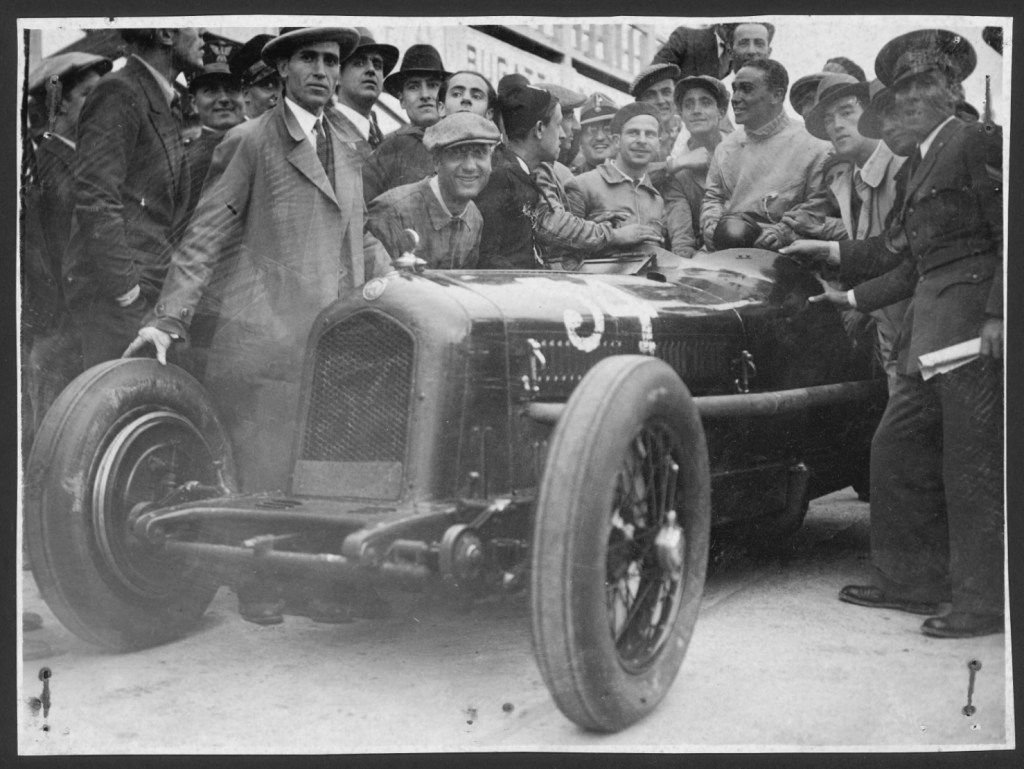
Gastone Brilli-Peri, by winning the Italian Grand Prix, gave Alfa Romeo the four-round 1925 Manufacturers World Championship in an Alfa Romeo P2.
Pete DePaolo won the Indy 500 in a Duesenberg 122, Albert Divo the French Grand Prix in a Delage 2LCV, while Alfa’s P2 won at Monza and at Spa, where Antonio Ascari drove the winning machine in the Belgian Grand Prix.
Brilli Peri, enroute to his Italian GP win and Campari below, in another P2 in the pits. Brilli Peri won from Giuseppe Campari/Minozzi/Sozzi with Meo Costantini third in a Bugatti T39.
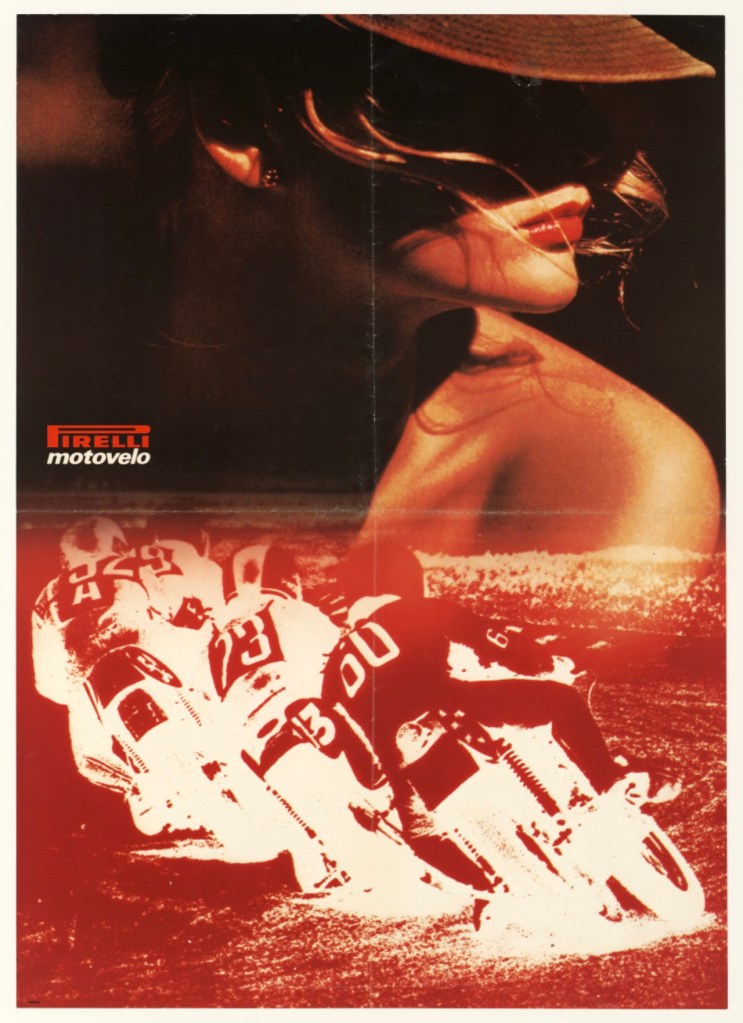
Poster 1977
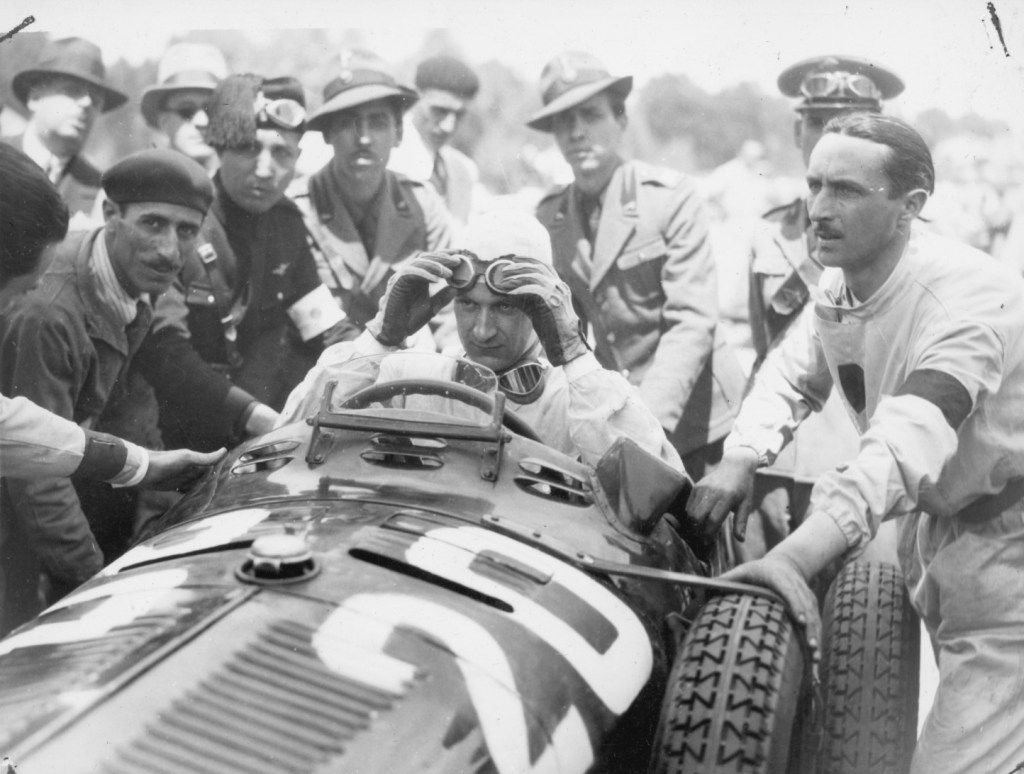
Antonio Brivio after winning the 1935 Targa Florio in a Scuderia Ferrari Alfa Romeo Tipo B.
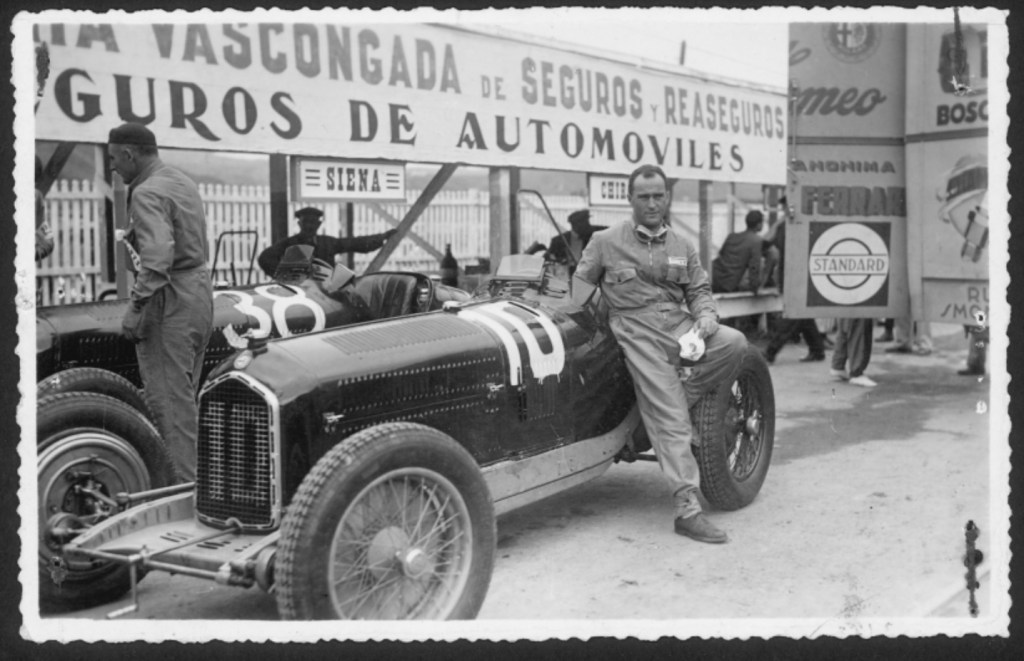
Sticking with the P3 theme, Luigi Fagioli stands beside his car during the September 1933 Spanish Grand Prix weekend. The race was won by Louis Chiron’s Alfa P3 from Fagioli, and held on the Laserte road circuit near San Sebastián.
Mock up for a 1952 ad by Pavel Engelmann
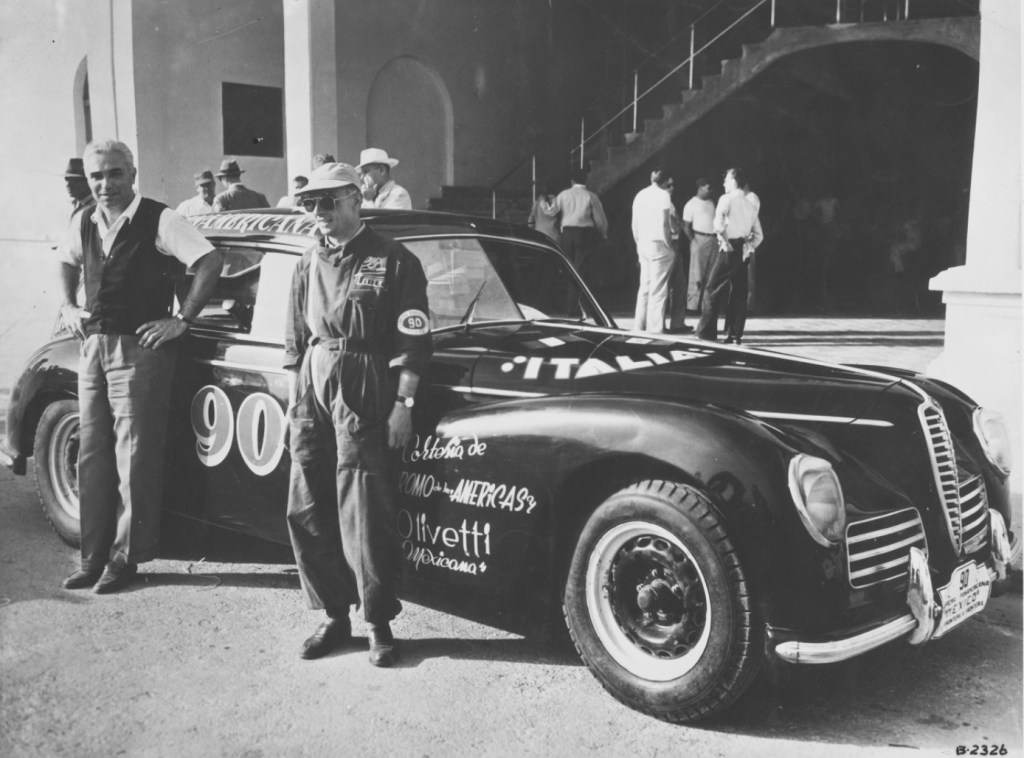
Piero Taruffi and navigator Isidoro Ceroli with Alfa Romeo 6C2500 Sport during the first Carrera Panamericana from May 5-10 1950.
They finished fourth behind three American crews driving an Oldsmobile and two Cadillacs.
Piero Taruffi, again, but a little earlier, here with a shock of dark hair! and his Scuderia Ferrari Alfa Romeo 8C2300 Monza after finishing second in the April 1932 Rome Grand Prix.
The race, held on the 4km Circuito del Littorio, was won by Luigi Fagioli’s works-Maserati V5 5-litre V16.
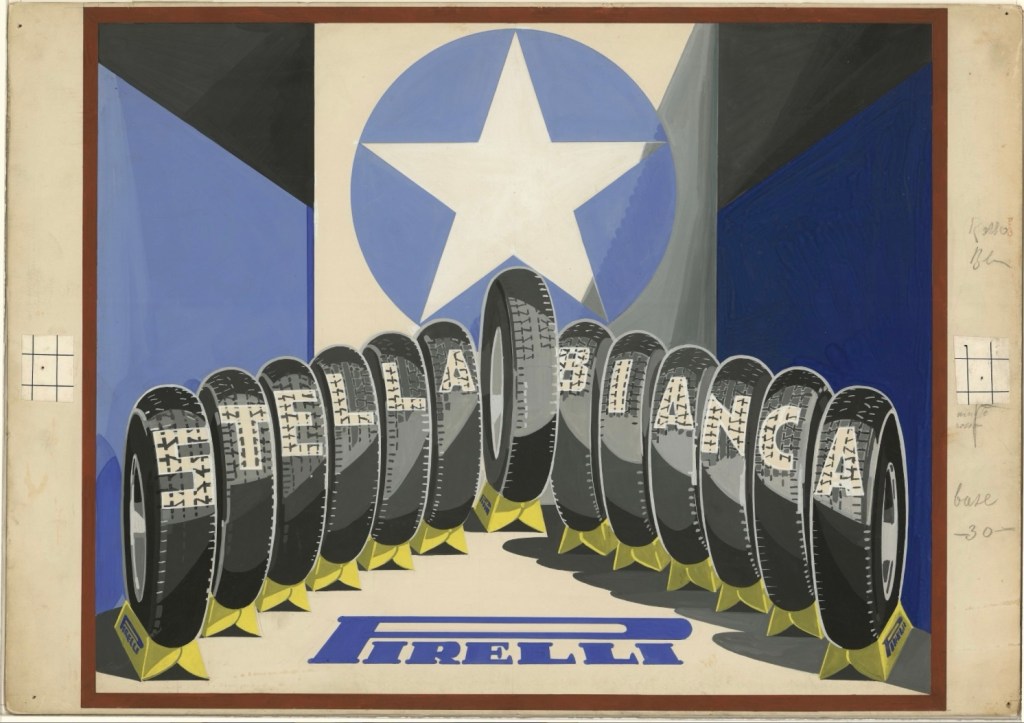
Pirelli White Star, sketch for an exhibition stand in 1931
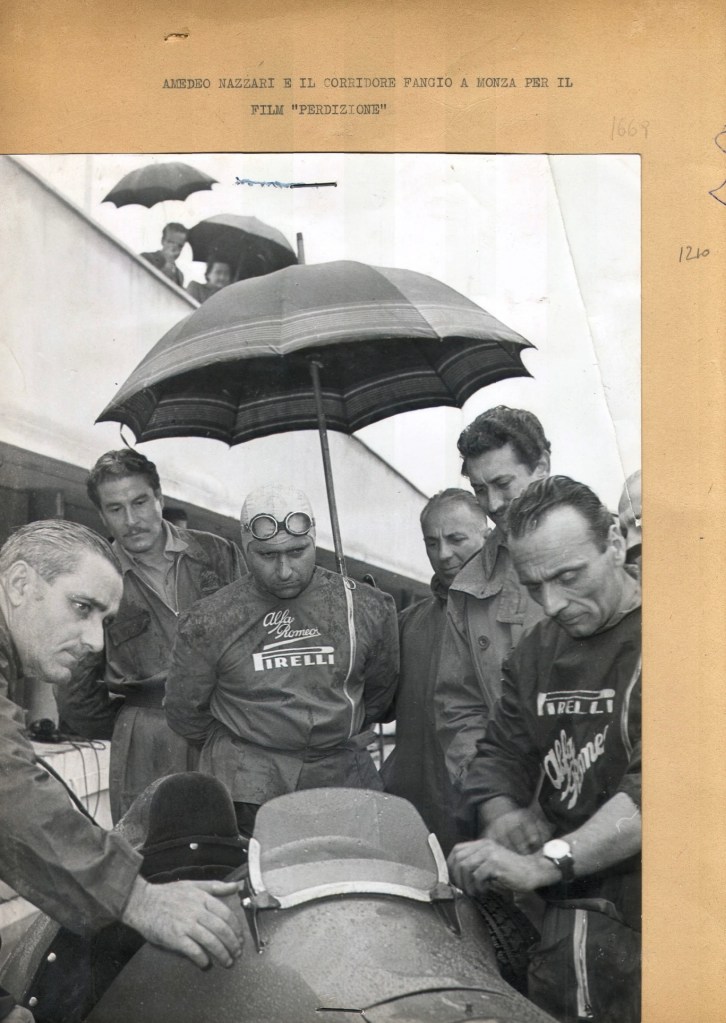
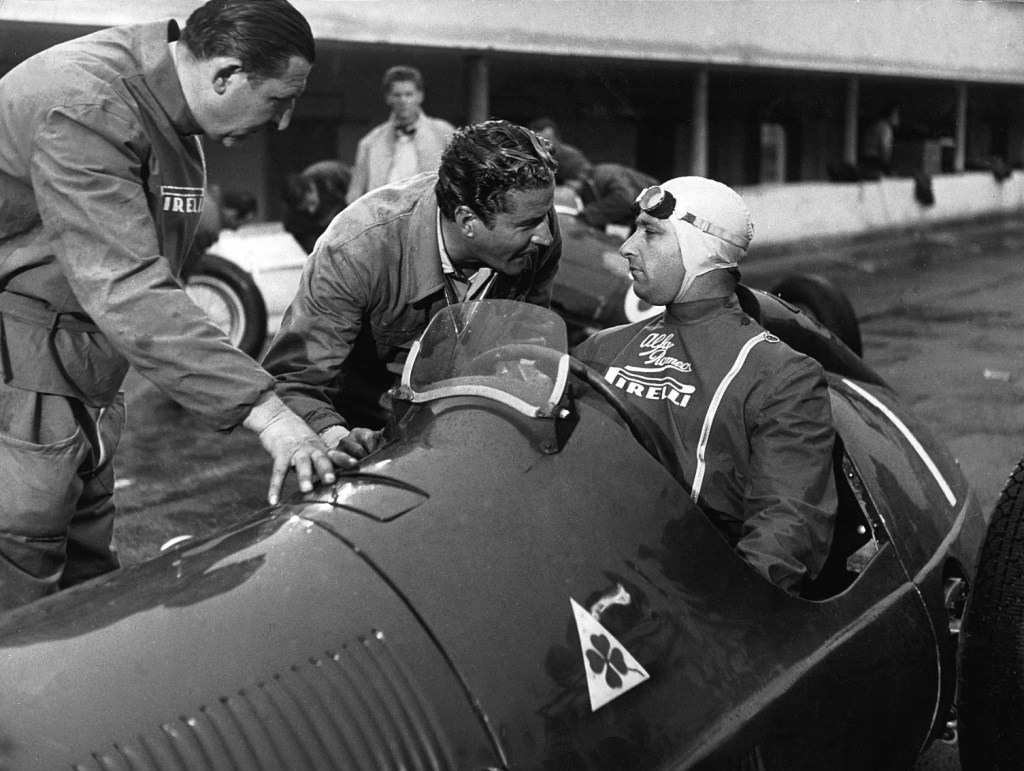
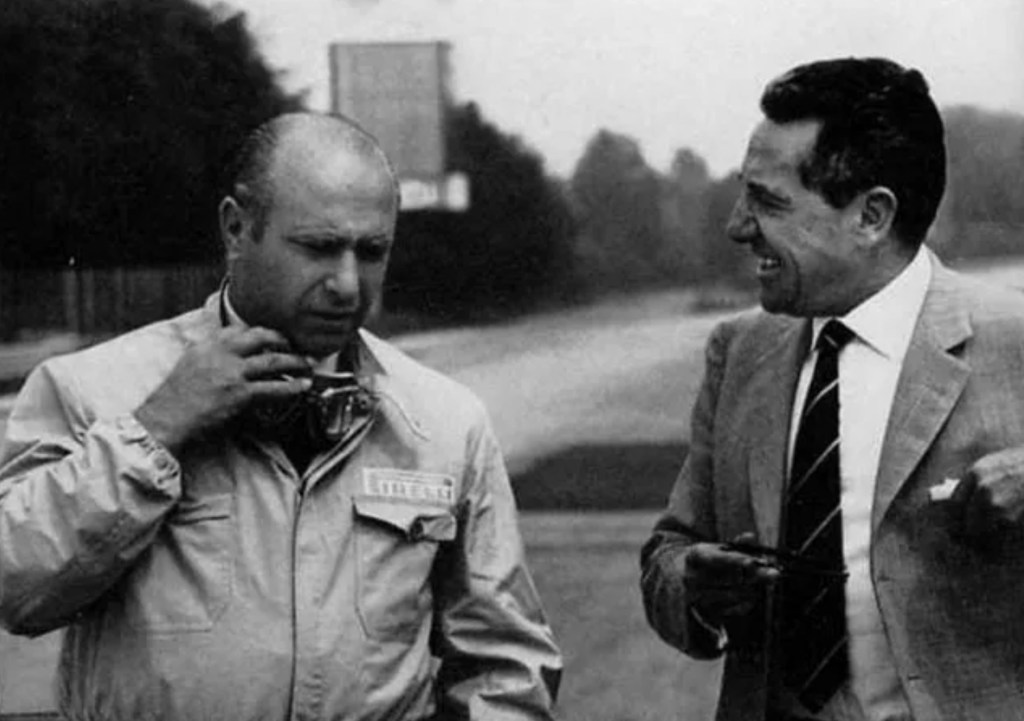
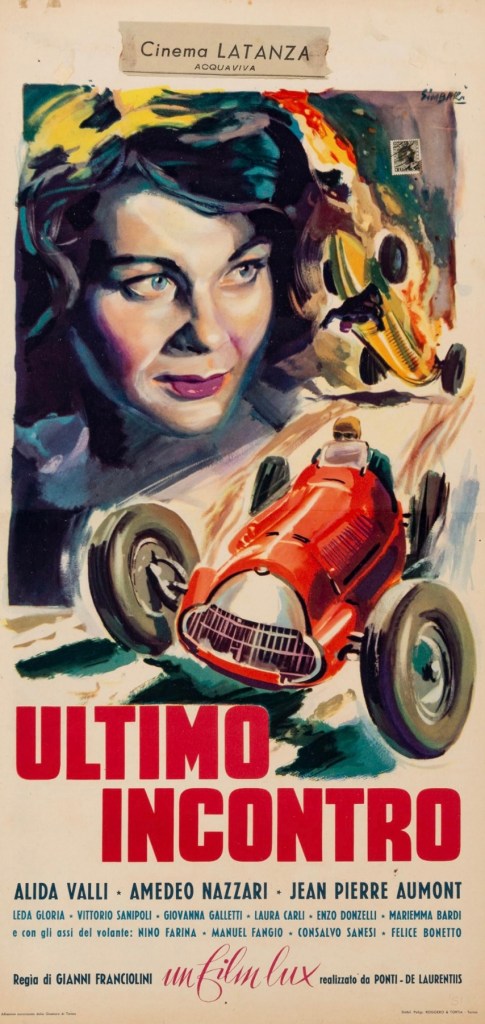
Pirelli wrote that of all the motor racing films, “there was only one racing driver who was called upon time and again to play himself in front of the camera – the Argentine Juan Manuel Fangio.”
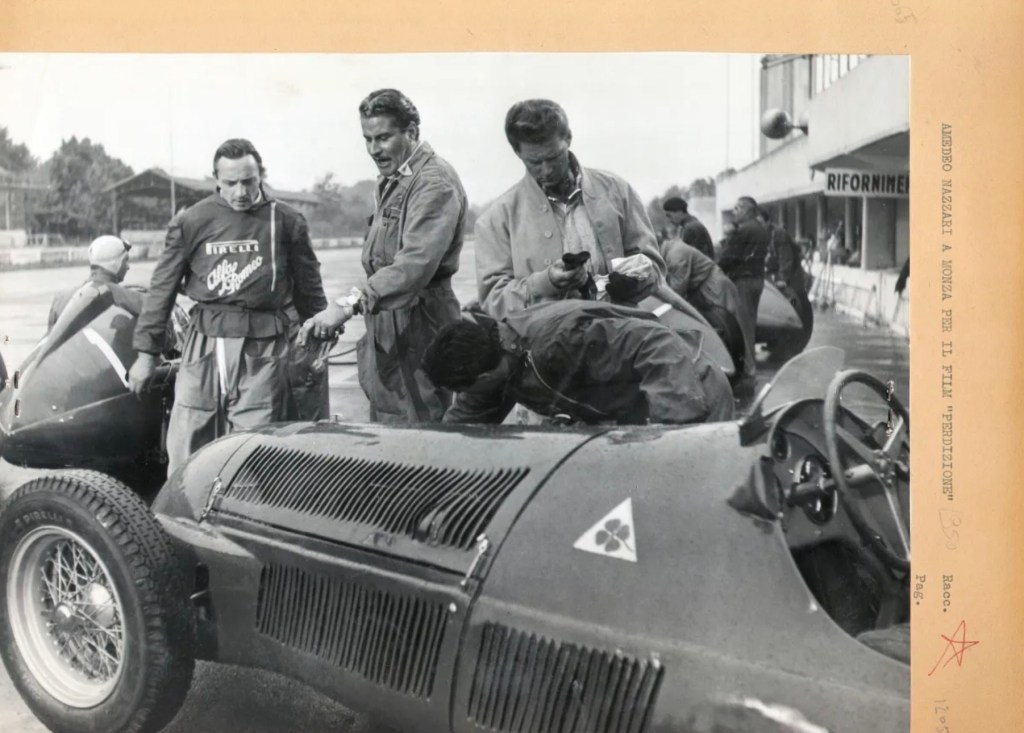
“It was in 1950: in the photos now in the Pirelli Historical Archive, the film is referred to with its provisional title Perdizone. It was actually released the following year as Ultimo incontro (last meeting).”
“We are on the Monza racetrack, with the protagonists Amedeo Nazzari, Alida Valli and Jean-Pierre Aumont. It is a sombre tale of betrayal and blackmail in the world of motor sport, in which the driver Fangio plays…the driver Fangio.”
“That year the Argentine was racing with the mighty Alfa Romeo team along with legends of speed such as Nino Farina, who went on to win the (1950) world title.”
“The long P-logo of Pirelli, which supplied the read Alfa Romeo cars with Stella Bianca tyres, is embroidered on their overalls, underneath the cloverleaf symbol.”
“In Perdizone/Ultimo incontro, Fangio was already on his way to becoming a legend, but his serious, watchful look is that of a true actor. The driver from Balcarce stopped racing in the late 1950s, with five world championships under his belt.”
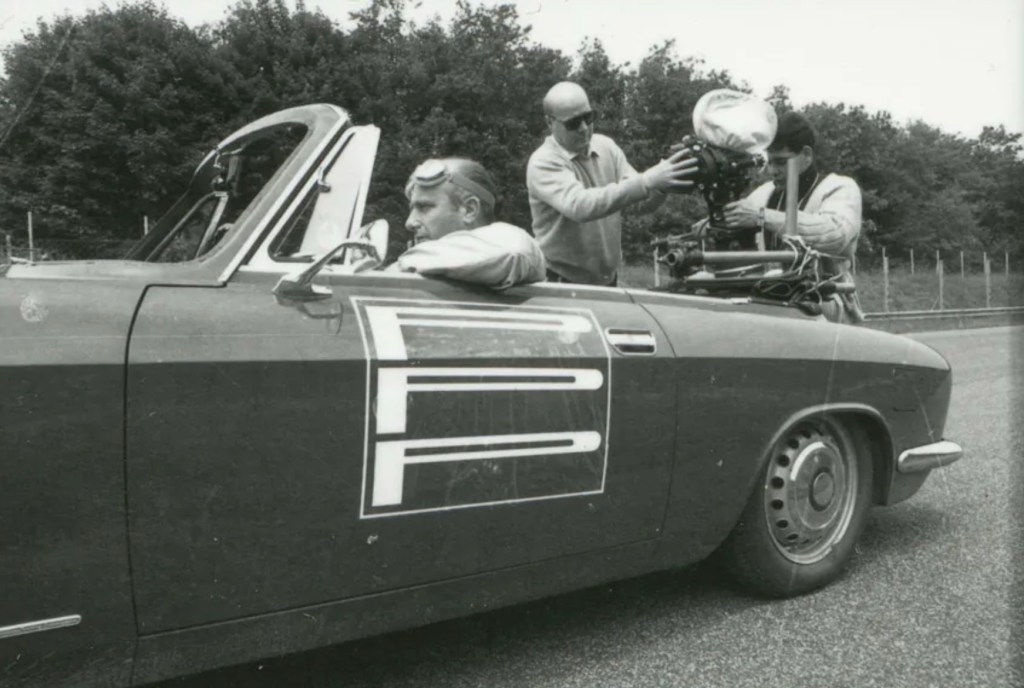
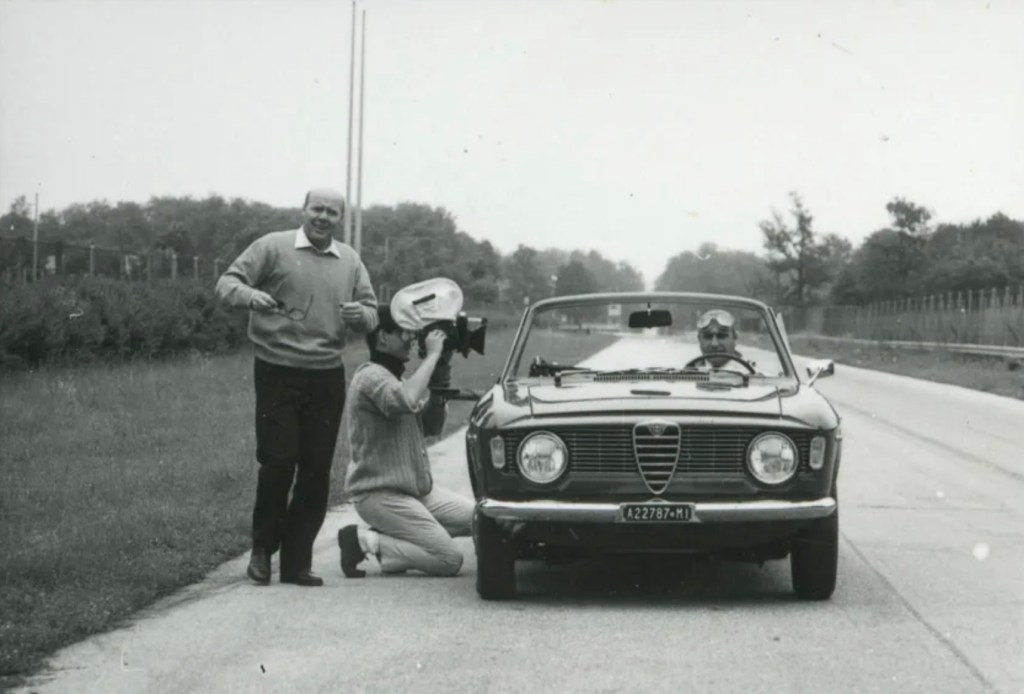
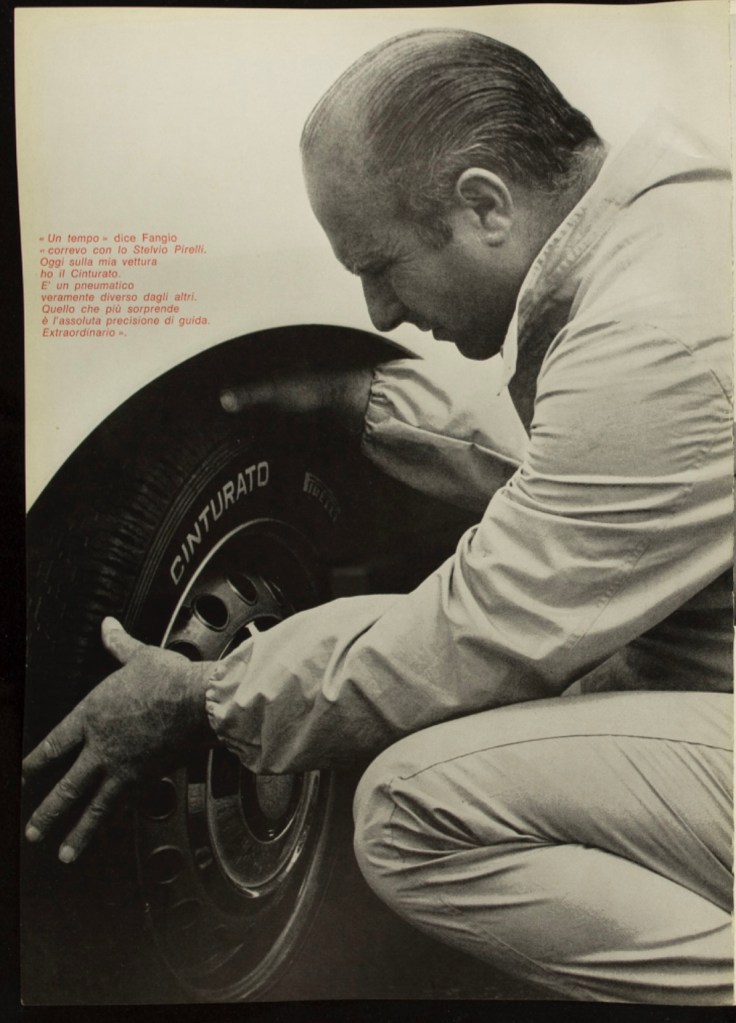
“During his career his name appeared a number of times next to that of Pirelli: it happened again in 1965, and once again there was a camera there to record it. This was a spot produced for Carosello TV commercials with reportage by Ugo Mulas.”
“The driver once again played himself, the legendary Juan Manuel Fangio now clocking up the laps in his Alfa Giulia GTC.”
“When he gets out, he looks into the camera and recalls: ‘I used to race with the Stelvio, but now this Cinturato is really different from the rest. Extraordinario!’ And in his magnificent Italian-Argentine manner, Fangio goes on to tell the audience on the television screen about his endless string of successes.”
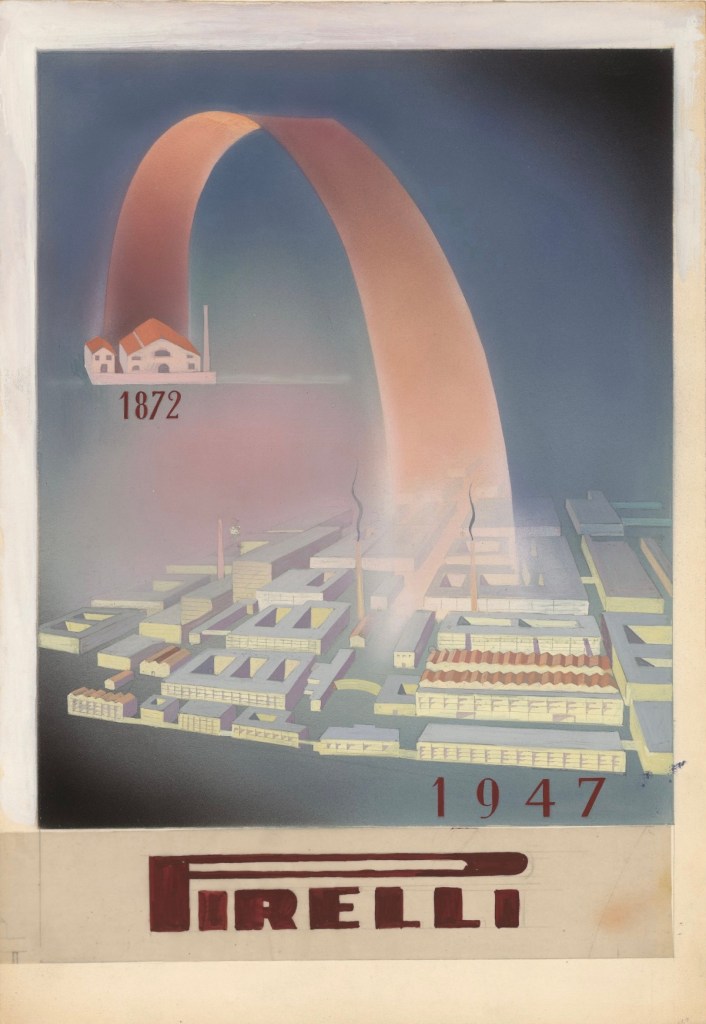
75th anniversary poster
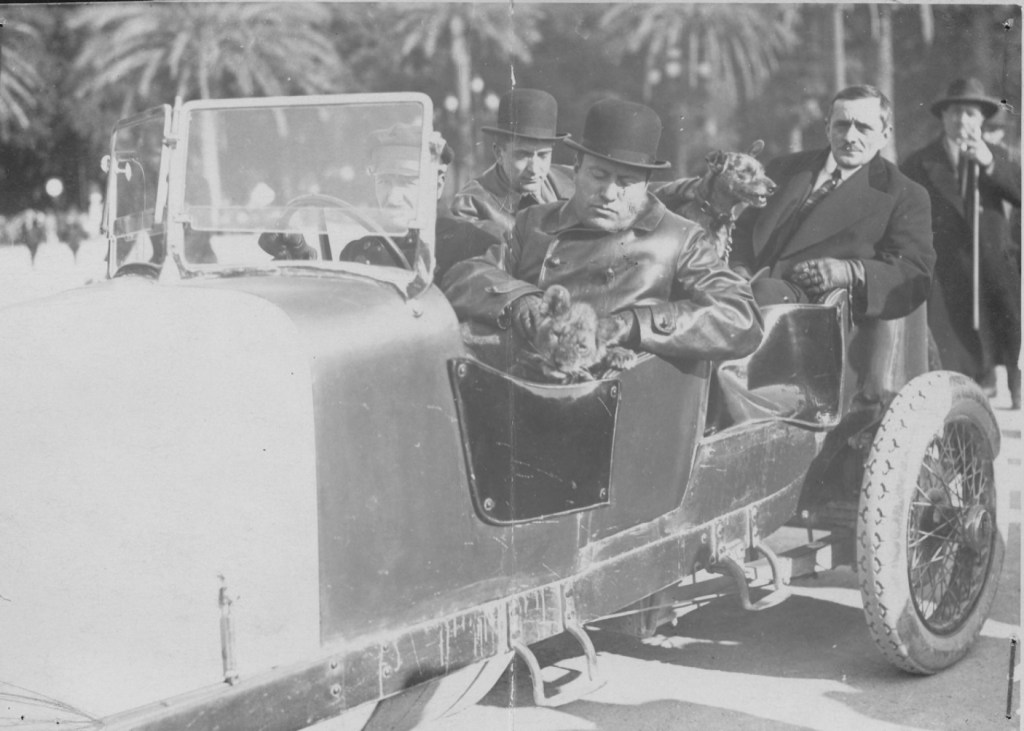
Benito Mussolini and pet pussy aboard an Alfa Romeo in 1923. What model is it I wonder?
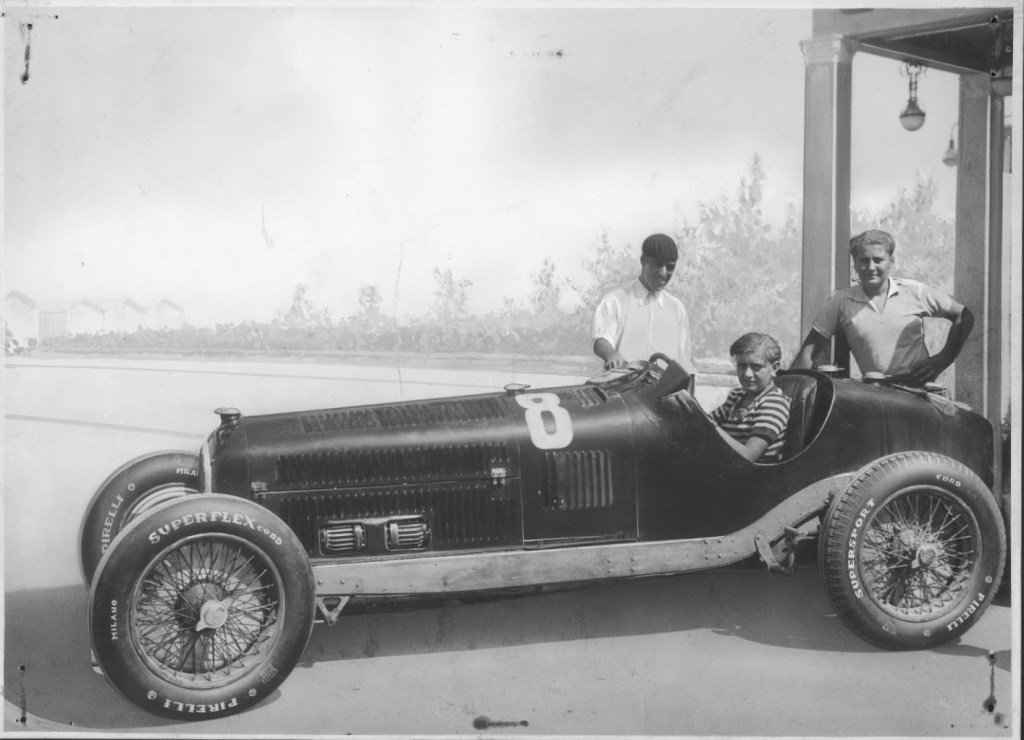
Meanwhile poor old Tazio is tasked with amusing Ill Duce’s sons in his P3, Bruno in the driving seat and Vittorio behind.
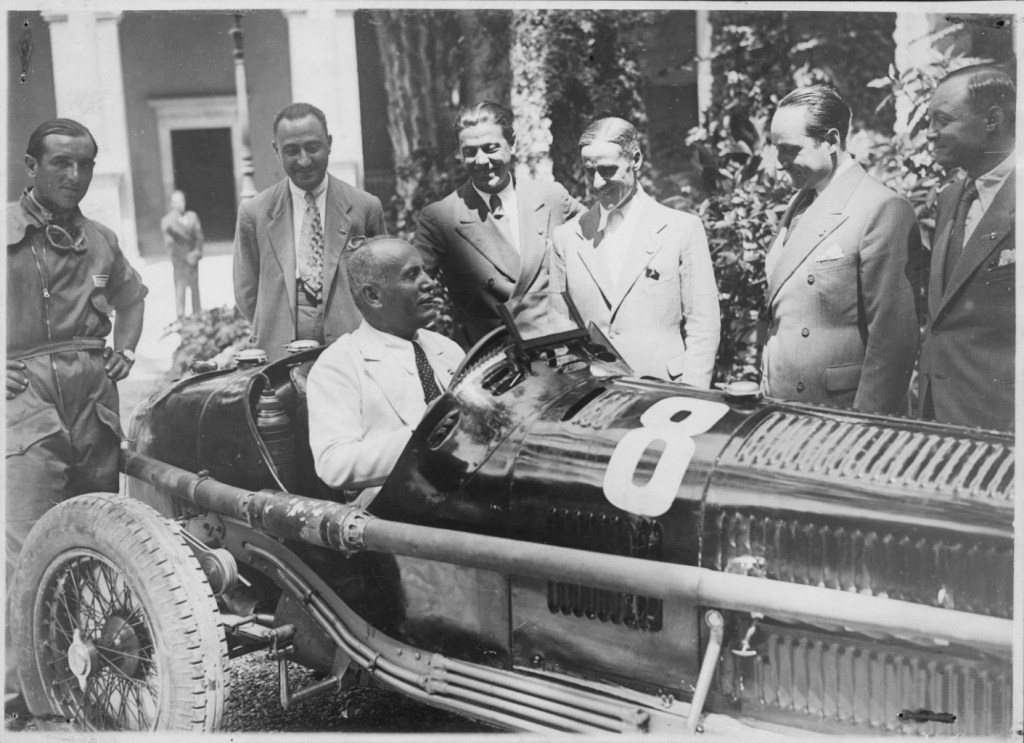
Mussolini with Nuvolari again, and the director-general of Alfa Romeo Prospero Gianferrari (both in the centre). “The P3 is probably the car with which Nuvolari won the August 14, 1932 Coppa Acerbo.”
1971
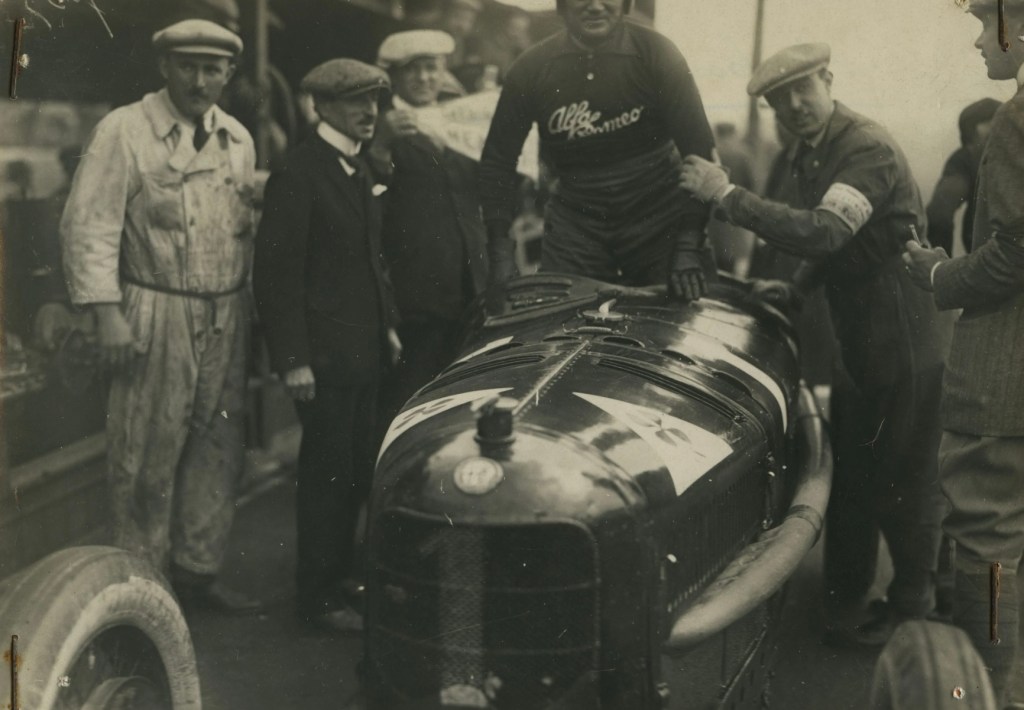
Antonio Ascari in the P2, with designers Luigi Bazzi in the light coloured overalls at left, Vittorio Jano and Giorgio Rimini during the 1924 Italian Grand Prix weekend.
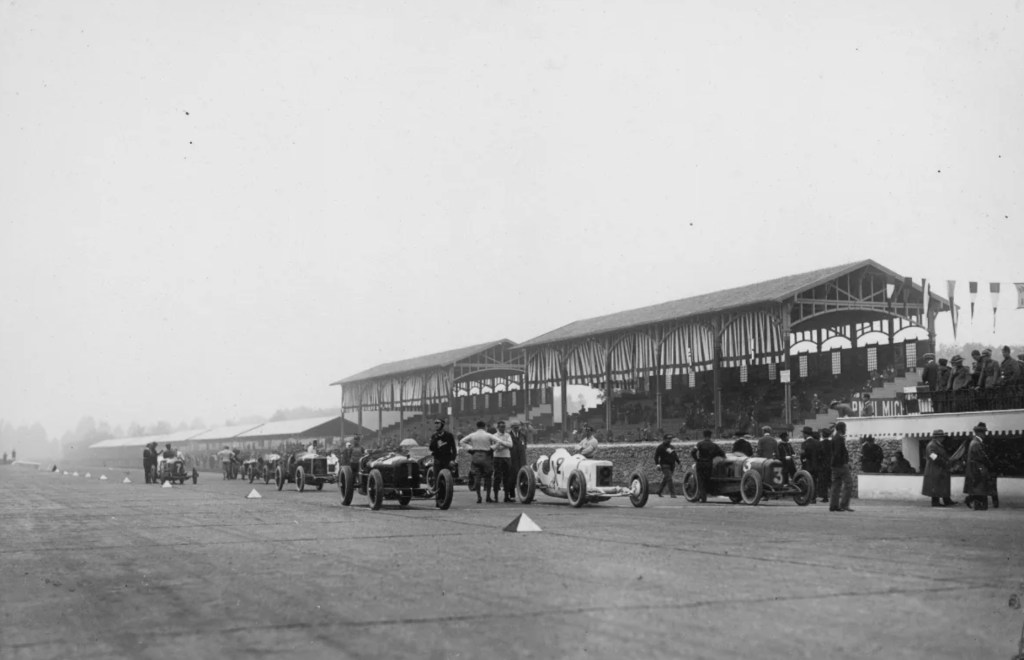
Before the start of the race: Antonio Ascari’s Alfa P2 #1 Christian Werner’s Mercedes M72 #2 and Jules Goux’ Rolland-Pilain Schmid #3.
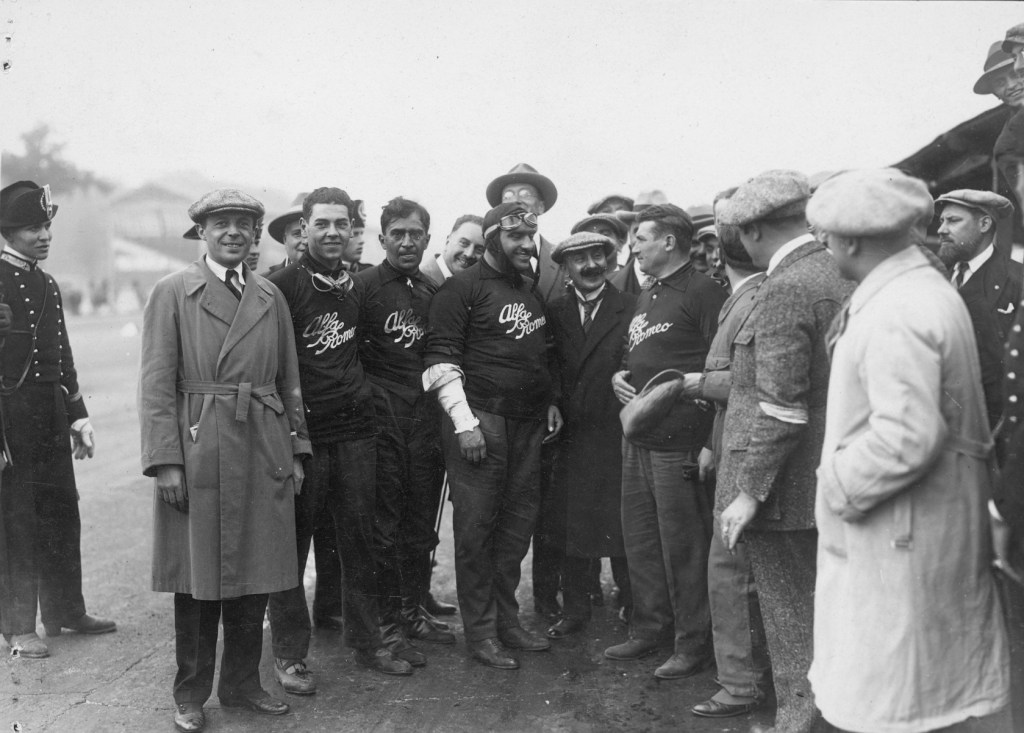
Alfa Romeo won in a rout taking the first four placings: Ascari, Louis Wagner, Campari and Bruno Presenti, and Fernando Minoia.
Scuderia Alfa Romeo: unidentified in the overcoat, mechanic Giulio Ramponi, drivers Minoia and Campari, the engineer and entrepreneur Nicola Romeo, and driver Antonio Ascari.
Ascari and Ramponi go for a greet-the-punters wander.
Giuseppe Campari and P2.
(Federico Patellani)
Gigi Villoresi, Nino Farina and Alberto Ascari in 1950, this photo was published on the cover of the January-February issue of the Pirelli magazine. Nice portrait of Gigi in a Ferrari below.
(Ferrucio Testi)
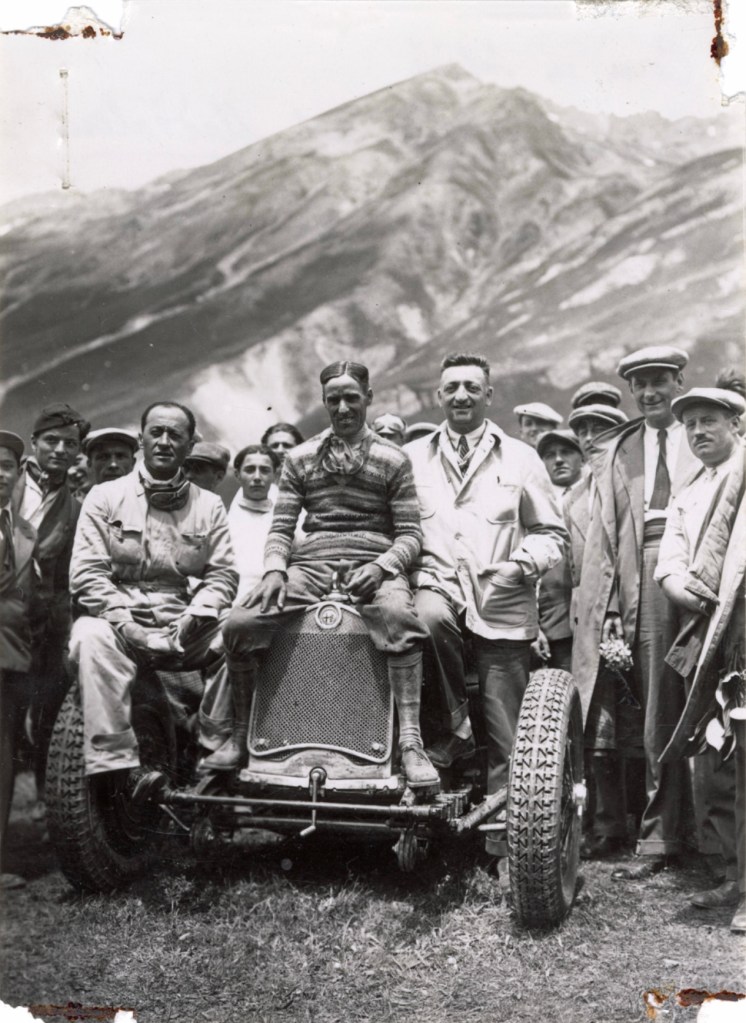
Scuderia Ferrari shot of Luigi Arcangeli, Tazio Nuvolari and Enzo Ferrari sitting on an Alfa Romeo P2 during the European Hillclimb Championship in June 29, 1930
The Pirellis are Stella Bianca’s, the venue is Cuneo-Colle della Maddalena. While Pirelli wrote that Tazio was first and Luigi third, Rudy Caracciola won the day on a Mercedes.
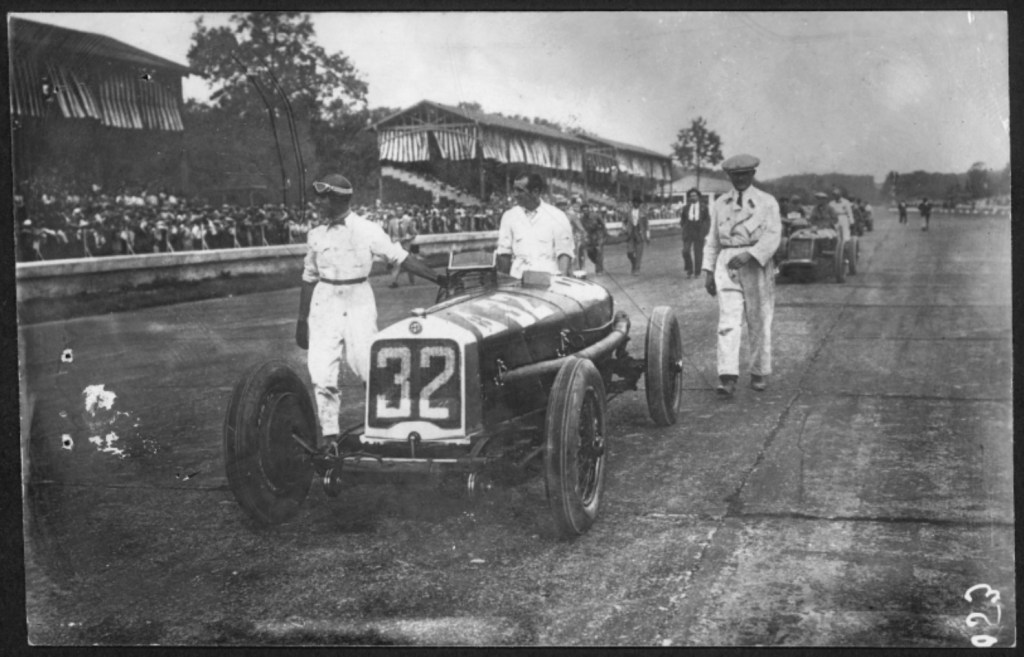
And below walking to the start alongside an Alfa – a modified P2 of the type Achille Varzi used to win the Targa Florio in 1930 Bob King reckons, a quick look at Hull & Slater confirms this – circa 1930. Does anybody recognise the venue?
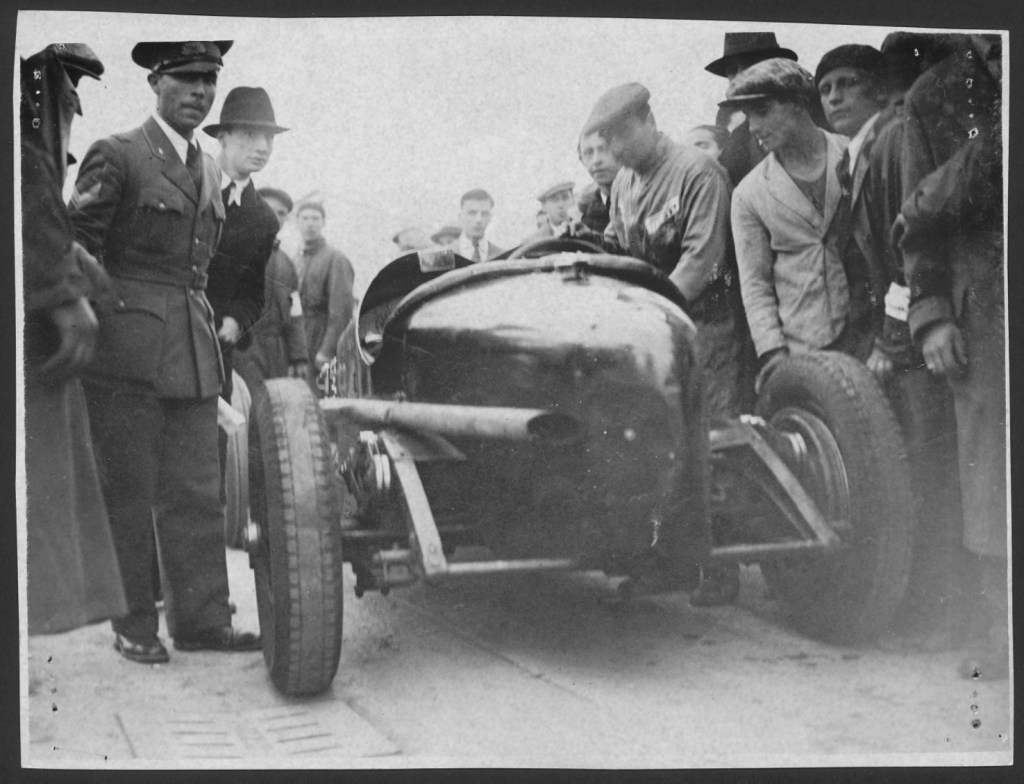
Antonio Ascari and a mechanic aboard, “probably an Alfa Romeo P1”, venue unknown.
I’m not so sure about the P1 theory…Giuseppe Merosi’s Fiat 804 copy wasn’t much chop. His engine had most of the same features as Fiat’s Type 404: DOHC, 65x100mm bore/stroke 1991cc six so the power output was about the same but the Gran Premio Romeo was longer and heavier. Its aero was inferior too, the epochal Fiat had a staggered mechanics seat which slimmed down its profile, the Alfa did not.
While P1s were entered for the 1923 Italian Grand Prix – for Ugo Sivocci, Alberto Ascari and Giuseppe Compari – after Sivocci crashed to his death in practice the team withdrew from the meeting as a mark of respect, the P1s never raced.
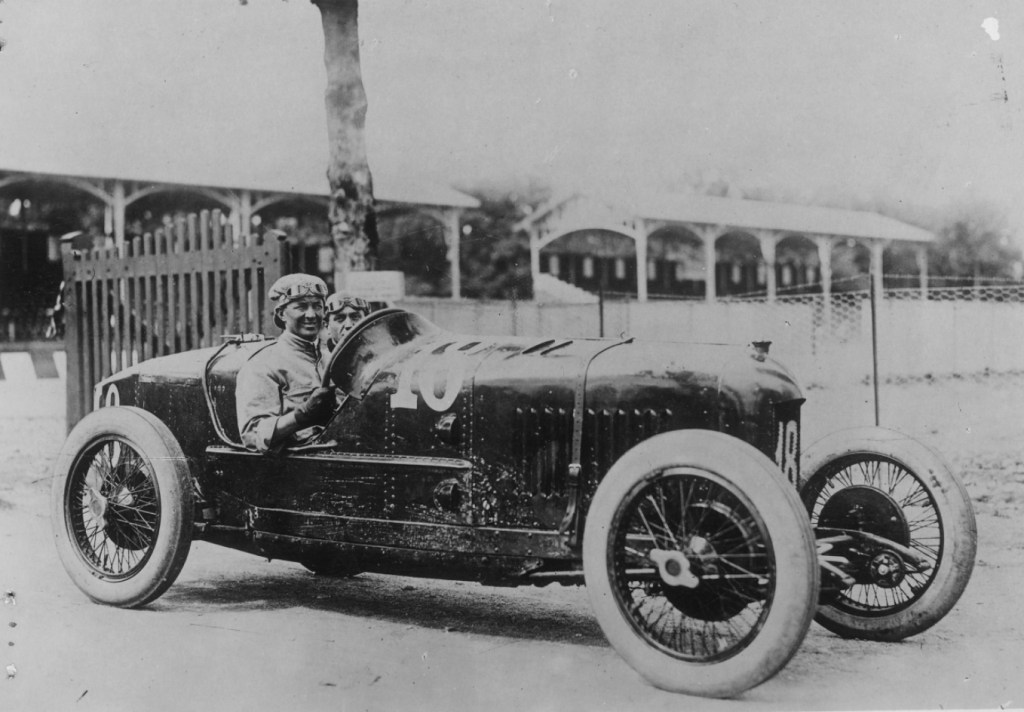
The car shown above carries #18, the Monza P1s used numbers, 6, 12 and 17, so the shot wasn’t taken on or about that weekend.
Is the car shown a P2, an early one? The Golden Era of Grand Prix Racing is my reference site for the results of the major races in this era, I cannot see an Alfa P2 number 18 entered in any of the races the site covers in either 1924 or 1925. A mystery…
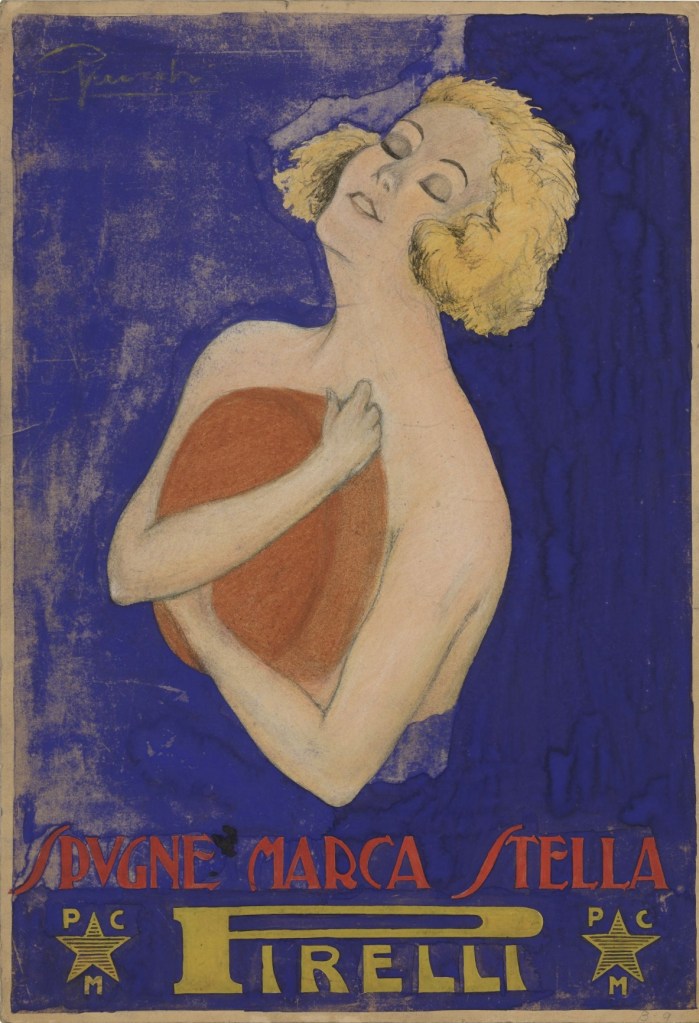
Pirelli sponge ad 1922 by A Franchi
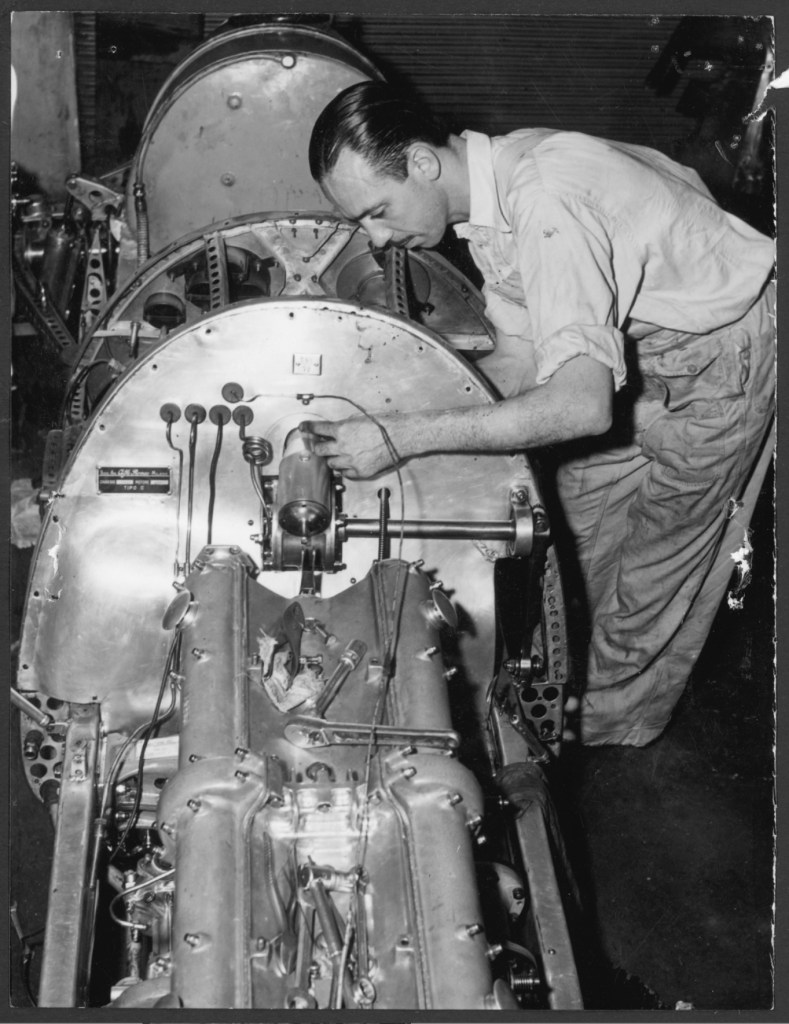
Oscar Galvez fettles the engine of his 3-litre supercharged straight-eight Alfa Romeo 308 in January 1949, can’t quite read the chassis number…
He was third in the Buenos Aires Grand Prix behind the Maserati 4CLT’s raced by Alberto Ascari and Gigi Villerosi.
Achille Varzi’s Mille Miglia winning Alfa Romeo 8C2600 Monza Spider Brianza on the Carozzeria Brianza Stand in 1934.
The first four cars home were (2654cc) 8C2600 Monzas: Varzi/Bignami, Nuvolari/Siena, Chiron/Rosa and Battglia/Bianchi.
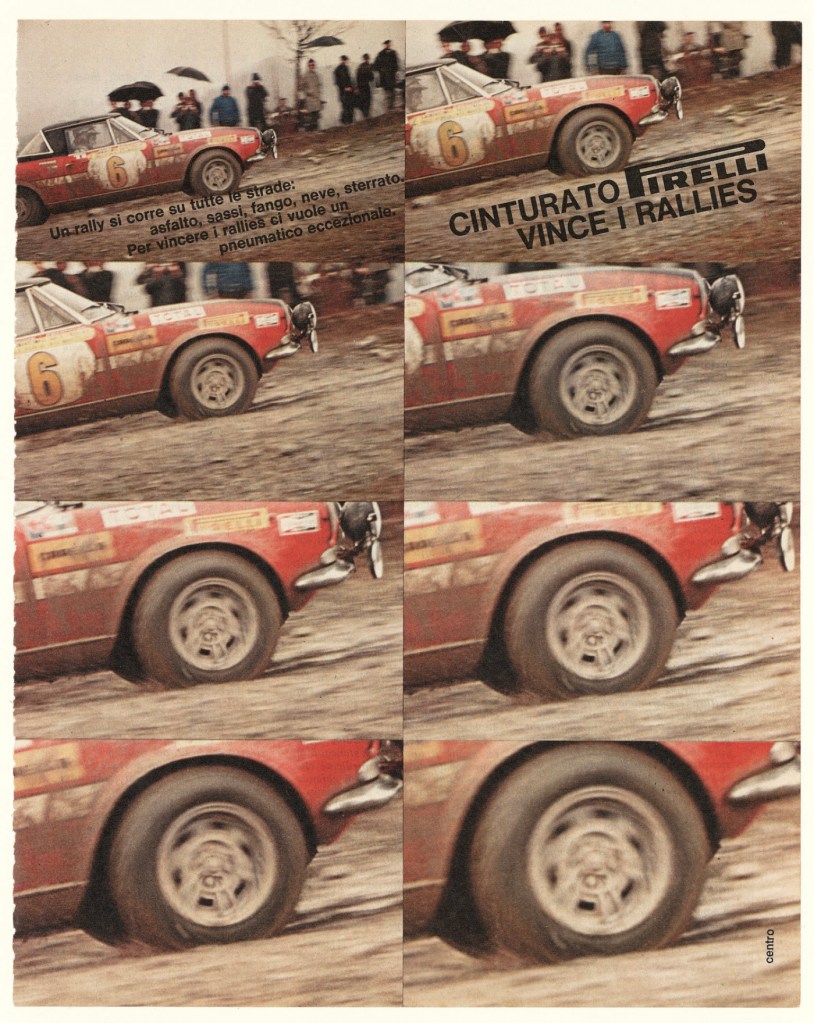
Fangio plugs Cinturato’s in 1965
Classic shot of Nino Farina on the way to winning the July 1950 British Grand Prix in an Alfa 158.
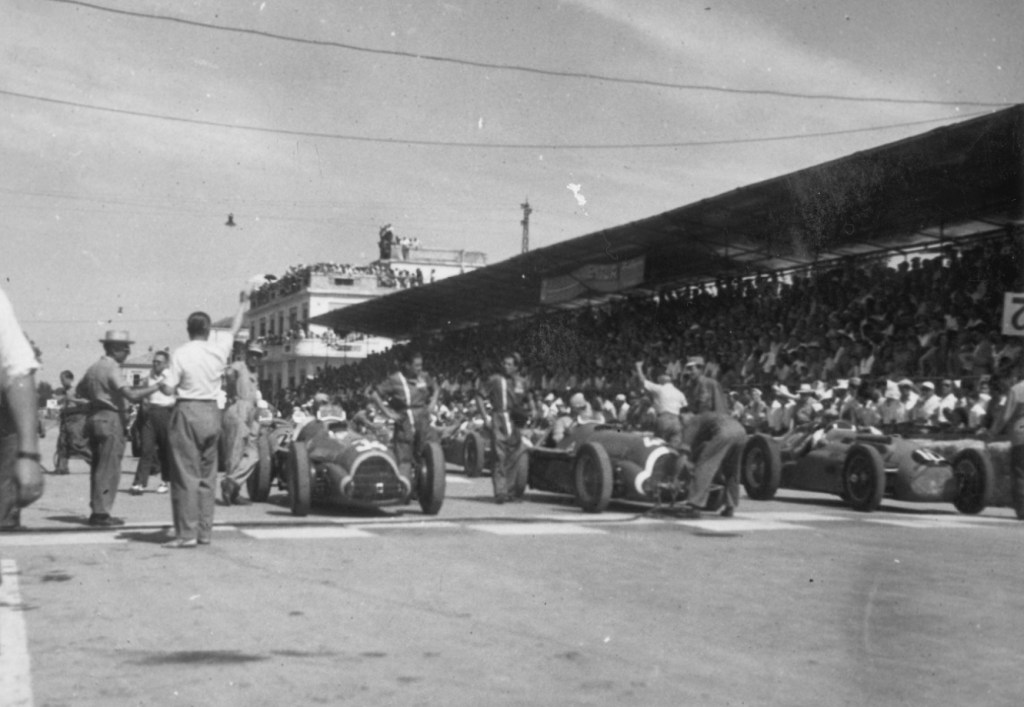
A month later the circus is on the grid at Pescara for the August 19 Grand Prix on the road circuit of the same name.
From the left is Fangio’s #34 Alfa 158, then the similar machine of Luigi Fagioli’s, with Louis Rosier’s Talbot-Lago T26C on the right. The race was won by Fangio from Rosier and Fagioli.
(F Patellani)
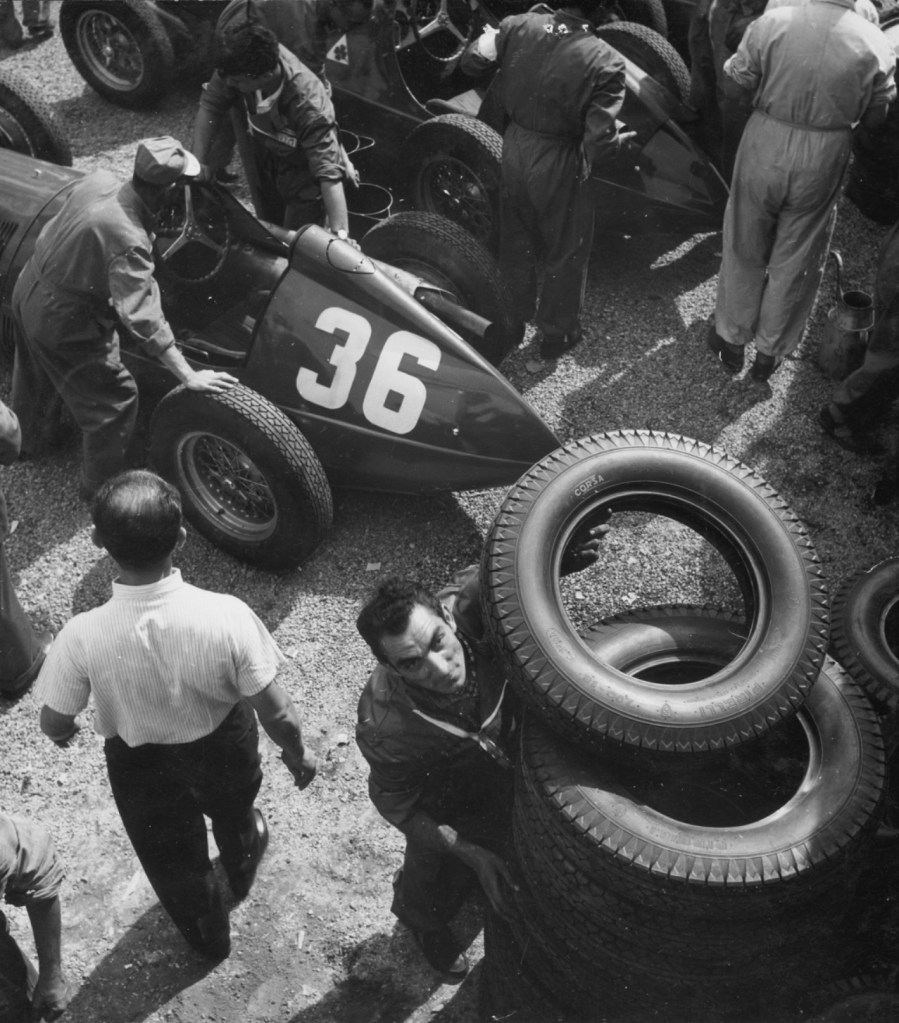
Paddock scenes at Monza during the September 1950 Italian GP weekend.
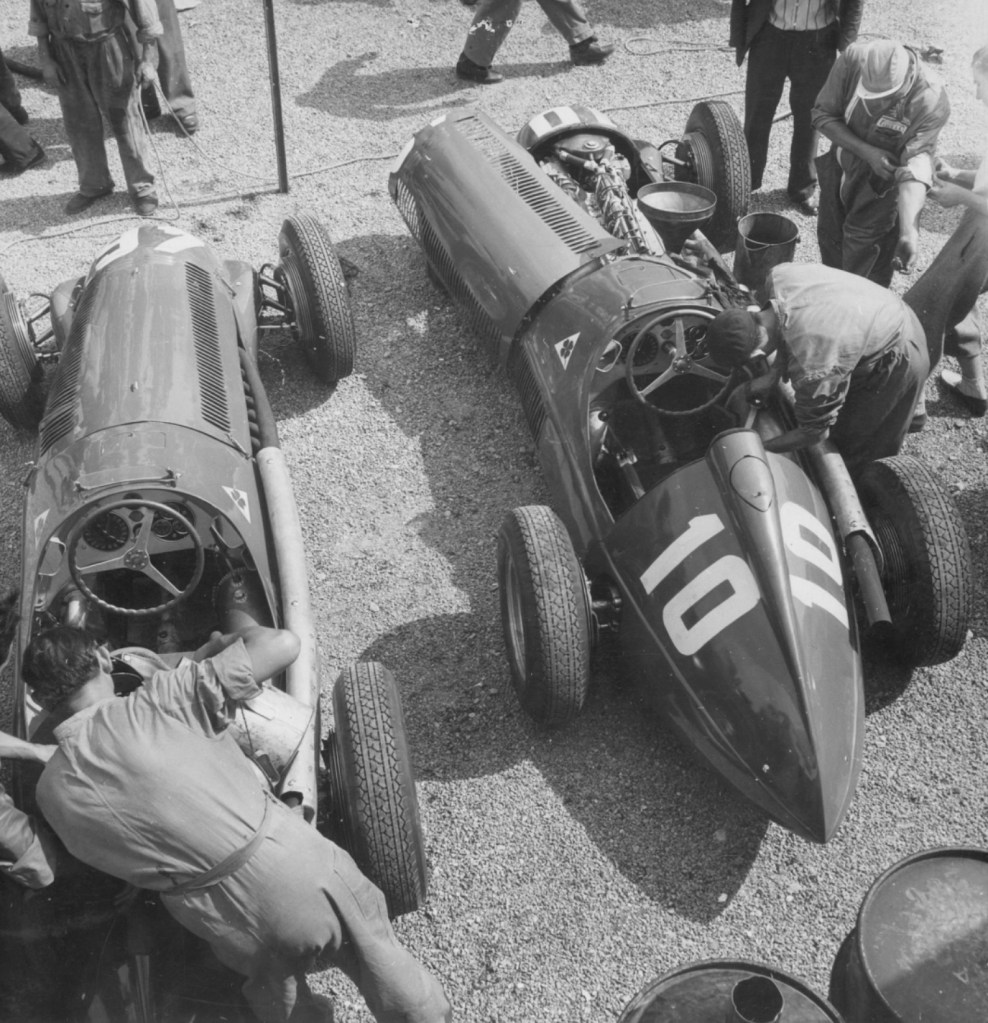
The Consalvo Sanesi 158, and Giuseppe Farina #10 Alfa Romeo 159 above, and Fagioli’s 158 below. Farina won the race from Alberto Ascari’s Ferrari 375, then Fagioli.
(F Patellani)
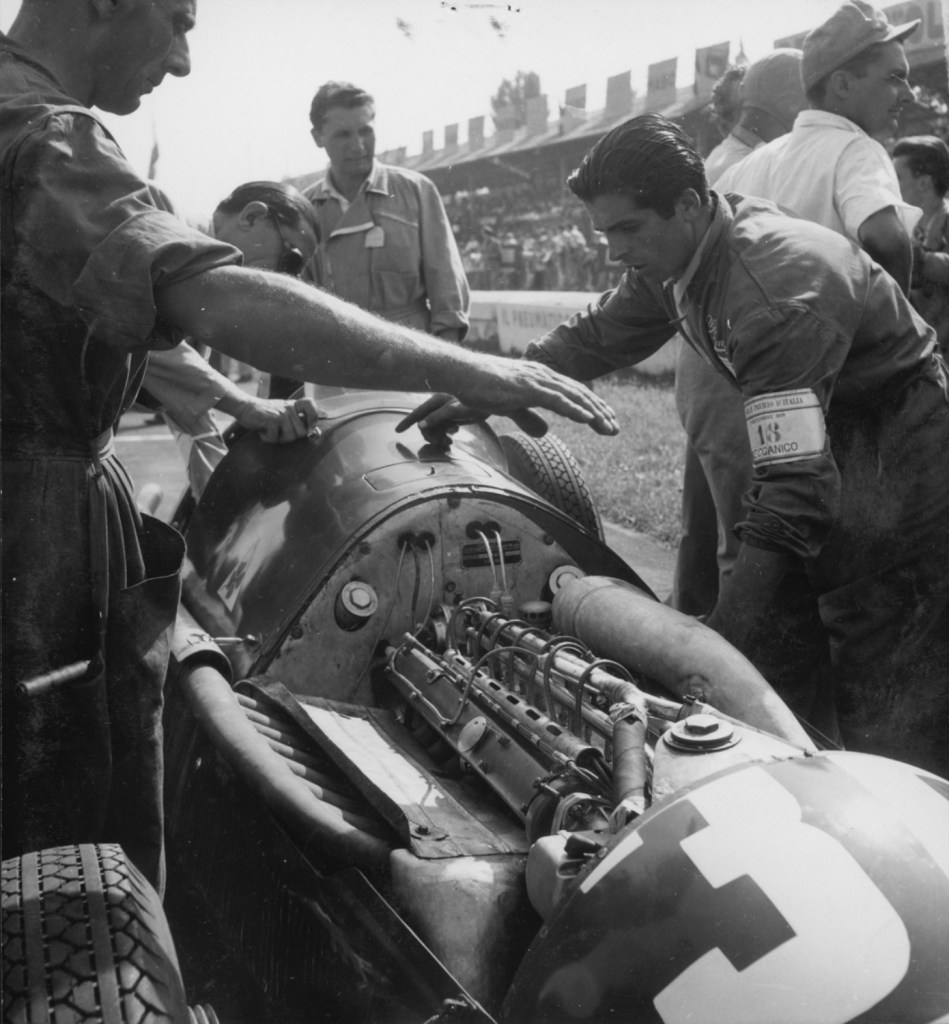
Below mechanics attend to the engine of Fagioli’s 158.
1959(Publifoto)
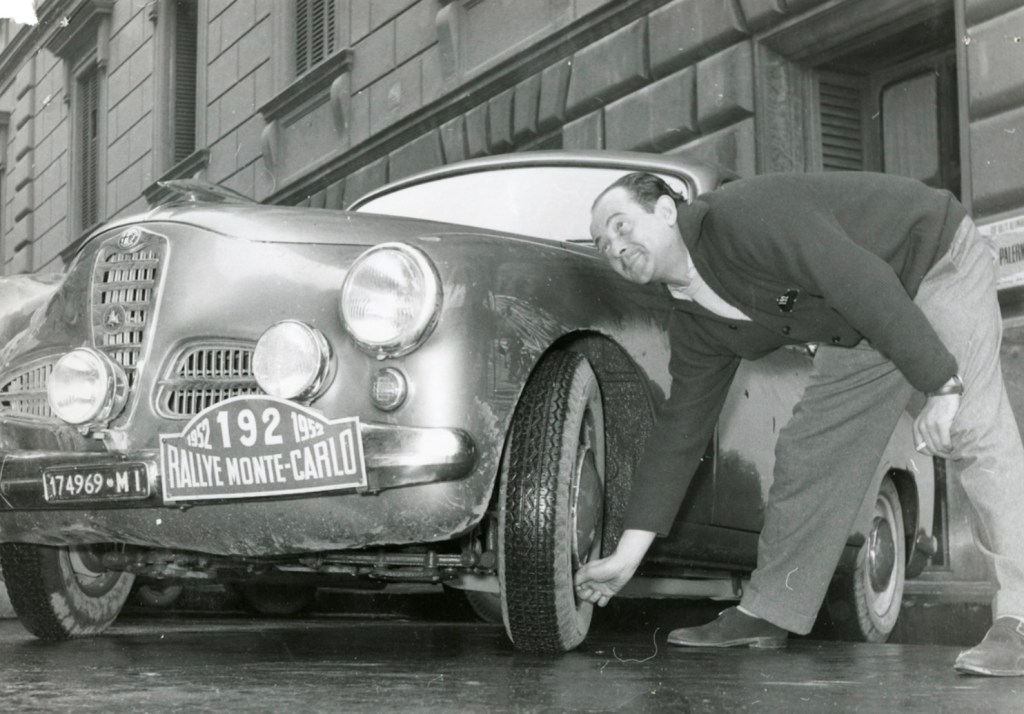
Prince Raimondo Lanza di Trabia inspects his left-front Pirelli, Alfa Romeo 1900 TI during pre-event scrutineering in Milan before the start of the 1952 Monte Carlo Rally.
He was 72nd in the event won by Sydney Allard/Guy Warburton Allard P1, the best of the Alfa’s was the 17th placed Andersson/Lumme 1900TI.
Pirelli Stelvio tyre ad 1956 (L Bonzi)
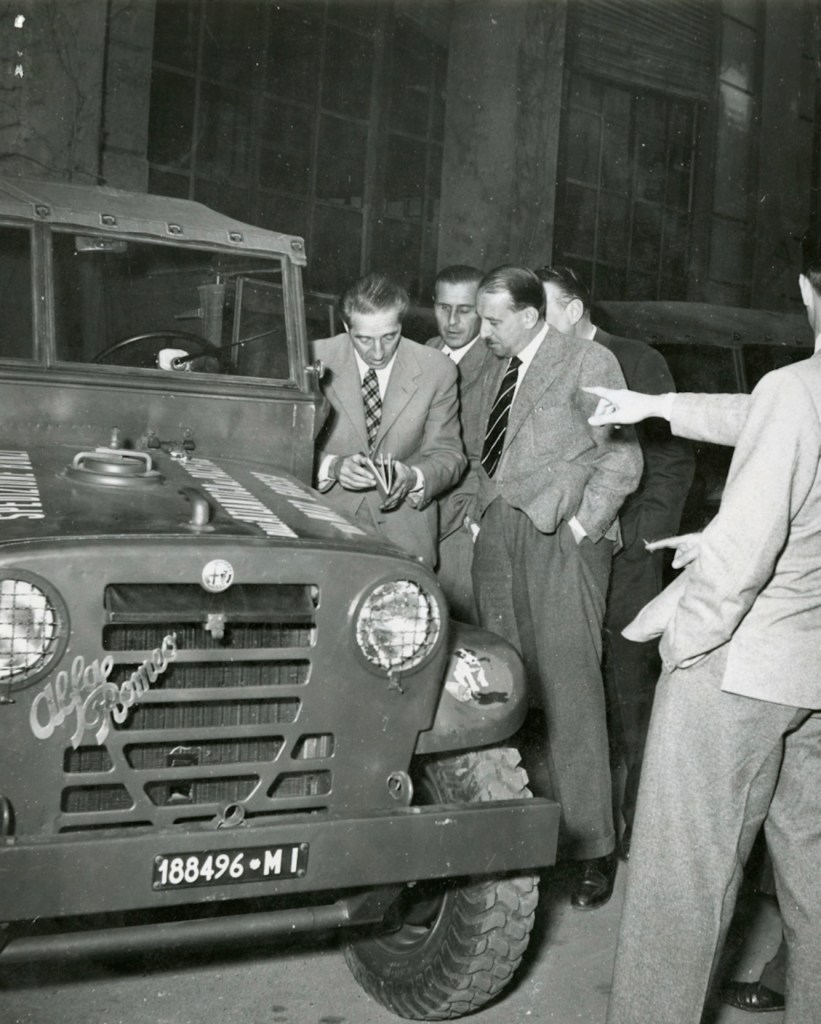
Count Leonardo Bonzi alongside his Alfa Romeo in Bicocca, Milan before the start of the Mato Gross Rally in 1952.
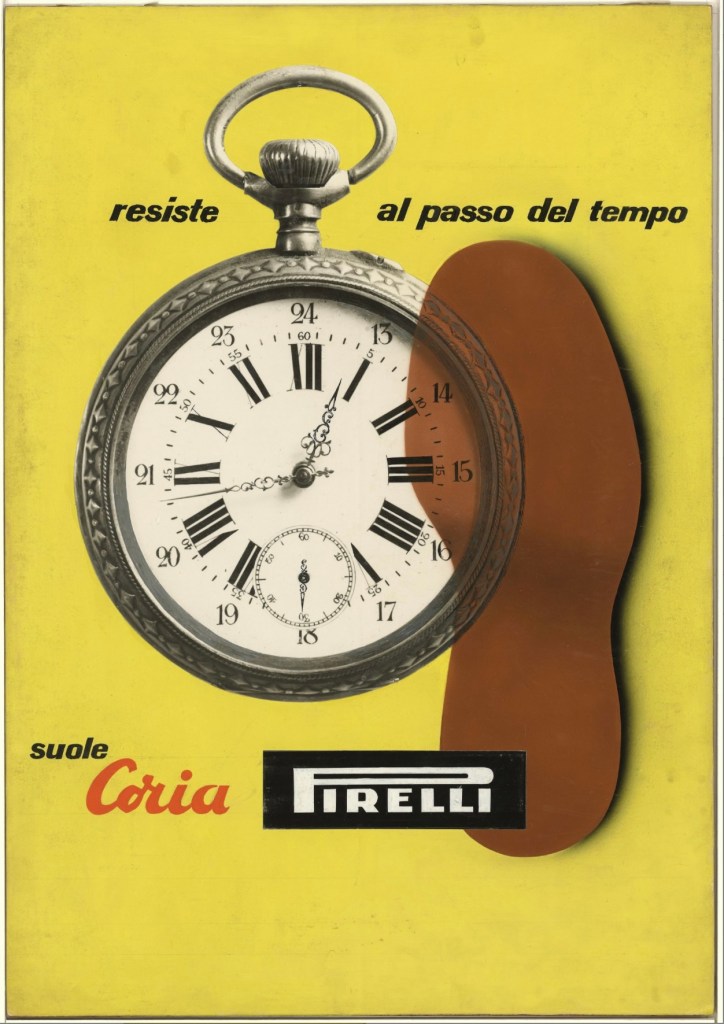
Pirelli Coria soles resist the passage of time Ezio Bonini 1953 (INCOM)
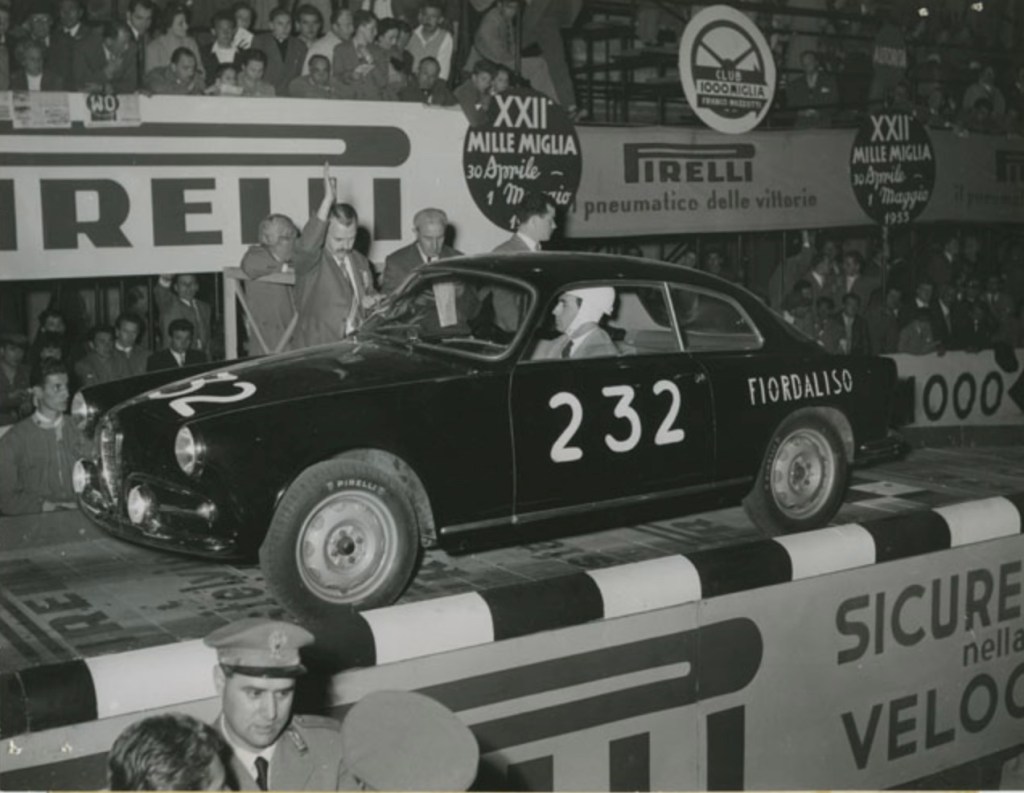
Mille Miglia 1955 start with the Santo Ciocca Alfa Romeo Giulietta Sprint on the ramp DNF. The race was of course won by the Stirling Moss/Denis Jenkinson Mercedes Benz 300SLR.
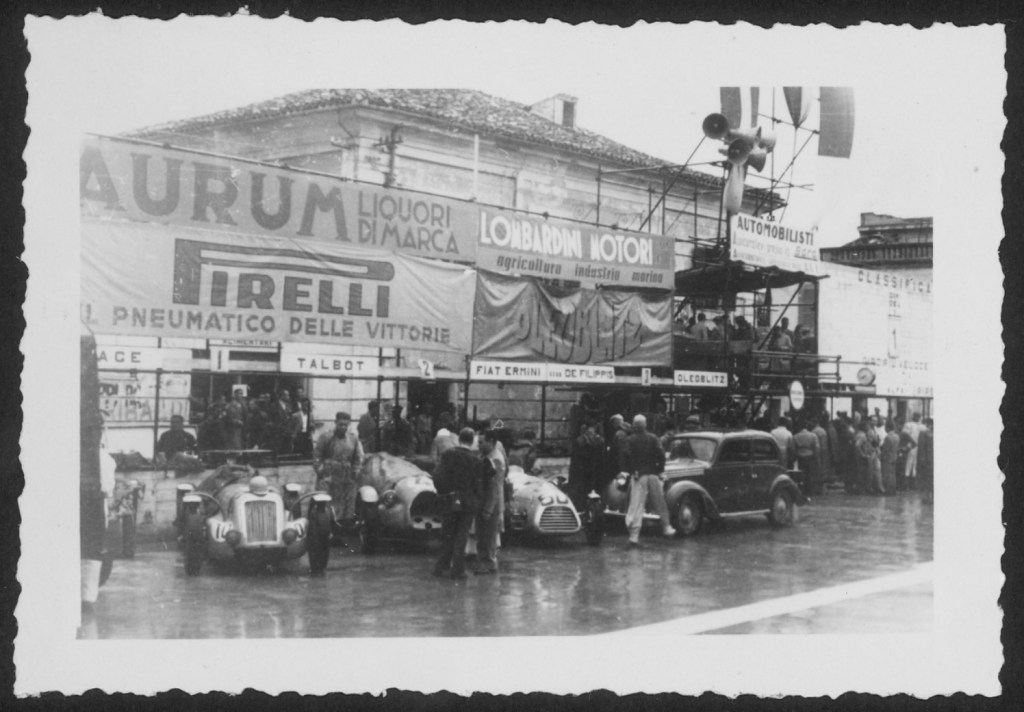
View of the pits during a soggy August 1949 Pescara Grand Prix weekend. Franco Rol won in his Alfa Romeo 6C2500 SS from Robert Vallone’s Ferrari 166S. Car 10 is Henri Louveau’s third placed Delage D6, #4 Louis Rosier’s Talbot Spéciale (DNS) and car #50, Bormioli’s ?
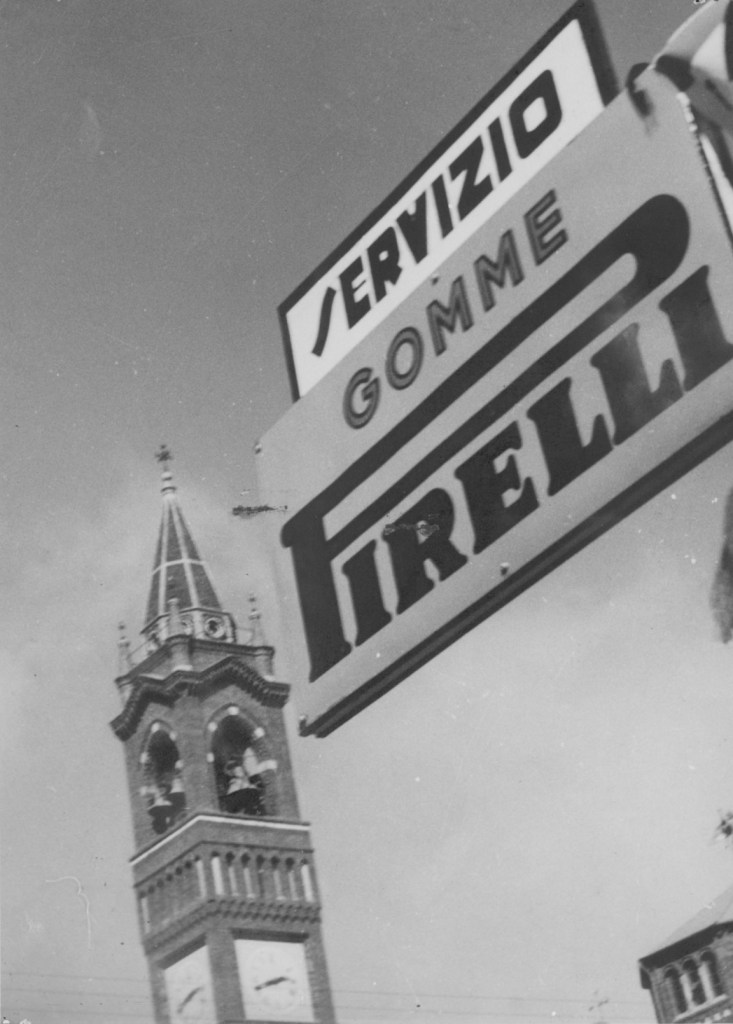
Asmara December 1938, site of the first Coppa di Natale. Behind the Pirelli sign is the Beata Vergine del Rosario church
Credits…
All images are from the Pirelli Foundation archives. Leonardo Bonzi, Publifoto, Federico Patellani. ‘Alfa Romeo A History’ Peter Hull and Roy Slater
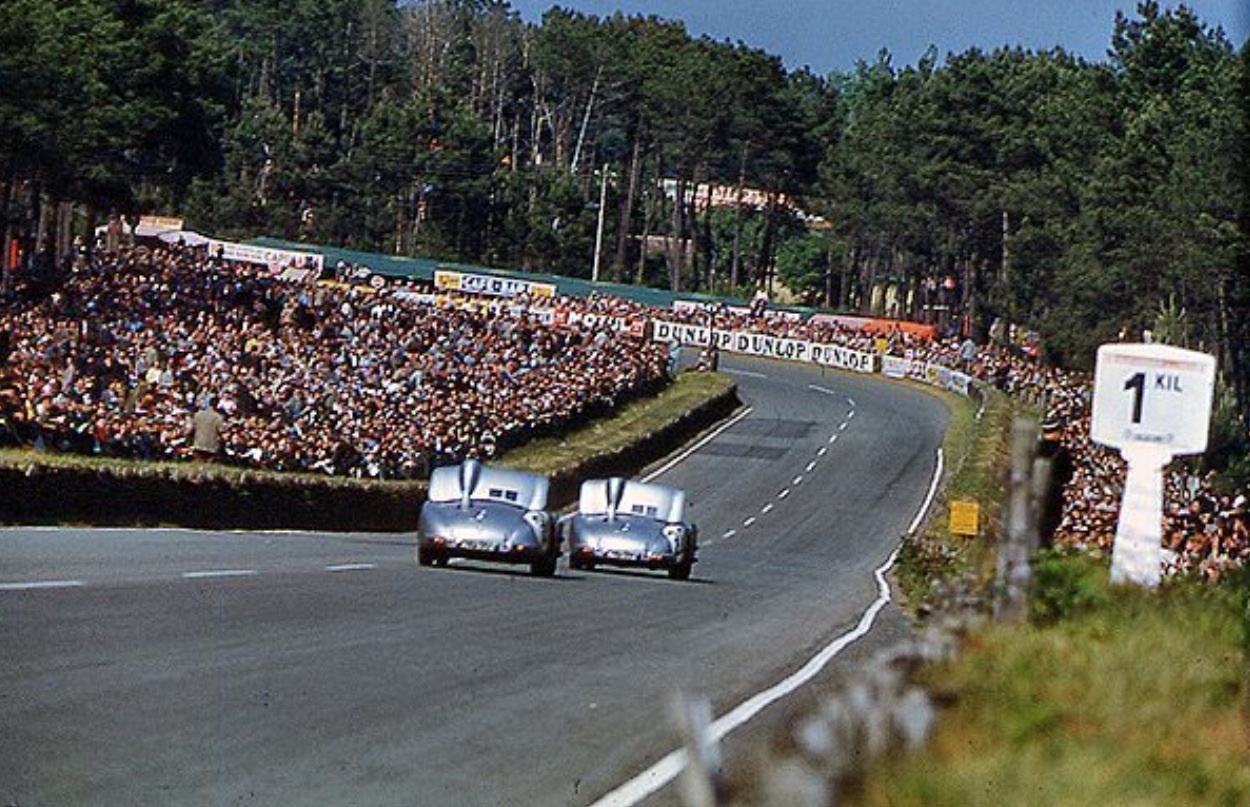
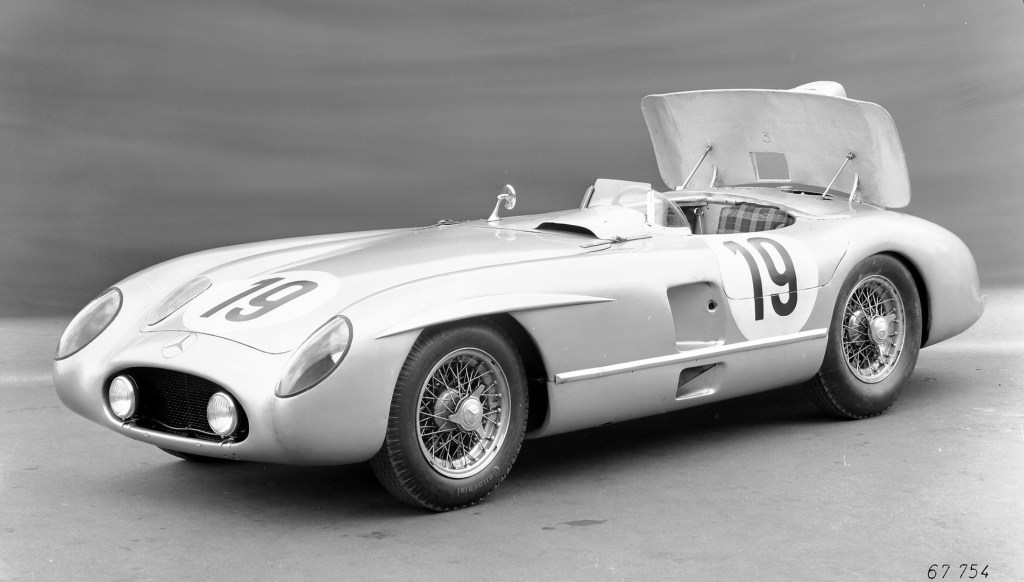
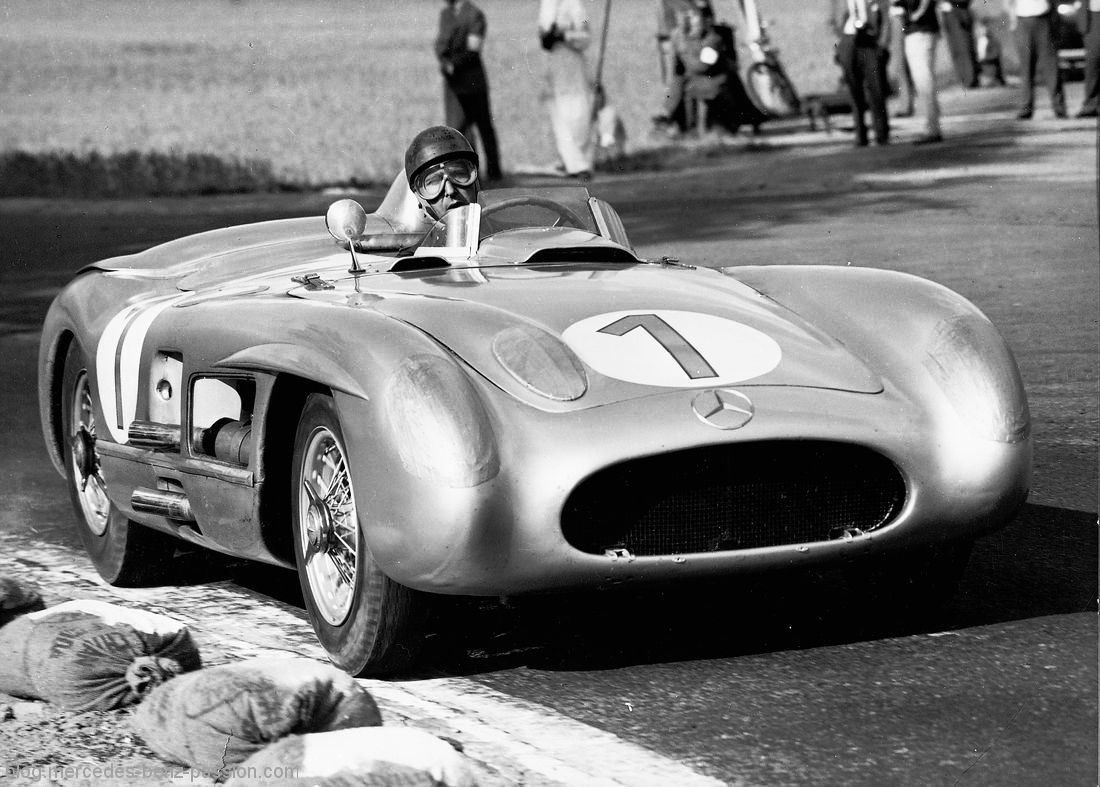
The somewhat other-worldly sight of two Mercedes Benz W196S/300SLR’s with air-brakes deployed as they approach the Esses at Le Mans in 1955…
When you consider the engineering of this clever response to the braking power of the Jaguar D-Type’s Dunlop brakes one can’t but wonder about the development of a German equivalent?!
The Benz was the champion sportscar of 1955 winning most of the blue-riband events: Targa Florio, the Mille Miglia and the Tourist Trophy, the exception being Le Mans of course.
Mercedes withdrew whilst in the lead due to the accident in which Pierre Levegh was an innocent party, which took his life and that of about 84 spectators, not to forget the 180 folks who were injured.
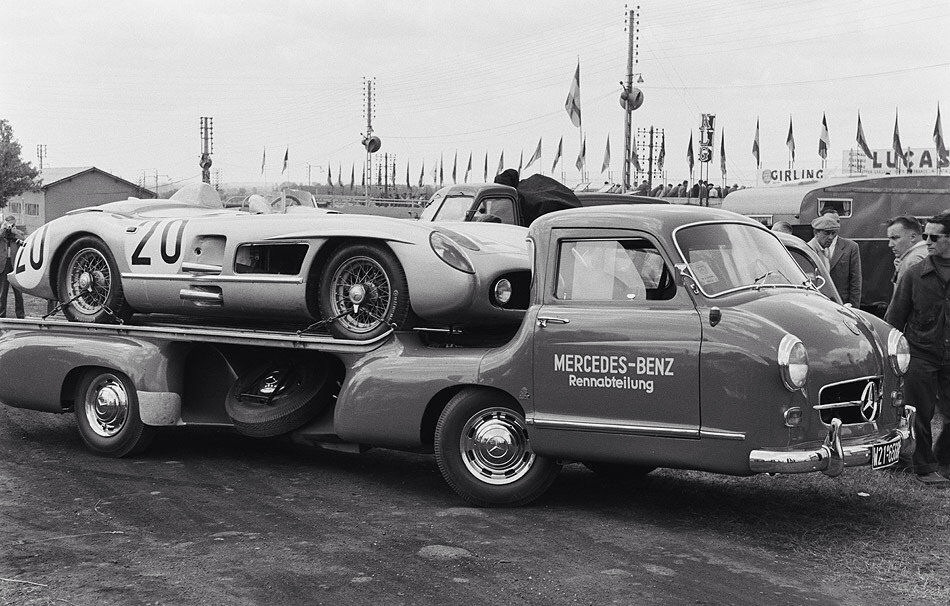
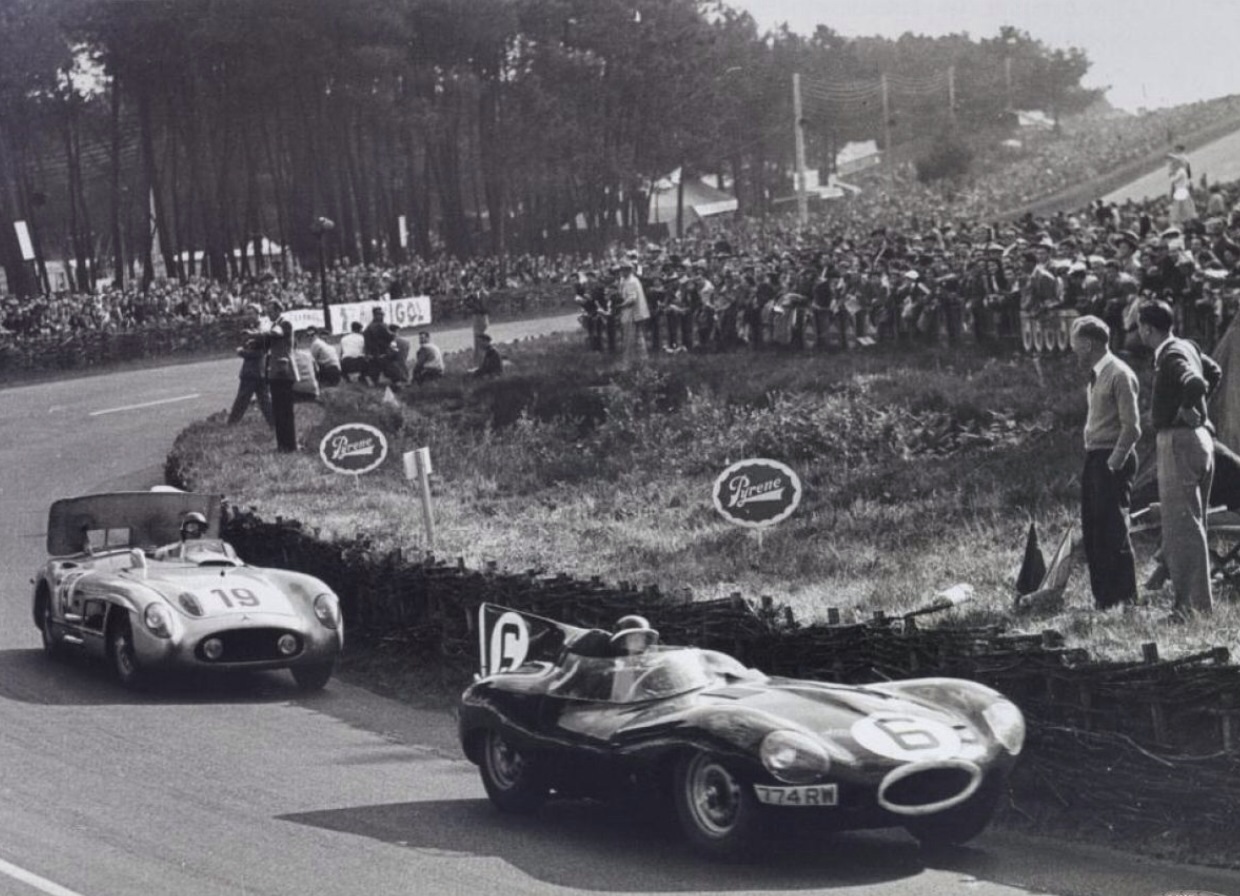
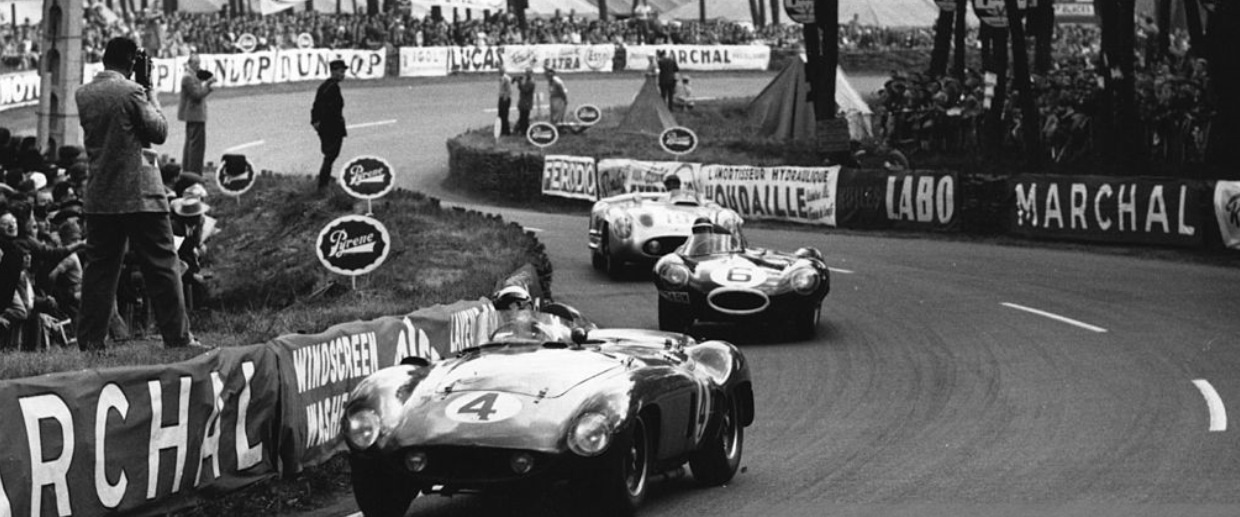
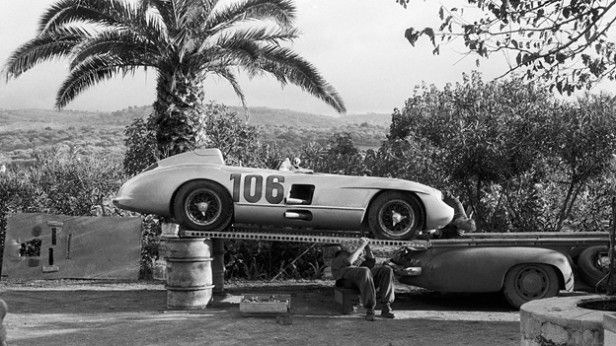
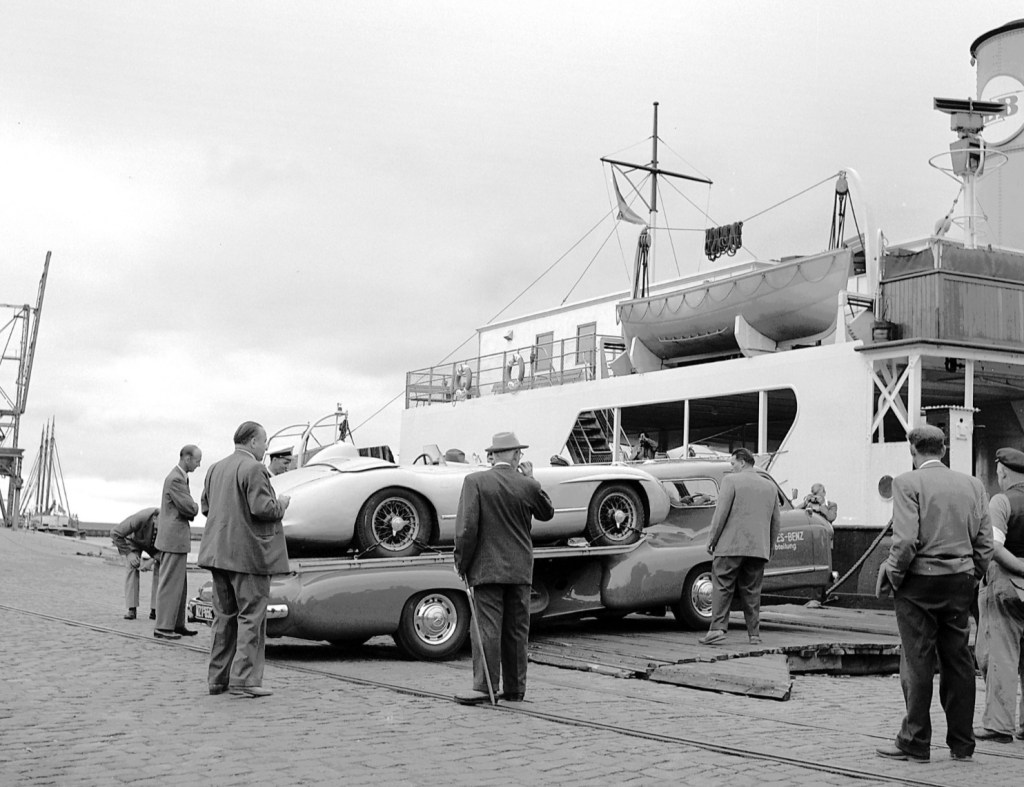
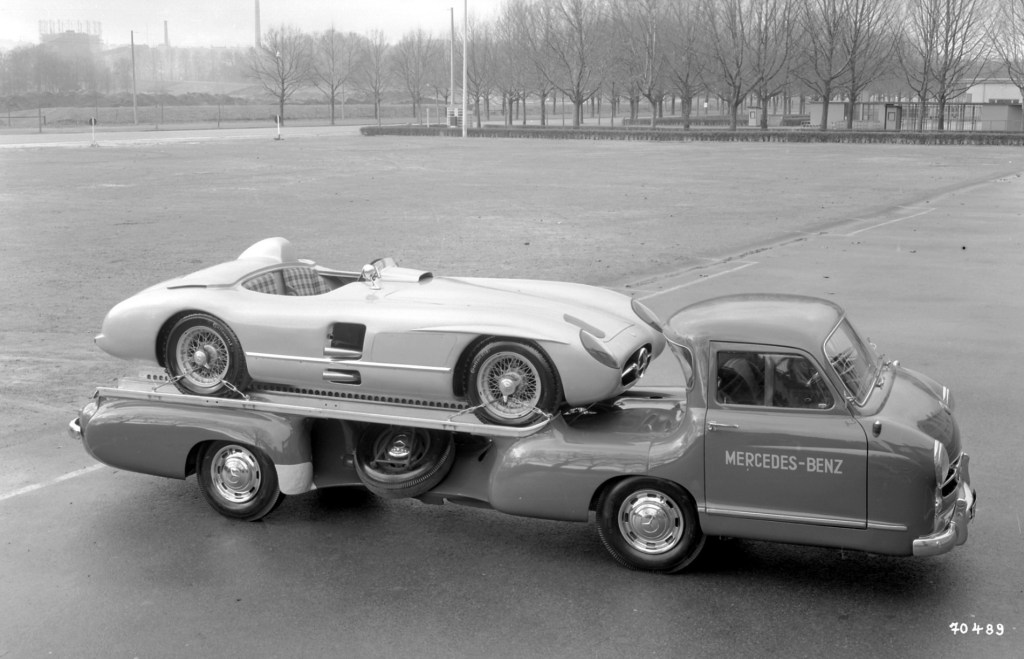
Built by Mercedes test department, this one-off 3-litre 192bhp 300SL powered 105mph race transporter, in Mercedes words “Was predestined to demoralise the opposition. If the racing car transported was that fast, even worse could be expected of the Silver Arrow on its platform.”(Mercedes Benz)Le Mans 1955. Hawthorn, Jaguar D-Type from Fangio early in the race, Dunlop Curves, note that Fangio’s air-brake is still deployed (unattributed)Le Mans 1955. Castellotti, Hawthorn, Fangio: Ferrari 121 LM DNF, Jag XKD first, Benz 300SLR entry withdrawn (Getty)
Design and construction…
In essence the W196S, as the factory model number suggests, “is basically a Type W196R Formula One racing car with a two-seater sports car body,” Mercedes Benz (mercedes-benz-publicarchive.com) wrote. The W196R won back to back drivers titles for Juan Manuel Fangio and Mercedes in 1954-55.
“The main technical difference is to found in the engine: the racing sports car, not being bound by the Formula One regulations, limiting the engines displacement (to 2.5-litres), is powered by a 3-litre version of the eight-cylinder in-line engine and features cylinder blocks made, not from steel, but from light alloy. Apart from this, the 300SLR was not powered by special methanol-based racing fuel but by premium petrol.”
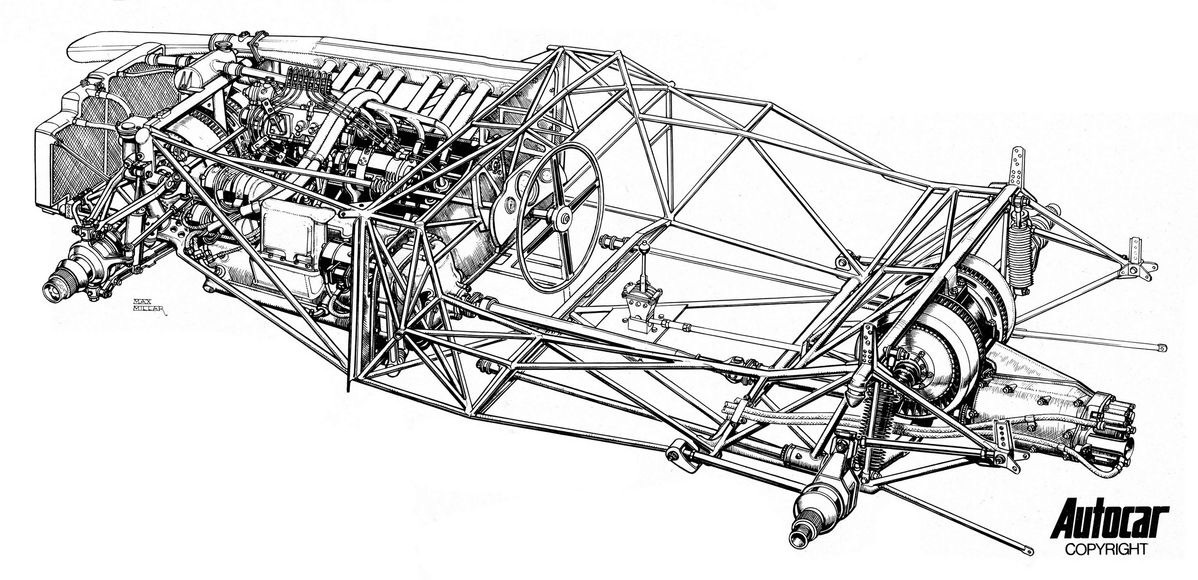
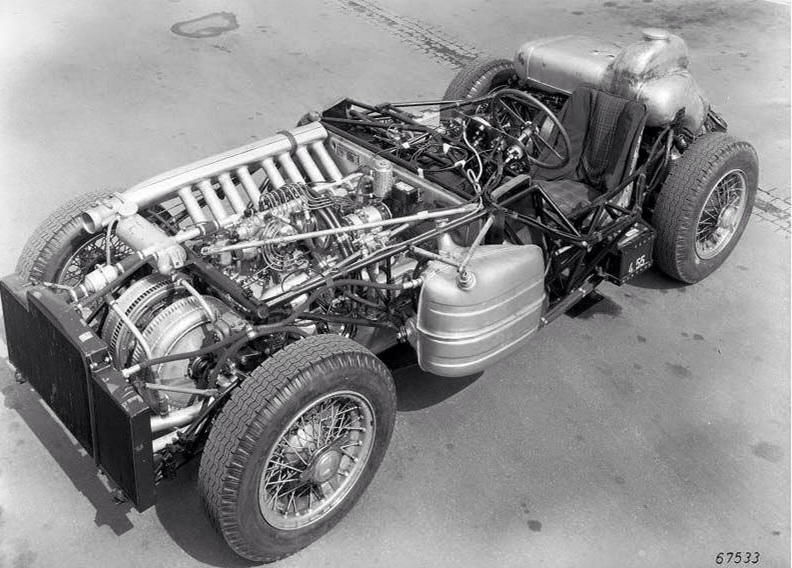
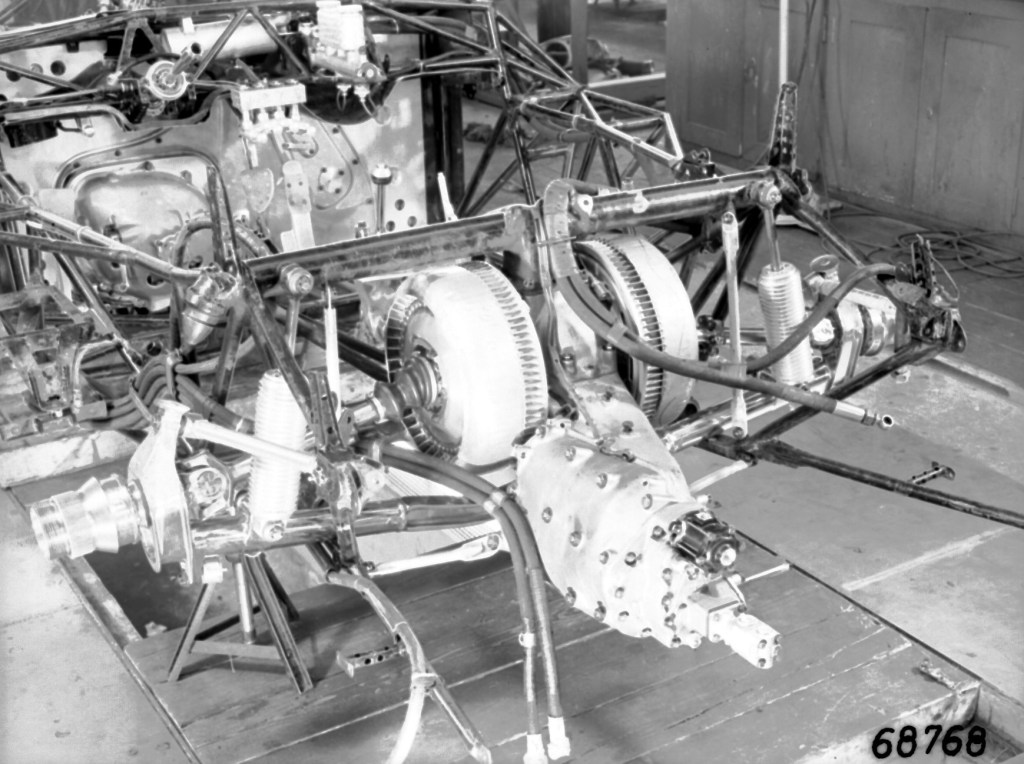
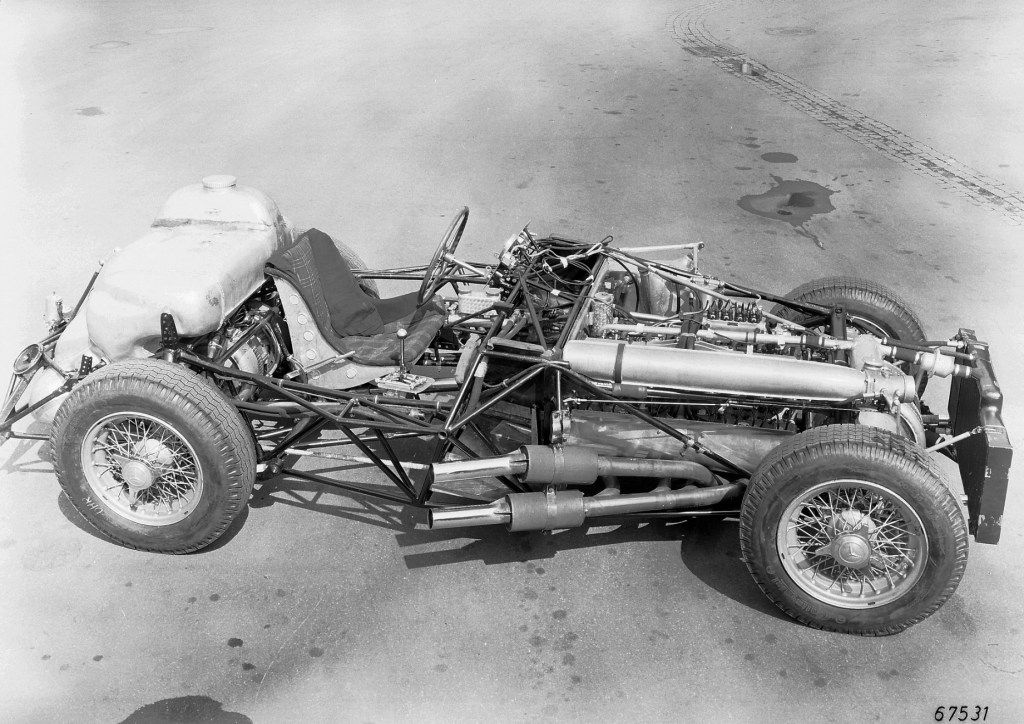
W196S cutaway with the multi-tubular spaceframe chassis and the disposition of major components: 3-litre straight-eight fuel injected engine, rear mounted transaxle and inboard drum brakes front and rear are clear (Autocar)(Mercedes Benz)
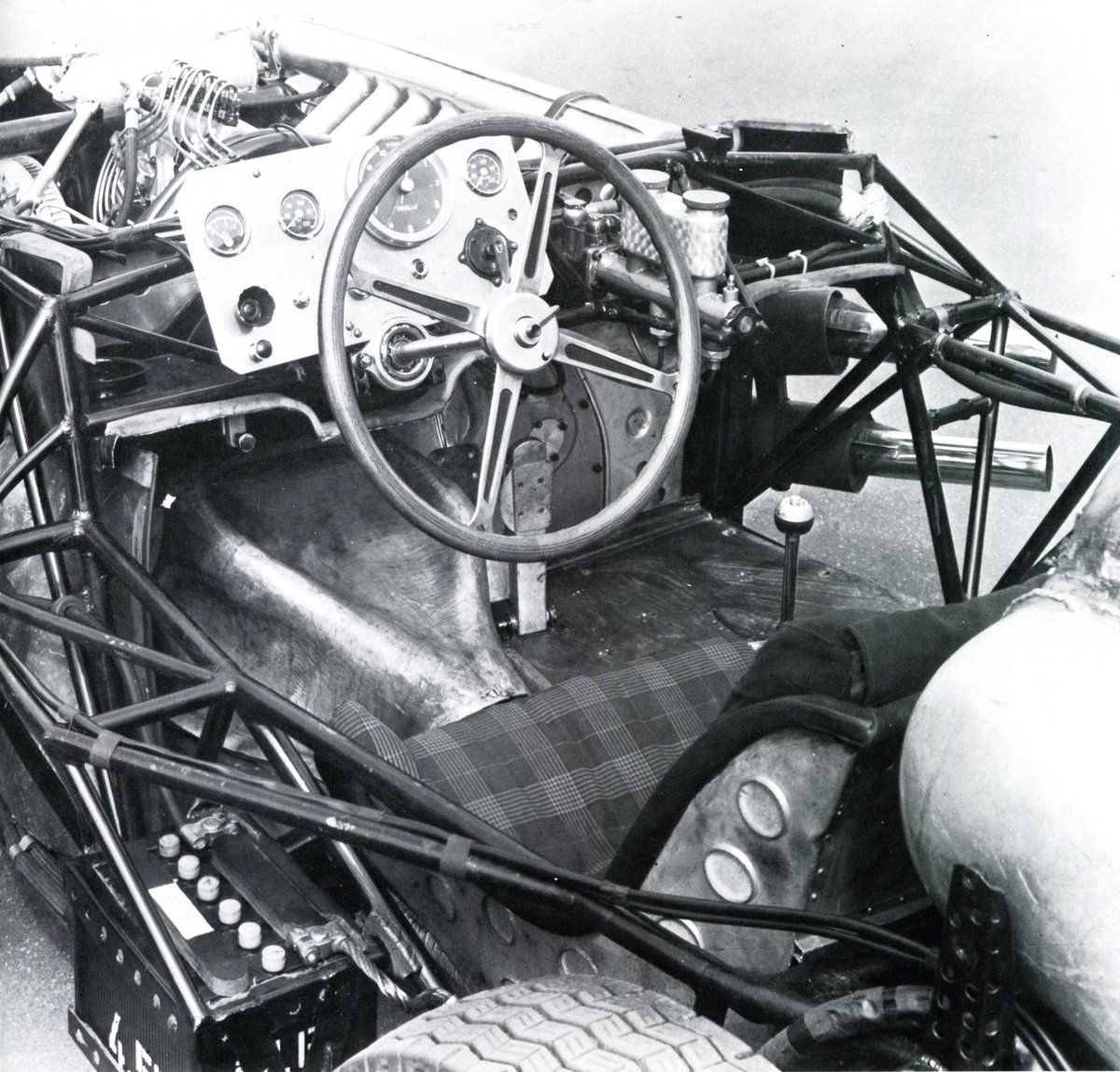
Key design elements of the car start with a multi-tubular steel spaceframe chassis. Suspension is by upper and lower wishbones at the front, torsion bars and dampers. At the rear are swing-axles, torsion bars with again telescopic dampers or shocks. Massive inboard drum brakes are used at both ends to stop the 701kg car in ready to race trim.
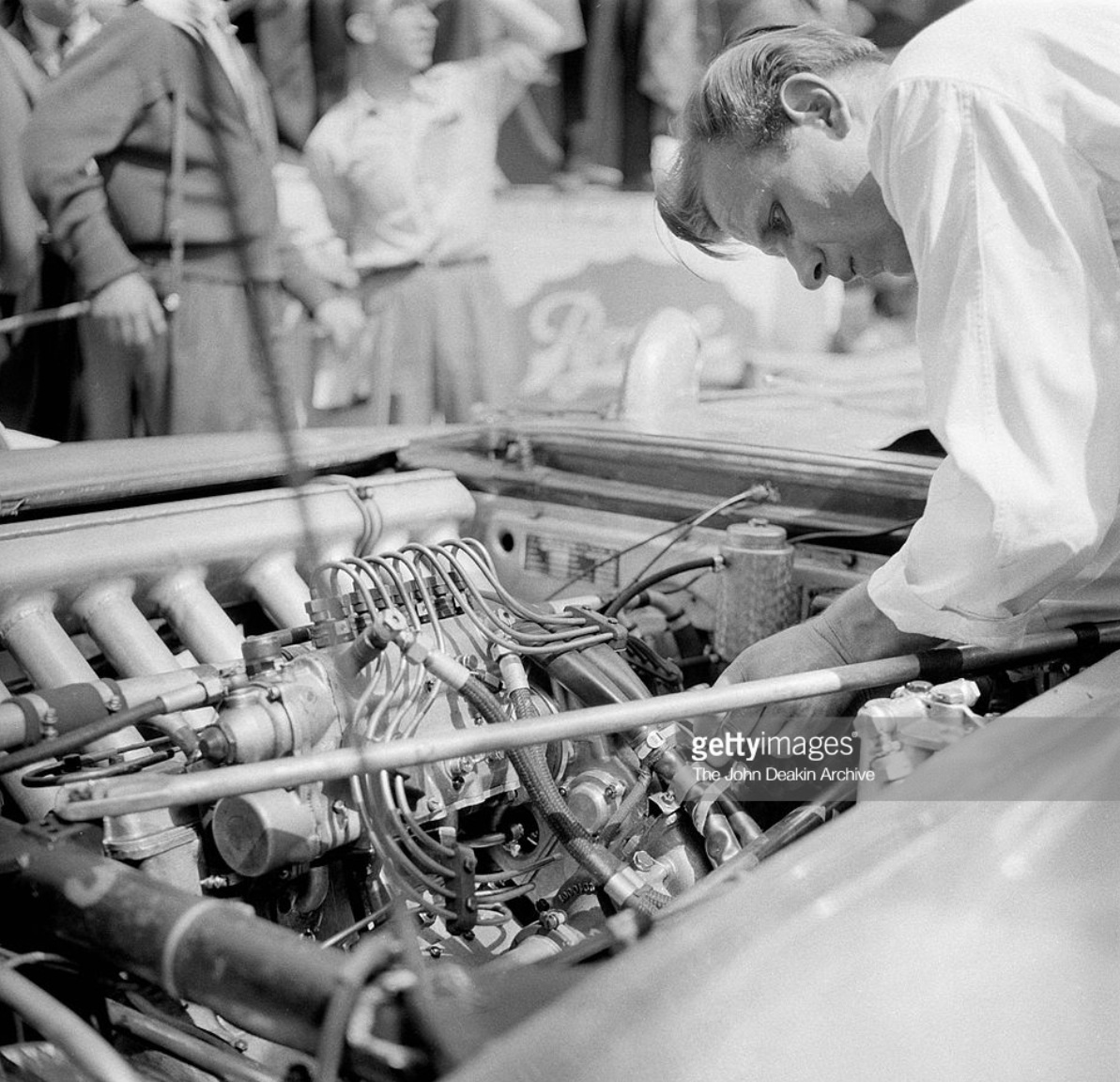
Le Mans 1955. The engine view is dominated by the Bosch direct-injection high pressure pump and inlets (Getty)
At the heart of the matter is the superbly built Mercedes straight-eight cylinder engine. Cast in two blocks of four-cylinders it runs on a pre-war style roller bearing crankshaft. Bosch provided the fuel injection, the two valves per cylinder of desmodromic actuation. The 3-litre engine produced circa 310 bhp @ 7400 rpm on ‘pump’ fuel as against the more exotic brew which fed its GP brother.
The full technical specifications of this car are at the end of the article.
A very famous photo I first saw in Automobile Year, Moss and Jenkinson, Mille Miglia 1955 (unattributed)
Race programme…
Mercedes didn’t attend the 23 January Buenos Aires 1000 Km first round of the Manufacturers Championship which was won by the Ferrari 375 Plus raced by Valiente/Ibanez. The Sebring 12 Hour was won by the Briggs Cunningham entered Jaguar XKD crewed by Mike Hawthorn and Phil Waters, again Mercedes missed the event held on 13 March.
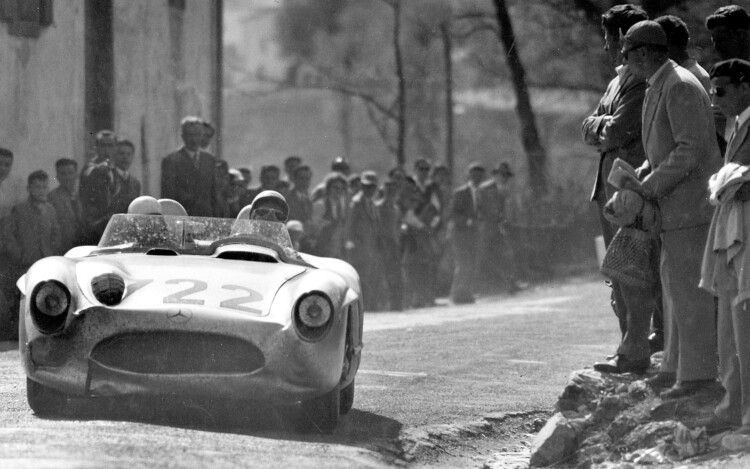
The 300SLRs arrived with a bang in Italy with the Stirling Moss/Denis Jenkinson combination winning the Mille Miglia in front of Fangio driving solo in a sister car.
This win and all-time-record speed of 157.65km/h has been eulogised down the decades and needs no further comment from me. Seek out Denis Jenkinson’s account of the race in MotorSport, it is one of the great pieces of automotive race journalism.
Le Mans followed in June with the works Jag-Ds of Mike Hawthorn and Ivor Bueb completing the largest number of laps to cross the line in first position, after Mercedes Benz respectful withdrawal from the event whilst in the lead.
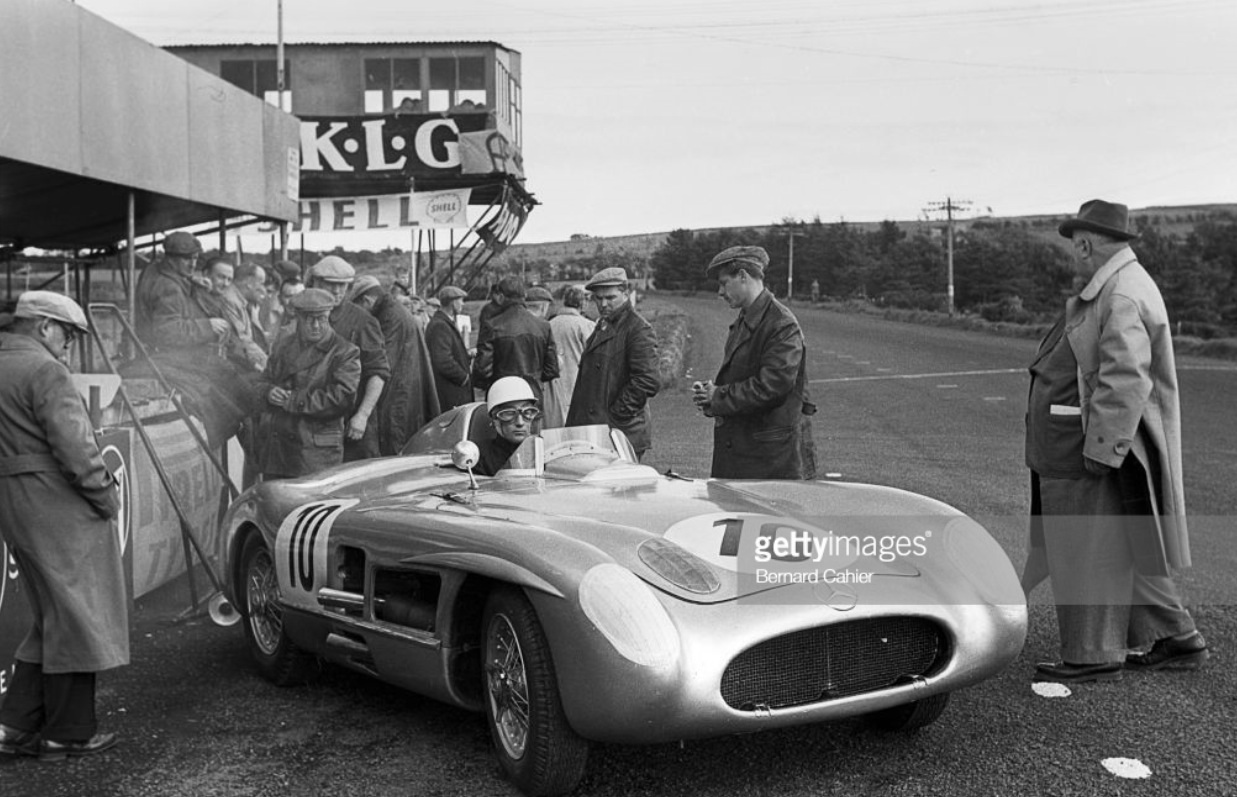
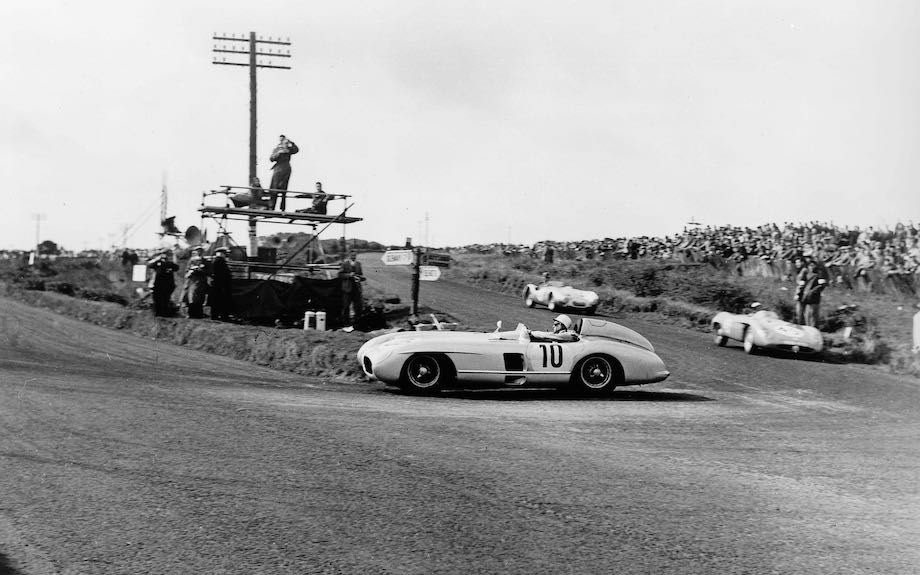
Moss, 300SLR, Dundrod 1955 with the unmistakable slender frame of Herr Neubauer at rightMoss, SLR winner of the TT at Dundrod 1955, the following cars folks? (unattributed)
Dundrod’s wild road circuit hosted the Tourist Trophy in mid September. The race started in warm weather which deteriorated to rain later in an event became an 300SLR rout: the Moss/John Fitch car won from the Fangio/Kling machine with the Von Trips/Simon/Kling machine third. The best placed Jag was the Hawthorn/Desmond Titterington car in fourth, albeit it wasn’t running at the finish.
Targa Florio 1955, the Titterington/Fitch SLR gets s tickle before the off, typical Sicilian backdrop. The winner was the Moss/Peter Collins 300SLR (unattributed)
Targa Florio 1955, again Titterinton/Fitch fourth placed SLR from the third place Ferrari Monza 860 of Castellotti/Robert Manzon (unattributed)
The Germans again beat the Italians on home turf, taking the Targa Florio with a one-two from Ferrari on 16 October. The Moss/Peter Collins car finished ahead of Fangio/Kling with the best placed Ferrari the 860 Monza raced by Eugenio Castellotti and Robert Manzon.
Despite missing several events, Mercedes won the constructors championship by one point from Ferrari: 24 points to 23 with Jaguar in third on 16. The W196S won every single race it entered and finished…
The chassis is a light-weight multi-tubular spaceframe, front suspension comprised upper and lower wishbones, torsion bar springs and telescopic shocks. Those huge, light alloy finned drum brakes are mounted inboard and 300mm in diameter. Steering is worm-and-sector, the front tyres 6.00 x 16, the radiator is huge! The alloy oil tank is behind the right-front wheel, while the fuel tank sits high at the back, its capacity not specified by Mercedes.
The 234kg engine – type M196S – is eight-cylinders in line and inclined 53 degrees to the right in the chassis. The silumin head is cast in one piece: DOHC, two plugs per cylinder, two inclined valves per cylinder with desmodromic valve gear, compression ratio 9:1. Bosch 8-plunger injection pump,
Block – two Silumin blocks of four-cylinders each with chrome plated aluminium liners. Bore/stroke 78 x 78 mm, capacity 2982 cc. Crankshaft 10-bearing (roller bearings) Hirth-type crank with central power take off. Dry sump lubrication via a gear pump. Electricals are by Bosch: starter, generator and twin-magneto ignition.
The rear suspension comprises alloy uprights, a single-joint lower swing axle and top links, longitudinal torsion bar springs and telescopic shocks. The 275mm diameter brakes are inboard duplex light-alloy drums and air-cooled.
The transaxle is five-speed, a gate shift was used with a locking system
(Mercedes Benz)
The wheelbase is 2370mm, front track 1330mm, rear track 1380mm, the cars length 4300mm, its width 1740mm and height 1100mm and the “weight of the car in ready for operation status” is/was 901kg.
While the five gear ratios were fixed, the final drive was to choice with top sipped quoted as “over 300km/h.”over 300 km/h. Wheelbase, 2370 m, Front track,1330 mm, Rear track, 1380 mm, Length, 4300 mm, Width, 1740 mm, Height, 1100 mm, Weight, 901 kg ready to race, Fuel tank 265 litres, Engine weight, 234 kg
(Mercedes Benz)
Etcetera…
(Mercedes Benz)
You should take a trip to mercedes-benz-publicarchive.com some time, the quality of the racing content is unbelievable. I’ve added in some shots but these are just the tip of the iceberg, have a look for yourself.
Top shot! Isn’t that machine such a cohesive, great looking, purposeful racing car…
JM Fangio on the way to winning the 209km Swedish GP held at Kristianstad on August 7, 1955. He won from Stirling Moss’ 300SLR and Eugenio Castellotti’s works-Ferrari 121 LM in 1 hr 18m 13.7sec.
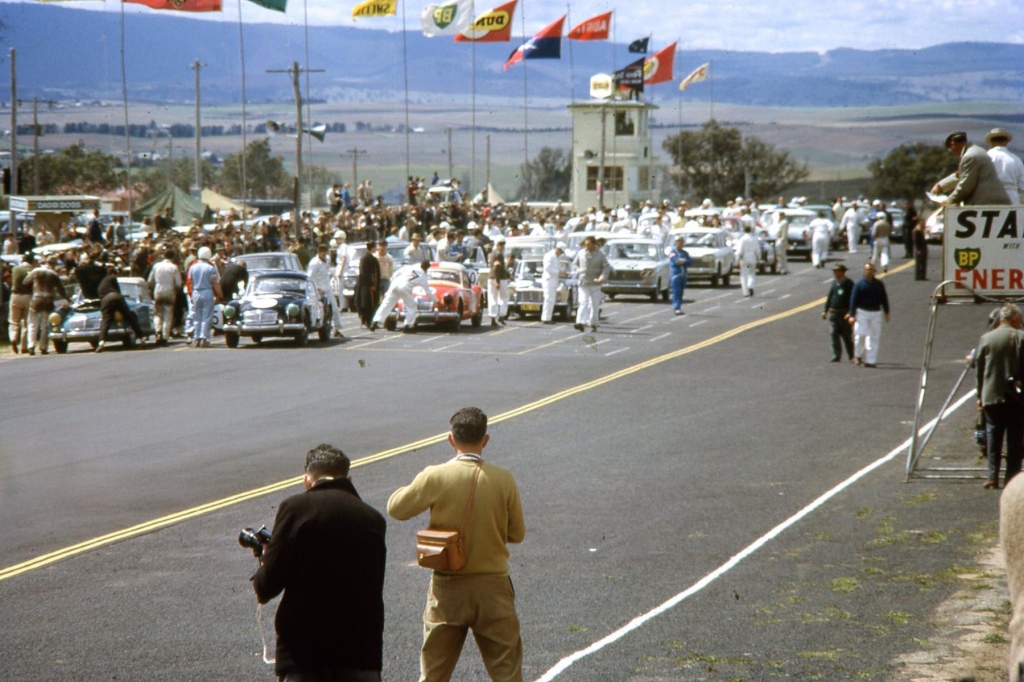
The grid gets way at the start of the September 30, 1962 Bathurst 6-Hour Classic. The entry comprised a mix of production sports and touring cars divided into price based classes. The front row comprises the three MGA Twin-Cams of Matt Daddo/Bill Stanley, N Claydon/Fred Gibson and Clarke/Lazich, with the C Lansdowne/Dianne Walker Triumph TR4 on the inside.
The Bathurst promoters, the Australian Racing Drivers Club, perhaps ran the event off the back of the success of the Phillip Island 500-milers (Armstrong 500) first run in 1960, which would soon after become the ARDC’s after the debacle of the Phillip Island October 1962 event in which the track surface famously, in essence, fell to bits.
(B Richards)
A total of £3,000 in prize money was split evenly among the classes or divisions: A-production touring cars up to £900, B-production touring cars £901-£1050, C-production touring cars £1051-£1250, D-production touring cars £1251-£1700, E-production sportscars up to £1500, F-production sportscars £1501-£2000.
While there was officially no outright winner, the interest of the punters was amongst the top-guns which included the V8s: Studebaker Larks, the brothers Geoghegan’s Daimler SP250 and potentially the best of the little-cars, the Bruce McPhee/Barry Mulholland Morris Cooper.
What strikes me now is that the entry list was a who’s-who of (mainly) New South Wales stars of the day and of the immediate future with a swag of Gold Star, Australian Touring Car and Sportscar Championship, and Bathurst winners in the mix.
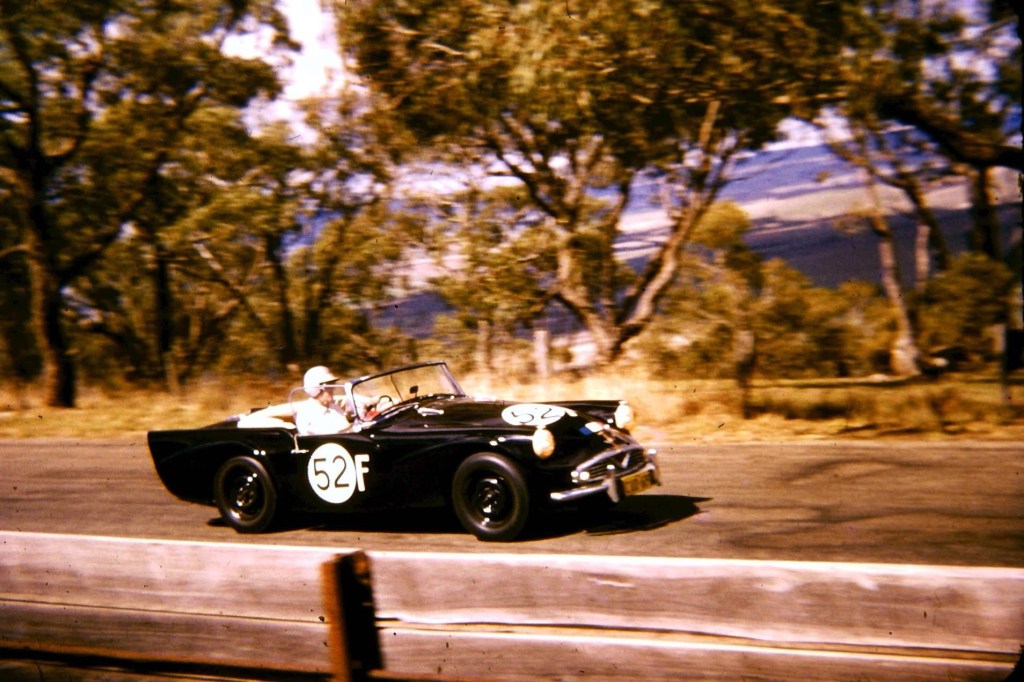
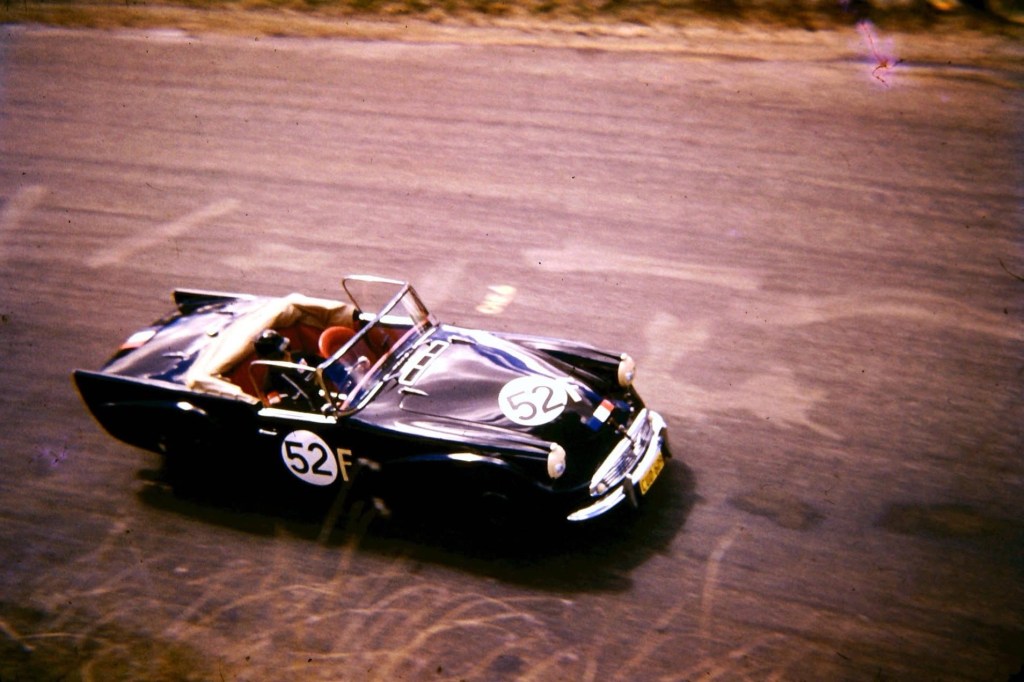
It appears that the sportscars had to start with their tops up, so this is practice or the first stint for Leo and Pete Geoghegan’s winning Geoghegan Sports Cars entered and prepared Daimler SP250 (B Wells)Pete Geoghegan blasting across the top of the mountain. Alan Howard said of his shot, ‘You can see the bit of rope used to hold the drivers door closed late in the race.’ (A Howard)
Morris 850s dominated Division A – 14 cars, of which all but one finished – where the winners were Frank Kleinigs senior and junior. Kleinig Snr was an Australian great pre-and post-war and always polls well in lists of Greatest Australian Drivers Never to Win an AGP. Junior was no slouch either as a racer and constructor of Formula Vees. There was no shortage of notables in this class including Des West, Bill Pitt, Arnold Glass, John French and Paul Bolton, while Tom Sulman would have run Kleinig Snr close in a contest for who started racing first.
Seven cars contested Division B, the victors were John Martin and C Hodges in a Skoda Felicia of all things. This group included cars raced by Ron Hodgson, Digby Cooke, Alan Heasman, Peter Wherrett, Doug Stewart and Alan Stanfield.
Bruce McPhee and Barry Mulholland went on to win the Bathurst 500 outright aboard an HK Holden Monaro GTS327 in 1968, they prevailed in Division C where Bob Jane and Harry Firth were much fancied in a works-Ford Falcon XK.
The Jane/Firth C Division Ford Falcon XK from the ‘E’ MGA 1600 driven by K John/Peter Caldecoat (B Wells)Lap 39, Firth is ok and out of the Falcon via the back window but she needs a turret! Bob Williamson recalled, “They towed the Falcon up the escape-road on its roof with a tractor. You should have heard the noise, roof on a gravel road.” (B Richards)
Ford planned to race their new Falcon XL in the Armstrong 500 at the Island on 21 October, in addition they decided, wisely, to contest the Bathurst Six Hour Classic to be held only three weeks before. The catch was that Ford didn’t want to race the XL at Mount Panorama so Firth set about preparing an XK Falcon for the race.
Firth takes up the story in his typically self-serving way, “Having not been to Bathurst for some years, I had to rely on hearsay information like, “no, it is not hard on brakes and the circuit has not changed. I did all the usual things such as a valve grind, compression check, set the camshaft properly, gave the pistons plenty of clearance, deck-heighted the head and put the engine on the dyno.”
“I fitted a set of heavy Armstrong shockers and some well-worn springs. I made up some Ferodo brake shoes but ended up leaving them at home, thinking they wouldn’t be needed. I drove the car to Bathurst myself. Practice proved two things: the car was the fastest sedan and the brakes were not good enough.”
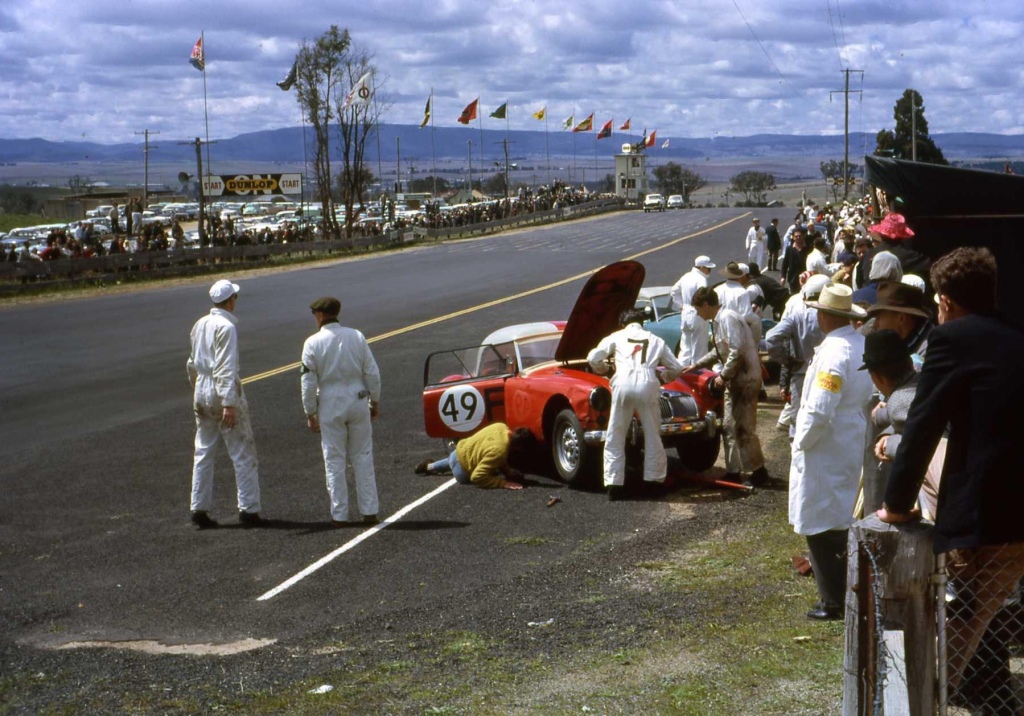
The Jim Clarke/A Lazich MGA Twin-Cam receives some attention, DNF (B Richards)
The two wily Melbourne racers – who went on to win three of these Phillip Island and Bathurst 500s together – led their class early, but the brakes were progressively showing signs of stress as the pedal crept inexorably closer to the floor.
Harry took over from Bob after a scheduled stop and then on lap 39 “As he braked for Hell Corner, the fronts suddenly over-energised and locked on, the nose dug in and the car rolled.” The roof was crushed with Harry extremely lucky he wasn’t badly hurt, the car had no roll bar or cage of course. He exited via the rear window as fuel spilt over the tarmac, but did not ignite.
The Division D winning Studebaker Lark raced by Algie/Hibbard. I’m old enough to remember when these beasts were popular cop-cars in Australia (B Wells)
Division D’s 10 car entry included three Studebaker Larks, with the Don Algie/Kingsley Hubbard entry the winner on 99 laps, then the well credentialed David McKay/Greg Cusack duo in a Fiat 1500 from Peter Williamson and K Whiteley third in another Fiat 1500. Other notables in that class were Bill Buckle, Brian Foley and George Murray.
Only four cars contested Division E, with the Tony Reynolds/Les Howard Morgan Plus 4 ahead of the Bill Reynolds/Kevin Bartlett Austin Healey Sprite Mk1.
The Geoghegans won Division F for the more expensive sportscars from the G Lansdowne/Holt Bonnie Triumph TR4. The Top-Three outright were the Geoghegan Daimler on 104 laps, then the Lansdowne/Binnie TR4 on 100 and the Algie/Hibbard Studebaker with 99 completed laps.
The entries for this race are staggering in their diversity, here the fourth in Division D Scuderia Veloce Citroen ID19 driven by Bill Buckle and Brian Foley (B Wells)
Credits…
Bill Richards, Bruce Wells, Shannons Falcon XK article by Mark Oastler, SS Auto Memorabilia, Alan Howard
Tailpiece…
(SS Auto Memorabilia)
Leo Geohegan at the wheel of the winning Daimler SP250 above and below. With a 2.5-litre V8 and light fibreglass body it proved a quick car but the duo had some challenges, most notably the drivers door opening on a regular basis as the body flexed, and the loss of first gear on the start-line.
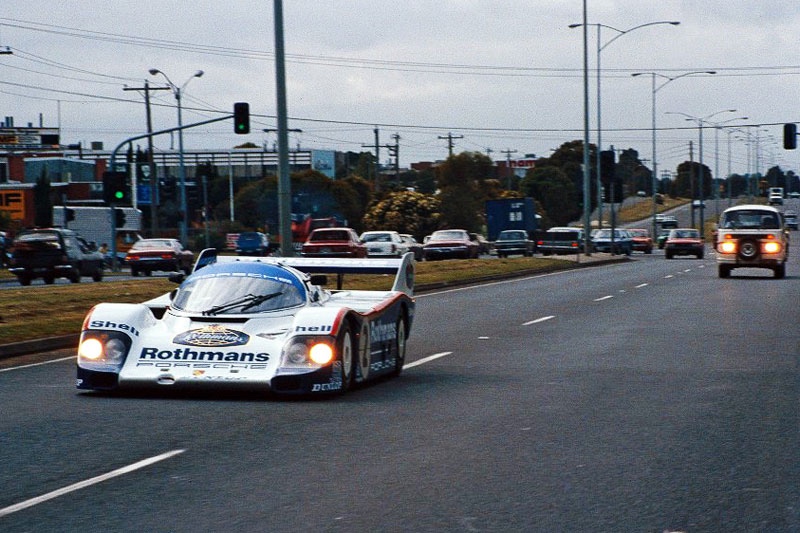
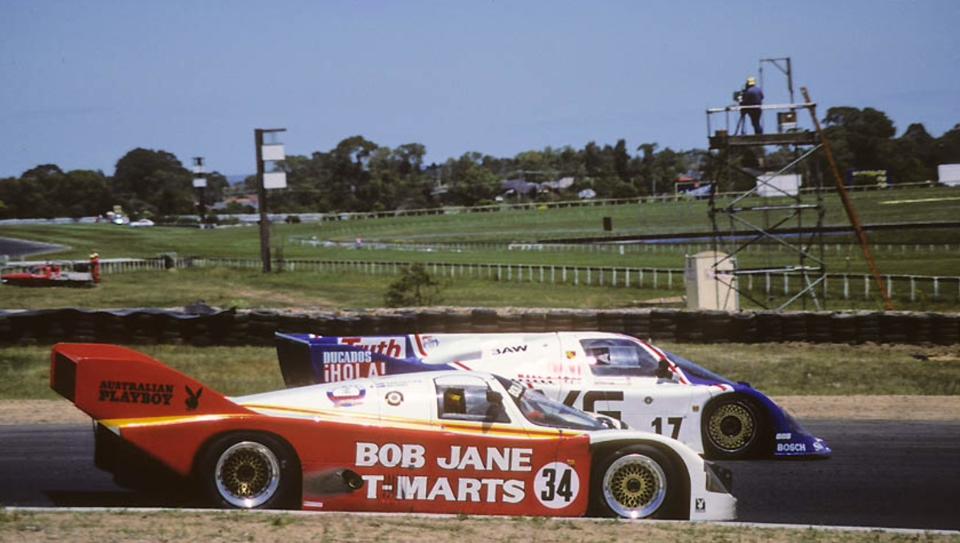
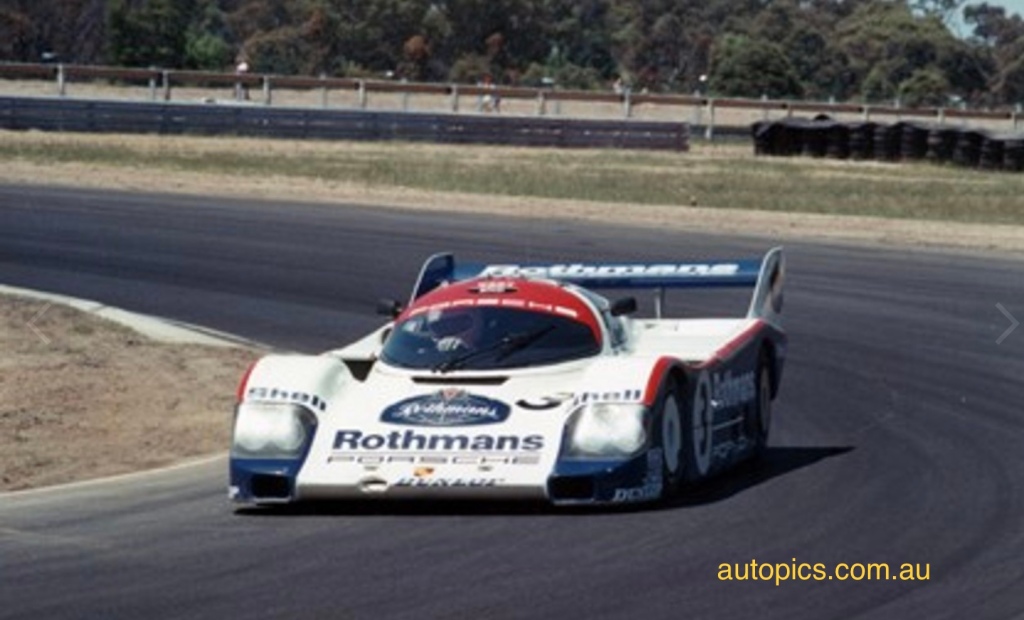
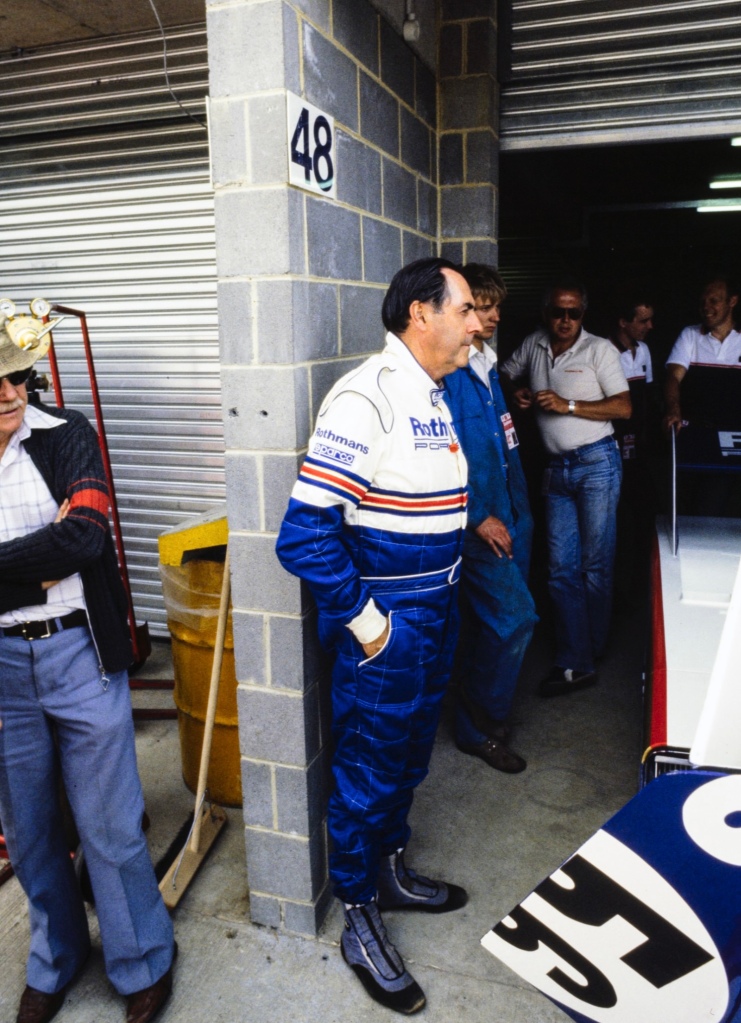
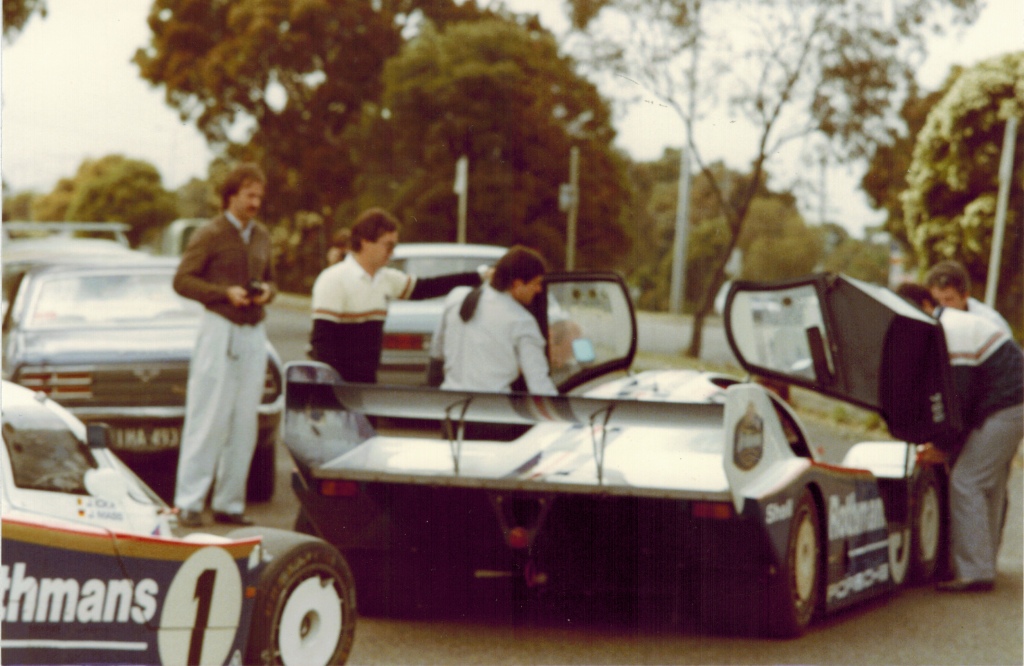
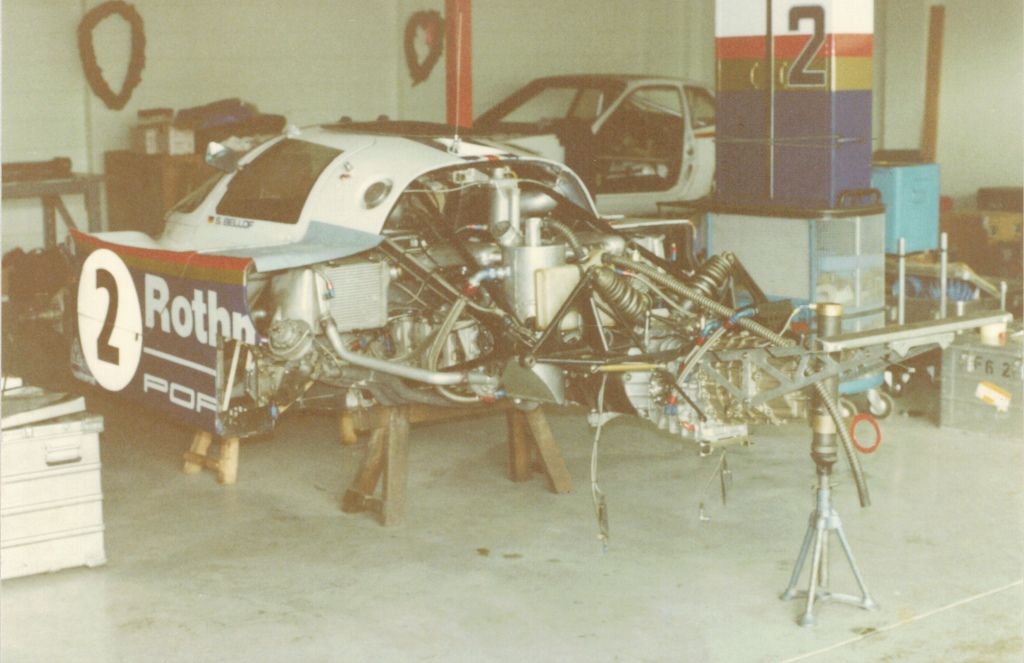
The winning Stefan Bellof/Derek Bell Porsche 956 cruises along the Princes Highway at Noble Park, Melbourne in December 1984…
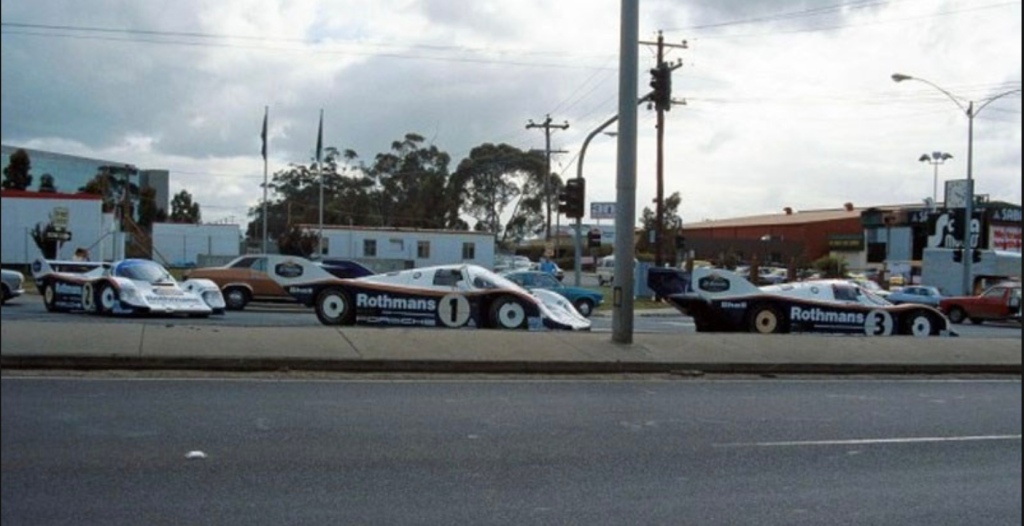
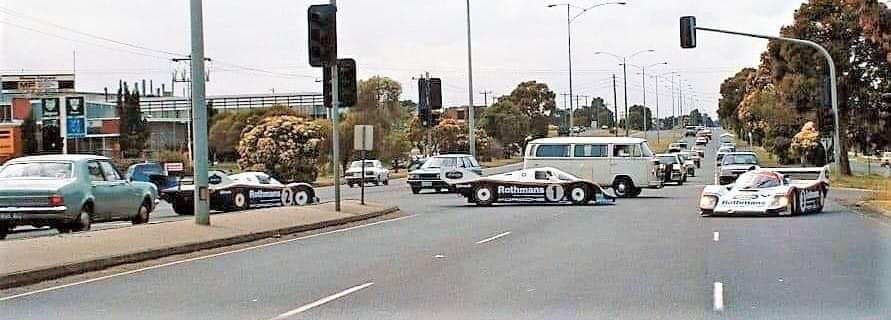
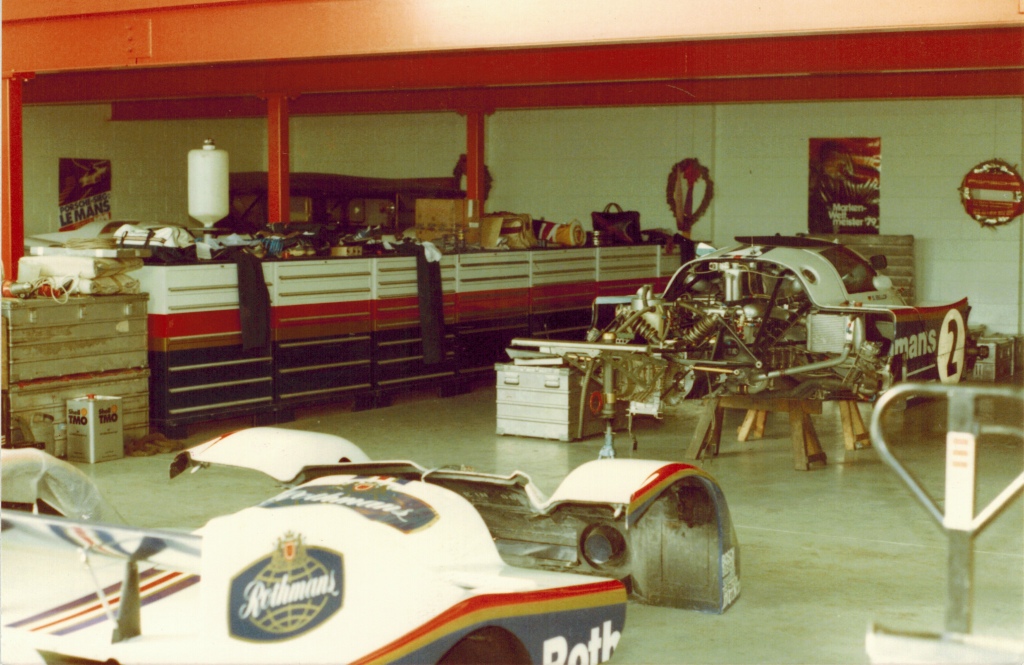
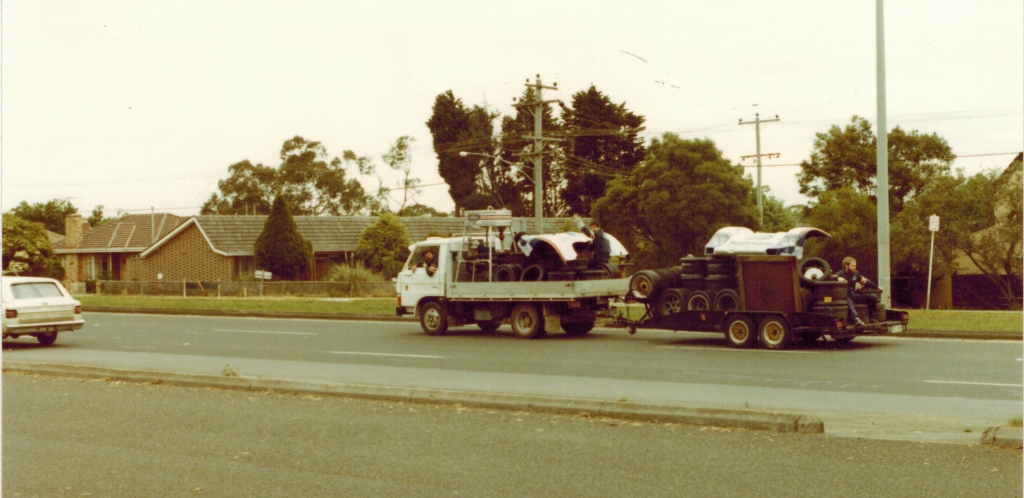
Some of the most amazing shots during the first of Sandown’s two abortive WEC rounds in 1984 and 1988 were away from the track in Melbourne’s southern suburbs. A bright spark, probably Porsche Cars Australia chief Allan Hamilton – an elite level racer himself – thought it would be a great idea to drive three of the four works-956s the five or so kilometres from PCA’s workshop in Noble Park to Sandown, also on the Princes Highway.
No cops, no organisation, just let’s go with a Kombi strategically placed to allow the race-gunterwagens to make the u-turn to head west back towards town. Luvvit!
The Schuppan/Jones 956 leads the Mass/Ickx and Bellof/Bell machines (PCA)(PCA)
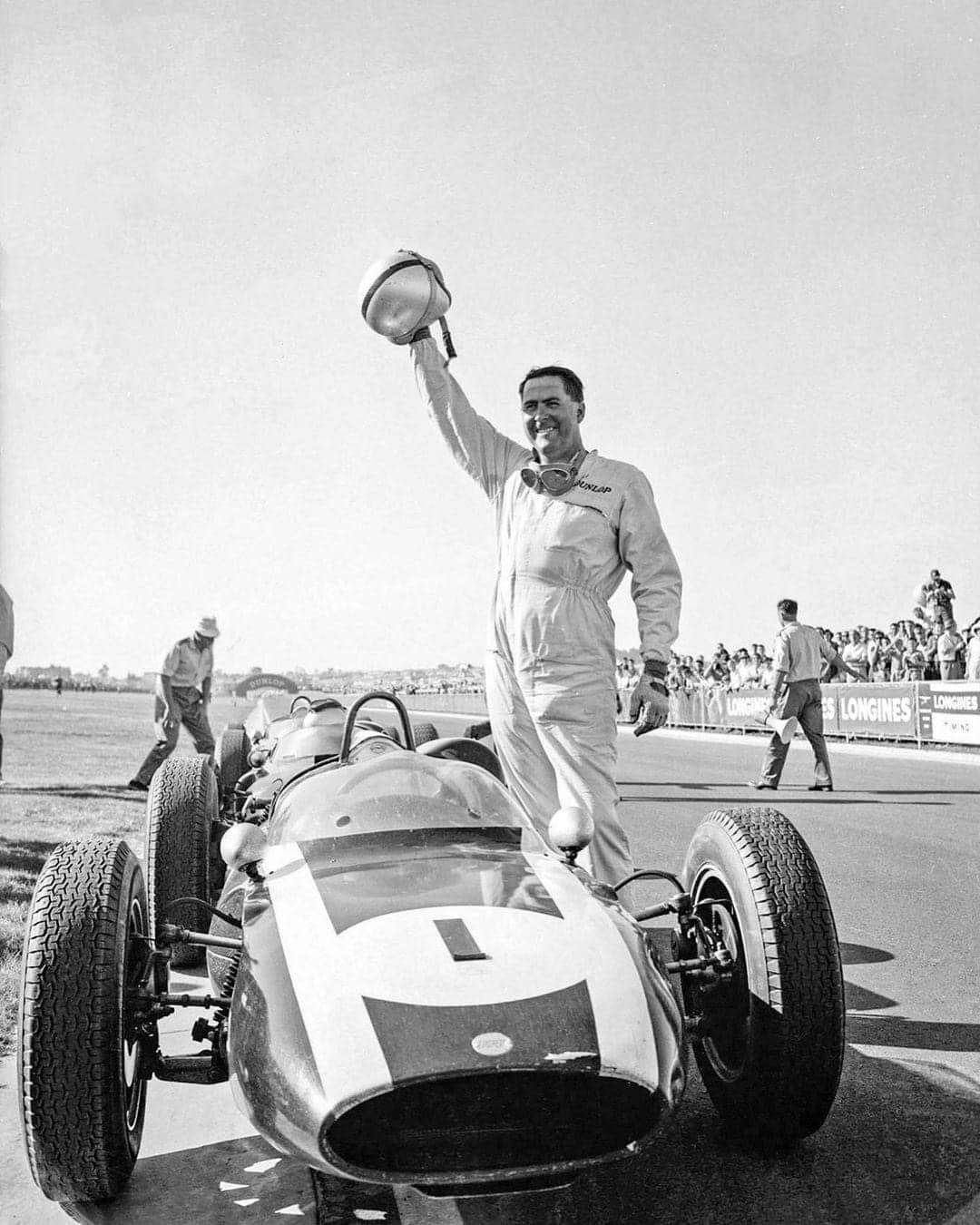
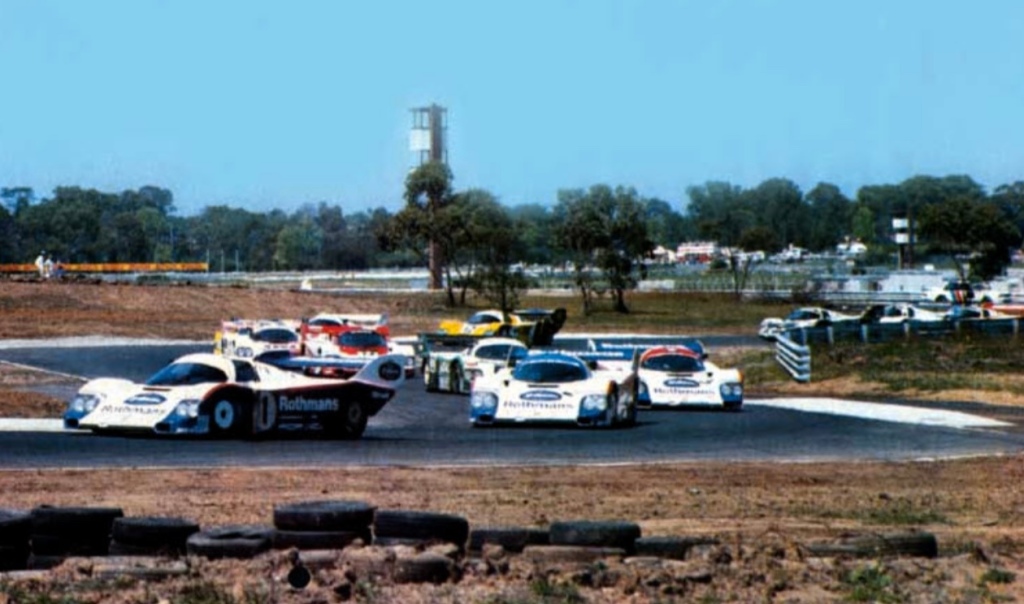
The World Endurance Championship broadened its global horizons with a maiden visit to Australia for the 11th and final round of the championship. Sandown Park is a combined horse and car racing facility. Designed as such, the track 30km from Melbourne’s CBD opened and first hosted an international event in March 1962. Jack Brabham won that Formule Libre Sandown Park International in a Cooper T55 Climax 2.7 from the Cooper T53 Climax 2.7s of John Surtees and Bruce McLaren. See here: https://primotipo.com/2016/01/27/chucks-t-bird/
In order to meet FIA minimum track length requirements to host international events, Sandown grew from a fast-flowing 1.9 miles to a fucked-up 2.4 miles, the increase in lap distance achieved within the existing footprint by the addition of a pissant 500 metre infield loop that pleased no-one. A spend of about $A2 million included the relocation of the pits and new pit garages.
The Light Car Club of Australia – easily the most successful car club in Australia, its origins going right back to November 5, 1924 (originally called the Victorian Light Car Club), well before the first Australian Grand Prix was held at Goulburn in January 1927, were the lessors of the Sandown Park motor racing facilities – signed a three-year contract with the FIA. Expectations were high, the LCCA’s spreadsheet jockeys anticipated/speculated/prayed for 40,000 folks to pass through the gates on race day…that didn’t happen and the financial devastation wrought upon this wonderful club by a Boy-Scout Board is a story for another time.
While hyped as Australia’s first World Championship motor race – it was – the 1964-75 Tasman Cup was of far greater stature, or importance regionally at least, with Sandown hosting the Melbourne Tasman round each year.
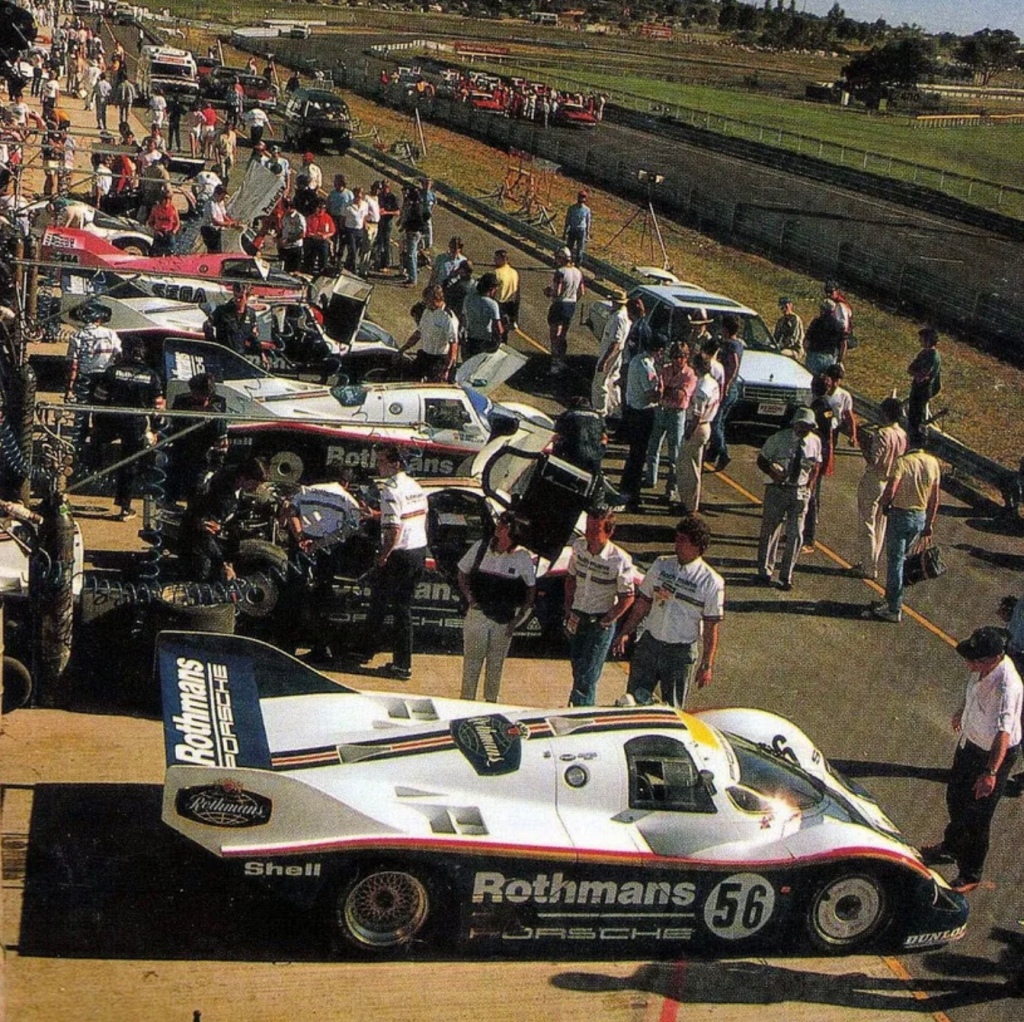
Happy Jack at Sandown in March 1962. Winner of the first Sandown International in his ex-F1 Cooper T55 Climax 2.7 (C MacKinnon)Jack Brabham 12 years later in 1984 aboard a works-Porsche 956. The fag-packet signage on the Porker and Dandenong Road corner says everything about motor racing economics of the era…(alamy)Brabham and Dumfries in the Sandown pits. At the time they were drivers of Group C touring, and F3 cars, I say very tongue-in-cheek in Jack’s case…(M Bryan)
None the less the prospect of seeing Sir Jack Brabham, Alan Jones and Vern Schuppan in ‘spectacular Le Mans Porsches’ was eagerly awaited by local race fans. All eyes were on German wunderkind Stefan Bellof in his battle with fellow Deutschlander and works-Porsche-pilot, Jochen Mass for the WEC Drivers’ Championship.
Bellof sizzled with absolute pace – he was Germany’s star – and had the same fierce burning desire of Gilles Villeneuve to be the quickest in every session. Sadly, both died very violently well before their time.
“I come to Australia to win this race together with Derek,” said championship leader Stefan, “and the chance is good. We stay on the pole position, but it’s a 1000km race and it’s a long distance. We have a lot of slower cars here and so we have to go very careful.”
The young F1 pilot – his Grand Prix ride was aboard a Tyrrell Ford together with Martin Brundle – clipped a kerb and boofed the barriers. Undeterred, he returned on Saturday and popped the car on pole in very hot conditions. Mass was alongside him on the front row, seven tenths slower. “It is particularly unpleasant for me, said Jochen, “because I can only win, and if Bellof comes second he’s still won.”
The Bond/Miedecke John Fitzpatrick/Team Australia 962 inside the Kees Kroesemeijer/Peter Janson/Jesus Pareja Porsche Kremer CK5 (unattributed)Jones in the 956 he shared with Vern Schuppan
Porsche entered two extra cars for Jones/Schuppan and Jack Brabham, who shared the Porsche camera-car with young F3 thruster and soon Lotus F1 driver, Johnny Dumfries. Jones was the pacesetter, despite little 956 experience. “It’s fantastic to see a world championship event here in Australia,” reflected an upbeat Jones. “It means I don’t have to travel so far from home to be in it for a start!”
‘Black Jack’ had done some Australian Group C touring car racing in the late 1970s, and enjoyed the Porsche experience. “It’s certainly a lot faster than anything I’ve ever driven before. It’s the first time I’ve driven a car with ground effects too, which is very interesting. I’ve read a lot about the Porsches and the opportunity now to drive one and just see how it goes is very, very good.”
After being tapped up the chuff by another car, they weren’t classified in the race, but Brabham, driving with an open-face Bell helmet enjoyed his time behind the wheel.
Lancia didn’t make the trip to Australia as our race was a round of the WEC Drivers Championship but not the FIA World Endurance Championship for makes, a shame given the size of Australia’s Italian diaspora, but the top Porsche privateers made the long trip south.
John Fitzpatrick was back after missing Fuji, with Thierry Boutsen qualifying the lead Skoal Bandit car fourth. The patriotic Team Australia effort returned on home ground, this time commandeering Fitz’s 962. At the wheel were former Australian Touring Car and Rally Champion, Colin Bond and Andrew Miedecke, at that time a leading Ralt RT4 mounted Formula Pacific racer.
Brabham/Dumfries Porsche 956 front and centre in this Sandown pit panorama (unattributed)A familiar view for most Australians, the old Pit Straight and old Shell Corner – or its kitty-litter – in the distance, as Colin Bond turns his Porsche 962 into Peters/Torana or whatever they called it that week. Stuff all that Turn 1/Turn 2 bullshit. Most of the good bits of the old circuit, with the exception of the big-balls Causeway/Dunlop Bridge section, were retained, but the kiddyland bumper-park bit was a joke…and was given the arse reasonably quickly thereafter (B Forsyth)
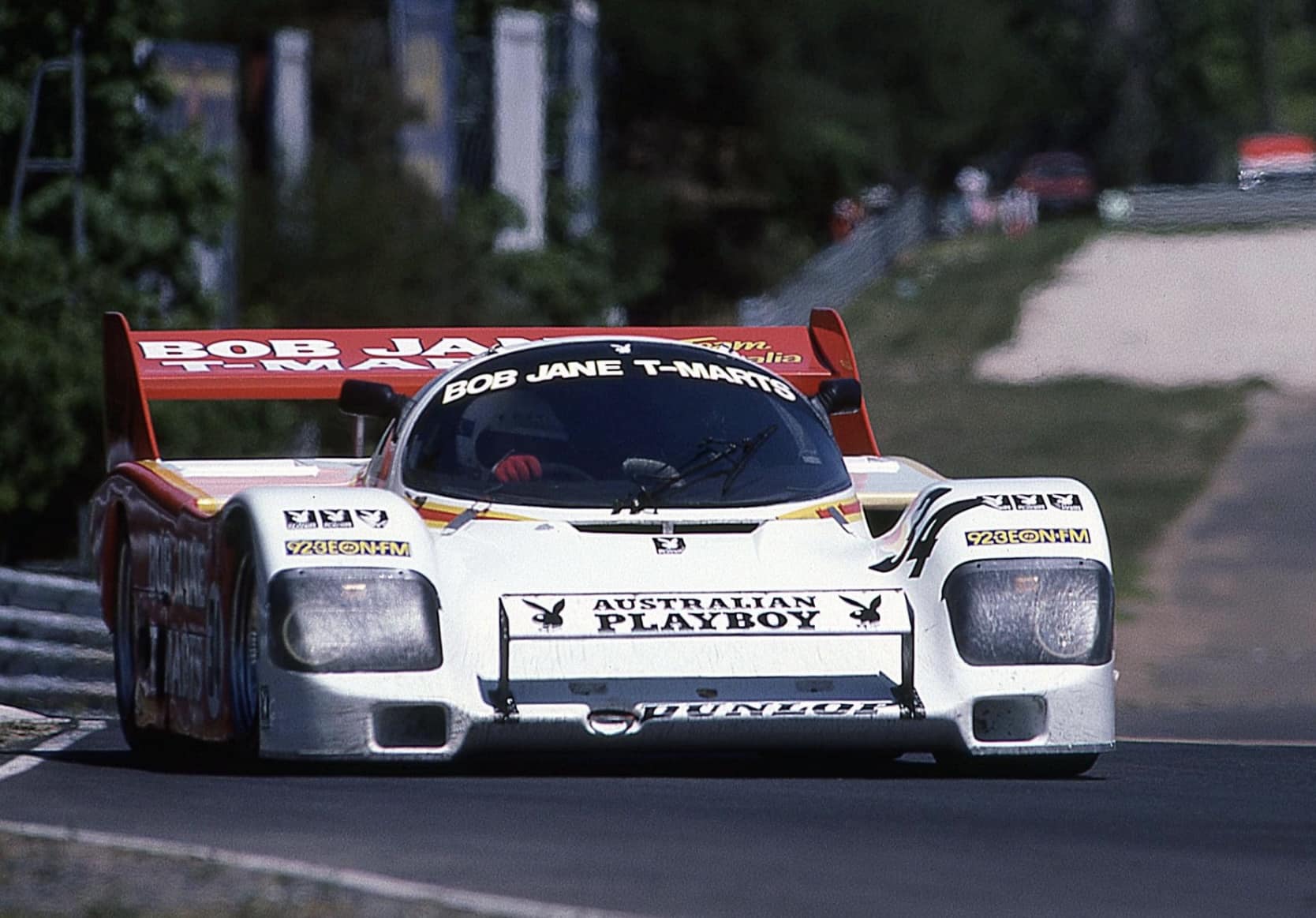
Mulsanne Memories wrote that “Kremer entered the pink Sega-backed 956B for Manfred Winkelhock/Rusty French (fifth) and a white, all-South African crewed 956 for Sarel van der Merwe/George Fouche. Richard Lloyd’s 956 GTi was in amongst this pack, as were Ludwig and Pescarolo in Joest’s 956B. A troubled race, which included punctures aplenty, a black flag, and a fractured brake pipe, meant the Le Mans winners could do no better than seventh, however. A couple of ageing cars — Chuck Kendall’s IMSA Lola T600 and Kees Kroesemeijer’s Kremer CK5 — rounded out the C1 field.”
A strong nine-car C2 field raced in Australia, but Gordon Spice and Ray Bellm again crushed the field taking their fifth win of the year in their Tiga CG84 DFL 3.3. Not that it was easy. Spice spun in the first hour, falling some way behind the ferocious Alba/Gebhardt lead battle. Carlo Facetti went away with fading brakes, and Spice clawed his way back past the Gebhardt before driving away for an eight-lap victory. Gunter Gebhardt had a second, all-female entry for Margie-Smith Haas, Australian Sue Ransom and French F3 star Kathy Muller, which finished the race.
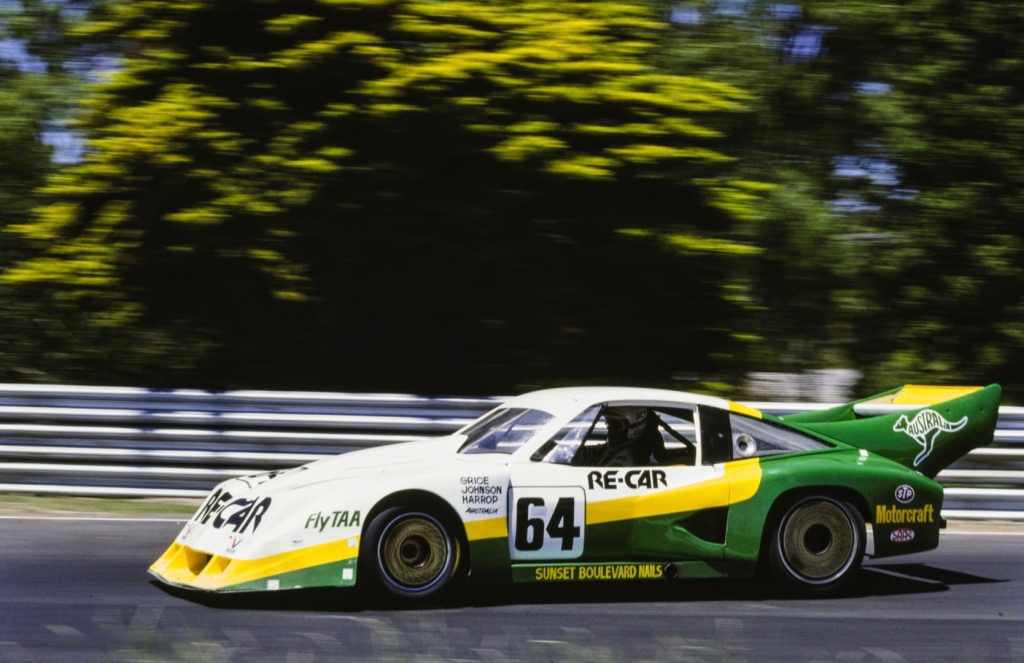
The Allan Grice/Dick Johnson/Ron Harrop 6-litre Chev Monza (MotorSport)The Bryan Thompson/Brad Jones Mercedes Benz 450SLC turbo (unattributed)
In order to help drag in the local punters – whose most popular diet was V8 touring cars – the LCCA included an Australian Car class for cars that raced in the Australian GT (Group B Sports Sedans and Group D GT cars), and Sports Car (Group A) Championships.
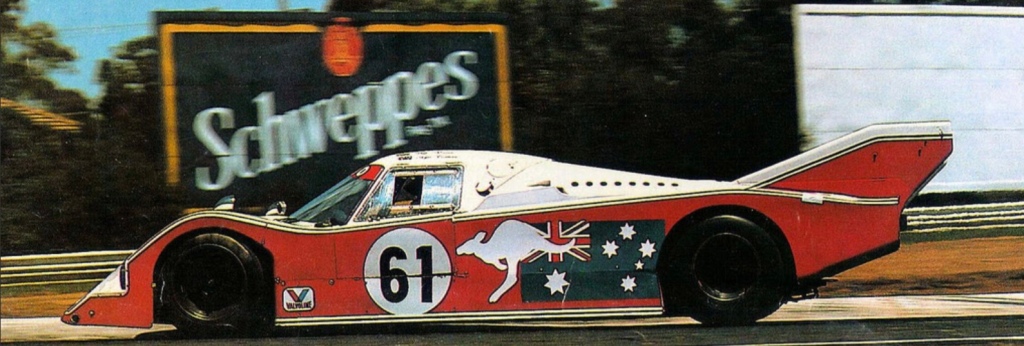
The FIA permitted five of these cars to race, the quickest of which was the Barry Lock/Kaditcha Cars Kaditcha K583/Romano Ford DFL 3.9 sports-prototype raced by multiple Australian Gold Star Champion, Alf Costanzo and car owner, Bap Romano. Alfie’s fastest lap was a 1:38.4 – 13th – despite persistent understeer caused by the 70kg of ballast the car had to carry.
Frank Gardner ran the factory BMW race program in Australia for well over a decade, the team fielded a beautiful black John Player Special-sponsored BMW 320i sports-sedan driven by touring car ace Jim Richards and Tony Longhurst. The quickest of our sports sedans at the time was the ex-Bob Jane, Pat Purcell built Chevrolet Monza raced at Sandown by touring car specialists Allan Grice, Dick Johnson and Ron Harrop. Another superbly built sports sedan was the Peter Fowler built, Bryan Thompson owned 700-900bhp Mercedes Benz 450SLC Chev 4.2 twin-turbo, Brad Jones shared the wheel with Thompson.
The Costanzo/Romano Kaditcha/Romano Ford DFL (unattributed)Bellof, Mass and Jones before the start (unattributed)
Race…
29 cars set off on as the parade lap in hot conditions with the 1980 World Champ Jones the bolter – showing the sportscar-boys how its done, sliding down the inside at Shell to snatch the lead. As the field completed the first lap Jochen Mass was missing, having spun on oil dumped at the final chicane by Nick Faure’s expiring Porsche 930 just before the start. Jochen re-joined in 15th.
As Mass tore through the mid-field, Bellof was harassing Jones, slipping past on Pissant Loop to take the lead. Bellof pulled away, leaving AJ in the clutches of Boutsen’s 956, finally making it past Jones when he ran wide at the final corner. Behind the top three, Jan Lammers led Manfred Winkelhock, and Klaus Ludwig ran fourth to sixth.
Mass was reeling the top-order in, passing Lammers, then Jones for third spot on lap 31. As cars pitted for their first stops, Bellof led Boutsen by 20 seconds and Mass by 35.
Derek Bell took over the lead car from Bellof, then a slow stop from the Fitzpatrick crew meant that Jacky Ickx emerged from the pits aboard the #1 Rothmans Porsche in second place, just ahead of David Hobbs – who had last raced a McLaren M22 Chev F5000 car at Sandown in 1972 – in for Boutsen. Hobbs re-took second when Ickx skated wide and ran off the circuit at a corner; the newish track surface was breaking up a bit, with cars getting off-line, skating wide and bouncing through the dust.
The Schuppan/Jones 956 passes the very wide! Winter/Schornstein/Belmondo similar car on the run out of Torana; eighth and 11th respectively (MotorSport)
Then the cards were all thrown up in the air, when when broken suspension pitched Group C2 debutant Jens Winther’s 3.5-litre BMW 3.5-litre six-cylinder engined URD into the pit wall, bringing out the pace car and bunching up the field.
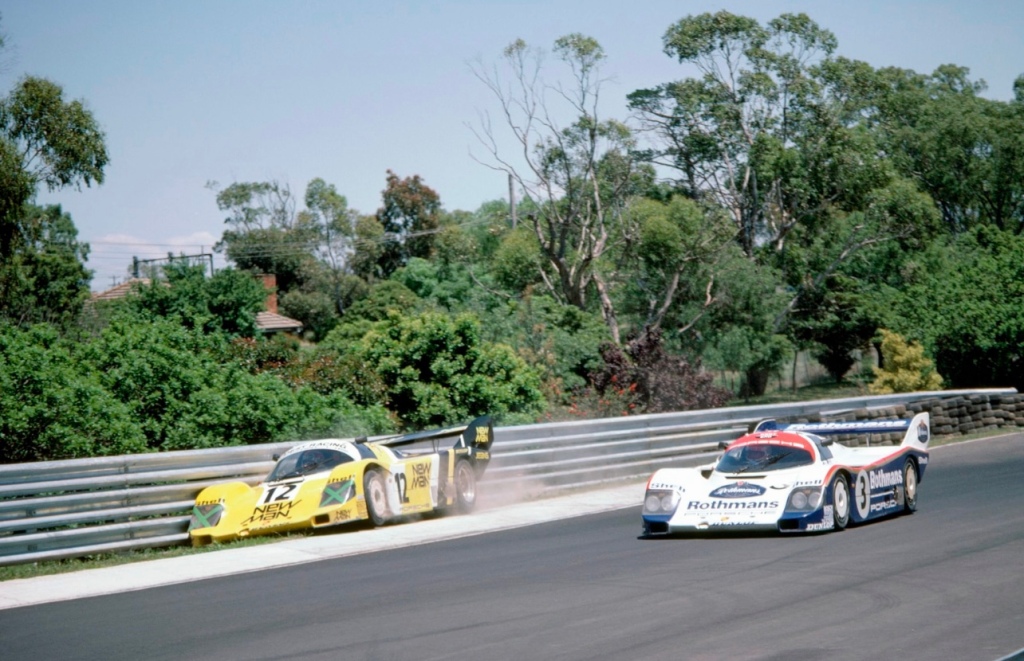
At the restart, Hobbs grabbed the lead from Bell despite bodywork hanging off the Skoal Bandit 956. Bell hung on, setting up a fine duel between young co-drivers Boutsen and Bellof. They delivered too, with an enthralling scrap for the lead. After many laps, Bellof put the works car back ahead with a slingshot move down pit straight. Behind these two, the race was going to pieces.
The treacherous track surface delivered punctures at random. First Kremer, then Joest, then the Jones/Schuppan Porsche, which had already been brought into the wrong pit box by Jones, then spun by Schuppan. With later turbo trouble, the Aussies faded to eighth place. “Worst affected was Richard Lloyd’s 956 which pitted very few laps for new rubber. After three or four unscheduled stops, it became comedic. After 12 (!) unscheduled tyre changes for Jan Lammers and Jonathan Palmer, it became utterly farcical. After the race, Dunlop reported a grand total of 59 punctures!”
Mass had been running third, but six punctures ended any chance he had of challenging Derek and Stefan for victory and the championship. The two lead cars remained curiously free of tyre trouble: Bell/Bellof suffered just one puncture and Boutsen/Hobbs none at all.
In the closing stages, Hobbs pulled over in the infield with a broken coil, lifting any remaining pressure on the Bellof/Bell Porsche with Bell taking the chequered flag, shown after six hours, since the 1000km target of 259 laps wasn’t close to being reached.
The victorious Derek Bell and Stefan Bellof (MotorSport)
Stefan Bellof became the 1984 World Endurance Drivers’ Champion after a dominant season; six wins and five poles in 11 races. “I have to say thank you for the mechanics and also for Derek, he did his job very well and he helped me to this title,” said the new champion. Stefan took the mantle from Jacky Ickx, who watched the podium presentation with a look of serious concentration on his face. “I’ve won with Al Holbert in America five races this year, and with Stefan I’ve won four,” said Bell, “It’s been my most enjoyable year of racing, because I’ve raced so much the best car all around the world.”
So Mass was defeated in his bid for the championship, but the well-humoured veteran seemed to take it well. He and Ickx’s struggles left them three laps in arrears at the flag, but still in second place. Somehow, despite suffering all those punctures, Lammers and Palmer rounded out the podium. Next home were Kremer’s two cars, Van der Merwe/Fouche enjoying a cleaner run than Winkelhock/French and taking fourth. With both of his other cars in trouble, John Fitzpatrick’s best finisher was the local Team Australia car in sixth.
There had been much optimism before Sandown, but the official crowd count numbered only 13,800, more realistic estimates had it at sub-10,000, well beneath break-even point. Clashing tennis and cricket dates were cited by the LCCA as reasons for the poor turnout, but these were annual events that dated back to JC’s days playing full-back for Jerusalem…
The fundamental problems were the lack of an adequate TV deal and race sponsor(s) to underwrite the event. For proceeding without those, the board should have been shot then burned. Still, they doubled down and fucked it all up again in 1988 with the Sandown 360Km, this time completing the destruction of the club…
Jon Davison then saved the day for Sandown of course, but the club itself was no-more.
Etcetera…
(MotorSport)
Jack thinking how cool it is to just rock-up and drive…so different to being chief-cook and bottle washer at the Brabham Racing Organisation! Yes OCD’ers, I know it wasn’t the first time he had been driver only, I was attempting some humour.
The Colin Bond/Andrew Miedecke John Fitzpatrick run Team Oz Porsche 962 at rest below.
(MotorSport)(T Johns)
Tony Johns picks up the story about the road going works-956s…
“Mark a good post, a couple more photos from that weekend. I was one of the three lucky staff members to get a ride that morning!”
“What happened was that the three cars were driven back after Thursday practice for a function held at Porsche Cars Australia headquarters, and on Friday morning driven back to the circuit by the mechanics. My photo (above) shows Roger Watts climbing in and the nose section being fitted after crossing the gutter.”
(T Johns)(T Johns)
“A neighbour complained to the police who came and waited all day to catch them returning, but that never happened. After the win and the world championship the cars were trucked to Tullamarine and airfreighted back to Germany.”
“Allan hosted all the teams at Noble Park but the Works cars were prepared in his own race shop.”
(T Johns)
Credits…
PCA-Porsche Cars Australia, Mulsanne Memories, MotorSport Images, Getty Images, Bruce Forsyth, Alamy, Malcolm Bryan, Tony Johns
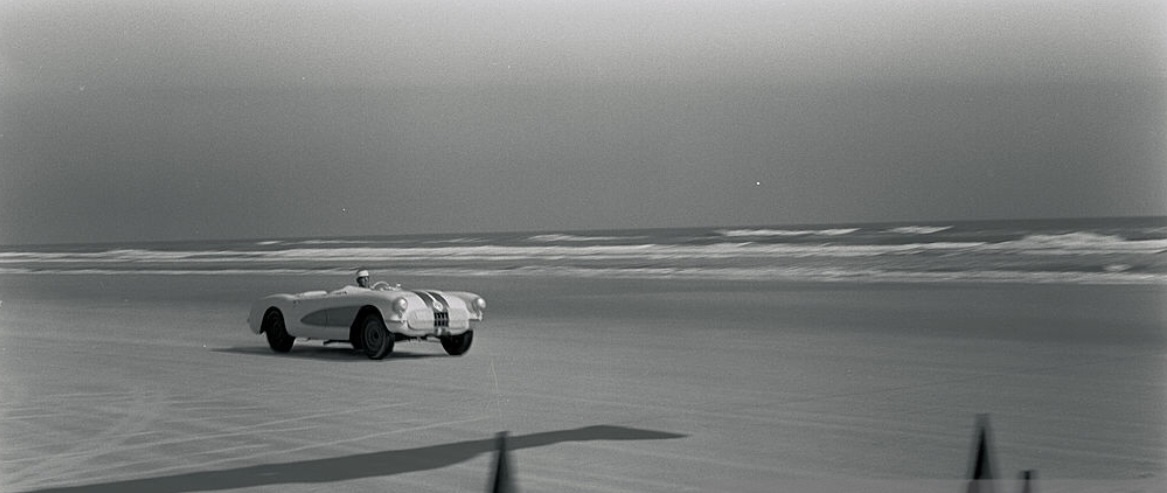
Smokey Yunick looks on as famed GM Engineer and ‘Father of the Corvette’, Zora Arkus Duntov awaits the Daytona Beach start on 1956…
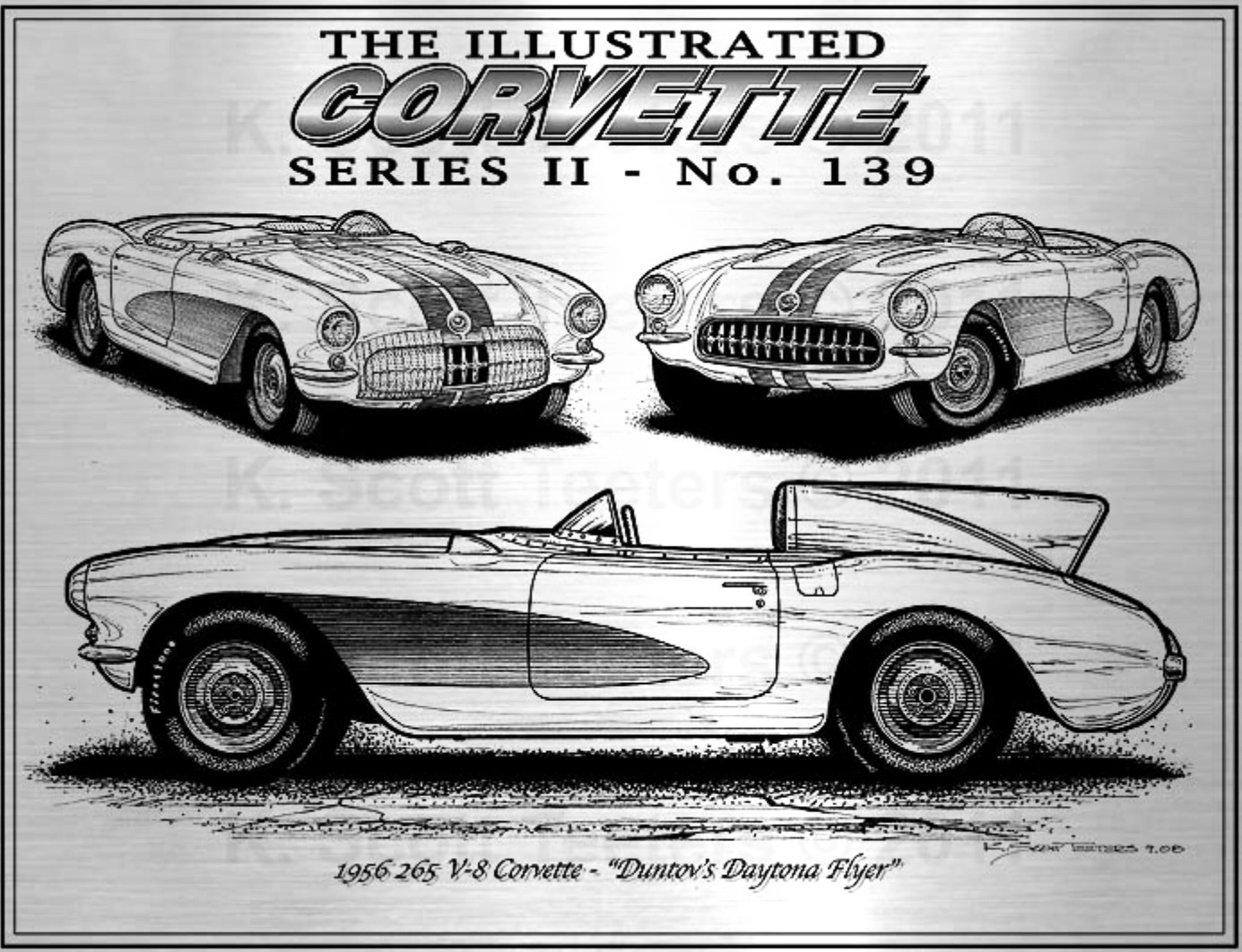
Zora was always seeking to build the Corvette brand. Ford and GM were in a performance battle at the time, his GM paymasters were keen to support his attempt to top 150mph in an ‘essentially stock’ Corvette having just attracted considerable press with a class record run at Pikes Peak.
In the photo above Zora is in #A81, the car with the head fairing, and John Fitch in A82 behind.
Zora Arkus-Duntov chatting to officials after one of his runs. Chev Corvette, Daytona Beach February 1956 (Racing One)
Three cars were prepared for the attempts at Daytona Beach in early 1956, they were driven by Arkus-Duntov, racer John Fitch, and aviatrix Betty Skelton.
Murray Carter’s self built Carter Corvette V8 was a brutally attractive sports car that became Dingo-Ugly when the body was adapted to Appendix-K GT regs, as here during the March 1962, Sandown Park international meeting…
Here she is below in an earlier, far more appealing format, at Bathurst in October 1961. This article tells the story of the car and the folly of one of the CAMS’ less-than-brilliant rule changes: https://primotipo.com/2017/01/19/forever-young/
(VHRR Collection) (SLNSW)
Murray again, this time leading Barry Topen in the similarly vulgarised Jaguar D-Type, #XKD526, through Mobiloil corner – it seems – or Turn One in vulgar, modern parlance.
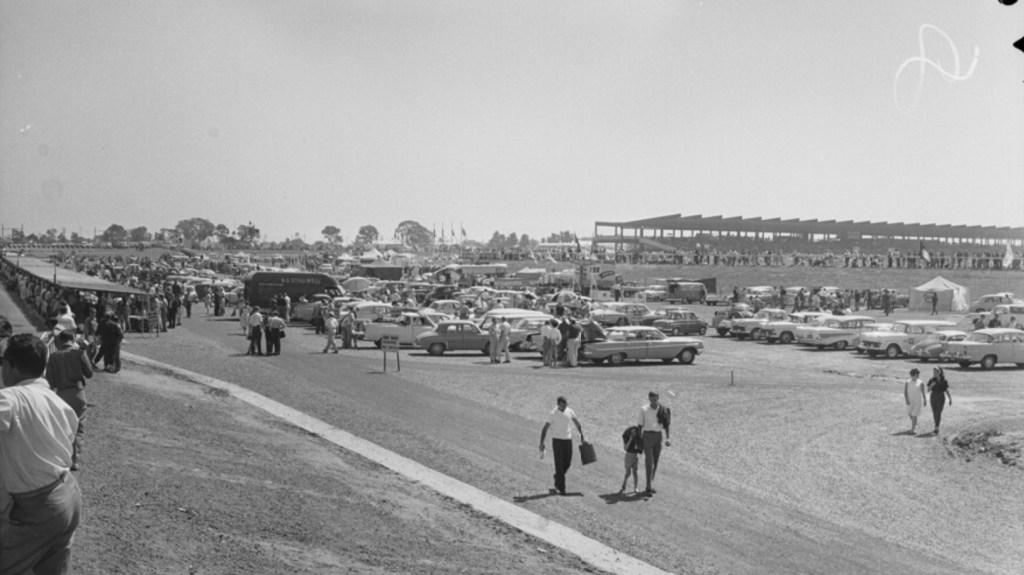
The capacious Sandown paddock above, not quite so accommodating by the early 1970s mind you. Meanwhile old-mate below – craning his neck in the light coloured suit – is upset because he thought he was heading off to his favourite track to see the donkeys galloping around…It was Sandown’s ‘opening car race meeting’ after all, the first clubbie is duly noted.
(SLNSW)(SLNSW)
Ah, that’s reassuring, Peters corner, was named so, right from the start. At least until ‘Torana’ made an offer the Light Car Club of Australia couldn’t decline circa 1971-72. Sandown’s Pit Straight before the pit counter and pitlane armco…and armco and grass runoff area on the outside. That road style kerb would have caused some excitement and grief.




























 primotipo...