Archive for the ‘Sports Racers’ Category

(B Richards)

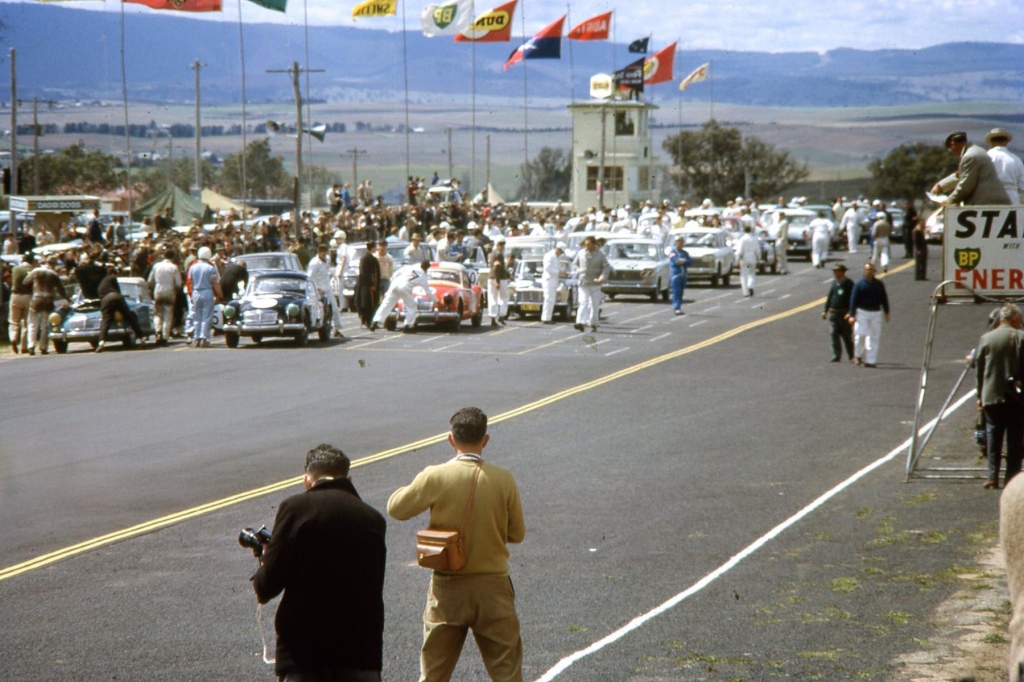
The grid gets way at the start of the September 30, 1962 Bathurst 6-Hour Classic. The entry comprised a mix of production sports and touring cars divided into price based classes. The front row comprises the three MGA Twin-Cams of Matt Daddo/Bill Stanley, N Claydon/Fred Gibson and Clarke/Lazich, with the C Lansdowne/Dianne Walker Triumph TR4 on the inside.

The Bathurst promoters, the Australian Racing Drivers Club, perhaps ran the event off the back of the success of the Phillip Island 500-milers (Armstrong 500) first run in 1960, which would soon after become the ARDC’s after the debacle of the Phillip Island October 1962 event in which the track surface famously, in essence, fell to bits.

(B Richards)

A total of £3,000 in prize money was split evenly among the classes or divisions: A-production touring cars up to £900, B-production touring cars £901-£1050, C-production touring cars £1051-£1250, D-production touring cars £1251-£1700, E-production sportscars up to £1500, F-production sportscars £1501-£2000.

While there was officially no outright winner, the interest of the punters was amongst the top-guns which included the V8s: Studebaker Larks, the brothers Geoghegan’s Daimler SP250 and potentially the best of the little-cars, the Bruce McPhee/Barry Mulholland Morris Cooper.

What strikes me now is that the entry list was a who’s-who of (mainly) New South Wales stars of the day and of the immediate future with a swag of Gold Star, Australian Touring Car and Sportscar Championship, and Bathurst winners in the mix.

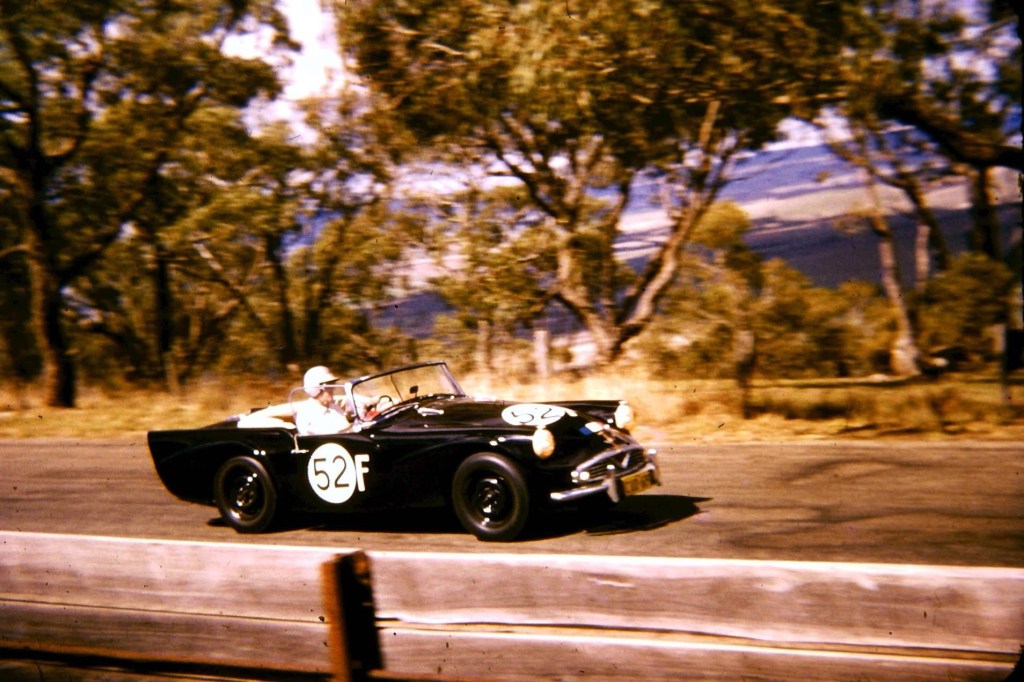
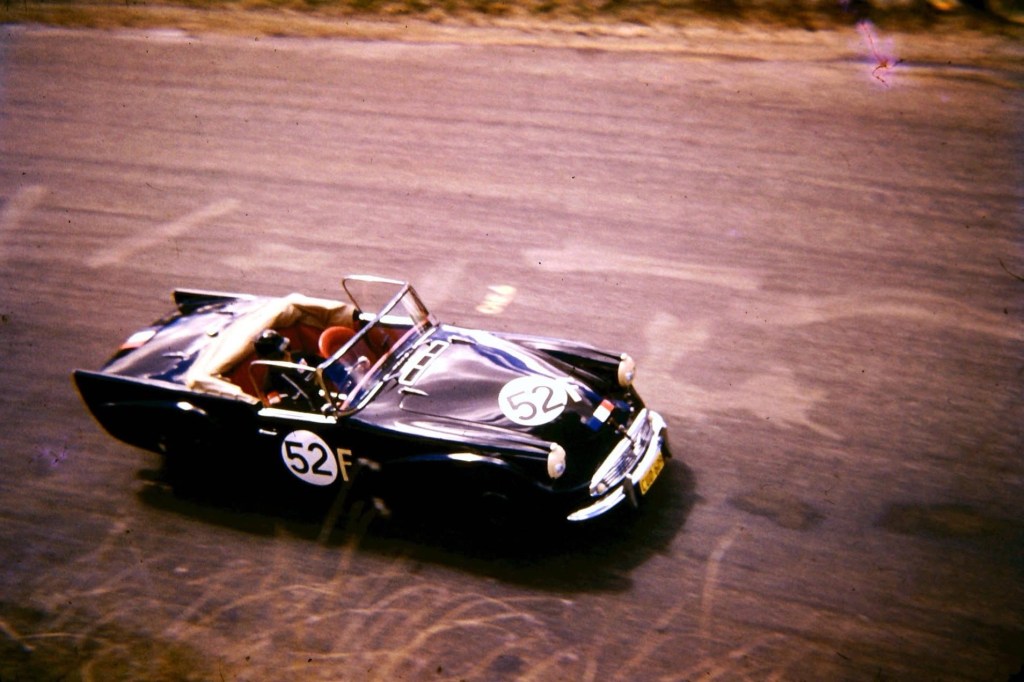
It appears that the sportscars had to start with their tops up, so this is practice or the first stint for Leo and Pete Geoghegan’s winning Geoghegan Sports Cars entered and prepared Daimler SP250 (B Wells)
Pete Geoghegan blasting across the top of the mountain. Alan Howard said of his shot, ‘You can see the bit of rope used to hold the drivers door closed late in the race.’ (A Howard)

Morris 850s dominated Division A – 14 cars, of which all but one finished – where the winners were Frank Kleinigs senior and junior. Kleinig Snr was an Australian great pre-and post-war and always polls well in lists of Greatest Australian Drivers Never to Win an AGP. Junior was no slouch either as a racer and constructor of Formula Vees. There was no shortage of notables in this class including Des West, Bill Pitt, Arnold Glass, John French and Paul Bolton, while Tom Sulman would have run Kleinig Snr close in a contest for who started racing first.

Seven cars contested Division B, the victors were John Martin and C Hodges in a Skoda Felicia of all things. This group included cars raced by Ron Hodgson, Digby Cooke, Alan Heasman, Peter Wherrett, Doug Stewart and Alan Stanfield.

Bruce McPhee and Barry Mulholland went on to win the Bathurst 500 outright aboard an HK Holden Monaro GTS327 in 1968, they prevailed in Division C where Bob Jane and Harry Firth were much fancied in a works-Ford Falcon XK.

The Jane/Firth C Division Ford Falcon XK from the ‘E’ MGA 1600 driven by K John/Peter Caldecoat (B Wells)
Lap 39, Firth is ok and out of the Falcon via the back window but she needs a turret! Bob Williamson recalled, “They towed the Falcon up the escape-road on its roof with a tractor. You should have heard the noise, roof on a gravel road.” (B Richards)

Ford planned to race their new Falcon XL in the Armstrong 500 at the Island on 21 October, in addition they decided, wisely, to contest the Bathurst Six Hour Classic to be held only three weeks before. The catch was that Ford didn’t want to race the XL at Mount Panorama so Firth set about preparing an XK Falcon for the race.

Firth takes up the story in his typically self-serving way, “Having not been to Bathurst for some years, I had to rely on hearsay information like, “no, it is not hard on brakes and the circuit has not changed. I did all the usual things such as a valve grind, compression check, set the camshaft properly, gave the pistons plenty of clearance, deck-heighted the head and put the engine on the dyno.”

“I fitted a set of heavy Armstrong shockers and some well-worn springs. I made up some Ferodo brake shoes but ended up leaving them at home, thinking they wouldn’t be needed. I drove the car to Bathurst myself. Practice proved two things: the car was the fastest sedan and the brakes were not good enough.”

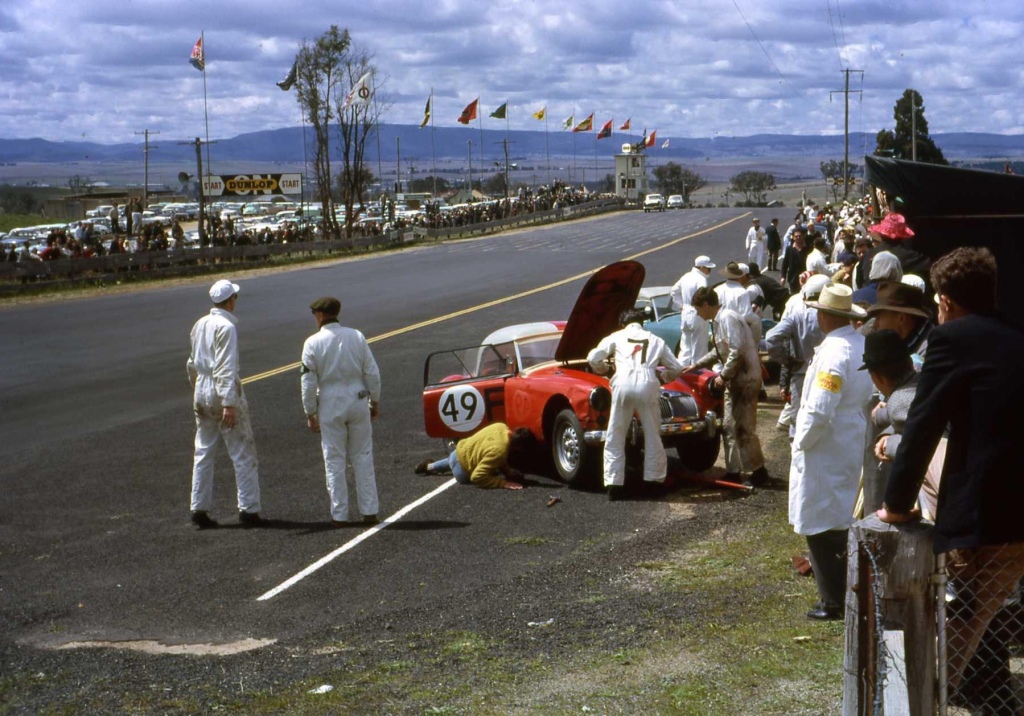
The Jim Clarke/A Lazich MGA Twin-Cam receives some attention, DNF (B Richards)

The two wily Melbourne racers – who went on to win three of these Phillip Island and Bathurst 500s together – led their class early, but the brakes were progressively showing signs of stress as the pedal crept inexorably closer to the floor.

Harry took over from Bob after a scheduled stop and then on lap 39 “As he braked for Hell Corner, the fronts suddenly over-energised and locked on, the nose dug in and the car rolled.” The roof was crushed with Harry extremely lucky he wasn’t badly hurt, the car had no roll bar or cage of course. He exited via the rear window as fuel spilt over the tarmac, but did not ignite.

The Division D winning Studebaker Lark raced by Algie/Hibbard. I’m old enough to remember when these beasts were popular cop-cars in Australia (B Wells)

Division D’s 10 car entry included three Studebaker Larks, with the Don Algie/Kingsley Hubbard entry the winner on 99 laps, then the well credentialed David McKay/Greg Cusack duo in a Fiat 1500 from Peter Williamson and K Whiteley third in another Fiat 1500. Other notables in that class were Bill Buckle, Brian Foley and George Murray.

Only four cars contested Division E, with the Tony Reynolds/Les Howard Morgan Plus 4 ahead of the Bill Reynolds/Kevin Bartlett Austin Healey Sprite Mk1.

The Geoghegans won Division F for the more expensive sportscars from the G Lansdowne/Holt Bonnie Triumph TR4. The Top-Three outright were the Geoghegan Daimler on 104 laps, then the Lansdowne/Binnie TR4 on 100 and the Algie/Hibbard Studebaker with 99 completed laps.

The entries for this race are staggering in their diversity, here the fourth in Division D Scuderia Veloce Citroen ID19 driven by Bill Buckle and Brian Foley (B Wells)

Credits…

Bill Richards, Bruce Wells, Shannons Falcon XK article by Mark Oastler, SS Auto Memorabilia, Alan Howard

Tailpiece…

(SS Auto Memorabilia)

Leo Geohegan at the wheel of the winning Daimler SP250 above and below. With a 2.5-litre V8 and light fibreglass body it proved a quick car but the duo had some challenges, most notably the drivers door opening on a regular basis as the body flexed, and the loss of first gear on the start-line.

(A Howard)

Finito…
(Porsche Cars Australia)

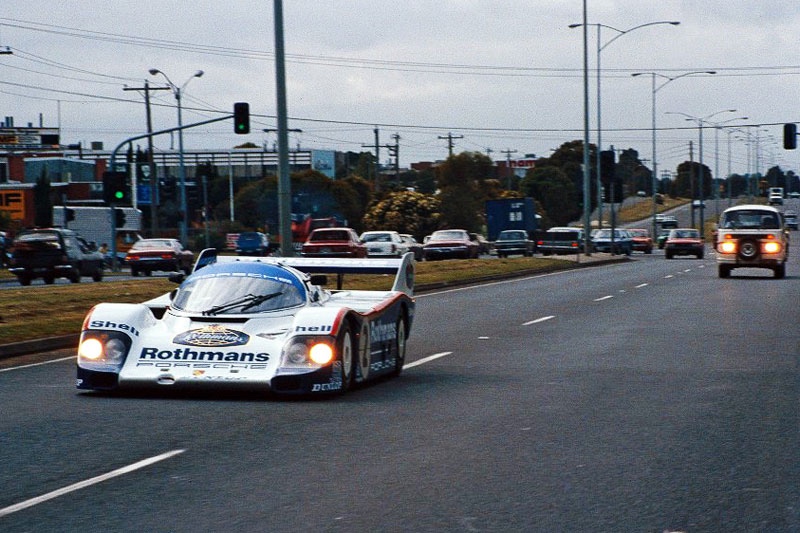
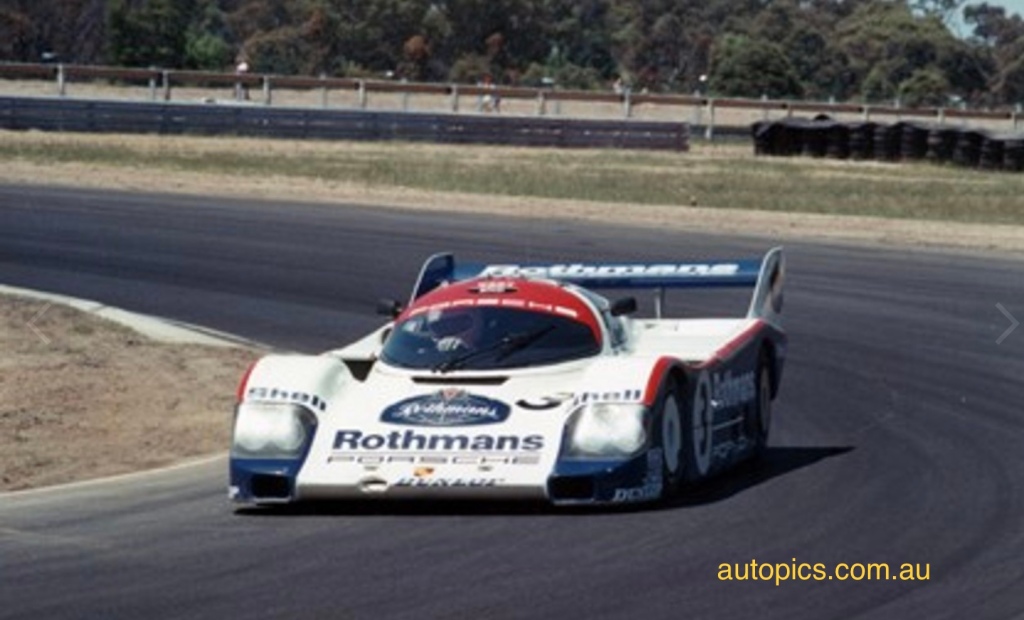
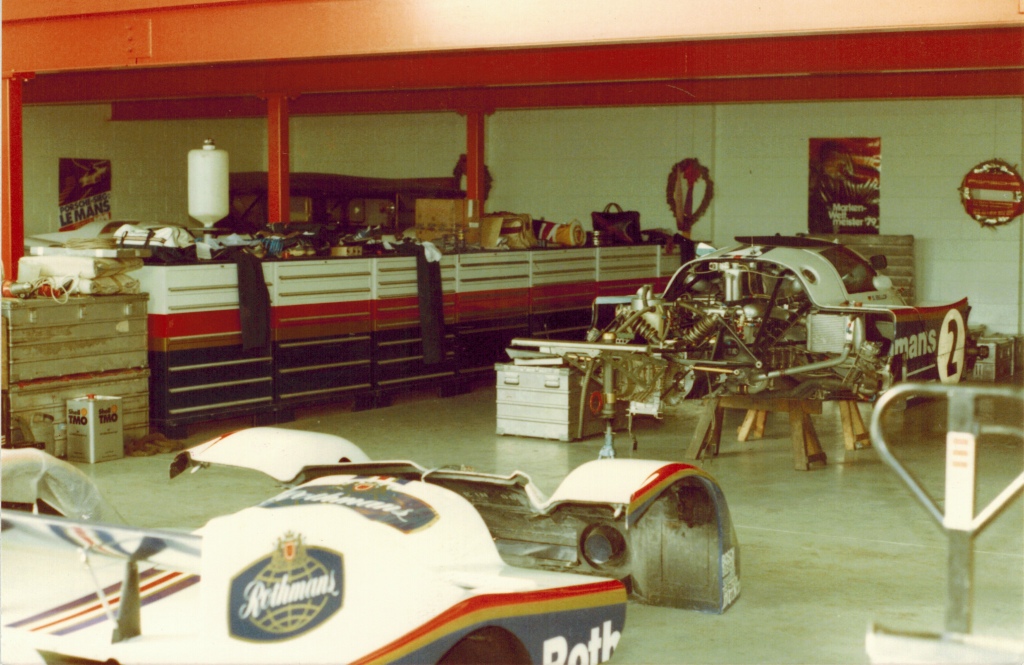
The winning Stefan Bellof/Derek Bell Porsche 956 cruises along the Princes Highway at Noble Park, Melbourne in December 1984…

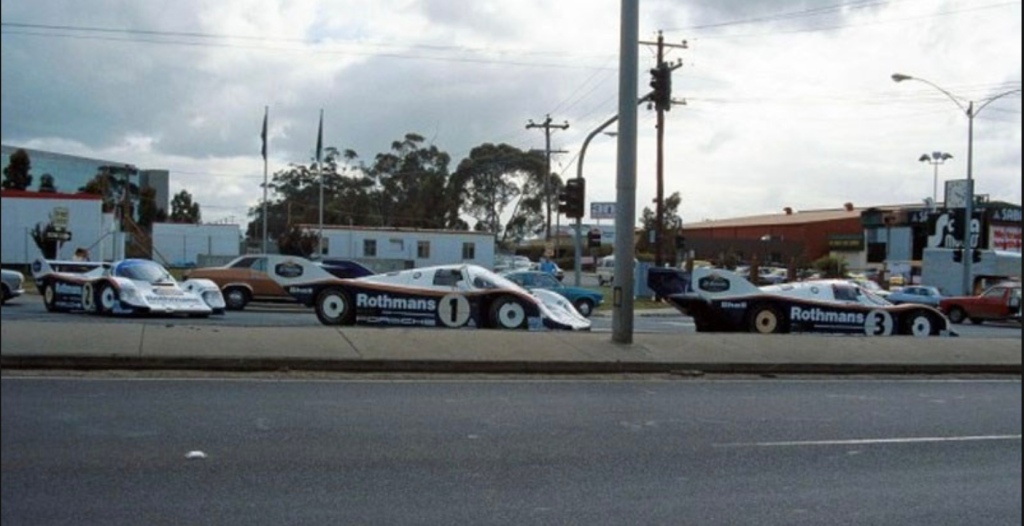
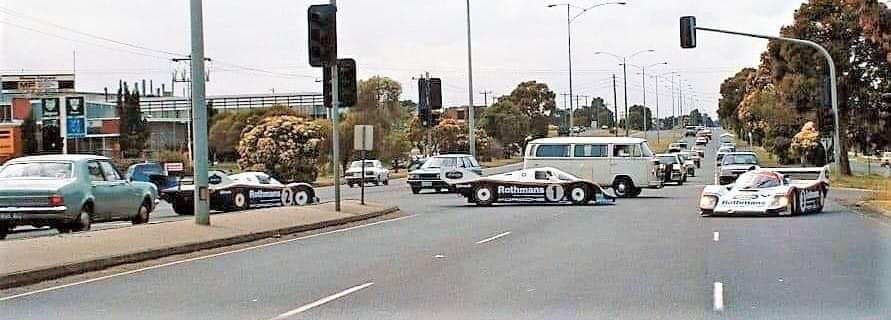
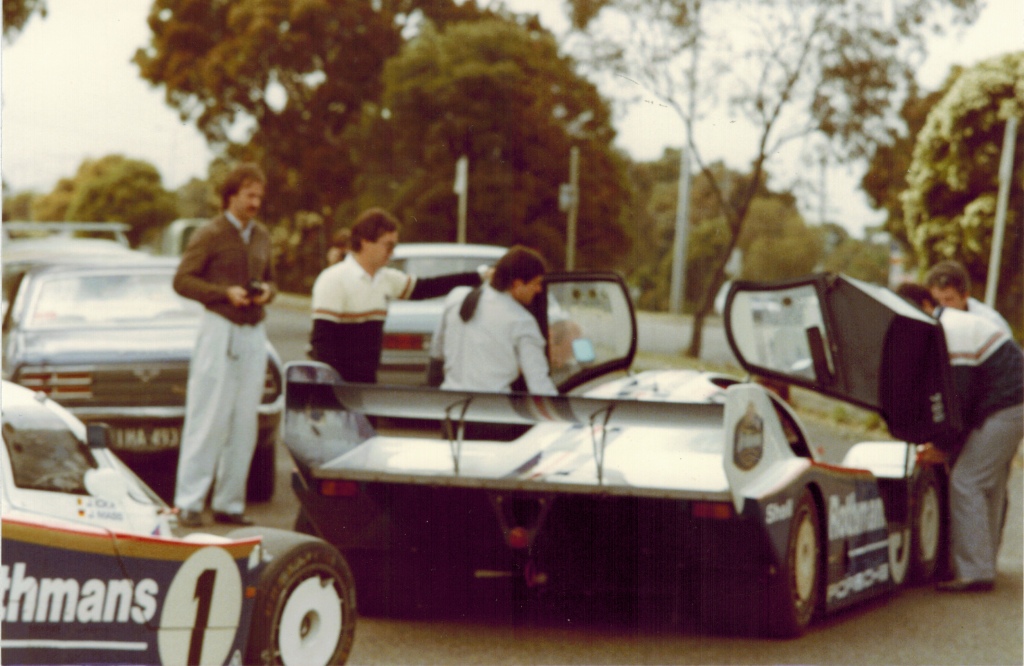
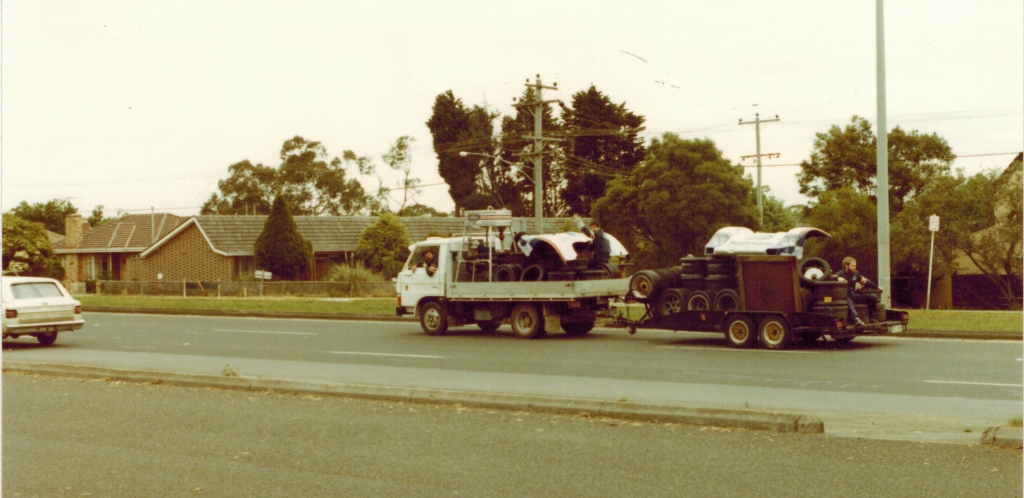
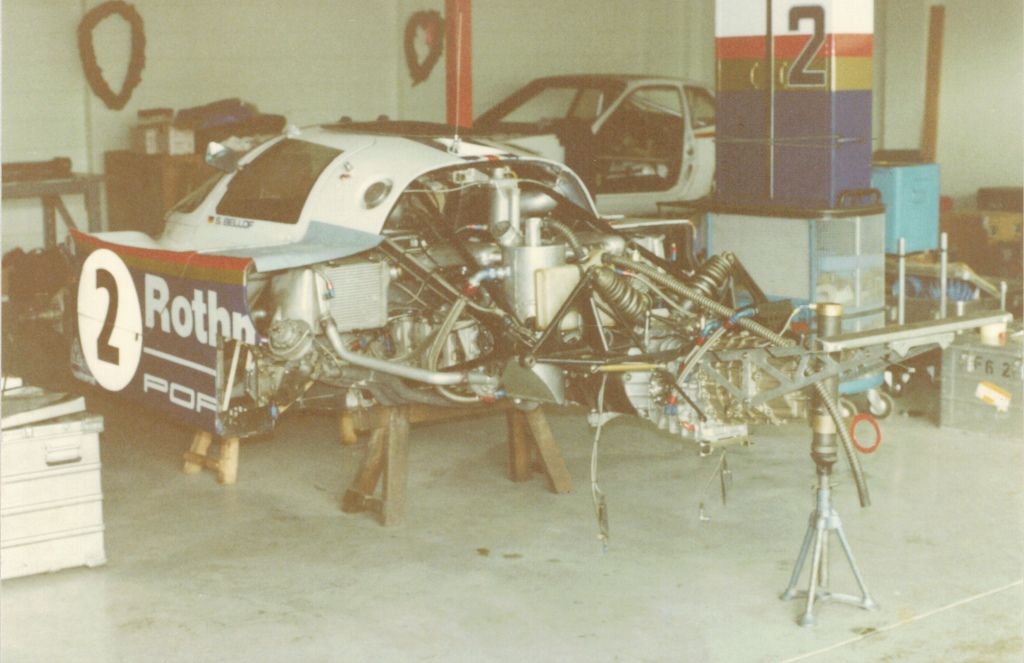
Some of the most amazing shots during the first of Sandown’s two abortive WEC rounds in 1984 and 1988 were away from the track in Melbourne’s southern suburbs. A bright spark, probably Porsche Cars Australia chief Allan Hamilton – an elite level racer himself – thought it would be a great idea to drive three of the four works-956s the five or so kilometres from PCA’s workshop in Noble Park to Sandown, also on the Princes Highway.

No cops, no organisation, just let’s go with a Kombi strategically placed to allow the race-gunterwagens to make the u-turn to head west back towards town. Luvvit!

The Schuppan/Jones 956 leads the Mass/Ickx and Bellof/Bell machines (PCA)
(PCA)

The World Endurance Championship broadened its global horizons with a maiden visit to Australia for the 11th and final round of the championship. Sandown Park is a combined horse and car racing facility. Designed as such, the track 30km from Melbourne’s CBD opened and first hosted an international event in March 1962. Jack Brabham won that Formule Libre Sandown Park International in a Cooper T55 Climax 2.7 from the Cooper T53 Climax 2.7s of John Surtees and Bruce McLaren. See here: https://primotipo.com/2016/01/27/chucks-t-bird/

In order to meet FIA minimum track length requirements to host international events, Sandown grew from a fast-flowing 1.9 miles to a fucked-up 2.4 miles, the increase in lap distance achieved within the existing footprint by the addition of a pissant 500 metre infield loop that pleased no-one. A spend of about $A2 million included the relocation of the pits and new pit garages.

The Light Car Club of Australia – easily the most successful car club in Australia, its origins going right back to November 5, 1924 (originally called the Victorian Light Car Club), well before the first Australian Grand Prix was held at Goulburn in January 1927, were the lessors of the Sandown Park motor racing facilities – signed a three-year contract with the FIA. Expectations were high, the LCCA’s spreadsheet jockeys anticipated/speculated/prayed for 40,000 folks to pass through the gates on race day…that didn’t happen and the financial devastation wrought upon this wonderful club by a Boy-Scout Board is a story for another time.

While hyped as Australia’s first World Championship motor race – it was – the 1964-75 Tasman Cup was of far greater stature, or importance regionally at least, with Sandown hosting the Melbourne Tasman round each year.

Happy Jack at Sandown in March 1962. Winner of the first Sandown International in his ex-F1 Cooper T55 Climax 2.7 (C MacKinnon)
Jack Brabham 12 years later in 1984 aboard a works-Porsche 956. The fag-packet signage on the Porker and Dandenong Road corner says everything about motor racing economics of the era…(alamy)
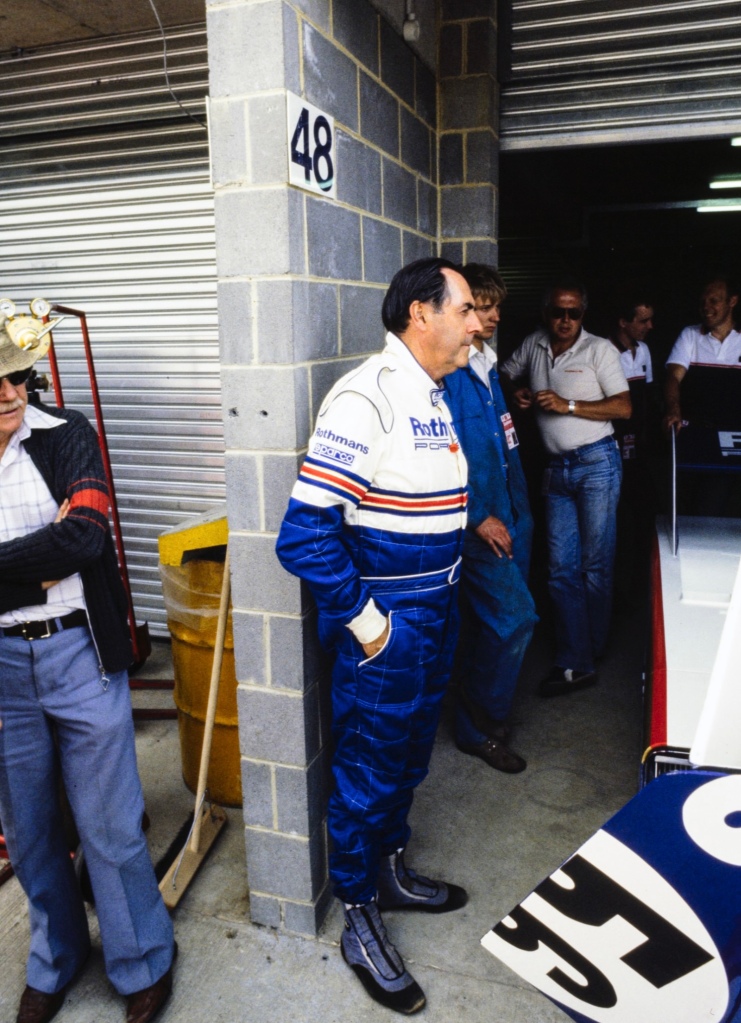
Brabham and Dumfries in the Sandown pits. At the time they were drivers of Group C touring, and F3 cars, I say very tongue-in-cheek in Jack’s case…(M Bryan)

None the less the prospect of seeing Sir Jack Brabham, Alan Jones and Vern Schuppan in ‘spectacular Le Mans Porsches’ was eagerly awaited by local race fans. All eyes were on German wunderkind Stefan Bellof in his battle with fellow Deutschlander and works-Porsche-pilot, Jochen Mass for the WEC Drivers’ Championship.

Bellof sizzled with absolute pace – he was Germany’s star – and had the same fierce burning desire of Gilles Villeneuve to be the quickest in every session. Sadly, both died very violently well before their time.

“I come to Australia to win this race together with Derek,” said championship leader Stefan, “and the chance is good. We stay on the pole position, but it’s a 1000km race and it’s a long distance. We have a lot of slower cars here and so we have to go very careful.”

The young F1 pilot – his Grand Prix ride was aboard a Tyrrell Ford together with Martin Brundle – clipped a kerb and boofed the barriers. Undeterred, he returned on Saturday and popped the car on pole in very hot conditions. Mass was alongside him on the front row, seven tenths slower. “It is particularly unpleasant for me, said Jochen, “because I can only win, and if Bellof comes second he’s still won.”

The Bond/Miedecke John Fitzpatrick/Team Australia 962 inside the Kees Kroesemeijer/Peter Janson/Jesus Pareja Porsche Kremer CK5 (unattributed)
Jones in the 956 he shared with Vern Schuppan

Porsche entered two extra cars for Jones/Schuppan and Jack Brabham, who shared the Porsche camera-car with young F3 thruster and soon Lotus F1 driver, Johnny Dumfries. Jones was the pacesetter, despite little 956 experience. “It’s fantastic to see a world championship event here in Australia,” reflected an upbeat Jones. “It means I don’t have to travel so far from home to be in it for a start!”

‘Black Jack’ had done some Australian Group C touring car racing in the late 1970s, and enjoyed the Porsche experience. “It’s certainly a lot faster than anything I’ve ever driven before. It’s the first time I’ve driven a car with ground effects too, which is very interesting. I’ve read a lot about the Porsches and the opportunity now to drive one and just see how it goes is very, very good.”

After being tapped up the chuff by another car, they weren’t classified in the race, but Brabham, driving with an open-face Bell helmet enjoyed his time behind the wheel.

Lancia didn’t make the trip to Australia as our race was a round of the WEC Drivers Championship but not the FIA World Endurance Championship for makes, a shame given the size of Australia’s Italian diaspora, but the top Porsche privateers made the long trip south.

John Fitzpatrick was back after missing Fuji, with Thierry Boutsen qualifying the lead Skoal Bandit car fourth. The patriotic Team Australia effort returned on home ground, this time commandeering Fitz’s 962. At the wheel were former Australian Touring Car and Rally Champion, Colin Bond and Andrew Miedecke, at that time a leading Ralt RT4 mounted Formula Pacific racer.

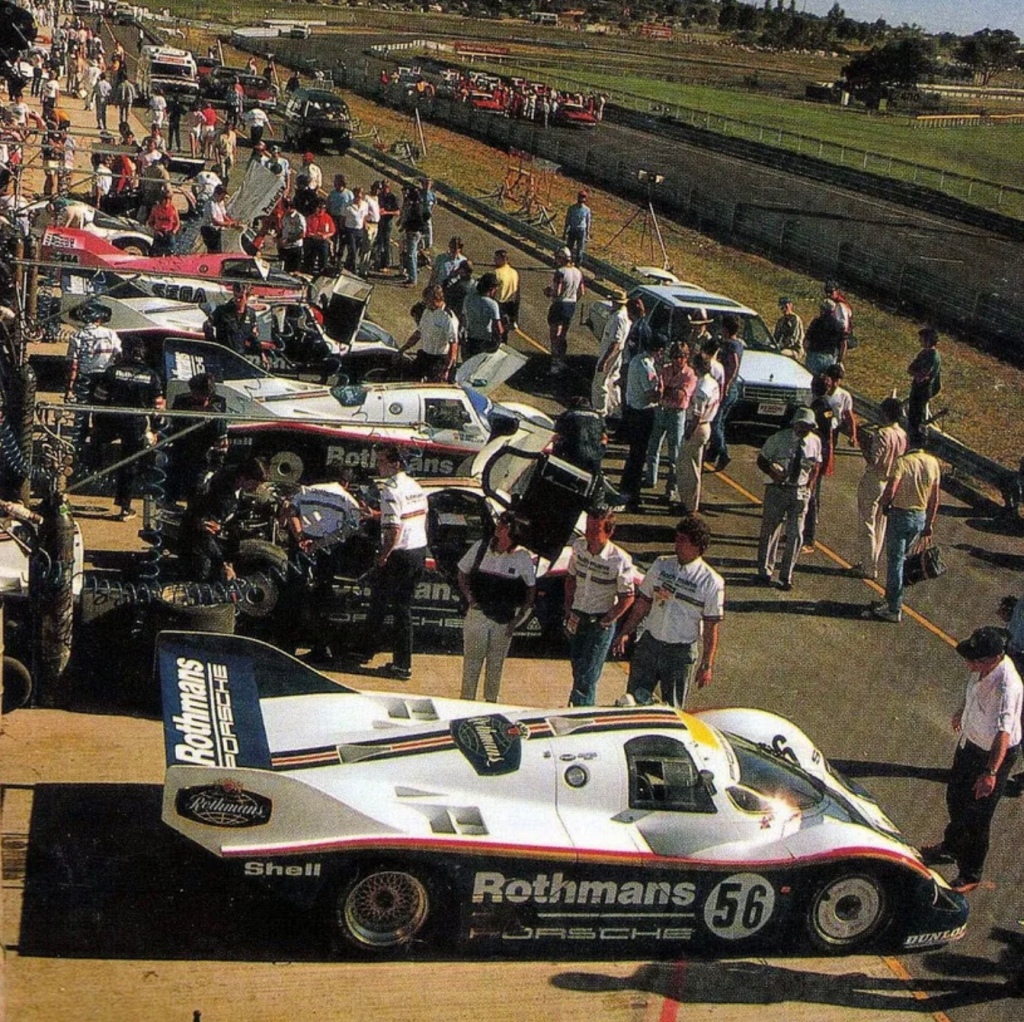
Brabham/Dumfries Porsche 956 front and centre in this Sandown pit panorama (unattributed)
A familiar view for most Australians, the old Pit Straight and old Shell Corner – or its kitty-litter – in the distance, as Colin Bond turns his Porsche 962 into Peters/Torana or whatever they called it that week. Stuff all that Turn 1/Turn 2 bullshit. Most of the good bits of the old circuit, with the exception of the big-balls Causeway/Dunlop Bridge section, were retained, but the kiddyland bumper-park bit was a joke…and was given the arse reasonably quickly thereafter (B Forsyth)

Mulsanne Memories wrote that “Kremer entered the pink Sega-backed 956B for Manfred Winkelhock/Rusty French (fifth) and a white, all-South African crewed 956 for Sarel van der Merwe/George Fouche. Richard Lloyd’s 956 GTi was in amongst this pack, as were Ludwig and Pescarolo in Joest’s 956B. A troubled race, which included punctures aplenty, a black flag, and a fractured brake pipe, meant the Le Mans winners could do no better than seventh, however. A couple of ageing cars — Chuck Kendall’s IMSA Lola T600 and Kees Kroesemeijer’s Kremer CK5 — rounded out the C1 field.”

A strong nine-car C2 field raced in Australia, but Gordon Spice and Ray Bellm again crushed the field taking their fifth win of the year in their Tiga CG84 DFL 3.3. Not that it was easy. Spice spun in the first hour, falling some way behind the ferocious Alba/Gebhardt lead battle. Carlo Facetti went away with fading brakes, and Spice clawed his way back past the Gebhardt before driving away for an eight-lap victory. Gunter Gebhardt had a second, all-female entry for Margie-Smith Haas, Australian Sue Ransom and French F3 star Kathy Muller, which finished the race.

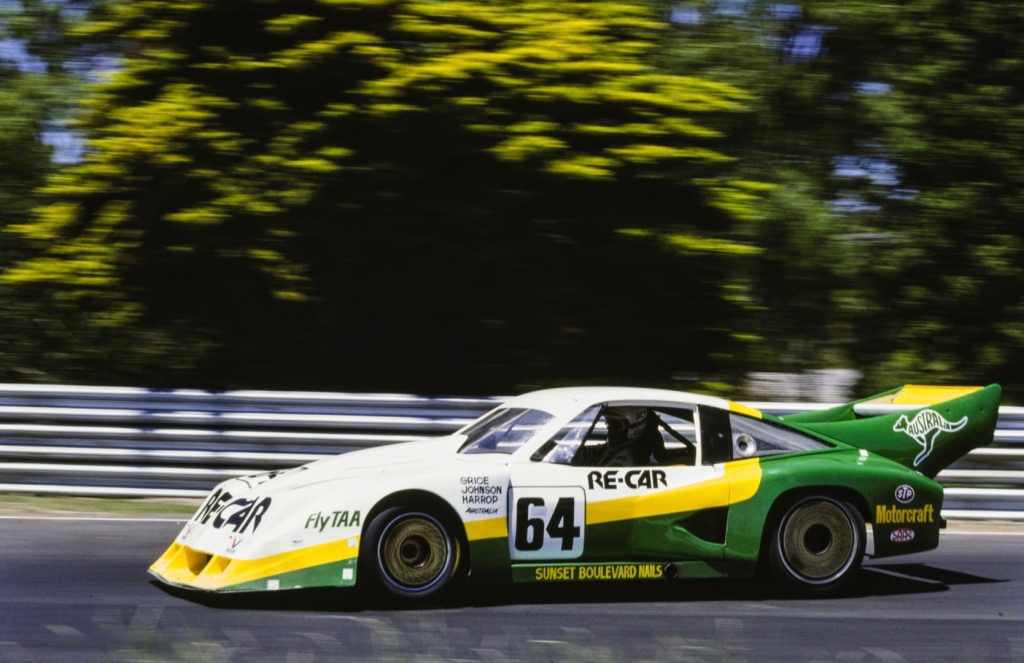
The Allan Grice/Dick Johnson/Ron Harrop 6-litre Chev Monza (MotorSport)
The Bryan Thompson/Brad Jones Mercedes Benz 450SLC turbo (unattributed)

In order to help drag in the local punters – whose most popular diet was V8 touring cars – the LCCA included an Australian Car class for cars that raced in the Australian GT (Group B Sports Sedans and Group D GT cars), and Sports Car (Group A) Championships.

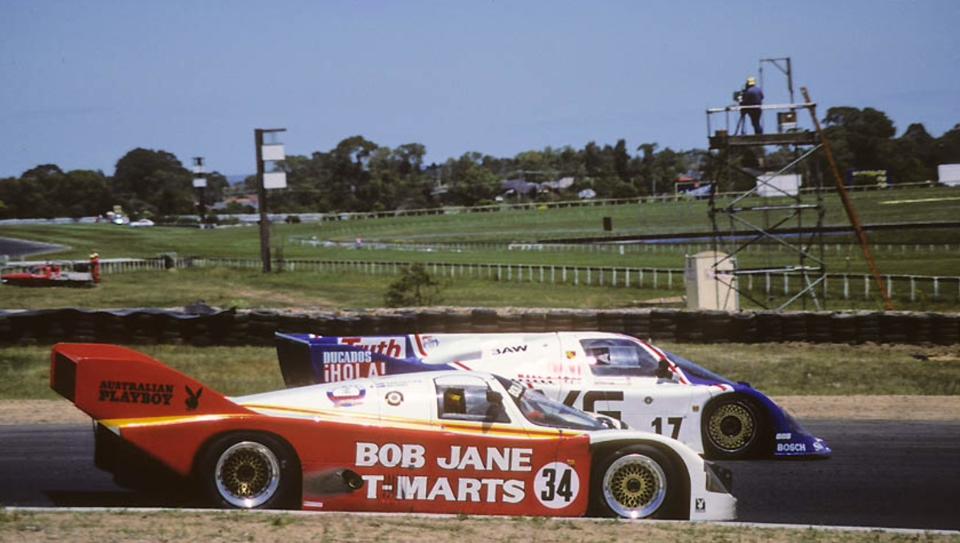
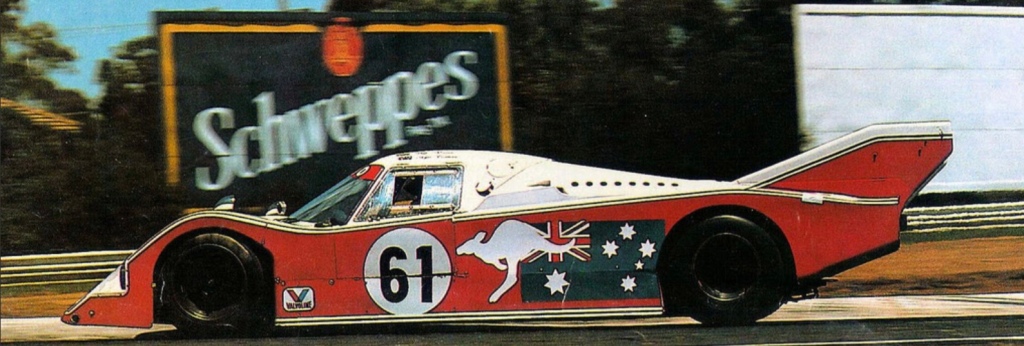
The FIA permitted five of these cars to race, the quickest of which was the Barry Lock/Kaditcha Cars Kaditcha K583/Romano Ford DFL 3.9 sports-prototype raced by multiple Australian Gold Star Champion, Alf Costanzo and car owner, Bap Romano. Alfie’s fastest lap was a 1:38.4 – 13th – despite persistent understeer caused by the 70kg of ballast the car had to carry.

Frank Gardner ran the factory BMW race program in Australia for well over a decade, the team fielded a beautiful black John Player Special-sponsored BMW 320i sports-sedan driven by touring car ace Jim Richards and Tony Longhurst. The quickest of our sports sedans at the time was the ex-Bob Jane, Pat Purcell built Chevrolet Monza raced at Sandown by touring car specialists Allan Grice, Dick Johnson and Ron Harrop. Another superbly built sports sedan was the Peter Fowler built, Bryan Thompson owned 700-900bhp Mercedes Benz 450SLC Chev 4.2 twin-turbo, Brad Jones shared the wheel with Thompson.

The Costanzo/Romano Kaditcha/Romano Ford DFL (unattributed)
Bellof, Mass and Jones before the start (unattributed)

Race

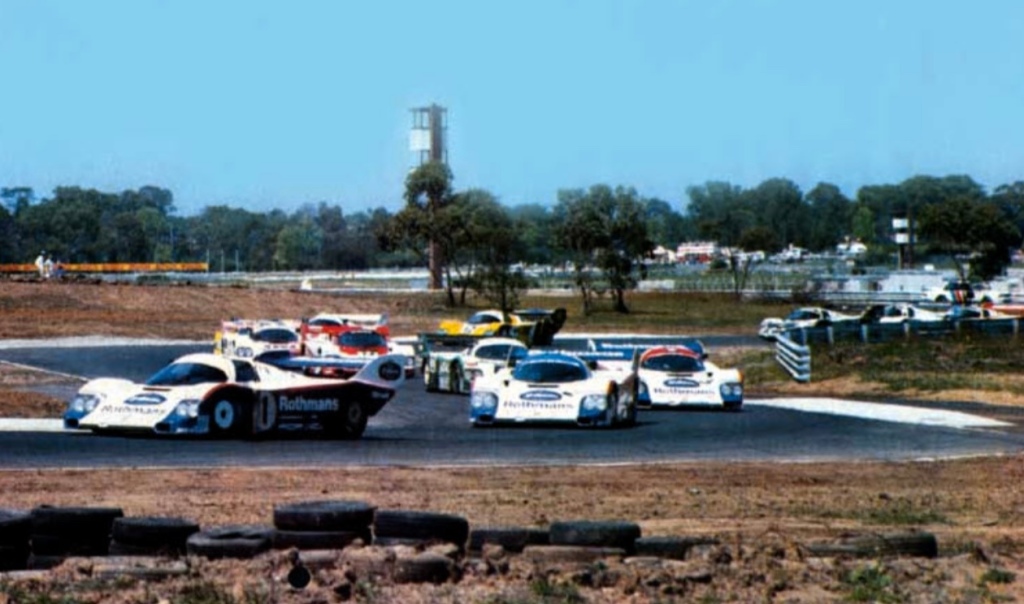
29 cars set off on as the parade lap in hot conditions with the 1980 World Champ Jones the bolter – showing the sportscar-boys how its done, sliding down the inside at Shell to snatch the lead. As the field completed the first lap Jochen Mass was missing, having spun on oil dumped at the final chicane by Nick Faure’s expiring Porsche 930 just before the start. Jochen re-joined in 15th.

As Mass tore through the mid-field, Bellof was harassing Jones, slipping past on Pissant Loop to take the lead. Bellof pulled away, leaving AJ in the clutches of Boutsen’s 956, finally making it past Jones when he ran wide at the final corner. Behind the top three, Jan Lammers led Manfred Winkelhock, and Klaus Ludwig ran fourth to sixth.

Mass was reeling the top-order in, passing Lammers, then Jones for third spot on lap 31. As cars pitted for their first stops, Bellof led Boutsen by 20 seconds and Mass by 35.

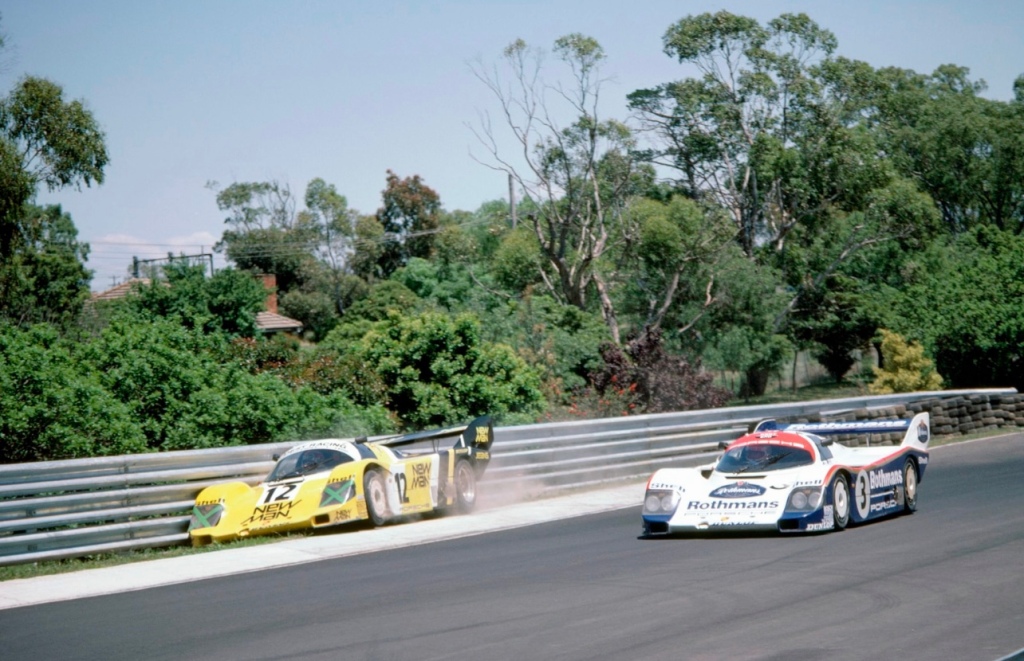
Derek Bell took over the lead car from Bellof, then a slow stop from the Fitzpatrick crew meant that Jacky Ickx emerged from the pits aboard the #1 Rothmans Porsche in second place, just ahead of David Hobbs – who had last raced a McLaren M22 Chev F5000 car at Sandown in 1972 – in for Boutsen. Hobbs re-took second when Ickx skated wide and ran off the circuit at a corner; the newish track surface was breaking up a bit, with cars getting off-line, skating wide and bouncing through the dust.

The Schuppan/Jones 956 passes the very wide! Winter/Schornstein/Belmondo similar car on the run out of Torana; eighth and 11th respectively (MotorSport)

Then the cards were all thrown up in the air, when when broken suspension pitched Group C2 debutant Jens Winther’s 3.5-litre BMW 3.5-litre six-cylinder engined URD into the pit wall, bringing out the pace car and bunching up the field.

At the restart, Hobbs grabbed the lead from Bell despite bodywork hanging off the Skoal Bandit 956. Bell hung on, setting up a fine duel between young co-drivers Boutsen and Bellof. They delivered too, with an enthralling scrap for the lead. After many laps, Bellof put the works car back ahead with a slingshot move down pit straight. Behind these two, the race was going to pieces.

The treacherous track surface delivered punctures at random. First Kremer, then Joest, then the Jones/Schuppan Porsche, which had already been brought into the wrong pit box by Jones, then spun by Schuppan. With later turbo trouble, the Aussies faded to eighth place. “Worst affected was Richard Lloyd’s 956 which pitted very few laps for new rubber. After three or four unscheduled stops, it became comedic. After 12 (!) unscheduled tyre changes for Jan Lammers and Jonathan Palmer, it became utterly farcical. After the race, Dunlop reported a grand total of 59 punctures!”

Mass had been running third, but six punctures ended any chance he had of challenging Derek and Stefan for victory and the championship. The two lead cars remained curiously free of tyre trouble: Bell/Bellof suffered just one puncture and Boutsen/Hobbs none at all.

In the closing stages, Hobbs pulled over in the infield with a broken coil, lifting any remaining pressure on the Bellof/Bell Porsche with Bell taking the chequered flag, shown after six hours, since the 1000km target of 259 laps wasn’t close to being reached.

The victorious Derek Bell and Stefan Bellof (MotorSport)

Stefan Bellof became the 1984 World Endurance Drivers’ Champion after a dominant season; six wins and five poles in 11 races. “I have to say thank you for the mechanics and also for Derek, he did his job very well and he helped me to this title,” said the new champion. Stefan took the mantle from Jacky Ickx, who watched the podium presentation with a look of serious concentration on his face. “I’ve won with Al Holbert in America five races this year, and with Stefan I’ve won four,” said Bell, “It’s been my most enjoyable year of racing, because I’ve raced so much the best car all around the world.”

So Mass was defeated in his bid for the championship, but the well-humoured veteran seemed to take it well. He and Ickx’s struggles left them three laps in arrears at the flag, but still in second place. Somehow, despite suffering all those punctures, Lammers and Palmer rounded out the podium. Next home were Kremer’s two cars, Van der Merwe/Fouche enjoying a cleaner run than Winkelhock/French and taking fourth. With both of his other cars in trouble, John Fitzpatrick’s best finisher was the local Team Australia car in sixth.

There had been much optimism before Sandown, but the official crowd count numbered only 13,800, more realistic estimates had it at sub-10,000, well beneath break-even point. Clashing tennis and cricket dates were cited by the LCCA as reasons for the poor turnout, but these were annual events that dated back to JC’s days playing full-back for Jerusalem…

The fundamental problems were the lack of an adequate TV deal and race sponsor(s) to underwrite the event. For proceeding without those, the board should have been shot then burned. Still, they doubled down and fucked it all up again in 1988 with the Sandown 360Km, this time completing the destruction of the club…

Jon Davison then saved the day for Sandown of course, but the club itself was no-more.

Etcetera…

(MotorSport)

Jack thinking how cool it is to just rock-up and drive…so different to being chief-cook and bottle washer at the Brabham Racing Organisation! Yes OCD’ers, I know it wasn’t the first time he had been driver only, I was attempting some humour.

The Colin Bond/Andrew Miedecke John Fitzpatrick run Team Oz Porsche 962 at rest below.

(MotorSport)
(T Johns)

Tony Johns picks up the story about the road going works-956s…

“Mark a good post, a couple more photos from that weekend. I was one of the three lucky staff members to get a ride that morning!”

“What happened was that the three cars were driven back after Thursday practice for a function held at Porsche Cars Australia headquarters, and on Friday morning driven back to the circuit by the mechanics. My photo (above) shows Roger Watts climbing in and the nose section being fitted after crossing the gutter.”

(T Johns)
(T Johns)

“A neighbour complained to the police who came and waited all day to catch them returning, but that never happened. After the win and the world championship the cars were trucked to Tullamarine and airfreighted back to Germany.”

“Allan hosted all the teams at Noble Park but the Works cars were prepared in his own race shop.”

(T Johns)

Credits…

PCA-Porsche Cars Australia, Mulsanne Memories, MotorSport Images, Getty Images, Bruce Forsyth, Alamy, Malcolm Bryan, Tony Johns

Finito…
image
(Racing One)

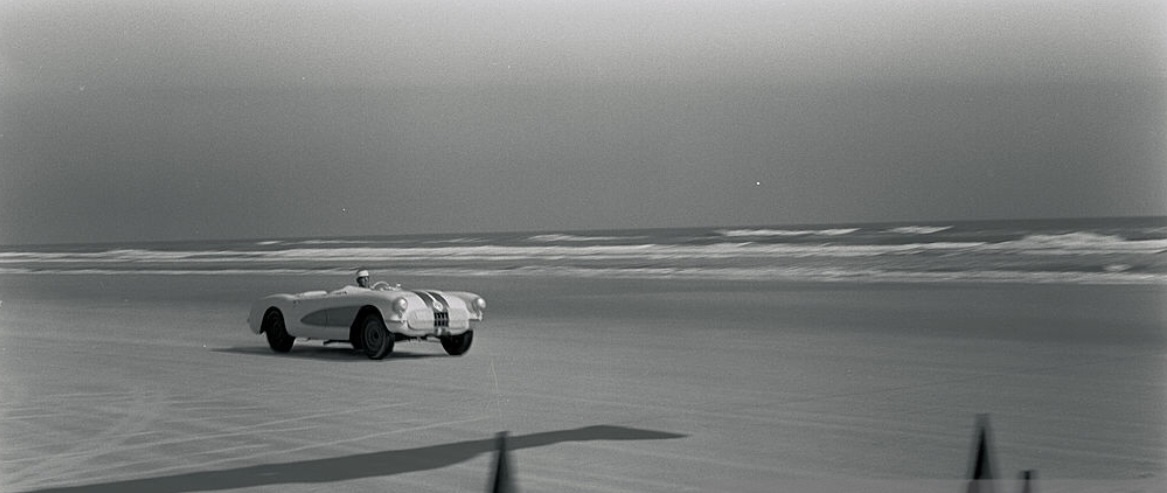
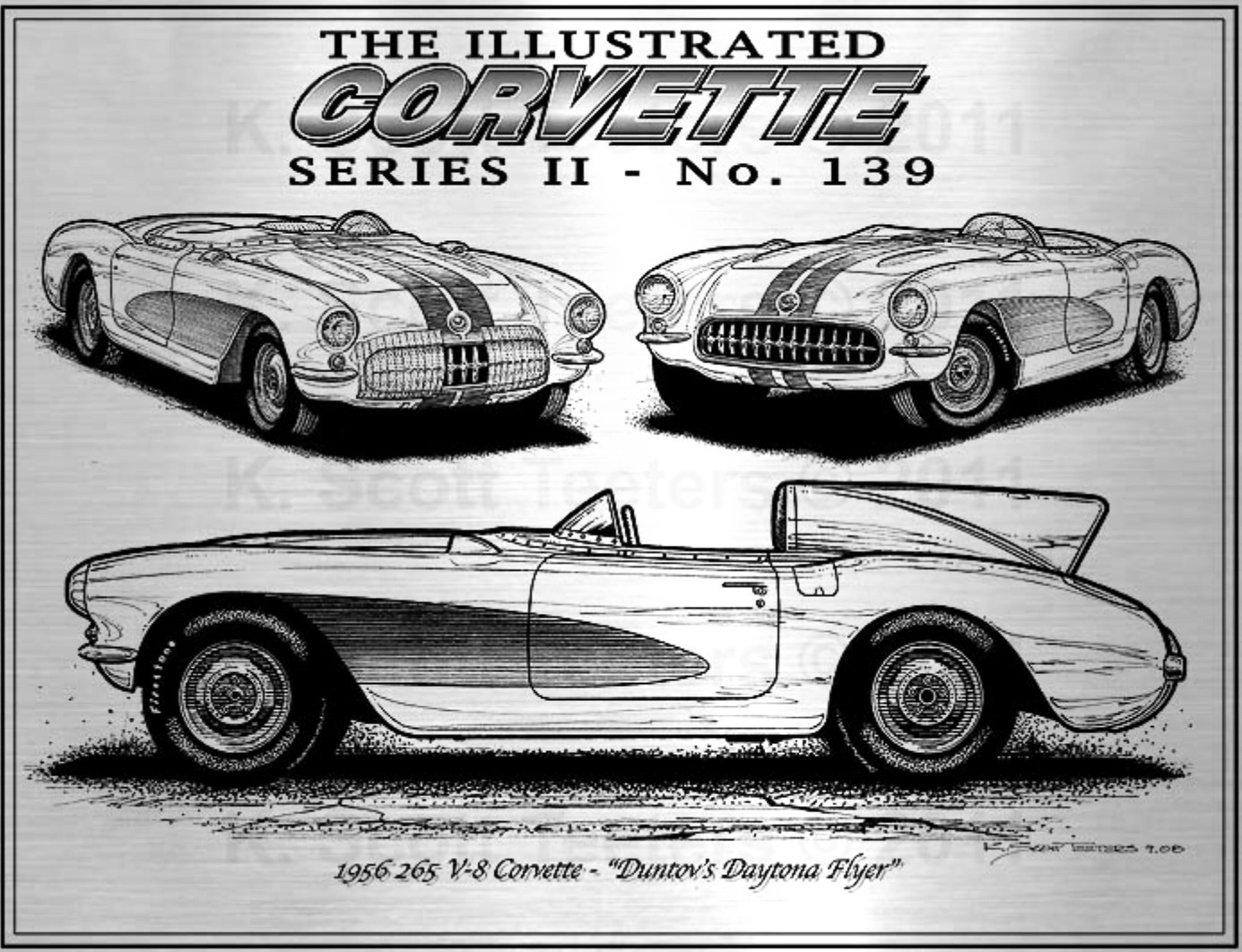
Smokey Yunick looks on as famed GM Engineer and ‘Father of the Corvette’, Zora Arkus Duntov awaits the Daytona Beach start on 1956…

Zora was always seeking to build the Corvette brand. Ford and GM were in a performance battle at the time, his GM paymasters were keen to support his attempt to top 150mph in an ‘essentially stock’ Corvette having just attracted considerable press with a class record run at Pikes Peak.

In the photo above Zora is in #A81, the car with the head fairing, and John Fitch in A82 behind.

image
Zora Arkus-Duntov chatting to officials after one of his runs. Chev Corvette, Daytona Beach February 1956 (Racing One)

Click here for an interesting Car and Driver article about this great engineer/racer: http://blog.caranddriver.com/the-story-of-the-bad-ass-who-made-the-corvette-an-icon-zora-arkus-duntov/

Three cars were prepared for the attempts at Daytona Beach in early 1956, they were driven by Arkus-Duntov, racer John Fitch, and aviatrix Betty Skelton.

image
(Racing One)

These Daytona exploits are well covered in GM’s official history and an excellent specialist Corvette website, click on the links for good coverage, here: https://history.gmheritagecenter.com/wiki/index.php/Zora_Argus-Duntov_at_Daytona_Beach and here; http://www.illustratedcorvetteseries.com/1956_Corvettes.html#Anchor-Here%27s-47857

image
(The Enthusiast Network)
image
(theillustratedcorvette.com0

Credits…

Racing One, The Enthusiast Network

Tailpiece…

image
(The Enthusiast Network)

One of the Corvettes crosses the timing line on its southbound run…

Finito…


(SLNSW)

Murray Carter’s self built Carter Corvette V8 was a brutally attractive sports car that became Dingo-Ugly when the body was adapted to Appendix-K GT regs, as here during the March 1962, Sandown Park international meeting…

Here she is below in an earlier, far more appealing format, at Bathurst in October 1961. This article tells the story of the car and the folly of one of the CAMS’ less-than-brilliant rule changes: https://primotipo.com/2017/01/19/forever-young/

(VHRR Collection)
(SLNSW)

Murray again, this time leading Barry Topen in the similarly vulgarised Jaguar D-Type, #XKD526, through Mobiloil corner – it seems – or Turn One in vulgar, modern parlance.

Barry had a disagreement with the Sandown fence later in the weekend, more about that car here: https://primotipo.com/2019/10/11/bill-pitt-frank-matich-and-xkd526-take-two/

(SLNSW)

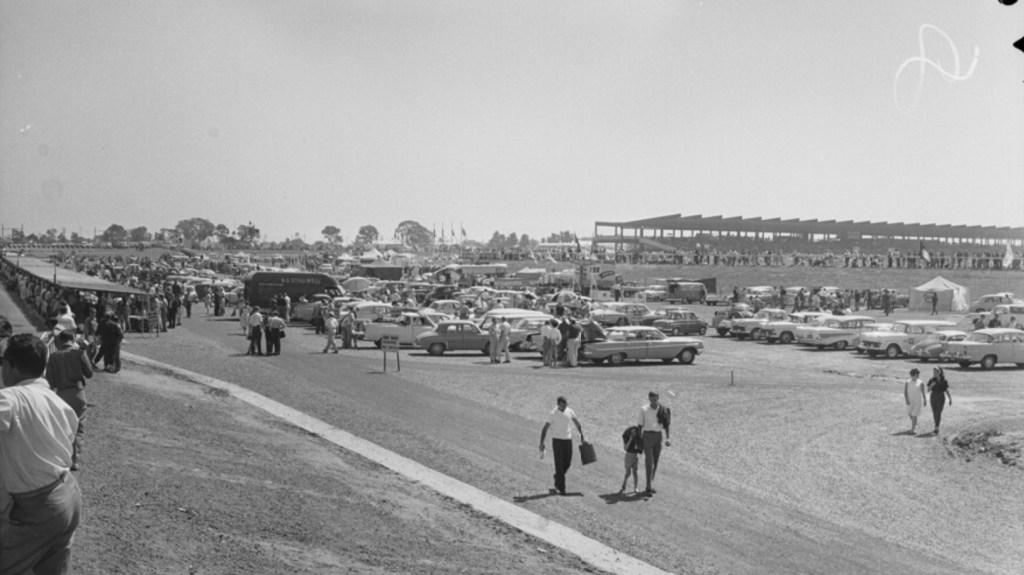
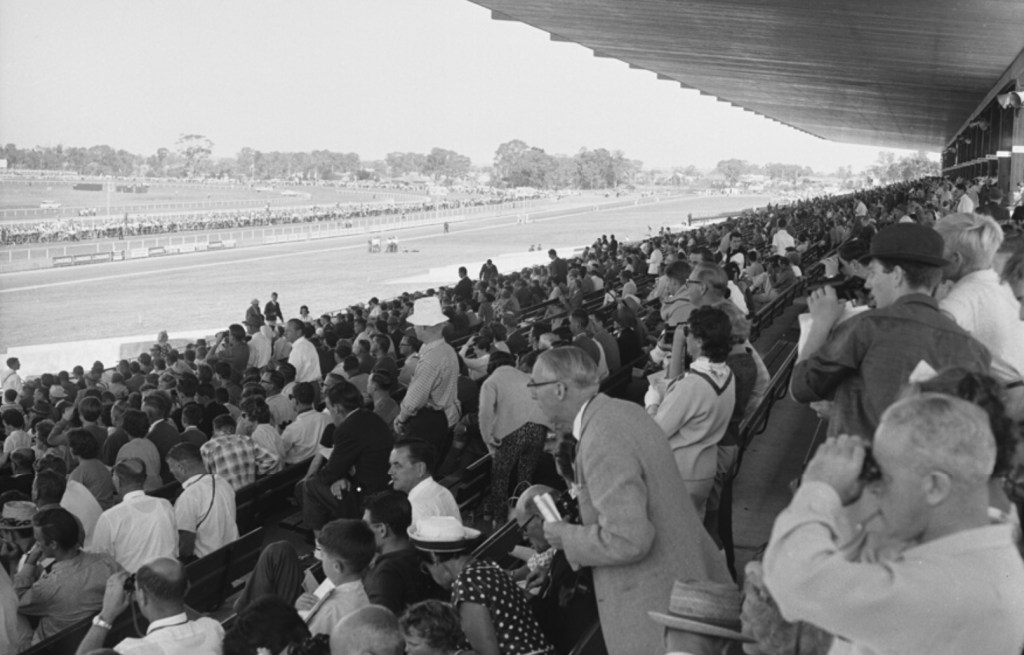
The capacious Sandown paddock above, not quite so accommodating by the early 1970s mind you. Meanwhile old-mate below – craning his neck in the light coloured suit – is upset because he thought he was heading off to his favourite track to see the donkeys galloping around…It was Sandown’s ‘opening car race meeting’ after all, the first clubbie is duly noted.

(SLNSW)
(SLNSW)

Ah, that’s reassuring, Peters corner, was named so, right from the start. At least until ‘Torana’ made an offer the Light Car Club of Australia couldn’t decline circa 1971-72. Sandown’s Pit Straight before the pit counter and pitlane armco…and armco and grass runoff area on the outside. That road style kerb would have caused some excitement and grief.

Some early Sandown history here: https://primotipo.com/2021/07/11/sandown-park-and-light-car-club-of-australia/ and if you really have nothing better to do, here: https://primotipo.com/2015/11/17/australias-first-car-motor-race-sandown-racecourse-victoria-australia-1904/

Credits…

State Library of New South Wales, VHRR Collection

Finito…
Etcetera…

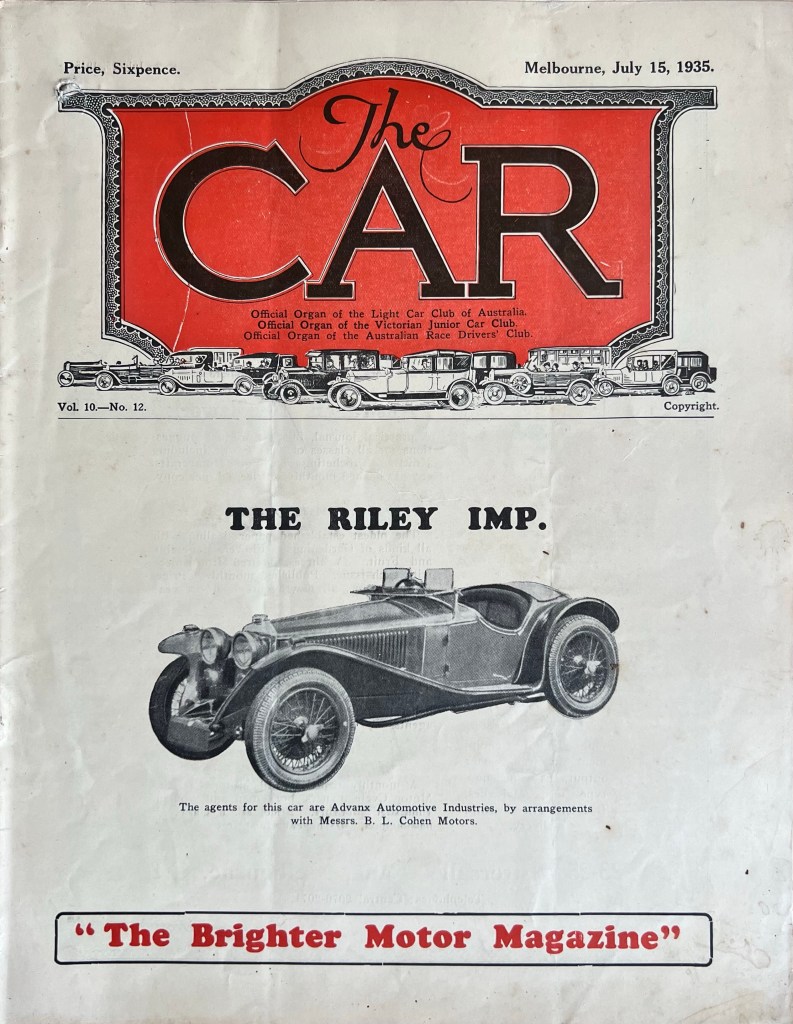
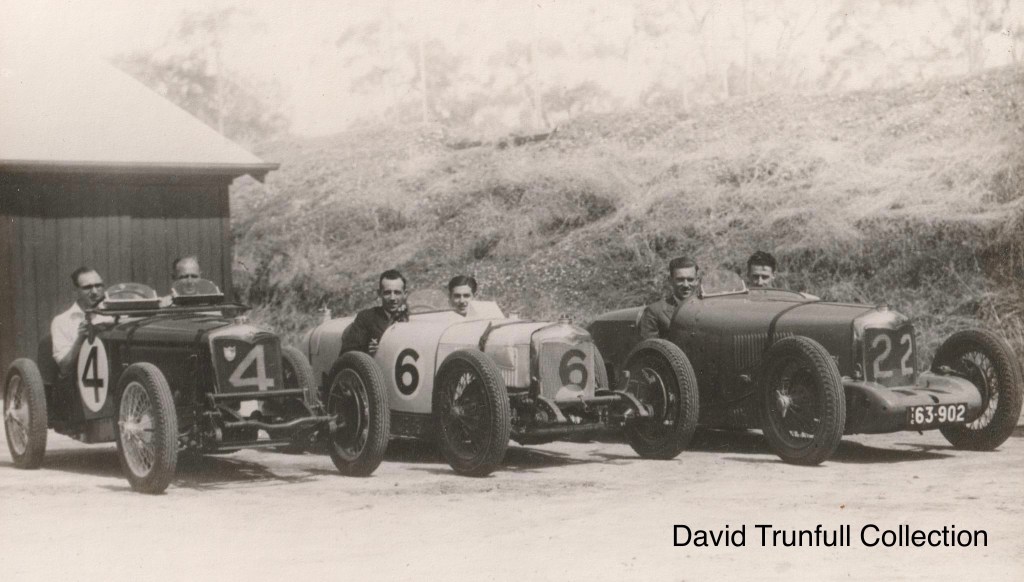
“A group of Rileys during the (Victorian) Centenary Grand Prix – January 1 1935 – weekend at Phillip Island,” wrote David Trunfull.

“The Ulster Imp is being driven by Bill Williamson, his passenger is Air Commodore Johnny Summers. The Brooklands #6 is being driven by Bill Galpin from New Zealand, the passenger is MC Shmith. This car is the ex-Riley works car that won the 1933 AGP driven by Bill Thompson. Brooklands 63.902 is being driven by Merton Wreford, his passenger is Alan Wyatt, the source of this photo. Wreford worked for the Riley distributor, BL Cohen.”

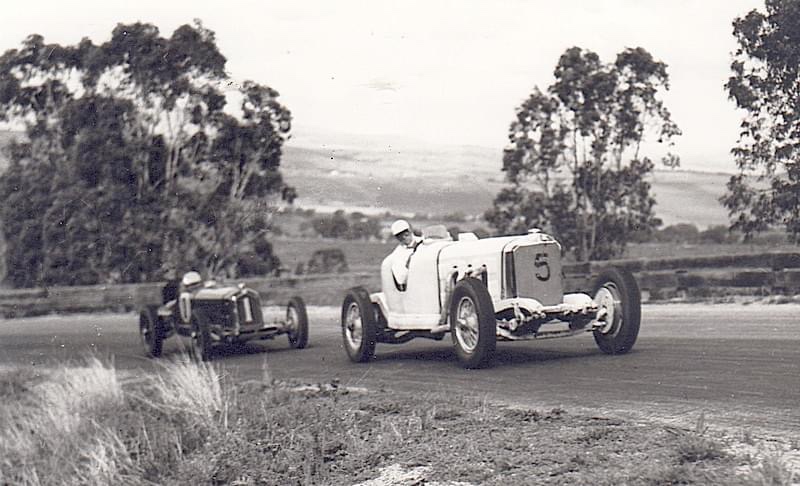
Another shot from the same event. “#6 is the Bill Thompson 1933 AGP car. It was brought over specially for the Centenary 300 by Bill Galpin but for some unknown reason it didn’t take place in the race.”

Trunfull, “The ex-Riley team car was raced in the UK by Sir Malcolm Campbell, AK v.d Becke and Sir Chris Staniland.” “The Brooklands also won the 1949 inaugural Lady Wigram Trophy (on the RNZAF Christchurch airforce base of the same name ) in the hands of Morrie Proctor. It still resides in Christchurch,” chipped in John Newell.

The car on the right is another ex-Riley team car which is said to have been a spare for the 1934 Ulster Tourist Trophy. BL Cohen Pty Ltd imported it in 1934, Bill Williamson raced it for them. The Head brothers later owned and raced it, fitting a 12/4 race engine.”

“This car (the Imp) is now one by Ian Ruffley’s family, the original Ulster Imp engine is probably fitted to the late Terry Moran’s car,” wrote Jim Runciman.

This shot from Tony Johns “was taken during the 1932 AGP weekend at Phillip Island.” #14 is the ninth placed Bill Williamson driven Riley, car #19 Ken McKinney’s Austin 7 DNF. Bill Thompson won the race in a Bugatti T37A.

A bit of trivia, “if you enlarge the photo, the open door on the left has CRD (Cyril Dickason) and RCM (Clarrie May) and CRW (Cec Warren) who would have shared the same garage when they raced Austins in the 1931 AGP the year before.”

Credits…

The Car, David Trunfull, Jim Runciman, John Newell, Tony Johns, VSCC NSW Archive

Finito…
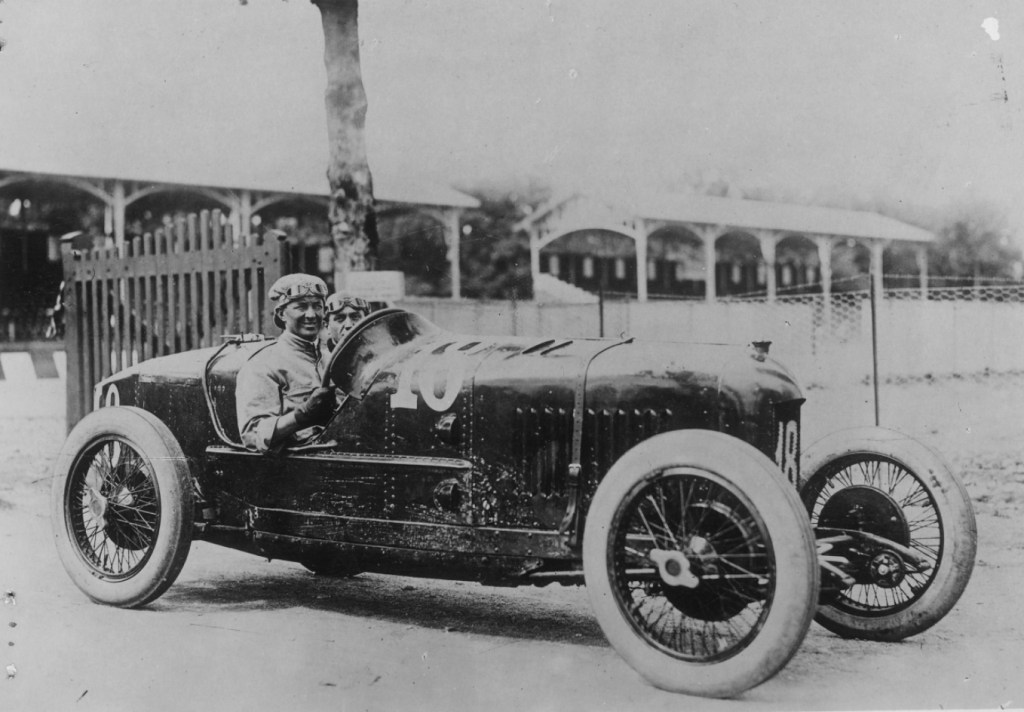
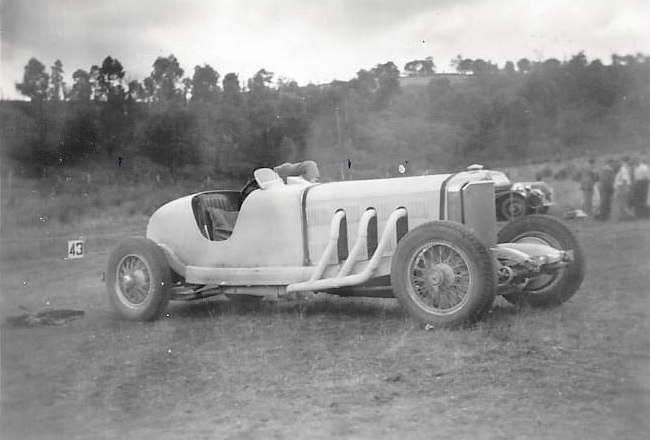
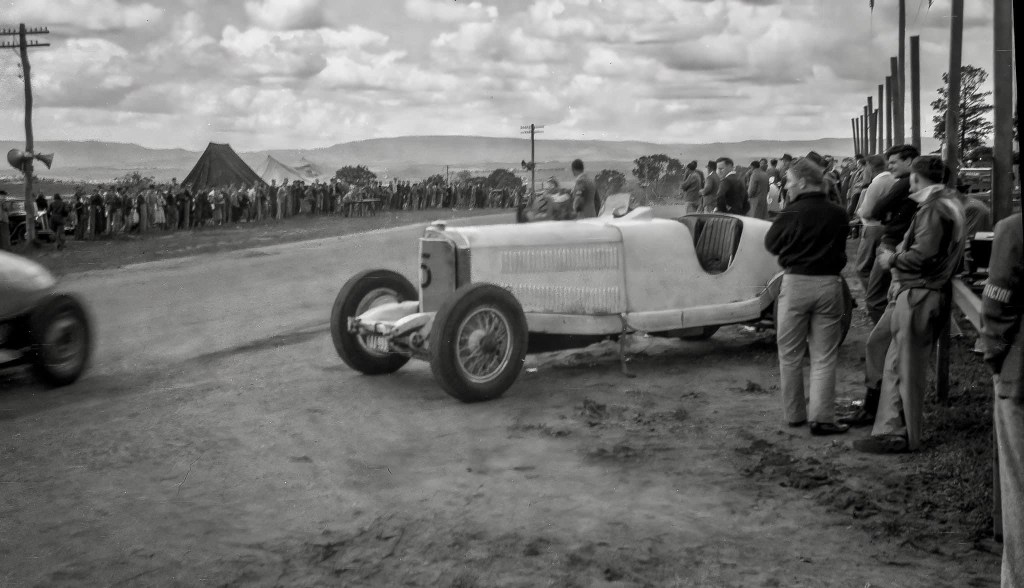
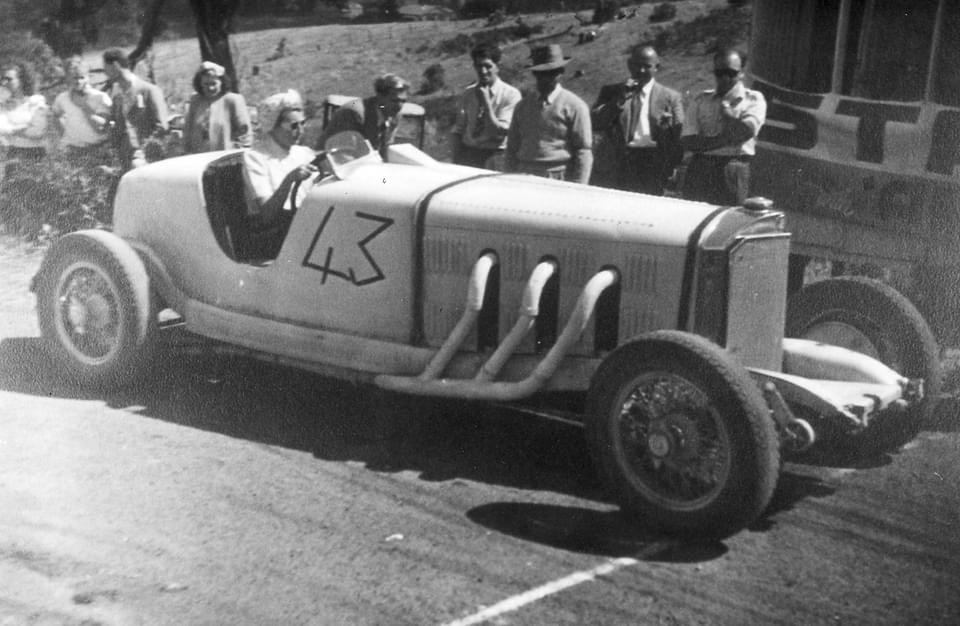
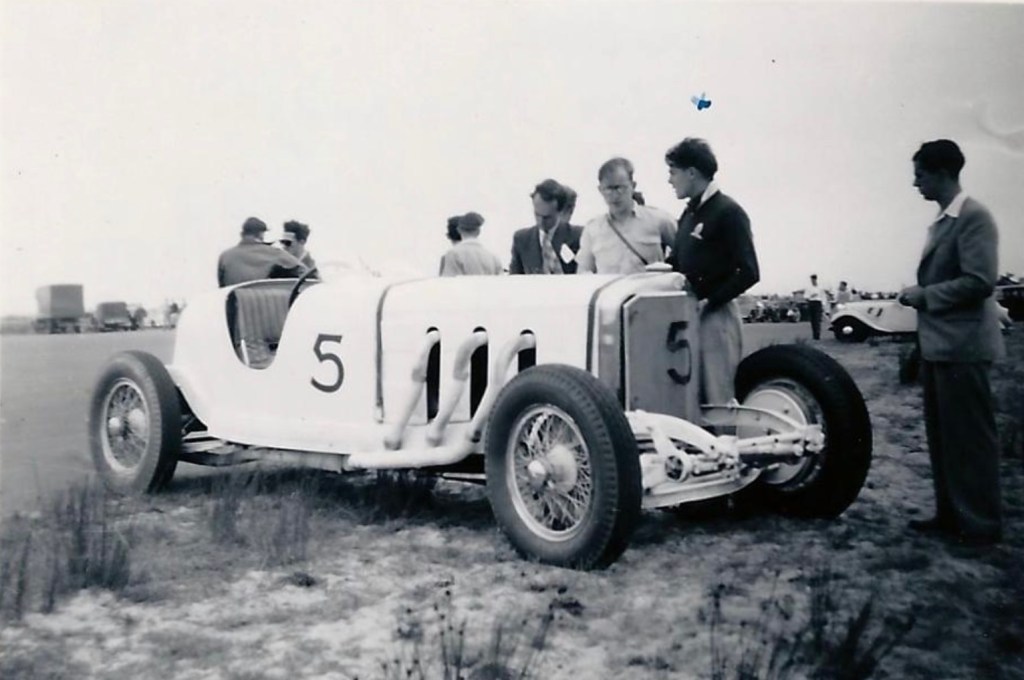
Lex Davison and passenger – probably Lyndon Duckett – at Fishermans Bend, Melbourne, unleashing all of the power and torque of his 7.1-litre supercharged, straight-six 1929 Mercedes Benz 38/250 SSK, chassis #77643. It’s March 13, 1949.

(unattributed but I’d love to know who?)

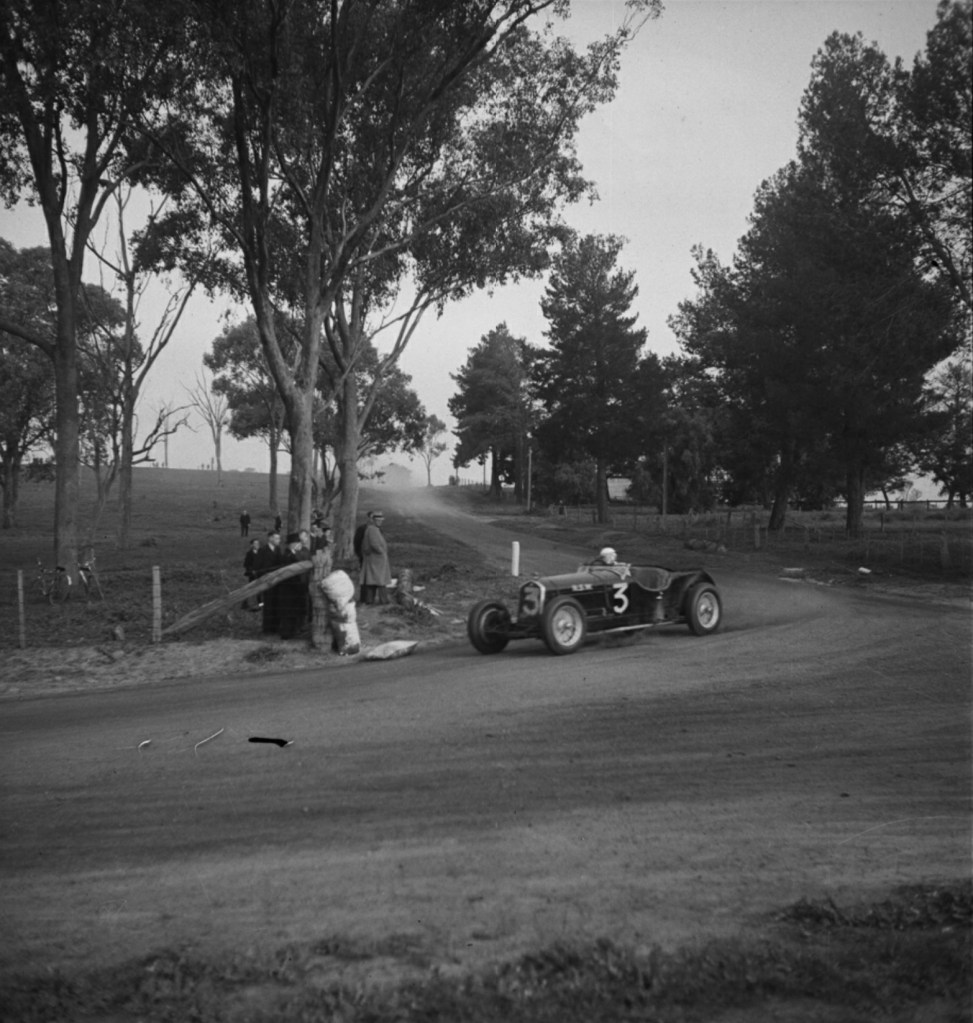
Davison raced the car from 1946-49 and is shown here in front of Alf Barrett’s Alfa Romeo 8C 2300 Monza through Quarry during his highly competitive run into third place in the 1947 Australian Grand Prix at Mount Panorama, Bathurst.

(Mercedes Benz)

Production numbers and Technical…

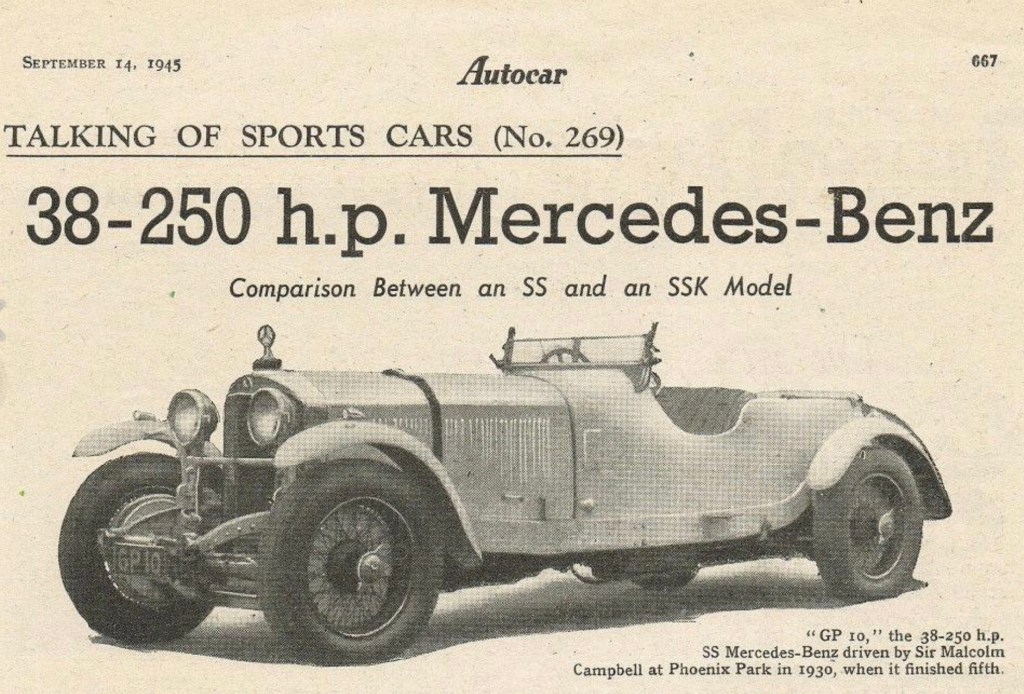
How Davison’s car came to Australia is still a bit of a mystery, but a West Australian, a Mr Everett imported it and sold it to Eric MacKay, more of this anon. #77643 was one of 33 SSKs, one model of four of this stunning series of S, SS, SSK and SSKL Mercedes Benz built between 1927 and 1933.

The production numbers according to Mercedes Benz were: S-Sport 146 units built until September 1928, SS-Super Sport 111 units until September 1933, SSK-Super Sport Kurtz (short – the wheelbase of theses cars is 2950mm) 33 units between 1928 and 1932.

The numbers of the SSKL-Super Sport Kurtz Licht (short light) cars produced is not quoted by Mercedes publicly, “it is extremely difficult to obtain a precise record of the production numbers, since, already at that time, chassis were being shortened and provided with different engines.” A perfect situation for fakers of course.

Racing triumphs of the cars include the 1927, 1928 and 1931 German Grand Prix, the Avus races in 1931-32, the Eifel race in 1931, the 1929 Tourist Trophy, the Irish Grand Prix in 1930, and Spa 24 Hours and Mille Miglia in 1931. Despite their size the cars were competitive in the hills too, winning the European Hill Climb Championships in 1930-31 and the ’32 German Alpine Championship…and plenty more.

The U-section pressed-steel frame chassis cars were designed by Ferdinand Porsche who had succeeded Paul Daimler as chief engineer of Mercedes in 1923, three years before the company amalgamated with Benz. The six-cylinder SS 38/250 Mercedes-Benz debuted in 1928 as a 7.1-litre development of the 6.8-litre S model launched in 1927. It was both exclusive and expensive, the SS retailed at 35,000 Reichsmarks (£2350) with factory tourer bodywork.

(Mercedes Benz)
(Mercedes Benz)

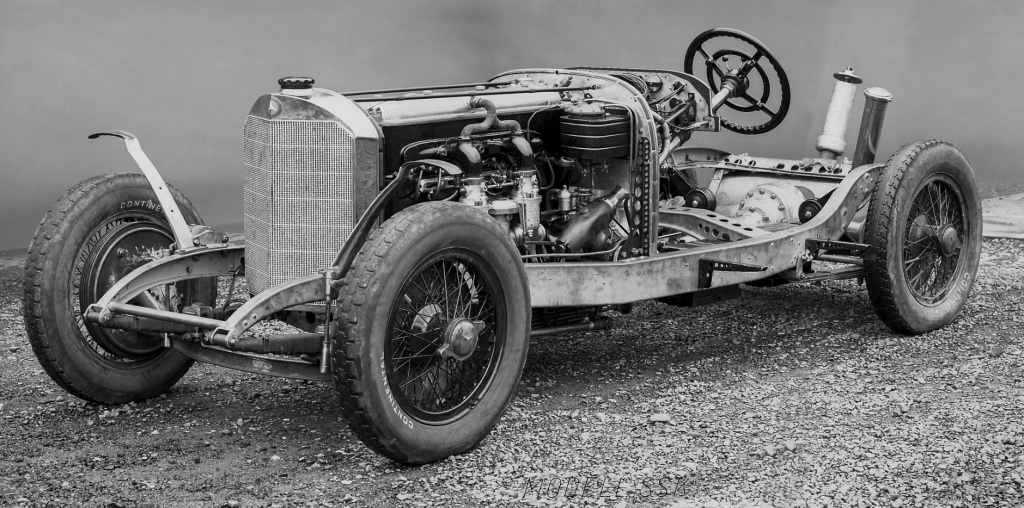
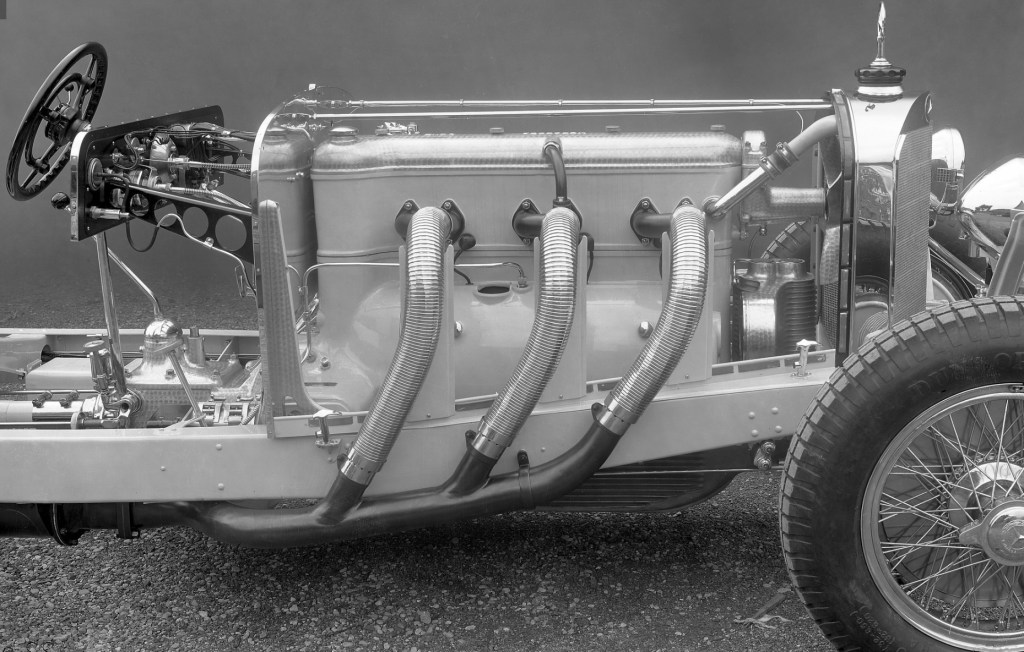
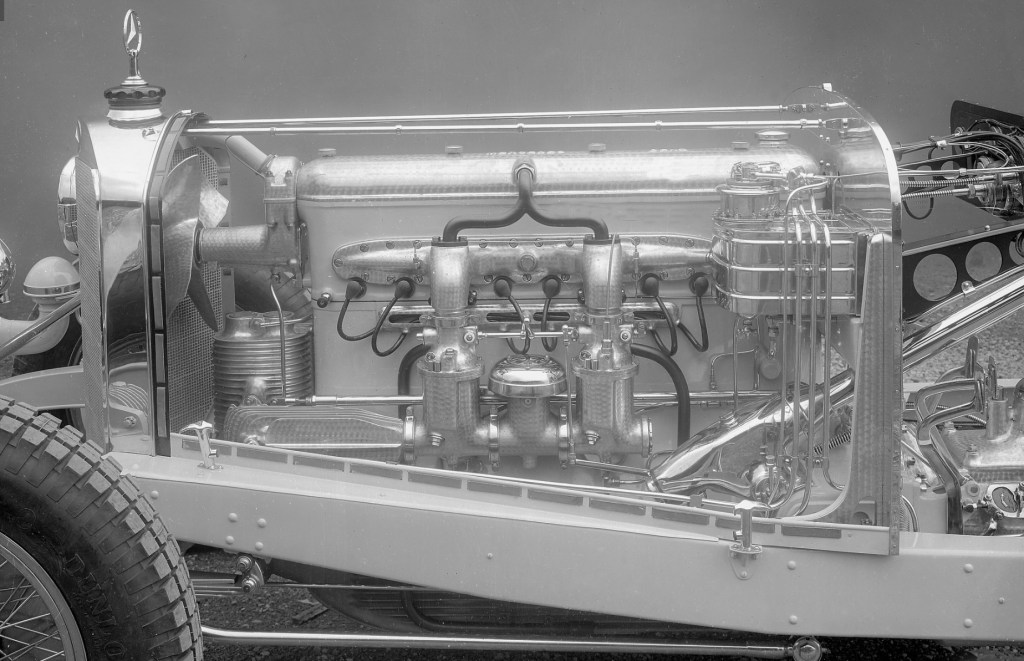
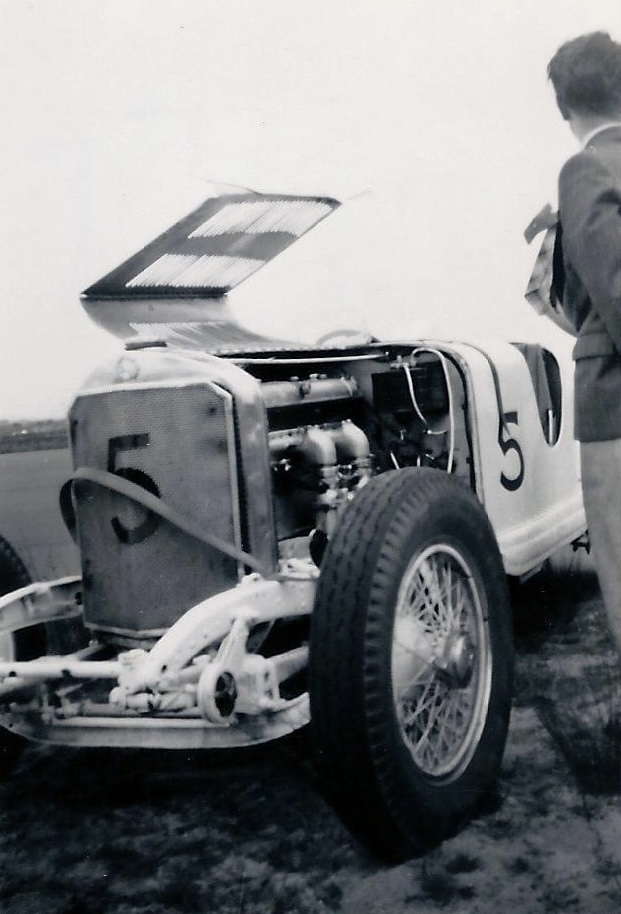
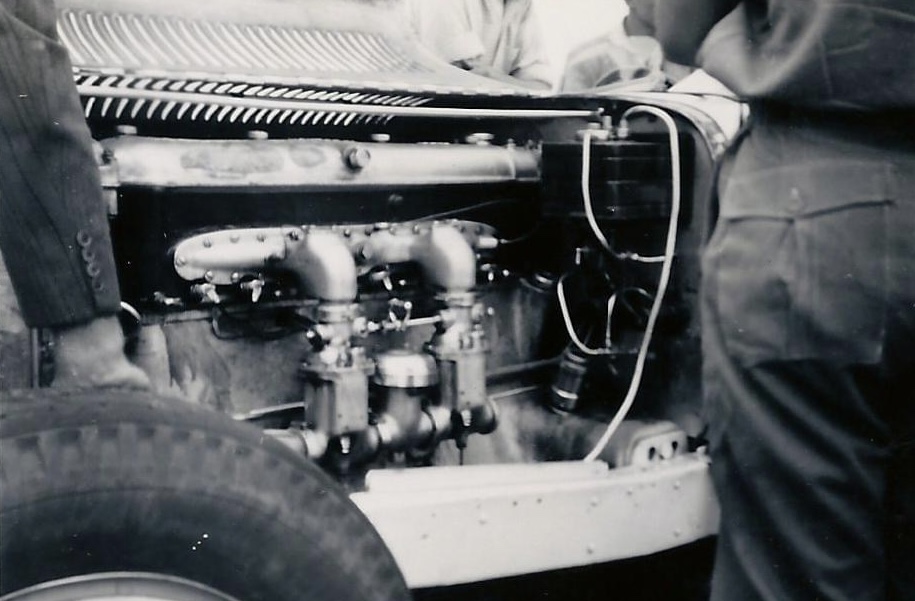
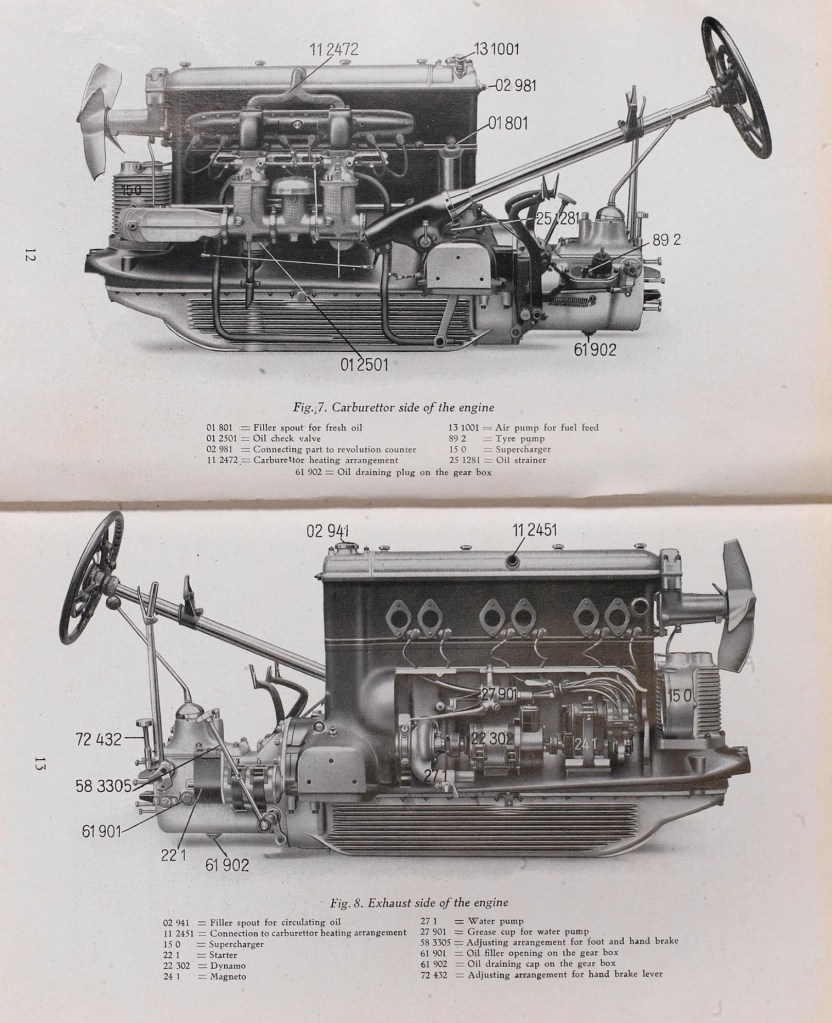
The Mercedes M06 7065cc engine was a long-stroke – 100mm bore, 150mm stroke – SOHC, two-valve, 225bhp @ 3300rpm straight six, fitted with twin-plug ignition: one plug was fired by the magneto and one by the battery.

The big, thirsty beast was fed by twin-Mercedes updraught annular-float carburettors and was Roots supercharged. Mercedes pioneered the fitting of superchargers to road cars using technology developed for its Great War aero-engines. While other marques developed permanently-engaged superchargers that the sucked fuel/ air mixture in through the carburettor, Mercedes employed a supercharger clutched in at full throttle to boost engine power by force-feeding air through the carburettors to cram fuel and air into the combustion chambers.

This method could only be used for a few seconds at a time to aid acceleration or hillclimbing and was accompanied by a distinctive banshee wail that Motor described as a “threatening high-pitched whine that is such a joy to spectators at racing events”.

The chassis was period-typical: rigid axles and semi-elliptical front and rear springs, worm and nut steering, mechanical drum brakes at both ends, wire-spoke wheels, with wheel size 6.5/7 inches wide and 20 inches in diameter. The gearbox had four speeds and a dry, quadruple plate clutch and three alternative final drive ratios giving a quoted top speed of 188-192km/h.

The SWB SSK wheelbase was 2950mm and had tracks of 1425mm front and rear. It was 4950mm long, 1700mm wide, 1725mm high and weighed 2000kg.

(Mercedes Benz)
(Mercedes Benz)

Hailed by its makers as “an ideal high performance car for sporting owner drivers”, the SS Mercedes was claimed to be the fastest sports car in the world. Tested by Motor in 1931 a fully-equipped 7.1-litre Mercedes SS 38/250, not yet fully run in, clocked over 103 mph at Brooklands despite a slight head wind.

Mercedes Benz, “The ‘SSKL’ was the glittering highlight of the legendary S-Series, which was to decisively shape the image of the Mercedes-Benz brand. In 1934, three years after the ‘SSKL’ had made its debut, it was time for the product line up at Daimler-Benz to be reshuffled. From now on success on the racetrack was in the hands of the new Silver Arrows…From mid-1927 to the beginning of 1933, the S-Series models had fulfilled the roles of sportiness and elegance in equal measure, demonstrating their credentials as genuine all-rounders capable of sustained success on both fronts.”

More on the Silver Arrows here: https://primotipo.com/2023/01/06/1934-german-grand-prix/

(Reg Nutt Collection)

Jumbo…

Lex Davison’s interest in these big Deutschlanders commenced with this Dr Ferdinand Porsche designed 33/180 K-model Mercedes he acquired in late 1945 or early 1946.

The 6.2-litre, SOHC, six-cylinder supercharged giant was soon christened ‘Jumbo’ and is shown during a home event, literally. The Vintage Sports Car Club ran several sprint events at Killara Park, the Davison family, 500 acre farm which abutted the Yarra River at Lilydale, in the immediate post-war period.

Lex is shown competing in the first of these – his maiden competitive event – on January 13, 1946. The competitive life of this car was shortened when Davo wrong-slotted, selecting first, rather than third gear at a subsequent Killara Park meeting.

All was not lost though, as the young proprietor of the family shoe manufacturing business – Lex was appointed Governing Director of AA Davison Pty Ltd upon the death of his father, aged 22 in August 1945 – was dabbling in various cars: converting the family Alfa Romeo 6C 1500 into a biposto-racer, trading his Talbot 75 for a 4 1/2-litre Bentley, then a Bentley 4 1/2 Blower, and a 4 1/2-litre Delage Indianapolis car. Lex well and truly had the bug and the means to pursue it.

“The 38/250 Mercedes in an early rebuild while in the ownership of Alan Roberts,” wrote Troy Davey-Milne (Davey-Milne Collection)

SSK #77643…

Graham Howard records in his sensational biography of Lex, ‘Lex Davison : Larger Than Life’, that the Mercedes had been a tourer which was damaged when dropped onto the wharf from a cargo-sling. Perhaps that occurred at Port Melbourne when the car was shipped from Fremantle, West Australia to Victoria.

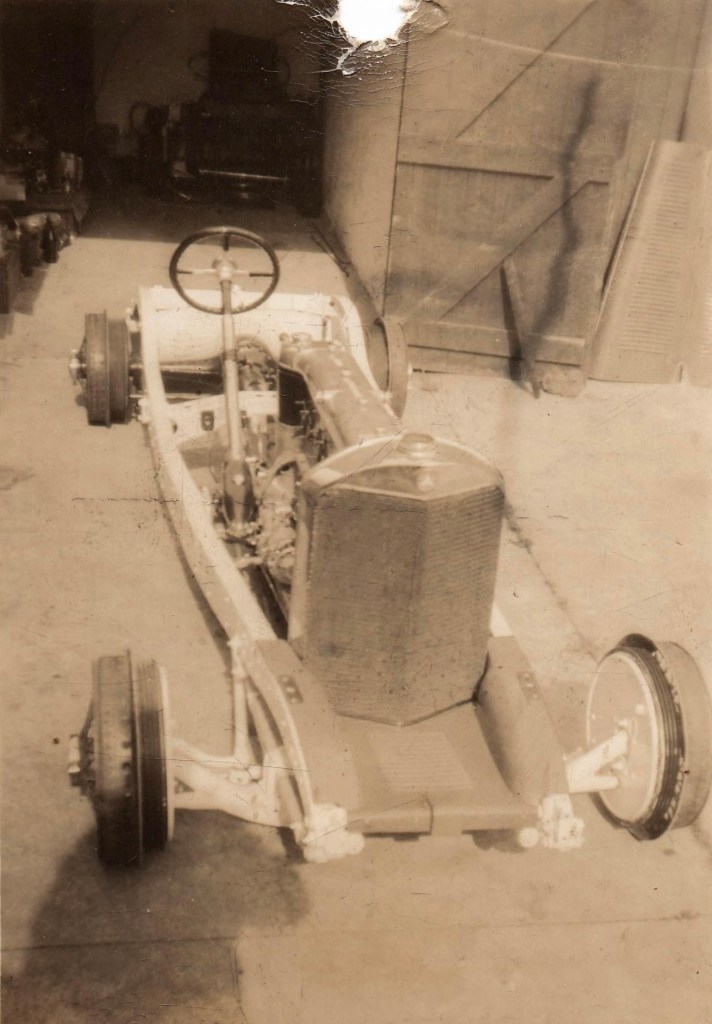
Whatever the case, the car was acquired by VSCC member Alan Roberts, he had been slowly restoring it. A visit from Lex to encourage Alan to retain the car turned 360-degrees when Lex bought it! Davison then placed it in the care of Reg Nutt, a very capable mechanic/engineer, racer and AGP winning riding mechanic in the Phillip Island days.

(L Sims Collection)

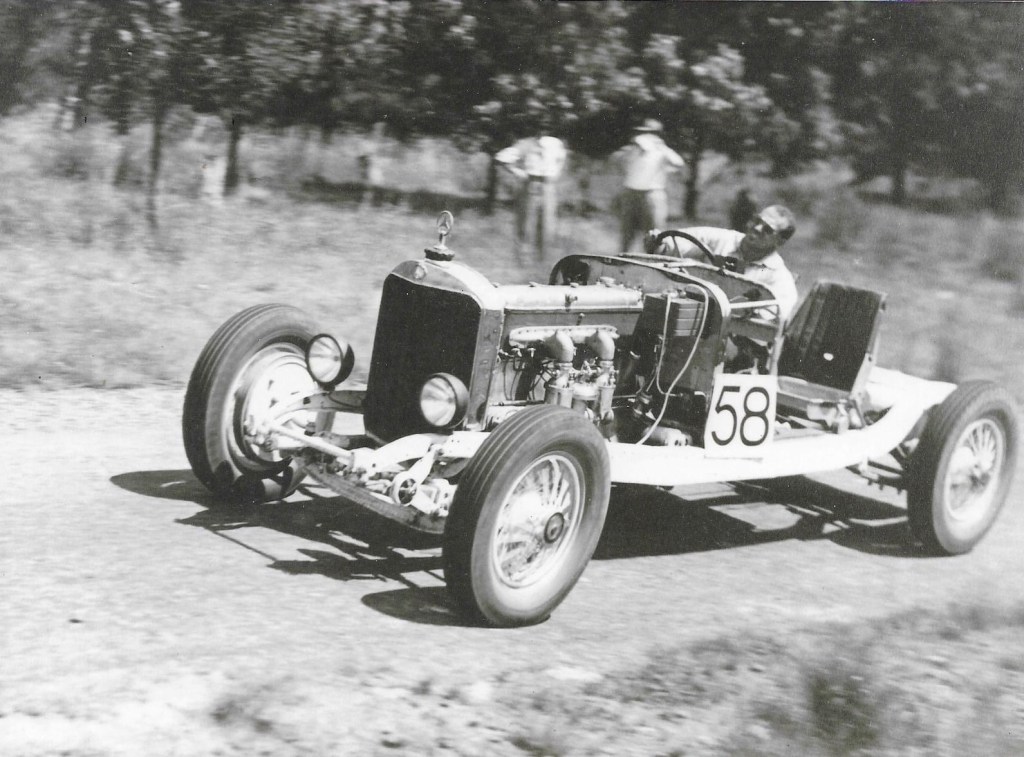
By September 1946 Nutt had the car ready to test at his Whiteman Street, South Melbourne premises. Lex first ran it in unbodied form at Rob Roy that December (above) where he won the Vintage class.

That same month he ran it in a VSCC trial, by the time the car was entered for the January 1947 race at Ballarat Airfield – Victoria’s first post-war – 77643 sported a short, boat-tailed two-seater body built by Bob Baker. Howard records that at that time Baker was working out-back of Nutt’s workshop and would later become the doyen of Victorian panel-bashers; the man of choice for single-seater and sportscar bodies.

Two of Lex’ fellow competitors for the next 15 years made their race debuts that weekend: Bib Stillwell and Bill Patterson, both racing MG TCs. Davison’s first circuit meeting had been aboard the Little Alfa – Lex’ fathers 6C 1500 Alfa which had been lightened and modified from a four-door sedan to two-seat sportscar – at the October 1946 Bathurst meeting where he impressed in the 20-year-old Alfa which had over 100,000 miles on-the-clock!

Lex ahead of the Avro Ansons at Ballarat airfield on January 27, 1947. Here in the Alfa 6C 1500 ‘Little Alfa’ and below in the Mercedes, running sans side-bonnets in the heat (G Thomas)
(G Thomas)

30,000 spectators starved of entertainment watched the event with “the Mercedes a handful through the corners and still running too rich. The tachometer was reading low and the top came off one piston which meant the car did not start the main race of the day,” Howard wrote. “Even so, the sight of the massive white Mercedes almost matching Barrett’s Alfa (Alf Barrett and his Alfa Romeo 8C 2300 Monza were the Australian class-combo in the immediate pre and post-war years) for top speed caused something of a stir, as did the sharp scream of its throttle-operated supercharger.”

All wasn’t lost, the Little Alfa finished the handicap in ninth, but retired from its other race with fading oil-pressure.

Reg Nutt readied the car for the 1947 Championship of New South Wales to be held on the Nowra naval air base, on the coast south of Sydney, in June. The big-beast would have been suited to the 6.8km circuit as it incorporated two straights of over 2km, it really would have had a good gallop, but the rear axle failed in practice so the car didn’t race; Tom Lancey’s MG TC won the handicap 160km event in a field of good Gold Star depth.

#77643 at Rob Roy shortly after Bob Baker built its body (L Sims Collection)
Isn’t it a big bit of real-estate?! #77643 at Bathurst in 1947 (D Flett)

Lex had the repairs to the Mercedes done by Rex Marshall’s Monza Motors – a business established by elite level racers John Snow and Jack Saywell immediately pre-war – in Darlinghurst, Sydney.

The October 6, 1947 Australian Grand Prix was to be held at Bathurst, fittingly, the last was conducted at Lobethal, South Australia in 1939; big-balls road circuits both.

The meeting marked the first anniversary of Lex’s racing career, his first too in an AGP, a race he almost made his own with victories in 1954, 1957-58 and 1961 aboard HWM Jaguar, Ferrari 500/625 twice, and a Cooper T51 Climax.

“The 24-year-old Lex Davison, at Bathurst in October 1947, would have been judged as not much more than an enthusiastic and well-heeled Victorian youngster with an unusual car: his career to this point comprised three race starts for two finishes in the 6C Alfa, and one race start and one practice appearance in the Mercedes with mechanical trouble intervening each time. He was keen enough, and undaunted by the big Mercedes; but it was too early to know what he might amount too.” Graham Howard wrote. Nonetheless, Lex could have won the 1947 AGP.”

Davison in front of Elliott Forbes-Robinson’s (yep, there were two of ’em) MG TC and the legendary Frank Kleinig aboard his evergreen, fast Kleinig Hudson Spl. One of the highlights of the weekend for the pundits was Davo’s wheel-to-wheel 10-lap dice with hardman, veteran Kleinig who never won an AGP but should have by any measure…(G Reed)

Davo was advantaged by a good handicap but that year was a bit of lottery with so many unknown combinations. Further, the handicappers, Graham wrote, didn’t believe Lex’s declared top speed of the car – 120mph, he was recorded at 119mph during the race – and the combo’s potential lap times.

Had it not been for blowback through the carburettor in top gear, which restricted the use of the supercharger to second and third gears, and a four-gallon splash-and-dash fuel stop later in the race Davison may well have won the race. Instead he was a fine third behind Bill Murray, MG TC and Dick Bland’s Mercury V8 Special. Critically, Lex’s result wasn’t due to a great handicap, it was his speed too, he did the fastest race-time and impressed all present with his skilful handling of a demanding heavy car car over 150 miles on one of the country’s most challenging circuits.

He had arrived, and with a cocktail of money, balls, brio and finesse, Lex would go far…

Diana Davison at Rob Roy in March 1948 (L Sims Collection)

With more than a sniff of an AGP chance, before too long Davison had done a deal to buy an Alfa Romeo P3/Tipo B from Arthur Wylie, racer/engineer and founder of Australian Motor Sports magazine. Arthur had sourced chassis #50003 ex-Scuderia Ferrari from Jock Finlayson in the UK, but was left holding-the-baby when his patron, Jack Day declared that at £1650 the car had to be trouble…

Davison hoped the 1934 Italian monoposto would be in Melbourne in time for the January 1948 AGP held at Point Cook, an RAAF airbase in the city’s inner-west, in the event it didn’t. Held in stifling over 100-degree heat, the 100 mile, 42 lap race was a killer of cars and men!

John Barraclough observed Davo from his MG NE Magnette, “From behind, I saw Davison, after a dreadful spasm of front axle tramp, barge straight through some hay bales without even trying to avoid them. He raised his arms in mock helplessness. You could see he just couldn’t be bothered slithering the Merc about in an effort to miss them – plumb out of muscle he was.”

After 16 laps Lex pitted and collapsed onto the steering wheel, Lyndon Duckett took the car out as Lex was carted off for resuscitation, but within a lap the Mercedes had boiled its fuel and was retired.

Perhaps the German did it to spite Davison, his new, red, Italian love arrived three days after the GP…As Lex got to grips with the faster, more sophisticated Alfa, the Mercedes was put to one side of the garage at Killara Park, having its final race in team hands driven by Lyndon Duckett at Fishermans Bend in March 1949. There the Davison Equipe: P3, 38/250 and MG TC was cared for by Bib Stillwell, now in partnership with Derry George in Cotham Road, Kew having previously worked, Graham Howard wrote, for Reg Nutt and A.F Hollins.

(J Montasell)

These three shots (above and the two below) are of the 38/250 at Fishermans Bend on March 13, 1949, the final meeting in Davison hands. Lyndon Duckett is the fellow with an asterisk above his head.

These shots bookend the first action shot in this article taken on the same weekend – I don’t doubt that Lex is at the wheel in that first shot, probably with Lyndon alongside – and allow us to see how the car was prepared in the day. While the heavy braking and slow corners of Fishos’ didn’t suit the Mercedes it still finished both of its races in Duckett’s hands.

(J Montasell)
(J Montasell)
Lyndon Duckett at the wheel during the March 1949 Fishos meeting (T Davey-Milne)
(D White Collection via L Sims)

Post-Davo…

John Blanden in his ‘Historic Racing Cars in Australia’ recorded that little was heard of the Mercedes until it was advertised by a Mr Williams in the March 1951 issue of AMS. Ivo Robb was the buyer, he raced it at Ballarat in November 1951 but was unplaced.

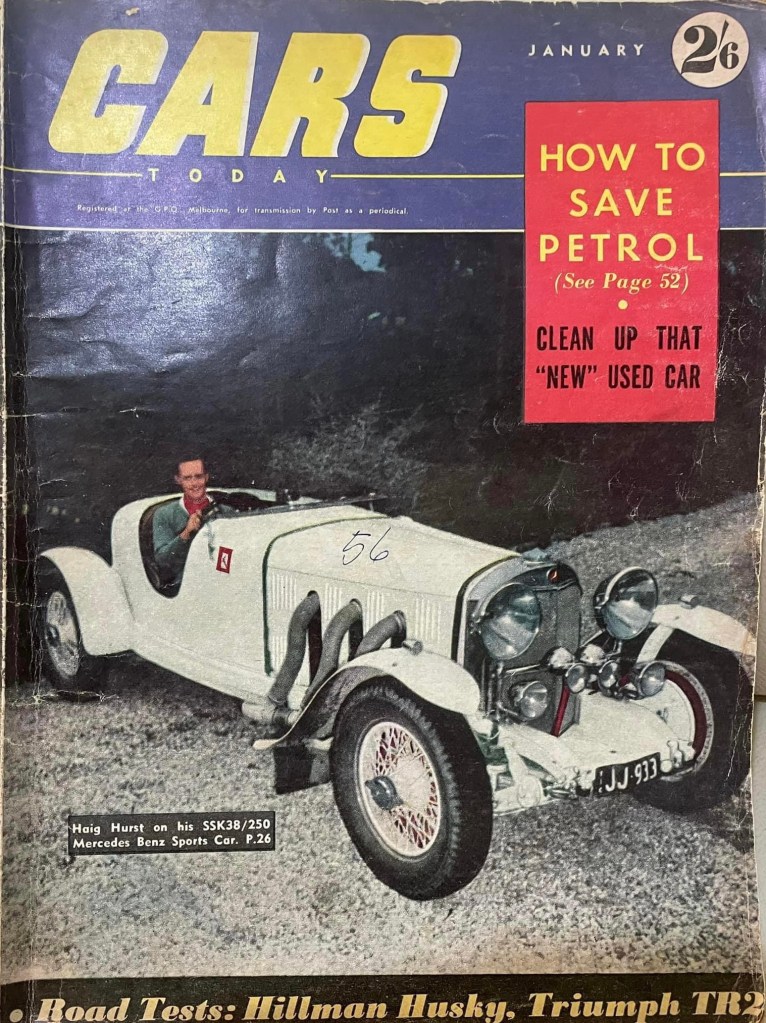
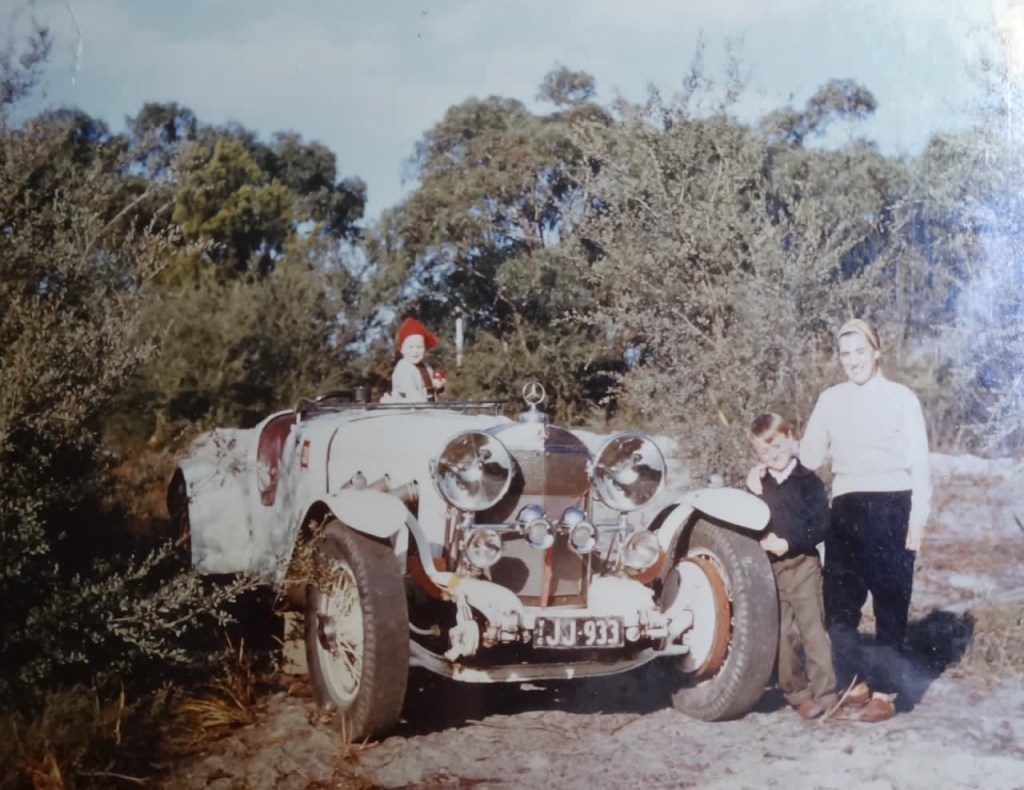
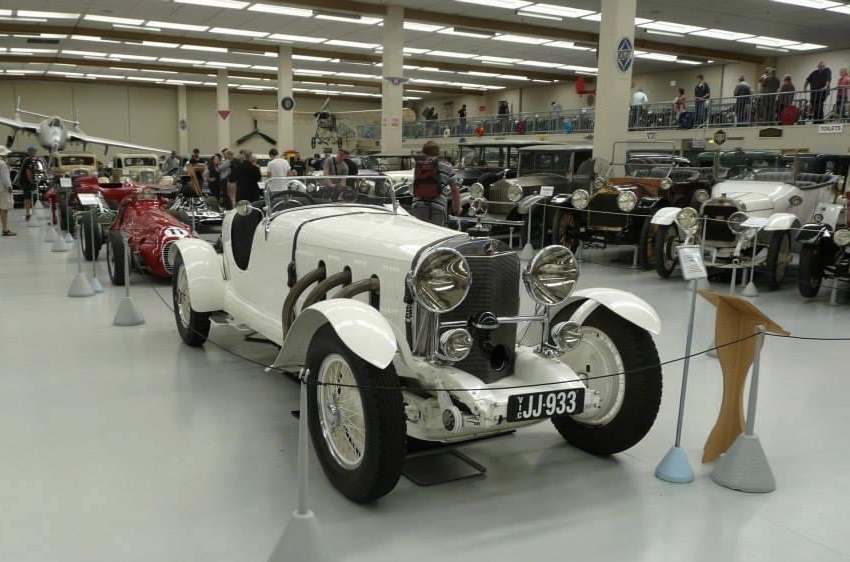
Vin Devereaux offered the car for sale via AMS in January 1952 with Haig Hurst the buyer. He is shown above at Rob Roy in September 1955 where he was second to Ted Hider-Smith’s GN in the vintage class that weekend; note the Victorian road-rego JJ-933.

(G Edney Collection)

Hurst raced and ‘climbed it until 1955 when Laurie Rofe exchanged it for his Bentley Speed Six. Laurie used the car in full road trim as a fast tourer, and historic and vintage racer for about two years before selling it to Jeff Hoffert in late 1956 or early 1957.

(D Belford Collection via D Zeunert)

What an ignominious end for a racing car! From a near Australian Grand Prix winner to family chariot, what a chariot mind you! Every kid in the street wouldn’t have had as much cred as you did in the front seat of this thing.

David Zeunert circulated these photos of Jeff Hoffert family photos of the Mercedes Benz 38/250 at Hepburn Springs where Hoffert was a member of the organising committee of the Hepburn Springs Hill Climb, in the late 1950s.

(D Belford Collection via D Zeunert)
(M Watson)

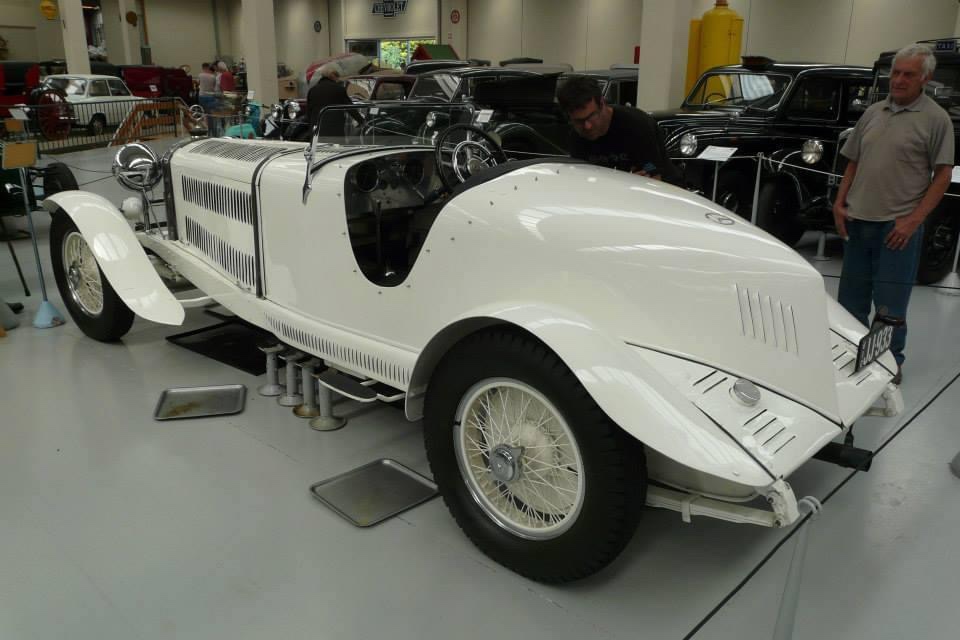
Hoffert sold the old stager to Len Southward in 1965, where it has been in his Paraparaumu, New Zealand museum since. The shot above shows it in recent times.

(M Watson)
(Bonhams)

Etcetera…

(Bonhams)

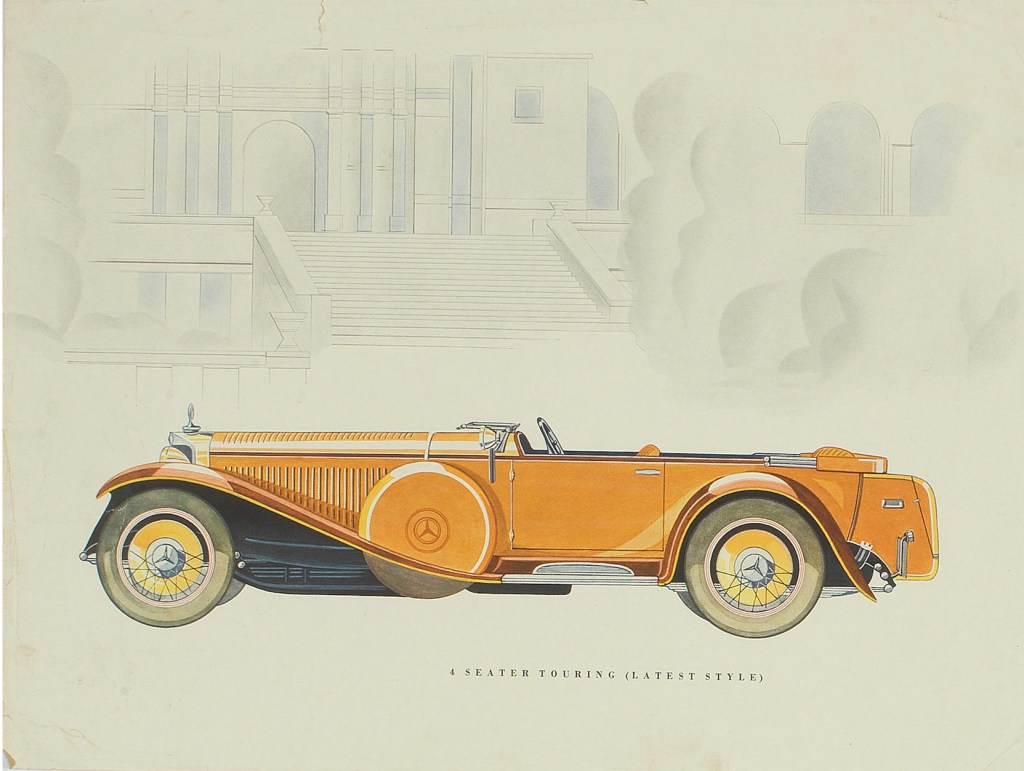
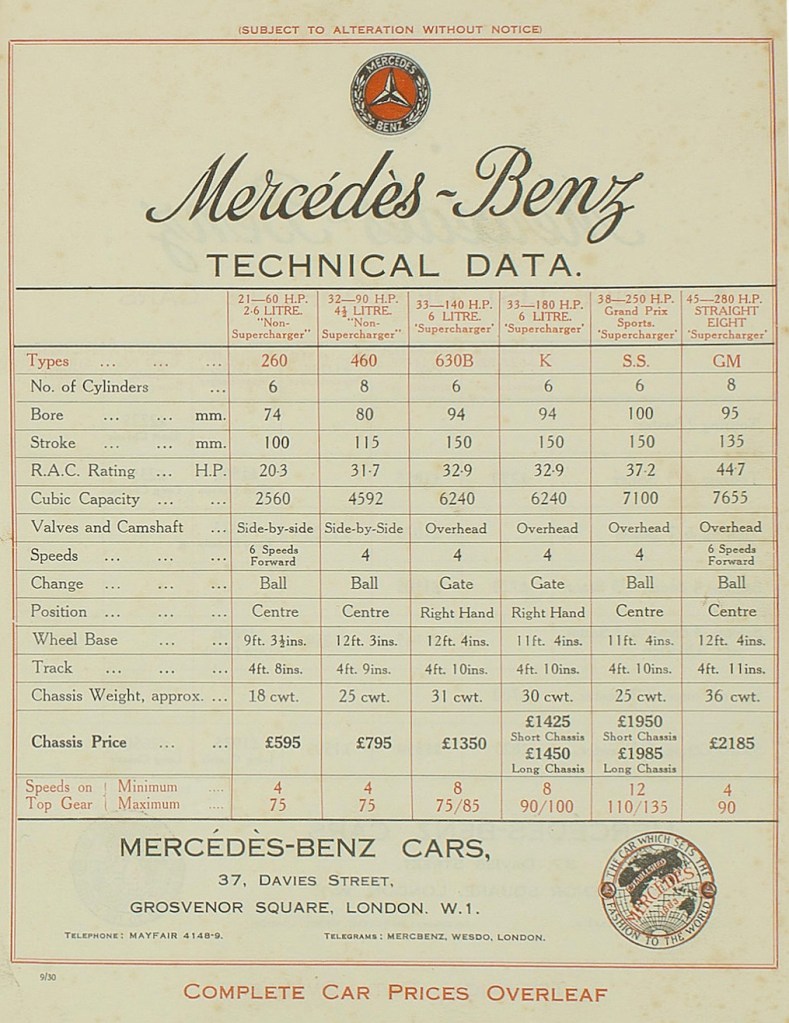
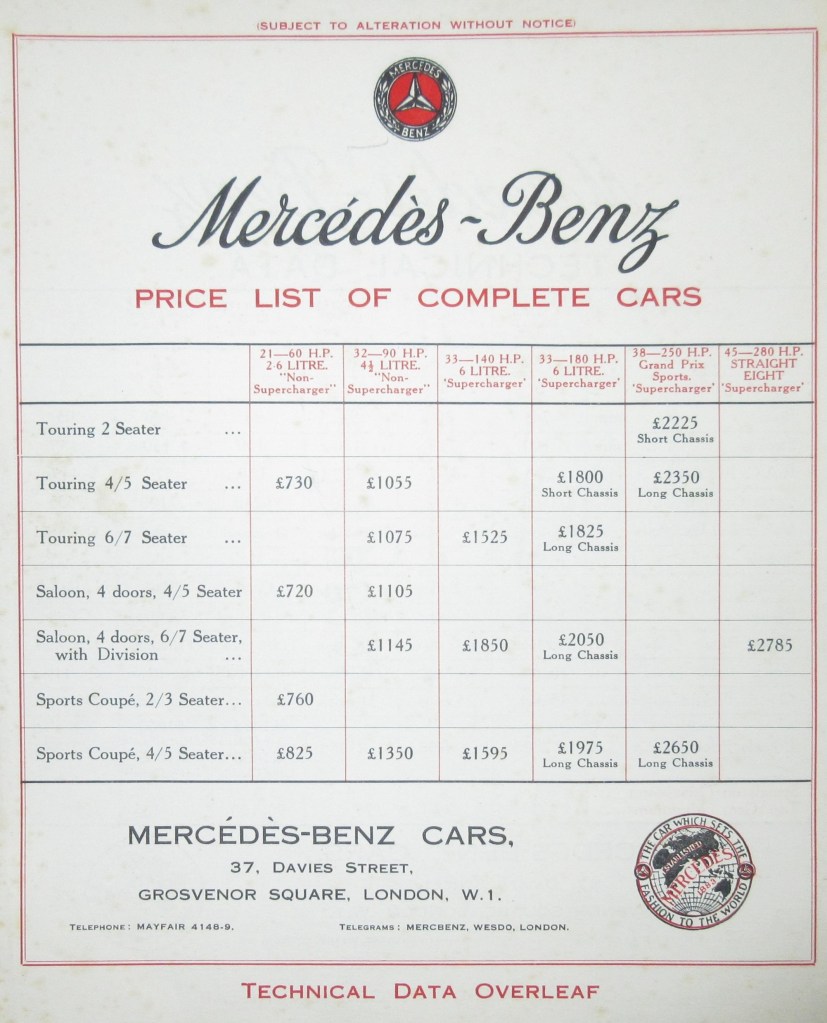
Bonhams offered this rare sales brochure for sale in 2015.

Written in English, but printed in Germany in March 1930, it comprised 20 pages, Bonhams’ generosity did not extend, unsurprising, to reproduction of it in full! Many thanks to them for including the technical specifications page online.

The feature cover car, the “4-seater touring latest style,” is a 4.5-litre 32/90 perhaps.

(Bonhams)
(Bonhams)

Credits…

VSCC Victoria Collection, mercedes-benz-publicarchive.com, ‘Historic Racing Cars in Australia’ John Blanden, George Thomas via State Library of Victoria, George Reed, Don Flett, Reg Nutt Collection via Greg Smith, David White Collection, David Belford Family Collection via David Zeunert, Michael Watson, James Montasell shots via the Leon Sims Collection, Bonhams, Graham Edney Collection, Stephen Dalton

Tailpieces…

(L Sims Collection)
(SLV)

The First Lady of Australian motor racing, Diana Davison, launches the Mercedes off the line at Rob Roy #15, March 14, 1948.

Finito…
(M Dupain/SLNSW)

John Crouch plunges downhill on the Albury-Wirlinga road course – ‘on the border’ of Victoria and New South Wales – aboard his Alfa Romeo 8C 2300 Le Mans during the June 12/13, 1939 Albury and Interstate Gold Cup meeting.

The 76 mile race was won by Jack Phillips’ Ford V8 Special – the reigning champion – from the Hudson Specials of Bob Lea-Wright and Les Burrows. Crouch was fourth and proved his pace in this handicap race, handicaps prevailed in Australia at the time, with fastest race-time. See here for more information on the event and venue here: https://primotipo.com/2024/01/05/albury-and-interstate-gold-cup-1939/ and here: https://primotipo.com/2019/01/12/interstate-grand-prix-wirlinga-albury-1938/

Australian racer/entrepreneur John Snow imported this car to Australia in 1938, John Crouch acquired it shortly after it was offloaded in the Port of Sydney.

John Crouch aboard the booming 8C 2300 LM during the 1939 Australian Grand Prix at very fast, undulating Lobethal, South Australia (B King Collection)
#2311202 during scrutineering at Le Mans in 1933 (Alfa Romeo Archives via Simon Moore)

8C2300 Le Mans chassis #2311202 was one of nine cars built to this specification, five of these long-wheelbase machines with Touring bodies were built in 1933, ‘our car’ was the second of these and was registered by Alfa Romeo on June 6, 1933 MI43972.

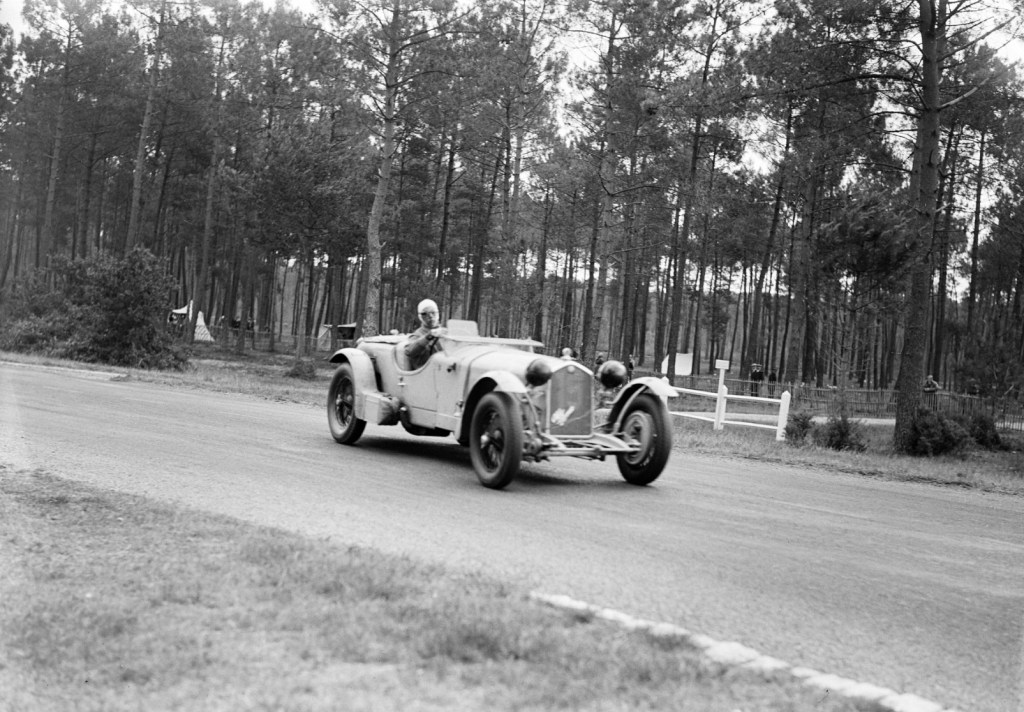
Simon Moore wrote in ‘The Legendary 2.3’ that “We will never be 100% sure, but I think it is really almost certain that this (2311202) was the Chiron (1933) Le Mans car,” raced by Louis Chiron and Franco Cortese …” The car ran amongst the leaders until after dawn, leading on several occasions before Cortese lost control and crashed the car in the Esses after completing 177 laps/2388km; the winning Sommer/Nuvolari 8C 2300 MM covered 3144km.

These straight-eight, supercharged, 2336cc, circa 165bhp Alfas are Le Mans royalty, winning the 24-Hour classic four years on the trot: 1931 Lord Howe/Tim Birkin 8C 2300 LM, 1932 Raymond Sommer/ Luigi Chinetti 8C 2300 LM, 1933 Raymond Sommer/Tazio Nuvolari 8C 2300 MM and 1934 Luigi Chinetti/Philippe Etancelin 8C 2300.

2311202 was third in the 1933 Tourist Trophy at Ards in the hands of Tim Rose-Richards and was later owned by Peter Mitchell-Thompson – Lord Selsdon.

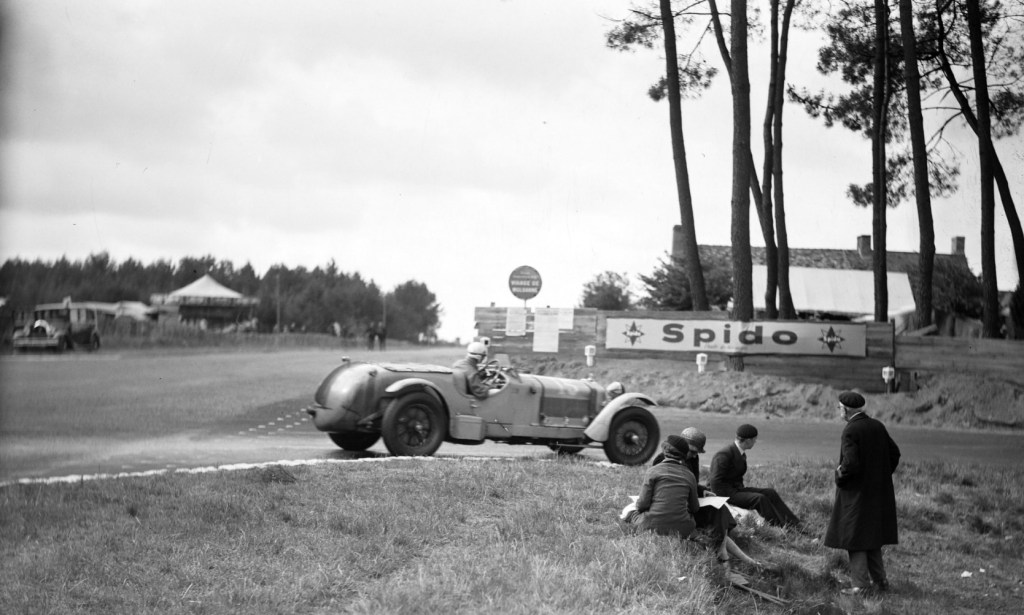
#2311202 at Le Mans in 1933 Louis Chiron/Franco Cortese DNF accident, also shot below (MotorSport)
(MotorSport)

John Medley wrote in his ‘John Snow: Classic Motor Racer’ that Aussie racer/entrepreneur Snow brought a large number of cars acquired in Europe to Australia in the immediate pre-war years, single-handedly improving the quality of our grids in the process. This Alfa Romeo was one of them, its shipmates were a Hudson convertible phaeton, 5-litre Bugatti Type 46 sedan and a Delahaye 135CS sports-racer (#47190) for Snow’s own use.

John Crouch became one of Australia’s most talented post-war drivers, winning the 1949 Australian Grand Prix aboard that very same Delahaye 135. Soon after the Alfa arrived in late 1938, Crouch entered chassis #2311202 in the ill-fated Parramatta Centenary Trophy Race on November 5, see here for that story: https://primotipo.com/2018/02/27/parramatta-park-circuit/ while Crouch’s AGP triumph is recorded here: https://primotipo.com/2022/10/05/1949-australian-grand-prix-leyburn/

He then shipped the car via coastal steamer to Port Adelaide and entered the 1939 Australian Grand Prix held at Lobethal in the Adelaide Hills on January 2. He was seventh in the race won in celebrated fashion by West Australian, Allan Tomlinson’s MG TA Spl s/c. Most of the big cars had tyre troubles in the extreme heat that day, Crouch had an off or two for this reason. He was a fast driver, but his pace with a still unfamiliar car wasn’t going to win him the race that weekend.

Other strong placings pre-war included fourth in the April 1939 New South Wales GP/150 Miles Road Race at Bathurst, and third fastest in a hillclimb and flying quarter-mile event at Mount Panorama in June. He was seventh in the NSW Road Race at Bathurst in October, a period in which he mixed his road racing with speedway events aboard a 4WD Skirrow.

Into 1940, with events getting a bit skinnier as the War impacted, he was fifth in the 150-miler at Easter Bathurst, and at Albury-Wirlinga in June he was second and again set the fastest time of the race.

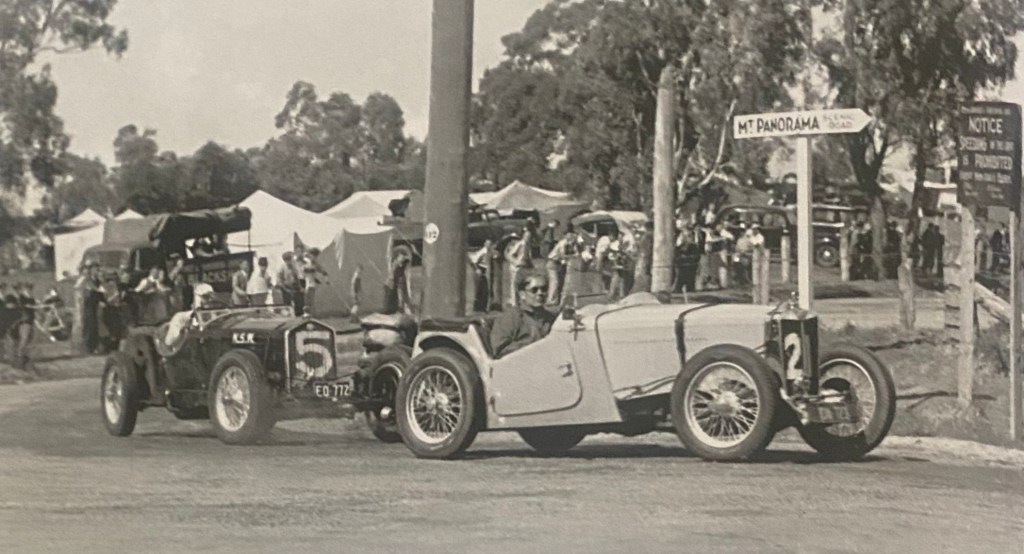
While clearly a very potent racing car, John Crouch regularly used it around town (rego’ EO772), having the machine maintained by Jack Saywell and John Snow’s Monza Motors emporium-of-speed in East Sydney.

Tom Lancey checks his MG TA’s mirrors before being eaten by John Crouch and passenger and Alfa Romeo 8C 2300 during the 150 mile race at Bathurst during Easter 1939 (Terry McGrath via Simon Moore)
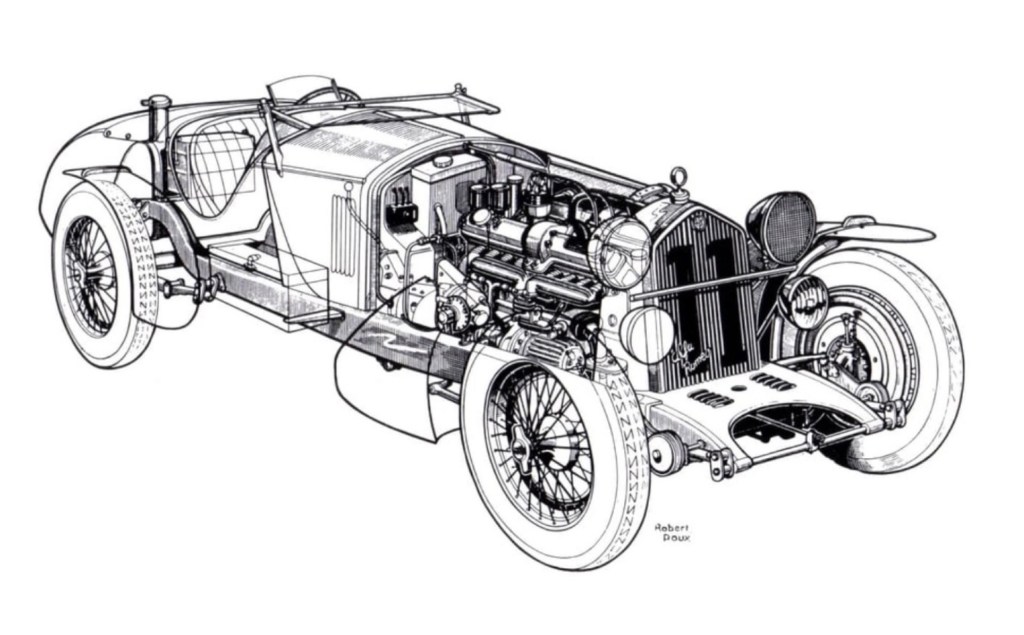
Alfa Romeo 8C2300 cutaway (R Roux)
Crouch, again at Lobethal in 1939 (B King Collection)

Victorian Colin Scott bought it in 1944 and had it fettled by Alf Barrett’s mechanic, Alan Ashton and his team at AF Hollins & Co in High Street, Armadale. Barrett and his 8C 2300 Monza were the fastest combination in Australia in the immediate pre and post-war periods. Scott was a frequent class winner at Rob Roy hill climb and a regular Vintage Sports Car Club competitor.

In 1949 #2311202 was bought by racer/pilot/dealer John Barraclough who onsold it to Tom Luxton. He raced and hillclimbed it, sometimes using the pseudonym James McEwan; McEwans was the family company, a 140 year old, national, retail hardware-store chain that was ultimately swallowed by Bunnings in the 1990s.

Howard Kiel owned the car next. Simon Moore wrote that Kiel was introduced to Louis Chiron at London’s Swallow Club by Tony Gaze. Chiron confirmed the car was French blue at Le Mans and “remembered it well and exalted its performance.”

Owner impressions are gold, Simon published Kiel’s impressions of the 8C 2300 outlined in an exchange of letters between the pair. “I well remember 2311202 as one of the most beautiful cars to drive. In fact I often drove it to work on the outskirts of Melbourne and raced Tony Gaze back to town many times. Through the streets the car was had to beat and exhilarating to drive. I sold the car when it became apparent it needed a comprehensive restoration.”

The next owner, Tom Roberts took great care of the car between 1958 and 1963 after which it joined the mouth-watering Doug and John Jarvis collection of 8C Alfas in Adelaide.

Australian Alfa Romeo owner/historian David Wright wrote in the February 2023 issue of Alfa Occidentale that “Doug Jarvis was particularly enamoured with this car and drove it at Mallala on several occasions. Following the death of Doug Jarvis, the 8C 2300 Le Mans was used regularly by his son, John, until, in 1975, it was acquired from the Jarvis Estate by Lance Dixon.”

(Reid Family)

Dixon, a successful Melbourne motor dealer and enthusiast reintroduced the car to VSCC events. Here Lance is taking then Prime Minister of Australia, Malcolm Fraser – a very tall bloke for a polly – for some quick laps in the car at a Sandown meeting in 1977.

In 1982 Lance’s restoration team, led by Ian Ruffley, were commissioned to comprehensively rebuild the car in Dixon’s Eltham workshop. The colour reverted to its original French blue, having been red for its entire life in Australia. #2311202 was sold via auction in 1986 to a Dutch enthusiast who continues to actively campaign it.

Nice close up profile shot of John Crouch in the 8C 2300 during the Easter 1939 Bathurst 150 meeting. The car lost its best years of racing in Australia thanks to the war, not that #2311202 was alone in that respect, far from it…(F Pearse)

A Driven Man and Driving Force Behind Motor Sports…

Is the title of the late Barry Lake’s obituary of John Crouch – 15/8/1918-30/5/2004 – published in the Sydney Morning Herald on June 17, 2004. Lake was a talented racer, journalist, historian and publisher; his beautifully written tribute is reproduced in full.

In the 1930s John Crouch was widely known as Australia’s youngest racing driver. In 1949 he won the Australian Grand Prix driving a French Delahaye. Even before his retirement from active racing in the mid-1950s, Crouch was heavily involved in the administration of motor sport in this country. By the time he died, at 85, he was recognised by many as the elder statesman of Australian motor sport.

Throughout all of these achievements, Crouch was the consummate gentleman, always immaculately dressed, always driving a late-model performance car (usually Mercedes-Benz in his later years) and always he was polite and softly spoken.

His father, Cecil, had his own new car sales company for 10 years before John was born in 1918, and the elder Crouch dabbled in motor sport when he raced a Metz car at Victoria Park racecourse in Sydney.

After leaving Sydney Church of England Grammar School (Shore), to which he walked every day from the family home in Wollstonecraft, Crouch went to work for his father. So it was hardly surprising he developed a keen interest in cars and motor racing – although his father strongly opposed the latter, having realised it consumed vast amounts of money.

Crouch began racing an MG TA sports car when barely 18. Two years later, he finished fifth in the 1938 Australian Grand Prix at Bathurst. In the late 1930s he drove a wide variety of cars including a supercharged Alvis, a Fronty-Ford, a Skirrow four-wheel drive speedway car, and an ex-Louis Chiron Le Mans Alfa Romeo 8C 2300.

With the Alfa, Crouch set fastest time in the Albury and Interstate Gold Cup races on the Wirlinga road circuit in 1939 and 1940, along with a third place and two fifth places on corrected times in the last three major events held at Bathurst before World War II.

After the war, Crouch left his father to start his own business. “I wanted to buy and sell performance cars but my father was never interested in them,” he once said.

He imported cars from England, including the high-class Bristol and the inexpensive but loads-of-fun Dellow sports car, as well as many new and used examples of exciting sports cars. In 1953 he gained the Australian distributorship for Austin-Healey sports cars, when the local Austin distributors rejected it as a folly. Crouch described it as a bonanza that sold beyond anyone’s wildest expectations.

The grid of the 1947 NSW Championship, Nowra airfield, June 16. #5 Jack Murray Mackellar-Bugatti Ford s/c, then #3 John Crouch Delahaye 135CS, #14 Alec Mildren Ford V8 Spl, #4 Frank Kleinig, Kleinig Hudson Spl and Alf Barrett, Alfa 8C2300 Monza. The handicap race was won by Tom Lancey’s MG TC, Crouch was eighth (J Hunter)

Immediately after World War II Crouch had bought a fast and reliable French Delahaye sports-racing car. It had a fastest race time at Bathurst to its credit, and Crouch scored second-fastest there with it in 1946.

But the one race to win then, as the Bathurst 1000 is today, for Australian drivers was the Australian Grand Prix. In 1948 the event was held at Point Cook in Victoria in blazing heat. The Delahaye scored third-fastest time but the handicap start resulted in his finishing only eighth.

The following year the race went to Queensland, on a wartime airstrip at Leyburn. Also for the first time, it was run from a scratch start, as is the case for today’s major events. Crouch was ready to pounce when the early pacesetter faltered. The blue Delahaye crossed the line a clear winner and John Crouch had achieved his life’s ambition.

In the early 1950s Crouch began to import and sell small, lightweight rear-engine Cooper racing cars. He sold the Delahaye and raced Coopers to promote them. He was ahead of his time. By the end of the decade Coopers were dominating Australian racing as they were the world championship. In Crouch’s time, however, they were fast but unreliable. In 1951, for example, Crouch’s Cooper set fastest race lap in the Australian GP, but retired with mechanical problems. In retrospect, he sold the Delahaye, had he kept it, would have been capable of winning the GP again in 1950 and 1951.

In 1953 Crouch sold a more modern, faster and more reliable Cooper-Bristol to Tom Brabham, for his son, Jack. The latter made his name in that car and went on to win world championships in 1959, 1960 and 1966.

Crouch’s final outings as a driver were in the Redex Round Australia Trials in 1953 and 1954, and the 24-Hour Race at Mount Druitt in 1954. He had planned to race in Europe before quitting the sport, but ran into financial difficulties when he expanded into importing tyres and tractors.

He retired from racing, closed his business and used his remaining resources to buy land and build apartment blocks in suburbs such as Dee Why. “Real estate was going so well at that time,” he said, many years later, “Any idiot could make money out of it.” He was comfortably well-off by the time the bust came in the 1970s – unlike many of his friends, who, he said, “had borrowed to the hilt and lost everything”.

Crouch had been the NSW state councillor for the then newly formed Confederation of Australian Motor Sports in 1953 and continued in various capacities with this organisation for many years, receiving awards for his contributions to motor sport. He also acted as clerk of course at a number of major events.

Crouch had two sons, John and David, with his first wife, Vivian. They eventually divorced, but remained good friends. Crouch’s second wife, Valerie, died in 1995. They had two daughters, Caressa and Penelope.

Crouch was reluctant to marry again, fearing a third would brand him a “womaniser”, but eventually he met June, whose lust for living a full life matched his own. They married and spent much of Crouch’s final few years travelling in South-East Asia and Europe, as well as attending various motor sport functions in Australia as honoured guests. That came to an end when Crouch suffered circulation problems that led to a series of strokes and heart attacks. He died in a hospital in Gosford.

Etcetera…

Sydney Morning Herald June 13, 1939
(Motorsport)

Another shot of Louis Chiron or Franco Cortese at Le Mans in 1933 aboard #2311202.

(S Dalton Collection)

Credits…

Max Dupain-SLNSW, ‘John Snow: Classic Motor Racer’ and Bathurst: Cradle of Australian Motor Racing’ by John Medley, ‘The Legendary 2.3’ Simon Moore via the Bob king Collection, Robert Roux, MotorSport Images, Reid Family Collection, John Hunter Collection, Fred Pearse, Sydney Morning Herald – Barry Lake, Stephen Dalton Collection

Tailpiece…

Finito…
(A Boyle)

Frank Matich with a smidge of the opposites, guides his Lotus 19B Climax through Mount Maunganui, Tauranga in New Zealand’s North Island on December 28, 1963.

This short-lived 2.9km road circuit hosted two Bay of Plenty Premier Road Race meetings in 1962-63.

Matich led the ’63 feature in his new Brabham BT7A Climax (below) before throttle problems intervened, but he had more luck in the sportscar support, winning from Barry Porter’s Lotus 15 Climax.

(B Ferrabee)

FM’s Lotus 19 and 19B were important aspects of his rise and rise as a driver. Both cars were extensively developed by he and his small Sydney based team, so too the Brabham BT7A which still served it up to the visiting internationals in their latest cars 12 months later. The saga of the Matich Lotuses is here: https://primotipo.com/2017/09/08/bay-of-plenty-road-race-and-the-frank-matich-lotus-19s/

(B Ferrabee)

Who said Denny Hulme was the only Kiwi who lived in bare-feet!?

The Matich Brabham in its Total colours in the Pukekohe paddock during the 1964 New Zealand Grand Prix weekend, a fortnight after the Mount Maunganui meeting.

During 15 championship (Gold Star and Tasman) outings in BT7A IC-1-63 between December 1963 and July 1965 Matich was always a front runner but rarely a finisher. Frank’s best placings were second in the 1965 Sandown Gold Star round, and thirds in the 1964 South Pacific Trophy at Longford, and the 1965 Warwick Farm 100.

That latter race is indicative of Matich’s place in the order of things at the time. He started from pole in front of Graham Hill, Jim Clark, Bruce McLaren, Jack Brabham and Frank Gardner in the year old car.

(unattributed)

The all-Brabham front row before the South Pacific Trophy at Longford on March 2, 1964.

Jack Brabham on pole in BT7A with the similarly equipped Matich on the outside, sandwiching Graham Hill’s BT4. Hill won from Bruce McLaren’s Cooper T70 and Matich all Climax FPF powered. Jack suffered differential failure on lap 22, while McLaren won the first, 1964 Tasman Cup.

Red Dawson, Pukekohe November 1966 (M Fistonic)

Kiwi racer Red Dawson was the next owner of IC-1-63 and raced the BT7A from December 1965 to January 1969. His best with it was a win in the 1966 Waimate 50 and second placings in the Gold Star round that year at Renwick and at the ‘69 Pukekohe Gold Star round. The car was rebuilt as a sportscar in 1970, perhaps one of the Kiwis can tell us about that. See here for Allen Browns summary of the two BT7As: https://www.oldracingcars.com/brabham/bt7a/

Red Dawson and fellow racer John Riley and BT7A Climax (K Buckley)

Credits…
Alan Boyle, Brian Ferrabee, Milan Fistonic, Lionel Walker, Ken Buckley, oldracingcars.com

Tailpiece…

(L Walker)

The race debut of BT7A #IC-1-63. Frank Matich during practice for the Hordern Trophy Gold Star round at Warwick Farm in December 1963. Signalling his intent, he started from pole but retired after a collision with reigning Gold Star Champion, Bib Stillwell’s Brabham BT4.

It was well and truly game on between the relatively old bull (36) and relatively young thruster (27)…see here: https://primotipo.com/2018/07/20/matich-stillwell-brabhams-warwick-farm-sydney-december-1963/

Finito…

(R Donaldson)

Start of the Australian Tourist Trophy at the Lowood airfield circuit in Queensland on June 14, 1959.

The 36 lap, 102 mile race was won by Wangaratta racer, Ron Phillips’ ex-Whitehead Cooper T38 Jaguar (#42 partially obscured on the second row). Bill Pitt’s Jaguar D-Type #1 was second, Bob Jane, Maserati 300S #56 third and John Ampt, 1100cc Coventry Climax engined Decca Special #58 was fourth. Car #87 is Frank Matich’ Jaguar C-Type.

These fantastic photographs were taken by Mr R Donaldson and published in the Pix news-magazine, one of those slightly naughty magazines to be found in Steve’s, the local barber shop. The meeting also featured the sixth round of the Australian Drivers Championship, the Gold Star, and drew a crowd estimated at 20,000.

(R Donaldson)

Bill Pitt prepares to climb aboard the Westco Motors D-Type while Frank Matich is ready to roll in the Leaton Motors C-Type behind. More on the C-Type: https://primotipo.com/2014/08/05/gnoo-who-gnoo-blas-circuit-jaguar-xkc-type-xkc037/ and the D-Type here:https://primotipo.com/2016/03/18/lowood-courier-mail-tt-1957-jaguar-d-type-xkd526-and-bill-pitt/ Leaton Motors acquired XKD526 when it was sold by Westco for Frank to race.

Denis Geary’s Healey getting plenty of assistance (R Donaldson)
(R Donaldson)

Another grid shot with a youthful Bob Jane in his superb Maserati 300S, a car he retained well into the historic period. See here: https://primotipo.com/2015/05/15/bob-jane-maserati-300s-albert-park-1958/

#18 is Tom Ross eighth place Triumph TR2, #31 Tony Basile, Porsche Carrera and #101, E Laker, Triumph TR3.

(R Donaldson)

The grid ready to start with the Chas Whatmore Lotus 11 Le Mans Climax at left on the front row, then Matich and Pitt. The second row comprises Allan Jack’s Cooper on the left, winner, Phillips’ largely obscured Cooper Jag, John Cleary’s Healey 100S, Jane’s 300S and John Ampt’s Decca Climax.

Ampt was a later owner of the Cooper Jag and raced in Formula Junior in Europe with some success in the early 1960s.

(R Donaldson)

With the flag dropped, Phillips is at the far left, the Bobtail Cooper is Allan Jack’s Type 39 Climax, #36 John Cleary, Austin Healey 100S, #10 Les Agnew, Lotus 11 Climax, #56 Jane, #31 Basile, #28 B Coventry, MGA and #18 Tom Ross, Triumph TR2.

While Bob Donaldson did a great job, he has managed not to take a decent shot of the winning car. Here it is, shown above on the way to victory on the cover of the July issue of AMS.

(R Donaldson)

David Finch’s D-Type in front of one of the Lotus 11s. See here about XKD520: https://primotipo.com/2020/04/17/stillwells-d-type/

(R Donaldson)

Test of straight-line-squirt between the E Laker TR3 and J Ausina MGA. And below the beautiful lines of the Allan Jack Cooper T39 Climax.

(R Donaldson)
(R Donaldson)

That battle between the Triumph TR and MG seems to have been settled in the TR’s favour.

(R Donaldson)

Bob Jane and John Ampt. The grunt of the 3-litre, DOHC-six engined, relatively light 300S prevailed over the very light 1.1-litre Decca. See here for lengthy feature on Derek Jolly and his Decca and Lotus cars: https://primotipo.com/2017/11/09/dereks-deccas-and-lotus-15s/

Awards were made for outright and class placings in the TT. Phillips won outright and the over 3-litre class, Jane the 2-3-litre class, Ampt the 1100cc class, Allan Jack, Cooper T39 Climax the 1.1-1.5-litre class. Tom Ross took the 1501-2000cc class in his Triumph TR2. Unusually, the organisers, the Queensland Racing Drivers Club, ran a handicap event over the first 20 laps, with Coventry’s MGA prevailing over the Ross TR2 and Tony Basile’s Porsche Carrera.

(S Dalton Collection)
Rare shot of Arthur Griffiths in the ex-works/Parnell/Glass Ferrari 555 Super Squalo (R Donaldson)

Lowood Trophy Gold Star round…

1959 was the third year in which the Gold Star was contested. Lex Davison won it aboard his famous ex-Ascari Ferrari 500/625 3-litre in 1957, with Stan Jones the reigning champion during 1959, his primary weapon of war was a Maserati 250F but his Maybach 4 Chev occasionally got a run too, as here at Lowood.

Lowood was the sixth of twelve rounds – the longest Gold Star series of all – and in a year where victory honours were spread widely. Melbourne auto-parts manufacturer, Len Lukey won with a mix of speed and consistency aboard a Lukey Bristol and an ex-Brabham Cooper T45 Climax.

Len Lukey, Cooper T45 Climax at the end of a lose: Ern Tadgell, Lotus 12 Climax/Sabakat goes past in this shot, with Bill Patterson doing likewise in his Cooper T43 Climax below, and Arnold Glass, Maserati 250F rattles past as well in the next shot, with Len about to decamp, unable to restart the car (R Donaldson)
(R Donaldson)
(R Donaldson)

Alec Mildren won three races in his Cooper T43 and T45, and Stan Jones, Bill Patterson and Lukey two apiece, with singleton wins for Jack Brabham, Ross Jensen and Bib Stillwell. Brabham and Jensen were non-residents and therefore ineligible for Gold Star points.

At Lowood, Mildren won from Stan Jones in Maybach 4 Chev, Arnold Glass, Maserati 250F, Arthur Griffiths, Ferrari 555 Super Squalo and Glyn Scott, Cooper T43 Climax.

Patterson in his immaculate white with central blue-stripe Cooper T43 (R Donaldson)

Coopers had a mortgage on the Gold Star for a while: Cooper drivers, Len Lukey won it in 1959, Alec Mildren in 1960 (T51 Maserati), Bill Patterson in 1961 (T51 Climax) and finally Bib Stillwell won in 1962 (T53 Climax). The Brabham era followed…

(S Dalton Collection)

Credits…

R Donaldson-State Library of New South Wales

Tailpiece…

(R Donaldson)

Stan Jones hustles his Maybach 4 Chev around Lowood.

He used four cars in his fight to retain the Gold Star, primarily his Maserati 250F – it was just quick enough to prevail over Len Lukey’s 2-litre Cooper at Longford during the AGP – Maybach 4, which had been extensively updated by Ern Seeliger, not least by fitment of a Chev 283 engine, Sabakat and a Cooper T51 Climax.

Finito…
(C Charge)

Lou Molina, Molina Monza Holden leads Don H Swanton, Lotus 11 Climax and Alan Jack, Cooper T39 Bobtail Climax at Albert Park during the Victorian Tourist Trophy on 23 November, 1958…
It’s the first lap I suspect, with the lead bunch in front of Lou’s superb MM Holden s/c. The race was contested on the first Sunday of a double-header meeting, the feature race a week later was the Melbourne Grand Prix, won by Stirling Moss from Jack Brabham in similar 2.1 and 2.2-litre Cooper T45 Climaxes. Swanton’s car (a series 2, chassis # 303) was an ex-Team Lotus Peter Ashdown machine that Don bought in January 1958 and raced throughout the UK before being shipped home in time for this Albert Park meeting.

The TT had a good field of depth and breadth and was run over 100 miles/32 laps of the demanding Albert Park track; they raced anti-clockwise then, the opposite to the direction of today.

Unfortunately the political winds of change were blowing in Victoria. Some powerful voices on the conservative side of politics, aided and abetted by the editor of The Herald, one of the local fish ‘n chip wrappers, were against the use of the park for motor racing. And so it was that Albert Park was closed for racing, other than speedboats, until the modern era when the conservative side of politics, in the form of then Premier Jeff Kennett swung the pendulum back the other way and nicked the F1 GP from the South Australian conservative government; there is no love lost between thieves after all! All you needed to know about Albert Park politics but were too scared to ask; https://primotipo.com/2020/05/12/albert-park-lake-boats-and-politics/

Bob Jane about to be rounded up by the battling Whiteford and partially obscured Pitt Jag-D, with Lou Molina (DNF) on the inside, and a Healey 100S in the distance (E Steet)

Back to the Tourist Trophy, triple Australian Grand Prix winner – including a win at the ‘Park in 1953 – Doug Whiteford was the classiest, most experienced driver in the field and won the race in 65m47.2sec aboard an ex-works Maserati 300S (chassis 3055) he acquired from Officine Alfieri Maserati at the end of the 1956 Australian Tourist Trophy/Australian Grand Prix carnival that November-December: Stirling Moss won both these races aboard 300S and 250F respectively.

Bill Pitt put on a great show, leading the race for the first 12 laps in the Queensland Jaguar distributors, Westco Motors’ Jaguar D-Type (#XKD526) before Whiteford passed him on lap 13. Pitt, on his third trip to Albert Park, then hung onto Whitehead but nudged the hay bales on lap 26, pushing a rear ‘guard onto a wheel in the process. The ensuing pitstop cost 40 seconds and any chance of a race-win, third place was the result.

Ron Phillips placed second in the booming Cooper T38 Jaguar raced by Peter and Graham Whitehead throughout Europe, including Le Mans, in 1955. It was sold to Stan Jones by Peter Whitehead towards the end of his 1956 Australasian Ferrari 500/625 3-litre tour. But Stan wasn’t a fan of it, CJ/1/55 then passed through less competent hands until Phillips got hold of it. He got the best out of it too, a win in the Australian Tourist Trophy at Lowood in 1959 was his best result. Ron proved his intent and pace early in his time with the car that Albert Park weekend, sharing the fastest lap of the race with Whiteford: 2m01.2sec and 98mph.

Derek Jolly, a member of the family who owned Penfolds Wines, was fourth in an ex-works Lotus 15 Climax FPF 2-litre that had raced at Le Mans in 1958 (below). Derek first raced the car in the 1958 Australian Tourist Trophy that October at Bathurst, there he finished second to David McKay’s Aston Martin DB3S, the Lotus was at that stage fitted with a 1.5-litre Climax. See here for a long feature on Derek and various of his cars including his ‘two’ Lotus 15s; https://primotipo.com/2017/11/09/dereks-deccas-and-lotus-15s/

Derek in Lotus 15 #608, the car lost its life the following week during the closing laps of the Melbourne GP, see link above (R Hope)
(R Hope)

Bob Jane in Australia’s other ex-works 300S (#3059) was a rather second-hand fifth, and Eddie Perkins’ – Larry’s dad – Porsche 356 was sixth. ‘Jano’ became a very handy racing driver, particularly in touring cars – ATCC and Bathurst wins duly noted – but he was wayward when he first bought the Maser, the quickest thing he had raced to that point. So much so that Reg Hunt famously moved his boat out of harms way by mooring it further out into Albert Park Lake. See here; https://primotipo.com/2015/05/15/bob-jane-maserati-300s-albert-park-1958/

(Allan Quinn)

Jim Goldfinch’ ex-Ron Phillips Austin Healey 100S chassis #3906 from the ex-Derek Jolly Decca Climax Spl of Gavin Sandford-Morgan. A good run in the race with the 100S was thwarted by a black flag due to the exhaust system wriggling away from its mounts. There is a great website about this car chockers with photographs if you’ve not tripped over it; https://austinhealey100s.com.au/AHS-3906-1955-1

(unattributed)

Other Healey 100S were raced by John Roxburgh in the ex-Whiteford car (chassis 3907), and of great historical significance, later Australian sportscar and open-wheeler international, Paul Hawkins in Italo-Australian businessman Terry Valmorbida’s car.

The ‘rootin-‘tootin, rough-as-guts Reverend’s son is shown above in the Valmorbida (chassis 3909) Healey 100S #77 in front of a gaggle of cars comprising later Cooper S ace Peter Manton’s Austin Healey Sprite, the Goldfinch 100S and Jon Leighton’s Lotus 11 Willment-Ford. More on Hawkins here; https://primotipo.com/2020/09/25/hawkeye/

Austin Healey 100S by two: Goldfinch #61 and Paul Hawkins in #77 car (unattributed)
(J Goldfinch Collection)

Etcetera…

The Goldfinch 100S in the ‘Albert Park paddock 500 miles from home’ in Adelaide as Jim noted; Army barracks in the background.

(unattributed)

Alan Jack in the ex-Bill Patterson Cooper Climax goes inside the James Goldfinch Austin Healey 100S. More on many of the cars in this feature on the 1960 Australian Tourist Trophy here; https://primotipo.com/2018/05/17/1960-australian-tourist-trophy/

D Swanton, Lotus 11 Climax, Goodwood 1958 (D Swanton Collection)

Donald Swanton…

Don Swanton was born on March 3, 1930, grew up in Highton Grove, Balwyn and attended Camberwell Grammar School, which was over his back-fence.

His first car was an Amilcar Roadster, his first job allowed the purchase of a Singer 9 which he ‘climbed, and raced at Fishermans Bend. He sold a Cooper to fund a move to the UK in 1955 and soon landed a job at SU in Edgbaston where he worked in the experimental department.

He purchased the Lotus 11 and changed jobs many times in the UK to learn and advance his career then returned to Australia in late-1958, racing the Lotus successfully until he sold it to Tom Corcoran in early 1960.

Swanton married Lorraine in 1967, had a son and daughter, and had a diverse career in Melbourne and Sydney, finally moving into the McKenzie Aged Care Residence in Templestowe in 2020.

D Swanton, Lotus 11 Climax in the UK, Goodwood 1958 (D Swanton Collection)

Credits…

Chris Charge Collection, Edward Steet, Allan Quinn, Ron Hope, ‘Glory Days : Albert Park 1953-58’ Barry Green, Don Swanton Collection, David Syers, Stephen Dalton

Tailpiece…

(D Syers)

Let’s finish with a splash of colour, this group is lining up for one of the sportscar supports, the shot was taken by Austin Distributors salesman, David Syers. #72 is the Monaro Motors owned Peter Manton driven Austin Healey Sprite. “It had only been in the country for two months and Manton had already turfed out the A-Series for a 1100 Coventry Climax and new nose,” quipped Stephen Dalton.

#74 is the JR Phillips Healey. Brian Sampson’s #97 Morris Spl is at left, #90 the Austin Distributors/Brotherton Sprite, then the #73 Esquire Motors/Rod Murphy Sprite, the silver coloured Franz Bird MG Milano with aeroscreen, the #78 Calvert owned, Eddie Perkins driven Porsche 356. In the distance is the red Frank Elkins Triumph TR2.

Finito…