Archive for the ‘Sports Racers’ Category

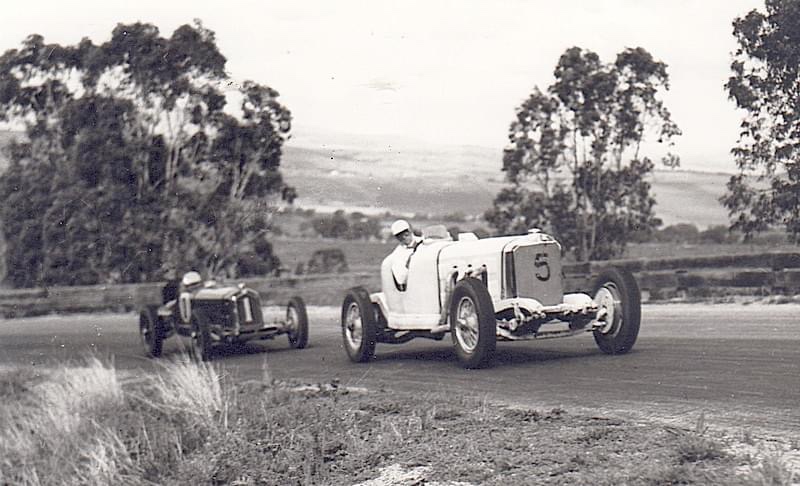
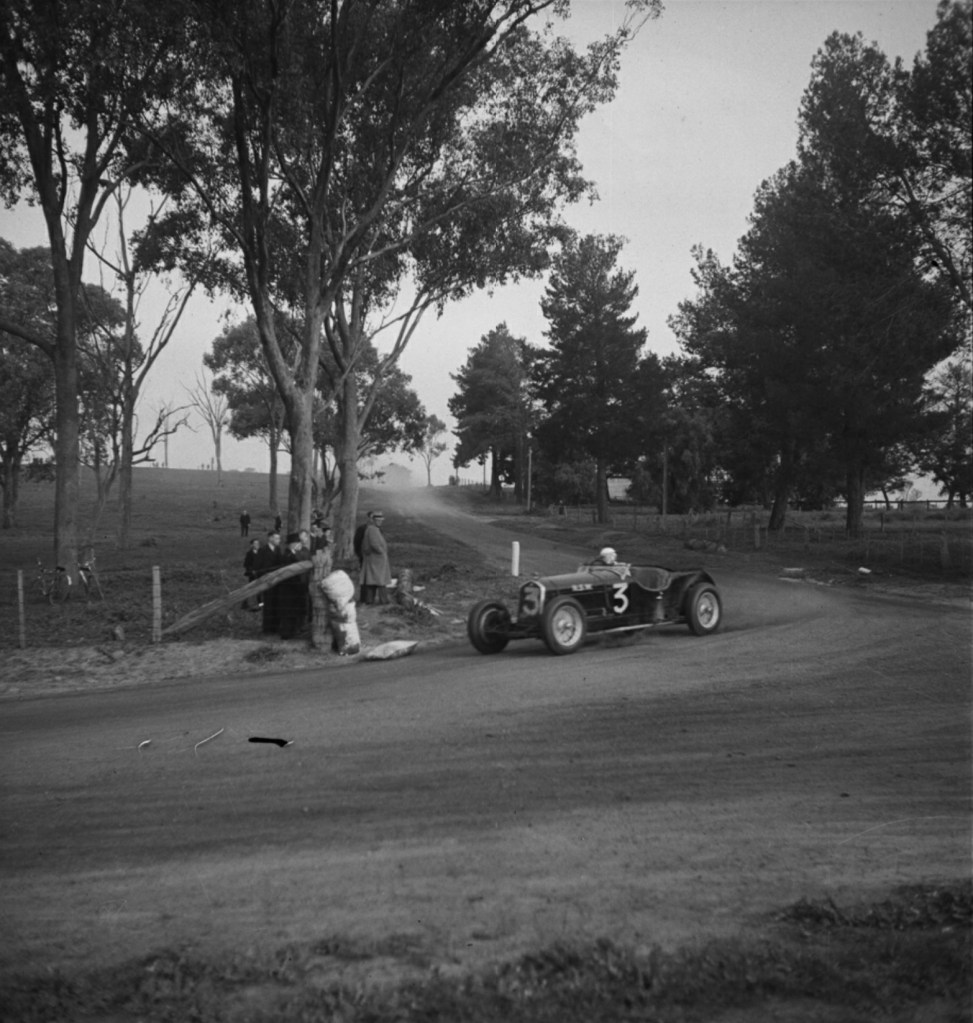
(M Dupain/SLNSW)

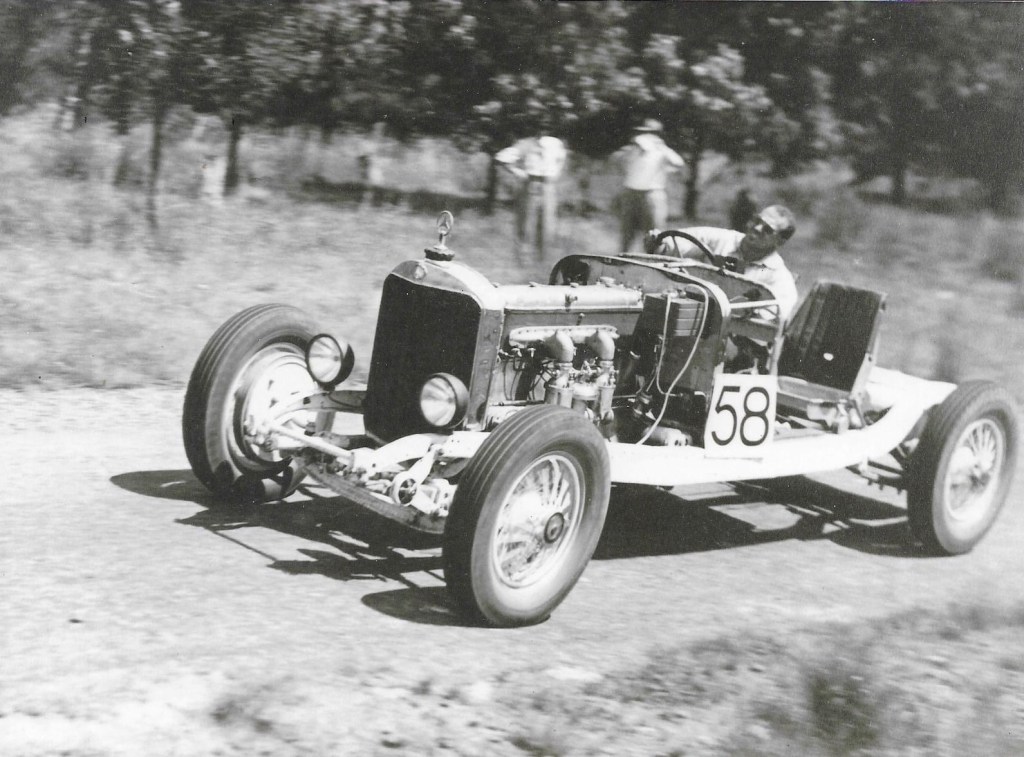
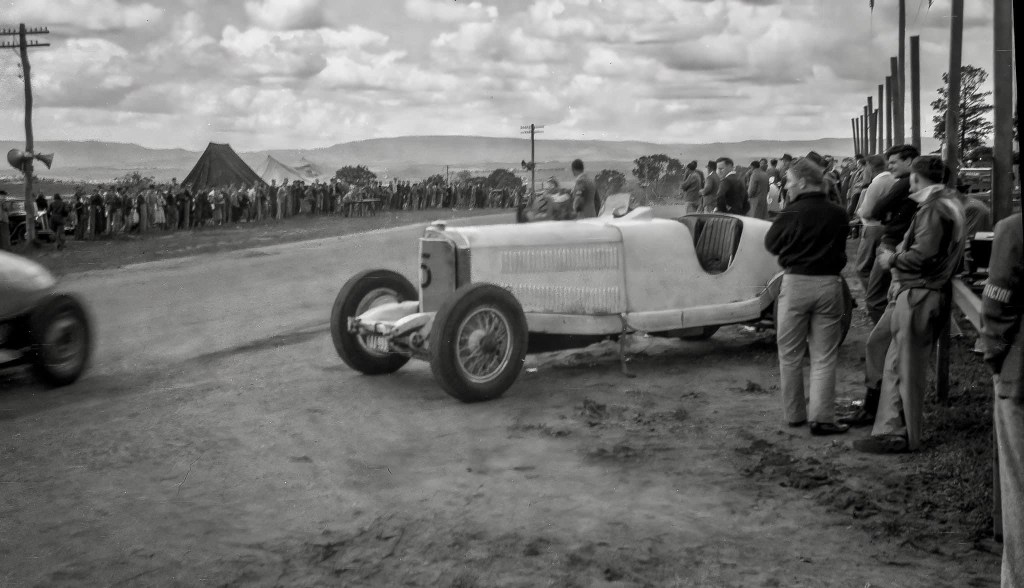
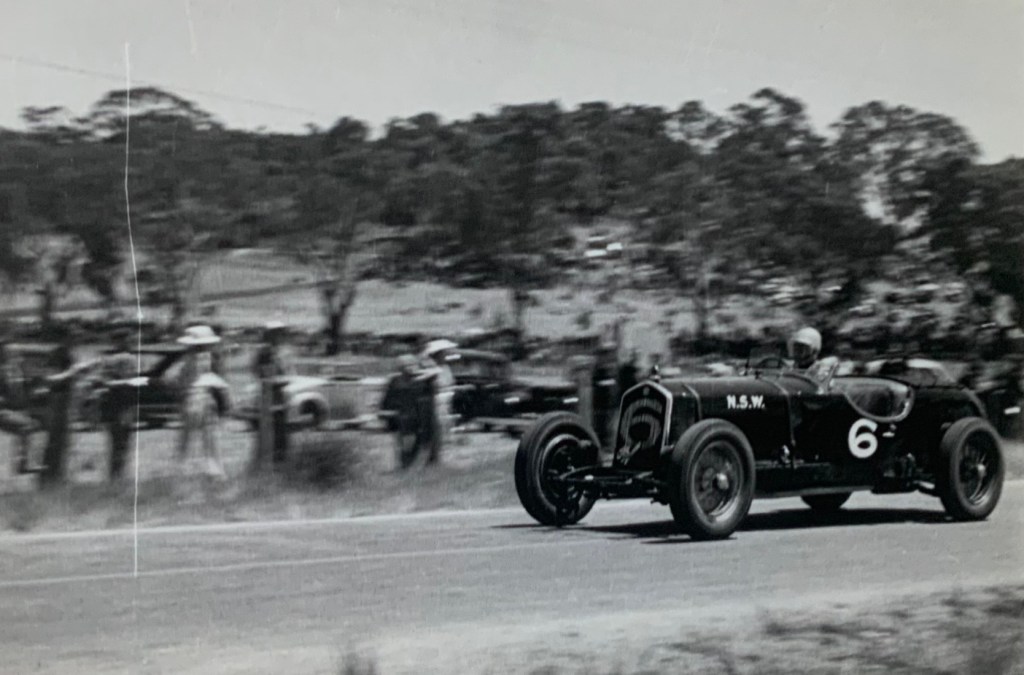
John Crouch plunges downhill on the Albury-Wirlinga road course – ‘on the border’ of Victoria and New South Wales – aboard his Alfa Romeo 8C 2300 Le Mans during the June 12/13, 1939 Albury and Interstate Gold Cup meeting.

The 76 mile race was won by Jack Phillips’ Ford V8 Special – the reigning champion – from the Hudson Specials of Bob Lea-Wright and Les Burrows. Crouch was fourth and proved his pace in this handicap race, handicaps prevailed in Australia at the time, with fastest race-time. See here for more information on the event and venue here: https://primotipo.com/2024/01/05/albury-and-interstate-gold-cup-1939/ and here: https://primotipo.com/2019/01/12/interstate-grand-prix-wirlinga-albury-1938/

Australian racer/entrepreneur John Snow imported this car to Australia in 1938, John Crouch acquired it shortly after it was offloaded in the Port of Sydney.

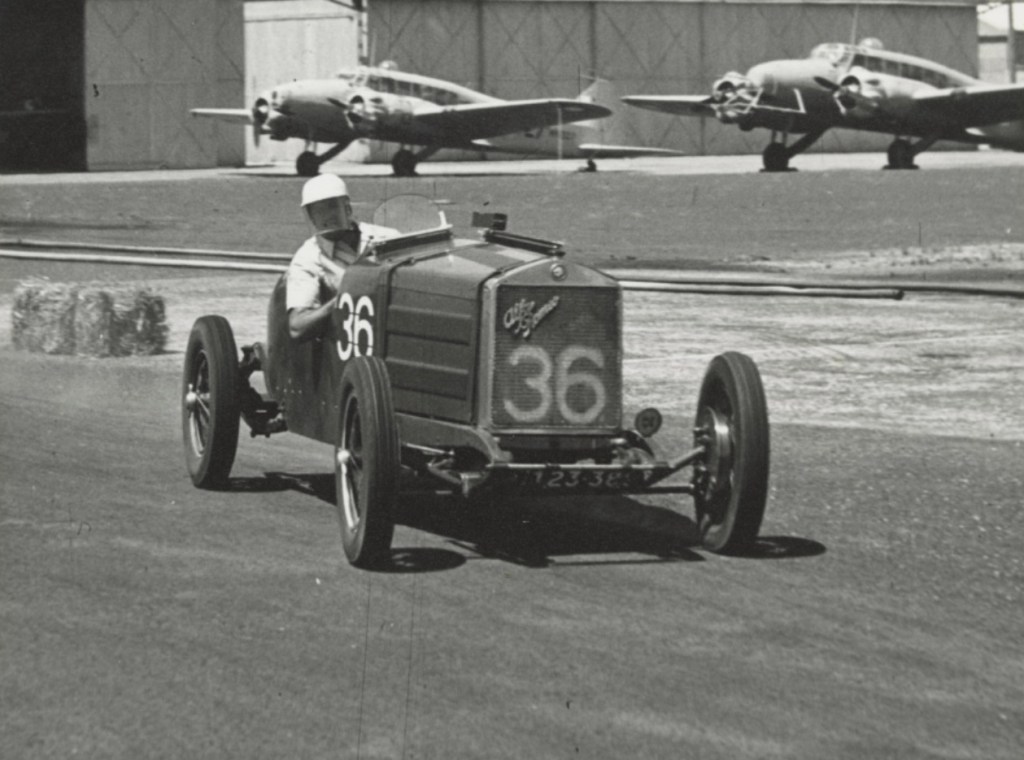
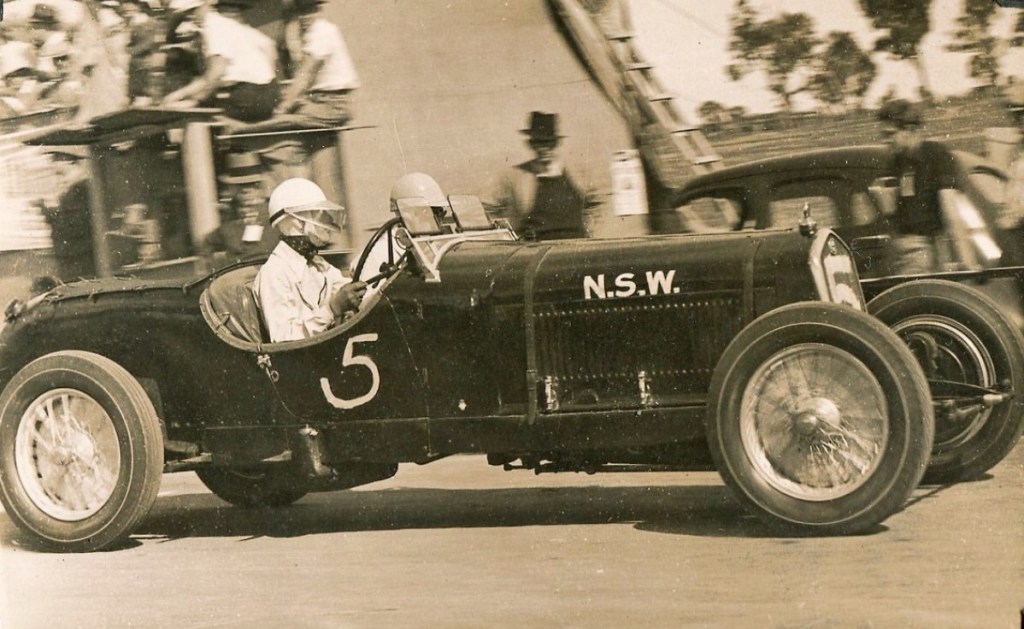
John Crouch aboard the booming 8C 2300 LM during the 1939 Australian Grand Prix at very fast, undulating Lobethal, South Australia (B King Collection)
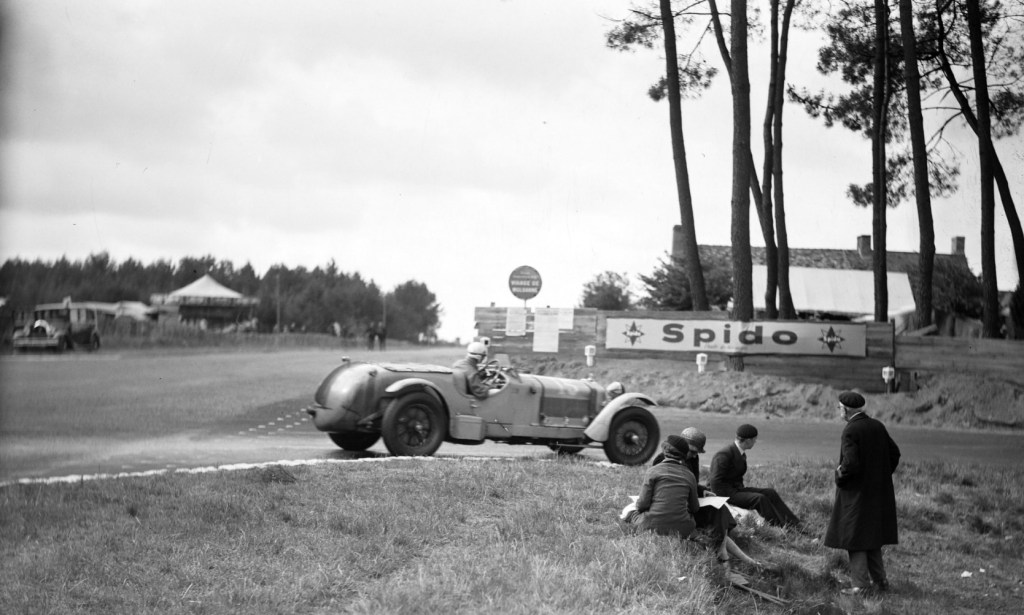
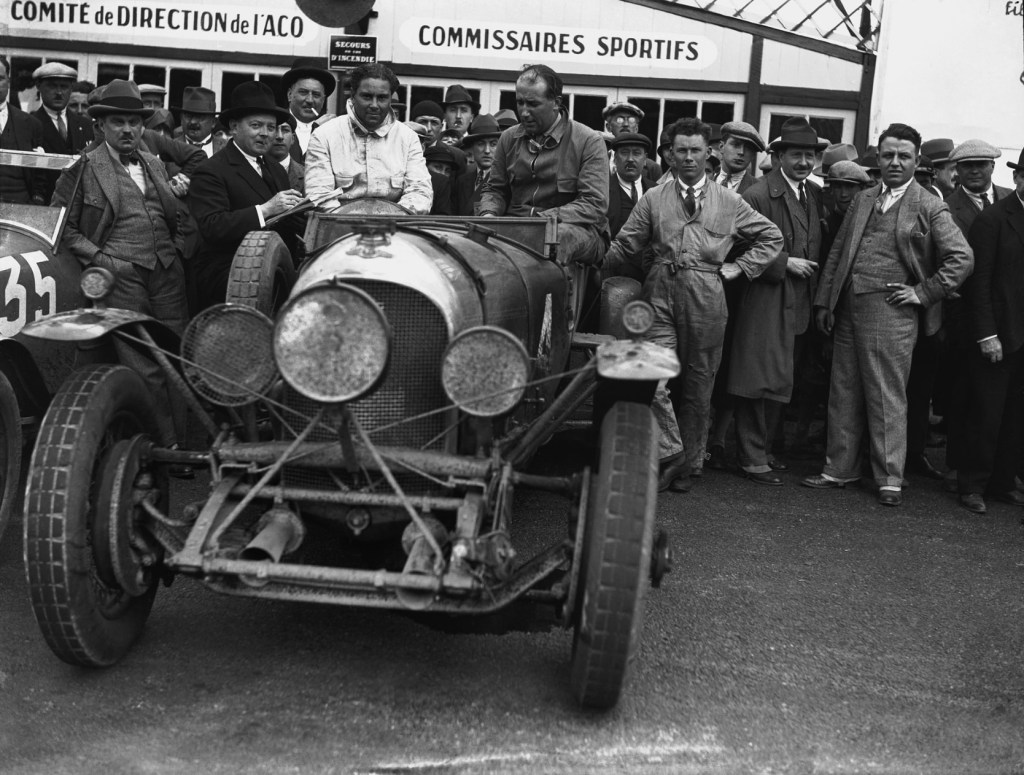
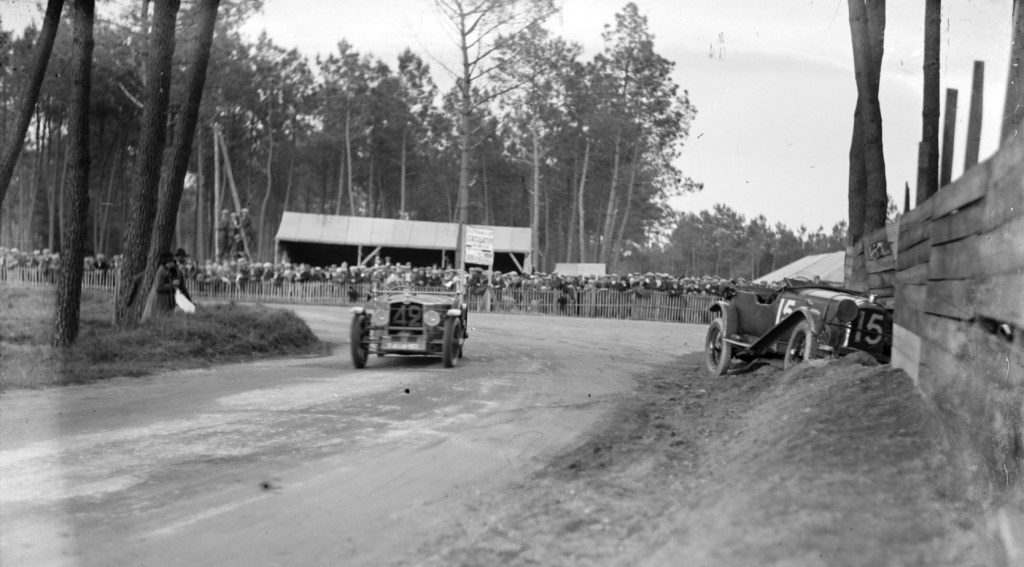
#2311202 during scrutineering at Le Mans in 1933 (Alfa Romeo Archives via Simon Moore)

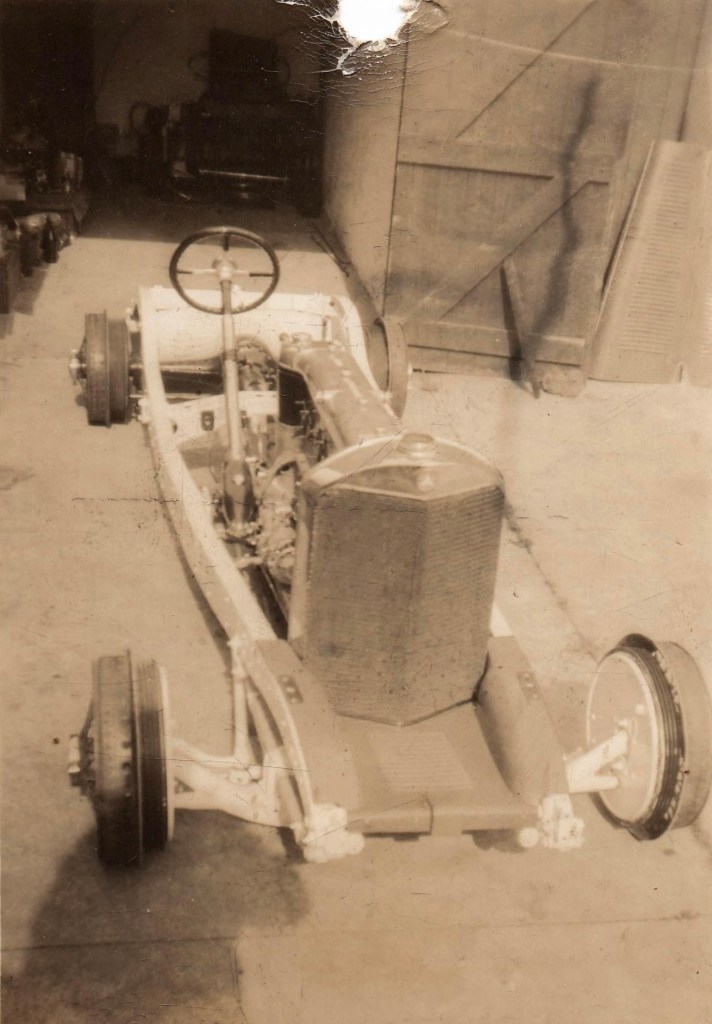
8C2300 Le Mans chassis #2311202 was one of nine cars built to this specification, five of these long-wheelbase machines with Touring bodies were built in 1933, ‘our car’ was the second of these and was registered by Alfa Romeo on June 6, 1933 MI43972.

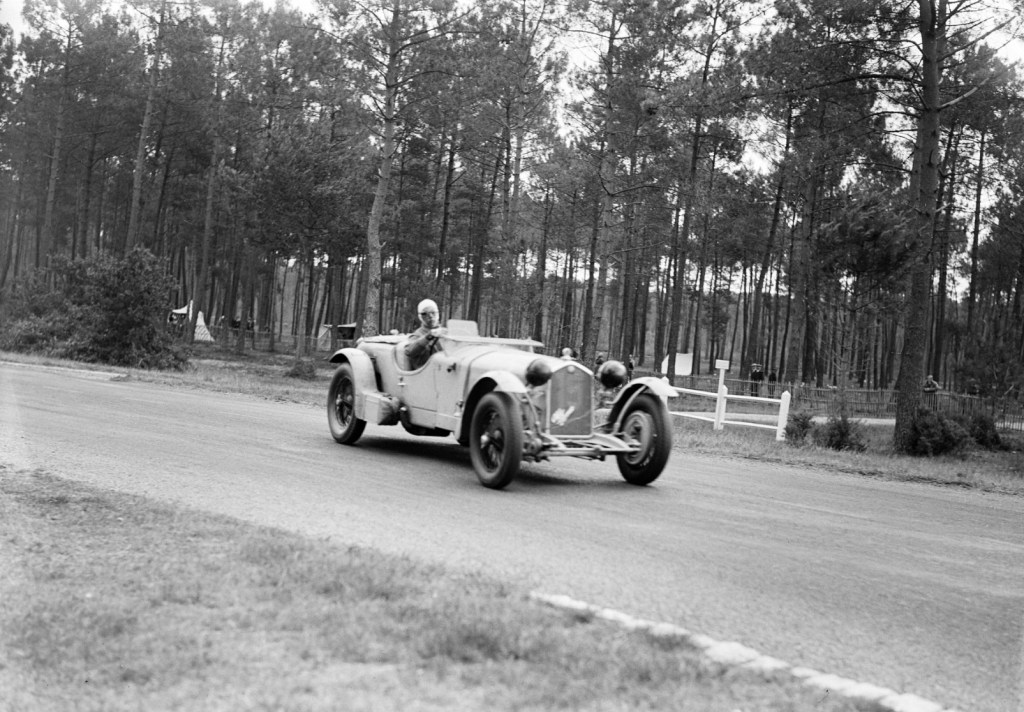
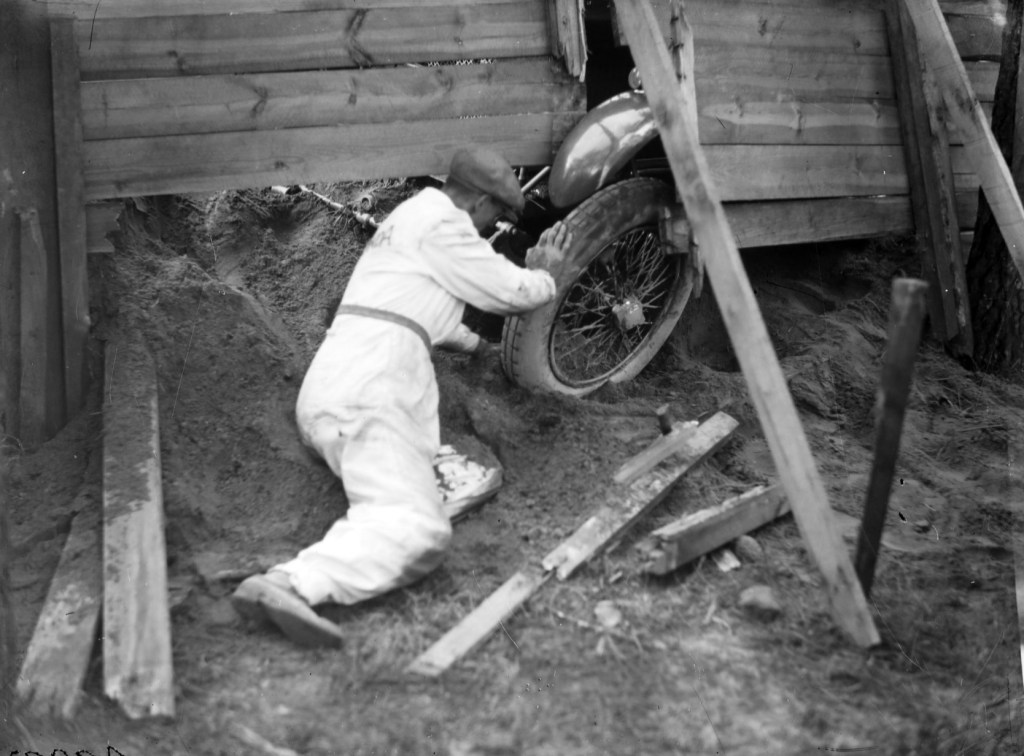
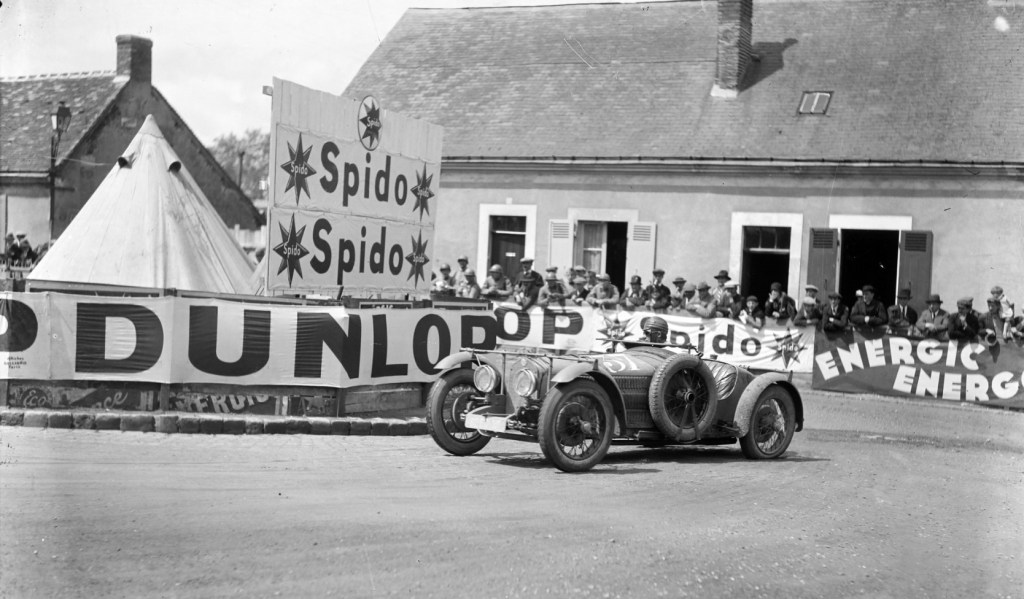
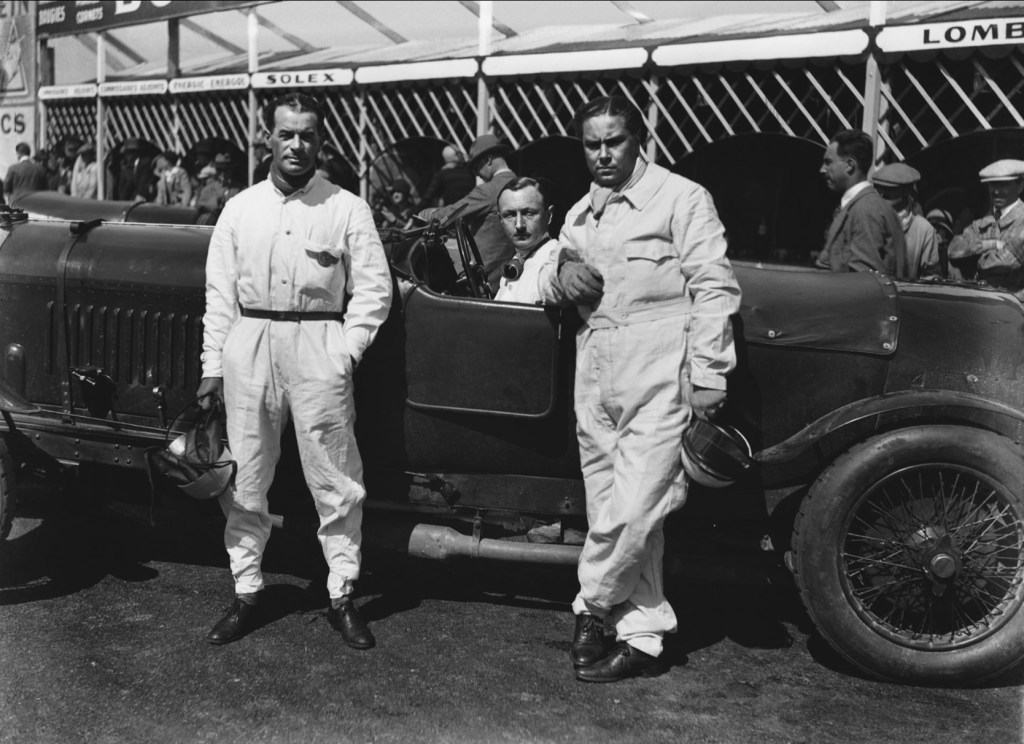
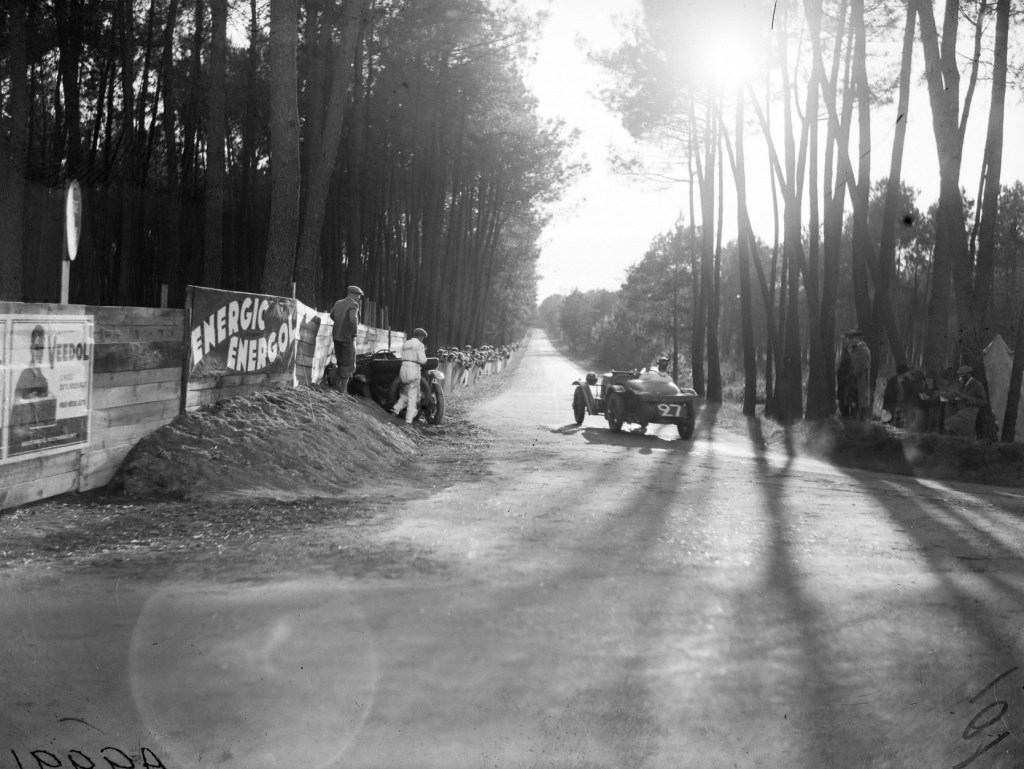
Simon Moore wrote in ‘The Legendary 2.3’ that “We will never be 100% sure, but I think it is really almost certain that this (2311202) was the Chiron (1933) Le Mans car,” raced by Louis Chiron and Franco Cortese …” The car ran amongst the leaders until after dawn, leading on several occasions before Cortese lost control and crashed the car in the Esses after completing 177 laps/2388km; the winning Sommer/Nuvolari 8C 2300 MM covered 3144km.

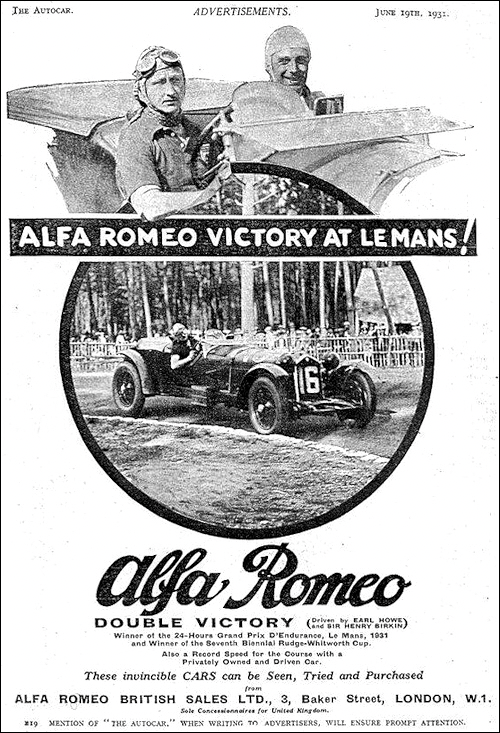
These straight-eight, supercharged, 2336cc, circa 165bhp Alfas are Le Mans royalty, winning the 24-Hour classic four years on the trot: 1931 Lord Howe/Tim Birkin 8C 2300 LM, 1932 Raymond Sommer/ Luigi Chinetti 8C 2300 LM, 1933 Raymond Sommer/Tazio Nuvolari 8C 2300 MM and 1934 Luigi Chinetti/Philippe Etancelin 8C 2300.

2311202 was third in the 1933 Tourist Trophy at Ards in the hands of Tim Rose-Richards and was later owned by Peter Mitchell-Thompson – Lord Selsdon.

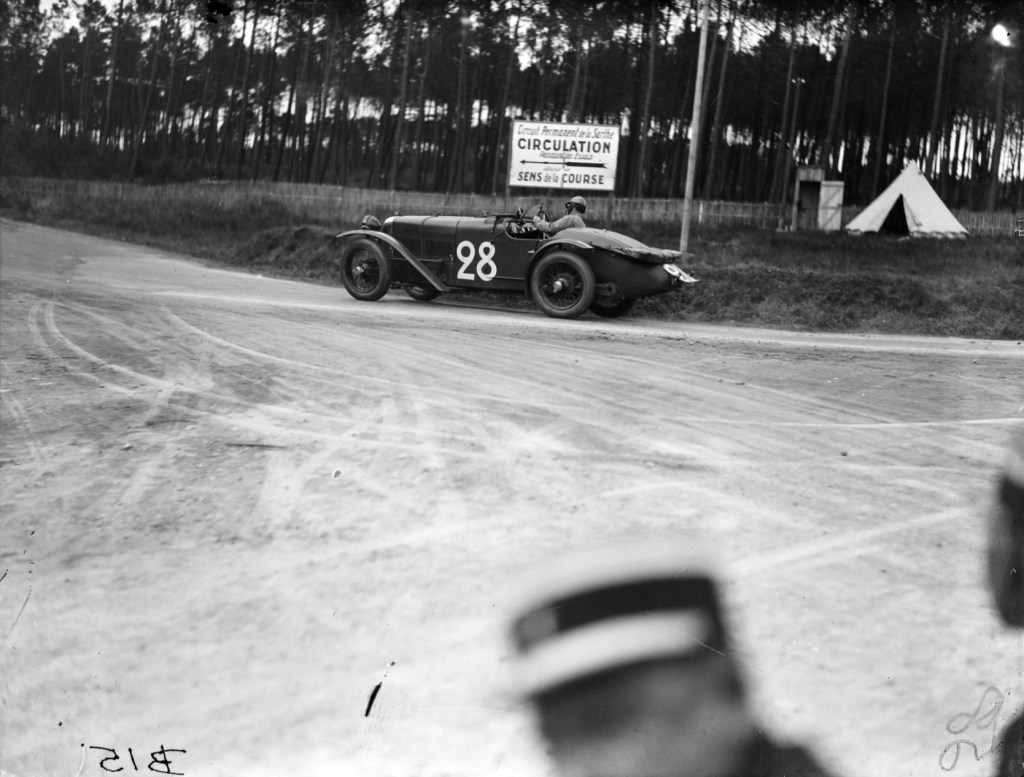
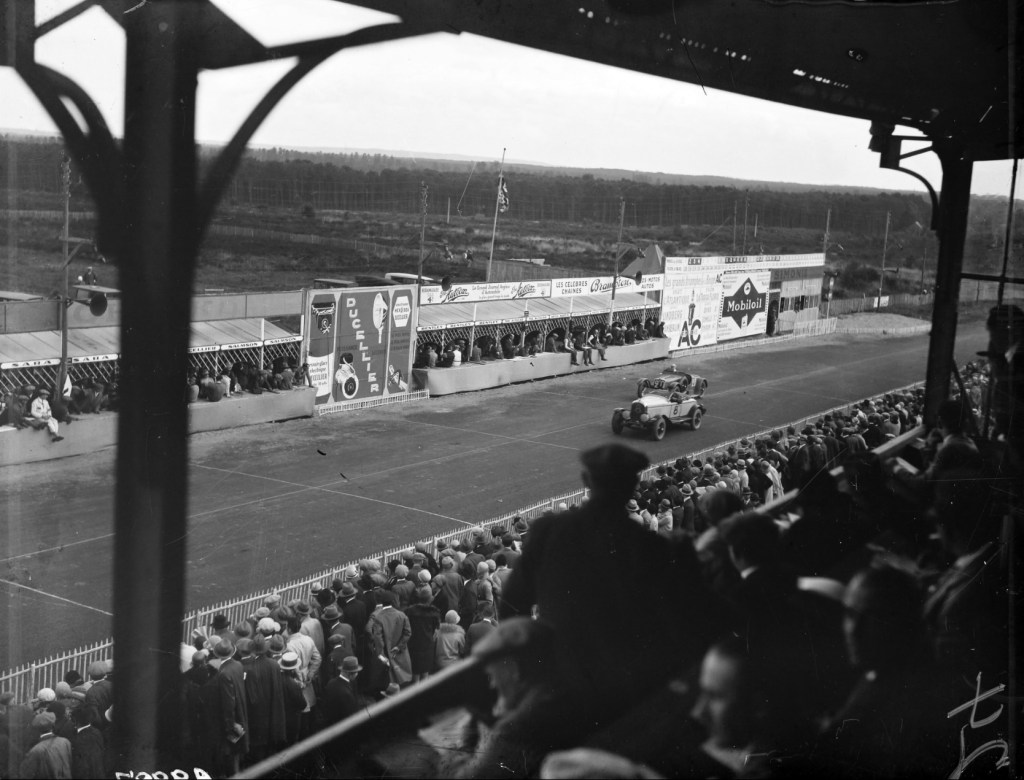
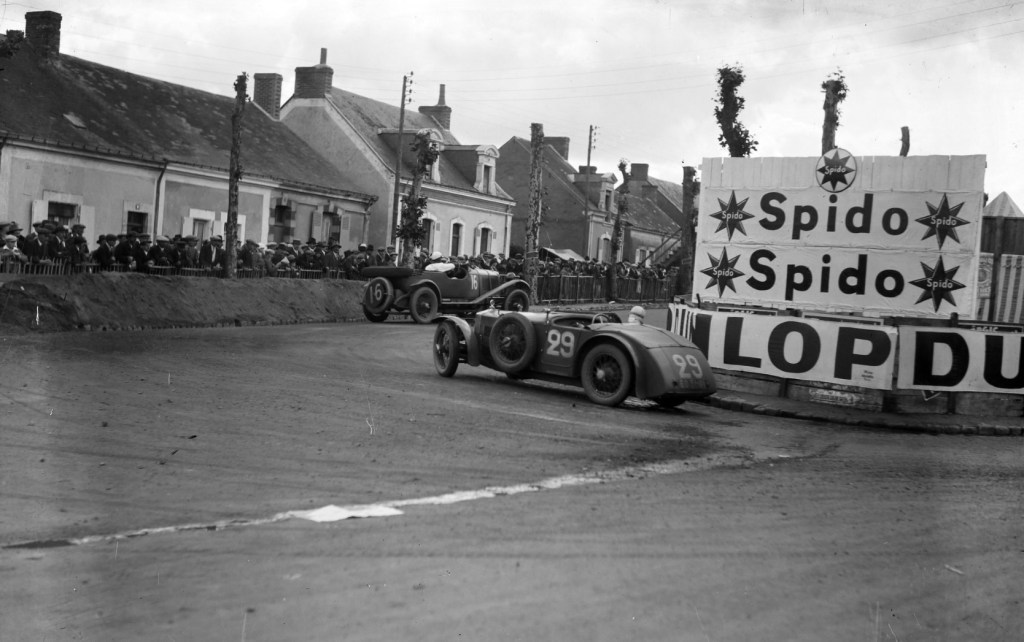
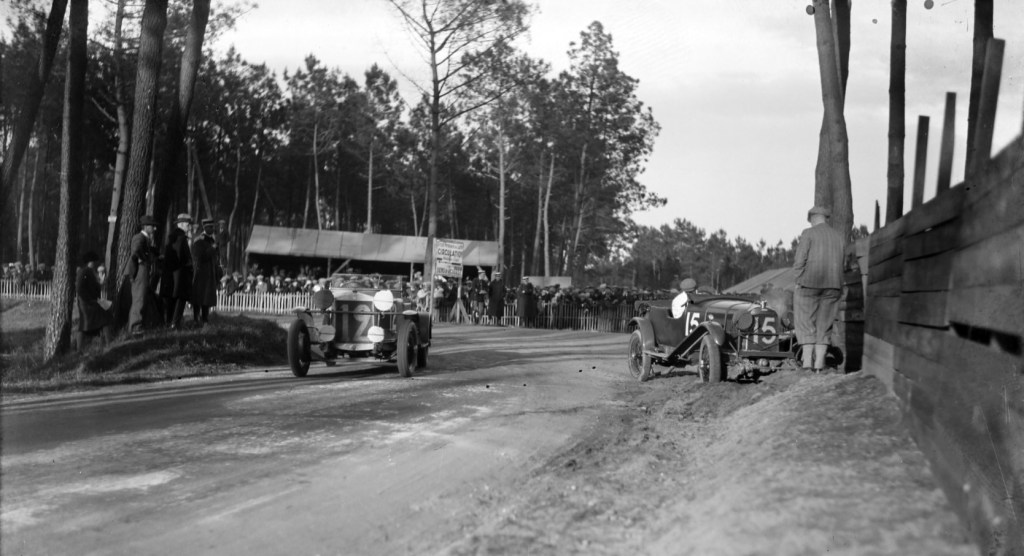
#2311202 at Le Mans in 1933 Louis Chiron/Franco Cortese DNF accident, also shot below (MotorSport)
(MotorSport)

John Medley wrote in his ‘John Snow: Classic Motor Racer’ that Aussie racer/entrepreneur Snow brought a large number of cars acquired in Europe to Australia in the immediate pre-war years, single-handedly improving the quality of our grids in the process. This Alfa Romeo was one of them, its shipmates were a Hudson convertible phaeton, 5-litre Bugatti Type 46 sedan and a Delahaye 135CS sports-racer (#47190) for Snow’s own use.

John Crouch became one of Australia’s most talented post-war drivers, winning the 1949 Australian Grand Prix aboard that very same Delahaye 135. Soon after the Alfa arrived in late 1938, Crouch entered chassis #2311202 in the ill-fated Parramatta Centenary Trophy Race on November 5, see here for that story: https://primotipo.com/2018/02/27/parramatta-park-circuit/ while Crouch’s AGP triumph is recorded here: https://primotipo.com/2022/10/05/1949-australian-grand-prix-leyburn/

He then shipped the car via coastal steamer to Port Adelaide and entered the 1939 Australian Grand Prix held at Lobethal in the Adelaide Hills on January 2. He was seventh in the race won in celebrated fashion by West Australian, Allan Tomlinson’s MG TA Spl s/c. Most of the big cars had tyre troubles in the extreme heat that day, Crouch had an off or two for this reason. He was a fast driver, but his pace with a still unfamiliar car wasn’t going to win him the race that weekend.

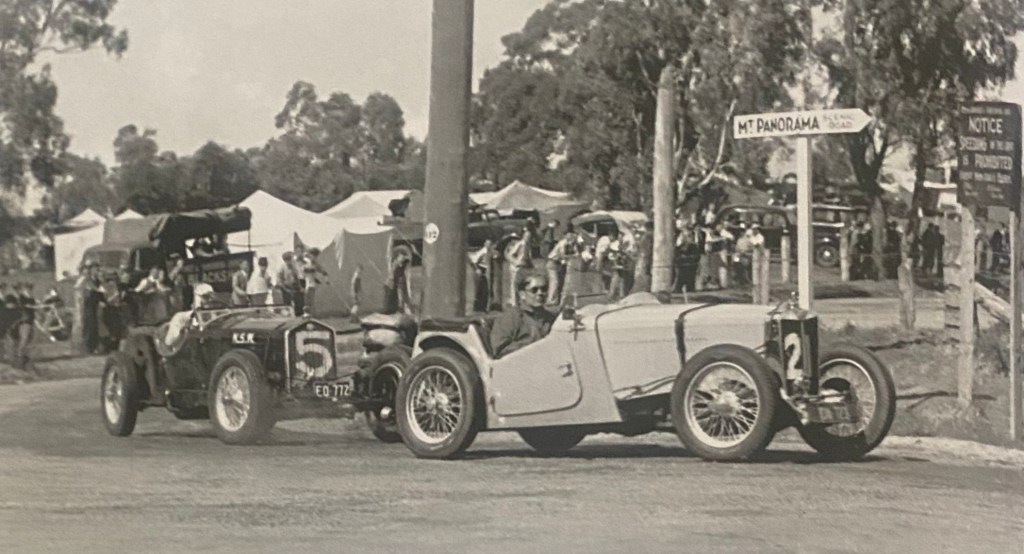
Other strong placings pre-war included fourth in the April 1939 New South Wales GP/150 Miles Road Race at Bathurst, and third fastest in a hillclimb and flying quarter-mile event at Mount Panorama in June. He was seventh in the NSW Road Race at Bathurst in October, a period in which he mixed his road racing with speedway events aboard a 4WD Skirrow.

Into 1940, with events getting a bit skinnier as the War impacted, he was fifth in the 150-miler at Easter Bathurst, and at Albury-Wirlinga in June he was second and again set the fastest time of the race.

While clearly a very potent racing car, John Crouch regularly used it around town (rego’ EO772), having the machine maintained by Jack Saywell and John Snow’s Monza Motors emporium-of-speed in East Sydney.

Tom Lancey checks his MG TA’s mirrors before being eaten by John Crouch and passenger and Alfa Romeo 8C 2300 during the 150 mile race at Bathurst during Easter 1939 (Terry McGrath via Simon Moore)
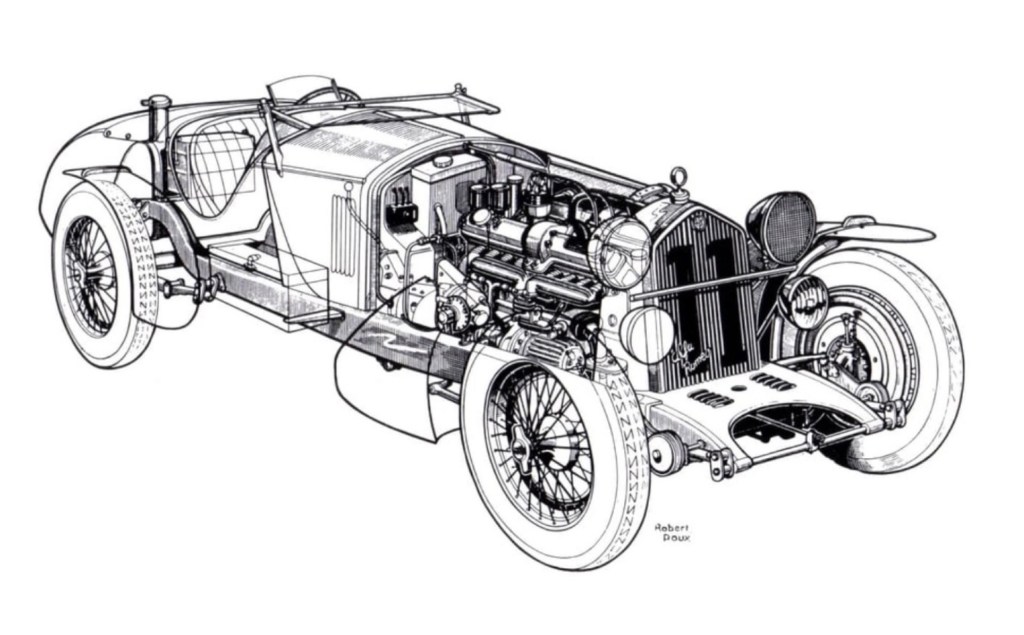
Alfa Romeo 8C2300 cutaway (R Roux)
Crouch, again at Lobethal in 1939 (B King Collection)

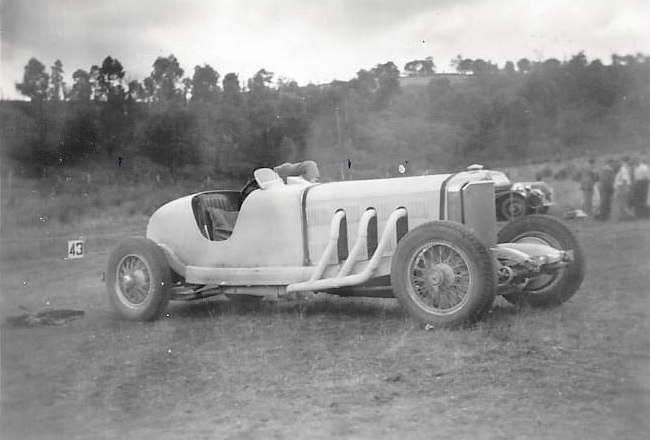
Victorian Colin Scott bought it in 1944 and had it fettled by Alf Barrett’s mechanic, Alan Ashton and his team at AF Hollins & Co in High Street, Armadale. Barrett and his 8C 2300 Monza were the fastest combination in Australia in the immediate pre and post-war periods. Scott was a frequent class winner at Rob Roy hill climb and a regular Vintage Sports Car Club competitor.

In 1949 #2311202 was bought by racer/pilot/dealer John Barraclough who onsold it to Tom Luxton. He raced and hillclimbed it, sometimes using the pseudonym James McEwan; McEwans was the family company, a 140 year old, national, retail hardware-store chain that was ultimately swallowed by Bunnings in the 1990s.

Howard Kiel owned the car next. Simon Moore wrote that Kiel was introduced to Louis Chiron at London’s Swallow Club by Tony Gaze. Chiron confirmed the car was French blue at Le Mans and “remembered it well and exalted its performance.”

Owner impressions are gold, Simon published Kiel’s impressions of the 8C 2300 outlined in an exchange of letters between the pair. “I well remember 2311202 as one of the most beautiful cars to drive. In fact I often drove it to work on the outskirts of Melbourne and raced Tony Gaze back to town many times. Through the streets the car was had to beat and exhilarating to drive. I sold the car when it became apparent it needed a comprehensive restoration.”

The next owner, Tom Roberts took great care of the car between 1958 and 1963 after which it joined the mouth-watering Doug and John Jarvis collection of 8C Alfas in Adelaide.

Australian Alfa Romeo owner/historian David Wright wrote in the February 2023 issue of Alfa Occidentale that “Doug Jarvis was particularly enamoured with this car and drove it at Mallala on several occasions. Following the death of Doug Jarvis, the 8C 2300 Le Mans was used regularly by his son, John, until, in 1975, it was acquired from the Jarvis Estate by Lance Dixon.”

(Reid Family)

Dixon, a successful Melbourne motor dealer and enthusiast reintroduced the car to VSCC events. Here Lance is taking then Prime Minister of Australia, Malcolm Fraser – a very tall bloke for a polly – for some quick laps in the car at a Sandown meeting in 1977.

In 1982 Lance’s restoration team, led by Ian Ruffley, were commissioned to comprehensively rebuild the car in Dixon’s Eltham workshop. The colour reverted to its original French blue, having been red for its entire life in Australia. #2311202 was sold via auction in 1986 to a Dutch enthusiast who continues to actively campaign it.

Nice close up profile shot of John Crouch in the 8C 2300 during the Easter 1939 Bathurst 150 meeting. The car lost its best years of racing in Australia thanks to the war, not that #2311202 was alone in that respect, far from it…(F Pearse)

A Driven Man and Driving Force Behind Motor Sports…

Is the title of the late Barry Lake’s obituary of John Crouch – 15/8/1918-30/5/2004 – published in the Sydney Morning Herald on June 17, 2004. Lake was a talented racer, journalist, historian and publisher; his beautifully written tribute is reproduced in full.

In the 1930s John Crouch was widely known as Australia’s youngest racing driver. In 1949 he won the Australian Grand Prix driving a French Delahaye. Even before his retirement from active racing in the mid-1950s, Crouch was heavily involved in the administration of motor sport in this country. By the time he died, at 85, he was recognised by many as the elder statesman of Australian motor sport.

Throughout all of these achievements, Crouch was the consummate gentleman, always immaculately dressed, always driving a late-model performance car (usually Mercedes-Benz in his later years) and always he was polite and softly spoken.

His father, Cecil, had his own new car sales company for 10 years before John was born in 1918, and the elder Crouch dabbled in motor sport when he raced a Metz car at Victoria Park racecourse in Sydney.

After leaving Sydney Church of England Grammar School (Shore), to which he walked every day from the family home in Wollstonecraft, Crouch went to work for his father. So it was hardly surprising he developed a keen interest in cars and motor racing – although his father strongly opposed the latter, having realised it consumed vast amounts of money.

Crouch began racing an MG TA sports car when barely 18. Two years later, he finished fifth in the 1938 Australian Grand Prix at Bathurst. In the late 1930s he drove a wide variety of cars including a supercharged Alvis, a Fronty-Ford, a Skirrow four-wheel drive speedway car, and an ex-Louis Chiron Le Mans Alfa Romeo 8C 2300.

With the Alfa, Crouch set fastest time in the Albury and Interstate Gold Cup races on the Wirlinga road circuit in 1939 and 1940, along with a third place and two fifth places on corrected times in the last three major events held at Bathurst before World War II.

After the war, Crouch left his father to start his own business. “I wanted to buy and sell performance cars but my father was never interested in them,” he once said.

He imported cars from England, including the high-class Bristol and the inexpensive but loads-of-fun Dellow sports car, as well as many new and used examples of exciting sports cars. In 1953 he gained the Australian distributorship for Austin-Healey sports cars, when the local Austin distributors rejected it as a folly. Crouch described it as a bonanza that sold beyond anyone’s wildest expectations.

The grid of the 1947 NSW Championship, Nowra airfield, June 16. #5 Jack Murray Mackellar-Bugatti Ford s/c, then #3 John Crouch Delahaye 135CS, #14 Alec Mildren Ford V8 Spl, #4 Frank Kleinig, Kleinig Hudson Spl and Alf Barrett, Alfa 8C2300 Monza. The handicap race was won by Tom Lancey’s MG TC, Crouch was eighth (J Hunter)

Immediately after World War II Crouch had bought a fast and reliable French Delahaye sports-racing car. It had a fastest race time at Bathurst to its credit, and Crouch scored second-fastest there with it in 1946.

But the one race to win then, as the Bathurst 1000 is today, for Australian drivers was the Australian Grand Prix. In 1948 the event was held at Point Cook in Victoria in blazing heat. The Delahaye scored third-fastest time but the handicap start resulted in his finishing only eighth.

The following year the race went to Queensland, on a wartime airstrip at Leyburn. Also for the first time, it was run from a scratch start, as is the case for today’s major events. Crouch was ready to pounce when the early pacesetter faltered. The blue Delahaye crossed the line a clear winner and John Crouch had achieved his life’s ambition.

In the early 1950s Crouch began to import and sell small, lightweight rear-engine Cooper racing cars. He sold the Delahaye and raced Coopers to promote them. He was ahead of his time. By the end of the decade Coopers were dominating Australian racing as they were the world championship. In Crouch’s time, however, they were fast but unreliable. In 1951, for example, Crouch’s Cooper set fastest race lap in the Australian GP, but retired with mechanical problems. In retrospect, he sold the Delahaye, had he kept it, would have been capable of winning the GP again in 1950 and 1951.

In 1953 Crouch sold a more modern, faster and more reliable Cooper-Bristol to Tom Brabham, for his son, Jack. The latter made his name in that car and went on to win world championships in 1959, 1960 and 1966.

Crouch’s final outings as a driver were in the Redex Round Australia Trials in 1953 and 1954, and the 24-Hour Race at Mount Druitt in 1954. He had planned to race in Europe before quitting the sport, but ran into financial difficulties when he expanded into importing tyres and tractors.

He retired from racing, closed his business and used his remaining resources to buy land and build apartment blocks in suburbs such as Dee Why. “Real estate was going so well at that time,” he said, many years later, “Any idiot could make money out of it.” He was comfortably well-off by the time the bust came in the 1970s – unlike many of his friends, who, he said, “had borrowed to the hilt and lost everything”.

Crouch had been the NSW state councillor for the then newly formed Confederation of Australian Motor Sports in 1953 and continued in various capacities with this organisation for many years, receiving awards for his contributions to motor sport. He also acted as clerk of course at a number of major events.

Crouch had two sons, John and David, with his first wife, Vivian. They eventually divorced, but remained good friends. Crouch’s second wife, Valerie, died in 1995. They had two daughters, Caressa and Penelope.

Crouch was reluctant to marry again, fearing a third would brand him a “womaniser”, but eventually he met June, whose lust for living a full life matched his own. They married and spent much of Crouch’s final few years travelling in South-East Asia and Europe, as well as attending various motor sport functions in Australia as honoured guests. That came to an end when Crouch suffered circulation problems that led to a series of strokes and heart attacks. He died in a hospital in Gosford.

Etcetera…

Sydney Morning Herald June 13, 1939
(Motorsport)

Another shot of Louis Chiron or Franco Cortese at Le Mans in 1933 aboard #2311202.

(S Dalton Collection)

Credits…

Max Dupain-SLNSW, ‘John Snow: Classic Motor Racer’ and Bathurst: Cradle of Australian Motor Racing’ by John Medley, ‘The Legendary 2.3’ Simon Moore via the Bob king Collection, Robert Roux, MotorSport Images, Reid Family Collection, John Hunter Collection, Fred Pearse, Sydney Morning Herald – Barry Lake, Stephen Dalton Collection

Tailpiece…

Finito…

(A Boyle)

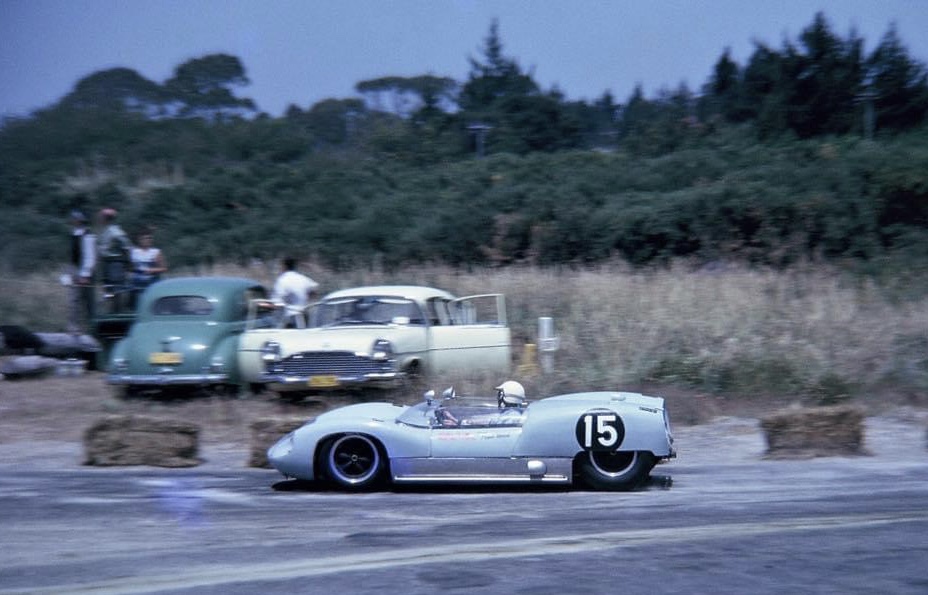
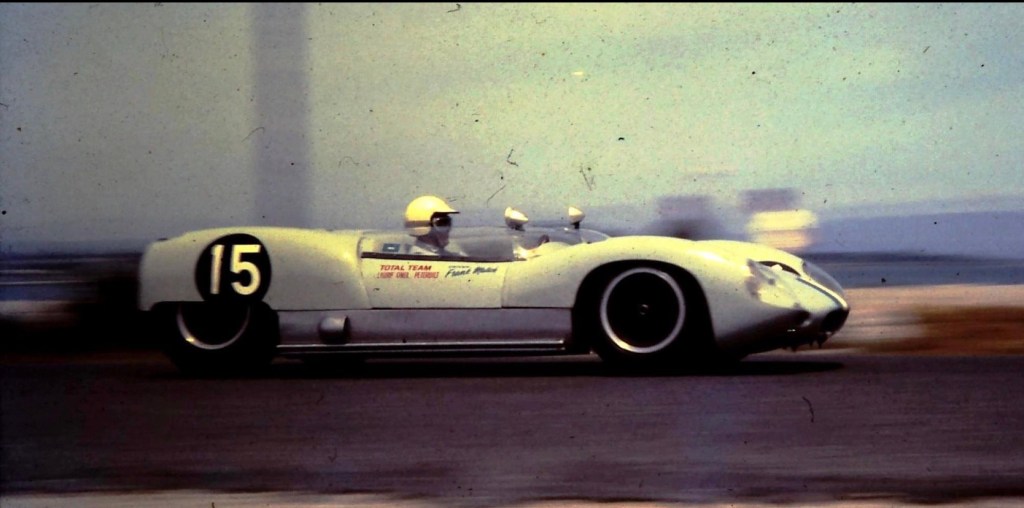
Frank Matich with a smidge of the opposites, guides his Lotus 19B Climax through Mount Maunganui, Tauranga in New Zealand’s North Island on December 28, 1963.

This short-lived 2.9km road circuit hosted two Bay of Plenty Premier Road Race meetings in 1962-63.

Matich led the ’63 feature in his new Brabham BT7A Climax (below) before throttle problems intervened, but he had more luck in the sportscar support, winning from Barry Porter’s Lotus 15 Climax.

(B Ferrabee)

FM’s Lotus 19 and 19B were important aspects of his rise and rise as a driver. Both cars were extensively developed by he and his small Sydney based team, so too the Brabham BT7A which still served it up to the visiting internationals in their latest cars 12 months later. The saga of the Matich Lotuses is here: https://primotipo.com/2017/09/08/bay-of-plenty-road-race-and-the-frank-matich-lotus-19s/

(B Ferrabee)

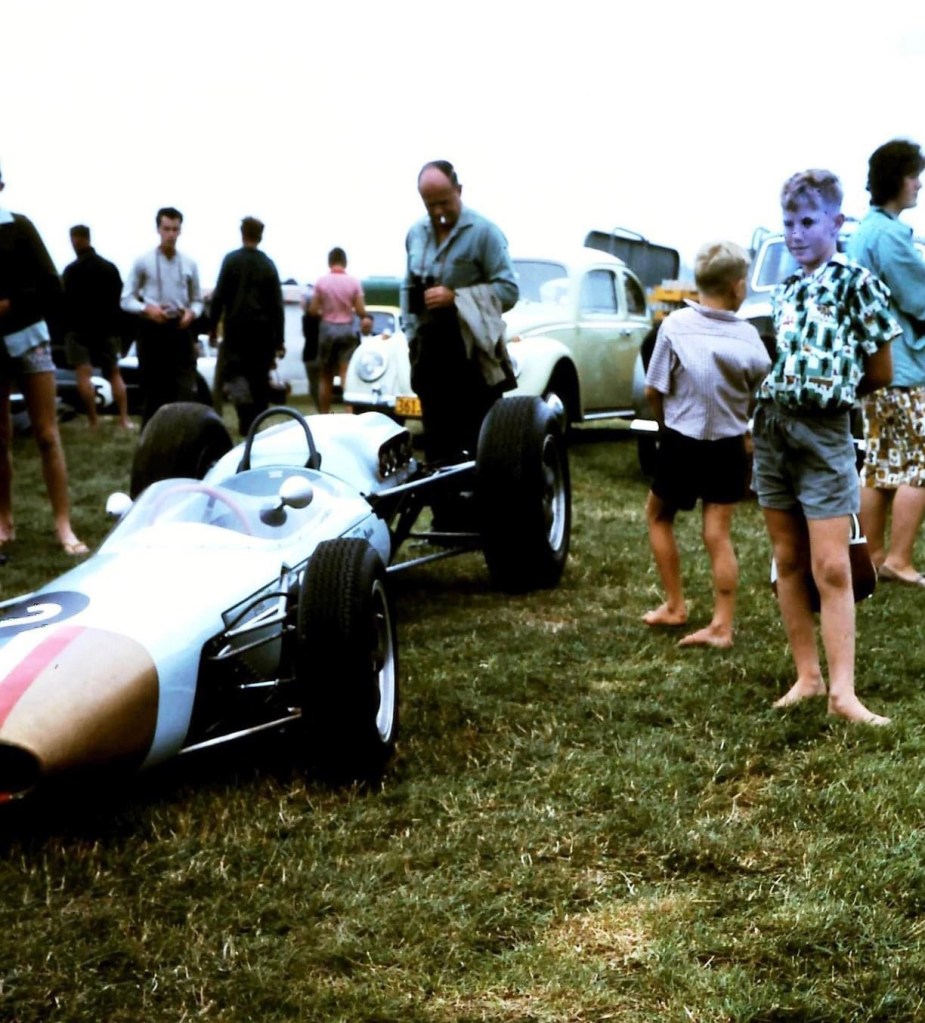
Who said Denny Hulme was the only Kiwi who lived in bare-feet!?

The Matich Brabham in its Total colours in the Pukekohe paddock during the 1964 New Zealand Grand Prix weekend, a fortnight after the Mount Maunganui meeting.

During 15 championship (Gold Star and Tasman) outings in BT7A IC-1-63 between December 1963 and July 1965 Matich was always a front runner but rarely a finisher. Frank’s best placings were second in the 1965 Sandown Gold Star round, and thirds in the 1964 South Pacific Trophy at Longford, and the 1965 Warwick Farm 100.

That latter race is indicative of Matich’s place in the order of things at the time. He started from pole in front of Graham Hill, Jim Clark, Bruce McLaren, Jack Brabham and Frank Gardner in the year old car.

(unattributed)

The all-Brabham front row before the South Pacific Trophy at Longford on March 2, 1964.

Jack Brabham on pole in BT7A with the similarly equipped Matich on the outside, sandwiching Graham Hill’s BT4. Hill won from Bruce McLaren’s Cooper T70 and Matich all Climax FPF powered. Jack suffered differential failure on lap 22, while McLaren won the first, 1964 Tasman Cup.

Red Dawson, Pukekohe November 1966 (M Fistonic)

Kiwi racer Red Dawson was the next owner of IC-1-63 and raced the BT7A from December 1965 to January 1969. His best with it was a win in the 1966 Waimate 50 and second placings in the Gold Star round that year at Renwick and at the ‘69 Pukekohe Gold Star round. The car was rebuilt as a sportscar in 1970, perhaps one of the Kiwis can tell us about that. See here for Allen Browns summary of the two BT7As: https://www.oldracingcars.com/brabham/bt7a/

Red Dawson and fellow racer John Riley and BT7A Climax (K Buckley)

Credits…

Alan Boyle, Brian Ferrabee, Milan Fistonic, Lionel Walker, Ken Buckley, oldracingcars.com

Tailpiece…

(L Walker)

The race debut of BT7A #IC-1-63. Frank Matich during practice for the Hordern Trophy Gold Star round at Warwick Farm in December 1963. Signalling his intent, he started from pole but retired after a collision with reigning Gold Star Champion, Bib Stillwell’s Brabham BT4.

It was well and truly game on between the relatively old bull (36) and relatively young thruster (27)…see here: https://primotipo.com/2018/07/20/matich-stillwell-brabhams-warwick-farm-sydney-december-1963/

Finito…

(R Donaldson)

Start of the Australian Tourist Trophy at the Lowood airfield circuit in Queensland on June 14, 1959.

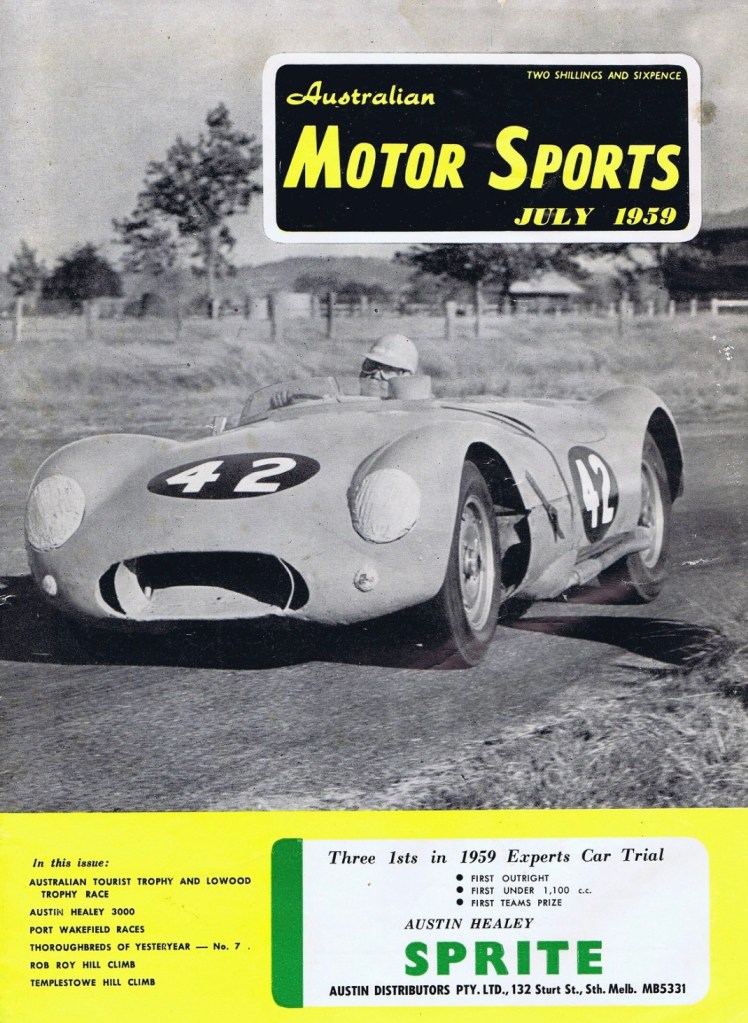
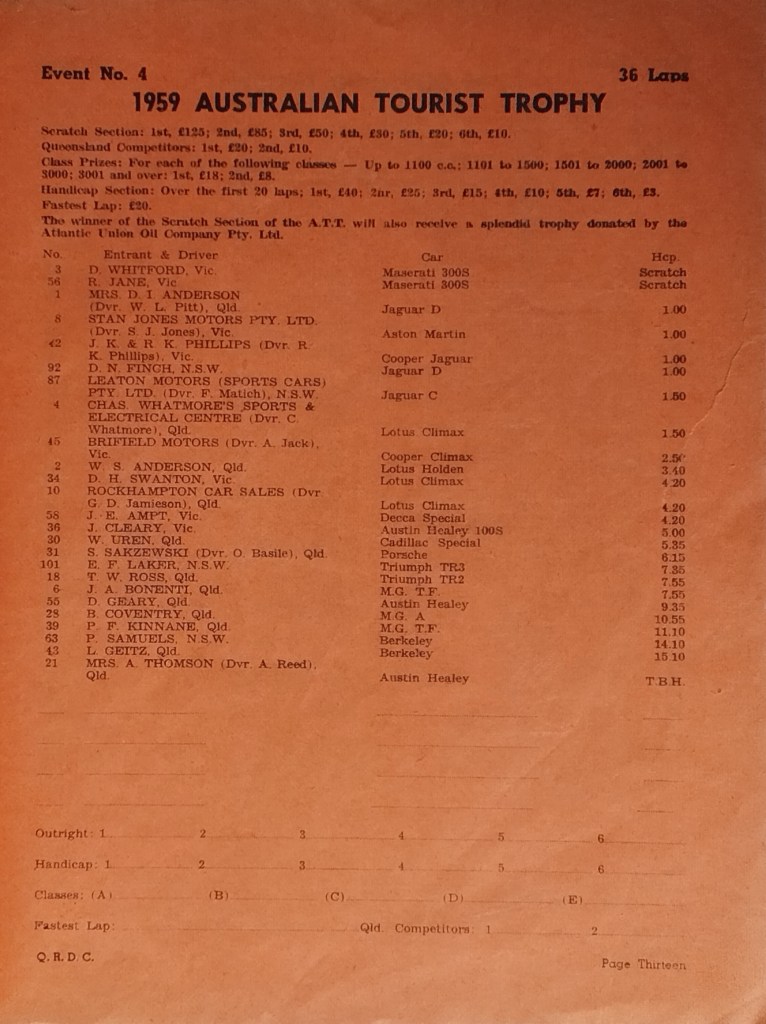
The 36 lap, 102 mile race was won by Wangaratta racer, Ron Phillips’ ex-Whitehead Cooper T38 Jaguar (#42 partially obscured on the second row). Bill Pitt’s Jaguar D-Type #1 was second, Bob Jane, Maserati 300S #56 third and John Ampt, 1100cc Coventry Climax engined Decca Special #58 was fourth. Car #87 is Frank Matich’ Jaguar C-Type.

These fantastic photographs were taken by Mr R Donaldson and published in the Pix news-magazine, one of those slightly naughty magazines to be found in Steve’s, the local barber shop. The meeting also featured the sixth round of the Australian Drivers Championship, the Gold Star, and drew a crowd estimated at 20,000.

(R Donaldson)

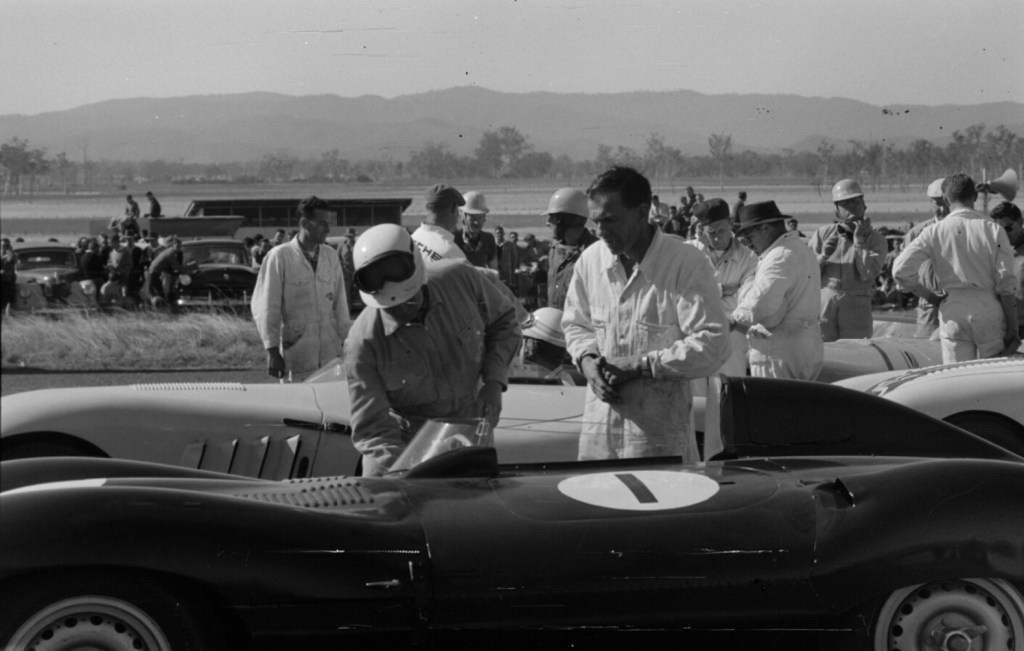
Bill Pitt prepares to climb aboard the Westco Motors D-Type while Frank Matich is ready to roll in the Leaton Motors C-Type behind. More on the C-Type: https://primotipo.com/2014/08/05/gnoo-who-gnoo-blas-circuit-jaguar-xkc-type-xkc037/ and the D-Type here:https://primotipo.com/2016/03/18/lowood-courier-mail-tt-1957-jaguar-d-type-xkd526-and-bill-pitt/ Leaton Motors acquired XKD526 when it was sold by Westco for Frank to race.

Denis Geary’s Healey getting plenty of assistance (R Donaldson)
(R Donaldson)

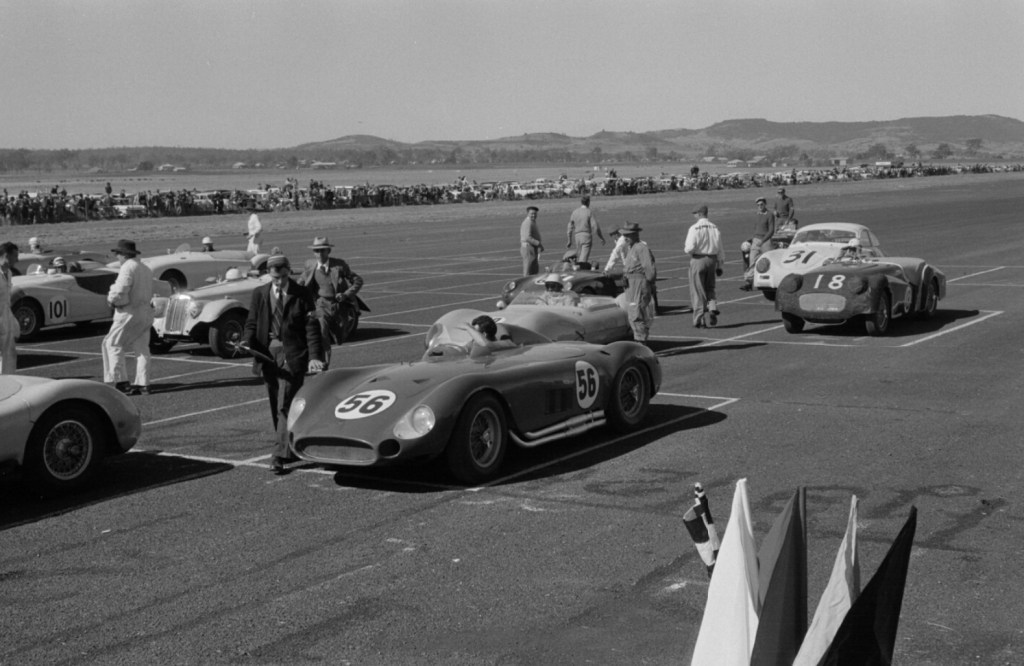
Another grid shot with a youthful Bob Jane in his superb Maserati 300S, a car he retained well into the historic period. See here: https://primotipo.com/2015/05/15/bob-jane-maserati-300s-albert-park-1958/

#18 is Tom Ross eighth place Triumph TR2, #31 Tony Basile, Porsche Carrera and #101, E Laker, Triumph TR3.

(R Donaldson)

The grid ready to start with the Chas Whatmore Lotus 11 Le Mans Climax at left on the front row, then Matich and Pitt. The second row comprises Allan Jack’s Cooper on the left, winner, Phillips’ largely obscured Cooper Jag, John Cleary’s Healey 100S, Jane’s 300S and John Ampt’s Decca Climax.

Ampt was a later owner of the Cooper Jag and raced in Formula Junior in Europe with some success in the early 1960s.

(R Donaldson)

With the flag dropped, Phillips is at the far left, the Bobtail Cooper is Allan Jack’s Type 39 Climax, #36 John Cleary, Austin Healey 100S, #10 Les Agnew, Lotus 11 Climax, #56 Jane, #31 Basile, #28 B Coventry, MGA and #18 Tom Ross, Triumph TR2.

While Bob Donaldson did a great job, he has managed not to take a decent shot of the winning car. Here it is, shown above on the way to victory on the cover of the July issue of AMS.

(R Donaldson)

David Finch’s D-Type in front of one of the Lotus 11s. See here about XKD520: https://primotipo.com/2020/04/17/stillwells-d-type/

(R Donaldson)

Test of straight-line-squirt between the E Laker TR3 and J Ausina MGA. And below the beautiful lines of the Allan Jack Cooper T39 Climax.

(R Donaldson)
(R Donaldson)

That battle between the Triumph TR and MG seems to have been settled in the TR’s favour.

(R Donaldson)

Bob Jane and John Ampt. The grunt of the 3-litre, DOHC-six engined, relatively light 300S prevailed over the very light 1.1-litre Decca. See here for lengthy feature on Derek Jolly and his Decca and Lotus cars: https://primotipo.com/2017/11/09/dereks-deccas-and-lotus-15s/

Awards were made for outright and class placings in the TT. Phillips won outright and the over 3-litre class, Jane the 2-3-litre class, Ampt the 1.1-1.5-litre class and Les Agnew the up to 1100cc class in his Lotus 11 Le Mans. Unusually, the organisers, the Queensland Racing Drivers Club, ran a handicap event over the first 20 laps, with Coventry’s MGA prevailing over the Ross Triumph TR2 and Tony Basile’s Porsche.

(S Dalton Collection)
Rare shot of Arthur Griffiths in the ex-works/Parnell/Glass Ferrari 555 Super Squalo (R Donaldson)

Lowood Trophy Gold Star round…

1959 was the third year in which the Gold Star was contested. Lex Davison won it aboard his famous ex-Ascari Ferrari 500/625 3-litre in 1957, with Stan Jones the reigning champion during 1959, his primary weapon of war was a Maserati 250F but his Maybach 4 Chev occasionally got a run too, as here at Lowood.

Lowood was the sixth of twelve rounds – the longest Gold Star series of all – and in a year where victory honours were spread widely. Melbourne auto-parts manufacturer, Len Lukey won with a mix of speed and consistency aboard a Lukey Bristol and an ex-Brabham Cooper T45 Climax.

Len Lukey, Cooper T45 Climax at the end of a lose: Ern Tadgell, Lotus 12 Climax/Sabakat goes past in this shot, with Bill Patterson doing likewise in his Cooper T43 Climax below, and Arnold Glass, Maserati 250F rattles past as well in the next shot, with Len about to decamp, unable to restart the car (R Donaldson)
(R Donaldson)
(R Donaldson)

Alec Mildren won three races in his Cooper T43 and T45, and Stan Jones, Bill Patterson and Lukey two apiece, with singleton wins for Jack Brabham, Ross Jensen and Bib Stillwell. Brabham and Jensen were non-residents and therefore ineligible for Gold Star points.

At Lowood, Mildren won from Stan Jones in Maybach 4 Chev, Arnold Glass, Maserati 250F, Arthur Griffiths, Ferrari 555 Super Squalo and Glyn Scott, Cooper T43 Climax.

Patterson in his immaculate white with central blue-stripe Cooper T43 (R Donaldson)

Coopers had a mortgage on the Gold Star for a while: Cooper drivers, Len Lukey won it in 1959, Alec Mildren in 1960 (T51 Maserati), Bill Patterson in 1961 (T51 Climax) and finally Bib Stillwell won in 1962 (T53 Climax). The Brabham era followed…

(S Dalton Collection)

Credits…

R Donaldson-State Library of New South Wales

Tailpiece…

(R Donaldson)

Stan Jones hustles his Maybach 4 Chev around Lowood.

He used four cars in his fight to retain the Gold Star, primarily his Maserati 250F – it was just quick enough to prevail over Len Lukey’s 2-litre Cooper at Longford during the AGP – Maybach 4, which had been extensively updated by Ern Seeliger, not least by fitment of a Chev 283 engine, Sabakat and a Cooper T51 Climax.

Finito…

(C Charge)

Lou Molina, Molina Monza Holden leads Don H Swanton, Lotus 11 Climax and Alan Jack, Cooper T39 Bobtail Climax at Albert Park during the Victorian Tourist Trophy on 23 November, 1958…

It’s the first lap I suspect, with the lead bunch in front of Lou’s superb MM Holden s/c. The race was contested on the first Sunday of a double-header meeting, the feature race a week later was the Melbourne Grand Prix, won by Stirling Moss from Jack Brabham in similar 2.1 and 2.2-litre Cooper T45 Climaxes. Swanton’s car (a series 2, chassis # 303) was an ex-Team Lotus Peter Ashdown machine that Don bought in January 1958 and raced throughout the UK before being shipped home in time for this Albert Park meeting.

The TT had a good field of depth and breadth and was run over 100 miles/32 laps of the demanding Albert Park track; they raced anti-clockwise then, the opposite to the direction of today.

Unfortunately the political winds of change were blowing in Victoria. Some powerful voices on the conservative side of politics, aided and abetted by the editor of The Herald, one of the local fish ‘n chip wrappers, were against the use of the park for motor racing. And so it was that Albert Park was closed for racing, other than speedboats, until the modern era when the conservative side of politics, in the form of then Premier Jeff Kennett swung the pendulum back the other way and nicked the F1 GP from the South Australian conservative government; there is no love lost between thieves after all! All you needed to know about Albert Park politics but were too scared to ask; https://primotipo.com/2020/05/12/albert-park-lake-boats-and-politics/

Bob Jane about to be rounded up by the battling Whiteford and partially obscured Pitt Jag-D, with Lou Molina (DNF) on the inside, and a Healey 100S in the distance (E Steet)

Back to the Tourist Trophy, triple Australian Grand Prix winner – including a win at the ‘Park in 1953 – Doug Whiteford was the classiest, most experienced driver in the field and won the race in 65m47.2sec aboard an ex-works Maserati 300S (chassis 3055) he acquired from Officine Alfieri Maserati at the end of the 1956 Australian Tourist Trophy/Australian Grand Prix carnival that November-December: Stirling Moss won both these races aboard 300S and 250F respectively.

Bill Pitt put on a great show, leading the race for the first 12 laps in the Queensland Jaguar distributors, Westco Motors’ Jaguar D-Type (#XKD526) before Whiteford passed him on lap 13. Pitt, on his third trip to Albert Park, then hung onto Whitehead but nudged the hay bales on lap 26, pushing a rear ‘guard onto a wheel in the process. The ensuing pitstop cost 40 seconds and any chance of a race-win, third place was the result.

Ron Phillips placed second in the booming Cooper T38 Jaguar raced by Peter and Graham Whitehead throughout Europe, including Le Mans, in 1955. It was sold to Stan Jones by Peter Whitehead towards the end of his 1956 Australasian Ferrari 500/625 3-litre tour. But Stan wasn’t a fan of it, CJ/1/55 then passed through less competent hands until Phillips got hold of it. He got the best out of it too, a win in the Australian Tourist Trophy at Lowood in 1959 was his best result. Ron proved his intent and pace early in his time with the car that Albert Park weekend, sharing the fastest lap of the race with Whiteford: 2m01.2sec and 98mph.

Derek Jolly, a member of the family who owned Penfolds Wines, was fourth in an ex-works Lotus 15 Climax FPF 2-litre that had raced at Le Mans in 1958 (below). Derek first raced the car in the 1958 Australian Tourist Trophy that October at Bathurst, there he finished second to David McKay’s Aston Martin DB3S, the Lotus was at that stage fitted with a 1.5-litre Climax. See here for a long feature on Derek and various of his cars including his ‘two’ Lotus 15s; https://primotipo.com/2017/11/09/dereks-deccas-and-lotus-15s/

Derek in Lotus 15 #608, the car lost its life the following week during the closing laps of the Melbourne GP, see link above (R Hope)
(R Hope)

Bob Jane in Australia’s other ex-works 300S (#3059) was a rather second-hand fifth, and Eddie Perkins’ – Larry’s dad – Porsche 356 was sixth. ‘Jano’ became a very handy racing driver, particularly in touring cars – ATCC and Bathurst wins duly noted – but he was wayward when he first bought the Maser, the quickest thing he had raced to that point. So much so that Reg Hunt famously moved his boat out of harms way by mooring it further out into Albert Park Lake. See here; https://primotipo.com/2015/05/15/bob-jane-maserati-300s-albert-park-1958/

(Allan Quinn)

Jim Goldfinch’ ex-Ron Phillips Austin Healey 100S chassis #3906 from the ex-Derek Jolly Decca Climax Spl of Gavin Sandford-Morgan. A good run in the race with the 100S was thwarted by a black flag due to the exhaust system wriggling away from its mounts. There is a great website about this car chockers with photographs if you’ve not tripped over it; https://austinhealey100s.com.au/AHS-3906-1955-1

(unattributed)

Other Healey 100S were raced by John Roxburgh in the ex-Whiteford car (chassis 3907), and of great historical significance, later Australian sportscar and open-wheeler international, Paul Hawkins in Italo-Australian businessman Terry Valmorbida’s car.

The ‘rootin-‘tootin, rough-as-guts Reverend’s son is shown above in the Valmorbida (chassis 3909) Healey 100S #77 in front of a gaggle of cars comprising later Cooper S ace Peter Manton’s Austin Healey Sprite, the Goldfinch 100S and Jon Leighton’s Lotus 11 Willment-Ford. More on Hawkins here; https://primotipo.com/2020/09/25/hawkeye/

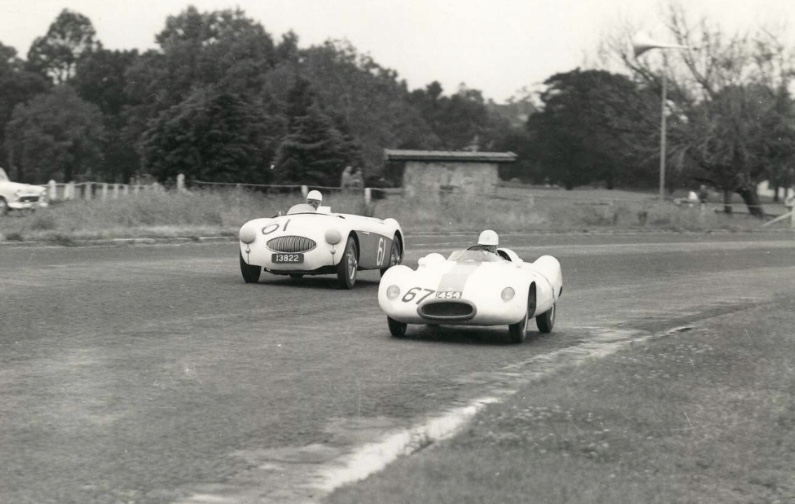
Austin Healey 100S by two: Goldfinch #61 and Paul Hawkins in #77 car (unattributed)
(J Goldfinch Collection)

Etcetera…

The Goldfinch 100S in the ‘Albert Park paddock 500 miles from home’ in Adelaide as Jim noted; Army barracks in the background.

(unattributed)

Alan Jack in the ex-Bill Patterson Cooper Climax goes inside the James Goldfinch Austin Healey 100S. More on many of the cars in this feature on the 1960 Australian Tourist Trophy here; https://primotipo.com/2018/05/17/1960-australian-tourist-trophy/

D Swanton, Lotus 11 Climax, Goodwood 1958 (D Swanton Collection)

Donald Swanton…

Don Swanton was born on March 3, 1930, grew up in Highton Grove, Balwyn and attended Camberwell Grammar School, which was over his back-fence.

His first car was an Amilcar Roadster, his first job allowed the purchase of a Singer 9 which he ‘climbed, and raced at Fishermans Bend. He sold a Cooper to fund a move to the UK in 1955 and soon landed a job at SU in Edgbaston where he worked in the experimental department.

He purchased the Lotus 11 and changed jobs many times in the UK to learn and advance his career then returned to Australia in late-1958, racing the Lotus successfully until he sold it to Tom Corcoran in early 1960.

Swanton married Lorraine in 1967, had a son and daughter, and had a diverse career in Melbourne and Sydney, finally moving into the McKenzie Aged Care Residence in Templestowe in 2020.

D Swanton, Lotus 11 Climax in the UK, Goodwood 1958 (D Swanton Collection)

Credits…

Chris Charge Collection, Edward Steet, Allan Quinn, Ron Hope, ‘Glory Days : Albert Park 1953-58’ Barry Green, Don Swanton Collection, David Syers, Stephen Dalton

Tailpiece…

(D Syers)

Let’s finish with a splash of colour, this group is lining up for one of the sportscar supports, the shot was taken by Austin Distributors salesman, David Syers. #72 is the Monaro Motors owned Peter Manton driven Austin Healey Sprite. “It had only been in the country for two months and Manton had already turfed out the A-Series for a 1100 Coventry Climax and new nose,” quipped Stephen Dalton.

#74 is the JR Phillips Healey. Brian Sampson’s #97 Morris Spl is at left, #90 the Austin Distributors/Brotherton Sprite, then the #73 Esquire Motors/Rod Murphy Sprite, the silver coloured Franz Bird MG Milano with aeroscreen, the #78 Calvert owned, Eddie Perkins driven Porsche 356. In the distance is the red Frank Elkins Triumph TR2.

Finito…

(MotorSport)

“Joisus! Bite your tongue young man!” I showed a far younger bloke a shot of a Chaparral 2F and he offered up, “It doesn’t look that special.” FFS!

But context is everything, one needs to see Chaparrals surrounded by the paradigm set of the day to observe just how edgy their aerrodynamics and technology was/is. GM contribution duly noted.

The photograph above shows the Bruce Jennings/Bob Johnson Chaparral 2F Chev (DNF battery) leading the Jochen Neerpasch/Rolf Stommelen Porsche 910/6 (sixth) – with another 910 up ahead at Le Mans in 1967. The team-leading 2F of Phil Hill and Mike Spence was out after 225 laps with transmission failure, the cars Achilles heel. The winning Shelby Ford GT40 MkIV piloted by Dan Gurney and AJ Foyt completed 388 laps. See here for a feature on Le Mans 1967; https://primotipo.com/2015/09/24/le-mans-1967/

(MotorSport)

On the hunt, the Mike Spence/Jim Hall 2F (DNF diff) closes on the West/Osborn/Allison Shelby GT350 (disq outside assistance) under brakes at Sebring in 1967. The Bruce McLaren/Mario Andretti Ford GT40 MkIV won. More on the Chaparral 2F here; https://primotipo.com/2014/06/26/67-spa-1000km-chaparral-2f/

(MotorSport)

Simply superb. Aluminium monocoque chassis, steering rack and period typical outboard front wishbone suspension. Look at the emphasis on brake rotor and caliper cooling.

Hill/Spence with Mike at the wheel, Le Mans 1967 (MotorSport)
(MotorSport)
(LAT)

Vic Elford’s Chaparral 2J Chev at Riverside during the final 1970 Can-Am Challenge round. Bonus points for the names of the crew. Q1 by only a little over two-seconds! from Denny Hulme’s championship winning McLaren M8D Chev and DNF auxiliary engine after only two laps. Denny won.

(MotorSport)

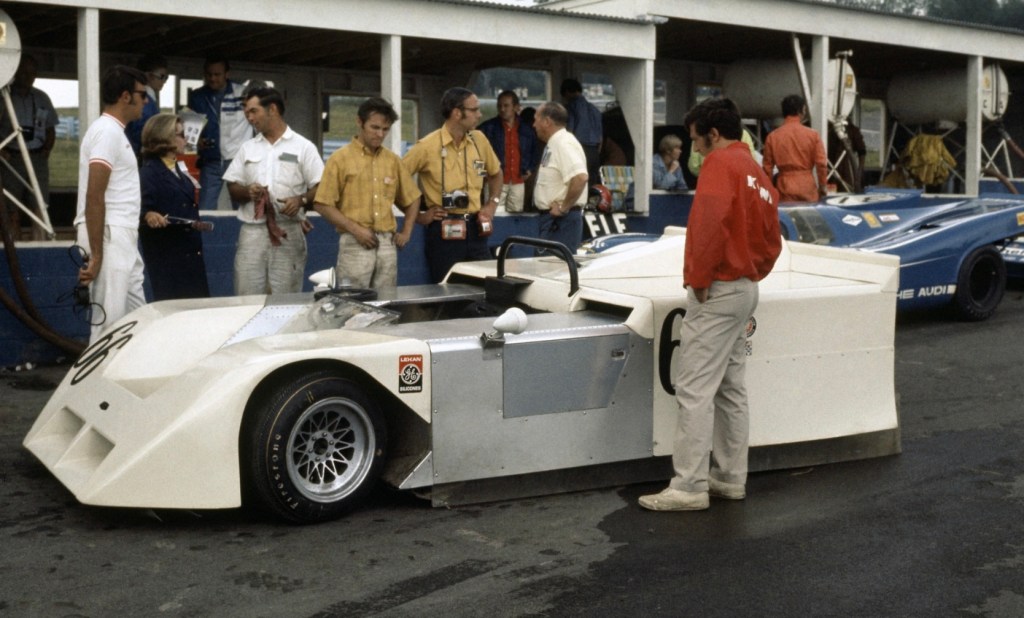
Chaparral 2J-001 at rest during the Watkins Glen Can-Am/Six Hour July 11 1970 weekend, with one of the Porsche Salzburg 917Ks behind. Jackie Stewart raced the 2J, Q3 and DNF brake failure, see here for more; https://primotipo.com/2022/09/17/chaparral-2j-chev/

Riverside 1970 (MotorSport)
(MotorSport)

Either Hap Sharp was a very big unit or the interviewer is a tiny-tot? Looking happy, he has just won the Governor’s Trophy & Nassau Tourist Trophy race aboard a 2E Chev during the 1966 Nassau Speed Week; none of that nancy-boy Nomex crap for Hap.

(MotorSport)

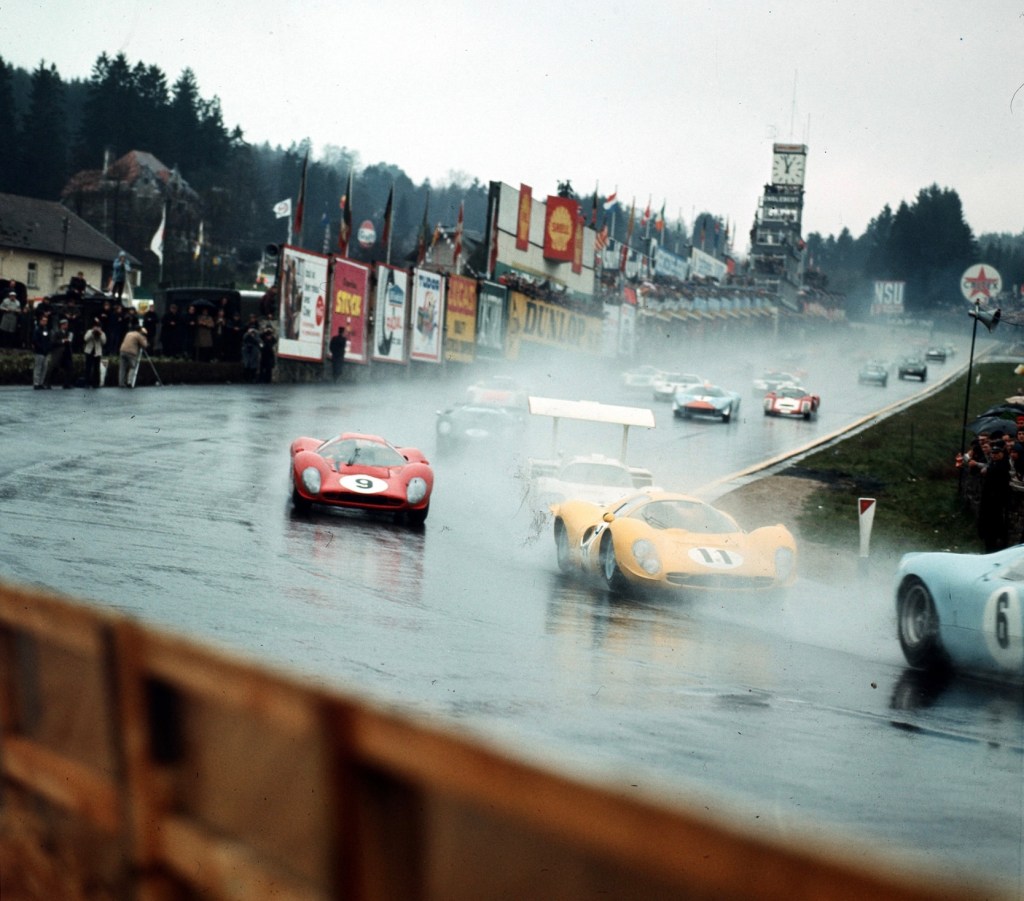
It still looks radical even if you can’t properly see it! The Spence/Hill 2F up the pointy end at the start of the May 1967 Spa 1000km.

#6 is the first placed Jacky Ickx/Dick Thompson Mirage Mk1 Ford, the Willy Mairesse/Beurlys Ferrari 330P4/412P follows and then the works-Ferrari P4 crewed by Mike Parkes/Phil Hill. Sadly another gearbox failure for the Chaparral boys.

Credits…

MotorSport Images

Tailpiece…

(MotorSport)

Franz Weis was a key member of the Rattlesnake Raceway crew from the outset, and all the way through. More than a few Aussies used 5-litre Chaparral Chevs built by him in the Formula 5000 era. Here he is with Jim Hall’s Chaparral 2A Chev at Corry Field Pensacola, Florida before the USRRC round in April 1964.

Jim Hall won the race from Roger Penske’s Cooper T61 Monaco Chev and Ed Hugus’ Lotus 23B Lotus-Ford. Hall won the 10 round championship with victories in four rounds, Sharp took one win. See here for a feature on the 2A; https://primotipo.com/2020/01/25/chaparral-2a-chev/

Finito…

(LAT)

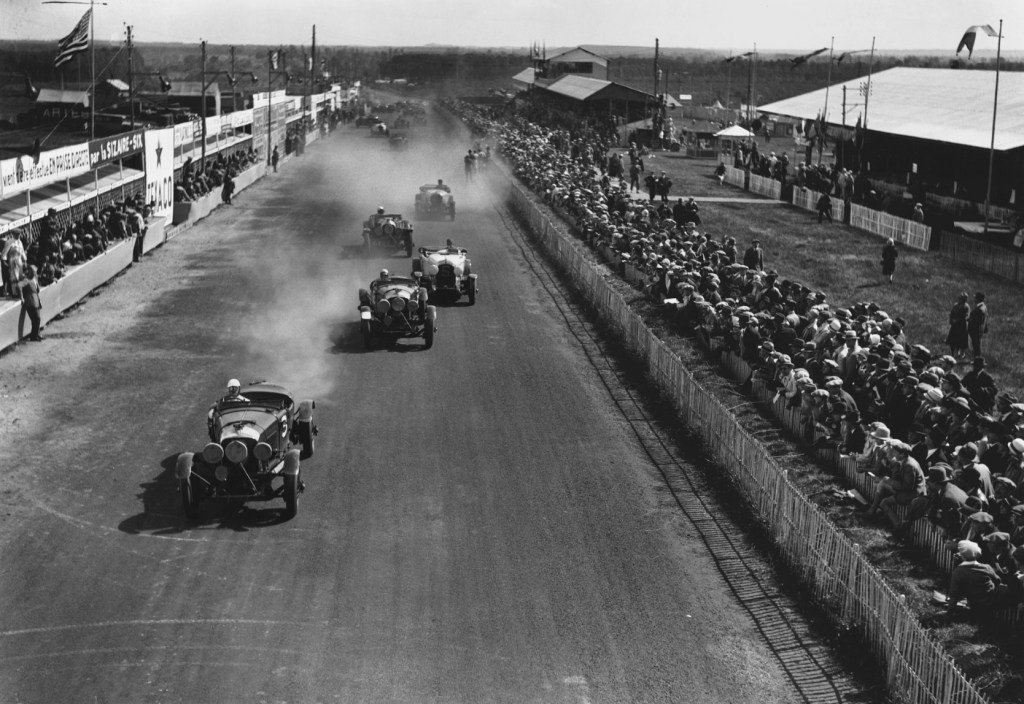
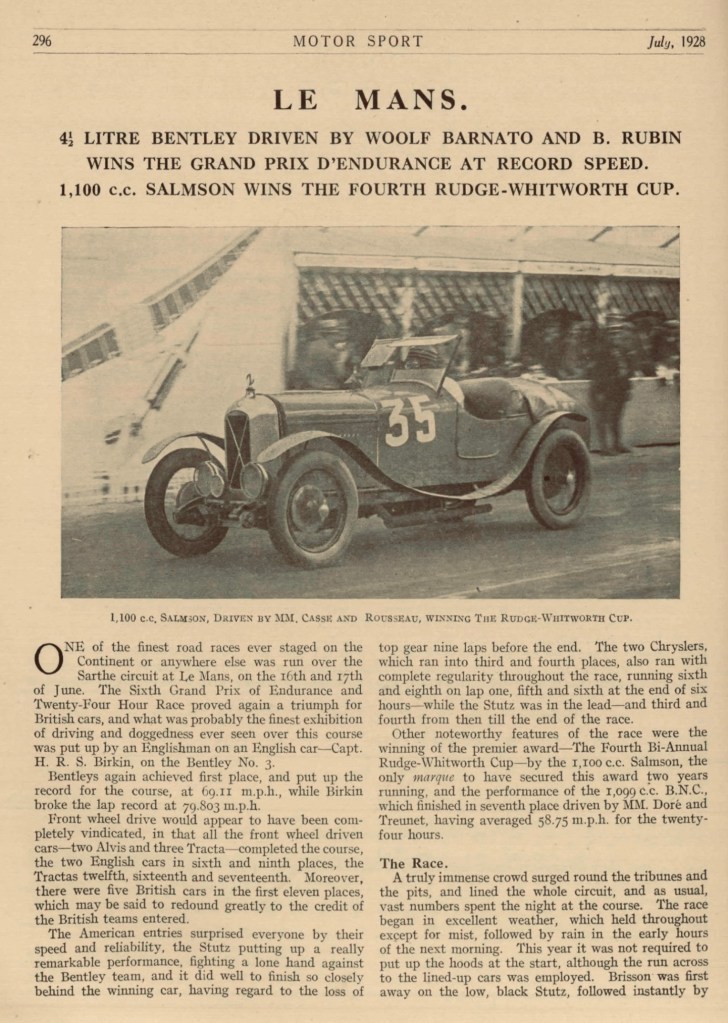
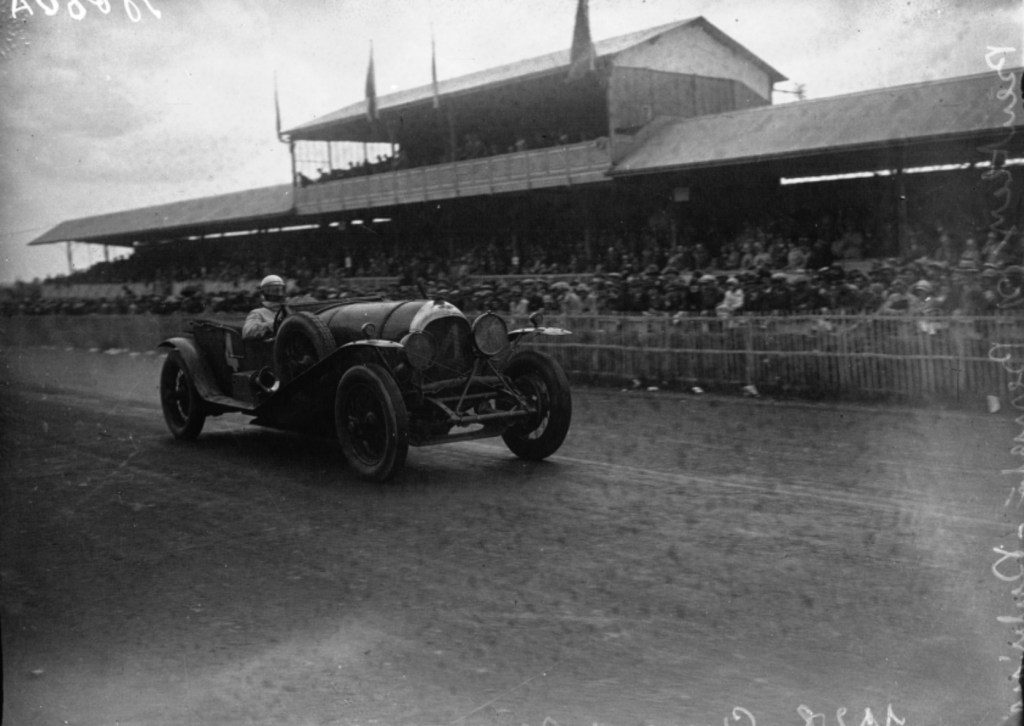
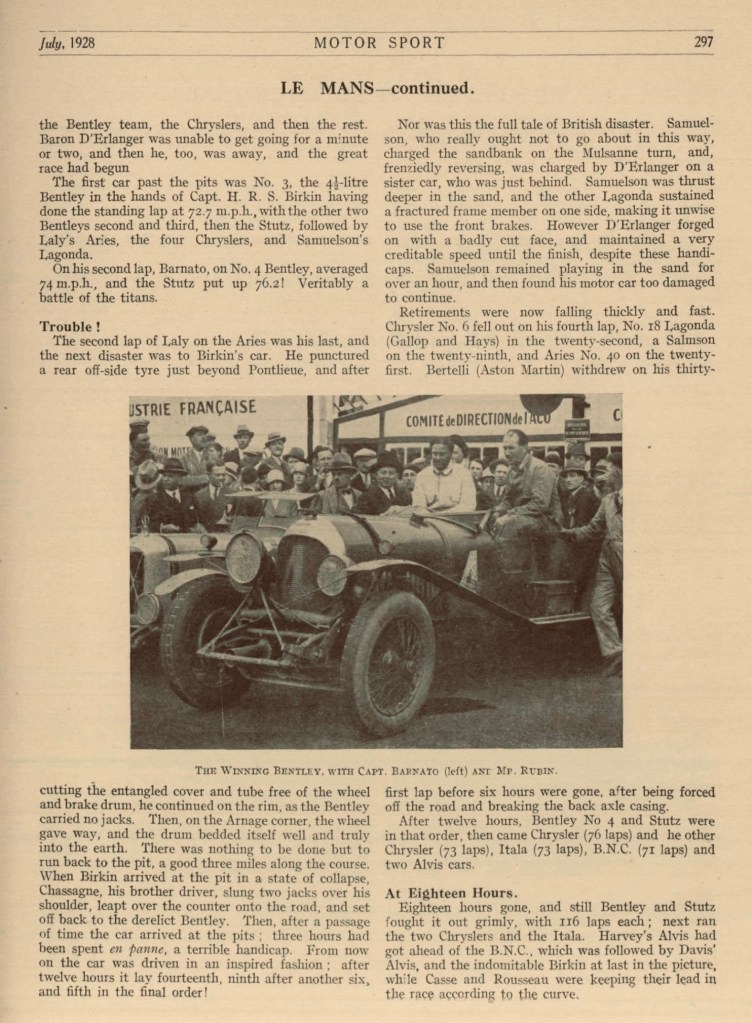
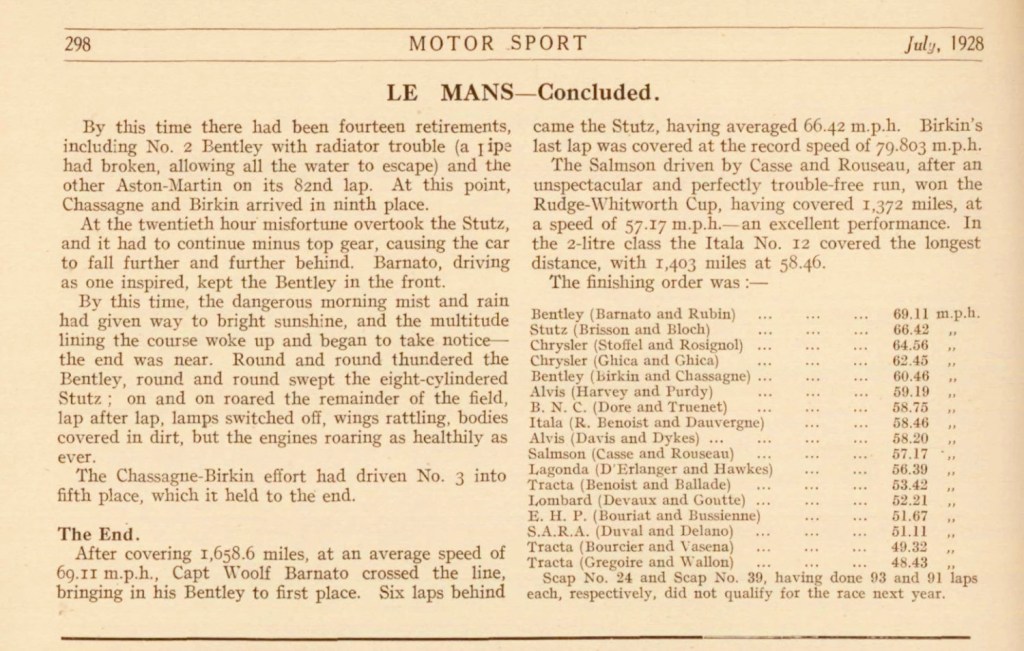
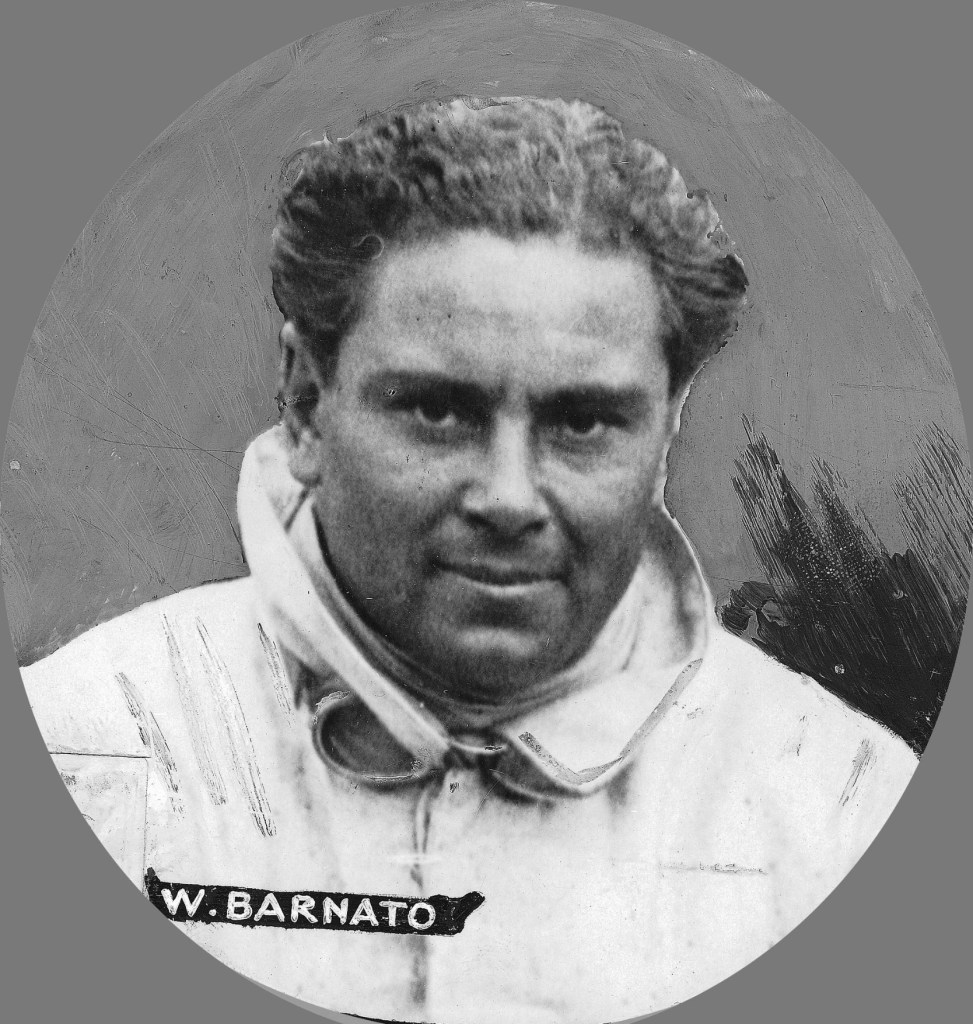
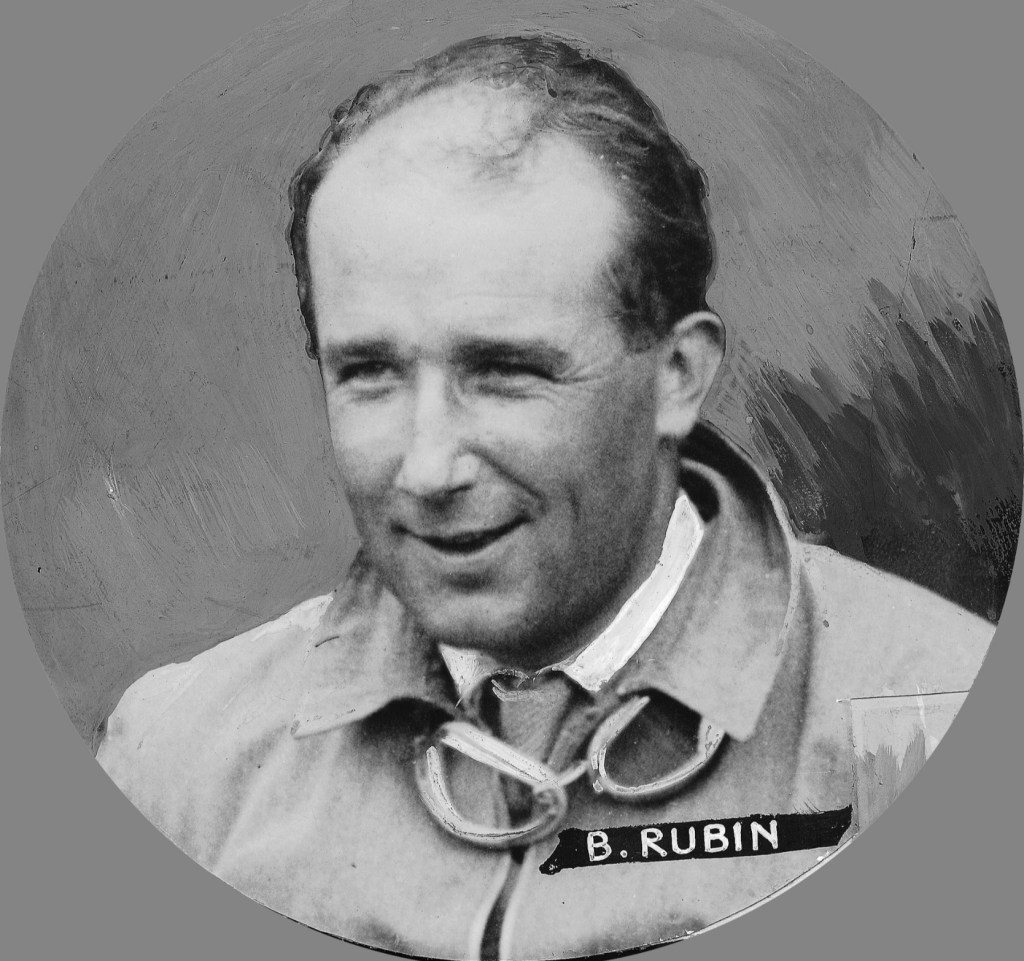
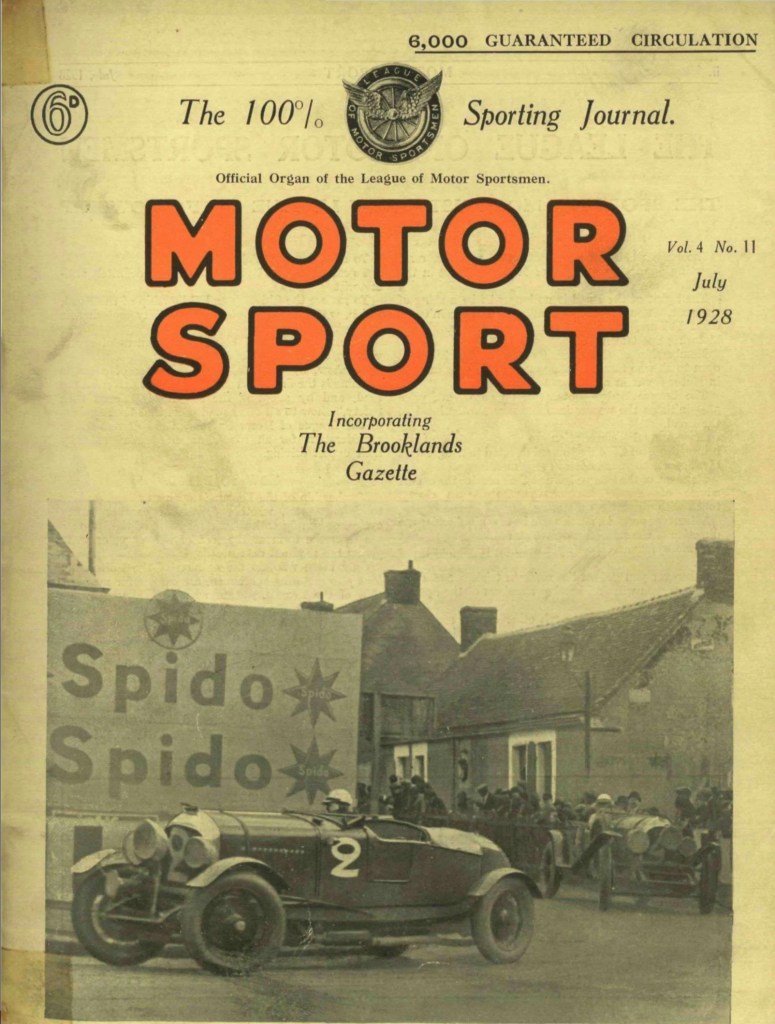
Woolf Barnato and Bernard Rubin on their winning Bentley Motors Ltd entered Bentley 4½-Litre at Le Mans, June 17, 1928. The duo completed 155 laps, 2669 km.

Second was the Robert Bloch/Éduard Brisson Stutz DV16 Black Hawk ‘Bearcat’ 5.2-litre straight-eight, with the André Rossignol/Henri Stoffel Chrysler 72 Six 4.1-litre third, having completed 154 and 144 laps respectively.

It was Bentley’s third victory in the race: Frank Clement and John Duff won aboard a 3-litre Sport in 1924 – the second time the event was held – and Dudley Benjafield and Sammy Davis, 3-litre Speed in 1927. The marque won again in 1929, Barnato/Birkin 6½-Litre Speed Six, 1930, Barnato/Kidston 6½-Litre  Speed Six and most recently the Capello/Kristensen/Smith Speed Eight in 2003.

(LAT)

Tim Birkin/Jean Chassagne Bentley 4½-Litre in front of the other team car driven by the Frank Clement/Dudley Benjafield then the Louis Chiron/Cyril de Vere Chrysler Six Series 72. The Birkin car finished fifth, the other pair were DNFs: the Clement machine with radiator hose/oil issues, and Chiron/De Vere were disqualified after a bump-start.

Barnato/Rubin (unattributed)
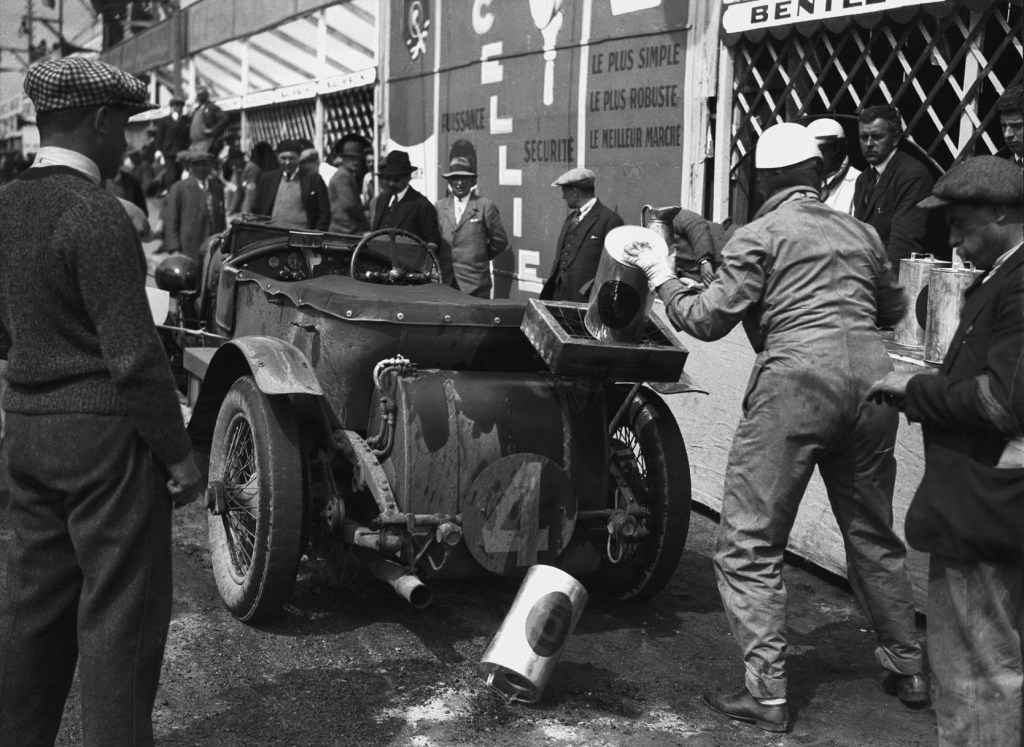
Pitstop for the winning car (LAT)

(LAT)
(LAT)

Bentley 4½-Litre chassis ST3001…

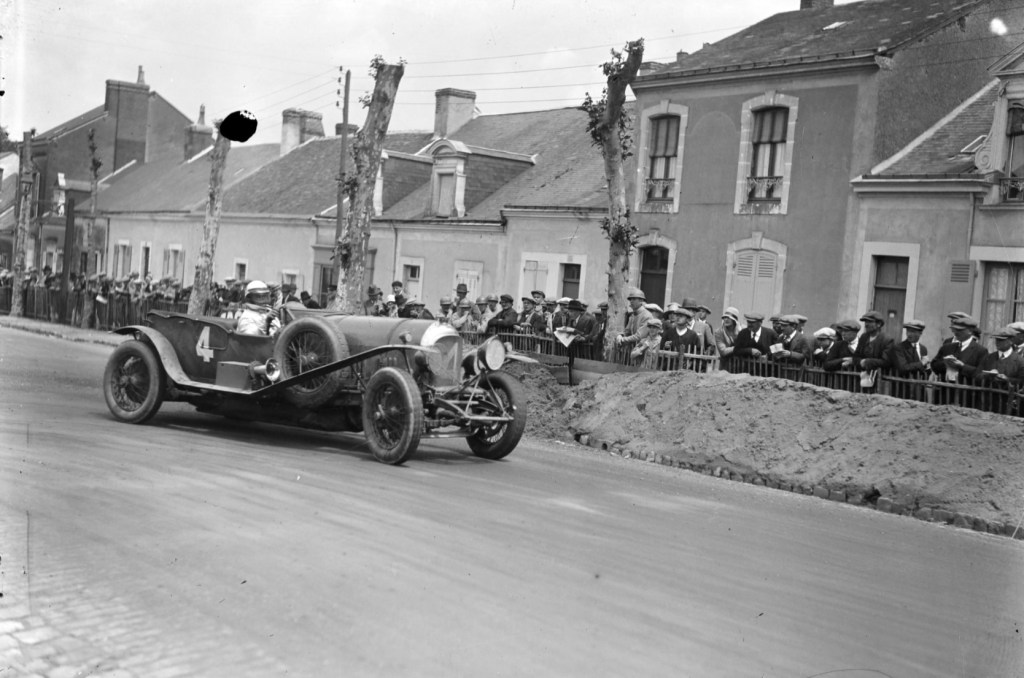
The winning Barnato/Rubin machine, chassis ST3001 (above) was the first Bentley 4½-Litre off the Cricklewood production line. Completed in June 1927 with Vanden Plas Le Mans-type body, it was delivered to Barnato for use as a Bentley Motors team car.

Barnato gave ST3001 the nickname Old Mother Gun. YH 3196 debuted at Le Mans in 1927. Driven by Frank Clement and Leslie Callingham the car set a lap record on its second lap with the convertible hood still up. ST3001 retired from the race after 35 laps while leading, having become enmeshed in the infamous White House Crash that eliminated seven cars, including the Bentley team. There was a second 24-hour race held at the Circuit de la Sarthe on August 15-16 that year, the Grand Prix de Paris. Frank Clement and George Duller led from the off and won it by over 80 miles.

In 1928 the car won despite the challenges. Frank Clement’s car was forced out when the chassis frame cracked, disconnecting a water hose and emptying the radiator. All seemed lost again when the frame of Old Mother Gun, leading at the time, also cracked with about 15 miles to go. Despite having to ease, Barnato hung on with the other 4½-Litre of Birkin/Chassagne fifth after losing a lot of time during a wheel change.

ST3001’s chassis was then replaced with a new heavy-pattern chassis frame. OMGs second chassis was later used to rebuild the 4½-Litre MF3157.

In 1929, Old Mother Gun raced again Le Mans, as the only 4½-Litre entered, alongside Bentley’s two 6½-Litre Speed Six’. Victory went to the Speed Six Old Number One with Old Mother Gun second raced by Jack Dunfee and Glen Kidston.

(LAT)

The rest of the field…

(LAT)

The Maurice Benoist/Louis Balart Tracta FWD leads the similar car of Roger Bourcier/Hector Vasena, while below, the Bourcier/Vasena machine passes the stranded – but ultimately eighth placed and first in class – Robert Benoist/Christian d’Auvergne Itala 65S 2-litre.

(LAT)

(LAT)

The Clive Gallop/EJ Hayes FW Metcalfe entered Lagonda OH 2L Speed, DNF accident.

(LAT)

The Sammy Davis/Bill Urquhart-Dykes (ninth) and Maurice Harvey/Harold Purdy (sixth) Alvis TA FWDs and to the right, the Lucien Lemesle/Henry Godard S.C.A.P – Sociéte de Construction Automobile Parisienne – (DNF) in the pitlane before the off, and below, Davis at speed.

(LAT)
(LAT)

Action for the grandstand crowd, the Émile Maret/Gonzaque Lécureul S.A.R.A SP7 (DNF) battles with the Goffredo Zehender/Jérôme Ledour, Chrysler Six 72 DNF radiator.

(LAT)

The Maurice Benoist/Louis Balart Tracta-SCAP (12th) chases the (11th) Baron André d’Erlanger/Douglas Hawkes Lagonda OH 2L Speed.

(LAT)

The Robert Benoist/Christian d’Auvergne Itala 65S passes the crashed Sir Francis Samuelson/Frank King Lagonda, Samuelson was experiencing gearbox problems at the time he crashed.

As the MotorSport report reads, our Knight’s frenzied reversing efforts resulted in his teammate, D’Erlanger, in another FE Metcalfe entered Lagonda, colliding with him and pushing him further into the sand and through a fence. The shot below shows him in this situation, as the Gregoire/Vallon Tracta passes.

(LAT)
(LAT)

The shot above shows Samuelson attempting the difficult task of releasing the left-front guard/wheel from the voracious clutches of the fence and sandbank. A task in which he was unsuccessful.

(LAT)

Front of the field action from the winning Barnato/Rubin Bentley 4½-Litre and second placed Édouard Brisson/Robert Bloch Stutz DV16 Black Hawk ‘Bearcat’.

(LAT)

Journo’s enjoying a Gauloise – with a Pernod closeby no doubt – as they interview a driver atop the pit counter.

(LAT)

Gorgeous Lombard AL3 of Lucien Desvaux/Pierre Gouette, they finished 13th outright and third in the 1100cc class.

(LAT)

Winners are grinners, sort of. Not really at all actually. Bentley Boys Frank Clement, Tim Birkin and Woolf Barnato.

Credits…

LAT Photographic, MotorSport, MotorSport Images, F2-Index, Wikipedia

Tailpiece…

(LAT)

Incredibly evocative, romantic shot of Francis Samuelson trying to extricate his Lagonda from the ‘merde’ while the Maurice Harvey/Harold Purdy Alvis TA FWD passes (sixth)…and the shadows grow ever longer. Marvellous.

Finito…

(FoMoCo)

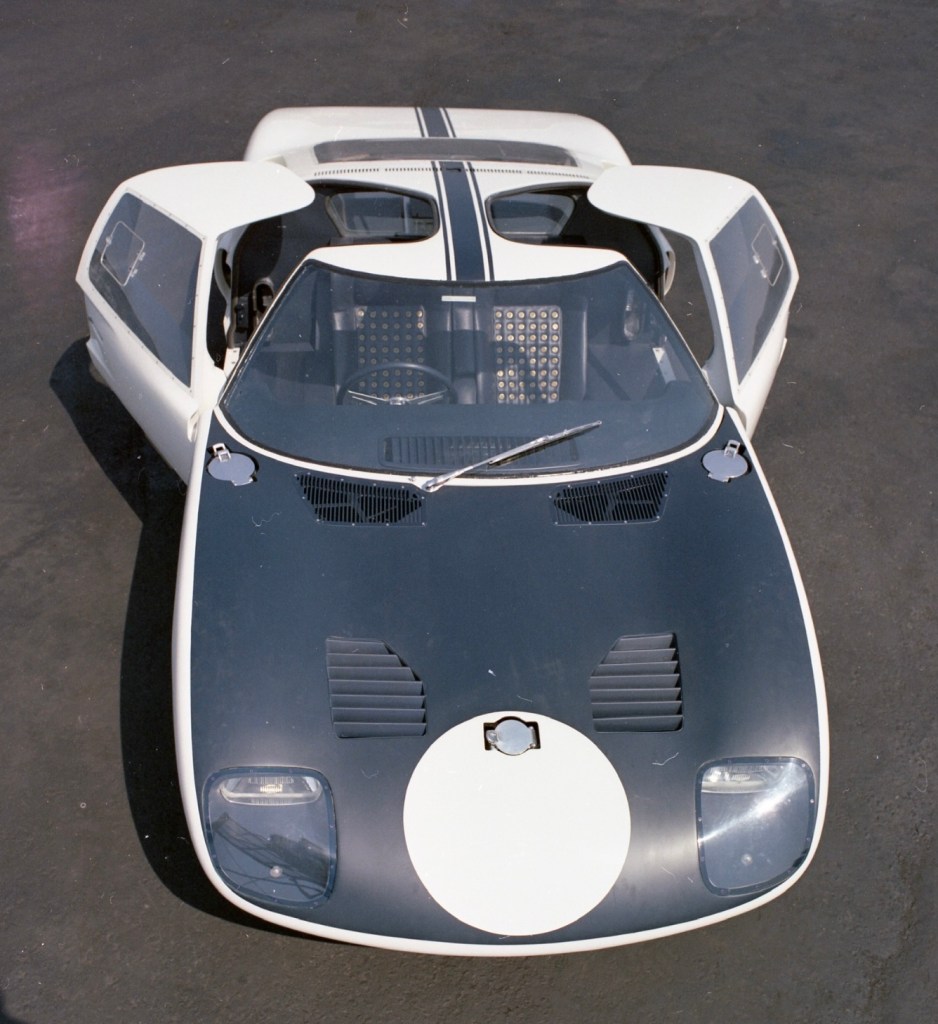
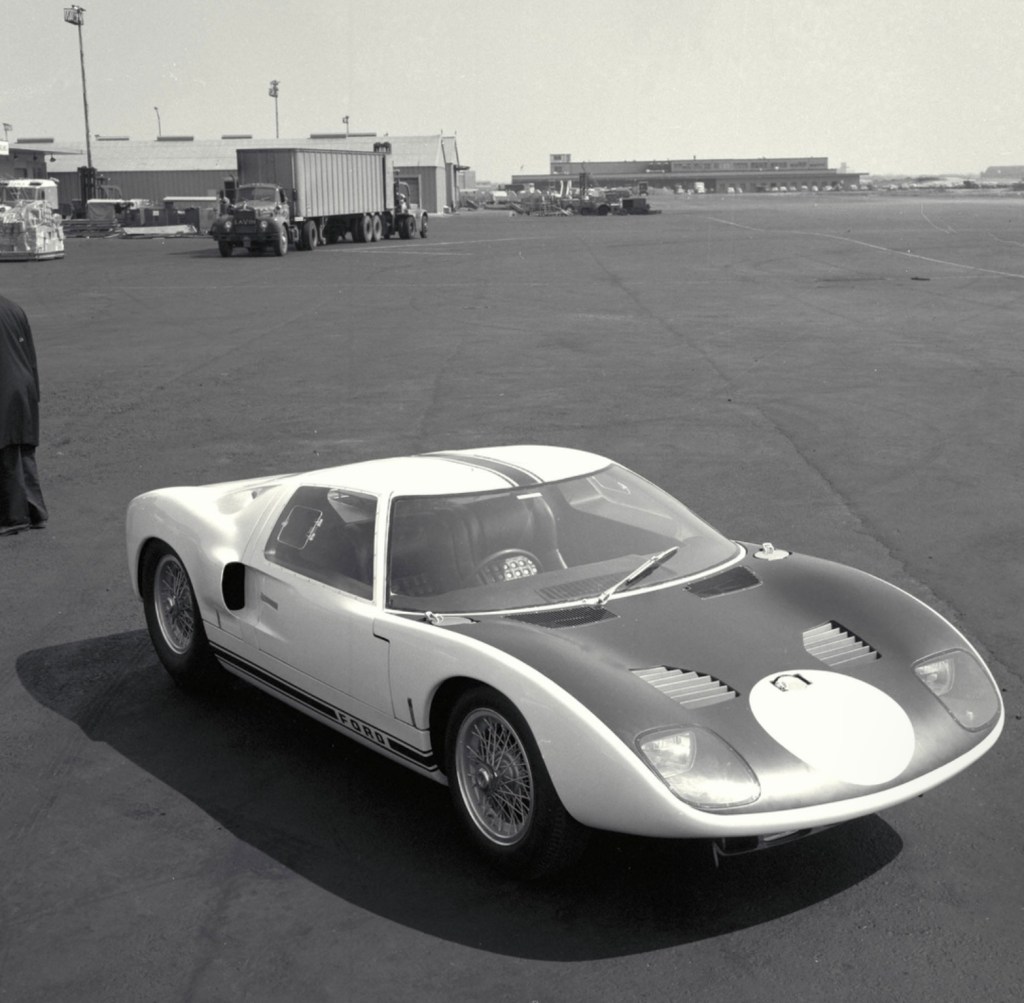
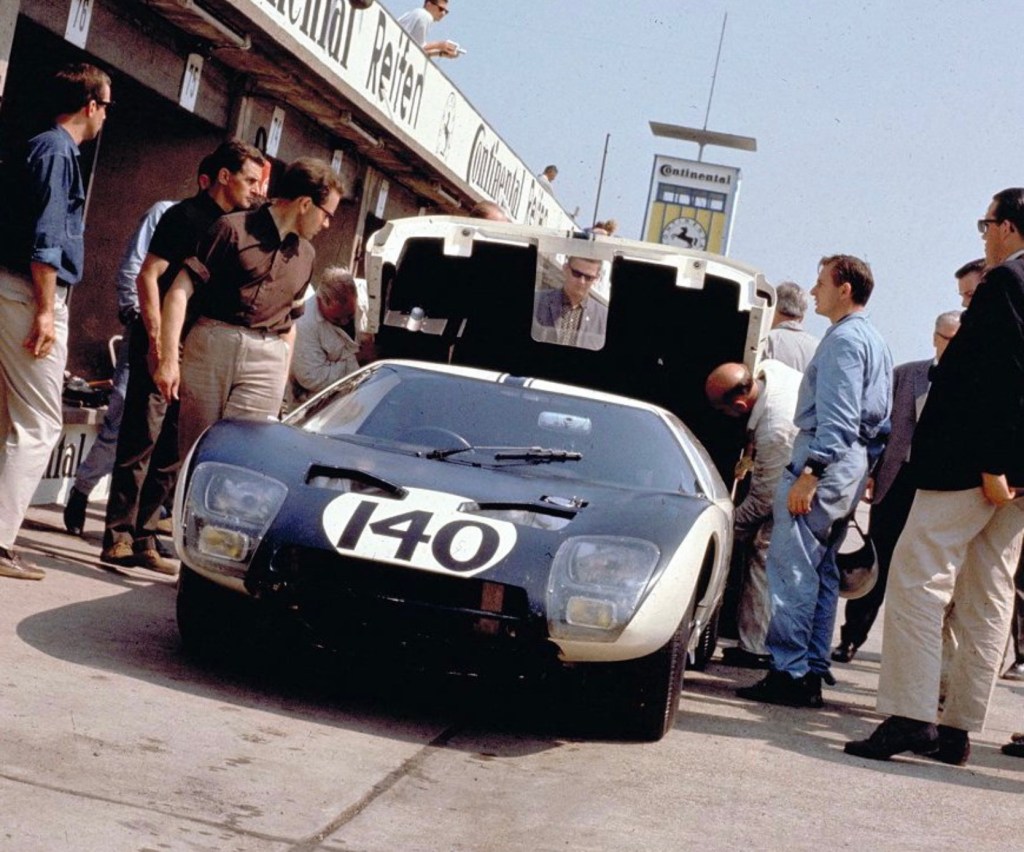
Ford GT40 chassis 101, the first of 12 prototypes built, on the runway at JFK Airport, New York, in early April 1964…

The machine is on its way to the New York International Auto Show, having been presented publicly to journalists in an open day at Slough, then outside the offices of Trans World Airlines at Heathrow on April Fools Day, before it was flown to the US “to be used for a press conference prior to the Mustang launch,” then display between April 4-12.

The car was a starlet for only the briefest of times, it was destroyed in an accident in the wet while being driven by Jo Schlesser during the Le Mans test weekend on April 18.

Jo Schlesser, Le Mans test weekend, Ford GT40 #101, April 1964 (MotorSport)
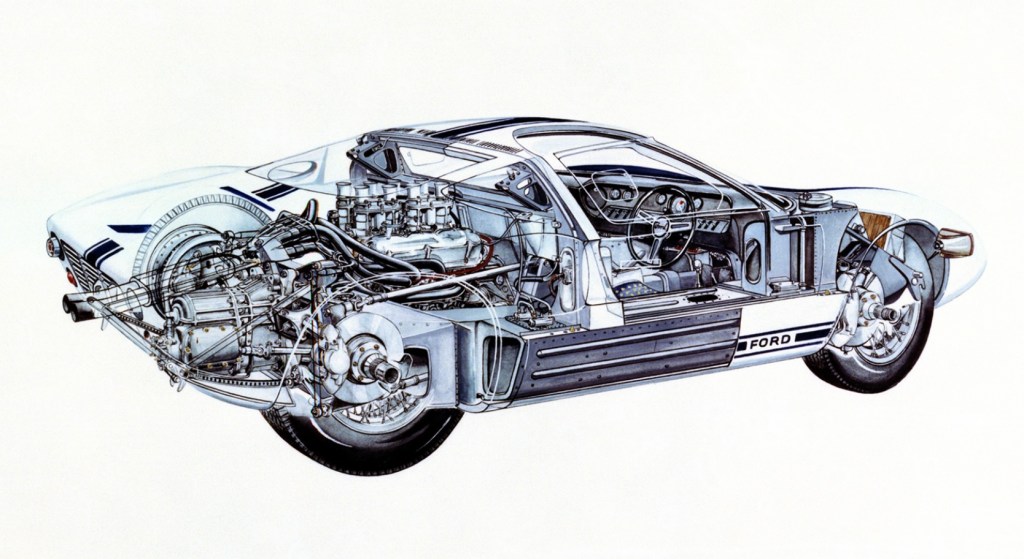
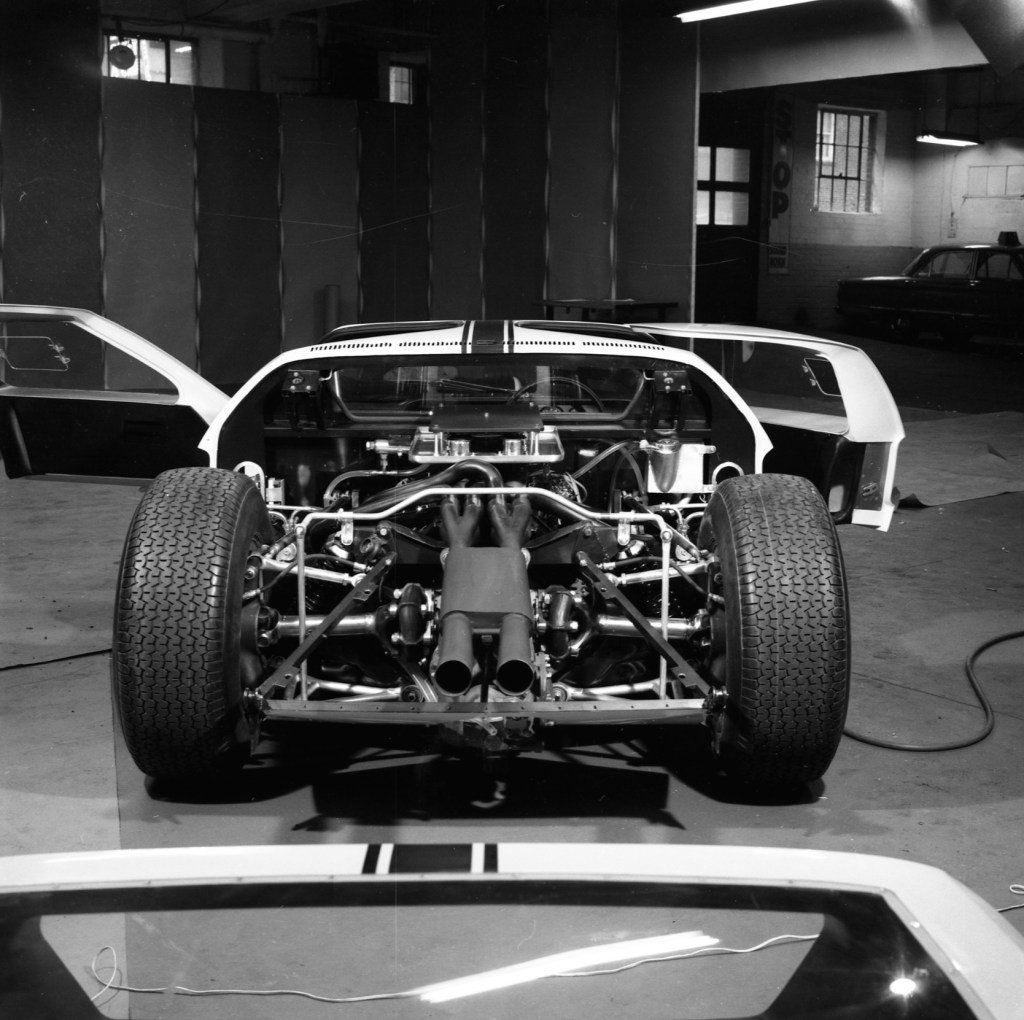
Ford GT40 1964 cutaway (FoMoCo)

Ford’s blunt telex on May 22, 1963 announced the end of discussions of the takeover of Ferrari by the Detroit giant. “Ford Motor Company and Ferrari wish to indicate, with reference to recent reports of their negotiations toward a possible collaboration that such negotiations have been suspended by mutual agreement.”

A month later Ford created the High Performance and Special Models Operations Unit – catchy ‘innit? – to design and build a Le Mans winner. Members of that group included Roy Lunn and Carroll Shelby. Kar Kraft was established within FoMoCo to oversee the Ford GT program, with Lunn its manager.

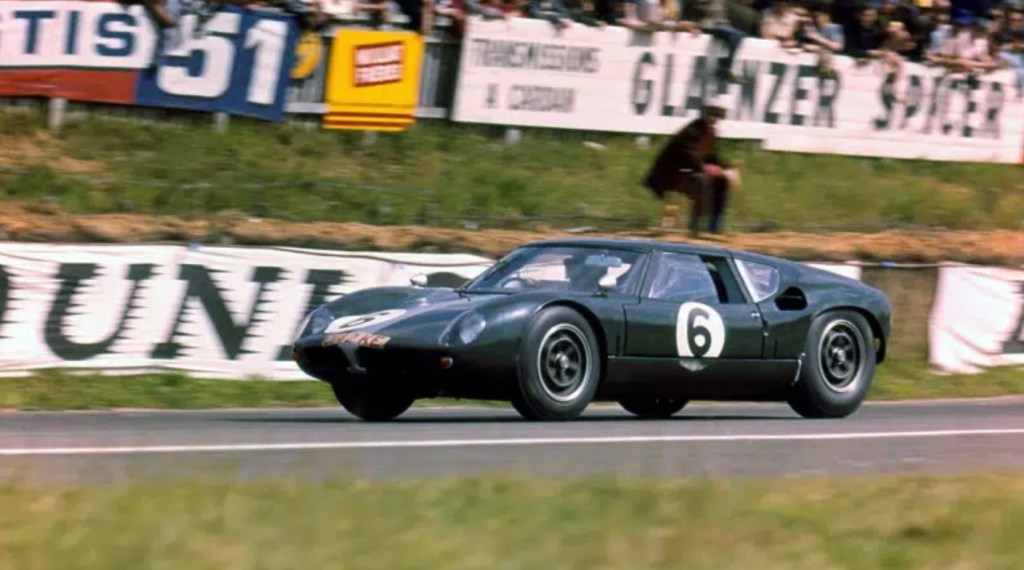
They soon identified and contracted Eric Broadley as project engineer, his monocoque Lola Mk6 GT Ford, which had performed well at Le Mans in 1963, despite not finishing, was a ground-breaking sports-prototype. As part of the deal Ford acquired the two existing Lola GTs, giving them a nice head start. John Wyer was appointed as race manager, a role he had performed at Aston Martin when Shelby co-drove an Aston Martin DBR1 with Roy Salvadori to Le Mans victory in 1959.

“The four pronged team comprised Lunn and Broadley designing and building the cars, Wyer managed the operation with Shelby acting as frontman in Europe,” Ford wrote.

(FoMoCo)

Key members of the Slough design team included Broadley, Lunn, Phil Remington and Len Bailey.

In the 10 months prior to the ’64 Le Mans classic the program got underway at Lola’s premises in Bromley. The Ford Advanced Vehicles (FAV) operation later moved to a factory in Slough, alongside Lola, who moved as well – in the middle of what is now referred to as Motorsport Valley – in the Thames Valley.

Some development work was carried out in Dearborn, but in essence the Ford GT40 was a British design funded by US dollars. The Ford contribution – most critically was absolute monetary and management commitment from the top to succeed – included engines and aero-modelling in which a scale model of the car was tested in their Maryland wind tunnel. Computer aided calculations related to aerodynamics under braking was undertaken and anti-dive geometry explored. The two Lola Mk6 Fords were used as mobile test-beds in the hands of Bruce McLaren and others until the end of 1963.

Le Mans test weekend (MotorSport)
(FoMoCo)

Let’s go back to the April 1964 logistics of #101. Ford GT40 anoraks shouldn’t get too excited by this piece, the words are a support for a bunch of great Ford Motor Company photos taken at JFK and in the studio I’ve not seen before. After the New York International Auto Show, the car retuned to the UK and was transported to the Motor Industry Research Association (MIRA) test track at Nuneaton where private shakedown tests took place.

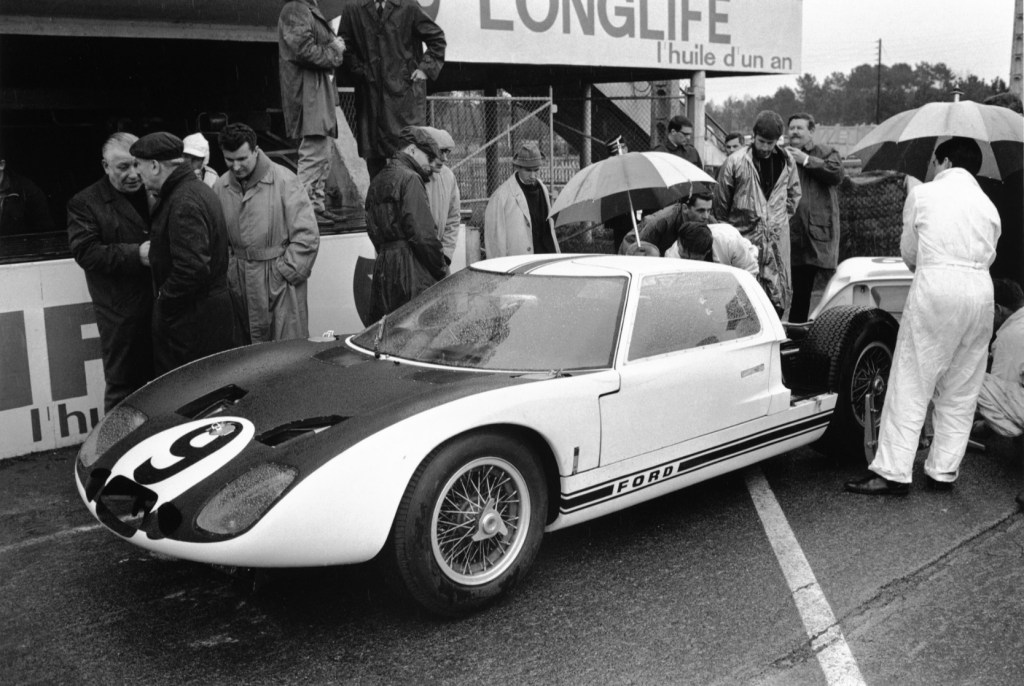
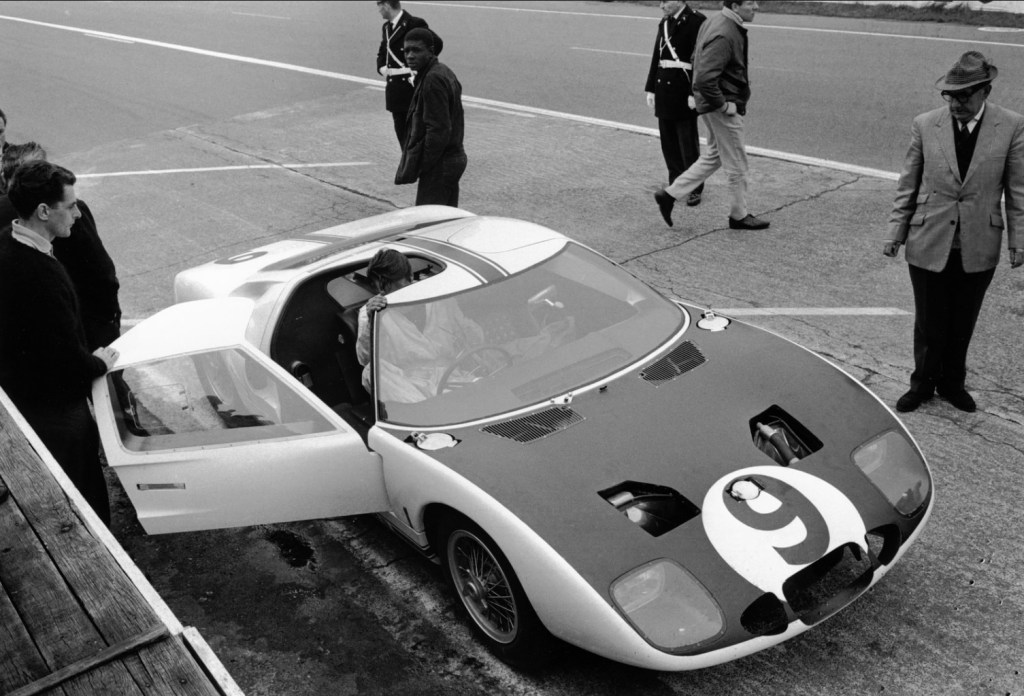
The Le Mans test weekend followed on April 18-19. Jo Schlesser was allocated #101 and Roy Salvadori #102. Jo had already complained about high speed directional instability, when, on his eighth lap, he lost control in the wet at over 150mph. Miraculously, the car didn’t roll or hit trees, but it was destroyed with Schlesser copping only a minor cut to his face. Lady Luck was with him that day…not so at Rouen in 1968.

(FoMoCo)

Chassis and Suspension…

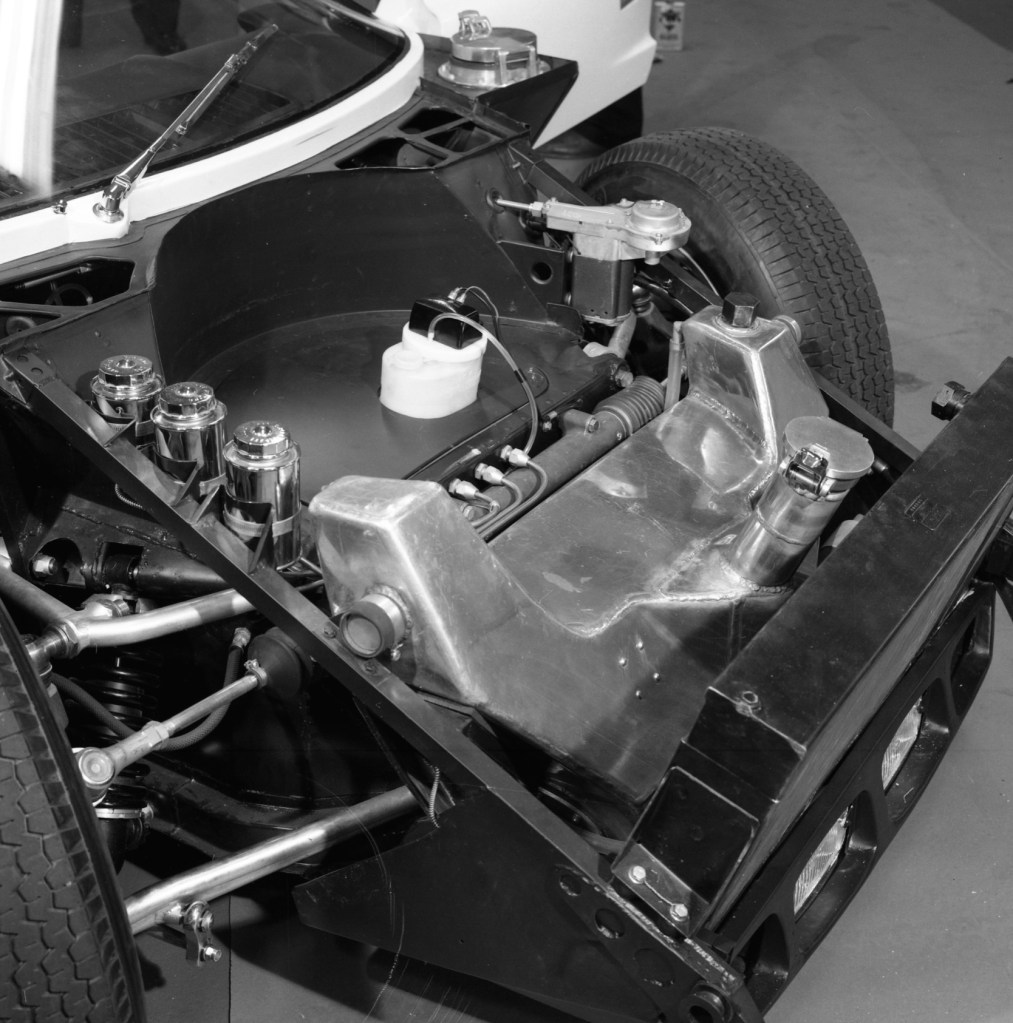
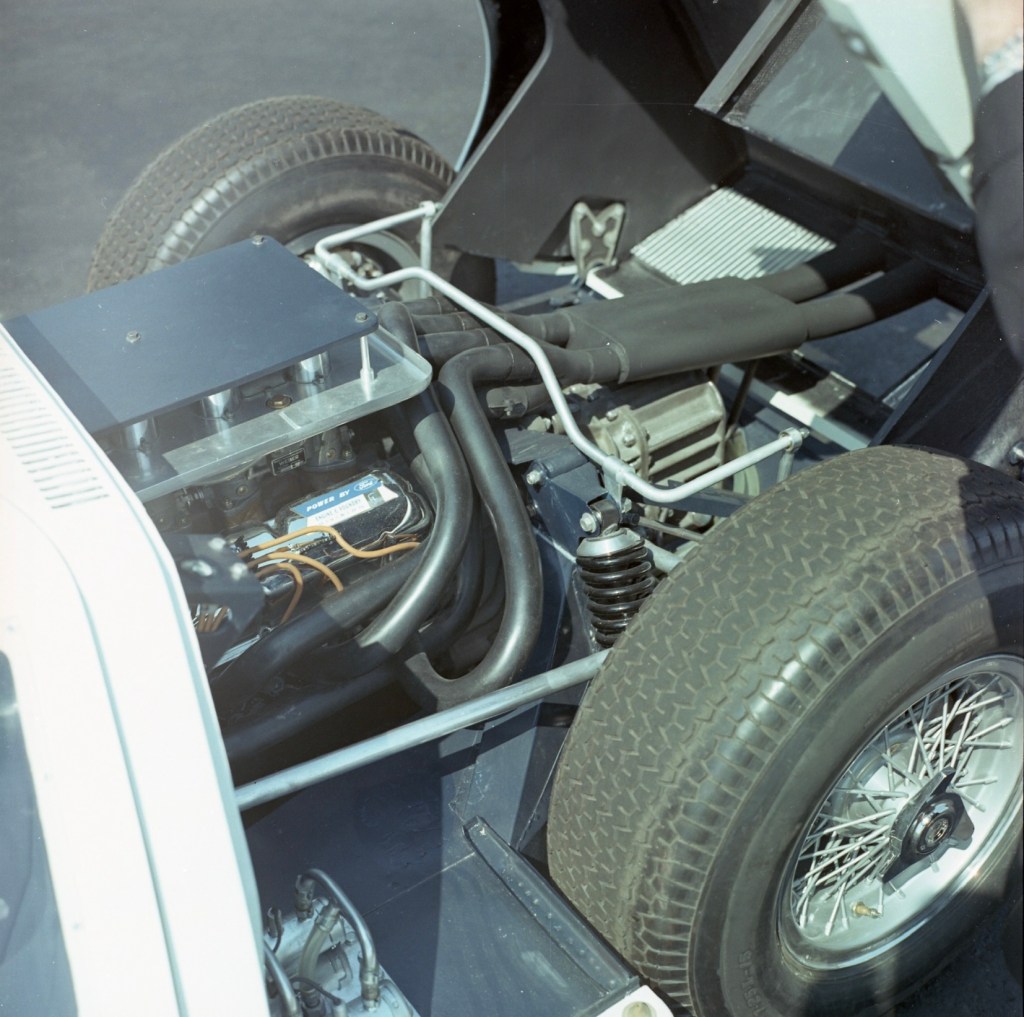
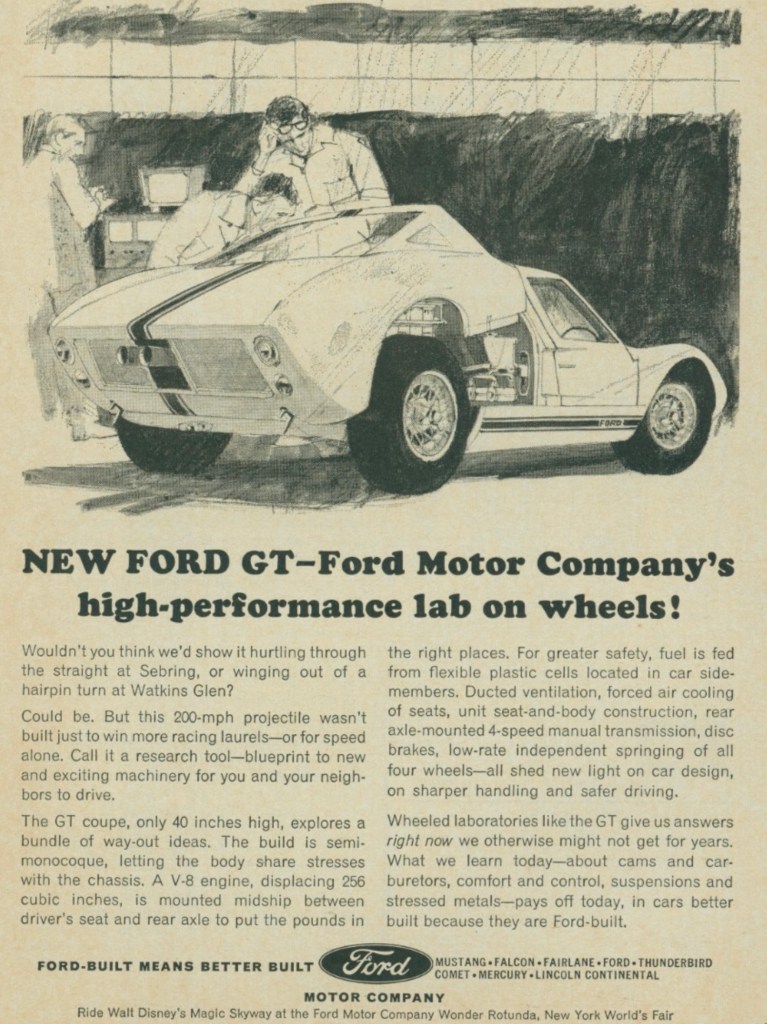
The Abbey Panels built steel monocoque – Eric Broadley wanted aluminium, while Ford wanted steel – incorporated two square tube stiffeners that ran from the scuttle to the nose. At the rear was a lightweight detachable subframe which supported the engine and suspension. Each sill-panel housed a bag-type fuel tank. The car weighed circa 865kg.

(FoMoCo)
(FoMoCo)

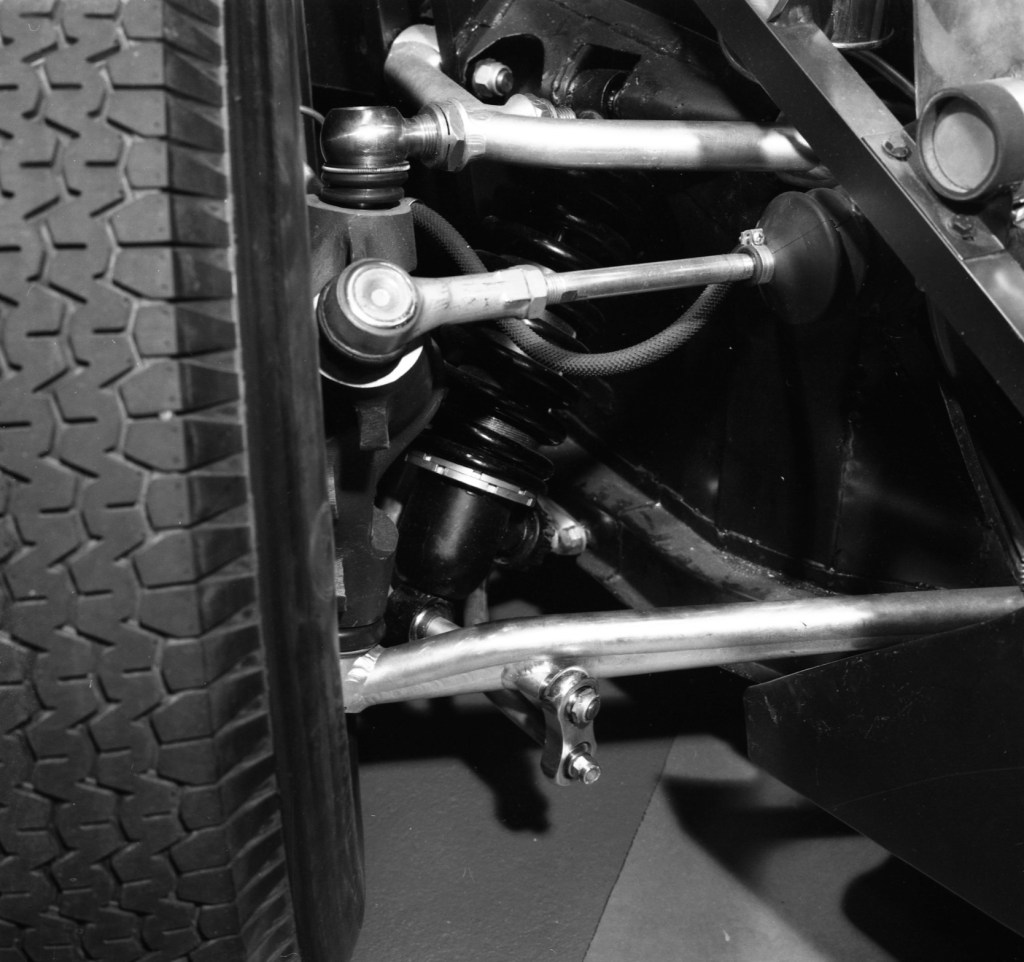
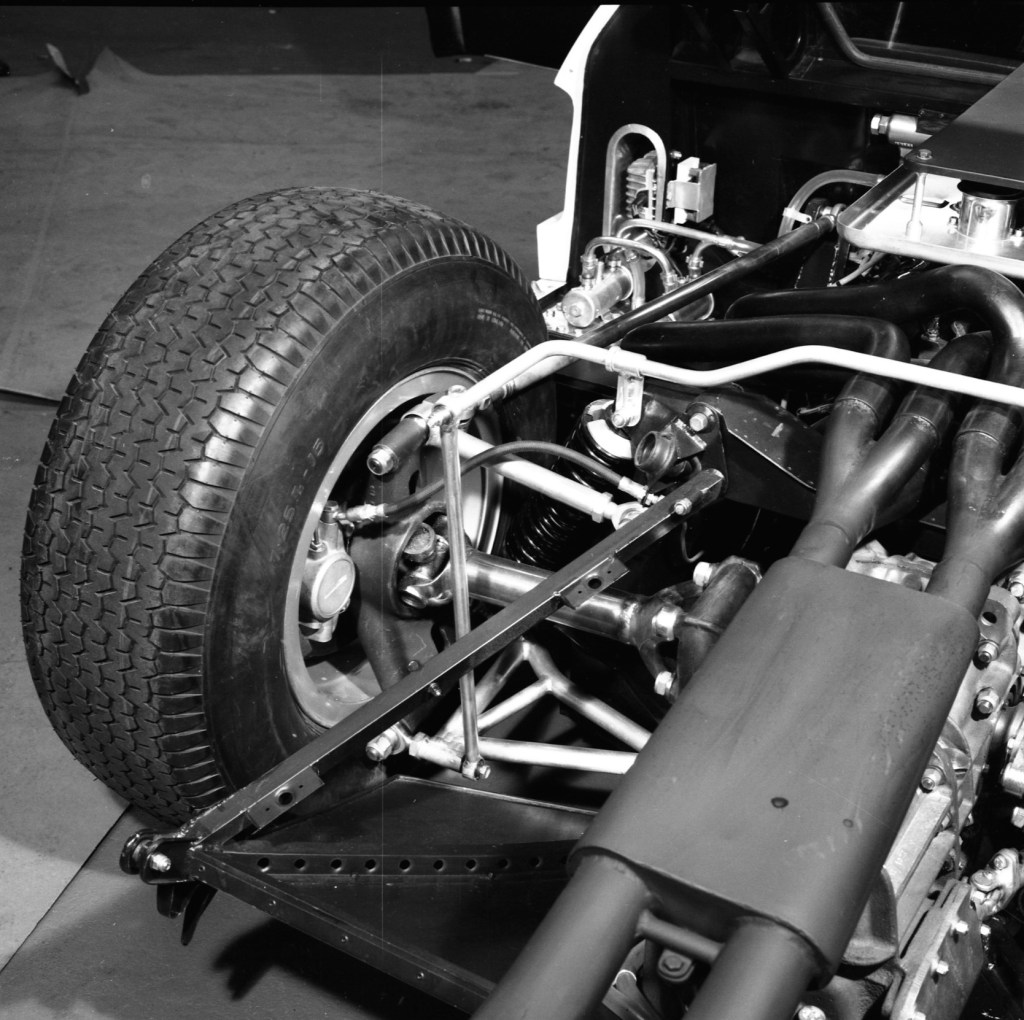
Front suspension was period typical upper and lower wishbones and coil spring/ Armstrong damper units, and an adjustable roll bar, the uprights were made of magnesium alloy. There was nothing radical at the rear either. Again the uprights were mag-alloy, there were single top links, lower inverted wishbones, coil spring/dampers and two radius rods looking after fore-aft location, and an adjustable roll bar.

(FoMoCo)

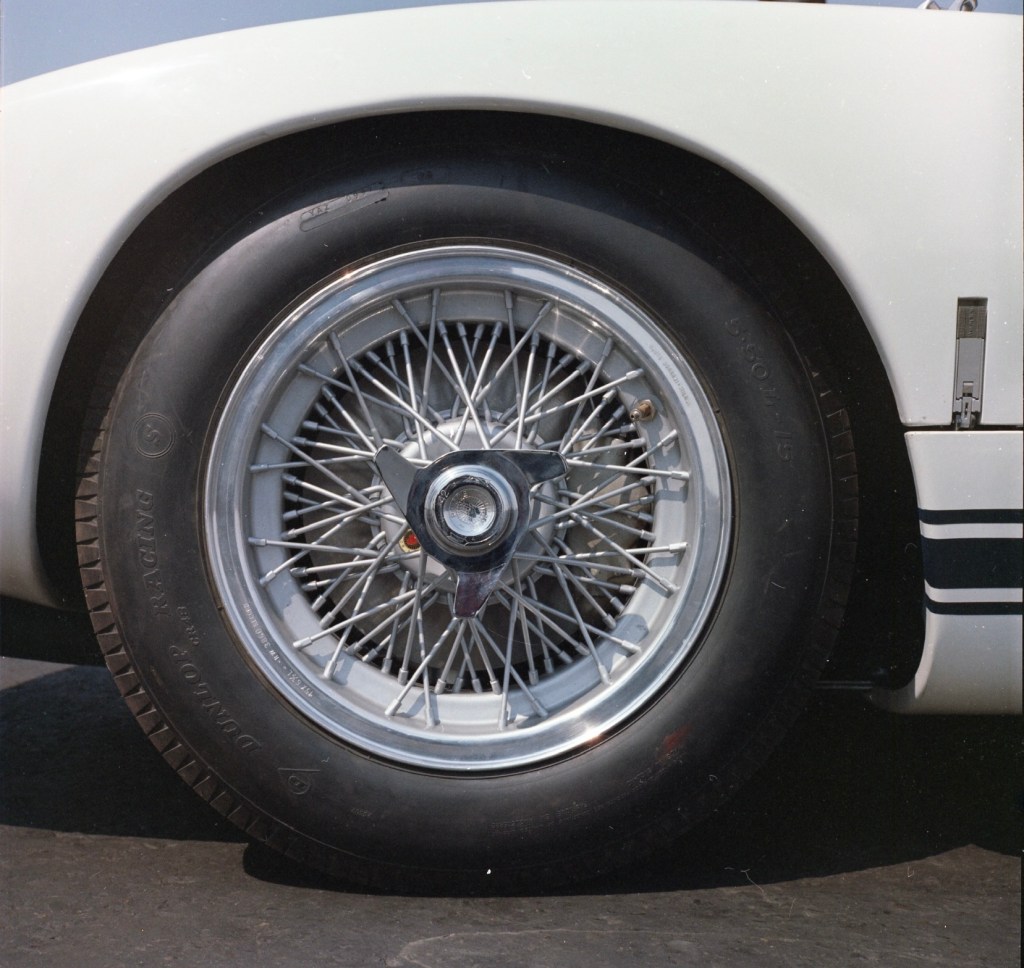
Brakes were 11.5 inch Girling rotors and calipers, while the wheels were heavy 15-inch Borrani wires, pretty naff by that stage given the modern technology used throughout the design; and addressed by Shelby American when they took over developmental charge of the race program from the end of 1964. The knock-off Borranis were 6.5-inches wide at the front and 8-inches up the back. ‘Boots’ were Dunlop R6s.

(FoMoCo)

Engine and Transmission…

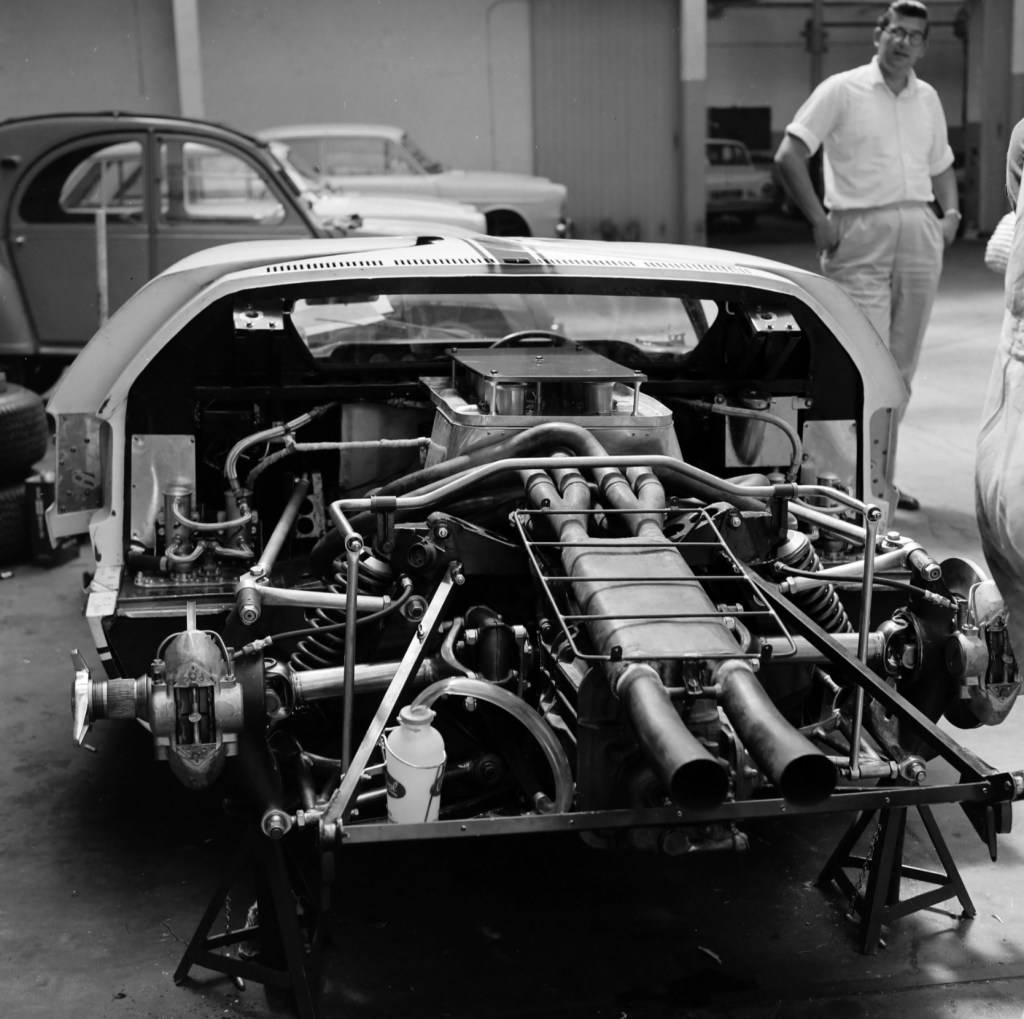
The engine was a Ford Windsor small-block, cast iron, pushrod 90 degree 255cid V8. With a bore-stroke of 95.5 x 72.9mm, the four 48IDA Weber fed 4183cc engine developed circa 350bhp @ 7200rpm and 299lb-ft of torque at 5200rpm using a compression ratio of 12.5:1.

Colotti provided their Type 37 four speed transaxle which incorporated a limited slip diff to get the power to the road via a Borg and Beck triple plate clutch. Gear ratios were of course to choice, with a top speed of 205mph quoted with Le Mans gearing.

(FoMoCo)

Bodywork and Aerodynamics…

The GT40 name came about by picking up on the cars incredibly low height, two inches lower than than Broadley’s Lola Mk6.

Specialised Mouldings, a Lola supplier, based then in Upper Northwood, made the fibreglass bodies, the aerodynamics of which took much time to get right. Shelby ‘perfected’ the sensational, muscularly-erotic shape of the cars which won Le Mans in 1966-68-69 over the winter of 1964-65. The ’67 Mk4 being a different aerodynamic kettle-of-fish.

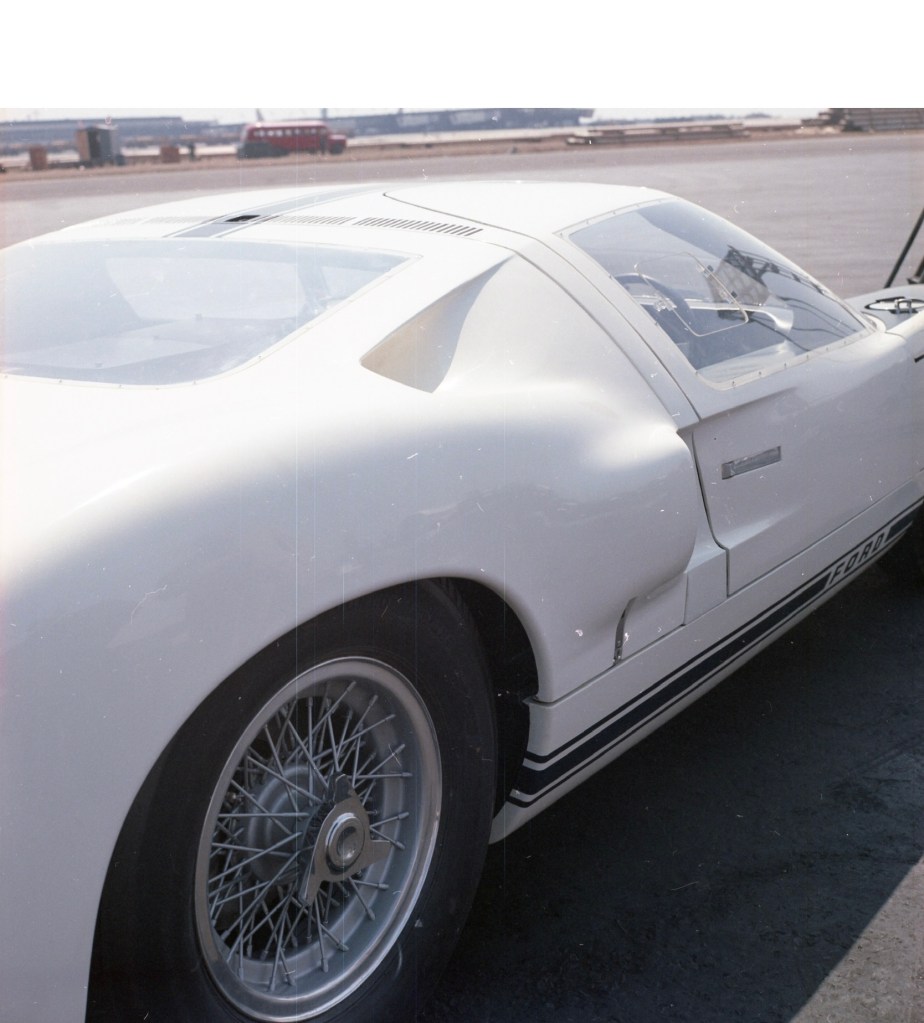
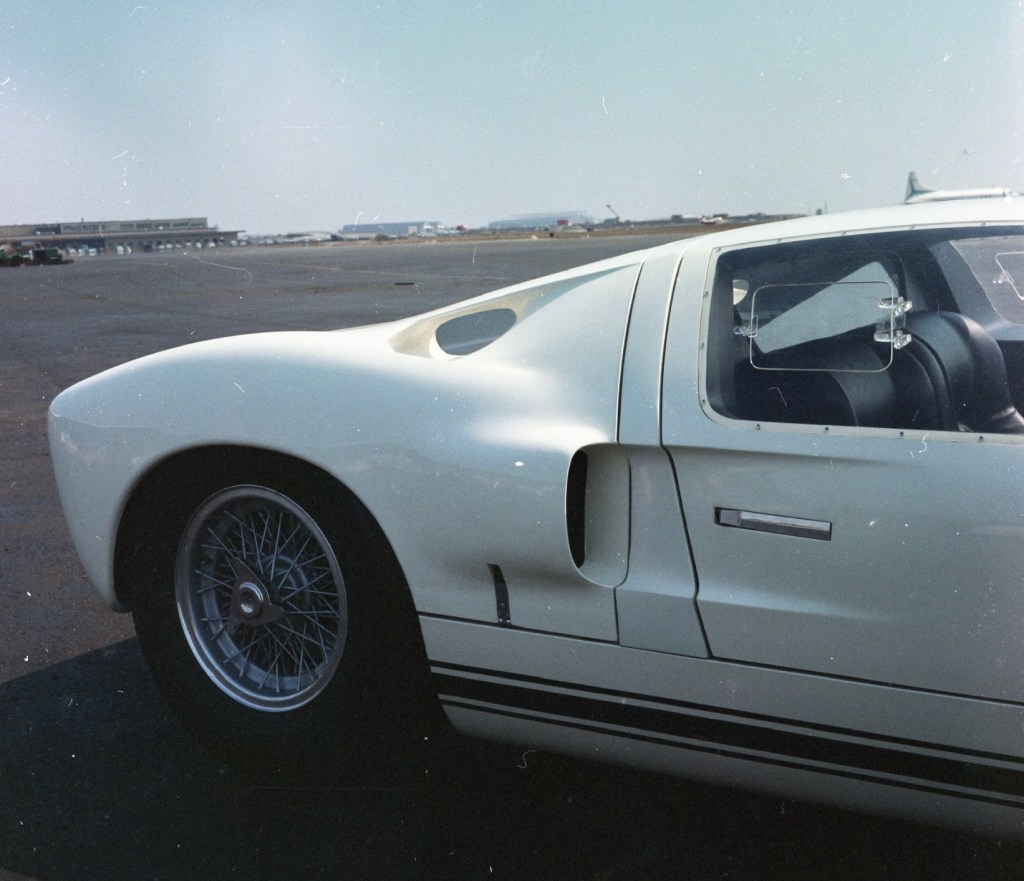
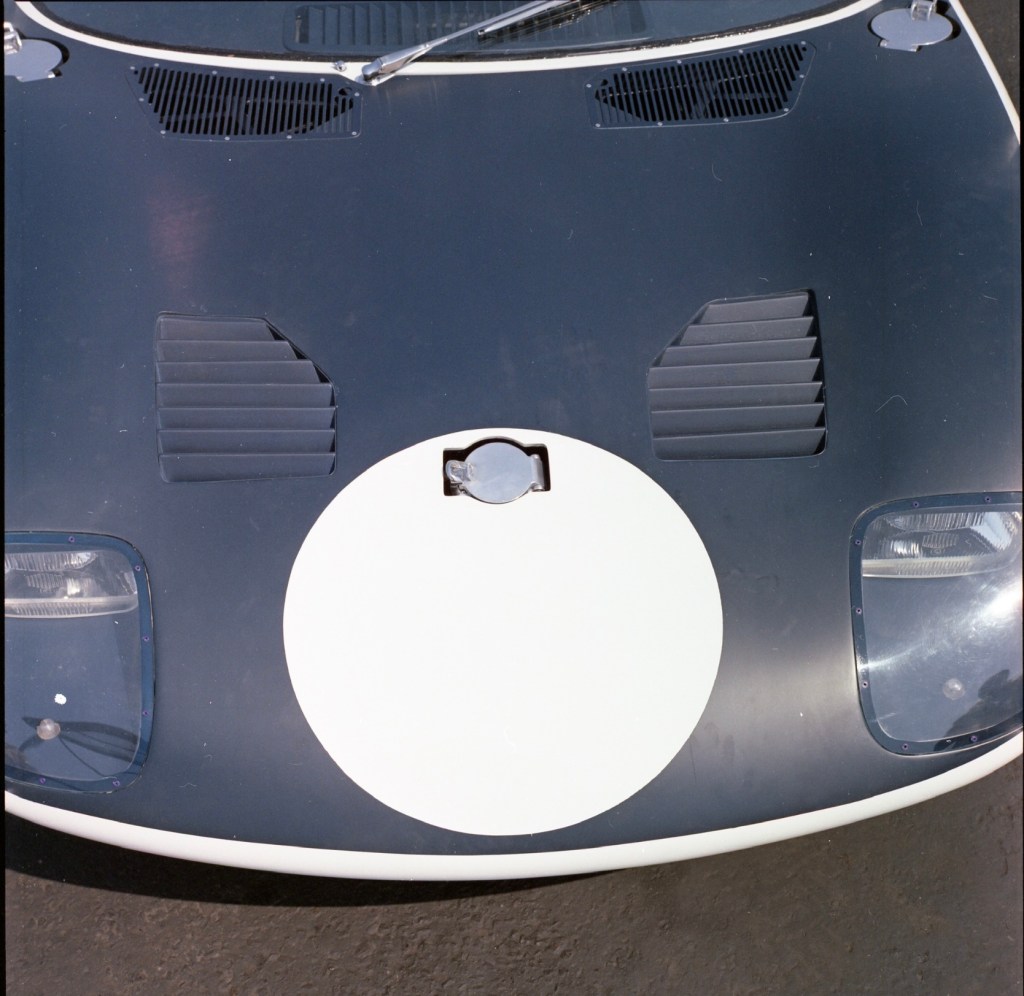
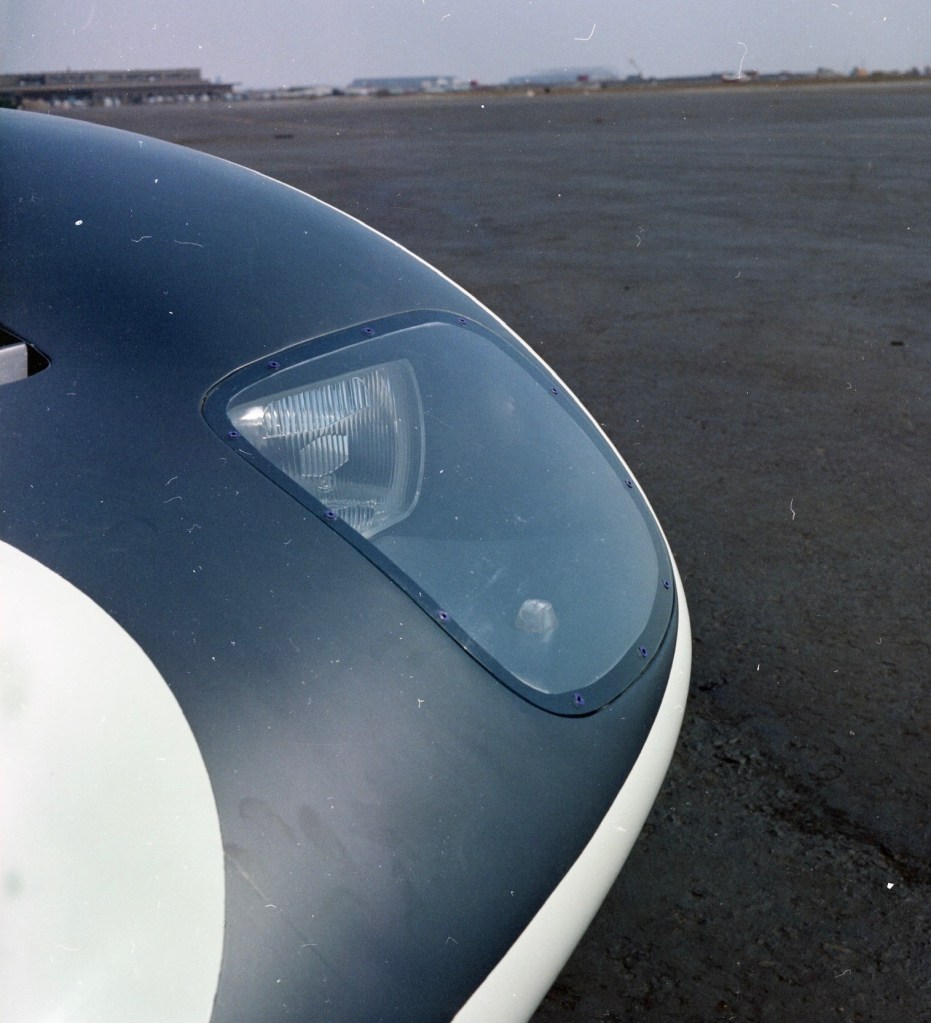
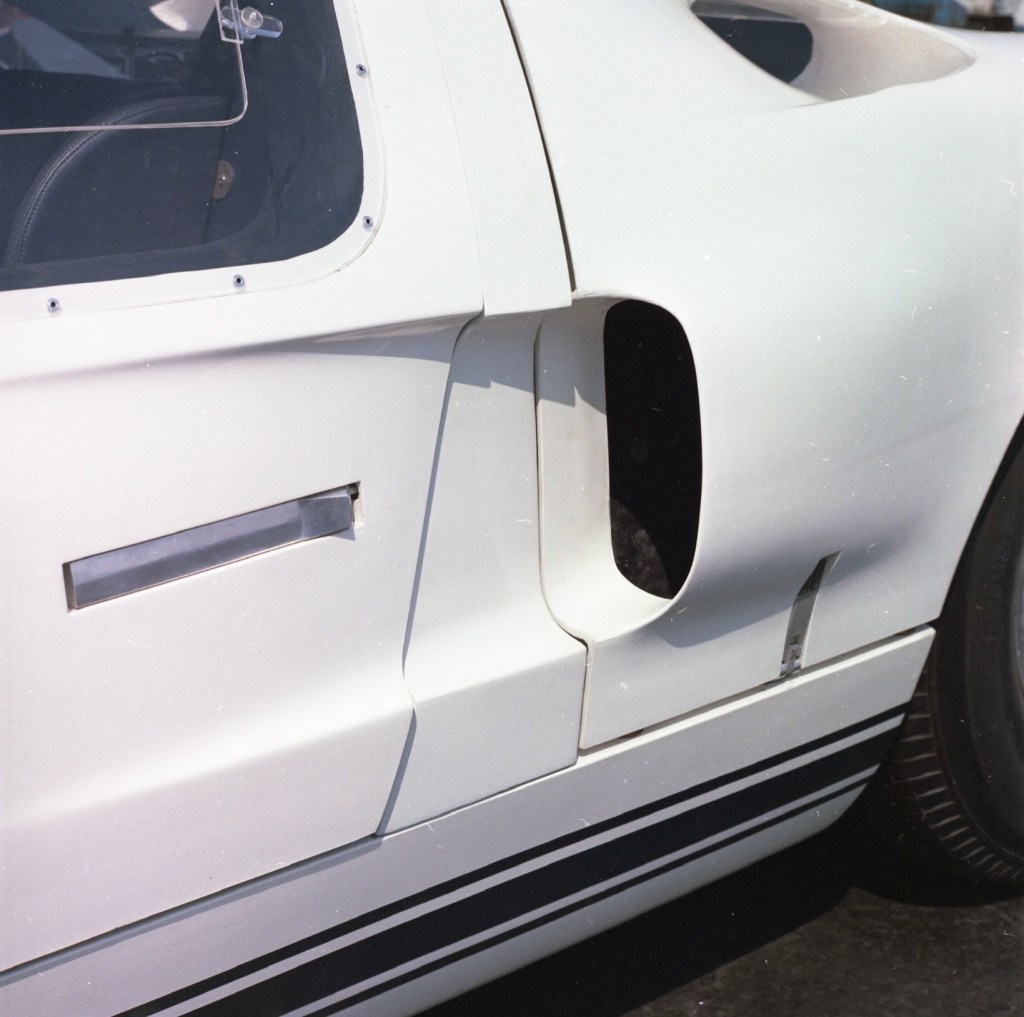
The headlights were fixed under clear Plexiglass covers with additional spotlights inboard of the brake ducts. Two big air intakes were sculpted into each flank to assist engine cooling with additional ducts on the panels each side of the rear screen.

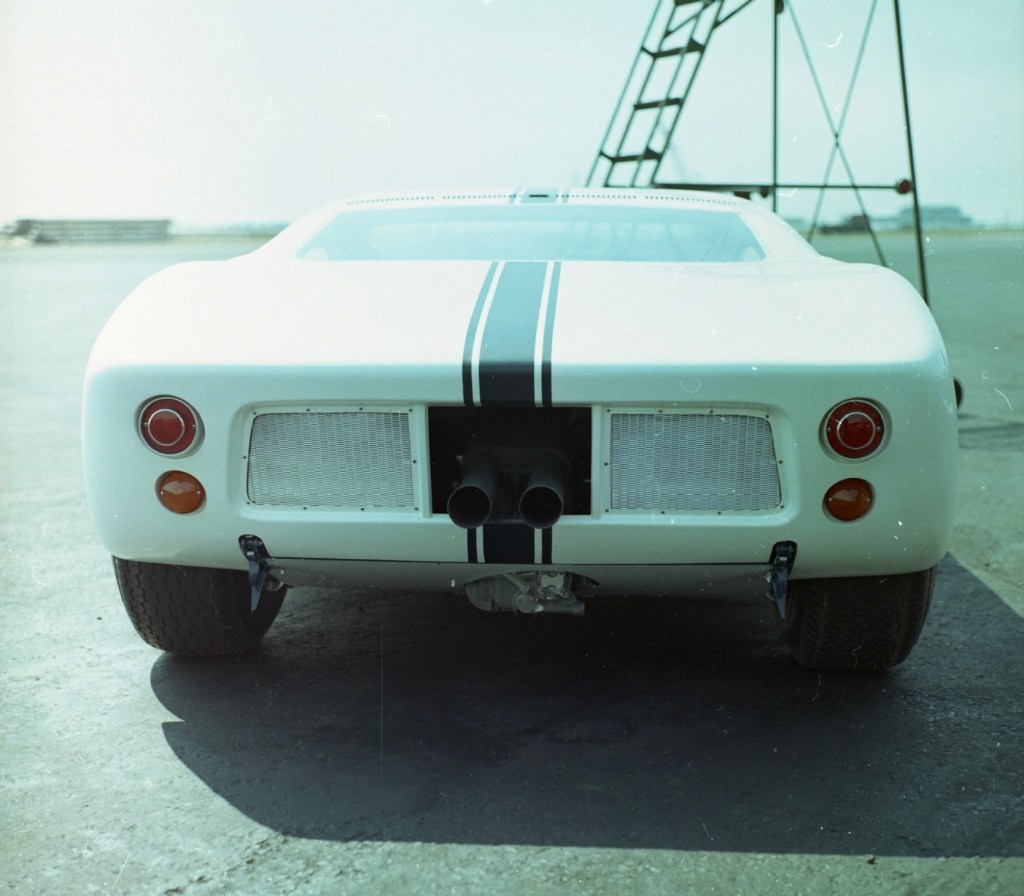
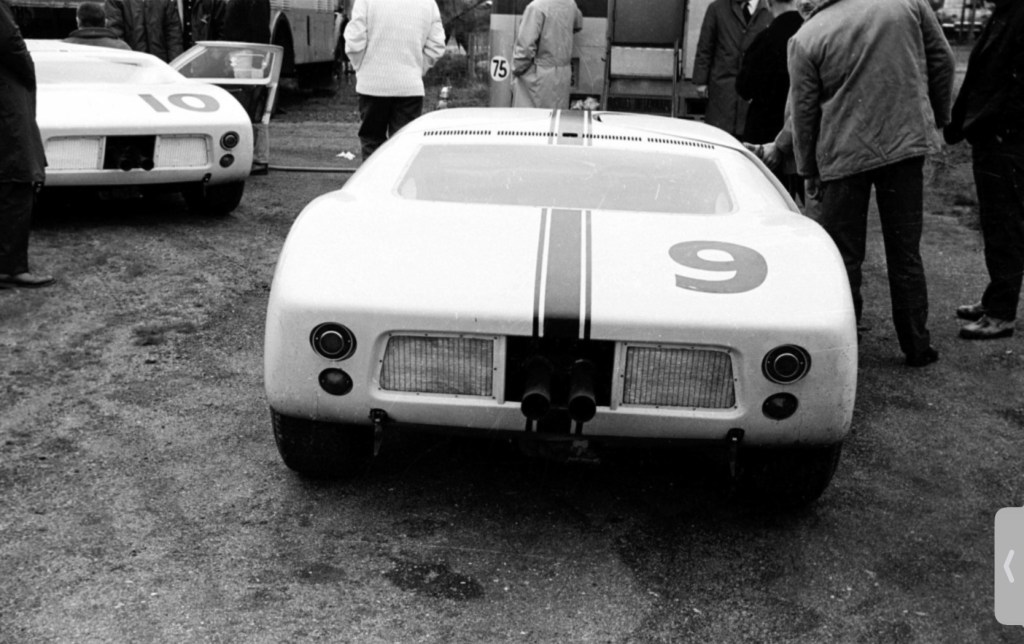
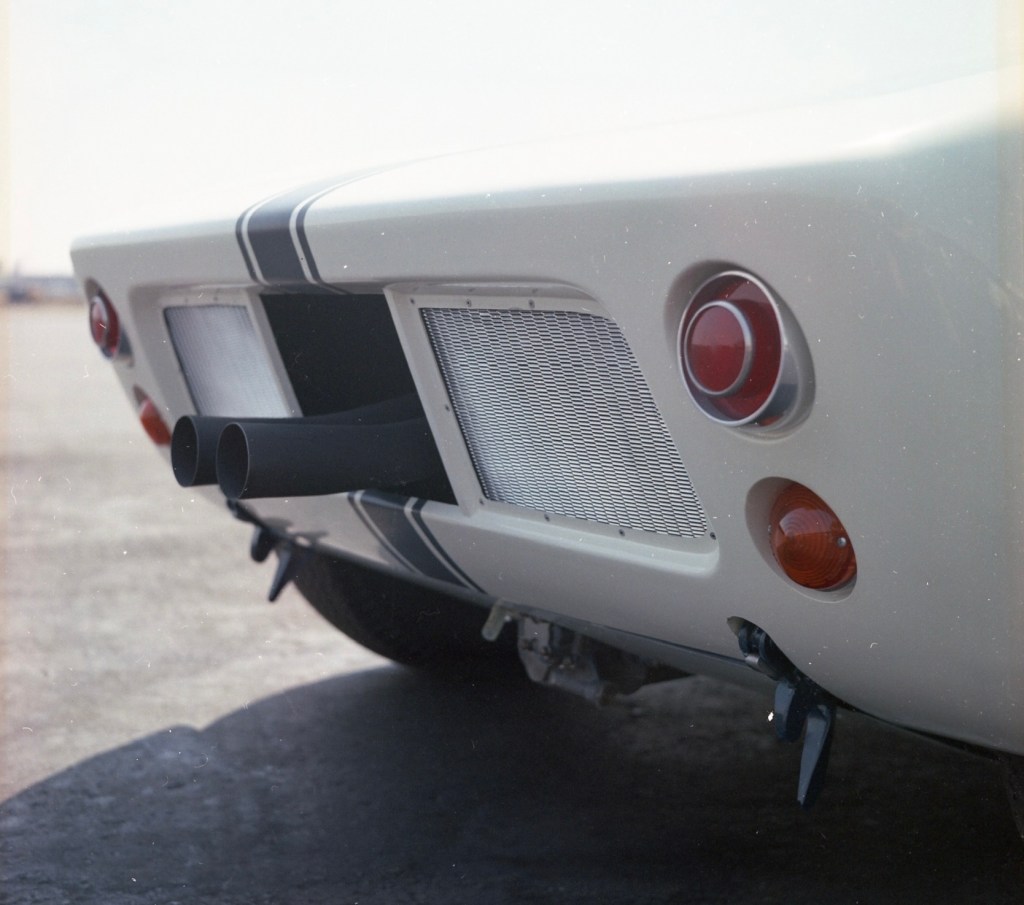
At the rear were meshed cooling vents through which the raucous V8 exited its gasses. The body was slippery enough but not yet effective.

(FoMoCo)
(FoMoCo)

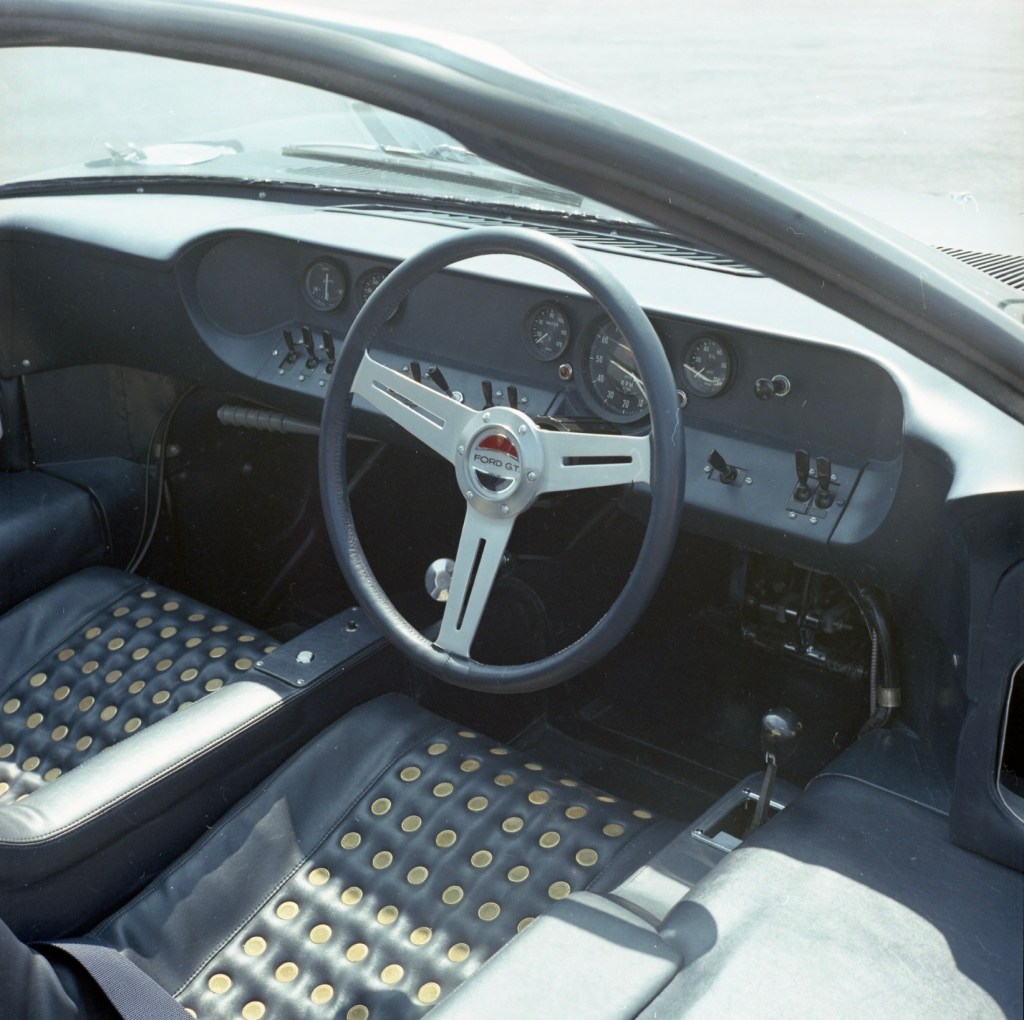
Driver ergonomics were very much to the fore. The top off each door was cut deeply into the roof. Once the driver cleared the wide-sill of the RHD, right-hand shift machine, he popped his arse into a light, fabric, perforated seat fixed in location; the pedals were adjustable.

I’m not sure if the 12 prototypes were built in this manner, but Denis Jenkinson described the GT40 production process in MotorSport as follows.

“The steel body chassis unit, made by Abbey Panels, of Coventry arrives in Slough in a bare unpainted form. Front and rear subframes are fitted, for carrying body panels etc, and then the unit goes to Harold Radford Ltd, where the fibreglass doors, rear-engine hatch which forms the complete tail, and front nosepiece, which is a single moulding, are cut-and-shut to fit the chassis/body unit, these panels then being marked and retained for the car in question. The fibreglass components are made by Glass Fibre Engineering of Farnham, Surrey and then delivered to Slough in the bare unpainted state. When the chassis/body unit is returned from Radfords the factory at Slough then assembles all the suspension parts, steering, wiring, engine, gearbox and so on, the final car being painted in the particular colour required by the customer.”

Checkout this evocative piece at Abbey Panels and Le Mans…

Many thanks for the tip-off Tony Turner!

1964 Season…

Given the lack of development time before the GT40 was raced, the initial races were pretty much a disaster.

Ford lost #101 (Schlesser) during the Le Mans test, while Salvadori gave #102 a gentle run, they were 12th and 19th quickest.

Six weeks later #102 contested the Nurburgring 1000km with a modified front clip manned by vastly experienced racer/engineers, Bruce McLaren and Phil Hill. Bruce was the lead test-driver on the GT40 programme. They qualified the car second behind the Ferrari 275P of John Surtees and Lorenzo Bandini. Phil ran between second and fourth in his stint but the car was retired with suspension damage early after Bruce took the wheel.

Broadley in brown, McLaren in blue, #102 in white. Nurburgring 1000km 1964 (unattributed)
Business end of one of the GT40s at Reims in 1964 (MotorSport)
Le Mans 1964. Attwood/Schlesser GT40 from the Baghetti/Maglioli, Ferrari 275P and Bonnier/Hill Ferrari 330P (MotorSport)

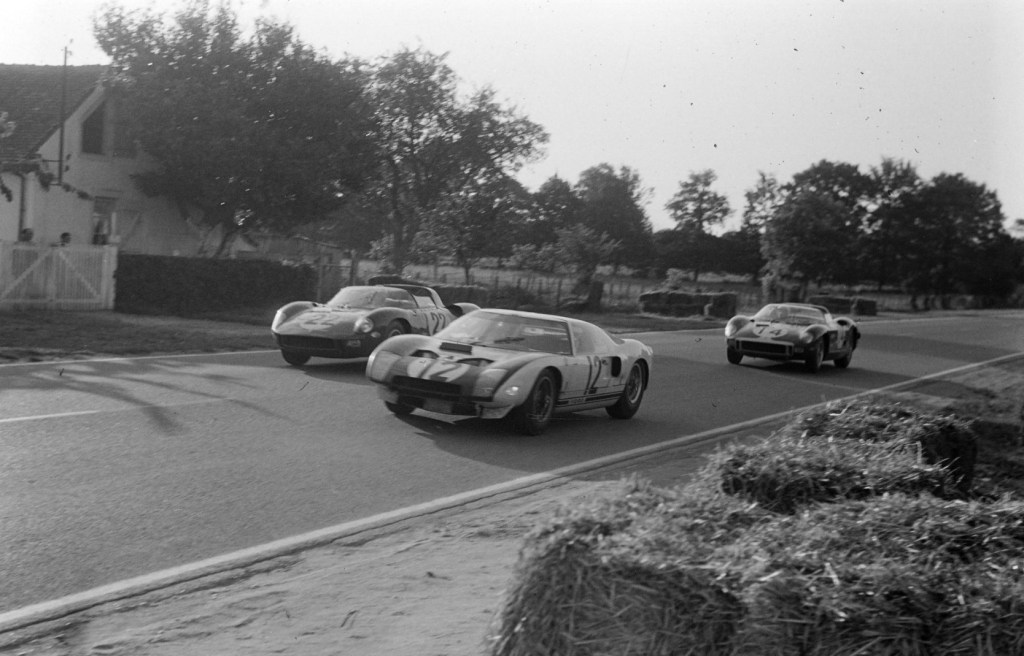
At Le Mans three cars were entered for Hill/McLaren, Richie Ginther/Masten Gregory and Richard Attwood/Schlesser. While Ford set a lap record, all three cars retired; the Attwood car caught fire, with both other cars retiring with gearbox failure.

The two cars that appeared at the Reims 12 Hours a fortnight after Le Mans were #102 and #103, plus a new car, #105, powered by Shelby prepared 289 V8 giving about 390bhp at a lower 6750rpm – 341lb-ft of torque was up too. New third-fourth selectors were fitted to the Colotti ‘boxes, and the dog-rings hardened. The Surtees/Bandini Ferrari 250LM started from pole, but by lap 10 the Ginther GT40 led McLaren. Richie’s lead ended with crown wheel and pinion failure on lap 34, Atwood’s with a plug that had come out of the gearbox, while the Hill/McLaren car blew its engine.

Chassis 103 and 104 were then raced in the Nassau Speed Week by Hill and McLaren fitted with 289 V8s (4.7-litres). Only Phil made it through the Nassau Tourist Trophy qualifier, Bruce had suspension problems in 104. Hill’s car suffered the same fate in the feature race.

Without a finisher in four meetings, chassis #103 and #104 were shipped to Shelby American in California. “The decision was made in Dearborn to move the (development) work back back to the US, with Carroll Shelby given operational control and Lunn engineering control.” Ford’s website records.

Over that autumn and winter an intensive development programme together with with FAV produced a race winner, not a Le Mans winner mind you, but that would come soon enough…

And what happened to #101 you ask?…

The car’s odometer recorded only 465 miles at the time of its death. It was written off with many parts salvaged…the monocoque may have been repaired and renumbered. Ford has never released the details of what became of the various components, not least the all-important chassis. There is a replica of course, no point letting a vacant chassis number go to waste, it won an award at Pebble Beach, so I guess it’s a very shiny one.

Etcetera…

(FoMoCo)

(FoMoCo)

‘Total Performance’, ‘Going Ford is The Going Thing’, and the rest.

I lapped it all up! What was not to love about a global transnational with such commitment to motor racing in every sphere? From Formula Ford to Formula 1, Bathurst to Brands Hatch and the high banking of Daytona to the Welsh forests…God bless ‘em I say.

#102 and #101, Salvadori and Schlesser, Le Mans test weekend, April 1964 (unattributed)
(FoMoCo)
(FoMoCo)
(FoMoCo)

Credits…

Ford Motor Company, corporateford.com, MotorSport Images

Tailpiece…

(MotorSport)

If Enzo started it all by ending negotiations with Ford, Eric Broadley finished it, unintentionally.

His Lola Mk6 Ford GT was so late for Le Mans that Eric sent drivers Richard Attwood and David Hobbs ahead and he drove the car to La Sarthe. What a road car…

The two Brits raced it as it arrived at the track; there were no alternative springs, bars or ratios. A missed shift by Hobbs of the tricky Colotti box ended their race too.

Eric Broadley bet-the-farm on that brilliant car but it paid off rather well!

Finito…

(Glenn Dunbar/LAT)

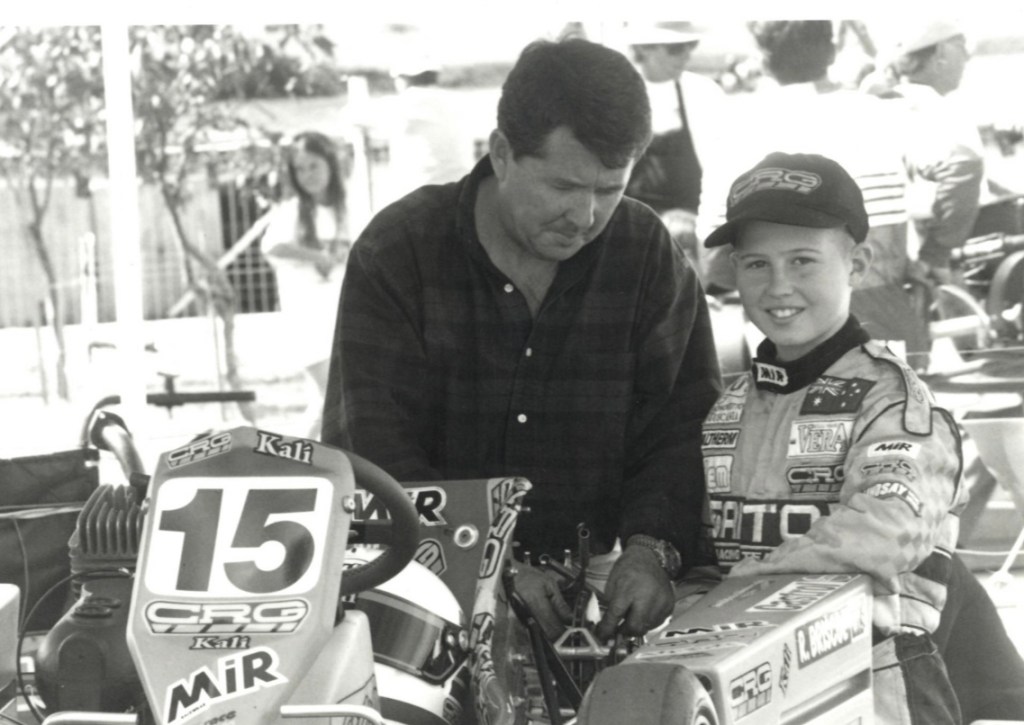
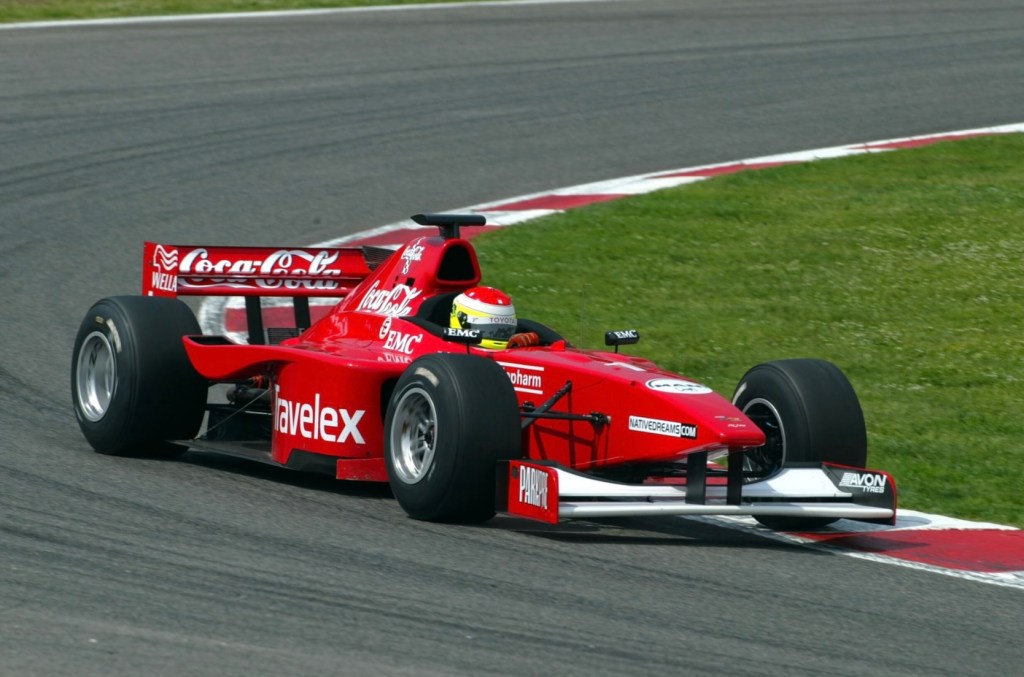
Ryan Briscoe is one of those Australian internationals I tend to forget about as he raced so little in Australia. His formative Karting years were here and then – Oscar Piastri like – most of his secondary education was in Europe from the age of 15 as he and his family successfully chased The Dream.

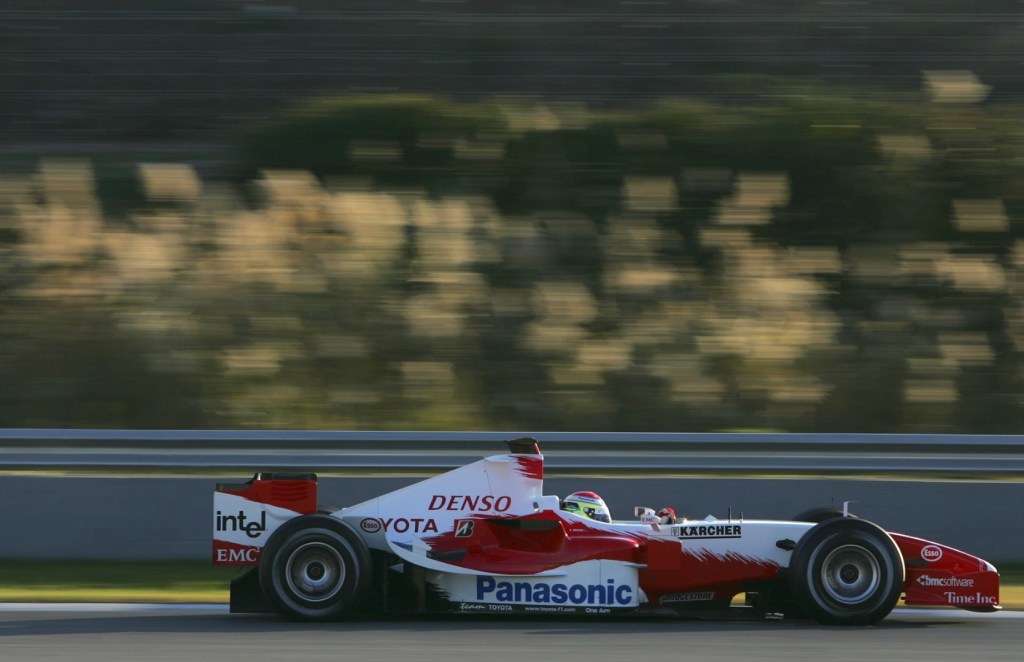
Briscoe, born in Sydney on 24/9/1981, is shown above testing the Toyota TF106 Grand Prix car at Jerez in December 2005. He was in on the ground floor of Toyota’s F1 program – from 2002-2004 – but never quite cracked it for a race seat so he was switched to Indycars in 2005, initially racing a Toyota powered Panoz for Chip Ganassi.

With Dad, Geoff circa 1992 (R Briscoe Collection)
Spa 2004 (MotorSport)

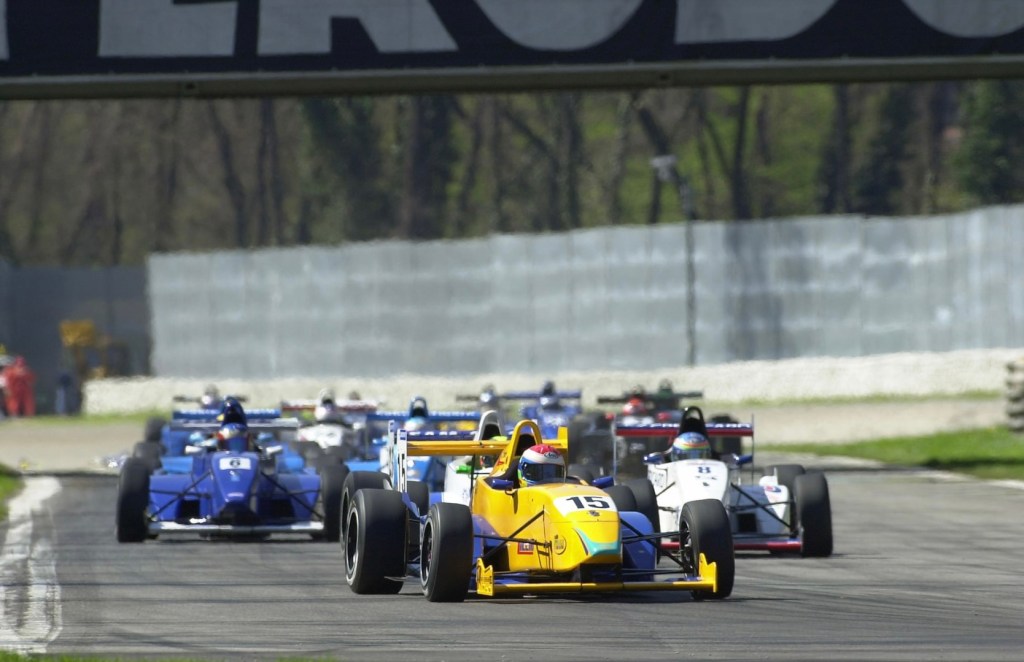
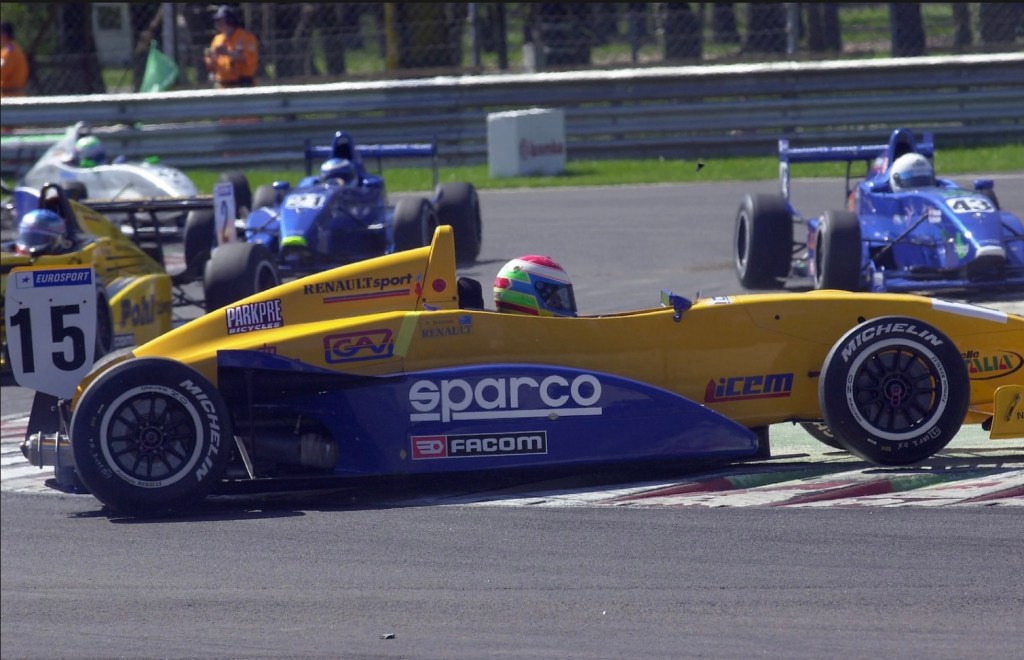
During the climb, he won Australian , American and Italian Karting titles in 1994, 1998 and 1999 respectively.He switched to cars, Formula Renault in 2000, winning the Italian F Renault Championship in 2001.

Ahead of the F Renault pack at Monza on April Fools Day 2001 from pole, but DNF as below! Tatuus Renault 2-litre (LAT)
(LAT)

During this most meteoric of rises Ryan also did some F3 in 2001, the shot below is at Zandvoort during the Marlboro Masters event on August 5, 2001. Car is Team Prema Dallara F300 Opel, DNF in the race won by Taka Sato, but third overall.

(LAT)
(MotorSport)

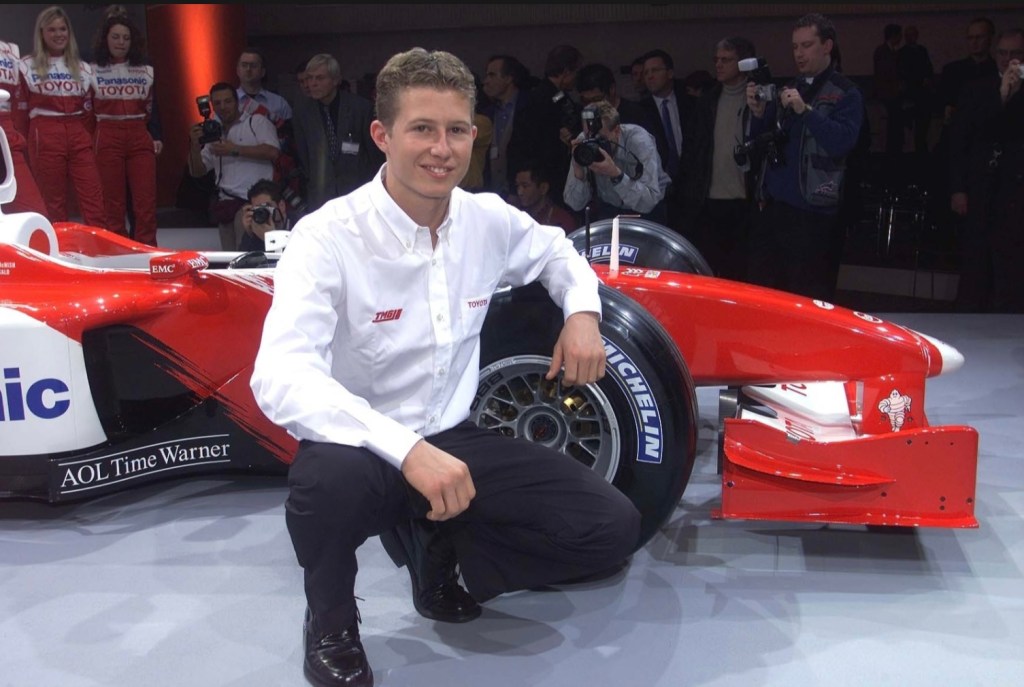
By the end of that year, aged 20, he was front and centre of Toyota’s F1 program as their test driver. Here he is at the launch of the Gustav Brunner designed Panasonic Toyota Racing TF102 V10 in Cologne, where the team was based, on December 17, 2001. The race drivers in 2002 – at the start of a rather grim eight year F1 sojourn for Toyota – were Mika Salo and Allan McNish.

Amongst his testing duties he raced initially in F3000, not going very well in the Nordic run car, and F3 later in 2002, and in 2003, winning the Euroseries that year. He progressed to being Toyota’s third driver, testing on the Friday of each grand prix, in 2004.

Lola TB02/50 Zytec-Judd KV circa 450bhp V8, Formula 3000 Barcelona April 2002 (MotorSport)
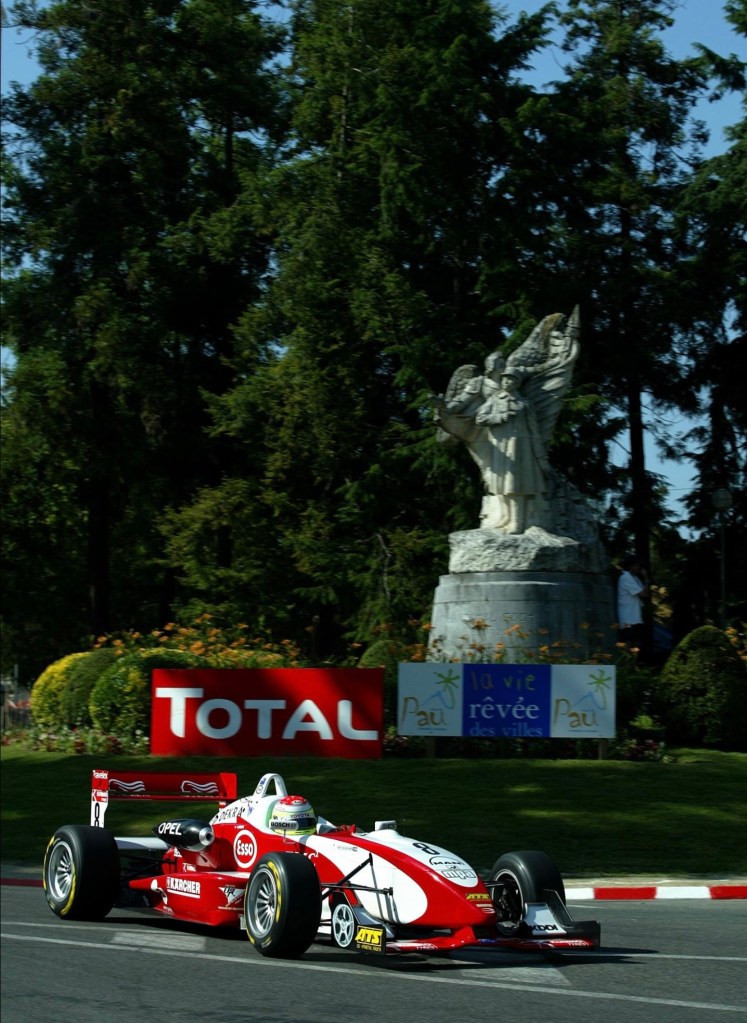
During the Pau GP weekend in June 2003, Dallara F303 Opel. Briscoe won a race, and Fabio Carbone the other (Glenn Dunbar/LAT)

Briscoe won eight of the 20 races in the F3 Euroseries in his Prema Powerteam Dallara F303 Opel to take the title from Christian Klien. Other hotshots in the field that year included Niko Rosberg and Robert Kubica.

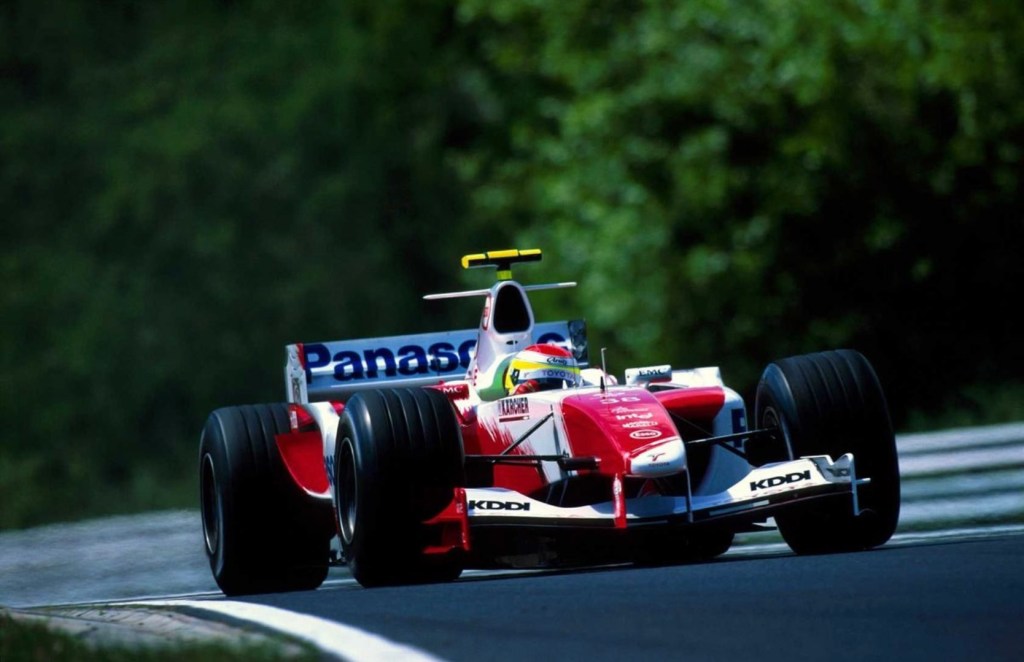
Briscoe, during practice, Toyota TF104 3-litre V10, Hungary 2004 (unattributed)

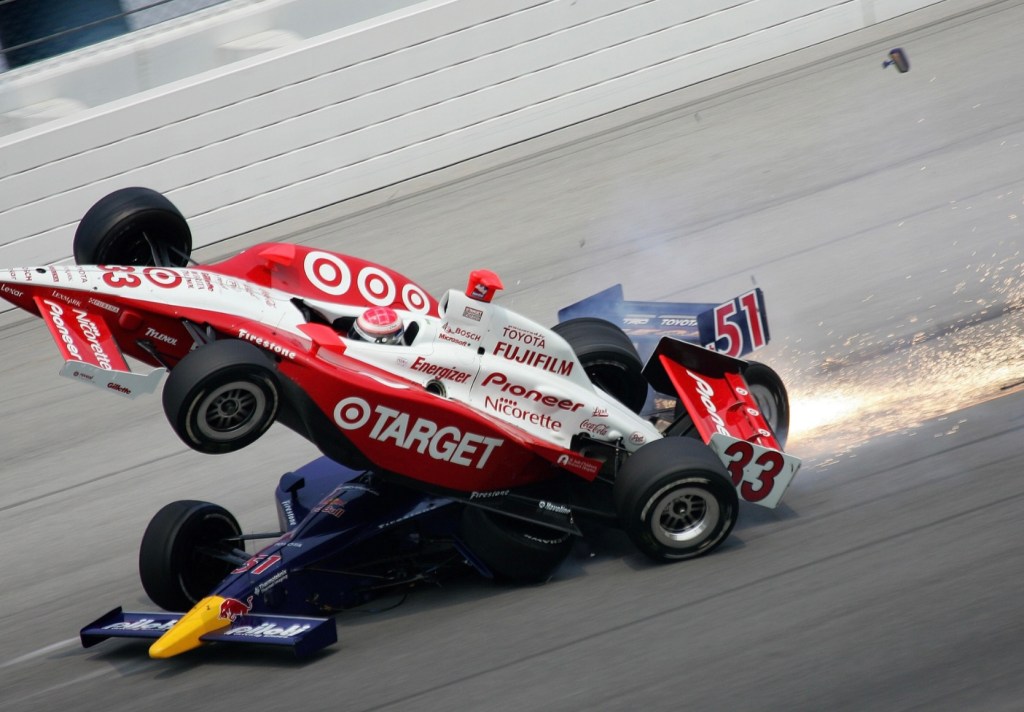
Ryan moved to Indycars (I’m using that word as a generic descriptor of the genre) with Chip Ganassi in 2005, showing extraordinary pace for a rookie; two poles and regular top-half qualifying on unfamiliar ovals. Tenth at Indy on debut was stunning, equally so was seven crashes in his 15 starts, the last of which was a massive accident after his Panoz GF09C Toyota climbed atop Alex Barron’s Dallara at Chicagoland Speedway in September that landed him in hospital and rehabilitation for four months.

Zandvoort A1 GP Cup October 2006 – the first meeting of the 2006-7 season – third in the main race won by Nico Hulkenberg. Lola A1GP Zytec 3.4 V6 circa 520bhp (MotorSport)

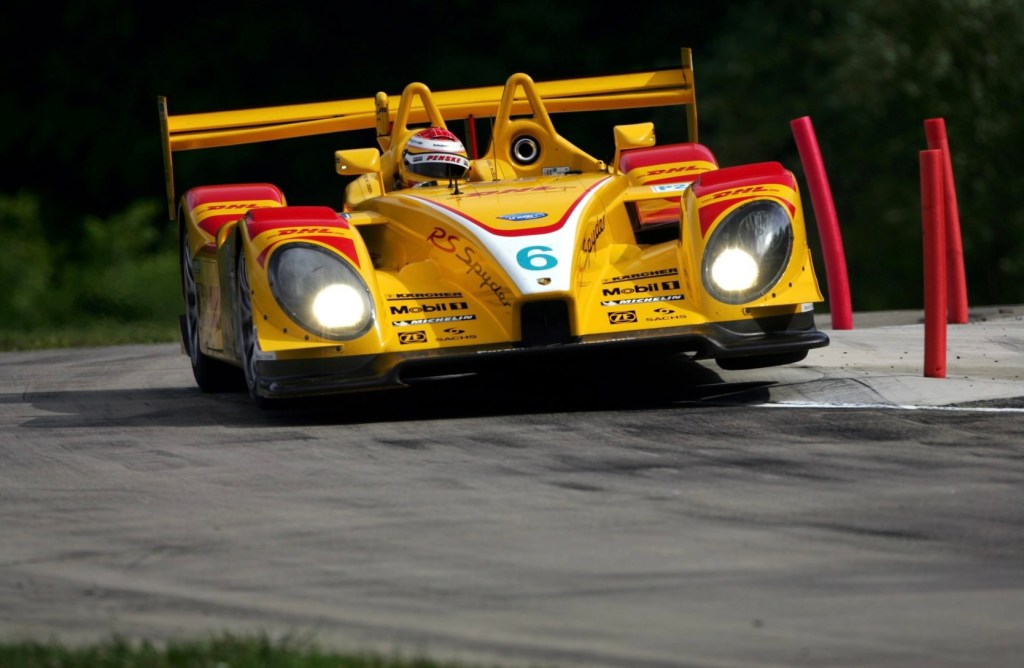
In 2006 he did a mixed programme of Indycar, V8 Supercars and A1 Grand Prix, but it was a full season in the American Le Mans Series for Penske Racing driving a Porsche RS Spyder in 2007 that pushed his career forward with Penske. He won three rounds sharing with Sascha Maassen.

Ryan at Watkins Glen in June 2006. I rather like the shot of the Dallara IR03 Chev aero elements doing their thing (Dan Streck/LAT)
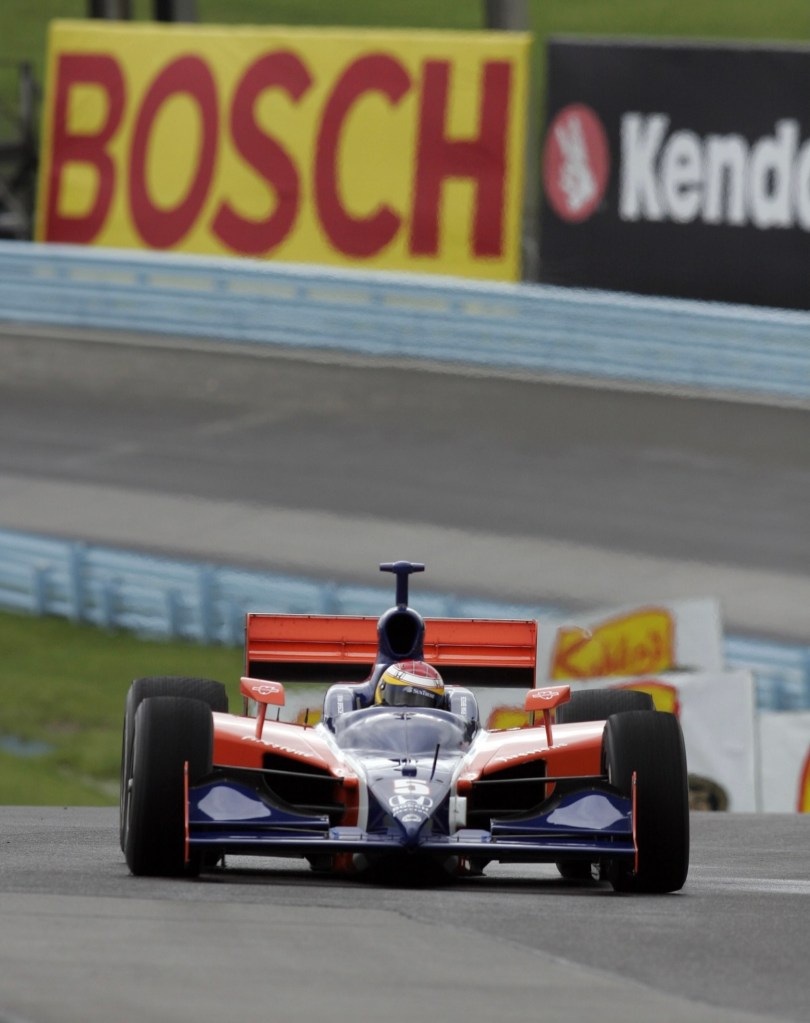
Briscoe in front of Vitor Meira at Sonoma Raceway, California in August 2006. Racing for Dreyer & Reinhold Racing in a Dallara IR03 Chev V8. 16th in the Indy GP of Sonoma won by Marco Andretti (Dan Streck/LAT)
Briscoe, American Le Mans Series, Northeast Grand Prix, Lime Rock July 2007, Penske Porsche RS Spyder. Ryan won the LMP2 class, and was third outright, sharing the car with Sascha Maasen (Sutton Images)

This sportscar success, together with some strong performance in limited Indycar outings – Q5 and fifth in the Indy 500 for Luczo-Dragon Racing, led to a full-time Indycar drive with Penske from 2008-2012.

In a strong Indycar career he won eight races, had 28 podiums and finished third in the title in 2009 (three wins), and fifth in 2008 and 2010 as his bests. In 2009 he led the championship going into the penultimate round but hit the wall exiting the pitlane at Motegi, then, in a three-way battle for the title finished second behind Dario Franchitti in the final round, who became champion.

(MotorSport)

Aviating at Surfers Paradise on the way to winning the Indy 300 in October 2008, Team Penske Dallara IR-04/05 Honda 3.5 V8. Scott Dixon was second, 5/10ths behind and Ryan Hunter-Reay a further nine seconds adrift.

And below doing the same thing at the same place in a V8 Supercar in October 2011, sharing the Holden Racing Team Holden Commodore VE in the Gold Coast 600 with Garth Tander. The pair were 11th in the first race, 23rd and last in the second. The winner overall was the Triple Eight VE Commodore crewed by Jamie Whincup and Sebastien Bourdais. Ryan’s best V8 Supercar result was at this event in 2013 when he shared a VF Commodore with Russell Ingall to third place.

(Mark Horsborough/LAT)

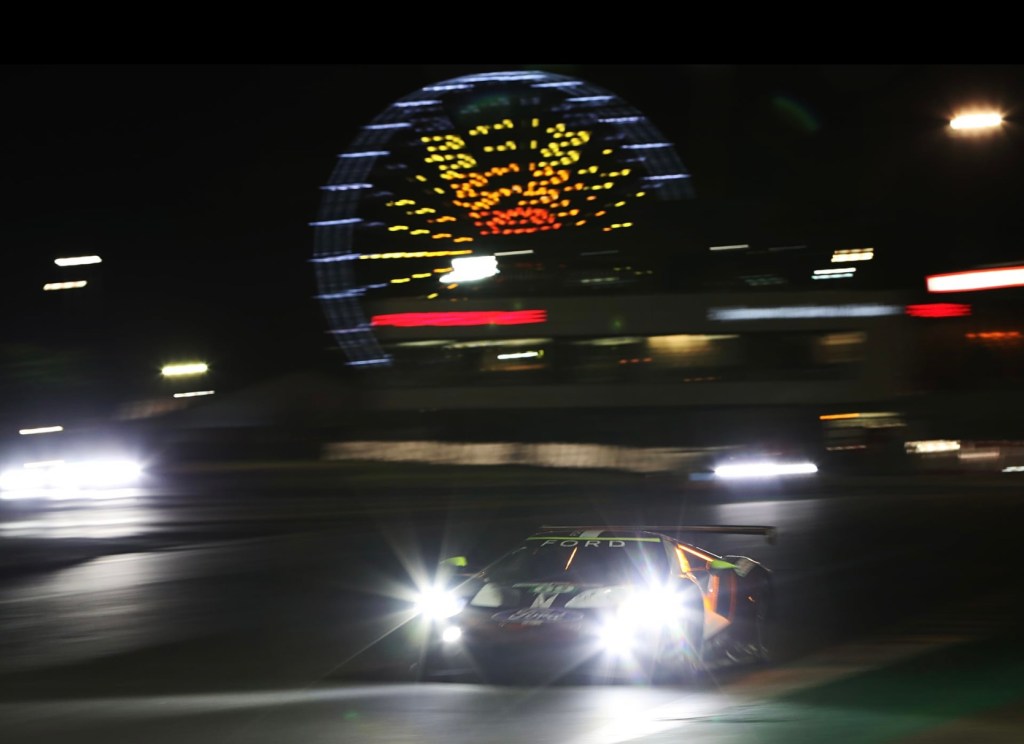
The Briscoe, Richard Westbrook, Scott Dixon, Chip Ganassi Ford GT at Le Mans in 2018. Q37 and 39th outright in the 3.5-litre turbo-V6 powered car – and shot below (MotorSport)
(MotorSport)

“Ryan has driven more sportscars that I’ve had Sunday roasts,” would perhaps be the observation Australia’s greatest all-rounder, the late Frank Gardner would have made.

Briscoe’s best sportscar results are victory in the Daytona 24 Hours in 2020 (Cadillac Dpi-VR), and Petit Le Mans the same year.

He was runner-up in the 2016 (Ford GT), 2018 (Ford GT) and 2020 (Cadillac DPi-VR) IMSA Sportscar Championship GTLM class. He was third in the 2007 American Le Mans Series, winning the LMP2 class (Porsche RS Spyder),

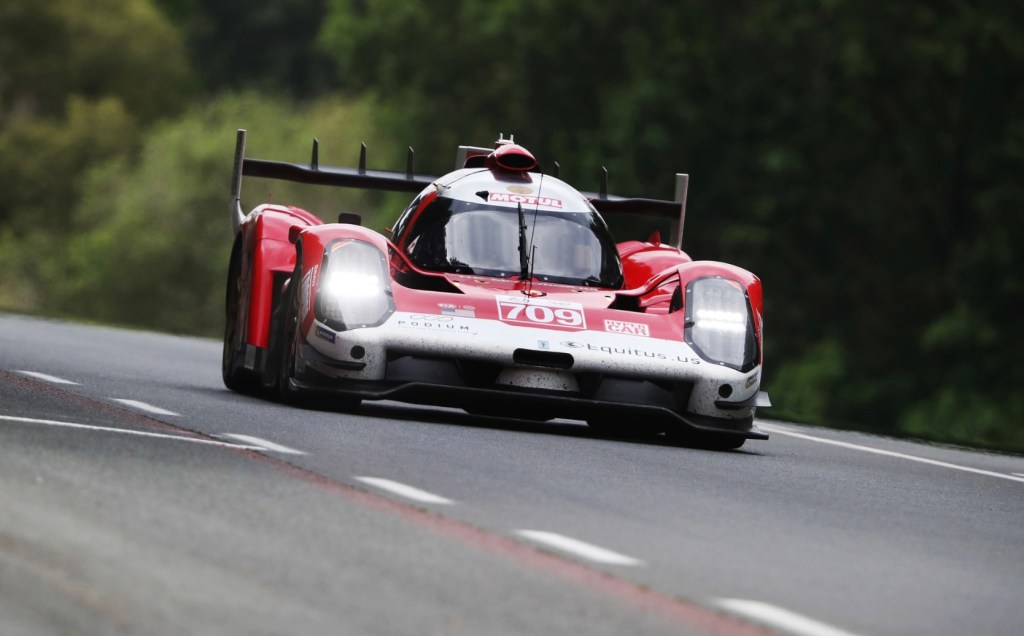
His best results at Le Mans were fifth in 2021 sharing a Glickenhaus 007 LMH with Romain Dumas and Richard Westbrook, and third in 2022 in the same make/model, this time sharing with Westbrook and Franck Mailleux.

At Daytona he won outright in 2020 (as above) and was first in class in 2015 and 2018 racing a Cadillac DPi VR, Chev Corvette C7.R, and Ford GT respectively – with co-drivers of course. At Sebring he won his class in 2013 and 2015 aboard a HPD ARX-O3b and Chev Corvette C7.R.

Briscoe/Richard Westbrook/Franck Mailleux Glickenhaus SCG007 LMH, fifth. Le Mans 2021 (MotorSport)
Richard Westbrook, Franck Mailed, Ryan Briscoe and James Glickenhaus, Le Mans 2021 (MotorSport)
Power by Pipo Moteurs 3.5-litre twin-turbo 500Kw V8, Xtrac 7-speed sequential manual (MotorSport)

Ryan married Nicole Manske in 2009, they have two children, and in 2018 he became a naturalised American.

Etcetera…

(MotorSport)

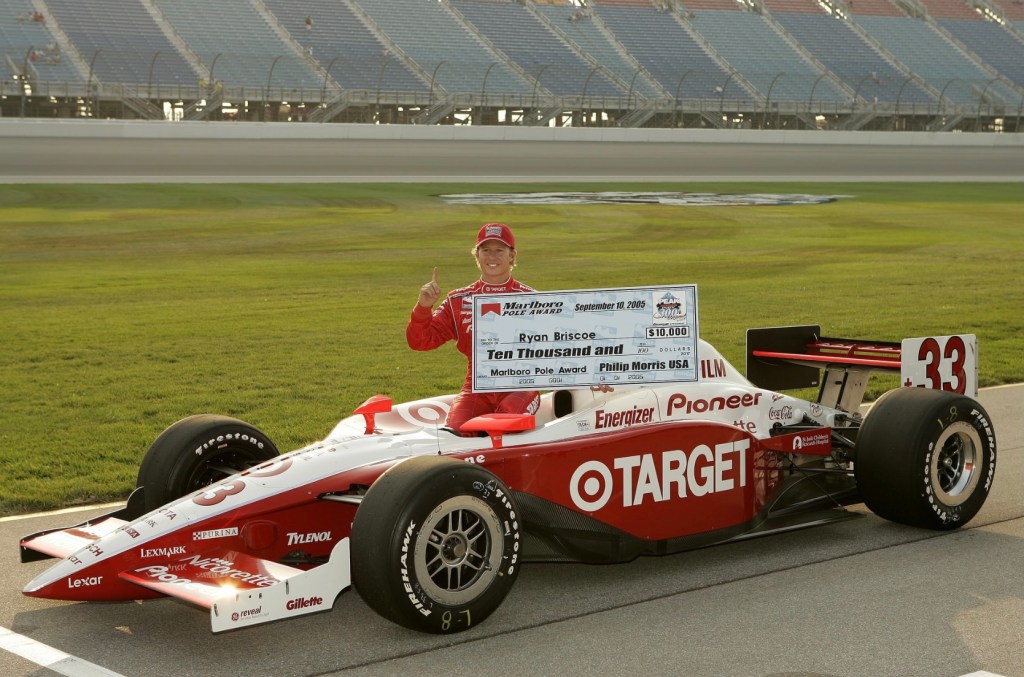
Here to zero at the Chicagoland Speedway, Joliet, Illinois on the Indy 300 September 10-11 weekend in 2005.

Here with the Gregory-Peck for pole, a handy $10k. It was Ryan’s second Indycar pole, he started from pole at Sonoma, the previous round but crashed out on the first lap. The car is a Chip Ganassi run Panoz GF09C Toyota.

Shortly after this happy scene the car failed post-practice scrutineering, so Ryan lined up last on the grid, perhaps sowing the seeds of the crash which followed.

(MotorSport)

‘Roger that, we have lift-off Houston.’

On lap 20 Briscoe’s Panoz GF09C Toyota ran into 15th placed Alex Barron’s Dallara Toyota (Q18) as he sought to go under him on his way up the field towards turn 3 of the 1.5-mile oval – look at the proximity of his right-rear to Barron’s head/roll bar area – and the staggering physics of a collision at 215mph were unleashed.

(MotorSport)

Briscoe hit the fence with the bottom of his Panoz first, it split in two as it ripped through a fence post, leaving a big hole. With a half-tank or so of fuel there was a spectacular explosion as the car split, with the cockpit safety cell spinning down the track narrowly avoiding other cars. Car 2 is Thomas Enge, #55 is Kosuke Matsuura.

(MotorSport)

After several anxious minutes Ryan was removed from the wreck – the monocoque had done its job well – and gave a reassuring wave as he was placed into the ambulance with injuries later diagnosed as two broken collarbones, a bruised lung, fractured right foot and contusions to his arms, legs and back.

Briscoe was hospitalised for nine days then had extensive rehab in the US and Italy before returning to the cockpit in a Riley Mk9 Pontiac 5-litre V8 in the Daytona 24-Hours on the January 28-29, 2006 weekend – four months after his Big One.

Credits…

LAT, MotorSport Images, Ryan Briscoe Collection

Tailpiece…

(MotorSport)

The Briscoe & Co Ford GT at Le Mans in 2018.

Finito…

Matra @ Random…

Posted: September 19, 2023 in F1, Sports Racers
Tags:
(LAT)

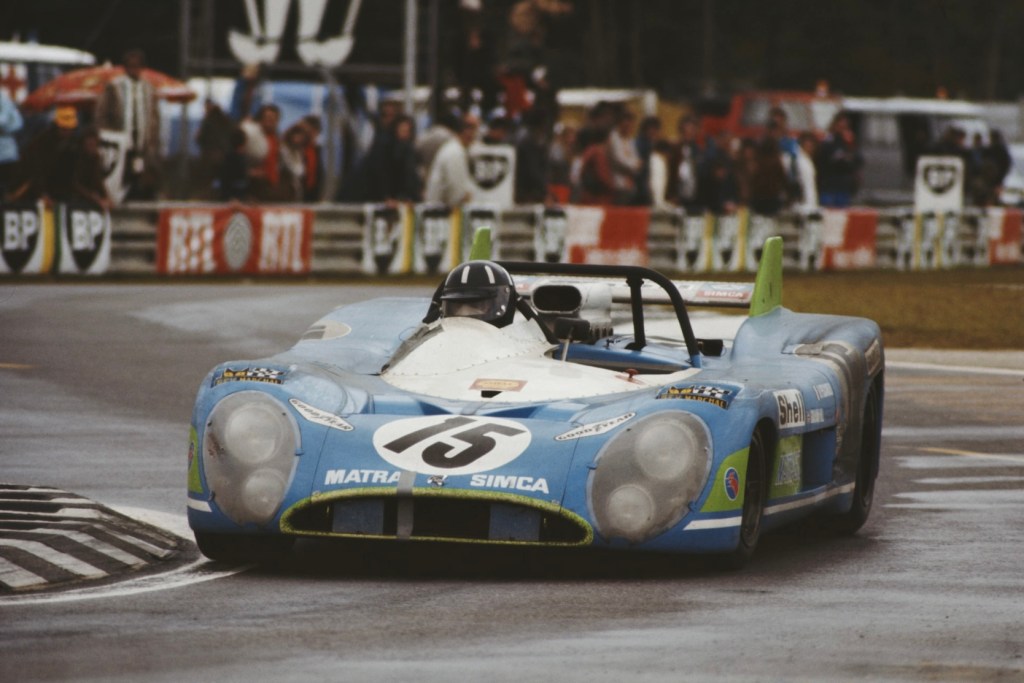
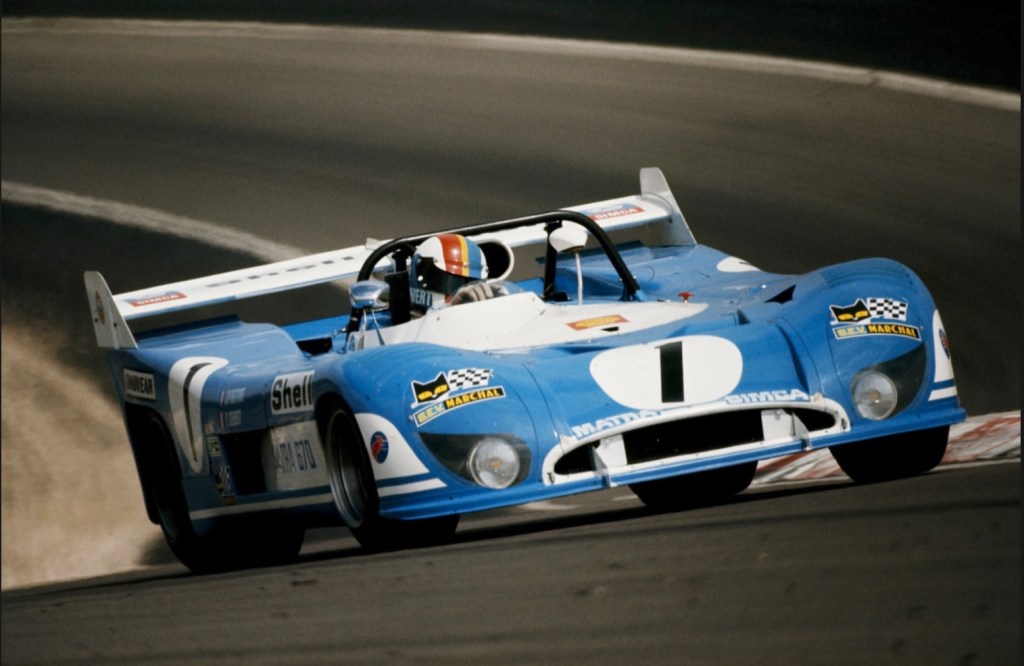
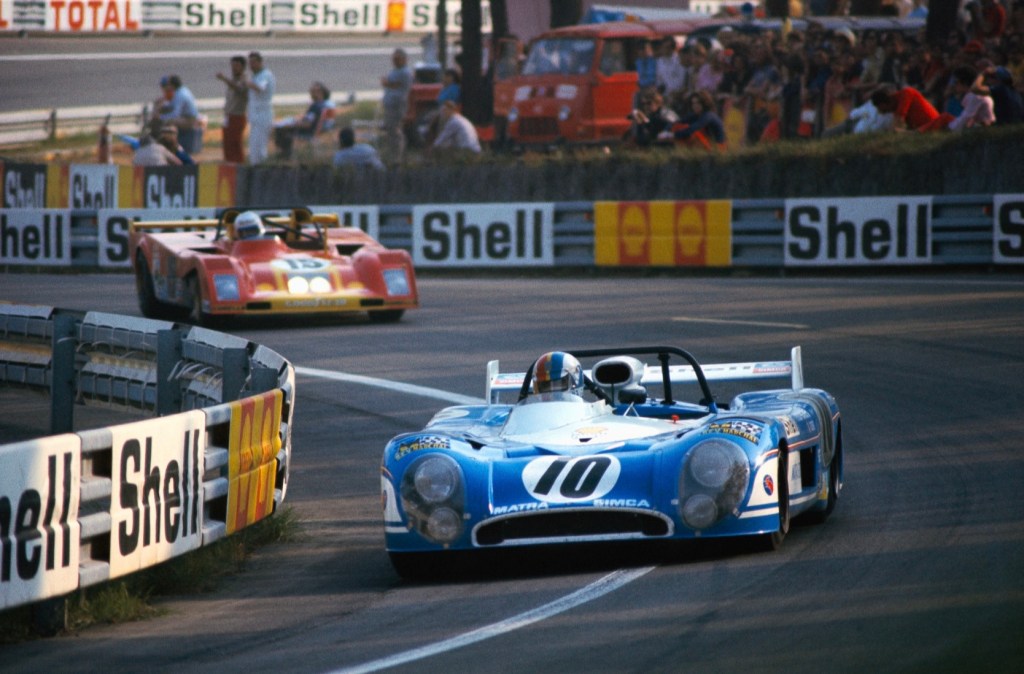
The Jean Guichet/Nino Vaccarella Matra MS630 at Le Mans in 1969, they finished fifth in the race won by the John Wyer Ford GT40 driven by Jacky Ickx and Jackie Oliver.

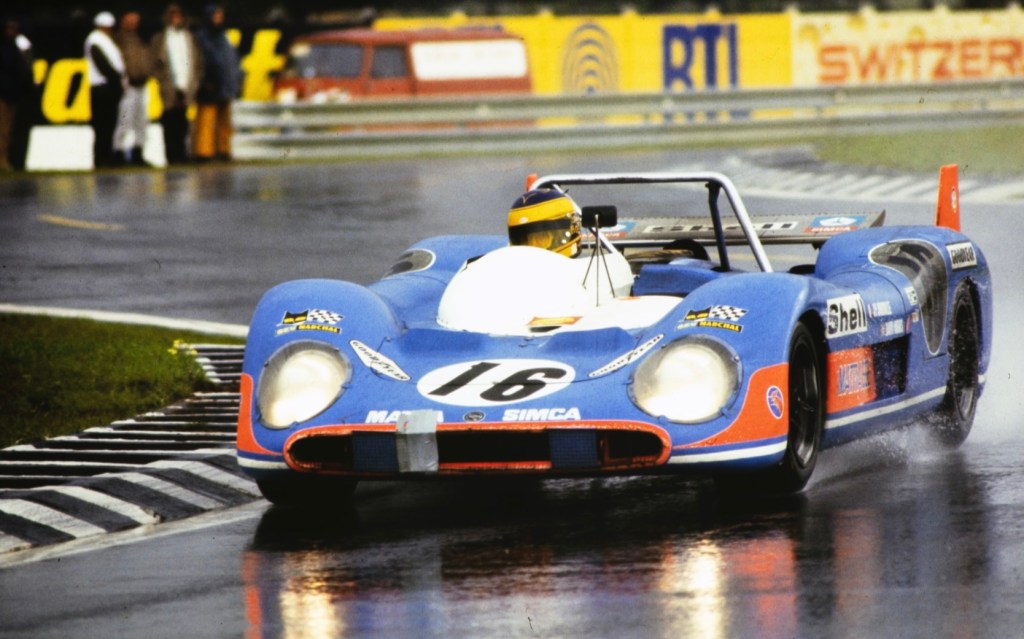
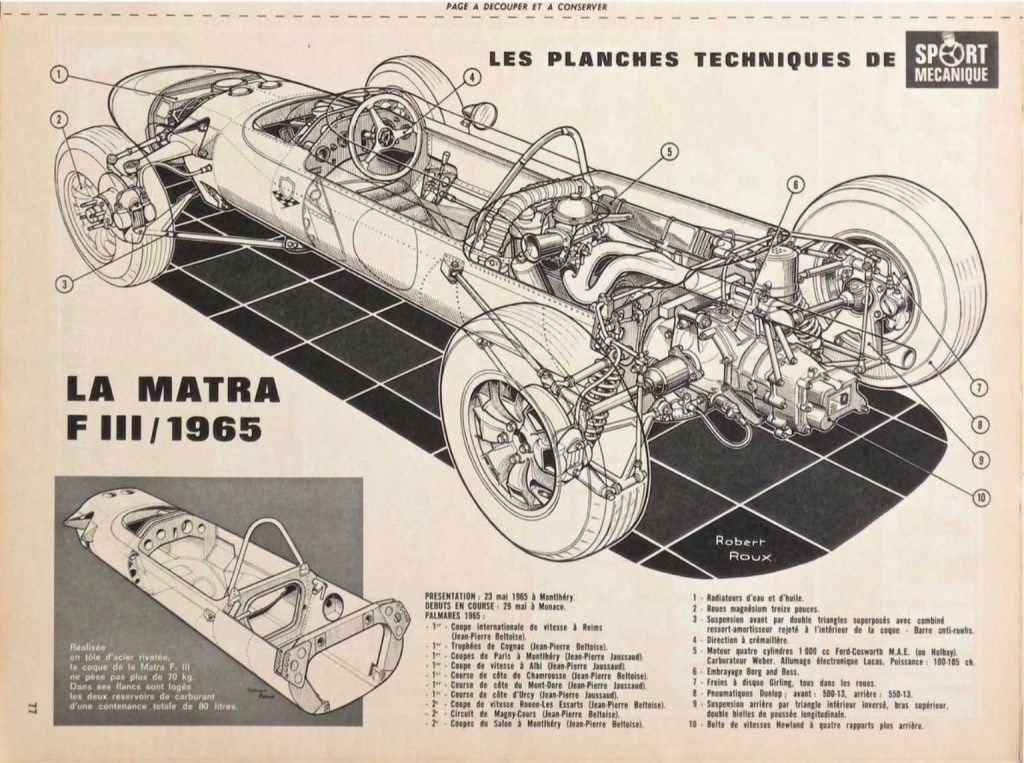
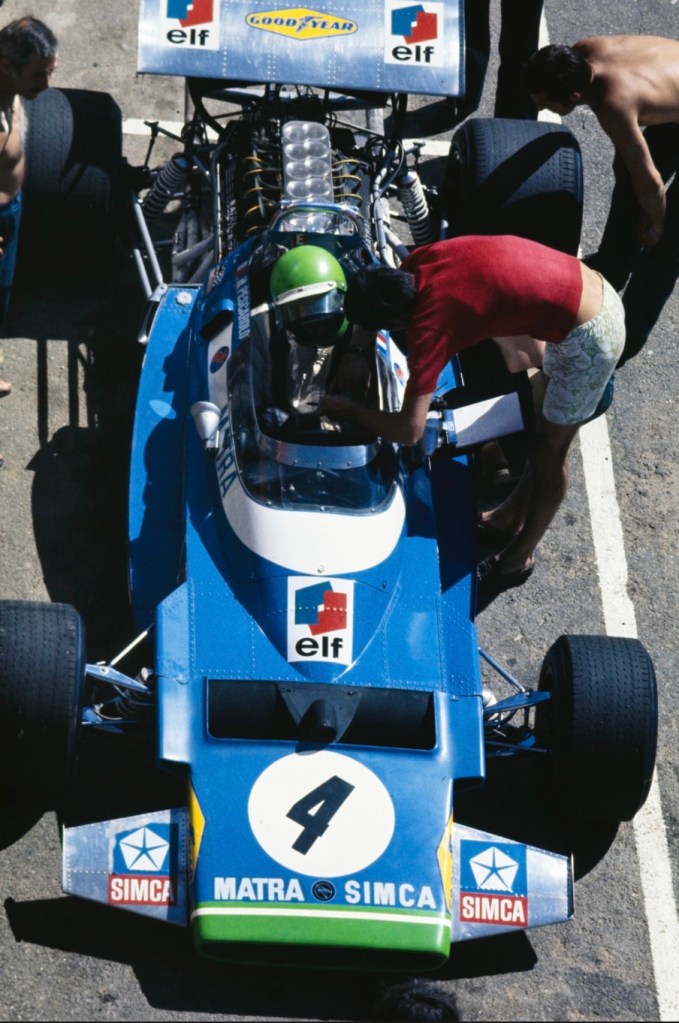
Matra’s progression up the Le Mans results was underway. A pair of DNFs for the two 2-litre BRM P56 V8 powered MS630s in 1967 wasn’t improved upon by the Johnny Servoz-Gavin/Henri Pescarolo MS630 V12s in 1968 (puncture, accident). Fourth and fifth places in 1969 was more impressive, the Jean-Pierre Beltoise (JPB) / Piers Courage MS650 Spider was a lap ahead of the Guichet/Vaccarella MS630 Coupe. Matra would get there soon enough of course, Henri Pescarolo and Graham Hill (below) won the classic race aboard an MS670 from teammates Francois Cevert and Howden Ganley similar car in 1972.

Graham Hill’s ’72 Le Mans victory famously bagged him the Triple Crown: an F1 title, Le Mans and Indy wins, the only bloke to achieve it of course (MotorSport)

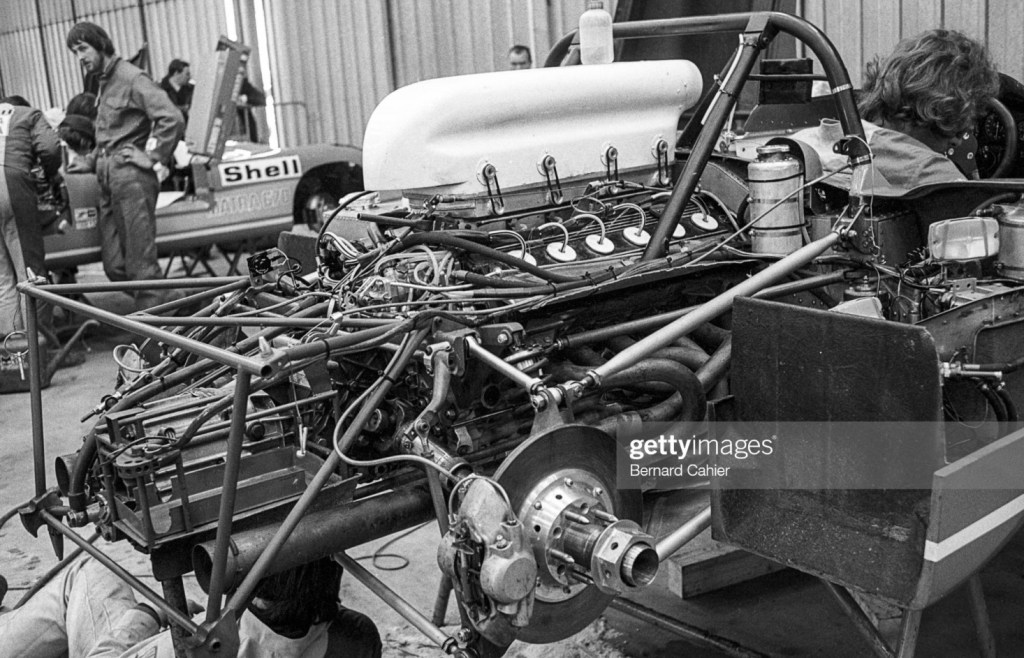
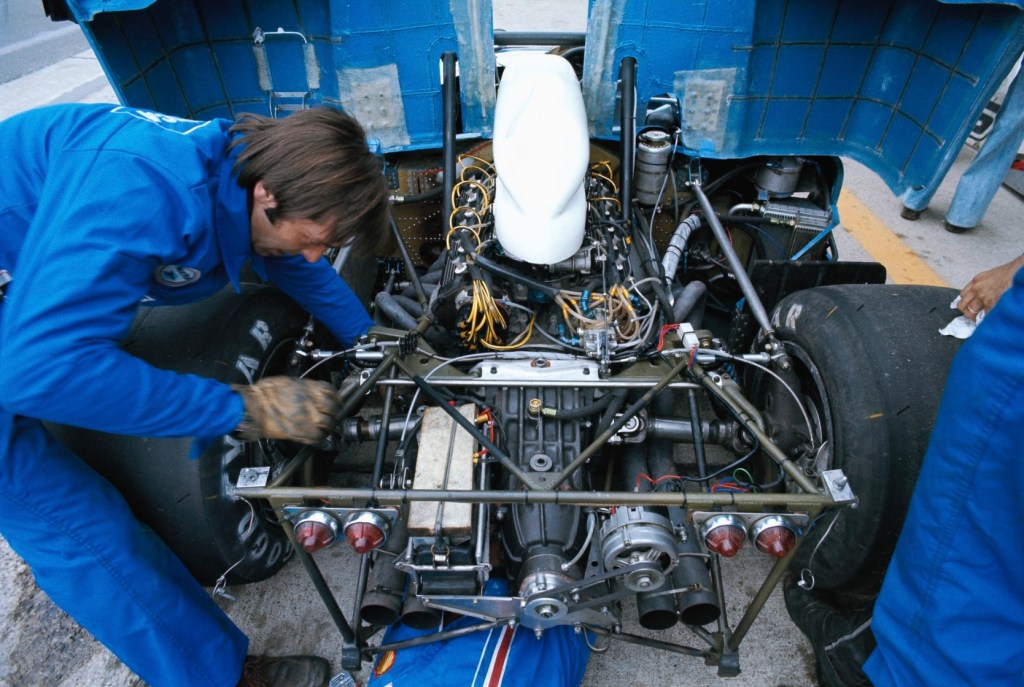
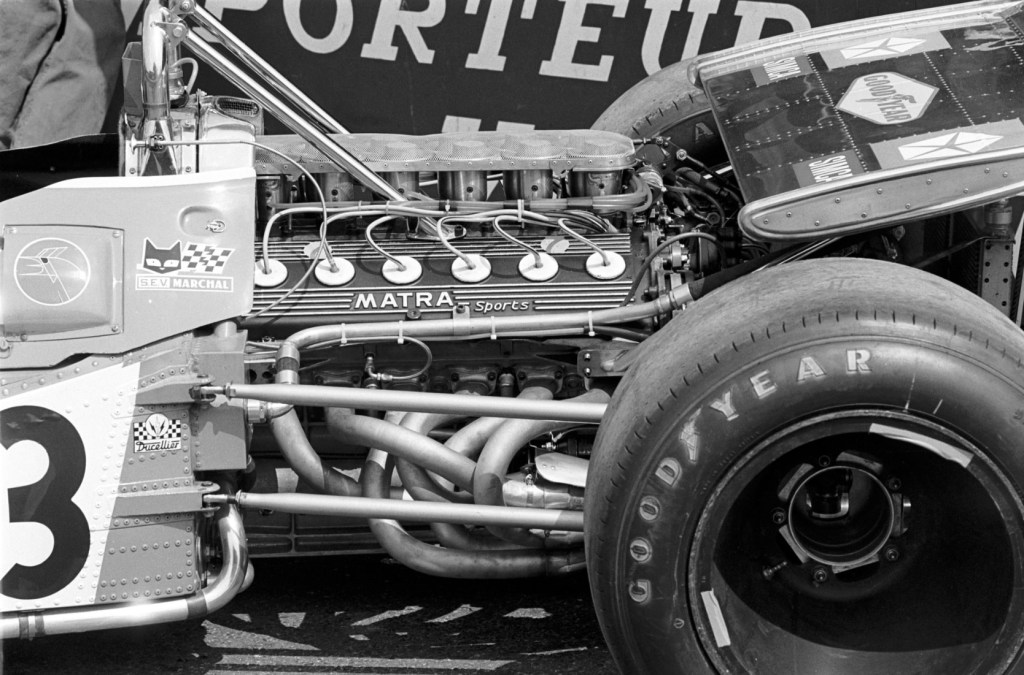
Two of the team MS670s in the garage at Le Mans in 1972. The MS73 circa 450bhp 3-litre V12 is a stressed member of the monocoque chassis, note the light tubular frame to support the rear bodywork, the five speed transaxle is ZF.

The third member of the Le Mans team was an MS660C crewed by Jean-Pierre Jabouille and David Hobbs, DNF gearbox after 278 laps in the final hour.

David Hobbs, MS660C in 1972 (MotorSport)
(MotorSport)

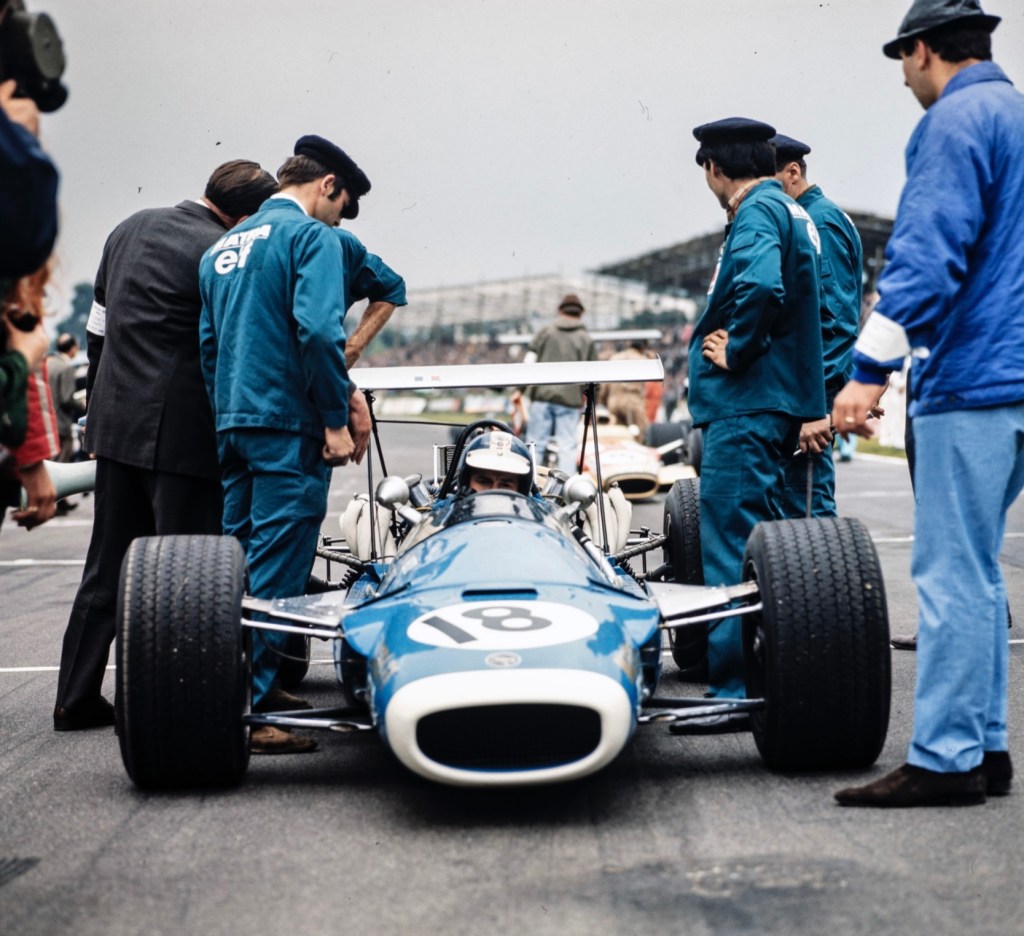
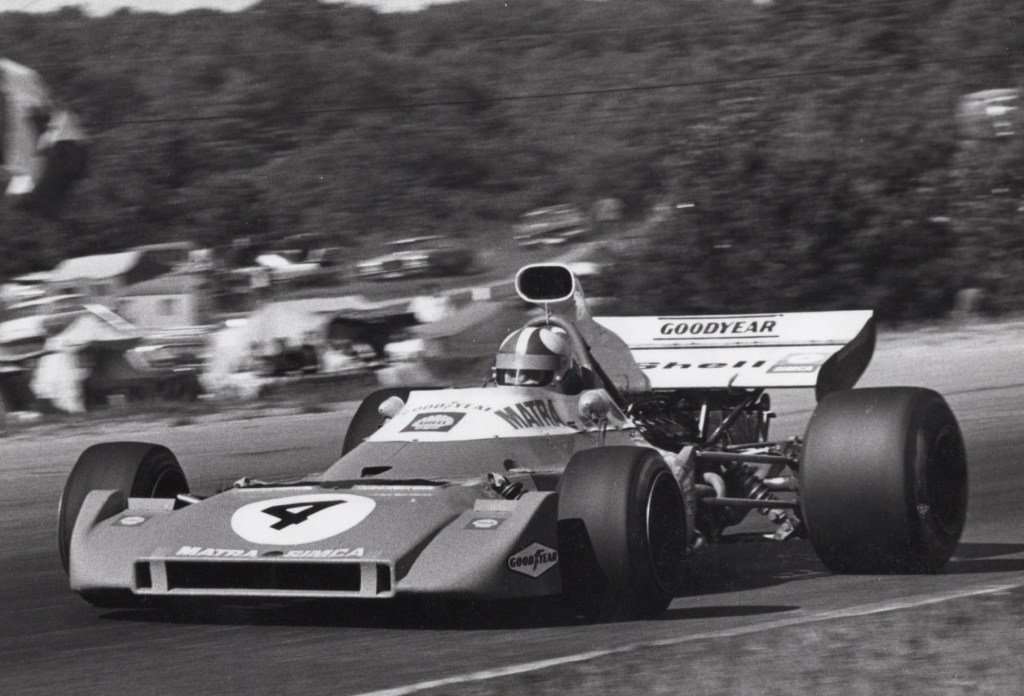
Jean-Pierre Beltoise lines up for the start of the July 1968 British Grand Prix aboard his Matra Sports Matra MS11 V12. Q11 and 14th in the race won by Jo Siffert’s Lotus 49B Ford.

The best placed of the Matras was Jackie Stewart’s Ken Tyrrell/Matra International MS10 Ford DFV in sixth. See here for a piece on JPB; https://primotipo.com/2015/01/15/r-i-p-jpb/

(MotorSport)

(MotorSport)

Francois Cevert tips his Matra MS670B into a right-hander at Dijon in during the 1000km enduro in 1973.

He and JPB finished third in the race won by Henri Pescarolo and Gerard Larrousse in another MS670B. See here for a piece on Francois’ formative years; https://primotipo.com/2014/11/07/francois-cevert-formative-years/

Unlike 1972 when Ferrari and Matra shadow-boxed – Ferrari won everything but didn’t contest Le Mans and Matra won Le Mans but didn’t race anywhere else – Matra won a clean fight with Ferrari in 1973. They again won at Le Mans, the MS670B driven by Henri Pescarolo and Gerard Larrousse were the star crew of the year. Matra won five of the ten World Sportscar Championship rounds, narrowly taking the title from Ferrari, 124 points to 115.

(MotorSport)

Jean-Pierre Jaussaud, Matra MS6 Ford 1-litre F3 car during the 1967 Monaco F3 GP weekend.

JPJ won heat one and Pescarolo the other in the second Matra Sports entry, with Henri in front of Jean-Pierre in the final by six-tenths of a second, with Derek Bell’s Brabham BT21 Ford another half-second in arrears.

While Brabhams were again 1967 Top F3 Dogs in the UK and Sweden, Matras won the French (Pescarolo), Italian (Geki Russo) and the Argentinian Temporada (Beltoise) titles.

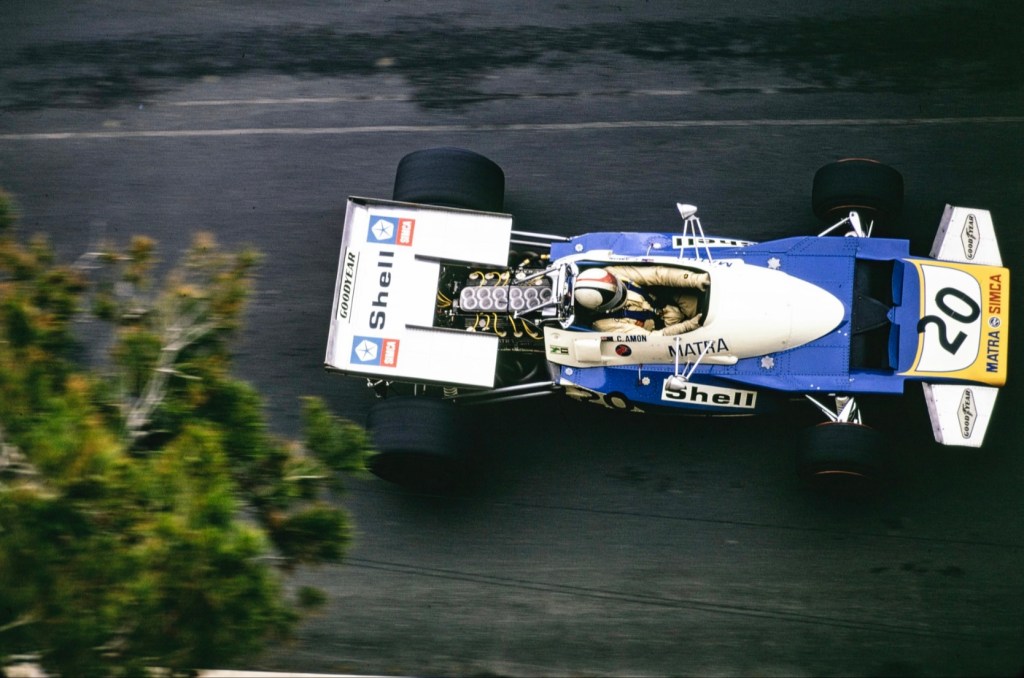
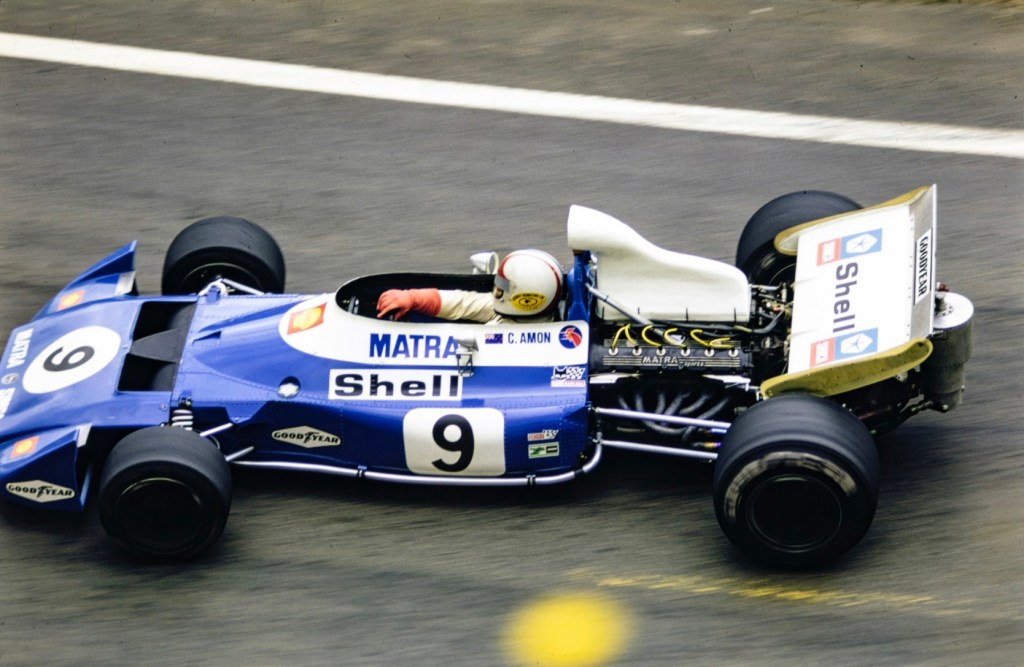
Amon Monaco 1971, Q4 and DNF diff MS120B (MotorSport)

Amon and Matra, what should have been never quite was!

Chris won the non-championship 1971 Argentine GP which was a portent of ‘front two row’ qualifying pace over the ensuing two years but 11th in the ’71 World Drivers Championship and 10th in 1972 was a poor dividend not really indicative of the pace of the car and driver.

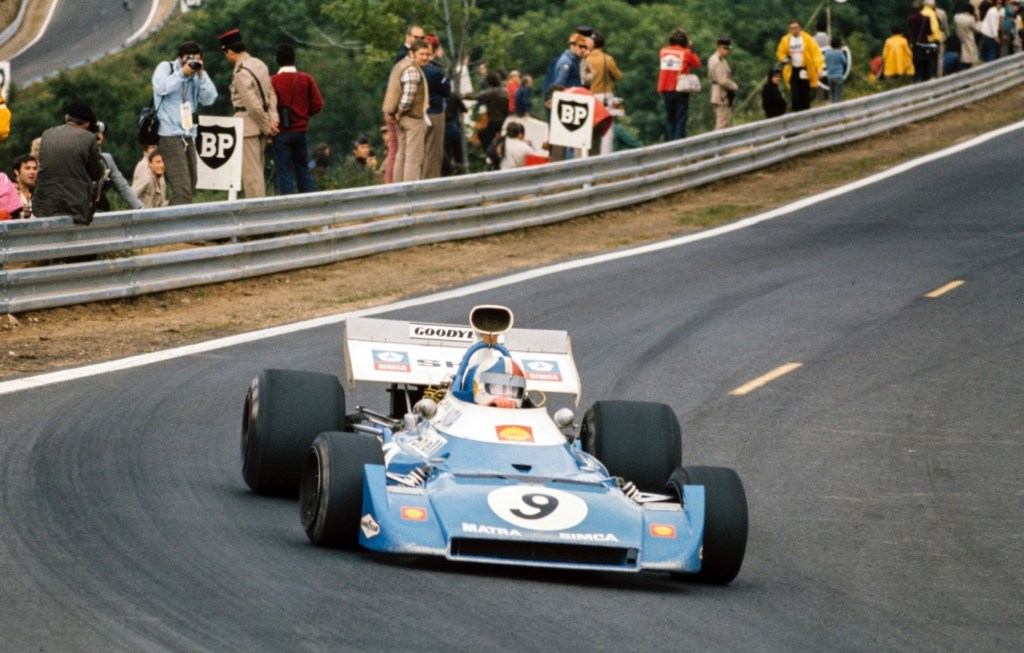
Chris should have won at Clermont in 1972, as it was, pole and fastest lap there, and fastest lap at Nivelles was about all the driver and team took away from the season, withdrawal as a team from F1 followed. Very sadly. Feature piece about the MS120 here; https://primotipo.com/2014/07/06/venetia-day-and-the-1970-matra-ms120/

Amon, Mosport 1972 Q10 and sixth MS120D (unattributed)
(LAT)

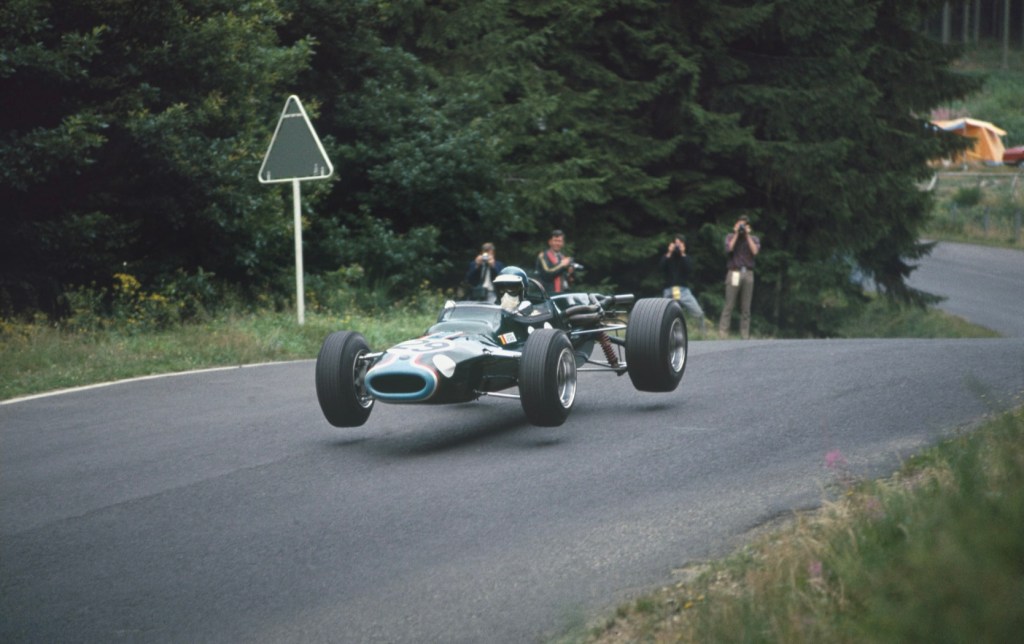
Jacky Ickx won the first European F2 Championship in 1967 aboard Ken Tyrrell Matra MS5 and MS7 Ford FVAs.

Here he is at the Nurburgring over the August 6, German GP weekend in an MS5 which was outted with suspension failure, I wonder why!? More on the MS7 in this piece on Johnny Servos-Gavin; https://primotipo.com/2016/09/02/johnnys-talbot/

Jackie Oliver won the F2 section of the race, he was fifth overall in a works Lotus 48 FVA. Denny Hulme won the race from Jack Brabham in a Brabham Racing Organisation BT24 Repco 1-2, Alan Rees was the second placed F2 home, seventh overall in a Brabham BT23 FVA.

Ickx won the championship from Frank Gardner’s works Brabham BT23 and Beltoise’ MS5 and MS7, but the F2 Star was – as ever – graded driver, Jochen Rindt with five wins of the ten rounds aboard his Roy Winkelmann run Brabham BT23 Ford FVA.

(MotorSport)

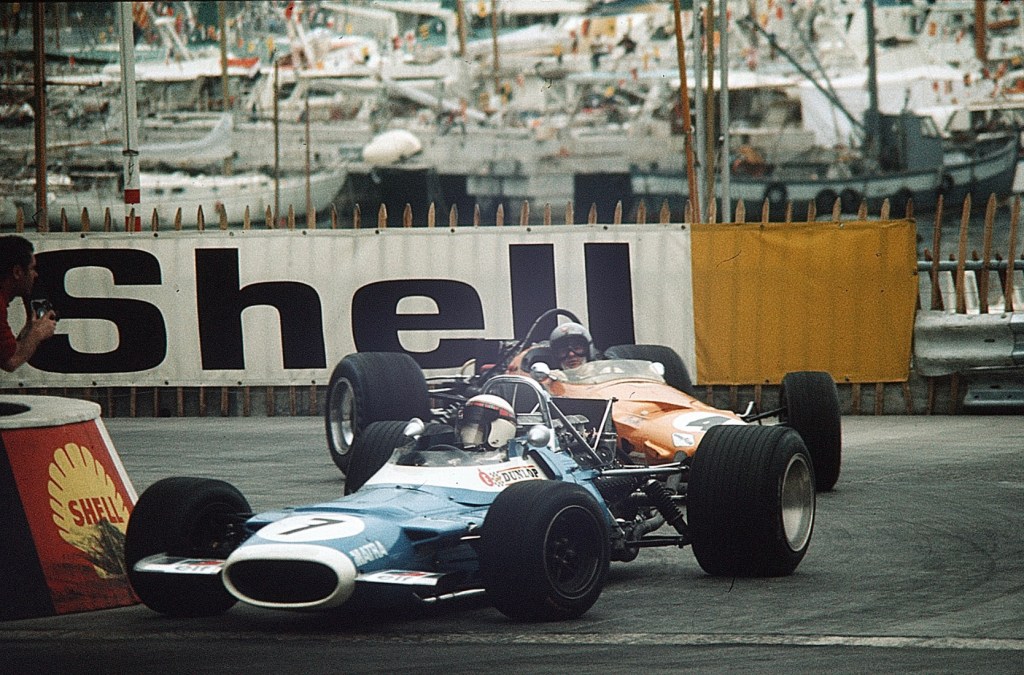
Jackie Stewart, Matra MS80 Ford – the 1969 drivers and constructors champions – from Bruce McLaren, McLaren M7C Ford at Monaco in 1969.

Jackie retired with a broken UJ and Bruce was fifth in the race won by the Mayor of Monaco, Graham Hill, in his Lotus 49B Ford, for the fifth time. It was the crazy weekend when the CSI/FIA banned high-wings after Friday practice, see here; https://primotipo.com/2015/07/12/wings-clipped-lotus-49-monaco-grand-prix-1969/

Matra International and Stewart won the respective titles with victories at Kyalami, Montjuich Park, Zandvoort, Silverstone and Monza. See here for more on the Matra MS80; https://primotipo.com/2016/07/01/matra-ms80-ford/

(MotorSport)

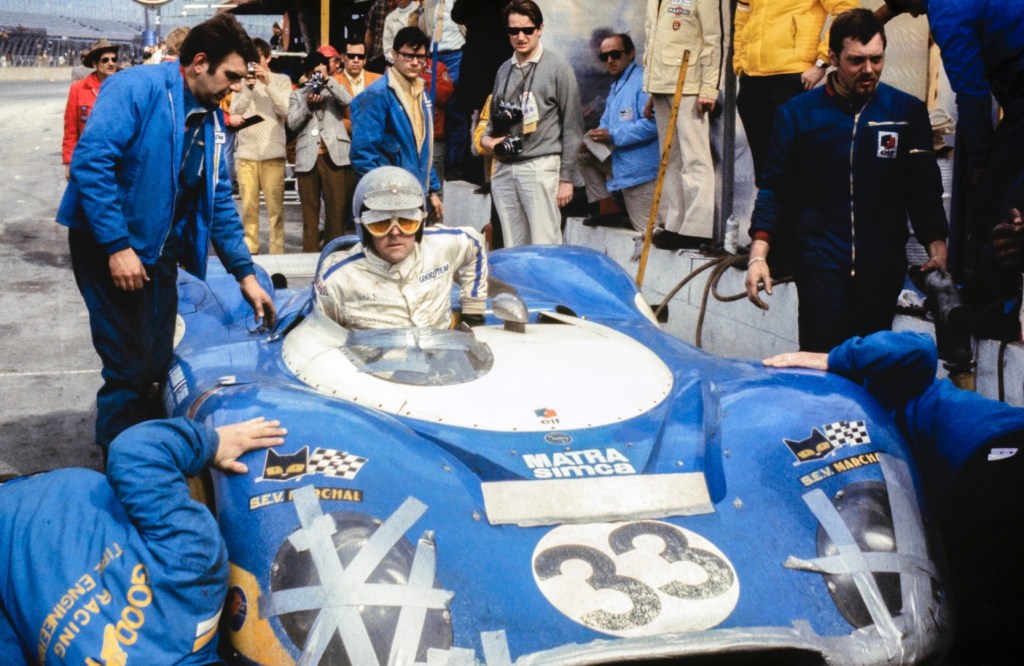
Jack Brabham at Daytona in 1970, where he was 10th in the Matra MS650 he shared with Francois Cevert. It was Black-Jack’s final season, later Australian taxi-competition duly noted.

Relieved of management responsibilities – he had sold his half share in Motor Racing Developments and the Brabham Racing Organisation to Ron Tauranac at the end of 1969 – the wily campaigner attacked his final season with great vigour, knowing he had Her Indoors to look forward to on a more regular basis when the family returned to Australia.

Apart from his Brabham F1 program, he raced an F2 Brabham BT30 for John Coombs, contested the Indy 500, and had a program of World Endurance Championship rounds with Matra, see here for the detail; https://primotipo.com/2016/09/09/jack-and-francois-matra-ms660/

Brabham in the MS650 he shared with JPB, Brands Hatch 1000km 1970. 12th in the race won by the Rodriguez/Kinnunen Porsche 917K (MotorSport)
(MotorSport)

The quickie MS7 F2-derived F1 Matra MS9 Ford DFV was knocked together as an R&D machine in advance of the quintessential ’68 Ford powered MS10.

MS9 was raced at Kyalami to give Ken Tyrrell and Jackie Stewart a car in which to contest the opening 1968 F1 round in South Africa.

(MotorSport)

The car was purposeful in its military green primer and became an entrant in the Fugly Car Cup when fitted with an outsized front radiator, extra water tankage and cooler to cope with the ferocious African heat (below). All the hard work paid off though, Jackie drove the lash-up to third behind Jim Clark – the great Scot’s final F1 victory – and Graham Hill’s Lotus 49 Fords.

The MS9 was used only once again in a test at Albi before being set aside and ultimately restored, it resides in a private collection.

(MotorSport)

(MotorSport)

The definitive 1968 Ford V8 powered F1 Matra was the MS10, here at Spa with Jackie on his way to fourth place, and below at Rouen in the tragic French GP.

Jo Schlesser died in the new Honda RA302 that awful, wet day, while Stewart was third. Bruce McLaren won at Spa in his M7A and Jacky Ickx in France aboard his Ferrari 312, the only F1 race not won by a Ford Cosworth powered car that season.

(MotorSport)

Francois Cevert, Matra MS670B from Brian Redman, Ferrari 312PB at Le Mans in 1973.

Both cars failed to finish, the Icky/Redman car with engine failure after 332 laps, and Cevert/Beltoise after completing 157 laps before a puncture induced accident. The winning Pescarolo/Larrousse MS670B competed 356 laps, while the second placed Art Merzario-Carlos Pace driven Ferrari 312PB 350 laps. A convincing win indeed.

The tail shot below is of a 670B during the May 1973 Nurburgring 1000km weekend.

Both the Cevert/Beltoise and Pescarolo/Larrousse 670Bs retired with engine failure allowing an easy Ferrari 312PB 1-2, the Redman/Ickx pair in front of Pace/Merzario. Hewland gearbox this time, note the alternator driven off the rear of the transaxle.

(MotorSport)
(MotorSport)

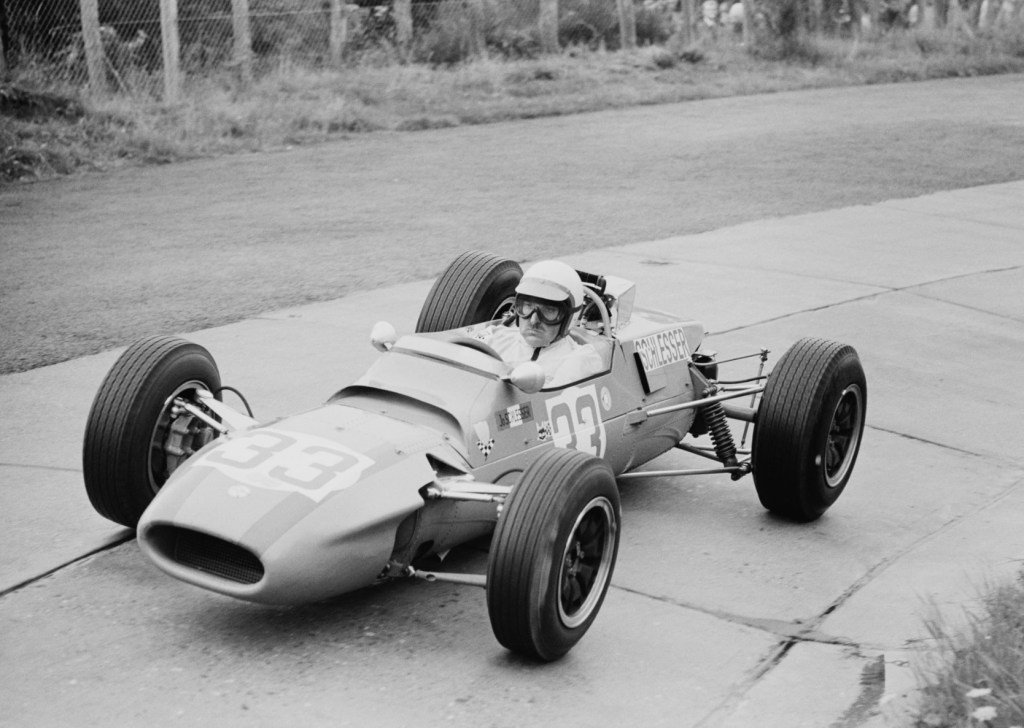
Jo Schlesser during the 1966 German Grand Prix, F2 1-litre Cosworth SCA powered Matra MS5. Jo was third behind two other MS5s raced by Beltoise and Hubert Hahne (Tyrrell entry).

1966 was the year of absolute F2 dominance by the works Brabham Hondas raced by Brabham and Hulme. Sad story on Schlesser, more positively, I am in the process of assembling a feature on the man, will finish it soon; https://primotipo.com/2019/07/12/its-all-happening-3/

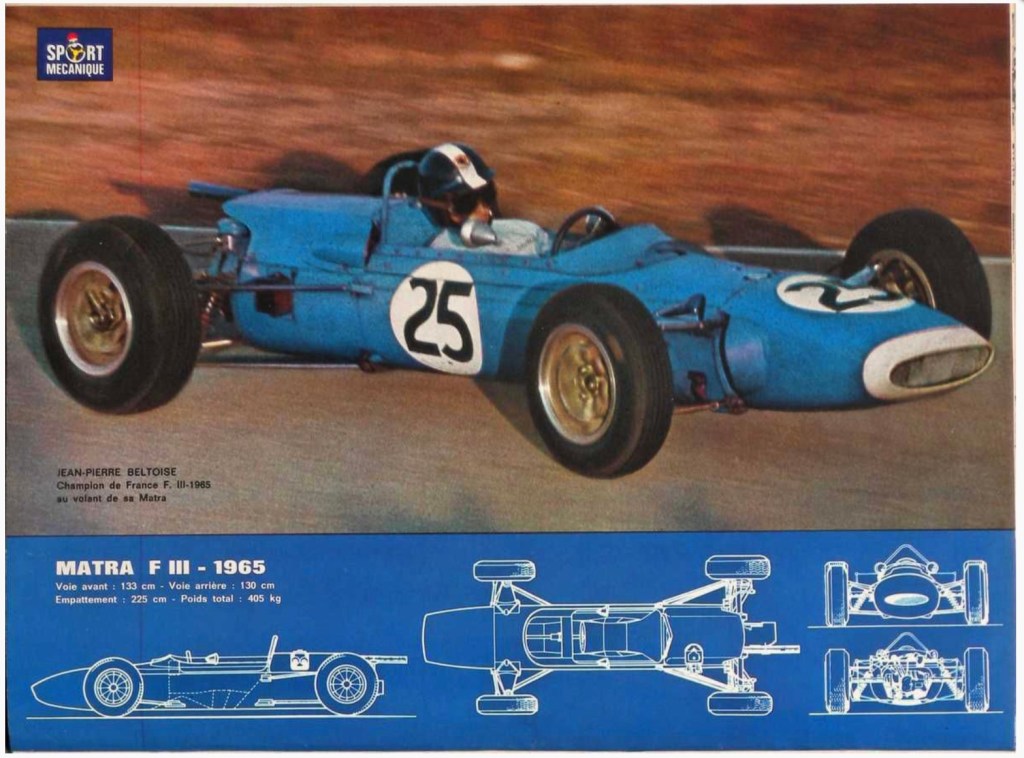
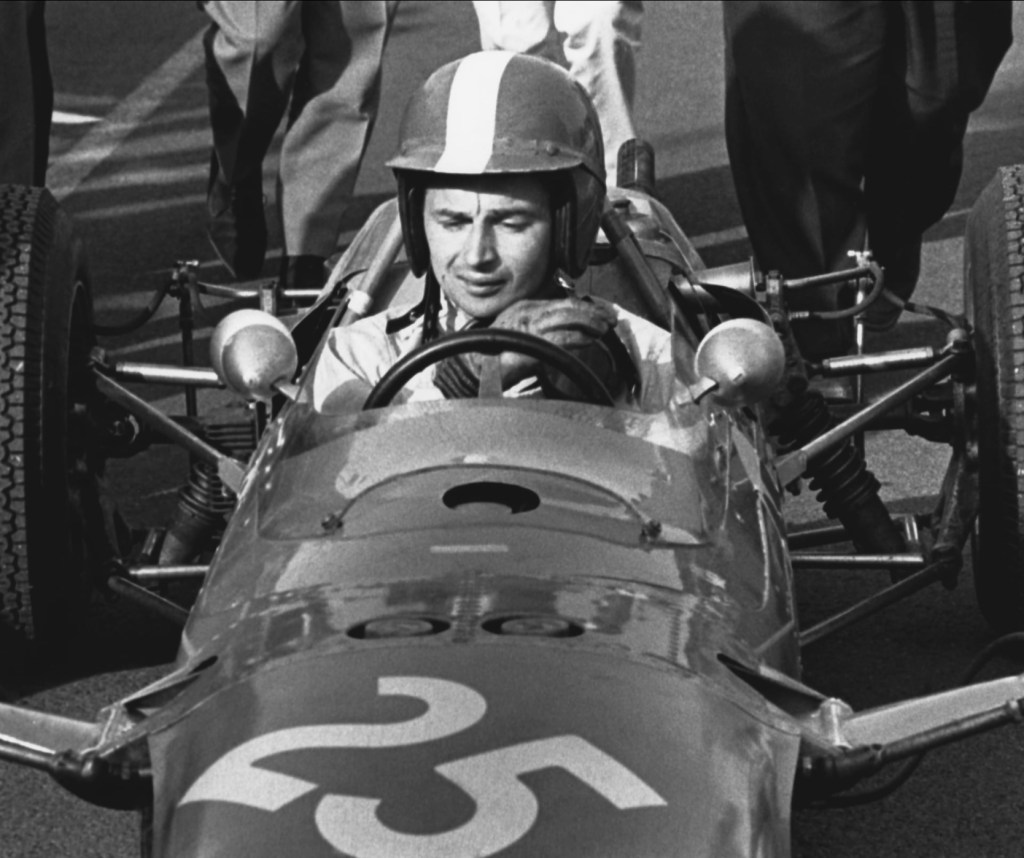
JPB won the 1965 French F3 Championship racing Matra’s first single-seater, the monocoque MS1 Ford, Jaussaud was second in another one. The early Matra single-seaters are covered in this piece; https://primotipo.com/2019/05/24/surtees-matra-1966-and-thereabouts/

(LAT)

JPB before winning the F3 round at Reims on July 4, 1965 – a breakthrough first victory for Matra – Matra MS1 Ford.

It was a slipstreaming ball-tearer of a 54 minute race too, JPB won by one-tenth/sec from Piers Courage’s Brabham BT10 Ford with John Fenning’s Cooper T76 Ford two-tenths further adrift!

In another year of Brabham F3 dominance, Matra grabbed a market toehold. JPB won the Trophy de Cognac at Reims in July, while Jean-Pierre Jaussaud took two more wins aboard his MS2 Ford in September, the Coupe de Paris at Montlhery and Coupe Internationale de Vitesse at Albi.

(MotorSport)

Henri Pescarolo at the Kyalami first F1 championship round in 1970, Matra MS120.

Henri finished the drivers world championship that year in 12th place, while JPB was 9th. Their best results were third placings at Spa and Monza for Beltoise, and at Monaco, Pescarolo. Matra were seventh in the manufacturers championship.

That year the Velizy concern chose not to build a Ford powered variant of their chassis raced so capably by Ken Tyrrell’s outfit in 1968-69, and Tyrrell/Stewart felt they were better sticking with a Ford DFV powered chassis, having tested the MS120 that winter. Initially Tyrrell raced customer March 701s, but by the season’s end the pace of Derek Gardner’s Tyrrell 001 Ford was apparent, and was delivered in spades in 1971.

Zandvoort 1970, Beltoise’ fifth placed MS120. Isn’t the distance between the radius rods unusually small? (MotorSport)
JPB, Brands Hatch, British GP 1970. DNF wheel after 24 laps, looong exhausts! (MotorSport)
(MotorSport)

JPB on his way to victory in the VII GP de Monaco Formula 3 GP in 1966, Matra MS5 Ford, from Chris Irwin’s Brabham BT18 Ford – five-tenths adrift – and John Cardwell’s Lotus 41 Ford.

That year Johnny Servoz-Gavin won the French title in another MS5.

(MotorSport)

Another one that got away from Chris…

He led the 1972 French Grand Prix on a mans track – Clermont Ferrand – to half distance, then copped a puncture which dropped him back to eighth, then worked his MS120D back up to third place. So close, again.

(MotorSport)
(MotorSport)

Credits…

MotorSport Images, LAT Photographic, Getty Images, MotorSport, oldracingcars.com, Wikipedia

Tailpieces…

(MotorSport)

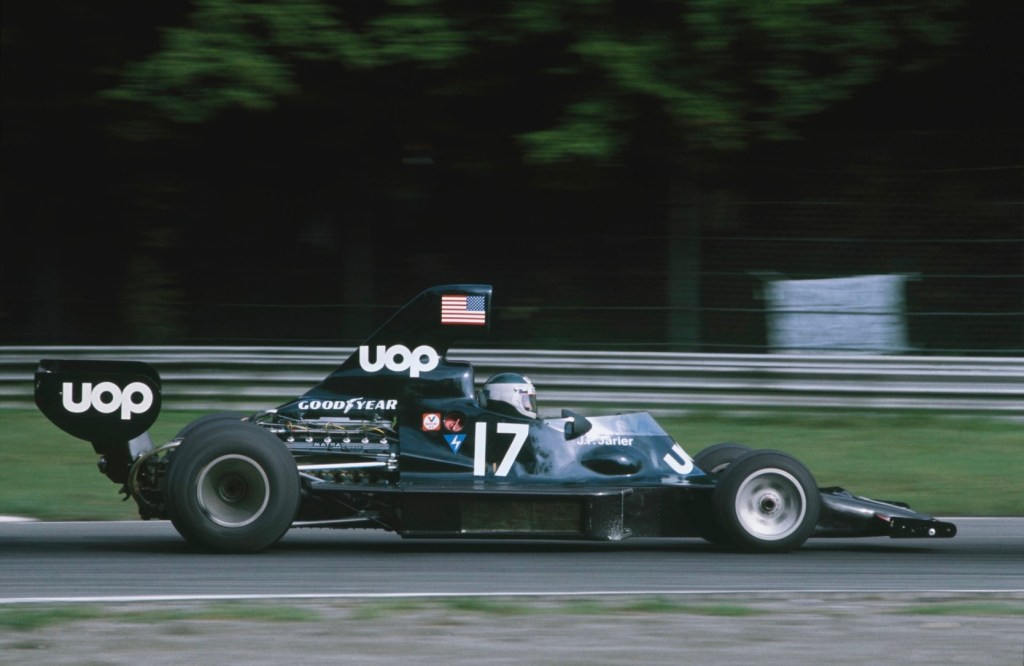
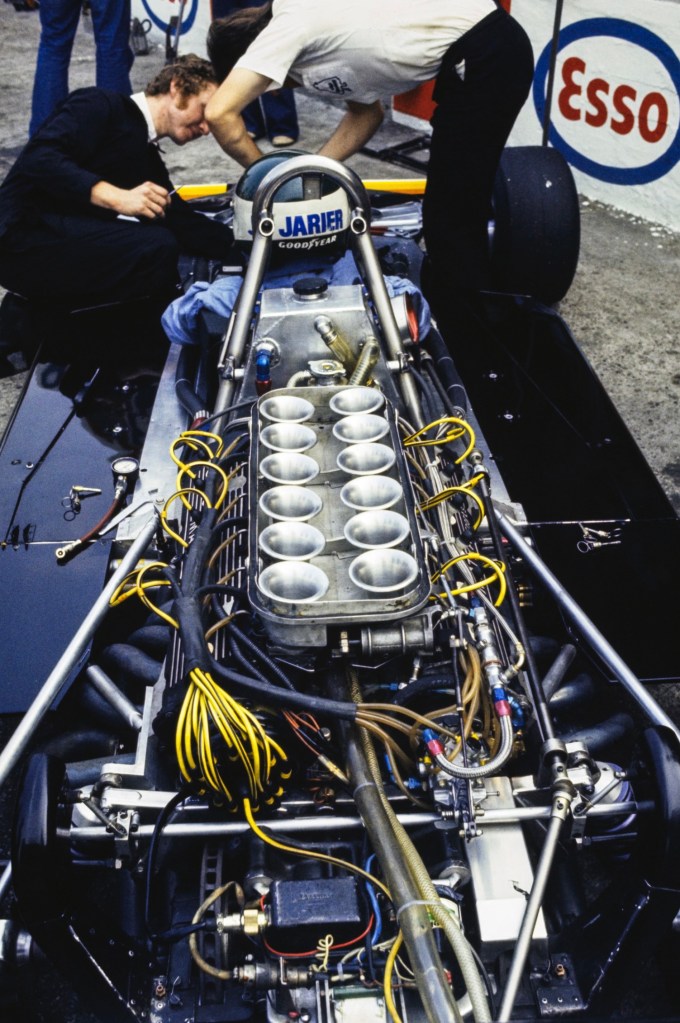
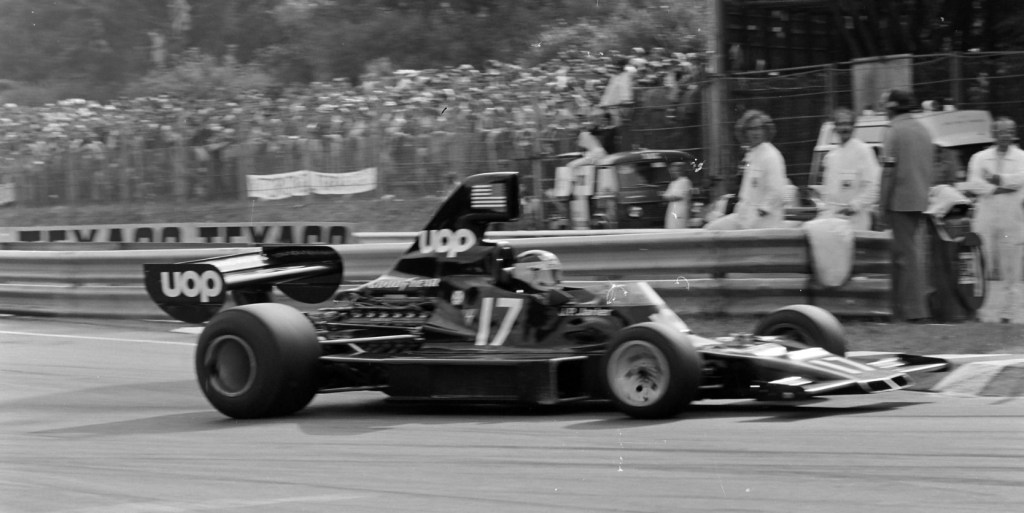
Of course, one of the most erotic of all Matras is the black one, Tony Southgate‘s 1975 Shadow DN7 Matra.

An experiment that was over way too soon, here at Monza driven by Jean-Pierre Jarier, DNF fuel pump after 32 of the 52 laps from Q13. Clay Regazzoni’s Ferrari 312T took a very popular victory. See here for an article on the Shadow Matra; https://primotipo.com/2016/01/15/shadow-dn7-matra/

(MotorSport)
(MotorSport)

Finito…
(S Shobo)

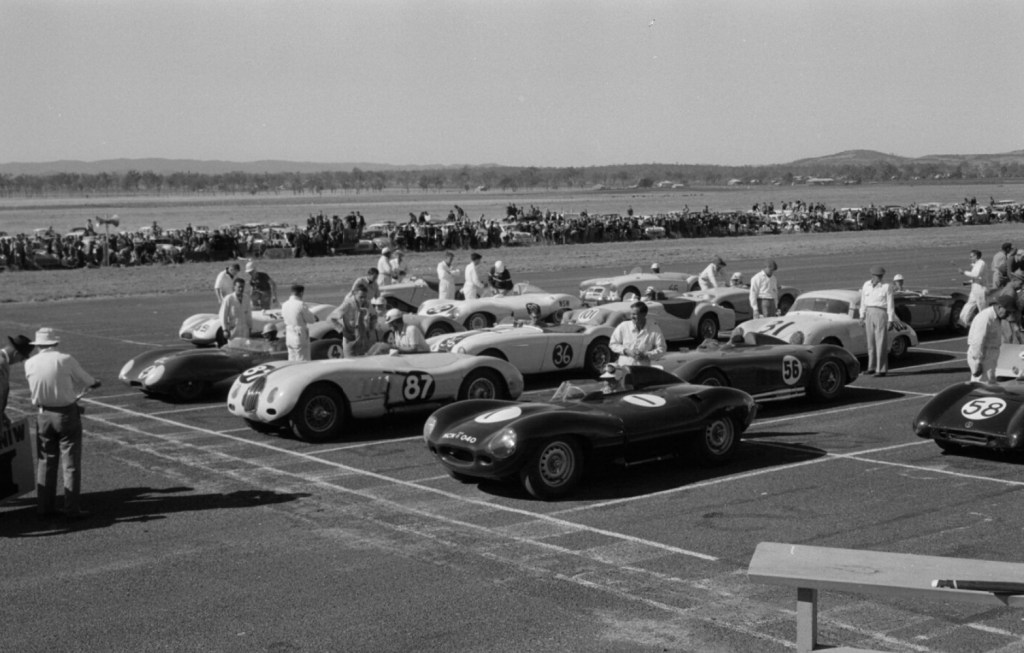
Fukumi Takatake – sometimes written Fukumi Kotake, born in Fukuoka, December 3, 1944 – at the wheel of the works Honda R800 during the 1969 Suzuka 500km, he finished second outright and first in the R1 class.

A very attractive car(s) new to me, the machine was of spaceframe construction, the design seemingly inspired by an F3 Brabham Honda owned by the Suzuka circuit, itself owned by Honda of course.

As the rear body-up photograph of the R800 shows below, its tiny air-cooled engine – mounted north-south at the front of the S600-800 roadies – was mounted conventionally in the rear of the sports-racer.

Honda R800 in the Suzuka paddock 1969 (unattributed)
791cc all alloy DOHC, two-valve, water cooled four fed by two twin-choke Keihin carbs, 70bhp @ 8000rpm. With roller bearings supporting the crank – and its dizzy rpms – Honda delved straight into its motorbike practice book for this engine
Honda R1300 during the 1969 Suzuka 1000km (unattributed)

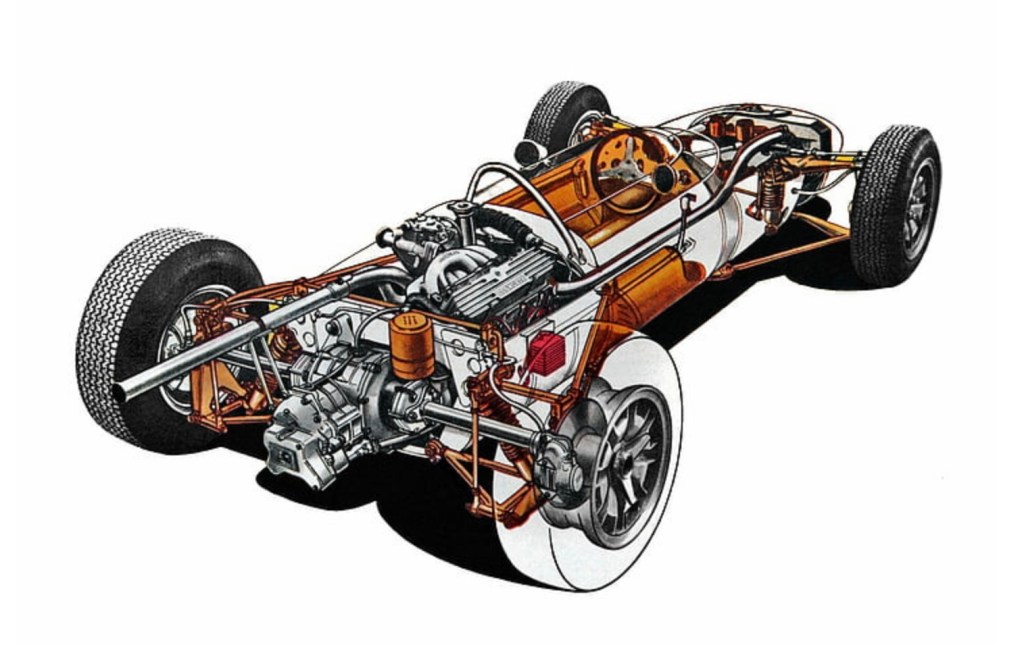
The cutaway drawing of the R1300 below – the engine was mounted east-west in the Honda 9 – shows the engine-transmission unit is mounted transversely at the rear as was also the case on Honda’s stunning, successful 1964-65 1.5-litre V12 RA271-272 GP machines. The suspension, brake, wheels and other specifications are otherwise 1960s period typical. See here for a feature on the Honda 1.5-litre GOP cars; https://primotipo.com/2014/12/12/honda-ra271272-1-5-litre-v12-19645-gp-cars/

Honda R1300 cutaway (unattributed)
Series 99 1299cc all alloy, SOHC, two-valve, air cooled transversely mounted four cylinder engine is fed by four Keihin carbs, dry-dumped, 116bhp @ 7300rpm (Honda Australia)
(unattributed)

The R800 was built by Honda RSC the competition arm of Honda. The Racing Services Club was formed in 1965, then became the Racing Service Center and finally in 1982 morphed into Honda Racing Corporation. The car made its race debut that Suzuka 500km weekend and was Honda’s response to the Coniglio and Macransa (later Dome) Honda S-Series based kit/racing cars.

Shortly after the Suzuka ’69 500km race, Honda upgraded the machine by fitment of the 1.3-litre, air-cooled, four-cylinder engine fitted to their then new Honda 7/9 Coupe, a vastly underrated car. The 1300cc SOHC, crossflow, all alloy engine had a unique engine cooling system named Duo Dyna Air Cooling. The head and block had airways akin to the water passages of liquid called engines cast with short, stubby vertical fins. An impeller mounted directly to the crank pumped air through the passages, assisted by additional fins on the outside of the block. The dry sump carried plenty of lubricant, in a sense the engine was also oil cooled.

I’m having trouble finding the race record of the R800/1300, my Japanese is limited other than when excessively lubed. Information welcome.

Fukumi Takatake commenced racing motorcycles at 17 and was a contracted Honda rider at 19, winning the All Japan 250cc title in 1966. When Honda withdrew from two-wheel competition in 1967 (for a while!) he switched to four wheels, racing single-seaters, sports and touring cars. He ceased as a racer in 1987 after competing in the All Japan Touring Car Championship.

Etcetera…

(Honda Australia)

The Honda 1300 Coupe 9 was famously the last project Soichiro Honda personally led before retiring as Honda’s ‘Supreme Advisor’ in 1973.

His originality showed through in the design too, albeit times, safety and emissions legislation required a changed more conventional approach to become relevant and appealing to the masses. The brilliant Civic followed, there was nothing particularly novel about it, just great, bullet-proof engineering and build quality. Australian conditions are tough.

(Honda Australia)

My Mk2 Cortina GT was the typical student shit-fighter, but it was all-mine! I felt like I was jilting a babe after a chance drive of a very affordable Coupe 9, by 1976 they were el-cheapos, high risk ones too. My big-mistake was talking to Dad about it, I needed a bridging loan while I flogged Corty and bought 9 Outta 10.

“I’ve spoken to the car guy (the Fleet Manager who thought HQ Kingswoods were edgy) at work!” he said to me the next night, here we go I thought. “He reckons you’re a bloody idiot, it will cost you heaps. You’re looking after the Ford, he reckons you’ll have to rev the ears off it – just like the last bloke did…” And so on…
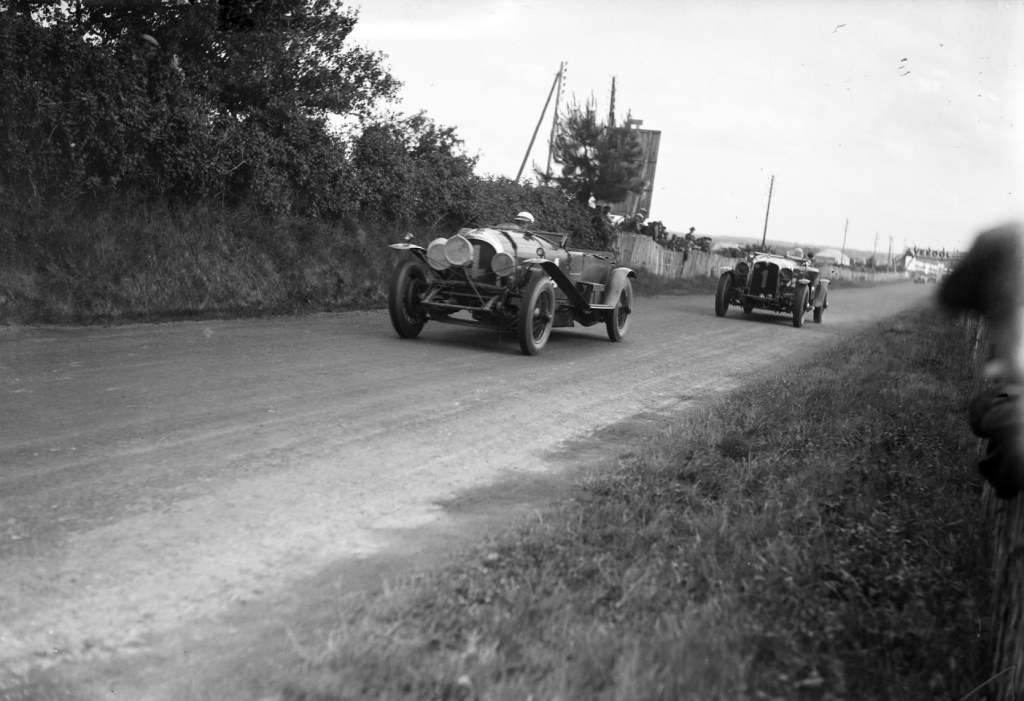
So I never did buy it but man it was a nice thing. A weird mix of old-tech like the rear axle, then that out-there engine and sweet gearbox. But it was so cohesive as a package, a howling but torquey engine, shitty looking nose tho. Time to drive one again, an interesting Classic Car article perhaps…

Credits…

Sanei Shobo, Historic Japanese Racing Cars Facebook page, Yukio Kobayashi, honda-rsc.com, yoshimura-rd.com

Tailpieces…

(unattributed)

Soichiro Honda looking pretty happy at the wheel of an S600 or S800 Honda.

John Surtees Honda RA300 ahead of Chris Amon’s Ferrari 312 at Monza in 1967. Big John won the race in a last lap duel and last corner fumble from Jack Brabham’s BT24 Repco, two-hundredths of a second the official margin.

Maybe Honda had mercy on Jack – their F2 partner in 1965-66 – saving him the embarrassment of the more obvious corporate shot! See here for a piece on that partnership; https://primotipo.com/2021/12/17/brabham-honda/

Finito…