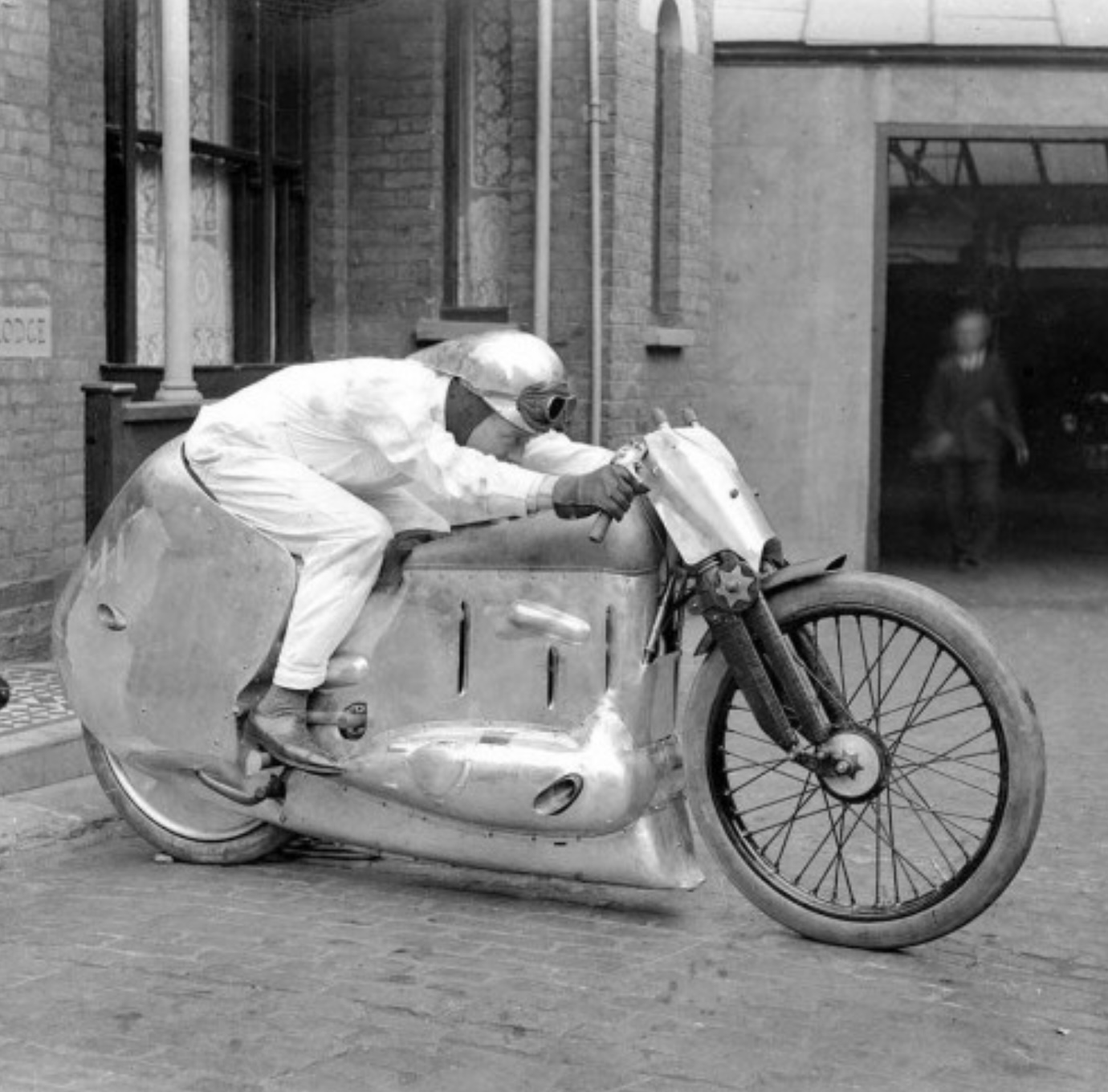
Alan Bruce poses in the UK on Leaping Lena : Brough Superior J.A.P 1000
Bob King looks at this record and the man who achieved it – Alan Bruce.
To this motor racing historian, motorcycle records were a peripheral issue, at least until I heard Alan Bruce’s story.
Let us start at the finish with an excerpt from the London Daily Mail May 4, 1932:
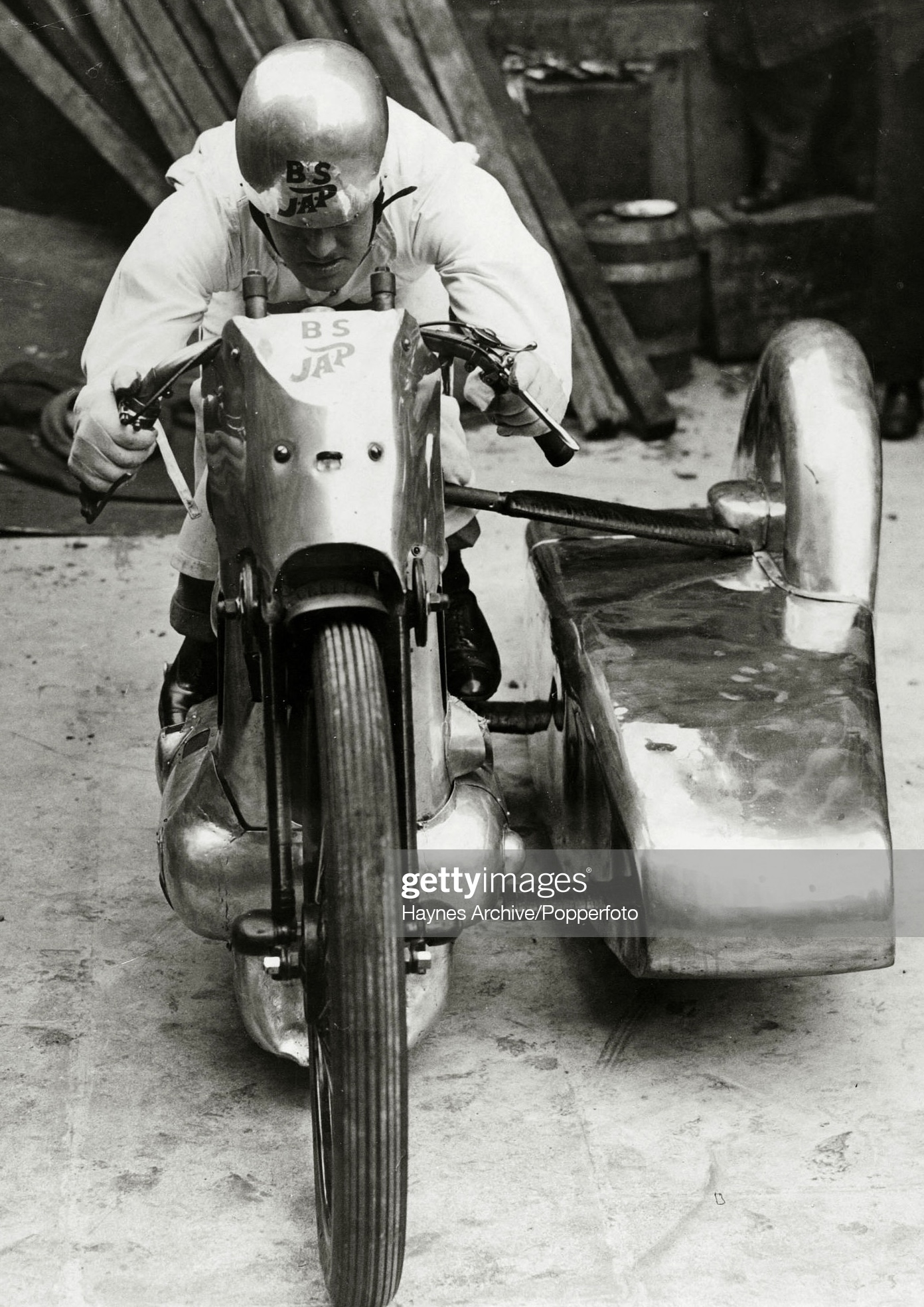
RECORD BREAKING IN HUNGARY, Alan Bruce, riding the J.A.P. 1000 c.c. machine on which he attained a speed of 200kmh on the Tat road near Budapest, April 30, 1932.
Alan Bruce is the first Australian to hold an officially recognized, WORLD LAND SPEED RECORD, the streamlining is noteworthy. This reads as a photo caption.
Another report, this time possibly from an Australian source, is headed:
AUSTRALIA “Knocks it for Six”, Alan Bruce on his now famous “Leaping Lena”, Sidecar outfit at Tat near Budapest, successfully attacked the Worlds (sic) Record for the two-way flying kilometre. His time, 17.88sec, is an average speed of 200.220 kmh, equal to 124.41 mph.
“The Motorcycle”, in another report noted that it improved on the “German figure by 6 mph”. The mention of ‘German Records’ hints at mounting tensions in Europe, which, to a certain extent, would be played out on race tracks and through record breaking.
Records like this do not happen by chance, but are usually preceded by months and possibly years of planning with the expectation that there will be set-backs. The unusual venue indicates the seriousness of this attempt. At that time the Tát road was thought to be the only suitable stretch of road for record breaking in the whole of Europe. Google maps suggests that the likely venue is a straight stretch of road that runs with no crossroads for approximately 8 kms north-east from Tat to Nyergesüjfal; it borders wide stretches of the Danube and is now known as Route 10, or locally as Kossuth Lajos U.
The team: Keith Horton, Alan Bruce, Phil Irving and Arthur Simcock
Most of my information on ‘Leaping Lena’ comes from Phil Irving’s Autobiography, 1992 (Turton and Armstrong). Phil Irving and Alan Bruce, who were of a similar age, had met at Stillwell and Parry’s in Elizabeth St. Melbourne, where Alan had been tuning racing machines. They shared a passion for motorcycles, particularly AJS, and had a continued friendship for the rest of their lives. Between them they cobbled up an overhead camshaft for an AJS, which was not particularly successful.
It is said that Alan got the notion of setting a Land Speed Record when he saw Paul Anderson take local records on Sellicks Beach, South Australia, in 1925. By 1926 Alan had done a lot of record breaking including the sidecar record for 350 c.c. machines on Bakers Beach in Tasmania. He also set the sidecar record from Hobart to Launceston; his speed exceeded the existing solo record.
By 1930 Alan had found success on the English speedways with a Rudge to which he had added his own modifications to the frame and forks. That year Phil arrived in England as Victorian 350c.c. Sidecar Champion. In 1931 they got together and cooked up a plot to break existing solo and sidecar world records – an ambitious plan for a couple of under-funded Australian battlers. They were joined by Arthur Simcock who was able to bring some Shell sponsorship. He was to ride solo, with Alan on the outfit. Although it was not his core skill, Phil was inveigled into designing a streamlined shell for the bike. The design was an attractive and unusual example of form meets function achieved without access to a wind tunnel. The front of the rig was not faired to avoid the adverse effects of crosswinds; the engine and sidecar were enclosed and the tail of the bike was shaped so that the rider’s backside was encased in a bucket seat. Eatons of Euston Road were tasked with beating up the shell; they formed the cowling over Arthur Simcock’s helmet. Phil’s involvement was confined to London; he did not go to Hungary.
The chosen machine was a Brough Superior SS100 with a J.A.P. V twin of 996 c.c., supercharged with a Powerplus blower. Alan assembled the power plant meticulously, but did not dyno-test it as its expected 100bhp exceeded the capacity of J.A.P.’s dynamometer. Phil already had a grasp of exhaust tuning; opting for short stubs finishing inside the fairing to avoid loss of charge down a long pipe. Theirs was a private venture with some trade support in the shape of parts as well as Shell fuel and lubricants; quite different from the Reichsmarks being spent elsewhere.
Their first visit to Hungary was in April 1931. Records were to be set on the average speed over the measured kilometre in two directions. After Arthur achieved a two-way average of 143 mph (229 kph) his attempt failed when a piston partially seized on a further run and the venture was abandoned until the following year. One can imagine their disappointment after traipsing all the way to Hungary.
Back in the UK, Phil and the team had other things to concern them, as they were also preparing a number of bikes for the forthcoming Isle of Man TT. In 1932 they trundled off to Hungary again with the bike on a truck. This time the record attempt went off without a hitch until Alan aviated the bike at near his maximum of 135 mph causing him to shut off. He then thumped a railway crossing, not realising he had passed the finish timing strip.
Not being across motorcycle records, this bit of Aussie fame had escaped my notice; at least until about 1983 when I had as a patient in my medical practice Alan Bruce’s middle-aged daughter. She told me of her record -breaking father whom she had not seen since before the war. He was shortly to come home for his eightieth birthday and she would like us to meet.
This culminated in a visit from Alan to see my cars and with me attending his birthday party which was also attended by Phil Irving and numerous elderly gentlemen, most of whom had pronounced limps. Alan entertained me with stories of his successful career on European tracks and was justifiably proud of is world land speed record. Seeing my Bugatti, he told me how he had been given a lift from Budapest to Tat for the record attempt with Swiss racing driver Armand Hug in his supercharged eight-cylinder Bugatti; Hug was also after some records. The whole journey was taken flat-out, including through villages, scattering chickens etc. in their wake. Among other achievements, Alan had designed a banking side-car for racing outfits on cinders which was a considerable improvement over Freddie Dixon’s pioneering eight-year-old design. The reason he had stayed overseas after the war was that he had joined the occupation forces in Germany, remaining there after marrying a German fräulein.
Alan’s final word on his record attempt: “Yes, it felt fast alright”.
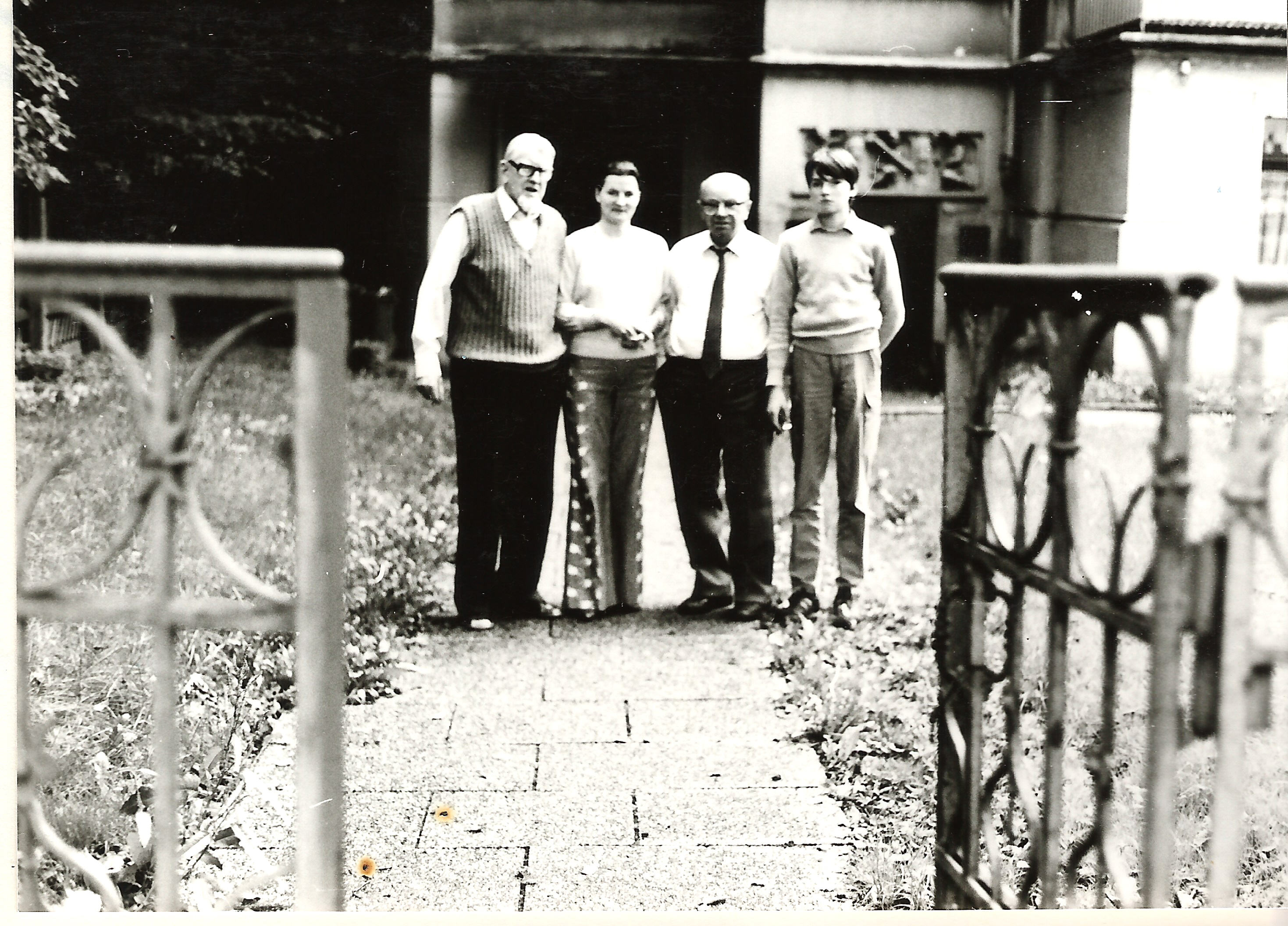
Alan Bruce, his wife, Erwin Tragatsch, a German Bugatti authority, and Bruce’ son. East Germany in the mid 1980s (B King Collection)
Postscript…
The mention of Ernst Henne in regard to land speed records brought to mind an interesting anecdote told to me by my late, lamented friend Lucien Chabaud.
Lucien had spent his teen years in the Vaucluse, Provence. During the war he and his mates shared a racing Terrot motorcycle that they would start up from time to time, according to the availability of dope with which to fuel it.
One day they were playing with the Terrot in the main street of Orange; Avenue de l’Arc de Triomphr on Route National Sept. Their play was interrupted by the arrival of an imposing German staff car. A German officer stepped down, studied the bike, and asked if he could try it out. Moments later he was streaking up the highway, rounding the triumphal arch at an impressive speed: shortly after reappearing, still flat-strap.
Next day a German army truck arrived and a 200-litre drum of aviation fuel was unloaded, to which was attached a note reading: “Merci, Henne”. At that time Henne was the holder of the World Land Speed Record for a motorcycles at 279.5kph – set in 1937, the record was not broken for another 14 years.
Etcetera…
On location in Tat, Hungary, in Solo format, probably Arthur Simcock.
Sydney ‘Referee’ June 8, 1932 (B King Collection)
‘Fan-card’ shot shows the canted speedway sidecar.
Credits…
Bob King, The Vintagent, Moto Revue Jan-March 1933
Tailpiece…
(Hockenheim Museum Archive)
Stylised machine is a blend of 1930 OEC-Temple-Jap record breaker and the bodywork of Leaping Lena.
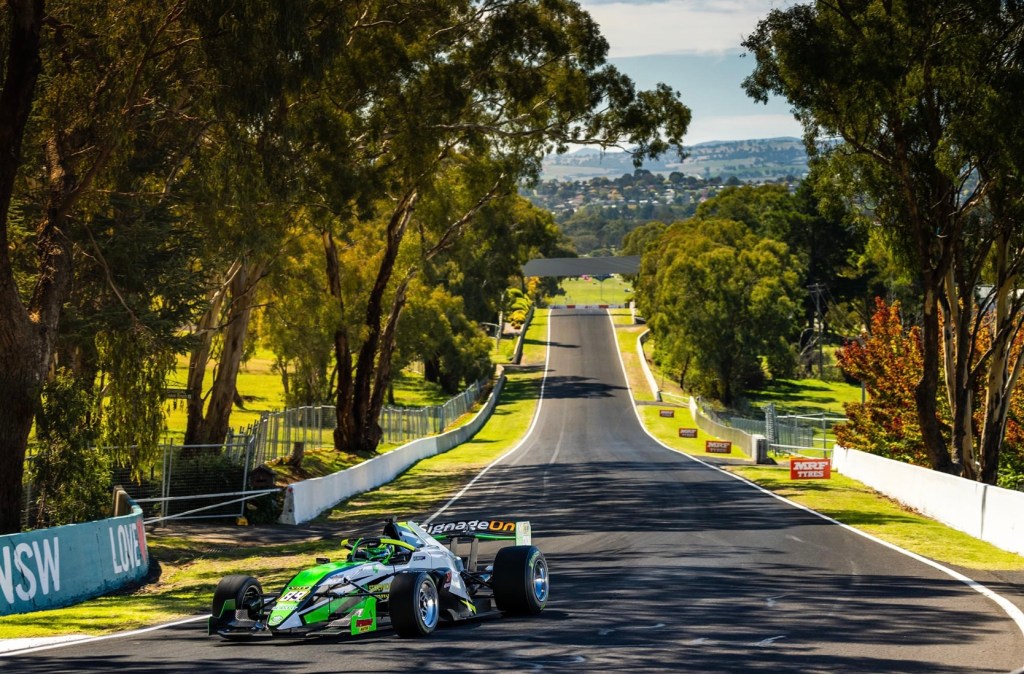
Stunning Baskerville shot of James Golding late January during one of several demos done by the two GRM cars that weekend (Daniel Kalisz)
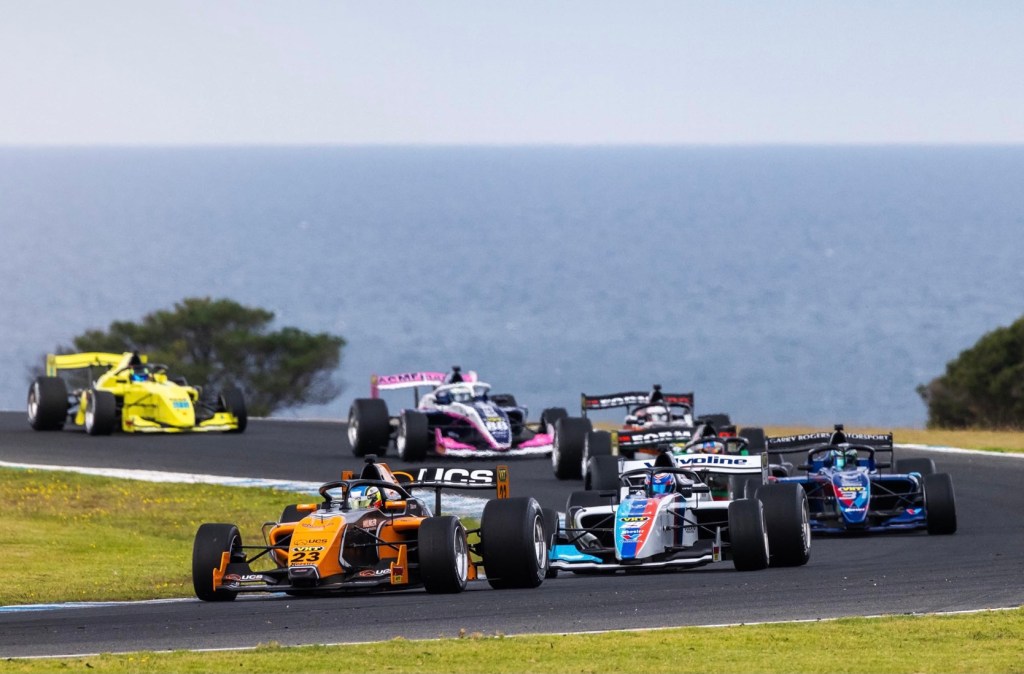
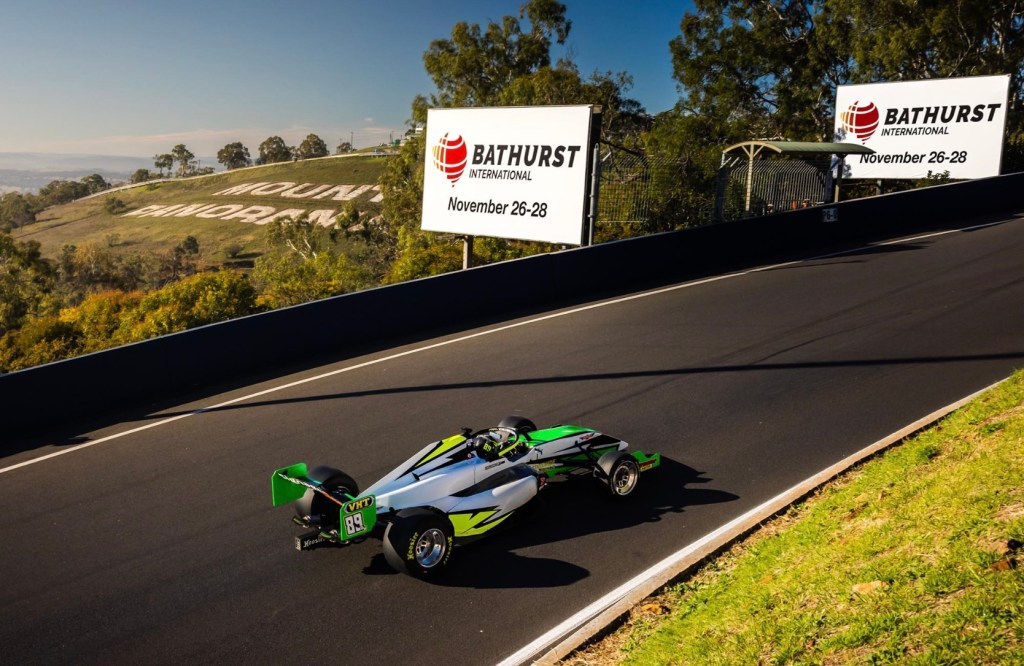
The announcement of the Tasman Cup being resurrected awarded to the winner of seven S5000 races at Bathurst and Surfers Paradise this November-December is fantastic news for Australian single seater fans.
The plan is a true Tasman, with races for the Ligier JS3-S5000 Ford chassis’ on both sides of The Ditch (Tasman Sea) next year, creating a series of races in New Zealand and Australia eagerly contested and watched in the sixties and seventies.
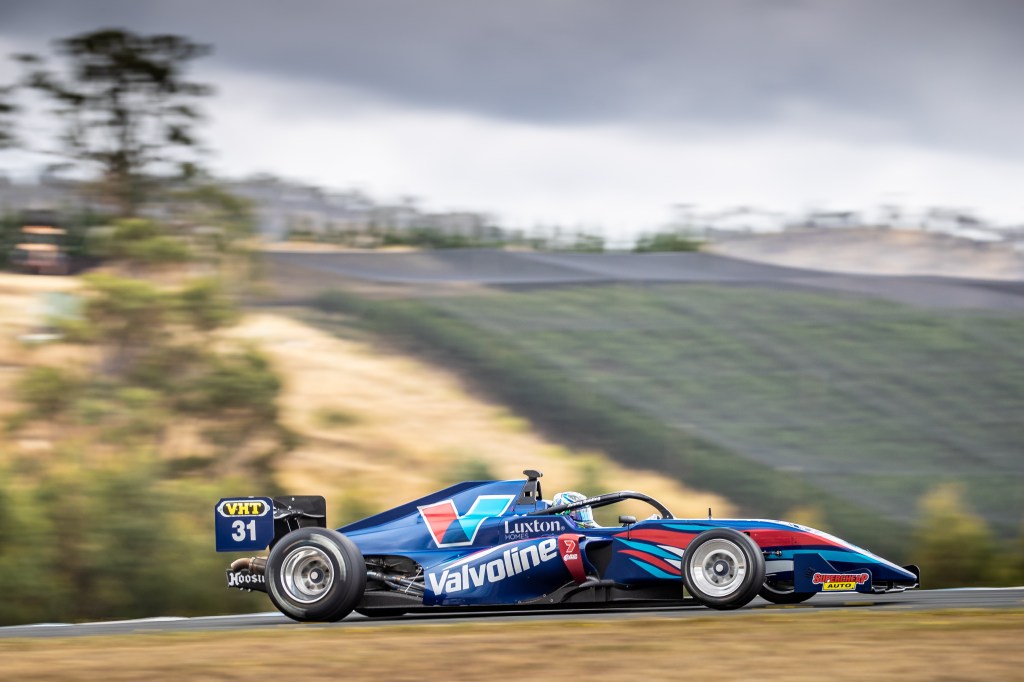
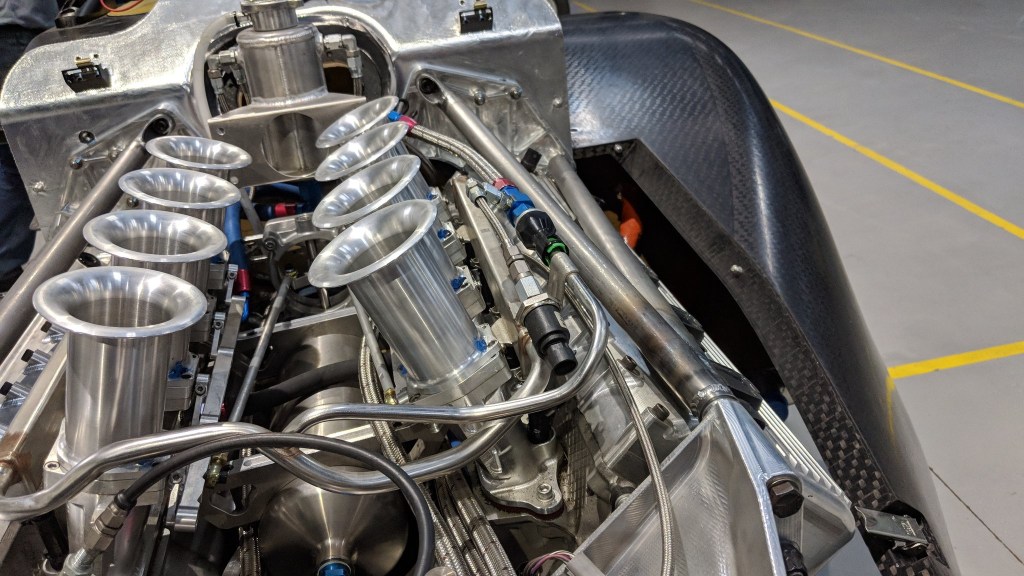
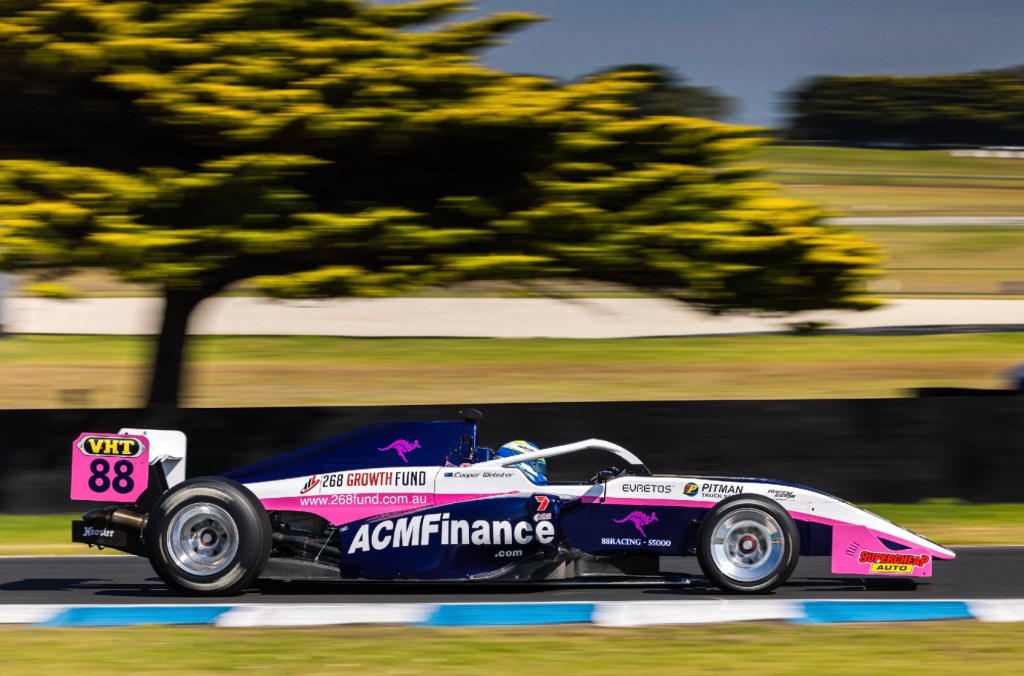
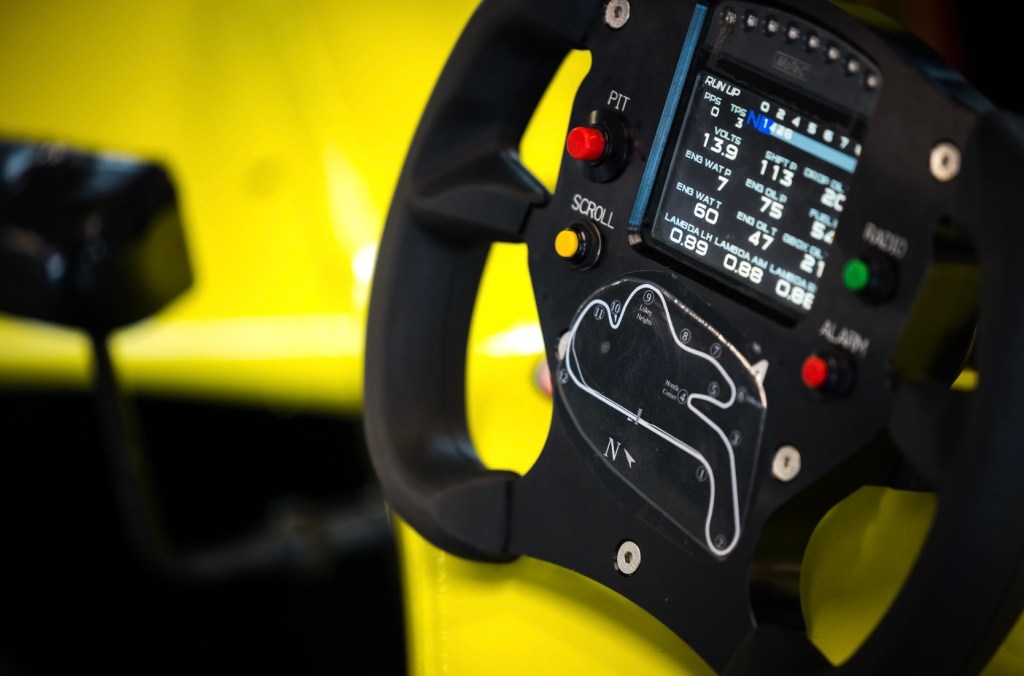
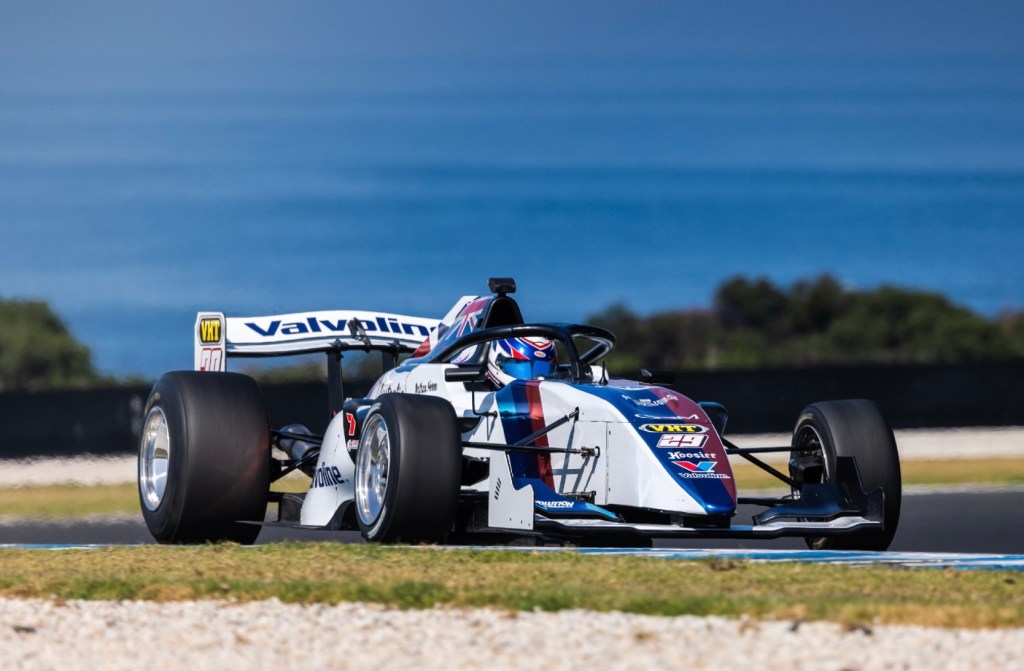
5.2-litre, 560bhp Ford Coyote DOHC, four-valve, injected V8 – chassis Ligier JS3-S5000 (S5000)Cooper Webster at Phillip Island, won one of the three races there in mid March (S5000)
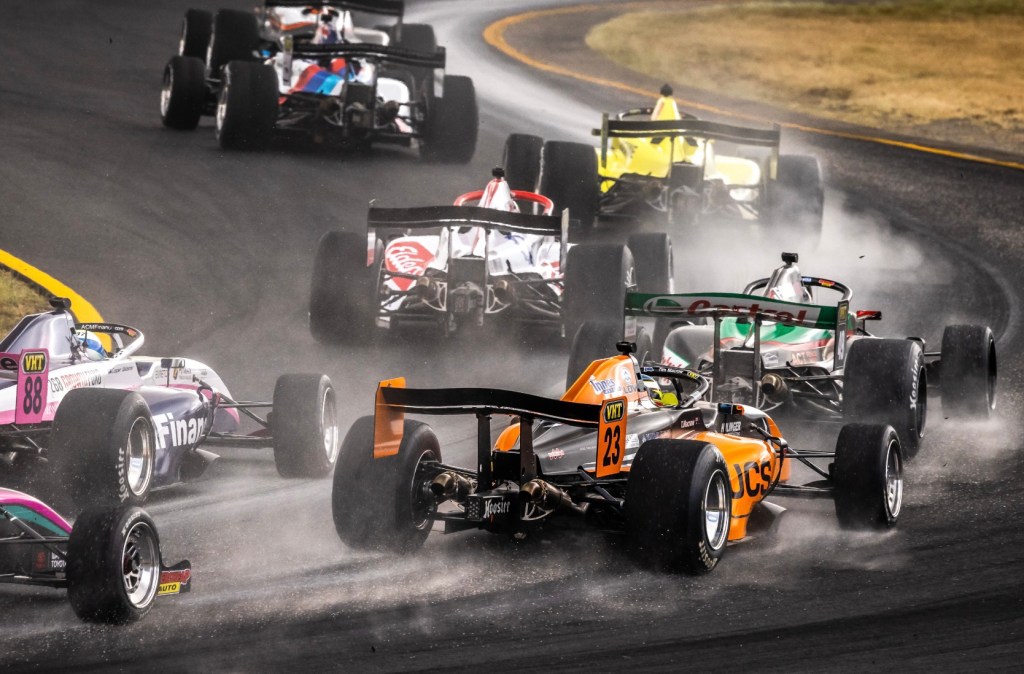
The new S5000, one make cars made their race debut at Sandown Park in late 2019, with the first Gold Star plans in 2020 scuttled by the dreaded Covid 19. This year Joey Mawson won the much coveted award in a closely contested series comprising 12 races at four circuits between January-April; Phillip Island, Symmons Plains, Sandown Park and Sydney Motorsport Park.
The Tasman plans build on that great start.
Readers of primotipo will be familiar with the Tasman Cup. Bruce McLaren won the first in 1964 racing a 2.5-litre Cooper T70 Climax, the last was taken by Warwick Brown in 1975 – his mount was a Lola T332 Chev F5000.
Phillip Island (S5000)Phillip Island; Tim Macrow from Nathan Hearne and James Golding (S5000)
In 1976 we went our separate ways with F5000 series, if it was in any doubt the fate of the great championship was settled in 1977 when the NZers went Formula Pacific, while Australia remained the last bastion of Formula 5000 until the early eighties.
History suggests the Kiwis got it right.
Time to plan a trip to the Goldie, hmm, think I’ll stay in Byron and drive up each day…Hop to it folks, let’s get behind these fantastic home-grown racing cars.
Braydan Willmington during his solo Mount Panorama data gathering laps in April. The earth will move with a grid full of these missiles soon. Maxi-taxis lookout (S5000)Nathan Hearne with a unique Bass Straight backdrop. Phillip Island (S5000)(M Bisset)
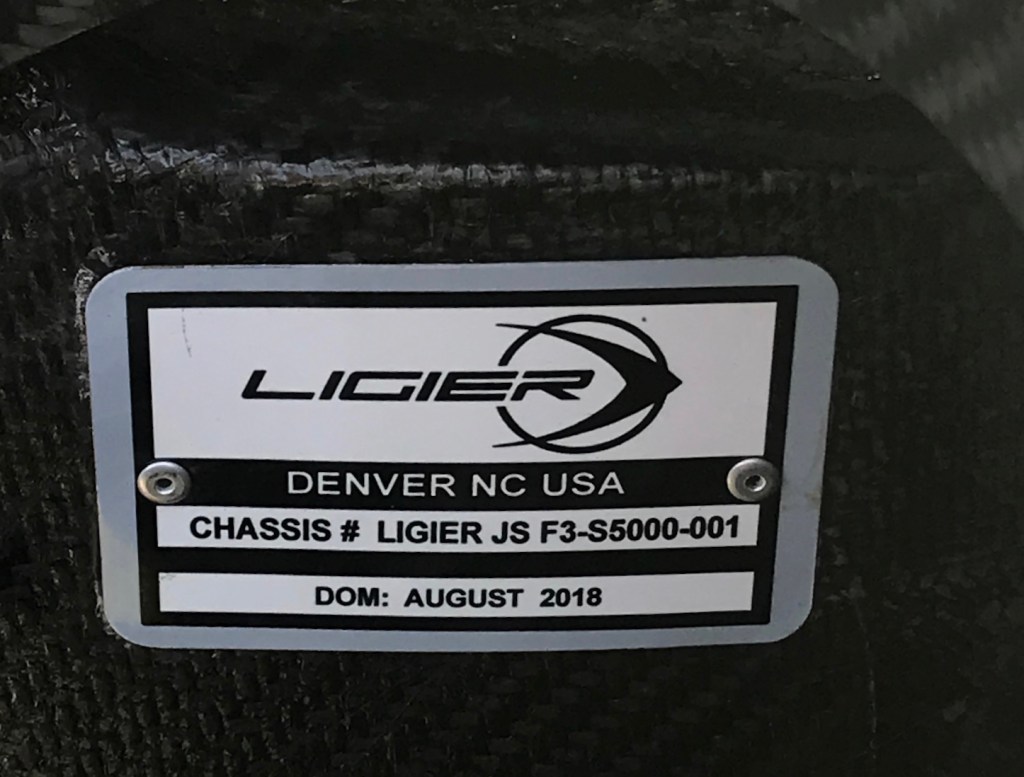
And yep, I know the cars have been named Rogers AF1s recently but I am not fussed. They are Ligier JS3-S5000s according to the chassis plates and were called that for the first 3 years of their lives. The Rogers name ignores the IP in the cars which is primarily that of Chris Lambden, Mike Borland and Onroak-Ligier. Bless the Rogers’ money and commitment but the name horse well and truly bolted years ago.
Symmons I think, with Tim Macrow front and centre. He finished second in the Gold Star in Chris Lambden’s Ligier JS3-S5000 chassis #1. Done heaps of kays this baby, not that it affects its pace! (S5000)
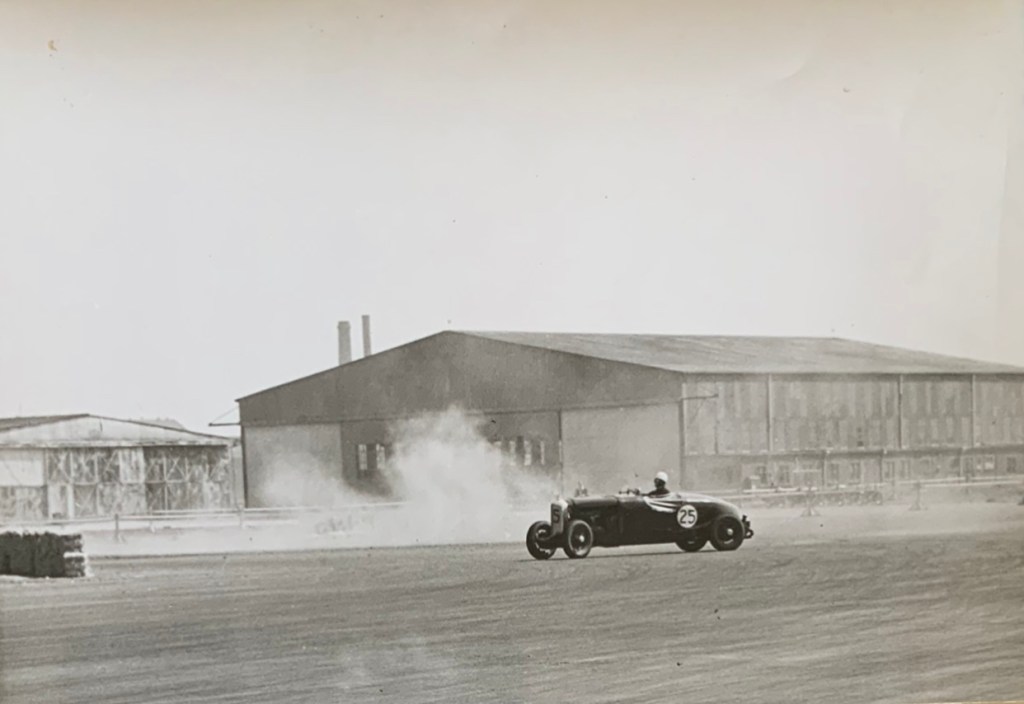
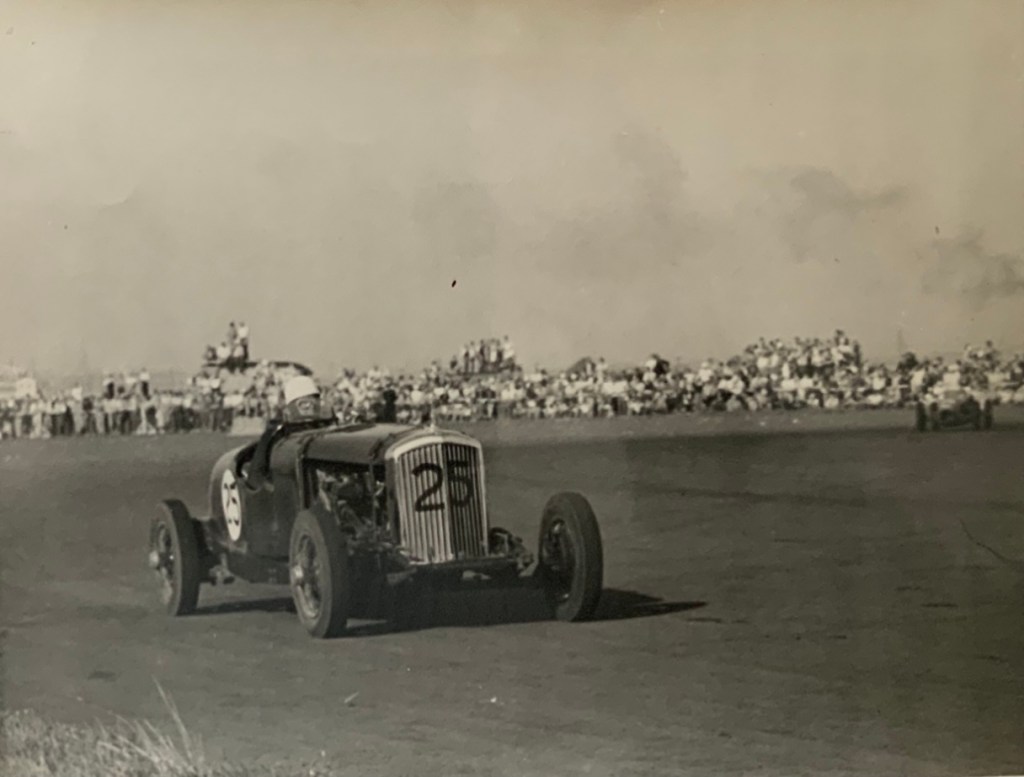
Rupert Steele explores the limits of his Bentley in the ample confines of Fishermans Bend (JP Read/VSCC Vic Collection)
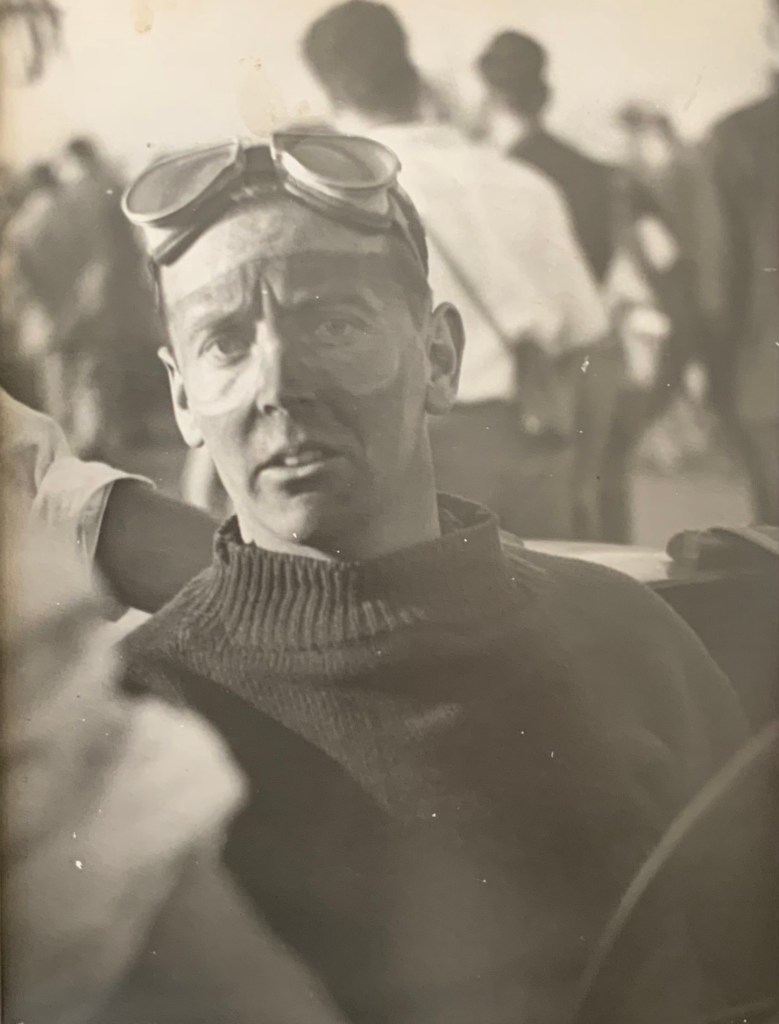
Sir Rupert Steele was a pillar of the Melbourne sporting and business establishment throughout the 1960-1980s.
With a period typical sense of duty he served in World War 2, including a year as a POW in the Stalag Luft III camp, in Sagan, Lower Silesia (now Poland) after the Lancaster in which he was a bomb-aimer was shot down over Germany.
Before he discovered thoroughbred racing, he was a racing driver of some ability despite few competition miles.
He took over his father’s 1937 Bentley and was soon competing in the heavy, 4.25-litre six-cylinder, pushrod, twin-SU 120bhp sedan; he was timed at 90.8mph in a 1940 Cowes Speed Trial.
Post-war – still with the cars Martin & King body fitted – he won the Light Car Club’s Peninsula Trial in 1947 overall, and the Boneo Hillclimb within that event. In 1948 he contested the Light Car Club’s Mountain Trial and a Rob Roy Hillclimb.
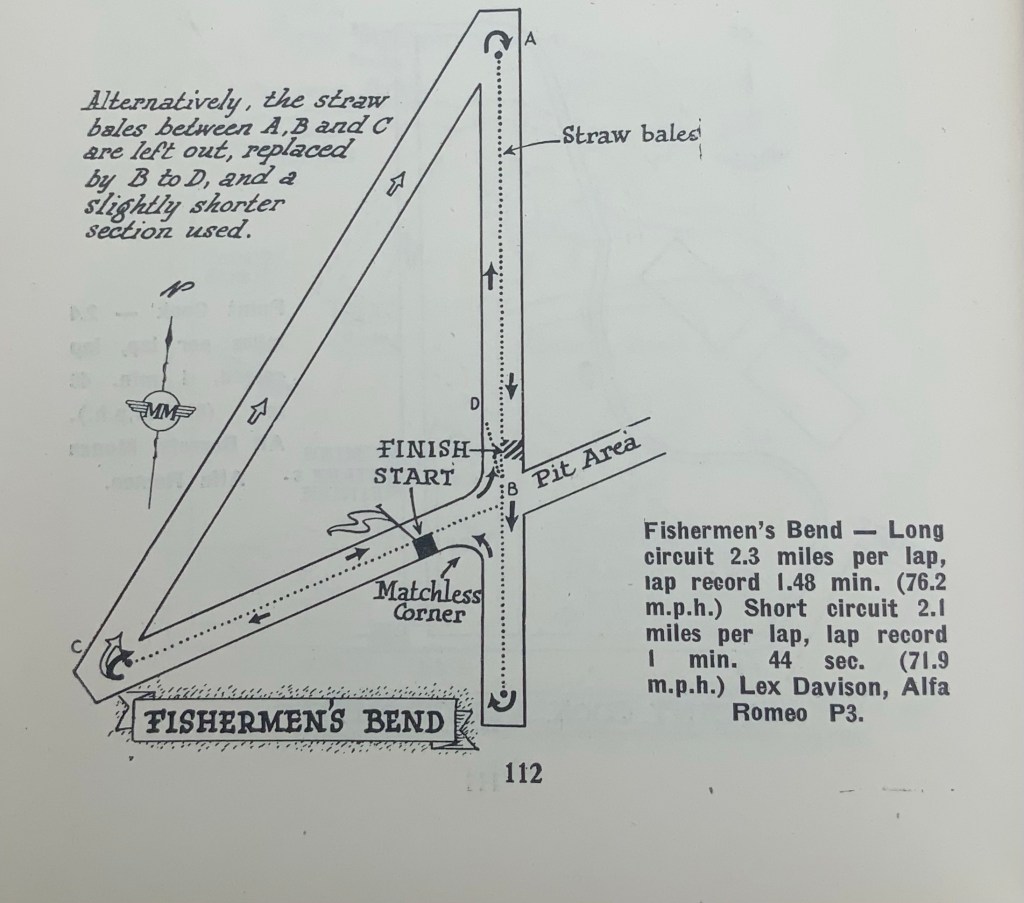
Rupert Steele after battle at Fishermans Bend (JP Read/VSCC Vic Collection)Fishermans Bend is the name these days! (Motor Manual Annual)
His serious intent was made clear when he had the Bentley body removed during a Rob Roy Hillclimb weekend in 1949. He competed body-on during the Saturday runs, and raced without it on the Tuesday Melbourne Cup Day! This work was performed by Allan Ashton at one of the most prominent race-preparation ‘shops of the day; AF Hollins in High Street, Armadale, Melbourne.
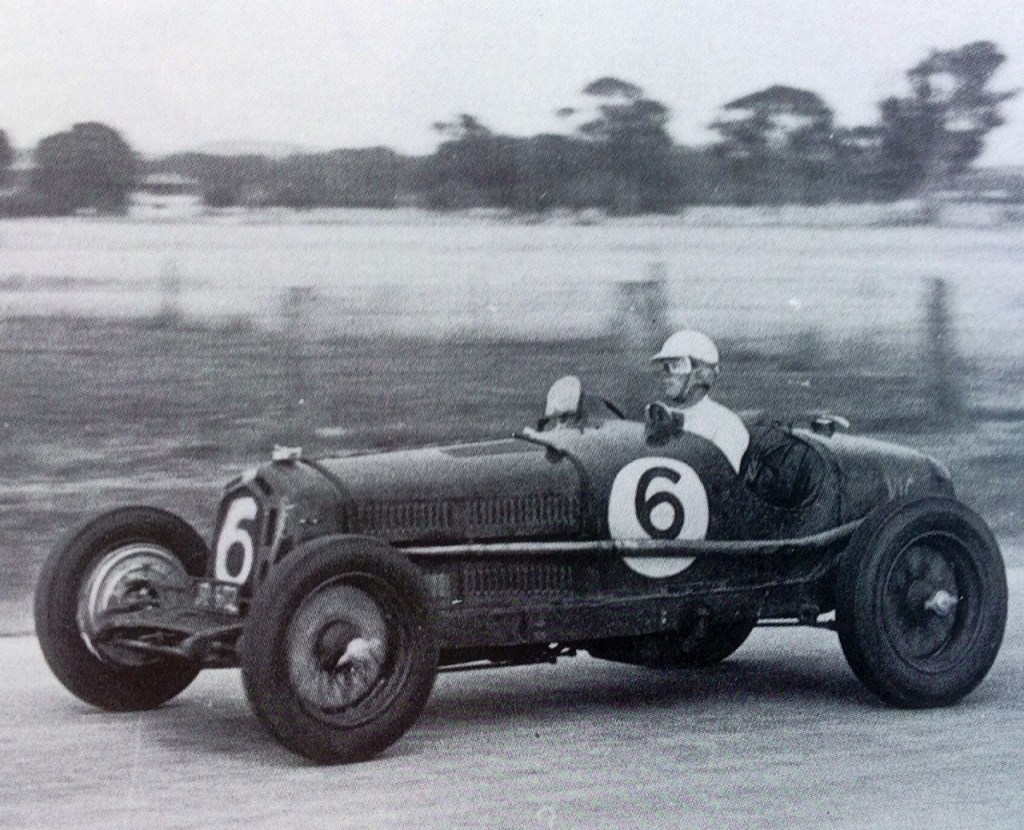
He raced the Bentley only once, on the occasion shown at Fishermans Bend, in Melbourne’s inner-west, in 1949. It was then game on; he purchased the Alfa Romeo Monza chassis # 2211134 previously raced by great Aussie Ace, Alf Barrett, who was retiring, this car was also prepared by Ashton and his crew.
“Everything was less serious in those days of course. Rupert Steele recalled that despite the lack of racing opportunities he put in quite a bit of practice driving in the Monza on outer Melbourne public roads, for example, driving from Dandenong to Beaconsfield and back at five in the morning.” he told great Australian race-historian Graham Howard.
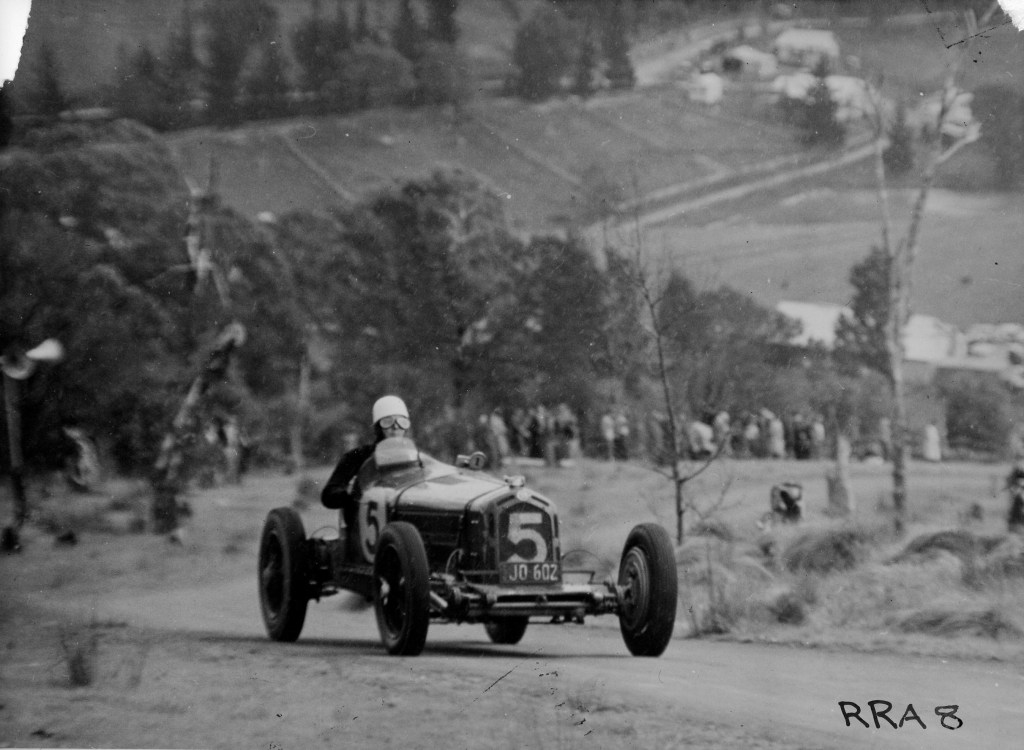
Super rare shot of Steele in the Alfa Romeo Monza at Rob Roy, Melbourne Cup Day meeting, November 1949. His first three runs got better and better but the fourth was a bit more exciting for he and spectators after a lose up from the Spillway (Tony Johns Collection)Steele in the Alfa Romeo Monza at Nuriootpa during the 1950 AGP, a most impressive performance from a novice in a demanding GP machine. A pity he retired so early (John Blanden Collection)
Despite his inexperience, he gave Doug Whiteford and his Ford V8 Special, Black Bess, a serious run for their money in the 1950 Australian Grand Prix run on the Nuriootpa roads in South Australia’s Barossa Valley. This event is covered here; 1950 Australian Grand Prix: Nuriootpa, South Australia… | primotipo…
The Bentley lived to fight another day, after the meeting shown its standard body was refitted, so equipped Rupert went into battle with the similarly equipped matrons on the Toorak, South Yarra and Armadale roads.
Rupert Steele was born circa 1921 and died in August 2000. His life of achievement included directorships of some large corporates including Carlton and United Breweries, he was Chairman of the Victorian Racing Club from 1978-1983 and knighted in 1980.
Etcetera…
(Darren Overend Collection)
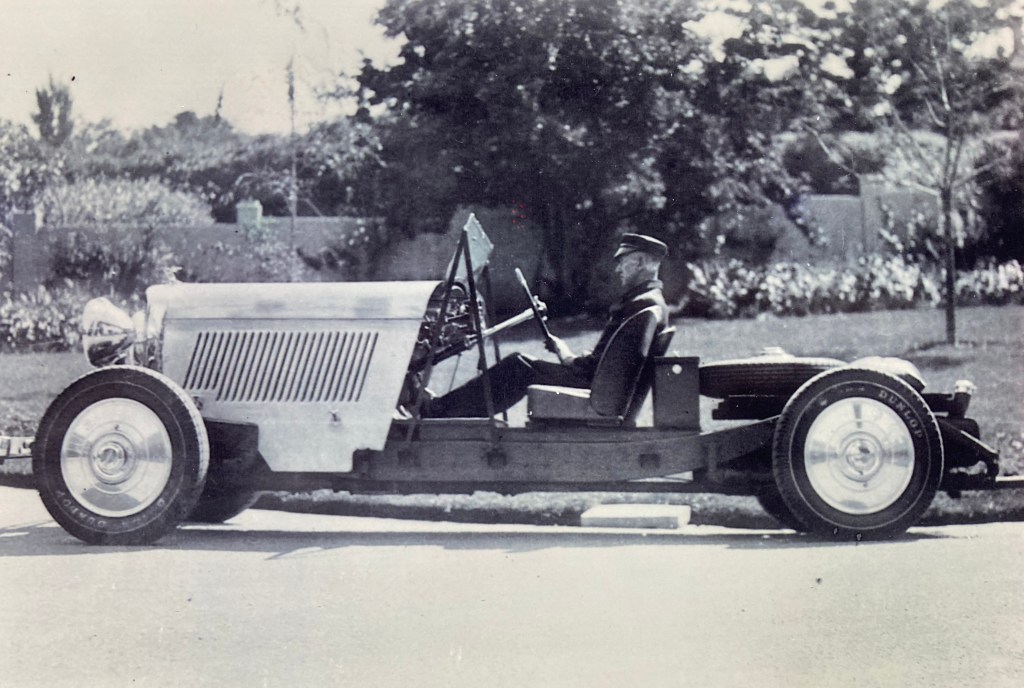
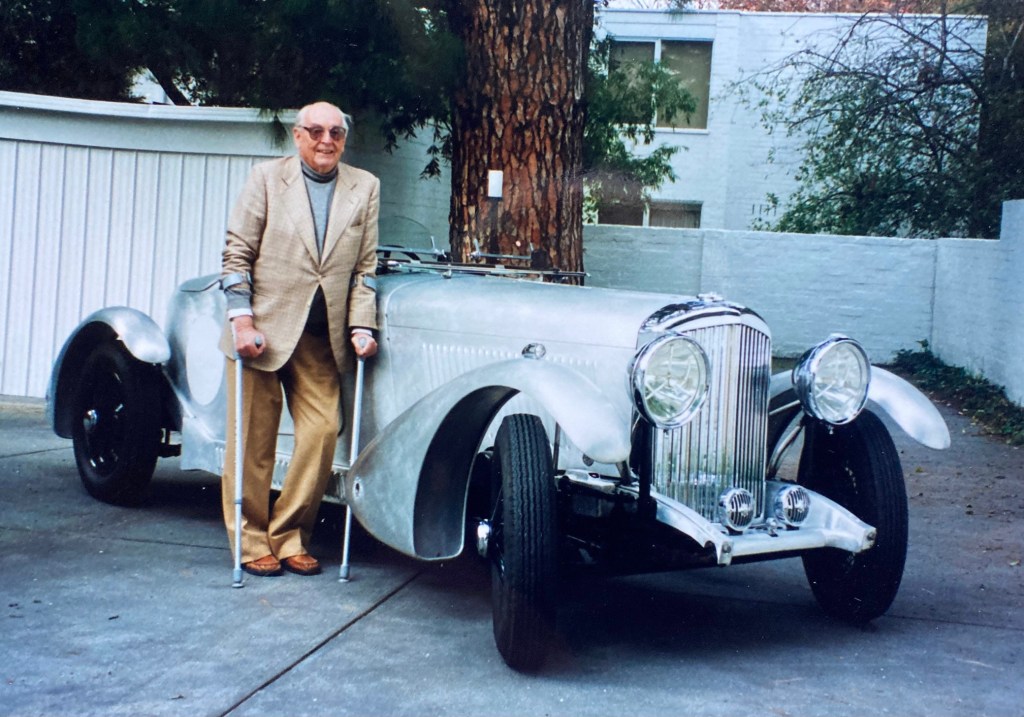
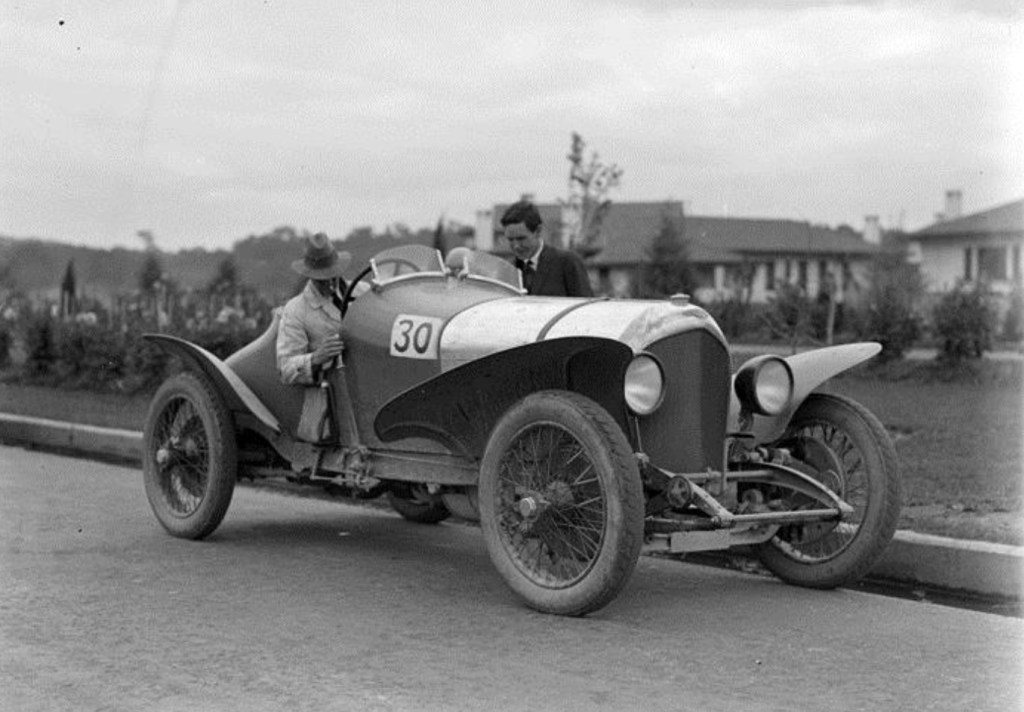
Bentley chassis B 28 GA “Brand new in Toorak, immediately after importation by Cyril Steele, Rupert’s dad, before being bodied by Martin and King in High Street, Armadale for the 1937 Melbourne Motor Show,” current owner Darren Overend writes.
“The driver is the Steele chaffeur, Arthur Jackson, who was drowned with Cyril in a boating accident (believed the boat capsized in stormy weather) on Port Phillip Bay near the Heads” (the treacherous, narrow entrance of the Bay and Bass Strait – the ocean).
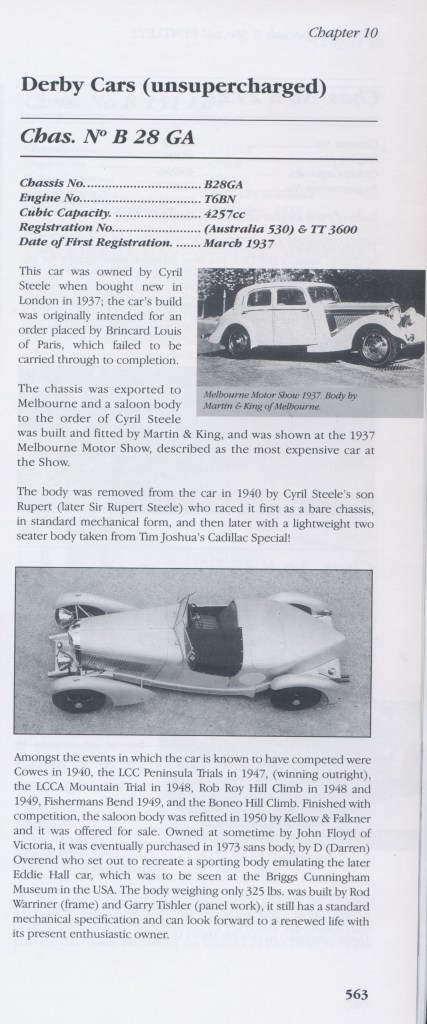
‘Bentley Specials & Special Bentleys’ Ray Roberts (Johns Collection)(Darren Overend)
Sir Rupert Steele with his old Bentley, looking a little different than it did in his days with it as a racer, Toorak 1995.
Credits…
JP Read photographer-VSCC Victoria Collection, ‘History of The Australian Grand Prix’ Graham Howard and others, John Blanden Collection, 1950-51 Motor Manual Australian Motor Racing Yearbook, Tony Johns Collection, Darren Overend Collection
Tailpiece…
(JP Read/VSCC Vic Collection)
That imposing radiator ranging up behind would have scared the lesser ranks into submission, surely! Bentley sedan looks mighty fine as a sports-racer. While it looks the part, mechanicals were standard. Fishermans Bend 1949.
Sandown, 25km from Melbourne, in the south eastern suburb of Springvale was first used for horse racing in the late nineteenth century, but closed in the 1930s.
Resuscitation commenced post World War 2 when the Victorian Amateur Turf Club planned and built a facility for horse racing, the donkeys galloped for the first time in the modern era in 1965. The dish-lickers (greyhounds) were catered for within the complex too, happy days. You have not lived until yerv’ had a night at the doggies, once will do mind you.
Fortunately the VATC allowed the Light Car Club of Australia to build a race track as well. The feature race of the first open meeting was the Sandown International Cup in March 1962; fittingly, Jack Brabham won in his Cooper T55 Climax.
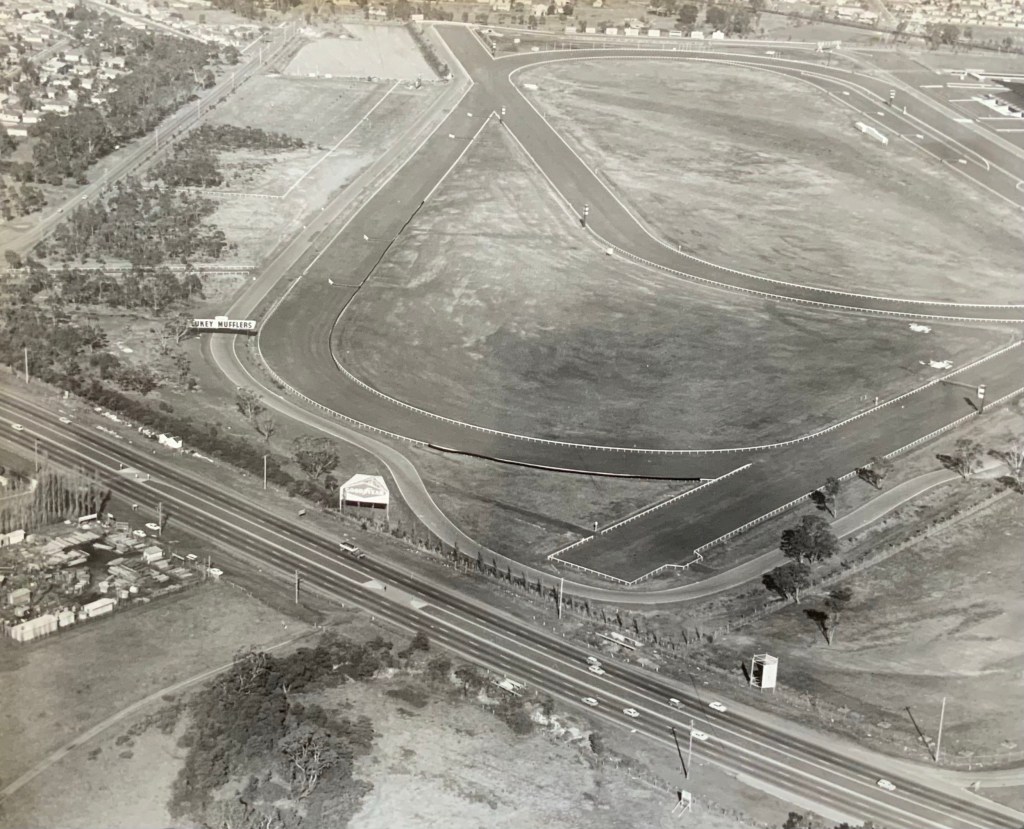
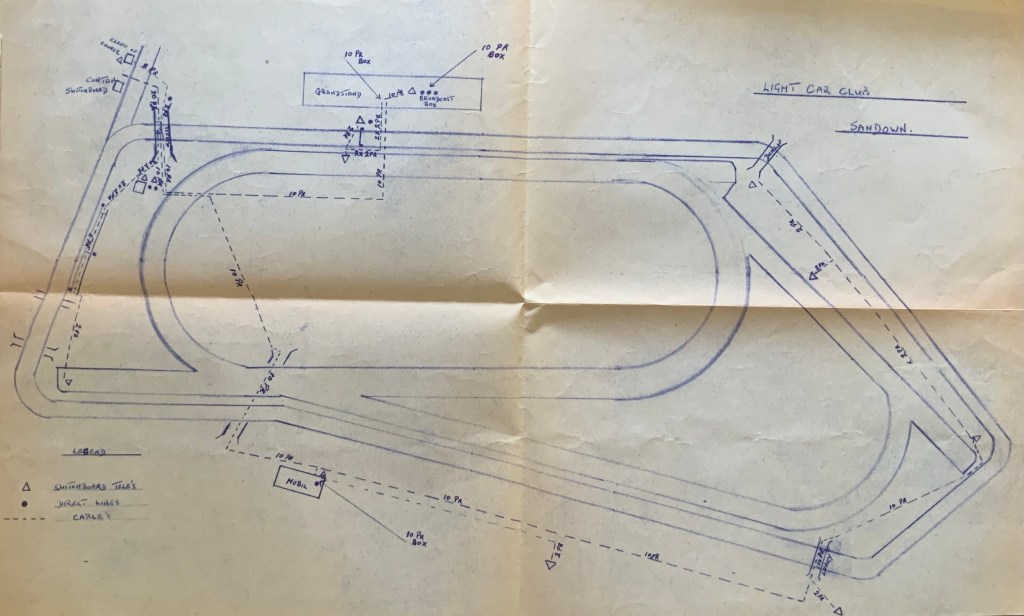
With the Sword of Damocles hovering near, if not over a track so dear to many of us, it makes me a bit misty eyed to see this early shot of two-thirds of the circuit, and the design schematic below.
It’s undated, but let’s guess 1960 as an approximation.
(VSCC Vic Collection)
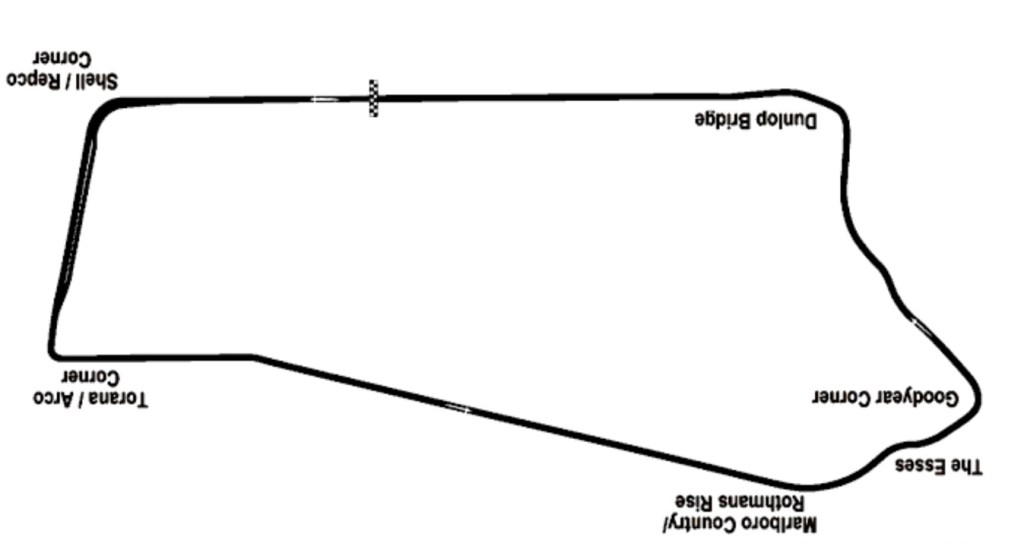
The original circuit map below – upside down deliberately, I’ve not imbibed any more giggle-juice than usual – allows an easy view of the differences between the draft above, and the track as used in the first phase of its long life until 1984; these are fundamentally a left-right kink on the way to Dandy Road, and the high speed right-left blast across the Causeway and under Dunlop Bridge.
At the height of the Tasman Cup there was an important bit of commerce to be conducted every year; the assemblage of a great field of cars and the fees to be paid to them by the seven or eight car clubs which owned or leased the tracks upon which the aces raced.
(VSCC Vic Collection)
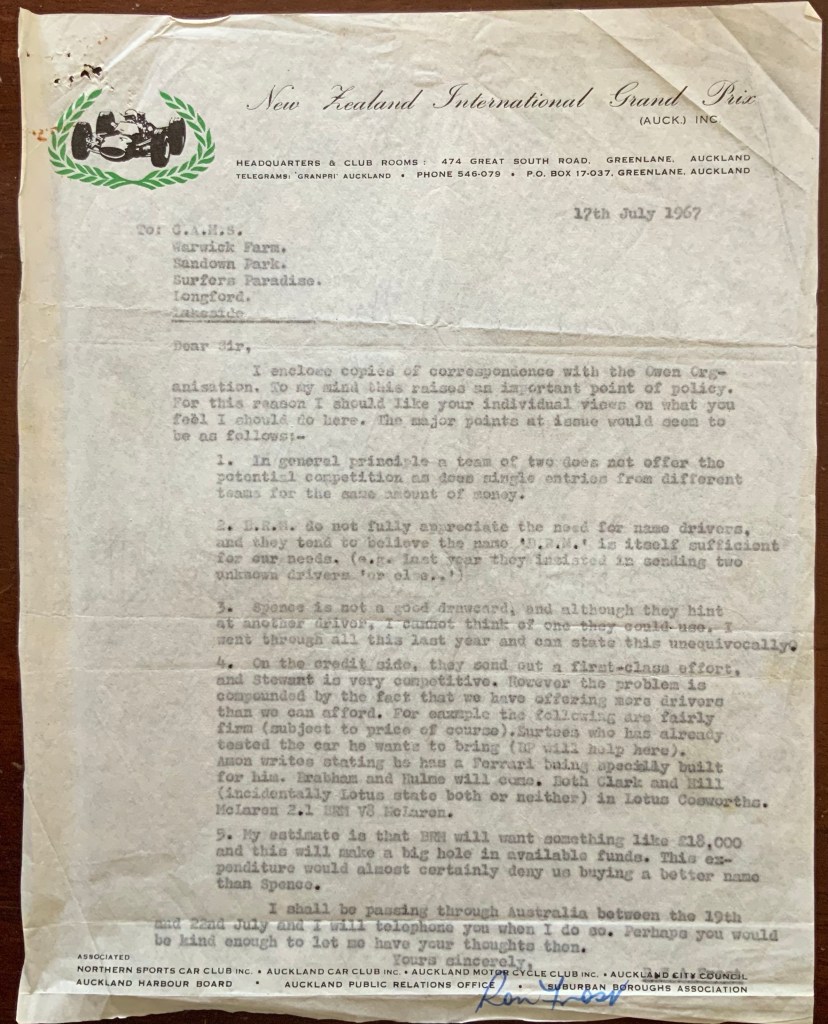
The negotiations were led by Geoff Sykes (Warwick Farm) and Motor Sport New Zealand’s Ron Frost, on behalf of the Kiwi circuits.
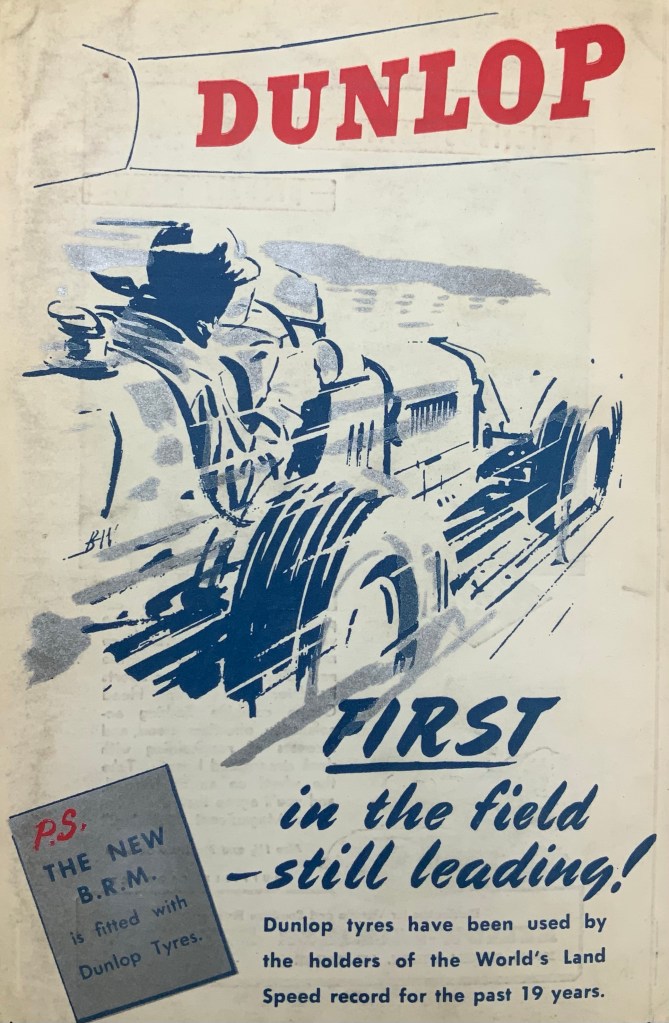
This July 1967 letter (above) from Frost to his buddies in Australia, in this case to the LCCA, is an update on how things were looking. Hopefully you can read his progress on BRM, Ferrari, Lotus and the rest.
Ultimately BRM brought a team comprising the new Len Terry designed and built V12 P126, and old favourite, the V8 engined P261. Drivers were Bruce McLaren (NZ only), Pedro Rodriguez and Richard Attwood. Jim Clark triumphed in a 2.5-litre Cosworth DFW engined Lotus 49.
(VSCC Vic Collection)
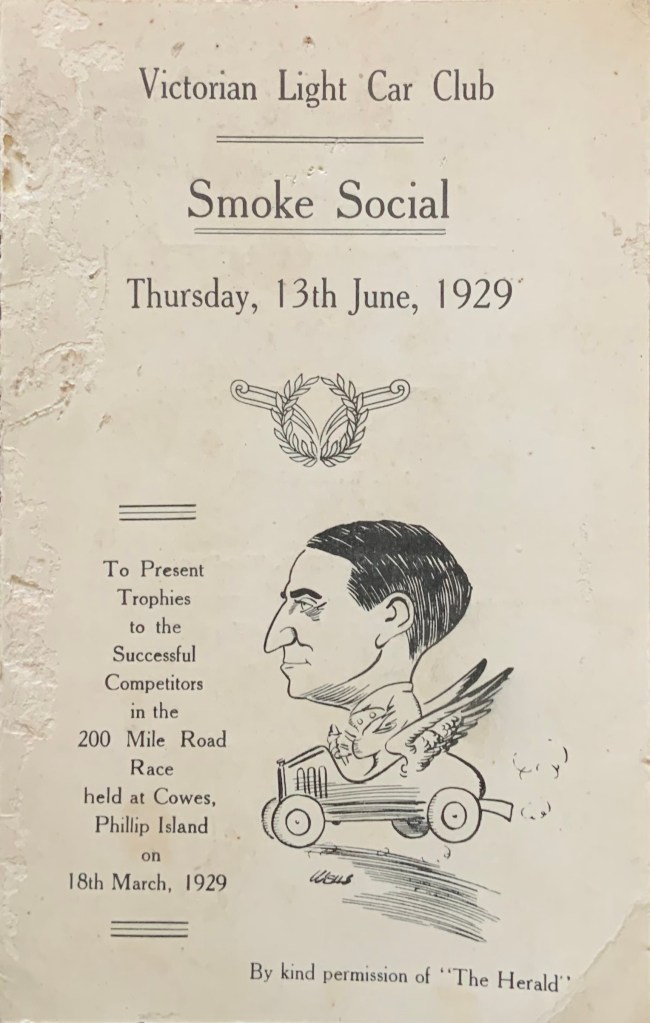
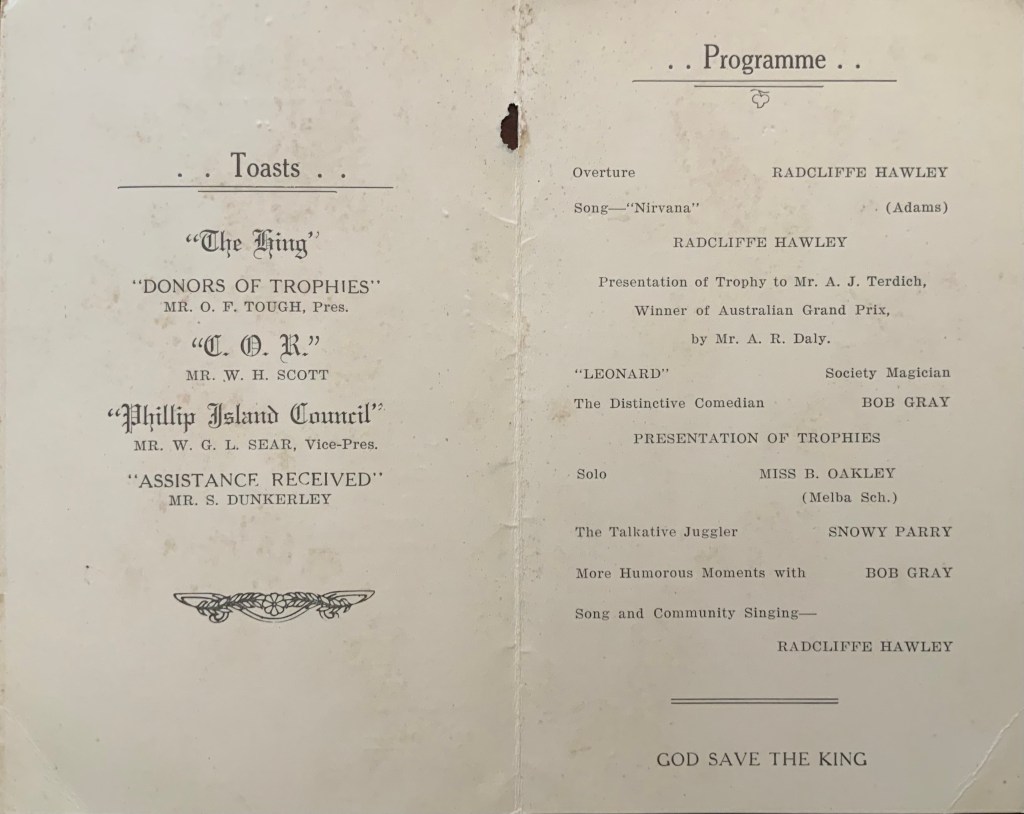
Winding back the clock four decades, checkout the table-card for the ‘Smoke Social’ to hand out the prizes for the 1929 200 Mile Road Race (aka the 1929 AGP) held at Phillip Island – which the Victorian Light Car Club organised and promoted – that March.
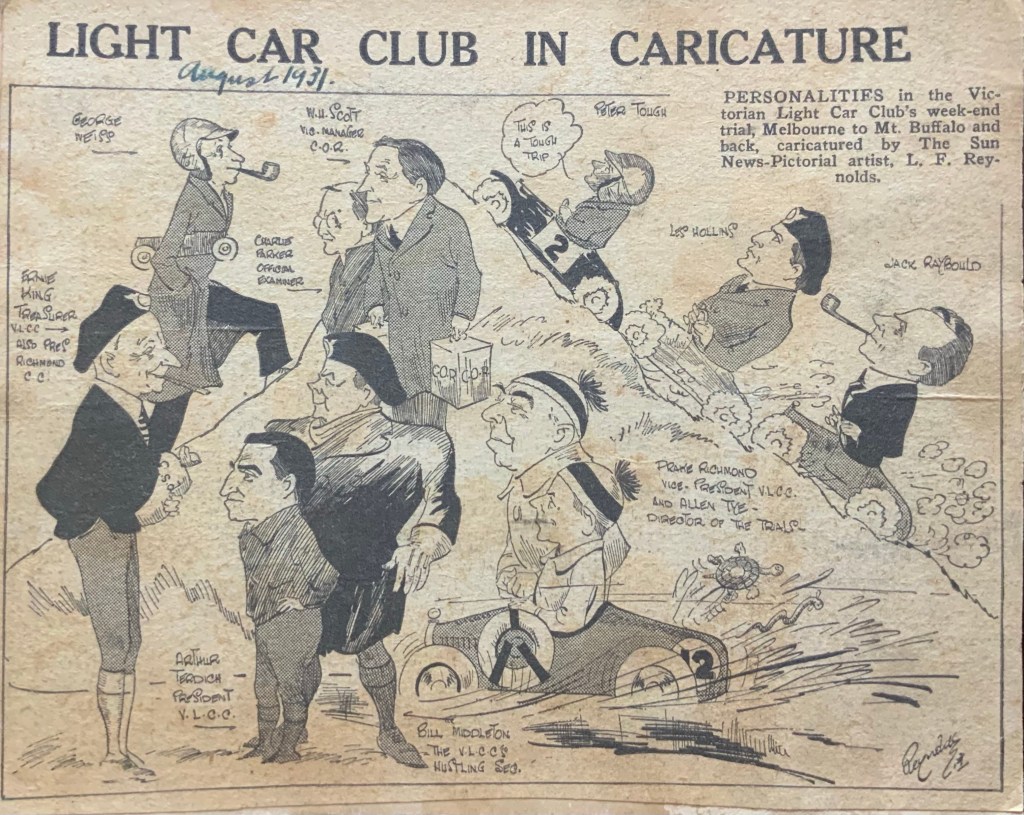
VLCC committee man, Arthur Terdich won the race aboard a Bugatti Type 37A, and is the subject of the caricature. A significant part of the VSCC Collection is the Terdich Archive, this is Arthur’s own card from a very special night.
(VSCC Vic Collection)(VSCC Vic Collection)
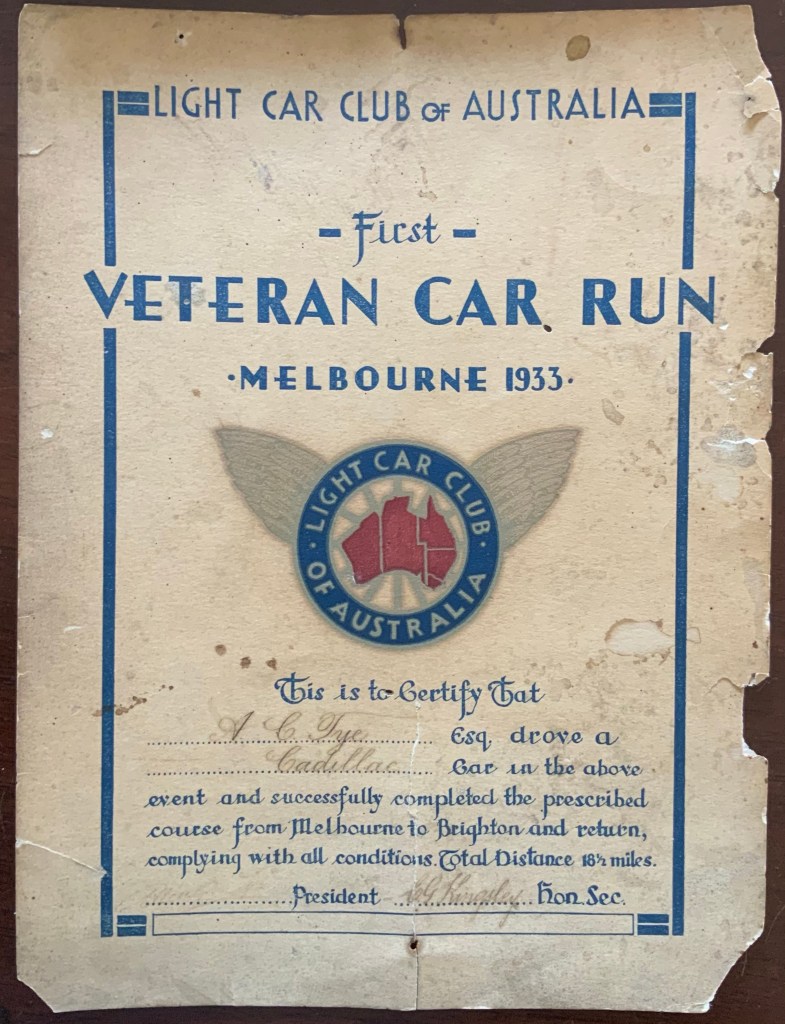
The Poms have their London-Brighton veteran car run each November, the LCCA had their own Melbourne to Brighton event in the 1930s. I wonder when it ceased to be held, or if once was enough?
(VSCC Vic Collection)
Credits…
Vintage Sports Car Club (Victoria) Collection
Tailpieces…
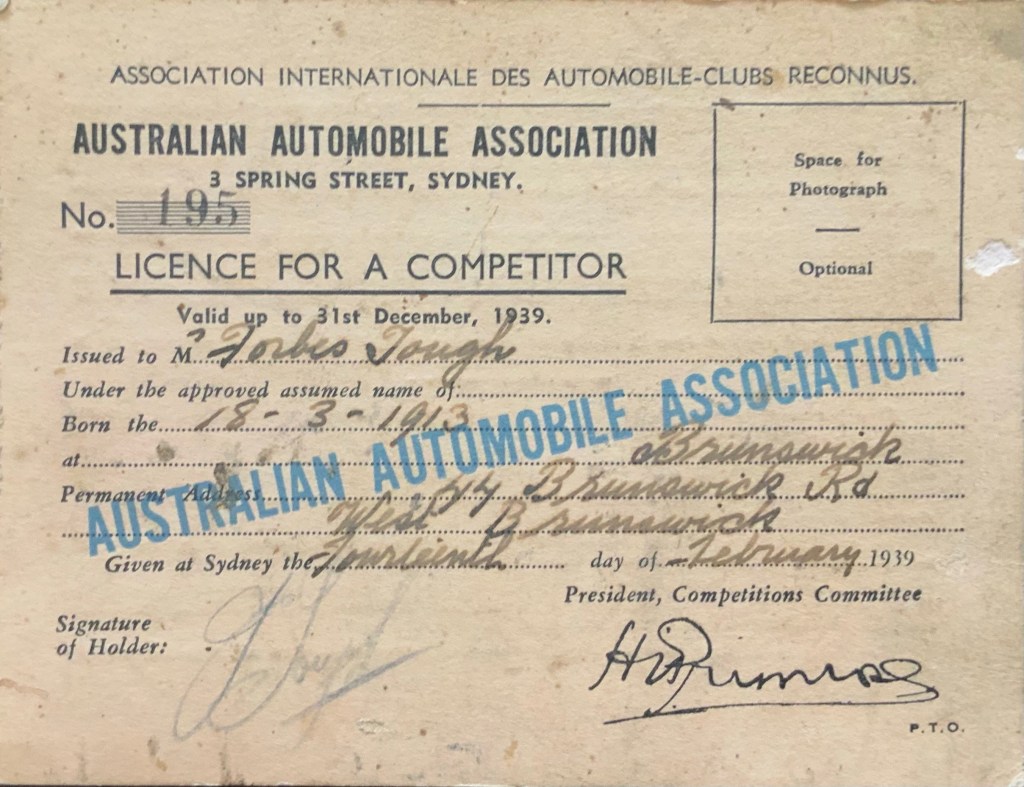
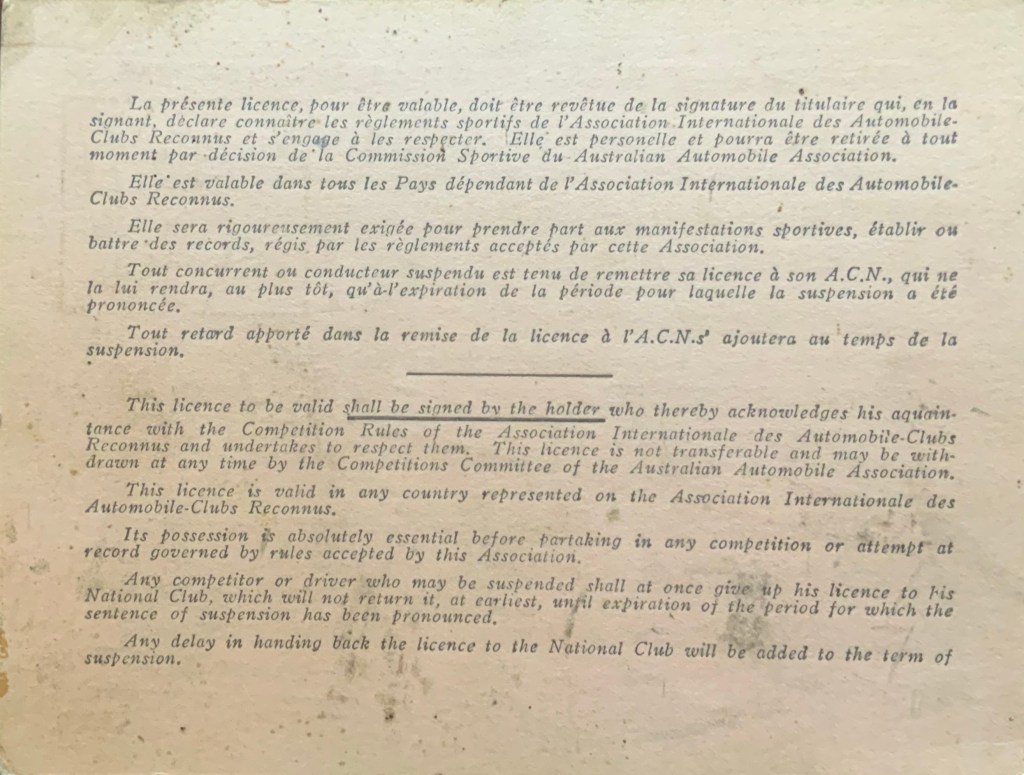
I’ve occasionally wondered what a Competition Licence looked like in ye olden days. Here is that of Forbes Tough for the 1939 calendar year.
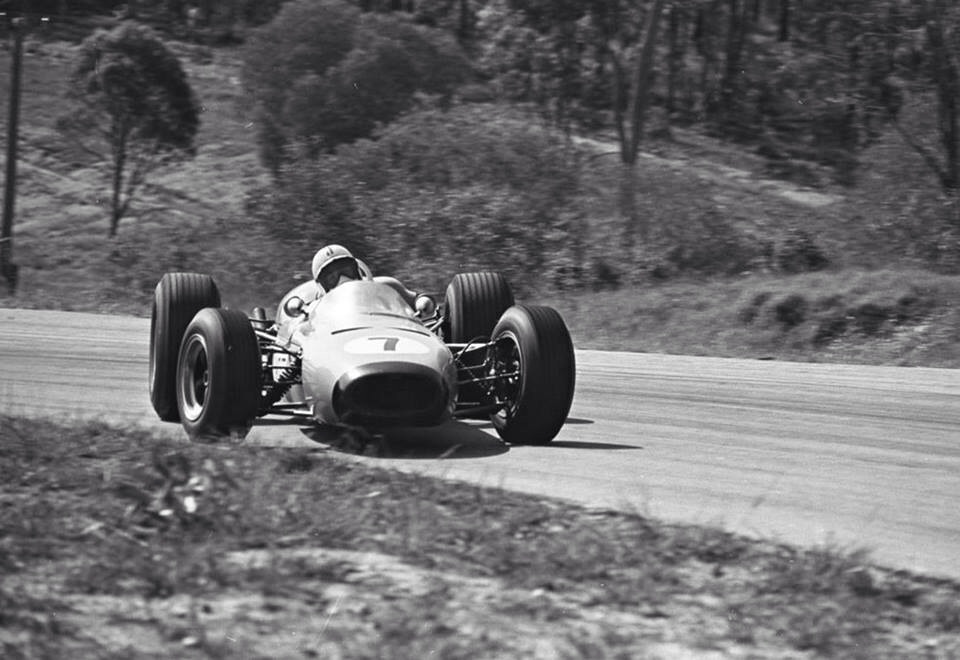
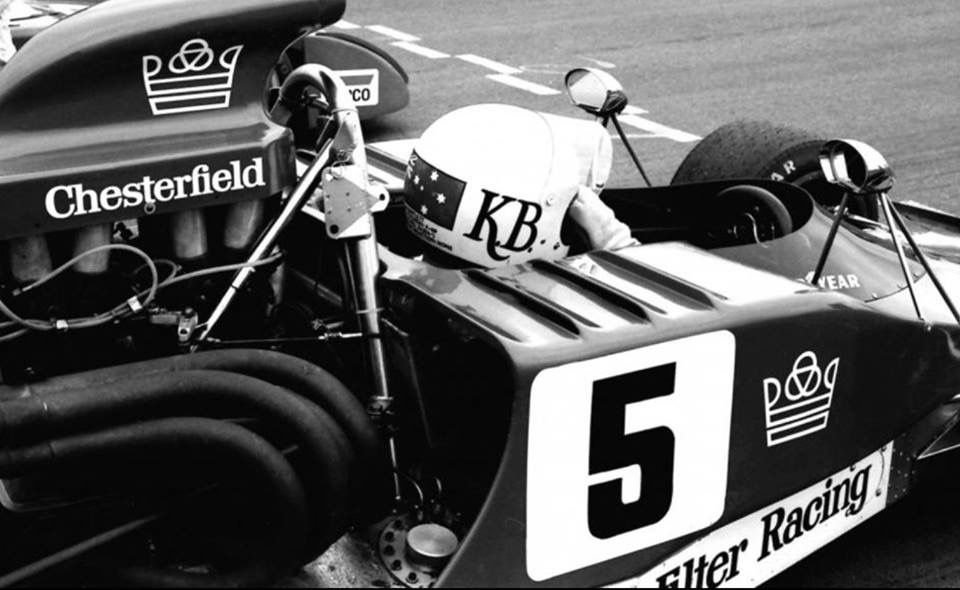
Kevin Bartlett delicately slides his way around Lakeside’s Eastern Loop during the 13 February 1967 ‘Lakeside 99’ Tasman round, Brabham BT11A Climax 2.5 FPF…
KB posted it on his Facebook page and unsurprisingly cites it as one of his favourite photos of the Alec Mildren owned car which was particularly kind to him. You might say it was the chassis in which he made his name at the top level, if not the car which won him titles.
That weekend he was fifth, second of the Climax engined cars home, and first Australian resident behind his teammate Frank Gardner who raced an F2 based Brabham BT16 FPF to third. Jim Clark won from Jack Brabham in Lotus 33 Climax FWMV V8 2 litre and Brabham BT23A Repco V8 ‘640’ 2.5, with Denny Hulme fourth in another Repco engined Brabham, a BT22.
Clark and Stewart tussled early but both P261 BRM’s driven by the Scot, and Piers Courage were outted by transmission failures, the bete-noire of the BRMs that Tasman squeezed to 2.1-litres as the little V8’s were.
In part the beauty of the shot is the bucolic background, devoid as it is of signage and spectators or their cars- it’s practice no doubt.
Brier Thomas perhaps, none of us are sure. Bruce Wells, Warwick Farm Facebook page
Tailpiece…
(B Wells)
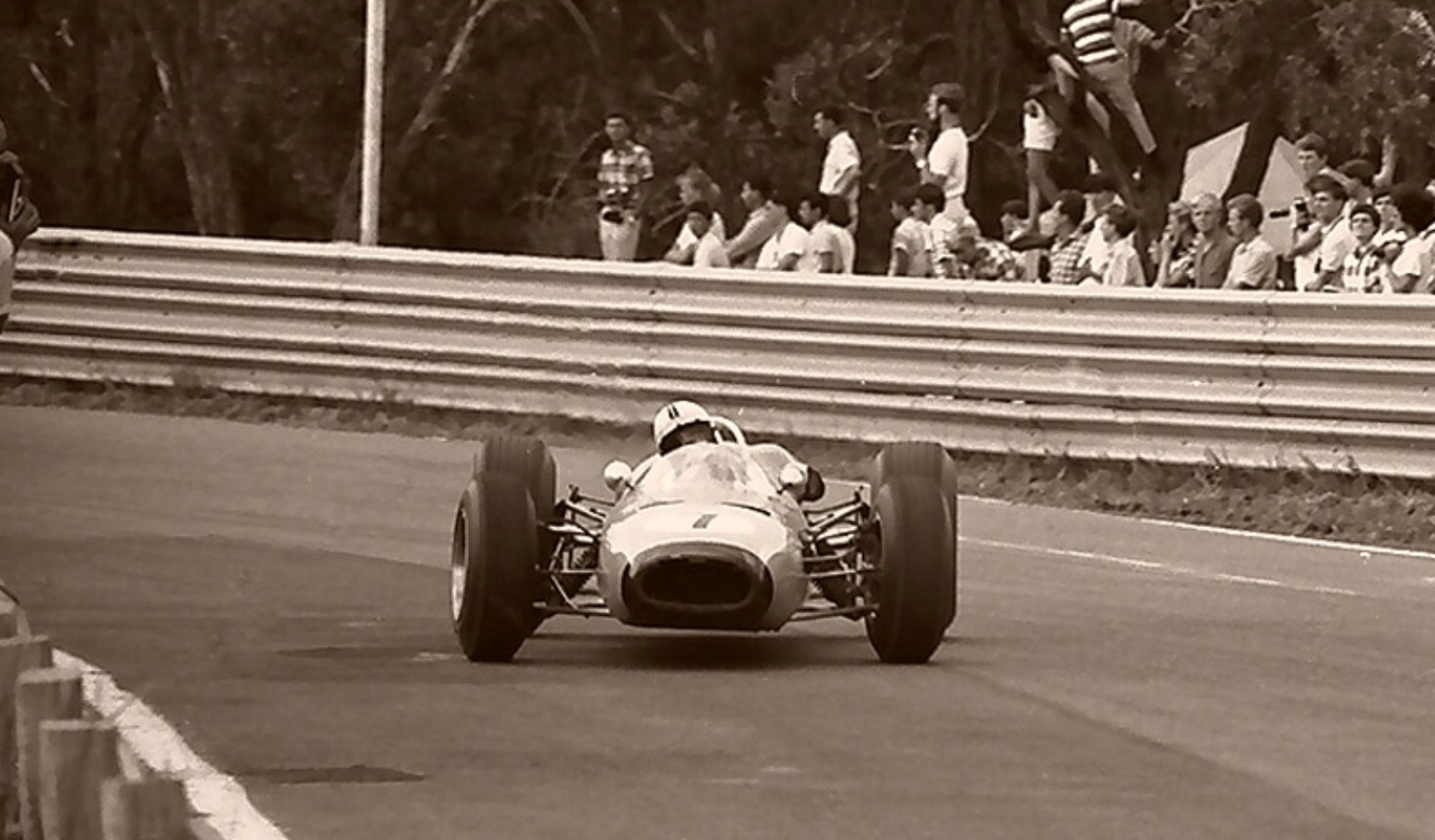
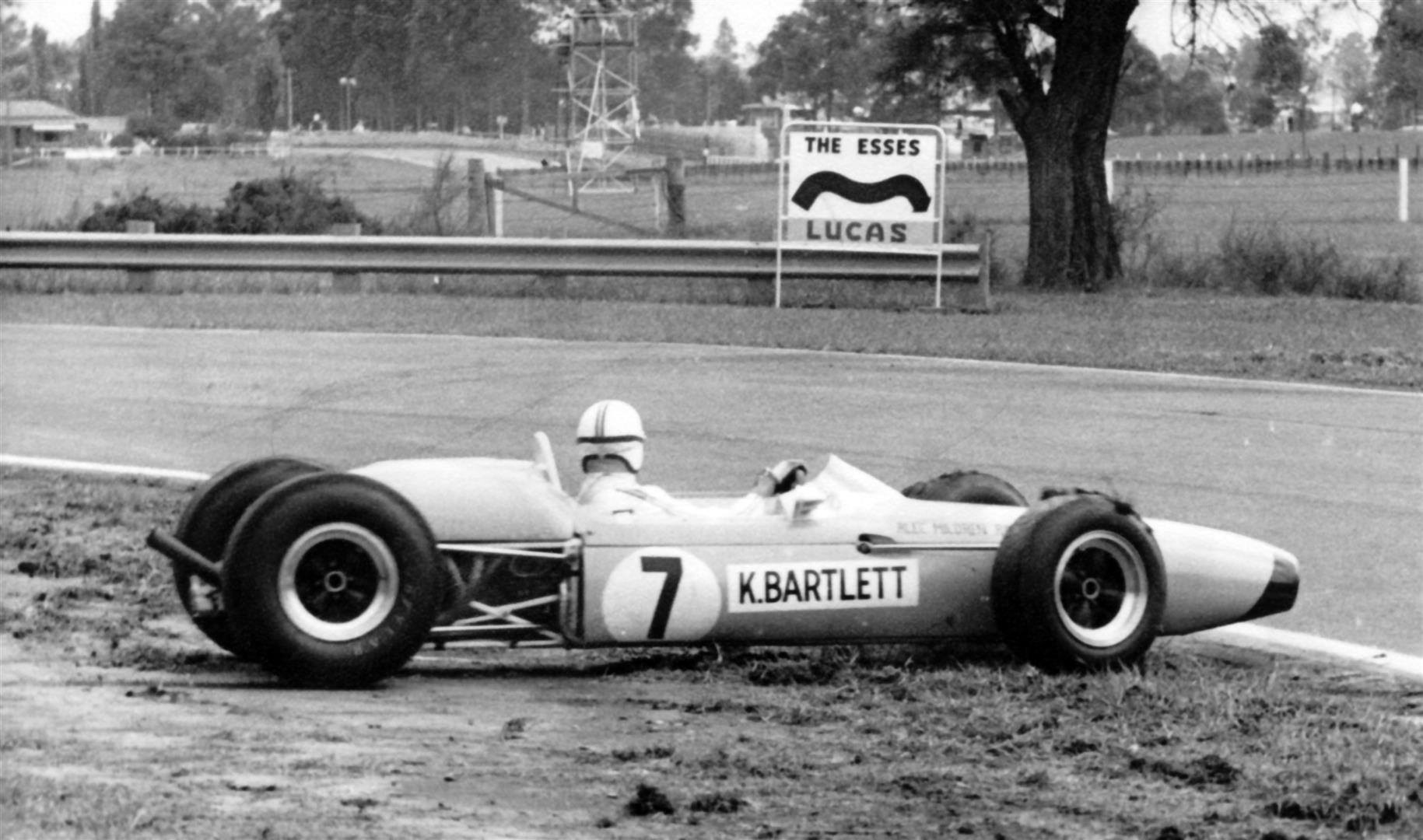
In similar fashion to the shot above but a week later at Warwick Farm’s Esses during the AGP weekend. Sixth in that race was a great result for the Sydneysider with a broken front roll bar and a gear-lever sans knob. Stewart’s BRM P261 won from Clark and Gardner.
Postscript: The Maestro didn’t always geddit right…
(WFFB)
Warwick Farm 1967 Tasman round practice- magic car and driver.
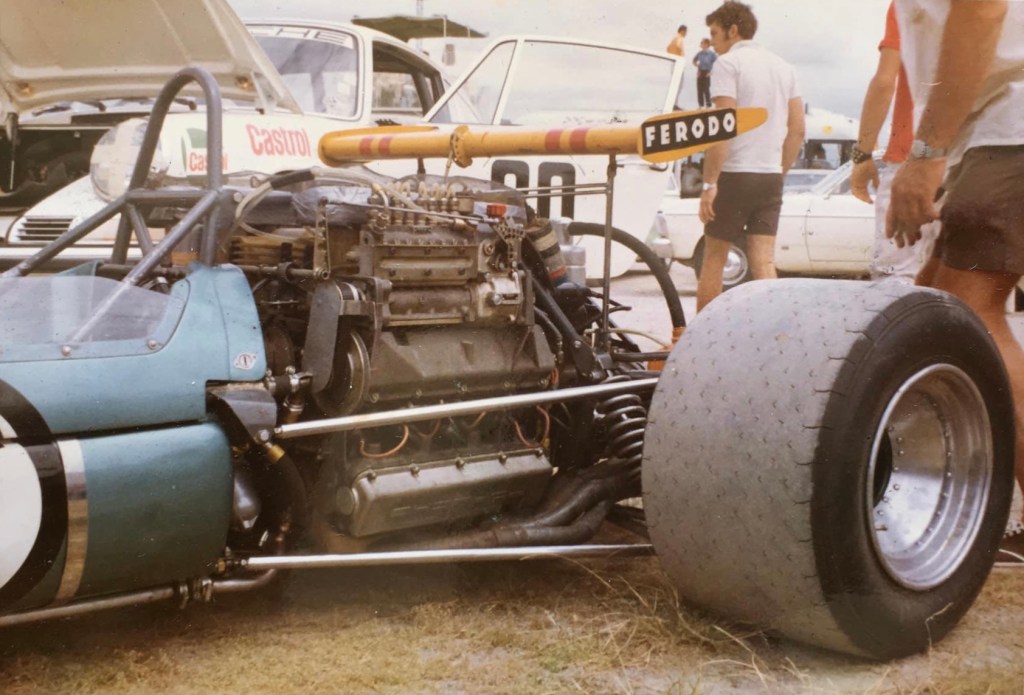
Bryan Falloon’s Rorstan Mk1a Porsche at rest in the Pukekohe paddock during the 1972 New Zealand Grand Prix weekend.
I’ve written about this rare car, built by Bob Britton at Rennmax Engineering in Sydney on his Brabham BT23 jig in early 1968. The story of the car is here, including poor Bryan’s demise on this Pukekohe weekend; https://primotipo.com/2020/08/17/rorstan-mk1a-porsche/
The rare colour photograph was too good to simply add to the existing piece.
By 1972 this 1967 spaceframe design – a modified F2 car was an old-clunker among the latest F5000s which made up the bulk of the field. But the impecunious Ian Rorstan / Bryan Falloon combination were having-a-crack.
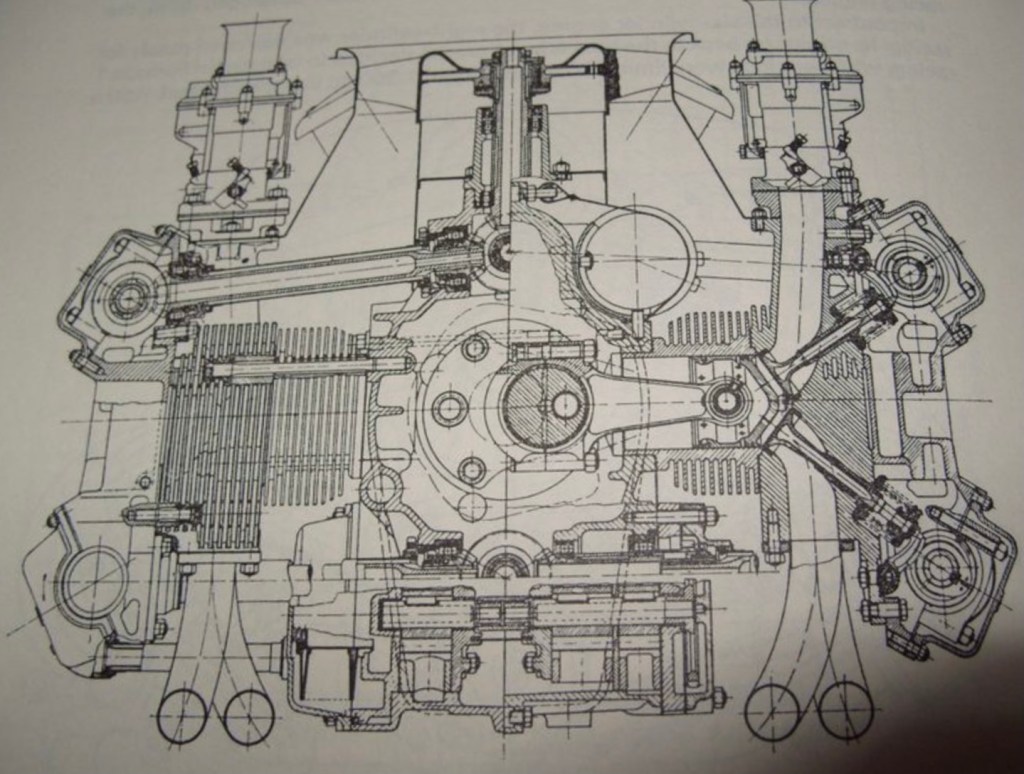
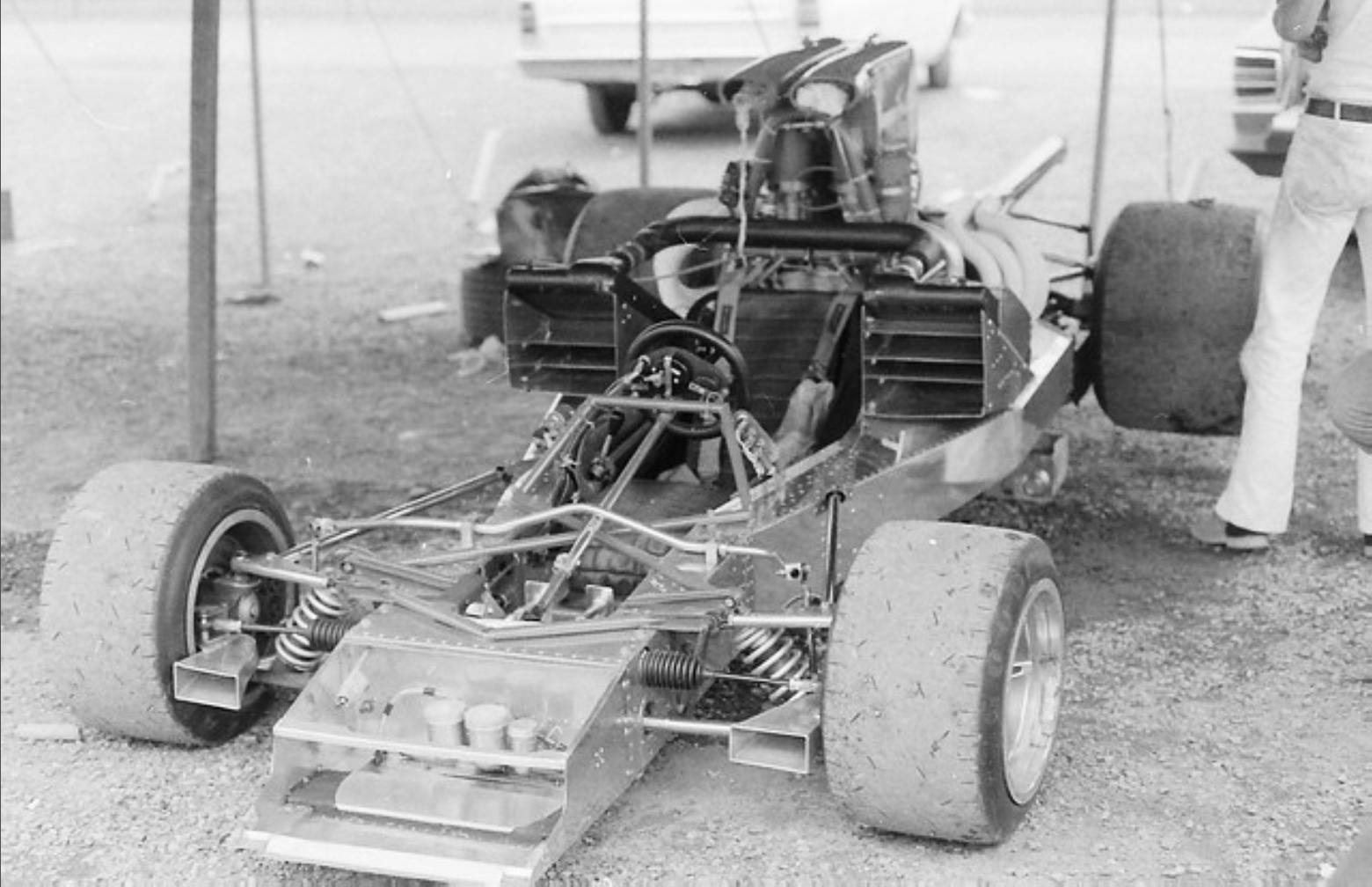
The car was powered by a Porsche Type 771 twin-cam, two-valve, flat-eight. The design started as a 1962 1.5-litre F1 engine fitted to the Type 804. Engines grew to 2-litres – and here 2.2-litres, as measured by Alan Hamilton – for Porsche 907 sports-prototype use later in the sixties.
Incredibly complex in terms of bevel-drive operation of the camshafts and auxiliaries – Hamilton advises that the factory allowed 240 hours for the assembly of each engine – Rorstan bought the engine off Porsche Cars Australia when looking for a replacement for the geriatric Coventry Climax 2.5 FPF which powered the machine before.
The engine looks bulky and heavy, it is not – of magnesium and aluminium construction, it’s light. The disposition of horizontally opposed cylinders pops the weight nice and low too. The vertically mounted Bosch high-pressure fuel injection pump – driven off the inlet cam – and fuel metering unit add to the impression of size. Inboard of that, hidden, are eight-inlet trumpets.
Note the throttle linkage and small wing – given its shallow shape and chord, you wonder how much downforce was generated.
I’m intrigued to know exactly how Britton mated the engine and chassis, critical of course. Clearly, from the way he has strengthened the roll bar area, by bracing it down into the cockpit, the top horizontal mount heading aft is important.
More questions than answers of course, my curiosity about this car is at least partially stated!
Porsche 771 cutaway, yes it’s wonky, best I could find. Note, inter alia, the bevel-drive to the cams
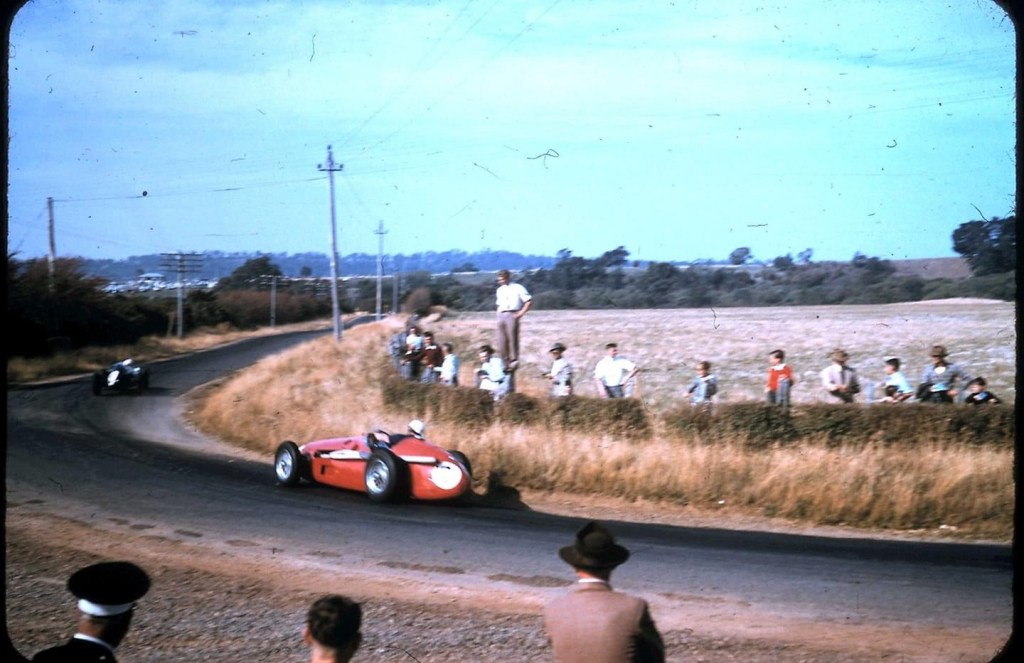
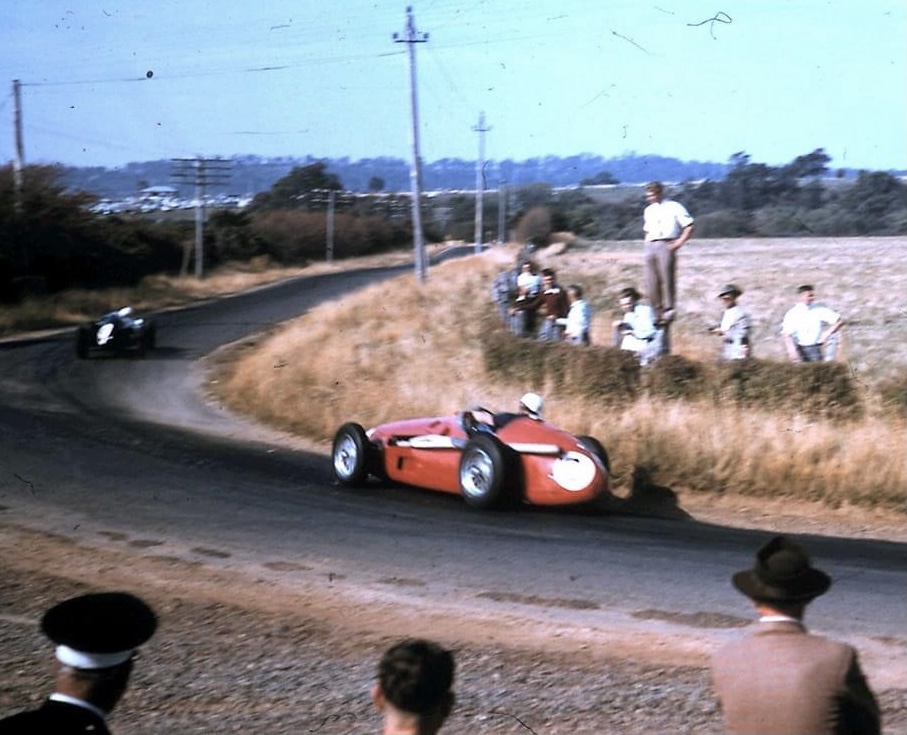
Stan Jones’ Maserati 250F chasing Len Lukey’s Cooper T45 Climax 2-litre FPF through Tannery Corner during the March 1959 Australian Grand Prix at Longford.
Geoff Wiseman uploaded onto social-media this wonderful colour shot from a spot not often used by the pro-snappers. It is a decent walk from Longford village to Tannery. Isn’t it a beauty?
That’s the race for the lead folks – a battle of old vs new technology, thankfully for we Stan-Fans, the tough-nugget from Warrandyte prevailed- Jones it was from Lukey.
The short straight leads to the quick left-hander onto Long Bridge.
(G Wiseman Collection)
This time I’ve cropped the shot a bit. I love the way the photographer has framed the action between the spectators, makes you feel kinda-like you were there.
Etcetera…
If I had known the Lukey/Jones shot was going to be posted when I was at Longford in January and March I would have taken a one from exactly the same locale, but I didn’t!
What I can offer are three shots of a planned, but not yet written, modern ‘drivers eye lap of Longford’.
The first above is about halfway along Tannery Straight – towards the corner above, our feature shots. That’s the old Tannery building on the left, these days a lovely home or accommodation.
Jones would have whistled through this flat-biccie right-kink – yes, there is a kink none of the published maps show – at about 160mph.
By this point he has been in top-gear for a long while, Pub Corner is way, way back behind us. Amongst its many tests, Longford had two, long, top-revs throttle openings. The Flying Mile on Pateena Road is the other.
The next one is very deep into the Tannery braking area.
The corner (right) would have been taken in second gear (of five), I’m guessing a corner speed of 50-60mph. He isn’t quite turning in yet, but would be finishing his final shift and having a glance in the mirror, perhaps, before initiating the turn.
The final one is immediately after exiting Tannery – the straight leads to the now non-existent Long Bridge .
The location of the farmers gate is about where Len Lukey is in our first shot. There is a stile to the right so you can easily enter the property and walk up 400-500 metres to the River Esk waters edge.
I don’t think Jones would approach the following left hander before Long Bridge in top, but mighty quick in fourth.
Look at the jaunty insouciance on Fred Brodribb’s face.
Just love this shot.
The navigator isn’t so keen on photography it seems. I’ve seen plenty of Fuck-Off! looks in my time, and that, my friends is one of them.
Fred is feeling pretty good about life at this point of the 1926 1,000 mile RACV Alpine Trial in Canberra. He and his buddy had the event in-the- bag, but then arrived early at a control in Victoria on the run home, and copped a penalty which dropped them well back among the riff-raff.
Very much my kind of Bentley, #1226 is a rare 100 Supersports clad in lovely James Flood coachwork.
Brodribb Bros, of 372 St Kilda Road, Melbourne were significant Bentley importers and dealers with Fred active in building the marque through motorsport in the twenties.
Brodribbs were wiped out in the Great Depression, along with Bentley in its original form.
This car lived in Australia from 1925 to 1958, then had stints in New Zealand and the United States before ‘arriving home’ in 1989, it now lives in Perth.
(NAA)
This most imposing, sporting Bentley is possibly out front of the Canberra Hotel.
Our fearless leaders moved to the capital in 1927, no doubt the joint was pretty low-rent until post-war.
Credits…
National Archives of Australia, ‘Vintage Bentleys in Australia’ by Hay, Watson, Schudmak and Johns
Kevin Bartlett, Lola T300 leads the Angus & Coote Trophy from John McCormack, Elfin MR5 Repco-Holden, Oran Park 1972…
Allan Horsley, the promoter of Oran Park Raceway in Sydney’s outer west, was an energetic, creative guy. Even though this event wasn’t a Gold Star Championship round, he attracted a good field of F5000s to drag in the punters, the Angus & Coote Trophy was provided by a retail chain of jewellers.
The 500bhp V8 roller-skates were spectacular at the (then) short circuit, with Lynton Hemer there to capture the action, his wonderful photos are the inspiration for this article.
Interesting bunch of three Elfin MR5 Repco shots, this one of John Walker with the just visible Max Stewart up his clacker and Garrie Cooper’s works MR5 at rear. Four MR5’s were built, the Ansett Team Elfin cars of Cooper and McCormack and customer cars for Walker and Stewart, all were built to identical specifications fitted with Repco Holden F5000 engines. Walker’s car has the aero as the cars were first built, the Cooper and McCormack (shot below) cars have the ‘Tyrrell nose’ first fitted from the ’72 Warwick Farm Tasman round. Garrie has an airbox fitted, Mac does not. JW, an Elfin man through and through didn’t race the MR5 for long though, he jumped into an A50 Matich which complied with the American regss – the Elfin did not- John did some L&M rounds in the A50. Walker, Matich, Muir, Stewart and Bartlett all competed in the US in 1973 (L Hemer)McCormack from Muir’s T300. J Mac got quicker and quicker didn’t he? Of the four MR5s, this chassis 5711 was the most successful- ’73 Gold Star and NZ GP win etc. It was a triumph of driving and Mac and Dale Koenneke’s development of what was not the most advanced F5000 design. Mac was further up the Repco queue once Matich retired (L Hemer)Walkers MR5 5724 note aero comments above. Blade front wing, Walker developed into a very fast F5000 pilot- ’79 AGP and Gold Star winner, the difference in him pre ’73 L&M and post was significant. Confidence is such a big thing! (L Hemer)
With the exception of Frank Matich and his Matich A50 Repco, Lynton has many fine, close-up shots of the Australian F5000 Class of 1972 – I wonder why FM wasn’t present, he was a Sydney boy after all? The answer is probably that he didn’t bother with this non-championship event on May 21, given the Belle Magazine Trophy Gold Star round was only a month hence, here in June.
By then he was on the way to comprehensively belting the Gold Star opposition – he won at Sandown, Oran Park, Surfers Paradise and Warwick Farm – with Kevin Bartlett winning at Adelaide International in his Lola T300, and John McCormack at Symmons Plains aboard his MR5. FM won the Gold Star with 36 points from Bartlett and McCormack on 24 and 20 points respectively.
John McCormack (above) led from the start of the 25-lap event from Kevin Bartlett and Gary Campbell in Lola T300 Chevs. KB’s was a new chassis (HU16) acquired after the Tasman Series, in which he raced his venerable ex-Niel Allen McLaren M10B.
Gary Campbell, ex-Gardner first production T300 HU1 (L Hemer)
Gary Campbell (above) stepped up from the Waggott 2-litre engined ANF2 Elfin 600B/E he raced in the Australian 1972 Tasman rounds into the T300 (HU1) Frank Gardner raced in the Tasman, Campbell took delivery from the final, Adelaide round.
Gardner had notionally retired from single-seater racing but did an event or two in the UK later in 1972 as he track tested the very first Lola T330 HU1, a car purchased by Max Stewart and oh-so-successful in his hands.
Interesting side profile shot of Bob Muir’s T300 accentuates the relative ride height of the T300 with the T330/2 which followed. The presentation of this car had to be seen to be believed. The T300s were always set up with plenty of ride height, as you can see here, Kevin Bartlett observed “It was to do with the wishbone angles, roll centre, etc. The cars were usually set up very soft as the old F2 tub flexed a lot into the bargain. You could feel the strain when the grip was at its best, which wasn’t too often” (L Hemer)
Bartlett passed McCormack for the lead on lap three, with Muir passing Campbell on the same lap.
Muir became a very fast exponent of F5000, perhaps his best work was in the ’73 L&M rather than at home. Bob’s Reg Papps & Sons prepared T300 – chassis HU4 ex-Niel Allen – after a practice crash ended Allen’s planned racing comeback, was easily one of the most beautifully presented and prepared racing cars in Australia, visually stunning, I waxed lyrical about it here; https://primotipo.com/2014/11/18/my-first-race-meeting-sandown-tasman-f5000-1972-bartlett-lola-and-raquel/
Muir and KB sluggin it out (L Hemer)
Muir passed Bartlett (above) and ran out the winner from Kevin, John Walker’s Elfin MR5 Repco and Gary Campbell with KB setting a new lap record of 40.2 seconds.
In many ways the story of Australian 1972 F5000 racing, the championship Gold Star Series and non-championship Calder based Repco Birthday Series (fiftieth birthday by the way) was FM’s absolute preparedness for the season.
His Matich A50, so named in honour of sponsor, Repco’s fiftieth, had won on debut at Warwick Farm’s November 1971 AGP, but then had a disappointing Tasman Series, which he lost to arch-rival Graham McRae’s Leda LT27/GM1 Chev, Graham took four wins to FM’s one.
Frank Matich, Matich A50 Repco from John McCormack’s Elfin MR5 Repco at Surfers Paradise during the 1972 Tasman round, 3rd and DNF in the race won by McRae’s Leda GM1 Chev. Matich won the ’72 Gold Star in the same chassis- A50 ‘001’ (unattributed)
However, Matich was well and truly ready-to-rock at the domestic season’s outset with a very well developed car. Bartlett and Muir were more than capable of giving their fellow Sydneysider a run for his money, but neither had their T300s early enough to have them honed to the fine pitch Matich had A50 ‘001’.
I suspect Matich did more test miles at Warwick Farm, paid for by Goodyear – he was both a contracted driver and their agent in Australia – than the rest of his fellow F5000 competitors added together. His 1972 results reflected just that.
( L Hemer)
I wonder why Max Stewart (above) raced ye-olde-faithful Mildren Waggott, his ’71 Gold Star winner rather than the Elfin MR5 Repco he had run since the ’72 Tasman?
Maybe the distinctive yellow MR5 wasn’t ready or ‘praps he wanted to give the Mildren Waggott a gallop to showcase its potential to would-be purchasers, Allan Grice bought it shortly thereafter. Maybe he was inspired to do so by Max’s performance at this meeting? In any event this amazing, popular machine was finally outpaced by the post-McLaren M10B series of smaller, lighter F5000’s despite the efforts of its oh-so-talented, lanky pilot.
Gardner on the way to Warwick Farm 100 Tasman victory on 14 February 1971. Lola T192 Chev ‘190/F1/6’ or ‘HU14’- note the winglets aside the cars chassis. WF Esses, car following probably the Matich M10B Repco, brave ‘snapper is Lance Ruting. Car stayed in Oz- sold to Colin Hyams, then to US in 1972 (J Ellacott)
There are so many shots of the utterly-luvverly Lola T300 in this article it seems smart to expand a bit upon this seminal F5000 machine…
The Lola T190 F5000 wasn’t Lola’s best design but Frank Gardner evolved it into the longer wheelbase, and modified in many other areas T192, and won plenty of races in it in Europe and Australasia.
The car was far from uncompetitive into 1971 too. FG won at Warwick Farm during the Tasman Series, and European F5000 championship races at Silverstone, Mondello Park and Castle Combe. The old racer ran with and beat youngsters such as Brian Redman, Mike Hailwood, McRae and Allan Rollinson.
But the laconic racer/engineer wanted something smaller and lighter to stay ahead of the chasing pack, including the new McLaren M18/22, Surtees TS8 and coming Leda GM1.
Snetterton, August 30, 1971 (J Ballantyne)
In a moment of wham-bam-thankyou-maam pragmatic inspiration, Gardner and Lola Engineer, Bob Marston, married the existing Lola T240 F2/Atlanic chassis with a 5-litre Chev and DG300 Hewland transaxle. The production variant of the prototype became the T300 we F5000 nut-bags know and love. After some testing, the prototype T242 made its race debut at Thruxton on August 1, 1971.
FG plonked it on pole and finished third behind McRae’s highly developed McLaren M10B, and Hailwood’s works Surtees TS8. It was a statement of intent, the cars performance and looks were the subject of all the paddock chatter that weekend. The queue at Huntingdon started the morning after.
T242 was renamed T300 from the following Silverstone round on August 14, Gardner was again behind Hailwood, this time in second position.
This chassis was destroyed in an argument over real-estate that very weekend between Gardner, and Redman’s M18 McLaren on lap eight. The T242/300 was badly damaged, rooted in fact. Sad as that particular Lola was a very significant one for the company and F5000 as a class.
(Pinterest
The key elements of the design, its overall size and packaging, hip-mounted radiators, wedge shape and aerodynamics are all clear despite the poor quality of the drawing.
Autosport proclaims Gardner/Lola’s ’71 Euro F5000 victory
Gardner raced his replacement car, the first production T300, chassis HU1, to its first win at Hockenheim on 12 September, in front of Emerson Fittipaldi’s F1 Lotus 56B Pratt & Whitney turbine and Teddy Pilette’s McLaren M10B Chev. He brought it to Australia late in the year where he boofed it in practice for the Warwick Farm AGP. Repaired, it then contested the ’72 Tasman before sale to Gary Campbell
I hope Eric Broadley paid those two fellas, Gardner and Marston a bonus in 1971 because they created, arguably, the first of the most successful and profitable family of production racing cars ever. Lola built ‘a million’ T300/330/332/332C/332CS/333 cars and spares, those machines won countless F5000 and single-seat Can-Am races in the hands of just as many champions, journeymen and amateur drivers for well over a decade.
(G Ruckert)
The photo above is the business end of Bartlett’s T300 HU16 at Surfers Paradise in 1972, that’s Bartlett’s red driving suit and John Harvey’s purple crutch alongside!
Key elements of the machine are the injected 5-litre 500bhp Chevy V8, note the magneto and fuel metering unit. The rear of the aluminium monocoque chassis is to the right, the car was designed as an F2, it was a bit floppy.
Torsional rigidity was improved with the T330/332 which followed, but these were not machines in which to have a front-in shunt, as Bartlett experienced at Pukekohe aboard his T330 in early 1974. He was an early member of the Lola Limpers Club joining fellow Australasians Graeme Lawrence and Warwick Brown who came to grief in T300’s.
The gearbox is of course the ubiquitous Hewland DG300. Originally designed for ‘effete’ F1 engines, the prodigious torque of 5-litre motors made the ‘box marginal. Sticking to maintenance and lifing cycles of gears, dog rings, crown wheel and pinions was critical to avoid DNFs. The Hewland in yer little namby-pamby Formula Ford (Mk9/LD200) or Formula Pacific (FT200) was set-and-forget to an extent, not so in one of these big, heavy muvvers.
The uprights are magnesium, disc brakes inboard at the rear and suspension period typical – single upper links and inverted lower wishbones, two radius rods – you can see one on the right threading the exhaust system. The adjustable rear roll bar is clear as is the engine oil tank to the right of the left exhaust outlet.
A superb, fast, race winning bit of kit in every respect but nowhere near as forgiving – if that is ever a word to be used in the same sentence as F5000 – as an McLaren M10B KB notes…
Bartlett, Harvey and T300 from the front. Not sure if this is the ’72 Glynn Scott or ’73 Tasman weekend (G Ruckert)
Etcetera: The T300 and it’s father before the 1971 AGP @ Warwick Farm…
This is a pre-race publicity shot by Fairfax media. The only trouble was Frank Gardner boofed HU1 in practice so did not start the race. He would have given Frank Matich a run for his money that day given the speed of the T300 in Europe. But ‘ya gotta be in it to win it’, and FG was not that weekend, despite a stellar record of prior success at the ‘Farm.
The car was rebuilt in Oz around a new tub freighted in from Huntingdon, and raced to an NZGP win at Pukekohe, and three second places during the 1972 Tasman before being sold to Campbell after the Sandown round.
(R Davies)
There’s More…
Speaking of chassis, Robert Davies has superbly captured this rare photo of a nude T300 Chev, it’s the Allen/Muir/Brown ‘HU4’ in the Sandown paddock during 1972.
I won’t repeat the technical summary from above, devoid of bodywork the small light aluminium monocoque and minimal front impact protection is abundantly clear. The only deformable part of a racing car of this period was the body of the driver…
(unattributed)
Far-canal, that really is a mess, it’s the same chassis HU4 shown above. If you thought about the physics involved in a Formula Ford shunt you probably wouldn’t do it, but Jesus the big single-seaters of this period, F1 and F5000 really were lethal devices. Balls of steel to race them springs to mind.
I don’t usually publish shots of rooted racers but this one had a happy ending, and adds some colour and reality to the glib Lola Limper line used earlier on.
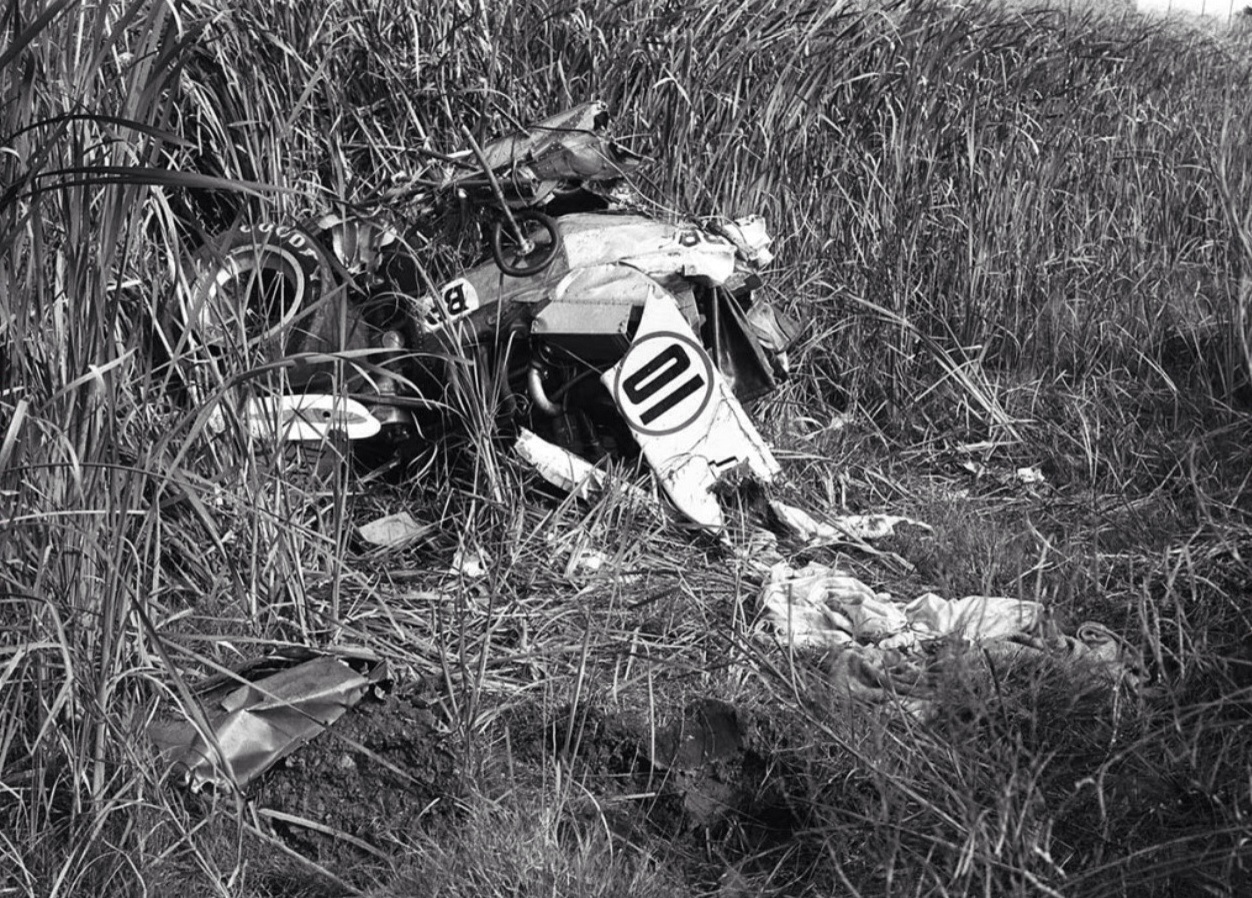
Young Australian thruster Warwick Brown graduated from the McLaren M10B Chev with which he cut his F5000 racing teeth in 1972, to the ex-Allen/Muir Lola T300 prior to the 1973 Tasman. Third at Levin and second at Wigram showed his mettle and immediate pace in a competitive car, but it all came undone at Surfers, the first of the Australian Tasman rounds.
His car got away from him on the fast, demanding circuit spreading bits of aluminium and fibreglass over the grassy undulations of the Nerang countryside and broke both Warwick’s legs. He got wide onto the marbles on the entry to the flat-in-fifth right-hander under Dunlop Bridge, and bounced across the grass into the dirt embankment surrounding the circuit.
The light aluminium tub folded back, in the process doing horrible things to Warwick’s feet and lower limbs. He had a very long recovery, made somewhat easier by the promise of a new car from his near-neighbour-patron, mining millionaire Pat Burke. In that T332 – HU27 – he won the 1975 Tasman Series, becoming the only Australian ever to do so.
It’s a story for another time, but WB had another two Lola big-ones in the US in a T332C and T333. If there was a President for Life of the Lola Limpers Club I suspect it was Mr Brown.
The photo above is of WB at Levin only a couple of weeks prior to its Surfers demise. Terry Marshall has captured the Sydneysider nipping a right-front during the 13 January Levin International. Warwick was third behind McRae’s GM1 and Matich’s A50, two of the toughest F5000 nuts.
(unattributed)
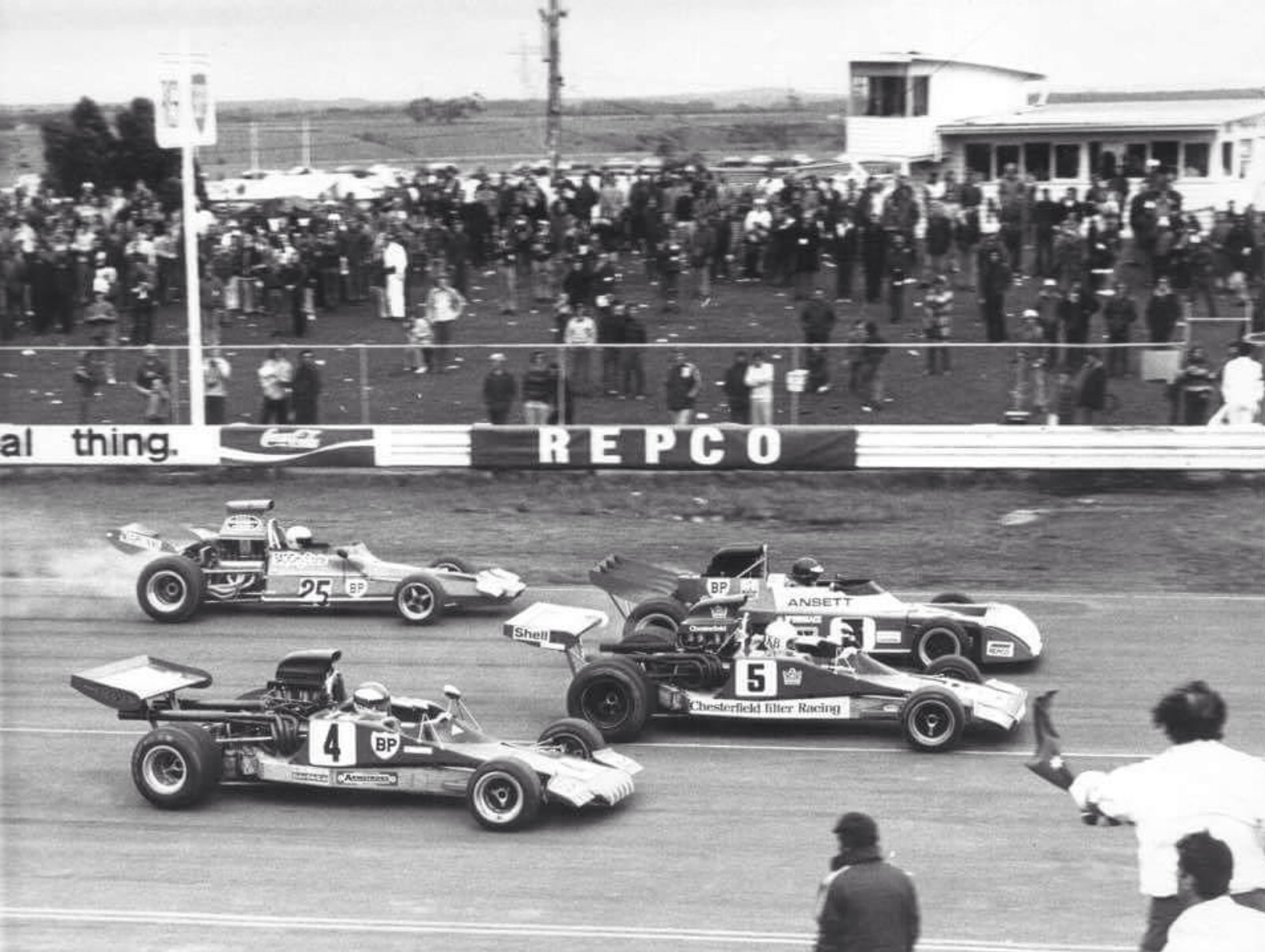
Calder in 1972. Bob Jane had no Gold Star round that year but did promote the ‘Repco Birthday Series’ for F5000 and ANF2.
By the look of the clothes of the hardy Victorians it’s winter’ish, Calder in the winter is not a particularly pleasant place usually, I’m figuring the October 15 round with the assistance of oldracingcars.com though.
It looks as though Gary Campbell #4, has made a corker of a start and is seeking a way past KB #5 but then again maybe KB got off like a rocket and and Gary is giving him room as KB jinks right for a way past John McCormack’s Ansett Elfin MR5 Repco. Over by the aptly placed Repco sign is the Repco-Holden F5000 engined Matich A50 #25 of John Walker, perhaps some of you American readers saw JW race this car in several L&M rounds in 1973 so well?
Bartlett won this 30 lapper in a smidge under 21 minutes from Walker and McCormack, then came Stewart, Elfin MR5 Repco and Campbell. Bartlett also won this five round series from Matich and Muir.
L Hemer)
Who would have thought the T300 as a rally car? KB negotiates the Warwick Farm paddock during the famously wet 1973 Warwick Farm 100 Tasman round, Steve Thompson Chevron B24 Chev won that day.
(unattributed)
The angle on the dangle.
And they are all angles, just the wildest looking thing at the time, even the Lotus 72 looked conservative alongside one of these babies. Bartlett on the Calder grid alongside McCormack during the 15 Ocober meeting referred to above.
Photo Credits…
Lynton Hemer, John Ballantyne, oldracephotos.com.au, Graham Ruckert, Terry Marshall, Pinterest, John Ellacott, Fairfax Media
References…
oldracingcars.com, The Nostalgia Forum
Tailpiece: Double T300 Trouble – Muir from Bartlett, Oran Park 1972…
c’mon Alec won’t even notice, our helmets are much the same. Its gotta be quicker with that Eyetalian V8- lookout ‘yerv fried the left front though FG…
Denny Hulme trying to convince Frank Gardner to give him a few Warwick Farm laps in FG’s new Mildren Racing Brabham BT23D Alfa Romeo Tipo 33 V8.
The new World Champ raced a Brabham BT23 that summer too- albeit a Ford FVA powered F2 chassis which really didn’t cut the mustard amongst the 2.5s.
Denny was fifth in the 1968 Warwick Farm 100 won by Jim Clark’s Lotus 49 Ford DFW, while Gardner’s Italian motor busted a camshaft.
That Italian engine: Tipo 33 2.5-litre DOHC, two-valve, twin plug, injected all alloy V8
After Gardner returned to Europe Kevin Bartlett drove BT23D to victory in the 1968 Australian Gold Star Championship, and in winged-form, very competitively in the 1969 Australian Tasman rounds.
The perky rump of FG’s new Brabham (below) on the way to Hordern Trophy victory on the cars race debut in the Warwick Farm Gold Star round in December 1967.
Spencer Martin took the second of his two titles that year after a spirited contest between he and his Brabham BT11A Climax, and the similarly mounted Alec Mildren entry driven by Bartlett.
(unattributed)
Photo Credits…
Brian Jackson via Glenn Paine, The Roaring Season, John Ellacott
Tailpiece: Gardner, Brabham BT23D Alfa, Warwick Farm Tasman, February 1968…











 primotipo...