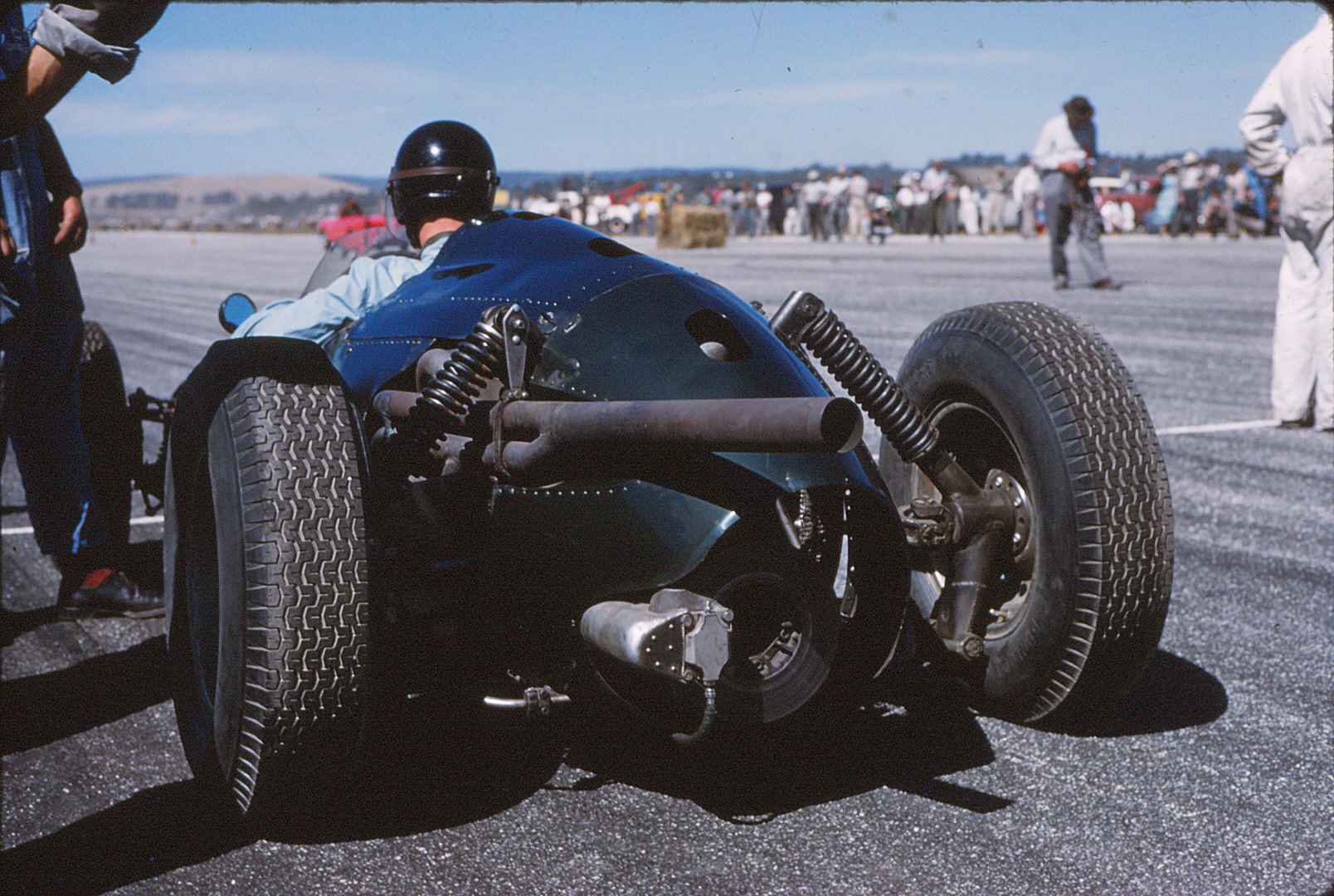
Graham Hill, Dan Gurney and the BRM mechanics await the start. Dan’s car is P48 #486 (D Jolly)
Make sure you buy the August 2024 issue of The Automobile, it contains a piece I wrote about Dan Gurney’s win at Ballarat Airfield in a BRM P48 on February 12, 1961.
That Victorian Trophy victory was the only international win for a P48 in Dan’s last drive for the Owen Racing Organisation.
There are some fantastic, never-seen-before colour shots taken by Australian Lotus ace/works-driver and Australian importer Derek Jolly at the meeting, courtesy of Lotus historian/restorer Mike Bennett.
Further ‘Australian content’ comes in the form of the cover car, Bugatti Type 35 chassis 4450. Better known to many of us as the Lyndon Duckett/Bob King Anzani Bugatti, the car is the subject of a long feature celebrating the centenary of the landmark T35. See here too: https://primotipo.com/2021/09/17/werrangourt-archive-9-lyndon-duckett-by-bob-king/
Towards the end of his 52 years of use on the road and in competition Bob restored the 4450 to its original, ex-factory specification. The same spec as that when it was delivered to first owner, George Pearson Glen Kidston in Molsheim on February 16, 1925. In a neat book-end of history Simon Kidston, Glen’s nephew, is the current custodian of #4450, not that it looks much like it did in Australia clad in its road-going garb.
Another fascinating article for proponents of Oily Rag Restoration, is a report on the Best in Show award going to an unrestored Alfa Romeo 8C2300 at May’s Concorso d’Elegance Ville d’Este.
It’s the first time the premier award in a ‘Grand Prix Concours’ has gone to a Preservation Class car. Great stuff, as Jörg Sierks ended his piece, ‘We can only hope that such appreciation of patina and preservation will be upheld and leave its mark on the future of Ville d’Este and other world-class concours events.’
The Automobile is in-store now in the UK, and two months away on the slow-boat to the Antipodes, other than to subscribers who should have it about now. Why not subscribe here: https://www.theautomobile.co.uk/subscribe/
Rear of Dan’s P48. Macpherson strut, single lower wishbone and radius rod rear suspension, and famous Dunlop ‘bacon-slicer’ ventilated single rear disc brake mounted to the gearbox output shaft (D Jolly)
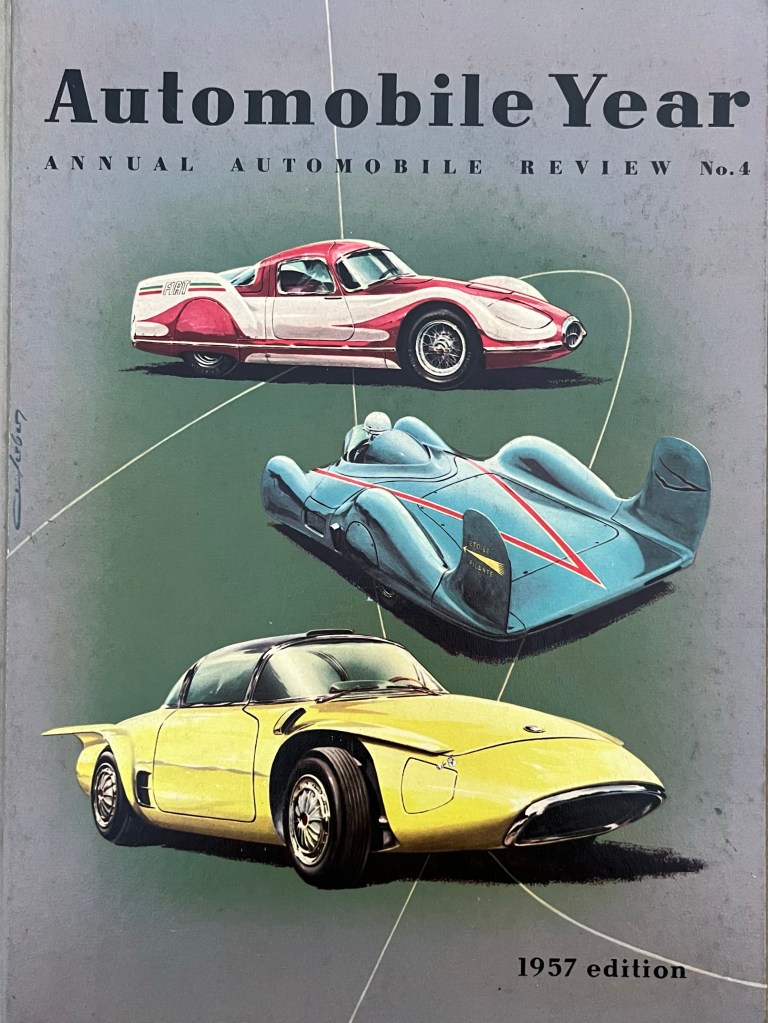
My friend Tony Johns lent me a couple of early AutoCourses that I turned into a couple of interesting posts. I’ll continue with that but thought I’d add an occasional piece based on my own collection of Automobile Years.
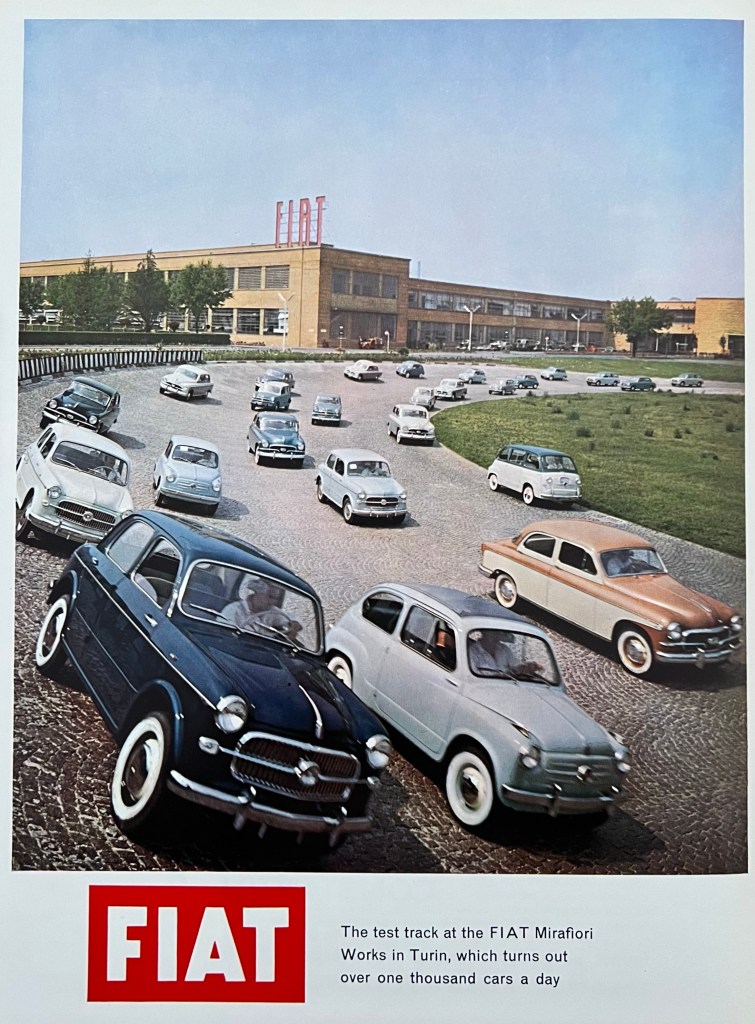
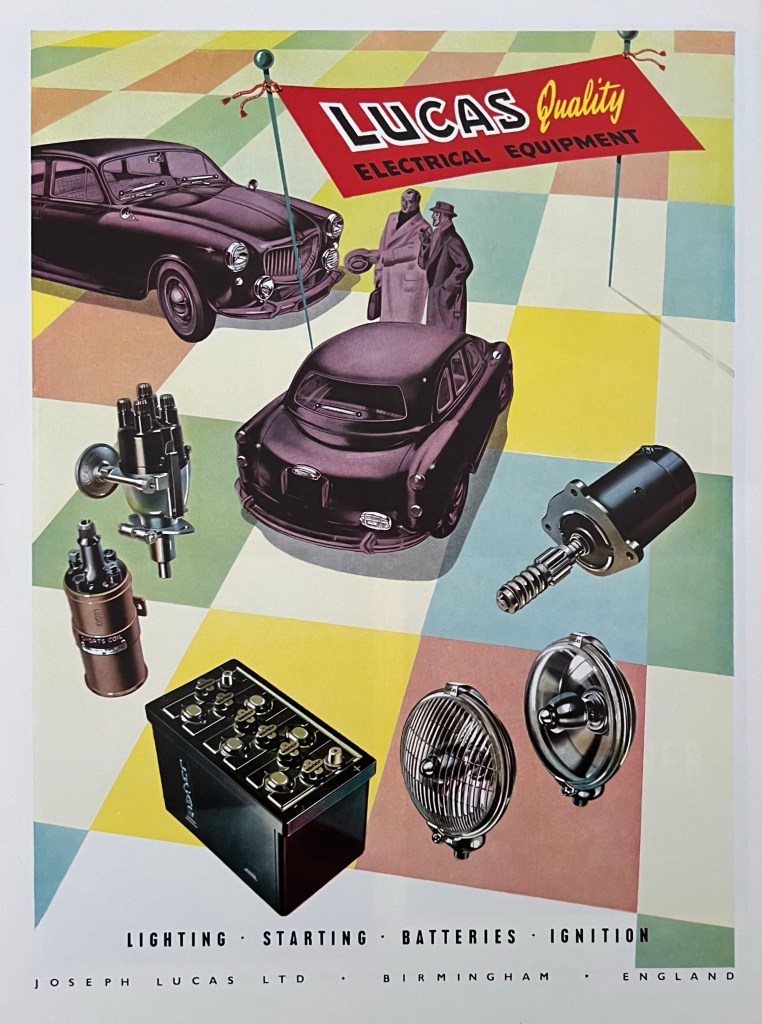
It’s the beauty of the some of the ads that really caught my eye. The reproduction of small monochrome racing shots isn’t that flash so I’m sharing the best of the relatively small number of colour shots and a few monochrome photographs within the mix of ads.
The artwork on the cover has a name but I can’t read it, nor is it disclosed elsewhere. The cars shown are a Fiat 8001 Turbina, Renault Shooting Star, General Motors XP-500 gas turbines.
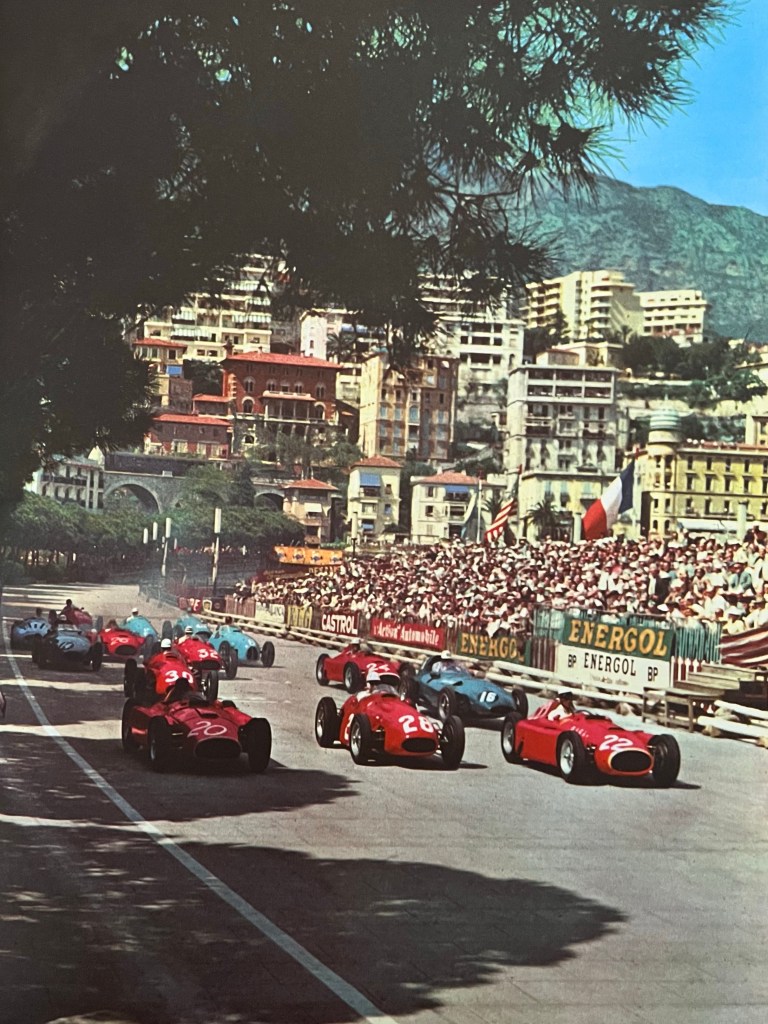
Superb Yves Debraine shot of the start of the 1956 Monaco Grand Prix.
The two Lancia-Ferrari D50s of JM Fangio and #22 Eugenio Castellotti sandwiching Stirling Moss in a works-Maserati 250F. #16 is Harry Schell, Vanwall VW1, #30 Jean Behra, 250F, #24 Luigi Musso, Lancia-Ferrari D50, #32 Cesare Perdisa in another works Maserati 250F.
(Yves Debraine)
‘Stirling Moss had been in the lead from first to last and gave a faultless display of brilliant driving and faultless race strategy (being under great pressure from Fangio’s Ferrari late in the race). The discovery of the day was Peter Collins (Ferrari second) . Behra drove a steady race into 3rd place, with no incidents (250F).’ See here for more: https://primotipo.com/2014/08/21/stirling-moss-monaco-gp-1956-maserati-250f/
(Y Debraine)
Le Mans 24-Hours.
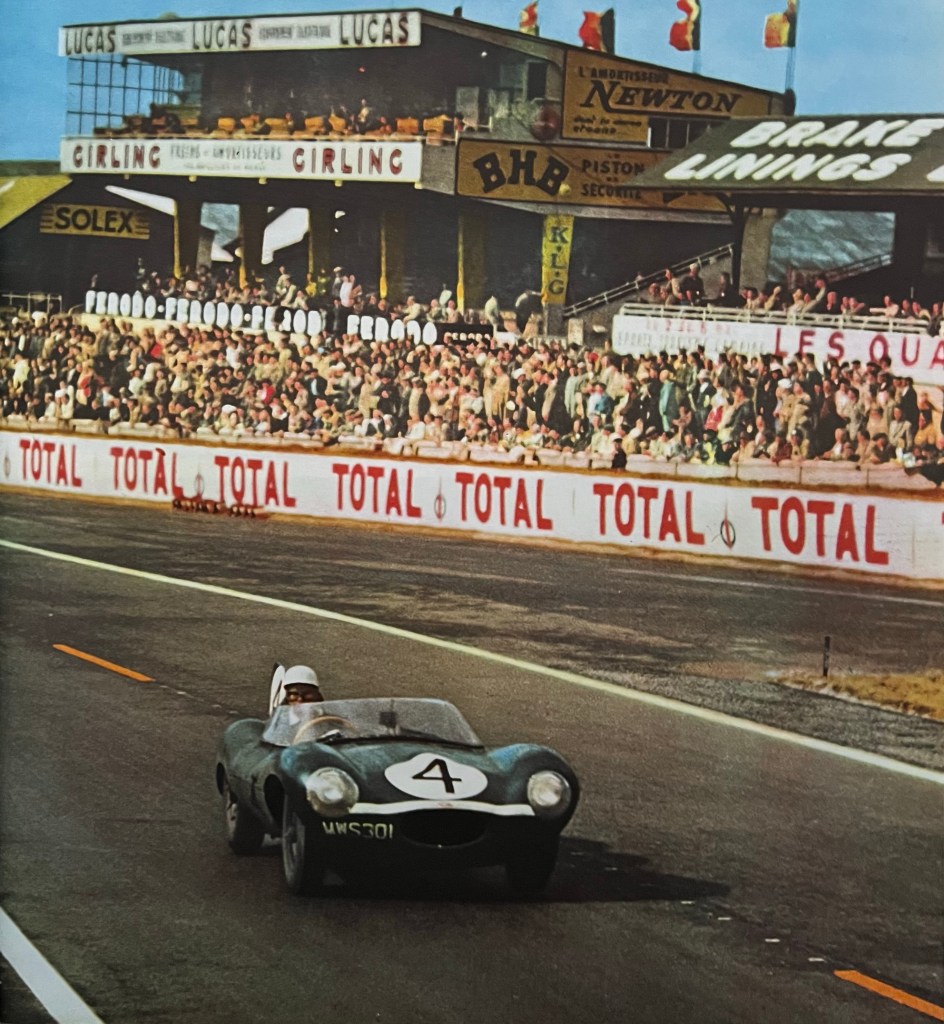
‘The privately entered Ecurie Ecosse Jaguar D-Type driven by Ron Flockhart and Ninian Sanderson gave Jaguar an unexpected victory – the fourth since the war – after bad luck had struck the works team.’
‘Mike Hawthorn was in magnificent form and held the lead (of the British Grand Prix at Silverstone) for 15 laps.’
‘The BRM (Type 25) showed again that it is probably the fastest of all current Grand Prix cars, but Hawthorn was eventually passed by Moss (Maserati 250F) and others before being forced to retire at 23 laps by loss of lubricant to a rear universal joint, which produced incipient seizure.’
Moss the led until the 68th lap when misfiring intervened with Roy Salvadori driving the race of his life in the Gilby Engineering 250F, holding second place for 30 laps in front of all of the works cars! Fangio, Lancia-Ferrari D50 led to the finish after Moss retired, with Peter Collins/Alfonso de Portago second and Jean Behra, Maserati 250F third.
(B Cahier)
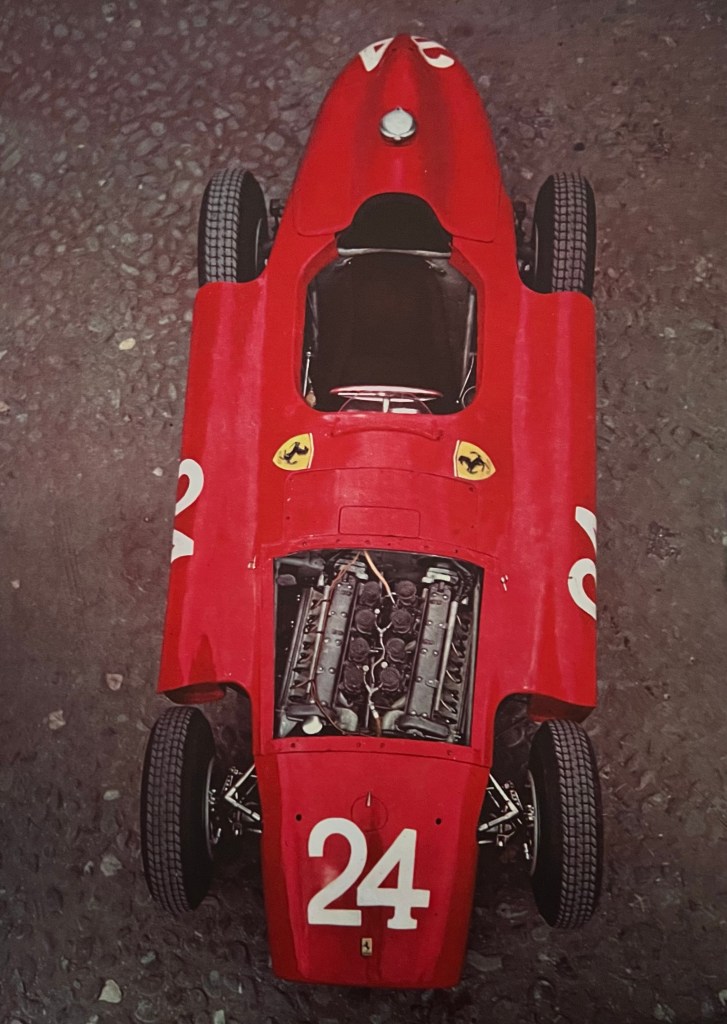
JM Fangio’s F1 Drivers Championship winning Lancia-Ferrari D50.
‘Front engine, V8 mounted at an angle. Bore and stroke 76 x 68.5mm, 2495cc. Maximum power 285bhp @ 8500rpm, 4-overhead camshafts, chain driven. 4 downdraught Solex twin-choke carburettors. Dual ignition: 2 magnetos, 16 plugs. Clutch at rear in unit with 5-speed gearbox and differential. Front suspension by double wishbones with transverse leaf spring. Rear suspension De Dion, with transverse leaf spring. Drum brakes. The tanks in the wheel fairings are no longer used, all the fuel being carried in the tail.’
(Y Debraine)
The Big Red Cars to the fore at the start of the French GP, Reims, July 1: Peter Collins, Eugenio Castellotti and JM Fangio in Lancia-Ferrari D50s ahead of the Moss Maserati 250F, Harry Schell’s Vanwall VW1 #22, and Jean Behra’s 250F, then one of the Gordinis, and the rest…
Fangio led until he pitted on lap 40, but he joined the fray after a change of plugs. Harry Schell raced brilliantly, retired his own Vanwall, then took over Hawthorn’s while it was in seventh place, and then chipped away at the leading Ferraris passing all but Fangio until injection pump trouble intervened.
Collins won from teammate Castellotti by three-tenths after 2 hr 34 min of close racing, then Behra 30 seconds back.
Sebring 12-Hour
‘The victory of the Fangio-Castellotti team (in the Sebring 12-Hour) was largely the work of the young Italian. Fangio, feeling unwell, had handed the car to him for the last hours of the race. The 3422cc four-cylinder Ferrari (860 Monza) covered a distance of 1008.72 miles in twelve-hours and put up a new record by doing twelve more laps than the winning Jaguar (D-Type) in 1955.’
Luigi Musso and Harry Schell were second in another Scuderia Ferrari 860 Monza with the Bob Sweikert/Jack Ensley Jaguar D-Type third.
Mille Miglia 1956…
I was going to give the shot below the same treatment as the rest and then I read the prophetic piece that went with it…not too long before the 1957 Mille disaster. It’s worth sharing in full I thought, an insiders view of the time clearly expressed.
‘For a long time after the catastrophe at the Le Mans Twenty-four Hours in 1955, motor-racing circles feared that the XXIInd Mille Miglia had been the last of the series. That race, in which 365 cars competed over 1,000 miles of roads lined by hundreds of thousands of spectators, is the most dangerous of all motor races for the drivers and even more so for the spectators.’
‘Therefore those who love the sport were all the more pleased when, after long and bitter disputes, the XXIII edition of the race was permitted-for it was a triumph over the enemies of motor racing-but they felt some uneasiness nonetheless. So few changes had been made in the regulations that the old risks were still there. The competitors were still to start off in the pitch dark and charge at headlong speed along roads lined – and in some places obstructed – by enthusiastie spectators many of whom had taken up their stand at the most dangerous points.’
‘The rain that fell incessantly throughout the race made the surface slippery in the extreme. Several cars left the road and the day closed with 7 fatal casualties – two of them among the spectators – and 16 injured. Indeed it was really only by sheer good luck that there were not a great many more. For these reasons we are against the Mille Miglia in its present form.’
‘Sooner or later it is bound to lead to a catastrophe fraught with the direst consequences because it could be so easily avoided. There must be fewer starters with a severe selection of the entries, and the most dangerous points-especially where the cars come out of a bend-must be closed to spectators. If these conditions, which without eliminating all danger would reduce the risk to reasonable proportions, cannot be satisfied the Mille Miglia will have to be considered anachronistic. We have nothing against the organizers. We simply believe that in common sense it must be admitted that the pleasure and interest of a limited number of people together with the technical advances brought about by the event are no justification for the terrible risks involved in a race where for 20 hours on end thousands of spectators without the slightest protection are within arm’s length of meteors unleashed at terrific speed.’
(‘A fine colour study which catches the typical atmosphere of many Mille Miglias. Rain pelting down from a leaden sky, spectators huddled together under umbrellas, and a brilliantly coloured car, headlamps blazing, as it roars on towards the finish at the end of the long day. The car is Collin’s Ferrari (860 Monza Scaglietti), taking second place in the XXIIIrd Mille Miglia with photographer and journalist Louis Klemantaski acting as navigator’ Y Debraine)
‘The XXIIIrd Mille Miglia was run in appalling weather which prevented the repetition of performances on a par with those recorded in 1955. The times chalked up by all the classes were slower than last year with the sole exception of Michy on RENAULT 750 c.c, who broke the record set up by Galtier in 1955. All in all one may say that the small, and therefore less speedy, cars were less severely handicapped by the rain than the powerful machines capable of doing over 125 m.p.h.’
‘Victory smiled on Eugenio Castellotti on a 3 ½-litre 12-cylinder FERRARI (290 MM Scaglietti). He took 1 hour 29 minutes 22 seconds more than Moss last year to cover the 1,597 kilometres of the course but his average speed was most impressive in view of the atmospheric conditions he was up against. Second place was taken by another FERRARI – a 3 1/2 litre 4-cylinder model – driven by Peter Collins whose passenger was our contributor Klemantaski, a bearded British journalist like Jenkinson.’
‘FERRARI won all the laurels taking 3rd, 4th and 5th places with Musso, Fangio and Gendebien, the latter being the winner of the “Grand Tourisme” class. In the next three places we find three MERCEDES 300 SL privately entered but prepared by the works. The MASERATIs were a disappointment although Scarlatti took first place in the class for sports cars under 2,000 c.c., while Perdisa was first in the under 3,000 c.c. class but only 28th in the general classification. Stirling Moss, No. I member of the team, whose car was not quite up to scratch, ran off the road before Rome and withdrew from the race.’
‘The ALFA ROMEO GIULIETTA which had disappointed in 1955 put up a magnificent show this year. As usual PORSCHE took first place in the “Grand Tourisme” class under 1,500 c.c. but was defeated in the sports class by Cabianca’s OSCA 1500 and Jean Behra’s MASERATI. All four RENAULT DAUPHINES entered by the works finished the race although Paul Frère capsized when leading the team. The winner was Gilberte Thirion at an average of 65.85 m.p.h. Our contributor Bernard Cahier, at the wheel of his own DAUPHINE – a production model in every respect – covered the course at 58.28 m.p.h. Michy on a modified 4 H.P. RENAULT produced a fine performance, as already mentioned, by lowering the record for his class established in 1955 on a dry surface by Gaultier with a car of the same type.’
‘Of the 427 entries, 365 started but only 182 reached the finish – a wastage of 50 per cent.’
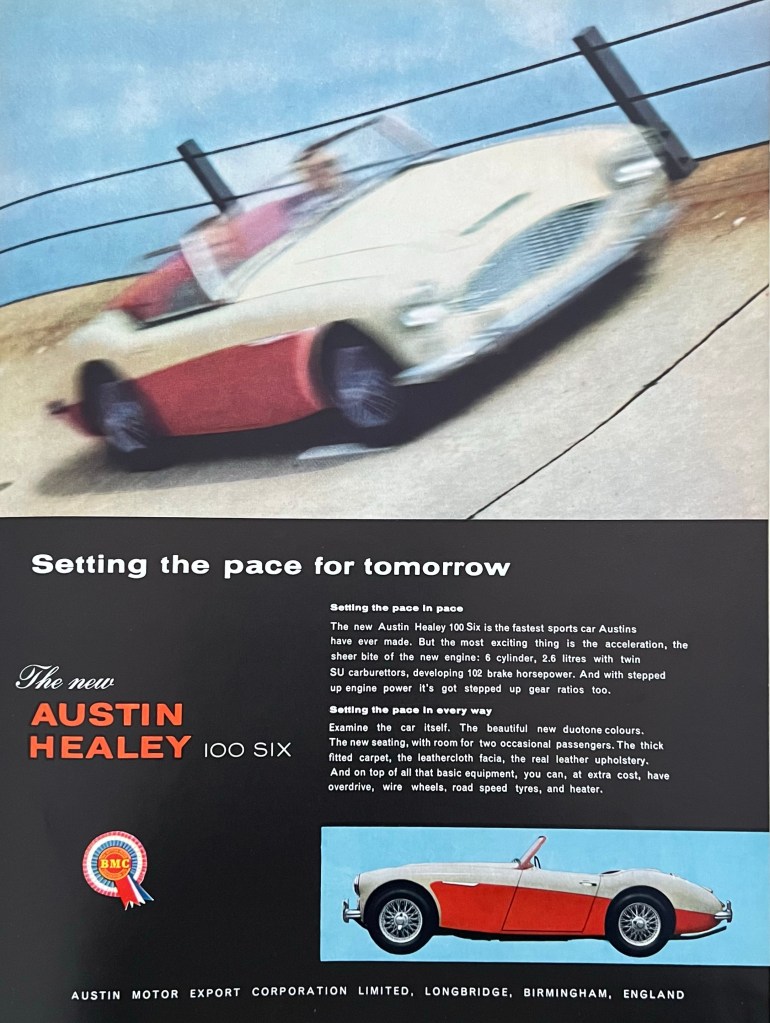
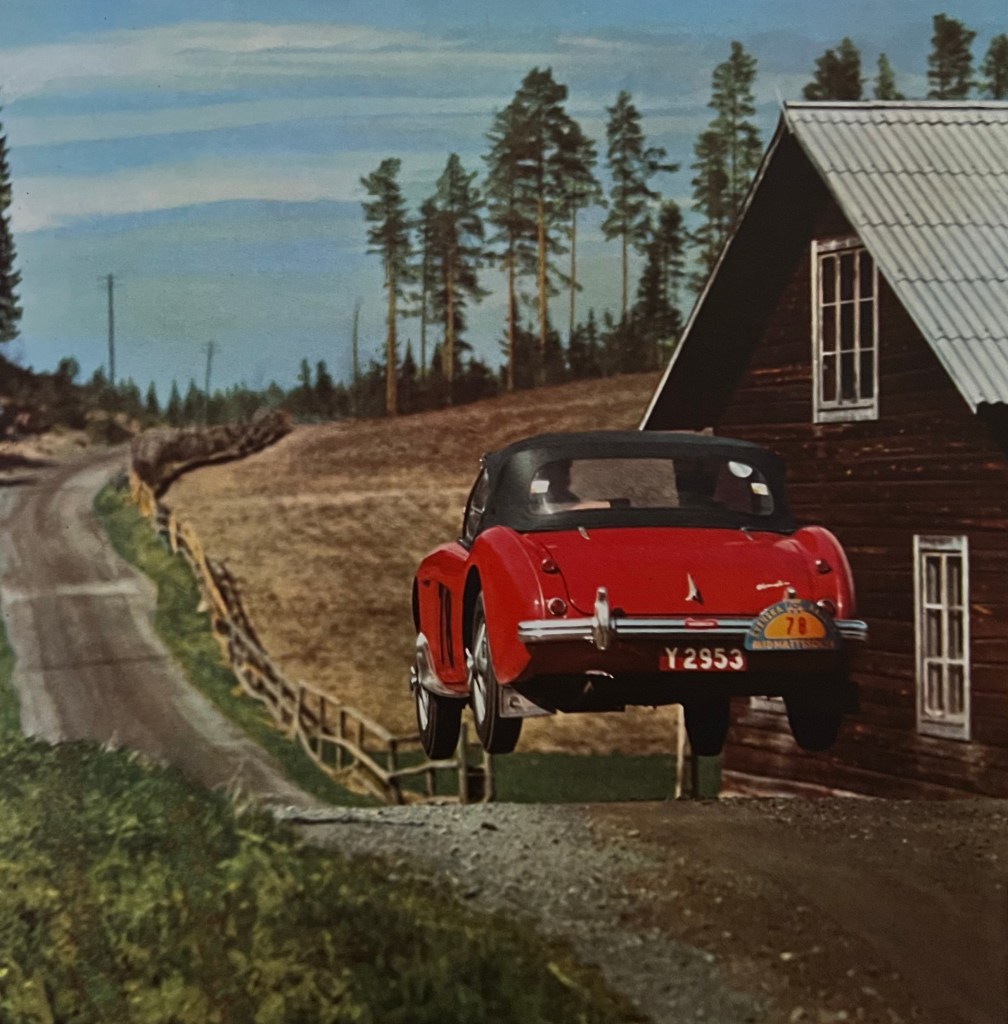
‘The Frölander and Lindbergh, shortly after take-off, on their flight to the Midnight Sun in a single-engined (?) Austin Healey.’ This crew didn’t finish in the top-10, the May 29-June 3, 1956 event was won by a VW 1200 driven by H Bengtsson and navigator A Righard.
Credits…
Automobile Year, Yves Debraine, Louis Klemantaski, Junior, Bernard Cahier, B Gronlund
Tailpiece…
I’ve long thought the power of an ad is inversely proportional to the word count…particularly if the visual imagery is up to snuff!
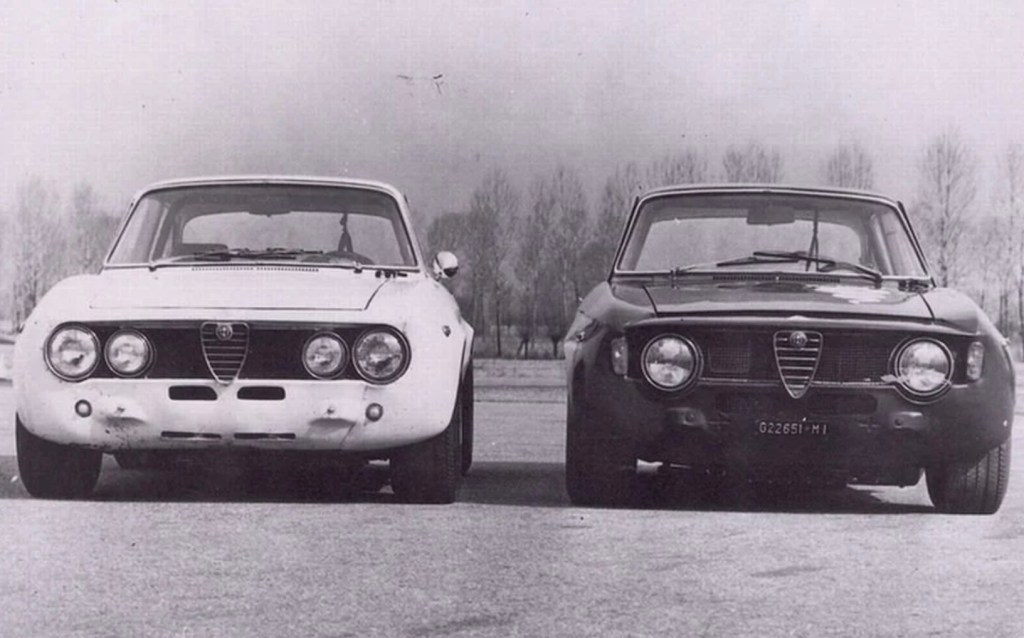
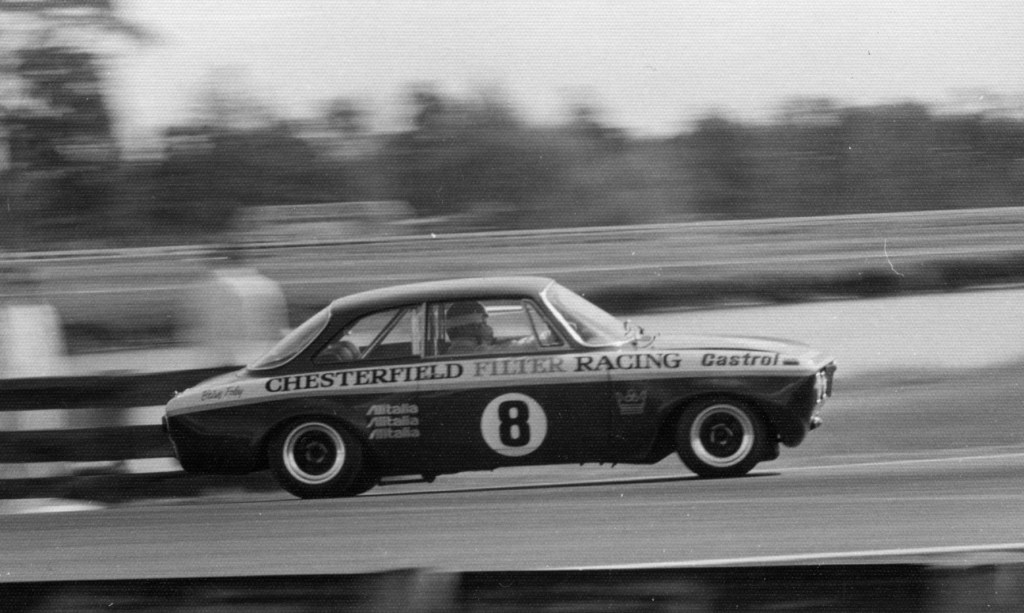
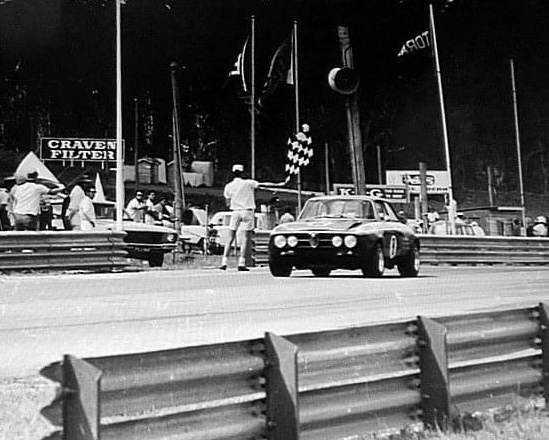
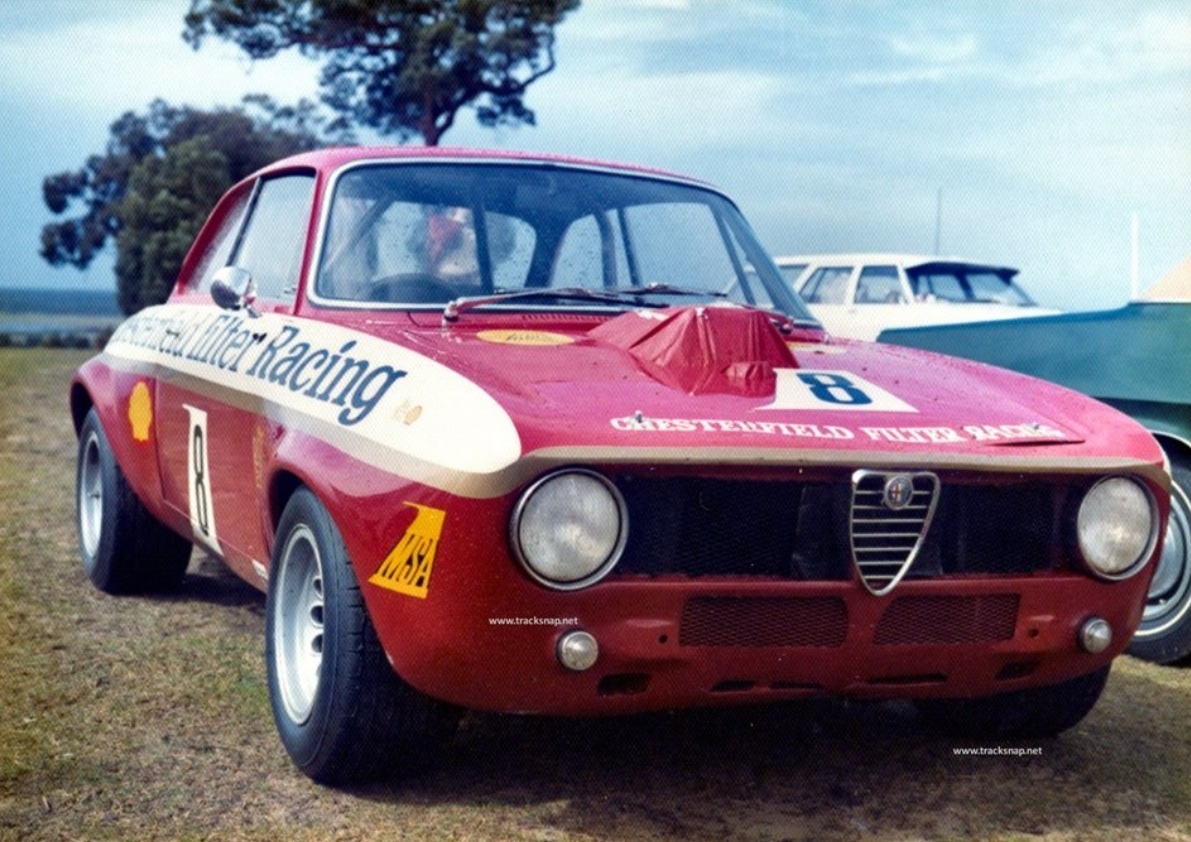
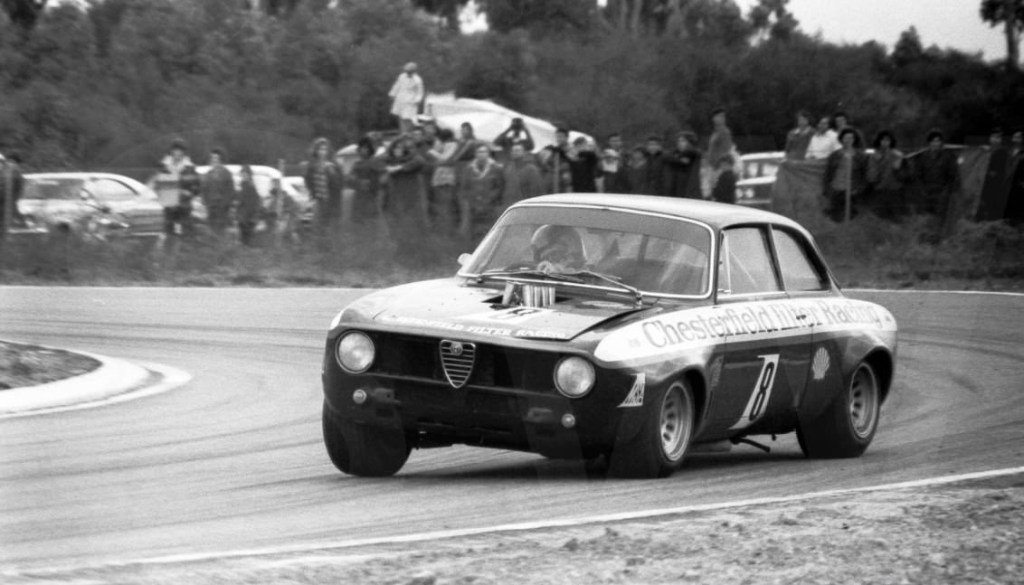
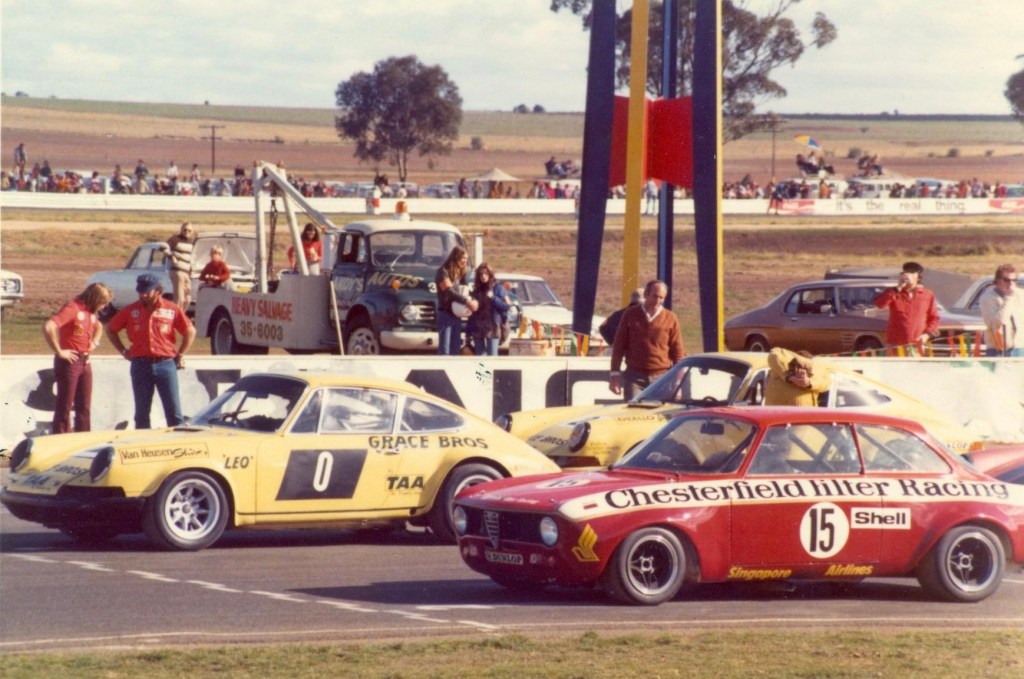
I’ll take the one with stripes…Brian Foley’s Alfa Romeo 1750 GTAm on the showroom floor of his Parramatta Alfa Romeo dealership, Sydney in 1972.
Look at all those 105s, a 2-litre Spyder with a Berlina alongside, boxy Giulia Super, a couple of 1750 GTVs, oh, and a 1750 GTAm at centre-stage, as it should be.
There have been some stunning ex-works touring cars raced in Australia down the decades, the must lustworthy for me are Alan Moffat’s ’69 KarKraft Mustang Trans-Am, his ’75 RS3100 ‘Cologne’ Capri and Foley’s GTAm.
Brian made his name in Minis. Together with Melbourne’s Peter ‘Skinny’ Manton, he was top of the Cooper S pops in the mid-1960s and became an outright contender with acquisition of a Porsche 911S in 1970. But if the Porker was outgunned by the big V8s in the Australian Touring Car Championship – Pete Geoghegan and Allan Moffat Mustangs, Norm Beechey’s Holden Monaro GTS350 and Bob Jane’s Camaro – Brian’s GTAm would struggle bigtime, and so it did.
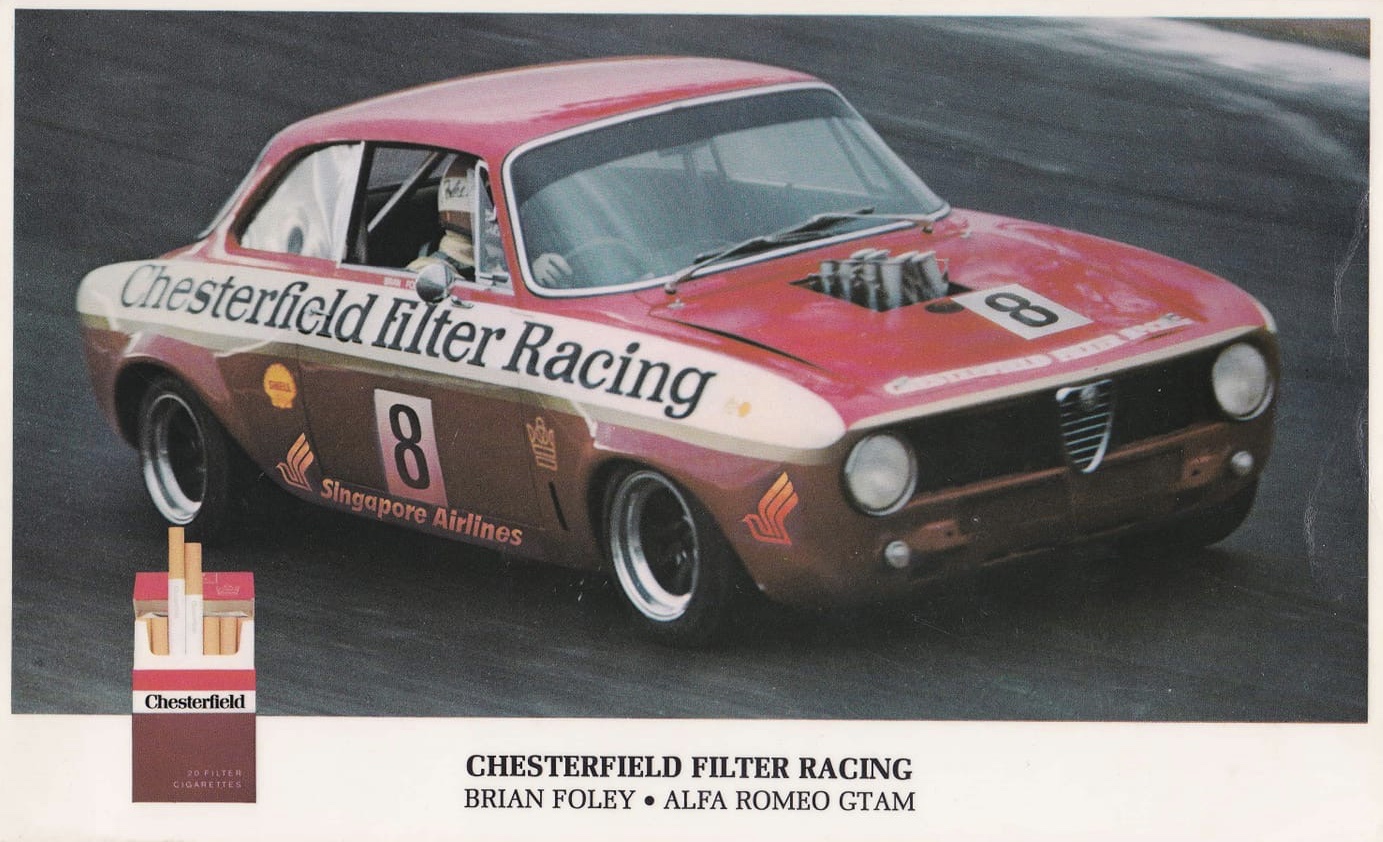
Dick Simpson artistry: Brian Foley on the hop through Lakeside’s Karrussel during the 1970 ATCC round, Porsche 911S (D Simpson)1971 Chesterfield press release shot, note the 10-inch Minilites (Foley Collection)The Toine Hezemans/Carlo Facetti GTAm on the way to fourth place in the July 1971 24 Hours of Spa-Francorchamps (unattributed)
The purchase made commercial sense though. Brian Foley Automotive, formed in 1967, became an Alfa Romeo dealer, Foley had support for the car from Alfa Romeo Australia in addition to old sponsor, Castrol, Alitalia and of course Chesterfield ciggies.
Toine Hezeman had already won the 1970 European Touring Car Championship – four wins in nine rounds – in a works-1750 GTAm by the time Foley ordered his car.
While the Giulia Sprint GTA (700kg) was built by Alfa Romeo, the 1750 GTAm (970kg) (2000 GTAm from the introduction of the 2000 GTV) was built by Autodelta, and sometimes by other specialists using bodies they acquired or were supplied by clients, then built up with parts supplied by Autodelta.
1750 GTAm and Giulia GTA Junior in 1970 (Autodelta)Andrea De Adamich about to jump aboard his GTAm during the 19 Nurburgring (unattributed)
The model was homologated around the US version of the 1750 GTV – Tipo 105.51 – these cars were left-hookers’ fitted with Spica fuel injection to meet emissions regs: for racing purposes the rules allowed the use of competition fuel injection, usually Lucas. Having said that, right hand drive Tipo 105.44 shells were also used.
For years there have been several schools of thought as to the ‘Am’ bit of the name. One was that it stood for alleggorita maggiorata – increased and lightened, another was alleggorita modificata – modified and lightened, and the other is that the Am stood for America. Marco Fazio of Alfa Romeo Documentazione Storico put the matter to rest when he confirmed on the Spettacolo Sportivo in September 2011 that ‘America’ is the official type name, therefore Alfa Romeo 1750 GTAm/Alfa Romeo 2000 GTAm.
Chassis #1531068 was completed by Autodelta on February 24, 1970. It was acquired by Foley late in the year after an uncertain history, perhaps it had been used as a test hack during the Targa Florio weekend by works T33/3 drivers. When it arrived in Sydney, the car’s mechanicals: engine, gearbox and differential required rebuilds, so Foley missed the first three rounds of the 1971 Australian Touring Car Championship at Symmons Plains, Calder and Sandown.
Foley, GTAm in the Warwick Farm Essex during the November 1971 AGP meeting. Bill Fanning’s superb Escort Waggott following (L Hemer)Foley in front of Jim McKeown at Mallala in 1971 (J Lemm)David McKay and Robin Sharply during the Oran Park stage of the Dulux Rally on August 8, 1971. GTAm engined Alfa 1750 GTV (L Hemer)
Foley was then sixth at Surfers Paradise, fifth at Mallala and seventh at Lakeside. He missed the final round at Oran Park because he loaned the engine to David McKay for his assault on the Dulux Rally aboard a 1750 GTV (above). See here for more about the Dulux, not the correct year mind you: https://primotipo.com/2015/04/09/australias-cologne-capris/
Wanting to race competitively and give his sponsors a reasonable crack of the whip, Foley decided to run the car as a Sports Sedan in 1972, a class that allowed more significant modifications to be made.
He and his mechanics, Colin Devaney and Colin James created a unique GTAm by fitting a Tipo 33 2.5-litre V8 into the reasonably tight engine bay!
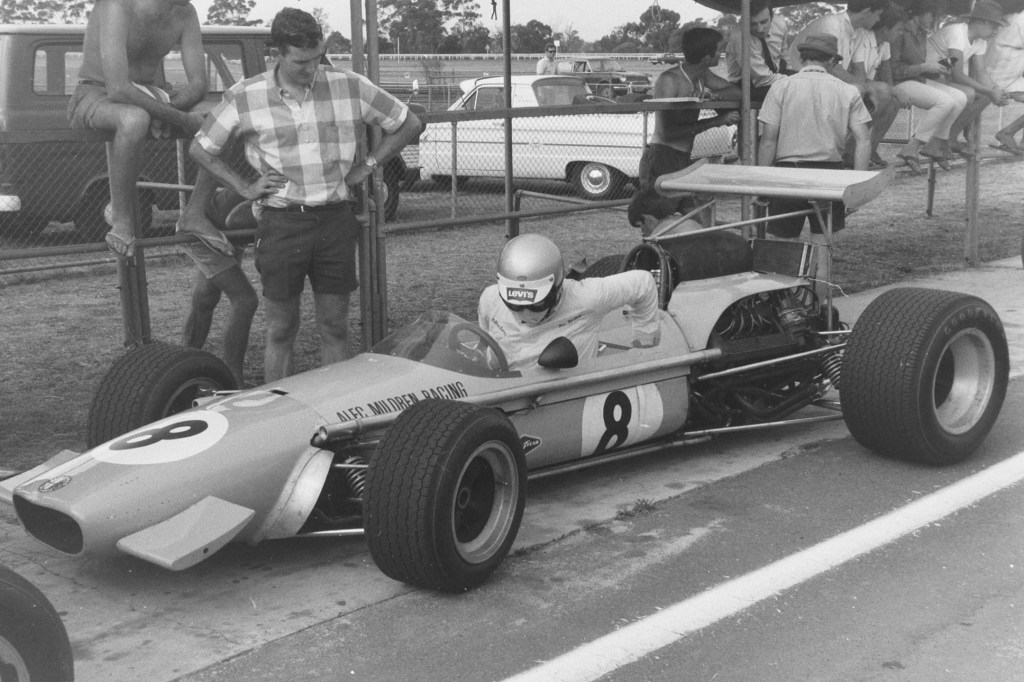
Alec Mildren Racing had a float of three of these 2.5-litre, quad-cam, two-valve, twin-plug, fuel injected V8s that had been fitted to the team’s Brabham BT23D and Mildren ‘Yellow Submarine’ single-seaters raced by Frank Gardner and Kevin Bartlett from late 1967 until late 1969 (the Sub was fitted with a Waggott in time for the Hordern Trophy in December 1969). KB won Gold Stars in 1968-69 so equipped.
When Mildren replaced the Tipo 33 V8s with Merv Waggotts 2-litre TC-4V engines Foley bought one of the V8s in bits. When rebuilt it gave circa 305bhp.
Kevin Bartlett decamps the Mildren Brabham BT23D Alfa Romeo during the 1969 Warwick Farm 100 Tasman round (B Jackson)(B Jackson)
It wasn’t that simple though, the all aluminium engine was an incredibly tight fit, with Foley telling Australian Muscle Car’s Paul Newby that the sub-optimal exhaust system they were forced to run could have lost up to 50bhp. Costly, given the V8 was 70kg heavier than the 1985cc twin-cam, two-valve, twin-plug, fuel injected four which gave 194bhp when it was first rebuilt, and 217bhp after further development.
The car was converted to RH-steering during the rebuild – which involved a bigger hole in the floor pan to accommodate a larger bell-housing – but the running gear otherwise remained as built by Autodelta: gearbox, diff, suspension, Campagnolo wheels and brakes.
It’ll fit somehow…(C James)Foley leans on it as he crosses Warwick Farm’s causeway in 1972, GTAm T33. Same car but now fitted with T33 2.5 V8, RHD and with single headlight 1600 Junior front-clip (J Semple)
Newby wrote that the car had wins at Adelaide and Amaroo Park, and one victory over Allan Moffat’s Mustang at Warwick Farm and a successful visit to Malaysia.
Despite that, Foley decided a better Sports Sedan starting position was a much lighter aluminium GTA, to that end he bought the ex-Mildren/Foley RHD GTA and gave it to Bowin Designs’ John Joyce to work his magic. A story for another time.
Over time it’s amazing how many racing Alfa Romeos have headed West, perhaps the LHD Mildren GTA was the first…Sure enough, when Foley advertised the GTAm it was Perth Fiat dealer Frank Cecchele who bought it, a good thing!
Gordon Stephenson was his driver, but it wasn’t too long before CAMS caught up with them. The GTAm was powered by an exotic full-race V8, it was not a production based engine as the rules required. While the Montreal V8 might look a bit the same, it shares not one component with Autodelta’s race V8.
After a while in the naughty-boys-corner, it was fitted a twin-turbo Rover V8 and won some state titles so powered in the 1980s before it was badly damaged in a testing accident at Wanneroo, by that time the car was fitted with a twin-turbo Fiat V6.
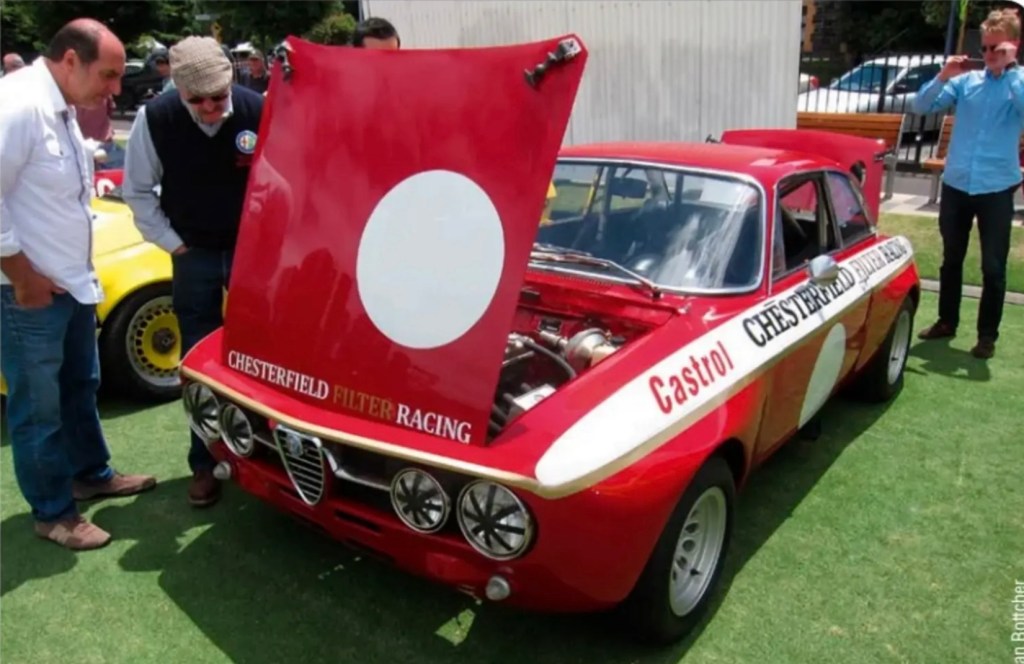
Various approaches were made to Cecchele down the decades to buy #1531068, and finally he succumbed to Vin Sharp’s entreaties in 2006. Vin is a member of a much respected Victorian Alfa Romeo family and has done a brilliant job restoring the car to original condition aided and abetted by Cecchele who kept all of the key components, with the exception of the engine.
Vin Sharp and Brian Foley unveiled the restored GTAm at the Alfa Romeo Owners Club of Victoria annual Specattolo day at Melbourne High, South Yarra in late 2013 (E Bottcher)Dale Harvey captures the GTAm on the WF causeway in 1971 (D Harvey)
Specifications…
Summary of Peter Wherrett’s article on the Foley GTAm published in the June 1971 issue of Racing Car News
Body: Steel, bonnet and boot lid fibreglass, doors aluminium GTA with sliding perspex windows, all glass other than the laminated screen are perspex. The lower half of each guard is fitted with fibreglass flares which are bonded or pop riveted. Lightweight bumper if required.
All interior trim is removed and replaced with lightweight material. Front seats fibreglass, dashboard replaced with a lightweight unit, Momo steering wheel
Engine: 1985cc, DOHC, two-valve, twin-plug, Lucas fuel injected four cylinder, aluminium engine. 84.55×99.5mm bore/stroke. 220bhp DIN @ 7200rpm quoted.
Gearbox: 5-speed GTA with vast choice of gear and diff ratios
On tour. Foley at Bay Park, New Zealand in the summer of 1971-72 (B Williamson Collection)Mallala ATCC round in 1971 (J Rogers)
Suspension:
Front: Independent coil springs, Armstrong adjustable heavy duty double acting shock absorbers, heavy duty anti roll bar
Rear: Coil springs with coaxially mounted Armstrong fully adjustable, heavy duty, double acting shock absorbers. Adjustable heavy duty roll bar
Rear axle: Anchored to the body structure by two trailing arms and upper magnesium A-brackets for transverse anchorages; all with metal bushes on the frame and axle. Hypoid final drive with pawl and clutch type limited slip differential. Choice of final drive ratios
Wheels: Standard wheels are Campagnolo 13 x 9 inch and 13 x 10 inch Minilites “which have an additional inch of offset over those from Autodelta to allow the car to fully exploit local regulations with a track two inches wider than the homologated figure.” The 10 inch rims will be dries, the 9 inchers wets.
Brakes: Four wheel discs, ventilated at the front, aluminium calipers
Foley crosses the finish line at the end of the Lakeside 1971 ATCC round (B Thomas)
Etcetera…
(unattributed)
Two more shots of the Hezemans/Facetti GTAm during the July 24-25 1971 Spa 24-Hour.
The car’s head and radiator were replaced during the event, the strategically long pit stops of the other two Autodelta cars ensured the pair finished third. The race was won by the the Dieter Glemser/Alex Soler-Roig Ford Capri RS2600.
(unattributed)Foley, Warwick Farm Creek Corner exit May 1971 (L Hemer)In sports sedan guise at Wanneroo Park, Perth August 20, 1972, and again below (R Hagarty)(Speedwest)
James Semple, Lynton Hemer, Colin James, Dick Simpson, John Lemm, Brian Jackson, Olaf Zagato on The Nostalgia Forum, Racing Car News May 1971, John Rogers, Brier Thomas, Euan Bottcher, Bob Williamson Collection, Glenn Moulds Collection
Tailpieces…
(G Moulds Collection)
It seems sorta-right to conclude with Foley’s subsequent weapon of war, an even lighter variant of the ex-Mildren-French GTA ‘RHD’, at Calder in May 1973.
(L Hemer)
My friend Lynton Hemer captured ‘Foles’ saying gedday to the fans on the warm-down lap of the 1971 AGP touring car support race, GTAm, seems a nice way to finish…
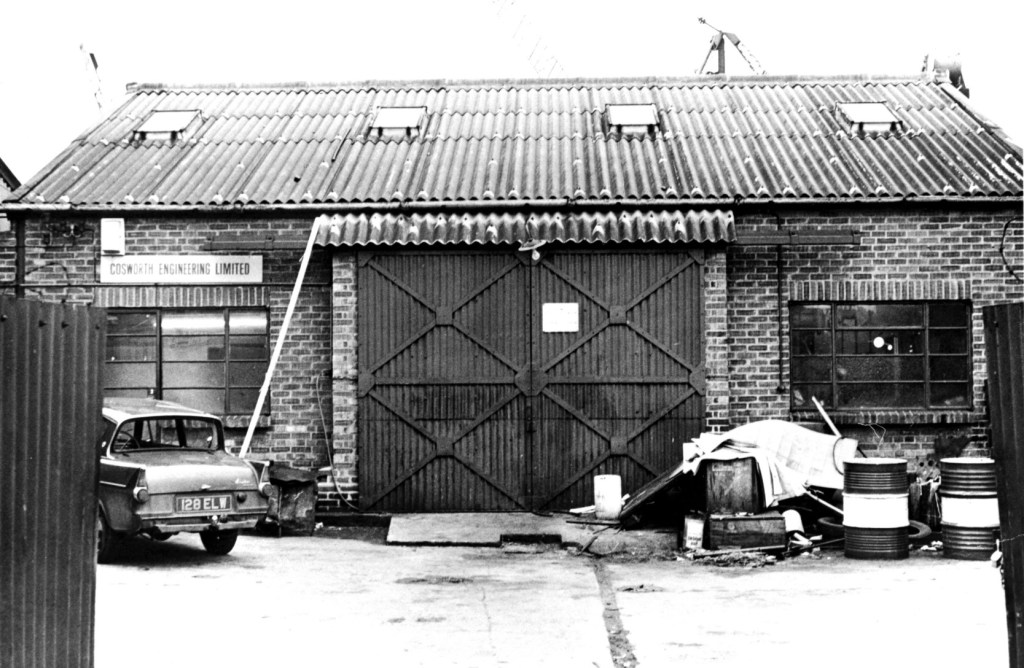
Cosworth Engineering Ltd was established on September 28, 1958 and originally operated from this modest facility in Shaftesbury Mews, London W8.
Mike Costin was the Technical Director of Lotus by day and Cosworth partner by night, while Keith Duckworth worked on the new enterprise full time.
The firm’s rate of growth can be gauged from moves to larger London premises in Friern Barnet in 1959 and then again to Edmonton in 1961.
Their first projects in 1959-60 were the Mk1, a modified Ford Anglia 105E engine design, the Mk 2, a production Formula Junior race engine based on the learnings of the Mk1, and the Mk3, an improved version of the Mk2 using their A3 cam, with a stronger bottom end and optional dry sump.
Cosworth were up and running…
I’ll take your advice as to chassis and gearbox manufacturer. The ‘Aeroquip’ fittings and roll bar height suggests a modern shot? (Cosworth)
Credits…
Cosworth Engineering
(Cosworth)
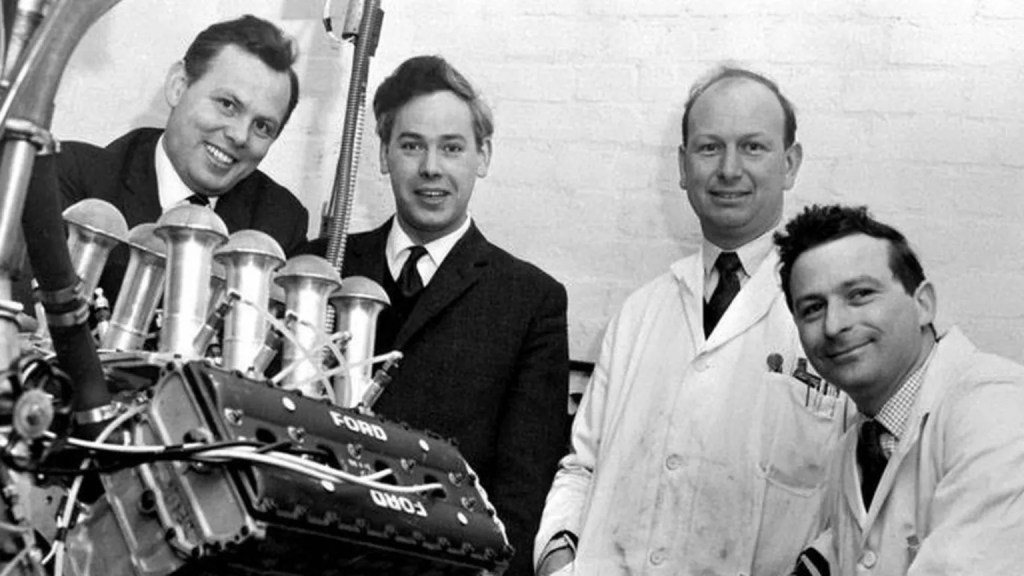
Cosworth’s Bill Brown, Keith Duckworth, Mike Costin and Ben Rood with the almighty, most successful racing engine of all time, the Ford Cosworth DFV 3-litre V8 F1 design. More about the engine here: https://primotipo.com/2016/05/12/me-an-my-dfv/
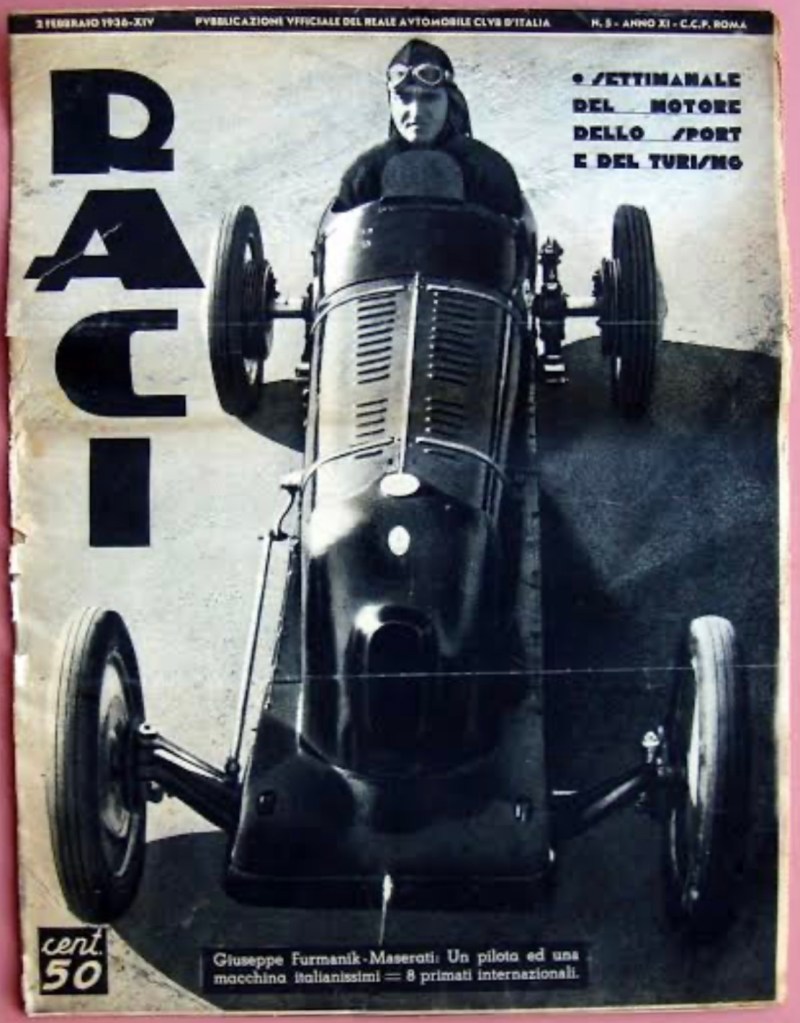
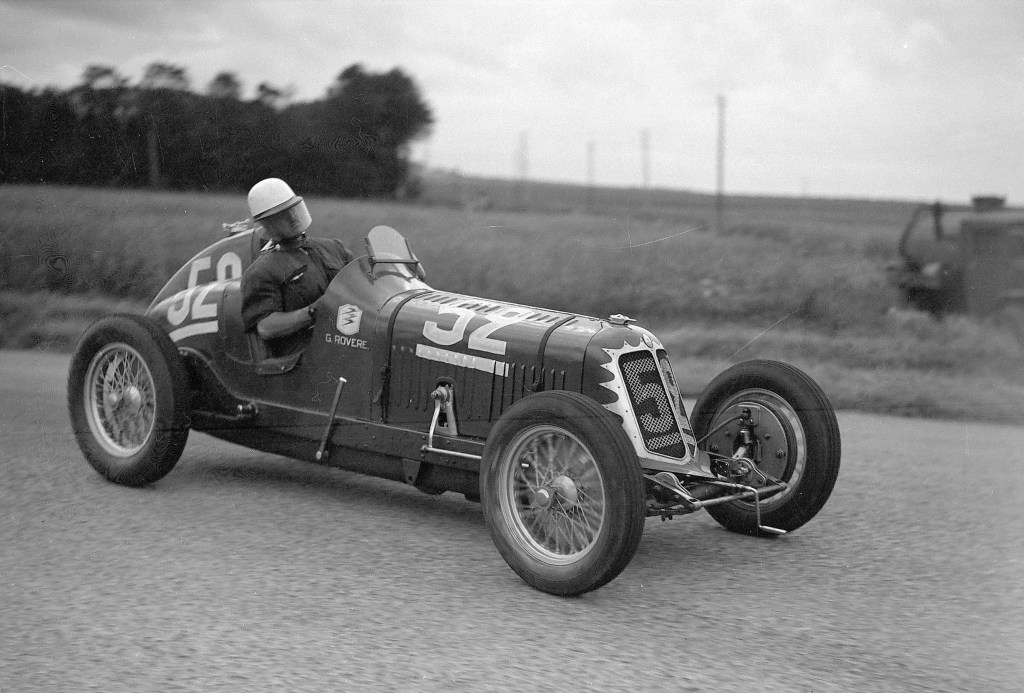
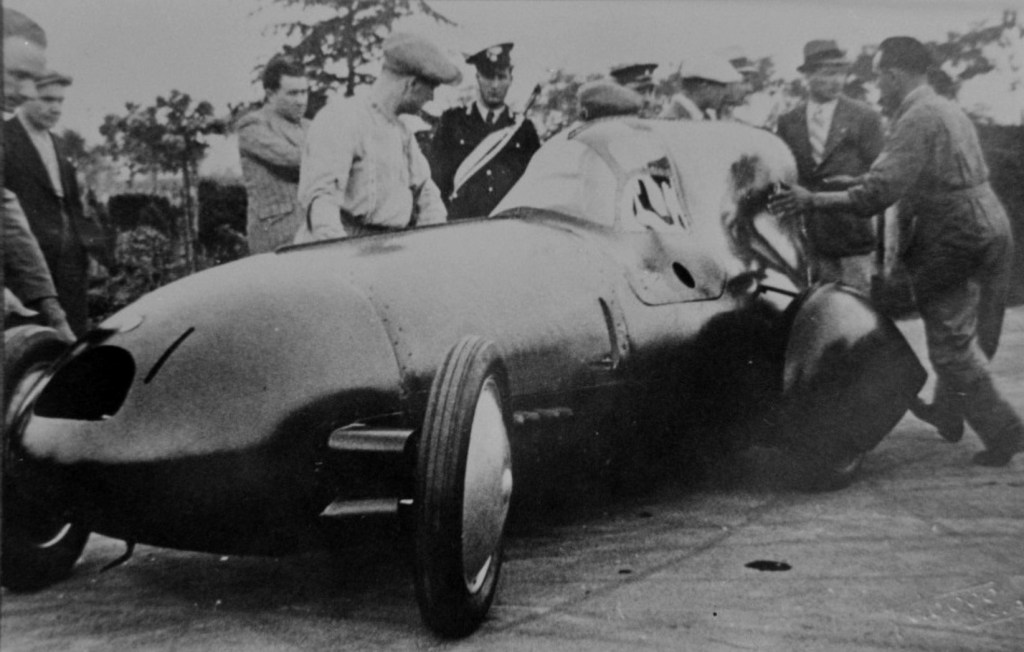
Ernesto Maserati looks on as Giuseppe Furmanik readies himself and his lightweight, streamlined, four cylinder 4C powered Maserati 6CM, chassis #1136 for a run during several speed record attempts he made at Tassignano on the Firenze-Mare Autostrada on June 2-3 1937.
Furmanik set the 1001-1500cc Flying One Kilometre record on June 3 at 148.4mph/237.568kmh (or 148.2/238.6 depending upon your source).
The car’s special aluminium bodywork was designed by the Centro Sperimentale Aeronautico di Giudonia and built by Carozzeria S. A. Viotti of Torino. Furmanik used the machine – also referred to as 4CM #1536, for which no factory build sheet exists – and another 4CM, chassis #1120, in record attempts.
Giuseppe Furmanik before a run in #1536, Pirelli tyres (Pirelli)
Of Polish descent Joseph Furmanik was born in Switzerland in 1903 then moved to Italy with his father circa 1919-20. He adopted ‘Giuseppe’, became an engineer, co-designed a parachute named the Salvator and married money.
Settled in Rome, he became a prominent figure in 1930s Italian motor racing with his competition exploits probably funded by parachute royalties. He succeeded Count Vincenzo Florio as President of the Royal Automobile Club of Italy (RACI) in 1937.
What a big arse you have my dear…I wonder what the insignia on the tail represents? (Pirelli)
4CM Technical Specifications…
Furmanik took delivery of 4CM #1120, a four-cylinder, twin-cam, two-valve, Roots-supercharged 125bhp at 5000-6000rpm 1100cc Maserati 4CM monoposto, on August 12, 1932.
The 4CM was avant-garde for its time, Maserati followed Alfa Romeo’s single-seater lead set by Vittorio Jano and his team with their Grand Prix Alfa Romeo Tipo B/P3 Monopostos.
Very light, the car’s two parallel channel section chassis members were only 620mm wide with bodywork tightly proportioned around the key mechanical components. Hydraulic brakes were fitted, again, leading edge for the time. The car had a four speed gearbox and period typical suspension comprising solid axles front and rear sprung by semi-elliptic leaf springs, friction dampers were fitted. The wheelbase was 240cm, track 120/120cm and weight circa 520-580kg.
4CM early competition…
The 4CMs looked great and were fast in a limited number of outings in their first year of competition, 1932. In the German Grand Prix held on the Nurburgring in July, Ernesto Maserati and Amedeo Ruggeri were third of 15 Group 2 800-1500cc cars in the race won by Rudy Caracciola’s Alfa Tipo B 2.6. Maserati followed up with fourth of the Voiturettes – Ernesto’s little 1100cc Maser was surrounded by 1500cc cars – at the Masarykuv Okruh at Brno in September.
Giuseppe Campari’s Maserati 4CM 2-litre ahead of Jean-Pierre Wimille’s Alfa Romeo Monza during the August 6, 1933 Nice GP (MotorSport)This shot and the one below shows the earlier Furmanik 4CM #1120, with body designed by Mario Revelli di Beaumont (RACI Motor Sport February 1936)
Furmanik’s Record Breaking…
Furmanik raced #1120 throughout 1933 finishing third in the Coppa Ciano Junior and Coppa Acerbo Junior in July/August and missing the final of the Monza Grand Prix in September and DNF in his heat.
Into 1934 Furmanik started the Coppa Ciano as favourite in the Voiturette class but didn’t finish after a slight accident on the first lap. He was fourth in the Coppa Acerbo Junior.
Giuseppe does not appear to have raced #1120 in 1935 (see change of ownership to Gino Rovere shortly) and then decided to plan an attack on the World Speed Record.
#1120’s power was increased (output not specified) and a lighter more streamlined body was designed by Mario Revelli di Beaumont – ‘the most prolific car designed you’ve never heard of’ – and the front brakes removed, the result about 470kg/1036lbs. He also adapted the gearbox to provide for three tall gears.
Furmanik’s first runs, on November 28, 1935 were made on the Lucca-Altopascio section of the Firenze-Mare Autostrada, then on the Pescara road circuit on January 8, 1936, and then again on the same section of the Firenze-Mare Autostrada on January 29, 1936.
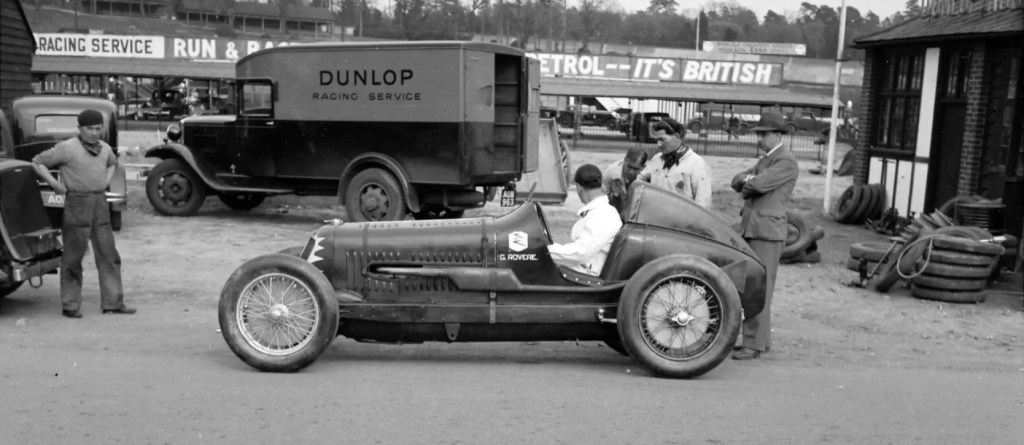
Gino Rovere aboard Maserati 4CM #1120 at Brooklands on May 6, 1935 (MotorSport)
Gino Rovere…
Gino Rovere was a wealthy enthusiast who became Maserati’s President. He supported Furmanik’s efforts, making available funds to increase the engine’s output and further improve aerodynamics.
With a 4C engine then developing some 150bhp at 7,200 rpm and the Centro Sperimentale Aeronautico di Giudonia/Carozzeria closed aero body fitted to 6CM chassis #1536, Furmanik set the Flying Kilometre record mentioned at the outset in June 1937.
Along the way #1120’s ownership changed from Furmanik to Rovere and the car was returned to Maserati’s Bologna factory where it’s said it was fitted with a 1.5-litre engine for Rovere to race in selected 1935 Voiturette events: Brooklands in the May 6 JCC International Trophy (results please), then at Dieppe and finally Modena.
Gino Rovere lines up #1120 before the start of the Junior Car Club International Trophy , Brooklands, May 6, 1935 (MotorSport)Dieppe GP grid #30 P Veyron Bugatti T51A, the Rovere 4CM, #6 Humphrey Cook, ERA A-Type, #50 Ippolito Berrone, Maserati 4CM – note the standard grille compared with Rovere’s machine – #48 Eddie Herzberger, MG K3 Magnette and #28 Maurice Baumer’s K3. Pat Fairfield’s ERA A-type won from Bird’s B-Type and Veyron’s Bugatti (Bonhams)Beautiful shot of Giuseppe Farina aboard the Rovere 4CM #1120 at Dieppe (Bonhams)
In the GP de Dieppe on July 20, Rovere qualified seventh on the 19 car grid and finished eighth, handing his car over to ‘his protege’ Giuseppe Farina late in the race, Farina promptly set the fastest time of the day despite the car’s quoted 1.1-litre capacity. Rovere also contested the Circuit di Modena Junior on September 15 for Q5 and DNF, again the capacity is quoted as 1100cc in the goldenera.fi results.
In 1936 Rovere’s team competed under the works banner given his status as Maserati’s President. #1120 was raced by various works drivers early that year and then sold to Scuderia Impero. Agostino Prosperi and Mario Colini drove it, then Rovere had a return bout with his old car at Pescara.
In the modern era, #1120 has been a regular part of the UK historic scene in 1100cc and 1500cc form raced by many drivers including Sean Danaher, Martin Stretton, Barrie Baxter and Stefan Schollwoeck.
Build numbers…
Maserati built 16 4CMs between 1932-35: Nine 1100s – chassis numbers #1115, 1116, 1118, 1119, 1120, 1122, 1125, 1127 and 1128 (note that #1120 and 1125 were both later fitted with 1500cc engines), Six 1500s – 1514, 1521 (also fitted with an 1100cc engine), 1525, 1526, 1527 and 1528, and One 2000cc – 2011.
Etcetera…
(MotorSport)
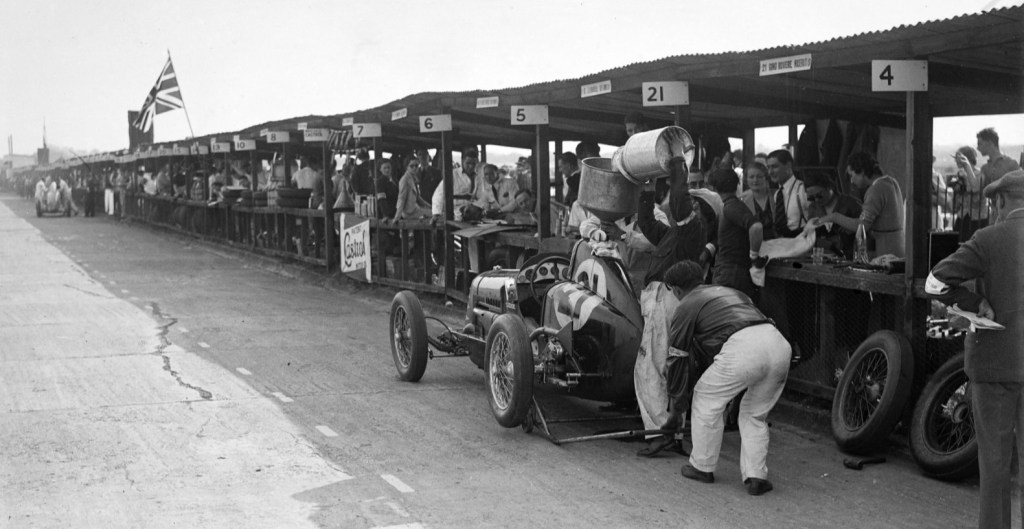
Two more shots of Rovere in the Brooklands 1935 paddock, #1120 in profile and three-quarter rear for a pitstop.
(MotorSport)(coachbuild.com)
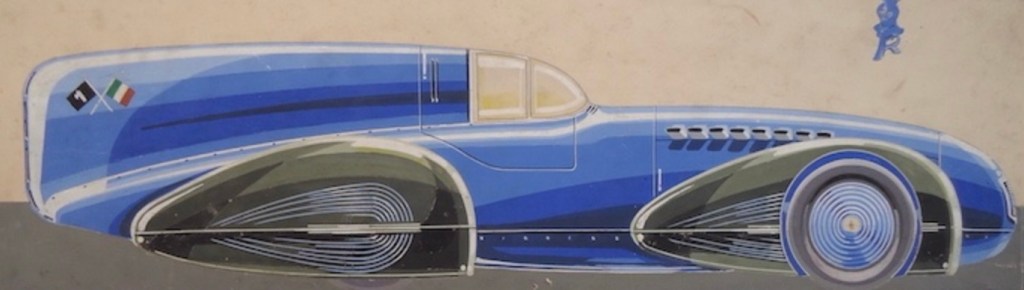
A rendering of the Centro Sperimentale Aeronautico di Giudonia design, and below #1536 in one specification in which the car ran. Compare and contrast with the first three photographs in this piece.
(unattributed)Ad for AGIP’s Robur fuel 1936, Furmanik aboard #1120
Credits…
Anonymous photographer within the Pirelli Archives, MotorSport Images, Leif Snellman’s superb The Golden Era of Grand Prix Racing – goldenera.fi, The Nostalgia Forum, thanks to Maserati historian Kevin Tjeerdsma for advice on correction of facts and chassis numbers
John Surtees is chasing Jack Brabham hard in the latter stages of the 1963 Australian Grand Prix at Warwick Farm on February 10, 1963. He is racing a Lola Mk4A Climax 2.7 FPF chassis #BRGP44.
Jack’s Brabham, Brabham BT4 Climax passed him late in the race, John fell short by 12 seconds in a race run in intensive heat, but he had a good southern summer, winning two of the eight Australasian internationals, the NZ GP at Pukekohe and the Lakeside International.
Dick Ellis cutaway of an F1 Lola Mk4 Coventry Climax FWMV 1.5 V8Surtees, Team Lotus Lotus 18 Climax at Ardmore during the 1961 NZ GP, DNF (M Fistonic)
1963 wasn’t his first trip Down Under. Il Grande John did the Kiwi Internationals with Team Lotus in 1961 when Innes Ireland, Jim Clark and Surtees raced Lotus 18 2.5 FPFs fitted with the dreaded Queerbox. In a grim tour for the team, Surtees didn’t finish any of his three races at Ardmore, Levin or Wigram.
He was back again in 1962, running a Reg Parnell Cooper T53 2.7 in Australia, finishing second at Sandown and winning from Jack Brabham’s Cooper T55 2.7 on Longford’s daunting mix of roads, undulations, railway viaduct and barbed wire.
Parnell ran a pair of Lola T4 Climaxes, 1.5 FPF powered early on, then 1.5 FWMV V8 engined when the engine became available in Grand Prix racing that year. Surtees finished a great fourth in the World Drivers Championship during the season in which the monocoque Lotus 25 Climax rewrote the chassis design rulebook.
Surtees winning Lola Mk4A and Bruce McLaren, Cooper T62 on the front row at Pukekohe, NZ GP 1963. That’s Brabham’s #4 BT4, and Tony Maggs in the other Parnell Lola Mk4 at far left (D Oxton)Later Kiwi Ace, David Oxton attends to a Colotti ratio change on Surtees’ car, Pukekohe (D Oxton)
Reg (Bowmaker-Yeoman Racing Team) fitted 2.7FPFs to two of his T4s in place of the smaller F1 V8 for the 1963 Formula Libre Australasian Internationals for Surtees and South African driver, Tony Maggs use. Parnell knew the local-ropes, having raced a Ferrari Super Squalo 3.4 as part of a two car team together with Peter Whitehead in the 1957 New Zealand Internationals. He did well too, winning the NZ GP and the Dunedin Road Race in what was his last hurrah as a driver before taking on Aston Martin team management duties.
Other hot-shots that summer included Jack Brabham in his new F1 BT3 derived BT4 2.7 FPF, while Bruce McLaren raced the similarly powered Cooper T62 with which he won the 1962 Australian Grand Prix at Caversham, near Perth that November. Graham Hill (and Innes Ireland in some NZ races) raced the radical, fast Ferguson P99 albeit he lacked the mumbo of his completion, running 2.5 FPF’s rather than the more fancied 2.7 ‘Indy’ variant.
Young Cooper T53 mounted thrusters included Chris Amon, Jim Palmer and Angus Hyslop. In Australia the local quicks included David McKay and Bib Stillwell in new BT4s, while Lex Davison and young grazier John Youl raced Coopers T53 and T55 respectively.
Surtees’s Lola Mk4A #BRGP44 was quick everywhere, starting the tour with a bang by winning the NZ GP at the new Pukekohe circuit near Auckland, then gearbox problems caused DNFs at Levinand Wigram. He failed to finish at Teretonga as well, albeit Maggs placed second behind McLaren at the track near Invercargill at the very south of the South Island.
Surtees in the Wigram – RNZAF airfield – paddock. That Ferrari 250 SWB belonged to ‘Richardson’ for those wanting to do further research (W Collins)Surtees and handsome Mk4A at Teretonga, ninth after undisclosed problems (G Woods)
There was then a fortnight to ship the cars across the Tasman Sea to Sydney Harbour for the AGP to be held on the challenging, technical Warwick Farm on February 10.
Surtees put down a marker, popping his Lola on pole in Jack’s backyard. He then led the race until Brabham – who started well back on the grid having sorted a new BT4 chassis during practice – passed him with 14 laps to run, the Brit suffering along with many others in the intense heat. John had the consolation of meeting fastest lap.
Then it was off to Lakeside, north of Brisbane. There Surtees started from Q3 and won from Hill, bagging the P99’s best result for the tour, with Stillwell third in his new Brabham BT4. Chris Amon was fourth and impressing pit-pundits with every drive. At the end of the summer Reg Parnell took the 19 year old off to Europe where he did rather well…initially racing #BRGP44 FWMV powered throughout 1963.
Shell drivers at Warwick Farm: David McKay, Tony Maggs, Graham Hill, John Surtees, Jim Palmer and Chris Amon (C Galloway)Surtees hooks into the right-hander at the end of Pit Straight, Paddock, at Warwick Farm 1963 (B Donaldson)
Surtees returned to Europe to meet his new Ferrari team commitments, missing the final two races at Longford and Sandown, with Tony Maggs, sixth and second in the Parnell Lolas respectively.
Had there been a Tasman Cup that summer – the first was contested and won by Bruce McLaren in 1964 – Bruce would have won it. Brabham won at Levin and Warwick Farm, Surtees at Pukekohe and Lakeside, while McLaren was victorious at Wigram, Teretonga, Longford and Sandown.
The Lolas had proved very competitive Formula Libre machines but were thoroughly outclassed in ’63 GP racing: Amon, Maurice Trintignant, Lucien Bianchi, Mike Hailwood and Masten Gregory all failed to bag a point for Reg Parnell Racing.
Surtees Mk4 during 1962. The idea of that yellow enamelled spaceframe chassis was to make it easy to see any cracks that arose (unattributed)
Etcetera…
(MotorSport)
Pretty car. Surtees during the soggy German Grand Prix was second behind Graham Hill’s BRM. He first raced the chassis he used throughout his 1963 Australiasion Tour, T4A #BRGP44, at Karlskoga in August, there he led until a valve spring broke.
(MotorSport)
Main Men. Reg Parnell, Surtees and who? during the May 1962 Dutch Grand Prix weekend at Zandvoort. John popped his car on pole but crashed in the early laps after a wishbone failure.
(MotorSport)
More Main Men. Surtees and Lola’s Eric Broadley at Aintree during the British GP meeting in July. And below, John with the car in the paddock. FWMV is on Webers, a bit cheaper, but less powerful than the Lucas injected alternative.
Lola had a fantastic weekend with Surtees qualifying and finishing second in the race. The cars gained pace after the cockpit area was found to be flexing by Surtees in the lead up to the Belgian Grand Prix, when additional tubes were added to the suspect area.
(MotorSport)(N Beresford Collection)
Don Beresford – father of engineer Nigel Beresford of Ralt, Tyrrell, Penske Cars et al fame – working on a T4 at Bromley during 1962. It’s after the chassis cockpit section was strengthened, note the additional tubular section which has been added, so it’s probably the chassis Surtees raced carrying #6 in the December 29, 1962 South African Grand Prix at East London, DNF.
The ’63 New Zealand GP was a week later on January 5, no rest for the wicked!
Credits…
Bob Donaldson-State Library of New South Wales, Dick Ellis, Colin Galloway, Milan Fistonic, David Oxton Collection, Graham Woods Collection, Warner Collins, Lynton Hemer, Dick Simpson-oldracephotos.com, Michelle Glenn, Nigel Beresford Collection
Tailpieces…
Surtees, Surtees TS8/9 Chev, Alan Hamilton, McLaren M10B Chev, Colin Bond, McLaren M10C Repco-Holden and Graeme Lawrence, Brabham BT29 Ford FVC (L Hemer)
John Surtees was a busy lad throughout the 1960s with Grand Prix, World Endurance Championship and Can-Am programmes in most seasons, so he never did do a Tasman.
Scuderia Ferrari had plans afoot for Surtees to race a Ferrari Dino V6 – the ‘Surtees Tasman Special’ Ferrari 246 #006 – in 1966 but a late season Can-Am accident at Mosport in a Lola T70 Chev hospitalised him that winter so that didn’t happen. Chris Amon subsequently went rather well with updated 246 variants in 1968-69.
(M Glenn)
By 1971 Surtees’ commercial imperatives had evolved somewhat. Not only was he contesting Grand Prix racing with a two car team, he was also a constructor of customer racing cars, including Formula 5000 machines, which had been adopted as the Tasman Formula from 1970.
So it made sense for Surtees to contest the November 1971 Australian Grand Prix at Warwick Farm in a Surtees TS8/TS9 Chev, perhaps selling a car or two, then leave the car here for his protege, Mike Hailwood to race in the following 1972 Tasman.
Surtees in front of Max Stewart’s Mildren Waggott TC-4V in the Farm’s Esses (D Simpson-oldracephotos.com)
Surtees qualified ninth after fraught practice sessions sorting handling problems, then had a miserable race without his preferred Firestones, but he still got as high as fourth before pitting for a new left-front tyre, losing three laps in the process, before having another puncture late in the race, finally finishing 14th. “He certainly gave the crowd good value while he was going, “The History of The Australian Grand Prix” recorded.
Frank Matich triumphed that day in his brand new Matich A50 Repco-Holden with Kevin Bartlett and Hamilton second and third in their McLaren M10B Chevs.
Finally, Mike Hailwood did well in the 1972 Tasman Series, he was second to Graham McRae’s Leda GM1 Chev despite not winning round, and was then the best of Team Surtees F1 drivers that season; eighth in the World Championship.
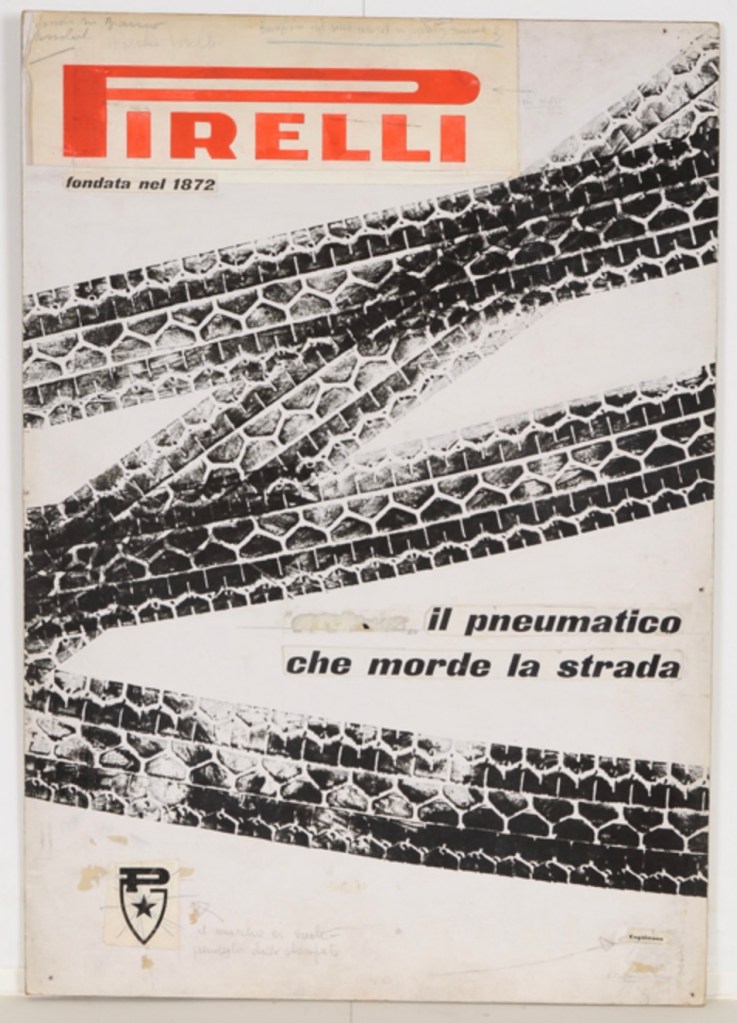
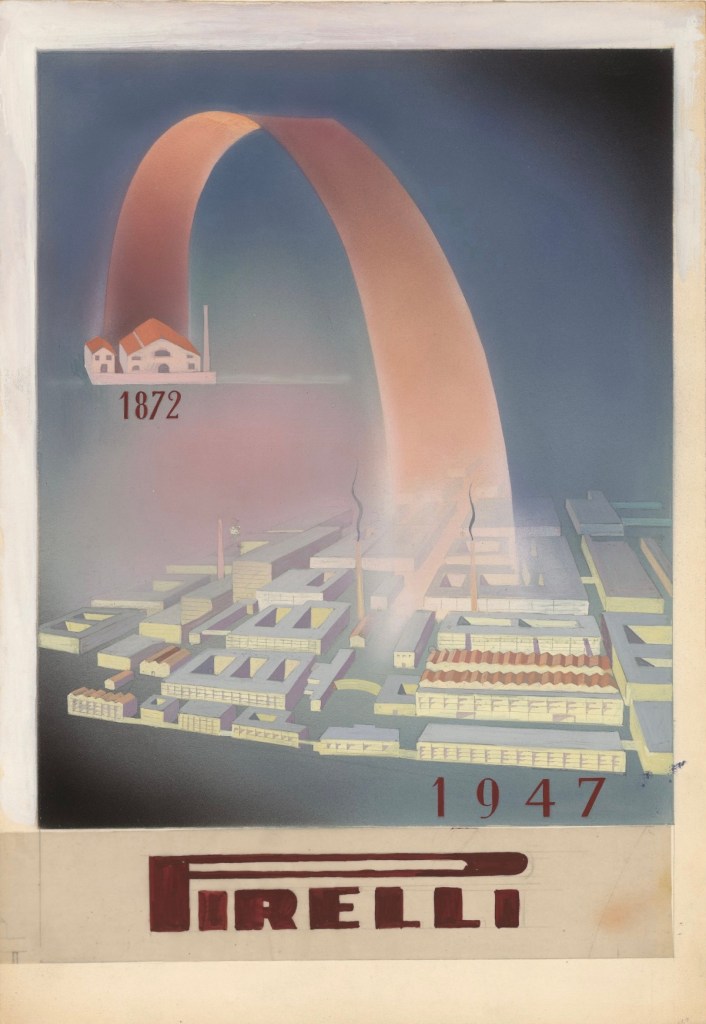
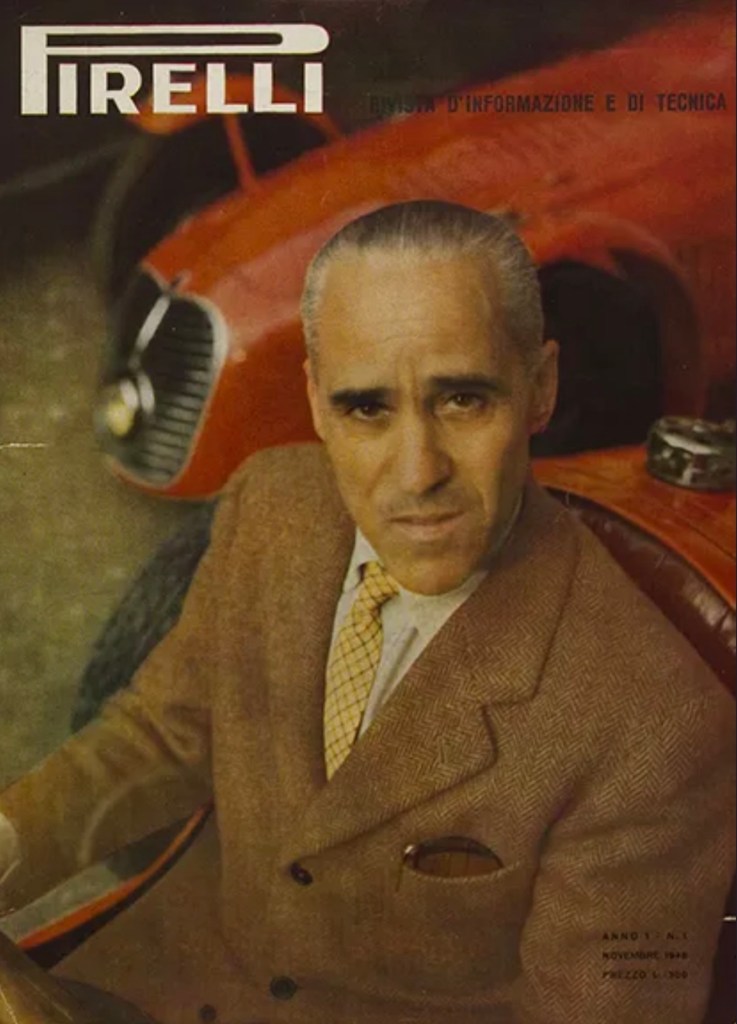
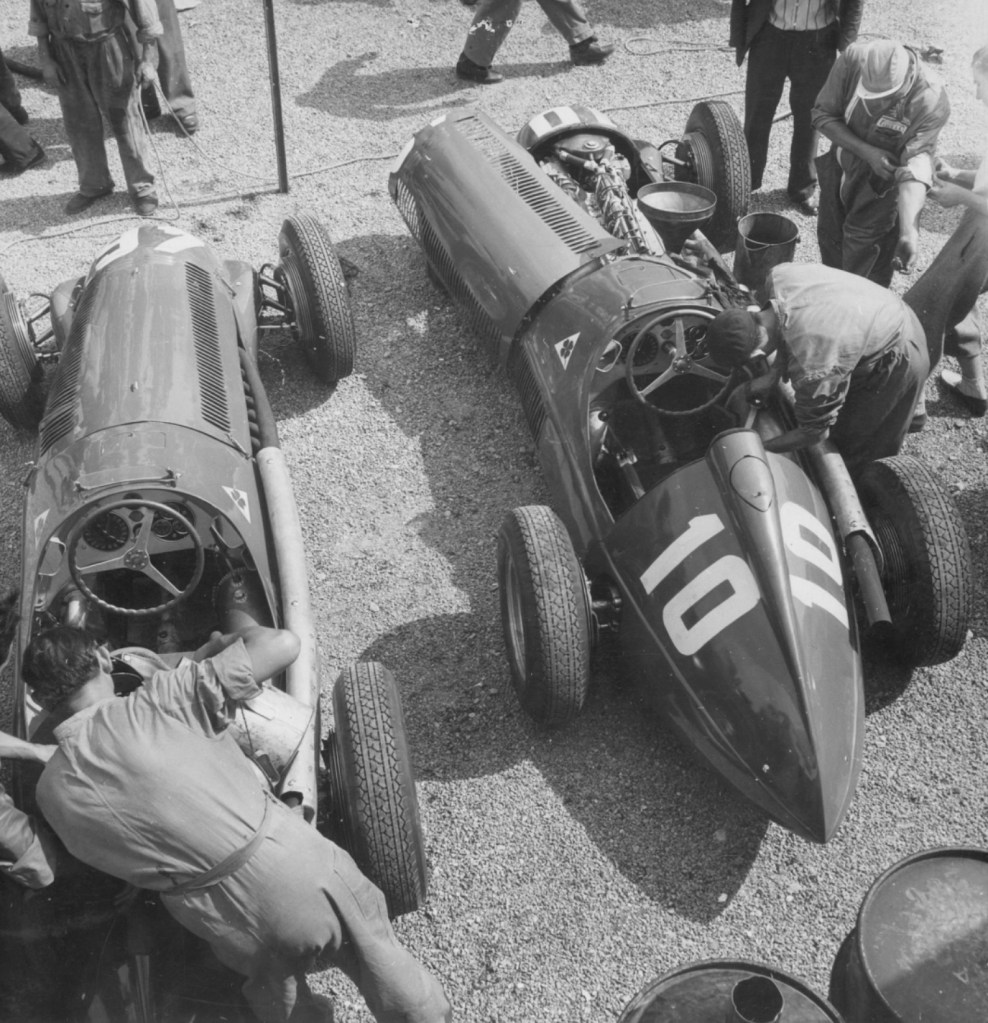
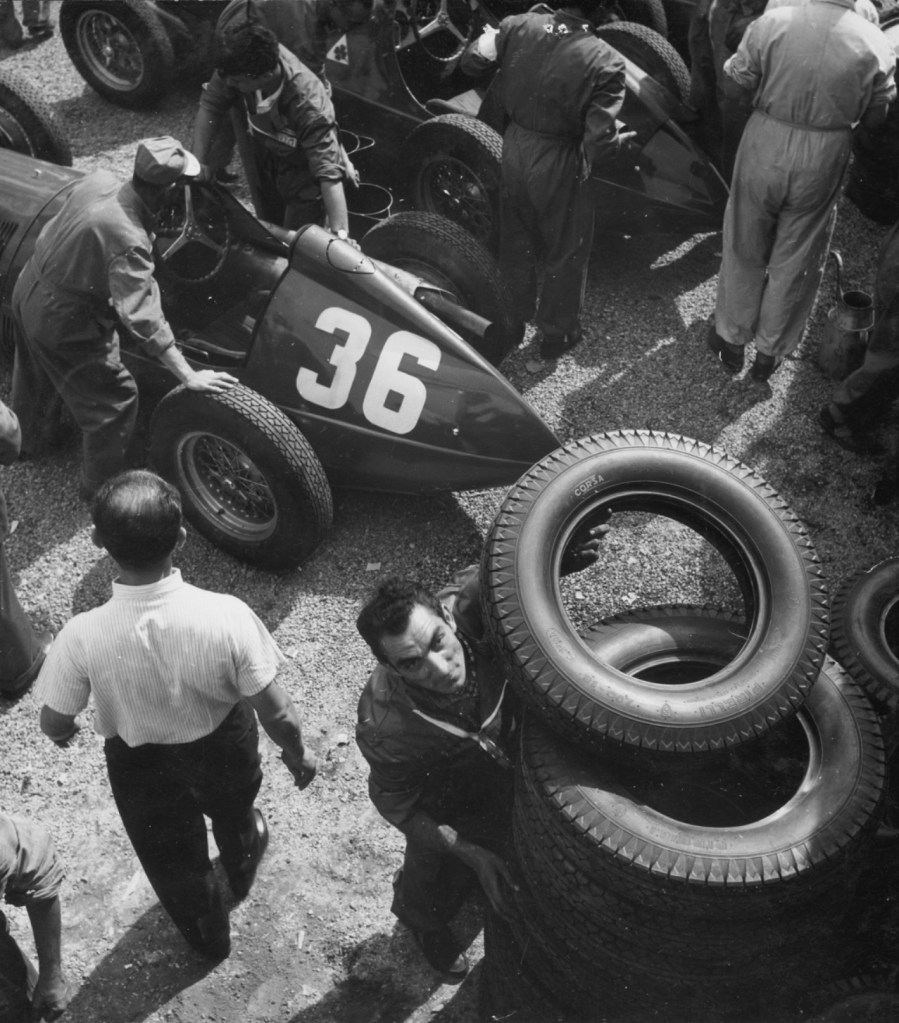
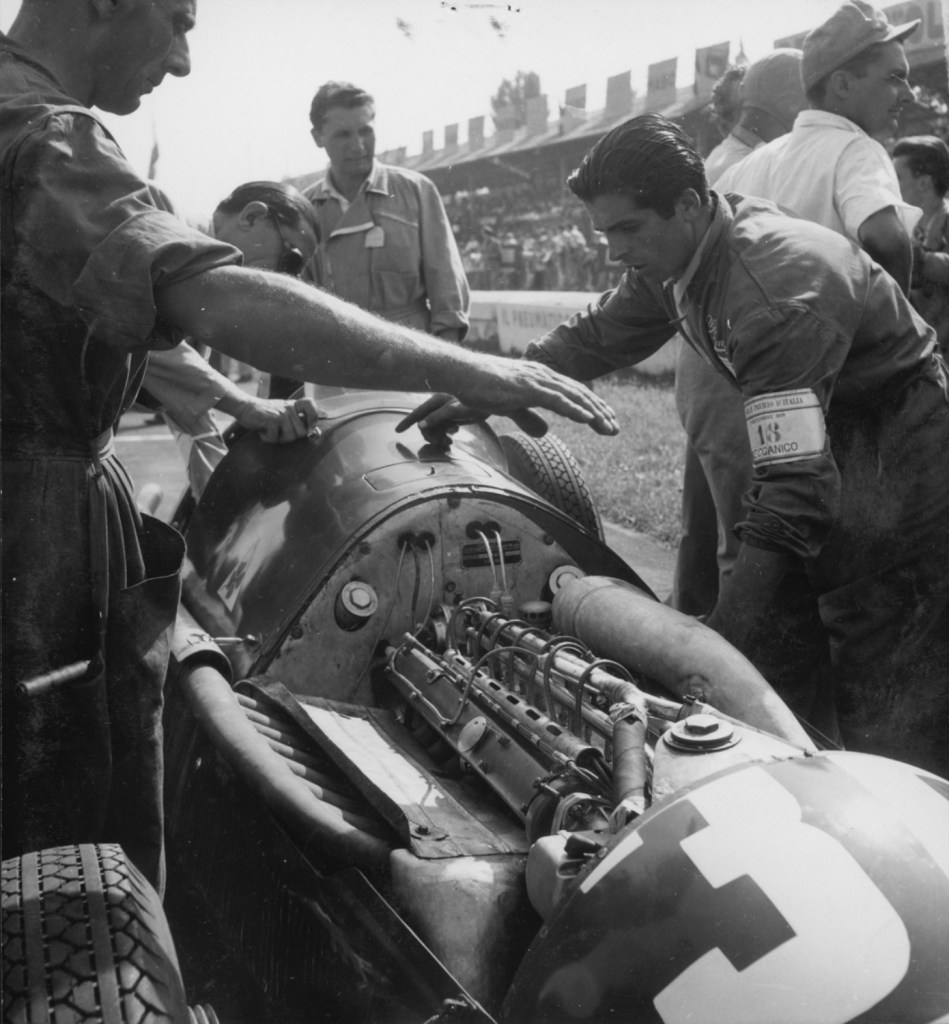
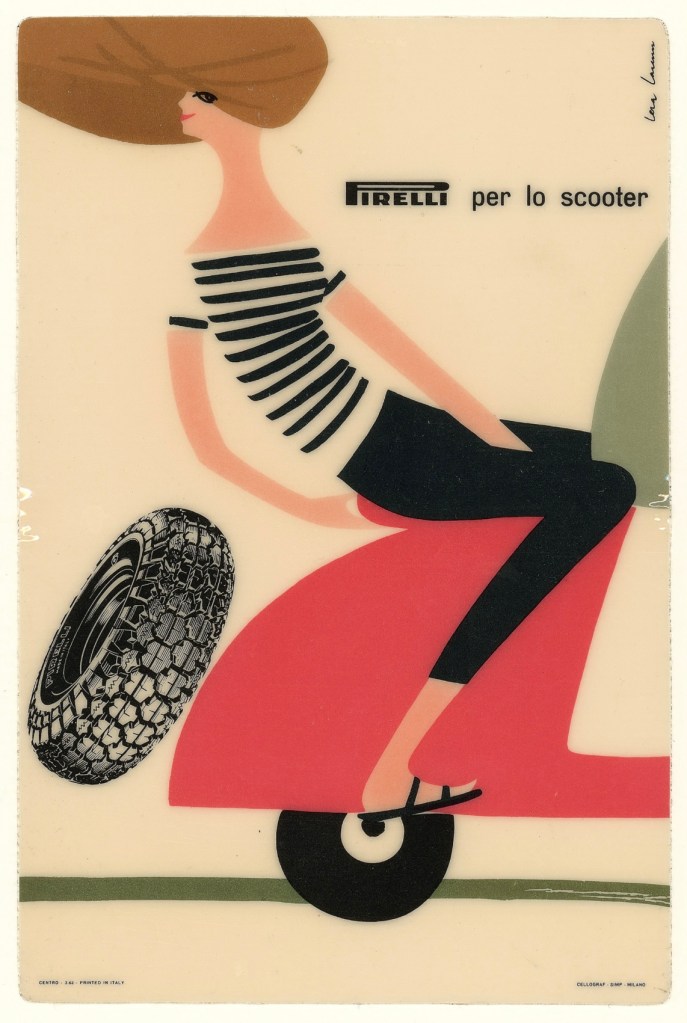
One thing leads to another. I was researching Giuseppe Luraghi, a longtime CEO of Alfa Romeo. Apart from mega talent as a corporate leader he was somewhat of a renaissance man, a gifted writer and poet. He initiated the Pirelli magazine way back in 1948 when he headed up Linoleum, a Pirelli Group subsidiary.
Pirelli, “Addressed it to the general public, it was a way of reaching out to the consumer with much more than a simple advertising message. Above all it was a way of conveying business culture.”
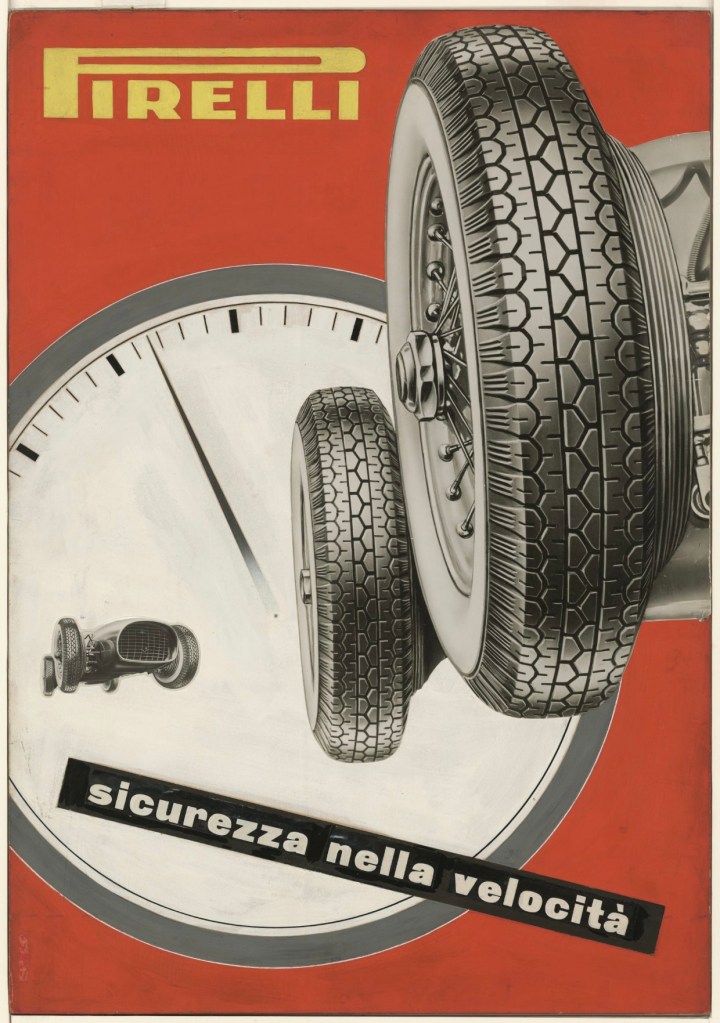
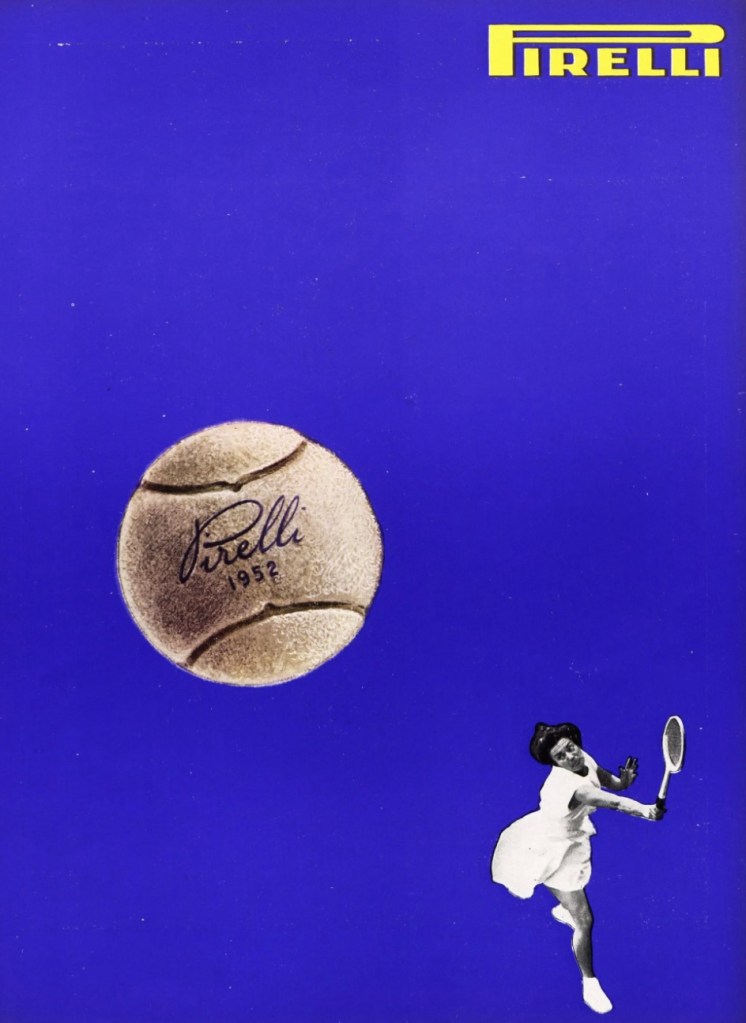
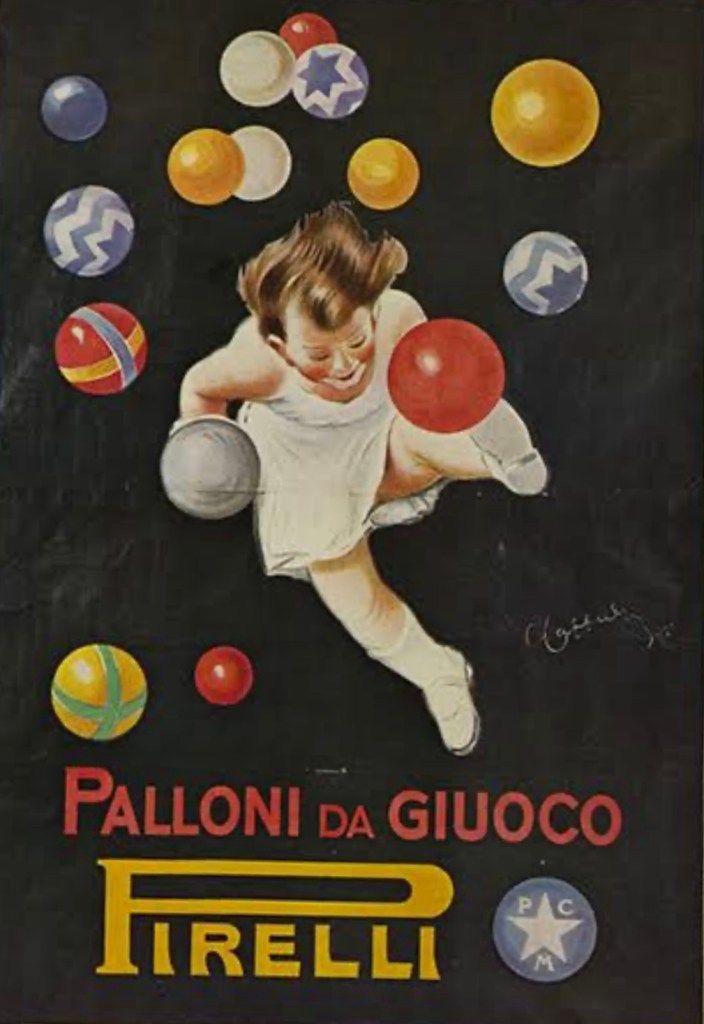
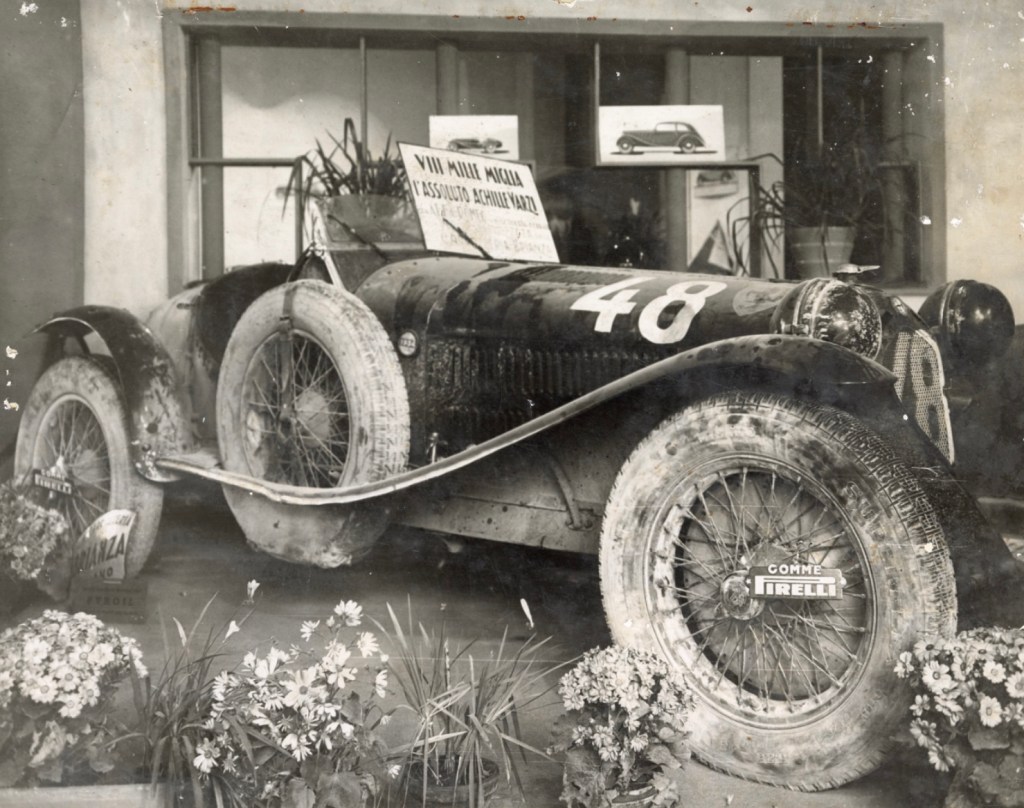
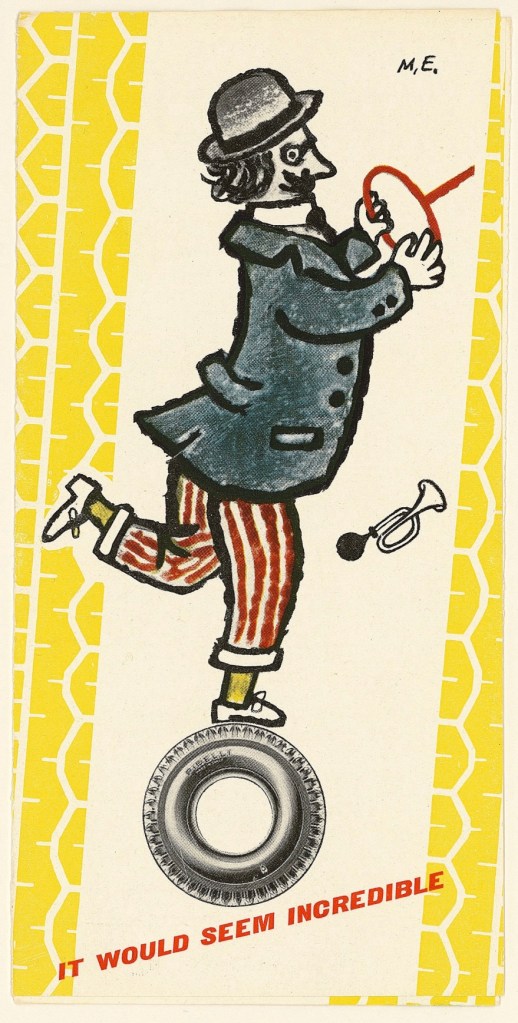
So, then yer go digging on that internet thingy and find Pirelli’s archives, these shots are the amazing result. I’ve mixed them up, they aren’t placed in chronological order so I’ve visually separated them by choosing Pirelli magazine covers or impactful or clever advertisements so you know when we are onto another subject. I’ve kept the words to a minimum, let the pics do the talkin’…
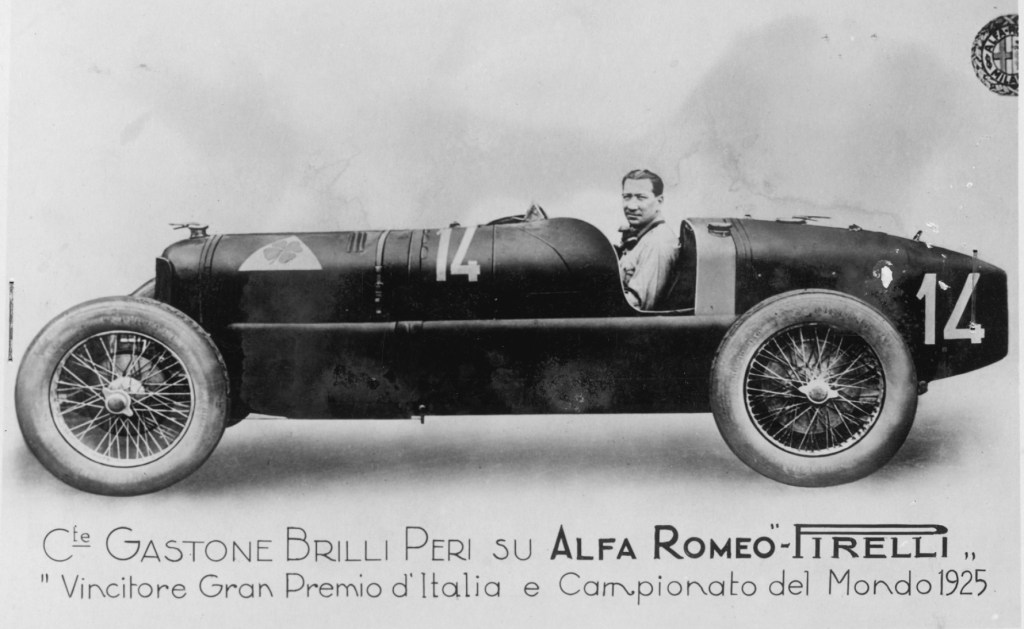
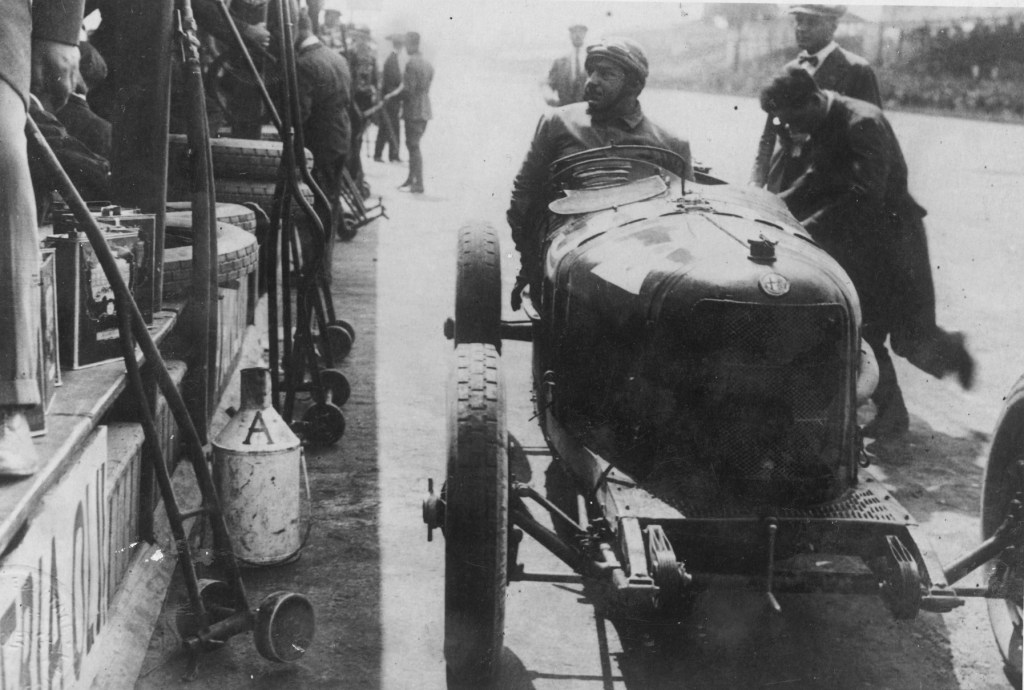
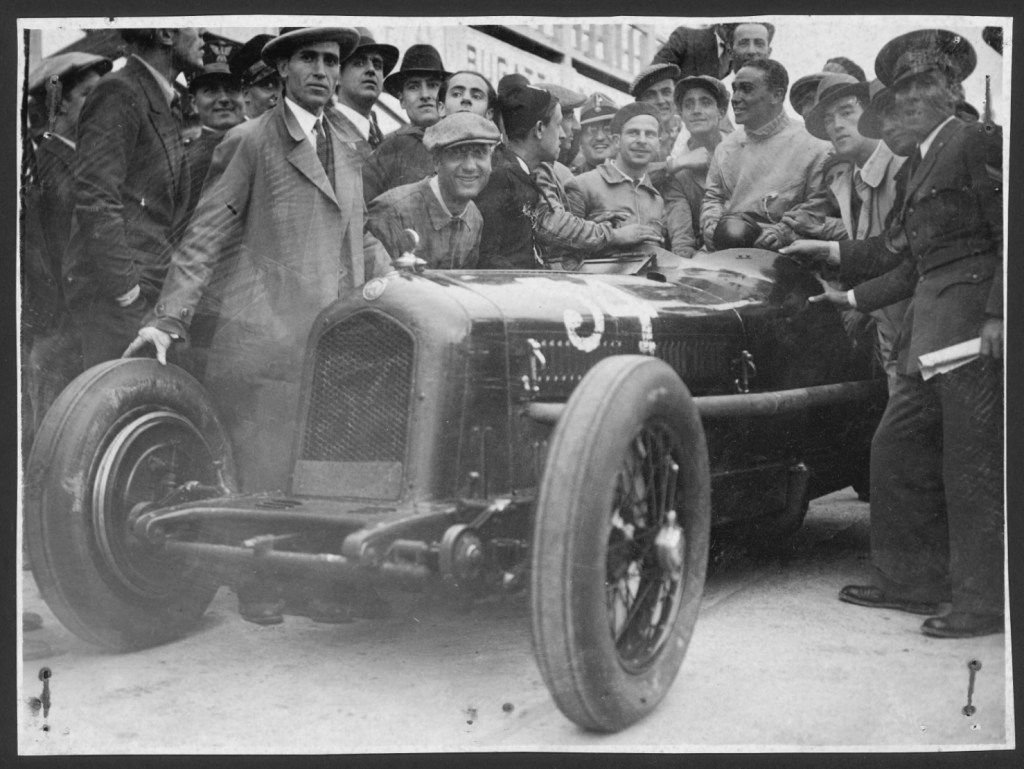
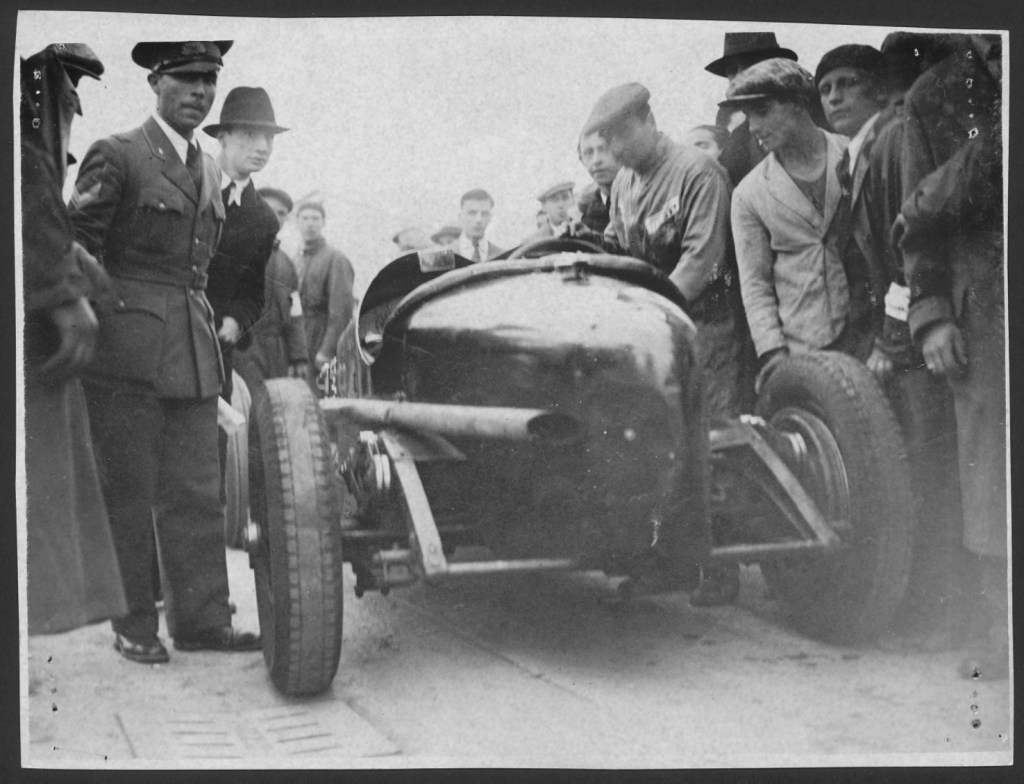
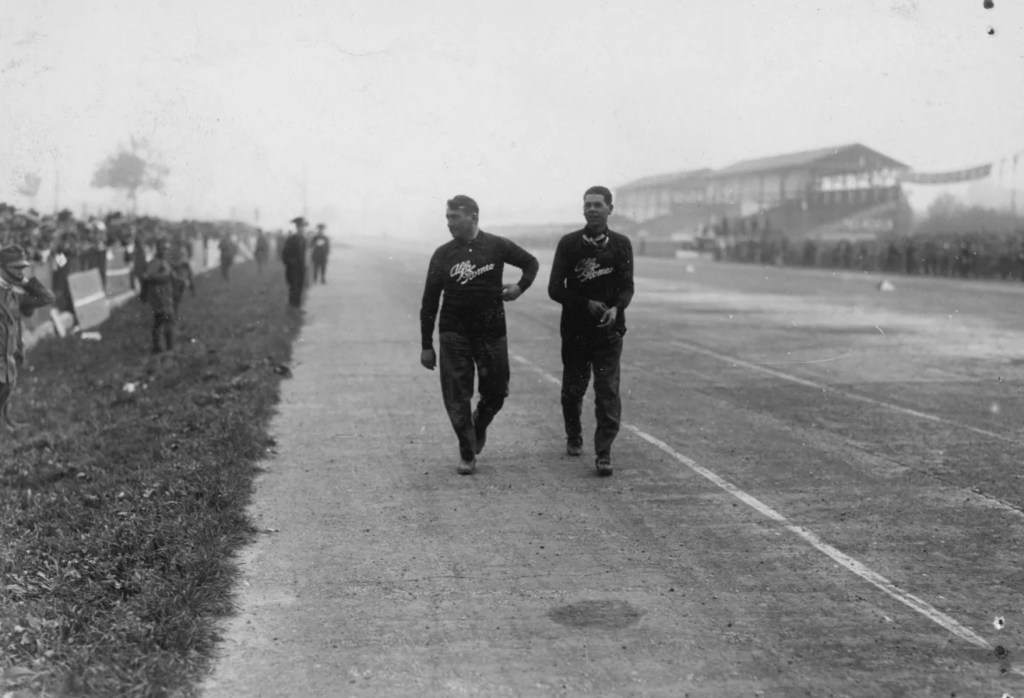
Gastone Brilli-Peri, by winning the Italian Grand Prix, gave Alfa Romeo the four-round 1925 Manufacturers World Championship in an Alfa Romeo P2.
Pete DePaolo won the Indy 500 in a Duesenberg 122, Albert Divo the French Grand Prix in a Delage 2LCV, while Alfa’s P2 won at Monza and at Spa, where Antonio Ascari drove the winning machine in the Belgian Grand Prix.
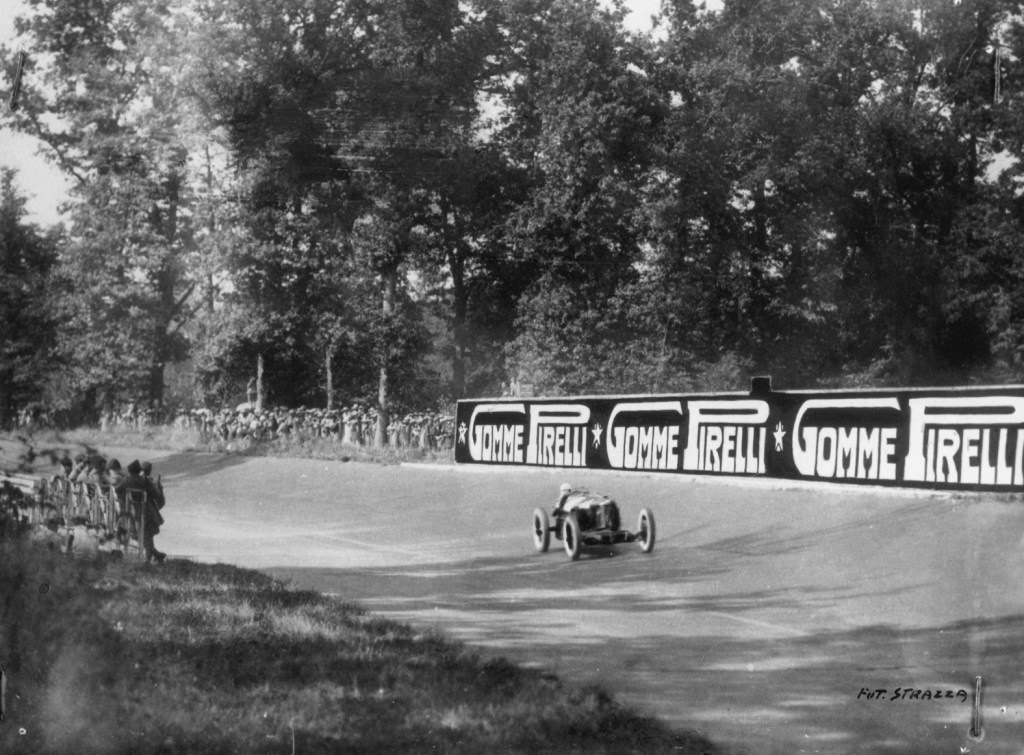
Brilli Peri, enroute to his Italian GP win and Campari below, in another P2 in the pits. Brilli Peri won from Giuseppe Campari/Minozzi/Sozzi with Meo Costantini third in a Bugatti T39.
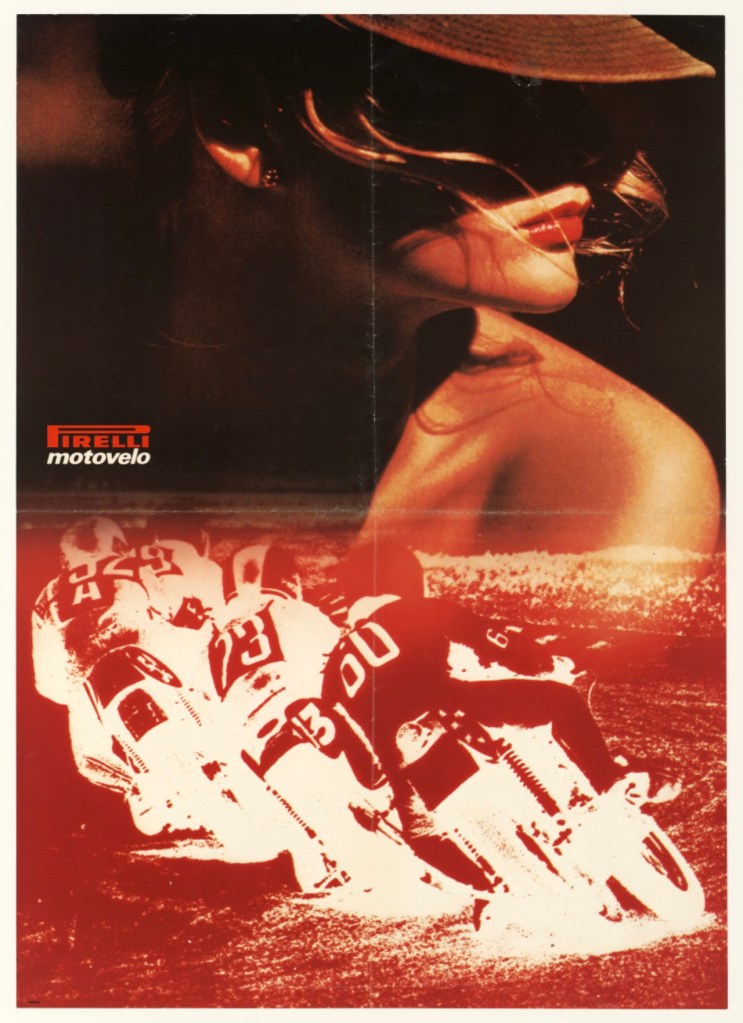
Poster 1977
Antonio Brivio after winning the 1935 Targa Florio in a Scuderia Ferrari Alfa Romeo Tipo B.
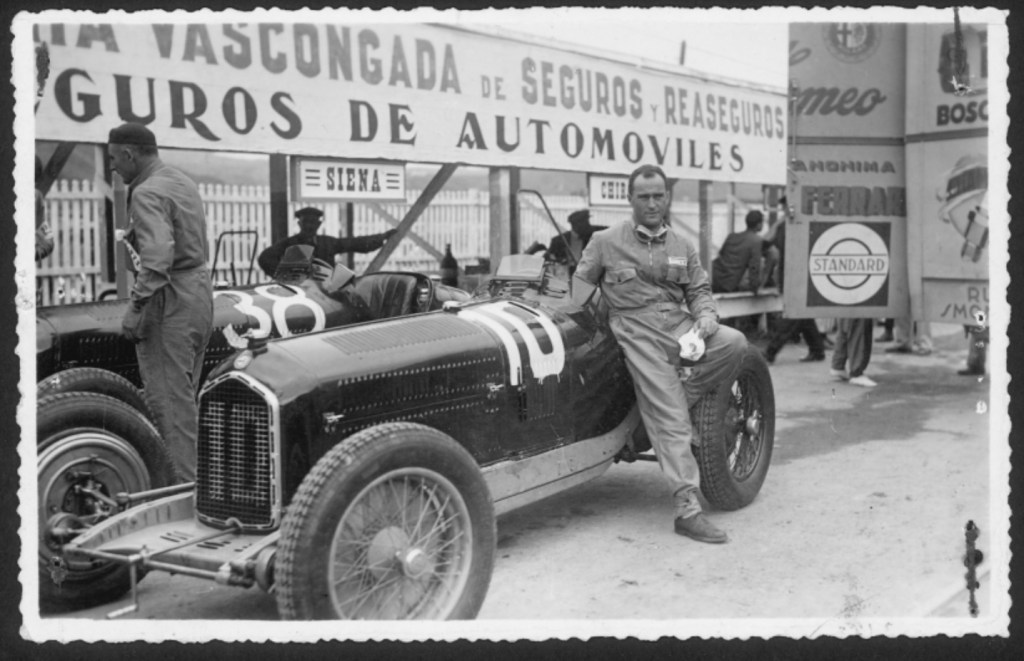
Sticking with the P3 theme, Luigi Fagioli stands beside his car during the September 1933 Spanish Grand Prix weekend. The race was won by Louis Chiron’s Alfa P3 from Fagioli, and held on the Laserte road circuit near San Sebastián.
Mock up for a 1952 ad by Pavel Engelmann
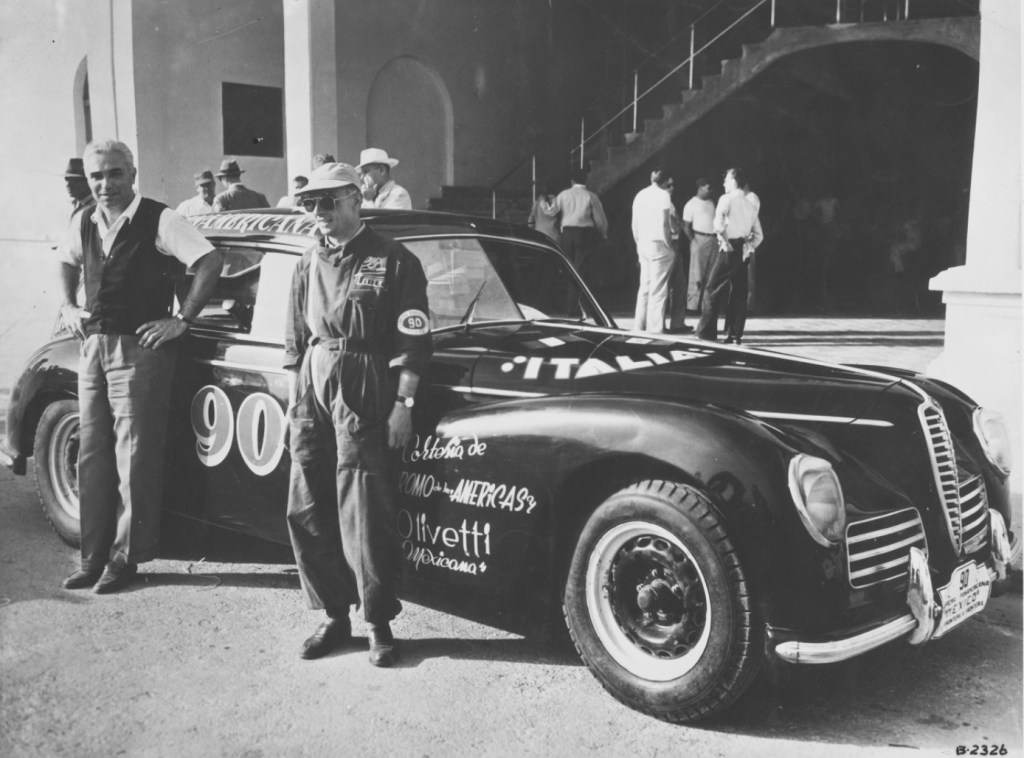
Piero Taruffi and navigator Isidoro Ceroli with Alfa Romeo 6C2500 Sport during the first Carrera Panamericana from May 5-10 1950.
They finished fourth behind three American crews driving an Oldsmobile and two Cadillacs.
Piero Taruffi, again, but a little earlier, here with a shock of dark hair! and his Scuderia Ferrari Alfa Romeo 8C2300 Monza after finishing second in the April 1932 Rome Grand Prix.
The race, held on the 4km Circuito del Littorio, was won by Luigi Fagioli’s works-Maserati V5 5-litre V16.
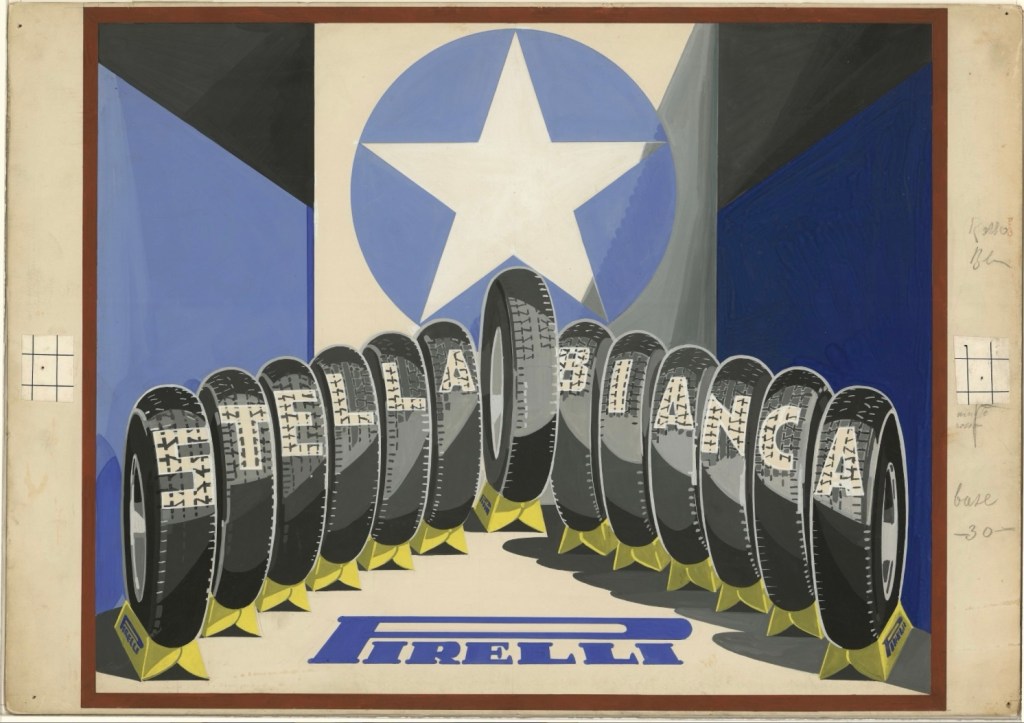
Pirelli White Star, sketch for an exhibition stand in 1931
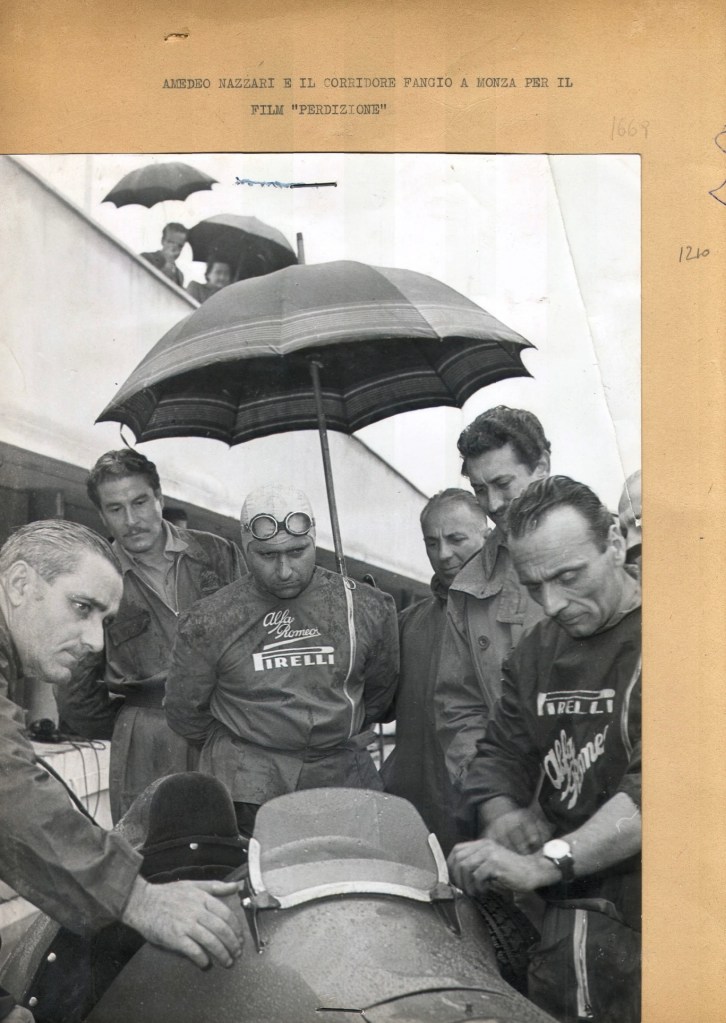
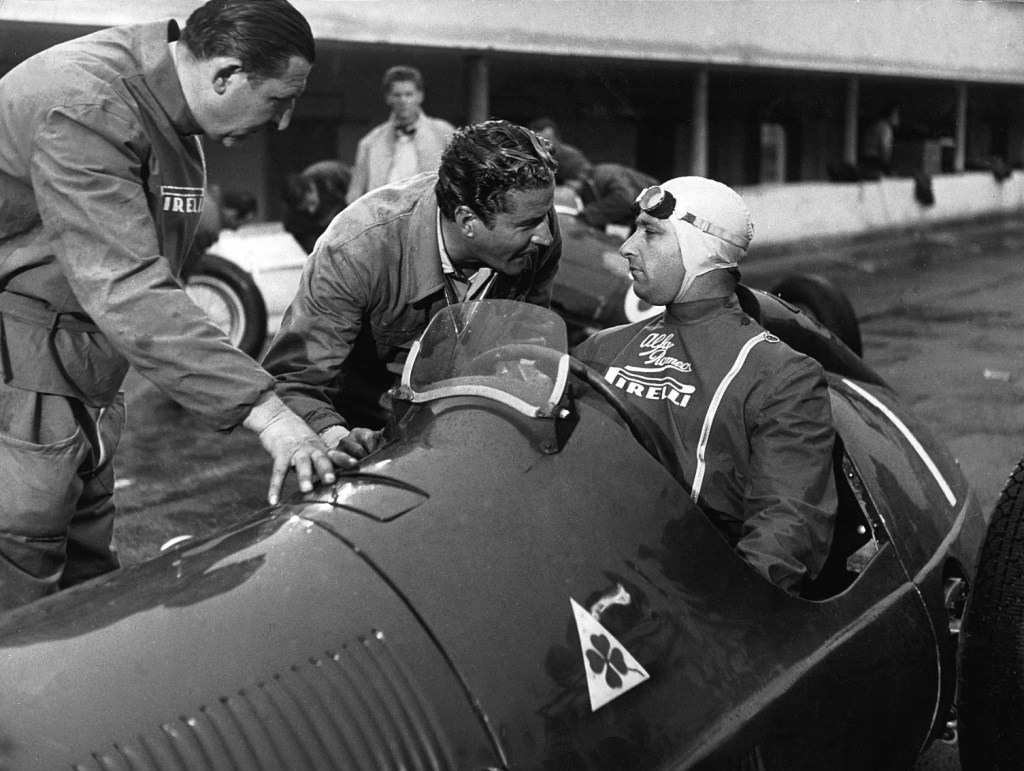
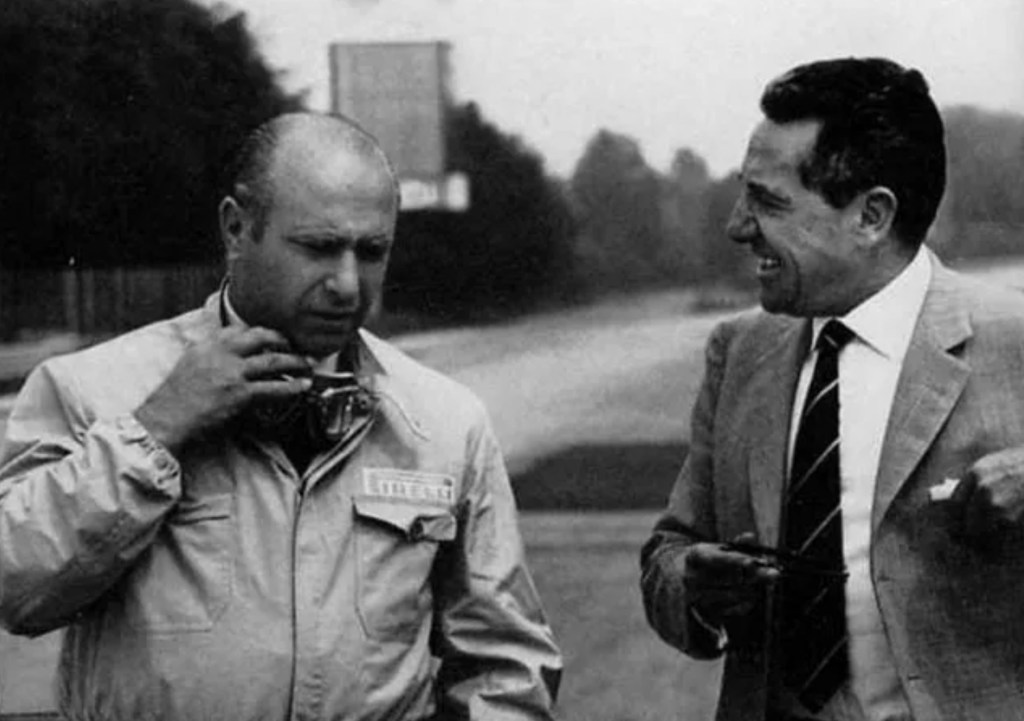
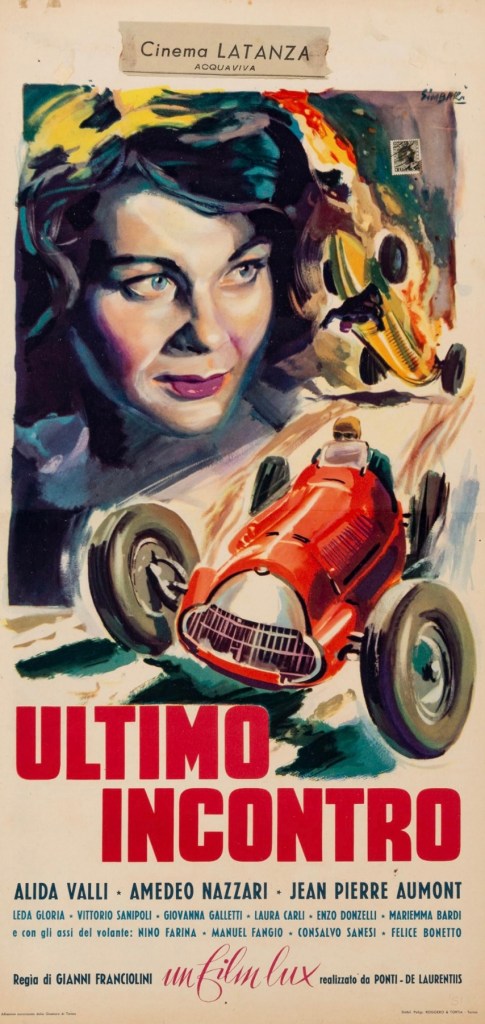
Pirelli wrote that of all the motor racing films, “there was only one racing driver who was called upon time and again to play himself in front of the camera – the Argentine Juan Manuel Fangio.”
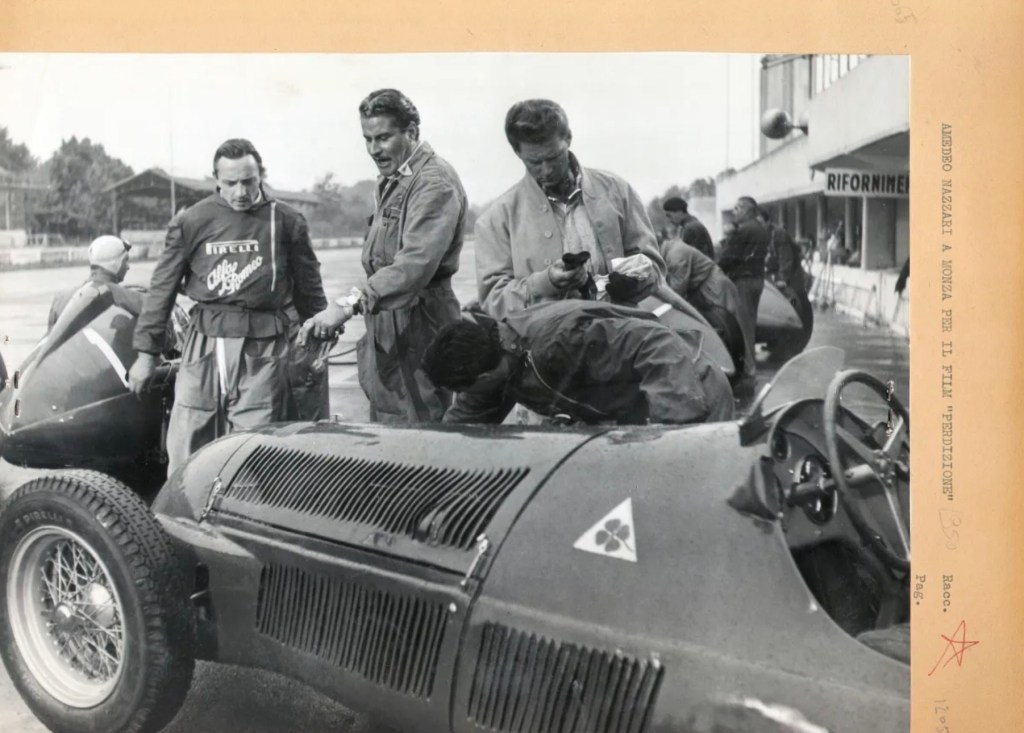
“It was in 1950: in the photos now in the Pirelli Historical Archive, the film is referred to with its provisional title Perdizone. It was actually released the following year as Ultimo incontro (last meeting).”
“We are on the Monza racetrack, with the protagonists Amedeo Nazzari, Alida Valli and Jean-Pierre Aumont. It is a sombre tale of betrayal and blackmail in the world of motor sport, in which the driver Fangio plays…the driver Fangio.”
“That year the Argentine was racing with the mighty Alfa Romeo team along with legends of speed such as Nino Farina, who went on to win the (1950) world title.”
“The long P-logo of Pirelli, which supplied the read Alfa Romeo cars with Stella Bianca tyres, is embroidered on their overalls, underneath the cloverleaf symbol.”
“In Perdizone/Ultimo incontro, Fangio was already on his way to becoming a legend, but his serious, watchful look is that of a true actor. The driver from Balcarce stopped racing in the late 1950s, with five world championships under his belt.”
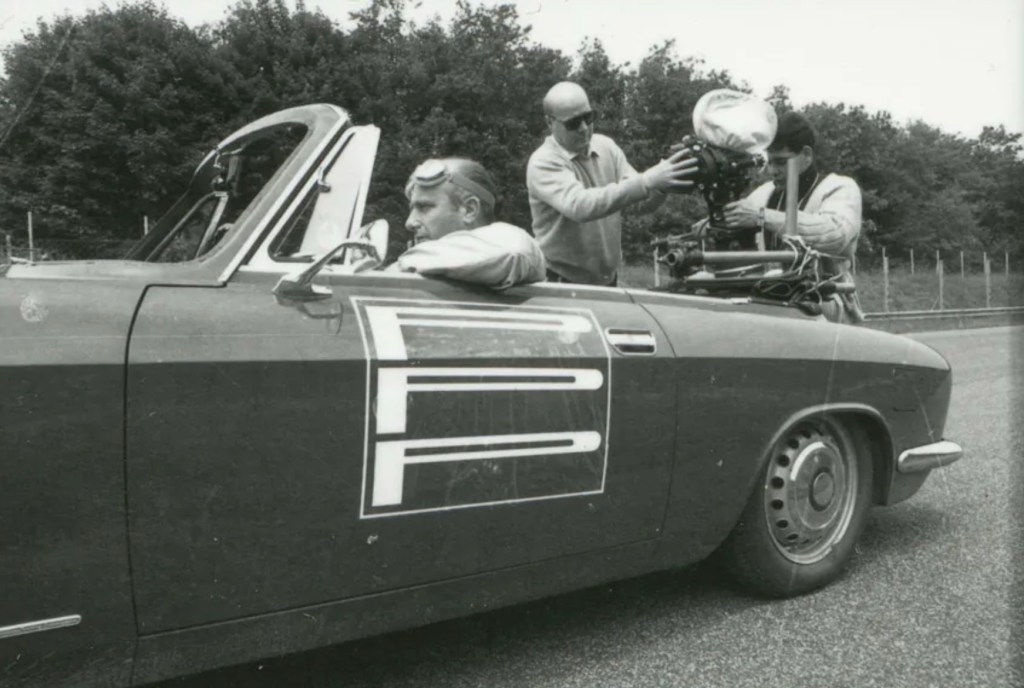
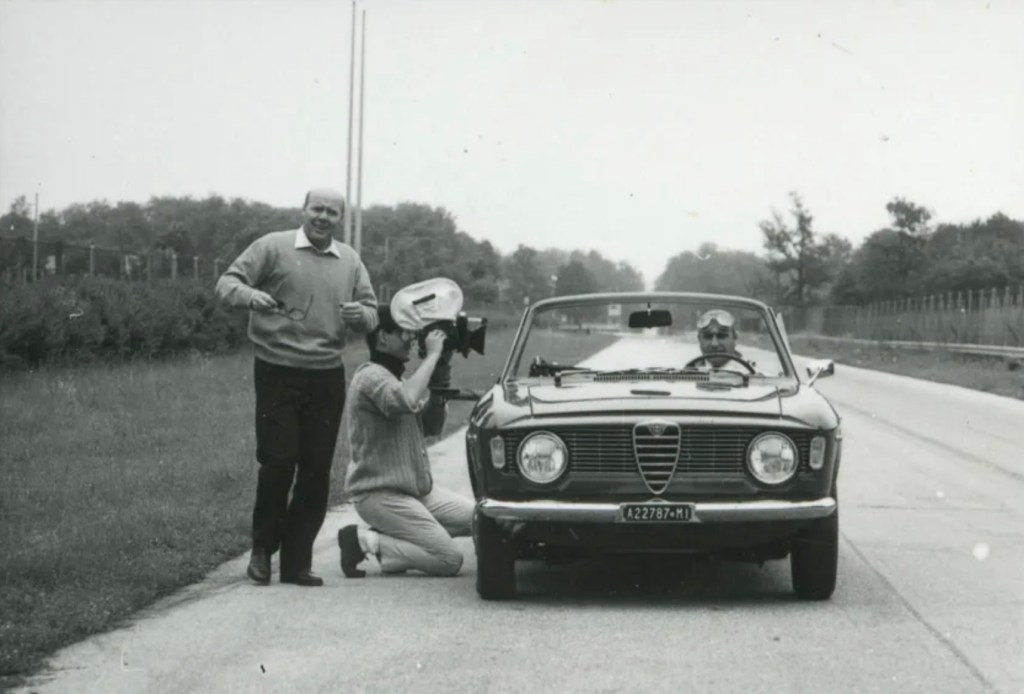
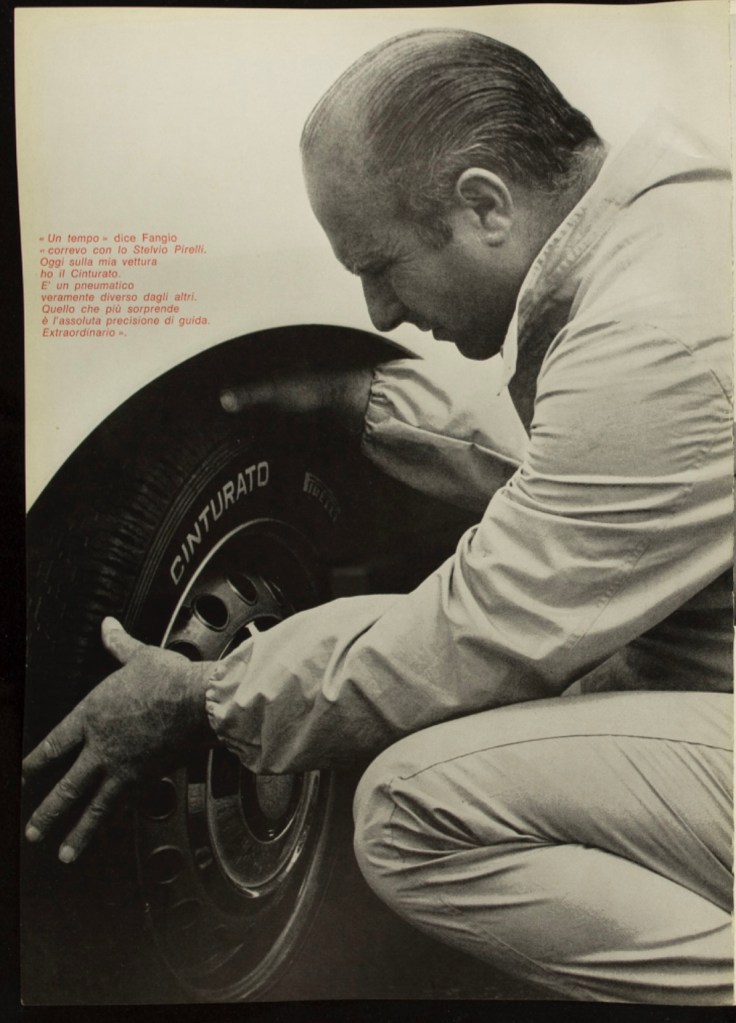
“During his career his name appeared a number of times next to that of Pirelli: it happened again in 1965, and once again there was a camera there to record it. This was a spot produced for Carosello TV commercials with reportage by Ugo Mulas.”
“The driver once again played himself, the legendary Juan Manuel Fangio now clocking up the laps in his Alfa Giulia GTC.”
“When he gets out, he looks into the camera and recalls: ‘I used to race with the Stelvio, but now this Cinturato is really different from the rest. Extraordinario!’ And in his magnificent Italian-Argentine manner, Fangio goes on to tell the audience on the television screen about his endless string of successes.”
75th anniversary poster
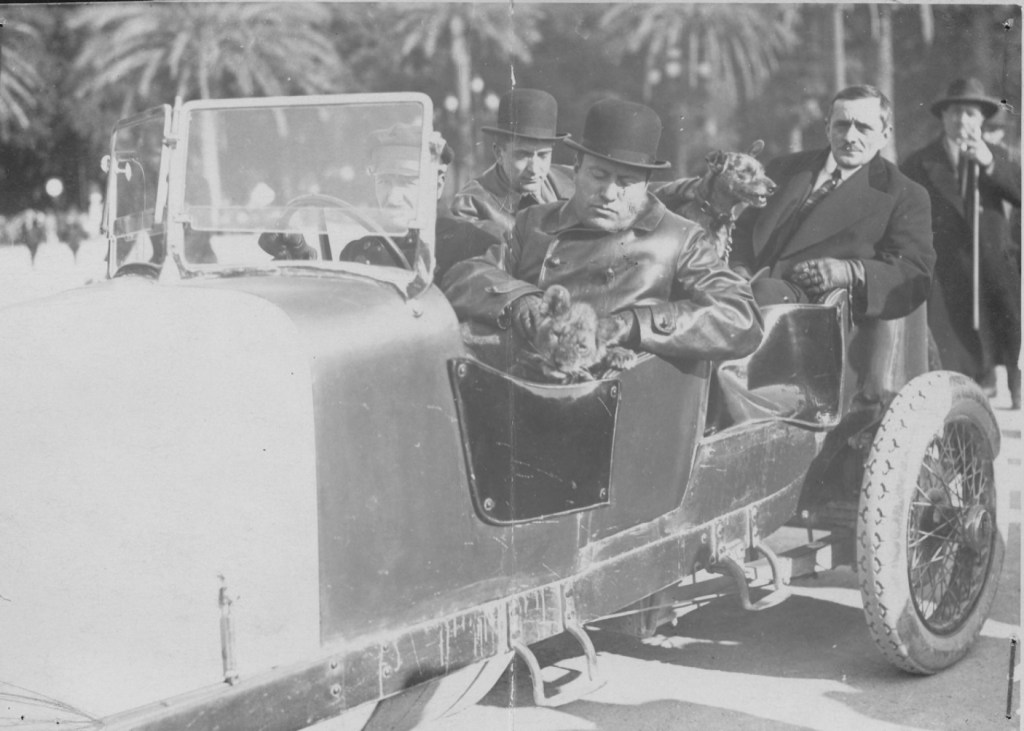
Benito Mussolini and pet pussy aboard an Alfa Romeo in 1923. What model is it I wonder?
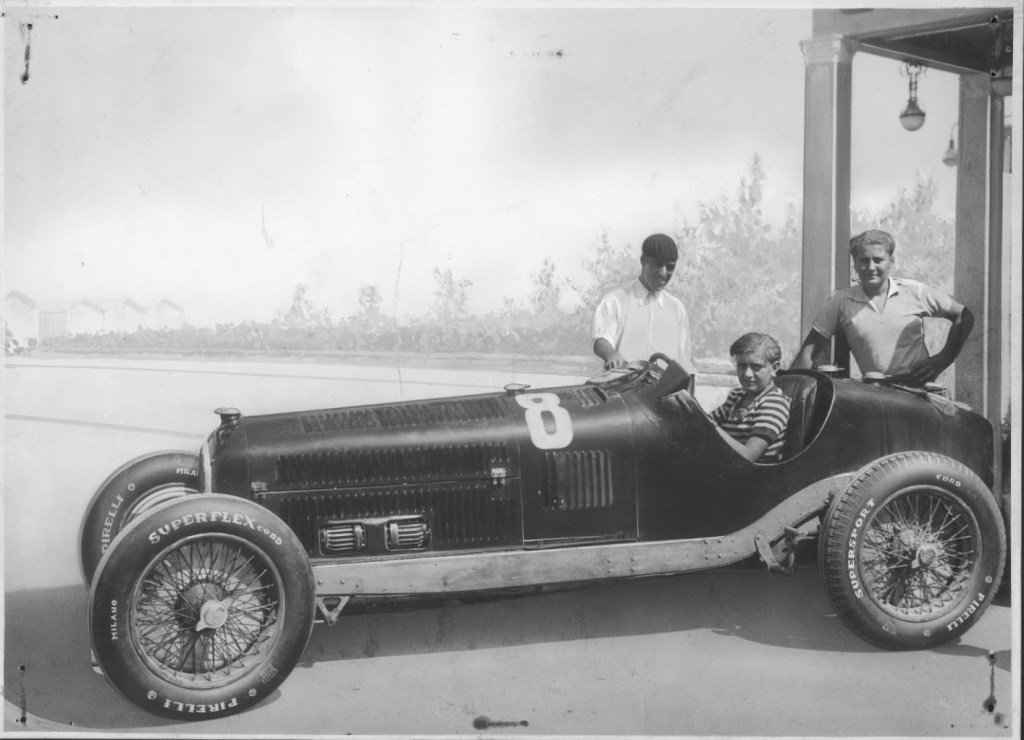
Meanwhile poor old Tazio is tasked with amusing Ill Duce’s sons in his P3, Bruno in the driving seat and Vittorio behind.
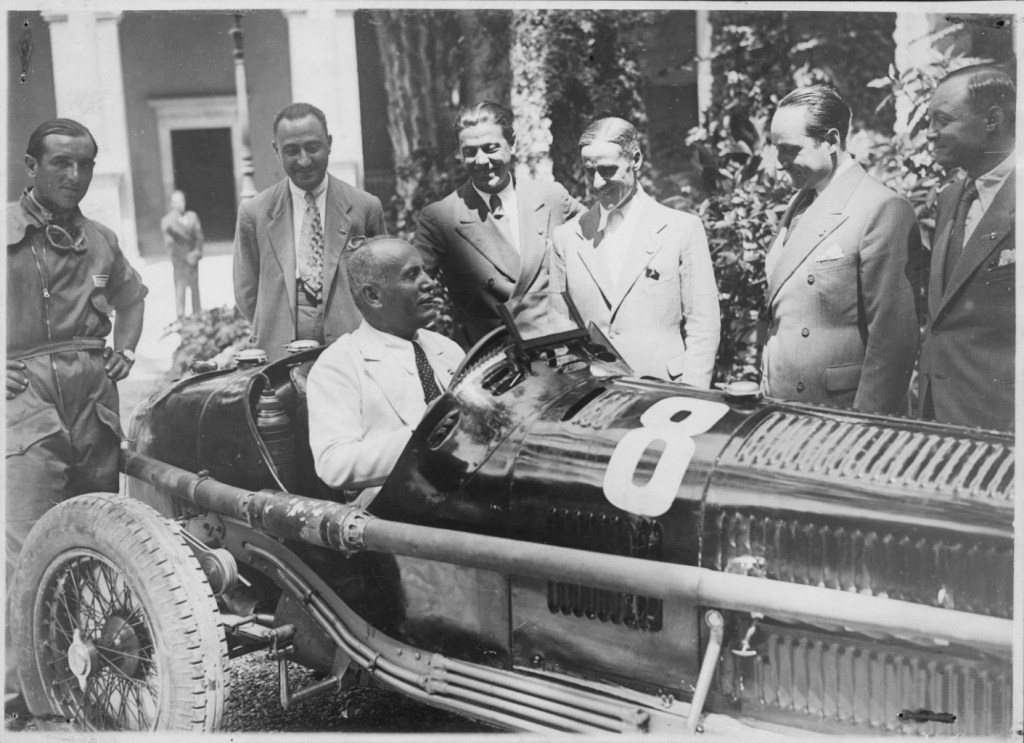
Mussolini with Nuvolari again, and the director-general of Alfa Romeo Prospero Gianferrari (both in the centre). “The P3 is probably the car with which Nuvolari won the August 14, 1932 Coppa Acerbo.”
1971
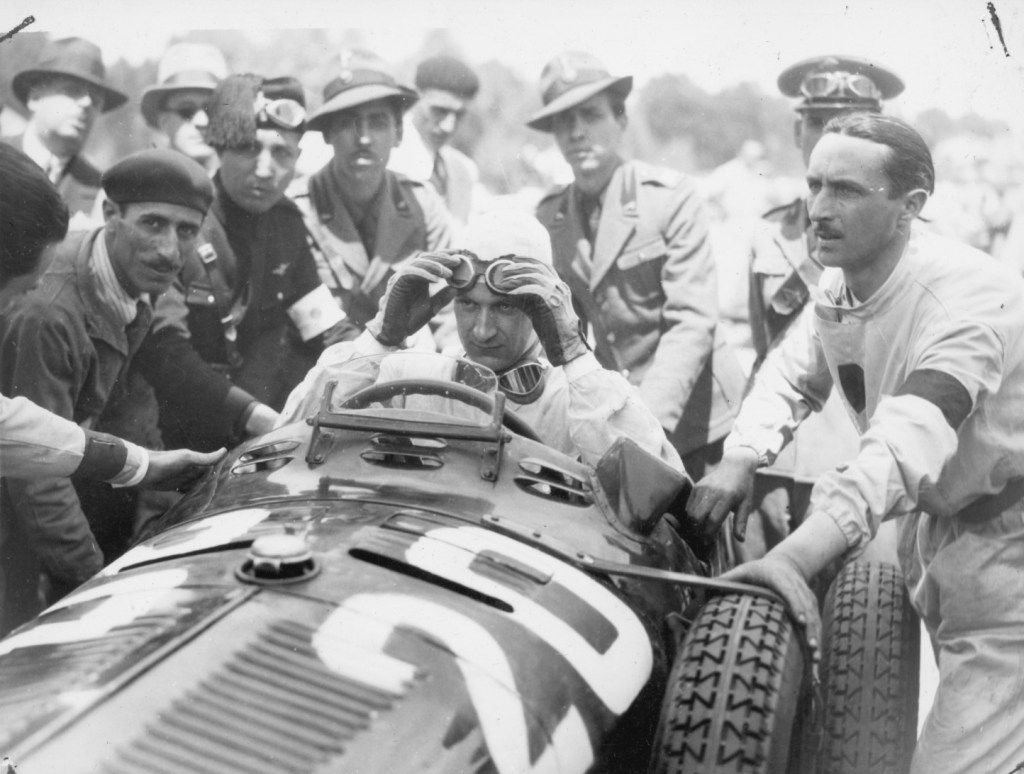
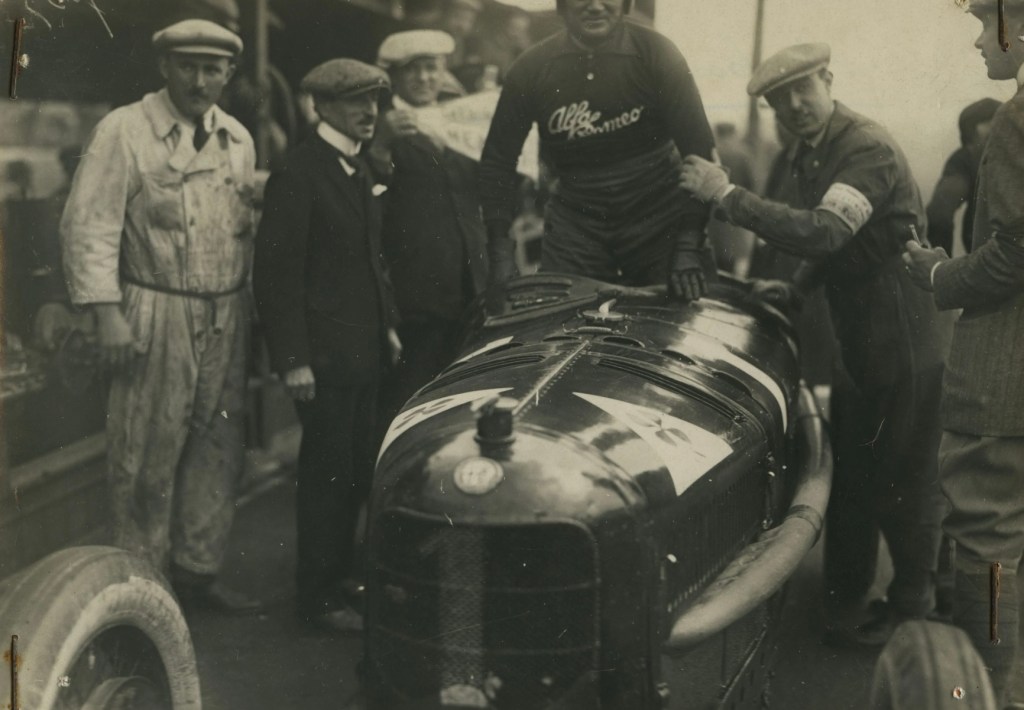
Antonio Ascari in the P2, with designers Luigi Bazzi in the light coloured overalls at left, Vittorio Jano and Giorgio Rimini during the 1924 Italian Grand Prix weekend.
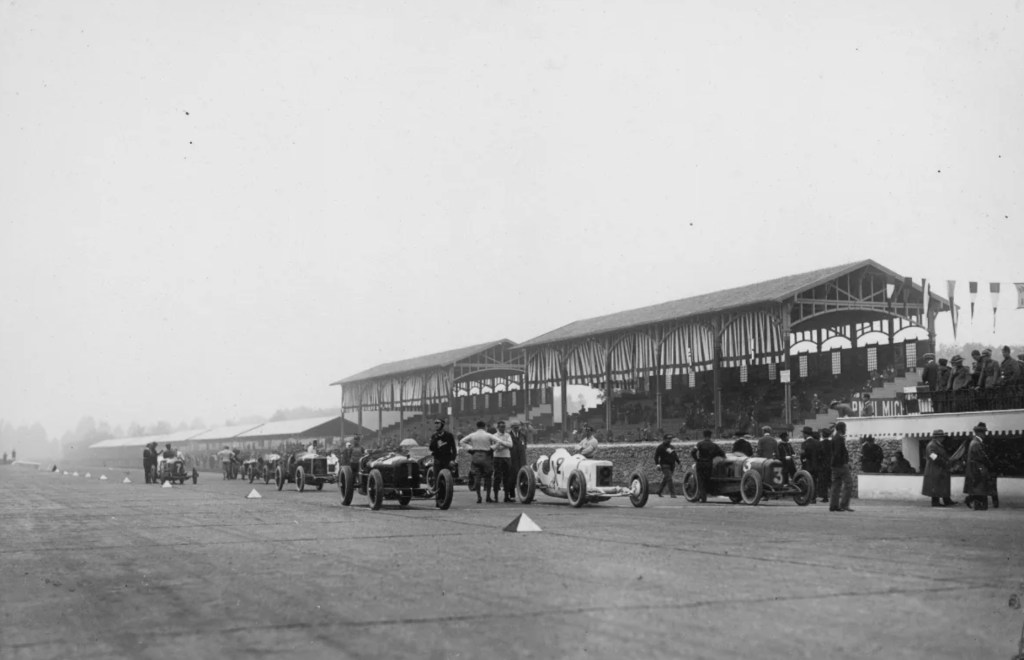
Before the start of the race: Antonio Ascari’s Alfa P2 #1 Christian Werner’s Mercedes M72 #2 and Jules Goux’ Rolland-Pilain Schmid #3.
Alfa Romeo won in a rout taking the first four placings: Ascari, Louis Wagner, Campari and Bruno Presenti, and Fernando Minoia.
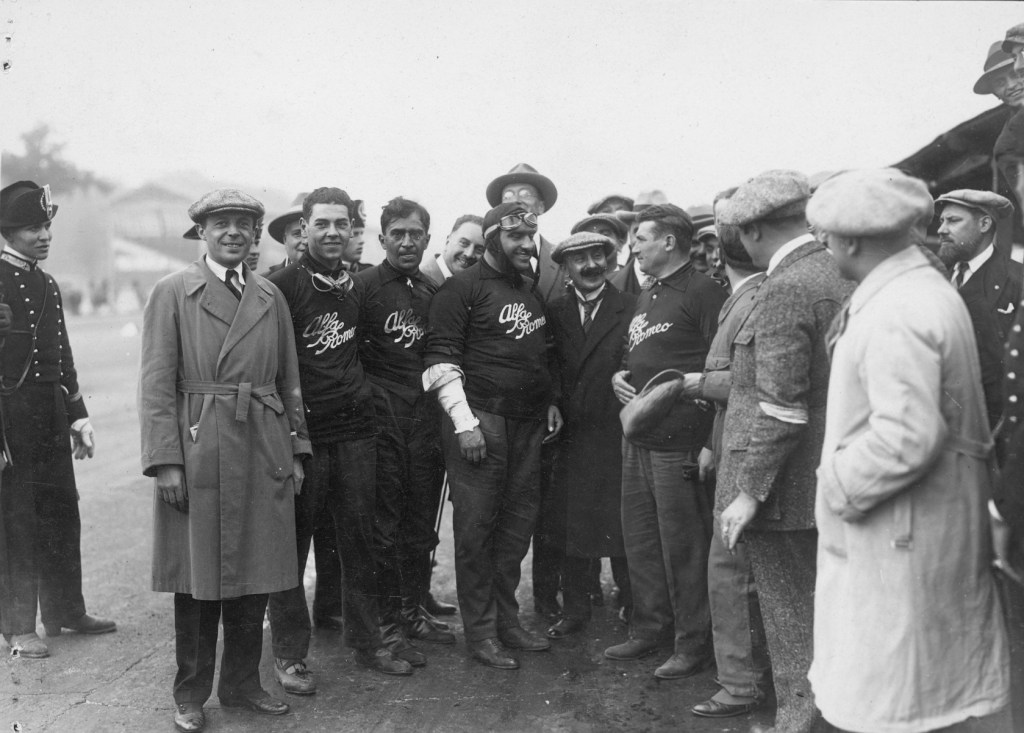
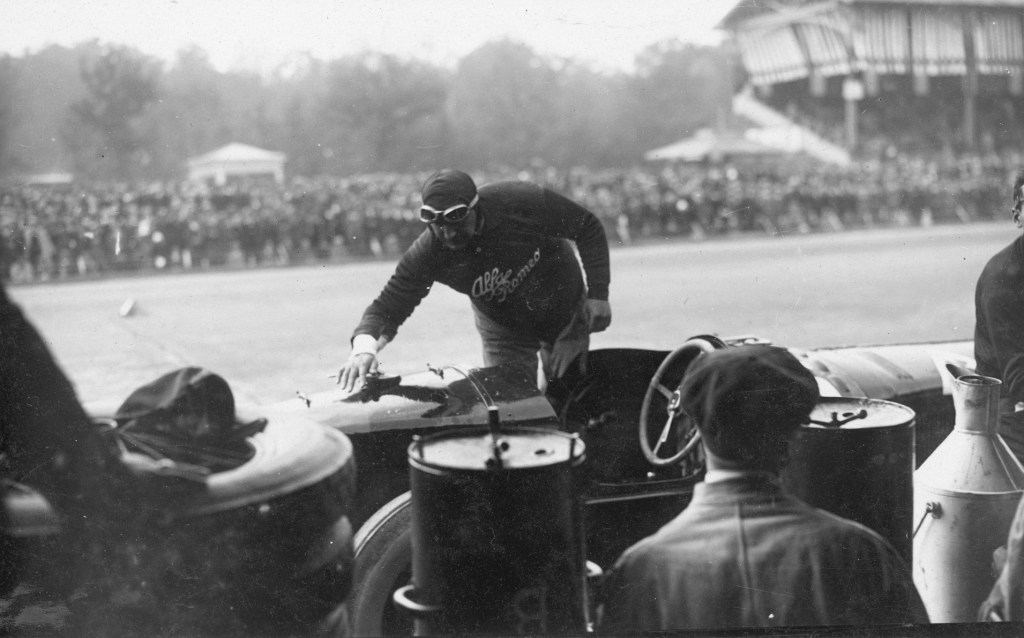
Scuderia Alfa Romeo: unidentified in the overcoat, mechanic Giulio Ramponi, drivers Minoia and Campari, the engineer and entrepreneur Nicola Romeo, and driver Antonio Ascari.
Ascari and Ramponi go for a greet-the-punters wander.
Giuseppe Campari and P2.
(Federico Patellani)
Gigi Villoresi, Nino Farina and Alberto Ascari in 1950, this photo was published on the cover of the January-February issue of the Pirelli magazine. Nice portrait of Gigi in a Ferrari below.
(Ferrucio Testi)
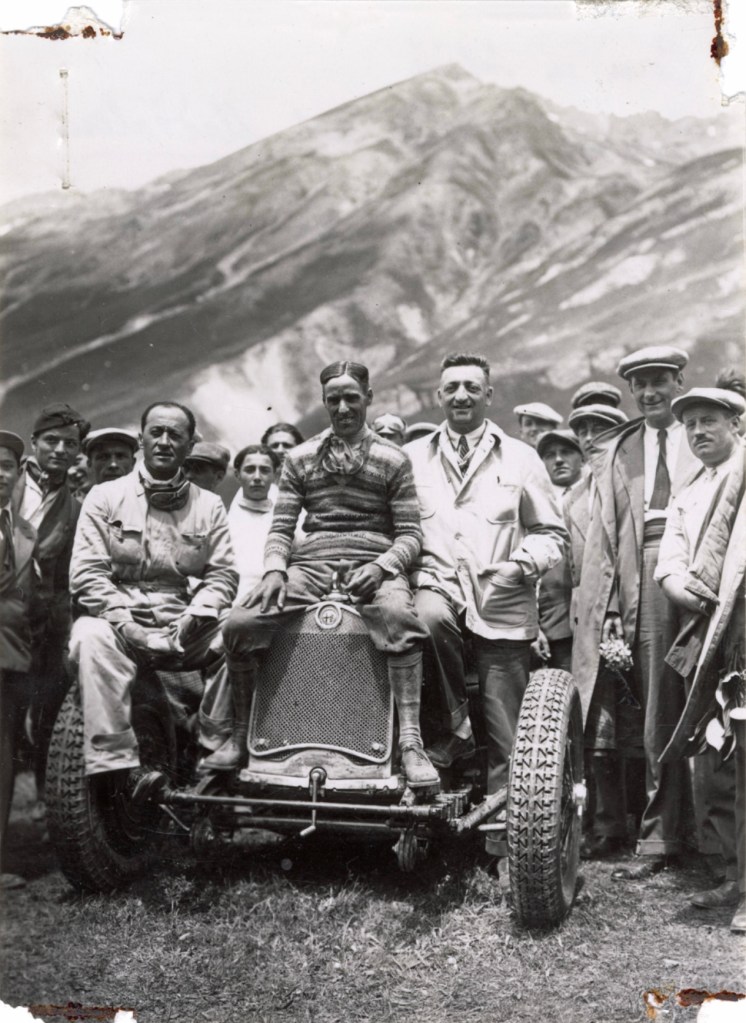
Scuderia Ferrari shot of Luigi Arcangeli, Tazio Nuvolari and Enzo Ferrari sitting on an Alfa Romeo P2 during the European Hillclimb Championship in June 29, 1930
The Pirellis are Stella Bianca’s, the venue is Cuneo-Colle della Maddalena. While Pirelli wrote that Tazio was first and Luigi third, Rudy Caracciola won the day on a Mercedes.
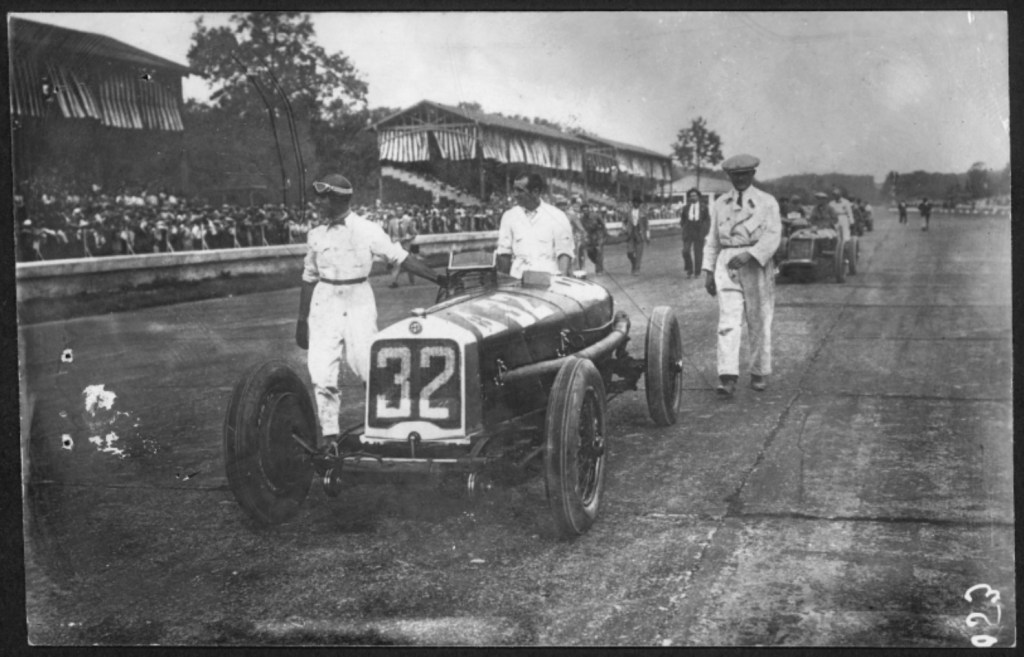
And below walking to the start alongside an Alfa – a modified P2 of the type Achille Varzi used to win the Targa Florio in 1930 Bob King reckons, a quick look at Hull & Slater confirms this – circa 1930. Does anybody recognise the venue?
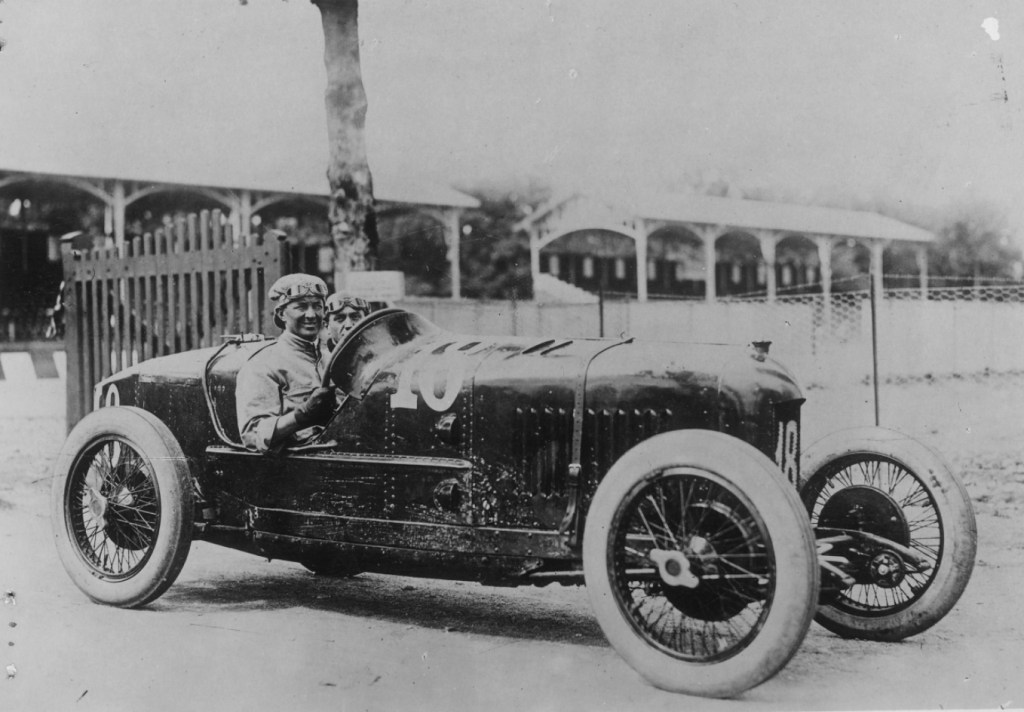
Antonio Ascari and a mechanic aboard, “probably an Alfa Romeo P1”, venue unknown.
I’m not so sure about the P1 theory…Giuseppe Merosi’s Fiat 804 copy wasn’t much chop. His engine had most of the same features as Fiat’s Type 404: DOHC, 65x100mm bore/stroke 1991cc six so the power output was about the same but the Gran Premio Romeo was longer and heavier. Its aero was inferior too, the epochal Fiat had a staggered mechanics seat which slimmed down its profile, the Alfa did not.
While P1s were entered for the 1923 Italian Grand Prix – for Ugo Sivocci, Alberto Ascari and Giuseppe Compari – after Sivocci crashed to his death in practice the team withdrew from the meeting as a mark of respect, the P1s never raced.
The car shown above carries #18, the Monza P1s used numbers, 6, 12 and 17, so the shot wasn’t taken on or about that weekend.
Is the car shown a P2, an early one? The Golden Era of Grand Prix Racing is my reference site for the results of the major races in this era, I cannot see an Alfa P2 number 18 entered in any of the races the site covers in either 1924 or 1925. A mystery…
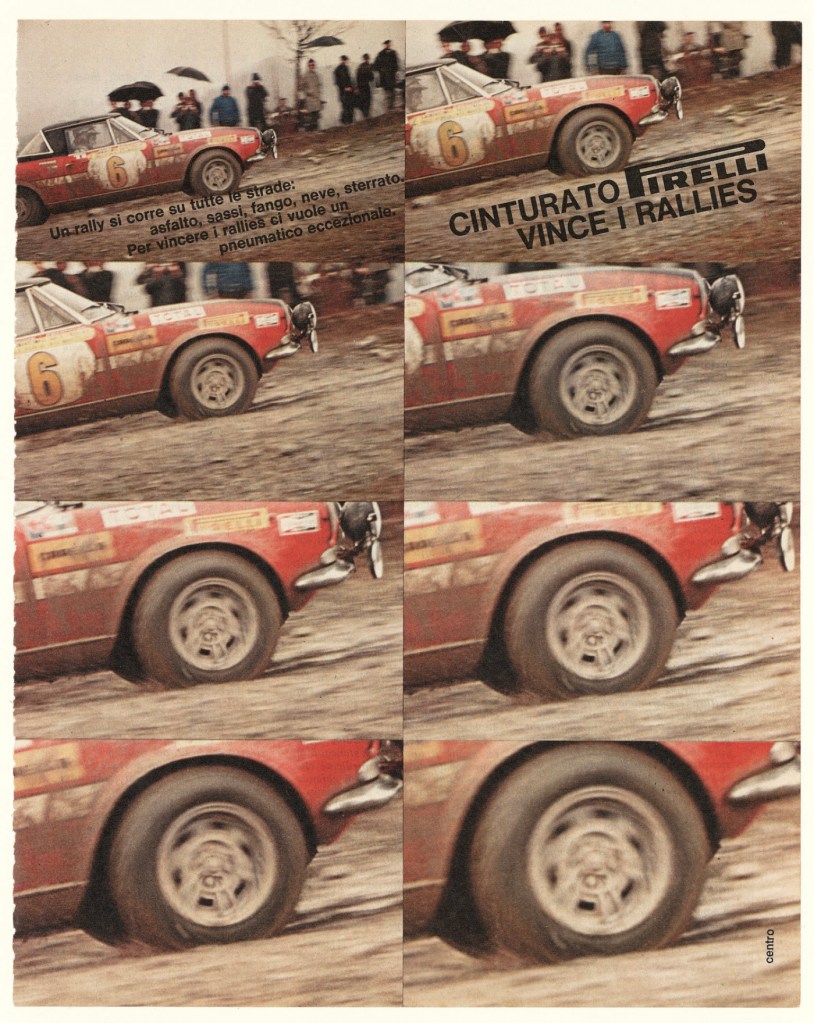
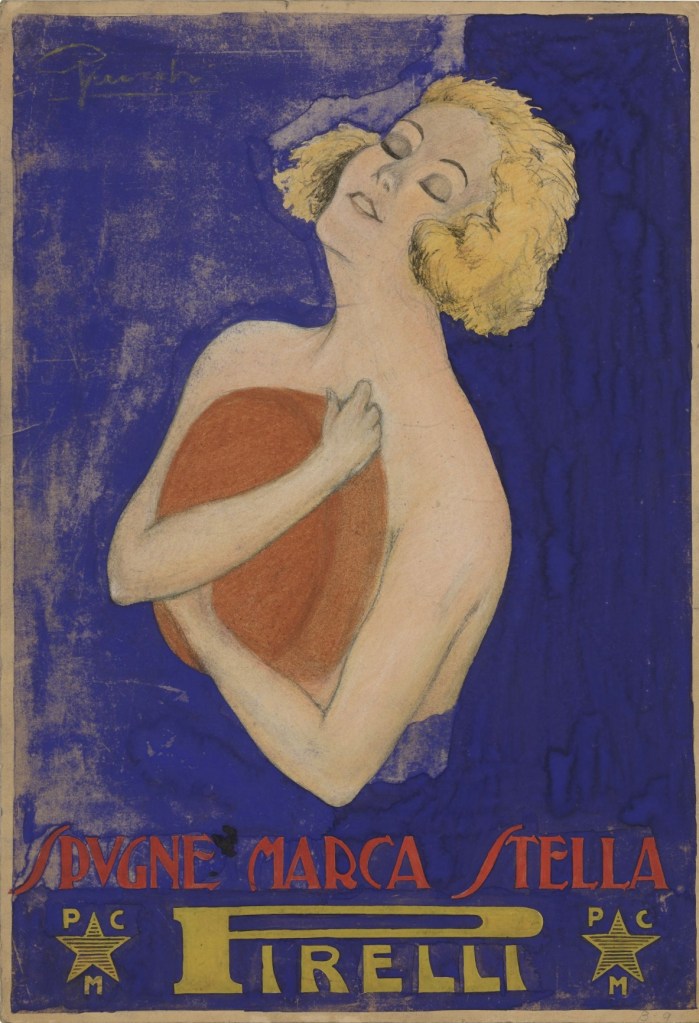
Pirelli sponge ad 1922 by A Franchi
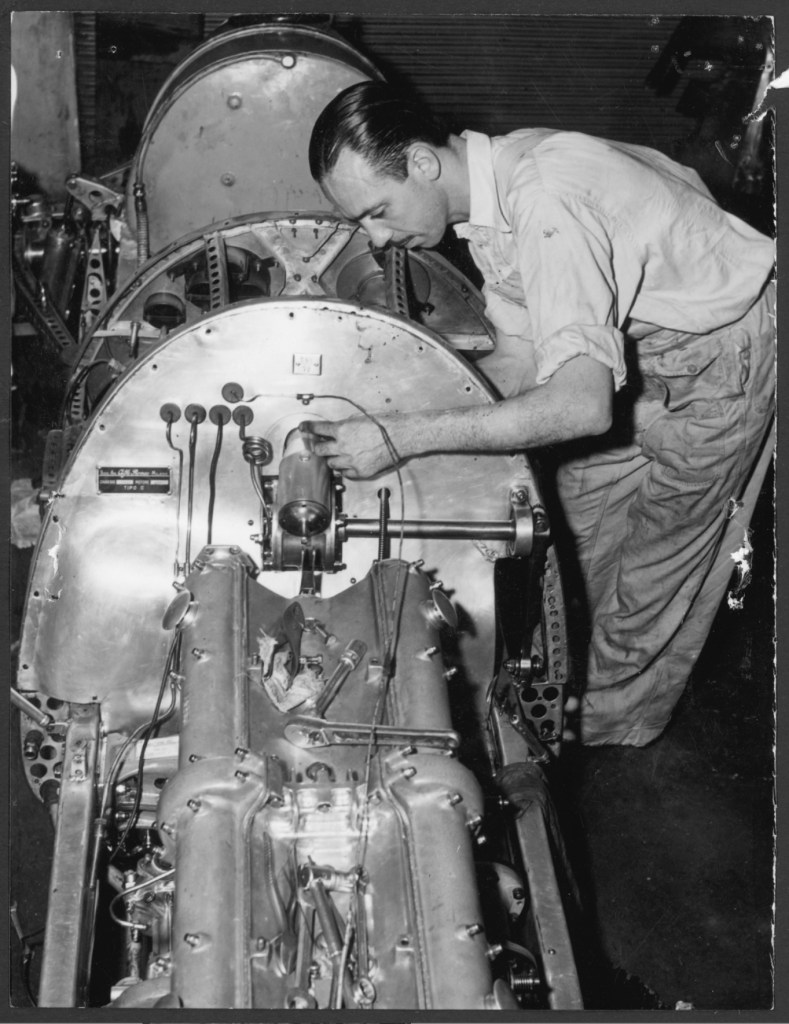
Oscar Galvez fettles the engine of his 3-litre supercharged straight-eight Alfa Romeo 308 in January 1949, can’t quite read the chassis number…
He was third in the Buenos Aires Grand Prix behind the Maserati 4CLT’s raced by Alberto Ascari and Gigi Villerosi.
Achille Varzi’s Mille Miglia winning Alfa Romeo 8C2600 Monza Spider Brianza on the Carozzeria Brianza Stand in 1934.
The first four cars home were (2654cc) 8C2600 Monzas: Varzi/Bignami, Nuvolari/Siena, Chiron/Rosa and Battglia/Bianchi.
Fangio plugs Cinturato’s in 1965
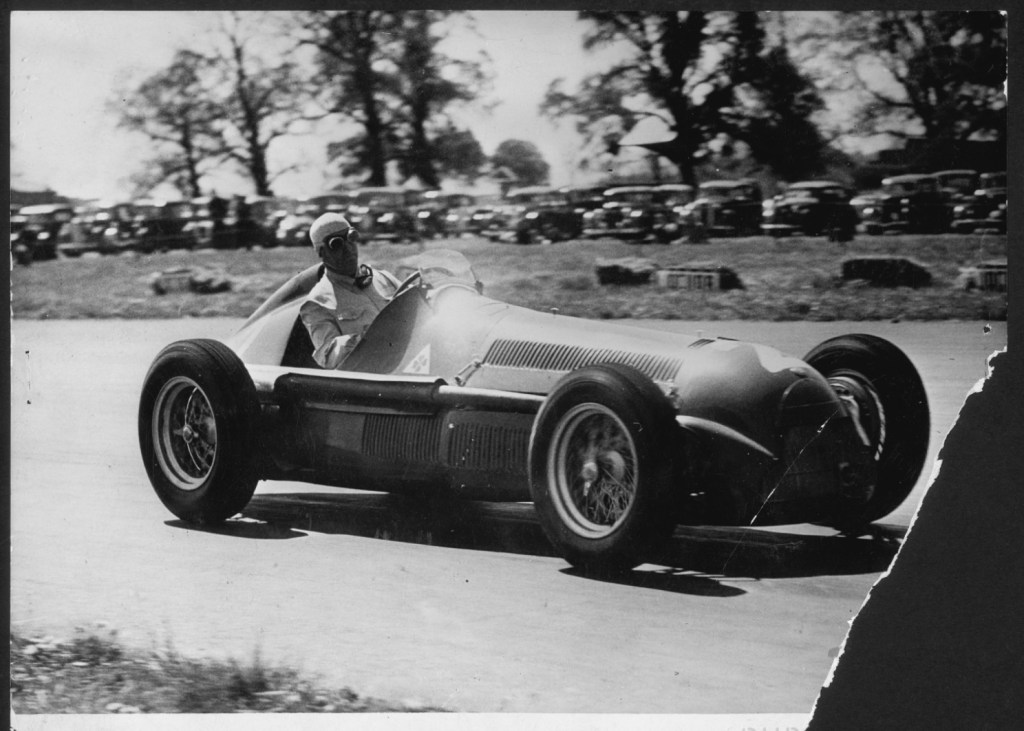
Classic shot of Nino Farina on the way to winning the July 1950 British Grand Prix in an Alfa 158.
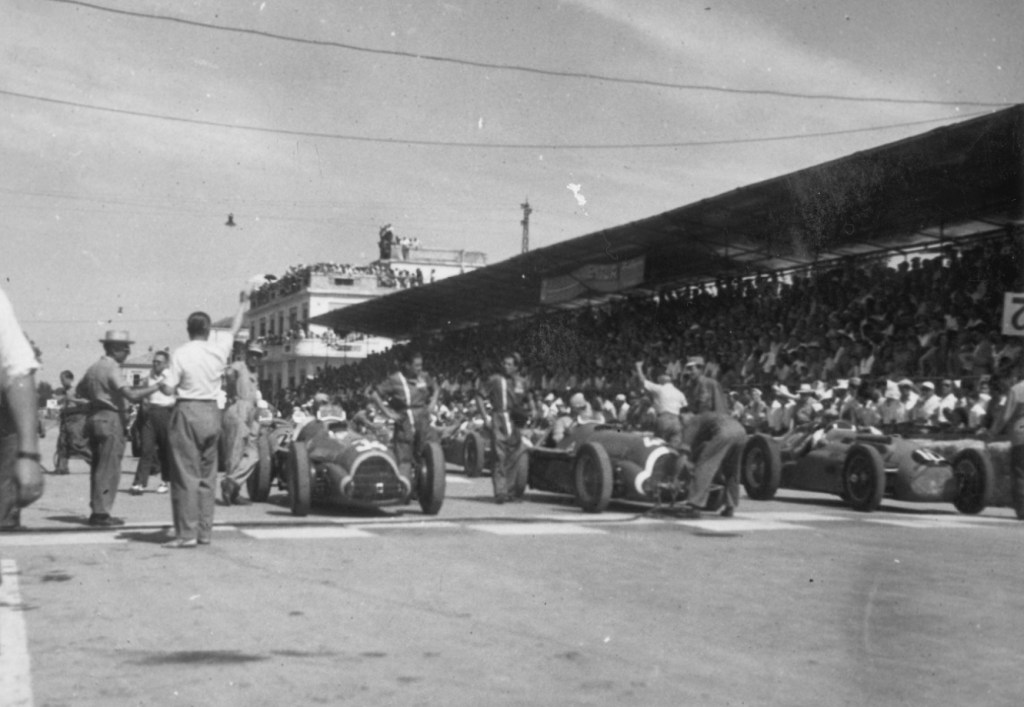
A month later the circus is on the grid at Pescara for the August 19 Grand Prix on the road circuit of the same name.
From the left is Fangio’s #34 Alfa 158, then the similar machine of Luigi Fagioli’s, with Louis Rosier’s Talbot-Lago T26C on the right. The race was won by Fangio from Rosier and Fagioli.
(F Patellani)
Paddock scenes at Monza during the September 1950 Italian GP weekend.
The Consalvo Sanesi 158, and Giuseppe Farina #10 Alfa Romeo 159 above, and Fagioli’s 158 below. Farina won the race from Alberto Ascari’s Ferrari 375, then Fagioli.
(F Patellani)
Below mechanics attend to the engine of Fagioli’s 158.
1959(Publifoto)
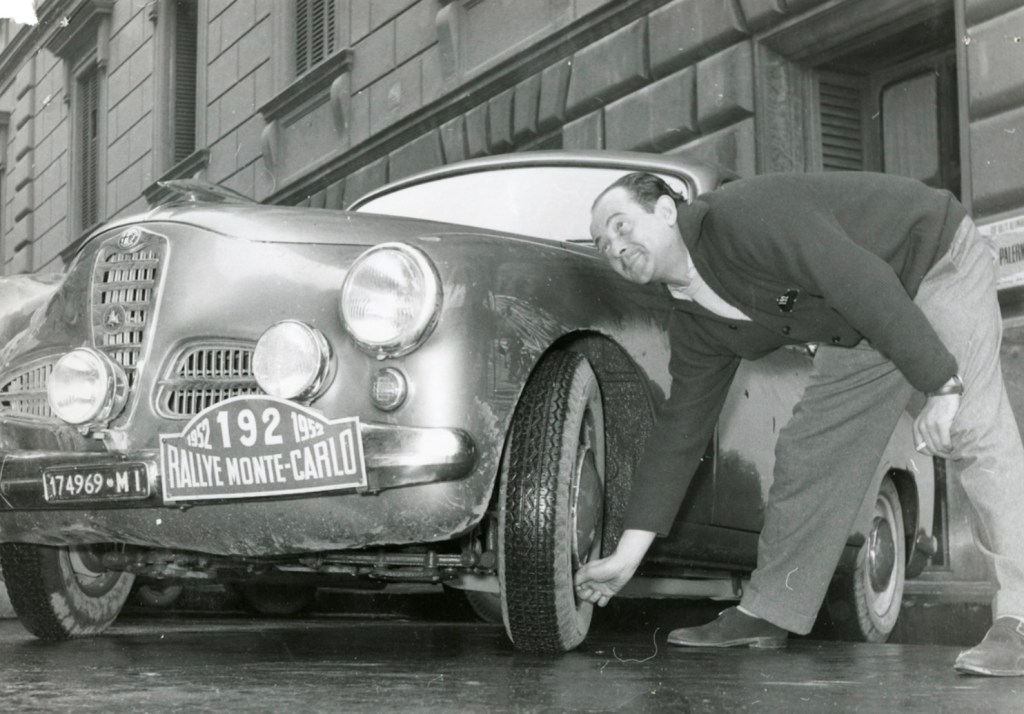
Prince Raimondo Lanza di Trabia inspects his left-front Pirelli, Alfa Romeo 1900 TI during pre-event scrutineering in Milan before the start of the 1952 Monte Carlo Rally.
He was 72nd in the event won by Sydney Allard/Guy Warburton Allard P1, the best of the Alfa’s was the 17th placed Andersson/Lumme 1900TI.
Pirelli Stelvio tyre ad 1956 (L Bonzi)
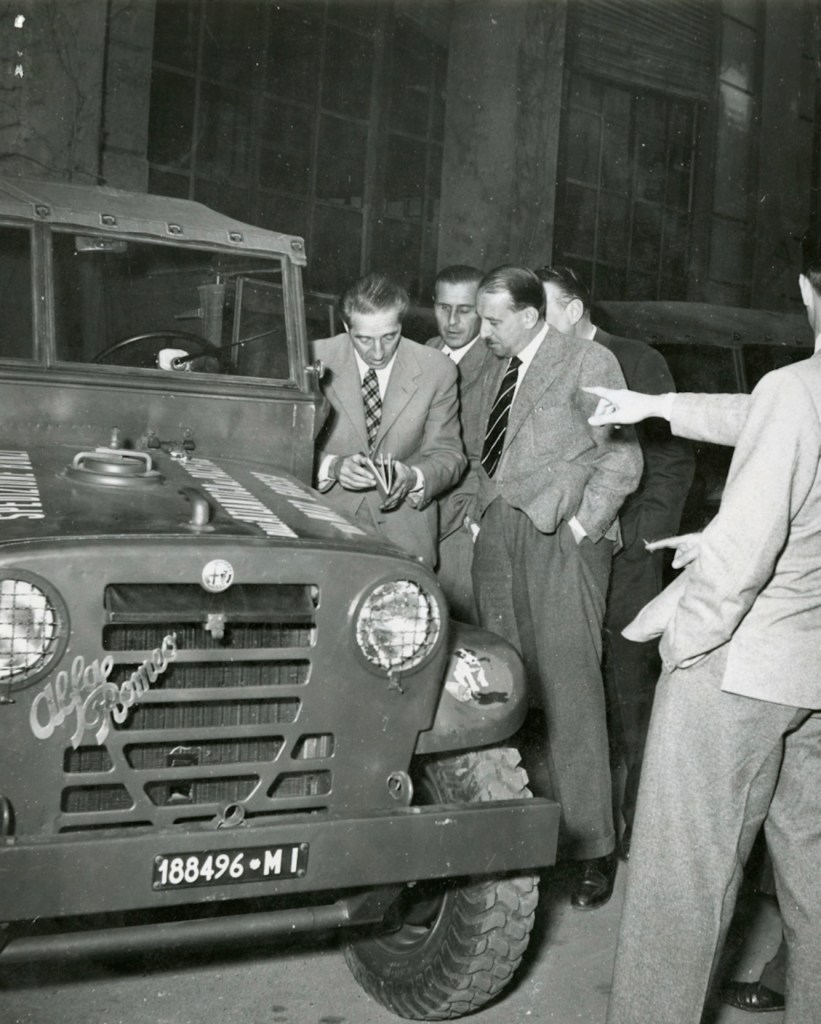
Count Leonardo Bonzi alongside his Alfa Romeo in Bicocca, Milan before the start of the Mato Gross Rally in 1952.
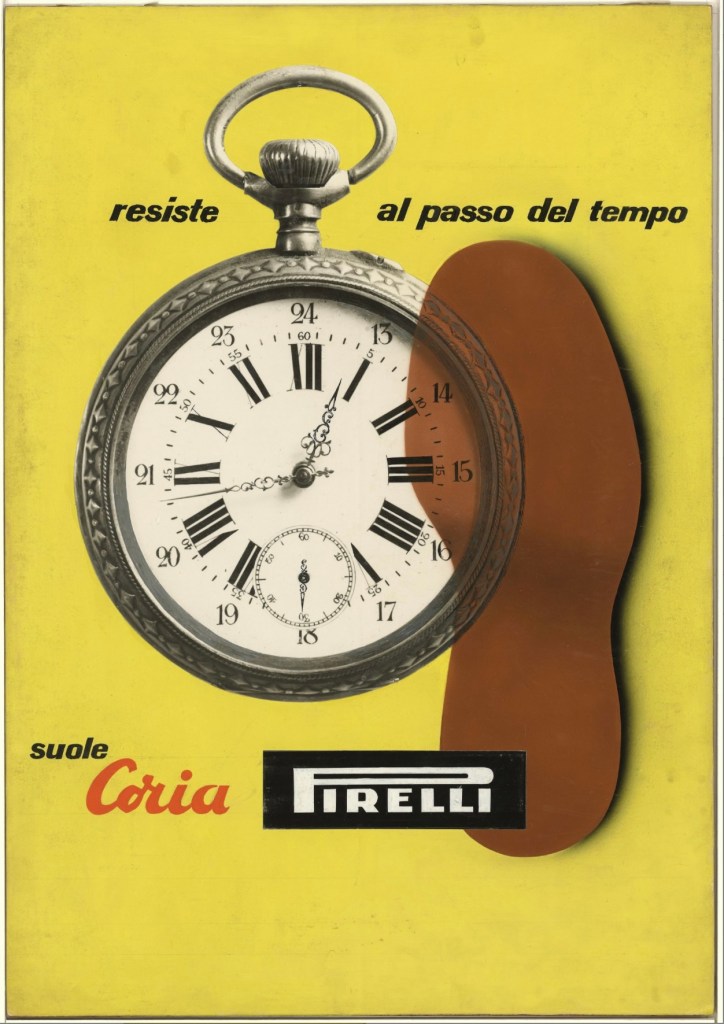
Pirelli Coria soles resist the passage of time Ezio Bonini 1953 (INCOM)
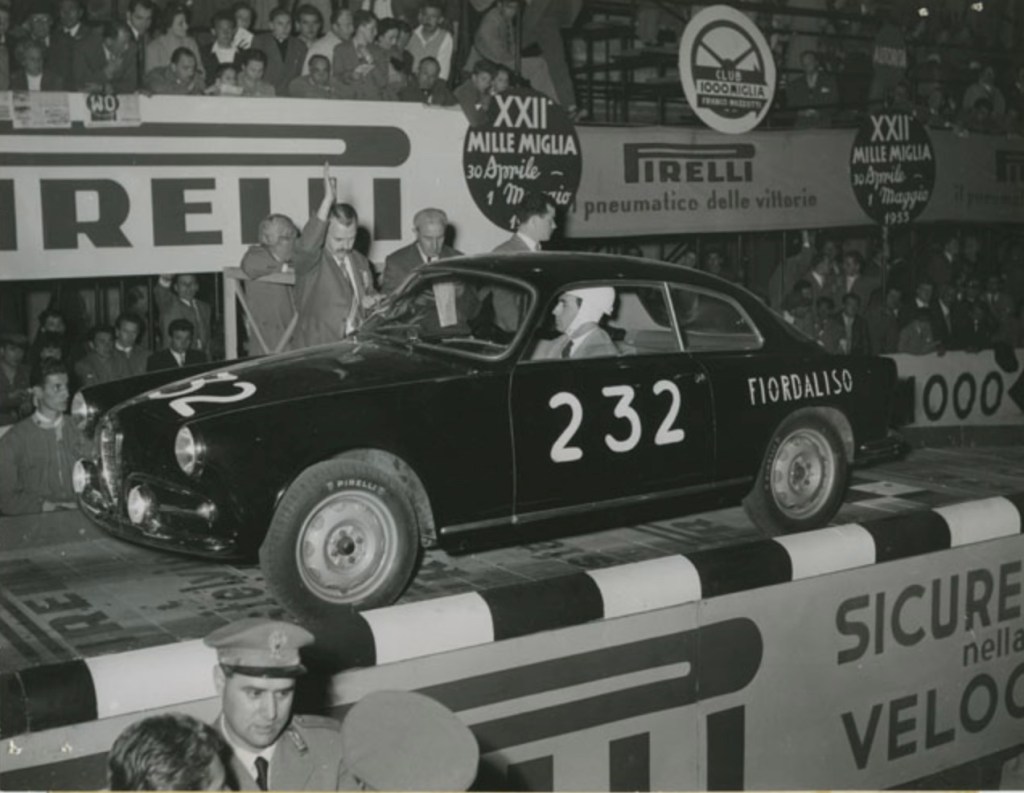
Mille Miglia 1955 start with the Santo Ciocca Alfa Romeo Giulietta Sprint on the ramp DNF. The race was of course won by the Stirling Moss/Denis Jenkinson Mercedes Benz 300SLR.
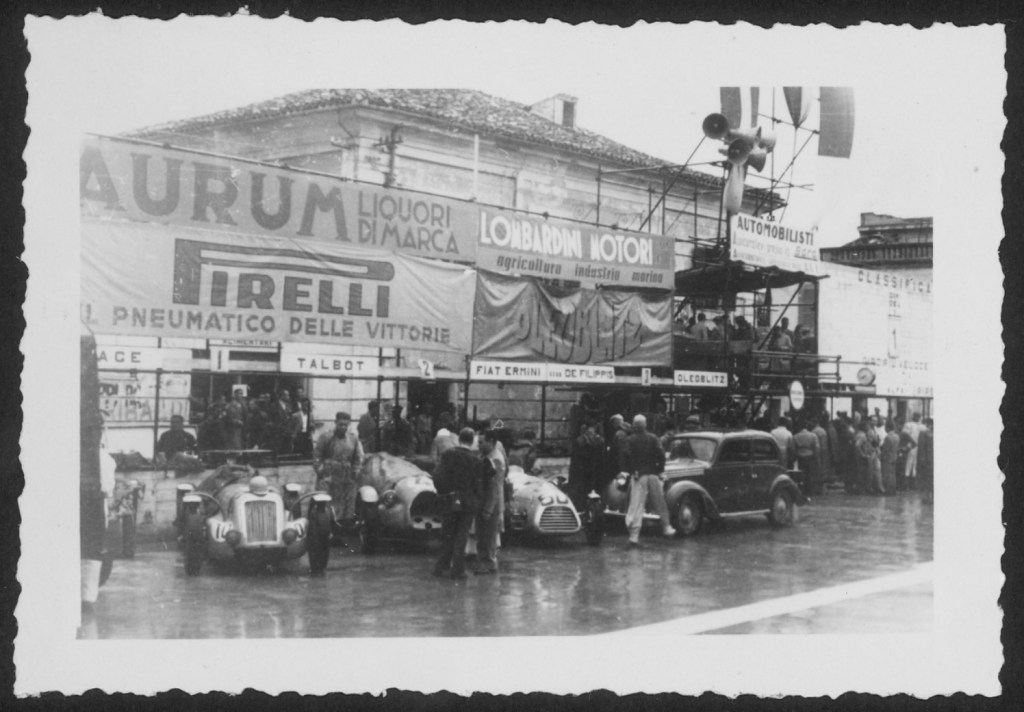
View of the pits during a soggy August 1949 Pescara Grand Prix weekend. Franco Rol won in his Alfa Romeo 6C2500 SS from Robert Vallone’s Ferrari 166S. Car 10 is Henri Louveau’s third placed Delage D6, #4 Louis Rosier’s Talbot Spéciale (DNS) and car #50, Bormioli’s ?
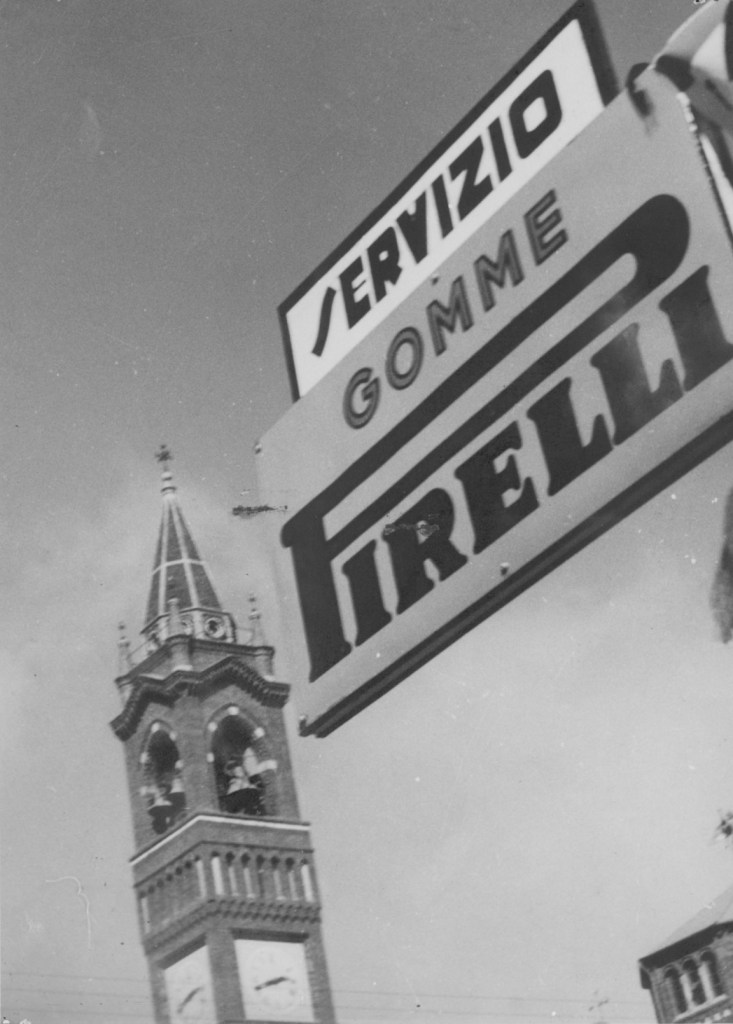
Asmara December 1938, site of the first Coppa di Natale. Behind the Pirelli sign is the Beata Vergine del Rosario church
Credits…
All images are from the Pirelli Foundation archives. Leonardo Bonzi, Publifoto, Federico Patellani. ‘Alfa Romeo A History’ Peter Hull and Roy Slater
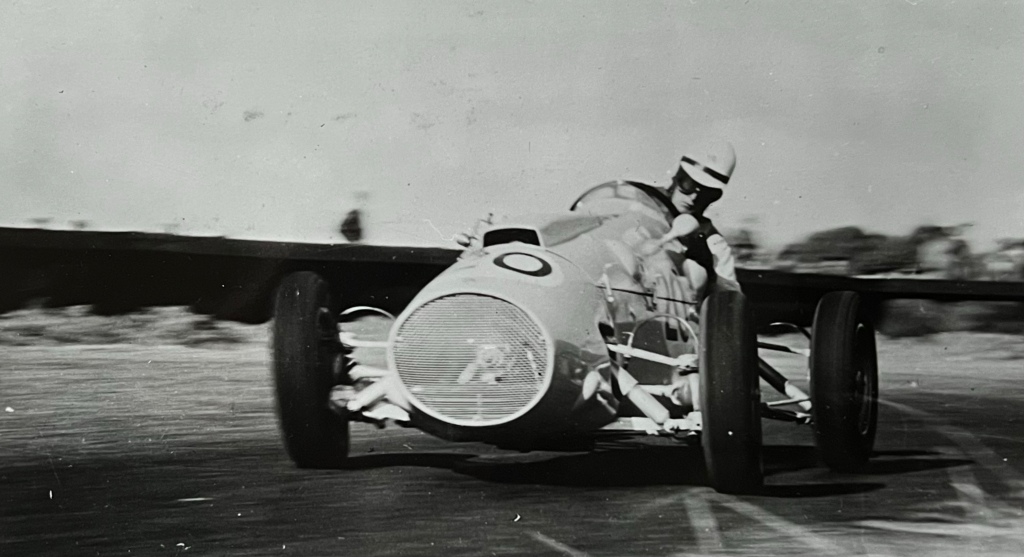
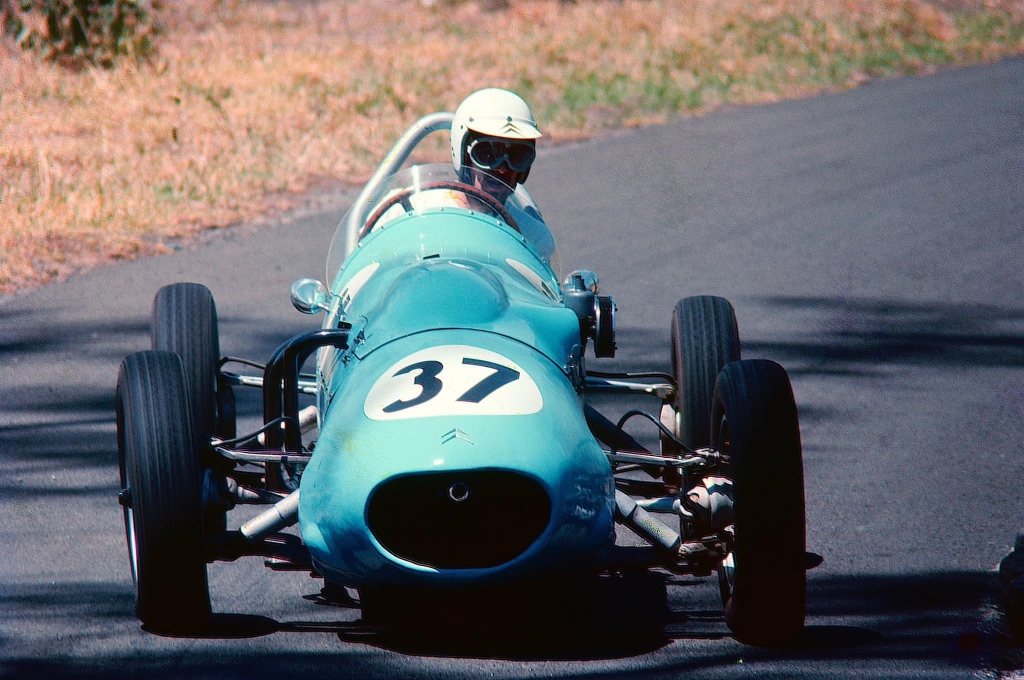
Don Wright with his eyes riveted on the apex of a corner at Sydney’s Mount Druitt circuit aboard his Citroen Special in 1956.
Racer/engineer/restorer/historian Dick Willis in his fabulous book, Optimism, describes the Citroen Light Fifteen (Light 15) based monoposto as “Probably Australia’s only front wheel drive racing car of the fifties…it had a successful career especially in the late 1950s and early 1960s when it raced as a Division 2 car in NSW having many memorable dices with the Nota Major.”
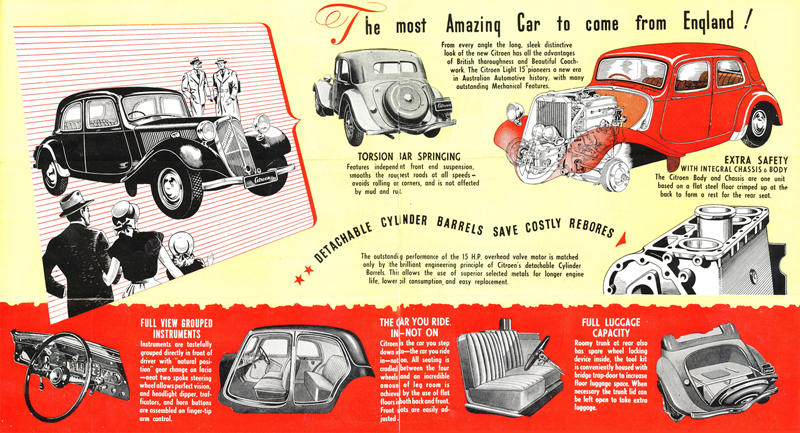
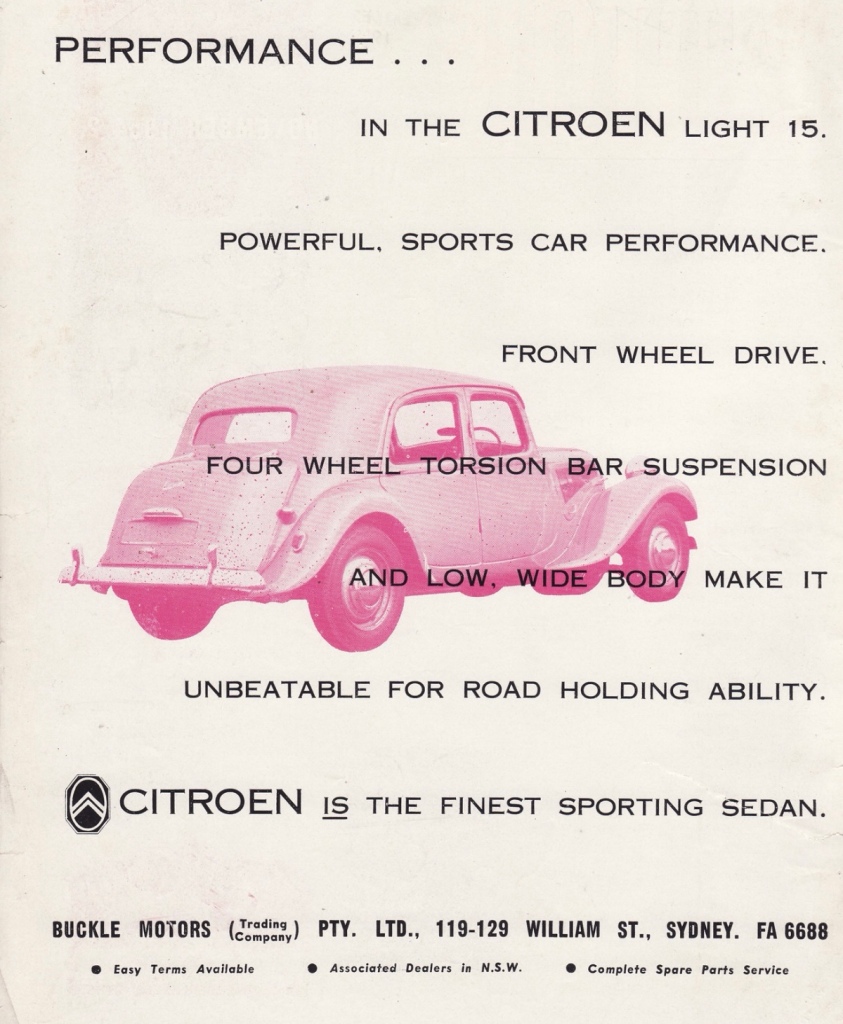
At the 1951 Easter Bathurst meeting, Bill Buckle, a member of the noted motor dealer family – then the holder of the Sydney Citroen franchise amongst other marques – raced a Light 15 to second place in the Production Closed Car Handicap.
Suitably impressed by the competition potential of his product, he cast around for a crash damaged car and commenced construction of a monoposto racer to accept the road cars core mechanicals.
Working with his close school friend, and fellow auto apprentice, Charlie Buck, they built a simple twin-tube ladder chassis to which was mated the Citroën front subframe, steering, 2-litre OHV engine and gearbox, and rear beam axle.
Before the car was finished Buckle decided to visit France and sold the project to Don Wright to help fund his trip.
Wright and Buck then set to work in Wright’s Castle Hills workshop to finish it including fabrication of a stainless steel fuel tank and a slinky body made together with Stan Barrett. The 1911cc Light Fifteen engine was fitted with special valves, a pair of 1 1/2 inch SU carbs fed by an aircraft fuel pump and 17 inch stub exhausts. Those radical looking wheels were options Citroen offered in Europe but not here: light Michelin made ‘Pilote’ shod with the French tyre manufacturers new X-radial tyres
Don Wright, King Edward Park, Newcastle hillclimb circa 1953. Bob Winley, “In this shot the Citroen Special is very new with its original beam axle rear suspension and short nose.”
After several drives the cars shortcomings were laid bare and addressed. The duo modified the gearbox by eliminating reverse gear and machining and fitting a fourth forward gear in the space so released.
Unhappy with the rear suspension, Wright replaced the Citroen beam axle and transverse torsion bars with Morris Minor longitudinal (front) bars and bottom arms. “Uprights and top wishbones were fabricated to suit, the original rear stub axles having that convenient eight-bolt attachment,” Bob Winley, a later owner, and ultimately the car’s restorer, wrote
The car soon became a common sight on the hills and circuits of NSW including Foleys Hill, King Edward Park, Mount Druitt, Gnoo Blas, and then Bathurst in 1955. That year Don won the NSW Hillclimb championship at King Edward Park, Newcastle; quite a triumph for the sweet handling machine.
King Edward Park, Newcastle 1954. Winley, “The Citroen Special early on but after it was fitted with IRS: parallel wishbones and longitudinal Morris Minor torsion bars. Note the 17-inch stub exhausts. It seems to have grown an oil cooler too. I haven’t seen the ‘Mickey Mouse ears’ before. The front wheels could certainly throw rocks and water at the driver on any but clean tracks.” (J Moxham Collection)Wheels‘ caption, “Don Wright’s FWD Citroen Special was one of three cars which broke 60 seconds at the 1955 NSW Hillclimb Championship. It is seen in our picture rounding the hairpin at Newcastle where the climb was held.” Covering the same meeting Modern Motor observed that “Speed, roadholding and showroom finish have made Don Wright’s Citroen Special a favourite with racing fans.”Photographer Bruce Moxon wrote, “The Citroen Special at Castlereagh Airstrip on August 21, 1960 with girlfriend, Pauline at the wheel. It was owned by Geoff Thorne, with whom I worked at GE Cranes in Glebe, Sydney. Geoff was a toolmaker, but also a professional ice skater and musician.”
Later, Don sold the car to dentist lan Steele who raced at Bathurst circa 1957, the car passed it to Geoff Thorne, a genius ice-skating clown amongst his other talents. He raced it extensively and then Don James did well on new tracks such as Oran Park and Catalina Park from circa 1963. By then the machine was fitted with a crossflow DS cylinder head, extractors in lieu of the stack-exhausts, and Big Six front brakes. He did well in the Division 2/Formula Libre races common at the time.
Ray Bell wrote, “In November 1968 Bob Winley bought it and started racing it but couldn’t wear his red shirt because CAMS required fireproof overalls and underwear from then on! Bob ran in ‘modern’ races and the newly created Historic Car races and club events, winning money and trophies and being accused of doing ‘rain dances’ before race days, such are the car’s abilities in the wet. Bob fitted extractors and a muffler.”
Lynton Hemer’s shots of Bob Winley racing the Citroen at Oran Park – sporting its crossflow DS engine – on June 27, 1970, and below, exiting Forrest’s Elbow at Bathurst during practice for the Easter 1970 meeting (L Hemer)(L Hemer)
After six years John Moxham, a Citroen fancier, bought the car and re-fitted an original type of cylinder head. The car sat unused, then John moved interstate, selling the car to another Citroen collector, John Vanechop. The car languished until Don Wright’s friends bought it in pieces and Don began its restoration. With Bob Winley’s help the car is now ready to re-join the Historic Racing scene with proud owner Perry Long at the wheel, Dick Willis wrote.
“It was on display at Eastern Creek in 2006 and underwent some testing by John Bowe at Wakefield Park (pic below in 2017) but hasn’t been seen since although its return to competition is believed to be imminent and we look forward to it with great anticipation as the Citroen Special is a really interesting and unique Australian Special.”
Etcetera…
(G Mackie)
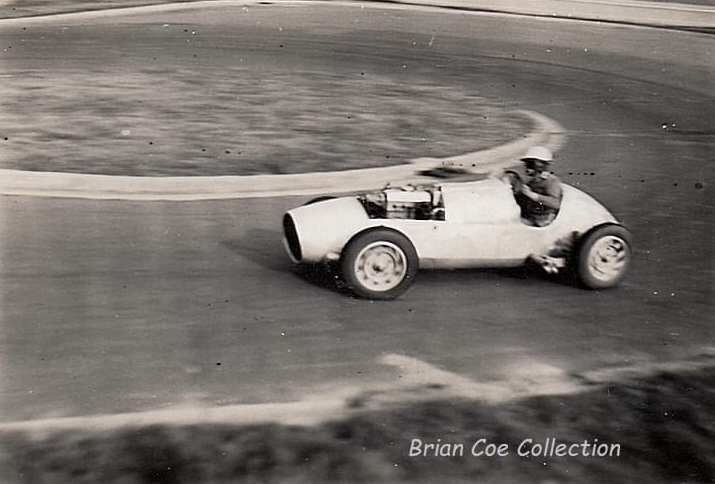
Not a great photo of Don Wright but better than nothing! Greg Mackie observed of the man, “Citroen Special and Lancia Fancier.” Ray Bell spoke to Wright circa 2001, at that stage he was still operating an automotive repair business in West Pennant Hills, “his major pursuit these days is making replacement blocks for Lancia Lambdas, which he carves out of billets of aluminium! No castings…”
Citroen Special in its original form, a nice shot of the Michelin Pilote wheels and immaculate line of the car even in its original short-nose guise.
Don Wright coming down the mountain at Bathurst in 1955, he carried #20 in both the Easter and October meetings.
Bob Winley commented in an exchange on Facebook with Australian Gold Star Champion, Spencer Martin, about Spencer’s observation of the Citroen Special’s understeer, “Near the driver’s left hand is a slight bulge in the body for the gear lever and fuel filler for the stainless steel tank between the chassis rails, keeping the centre of gravity well forward. Spencer Martin I steered it ‘on the throttle’ in BP Corner at Oran Park. I found it a delight to drive (and I don’t enjoy understeer).”
Don Wright chasing Tom Sulman’s Maserati at Gnoo Blas or Mount Druitt, thoughts on venue folks?
(D Willis)
A couple of fabulous in-period colour shots by Dick Willis. The one above is the front row of the grid, perhaps the November 1956 meeting at Mount Druitt.
From the left, perhaps Greg Hunt in the ex-Tomlinson/Bartlett/Brydon MG TA Spl, Jim Johnson in the Cigar MG, probably Ian Steele in the light blue Citroen Special – with gleaming Pilote wheels – and on the right in the low-slung, mid-engined Stewart MG with Gordon Stewart at the wheel.
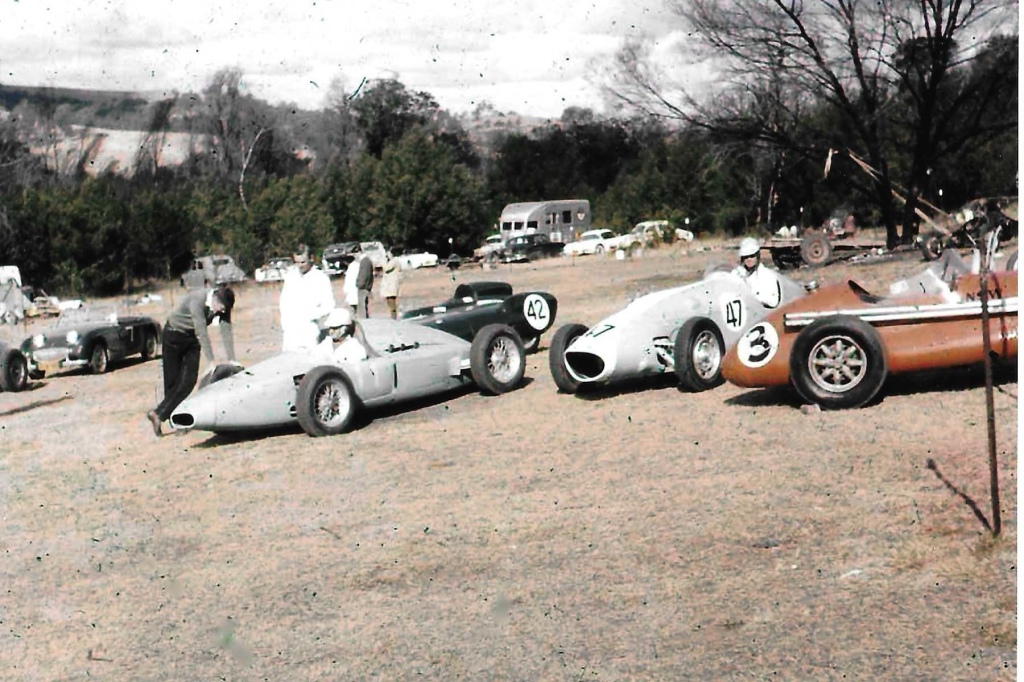
Below is a superb paddock scene at Silverdale, perhaps the June 1960 meeting.
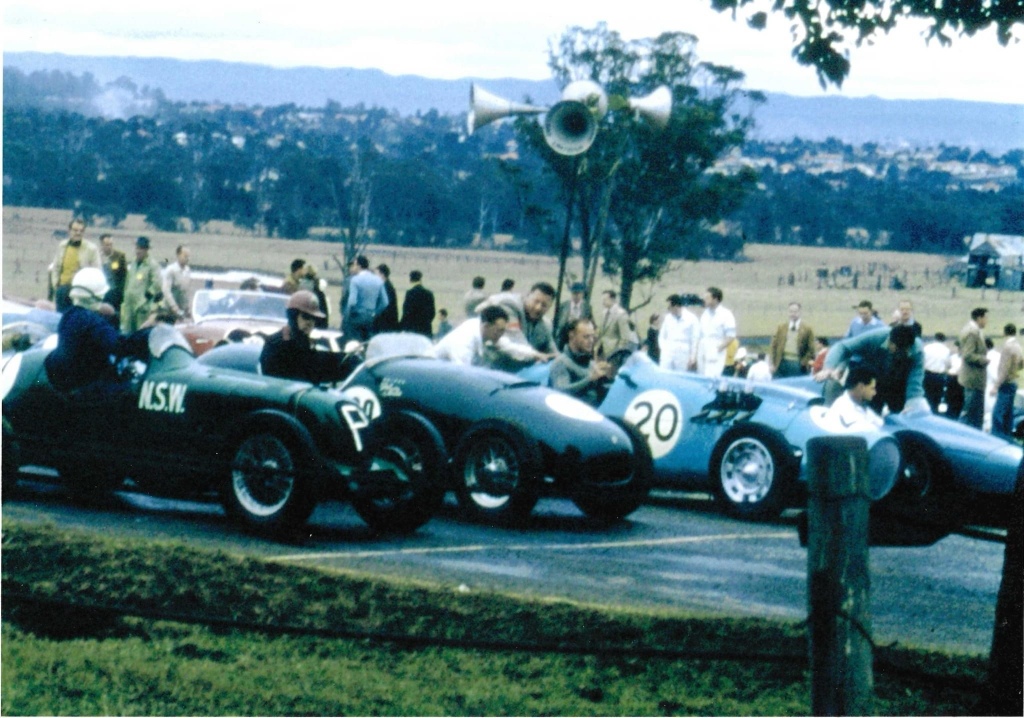
Gordon Stewart in the Stewart MG at left, #47 is our Citroen with Geoff Thorne up, #3 is Jack Myers WM-Cooper Waggott-Holden, #42 Don Swanson’s Lotus 11 Climax – up from Melbourne or had it changed hands by then? – while the Sprite at the far left was run by Leigh Whitely.
(D Willis)(D Simpson)
Bob Winley in the Huntley Hills Esses during the December 1968 meeting. He recalls, “I found something out that day. I did my practice run without seatbelts and nearly got thrown out of the car towards the end of the run. Lesson learn’t!”
(J Moxham Collection)
A page from John Moxham’s photo album now in the custody of John Barass.
Credits…
The main image, the catalyst for this particular research journey, is courtesy of the Auto Action Archive.
The information was gleaned from Dick Willis wonderful book, ‘Optimism’ about Australian Specials, and demonstrates the potency of some Facebook groups. I carefully mined the comments of a whole lot of people on Bob Williamson’s Old Australian Motor Racing Photographs, and Greg Smith’s Pre-1960 Historic Racing in Australasia Facebook pages. Those photos and information are attributed to Ray Bell in one of Bob Winley’s posts, the Rick Marks, and Don Coe Collections, Nurk Daddo, John Moxham Collection via John Barass, Australian Motor Heritage Foundation via Brian Caldersmith, Bruce Moxon, Greg Mackie, Dick Simpson, Tim Shellshear, Bob Williamson and multiple, wonderfully informative posts by Bob Winley.
Wonderful teamwork! Let me know if I’ve cocked anything up on mark@bisset.com.au.
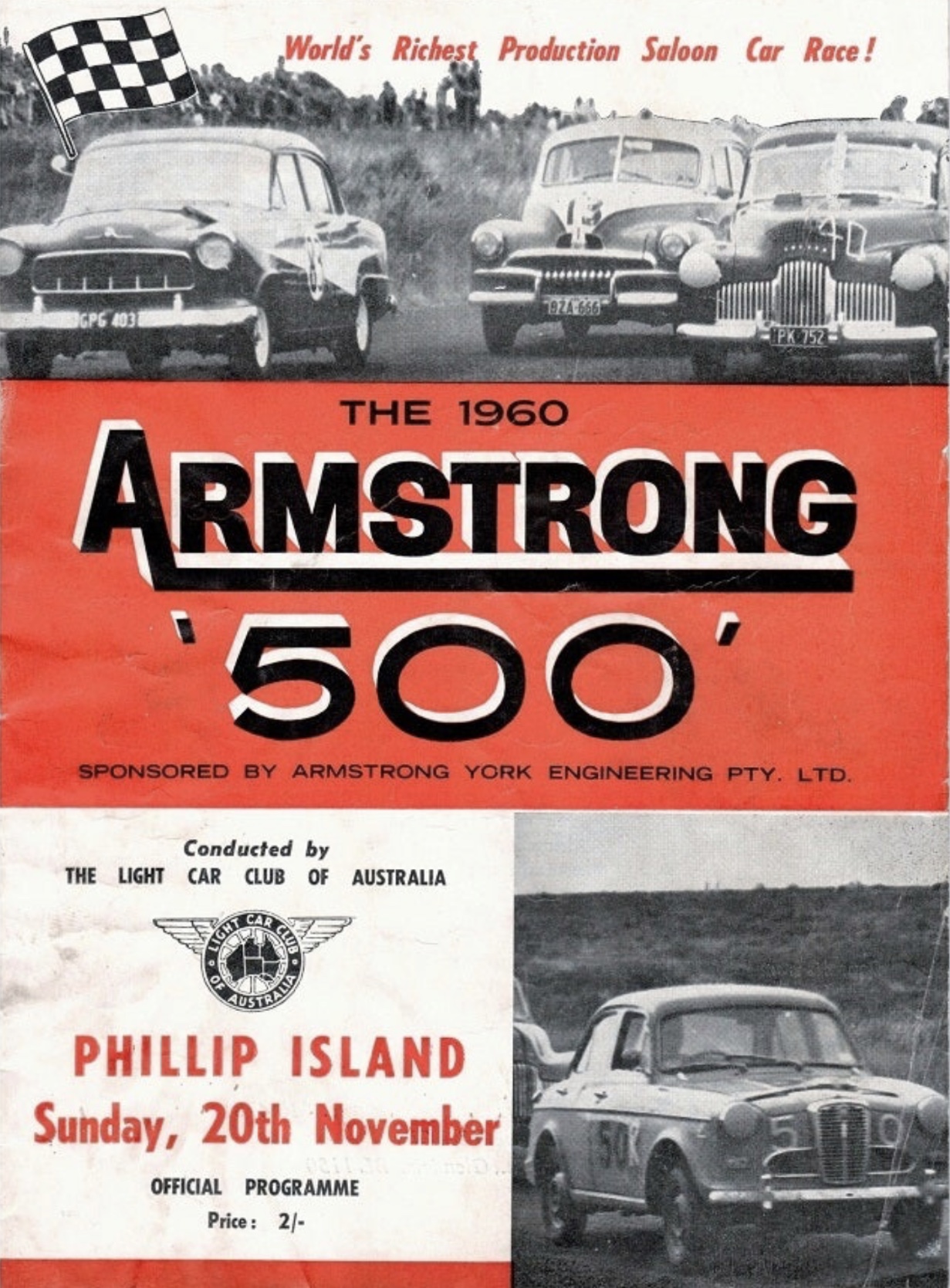
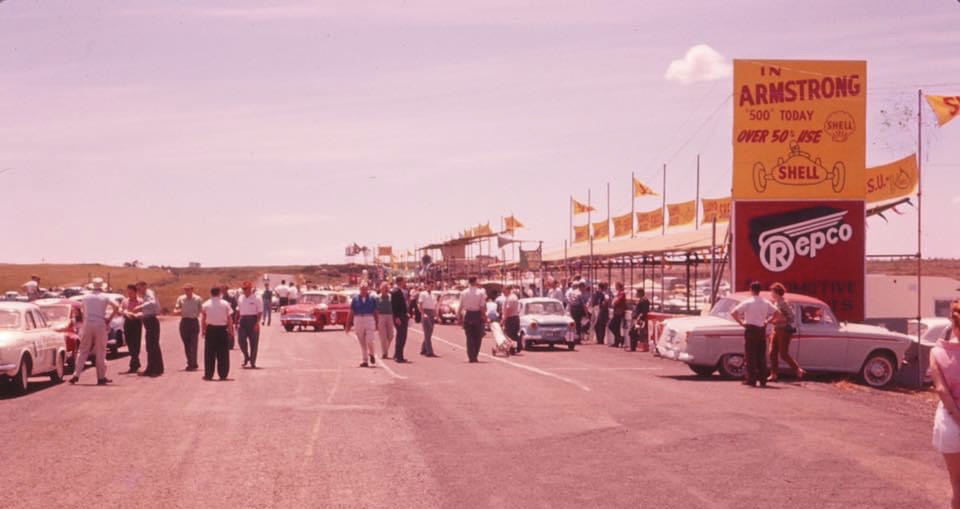
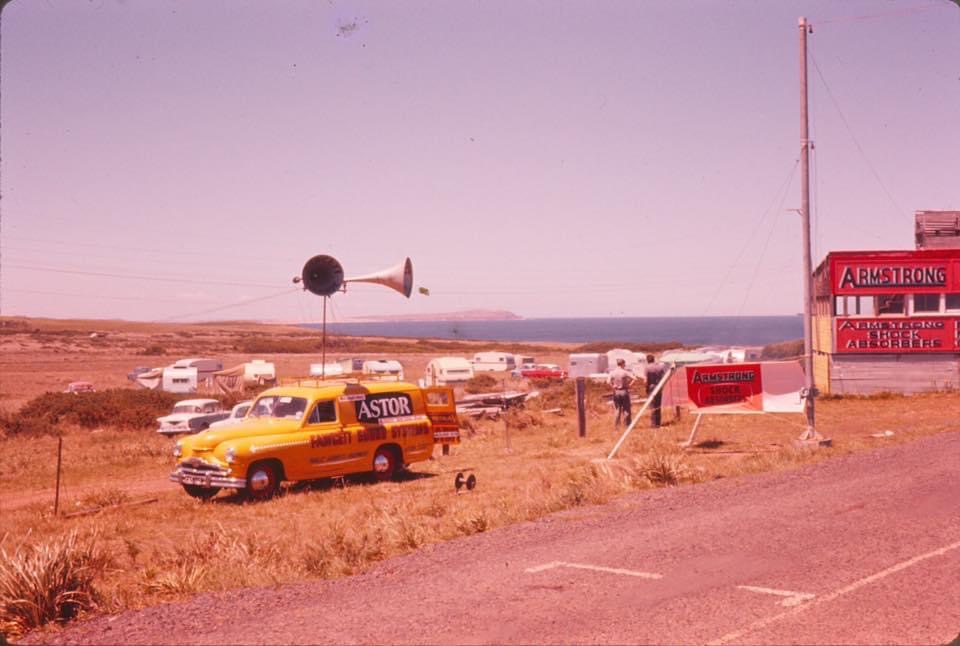
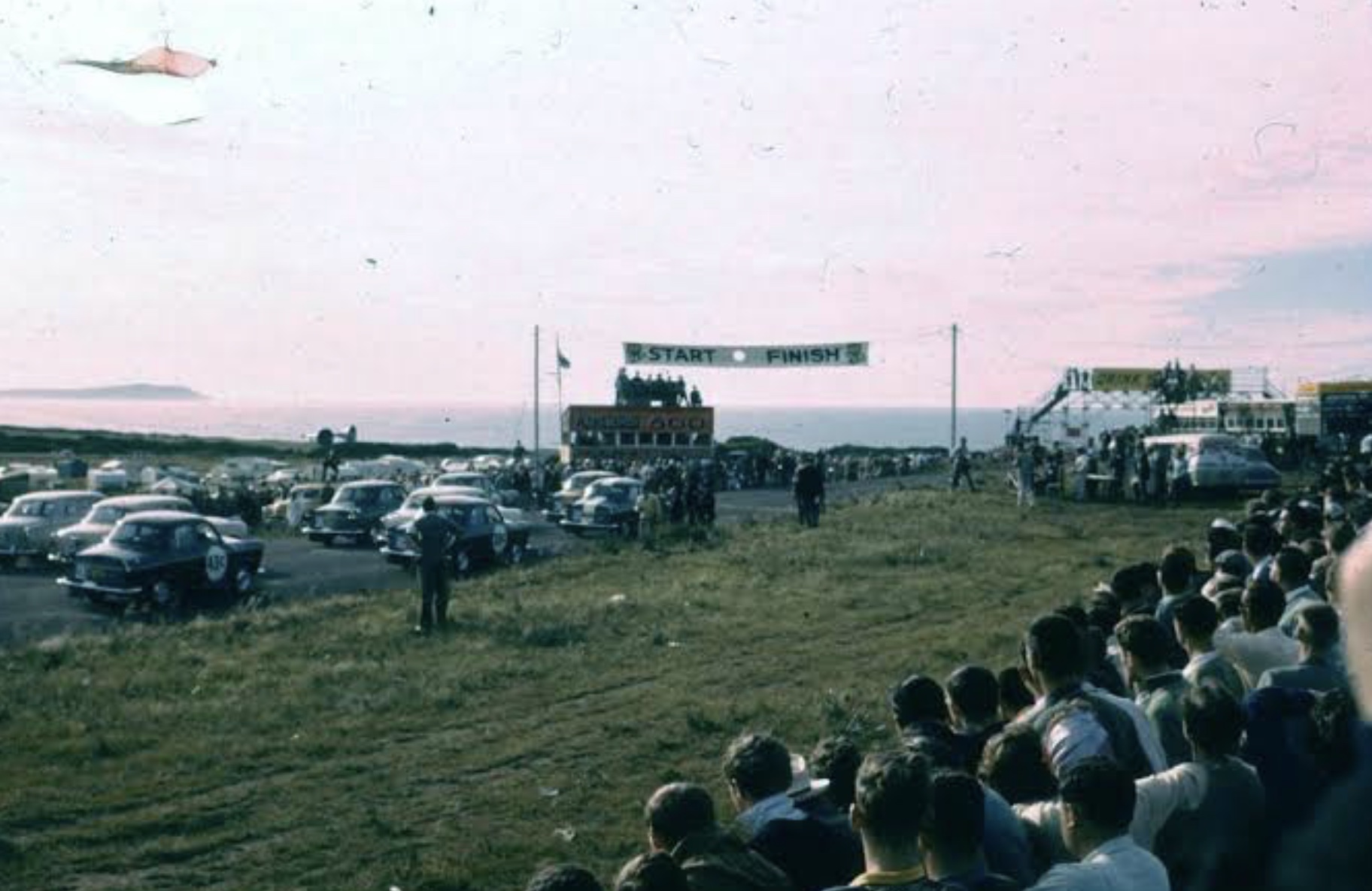
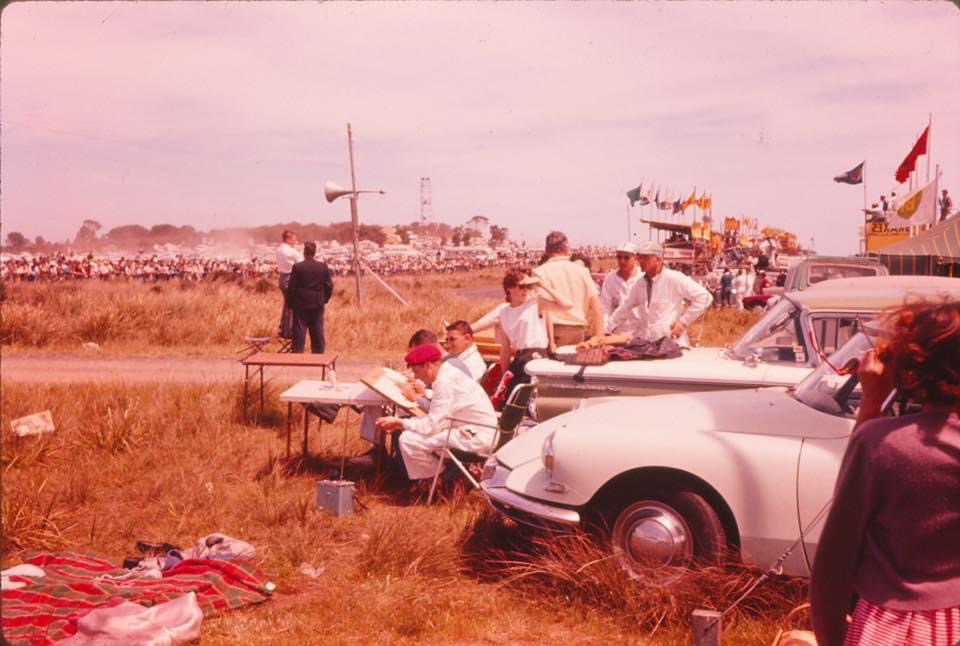
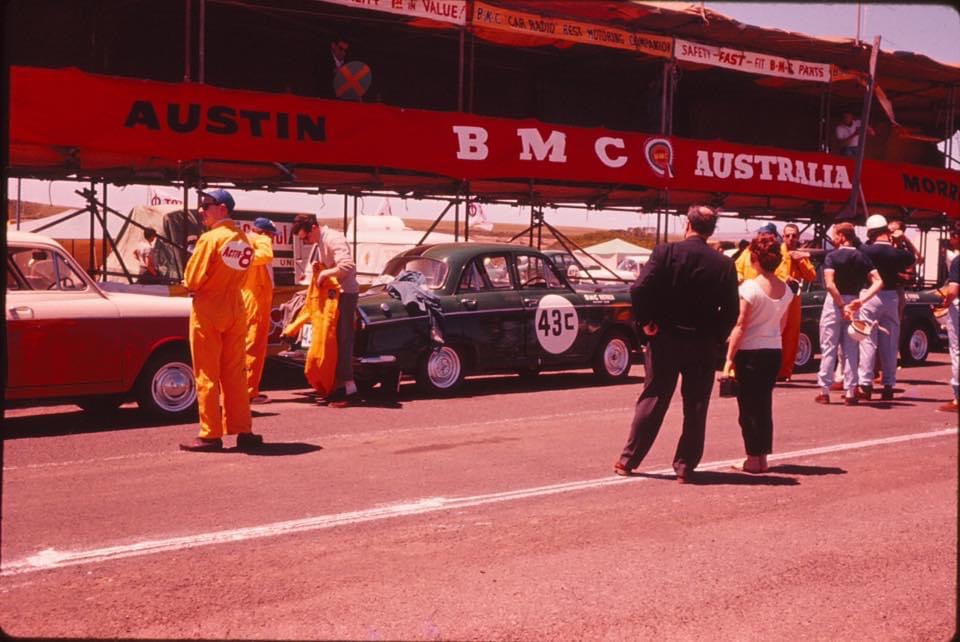
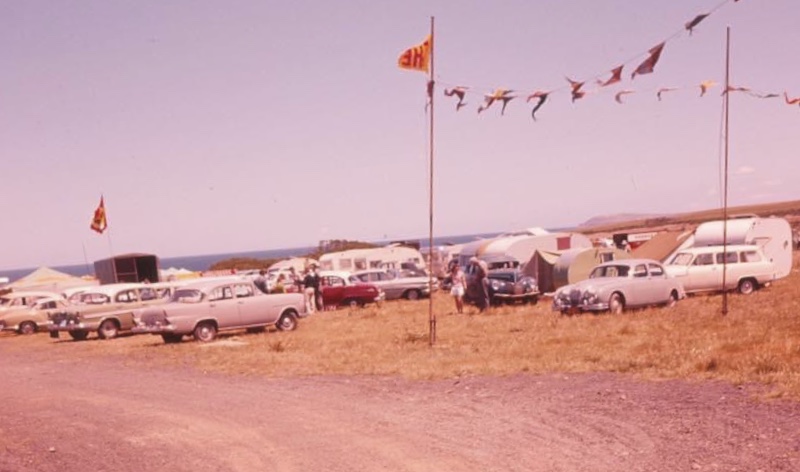
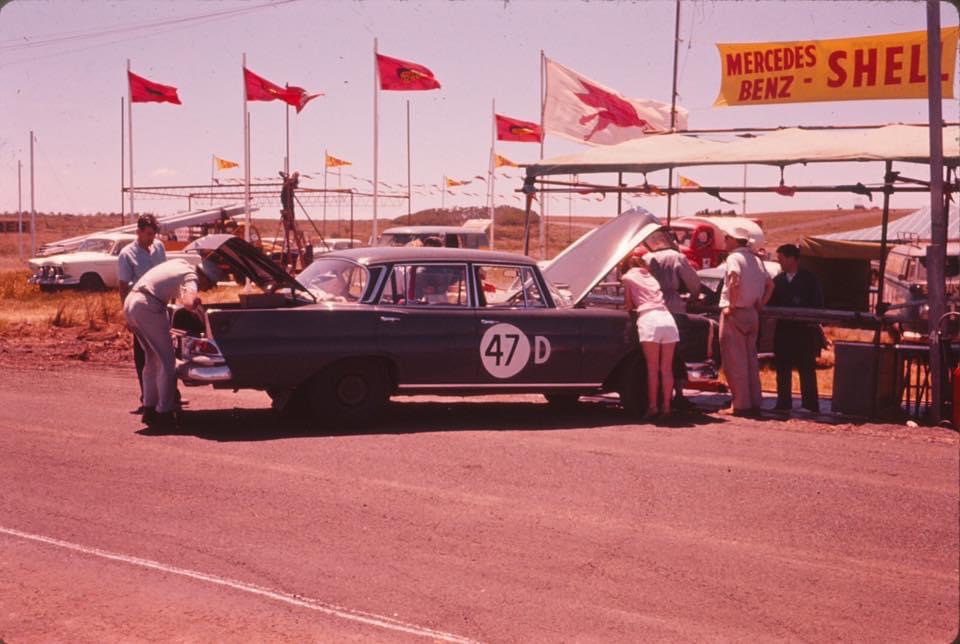
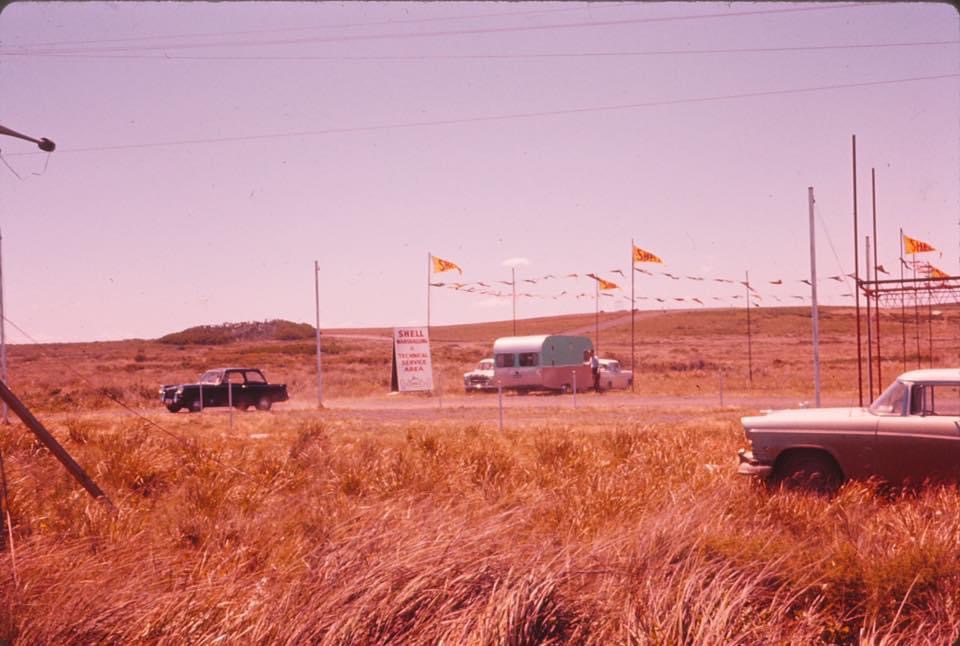
The Light Car Club of Australia ran the ‘Worlds Richest Production Saloon Car race’ – the Armstrong 500 – at Phillip Island on 20 November 1960…
The race soon morphed into the Bathurst 500 – I’m going to ignore sponsors names henceforth – but let’s give credit where it is due to the first commercial supporter of this iconic Australian classic.
Eligibility criteria extended to unmodified production cars manufactured or assembled in Australia. That may sound quite restrictive but in those days, with a nice tall tariff wall to protect the local industry, there was a broad entry of machines across capacity based classes, all chasing a total purse of £11,000.
(M Gallagher)
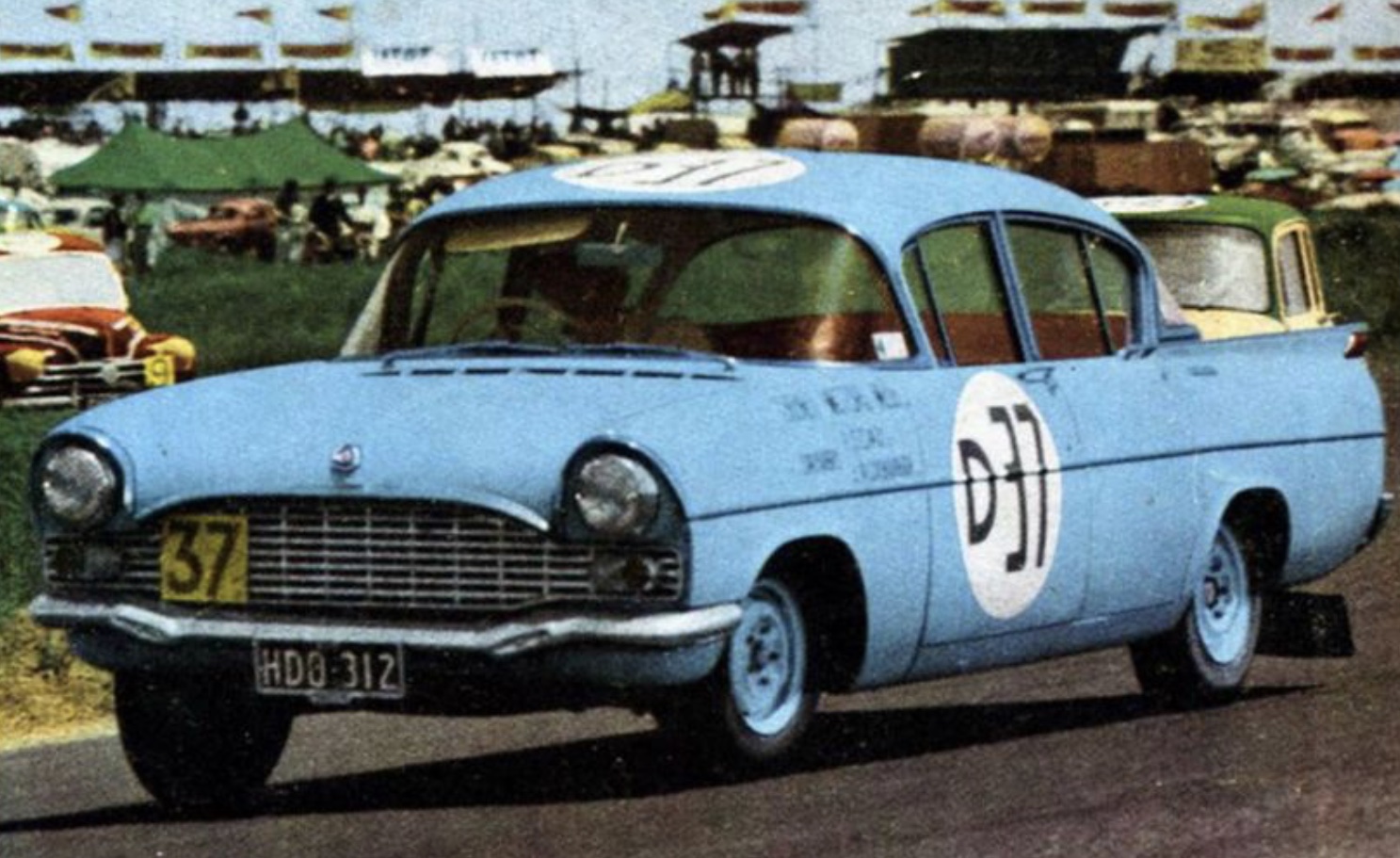
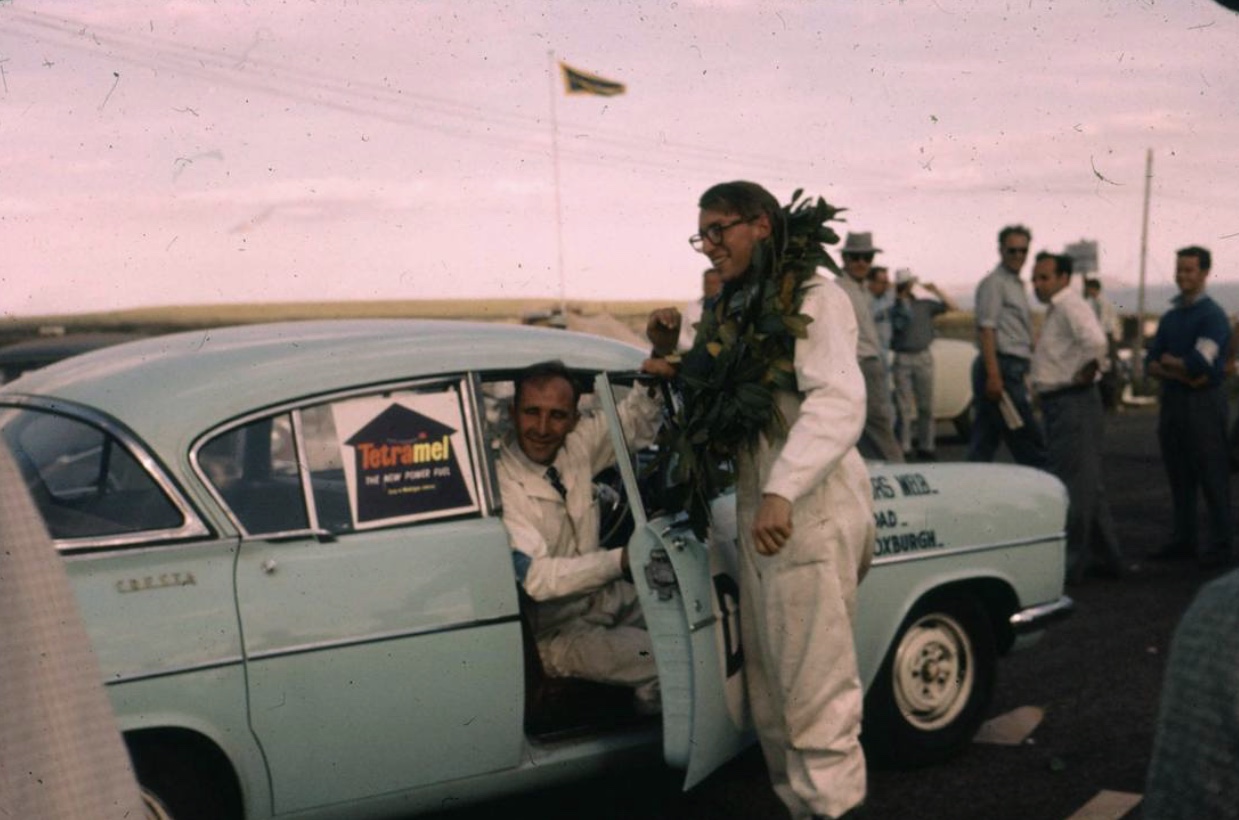
Whilst officially there was no outright victor, class placings were recognised only, as time has gone on, and as part of the ‘Great Race Bathurst Pantheon’ the first car/crew across the line in the early Philip Island events is recognised in the history books. That honour fell to Frank Coad and John Roxburgh in a Vauxhall Cresta in 1960.
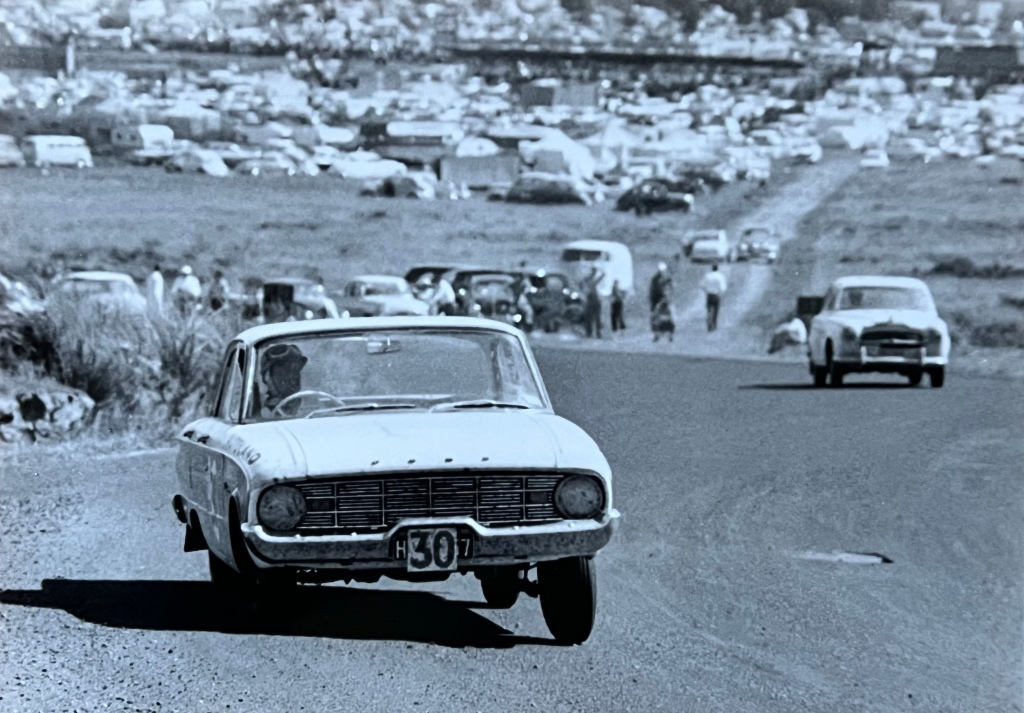
Class A, up to 750cc, was won by Doug Whiteford and Lex Davison in an NSU Prinz, other cars entered included Fiat 600 and Renault 750. Class B, up to 1300cc, was won by the Murray Galt and Bill Murray Sinca Aronde, there was plenty of variety in that mix including Ford Anglia, Renault Dauphine, Triumph Herald and VW Beetle.
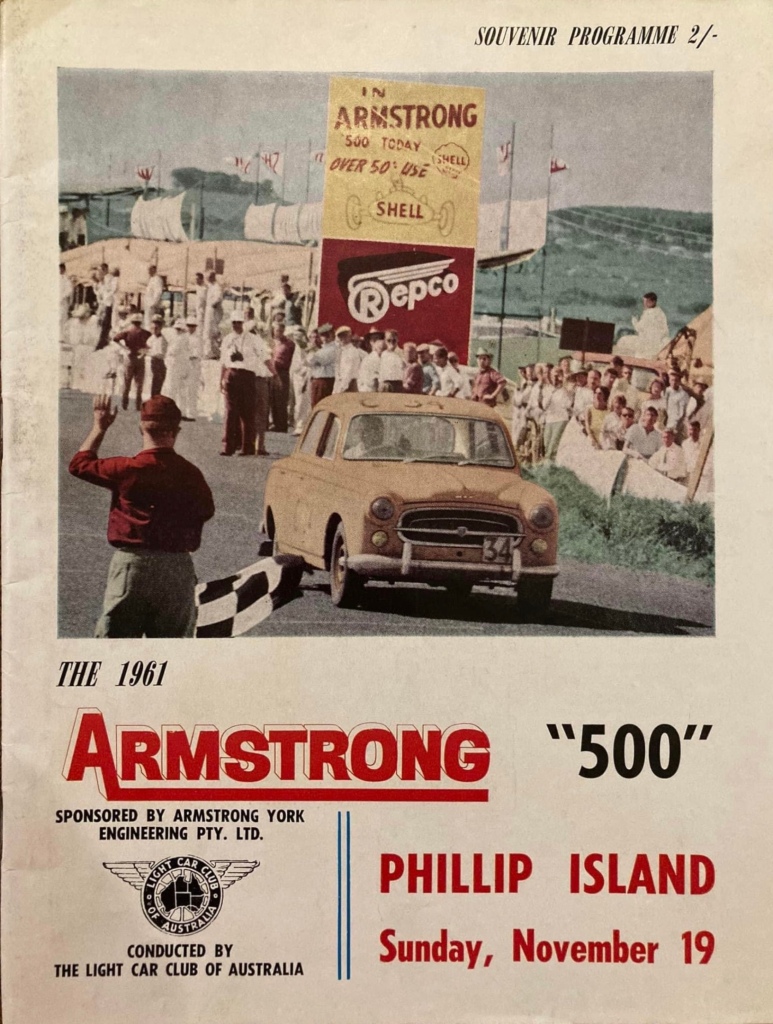
Class C, for under 2-litre cars included Austin Lancer, Hillman Minx, Morris Major and Singer Gazelle, and was won by the Geoff Russell/David Anderson/Tony Loxton, Peugeot 203. Many people to this day believe that car won outright. It’s claimed the trio finished the race in a quicker time than the feted Vauxhall crew, the argument arises due to the starting procedure which released each class at 30 second intervals, click here for the arguments: http://www.pccv.org/wp-content/uploads/2013/07/1stArmstrong500.pdf
The Coad/Roxburgh Vauxhall took the under 3.5-litre Class D ‘family car class’ which included the likes of the new Ford Falcon, Humber Super Snipe, MercedesBenz 220SE and Vanguard. Ray Gibbs and Murray Carter took Class E for over 3.5-litre cars in a big Ford Customline, no other vehicles ran in the big car class.
The Russell/Anderson/Loxton Peugeot 203 on the cover of the ‘61 programme(M Gallagher)(M Gallagher)
There was plenty of driver talent in the mix including Australian Grand Prix winners Lex Davison, Doug Whiteford and Bill Murray, and other well credentialed open wheeler racers Jim Gullan, Ern Seeliger, Arthur and Ken Wylie, Paul England, David McKay, Austin Miller and Bruce Walton.
Sportscar topliners included Bill Pitt, Ron Phillips, Murray Carter, Lou Molina and Bob Jane whilst established touring car racers were Harry Firth, Leo Geoghegan and Des West, prominent rally drivers Firth, Jack Murray, Eddie Perkins and Graham Hoinville.
There were a staggering number of up-and comers or future champions including Frank Kilfoyle, Greg Cusack, Peter Manton, Bob Holden, Brian Muir, Jim Smith, John Raeburn, Brian Foley, Norm Beechey, John French, Gavin and John Youl. Quite a list and almost all were in ‘works entries’ such was the level of industry support.
Lap scorers settle in for a long day (M Gallagher)The Bob Jane/Lou Molina – looks like Lou at the helm – Ford Falcon ahead of one of the Peugeot 403s (unattributed)The works Morris Major raced by Rod Murphy/John Callaway, sixth in C-class (M Gallagher)
The Phillip Island years ran from 1960 to 1962: Harry Firth and Bob Jane won in 1961 and 1962 aboard a Mercedes 220SE and Ford Falcon XL respectively. The ’62 race did irreparable damage to the road surface which could not cost-effectively be made good due to an inability to get the right road-making machine across the then narrow bridge between San Remo in ‘Australia’ and Newhaven on the ‘Peoples Republik of Phillip Island’..
For 1963 the first of the Bathurst 500s were held at Mount Panorama, a tradition which of course continues to this day as a 1000 km event of global interest.
(M Gallagher)
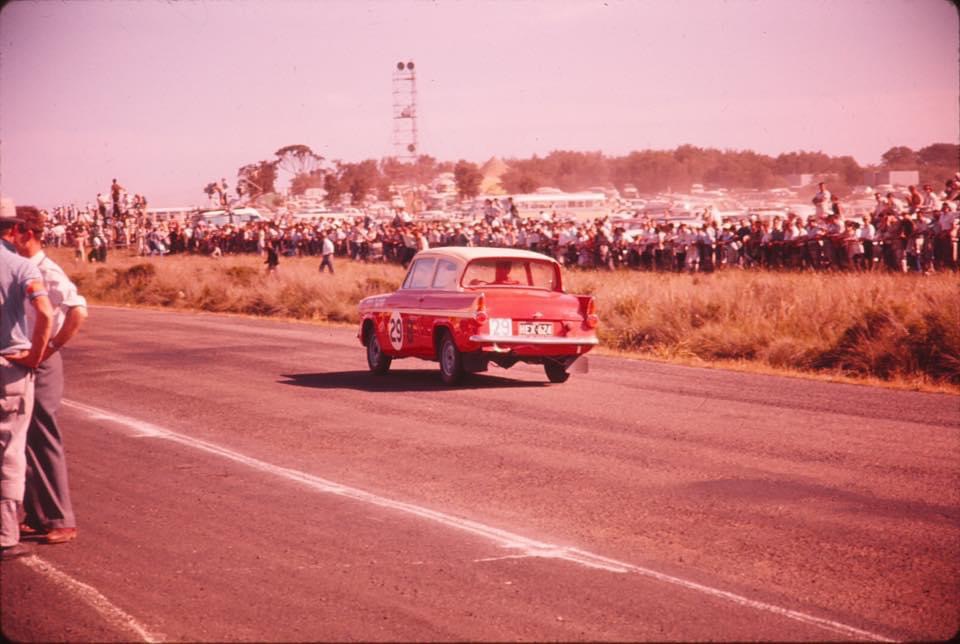
Eighth in Class B – 15 starters – the Bill Calder/John Ampt Ford Anglia.
Etcetera…
(F Fleming Collection)
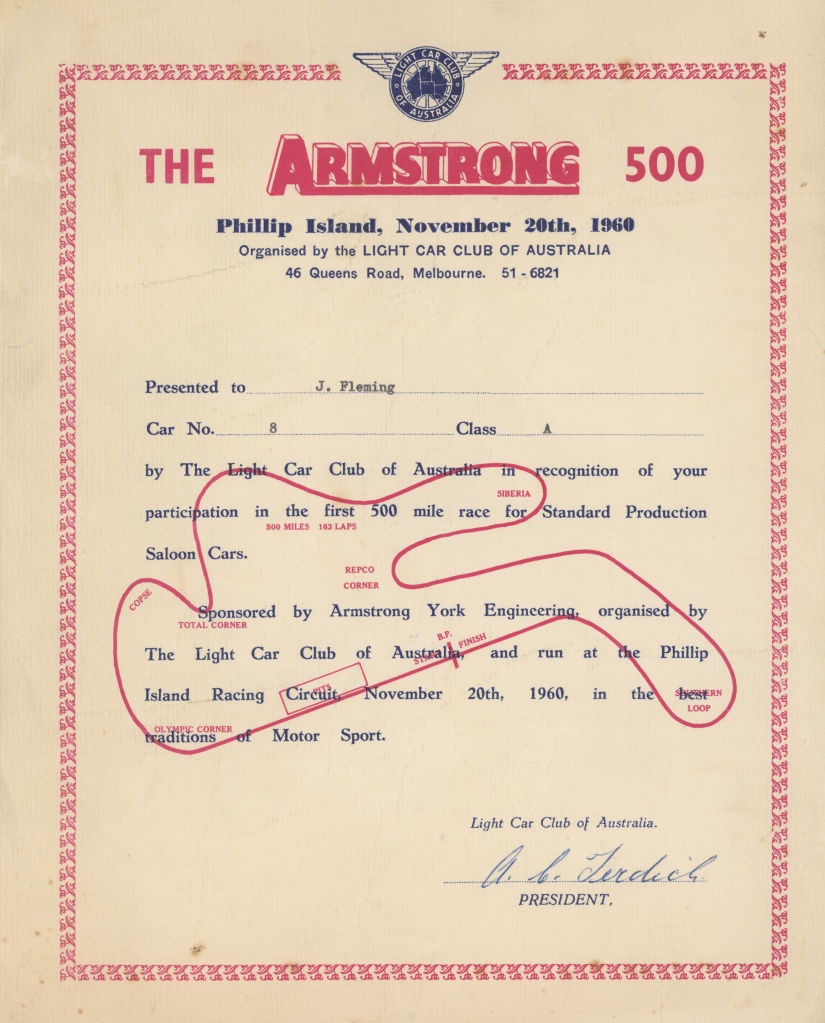
Noted Austin 7 builder/racer, the late John Fleming’s certificate of participation. Wonderful stuff thanks Tony Johns.
(M Gallagher)
The Youl Bros, Gavin and John, Smith Street Motors entered Mercedes Benz 220SE. DNF after 67 laps.
(M Gallagher)
View towards The Copse.
Etcetera…
Some comments from my old Formula Ford mate, Bob Morrow.
“I was at the 1960 Armstrong 500 and it was a great event. There was no outright winner but everyone knew who it was , however there was heaps of interest in the classes.
Interesting facts
1 Why no Holdens?
There was lots of private practice before the event and it was found that after 2 laps the Holden’ big ends were shot due to horrific oil surge. Apart from Armstrong shockers [obviously] and straight out exhausts so at least they sounded like racing cars, cars had to be absolutely bog-standard
2. If you had to work on the car in the first 100 miles you could only use the tools that came with the car when new.
Those were the days…”
Credits…
Martin Gallagher, Fiona Fleming Collection
Tailpiece…
One helluva garland for Frank Coad and John Roxburgh.
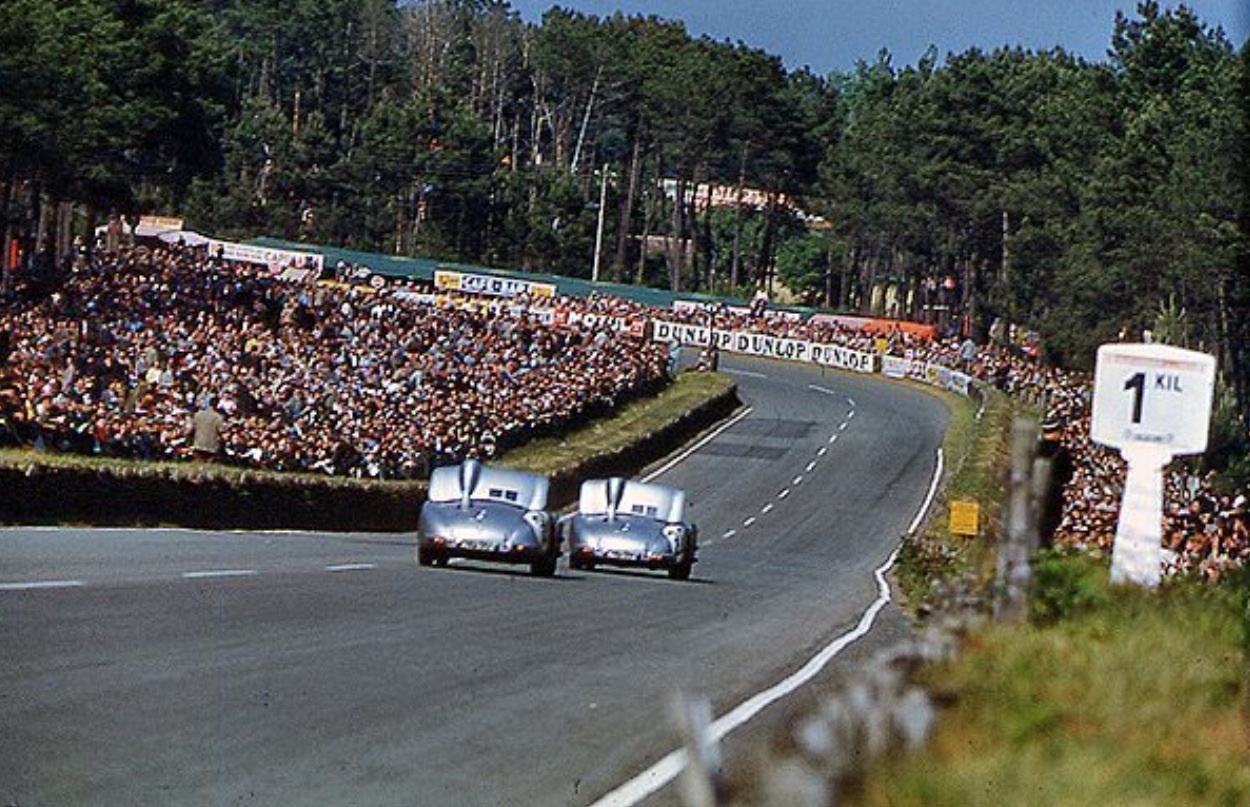
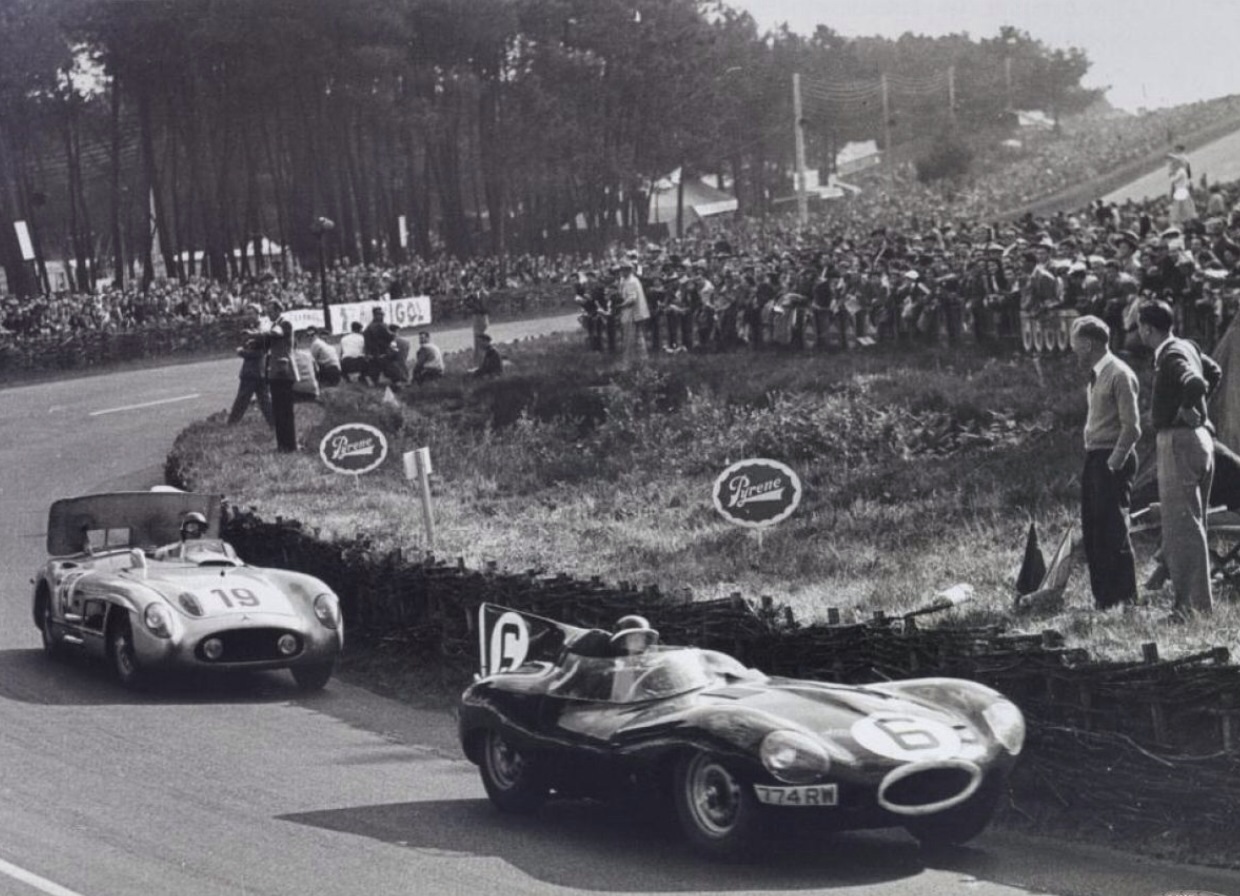
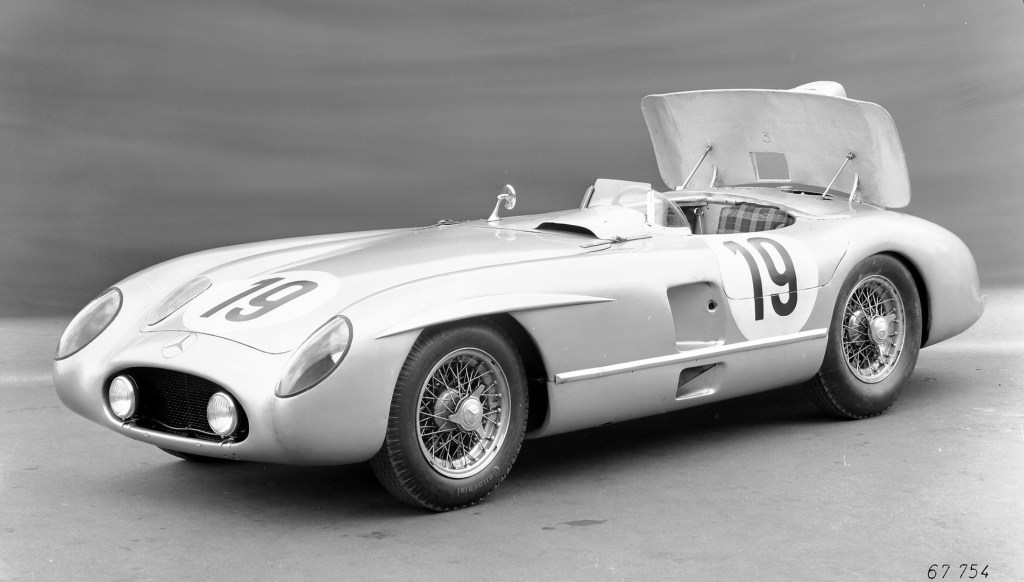
The somewhat other-worldly sight of two Mercedes Benz W196S/300SLR’s with air-brakes deployed as they approach the Esses at Le Mans in 1955…
When you consider the engineering of this clever response to the braking power of the Jaguar D-Type’s Dunlop brakes one can’t but wonder about the development of a German equivalent?!
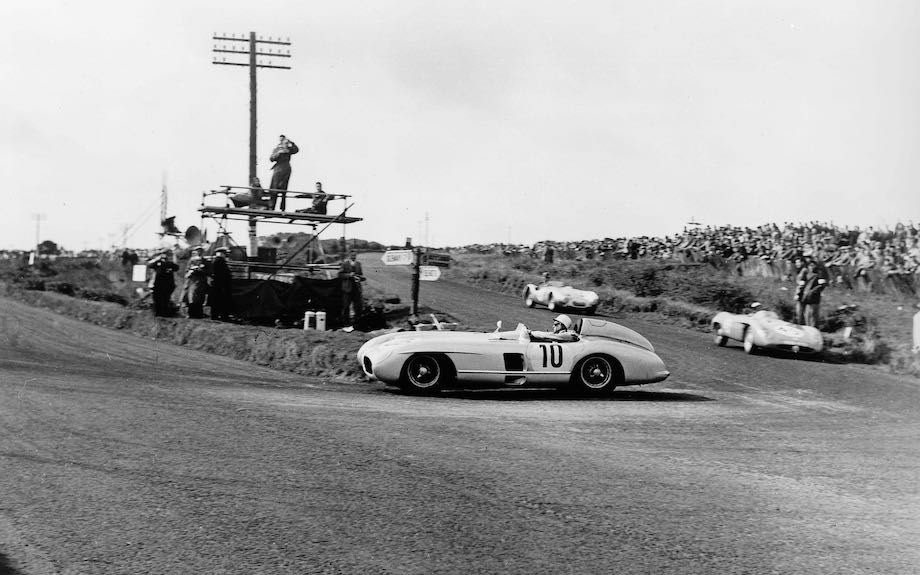
The Benz was the champion sportscar of 1955 winning most of the blue-riband events: Targa Florio, the Mille Miglia and the Tourist Trophy, the exception being Le Mans of course.
Mercedes withdrew whilst in the lead due to the accident in which Pierre Levegh was an innocent party, which took his life and that of about 84 spectators, not to forget the 180 folks who were injured.
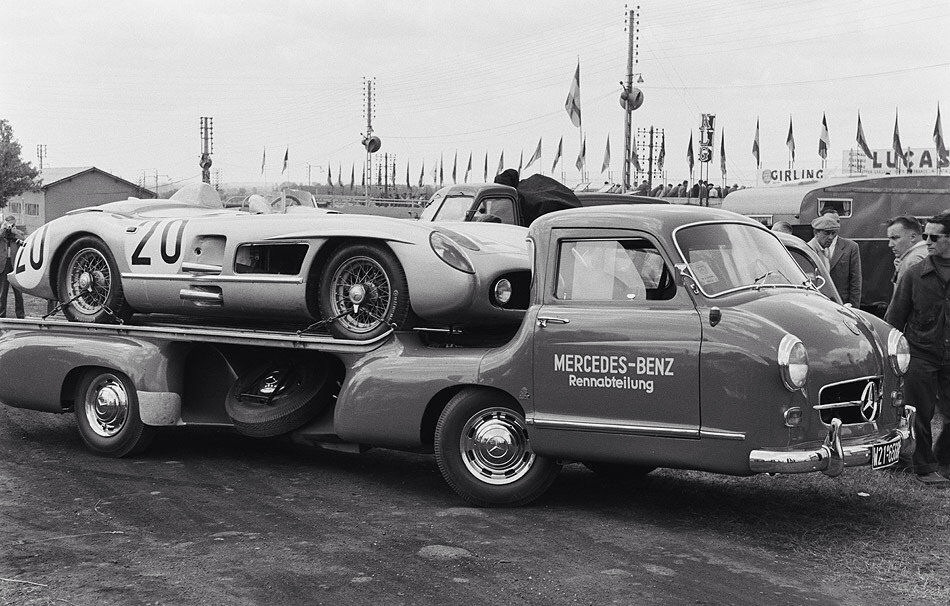
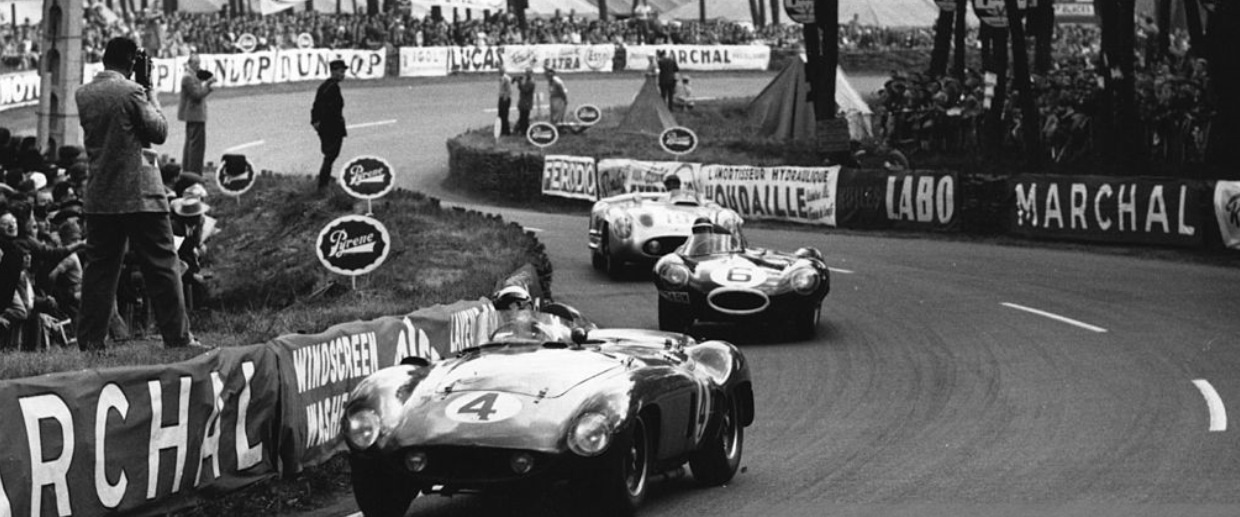
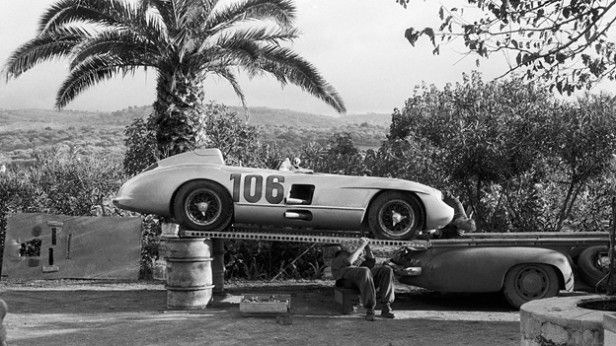
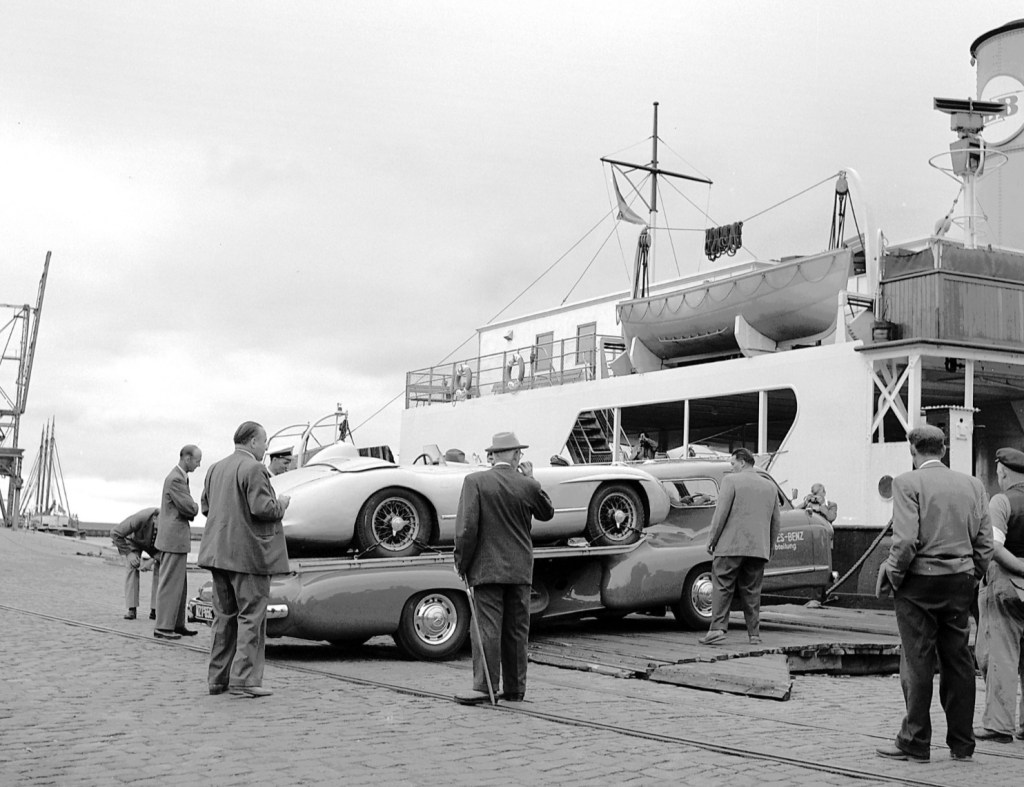
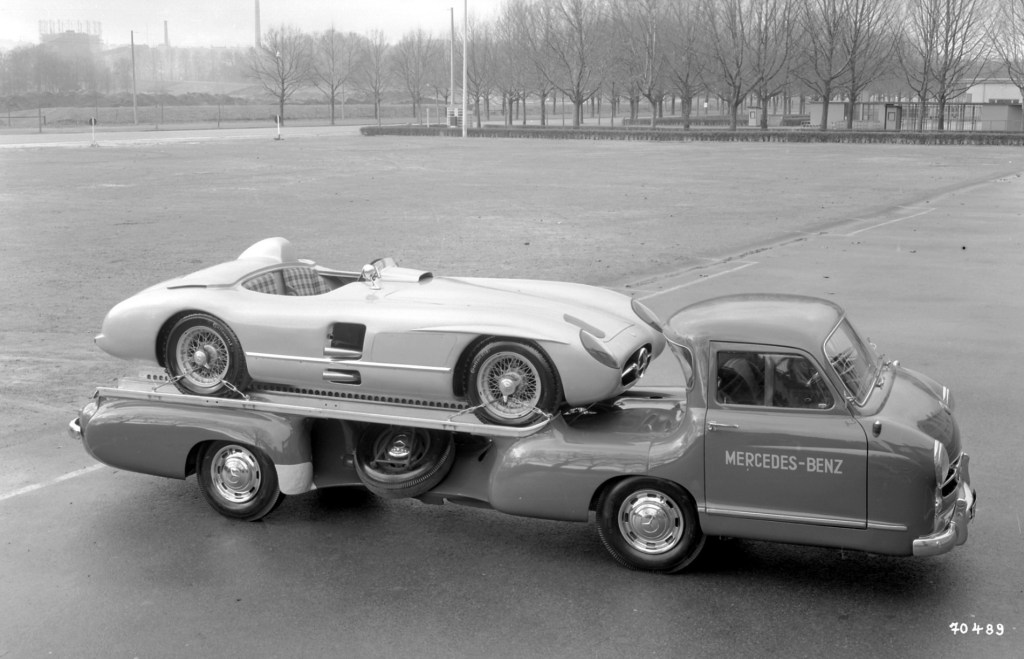
Built by Mercedes test department, this one-off 3-litre 192bhp 300SL powered 105mph race transporter, in Mercedes words “Was predestined to demoralise the opposition. If the racing car transported was that fast, even worse could be expected of the Silver Arrow on its platform.”(Mercedes Benz)Le Mans 1955. Hawthorn, Jaguar D-Type from Fangio early in the race, Dunlop Curves, note that Fangio’s air-brake is still deployed (unattributed)Le Mans 1955. Castellotti, Hawthorn, Fangio: Ferrari 121 LM DNF, Jag XKD first, Benz 300SLR entry withdrawn (Getty)
Design and construction…
In essence the W196S, as the factory model number suggests, “is basically a Type W196R Formula One racing car with a two-seater sports car body,” Mercedes Benz (mercedes-benz-publicarchive.com) wrote. The W196R won back to back drivers titles for Juan Manuel Fangio and Mercedes in 1954-55.
“The main technical difference is to found in the engine: the racing sports car, not being bound by the Formula One regulations, limiting the engines displacement (to 2.5-litres), is powered by a 3-litre version of the eight-cylinder in-line engine and features cylinder blocks made, not from steel, but from light alloy. Apart from this, the 300SLR was not powered by special methanol-based racing fuel but by premium petrol.”
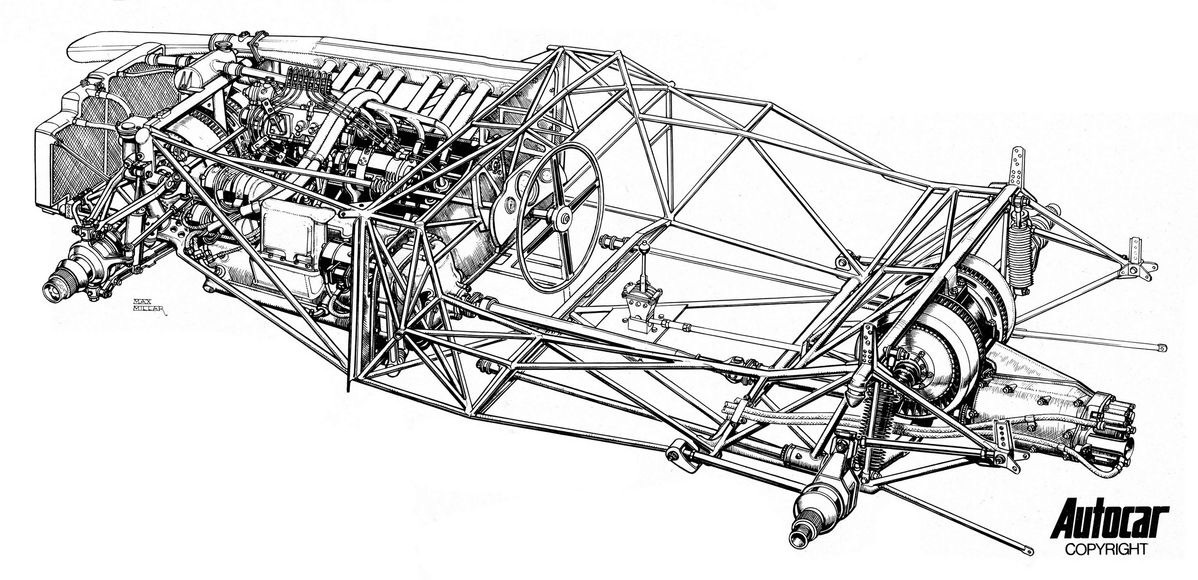
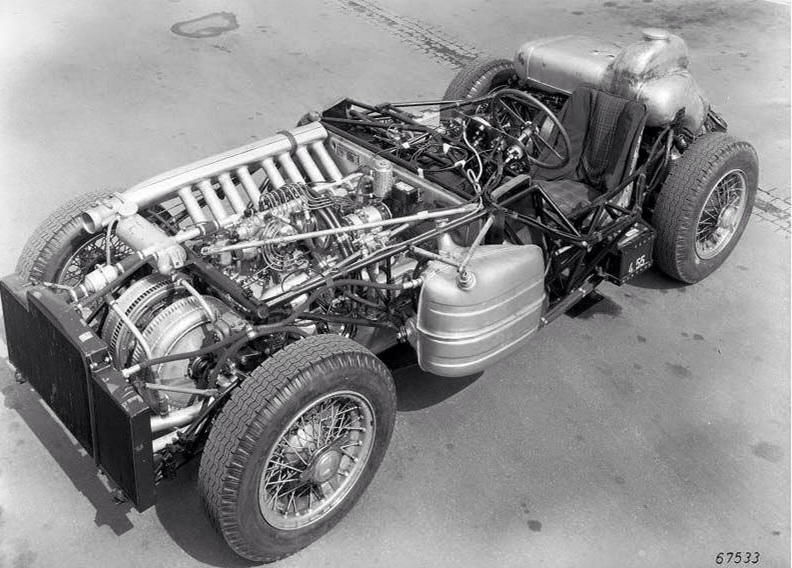
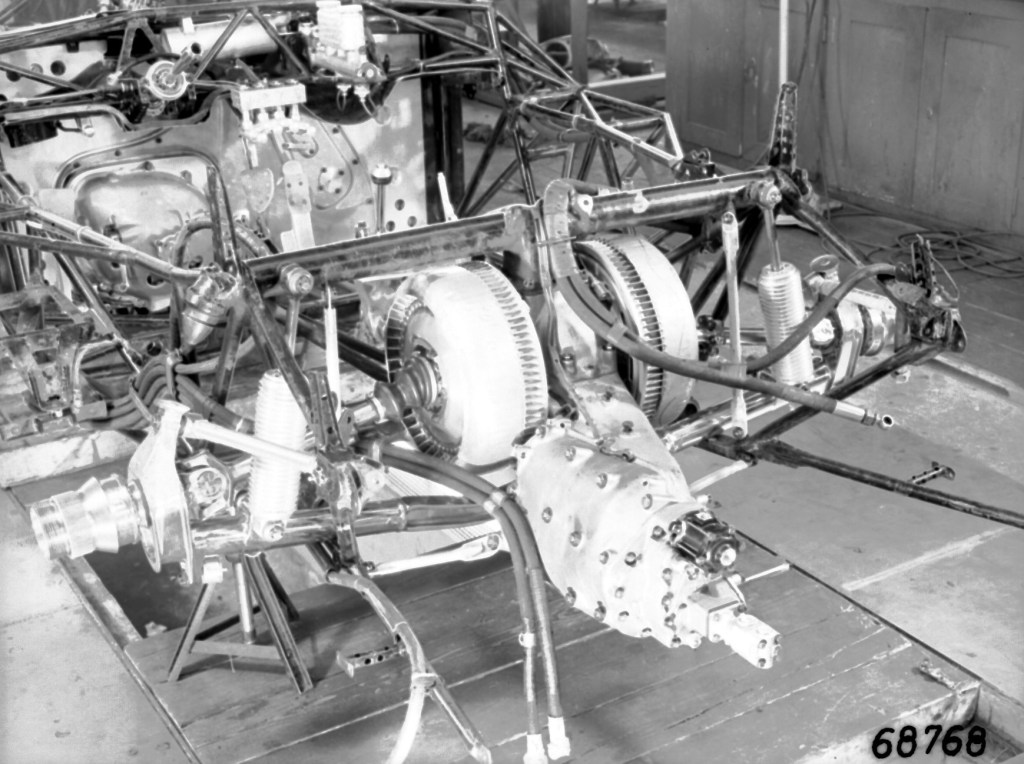
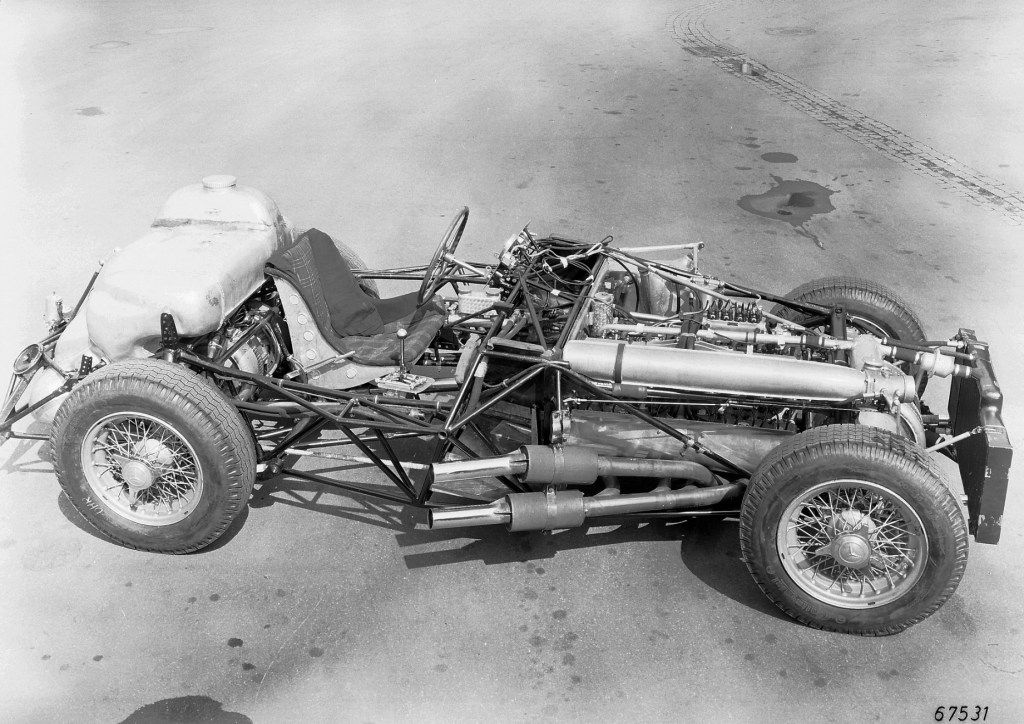
W196S cutaway with the multi-tubular spaceframe chassis and the disposition of major components: 3-litre straight-eight fuel injected engine, rear mounted transaxle and inboard drum brakes front and rear are clear (Autocar)(Mercedes Benz)
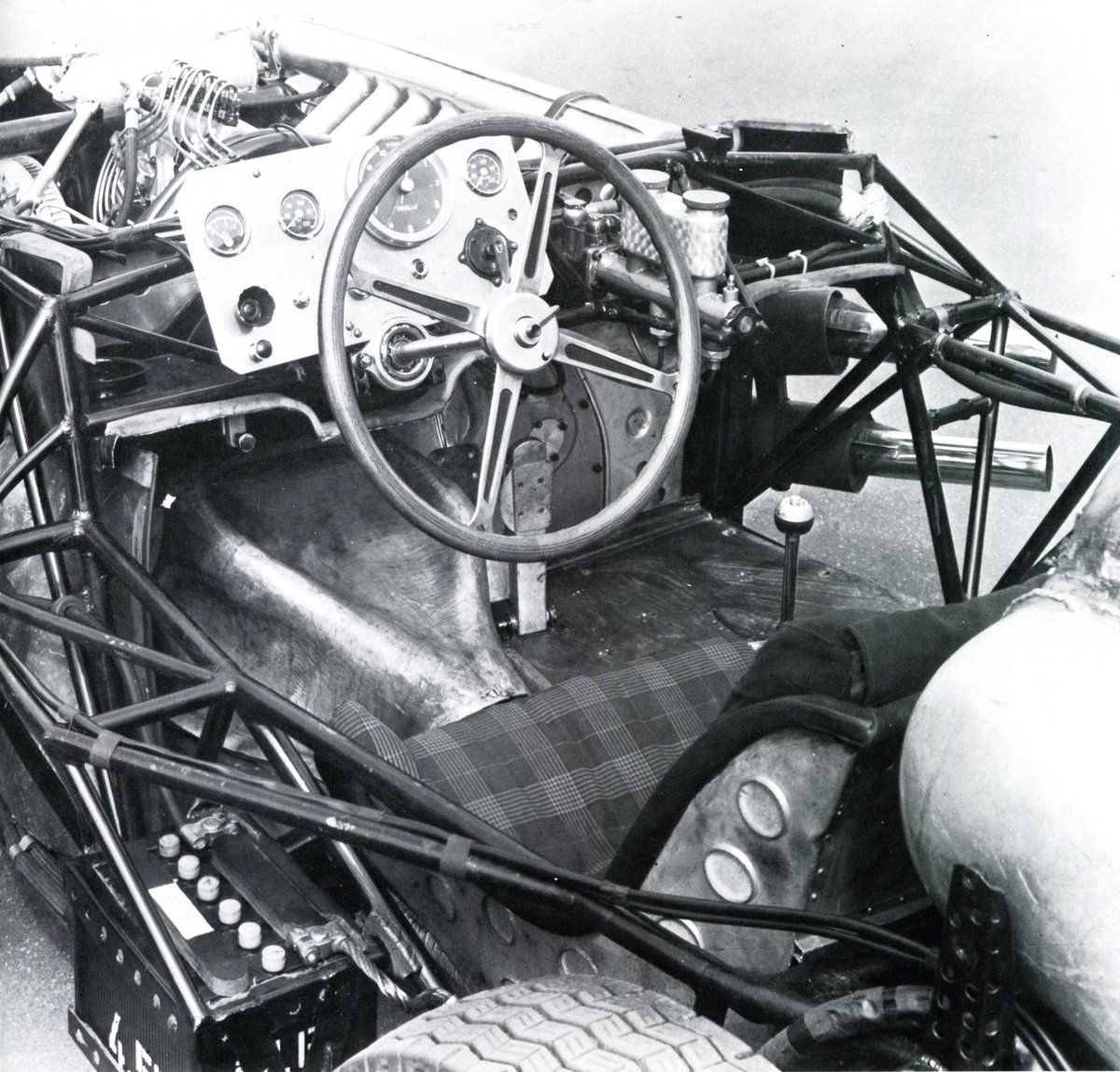
Key design elements of the car start with a multi-tubular steel spaceframe chassis. Suspension is by upper and lower wishbones at the front, torsion bars and dampers. At the rear are swing-axles, torsion bars with again telescopic dampers or shocks. Massive inboard drum brakes are used at both ends to stop the 701kg car in ready to race trim.
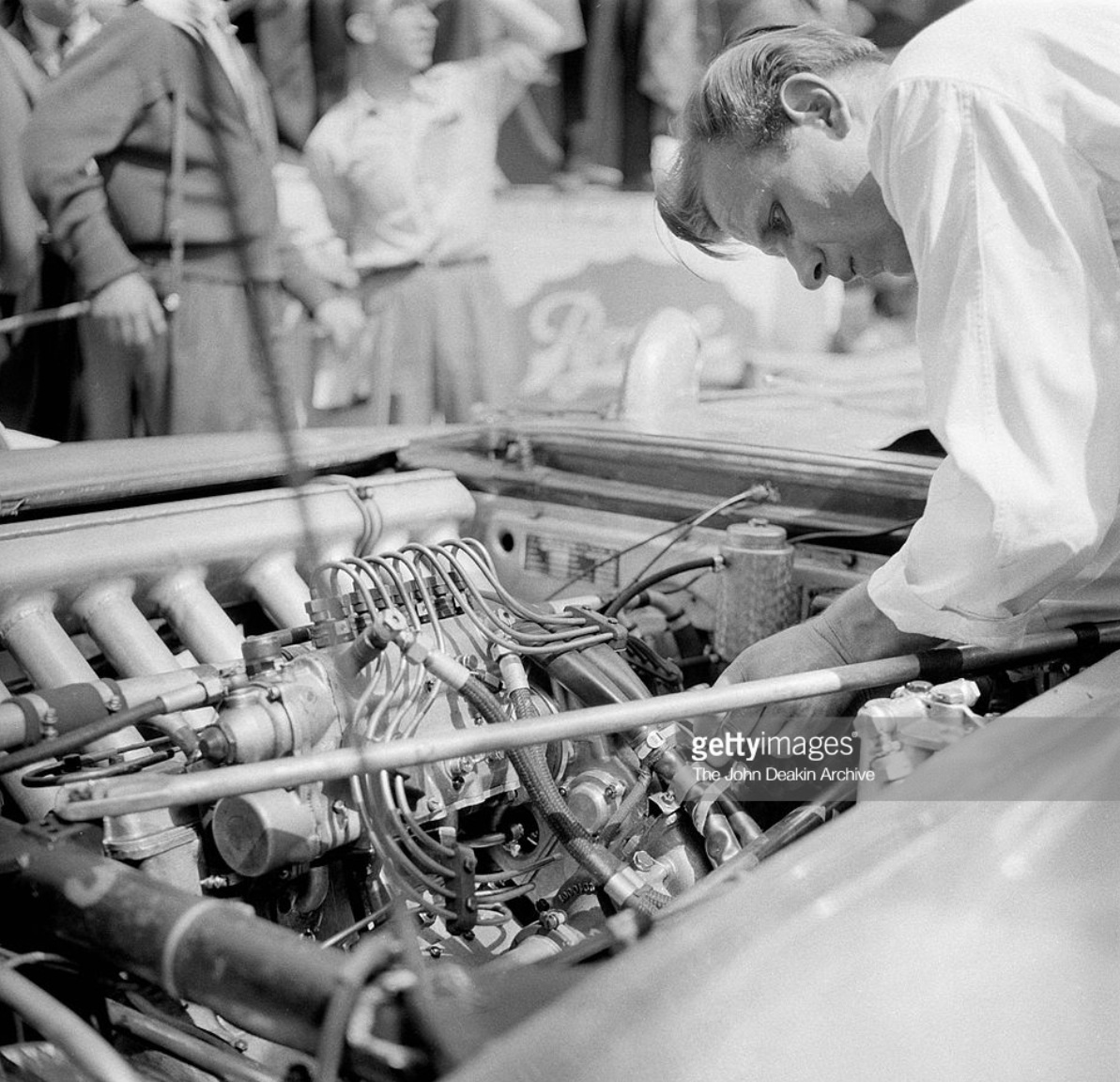
Le Mans 1955. The engine view is dominated by the Bosch direct-injection high pressure pump and inlets (Getty)
At the heart of the matter is the superbly built Mercedes straight-eight cylinder engine. Cast in two blocks of four-cylinders it runs on a pre-war style roller bearing crankshaft. Bosch provided the fuel injection, the two valves per cylinder of desmodromic actuation. The 3-litre engine produced circa 310 bhp @ 7400 rpm on ‘pump’ fuel as against the more exotic brew which fed its GP brother.
The full technical specifications of this car are at the end of the article.
A very famous photo I first saw in Automobile Year, Moss and Jenkinson, Mille Miglia 1955 (unattributed)
Race programme…
Mercedes didn’t attend the 23 January Buenos Aires 1000 Km first round of the Manufacturers Championship which was won by the Ferrari 375 Plus raced by Valiente/Ibanez. The Sebring 12 Hour was won by the Briggs Cunningham entered Jaguar XKD crewed by Mike Hawthorn and Phil Waters, again Mercedes missed the event held on 13 March.
The 300SLRs arrived with a bang in Italy with the Stirling Moss/Denis Jenkinson combination winning the Mille Miglia in front of Fangio driving solo in a sister car.
This win and all-time-record speed of 157.65km/h has been eulogised down the decades and needs no further comment from me. Seek out Denis Jenkinson’s account of the race in MotorSport, it is one of the great pieces of automotive race journalism.
Le Mans followed in June with the works Jag-Ds of Mike Hawthorn and Ivor Bueb completing the largest number of laps to cross the line in first position, after Mercedes Benz respectful withdrawal from the event whilst in the lead.
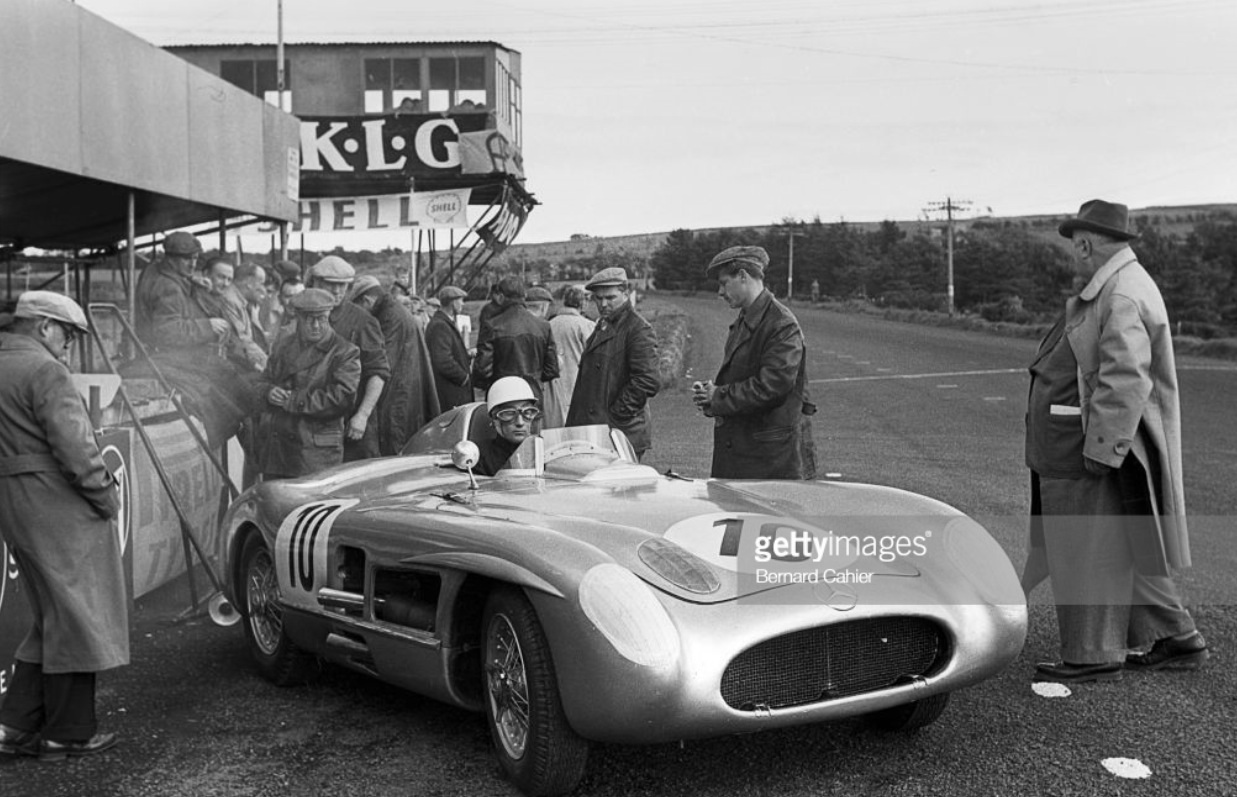
Moss, 300SLR, Dundrod 1955 with the unmistakable slender frame of Herr Neubauer at rightMoss, SLR winner of the TT at Dundrod 1955, the following cars folks? (unattributed)
Dundrod’s wild road circuit hosted the Tourist Trophy in mid September. The race started in warm weather which deteriorated to rain later in an event became an 300SLR rout: the Moss/John Fitch car won from the Fangio/Kling machine with the Von Trips/Simon/Kling machine third. The best placed Jag was the Hawthorn/Desmond Titterington car in fourth, albeit it wasn’t running at the finish.
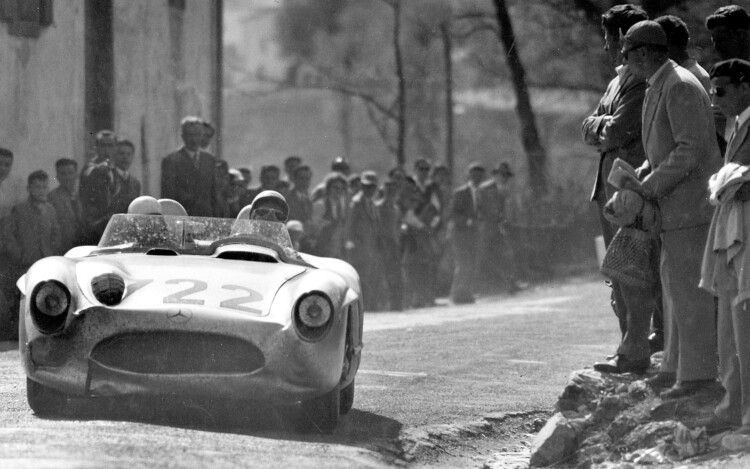
Targa Florio 1955, the Titterington/Fitch SLR gets s tickle before the off, typical Sicilian backdrop. The winner was the Moss/Peter Collins 300SLR (unattributed)
Targa Florio 1955, again Titterinton/Fitch fourth placed SLR from the third place Ferrari Monza 860 of Castellotti/Robert Manzon (unattributed)
The Germans again beat the Italians on home turf, taking the Targa Florio with a one-two from Ferrari on 16 October. The Moss/Peter Collins car finished ahead of Fangio/Kling with the best placed Ferrari the 860 Monza raced by Eugenio Castellotti and Robert Manzon.
Despite missing several events, Mercedes won the constructors championship by one point from Ferrari: 24 points to 23 with Jaguar in third on 16. The W196S won every single race it entered and finished…
The chassis is a light-weight multi-tubular spaceframe, front suspension comprised upper and lower wishbones, torsion bar springs and telescopic shocks. Those huge, light alloy finned drum brakes are mounted inboard and 300mm in diameter. Steering is worm-and-sector, the front tyres 6.00 x 16, the radiator is huge! The alloy oil tank is behind the right-front wheel, while the fuel tank sits high at the back, its capacity not specified by Mercedes.
The 234kg engine – type M196S – is eight-cylinders in line and inclined 53 degrees to the right in the chassis. The silumin head is cast in one piece: DOHC, two plugs per cylinder, two inclined valves per cylinder with desmodromic valve gear, compression ratio 9:1. Bosch 8-plunger injection pump,
Block – two Silumin blocks of four-cylinders each with chrome plated aluminium liners. Bore/stroke 78 x 78 mm, capacity 2982 cc. Crankshaft 10-bearing (roller bearings) Hirth-type crank with central power take off. Dry sump lubrication via a gear pump. Electricals are by Bosch: starter, generator and twin-magneto ignition.
The rear suspension comprises alloy uprights, a single-joint lower swing axle and top links, longitudinal torsion bar springs and telescopic shocks. The 275mm diameter brakes are inboard duplex light-alloy drums and air-cooled.
The transaxle is five-speed, a gate shift was used with a locking system
(Mercedes Benz)
The wheelbase is 2370mm, front track 1330mm, rear track 1380mm, the cars length 4300mm, its width 1740mm and height 1100mm and the “weight of the car in ready for operation status” is/was 901kg.
While the five gear ratios were fixed, the final drive was to choice with top sipped quoted as “over 300km/h.”over 300 km/h. Wheelbase, 2370 m, Front track,1330 mm, Rear track, 1380 mm, Length, 4300 mm, Width, 1740 mm, Height, 1100 mm, Weight, 901 kg ready to race, Fuel tank 265 litres, Engine weight, 234 kg
(Mercedes Benz)
Etcetera…
(Mercedes Benz)
You should take a trip to mercedes-benz-publicarchive.com some time, the quality of the racing content is unbelievable. I’ve added in some shots but these are just the tip of the iceberg, have a look for yourself.
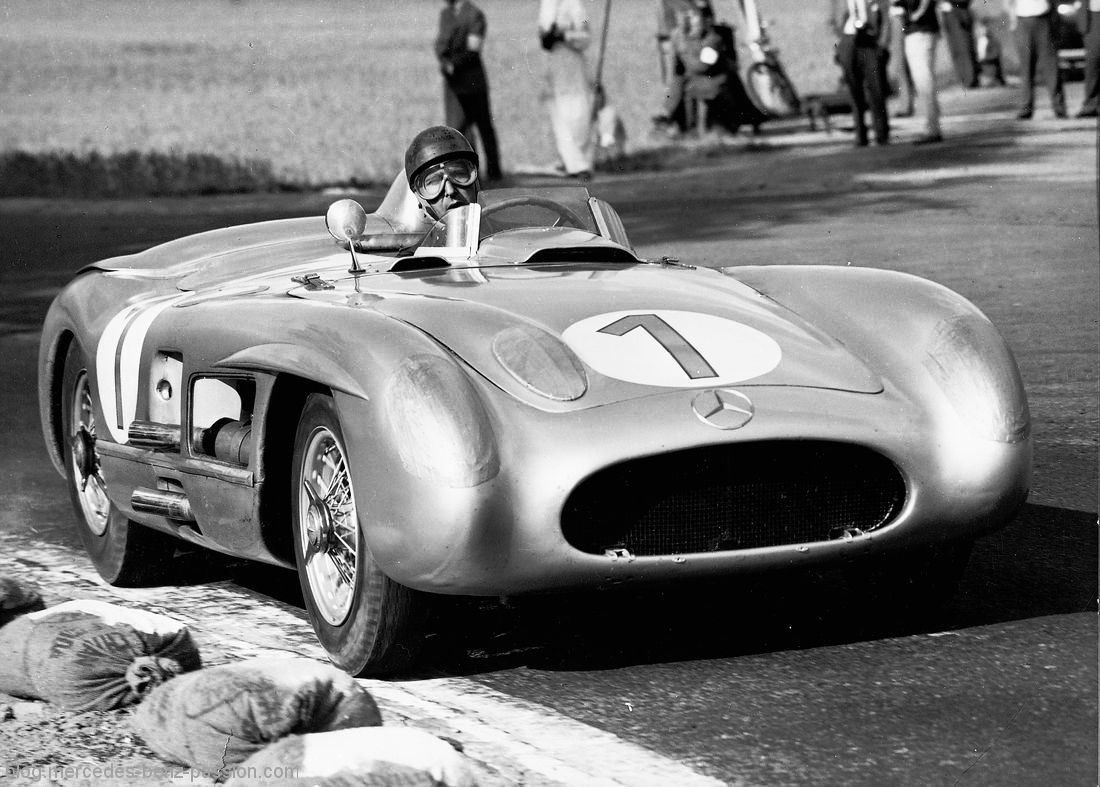
Top shot! Isn’t that machine such a cohesive, great looking, purposeful racing car…
JM Fangio on the way to winning the 209km Swedish GP held at Kristianstad on August 7, 1955. He won from Stirling Moss’ 300SLR and Eugenio Castellotti’s works-Ferrari 121 LM in 1 hr 18m 13.7sec.































 primotipo...