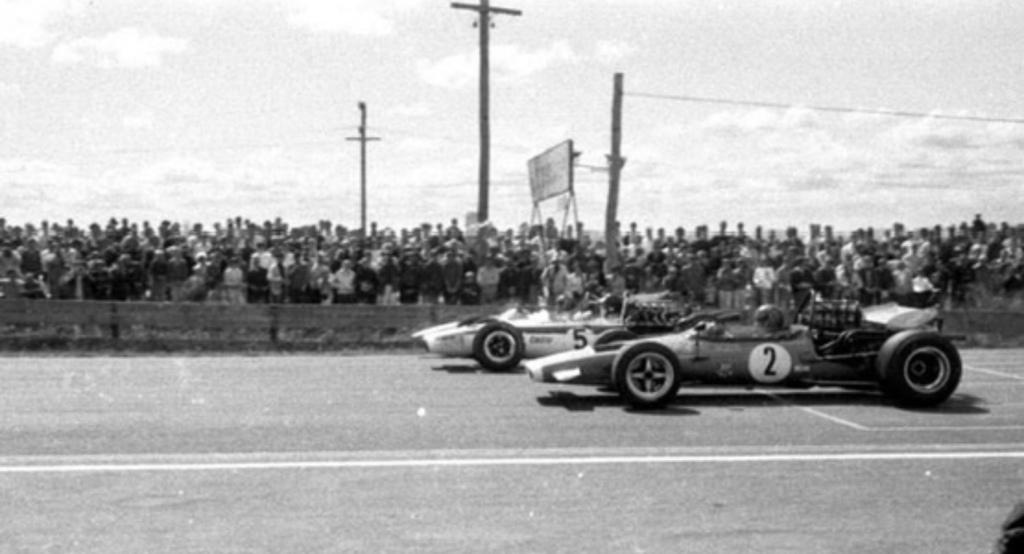
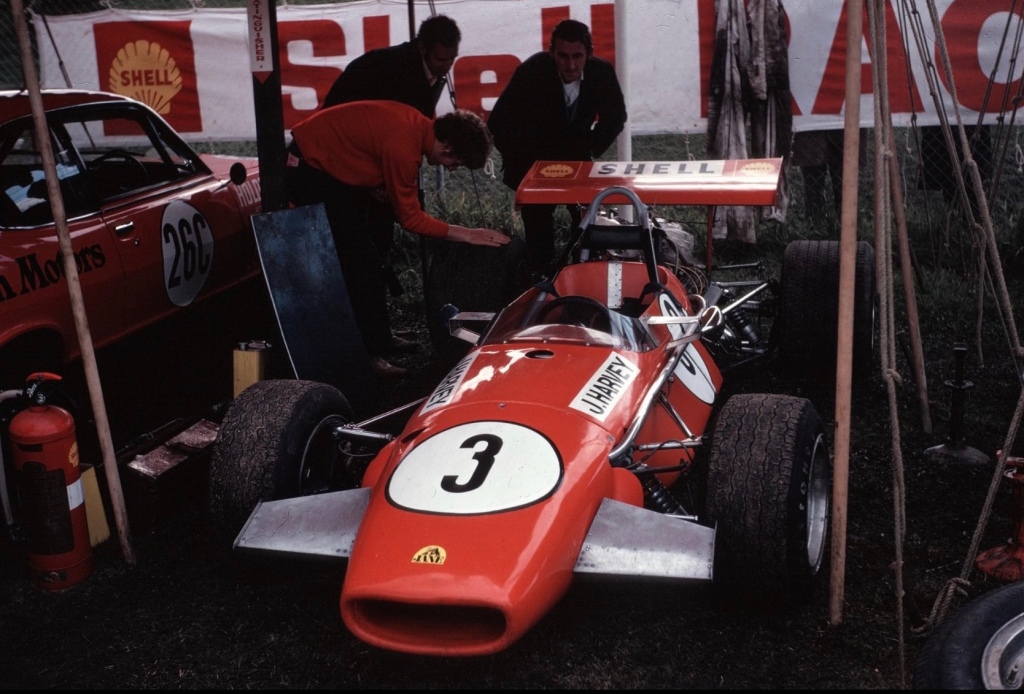
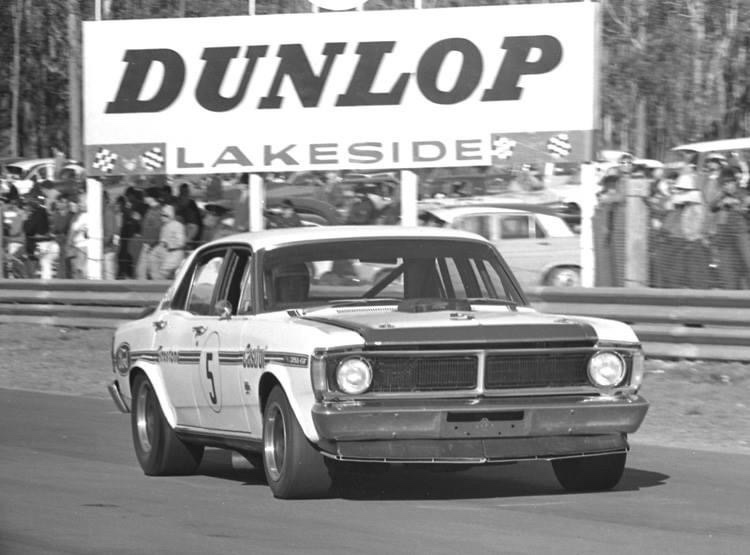
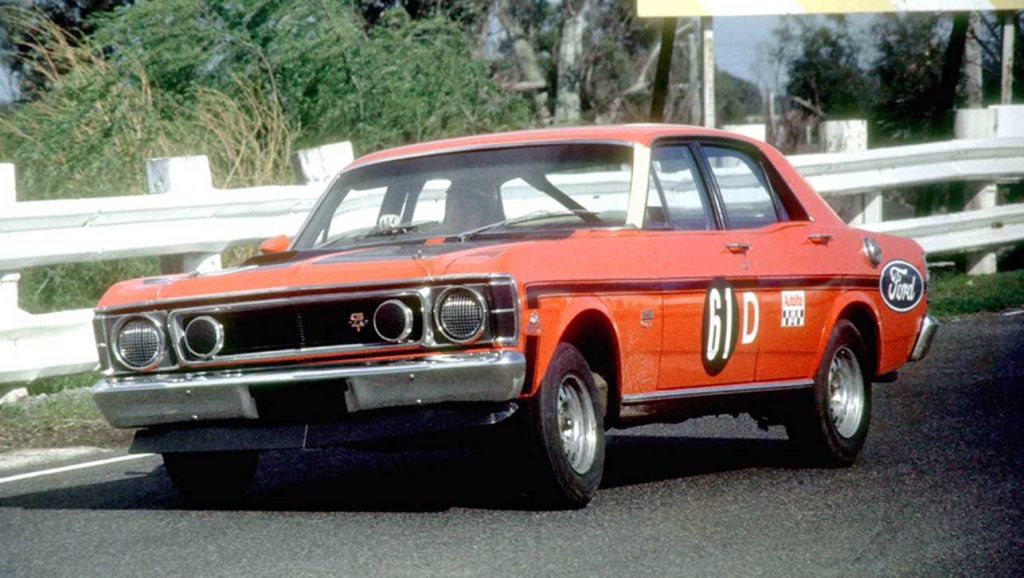
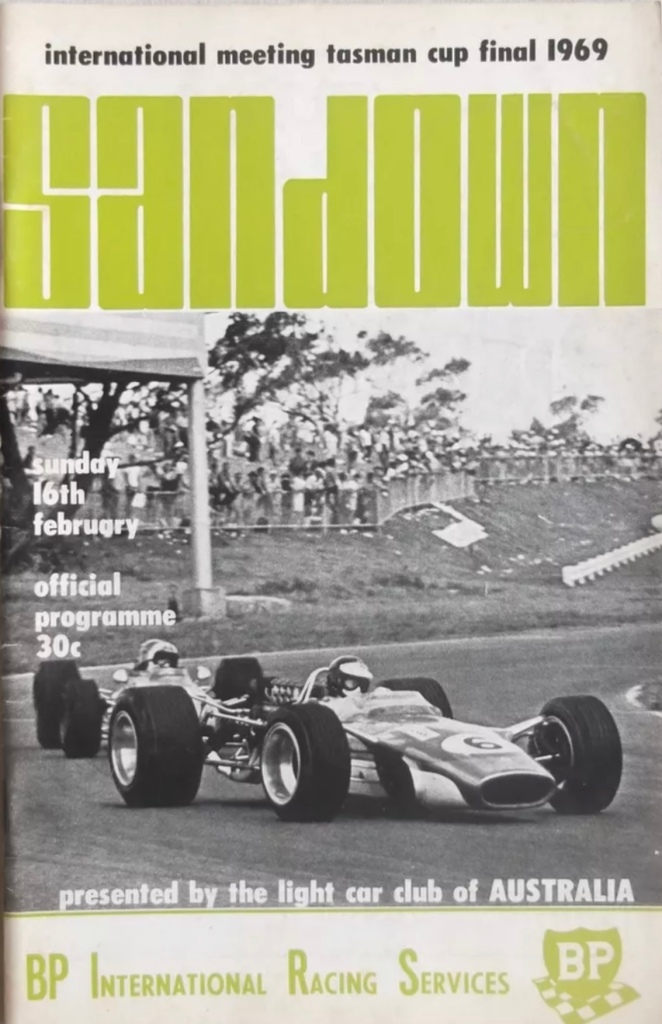
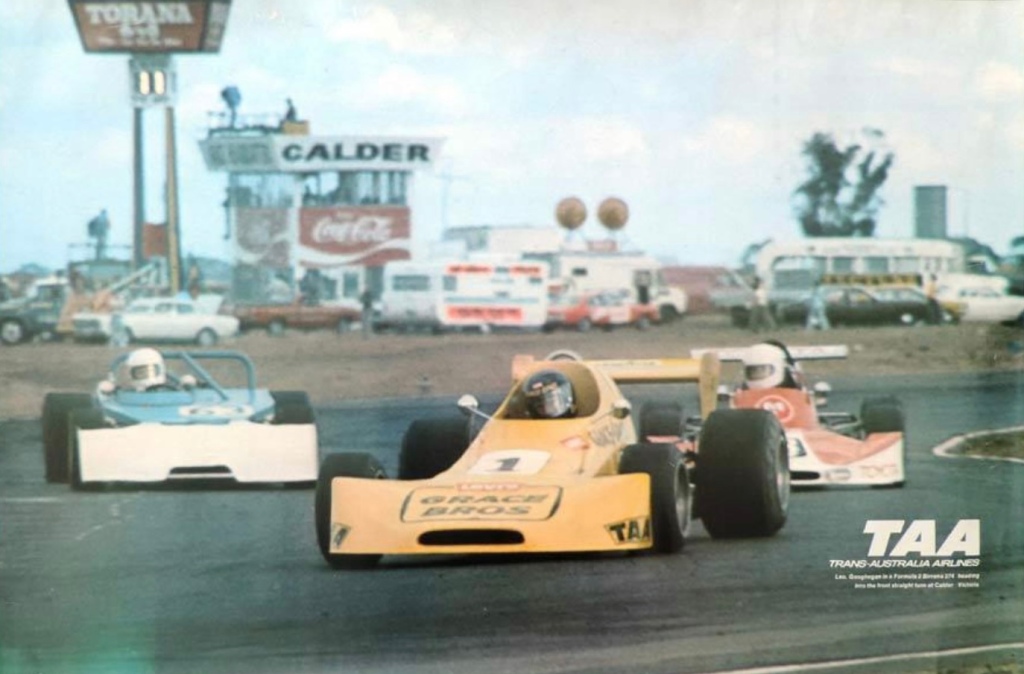
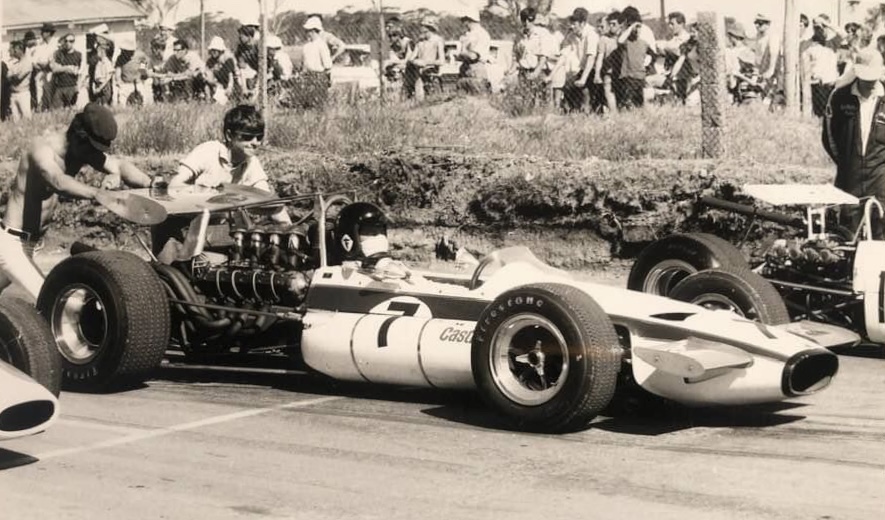
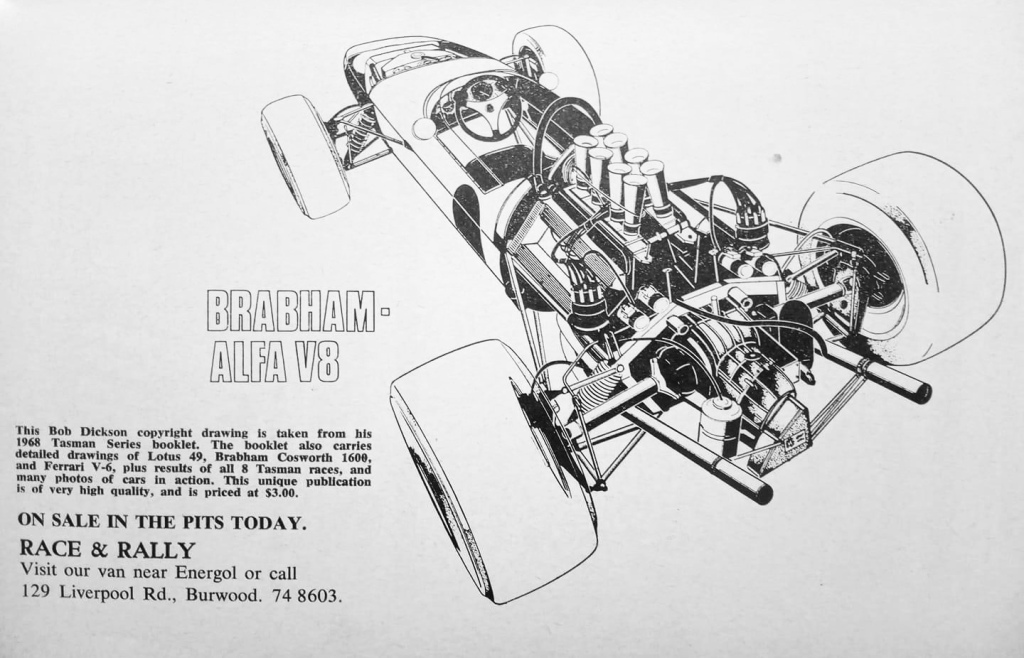
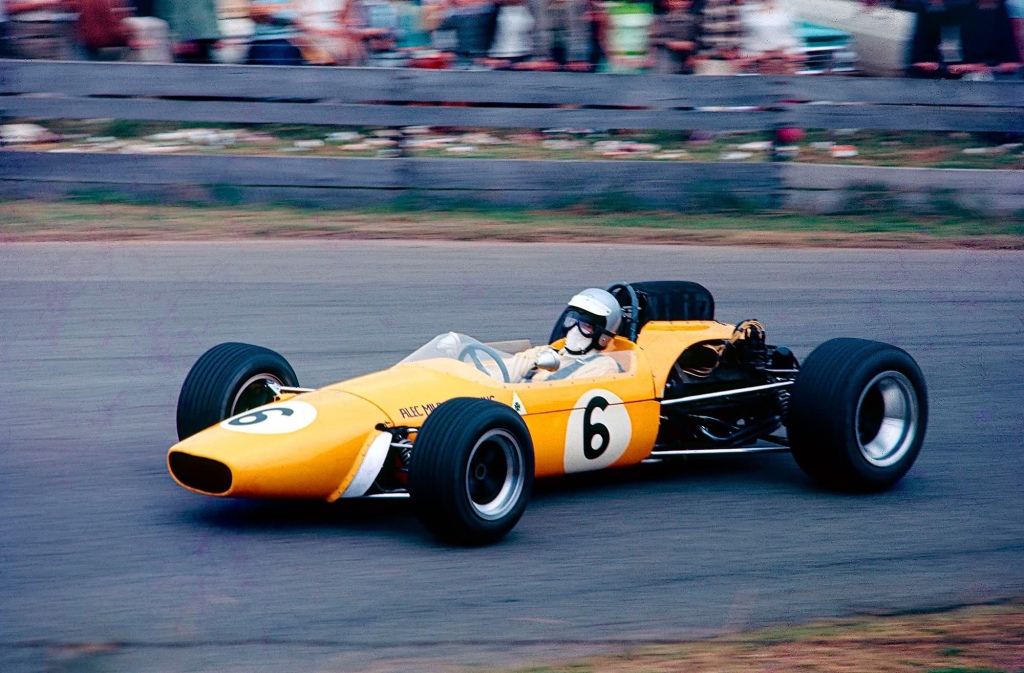
Frank Gardner’s Alec Mildren Racing Brabham BT23D Alfa Romeo 2.5 V8 passes the disinterested family of a flaggie – I’m thinking – during the February 1968 Warwick Farm 100 Tasman Cup round…
There is a lot to be said for being an all British Motor Corporation family, I learned to drive in Mumbo’s Morris 1100 and have always had a soft spot for the Land Crab! (Austin 1800). I’m sure the kids are busy with their Social Studies homework.
(R Donaldson-SLNSW)
We’ve done this meeting to death before, the shot above shows Gardner in front of Jack Brabham’s BT23E Repco, Denny Hulme’s Brabham BT23A Ford FVA and AN Other.
(R Donaldson-SLNSW)
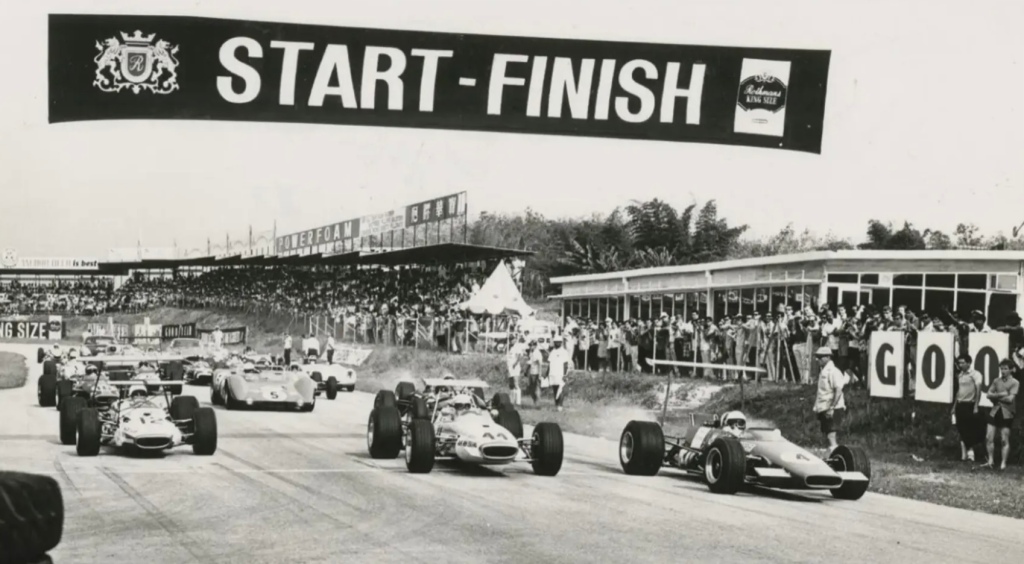
The race was won by Jim Clark from Graham Hill in the other works-Lotus 49 Ford DFW, then Piers Courage, McLaren M4A Ford FVA. The gaggle above, early in the race, shows Clark, Hill, Chris Amon, Ferrari 246T, Courage, largely obscured, then a gap to Gardner and Brabham.
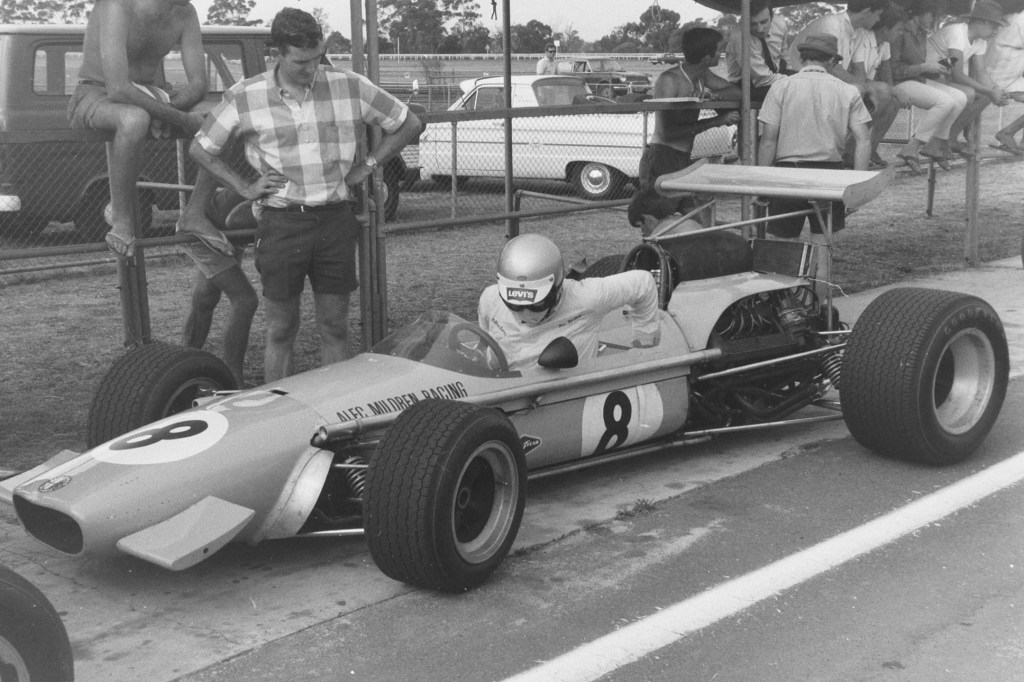
Here is a clearer shot of FG and the BT23D at Warwick Farm. It was a unique one-off BT23 variant ordered from Ron Tauranac by Sydney racer/Alfa dealer/team owner Alec Mildren to carry 2.5-litre variants of the engines fitted Alfa Romeo’s contemporary Tipo 33 V8 sports-racer.
I’m cheating though, this shot was taken on the car’s successful race debut in the Hordern Trophy, the final ’67 Gold Star round that December. See here for more on this car: https://primotipo.com/2021/07/06/mellow-yellow/
Credits…
Bob Donaldson-State Library of New South Wales, oldracephotos.com/Dick Simpson
Frank Matich with a smidge of the opposites, guides his Lotus 19B Climax through Mount Maunganui, Tauranga in New Zealand’s North Island on December 28, 1963.
This short-lived 2.9km road circuit hosted two Bay of Plenty Premier Road Race meetings in 1962-63.
Matich led the ’63 feature in his new Brabham BT7A Climax (below) before throttle problems intervened, but he had more luck in the sportscar support, winning from Barry Porter’s Lotus 15 Climax.
(B Ferrabee)
FM’s Lotus 19 and 19B were important aspects of his rise and rise as a driver. Both cars were extensively developed by he and his small Sydney based team, so too the Brabham BT7A which still served it up to the visiting internationals in their latest cars 12 months later. The saga of the Matich Lotuses is here: https://primotipo.com/2017/09/08/bay-of-plenty-road-race-and-the-frank-matich-lotus-19s/
(B Ferrabee)
Who said Denny Hulme was the only Kiwi who lived in bare-feet!?
The Matich Brabham in its Total colours in the Pukekohe paddock during the 1964 New Zealand Grand Prix weekend, a fortnight after the Mount Maunganui meeting.
During 15 championship (Gold Star and Tasman) outings in BT7A IC-1-63 between December 1963 and July 1965 Matich was always a front runner but rarely a finisher. Frank’s best placings were second in the 1965 Sandown Gold Star round, and thirds in the 1964 South Pacific Trophy at Longford, and the 1965 Warwick Farm 100.
That latter race is indicative of Matich’s place in the order of things at the time. He started from pole in front of Graham Hill, Jim Clark, Bruce McLaren, Jack Brabham and Frank Gardner in the year old car.
(unattributed)
The all-Brabham front row before the South Pacific Trophy at Longford on March 2, 1964.
Jack Brabham on pole in BT7A with the similarly equipped Matich on the outside, sandwiching Graham Hill’s BT4. Hill won from Bruce McLaren’s Cooper T70 and Matich all Climax FPF powered. Jack suffered differential failure on lap 22, while McLaren won the first, 1964 Tasman Cup.
Red Dawson, Pukekohe November 1966 (M Fistonic)
Kiwi racer Red Dawson was the next owner of IC-1-63 and raced the BT7A from December 1965 to January 1969. His best with it was a win in the 1966 Waimate 50 and second placings in the Gold Star round that year at Renwick and at the ‘69 Pukekohe Gold Star round. The car was rebuilt as a sportscar in 1970, perhaps one of the Kiwis can tell us about that. See here for Allen Browns summary of the two BT7As: https://www.oldracingcars.com/brabham/bt7a/
Red Dawson and fellow racer John Riley and BT7A Climax (K Buckley)
Credits…
Alan Boyle, Brian Ferrabee, Milan Fistonic, Lionel Walker, Ken Buckley, oldracingcars.com
Tailpiece…
(L Walker)
The race debut of BT7A #IC-1-63. Frank Matich during practice for the Hordern Trophy Gold Star round at Warwick Farm in December 1963. Signalling his intent, he started from pole but retired after a collision with reigning Gold Star Champion, Bib Stillwell’s Brabham BT4.
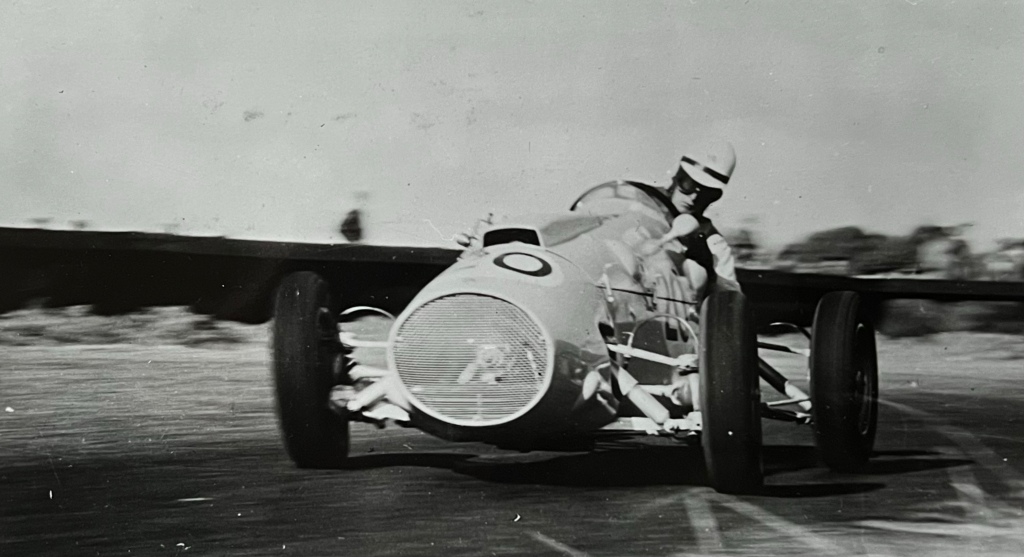
Charlie Dean’s Maybach 1 at Rob Roy in January 1949. The equipe behind is Micha Ravdell’s van and #38 Wyliecar Ford-A Special, still driven by its builder, Arthur Wylie. Number 9 on Maybach is a rego-disc (L Sims)
Even the contrarians amongst knowledgable Australian racing historians generally answer “the Maybach” when questioned about which racer was our greatest Australian Special.
It isn’t the Maybach though, but rather Maybachs – four of them – with no shortage of variants across the three chassis built. Whenever a photograph of a Maybach is uploaded onto social media there is always plenty of uninformed yibba-yabba about the specifications of the car in shot.
(Brian Caldersmith)Charlie Dean and the brave Jack Joyce aboard Maybach 1 at Rob Roy in November 1947. The body is still to come. Wild road car! (L Sims)
One of our friends, John Ballantyne, prompted this article which I assembled to address the lack of accessible, accurate information about the specifications of Maybachs 1-4.
What follows is a copy of the technical specifications and evolution of the Charlie Dean and Repco Research built Maybach 1 published in an article of the Australian Motor Sports Annual 1958-59. The author’s name isn’t cited, but I’ve credited the editor of the book, Mr John Goode. The other two chassis – three cars – Maybachs 2, 3 and 4 will follow in my next post.
The article is focussed on technical information, not race results: this one that does that best, ponderous as it is: https://primotipo.com/2014/12/26/stan-jones-australian-and-new-zealand-grand-prix-and-gold-star-winner/ I hadn’t planned many photographs, but, as usual, my enthusiasm got the better of me…the period Repco ads are a visual device to assist in splitting one evolution of Maybach 1 from the next.
The photo choices are mine, so too are the ‘Notes’ sections, albeit almost all of that information is sourced from the same AMS article. I’m taking as-read a general knowledge of Maybach, if you need a refresher, click on the links at the end of this piece.
Six years later (from the 1947 shot) Stan Jones bolts away from the Europeans to win the October 1953 Victoria Trophy at Fishermans Bend in Maybach 1 S3. Behind is Doug Whiteford’s Lago Talbot T26C, George Pearse’s Cooper Vincent, and to the right, Ted Gray aboard Alta 21S Ford. Lex Davison’s Alfa Romeo P3 is partially obscured behind Maybach (L Sims)John Fleming’s copy of The Argus report of the 1953 Victoria Trophy – the preceding shot
One final contextual word from Australia’s greatest motor racing historian, John Medley, about the Maybachs and their place in the Australian pantheon before we set off, quoted from the ’50 Year History of The Australian Grand Prix’, specifically John’s 1948 AGP chapter.
“HC (Horace Charles) Dean’s car, powered by a captured German scout-car engine, was little more than a year old, and had only been given a proper body in 1947: even so, in its brief career of trials, hillclimbs and sprints it had already attracted a lot of attention for its very willing performance and for its relatively advanced specification. It was, for example, one of just four runners in the 1948 AGP with independent front suspension, and of those four the Maybach was the only Australian special – the other three were factory-built cars of pre-war design: John Crouch’s Delahaye, Frank Pratt’s BMW, and Cec Warren’s Morgan.”
“The Maybach and Delahaye (135CS) actually had a lot in common, not least that both had been laid down not as pure racers, but as big-engined road cars with competition potential although another point which should not be overlooked is that both were essentially very conservative designs.”
“The significance of the Maybach was that it was Australian built, by a man at the centre of a small but talented team, and that the car had development potential – just how much was not realised at the time. Between 1948 and 1960, Maybachs in various forms were to contest eight AGPs and to lead – if sometimes only briefly – five of those races.”
Maybach 1 during June 1949, Charlie Dean and Jack Joyce on the way to FTD (D Stubbs)Maybach 1 during Rob Roy #16 in May 1948 (D Stubbs)
MAYBACH 1 (1946-1949)…
ENGINE: 6 cyl. inline single oh. camshaft. Bore and stroke: 90 × 100 mm. Capacity: 3,800 c.c., Compression ratio: 6.43 to 1. Output (initially on pool petrol: 69 octane) 100 B.H.P. at 3,000 г.p.m.
Single casting cast iron cylinder block and crankcase, with sump joint well below the crankshaft centre line. Crankshaft machined all over and fully counter balanced, running in eight white metal lined bearings, one between each crank throw and an extra one behind the camshaft drive pinion situated at rear end of crankshaft. Wet liners fitted to cylinder bores with lightweight balanced connecting rods and other reciprocating parts.
Single camshaft running in seven white metal bearings, opening valves by means of rocker arms fitted with eccentric bushes which could be rotated and locked to adjust valve clearances. Rockers had roller cam followers. Valves inclined at 65 degrees in hemispherical head and located on opposite sides. Helical timing gears with idler (originally compounded fabric, but replaced by steel).
Wet sump lubrication through filter with pressure fed oil supplied to centre main bearings, then to other caps, and through the crankshaft to big end bearings. Also fed to valve rocker shafts and camshaft bearings. Carburettors: Two marine Amal.
Charlie Dean and Maybach 1 during the January 26, 1948 AGP weekend at Point Cook RAAF Base just west of Melbourne. It was the cars first appearance with a body fitted, and painted white. DNF magneto failure on lap 12, the passenger decamped before the off. Note the Studebaker steel wheels at the front (AMS Review 1958-59) Maybach 1 at Rob Roy in May 1948. A swag of these sensational, uber-rare Dacre Stubbs’ shots appear to have been taken immediately after Maybach was repainted, in the front garden of Dean’s Kew, Melbourne, home. Six Amals at this point, in November 1947 there were two…(D Stubbs)(D Stubbs)
TRANSMISSION: Clutch: Fichtel and Sachs. Gearbox: Four speed crash type from a Fiat Model 525. Rear Axle: Lancia Lambda Series VIl in standard form.
CHASSIS: Frame: Tubular steel consisting of two parallel 4″ dia. steel tubes with independent suspension at the front (Dean’s own design) and conventional twin half elliptic springs at rear.
Suspension: Front Independent with transverse semi-elliptic spring and wishbones. Mainly 1937 Studebaker Commander parts. Steering: Cam and roller box (Marles) with two piece track rod.
Wheels and Brakes: Front: Studebaker bolt on pressed steel wheels with standard Studebaker brakes. Rear: Lancia centre lock 19″ dia. wIre wheels and brakes.
(D Stubbs)(D Stubbs)
BODY: Two seat from welded sections of aircraft belly tanks.
LATER MODIFICATIONS: Included 6 carburettors, reduction of weight achieved by new front end. Minerva brake drums fitted with specially fabricated shoes, and new cast steel liners, mounted on light steel backing plates. Centrelock wire wheels with adapted hubs to replace Studebaker wheels. Body frame lightened.
(D Stubbs)While all the one-liners down the decades credit Frank Hallam with the body, there is no way that’s correct. FH was apprenticed as a mechanic. Who built the body, it was clearly executed by a talented specialist, surely? (D Stubbs)(D Stubbs)
NOTES: The car’s engine came from a German half-track vehicle that had been captured during the Middle East campaign and shipped to Australia for technical study by the military. Dean acquired it from a wrecker. Built as a sportscar, Dean was cajoled into turning it into a racing car by George Wade, a Repco mechanic/engineer, after recording 100mph in a Vintage Sports Car Club trial. The body was constructed in time for the 1947 AGP at Point Cook using aircraft belly tanks cut and shut by Frank Hallam, another Repco employee – so the story goes.
Cockpit shot shows the car was a ‘reasonably generous’ biposto in early spec. Twin-tube frame chassis, note diagonal bracing of the forward driver bulkhead. Revs, oil pressure and water temperature at a guess. Attractive – ahem – steering wheel, what is it off? (D Stubbs)Neat remote shift – and locating stays to ensure easy accurate changes – to modified four speed Fiat 525 gearbox (D Stubbs)(AMS Annual 1958-59)Dean in Maybach 1 S2 competing in the Mornington Motor Races at the Balcombe army training base on Melbourne’s Mornington Peninsula in June 1950 (D Stubbs)
MAYBACH 1 Series 2 (1949 -1950/1)…
Basically the same two seater sports/racing body and chassis with the following changes made from the original car.
ENGINE: 4.2-litre Maybach adapted to take developed parts from 3.8-litre original. Reground camshaft and special new main bearings. Original lead bronze bearings retained for big ends.
Supercharger: Ex G.M. diesel Roots type with three lobe rotors, mounted beside the motor driven by triple V-belts from the crankshaft nose; output 7 lb/sq. inch. Carburettor: Originally Claudel Hobson aircraft type replaced by Bendix-Stromberg aircraft type. Cooling System: Later sealed at blow off pressure of 4 p.s.i. Magneto: Adapted V-12 type but burnt out, subsequently Lucas.
TRANSMISSION: Differential: American Power Lock (1922 vintage truck) limited slip type fitted in modified Lancia housing.
CHASSIS: Rear Brakes: Special drums of original design using two leading shoes hydraulic system but replaced with leading trailing shoe hydraulics.
When Charlie Dean obliged Dacre Stubbs for the undated The Age (I think) article below he didn’t take Maybach 1 S2 too far, this shot is at the Willsmere Mental Institution in Kew. I grew up closeby, there were many occasions when Dad threatened to take us kids to The Nuthouse, as he sensitively referred to the place, when we misbehaved…(D Stubbs)(J Fleming Collection)Maybach 1 S2 at Rob Roy in June 1949 when Dean and Joyce bagged FTD. Wylie A-Ford Spl behind (L Sims)(AMS Annual 1958-59)Stan’s muscle-shirts were famous, here during the 1953 AGP at Albert Park. DNF with a variety of problems while leading in Maybach 1 S3 (S Griffiths)
MAYBACH I Series 3 (1951 – Early 1954)…
Fundamentally similar in appearance to the two previous models, still a two seater but with suspension changes, three feet of rear chassis rails removed.
Modifications listed in order of introduction:
June 1950 – April 1951
Front suspension rebuilt: Studebaker parts replaced by Oldsmobile upper wishbones with integral shock absorbers. Transverse leaf spring redesigned to three leaf to reduce weight. Rear Suspension: Axle mounted on trailing quarter-elliptics with radius rods. It was this which necessitated cutting the rear end of the chassis.
Stan Jones awaits the off at Templestowe in September 1952, Maybach 1 S3, see photographer/racer/engineer John Fleming’s comments about his shot below(J Fleming)Posed The Age shot published on November 18, in the week before the ’53 AGP at Albert Park. Taken at Jones’ home garage in Yongala Road, Balwyn. From left, Ern Seeliger, Jones, Reg Robbins at the back, Charlie Dean and Lloyd Holyoak ‘working’ on Maybach 1 S3. Note the Oldsmobile top wishbones and (unsighted) lever arm shocks and transverse bottom leaf spring. One of the three big SUs is obscured by Stan’s armYou can feel and smell Albert Park! Dacre Stubbs has tightly focussed his 1953 AGP start shot on Lex Davison, Jaguar powered ex-Moss HWM #3 and on Jones’ Maybach 1 S3; the ‘snappers framing of the shot heightens the drama. #7 is the legendary Frank Kleinig and Kleinig Hudson Spl with Cec Warren’s Maserati 4CLT alongside and #10, W Hayes’ Ford V8 Spl (D Stubbs)
Carburettors: Three marine Amals. Supercharger removed. Other Mods: Mild steel sheet head gasket fitted to engine raising compression ratio to 9 to 1.
Bodywork: Few obvious changes but considerable minor modifications. Framing modifled and lightened. Lighter radiator grille fitted, front cowl modified to give lower bonnet line.
June 1951 – September 1952
Carburettors: Three 1 3/4″ S.U. replacing Amals. Three special 2 3/16″ S.U. carburettors (originally designed for Lago Talbots) later fitted.
Tyres – Rear: 16 x 6.50 touring type (six ply). Subsequently four ply specially manufactured.
NOTES: Stan Jones bought the car off Charlie Dean in June 1951. Reports that the 1952 AGP would be held to F1 regs – 1.5-litres blown and 4.5 unblown, 1952-53 2-litre GP formula duly noted – meant the Maybach in 4.2-litre supercharged specs would have been ineligible so Repco Research developed a 3.8-litre unblown engine as noted above; three marine Amals fed the engine initially. Ultimately the ’52 AGP was held, as usual, to Formule Libre.
One of Jones’ pitstops at Albert Park in the 1953 AGP, Maybach 1 S3, Jag XK120 passes (D Stubbs)
The 1955 New Zealand Grand Prix programme recognised the achievements of Stan, the Repco Research team and Maybach 1 S3 in winning the 1954 event at Ardmore against international opposition the year before.
(AMS Annual 1959-60)
Etcetera…
(G McKaige)
Maybach 1 on Kew Boulevard at Studley Park, Melbourne before the start of the September 1947 VSCC One Day Trial. Alex Bryce’s Bentley 3-litre is behind. Note the twin-Amals, lump of wood to keep Charlie in-situ and slicks fitted up front!
(G McKaige)
By the time the VSCC Killara Park sprints were held at the Davison Lilydale farm in November 1947, Maybach 1 had grown four more Amals. The message to be taken is that Maybach(s), like all great racing cars, were in a perpetual state of development.
(J Montasell)
Charlie Dean at Rob Roy in January 1948, Maybach 1 obviously now bodied. Note the Studebaker pressed steel wheels and front drums compared with the shot of Maybach 1 in almost the same spot a year later below, with wire wheels and bespoke Minerva/PBR drums. Patons Brake Replacements – PBR – was another Repco Ltd subsidiary.
(J Montasell)(G McKaige)
Charlie Dean cornering hard on Hurstbridge Hillclimb in April 1949, Maybach 1. He was second in the over 3-litre racing car class, Hurstbridge, to Melbourne’s east was used several times post-war.
(G McKaige)
Dean, Maybach 1 S2 competing in the Mornington Motor Races at the Balcombe military camp in June 1950.
Stan Jones in Maybach 1 S3 chasing Jack Murray’s Allard J2 at Parramatta Park, Sydney – the first meeting at the venue – on the Australia Day weekend in January 1952.
(J Fleming Collection)
Maybach 1 S3 this is The Age shot shown earlier, with the article as published. If somebody has a photograph of the Victoria Trophy we would all know if the annual for many years event was the Victorian, or Victoria Trophy. Both names are bandied around…
(Repco ad in the Motor Manual Australian Motor Racing Year Book No 4 1953-54)
Just how strongly Repco used the Maybach programme to promote their engineering excellence to the broader populace is unclear to me.
This ad in the horsepower-press below promotes some of the Repco subsidiary produced components used in Maybach, but pointedly fails to note that the car and driver shown are winning the 1954 New Zealand Grand Prix at Ardmore. Time to sack the ad agency and/or the internal copy-boy/girl!
Repco ad from the back cover of the November 4, 1952 Australian Hillclimb Championship, Rob Roy programme
Clearly – to the extent you can see the cars – Motor Manual’s cars and drivers of the year were Stan Jones and Maybach 1 S3, and Jack Brabham and his RedeX Special, aka Cooper T23 Bristol.
Reference and photocredits…
Australian Motor Sports Review 1958-59, Brian Caldersmith, ‘The 50 Year History of The Australian Grand Prix’, John Fleming Collection via Tony Johns, George McKaige and Chester McKaige via their superb two ‘Beyond The Lens’ books, Stan Griffiths, David Zeunert Archive, sensational and rare Dacre Stubbs photographs via Martin Stubbs, VSCC Vic Collection, John Montasell, Clem Smith, Motor Manual, Ivan Pozega Collection, Peter Moore
Tailpieces…
(C Smith)
The Maybach reality: Australia against the Europeans – ignoring the country of origin of the engine! – with Stan as often as not leading as chasing. Here Jones is aboard Maybach 1 on the Adelaide Hills, Woodside road circuit in October 1951, chasing arch-Melbourne-rival come fellow rough-nut, Doug Whiteford’s Lago Talbot T26C. Whiteford won this encounter in what were Stan’s early days in Formule Libre.
(I Pozega Collection)
Maybach 1’s mortal remains were tracked down or found by Jack McDonald in a South Melbourne wrecking/junk-yard in the early 1960s. He rebuilt the car – all of the required donor bits were easier to obtain back then – and soon the old-gal was back on track, in this case a Calder Drags meeting in 1968. Jack is being blown off by Des Byrne’s E-Type Ford V8.
For the last 32 years Maybach 1 has been in the very safe, caring hands of Melbourne racer/historian Bob Harborow, shown below competing at Goodwood in 2006.
Jack Brabham’s Cooper T45 Climax (F2-10-58) enroute to the hold of P&O Line’s 30,000 ton SS Arcadia while Stirling Moss’ similar Rob Walker car (F2-9-58) awaits its turn at Tilbury Docks.
It’s October 20, 1958, seven weeks before the Melbourne Grand Prix at Albert Park on November 30 where this pair of drivers and cars were the star attractions in a 19 car field. The Arcadia arrived 11 days before the race allowing plenty of pre-event promotion.
I was contacted by P&O Heritage in June last year requesting assistance in identifying the cars and the event to which they were travelling, with the assistance of my good friend, Cooper expert Stephen Dalton, that wasn’t a drama. With their exhibition now well over we can share the shots.
(P&O Heritage)
Arfur Daley! was my first reaction, look at them all with their peaked-caps to ward off the brisk River Thames air. It’s Stirling’s Rob Walker owned T45, chassis F2-9-58, no less than the car in which Maurice Trintignant won the ’58 Monaco GP, and with which Moss was victorious in the non-championship F1 Aintree 200 and Caen GP that year.
Brabham’s F2-10-45 was acquired from the British Racing Partnership: Alfred Moss and Ken Gregory. It had been raced in 1.5-litre F2 events continuously throughout 1958 by Stuart Lewis-Evans in between his Vanwall F1 commitments and Tommy Bridger otherwise. Lewis-Evans had many top-5 placings and one win at Brands in June.
Maurice Trintignant during the 1958 Monaco GP. The Walker T45 F2-9-58 won from the two works Ferrari Dino 246s of Luigi Musso and Peter Collins (MotorSport)Stuart Lewis-Evans on the hop at Goodwood during the April 1958 Lavant Cup. He was fourth in BRP’s T45 F2-10-58 behind Brabham’s works Cooper T43 and Graham Hill and Cliff Allison’s works Lotus 12s; all cars 1475cc Coventry Climax FPF powered (unattributed)
Still fitted with 1.5-litre Climax FPF, BRP entered Bridger in the Moroccan Grand Prix at Ain Diab. His only GP start, in a six-Cooper F2 race within a race, ended in tears after Tommy spun and crashed on oil dropped by Tony Brooks’ Vanwall the lap before, Bridger completing 30 of the 53 laps. He wasn’t badly hurt, but poor Lewis-Evans died from burns sustained after a separate accident caused by his Vanwall’s engine seizure.
BRP returned the car to Coopers for repair, Brabham then bought it and installed a 2.2-litre Coventry Climax FPF to race in the Antipodes, while the Moss car was fitted with an Alf Francis built 2015cc Climax.
(AC Green)
The trip from Tilbury to Port Melbourne back then took on average, four-six weeks, here the new Arcadia (b1953-d1979) is tied up at Station Pier, Port Melbourne in late March 1954. The trailer leg to transport the cars to Albert Park is a short 6km.
(B King Collection)
The 32 lap, 100 mile Melbourne GP was the eighth of nine Gold Star rounds that year, Stan Jones in the #12 Maserati 250F won the ‘58 title.
Brabham is in #8, #7 is Moss, while another Jones, young Alan is the small white clad figure leaning on the nose of the Ford Zephyr. Moss won the race from Brabham with the very quick Doug Whiteford, Maserati 300S in third
Bib Stillwell was fourth in another 250F with Len Lukey fifth in a Lukey Bristol – Len’s evolution of a Cooper T23. Car #10 is Tom Clark’s 3.4-litre Ferrari 555, the car alongside him is Ted Gray, Tornado 2 Chev.
Moss and mechanic, name please? and T45 F2-9-58 on the Albert Park grid. That November 30, 1958 event was the last at Albert Park until the modern AGP era commenced in 1996 (S Dalton Collection)NZGP, Ardmore, January 10 1959. The Schell, Bonnier and Shelby Maserati 250Fs used their 2.5-litre torque to lead for a bit on lap one. #4 is Brabham’s Cooper, with Moss #7 behind and between Jack and Carrol – and the rest (LibNZ)
Both cars were then shipped across the Tasman to contest the Kiwi Internationals. Moss won the New Zealand Grand Prix at Ardmore from Brabham in a big field that included Bruce McLaren, Carroll Shelby, Jo Bonnier and Harry Schell on Maserati 250Fs, and Ron Flockhart’s works-BRM P25.
Brabham aboard F2-10-58 at Ardmore in 1959, second to Moss (T Marshall)
Moss (and the Cooper) then returned to Europe for his other commitments while Brabham did the Lady Wigram Trophy and Teretonga International for second/third, then returned home to New South Wales where he won the South Pacific Trophy at Gnoo Blas.
Jack then travelled to Cordoba to begin his F1 season with the February 16 Buenos Aires GP, but not before selling F2-10-58 to Len Lukey. The Melbourne Lukey Mufflers manufacturer used it to good effect to win the 1959 Gold Star, the highlight of which was an epic dice between Len and Stan Jones’ 250F in the AGP at Longford (AMS cover below) which was resolved in Stan’s favour.
The T45 remained in Australia forever, and in a nice bit of Cooper T45/Albert Park symmetry, Stirling Moss drove his Dad, and Jack’s old car in the historic car demonstrations during an Australian Grand Prix carnival in the early 2000s. Both cars are extant…
Etcetera…
(MotorSport)
An unmistakable Aintree shot of Stirling Moss aboard Walker’s T45 F2-9-58 on the way to victory in the BARC 200, April 1958.
(unattributed)
Tommy Bridger holding off Bruce McLaren’s works Cooper T45 Climax and Ivor Bueb’s Lotus 12 Climax aboard the BRP T45 F2-10-58 during the May ’58 Crystal Palace Trophy. He was second, bested only by Ian Burgess’ works Cooper T45, in a great performance.
Credits…
P&O Heritage, Allan C Green-State Library of Victoria, Bob King Collection, Stephen Dalton Collection, sergent.com.au, MotorSport Images, unattributed shots via Bonhams photographers unidentified, Terry Marshall, National Library of New Zealand
Tailpiece…
(MotorSport)
Tommy Bridger in the 1.5-litre F2 BRP Cooper T45 Climax F2-10-58 chasing Gerino Gerini’s Centro Sud Maserati 250F at Ain Diab during the October 19, 1958 Moroccan Grand Prix. Gerini was 11th from Q17 and Bridger DNF from Q22 after the accident described earlier.
The race-within-a-race of six Cooper F2 cars comprised T45s raced by Salvadori, Brabham, McLaren, Bridger and Andre Guelfi, plus Francois Picard’s older T43. Bridger qualified behind the works-Coopers of Roy, Jack and Bruce…he was pretty handy. See more about him here: https://500race.org/people/tommy-bridger/
When Stan Jones took the chequered flag at Ardmore to win the New Zealand Grand Prix seventy years ago today – on January 9, 1954 – he became the first Australian car racer to win an international Grand Prix. His weapon of war was the Charlie Dean built, then Dean/Repco Research developed and maintained Maybach 1.
That’s Ken Wharton in the BRM P15 V16 behind, he pitted with mechanical problems and finished second with Tony Gaze’ HWM Alta s/c third.
Victory spoils that much sweeter after the adversity of the previous 24 hours – Charlie Dean all smiles at right rear. Sportscar derivation of Maybach 1 clear (Lib NZ)Maybach 1, Ardmore 1954. HC Dean in the light, short sleeve shirt. ‘Ecurie Australie’ is the sign below the tonneau. Repco always seemed pretty cute about their lack of signage on Maybachs 1-3 while noting the no-advertising-on-cars rules of the day (N Tait)
I’ve done Stan and this topic to death over the years, see the links at the bottom of this article. So much so, I’ve no photos on this race I haven’t already posted so let’s recognise the occasion and scale of the achievement and then jump to the very end of the Maybach program, in terms of the three cars being Maybach six-cylinder powered at least.
With Repco’s stash of blocks in short supply, Maybach 3 – first raced at Templestowe Hillclimb on April 11 1955 - was powered by a 260bhp @ 5000rpm, 3.8-litre variant of the German SOHC, two-valve engine, albeit the motor was now fuel injected, such work done by Phil Irving and Charlie Dean.
With Big Red Cars growing locally in number – Davison Ferrari 500/625, Hunt Maserati A6GCM and 250F – the big silver beast was hard pushed despite Stan’s undeniable skills at twiddling its steering wheel.
Jones on-the-hop, as always, aboard Maybach 3 at Gnoo Blas in January 1956 before she let go at bulk-revs. Mercedes Benz W196 stylistic influence clear from this angle (R Donaldson)3.8-litre, direct-injected Maybach-six was mounted 60-degrees to vertical. Port Wakefield AGP paddock in 1955. Dean – the very fast Charlie Dean – at the wheel, Jones DNF in the race won by Jack Brabham’s Cooper T40 Bristol (E Gobell)
1956 opened with the international meeting at Gnoo Blas on January 30. Reg Hunt’s new Maserati 250F set the pace and won the South Pacific Championship easily against skinny opposition compared with previous years. Squeezing all that Maybach had to offer, on lap 23, with Stan 38 seconds adrift of the 250F, the engine let go in a major way.
Jones then got with the strength and bought a 250F. #2520 was demonstrated by Stan at the Geelong Sprints on May 27, first racing at Port Wakefield the following weekend.
While Stan got to grips with his new Italian Stallion, his mate, the brilliant engineer/racer Ern Seeliger set to work turning Maybach 3 into Maybach 4 inclusive of modified Chev 283cid V8, de Dion rear suspension and other mods.
Stan had an occasional steer of Maybach 4 Chev, winning a Gold Star round in it at Port Wakefield in 1959, but in essence, the Maybach Program of 1946-56 was at an end…oh-so-critical bits of Repco and Oz racing histories.
As Paul Cummins put it, “Stan with the NZ Trophy in one hand and a glass of champers in the other; or is that a martini shaken not stirred?” (Cummins Archive)(Motor Manual May 1954 T Johns Collection)
Credits…
Auckland Star, Libraries NZ, Bob Donaldson, State Library of New South Wales, Naomi Tait, E Gobell, Tony Johns Collection, Cummins Archive
Tailpiece…
(R Donaldson)
Look out ladies!…
Stan was a good-lookin’ Rooster at 32, that portrait is the best! He’s at the wheel of Maybach 3 during the ’56 SouPac, Gnoo Blas meeting. With hair Brylcreemed back, Raybans and terry-towelling T-shirt sourced from Buckley & Nunn, Stanley really looks-the-goods. Jones had a life of great achievement, he was not a bloke who died guessing, bless him.
Andrew McCarthy beavers away on the rebuild of his 1982 ex-Beppe Gabbiani works-Maurer MM82 2-litre F2 machine, chassis 04.
For a stock broker, he’s a pretty handy mechanic. He gets a prize for commitment too, this shot was taken at beer-o’clock, lunchtime on December 24, an occasion when most of us normal folks are getting Santa’s snack ready for his night-time arrival.
TVR Cerbera tow car is a nice touch (Bisset)Gabbiani aboard MM82-04 during the 1982 Pau GP, DNF fuel injection (MotorSport)Maurer MM82 cutaway drawing, Bellof machine shown (unattributed)“…and then it goes like this!” Beppe to Stefan at a late 1981 test session at Paul Ricard. Willy Maurer at right (F Kraling)
The target first race appearance is the Phillip Island Classic in March. Even though the bulk of the hard work in a five year journey so far has been done, there is no shortage of fettling to come to meet that deadline.
The essential elements of Willy Maurer’s, Gustav Brunner penned, period-typical, ground-effect F2 car are an aluminium monocoque chassis, BMW M12/7 four cylinder, DOHC, four-valve, fuel injected 2-litre engine giving about 300bhp and a five-speed Hewland FG400 based transaxle in a bespoke Maurer case.
BMW M12/7 engines were THE ENGINE of the two-litre F2, winning the European title in 1973, Jean-Pierre Jarier March 732, 1974 Patrick Depailler March 742, 1975 Jacques Laffitte Martini Mk16, 1978 Bruno Giacomelli March 782, 1979 Marc Surer March 792 and 1982 Corrado Fabi March March 822. Renault came, conquered and left with their works engines, then Honda followed and stayed. BMW (from 1973) and the Hart 420R (from 1976) were there throughout the 1972-84 class (Bisset)M12/7 circa 305bhp in-period, “330bhp for the Heideggers” McCarthy says. Kugelfischer-Bosch slide fuel injection (Bisset)Stefan Bellof, Maurer MM82 BMW during the Spa round in June, DNF accident in the race won by Thierry Boutsen’s Spirit 201 Honda (MotorSport)
Let’s save the Maurer major story for when Mad Andy has MM82-04 running. In essence young entrepreneur Willy Maurer had access to substantial sponsorship cash via the German, Mampe drinks manufacturer.
After an initial sponsorship foray in German Group 5 with Ford Zakspeed and Kremer Porsche, Maurer decided to take one of his drivers, Armin Hahne, into F2. Rather than follow the herd and buy a March or Ralt he decided to build his own cars.
The first 1979 car (MM79) was a slug, then, via former Chevron racer, Eje Elgh, Maurer was introduced to the ex-Chevron team who were out of a job after the demise of the Bolton marque in its original form; said ending was a delayed reaction to company founder, Derek Bennett’s death in a hang-glider crash in March 1978.
Gabbiani on the way to third ahead of a gaggle of cars during the Mantorp Park, Sweden round in 1982. Johnny Cecotto’s works March 822 BMW won (MotorSport)The chassis of the car is an aluminium honeycomb monocoque strengthened by carbon-fibre inserts. Front suspension comprises large, wide-based lower wishbones, top rockers and inboard mounted coil spring/Bilstein shock units. Andrew has the trick suspension lock-down linkages but will initially run with the conventional set up (Bisset)The BMW engine mounts by four bolts to this cast magnesium plate, which has four bolts to attach it to the chassis; note both the aluminium and carbon fibre tub. The beautifully fabricated nickel plated A-frame in this shot and below picks up the rear of the engine (Bisset)(Bisset)
The 1981-83 Maurers, designed by Brunner, interpreted and engineered by Paul Brown, and built and maintained by a team run by Bennett right-hand-man Paul Owens, Ian Harrison, Paul Brown, Graham Hall and others from premises in West Haughton, Manchester were fast cars which won four Euro F2 Championship races.
German wunderkind Stefan Bellof was victorious in two rounds – winning his first ever F2 race at Silverstone – and set five fastest laps (in 1982), while Roberto Guerrero and Elgh won a race apiece in 1981.
Italian F1 driver, Beppe Gabbiani raced a works MM82 alongside Bellof in 1982. The cars were jets, in part as a result of an ingenious suspension locking mechanism which allowed a very low ride height which enhanced the ground effect created by the car’s underbodies/tunnels, and powerful, but very fragile, short-stroke Heidegger prepared BMW engines.
Corrado Fabi won the championship aboard a works-March 822 BMW (five wins) with Bellof fourth and Gabbiani fifth. Beppe’s best in MM82-04 was second place at Enna. In an appalling run of reliability, he had five DNFs and Bellof six. By contrast, Fabi scored points in eight of the 13 championship rounds.
Same rear suspension set up as the front – note the suspension pick-ups on the bespoke cast magnesium Maurer transaxle which uses Hewland FG componentry. That unit contains the dry-sump tank – see the silver filler cap alongside the top of the rocker assembly (Bisset)This shot is a couple of days later with rear brake calipers and rotors in situ (McCarthy)(Bisset)Disposition of the major components clear, a new bag-fuel tank goes in the big ‘ole (Bisset)Enna, August 1982, DNF engine after only seven laps, Boutsen’s Spirit 201 Honda won (MotorSport)Gabbiani, Enna, August 1982 (MotorSport)
By the time Maurer relocated the team back to Germany in 1983, after local press criticism, Brunner had already left for ATS and Willy was brawling with Heidegger in the courts.
Gabbiani moved to Onyx March for the 1983 F2 Championship, finishing an excellent third and best-of- the-rest behind the Ralt RH6 Honda duo of Jonathan Palmer and Mike Thackwell.
The MM83’s were still quick in the hands of Stefan, Alain Ferte and Kenny Acheson, but the four points-scoring finishes of the three works cars was an appalling record of reliability as things unravelled. Owens began cutting off the supply of spares…his bills were going unpaid, he decamped at the end of the year. Willy walked away from his F1 design and parked Bellof at Porsche in ’83 and Tyrrell for 1984, where his pace in both teams was of course mega!
It was all over, but not without merit. McCarthy’s car has ingenuity and quality throughout, MM82-04 is one of four Maurers in Australia, oh to have them all on the same grid one day.
“Hop to it Andrew, and hand me another Coopers Red sunshine”…
(Bisset)(Bisset)
Original Personal wheel to be recovered in leather, and nice look at the magic of ally-honeycomb panels.
(Bisset)
Bodywork, BBS wheels and new Willans fuel cell await their turn for attention.
(Bisset)
It’s as well McCarthy is a slim (ish) short-arse. The Maurers were works cars built for underfed pubescents, they aren’t like a customer car such as an early Ralt RT4, for example, which do accommodate Ford F150 driving Fat Bobs. Note the steering rack of course, and the way the beefy-bulkheads provide torsional stiffness.
Distributor driven off the exhaust cam, fuel metering unit off the inlet (Bisset)
Andrew wishes to record the work of and thank Sam Henderson of Rotorweld, Auckland NZ for the perfect honeycomb work on the tub floor, Paul Deady at Melbourne’s Dana Engineering for wheel hubs and gearbox machining. Mo Meghji (ex Arrows F1 fabby) in Melbourne did the perfect A-frames and exhaust tig work and Garry Simkin in Sydney, the gearbox internals and setup.
(Bisset)
The thing should stop ok…
Credits…
‘Young, Gifted and Black’ MotorSport article by Gary Watkins, F2 Index-Fastlane, MotorSport Images, Ferdi Kraling Motorsport, Mark Bisset, Andrew McCarthy, Stephen Dalton
Tailpiece…
(Bisset)
Maurer MM82-04 framed above by a Ford 9-inch diff (attached to a Ford Falcon Sprint) and a Ralt RT4 below.
(M Bisset)
Postscript…
I thought that there was snowflakes chance of McCarthy having the car running at the Phillip Island Classic on March 8-10 but “Ye of little faith!” as my friend said.
Fellow Maurer racer Simon Gardner said, “You should have seen what still had to be done here on Thursday morning”, but he made it even if he ran the car with braking problems and without a clutch at all. The latter is manageable as the races for these cars use rolling starts and it wasn’t hard for us to push the car to allow Andrew to pull it into first.
(M Bisset)(M Bisset)
A lower front wishbone retaining bolt came loose going into Southern Loop at about 9000rpm, there was a bit of luck there, and the throttle linkage came loose in the last race but bloody well done getting it all done while holding down a full-time gig.
(S Dalton)
Now all ya gotta do is rectify the dramas and make it safe, the inherent pace of the thing is already clear.
Andrew’s crew, Finn Kelly and Craig Armstrong both deserve valour awards as our intrepid pilot was in ‘hyper-drive mode’ throughout the weekend…
Start of the Australian Tourist Trophy at the Lowood airfield circuit in Queensland on June 14, 1959.
The 36 lap, 102 mile race was won by Wangaratta racer, Ron Phillips’ ex-Whitehead Cooper T38 Jaguar (#42 partially obscured on the second row). Bill Pitt’s Jaguar D-Type #1 was second, Bob Jane, Maserati 300S #56 third and John Ampt, 1100cc Coventry Climax engined Decca Special #58 was fourth. Car #87 is Frank Matich’ Jaguar C-Type.
These fantastic photographs were taken by Mr R Donaldson and published in the Pix news-magazine, one of those slightly naughty magazines to be found in Steve’s, the local barber shop. The meeting also featured the sixth round of the Australian Drivers Championship, the Gold Star, and drew a crowd estimated at 20,000.
#18 is Tom Ross eighth place Triumph TR2, #31 Tony Basile, Porsche Carrera and #101, E Laker, Triumph TR3.
(R Donaldson)
The grid ready to start with the Chas Whatmore Lotus 11 Le Mans Climax at left on the front row, then Matich and Pitt. The second row comprises Allan Jack’s Cooper on the left, winner, Phillips’ largely obscured Cooper Jag, John Cleary’s Healey 100S, Jane’s 300S and John Ampt’s Decca Climax.
Ampt was a later owner of the Cooper Jag and raced in Formula Junior in Europe with some success in the early 1960s.
(R Donaldson)
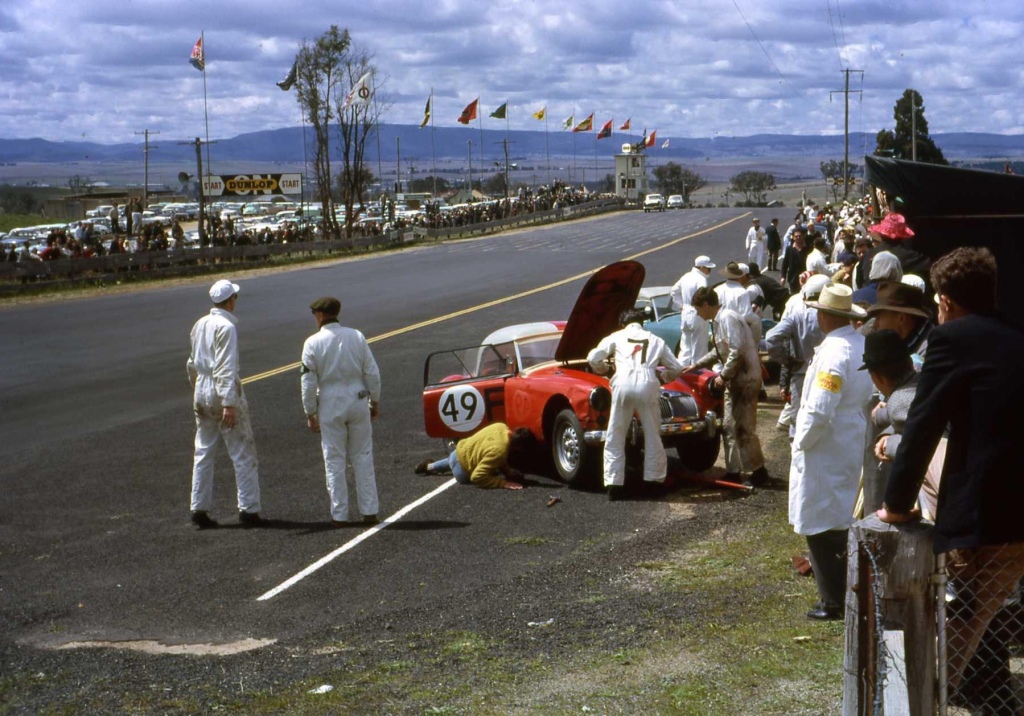
With the flag dropped, Phillips is at the far left, the Bobtail Cooper is Allan Jack’s Type 39 Climax, #36 John Cleary, Austin Healey 100S, #10 Les Agnew, Lotus 11 Climax, #56 Jane, #31 Basile, #28 B Coventry, MGA and #18 Tom Ross, Triumph TR2.
While Bob Donaldson did a great job, he has managed not to take a decent shot of the winning car. Here it is, shown above on the way to victory on the cover of the July issue of AMS.
Test of straight-line-squirt between the E Laker TR3 and J Ausina MGA. And below the beautiful lines of the Allan Jack Cooper T39 Climax.
(R Donaldson)(R Donaldson)
That battle between the Triumph TR and MG seems to have been settled in the TR’s favour.
(R Donaldson)
Bob Jane and John Ampt. The grunt of the 3-litre, DOHC-six engined, relatively light 300S prevailed over the very light 1.1-litre Decca. See here for lengthy feature on Derek Jolly and his Decca and Lotus cars: https://primotipo.com/2017/11/09/dereks-deccas-and-lotus-15s/
Awards were made for outright and class placings in the TT. Phillips won outright and the over 3-litre class, Jane the 2-3-litre class, Ampt the 1.1-1.5-litre class and Les Agnew the up to 1100cc class in his Lotus 11 Le Mans. Unusually, the organisers, the Queensland Racing Drivers Club, ran a handicap event over the first 20 laps, with Coventry’s MGA prevailing over the Ross Triumph TR2 and Tony Basile’s Porsche.
(S Dalton Collection)Rare shot of Arthur Griffiths in the ex-works/Parnell/Glass Ferrari 555 Super Squalo (R Donaldson)
Lowood Trophy Gold Star round…
1959 was the third year in which the Gold Star was contested. Lex Davison won it aboard his famous ex-Ascari Ferrari 500/625 3-litre in 1957, with Stan Jones the reigning champion during 1959, his primary weapon of war was a Maserati 250F but his Maybach 4 Chev occasionally got a run too, as here at Lowood.
Lowood was the sixth of twelve rounds – the longest Gold Star series of all – and in a year where victory honours were spread widely. Melbourne auto-parts manufacturer, Len Lukey won with a mix of speed and consistency aboard a Lukey Bristol and an ex-Brabham Cooper T45 Climax.
Len Lukey, Cooper T45 Climax at the end of a lose: Ern Tadgell, Lotus 12 Climax/Sabakat goes past in this shot, with Bill Patterson doing likewise in his Cooper T43 Climax below, and Arnold Glass, Maserati 250F rattles past as well in the next shot, with Len about to decamp, unable to restart the car (R Donaldson)(R Donaldson)(R Donaldson)
Alec Mildren won three races in his Cooper T43 and T45, and Stan Jones, Bill Patterson and Lukey two apiece, with singleton wins for Jack Brabham, Ross Jensen and Bib Stillwell. Brabham and Jensen were non-residents and therefore ineligible for Gold Star points.
At Lowood, Mildren won from Stan Jones in Maybach 4 Chev, Arnold Glass, Maserati 250F, Arthur Griffiths, Ferrari 555 Super Squalo and Glyn Scott, Cooper T43 Climax.
Patterson in his immaculate white with central blue-stripe Cooper T43 (R Donaldson)
Coopers had a mortgage on the Gold Star for a while: Cooper drivers, Len Lukey won it in 1959, Alec Mildren in 1960 (T51 Maserati), Bill Patterson in 1961 (T51 Climax) and finally Bib Stillwell won in 1962 (T53 Climax). The Brabham era followed…
(S Dalton Collection)
Credits…
R Donaldson-State Library of New South Wales
Tailpiece…
(R Donaldson)
Stan Jones hustles his Maybach 4 Chev around Lowood.
He used four cars in his fight to retain the Gold Star, primarily his Maserati 250F – it was just quick enough to prevail over Len Lukey’s 2-litre Cooper at Longford during the AGP – Maybach 4, which had been extensively updated by Ern Seeliger, not least by fitment of a Chev 283 engine, Sabakat and a Cooper T51 Climax.
AC Ace Bristol, Arthurs Seat – Port Phillip Bay to the right and Bass Straight, next stop King Island on the way to Tasmania at the top – Victoria (N French)
Seasonal salutations to those of you of a religious bent, and all the best for a well earned break for the rest of you. As father-time meanders on I do find my staunch atheism evolving towards an each-way-bet form of neo-agnosticism on the basis that one needs all the help ‘yer can find towards the end of one’s innings. “You fucking hypocrit!” my eldest son observed, fair comment too.
One of my mates asked me about my automotive highlights of the year the other day, I thought the contents of that discussion might be a good end of year topic.
Lots of luvverly Smiths instruments in the Ace cockpit (N French)Savouring the Stanley Sunbeam 20/60 on the Redesdale Bridge (D Hewison)
When I think about it, all are related to my mate Bob King: medico retired, racer retired, restorer retired and author current with four Bugatti book tomes so far. My racing interests had been largely post-war until we had a series of illicit, coffee-infused research and talking-shit sessions during Covid. The Peoples Republik of Victoria was locked down tighter than a nuns chastity belt in 2020-21.
As a consequence, much of my research these days relates to earlier times, it’s fun as the learning journey is steep and rich. I worked out in 2022 that I could have my cake and eat it too if I mixed a car’s road impressions with the usual dose of history.
This combo has yielded 2023 articles on King’s AC Ace Bristol (published in Benzinamagazine), the Murdoch Family’s two supercharged, twin-cam Altas: 1.1-litre #21S and 2-litre #55S (Benzina and The Automobile) and Richard Stanley’s 3.2-litre, six-cylinder, OHV Sunbeam 20/60 (The Automobile).
Ace at Albert Park in works-corto-spec (sic). This involved removal of the road screen and replacing it with this competition number and fitment of the neato radiator blind. Amazingly, these two items were delivered with the new car to its German domiciled Australian Army officer first owner, and are still with it seven’ish decades later. The Alfa GTA behind is kosher, it’s the ex-MW Motors car (CCCollection)
Driving these cars were the highlights of the year.
On top of that I get to drive Bob’s Ace very regularly, the best of those steers was participating in the Historic Demos (on all four days) of the AGP carnival at Albert Park. The pace is very-fast-road not full-race, its such a sweetie, a mix of just enough power (circa 135bhp), superb spaceframe chassis and predictable handling via independent suspension at both ends, rare in the day. See here: https://primotipo.com/2023/02/21/benzina-magazine/
David Hewison snaps 21S in the background while 55S awaits its turn. Bob and the Murdochs – Geoff, Fiona and Neill and partially obscured young-un – await the road leg. Citroen SM flank at right. The coolant seemed ominous but wasn’t required (Bisset)
The logistics of these road impression exercises are not to be sneezed at. The rendezvous point for the Alta day (the week before the AGP in March) was in the Upper Yarra with one of the cars being trailered from Melbourne. There was a five-person-Murdoch Posse in attendance, David Hewison and his son manning the lenses, plus Bob and the two British stars of the show, who behaved well despite an exceptionally hot day.
21S on the hop near Gladysdale, the pre-selector gearbox wasn’t the mental challenge – with limited capability in relation thereto on my part – that I had expected. Superb to drive in every respect (D Hewison)
Mrs ‘Racing Ron’ Edgerton with an Edgerton junior-burger and 21S circa 1942. The Ford V8 was fitted several years before, Edgerton has just completed a major body-off rebuild (Ron Edgerton Collection)
Nico French did the AC Ace shoot on Mornington Peninsula roads very familiar to me: a loop comprising Arthurs Seat, Main Ridge, Red Hill, Flinders and Shoreham and then a blast to Mornington for lunch en route home.
Kingy really doesn’t like the verbal foreplay between his car – mainly directed towards it’s perky little rump – and I in his garage before we set off on these occasions. There are only six-hundred-thousand-reasons she isn’t mine!
21S owner Fiona Murdoch and Bob King roadside at Launching Place (Bisset)No it isn’t a perfect four-wheel-drift! Sunbeam 20/60 and Messrs Stanley and King near Kevington, Autumn is pretty up that way (Bisset)
I froze my nuts off in the back of Richard’s Sunbeam way back in late April when I was the third-wheel on the annual Ye Olde Codgers Stanley-King Alpine Tour into Victoria’s high country.
Clad in my favourite Thredbo ski-gear, with rear windscreen erect and struggle-rug over my legs it was fantastic fun but, far-canal, it was a true British winter touring experience in The Great Brown Land.
I pitched the Sunbeam piece to The Automobile and it got up against two other ideas I rated more but were knocked back. The drive day was a warm one in mid-October, David Hewison did the static shots in Lancefield and the drive was via the Burke and Wills Track to Redesdale.
The 3.2-litre tourer was surprisingly spritely, the right hand change crash-box novice friendly. No pressure here in the driving, Stanley is a renowned Kiwi/Oz historic racer and has owned the car since restoring it in the early 1970s. He drives it with supreme finesse. Victorian country C-roads are bad at present given the lack of funds deployed to maintaining them, what surprised me was just how the twenties Sunbeam ate the B&W Track in a way my Alfa 147 GTA didn’t: low profile tyres and the rest.
Hewison produced his party trick this time, working with a drone for the first time was interesting, and adds another dimension to considering the terrain in which you shoot. More on the Sunbeam here: https://primotipo.com/2023/05/20/sunbeam-20-60/
Photos continue to be the inspiration for the primotipo articles but it’s yer mates and confidants, mentors, supporters and sub-editors (the latter are readers who pick up and point out the f-ups) that sustain you. So, many thanks to Bob King, Tony Johns, Stephen Dalton and Alistair MacArthur, Bruce Williams, Tony Davis and Doug Nye, and Geoff Harris and Rob Bartholomaeus.
(N French)
Etcetera…
This shot of Bob King was the ‘money shot’ of the AC shoot, a ripper. Three-quarter front floats the editor’s boat. The owner is having a ball, there a couple of places on the steep climb where the chairlift goes over the road.
Bob competed here in his Bugatti Type 35 Anzani – the ‘Anzani Bugatti’ in Australia – in the early 1990s. There were two climbs (I think) in the modern era which aped the use of the venue pre-war, then officialdom got in the way, as it usually does.
These days the best approach to enjoy this magic stretch of road is an illicit dawn blast having first done a recce to ensure moisture levels of the surface, with many overhanging trees, won’t cause grief…
BMW-Bristol 2-litre, triple-Stromberg fed, two-OHV six gives about 135bhp in current spec. Fitted with overdrive, this baby happily tours at 110kph all day (N French)
Rest assured it was as cold as it looks, what superb drivers roads they are. The two old-fellas were cocooned in the front while I was ‘punished’ in that airy rear seat. Kevington countryside, the local pub is great, albeit with a dang-diddl-lang-dang-dang factor about it.
Sunbeam’s 3181cc, seven main-bearing, twin-SU fed long-stroke six powered tourer lopes along. Richard and Judy Stanley toured from Lancefield to Rockhampton, Queensland last year – 1900km each way – the car is loved and used a lot (Bisset) (Bisset)
Easily the best of this years piss-up type events, it’s on again in 2024, with me as a judge. It’s a very dangerous choice as someone who regards these things as wank-fests, and will fulfil his duties with that degree of conviction….
(Bisset)
Neill Murdoch me showed just how quick this supercharged 2-little mid-1930s Alta accelerates, “think of it as a two-seater ERA” was meant indicatively rather than definitively but sums the thing up in a nutshell. Geoffrey Taylor’s marque is so underestimated.
Credits…
David Hewison, Nico French, Mark Bisset, CC Collection
Tailpiece…
(Bisset)
What it’s all about, a long and winding road that leads to a hotel door…with apologies to Paul and John.
Richard Stanley and Bob King with Sunbeam 20/60 burbling it’s beautiful six-cylinder song on the Maroondah Highway, Molesworth, Victoria on April 25, 2023.
Merry Christmas, may you all have a peaceful and restful break with lots of good health and luck in 2024.
Cathy Ford looking all pert and perpendicular in a Paula Stafford bikini, a mighty fine chequered flag design it is too. The car is a Valiant Charger R/T (road/track) at Surfers Paradise International Raceway in 1972’ish…
Once upon a time Australia had a motor industry. It was largely owned by the US Big Three, Chrysler was the smallest. Based in Tonsley Park outside Adelaide, the company punched well above its weight, the product, especially the Hemi-six cylinder engined cars were good in the context of the times.
The Big Three’s pony cars in 1971-72 comprised Ford’s four-door road Falcon GT 351 and Bathurst winning GTHO 351 variant, General Motors Holden’s mid-size 202cid six-cylinder road Torana GTR and Bathurst winning GTR-XU1, and the 265cid-six powered road Charger R/T E37 and Bathurst E38 in 1971, and E48/49 in 1972.
These amazing Australian designed and built road cars – in world terms they were fast and acccomplished – were fundamentally built to win Series Production races, especially the annual Bathurst 500 bash. Win on Sunday, Sell on Monday, it was that simple for the snappily dressed marketing men and their whiteshoe, sales foot-soldiers.
The David O’Keefe/ Jack Nougher Valiant Pacer VF on the way to a Class C win in the 1969 Sandown 3 Hour
Valiant put a toe in the competition water with mildly tuned ‘Pacer’ variants of their four-door VF and VG family man machines in 1969-70. Then they got serious with the new shortened 105 inch wheelbase Charger which was released two months after the mainstream 111 inch VH Valiant sedan in 1971.
The American styled VH suited guide-dog-owners, it’s big arse, cavernous overhangs, high waisted looks and narrow track weren’t a patch on the looks of the contemporary Holden HQ, Falcon XY or XA.
When Chrysler Oz CEO David Brown realised what a mutt his new car was going to be, he bundled up a tiny-budget and built a two door coupe, the design of which was led by Brian Smyth at Tonsley Park. It had to plug a hole in his range and grab some halo-effect for his four-doors.
I’ve cheated with photo selection here, the VH Pacer to me looked pretty good, all stripes and wide wheels. But the base models were very grim shit-fighters.
And what a horn-bag Smyth and the Chrysler International Design Studio, under Bob Hubbach, came up with. Charger was an immediate sensation when released in August 1971. The best bit of the Valiant, its front, was retained and otherwise the team crafted a low, squat, muscular, sexy machine that still looks great from every angle.
With Elle McPherson looks at an affordable price it was a sales smash aided and abetted by a brilliant marketing campaign. Hey Charger! was on everybody’s lips, young or old, male, female or confused. Winning Wheels magazine’s coveted Car of The Year award in ’71 was the cherry on the cake.
The range went from the poverty-pack 215cid, drum braked, three-on-the-floor Charger to the fire-breathing race-bred 265cid – a bored-out 245 Hemi – 1971 E38 280bhp @ 5000rpm and 1972 E49 302bhp @ 5600rpm R/T machines of interest to us.
For a while 70% of all Chrysler sales were Chargers, but they were far from niche. With a big back seat and a boot you could fit granny in, they were legit four-folk-family-cars. Read Mel Nichols’ account of what a great drive these competition bred Chargers were on the road; https://www.classicandsportscar.com/features/chrysler-valiant-charger-australian-odyssey
Chrysler competition chief, engineer John Ellis put together a strong development team in the Pacer days which included 1970 Gold Star champion single-seater racer, Leo Geoghegan who raced the cars and acted in a consulting capacity. Another sportscar/single-seater racer/mechanic, Ian Cook, a Chrysler employee was key too. This group, and others, concocted a potentially race winning car, the only missing ingredient in the formative stages was a four-speed gearbox…
John Ellis circa 1971 (CCC)A goal perhaps Leo? Geoghegan with a VG Valiant Ute at Mallala in 1971. Two Utes were cut and shut to replicate the upcoming Charger’s track and wheelbase, engine and big-tank location (autopics.com)
The A84 Track Pack option included a very direct 16:1 ratio steering box, Sure-grip LSD, a choice of tall 3.23:1 and short 3.50:1 diff ratios, light 14×7 R.O.H. cast alloy ‘Dragmag’ wheels and a huge 35-gallon tank with twin-fillers.
On paper, the big-Val had Bathurst shot-to-bits but the lack of a four-speed box was a big shortcoming; there was no Oz four-speeder available at the time, a situation rectified in 1972.
While it looked the goods, there were other shortcomings, as Mark Oastler outlines. “The Charger was built on a relatively short 105-inch wheelbase, which magnified the ‘see-saw effect’ of dynamic weight transfer from front to rear, resulting in excessive squat under acceleration and forward pitch under heavy braking.”
Leo with the real McKoy E39, again at Mallala. Squat at the rear, nose up a characteristic of the cars as per the text, the bonnet air duct doesn’t – it’s a styling addition only (autopics.com)Geoghegan practicing at Oran Park before the Chargers race debut in September 1971
“This was not helped by the high location of the big long-range fuel tanks fitted to the Bathurst cars. The VH Valiant’s bulbous bodywork ended up being more than 100mm wider than that of the VF/VG ute-based development mules, which added to the R/T’s lateral inertia and tendency to understeer in hard cornering. The Charger’s wheelbase was also quite short relative to its track. This wheelbase-track ratio created a car that was very responsive to directional change, but was twitchy and nervous at high speeds.”
The Charger’s track was similar to the GTHO but its wheelbase was six-inches shorter than the big Roaring Ford. It wasn’t stable on high speed Mount Panorama but was better suited to shorter, twistier tracks. The Chargers were dominant in NZ production racing for years, a status never accorded them at home.
The 11-inch non-power assisted ventilated front discs and calipers (which flexed badly) were marginal on track too. Ford’s similar challenges with the beefy 351 Cleveland powered HO were met late in the 1971 piece with Ferodo’s trick DP11-103 pads.
Oastler quotes Leo Geoghegan as saying that the Chargers could have beaten the Toranas in ‘the six-cylinder class battle’ and applied greater pressure on the HO’s had Chrysler sorted its front-disc problem. A set of pads was only good for 60 miles if given a hard workout.
Leo Geoghegan in the Charger E49 he shared with Peter Brown in the 1971 Bathurst 500 (Chevron Publishing)
In 1971 expectations were high after Doug Chivas won a 100 lap enduro at Oran Park a fortnight before Bathurst. While it was a great drive, Chivas was advantaged by Colin Bond’s HDT XU1’s race-long gear selector problems…the works HO’s were absent too.
With vastly inadequate Bathurst preparation: simulations to determine fuel consumption, brake and tyre life etc, Geoghegan’s Top 10 Q8 was great – quickest of the Class D cars including the XU1s – but was still six seconds off Moffat’s GTHO Phase 3 pole.
Moffat won by a lap with Geoghegan’s Charger seventh outright and second in class behind Bond’s HDT XU1. Impressively, eight of the 10 Chargers that started, finished. Geoghegan’s post-race list of shortcomings included tyre wear, fuel consumption far greater than that anticipated and brakes…
In the later rounds of the 1971 Australian Manufacturers Championship (Manchamps), Chivas was third at the Phillip Island 500K, while Geoghegan was second to Moffat’s HO in the Surfers Paradise 250 – ahead of the two LC XU1s of Brock and Bond – with Chivas sixth. Progress was being made.
Geoghegan’s E39 Charger from Colin Bond’s LJ XU1 at Warwick Farm during the 1972 Tasman Cup meeting (L Hemer)Leo did the final Bathurst 500 solo in 1972. E49 was Q6 and fourth (autopics.com)
Chrysler’s response for 1972 was the 302bhp @ 5600rpm E49 Charger variant…fitted with Borg Warner’s new four speed gearbox, the more aggressive cam-profile was possible thanks to a better set of ratios which could exploit the peakier power delivery.
Just as in 1971, the E49 was short on Bathurst development, in part as a result of the Supercar Scare, see here for chapter-and-verse on that important bit of Australian Motor Racing History: https://primotipo.com/2018/04/12/holden-torana-gtr-xu1-v8/
A byproduct of the Supercar Scare was Chrysler’s withdrawal from motor racing with factory cars, an incredible decision really after all the clever development and homologation. The better call would have been to contest that years Manchamps and then pulled the plug; but Chrysler was in big financial strife globally.
Noel Hurd raced his E49 to fifth in the first round of that championship, the Adelaide 250 in August, while at Sandown, the traditional Bathurst curtain-raiser, the two cars raced by Victorians, Tom Naughton and Lawrie Nelson failed to finish.
Tom Naughton’s car was a Victorian meeting regular, here at Sandown in April 1972Geoghegan E49 at Lakeside during 1972
Off to Bathurst, Geoghegan was again the quickest of the Chargers at Mount Panorama, qualifying sixth. Again Moffat was on pole in an XY GTHO, but this time the margin to the E49 was 3.3 seconds. Leo led for a while early in the race but a faulty starter motor, loose battery lead and misfire late in the race ruined what could have been a good run. Geoghegan was fourth in the race won by Peter Brock’s GTR XU1, with John French’s GTHO second, with the Doug Chivas/Damon Beck E49 the best of the six Chargers entered, in third.
Tom Naughton was sixth at the Phillip Island 500K, while Leo was sixth in the Surfers Paradise 300. Chrysler placed fifth in the the Manchamps behind the GTHO, XU1, Ford Escort Twin-cam and Mazda 1300.
Pete Geoghegan enroute to third place in the final Warwick Farm ATCC round in July 1973. Look how nice and flat that Charger is with Sheppard’s suspension mods: geometry, spring and shock changes
With the end of Improved Production and Series Production in 1972, and adoption of Group C as the formula to which the Australian Touring Car Championship and Australian Manufacturers Championship were run in 1973, a group of New South Wales and Victorian Chrysler dealers supported the construction of a Group C-spec Charger built by ace engineer/mechanic, John Sheppard at his Monaro Motors workshop in Melbourne. It was to be raced by Leo’s brother, four-time Australian Touring Car Champion, Pete Geoghegan.
Pete finished sixth in the ATCC in this quick, often forgotten car, but switched camps to Ford for the Manchamps. Successfully so, he co-drove Moffat’s factory XA 351 GT Coupe – FoMoCo’s response to the two-door Monaro and Charger – to victory at The Mount. This Group C Charger is beyond the scope of this article but is a good one to pick up soon with some input from Sheppo, who is still razor sharp.
Etcetera…
In Chrysler’s own words above, “You’re watching Charger’s Hemi/Weber Six Pack during a dyno endurance test. After 480 hours at both ends of the rev range, it’s running red hot at peak revs for longer than it ever would on road or track. The Six Packs an unbelievable mill. But don’t get the idea it’s just a 265 cube Hemi with three double-barrel Webers bolted on.
The whole engine’s been tuned to the Webers. In fact, we flew a car (a VG Pacer driven by John Ellis from London to Bologna) over to the Weber factory in Italy. Breathings been freed up with a high overlap camshaft, bigger valves and tuned length extractors. And the crankshaft, conrods and valve springs have been shot-peened for high-speed strength.
But there’s more to a Six Pack Charger than just a great engine. The E37 Street version offers dual disc clutch, close ratio gears, 20:1 steering, 3:23 diff and pancake air-cleaners to pick up bottom end torque. The E38 Track Pack version picks up compulsory alloy wheels and special engine, brake and suspension mods. All of which make it ready to roll straight on to the track.
Your Chrysler/Valiant dealer has the Six Pack systems to make you believe in the unbelievable. And at Charger prices, you can’ attord not to.
CHRYSLER. GREAT IDEAS IN MOTION. BELIEVE.”
(L Nelson Collection)
Laurie Nelson’s Group C Charger E49 being harrasssed by an LJ GTR XU1 at Shell corner, Sandown circa 1973.
(J Edwards)
Following the privateer theme – these cars were very fine cars for those on a tight budget – here is Tim Slako’s car at Wanneroo Park circa 1971.
Credits…
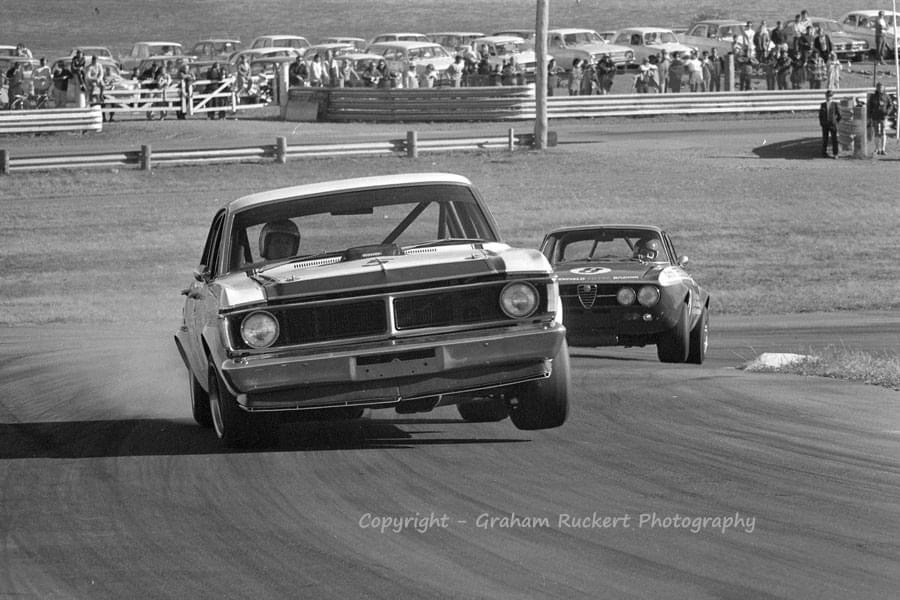
Chevron Publishing, ‘Australian Touring Car Championship’ Graham Howard and Stewart Wilson, ‘VH Valiant:The R/T ‘Super-Charger’ that never made it’ Mark Oastler, Lynton Hemer, SS Auto Memorabilia, Graham Ruckert, Chrysler Car Club, Julian Edwards, John Lawton, Laurie Nelson
Tailpiece…
The ROH aluminium alloy ‘Dragmag’ was adopted by Chrysler for the Charger programme. It was made across town in Finsbury by Rubery Owen and Kemsley Pty Ltd one of the local subsidiaries of Owen Organisation/Rubery Owen, a global automotive UK based transnational of which the Owen Racing Organisation/BRM (British Racing Motors) F1 team was a part.
I wondered whether Chrysler inspired the design of the fabulous Dragmag – easily my favourite Oz Alloy of the period – for the Charger programme but Moff ran the wheels on his famous Boss 302 Trans-Am in 1970, and the ad above was in the June 1970 issue of Wheels so they were on the market at the time Charger was being developed.
Obiter…
It transpires – the power of internet searches – that the factory Rubery Owen Kemsley took over in 1946 dates back to WW2. After the British retreat at Dunkirk in 1940 the Australian Government decided to decentralise ammunition production away from the more populous eastern seaboard cities, Adelaide’s Finsbury/Hendon were two such locales.
The Finsbury ammunition factory was established on a massive 50acre/123ha site and commenced production in February 1941. It comprised about 20 buildings where up to 4000 people made cartridge cases and shell fuses for munitions, but not the explosives themselves. The castings and arms cases were sent by rail on a new spur line from Woodvile to Finsbury, to the Salisbury Explosives Factory for filling and assembly.