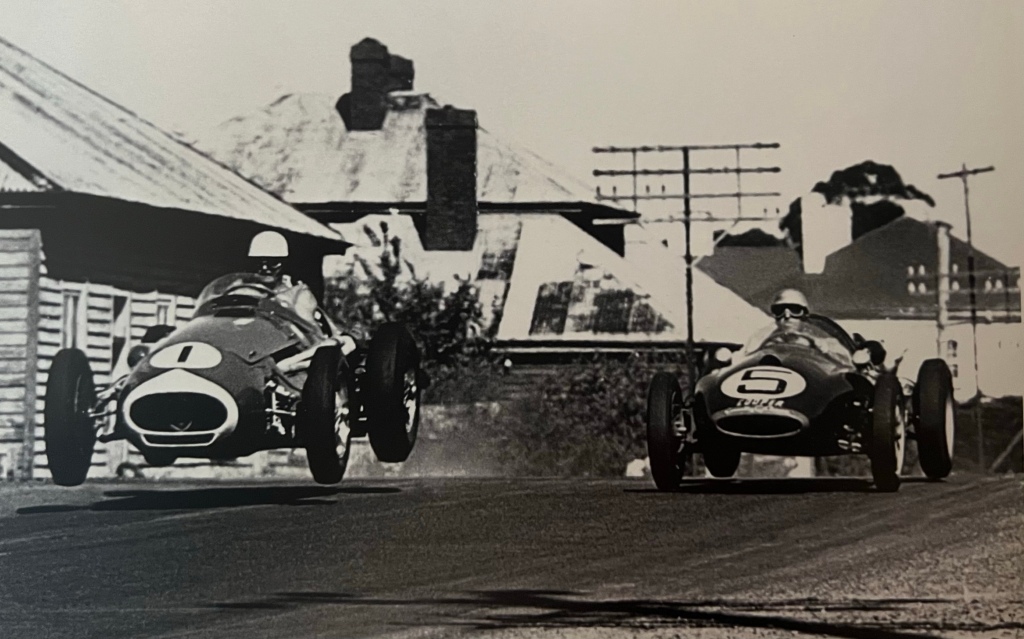
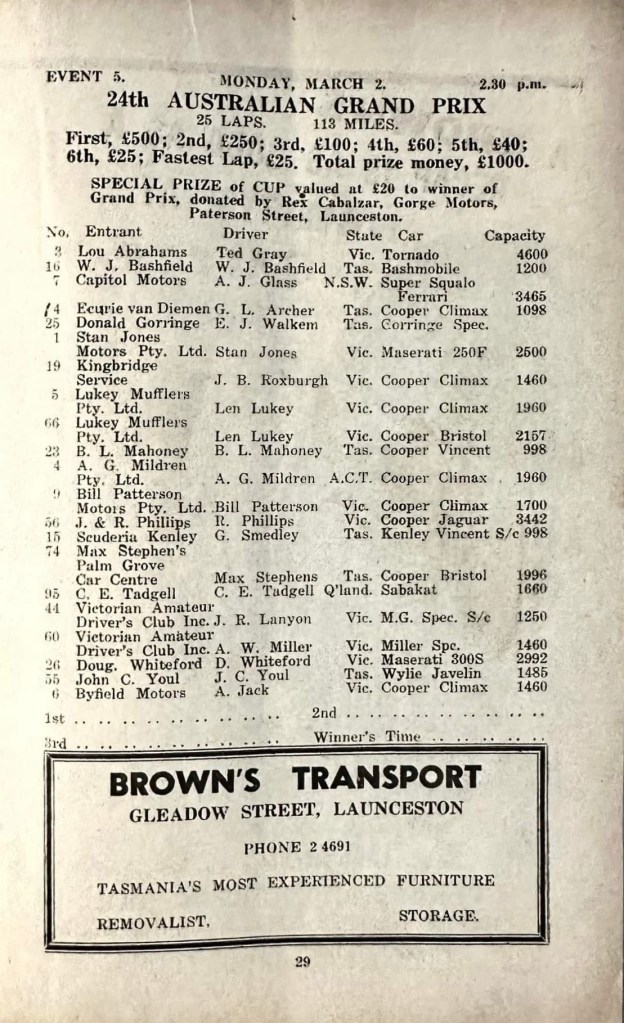
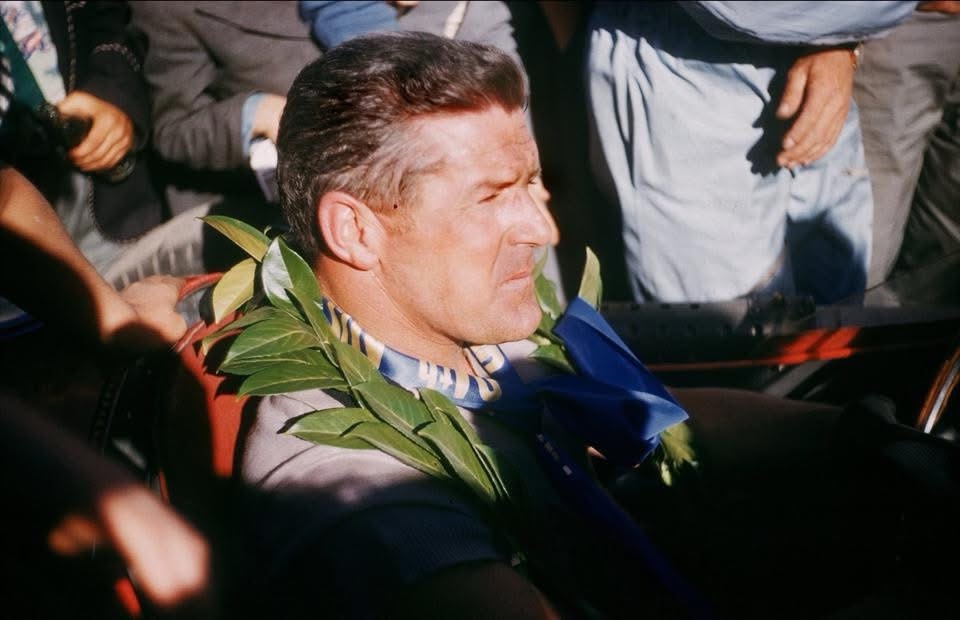
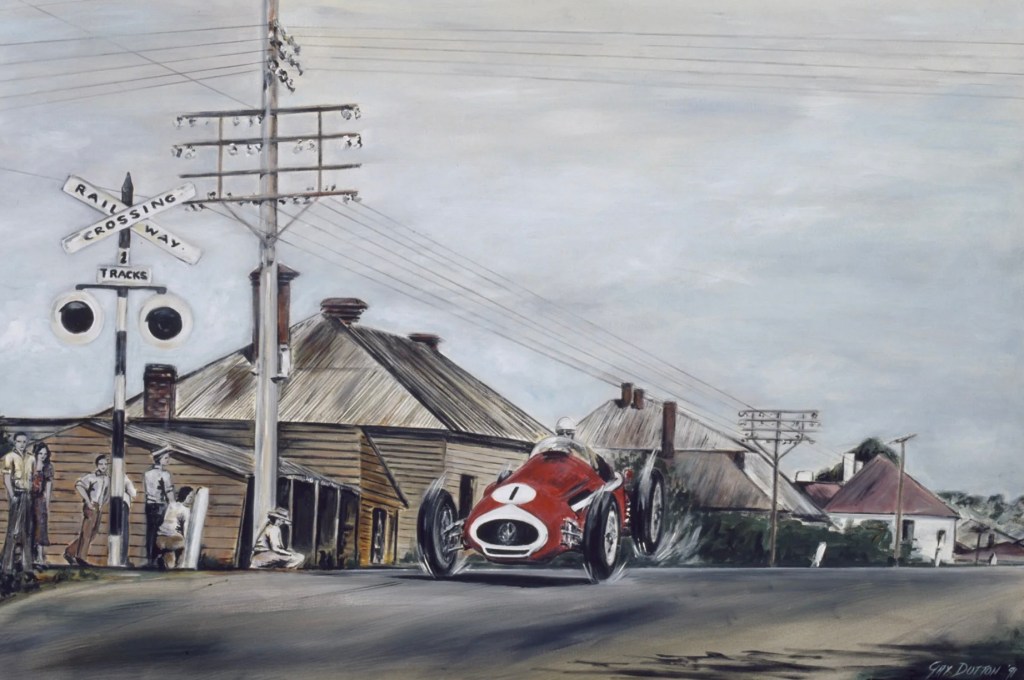
Stan Jones, well aloft over the railway crossing on Tannery Straight at Longford aboard his Maserati 250F, leads Len Lukey, Cooper T45 Climax 2-litre, during their epic battle for honours in the March 2, 1959 Australian Grand Prix.
(SLT)
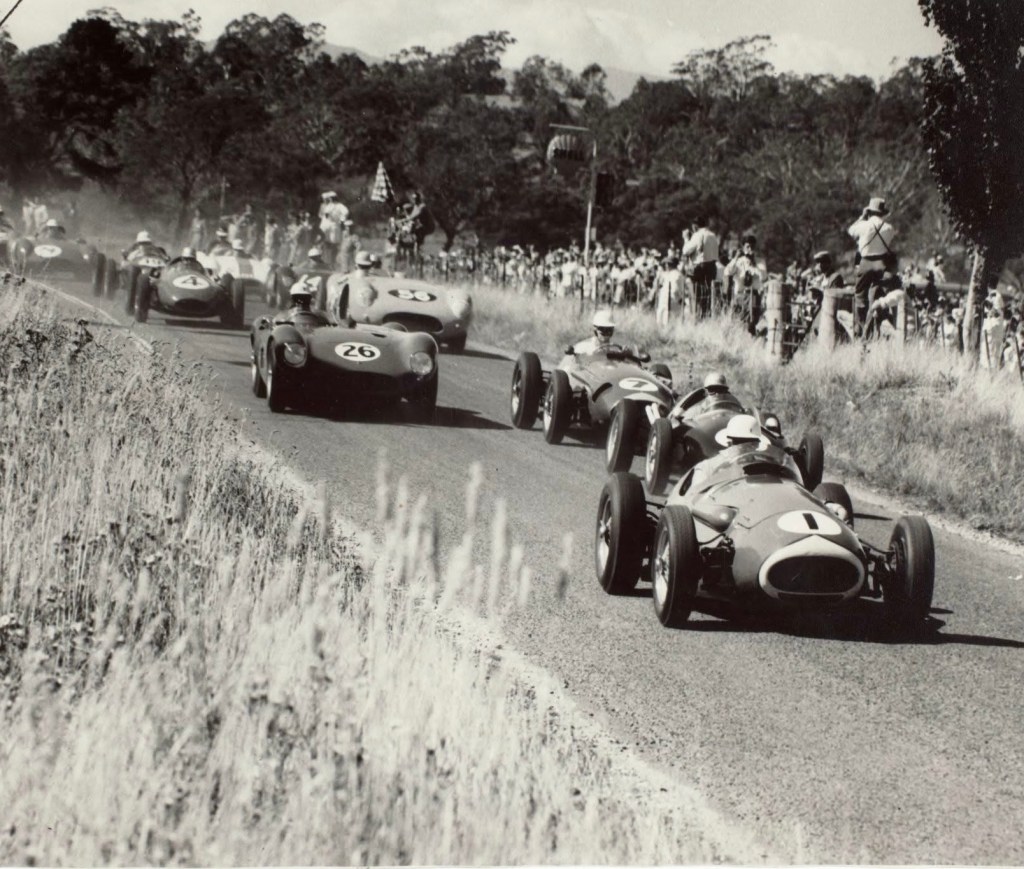
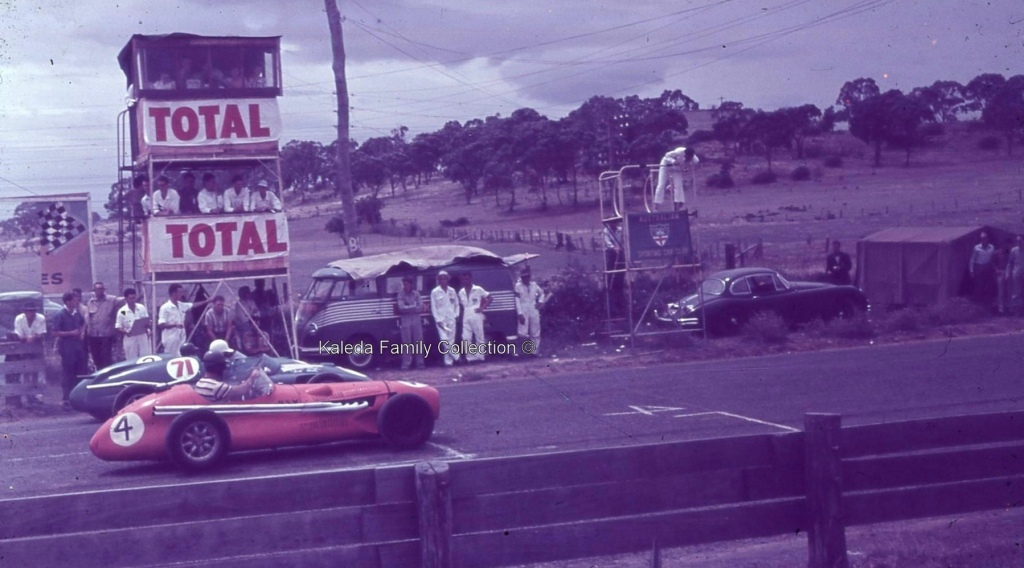
Stan Jones gets the jump in his Maserati 250F at the start of the 25 lap, 110 mile Formula Libre race from Len Lukey, Cooper T45 2-litre, Arnold Glass, Maserati 250F, Doug Whiteford, Maserati 300S, Ron Phillips’ Cooper T33 Jaguar 3.8, and #4, Alec Mildren, Cooper T43 Climax 2-litre.
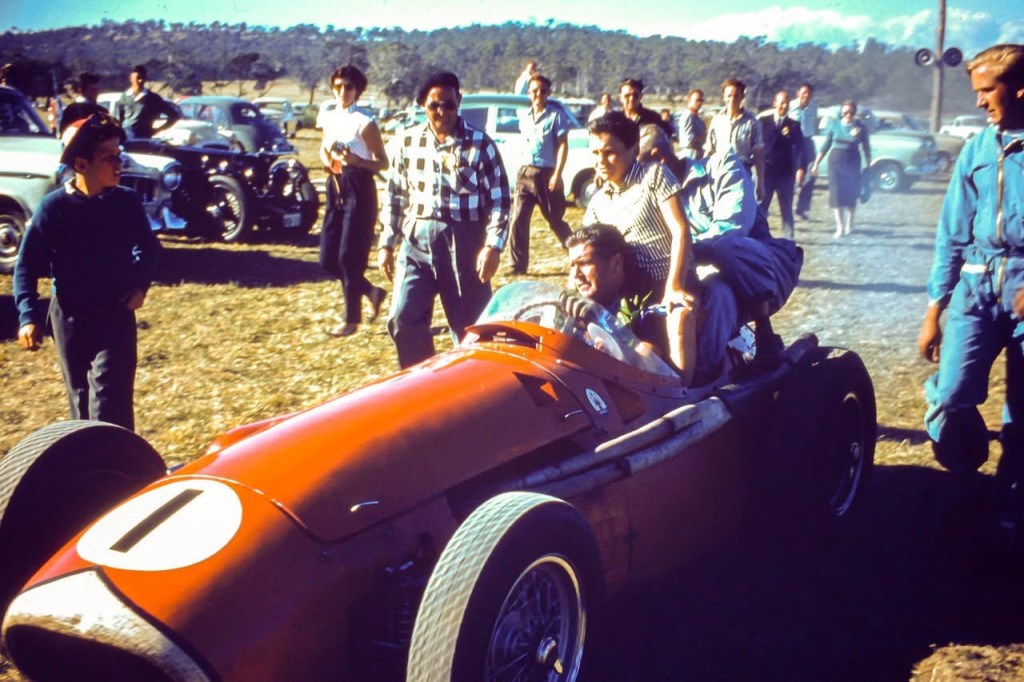
‘Take it easy Dad!’ Alan to Stan Jones before their victory lap (Dunstan Collection)
In a long race of thrust and parry between the nimble Cooper and brawny Maserati, 30,000 spectators saw the battle resolved in Stan’s favour.
The reigning Gold Star champion had just enough power to offset the handling and roadholding advantage of Lukey’s new fangled mid-engined Cooper. Armed with a 2.5-litre Coventry Climax FPF – not readily available to customers at that time – the result wouldn’t have been the same, but karma looked after Stan that day, he had well-and-truly paid his AGP dues since 1952 after all!
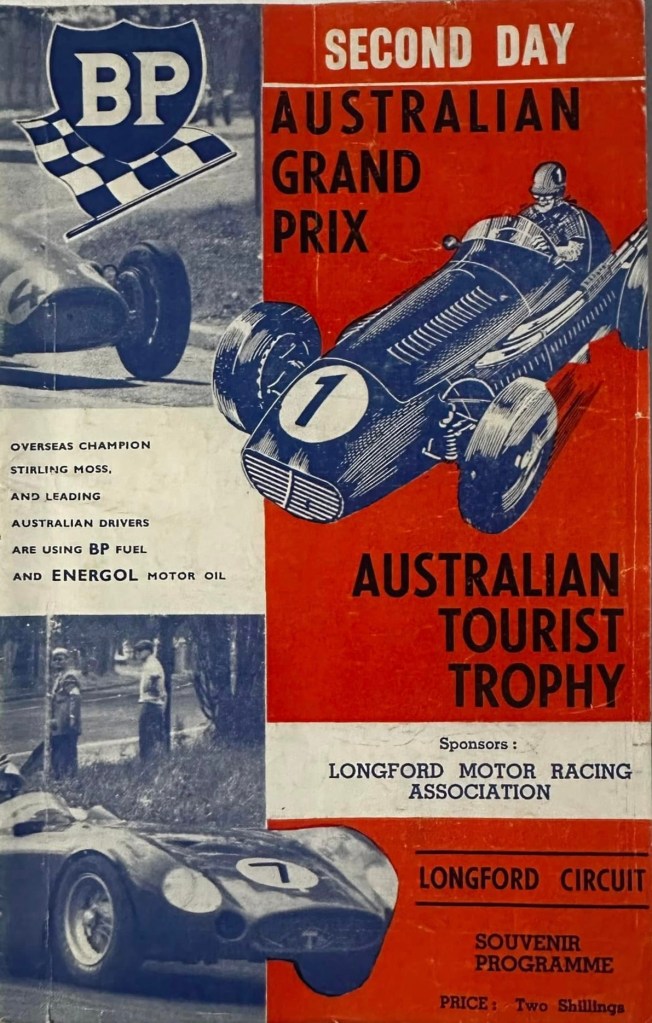
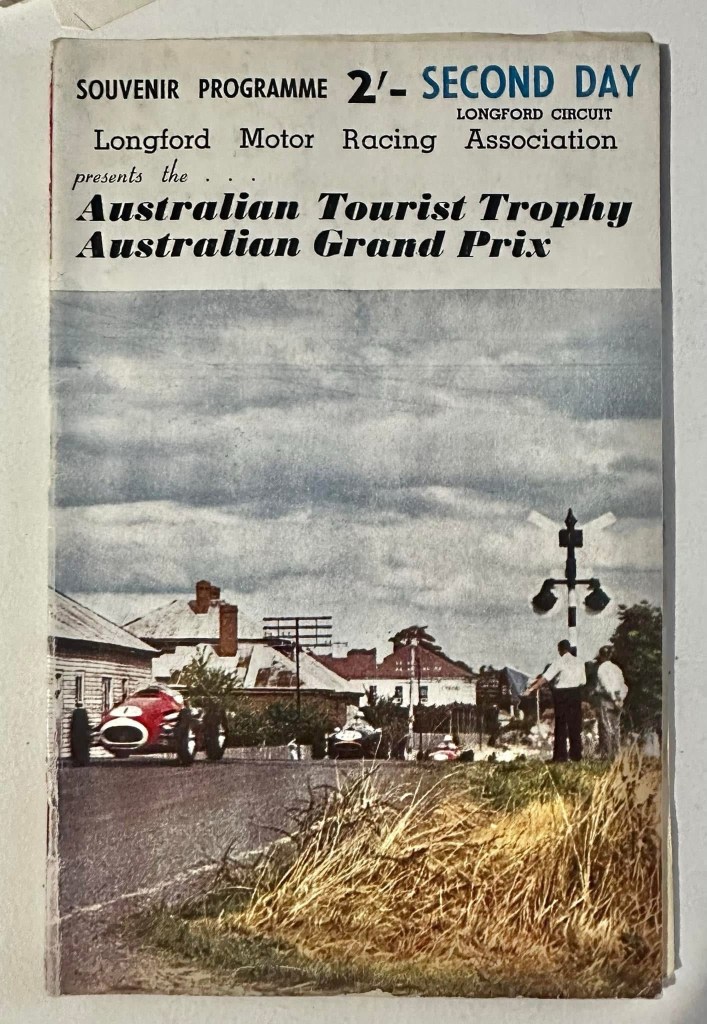
1959 Longford AGP program cover. The ATT was a motorcycle event(s) (A Lamont)
While Len Lukey missed out on that ‘59 AGP win, the Melbourne proprietor of the substantial Lukey Mufflers business took a great Gold Star win in a long championship of twelve rounds. He only won two of them but was a consistent front runner and point scorer throughout. Jones and Bill Patterson won two rounds, and Alec Mildren three, taking this pace into 1960, winning the title in a locally developed Cooper T51 Maserati.
Kiwi Ross Jensen’s Maserati 250F Bathurst 100 March 30, 1959 win was the last Gold Star victory for a front-engined car.
(A Lamont Collection)
Etcetera…
(B Young Collection)
So near to Australian Grand Prix wins in 1954, 1955, 1957 – he took the chequered flat that Caversham day – and 1958, it must have been an immensely satisfying moment for the 1954 New Zealand Grand Prix winner and reigning Australian Gold Star champion, Stan Jones, to take the chequered flag at super demanding Longford.
(unattributed)
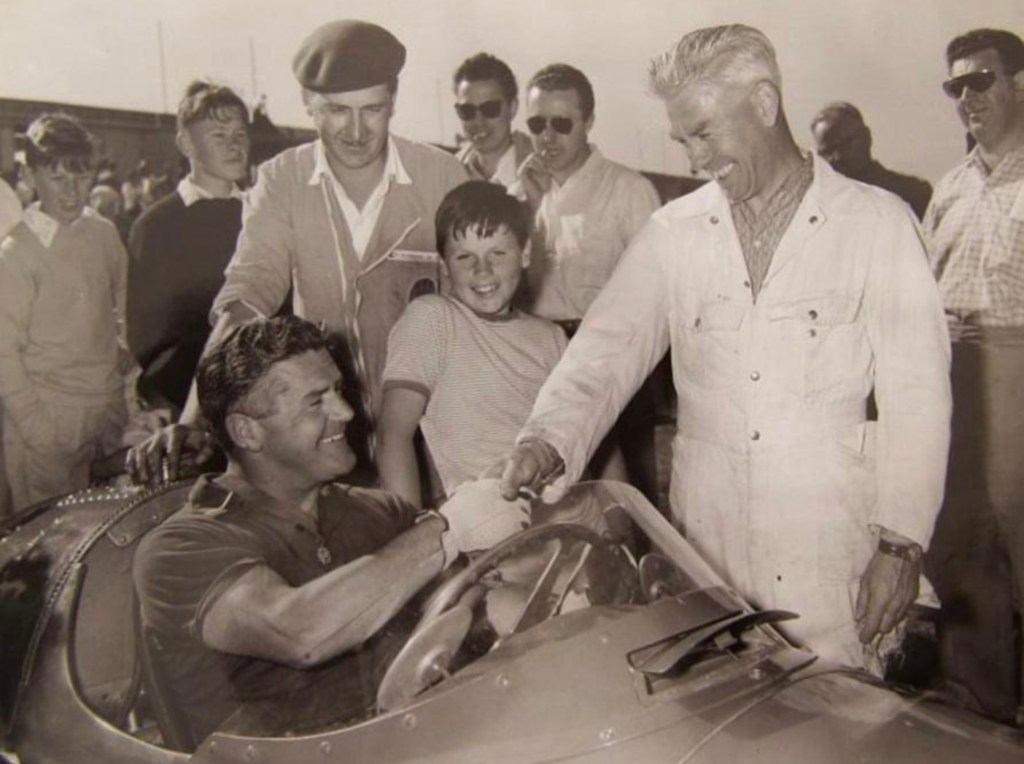
Otto Stone and Stan exchange congratulations in the Longford paddock. It wasn’t just the superb car preparation of racer/engineer Stone that made the difference to Jones’s results in 1958-59, it was a little bit more of a percentage play in his driving as well.
Otto was no slouch behind the wheel, there seems little doubt that he was able to communicate with Stan as a peer ‘to bring the thing home’. And yes, I’m not forgetting that (Repco’s) Charlie Dean was a good steerer too.
Jones only won two of the nine Gold Star rounds to win the title in 1958 but he had enough consistency to win a championship he richly deserved, let’s not forget Otto’s role in that regard…
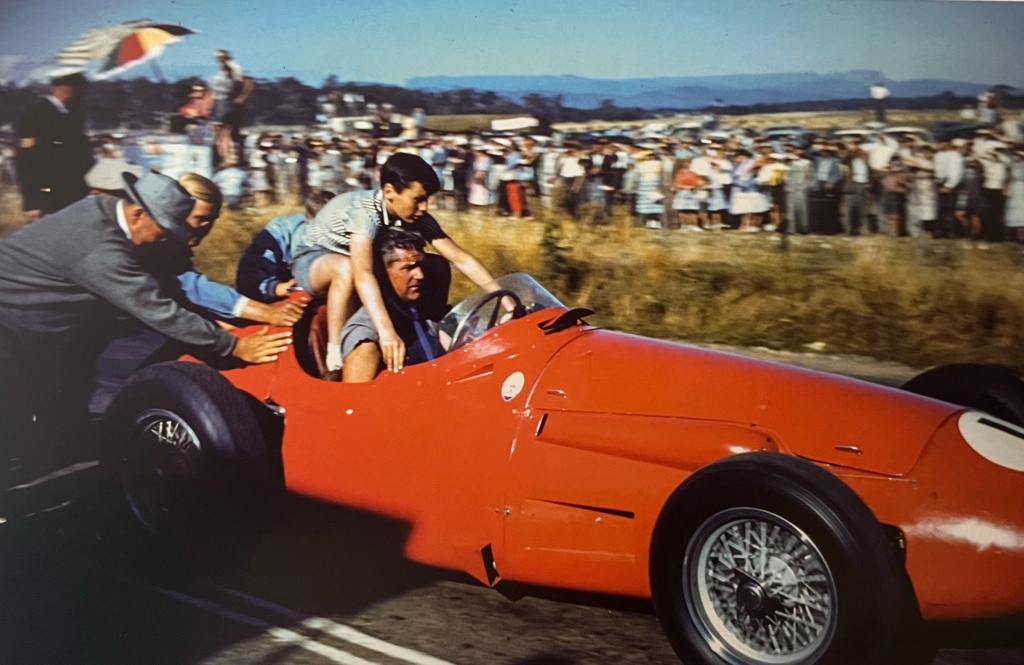
Key Team: Jones, Jones with obscured Otto Stone behind Alan and John Sawyer at right (The Northern Courier)(A Lamont Collection)
Super rare colour shot of the 1959 AGP dice between Jones and Lukey on the cover of the 1960 Longford program.
(G Dutton)
Gay Dutton’s tribute to Stan’s great victory.
Credits…
The much used and abused money-Longford-shot was taken by Charles Rice, here courtesy of Paul Cross’ collection, Bob Young Collection, Lindsay Ross’ oldracephotos.com, Andrew ‘Slim’ Lamont Collection, Gay Dutton, The Northern Courier
Tailpiece…
(oldracephotos.com)
‘Don’t even think about it Stanley!’ muses Len Lukey as Jones shoves his nose into a rapidly diminishing gap. What a shot! The money-shot used on the cover of Neil Kearney’s excellent book actually…
Jack Myers may well have been the very first Holden Hero, but if not he was certainly an early bird in the very long line of touring car champs to race General Motors Holdens’ products.
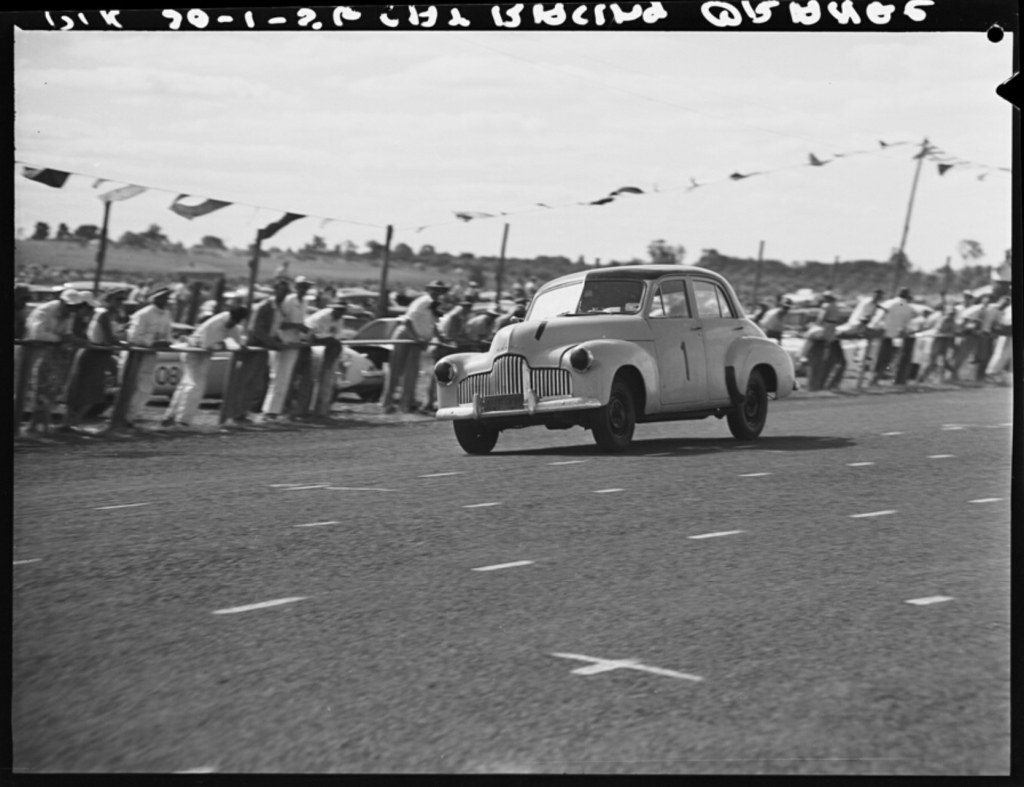
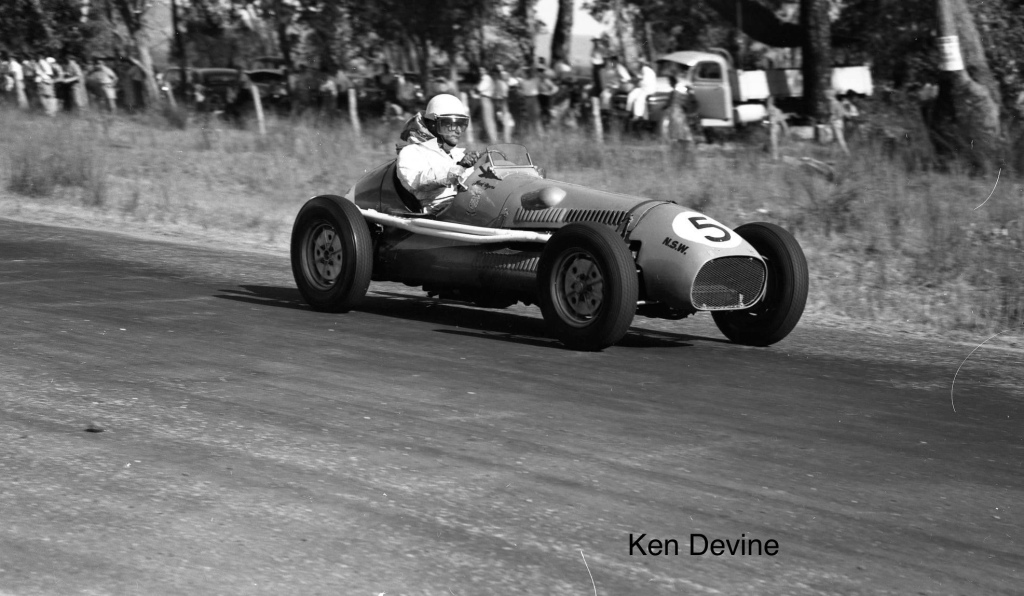
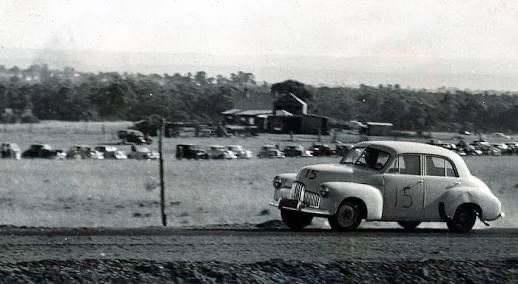
Here he is in front of the pack aboard his very quick, self modified 48-215 during a South Pacific Trophy support race at Gnoo Blas, Orange in January 1956.
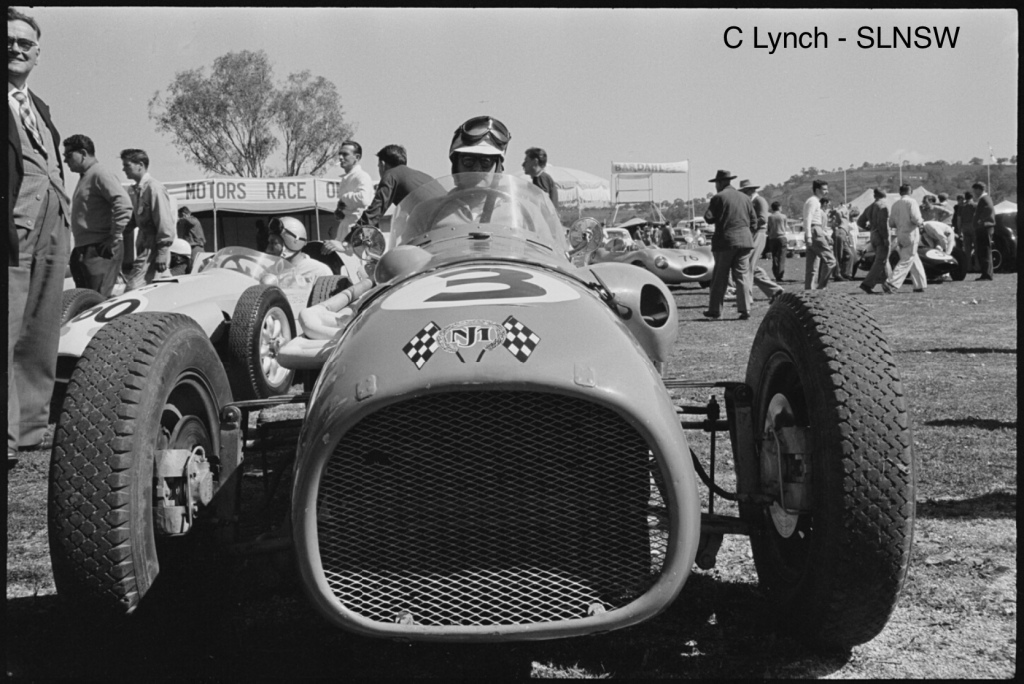
Hard chargers both, Stan Jones and Jack Myers at Mount Panorama during the October 1960 Craven A International weekend (C Lynch-SLNSW)(B Williamson Collection)Myers at Bathurst in 1958
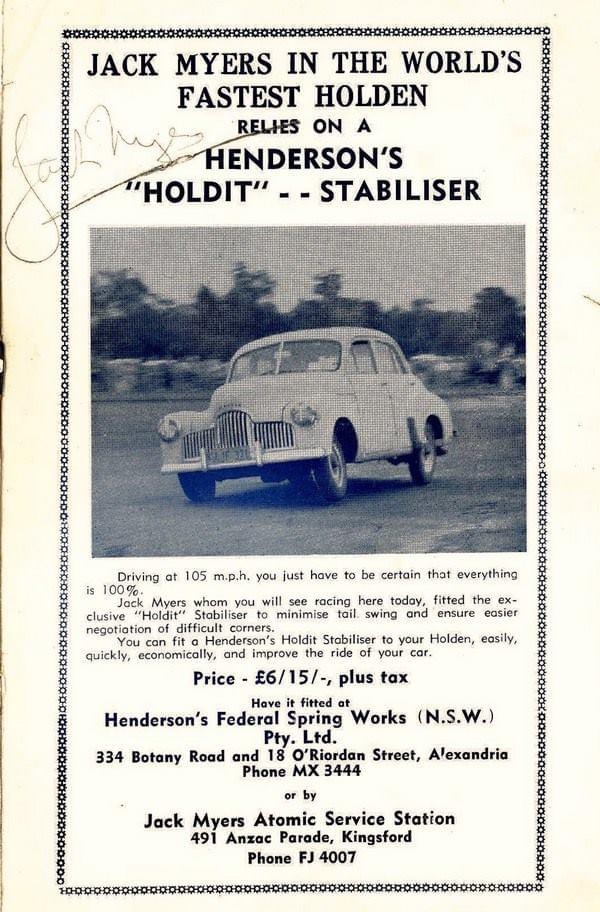
The Kingsford, NSW racer/mechanic/engineer/retailer was up to his armpits in Holden 48-215s from early on, racing a 110mph cream Humpy from 1953.
Myers soon offered 100 mph Holden motoring to all for £130. His kit involved boring your block to 3 3/16 inches, new pistons and rings, a shaved-head, re-ground cam, 12 inner valve-springs, an additional Stromberg carb, Myers inlet manifold and extractors, sports air-cleaners and a Lukey muffler. Seems as-cheap-as-chips!
Bathurst’s first ‘Production Car Race’ was held in October 1950; the first Holden entered at Mount Panorama was R Isackson’s Uni Motors car during the Easter 1951 meeting, but he didn’t start the race. The first Holden finisher on this holiest of racing turf was the 48-215 driven by R Mitchell who was fifth in a six lap sedan handicap in 1954. He was timed at 91mph down Conrod.
Fittingly, the first Mount Panorama Holden winner was Jack. John Medley anointed him “the Holden wonder-man of the mid-1950s, his black-roofed yellow car going progressively more quickly over the years.” 109.9mph down Conrod during the Easter 1956 weekend to be precise. He took that win in a six lap handicap in October 1955, the following year he was back in one of the swiftest Greys of all.
Myers aboard the Cooper T20 Holden during the 1957 AGP at Caversham. DNF in the race won by the Lex Davison/Bill Patterson Ferrari 500/625Aboard the more advanced, spaceframe chassis, but still Cooper derived, WM Holden Special on Pit Straight during practice for the the Craven-A International at Bathurst in October 1960. DNS in the race won by Jack Brabham’s Cooper T51 Climax 2.5 FPF
After campaigning the winning Holden far and wide: Mount Druitt, Gnoo Blas, Mount Panorama, Strathpine, Lowood, Fishermans Bend and Port Wakefield, Myers was up for the next challenge.
He bought Stan Coffey’s, rolled Cooper T20 (#CB-1-52) single-seater and repaired it at his Anzac Parade ‘shop. Then, together with Merv Waggott, he built and progressively developed the big-daddy of early Holden engined racers, the 2.4-litre DOHC Waggott-Holden WM Holden.
Stirling Moss was so fascinated by this home-grown application of technology to a Cooper type he knew so well, he did some demonstration laps in it at Sydney’s Cumberland Speedway whilst in Oz for the November 1956 AGP at Albert Park. Jack was twelfth at the Park and first Australian car home.
Myers was typical of so many Holden Heroes from the 1950s to 1970s, he serviced them for customers, modified them, made and sold hot-bits and raced them.
Myers Holden 48-215 at Mount Druitt, Sydney in the early 1950s.
Sitting up in the breeze! Myers, Cooper T20 Waggott-Holden, at Caversham, AGP 1957
Myers in the form-up area, or dummy-grid depending upon your religion, Craven-A International meeting at Mount Panorama in October 1960. That’s Austin Miller’s Cooper T51 at left.
While early on in his ownership of the ex-Stan Coffey Cooper T20, the car was rightly called a Cooper, but as Jack crashed and rebuilt the car/developed it, the machine became more Myers than Cooper, and fitted with that extraordinary twin-cam six fitted, more Waggott-Myers than Cooper!
Note the disc brakes above, albeit the front suspension still looks kosher-Cooper T20, the stylised Jack Myers brandmark in a neat touch. Myers didn’t start the car in the feature won by Jack Brabham’s Cooper T51 Climax.
Brabham was present at Bathurst for the first time since 1955, 6,000 people turned up for practice to see the twice World Champ. Unfortunately, as John Medley wrote, “Jack Myers crashed the newly disc-braked WM Cooper on top of the mountain, bending the chassis and destroying the suspension. There would be no overnight (or any) rebuilds this time. The motor was sold, the remains of the car sold separately, Myers borrowed the little Dalro Reno to run at this meeting, and would then turn his attention to his little hillclimb special – the ex-Saywell/Reynolds Mark IV Cooper with his Triumph ‘twin-twin’ engine.”
Tragically, Jack died at the wheel of the Cooper Triumph at Catalina Park, Katoomba on January 21, 1962 (7/1/18-21/1/62). The WM Holden was ultimately restored and lives at the National Motor Museum, Birdwood Mill campus, in the Adelaide Hills.
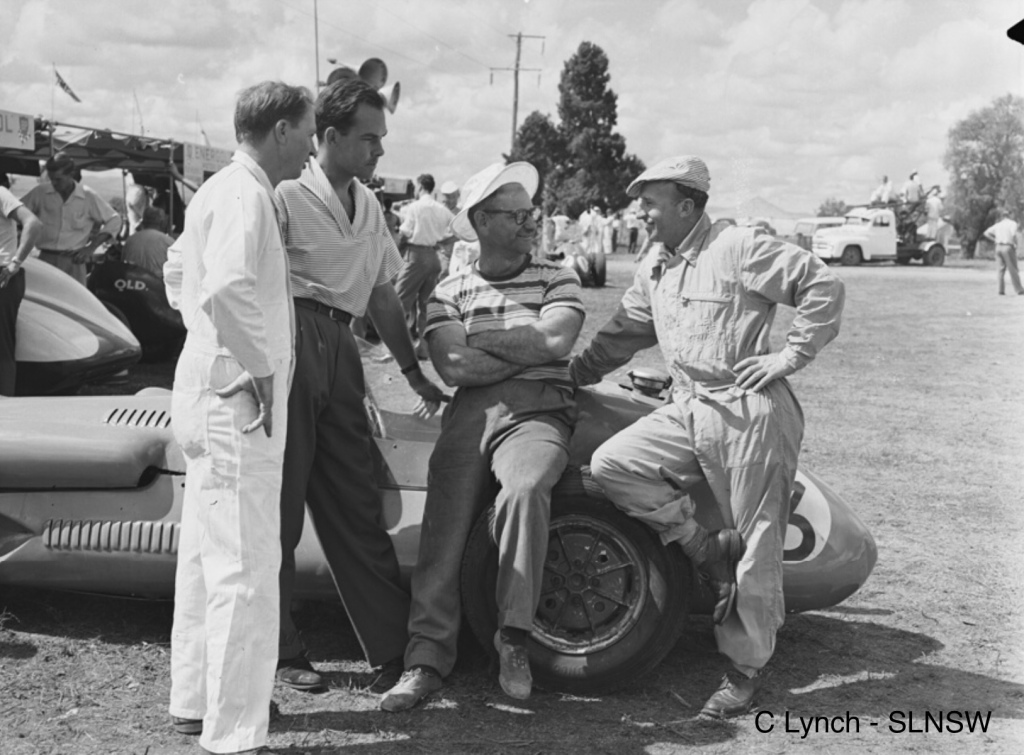
Myers – famous for racing in these horizontally hooped T-shirts – and crew in the Mount Panorama paddock, Easter 1959. Bonus points for crew-members names folks? That is a Cooper alloy wheel.
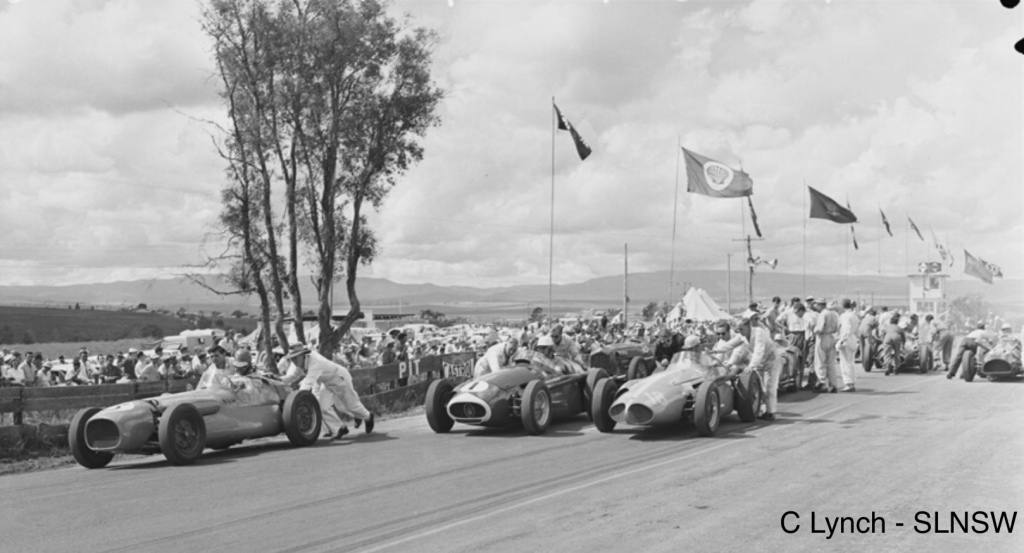
The boys push start that Waggott-Holden twin-cam six into life before the start of the 1959 Bathurst 100 on March 31. Stan Jones’ Maserati 250F is in the middle and race victor Ross Jensen’s 250F on pole at right. All the fun of the fair, look at that crowd! Jack was an excellent fourth behind Jensen, Len Lukey, Cooper T45 Climax, and Arnold Glass, Maserati 250F.
Stan is in the early stages of his best season and a bit ever, he was the reigning Gold Star Champion (1958) and at this stage of the year had won the Australian Grand Prix at Longford a month before. Jensen was seriously quick, he ran the Maserati at Bathurst in ’58, but failed to finish the 100, and finish the job he did a year later in convincing style!
WM Holden in the pits at Gnoo Blas, and again at the start of a race below, in February 1960. The ex-Whiteford Talbot-Lago T26C #110007 was raced by Barry Collerson.
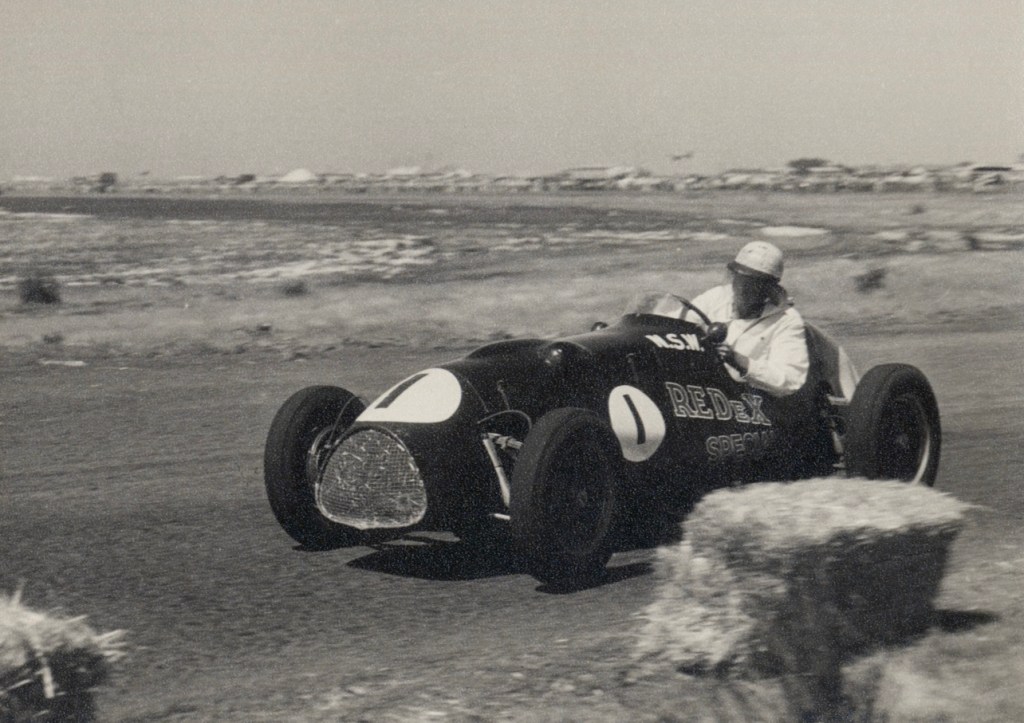
While it is true that the WM-Holden was the sexiest and quickest Holden-powered racing car of the period, the most successful was Tom Hawkes’ Cooper T23 Repco-Holden (below). Chassis #CB/Mk2/1/53) was no less a car than the ex-Jack Brabham Redex Special – a Bristol 2-litre six cylinder powered T23 – albeit continuously evolved by Hawkes after Jack sold the car (to Stan Jones then on to Hawkes) when he left for Europe in early 1955. Its Repco Hi-Power crossflow headed engine was far less exotic than Merv’s twinc, but was more reliable.
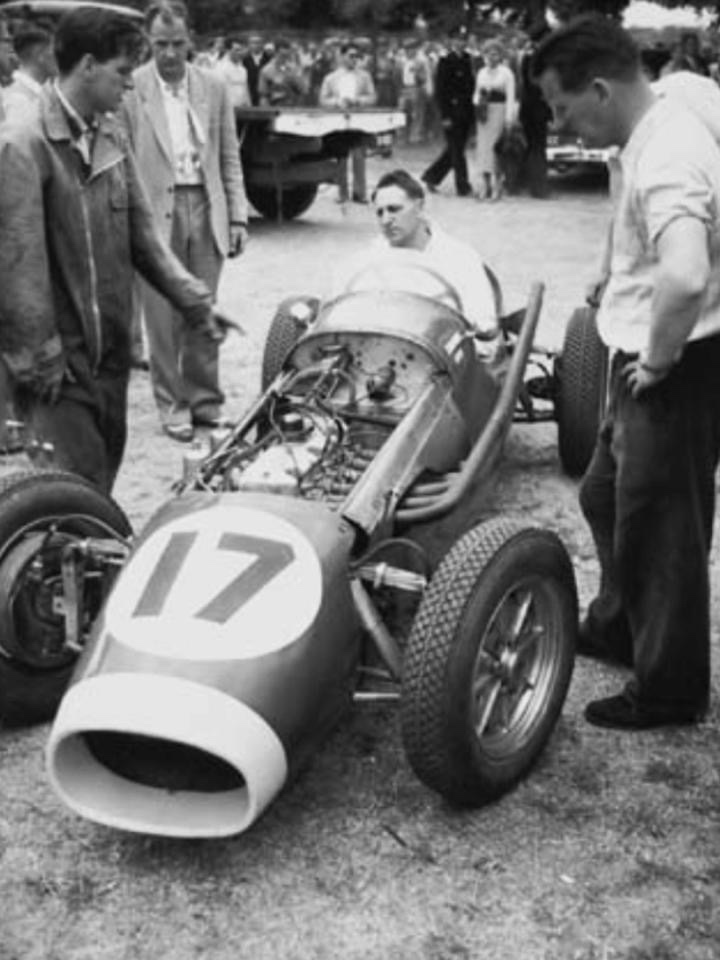
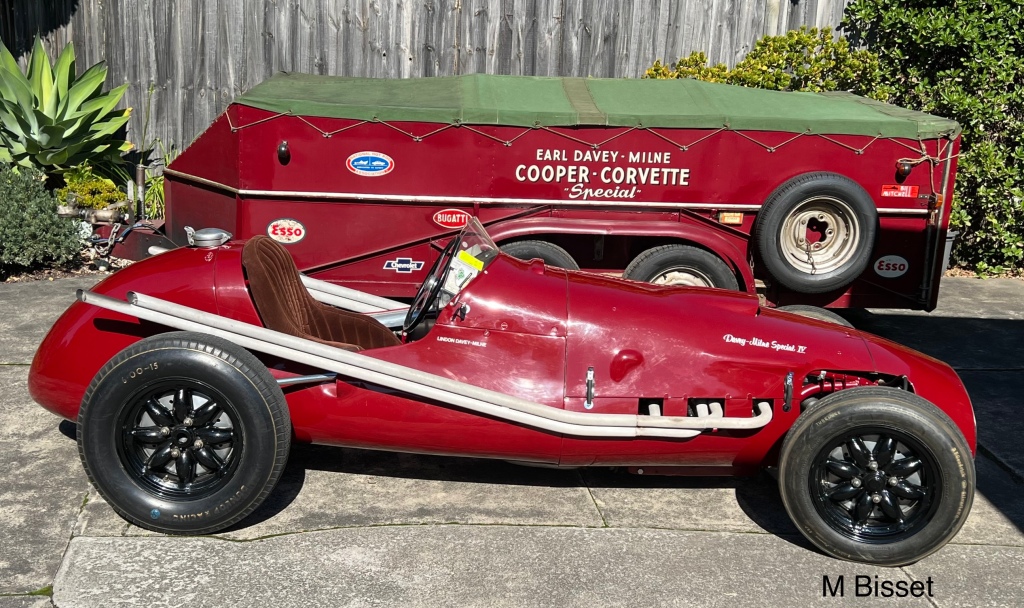
Very late in its in-period competitive life the T23 was fitted with a Chev 283cid V8, a task commenced by Tom Hawkes and Murray Rainey, and finished by Earl Davey-Milne. It’s still owned by the Davey-Milnes and is shown below last week. Mighty fine it is too…
(C Lynch-SLNSW)
Back where we started, Gnoo Blas in 1956, how did Jack do in the touring car races that weekend, and who is at the wheel of in that little VW Beetle 1200!?
Credits…
Cec Lynch-Pix-State Library of New South Wales, Bob Williamson Collection, Les Mortimer, David Medley, Ken Devine, Kelsey Collection, Kaleda Family Collection, National Archives of Australia, ‘Bathurst:Cradle of Australian Motor Racing’ John Medley
Tailpieces…
(Lynch/SLNSW)
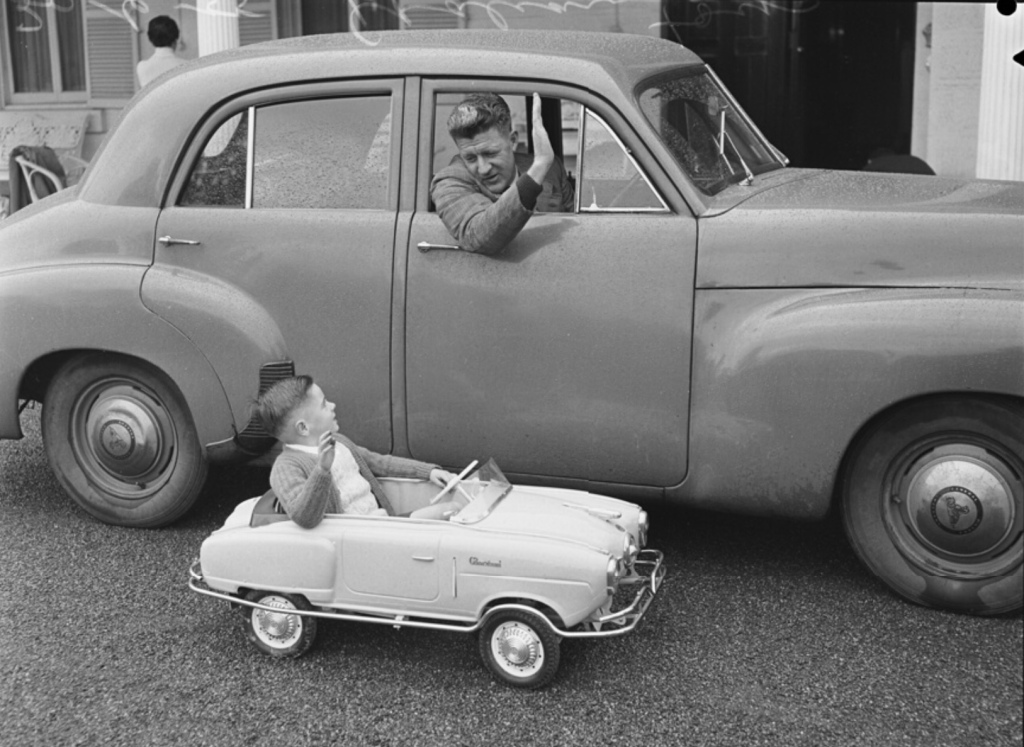
“Don’t even think about it kid, my 48-215 has been worked over by Jack Myers, you don’t have a chance!”
This shot is from a Pix puff-piece in 1955 promoting Italian toy cars for David Jones, a national department store chain. The little dude appears to be a handy-mechanic and would be 80’ish now. Chassis number and make of EV unknown…
I was flicking through some images and came upon a few photographs of Leo and Pete Geoghegan the other day, intriguingly, they were all shots taken in 1973. A good reason for a quickie article.
Leo initially raced the first ANF2 Birrana, the 272 Hart-Ford 416B 1.6, in 1972. By 1973 he raced a works-car to the Australian Formula 2 Championship in the 273 shown above. He won six of the seven rounds, then doubled up and won again aboard a 274 in 1974 against much stronger opposition. More about the 272 here: https://primotipo.com/2019/02/01/this-is-hard-work/
Pete Geoghegan ahead of one of the Toranas in the final ATCC round of 1973 at Warwick Farm in July. He was third behind the Peter Brock and Bob Morris XU-1s (Auto Action)
Meanwhile, younger-brother, Pete was doing his thing as one of the country’s greatest exponents of touring cars. He ran a John Sheppard built Group C Chrysler Valiant Charger E49 in the Australian Touring Car Championship, then switched brands to co-drive a works XA Ford Falcon GT351 Coupe in the Bathurst round of the Australian Manufacturers Championship.
Pete was sixth in the ATCC, his bests, a second place at Surfers and a pair of thirds at Calder and Warwick Farm. Allan Moffat won the title in his XY Ford Falcon GTHO Phase 3 from Peter Brock, LJ Holden Torana GTR XU-1, and Graham ‘Tubby’ Ritter, Ford Escort twin-cam.
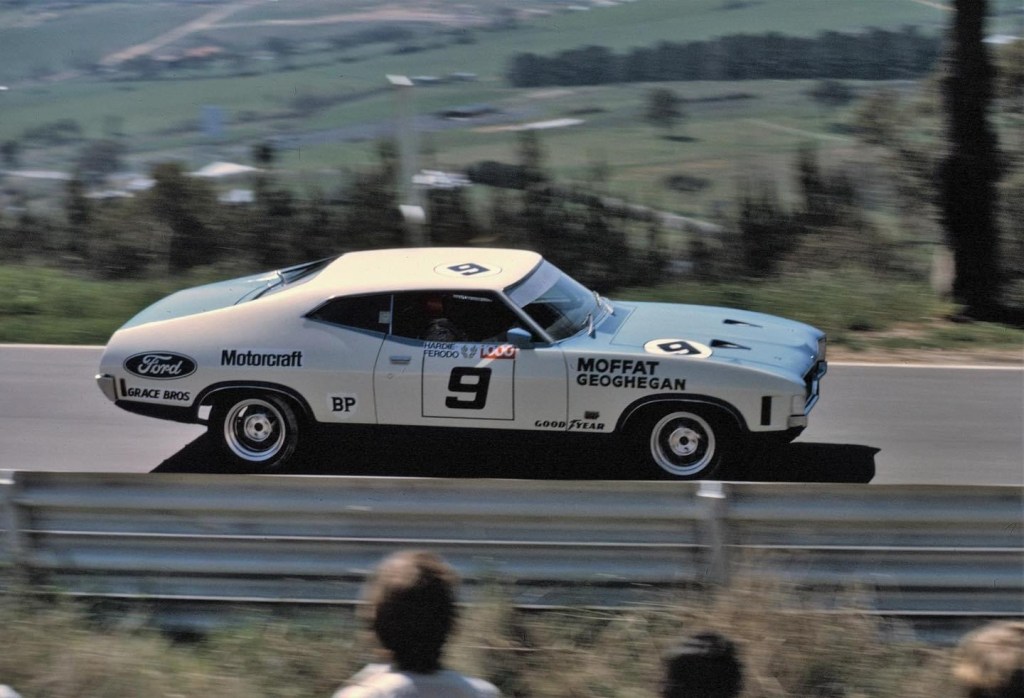
At Bathurst (below) Pete bagged an overdue 500-win for the brothers when he co-drove Moffat’s Coupe to a celebrated FoMoCo victory. Holden (Torana GTR XU-1) won the Manchamps with wins in three of the five rounds, Ford won two and were placed fourth in the title race, with Alfa Romeo (105 Series 2000 GTV) second and Mazda (Capella RX2) third.
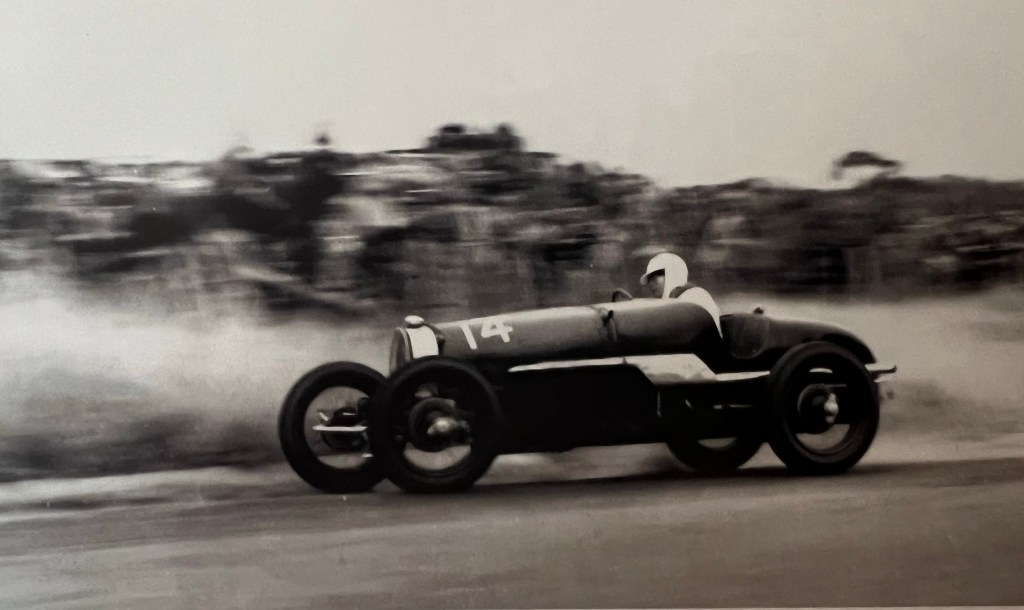
Lyndon Duckett on the way to winning the Longford Trophy in the Anzani Bugatti – Anzani R1 four cylinder, twin-cam engined Bugatti Type 35 chassis #4450 – on March 7, 1955.
Reportage of the early Longford meetings is pretty thin on the ground, so this contemporary summary of the weekend’s proceedings written by Brian Nichols for the May 1955 issue of Modern Motor is great to see, and share. Many thanks to Barry Oliver for posting it online.
Etcetera…
Geoff Smedley’s Triumph TR2 rounding Pub Corner, the Country Club Hotel more formally.
Pretty scratchy, shitty one of a favourite car, the Cisitalia D46 driven by Alan Watson; the machines Australian debut apparently. Through the viaduct in front of an MG T-Type Special. See here for more: https://primotipo.com/2023/09/08/cisitalia-d46/
‘No idea of time period, wife found them in a secondhand shop!’ wrote Robert Haines of this post on Bob Williamson’s Old Motor Racing Photographs – Australia page. Many thanks to Robert and his chairperson!
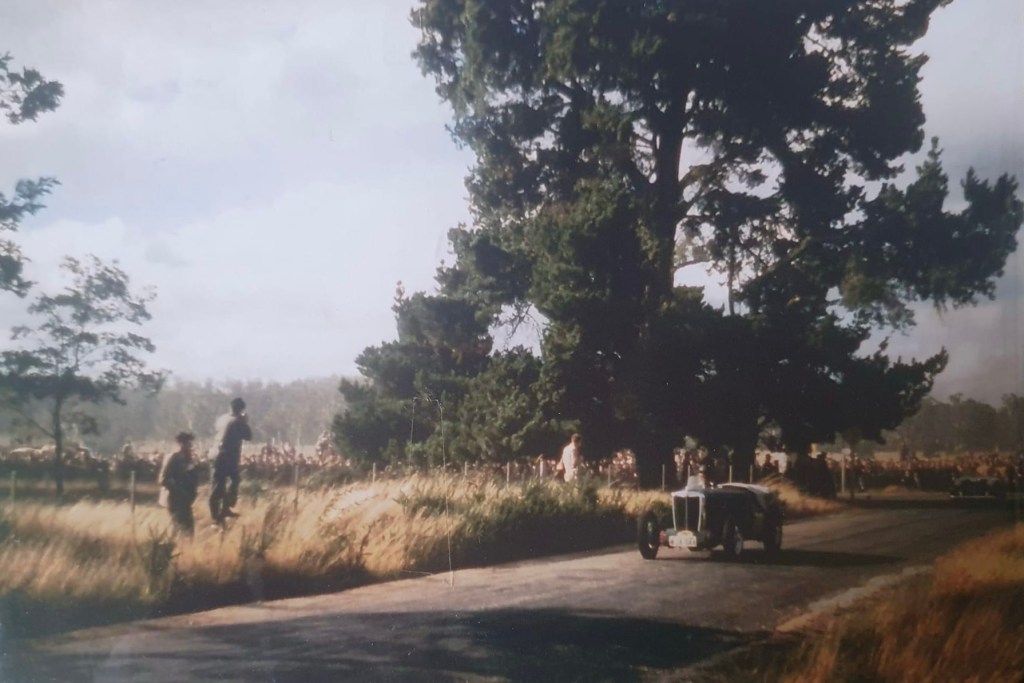
Mountford Corner, happily that magnificent tree still marks the spot!
The MG TF above is driven by longtime Tasmanian Senator, Peter Rae, still alive in his 90s.
And this T-Type special was raced either by Derrick Holden or Mike Winch.
Credits…
Paul Cross Collection via Neil Kearney’s ‘Longford: A Little Town with a Big Motor’, Modern Motor May 1955 via Barry Oliver Collection, Robert Staines, Rob Knott, Matthew Magilton
Moore and his Kiwi Equipe Cooper T43 Climax FWB during the F2 London Trophy meeting at Crystal Palace on June 10, 1957
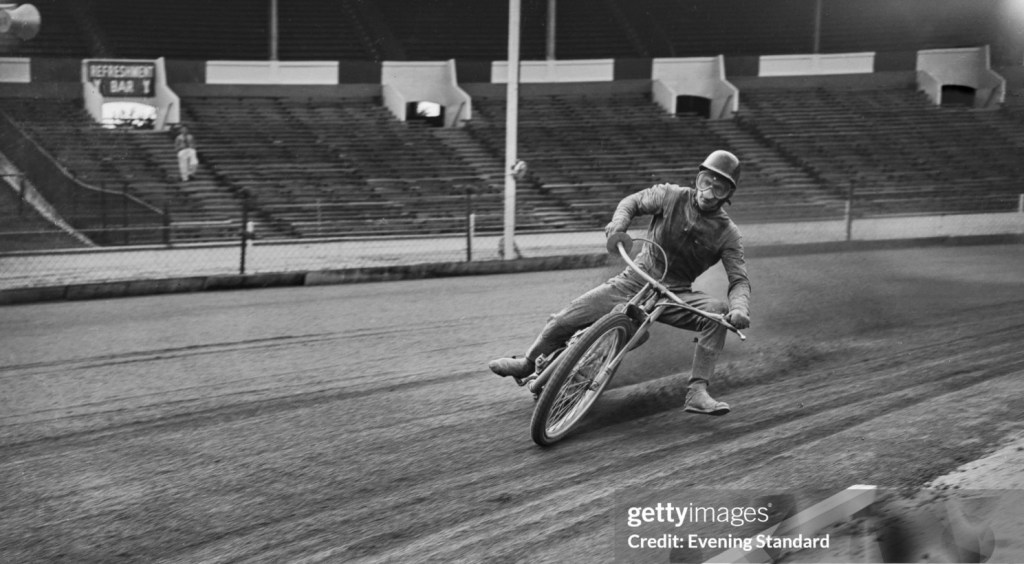
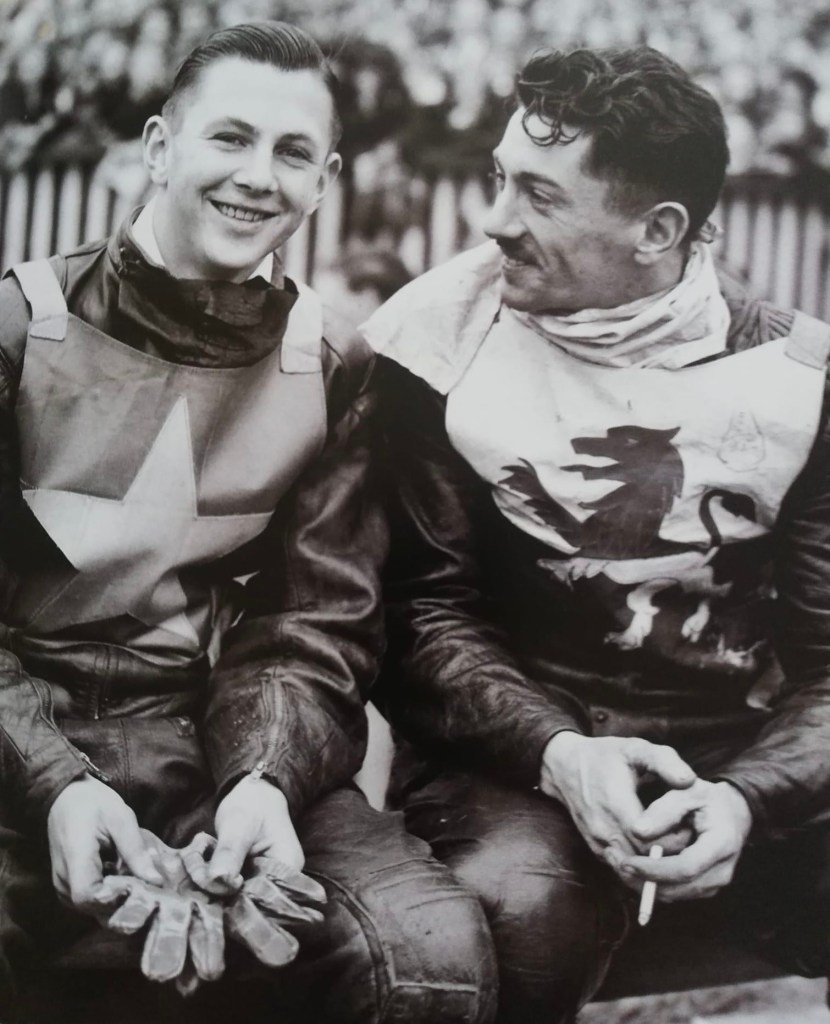
Ronnie Moore was an outstanding Kiwi sportsman, an international speedway rider who won the Individual World Speedway Championship in 1954 and 1959. He earned 13 international caps for the Australian national team, 50 for New Zealand and 21 for Great Britain in career that spanned 1949-75. In addition, he was a pretty handy F2 racer in 1957-58.
Born in Hobart, Tasmania, Australia on 8 April 1933, his father, Les Moore was also a champion rider who built a ‘Wall of Death’ in his backyard, and later turned it into a business, performing at Royal (Agriculture) Shows around Australia.
Ronnie began riding the wall at 13, then got his speedway start on an old Rudge after the family had moved to New Zealand in 1947.
Les stunned the NZ Speedway world when he rode the Rudge to a track record in Wellington, beating local star Bruce Abernethy. Les then got an offer to help set up a new track in Christchurch so the family shifted south.
While born in Australia, Ronnie always considered himself a Kiwi. He had to wait until he was 15 – the legal age to get a drivers licence – to have his first official race drive and later reckoned he could barely touch the foot-pegs on the Rudge when he lined up on the dirt track at Tai Tapu in 1948.
Kiwis Ronnie Moore and Barry Briggs from Australia’s Jack Young at Wembley during the September 1960 World Speedway Championship meetingWembley, September 1959, World Speedway Championship
In 1949, Moore began racing on a regular basis at his father’s Aranui Speedway in the Sandhills near Christchurch. He remembered counting the trucks as they brought all the dirt from the Lyttelton tunnel to create the track and arena.
Stuff.co.nz records that “His career clicked when he started riding a specialist, secondhand speedway bike his dad brought off Norman Parker,” a leading English racer who competed in New Zealand.
He moved to the UK in 1950. Wimbledon promoter Ronnie Green spotted his potential despite crashing through the wire-mesh safety fence on his first trial ride! He raced for the Wimbledon Dons in the British League, becoming team captain after two years, and continued with them until 1963, apart from two years in the late 1950s when he raced F2 Coopers.
“Speedway was second to football then in people going through the turnstiles, with crowds of up to 15,000 just for a league match.”
Moore was the youngest ever rider to qualify for a Speedway World Championship. He did that in 1950, aged just 17. Four years later, he became New Zealand’s first motorcycle world champion when he took the 1954 championship in front of 80,000 people at Wembley. Even more remarkable is that he was only 21 and took five wins from five starts, despite riding with a leg that had been broken badly not that long before in five places.
He had slid into a safety fence at a meeting in Denmark and stopped dead, his leg was bent around the bike’s handlebars. While the Danish doctors predicted a recovery time of nine months, Moore sought the advice of a Kiwi Harley Street surgeon who had made his name getting fighter pilots back in the sky quickly. His thigh to toe plaster cast was whipped off and the first of two braces were made which allowed the bone to heal, while reducing the rate at which his muscles would otherwise have withered.
Ronnie and Bruce Abernethy, Kiwi Stars both, in 1952 (A Jeffries)The two Moore family Kiefts – chassis C51-2 and C52-3 – as they left the factory en-route to New Zealand in 1951. Yes, the truck remained in the UK…(C Read Collection)
He was World Championship runner up in 1955-56 to England’s Peter Craven and Swede Ove Fundin. Fellow Kiwi, Barry Briggs won the championship in 1957-58 when Ronnie raced Formula 2 cars while at the peak of his powers.
He formed a two car team – Kiwi Equipe – with fellow EnnZedder Ray Thackwell – father of Mike – and they ran a pair of Cooper T43 Climax’s in 1957-58.
The pair of them went very well, not least in Ronnie’s case because he had been dabbling with cars at home each summer. He and his dad bought a pair of Kieft 500s in 1951, the small engines were soon replaced with supercharged 1000cc Vincent Black Shadow Vee-twins. The cars were very much outright contenders in the Formula Libre. Ronnie recalled in ‘The Ronnie Moore Story’ that “The result was electrifying. I was once clocked at 125mph down Wigram’s main straight – and I was still in third gear.”
One second hand Kieft post its Wigram Big One in 1952. Nice road car until that point! (R Dew)
Moore had a very lucky escape at Wigram in 1952. He came through Hangar flat-chat to find Don Ransley in the middle of the track, Ransley had spun Les Moore’s Alfa 8C2300 sportscar, “I piled straight in and the world started spinning around.”
“It was like hitting an express train, the Kieft somersaulted and came to rest upside down with me trapped underneath. I was conscious and couldn’t move, then fuel started running out of the tank and over me. I was in agony and there was real danger of the car exploding. The three or four minutes I was under the car seemed like an eternity. Appalled at what happened, Don Ransley through caution to the wind, leapt out of the Alfa and single-handedly turned the Kieft over…Apart from surface abrasions, there was nothing seriously wrong with me a few days in bed wouldn’t cure. The poor Kieft was a different matter, about all I managed to salvage was a wheel and a few bits of the motor. The Alfa hardly had a scratch!”
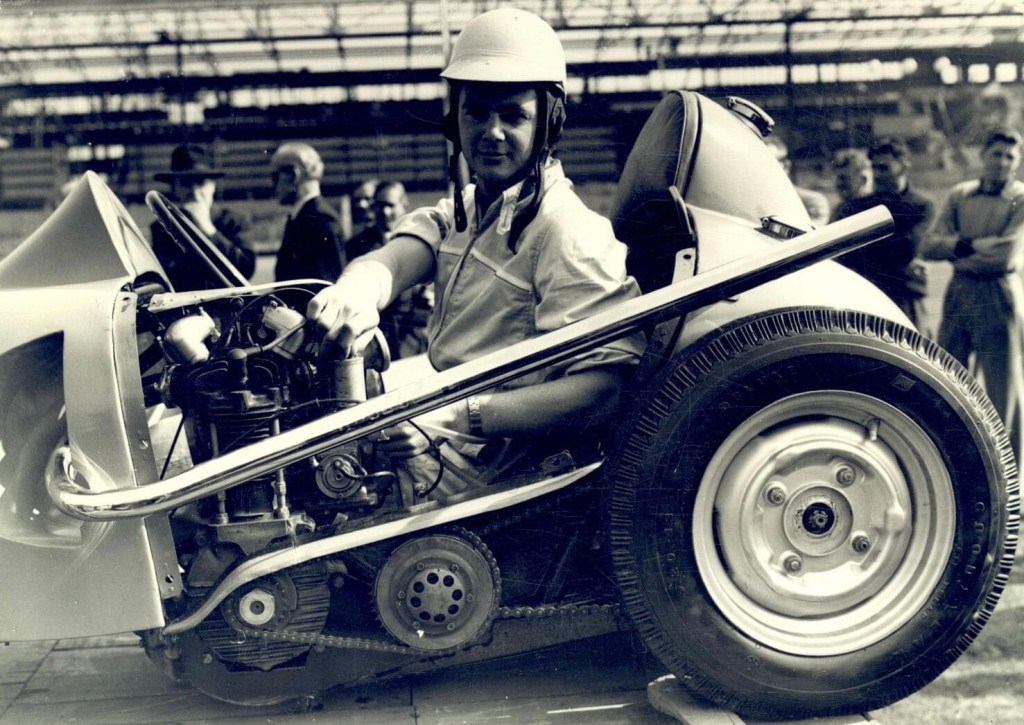
Ronnie’s car racing career included testing duties of this speedway car. The Allard designed and built ‘Atom’ was a prototype of a proposed fleet of cars being considered for racing on British speedways the following year. Wimbledon, September 1955. He was caught out and rolled over by track ruts, Ronnie broke his collarbone but recovered quickly enough (G Woods Collection)Cooper T43 Climax FWB, Brands Hatch 1957. Date unknown, the number doesn’t work for any of the Brands meetings Ronnie contested that year (Daily Mail)
In two truncated F2 seasons – about eight meetings in 1957 and six in 1958 – Ronnie did very well against seasoned F1 drivers and up-and-comers. His best results include a win against few cars at Roskilde, third in the Rochester Trophy at Brands and a fourth at Mallory Park. The race winners of meetings Moore contested were Jack Brabham, Tony Marsh and Roy Salvadori aboard Cooper T43s, and Maurice Trintignant on a factory Ferrari Dino 156.
His 1958 results included third at Brands in May and a pair of fourths in the Pau GP and Annerley Trophy at Crystal Palace. Race winners in his six ’58 meetings were the Trintignant, McLaren, Ian Burgess, Stuart Lewis-Evans and Syd Jensen Coopers (T43 and T45 Climaxes) and Cliff Allison’s Lotus 12 Climax.
Moore’s promising and way-too-short car racing career came to an end after a plea from his wife Jill, who was in hospital, giving birth to twin-daughters, Kim and Lea at the time. “She asked me if I’d quit. You break an arm or a leg in speedway, but you get over that. But three of your friends have been killed in car racing this year,” she said.
Ivor Bueb, Maserati 250F from Ronnie Moore’s Cooper T43 Climax during the September 1957 BRDC International Trophy meeting at Silverstone. Jean Behra won in a BRM P25, Bueb was ninth and Moore 17th (Getty)Crystal Palace, June 1957. The pair of Kiwi Equipe Cooper T43s – Ray Thackwell’s is the car beyond (Getty)
So Moore returned to Wimbledon for 1958, then in 1959 became Speedway World Champion again after fellow Kiwi Barry Briggs gave up some of his nitro-fuel so Ronnie could top up his tank before his fifth and final ride that day. He was runner-up again in 1960, to Fundin. Moore won the New Zealand Speedway Championship in 1956, 1962, 1968 and 1969.
He returned home in 1963 after another broken leg, the family was ready to stop shuffling between New Zealand and England. Ronnie invested in a motorcycle business and even re-activated the ‘Wall of Death’ show.
Sure enough he soon got the competitive twitches, feeling as though he had unfinished business and made a return to international racing in 1969, riding for Wimbledon and reaching the World Championship final at the ripe old age of 36. In 1970, he took the World Pairs Championship with fellow speedway great Ivan Mauger, at Malmo Stadium in Sweden .
At Belle Vue Stadium, Manchester in 1969Ronnie working on his bike in 1969. As to the make of frame and engine, your guess is as good as mine (Daily Mail)
1974 saw the first ’Battle of the World Champions’ series held in New Zealand and Australia, featuring four world champions: Barry Briggs, Ronnie Moore, Ove Fundin and Ivan Mauger. It was during the Jerilderie Park Speedway round in New South Wales that Moore nearly lost his life. His gear was stolen and he had to borrow someone else’s to ride. He crashed, suffering serious head injuries and was lucky to survive.
Moore was awarded an MBE in 1985 by the Queen, is a member of the Motorcycle New Zealand, New Zealand Sports and World Speedway Halls of Fame and won the Canterbury Sports Legends award in 2014. The Canterbury Park Motorcycle Speedway was renamed the Moore Park Motorcycle Speedway.
Twice World Champion, three times World Championship runner up, four times New Zealand Champion, World Pairs Champion and many other career achievements, Ronnie Moore is a great icon of New Zealand motorcycle sport, he died of lung cancer in Christchurch on August 18, 2018, aged 85.
(G Woods Collection)
Jill, Ronnie, Shani, Gina, Kim and Lea Moore at home circa 1972.
Etcetera…
While Ronnie was enjoying success in the UK, Les had acquired two Jano Alfa Romeos, an 8C2300 (chassis number please?) and no less a P3 than chassis #50005, the car with which Tazio Nuvolari belted the Silver Arrows by winning the 1935 German Grand Prix.
Moore found the P3 tricky to drive but won the Lady Wigram Trophy on the RNZAF airfield of the same name in 1951-52. Les died at the wheel of a celebrated NZ Special, the RA4 Vanguard, at Saltwater Creek, Timaru in October 1960 after the car rolled.
Valerie, Clarice, Les and Ron Moore with P3 Alfa Romeo after the 1952 Lady Wigram trophy victory (G Woods Collection)Moore at Wimbledon in 1955 (unattributed)
As mentioned above, the Atom was built by Allard to the order and brief of Wimbledon Speedway owner Ronnie Green in 1955, he was keen to ‘spice-up the show’.
Powered by a 500cc JAP speedway and clutch assembly, the 64-inch wheelbase car used an Allard Clipper chassis and many Ford components. Two were built. Click here for a great article about the project on The Allard Register website: http://www.allardregister.org/blog/2010/7/9/the-allard-atom.html
(unattributed)(unattributed)
Showtime! Date and place unknown. “Ronnie Moore on the Bally-rollers and Graham Pickup with the microphone. A free show outside the wall to attract punters to the show,” recalled Lindsay Mouat.
Craig Norman chipped in, “I was too scared to watch the actual show but I vividly remember watching spellbound at his outside display. He had perfect control and balance.”
(unattributed)
Credits…
This piece uses as a base an article written by Motorcycling NZ historian Ian Dawson on the occasion of Moore’s admission to the MNZ Hall of Fame in 2012. Getty Images, F2 Index, Graham Woods, Chris Read Collection, ‘The Ronnie Moore Story’ by Rod Dew, Alan Jeffries, Lindsay Mouat, Craig Norman
Tailpiece…
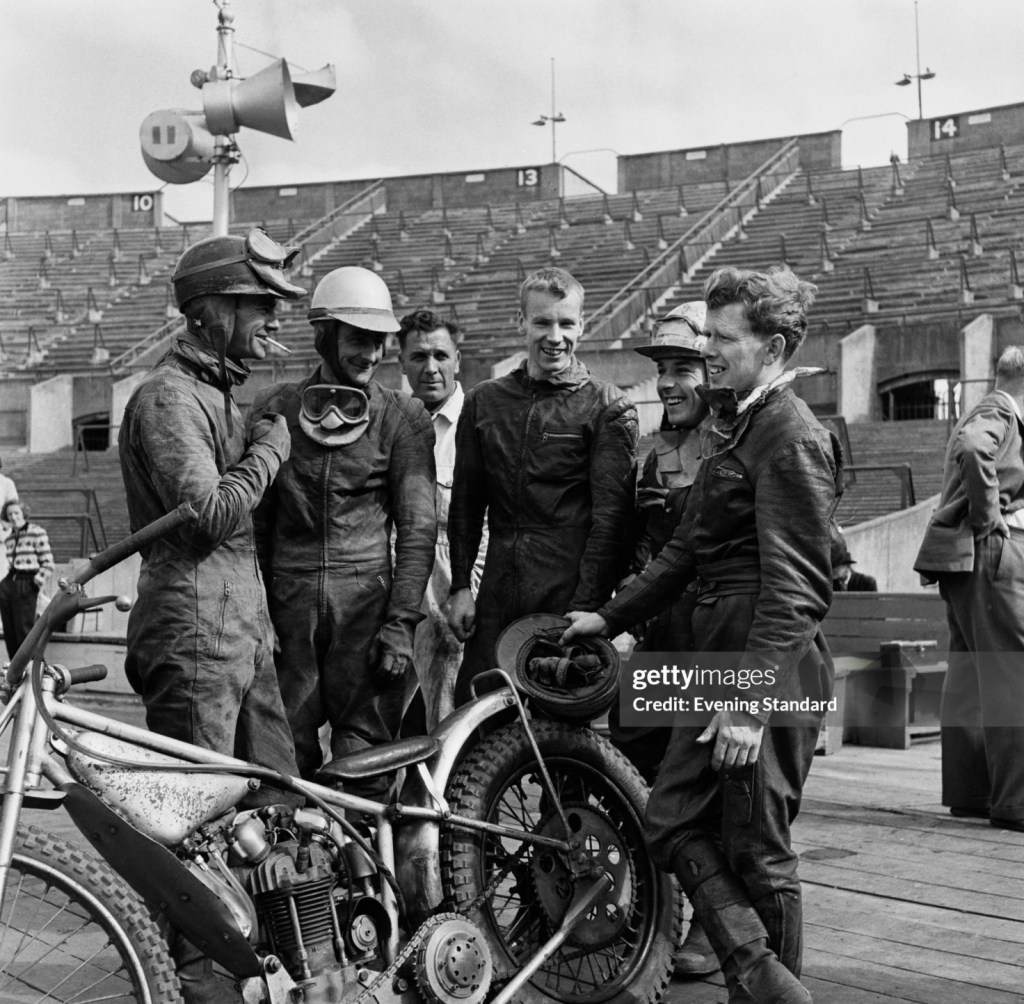
Ronnie Moore, Geoff Mardon, Ove Fundin, George White and Peter Craven prepare to compete in the Speedway World Championship at Wembley in September 1959.
All of these PR shots were taken during daytime, before the crowds arrived…
Murray Carter’s self built Carter Corvette V8 was a brutally attractive sports car that became Dingo-Ugly when the body was adapted to Appendix-K GT regs, as here during the March 1962, Sandown Park international meeting…
Here she is below in an earlier, far more appealing format, at Bathurst in October 1961. This article tells the story of the car and the folly of one of the CAMS’ less-than-brilliant rule changes: https://primotipo.com/2017/01/19/forever-young/
(VHRR Collection) (SLNSW)
Murray again, this time leading Barry Topen in the similarly vulgarised Jaguar D-Type, #XKD526, through Mobiloil corner – it seems – or Turn One in vulgar, modern parlance.
The capacious Sandown paddock above, not quite so accommodating by the early 1970s mind you. Meanwhile old-mate below – craning his neck in the light coloured suit – is upset because he thought he was heading off to his favourite track to see the donkeys galloping around…It was Sandown’s ‘opening car race meeting’ after all, the first clubbie is duly noted.
(SLNSW)(SLNSW)
Ah, that’s reassuring, Peters corner, was named so, right from the start. At least until ‘Torana’ made an offer the Light Car Club of Australia couldn’t decline circa 1971-72. Sandown’s Pit Straight before the pit counter and pitlane armco…and armco and grass runoff area on the outside. That road style kerb would have caused some excitement and grief.
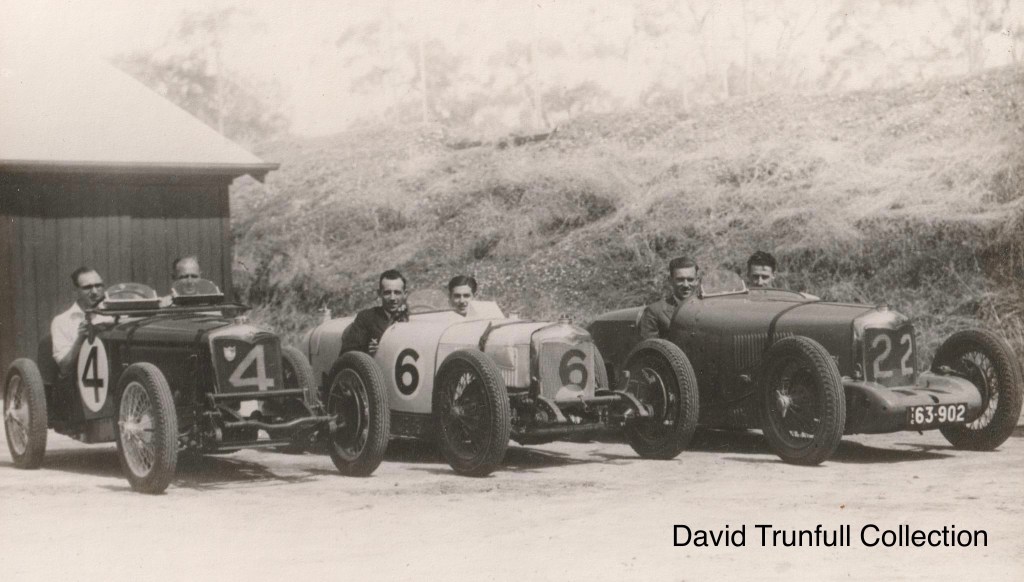
“A group of Rileys during the (Victorian) Centenary Grand Prix – January 1 1935 – weekend at Phillip Island,” wrote David Trunfull.
“The Ulster Imp is being driven by Bill Williamson, his passenger is Air Commodore Johnny Summers. The Brooklands #6 is being driven by Bill Galpin from New Zealand, the passenger is MC Shmith. This car is the ex-Riley works car that won the 1933 AGP driven by Bill Thompson. Brooklands 63.902 is being driven by Merton Wreford, his passenger is Alan Wyatt, the source of this photo. Wreford worked for the Riley distributor, BL Cohen.”
Another shot from the same event. “#6 is the Bill Thompson 1933 AGP car. It was brought over specially for the Centenary 300 by Bill Galpin but for some unknown reason it didn’t take place in the race.”
Trunfull, “The ex-Riley team car was raced in the UK by Sir Malcolm Campbell, AK v.d Becke and Sir Chris Staniland.” “The Brooklands also won the 1949 inaugural Lady Wigram Trophy (on the RNZAF Christchurch airforce base of the same name ) in the hands of Morrie Proctor. It still resides in Christchurch,” chipped in John Newell.
The car on the right is another ex-Riley team car which is said to have been a spare for the 1934 Ulster Tourist Trophy. BL Cohen Pty Ltd imported it in 1934, Bill Williamson raced it for them. The Head brothers later owned and raced it, fitting a 12/4 race engine.”
“This car (the Imp) is now one by Ian Ruffley’s family, the original Ulster Imp engine is probably fitted to the late Terry Moran’s car,” wrote Jim Runciman.
This shot from Tony Johns “was taken during the 1932 AGP weekend at Phillip Island.” #14 is the ninth placed Bill Williamson driven Riley, car #19 Ken McKinney’s Austin 7 DNF. Bill Thompson won the race in a Bugatti T37A.
A bit of trivia, “if you enlarge the photo, the open door on the left has CRD (Cyril Dickason) and RCM (Clarrie May) and CRW (Cec Warren) who would have shared the same garage when they raced Austins in the 1931 AGP the year before.”
Credits…
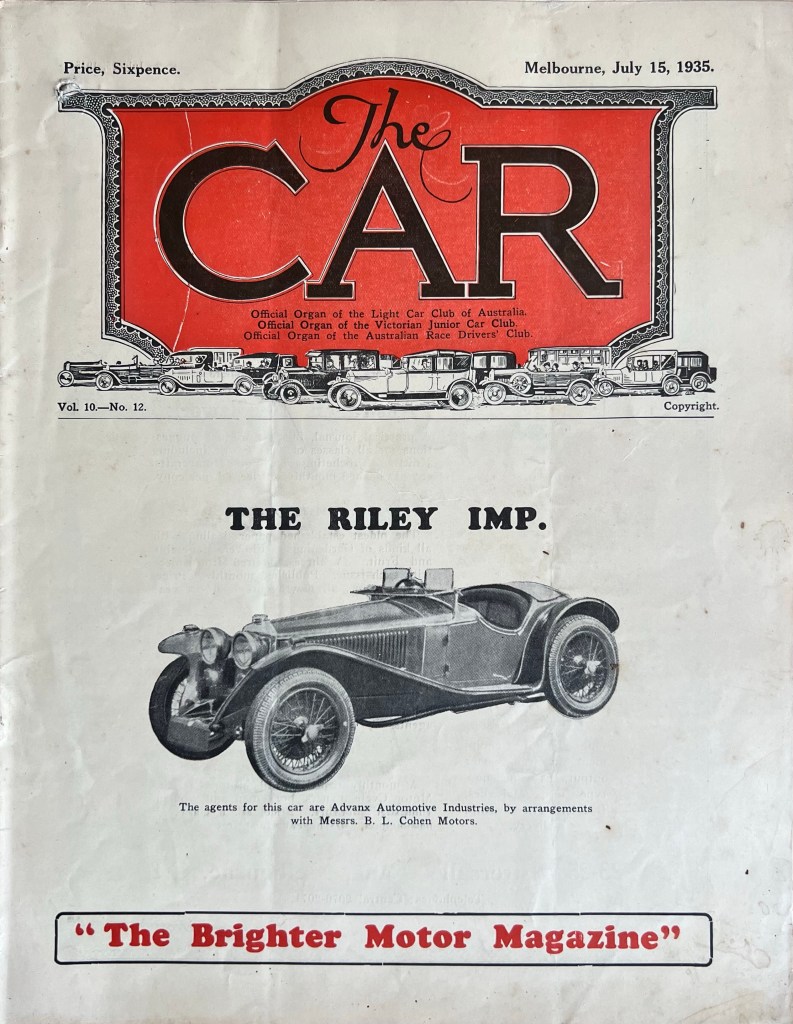
The Car, David Trunfull, Jim Runciman, John Newell, Tony Johns, VSCC NSW Archive
Jack Brabham from Bruce McLaren: a works Cooper T51/Climax 1-2 seemed likely for much of the race (MotorSport)
A thrilling race of course, Bruce McLaren took an historic win – as the youngest ever F1 championship GP winner, a title he held for yonks – after Jack Brabham’s Cooper T51 Climax ran out of juice on the last lap. Jack was fourth, Maurice Trintignant, Cooper T51 Climax was second and Tony Brooks, Ferrari Dino 246 was third.
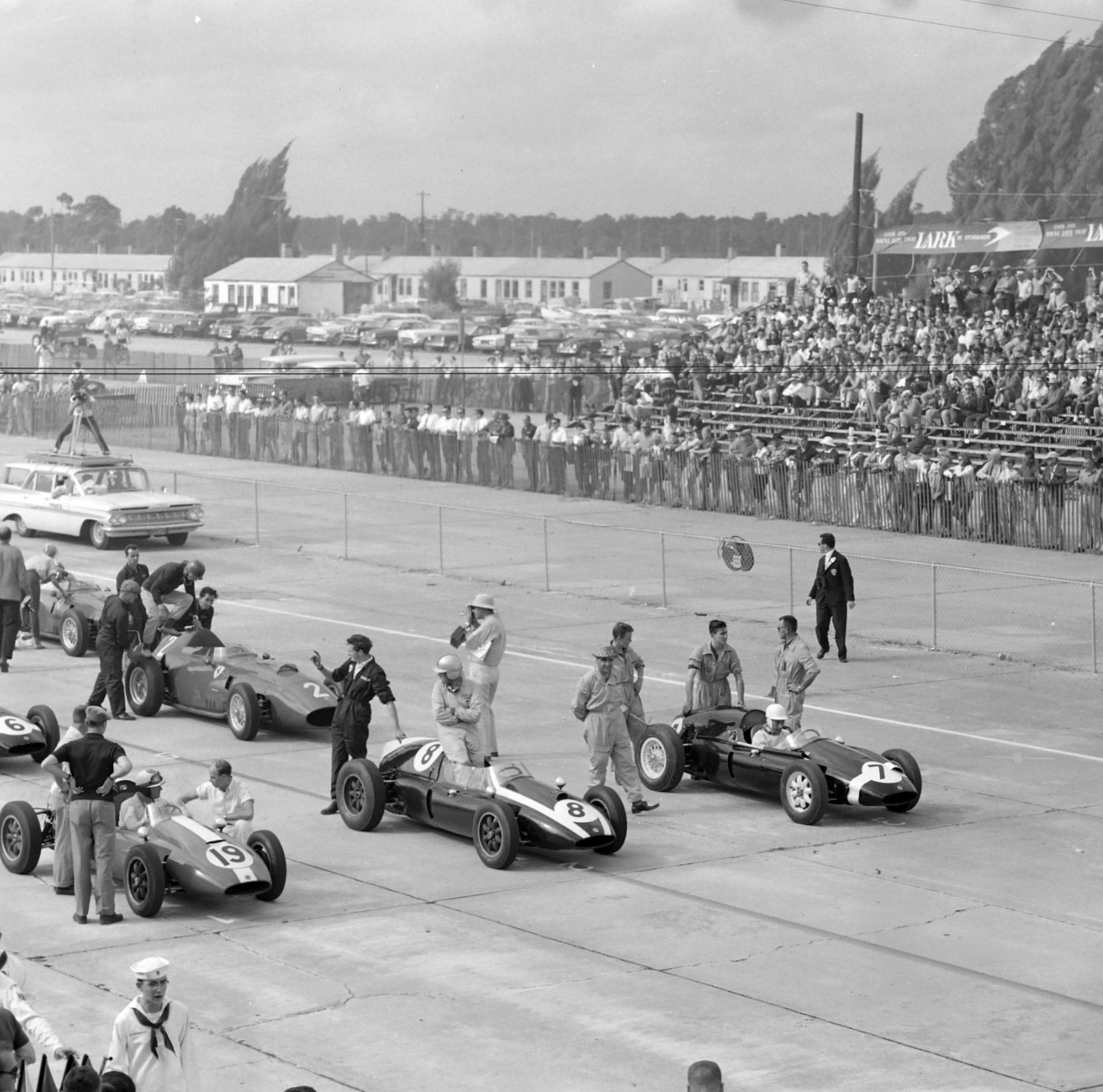
Just before the off, Harry Schell, Jack Brabham and Stirling Moss all aboard Cooper T51s on the front row; Harry controversially so as he had taken a short cut during qualifying! #6 is Maurice Trintignant’s Walker T51, #2 Tony Brooks’ Ferrari Dino 246 (MotorSport)
The Americans entered F1 etc – Indy being part of the F1 World Championship from 1950-1960 duly noted – but the interesting thing was the mix of cars. Not just Rodger Ward’s utterly nuts and utterly wonderful, Kurtis Kraft Offy, but also Fritz d’Orey’s Tec-Mec F415 Maserati, Allesandro de Tomaso’s Cooper T43 OSCA Streamliner and Bob Said’s Connaught C-Type Alta.
(MotorSport)(MotorSport)
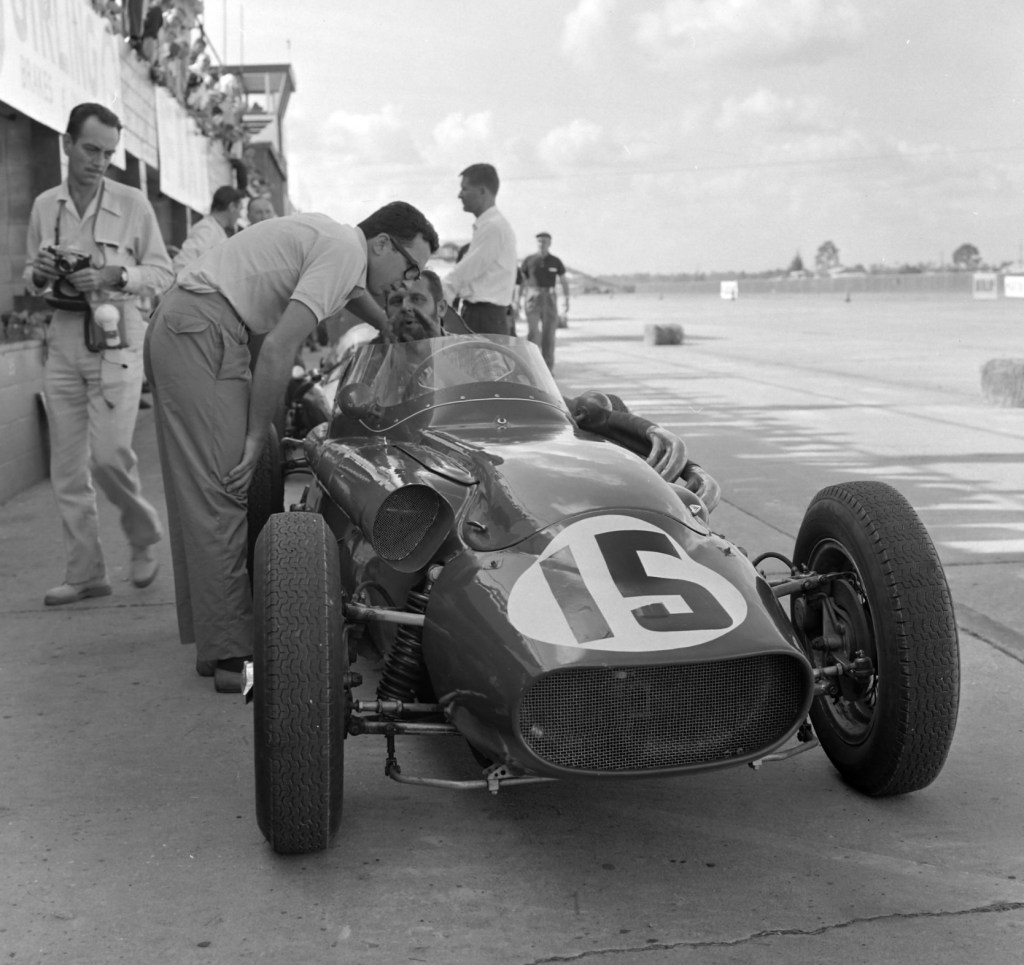
Fritz d’Orey in the one-off Valerio Colotti designed, Gordon Pennington owned Tec-Mec F415 Maserati at Sebring during practice.
Remember those days before carefully homogenised and pasteurised, hermetically clean and certified absolute sameness and dull-shit-boredom. Where did it all go wrong? See here for a story on this car: https://primotipo.com/2024/03/11/tec-mec-f415-maserati/
(MotorSport)
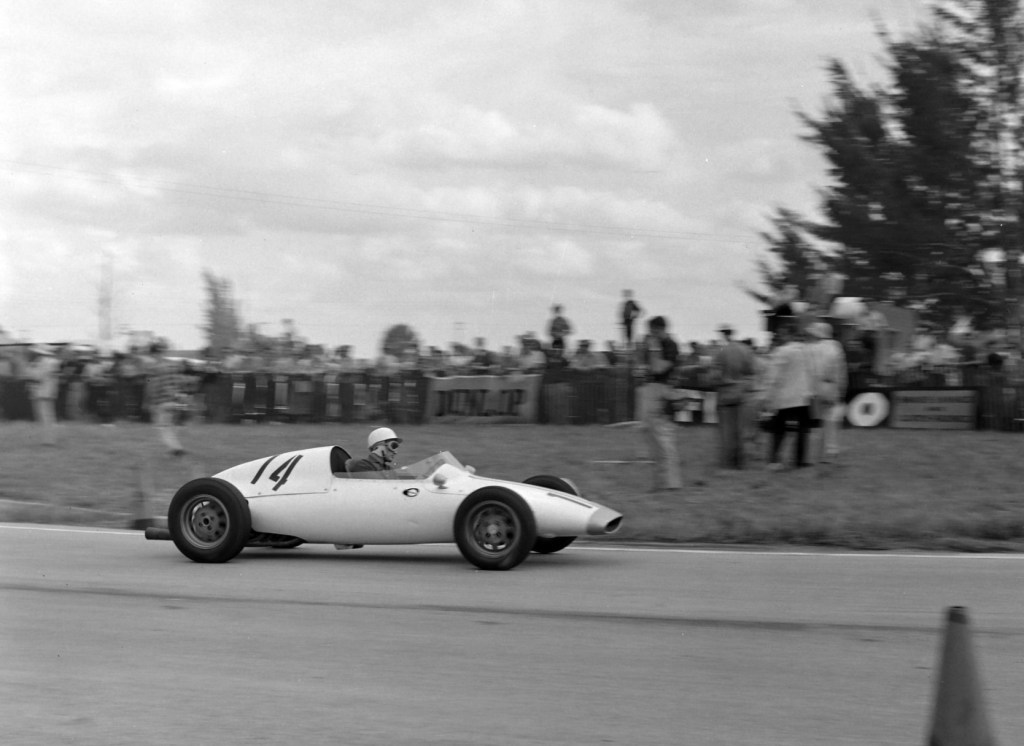
De Tomaso’s works Officine Specializate Costruzione Automobili entered Cooper T43 OSCA 2-litre was only ever going to be an also-ran given the modest displacement and endurance background its twin-cam, Weber fed four-cylinder engine. He qualified the car 14th on the 19 car grid and completed 14 laps before brake troubles intervened.
The car’s swoopy, beautifully finished and fitting body is far more attractive than any of the Coopers of that era, and more aerodynamically efficient? While said to be a Cooper T43, the chassis may be a copy, the wheels are also of De Tomaso’s design and manufacture. An interesting experiment, what became of the car?
(MotorSport)(MotorSport)
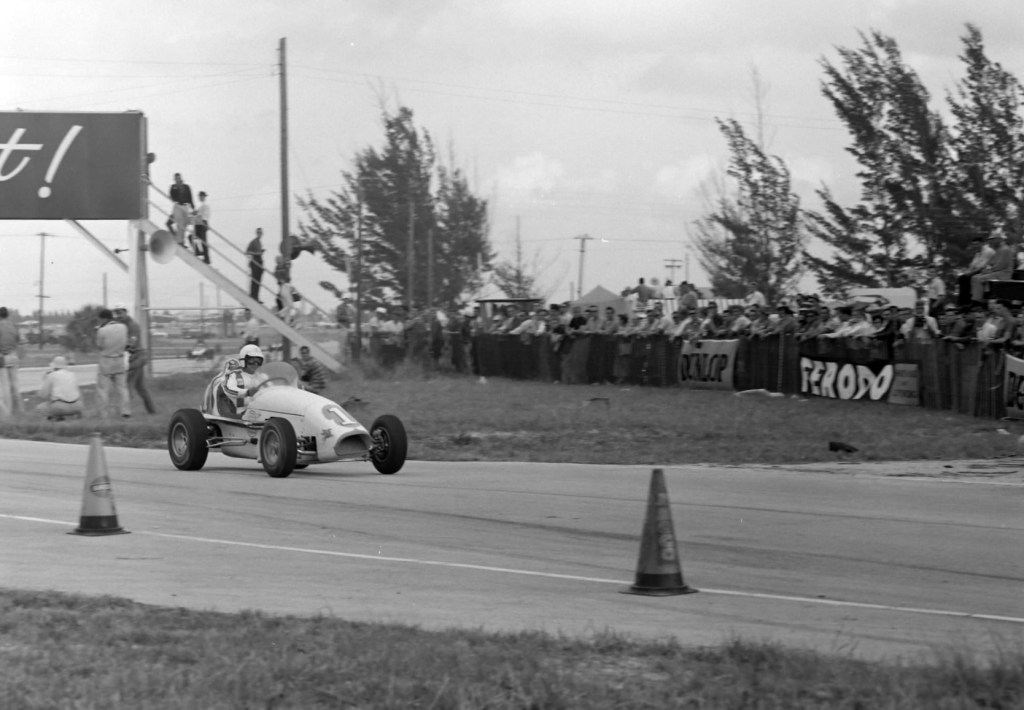
It made great commercial sense for the organisers to run the reigning Indy 500 champion, Rodger Ward, in the race. If you believe the hype, Ward thought his lightly modified Kuris Kraft Midget would give the ‘European Buggies’ a run for their money.
Jack Brabham related to Doug Nye, “The next day he, Bruce, and and I arrived together at the first corner of the track, and just as we jumped from brake to throttle pedal and streaked away from him he was astonished. To his credit he took it well.”
Ward’s qualifying time was well short of pole-sitter Stirling Moss in Rob Walker’s Cooper T51 Climax: 3 min dead vs 3 min 43.8 sec. Rodger lasted for 21 of the race’s 42 5.2-mile laps, getting as high as ninth as others retired, before clutch failure intervened.
A popular racer and a good sport, he became a Cooper convert overnight and worked on Jack and John Cooper to convince them to run a car at Indianapolis. After the 1960 US GP Jack ran his GP Cooper T53 Climax at Indy in a series of tests, aided and abetted by Ward; Coopers participation in the 1961 500 with a Climax powered Cooper T54 changed Indy history, and Rodger Ward played a key role.
(MotorSport)
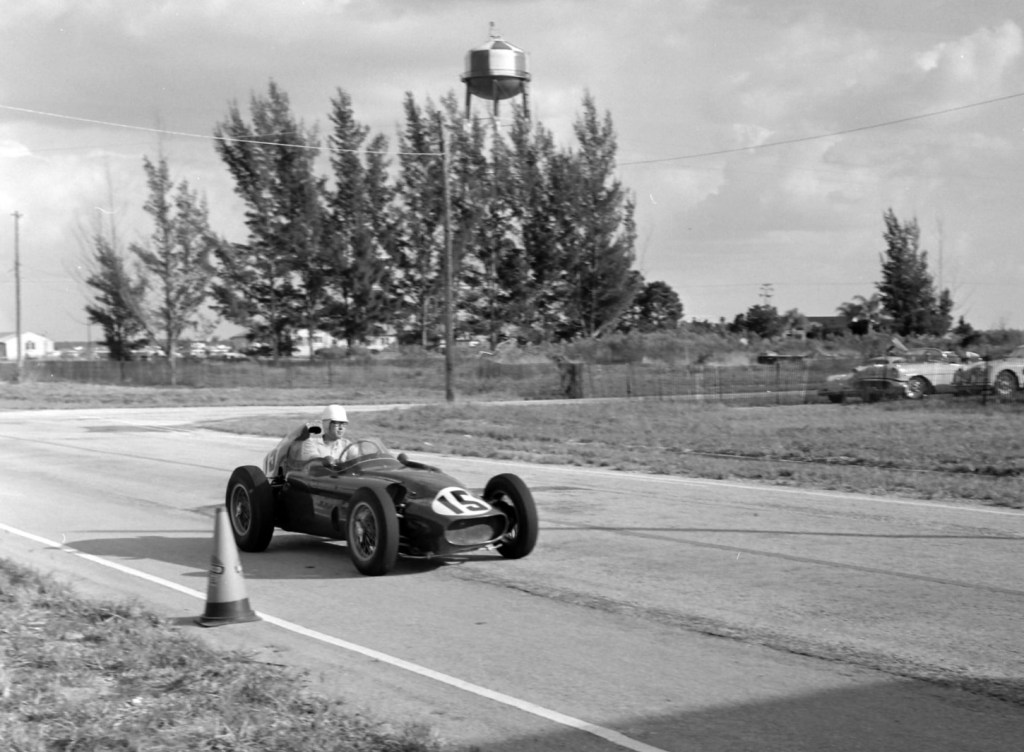
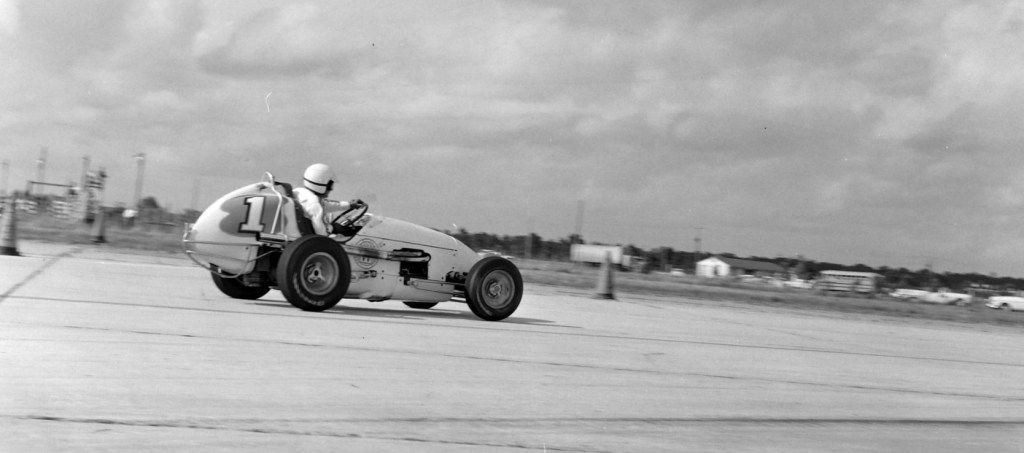
Ward’s 1946 Leader Card Kurtis Kraft Midget, chassis #0-10-46 was powered by a 1.7-litre, DOHC, two-valve Offenhauser engine that gave away heaps of performance to the mainly 2.5-litre competition. It had a two-speed gearbox, a two-ratio rear axle, hand-disc-brakes and the usual other dirt-track accoutrements! Those Halibrand wheels are 12-inches in diameter and Firestone provided the tyres.
The beam front axle is sprung by a transverse leaf and located bt two radius rods. I’ll take your advice on shock-absorbers. Note the front discs, nerf protection in front of the rear wheels and high standard of preparation and presentation.
(MotorSport)
Jesse Alexander observed the following about the Kurtis Kraft in his Sports Cars Illustrated meeting report.
“The greater part of the two practice sessions was spent getting the car to run properly on Avgas (rather than the usual methanol). The several times that it did appear on the circuit it was obvious that the few modifications to the chassis to suit it better for road racing were worthwhile. Surprisingly stabile and getting through many of the corners as fast (in some cases faster) as much of the field.”
“The red and white Offy differed from normal midgets in having its engine fitted several inches farther forward in the chassis as well as having a supplementary 2-speed transmission installed. This meant that actually there were two 2-speed units, one behind the engine and the other in unit with the final drive gears. But these alterations could never possibly make up for the displacement gap between the parky Midget and her overseas competitors.”
“Rodger Ward deserves credit for his spirit and enthusiasm – it was great to see him at Sebring and lets hope it won’t be the last time out for an Offy-engined car.”
By late 1959 the car was owned by Florida man Gordon Pennington, he decided to enter the machine for its one-and-only race at Sebring.
With Brazilian wealthy-journeyman Fritz d’Oley at the wheel, the new car, being run for Pennington and D’Oley by the Camoradi Team, managed to qualify 16th, one grid-slot in front of the only 250F in the race driven by Phil Cade.
The Tec-Mec completed 7 laps before an oil leak forced Fritz’ withdrawal, while Cade didn’t take the start given the old-gal’s lack of pace: 3 min 39 sec in qualifying. While Tony Brooks’ front-engined Ferrari Dino 246 was third, and the Dinos raced on into 1960, Ferrari wheeled out a mid-engined prototype at Monaco that year.
Fritz d’Orey, Tec-Mec F415 Maserati during the race. “The Tec-Mec was never driven quickly enough to show up any defects. The only time we know of it being driven fast was when Jo Bonnier took it around the Modena Autodromo last summer. His comments were not all that favourable. He complained of, among other things, a flexing chassis.”
Fritz d’Orey, Tec Mec F415 on the hop (MotorSport)Bob Said in the Connaught C-Type Alta. Unusual and attractive body, Dunlop alloy wheels (MotorSport)
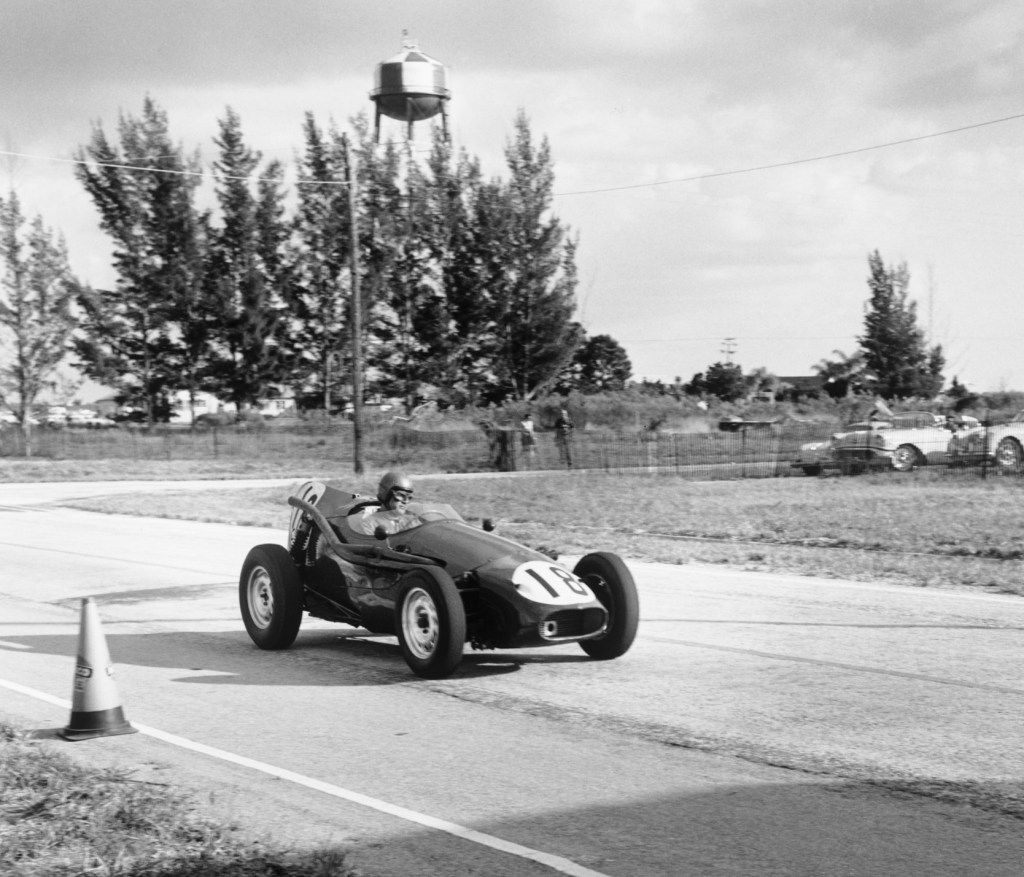
A bit like the Tec Mec, the Connaught C-Type Alta (chassis #C8) was also stillborn.
Rodney Clarke’s spaceframe chassis, disc braked, strut/De Dion tube rear suspension, double wishbone front suspension, Alta DOHC, two-valve four powered, Wilson pre-selector ‘transmissioned’ vast improvement of Connaught’s successful B-Type was tested but unraced when the assets of Connaught Engineering were sold in 1957.
Passed in at the auction, #C8 was later sold to Paul Emery (of Emeryson fame) and “keen amateur racing driver John Turner”. They soon did a deal with American driver, Bob Said, to race the car at Sebring.
Inevitably, shipping delays meant the project was knee-capped from the start. Poor Said had little testing time, with fuel injection difficulties adding to the challenge. He qualified the car a great 13th in the circumstances but had clutch problems in the race and then crashed it when he was caught out by the Alta engine’s erratic throttle response without completing a lap.
Jesse Alexander wrote, “The Connaught with Bob said driving drew many interested onlookers. This was the first racing appearance of the space-framed car that was under construction back when Connaught decided to cease building and racing cars. They never sold this one, which embodies many novel design features like a telescoping de Dion tube and servo-operated Lockheed disc brakes. Paul Emery got it running well enough for Said to turn a 3:27.3sec practice lap.”
Connaught C-Type #C8 in-build at Send. Note Alta engine and spaceframe chassis which looks very torsionally stiff in this photo and the one below. Double wishbone IFS and bespoke? uprights. Who are they folks? (W I’Anson Ltd)Dunlop wheels, diff clear but not the strut/De Dion arrangement. It all looks thoroughly modern and light, Wilson pre-selector box more weighty (W I’Anson Ltd)
While outside the scope of this article, the car was repaired back at the Send factory, near Guildford. With six inches added to the wheelbase, cut-down bodywork, a push-bar, and the Alta fuel injected engine tuned to 260bhp on methanol, Jack Fairman attempted unsuccessfully to qualify the car for the 1962 Indianapolis 500.
It’s such a shame this Connaught didn’t contest Grands Prix in 1957 as planned…
C8 was sold via a Road & Track ad and then lived in a private California museum from late ’62 until 1974 when Rodney Clarke repatriated the car to the UK. In another Tec Mec similarity, the car has been an historic racing front runner for decades, initially in Indy LWB spec and since the late 1990s in its original GP specifications.
Stirling Moss in the Walker Cooper T51 in front of the seventh placed Harry Blanchard’s Porsche RSK and Taffy Von Trips’ Ferrari Dino 246, sixth (MotorSport)
Stirling Moss’ Rob Walker Cooper started from pole but was out after only five laps with Colotti gearbox failure.
Alf Francis had modified the rear suspension from the standard Cooper transverse leaf setup to coil springs and ‘wishbones’ as shown in the shot below.
Jesse Alexander explains, “The new rear suspension had been tried out in the Fall back in England. Stirling liked its feel, then proved it by bettering the Goodwood lap record. Wire wheels at the rear, and the Colotti five-speed transmission were the only major differences bwtween the Walker cars and the works cars of Brabham and McLaren.”
(MotorSport)(MotorSport)
Bruce McLaren – with Jack in front of him – demonstrates the geometry of the standard T51 transverse leaf layout (at Sebring) where said spring performs that task, and locational duties. The 1960 Cooper Lowline (T53) quickly concocted by Messrs Cooper C, Brabham, McLaren and Maddock after the first race of the year, included among its successful bag-of-tricks a coil sprung rear end.
(MotorSport)
McLaren enroute to victory above. Alexander tells us that Brabham had initially practiced this car but “it had experimental settings for 1960” and Jack didn’t like the feel of it, so he and Bruce swapped chassis. “McLaren had not even expected to race at Sebring when I spoke with him in England in October. He expected to be in New Zealand for Christmas and participate in their Grand Prix. As it turned out, Masten Gregory’s injuries failed to heal in time for him to race at Sebring and Bruce replaced him.”
Didn’t fate play a couple of hands in Bruce’s favour!
(MotorSport)
Credits…
MotorSport Images, Jesse Alexander in Sports Cars Illustrated March 1960 via Stephen Dalton’s archive, William I’Anson Ltd
This pair of shots are of Jim Hawker at the 16th Rob Roy in June 1948 above, and the 10th Rob Roy meeting below, in 1946.
(G Thomas)(G Thomas)
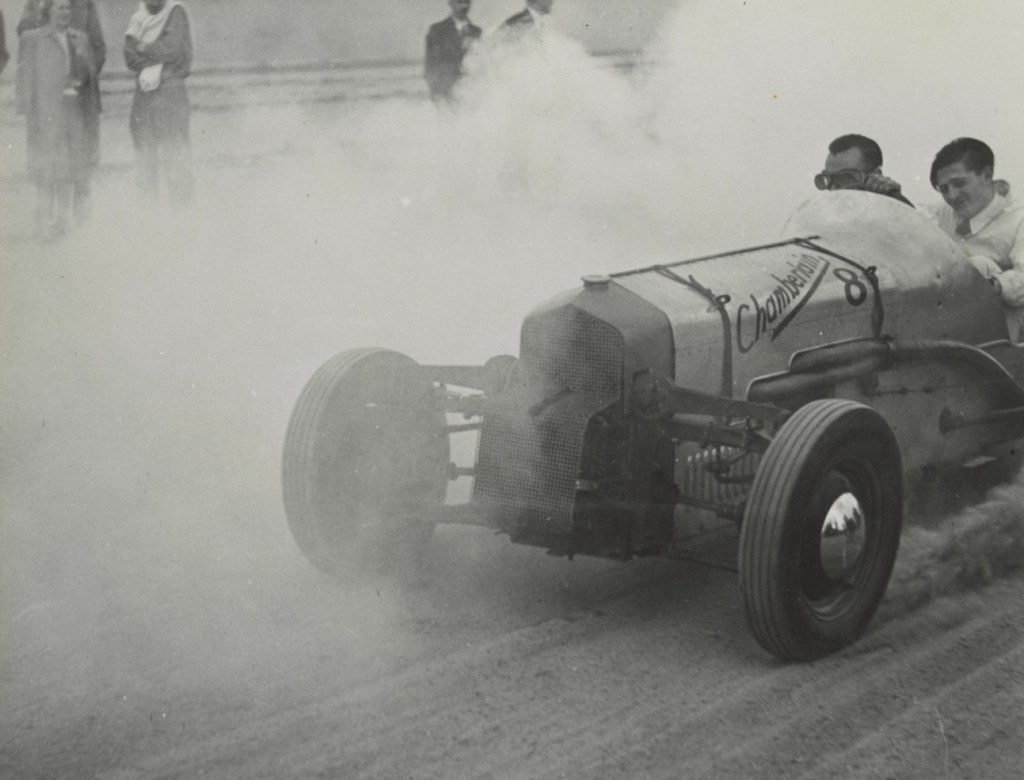
Peeling out during a run at the Vintage Sports Car Club speed trials on June 16, 1947.
Spaceframe chassis, independent suspension front and rear, front wheel drive, and a complex four cylinder 1.1-litre, stepped bore, eight-piston, vertically opposed, supercharged two-stroke, twin-plug engine amongst its pre-war bag of tricks.
Bruce McLaren tips his Cooper T70 Climax into Shell corner at Sandown during the 1964 Tasman Cup round – the Australian Grand Prix – DNF engine in the race won by Jack Brabham. See here: https://primotipo.com/2020/04/20/mclaren-cooper-t70-sandown/
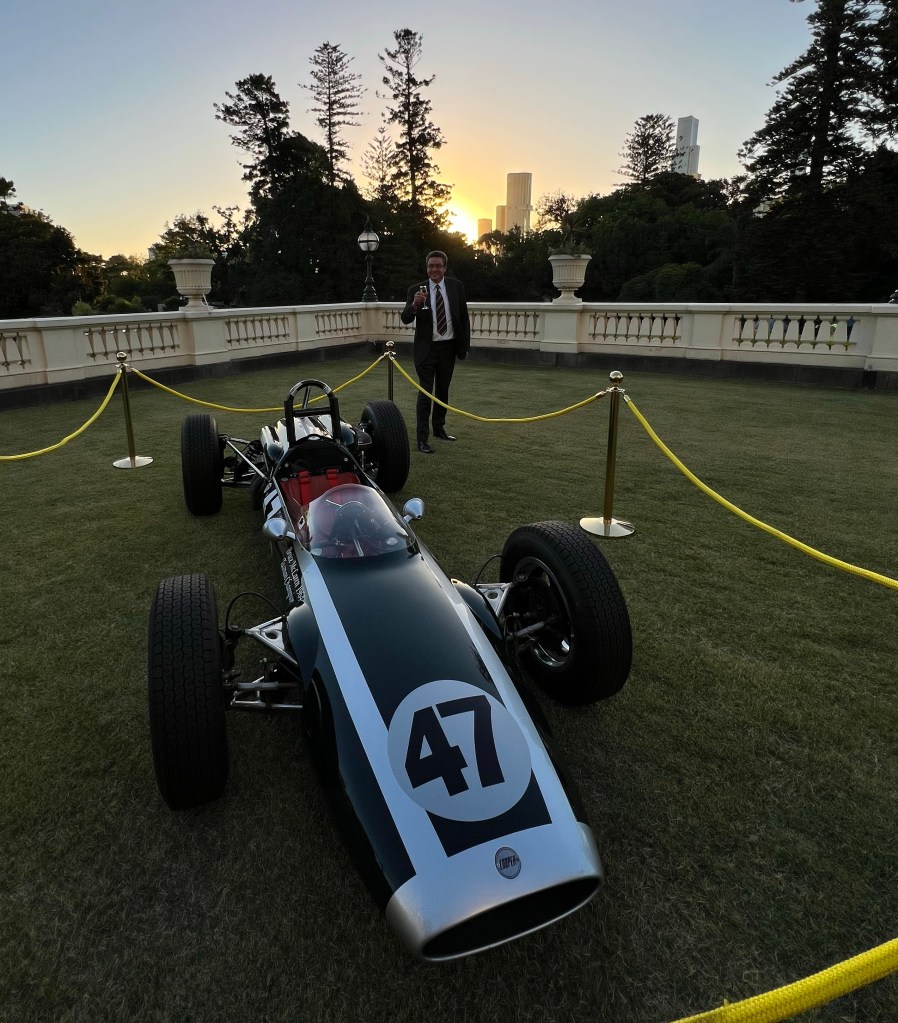
The ‘first McLarens’ – two Cooper T70s – built by Bruce McLaren and Wally Willmott at Coopers in late 1963 have been very much in the news, and star of the historic show at the 2024 Australian Grand Prix carnival given it’s 60 years since Bruce McLaren won the very first Tasman Cup driving the two T70s that summer. Bruce won three of the eight rounds – NZ GP at Pukekohe, Lady Wigram Trophy and Teretonga International – in this car #T70 FL-2-64, so too did Jack Brabham (Brabham BT7A Climax), but Bruce had the better haul of points.
Sadly, Tim Mayer crashed the car Bruce is driving above, to his death at Longford three weeks after Sandown. The surviving car (#FL-1-64) is owned by Adam Berryman, proudly showing off a car which has been in the family since 1974 at Government House, Melbourne on March 21. See here for more about the T70: https://primotipo.com/2016/11/18/tim-mayer-what-might-have-been/
(M Bisset)(M Bisset)(Eisert Family)
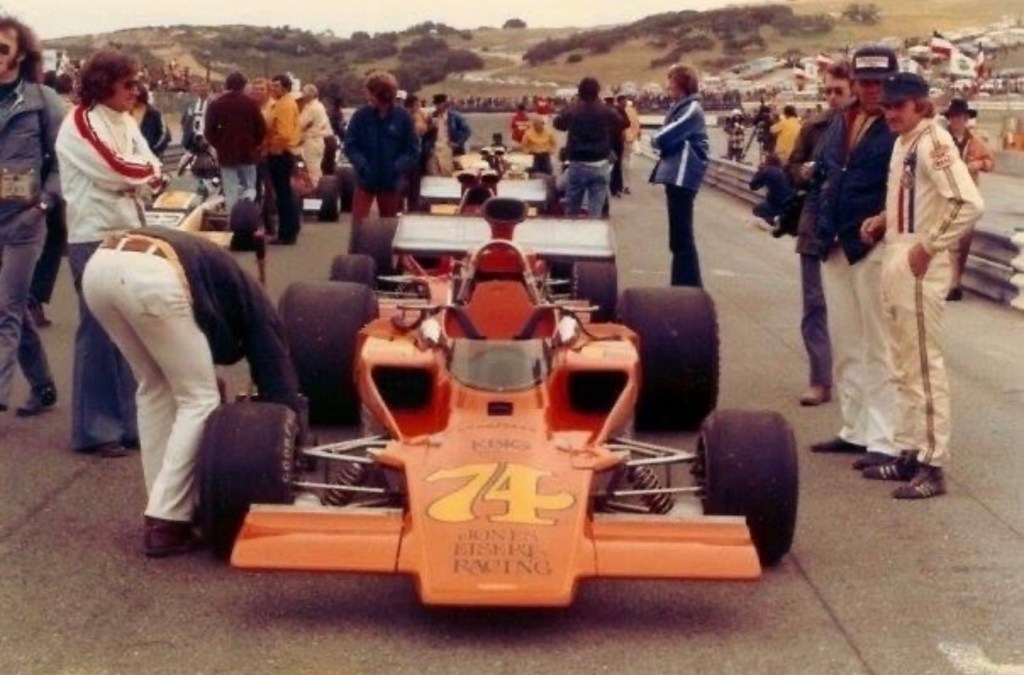
Aussie Ace, Bob Muir alongside the ex-Gary Campbell/Jones-Eisert Lola T330 Chev HU14 during the 1973 US L&M F5000 Championship round at Laguna Seca. Jerry Eisert is alongside Muir, John Wright is attending to the right-front, with Peter Molloy in the white top to the left.
Reg Hunt’s Maserati A6GCM/250 during the 1955 Moomba TT meeting held at Albert Park on March 26-27. I’m not so sure its the prosperous motor dealer owner at the wheel.
Hunt had a great weekend with his new car – a 2.5-litre Maserati 250F engined A6GCM – winning the Argus Cup 50-miler and one heat of the Argus Trophy 50-mile feature. He led the final until the red car’s crown wheel and pinion failed, giving Doug Whiteford’s well driven old Talbot-Lago T26C a lucky win.
Hunt turned the local scene on its head with this car, it was the most recent Grand Prix car imported to Australia for many a long year. All of his motor dealer rivals had to reach way-deep into their pockets to keep up with the Brighton Road dealer. See here for more on this car: https://primotipo.com/2017/12/12/hunts-gp-maser-a6gcm-2038/
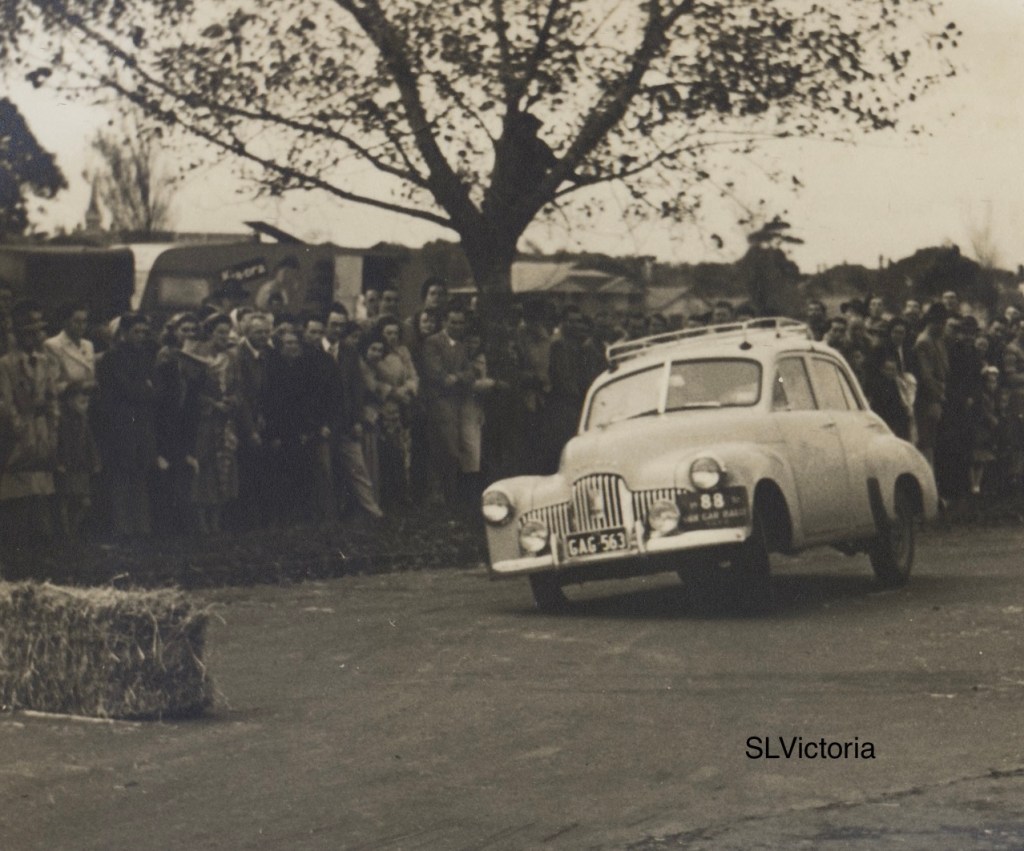
Holden 48-215 at Albert Park was about the extent of the State Library of Victoria caption, before 1970 Australian Rally Champion, Bob Watson came to the rescue.
“It’s a BP Rally of the 1950s, possibly Lex Davison driving. A sub-event in Albert Park at the end of the rally, later events finished at Chadstone Shopping Centre on Mother’s day in front of huge crowds.” See here: https://primotipo.com/2018/12/06/general-motors-holden-formative/
(SLNSW-R Donaldson)
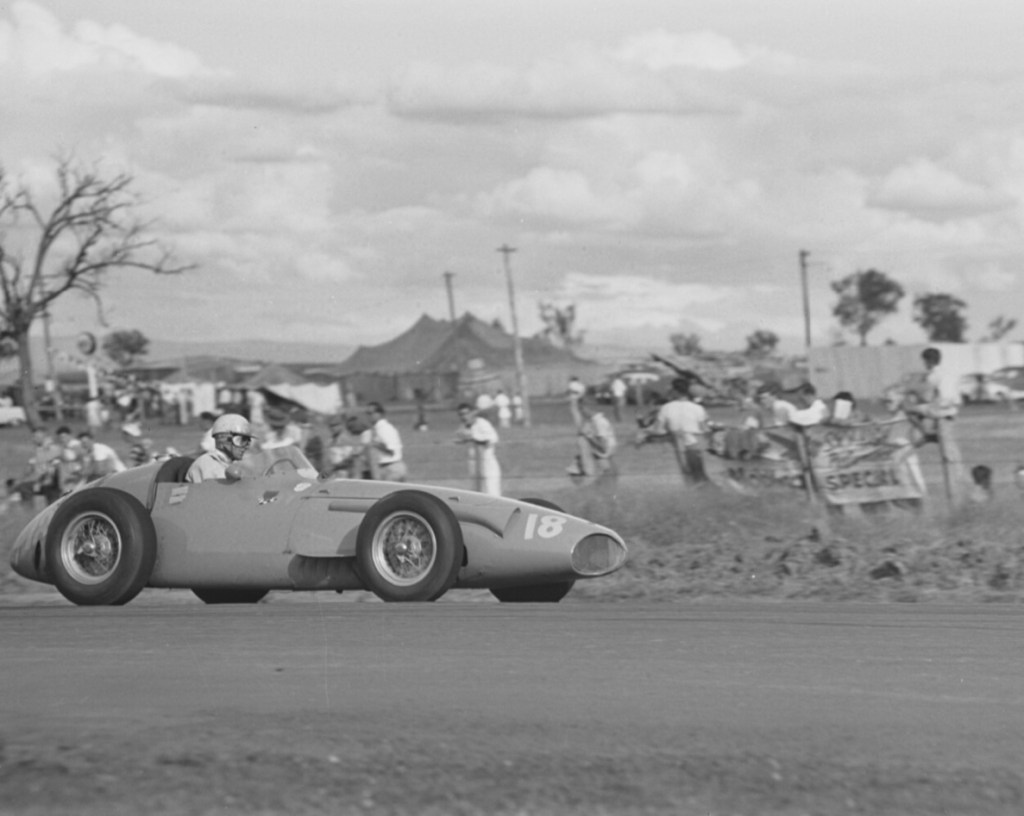
Ross Jensen on the way to victory of the 1959 Bathurst 100 held over the Easter long-weekend, Maserati 250F, #2509/2504. He is negotiating Hell Corner before heading up Mountain Straight.
It was a terrific win by the visiting Kiwi, all of our Top-Guns were there but Ross beat the lot: Stan Jones, Arnold Glass, Len Lukey, Alec Mildren, Doug Whiteford and others. He was as sharp-as-a-tack having raced for the works-Lister Jaguar team in Europe in 1958 upon the recommendation of Archie Scott Brown who had raced his works-lister in New Zealand in the Summer of ’58 and was impressed by what he saw.
That’s Len Lukey congratulating him below, #5 is Len’s Cooper T45 Climax 2-litre, the 250F on the far side is Glass’s. Love the proboscis…
(SLNSW-R Donaldson)(Auto Action)
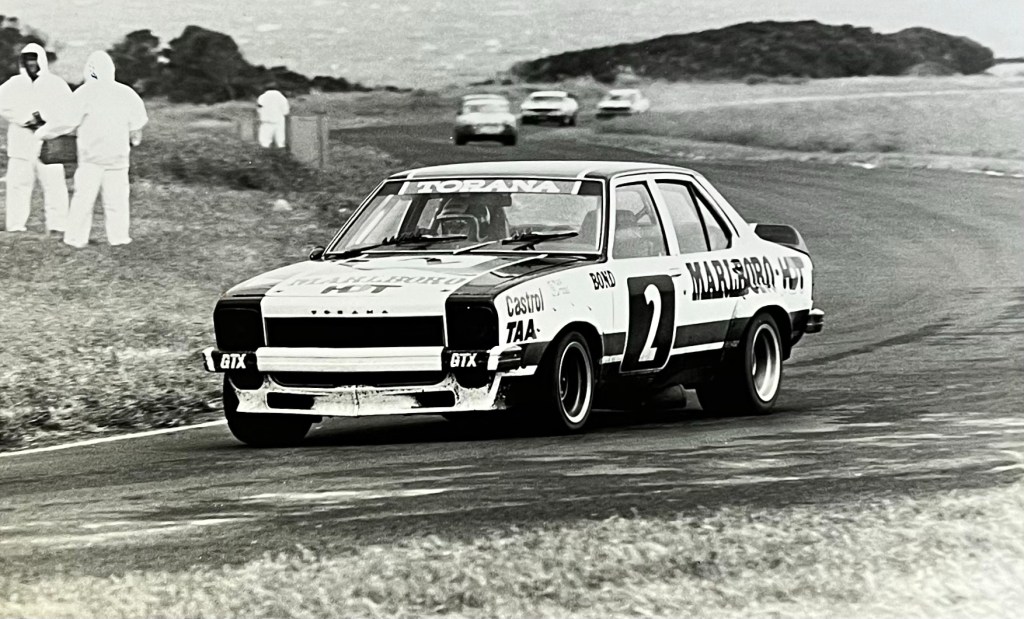
Colin Bond, Holden LH Torana SL/R 5000 L34 during the 1975 Phillip Island 500k enduro, a round of the Australian Manufacturers Championship.
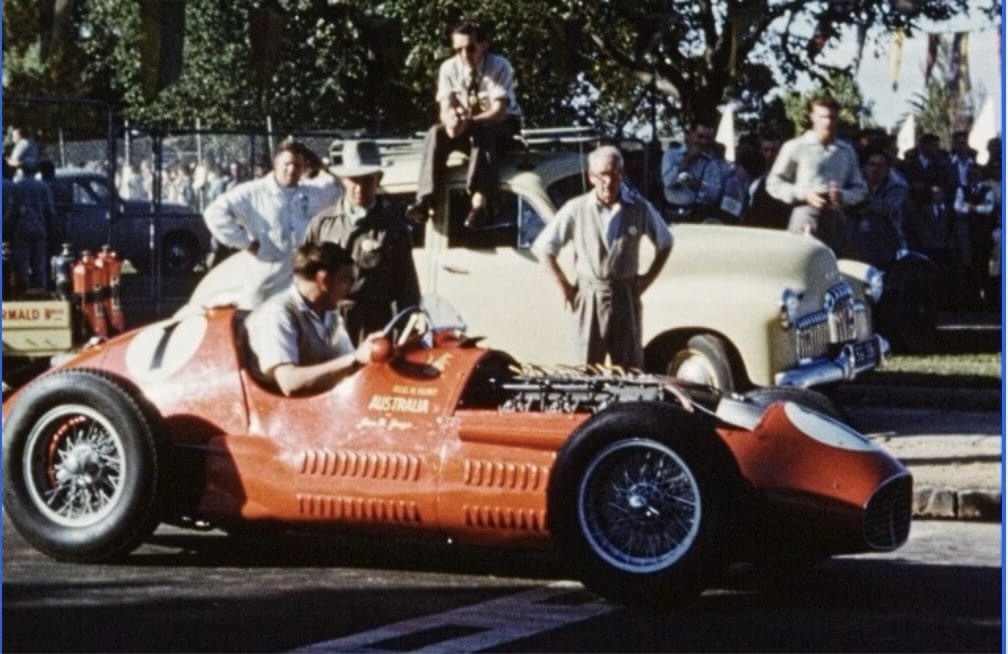
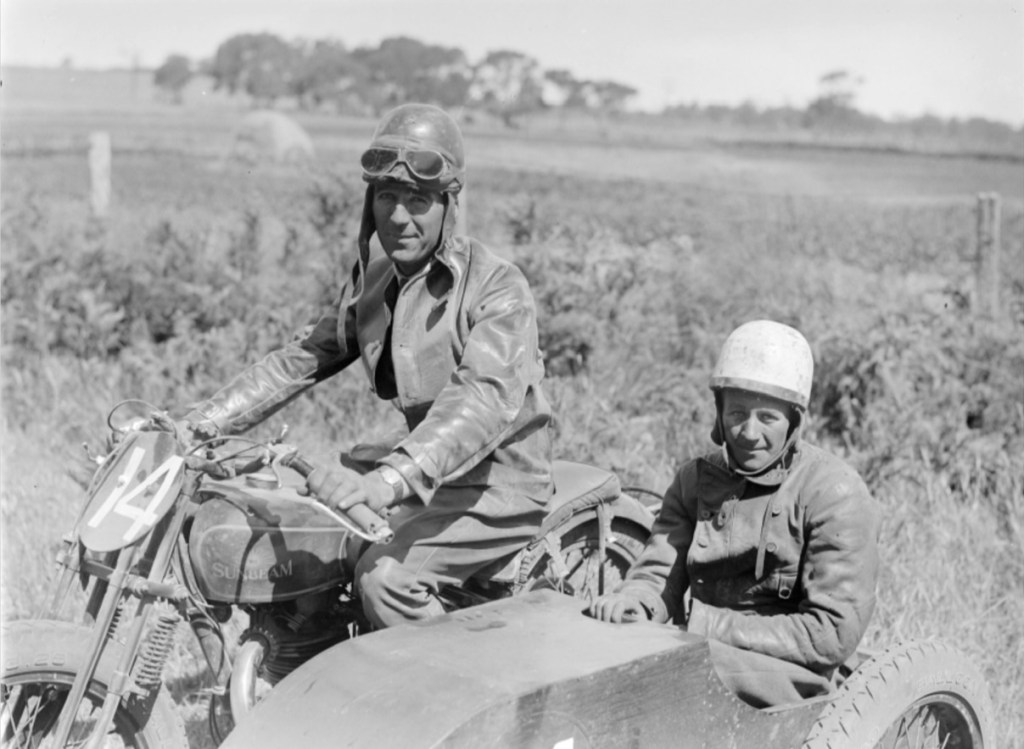
1948 Australian Grand Prix winner, Frank Pratt, and passenger Alick Smith at Phillip Island, date unknown. Pratt, a Geelong motor cycle dealer and racer, had famously barely done any car racing when he won that Point Cook, RAAF Airbase, AGP (photo below). See here: https://primotipo.com/2021/09/27/werrangourt-archive-10-george-martins-bmw-328/
Alain Prost during the West End Jubilee South Australian Open Pro-am golf tournament held at Kooyonga during the 1986 Australian Grand Prix week in Adelaide.
He looks pretty relaxed, and the weekend worked out mighty fine too.
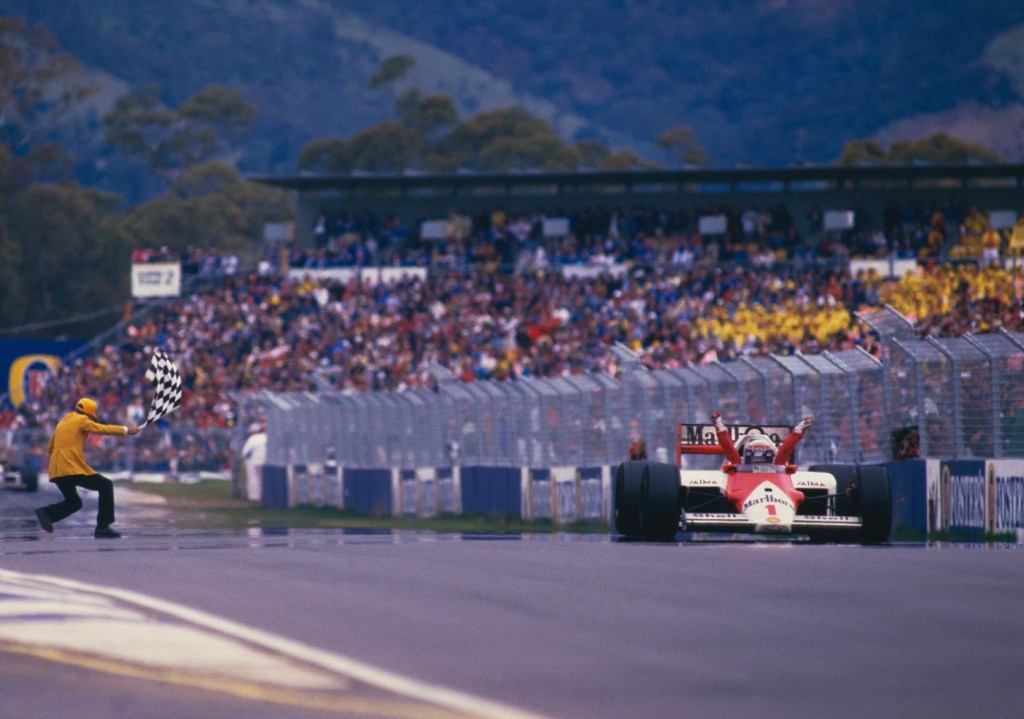
Poor old Nigel had his 180mph Williams FW11 Honda 1.5 V6 tyre blowout, so his teammate Piquet was brought in for a precautionary tyre change and Alain’s McLaren MP4/2C TAG-Porsche 1.5 V6 won the race…and the title(s) in a thriller-diller of a race: Drivers and Constructors.
Glen Dix flags an ecstatic Alain Prost home in the 1986 AGP. His McLaren wasn’t as fast as the FW11 Williams that year but he chipped away with a mix of speed and consistency: the Fab-Four in ‘86 were Mansell, Piquet, Senna…and Prost(SLV)
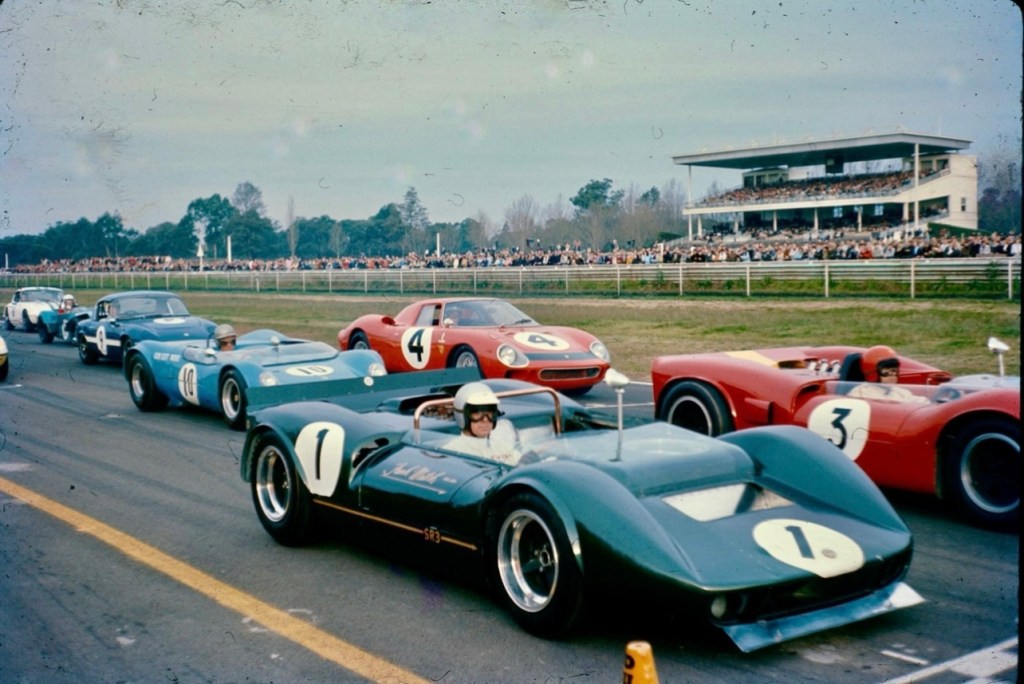
Sportscar grid at Warwick Farm circa 1967. Frank Matich, Matich SR3 Oldsmobile, Bob Jane, Elfin 400 Repco, Glyn Scott’s Lotus 23B Ford and Bill Brown – perhaps – in the Scuderia Veloce Ferrari 250LM. More on Matich’s Ferrari muncher here: https://primotipo.com/2023/04/02/matich-sr3/
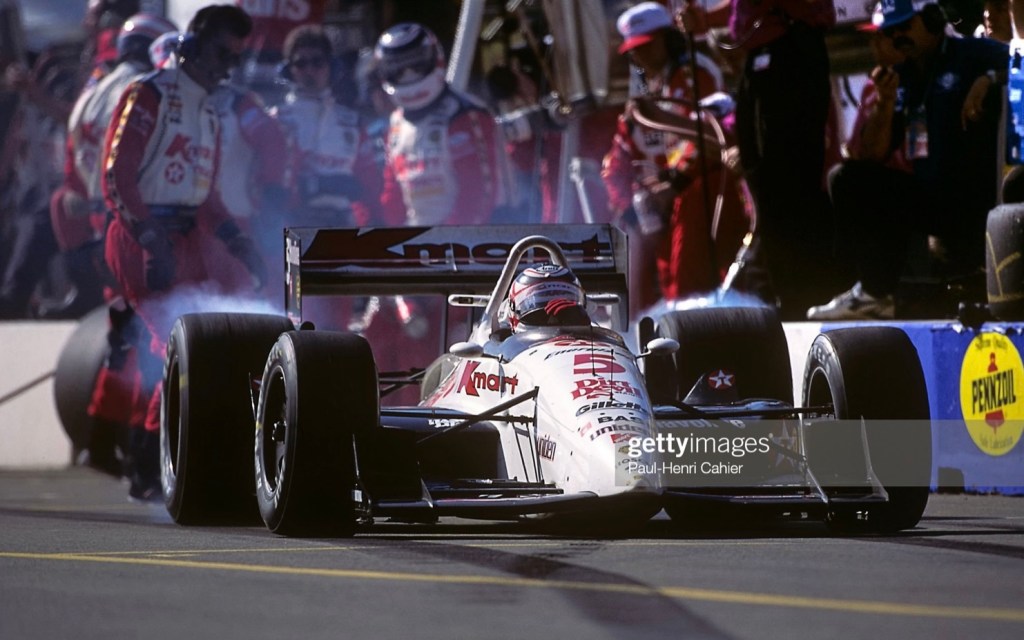
Nigel Mansell blasts away from a pitstop on the Surfers Paradise road circuit during the March 21, 1993 Australian Indycar Grand Prix, Lola T93/00 Ford Cosworth XB V8.
In a portent of things to come that year, series debutant Mansell won the opening round of the ’93 CART Championship. He won five of the 16 rounds, and the championship with 191 points, fellow ex-F1 World Champ, Emerson Fittipaldi was second on 183, Penske PC22 Chev.
(C Denby)
Not so much thought of as a racing car in Australia, Leyland’s P76 4.4-litre V8 got a run in New Zealand’s annual B &H 1000 enduro, in this case the 1975 event at Pukekohe.
This one was raced by the very experienced and successful David Oxton and Garry Pederson who finished fourth, the winning car was another Australian car, a Valiant Charger – usually dominant in this race – driven by Wayne Wilkinson and Bryan Innes.
Chris Denby, in an amusing Facebook post relates the story of the exhaust problem which befell the similar car raced by Dauntsey Teagle and Jim Murdoch. “Over a few laps its impressive engine became ‘uncorked’, which injected some great V8 sound into its otherwise fairly subdued race noise.”
“Suddenly it sounded more lie a stock-car than a production saloon – very impressive in the stand. The stewards were quick to act, within minutes a message came over the Tannoy asking if any spectator had a P76 V8 in the carpark would he allow his car to be relieved of its exhaust system to help a race team on the track (they faced exclusion otherwise).”
“That approach didn’t work. A later Tannoy message said, ‘If a spectator with a Leyland P76 notices a much louder than normal exhaust note upon leaving the track, don’t worry, the race mechanics will fix it before you depart…”
(MotorSport)
Vern Schuppan contesting the Race of Champions at Brands Hatch in March 1973, BRM P160D.
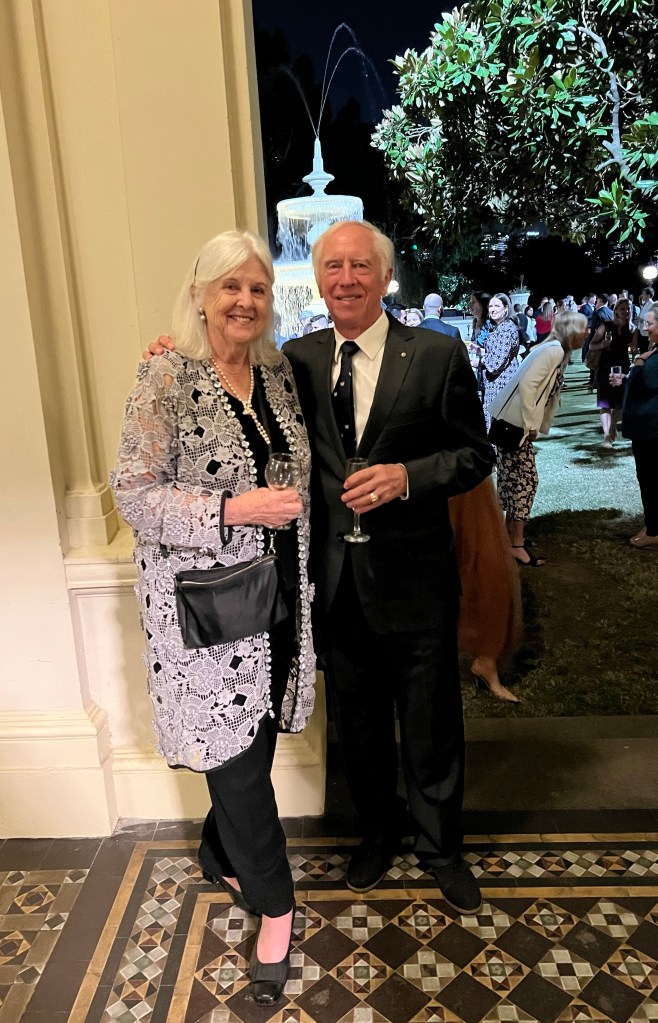
The Victorian Governor’s Australian GP party is a wonderful event on the Thursday before the race, here is Jenny and Vern Schuppan on March 21, 2024.
Vern has just turned 81 and is a sharp as a tack. The couple live in a penthouse apartment in the Adelaide Markets – on the AGP course – and split their time between there, visiting their son and family in Melbourne, their daughter in Cambridge, and another home in Portugal.
(M Bisset)(SLNSW)
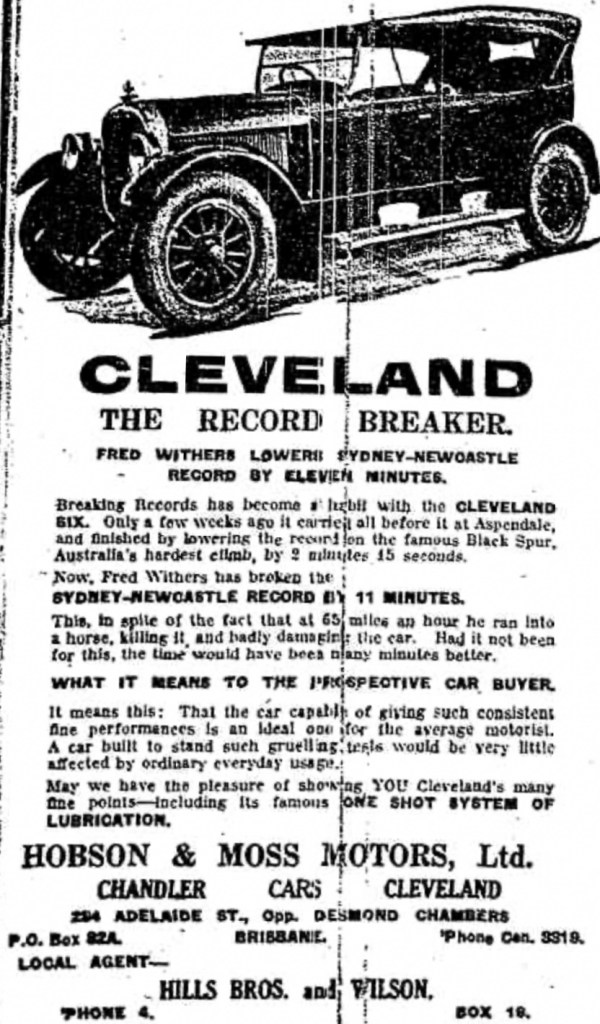
Fred Withers at Penrith aboard the Marcus Clark & Company owned Cleveland Six racer, circa 1925.
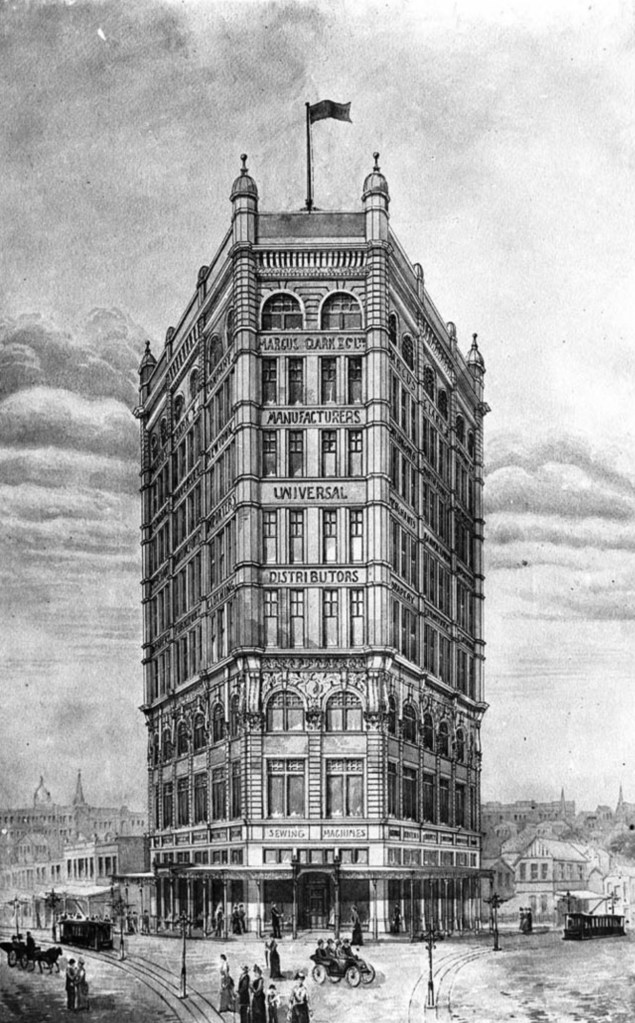
It’s hard to believe that department stores once sold cars, but there-ya-go! This company was founded by Marcus Clark in Newtown, Sydney in 1883 and by the early 1900s was a colossus operating from buildings like this on the corner of Pitt and George Streets, Railway Square, Sydney.
(Hall & Co)(Nambour Chronicle January 22, 1926)
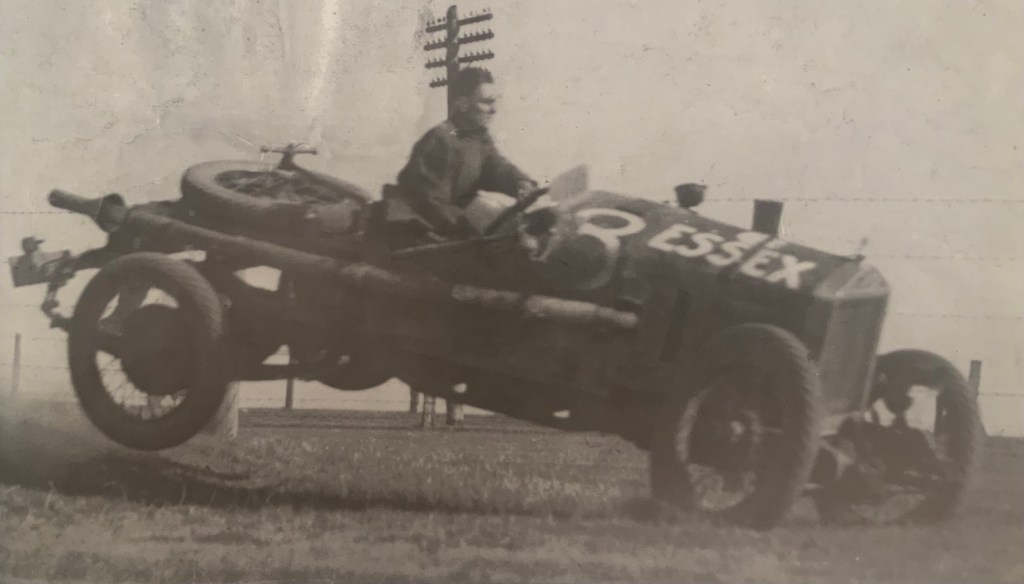
Withers raced the Cleveland Six at Penrith and Maroubra Speedways in New South Wales/Sydney and at Aspendale, outside Melbourne in the 1920s. He was also a record-breaker of some repute using Cleveland and Essex products.
He was famous at the time for some crazy jumps performed with his Essex to gain column-inches in the dailies, this shot was taken in 1927.
(J Sherwood Collection)(P Jones)
Frank Matich contesting the 1970 New Zealand Grand Prix in his much-modified McLaren M10A Chev at Pukekohe. FM had a pretty good Tasman Series, winning here at Pukekohe and at Wigram a week later. While he had the pace, he didn’t have Graeme Lawrence’s Ferrari Dino 246T reliability. Graeme prevailed by five points, 30 to 25.
(T Glenn)
A little later, from 1971-74, Frank Matich and his small team designed and built six F5000 cars: three A50s, two A51s – one A51 evolved into the short-lived A52 – and this A53, the very last of the breed.
Matich A53/007 in build in FM’s ‘shop in Military Road, Cremorne in late 1973 (D Kneller)
Credits…
Getty Images, State Library of Victoria, Charles Pratt-State Library of Victoria, Rennie Ellis, MotorSport Images, Chris Denby, Peter Jones, John Sherwood Collection in ‘Half a Century of Speed’ by Tony & Pedr Davis and Barry Lake, Bob Williamson Collection, Eisert Family Collection, Derek Kneller, State Library of NSW-Lynch, Tony Glenn, oldracingcars.com