ach 1

Achille Varzi in need of a ciggie after a great win in his Bugatti T51, 1933 Monaco Grand Prix…

Varzi started racing on motorcycles, in 1928 he established a partnership racing a stable of Bug T35’s with Tazio Nuvolari, his career, which flourished with Alfa Romeo is a story for another time.

ach 2

The race was held on 23rd April 1933 and is significant as the first GP in which practice times determined grid positions rather than a ballot.

In one of the greatest grands prix ever, Tazio Nuvolari’s Scuderia Ferrari Alfa Monza and Varzi’s works Bugatti duelled throughout the race swapping the lead many times. The result was determined on the last lap when the great Mantuan was disqualified for a push start after his car caught fire, an oil line split and ignited! Baconin Borzacchini was 2nd and Rene Dreyfus 3rd in Monza and T51 respectively.

Credits…

Hulton Archive

Tailpiece: Varzi and Bugatti T51…

ach 3


dino trak road

I always figured this is what Ferrari ownership is all about. Having rather attractive young ladies throwing themselves at you?!…

Clearly this little minx is keen on Pininfarina’s stunning coachwork if not the size of the drivers wallet. What is it my ‘little sabre-toothed tigress’ tells me, ‘even you ugly blokes look good standing on your wallets’.

Australian social documentary photographer Rennie Ellis captured a 1974 Toorak Road, South Yarra, Melbourne ritual that is still played out pretty much the same way 40 years on…

Credits…

Rennie Ellis, Vic Berris

Finito…

moss 1

(Bert Hardy)

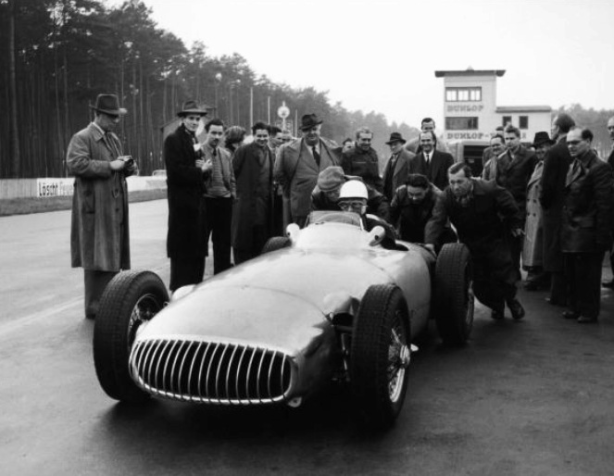
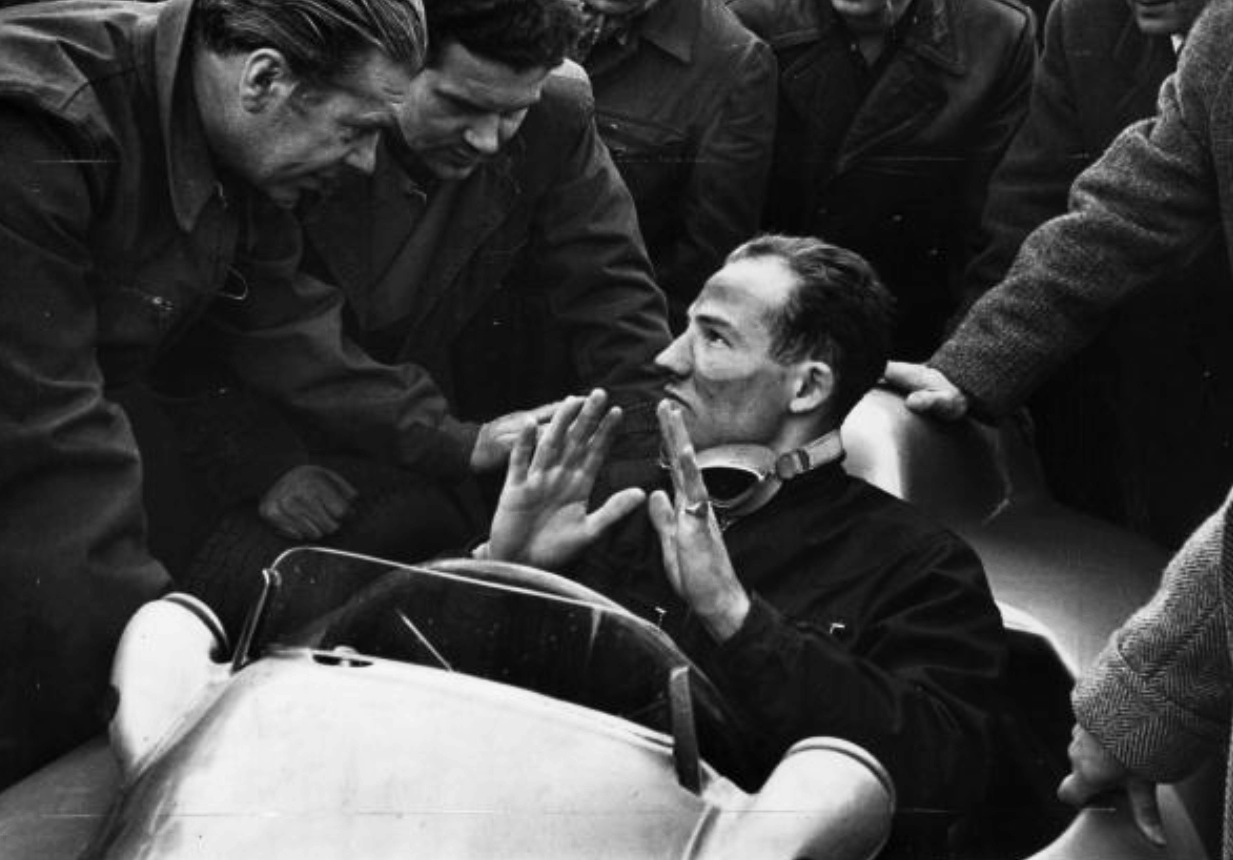
Stirling Moss sets off on his first test laps of an ‘orrible looking Mercedes Benz W196, Hockenheim 4 December 1954…

Stirling Moss started the 1954 Grand Prix season, the first year of the 2.5 litre formula with a customer Maserati 250F acquired with family resources and some trade support. By seasons end he was Officine Maserati’s ‘team leader’ albeit unsigned by them for 1955 which rather created an opportunity for others.

Mercedes re-entered Grand Prix racing from the ’54 French Grand Prix and quickly, again, became the dominant force. The idea for this article was finding some Bert Hardy ‘Picture Post’ images of Stirling Moss’ first test of the W196 at Hockenheim on 4 December 1954, the precursor to him joining the great marque for 1955.

Some quick research uncovered an article written by Mattijs Diepraam and Felix Muelas on 8w.forix.com, a great website if you haven’t tripped over it by the way.

It’s a ripper article the contents of which they sourced from Ken Gregory’s and Stirling Moss’ books. Rather than re-invent the wheel I have truncated their article a smidge without taking away their interesting, nitty-gritty of circumstances around Stirling and Alfred Moss, and Moss’ Manager, Ken Gregory’s deliberations and negotiations about ‘the boy’s 1955 contractual commitments.

‘The Hockenheimring, was still raced anti-clockwise like they do at Indianapolis when Stirling Moss flew in to test the car that was the class of the field from the word go at the 1954 French GP.

After a few laps he knew. And then there was that handsome offer made to Ken Gregory. Mercedes simply wanted Moss and the effort to get him was meticulously planned. It left Gregory gaping at the negotation table – as he readily admits in his highly entertaining 1960 book ‘Behind the scenes of Motor Racing.’

‘And still it almost went wrong – although knowing Neubauer cum suis a plan B and even plan C would have been rushed out of the Untertürkheim premises forthwith. The first thing Moss and Gregory noticed of Mercedes-Benz interest was a brief and factual telegram by Daimler-Benz AG enquiring about the availability of Stirling Moss for 1955.’

“CABLE WHETHER STIRLING MOSS BOUND FOR 1955 STOP. OUR INQUIRY WITHOUT COMMITMENT – DAIMLER-BENZ.”

‘Stirling’s gut reaction was no. He had a signed contract with Shell-Mex and BP for 1954 and 1955 and was sure of a sponsorship clash with Mercedes suppliers, Castrol. Beside that, the contract was a done deal and he would not think of dissolving it so shortly after he had given his word – of which, in Stirling’s view, the contract was merely a written confirmation. He didn’t have time to think about it anyway, as he was due to leave for the US, to race in the so-called Mountain Rally.’

moss 3

Moss relays to Rudy Uhlenhaut left and Karl Kling what its like out there, car far less forgiving than the 250F Moss raced in 1954. Stirling has done plenty of laps by the look of his face (Bert Hardy)

‘Gregory thought otherwise, and after consulting Alfred Moss, decided to go Stuttgart himself. On the advice of Stirling’s dad, Ken armed himself with monstrous demands, to act like a tough British cookie and see what happens. It was a total shock to Gregory to find that Herr Neubauer, the long-time Mercedes boss, was infinitely better prepared for the meeting. Not only did the overbearing team manager come up with the most remarkable details of Stirling’s career – he also came up with a figure that would amount to Moss’ salary, a number that froze Gregory to the ground and left him gasping for air until he got on the flight back to England.’

‘Before leaving he convinced Alfred Neubauer to pair Moss with Fangio in the new 300 SLR sportscar, and of giving Stirling a test before anything was signed. The rest of the deal was ironed out on the spot. The Shell and BP matter was conveniently postponed until after Stirling’s arrival.’

‘On his return Gregory phoned Stirling in the States, having tracked him down in the Rootes building in New York. Initially an irritated Stirling reiterated his view on the contract with Shell and BP but then Ken told him about the contract terms – the sportscar pairing with Fangio, the permission to race his 250F in non-championship events – and, of course, the money involved. An honourable human being he may be, Stirling is only human as well. This was too good to be true.’

‘According to Gregory his stance immediately made an about-turn. And this is where Stirling’s own account of things takes off in his 1957 book In Track of Speed… “I was to receive the sensational and most encouraging news that the German Mercedes firm was ready and anxious to sign me as one of their official Grand Prix team for 1955. It is not easy, now, properly to analyse my feelings when the news reached America. I had gone over there to compete in the Mountain Rally, and had driven a Sunbeam in a trio of cars which won the team prize. When I heard of the Mercedes offer, I was a little awed, a little bewildered, and very pleased. With all my experience, I had not done a lot of real racing in the Grand Prix series on cars which stood a real chance. True, I had led the Maserati team for the latter half of the year, but to have a place in that all-conquering team – and I felt in my bones that it would all-conquering – was to give me a unique personal opportunity.”

And this is the November 22 entry for Stirling’s diary: “Up early, called on Jaguars, then to Rootes, where Ken called and told me of the fantastic Merc offer. Wow!”

Enough said.

moss 2

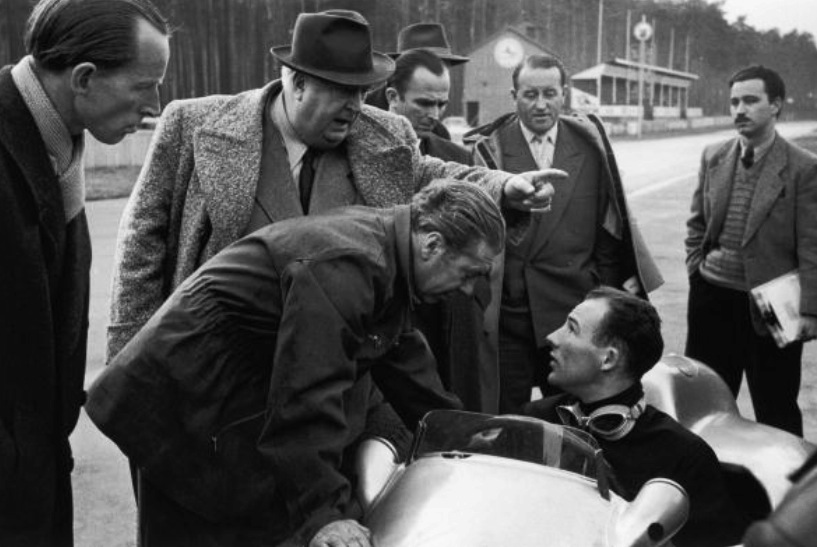
Neubauer projects and Moss listens and talks to Uhlenhaut (Bert Hardy)

Hockenheim Test and Build-up…

‘Between November 22 and December 3 lay a couple of weeks that became a string of field days for the press. The latter date would be the day of Moss’ return flight to London where he would meet up with his father and manager, the three of them flying straight through to Frankfurt for the planned test on December 4. In the meantime, Jerry Ames of Downtons, the British publicity agent for Mercedes-Benz did everything to alert his Fleet Street colleagues on the arrival of the important test, and this caused a flurry of reports on the Moss-Mercedes case. Did he have a verbal agreement with Maserati? What about the Shell/BP deal? How much would Neubauer be willing to fork out? And where were the principles of a man that had stated that he wanted to win the World Championship in a British car?’

‘All of it was fairly benign, though. From the US, Stirling had already released a carefully worded statement about his ambition to win the Championship in a British car but that there was very little hope in doing so the following year, and that as a professional racer he really had no other option than to accept the offer. These words were generally accepted as sincere. On the day of the test, however, the press were dealt a red herring by a wicked Neubauer. Although the news of the test was carefully leaked by Ames, leading to Picture Post magazine sending their feature writer Trevor Philpots and star photographer Bert Hardy on a plane to Frankfurt the very same day, the two Brits were picked up by a Mercedes-Benz driver pretending to have no knowledge of English and driven off in the wrong direction. It left Neubauer in the safe knowledge that Moss would say yes to them first before the British press could get hold of a possible no. The Picture Post duo were only allowed onto the Hockenheim grounds by the time the serious business was long underway.’

‘And so Stirling arrived at Hockenheim undisturbed to find everything thoroughly prepared for his test. And that’s understating things- to Moss and his party thoroughness was redefined. Mercedes chief engineer Rudolf Uhlenhaut had seen to it that the car had every aspect modified to Stirling’s build and style. So that was one excuse out of the way. Then there was Mercedes regular Karl Kling to set a yardstick – one that was set at 200kph just days before by the same Kling. But there had been a recent rainstorm, so that when Stirling did his reconnaissance laps on a 220A saloon, then switching to the 300SL gullwing sportscar, the track was still wet. These first laps soon created a dry-ish line on which Moss got his first hand on the W196.’

‘He thought it (the W196) was uncompromising, as any Mercedes driver would reveal. He admitted as such to a watchful Ken Gregory. “Stirling was not immediately at home with the Merc, and while Kling was circulating he told me he thought it was a very difficult car to drive; it was ‘fighty’, inclined to oversteer, and much more sensitive to handle than the Maserati, though the power, he said, was ‘fantastic’.” Despite being confused by the peculiar transmission at first he felt confident that he could master the car. He got down to a 2.15 – comparing to an average of 201kph – a time that was later equalled by Kling on a track still drier. A previously nervous Uhlenhaut was by now beaming with pleasure. A short discussion followed with Alfred Moss and Gregory, after which Stirling concluded that he should take Mercedes up on their offer, assuming that the sponsorship clash between the oil companies could be solved – and indeed it was solved in a most gracious way, with Bryan Turdle, competitions manager of Shell-Mex and BP, not hesitating to release Stirling from his 1955 Shell commitments.’

image

Neubauer and a thoughtful Moss, the most recent of so many stars the German worked with (Bert Hardy)

Maserati Intervention…

Then came another thing to be solved. During the test a telegram arrived for Neubauer. It came from Commendatore Orsi of Maserati, claiming he had a contract with Moss and that Mercedes should back off. The claim was understandable as Moss had quickly become the lead Maserati driver since his display at the 1954 Italian GP and Orsi wasn’t particularly keen to see the second best driver of the world go off and team up with Fangio, doubling Maserati’s task. But Moss Sr and Gregory were able to convince the Germans that Stirling had in fact not agreed to anything, not even verbally. And so Stirling Moss was announced as the number two Mercedes-Benz driver for 1955 shortly after.’

‘For Moss the choice of Mercedes was obvious…The British manufacturers were a long way from threatening the establishment, and the new Climax engine was still not ready. Mercedes-Benz by all means were. And they showed it at that December 4 test. It had been a test with a thoroughness previously unseen by British drivers. But also one with immaculate attention for the human being inside the driver. That was Mercedes-Benz too. This is Stirling’s own recollection of the comfort he was supplied with as soon as he got back to the pits: “What really impressed me was that as I clambered out of the car, rummaging in my pockets for a handkerchief or rag to wipe my face, a mechanic suddenly appeared, bearing hot water, soap, a flannel and a towel! Out there in the middle of the desolate Hockenheimring this was forethought I could hardly credit. I thought then that to be associated with such an organization could not be bad…”

 Checkout my article on the Mercedes W196…

Mercedes Benz W196 : French GP 1954…

Photo Credits…

Bert Hardy

Bibliography…

8w.forix.com article ‘How Stirling Got His Mercedes Breakthrough’ by Mattijs Diepraam and Felix Muelas

Tailpiece…

image

Neubauer, Alfred and Stirling Moss toast 1955 success, a year of bitter sweet for the great marque, Le Mans not in their wildest, worst dreams (Bert Hardy)


image

Look at the detail; magneto, injection trumpets, rocker cover, throttle linkage, Moto-Lita steering wheel, Smiths chronometric tach, just so period. Top shot, the open garage door gives the photo another dimension to it (Denniston)

Peter Revson and McLaren’s Teddy Mayer looking frustrated and wistfull, respectively, at Peter’s Lola T220 Chev during the ‘Klondike 200’ Can Am round at Edmonton, Canada on 25 July 1970…

Revvie drove Carl Haas’ factory Lola T220 Chev with great speed if little reliability in 1970, switching to McLaren for 1971 and mopping up the championship in the M8F.

He then vaulted back into F1 to complete the ‘unfinished business’ he had first started in Europe a decade or so before. Peter’s platform to do so were his performances in McLaren Indy and Can Am cars in 1971/2.

image

Revson during the ‘Klondike 200’, Edmonton, Canada 1970, Lola T220 Chev (Denniston)

McLaren had a good weekend in Edmonton, a one/two for Denny and Peter Gethin. Revson qualified his twitchy, challenging Lola 9th and retired from the race on lap 31 with an oil leak. His best results for the year were Q2’s at Mid Ohio and Road America, he finished 2nd at Mid Ohio. He achieved two Q3’s at Riverside and Laguna Seca, finishing 3rd at the latter.

Revvie may have only finished eighth in the 1970 Can Am Drivers Pointscore but his speed and potential was blindingly obvious to Teddy Mayer…

Credits…John Denniston

image

(Denniston)


Doncha lerv Can Am cars in the nuddy?!…

Eric Broadley’s Lola T220 Chev laid bare for the world to see in the Edmonton paddock. Aluminium monocoque, ally ZL1 Chev, the sheer scale of these engines somewhat camouflaged with bodywork in situ. Just how high they sit in the chassis, and the consequent driving challenges which flow from the physics in relation thereto very clear!

Click on the links attached for more of my Can Am articles, the Lola T260 one has more technical details about the T220.

Tailpiece: Revson aboard his McLaren M8F Chev during the Molson 200 weekend, 26 September 1971…

image

Twelve months later in the middle of a great season for Revson. Works M8F, Denny won with Peter 12th after problems from pole (Denniston)


image

Billy Coy’s pitstop during the 1949 Indy 500 won by Bill Holland’s Deidt Offy…

Mickey Rooney stars in this typically cheesy Hollywood racing film set around 1940’s Midget Racing and the 1949 Indy 500. YouTube away if you want to watch it, I haven’t but probably should give it a whirl, Mickey is an insomnia cure for me.

Billy Coy is a garage mechanic who becomes a champion racer after the death of his father at Indy. It’s a tale of a climb to the top, treading on folks along the way, achieving success and eventually redemption. There are some common motor racing elements here! Click here for an article about both the film and Rooney’s time of life which led the ‘Hollywood Star’ taking such a B Grade role. I always thought he WAS a B Grade actor, so to me he is perfectly cast!

http://tcm.tv/this-month/article/353248%7C353371/The-Big-Wheel.html

Here is a list of ‘top’ motor racing films, I suspect an enthusiasts list may be a tad different;

My Tops are ‘Senna’, ‘Grand Prix’, ‘Rush’ and ‘Le Mans’ with perhaps the latter my favourite due to the complexity and subtle nuances of the flicks 1500 words of dialogue.

http://cinemanerdz.com/top-car-racing-movies/

‘The Jalopy Journal’ has an article with a bit of ephemera about The Big Wheel;

http://www.jalopyjournal.com/forum/threads/the-big-wheel-starring-mickey-rooney-1949.805193/

The engine is an Offy but what is the car/chassis pictured atop the article by the way?…

Tailpiece…

image


Credit…

John Springer Collection

image

Juan Manuel Fangio eases his Maserati 250F through Tatts Corner,  Aintree, Liverpool during the 1957 British Grand Prix on 20 July…

Fangio qualified 4th but retired on lap 49 with engine problems, its an amazing shot ‘the maestro’ looks so relaxed at the wheel. Its the cover shot of a book i have, much of my library is in storage, a real pain in the arse in terms of access to research material, maybe one of you have the same book and can recall the title?

The race itself was a Vanwall benefit; Moss lead then took over Brooks car when his own engine went off song, Stewart Lewis-Evans Vanwall also lead briefly before being passed by Moss, he and Brooks shared the win from the Lancia Ferrari 801’s (LF801) of Luigi Musso and Mike Hawthorn.

image

Stirling Moss in Tony Brooks Vanwall VW57, Aintree 1957 (Michael Turner)

This article is pieced together around a swag of photos of Fangio aboard Maserati 250F’s in 1957, in many ways the combination defines the 1950’s for me. The greatest driver of the decade in its quintessential car, it may not have been the fastest of the era but for sure it provided a platform for so many drivers from journeymen (and women) to gods, to strut their stuff.

Monaco, 19 May 1957…

Between Moss who left Masers to join Vanwall and Fangio who left Ferrari to join Maserati the seven 1957 championship rounds, ignoring Indianapolis, were mopped up by those two drivers- Juan with 4 wins and Stirling 3.

fang monaco spares

Fangio’s Maser 250F being unloaded from its transporter in Monaco

Fangio made the 250F sing, the car was towards the end of its long competitive life with the great Argentinian extracting all it had to offer. He was at the height of his powers, I don’t doubt he retired at the right time, he was 46 years of age by the end of the season after all.

Having said that it would have been fascinating to see if he could adapt to mid-engined cars, I don’t doubt he would have had he raced on for a few more years. But best to retire at the top, and alive. So many elite sportsmen and women do that one season too many, Michael Schumacher for one, Fangio did not.

fang monaco 1957

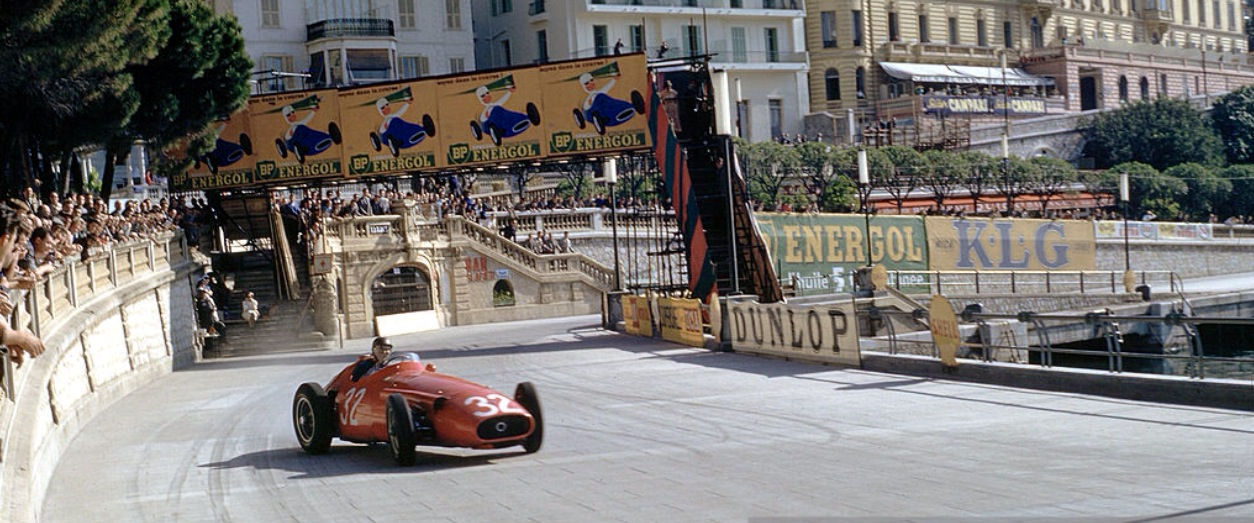
# Carlos Menditeguy DNF spin and #34 Giorgio Scarlatti DNF oil leak in the Officine Maserati garage, Monaco 1957. 250F x 2

Fangio popped his 250F on pole in the Principality but Moss led into the first corner with Fangio behind him. Sterling went off and crashed at the chicane on lap 4 with Collins, LF801, taking exasive action and hitting a stone wall as a result! Fangio managed to get through without a problem and Brooks Vanwall braked hard only to be rammed up the chuff by Hawthorn’s Fazz.

Only Brooks was able to keep going- but he was 5 seconds behind Fangio by the time he was up to speed again. Jack Brabham was up to 3rd late in the race in his little Cooper T43 Climax. It was a portent of the 1958 breakthrough win for a mid-engined car by Moss in Argentina, but had to push the car home as result of fuel pump failure, Jack was classified 6th, with Fangio ahead of Brooks, Masten Gregory in a Maserati, Lewis-Evans Vanwall and Trintignant LF801.

fang monaco

Fangio during Monaco practice in Giulio Alfieri’s 250F V12. The 60 degree, DOHC, 2 valve, 24 plug, Weber fed 2.5 litre engine developed circa 300-320bhp at a dizzy 10500rpm, about 50bhp more than the venerable inline 6 but the power was all at the top of the band. The engine had conrod and valve spring troubles early in its development too. Behra raced one in the Italian GP, he chomped thru tyres, such was the engines power and then retired with a lubrication problem. The engines time would come, but not for a decade!

Whilst the 250F was in the Autumn of its life Maserati were still developing the thing, not least with a 2.5 litre, quad-cam, 2 valve, Weber carbed 300 odd bhp V12. Fangio is putting some development laps into the thing at Monaco above.

The engine raced only once at championship level at Monza 1957, but suitably evolved in 3 litre, fuel injected form won a race or two mounted in the back of Cooper’s T81 and T86 in 1966/7. (Wins for Surtees ’66 Mexican GP and Rodriguez ’67 South African GP, both in T81’s)

An interesting Australian sidebar to this Maser V12 is Frank Gardner and Kevin Bartlett testing a 2.5 litre variant in the butt of a ‘cut and shut’ Tasman Brabham BT11A in February 1966. Sydney Alfa/Maserati dealer and former Australian 1960 Gold Star Champion and AGP winner Alec Mildren used his impeccable Maserati connections to score the engine which the team sussed as an alternative to the venerable Coventry Climax 2.5 litre FPF  which was the Tasman staple moteur at the time. Simply put the engine was like an on/off switch in terms of its power delivery, then blew, which rather settled the matter of a ‘Warwick Farm 100’ start. A story for another time.

fang monaco

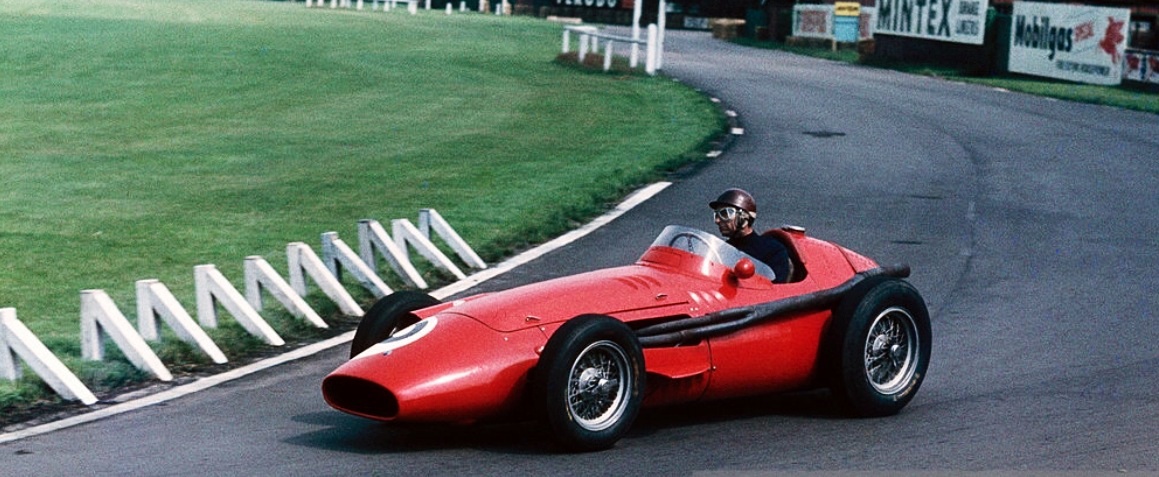
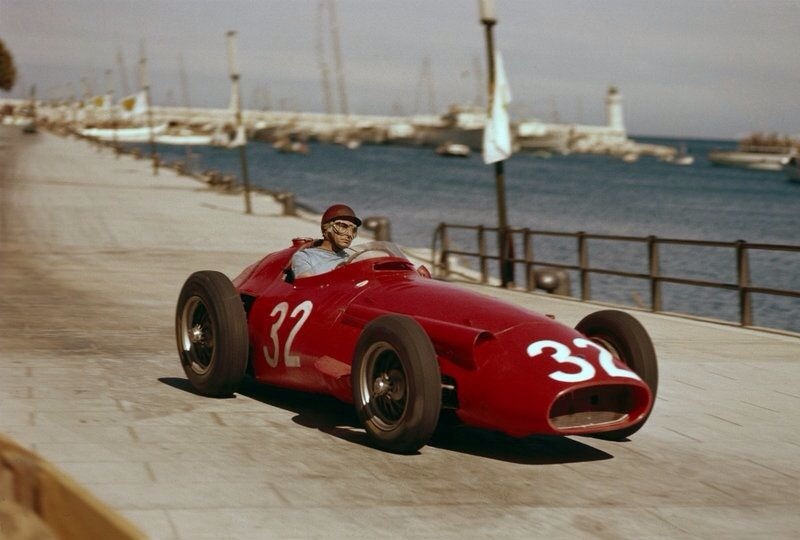
Fangio, quayside at Monaco in 1957, enroute to victory. He won in Argentina, Monaco, France and Germany. The Vanwalls won in Britain, Pescara and again in Italy at Monza; Moss/Brooks, Moss and Moss

The thing that always amazes me when looking at photos of Fangio is just how relaxed at the wheel he is. It’s key to great lap times, if you are that tense that your butt-cheeks grab the seat cover as you alight your racer you are definitely not going to feel what your steed is doing to extract the best from it! I remember Frank Gardner talking to me about this very point several decades ago.

When the laconic Aussie all-rounder returned home in 1975, in that first year he drove Bob Jane’s Holden Torana Chev Sports Sedan and fronted the Jane/Gardner Racing Drivers School at Calder. He wasn’t there much. In fact ex-Aussie F3 driver/mechanic and later Hardman F2 designer/builder Jim Hardman did most of the driver instruction aided by Andrew Newton, who also raced with some success. Both of them looked after the fleet of Elfin 620B Formula Fords driven by the bright eyed hopefuls, of whom i was one.

Anyway, on this particular frigid July day ‘ole FG was in effusive mode telling me about both the car setup advice and driver coaching he was giving to a well known fellow who had not long before jumped up from Formula Ford to F5000-105bhp to 500bhp is a big step.

His central point in talking about ‘the big car challenge’ was all about relaxing in the car- having soft hands and gentle feet and just being able to, as a consequence of not being so tense, feel what the car was doing and therefore be able to push the thing to its limits by  better sensing said limits when reached…Easy to say of course, harder to do especially when you have 500bhp of fuel injected Repco-Holden V8 shoving you ferociously towards the horizon!

image

FG would have approved of Fangio’s relaxed demeanour in a car. Don’t confuse my meaning with the ferocious competititiveness and delicacy of control that went with the outer calm one can see here!

Fangio never looks anxious whether he is being closely followed at Monaco in third gear or drifting through the very high speed swoops of rural France at over 140mph in fifth.

It was magic to observe Fangio’s car control at close quarters when he was 67 years old and booting his W196 Benz sideways lap after lap in third gear through Sandown Park’s Shell Corner, only 30 metres away, during ‘The Fangio Meeting’ in 1978. The sight of this grand man of racing flicking the bellowing, powerful straight-8, silver beastie around is forever etched in my memory.

Cool, calm, collected, composed and FAST! Exactly as he was in 1957…

French GP, 7 July 1957…

The classic was held at the super fast Rouen-Les-Essarts road circuit in Grand-Couronne and Orival, northern France.

There are so many wonderful 250F shots of Fangio in 1957 drifting the sublimely forgiving chassis at well over 140 mph on public roads through wooded hillsides. I’m not suggesting, in describing the car as forgiving, it was easy my friends!

fang spa

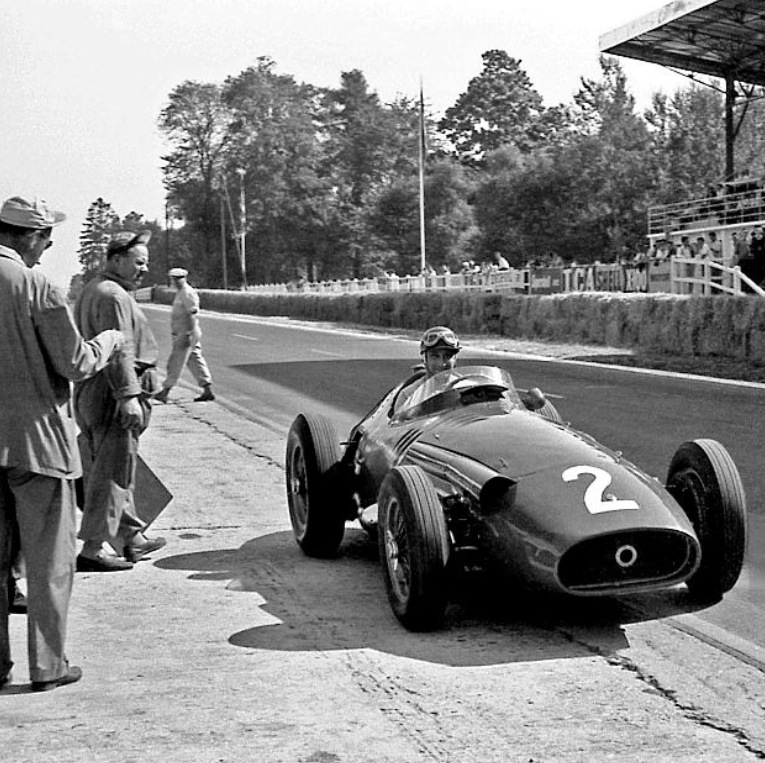
Crusin’ in having set pole i wonder? Rouen 1957. The lines of the 250F in 1957, here it’s Fangio’s ‘regular ‘Long nosed, lightweight’ chassis ‘2529’ spec are perfect, inch by sculpted inch. The cars epitomise everything great about Italian racing machines. Alfieri’s ’57 lightweight chassis was 40% stiffer than in ’56 with greater rear weight bias-48/52% front/rear. The 250F was maybe not quite the fastest tool in the 1950’s shed but it was close to it, enduring and capable of winning the 1954 and 1956 titles in addition to ’57 with more luck or the right bloke behind the wheel all season! No-one was going to beat Fangio in a W196 Merc in 1955 i don’t think

Fangio was fastest from Behra and Musso also on the front row. Behind them were Schell 250F and Collins then back a row Salvadori, Vanwall VW57 Hawthorn and Trintignant. At the jump Behra lead but Musso soon got ahead. Fangio was 3rd then Collins and Schell giving chase and then a fast-starting McKay-Fraser, BRM P25. Fangio worked his way past Behra on lap 2 and then took Musso for the lead on lap 4.

Collins got past Behra and the order remained unchanged at the front all the way to the flag with Fangio winning from Musso and Collins. Behra slipped behind Hawthorn, giving the Lancia-Ferrari 801 a 2-3-4 finish behind Fangio.

fanf french

Hang on…Fangio indulging in one of his signature, oh so fast, oh so subtle and oh so wonderful, delicate, four wheel drifts. Poetry in motion innit!? Wonder who or what he tapped?

Germany, Nurburgring, 4 August 1957: Greatest GP of all?…

Fangio’s heroic drive at this most demanding of circuits proved to be his greatest ever drive and one of the best in the history of Grand Prix racing.

Fangio took pole with Hawthorn, LF801 Behra, 250F and Collins LF801 completing the front row. Then came Brooks, Schell and Moss on Vanwall VW57, 250F and Vanwall VW57. At the start Hawthorn and Collins battled for the lead with Fangio and Behra giving chase. On lap 3 Fangio passed Collins and soon led. Collins then passed Hawthorn and chased after Fangio with the great man edging gradually away.

fang germany

Nurburgring 1957: Hawthorn and Collins, L Ferrari 801, Fangio and Behra 250F, then Moss and Brooks Vanwall VW57, Masten Gregory’s white Maser 250F, Lewis-Evans Vanwall VW57 and the rest…

A slow mid-race pit stop, scheduled for 30 seconds, lasted 1 minute and 18 seconds. One of the mechanics dropped the wheel hub nut under the car, it couldn’t easily be found! This left Fangio a minute behind the two Ferraris but then the chase was on! He drove absolutely at the limit, at the ragged edge of the cars capabilities, chasing down the two much younger men.

Fangio famously broke the lap record 10 times and passed both Collins, and then Hawthorn on the penultimate lap. Fangio won the race and in the process, his 5th and final World Title in a drive still spoken about in reverential terms and forever remembered whenever the great GP races are considered.

Pescara GP, 16 August, The Coppa Acerbo…

The FIA included the Coppa Acerbo, Pescara GP in the World Championship for the first time given the cancellation of the Dutch and Belgian GP’s early in the season due to squabbles about money. The daunting, dangerous 16-mile road circuit on the Adriatic Coast, still used then for non-championship events was the longest ever for an F1 race.

Ferrari didn’t bother to send 801’s for Mike Hawthorn and Peter Collins as the World Championship had already been won by Fangio and partly as a protest against Italian government’s move to ban road racing following Alfonso de Portago’s, Ferrari 335S Mille Miglia accident earlier in the year. Local boy Luigi Musso convinced Ferrari to lend him a car however, which he entered as a privateer. Shades of NART entries in the 1960’s when Ferrari wanted to protest, but not too much!

fang pescara

Shot at left shows Fangio’s Maser having a rear wheel replaced after spinning on Musso’s engine oil and danaging it

The Pescara battle was between Maserati and Vanwall and resulted in a Maserati pole for Juan-Manuel from Moss’s Vanwall VW57 and Musso’s ‘private’ Ferrari 801.

Musso took the lead but Maserati 250F privateer Horace Gould hit a mechanic who was slow to get off the grid. Brooks retired his Vanwall VW57 early with mechanical troubles. Moss took the lead from Musso on lap 2 from Fangio in 3rd but the field thinned as the heat took its toll; Lewis-Evans, Vanwall with tyre failures, Behra 250F engine failure. Then Musso disappeared on lap 10 when his engine blew, the oil caused Fangio to spin and damage a wheel. When Fangio rejoined, Moss had an unassailable lead, he won the race ahead of Fangio, Schell in 3rd ,Gregory 4th and Lewis-Evans 5th.

Fangio won the World Championship on 40 points from Moss and Musso on 25 and 16 points respectively. Maserati 250F, Vanwall VW57 and Lancia Ferrari 801.

Credits…

All photos by Louis Klemantaski/Getty Images, Michael Turner

Tailpiece: The Maestro, Karussell, Nurburgring, Maser 250F  chassis ‘2529’ German Grand Prix 1957, history being made. Majestic shot…

fang germany, karu


image

Melbourne’s finest trying to keep enthusiastic shoppers under control out front of ‘Georges’, Collins Street in 1965…

The car is, I think, Bib Stillwell’s Brabham BT11A Climax. The occasion some type of promotion between Georges luxury department store and Repco or Bib Stillwell Holden. Stillwells switched from Holden to Ford in 1966 before all you Melburnians correct me, clearly the crowds are fascinated by the presence of a ‘Grand Prix’ car in Melbourne’s busiest and most up-market shopping strip.

For over a century Georges was the place the ‘great and the good shopped’, an incredibly conservative joint, its intriguing to speculate just what the promotion may have been, automotive products are not at all what Georges stocked! String-backed gloves maybe and flat-caps but nothing grubby or grimy at all.

I think its Bibs car. The color scheme is right, his dealership/workshop was in Kew, not far away. He usually raced wearing #6, this car carries #3 but that’s neither here nor there. For Repco, Brabhams were badged ‘Repco Brabham’ at the time and the Coventry Climax FPF engines by that stage were largely built in Richmond under licence from CC so there were good associations to Repco’s brand.

When is it?, not sure exactly. Bib raced his BT11A from the Tasman Series 1965, he took the last of his four Gold Stars in it that year and then retired, so I guess it’s 1965…

Georges, for the curious…

http://www.georgesoncollins.com.au/

Credit…

Nigel Tait, many thanks for another tid-bit from your Repco archives


image

Gino Valenzano’s Lancia D24 passes Reg Parnell’s Aston Martin DB3S in the early morning Brescia fog, the action captured by Louis Klemantaski aboard the Aston as both navigator and ‘snapper. Mille Miglia 2 May 1954…

It wasn’t to be a happy event for either car, they both failed to finish as a result of accidents. The competitiveness of Vittorio Jano’s newish D24 design was underlined by Alberto Ascari’s win in another of the cars in a time of 11 hours 26 minutes and 10 seconds. Vittorio Marzotto’s 2nd placed Ferrari 500 Mondial was 34 minutes in arrears.

Piero Taruffi’s Lancia led the race early from Brescia, that year fog replaced the more usual rain, he was first into Ravenna with a lead of 1.5 minutes. Castellotti retired his Lancia by Rome, soon Piero’s car developed an oil leak so he too retired. Ascari then assumed the lead but on the home leg north his throttle return spring failed, a rubber band provided a temporary repair. By Florence he was ready to retire but was prevailed upon to continue, then by Bologna all of the quick Ferrari’s had retired so the final 200Km into Brescia was a ‘cruise’ if the final hours of a race lasting 11 plus hours can be so described!

Gianni Lancia and Vittorio Jano created some stunning sports and racing cars in the early 1950’s, at least the Lancia heir could look back on them as a legacy when he was forced to cede management of the company such was its parlous financial state into 1955.

The new D24 ended 1953 with a stunning 1-3 in the November Carrera Panamericana in Mexico; Fangio won from cars driven by Piero Taruffi and Eugenio Castellotti. Felice Bonetto’s death in a D24 during the event somewhat muted the joy the team felt in victory, to say the least.

image

Brescia 1 May 1954: Lancia D24’s are islands in a sea of people. #541 Valenzano DNF distributor, #602 Ascari’s winning car and  #540 Castellotti DNF accident (unattributed)

The D24 evolved from the D23 Spyder, itself begat by the D20 Coupe design. Jano’s development times were short, the D23 made its race debut at the Monza GP on 28 June (2nd Bonetto) and the D24 at the Nurbugring 1000Km on 30 August (Taruffi/Manzon and Fangio/Bonetto both DNF). The wheelbase of the D24’s tubular steel spaceframe chassis was marginally reduced. The quad-cam, chain driven, 2 valve, triple Weber 46DCF3 fed, 60 degree V6 engines capacity was increased from the D23’s 3102cc to 3284cc with power in the range 240 to 270bhp @ 6500rpm for each of the two engines.

The cars late 1953 speed carried through into 1954 with the Taruffi/Manzon D24 leading the Sebring 12 Hour until an engine failure about an hour before the end. Despite that the car completed 161 laps compared with the 168 of Stirling Moss and Bill Lloyd in the winning OSCA MT4.

Wins at the Targa by Taruffi, not a championship round in 1954, and 4th & 6th in the Tourist Trophy gave Lancia 2nd place in the Manufacturers Championship with 20 points to Ferrari’s 38 despite not entering Le Mans.

Lancia did get plenty of promotional rub-off for their considerable investment in Italy with the cars winning a swag of races and hillclimbs in ’54. Castellotti won the Treponti-Castelnuovo, Coppa Firenze-Siena, Bolzano-Passo Mendola and the Aosta-Gran San Bernardo. Taruffi took the Giro di Sicilia, Catania-Etna and Coppa d’Oro di Sicilia and Villoresi the Oporto GP.

Lancia’s F1 program absorbed plenty of resources, the D50’s first race  was the final ’54 championship round on 24 October, the Spanish Grand Prix at Pedralbes, Barcelona. Alberto Ascari’s jewel of a Lancia D50 started from pole and led until clutch problems caused him to retire on lap 9.

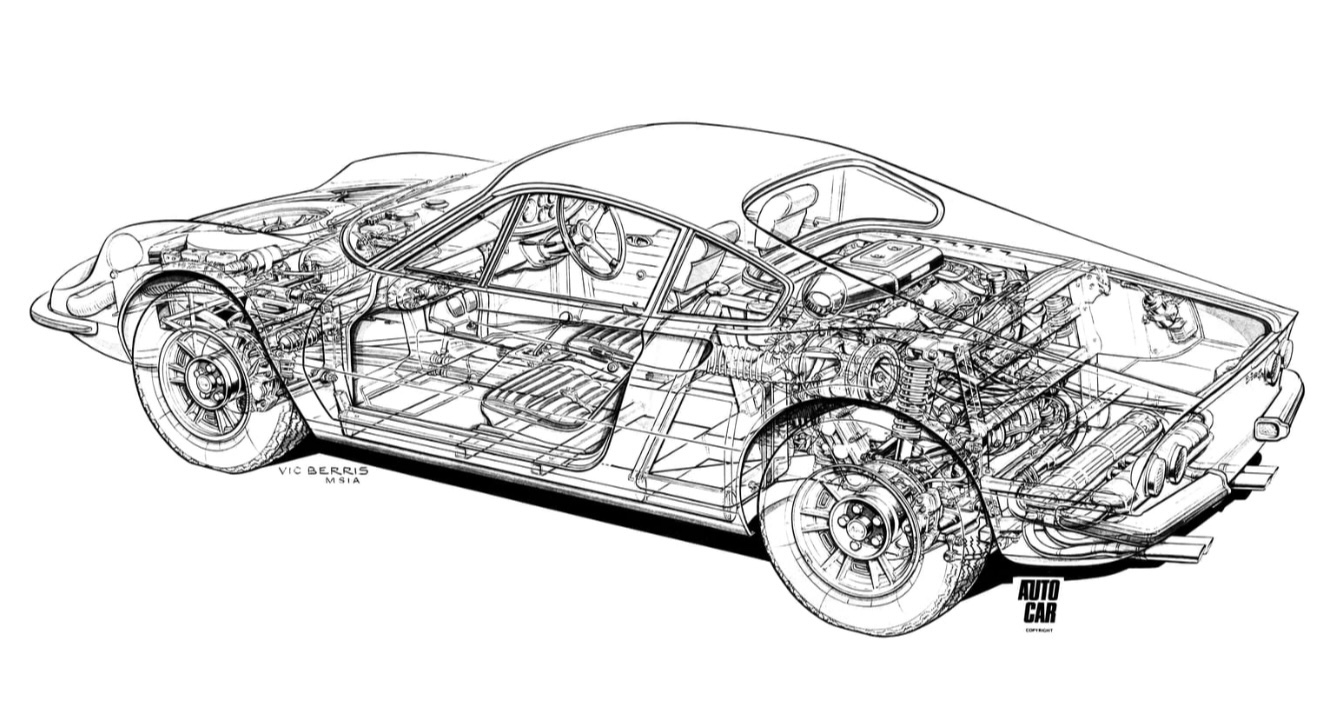
Lancia D24 cutaway: essential elements of Vittorio Jano’s car. Multi-tubular steel spaceframe chassis, Pininfarina designed and built aluminium body, 60 degree DOHC, 3284cc 270bhp V6, independent front suspension, de Dion rear suspension, leaf springs and tubular shocks. Gearbox 4 speed mounted at rear. Inboard drum brakes front and rear. Weight 740-760Kg (Betti)

Despite the competing GP car program Jano evolved the D24 design later in the year by increasing the capacity of the V6 to 3550cc for which 300-305bhp @ 6500 rpm was claimed. Two of these cars dubbed D25 were entered for Ascari/Villoresi and Fangio/Castellotti  at the Tourist Trophy, Dundrod in September but both retired with diff and engine failure respectively. Taruffi/Fangio and Manzon/Castellotti were 4th and 6th in D24’s.

The timing of the GP debut was unfortunate as the D24 was a mighty fine, fast car which deserved to have been the primary competition focus of Lancia that year.

The D50 changed the course of GP history in terms of its brilliant design, it’s contribution to Lancia’s fiscal disaster and of course giving Ferrari a car which won the world drivers championship for JM Fangio in 1956. But the D24 could conceivably have won Lancia a sportscar manufacturers championship in 1954 had the necessary, exclusive effort been applied to that campaign.

Wonderful hindsight of course, one of my strengths!…

Credits…

Louis Klemantaski, STF, Bruno Betti

Tailpiece: Alberto Ascari’s Lancia D24 chassis ‘006’ of nine cars built, in Rome and ‘heading for home’ 2 May 1954…

image

(STF)


b 1

(Ken Devine)

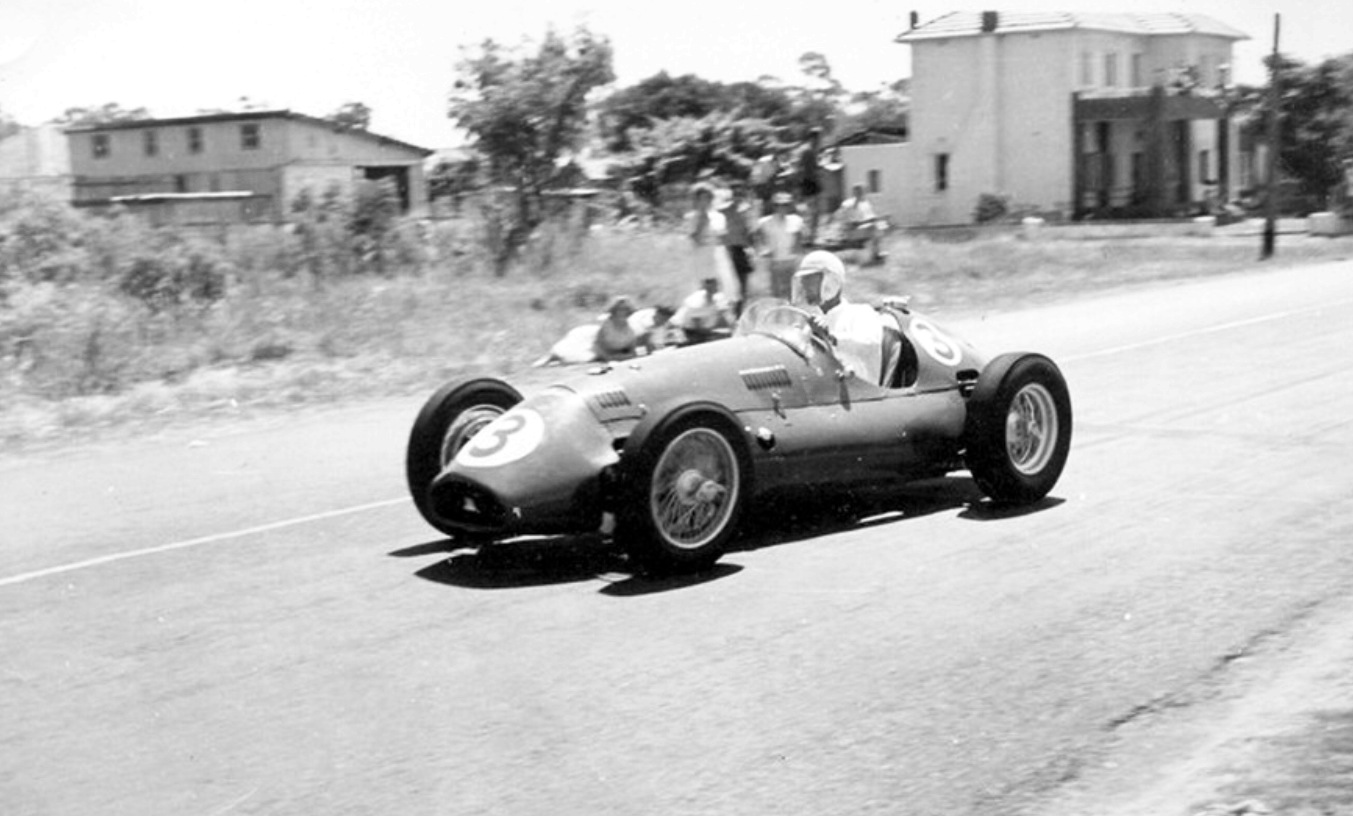
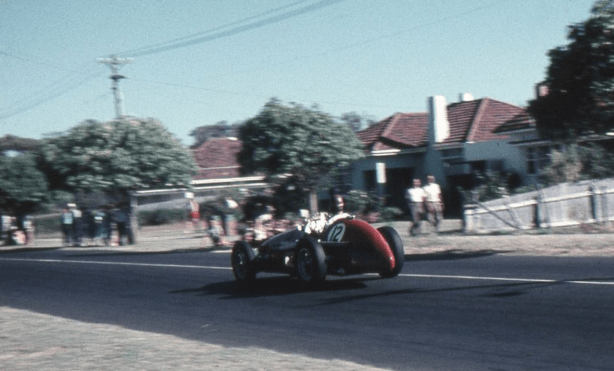
Doug Green blasts his oh-so-famous ex-Ascari/Gaze/Davison Ferrari 500/625 chassis #5 down a suburban West Australian, Bunbury street on 26 December 1960, a far cry from the European circuits on which it won Alberto’s two World Championships in 1952 and 1953 …

Western Australia has a rich history of racing on street circuits; Albany, Collie, Katanning, Mandurah and Narrogin in addition to Bunbury all had street racing at one time or another.

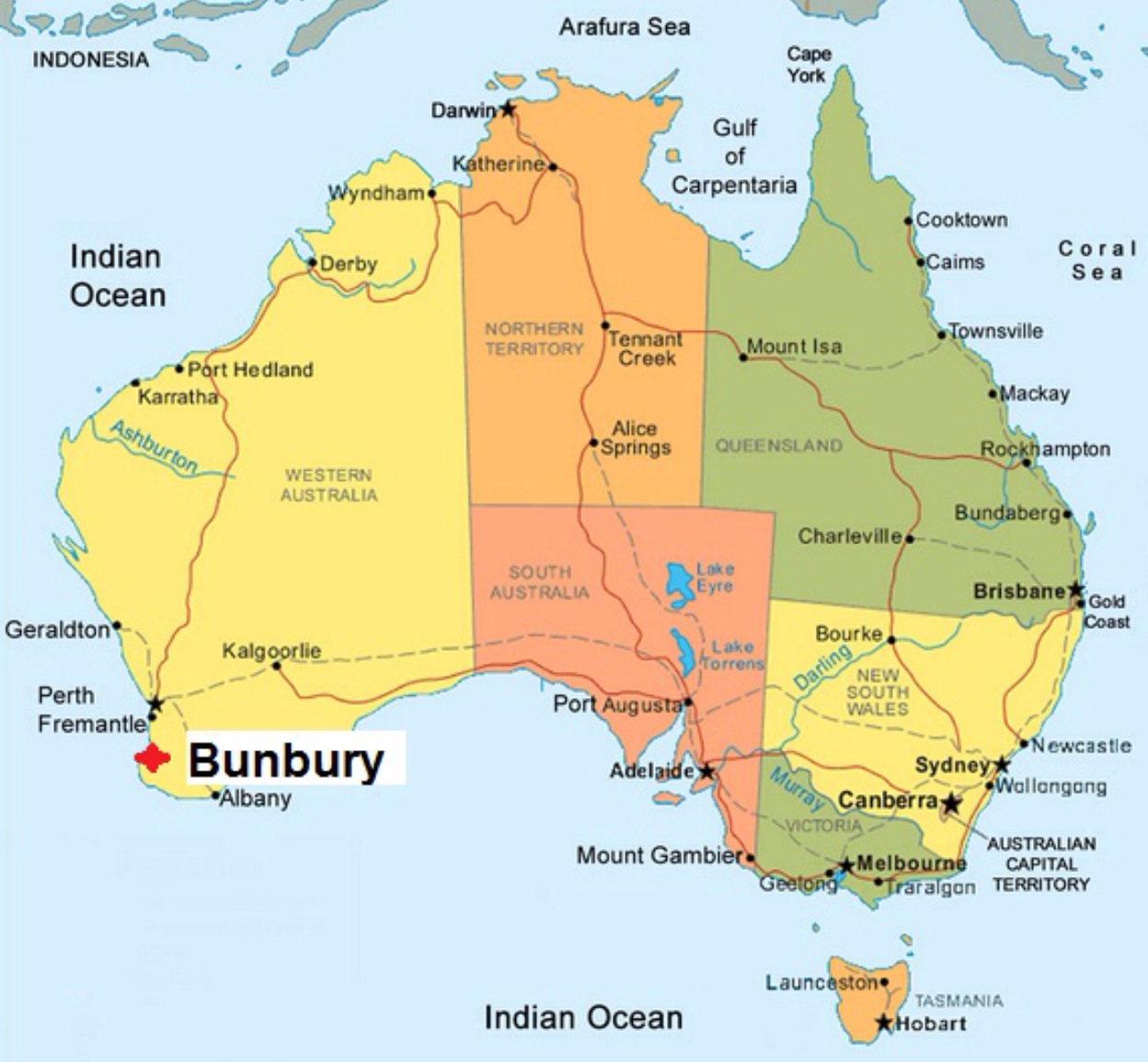
Bunbury’s racing history is particularly long. The Indian Ocean port city services the farm, mining and timber industries of Western Australia’s South West 175 Km south of Perth and had car and motorbike racing ‘around the houses’ up until 1988.
b 2

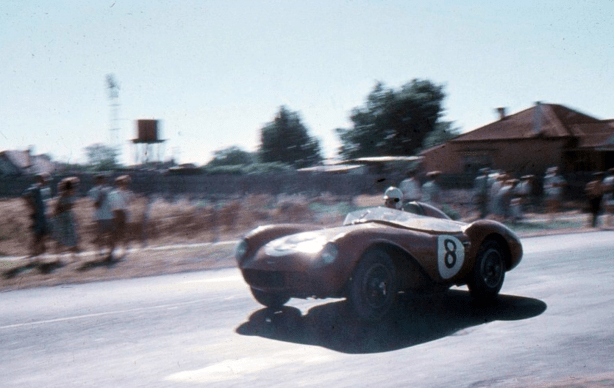
Ray Barfield’s ex-works/David McKay Aston Martin DB3S ‘9’, at Carey Park, Bunbury, December 1960 (Ken Devine)

Racing commenced there in 1938 with the running of the ‘Bunbury Flying 50’ on a large circuit in the town itself, Allan Tomlinson the victor…

The first event, held over 25 laps of the roughly 2 mile course on 14 November 1938 was won by Allan Tomlinson’s MG TA Spl s/c in 63 minutes. The race, a handicap as was the case for much of Australian motor racing for decades, such was the relative paucity of racing cars let alone vehicles of equivalent performance, was a big success. Norm Kestel and Jack Nelson were 2nd and 3rd in MG TA and Ballot V8 respectively with Kestel, in a TA similar to Tomlinson’s pushing him hard all the way.

The 22 year old Tomlinson was a very fast, skilful and thoughtful driver, his performance in Bunbury, off a handicap of 40 seconds and setting the fastest race lap at 2:24.0 was indicative of his pace.

In fact he was a ‘child prodigy’ by the standards of the day having only started racing aged 18 at Lake Perkolilli in 1936. He drove a Ford V8 in the stock car handicap and scored an excellent win. Subsequently he raced a midget at Claremont Speedway and then bought the MG TA for regular racing and competition work.

He was employed in the family business, the Tomlinson & Co foundry and engineering shop and applied those resources and his own mechanical skills well. The TA arrived shortly before the premier race in WA, the Albany GP, in 1937 and was quickly fitted with a Marshall blower and stripped of all superfluous parts. Allan drove well but the cars brakes failed on lap 16, he sailed through the barriers of Salvation Army Corner, unharmed!

During 1937 he continued to perform strongly at track meetings at Dowerin, with a couple of wins and in the WA Car Clubs Hillclimb at Victoria Reservoir.
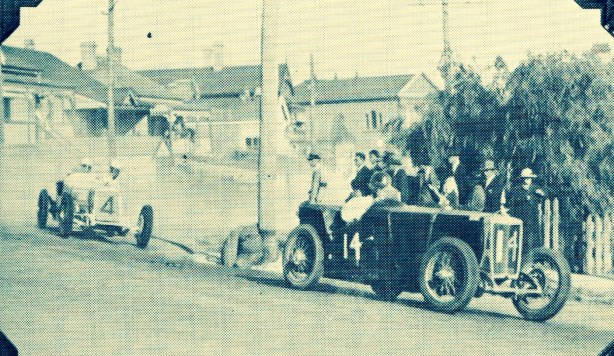
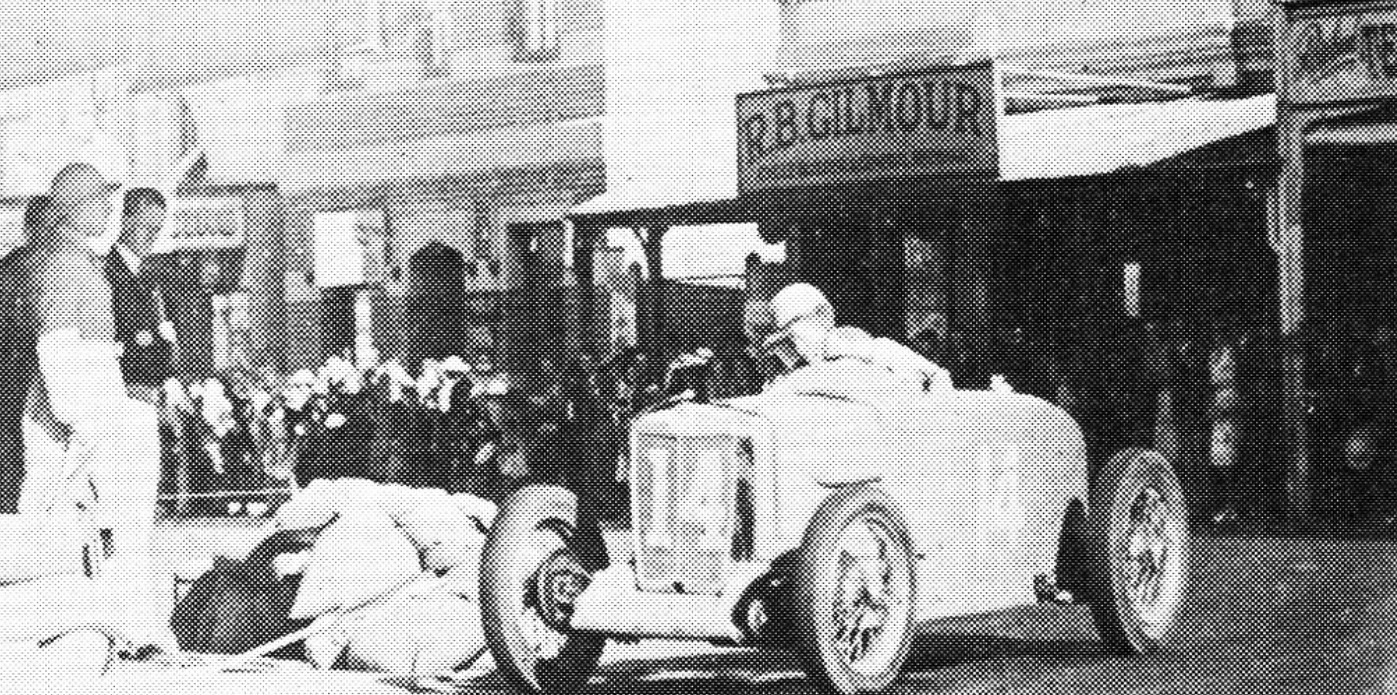
Tomlinson’s winning MG TA ahead of  Jack Nelson’s Ballot V8 2nd, Albany GP 18 April 1938. Note the difference in the body of the Tomlinson car here and as a monoposto below (Terry Walker)

His first major success was in the 1938 Albany GP, that Easter he won off a handicap of 3 minutes 30 seconds from Jack Nelson’s Ballot V8 and Kestel’s quick MG TA. The handicappers were onto him though, his Bunbury handicap was 40 seconds but the youngster and his team were further modifying the MG away from the gaze of authority. Tomlinson, Bill Smallwood and Clem Dwyer carefully rebuilt the engine and clad the racer in a light, pretty, aerodynamic monoposto body which was painted blue. Extensively tested, the car was running perfectly, the race win the reward for careful attention to detail.

Tomlinson and the teams fanatical attention to the preparation of the car was unusual and remarkable for the day. They were about to show the east coast ‘big boys’ just how to prepare for, and drive a motor race.
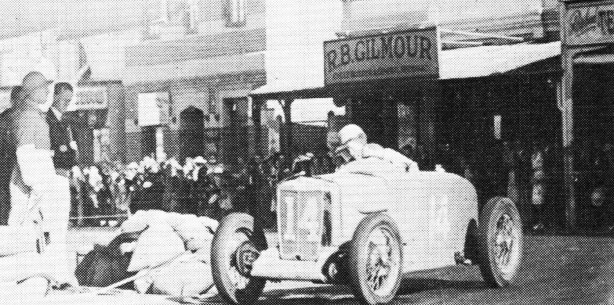
Allan Tomlinson winning the 14 November 1938 ‘Bunbury Flying 50’ in his light, powerful, highly developed, 1340cc supercharged MG TA Spl (Terry Walker)

In early-December the team loaded the little 10/6 Marshall Rootes supercharged, aluminium bodied MG onto a ship in Fremantle for the short voyage to Port Adelaide.

On 2 January 1939 Tomlinson won the Australian Grand Prix on the immensely demanding, 8.6 mile long Lobethal road course in the Adelaide Hills.

The team had a spare T Type for Tomlinson to explore and master the swoops, dives and blind corners of the place. He also walked the roads, studying the gradients and topography closely. Historians still debate the speed of the little MG on that day, with its trick axle ratio it was good for 130mph, with Tomlinson claiming later speeds close to 140! There were some much faster cars in the race, Jano straight-8 Alfa Romeos and others, but whilst many drivers were on the brakes or a trailing throttle Tomlinson used skill and circuit knowledge to go flat where others were not…

Allan returned triumphant to WA aboard the ‘Kanimbla’ and was given an informal reception at the Albany Council Chambers on 8 January. The team then returned to Perth and on to another big victory, this time the ‘Great Southern Classic’ at Pingelly over 25 miles- ‘his fourth successive motor racing win in twelve months’ The West Australian reported.

Disaster struck at the Tomlinson foundry in East Perth on 4 May 1939 when Allan, whilst fixing an oil blower to a piece of machinery, had it explode, badly damaging three fingers on his left hand; two were later amputated in Perth Hospital, the lacerated index finger recovered. A ‘rock star’ in Perth by this time, his progress was covered daily in the local press. Tomlinson recovered but did not race again in 1939, the winds of war were blowing by then of course.

Sadly the Lobethal course that gave him his greatest win bit him very badly during the New Years Day 1940 ‘South Australian Hundred’.

The young driver was lucky to escape a very high speed trip through the countryside; he accidentally tagged the back of a Morgan, left the road and went through the bush, down an embankment and ended up against a tree in a roadside camping area. He broke his ribs, received internal injuries, shock and a long stay in Royal Adelaide Hospital. Whilst the car was not badly damaged-the body was dented and the wheels buckled, but the engine and chassis were undamaged according to Bill Smallwood.

As to Tomlinson, a highly promising career was over. After 5 months in hospital Allan returned to Perth with intentions to race but with the outbreak of war, motor racing ceased. Post-war Tomlinson had a lifelong involvement in the WA Sports Car Club and VSCC. He died aged 95 having lived a full life.

Now, where was i?! Back to Bunbury!

The Bunbury town circuit layout was used again post-war in November 1946 albeit the cars raced in the opposite direction to 1938. In 1950 the Australian Motor Cycle TT was held on the same layout.

The relative isolation of Carey Park, a suburb 3.5Km south east of Bunbury allowed the ‘Bunbury Flying 50’ to take place again in 1960. Competing vehicles were mainly production sports cars, the exceptions Green’s Ferrari 500 and Jack Ayres 1.5 litre, supercharged GP Alta. Ray Barfield’s ex-works Aston Martin DB3S was a sports car of considerable performance too.

The race was also called the ‘Carey Park Flying 50’, whatever it’s name results have been hard to find although photographer/historian Ken Devine believes the feature race, these photos are from that event, was won by Green’s Ferrari. If any of you have a race report I’d welcome you getting in touch.
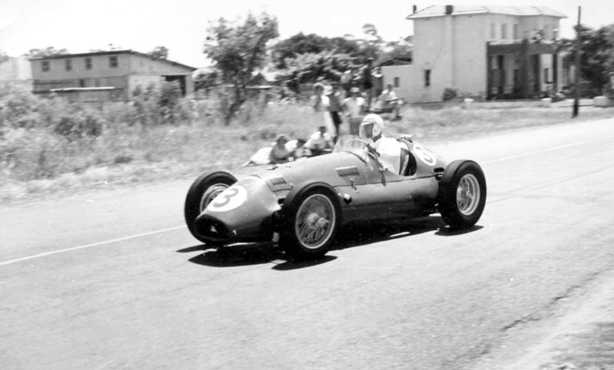
b4

Jack Ayres, Alta ‘010’, starting the turn into Ecclestone Street from Forrest Avenue, pretty car, nicely proportioned lines, nose of the original car modified locally (Ken Devine)

Jack Ayres’ GP/F2 Alta s/c ‘010’…

Geoffrey Taylor’s first Alta sportscar was built in 1929.

He decided to build a 1.5 litre, supercharged GP car post-war, the  first of which appeared in 1948. The three cars built had ladder-frame chassis and wishbone suspension with rubber as the spring medium. The third of these cars, ‘GP3’, bought by Irish motor trader and wheeler-dealer Joe Kelly in 1950 was powered by a DOHC, 1496cc, SU fed, two stage Rootes type supercharged engine developing 202bhp at 6000 rpm. It contested non-championship F1 races and both the 1950 and 1951 British GP’s at Silverstone in Kelly’s hands finishing over 15 laps in arrears of the winners in both years.

Later ‘GP3’ was fitted with a Bristol engine by Kelly to contest F2 events, the sophisticated supercharged engine was then fitted to Alta ‘010’, a hitherto F2 chassis raced by Robert Cowell in 1949/50. The story of father and ex-Spitfire WW2 pilot Cowell is an interesting one as he became she; Roberta Cowell was the very first transgender Brit, the operation took place in 1951.

The car was bought and imported into Australia in 1956 by Gib Barrett of Armadale, Melbourne. Gib and Alf Barrett were formidable racers for decades both pre and post-War, Alf Barrett one of the all time greatest Oz drivers.

The car was fettled and finished 1oth in the post Olympic Games 1956 Melbourne GP at Albert Park in Gib’s hands, it was sold soon thereafter to Perth’s Syd Anderson in 1957. And so began an intensive period of racing for ‘010’ in WA. Syd raced it in the 1957 AGP at Caversham near Perth but retired, the race was won by Lex Davison and Bill Patterson in the Ferrari 500/625 also featured in this article.

Jack Eyres then bought ‘010’ racing extensively in the West in all kinds of events, he was 5th in the ‘WA Trophy’ Gold Star round in December 1960, that race won by Alec Mildren’s Cooper T51 Maserati. By the following August, Caversham Gold Star round Ayres had moved on to a Cooper MkV powered by a 1.1 litre Ford engine, with the Alta raced by new owner, Jim Ward.

The old car had by the early sixties become uncompetitive and dilapidated, the cars restoration was commenced by Jim Harwood in WA in the later 1960’s and finished by Lotus doyen John Dawson-Damer in outer Sydney. Graham Lowe owned it before it passed to Peter Briggs museum at York in WA, which was fitting given the cars WA racing period. ‘010’ was fully restored and always looked a treat when it appeared at Australian Grands Prix and other special events. Sadly the car left Oz some time ago, it recently appeared at Retromobile, offered for sale.
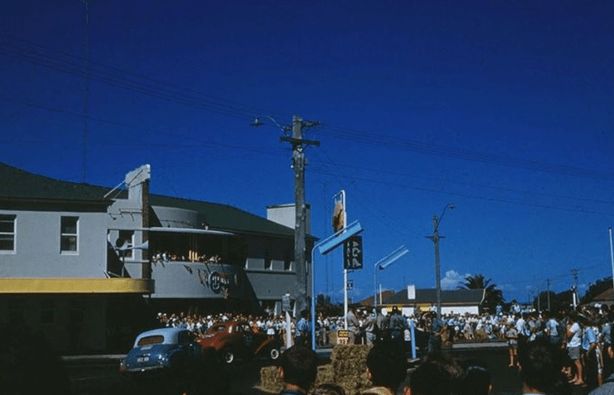
b 5

Touring Car action at the ‘Highway Corner’, Bunbury 1960 (Jodie Krikkie)

Ferrari 500/625 Chassis #5, 3 litre…

Ferrari 500 #5 is said to be the most successful Grand Prix car of all time; it won 6 of the 7 championship Grand Epreuves held in 1952 and 9 in 1953 to win Ascari’s two drivers titles.

I don’t plan to cover the detailed history of this car now, it seems appropriate to do so in an article about Lex Davison who achieved so much Australian success in it; the 1957 and 1958 AGP’s, the very first Australian Drivers Championship, the ‘Gold Star’ in 1957 to name a few.

Lex eventually sold his beloved car to West Australian Doug Green in 1960. It had finally become uncompetitive in the eastern states but still had a year or so of relevance in WA.
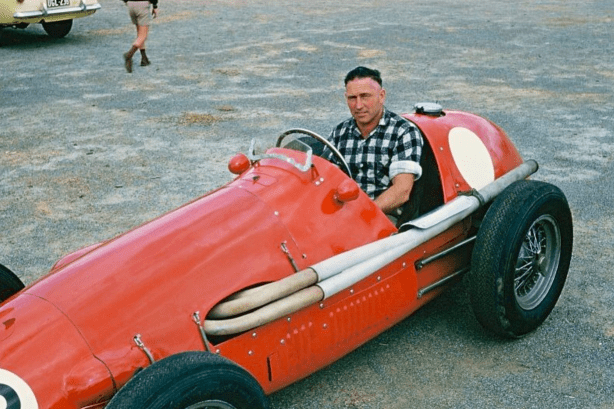
b 11

Doug Green proudly displays his Ferrari 500/625. Caversham, WA (Terry Walkers)

Davison wasn’t done with front-engined GP cars though, he very narrowly lost by a cars length the 1960 AGP at Lowood, Queensland to Alec Mildren’s Cooper T51 Maserati in a superb Aston Martin DBR4 before finally changing to ‘the mechanical mice’ as he described Coopers, winning his fourth and final AGP at Mallala, South Australia in a T51 Climax in 1961.

Davison bought the Ferrari off his friend, Tony Gaze, after the NZ summer races in 1956, Gaze had success with it in 1954 and 1955 having acquired it from the factory fitted with a 3 litre sportscar ‘750 Monza’ engine for the Formula Libre events common globally at the time.

The Fazz was eventually bought by Tom Wheatcroft in the late 1960’s, the first car for his famous Donington Collection, it’s  identity as Ascari’s chassis unknown at the time Tom acquired it. The car had chassis number ‘0480’ when bought by Gaze. During the restoration of the car the provenance of it was investigated by Doug Nye amongst others and confirmed after careful ‘forensic examination’ and in communications with Ferrari.
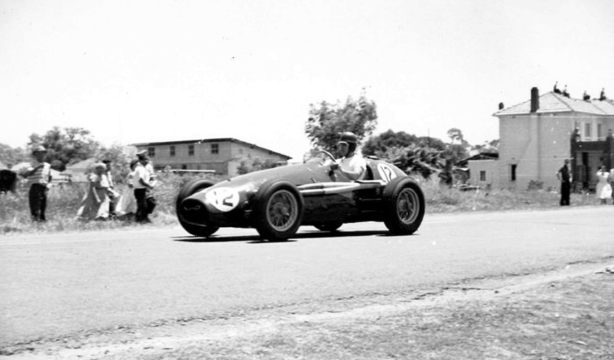
b 6

Doug Green’s Ferrari 500/625, Carey Park, Bunbury 1960 (Ken Devine)

Doug Green bought ‘5’ in 1960, having graduated from an 1100cc Cooper. He got to grips with it, racing extensively in WA, soon improving upon Davo’s times in it at Caversham. He contested the Caversham Gold Star rounds in 1960 and 1961 finishing 4th and 2nd in thin fields, respectively. He sold the car in 1963 upon retirement from racing.
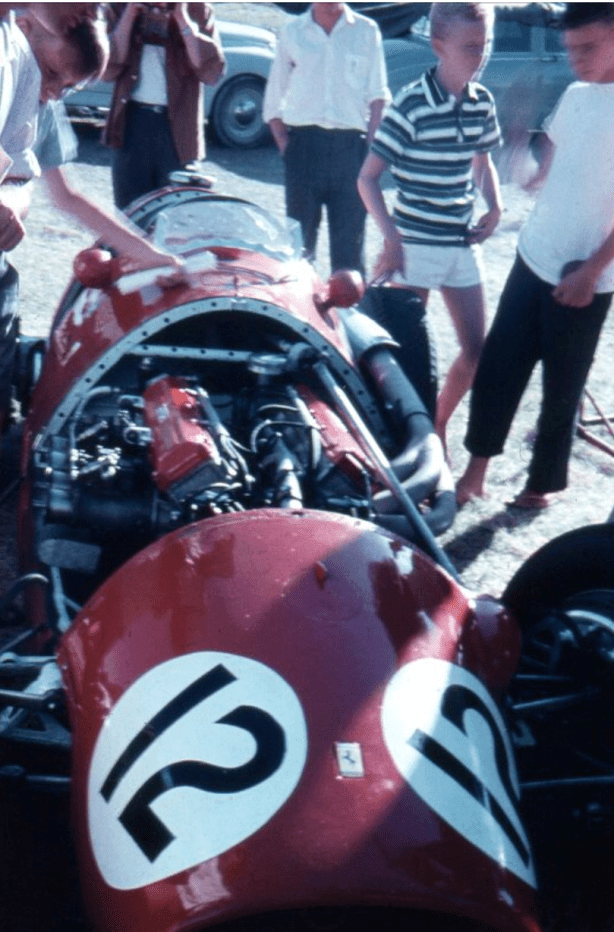
b 7

Rare colour photo of the engine bay of Ferrari 500/625 #5 at Bunbury in 1960. I just about blew a head gasket when I saw the opening photo and this one, color shots of this car are rare, I’ve seen few of its engine bay let alone one with the ‘atmospherics’ Ken Devine has composed and captured here. 3 litre 750 Monza DOHC inline 4 cylinder engine produced circa 290 bhp. Local kids fascinated by the exotic, and still contemporary enough, racer (Ken Devine)

The Ferrari 500, designed by Aurelio Lampredi, used a ladder frame chassis typical of the period, suspension at the front was double wishbones and coil spring /dampers. A De Dion rear axle was used, the gearbox mounted to the diff and connected to the engine by a short propshaft.

The F1 2 litre engine was a 1985cc in line 4 cylinder engine with DOHC and 2 valves per cylinder. Magneto’s provided the spark and Weber 58DCOA3 carburettors the fuel, the engine gave around 185/190bhp@7500rpm. When acquired by Tony Gaze a 3 litre Monza engine was fitted, this gave circa 290bhp. Power is quoted from 245-290bhp depending upon the source.
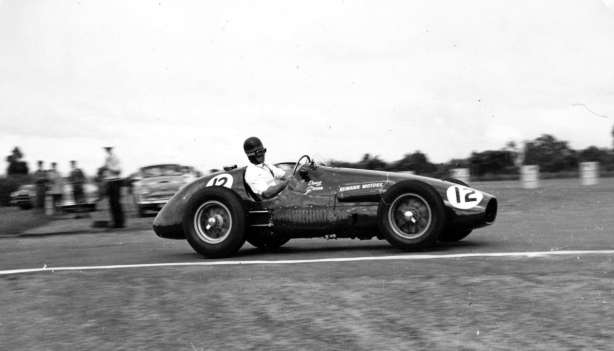
b12

Doug Green, Ferrari 625/500, Caversham 1960, he eventually lapped faster in the car, having got the hang of it, than Lex some years before (Julian Cowan)
b10

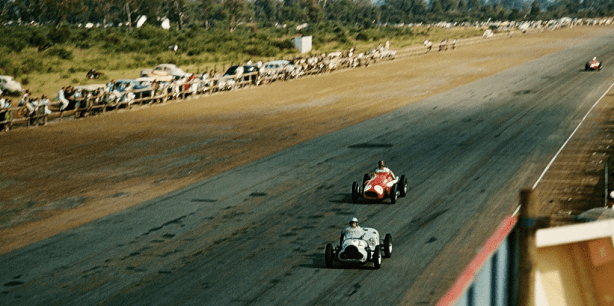
Keith Rilstone’s Zephyr Spl having just passed! Greens Ferrari 500/625, the supercharged car very potent, it was a different thing under brakes, Murray Trenberth in the Alta Repco Holden further back. 1960 Caversham (Ken Devine)

Bunbury Circuits…

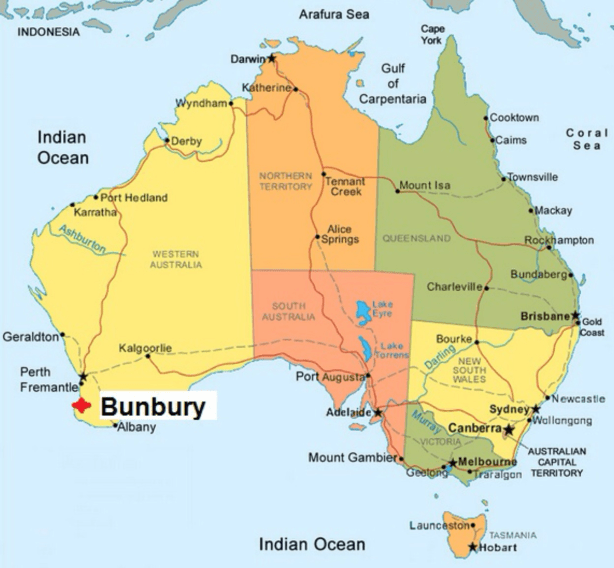
Bunbury probably won’t be known to most Aussies other than those who have visited the Margaret River region in which case you may have made a fuel ‘pitstop’ on its outskirts.

My brother lives in Perth and has a place at Gnarabup, Margaret River so I know the place a bit, but its motor racing history had passed me by until seeing these fabulous photos posted on ‘The Nostalgia Forum’ by Ken Devine. On a future visit I’ll drive the circuit(s), which you can still do.
map

The Carey Park track itself, for Perth readers and visitors who may want to drive it, used Clifton, Victoria, Arthur, Stirling, Wittenoon and Prinsep Streets, Upper Esplanade then Wellington, Wittenoon and Carey Streets. The map below will make more sense of it when you visit.
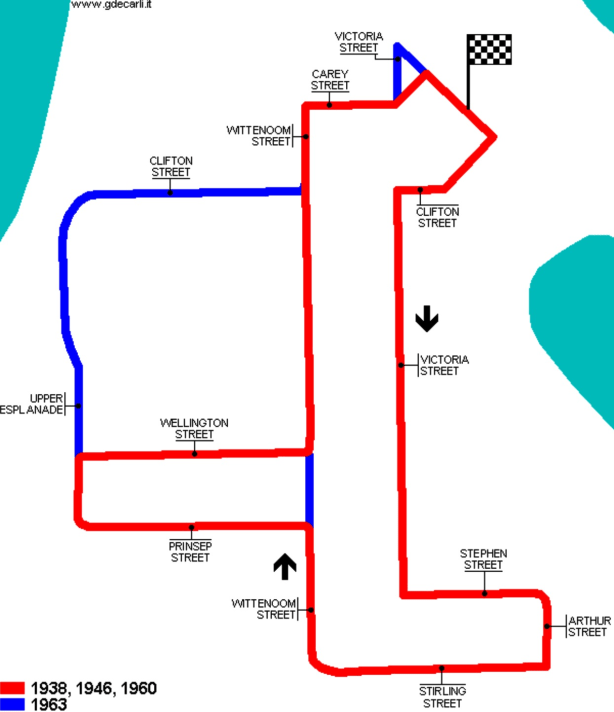
circuit

In fact the Carey Park road circuit, 3.5Km from the centre of town was only one of many used down the decades in greater Bunbury.

Racing started on the ‘Bunbury Central Circuit’, which as the name suggests was in the centre of town. Car racing ceased between 1947 to 1960 but motorcycle racing continued on this circuit and then the ‘Bunbury Moorelands Little Circuit’, also known as the ‘Glen Iris Circuit’. This track was laid out on public roads next to the Preston River and was ideal as the area was rural and so caused little drama to the public. The Bunbury Motorcycle GP meeting was held annually there from December 1963 to Easter 1974.

‘TQ’ Speedway cars raced on the ‘Carey Park Short Circuit’ of .95 of a mile in late 1958 ‘The South Western Times’ in its article before the meeting helpfully advised spectators to ‘…take the greatest possible care while watching the (5) races…under no circumstances should they cross the road while races are in progress’. So ‘Carey Park’ was used by speedway cars in advance of road-racers two years later for the 1960 ‘Bunbury Flying 50’.

In March 1975 the Bunbury Motorcycle Club hosted heats for the WA Road Racing Series around the streets of Davenport, Bunbury’s industrial area, 6.5Km from the town centre. This layout was also confusingly called ‘The Ring Road Circuit’ as it incorporated the new Busselton By-Pass and North Boyanup Road, well known to Perthies visiting ‘down South’ as they call a visit to Margaret River and beyond.
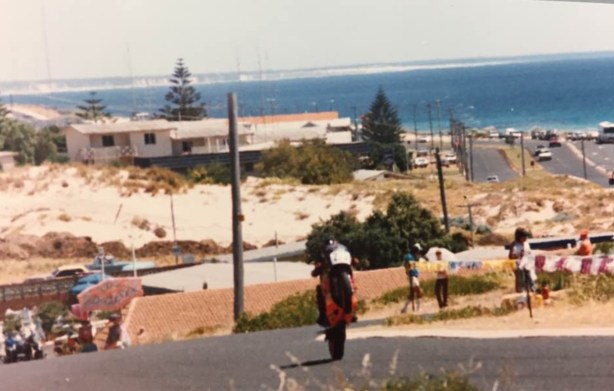
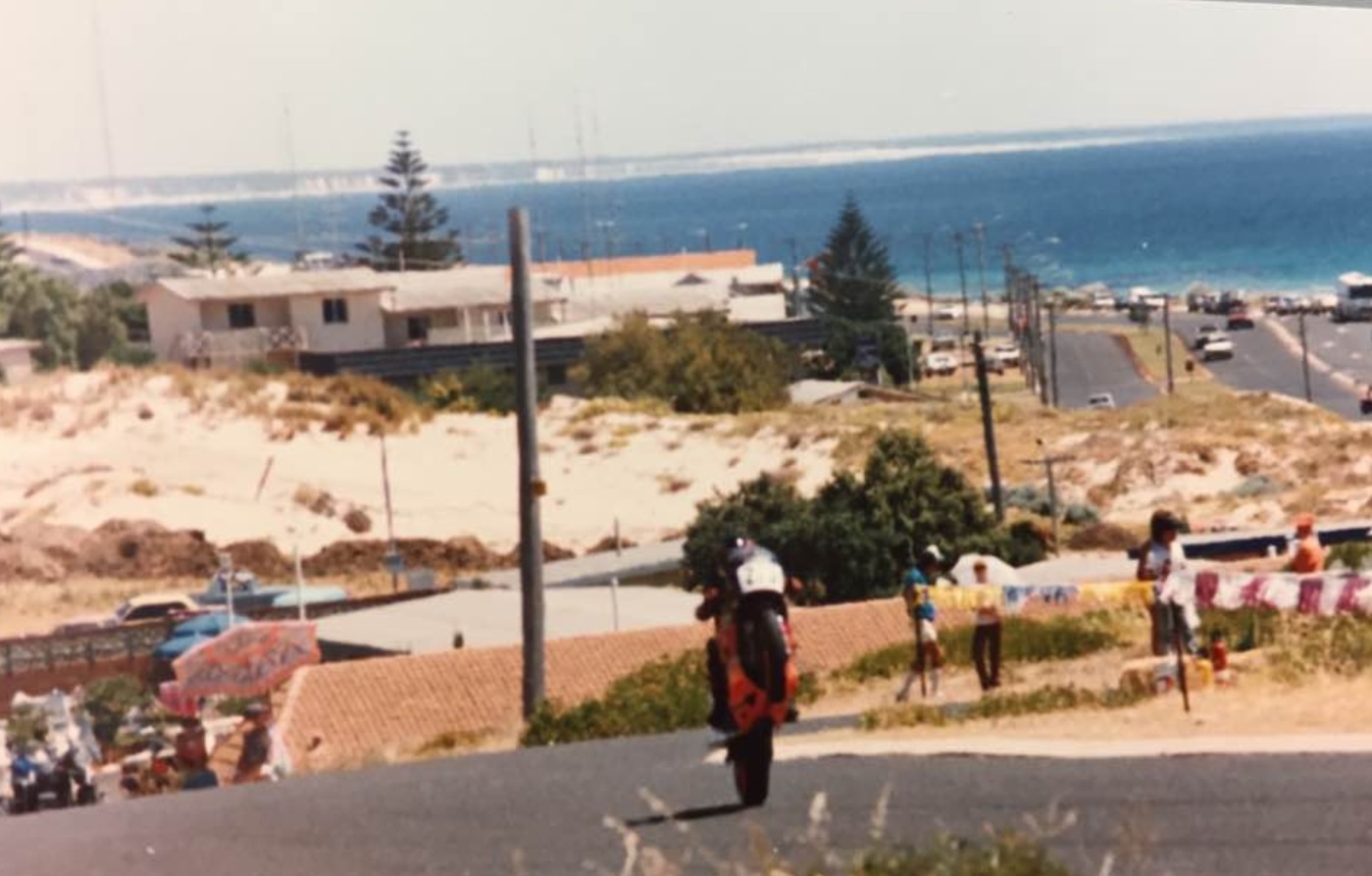
Wayne Patterson thrilling the crowds in 1988; Yamaha TZ350, Bunbury Back Beach circuit (W Patterson)

This fairly ugly locale was used in 1975/6/7 before the move to the altogether more visually attractive and challenging ‘Bunbury Back Beach Circuit’ in 1980. In Australian Beach Lingo a ‘Back Beach’ is a surf beach and a ‘Front Beach’ is calmer water, I’ve no idea from where this derives! This fairly wild looking circuit overlooking the Bunbury break was used from 1980 to 1988. Then there are the local drags and speedway venues- they like their motor racing down south!

Ray Barfield’s Aston Martin DB3S chassis #9 was a car of impeccable provenance and specification…

The car was one of two built for works use in 1956, chassis #10 the other, whilst the successor design, the 1959 Le Mans winning DBR1 was in development.

DB3S/9 was first raced in the GP of Rouen as a warm up to Le Mans on 8 July 1956. Peter Collins raced it to retirement with bearing problems but Moss was 2nd in DB3S/10 behind the winner, Eugenio Castellotti’s works Ferrari 860 Monza and ahead of the 3 litre Maser 300S of Jean Behra.

At Le Mans on 28/29 July, ‘9’ was driven by Moss/Collins, the lead factory car was ahead of the field but finished 2nd after gearbox problems slowed it. Ninian Sanderson and Ron Flockhart won, a lap ahead of the Aston in an Ecurie Ecosse Jaguar D Type. The AM ‘LM6’ 2922cc engine fitted for Le Mans developed 219bhp @6000rpm- good for 150mph at La Sarthe.
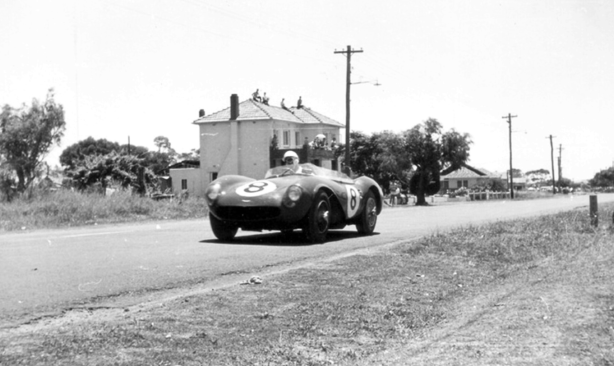
b 8

Ray Barfield Aston Martin DB3S into the right hander into Ecclestone Street (Ken Devine)

Moss won in the car at Oulton Park in August, and at Goodwood on 18 Septenber Roy Salvadori was 2nd to Tony Brooks in another DB3S. The last appearance of DB3S’9′ as a works entry was at Goodwood on 22 April 1957 driven by Brooks, he was 3rd.

The car was rebuilt and offered for sale by Aston’s as they focussed their attention on the new DBR1 and was bought by David McKay, the Australian racer/journalist keen to acquire a works car having owned an earlier customer DB3S, chassis ‘102’ a car David raced as part of ‘The Kangaroo Stable’. This group of three DB3S Astons raced by Australians David McKay/Tony Gaze, Tom Sulman/Jack Brabham and Les Cosh/Dick Cobden in 1955 is a story in itself.

Australian oil company Ampol provided financial support for the purchase, the car immediately became the fastest sportscar in Australia, winning upon its debut at Bathurst in October 1957. David won 8 of 9 races in it finishing 2nd only once, to Doug Whiteford’s Maser 300S in the Tasmanian TT at Longford. McKay’s last race in DB3S/9 was at Bathurst in October 1958 when he won the 100 mile Australian TT from Derek Jolly’s Lotus 15 Climax and Ron Phillips Cooper T33 Jaguar.

The car passed through Stan Jones hands in Melbourne, he only raced it once, before being bought by Barfield in mid-1959. The Mount Helena racer used it regularly in the West through to the Christmas Cup meeting at Caversham on 22 November 1963, fittingly, he won the 5 lap sportscar scratch race.

In 1956 when built the DB3S was pretty much the state of the sportscar art in terms of specification, it was closely derived from a road car and could, fairly easily be driven on the road. By 1963 the long distance racing paradigm was perhaps best defined by the specialist racing, mid-engined Ferrari 250P- a 3 litre V12 engined car which was far from a ‘roadie’ however much Enzo Ferrari tried to position the 250P’s cousin, the 250LM as such. The point here is just how focussed sports-racing cars became and how much racing technology changed in a very short period of time.

Barfield then retired from racing, it was fitting that the wonderful ex-works Aston won its last race however insignificant a 5 lapper at Caversham in 1963 was relative to 24 hours at Le Mans in 1956!

Ray retained the car inside it’s Rice Trailer on his farm outside Perth, famously keeping the engine fully submerged in a container of oil, having discovered a crack in the crankshaft, for 25 years.

Many people knocked on his door to buy it over the years including David McKay on more than one occasion but all were aggressively turned away. Finally a big wad of cash allowed Sydney’s Kerry Manolas to buy it, sight unseen, and it was not a pretty sight when he did see all of its components in October 1987! The car was superbly restored by Gavin Bain’s ‘Auto Restorations’ in Auckland. I wonder where in the world it is now?

Oh to have seen the Ferrari, Alta and Aston race on the Carey Park streets in the ‘Bunbury Flying 50’ all those years ago. Three amazingly interesting and diverse cars in the one race, and all so far from ‘home’!

Bibliography…

The Nostalgia Forum particularly the contributions of Terry Walker, Ray Bell and Ken Devine. 8Wforix.com, ‘Historic Racing Cars in Australia’ John Blanden, oldracingcars.com

Photo Credits…

The Ken Devine Collection, Julian Cowan, Terry Walkers Place, Jodie Krikkie, Wayne Patterson Collection, Memories of Bunbury

Tailpiece: Vin Smith, Alpha Peugeot 1.5 s/c…
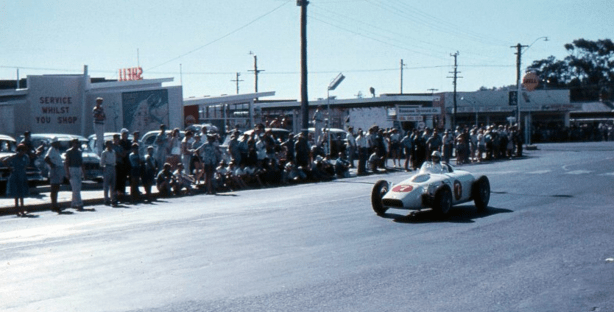
b 9

 (Ken Devine)

Vin Smith at the Highway Hotel Hairpin, Bunbury 1960.

This effective, pretty little special was one of several built and raced by Smith from the mid-fifties to the mid-sixties. So much of Australian motor racing was reliant on ‘specials’, usually very fast ones at that for 50 years.

Finito…

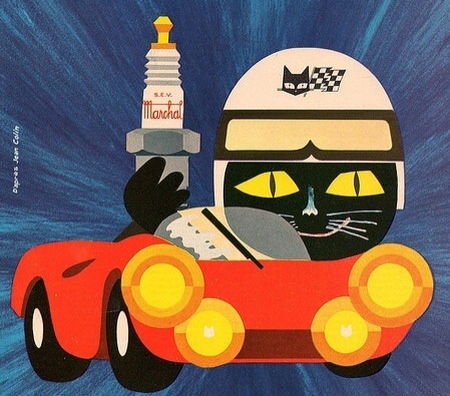
sev marchal

S.E.V Marchal Ad circa mid-sixties…
The famous French manufacturer of automotive electrical componentry started plying its trade in 1923. The rights to the name, depending upon country, passed to the Valeo Group in 2009. I gather looking at a few online forums the product ‘ain’t what it useter be’.

I just always liked the graphics!…