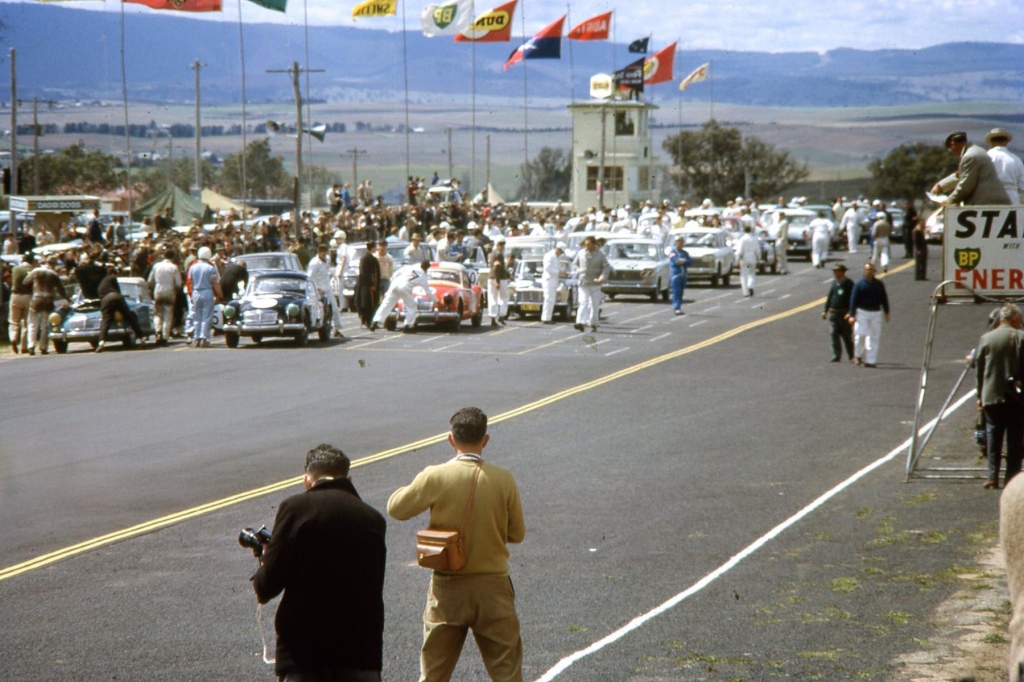
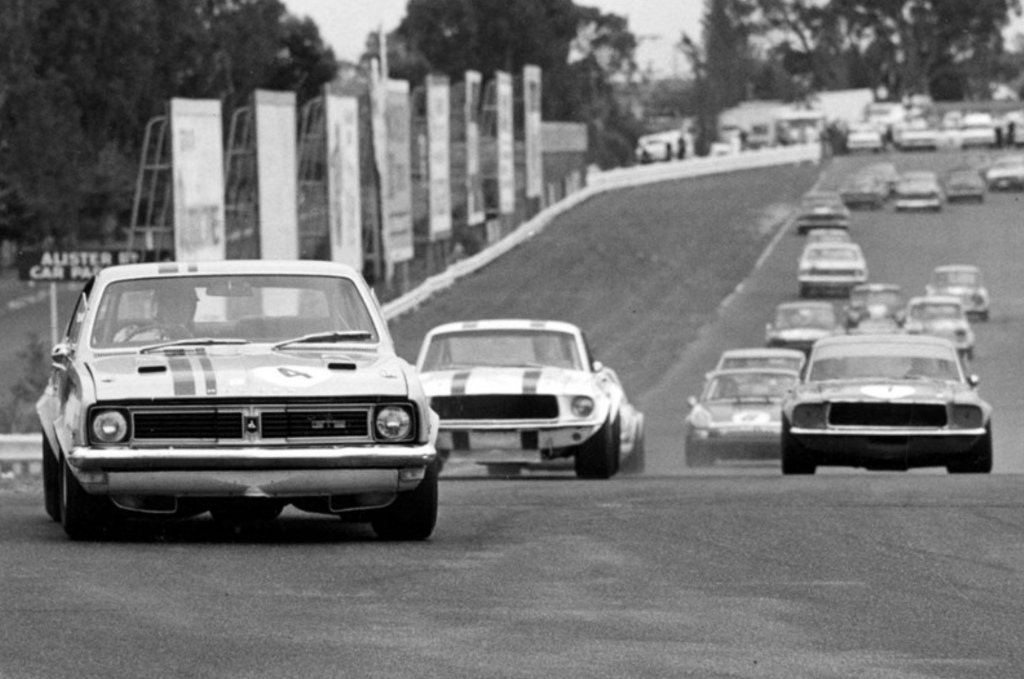
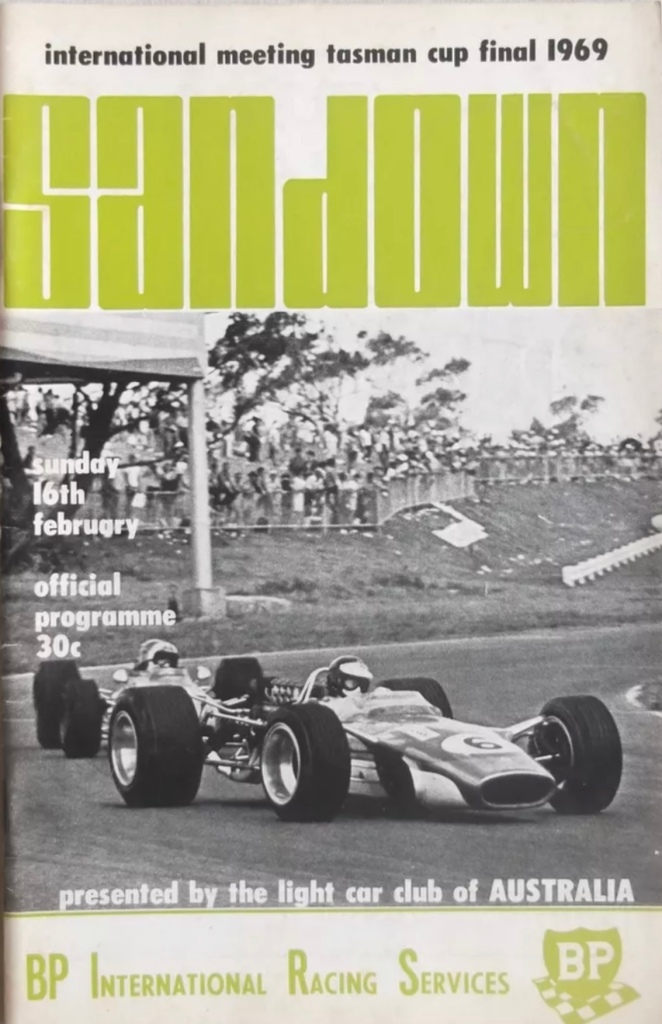
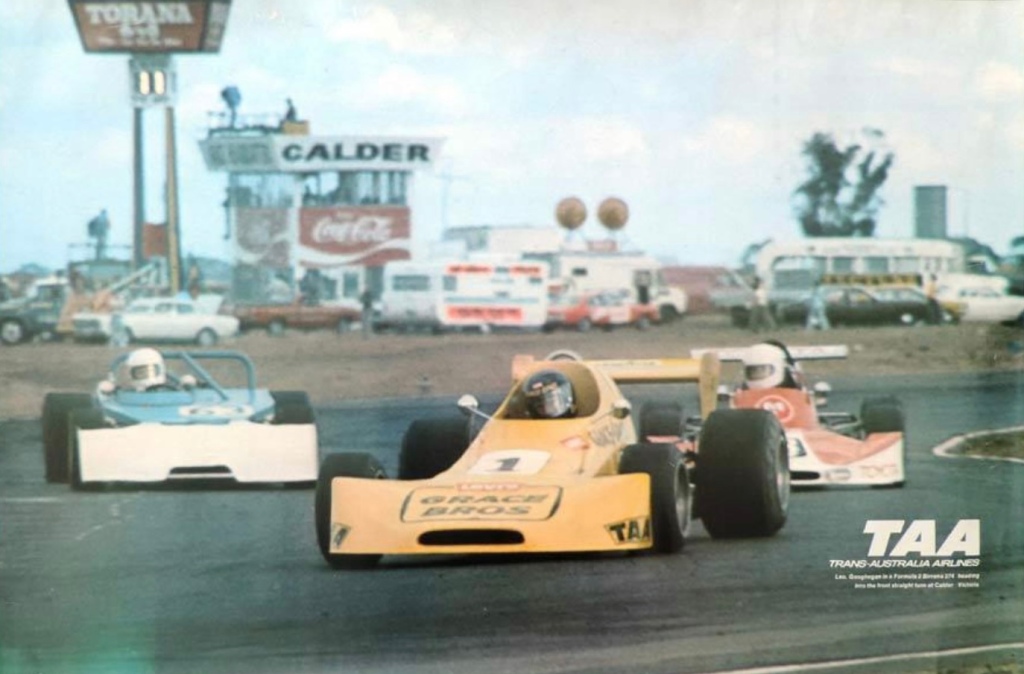
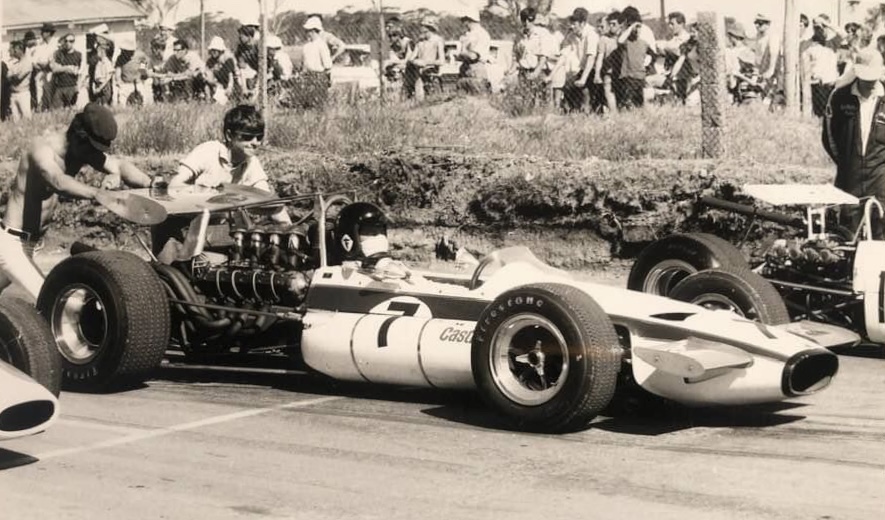
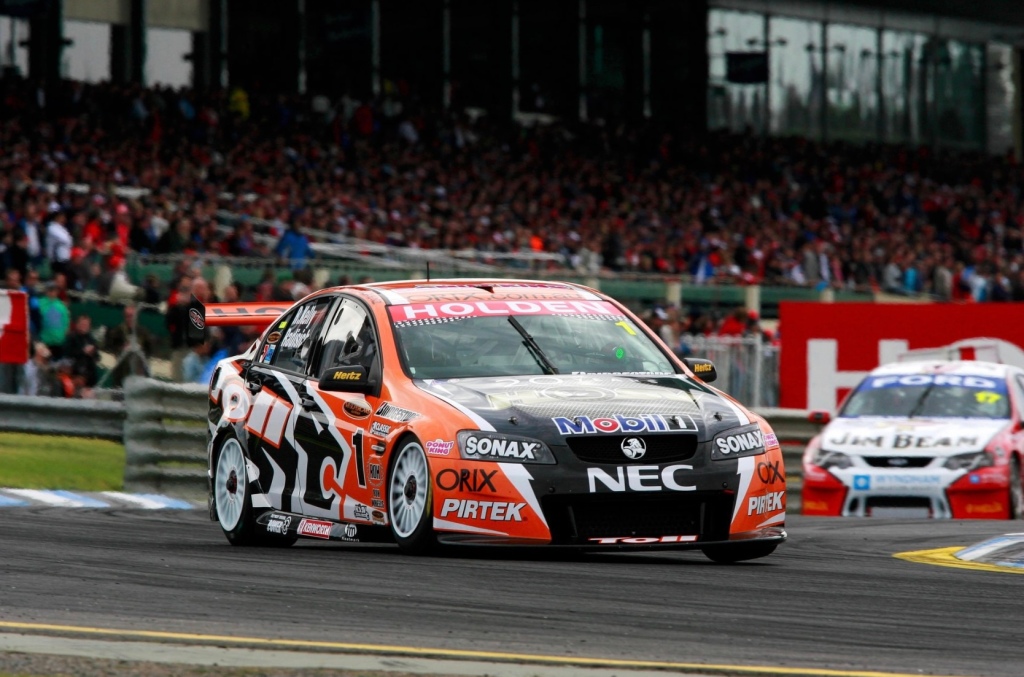
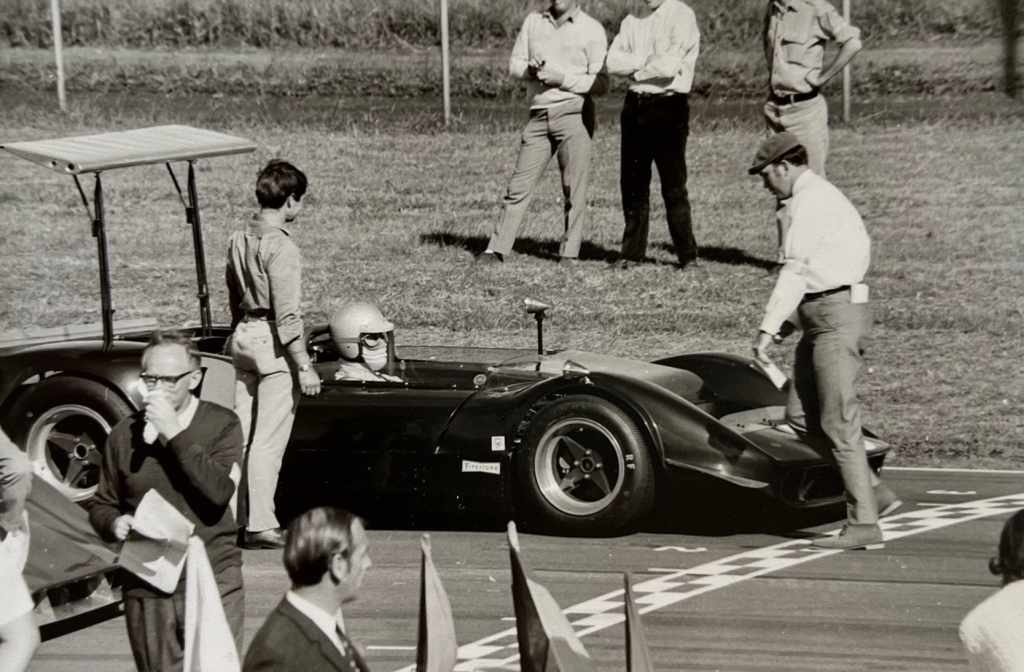
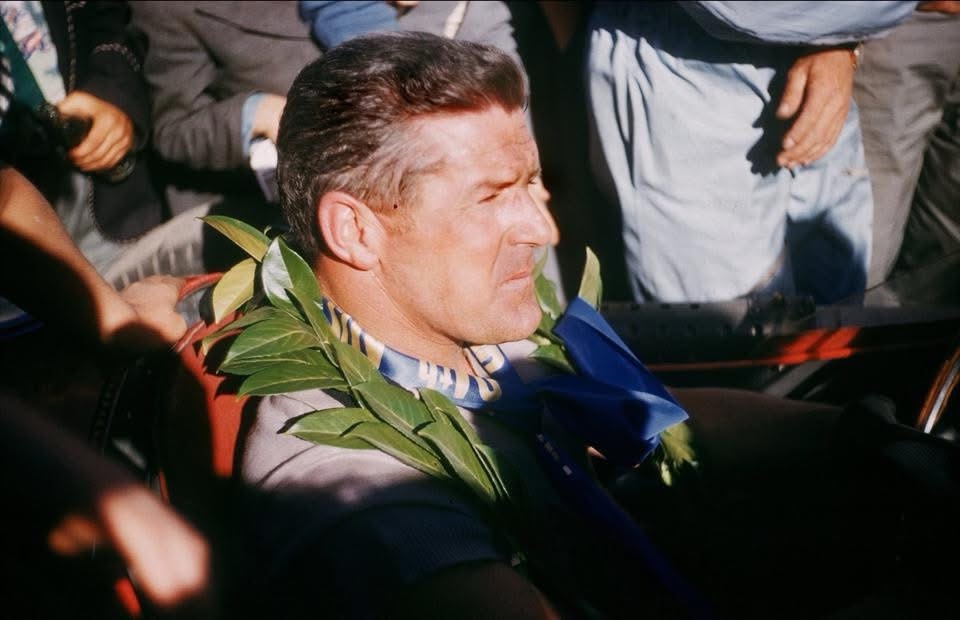
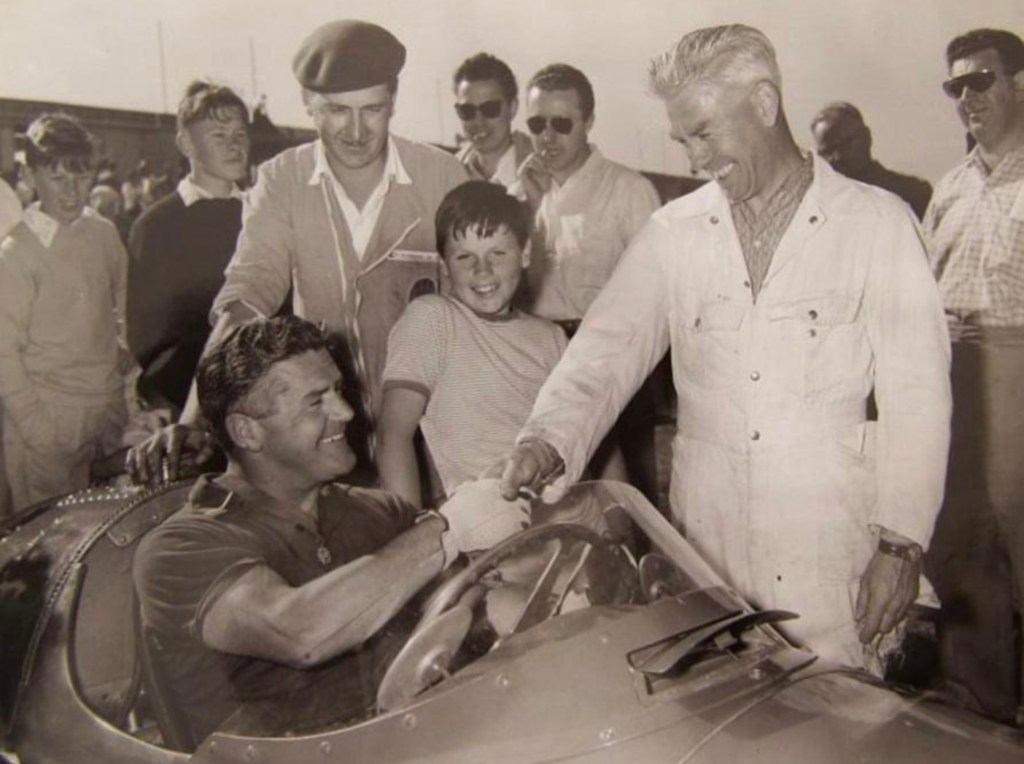
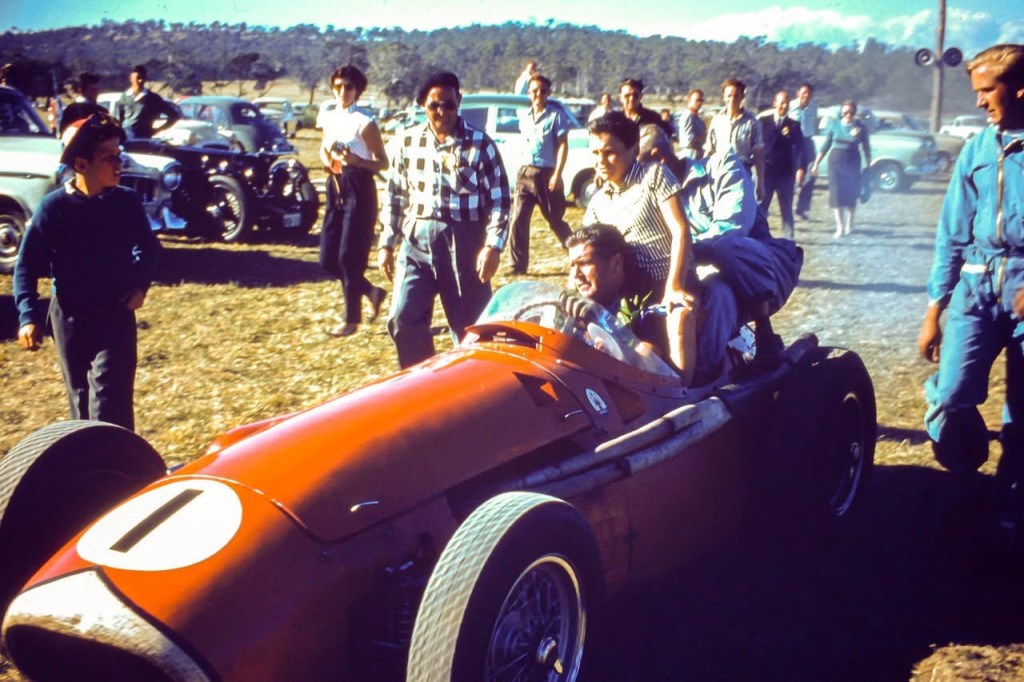
The grid gets way at the start of the September 30, 1962 Bathurst 6-Hour Classic. The entry comprised a mix of production sports and touring cars divided into price based classes. The front row comprises the three MGA Twin-Cams of Matt Daddo/Bill Stanley, N Claydon/Fred Gibson and Clarke/Lazich, with the C Lansdowne/Dianne Walker Triumph TR4 on the inside.
The Bathurst promoters, the Australian Racing Drivers Club, perhaps ran the event off the back of the success of the Phillip Island 500-milers (Armstrong 500) first run in 1960, which would soon after become the ARDC’s after the debacle of the Phillip Island October 1962 event in which the track surface famously, in essence, fell to bits.
(B Richards)
A total of £3,000 in prize money was split evenly among the classes or divisions: A-production touring cars up to £900, B-production touring cars £901-£1050, C-production touring cars £1051-£1250, D-production touring cars £1251-£1700, E-production sportscars up to £1500, F-production sportscars £1501-£2000.
While there was officially no outright winner, the interest of the punters was amongst the top-guns which included the V8s: Studebaker Larks, the brothers Geoghegan’s Daimler SP250 and potentially the best of the little-cars, the Bruce McPhee/Barry Mulholland Morris Cooper.
What strikes me now is that the entry list was a who’s-who of (mainly) New South Wales stars of the day and of the immediate future with a swag of Gold Star, Australian Touring Car and Sportscar Championship, and Bathurst winners in the mix.
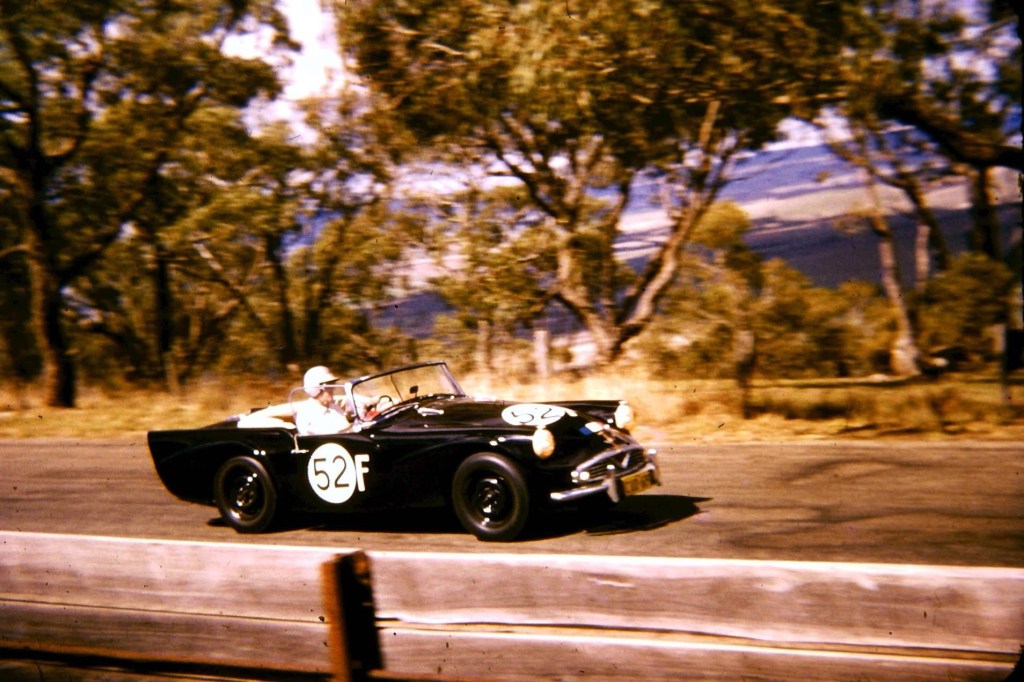
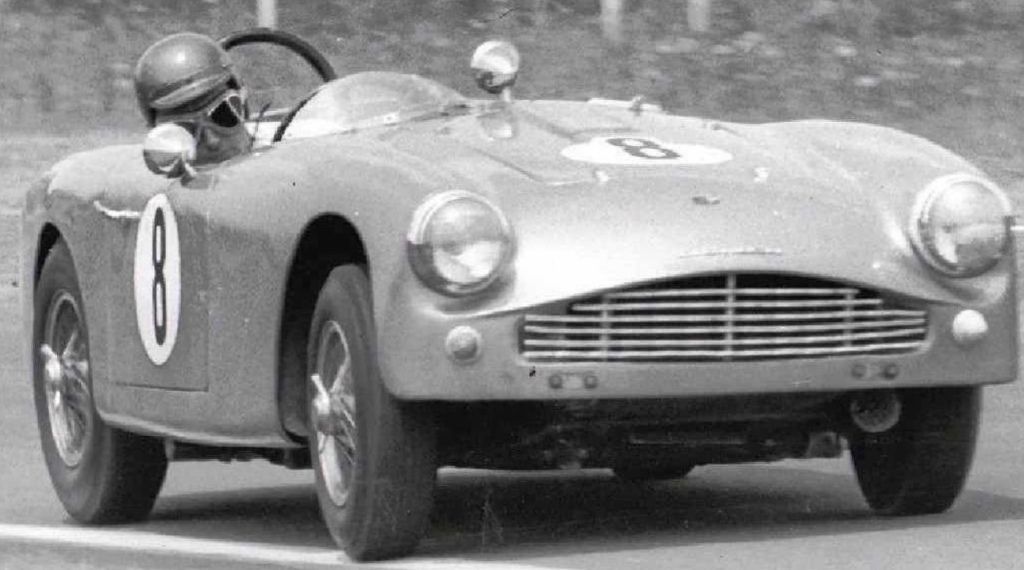
It appears that the sportscars had to start with their tops up, so this is practice or the first stint for Leo and Pete Geoghegan’s winning Geoghegan Sports Cars entered and prepared Daimler SP250 (B Wells)Pete Geoghegan blasting across the top of the mountain. Alan Howard said of his shot, ‘You can see the bit of rope used to hold the drivers door closed late in the race.’ (A Howard)
Morris 850s dominated Division A – 14 cars, of which all but one finished – where the winners were Frank Kleinigs senior and junior. Kleinig Snr was an Australian great pre-and post-war and always polls well in lists of Greatest Australian Drivers Never to Win an AGP. Junior was no slouch either as a racer and constructor of Formula Vees. There was no shortage of notables in this class including Des West, Bill Pitt, Arnold Glass, John French and Paul Bolton, while Tom Sulman would have run Kleinig Snr close in a contest for who started racing first.
Seven cars contested Division B, the victors were John Martin and C Hodges in a Skoda Felicia of all things. This group included cars raced by Ron Hodgson, Digby Cooke, Alan Heasman, Peter Wherrett, Doug Stewart and Alan Stanfield.
Bruce McPhee and Barry Mulholland went on to win the Bathurst 500 outright aboard an HK Holden Monaro GTS327 in 1968, they prevailed in Division C where Bob Jane and Harry Firth were much fancied in a works-Ford Falcon XK.
The Jane/Firth C Division Ford Falcon XK from the ‘E’ MGA 1600 driven by K John/Peter Caldecoat (B Wells)Lap 39, Firth is ok and out of the Falcon via the back window but she needs a turret! Bob Williamson recalled, “They towed the Falcon up the escape-road on its roof with a tractor. You should have heard the noise, roof on a gravel road.” (B Richards)
Ford planned to race their new Falcon XL in the Armstrong 500 at the Island on 21 October, in addition they decided, wisely, to contest the Bathurst Six Hour Classic to be held only three weeks before. The catch was that Ford didn’t want to race the XL at Mount Panorama so Firth set about preparing an XK Falcon for the race.
Firth takes up the story in his typically self-serving way, “Having not been to Bathurst for some years, I had to rely on hearsay information like, “no, it is not hard on brakes and the circuit has not changed. I did all the usual things such as a valve grind, compression check, set the camshaft properly, gave the pistons plenty of clearance, deck-heighted the head and put the engine on the dyno.”
“I fitted a set of heavy Armstrong shockers and some well-worn springs. I made up some Ferodo brake shoes but ended up leaving them at home, thinking they wouldn’t be needed. I drove the car to Bathurst myself. Practice proved two things: the car was the fastest sedan and the brakes were not good enough.”
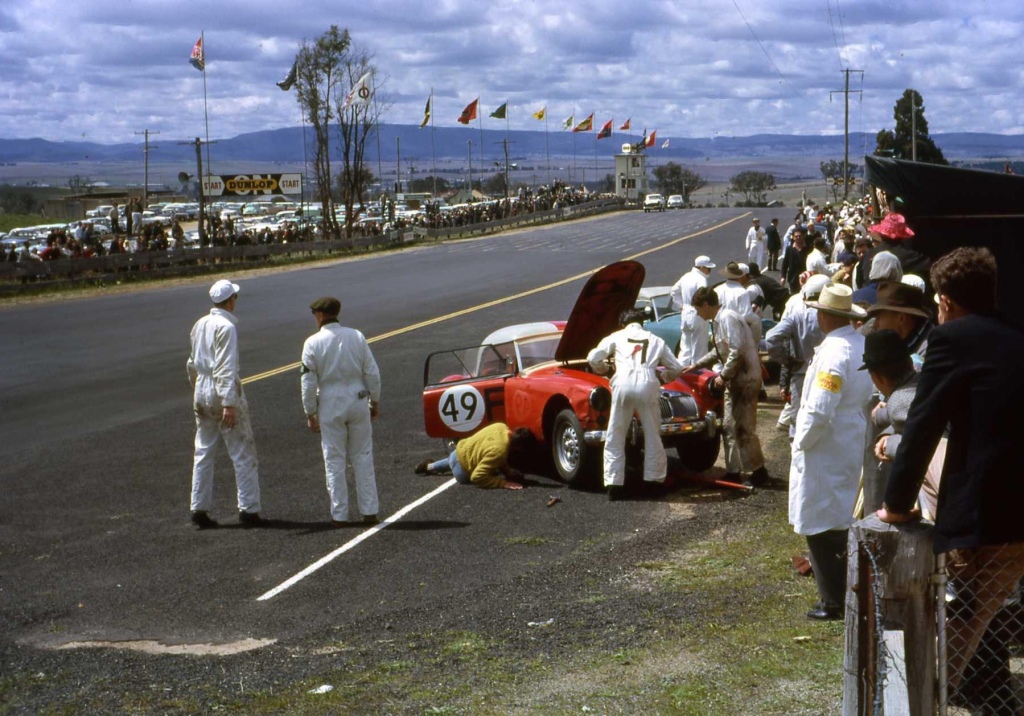
The Jim Clarke/A Lazich MGA Twin-Cam receives some attention, DNF (B Richards)
The two wily Melbourne racers – who went on to win three of these Phillip Island and Bathurst 500s together – led their class early, but the brakes were progressively showing signs of stress as the pedal crept inexorably closer to the floor.
Harry took over from Bob after a scheduled stop and then on lap 39 “As he braked for Hell Corner, the fronts suddenly over-energised and locked on, the nose dug in and the car rolled.” The roof was crushed with Harry extremely lucky he wasn’t badly hurt, the car had no roll bar or cage of course. He exited via the rear window as fuel spilt over the tarmac, but did not ignite.
The Division D winning Studebaker Lark raced by Algie/Hibbard. I’m old enough to remember when these beasts were popular cop-cars in Australia (B Wells)
Division D’s 10 car entry included three Studebaker Larks, with the Don Algie/Kingsley Hubbard entry the winner on 99 laps, then the well credentialed David McKay/Greg Cusack duo in a Fiat 1500 from Peter Williamson and K Whiteley third in another Fiat 1500. Other notables in that class were Bill Buckle, Brian Foley and George Murray.
Only four cars contested Division E, with the Tony Reynolds/Les Howard Morgan Plus 4 ahead of the Bill Reynolds/Kevin Bartlett Austin Healey Sprite Mk1.
The Geoghegans won Division F for the more expensive sportscars from the G Lansdowne/Holt Bonnie Triumph TR4. The Top-Three outright were the Geoghegan Daimler on 104 laps, then the Lansdowne/Binnie TR4 on 100 and the Algie/Hibbard Studebaker with 99 completed laps.
The entries for this race are staggering in their diversity, here the fourth in Division D Scuderia Veloce Citroen ID19 driven by Bill Buckle and Brian Foley (B Wells)
Credits…
Bill Richards, Bruce Wells, Shannons Falcon XK article by Mark Oastler, SS Auto Memorabilia, Alan Howard
Tailpiece…
(SS Auto Memorabilia)
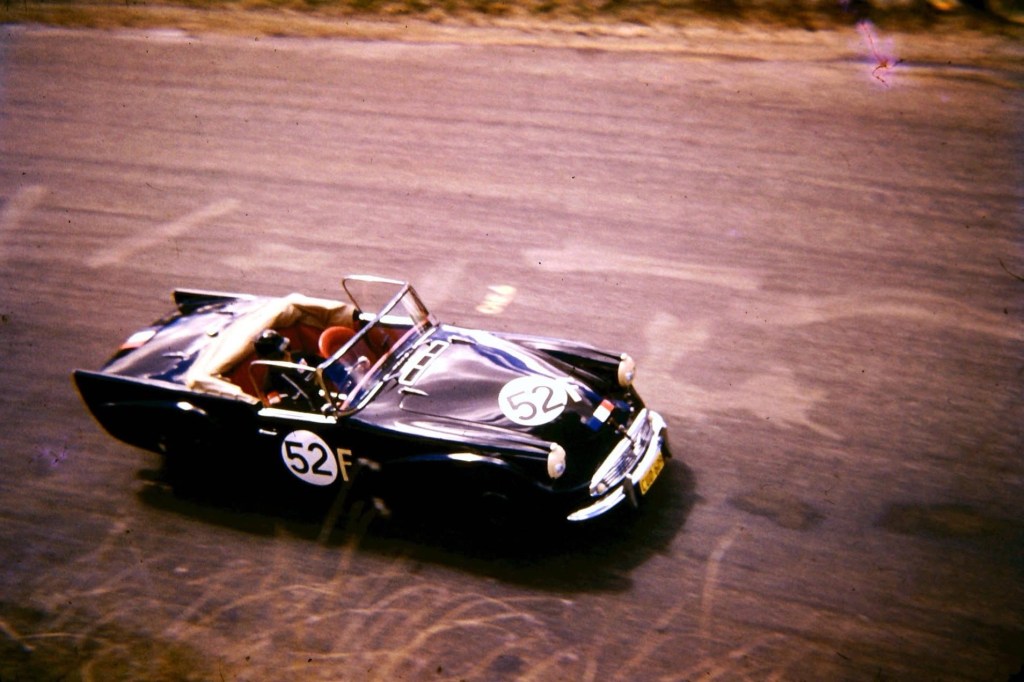
Leo Geohegan at the wheel of the winning Daimler SP250 above and below. With a 2.5-litre V8 and light fibreglass body it proved a quick car but the duo had some challenges, most notably the drivers door opening on a regular basis as the body flexed, and the loss of first gear on the start-line.
I imagine the colour of the underwear of the photographer was changing at this moment, protected only by a layer of Armco as he was. Still, if the worst happened he could decamp into the dam behind…Shots from this spot at Sandown, outside Peters/Torana Corner are rare after about this time as the spot was made Verboten!
Norm Beechey, Holden Monaro HT GTS 350 from the Pete Geoghegan (left) and Bob Jane Mustang 302s, with a smidge of Jim McKeown’s Porsche 911S behind Pete, and then most of Brian Foley’s, and the rest. 1970 Australian Touring Car Championship, round three, April 19.
While Allan Moffat started from pole (where is he in this shot!?), Stormin’ Norm had a great day at the office, leading from start to finish and setting a lap record. He took his second 1970 ATCC round win of the season, victorious from Geoghegan and Moffat (Mustang Trans-Am 302) on the way to an immensely popular series win in his big, booming, Shell-yellow Monaro GTS 350; the first time an Oz built car had won the title.
(G Feltham)
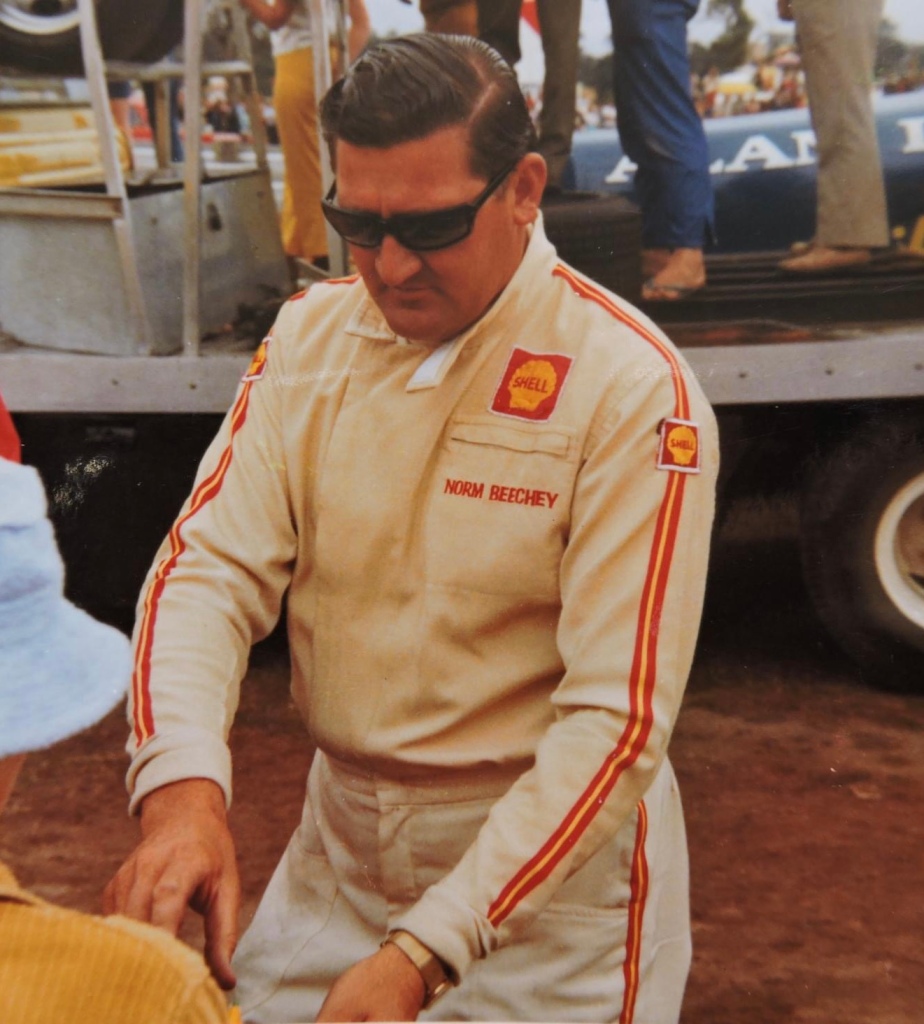
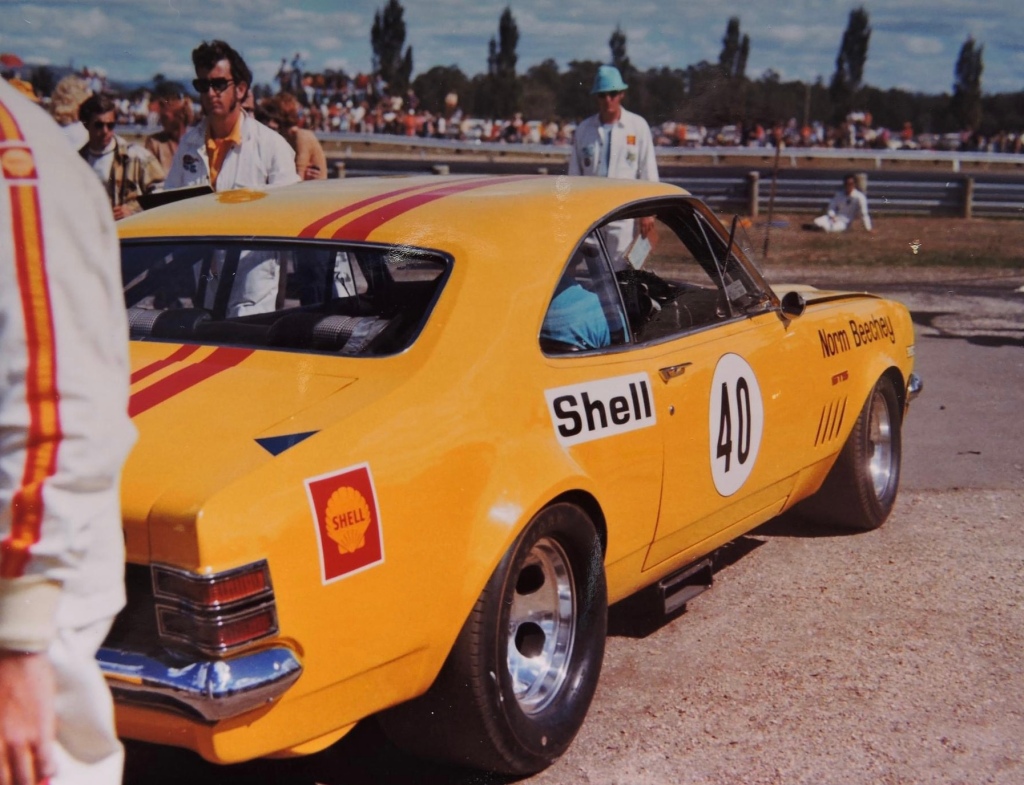
These two shots are of man and machine at Symmons Plains circa-1970, not sure of the meeting date, the number doesn’t work for the ATCC round.
(G Feltham)
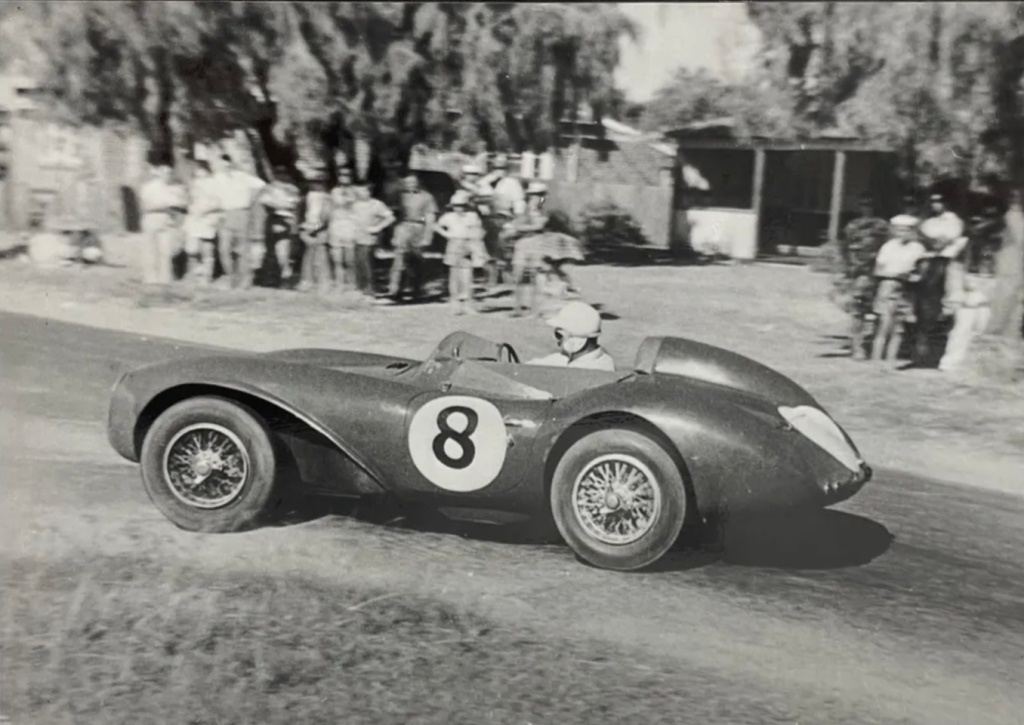
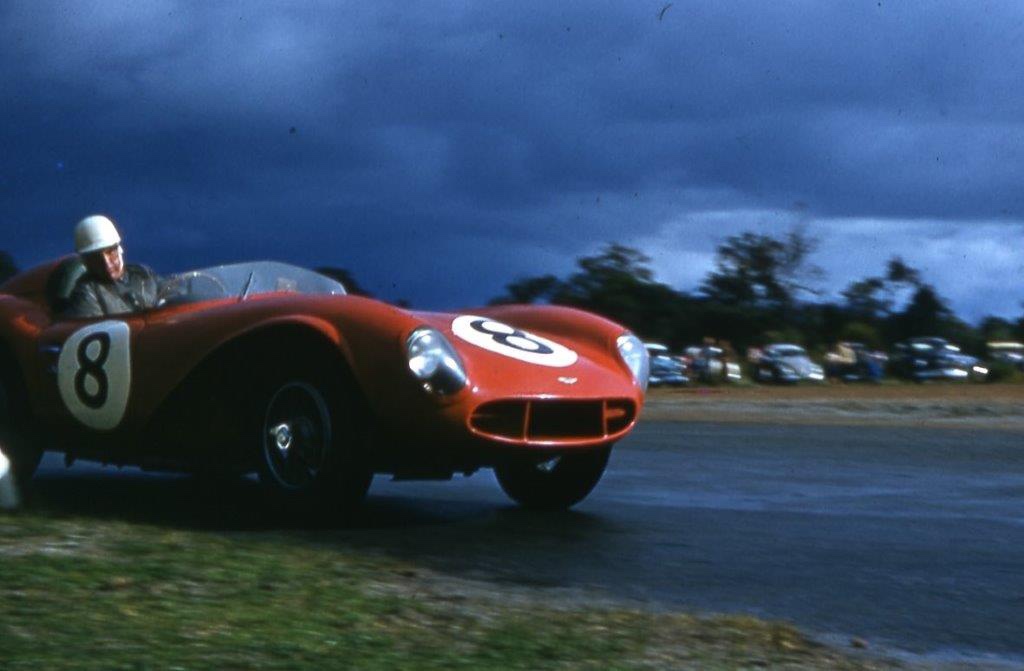
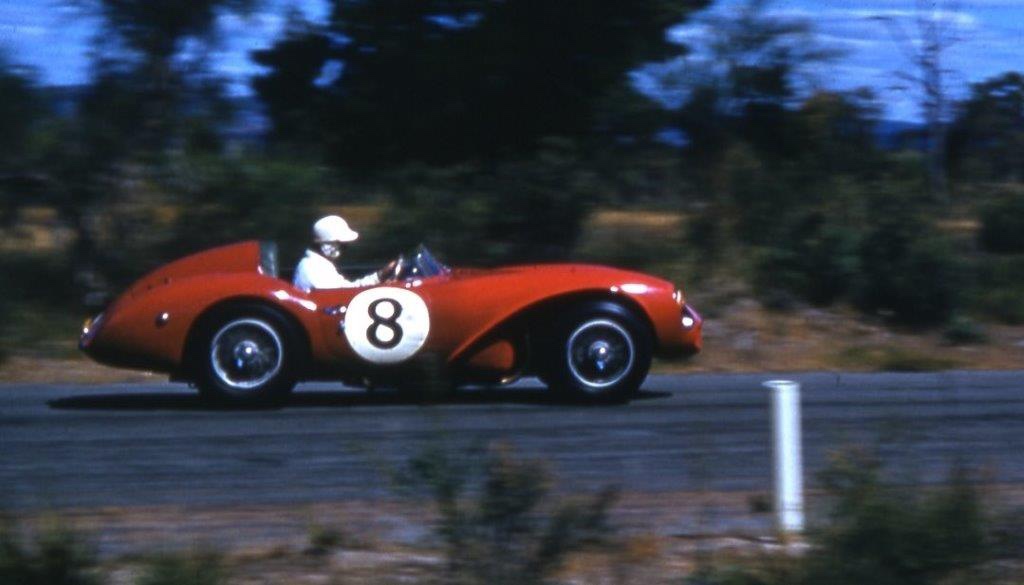
Ray Barfield races his ex-works/David McKay Aston Martin DB3S, chassis 9, at Caversham in 1959, meeting date folks?
The second placed car at Le Mans in 1956 (Stirling Moss/Peter Collins) was initially raced in Australia by McKay with success, before passing briefly through Stan Jones’ hands and into Barfield’s, where, I believe, it remains. More about the car in this article: https://primotipo.com/2017/09/28/david-mckays-aston-martin-db3ss/
(G Russell-Brown)
Gary Russell-Brown very kindly sent in these shots of the Barfield/DB3S combination at Caversham during the June 6, 1960 Six Hour Le Mans. Ray was a DNF after completing 60 laps, the winner, Jack Ayres/Lionel Beattie did 178.
(G Russell-Brown)(unattributed)
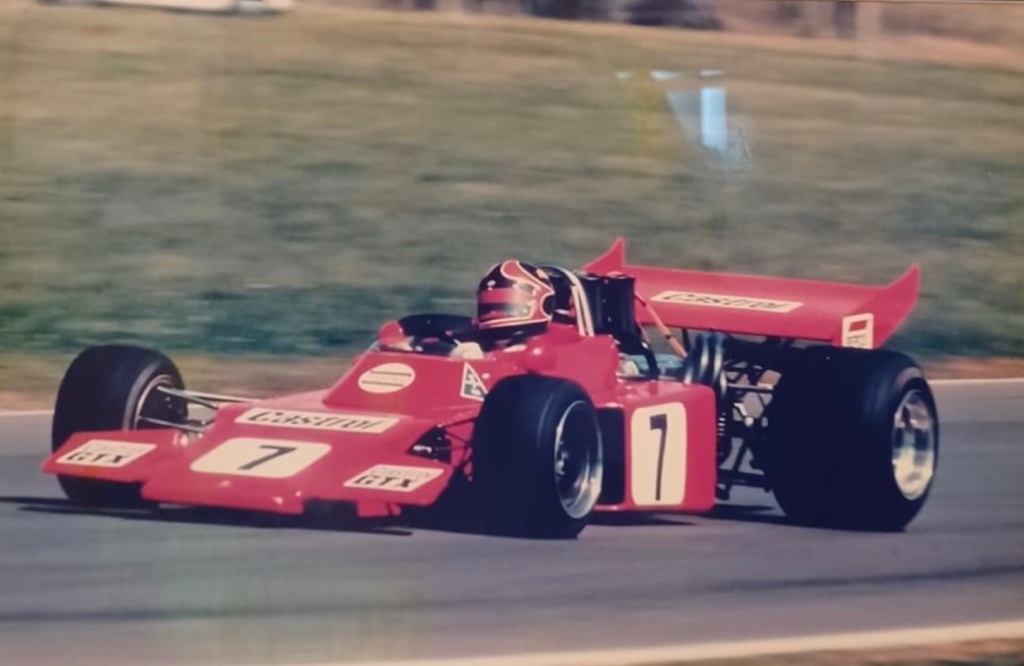
John Harvey under brakes on the entry to Creek Corner, Warwick Farm 1972. His mount is the brilliant – small, variable rate suspension, side-radiator, edgy-wedge – work of John Joyce, the Bob Jane owned Bowin P8 Repco-Holden F5000
P8-118-72 was completed at Bowin’s, Brookvale, Sydney factory in August 1972 to Bob Jane’s order, fitted with a Repco Holden V8 for John Harvey.
It practiced at the Surfers Aug 27 Gold Star round but didn’t start with fuel problems. Harvey then raced in a non-championship event at Warwick Farm a week later (above), where he was fifth in the first heat but collided with Kevin Bartlett at the start of second.
At that point, major team sponsor, Castrol, directed Jane to put most of the team’s energies into racing their touring cars: the Camaro, Monaro and Torana’s, while the Bowin and McLaren M6B Repco V8 sportscar were largely set aside.
In mid-1974 the car, less engine and gearbox, was sold to John Leffler to replace his damaged ANF2 Bowin P8 Hart-Ford #P8-136-74. Leffler pranged his new Bowin on its debut at Amaroo Park.
Converted to ANF2 specification – fitted with a Hart-Ford 416B 1.6-litre engine, Hewland FT200 gearbox etc – he raced P8-118-72 in the Australian F2 Championship and in Gold Star events. Once sorted, the car was a jet, winning the Phillip Island F2 round late in the year.
Sue Ransom leased and raced it at Calder and Wanneroo Park in 1975. The car remained in Western Australia, perhaps owned by Rod Housego and Ian Wookey, before reappearing at Wanneroo in Rob Richards hands between 1980-82 in Formula Pacific – Ford BDA engined – specification.
Perth Bowin fan Matthew Lloyd did a superb job restoring the car to ANF2 spec, but he died in 2008 just as it was being finished. Bought by Dean Saunders in 2009, I believe it is being slowly re-restored to Repco-Holden F5000 spec, do get in touch if you have more recent information. .
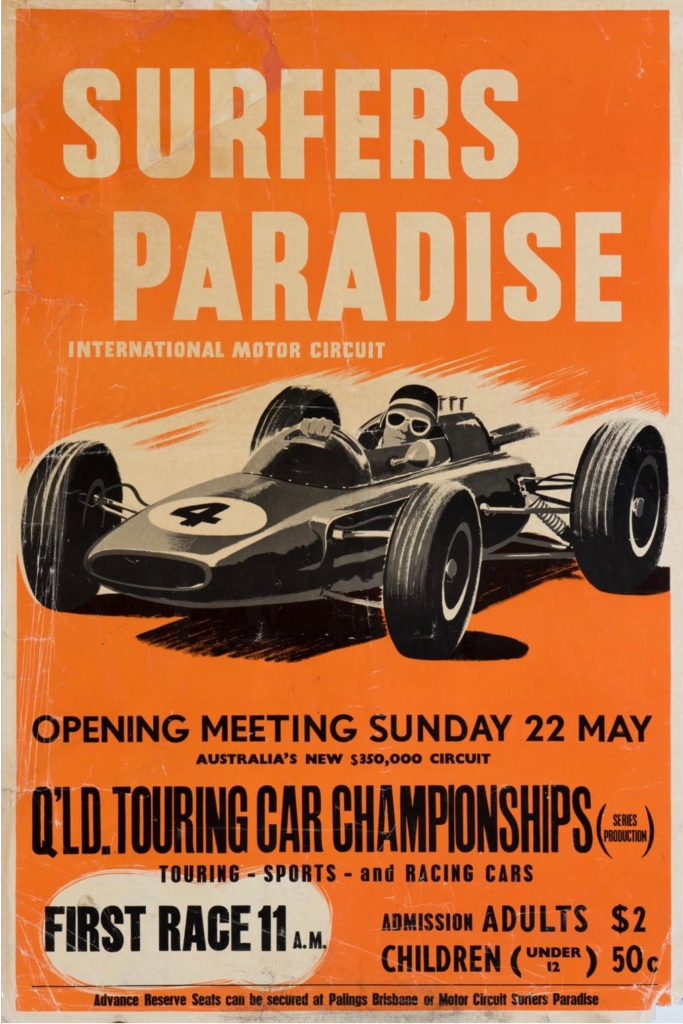
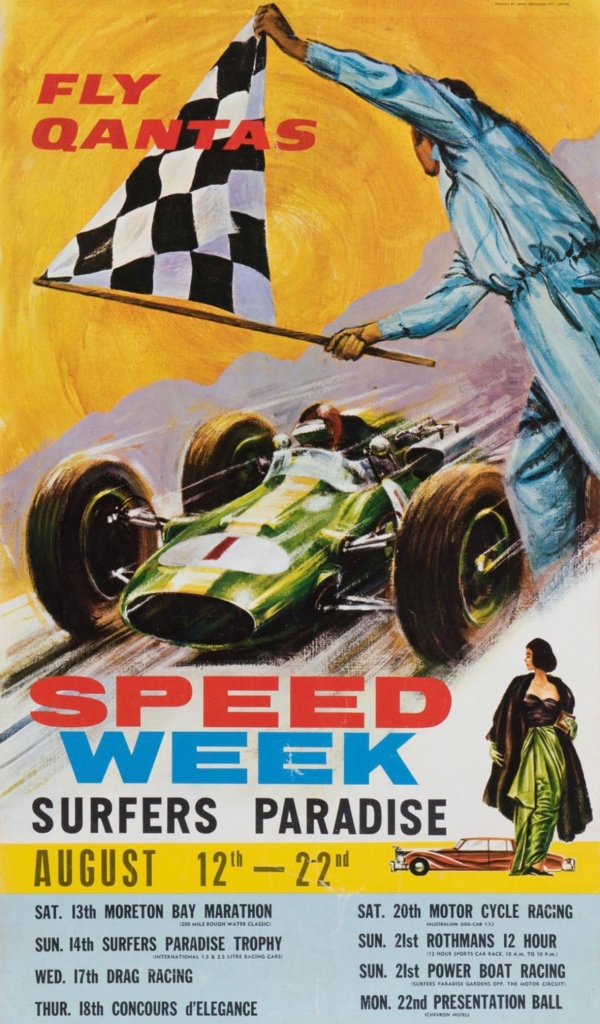
I just like this pair of posters to promote brand new Surfers Paradise International Raceway in 1966.
While it was a fabulous circuit, and at the time built in the-sticks, the incredible growth of the Gold Coast made it irresistible to developers, which was its fate circa August 1987.
John Harvey’s Brabham BT23E Repco 740 in the foreground, while Niel Allen jumps aboard his McLaren M10B Chev at Bathurst during the Easter 1970 weekend.
In the shot below Niel jumps off the line, it’s Leo Geoghegan’s Lotus 39 Repco on the far side.
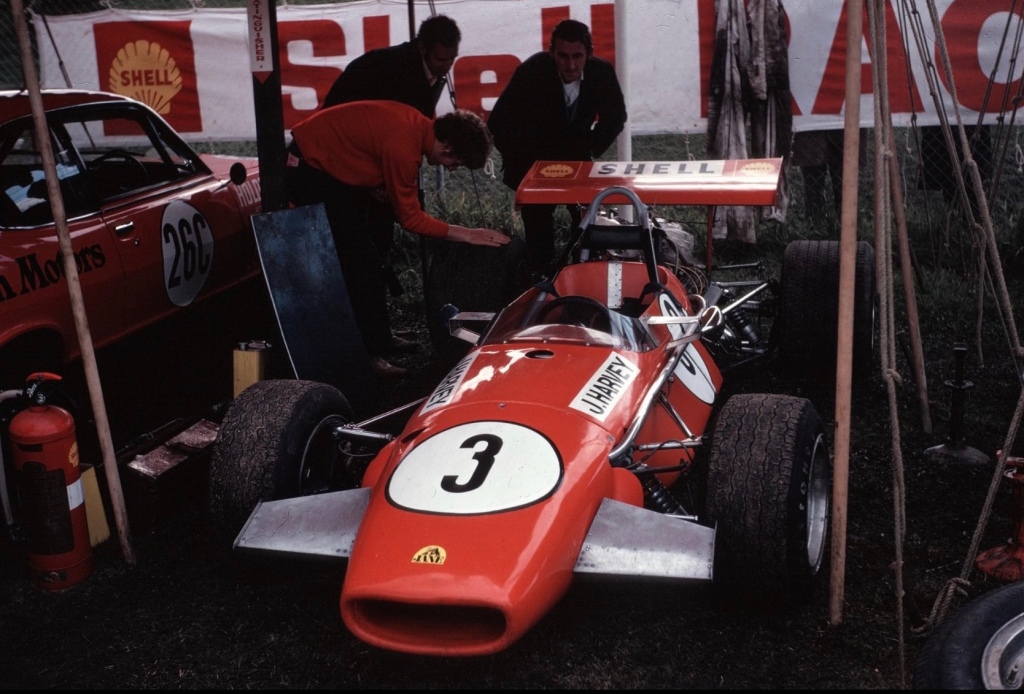
Ain’t she sweet…John Harvey’s Bob Jane Racing Jane Repco 830 2.5 V8 at rest in the Warwick Farm paddock during the Gold Star round on September 6.
Harves was out with fuel pump failure, Leo Geoghegan won the race, and ultimately the title aboard his Lotus 59B Waggott TC-4V 2-litre.
This car was built on Bob Britton’s (Rennmax Engineering) Brabham BT23 jig to replace Jane’s ageing BT23E with many mods but notably changes in suspension geometry to suit the latest generation of ever-widening tyres. It exists in a West Australian museum.
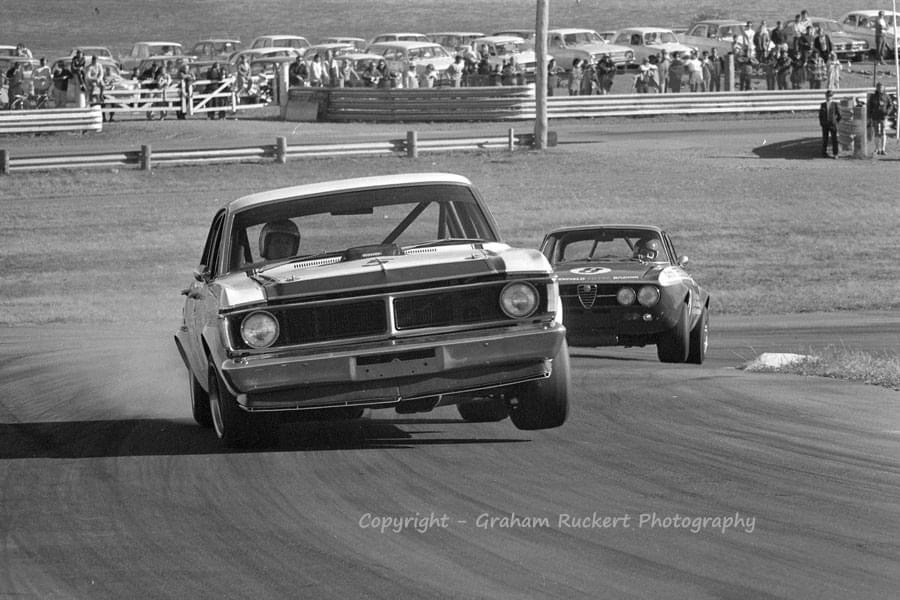
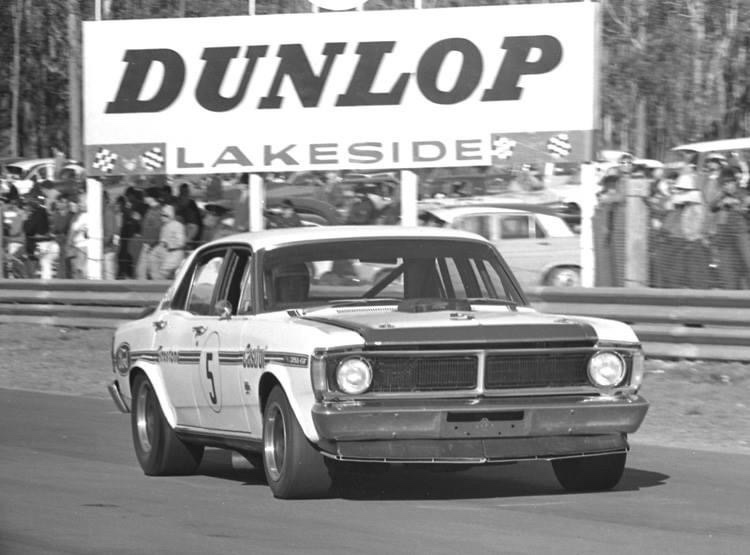
I love Graham Ruckert’s superb shot of John French on the limit in Pete Geoghegan’s recalcitrant but very powerful Ford Super Falcon in front of Brian Foley’s superb in every respect Alfa Romeo GTAm at Lakeside on July 25, 1971.
It was Lakeside’s Australian Touring Car Championship round that weekend. Pete gave the car a gallop in a support race but elected to race his trusty Mustang in the championship event, having French – a Ford factory racer – drive the Big Henry.
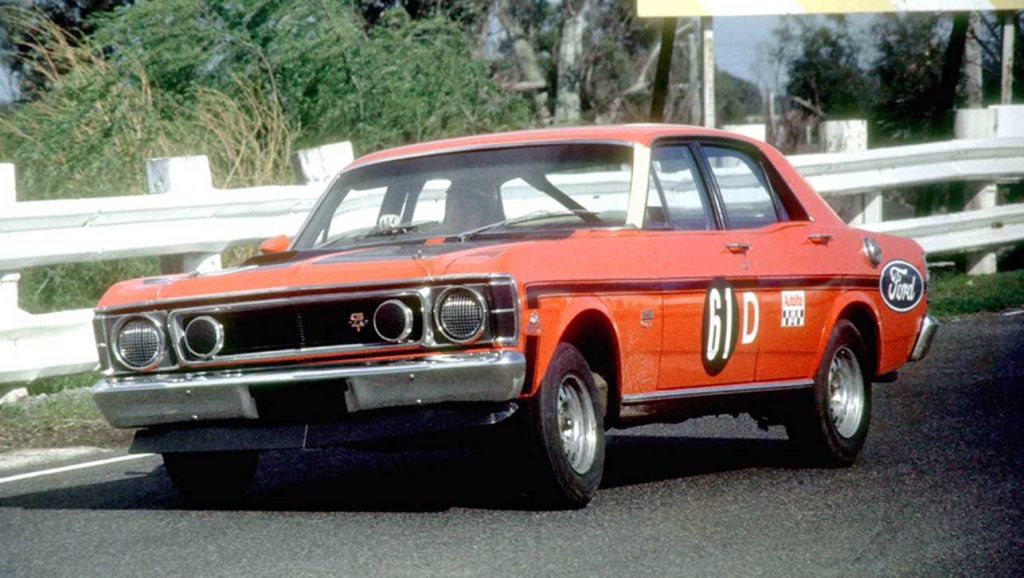
It seems right to show you furriners what a standard Ford Falcon GTHO looks like…here it’s Allan Moffat easing his beast – an XW Phase 1 GTHO – out of Peters Corner at Sandown during his victorious Sandown 3-Hour win on September 14, 1969.
Moffat/John French won from two other similar cars crewed by Tom Roddy/Murray Carter and Fred Gibson/Barry Seton.
Jim Clark, Lotus 49 Ford DFW ahead of Chris Amon, Ferrari Dino 246T at Dandenong Road, Sandown during their epic dice for the lead of the 1968 Australian Grand Prix in February 1968.
Geoff Brabham – 1975 Australian F2 Champion – raced his Birrana 274 Hart-Ford 416-B 1.6 ANF2 car twice at Calder in May and August 1975.
While Brian Sampson’s Cheetah Mk5 Toyota ANF3 car behind makes sense the Alan Gissing Holden sporty does not, so I guess it’s a practice session. Geoff won three of the seven rounds, and the ’75 title, with Alf Costanzo second and Andrew Miedecke third. See here: https://primotipo.com/2018/09/20/brabs-gets-the-jump/
Garrie Cooper won that day at Mallala – GC’s only Gold Star victory – in his superb Elfin 600C Repco 830 V8 from Geoghegan and Max Stewart’s Mildren Waggott TC-4V 1.6.
Kevin Bartlett won the Gold Star that year aboard the Mildren Yellow Submarine which was powered by Alfa Romeo T33 2.5 V8s until the final round when he won the Hordern Trophy at Warwick Farm armed with the first of Merv Waggott’s 2-litre TC-4Vs.
(MotorSport)
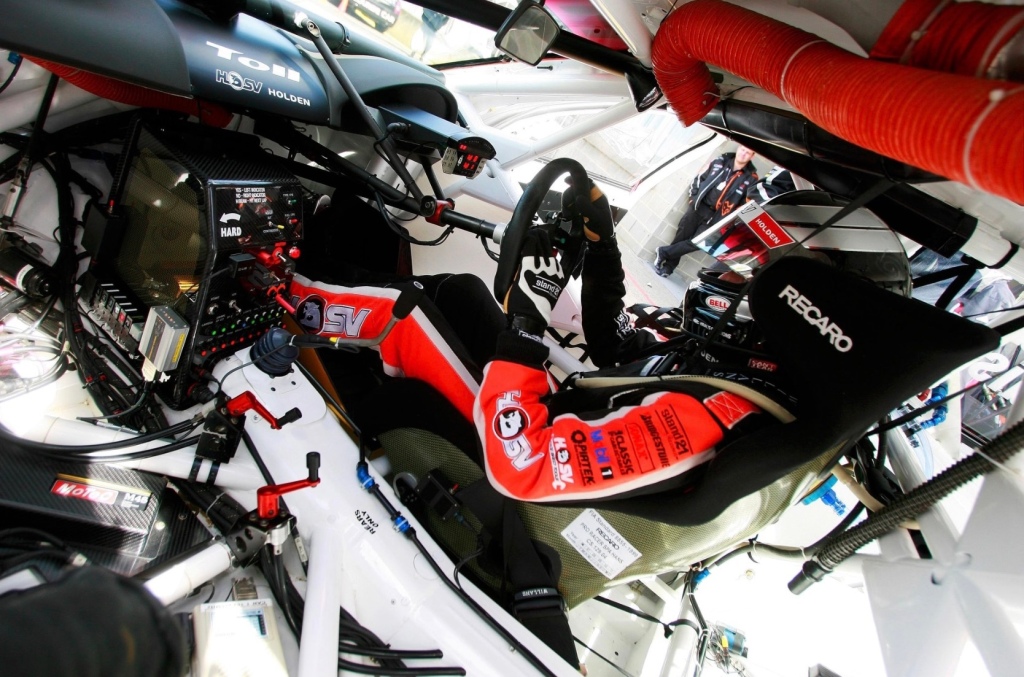
Paul Radisich (above and below) tips his Holden Special Vehicles Commodore VE into Shell Corner during the Sandown 500, the ninth round of the 2007 Australian V8 Supercar Championship on September 14-16.
He shared the car with Rick Kelly to second place, the following machine is the Will Davison/Steve Johnson Ford Falcon BF. The race was won by Jamie Whincup and Craig Lowndes’ Triple Eight Falcon BF.
Garth Tander (HSV Commodore VE) won the 2007 drivers title – by two points from Whincup – and HSV the team championship.
(MotorSport)(E Solomon)
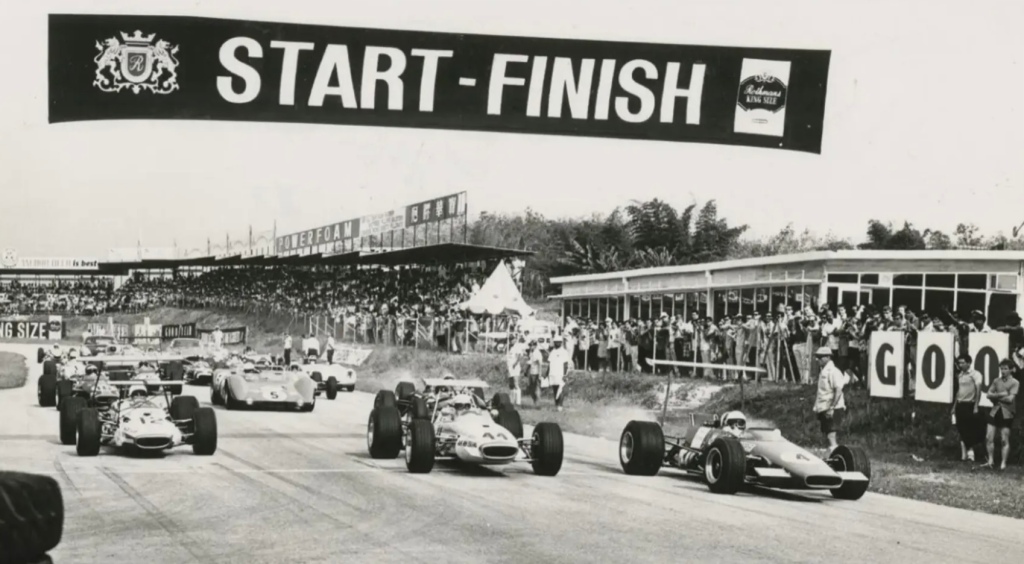
All antipodean front row at the start of the 1969 Selangor Grand Prix. Roly Levis’ Brabham BT23C Ford on pole, then Graeme Lawrence’s McLaren M4A Ford FVA in the middle, and Garrie Cooper’s Elfin 600C Repco 830 V8 2.5 on the right.
Lawrence, surely with John McDonald the ‘winningest’ of drivers in South East Asia in the period, won the race from Levis and Australian, Tony Maw, Elfin 600 Ford.
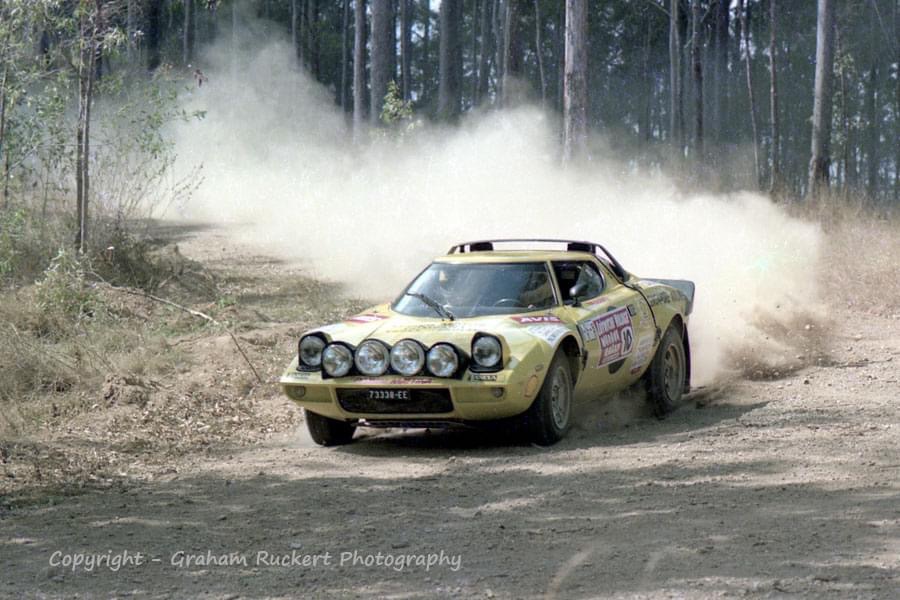
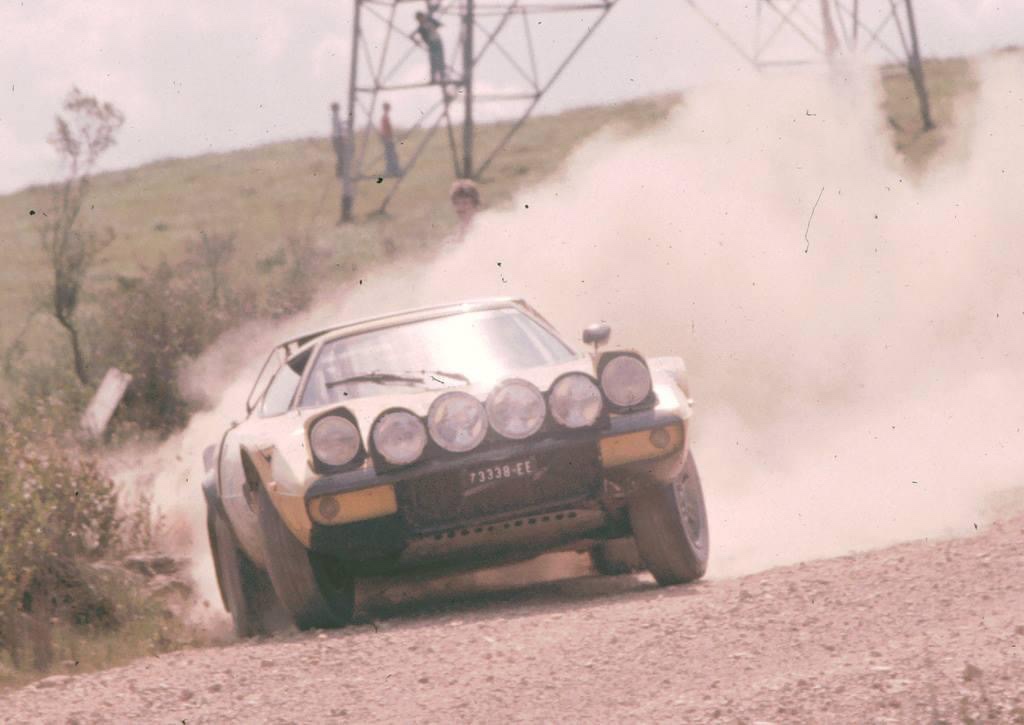
Ron Marks and Graham Gillies aboard Marks’ Lancia Stratos HF in the Samford Forest on the press day before the start of the 1976 Lutwyche Village Warana Rally, the final round of six in the Australian Rally Championship that year.
The pair finished fourth, first was Murray Coote and Brian Marsden in a Datsun 1600. The ARC was won by Ross Dunkerton and Jeff Beaumont aboard a Datsun 240Z; four wins and one second placing.
Ex-water-skiing champion, Marks’ other rally credits included starts in the 1976 Holden Dealers, SEV Marchal and Southern Cross, and 1978 Southern Cross and the Castrol International rallies.
(G Ruckert)
The shot above shows the car out front of the Annand & Thompson Lancia and Fiat dealership in Newstead, Brisbane, before the ’76 Warana Rally.
Graham Ruckert, “I was selling Fiat/Lancia cars for the dealership at the time, they provided some sponsorship for the event and we got to display the car during the week before the event…I had a short run in the passenger seat with Ron Marks on the Press Day at Samford which was pretty memorable!”
(B Keys)
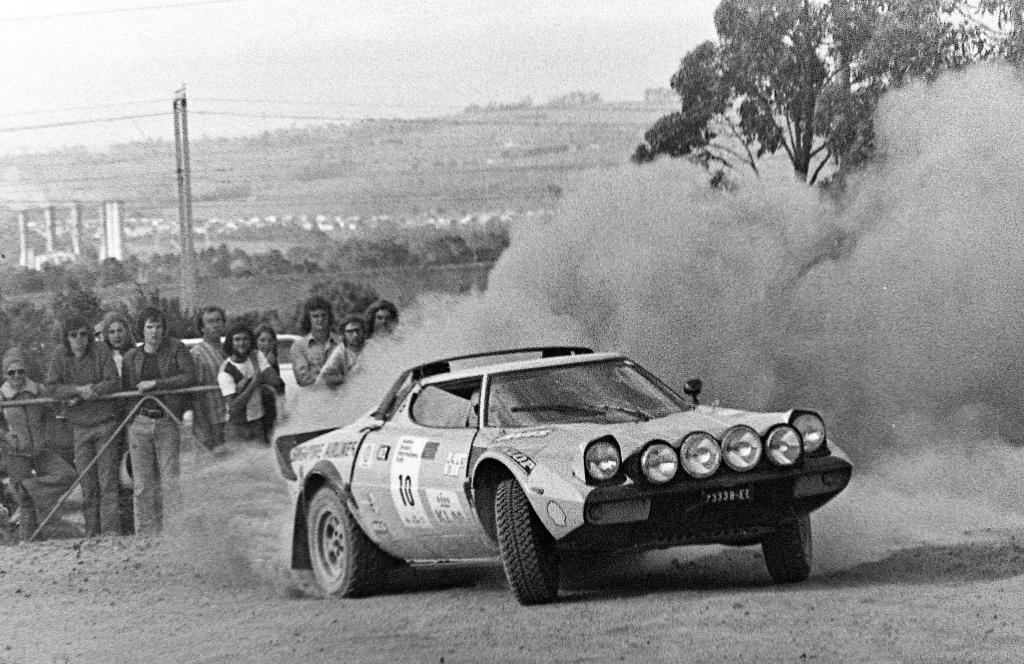
And above demonstrating the style for which the Stratos was famous during the October 1976 Holden Dealers International Rally held in the forests around Moe and Traralgon. Those large chimneys in the background belong to one of the coal fired power stations in Victoria’s Latrobe Valley.
(T Parkinson Collection)
MG TC Specials to the fore at the start of the Lobethal 50, a support race for the 1948 South Australian 100, held at Lobethal on New Years Day, January 1. #32 is Ron Edgerton, #29 is Harold Clisby, #31 is WJ Mentz, while car #34 further back is raced by AK Eadie.
The 100 mile, 12 lap, handicap feature race was run in front of 10,000 spectators in cool conditions and was won by Jim Gullan’s Ballot Oldsmobile from Granton Harrison in the Phillips Ford V8 Special, then Edgerton’s TC.
(K Drage)
Speaking of the great Harold Clisby, here he is a few years later at left with the equally talented Phil Irving at Sandown on March 2, 1962.
Harold would have been up to his armpits designing his F1 Clisby 1.5-litre engine, while Phil’s Repco Brabham RB620 2.5/3-litre is still a couple of years away…Mind you, Jack Brabham took more than a passing glance of the aluminium 3.9-litre Buick V8 fitted in the back of Chuck Daigh’s Scarab RE only yards away.
The F85 Oldsmobile V8 that Jack pitched successfully to the Repco Board as the basis of his new Tasman 2.5 litre engine was the Buick’s brother, different only in the number of head retention studs. See here: https://primotipo.com/2016/01/27/chucks-t-bird/
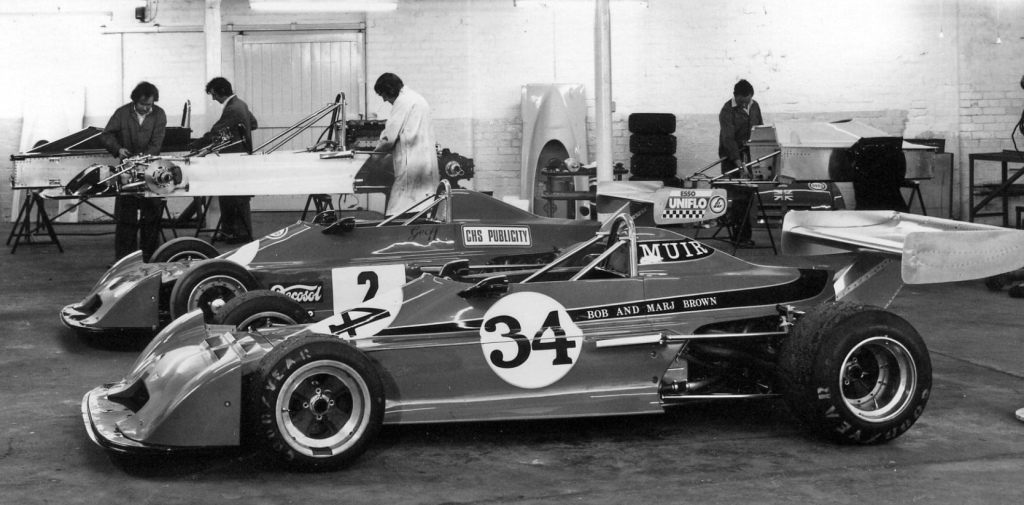
Derek Kneller has just finished assembling Bob Muir’s – Bob and Marj Brown owned – Chevron B35 Ford BDX 2-litre F2 car in Chevron’s Bolton factory in early 1977.
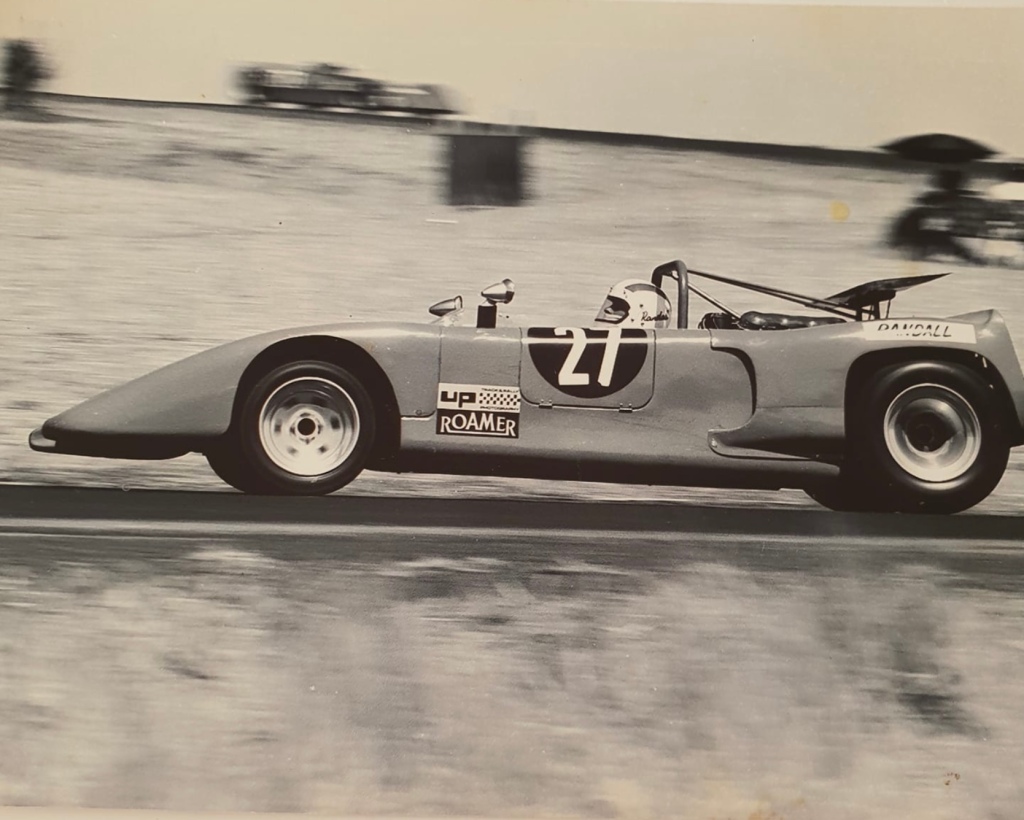
Barry Randall’s Ex-Doug MacArthur Rennmax Repco 2.5 V8 blasting out of MG Corner at Phillip Island as a car in the background makes the downhill plunge into it.
Car then raced for many years in Victoria by the Gibson family out of Benalla, and for many years owned by Jay Bondini.
Battle of the ‘1.6-litre Four Valvers’ during the May 3, 1969 J.A.F. Grand Prix aka the Japanese GP.
Sohei Kato’s third-placed Mitsubishi Colt F2C R39B ahead of Glyn Scott’s fourth placed Bowin P3 Waggott TC-4V at Fuji International. Up the front, Leo Geoghegan won in his venerable ex-Jim Clark Lotus 39 Repco 830 2.5 V8 from Roly Levis’ Brabham BT23C Ford FVA. More here: https://primotipo.com/2015/03/02/leo-geoghegan-australian-driving-champion-rip/
(B Dickson)
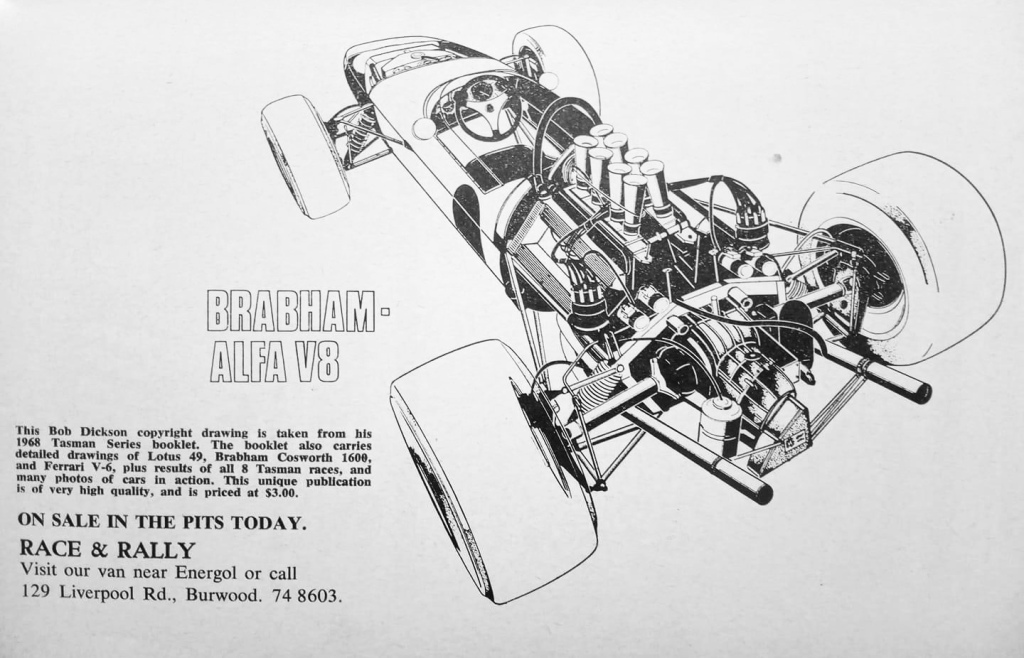
A random internet find, a decent drawing of the Alec Mildren Brabham BT23D Alfa Romeo T33 2.5 V8 raced throughout 1968-69 by Frank Gardner and Kevin Bartlett.
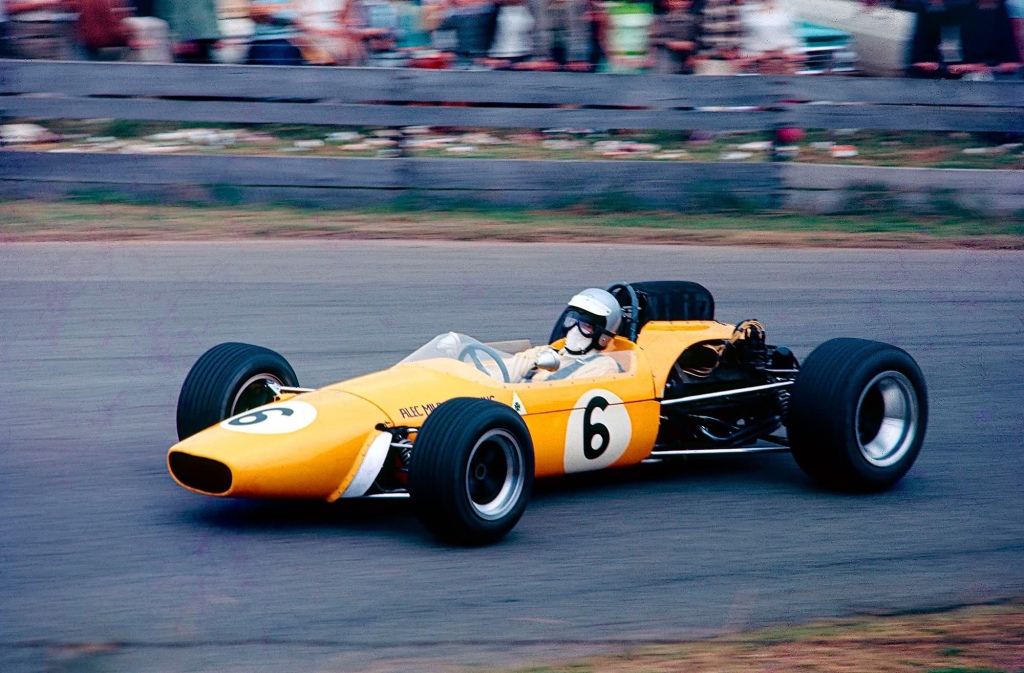
KB is shown below in grand style by Dick Simpson at Bathurst during Easter 1968. Kevin was the quickest man on the mountain that weekend but was ousted with a broken rear upright, Phil West won his only Gold Star round aboard the Scuderia Veloce Brabham BT23A Repco V8. See here for more: https://primotipo.com/2021/07/06/mellow-yellow/
(Dick Simpson-oldracephotos.com)
Credits…
Peter D’Abbs, Greg Feltham, Gary Russell-Brown, Jock Alexander, Lance Ruting, Graham Ruckert, David Blanch-autopics.com.au, Repco, MotorSport Images, Eli Solomon Archive, Bruce Keys, Tony Parkinson Collection, Derek Kneller, Kevin Drage, Graham Ruckert, Bob Dickson, Dick Simpson-oldracephotos.com
Tailpiece…
(G Ruckert)
Marks and Gillies again in the Warana Rally.
Does anyone know the history of this car before it came to Australia? My Stratos owning friend, Phil Allen tells me he thinks there are only two Stratos resident in Australia at present and this isn’t the other one…
Sydney born, ‘Dave’ Walker died aged 82 last week in Queensland (June 10, 1941-May 24, 2024).
The very gifted Walker raced two revolutionary Grand Prix Lotuses in 1971-72: the four-wheel-drive, gas-turbine powered Lotus 56B Pratt & Whitney and epochal, edgy-wedge, side radiator, torsion-bar sprung Lotus 72 Ford.
He cut his competition teeth in club competition aboard an MGA Twin-cam, soon progressing to a Brabham BT2 Ford with support from David McKay’s Scuderia Veloce. Walker had an Australian Grand Prix (Sandown 1964) and Bathurst 500s (1963-65) under his belt before jumping on a ship at Circular Quay to take on the world’s best in Europe.
Armed with a Merlyn Mk10 Ford he became a Formula 3 Gypsy, racing across Europe for start and prizemoney throughout 1967, winning the Adriatic GP at Opatija, Yugoslavia in June.
He then figured he needed to go backwards to go forwards so did a deal to race a Russell-Alexis Formula Ford in 1968, doing well enough to bag a quasi-works Jim Russell Race Drivers School Lotus 61 FF ride in 1969.
Heathrow, February 27, 1971 with his trophy for winning one of the four F3 Torneio Brasiliero rounds aboard his works Lotus 59A Ford-HolbayWalker awaits the start of the Monaco F3 GP from pole in 1971, he won. Lotus 69 Ford-Novamotor (R Schlegelmilch)
He won the Les Leston Championship with it and was then picked up by Gold Leaf Team Lotus to race their F3 Lotus 59 and Lotus 69 Fords throughout 1970-71. In 1971, a year of unparalleled dominance, Walker won 25 of 32 F3 race starts including the prestigious Monaco and British GP rounds and two of the three British titles.
Lotus boss, Colin Chapman rewarded him with his first F1 drives that year, Walker having had his first big-car experience in some F5000 races in the UK and a quick trip home to Sydney in November 1970 to contest the AGP at Warwick Farm in an uncompetitive F5000 Lotus 70 Ford.
Walker during dry practice, 1971 Dutch GP, Zandvoort. Q22, he was looking good for a points finish early in the wet race, but with limited experience of the unusual car Dave ran off into the dunes on lap six, as did many others. Lotus 56B Pratt & Whitney (MotorSport)Walker, Lotus 72D Ford at Brands during the 1972 British GP weekend. Q15 and DNF suspension (MotorSport)
In 1972 Dave was Emerson Fittipaldi’s #2. Like Fittipaldi in 1971, Walker struggled with a car that took some learning, unfamiliar circuits and not a lot-of-love from the team. Emmo won the title and Dave got the flick in favour of Ronnie Peterson at the seasons end with seven DNFs from 10 starts, all due to mechanical failure.
It wasn’t quite as bad as many would have you believe though, he was fifth in the non-championship Brazilian Grand Prix and in the running for points in South Africa, Monaco and Spain.
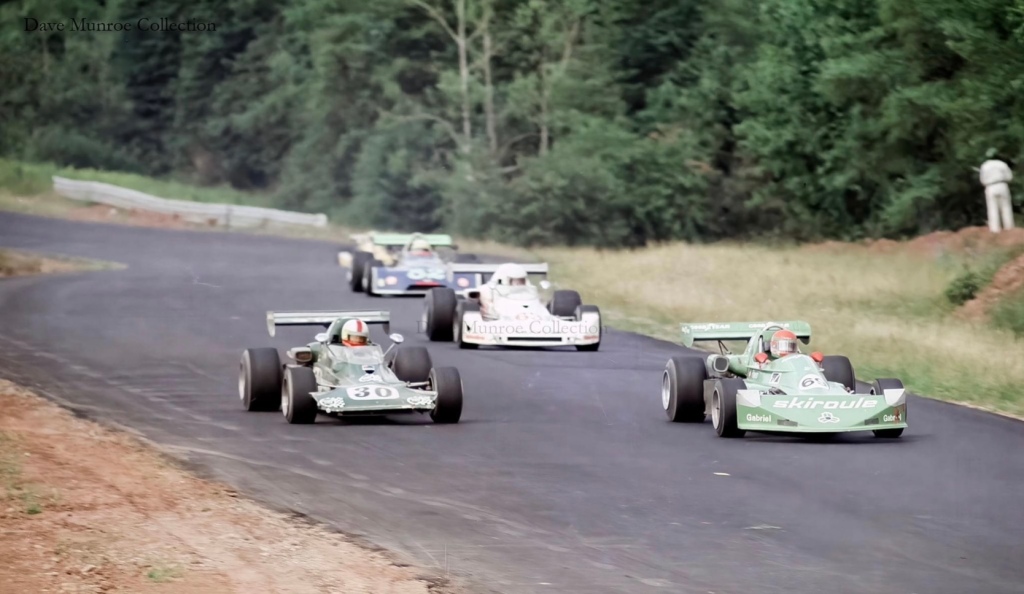
Canadian Formula Atlantic. Walker on the left, Lola T360, with Gilles Villeneuve, March 75B alongside at Halifax on July 7, 1975. Tom Klausler, T360 and Tom Bagley, Chevron B27 following. Bill Brack won from Klauser, Howdy Holmes and Walker (D Munroe)
In the following years Walker had sporadic F2, F5000, F Atlantic and sportscar drives but two road car crashes in 1973 – he broke a leg in one and almost severed his left arm in the other – sealed his competition fate, a few Canadian Formula Atlantic drives in 1975 were his last – the GP de Trois-Rivieres on August 31 perhaps the very last – before hanging up his helmet.
Walker worked in Canada for a while, getting involved in a boat chartering business. He and his wife Jan returned to Australia and have parlayed those skills in a successful business on the Whitsunday Coast since.
I had several phone calls with the beautifully spoken and sharp-as Dave in 2021-22, keep an eye out for a primotipo or Auto Action feature on Walker soon.
Etcetera…
(R Donaldson-SLNSW)
1964 Bathurst 500, with the Walker/Brian Hilton VW1200 – seventh place – ahead of the Bolton/Schroeder Hillman Imp and Weldon/Needham Studebaker Lark.
(L Mason Collection)
Reader, Laurie Mason owns “the 1968 Vauxhall Ventora that David drove in the 1968 London-Sydney Marathon. He was an engaging and welcoming man and we had many discussions about the car and their eventful journey across the world in 1968. I spoke with David only last month so this news is very sad.”
(L Mason Collection)
A Grand Prix racing car of the finest type: bold, innovative, on the edge. The exact opposite of highly regulated, restricted modern F1, let’s not call it Grand Prix Racing because there is nothing Grand about it. Lotus 56B Pratt & Whitney, Zandvoort, 1971.
Credits…
MotorSport Images, Dick Simpson-oldracephotos.com, Rainer Schlegelmilch, J Wilds-Getty, R Donaldson-State Library of New South Wales, Dave Munroe
Tailpiece…
(D Simpson/oldracephotos.com)
Superb shot of Dave attacking the Warwick Farm Esses aboard the Lotus Components Lotus 70 Ford during the November 1970 AGP. It was no M10B McLaren, with which Frank Matich won the race. Walker was Q7 and fifth. The brave snapper is Lance Ruting, one of the stars of the era.
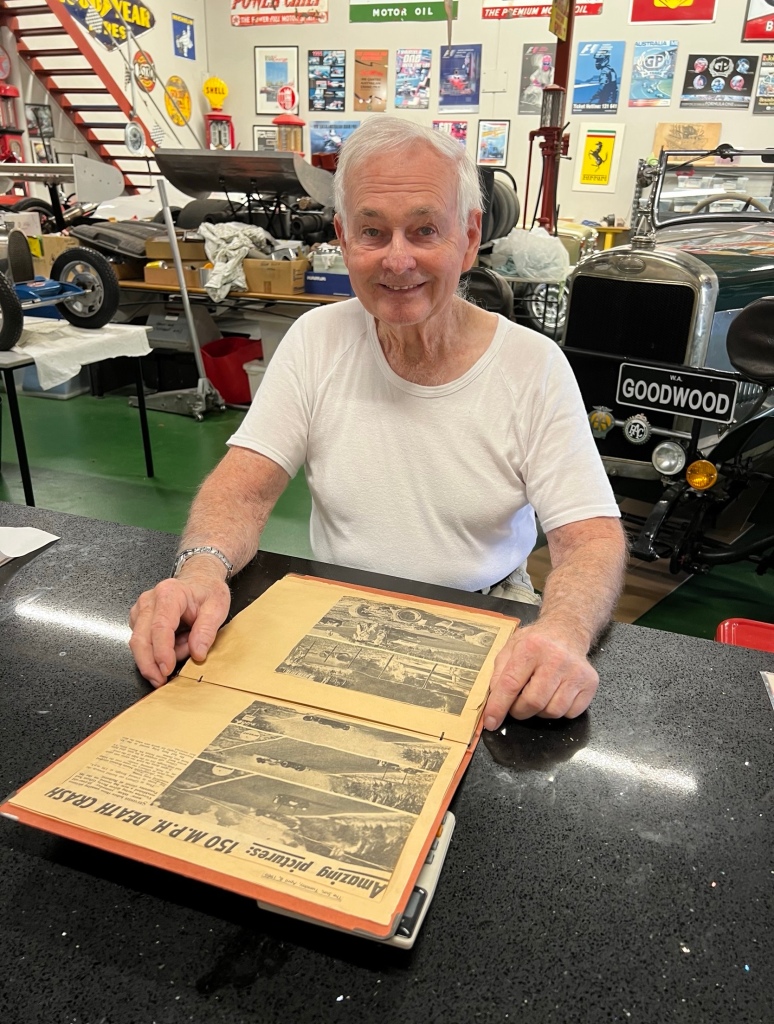
Jaime Gard flicking through one of his scrap books in December 2023 at Joe Ricciardo’s outer-Perth headquarters.
The 87 year old youngster is as fit as a fiddle, a lifelong focus on exercise and health allows him to put in plenty of time looking after Joe’s car collection.
Throughout a career that dates back to the early 1950s he has worked for some of the best racing outfits in the country including Bob Jane, Ian Diffen, Frank Matich and most importantly his longtime friend, confidant and Perth co-conspirator, the late Don O’Sullivan.
It was Don who was confident enough in Jaime’s ability to commission the design and construction of two world class Repco-Holden 5-litre V8 powered machines: the 1972 Gardos Sports/McLaren M8DG and 1973 Gardos OR2 F5000.
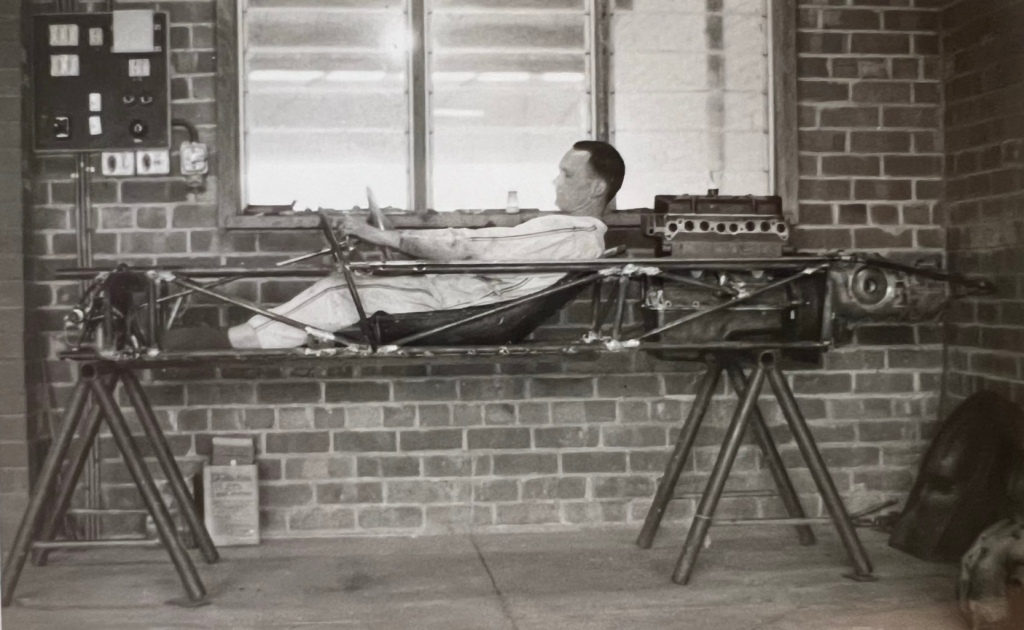
Jaime tries the cockpit for size, Gard 27 Ford. Head is a Brian Martin designed and built three-valver Gard Archive)Gard BMC FJ and Holden 48-215 at Lesmurdie Hillclimb in 1964 (Gard Archive)Gard aboard O’Sullivan’s Cooper Ford at Caversham in 1967 (Gard Archive)
Gard cut his racing teeth preparing speedway cars before adding circuit machines to his repertoire, then started racing a self-prepared Appendix J Holden 48-215. Not long after he built his first single seater, the Gard BMC FJ, and then the Gard 27 Ford 1.5.
By the mid-1960s Jaime had joined O’Sullivan – a successful Perth property developer and entrepreneur – preparing and racing some of his cars, including various Coopers and a Lola T70 Ford.
The connection with Matich began with the purchase of the Matich SR3 Repco raced by O’Sullivan and was followed by an M10A McLaren Repco-Holden F5000.
Jaime primes the big Ford V8 while Don waits. Lola T70 Ford, Wanneroo Park 1970 (Gard Archive)Jaime alongside O’Sullivan in the hi-winged Matich SR3 Repco 720 4.4 on the Warwick Farm grid in 1969. The bit of nosecone belongs to Matich’s all-conquering SR4 Repco (Gard Archive)
After O’Sullivan withdrew from racing Jaime had a long stint across town with Ian Diffen, including building a wild Valiant Charger V8 sports-sedan.
He was a noted speaker on vehicle dynamics, handling and engineering at various WA tertiary institutions during this period, and developed tyre testing equipment and processes which were adopted by Bob Jane T-Marts and Diffen’s tyre outlets.
Jaime maintains his currency too, still working on the Ricciardello family’s Alfa Romeo Alfetta Chev V8 sports sedan.
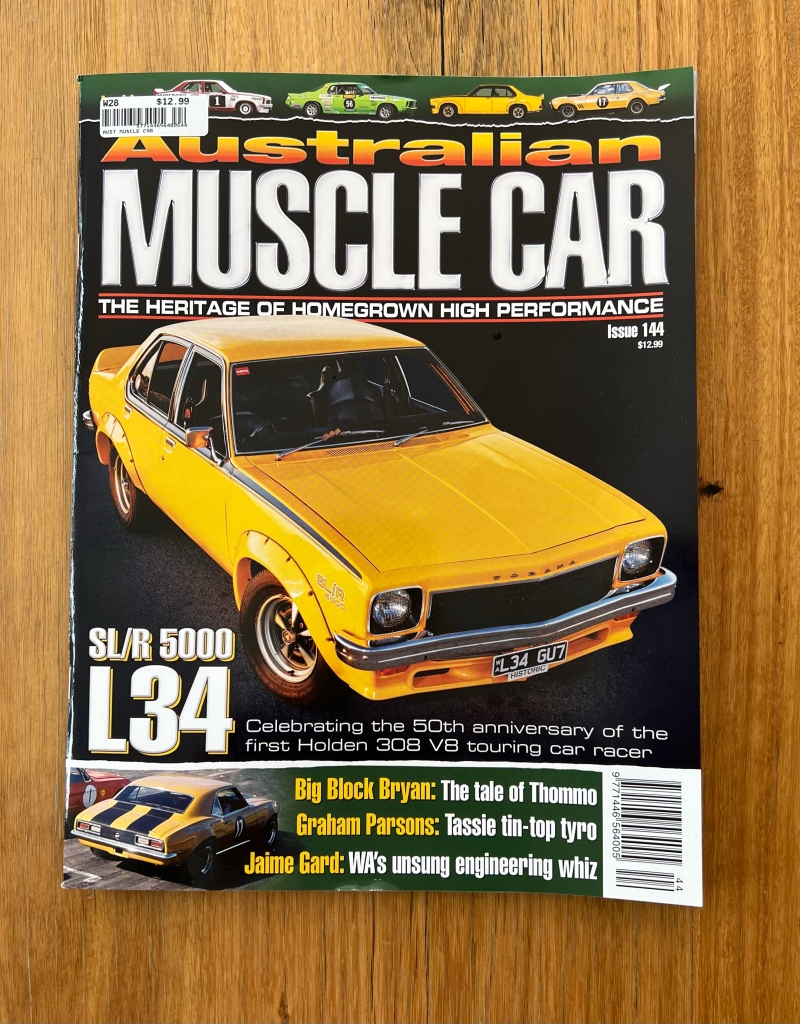
To read my story on Jaime – nobody has given him the full-treatment before – 4500 words, 42 photographs, 10 pages – you’ll need to buy the latest issue of Australian Muscle Car. Issue 144 is in-store in Australia now, and for the next month or so, or purchase the mag online here: https://www.musclecarmag.com.au/current-issue
About half the mag comprises Steve Normoyle’s pieces about the fantastic Holden Torana SL/R 5000 L34, it’s 50 this year, while Bryan Thompson Part 1 is a beauty too, plus lots more.
Etcetera…
(Gard Archive)
The brand new Gardos OR2 Repco-Holden sits in the Adelaide International sun during the Adelaide 100, February 25, 1973 Tasman round weekend. Howie Sangster did too few laps to be classified, but the car impressed onlookers on its debut.
Warwick Brown won the race in his Lola T332 Chev, the wing alongside belongs to one of the two Racing Team VDS Chevron B24s raced by Peter Gethin and Teddy Pilette.
(Gard Archive)
Jaime, seated, during the mid-1970s build of the Ian Diffen Charger sports-sedan.
It started life as Diffen’s Series Prod E38, then morphed into a Group C machine before being completely re-purposed. It’s extant and living back in Perth after being a Queenslander for decades.
(Gard Archive)
Gard got to know Frank Gardner over the years, he did the initial track testing of the Diffen Charger.
Here he is snooping around O’Sullivan’s workshops in the late 1980’s sussing Jaime’s build of a new Lola Mk3B Chev, a Lola model with which FG was very familiar.
(unattributed)
Credits…
Jaime Gard Collection
Tailpiece…
(Gard Archive)
Jaime, Gard BMC FJ on the wilds of the Albany Round the Houses street circuit in 1964. Doesn’t that look fantastic!
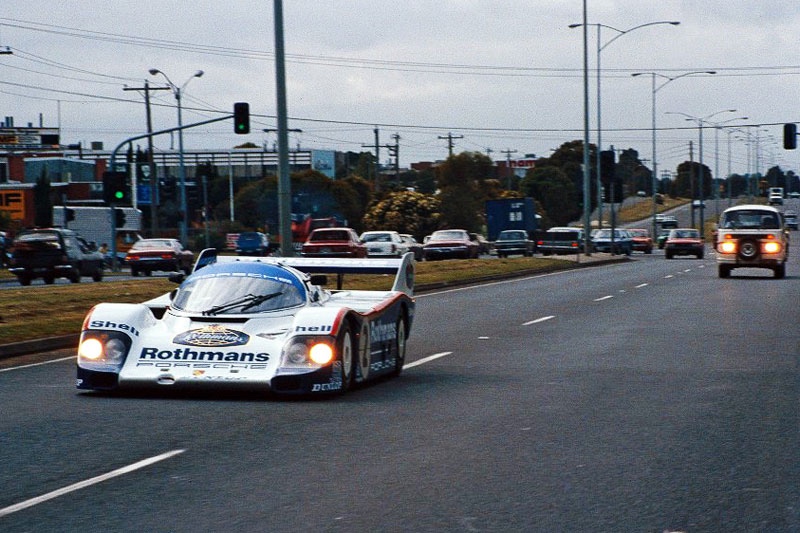
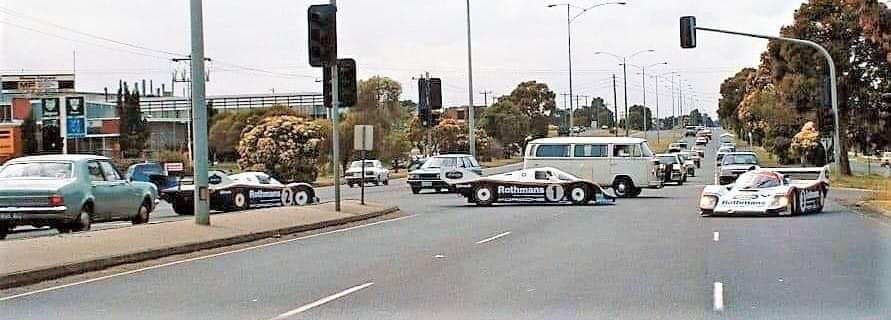
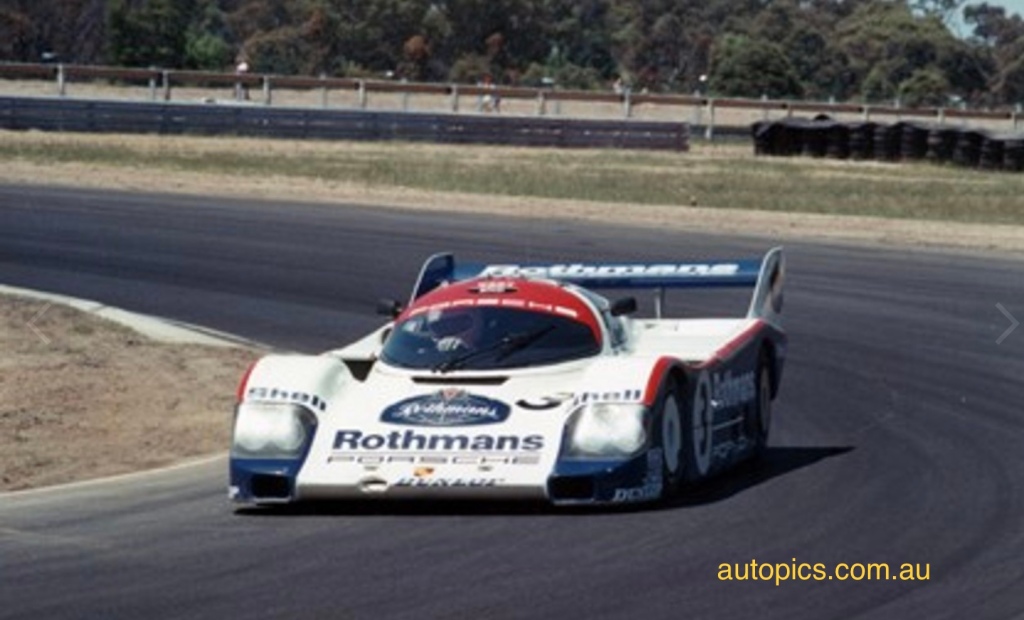
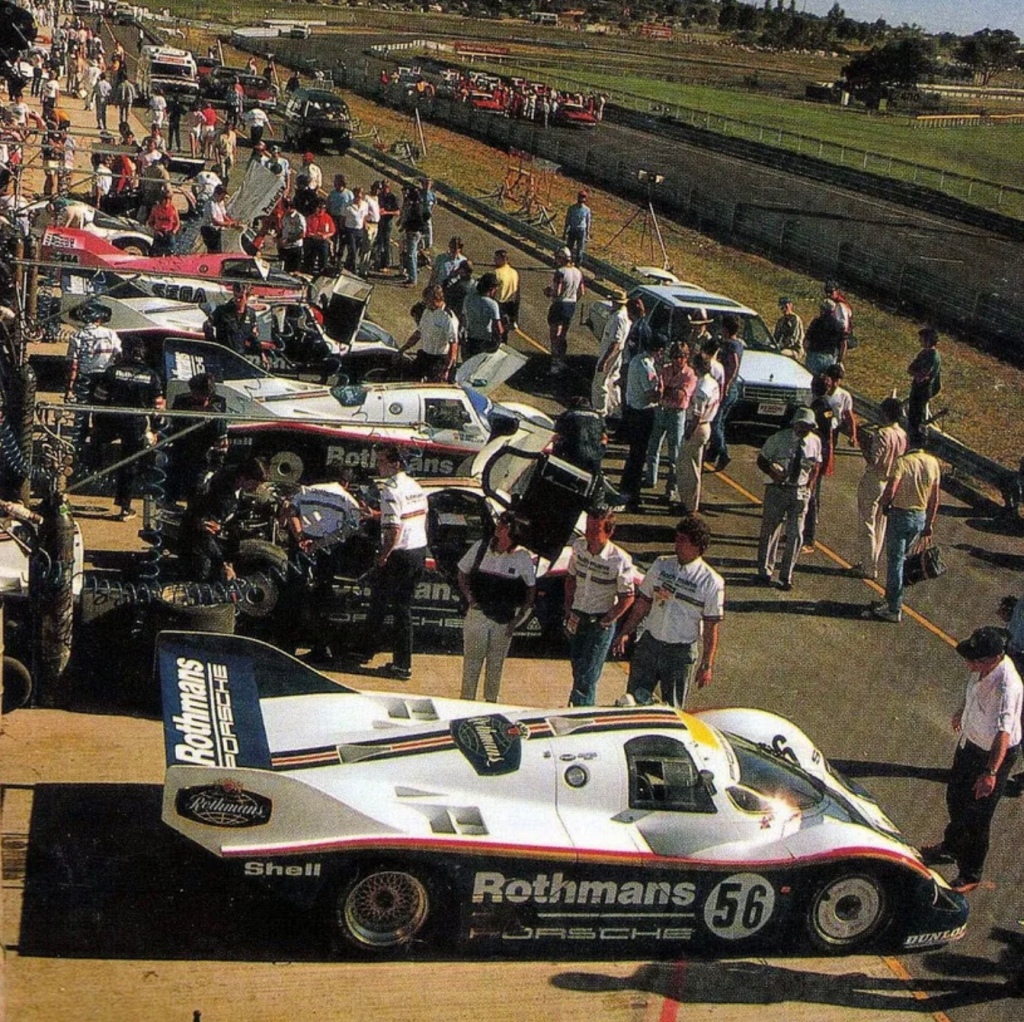
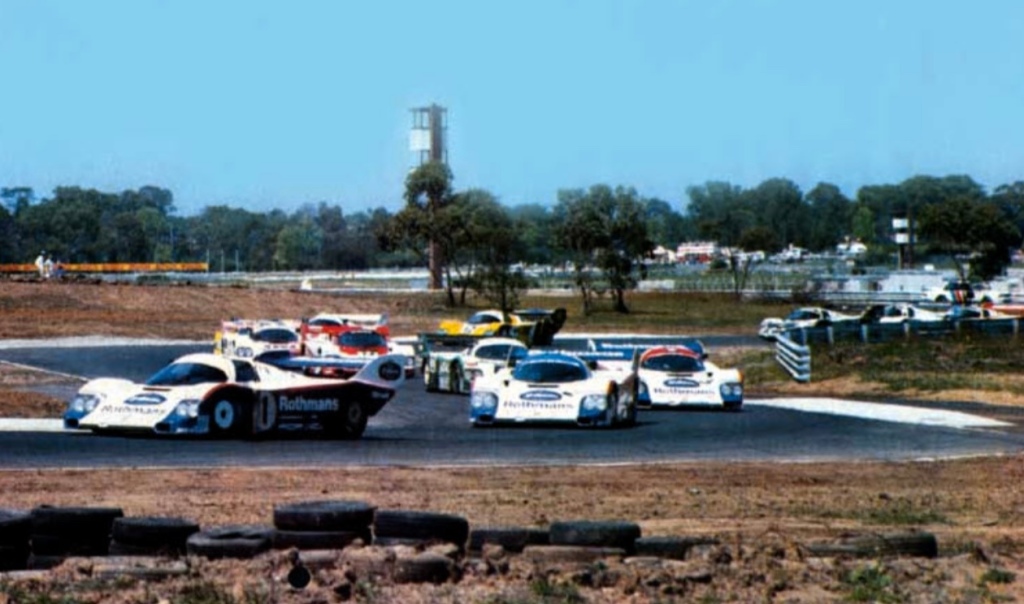
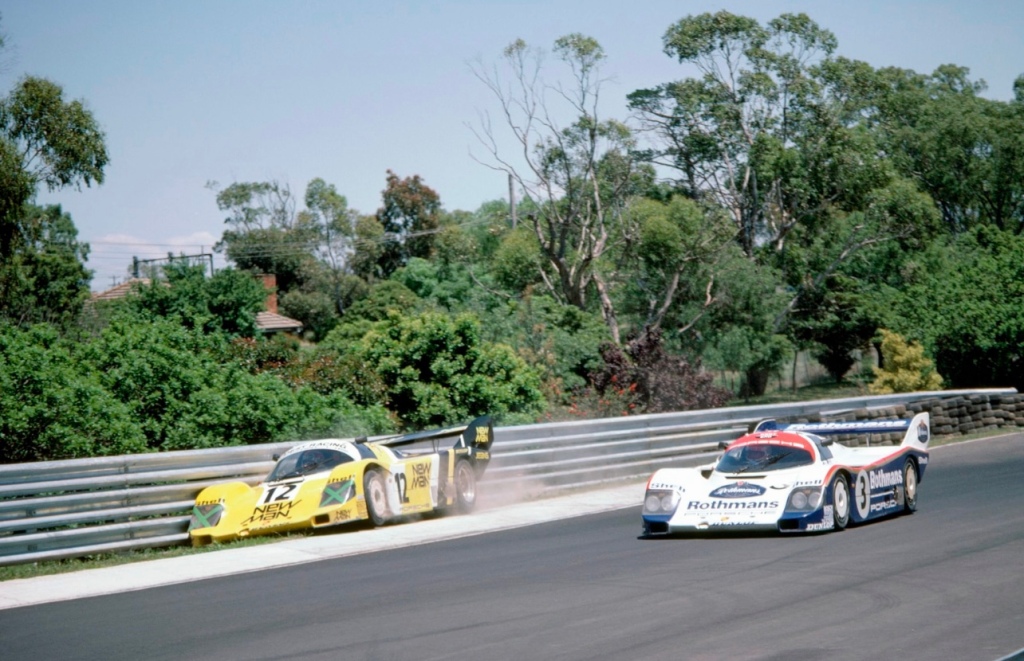
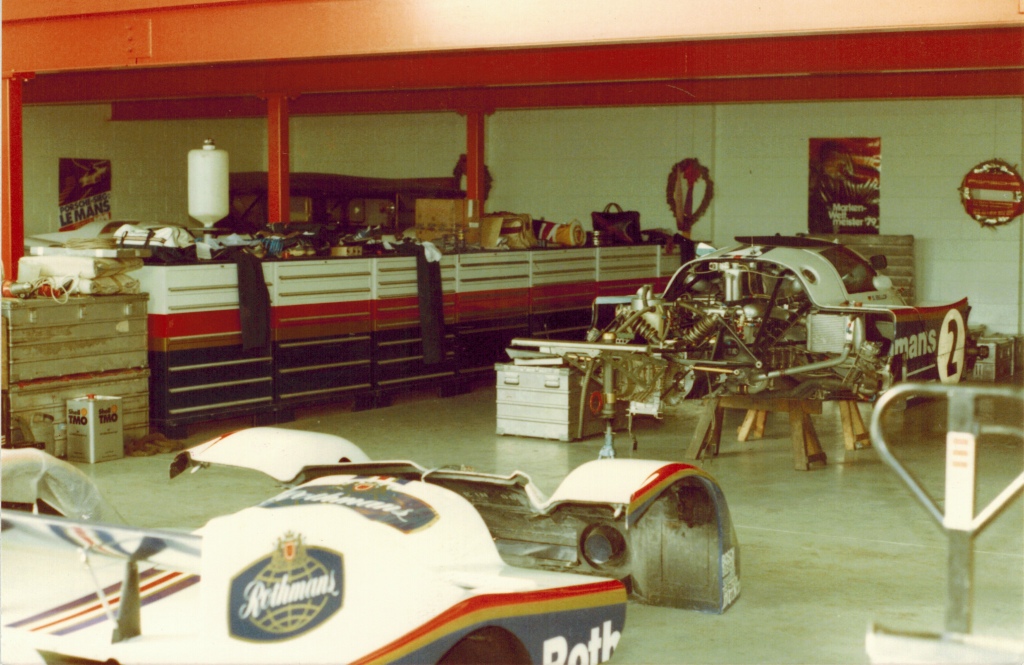
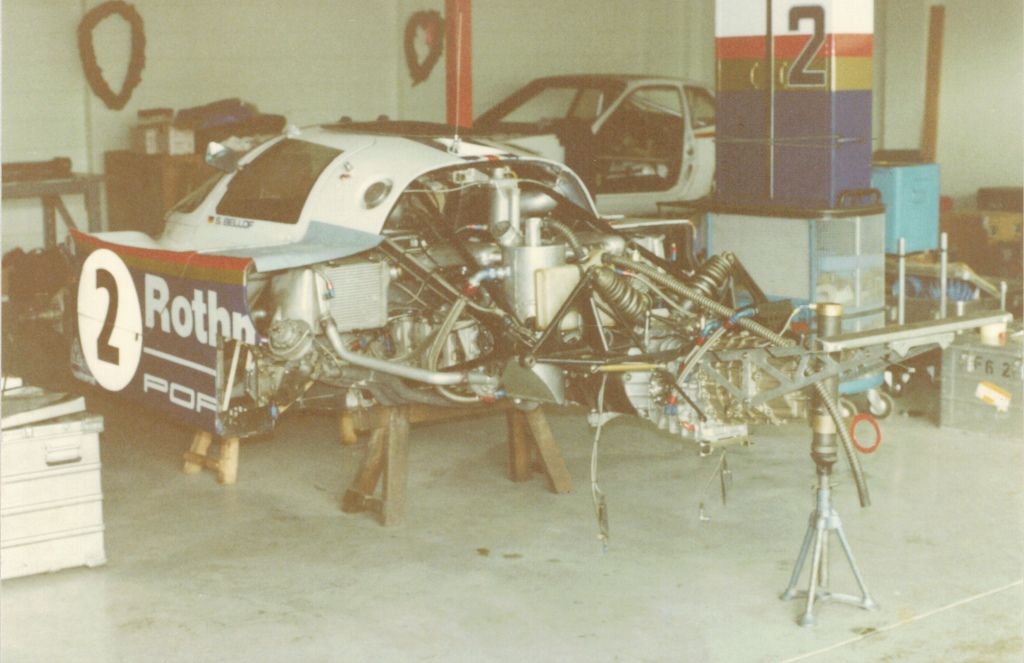
The winning Stefan Bellof/Derek Bell Porsche 956 cruises along the Princes Highway at Noble Park, Melbourne in December 1984…
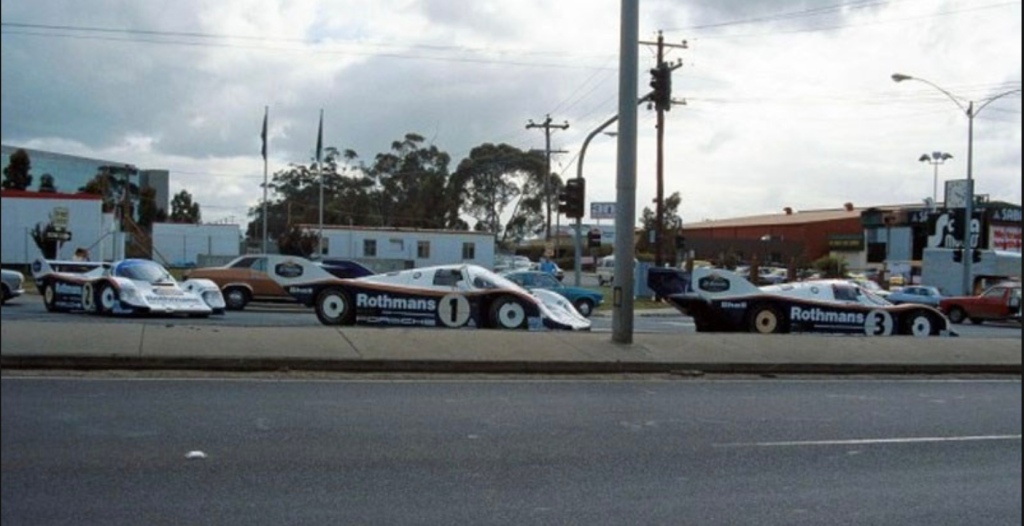
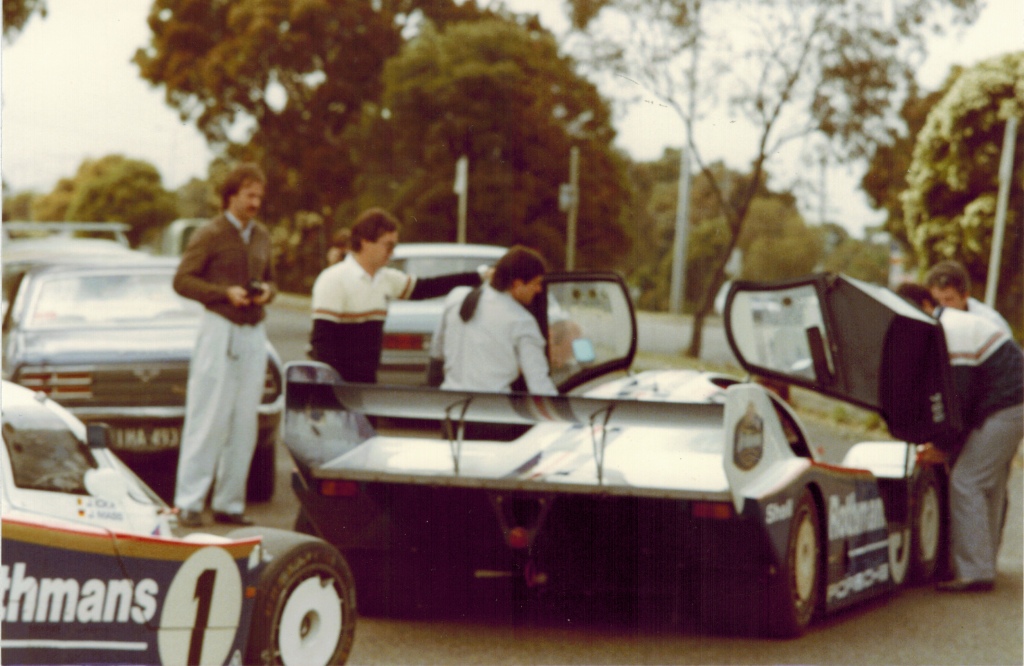
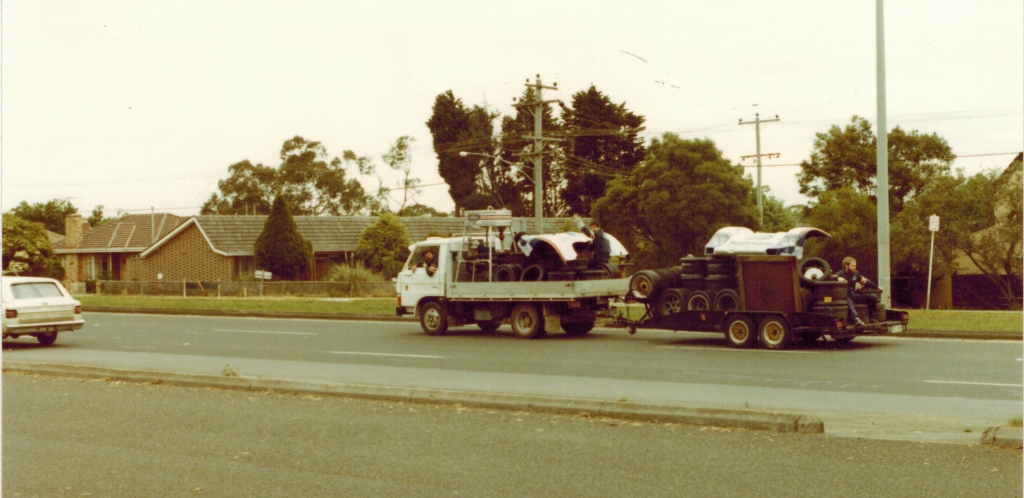
Some of the most amazing shots during the first of Sandown’s two abortive WEC rounds in 1984 and 1988 were away from the track in Melbourne’s southern suburbs. A bright spark, probably Porsche Cars Australia chief Allan Hamilton – an elite level racer himself – thought it would be a great idea to drive three of the four works-956s the five or so kilometres from PCA’s workshop in Noble Park to Sandown, also on the Princes Highway.
No cops, no organisation, just let’s go with a Kombi strategically placed to allow the race-gunterwagens to make the u-turn to head west back towards town. Luvvit!
The Schuppan/Jones 956 leads the Mass/Ickx and Bellof/Bell machines (PCA)(PCA)
The World Endurance Championship broadened its global horizons with a maiden visit to Australia for the 11th and final round of the championship. Sandown Park is a combined horse and car racing facility. Designed as such, the track 30km from Melbourne’s CBD opened and first hosted an international event in March 1962. Jack Brabham won that Formule Libre Sandown Park International in a Cooper T55 Climax 2.7 from the Cooper T53 Climax 2.7s of John Surtees and Bruce McLaren. See here: https://primotipo.com/2016/01/27/chucks-t-bird/
In order to meet FIA minimum track length requirements to host international events, Sandown grew from a fast-flowing 1.9 miles to a fucked-up 2.4 miles, the increase in lap distance achieved within the existing footprint by the addition of a pissant 500 metre infield loop that pleased no-one. A spend of about $A2 million included the relocation of the pits and new pit garages.
The Light Car Club of Australia – easily the most successful car club in Australia, its origins going right back to November 5, 1924 (originally called the Victorian Light Car Club), well before the first Australian Grand Prix was held at Goulburn in January 1927, were the lessors of the Sandown Park motor racing facilities – signed a three-year contract with the FIA. Expectations were high, the LCCA’s spreadsheet jockeys anticipated/speculated/prayed for 40,000 folks to pass through the gates on race day…that didn’t happen and the financial devastation wrought upon this wonderful club by a Boy-Scout Board is a story for another time.
While hyped as Australia’s first World Championship motor race – it was – the 1964-75 Tasman Cup was of far greater stature, or importance regionally at least, with Sandown hosting the Melbourne Tasman round each year.
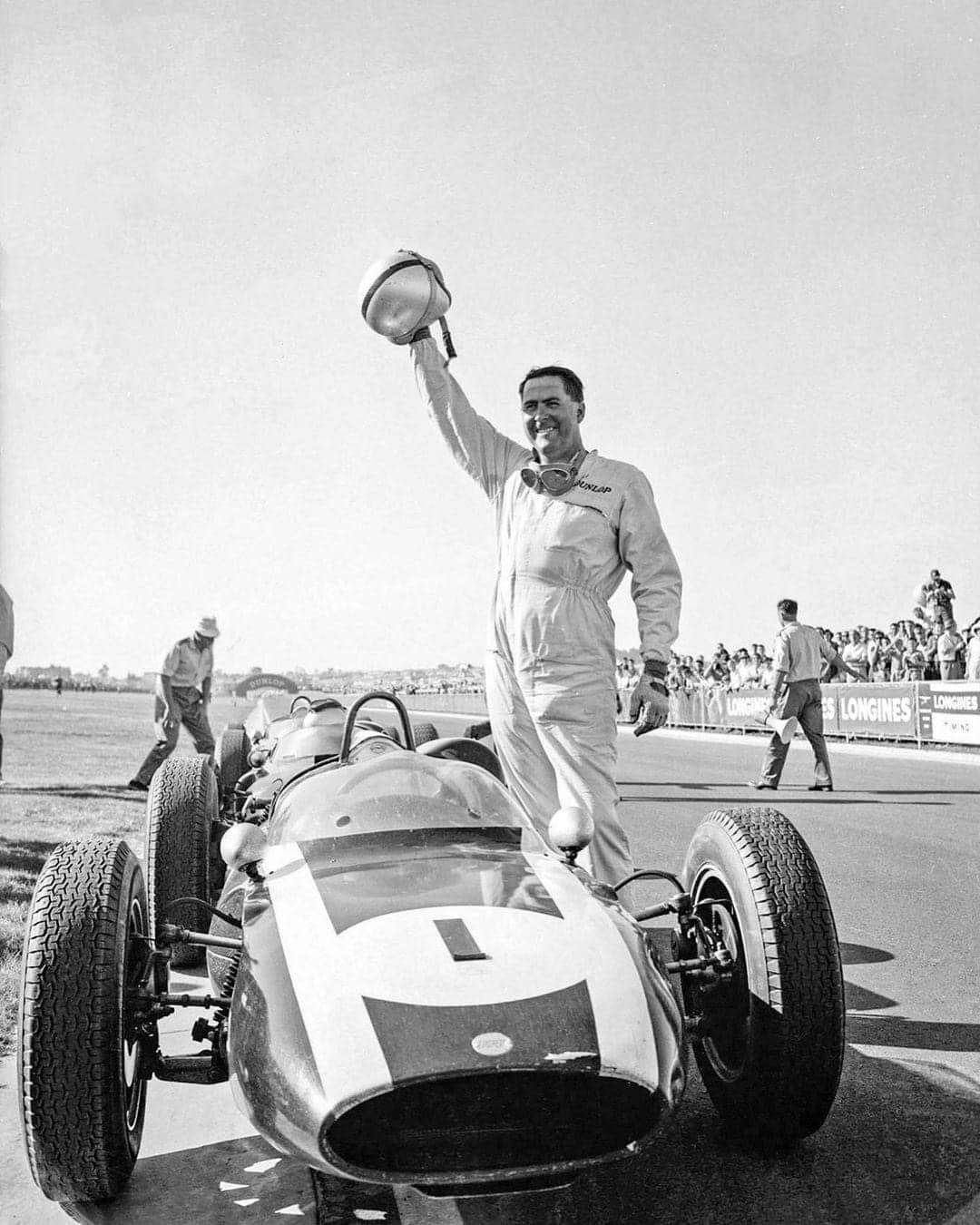
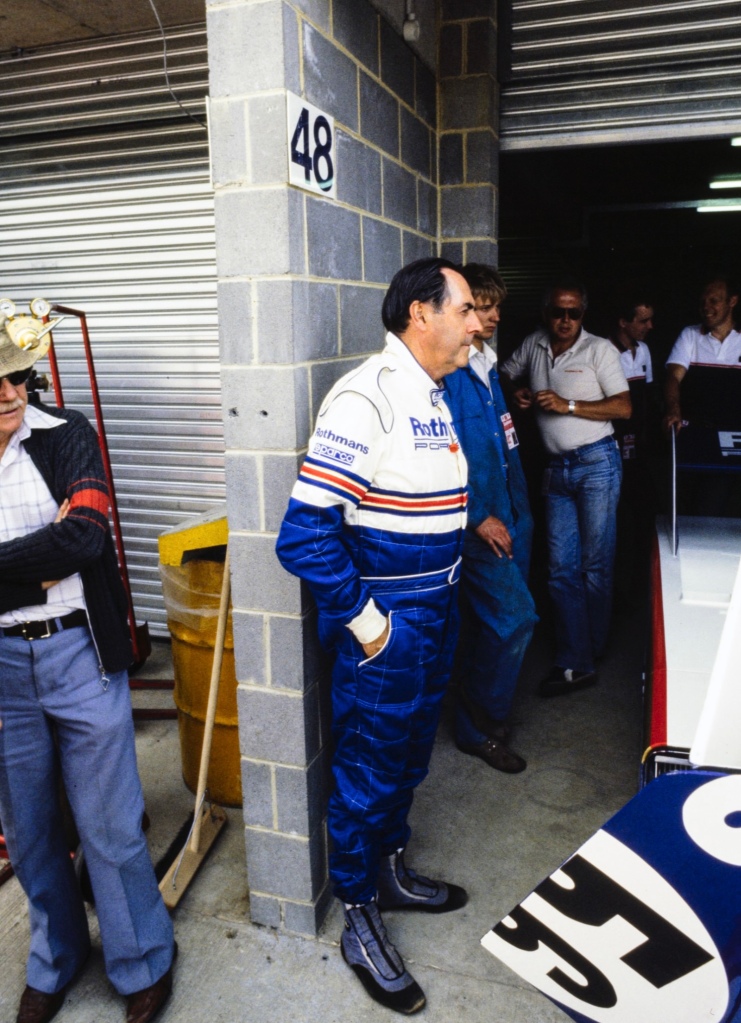
Happy Jack at Sandown in March 1962. Winner of the first Sandown International in his ex-F1 Cooper T55 Climax 2.7 (C MacKinnon)Jack Brabham 12 years later in 1984 aboard a works-Porsche 956. The fag-packet signage on the Porker and Dandenong Road corner says everything about motor racing economics of the era…(alamy)Brabham and Dumfries in the Sandown pits. At the time they were drivers of Group C touring, and F3 cars, I say very tongue-in-cheek in Jack’s case…(M Bryan)
None the less the prospect of seeing Sir Jack Brabham, Alan Jones and Vern Schuppan in ‘spectacular Le Mans Porsches’ was eagerly awaited by local race fans. All eyes were on German wunderkind Stefan Bellof in his battle with fellow Deutschlander and works-Porsche-pilot, Jochen Mass for the WEC Drivers’ Championship.
Bellof sizzled with absolute pace – he was Germany’s star – and had the same fierce burning desire of Gilles Villeneuve to be the quickest in every session. Sadly, both died very violently well before their time.
“I come to Australia to win this race together with Derek,” said championship leader Stefan, “and the chance is good. We stay on the pole position, but it’s a 1000km race and it’s a long distance. We have a lot of slower cars here and so we have to go very careful.”
The young F1 pilot – his Grand Prix ride was aboard a Tyrrell Ford together with Martin Brundle – clipped a kerb and boofed the barriers. Undeterred, he returned on Saturday and popped the car on pole in very hot conditions. Mass was alongside him on the front row, seven tenths slower. “It is particularly unpleasant for me, said Jochen, “because I can only win, and if Bellof comes second he’s still won.”
The Bond/Miedecke John Fitzpatrick/Team Australia 962 inside the Kees Kroesemeijer/Peter Janson/Jesus Pareja Porsche Kremer CK5 (unattributed)Jones in the 956 he shared with Vern Schuppan
Porsche entered two extra cars for Jones/Schuppan and Jack Brabham, who shared the Porsche camera-car with young F3 thruster and soon Lotus F1 driver, Johnny Dumfries. Jones was the pacesetter, despite little 956 experience. “It’s fantastic to see a world championship event here in Australia,” reflected an upbeat Jones. “It means I don’t have to travel so far from home to be in it for a start!”
‘Black Jack’ had done some Australian Group C touring car racing in the late 1970s, and enjoyed the Porsche experience. “It’s certainly a lot faster than anything I’ve ever driven before. It’s the first time I’ve driven a car with ground effects too, which is very interesting. I’ve read a lot about the Porsches and the opportunity now to drive one and just see how it goes is very, very good.”
After being tapped up the chuff by another car, they weren’t classified in the race, but Brabham, driving with an open-face Bell helmet enjoyed his time behind the wheel.
Lancia didn’t make the trip to Australia as our race was a round of the WEC Drivers Championship but not the FIA World Endurance Championship for makes, a shame given the size of Australia’s Italian diaspora, but the top Porsche privateers made the long trip south.
John Fitzpatrick was back after missing Fuji, with Thierry Boutsen qualifying the lead Skoal Bandit car fourth. The patriotic Team Australia effort returned on home ground, this time commandeering Fitz’s 962. At the wheel were former Australian Touring Car and Rally Champion, Colin Bond and Andrew Miedecke, at that time a leading Ralt RT4 mounted Formula Pacific racer.
Brabham/Dumfries Porsche 956 front and centre in this Sandown pit panorama (unattributed)A familiar view for most Australians, the old Pit Straight and old Shell Corner – or its kitty-litter – in the distance, as Colin Bond turns his Porsche 962 into Peters/Torana or whatever they called it that week. Stuff all that Turn 1/Turn 2 bullshit. Most of the good bits of the old circuit, with the exception of the big-balls Causeway/Dunlop Bridge section, were retained, but the kiddyland bumper-park bit was a joke…and was given the arse reasonably quickly thereafter (B Forsyth)
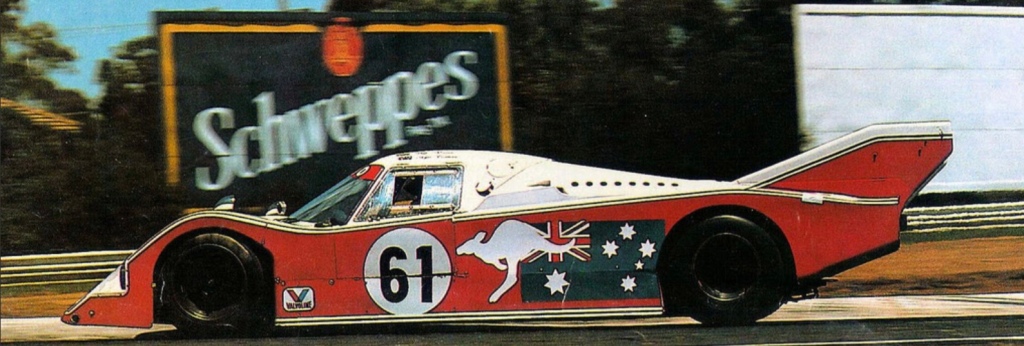
Mulsanne Memories wrote that “Kremer entered the pink Sega-backed 956B for Manfred Winkelhock/Rusty French (fifth) and a white, all-South African crewed 956 for Sarel van der Merwe/George Fouche. Richard Lloyd’s 956 GTi was in amongst this pack, as were Ludwig and Pescarolo in Joest’s 956B. A troubled race, which included punctures aplenty, a black flag, and a fractured brake pipe, meant the Le Mans winners could do no better than seventh, however. A couple of ageing cars — Chuck Kendall’s IMSA Lola T600 and Kees Kroesemeijer’s Kremer CK5 — rounded out the C1 field.”
A strong nine-car C2 field raced in Australia, but Gordon Spice and Ray Bellm again crushed the field taking their fifth win of the year in their Tiga CG84 DFL 3.3. Not that it was easy. Spice spun in the first hour, falling some way behind the ferocious Alba/Gebhardt lead battle. Carlo Facetti went away with fading brakes, and Spice clawed his way back past the Gebhardt before driving away for an eight-lap victory. Gunter Gebhardt had a second, all-female entry for Margie-Smith Haas, Australian Sue Ransom and French F3 star Kathy Muller, which finished the race.
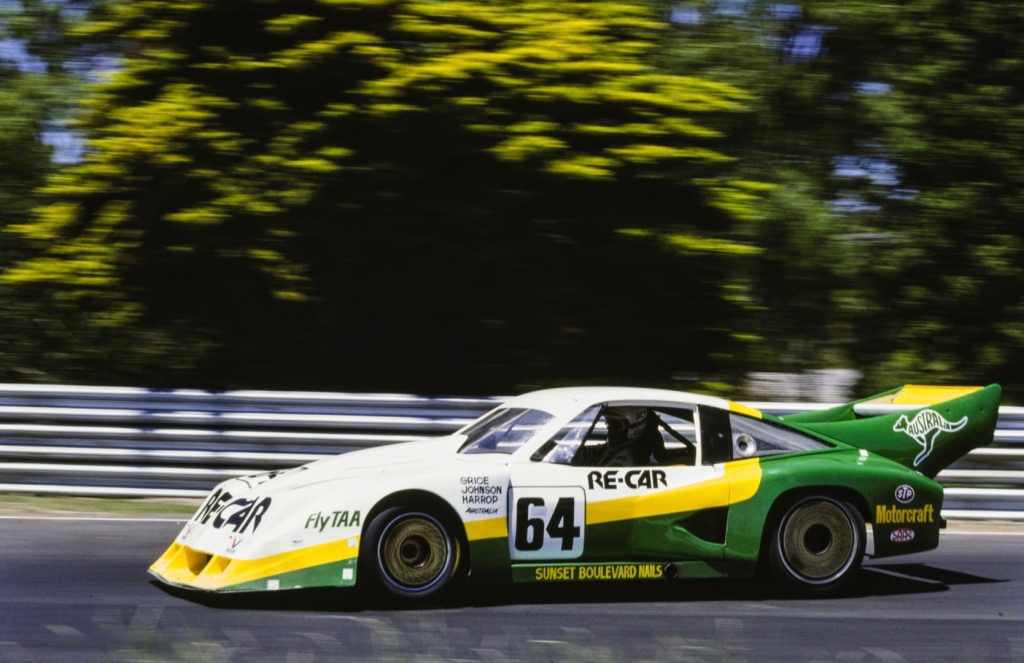
The Allan Grice/Dick Johnson/Ron Harrop 6-litre Chev Monza (MotorSport)The Bryan Thompson/Brad Jones Mercedes Benz 450SLC turbo (unattributed)
In order to help drag in the local punters – whose most popular diet was V8 touring cars – the LCCA included an Australian Car class for cars that raced in the Australian GT (Group B Sports Sedans and Group D GT cars), and Sports Car (Group A) Championships.
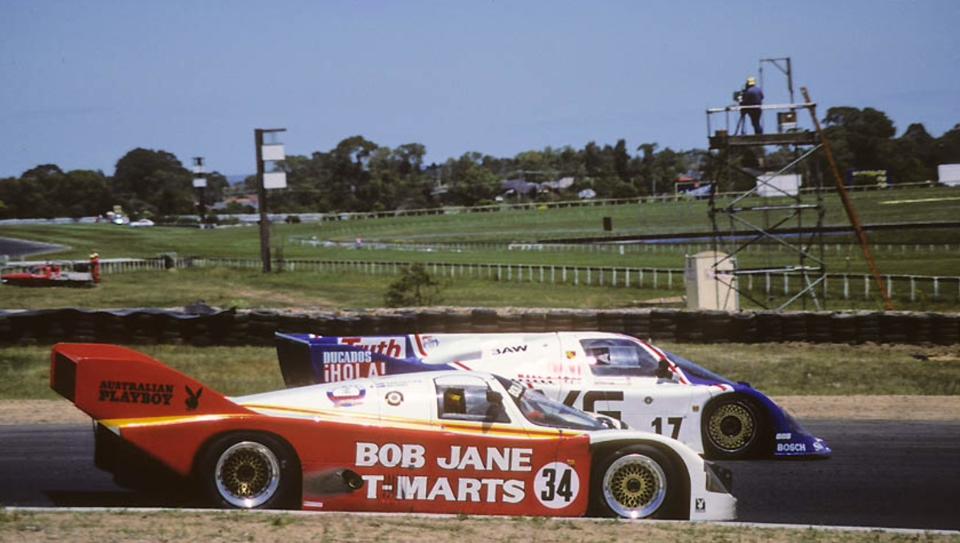
The FIA permitted five of these cars to race, the quickest of which was the Barry Lock/Kaditcha Cars Kaditcha K583/Romano Ford DFL 3.9 sports-prototype raced by multiple Australian Gold Star Champion, Alf Costanzo and car owner, Bap Romano. Alfie’s fastest lap was a 1:38.4 – 13th – despite persistent understeer caused by the 70kg of ballast the car had to carry.
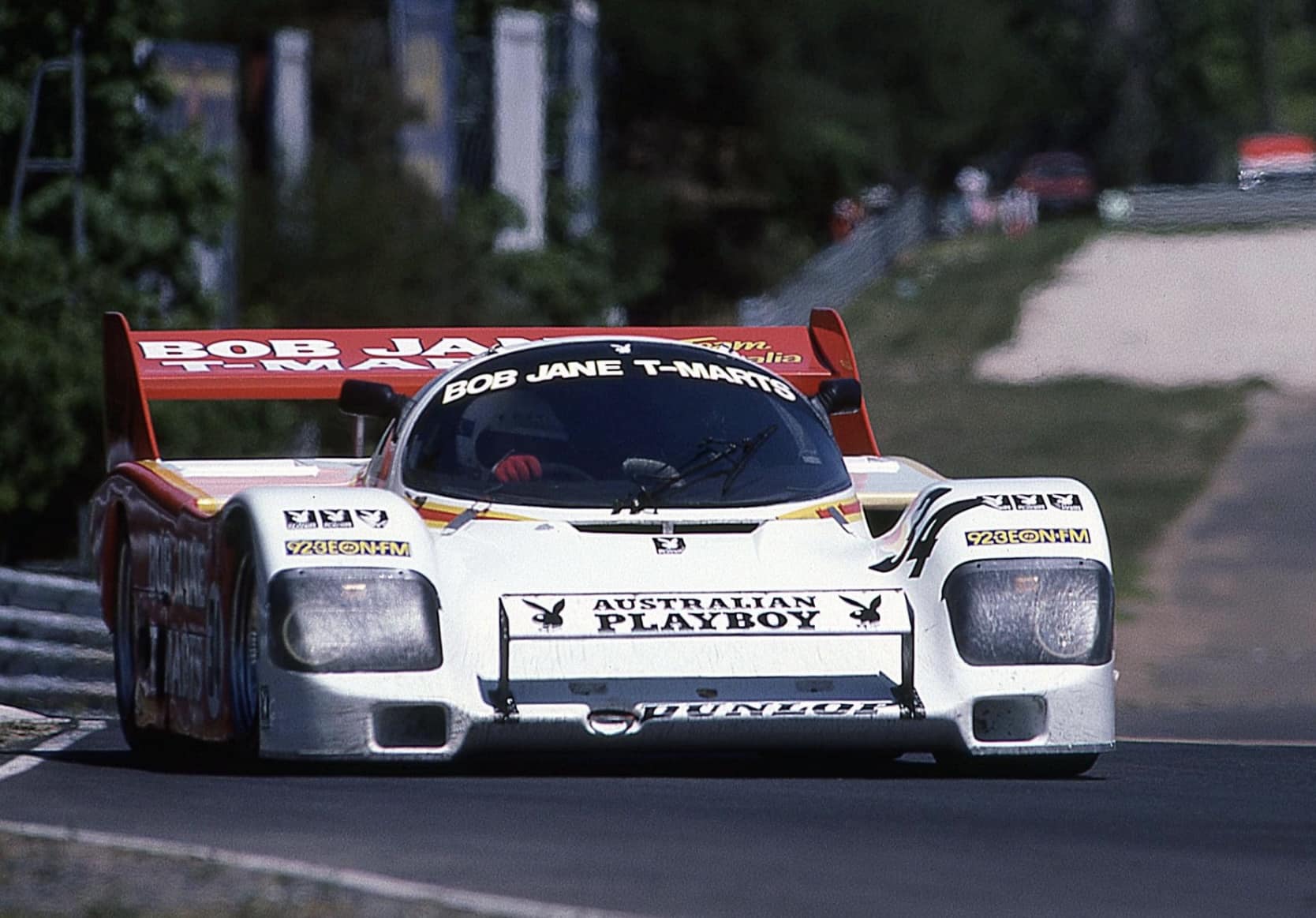
Frank Gardner ran the factory BMW race program in Australia for well over a decade, the team fielded a beautiful black John Player Special-sponsored BMW 320i sports-sedan driven by touring car ace Jim Richards and Tony Longhurst. The quickest of our sports sedans at the time was the ex-Bob Jane, Pat Purcell built Chevrolet Monza raced at Sandown by touring car specialists Allan Grice, Dick Johnson and Ron Harrop. Another superbly built sports sedan was the Peter Fowler built, Bryan Thompson owned 700-900bhp Mercedes Benz 450SLC Chev 4.2 twin-turbo, Brad Jones shared the wheel with Thompson.
The Costanzo/Romano Kaditcha/Romano Ford DFL (unattributed)Bellof, Mass and Jones before the start (unattributed)
Race…
29 cars set off on as the parade lap in hot conditions with the 1980 World Champ Jones the bolter – showing the sportscar-boys how its done, sliding down the inside at Shell to snatch the lead. As the field completed the first lap Jochen Mass was missing, having spun on oil dumped at the final chicane by Nick Faure’s expiring Porsche 930 just before the start. Jochen re-joined in 15th.
As Mass tore through the mid-field, Bellof was harassing Jones, slipping past on Pissant Loop to take the lead. Bellof pulled away, leaving AJ in the clutches of Boutsen’s 956, finally making it past Jones when he ran wide at the final corner. Behind the top three, Jan Lammers led Manfred Winkelhock, and Klaus Ludwig ran fourth to sixth.
Mass was reeling the top-order in, passing Lammers, then Jones for third spot on lap 31. As cars pitted for their first stops, Bellof led Boutsen by 20 seconds and Mass by 35.
Derek Bell took over the lead car from Bellof, then a slow stop from the Fitzpatrick crew meant that Jacky Ickx emerged from the pits aboard the #1 Rothmans Porsche in second place, just ahead of David Hobbs – who had last raced a McLaren M22 Chev F5000 car at Sandown in 1972 – in for Boutsen. Hobbs re-took second when Ickx skated wide and ran off the circuit at a corner; the newish track surface was breaking up a bit, with cars getting off-line, skating wide and bouncing through the dust.
The Schuppan/Jones 956 passes the very wide! Winter/Schornstein/Belmondo similar car on the run out of Torana; eighth and 11th respectively (MotorSport)
Then the cards were all thrown up in the air, when when broken suspension pitched Group C2 debutant Jens Winther’s 3.5-litre BMW 3.5-litre six-cylinder engined URD into the pit wall, bringing out the pace car and bunching up the field.
At the restart, Hobbs grabbed the lead from Bell despite bodywork hanging off the Skoal Bandit 956. Bell hung on, setting up a fine duel between young co-drivers Boutsen and Bellof. They delivered too, with an enthralling scrap for the lead. After many laps, Bellof put the works car back ahead with a slingshot move down pit straight. Behind these two, the race was going to pieces.
The treacherous track surface delivered punctures at random. First Kremer, then Joest, then the Jones/Schuppan Porsche, which had already been brought into the wrong pit box by Jones, then spun by Schuppan. With later turbo trouble, the Aussies faded to eighth place. “Worst affected was Richard Lloyd’s 956 which pitted very few laps for new rubber. After three or four unscheduled stops, it became comedic. After 12 (!) unscheduled tyre changes for Jan Lammers and Jonathan Palmer, it became utterly farcical. After the race, Dunlop reported a grand total of 59 punctures!”
Mass had been running third, but six punctures ended any chance he had of challenging Derek and Stefan for victory and the championship. The two lead cars remained curiously free of tyre trouble: Bell/Bellof suffered just one puncture and Boutsen/Hobbs none at all.
In the closing stages, Hobbs pulled over in the infield with a broken coil, lifting any remaining pressure on the Bellof/Bell Porsche with Bell taking the chequered flag, shown after six hours, since the 1000km target of 259 laps wasn’t close to being reached.
The victorious Derek Bell and Stefan Bellof (MotorSport)
Stefan Bellof became the 1984 World Endurance Drivers’ Champion after a dominant season; six wins and five poles in 11 races. “I have to say thank you for the mechanics and also for Derek, he did his job very well and he helped me to this title,” said the new champion. Stefan took the mantle from Jacky Ickx, who watched the podium presentation with a look of serious concentration on his face. “I’ve won with Al Holbert in America five races this year, and with Stefan I’ve won four,” said Bell, “It’s been my most enjoyable year of racing, because I’ve raced so much the best car all around the world.”
So Mass was defeated in his bid for the championship, but the well-humoured veteran seemed to take it well. He and Ickx’s struggles left them three laps in arrears at the flag, but still in second place. Somehow, despite suffering all those punctures, Lammers and Palmer rounded out the podium. Next home were Kremer’s two cars, Van der Merwe/Fouche enjoying a cleaner run than Winkelhock/French and taking fourth. With both of his other cars in trouble, John Fitzpatrick’s best finisher was the local Team Australia car in sixth.
There had been much optimism before Sandown, but the official crowd count numbered only 13,800, more realistic estimates had it at sub-10,000, well beneath break-even point. Clashing tennis and cricket dates were cited by the LCCA as reasons for the poor turnout, but these were annual events that dated back to JC’s days playing full-back for Jerusalem…
The fundamental problems were the lack of an adequate TV deal and race sponsor(s) to underwrite the event. For proceeding without those, the board should have been shot then burned. Still, they doubled down and fucked it all up again in 1988 with the Sandown 360Km, this time completing the destruction of the club…
Jon Davison then saved the day for Sandown of course, but the club itself was no-more.
Etcetera…
(MotorSport)
Jack thinking how cool it is to just rock-up and drive…so different to being chief-cook and bottle washer at the Brabham Racing Organisation! Yes OCD’ers, I know it wasn’t the first time he had been driver only, I was attempting some humour.
The Colin Bond/Andrew Miedecke John Fitzpatrick run Team Oz Porsche 962 at rest below.
(MotorSport)(T Johns)
Tony Johns picks up the story about the road going works-956s…
“Mark a good post, a couple more photos from that weekend. I was one of the three lucky staff members to get a ride that morning!”
“What happened was that the three cars were driven back after Thursday practice for a function held at Porsche Cars Australia headquarters, and on Friday morning driven back to the circuit by the mechanics. My photo (above) shows Roger Watts climbing in and the nose section being fitted after crossing the gutter.”
(T Johns)(T Johns)
“A neighbour complained to the police who came and waited all day to catch them returning, but that never happened. After the win and the world championship the cars were trucked to Tullamarine and airfreighted back to Germany.”
“Allan hosted all the teams at Noble Park but the Works cars were prepared in his own race shop.”
(T Johns)
Credits…
PCA-Porsche Cars Australia, Mulsanne Memories, MotorSport Images, Getty Images, Bruce Forsyth, Alamy, Malcolm Bryan, Tony Johns
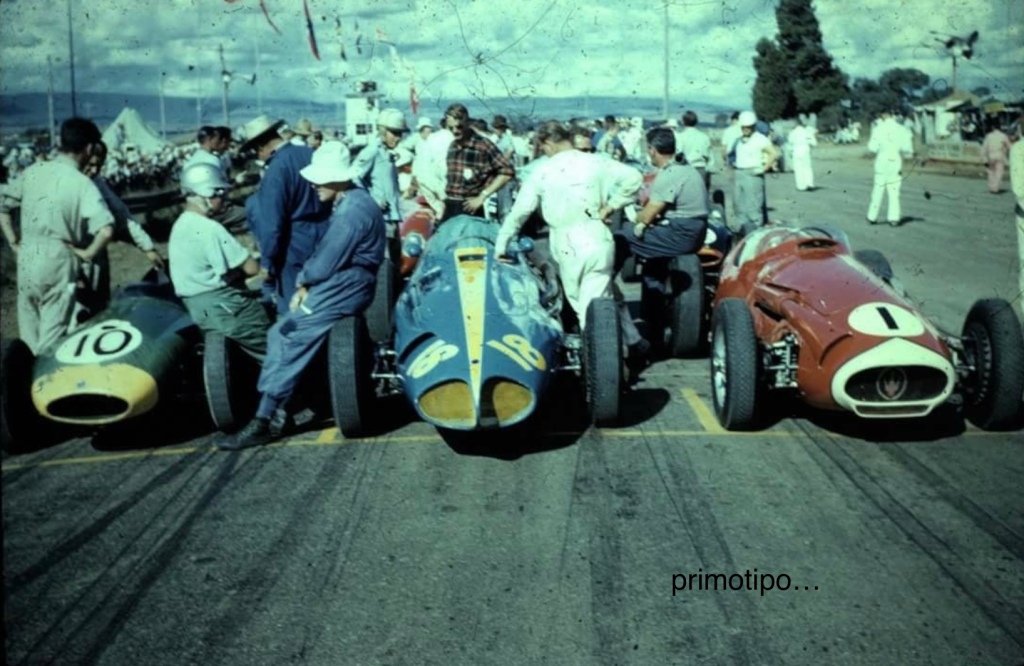
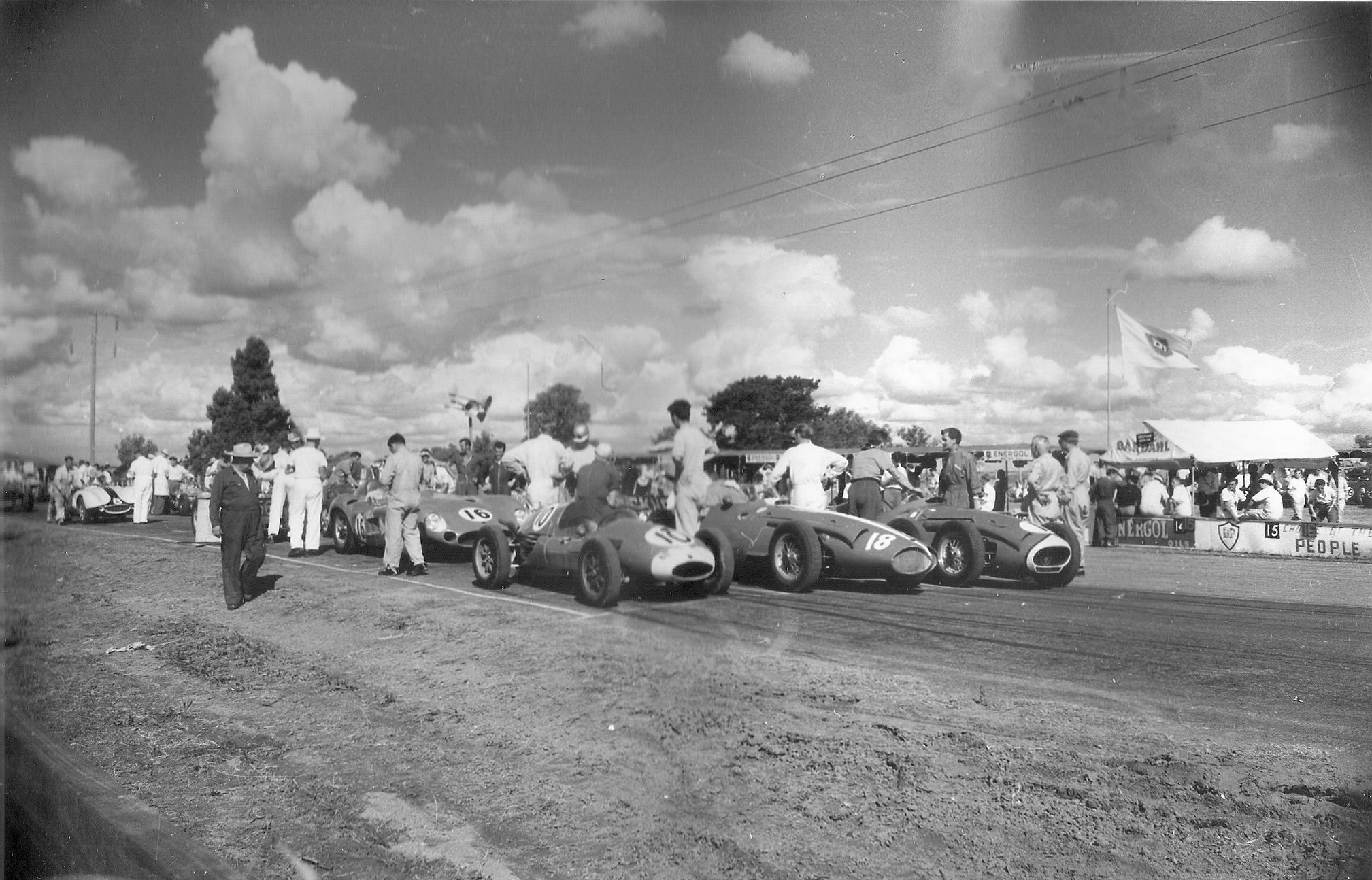
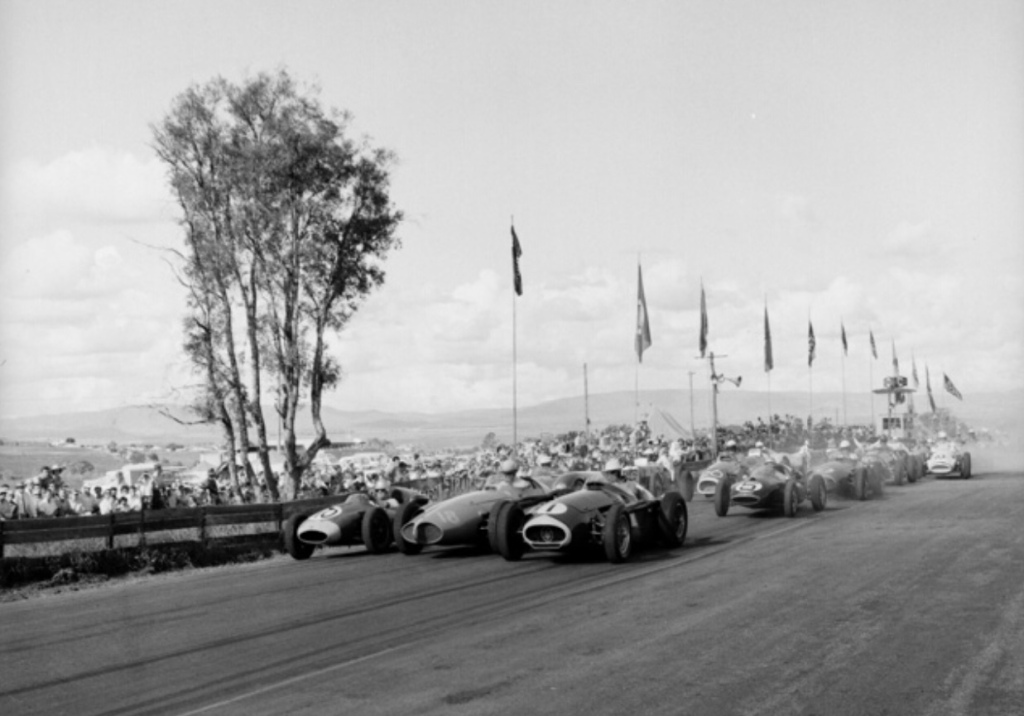
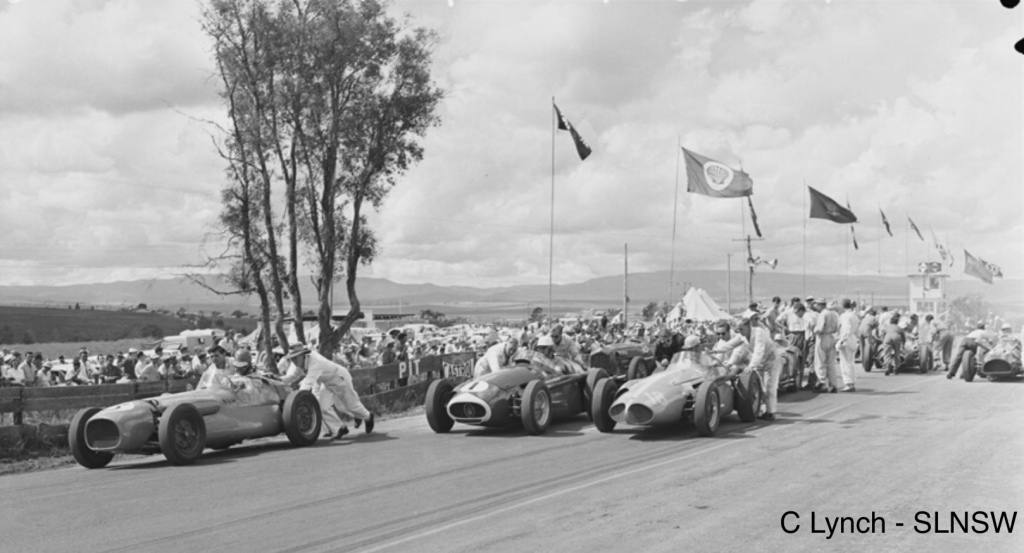
It’s Easter Monday 1959. March 30, the Bathurst 100 grid. Alec Mildren on the wheel of his Cooper T45 Climax, Ross Jensen behind and to the left of his Maserati 250F and Stan Jones perched on the back wheel of his 250F…
Top contenders for the 100 mile classic were the three Maserati 250Fs driven by Stan Jones – winner of the AGP at Longford on March 2 and the South Australian Trophy at Port Wakefield only two days before on March 28 – Arnold Glass, and Kiwi 1957 Gold Star winner, the very experienced and accomplished Ross Jensen. His 250F Maserati is ‘in the blue and white colours of the Automobile Club of El Salvador – an NZGP publicity gimmick,’ wrote John Medley.
Doug Whiteford’s Maserati 300S, the 1958 Bathurst 100 winner was a contender as were the 2-litre Coventry Climax FPF powered Cooper T45s of Alec Mildren, Len Lukey and Bill Patterson.
Raceday, bright and sunny, attracted 25,000 spectators.
(unattributed)
The first three lap qualifying heat was won by Glynn Scott’s Repco Holden from Bill Reynold’s Orlando MG and Alwyn Rose’s big, booming Dalro Jaguar. The second three-lapper was won by Jones’ Maserati 250F from Mildren’s Cooper T45 Climax and Jensen’s 250F.
The photo above shows the grid prior to the start of the second heat, with Jack Myers beside his WM Holden and then the Maserati 250Fs of Jones and Jensen. Myers’ special was a very clever concoction of Cooper T20 chassis – although by then the frame was of Jack’s construction – and six-cylinder Holden Grey block atop which sat a Merv Waggott designed and built aluminium DOHC, twin-cam, two-valve cylinder head. This car in Jack’s capable hands always punched above its weight, read about it here; https://primotipo.com/2015/02/10/stirling-moss-cumberland-park-speedway-sydney-cooper-t20-wm-holden-1956/
Parade lap, logically before the Bathurst 100…(unattributed)(unattributed)
After the parade lap the Bathurst 100 grid of 27 starters was ‘away in indescribable noise, dust and confusion’, Jones was first to Hell Corner from Mildren Lukey and Whiteford – then Jensen, Glass, Scott, Jack Myers WM Cooper – with Ray Walmsley in the Alfa P3 GMC rolling to a halt out of Hell.
Mildren led at the end of lap one from Jones, Lukey, Jensen who was closing and Doug Whiteford who was falling back. Jensen passed Lukey on lap four and then challenged Jones, roaring past before The Cutting with the three leaders nose to tail through Reid Park.
Jones, 250F (unattributed)
Lukey’s Cooper was close, Whiteford a bit further back and Glass much further back, and then the Myers WM. Into lap five Medley records that the Kiwi started his run by putting in two laps of 2:51, taking the lead and extending it whilst Stan Jones pitted, restarted and retired after six laps.
Then Mildren was black flagged due to a loose bonnet catch, he pitted and rejoined after the drama was rectified, but he was now behind Jensen, Lukey and Whiteford.
Mildren got the bit back between his teeth and passed Whiteford up Mountain Straight at half distance and Lukey under brakes at Murray’s – Doug took Len two laps later as well. By then up to second, Mildren retired at Quarry having done a 2:55 lap and 147.73 mph on Conrod. Whiteford too retired from transmission failure.
Jensen passes Whiteford and his stranded Maserati 300S as he goes over the finishing line, out with transmission woes (PIX-SLNSW)
After Mildren’s pitstop Jensen wasn’t threatened and ‘motored the next 80 miles to win easily’ with a best lap of 2:50.6 and a speed through the Conrod traps at 139.53 mph.
Jensen won a race of incredible attrition – only 11 of the 27 starters finished – from Len Lukey, Cooper T45 Climax, and Glass in the ex-Hunt/Stillwell Maserati 250F, then Jack Myers WM Cooper Holden, Walmsley’s Alfa P3 GMC and Werner Greve in the ex-Moss/Davison 1954 AGP winning HWM Jaguar.
Walmsley’s fifth place in a Gold Star round in his pre-war Alfa Romeo P3 was surely the highest placing for such an old car in any Gold Star round?
(PIX-SLNSW)
Ross Jensen…
While Aucklander, Ross Jensen’s performance may have astonished fringe-race-fans in Australia in fact he had been a front runner in New Zealand amongst the visiting internationals for years.
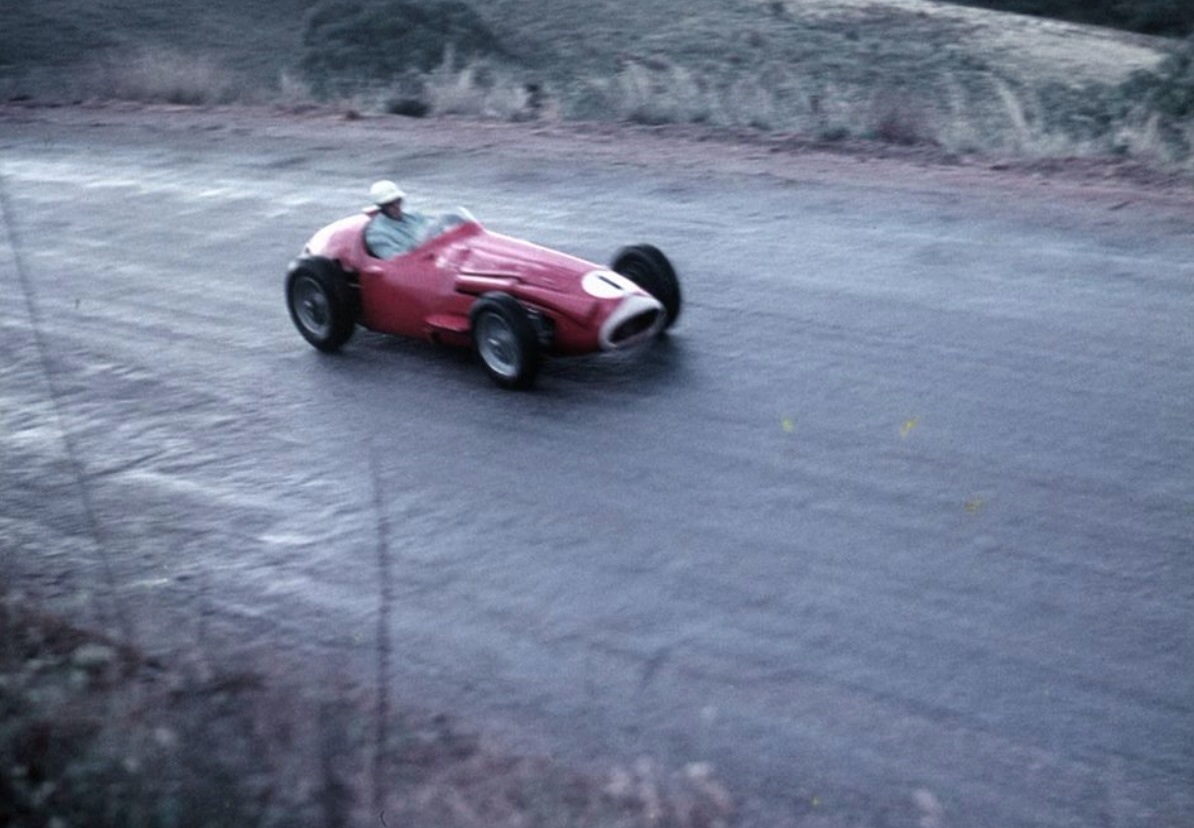
He purchased the ex-Moss Maserati 250F #2508 1956 NZ GP winner finishing second to Jack Brabham’s Cooper in the 1958 NZ GP. Later that year he raced works-Lister Jaguars in the UK, placing second at Snetterton and Brands in July-August and winning Scott-Brown Memorial – a man he got to know on Archie’s early ’58 NZ Tour – at Snetterton in September. He then returned home having taken delivery of the long shark-nosed 250F #2509 in time for the 1959 NZ internationals.
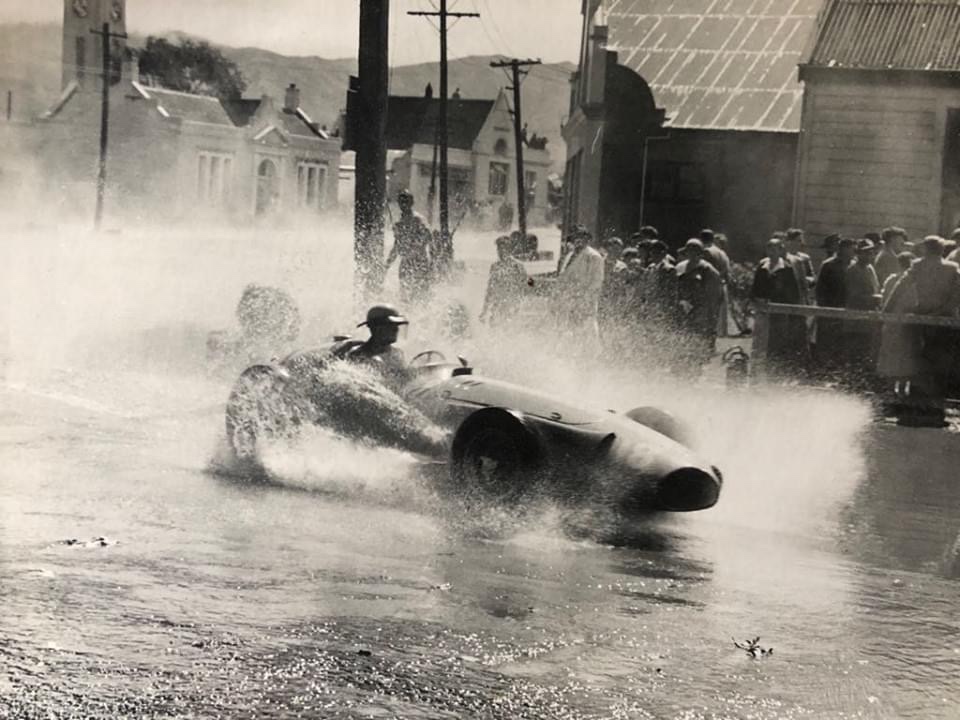
Ross Jensen shared this Lister Jag with Ivor Bueb and Bruce Halford during the September 1958 Tourist Trophy at Goodwood, DNF (LAT)Soggy Ross – Jensen and 250F during the early stages of the 1959 Waimate 50. “famously there was a cloud burst just after the start…once the rain stopped, it dried up quickly and we had some really great racing,” Allan Dick wrote (Classic Auto News)
Bruce Sergent wrote that “the car was built around the frame of the Bira race winner (NZ GP) of 1955, but with the latest motor and transmission, giving the low, offset driving position.”
He was fifth in the NZ GP, qualified on the front row at Wigram but DNF with transmission problems, was second behind Bruce McLaren’s Cooper at Waimate, and was fourth behind McLaren, Flockhart’s BRM P25 and Brabham, Cooper T45 at Teretonga. He was no slouch…
Jensen established a race preparation shop, retired from racing in 1961 but was always part of the scene – foundation member and on the board of the NZ Grand Prix Association, founding trustee of the Bruce McLaren Trust – and later imported Renault, Jaguar and BMW amongst others. He died, aged 78 in October 2003.
Etcetera…
(PIX-SLNSW)
Stan Jones (right) dispenses some words of wisdom to a gent in the exclusive confines of the Mobilgas hospitality suite. BYO chair clearly.
(SLNSW)
Great Pit Straight panorama with the #33 Bruce Leer MG TC Spl, Jesse Griffiths Maserati 4CL #36 and John Schroeder, covered Nota Consul. All of them contested the Bathurst 100 and all were DNFs.
(unattributed)
Porsche 356 Coupe leads Stan Jones and Ross Jensen on the parade lap.
(PIX-SLNSW)
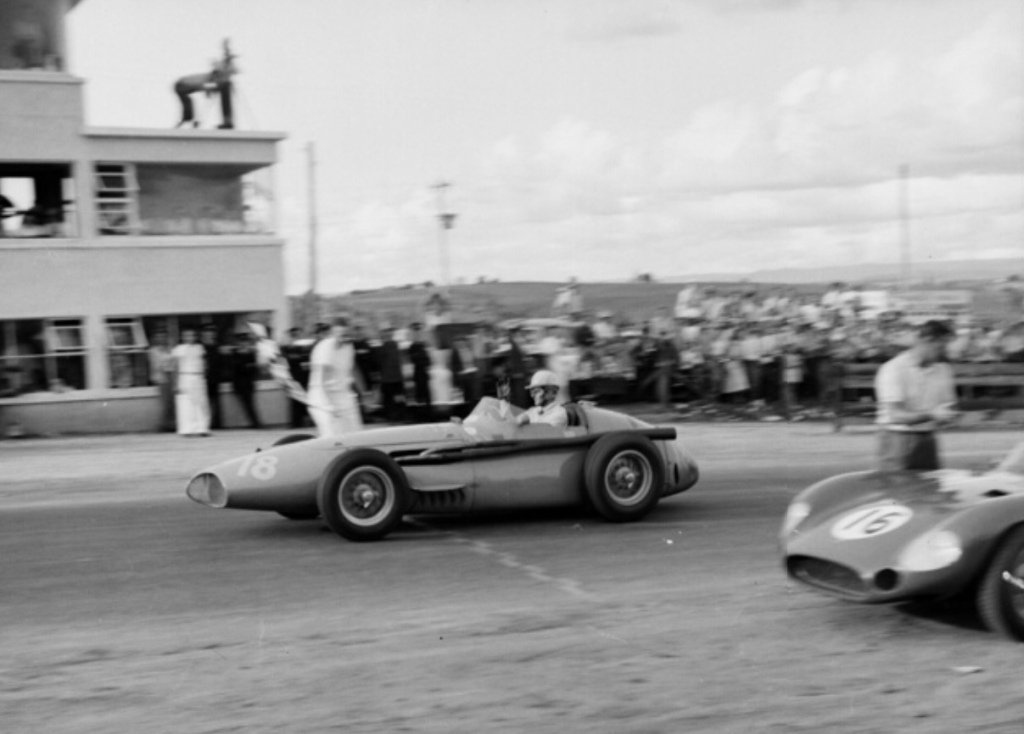
Mildren, Cooper T45 and the Jensen and Jones 250F’s on the front row at the start of the 100, feel the vibe…Len Lukey’s #5 Cooper Climax on the outside of row two
(unattributed)
Arnold Glass’ Maserati 250F goes inside Bill Clarke’s 492cc two-stroke, three-cylinder, air-cooled Berkeley SE492 Excelsior, the speed differential between some of the cars that weekend was mega.
Credits…
Russell Beckman, Bill Miles Collection, ‘Bathurst: Cradle of Australian Motor Racing’ John Medley, sergeant.com, Allan Dick-Classic Auto News, LAT, Maserati 250F chassis number source: http://8w.forix.com/250f-redux.html
Tailpiece…
Ross Jensen’s Maserati 250F in 1959, on the cover of the 1960 meeting programme.
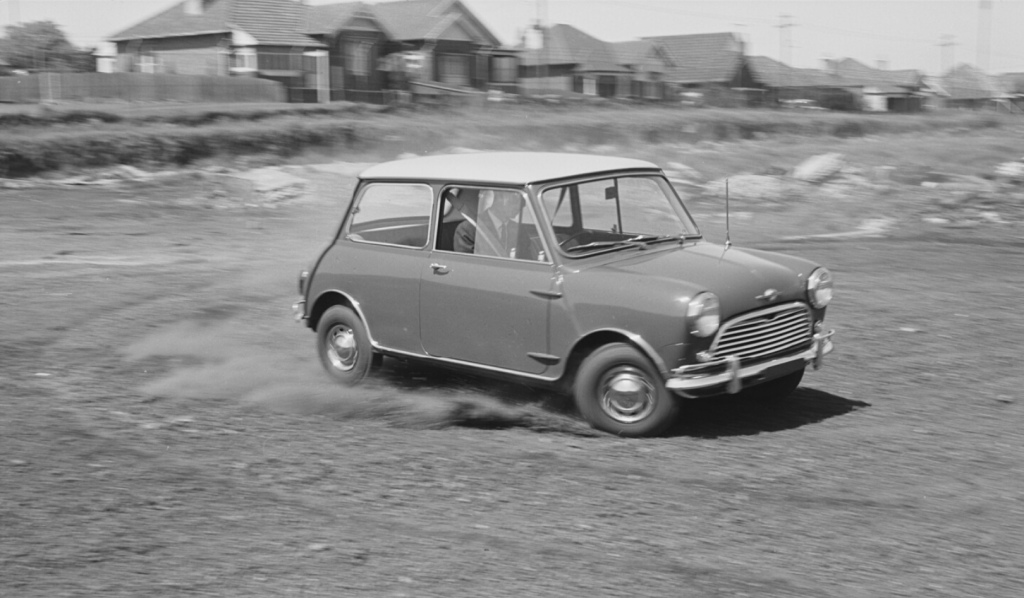
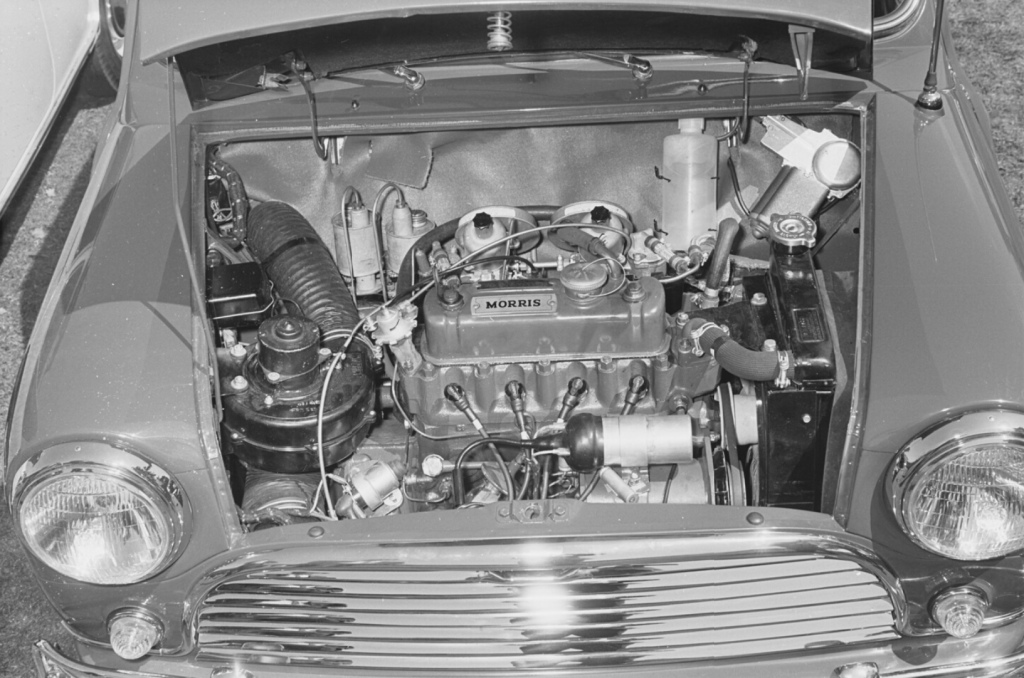
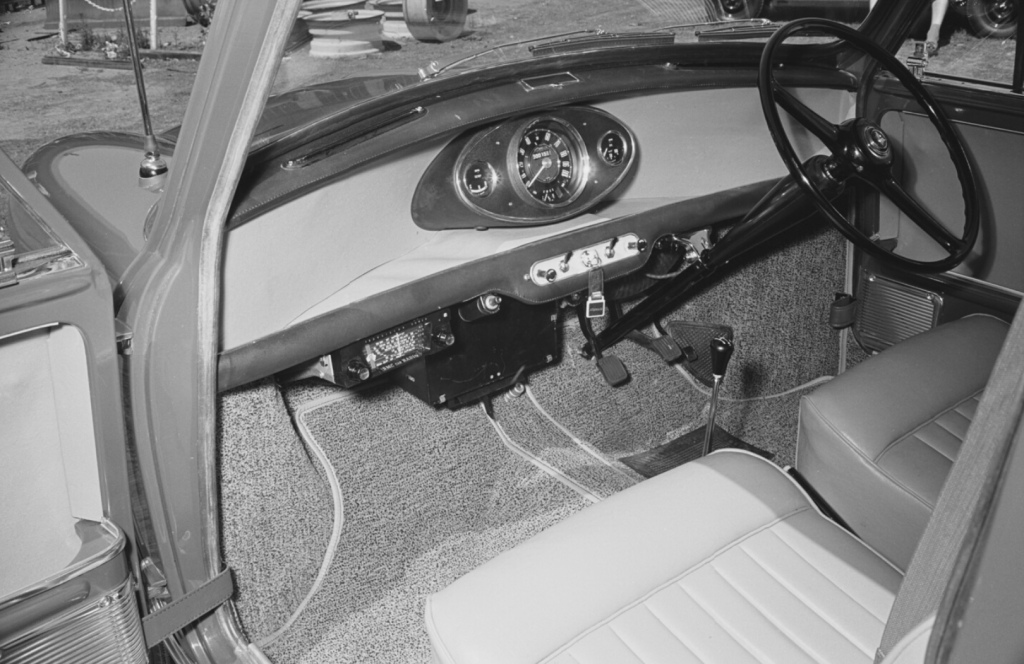
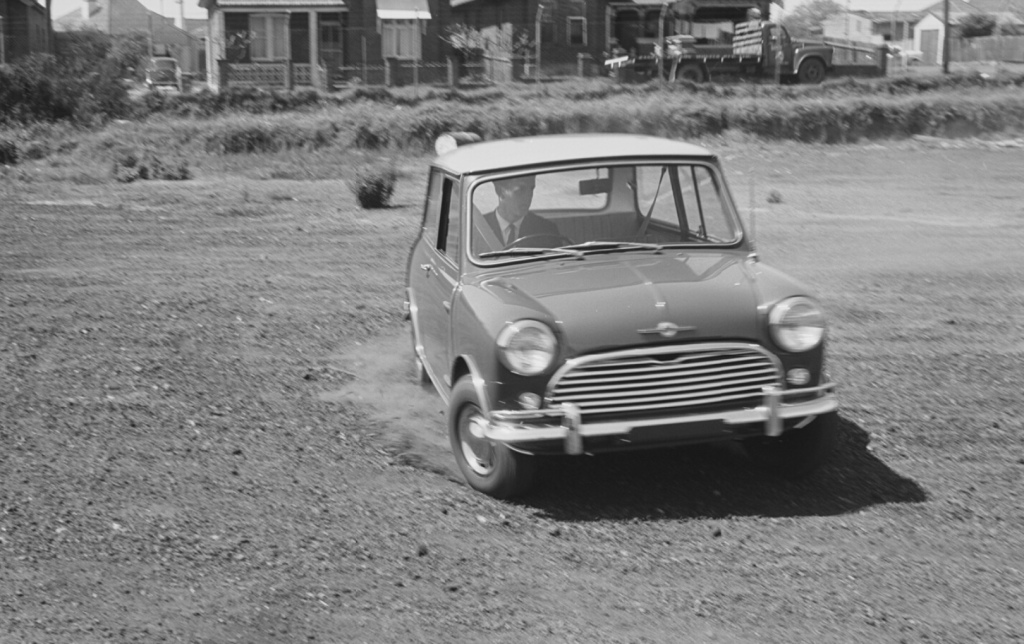
“Don’t even think about!” said Liz Stanton of the Mini Automatic. “It hasn’t got enough poke to pull ‘yer foreskin back, the Cooper S is the go for a studmeister like you,” or words to that general effect.
Pix photographer Bob Donaldson shot the Mini Matic launch at Surfers Paradise in September 1967 and five years before, a Morris Cooper test in October 1962, not to forget his November 1964 Zetland Grand Prix shots…
(Donaldson/SLNSW)Morris 850 at left, Cooper at right (Donaldson/SLNSW)
By the look of the backgrounds on some of the action shots, the drive and photos took place on the British Motor Corporation’s massive site centred on Zetland, six kilometres south of Sydney.
While common knowledge to Oz motor enthusiasts, some of you furriners may not be aware that a huge range of BMC cars were manufactured in full in Australia – bodies and engines included – until the favourable tariff treatment afforded the mother-country was eliminated in the early 1970s, after you bastards joined the EU…
Surely there has been no better small performance car on road, track, the hills and in the forests than the Cooper/Cooper S? Not to forget the iconic status of Alec Issigonis’ brilliant, original ADO15 (Austin Design Office) design.
Topsy grew in engine capacity – but critically not in size – from 997cc-54bhp to 998cc-54bhp, then 1071cc-69bhp, then for a while 970cc-64bhp, and 1275cc-75bhp, before settling at that 1275cc magic-number…
(Donaldson/SLNSW)
Note the factory extractors and twin HS2 SU carbs, the 997 gave circa 54bhp, not shedloads, but the thing weighed nothing and far more was easily capable of being extracted.
(Donaldson/SLNSW)
That instrument-pod never changed, thankfully. Coopers got a remote gearshift which was fast and great to use, the 850 got a long pudding-stirrer. The standard steering wheel was shit but no Cooper was complete without aftermarket Mota-Lita or Momo wheels and a Smiths tach. Oh yes, a racy mirror too, but only on the driver’s side.
(Donaldson/SLNSW)
The 7.5 inch front discs were effective, rare on small cars then too. Issigonis and John Cooper knew a thing or two about competition after all.
(Donaldson/SLNSW)
“Where is the other 5-gallon tank?” you ask. That came with the 1275cc S from 1966.
(Donaldson/SLNSW)(Donaldson/SLNSW)
“Oh no!” Those steel wheels have got to go, and usually did. The well heeled bought Minilites but I always thought a set of Cosmic wheels were hard to toss visually, and were a bit stronger for road use and abuse.
Paddy Hopkirk competes in the little known ‘Zetland Grand Prix’ in November 1964.
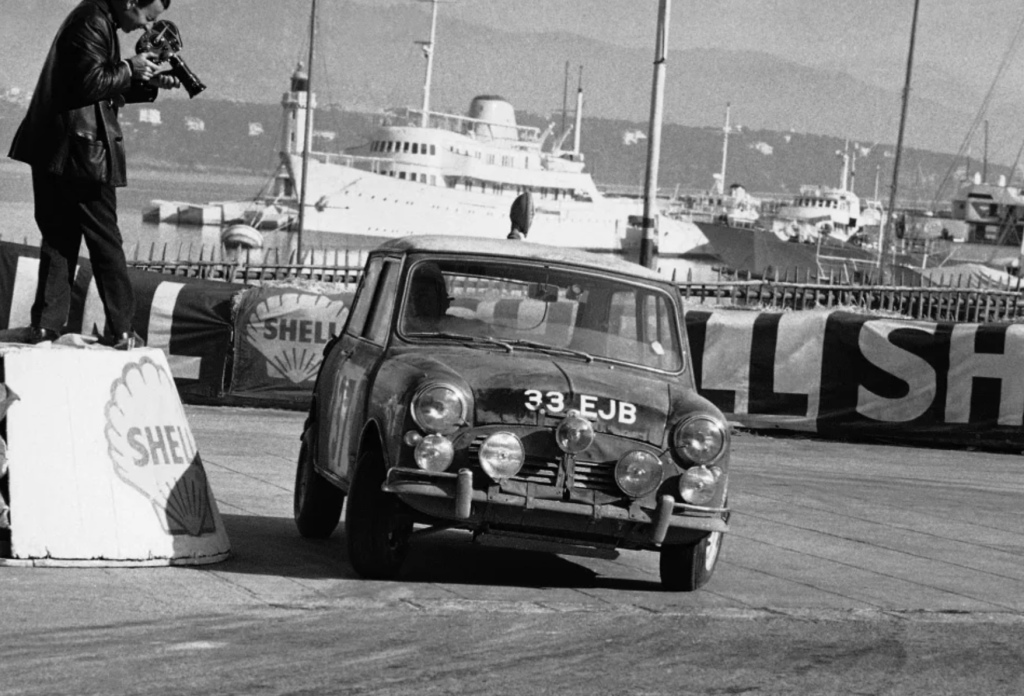
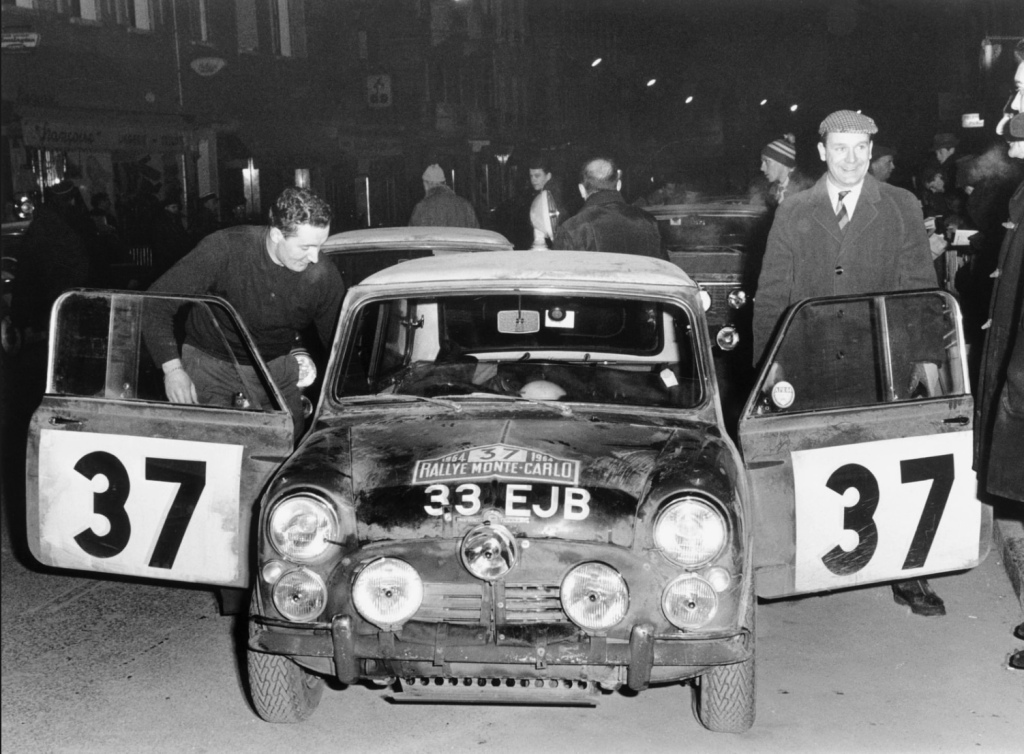
Factory BMC drivers Hopkirk – winner of the Monte Carlo Rally aboard a Cooper S partnered by Henry Liddon that January – John Fitzpatrick, Timo Makinen and Rauno Aaltonen were in Australia to contest the first Sandown 6-Hour enduro on November 29.
Evan Green at the left? Paddy Hopkirk in the centre, and John Fitzpatrick, perhaps, at right (Donaldson/SLNSW)(Donaldson/SLNSW)
Part of the promotional activities set up by BMC Oz while the visitors were in their grasp was this demonstration of the capabilities of the cars built by the Sydney workers right in their own backyard.
Note the content of the safety processes/briefings: to the workers, ‘keep an eye on the cars’ and to the drivers, ‘try not to hit anyone’…Mission accomplished I believe. What a blast that would have been.
(Donaldson/SLNSW)
Credits…
Bob Donaldson, Pix, State Library of New South Wales, The Sun UK, LAT, Ashley Tracey
Tailpieces…
(The Sun UK)
Paddy Hopkirk races around Monaco during the final 1964 Monte stage, and below after securing the historic win, with co-driver, Henry Liddon.
(LAT)(A Tracey)
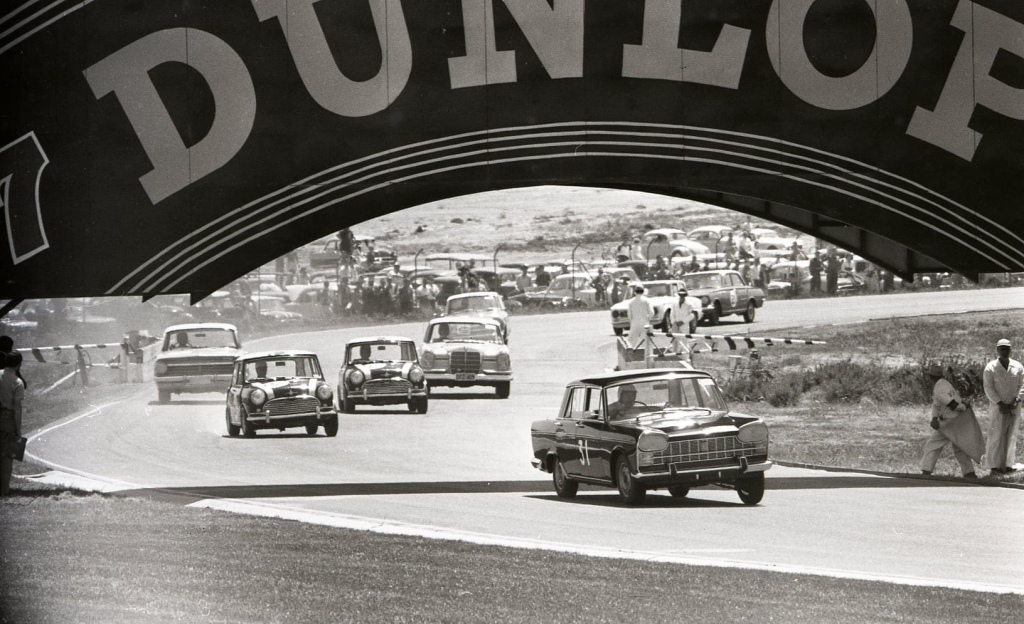
Sandown 6-Hour 1964, the end of the first lap perhaps with the Barry Topen/Digby Cooke Fiat 2300 leading two of the three works-Cooper S.
These 1275 S were British built cars brought to Australia for the event by Zetland’s newly formed competition department, the idea of BMC PR Manager – and rally driver – the much respected Evan Green.
Alan Kemp managed the department, while the three Cooper S racers were prepared for Sandown by the legendary Peter Molloy – then working with Brian Foley in Sydney – at BMC’s Melbourne workshop in Moorabbin.
Peter Manton/Brian Foley were second, seven laps adrift of the victorious Alec Mildren Racing Alfa Romeo TI Super driven by Roberto Businello and Ralph Sach. The Hopkirk/Fitzpatrick car was sixth, while the Makinen/Aaltonen pair failed to finish after losing a wheel and rolling. See here for some footage of the race: https://youtu.be/LZiQ4PJSmyo?si=Sb39mqNzckopf-kK
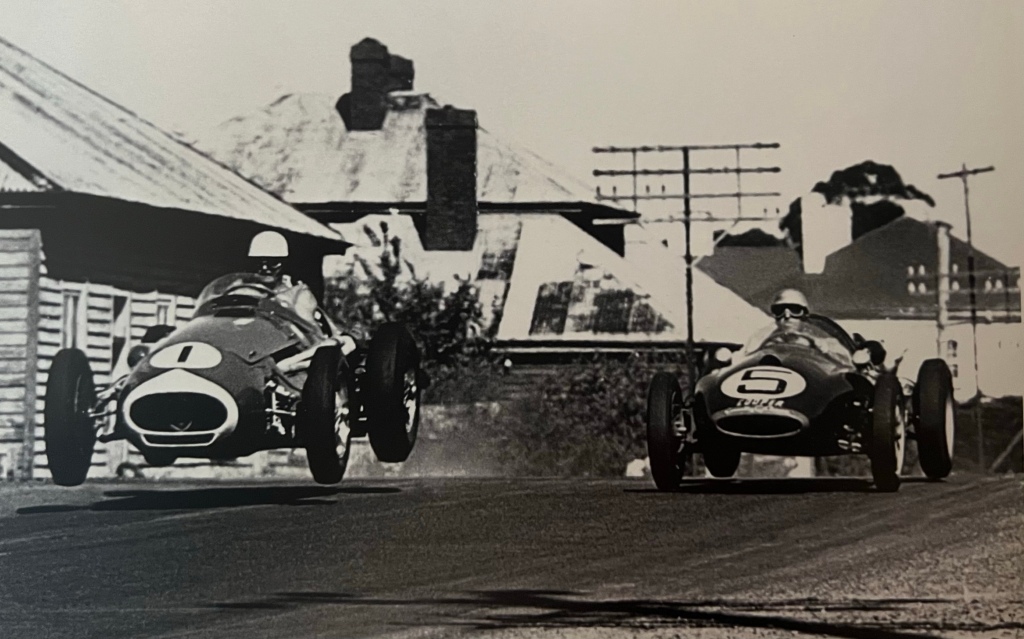
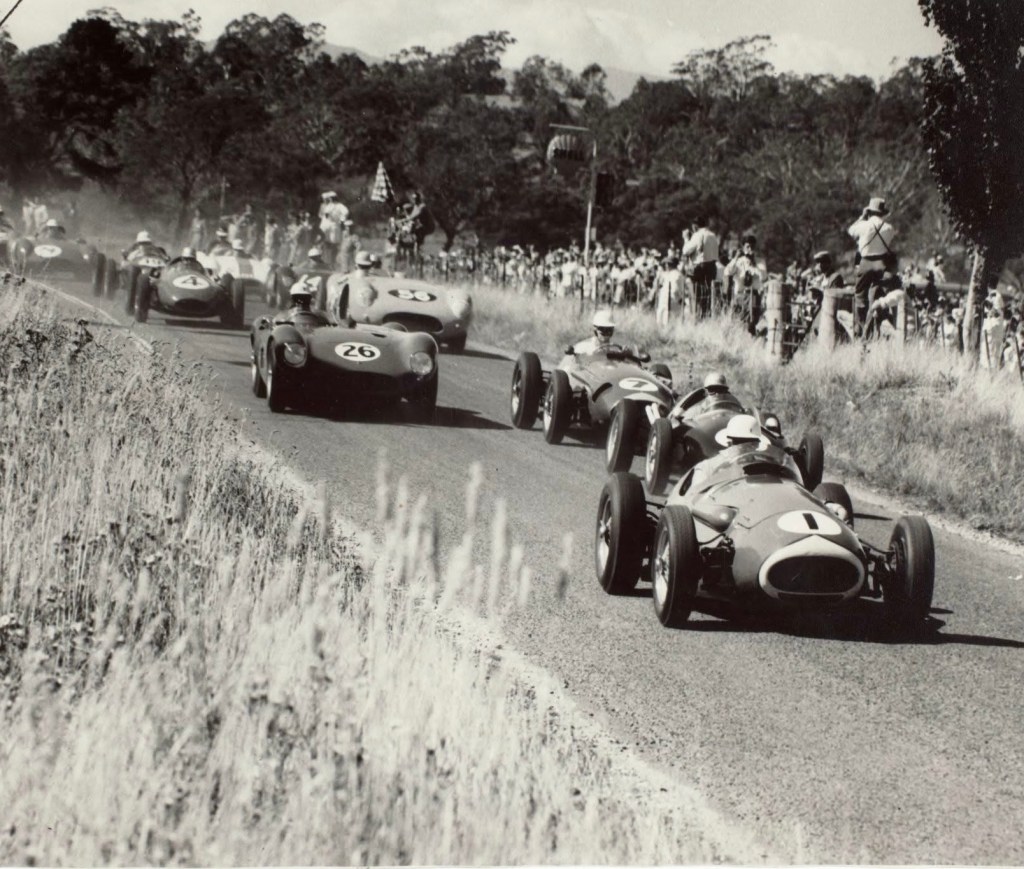
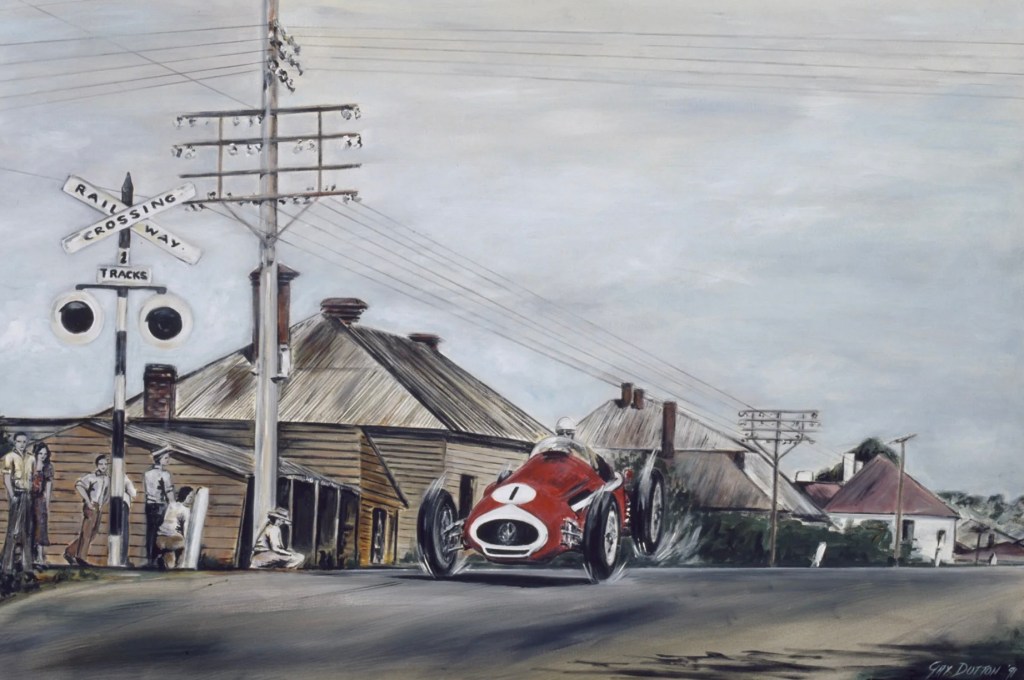
Stan Jones, well aloft over the railway crossing on Tannery Straight at Longford aboard his Maserati 250F, leads Len Lukey, Cooper T45 Climax 2-litre, during their epic battle for honours in the March 2, 1959 Australian Grand Prix.
(SLT)
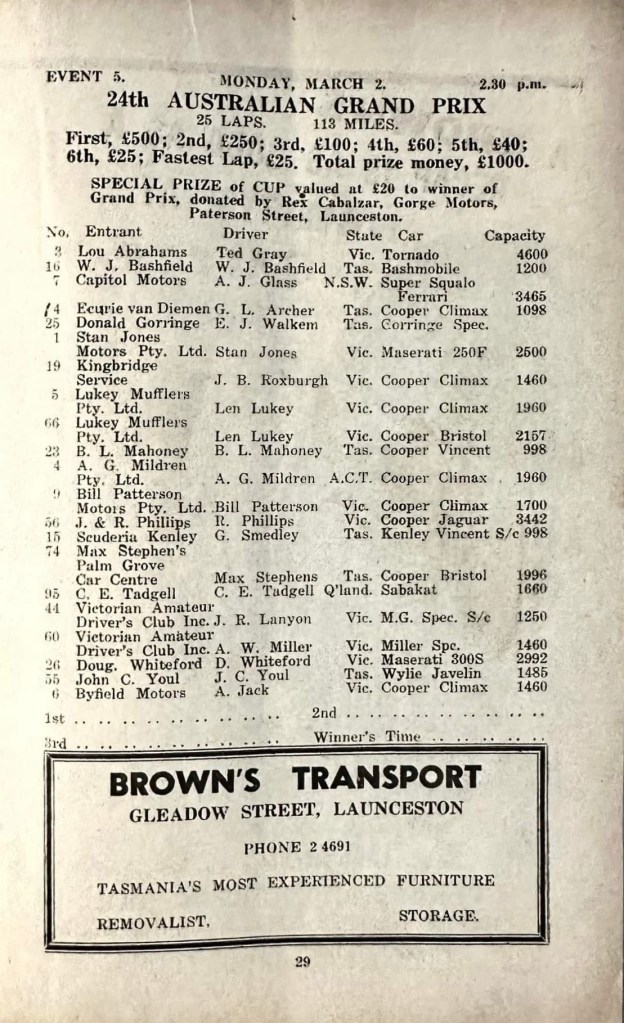
Stan Jones gets the jump in his Maserati 250F at the start of the 25 lap, 110 mile Formula Libre race from Len Lukey, Cooper T45 2-litre, Arnold Glass, Maserati 250F, Doug Whiteford, Maserati 300S, Ron Phillips’ Cooper T33 Jaguar 3.8, and #4, Alec Mildren, Cooper T43 Climax 2-litre.
‘Take it easy Dad!’ Alan to Stan Jones before their victory lap (Dunstan Collection)
In a long race of thrust and parry between the nimble Cooper and brawny Maserati, 30,000 spectators saw the battle resolved in Stan’s favour.
The reigning Gold Star champion had just enough power to offset the handling and roadholding advantage of Lukey’s new fangled mid-engined Cooper. Armed with a 2.5-litre Coventry Climax FPF – not readily available to customers at that time – the result wouldn’t have been the same, but karma looked after Stan that day, he had well-and-truly paid his AGP dues since 1952 after all!
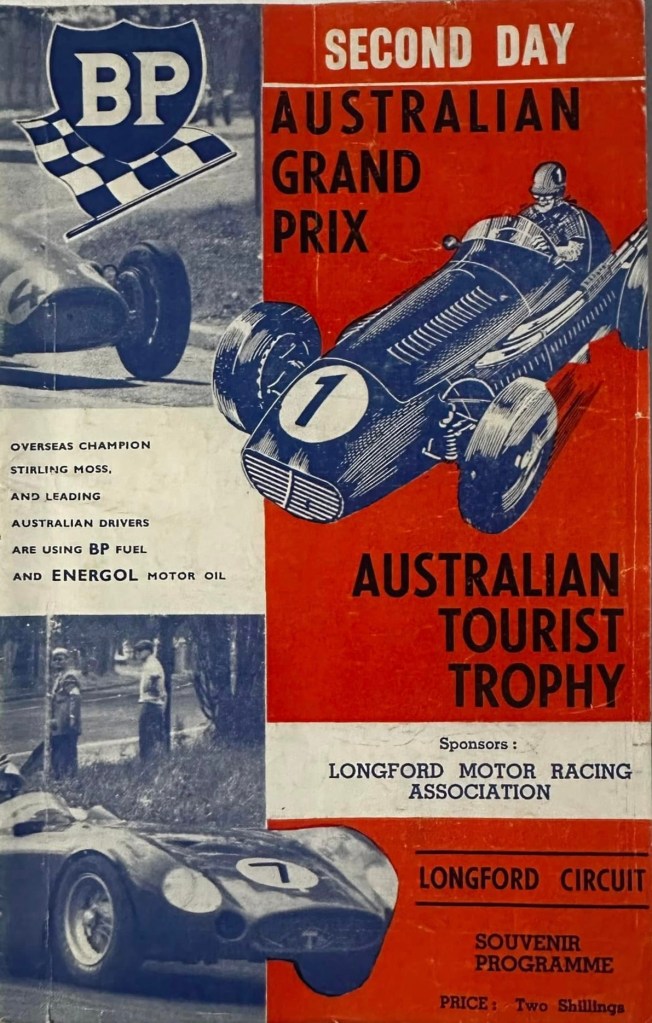
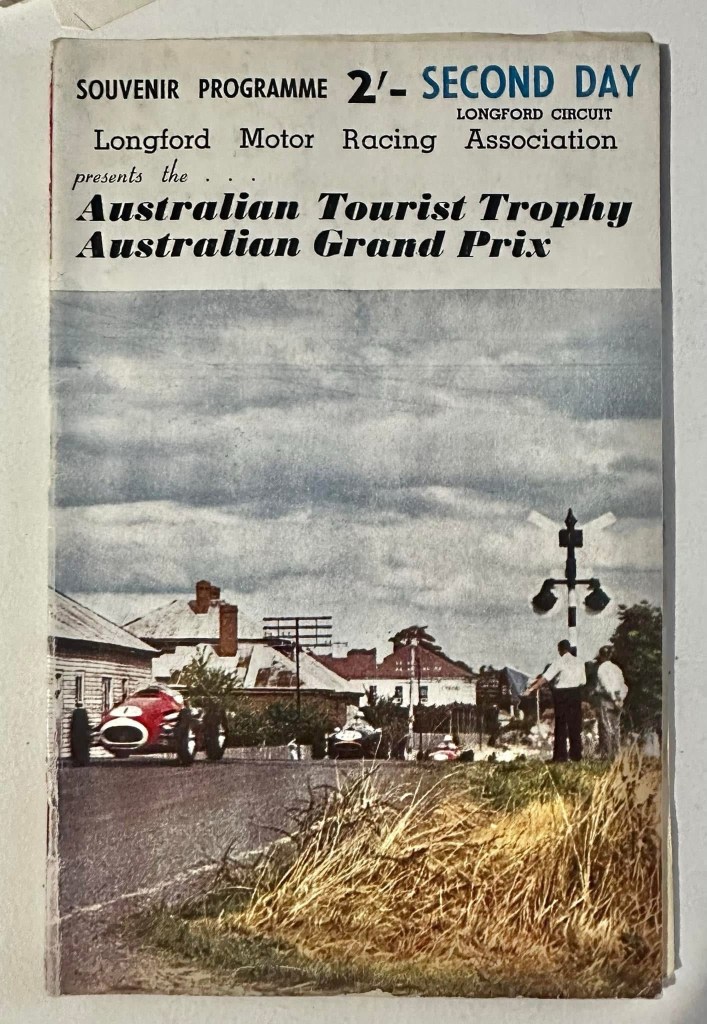
1959 Longford AGP program cover. The ATT was a motorcycle event(s) (A Lamont)
While Len Lukey missed out on that ‘59 AGP win, the Melbourne proprietor of the substantial Lukey Mufflers business took a great Gold Star win in a long championship of twelve rounds. He only won two of them but was a consistent front runner and point scorer throughout. Jones and Bill Patterson won two rounds, and Alec Mildren three, taking this pace into 1960, winning the title in a locally developed Cooper T51 Maserati.
Kiwi Ross Jensen’s Maserati 250F Bathurst 100 March 30, 1959 win was the last Gold Star victory for a front-engined car.
(A Lamont Collection)
Etcetera…
(B Young Collection)
So near to Australian Grand Prix wins in 1954, 1955, 1957 – he took the chequered flat that Caversham day – and 1958, it must have been an immensely satisfying moment for the 1954 New Zealand Grand Prix winner and reigning Australian Gold Star champion, Stan Jones, to take the chequered flag at super demanding Longford.
(unattributed)
Otto Stone and Stan exchange congratulations in the Longford paddock. It wasn’t just the superb car preparation of racer/engineer Stone that made the difference to Jones’s results in 1958-59, it was a little bit more of a percentage play in his driving as well.
Otto was no slouch behind the wheel, there seems little doubt that he was able to communicate with Stan as a peer ‘to bring the thing home’. And yes, I’m not forgetting that (Repco’s) Charlie Dean was a good steerer too.
Jones only won two of the nine Gold Star rounds to win the title in 1958 but he had enough consistency to win a championship he richly deserved, let’s not forget Otto’s role in that regard…
Key Team: Jones, Jones with obscured Otto Stone behind Alan and John Sawyer at right (The Northern Courier)(A Lamont Collection)
Super rare colour shot of the 1959 AGP dice between Jones and Lukey on the cover of the 1960 Longford program.
(G Dutton)
Gay Dutton’s tribute to Stan’s great victory.
Credits…
The much used and abused money-Longford-shot was taken by Charles Rice, here courtesy of Paul Cross’ collection, Bob Young Collection, Lindsay Ross’ oldracephotos.com, Andrew ‘Slim’ Lamont Collection, Gay Dutton, The Northern Courier
Tailpiece…
(oldracephotos.com)
‘Don’t even think about it Stanley!’ muses Len Lukey as Jones shoves his nose into a rapidly diminishing gap. What a shot! The money-shot used on the cover of Neil Kearney’s excellent book actually…
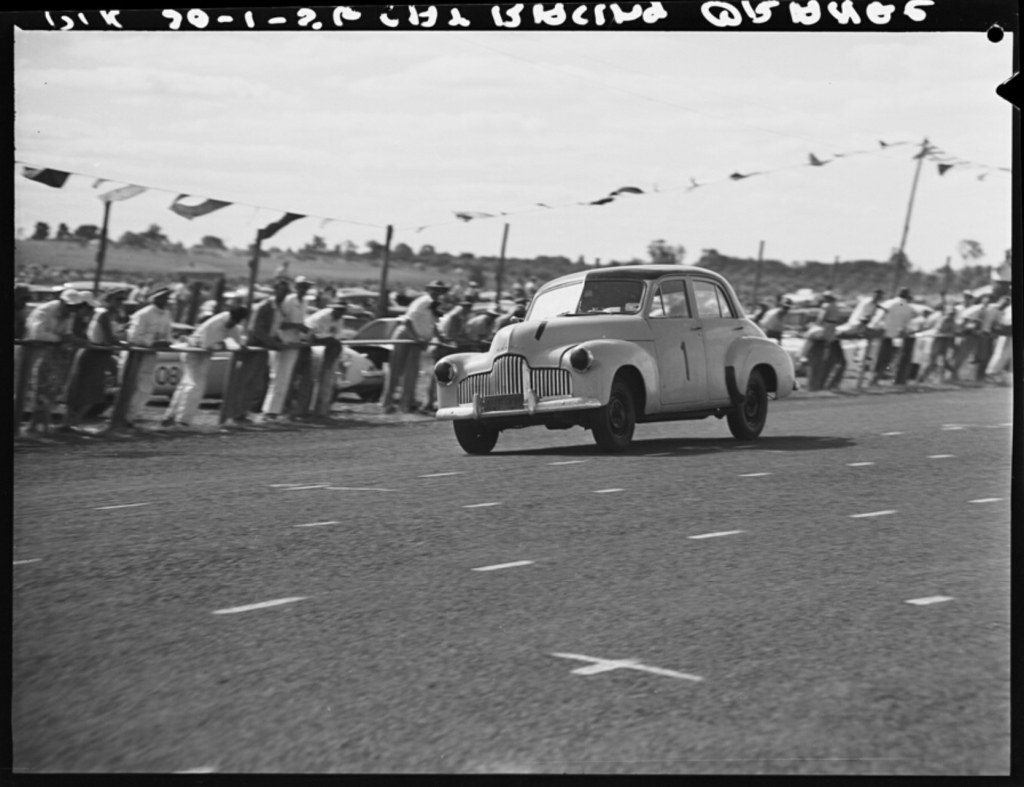
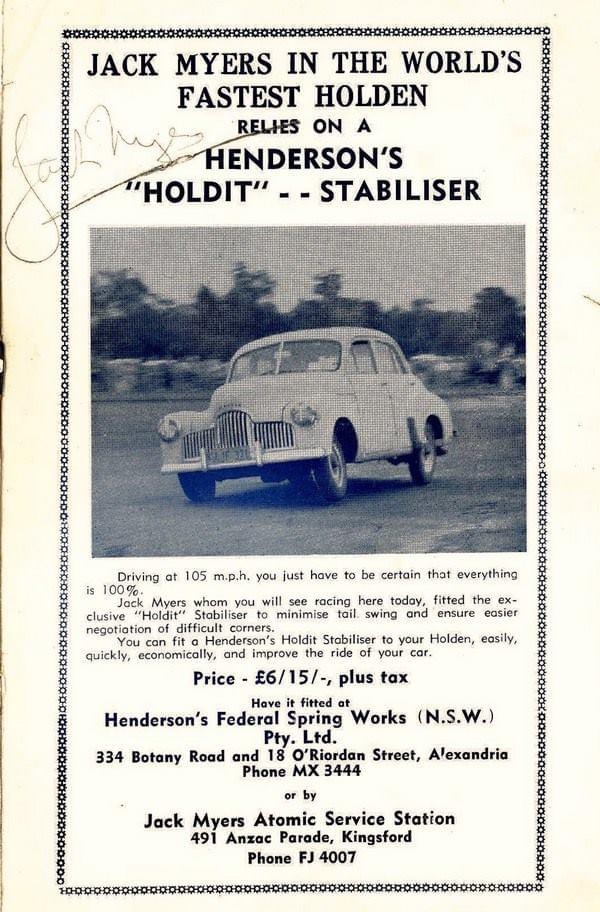
Jack Myers may well have been the very first Holden Hero, but if not he was certainly an early bird in the very long line of touring car champs to race General Motors Holdens’ products.
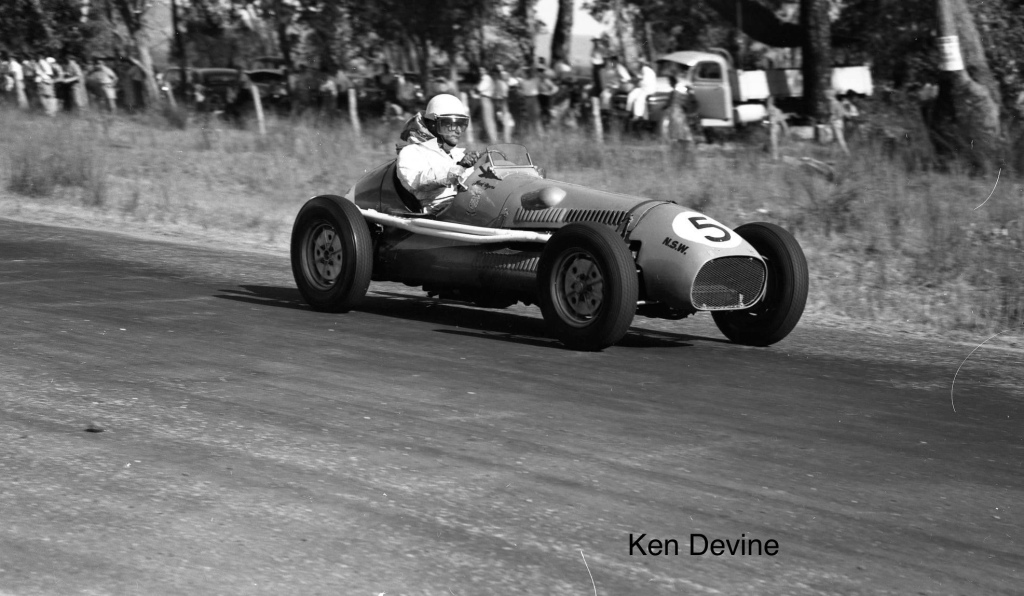
Here he is in front of the pack aboard his very quick, self modified 48-215 during a South Pacific Trophy support race at Gnoo Blas, Orange in January 1956.
Hard chargers both, Stan Jones and Jack Myers at Mount Panorama during the October 1960 Craven A International weekend (C Lynch-SLNSW)(B Williamson Collection)Myers at Bathurst in 1958
The Kingsford, NSW racer/mechanic/engineer/retailer was up to his armpits in Holden 48-215s from early on, racing a 110mph cream Humpy from 1953.
Myers soon offered 100 mph Holden motoring to all for £130. His kit involved boring your block to 3 3/16 inches, new pistons and rings, a shaved-head, re-ground cam, 12 inner valve-springs, an additional Stromberg carb, Myers inlet manifold and extractors, sports air-cleaners and a Lukey muffler. Seems as-cheap-as-chips!
Bathurst’s first ‘Production Car Race’ was held in October 1950; the first Holden entered at Mount Panorama was R Isackson’s Uni Motors car during the Easter 1951 meeting, but he didn’t start the race. The first Holden finisher on this holiest of racing turf was the 48-215 driven by R Mitchell who was fifth in a six lap sedan handicap in 1954. He was timed at 91mph down Conrod.
Fittingly, the first Mount Panorama Holden winner was Jack. John Medley anointed him “the Holden wonder-man of the mid-1950s, his black-roofed yellow car going progressively more quickly over the years.” 109.9mph down Conrod during the Easter 1956 weekend to be precise. He took that win in a six lap handicap in October 1955, the following year he was back in one of the swiftest Greys of all.
Myers aboard the Cooper T20 Holden during the 1957 AGP at Caversham. DNF in the race won by the Lex Davison/Bill Patterson Ferrari 500/625Aboard the more advanced, spaceframe chassis, but still Cooper derived, WM Holden Special on Pit Straight during practice for the the Craven-A International at Bathurst in October 1960. DNS in the race won by Jack Brabham’s Cooper T51 Climax 2.5 FPF
After campaigning the winning Holden far and wide: Mount Druitt, Gnoo Blas, Mount Panorama, Strathpine, Lowood, Fishermans Bend and Port Wakefield, Myers was up for the next challenge.
He bought Stan Coffey’s, rolled Cooper T20 (#CB-1-52) single-seater and repaired it at his Anzac Parade ‘shop. Then, together with Merv Waggott, he built and progressively developed the big-daddy of early Holden engined racers, the 2.4-litre DOHC Waggott-Holden WM Holden.
Stirling Moss was so fascinated by this home-grown application of technology to a Cooper type he knew so well, he did some demonstration laps in it at Sydney’s Cumberland Speedway whilst in Oz for the November 1956 AGP at Albert Park. Jack was twelfth at the Park and first Australian car home.
Myers was typical of so many Holden Heroes from the 1950s to 1970s, he serviced them for customers, modified them, made and sold hot-bits and raced them.
Myers Holden 48-215 at Mount Druitt, Sydney in the early 1950s.
Sitting up in the breeze! Myers, Cooper T20 Waggott-Holden, at Caversham, AGP 1957
Myers in the form-up area, or dummy-grid depending upon your religion, Craven-A International meeting at Mount Panorama in October 1960. That’s Austin Miller’s Cooper T51 at left.
While early on in his ownership of the ex-Stan Coffey Cooper T20, the car was rightly called a Cooper, but as Jack crashed and rebuilt the car/developed it, the machine became more Myers than Cooper, and fitted with that extraordinary twin-cam six fitted, more Waggott-Myers than Cooper!
Note the disc brakes above, albeit the front suspension still looks kosher-Cooper T20, the stylised Jack Myers brandmark in a neat touch. Myers didn’t start the car in the feature won by Jack Brabham’s Cooper T51 Climax.
Brabham was present at Bathurst for the first time since 1955, 6,000 people turned up for practice to see the twice World Champ. Unfortunately, as John Medley wrote, “Jack Myers crashed the newly disc-braked WM Cooper on top of the mountain, bending the chassis and destroying the suspension. There would be no overnight (or any) rebuilds this time. The motor was sold, the remains of the car sold separately, Myers borrowed the little Dalro Reno to run at this meeting, and would then turn his attention to his little hillclimb special – the ex-Saywell/Reynolds Mark IV Cooper with his Triumph ‘twin-twin’ engine.”
Tragically, Jack died at the wheel of the Cooper Triumph at Catalina Park, Katoomba on January 21, 1962 (7/1/18-21/1/62). The WM Holden was ultimately restored and lives at the National Motor Museum, Birdwood Mill campus, in the Adelaide Hills.
Myers – famous for racing in these horizontally hooped T-shirts – and crew in the Mount Panorama paddock, Easter 1959. Bonus points for crew-members names folks? That is a Cooper alloy wheel.
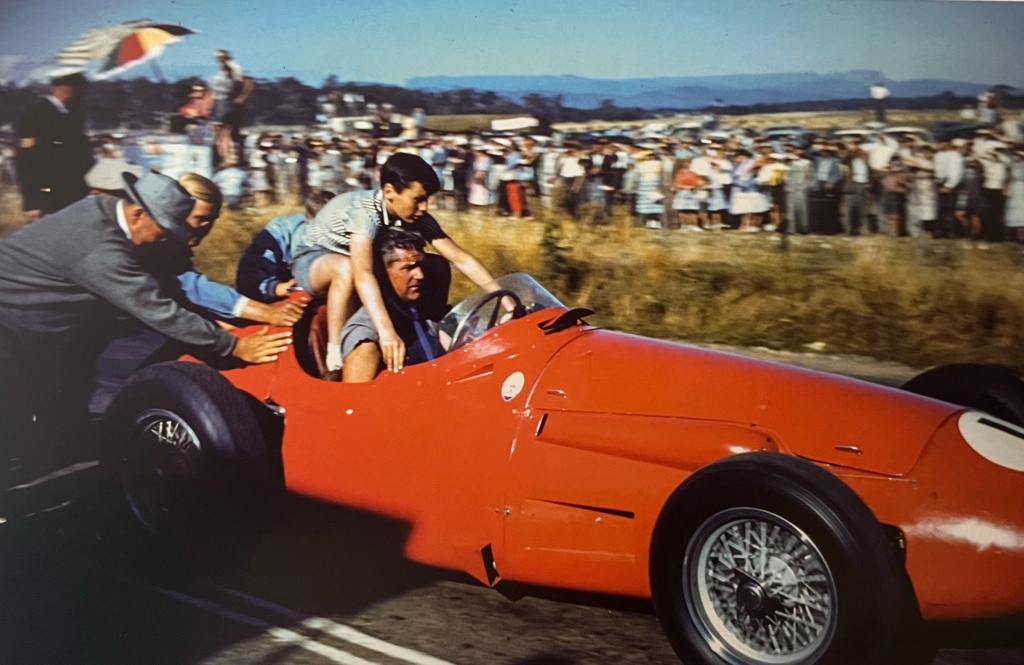
The boys push start that Waggott-Holden twin-cam six into life before the start of the 1959 Bathurst 100 on March 31. Stan Jones’ Maserati 250F is in the middle and race victor Ross Jensen’s 250F on pole at right. All the fun of the fair, look at that crowd! Jack was an excellent fourth behind Jensen, Len Lukey, Cooper T45 Climax, and Arnold Glass, Maserati 250F.
Stan is in the early stages of his best season and a bit ever, he was the reigning Gold Star Champion (1958) and at this stage of the year had won the Australian Grand Prix at Longford a month before. Jensen was seriously quick, he ran the Maserati at Bathurst in ’58, but failed to finish the 100, and finish the job he did a year later in convincing style!
WM Holden in the pits at Gnoo Blas, and again at the start of a race below, in February 1960. The ex-Whiteford Talbot-Lago T26C #110007 was raced by Barry Collerson.
While it is true that the WM-Holden was the sexiest and quickest Holden-powered racing car of the period, the most successful was Tom Hawkes’ Cooper T23 Repco-Holden (below). Chassis #CB/Mk2/1/53) was no less a car than the ex-Jack Brabham Redex Special – a Bristol 2-litre six cylinder powered T23 – albeit continuously evolved by Hawkes after Jack sold the car (to Stan Jones then on to Hawkes) when he left for Europe in early 1955. Its Repco Hi-Power crossflow headed engine was far less exotic than Merv’s twinc, but was more reliable.
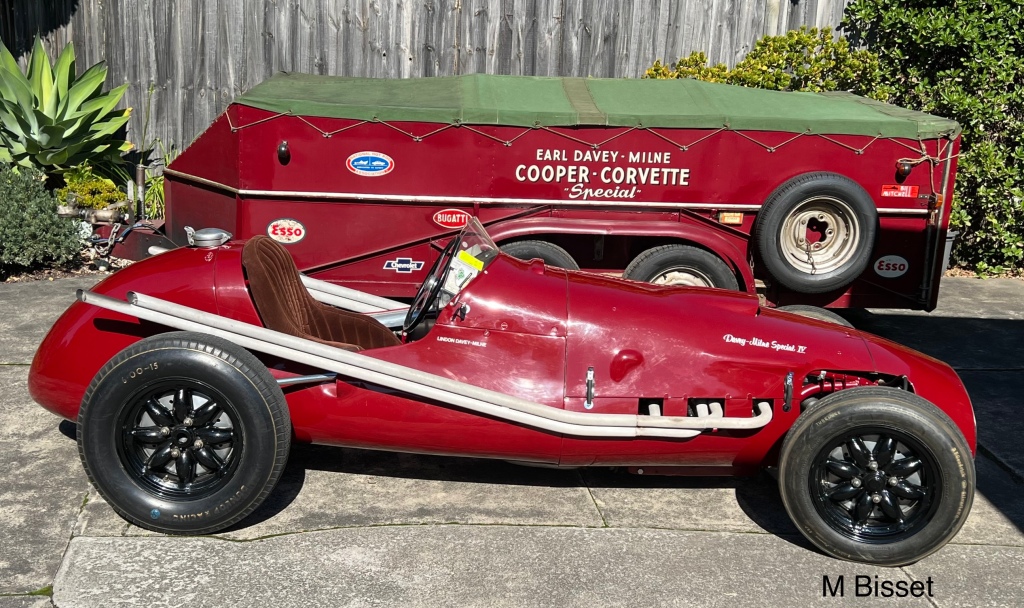
Very late in its in-period competitive life the T23 was fitted with a Chev 283cid V8, a task commenced by Tom Hawkes and Murray Rainey, and finished by Earl Davey-Milne. It’s still owned by the Davey-Milnes and is shown below last week. Mighty fine it is too…
(C Lynch-SLNSW)
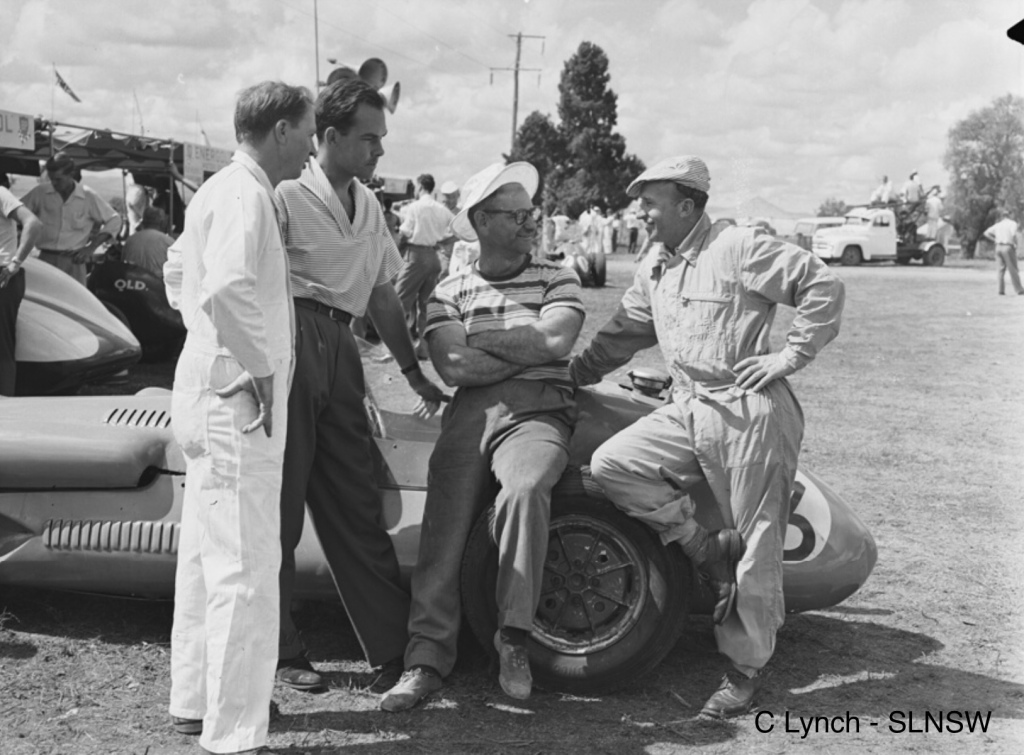
Back where we started, Gnoo Blas in 1956, how did Jack do in the touring car races that weekend, and who is at the wheel of in that little VW Beetle 1200!?
Credits…
Cec Lynch-Pix-State Library of New South Wales, Bob Williamson Collection, Les Mortimer, David Medley, Ken Devine, Kelsey Collection, Kaleda Family Collection, National Archives of Australia, ‘Bathurst:Cradle of Australian Motor Racing’ John Medley
Tailpieces…
(Lynch/SLNSW)
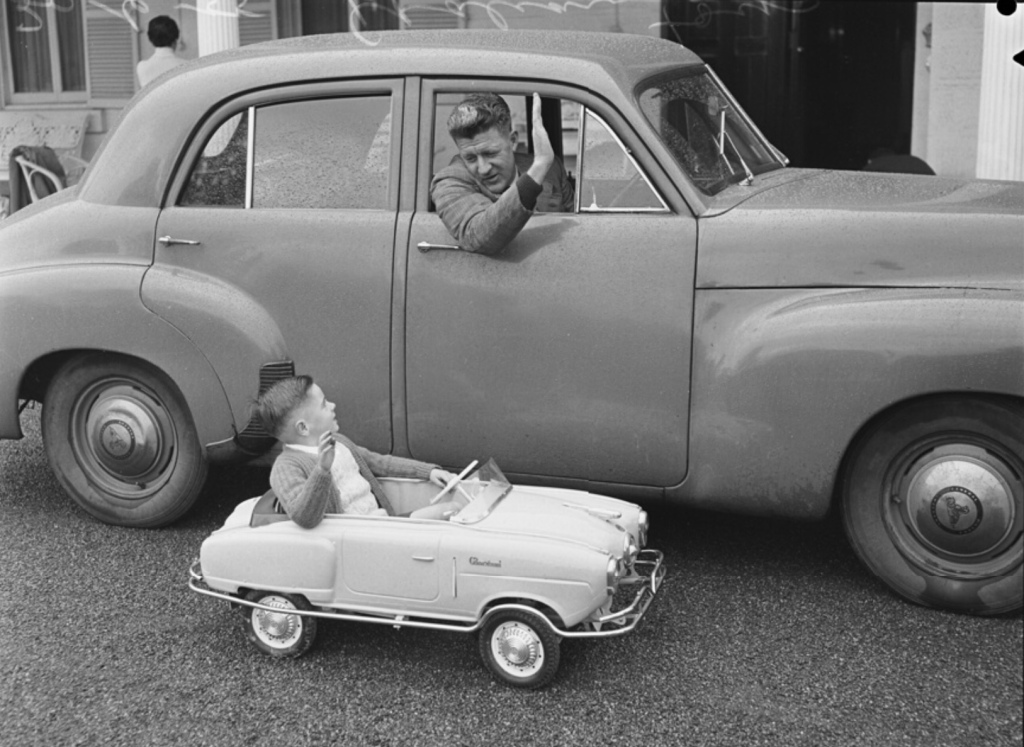
“Don’t even think about it kid, my 48-215 has been worked over by Jack Myers, you don’t have a chance!”
This shot is from a Pix puff-piece in 1955 promoting Italian toy cars for David Jones, a national department store chain. The little dude appears to be a handy-mechanic and would be 80’ish now. Chassis number and make of EV unknown…
I was flicking through some images and came upon a few photographs of Leo and Pete Geoghegan the other day, intriguingly, they were all shots taken in 1973. A good reason for a quickie article.
Leo initially raced the first ANF2 Birrana, the 272 Hart-Ford 416B 1.6, in 1972. By 1973 he raced a works-car to the Australian Formula 2 Championship in the 273 shown above. He won six of the seven rounds, then doubled up and won again aboard a 274 in 1974 against much stronger opposition. More about the 272 here: https://primotipo.com/2019/02/01/this-is-hard-work/
Pete Geoghegan ahead of one of the Toranas in the final ATCC round of 1973 at Warwick Farm in July. He was third behind the Peter Brock and Bob Morris XU-1s (Auto Action)
Meanwhile, younger-brother, Pete was doing his thing as one of the country’s greatest exponents of touring cars. He ran a John Sheppard built Group C Chrysler Valiant Charger E49 in the Australian Touring Car Championship, then switched brands to co-drive a works XA Ford Falcon GT351 Coupe in the Bathurst round of the Australian Manufacturers Championship.
Pete was sixth in the ATCC, his bests, a second place at Surfers and a pair of thirds at Calder and Warwick Farm. Allan Moffat won the title in his XY Ford Falcon GTHO Phase 3 from Peter Brock, LJ Holden Torana GTR XU-1, and Graham ‘Tubby’ Ritter, Ford Escort twin-cam.
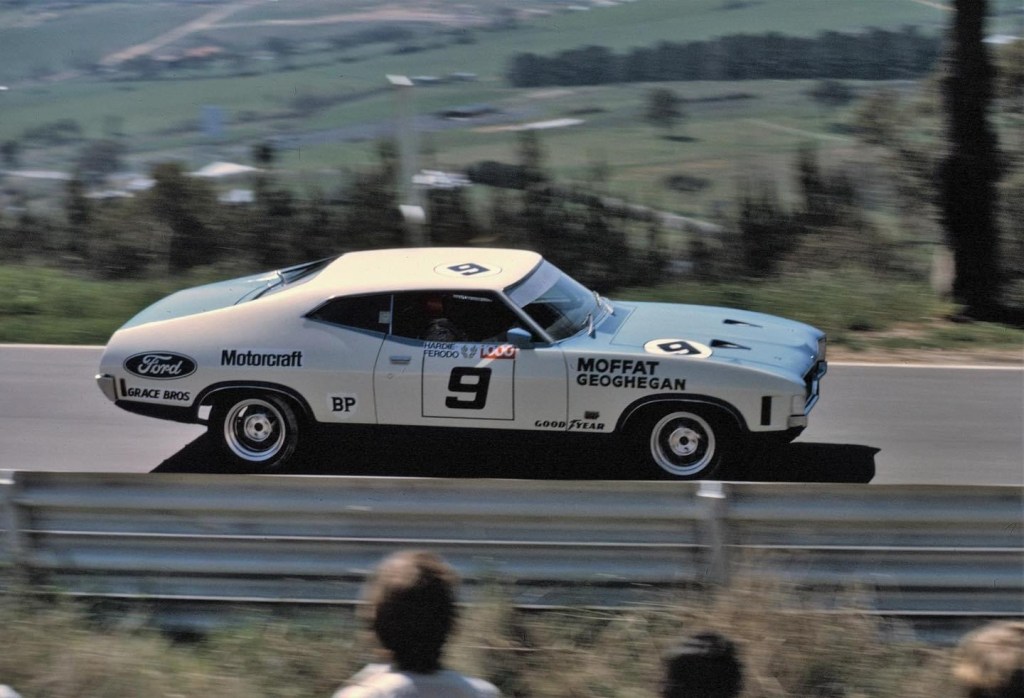
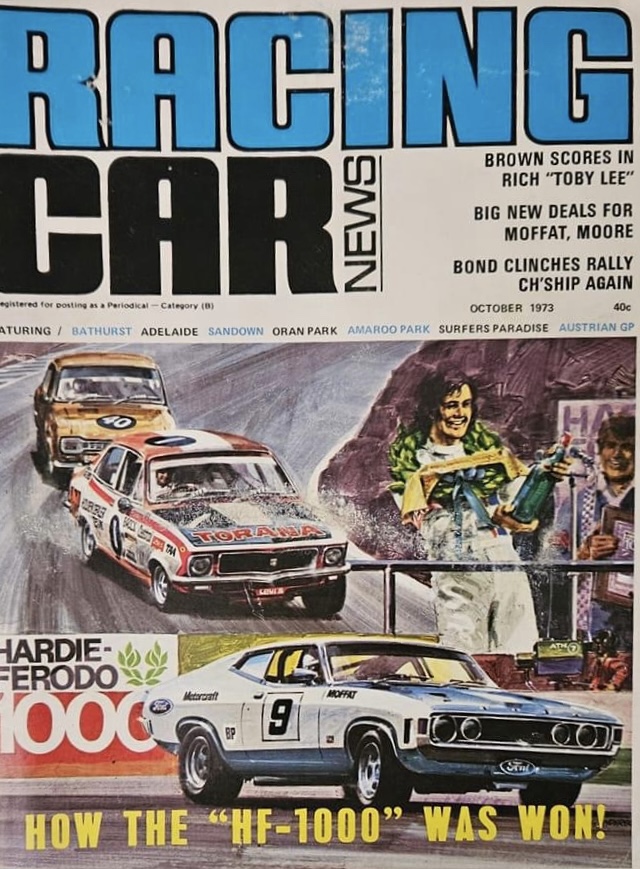
At Bathurst (below) Pete bagged an overdue 500-win for the brothers when he co-drove Moffat’s Coupe to a celebrated FoMoCo victory. Holden (Torana GTR XU-1) won the Manchamps with wins in three of the five rounds, Ford won two and were placed fourth in the title race, with Alfa Romeo (105 Series 2000 GTV) second and Mazda (Capella RX2) third.