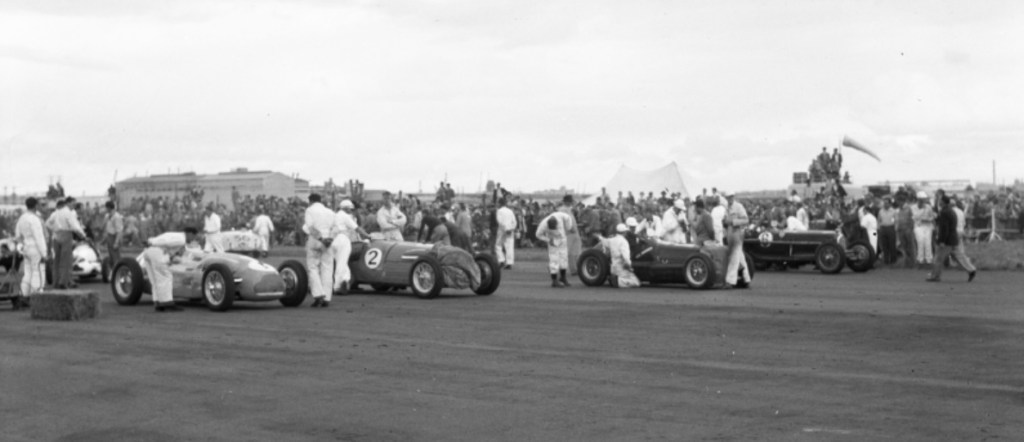
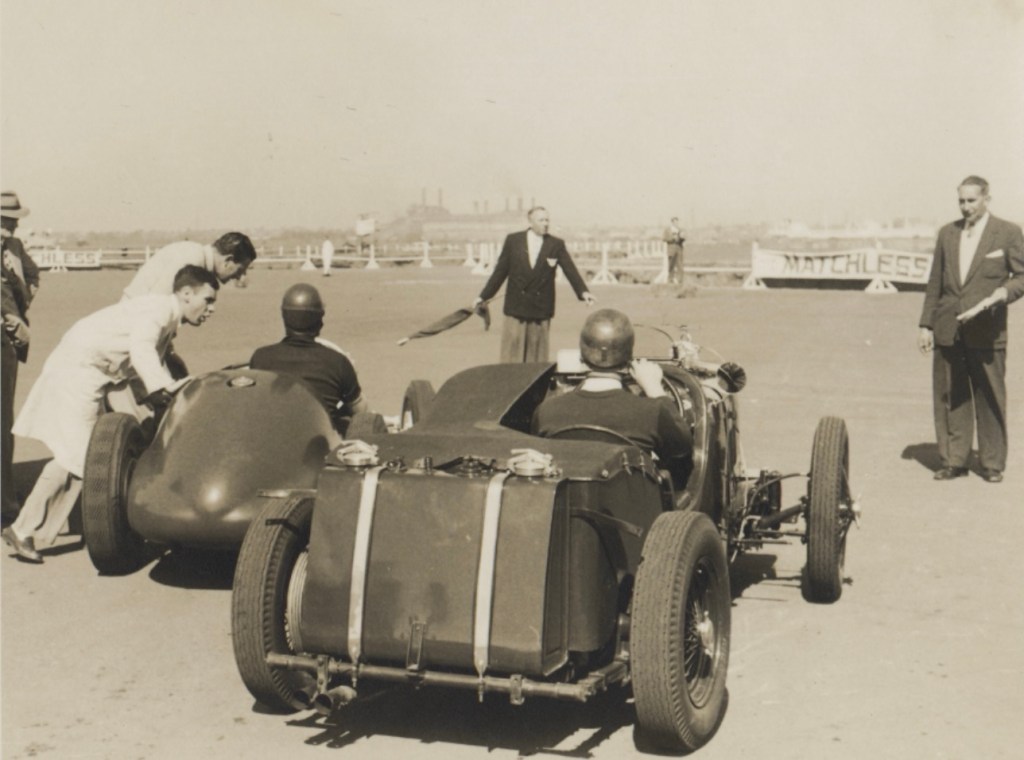
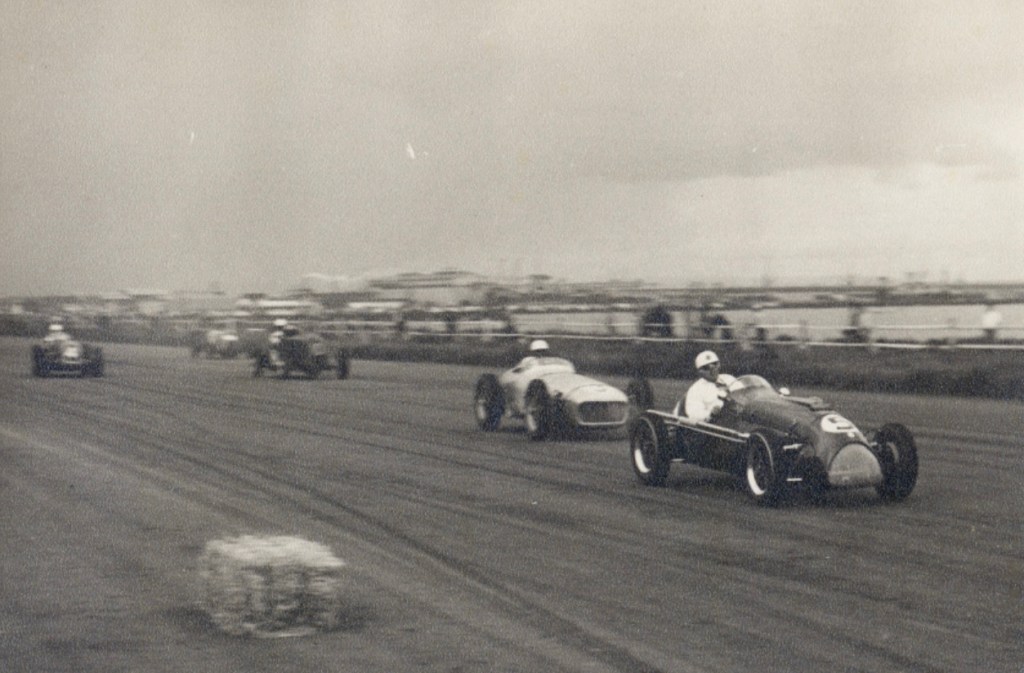
The front row of the Victorian Trophy grid at Fishermans Bend on Sunday, October 4, 1953 comprises, from the left, Doug Whiteford’s Talbot-Lago T26C, Stan Jones’ Maybach 1, Cec Warren, Maserati 4CL and Lex Davison, Alfa Romeo P3.
Tony Johns notes, ‘My program has Lex Davison’s HWM Jaguar scratched, so he raced his back-up Alfa Romeo. Doug Whiteford retired the Talbot-Lago with broken gears in the transfer box. Stan Jones won the race with Davison second and George Pearse, Cooper Mk4 Vincent third.’
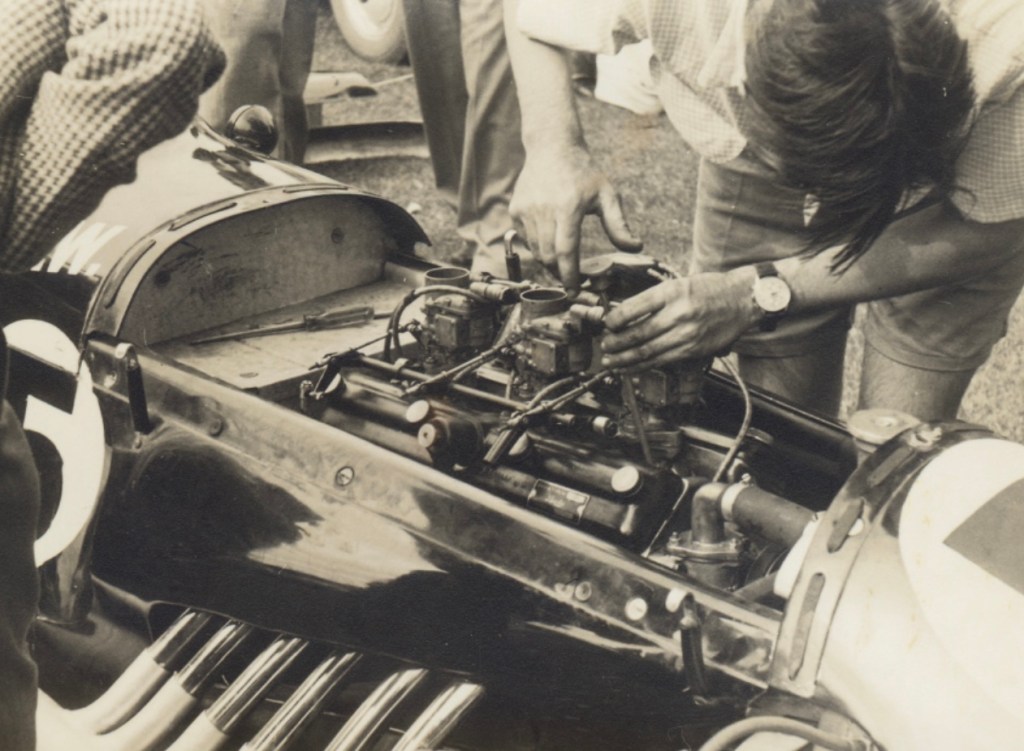
‘Reg Nutt driving Jack Day’s Talbot Darracq TD700 sheared the blower drive and for Sunday and fitted a TC manifold and carburettors.’ Wow!
(L Sims Archive)
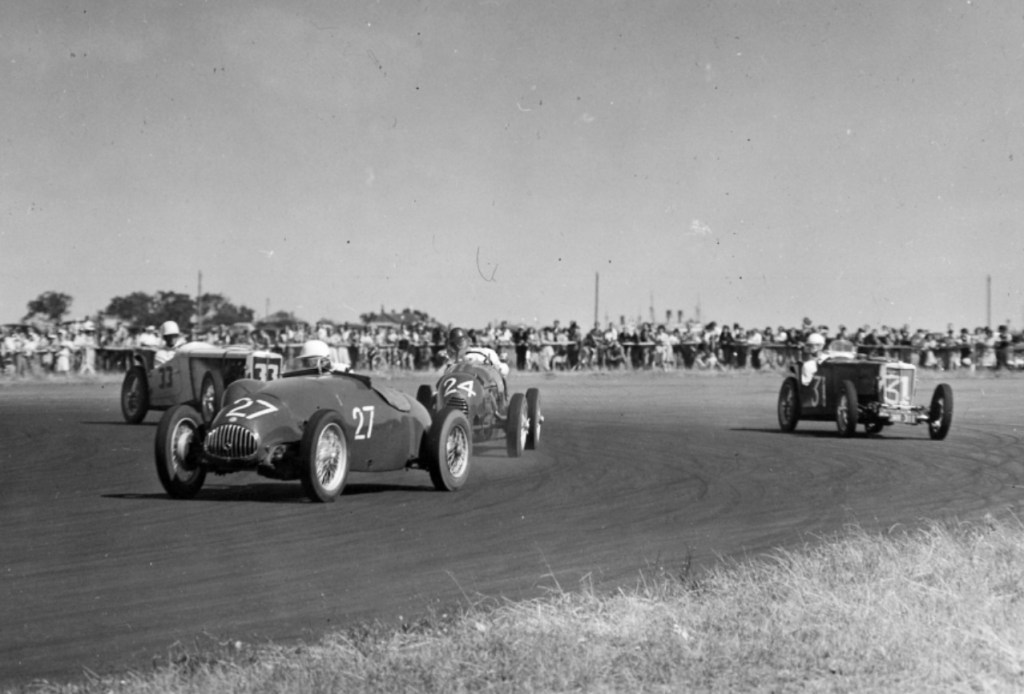
Didn’t Stan jump outta the box! Whiteford at left, then George Pearse, Cooper Mk4 Vincent and then the distinctive, upright-stance of #14 the ex-Sinclair The Spook Alta 21S Ford with Ted Gray up.
While the Victorian Trophy was a scratch race, there was also a handicap section won by Silvio Massola’s HRG from Davison and Jones.
While researching 1953 I thought I’d make a similar determination but there seems to be only three potential qualifying rounds that year: the Australian Grand Prix held at Albert Park won by Doug Whiteford’s Talbot-Lago T26C on November 21, the Victorian Trophy on October 4, and the 100-mile New South Wales Grand Prix held at Gnoo Blas on October 5. Jack Robinson won the handicap race in his Jaguar XK120 Special while the ‘Grand Prix title (the scratch section of the race) was awarded to Jack Brabham’s Cooper T23 Bristol (below) who had set the fastest race time.’
You will appreciate the degree of difficulty for a competitor in contesting races in Orange and Melbourne on consecutive days.
Jack Robinson, Jaguar XK120 Special, Bathurst, October 1955 (I Arnold)Jack Brabham, Cooper T23 Bristol, NSW GP, Gnoo Blas 1953 (Wikipedia)
The Australian Sporting Car Club – hitherto the Bathurst promoter – organised that first race at Gnoo Blas as the ASCC was ‘splitting asunder’ and its relationships with the City of Bathurst and the local police were so poisonous that Bathurst’s blue-riband Easter and October long-weekends of racing – probable Gold Star rounds – didn’t take place in 1953. The ASCC couldn’t get a permit, whereas the Auto-Cycle Union did, running a two day Easter ‘bike meeting.
Those of you with John Medley’s Bathurst Bible should read chapter 17, it’s interesting to be reminded of the sequence of events that saw the Australian Racing Drivers Club take over from the ASCC as the promoter of car racing at Mount Panorama.
So, given all those circumstances, it doesn’t seem appropriate to calculate a ’53 Gold Star Faux Division winner…The historians amongst you may know that the 1978 and 1979 Gold Stars were held over three rounds, while the 1981 affair was contested over only two; all three were in F5000’s dying days. In 1987, the Gold Star was a one-race gig, so I have precedent on my side, but I’ll leave it alone, I think. One race and ‘two other rounds’, which were effectively mutually exclusive, seems as lame as the one race 1987 championship. The perfect world in 1953 would have been for Whiteford, Jones, and Brabham to have faced off in all three races, I would have had a couple of pounds on Dicer Doug coming out on top….
Doug Whiteford and Talbot-Lago T26C take the plaudits of the Albert Park crowd after winning the 1953 Australian Grand Prix, his third such victory (The Age)
Credits…
Arthur Gordon Fraser-State Library of Victoria, Tony Johns, Leon Sims Archive, Ian Arnold, Wikipedia, The Age
The old Holden Special Vehicles one-two in Adelaide, Larry Perkins from Denny Hulme, Holden VL Commodore SS Group A SVs, touring car support race during the 1988 Australian Grand Prix carnival.
It was the first for Tom Walkinshaw’s nascent marque, but far from the last! One of most unfortunate aspects of Peter Brock’s cataclysmic act of corporate suicide with General Motors Holden was that the jewel in the crown, Holden’s performance vehicles arm, was delivered into Johnny Foreigner’s hands. Tom Walkinshaw’s hands.
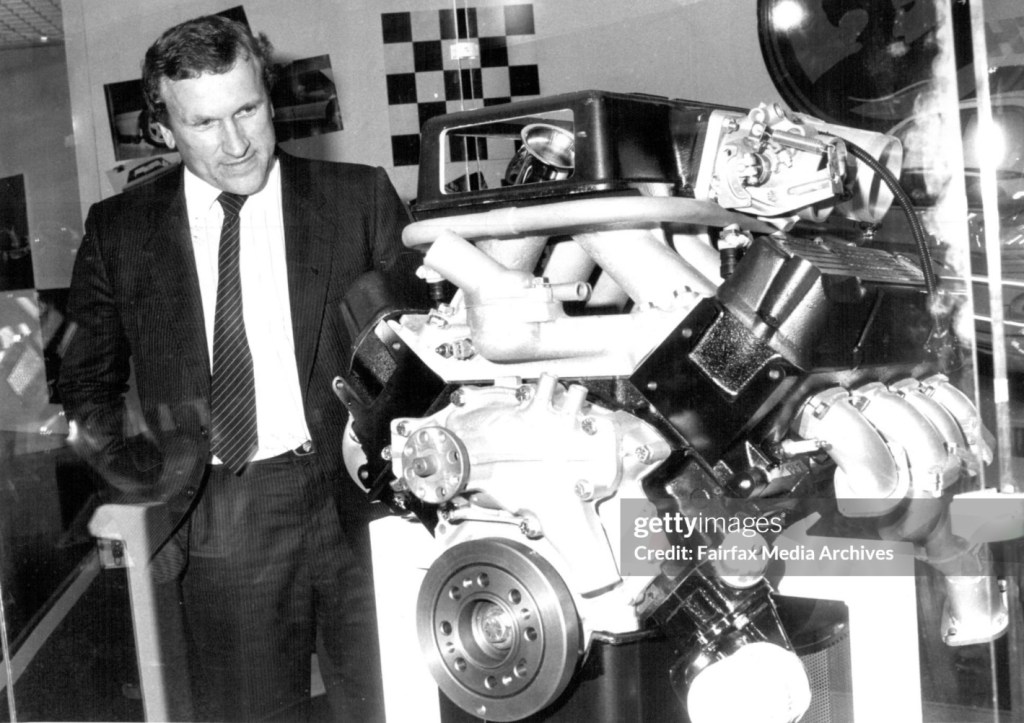
Walkinshaw with Holden VL 5-litre V8, this Sydney Motor Show photo is dated October 16, 1987
The Great Scot seized the opportunity with both hands and with strong local management led by John Crennan made a motza…and built some great cars.
The great Peter Stevens designed the car to an aerodynamic brief sketched by Walkinshaw on a Regent Hotel, Melbourne napkin. The sketch was done in Crennan’s presence, who nearly had kittens when he considered the task of selling such a visually challenging car, however effective the aerodynamics on track undoubtedly were.
Steven’s design sketch of the HSV VL was done as a freelancer engaged by TWR (Peter Stevens Design)Larry Perkins, John Harvey, John Lindell and John Crennan with the 500th VLSS destined for Tom Walkinshaw. Yes, Holden people, some of the fibreglass bits weren’t fitted at the owner’s request (Perkins Engineering)(LAT)
Tom Walkinshaw in the Holden VL Commodore SS, he shared with Jeff Allam, to 15th place in the September 4, 1988 RAC Tourist Trophy ETCC round, won by the Andy Rouse/Alain Ferte RS500
The cars were effective on track…and hard to sell! HSV’s first model had to be memorable and it most certainly was however difficult it was for the whiteshoes to move.
While Stevens set about his task, Crennan briefed Australian corporate brand identity agency Flett, Henderson Arnold in Abbotsford, Melbourne to develop the HSV logo and a brand manual that encompassed all uses of the brandmark across the cars, signage, letterhead, in-dealership, brochures and other corporate marketing material.
Richard Henderson led a small team which came up with a range of ideas, including the one Holden fans know and love…
I’d been an outside advisor to FHA, then Australia’s pre-eminent brand design and implementation outfit in the 1990s and 2000s – Telstra, BHP Billiton, Orica, Sydney Olympic and Paralympic Games, Crown Casino were all our designs – and joined FHA as a shareholder/CEO just in time to be invited to HSV’s 1988 Bathurst junket. A weekend on the slops to start a 13-year adventure had to be a good sign.
HSV entertainment didn’t extend to hot and cold running blondes at that stage, it was very much ham and cheese sarnies and a beer in a modest tent. It was so hands-on that Crennan himself drove the ‘Kombi’ full of freeloaders to Bathurst Airport after the event. It’s all a bit hazy actually…
The TWR car raced by Uncle Tom and Jeff Allam (below) was a bit of a shitter, Q8 and DNF rear axle after only five laps. Larry’s run was a lot better, Q8 and running second in the race including giving his boss, Walkinshaw a session, but on lap 137 he pitted with engine problems. That TWR built car won Bathurst in Win Percy and Allan Grice’s hands in 1990.
Etcetera…
John Fenner Dandenong Plant Manager, Perkins, Harvey, Crennan, perhaps, Mick Finn HSV National Parts & Accessories Manager, and John Lindell on July 18, 1988 (Perkins Engineering)
Cause for celebration, completion of the build of the 500th VL SS at GM’s Dandenong factory on July 18, 1988, the end of the run. Not quite actually, they later built another 250. Why was that if they really sold so poorly?
(Auto Action)
Larry during the Wellington 500, NZ 1988, he was second with Denny Hulme behind the winning Roberto Ravaglia/Emmanuele Pirro BMW M3 Evo. FHA’s race livery looks pretty good…
(Perkins Engineering)
Perkins and Part. Larry and Neill ‘Part’ Burns, legendary engine builder in 1988. That Holden cast iron, pushrod, two-valve, fuel-injected, circa 480bhp, 4987cc V8. The car weighed about 1325kg, discs front and rear, of course, it had 11×17 inch wheels front and rear, the whole lot hit the road via a Getrag 5-speed ‘box.
(S Dalton Collection)(S Dalton Collection)(S Dalton Collection)
Many thanks to Stephen Dalton for this September 1988 Holden Motor Sport bulletin.
Finish as we started, Larry in front in Adelaide in 1988. Maybe the HSV VL SS wasn’t the prettiest roadie but it was one helluva good looking racing car!
(Adelaide Grand Prix)
Credits…
Getty Images, Peter Stevens Design, daviddowsey.com, Perkins Engineering, Motorsport Images, Auto Action, Adelaide Grand Prix, Stephen Dalton Collection
Tailpiece…
(MotorSport)
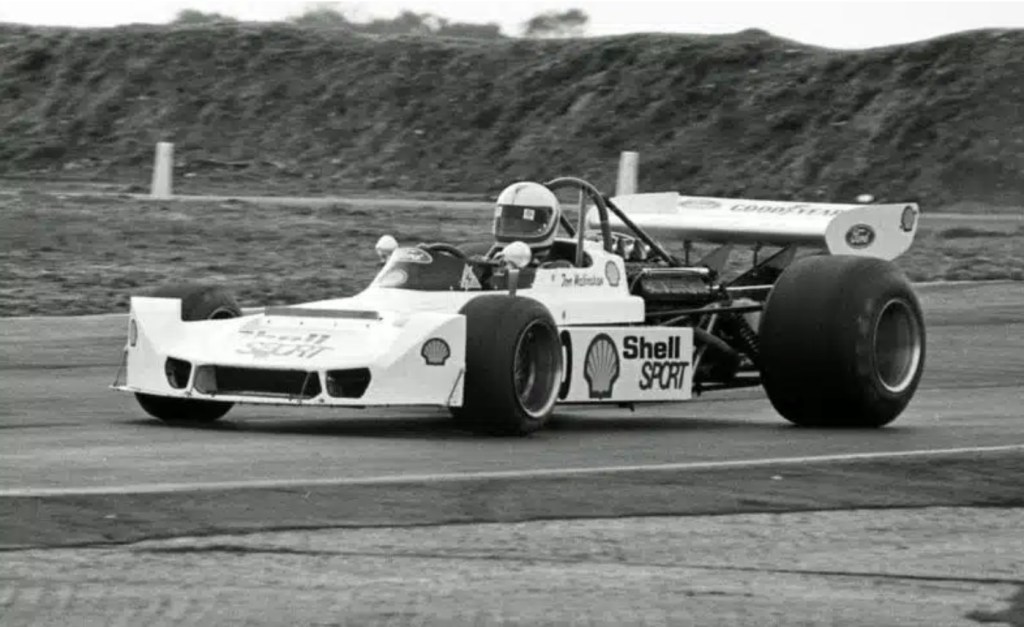
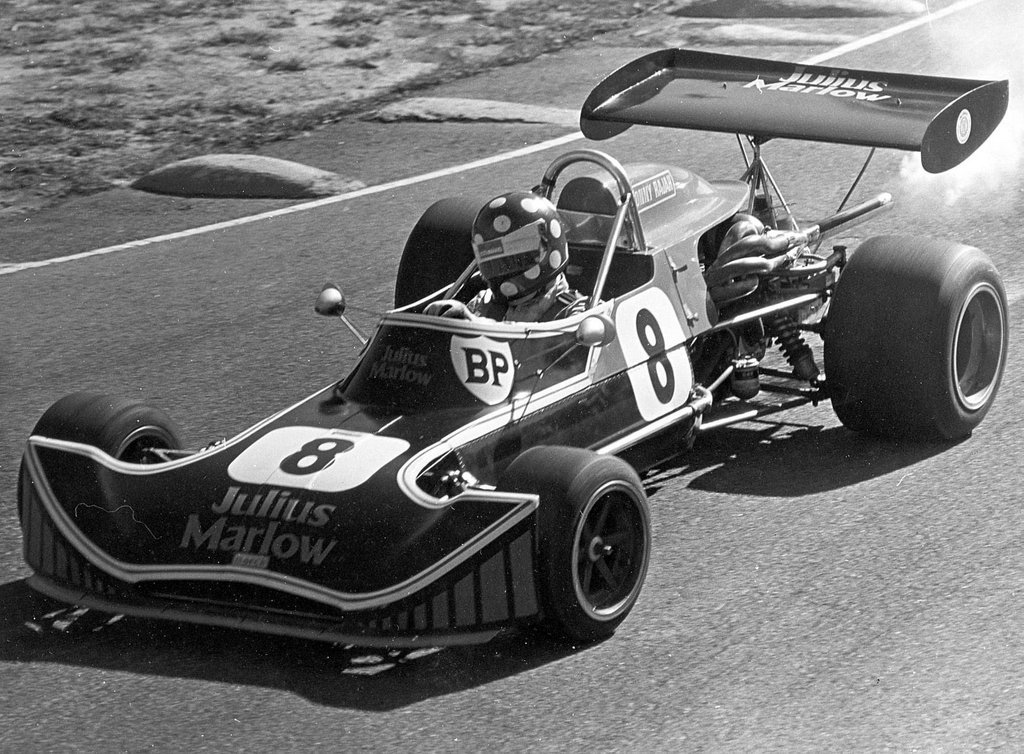
It’s easy to forget, given his subsequent touring car success, that Tom cut his teeth in single-seaters. Here in the October 6, 1974 British F5000 championship at Snetterton. Q8 and DNF oil pump in this Modus M5 Ford-Cosworth GAA 3.4-litre V6.
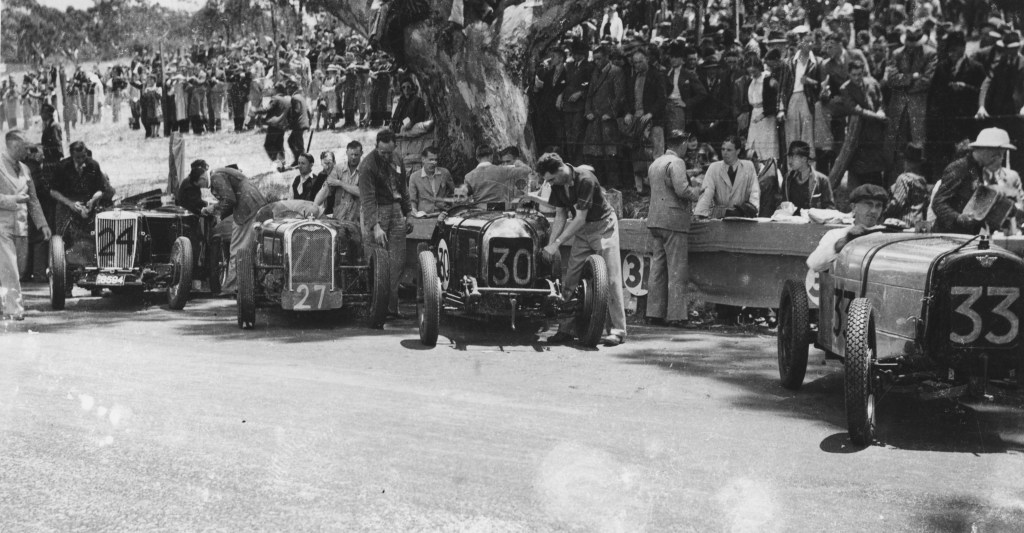
Colin Anderson and riding mechanic at Hell Bend on the Victor Harbor-Port Elliott road circuit during the Australian Grand Prix-South Australian Centenary Grand Prix held on December 26, 1936.
The pair are racing the Morris Special owned by Alf Barrett, one of Australia’s greatest racing drivers. He was a star of the immediate pre and post-war period aboard an Alfa Romeo 8C2300 Monza he raced from 1939. The car behind Anderson is George Martin’s AC 16/80.
Barrett entered three cars that Christmas 1936 weekend: a Lombard AL3 acquired from Jack Day in late 1935 for himself, an MG P-Type for Bryant & May family member Tim Joshua, and the Morris for another friend, Colin Anderson a principal of still respected Toorak based, multi-office real estate agency RT Edgar.
Alf retired the 1.2-litre Lombard after the supercharger pop-off valve blew off and could not be found despite a half-hour search! Colin Anderson wasn’t classified in the 1.5-litre Morris with overheating problems and a spin, but Tim Joshua had better luck. He was second in the P-Type behind the similar car driven by the winner, Les Murphy. Joshua led the race for some laps before a seven minute stop for unidentified maladies.
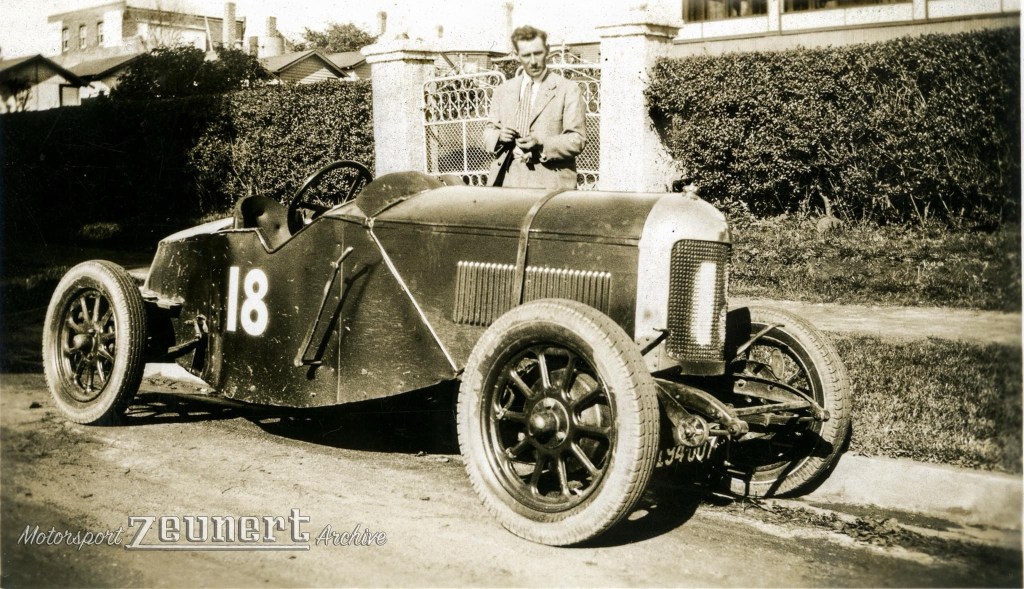
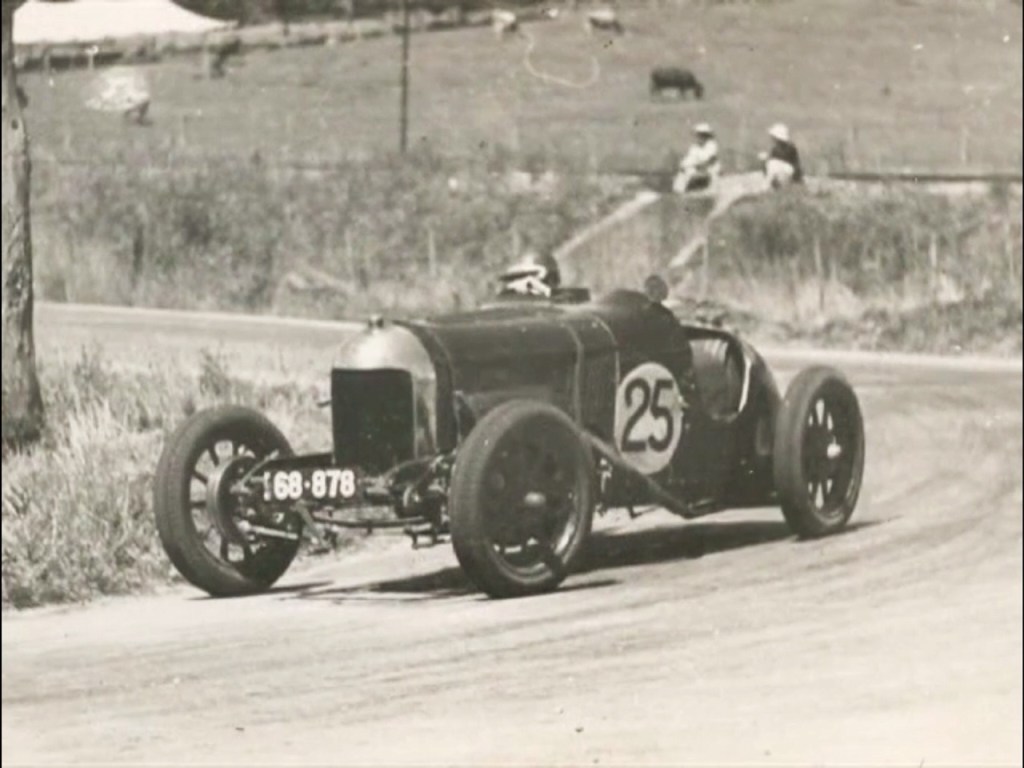
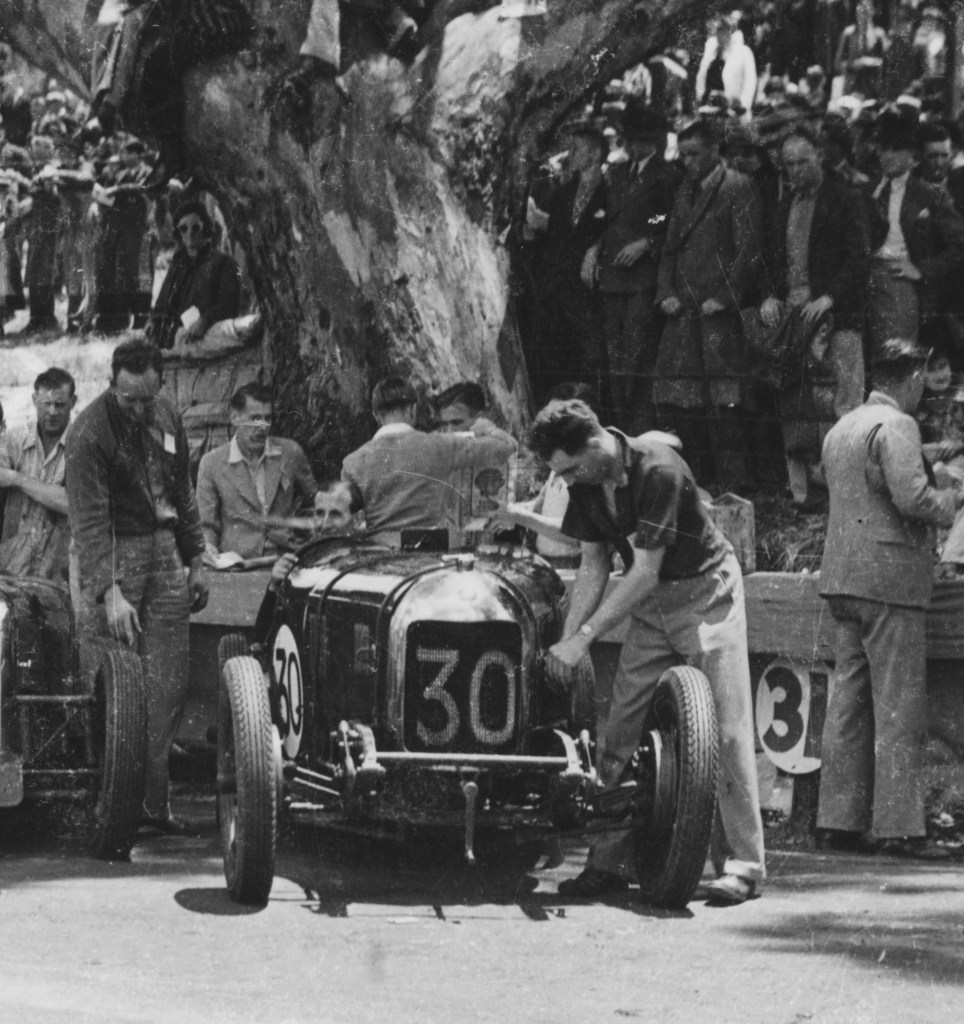
Alf Barrett alongside his Morris Special early in its life circa 1933, perhaps outside the family home in Armadale. Note the differences in bodywork and chassis undercut mentioned below (D Zeunert Collection)Barrett aboard his Morris at Kayannie Corner Lobethal during the January 3, 1938 South Australian GP weekend. Alf raced the Morris only once at Lobethal and used #30 in the race. Perhaps this is an early practice shot while still running a number used in a previous meeting, the Victorian rego plates were removed by raceday too (N Howard)
Barrett was born in 1909 to a wealthy family who made their fortune in malt. Today Barrett Burston Malting is part of the publicly listed United Malt Group Ltd. He grew up in Armadale in Melbourne’s inner-east and started messing around with petrol engined devices with his brother Gib (Julian) in the large grounds of their home.
Not far away, a young man destined to become a master-mechanic, preparing cars for Barrett, Tony Gaze and Lex Davison amongst others, Alan Ashton, was serving his time as an apprentice at AF Hollins Motor Engineers in High Street.
The three youngsters met and were soon messing around with cars and bikes which they tested at Aspendale Speedway.
Alf, Gib and Alan built their first racing car out of a Morris Cowley in 1933, initially hillclimbing the purposeful, attractive biposto. It was competitive in the handicap race events of the day too, winning the Light Car Club of Australia’s Winter 100 from 14 other competitors at Phillip Island in June 1935.
While the Lombard was the Morris’ successor, Alf had lots of trouble with it. John Medley wrote that ‘Pretty though it was, it was a nightmare for Barrett, a later owner discovering water jackets filled with bronze to heal unimaginable horrors. Never reliable , it was later re-engined with Vauxhall power.’
Amidst entries in the Lombard, he raced it in the Easter 1938 AGP at Bathurst won by Peter Whitehead’s ERA B-Type, Barrett continued to race the Morris which proved its pace with a great second place among much heavier metal in the 150 mile March 1937 Phillip Island Trophy.
Barrett, at Lobethal before the start of the January 3, 1938 South Australian Grand Prix (N Howard)Tony Ohlmeyer, MG T-Spl, Jim Boughton Morgan 4-4, Barrett’s Morris Cowley Spl and Ron Uffindell’s Austin 7 Spl
He also raced the Morris in the 100 mile January 3, 1938 South Australian Grand Prix at Lobethal, but DNF in the handicap race won by Noel Campbell’s Singer Bantam from Colin Dunne’s MG K3 and Tony Ohlmeyer’s MG T-Type.
He also contested the 148 mile Interstate Grand Prix/Albury Grand Prix at Wirlinga near Albury that March. Alf was pretty handy behind the wheel, he was quite spectacular in the long suffering Morrie at Wirlinga despite the side-valve machine having a top speed of no more than 90mph, but again he failed to finish.
Barrett at Wirlinga in March 1938, the event was variously called the Interstate Grand Prix and Albury Grand Prix, the programme says the latter. Jack Phillips and Ted Parsons, local Wangaratta boys won in their Ford V8 Special (L Egan)
Little is known about the mechanical specifications of the car, but Stephen Hands wrote that ‘For many years Graeme Steinfort (a Melbourne lawyer/racer/restorer/historian had the block from Alf’s car. It had several interesting modifications, one was to reduce the reciprocating mass in the valvegear. Alf had cut away half the mushroom head of the cam-follower to leave only a bit directly over the cam lobe. It was prevented from rotating by a small block of metal screwed onto the block.’
‘Alf later modified the body somewhat, the photos show the dropped down radiator and cutaway body for more elbow-room. Some of the photos clearly show that Alf dropped the chassis under the rear axle. It would be interesting to see photos without the bodywork to illustrate how he did it.’
John Medley noted that the Morris was destroyed in a bushfire with only the engine surviving. It seems to have been fitted with a Laystall steel crankshaft, and the engine was fitted to Geoff Russell’s Russell Morris Special.
(Mildenhalls)
Etcetera…
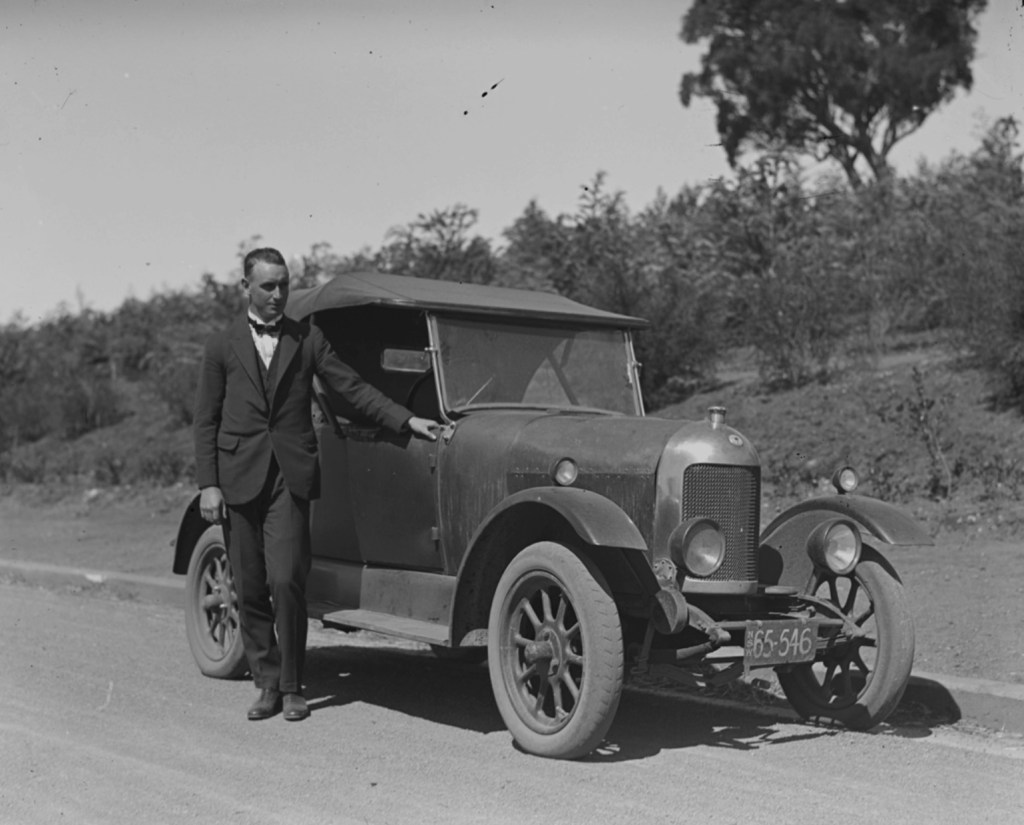
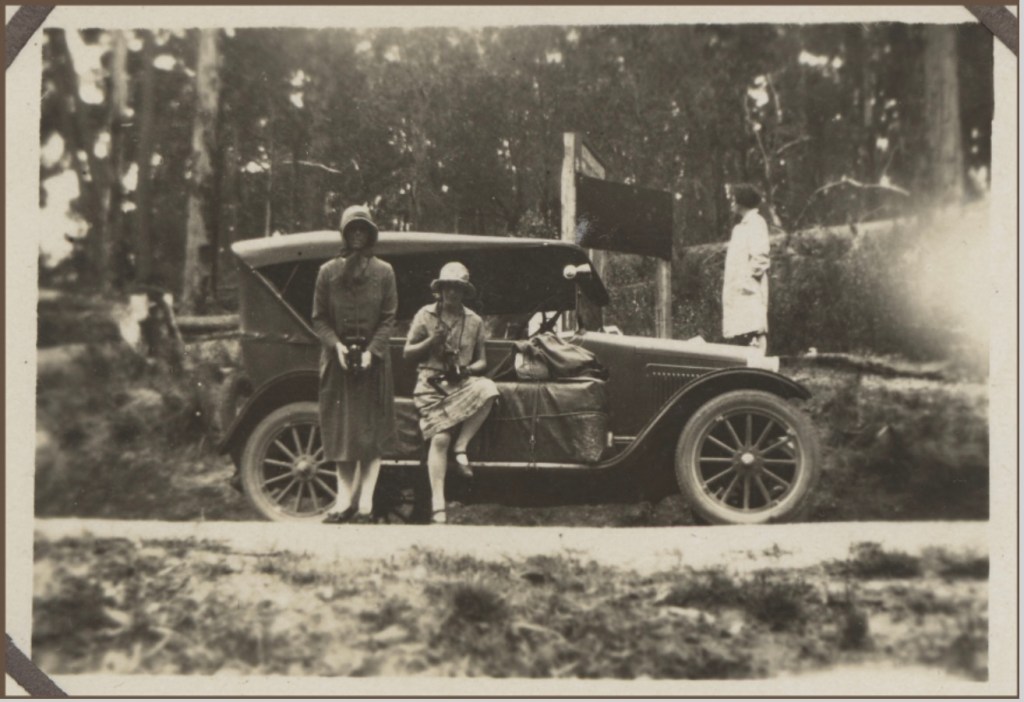
A Bullnose Morris Cowley with the proud owner in Canberra, date unknown. Ideal car for a public servant no doubt.
WR Morris, the Morris Company founder spent nearly a month in Australia in February/March 1928, accompanied by his chief designer, Mr Seaward, learning, Morris said ‘many things about tracks, clearance and other details that were required of the roads of Australia. It was up to him, when he returned to the old country, to do his best to supply the Britishers on this side of the water with what they required.’
Interestingly Morris said, ‘he could not leave Australia without saying he had never seen a better organised body works in the world than Holdens (then a body builder)’, which hw had seen in Adelaide that morning.
It’s easy to think of Morris as a marque that disappeared within the British Motor Corporation, but ‘the output of Morris products is approximately half the output of the whole of the British motor industry,’ The Register reported on April 2, 1927.
By November 1928 The Register reported that Morris products now embody many improvements as a result of WR Morris’ visit. Chief amongst these was enhanced pulling power of the new Morris Cowley engine, ‘in the past a second gear car for hill work but now having top-gear performance comparable with any four cylinder car on this market. Such improved performance and other engineering refinements makes the Cowley very desirable for country or city use.’ I wonder what Alf Barrett would have made of this lot!?
(Anderson Family Archive)
Credits…
Ron Blum Collection, Warwick Anderson, John Medley in ‘The Official 50 Race History of the Australian Grand Prix’, Norman Howard, Stephen Hands on Greg Smith’s Pre 1960 Historic Racing in Australasia Facebook page, David Zeunert Collection, Len Egan, Mildenhall’s Canberra, The Register March 7 and November 7, 1928.
My ignorance of what is right under my nose never ceases to amaze me.
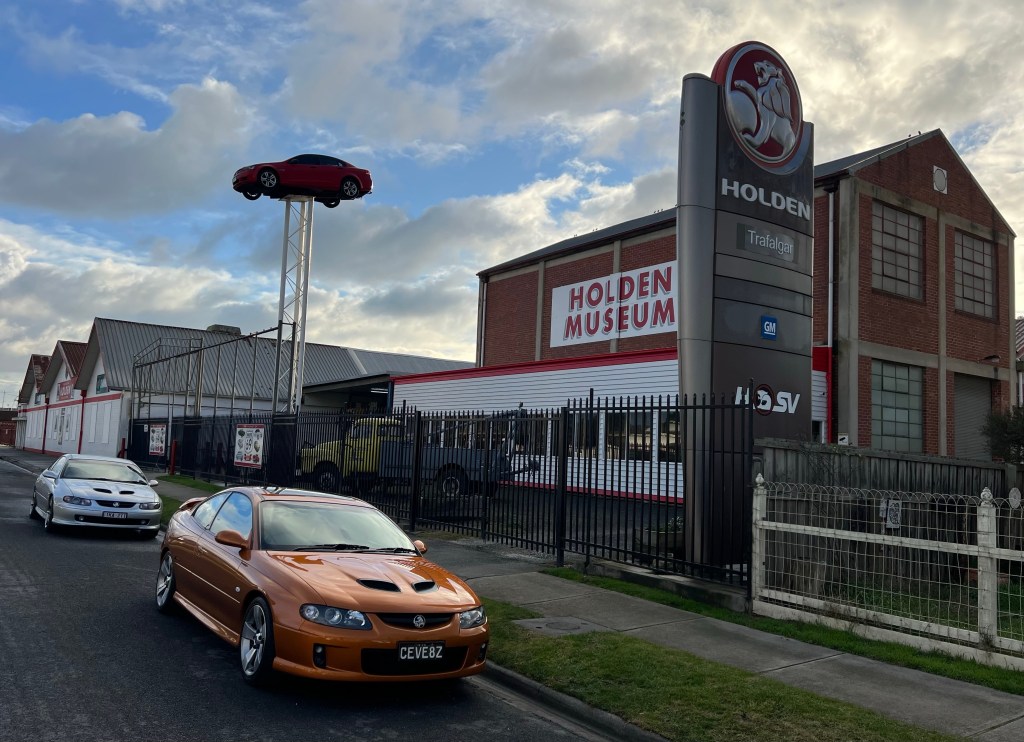
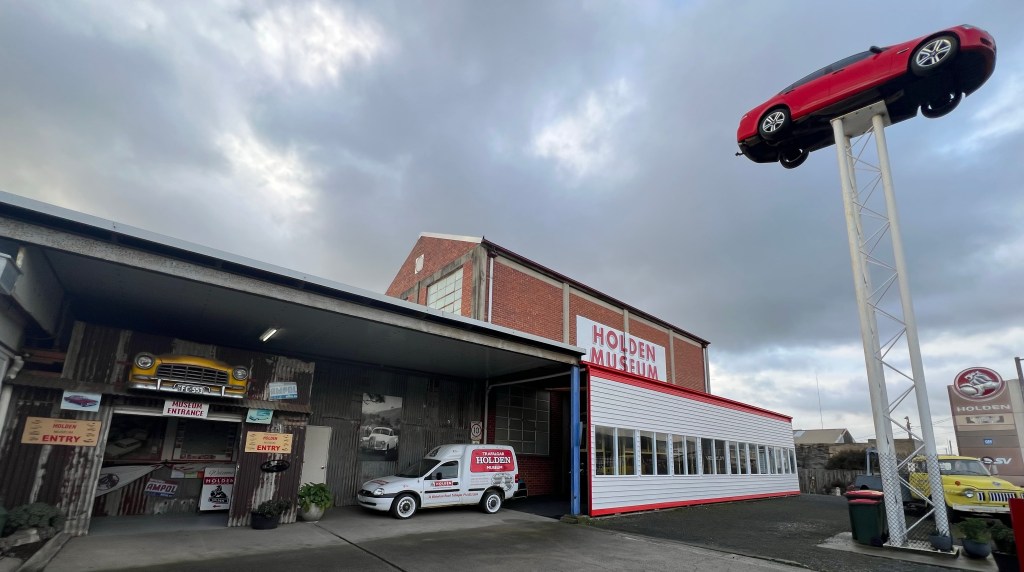
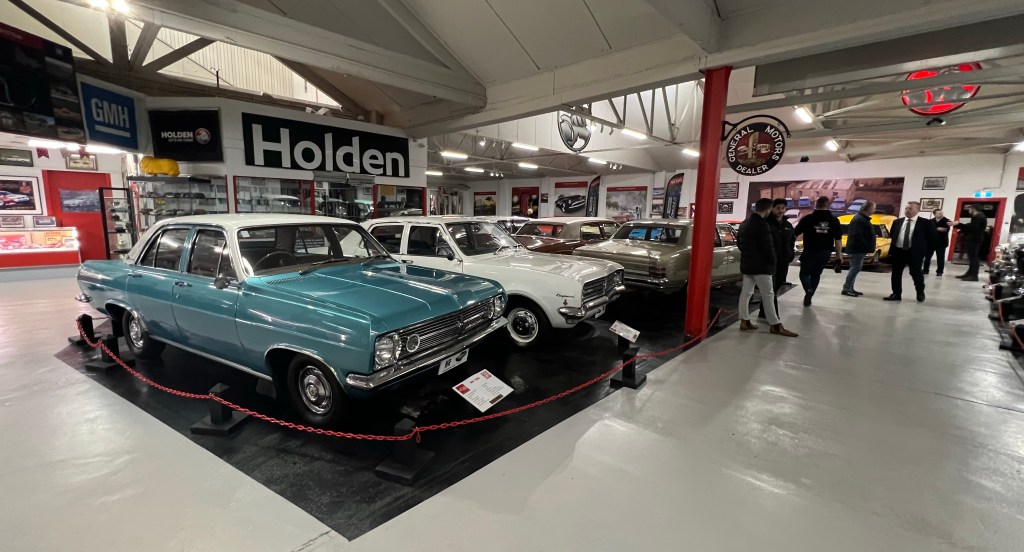
Despite the Trafalgar Holden Museum celebrating its tenth birthday in 2024, I was unaware of its existence until invited along to the official opening of the Neil Joiner Heritage Centre Building on the site of the old Trafalgar Butter factory, 74 Waterloo Road, 125 km north of Melbourne on the Princes Highway.
My invite was as Big Bad Brucie Williams’ bitch, publisher of Auto Action.
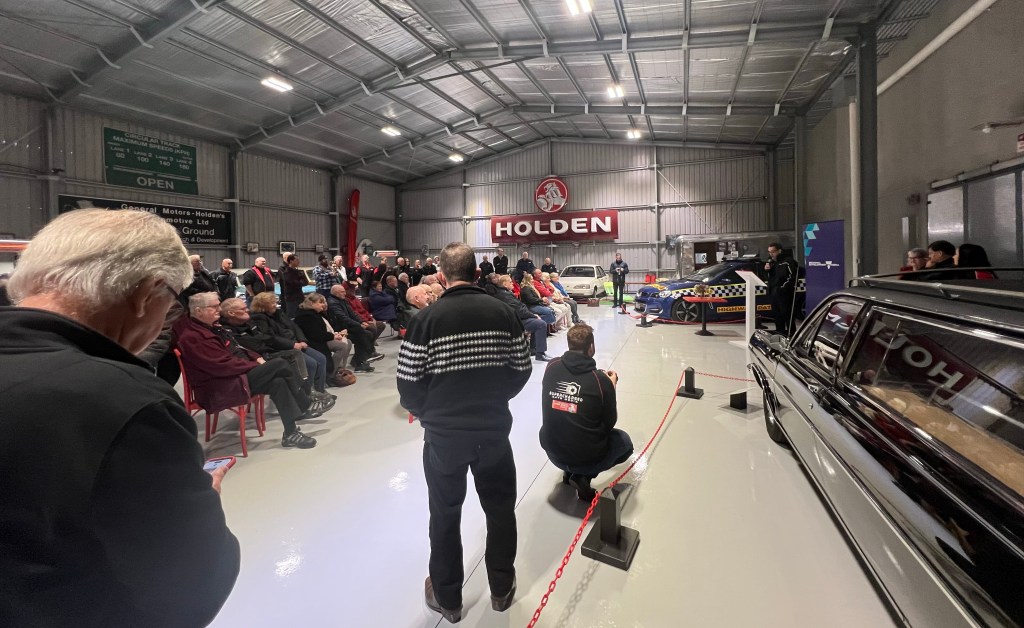
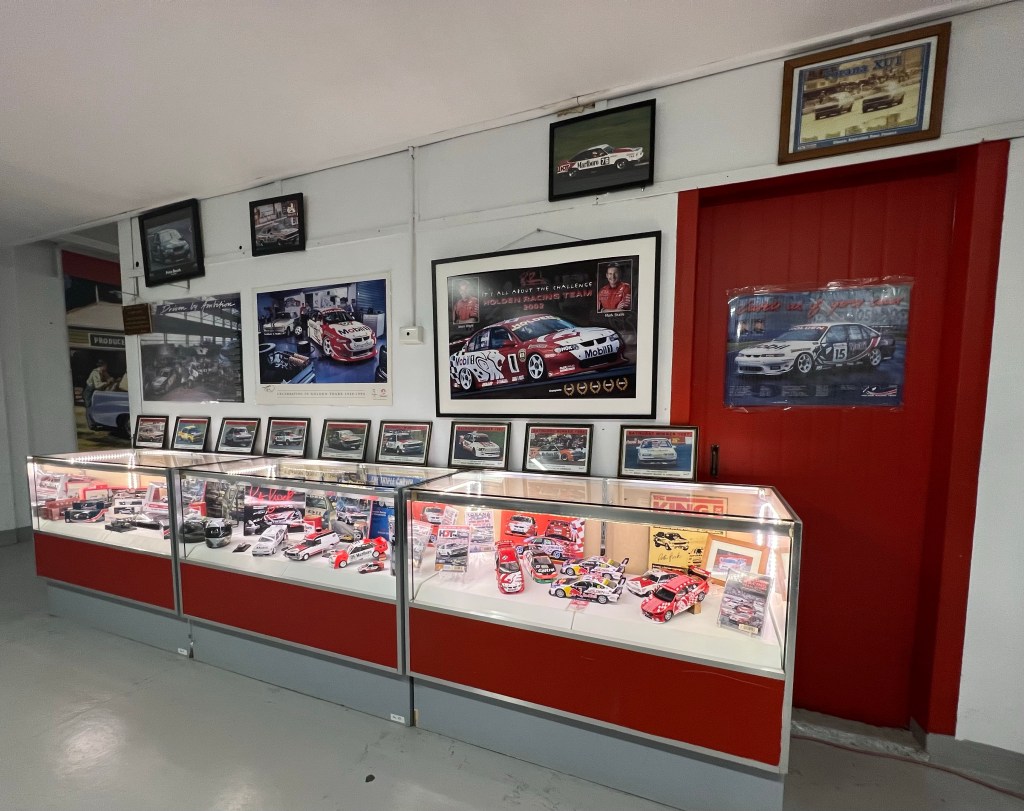
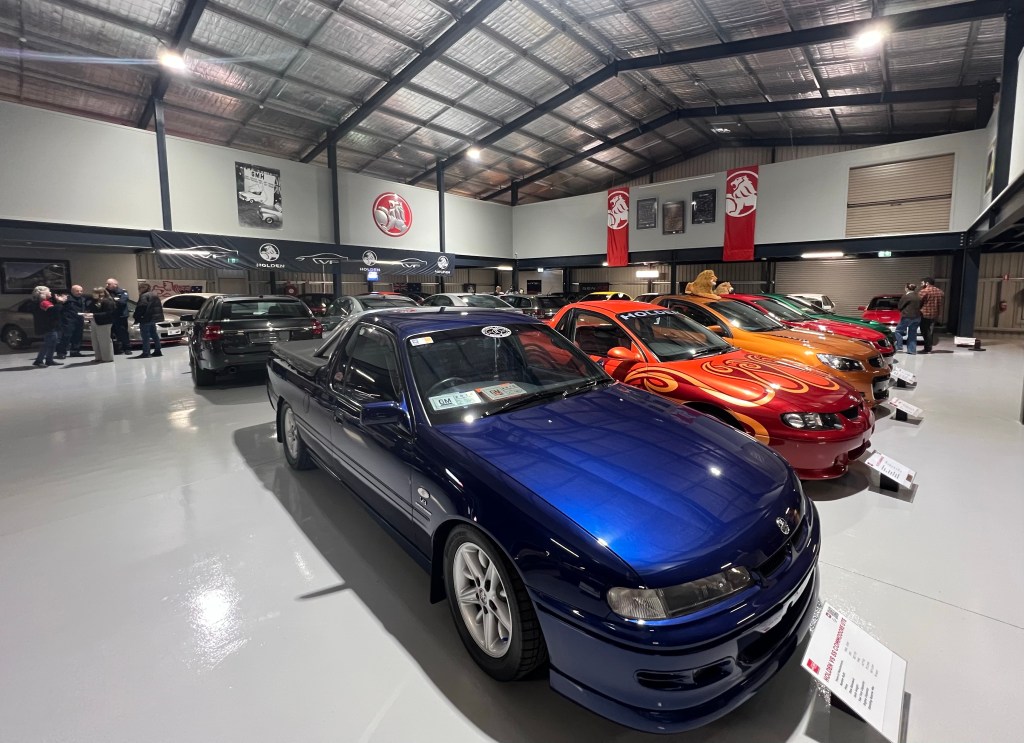
250 of the Holden party-faithful attended in a mix of old and new buildings, which house a collection of 150-200 Holdens and memorabilia. The ceremony was performed by the Victorian Minister for Tourism, Sport and Major Events, Steve Dimopoulos.
Dimopolous recognised and applauded the passion of Neil Joiner and his family, he told Auto Action that ‘It’s a magnificent facility, a really important part of Victoria’s industrial and automotive history. We were proud to provide $470,000 to assist in building a museum that will be good for the local economy.’
Local businessman Joiner, who died in 2024, was a dedicated Holden enthusiast who focused on transforming the old butter factory into a Holden museum after his retirement in 2007.
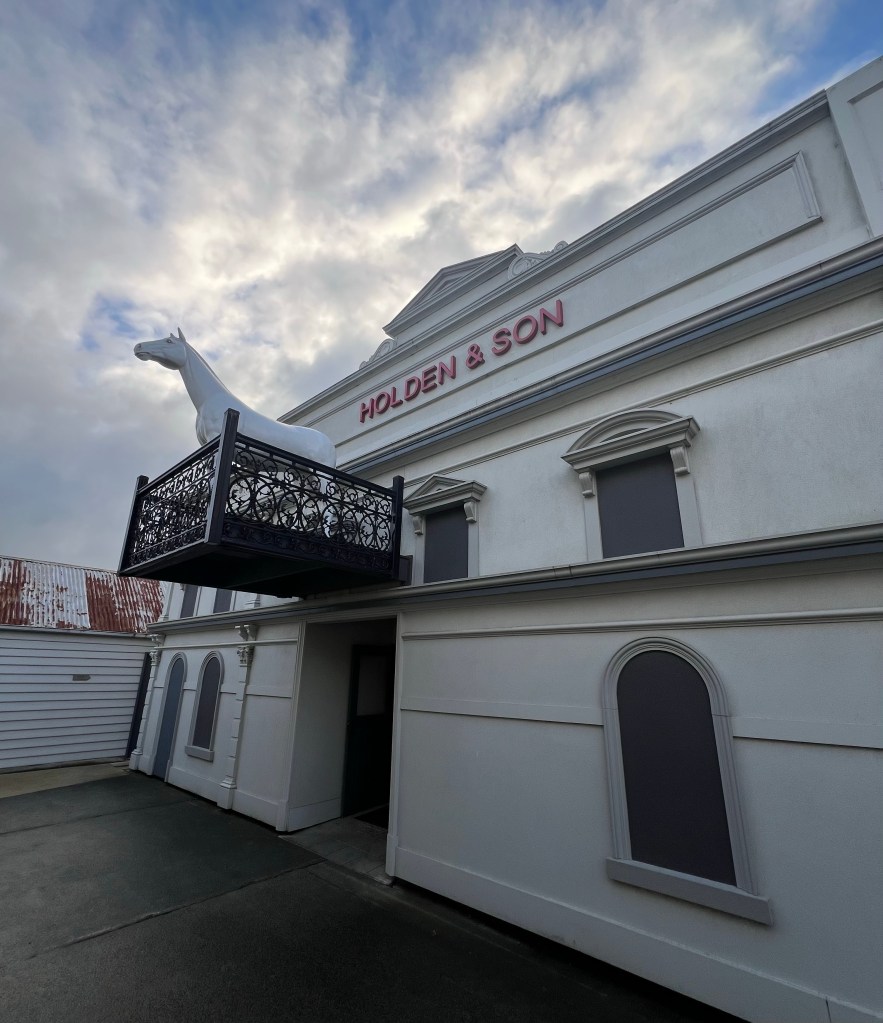
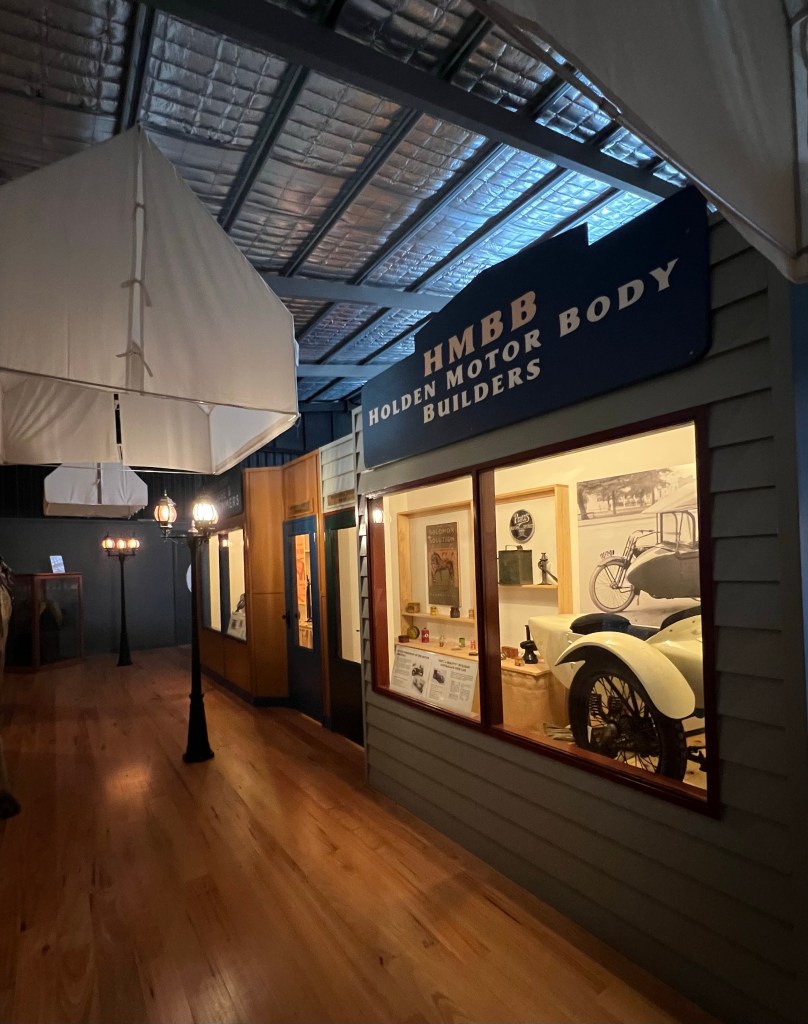
I was aware of Holden’s past as an Adelaide coach builder of horse-drawn buggies long before its automotive growth, but not its far-distant past as a saddlery. This aspect is cleverly explored in an older building recently made over for that purpose.
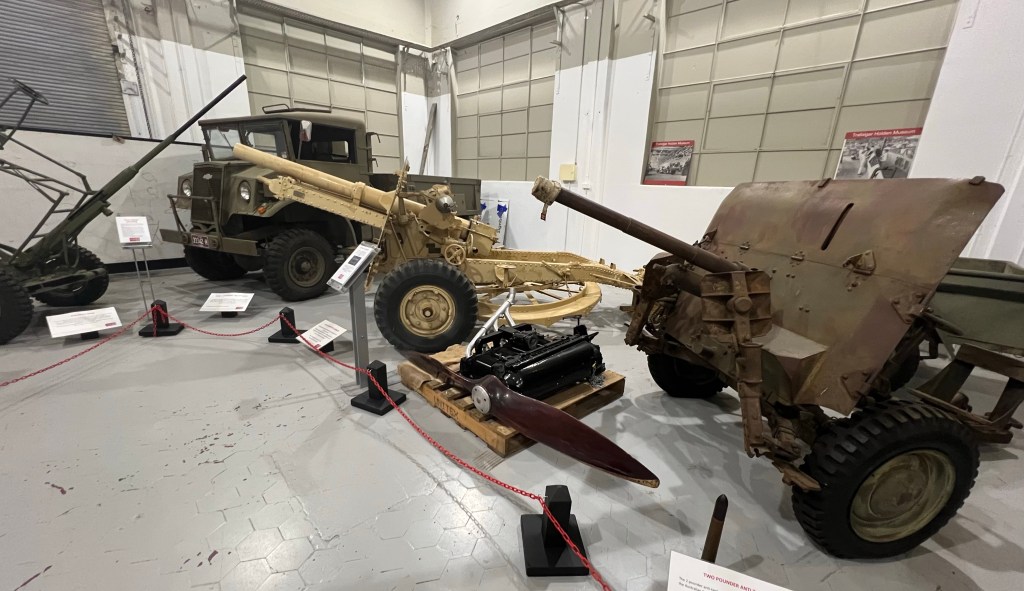
Joiner’s vision wasn’t just about the cars. It was telling the whole story from the early saddlery and buggy era, armaments made during World War 2, the Frigidaire range of home products and the cars from Holden-bodied Buicks to the last ZB Commodores.
Joiner tipped in his entire collection of cars and memorabilia and Holden came to the party too, with 27 of about 80 cars they have spread throughout Australia.
There was a strong presence of Holden identities including Chris Payne, Paul Beranger, Richard Ferlazzo, author/historian Norm Darwin, Erebus’ Chris Payne, Jason Bargwanna, Garry and Barry Rogers, plus an army of enthusiasts.
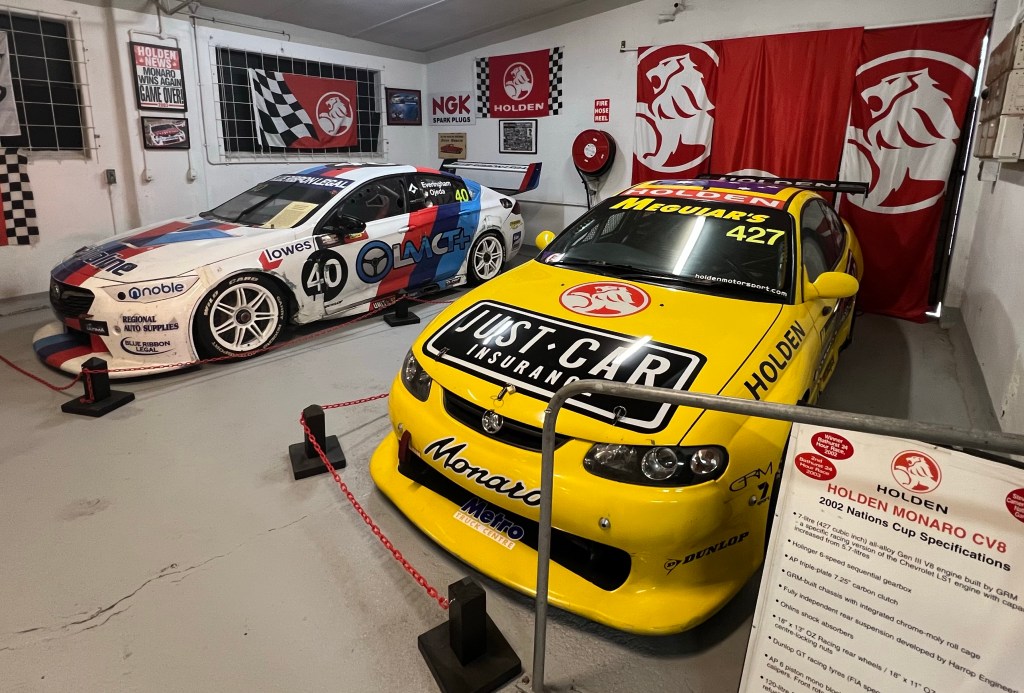
Rogers owns a farm closeby and has supported the museum with two cars on display, a 2002 Nations Cup Monaro CV8 427 (foreground) and the ZB Commodore Supercar (at rear) raced by Tyler Everingham and Jayden Ojeda to 19th place in the 2019 Bathurst 1000. The car looks magic in as-finished-Bathurst condition.
Holden Monaro CV8 2002 Nations Cup Specifications (yellow car)
GRM-built chassis with integrated chrome-moly roll cage
7-litre (427 cubic inch) all-alloy Gen III V8 engine built by GRM a specific racing version of the Chevrolet LS engine with capacity increased from 5.7-litres. Holinger 6-speed sequential gearbox, AP triple-plate 7.25″ carbon clutch
Fully independent rear suspension developed by Harrop Engineering, Ohlins shock absorbers. AP 6 piston mono block front calipers / 4 piston mono block rear calipers. Front rotor – 375 x 35mm, rear – 343 x 35mm
18″ x 13″ OZ Racing rear wheels / 18″ x 11″ OZ Racing front wheels-centre-locking nuts, Dunlop GT racing tyres (FIA specs)
120-litre FIA-approved racing fuel cell with Siamese dry-break refuelling system. GRM-designed and developed carbon-fibre / Kevlar composite aero package. Motel onboard engine and dash management system. 4 onboard air jacks
The museum is a must-visit for all car nuts, not just the rusted-on Holden diehards. I’m a Ford man, I’ve never owned a Holden, but Dad had plenty of them as company cars – remember that pre-FBT perk?! – So I’ve plenty of experience driving them as well as having plenty of firsts inside Holdens! Like most of us over 15, I suspect.
What did he have now I think of it? EH Wagon three-on-the-tree and then autos: HD, HR and HK wagons, then HG and HQ Premier sedans before switching to the dark side with an XB Fairmont and Fords thereafter.
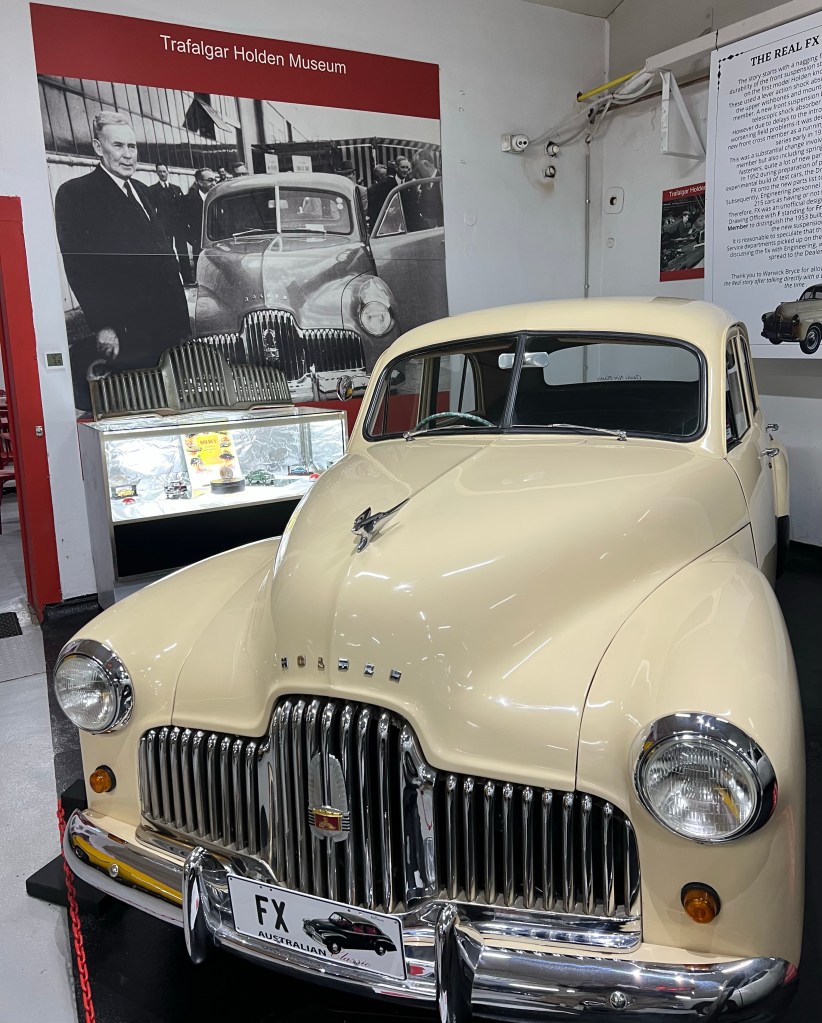
What follows is a random potpourri of shots of cars and exhibits that caught my eye. The verbiage is the Museum’s not mine. Do go up and have a look, its really great.
‘Throughout Holden’s 158-year history, SA has been the source of horse drawn coach and automotive body manufacturing engineering development and production for the company.
First automotive bodies were designed and manufactured in 1917, meaning Holden was in the automotive manufacturing business for 100 years by the 2017 closedown of manufacturing.
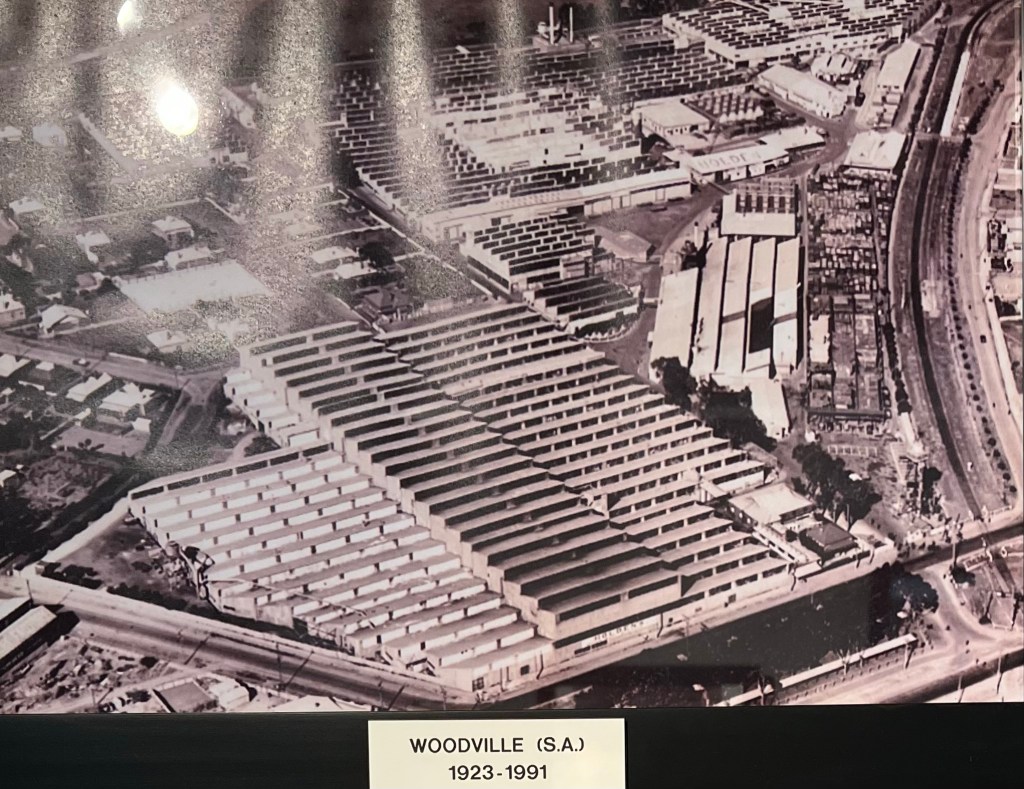
Established in 1919, known as Holden’s Motor Body Builders Ltd. (HMBB) manufactured bodies at its King William St Adelaide factory and at Woodville from 1925 where it employed 5,500 people.
HMBB made bodies for 40 different brands of cars. Over half a million bodies were made before the Holden 48-215 was launched. Exporting of bodies commenced in 1939.
Within the first few years of operation Woodville became one of the biggest body manufacturers in the world as well as being the sole supplier of car bodies for General Motors in Australia. GMH was formed by the merging of HMBB with the assembly plants previously operated by GM Australia.
Forced by Australia’s isolation during WW2, the need for innovation, improvisation and invention was paramount in all Holden plants. Woodville became the largest producer of war related equipment and supplies within GMH.
After the war, major advances in body manufacturing engineering, sheet-metal press tooling, body assembly jigs and fixture design together with press and body assembly production systems centred around Woodville.’
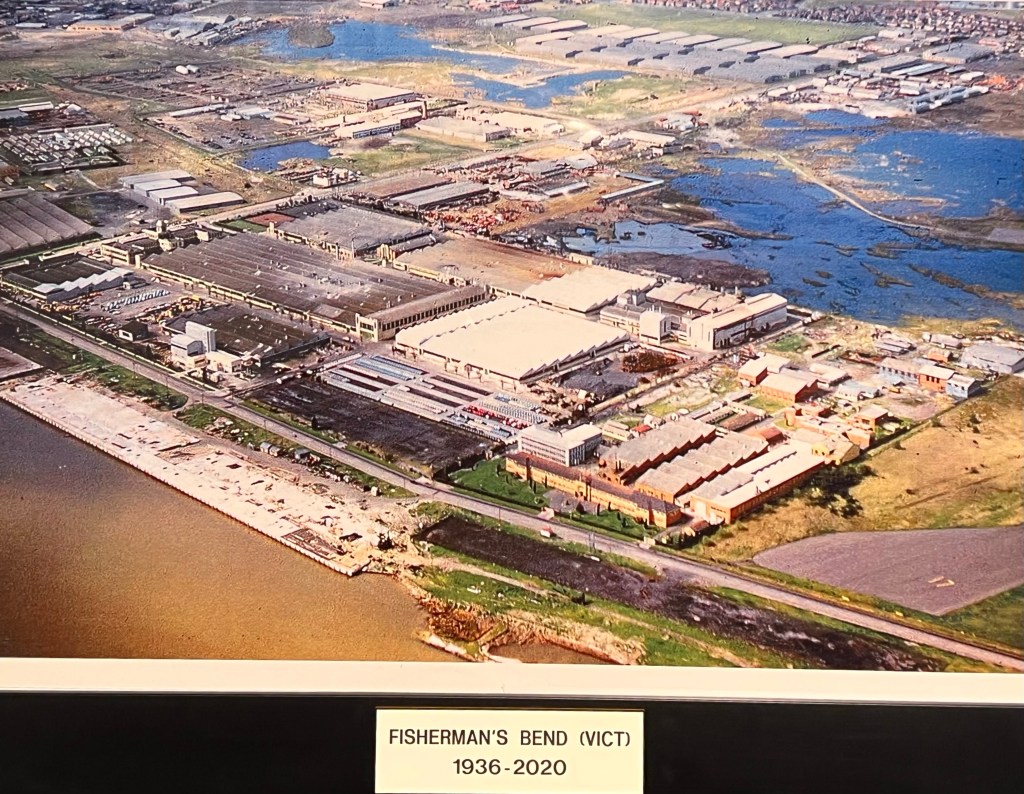
Fishermans Bend, Melbourne…
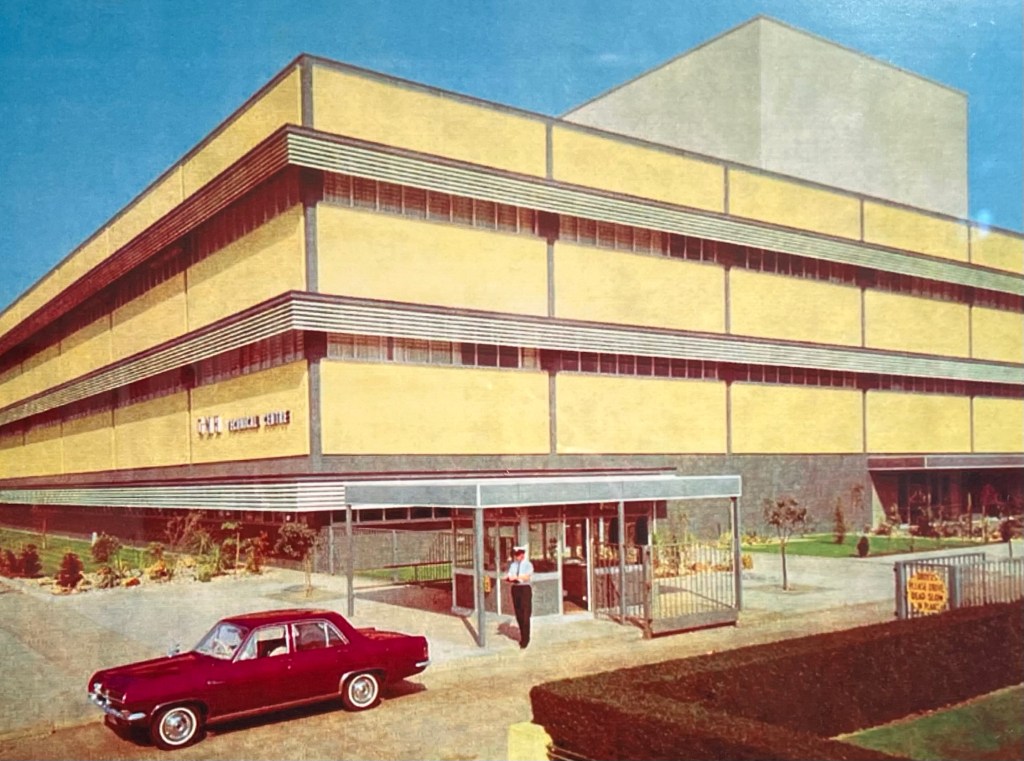
‘Head office was transferred from SA to Fishermen’s Bend, Melbourne. Opened in 1936, Fishermans Bend (correct spelling) became Holden’s headquarters, as well as its product design and product engineering centre.
During WW2 it produced a vast array of war equipment, including the development and production of many types of trucks. Critical to Holden’s future was the introduction of a world class foundry duringWW2 to produce engine blocks and heads.’
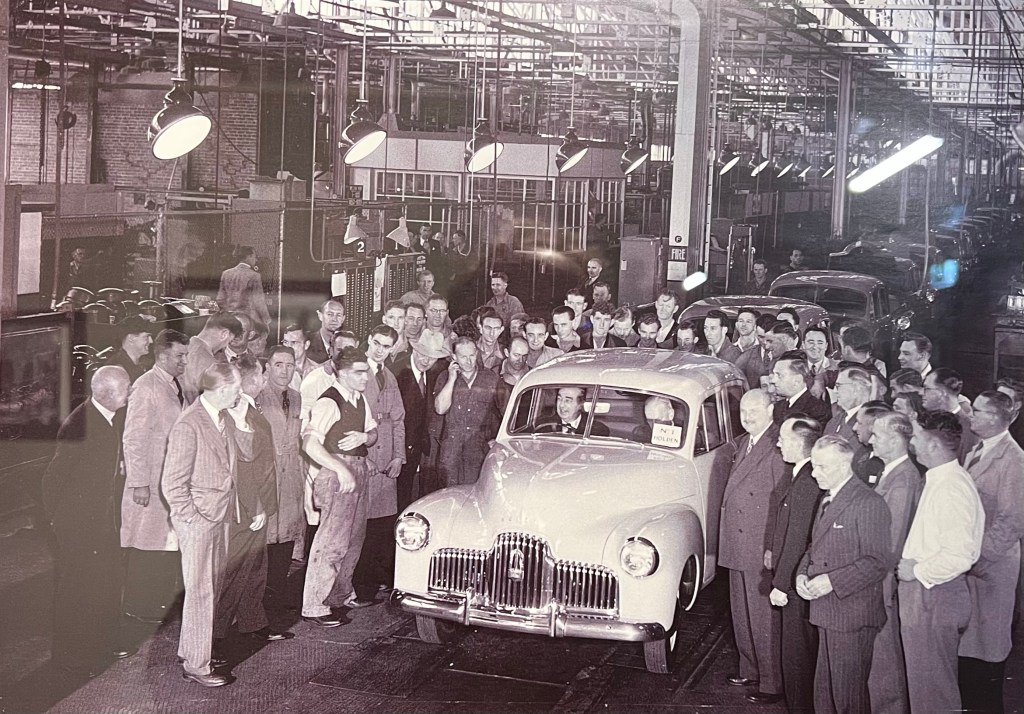
‘The plant assembled the first Holden car, the 48-215, based on fully trimmed bodies being supplied from Woodville, South Australia, and most mechanical components being made in Fishermans Bend plants. It produced the vast majority of the mechanical components in the car including the engine, transmission rear axle and suspension components. This was at a time when the Australian automotive supplier industry in Australia was not well developed, so Holden manufactured a lot more of the car internally.’
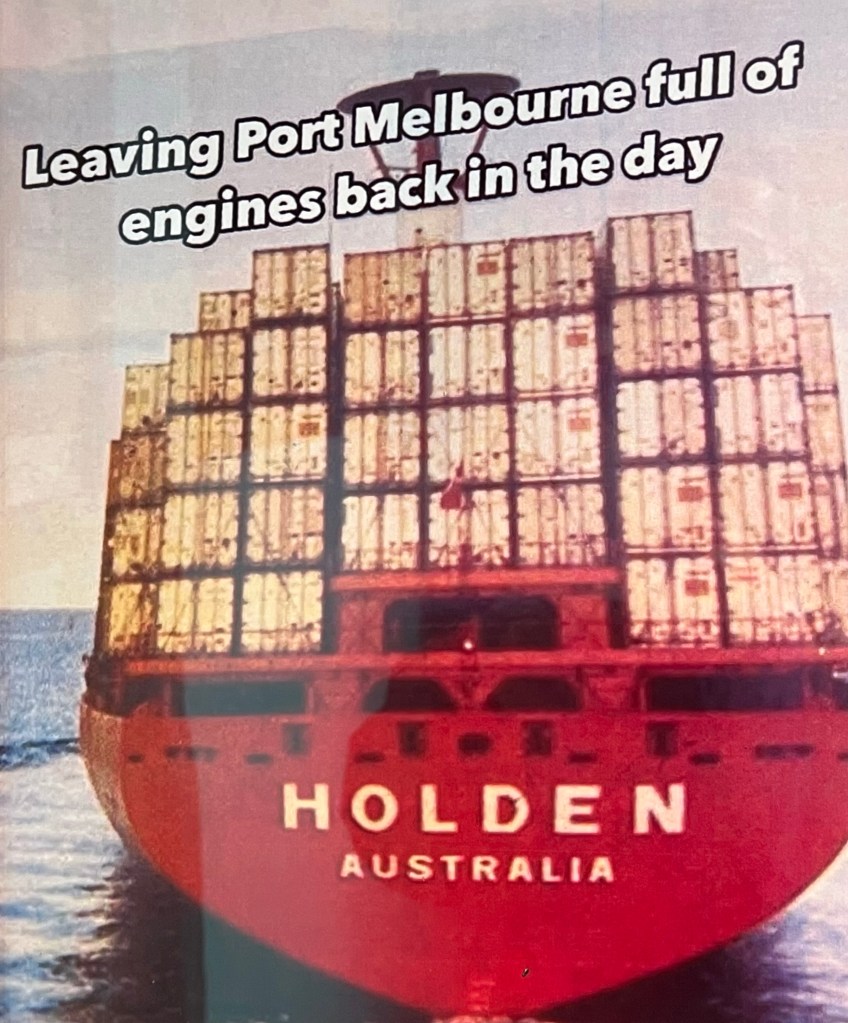
‘In 1956 vehicle assembly in Victoria was relocated to a new Dandenong plant. The Fishermans Bend plant was reconfigured to concentrate mostly on engine manufacture for domestic and for 4-cylinder export territories. It became Australia’s largest exporter of elaborately transformed goods. The famous 6 cylinder in line and V8 Holden engines were produced here.’
‘Fishermans Bend went on to produce a peak of 960 engines per day up until November 29, 2016, when it was closed after 76 years of engine manufacturing.’
Export…
‘Holden had a significant program running for many decades beginning with the FJ exports to New Zealand in 1954.
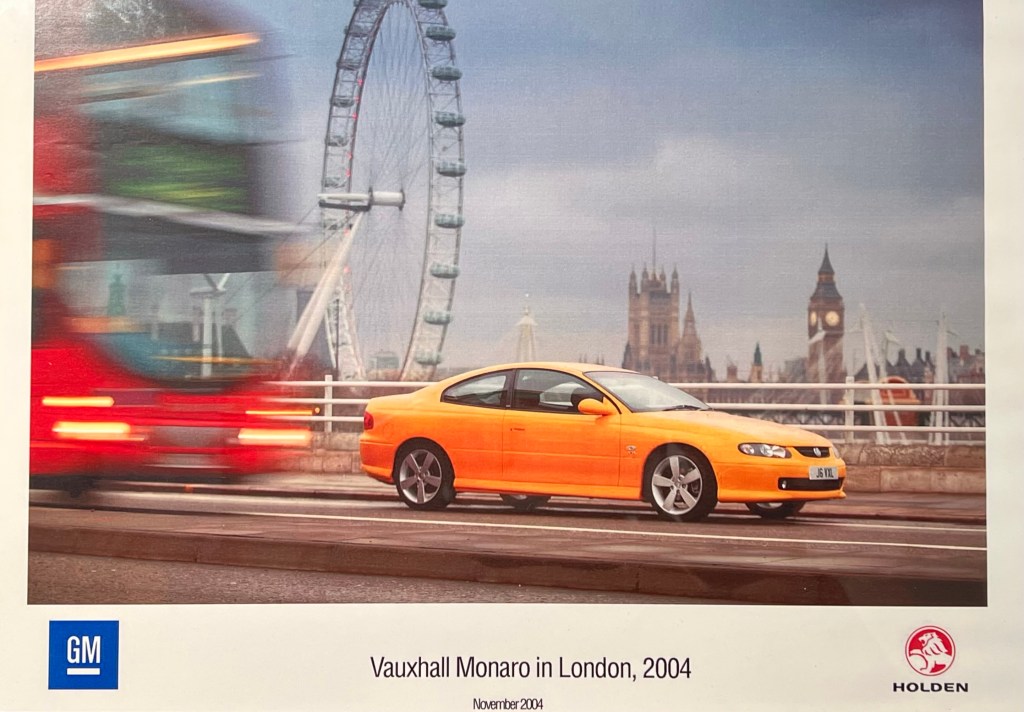
In later years exports were most significant in the Middle East and America with both the commodore and Statesman nameplates being altered to both Chevrolet and Pontiac, but the vehicles were Holden.
Over the years Holden exported completely built-up cars (CBU’s) cars in parts and assemblies to be assembled at their destination (CKD packs) and of course engines and other componentry. These programs added billions of dollars of income to the Australian economy and validated Holden as a producer of world class vehicles, automotive engines and componentry.
As well, Holden exported its incredible expertise and knowledge in the design and development of cars for its parent company in the USA, General Motors.’
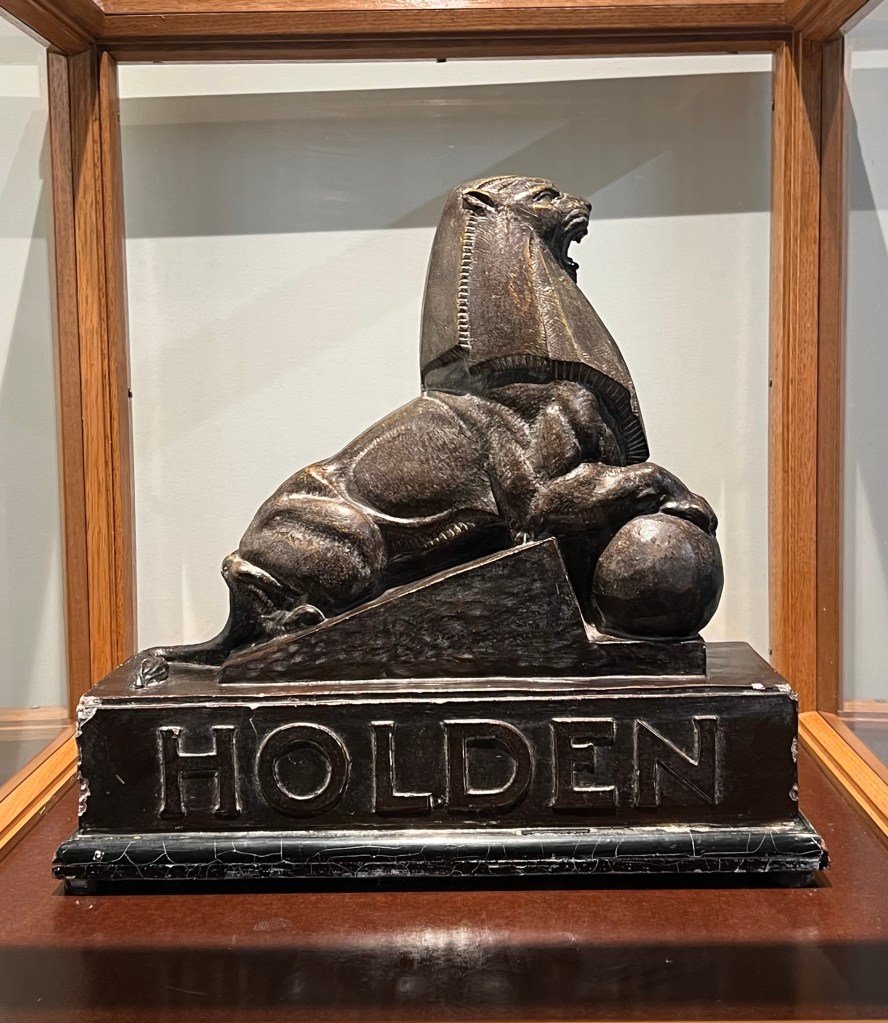
The Holden Emblem : The Lion…
‘As an emblem, the Holden Lion relates to the time when coach builders engraved their company name or trademark on the door sill, or on a plate fixed to the instrument panel.
In the early 1920s Holden Motor Body Builders used a large brass plate embossed with a winged figure representing industry against a background of factory buildings. In 1926 the company decided to downsize the brass plate and emulate the practice of Fisher Body in the USA, which attached a neat replica of its coach trademark to the lower part of the cowl. Because the existing emblem was too detailed to be embossed on a small plate, a new design was commissioned to be based on the Egyptian-style ‘Wembley Lion’, symbol of London’s 1924-25 British Empire Exhibition. Fashion themes of the time from clothing to furniture, films and songs all were influenced by Egyptian antiquity.
According to fable, the principle of the wheel was suggested to primitive man when observing a lion rolling a stone. Thus inspired the pre-eminent Australian sculptor of the day George Rayner Hoff, to create the ‘lion and stone’ sculpture. This was replicated in a pressed metal plate that was fixed to all bodies built by Holden’s Motor Body Builders from 1928.
More than 75 years later the evolution of the lion and stone symbol can be traced through series of badges proudly worn by a cavalcade of cars, some recognised by early GM model enthusiasts but most dear to the hearts of generations of Australians since 1948 advent of the 48-215 or FX Holden.
The chrome-winged surround on the FX/FJ grille badge was Cadillac inspired.
The classic Egyptian lion design gave way in 1972 to a more modern interpretation of the symbol, which in turn was replaced in 1994 by the powerful Holden brand we are familiar with today.’
Holden 132 CID Grey motor…
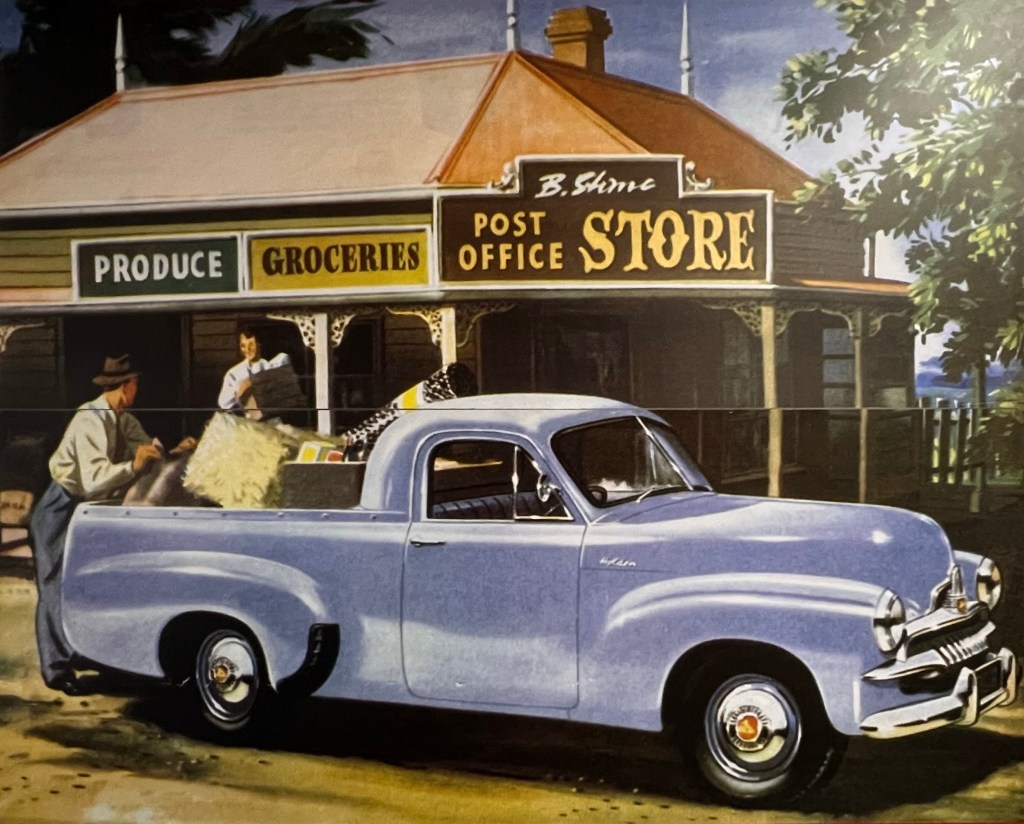
Powered cars such as the FJ Ute above.
‘The introduction of the first Holden car in 1948, the 48/215, saw the first mass produced car engine in Australia.
Designed in 1938 by GM for Project 195-Y15, it was only used in the Holden car and all production Holden’s were fitted with engines made in a purpose built facility at Fisherman’s Bend, Melbourne.
Though small in capacity, the use of six cylinders ensured a smooth, efficient engine with good torque, giving the lightweight 48/215 more than adequate performance.
Dubbed the Grey motor on account of their paint, about 650,000 of these 132 motors were made from 1948 to 1960 and many were sold for use as stationary engines to drive generators, pumps and the like.
Type 6 cylinder, 7 port head. Capacity 132.5 cid, 2171cc. Inlet valve size 1.28, 32.5 mm. Power 60bhp, 44.5kw @ 3800rpm.’
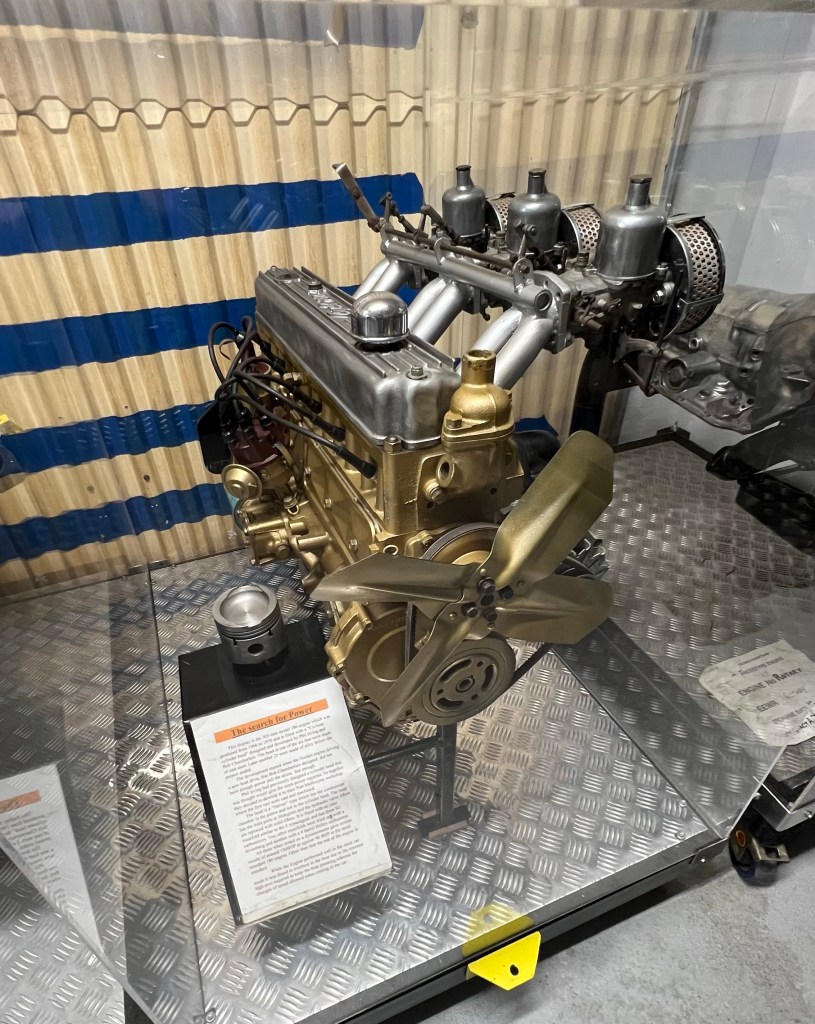
The search for Power…
‘This display is the 3-litre model 186 engine which was produced from 1966 to 1970 and is fitted with a ‘Cyclone cylinder head’ designed and developed by Phil Irving and Bob Chamberlain.
The head is one of the six that were made of cast steel. Later another 25 were made of alloy before the project ended. Development started when the Holden engine driving a new boat drive, that Bob Chamberlain designed, did not have enough power pull the skiers fast enough.
Phil Irving had previously designed a cylinder head that was thought would give the extra power required. So together they decided to develop it in their Port Melbourne workshop where the first two were cast and machined.
The head is a ‘Heron type’ which has the combustion chamber in the piston and not in the cylinder head. The head has the Inlet ports at 30degrees and the hydraulic valve lifters are replaced with solid lifters. It is fitted with an inlet manifold similar to the E-Type Jaguar and has three SU carburettors. Two other manifolds were tried out with a Stromberg and another with a 4-barrel Holley carburettor.
All three when tested on a dynamometer gave similar results of around 150bhp as against 90 bhp in the stock standard 186 engine. Other than that the rest of the engine is standard.
While the engine performed well in the stock car mode it was found to overheat in the boat due to the constant high revs required to keep the boat planing, whereas the changes of speed allowed some cooling in the car.’
Holden Bodyworks…
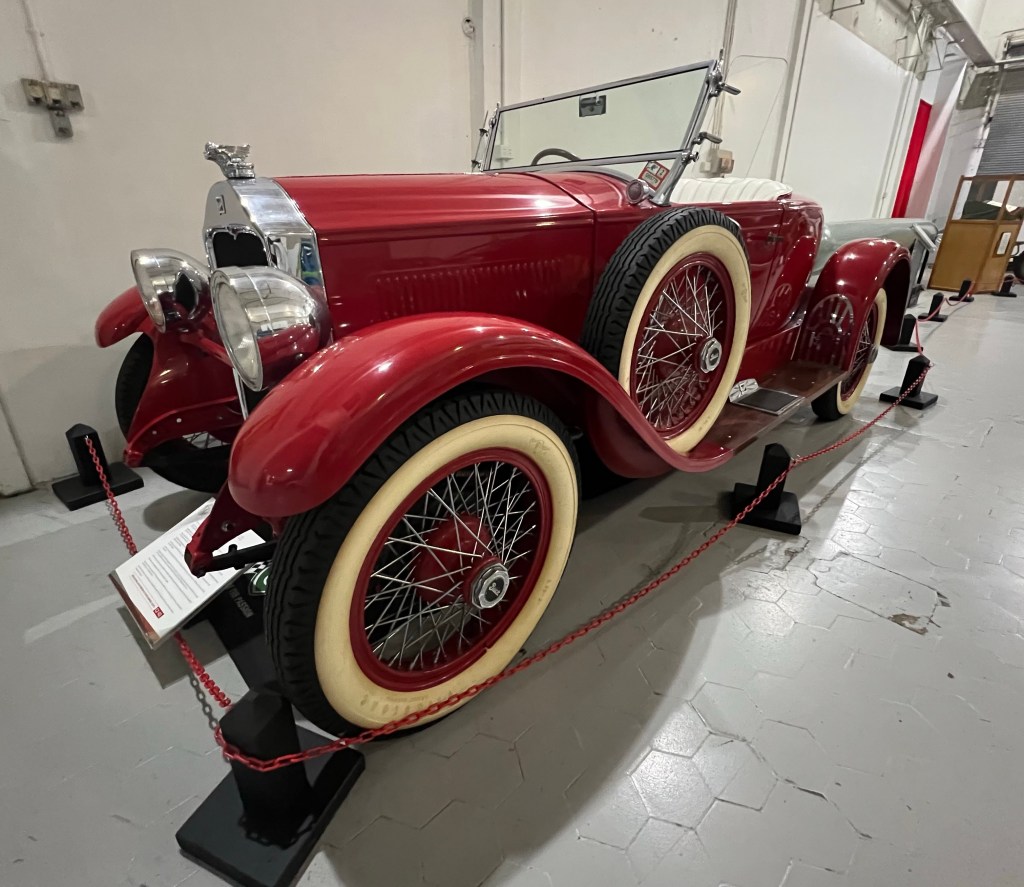
‘If cars could talk, few would have as many stories to tell as this stunning 1928 Buick Speedster.
Built by Holden Bodyworks in 1928, the car was shipped to England for performance improvements and to compete in the Brookland Time Trials. Calculations confirm the car would have been capable of 140mph at just over 5000rpm. This is far in excess of top speeds that were being achieved at that time for any production type car.
The car was noticed in the Brooklands track car park by two Vickers test pilots and they were encouraged to take the car for a spin around the track for a bit of fun. The recorded oncaged to attain an unofficial top speed of 138mph without crashing. This is 20mph faster than anything But things turned sour for the record-setter, with police closing down the track after several high-speed crashes had resulted in death.
Unable to continue racing, the Buick returned to Australia and was sold to a private buyer in Mildura who saw porentia in its speed.
Painted matte black, with its headlights removed and holes cut into its body to accommodate barreis, the car was used to run moonshine (illegal alcohol) across the Victoria-NSW border between Mildura and Echuca. Travelling only at night using moonlight for navigation, the Buick became known to locals as the mocnight speedse The dutlaw car evaded police until its eventual capture in 1964.
Seizure under the new proceeds of crime laws saw its demise, with the car crushed and puched into a creek, a mere lay forgotten for 20 years forgotten.’
Is this for real?? Sounds like a touch of the Donald Trumps to me?
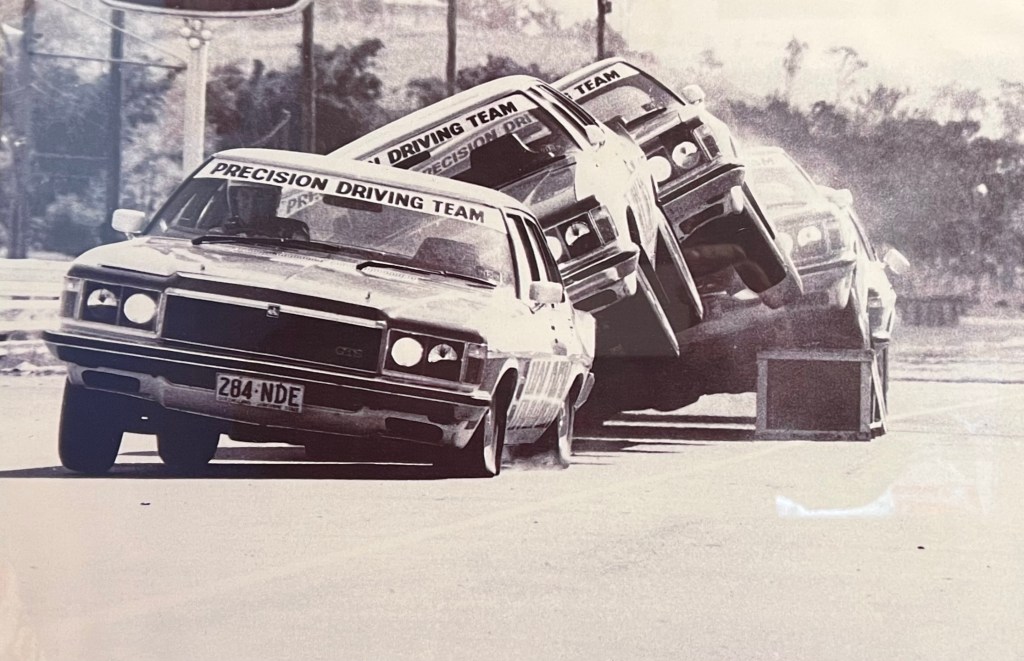
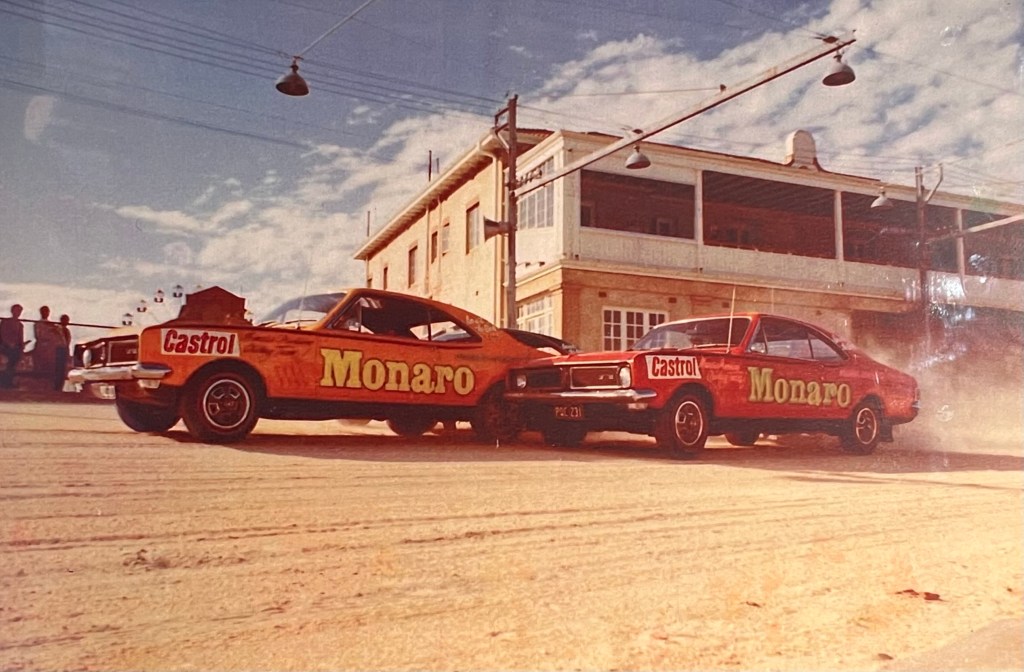
Five years before I finally made it to a race meeting in 1972 the Holden Precision Driving Team blew my tiny mind at the Royal Melbourne Show.
‘We all saw them’ perform around Australia wherever we lived. Monaro GTS sedans above, and coupes below, venues folks?
This one gave me a chuckle too.
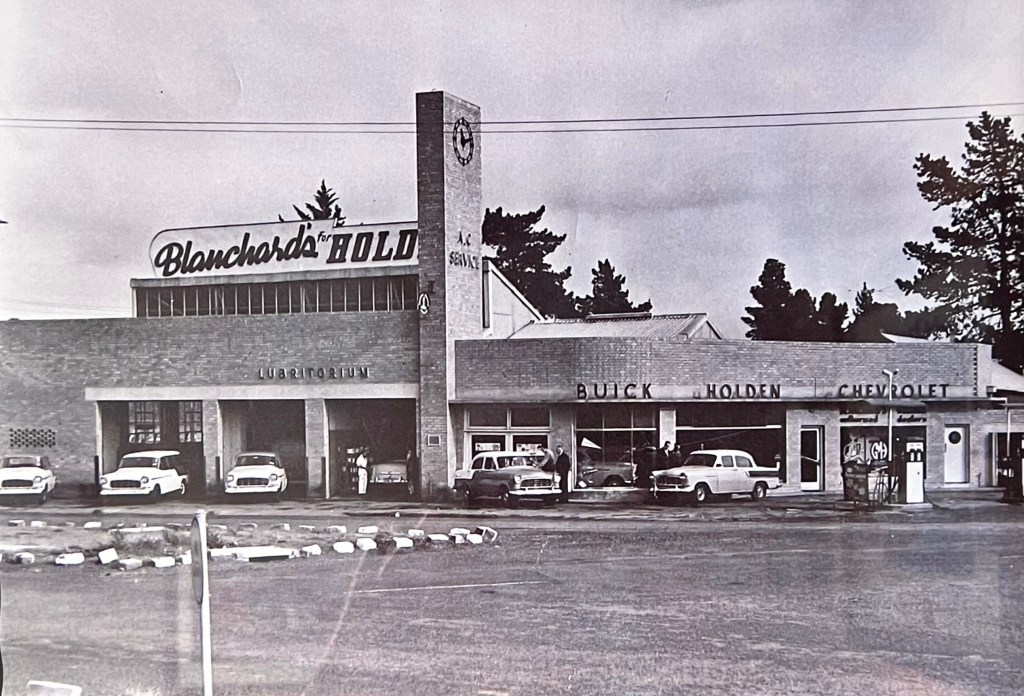
Blanchards Holden were on one of Melbourne’s busiest intersections, the corner of Springvale and Dandenong Roads, Springvale, only a drop-kick from Sandown.
It’s a mega corner of about six bits of road these days, but that roundabout in the late-1950s – the line-up of FCs makes it 1958-60’ish – looks pretty lame…
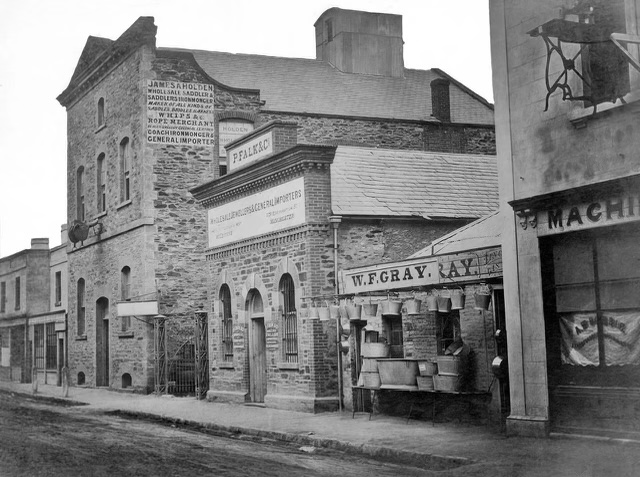
James A Holden’ saddlery, King William St, Adelaide (D Zeunert Archive)
Etcetera…
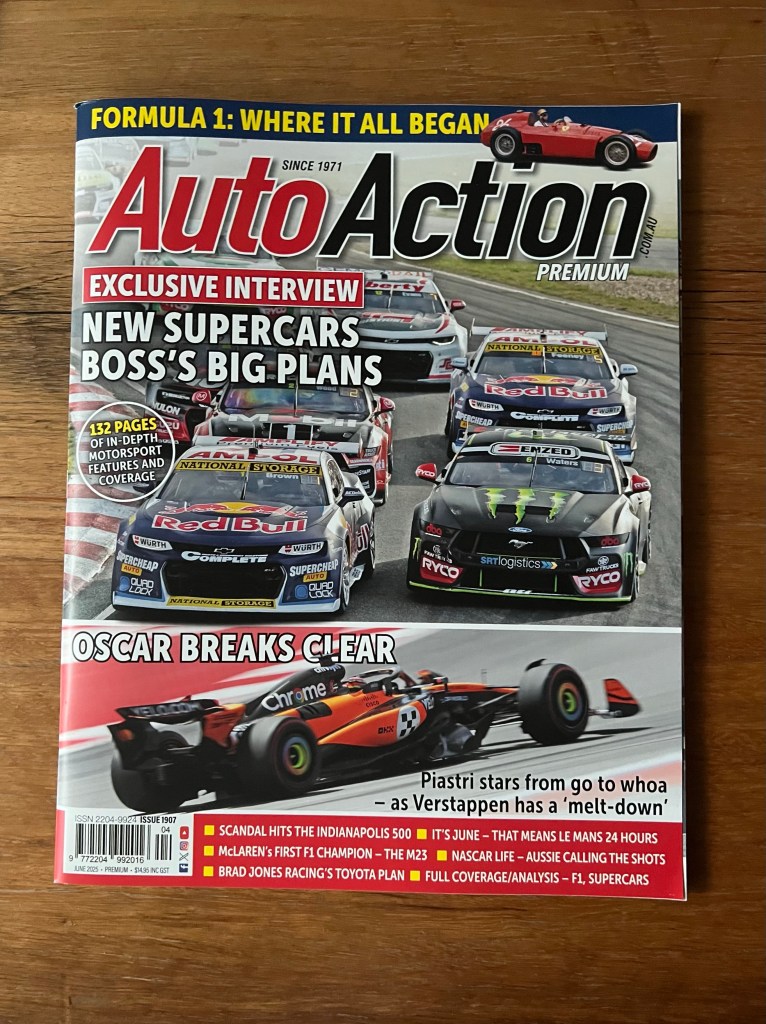
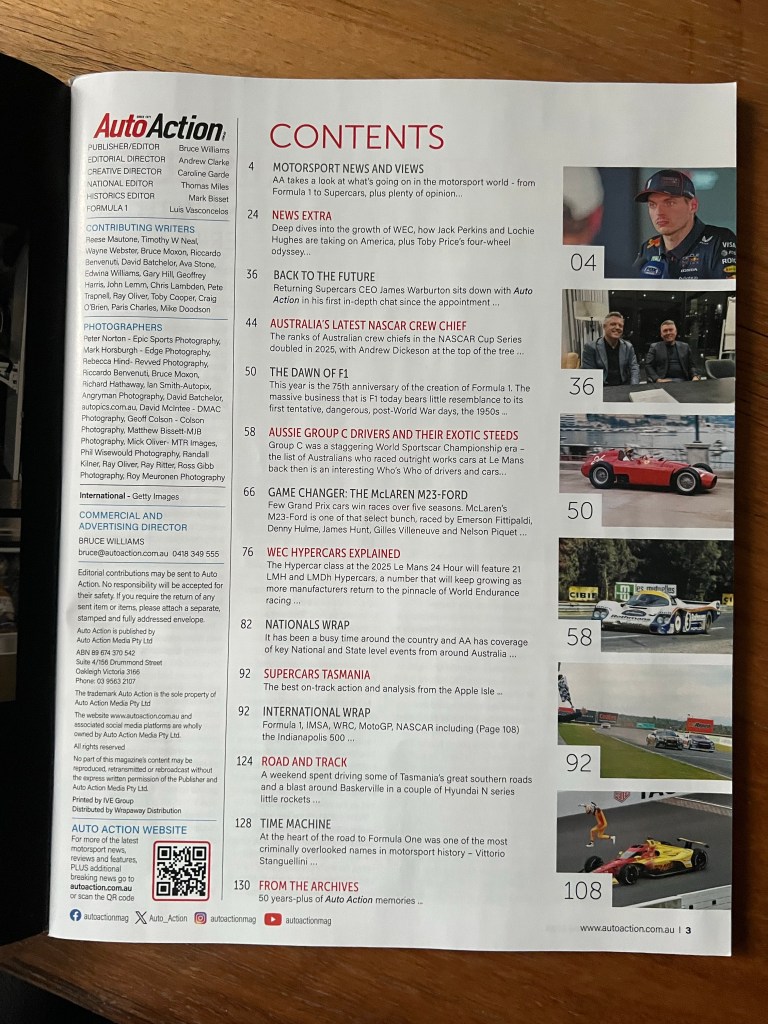
Don’t miss the latest, June Auto Action, on-sale for only the next few days, see below for the contents. The July 132-page monthly, issue #1908, will be in store this Thursday/Friday.
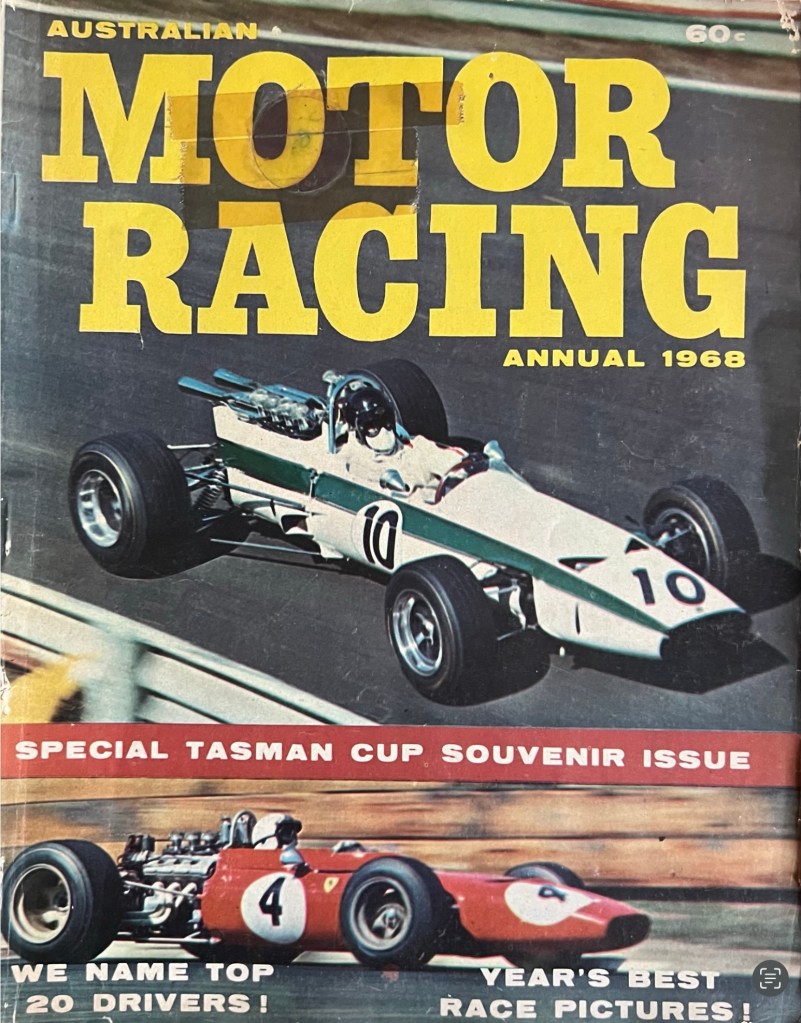
I’m not sure of the full content of that one yet, but my historic bits are a short piece on the museum, a ten-pager on the Tasman Cup from 1964-69. This is the first of two parts and has many ‘unseen’ photos taken by John Ellacott and Paul Cross. There is also an eight-page under-the-skin piece on Jim Richard’s Murray Bunn built Ford Falcon Hardtop Guney-Eagle 351 sports sedan. This one has Auto Action photos taken in the day that have never been published. It’s amazing what lurks in our files! Finally, Lord Alexander’s Hesketh outfit won its one and only championship F1 race, the Dutch Grand Prix in June 1975 . We have a two-page look at the unlikely but totally professional Peer, Bubbles Horsley, James Hunt and Harvey Postlethwaite.
Photo Credits…
M Bisset, Holden, David Zeunert Archive
Tailpieces…
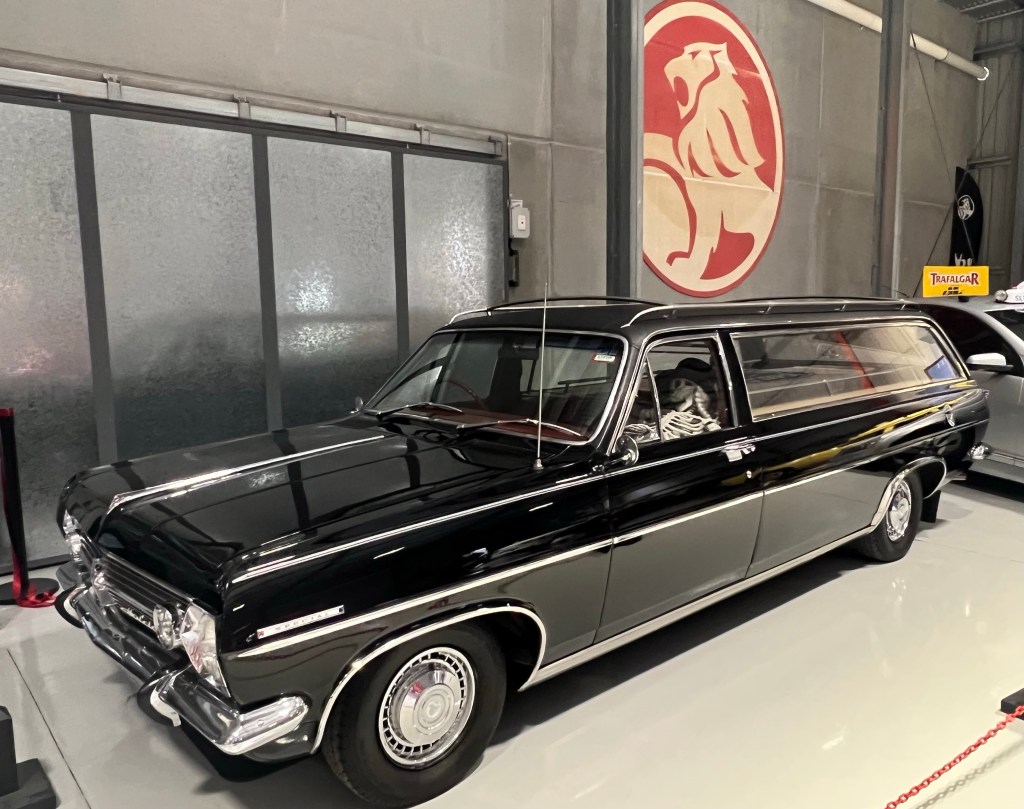
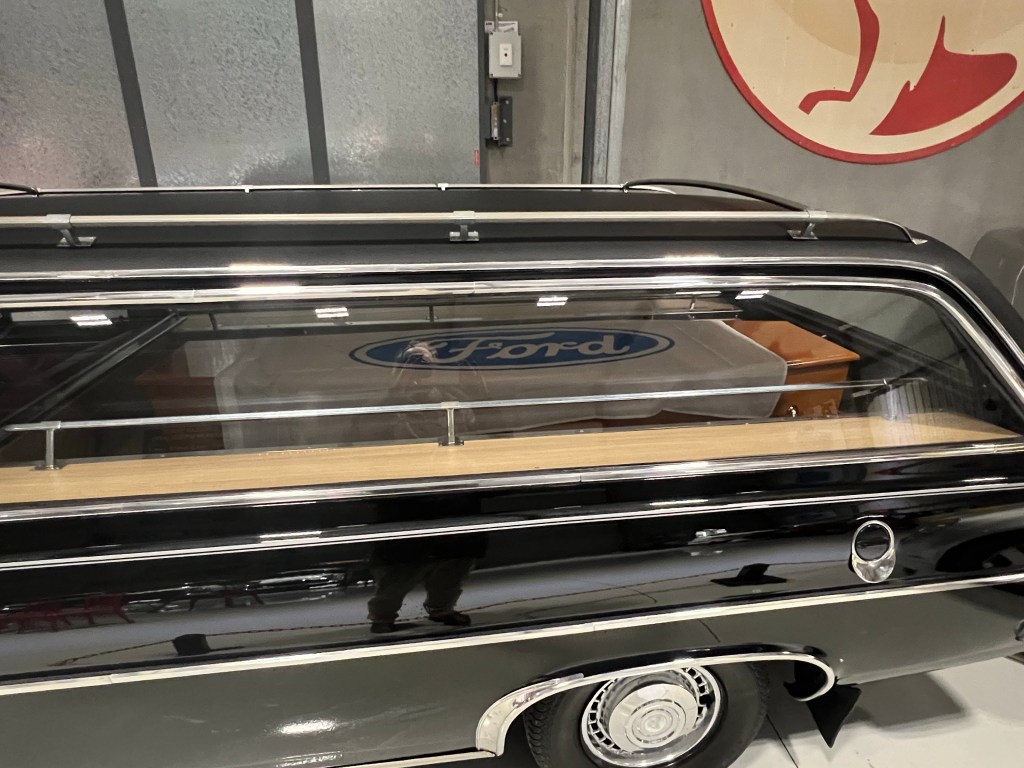
This coach-built, immaculate HR Hearse caught the eye.
The skeleton in the front seat was predictable enough, but the Ford banner atop the coffin in the rear was amusing to the Blue Oval Brigade present!
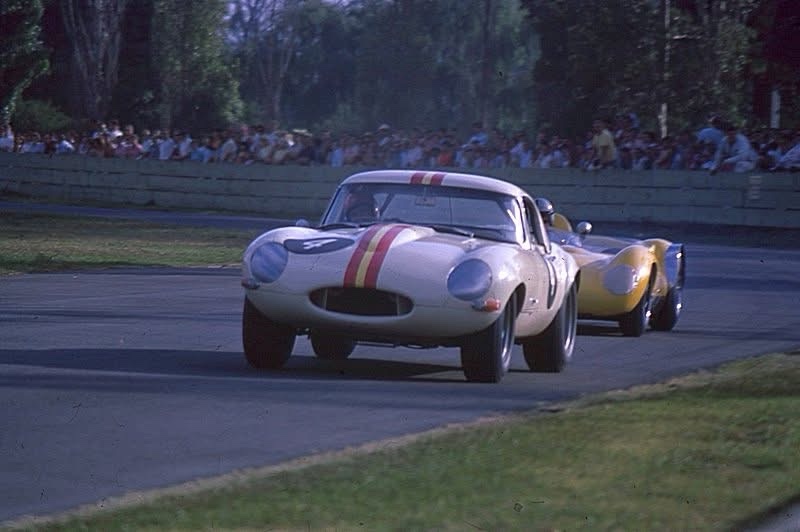
Bob Jane and Pete Geoghegan hard at it during the Warwick Farm Tasman meeting in February 1966. Jaguar E-Type Lwt and ex-McKay Lola Mk1 Climax. What were the results of these encounters folks?
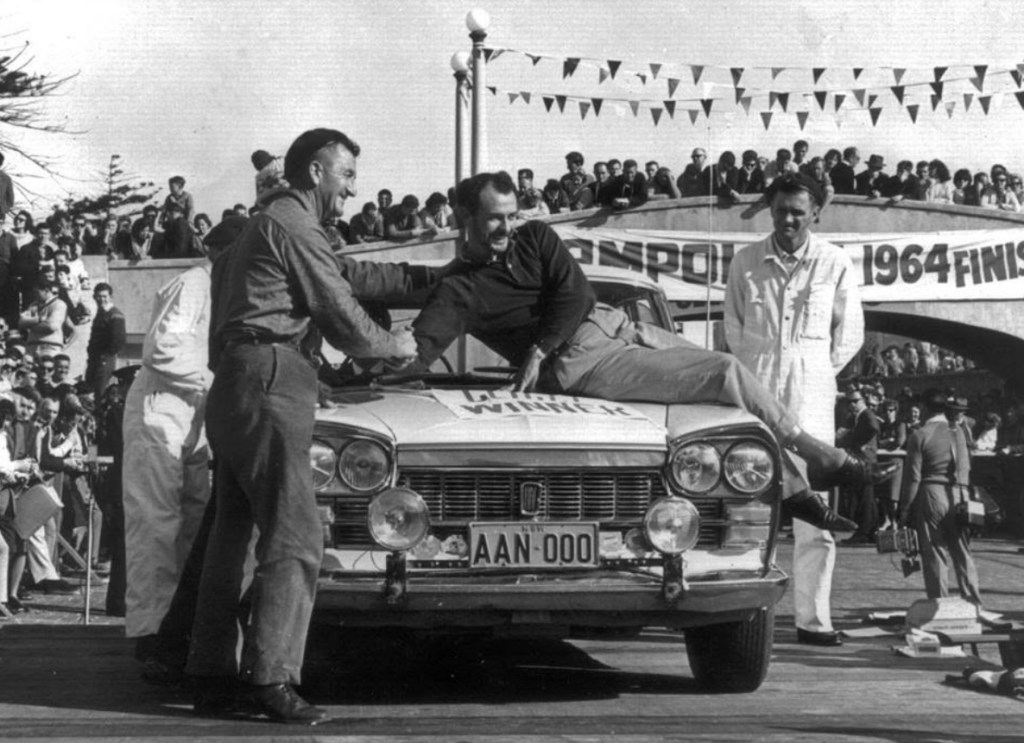
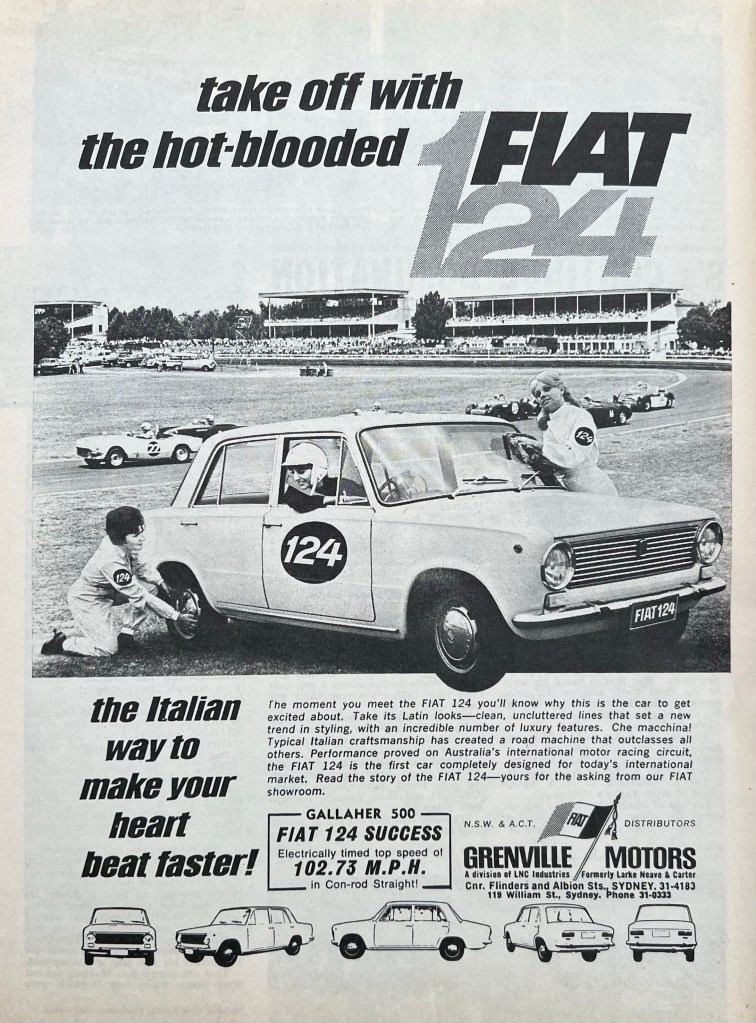
The 31st place Fiat 2300 of Bill Burns, Brian Lawler and Bruce Kaye at the end of the 11,260 km 1964 Ampol Round Australia Trial, Queen Elizabeth Drive, Bondi Beach on June 28.
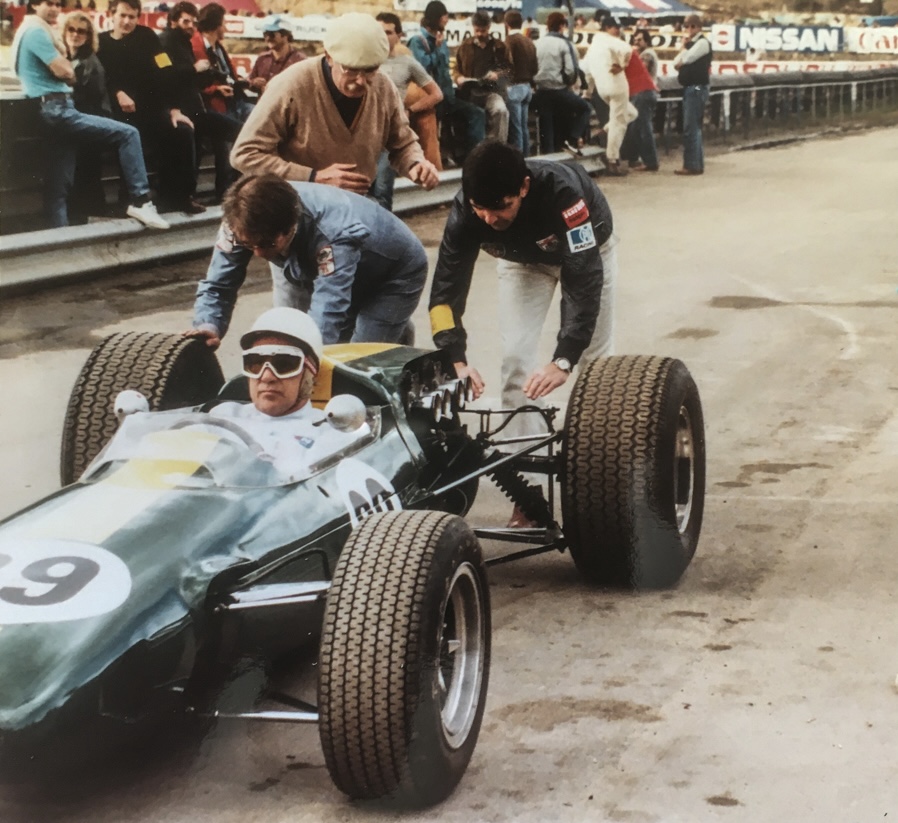
Stirling Moss giving the ex-Jim Clark-Leo Geoghegan Lotus 39 Coventry Climax 2.5 FPF a gallop during the 1984 Tribute to Jaguar meeting at Amaroo Park in the Summer of 1984.
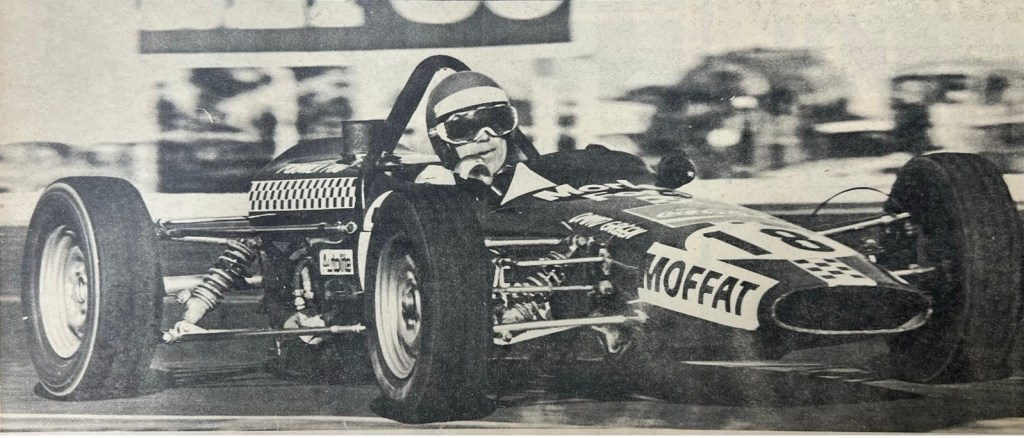
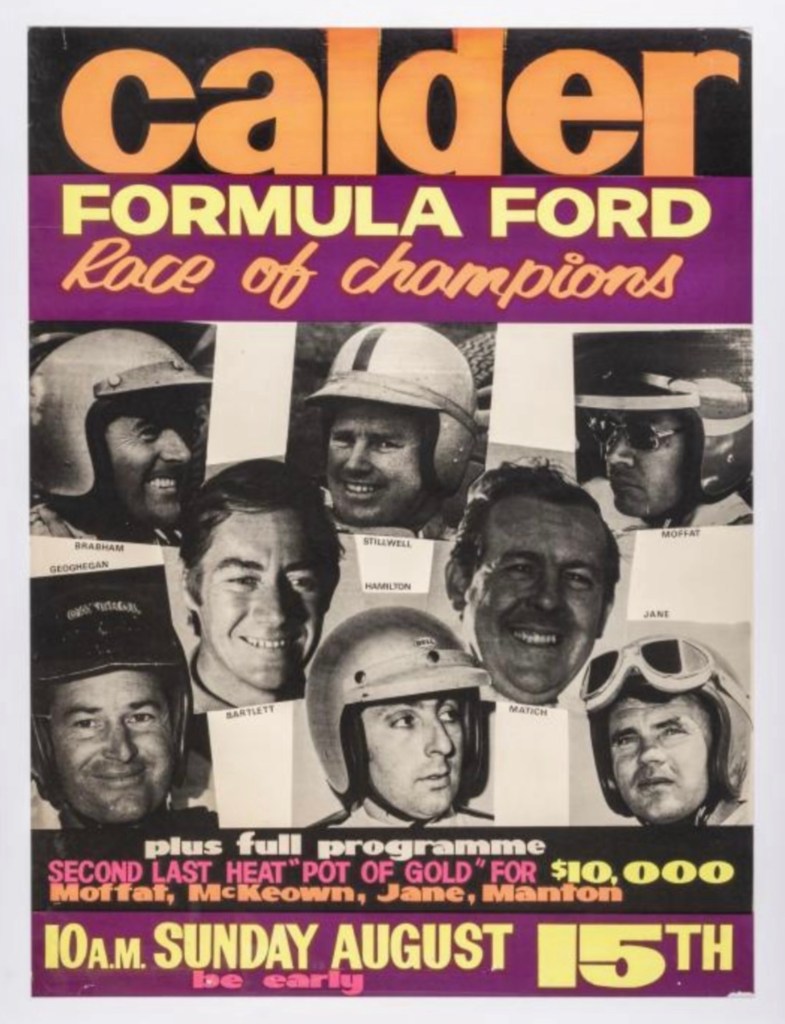
Allan Moffat – who had an open-wheeler phase in his distant past – at the wheel of a Wren Formula Ford during the ‘Race of Champions‘ at Calder on August 15, 1971.
Australian Nationals drags racing meeting at Calder in October 1968. Peter Brock lines up in his famous Austin A30 Holden 179.
He was knocked out by Ken Spence’s Ford Zephyr 289 in the first round, no Top Eliminator that weekend, but there would be plenty of those to come! Article about this car, slightly!, here: https://primotipo.com/2018/05/07/brocks-birrana/
(MotorSport)
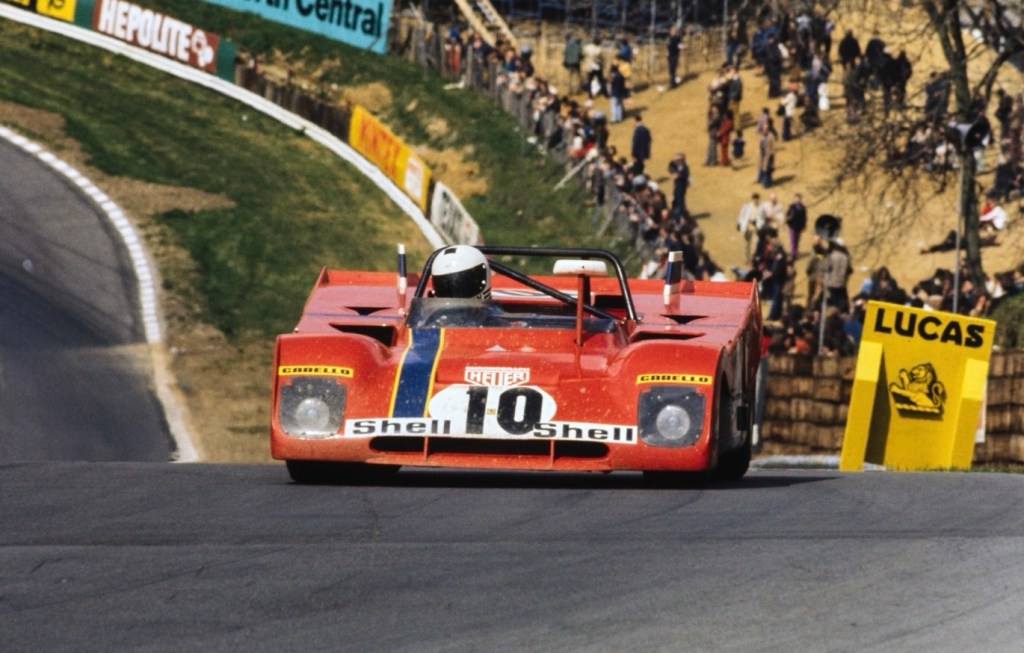
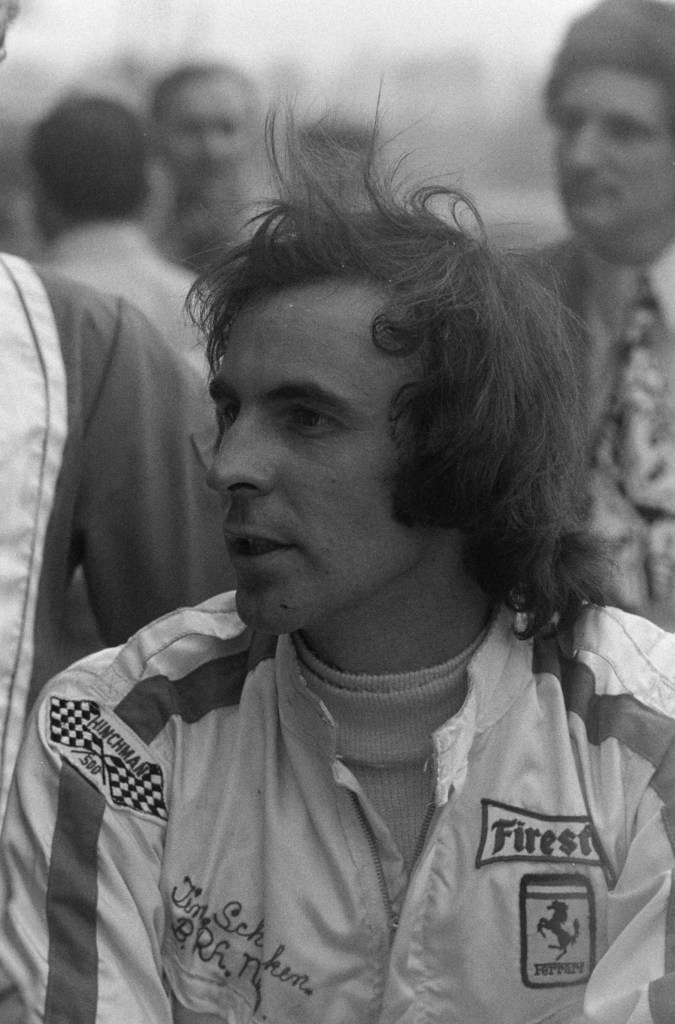
Tim Schenken was living the dream by 1972, his third year in F1 – Surtees that year – and a member of the victorious Scuderia Ferrari 312PB squad in 1972-73.
The shot above shows Tim on the approach to Druids, where the pair were second in the Brands Hatch 1000km run on April 16, a lap ahead was the winning Jacky Ickx/Mario Andretti 312PB.
His driving partner was usually his mate, Ronnie Peterson in ’72. That year the pair won the 1000km of Buenos Aires, Nurburgring 1000km on the way to Ferrari’s crushing World Sportscar Championship victory that season.
They dipped out at Le Mans – that is they piked, didnt enter – knowing the F1 derived Flat 12 engine wouldn’t last the distance, Graham Hill and Henri Pescarolo won there in their Matra MS670, its F1 derived V12 lasting the distance rather well! Noting it wasn’t their first attempt with said engine.
Matra won again the following year with a Ferrari 312PB second, six laps in arrears: Henri Pescarolo/Gerard Larrousse MS670B and Arturo Merzario 312PB.
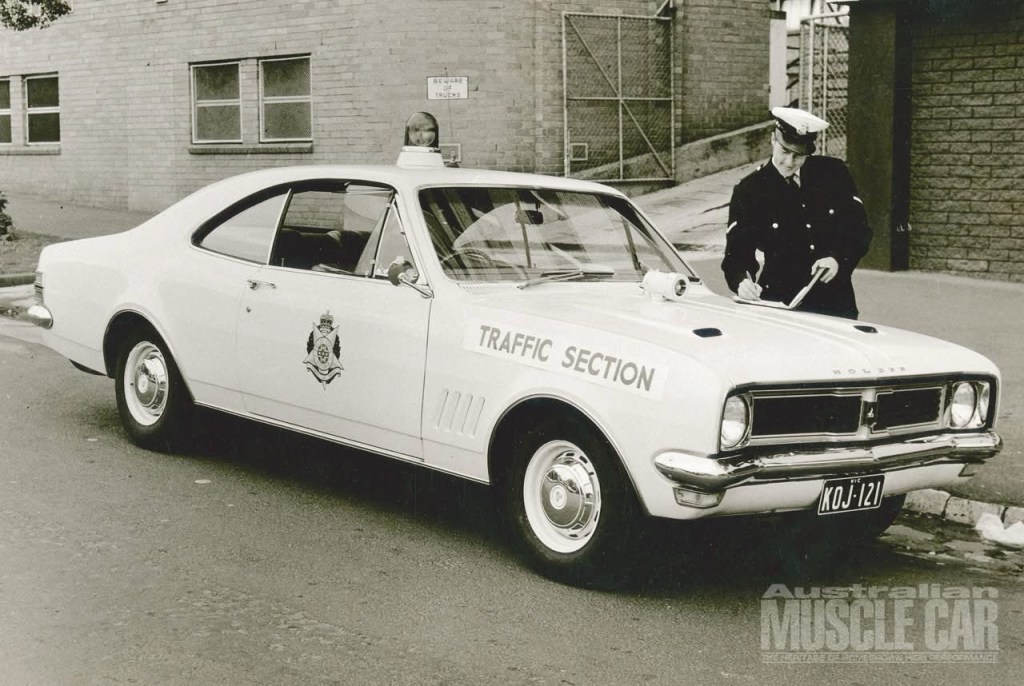
The only things missing are fatties and dice swinging’ from the mirror…two of these HT Holden Monaros were trialled by Victoria Police but rejected as fleet-mainstream additions.
Very hard for the crooks to get out of the back seat I would have thought, but maybe hard to get the corpulent ones in there. The cars would have been nice props on Homicide or Matlock Police…
(K Devine)
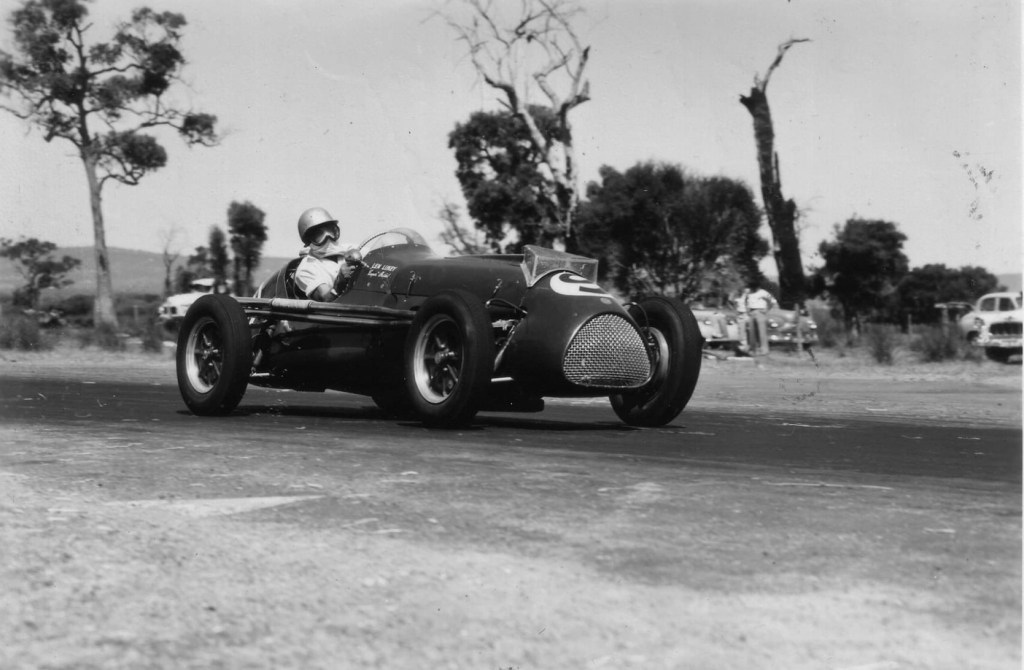
Len Lukey, Cooper T23 Bristol on the way to fourth place in the Australian Grand Prix at Caversham, Western Australia.
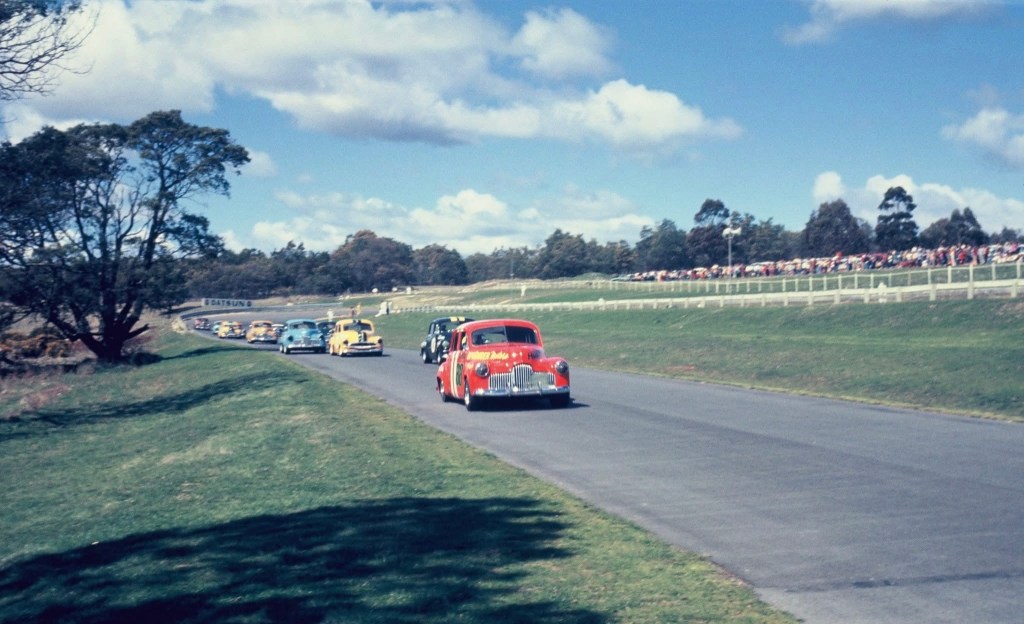
Ellis French tells us the pilots of the first four Humpy Holdens are Messrs Warner, Mather, De Pauli and and Wilcox in this fabulous, panoramic Symmons Plains shot.
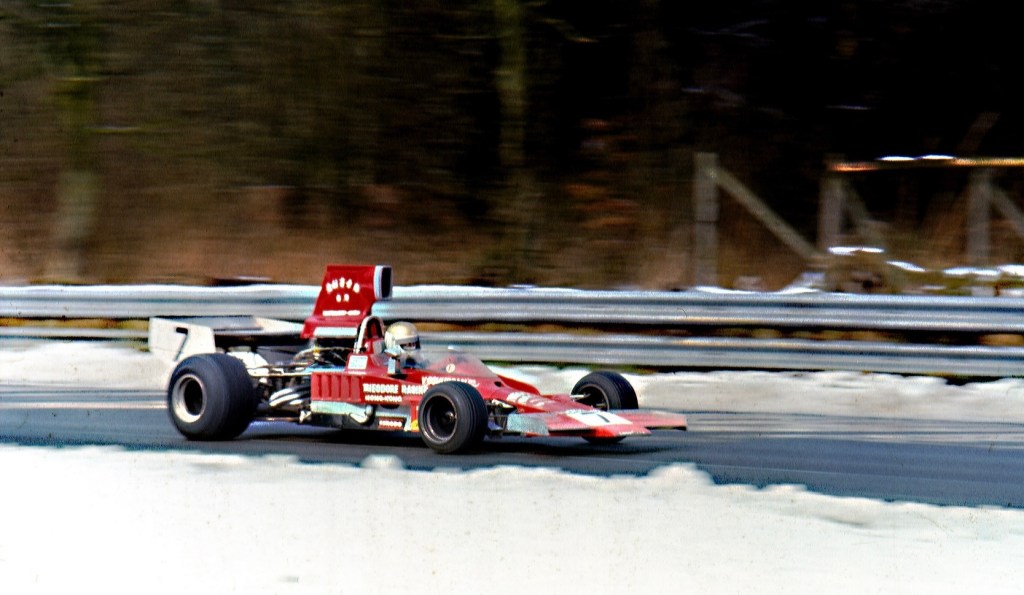
‘Make sure you keep it on the black-stuff Vern for chrissakes!’ may well have been Sid Taylor’s instructions to his driver: Yip-Theodore-Taylor Lola T332 Chev.
It’s the Oulton Park Euro F5000 round over the March 28 weekend in 1975 I believe folks. Vern was 11th, Gordon Spice won in another T332 Chev. More about Vern here: https://primotipo.com/2022/01/17/vern-schuppan-3/
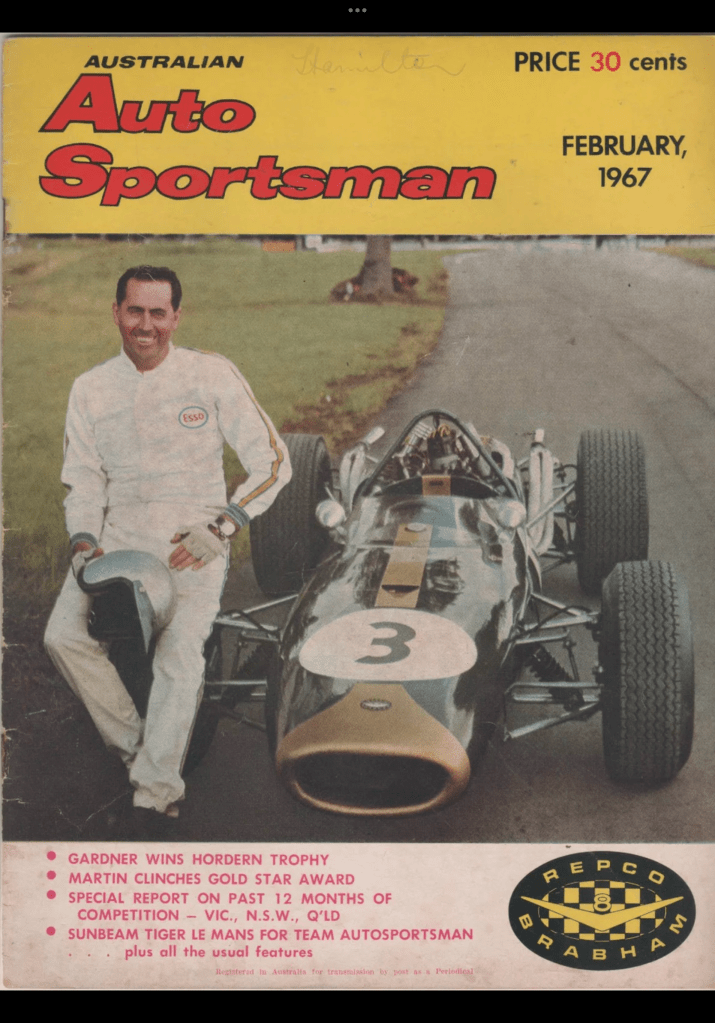
This chassis was Jack’s 1966 weapon of war in the Tasman and F1 championship and non-championship events, owned for decades by Repco Ltd or whatever the retailer is called these days.
(Stupix)
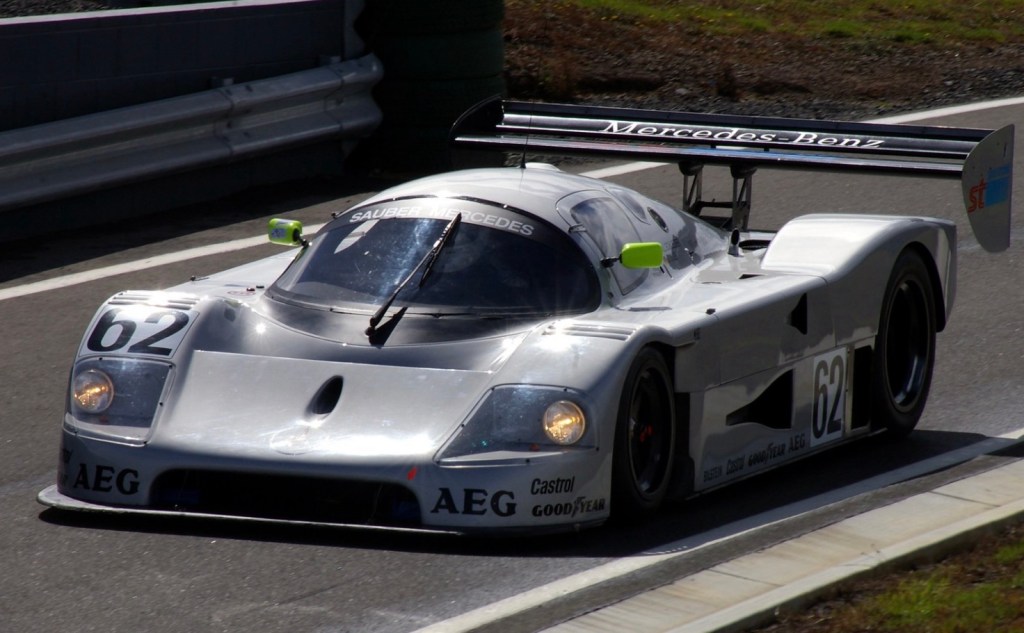
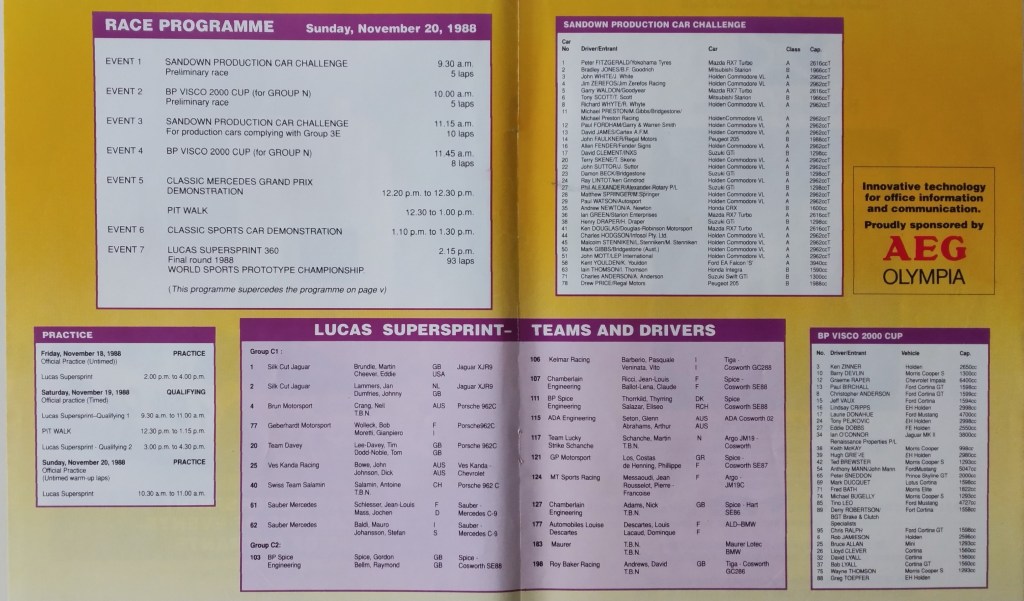
The second placed Mauro Baldi/Stefan Johansson Sauber Mercedes C9 5-litre V8 turbo during the Lucas Supersprint Sandown 360 over the November 20, 1988 weekend
While the entry for this race wasn’t as broad and deep as the 1984 Sandown 1000k the scale of the Fiscal Disaster for the Light Car Club of Australia was similar, see here: https://primotipo.com/2024/05/25/sandown-1000-1984/
(Stupix)
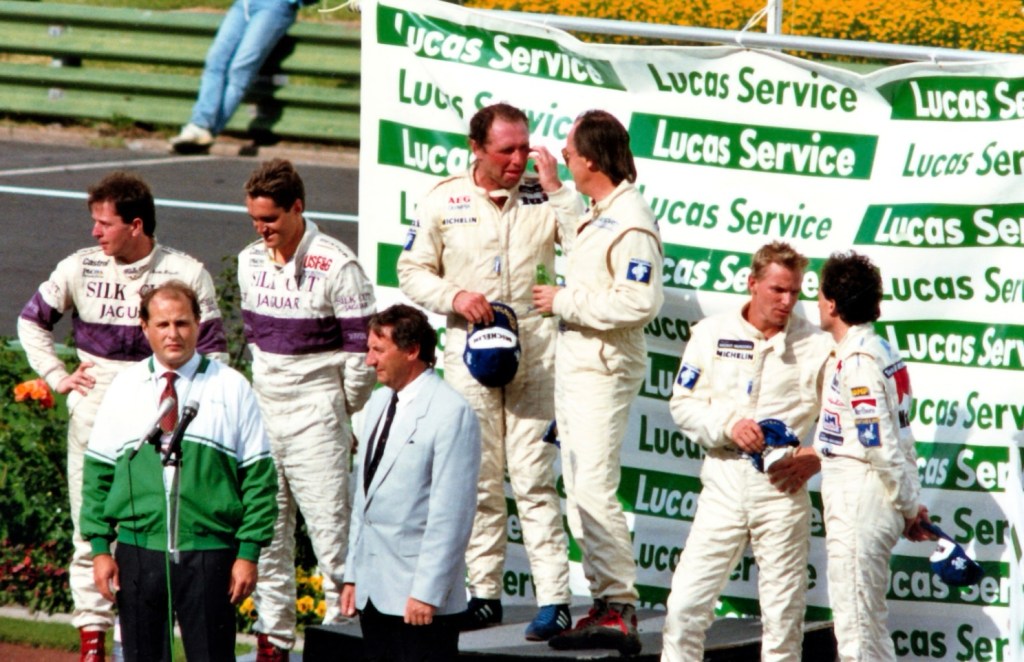
From the left, third place Martin Brundle and Eddie Cheever, Jaguar XJR9 7-litre V12, winners Jochen Mass and Jean-Louis Schlesser, and second men Johannsson and Baldi, Sauber Mercedes C9.
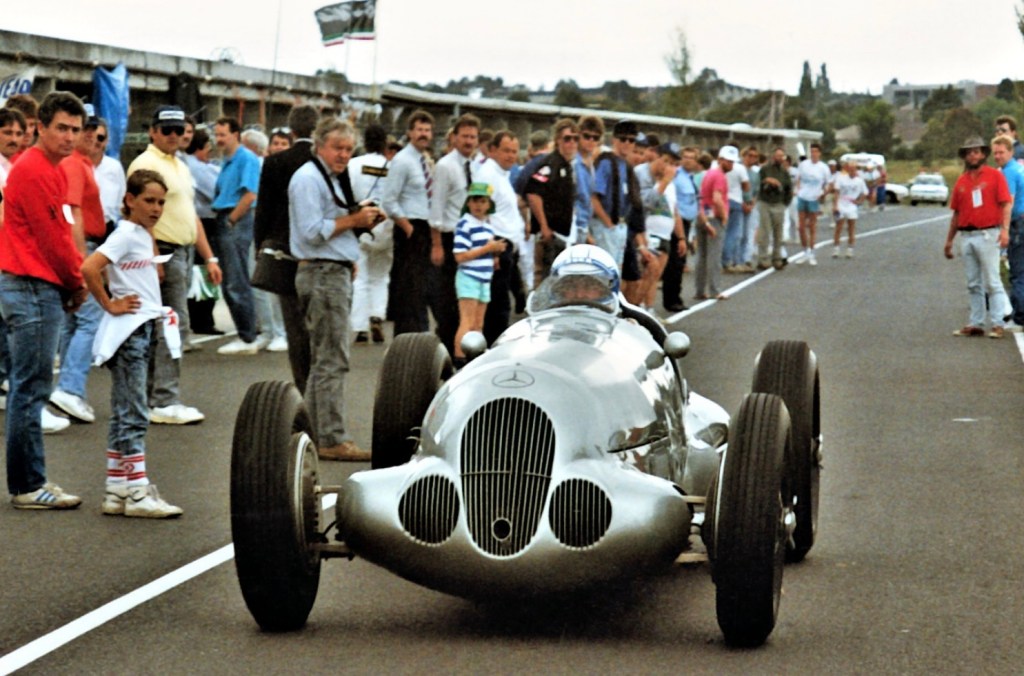
Jochen had a busy weekend not only racing his hi-tech C9 but also demonstrating a 1937 Mercedes Benz W125 Silver Arrows, very spectacular it was too!
(Stupix)(S Dalton Collection)(P Bowen)
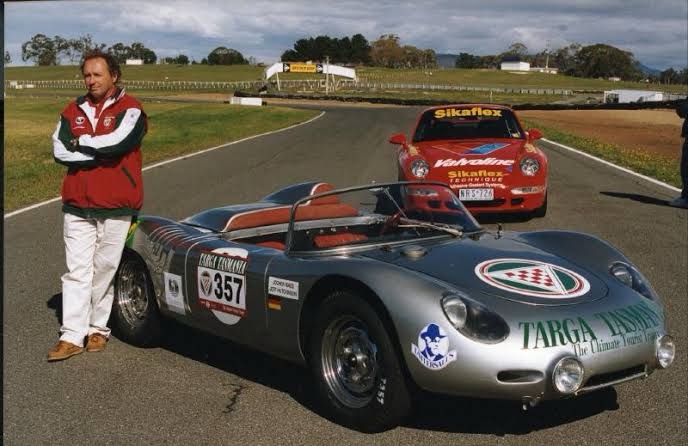
Jochen with the Porsche Museum 550 Spyder in which he had an enjoyable Historic category win in the 1996 Targa Tasmania.
Credits…
Bob Williamson Archive, Ern McQuillan via Jim Strickland, Mike Harding-Auto Action, Ken Devine, Australian Muscle Car, John Shingleton, Stupix, Peter Bowen, John Brock, State Library of Victoria, Stephen Dalton Collection
Tailpiece…
(SLV)
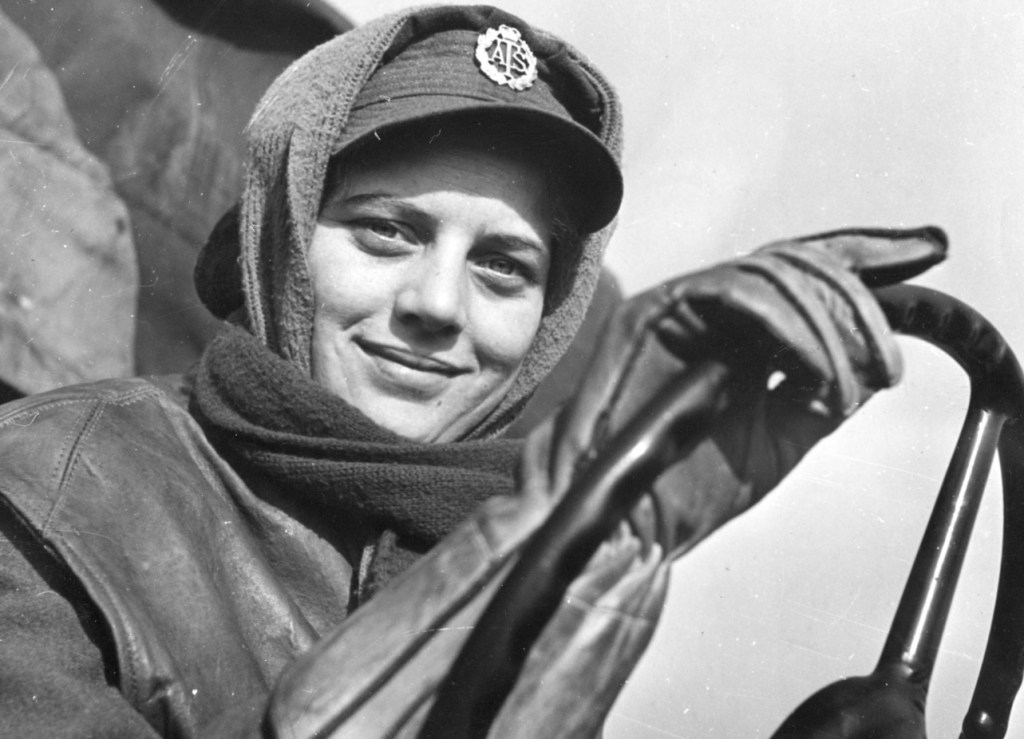
Australian Auxiliary Territorial Services Driver, Gladys Pollard, on assignment in the UK during 1942, summer by the look of it…
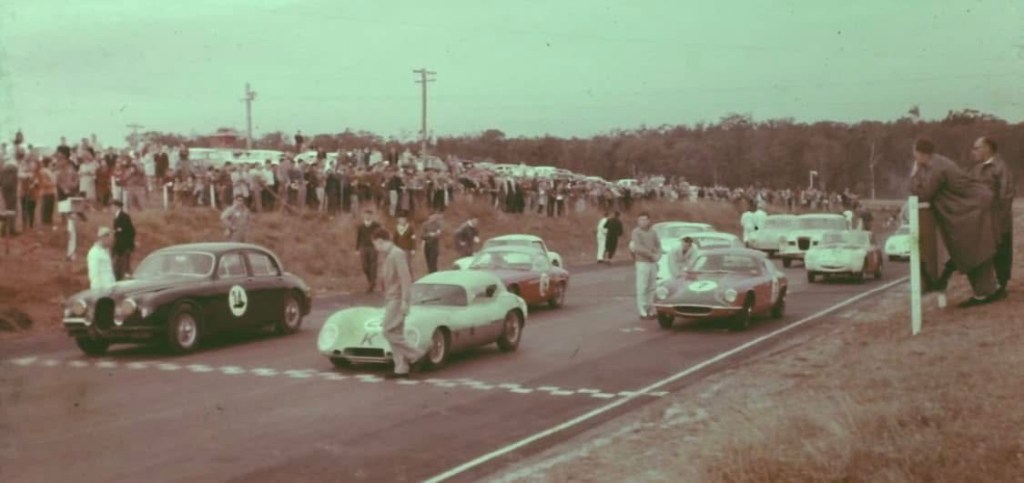
The grid for the Australian GT Championship at Lakeside, Queensland on 8 July 1962…
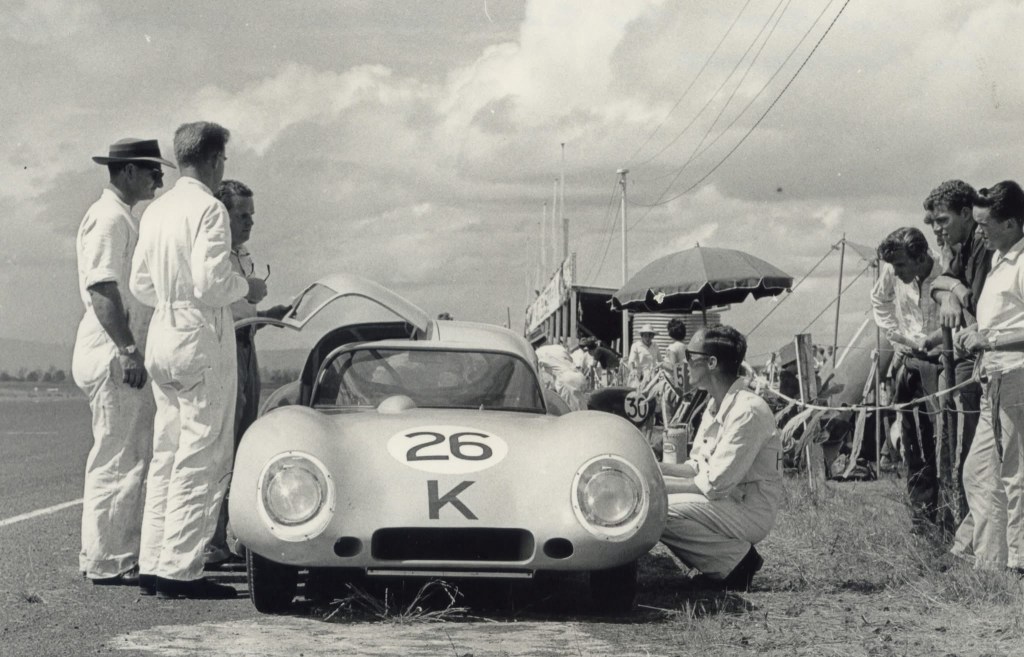
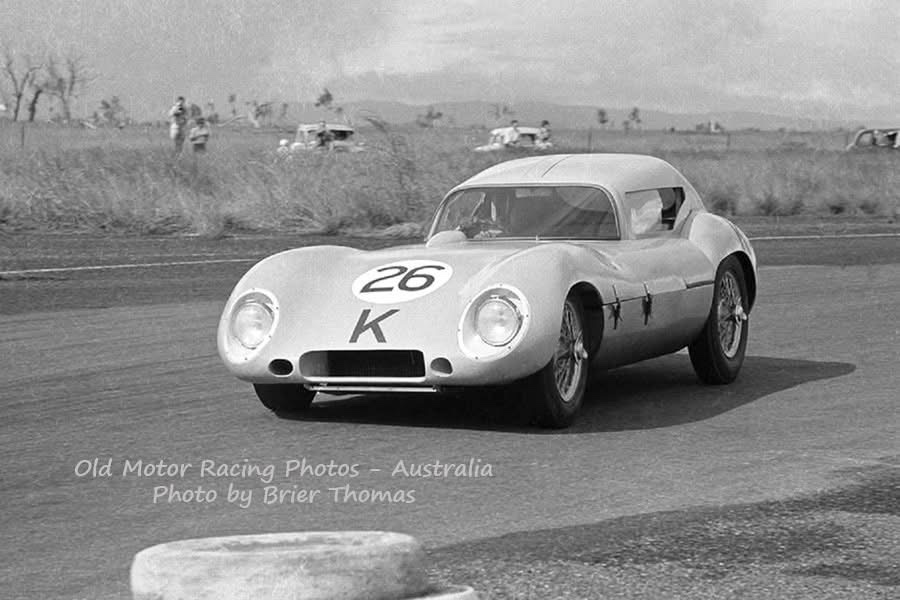
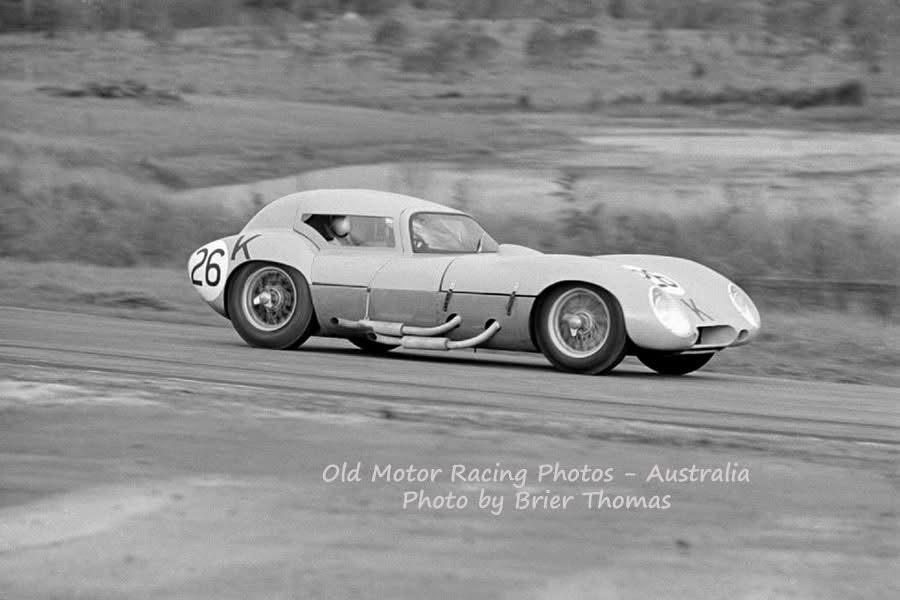
Bill Pitt, Jaguar 3.4 alongside John French in the Centaur Waggott-Holden, then the two Lotus Elites of Tony Osborne #16 and #7 Brian Foley. On the row behind is #21 Les Howard, Austin Healey Sprite Ford-Cosworth, in the middle is the partially obscured #31 Porsche 356 of Tony Basile and on the left the white #30 Renault Floride of Terry Kratzmann .
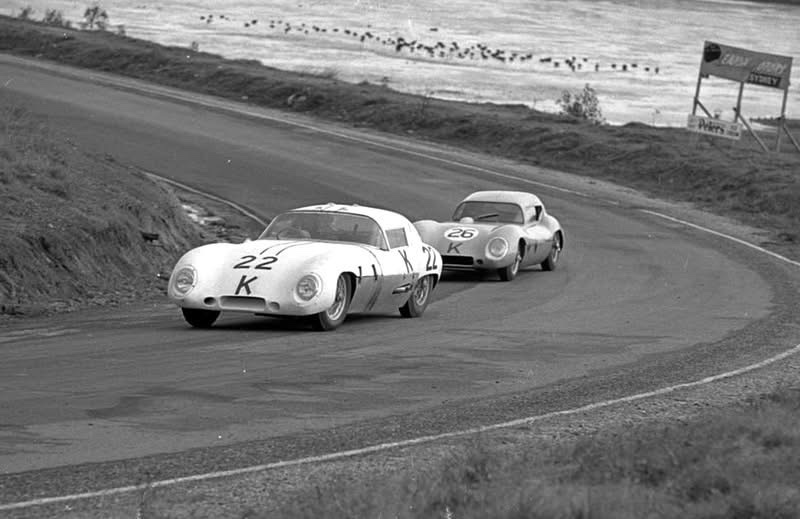
The light-coloured Sprite further back is #51 Sib Petralia, #60 Paul Fallu, Karmann Ghia, whilst the #4 Wolseley has long-time competitor Ken Peters at the wheel. The unmistakable outline of the grey Renault Dauphine is #6 M Hunt. Dennis Geary #22 was also entered in the HWM Jaguar – then in two-seat Coupe form but with the very same chassis and mechanicals of the car raced by Lex Davison to win the 1954 Australian Grand Prix – ‘just down the road’ at Southport on the Gold Coast.
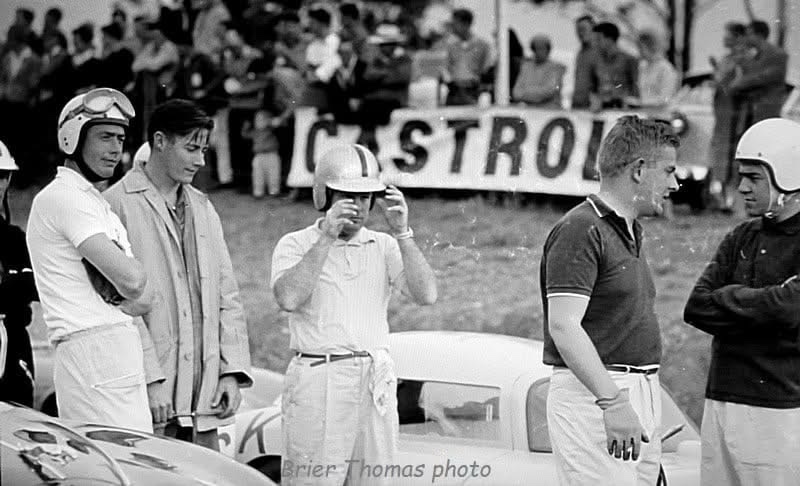
Denis Geary aboard the ex-Moss/Davison HWM Jaguar – the 1954 AGP winning single-seater chassis fitted with a coupe body – from the French Centaur Waggott during the GT Championship (B Williamson)The pit crew provides scale, isn’t the Centaur a small car? Lowood (B Thomas)Les Howard, Kevin Bartlett – looking after Howard’s car that weekend – the victor, John French adjusting his helmet, Antony Osborne and Brian Foley before the off.
The 50 lap 75 mile race was won in 62:6.06 minutes/seconds by French from Basile, Pitt, Howard then came Foley. Sib Petralia won the under 1-litre class, Basile the 1000-1600cc , French the 1600-2600cc and Pitt the 2600cc class and over.
The race was the third Australian GT Championship for Appendix K cars, the first was held at Bathurst during the October 1960 meeting and was won by Leo Geoghegan’s Lotus Elite, the 1961 event was at Warwick Farm in July, and Frank Matich won in his Jaguar D-Type.
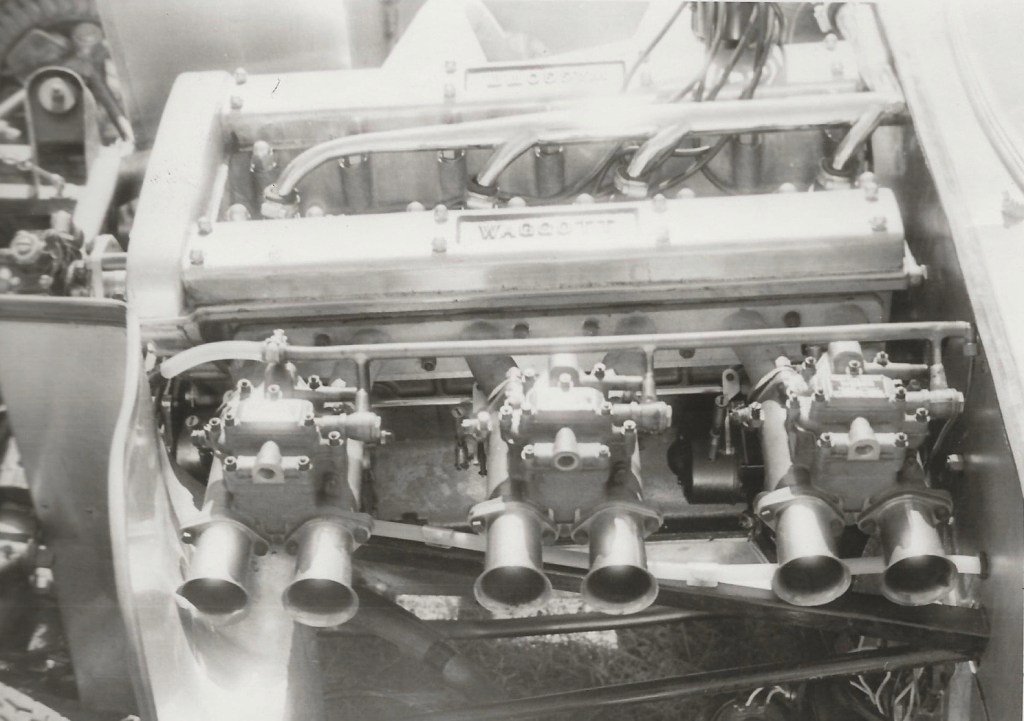
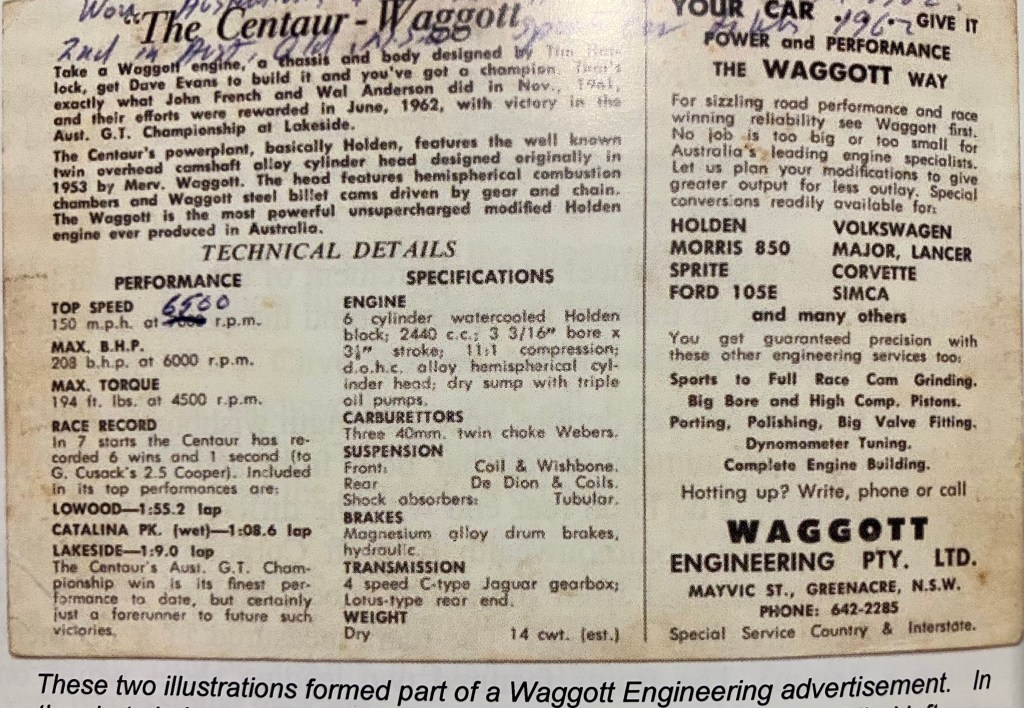
Lowood Merv Waggott built 2440cc Waggott-Holden twin-cam, two-valve, triple Weber 40 DCO fed circa 200 bhp six-cylinder engineLakeside
Toowong, Brisbane, University of Queensland Mechanical Engineering graduate Tim Harlock built his first car in four years, from concept to completion, commencing when he was barely out of his teens.
‘I was always mechanically inclined,’ Tim told Mildred Eden in 1962. ‘But beyond toying with a metal building set and making model aeroplanes, I had never before tackled anything of this magnitude.’
Car racing became Tim’s main interest while still at school.
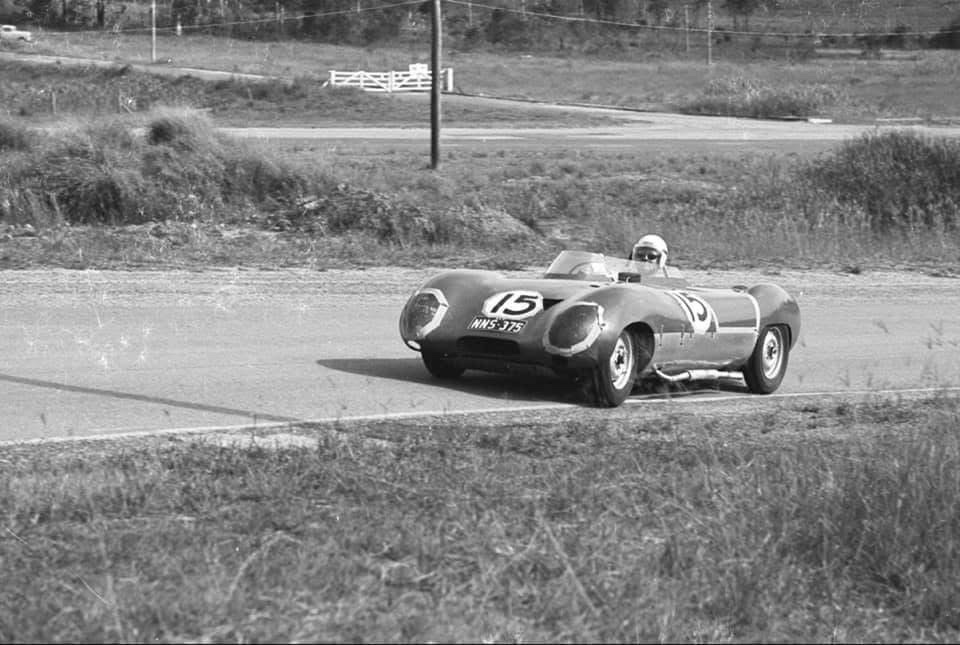
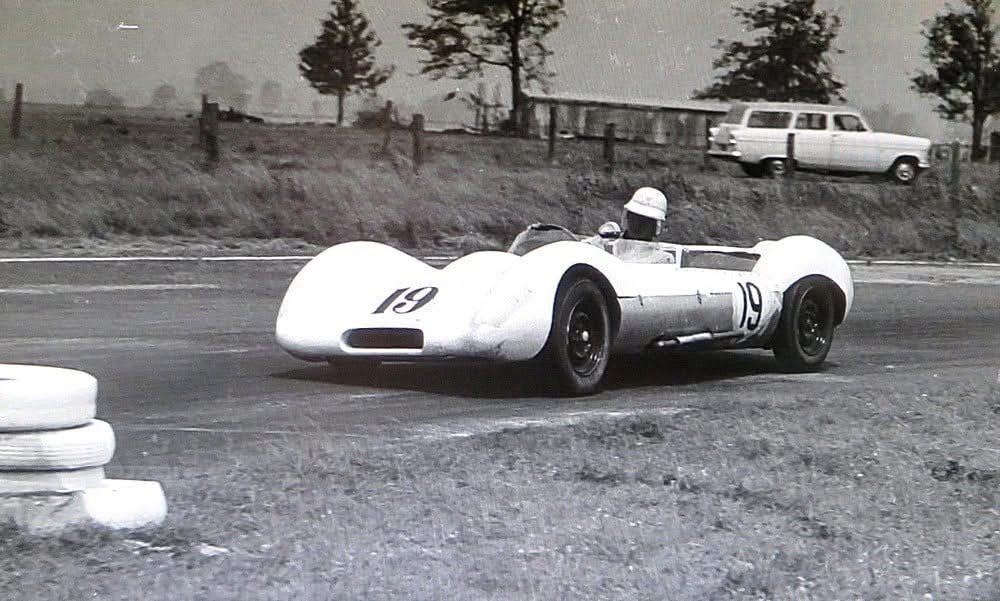
Keith Turner in the Centaur Mk1B Ford at Lakeside circa-1964 (P Lefrancke)Tim Harlock racing his Centaur Mk4 at Lowood in October 1964 (B Williamson)
‘I saw my first race about 10 years ago in England, where we lived while my father, a soldier, was stationed over there. It was at Boreham Wood, but I don’t even remember who was racing at thc time. I did not become a real enthusiast until later.” –
He was determined to race himself but couldn’t afford it so he decided to build himself a car. ‘I’d learnt the basic theory in engineering, but all the practical knowledge came from friends with years of racing experience.
‘Wal Anderson, who is a retired racing driver, was a fund of information, and my friend Keith Turner worked with me on the construction. Incidentally, we have built two cars now, one each.’
The chassis of the Centaur/Centaur Mk 1B is a multi-tubular spaceframe, with the front suspension comprising upper and lower wishbones, modified Alford & Alder uprights and coil spring damper units. The rear comprised a well located BMC A-series rear axle diff assembly.
The engine was a Ford 105E 997cc, an Anglia also provided the gearbox, drum brakes were Morris Major 9-inch front and 7-inch rear.
The nose is Lotus 11-esque!, I can read your minds. Tim did a deal with Chas Whatmore after he damaged the nose of his Lotus 11 at Lakeside, Harlock took a mould from that car, the rest of the body aluminium.
Tim and Keith began to race their cars in June 1961. It wasn’t too long before Wal Anderson introduced John French to Tim Harlock, and shortly thereafter, the 1962 Australian Championship-winning Centaur-Waggott project commenced; the championship C-W was the third of 11 Centaur sportscars built.
Centaur Waggott-Holden GT…
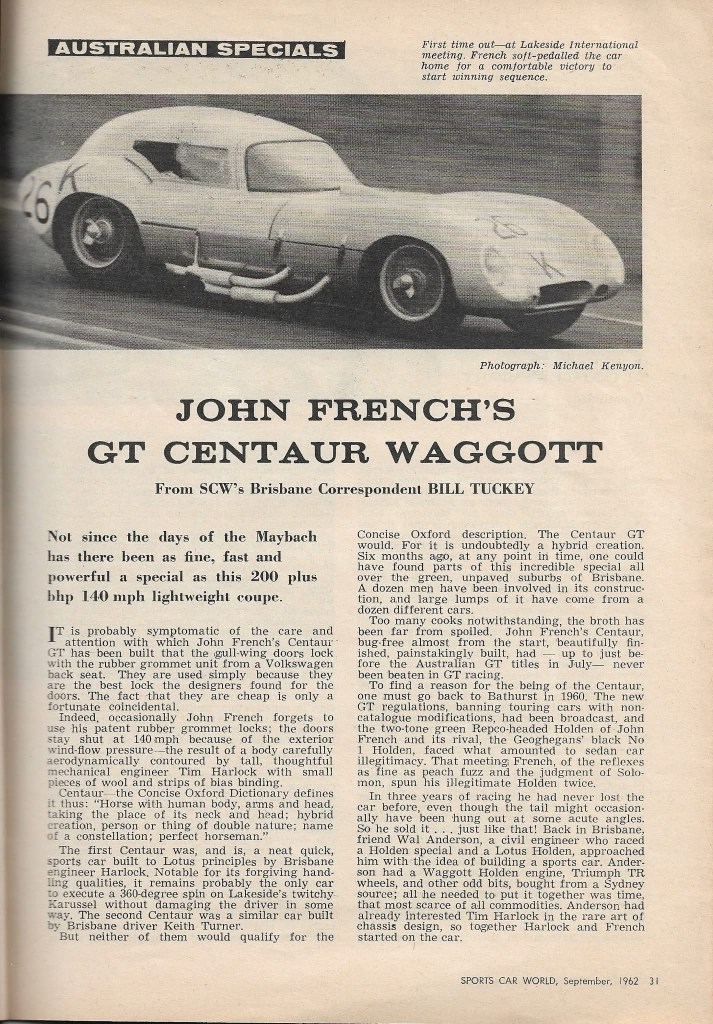
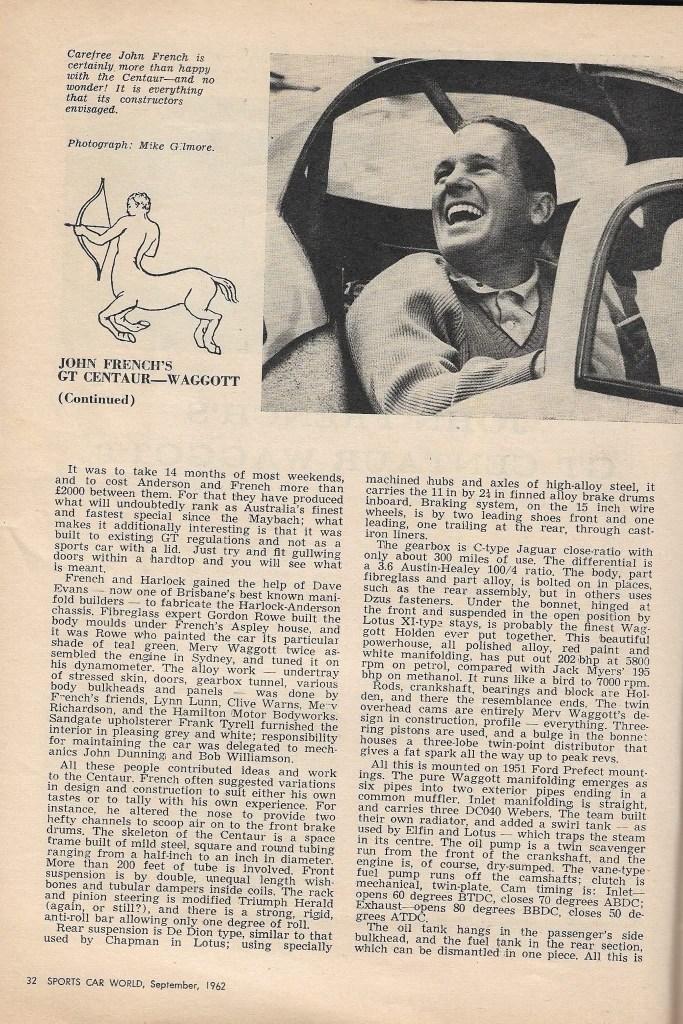
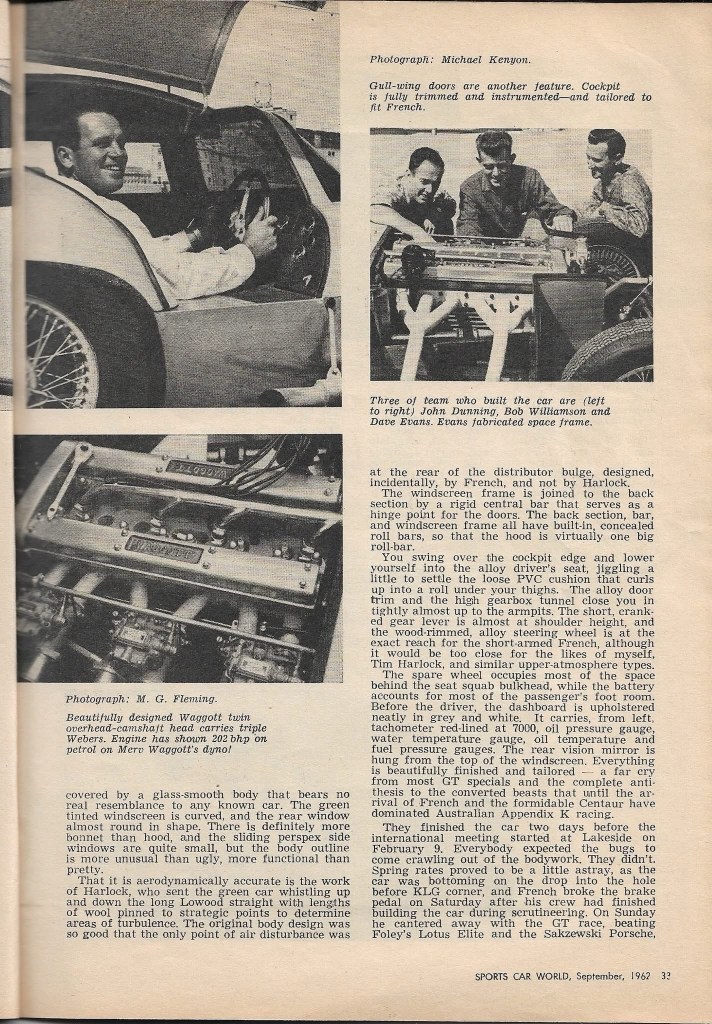
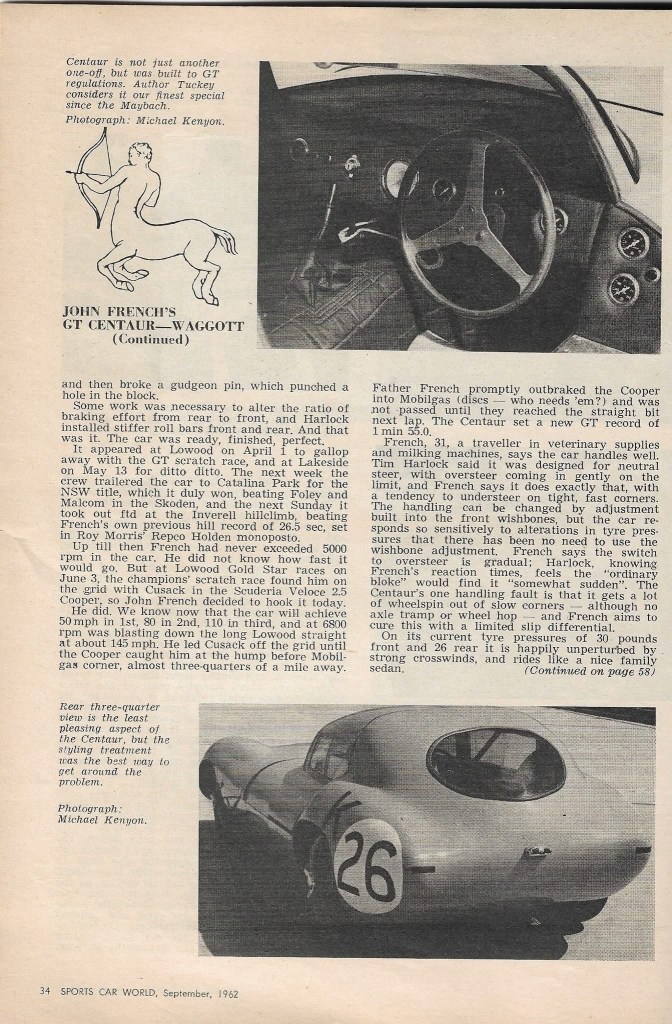
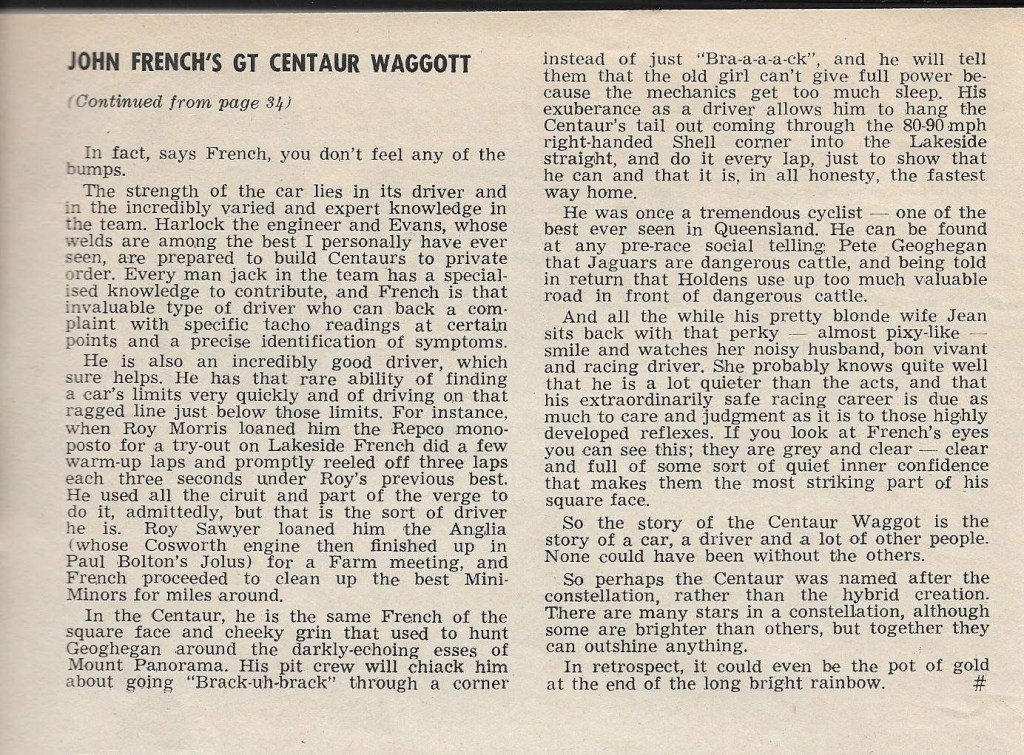
Bill Tuckey, one of Australia’s greatest motoring writers of the 1960s-70s, wrote this fantastic article about the car in the September 1962 issue of Sports Car World, easily my favourite Australian mag until its untimely demise in the 1980s.
Etcetera…
(J Campbell Collection)
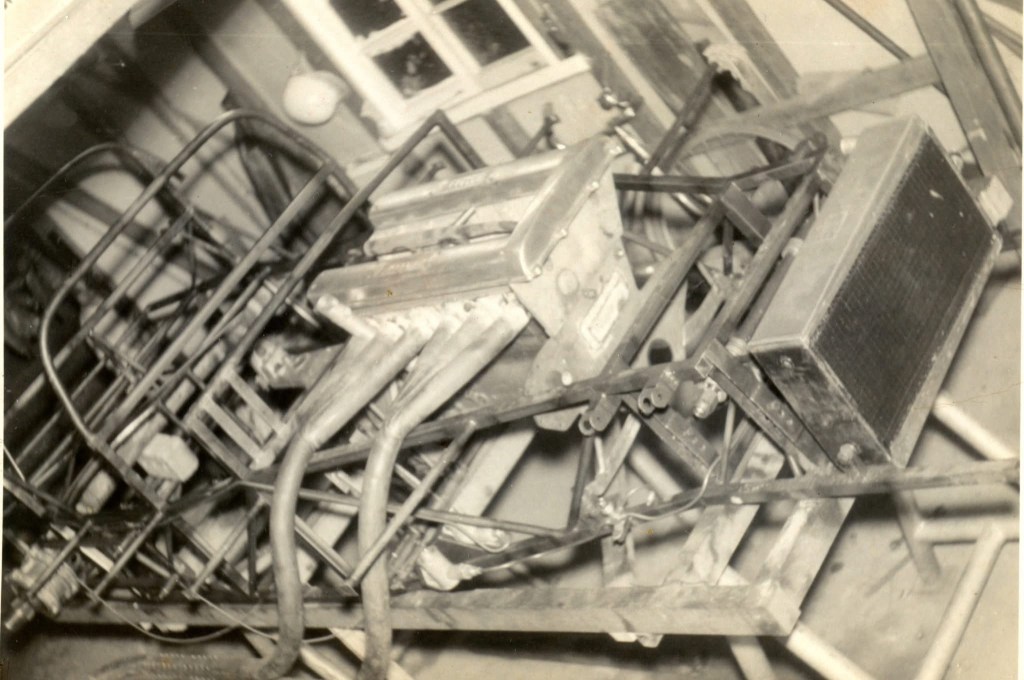
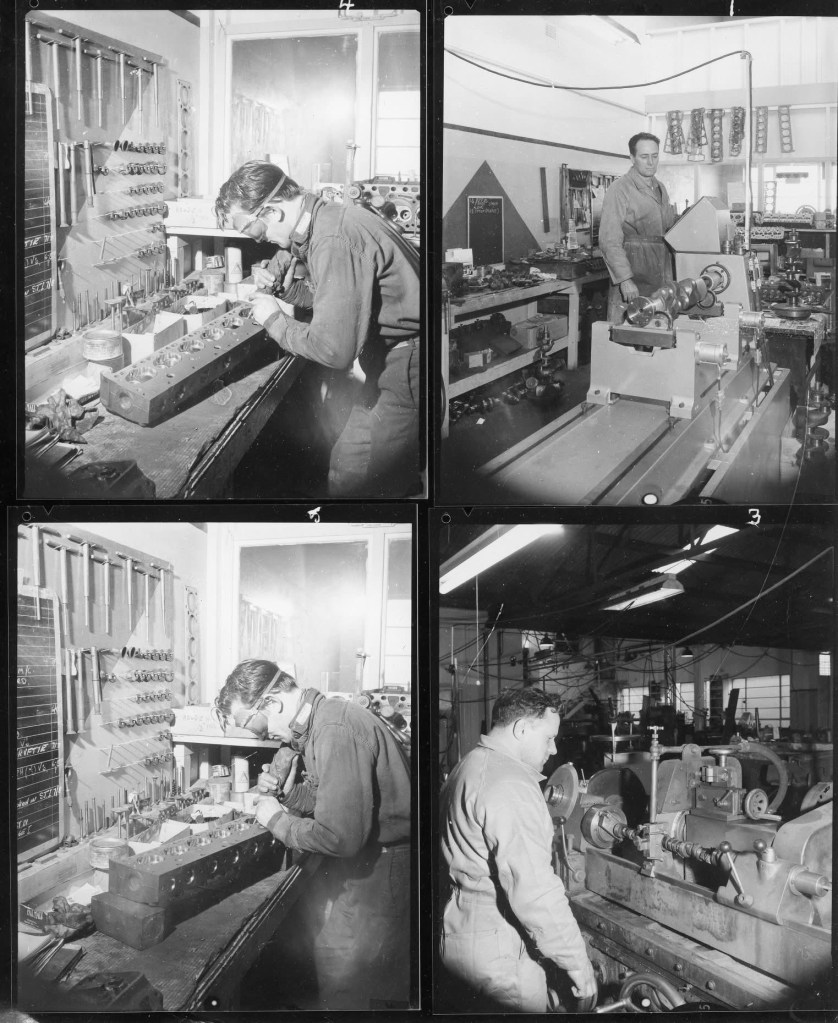
Waggott-Holden engine dummy installation in the Centaur chassis. The shot below more fully describes the engine specifications, and the bottom one is a collage of in-period Waggott Engineering photographs with Merv at top right.
(G Smith Collection)”(B Williamson Collection)
Credits…
Sports Car World, the Brier Thomas photographs are courtesy of Graham Ruckert, Mildred Eden Australian Women’s Weekly, Peter Le Francke Collection, Bob Williamson Collection, Greg Smith Collection, John Campbell Collection
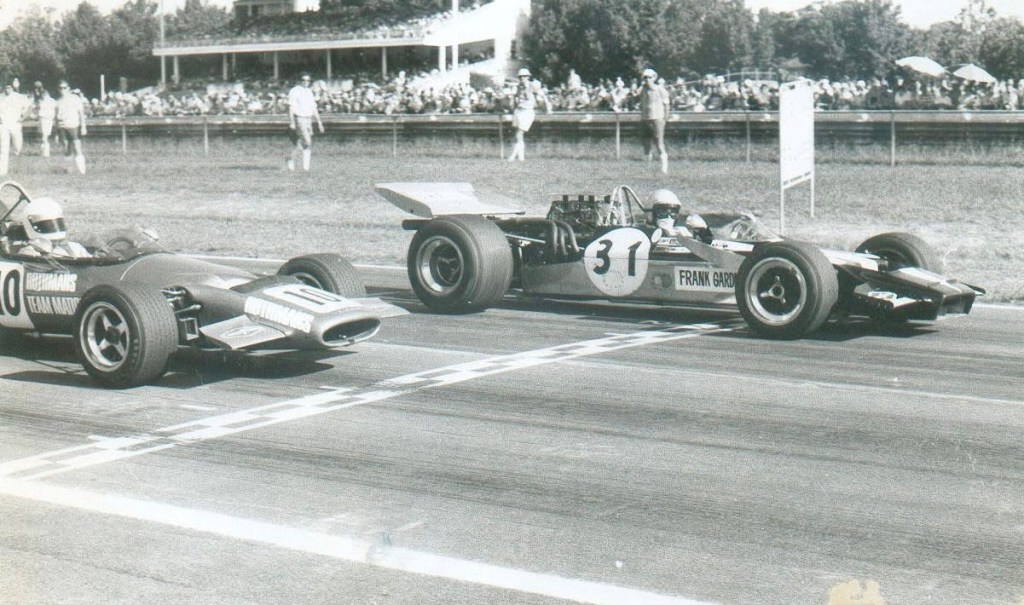
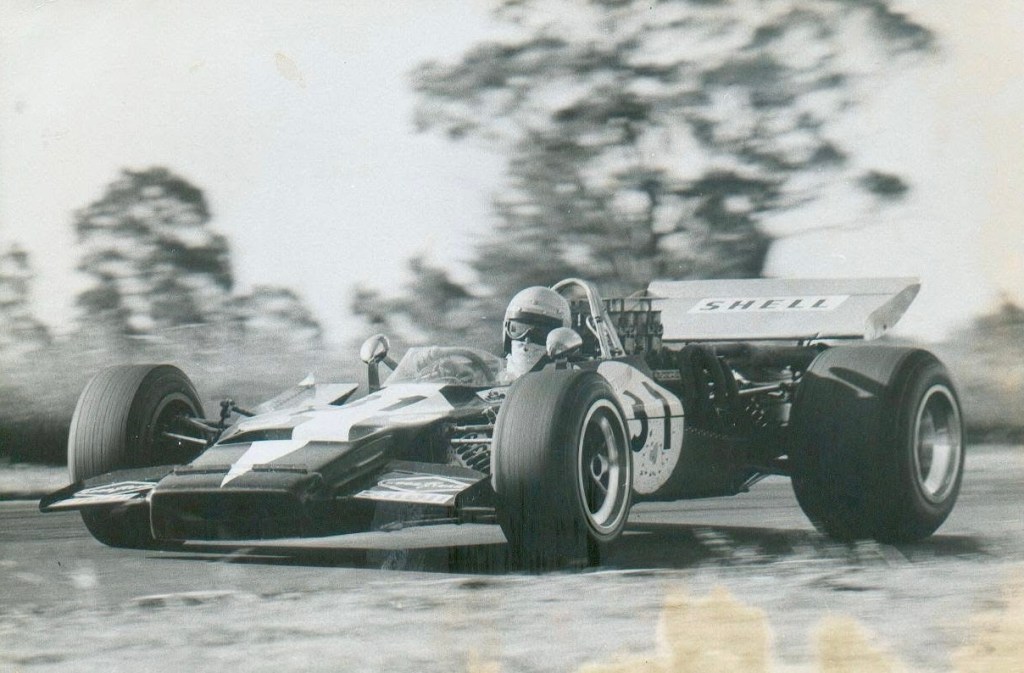
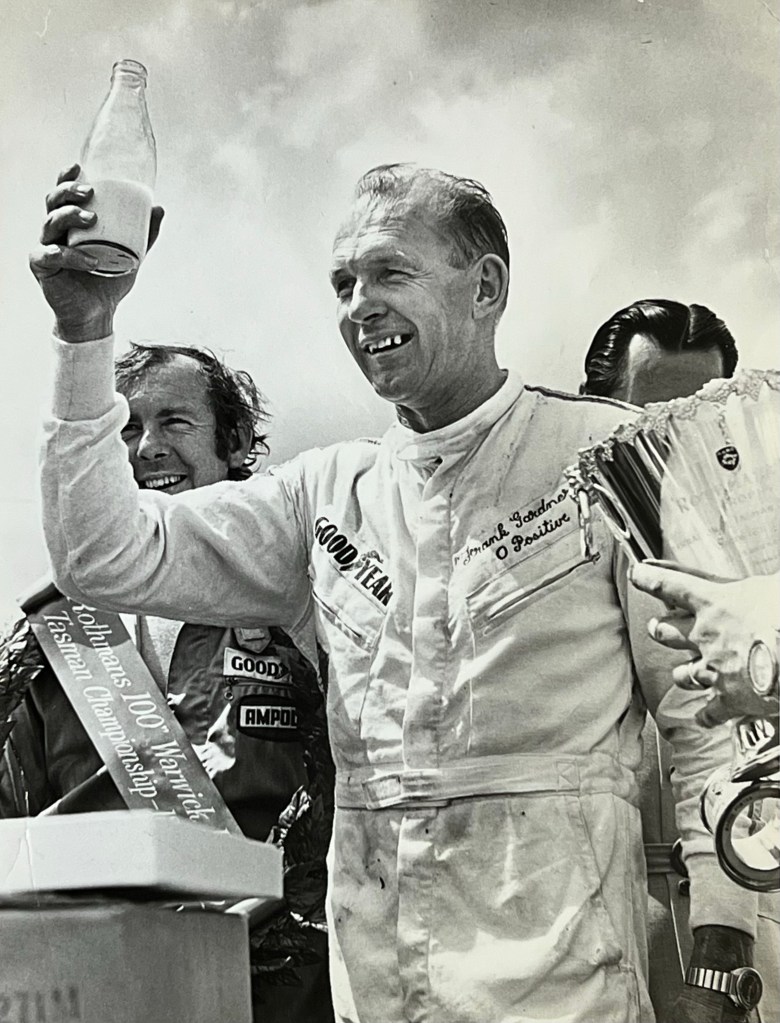
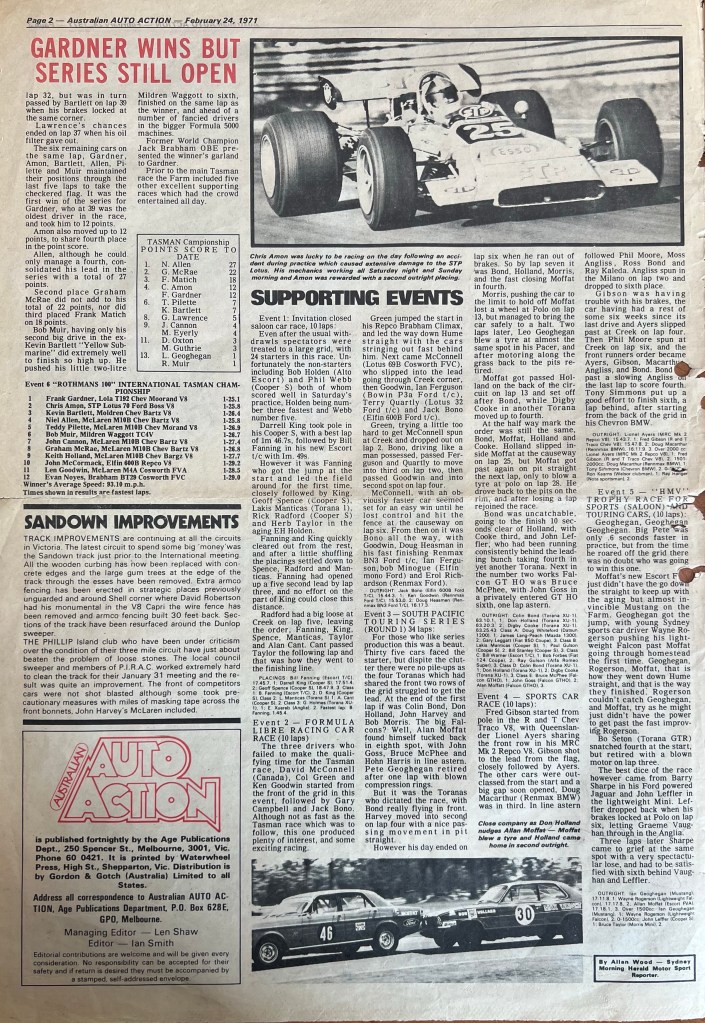
Frank Gardner on the way to winning the Warwick Farm 100, round five of the 1971 Tasman Cup held on February 14, works-Lola T192 Chev #190/F1/6 or SL/192/14.
In search of downforce, notice the small wings on either side of the cockpit. They were deemed illegal over the Surfers Paradise weekend, a fortnight later, and weren’t seen again. Those with good memories will recall Frank Matich running with a twin-rear wing setup on his and John Walker’s Matich A50 Repco-Holden in 1972-73.
Gardner won the race from grid two with Chris Amon second in the STP Lotus 70 Ford and Kevin Bartlett third in the Alec Mildren Racing Mildren Chev V8.
That’s the nose of poleman, Frank Matich’s McLaren M10B Repco-Holden alongside FG below.
(R Cranston Archive)
Bruce Sergent wrote that ‘Matich tried everything to get past Gardner in the early stages but Gardner was too wily and experienced to be forced into an error. Each time Matich applied pressure to the Lola Gardner gave the throttle a little extra and opened a few more car lengths between them.’
(R Cranston Archive)
While Gardner’s Lola was very competitive, the series was a McLaren M10B benefit with Graham McRae victorious with three wins, from Matich with one, then Gardner and Niel Allen equal on points; Niel took two rounds.
Of the three M10Bs, Allen’s was fairly close to box-stock, whereas McRae’s LWB machine had the race-winning benefit of a year’s racing in Europe. Matich did plenty of development miles in his Repco-Holden powered car in Sydney given generous development budgets from Repco and Goodyear for whom he was the race-tyre distributor and a contracted driver.
Winners are grinners! FG with Frank Matich behind at left and the distinctive Brylcreem upper dome of Jack Brabham at right (I Smith)(R Cranston Archive)
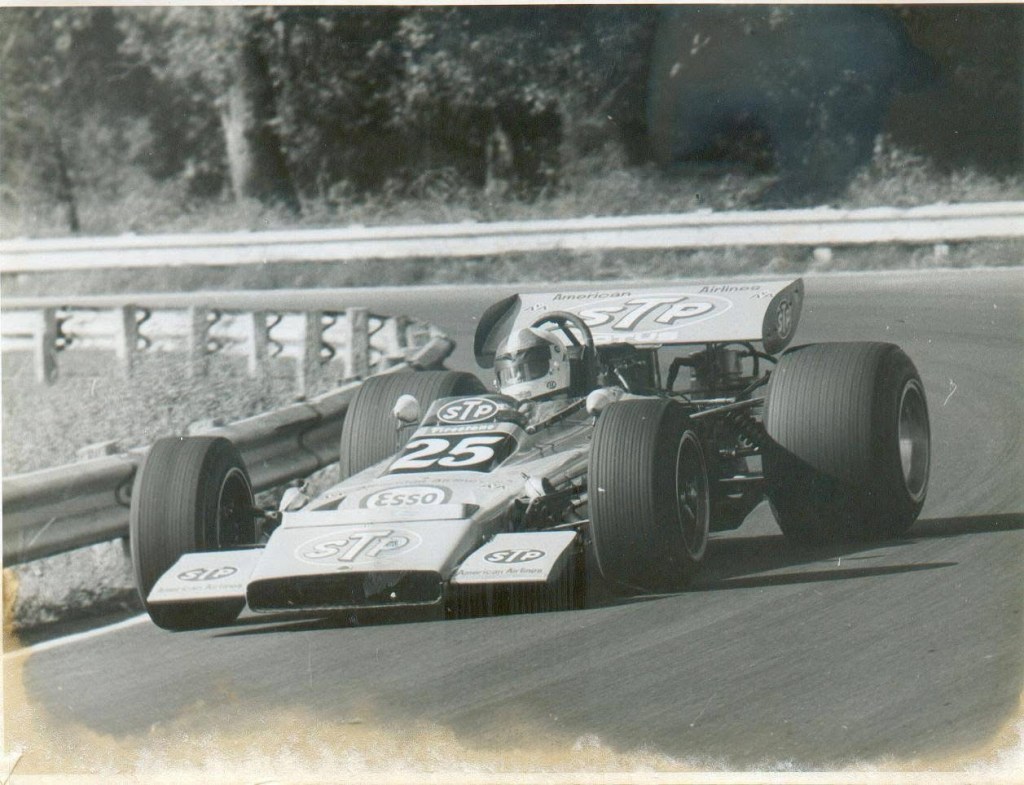
Chris Amon’s Lotus 70 Ford was the Lotus Components machine raced by Dave Walker in the November 1970 AGP at the Farm, then driven by David Oxton in the NZ Tasman rounds before being bought by STP to replace the March 701 Ford DFW 2.5 that Chris started the series in, but found uncompetitive.
Chris returned from commitments with his new F1 team Matra – winning the Argentinian GP aboard a Matra MS120 on January 24! – and ‘claimed ‘ the Lotus from Oxton, then having a lousy practice after suspension failure caused a prang. The car was rebuilt overnight. Chris ran in third place throughout, inheriting second when Matich retired with electrical problems.
Matich, Warwick Farm (R Cranston Archive)
After the Tasman Cup Matich made a two race US L&M Championship smash-and-grab raid with the same McLaren M10B Repco-Holden #400-10-2 at the Riverside Grand Prix and the Monterey Grand Prix at Laguna Seca in April-May 1971 for a win and second place. It gave the Americans and their highly developed M10B Chevs something to think about!
(R Cranston Archive)
Niel Allen from Keith Holland in another M10B – McLarens/Trojan Cars sold a lotta M10s! – Keith was ninth in the race and 11th in the series.
Local boy – and leader of the Tasman Cup on 24 points when the circus arrived in Australia – Niel Allen had handling problems with his McLaren M10B Chev during practice and could only manage Q8.
Allen and Kevin Bartlett, Milden Chev, diced throughout the race until Niel left the track after going too deep into Creek trying to keep KB at bay just after Graeme Lawrence’ Ferrari 246T blew an oil filter and liberally coated the track with Shell lubricant.
Allen, Warwick Farm (R Cranston Archive)
Allen left Warwick Farm for Melbourne with a five point championship lead from Graham McRae’s M10B Chev and bounced back in practice putting his car on pole on quick Sandown Park. Things turned rapidly sour when a small stone ingested on the pace-car parade lap before the start chewed at a piston. He led until lap 20 when McRae took over and won the race.
The Tasman Cup was a Surfers Paradise shoot-out between Allen and McRae which was decided in Graham’s favour when Niel blew a radiator hose after completing eight laps having qualified on the outside of the front row alongside Matich and Gardner.
Matich won from pole, Gardner was second and McRae third, and with it came the first of McRae’s three Tasman Cups: 1971-72-73.
Allen, Warwick Farm (R Cranston Archive)
Having given racing his very best shot – three Tasman Cup round wins in 1970-71 including the ’71 NZ GP at Pukekohe – Niel Allen retired from the sport selling his M10B #400-02 to Kevin Bartlett who had it in time for his ’71 Gold Cup campaign. Niel’s abortive brief flirtation with Lola T300 #HU4 at Warwick Farm in December 1971 duly noted…
See here for a summary of this car’s life: https://www.oldracingcars.com/mclaren/m10b/#id-M10B/02 Note that the summary is incorrect in that both the ‘Allen M10Bs’ were restored for Alan Hamilton by Jim Hardman in Melbourne. 400-02 is owned by Joe Ricciardo in Perth and 400-19 by the Estate of Alan Hamilton.
Etcetera…
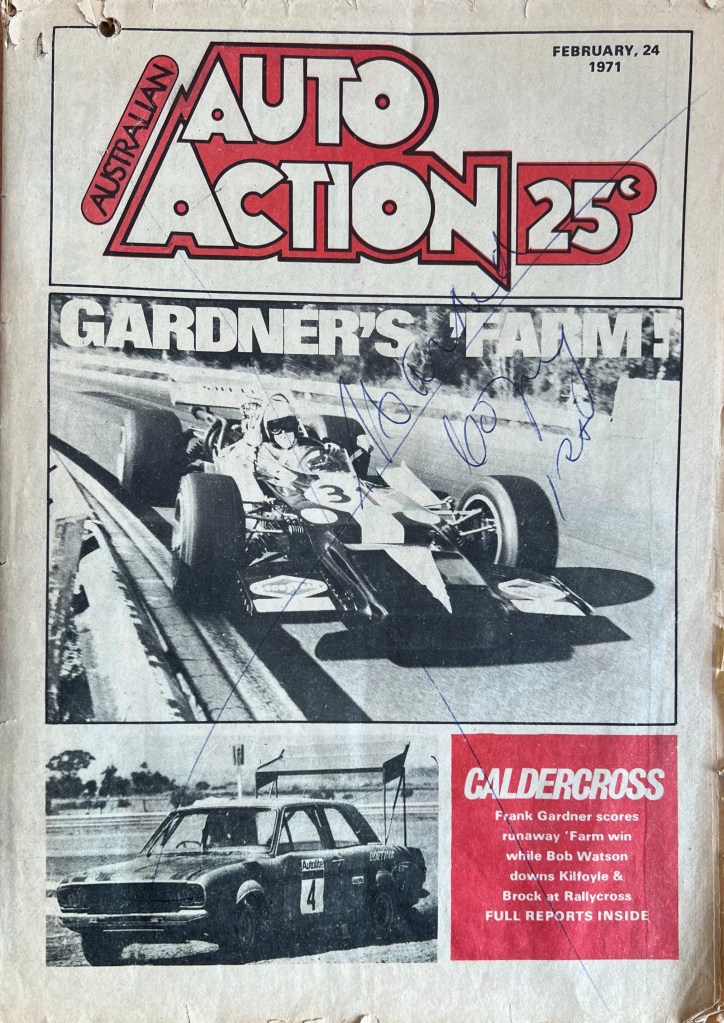
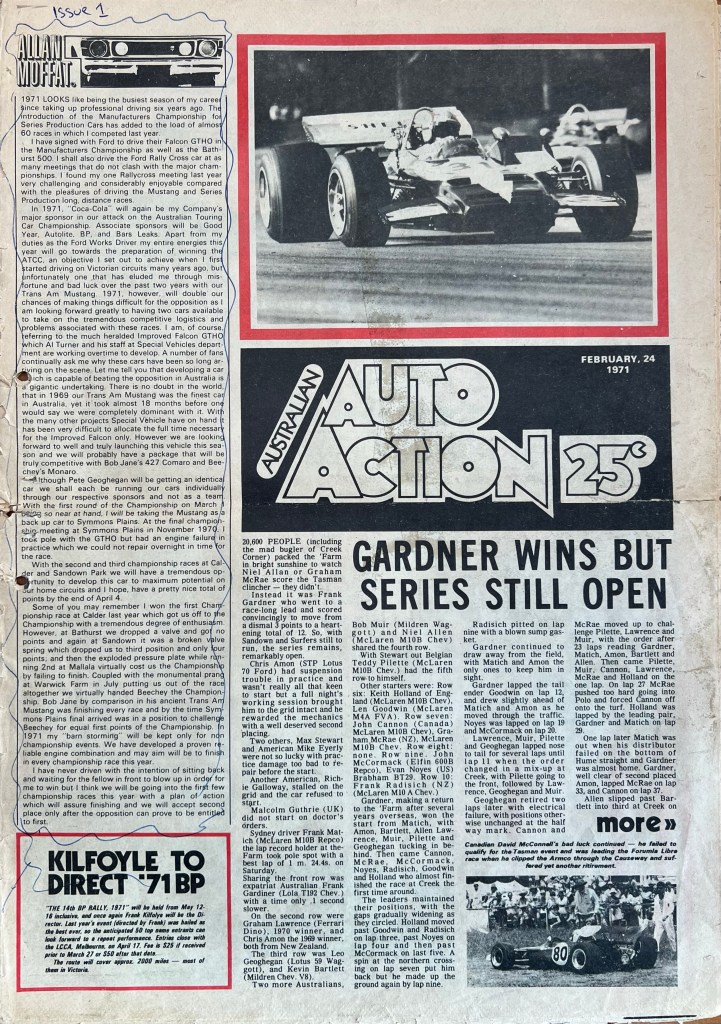
Shortly after I posted this piece, the forever prominent Melbourne-based photographer Ian Smith gave me a shout to remind me that this meeting was the front-page feature of the very first Auto Action,published on February 24, 1971.
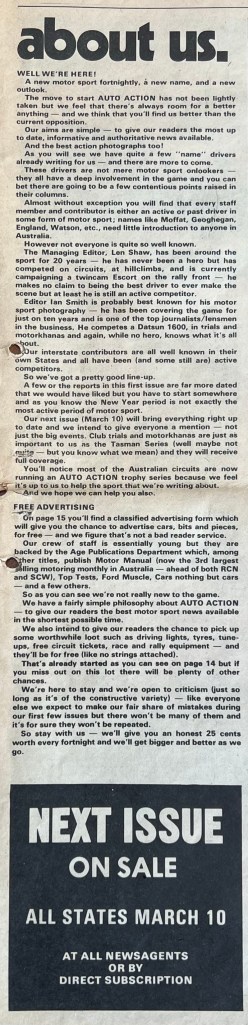
Ian was the first editor and everything else, ‘I took most of the photographs and wrote most of the articles!’
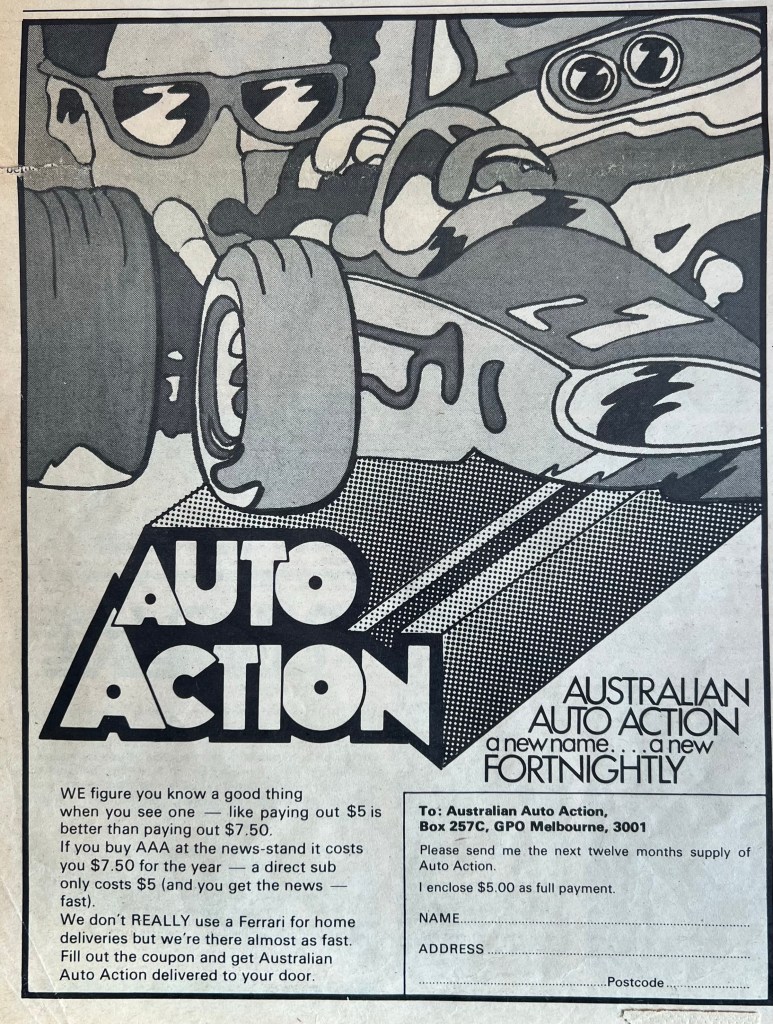
Auto Action is still going strong as a free fortnightly online racing news mag, and as a $15 features-based 132-page printed magazine. Many of you may be aware that I have a regular gig there.
Who came up with the name Ian? ‘The Age/Syme Magazines Len Shaw, Motor Manual Editor Tim Britten and I were kicking ideas around and it was Tim who offered up ‘Auto Action‘, and that was it, we all thought that was a beauty.’
‘In those early stages, the magazine was laid up and assembled in The Age premises in the Melbourne CBD, then I jumped in the company’s Kingswood and blasted up to Shepparton, where it was printed. It was distributed nationally from there. Nothing at all like today’s processes.’
Auto Action is still going strong, despite markets internationally being littered with the carcasses of magazines of all sorts. In Australia, only Wheels is older, give us a go, folks, the current iteration of the publication is world-class these days, bias hereby recognised!
‘At that Warwick Farm meeting, I can remember walking around the car park putting Auto Action leaflets on car windows, letting everybody know when the next issue was on sale. New South Wales was Racing Car News‘ home ground, the market leader then. ‘
Credits…
Robert Cranston Archive, Allen Brown’s oldracingcars.com, Bruce Sergent’s sergent.com.au, Ian Smith, Auto Action
Lex Davison in the Little Alfa – Alfa Romeo 6C 1500 s/c Spl – at Ballarat Airfield with RAAF Avro Ansons in the background.
He is contesting the 75 mile Victoria Cup held on the Australia Day holiday, January 27, 1947.
The race was the first post-War ‘state level event’ held in Victoria and was promoted jointly by the Light Car Club of Australia and the Victorian Sporting Car Club.
(G Thomas)
Doug Whiteford won the handicap race in Black Bess, his Ford V8 Special which was at the start of a long run of success.
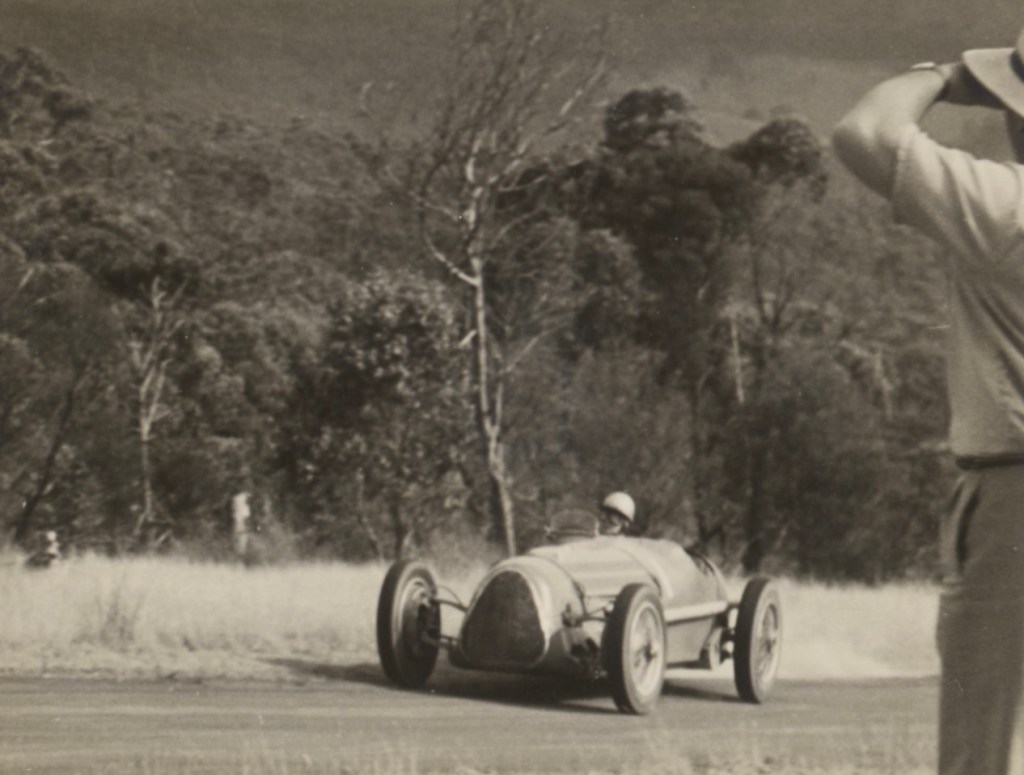
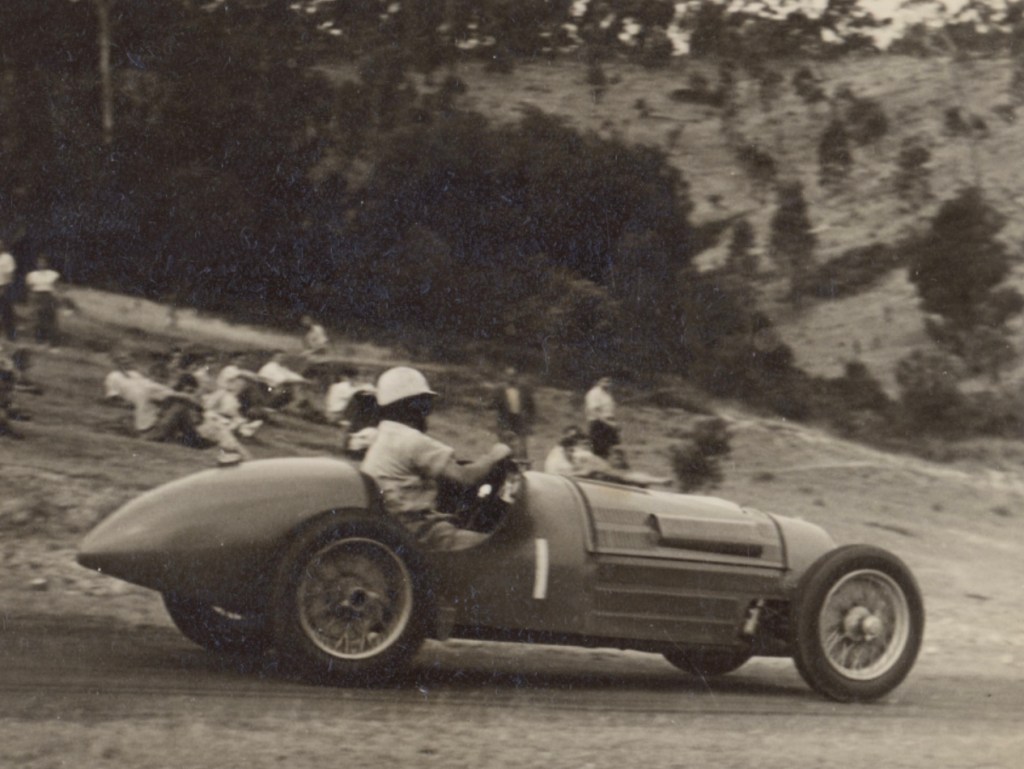
The caption says Fishermans Bend but it looks more like Altona to me, one for those with a programme collection. And below Ted again, Alta 21S Ford V8 Spl this time during the 1954 Victorian Trophy at the Bend on March 22, 1954.
It’s alive and well too, restored by Graham Lowe several decades ago, it’s used regularly on road and track by current custodian, Fiona Murdoch. I’ve driven it too, in March 2023, for articles published in The Automobile and Benzina. And yes, it is sen-‘kin-sational.
(G Thomas)
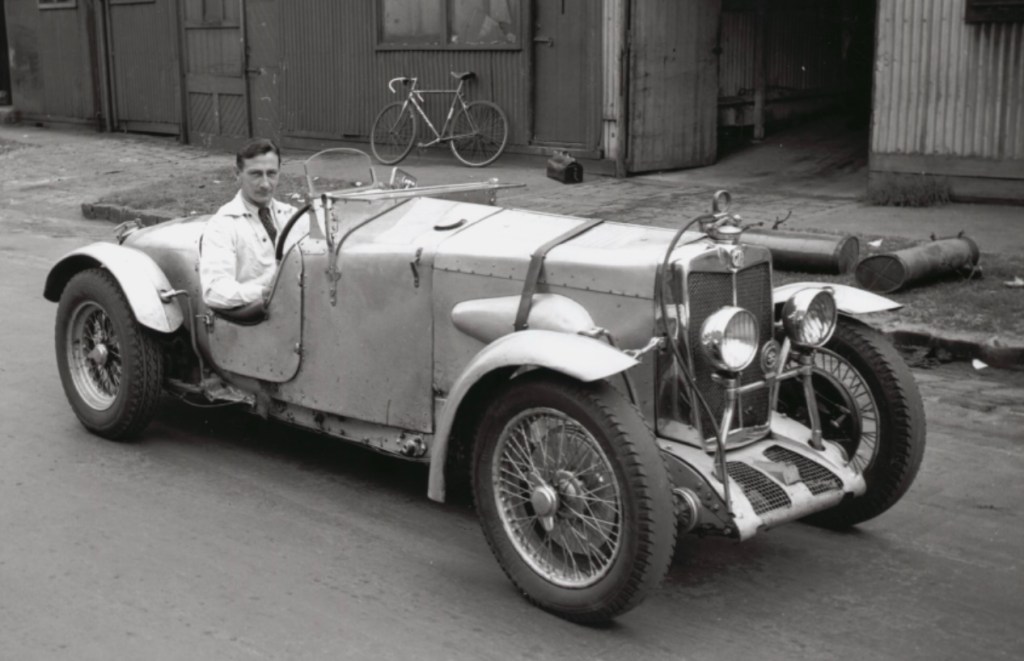
Reg Nutt aboard an MG NE Magnette Ulster, outside the Nutt/Jack Day premises in Whiteman Street, South Melbourne.
Greg Smith comments, ‘White street South Melbourne features to note : 16″ rear wheels, 18″ or 19″ front wheels, brakes still cable operated, door fitted to the original body maybe to comply with the CAMS draconian rule (what has changed since its inception in 1953 ? nothing!!) that “sports cars” must have a door of minimum dimensions.Tyres nearly bald. Expensive push bike leaning against the wall with the owners Gladstone bag on the footpath, maybe the photographer ?? Two fuel tanks out in the sun sweating the fumes out before solder repairs. The car was ex-Barraclough and very scruffy by this time.’
Nutt was both a master mechanic and driver with a pedigree going back to Phillip Island’s early days. He was Reg Brearley’s riding mechanic in 1929 when the pair placed second in a Bugatti T37A.
Better was to come when he won the race in 1931 alongside Carl Junker aboard a Bugatti T39 in 1931. T39-4907 is the very car shown below raced Jack Day’s Day Special (the car below) in the South Australian Grand Prix referred to above on daunting Lobethal, setting the fastest race time for that handicap race, and the following day did the fastest lap of the weekend…he could drive.
He got the bug early, recounting to Bob King memories of a Bugatti Brescia while doing his apprenticeship at Meaby’s Garage in Toorak Road, South Yarra.
The Day Special was Bugatti T39-4607 fitted with a Ford V8 and other modifications (G Thomas)
Apart from his on-track exploits in this car, Nutt gave Norman Ellsworth the ride of his life, when towing Ellsworth’s just purchased Bugatti Brescia back from Adelaide to Melbourne.
The deal was that Reg would tow the car through the many country towns on the long trip as the Brescia was unregistered. But Reg ‘forgot’ about the Bugatti on the end of the tow rope and did several miles outside Dimboola at well over 100mph. Ellsworth’s reaction is unrecorded!
What an evocative shot of the business end of the brilliant Wylie Javelin Spl…
The gent in the Akubra makes the shot. Perhaps it’s the ’53 AGP weekend at Albert Park but that’s a guess. That looks like a rego-sticker on the windscreen! See this lengthy epic: https://primotipo.com/2018/09/14/the-wylies-javelin-special/
Arthur Wylie at Altona in 1954 (SLV)(SLV)
A D.F.P. out front of a home, probably in Melbourne, chassis number and street address please!? It has a touch of the Elsternwicks about it but could be anywhere.
The marque were in on the ground floor of racing in Australia, Les Pound finished last in the 100 Mile Road Race run by the Victorian Light Car Club in March 1928, the second Australian Grand Prix.
Reg Hunt enroute to winning the scratch-section of the Bathurst 100 during the 1955 Easter weekend at Mount Panorama, Maserati A6GCM-250.
Despite having only his short-diff fitted the Grand Prix car still did 145 mph down Conrod.
The handicap winner of the race was Curley Brydon in his new MG Special; a mix of the ex-Tomlinson ‘39 AGP winning chassis and the supercharged engine from Brydon’s ex-Patterson TC Spl.
Manchester born Reg Hunt tootling through the Fishermans Bend paddock in his Hunt Spl aka The Flying Bedstead, date unknown but 1951 perhaps.
The Hunts arrived in Melbourne in May 1949 with Reg bringing with him various parts accumulated in the UK which he used to build this hillclimb /road racer affectionately known as the Flying Bedstead.
It was built between May-October 1949 by Hedley Thompson either in his Deepdene, Melbourne home garage or as a homer at Trans Australia Airlines, where Hedley was head of maintenance.
Thompson’s thoroughly modern chassis was a shallow multi-tubular spaceframe of welded steel construction. It had a light, tringulated front bulkhead and a more substantial rectangular one at the very rear of the car just aft of the gearbox.
Front suspension was modified Morgan pillar, and the rear comprised an upper transverse rear spring, swing axles and an underslung tubular shock absorber mounted at its top to the underside of the axle case and at its bottom to the chassis.
Bolt-on wire wheels were 3:25 inch x 18 at the front, and 3:50 inch x 19 at the rear. The ultra-light machine had hydraulic brakes with two leading shoes at the rear.
The engine was an Amal-fed 500cc J.A.P. (J.A. Prestwich) speedway engine with the power hitting the road via a Norton four-speed box.
The Flying Bedstead’s first outing was at Fishermans Bend in October 1949, where it was noticeably quicker and outclassed the numerous MG specials present. Some weeks later, at Rob Roy, it lowered the class record by nearly six seconds, to 31.4 seconds. In March 1950 he improved his time to 29.35 seconds.
Other successes followed, and soon a supercharged 998cc Vincent Black Lightning engine was fitted by Phil Irving, and the bodywork was improved; the form shown above.
‘First used in this guise at Bacchus Marsh in July 1951, at Bathurst in October it outpaced a Cooper Vincent in the first race and was pipped on the last lap in the second. The speed over the flying ¼ mile was reported at 134 mph.’ Really?!
When Hunt raced Cooper 500s in Europe in 1954, he made a side-trip to Italy on the way home and purchased the ex-works Maserati A6GCM shown above, so the Bedstead was set aside and later sold. Hunt repurchased it in 1978, and it was ultimately restored under his supervision, then later sold at auction and is extant.
(SLV)
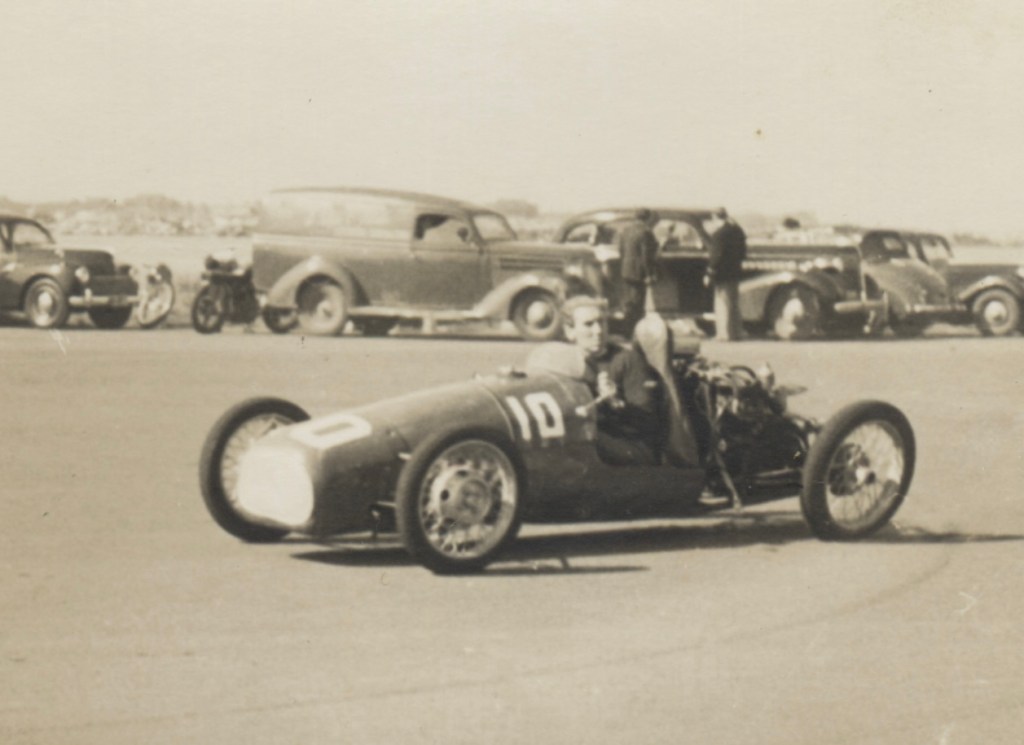
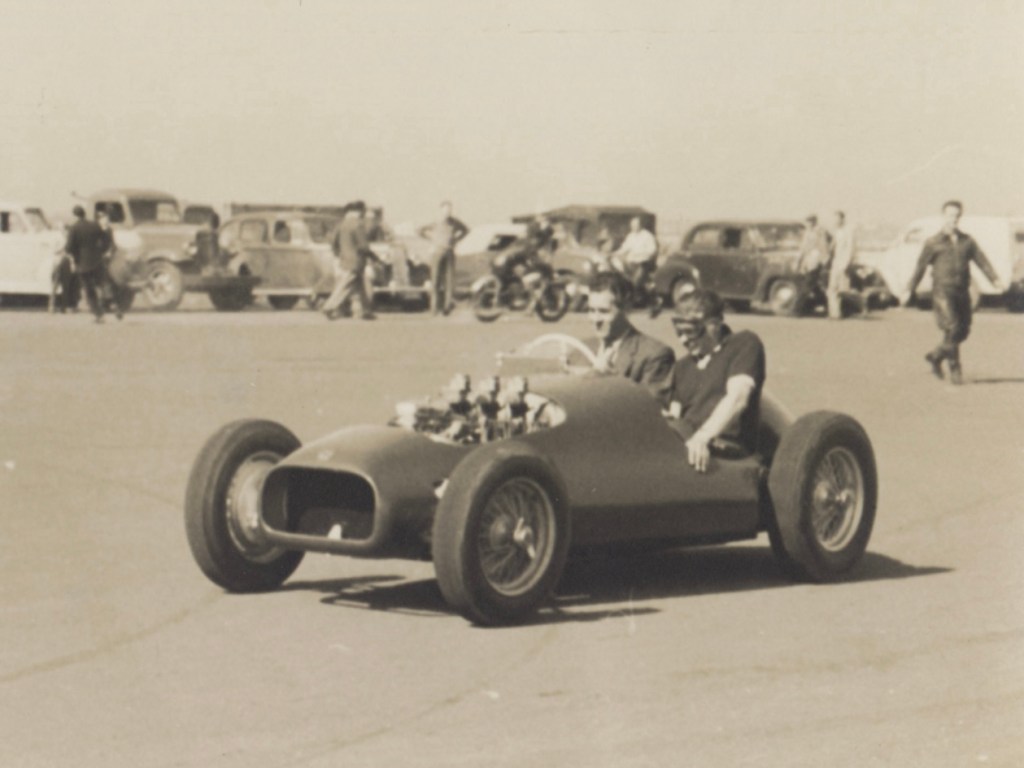
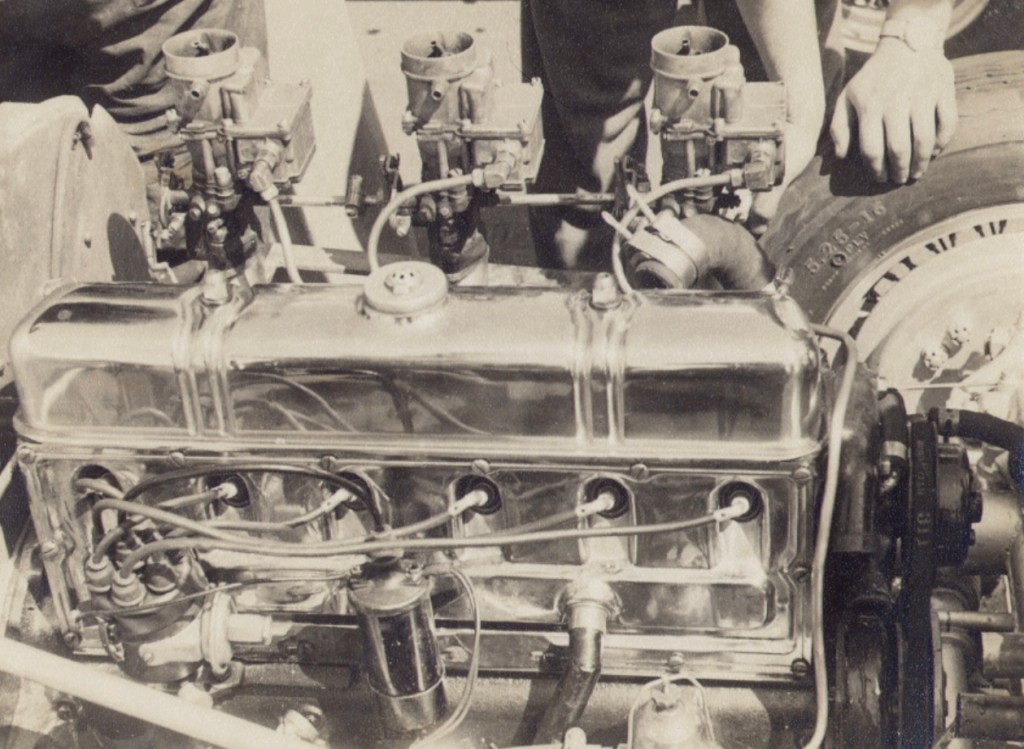
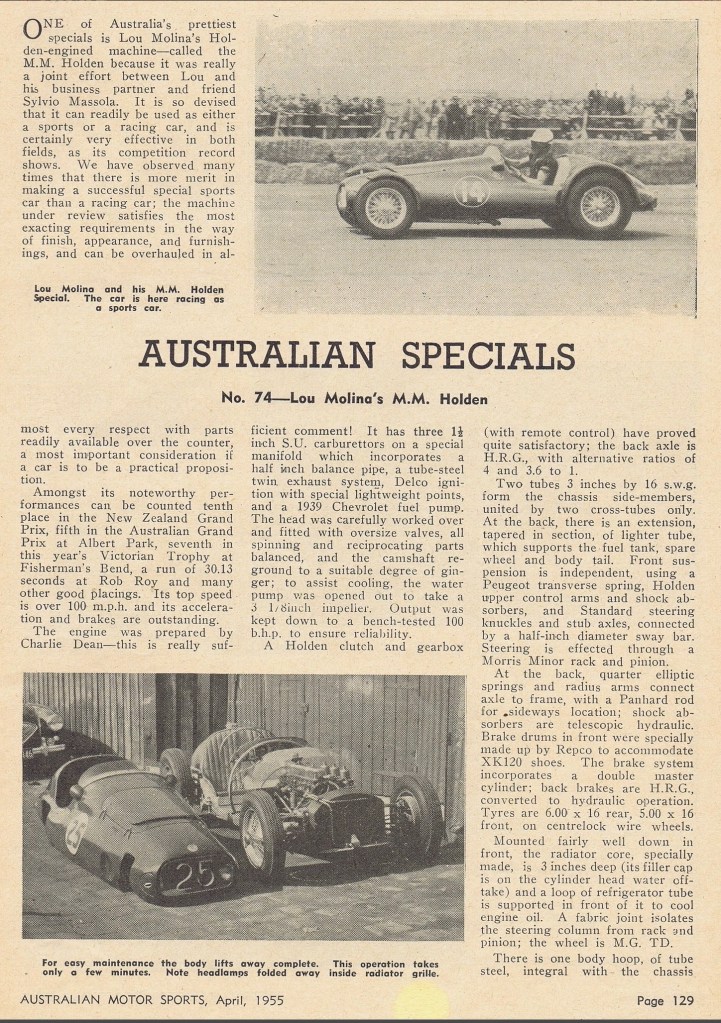
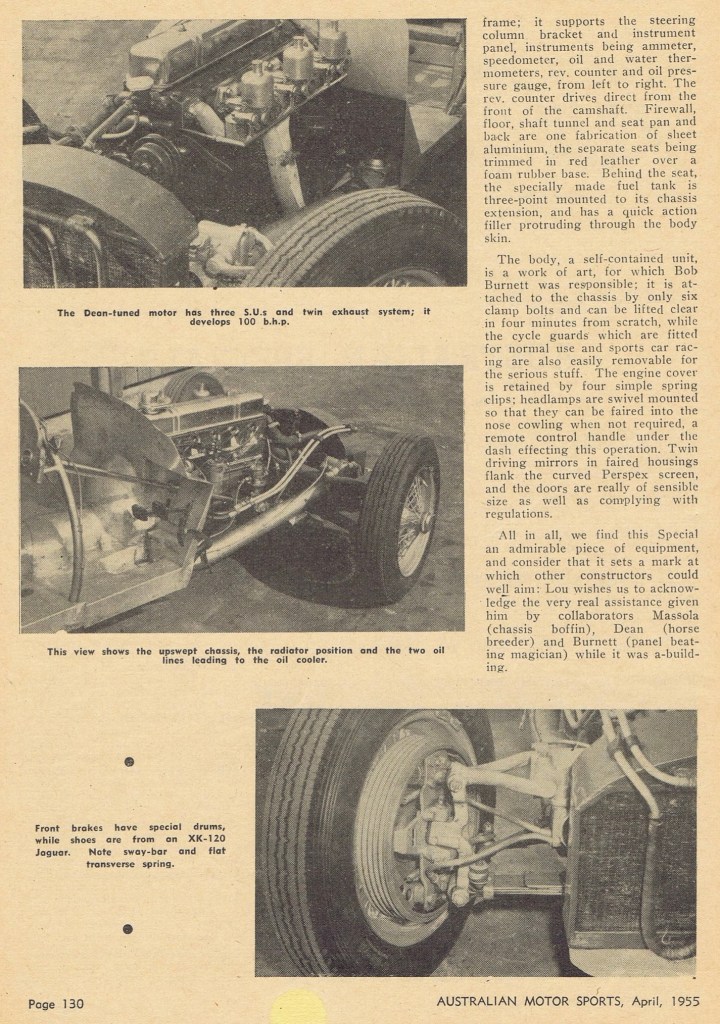
Conceived in Lou Molina’s Albert Park backyard the MM (Molina/Massola) Holden consisted of a Silvio Massola home-made chassis, Standard 12 front end, H.R.G differential and gearbox, Holden Grey six-cylinder engine and an attractive body made by Brian Burnett.
The MM had its first outing at Fishermans Bend on October 3, 1953, and I’m wondering if that’s when this photo of Lou and a Victim tootling around the paddock was taken?
MM Holden was initially fitted with triple Stromberg carbs, later replaced by SUs (SLV)
Lou then contested the November 21 1953, Australian Grand Prix at Albert Park where he was an amazing fifth in the 64-lap 200-mile event won by Doug Whiteford’s Talbot-Lago T26C. The 2290cc MM Holden started from grid 30. The car appeared exactly as it is in the photograph above, sans bonnet and with triple-Strombergs pointing loud and proud at the sun.
The MM raced the following year at the January 1954 New Zealand Grand Prix with Molina competing alongside other Australians including Jack Brabham, Stan Jones, Tony Gaze and Alec Mildren. On this occasion, the MM was not successful, retiring early with mechanical problems. Stan Jones won the day of course in another rather famous Australian special
Amongst other notable runs, in 1956 the MM finished in the top six at the Argus Cup at Albert Park and clocked 15.3 seconds for the standing quarter mile at the Geelong Sprints.
Greg Smith has given me a shedload of material about this car from Lou’s Archive, I really must do something on the two Molina Specials soon.
And below, the MM Holden and an MG?, before the off at Fishermans Bend.
(SLV)(Peter D’Abbs)
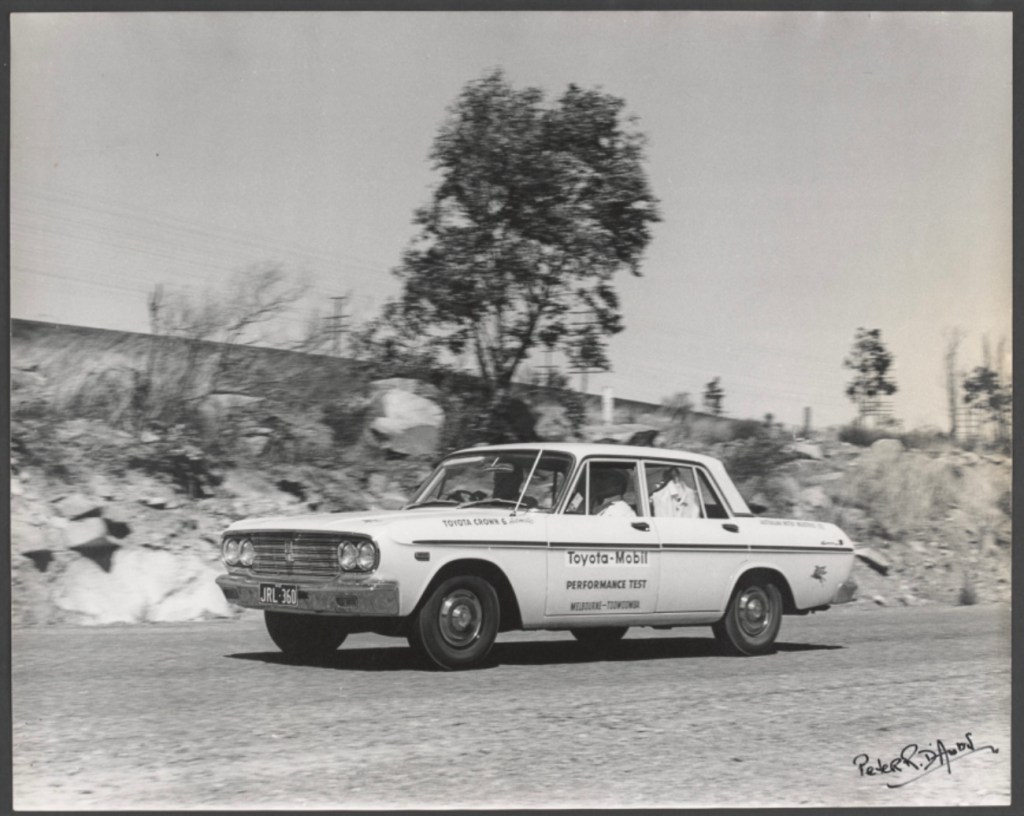
The Mobil sponsored Toyota Melbourne-Toowoomba Performance Test in 1966, Toyota Crown. It was still at the stage that ‘The Japs’ were convincing Aussies about the durability of their cars I guess, they succeeded rather well!
(H Coulson)
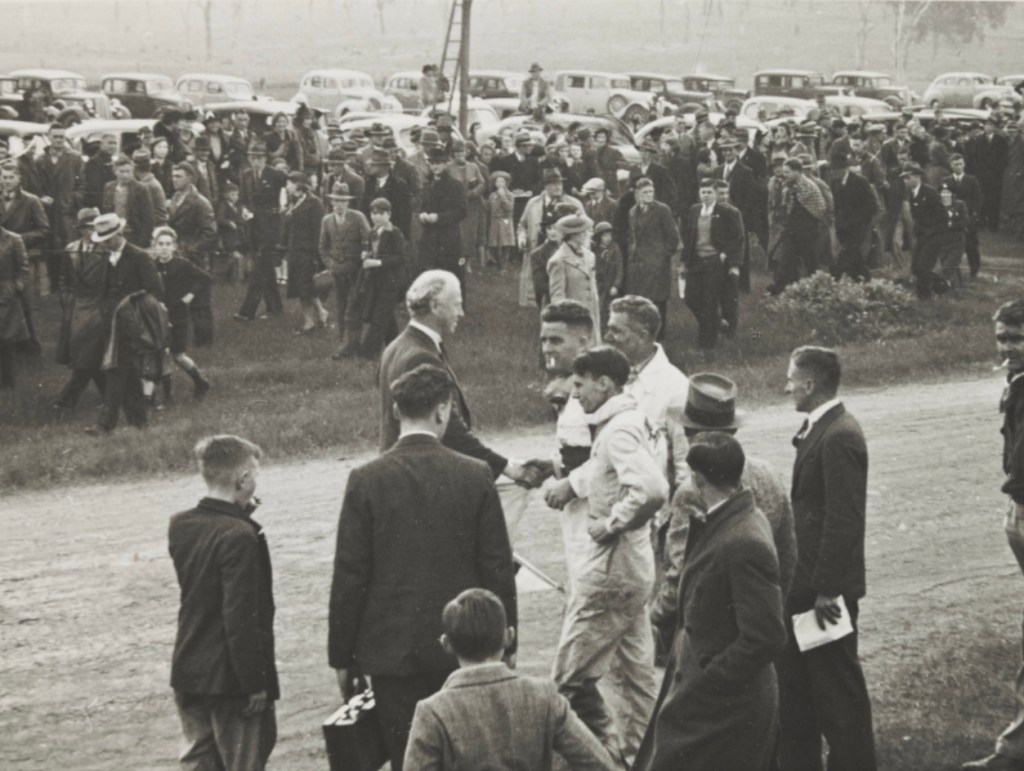
This looks awfully like Jack Phillips and Ted Parsons after one of their Interstate Grand Prix wins at Wirlinga, Albury in 1938 or 1939. Jack – with the post-race fag – still has his kidney-belt on.
Charlie Dean well and truly on the gas during this ascent of Rob Roy in Maybach 1, date unknown. Right front on the track’s verge and right rear well and truly on the roadside.
Dean’s series of three Maybachs were labelled Maybachs 1, 2 and 3. M 3 was christened M 4 when that car/chassis was modified by fitment of a 283 Chev V8 in place of the Maybach SOHC six and other changes, mainly to the rear suspension. These cars were great crowd pleasers from their first appearances in 1948 until the last in-period races of Maybach 4 Chev in the hands of Ern Seeliger and Stan Jones in 1958-59.
(SLV)
One of the great shames is that a Maybach never won an Australian GP, karma suggests that this shouldn’t be the case but shit-happened on those particular big days. Stan Jones’ 1954 NZ GP win – truly a great team effort – is duly acknowledged…More about Maybach 1 here: https://primotipo.com/2024/01/15/maybach-1-technical-specifications/
(SLV)(G Thomas)
Alf Barrett at Ballarat aboard his superb, aristocratic Alfa Romeo 8C2300 Monza, during the 1947 Victoria Trophy.
This is another combination that shoulda-coulda-woulda but never did win an Australian GP. The fastest combination in the immediate pre- and post-war periods is the descriptor that would have to do.
The centenary of the first Australian Grand Prix takes place in 2027, good news is that the current custodians of this car: Grace, Troy and Lindon Davey-Milne have its restoration underway and with a bit of luck it will take its place in the on-track centenary celebrations or as a static exhibit at Goulburn and Phillip Island in 2027-28.
‘Sydney to Melbourne 750 miles by car in December 1927’, is the caption. Make of car folks? They certainly did it the long way, and the hard way no doubt.
State Library of Victoria and photographers George Thomas, ‘Bathurst : Cradle of Australian Motor Racing’ John Medley, Hal Coulson, Gladys E Moss, JP Read, Australian Motor Sports
Tailpiece…
(G Thomas)
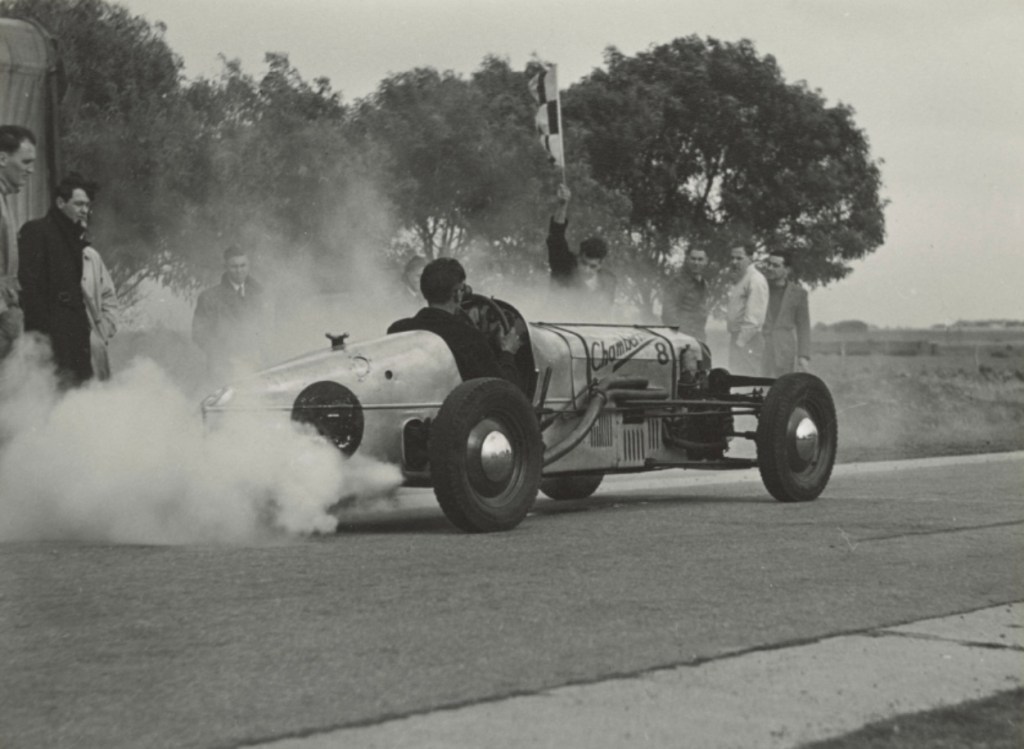
The starter drops the flag, can you see him among the clouds of two-stroke smoke!?, for Jim Hawker and the Chamberlain 8, VSCC Speed Trials, Geelong Road, June 1947; tree-huggers eat yer’ heart out.
The features of the Chamberlain brothers’ crazy-brave pre-war special included a small-tube spaceframe chassis, independent front and rear suspension, front wheel drive and eight-piston, two-stroke, supercharged 1.5-litre engine. See here: https://primotipo.com/2015/07/24/chamberlain-8-by-john-medley-and-mark-bisset/
Legendary Australian Touring Car racer/engineer/tuner/team manager/CAMS politician Harry Firth ascends Rob Roy aboard a Cisitalia D46 in 1958. What a magic, crisp pan shot.
This ex-everybody car never did much in Australia. Its arrival more or less corresponded with the end of our long handicap racing era, and we didn’t have the right class for the car, 1100cc events here and there duly noted.
‘Only months earlier (May 4, 1958) Reg Nutt took the borrowed Leech Cisitalia to the top of the Hill in 28.30 secs. Now it was Harry’s turn however he couldn’t match Reg’s time. Harry’s time of 29.52 secs was more than 1 sec slower. But Harry probably won the most money on the day driving a Hillman for a second, Triumph TR2 for a first and the Cisitalia for a second,’ wrote Leon Sims.
Firth prepared and raced plenty of sportscars before his highly successful 1960-80’ish tourer-era but he didn’t race many monopostos? That SU carb doesn’t look kosher on an Italian car either, surely it didn’t arrive here so equipped…
(G Hill)
Leon Sims, ‘This photo is from our (MG Car Club) second annual historic and classic meeting Feb 28, 1994. From the left: John Crouch, AGP winner, Australian Hillclimb Champion and Australia’s Cooper distributor in the 1950s. Harry Firth, multiple class winner and class record holder at Rob Roy. Bill Prowse, Rob Roy competitor from the 1947 LCCA years and also MGCC years.’
(L Sims Archive)
Credits…
Leon Sims, The Age via Leon Sims Archive, Gary Hill
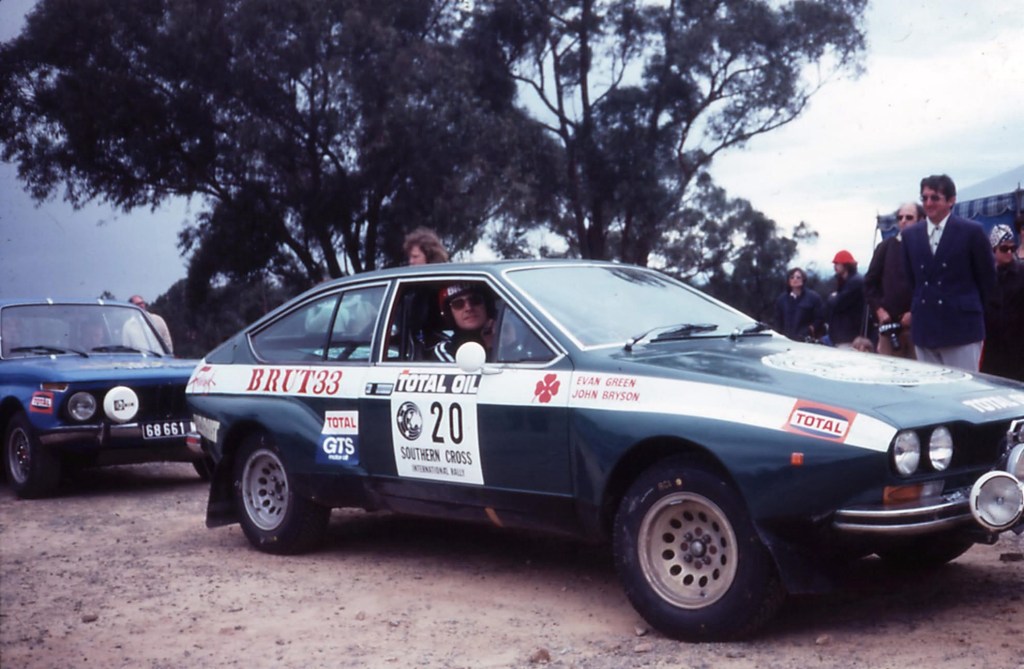
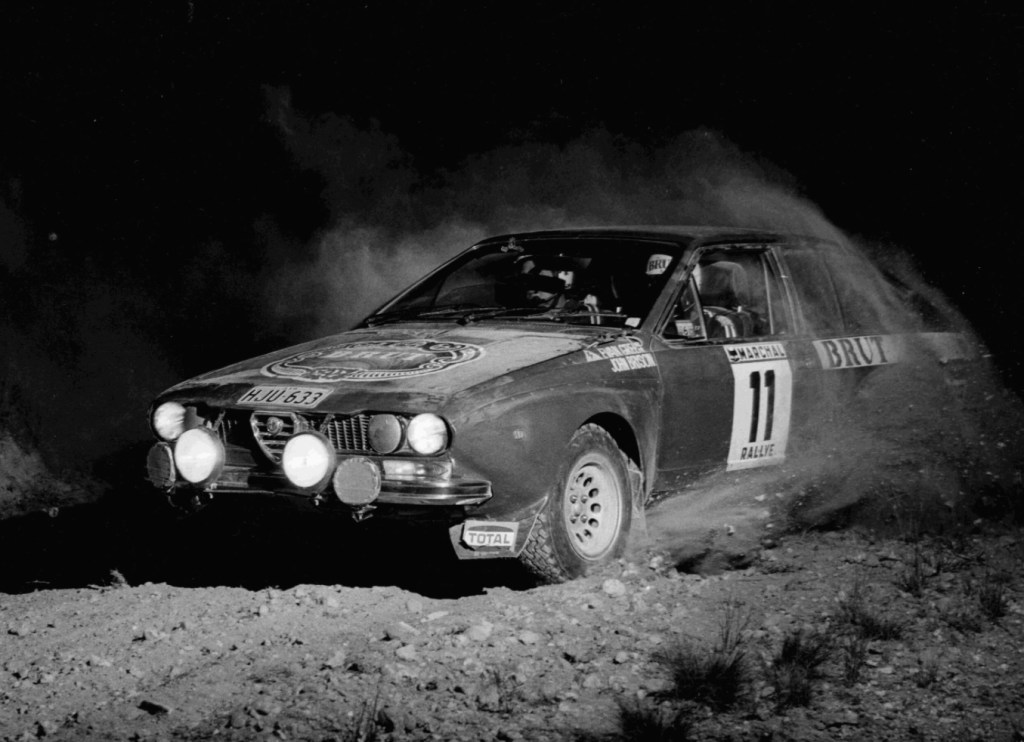
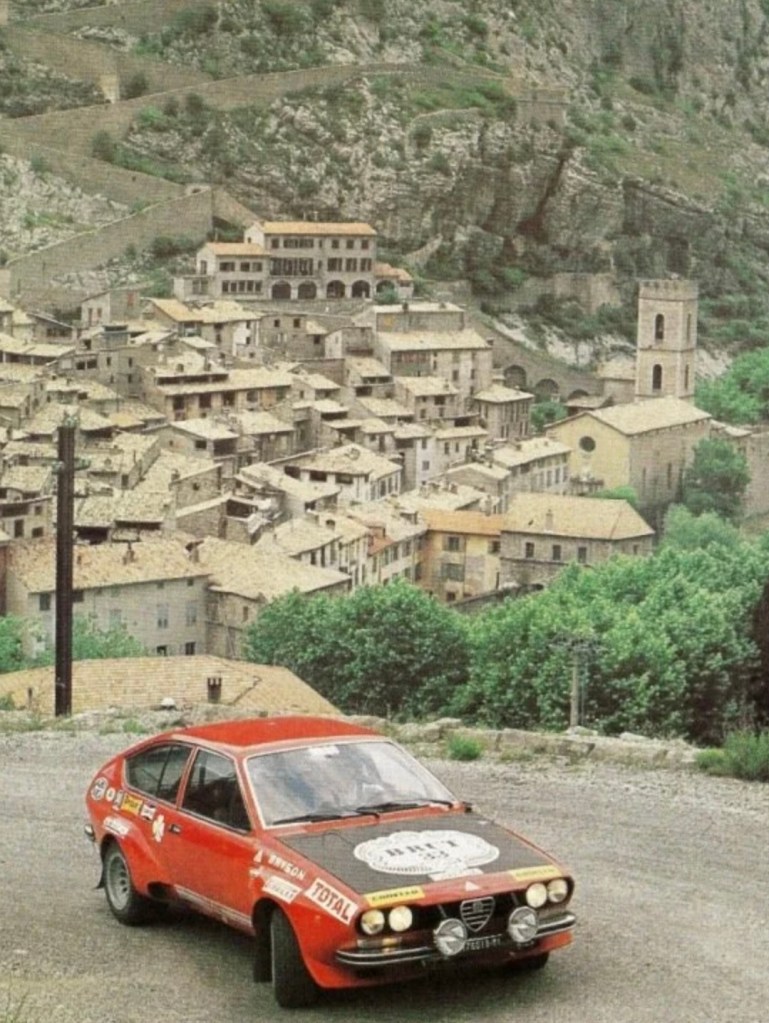
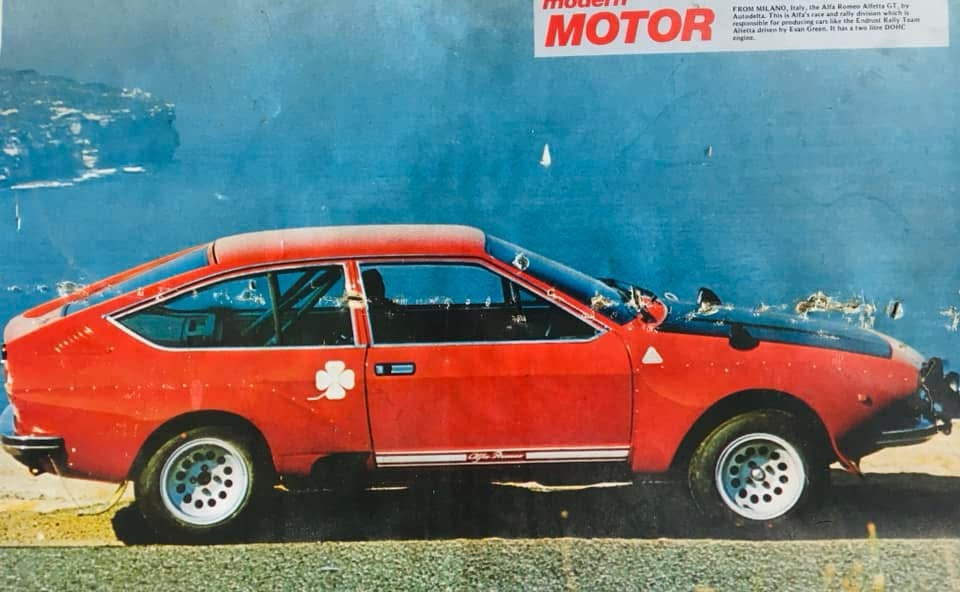
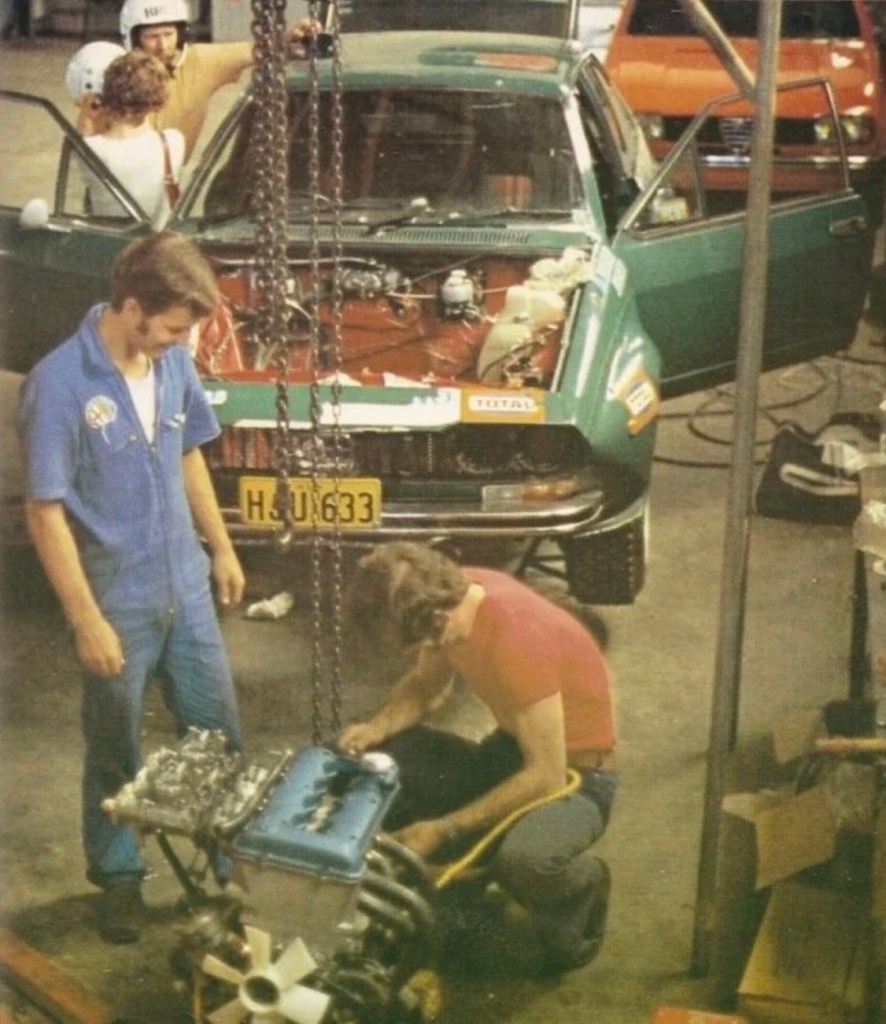
Evan Green, Autodelta built Alfa Romeo Alfetta GT before the 1976 Southern Cross Rally (P Burley)
One of the many interesting automotive escapades in the life of Australian rally driver/PR operative/journalist-author/broadcaster/entrepreneur Evan Green was his purchase of an ex-works Alfa Romeo Alfetta GT in 1975.
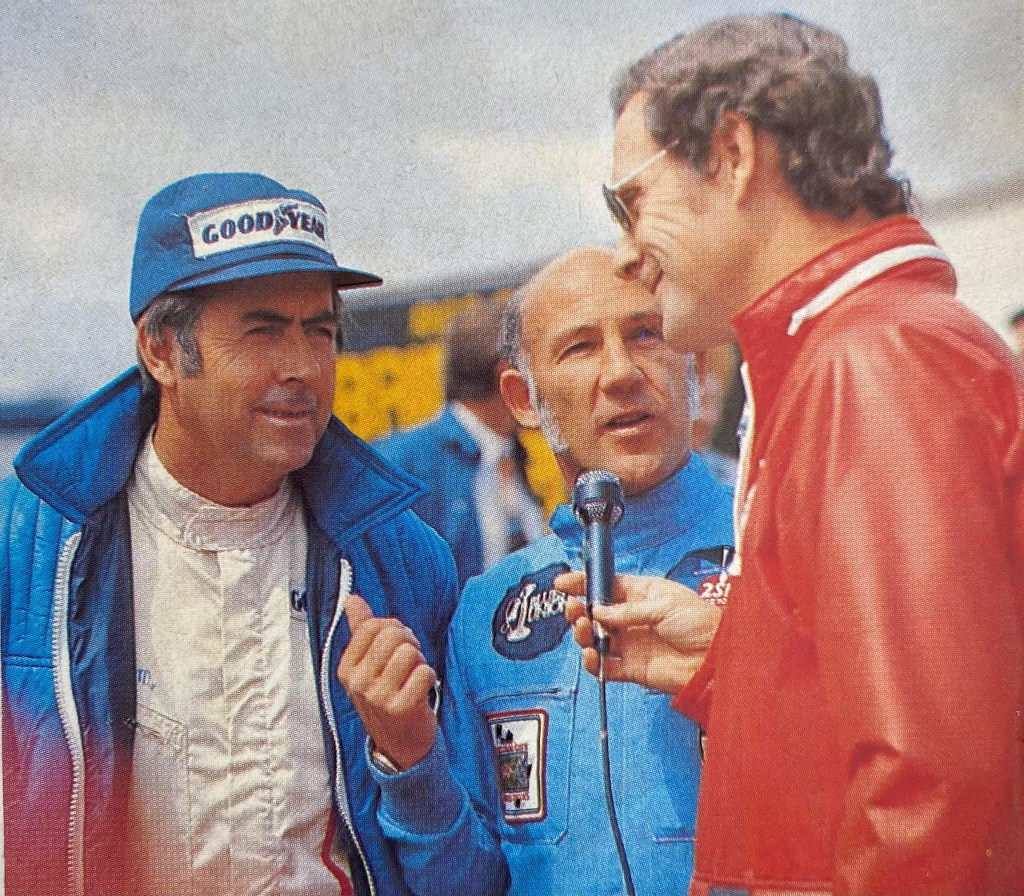
Evan Green on Channel 7 duties with Jack Brabham and Stirling Moss during the 1976 Bathurst 1000 weekend…before the start by the look of it! (unattributed)
Green ran a Leyland P76 V8 with some commercial support from Faberge-Brut – remember that ‘orrible-stench!? – and parlayed that commercial relationship into the purchase of one of the nine Group 2 Alfetta 2-litres built by Autodelta in time for the 1975 season: for competition in the (third) World Rally Championship, European Rally Championship and perhaps a national championship or two.
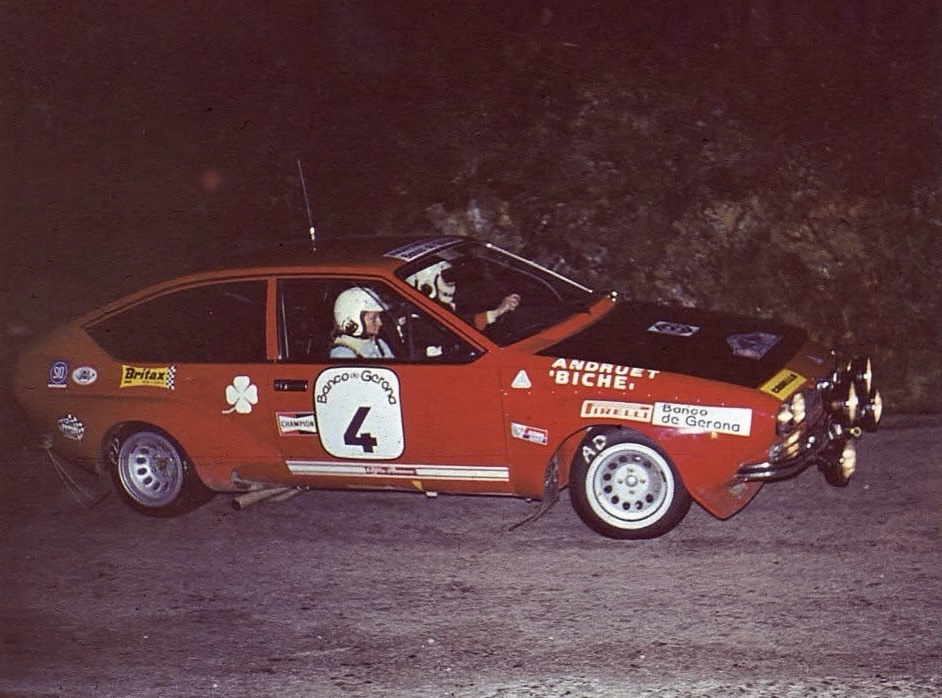
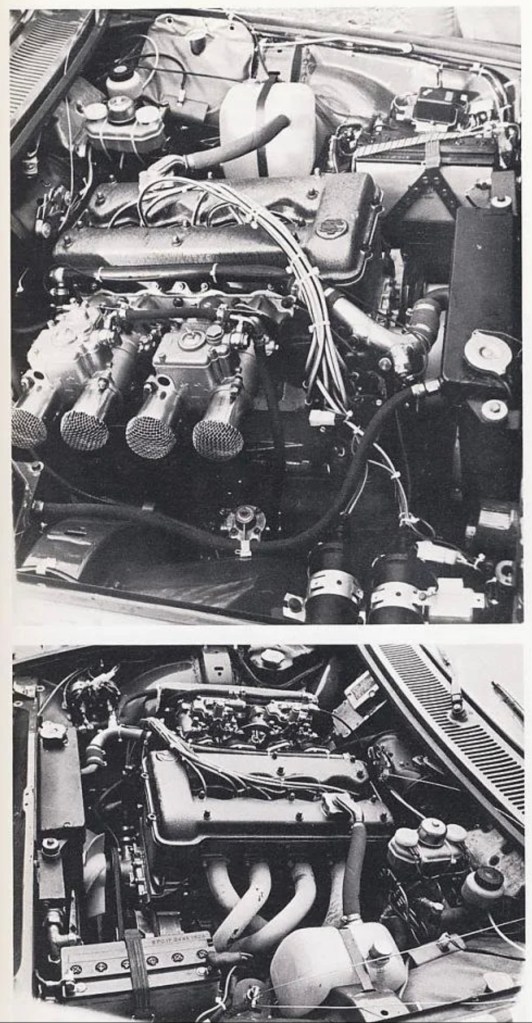
Rally Costa Brava 1975, Alfetta GT Gp 2 Andruet/Biche (unattributed)Period under bonnet shots (Marque Spotlight Series)
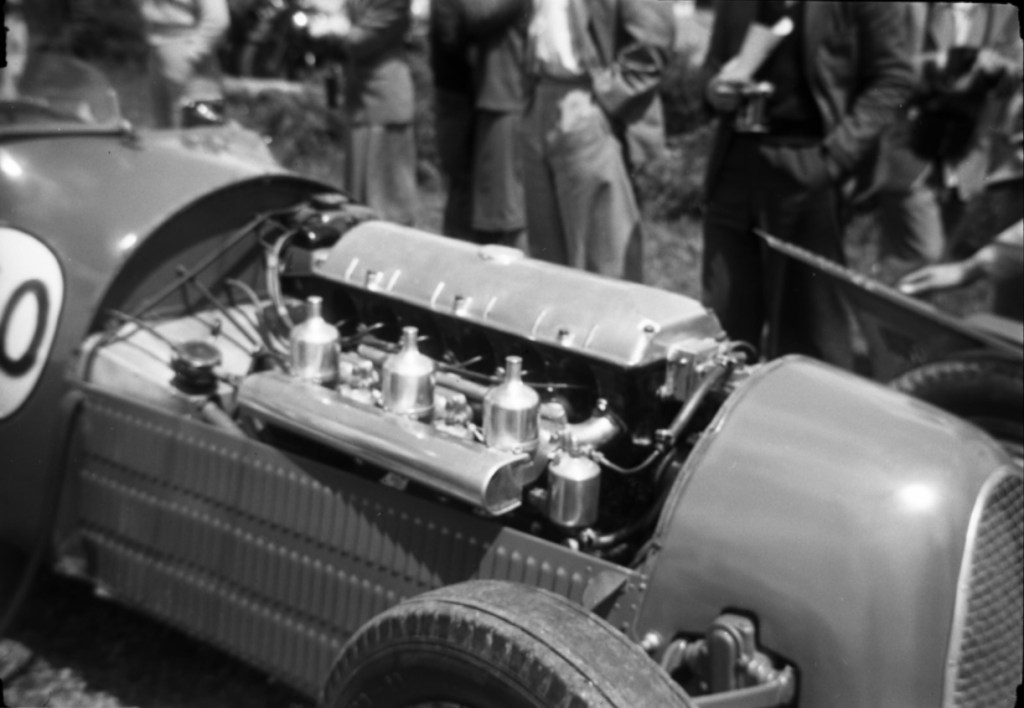
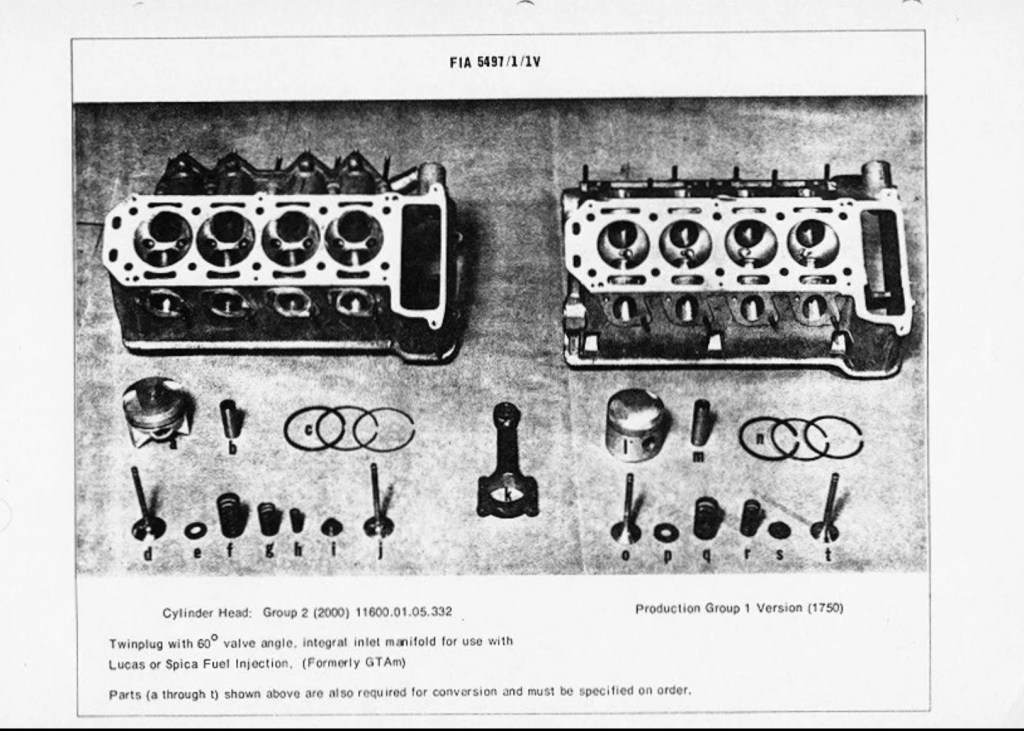
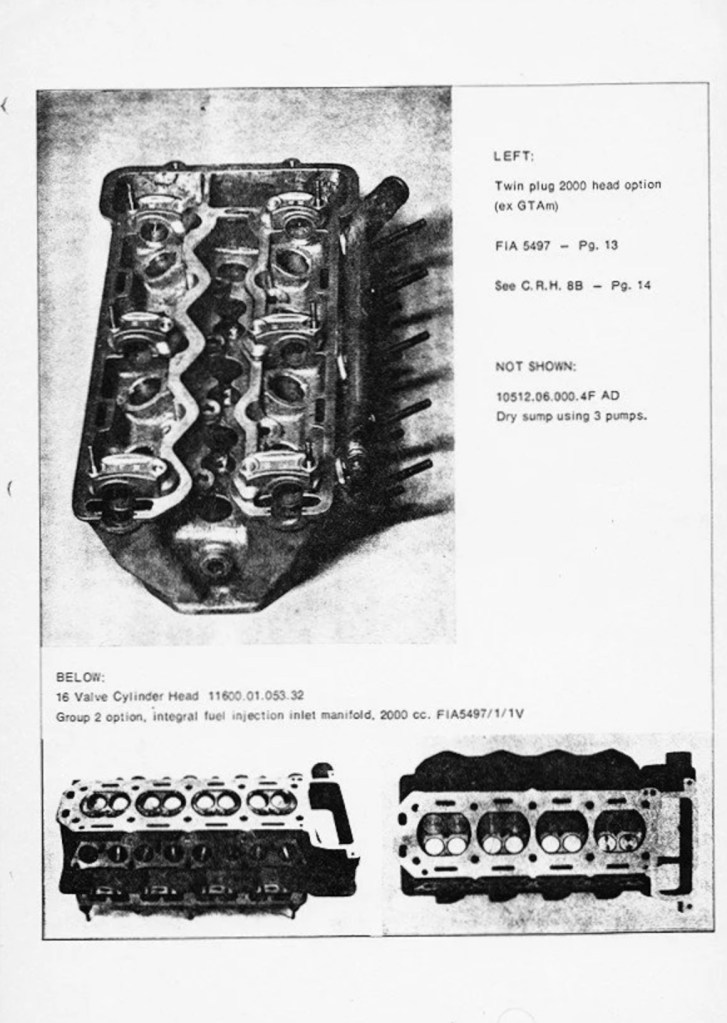
Engine capacity was increased from 1.8-litres-1779cc to 2-litres-1995cc by increasing the bore, developing around 180 bhp in two-valve spec and 210 bhp with the 16-valve head, Webers/fuel injection and special stainless steel fabricated exhaust.
The gearbox was an Autodelta five-speed transaxle with straight-cut gears and a 50% limited-slip diff. Brakes were Lockheed calipers with ventilated rotors front and rear.
Other details of the Autodelta built Alfettas include a lightened and reinforced body, roll bar, Autodelta branded intercom, wooden gear knob, a window to access the rear shock absorbers, a battery kill-switch, Halda tripmaster, four Carello Megalux additional front headlights, widened guards, magnesium wheels and racing seats with four-point belts.
Green/Bryson Alfetta GT Rally Antibes, June 1975 (Evan Green)Carlo Chiti, Autodelta founder and chief, with the Green Alfetta upon deivery (Marque Spotlight Series)
Of the nine Autodelta Alfetta GTs two survive, but not ‘our car’, however.
The Alfa Romeo team debuted at the Costa Brava rally in February 1975. Evan Green’s machine was delivered either at, or just before the Rallye Antibes held from 21-22 June, 1975, DNF. Whether it was new or ex-works is unclear (on holiday at present, shall consult his book when I get home).
When shipped to Australia the machine was painted still painted red. ‘On the first day it arrived we took it to Middle Head for some photographs. Driving through Mosman with straight-cut gears and the short exhaust got some looks’, wrote Derek Heiler on Facebook.
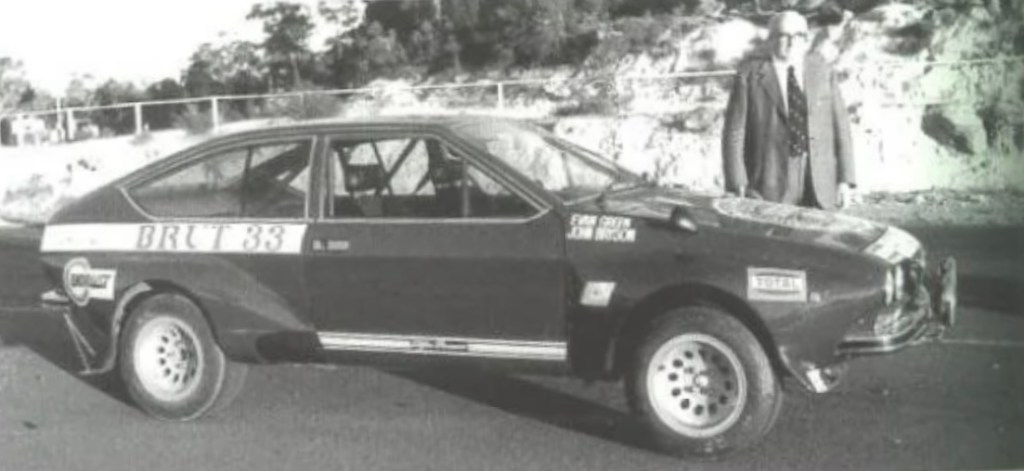
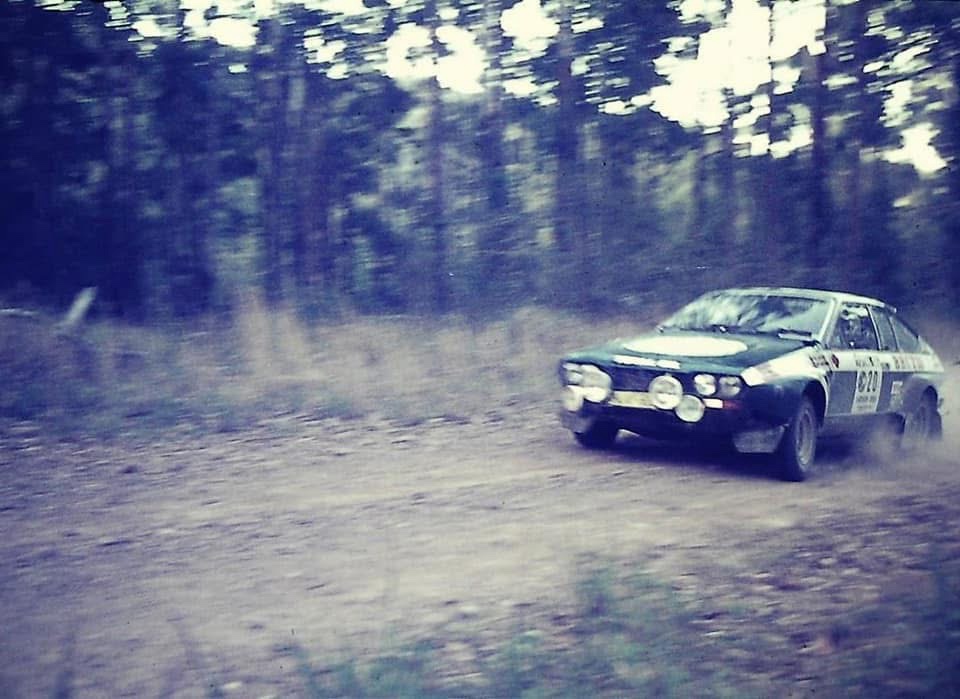
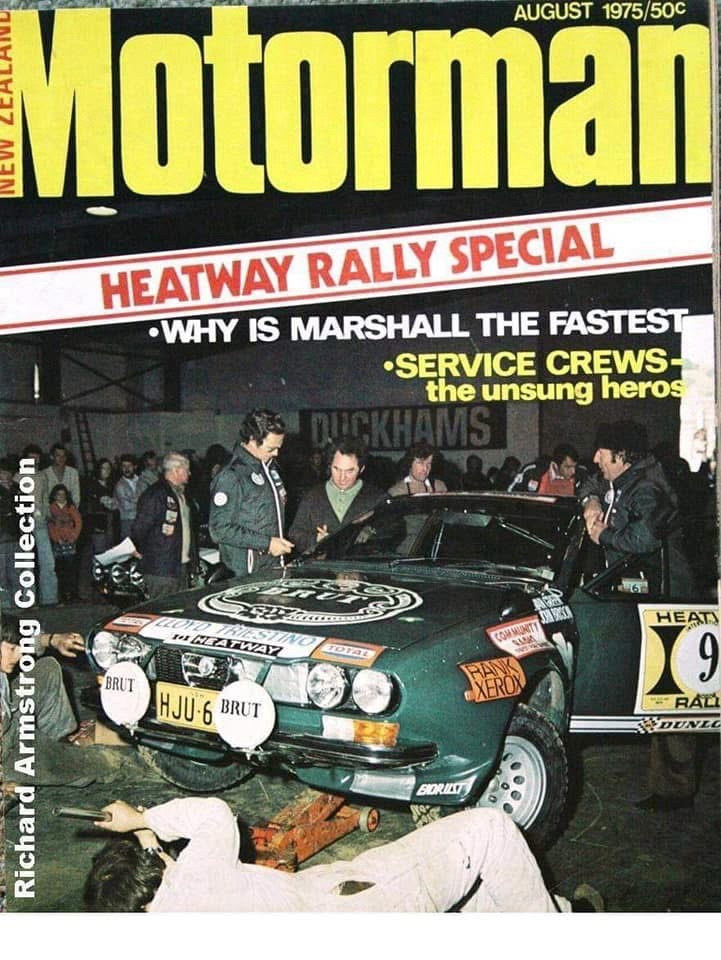
After being prepared and painted Brut blue, the Alfetta was shipped to New Zealand for the Heatway Rally held between Auckland and Wellington from 8-12 July.
Full results are unavailable but the Green-John Bryson crewed car didn’t finish. A newspaper report recorded that the car became bogged at Tokarua between Rotorua and Napier on the Wednesday night.
John Bryson was one of Australia’s most acclaimed rally navigators, with three Southern Cross Rallies alongside Andrew Cowan to his credit.
He wrote Racing Car News’ pre-1975 Southern Cross piece.
‘As most Racing Car News readers know all about the butterflies involved in doing something a little different, I hope you can understand just how I feel after breaking with a team like the Mitsubishi – and a driver as good as Cowan. As I am the one who thinks Evan is better than Andrew as a driver, and the Alfetta better than the Lancers, guess who is likely to end up with egg on his face trying to prove a point?’
‘But, more importantly, this entry is a mighty breakthrough, in that we (thanks to Endrust, Total, Lloyd Triestino and Faberge-Brut) have actually got a works-prepared Group 2 car competing in Australia. And, believe me, I want more than Japanese domination of our sport.’
Green/Bryson testing before the 1976 Southern Cross (C Pettigrew)(unattributed)
‘The Total Southern Cross rally is an international event. So, to make it International, we have obtained what I believe to be the best rally car in the world. There was a fair bit of evaluation in choosing the car. We thought of a Stratos, and we found the Escort wanting. The answer that the best is Alfa Romeo was verified by friends who know in Europe.’
‘No matter what the outcome, the Total Southern Cross Rally is going to gain a lot of publicity for Australia in Europe. If our stars are beaten, then I’ll bet a few European drivers will turn up next year with their own cars, factory standard ones, to the benefit of this sport of ours. Personally, I am hoping the lead will end up as a battle between Evan and Andrew, with the Alfa Romeo coming out on top. But, as they say, the best laid plans of mice and men “aft gang awry”.
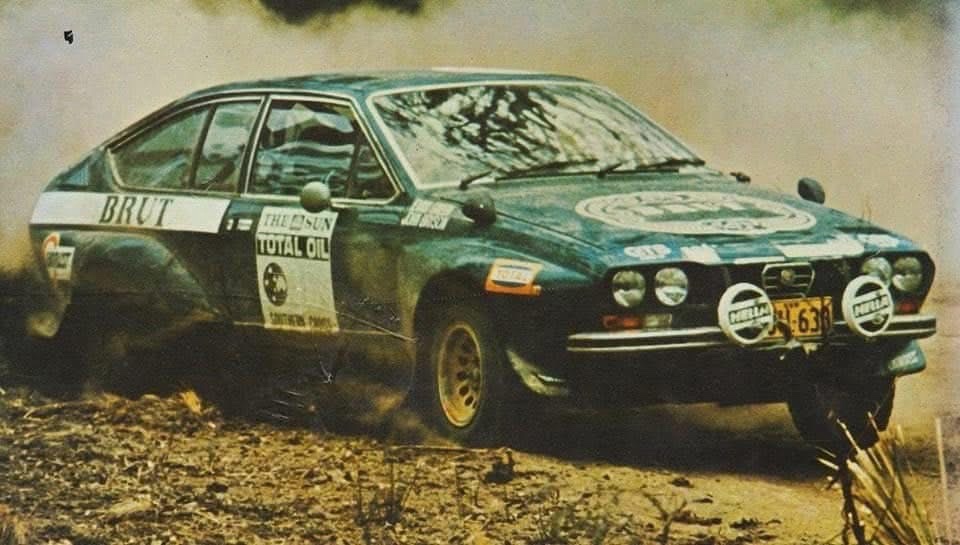
Unfortunately, the event was a disaster, Barry Lake reported in Auto Action that ‘the car didn’t make it halfway to Port Macquarie. A stick pierced a hole in a driveshaft universal joint protective boot, the oil leaked out, and the joint broke. It took their service crew over 14 hours to find them deep in the forest at Bulahdelah.’
SEV Marchal Rally May 15 1976, Green/Bryson were sixth (unattributed)
In 1976 Alfa Romeo withdrew from rallying, having not won a WRC round, and sold the Alfettas into the hands of privateers.
Green and Bryson were 21st in the 1976 Southern Cross and also contested the May 15 Renault Car Club’s Marchal Rally, second round of the Australian Rally Championship.
In another poor run in countryside outside Ballarat, the duo got lost on one stage, then ran out of fuel, ultimately finishing 6th. Ross Dunkerton and Jeff Beaumont won in a Datsun 260Z.
Better was to come in the August North Eastern Rally run out of Maryborough, Victoria in August where the duo finished fourth and were runner-up in the Australian Rally Championship division in a steady, fast performance.
Despite missing most rounds of the championship, Green/Bryson were equal sixth in the ARC together with Hank Kabel and Peter Bainbridge, Mazda RX3, with Dunkerton/Beaumont the winners.
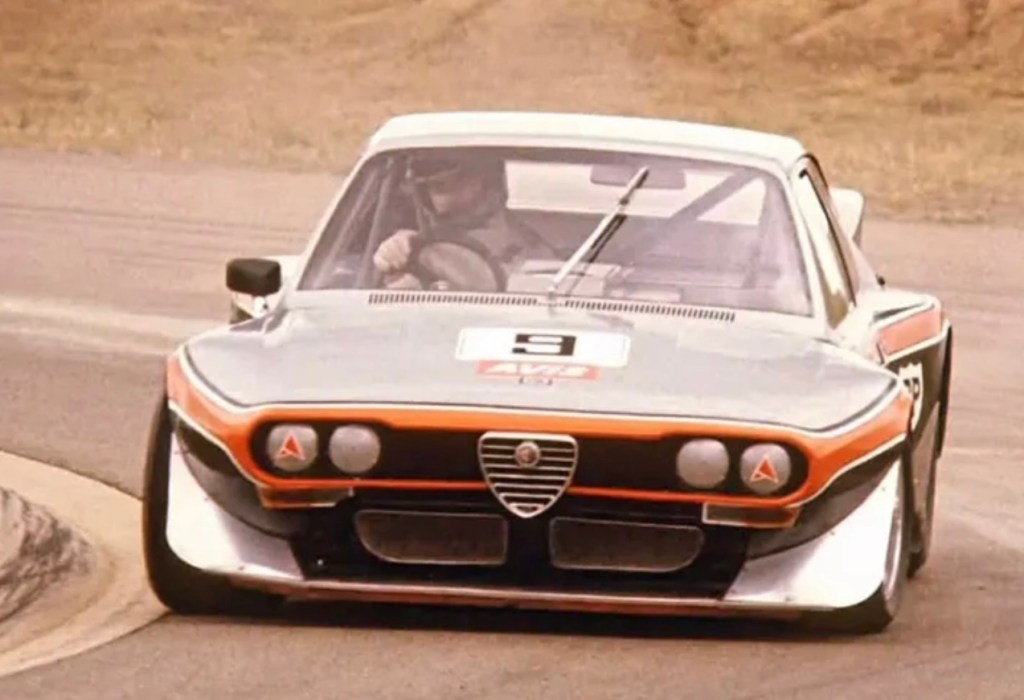
Edmondson in the Autodelta-shelled Alfetta Repco-Holden F5000 V8 at Oran Park on April 29, 1979 (ORP)
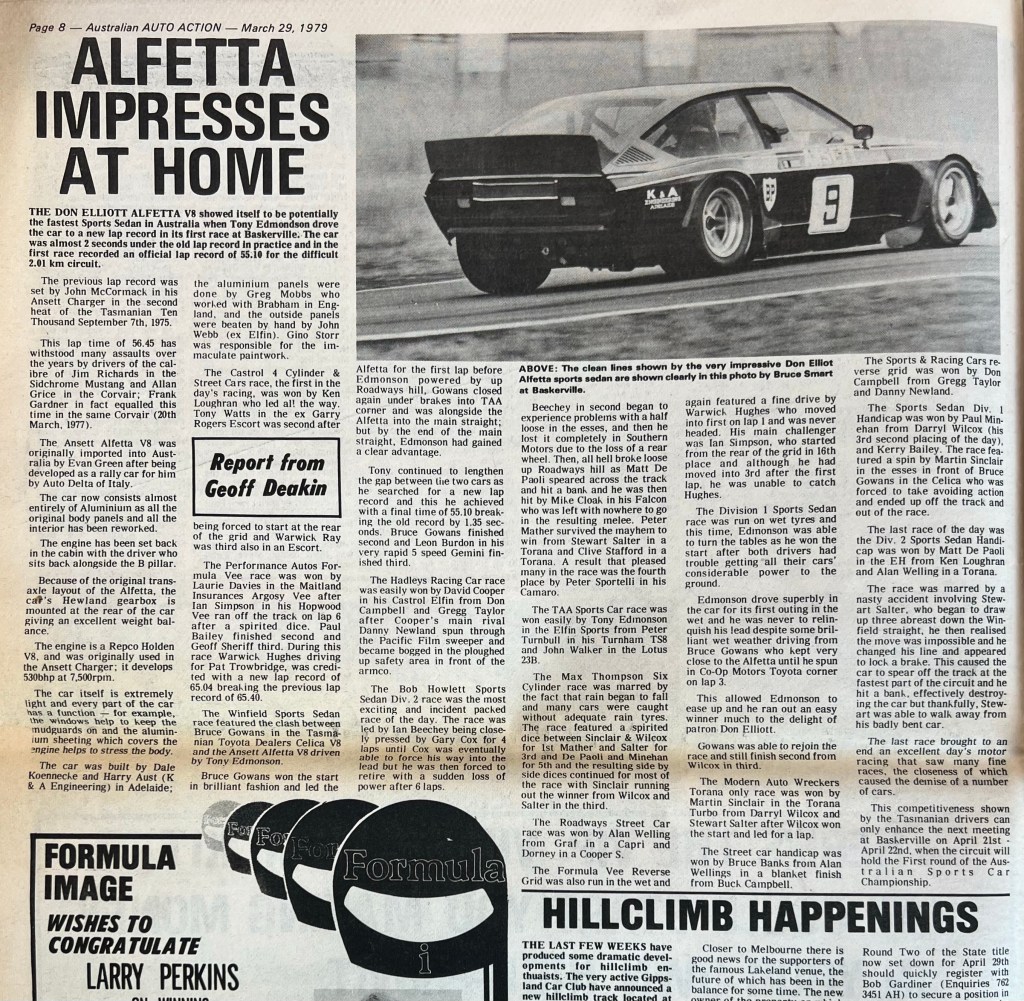
When Tony Edmondson’s ex-John McCormack Chrysler Valiant Charger Repco-Holden became uncompetitive he and Don Elliott engaged Adelaide’s K&A Engineering to build an Alfa Romeo Alfetta sports sedan in 1978.
The Alfetta’s engine and transaxle allowed the disposition of the front mounted Repco-Holden F5000 V8 and mid-rear mounted Hewland DG300 transaxle. The donor shell was the ex-Autodelta-Green car, it isn’t clear to me if the Alfetta was rallied in 1977, if you can add to the car’s history do get in touch.
Tony was on-track to winning the 1979 Australian Sports Sedan Championship until a collision with Phil Ward’s ex-Jane Holden Monaro GTS 350 at Surfers Paradise on August 26 landed Tony in hospital with life threatening burns for three months and utterly destroyed the car.
Edmondson lived to fight another day in Alfetta 2 Chev, but the Evan Green car was no more.
Alfa Romeo Alfetta GTAm…
Competition was an important part of flogging Alfas in Australia from the earliest efforts of Harold Lightburn in the mid-1960s and went up a couple of gears when Alec Mildren got the distribution rights.
Mildrens campaigned two GTAs, a TZ2, various series production Giulia Supers – Giulia Super Ti Sandown successes duly noted – 1600 GTVs and 1750 GTVs, not to forget the 2.5-litre Tipo 33 V8 powered Brabham BT23D and Mildren Yellow Submarine single-seaters.
By the mid-1970s, Alfa pretty much had the two-litre class of the Australian Touring Car Championship and Australian Manufacturers Championship (combined series duly noted) sorted, but the Ford Escort RS2000 was going to rain on the Alfetta’s parade. And it was time to push the new 116 Series Alfettas forward, rather than the 105 Series Coupes, which were no longer sold.
So Alfa Romeo Australia had the factory build 25 Alfetta GTAm’s to homologate a 2-litre, 1962cc Alfetta GT at a time the usual roadies were fitted with the 1.8-litre, 1779cc engine, for Group C racing for which the Bathurst 1000 and other races were held.
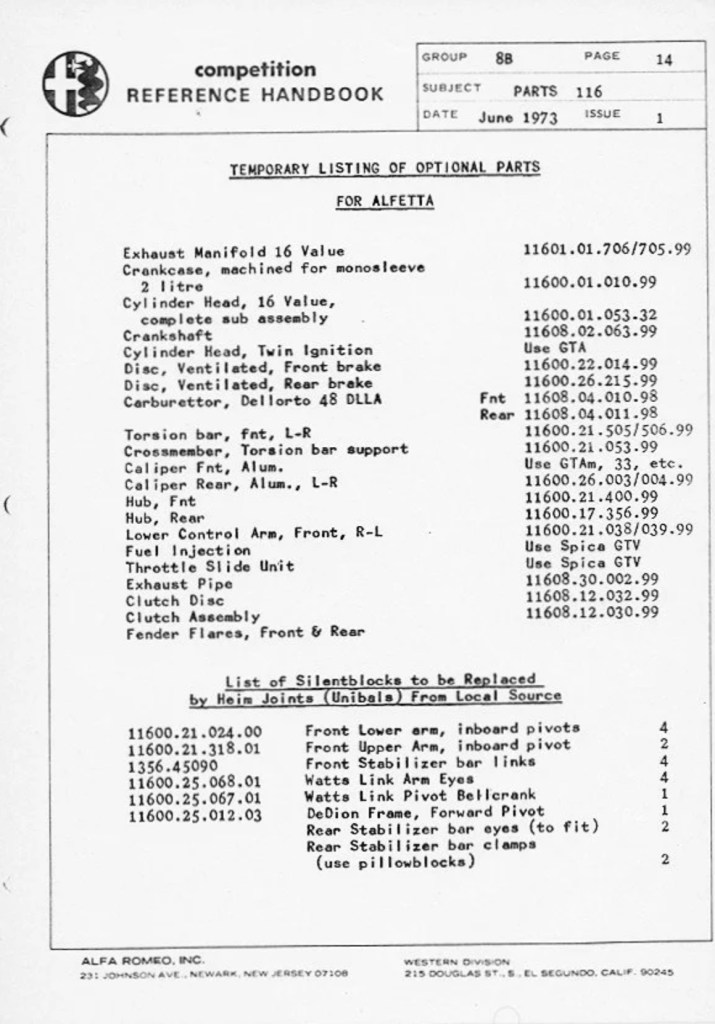
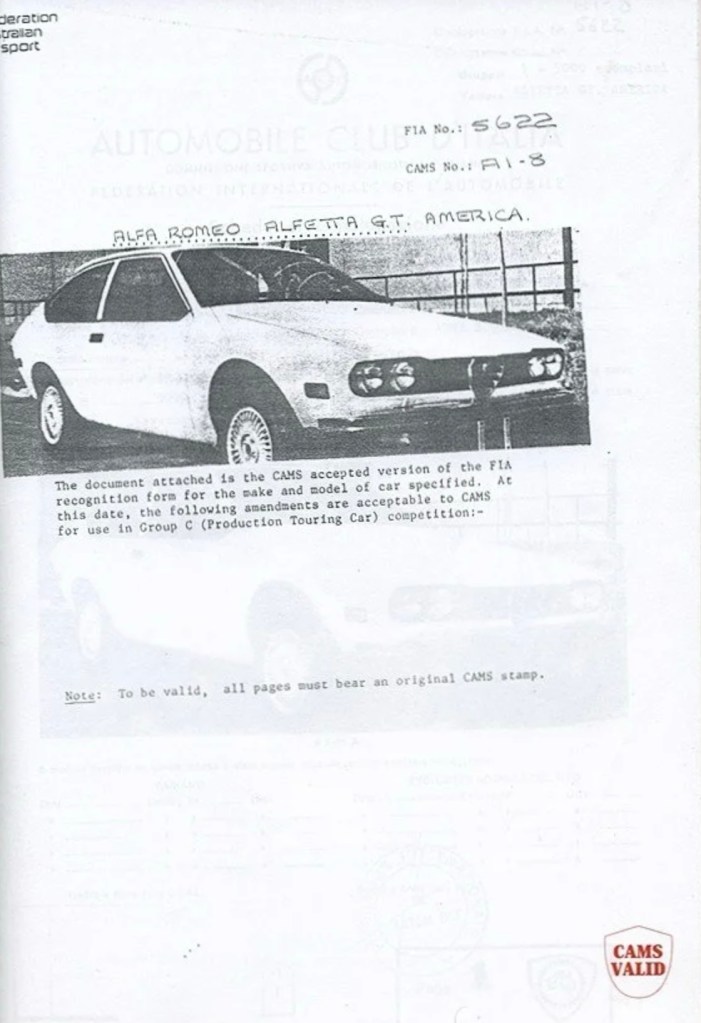
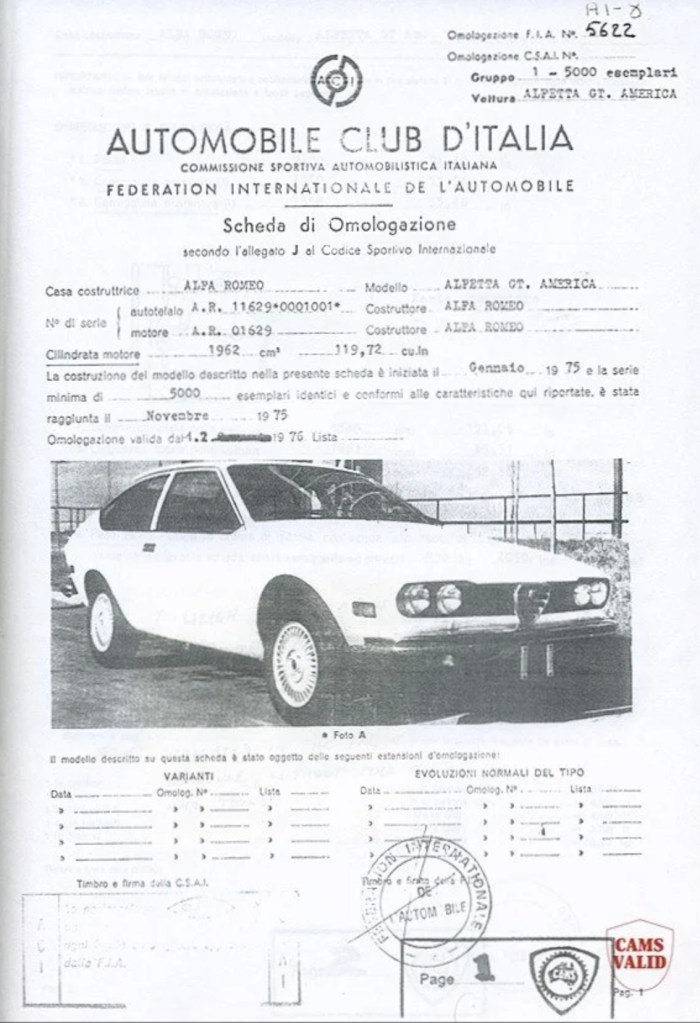
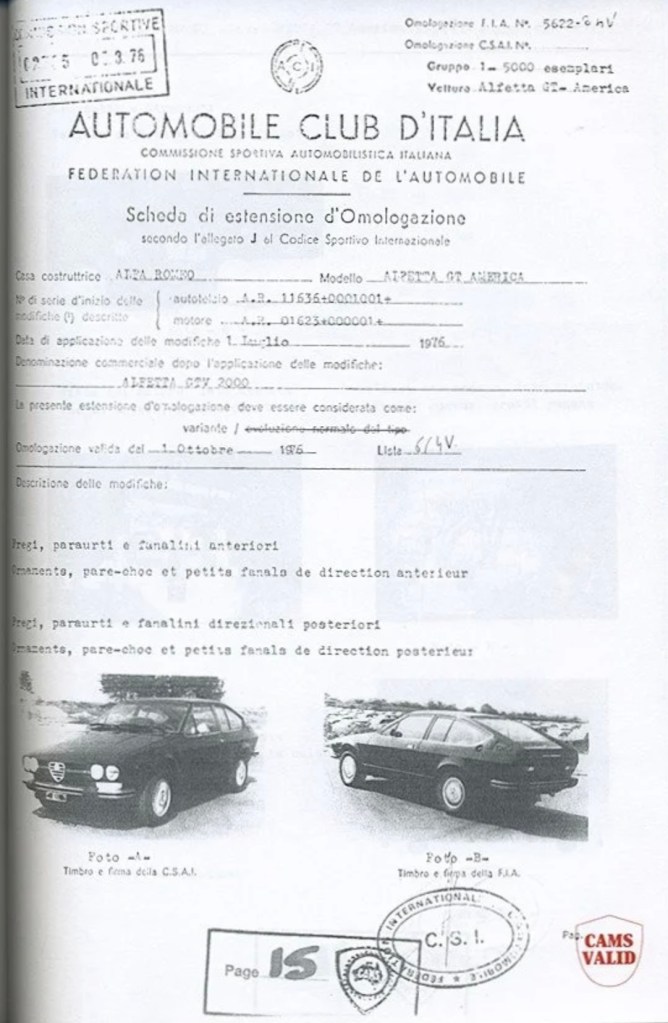
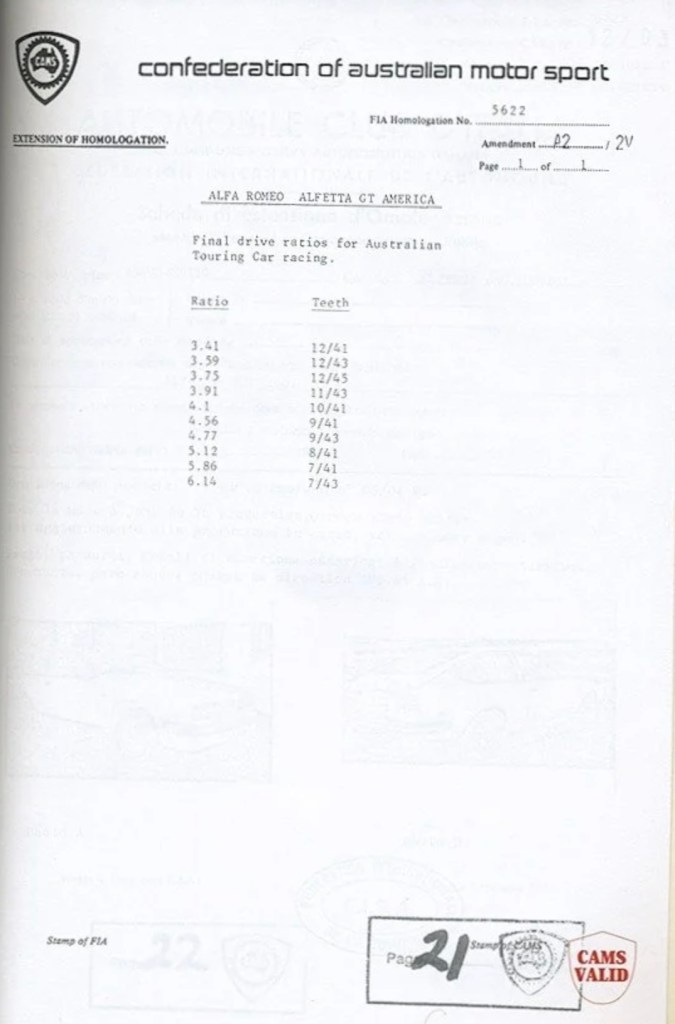
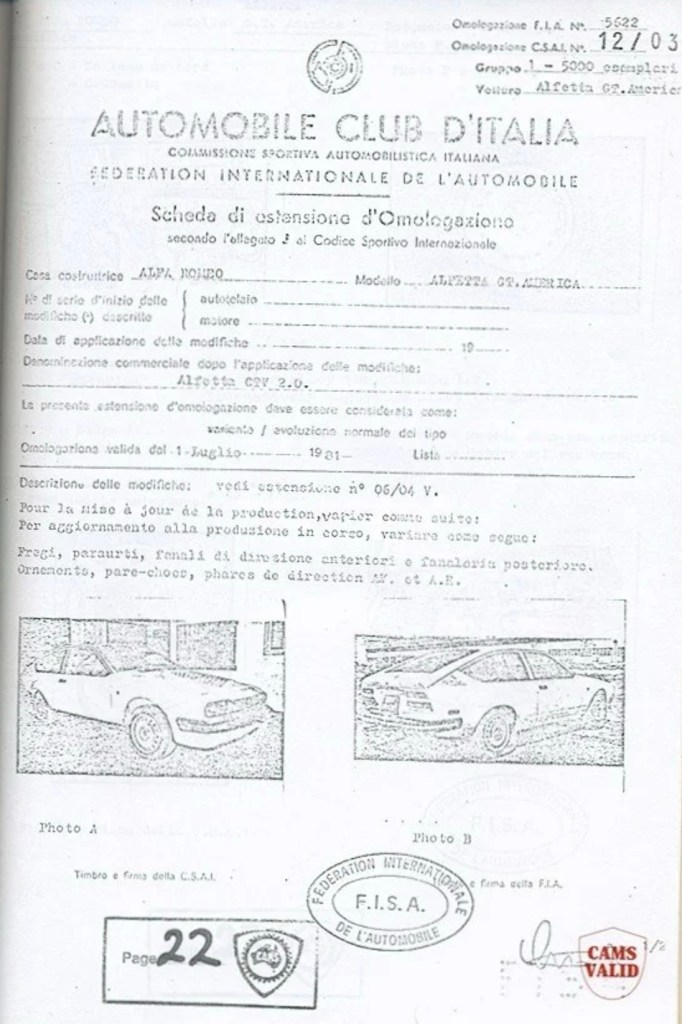
Alfa Romeo shipped 25 RHD Alfetta GTs equipped with the nasty, wheezy, Spica injected 2-litre engine calling them – see the FIA homologation documents below – the ‘Alfa Romeo Alfetta G.T. America’. They were essentially RHD versions of American Alfetta GTs devoid of the fugly-big bumpers fitted for that market, and of course later infecting us all..
A number of these Alfetta GTAm’s were converted into racing cars, one, chassis # 11611-0003206, was an Autodelta-built car for our regulations.
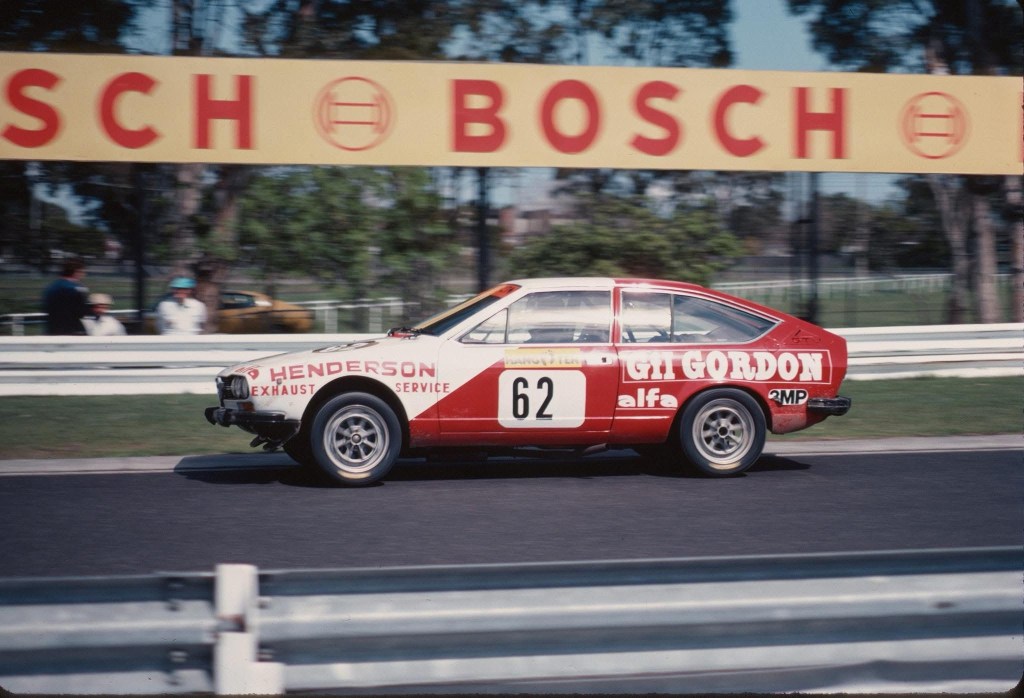
Historian/restorer/writer/Alfista Paul Newby wrote that ‘Chassis 3206 is the Group C Alfetta GTAm that belongs to Bill Magoffin, currently in Gil Gordon colours. It was entered by Autodelta (Australia) Pty for Richard Carter/John Leffler at the 1976 Bathurst 1000. It has all the Group 2 Autodelta gear that it raced with in period (gearbox, brakes, adjustable torsion bar, etc).’
The Warwick Henderson/Peter Hopwood Autodelta built GTAm #11611-0003206 on the way to 11th outright and third in class during the 1977 Sandown Hang Ten 400. The Frank Porter/Jim Murcott GTAm won the class, the best result ever for one of these cars (R Steffanoni)
‘There were two other GTAm’s at Bathurst that year. The Frank Porter Clemens Alfetta and the Brian Foley entered Alfetta for Marie-Claude Beaumont/Christine Gibson. I’m not sure what became of the Porter car but l’m pretty sure that the Foley car was converted back to road spec and sold on.’
Time was tight as Alfa Australia wanted the cars homologated before the traditional Bathurst curtain raiser, the Sandown 400 – Hang Ten 400 – held on the 10-12 September 1976 weekend.
Anthony Sharp wrote that ‘the last of the 116 GTAm homologation touring spec cars were delivered to their owners at Mascot Airport, Sydney, under CAMS supervision. They then contacted Sandown and allowed the race cars to start practice for the Hang Ten 400.’
It was only one car at Sandown however, Frank Porter’s Clemens Sporting Cars GTAm (authorised Alfa dealer) who finished second in the 2-litre class behind Ron Dickson’s ‘works’-Ron Hodgson Motors Triumph Dolomite Sprint.
At Bathurst in October the Eric Board/Tom Tymons Ford Escort RS2000 Mk1 previled in the 1301-2000cc class from the Phil McDonell/Jim Hunter 2000 GTV with the Alfetta GTAm’s of Frank Power/Tony Roberts and John Leffler/Richard Carter fourth and fifth in the class.
Sticking with Mount Panorama, in 1977 the Brian Foley Derek Bell/Gary Leggatt 2000 GTV won the class with the best GTAm, the Frank Porter/Jim Murcott car third; the best Bathurst result for a 116 GTAm.
I note that the Brian Foley prepared Alfetta GTV 2000 raced by Phil McDonnell/Derek Bell was second in class behind the winning Peter Williamson/Mike Quinn Toyota Celica at Bathurst in 1979. This appears to have been a 2000GTV not a 2000GTAm…
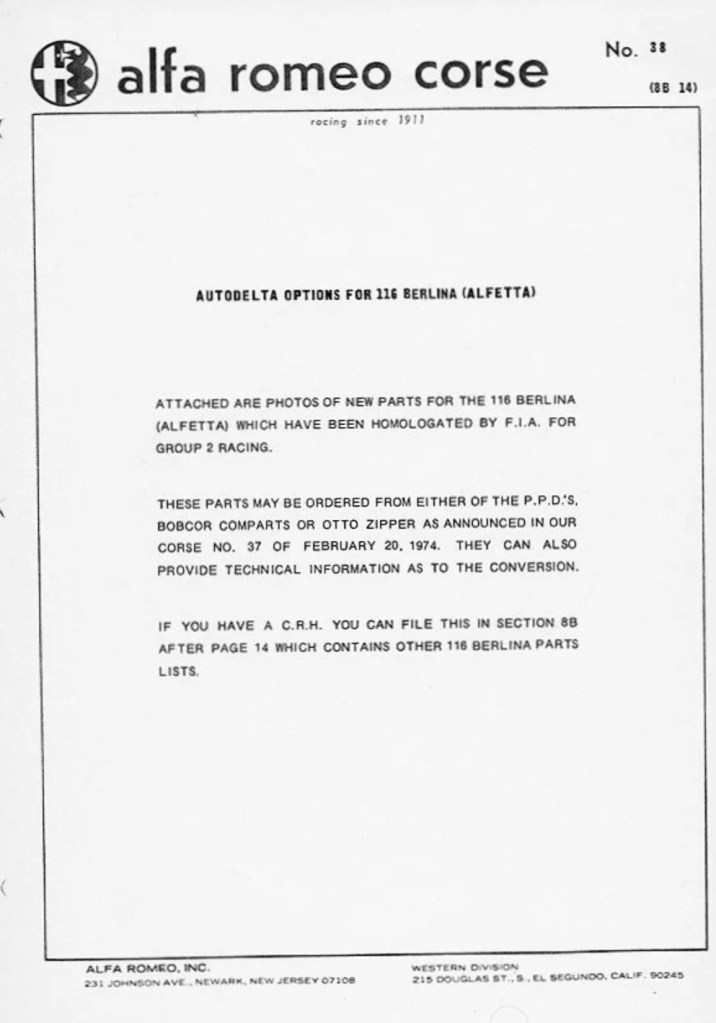
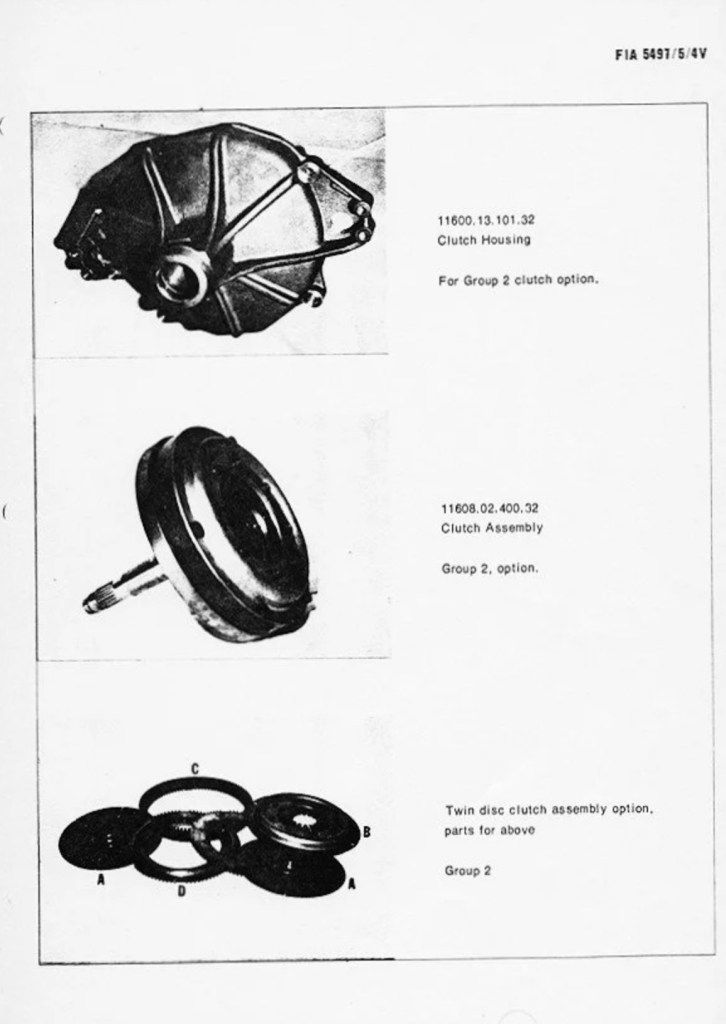
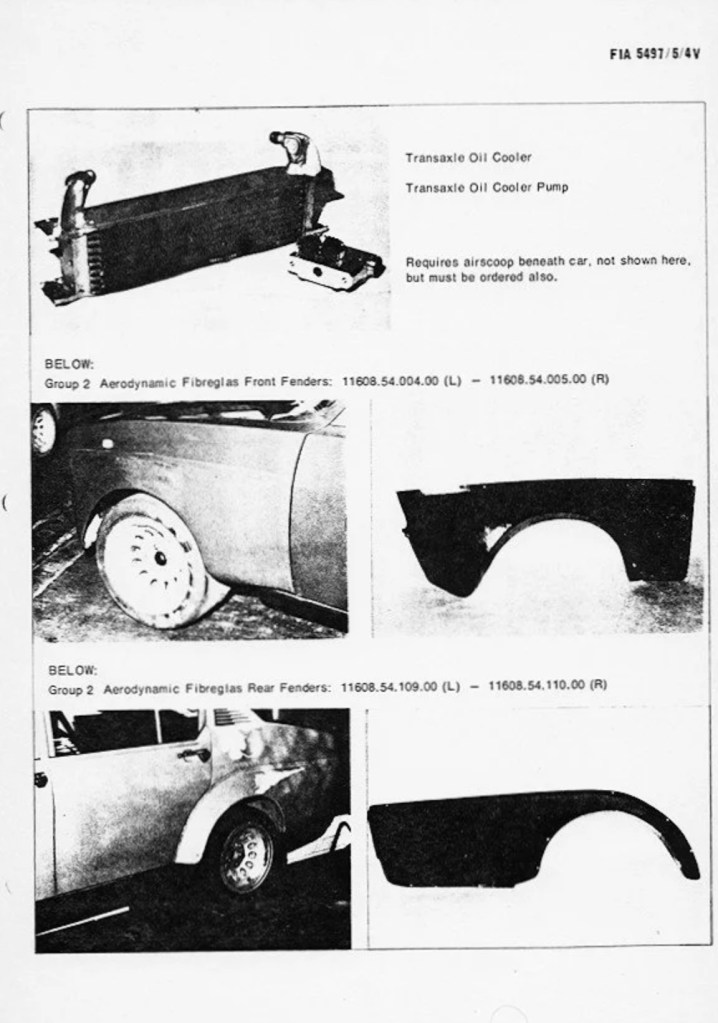
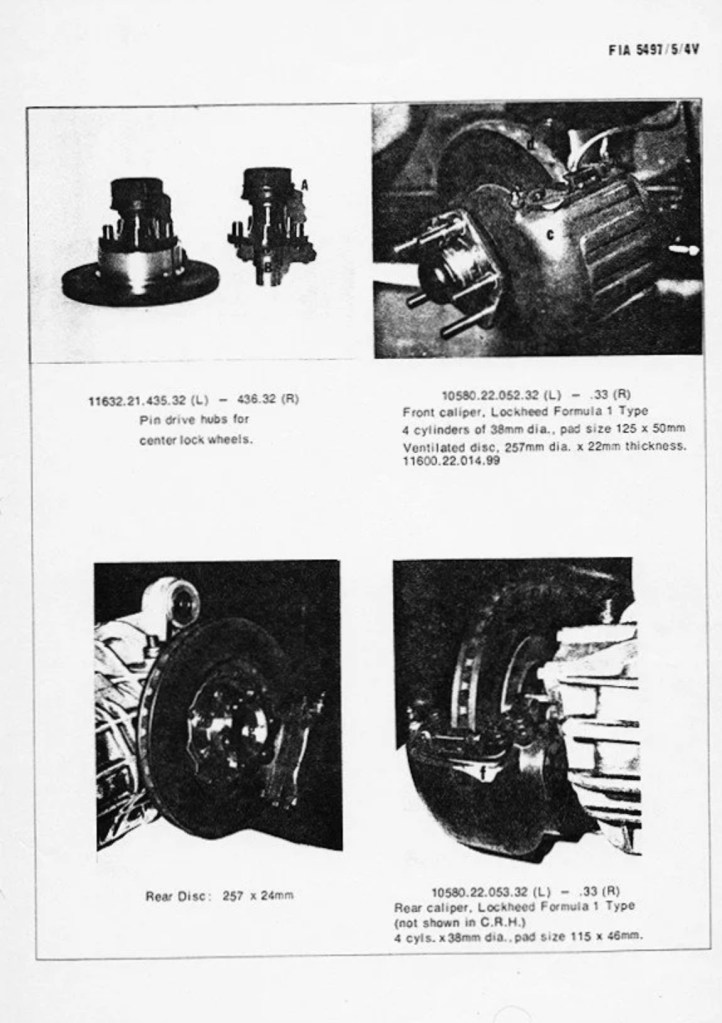
Alfetta GTGroup 2 Homologation…
Alfetta G.T. America Homologation…
Credits…
Peter Burley, Lane Louie, Evan Green, Rod Steffanoni, Racing Car News, Auto Action, Colin Pettigrew, Marque Spotlight Series, oldracephotos.com. Various Australian Alfisti historian/enthusiast/restorer/engineers including Vin Sharp, Anthony Sharp and Paul Newby on various Alfa Romeo forums; hopefully I haven’t verballed-you!















 primotipo...