Posts Tagged ‘Cooper T55 Climax’

(G Smedley)

Master Mechanic Geoff Smedley made a pretty fine part-time photographer while fettling racing cars for the likes of John and Gavin Youl.

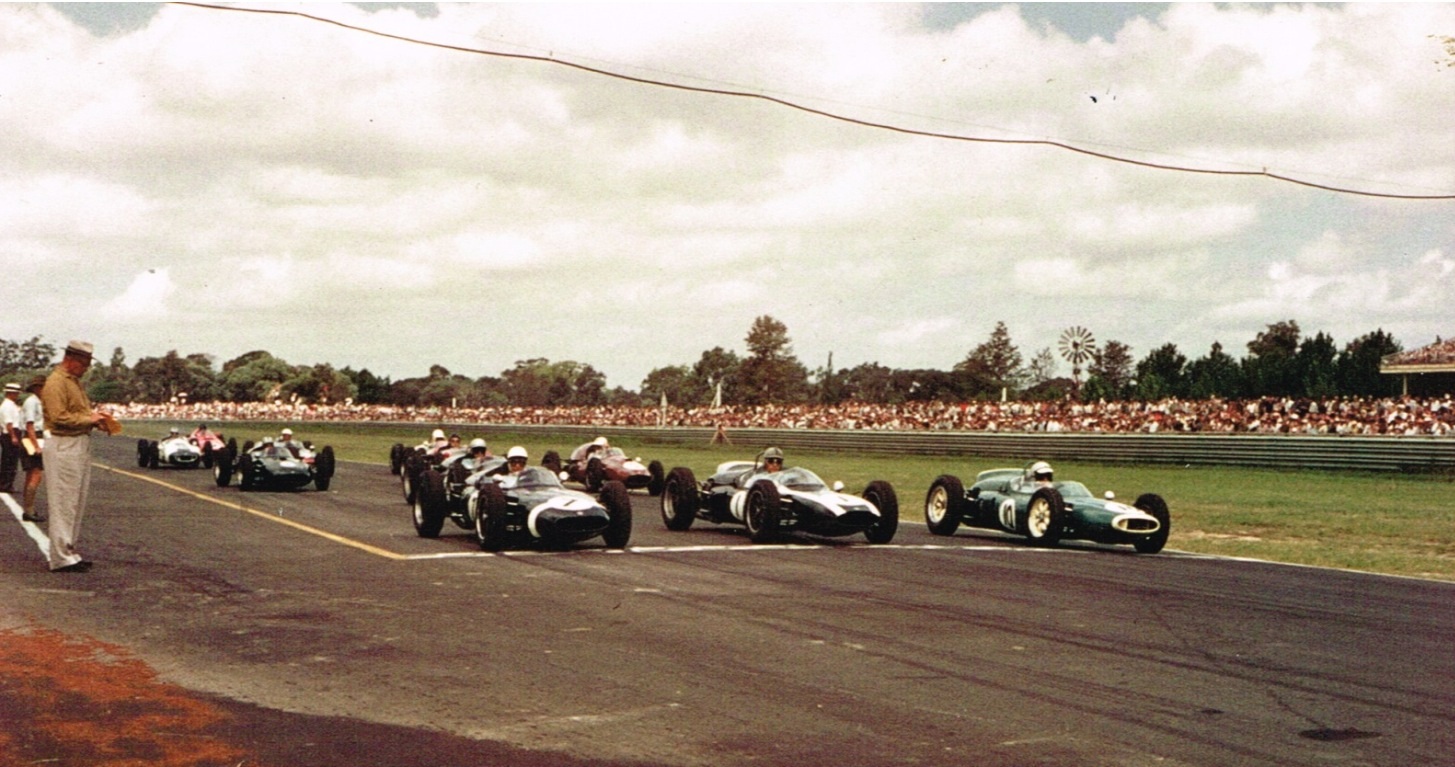
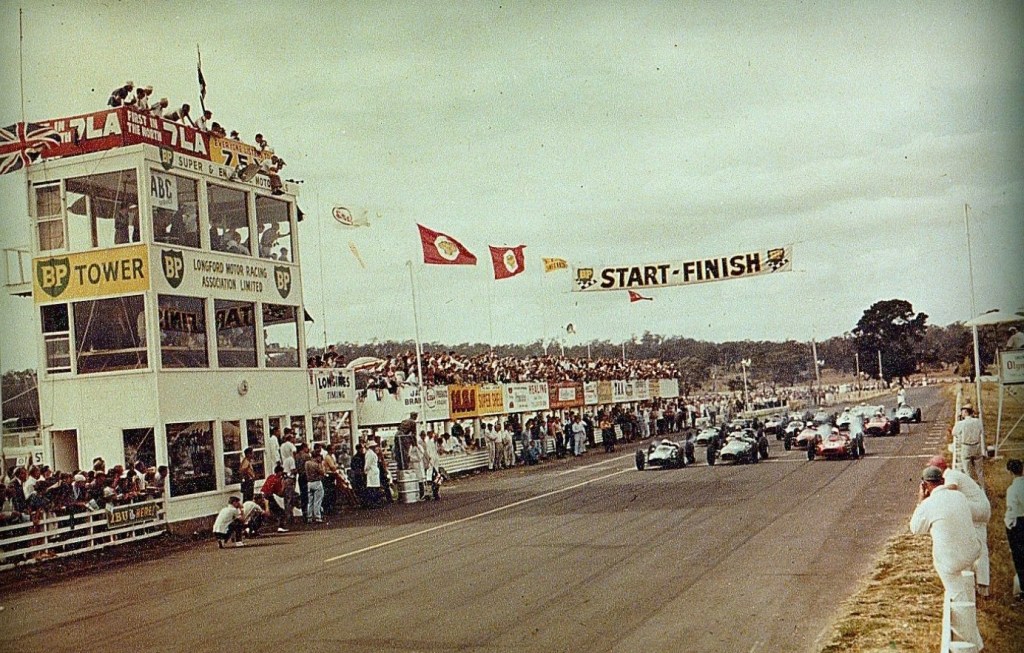
The 1963 South Pacific Championship has just got underway at Longford on March 4. Bruce McLaren is on pole in his Cooper T62 Climax at left with Bib Stillwell’s new Brabham BT4 Climax in the middle and Lex Davison’s Cooper T53 Climax on the right.

McLaren won the race comfortably from Bib Stillwell after Bruce’s dice with Jack Brabham’s leading BT4 Climax 2.7 ended with engine failure on lap 14 John Youl was third in his Cooper T55
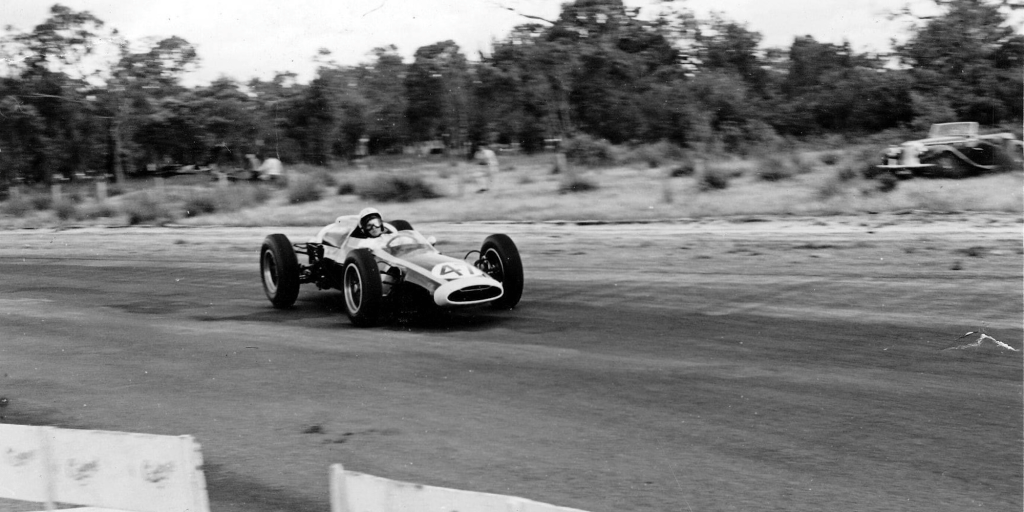
Bruce McLaren on his way to winning the 1962 Australian GP, Caversham, Western Australia, Cooper T62 Climax (K Devine)
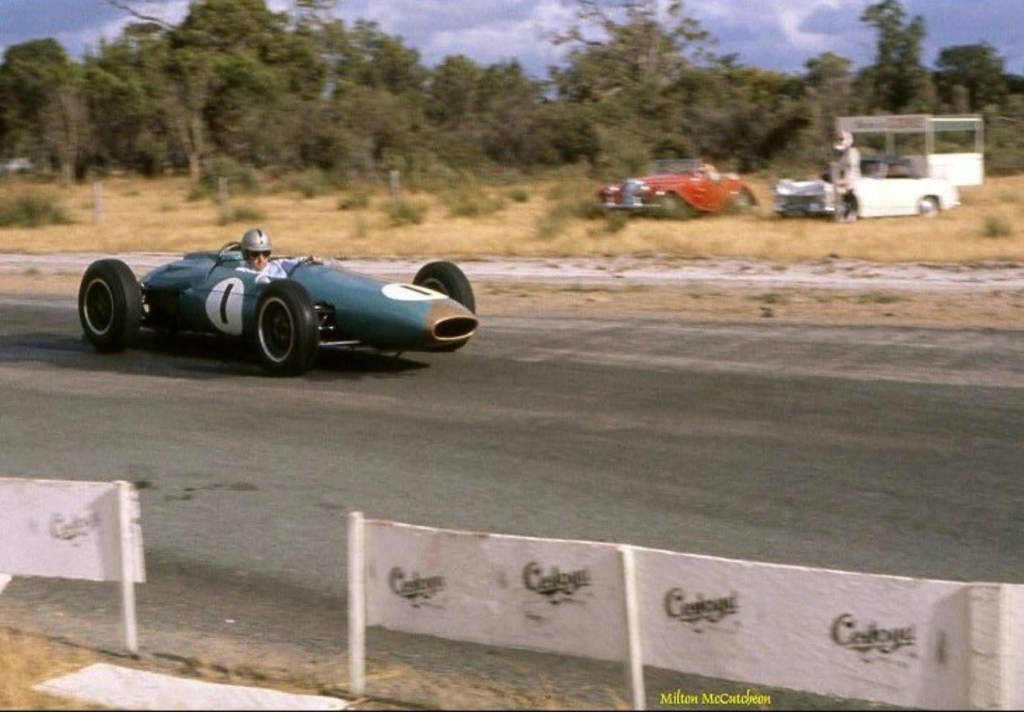
Jack Brabham debuts the BT4 Climax, Caversham AGP, November 1962. BT4 #IC-1-62 was the first in a long line of very successful, profitable ‘Intercontinental’ Brabhams from Ron Tauranac

Context…

The Cooper vs Brabham Australasian summer was set during the 1962 Australian Grand Prix, November 18 weekend at Caversham, outside Perth, when McLaren’s new Cooper T62 Climax and Jack Brabham’s equally new Brabham BT4 Climax faced off for the first time. A fantastic dice between Bruce and Jack that day was resolved in McLaren’s favour after a passing he-zigged-when-I-zagged manoeuvre between Brabham and Arnold Glass’s BRM P48 Buick V8 went awry.

Both machines were inspired by their Coventry Climax FWMV 1.5-litre V8-powered Grand Prix siblings: the Cooper T60 and Brabham BT3. By the time the eight-race Tasman Circus travelled to Warwick Farm, round five, the weight of numbers favoured Jack Brabham and Ron Tauranac’s Motor Racing Developments business with BT4s in the hands of Brabham, David McKay, who had bought Jack’s ’62 AGP car’, and Bib Stillwell, who had acquired a newie.
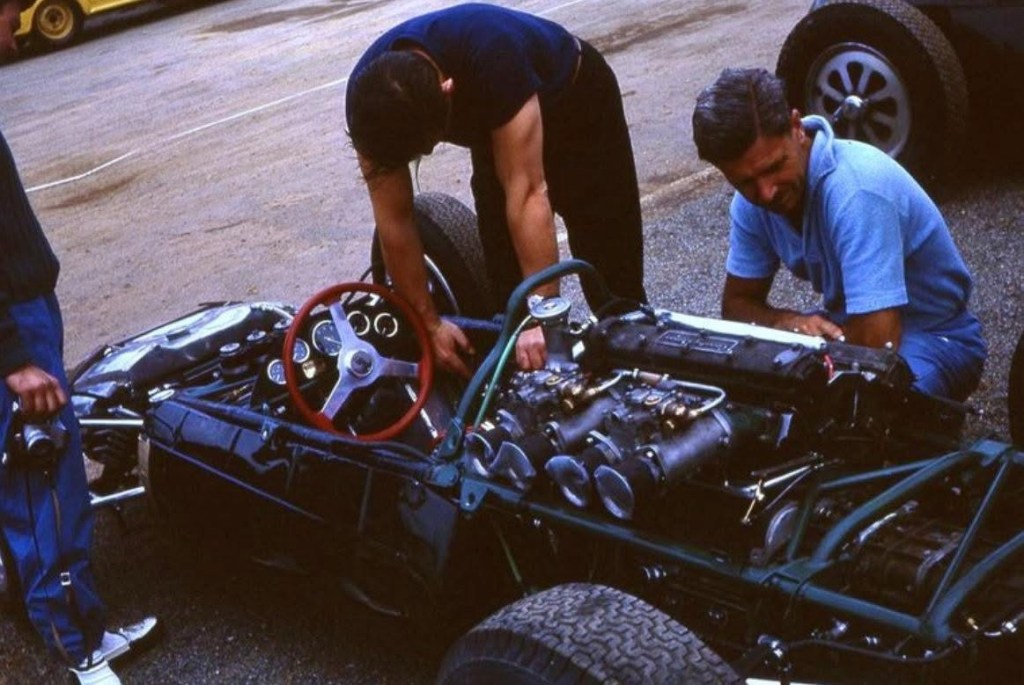
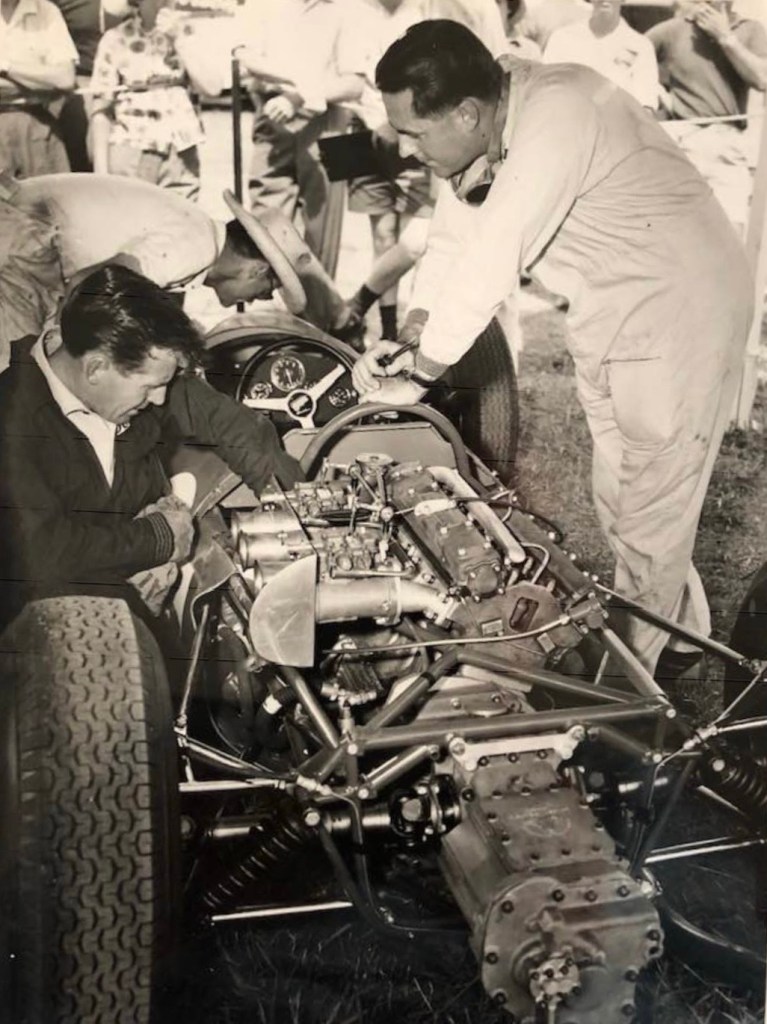
McLaren and the business end of his Cooper T62 FPF, Caversham 1962, with David McKay, Cooper racer/writer/later Scuderia Veloce supremo, showing more than cursory interest in the car given his pending car update considerations (T Walker)
BT4 Tim Wall, Jack Brabham and Repco Indy 2.7 in the Sandown paddock. By then, Repco’s Michael Gasking was preparing Jack’s Tasman FPFs, and Repco was or were soon to be the Australian importer/distributor of Coventry Climax spares (Repco)

Bruce won two of the four Kiwi rounds at Wigram and Teretonga with his Cooper T62, while John Surtees won the NZ GP at Ardmore in an ex-F1 Lola Mk4A Climax 2.7, with Jack taking a Levin win in his BT4.

The additional power and torque from 2.7-litre Coventry Climax FPF Indy four-cylinder engines were causing a great deal of driveline stress to gearboxes, clutches and driveshafts.

At Warwick Farm, Brabham won in his new BT4-IC-2-62 from Surtees’ Lola Mk4A, McLaren and McKay in his first race of the ex-Jack BT4-IC-1-62 with Stilwell fifth in his new BT4-IC-1-63; all cars powered by Indy 2.7s.

At Lakeside on February 17, Surtees won from Graham Hill’s Ferguson P99 Climax 2.5 FPF and Stillwell. It was a great shame that the Ferguson went home at this point, we Victorians and Taswegians didn’t get to see it. McLaren spun and could’t restart while Jack was a no-show. It was an even greater shame the Fergy didn’t arrive in New Zealand with a pair of 2.7-litre FPFs…

Then Bruce won at Longford and at Sandown Park on March 10, so McLaren and Cooper won the 1963 Faux Tasman Cup. Jack was a DNF with engine failure with Tony Maggs in the other Bowmaker Racing Lola Mk4A Climax 2.7 second and McKay third.
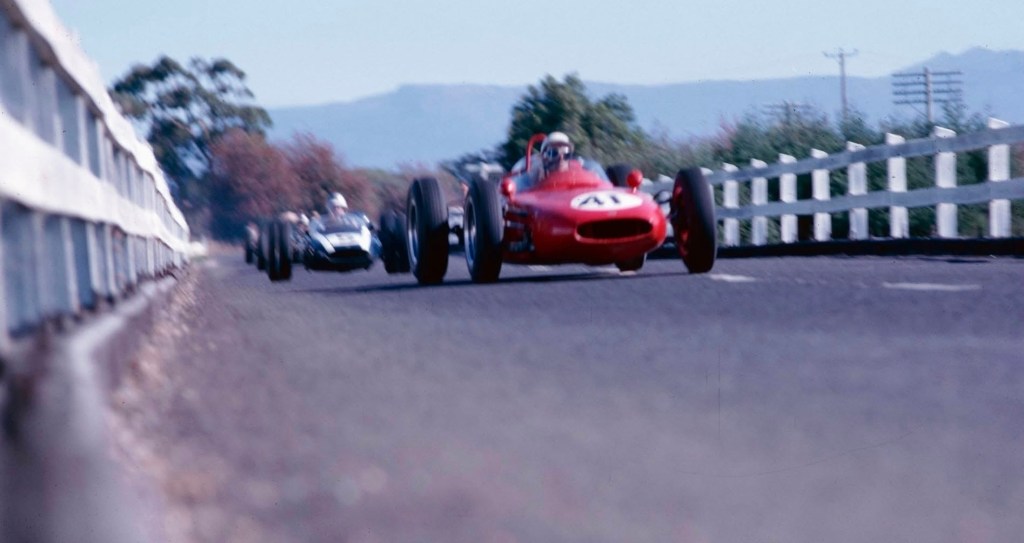
Lex Davison turns into the exit of Long Bridge, closely followed by John Youl, Coopers T53 and T55. Lin Gigney, the snapper of many of these shots, was a flaggie right here… (L Gigney)

Longford…

Down in the South Island Lex Davison was having a whale of a time in the Cooper T53 John Surtees used to win at Longford in 1962! He won both the Saturday 45-mile Formula Libre preliminaries, the first from Bib Stillwell and John Youl after Bruce McLaren retired from the leadership of the race with a broken universal joint.

The second Saturday race also fell to Melbourne’s famous cobbler, from Chris Amon, Cooper T53 Climax 2.5 and John Youl, Cooper T55 Climax 2.5. McLaren didn’t start this race; Brabham did, but then had carburettor problems during lap two that caused his retirement.
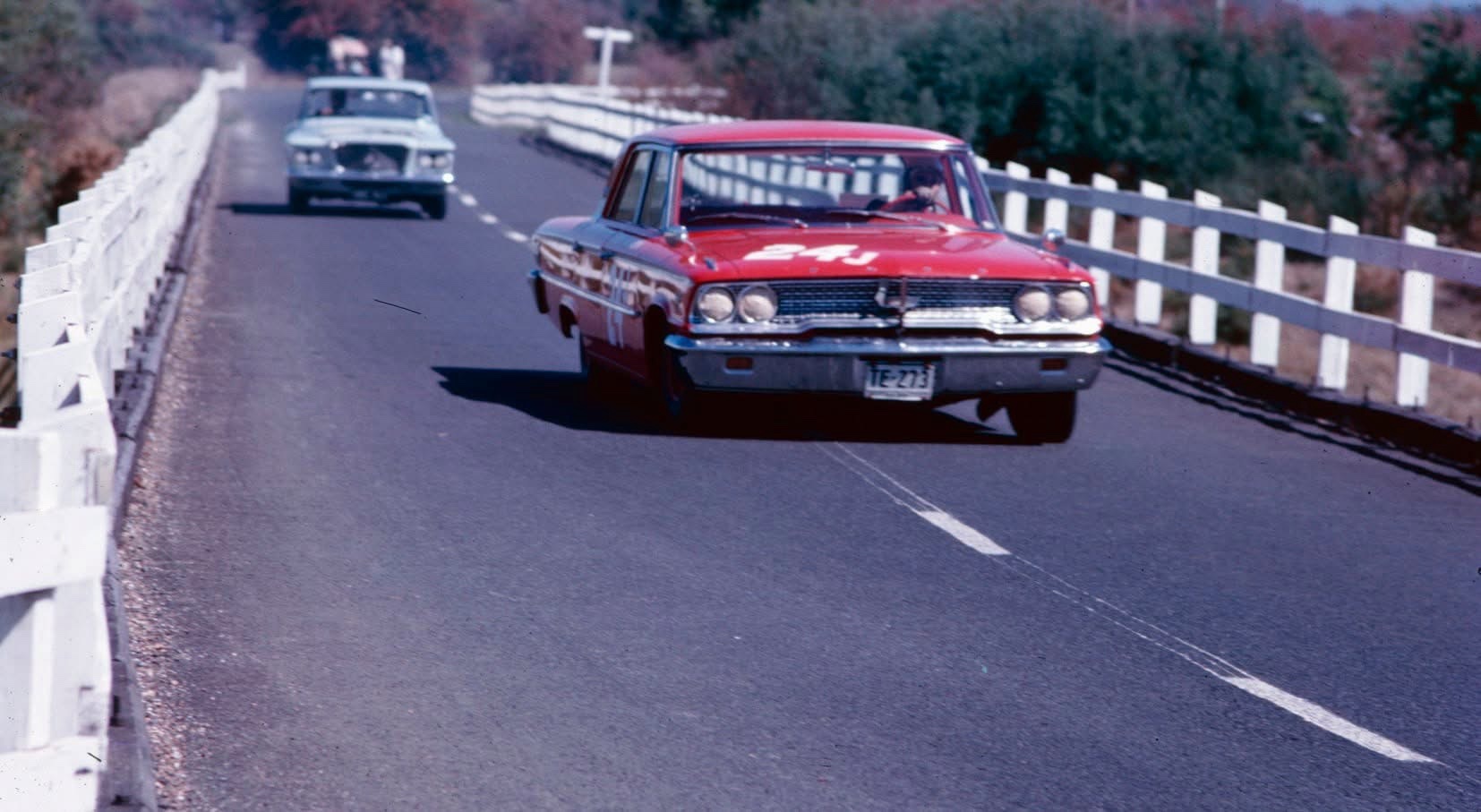
Lex Davison, Ford Galaxie – what a massive bit of real estate! – from Ern Abbott Chrysler Valiant on Long Bridge (L Gigney)

On top of that, the staunch traditionalist continued his flirtation with touring cars, finishing second in the 45-mile Touring Cars Championship aboard Len Lukey’s Ford Galaxie behind Bob Jane’s then-dominant Jaguar Mk2 3.9, with Ern Abbott’s Chrysler Valiant 3.9 in third.

The Jag was timed at 142mph on The Flying Mile, the Galaxie did 141mph in an experience Davison told Autosport reporter FGN Ewence as ‘Like Driving a Haystack.’ Ewence wrote that ‘It came out of corners as though they were launching pads, but its braking and handling let it down.’
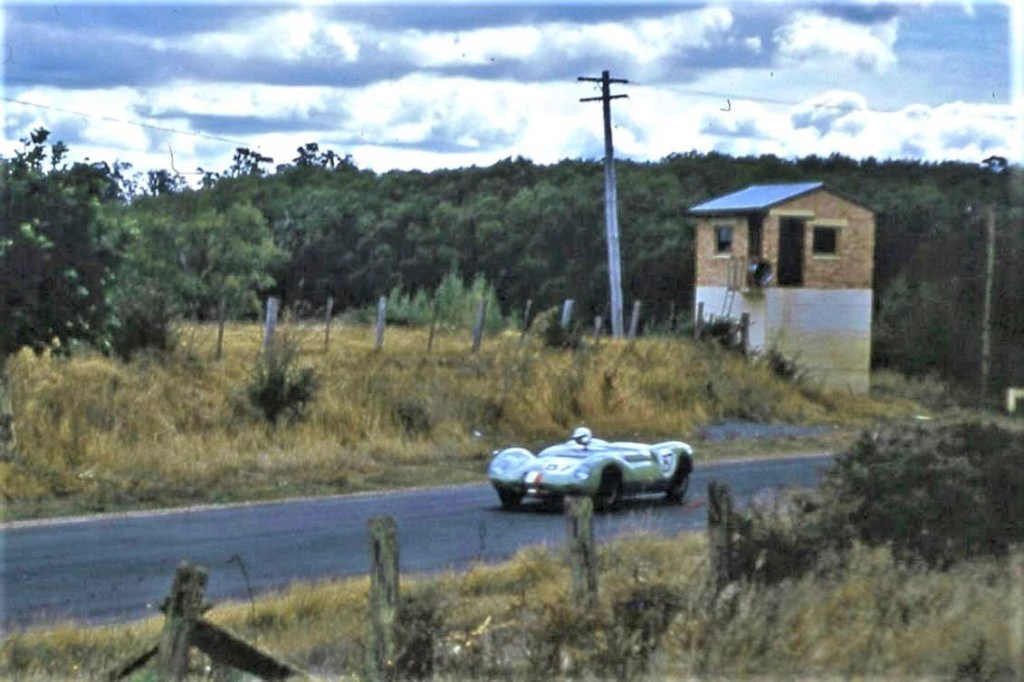
Frank Matich, Lotus 19 Climax, having just exited Kings Bridge and passed the irrigation water pumphouse (B Wright)

Bigger FPFs were fitted to Australian sports cars as well, notably Bib Stillwell’s Cooper T Monaco and Frank Matich’s Lotus 19, with FM winning the 45-mile Sports and GT Cars Championship from Stillwell and Bob Jane’s Jaguar E-Type.

Matich pushed his own lap record up to 108mph and was chuffed enough about the pace of his Lotus two-seater that he entered it in the Formula Libre feature.

Friday qualifying comprised two sessions, one in the morning and another in the afternoon. The quicks were McLaren on 2:23.3, McKay 2:27.0, Davison on 2:27.3. Of Davo, Ewence recorded that ‘Alan Ashton, got the 2.7 Climax to its bellowing best, and his wider wishbones had improved the car’s stability, and he had the brakes to a pitch which enabled Davison to rush up on his opponents as they approached corners.

Youl did a 2:27.4. Ewence noted that John’s Cooper ‘was handling much better following extensive modifications to the suspension, including widening of the track.’ Geoff Smedley was the engineer/mechanic involved.
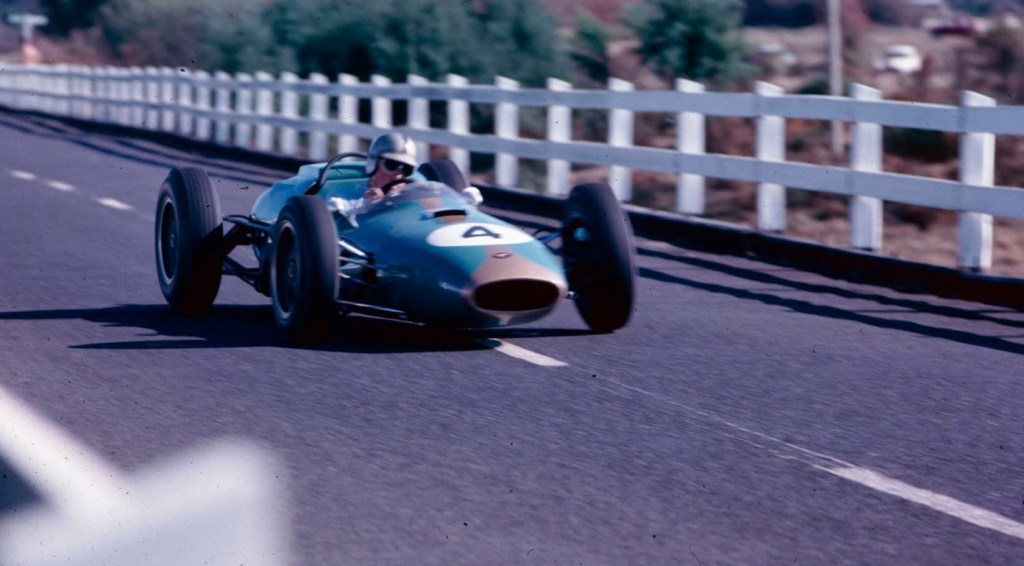
Jack Brabham lines up his BT4 for the very strong timber Long Bridge exit clipping point! (L Gigney)

Brabham didn’t arrive from London, then Sydney, and on to Launceston until after 11am on the Friday morning and then spent most of the day chasing engine problems. Refer to the Climax twin-plug note in Etcetera.

The top three grid slots from times recorded in Saturday’s two races noted above were McLaren, Stillwell and Davison. Then came Maggs, McKay and Brabham, then Youl, Chris Amon, Jim Palmer, and the rest. The only starters from this race still alive are, I believe, Bob Holden, who raced his 1.5-litre Lynx Peugeot Formula Junior from grid 15, and Jim Palmer.

The Race…

Raceday at Longford was always on the Monday Labour Day holiday. There was no racing on the Sunday, giving plenty of time for dramas to be sorted: Jack’s engine, McLaren’s uni and driveshaft, Gardner’s clutch, Magg’s engine mount, etc. Bruce McLaren noted in his March 15, 1963 ‘From The Cockpit’ Autosport column how busy Repco Launceston and Merv Gray’s engineering shop were over that weekend.
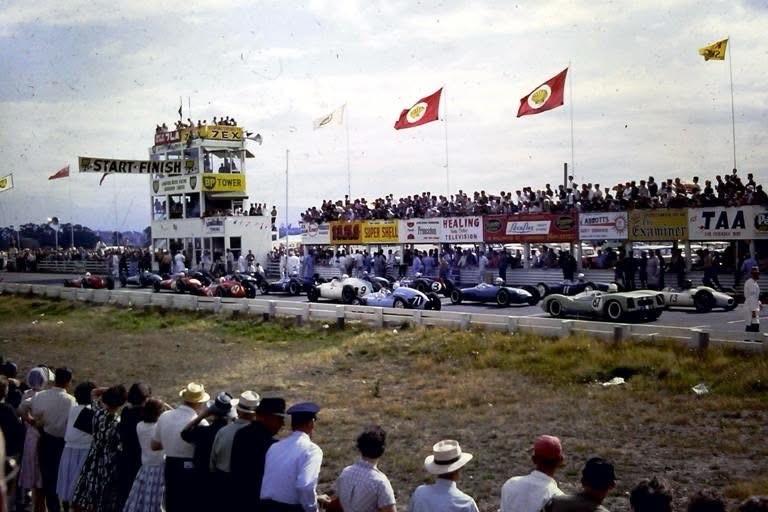
(HRCCT)

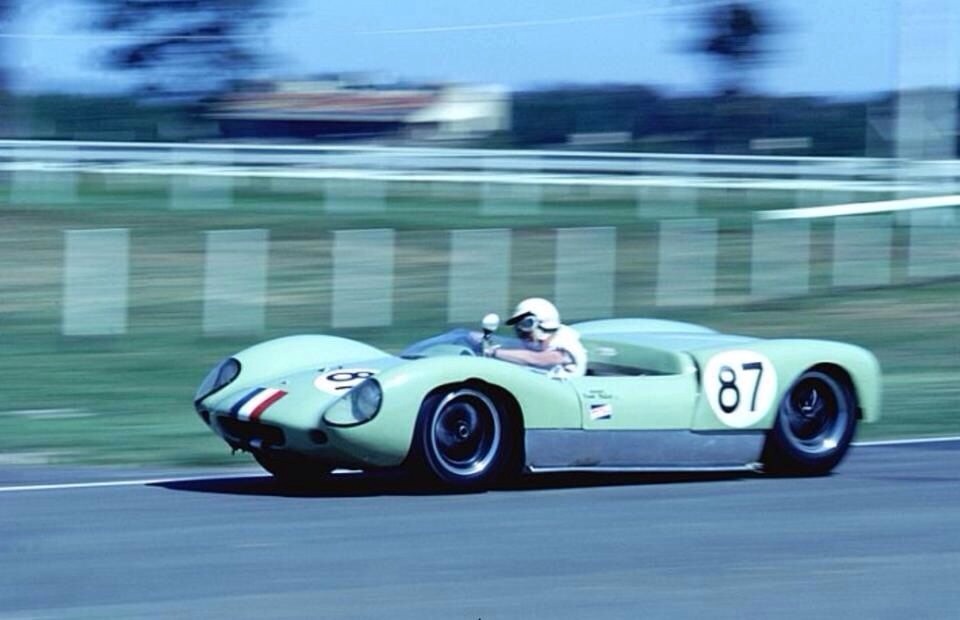
The rear of the grid (above) before the South Pacific Championship, showing #87 Frank Matich Lotus 19 Climax, #13 Bob Holden Lynx Peugeot 1.5, on the next row is Frank Gardner’s Brabham BT2 Ford FJ, which is sandwiched by Tony Shelley’s Lotus 18/21 Climax against the pits and Peter Boyd-Squires Cooper T45 Climax. The white #9 Cooper T51 is Bill Patterson, and alongside him is the #3 Cooper T53 of Jim Palmer. Then Chris Amon in the red Cooper T51 #14 with John Youl alongside, Cooper T55 Climax and an obscured Jack Brabham in his BT4. On the second row is David McKay’s Brabham BT4 Climax and an obscured Tony Maggs’ Lola Mk4 Climax with Davison, Stillwell and obscured McLaren up the front.
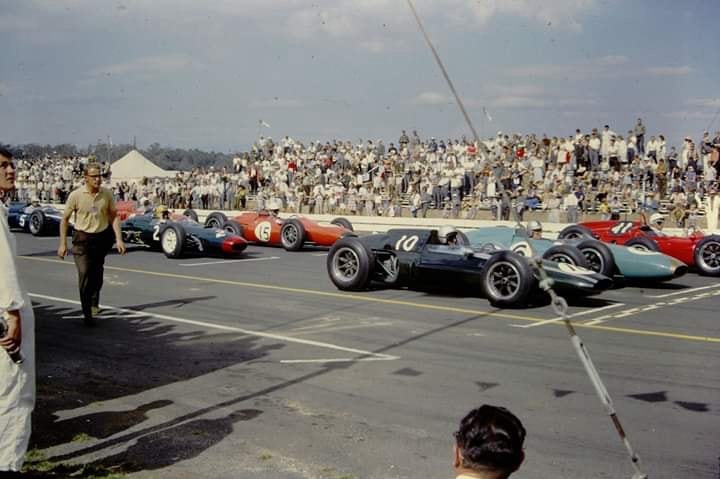
(unattributed)

South Pacific Championship 3-2-3 grid, 14 starters, Longford, Monday, March 4, 1963.

Bruce McLaren Cooper T62 2.7, Bib Stillwell, Brabham BT4 2.7 and Lex Davison, Cooper T53 2.5, then on row two, Tony Maggs, Lola Mk4 2.7 and David McKay, Brabham BT4, on the third row, we can get a glimpse of Chris Amon’s Cooper T53 2.5 near the fence, and #5 John Youl’s Cooper T55 2.5 alongside.

All of the engines were Coventry Climax FPF, whether John Youl was using his Geoff Smedley-developed twin-plug, twin-Magneto 2.5, I don’t know.
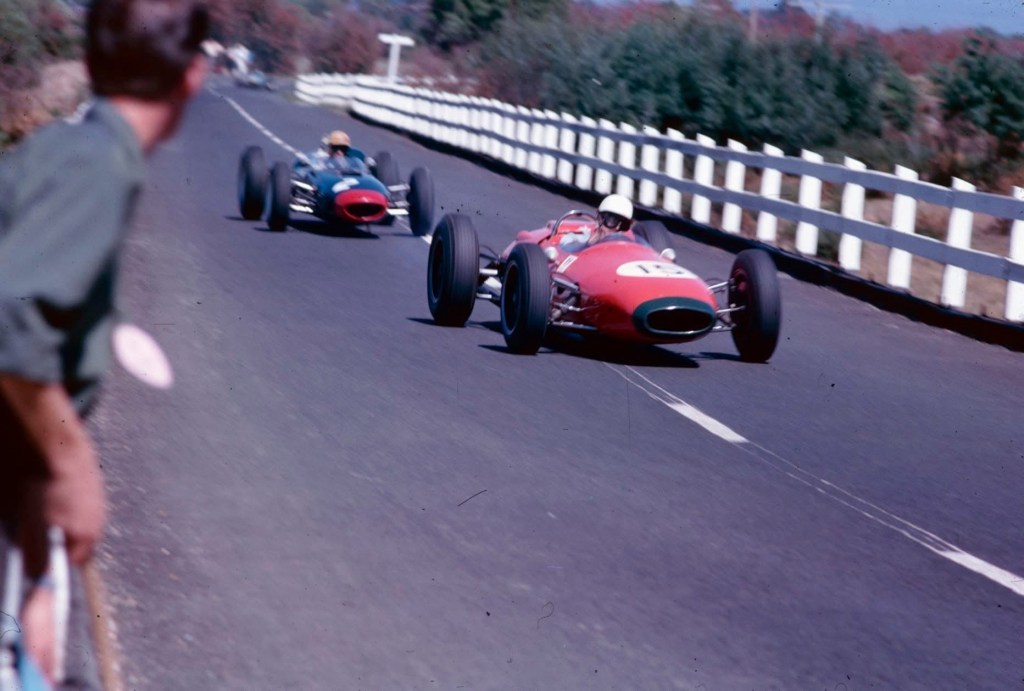
David McKay, Brabham BT4 from Tony Maggs, Lola Mk4, Long Bridge (L Gigney)

F.G.N Ewence reported that it was a great first lap for the Brabham marque with the three of them leading in line astern across Long Bridge. David McKay’s run was short-lived with leaking cylinder head sealing rings; he only compltetd the first lap.

Brabham sat behind McLaren then he took the lead on lap 10, with Bib Stillwell third, but four laps later Jack’s run came to nought with the BT4 puffing plumes blue smoke of increasing volume on The Flying Mile, then through Mountford and into the pits. The ‘manifold leak’ caused a pit fire which was quickly extinguished with Jack leaving an oily calling card at Mountford that caused others some grief.
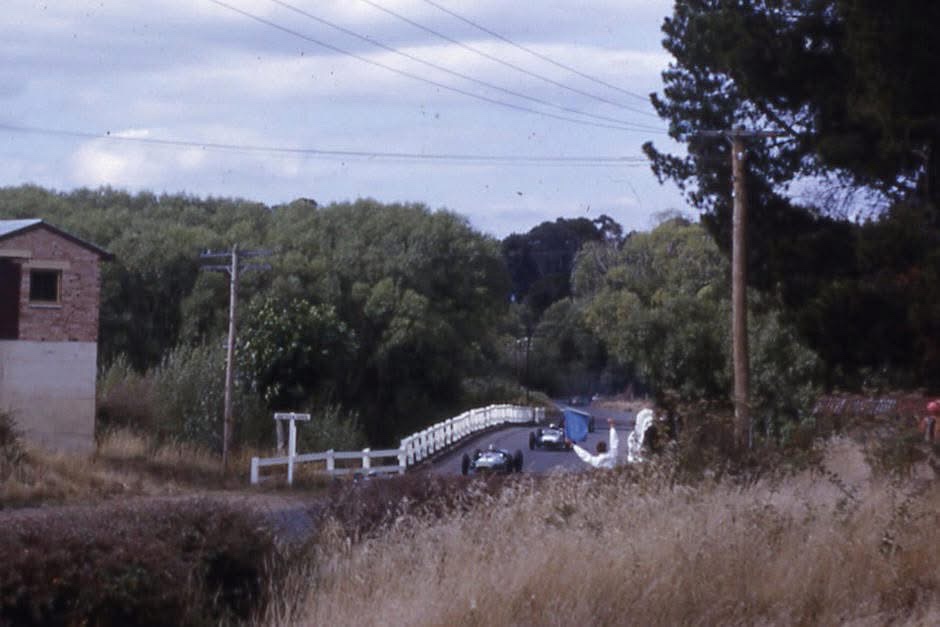
Brabham from McLaren on Kings Bridge, circa laps 10-14. The Viaduct is some way behind them, beyond the trees, with Longford village in front (Bob Wright)

Bruce took the lead back, having done the fastest lap of the race at 114mph on lap 13 in pursuit of Jack. He then modulated his pace to keep ahead of Bib Stillwell and John Youl. Bill Patterson was fifth behind Jim Palmer’s Cooper T53, and Tony Maggs demonstrated his professionalism by bringing the Lola home sixth despite being liberally coated with engine oil that escaped from a crack in the chassis tube, which conveyed the slippery stuff to and from engine and radiator.
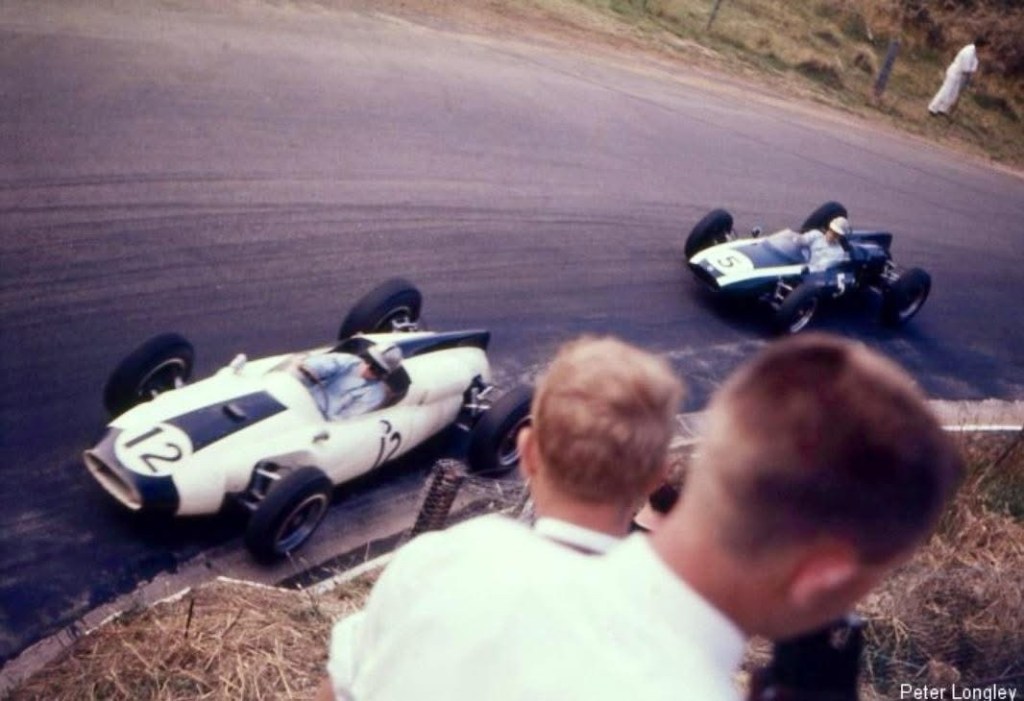
(P Longley)

This scrap between Kiwi, Jim Palmer, Cooper T53 Climax and local boy, John Youl, Cooper T55 Climax was over third place, an argument resolved in Youl’s favour.

Palmer was a multiple Kiwi Gold Star Champion, a Tasman Cup perennial whose best placings were fourth in 1966, ex-Clark Lotus 32B Climax and equal fourth with Phil Hill in 1965, Brabham BT7A Climax. Youl was ‘one who got away’, the incredibly gifted driver was fourth in that old T55 in the ‘ 64 Tasman before taking up family farming responsibilities at their Symmons Plains property, not too far from Longford.
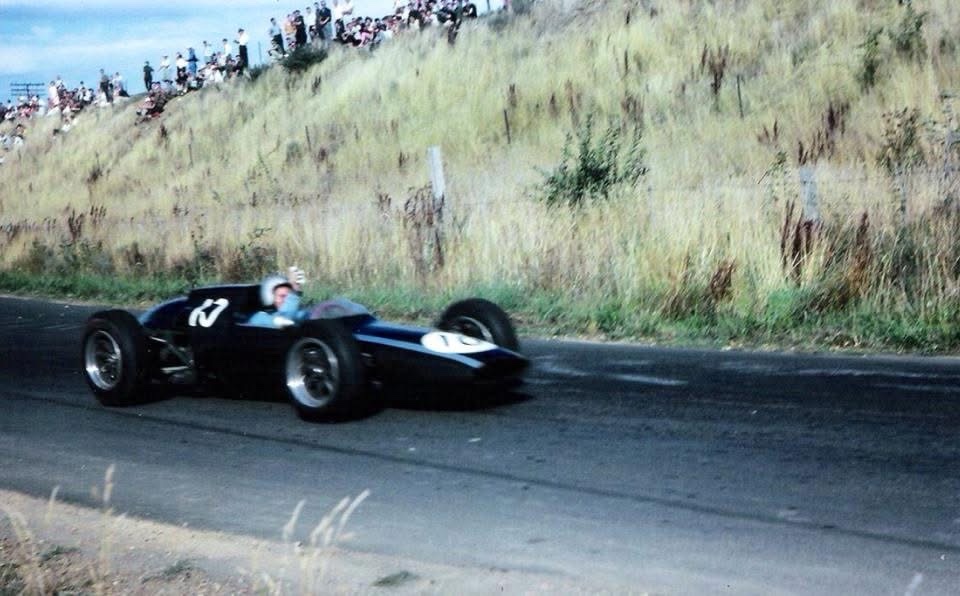
(R Bell)

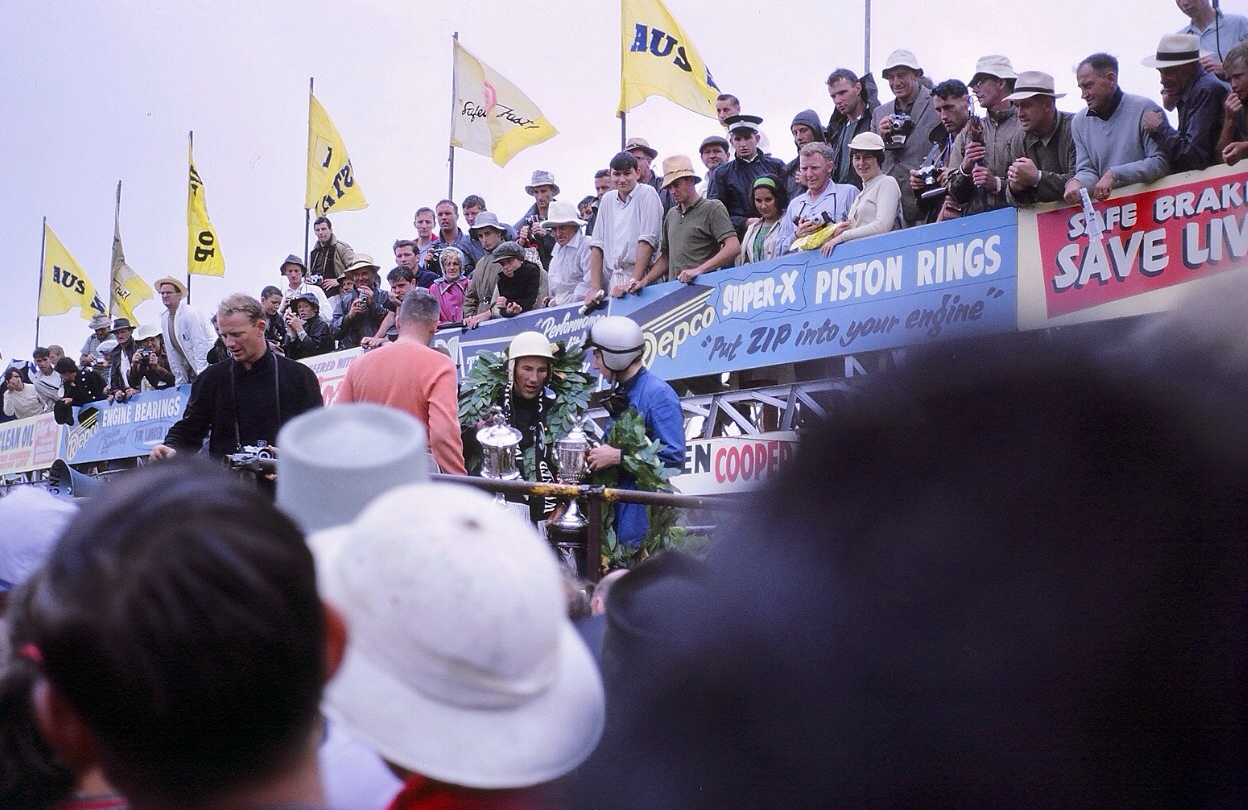
Bruce McLaren receives the plaudits of the Longford crowd from atop the Viaduct, he had a good summer in his Cooper T62 Climax, winning the 1963 Faux Tasman Cup, then came back in ‘64 and won the real one!

The views of experienced outsiders is always an interesting perspective. Here is Ewence’s race report Postscript in full.

‘Postscript: Despite the fact that the Longford Motor Association has no paid officials, it is limited by a lack of population. The whole State of Tasmania has only 350,000 inhabitants. To get 30,000 of them to a meeting is equivalent to an attendance of some four million at a British meeting! This makes the £20,000 budget something of a nightmare for the L.M.R.A. The two previous years’ operations had resulted in losses after necessary capital expenditure was met. This year, the hats went in the air when Treasurer Geoff Hudson’s casting of accounts revealed a small profit. Longford will be on again next year, and State Premier Reece seemed so upset about an interruption caused by a passenger train at the level crossing in Longford township that those on the inside believe that the trains will be very strictly controlled in the future.’

Etcetera…
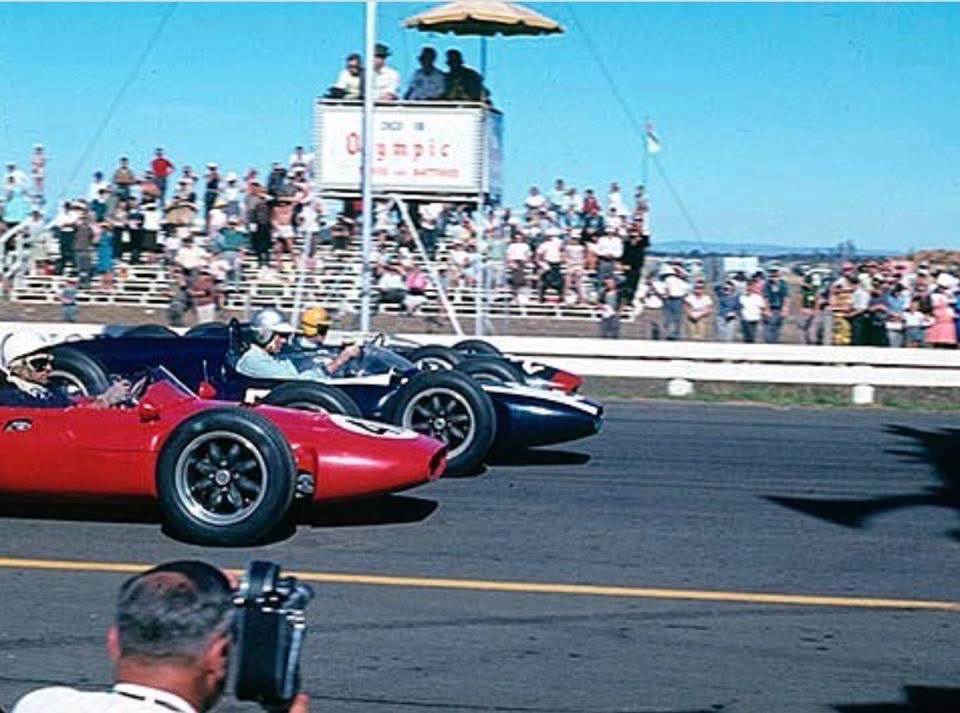
(oldracephotos.com)

The start of one of the 45-lap preliminaries with Lex Davison on this side, then John Youl, and Tony Maggs in the yellow helmet. Davo won them both.

(Andrew Lamont)
(W ‘i anson)

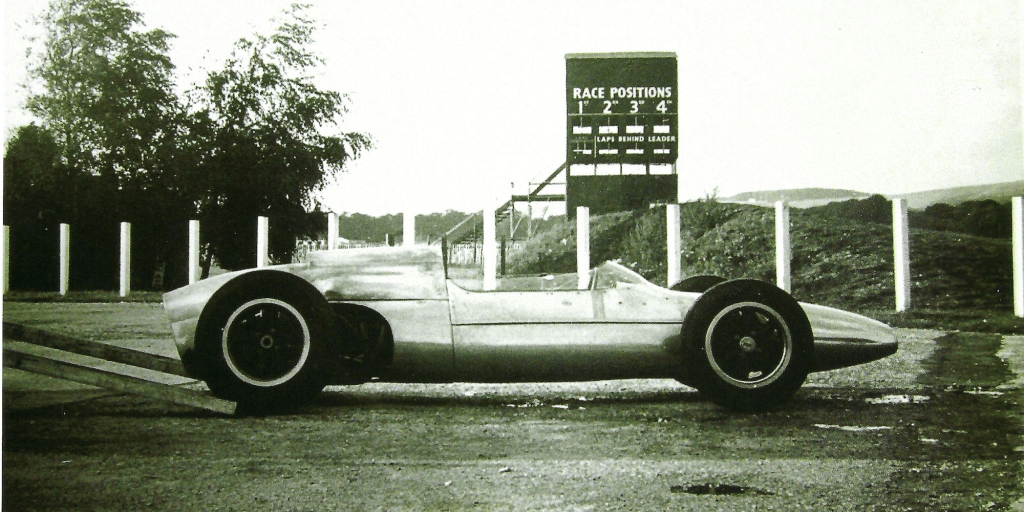
Bruce McLaren’s unpainted Cooper T62 Climax at Goodwood for a test session on September 26, 1962 not long before the car was shipped to Fremantle, Western Australia for the 1962 Australian GP at Caversham.

McLaren’s T62 – #CTA/BM/2 – was built on Cooper’s T60 1961-63 jig by Tommy Atkins’ team at his Chessington workshop. Harry Pearce and Wally Willmott were the artisans who built the car. The rear was designed to take a BRM P56 1.5-litre F1 V8; Bruce planned to contest the non-championship F1 races that Coopers chose to ignore. When that engine ran late, Atkins and McLaren decided to convert the car to Climax Tasman spec, gearbox, and a Colotti T32 five-speed.
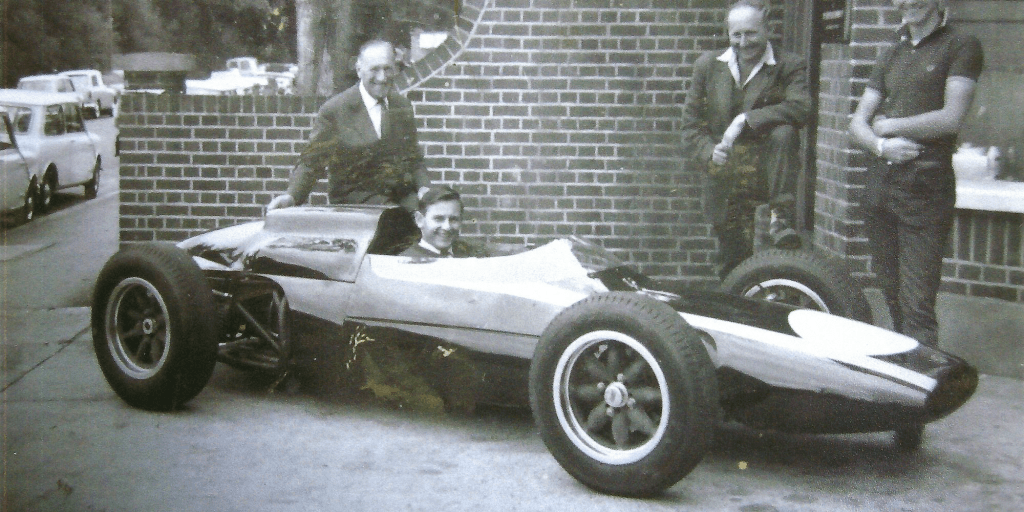
Tommy Aktins, Harry Pearce, partially beheaded Wally Willmott and completed T62 at Coopers in Hollyfield Rd, Surbiton (W i’ anson))
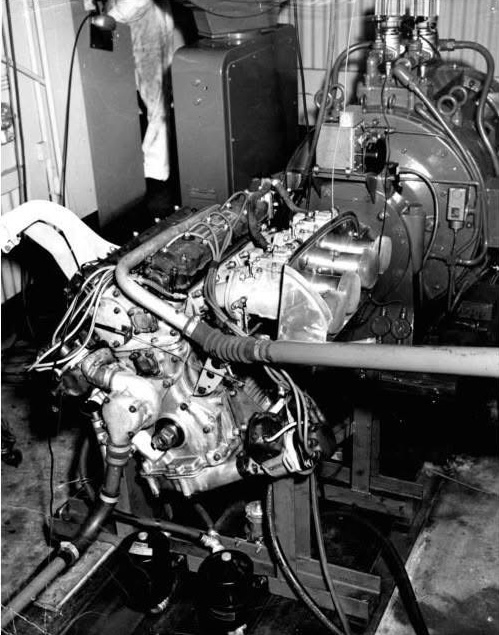
Geoff Smedley’s Coventry Climax 2.5 FPF twin-plug on the Repco Research dyno in November 1963 (G Smedley)

Bruce McLaren (Eoin Young ghosting Bruce) wrote in ‘From The Cockpit’, ‘Brabham’s car was the centre of interest, sporting an 8-plug head. This was a very impressive looking set-up, but it must have been firing the right plug at the wrong time or the wrong plug at the right time, because he had a lot of trouble getting it to run right.’

‘That was Friday. The Saturday morning practice was kind to most of us except poor Jack again. The Brabham was smoking a lot more than a young car should, and he had to rush back to Launceston to take the engine out and fit his spare 2.7 Climax for the races in the afternoon..

Those with a keen memory may recall that Geoff Smedley developed a race-winning 2.5-litre Coventry Climax twin-plug in Tasmania for John Youl. That engine, with the necessary sparks provided by twin-magnetos, was first raced by Youl fitted to his winning Cooper T55 in the October 14 1963, Gold Star round at Mallala. The engine was then used in the ’64 Tasman, in which Youl finished fourth in that ageing Cooper behind Bruce’s new Cooper T70, Brabham’s new BT7A and Hulme’s year old BT4. Youl and Smedley’s was a mighty effort!

I recorded Geoff Smedley’s twin-plug story here:https://primotipo.com/2017/11/16/geoff-smedleys-twin-plug-coventry-climax-2-5-fpf/

In it, Geoff recalled that ‘Frank Hallam at Repco Research had been playing around with a twin-plug head for one of Brabham’s engines, using two distributors driven from the rear of each cam bank and couldn’t make it work through an inaccurate spark which was put down to windup in the camshafts in the high rev range.’

So it seems the Repco FPF twin-plug was tested over the Longford ’63 weekend. I wonder whether Jack tried it elsewhere? Does anybody know what became of that pair of twin-plug heads?

Credits…

Geoff Smedley, Bob Wright via Kay Wright, Andrew ‘Slim’ Lamont Collection, Historic Racing Car Club Tasmania, Ray Bell, Terry Walker, Ken Devine, Repco. The detail in this article is via Paul Cummin’s archive, specifically F.G.N Ewence meeting report and Bruce McLaren’s ‘From The Cockpit’ column published in Autosport, March 15, 1963, Willian i’anson Ltd, Geoff Smedley, Stephen Dalton

Tailpiece…
(E French)

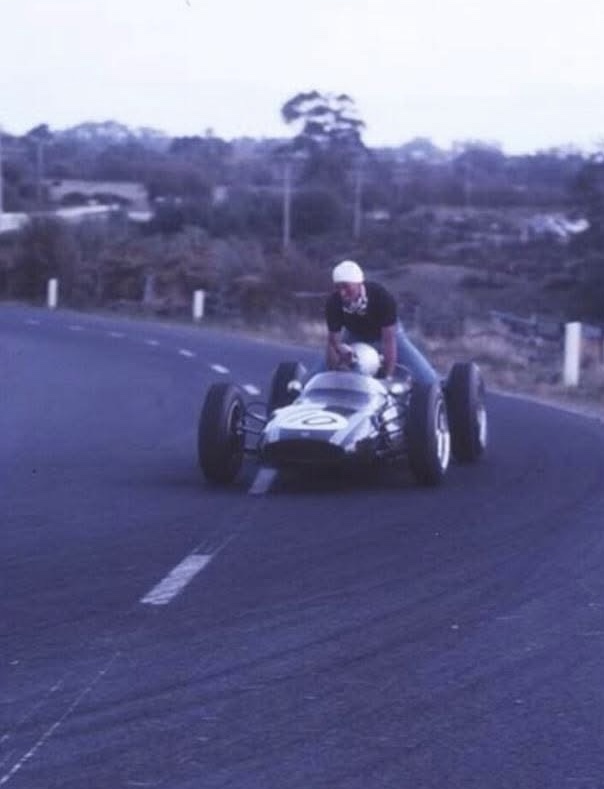
One of the men of the weekend, Lex Davison, had gear-selector problems on his sixth lap with his Cooper T53 and is shown bumming a ride from Bruce McLaren, who is just starting the Newry ascent. Ewence reported that Davo ‘Broke down near the pub, where last year he had so spectacularly lost his first 2.7 Cooper in a 130 m.p.h skid. “Why hello, Mr Davison, back again?’ remarked the landlord’s wife as he entered the portals.’

Davo famously wore his cloth helmet under his real one throughout his career. Lex turned 40 on February 12, 1963, and was still mighty fast indeed!

Finito…

(Fistonic)

Frank Matich’s Brabham BT7A Climax leading Jim Palmer’s Cooper T53 Climax around the 2.897 Km Mount Maunganui road circuit, New Zealand, 28 December 1963…

Mount Maunganui is a beach town at the southern end of Tauranga Harbour in The Bay of Plenty in the north of New Zealands North Island. Only two ‘Bay of Plenty Premier Road Race’ meetings using public roads around the towns wharf area were held, in 1962 and 1963. The circuit was oblong in shape, the startline was in Totara Road and ran down Hewletts Road, onto Tasman Quay and then Hull Road. The creation of the permanent Bay Park circuit in the area supplanted the road course which was created by Joseph and Graham Pierce and Feo Stanton. To create the track they had to tar-seal a section over a railway line and then remove it after the weekends racing to allow the trains to operate the following morning!

Race winner Jim Palmer, Cooper T53 Climax, Mt Maunganui 1963 (Fistonic)

The 1963 event was won by Jim Palmer from John Youl’s Cooper T55 Climax and Tony Shelly’s Lotus 18/21 Climax. Both of the Australians, John Youl and Frank Matich used the meeting as a ‘warm-up’ for the 1964 Tasman series which started at Levin, the following weekend, on 4 January 1964.

Grid positions for the 15 lap final were determined by the results of two heats; Matich comfortably led his until encountering timing problems with his Coventry Climax engine, Palmer took the win with John Youl victorious in the other heat.

In the championship race, Palmer started well and lead Shelly, Matich- off the back of the grid, quickly passing the smaller engined cars and Youl but Shelly soon led, and Matich grabbed 3rd as Youl spun. Matich set a lap record of 1:10.4 as he moved the very latest ‘Intercontinental’ Brabham BT7A into 2nd behind Shelly. He took the lead on the next lap whilst Youl closed on Palmer. Shelly was passed by Palmer with 3 laps to go with Matich left out on the circuit with an inoperative throttle, and John Youl also passing Shelly. Palmer won from Youl, Shelly then Rex Flowers Lotus 20B Ford, Roly Levis’ Lotus 22 Ford and Neil Whittaker’s Cooper T43 Climax.

John Youl, Cooper T55 Climax (Fistonic)

In fact the race was very much a portent of the Tasman Series (won by Bruce McLaren’s Cooper T70 Climax) with all four of Matich, Palmer, Shelly and Youl being competitive with Matich having a swag of mechanical problems only finishing one of the 5 rounds he started, at Longford, in 3rd place.

In the NZ Tasman races Palmer, Shelly and Youl all contested they drove extremely well, almost as a group in their outdated cars- Cooper T53, Lotus 18/21 and Cooper T55 behind the leading bunch of Australasian Internationals- Brabham, Hulme, McLaren and American Tim Mayer.

Youl was 4th in the first 3 NZ rounds and then travelled back to Australia before Teretonga to prepare for the first Australian round at Sandown where he finished 3rd. His beautifully prepared 1961 (ex-F1 and then Brabham’s car for the Australasian Internationals in 1962) Cooper T55 with its innovative Geoff Smedley designed and built twin-plug Coventry Climax FPF head had done 5 meetings with routine maintenance but no rebuild. His 3rd at the AGP was followed by a DNF at Warwick Farm with crown wheel and pinion problems. He then had a great 2nd at Lakeside and was 5th at Longford, his home race in a strong finish to the series.

In fact Youl was very much the ‘form driver’ of this group having finished 2nd and then taking 2 wins in the final three rounds of the Australian Gold Star series in the later months of 1963, at Sandown, Mallala and Warwick Farm. Noteworthy is that these performances were against Lex Davison, Bib Stillwell and David McKay all of whom were aboard much more modern equipment than Youl. He was second in the Gold Star to Stillwell’s Brabham BT4 Climax in 1963 as he was in 1962.

Palmer, later multiple NZ Gold Star winner and ex-F1 driver Shelly had virtually identical results in the four NZ Tasman races, and finished all of them which is admirable at a time the 2.5 FPF’s were notoriously brittle being pushed to the limits as they were.

Without doubt Frank Matich had the pace of the Internationals in the ’64 Tasman but he had no chance of success without better preparation/luck/greater mechanical sympathy- Geoff Smedley joined him not so long after Youl’s unfortunate retirement from the sport at the end of 1964. Grazier Youl was one very fine driver who deserved a ‘factory’ drive such was his pace in the ex-Brabham Cooper T55 to fully realise his potential. I don’t know enough about the man to place him in the pantheon of Australian single-seater pilots but for sure he was very handy behind the wheel…

Matich chasing Colin Ngan, Cooper Bobtail in the sportscar race won by FM- love these industrial background shots (Fistonic)

Matich in his Lotus 19B Climax…

Frank Matich above blasting his very highly developed Lotus around the Mounts working wharves, such a distinctive background!

Frank’s Lotus was far and away the quickest sportscar that weekend, he won the race from the Lotus 15 Climax of Barry Porter and the Lola Climax driven by J Riley. The Matich 19B was destroyed at Lakeside in 1965, hospitalising the Sydneysider in the process. Out of those ashes was born the Elfin 400 Olds or Traco Olds as FM called it, and Matich SR3 and SR4 programs, all great cars.

In the same way that the Lotus 18, Chapman’s first mid-engined design (F1/FJ) redefined the sophistication of the path the Coopers had blazed so well, so too did the 19 amongst sportscar grids. The car used much of the 18 hardware albeit adapted to comply with sportscar rules- FIA Group C. Chapman detailed the car with Len Terry also playing a role in its design.

The cars spaceframe chassis was made of 1 inch and ¾ inch steel tube of 16 and 18 guage, there was a scuttle hoop of perforated sheet steel to provide further cross-sectional bracing. The first car, chassis ‘950’, was initially fitted with an aluminium body with subsequent cars using bodies made of fibreglass. The front and rear body sections were hinged for ease of access with two horizontal doors for driver and passenger! access and egress. Wheels were Lotus 15 inch ‘wobbly-webs’, disc brakes were 10.5 inch and 9.5 inches in diameter front / rear.

Dimensions; 141 inch long, 65” wide, a height of 31/32 “, the wheelbase was 7’ 6”, front track 49” and rear track 47.5 “. The cars weight was quoted at 1232-1250 pounds less driver but with 8 gallons of fuel. Said girth was dependent upon the engine fitted, over time this included the FPF’s around which the car was designed and also various American small-block V8’s. Similarly, whilst the Lotus sequential, 5 speed ‘Queerbox’ was specified the cars were also fitted with Colotti and Hewland gearboxes ‘in period’.

Lotus 19 Climax cutaway, technical specifications as per text (Thatcher)

When completed chassis ‘#950’ was tested by both Moss and Chapman, Moss had been racing Cooper Monaco’s amongst the swag of cars he competed in at the time, his opinion of the 19 relative to the Monaco, a design several years older would be interesting. Its said that the 19 was the first car Stirling drove after recovery from his 1960 Spa Lotus 18 accident.

Only 16 or 17 of the cars were built, the limiting factor for build numbers was the supply of Coventry Climax FPF engines which were of course the engine de jour for the British F1 ‘garagistes’ at the time.

The seminal research over the last decade or so on the fate of the various Lotus 19 chassis was carried out by enthusiasts/experts/journalists/engineers/drivers on ‘The Nostalgia Forum’ (TNF). What follows is based upon the contents of that highly interactive forum, with the ability of so many knowledgeable people to test evidence, the summary of ownership and changes in specification over time. The contributions of Ray Bell and Bryan Miller are specifically acknowledged.

Frank Matich raced two Lotus 19’s; the ex-UDT Laystall 19 chassis ‘950’ raced by Stirling Moss which was destroyed in a testing accident at Warwick Farm in 1963 and a replacement 19B which was delivered by Lotus Components sans chassis number. It was also destroyed, again in a testing, or more specifically an accident during a practice/qualifying session at Lakeside on 24 July 1965.

I have written tangentially about these cars in an article about FM’s rivalry with Bib Stillwell’s Cooper Monaco and other articles on Frank Matich, and very specifically about the 19B, Matich’s accident in it at Lakeside and its role in relation to the design/conception of Garrie Coopers Elfin 400, the first delivered of which was raced by Matich. I don’t propose to cover that all again, click on the links at this articles conclusion to read what I’ve already been written.

The first Matich Lotus 19 Climax, chassis  ‘950’ shot at Homestead Corner Warwick Farm in 1962, compare the photo with the similar one of the 19B at the same corner below (Ellacott)

Caveat Emptor…

When Frank Matich was looking for a replacement for his oh-so-successful Lotus 15 Climax it was immediately obvious to him that the car to have was a 19 given the success of Moss, Ireland, Gurney and others in the cars on both sides of the Atlantic.

His ex-Leaton Motors mechanic Bruce Richardson, working in the UK for Reg Parnell Racing at the time, contacted UDT Laystall in England on FM’s behalf to determine if they were interested in selling one of their three 19’s. Frank knew Moss having met him on the great Brits previous trips to Australia. Shortly after Richardson’s contact Matich ‘…discussed with Stirling buying the (UDT Laystall) car (#950) Stirling was racing in the USA…who advised Frank, who wished to have the car shipped directly from the States to Australia that the car was pretty tired and it would be best for the car to return to the UK for a full rebuild and then be sent out from the UK. The car duly arrived in late 1961 and Frank was not happy with the state of preparation and he called Stirling to intervene’ Bryan Miller wrote.

Matich had been shafted by UDT Laystall, far from the first time we poor Colonials had been short-sheeted by less than honest operators who relied upon 12000 miles of Ocean to get away with sins of omission or commission! Moss, not involved in the commercial aspects of the deal at all, righted the wrongs with a financial adjustment in favour of the Sydneysider. The story goes something like this.

Rather than rebuild the car the UDT folks used the opportunity to bolt some of the shit bits they had lying around the workshop they didn’t want from their three cars to good ‘ole ‘950’ and shove it on a ship at Southhampton for Sydney!

Matich ordered the car with the Colotti box fitted to ‘950’, they sent him a ‘Queerbox’, very much not the better alternative although Matich said later to Bell ‘they weren’t a bad box as long as you set them up well’. Frank specified a regular windscreen, they sent a high one, ‘The crankshaft was obviously carrying a very old crack, it was very unlikely that it hadn’t been previously detected’ according to Frank, Ray Bell wrote. ‘There was a lot of that sort of thing about the car, so its clear Moss went into bat for Frank’. Moss drove the car whilst in Australia for the International series of races that summer (he raced Rob Walker owned Cooper T53 Climax and Lotus 21 Climax in NZ and Australia in January/February 1962) and was able to see for himself the state of the car as delivered from the UK. ‘Onya Stirling!

Having overcome those obstacles the 19 very rapidly became the fastest sportscar in the country, indeed, one of the fastest cars in the Australia- his dices with Bib Stillwell’s older but very well prepared, sorted and driven Cooper Monaco wonderful spectator drawcards across the continent.

Lotus 19 Climax ‘950’ in the Lakeside paddock probably during the International meeting in early 1963. Coventry Cliamx FPF engine and Lotus ‘Queerbox’ clear as is copious ducting for brake cooling (Mellor)

#950’s demise occurred during a test session at Warwick Farm…

Matich’s backyard was Warwick Farm from the time the circuit opened  at the wonderful Liverpool horseracing facility. He did all of his serious testing there, it was close to his various bases on Sydney’s North Shore, and he was always developing his cars with tweaks major and minor. This process of continuous development of bits for all of his cars, factory built or otherwise, was sustained right to the end of his career in early 1974. By then he was building world-beating Formula 5000 cars, indeed no-one did more miles around the Western Sydney outskirts circuit than FM.

In 1963 he raced the Lotus and works Elfins- a Clubman, Formula Junior and an ANF 1.5 variant of the FJ with which he contested the AGP, at, you guessed it, Warwick Farm. He was 8th in the race won by Jack Brabham’s Brabham BT4 Climax. On one of these test days Bell records that ‘The very reason for its (950’s) demise…was the fitting of new uprights (from Lotus)…Matich had come in from testing saying it felt funny and asked Bruce (Richardson, by then back from the UK and FM’s chief mechanic) to go out and drive the 19 while he followed him in the Elfin openwheeler. The upright broke and he went into the fence’. The fence was the very solid and unyielding WF Pit Straight fence which comprised 2 inch thick planks of wood bolted to railway sleepers. The chassis was rooted, it was too badly damaged to be repaired so a replacement was ordered from Lotus Components.

‘The original 19 chassis (950) went to Ray Hopwood, a friend of Franks. I think it was he who buried it under his house after deciding he wasn’t able to use it, which had been his intention’ wrote Bell.

Bell then speculates about the commercial arrangements between Lotus and Matich about the new 19 frame given the demise of ‘950’ was as a result of the failure of a new Lotus upright which was too thin. What is clear, whether Chapman gave him a special price or otherwise is that wealthy Sydney businessman Laurie O’Neill paid for the chassis either in whole or in part. Bruce Richardson confirms the chassis was acquired from Lotus, and therefore is not one of the unaccounted for Lotus 19 chassis- there are about four of these chassis on the TNF list. For sure some components from ‘950’, all possible, would have been retained to bolt to the new frame which Miller reports ‘Frank did not think his car (19B) ever carried a chassis plate, he held no memory of ever seeing one on the car but at that time it was of no importance’.

In late 1963 Matich imported a brand new Brabham BT7A to contest the annual Australasian International Series (from 1964 The Tasman Championship) and local Gold Star, Australian Drivers Championship events.

Almost immediately he became the quickest local openwheeler driver- and one who gave nothing away to the visiting Internationals either. Given the weakness of the Lotus sequential ‘box, Bell ‘…Frank regarded the crownwheel and pinion as marginal…referring to easy starts to protect it…and he often lost the start to Stillwell in their 19 to Monaco clashes…’ Matich fitted the 19B with a Hewland HD5 ‘box given the experience others had of it in cars like it in the BT7A and being well aware of the shortcomings of the Queerbox. By then he had both the support of O’Neill and Total so had an adequate budget to do things properly. The cars chassis was adapted to suit the ‘box at the rear. During the short period the 19B raced it was evolved, beside the BT7A, with various Brabham bits. There appears to be no definitive list of the modifications but brakes, wheels, some suspension parts and other Brabham ‘bits and pieces’ are cited as modifications from standard Lotus 19 spec. Equally there is no neat list of bits which were transferred from the first Matich 19 ‘950’ to the 19B, albeit the ex-Moss chassis was definitely buried under a house, this fact attested by several sources including Richardson, Bell and Miller- none of whom have a vested interest in the opinion they proffer.

Not the Australian Tourist Trophy but the 19B late in its life in early 1965 after a change of Total livery, from light blue to white, here, again at Homestead Corner, Warwick Farm (Ellacott)

Australian Tourist Trophy 1965…

Frank Matich was a professional racing driver, the family Weeties were provided by race and related commercial success, to win the 1965 ATT was therefore important to him. He won the race the year before at Longford in the 19B but for 1965 the field had greater depth.

Ken Miles was coming from the US to race a factory Shelby AC Cobra, Frank Gardner was returning home to race Alec Mildren’s Mildren Maserati, a Birdcage Maserati engine fitted to a chassis built by Bob Britton- a Lotus 19 clone!, the Lotus 23 lookalike built on Britton’s Lotus 19 jig. There were also some pesky Lotus/Ford Twin-Cam engined Lotus 23’s which were quick enough to win should the big guys run into trouble. In fact the latter is what occurred, Pete Geoghegan won the race in a Lotus 23 after the retirement of others.

Matich took the 19B to the Gold Star round at Lakeside in July, his primary focus that weekend was racing his Brabham. Spencer Martin won the Gold Star round in the Scuderia Veloce Brabham BT11A. But the Lotus shared the Matich transporter with the Brabham on the journey north to fettle the car in preparation for the ATT in November. It was during practice that FM lost the car in the fast right hander behind the pits at over 120mph when the throttle jammed, destroying the car and hospitalising him with burns to his hands and back. Damage to the car was to its front, especially the left front. Various sources suggest (not Bell or Miller) that the car may have been damaged further after the accident for insurance purposes.

The accident was the catalyst for Total to end the relationship with Matich. Boral Ltd acquired Total’s business in Australia and they did not want to be involved in motor-racing. The remains of the 19B, owned by O’Neill remember, were then used as a point of dimensional reference during the build of the Elfin 400 Traco Olsmobile at Elfin’s Conmurra Road, Edwardstown, South Australia factory in late 1965. The 19B donated its gearbox and some other minor components to the Elfin build. Even though the remains of the 19B were seen by various people at Elfins over the years the remains of the chassis have never seen the light of day and were probably, at some clearout, disposed of. The future value of these cars was not foreseen then of course!

Despite all of the foregoing, that is, the total destruction of both cars as racing entities, the ex-Moss/Matich Lotus 19 #950 races on, reconstructed around a replacement chassis built in the 1980’s. So far, surprisingly, the 19B has not been rebuilt/reconstructed/resurrected despite Peter Brennan noticing, whilst looking at a Lotus 18 very recently and concluding that the pedals in his Elfin 400 are probably from the 19B…go for it PB, cars worth $750K have commenced reconstruction with far less of the original car than that!…

Etcetera…

(B Caldersmith)

Matich leading Bib Stillwell’s Cooper Monaco and a gaggle of Lotus 23s at Warwick Farm in 1963.

Bibliography…

‘The Nostalgia Forum’ Lotus 19 thread particularly the contributions of Michael Oliver, Ray Bell and Bryan Miller, Graham Vercoe, sergent.com, Bob Homewood, Glenn Ducey

Photo Credits…

Milan Fistonic and Peter Mellor- The Roaring Season, John Ellacott, Bob Thatcher, Brian Caldersmith

Lovely frontal shot of Frank Matich, Lotus 19B Climax, this car probably the most highly developed of its type in the world-V8 variants excepted. Car developed by FM and his team in Sydney, building upon his first 19 which was written off  in a Warwick Farm testing accident. Plenty of Brabham bits inclusive of wheels fitted to this car (Fistonic)

Finito…
image

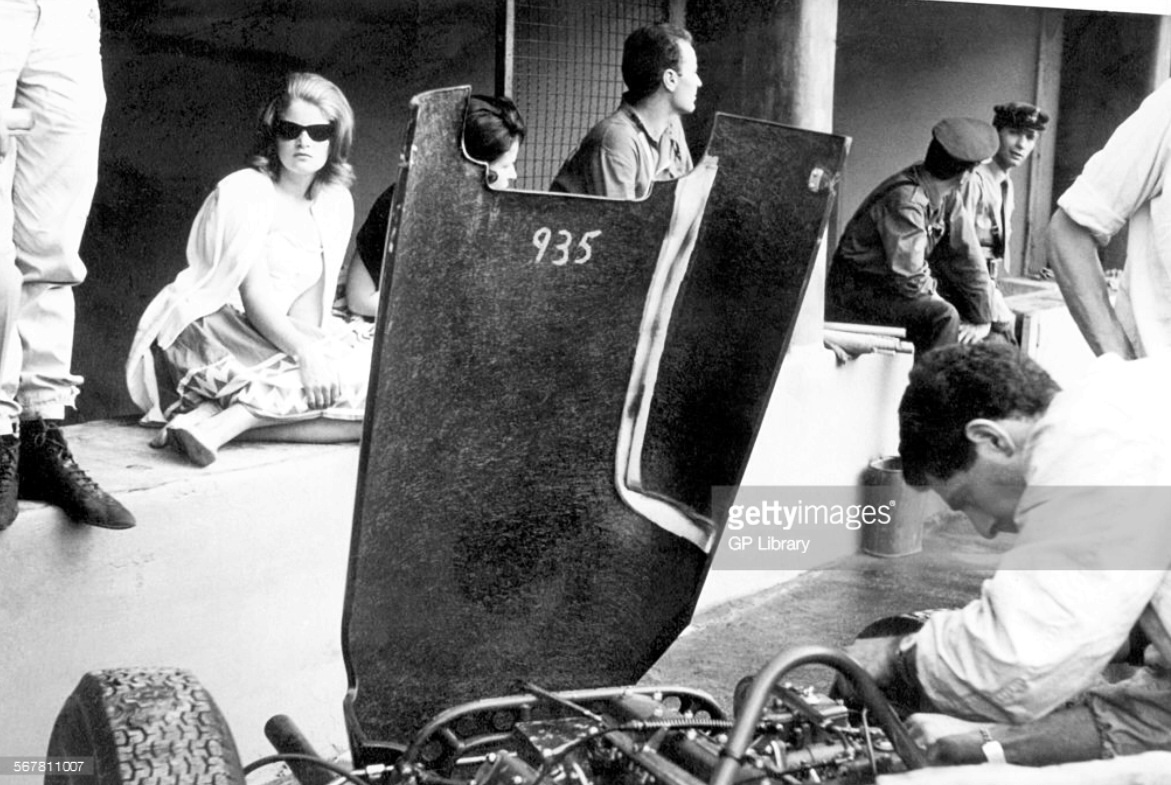
I was lookin’ for shots of chicks and cars as I do a fortnightly post of a babe with a car. When I spotted this image ’twas the lady who initially caught my eye…

But we ‘anoraks’ are so into chassis numbers right?

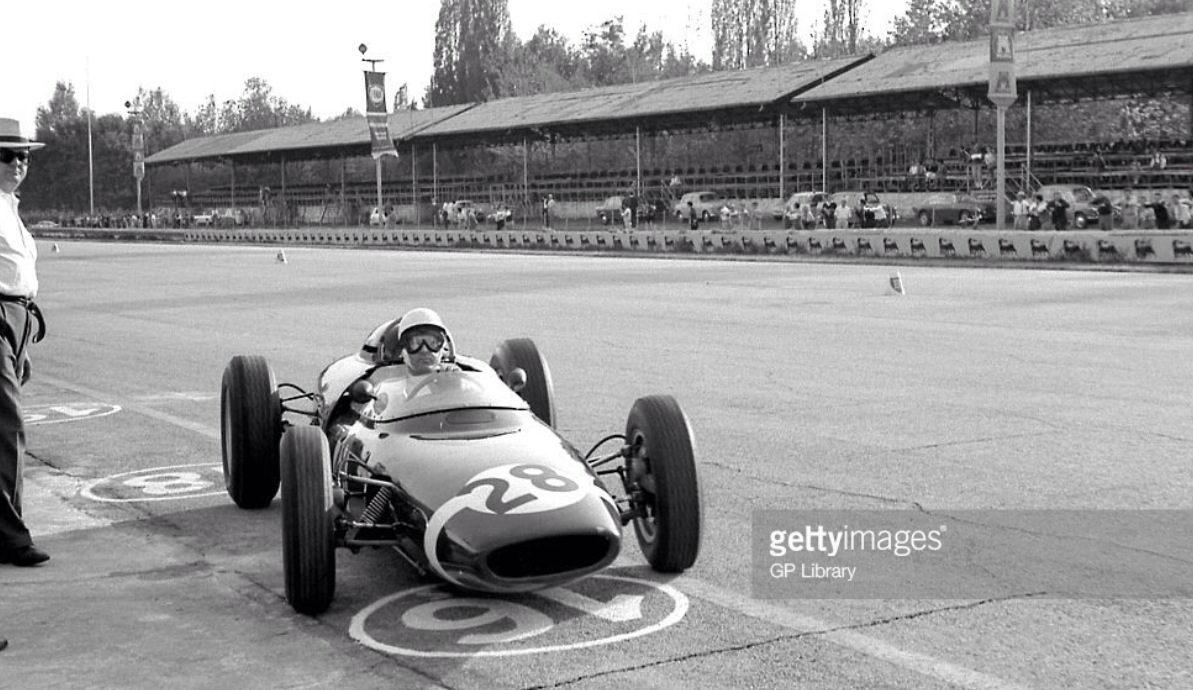
‘935’ on the engine cover stood out, a Lotus 18 number I thought- a quick google and no less an authority than DC Nye identified the car as a Lotus 21 delivered to Rob Walker, its locale Monza, lets come back to that.

Stirling Moss raced ‘935’ in the Australasian summer ‘Tasman’ races in early 1962.

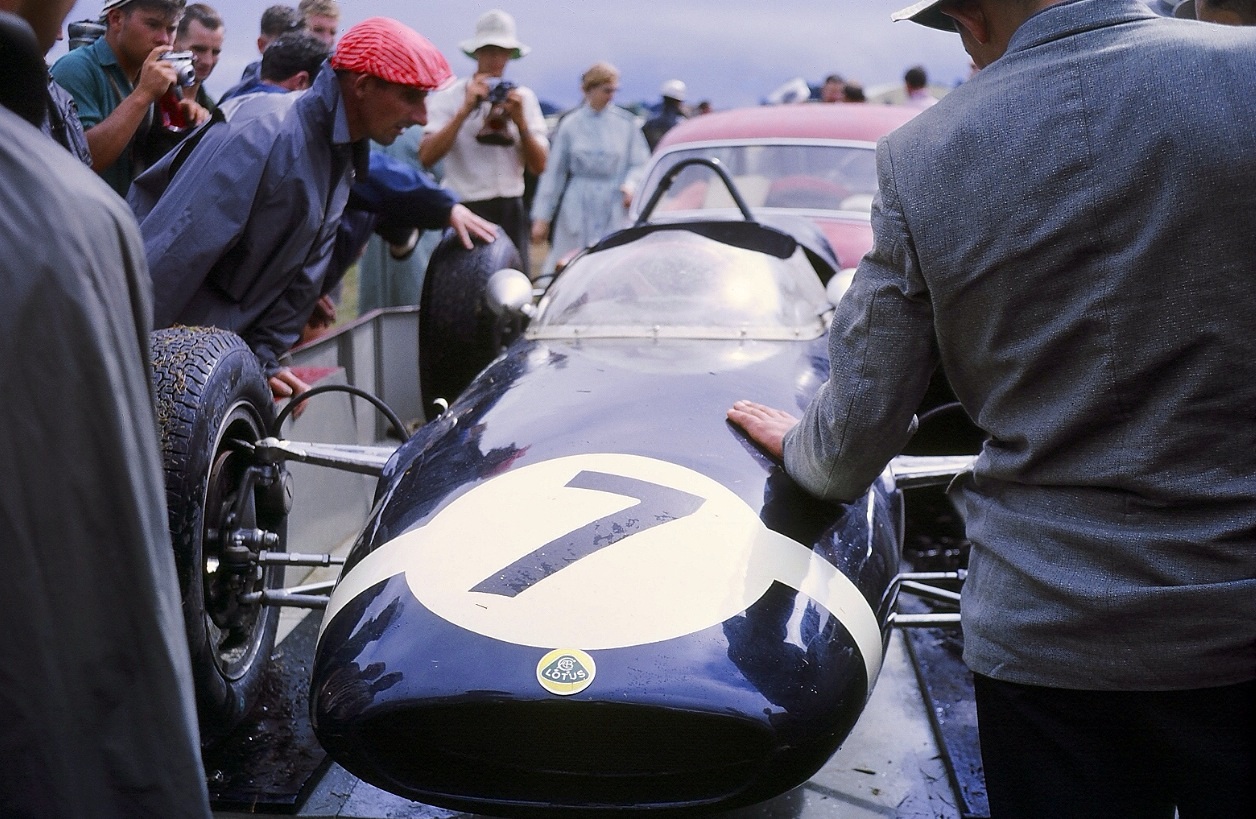
Here it is below after its victorious run in the very wet, Ardmore, New Zealand Grand Prix. I love the way the gent ‘touches the greatness of Moss’ by giving the Lotus an affectionate pat! ‘Red cap’, a more technical type of bloke is sussing the rear suspension of the 21 compared with the Lotus 18s from the year before.

image

(Stephen Page)

Lotus 21: The Forgotten Chapman GP Car?…

When you think about it Colin Chapman peaked early as an F1 designer.

His 1956 Vanwall, or rather his chassis design and choice of Frank Costin as it’s body designer/aerodynamicist was a GP winner, not too many fellas have done that with their first car.

image

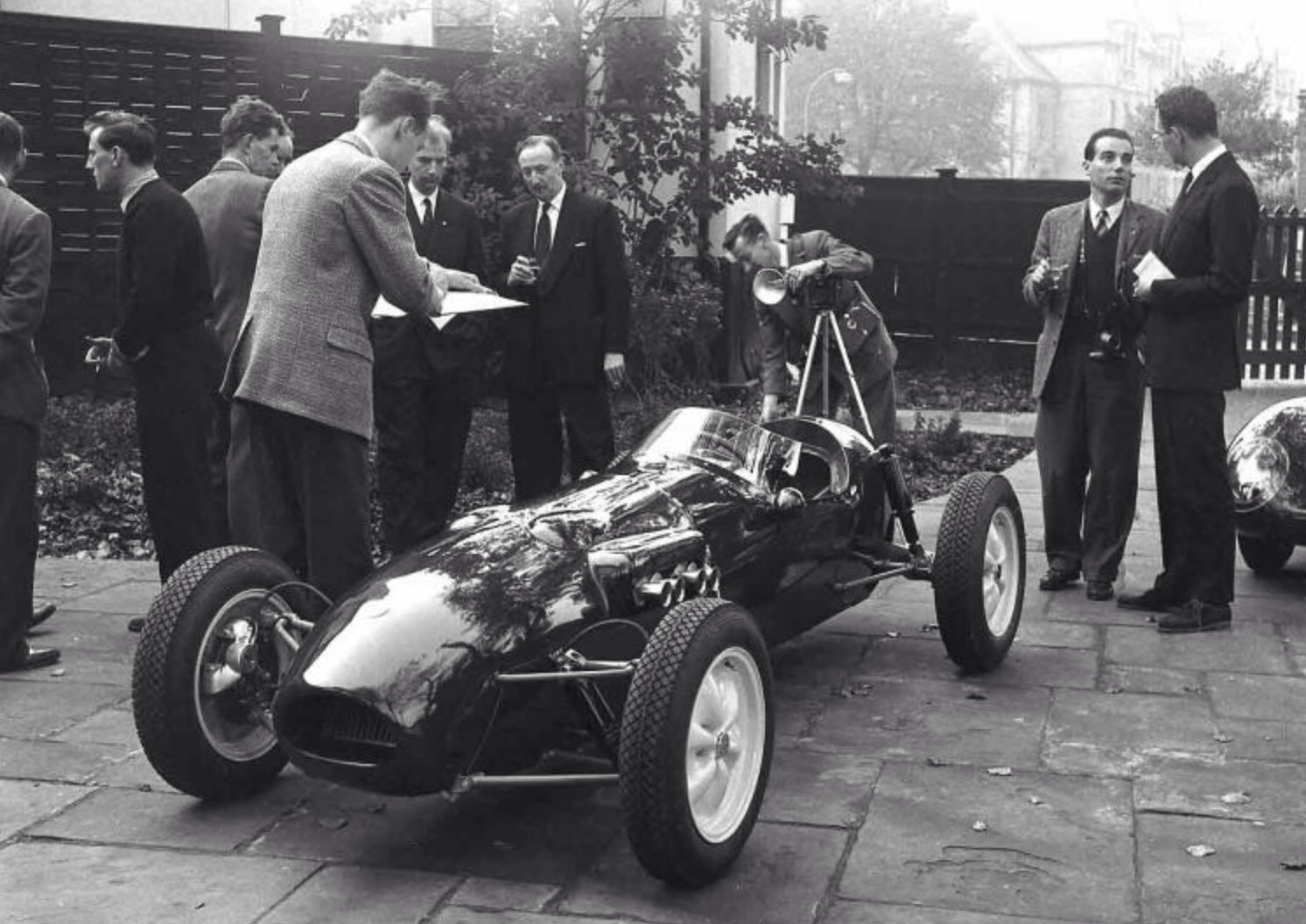
Press launch of the Lotus 12 Climax F2 car in 1956, note the extraordinary smallness of the car, the 12 and 16 remarkable bits of front-engined GP kit. Cliff Allison did 167mph in a Coventry Climax 2207cc FPF engined 12 on Masta Straight, Spa in 1958, with much of his small body outside the cockpit! He was fourth but famously could have won the race had it gone another lap as the first 3 cars all failed to complete the cool-down lap (John Ross)

His first Lotus GP design was the 16, Chapman always referred to the 12, which competed in Grands’ Prix from Monaco 1958, as an F2 car, the design was originally used in 1.5 litre racing before being fitted with Coventry Climax 1960cc and 2207cc engines for F1 use.

One of the things which intrigues me given his subsequent record as the designer/design inspiration for so many epochal cars is why Chapman didn’t design a mid-engined car for 1959? Cooper blazed that trail, GP winners from Argentina 1958, Moss of course taking that win in a Rob Walker Cooper T43 Climax.

image

Allison, tenth in the Lotus 16 Climax, Nurburgring 1958. Brooks won in a Vanwall, Lotus 16 famously the ‘Mini-Vanwall’, both Chapman chassis designs  (Klemantaski)

Whilst the front engined 12 is understandable, it appeared in late 1956 and was quite the smallest front engined ‘F1 car’ ever, the 16 shoulda’ been mid-engined?

The 16 was quick mind you, but fragile in both chassis and it’s ‘queerbox’, Lotus’ own gearbox which was unreliable largely due to one small set of dogs trying to pick up every gear. The 16 also didn’t receive a 2.5litre Climax FPF until later in the piece. But if Chapman set trends, and he did, he was a slowish adopter of the mid-engined trend.

image

Works Lotus 18 Climax, Zandvoort, Dutch GP 1960. Chapman was quick to refine the mid-engined paradigm! 2.5 litre CC FPF, 5 speed Lotus ‘box, rear suspension notable for lack of a top-link, the fixed length driveshafts performed locational duties as well as motive ones. This is Alan Stacey’s car, DNF gearbox on lap 57 from Q8. Ireland’s car was second from Q3, quick cars 18’s! Brabham won in his Cooper T53 Climax (Dave Friedman)

His first such design, the 18 was an immensely successful car in FJ, F2 and F1 specification.

Despite its ‘chubster, biscuit shaped’ looks it was the fastest 2.5 Litre F1 car of 1960 if not the most robust or reliable. No less than Moss himself had strong views on Chapman’s ‘marginal engineering’ of key components the failure of same caused some massive accidents.

image

Ireland, works Lotus 18 Climax, Monaco 1960, 9th in the race won by Moss’ similar car. Lotus’ first GP win (Dave Friedman)

Roll on into 1961, the first year of the 1.5 litre F1, the Brits were faced without a suitable engine as their ‘racing mafia’ were convinced the CSI, in the end, would not make the change to the smaller engines. They did, Ferrari the beneficiary with their 156, a car developed in F1/2 in 1960, click here for a story on that wonderful conveyance;

Ferrari’s first mid-engined Car: The 1960 Dino 246P…

Whilst BRM and Coventry Climax worked hard to get their V8’s completed all of the British firms persevered with Mk2 versions of the 1.5 litre Coventry Climax FPF- in 2.5 litre form the championship winning engine of 1959/60.

Chapman and his team had the dimensions of the coming Coventry Climax FWMV V8 when they set to work on the 21, their 1961 contender, but they knew initially the little, underpowered FPF would be used.

So, light weight and aerodynamic efficiency were key design tenets of the new Lotus 21.

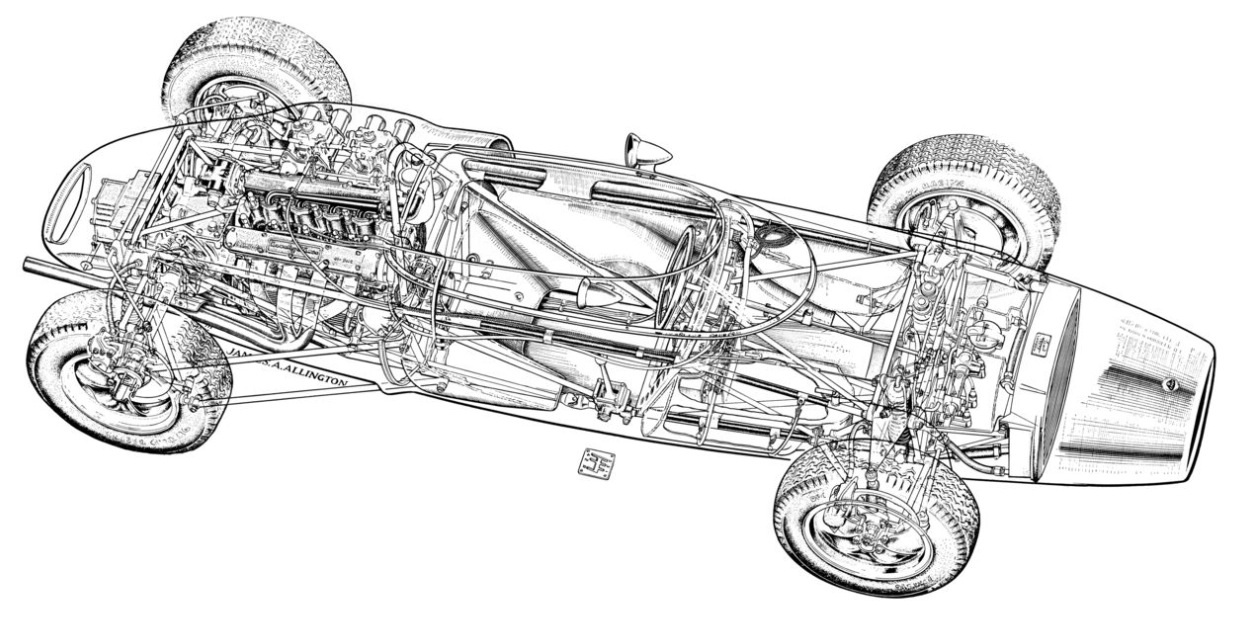
These aims were achieved by lying the driver down in the cockpit, Chapman went further in 1962 with his 24/25 designs, but the trend was set by the 21. The car was notably small in size, low in frontal area, the body enveloping the chassis all the way to the casing of its ZF gearbox, specially made for the car. Have a look at a 21 beside a 156 and see just how ‘butch’ in size the Fazz is by comparison.

Chapman used a top rocker and lower wishbone for the cars front suspension, getting the spring/shocks outta the airstream, thus further adding to top speed. At the rear the suspension was outboard- single top link, inverted lower wishbone and coil spring/damper unit with twin radius rods for location.

image

Lotus 21 Climax FPF cutaway, specifications as per text (James Allington)

Lotus Components built eleven of the 21 chassis’ during the year, which otherwise in specification were leaders of the mid-engined paradigm- multi-tubular spaceframe chassis, Chapman the high priest of chassis design. Rack and pinion steering, discs on all four wheels, magnesium alloy (Lotus ‘wobbly web’) wheels, Ferrari still used heavy Borrani wires till 1963. The CC 1495cc, DOHC, 2 valve, all alloy, Weber carbed 4 cylinder engine gave circa 155bhp, the Lotus weighed 990lb, had an 89 inch wheelbase and a track of 53 inches front and rear.

The prototype was built from scratch in six weeks, just missing the Aintree 200 meeting but was tested at Silverstone two days later, the car made its debut at Monaco in May. The works cars in 1961 were steered by two Scots- Innes Ireland, the seasoned professional and up and coming Jim Clark who graduated from the works Lotus 18 FJ he raced in 1960.

Fitted with the new Coventry Climax V8 the Lotus 21 was a winning car in Moss’ hands if not Ireland’s or Clark’s.  But as it was Chapman didn’t get his hands on an FWMV in 1961 due at least in part to the spat he was having with Climax’ MD Leonard Lee about the quality of the CC FWE engines supplied for his Elite road cars- the engines weren’t the Elites only reliability problems mind you!

In the event the 21 won only one championship GP at Watkins Glen, Innes Ireland broke through for both Team Lotus and his first win that October.

image

Ireland’s winning Lotus 21 leads Gurney’s second placed Porsche 718 and Graham Hill’s fifth placed BRM P48/57 Climax, US GP Watkins Glen, 8 October 1961 (unattributed)

The cars chances of more wins were missed by Chapman’s decision not to sell Rob Walker his latest car, as he had with the 18 the year before. Moss’ two wins in 1961, remarkable ones, were in the Walker 18 at Monaco and 18/21 hybrid at the Nurburgring. Armed with a new 21 all year he may, praps have taken one or two wins off Ferrari despite the car’s relative ‘lack of puff’.

The 21 took wins in non-championship 1961 events- the Solitude GP for Ireland in July, the Flugplatzrennen at Zeltweg again for Ireland in September, and the Rand, Natal and South African Grands’ Prix in Jim Clark’s ‘African Tour’ in December 1961. As written here Moss did well in Australasia in early 1962.

The Lotus 21 should be remembered as both a GP winner and the progenitor of the design maxims Chapman’s ever creative mind evolved with the 1962 spaceframe  Lotus 24 and it’s revolutionary monocoque sibling, the 25.

image

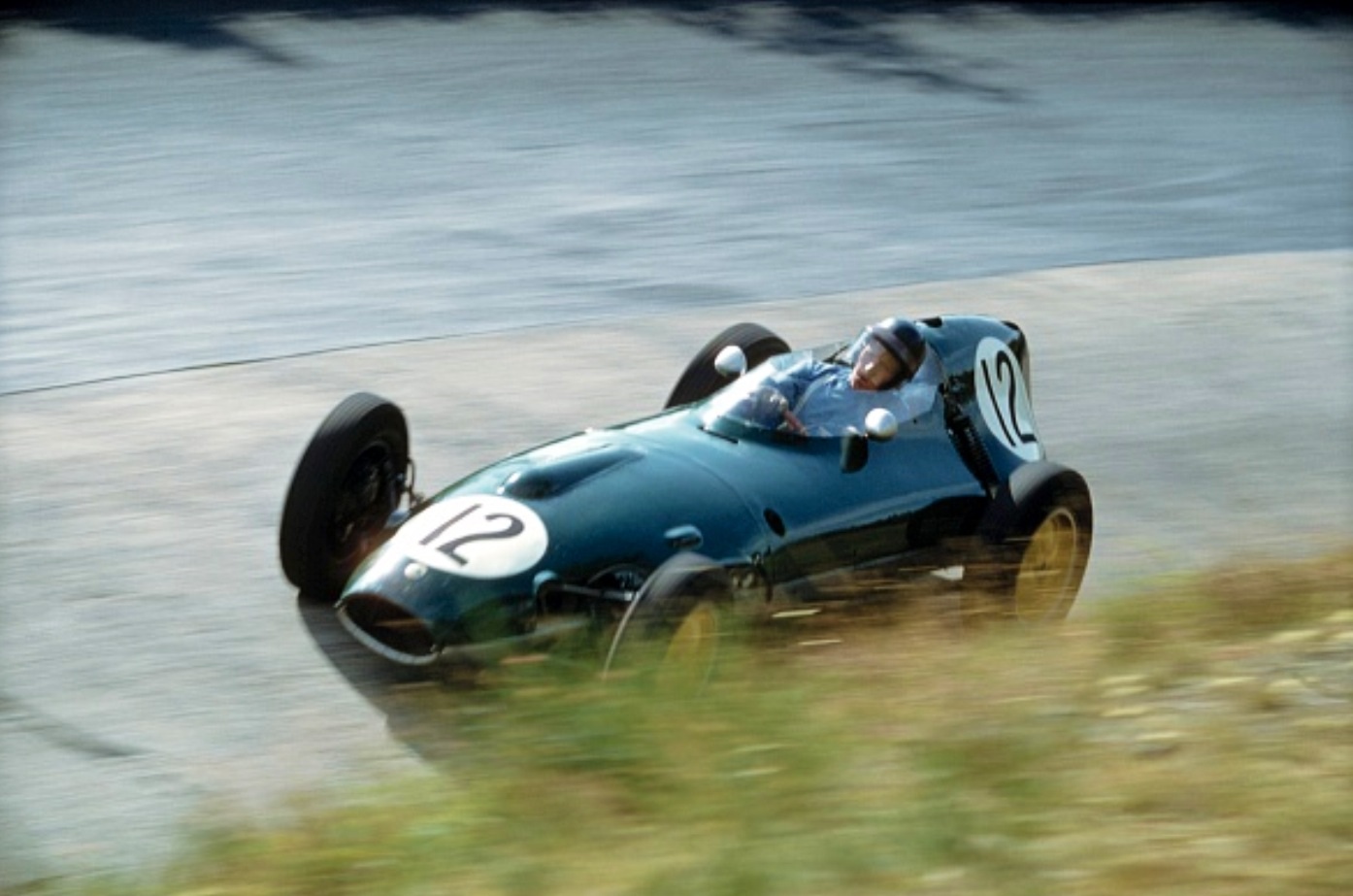
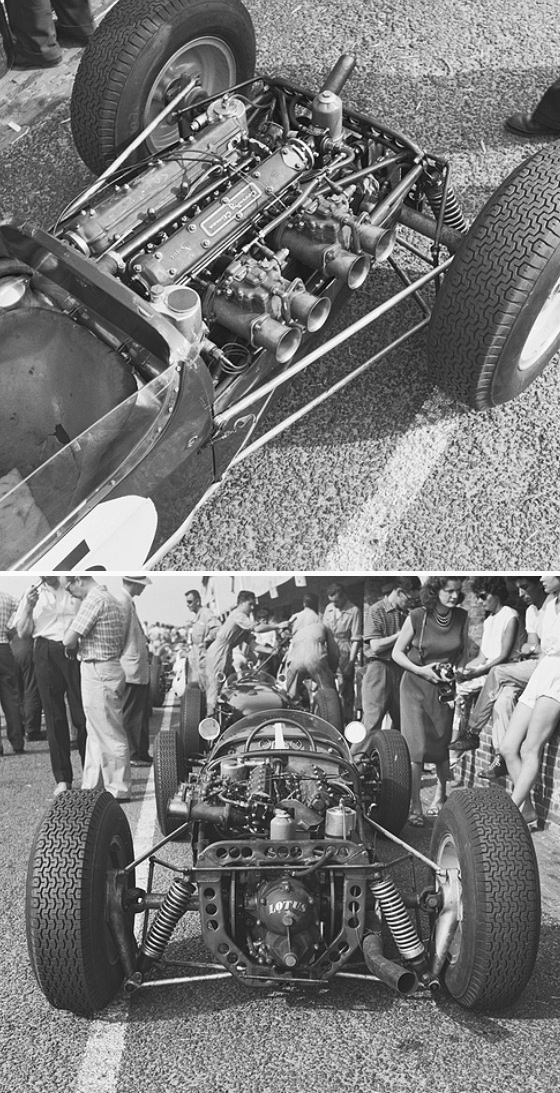
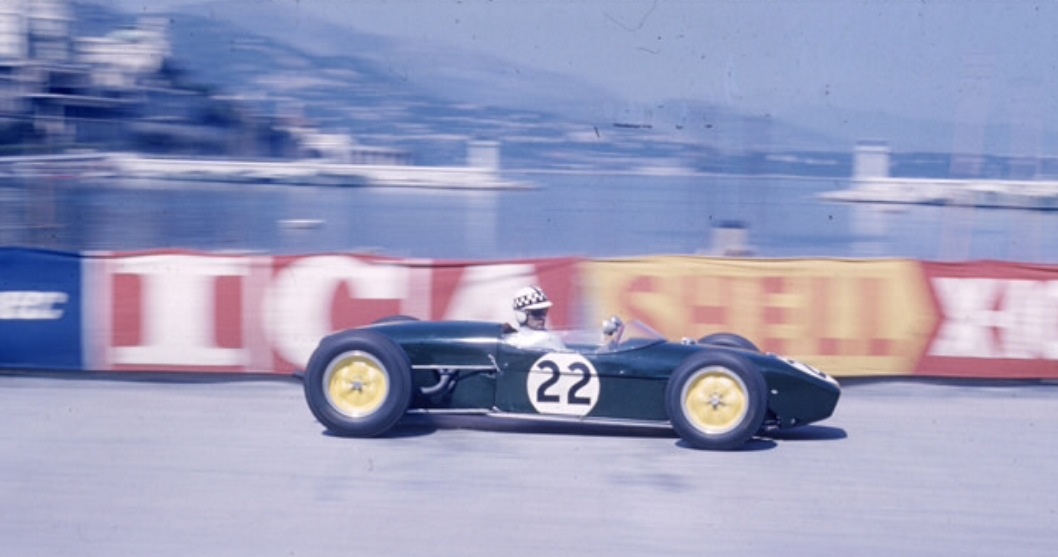
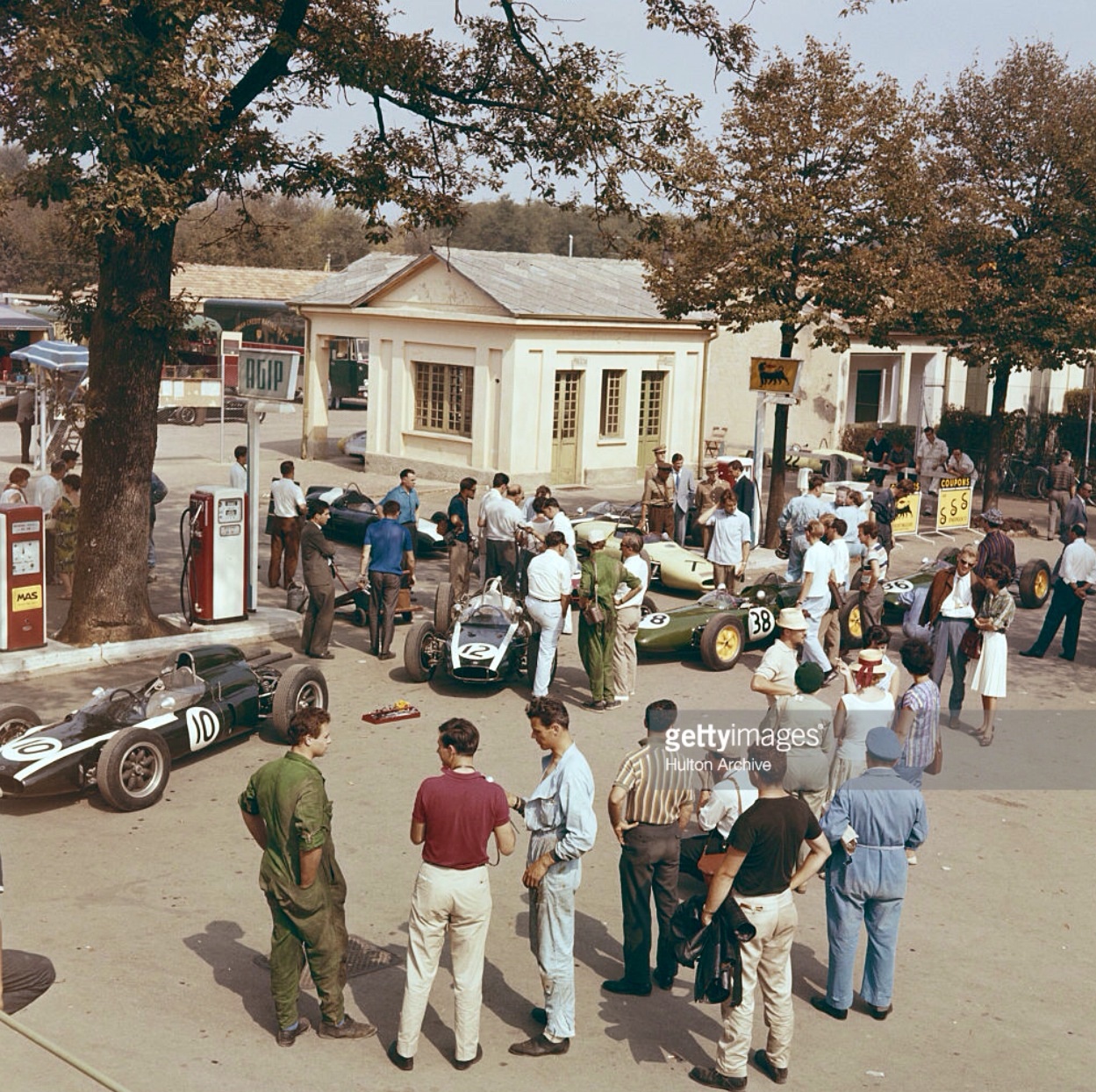
Love the atmospherics of this 1961 Italian GP, Monza paddock shot. #10 is Brabham’s Cooper T58 CC V8, contrast it with McLaren’s #12 CC FPF powered T55 behind. #38 and 36 are the Ireland/Clark Lotus 21 CC FPF’s before the ‘jiggery pokery’ with the chassis swap between Innes and Stirling. The pale green painted ‘T’car is UDT-Laystall’s spare, the Cooper T51 is Jack Lewis’ (Hutton Archive)

Moss’ first drive of a Lotus 21 was his steer of  Innes Ireland’s works car at Monza on 10 September.

That weekend was infamous for the tragic race collision between Jim Clark’s Lotus 21 and Taffy von Trips Ferrari 156 which resulted in von Trips death as well as that of 15 innocent spectators.

Moss took Lotus’ first ever GP win at Monaco in May. Whilst Chapman was eternally grateful he wasn’t inclined to give Moss or Walker too much of a ‘free-kick’ by selling them his latest car, the 21, given his primary aim was works car wins. In fact its probably Esso we have to blame as they were Lotus’ fuel supplier, BP were the sponsor of Rob Walker/Moss, both companies had their commercial positions to protect.

image

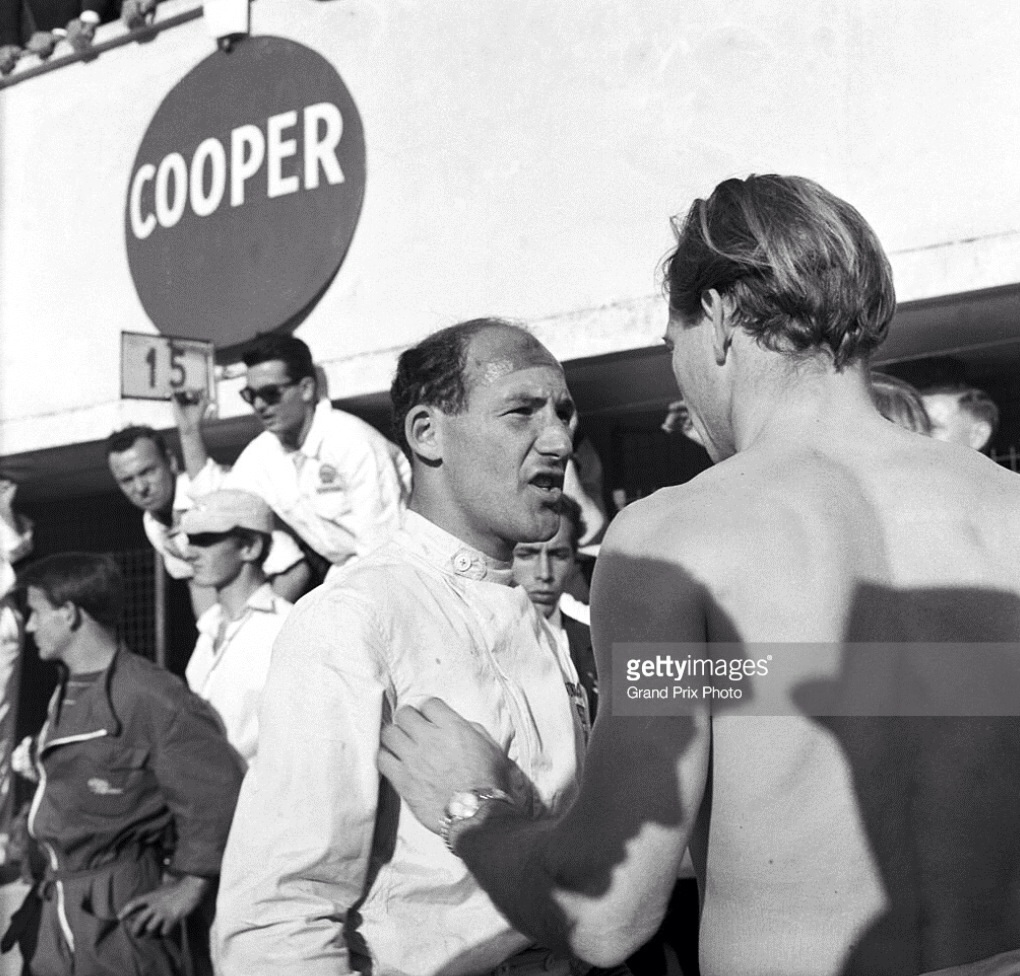
Moss and Ireland swapping notes at Monza, Italian GP, September 1961 (GP Photo)

The Monza weekend was also significant for the first race appearance of the new 1.5 litre BRM P56 V8 and the further appearance of the Coventry Climax FWMV V8 first raced by Jack Brabham at the Nurburgring the month before.

Jack qualified his new Cooper T58 on grid 2 in the Eifel Mountains but crashed on lap 1 with a sticking throttle so the engine hadn’t been race-tested.

The P56 V8’s were fitted to modified BRM P48/57 chassis, the CC V8 to Jack’s Cooper and a specially modified Lotus 18/21 built up by the Walker Team. Team Lotus were unable to secure an engine as noted earlier, so appeared in 21’s powered by the 1.5 litre 4 cylinder FPF Mk2 used by the British teams, including BRM that year.

BRM tested their new engines with no intention to race them, Brabham raced his Cooper despite problems in practice.

Moss was sportingly offered Ireland’s factory 21 FPF, chassis ‘933’. Chapman and Ireland reasoned that Moss would have a better chance of success in a 21 rather than the tired Walker 18/21. Moss was the only Lotus driver with a vague (very) chance at the World Championship, Ireland raced the Walker 18/21 FPF engined car. In Denis Jenkinson’s race account he writes about the ‘cloak and dagger’ stuff behind closed garages to make the necessary change of chassis and body work between Moss and Ireland, the secretive stuff was doubtless so as not to upset the trade supporters of both teams.

Which brings us back to ‘ole 935’ and the photo at this articles outset.

The two works Lotus Monza chassis according to Nye’s ‘Theme Lotus’ were ‘933’ and ‘934’. If ‘935’ was at Monza there was no point making the chassis and bodywork changes between the Moss/Ireland cars both Jenkinson and Nye report took place. If ‘935’ were at Monza either as a works spare or delivered to the Walker Team Moss would have raced it and Ireland his regular works 21 rather than the inferior Walker 18/21.

So, whats the explanation of the photo then?

Either it isn’t Monza, although i am inclined to believe Nye who has been there once or twice! The probable story is that the engine cover of the new ‘935’ was ‘borrowed’ and fitted to one of the works Lotus 21’s for the weekend. The first race entry for ‘935’ i can find, looking at non-championship and championship Grands’ Prix results later in 1961 seems be its races in New Zealand in early 1962-the 1962 NZ GP report by sergent.com describes ‘935’ as unraced before that event on 6 January.

image

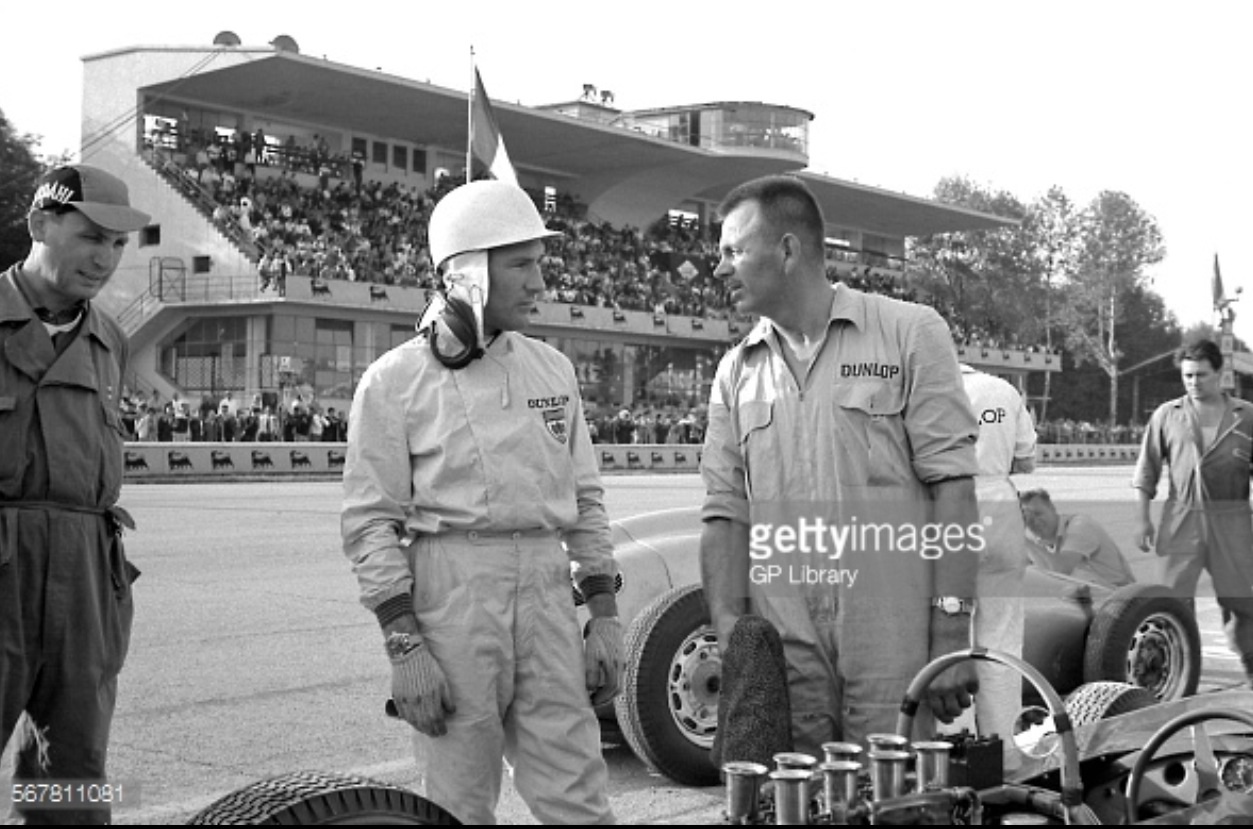
Moss and Alf Francis confer during Monza practice, by the look of it neither are ‘happy campers’, the Lotus 18/21 CC FWMV  chassis #’906′ was always a handful (GP Library)

The Moss 18/21 was modified to fit the FWMV V8 with the assistance of Ferguson Research.

The rear of the 18 chassis aft of the drivers seat was ‘chopped off’ and replaced with a frame to suit the width and mounting needs of the new engine. 21 rear suspension was incorporated comprising new 21 uprights which were located at the top by a link to the chassis thus relieving the half shafts of the suspension loads the solid ‘shafts of the 18 performed- the new components had Hardy Spicer splined shafts to accommodate ‘plunge and droop’.

A Colotti Type 32 gearbox was used. The rear framework was a complete assembly which attached to the main frame by large bolts screwed into the ends of the tubes, which had been plugged and tapped. The structure was made from small diameter tubing which had to be detached completely before the engine and gearbox could be removed. The car was finished in a big hurry so the old Lotus engine cover was retained with a bulge to clear the four downdraft Webers.

Whilst no-doubt well engineered it doesn’t all add up to the levels of torsional stiffness no doubt required to put all of the new engines power to the ground effectively.

During the race the tragic accident between Clark and von Trips occurred on the first lap, the German and hapless spectators killed, the race continued whilst the carnage was attended to.

Moss retired on lap 36 with wheel bearing failure, Ireland on lap 5 with chassis problems and Brabham’s FWMV failed on lap 8 due to overheating problems- shortcomings sorted over the winter off-season.

Phil Hill’s Ferrari 156 won the race and  1961 title from Gurney’s Porsche 718 and McLaren’s Cooper T55 FPF.

image

The Walker Lotus 18/21 CC V8 during 1961 Monza practice (GP Library)


image

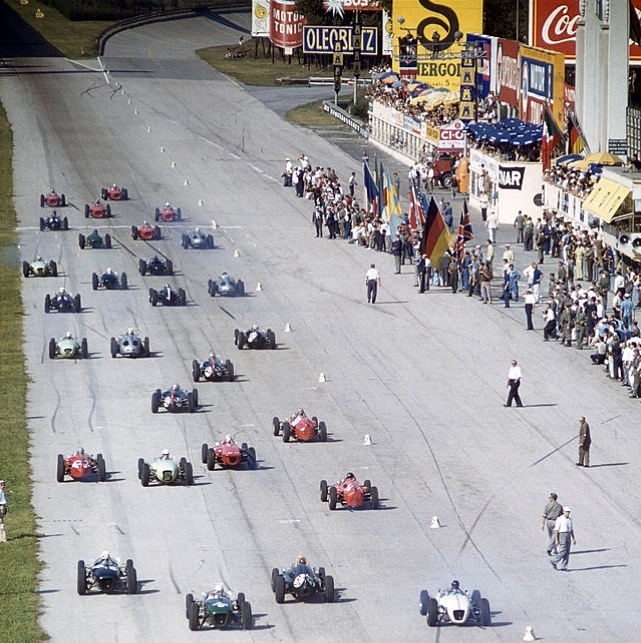
Italian GP ’61 start with a swag of 5 Ferrari’s up front, leading green car at left is probably Hill G’s BRM Climax, Clark is between Hill and a Ferrari, thats Gurney’s Porsche 718 on the right from grid 12, the carnage took place shortly thereafter (Klemantaski)


image

Moss in the Walker bodied works Lotus 21 CC FPF during the race, dicing with Gurney’s 2nd placed Porsche 718 (GP Library)

New Zealand…

Over that 1962 European winter Coventry Climax worked on the reliability of the FWMV and BRM their P56 V8 and the P578 chassis to carry it. At Cheshunt Colin Chapman was building the spaceframe 24 and its epochal monocoque sibling, the Lotus 25.

Both marques were the key players in an amazing 1962 season which in the main didn’t feature Stirling Moss, whose Glover Trophy career ending accident took place on Easter Monday 23 April 1962 in the Walker Lotus 18/21 Climax V8 ‘906’ described above.

The Walker Team would make do with their 18/21 in GP’s, later in the season they raced two Lotus 24 FWMV’s but by the time they were ready Moss’ career was finito.

image

Moss looking after the fans, Kiwi kiddies drawn to the great Brit, Ardmore NZGP meeting. Car is 21 ‘935’ (Stephen Page)

For Moss, in the meantime there were the annual summer internationals to contest in Australasia.

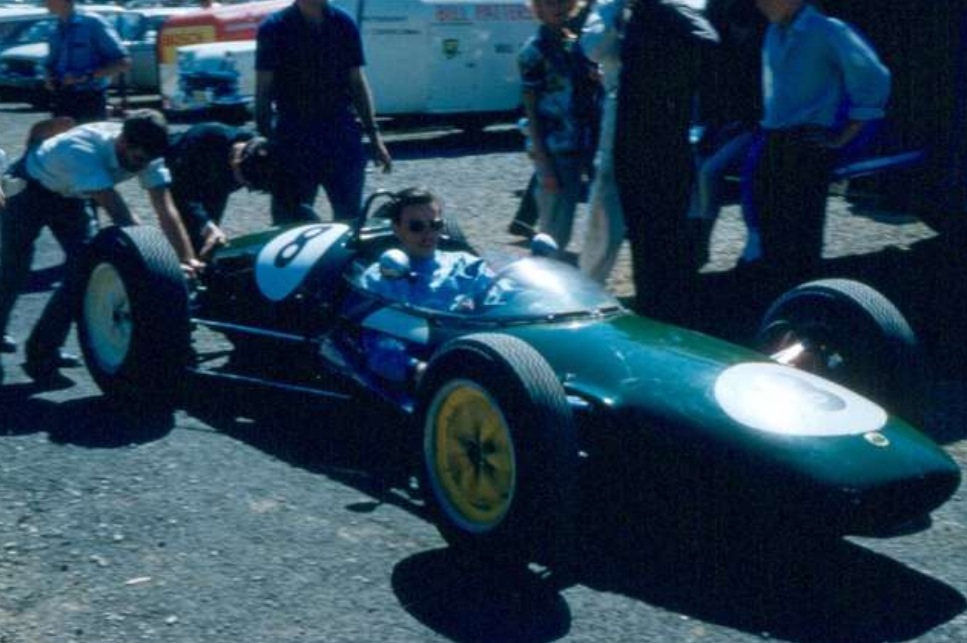
Whilst Stirling loved the speed of his Lotus he revelled in the forgiving ‘chuckability’ and robustness of Coopers. Robust is not an apt adjective to describe the Lotus single-seaters of the period. So, hedging his bets for his 1962 Australasian Tour he had Rob Walker ship both ‘935’ as well as a Cooper T55 ‘F1-7-61’  on the long voyage south. Both cars were Coventry Climax FPF powered- engines of both 2.5 and 2.7 litres capacity were used, our International Series was run to Formula Libre in its pre-Tasman Cup formula days.

image

Moss and second placed Surtees on the Ardmore victory dais (Stephen Page)

Moss raced the Lotus to an NZ GP win at Ardmore on 6 January and at the Wigram Airfield circuit event fitted with 2.5 litre FPF’s. At Levin and Teretonga he was second in the Cooper powered by a 2.7 FPF, Brabham won at Levin and McLaren at Teretonga- so Moss’ campaign had started well.

image

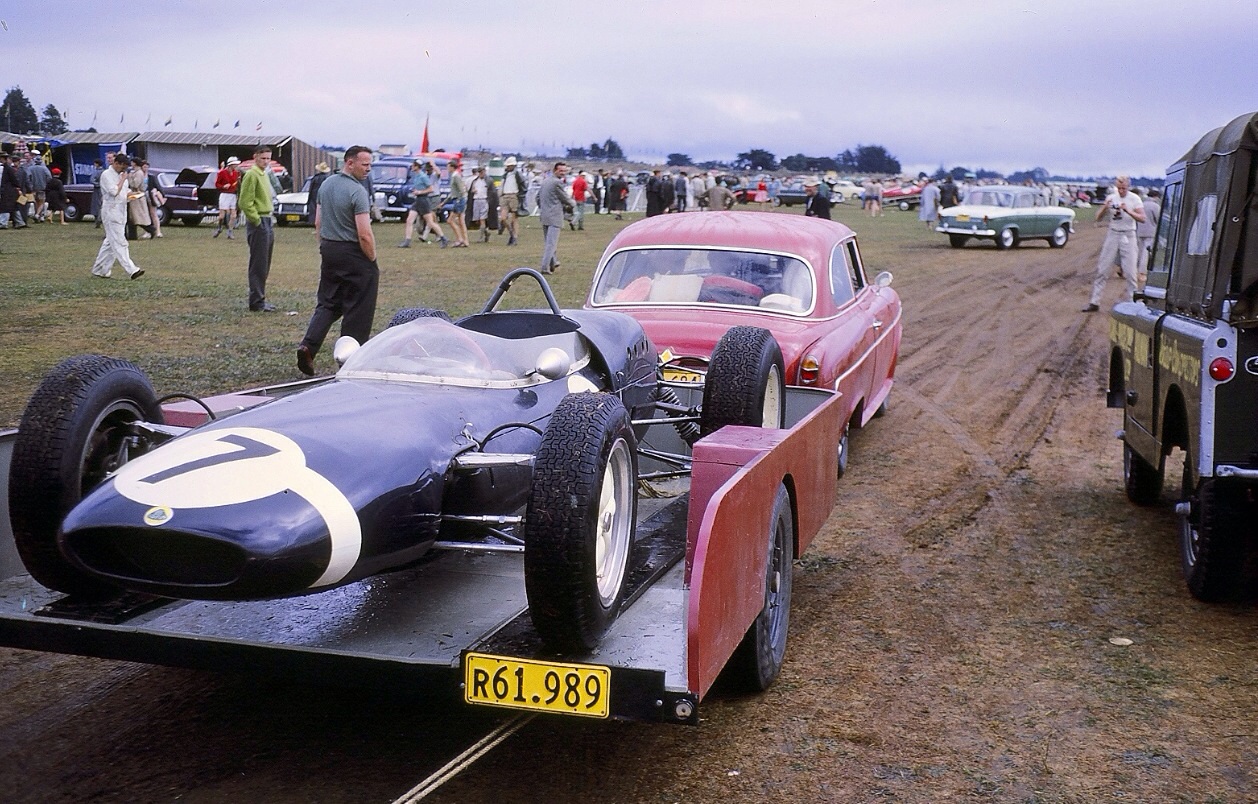
Borgward Isabella and 21 off to the next round of the NZ Internationals at Levin. Shot shows the inboard front suspension, the top rocker actuating inboard mounted spring/shock. At the rear is a single top link, reversed lower wishbone, outboard spring/shock and twin radius rods. Extreme lowness clear as is the slippery nature of the body and reduction in driver space which advanced as a trend over the following decades!  (Stephen Page)

The NZ Internationals were contested by Moss, Surtees, McLaren and Salvadori, the latter three drivers in Cooper T53 Climaxes, Bandini in a Cooper T53 Maserati, Brabham a Cooper T55 Climax and Ron Flockhart, a Lotus 18 Climax.

Chris Amon made his first international appearances that summer in the ex-BRM/Brabham Maser 250F, other ‘local heroes’ were Pat Hoare Ferrari 246/256 V12, Angus Hyslop, Cooper T53 Climax and Aussies Bib Stillwell, Aston Martin DBR4/250, David McKay, Cooper T51 Climax and Arnold Glass’ in a BRM P48.

Moss ‘brained’ the NZGP field in an awful, wet race- he lapped the field winning from Surtees, McLaren and Salvadori.

Australia…

image

Beautiful shot of Moss in the Walker Lotus 21 Climax 2.5 ‘935’ on Warwick Farm’s pit straight, he practised the car but raced the more ‘chuckable’ Cooper (Mal Simpson)

The cars were then shipped to Sydney, the first race of the Australian leg was the ‘Warwick Farm 100’ on the testing, technical outer western Sydney circuit on 4 February.

Moss practised both cars but elected to race the Cooper to a race win from McLaren and Stillwell.

image

Moss in his Lotus 21 passes John Youl sneaking a peek over his shoulder, Cooper T51 Climax during WF practice. Youl DNF in the 2.2 litre car with clutch problems in the race, the Taswegian a very quick steerer (John Ellacott)


image

WF 100 front row, 4 February 1962- Moss, Brabham, McLaren in Coopers T53, T55, T53 (Mal Simpson)

Moss missed the Lakeside event won by Brabham’s T55 Cooper and Longford’s ‘South Pacific Championship’ race won by Surtees Cooper T53 Climax but raced ‘935’ fitted with a 2.7 litre FPF at the Australian Grand Prix, Sandown’s inaugural meeting on 12 March.

Jack Brabham won the race in his 2.7 engined Cooper from Surtees, McLaren and Chuck Daigh in the very interesting Scarab RE Buick V8, the cars only race- read my Chuck Daigh article for that cars interesting story.

image

Moss cruises the Sandown paddock in the 2.7 ‘Indy’ FPF engined Lotus ‘935’, March 1962. The man absolutely the best and fastest driver in the world at the time (Kevin Drage)

In between these Australian events, reinforcing the regularity and intensity of his racing schedule, Moss raced in the Daytona 3 Hours, finishing fourth in a Ferrari 250 GT SWB on 11 February.

After Sandown he returned to the US to contest the Sebring 3 Hours and Sebring 24 Hours on 23/24 March finishing third in an Austin Healey Sprite and DNF in a NART Ferrari Dino 248SP respectively.

image

Moss, AH Sprite, Sebring 3 Hour 1962 (Tom Bigelow)


image

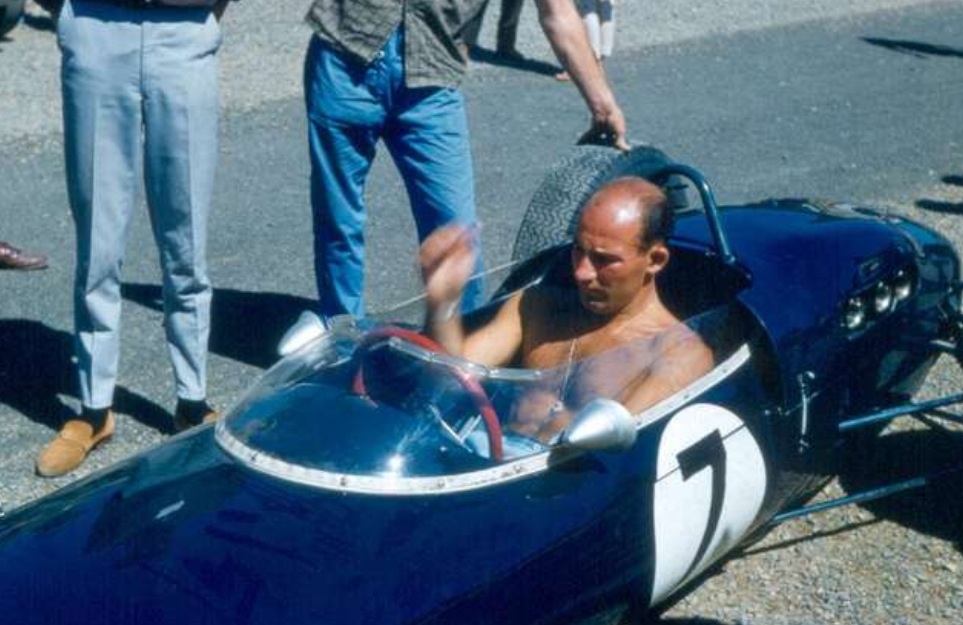
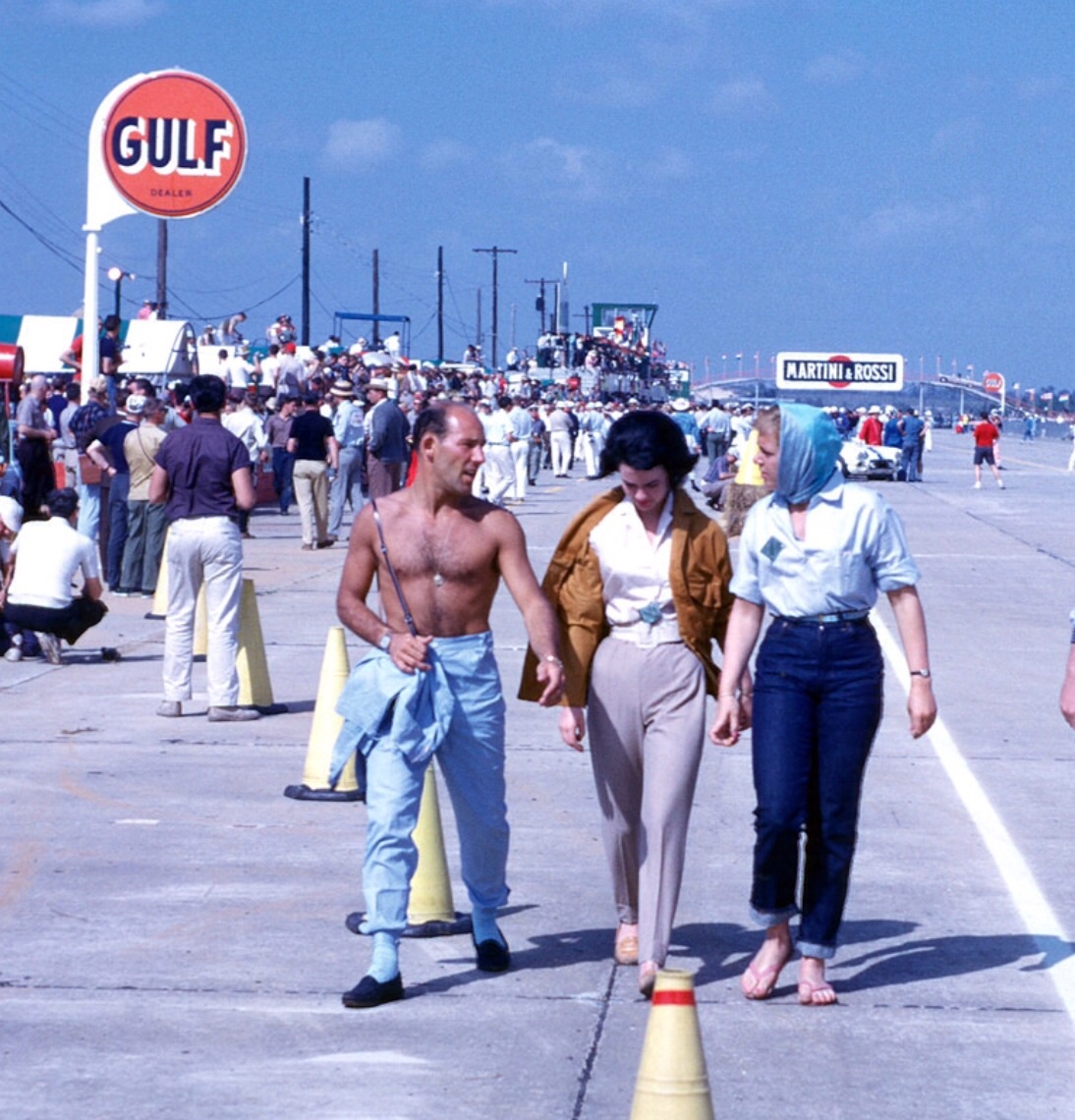
Moss, maidens, Sebring 1962. That he was in such great physical shape no doubt a factor in his attraction to the babes but it  also stood him in good stead in surviving the horrific Goodwood shunt, surgery and month long coma (Tom Bigelow)

Moss then returned to Europe for the 1 April GP of Brussels and Lombank Trophy at Snetterton on 14 April yielding second and seventh in the Walker Lotus 18/21 FWMV V8 ‘906’ before that fateful day at Goodwood on 23 April.

image

Moss, Goodwood, Lotus 18/21 ‘906’ not long before the prang, Easter Monday 1962 (Doug Nye)


image

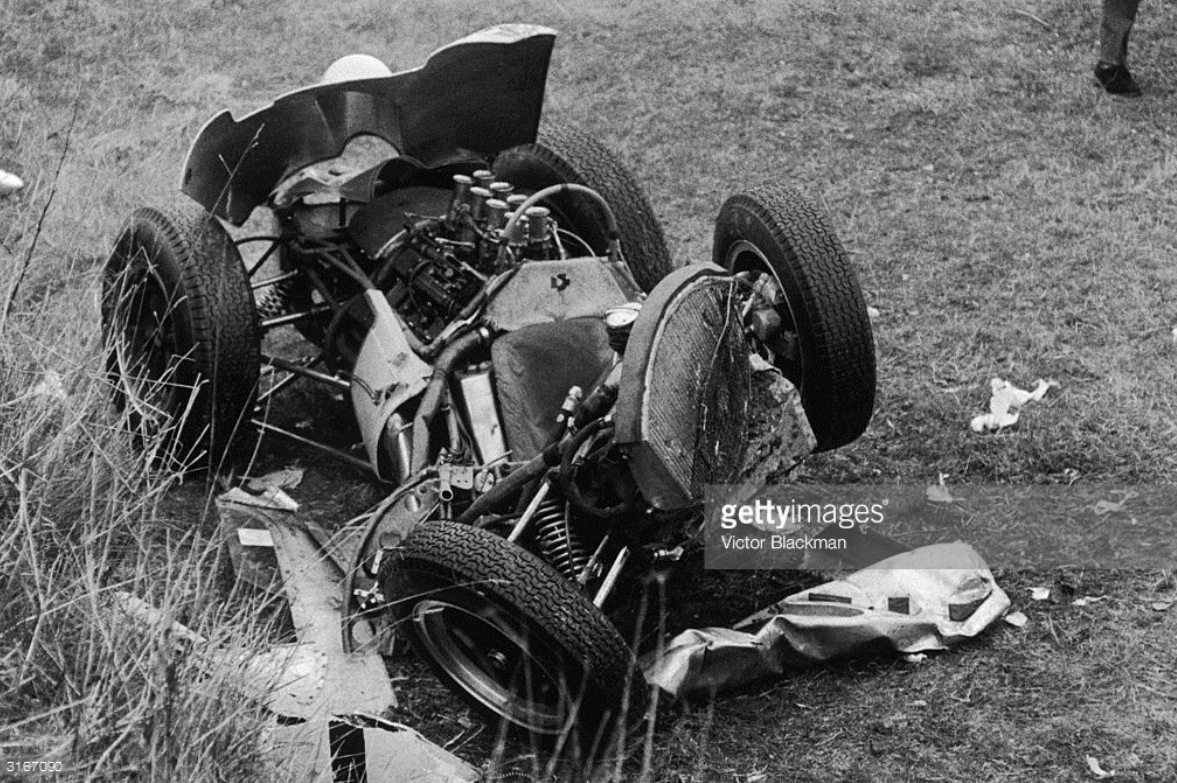
It took over an hour to cut Stirling free from the mortally wounded Lotus. One of the things I have learned and detest in researching various pieces is the vast number of gruesome images of racing crashes on the internet- you won’t ever see them here, I am all for ‘freedom of the press’ but believe there is a place for censorship of said images (Victor Blackman)

Moss was an enormously popular visitor to Australia from the mid-fifties, sadly his Goodwood 1962 accident was not too far away during his early 1962 tour.

His Antipodean fans never forgot him though.

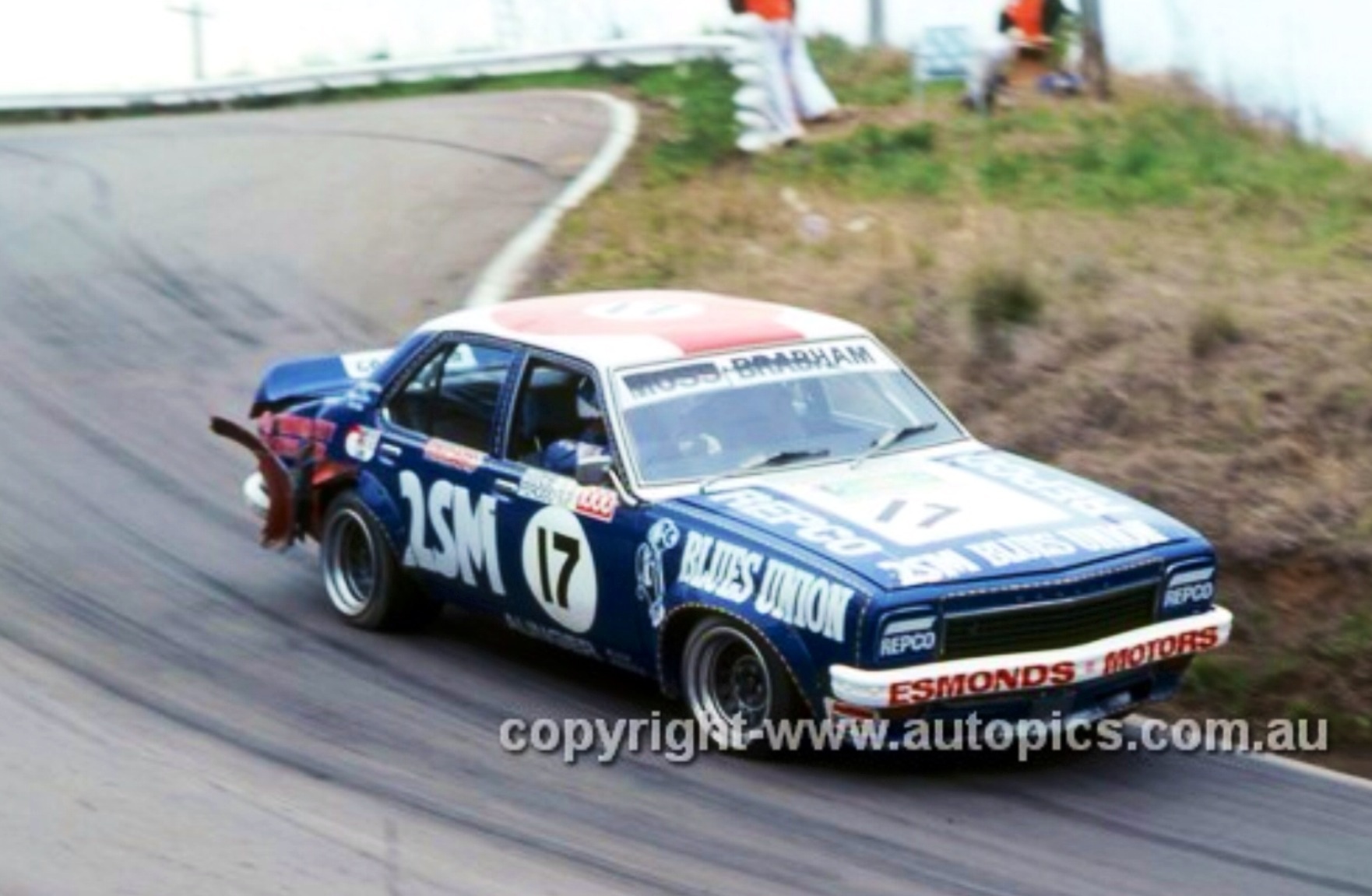
We turned out in droves to see his ‘comeback’ drive in a Holden Torana L34 V8 at Bathurst in 1976, he shared the car with Jack Brabham. The all-star combination had a shocker of a race when Jack copped a Triumph Dolomite ‘up the arse’ on the startline thanks to his Holden’s clutch failure.

Brabham was stranded as the rest of the field moved post-haste towards Hell Corner, the unsighted Dolly was an innocent victim of Black-Jacks misfortune, the car was patched up but Jack and Stirling failed to finish, a great shame!

Moss, a great man, ’tis wonderful he remains one of our sports great ambassadors.

image

Brabham/ Moss, Holden Torana L34, Bathurst 1976 (Autopics)


image

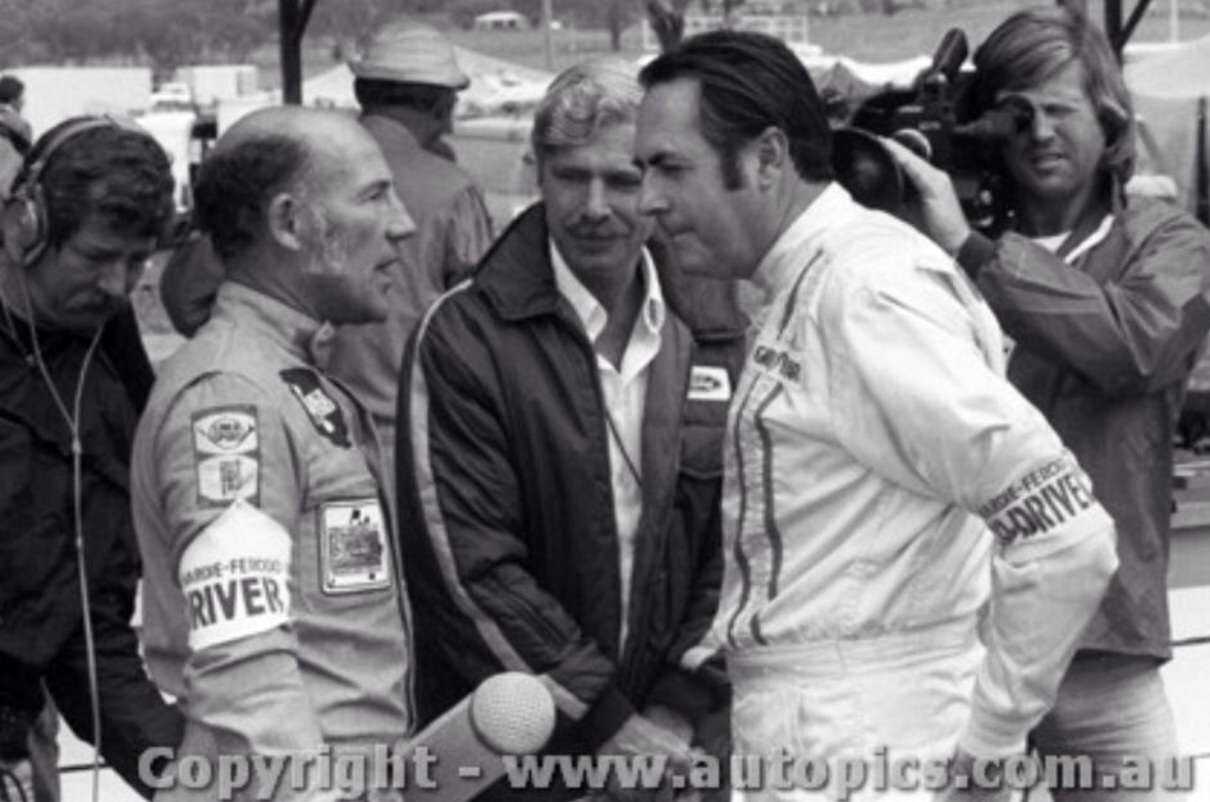
Moss and Brabham at Bathurst in ’76, that’s Scuderia Veloce’s David McKay in between (autopics.com)

Bibliography…

Automobile Year, MotorSport 1961 Italian GP race report by Denis Jenkinson, Doug Nye ‘Theme Lotus’, William Taylor ‘The Lotus Book’, oldracingcars.com, GP Encyclopaedia, silhouet.com, Team Dan

Photo Credits…

GP Library, James Allington, Mal Simpson, Kevin Drage, Stephen Page, John Ellacott, Klemantaski Collection, John Ross Motor Racing Archive, Dave Friedman Collection, autopics.com, Victor Blackman, Doug Nye, Tom Bigelow

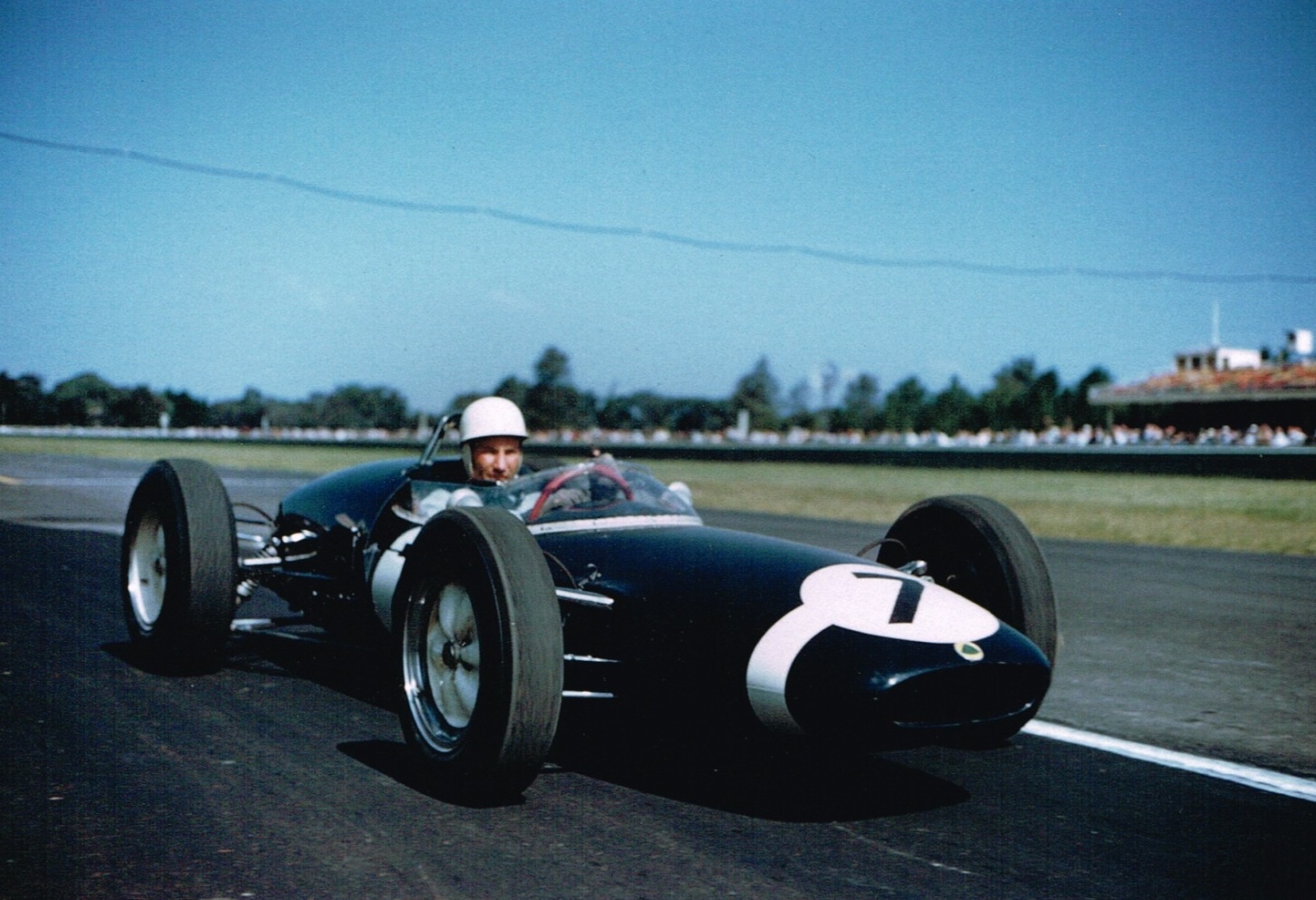
Tailpiece: The future. Jim Clark at Sandown, Lotus 21 Climax ‘933’, World Champion in the new, epochal monocoque Lotus 25 within two years and a GP winner within months. Here with the lower sidepanel removed due to Melbourne summer heat…

image

(Kevin Drage)

Finito…