


Frank Matich, Matich A50 Repco ‘#001/2’ , Shell Corner, Sandown, ‘Victoria Trophy’ April 1972. (Rennie Ellis)
Frank Matich on his way to victory during the first round of the Australian ‘Gold Star’ Series in 1972, Matich A50 Repco ‘001/2’…
The car made its stunningly successful debut at the 1971 AGP the previous November. Matich won the race in a brand new untested car, the first monocoque and first single seater his team built.
In the broader historic context it was the first time an Australian built car had won an AGP since Warwick Pratley’s George Reed Special Ford V8 victory at Narrogin, WA in 1951.

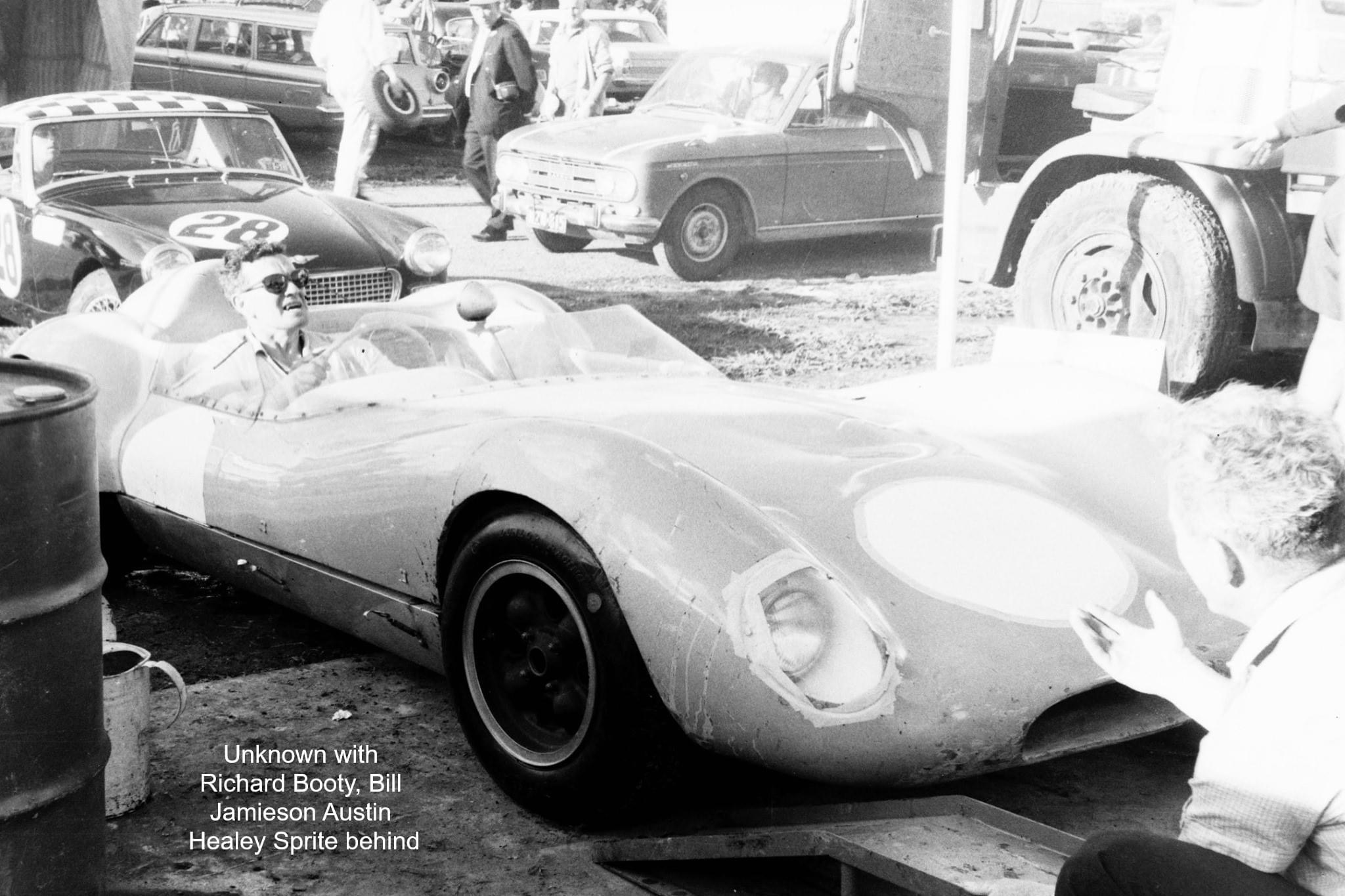
FM reclined in his ‘comfy’ monocoque chair, A50 ‘001/2’. He is talking to Carroll Smith who was to be his crew chief in the upcoming 1973 trip to contest the US L&M F5000 Championship. Here at Wigram, NZ, Tasman Series 1973. (Shane Lee)
Introduction…
This is a bit of a nutty long article.
I tripped over some photos of the 1972 ‘Victoria Trophy’ at Sandown, shots not in the immense F5000 Facebook Groups photo archives, so i thought i would whack a ‘quickie article’ together to show my F5000 FB mates there are still shots to be found.
Then i started thinking about why Matich didn’t win more Gold Stars, he only won in ’72. That led to research on his early ’60’s single seater campaigns which segued into his mid-late sixties sportscar specialism when he wasn’t eligible for the Gold Star, a single seater championship. And finally back to single seaters again in the F5000 period.
Then one needs to look at the Tasman Series as you can’t look at just the domestic Gold Star series in isolation…
Then there are the Matich cars he built and drove which are a key part of the story…and i kept on writing of course.
So! This rather long, eclectic mess comprises;
.The ’72 Victoria Trophy where i started
.A bit about FM’s 1964/5 2.5 litre Brabham single-seater Tasman formula years
.A fleeting summary of his ’66-’69 Sportscar phase, not a lot though as his Matich SR3 and SR4 campaigns deserve more detail, its a story for another time
.Then the substance of FM’s Matich F5000 cars and their racing campaigns with Matich.
In terms of the Matich F5000 detail i have drawn heavily on conversations and a manuscript provided by Derek Kneller, (DK) an Englishman who was a Team Matich engineer/mechanic for the whole of its F5000 period. He literally shipped FM’s first McLaren M10A to Oz and followed it in August 1969 and returned to the UK in 1974 after FM retired and the cars were sold.
The very articulate Derek was in Australia recently for FM’s funeral and recorded a very interesting interview with ‘Pitlane’, there is a link to it towards the end of this article, its well worth watching.
Many thanks Derek! If Australians have seen some of Derek’s material before its because it was included in Aaron Lewis’ excellent article on the Matich F5000 cars published in ‘Australian Musclecar Magazine’ some years ago. Much of the material has not been published before however.
Here we go, its long, so grab a beer, if you get lost come back here to see where you are!…

Successful partnership. Frank Matich and Chief Mechanic, Derek Kneller on the right prior to the start of the NZ GP, Pukekohe 1973. Matich A50 Repco ‘001/2’. (Derek Kneller Collection)
1972 Gold Star and Tasman Series…
Max Stewart took the 1971 Gold Star in his 2 Litre Mildren Waggott, his blend of speed and reliability ‘knocked off’ the F5000’s in the class’ first year as Australia’s National Formula 1 (ANF1).
Even Max saw the writing on the wall, he sold his faithful Mildren and replaced it with a Repco Holden powered Elfin MR5.
The ’72 Series comprised established stars; Matich, Bartlett and Stewart, coming men Muir, Walker, McCormack and Brown and some solid ‘journeymen’.
The ‘form’ drivers were Matich and Bartlett but Muir made a great F5000 debut in the just completed Tasman Series.
FM’s Tasman was disappointing having won the AGP upon the A50’s debut in November 1971. He expected to be more competitive in the Tasman only to watch his Kiwi Driver/Constructor rival Graham McRae win the series in his McLaren based Leda LT27/McRae GM1. McRae won 4 rounds and scored points in 5 of the 8 rounds.

Nice overhead shot by Terry Marshall taken from Wigram’s control tower during the ’72 ‘Lady Wigram Trophy’. FM A50 ‘001/2’ DNF engine. Frank Gardner won the race in his Lola T300. (Terry Marshall)
The Matich team continued to develop their new car, A50 ‘001/2’ throughout the Tasman series as DK recalls ‘…There were some problems in the team during the Tasman. I was homesick and returned to the UK after the ’71 AGP. Whilst Peter Mabey is a top bloke and a great Chief Mechanic most of the rest of the team were not pulling their weight in NZ, doing the all-nighters or whatever was required. So the load fell on Maybey’.
‘Peter had been with FM for 4 years including the build and racing of the SR3 in the ‘States, in fact i was to replace him as Chief Mechanic, but he stayed on once it was clear we were to build a single-seater, something he had not done before. None of that was a drama, we worked well together’.
‘The upshot of the workload and pressure was that Peter left the team after Levin, he had just had enough, as had his wife of the pressures of racing.
FM did the Christchurch and Invercargill rounds with the mechanics.’
‘I had planned and organised with Frank when he was in the UK in late 1971 on Goodyear business, i was working for Surtees, to come back to Oz in the middle of the year. After Peter left Frank rang me and asked that i come back straight away. I arrived in Sydney the Monday after Surfers, Joan (Matich) picked me up from the airport, i went straight to Brookvale and started work on Frank’s joblist for the car. It was at this time the car was given the A50 ‘002’ moniker but it was ‘001’ the same tub; the bodywork was painted in STP colors and the roll bar chrome plated, it appeared different which was a bit of gamesmanship and kept the sponsors happy but it was, and still is the same tub which Bryan Sala now owns. This caused lots of historic grief in later years.’
‘The rear suspension geometry was altered with a lighter rear subframe and raced at Surfers Paradise, where the car was more competitive. The rear suspension geometry was altered again after Surfers (rear roll centre raised) and Frank won the next race at Warwick Farm. The same chassis was used for the rest of the Tasman series, for the successful 1972 Gold Star series and the 1973 Tasman, at its end the car was put on chassis stands at the Brookvale factory’.
Matich won, as Kneller notes at Warwick Farm, his backyard and the circuit at which he primarily honed his cars setup and picked up points in 4 of the 8 Tasman rounds, despite the in team dramas.

‘C’mon Bob, i will belt them all with one of these’; John Harvey saying to Bob Jane? (in the race suit). ‘Piss-orf Harves, we’ve already got that friggin’ Bowin thing and touring cars are the go anyway!’ or words to that effect!? Bob Jane Racing team owner Bob Jane and driver Harvey checking out KB’s ‘brand spankers’ Lola T300 in the Sandown ‘Victoria Trophy’ dummy grid. (Stupix)
Bartlett also scored 4 times in the Tasman and won at Teretonga. The win was impressive, scored in the McLaren M10B previously owned by Niel Allen. 1972 was that chassis’ third Tasman Series. The reliable old beast was replaced by a brand new Lola T300 for the Gold Star Series KB having watched his friend and mentor, Frank Gardner’s progress in the car concepted by FG as a replacement for Lola’s ageing T190/2 series.
Gardner was Lola’s development driver/engineer. The prototype T300 ‘T242’ made its debut at Thruxton on 1 August 1972. By the end of the season the T300 was the fastest thing in Europe. FG took wins at Hockenheim and Oulton Park in September. In addition he won the 1971 British F5000 Championship with points accumulated in both his T192 and T300.
Mind you, the very fast, Leda LT27/McRae GM1 didn’t break cover until after the end of the British F5000 Championship and was THE CAR in 1972, McRae won the Tasman and US F5000 Championships, both with GM at the wheel.
In Australia Lola T300’s were bought by Bartlett, Bob Muir and F2 driver Gary Campbell stepped up into Gardner’s ’72 Tasman entry.
Ansett Team Elfin were represented by both driver/constructor Garrie Cooper, and John McCormack, the latter became more and more competitive with each 5 litre drive.

Elfin owner/designer/constructor/racer, the late, great Garrie Cooper in the Sandown pitlane. ‘Victoria Trophy’ 1972. Elfin MR5 Repco. The ‘Tyrrell nose’ were added to the 2 ‘works cars’ during the ’72 Tasman Series, see the pic below of John Walker’s car to show the original spec nose. (Stupix)
The Elfin MR5 Repco’s made their debut in late 1971 and were developed over the 1972 Tasman Series, new Elfins were also bought by Max Stewart and John Walker. By the seasons end Walker acquired a Matich with which to contest the ’73 US Series, the Matich had the safety fuel tanks of the spec required for the L&M Series. And was a faster car.

John Walker in his Elfin MR5 Repco, Victoria Trophy 1972. (Jay Bondini)
Warwick Brown’s mentor, businessman Pat Burke bought Alan Hamilton’s low mileage ex-Allen spare M10B and made a big impact. Warwick would be a force in F5000/CanAm through to the end of his driving career in both Australasia and the USA.

Matich prepares for practice, this is the gravel form up area. Victoria Trophy 1972. Matich A50 Repco ‘001/2’.(Stupix)
‘Victoria Trophy’ 16 April 1972…
Matich set pole on 61.5 secs nearly 1 second quicker than McRae’s Tasman pole time only 2 months before. Bob Muir was next on 61.9 and was quick with a new Chev, then came Bartlett, McCormack, Campbell, Max Stewart, Warwick Brown and John Walker. Further back were the ANF2 cars.
A crowd of 20000 in beautiful sunshine were in attendance to see 8 F5000’s and 9 F2’s.
Matich got the jump at the start and was never headed, behind him were Muir, Bartlett, McCormack , Brown, Stewart and Walker.
Stewart slipped past WB but almost immediately dropped a valve in his Repco Holden V8, Walker moved forward then Brown pitted having slowed.

Kevin Bartlett leads John Mc Cormack into Shell Corner, during their great dice, Sandown. Lola T300 Chev and Elfin MR5 Repco. (Rennie Ellis)
10 laps down Matich lead Muir by 7 seconds who was well clear of KB who was being challenged by the Elfin duo of McCormack and Cooper.
Campbell clobbered the fence at ‘Torana’ corner, Walker was through to 6th, the race came alive with Mac challenging Bartlett on lap 20.
The pair were at it for 6 laps, nose to tail before the Lola yielded to the Elfin MR5, then KB’s engine lost its edge and he retired with ignition failure.

Bob Muir rolls his immaculate, concourse, positively gorgeous and fast Lola T300 Chev into ‘Dandy Road’ during his great Victoria Trophy drive. (Jay Bondini)
Muir was driving a great race, now Mac set after him, he had maintained a good pace despite being short of water, eventually the Lola started to smoke badly but Bob was able to keep clear of the Tasmanian to maintain 2nd spot.
Behind Mac were Cooper, Walker, Brown and Malcolm Ramsay in the little Birrana 272 Hart Ford F2 car. This was the prototype of a series of cars which dominated the small bore class in Oz for the next few years.

Malcolm Ramsay’s Birrana 272 ‘002’ Ford. ‘Victoria Trophy’ Sandown 1972. It was in this chassis Oz touring car star Peter Brock made his single-seater debut in a low key campaign, largely with the assistance of his father, amongst his Holden touring car commitments in 1973. (unattributed)
‘Australian Motor Racing Annual’ noted Matich’s great win and McCormack’s strong drive in 3rd having been ill for most of the week prior.

Victorian motor trader/racer Clive Millis Elfin 600B Ford F2, ‘Victoria Trophy’ 1972. (Rennie Ellis)
For Matich it was the start of a dominant 1972 Gold Star campaign; he won the series from Kevin Bartlett with wins at Sandown, Oran Park, Surfers’ and Warwick Farm. KB won at Adelaide International and McCormack the Symmons Plains round in his native state of Tasmania.
Frank Matich and the Gold Star…
Arguably FM was Australia’s greatest resident racing driver of the sixties and seventies, certainly he was one of them, despite that he collected only one Gold Star. Why?
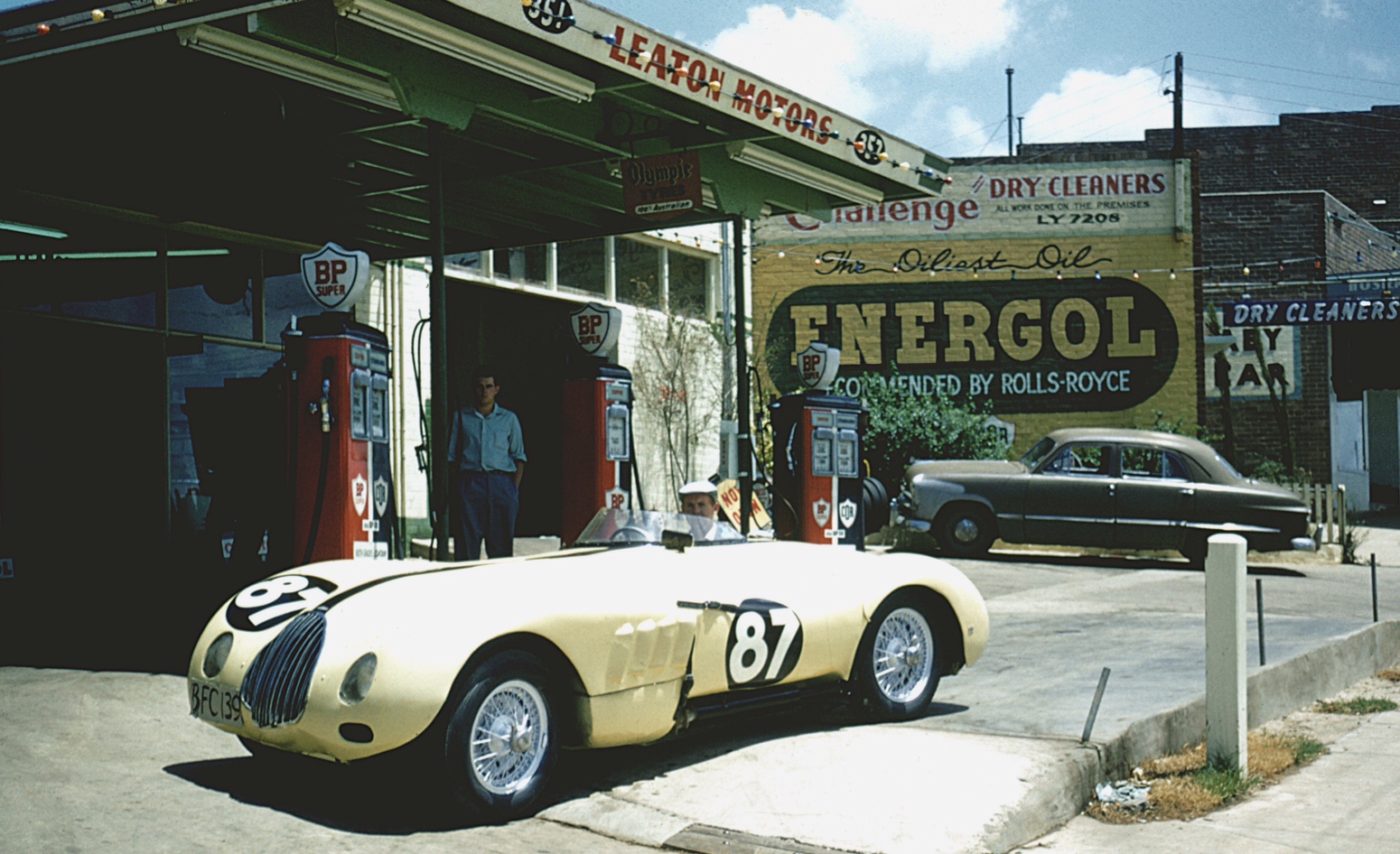
FM cut his racing teeth in sportscars in the mid-fifties, quickly progressing through Healeys’ to the Leaton Motors Jaguar C and D Types and Lotus 15 Climax 2.5. Then two Lotus 19’s. He first raced open-wheeler Elfins taking points in the 1963 Gold Star in an Elfin 1.5 Ford, the title won by Bib Stillwell.

First run in the just arrived Brabham BT7A Climax, Warwick Farm. Its race debut was in the ‘Hordern Trophy’ at Warwick Rarm in December 1963. Bruce Richardson by front wheel. (John Ellacott)
He became serious about his open-wheeler program in 1964, buying the latest ‘Intercontinental’ Brabham, the BT7A. He very quickly got to grips with the 2.7/2.5 litre Coventry Climax FPF engined car. Stillwell maintained his earlier model BT4 for ’64 but again won the championship, Matich took one win.
There was little doubt that FM was the quickest local, a driver who had not yet peaked, whilst Bib, having served a long apprenticeship, was atop the mountain, drove well, was well funded via his car dealerships and had well prepared cars driven with more mechanical sympathy than Matich.
FM lacked reliability which was perhaps, if you believe what was written at the time, a function of being hard on his equipment, his cars equally well prepared, but perhaps not quite as well financed as Stillwell’s.
Matich was equal 4th in the Gold Star in 1964 his speed absolutely confirmed in the 1965 Tasman Series, where his year old, well developed car gave nothing away to any of the Internationals or the latest BT11A Brabham’s driven by Graham Hill, Stillwell or Jack himself.

In the best of company, and avoiding the 2.25pm train from Launceston to Hobart…AGP Longford Tasman 1965. Graham Hill Brabham BT11A Climax from Matich in his year old BT7A Climax. (History of the AGP)

‘Frank led from pole in the 1965 ‘Warwick Farm 100’ but Hill and Clark went by on lap 1 is photographer, John Ellacott’s caption. Matich, light blue Brabham BT7A Climax, Hill in the red Brabham BT11 A Climax and Clark in Lotus 32B Climax. (John Ellacott)
He contested the 1965 Gold Star in the BT7A, his best results two 2nds, the title won again by Stillwell, who, having won 4 on the trot retired from racing.
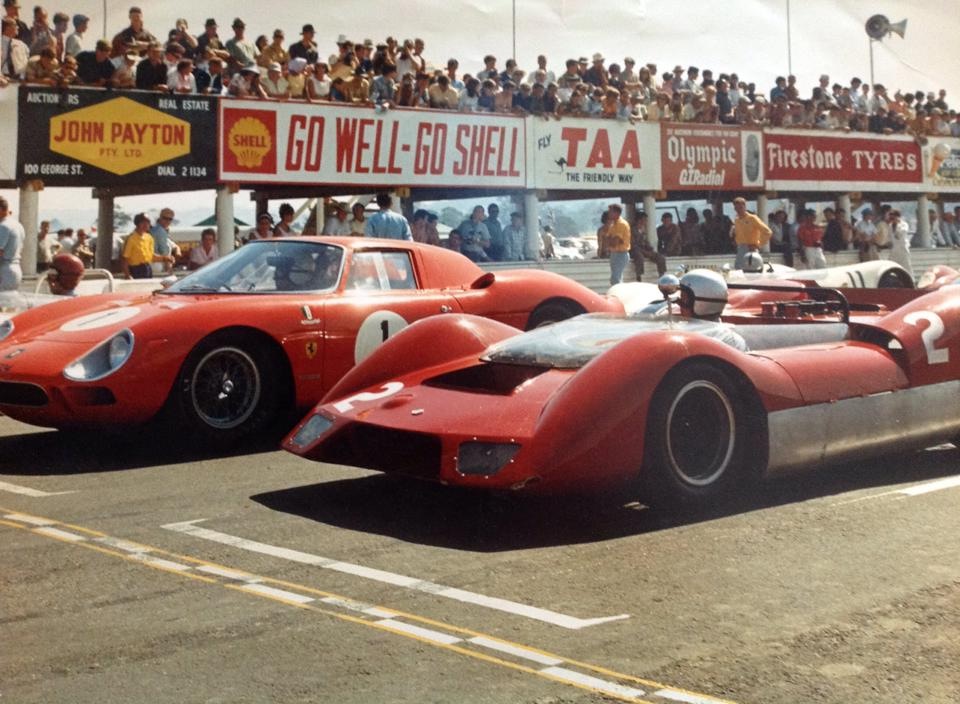
Matich on pole in his Elfin 400/Traco Olds, Spencer Martin in the Scuderia Veloce Ferrari 250LM at the start of the 1966 Australian Tourist Trophy, Longford, March. FM won. (Richard Blanden)
Matich refocused on sports cars, he saw greater commercial opportunities as they grew in stature and importance globally.
The Elfin 400 Olds was the first ‘sporty’ in 1966, then followed his self built ‘400 clone’ Matich SR3 Repco which swept all before it in Australia in 1967/68 and in which FM contested the 1967 Can Am series. Click here for my the article about Frank’s Elfin 400;
Elfin 400/Traco Olds: Frank Matich, Niel Allen and Garrie Cooper…

Early on in the Australian Tourist Trophy at the Longford 1964 Tasman meeting. Frank Gardner Lotus 23B Ford, Bib Stillwell’s #6 Cooper Monaco Climax, Matich’ victorious blue Lotus 19B Climax and Bob Jane’s Lwt Jag E type. Matich won from Stillwell and Greg Cusack’s Elfin Mallala Ford. (oldracephotos.com/Pat Ellis)
Whereas in 1964/5 he continued to race his Lotus 19B as well as the single-seater Brabham, from 1966 to 1969 FM raced sports cars to the exclusion of openwheelers. Sadly.
So Spencer Martin, Kevin Bartlett, Leo Geoghegan, John Harvey and other Australian top liners in single-seaters didn’t have FM ‘in their sandpit’ from 1966 till later in 1969.

Matich at Warwick Farm in the Repco 4.4 litre ‘620 Series’ V8 powered Matich SR3 in 1968. He raced SR3’s in the Can Am series in 1967, then back in Oz in 1968 whilst the SR4 was being built. (Dick Simpson)
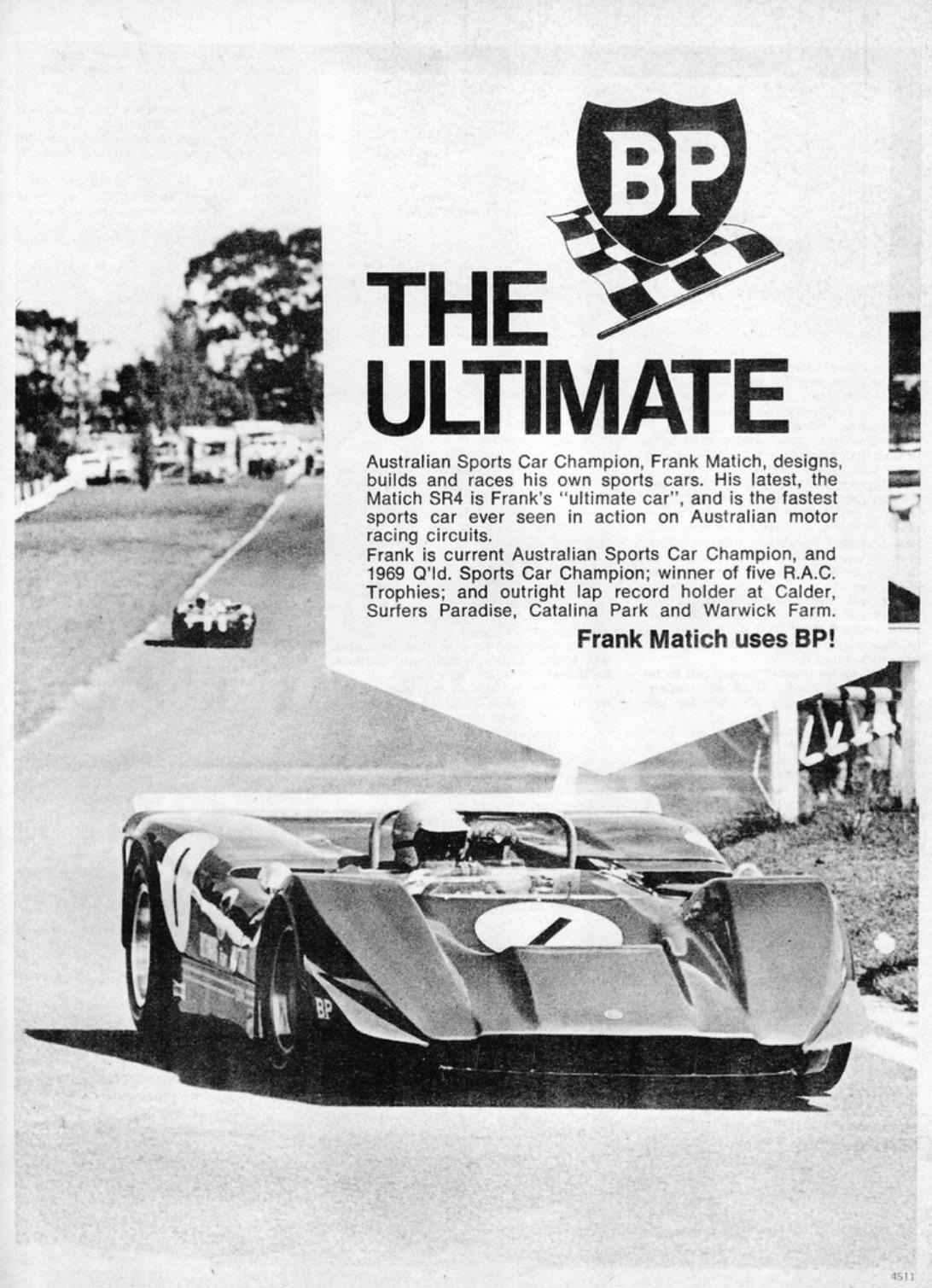
His Matich SR4 powered by Repco’s quad-cam 5 litre ‘760 Series’ V8 was intended as his 1968 Can Am weapon but was finished late and didn’t contest the title won by the McLaren M8A Chevs of McLaren and Hulme.
No way was the SR4, powerful as it was, going to take that title, but it would have been interesting to see how the beautiful handling, spaceframe chassis SR4 would have gone in the ’68 Can Am all the same.

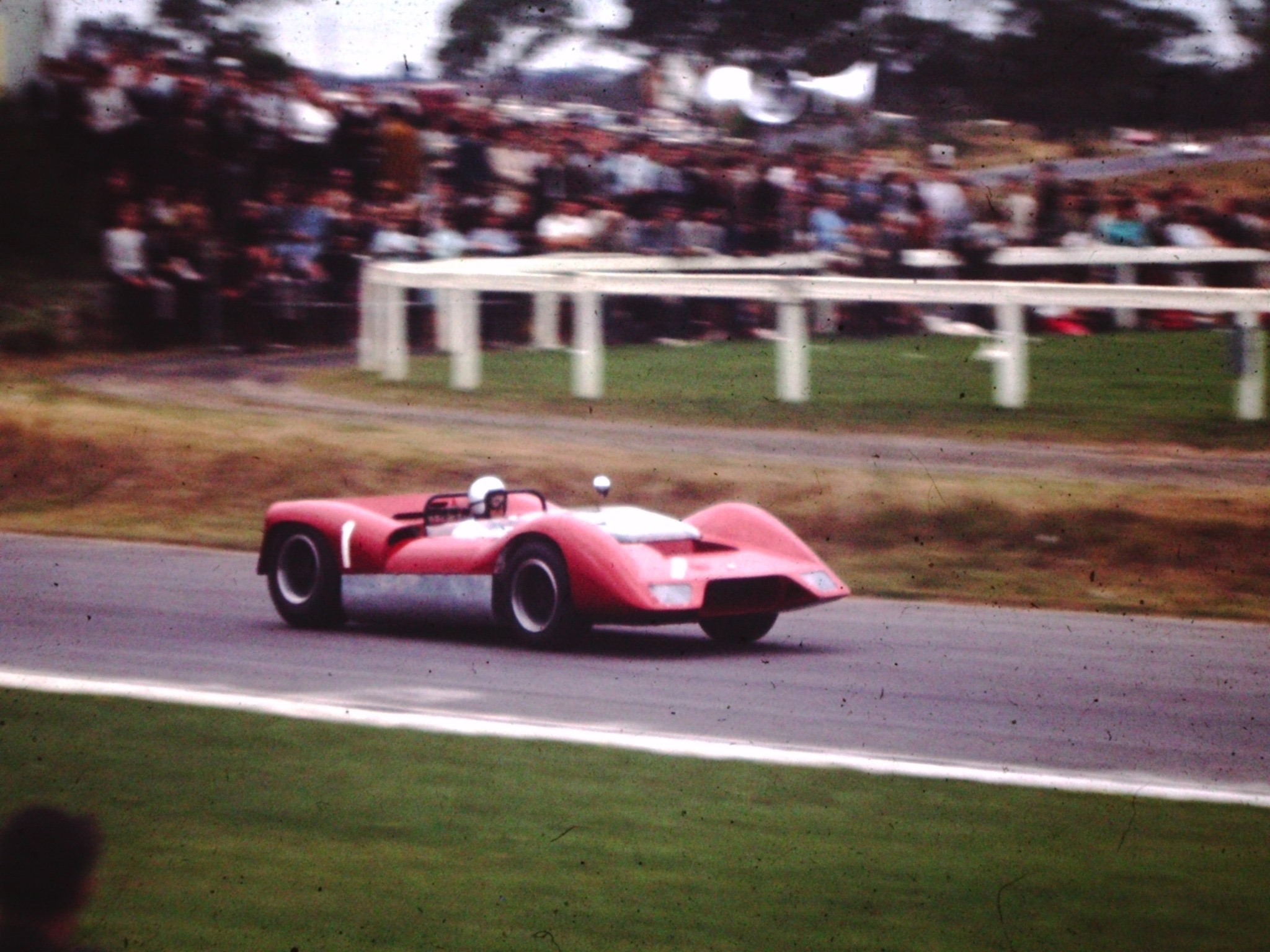
Frank in the SR4 Repco, Warwick Farm 1969. The formidable, oh-so-fast and dominant Matich. Pretty much destroyed sportscar racing in Australia for a few years such was the cars speed! Car acquired by Repco at years end and became a museum piece whilst still the fastest car in Australia regardless of class. (oldracephotos.com/Dick Simpson)
Instead he raced it in Australia in 1969 and ‘blew the rest of the field off the planet’ taking the national title in a display of absolute engineering and driving dominance. The Repco engine behaved, the valve gear resonance dramas which destroyed Jack and Jochen Rindt’s 1968 F1 season not apparent in the ‘760 Series’ 5 Litre variant of the engine which revved lower than its ‘860 Series’ 3 litre little brother.

FM portrait during his 1967 Can Am campaign. Top shot, so often he is lost in his thoughts, racedays are business days after all! Here in happy mode and the going was tough Stateside! (Dave Friedman)

FM dicing with Jim Clark at Lakeside’s Kink 1965. Matich rated this race the greatest he had against the greatest driver he raced against. Dice spoiled by a misfire in the Brabham’s engine. Brabham BT7A and Lotus 32B both 2.5 Coventry Climax FPF powered. (unattributed)
Where Does Matich Fit in The Pantheon of Australian Motor Racing Greats?…
One racing’s endless pub topics of debate is ‘whom is better than whom’ both globally and in our particular countries of origin. I’ve always enjoyed these debates secure in the knowledge its pretty much impossible to compare drivers across eras even if a ‘pure statistical’ approach of races entered/won is taken.
Of more interest and perhaps accuracy are the opinions of ‘expert observers’ of the sport at a particular time commenting on drivers and cars with all relevant factors which should be considered at the time in the context of the time.
‘Australian Motor Racing Annual’, 1968 edition, which did annual driver reviews, had this to say about FM;
‘After being out of the country for 4 months campaigning in the Can Am series (in 1967) Matich came back to take…a comfortable win for his 4th Australian Tourist Trophy. He capped that by taking the outright lap record at Surfers Paradise and Warwick Farm on the heels of the Tasman cars (defeating Chris Amon in sports car races in a Ferrari P4/Can Am 350 in his Matich SR3 Repco) and clocking the fastest time of the day at Sandown. His now quite confirmed maturity has emphasised his professional approach to the sport and there is no doubt now that he is among the worlds top 6 drivers…’
The other two ‘5 star’ drivers that year were Leo Geoghegan and Kevin Bartlett.
Of Geoghegan the review said ‘Now into the young veteran class but still the most polished GP driver in the country..’
Of KB the review said ‘This extraordinarily fast driver young driver with bags of natural ability…did not have a good season. Nevertheless he established himself as a real tiger in GP racing in this country and there is no doubt in equal machinery only Matich could match him for pace…’
The analysis suits me as FM and KB are my two greatest Australian resident drivers of the 1960 to, say, 1975 period.
Who did i consider in the mix? Lex Davison, Stan Jones, Bib Stillwell, Spencer Martin (boy it would have been good to see him peak, he retired before he did in my opinion), Leo Geoghegan, John Harvey, Max Stewart, John McCormack, John Walker and John Goss.
Outside this mix are Jack and Geoff Brabham, Gardner, Schenken, Walker, Jones, Perkins, Warwick Brown and Bruce Allison who ‘took the hard road’ and left the country to seek success, fame and fortune.
‘Top 6 drivers in the world’ is a big call in relation to FM. Or not?
I am speculating, we all have our own list in early 1968 when the magazine was published before Jim Clark’s death. But a Top 6 drivers in ‘The World Best’ then maybe includes; Clark, Hill, Brabham, Stewart, Gurney and Hulme. Top 6 ‘The Worlds Fastest’ maybe includes; Clark, Stewart, Gurney, Rindt, Amon and Rodriguez.
Whichever way you cut it FM was ‘up there’, famously the only member of the Grand Prix Drivers Association who never raced in an F1 World Championship GP.
And someone who had opportunities to race GP cars in Europe but for family and business reasons chose to race Internationally from his Australian base.

The company you keep; pre 1964 AGP drivers briefing shot Sandown. L>R; Tony Shelley, Mel McEwin, Denny Hulme, FM, Jack Brabham, Bib Stillwell, Bruce McLaren, Tim Mayer, Doug Whiteford behind the radio commentator, Frank Gardner and Tony Osborne behind FG holding the helmet. (History of The AGP)
But Times They Were A Changin’…
F5000 was being mooted as Australia’s next ANF1, the 2.5 Litre Tasman Formula waning. If ever a single seater class were tailor made for Matich it was this, and so it was that Matich imported the first F5000 to Australia, his McLaren M10A Chev arrived in Sydney in August 1969. FM’s move was a big one as he imported the car before the decision by CAMS had been made, politically it was smart as it added to the pressure to go the F5000 route.
It’s an arcane point but perhaps the first competition outing of an ‘F5000 car’ in Australia was Jim Abbott’s Hillclimb of his ex-Gardner/Bartlett Brabham BT23D Traco Olds at Lakeland Hillclimb on Melbourne’s eastern outskirts on 31 May 1969?

Melbourne ‘Age’ June 4 1969.
Matich and his McLaren M10A in 1969, certainly Australia’s first ‘real F5000’…
DK recalls; ‘Frank’s first F5000 was a McLaren M10A (# 300-10), coloured pale yellow it arrived in Australia at the beginning of August 1969. I crated the chassis at Frank Williams workshop before leaving for Australia, I arrived on 11 August’.
‘The engine was a Traco Chev on carbs Frank shipped from the ‘States. The chassis arrived at Frank’s Castle Cove workshop on 13 August. Peter Mabey and I assembled it, i made and mounted the rear wing. The car had an LG600 Hewland gearbox. It was first tested at Warwick Farm the Friday before it’s first race, Frank finished 3rd to the Mildren twins, Bartlett and Max Stewart’.

Kris Matich watching dad carefully prepare himself in his new McLaren M10A Chev ‘300-10’, first race for an F5000 in Australia, Warwick Farm September 7 1969. Decals on wings are ‘Rothmans Team Matich’. (Derek Kneller)

Matich practising the M10A Chev before its first WF meeting, Saturday 6 September 1969. Decals on cars side are Repco, Bell and Firestone. (lyntonh)
Click here for YouTube footage of that race at Warwick Farm;
‘The week after the race we stripped the car down and painted the chassis two-tone blue, royal blue at the top, light blue at the bottom. The nose was reshaped to accommodate a lightweight aluminium radiator. The car’s next race was at Calder in outer Melbourne, we tested it a couple of times at Amaroo Park before changing the engine spec to fuel injection and the gearbox to the smaller, lighter Hewland DG300 before the 1970 Tasman Series in which Frank competed together with the 2.5 litre Tasman cars’.
‘The car we took to the Tasman was essentially an M10B in all but name. I built M10A’s at McLaren and built the first M10B, Peter Gethin’s car at McLaren, not Trojan before coming to Australia, so knew exactly what changes to make. Not sure why FM didn’t buy an M10B, but maybe he wasn’t aware of the updated car at the time he placed his order.’

Matich on his way to victory, NZ GP Pukekohe 1970. Flag to flag win fron pole. McLaren M10A Chev. (Garry Simkin Collection/ The Roaring Season)
1970 was a transition year in Australia, whilst that summers Tasman Series was for both Tasman 2.5 and F5000 cars the Gold Star series was for Tasman 2.5 cars only albeit the Australian GP that November was for both categories. Go figure? The choice of our next ANF1 between 2 Litres (Euro F2 became 2 litres in 1972) and F5000 was fraught and so was the transition to F5000 once CAMS made that choice.
With more luck Matich could have taken the 1970 Tasman, he started in NZ with a bang; 3rd in the first round at Levin, he won the NZ GP at Pukekohe and on Wigram’s airfield circuit the following weekend. The team missed the Teretonga round to give them time to rebuild their only Chev engine which had done nearly 1000 miles, before the three Australian races. These were as bad as the Kiwi ones were good! FM was 4th at Surfers, broke an upright at his home track, Warwick Farm and then had a throttle cable break at Sandown’s final round.
Graeme Lawrence won the title, the Kiwi drove the Ferrari Dino 246 Tasman car which won in Amon’s hands in 1969.

‘Feel The Earth Move’; 5 litres of fuel injected Traco Chev blasting along Surfers main straight, FM about to tip the beast flat out in 5th into Surfers daunting right hander under Dunlop Bridge. McLaren M10A 8 Feb 1970. To all intents and purposes car is to M10B spec as per the text. 4th, race won by McRae’s similar car. (Dick Simpson)
Matich sat out the 1970 Gold Star Series, his F5000 McLaren ineligible but he was working hard with Repco to develop an F5000 variant of Holden’s then new ‘308’ V8…
This engine, designed by Phil Irving, also the designer of Repco’s ‘620 Series’ V8 which won Brabham’s 1966 World Titles, promptly won the 1970 AGP, having made its debut in Matich’s new McLaren M10B (#400-10) on 12 July at Warwick Farm.

Historic debut for FM’s very successful and tubbed at least 3 times! McLaren M10B Repco ‘400-10’ and the new Repco Holden F5000 engine. Warwick Farm 12 July 1970. (oldracingcars.com)
Matich won the AGP from pole also taking fastest lap, close to a perfect weekend. Niel Allen’s M10B Chev was 2nd and Graeme Lawrence’ Ferrari Dino 246T 3rd.
DK; ‘The Repco engines were bloody good, extremely good, the engineering precision was excellent. Everything was made by Repco, the rockers were forged steel, it had articulated rockers to resist the bending motion which breaks them, it had cast magnesium rather than aluminium manifolds. It was just a beautifully engineered and built engine. We had about 460bhp at the start, that rose to about 480-490 by Tasman ’73 and the flat plane crank engines gave about 520bhp when they came on stream in the ‘States in early ’73. Other drivers didn’t believe the power we had such was the strength of the engines, they had strong torque characteristics. The problems with Repco were around fiddly things. For example, we were forever changing head gaskets in the field, gaskets lifed to 4 hours had 3 hours use on the dyno when an engine was delivered, meaning a change in the workshop or at a meeting. Checking of valve clearances with limited time before a session or race and then having them leak, that kind of thing.’
‘We always had a Repco engineer, often Ken Symes to look after the engines at race meetings. The engines were great, Repco’s ability to solve problems was excellent but some of their procedures were a bit nutty! Despite wanting dyno-sheets and they produced them of course, we were never given them but the engines had plenty of power and torque.’

Matich in Warwick Farms Esses during his victorious 1970 AGP drive. 22 November 1970. McLaren M10B Repco ‘400-10’. (Rory McDonald)

Happy in victory of the ‘Surfers Paradise 100’; FM, team and Mc Laren M10B Repco. Surfers Tasman round Feb 1971. (unattributed)
The new Matich McLaren M10B Repco looked a good bet for the 1971 Tasman Series but Graham McRae had a very potent M10B of his own which was continually modified by McRae in a successful UK F5000 campaign in 1970.
The Series was dominated by these 2 drivers and Niel Allen who showed his mettle with 2 wins in his M10B. He took the NZ GP at Pukekohe and the Teretonga round with his well developed chassis and powerful Chev, both courtesy of Peter Molloy his race engineer.
McRae took wins at Levin, Wigram and Sandown and the title by 4 points from Matich. Frank had great reliability from his new Repco, if not quite as much ultimate grunt. He won at Surfers, was second at Pukekohe, Wigram and Teretonga and took third at Sandown, he was only out of the points in two rounds.

Frank Matich on his way to 2nd at Laguna Seca, second round of the US L&M Series in May 1971, David Hobbs in another M10B won the race. Here Matich is lapping # 57 Monte Sheldon Eagle Mk5 Chev and # 86 Gregg Paterson McLaren M10A Chev. (Derek Kneller)
Matich took his McLaren, razor sharp after it’s 1971 Tasman campaign to the US L&M F5000 championship, taking in the first two rounds at Riverside on 25 April and Laguna Seca on 2 May.
DK;’ We had gradually modified the car quite a lot including fitting 13 inch front wheels to make use of tyres of the type developed in F1, before we went to the US we increased the cars wheelbase by making changes to the front suspension, the car was very quick there’
He won and finished second in this ‘hit and run campaign’ before heading home to Australia, much to the relief of the series regulars!
DK;’ We took the whole equipe to California, we shipped the car by air and the truck and trailer by sea. We based ourselves at Carroll Shelby’s workshop in LA, it was there we met Carroll Smith who team managed our campaign in the US in 1973. We only had 1 Repco engine though, it was relatively early in the Repco program remember. The engine had done the 2 US meetings and plenty of testing. That and the fact that FM had commitments to sponsors back in Australia meant we had to come home’.

Dale Harvey’s lovely portrait of FM in the newly rebuilt McLaren Repco, now designated M10C in deference to its various Matich mods. ‘Hordern Trophy’ Warwick Farm 5 Sept 1971. DNF in the race won by KB’s M10B Chev. Car has a new tub, built up by the Matich team around the cars bulkheads as part of the ‘education process’ in gaining monocoque experience, the new A50 being built at the same time this car was being rebuilt after its June accident at Oran Park with an errant Lotus 7. (Dale Harvey)
In a busy year Matich contested some rounds of the 1971 Gold Star series. He missed the first round at Lakeside, not yet back from the US, Bartlett took the win in his M10B. He crashed the car before the Oran Park meeting on the Thursday, a Lotus 7 inadvertently getting in his way and doing enough damage for the car to be retubbed.
He bounced back to win at Surfers in August in the newly rebuilt car now dubbed M10C in deference to its various Matich mods and chassis repair in Australia.
He retired at Warwick Farm and at Sandown with jammed throttle slides, Bartlett again winning. He didn’t contest the Symmons Plains and Mallala rounds.
Max Stewart took the title with one win but a mix of speed and reliability gave him a 1 point victory for the title over Bartlett, who won twice.

FM on the last victorious lap of the 1971 AGP at Warwick Farm, upon the Matich A50 Repco ‘001/2’ debut. WF Esses, car looking beautifully balanced. (lyntonh)
Design and Construction of the Matich A50 Repco…
Matich’s McLaren M10B/C was raced in both Australasia and the US, the car an amalgam of his teams ideas and feedback via a development program with Trojan Industries in the UK, the makers of customer McLaren cars.
Matich had learned all he needed to know about ‘what makes an F5000 tick in 1969 and 1970’ ‘We’d developed the McLaren as far as it would go. It was time to move on to something else’, Matich told John Smailes in an interview for ‘The Australian Motor Racing Annual’ in 1971.
In terms of the cars design principles FM’…wanted as durable and maintainable a car as possible with inbuilt strength far greater than many F5000’s being built today’.
Economy of maintenance was important, the Matich ‘triangulated monocoque’ ‘built on the same principles as a space frame-with the same comparative ease of repair and maintenance’.
DK;’ FM, Peter Mabey and designer/draftsman Henry Nehrbecki (HN) and i had endless discussions about what we wanted in the car, its design attributes. We didn’t really consider a side radiator car then. FM liked weight over the front wheels, the radiators up front helped that. He also knew what the tyres needed from his Goodyear testing contract. We went along with what we knew in terms of loadings, feel etc. The tub was neater and easier to make than the M10B, all the fuel was in the side pods, not as we sometimes had to do with the McLaren use the scuttle tanks.’
Frank’s team had the capacity to build their own cars. The very successful SR3 and SR4 spaceframe sportscars were built by Matich and a group of subcontractors in Sydney and in Melbourne for the castings.
DK; ‘Whilst the team had built spaceframes none of them had built a monocoque before. Perhaps Henry had some of that experience in the UK, i’m not sure. When FM bent the M10B at Oran Park we decided to repair the tub at Brookvale to give us some monocoque experience. We unpicked the bent tub down to its bulkheads and used it as an exercise to see how they were made. We leased an industrial riveting unit to be able to use the same type of aircraft rivets as i was familiar with at Mclarens’
The first drawings of the ‘A50’ were commenced by HN and FM in November 1970 a year before its victorious debut in the 1971 Australian Grand Prix. ‘A’ was for Formula A or 5000, ’50’ the number of years at the time the projects prime sponsor, Repco had manufactured automotive components in Australia.

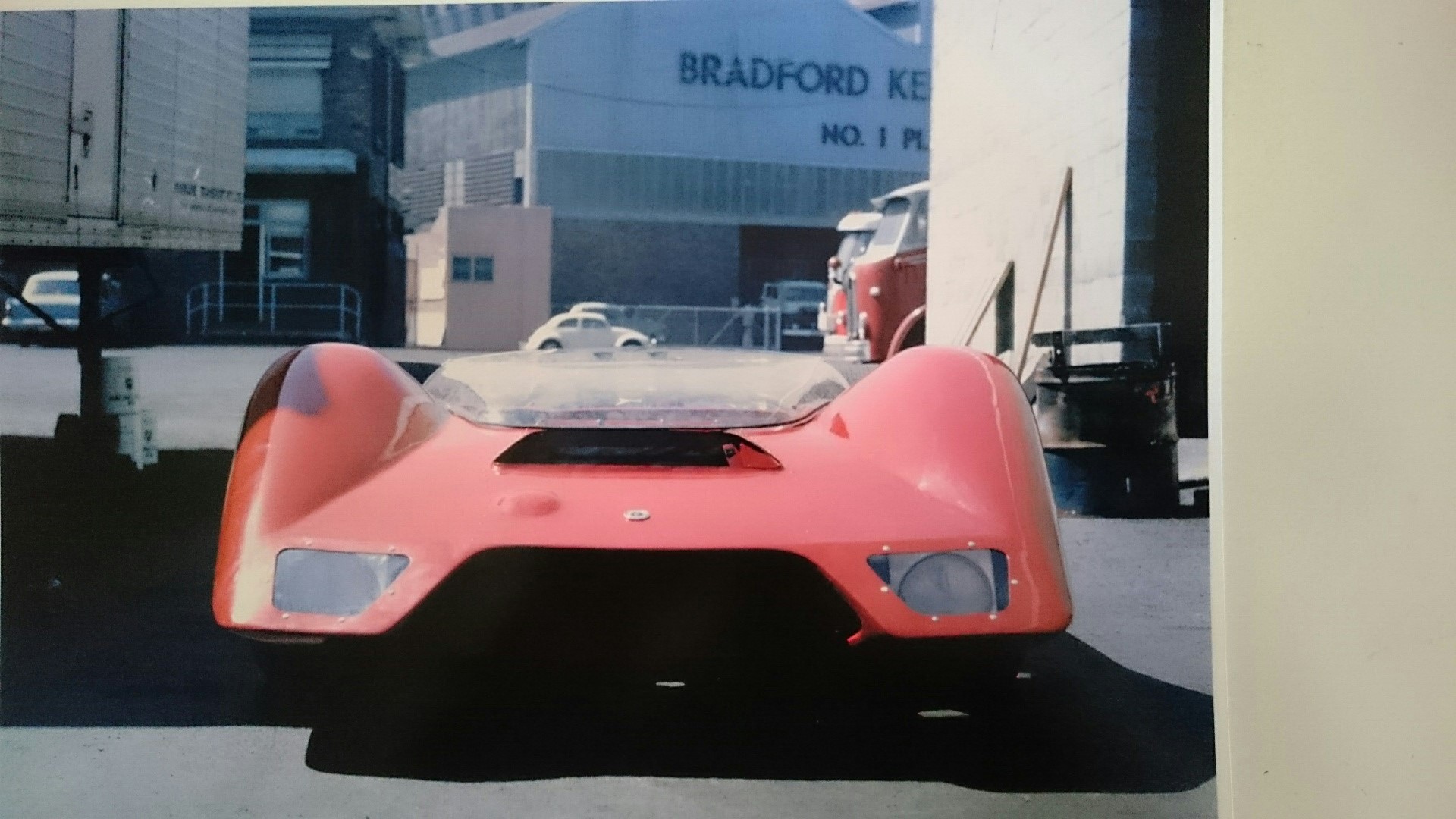
Brand new A50 about to roll onto the trailer for the trip to Warwick Farm, this is the Brookvale workshop where the car was built, November 1971. Of note is the cars shape and front radiator design, the ‘trend setting’ Lotus 72 chisel nose/side rad F1 car appeared in early 1970. Still plenty of front rad competitive cars in F1 at this time mind you. Note also the wide based wishbone front suspension, magnesium CAC built uprights, shocks are alloy bodied Koni’s. (Derek Kneller)
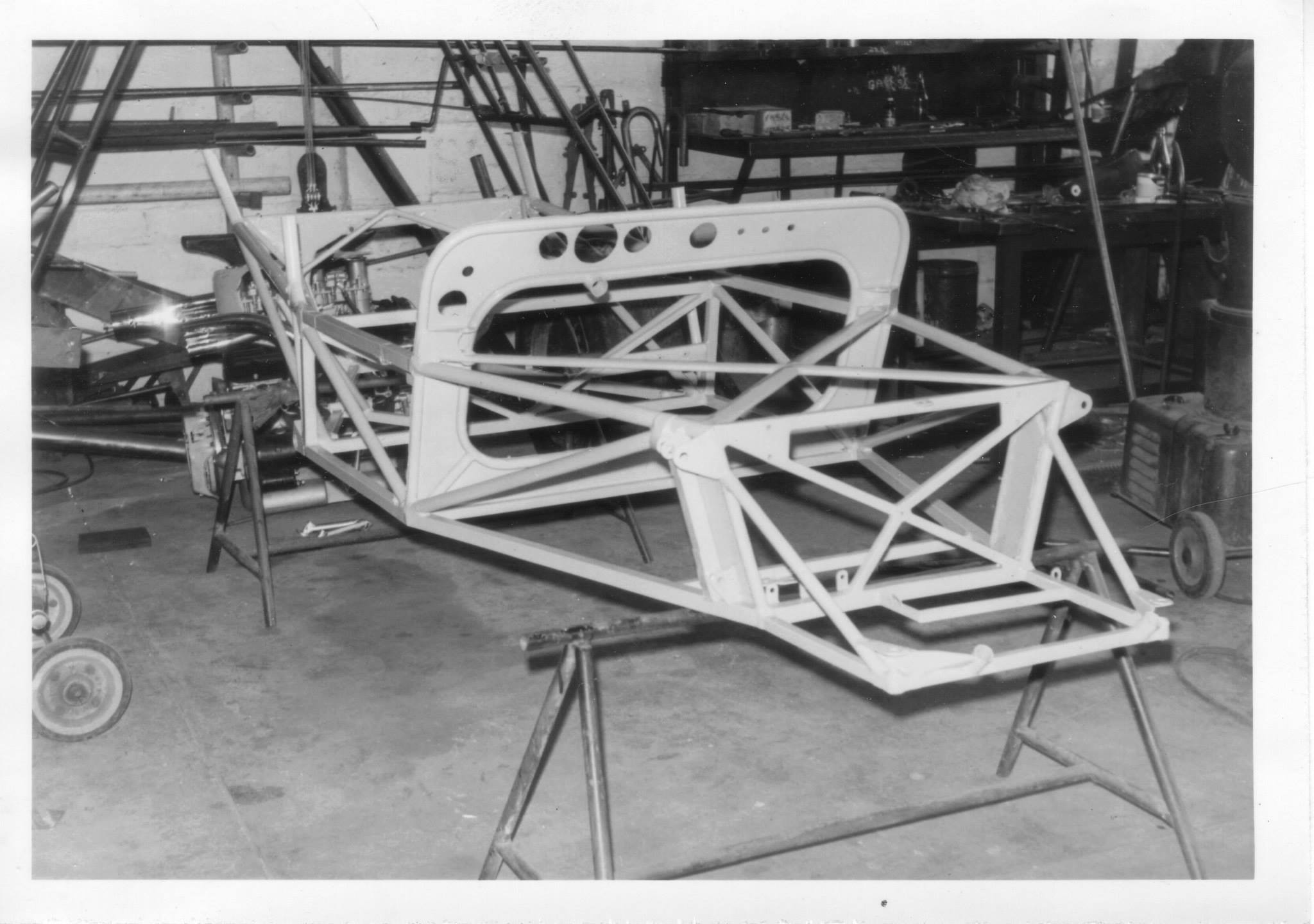
The car comprised ‘…three sections-a detachable front, central monocoque tub and detachable rear holding the engine. Eight bolts hold the rear (A frame) section in place, six bolts secure the front. In the event of an accident or undue flexing it’s a simple matter to bolt on a replacement section’, Matich said.
DK;’ We didn’t have the necessary folders to work with sheet aluminium so John Joyce at Bowins (Bowin Racing Cars in Brookvale) did some of that work and built the unique to A50 ‘001’ front and rear bulkheads which were Tig welded. Peter and i built up the tub and HN made most of the suspension components in nickel bronze. I wanted them Tig’d and grumbled about that, the first suspension and spares were nickel bronze welded’.
The clever part of the cars design was this ‘modular concept’.
During the F5000 program the team built 6 monocoques; 3 at the Brookvale workshop behind the Brookvale Mall shopping centre 17 Km from Sydney, the other 3 were built in a batch by the Commonwealth Aircraft Corporation (CAC) at Fishermans Bend, 6 Km from Melbourne in early 1973.
The cars remained competitive throughout the formula by the team ‘playing with’ weight distribution, track/wheelbases and aerodynamics (later cars were side-rad/chisel noses) by the use of different front and rear fabricated sheet steel detachable sections, bellhousings and of course bodywork and wings. All the while using the same tub design from 1971 to 1974. Noting the A53 won the Australian Grand Prix in John Goss’ hands in 1976 and was still competitive beyond that…that their was nothing wrong with the tubs or the underlying design philosophy is clear.
25 gallons of fuel in total, is carried in the tubs side pontoons, the fuel contained in locally made puncture proof foam cells. DK;’ Frank wanted as much of the car as possible made in Australia, he was a real patriot in that way. We could have had the fuel cells made by Goodyear free via our tyre contract but instead had them made by a Dunlop subsidiary about an hour from Melbourne. It also gave us better control of the product’.
Instruments comprised Smiths mechanical tach, oil pressure and water temperature gauges. The gear change for the ubiquitous Hewland DG300 ‘box was on the right and the steering wheel was a ‘half moon’, round at the top and flattened at the bottom, sensibly, to ease access and egress into the car.

Matich A50 ‘001/2’ and McLaren M10C Repco ‘400-10’ in the 1971 WF AGP pit. The Rothmans/Repco machines were raced by Matich with touring car star; although he had quite a bit of single seater background in his past, Colin Bond. See cockpit details referred to in text. Of note the front location points of the radius rods to the rear of the tub, front top wishbone and aluminium sheet monocoque itself, each side pontoon contained 12.5 gallons of Avgas. Valve clearances being checked, RHS rocker cover sitting between the injection trumpets. (Derek Kneller)
The challenges of building cars at the time are interesting, FM ‘…The A50 was an extremely difficult car to build or to build accurately, we went through three draftsmen before we got the car completed’. You can never build a good car from the drawing board. You can build a pretty one-but not one which is functional. You can’t draw in three dimensions, at least not successfully. It’s very much a matter of trial. You build a tub, see if you like it and if you don’t you throw it away. It’s far more expensive but you get a better car in the long run’.
The days of CADCAM were still a long way off in 1971!

The new A50 coming together in the teams Brookvale workshop and about to be wheel aligned for the first time. Sans wings obviously. Car alongside is the teams McLaren M10C Repco, recently repaired and to be driven by Colin Bond in the 1971 AGP. (Shane Lee)
The cars wheels were cast by the CAC in Melbourne; the rears in both 13 and 15 inch diameters and widths of between 15 and 17 inches. The fronts were 13 inches in diameter with widths of between 10 to 11.5 inches.
Front suspension was identical in layout to the SR4; FM ‘unequal length wishbones with the bottom arms reaching forward to the bottom of the radiator and the top arms swinging backwards to the chassis bulkhead’.
The rear suspension used, typically for the day, a single top link, twin parallel links at the bottom, twin radius rods for fore and aft location and coil spring damper units. Shocks were Koni double adjustable alloys and adjustable sway bars were fitted front and rear.
Steering was by Matich rack and pinion, again cast by CAC in Melbourne.
The cars engine was the Repco Holden F5000 unit, designed by Phil Irving, based on Holden’s then new production ‘308’ V8, the engine a story in itself. Matich was Repco’s factory driver, the engines also available for sale or lease to customers, and gave ‘460-470 horsepower at 7200 revs’ at the time.

Rear suspension detail shot in the 1971 Warwick Farm AGP paddock. Of note is the wing design, ‘banana wings’ still a year or so away. Oil reservoir is beside the Hewland DG300 gearbox. Suspension; single upper link, two lower parallel links clear as are coil spring inside which are Koni shocks. 2 Radius rods provide fore and aft location. ‘Butch’ splined driveshafts and big exhausts, Repco engine giving circa 460-470 bhp @ this stage of its development. (Derek Kneller)

Hi-ho, hi-ho its orf to the ‘farm we go. Peter Mabey rolls A50 ‘001/2’ onto the elaborate! Matich Team trailer enroute to a 1971 AGP victory. (Derek Kneller)
1971 Australian Grand Prix, Warwick Farm…
DK;’ The A50 was finished on the Thursday before WF. We did 25 laps bedding in brakes, tyres and the engine and FM simply ran away with the race’.
Graham Howard’s ‘History of The Australian Grand Prix’; ‘If the pundits thought that Frank Matich’s efforts in getting a brand new car to run faultlessly (and fastest) in practice was a remarkable effort, they-along with everyone else at Warwick Farm-were stunned with what he and his A50 did in the race. And that was to lead flag to flag, have no-one seriously challenge him, set the fastest lap, slow by up to two seconds a lap in the later stages and still beat his nearest rival home by a fraction of a second less than 1 minute, or 2/3’s of a lap’.
Bartlett and Alan Hamilton were 2nd and 3rd in their M10B Chev’s. Gardner’s Lola T300 didn’t contest the race after a jammed throttle and ensuing prang in practice damaged the car. John Surtees competed in his own TS8 Chev in a field of depth comprising both F5000 and 2 litre cars which were always quick on the tight, technical, testing WF layout.

The Thursday of the AGP 1971 weekend- posed for the press perhaps (D Kneller)

FM on the way to an historic 1971 AGP victory upon the debut of A50 ‘001/2’. Warwick Farm. (History of The AGP)
Youtube footage of 1971 AGP…
The 1972 Tasman Series I covered in brief earlier in this article. Ditto the 1972 Gold Star. Therefore the A50’s performance in those Championships we have already covered way back at the start of this epic….

The top cars of the 1973 Tasman series here shot at Sandown ‘on the fast gallop’ towards ‘The Causeway’. Matich in A50 Repco, McCormack’s continually developed Elfin MR5 Repco, McRae’s new GM1 Chev and Max Stewart’s new Lola T330 Chev. The only missing car from ‘The Class of ’73’ is a Chevron B24 Chev. (Robert Davies)
Equally good bets for the 1973 Tasman Series were Matich and McRae, the former fresh from his ’72 Gold Star win and continually developed A50 chassis.
McRae took victory in the ultra competitive 1972 US F5000 ‘L&M Championship’ and was armed with a new GM1, an update of the prior years Leda LT27.
And so it proved that McRae took his third Tasman title on the trot, Graham finished with 40 points, John McCormack 2nd on 29 points in the ageing but fast Elfin MR5 Repco with Matich, the ‘factory Repco’ driver 3rd on 27 points in his A50.

FM’s A50 leads Graham McRae’s GM1 on his outside, John McCormack Elfin MR5 and Max Stewart’s Lola T330 into the chicane ‘rumble strip’ on lap one of the 1973 NZGP at Pukekohe. He is in tight as GM has made a lunge on the outside. FM is about to hit the the strip and damage the steering arm, out of the race. (Derek Kneller Collection)
The ’73 Tasman was the most open for years and demonstrated the depth of F5000 fields and plethora of competitive chassis; Allan Rollinson won in a customer McRae at Teretonga, Steve Thompson in a Firestone shod Chevron B24 at a very wet Warwick Farm. Wins for Matich at Surfers Paradise, McRae at Levin, Wigram and Sandown and McCormacks two Elfin MR5 wins at Pukekohe and Adelaide, the first and last races of the series showed no one chassis was dominant.
Max Stewart made a strong debut for the very first Lola T330. ‘HU1’ was Frank Gradner’s prototype, was works entered and supervised by FM during the series. Max was quick, it was a Lola T330 and Jody Scheckter onslaught Matich would encounter in the US in 1973.

Derek Kneller and John Anderson fuel the A50 at Wigram 1973. Ken Symes of Repco. Good shot of the ‘blown diffuser’! and related bracketry to locate it. (Derek Kneller)
DK; ‘At Pukekohe FM was on pole and lead but then had an accident. He put a wheel onto the makeshift chicane, and bent the steering arm, it was a race we should have won. At Levin we were 2nd. At Wigram 4th with an engine misfire. At Teretonga we started on wets, the weather improved, we changed to dry tyres then it rained and FM spun. At Surfers we won from flag to flag. At Warwick Farm Steve Thomson’s Firestone wets won the day, FM was 2nd. At Sandown the car was 4th with a puncture and in Adelaide he retired with fuel pump failure’.

Matich A51 ‘005’ in the Mid Ohio paddock 1973. FM 13th, in chassis ‘006’ in the race won by Jody Scheckter, John Walker 11th in his A50 ‘004’. Notice the dual rear wing setup, inspection holes in side of monocoque, long swept back top front suspension link (compared with the later A52/3). Above the airbox on the other side of the paddock is Walker’s A50 complete with dual rear wing setup. (Terry Capps)
Frank Matich ignored the domestic Gold Star Series in 1973 to mount an onslaught on the US L&M F5000 Championship in two new cars, Matich A51 Repco’s…
The new cars incorporated all of the teams knowledge racing the A50, FM’s role as a tester for Goodyear racing tyres, for whom he was the Australian distributor and the market intelligence gained in the ’73 Tasman Series.
He knew the relative strengths of the Chevron B24/8, Lola T330 and McRae GM1, his primary competitors stateside that year. The challenge was to build a car to beat them and ship it to California before the first round on 23 April at Riverside.
Kneller recalls the build of the A51’s;
‘In later 1972/early 1973 the Commonweath Aircraft Corporation (CAC) in Melbourne built 3 new chassis’ using drawings supplied by Matich. The CAC had spare capacity as the Vietnam War was over, they did a lot of aircraft maintenance work during the conflict. We knew them well from the castings they had made for us back to the SR3 days. After the ’72 Tasman the A50 was in Melbourne for the motor show. We then took the car to CAC at Fishermans Bend for them to look at, they quoted a price about a third of what it would cost us inhouse so we had them make the tubs for us’.
‘The first arrived in November ’72. We started to build up a new car for the ’73 Tasman, FM even got a logbook for ‘005’ from CAMS but the project ran late mainly due to fuel cell delays so we used A50 ‘001/2′ again in the ’73 Tasman, which still had done maybe 15 meetings. No car was faster in Australia at the time’.
‘The tubs were basically identical to the A50 chassis (all 3 of which were built at the Matich, Brookvale, Sydney workshop) apart from a different riveting system; the skins were dimpled with a countersunk hole and countersunk rivets used to give a stronger joint and also a flush finish’.
‘These chassis were also lighter and torsionally stiffer than the previous ‘Brookvale’ monocoques, and came with a grey anodised finish to the inside skins’. Two of the three new tubs were built into A51’s, leaving one spare.

A51’s in build early 1973 in Matich ‘shop Military Road, Cremorne, Sydney. You can feel the intensity just looking at this shot, there is so much going on! Cars from front to back; A51 ‘006’, A51 ‘005’ and the much raced A50 ‘001/2’, still in its post Tasman ’73 ‘warpaint’. Note CAC built A51 tubs, inspection hatches open awaiting fuel cells. Note also rear ‘A frames’ to support 5 litre ‘flat plane crank’ Repco Holden 520bhp V8. Hewland DG300 ‘box. (Derek Kneller)
Derek continues’ A51 Repco ‘005’ was built in early 1973 in the Matich Racing Cremorne workshop in Military Road. It had a chrome roll hoop, the radius of the bend was smaller than the A50, (making the car easy to pick in relation to an A50 to the trained eye).
There were changes to the front and rear suspension geometry and a redesigned rear lower suspension mounting frame compared to the A50.
The radiators were the same light weight aluminium GM rads previously used on the A50. Onboard fire extinguishers were fitted.
All suspension components were finished black by a chemical process in house, there was a slightly different shape nose with a larger radiator inlet at the front. The car also had a lower rear wing mounted behind the gearbox approx 150mm off the ground with the exhaust blowing over its top surface.’
‘A new brand of wheel was used in the USA, these ‘Mel Mag’s’ were English and were delivered to the Riverside first round of the series, they were lighter than the Matich cast magnesium wheels as used on the A50.’ The Matich wheels and uprights were cast by CAC in Melbourne. ‘A51 ‘006’ was built alongside ‘005’, it had a black roll hoop and was of identical spec to ‘005.’
‘Both chassis’ were taken to the USA. ‘005’ was shaken down for a few laps at Warwick Farm before going to the US, ‘006 was not. ‘005’ was used in the first 2 races but after Laguna we raced ‘006’ as well.’
‘We were the only team in the series that had a spare car. Both cars were prepared for FM’s use at all 5 races. Frank set up and practiced both cars at all meetings, Vern Schuppan drove chassis ‘006’ in practice at Watkins Glen’.

Riverside ’73 pits. ‘Both cars stripped of their crown wheel and pinion assy’s so a ‘high tech treatment’ could be applied by an aerospace company in LA, the cars back together by the next day’. (Derek Kneller)

Riverside ’73 garage again. John Anderson behind the rear wheel of ‘006’ Derek on the front of ‘005’. (Derek Kneller)

The 2 brand spanking new A51’s ready to roll in the Riverside pitlane. ‘006’ closest has never run, ‘005’ did a few laps of Warwick Farm before leaving Oz. (Derek Kneller)
Gordon Kirby made the following observations about the Australian onslaught in his ‘Autosport’ Riverside race report; ‘Frank Matich’s capacious Early Racing Enterprises transporter contained two completed, brand new Matich Repco A51’s and like Brian Redman went equally well with each car…The A51’s have a couple of extra inches in the wheelbase as well as an engine which is half an inch lower than in the A50. With Carroll Smith directing the Penfolds Wine sponsored team, there was a lot of experimentation going on throughout the week. The cars went from brand new to fully race worthy in an incredibly short space of time; so much that Matich didn’t select which of the equally competitive cars to race until Sunday morning’.

A51 ‘005’ behind the Riverside pit wall 1973. (Derek Kneller)
In fact Matich’s ability to choose between 2 cars of which to race, FM wanting to compete in each of the 2 heats with different cars, and then make his chassis choice for the final, lead to ‘The Matich Rule’ to disallow just what FM proposed!
The A51’s were fast, but the ‘game changing’ Lola T330 (and it’s 1974 T332 successor) was the greatest F5000 car ever. Full stop.
Coupled with the speed of the Lola’s and the individual genius of Jody Scheckter in Ron Tauranac’s Trojan T101, Team Matich ran into engine problems, the Repco Holden engined cars oil systems not scavenging properly on the fast, long radius turns not encountered in Australasia.

Matich A51’s ‘006’ and ‘005’ in the Watkins Glen pitlane. A Chevron B24 behind. ‘On ‘006’ the lower rear wing was removed and an extra oil coller added to try to sort the engine problems’. DK in yellow t-shirt. (Derek Kneller)

Pre race prep in the Watkins Glen garages, lower rear wing being removed from ‘006’ in front. Flat plane crank engine fitted.(Derek Kneller)

‘006’ at Watkins Glen from above sans lower rear wing. June 1973. (Derek Kneller)

A51 ‘006’ and ‘005’ in the Watkins Glen pitlane. (Derek Kneller)
Derek Kneller well recalls long nights coping with the dramas in the US;
‘The cars did not perform as expected we had a handling problem on the latest spec Goodyear’s and the bumpy nature of the US circuits. The tyres weren’t identical to those we tested before going to the US. FM wasn’t the only driver testing the F5000 tyres, the final production tyres we were presented were different, so we were playing catch-up. The cars were still as fast as any at Riverside’.
‘The biggest problem was engine related; the higher cornering speeds of the US circuits threw up a scavenge problem in the Repco engines, this seemed to get worse as the season went on and at Watkins Glen the crankshaft bearings were damaged in both cars during practice and both were withdrawn from the race.’
‘We never actually blew an engine, the bearing wear was detected in routine checks by dropping the oil pans off the engines at the end of each day. It was important we didn’t blow engines given Repco’s push into the US at the time. Frank could feel the loss of power through the corners and then a surge of power ‘like a handbrake being released’ FM said as the car came off some corners. He compensated to save the engines by using less rpm’s, 7000 rather than 8000 which of course reflected in the lap times. To save the engines we also did less testing.’
‘At the start of the season the A51 was as competitive as the T330 but its development accelerated with so many drivers and teams running and experimenting with the T330’s’.
‘Straight after the race weekend at Watkins Glen chassis ‘006’ was flown back to Sydney with me so that the handling and engine problems could be sorted. Chassis ‘005’ was left in the States with the rest of the team.’
‘On returning to Sydney the engine problem was overcome, an additional scavenge pump was added to scavenge oil from above the camshaft. Oil was being retained in the valley above the camshaft in the longer fast corners causing oil starvation in the oil tank, leading to bearing failure.’
After the engine problem was sorted it was decided to redesign the chassis to overcome the handling deficiencies, hence the A52 design’.
‘The best A51 result was 5th at Michigan although Frank ran in the first 3 at the Riverside first round until he had gear shift problems’.
Brian Redman opened the T330’s account at the season opening Riverside round, Matich was 17th. The team entered the Michigan, Mid Ohio and Watkins Glen rounds, in the latter the cars did not start as Kneller related. Jody Scheckter took the series driving the Trojan T101, he also drove a T330 in two rounds. The Trojan was good but Jody was better, he made his GP debut in a Mclaren M23 later in 1973.
That year Aussies John Walker, Matich A50, Bob Muir, Kevin Bartlett and Max Stewart all Lola T330 mounted contested some L&M rounds. Their results and experiences would be an interesting story in itself, perhaps one Kevin Bartlett would be prepared to relate in a later article. Its a tangent too far for this already long piece.

Matich A52 Repco ‘006’ on test at Warwick Farm in September 1973. First Matich F5000 with side rads and chisel nose. Repco ‘flat plane’ crank 520bhp engine. Melmag wheels. The thing that struck me about this car when i saw it race at Surfers in 1973 was just how small a car it was. It had the same wheelbase as a T330 but it was beautifully packaged. (Derek Kneller)
The Short Life of Matich A52 Repco ‘006’, late 1973…
As DK relates above apart from the engine dramas, there were improvements to the chassis needed to remain competitive, the game had quickly moved on from the early Tasman months of 1973 as the US teams developed their cars from the production spec delivered by their English makers.
DK; ‘The A52 was built using the A51 ‘006’ chassis and rear end but with a longer engine/gearbox adaptor (bellhousing) giving a 2inch longer (50mm) wheelbase than the A51, this was in line with the Lola T330′.
‘The radiators were moved to the sides of the chassis along with modifications to the engine water pump so that each radiator cooled the opposite side cylinder head and were shrouded with aluminum ductings’.
‘The oil tank was repositioned behind the lefthand radiator (from beside the cars gearbox, outside its wheelbase) and the battery moved from the front of the car to above the bellhousing’.
At the front of the chassis the steering rack was moved from the chassis itself to a heavily redesigned front subframe. The top pick up point for the shock absorber/spring assembly was raised approx 1 1/4 inch (30mm) along with a redesigned lower wishbone and new front uprights. These mods gave an increase in front suspension movement’.
‘To complete the design a chisel shaped nose made from fibre glass was added, the complete car was about 10 Kg lighter than the A51’.
‘The A52 was tested extensively by Frank at Warwick Farm during late July/early August 1973 with a hope of returning to the US series, but a problem with the sponsors in the US prevented this happening’.

Matich in A52 ‘006’ from Bruce Allison’s Bowin P6 Ford Hart ANF2 car during the Glynn Scott Memorial Trophy Gold Star round at Surfers Paradise in September 1973. DNF and 4th with Bruce soon an F5000 star (D Kneller)
‘The A52’s only race was the Gold Star race, the ‘Glynn Scott Memorial Trophy’ at Surfers Paradise on 2 Sepember 1973 when fitted with a flat plane crank Repco F5000 engine. This gave over 520hp and sounded like a Cosworth DFV on steroids! (The two-plane Repco engine gave circa 495bhp@7000rpm)
FM led the race setting fastest lap before retiring with battery failure, the high frequency vibration from the engine shook the internals of the Varley battery apart.’
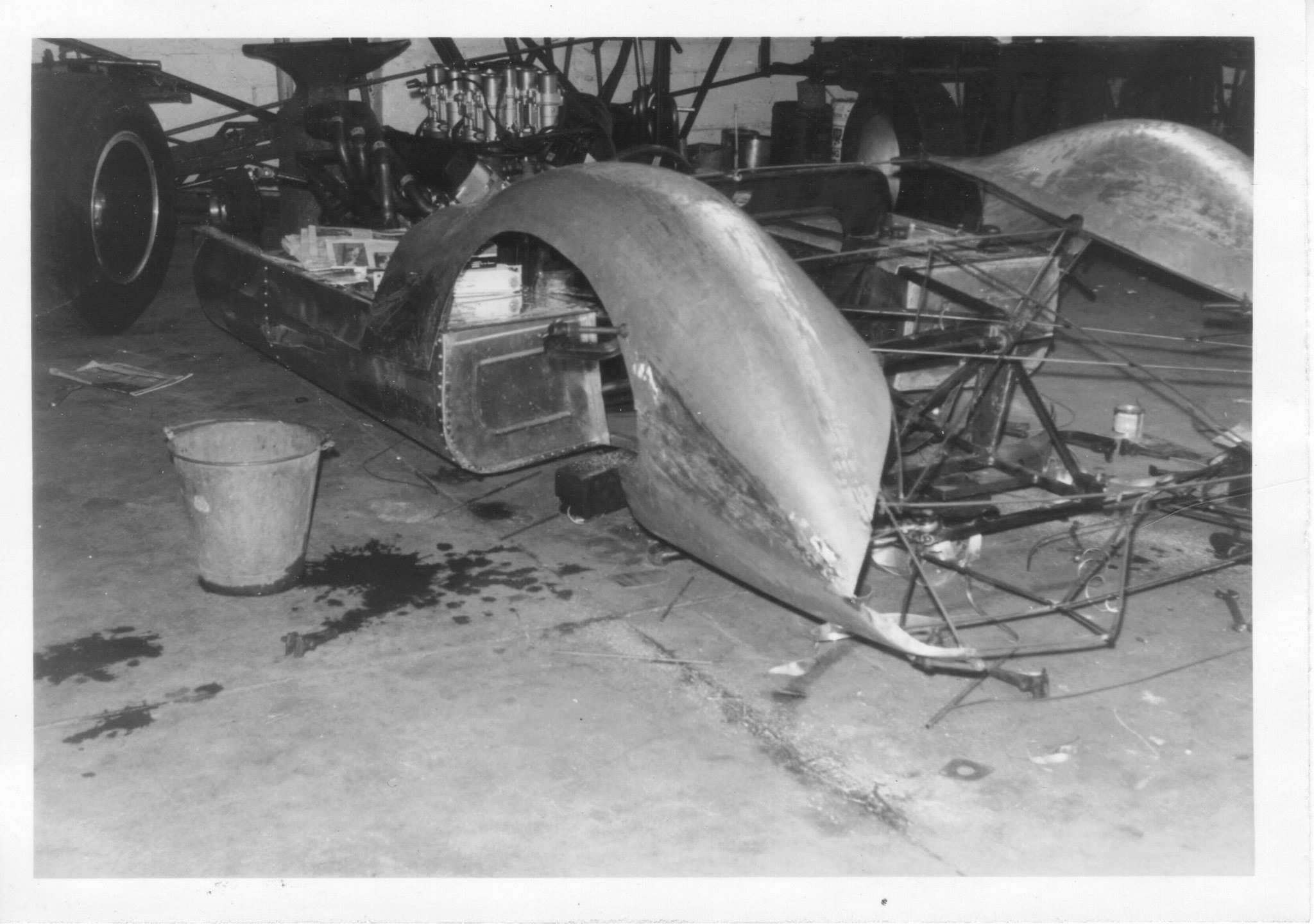
‘The car was comprehensively destroyed in a test session at Warwick Farm in late September whilst driven by Bob Muir. The chassis was beyond repair, both outer and inner skins were damaged. The photos show damage from the car hitting the water-sprinkler system at Warwick Farm, 50mm diameter steel pipes at great speed’.
‘Frank was not happy as he had just left the circuit after a successful session and had let Bob have a drive to get another drivers opinion of the car, Bob had been driving a Lola T330 Chev in the US’.

The rooted A52 ‘006’ back at the Matich workshop. (Derek Kneller)

Another angle, tub clearly beyond economic repair. This tub at some stage was sent back to CAC in Melbourne, having sat at the back of the Matich workshop in Cremorne until 1977/8, but was never seen again. (Derek Kneller)
The death of the A52 was a bummer to say the least. Muir was happy to have had the prang in the strong Matich tub not a T330! Clearly the team were heading in the right direction with a car that was as fast or faster than the the best in Australia at the time; both Bartlett and Stewart were racing their T330 Chevs at Surfers on the day FM was running away with the ‘Glynn Scott Memorial Trophy’ and both were razor sharp having, like Matich, been racing in the US L&M.
The A52 was undeniably fast, but the team now needed to build another car and again had the chance to make further changes from the A52 to a 1974 Tasman Championship contender, the series commencement only a few short months away at Levin, NZ on January 5 1974.

Frank Matich testing his brand new car in considerable pain, at Oran Park on 1 February 1974. Matich A53 Repco ‘007’. Compact dimensions, beautiful contemporary lines, side rads and oil tank behind LH side radiator duct clear to see. (unattributed)
The 1974 Tasman Series Competition and Frank’s contender, the Matich A53 Repco ‘007’…
John Mc Cormack won the first of his Gold Star’s in 1973 with fast, consistent performances in his evergreen, cleverly developed Elfin MR5 Repco. Garrie Cooper had built a new car, the Repco Leyland powered MR6, a superb, small car styled in the mould of the Tyrrell 006. The aluminium block V8 was around 100 pounds lighter than the Holden but, as was later to be revealed the weight reduction was offset by the inherent deficiencies of the engine itself. The MR6 would find success in 1975, but Repco Holden engined. In the meantime Mac’s old Elfin was a race winner in NZ in 1974.
Bartlett, Walker and Stewart returned with their Lola T330’s. Unfortunately KB’s campaign was cut short by a Pukekohe shunt which broke his ankle, leg and hip. KB’s return to racing and his win at Bathurst with John Goss the following October was as heroic as Warwick Brown’s return to racing in the first production Lola T332 ‘HU27’ that summer of ’74.
Warwick was hobbling around the Surfers paddock at the Gold Star meeting in September ’73, no way did i think he would be back in harness in January given his physical state then. But he was and won the final Tasman round in Adelaide. Former Kiwi Tasman champ Graeme Lawrence was back in another new T332 having run a 2 Litre Surtees in 1973, and himself survived an horrific accident in his then new Lola T300 in 1972.
Lawrence, Bartlett and Brown were all foundation members of the ‘Lola Limpers Club’ and fortunately all are well and truly still with us!
Graham McRae was back in the GM2, a superb ‘McLarenesque’ chisel nosed, side radiator car, which convincingly won the 1973 AGP at Sandown on 4 November. FM didn’t contest the ’73 AGP as Bob Muir had destroyed his mount, the A52.
Count Rudi van der Straten was back again with Teddy Pilette and Peter Gethin in Chevron B24’s, both cars were converted to the latest B28 spec during the Tasman.
Perhaps the Series was slightly ‘skinnier’ in terms of international representation than 1973 but there was still a formidable field of top class drivers in the best F5000’s of the day.
Again Derek Kneller provides his firsthand account of building the Matich A53…
‘The car was built using the final CAC tub and was a refinement of the A52.
Both the front and rear suspension geometry was changed having longer wishbones to smooth out roll and bump conditions. The front subframe was redesigned to accomodate an improved steering rack mount and another inch was added to the bellhousing to give a longer wheelbase.

Matich A53 ‘007’ front suspension and subframe detail, Oran Park Feb 1974. Suspension upper and lower wishbones, coil spring/Koni dampers, adjustable roll bar. Cast magnesium uprights, Melmag wheels. Lockheed calipers grabbing Repco discs. Front subframe referred to in the text clear, note the front lower forward wishbone mount to the frame. Quality of fabrication and build of all these cars superb. (Dale Harvey)
New radiators to improve engine cooling along with new, longer radiator ducts were fitted.
The car was fitted with Repcos’ latest flat plane crank engine. (giving circa 520bhp and the big, solid midrange torque which always differentiated the Repco Holden engines characteristics from the Chevs)

Oran Park, practice before the Tasman round. Lots of people in attendance for the cars first public run. Derek Kneller by the RF Goodyear. Fuel vaporisation on this test covered in text. Rear suspension; single upper link, twin parallel lower links, twin radius rods and coil spring/Koni dampers, adjustable sway bar. You can just see the top of the inboard mounted disc. Hewland DG300 ‘box. Matich A53 Repco ‘007’. (Dale Harvey)
The fuel system was redesigned, the mechanical fuel pump was moved from its original position behind the distributor drive to a position similar to a Cosworth DFV, low down on the front of the engine driven by a narrow toothed belt from the front of the crankshaft.
The A53 weighed 1361lbs (618 kilos) with oil, water and 1 gallon of fuel.
It was a superb looking racing car, as good as any F1/F5000 in the world at that time, a testament to Frank Matich’s engineering prowess and all built in Australia.’

The 1974 Tasman Series and Frank Matich’ Retirement…
DK; ‘Frank had been thinking about retirement during the last couple of months of 1973 whilst his wife, Joan was ill, he had placed ads in Racing Car News to sell all of the cars. The A53 was extensively tested by Frank in the run up to the 1974 Tasman series, but was not raced in New Zealand due to Joan’s illness. FM sent me to Pukekohe to check out the opposition’.
The Kiwi Tasman rounds were won by John Walker, he took the season opener at Levin in his Lola T330 Repco, Gethin then won at Pukekohe in the VDS Chevron. McCormack’s Elfin MR5 Repco won the NZ GP at on the Wigram airfield circuit and Max Stewart won at Teretonga in his Lola T330 Chev. The series was wide open when the cars arrived in Sydney for the fifth round at Western Sydney’s Oran Park circuit. Warwick Farm, very sadly ran its last Tasman meeting the year before and had ceased to be used for motor racing.
The A53’s race debut was the first Australian Tasman round at Oran Park on 3 February.
Kneller…’Early in the week before the race Frank had an accident with a small Honda generator on his boat, burning his left hand and his chest. He was electrocuted and was lucky not to have been killed, only the generator stalling prevented that. He practiced the car at Oran Park on the Friday but decided not to race as he was having trouble effectively driving the car and concentrating, although his times would have put him towards the front of the grid’.

Matich tests his brand new car in considerable pain at Oran Park. Matich A53 Repco ‘007’. He was quick despite the pain he was in from a boating accident. (Dale Harvey)
‘Bob Muir was offered the drive, his times in free practice were very competitive. During official practice the engine suffered from fuel vaporisation. During pit stops the mechanical fuel pump was absorbing heat from the circuit tarmac causing a vapour lock in the fuel system. There was also an oil pump problem, Bob qualified at the back of the grid 5.5 seconds slower than his best time on Friday’.

Another Oran Park test shot this time the front of the luvverly new Matich. Matich in towelling hat with Kneller behind RR wheel. (Dale Harvey)
‘The engine was changed overnight and a heat shield added around the fuel pump. Bob’s times in the Sunday morning warm up were on the pace of the front runners (low 40seconds). He started the race well and was up to eighth by lap 6 but retired around lap 70 with fuel pressure problems again’.
The following week Frank had recovered enough to race at Surfers Paradise although he was still suffering from the burns to his hands. In a strong, gritty performance, he qualified and finished third behind the two Chevron B24/28’s of Pilette and Gethin.

Matich cruising thru the Sandown paddock in his tractable Repco engined device, February 1974. He is wearing the latest ‘small window’ Bell ‘Star’ helmet, he was Australian distributor for Bell as well as Goodyear race tyres. Matich A53 ‘007’. (oldracephotos.com/Hammond)
‘For the third round at Sandown a new flat plane crank Repco engine was installed. Frank qualified second to Gethin and led the race for 15 laps. He was leading by over 6 seconds when the water pump pulley worked loose and the engine overheated. Frank pitted and retired to save the engine’.
‘The last ’74 Tasman race was at Adelaide International Raceway. A fresh flat plane engine was installed and in practice Frank was behind Max Stewart (FM 49.8 to MS 49.7). Frank ran second for the first 10 laps before spinning on some oil and falling back to seventh, he drove back up to second by lap 51 but a misfire set in when he was only 2.5 seconds off the lead, he then spun again while lapping a slower car, eventually finishing fourth’.

Start of the Adelaide International Tasman round. Matich on the outside of John Walkers T330, Stewart’s T33o behind FM, a VDS Chevron on the far outside and Brown’s T332 behind that car. (lyntonh)
‘That was Frank Matich’s last race in his own make of car. About 2 weeks after the end of the Tasman he called me to his house and told me that he was going to retire from racing and was going to close down Matich Racing. He said since the boat accident he had been suffering from bad headaches and lack of concentration and thats why he spun both in practice and the race in Adelaide. Along with other matters he thought it was time to retire from racing’.
‘The A53 with the latest Repco engines were as competitive as any other F5000 car at the time and we had not scratched the surface with its development. We had the car and enough spares to race the A53 in any series in the world, these spares were made in December ’73/January ’74 so i don’t think FM had made up his mind to retire until after the ’74 Tasman ended. Repco was not the main cause, their announcement to withdraw was not made until April, long after the discussion FM and i had’.

Melbourne newspaper announcement of Repco’s April 1974 withdrawal from racing. (Derek Kneller Collection)
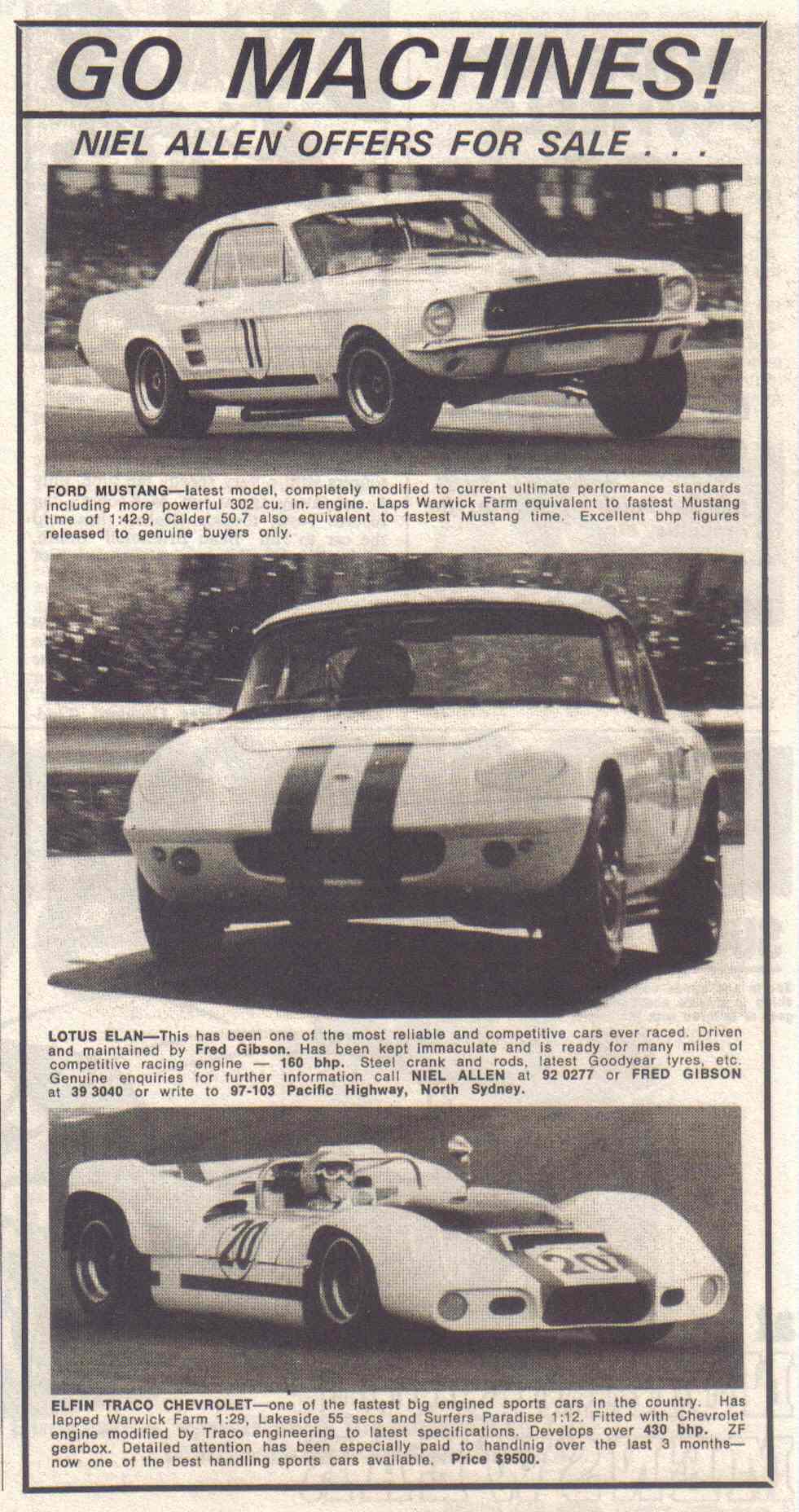
‘All the cars were put up for sale in the May 1974 edition of the ‘Racing Car News’, the A50 ‘001/2’ Gold Star/Australian GP winning car was advertised as a rolling chassis for $A3950. The A51 ‘005’ rolling chassis $5950 and the A53 ‘007’ rolling chassis $9750.

Matich the racer; he has the ‘faraway eyes’ on, pondering setup changes to get more speed from A50 ‘001/2’, McRae is setting the pace and their is a need to find more speed. Wigram, NZ 1973. (Shane Lee)
Conclusion…
When Frank Matich retired he was 39 years old and still at the peak of his powers as both a racer and constructor of racing cars. He was without doubt and objectively showed he was as quick as the world best in the sixties when he raced against them in equivalent cars.
His sportscars were the fastest in Australia and his F5000’s as fast if not in some years faster than the worlds best.
In that context he retired too early, Derek Kneller says the A54 was being concepted when FM retired.
Personally i like my heroes to retire at their peak rather than the back ‘of the curve’. If FM had not peaked he was perhaps close to it.
The family business was motor racing, FM’s wife Joan was very much involved from start to finish. Always very much a family man as well as ‘obsessively focussed’ as ‘successful racers’ are in any field of life, it was time to give his family of six the time now they needed and deserved, whilst continuing the businesses involved in motor racing if not the actual building and racing of the cars themselves.
FM was never far from the scene and Matich cars remained successful particularly in John Goss’ hands, he won the 1976 AGP at Sandown in A51/3 ‘005’ against much younger cars.
No longer with us, Frank Matich died on 11 May 2015. FM was a man of immense achievement, not without his faults mind you, and a great Australian.
I hope i have conveyed some of that.

Somehow this seems an appropriate photo to end this article. Very much a devoted couple, Joan and Frank Matich, car the McLaren M10B, here promoting their sponsors and the family business in Australian ‘Womans Day’ magazine in 1970. (Derek Kneller Collection: Australian ‘Womans Day’ 1970)
Etcetera…
‘Pitlane’ Interviews with Derek Kneller.
More Photos.

‘Winners are Grinners’, FM in 1972. (unattributed)

Matich A50 ‘003’, March 1972 before export to the US and the team which built it L>R; Jim Hunter mech, Scott McNaughton mech, Charlie Munro machinist, Henry Nehrbechi designer, Arcadia mech/fabricator, Bob Riley manager/mech, Derek Kneller chief mech, John Bug machinist. Missing is Bob Kube machinist. (Derek Kneller)

‘Council of War’ during the 1971 Tasman. L>R; Don O’Sullivan, John Cannon, FM and an unidentified fella. Car is Mclaren M10B Repco. (unattributed)

FM in his Brookvale workshop with A50 ‘001/2’. Nice detail of cars cockpit, dash full of Smith’s instruments and distinctive ‘half’ steering wheel. (Derek Kneller Collection)

Bibliography…
Australian Motor Racing Annual 1973, Manuscript from Derek Kneller, The Nostalgia Forum, John Smailes article in ‘Australian Motor Racing Annual 1972’, Graham Howard ‘History of The Australian Grand Prix’, oldracingcars.com
Photo Credits…
Graham Howard ‘History of The Australian Grand Prix’, Rennie Ellis, Stupix, Robert Davies, Jay Bondini, lyntonh, Derek Kneller Collection, Dale Harvey, Dick Simpson, oldracephotos.com, Facebook F5000 Group photo archives, Derek Kneller Collection, Shane Lee, Terry Marshall, John Ellacott, Wirra
Tailpiece…

FM atop both his tool of trade and ‘trading stock’. Both distributor and tester of Firestone and later Goodyear race tyres in Australia. Circa 1968. (wirra)
Other F5000 Articles…
Shadow DN6B Dodge.
Elfin MR8 Chev and James Hunt.
James Hunt: ‘Rose City 10000’, Winton Raceway, Australia,1978: Elfin MR8 Chev…
Finito…































 primotipo...