Posts Tagged ‘Graeme Lawrence’

(S Elliott)

Warwick Brown and the Wrightcars truck he used in New Zealand during his successful 1975 Tasman Cup campaign. He was the only Aussie to win the coveted series, shown here with Lola T332 Chev #HU27 at Pukekohe, where he won the NZ GP on January 12.

HU27 is the first T332 built, first racing in the opening Tasman round at Levin on January 6, 1974. Brown won the Adelaide 100 on February 24 and in so doing won the first of hundreds of in-period victories for the 332 and its many variants on every continent.

A very successful machine, Brown showed well in the US L&M F5000 championship in mid-1974 before coming home and proving the class of the AGP field before his Peter Molloy Chev broke a harmonic balancer. Then followed the Tasman in which he won two of the eight rounds in a very open year, five drivers won races.

Brown on the hop in HU27 in the 1975/Surfers Paradise Tasman round. He and mechanic/engineer/driver-whisperer Peter Molloy developed the car to a fine pitch in some US L&M races in mid-1974. Lola perves will notice the single-post supported banana-wing. Compare and contrast with the Lola factory fitment twelve months before (unattributed)
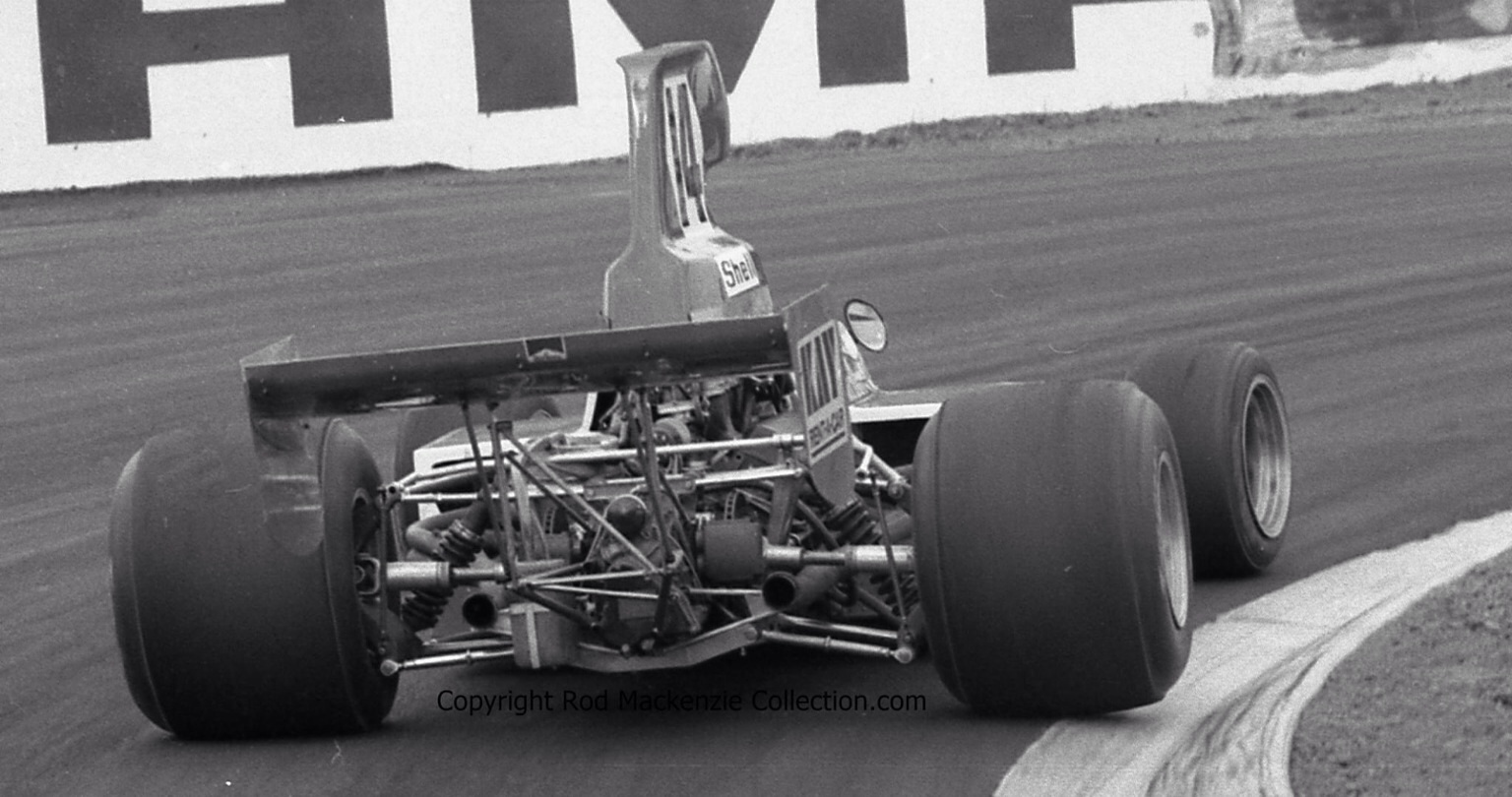
Brown during the February 1974 Oran Park Tasman round. Rear view of the early spec T332s-HU27 here. Compare and contrast with the Jones’ T332C further on. Car owned by Brown’s patron, Sydney businessman Pat Burke (D Harvey)

This article is largely an assemblage of factory/Carl Haas T332 information accumulated by Australian racer/restorer Jay Bondini who owned, restored and raced two T332s: HU43 ex-Carl Hogan and HU37 ex-Sid Taylor.

The Lola T330/T332/T332C/T332CS/T333 as a series of ‘same chassis’ related models are right up there as a contender for the title of ‘greatest production racing car’ – where greatest is defined as the most wins relative to production numbers.

Others that spring to mind are the Bugatti T35/T37/T39 series, Ralt’s RT2/3/4/5, the McLaren M7/M10 series and McLaren M8/8A/12/8B/8C/8D/8E/8F and Ford GT40 Marks 1-4 and more. Oh yeah, not to forget Lola’s own T70 series…it would be an interesting list to create and debate. One for another time.

For those unfamiliar with a T330, here is Max Stewart in HU1 ahead of Graeme Lawrence’s T332 HU28, both Chev powered, during the 1974 Sandown Tasman round won by Peter Gethin’s Chevron B24 Chev (B Keys)

Only 10 carryover parts from other model Lolas. No surprises there albeit most of the T330/332s I recall seeing in paddocks were fitted with Koni double-adjustable alloy shocks not Armstrongs.

Jongbloed 15-inch rear wheels became the-go later in ’74 from memory. So too, did the Chaparral type all-enveloping engine cowl/airbox, that turned a stunning looking car into the positively sinful: the T332C followed.

$US3,650 for a new tub in 1974 is about $US26,000 today. I wonder how much a new monocoque actually costs now from Lola’s designated chassis maker (who owns those rights these days?) or your favourite fabricator?

(C Parker Archive)

Alan Jones in Teddy Yip’s T332C HU61 Chev at Riverside in 1976, the final year of the US F5000 Championship before changing to 5-litre central-seat Can-Am in 1977…and further Lola T332 domination.

Chaparral were the first to do the enveloping engine cover/airbox on a T332. Apart from the body changes, the oil tank was moved, the roll-bar mounting changed and a central post rear-wing adopted. The later 332s also had the FIA mandated roll-hoop over the dash which had the byproduct of providing a bit more chassis stiffness.

See the letter from Chaparral‘s Jim Hall to Eric Broadley via Carl Haas explaining improvements to their car raced so successfully by Brian Redman in 1974-75 that allowed Lola to ‘productionise’ them as the T332C for 1976. Fascinating detail stuff of all the one-percenters that made a topline well funded outfit like Chaparral so successful: https://www.lolaheritage.co.uk/type_numbers/t332c/t332c.html

‘What are your three favourite racing cars Alan?’ I asked Jones at the Governor’s function before the 2023 AGP. ‘My F1 Williams FW07, the Lola T332, both the 5000 and Can-Am versions, and Alan Hamilton’s Porsche 935…’ was his response.

About says it all really, given his career spanned the mid-1960s well into the early-2000s and hundreds of different cars.

It’s not a factory drawing but is useful to show how wide and shallow the chassis of the T332 and T330 are. Note that, unlike the T300 chassis, the 330/332 used the engine as a semi-stressed member.

The flaw in the drawing – purportedly T332 – is that the rear suspension shows an inverted rear wishbone (T330) arrangement rather than the twin-parallel link set up used on T332s.

The combination of Lola Heritage’s website: T330 here: https://www.lolaheritage.co.uk/type_numbers/t330/t330.html T332 here: https://www.lolaheritage.co.uk/type_numbers/t332/t332.html and Allen Brown’s oldracingcars will keep you going for a while: the T330 is here: https://www.oldracingcars.com/lola/t330/ and T332 here: https://www.oldracingcars.com/lola/t332/

Credits…

Steve Elliot, Jay Bondini Archive, Dale Harvey, Chris Parker Archive, oldracingcars.com, Getty Images

Tailpiece…

(S Elliott)

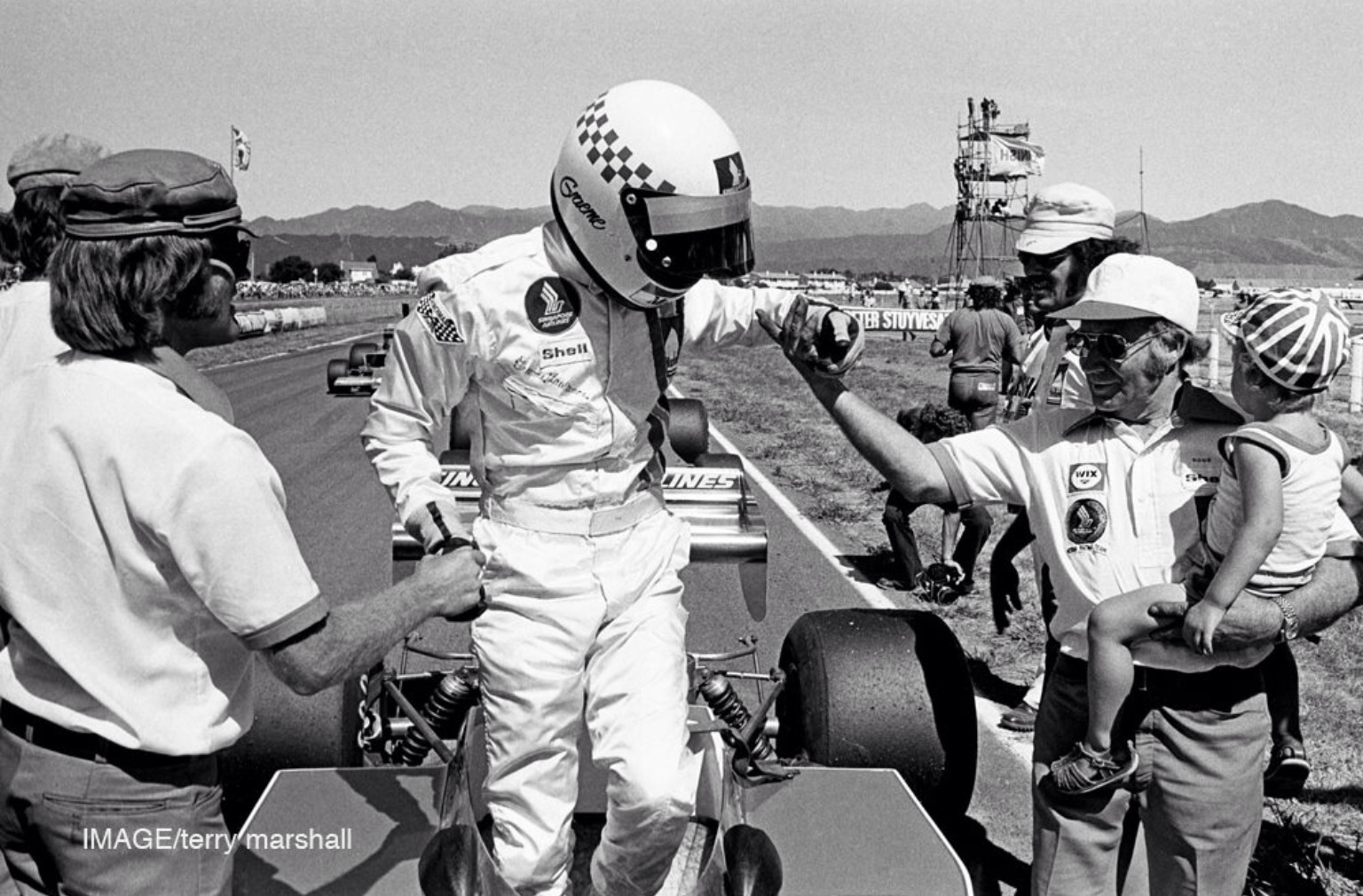
Graeme Lawrence in the second T332 built, HU28, from Max Stewart in T400 Chev HU2 during the 1976 Peter Stuyvesant New Zealand F5000 Championship.

Just love Steve Elliott’s shot above – a corker! – but I have no idea of the circuit, help please Kiwis!?

Lawrence, the 1970 Tasman Cup winner aboard an ex-Amon Ferrari Dino 246T, fought out the 1975 Tasman with fellow T332 exponents Lawrence, John Walker (T330 HU23 Repco-Holden was rebuilt around a T332 tub) and Brown.

The battle went down to the wire at the final Sandown round where WB prevailed after Walker lived-to-fight-another-day with a monster first lap accident and Graeme had problems. John Goss won the race in his Matich A53 Repco-Holden.

Lawrence won the 1975 NZ Gold Star in this car and was always a front-runner in Australasian F5000. You can’t mention Kiwi Lola exponents without recognising Ken Smith, who won the Peter Stuyvesant Series, NZ GP at Pukekohe, and the NZ Gold Star in 1976. A big year! His mount was an ex-Chaparral/Brian Redman Lola T330/2 HU8. He may still be having the occasional Lola steer in his eighties!

Max Stewart was pretty-handy in Lolas too. In T330 HU1 he won the Australian Grand Prix at Oran Park and the Gold Star series in 1974, then took another AGP victory in the wet at Surfers Paradise the following year in the T400.

Brian Redman in the Chaparral/Haas Lola T332 HU42 Chev at Riverside, the final round of the 1974 US championship on October 27. Mario Andretti won from Brian aboard…the Vel’s Parnelli Jones T332 HU29 (Getty Images)

Afterthought…

The fact that the first and second T332s built were sold to colonials allowed me to make this piece Australasian centric, not that I need encouragement.

But how can you write something about Lola’s T330/332 without mentioning Brian Redman, King of F5000 in its latter era? Earlier Monarchs were, arguably, Peter Gethin and Graham McRae, the latter gets bonus points for doing much of his work aboard cars of his own manufacture.

It’s not that Brian was a Lola F5000 man early on either. He had success in McLaren’s M10 and M18s and did all the early development testing of the Chevron B24 in mid-1972 together with Derek Bennett.

But when he decided F1 wasn’t for him and made US F5000 his primary programme, his partnership with the factory-Carl Haas/Chaparral team yielded a trio of championships from their 1973-76 F5000 partnership – subsequent short Can-Am programme duly recognised. He raced Lola T330s in ’73 and T332s from ’74-76.

Redman didn’t give a yard away to any of the Formula One Johnnies he raced with in Scuderia Ferrari’s 1972-73 World Sportscar Championship campaign aboard 3-litre flat-12 312PBs: Ickx, Andretti, Peterson, Schenken, Pace, Reutemann etc. Surely Brian was the best driver outside F1 at the time? Bias duly declared…

Finito…

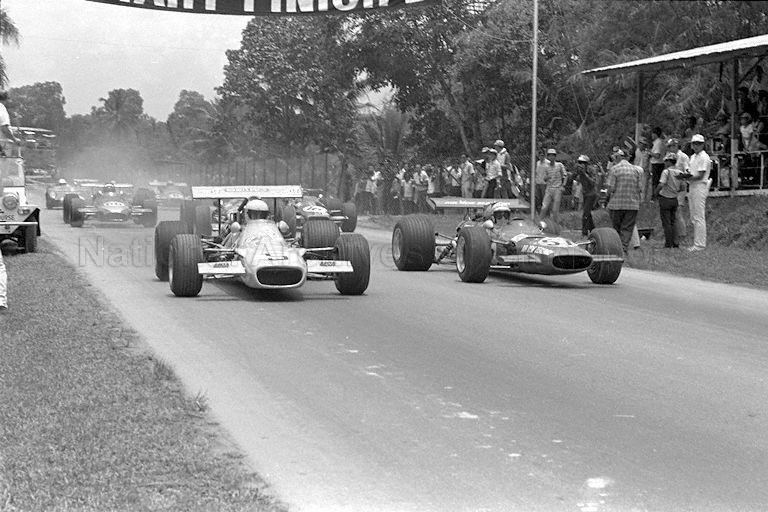
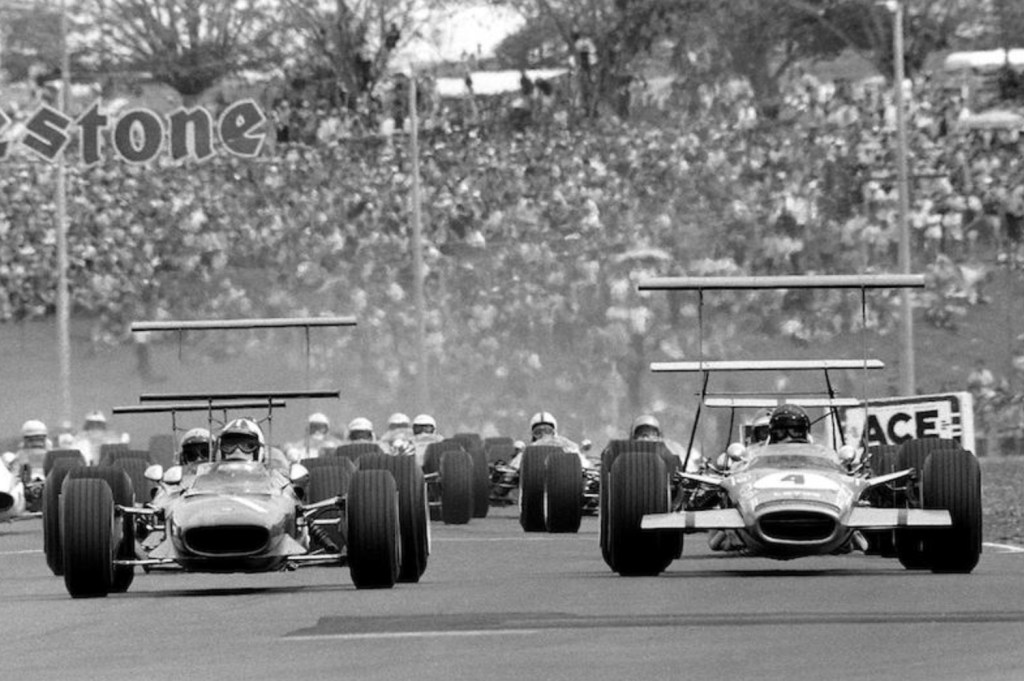
Kevin Bartlett and Graeme Lawrence at the start, Mildren Mono Alfa V8 and Ferrari 246T (SNL)

1970 SINGAPORE GP: THE FERRARI FROM THE ORIENT 

Why the Kiwis always get along with the Ferraris?

The history of Scuderia Ferrari in F1 and F2 has always been marked by being a team that rarely gives its “official” equipment to third parties. Ferrari single-seaters have always been known to race only under the aegis of Scuderia Ferrari itself. Even in more turbulent times, such as in 1961, when Giancarlo Baghetti raced a Ferrari 156 for both FISA and Sant’Ambroeus teams, there was always an attentive team of Ferrari mechanics on hand to take care of the car. Another case was the N.A.R.T., in the years 1964, 1965 and 1969; they were nothing more than fancy names for Scuderia Ferrari itself and its squad of mechanics and engineers.

We can name rare occasions when the scarlet cars were given to third parties and took part in races by this way: one of them was the British Racing Partnership/UDT-Laystall Ferrari 156, driven by Innes Ireland, in the XIV BDRC International Trophy of 1962; another was Scuderia Everest (the forerunner of Minardi) in 1976, which with a Ferrari 312T competed in the Race of Champions and the International Trophy.

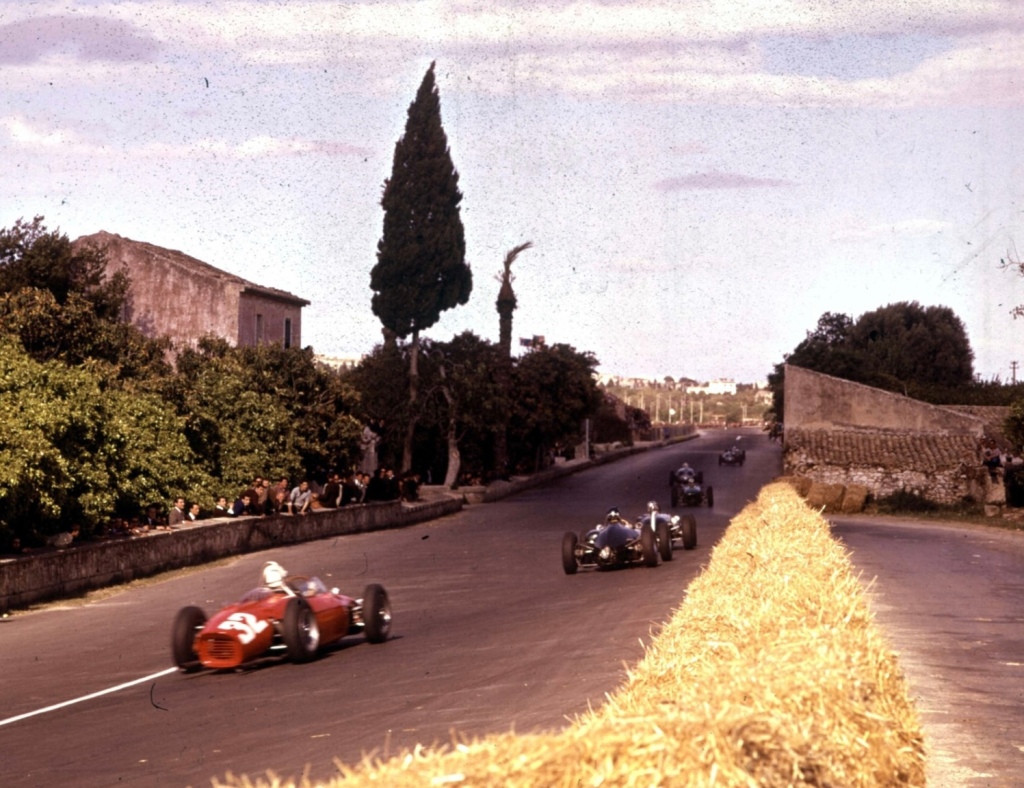
Giancarlo Baghetti, Ferrari 156 chases a BRM and Cooper on way to winning the April 1961 Syracuse GP (MotorSport)
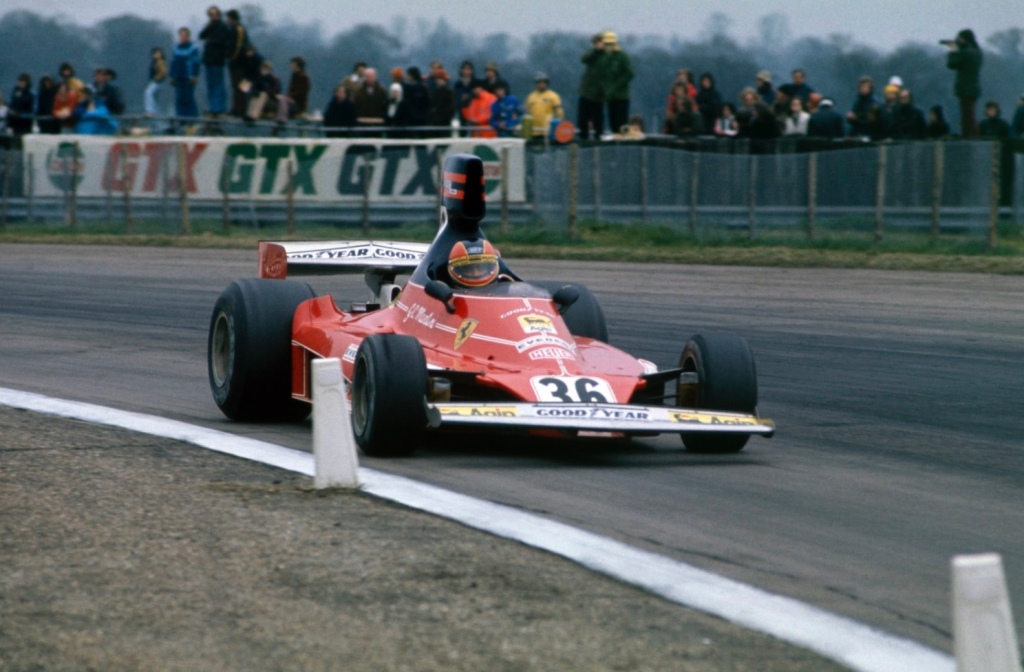
Giancarlo Martini, Ferrari 312T, 10th in the BRDC Intl Trophy, Silverstone April 1976 (MotorSport)

Moving on to categories below F1, we can highlight the Australian Scuderia Veloce. It was another one of those peculiar and picturesque stories that happened in motorsport in the 1960s and, who really stood out in the 1968/69 Tasman Series. Thereupon, stay tuned, because the real story of this text starts here.

But, as expected, without the support and protection of the Scuderia, most of these attempts ended in a resounding failure; we can credit this to the very complexity of the material, which required a team of technicians who knew how to put in motion an equipment as sophisticated as a Ferrari F1 car.

Perhaps one of the few successes reported by a single-seater Ferrari without being bankrolled by the Scuderia itself was due to the duo of Graeme Lawrence and his Ferrari 246T F2 Dino (the same Scuderia Veloce´s car from the beginning of the text – I’ve told you that the story started there). With successes in the main events of Southeast Asia in 1970, the pair proved to carry on the prestige of the Italian team.

The first example of the success of the partnership between the 246T and Lawrence came in the 1970 Tasman Series. This, which was the first edition in many years that did not feature the big European stars, opened the door for many smaller pilots and teams, mainly from the axis Australia-New Zealand, to have a chance to stand out.

And so it was with the New-Zealander, who, in the first race of the series, in Levin, already gave the first victory for the private Ferrari. And after a positive sequence of results in the next six races, the pilot would clinch the overall title of that season.

The next challenge would be the Singapore GP, which would take place at the end of March. The race, which was one of the most prestigious sport events in Asia-Oceania, always brought together the cream of the region’s pilots.

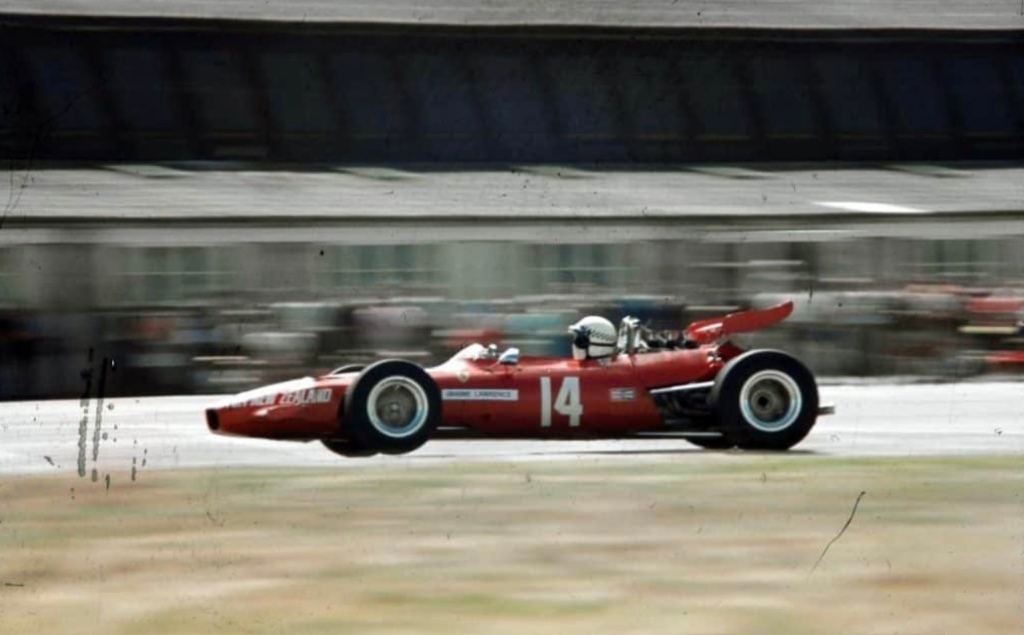
Graeme Lawrence, Ferrari 246T #008, during the 1970 Lady Wigram Trophy. DNF overheating in the race won by Frank Matich, McLaren M10A Chev (unattributed)
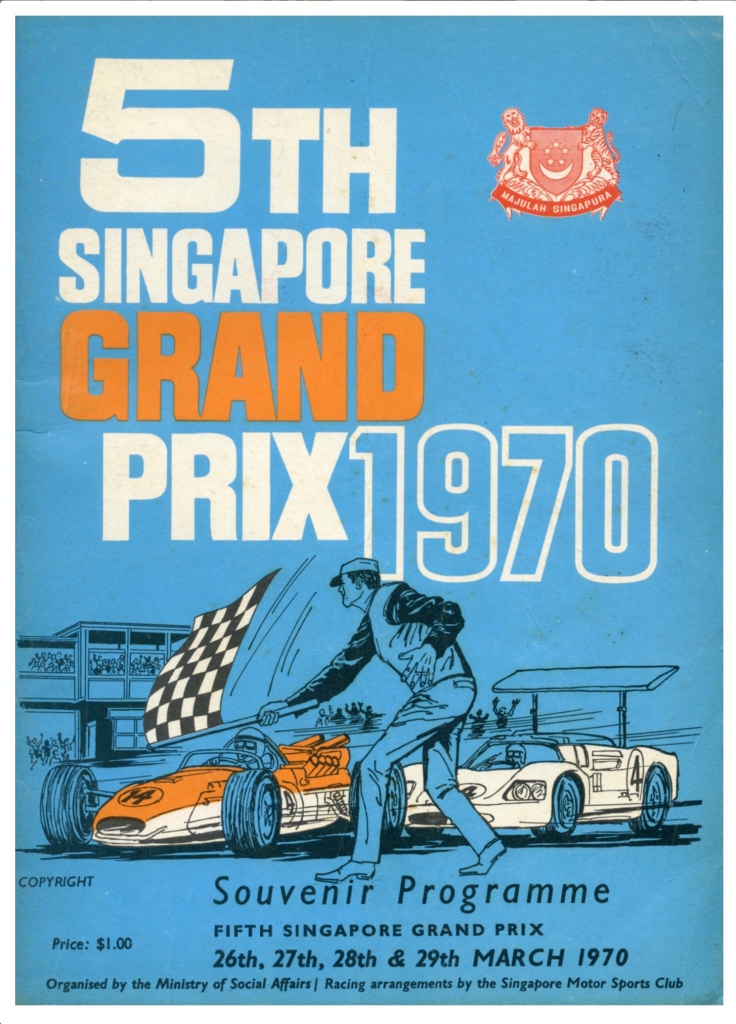
(progcovers.com)

1970 Singapore GP

Today, we always think about how F1 and F2 are almost interconnected categories, dependent on each other. Where one goes, the other’s circus usually follows. We also think about how F2 itself has gone beyond continental limits to become a global category – we have F2 races in Arabia, Australia, Azerbaijan – all of which form part of a unified international FIA Championship.

Well, the reality of the 60’s and 70’s was quite different. The F2 championships were as spread out as possible: there was one in Europe (which was considered “official”, in terms of historical classification); another two levels (of second tier single seater racing) in Oceania such as the Tasman Series and the Gold Star, which were a hybrid between the F1, F2 and, later, the F5000); several smaller tournaments in South America (such as the Argentine Temporada); and one in Asia.

The last one on this list was also one of the most peculiar: even though it was the most obscure, when it comes to the story itself, the racing season in Southeast Asia was made up of quite prestigious GPs, even for the time: for example, the Grand Prix of Malaysia, the Singapore Grand Prix and the internationally coveted Macau GP, were some of the races that made up the season.

For many pilots of Southeast Asia, this championship was the only opportunity that existed to compete in a real Grand Prix. Far from the magnitude and professionalism that took European motor racing by storm in the late 1960s, the GPs in Asia were almost a spectacular exercise in execution – but they were Grand Prixs, nonetheless.

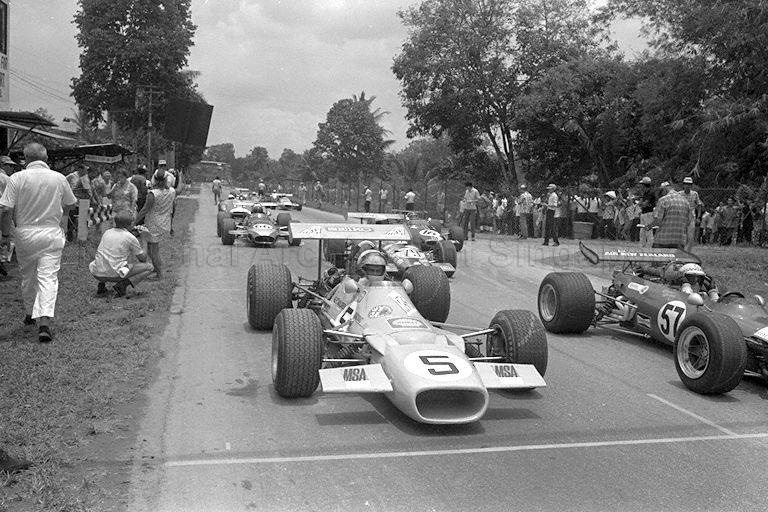
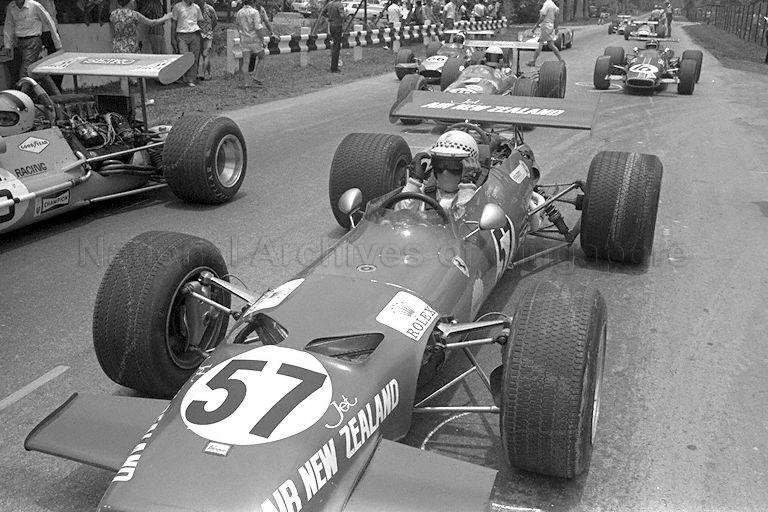
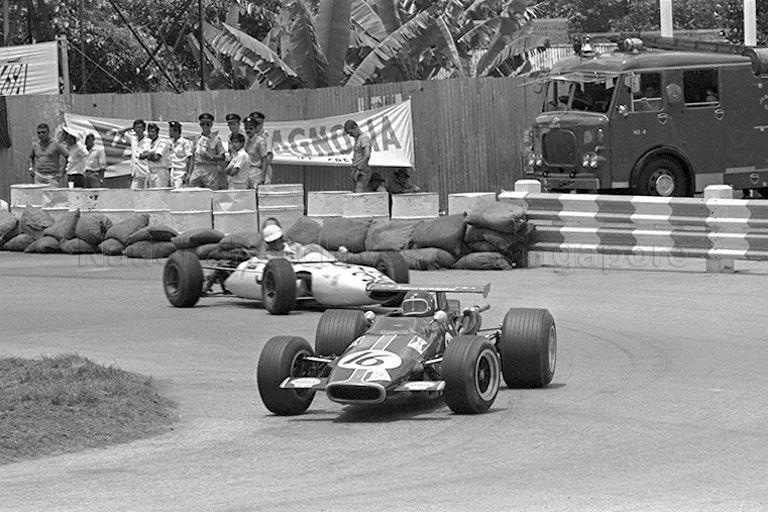
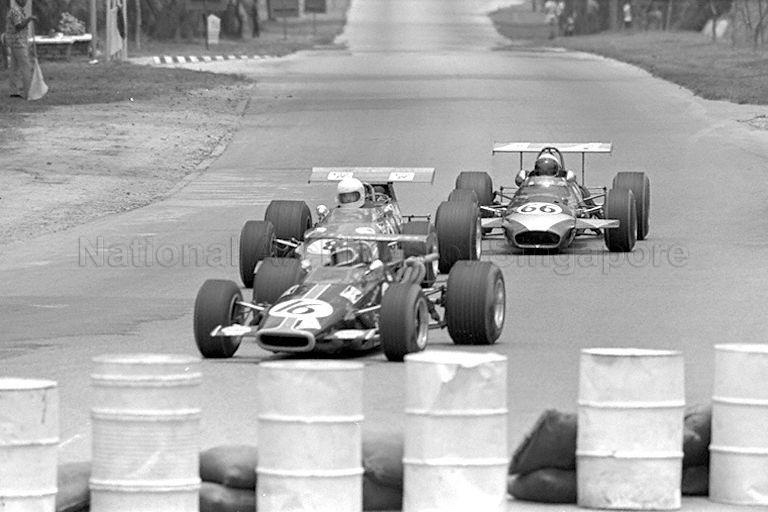
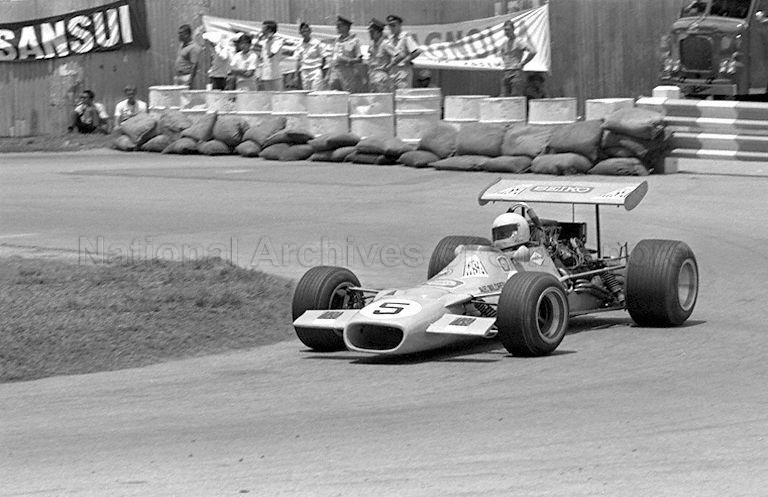
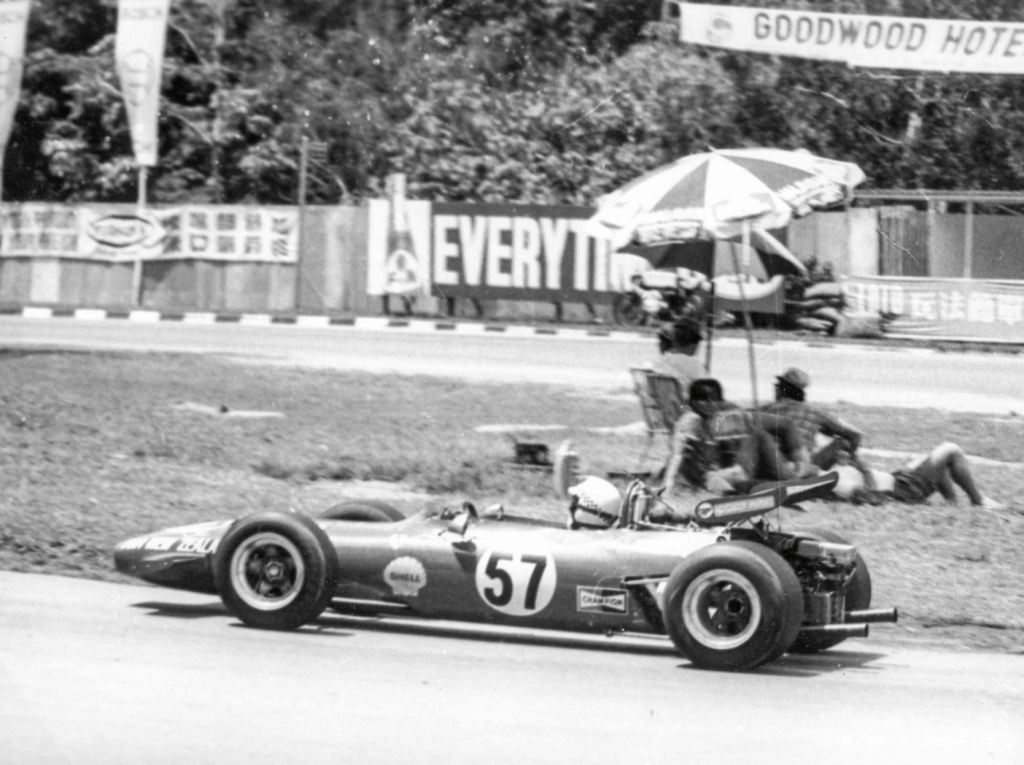
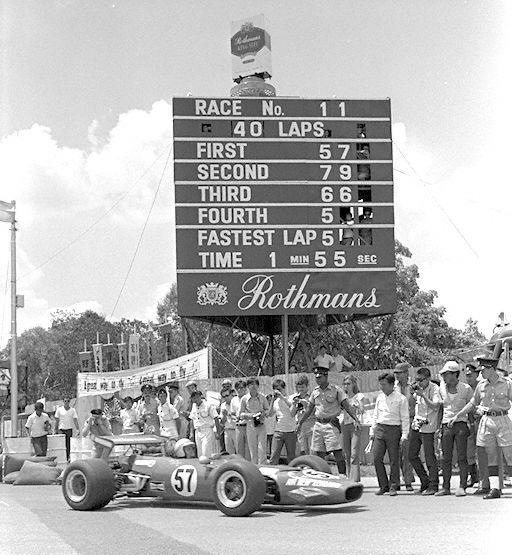
Bartlett and Lawrence on the front row with John MacDonald, Brabham BT10 Ford FVA, Hengkie Iriawan, Elfin 600C Ford FVA and Albert Poon, Brabham BT30 Ford FVA #66 behind. Lawrence won from MacDonald and Poon (SNL)
From the other side of the road (SNL)

The issue is that, even with the knowledge of the European teams about these races, there was no interest in sending representatives to compete in these GPs. Why? Well, we can draw some assumptions about it: first, to mention the commitment to European F2, which already drained a large part of the resources; the calendar, which conflicted with some of the big races in Europe; and, more obviously, the cost and logistical problems of keeping these complex cars in such precarious locations as those in Malaysia, Thailand or Singapore.

Therefore, it was up to the region’s drivers to fill the grids of these races. As varied as the origins, as there were drivers from Australia, New Zealand, Malaysia, Hong Kong, were the cars that made up these grids. Even though ‘theoretically’ qualified as non-championship F1 races, most of them took place under Formula Libre regulations. So it was common to see F2 cars, modified F3 chassis, F5000 and Tasman Specs competing with each other in the late 1960s and early 1970s.

Following this script, we set the stage to the 1970 Singapore GP. After the great balance of the Tasman Series, which ended just a month before, it was expected that a large contingent of drivers who participated in that series would also participate in what was one of the great automobile events of Southeast Asia. And a great show was promised, especially with the tone of revenge that was publicized by the press: would the runner-up of the Tasman Series, Frank Matich, give the payback on Graeme Lawrence?

And the lift-off over the Java Sea really happened. The main drivers to confirm their presence were Graeme Lawrence, Frank Matich, Kevin Bartlett and Albert Poon; in addition to them, another eighteen pilots were registered in the GP’s preliminary list.

The main attraction was, of course, the newly crowned Tasman Series champion (and also 1969 Singapore GP champion) Graeme Lawrence and his Ferrari Dino 246T Tasman. With chassis number 0008, this was the same car that was “lent” to Chris Amon to compete in the Tasman Series one year before.

By itself, this car already had a rather peculiar history. Scuderia Ferrari loaned two chassis to Chris Amon to compete in the 1969 season of the Tasman Series: the 0008 itself, in addition to the 0010. With this loan, conditions arrived: the first was to have another official Ferrari driver in the second car; and the chosen one was Derek Bell. Another point is that the car would not be officially managed by Maranello, but by Amon himself, for the duration of the championship – but the results achieved would be attributed to Ferrari. (The cars were entered by SEFAC Ferrari (oldracingcars.com), were managed on-the-ground by Amon and Scuderia Veloce and the cars tended by a mix of Scuderia Ferrari, Scuderia Veloce and Amon’s longtime friend and personal mechanic, Bruce Wilson.)

The cars themselves were basically the same as those that contested the 1968 European F2 season and the Argentine F2 Temporada later in the year, the biggest differences being the engine, modified to a 2.4 -liter Tasman, and the expanded power boost, up to 285 bhp. Even with these modifications, and the great results achieved by the car in the last races of 1968, Chris Amon had doubts if this would be enough in 1969. To his own surprise, it was, and Amon himself became champion of the 1969 Tasman Series.

After this victory, the car did not even return to Europe (I think it may have been rebuilt by the factory and returned to New Zealand-Mark). Amon handled the sale of chassis 0008 to Graeme Lawrence, who continued Ferrari’s legacy in Australia and New Zealand after the team announced that after the 1969 edition, it would not return to the Tasman Series next year.

Frank Matich and McLaren M10A Chev before the high speed accident (E Solomon Collection)
Hengkie Iriawan, Elfin 600C Ford FVA ahead of Allan Bond, car unknown (SNL)

Lawrence’s biggest challenger was the Australian Frank Matich, who had been runner-up in the 1970 Tasman Series (the difference between Matich and Graeme was only 5 points). He would drive a McLaren M10A, a car built to Formula 5000 specifications. With chassis number 300-10, the car would use a new 5-liter Traco-Chevrolet V8 engine. With strong sponsorship from the Rothmans cigarettes, Matich was arguably the main threat to Lawrence’s victory.

Kevin Bartlett was also another standout in the 1970 Tasman Series and was one of the big favorites for the race. Driving an English-built Mildren-Mono (nicknamed Yellow Submarine), he had achieved a string of good results earlier in the year, culminating in victory at Warwick Farm.

The last of the highlights was Albert Poon, a well-known driver on the Southeast Asian GPs, mainly for his appearances in Macau. Poon had one of the most advanced cars on the grid: the Brabham BT30. This model, which was one of the most used in European F2 between 1969 and 1970, would now have the chance to demonstrate its potential in the lands of the East.

Specifically, Poon’s car was an ex-Frank Williams, having been driven by Piers Courage and Richard Attwood in several races in Europe during 1969. At the end of that same season, the car was sold to Albert Poon.

Poon, Brabham BT30 Ford FVA at the Hairpin (unattributed)

The drivers began arriving in Singapore on March 25th. Upon arrival, the first concern was not about present events, but future ones. As a rumor circulated that the race would not be held the following year, and an appeal was made by the pilots: for the creation of a Grand Prix of South East Asia or a fixed series of races that could attract international interest.

Some participants even gave their opinion on the subject, such as Kevin Bartlett: “Most of them (pilots and teams) are not keen to spend big sums of money just for one race. If you have four held in a row, they will certainly be attracted”.

Frank Matich even suggested a union between the Australian Championship and this possible series of races in the region: “If the idea of ​​the Far East circuit failed, then Singapore should go ahead to arrange a series of three races with Malaysia. This could in time join the Tasman Series”.

But the great demonstration of what the cogitated South East Asian Grand Prix might be could only be given on the track; and on the 26th, activities began on the dreaded Thomson Road circuit. Right in the first track reconnaissance session, Graeme Lawrence made it clear that he would not give his opponents any chance. He pulverized the track record, set the previous year, lowering it by 1.8s, establishing a time of 1’57”8.

Iriawan leads Malcolm Ramsay, Elfin 600C Repco V8 and Poon along the Thomson Mile (SNL)

With less than a second difference and setting the second fastest time, came Kevin Bartlett and his Mildren Mono Alfa Romeo V8. And the dominance of the Tasman Series drivers did not end there, because Max Stewart, in a characteristic Mildren-Waggott 2-litre, managed to snatch the third position, closing a lap in 1’59”6 (same time as the 1969 record). With two drivers beating the track record and another equaling it, it was soon demonstrated that the 1970 edition would be one of the fastest in the history of the circuit.

And that speed almost proved fatal on the first day, when Frank Matich lost control of the car at more than 257 km/h and ended up in a tree, near a bus stop. According to what the pilot reported at the time, when leaving the first part of the Thomson Mile and going over the Hump, the car went out of control due to the track condition, which was extremely slippery as a result of a light drizzle that was falling on the circuit. Without being able to do anything, the driver simply became a passenger in his own car.

Fortunately, the pilot was completely unharmed from the accident; the same cannot be said of McLaren, which had the front almost ripped off due to the impact. At the time of the accident, the driver had the fifth best time, but the crash basically ended Matich’s chances of trying to duel with Graeme. It was now up to Rothmans’ team of mechanics to try to get the car in the best possible shape for the next day’s official time stamps.

The 27th arrived and with it, a phenomenon so common on the island of Singapore: the traditional tropical storms in the afternoon. Weather conditions became so adverse (even by local standards) that all activities on the circuit had to be cancelled.

Bartlett and Lawrence hard at it (SNL)

The one who was grateful for the downpour was undoubtedly Frank Matich, who had already accepted his fate of starting in the last position of the grid; but now, with one more day to prepare the car, the pilot believed that his mechanics could put the McLaren in conditions to dispute the victory again.

The 1970 Singapore GP would be held in 2 heats: the first, on Saturday (28), would be a more sprint race, with 20 laps. On the following day, Sunday, the other 40 laps would be carried out, making a total of 60. For the final result (and the title of Singapore GP winner), only the outcome of the second heat would be taken into account.

Some of the drivers were not very fond of this dispute format, mainly because it favored certain cars over others. For example, Albert Poon highlighted how his Brabham would have an advantage over the monstrous Australian engines, if the dispute was held in only one-full heat: “My car is specially fitted with a 21-gallon tank which is more than sufficient to last the race without refueling”.

Liking it or not, the riders lined up on the grid for the first heat. The starting order was defined by the times of the free sessions: therefore, Graeme Lawrence and Kevin Bartlett were the ones who opened the grid, followed by Stewart, Matich, MacDonald and Poon.

With the checkered flag lowered, the cars shoot off on the 4,865-metre circuit. It quickly became clear that the fight would be between the two Italian-made engines: Bartlett’s Alfa Tipo 33 2.5 V8 and Graeme’s Dino/Ferrari 2.4 V6.

But Graeme had a scare on the second lap, when the driver missed the braking point on the Range Harpin and ended up on a spin. Nothing to worry about, as both the car and the pilot emerged unscathed; so, Graeme resumed his hunt for Bartlett.

Ramsay presents an opportunity for Poon on the inside, Elfin 600C and Brabham BT30. The battle for third/fourth was won by Poon (SNL)

Right behind, a compact group was formed, involving Mike Heathcote (Singapore), John MacDonald (Hong Kong), Albert Poon (also from Hong Kong) and Hengky Iriawan (Thailand). On the second lap, these drivers would provide another one of the remarkable moments in the history of the Thomson Road circuit.

On the Thomson Mile (that’s right, almost in the same place as Matich’s accident), Mike Heathcote was trying to overtake Albert Poon. The Singapore driver, equipped with a 1.6-liter Brabham-Ford Twin Cam (Formula Libre), forced the overtake too much, skidding with the car and stopping only on trees that that dotted the sides of the circuit.

The car broke in two due to the collision, with the engine block disappearing in the middle of the dense forest that surrounded the track. Again, to the relief of the audience, the pilot left the accident almost unharmed.

As such accidents were common at the circuit, the race continued. Frank Matich, who owed a lot to the Rothmans team of mechanics, after the superhuman work of rebuilding the car in just two days, looked like he could get a reasonable finishing position in the Saturday heat race, to give all he could on Sunday. But that idea soon fell apart.

Bartlett with Lawrence right on his tail, then KB’s teammate, Max Stewart, Mildren Waggott, Iriawan, MacDonald and the rest (SNL)

On the third lap, the Australian faced his first problem, with a puncture. No big deal, this being quickly circumvented. But five laps later, a terminal problem spelled the end of any hope, as the engine gave its last breath and died.

Another one who was also struck by bad luck was Max Stewart: on the same lap that Matich made his tire change, Stewart’s Mildren-Waggott also refused to continue going forward, since his engine also had terminal problems. In the end, the pilot, who had scored the third best split time in mid-week practice session, had to abandon the race.

So with two of the top four drivers out of action, the battle for the victory would be decided between Bartlett and Graeme. Lap after lap, the duo pulled further away from the rest of the pack, with both lapping the rest of the grid.

With great skill, Bartlett used the power of the Mildren-Alfa V8 against the nimbler Ferrari. And so it was, managing to slowly open up an advantage, which reached nine seconds when the final checkered flag dropped. In addition to securing pole position for Sunday and relegating Ferrari to second place, Bartlett set a new track record: 1m55’8.

Iriawan in the Elfin 600C Ford FVA, car extant and currently being restored in Sydney (unattributed)

One lap behind, therefore, came the other classifieds: John MacDonald (Brabham-Cosworth FVA BT10/23C), Albert Poon (Brabham-Cosworth FVA BT30), Hengky Iriawan (Elfin-Ford Cosworth FVA 600C), Chong Boon Seng (Lotus-Cosworth 41) and Steven Kam (Lotus-Ford 23B Twin Cam).

But there was no time to celebrate and the next morning the cars lined up again on the starting line, for the race that would really define the winner of the 1970 Singapore GP.

The grid was slowly decimated by the fatigue of the long week that preceded this heat: among the drivers who did not show up on the decisive day, of the cars that were victims of accidents, mechanical problems and other failures, only 10 would start on Sunday. Even with this number much lower than expected, that did not stop the public from invading the Thomson Road circuit. According to some press reports at the time, there were about 100,000 people on the sidelines of the track on that Sunday morning.

Start, and the grid quickly pulverized into two small groups: Bartlett, Lawrence and Max Stewart (who had managed to fix his car overnight) took the lead, while MacDonald, Poon and the other drivers disputed the middle positions of the grid.

Bartlett led from the start and had a 3-sec lead from Lawrence when his Alfa V8 cried enough with 3 of the 40 laps to run (SNL)

In the first laps, Graeme Lawrence spun his car again. But, as if the script was repeating itself, it was nothing that affected the performance of the pilot. In less than five laps, the driver and his Ferrari had already reached the top two again; and on the tenth lap, Lawrence had already recovered the second position, when he overcame Max Stewart.

And Graeme’s momentum didn’t stop there. With the very strong race pace that was being set by Bartlett, the Ferrari became the only car that could catch the Mildren-Alfa. And so began the chase, which would last for most of the race.

Bartlett piled up faster and faster lap times, managing on the 27th lap to set a new track record: 1m55’5. Graeme answered, keeping close to the pilot of the Mildren.

Max Stewart sought to protect himself, accepting the third position – he didn’t have the car to compete with the leaders, but also, wasn’t threatened by the drivers that came further behind. But even going at a cruising pace doesn’t mean reaching the end of the race: during one of the laps, the pilot became distracted in the Long Loop, where lost control of the car and ended up in the middle of the trees. End of race and goodbye podium.

Graeme Lawrence on the way to another win in Ferrari 246T #008 (SNL)

So, the race was summed up between the Bartlett vs. Lawrence battle. And luck again laughed to the last. When the Ferrari driver had reduced the gap to less than 2 seconds, Lawrence saw when Bartlett had to pit, on the 37th lap. He didn’t know it, but the Australian’s Alfa engine had overheated, due to the sweltering conditions of the Singapore.

So, without competition and with only three laps to go, the driver had no trouble leading Ferrari to another victory (the second with him at the wheel, if you count his victory in Levin). Two laps behind came the drivers who would complete the podium: John MacDonald and Albert Poon, second and third, respectively.

Graeme Lawrence was crowned winner of the Singapore GP once again. The pilot had made a high stakes gamble on the race: according to what he told in an interview to The Straits Times a month later, he managed to take only one chassis and one engine to Singapore! Because of this, the pilot accepted second place in the first heat, and then waited for the opponent’s error (or car failure) in the second. We can say, apparently, that the strategy paid itself off in the end…

(SNL)
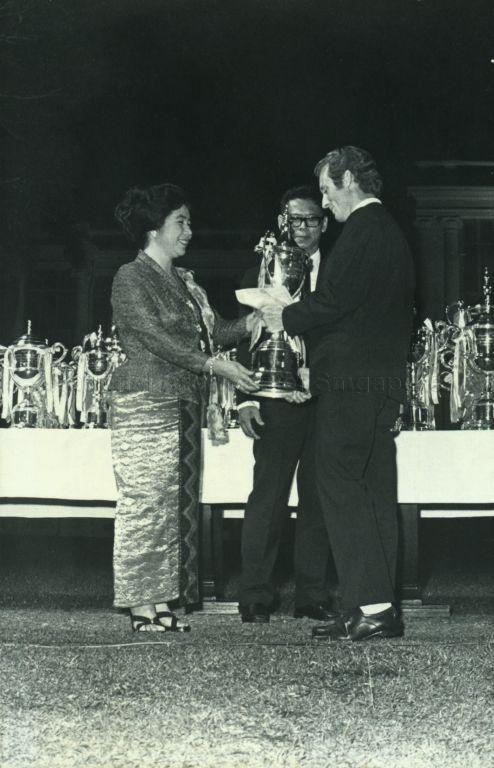
To the victor the spoils, Graeme Lawrence (SNL)
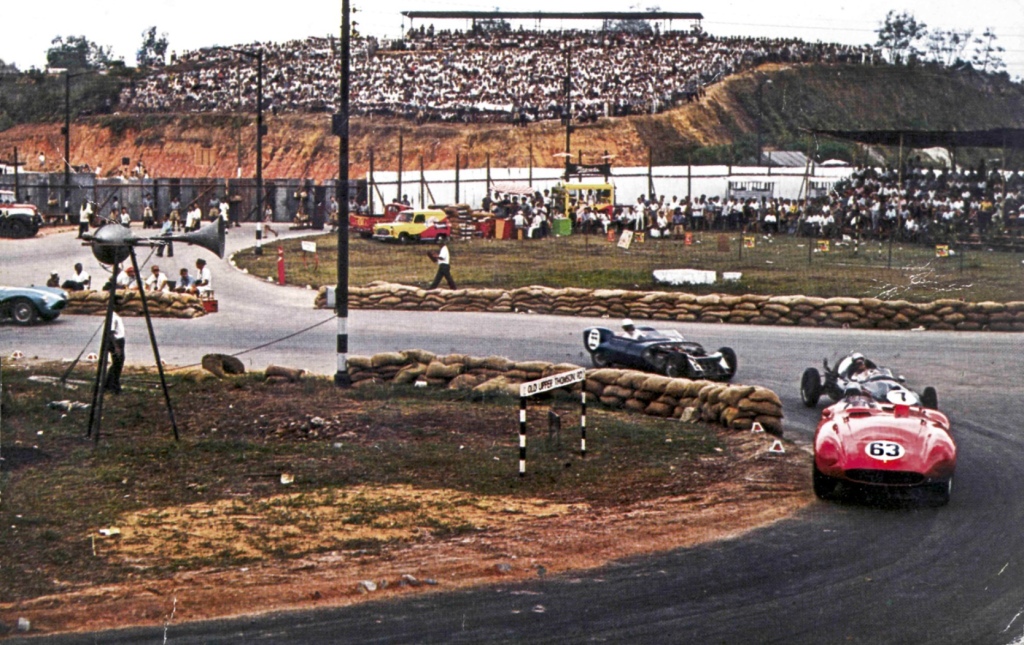
Jan Bussell’s Ferrari Monza leads the first Singapore GP in 1961. Giving chase are the Peter Cowling Cooper T51 Climax and Saw Kim Thiat’s Lotus 11 Climax. The nose of Ian Barnwell’s Aston Martin DB3S is at far left (E Solomon Collection)

Thomson Road : A distant memory in a forgotten past…

If the 1960s were marked by the technological development of competition single-seaters (mainly in F1, F2 and F3), we can say that the 1970s were marked by another transformation: the increase in concern about the safety of circuits.

Venues like Piccolo delle Madonie, Nurbürgring Nordschleife, Spa-Francochamps and many others would have a hard choice to make: adapt to the new times, or have to say goodbye to their racing times. While certain tracks did manage to make modifications that would guarantee a minimum of safety for pilots and spectators, others never reappeared. A major ‘purge’ ended up happening in the 1970s – nostalgic people can say that this was tragic for the history of motorsport; realists might say it had to be done, for the sake of the survival of the sport in a long-term. 

If the blow was hard in Europe, where a large portion of the tracks had traditional events, with sponsors and captive audiences, one cannot even imagine how this was felt in the most peripheral parts of the racing world.

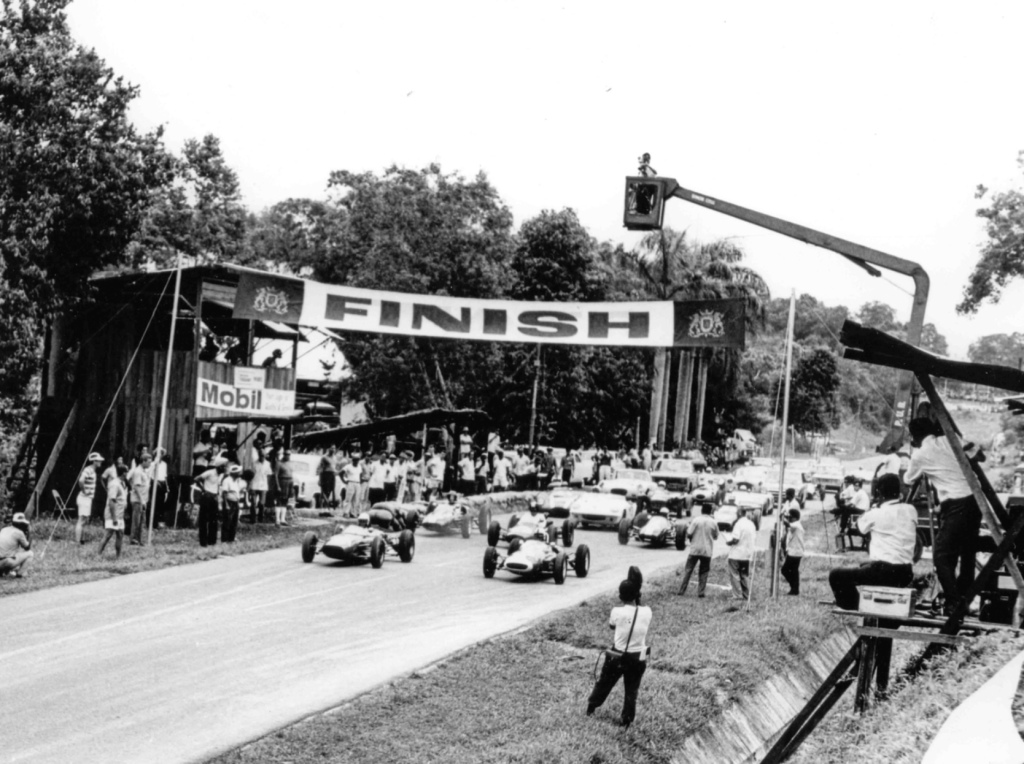
In this category is the Thomson Road circuit. Opened in 1961 for the Orient Year Grand Prix, it quickly became one of the most prestigious events in the Formula Libre racing series in Asia. When Singapore became independent, the venue gained even more prominence and importance, and in 1966 it was rebranded the Singapore Grand Prix.

Start of the 1966 race.eclectic mix of single seaters, sportscars and sedans including the pre-war ERA R2A (E Solomon Collection)
Rodney Seow ahead of the rest of the 1964 grid, Merlyn Mk5/7 Ford. The race was red-flagged after 7 laps (E Solomon Collection)

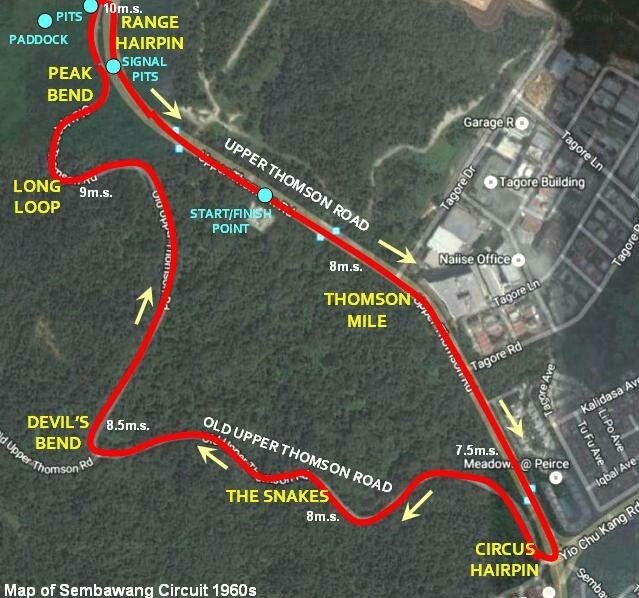
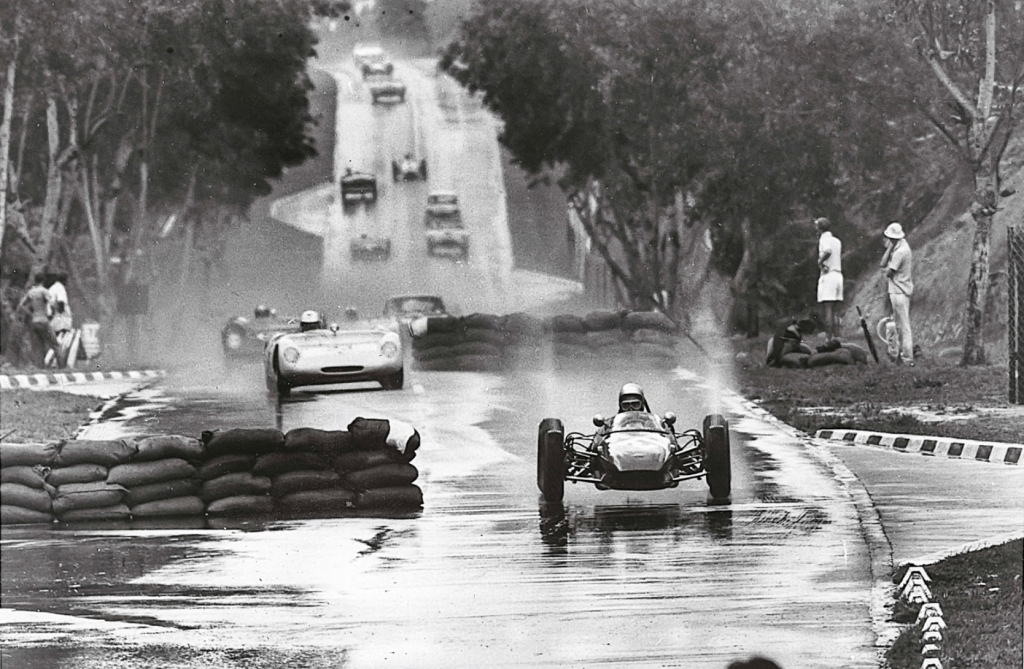
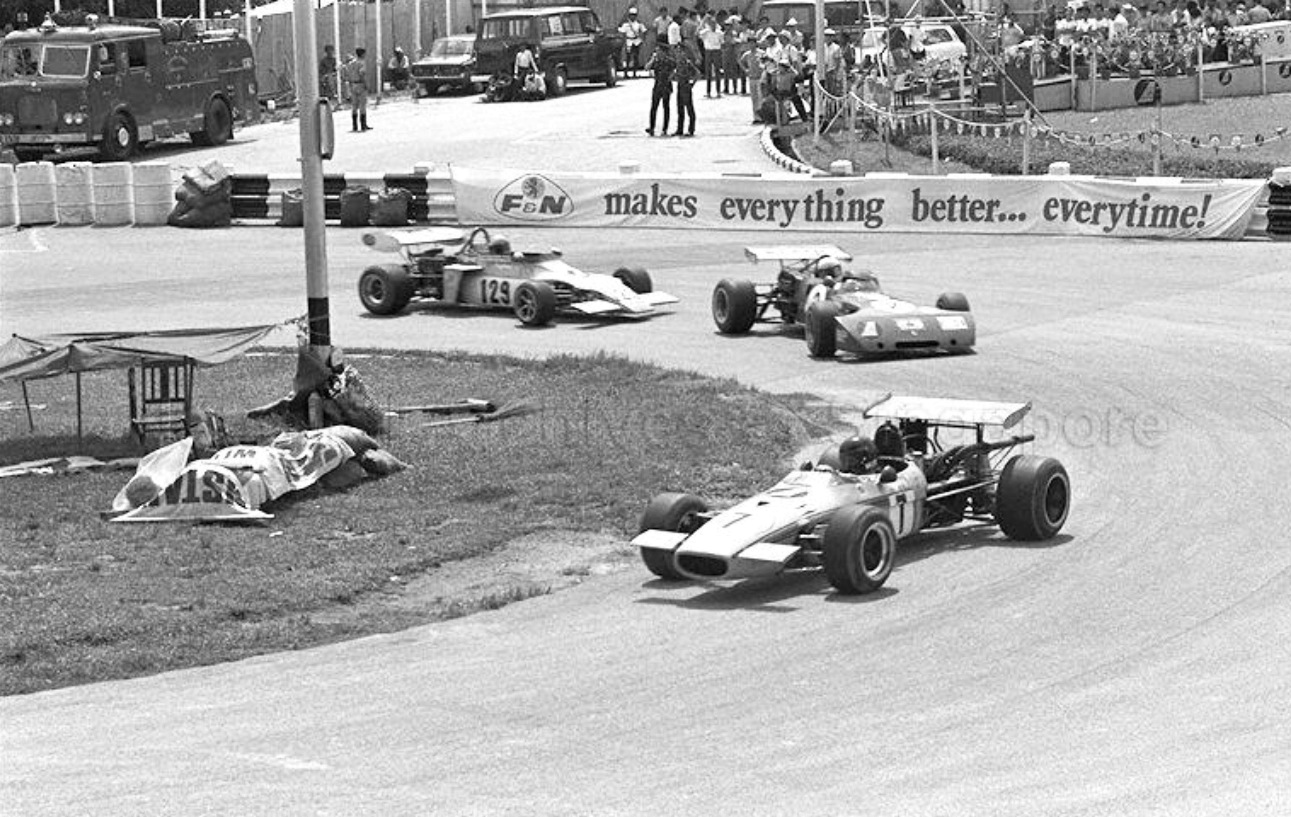
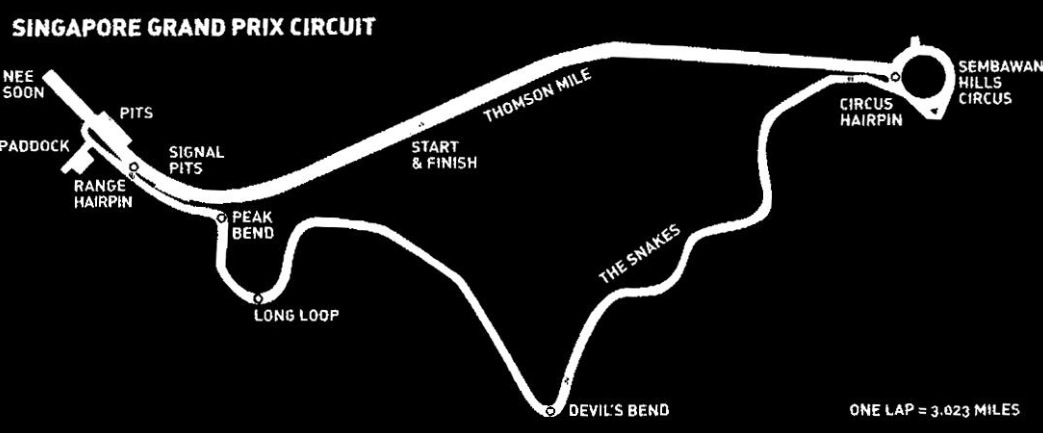
The circuit, just under 5km long, gained fame for its winding, fast and extremely dangerous layout. The track started at the Thomson Road (a.k.a. the Murder Mile), which is one of the most important roads in Singapore. The Mile was spilt in two, by the Hump, a fast right uphill turn, with a false apex on its turn-in. 

The second part of the Mile ended abruptly at an elbow, known as the Circus Harpin. After this turn, the drivers began a slight access, that led to the most sinuous part of the circuit: first the 4-sequence of bends known as The Snakes, then the Devil’s Bend curve; this was the entrance to another long radius turn, which was bound for the Long Loop and Peak Bend turns. After that, the pilot was almost at the entrance to the pits and at the end of the lap, which was outside the Range Harpin.

Racing at Thomson Road circuit lasted until the mid-1970s (the 1974 edition was canceled at the last minute), when it became clear that the track was woefully out-of-date compared to other venues in the region. In just 11 years of operation, 7 people died on the circuit – not mentioning so many other terrible accidents, in which pilots and spectators miraculously left unharmed or with only minor injuries.

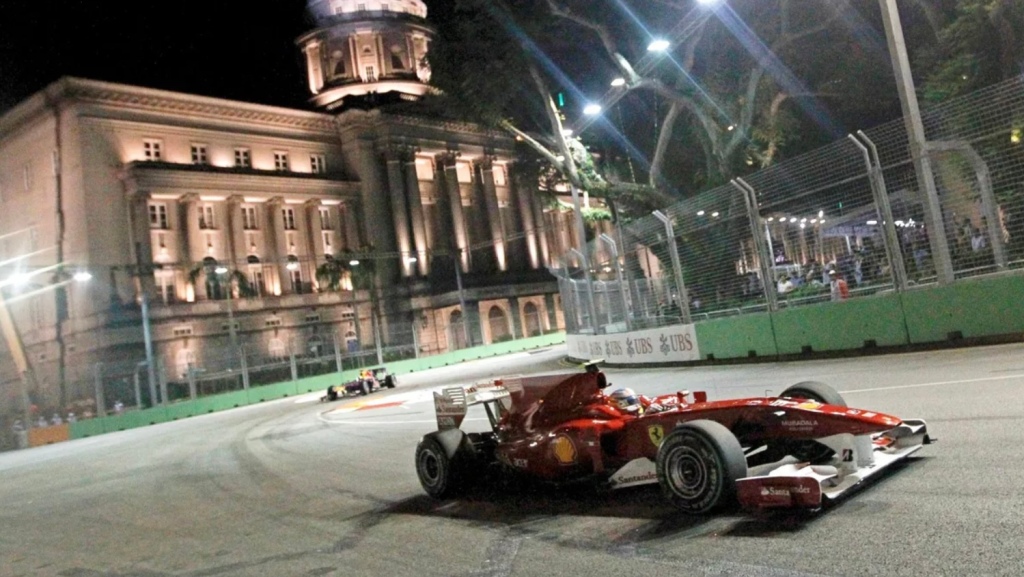
Thomson Road was a victim of its time and circumstance, like so many circuits of the past. Only 35 years later, a GP for single-seater cars would be held again in Singapore. And it would take 40 years (1970 with Graeme Lawrence / 2010 with Fernando Alonso) for a Ferrari to return to the highest place on the podium in the Island-State.

Fernando Alonso on the way to 2010 victory in a Ferrari F10 (eurosport.com)

Acknowledgments…

The Straits Times (editions from 24 March to 20 April 1970), The Eastern Sun (editions of 29 and 30 March 1970), Singapore National Library / NLB for the Photos, OldRacingCars.com for some extra data, ‘Snakes & Devil’s: A History of the Singapore Grand Prix 1961-1973’ Eli Solomon, MotorSport Images, Eurosport.com

Finito…

(MotorSport)

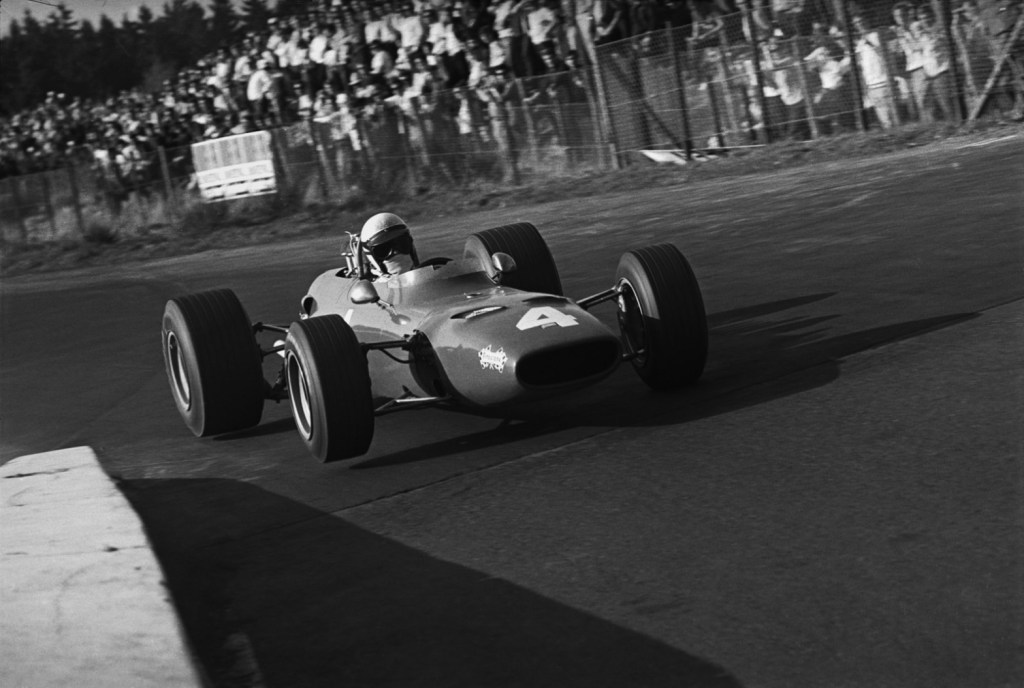
Yes, yes, yes, I know I’ve done these Dinos before many times. But I rather like the two photographs of the great Lancastrian, Brian Redman, racing Dino 166 #0008 in the XXXI ADAC Eifelrennen Euro F2 round at the Nurburgring in 1968.

That 21 April day was his Ferrari debut, Motoring News reported the sight of the great-Brit three-wheeling the car around the South Circuit’s turns as quite startling.

Redman finished a fine fourth despite a stop after his goggles were smashed, cutting one eye. Chief Engineer Mauro Forghieri was so impressed he telephoned Enzo Ferrari and recommended Ferrari contract him, an offer he turned down then. Later, Redman was a valued member of the Scuderia’s sportscar squad.

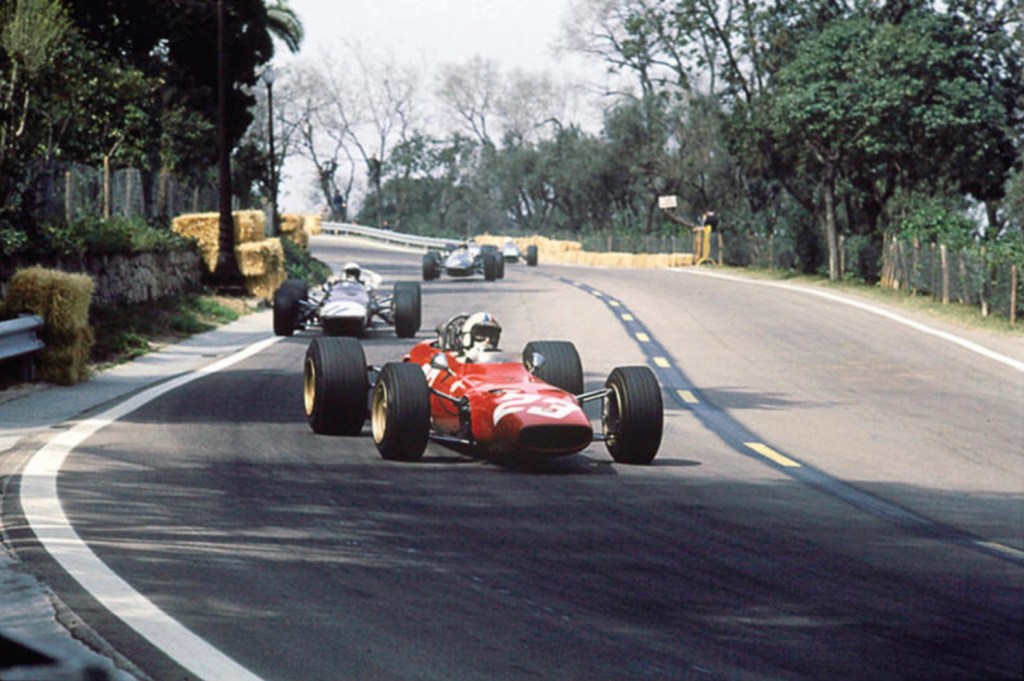
0008 was a new car for 1968. Chris Amon raced it at Montjuïc Parc, Barcelona on its March 31 debut, finishing third behind the Ford FVA engined Matra MS7s of Jackie Stewart and Henri Pescarolo.

Amon amid the trees and high speed swoops of marvellous Montjuïc Parc, behind is the #11 Lola T100 Ford of…Brian Redman, DNF engine (unattributed)

Amon raced it at Hockenheim in mid-June (eighth) before it was damaged in a multiple-car accident in the Monza Lotteria GP in June driven by Tino Brambilla.

Chris raced the repaired car at the Tulln-Langenlebarn airfield circuit in mid-July (classified twelfth) before Brambilla was third in a heat at Zandvoort, and bagged fastest lap. At Sicily in late August he was again third in the Mediterranean GP at Enna, this time behind F2 King Jochen Rindt’s Winkelmann Brabham BT23C Ford and Piers Courage’ similar Frank Williams entry.

Brian Redman three-wheeling on the Nurburgring in 1968 (MotorSport)

The little F2 1.6-litre Ferrari V6, even in four-valve spec, never had the legs of a decent Ford FVA four. Funnily enough, the 2.4-litre Tasman spec V6 gave very little away to the Ford Cosworth DFW, the 2.5-litre variant of Cosworth’s 3-litre DFV V8, GP racing’s most successful engine.

0008 was then prepared for the 1969 Tasman Cup, as part of a successful two car assault on the championship together with Derek Bell in #0010. As I’ve written before, Chris won the championship in fine style with 2.4-litre engines fitted – four wins of the eight rounds including the NZ GP – before selling the car to Graeme Lawrence who repeated the dose in 1970.

Graeme Lawrence on the hop during the 1970 Lady Wigram Trophy, DNF overheating #0008. (G Lawrence Collection)

Credits…

MotorSport, F2 Index, Graeme Lawrence Collection, oldracingcars.com

Tailpiece…

(MotorSport)

Chris Amon and Jochen Rindt, Ferrari 246T and Lotus 49 Ford, on the front row at Pukekohe, start of the New Zealand Grand Prix, first round of the 1969 Tasman Cup on January 4.

Amon won from Rindt and Piers Courage in Frank William’s Cosworth DFW powered Brabham BT24. All three were stars of the series, Chris won four races, Jochen two and Piers one.

Finito…

Alan Jones with his Teddy Yip Ralt RT1 Ford BDA, Macau 1977 (S Weaver)

Sue Weaver worked inside motor racing for decades. In the process she developed a friendship with Teddy Yip which yielded many fun times and trips to the Portuguese colony on China’s doorstep.

On each of those trips she took a swag of photographs. This article features some of them, an ‘Australian contingent mix’, with a focus on the November 20, 1977 weekend.

The Formula Atlantic race was won by young thruster, Riccardo Patrese in the Chevron B40 Ford later purchased and raced with success by Kiwi legend Ken Smith- later still Adelaide’s Peter Whelan restored it, historic-raced it for some years before its acquisition as a Macau Museum exhibit.

Riccardo Patrese during practice, Chevron B40 Ford BDA. It is in this part of the track that Jones spun and was hit by Riccardo during the race
Teddy Yip and Vern Schuppan, Macau. What year folks? Didn’t these fellas have some fun and success in F1, F5000, Indycars and F Atlantic/Pacific? The most important of the South Aussies patrons/sponsors, BRM leg-up duly noted (S Weaver)

That year Patrese and Alan Jones were Shadow F1 teammates. Riccardo was entered in Macau by Bob Harper, Jones by Teddy Yip, both these fellows were the region’s traditional monied entrant protagonists.

Jones ‘tore the place apart’ the year before in the Yip March 722 raced often by Vern Schuppan – he constantly broke the lap record after an early engine cut-out. Jones then fired the engine up, carved his way back through the field, only to have the engine again fail- Vern Schuppan won a Ralt RT1 Ford.

In 1977 Patrese popped his Chevron on pole by a couple of seconds from Jones with Vern Schuppan third in John McDonald’s Ralt RT1. Kiwis Steve Millen, Chevron B35, and Graeme Lawrence, March 76B were fourth and sixth on the grid, Masahiro Hasemi was fifth in a Chevron B40 Nissan, with Kevin Bartlett, March and Andrew Miedecke, March 763/76B seventh and eighth.

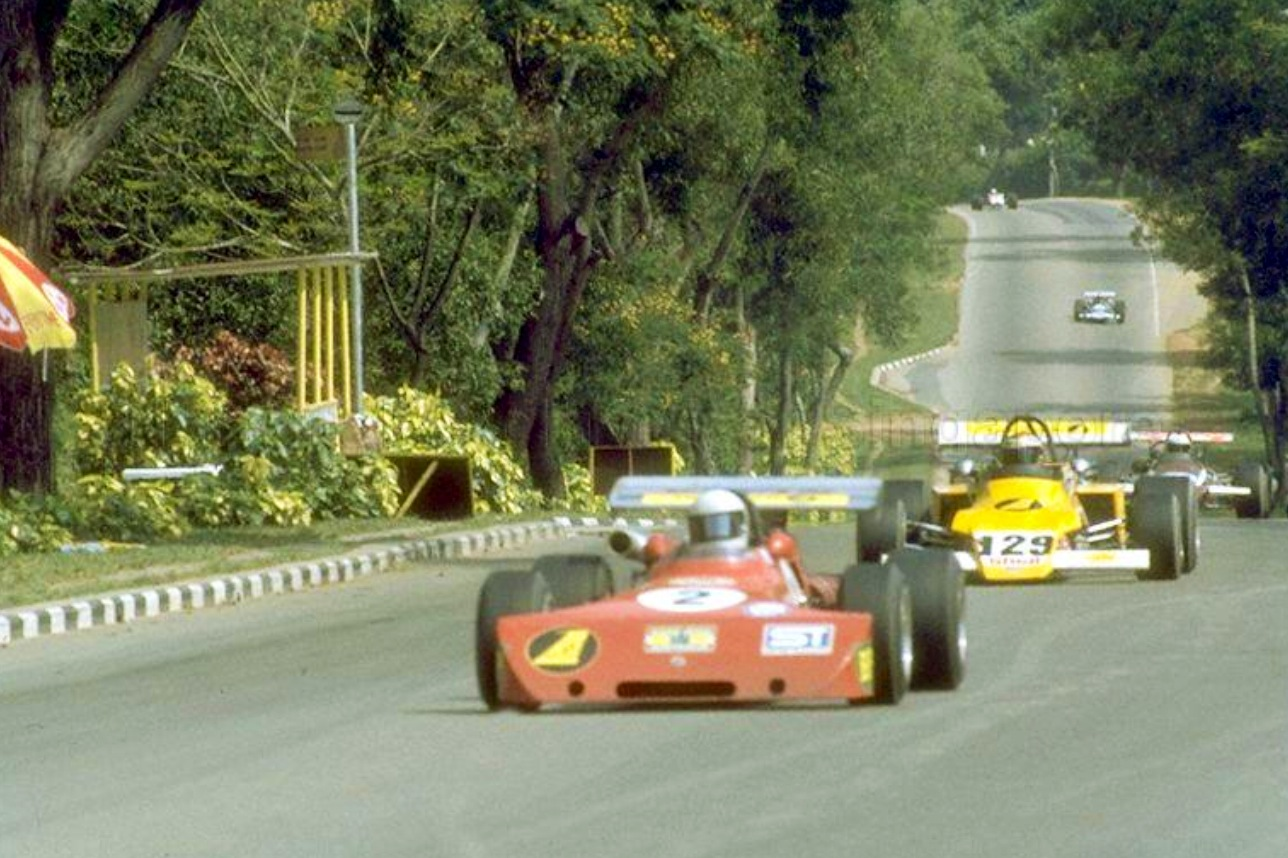
1977 Macau GP grid. Patrese, Chevron B40 left on pole, Jones, Ralt RT1 #2 then the nose of Schuppan’s Ralt RT1. #19 Millen, Chevron B35 and #5 Masahiro Hasemi, Chevron B40 Nissan. Row three Graeme Lawrence, March 76B with Bartlett’s red March (?), then Andrew Miedecke #4 March 763/76B. Car #23 is Albert Poon, Chevron B40, with Nakajima’s #7 Nova Honda alongside. And the rest, engines Ford BDA unless specified otherwise (unattributed)

The Jones boy blasted away from the front row, but his lead was short-lived after another engine cut-out resulted in his Ralt spinning into Patrese’s path.

Riccardo vaulted over the hapless Jones, damaging a rear wheel – he pulled into the pits for inspection and was sent on his way. Concerned officials popped out a black-flag, but this was withdrawn after entreaties from the Harper pit that the wheel, whilst bent a tad, would be AOK.

Graeme Lawrence, March 76B Ford BDA (Getty)
Kevin Bartlett and Howden Ganley. Year folks? (S Weaver)

Hasemi then led from Schuppan, just as Vern seemed set to pass his fuel metering belt broke. Millen then led from Bartlett, the 1969 winner, and Lawrence, but Patrese was on a charge and led by lap 15. He drove off into the distance.

Millen, then Bartlett were second for a bit but, but Bartlett and Lawrence both retired with mechanical dramas – Millen was second, Miedecke third and future Lotus F1 driver, Satoru Nakajima fourth in an Nova Honda.

Satoru Nakajima, Nova Honda, ’77 Macau GP
Jones and one of the Yip crew, probably 1978 (S Weaver)

Etcetera…

(S Weaver)

KB tries to decipher the mandarin on the nose of Jones’ Yip March 782 Ford BDA during the 1978 race weekend. Bartlett raced a Chevron, what model KB?

Kevin Cogan’s Flying Tigers Ralt RT1 alongside? Who is the big unit talking to Jones? Yip at far right. Driver in front of the RT1 in the posh Linea-Sport overalls?

Jones started from pole and led until a spark-plug failed. Derek Daly then had a comfortable lead from Keke Rosberg and Patrese, but pitted for tyres, Patrese inherited a lead he kept to the end.

The Formula Pacific Macau GP era was marvellous…

(S Weaver)

Jones again during the ‘78 weekend above, with British broadcaster, Dickie Davies.

The shot below is during Schuppan’s Rothmans Porsche years, so early eighties- the West End beer logo should assist you detectives as to the year.

Teddy Yip mechanic/helper Ashok Vadgama at left, KB and Vern.

(S Weaver)
(S Weaver)

AJ looks pretty well-nourished here, so perhaps it’s a tad after his single-seater days, with wife Bev and Yip.

And below, KB slightly peeved at Weaver interrupting his choice of main course.

(S Weaver)

Credits…

Susan Weaver, Getty Images, Riccardo Patrese web-page, ‘Colour and Noise: 40 Years of the Macau Grand Prix 1993’ Philip Newsome

Tailpiece…

(S Weaver)

Jones about to mount before the off in 1977, Ralt RT1 Ford BDA- John Chatterton at right, and Julian Randles leaning into the cockpit. Car #71 is the Ian Grey Chevron B20, the Rothmans car behind is Graeme Lawrence’ March 76B.

Finito…

(T Marshall)

Bryan Faloon, Rorstan Mk1a Porsche during the 1971 New Zealand Grand Prix weekend, at Pukekohe, it’s practice, he didn’t race due to gear selector problems, twelve months hence he died in this car…

Its strange the stuff buried in the back of your head. This racer and car are a couple of fragments of my earliest racing memories.

By the summer of 1972 I was a motor racing fan even though I’d never been to a race meeting. My heroes were Kevin Bartlett and his Mildren Yellow Submarine, and Graeme Lawrence’s Ferrari Dino 246T- these attachments came via magazines.

Finally, I attended the Sandown Tasman meeting, the Australian Grand Prix that year. In anticipation of the big day, I was keeping a close eye on my heroes Tasman progress via press reports,  Sandown was the second last of the eight rounds.

KB was going well in an ageing McLaren M10B Chev. The ex-Niel Allen 1971 NZ GP winning car was doing its third Tasman, but Bartlett picked up points in three of the four rounds including a splendid wet weather win at Teretonga, before heading back across the Tasman to Surfers Paradise, for the first Australian round.

Things were not so hot at Team Lawrence however.

Graeme had a new Lola T300 Chev – arguably THE F5000 car of 1972 (McRae GM1 duly noted) – so he looked a good bet to take on Hailwood, Gardner, Matich, McRae and the rest of the hotshots in the best cars. The machine was assembled in NZ, an initial sortie at  Baypark yielded a first race win, and a DNF later in the day with fuel feed problems.

At the Pukekohe, NZ GP Tasman Cup opener he started sixth on the grid, about a second aft of McRae’s Leda GM1 Chev on pole. He went right to the back of the field on the first lap when his feet and pedals got tangled in the tight Huntingdon tub, and ran on at the Lion Hairpin, or copped a tap up the chuff, depending upon the race account- he let the field go and then started a long climb back through the field.

Up front, Frank Gardner’s works T300 took a lead he didn’t relinquish. By lap 52 Graeme and John McCormack, Elfin MR5 Repco had been in a torrid dice for 20 laps in a battle for eighth, and it was then that an awful racing accident occurred involving poor Bryan Falloon and Graeme, shown below.

(T Marshall)

Bruce Sergent described the accident thus “…Coming up the back straight on lap 52 Lawrence was slip-streamimg McCormack while Falloon, seeing the red Elfin bearing down on him, pulled to the left at the kink to let him through. At the same split second, Lawrence pulled out of the slipstream to pass McCormack, and ran into the back of the Stanton-Porsche at 155mph.”

“The Stanton was launched headlong into an earth safety barrier, taking to the air before crashing down onto its wheels again. The Lola was cartwheeled down the track, totally disintegrating on the way. The Stanton looked intact while the Lola was totally wrecked. The head injuries Falloon sustained in the impact proved fatal. Lawrence suffered broken legs, wrists and concussion.”

Back in Australia, I read about the high speed accident which befell Graeme and Bryan. Whilst relieved Lawrence would survive, it was the first time I realised this racing caper sometimes goes horribly wrong.

So, that incident and Bryan Falloon’s name have been in the back of my brain for decades. This batch of photos took me straight there, whilst I’ve seen a couple of photos of the T300, I’d never seen a photo of the Rorstan aka Stanton Porsche before, what an interesting car it was too.

Rorstan Racing was a partnership of quarry and truck fleet owner Ian Rorison, and Tauranga car dealer Feo Stanton. They had run a number of older cars for a variety of drivers for years, Bryan took the ride prior to the 1970 Tasman.

The car was one of eleven chassis built by Bob Britton on the Brabham BT23 jig he created when asked to repair the ex-Denny Hulme Brabham BT23-5 Ford FVA  F2 car destroyed in another awful Pukekohe crash in 1968. Denny collided with local racer, Lawrence Brownlie, destroying Brownlie’s Brabham, causing him grievous injuries and ending his career prematurely, but not instantly. The prang was one many regard as not exactly Hulme’s finest moment.

The Rorstan Partners bought the Brabham wreck sans engine and sent it to Sydney for repair. They received back a new BT23 copy they called Rorstan Mk1, chassis number ‘RMR1’ to which they initially fitted a Coventry Climax FPF 2.5-litre four cylinder engine.

Britton’s own copies were called ‘Rennmax BN3’, Alec Mildren’s a ‘Mildren’. Whatever the name, the cars were built by Britton at Rennmax Engineering on the ‘BT23-5’ jig.

Australian enthusiast/historian Terry Sullivan wrote an interesting story on the Rorstan Partners cars and drivers on ‘The Roaring Season’, click here; http://www.theroaringseason.com/showthread.php?1824-RORSTAN-TASMAN-SERIES-RACER

For 1969, Rorstan engaged Jim Palmer to drive the machine on the basis that it was to be powered by a 2.5 litre Repco V8. He exited stage left when it became apparent that the car was to be Climax FPF powered- its days were long since past as a competitive Tasman engine.

Dennis Marwood then took the drive. With prior Cooper T66 Climax experience in 1966-1967, he was well aware of the challenge. He achieved little in the way of results, retiring from the Levin and Wigram rounds. He too decamped, out of the fat and into the flames one might say, in the shape of a fairly agricultural old F5000 Eisert JE67 Chev owned by Ian Rorison.

Bryan Faloon was then approached to drive the Rorstan Climax. He  had experience of the demanding 2.5-litre cars aboard an old ex-Stillwell Brabham BT4 Climax in some 1968 and 1969 NZ Tasman rounds. Bryan struggled against a 1970 field of good depth and breadth- a fast mix of 2-litre, 2.5-litre and 5-litre cars.

He was seventh and tenth at Wigram and Teretonga, with DNFs in the other two rounds, both due to engine problems at Levin and Pukekohe.

Graeme Lawrence, Ferrari 246T, Max Stewart, Mildren Waggott, Kevin Bartlett, Mildren ‘Yellow Submarine’ Waggott and then Bryan Faloon, Rorstan Mk1 Climax at the Levin hairpin 1970- Lawrence won from Stewart and Frank Matich, McLaren M10A Chev (T Marshall)

Without funds to buy a new car, the Rorstan partners parted ways. Feo Stanton then looked at alternative, more competitive engines, and decided upon a Porsche flat-eight from Alan Hamilton, racer and head of Porsche Cars Australia – from that point the car was known as the Stanton 1 Porsche.

Alan picks up the story “We assisted Feo Stanton in the purchase of the Type 771 eight-cylinder engine from our Porsche 906 along with a large amount of spare parts.”

“The type 771 engine was developed from Porsche’s attempt at Formula 1 participation. They first modified an
RSK sports car to be a central seater for the then new Formula 2, still using the 1.5-litre four-cylinder quad-cam engine. This car then developed into an open-wheeler F2 car with the cooling system modified to a horizontal fan on the air-cooled four-cylinder engine.”

“In the meantime, Porsche were working on a completely new 1.5-litre, eight-cylinder engine to use in the new F1. Dan Gurney won the French GP, and the GP of the Solitude (a non championship race) with this car/engine combination, known as the Porsche Type 804.”

“Whilst the 1.5-litre version of the engine was retired into history, it spawned the development of its bigger sisters in 2- litre and 2.2-litre capacities. These engines were very successful winning in both under 2-litre, over 2-litre and prototype categories.”

“My original ‘Bergspyder’ 906-007, ran at the Targa Florio as a 2-litre, eight-cylinder prototype, finishing second overall.”

“These engines in both 2 and 2.2-litre capacities were used in the Type 907. It should be remembered that in those days, our premier formula was F5000, but the regulations also provided for cars with pure race engines of a maximum capacity of 2 litres.”

(T Marshall)

“Bobby Britton did all the chassis modifications necessary to fit the engine. The engines were quite complex being the
ultimate development of the original four-cylinder, quad-cam Carrera engine. Just the setting up of the bevel gear drive camshafts took a long time. The factory used to allow about 240 hours to assemble an engine from scratch.”

“I’m sure that the first race for the car was at Sandown, and some of my staff and I joined Feo’s team to watch practice. Bryan Faloon was Feo’s accomplished driver and we all watched as Bryan commenced his first laps. At the start of the second or third lap, a great plume of oil smoke belched from the car as it went past the old pit area between Shell Corner and the start of the back straight. We all kept thinking that Bryan would see the smoke and stop, but the trail continued up the back straight, around Dandenong Road corner and onto the main straight, continuing into the paddock area.”

“My specialist mechanic, Eddy Hackel, quickly removed the oil filter and found it full of bearing material. There was a quick conference, with confirmation that we had spare bearings etc, and the decision was made that Eddy and I would try to rebuild the engine in time for the race.”

“Porsche racing engines were not only air cooled but also oil cooled. They circulate a vast amount of oil compared to conventional race engines. Not only were the oil pipes between the engine and the cooler too small, they had also not been swaged. These restrictions had caused the oil hoses to dislodge from the steel tubes. Never having had any experience with this type of engine, Eddy and I managed to totally dismantle and reassemble the engine overnight, and get it back to Sandown in time to be put in the car for the race. I have no recollection of what happened in the race or even if the car raced at the meeting.”

The car missed the first 1971 Tasman round at Levin, had gear selector problems prior to the NZ Grand Prix and failed to start- and also missed the last two rounds at Wigram and Teretonga. That is, it was entered but did not start.

Hamilton, “Subsequently, in the 1972 NZ Grand Prix, Bryan, driving the Stanton Porsche and Graeme Lawrence, driving an F5000, collided, with Graeme sustaining critical injuries. Bryan’s car finished up in the in-field, somewhat out of sight over a rise. When rescuers approached, it was clear that Bryan was dead, probably from the first impact with Graeme’s Lola, the engine was still running and the nose of the car was buried into a bank and a tree.”

“I obtained the damaged car from Feo Stanton as I wanted the engine and transmission. The chassis went to a friend of mine who wanted to rebuild the car to it’s original condition, before the Porsche installation. The damaged body was given to ‘Women For Wheels’ for fire-fighting practice.”

“And finally, what happened to the engine? In the rebuilding of the engine after the Sandown incident, Eddy and I discovered that it was really a 2.2 litre-unit with around 285 hp. This engine, complete with the type 907 transmission, was sold to Pat Burke who had purchased the Bingham Cobra, my original 906-007 1965 Targa Florio factory Porsche.”

“Pat had also purchased from me, a new 771 engine, but without the air cooling ducting, the whole of the fuel injection system, exhaust system, generator and distributor. Pat had sent the Bingham Cobra to Bill Bradley Racing to restore 906-007 back to its Targa condition, and now there were original engines available to complete the restoration. Pat had the restored car at one of the Adelaide F1 meetings before it was sold overseas.”

Follow this link for an article about Alan Hamilton and his Porsche sports-racers; https://primotipo.com/2015/08/20/alan-hamilton-his-porsche-9048-and-two-906s/

The story/summary of all of the Rennmax BN3s, inclusive of the Rorstan is told here on Allen Brown’s oldracingcars.com; https://www.oldracingcars.com/rennmax/bn3/

Bryan during the 1972 NZ GP weekend, Pukekohe (T Marshall)

Etcetera…

(S Dalton Collection)

Donn Anderson’s tribute to Bryan Faloon from the February 1972 issue of ‘Motorman’.

Photo and Other Credits…

Terry Marshall, Rorstan Racing thread piece by Terry Sullivan on ‘The Roaring Season’, oldracingcars.com, Classic Auto News, Stephen Dalton Collection

Special thanks to Alan Hamilton for his recollections

Tailpiece: Rorstan Climax…

(T Marshall)

Terry Marshall captures Bryan in a nice Rorstan Mk 1 Climax slide during the 3 January 1970 Levin Tasman round- DNF engine after 25 of the 63 laps, Graeme Lawrence won in his Ferrari 246T.

Bryan was a talented driver. With the Stanton Porsche better sorted it would have been fantastic to see what he could have achieved in New Zealand that summer of 1972. Very sadly, at 28 years young, the planets and gods were not aligned in his favour on January 8.

Finito…

(autopics.com/DBlanch)

The field on the first of 85 laps- the ‘Angus and Coote Diamond Trophy’, Gold Star Championship second round, Oran Park 26 June 1971…

Kevin Bartlett, McLaren M10B Chev from Max Stewart, Mildren Waggott TC-4V, Graeme Lawrence, Brabham BT30 Ford FVC 1.9 and then the dark helmeted Henk Woelders in his Elfin 600E Ford twin-cam- the first of the 1.6 litre ANF2 cars.

The 1971 Gold Star was an interesting one in that both 2 litre ‘race engines’ and F5000’s contested the championship- whilst F5000 cars were eligible for the Tasman Cup in 1970 and 1971- that year was the categories first in the domestic championship.

On the face of it perhaps the favourites at the seasons outset were Frank Matich and Kevin Bartlett in ‘match fit’ McLaren M10B’s. FM’s Repco Holden powered car was the ‘same car’ he and his team had continually evolved for eighteen months whereas KB’s chassis was the machine Niel Allen had raced in the 1970 and 1971 Tasman Series- beautifully prepared by Peter Molloy it was ready to boogie. Other F5000’s were Alan Hamilton’s brand new M10B- Allen’s spare chassis built up and sold when Allen retired from racing, and John McCormack’s Elfin MR5 Repco which appeared for the first time mid-season, at Sandown in September.

The quickest of the Waggott 2 litre TC-4V powered cars were Max Stewart’s Mildren and Leo Geoghegan’s Lotus 59B but Leo’s car was for sale so the reigning Gold Star champion contested few 1971 meetings.

Kevin Bartlett leads Max Stewart and Graeme Lawrence early in the race- KB appears to be running plenty of wing (L Hemer)


Gary Campbell and Tony Stewart in Elfin 600B/E Ford twin-cams inside Doug Heasman, Rennmax BN3 Ford (R Thorncraft)

It had taken until 1971 for the Tasman Cup to fall to an F5000- Graham McRae won it in an M10B whereas in 1970 Graeme Lawrence’s 2.4 litre Ferrari Dino 246 took the title, other Tasman 2.5 and 2 litre cars had been competitive amongst the 5 litre V8’s- the expectation was that an F5000 would win the Gold Star but Max Stewart’s fast, reliable Mildren Waggott won it with a win at this meeting- Oran Park and strong placings elsewhere to score 23 points to Bartlett and Hamilton’s 22 points each.

Bartlett was fast everywhere- he won the Governors Trophy Lakeside opening round- was on pole with Max at Oran Park, won the non-championship (that year) Hordern Trophy at Warwick Farm, and the Victorian Trophy at Sandown a week later but had the wrong tyres, that is, no wets at Symmons Plains where they were rather necessary, and blew an engine whilst leading at Mallala giving the new Elfin MR5 Repco its first title win in the hands of John McCormack. Mac would do very well with this car in the next two years on both sides of the Tasman Sea.

Max niggling away at KB- the big V8 blasted away on OP’s long straight but otherwise the little Mildren- Max’ car for 2 years by then was mighty quick elsewhere on the circuit (L Hemer)


(Peter Houston)


And again albeit by now MS has lost his right-front wing- did he ping one of KB’s Goodyears to do the damage? (L Hemer)

Matich’s campaign fizzled away too. The team missed the opening round at Lakeside as they were successfully campaigning the McLaren in the US- the team raced at the first two US F5000 Championship rounds in California, winning at Riverside with a pair of seconds in the two heats and were second at Laguna with another pair of seconds in the heats behind David Hobb’s M10B Chev.

Back home at Oran Park FM ran foul of another car earlier in the week doing enough damage for the team to build a new chassis- they did this rather than buy one from Trojan to give them valuable experience in advance of construction of FM’s new monocoque chassis Matich A50 Repco which would win the AGP later in the season upon its debut race from pole.

Matich leading a couple of cars through Laguna Seca’s Corkscrew on the 2 May 1971 weekend, McLaren M10B Repco (D Kneller)

The Matich McLaren was ready for the third round at Surfers in late August winning from pole. He started the Victorian Trophy at Sandown from pole but retired with blocked fuel-injection slides- KB won. With no chance of winning the title the team missed the final two rounds at Symmons and Mallala to focus on completion of the A50.

Alan Hamilton was impressive in his first year racing these demanding cars, whilst he came back to the machines in the late seventies it is a pity he didn’t persevere then whilst in ‘his youth’ and when the class could have done with another well prepared frontish of the field car- Warwick Brown or rather Pat Burke bought this car giving Warwick’s career a big kick-along in 1972 of course, the machine prepared by Peter Molloy.

Another big guy being monstered by a little one- Alan Hamilton, McLaren M10B Chev and John Walker, Elfin 600B Ford (L Hemer)


A couple of dicing Elfin 600s trying to stay clear of the Bartlett-Stewart express right up their clackers onto the OP main straight- Clive Millis from Tony Stewart (T Coles)


Graeme Lawrence’s nimble Brabham attacks Col Hyam’s Lola T192 Chev- note the sidepods fitted to the car by Gardner (L Hemer)

At Oran Park Max won from Graeme Lawrence’s visiting Brabham BT30 Ford FVC and Hamilton’s McLaren, Bartlett retired with his differential pinion stripped- the good ‘ole Hewland DG300 transmission was always marginal for F5000 use unless its maintenance was entirely up to snuff. The gearbox was originally built for F1 in 1966- for Dan Gurney and Jack Brabham when both the 3 litre Repco V8 and Eagle-Weslake V12 had far less than 500 pounds foot of torque tearing away at its gizzards…

F2 honours went to Henk Woelders who was fourth in an Elfin 600E- the dominance of this car in ANF2 at the time indicated by the fifth to ninth placed cars being Elfin 600B’s raced by Tony Stewart, Jack Bono, John Walker (soon to jump into an Elfin MR5), Vern Hamilton and Don Uebergang.

Henk Woelders’ Elfin 600E chasing Vern Hamilton’s 600B (L Hemer)

Etcetera…

(P Houston)

Melbourne racer Colin Hyams jumped into the big league with the acquisition of the works Lola T192 Chev Frank Gardner campaigned in the Tasman Cup that summer- FG did well in it too, taking a win at Warwick Farm and finishing fourth in the overall pointscore. Colin retired at Oran Park with gearbox dramas.

(L Hemer)

Gary Campbell’s Elfin 600B/E Ford, chassis ‘7122’ worked hard that year raced by both the Sydney ‘Provincial Motors’ motor dealer and Larry Perkins to whom he lent the car for a successful attack on the Australian Formula 2 Championship.

(L Hemer)

Alan Hamilton’s McLaren M10B ‘400-19’ despite ostensibly a 1970 model F5000 was brand new given its very late build into a complete car by Peter Molloy and sale to Hammo. As many Australian historic enthusiasts know, all these years later AH owns both his old car and the Allen/Bartlett chassis ‘400-02’- the wheels of which have been twiddled by Alfredo Costanzo until recent times.

(L Hemer)

John Walker in his 600B chassis ‘7018’, by this time the following year he was racing the fourth and last built Elfin MR5 Repco ‘5724’ in which he made his race debut in the last, Adelaide International round of the 1972 Tasman Cup in February 1972- the start of a mighty fine F5000 career in Australasia and the US inclusive of an Australian Gold Star and Grand Prix win in 1979. He was seventh at Oran Park 6 laps adrift of the front-runners with undisclosed dramas.

(P Houston)

Bartlett always raced with passion, lots of fire and brimstone and bucket-loads of natural brio. Lucky bastard.

KB pedalled the car through the 1972 Tasman inclusive of a Teretonga round win amongst much more modern metal and then did a US L&M round or two in it before racing Lola T300’s in both Australia and the US that year.

Credits…

Special thanks to Lynton Hemer, whose great photos inspired this piece

autopics.com- D Blanch, Russel Thorncraft, Tony Coles, Derek Kneller Collection, Peter Houston, oldracingcars.com

Tailpiece…

(L Hemer)

Max Stewart accepts the plaudits of the crowd on the warm-down lap- by June 1971 Alec Mildren Racing was well and truly disbanded but such are the bonds between driver and entrant that Max still carries Alec Mildren Racing signage and Seiko continued to provide financial support to Max into his first F5000 foray with an Elfin MR5 Repco in 1972.

Finito…

(J Saldanha)

This Macau Grand Prix has always had the exotic allure of the east for me.

The artwork by Joao Saldanha depicts Hong Kong’s John Macdonald, one of Macau’s stars, winning the 1973 Grand Prix aboard his Brabham BT40 Ford, he is approaching the Lisboa Hotel right-hander at the end of the straight.

Joao comments that ‘The British driver from Hong Kong is  the only one to have won the Macau GP in the events three categories, the Grand Prix (1965, 1972, 1973 and 1975), the Motorcycling GP (1969) and the Guia Touring Car Race (1972) which granted him the “King of Macau” title…’

I remember reading about Macau in the publication which got me interested in motor racing, the ‘Australian Motor Racing Annual 1969’ of Kevin Bartlett’s win in the Mildren ‘Yellow Submarine’ Alfa Romeo V8 and thinking how cool it would be to race in Australia and up in Asia.

One minute board is up Macau GP 1969. Kevin Bartlett, the winner at left in the Mildren Alfa V8, John Macdonald, Brabham Ford FVA and O Masuko, Mitsubishi Colt F2C- the Colt behind is S Kato, #66 is Albert Poon, Brabham BT30. Bartlett won from Poon and Kato  (SCMP)
Porto Interior-Macau’s old inner harbour with China in the background. Lots of traditional Chinese junks and the old steam ferry to Hong Kong 1973 (K Petersen)
Dieter Quester, BMW 270- 2 litre 265bhp engine, 1970 victor. BMW raced these cars with 1.6 litre M11 engines in Euro F2 during the late sixties into the dawn of the seventies. Not a bad backdrop for a car race! (SCMP)

Whilst the race is on the bucket list i’ve never quite made it despite being in and out of Singapore and KL- not too far away, very regularly from 1990 to 1992- the Formula Atlantic/Pacific era would have been the one to see too. F3 just didn’t float my boat as much as the F Pacs did- but I still do want to go.

1958, G Baker, Ferrari Monza, T Reynolds, Jaguar XK140 and N Barnes, Porsche 356. Nose of Aston DB3S is Chan Lye Choon- the winner (unattributed)


1957. G Baker, Ferrari Mondial, A Pateman, Mercedes Benz 300SL and R Hardwick, AC Ace. On row 2 F Wong, Ford Spl and M Redfern, Jag XK140. #6 is Teddy Yip, Jag XK140. #22 is F Pope, Jag Spl. Pateman won (unattributed)
Triumph TR and Martin Redfern Lotus 11 in the Guia hill section, Maternity Bend, near the Police Barracks says Kevin Bartlett. Portuguese Police doubled on crowd control and ‘flag marshalls’ in the early days of the race (unattributed

The first event, held in 1954 was initially conceived as a treasure hunt around the streets and Guia hillside of the city by friends Fernando de Macedo Pinto, Carlos da Silva and Paulo Antas.

Not long after, having given Paul Dutoit of the Motor Sports Club of Hong Kong a lap of the suggested the 3.9 mile track, he excitedly exclaimed, ‘This is not a treasure hunt. What you have here is a Grand Prix!’.

And so it was that the first Macau Grand Prix meeting on 30 and 31 October 1954 comprised two events- the ‘Speed Regularity Trial’ was for production cars on the Saturday, the feature event, the Grand Prix the following day.

Robert Ritchie won the reliability trial in a Fiat 1100, thereby becoming the first to win a ‘race’ at Macau and Eddie Carvalho the GP in a Triumph TR2, in fact TR2’s took home first to third places in the four hour race- Carvalho from Dutoit and da Rocha. From these far from modest beginnings began a great annual carnival.

1954 GP with Le Mans start at 3 minutes after noon on Sunday 31 October 1954. R Pennels, Healey 100, G Bell, Morgan, then the E da Rocha, P Dutoit and E Carvalho Triumph TR2’s, F de Macedo Pinto, MG Spl, A White/J Bartlett Riley 2.5 and the rest (C&N)
Pennels Healey chases Carvalho’s winning TR2 through the Guia hillside in 1954. The trackside dust caused plenty of visibility problems (C&N)
The permanent pit and grandstand complex was indicative of a strong level of Government support- commenced in 1956, it was extended in 1958. Porsche 550 is Grant Wolfkill in 1960 (C&N)

In 1960 the GP was included on the international racing calendar as a ‘national race with foreign participation’ and thus became subject to FIA rules.

The South China Morning Post suggested the race as an amateur event until 1966 when Belgian driver Mauro Bianchi entered an Alpine A220. Alpine Renault sent engineer Jean-Paul Castilleux to assist Bianchi in the cars preparation, his win led to greater exposure and increased professional team presence in the ensuing years.

The same circuit layout is used now as back then and comprises two distinct sections.

The back stretch around the seaward slopes of the Guia Hill is a roller-coaster ride of up hill and down dale curves and corners. In 1954 this seaction was not paved. The fast outer section along the harbour had a wide straight avenue with a relatively smooth sealed surface ‘Though the approach to what is now known as Fisherman’s Bend was often under a few inches of water since reclamation of this part of Macao from the sea had only recently taken place’ (!) Philip Newsome wrote.

The track is a flat-out roller coaster which has been likened to a cross between Monaco and Spa- it combines the technical complexity of a street circuit with the speed of the most challenging track in the world.

Most unforgiving, Arsenio ‘Dodjie’ Laurel’s death in 1967 was the circuits’ first tragedy.

‘Skips and Kiwis were regular and successful competitors in increasing numbers throughout the sixties- the Formula Libre regulations assisted in the events growth as one could race whatever you owned within reason.

The event evolved from a sports car race in the initial seven years, to Formula Libre from 1961 to 1973, Formula Atlantic/Pacific- a ‘Golden Era’ through to 1982 and Formula 3 since then.

In the ‘BDA years’ big names or up-and-comers included Ricardo Patrese, Alan Jones, Vern Schuppan, David Purley, Steve Millen, Andrew Miedecke, Roberto Moreno, Derek Daly, Keke Rosberg, Brett Lunger, Kevin Cogan, Tiff Needell, Geoff Lees, Sataru Nakajima, Desire Wilson, Jean-Pierre Jarier, Roberto Guerrero and others.

Ricardo Patrese, Chevron B40 Ford BDA, 1977 winner. This car was raced by Ken Smith and was later acquired by Brian Sampson in Melbourne until Peter Whelan convinced Sambo to release the car from his Aladdins Cave in Moorabbin. Peter and the Murphy brothers in Adelaide did a beaut job restoring it, Whelan raced the car for some years in Oz historics, its now in a museum in Macau I believe (SCMP)
Vern Schuppan, enters Melco on his way to taking pole, March 722 Ford 1972. John MacDonald won that year in a Brabham BT36 (SCMP)
Vern Schuppan, March 722 ahead of the John Dimsdale Lotus 69 in 1972
Graeme Lawrence, March 76B Ford 1977 (SCMP)
Teddy Yip again, this time in a Porsche 906, unplaced in 1972. Is this the car he acquired from Alan Hamilton?
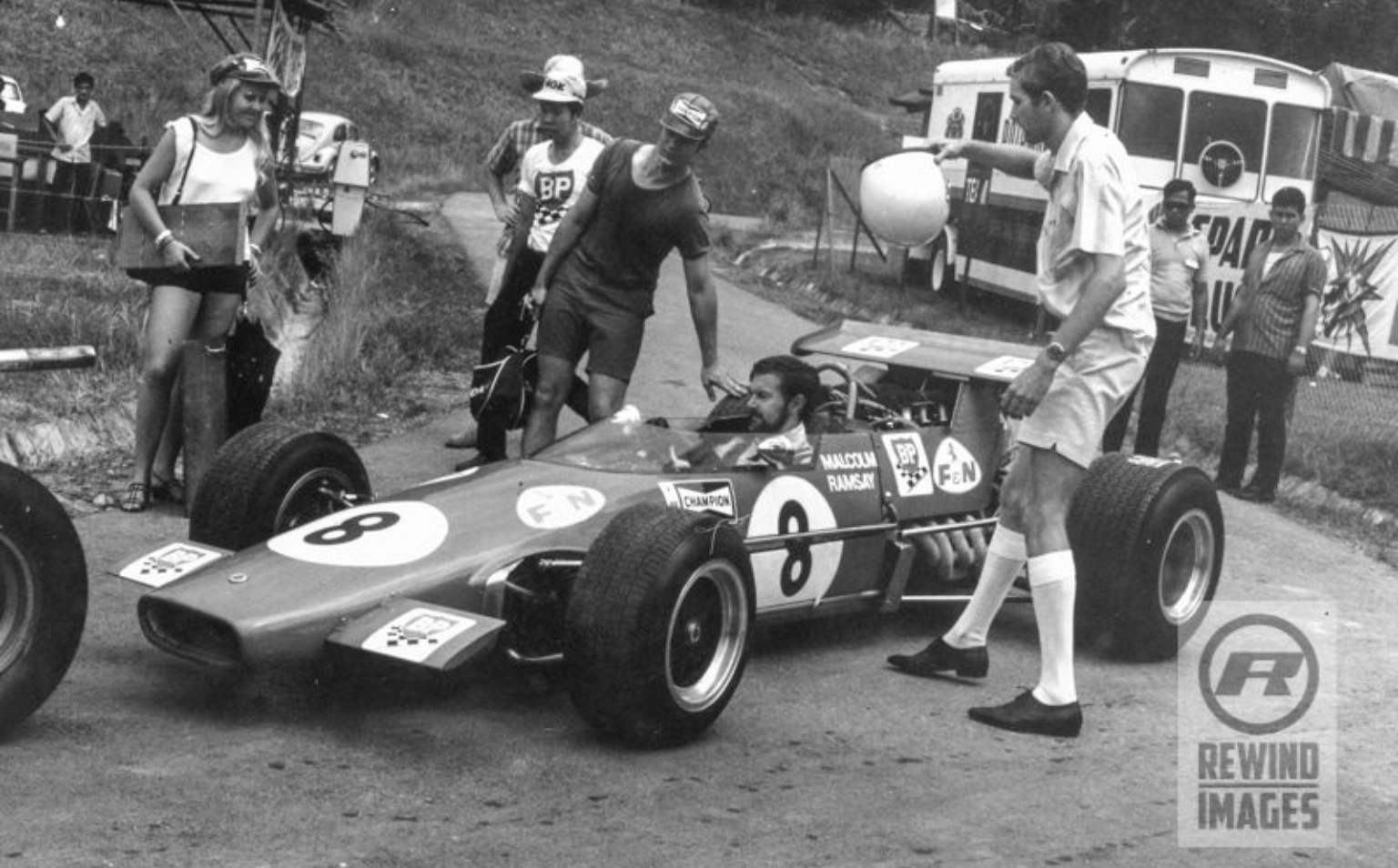
Mal Ramsay, Elfin 600C Ford 1970. This practice accident was caused when the Aussie co-founder of Birrana cars borrowed some goggles which slipped off- he instinctively sought to grab them and before he knew it he was off course. He was ok and the car not too badly damaged (SCMP)

Lots of Australasians raced up there (i’m including up there as Macau, Singapore, Malaysia and Japan) including internationals Vern Schuppan, Alan Jones and Bruce Allison.

Nobody did better business in the region for a couple of decades than Graeme Lawrence ‘who should have been given the keys to the city’ with multiple Singapore GP wins, victories in Malaysia but no win at Macau. Mind you, John Macdonald’s achievements across disciplines trumps even Graeme.

Max Stewart was very popular too- no win in Macau,, but one in Singapore. Speaking of which, Garrie Cooper won on the tough Thompson Road, Singapore track in 1968 aboard the very first Elfin 600- Garrie sold quite a few cars up there, particularly 600’s- twin-cam, Repco and Ford FVA engined (Hengkie Iriawan’s 600C).

Lanky Max acknowledges the plaudits of the crowd after finishing second in 1972. Results say Dolphin but it looks like a Rennmax BN3 Ford to me
Harvey Simon, Elfin 600B Ford sixth place in 1972 (SCMP)
Michael Schumacher aboard a Reynard 903 VW in 1990- won from Eddie Irvine and Mika Salo

European F3 was adopted in 1983- none other than Ayrton Senna won the GP in a Ralt RT3 Toyota. Michael Schumacher followed suit in 1990. Over the years the event has taken on great stature- a win in Macau means a lot- the list of later F1 drivers who raced there is long and deep, too long to include.

Motorcycles first raced at Macau in 1967- bonkers! Aces like Kevin Schwantz, Carl Fogarty, Ron Haslam and Michael Rutter have all participated.

The Singaporeans were onto the opportunities of Touring Cars from early in the piece with guys like Brian Foley and John Leffler visitors- in Macau the ‘Guia’ Touring Car races commenced in 1972.

The photo below is of Allan Moffat aboard a Bob Harper sponsored Ford Capri RS2600 in 1973- he must have been impressed with the car, acquiring a later ex-works RS3100 a couple of years later which raced all too briefly in Australia.

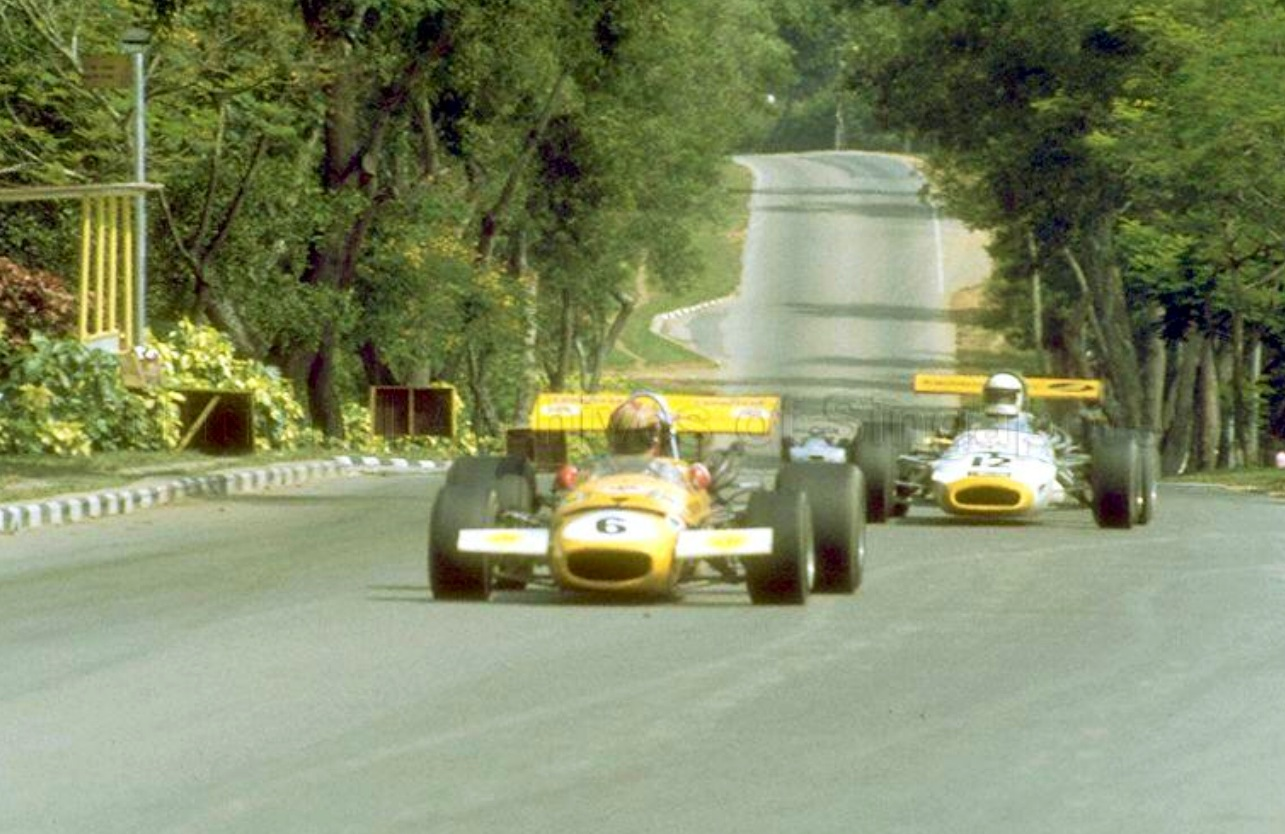
1973. Obscured John Macdonald, Brabham BT40, Vern Schuppan, March 722 and Sonny Rajah at the right, March 712 Ford. Macdonald won from Max Stewart’s Dolphin Ford and Rajah


Wonderful panoramic shot of the Main Straight in 1962 ‘taken from where the Mandarin Oriental Hotel now stands…the timekeeprs enjoyed a better line of sight from their small stand, though this was perched somewhat precariously over the harbour.’ Not sure of the Triumph and Porsche drivers (C&N)

Etcetera…

(unattributed)

1956 start with a Mercedes 190SL of D Steane, L da Costa Ferrari Mondial and R Ritchie, Austin Healey 100- R Pennel’s Healey 100 on row 2 beside the F Pope, Jag Spl. Steane won from da Costa.

(Getty)

Modern vignette over the last 5 years, cars are 2 litre Euro F3.

Ken Araoka, Suzuki RG500.

(C&N)

Race poster has a touch of the Mike Hawthorn/Ferrari 500 about it.

This is the crowd Kevin Bartlett confronted in 1969- no doubt a few more folks than even the ‘Warwick Farm 100’!, perhaps the premier Australian Tasman round at the time.

Allan Moffat at left in his Group C Mazda RX7 during the 1981 Guia race.

Sonny Rajah’s March 712 Ford-Hart during the 1973 GP.

Rather a famous car in that Ronnie Peterson won the European F2 Championship in it in 1971- here the car wears 732 bodywork.

In Australia we got a close look at the car/driver combination as the likeable, quick Indonesian did a few of our ANF2 Championship rounds in 1974. I wonder who owns the car now?

Edward Irvine Esq, Schumacher and Mika Salo.

Where is Mika Hakkinen? Michael is thinking, oh yeah, he ran into me, pity about that! Hakkinen had the two heat contest in the bag and made a way too optimistic attack on Schumi in the final lap of the second heat which came undone.

(SCMP)

1971 GP- beautifully framed shot shows Sonny Rajah, Lotus 69 Ford from Albert Poon’s Brabham BT30.

Jan Bussell won in a McLaren M4C.

(unattributed)

1957. The R Pennels Healey 100 from Pateman, Benz 300SL- #6 is the Yip XK140.

(J Santos)

Holden LC Torana GTR in 1973, driver anybody?

(unattributed)

Ayrton Senna won in 1983 aboard a Ralt RT3 Toyota- the first year of Euro F3 in an F3 season when he slugged it out with Martin Brundle- both graduated to F1, Toleman and Tyrrell respectively.

Vern Schuppan certainly received plenty of support from Teddy Yip throughout his career.

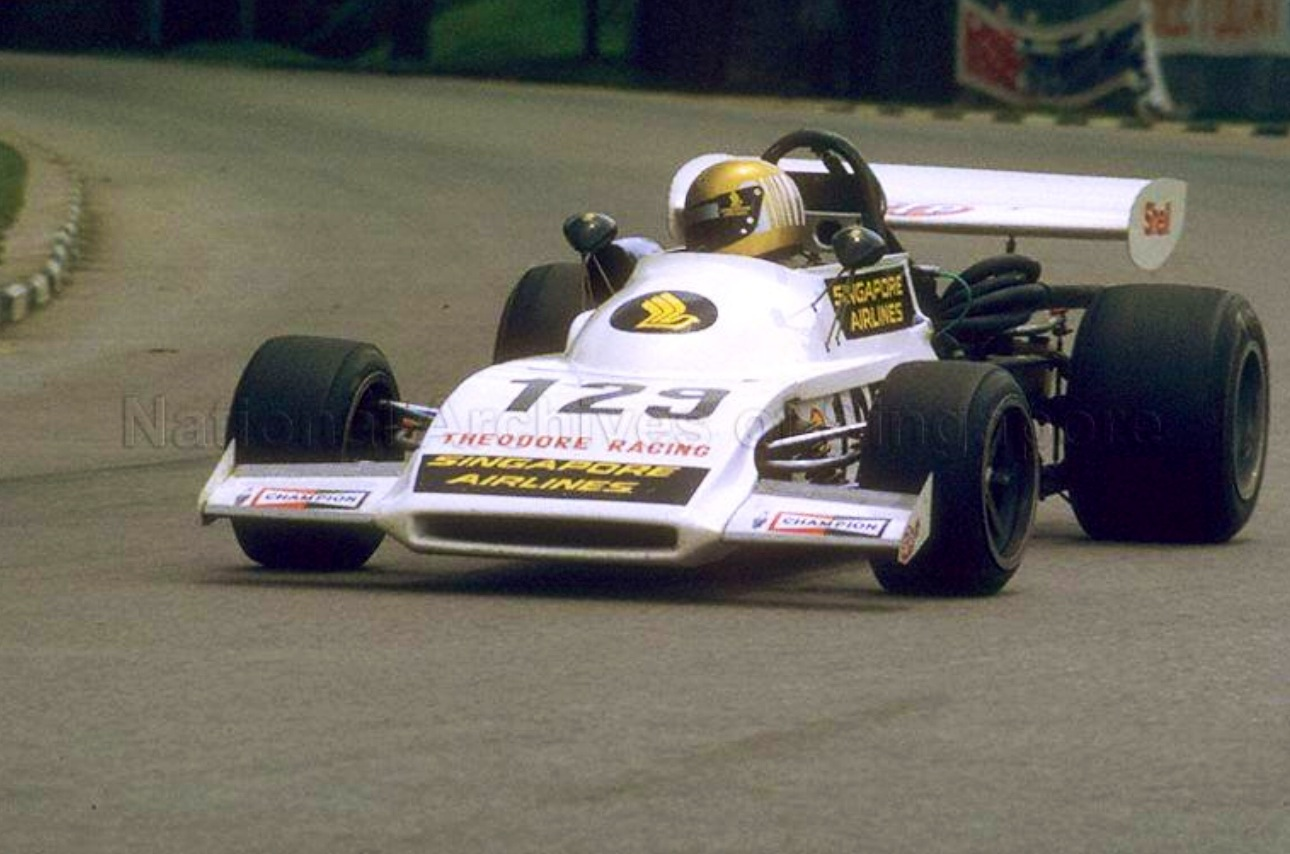
Here he is running the Theodore Racing March 772 Ford BDA during the 1980 GP- fifth. The race was won by Geoff Lees Ralt RT1 Ford. Lees was later a factory Ralt pilot inclusive of an F2 Championship in a Ralt RH6 Honda V6.

(SCMP)

John Macdonald’s Brabham BT36 Ford en-route to 1972 victory. Ex-Rondel Racing?

1990 warm up lap- look at that field.

Hakkinen, Ralt RT34 Mugen, Schumacher, Reynard 903 VW, #1 Irvine, Ralt RT34 Mugen and #15 Mika Salo, RT34 Mugen.

Talent in this field of great depth included Alex Zanardi, Laurent Aiello, Richard Rydell, Eric Helary, Heinz-Harald Frentzen, Pedro Chaves, Olivier Panis, Otto Rensing and Oliver Beretta.

Glen Abbey with bottle of Coke and KB sans top body panel with the victorious ‘Sub’ after the Alec Mildren Racing victory in 1969. Car in repose in the Macau paddock below.

Glorious looking engine is an Alfa Romeo Tipo 33 2.5 litre, DOHC 2 valve, injected V8. Later a Waggott TC-4V 2 litre, DOHC 4 valve, injected four was fitted.

(SCMP)

Gerhard Berger, BMW 635CSI during the 1984 Guia race.

Vern Schuppan gives team owner and ‘father of Macau’ Teddy Yip a ride aboard his Ralt RT1 Ford BDA after his second and final Macau GP win in 1976. His 1974 victory was aboard a March 722 Ford BDA.

Businessman, racer and entreprenuer Yip is a story, a long one, in himself. Suffice it to say his contribution to this race as a racer, entrant, team owner, ‘global ambassador’ and sponsor was extraordinary.

Credits…

‘SCMP’- South China Morning Post, Getty Images, Natalino Couto, ‘C&N’- ‘Colour and Noise’ Philip Newsome, Jose Santos

Tailpieces: The Ages…

D Steane, Mercedes Benz 190SL 1956.

Dallara Mercedes circa 2017.

(J Santos)

Art at the start and art at the finish.

Stunning image by Jose Santos of Leo Geoghegan’s works Birrana 273 Ford-Hart ANF2 car during the 1973 Grand Prix.

Just marvellous.

Finito…

image

Warwick Brown, Lola T332 Chev, Riverside 1974 (TEN)

‘WB for 73’ was the T-Shirt catch phrase of Warwick Brown’s team during the 1973 Tasman Series…

The good looking, well heeled young bloke from Wahroonga on Sydney’s North Shore had graduated from the relatively forgiving McLaren M10B Chev in which he cut his F5000 teeth in 1972 Australian Gold Star competition to an altogether more demanding mistress for the Tasman  Series, a Lola T300 Chev.

His ex-Niel Allen/Bob Muir car, chassis ‘HU4’ was a very good one, but the T300 was a fast, albeit flexy, twitchy little bugger. With guidance from mentor and engineer Peter Molloy, Warwick quickly adapted well to his new mount.

He didn’t finish the first Tasman round at Pukekohe, the Lola out of fuel but was third behind Graham McRae and Frank Matich in their own designed and built cars, two very hardened professionals at Levin. He was second the following round at Wigram behind McRae. Warwick then went to Australia feeling great despite a poor seventh at Teretonga with undisclosed car dramas.

image

WB, Team Target (retail stores) Lola T300 Chev, New Zealand, Tasman 1973

At Surfers Paradise though he became a ‘Lola Limper’ bigtime…

His car got away from him on the fast, demanding circuit spreading bits of aluminium and fibreglass over the undulations of the Nerang countryside and broke both of  Warwick’s legs. He got wide onto the marbles on the entry to the flat out in fifth right-hander under Dunlop Bridge and bounced across the grass into the dirt embankment surrounding the circuit. The light aluminium tub folded back, in the process doing horrible things to Warwick’s feet and lower limbs. He had a very long recovery, made somewhat easier by the promise of a new car from his near neighbour patron, mining millionaire Pat Burke.

That September 2nd in 1973 i attended the ‘Glynn Scott Memorial Trophy’, the F5000 Surfers Paradise Gold Star round in 1973, and hobbling around on crutches was Warwick talking to his fellow F5000 competitors and the fans.

He really was struggling just to get about and obviously in pain. Unbelievably, I couldn’t believe it when I saw the race report, he contested the next Gold Star round on October 7, one month later in Adelaide. No way could he get in and out of the car unaided.

To me it was madness, given his state, but to Warwick it was everything. He withdrew his old M10B after 8 laps and spent the following months getting properly fit for the 1974 Tasman but he had put down a marker as one determined, tough hombre!

Pat Burke bought him a new Lola T332 Chev, chassis ‘HU27’, the first production T332 and WB had a very consistent Tasman series in it…

He never finished worse than seventh, only failing to complete the NZ GP at Wigram, and won the final round, the Adelaide International. The ’74 Tasman had depth, the field included Teddy Pilette, Graeme Lawrence, John Walker, Max Stewart, Kevin Bartlett, John McCormack and Graham McRae- Peter Gethin won it in a VDS Chevron B24 Chev.

Warwick, Pat and Peter Molloy had plans to take on the best in the US by taking their Lola to the ‘States, ‘match fit’ as it was after the rigours of the eight race Tasman program.

image

WB in ’73 (John Lemm)

In 1974 the SCCA/USAC F5000 field included Mario Andretti, Brian Redman, Jackie Oliver, Sam Posey, Graham McRae, Brett Lunger, David Hobbs, Al Unser, Lella Lombardi, Vern Schuppan, James Hunt, John Cannon and others.

By the time Warwick and his crew got to the Ontario round on 1 September it was ‘Formula T332’- Mario Andretti had won two rounds, Brian Redman a couple and David Hobbs one, all in Lola T332’s, the greatest F5000 car ever.

Brown was eleventh at Ontario and then fifth at Monterey in mid-October behind Redman, James Hunt in an Eagle 755, Andretti, and Eppie Wietzes in another T332. In the series final round, the Riverside GP, he was third behind Andretti and Redman.

As a WB fan reading about these performances in Australian weekly ‘Auto Action’ I remember being blown away by his speed in such august company viewed through the prism of just how badly hurt he was- and would be again, he had three ‘Big Ones’ in his pro career. I could see his pain getting around at Surfers.

It takes extraordinary guts to get back into these things after big accidents in which you are hurt.

The mind management and sheer courage involved has always intrigued me. Not that he was the only ‘Lola Limper’ in Australasia, Graeme Lawrence and Kevin Bartlett spring readily to mind.

But those three US races in ’74 made him really, he proved to himself he could do it. The crew came back to Oz later in 1974 and Warwick was running away with the AGP at Oran Park until mechanical problems intervened. He then won the ’75 Tasman in a close fought battle with fellow T332 drivers Graeme Lawrence and John Walker and set up a US pro-career for the next few years with Jack McCormack’s Talon nee McRae cars in 1975 and then Team VDS.

It’s not an article about the entirety of WB’s career rather a reflection on mind over matter, toughness, passion, resilience and the fierce desire to compete and win that separates elite drivers like Brown, Lawrence and Bartlett from we mere mortals…

(unattributed)

Etcetera…

Pat Burke acquired the ex-Niel Allen (spare tub) /Allan Hamilton McLaren M10B Chev chassis ‘400-19’ in time for the 1972 Australian Tasman Cup rounds.

As I wrote above, under the tutelage and guidance of Peter Molloy- and using Mighty-Molloy Chevs, Warwick quickly adapted to these savage beasts- he was seventh at Surfers Paradise, ninth at home at Warwick Farm, fifth at Sandown and failed to finish at Adelaide International.

The photograph above is of Warwick with the dominant 1972 Gold Star combo of Frank Matich and his Matich A50 Repco at Oran Park during practice for the ‘Belle Magazine Trophy’ in June- they were fifth and first respectively.

He was equal fourth, together with John Walker, Matich A50 Repco in the 1972 Gold Star series with Matich, Kevin Bartlett, Lola T300 Chev and John McCormack, Elfin MR5 Repco in front of him- but he was well and truly on his way.

Credits…

oldracingcars.com, Bob Harmeyer, The Enthusiast Network, John Lemm

Tailpiece: Brown winning in the Lola T333CS Chev, Watkins Glen 1978…

image

(Bob Harmeyer)

Warwick Brown’s VDS Racing Lola T333CS Chev enroute to a single-seat Can Am win at Watkins Glen on 9 July 1978.

He won from Al Holbert and Rocky Moran both also Lola T333CS mounted. The car following WB is George Follmer’s Prophet Chev. Brown was second in the championship that year but the class of the field was his countryman, the three years older Alan Jones who took five victories and the title in the ‘works’ Carl Haas T333CS.

Jones was ‘moonlighting’ in 5 litre cars having gained a toehold in F1 which he was in the process of capitalising upon with Williams Grand Prix engineering.

Finito…

image

(Rod MacKenzie)

Graeme Lawrence ‘bang on line’ as Kevin Bartlett remarked upon seeing this shot of the Kiwi champions Lola T332 Chev going through Oran Park’s new ‘twiddly bits’ during the 1974 Australian Grand Prix…

There is something great about seeing a racing cars mechanical elements isn’t there? Rod MacKenzie has captured them beautifully in this shot.

These Lola’s are favourites of mine as some of you would know, and a topic about which I have written at length, specifically Peter Brennan’s restoration of Lola T330 ‘HU18’- Lella Lombardi’s old bus. So I won’t bore you with the technical details again, it’s all in this series of articles, attached is the link to the first of them;

Lella’s Lola…Peter Brennan’s Restoration of the Ex-Lella Lombardi Lola T330 Chev ‘HU18’…Episode # 1

There is so much to see back there starting, of course, with 5 litres of fuel injected Chev, say 520bhp in period. The poor Hewland DG300 5 speed transaxle coped, just, as long as it’s components were adequately lifed, the ‘box was originally designed around ‘effete’ 3 litre F1 engines, not, big, butch Chevs.

The beefy sliding spline driveshafts are clear as are the big inboard brake calipers and ventilated cast iron discs. These Lolas were beautifully finished, all of the steel fabrications were finished in shiny nickel plating.

Suspension is period typical at the rear; single upper link, two lower links, the earlier T330 you will see via the link above had inverted lower wishbones. Uprights were magnesium alloy, fore and aft location provided by radius rods. The shocks are double adjustable alloy bodied Koni’s. Adjustable roll bars were of course also fitted front and rear. Rod MacKenzie’s shot is so sharp you can see Graeme has the rear bar set at full soft, trying to get rear end bite out of Oran Park’s slower turns no doubt.

The big airbox is clear, within 12 months most of the T332’s on the planet had converted to an all enveloping engine cover cum airbox to better flow air over the car and onto the rear wing, this development was first made by the Haas/Chaparral crew in the US on Brian Redman’s car.

Big, wide Goodyears put the power to the road, the wheels are Lola’s own 14 inch diameter cast magnesium jobbies; within 12 months 15 inch American Jongbloed’s were de rigour on these beasts.

A car of beauty indeed!

Graeme was very successful in it; he came within a bees-dick of winning the ’75 Tasman Series in a last round shoot out at Sandown with fellow T332 pilots, Warwick Brown and John Walker, that story is told here, the battle resolved in Warwick’s favour, the only Aussie to win the coveted Tasman Cup;

The Mother and Father of Lucky Escapes…John Walker, Sandown Tasman 1975…

Graeme also won the Kiwi Championship, the Gold Star with Lola in 1974/5.

Credits…

Rod MacKenzie, Terry Marshall

Tailpiece: ‘Team Lawrence’ and trusty T332 after a Tasman Levin win in 1975…

image

(Terry Marshall)

The circumstances for the upload of these two photos by Rod and Terry Marshall were in honour of the recent passing of Graeme Lawrence’s late father Doug, helping Graeme out of the car above. He was an integral part of his sons motor racing from the start. Clearly there is deep respect and affection amongst former competitors and their crews on both sides of the Tasman for Doug Lawrence. RIP Sir.

sing mal

Birrana Engineering chief Malcolm Ramsay in his Birrana 273 ‘010’ Ford Hart during the 1973 Singapore Grand Prix, the last until the F1 era commenced in 2008…

I have been meaning to write about Birrana’s jewels of cars for a while. I tripped over this shot of Ramsay researching the Leo Geoghegan Lotus 39 article a while back, Leo was Birrana’s works driver from mid-’72 to the end of 1974.

This article started as a ‘quickie’ stimulated by the shot above, but segued into a longer piece when I found heaps of photos of the ’73 Singapore GP in the Singapore Government Archives. Too good to waste, low-res shots but still great to circulate. Bonuses were finding an existing article about the pre-F1 Singapore GP history and a contemporary ’73 race report. The basis of something interesting. Bewdy!

I need to a write a bit about Birrana Cars too though.

I don’t for Australian readers but that’s only 15% of you. So I have written what should be treated as ‘An Introduction to Birranas’, Part 2 ‘Birrana In Detail’ to come soon. Hopefully there is enough to explain how important the cars were to those who haven’t heard of the marque whilst being clear to Birrana enthusiasts, and there are plenty of us in Oz, that there is more to come.

sing leo amaroo

The photos above and below are ‘compare and contrasts’; top of Leo G in his 274 at Oran Park, the bottom of Bob Muir in his 273/4 at Symmons Plains, Tasmania. Bob’s car is 273 ‘009’ with 274 nose and rear wing. Compare with ‘standard spec’ 273 shots in the Singapore GP 1973 part of this article (unattributed)

Leo won the Australian F2 Championship in 1973/4 with a 273 and then 274 model cars, powered by 1.6 litre Brian Hart Ford ‘416B’ injected 205/210bhp variants of the venerable Lotus/Ford twin-cam four cylinder engine first used in the Elan in 1963.

bir muir

Bob Muir, Birrana 273 Ford ‘009’, Symmons Plains 22 September 1974. Bob took the win from RayWinter’s Mildren ‘Yellow Sub’ Ford and Sonny Rajah’s March 712M/732 Ford (unattributed)

The F3/F2 Birrana’s were typical, orthodox aluminium monocoque chassis, outboard suspension cars of the period but built to a very high standard of design, construction and finish with particularly careful attention to aerodynamics. ‘Boxes were Hewland Mk9/FT200 for ANF3/2 use respectively.

Twenty-one cars were built, (FF 4, F3 4, F2 11, F Atlantic 1 and Speedway! 1) the first car was the F71 FF built in Sydney by Alcock before he joined forces with Ramsay in Adelaide, their home town. The last ‘A78’ Ramsay built for his own use in 1978 after the factory had closed in terms of ‘volume production’.

sing a78

Graeme Lawrence’ Rothmans March 76B alongside the very last built ‘Golden Churn’ sponsored Birrana A78. Graeme is the guy far right of his car and Ramsay the dude in the beard behind his. Selangor GP, Batu Tiga circuit 24 September 1978. Nose of Steve Millen’s Chevron behind. F Pac race, all cars Ford Cosworth BDD 1.6 powered. Of interest to Birrana historians; car was entirely new based on 273 tub design with forward braced roll bars as required then by FIA regs, and upper body panel, 274 nose with bottom lip added, bigger than 72-4 rear wing, no rear engine cover; the 272 and 273 did not have rear covers the 374/274’s did (Choong H Fu)

The pick of the cars, given driver feedback seems to be the 273, although the evolved 274 was built in larger numbers and won F2 titles for Leo G ‘015’ in ’74 and Geoff Brabham ‘018’ in 1975.

Visually though the F3 374 was a gorgeous bit of kit…if not as successful as the ‘works’ Cheetah Mk5/6 Toyota’s of ‘The Two Brians’ Shead and Sampson. Shead built the cars in his Mordialloc shop and Sambo the engines in his ‘Motor Improvements’ emporium in St Kilda Road, Elsternwick. All three of the 374’s were fitted initially with Sambo’s (ANF3 1300cc) Corolla based engines.

bir hosking

Dean Hosking in the John Blanden owned 374 Toyota ahead of the similar Lew Wade owned, Paul King driven car at Adelaide International in August 1974. Little jewels of things  (Robert Davies)

Our ‘Racers Retreat’, click on the link atop the page for earlier articles, Peter Brennan was the mechanic on Paul Kings ‘Lew Wade Fiat’ owned Birrana 374 in 1974.

‘Lew had sponsored Paul King in an Elfin F Vee for a couple of years in Victoria, he was a really quick driver, so Lew decided to take the step up and buy an F3 car for Paul. He was a Fiat dealer in Cheltenham (in Melbourne’s bayside south), he figured the way to beat Sambo and Shead was a different chassis and a race prepped Fiat 128SL SOHC engine. The car was then new, the engine more advanced than the pushrod Corolla and he could cross-promote the sales of his Fiats.

Soon boatloads of lire were being sent to ‘Luigi The Unbelievable’ in Italy, when the engine finally arrived, late of course, we put it on the Challenge Motors dyno, it barely pulled 110bhp, not enough to pull the top off a rice-custard, the MI Corollas made a genuine 130/135bhp, even the customer engines’.

‘Lew had been serving it up to the Brians, who were both closeby in bayside Melbourne about how the Fiat engine would give them a belting and then had to eat big doses of humble pie and buy one of their donks!’

‘The day came to pick up the Birrana, so Paul and i were despatched to Adelaide in Lew’s big, lumbering Chev Impala and trailer. I don’t remember much about the factory other than it was small. Back in Melbourne, we soon had the thing plumbed and completed, Paul tested it at Calder and was immediately ‘on the pace’, he was a very quick driver but beating the Cheetah twins was another matter.’

bir 374

A little bit of biffo in this 1974 Calder combined F3/FF race. As best as i can work out its Peter (brother of Larry) Perkins Elfin 620 from Paul King’s Birrana 374, with 2 Elfin 620’s outside him, one ‘yumping’. #68 is a Wren FF with another FF beside him and on the very outside you can just make out the light covered rear engine cowl of Dean Hosking’s 374 (unattributed)

image

Paul King’s 374 ahead of Brians Shead and Sampson in this Winton promotional poster circa 1974/5 (Paul King Collection)

In those days FF’s and F3’s often raced together, there was no national F3 Championship, the quicker F3’s raced against the F2’s in their championship races (which from 73-75 in particular was well supported, comparative car specs; FF 1600 circa 105bhp, no wings or slicks. F3 1300 SOHC or OHV circa 135bhp wings, slicks, 5 speed box. F2 1600 DOHC 2 valve circa 205bhp, wings, slicks, 5 speed box)

‘The car itself was beautifully built and engineered, the only problem we had during that year was leaking fuel tanks, we had to take the car back to the factory to have them re-sealed, its before the days of bag-tanks in these cars. The car was easy to work on, the Toyota engine was bullet proof, and the Hewland Mk9, which was also new gave no problems with only 135bhp tearing away at it.'(these boxes sometimes fitted to 205bhp Ford Cosworth BDD engines, not particularly reliable all the time mind!)

The Mk5 Cheetah was a top car in both the hands of the ‘factory’ drivers and also as a customer car ‘the Birrana was a better engineered and finished car’ but Shead and Sambo had evolved the cars over the years into very quick devices and both of them were experienced, fast competitive drivers. Sampson won the Bathurst 1000 with Peter Brock in 1975 and only stopped racing, in his mid-seventies, in the last few years.

‘Whilst Paul was an F3 front runner Lew started to lose interest when he wasn’t winning all the time, Pauls marriage was also going down the blurter, the car was sold and that was that. Paul drifted from the scene and Lew crashed his Tiger Moth and killed himself some years later’.

Allison895_017

Bruce Allison’s 274 ‘017’ in the Lakeside pits, the Queenslander was 3rd in his home race,during the 1974 AF2 Championship, an 8 race series in 5 states. Workmanship and finish of these cars absolutely world class (Allison)

All of the F2 Birrana’s were fitted initially with Lotus/Ford/Hart twin-cams built by a raft of preparation outfits. During the period we are looking at Peter Nightingale was the designated factory engine and gearbox bloke, he also prepared, from memory (always dangerous) Geoff Brabham’s 274 ‘018’ in his ’75 AF2 Championship winning year so that makes Peter the most successful ‘Hart fettler’ of the day. He still looks after a few cars in his Adelaide home town.

Later, various of the F3/2 cars were fitted with a variety of 1.6 litre SOHC engines when the ANF2 rules were stupidly changed.

Some of the F2 cars had the Ford Cosworth 1.6 litre BDD’s later fitted for F Atlantic/Pacific. The Birranas were too long in the tooth as F Pacs in the mid/late ‘70’s in NZ when they adopted the class, but Bob Muir was competitive in the UK in mildly updated 273’s in 1975.

bir muir uk

Bob Muir, Birrana 273 Ford BDD, Mallory Park, British F Atlantic Championship, Bank Holiday meeting August 1975 (Alan Cox)

The 273 derived European 2 litre F2 Ford BDG engined ‘Minos’ was a slug and optimistic in the extreme given the competitiveness of that class at the time with factory BMW and Renault V6 engines in March/Martini/Alpine chassis. More about ‘Minos’ in the later Birrana article.

One chassis was raced late in its life with a Waggott 2 litre DOHC 4 valve engine, which is the car I would personally like to own! However I am getting ahead of myself and starting to write the article I said at the outset I would do at another time. So, back a step.

By the middle of 1974 Ramsay and Tony Alcock his designer/partner in Birrana, decided it wasn’t commercially feasible to build cars profitably as they wanted to in Oz.

bir muir 2

Bob Muir, Birrana 273 BDD ‘009’ at Mallory Park 24 August 1975, DNF with fuel surge, Jim Crawford’s Chevron B29 won. Later GP drivers Gunnar Nilsson and Tony Brise were also in this race (Alan Cox)

Tony travelled to the UK and initially ran the two Bob and Marj Brown owned 273’s for Aussie Bob Muir in the 1975 British F Atlantic Championship before he joined Graham Hills team. Unfortunately he was on ‘that flight’ which ended tragically at Elstree Airport, the whole team perished on that sad trip in difficult conditions.

Ramsay then focussed on his engineering business servicing the mining industry in Adelaide, where all but the first Birrana was built.

He very successfully applied his organisational and management skills by getting back involved in motor racing and winning multiple Gold Stars for other drivers in the Formula Holden era. His stable included Mark Webber, Paul Stokell, Jason Bright, Simon Wills and Rick Kelly. In addition, for a time he ‘turned to the dark side’ and ran V8 Supercars.

6687_T_GBrab_75-med

Geoff Brabham at Oran Park in his 274 ‘018’ the last built car originally sold to Neil Rear in WA but bought only slightly ‘shop soiled’ by the Brabham family for Geoff’s second full season in racing, he raced a Bowin P6F successfully in the Australian FF Championship in 1974. Brabham comfortably won the ’75 AF2 title but Alfredo Costanzo in Leo Geoghegan’s ’74 championship winning chassis kept him honest, Brabham’s the better prepared car. Their was no championship AF2 round at OP in 1975, so not sure when this is, clearly a Friday tho, only a few folks in attendance! Brabs was off to British F3 in ’76 (oldracephotos.com)

Without thinking too hard about it, the rollcall of drivers who ‘parked their arses’ in Birranas in the short period the cars were built is impressive…

Later Bathurst and AGP winner John Goss raced F71, Alcock’s first car, an FF whilst he was making his name in the McLeod Ford GTHO Falcon in 1971. Jumping from the nimble, responsive FF into the ‘big powerful barge’ of a Falcon at the same meeting must have been a challenge. And test of versatility. JG was one of a relatively small number of Aussies who were awesomely quick in both ‘taxis’ and single-seaters. Frank Gardner, Kevin Bartlett, John Bowe, Mark Skaife and Craid Lowndes spring readily to mind as some of the others. Click on the link at the bottom of this article to read about ‘Gossy’.

Andrew Miedecke, Richard Carter and Gary Brabham, the latter long after the car was built, (1982) raced F73, a superb FF built for Miedecke’s ’73 national ‘Driver to Europe’ championship FF assault. Carter won the ’76 DTE series in this chassis, Birrana’s only Australian FF Championship victory.

bir winton

Bucolic Winton, Central Victoria, FF action in 1978. Steve Moody’s Birrana F72 from Gerry Witenden’s F71-the first Birrana built. Then, i think, obscured David Earle’s Elfin and Ron Barnacle’s (or Don Bretland’s maybe?) Van Diemen RF77. Lots of sideways action, Aussie FF’s raced on Bridgestone RD102 road-radials in this period which made them wild to drive having driven my share of laps at the time! A funny bi-product of this was that older chassis, which were designed around radials when the class first started, came to the fore. Witenden, a terrific bloke from Goulburn way, came within a point of winning the ’78 title in this 7 year old Birrana. He went to the UK too, did a few FF2000 races, maybe with Delta if any Brit enthusiasts remember him. Steve Moody is still around historic FF, Barnacle also won an Oz FF title (unattributed)

Drivers of the Birrana F2’s included Leo G, Bob Muir, Bruce Allison, Alfredo Costanzo and touring car ace Peter Brock who did his only single-seater season in 272 ‘006’ in 1973.

Allison very much showed ‘he had what it takes’ in 274 ‘017’ in the very competitive 1974 ANF2 Championship. He jumped up to F5000 in an ex-Bartlett, well sorted Lola T332 Chev in ’75, ‘rattling the established F5000 order’ as the category’s ‘enfant terrible’ in much the same way Warwick Brown did in ’72.

Bruce recalls the Birrana and that ’74 season with a lot of fondness; ‘I’d started racing an Escort Twin-Cam against the best of the guys in Series Production and realised how hard it would be to get an ‘equal car’ so we decided to buy an open-wheeler. Dad organised an Elfin 600FF from Garrie Cooper, the car we got was one that was coming back from South Africa or something, it hadn’t been paid for. Picking it up from the Brisbane docks is not something we looked forward to but a few slabs of beer my dad had brought along did the trick, we were soon on our way!’

‘I did well in that at Surfers and Lakeside then we got Garries 600D F2 (this car is pictured later in this article) which was a good car. Dad got Ivan Tighe to drive its first meeting at Oran Park, but he crashed it, not a big one, it was soon repaired and away we went but by that time the category was getting more competitive. A few people said we should get a Bowin P6 which looked sensational, we painted that car in the black ‘Hobby & Toyland’, Dads business’s colors. It had rising rate suspension but it was an absolute pig. We couldn’t get our heads around the thing, i know John Leffler and Bob Skelton did but i got rid of it after only about 6 months. In fact i boofed the car at Surfers after we had sold it and had to take a big chunk off the price.’

Birrana 274 at Lakeside

Bruce Allison hustles his 274 ‘017’ around, fast, demanding Lakeside, Qld, rear engine cover removed in deference to the summer heat.He was 3rd, the race won by Ray Winter’ old but fast Mildren ‘Yellow Sub’ from Geoghegans 274. Bruce’ results got more consistent and better as the season wore on (Allison)

‘By then it was clear we had to have a Birrana to run with the top guys. Dad did a deal with Malcolm Ramsay, both he and Tony (Alcock) were great to deal with and gave us all the help we needed that year. The car handled well, was forgiving and put its power down nicely. We had good engines, Harts which i think Ivan Tighe looked after, the car itself was maintained in a Hobby & Toyland workshop at Castles Road’.

‘I was 20, very brash and thought i was unbeatable. Leo was smooth, quick and had all of our measure, the grids were great, there were always 6 or 7 blokes scrapping at the front. For outright speed though Bob Muir was an absolute demon in that car. It was the previous years 273, but updated. Bob and Marj Brown who owned the car were wealthy Adelaide people who had a business which made oven glass, heated windscreens and the like. For a ‘part timer’ Bob was bloody good, he went to the UK with the Browns of course’

‘I was never the greatest at setting a car up, Peter Molloy (the very experienced engineer who looked after Bruce in his F5000 years) always rated my speed though and i did get quicker and more consistent that year as the season rolled along and proved it with my results. It was time to move up. The Birrana was important as it proved i could cut it in a competitive car, the 274 was the first of those i had’.

Bruce was soon off to European and US success with annual summer visits back to Oz to remind us of his skill. He won the Grovewood Award and raced in the British national F1 Series but didn’t get the ‘real’ F1 seat his talent and results warranted.

(Bruce lost most of the photos of his career in a fire some years back, these are the only two he has of the Birrana for example, if any of you have photos of Bruce in any of his cars, you are prepared to share with him please email them to me at mark@bisset.com.au and i will forward them on, Mark)

sing muir

Bob Muir’s Rennmax Ford ahead of Garrie Cooper’s Elfin 600D Ford (the car Bruce Allison raced after Garrie) and a March 722 during the 1972 Singapore GP. Help welcome as to which corner and driver of the March (NAS)

Bob Muir was a seasoned professional by the time he jumped into the Brown family’s 273’s in 1974. Bob and fellow Sydney motor trader Geoghegan had an almighty battle for the AF2 title that year. If 1973 had an element of ‘cruise and collect’ for Leo, ’74 was the exact opposite with fields of depth rarely seen in Australian single-seater racing outside FF. The F2 grids that year had all of the local aces racing ‘down’ from F5000 in F2 as well as all of the ‘comingmen’ contesting a well sponsored series.

Bob had done two years in F5000 in 1972 and 1973, the latter in the US L&M Championship before jumping into the Browns cars after the first couple of ’74 rounds. After his Oz F2 season he then raced the 273’s in F Atlantic spec in the UK in 1975. After the F2 ‘Mino’s nee Birrana ‘bombed’ he was impressively fast in a Ford BDX engined Chevron B35 Derek Kneller built and prepared for the team. In ’76 he was 37 though, if only he was in Europe 10 years before. Like so many competitors of his period, his business funded his racing for much of his career, he wasn’t a ‘spoon-fed’ prat of the type we see so often today.

I digress, as usual. Suffice it to say, plenty of great steerers were attracted to Birrana’s. More of the above in ‘Birrana 2’.

sing official

The official party prior to the 1964 Malaysian GP at the Thomson Road circuit

Keying ‘1973 Singapore GP’ to Google inevitably led to lots of tangents and some good information to go with these shots which are a bit scrappy, but still worth circulating and are from the Singapore Government archives

The balance of this article is a heavily truncated ‘cut and shut’ with a reasonable addition of my own words of two articles; one written by Eli Solomon in the March 2006 edition of MotorSport and the other a race report by (the) Peter Collins published in Australia’s ‘Racing Car News’ and posted on ‘The Nostalgia Forum’ by ex-RCN journalist Ray Bell.

Eli has his own magazine, ‘Rewind’ which has great South East Asia current and historical content. You can either subscribe (pay) or access some of his material via Facebook, just click ‘Rewind’ into the FB search engine.

bikes

Not long after the start of the 60 lap 1964 Malaysian bike GP. Thomson Road circuit, #79 Shershall from Perry, Sang and Dingle (MCI)

The first Singapore Grand Prix was the 1961 ‘Orient Year Grand Prix’, held on a stretch of Upper Thomson Road.

In 1962 the race was renamed the Malaysian GP, until Singapore gained independence in 1965. Singapore ran its own event from ’66 while Malaysia held two events, one around the Singapore race near Easter, called the ‘Malaysian GP’ and another in September labelled the ‘Selangor GP’.

The racing season in Asia began at Macau in November, moved to Australia and New Zealand with the Tasman Cup, and returned to South East Asia with back-to-back races in Singapore, Johore, Selangor and Penang, followed by Japan.

sing food stand

Food vendors 1971 Thomson Road circuit style (NAS)

sing gta

Alfa GTA, Albert Poon? winning the 1971 Touring Car race, start/finish is on ‘The Thomson Mile’ (NAS)

From 1966 to 1973 the Singapore Grand Prix became the main racing event on the local calendar each Easter. The 3.023-mile street circuit was a challenge, its narrow 24ft width offered little run-off area in a sport that was increasingly seeing faster speeds.

sing circuit

(Gel Motorsport)

Australian Vern Schuppan and British-born Hong Kong man John Macdonald both loved it. Never one to mince his words, Macdonald describes the track:

‘Flowing? In places, but hairpins were not exactly flowing. Dangerous? In those days no more so than expected and certainly safer by far than Macau. Monsoon drains? Yes. Bus stops? One after that lovely curve on the straight and a few lamp posts. None of these things got in the way and I did not go looking for them!’

The start-finish line was on the main straight, on a normal day the two lane black-top served as a major trunk road, on the right were fruit plantations and on the left new housing estates and industrial parks.

The bend halfway down the straight was ‘The Hump’, this had a false apex which sat on the turn-in that lifted cars off the road; it was this section that Frank Matich got wrong during 1970 practice, his McLaren M10A Chev F5000 hit a bus stop and was out for the weekend.

After ‘The Hump’ was ‘Sembawang Circus’ or ‘The Hairpin’, dangerous as cars approached it ‘flat’ until it was ‘chicaned’ in 1969 to preserve spectators generally and Singapores Cabinet sitting in VIP stands!

sing cooper

Garrie Cooper Elfin 600D Ford ahead of Vern Schuppan’s March 722 on ‘the Thomson Mile’, 1972 GP (NAS)

‘The Esses’ comprised several sections; ‘The Snakes’, four bends, then ‘Devils’ a rounded off v-bend which caught many out, then ‘Long Loop’, a right hander.

Then came ‘Peak Bend’, where TV and radio stations located themselves. The circuit then went down right to ‘Range Hairpin’ and then ‘Signal Pits with pit entry after ‘Range Hairpin’.

Then it was left onto ‘The Thomson Mile’ a fast undulating one mile stretch on what was then the start of Nee Soon Road and back to the start/finish line, a lap was circa 24 gear changes dependent upon type of car and ‘box of course.

It was not until 1968 that Australian constructors started to venture to South-East Asia. Garrie Cooper of Elfin Cars won the Grand Prix that year in his very first Elfin 600, powered by a Ford Twin Cam. ‘Nobody had ever heard of Elfins,’ said Aussie racer/constructor Frank Matich.

Cooper had also suggested that the Singapore GP be confined to racing cars, for qualifying times to limit the number of entrants and for a reduction in the number of laps from 60 to 50. Subsequent years saw the main race run as two heats of 20 and 40 laps over different days.

Local racers were increasingly sidelined by foreigners, 1967 the last year a local won the GP. In 1969 Kiwi Graeme Lawrence won in his McLaren-FVA M4A amid some very powerful machinery including Cooper’s Elfin 600C Repco 2.5 V8, which the locals thought was an F1 car.

sing 600

Mal Ramsay in the Thomson Rd paddock 1970. Elfin 600C Repco 2.5 V8 4th place in the race won by Graeme Lawrence’s Ferrari 246T (Rewind)

For the 1970 race Matich arrived in ‘Rothmans’ team livery with his McLaren M10A Chev F5000 that had recently won the NZ GP, while the Australian Alec Mildren ‘juggernaut’ consisted of Kevin Bartlett in his Mildren ‘Yellow Submarine’ (the Alfa V8-powered  Len Bailey designed, Alan Mann Racing built monocoque racer which Frank Gardner debuted in the ’69 Tasman Series and was then handed over to KB upon Gardner’s return to Europe and in which KB won the ’69 Macau GP and Australian Gold Star Series).

Max Stewart raced the 2-litre Rennmax Mildren-Waggott, and Malcolm Ramsay the ex-Cooper Elfin 600C Repco. Mildren was there to supervise, as was Merv Waggott, designer/builder of the Waggott engines. Not to be outdone, Poon had the ex-Piers Courage Brabham-FVA BT30. While Matich wrecked his M10 in practice doing 160mph on the Thomson Straight, Lawrence went on to take his first win in Singapore in the ex-Amon Ferrari Dino 246T in which he also won the 1970 Tasman Series.

Lawrence made it two out of two in 1971 with his Brabham-FVC BT29 against formidable competition.

The big change was that the single-seaters now had to follow Australian F2/Formula B rules to ensure decent sized fields. So FVAs and BDAs were out. The new rules meant that single-seater racing would become the domain of the professional and semi-professional.

sing max

Stewart’s Mildren Waggott from Geoghegan’s, Graeme Lawrence owned, Brabham Ford in the 1972 GP  here on ‘The Thomson Mile’ (NAS)

Max Stewart arrived in the Mildren-Waggott in 1972 — not only would it be the first time he finished a race in Asia, he would win it as well. By that stage the Mildren Tean had disbanded but Max bought his car off Mildren and promptly ‘nicked’ the ’71 Gold Star by a point with consistent performances from close mate Bartlett who won twice, Max took one race, but was more consistent in the 2 litre DOHC, 4 valve Waggott engine car than  KB’s McLaren M10B Chev.

By 1972 the carnival had grown to 15 events, there were 430 competitor entries from around the globe, 146 ‘bikes and 284 cars.

The 1972 Singapore GP field included Bartlett, Schuppan and Macdonald, who had the ex-Rondel Racing Graham Hill Brabham BT36. Sonny Rajah raced the ex-Ronnie Peterson March 712M. Rajah was the local hero and looked the part with his long hair and Zapata moustache.

sing sonny

Sonny Rajah in the ex Petersen March 712M Euro F2 champ car, 4th in the ’72 Singapore GP (NAS)

But to gain admittance into a country where long hair was associated with drugs, he had resorted to using a short-hair wig! A fellow competitor once remarked: ‘He had brilliant car control but someone other than bullshit artists had to take him in hand! Natural talent and character to boot. Rajah was a very popular addition to the 1974 Australian F2 series when he raced the updated March that year.

sing vern

Singapore’s last pre-F1 GP was held in 1973 and was won by Schuppan in a March-Ford 722 (above)…

Schuppan vividly remembers the monsoon drains on the circuit: ‘It was a fast, flowing circuit, a lovely race track. No one talked about lack of run-off area because we were so young then.’ Of Schuppan, Macdonald said: ‘Vern, of course, got to the top but probably never reached the absolute top because he’s too darned straightforward, nice, honest and all those other good things that come up all too rarely.’

mac

John MacDonald’s new Brabham BT40 Ford ahead Steve Millen’s Elden Formula Fords(NAS)

Macdonald was another favourite and had a brand new Brabham BT40 delivered to him in Singapore ahead of the race. Macdonald said the BT40 was a ‘magic car with a big ‘but…’ The team had a terrible time of it with fuel pick-up problems. A letter to Bernie Ecclestone, Brabham’s owner, resulted in a PR reply to say he was behind them all the way! Once sorted, the car was a prolific winner in Asia.

sing gra

Lawrence’ Surtees ahead of Kiwi Steve Millen’s Elden Mk8 FF. Millen later a champion F Pac driver (NAS)

Schuppan, Kiwi Kenny Smith and Sonny Rajah were in March 722’s. Vern’s car was interesting in that the March had been modified by Canadian aerodynamicist Denis Falconer who developed a package of changes from Robin Herd’s original design. There were 5 (!) body configurations depending upon circuit type. The car also had a narrow track suspension set-up for faster circuits.

Graeme Lawrence raced the Surtees TS15 which first broke cover in that summers Tasman Series powered by a 2 litre Ford Cosworth BDG. Ramsay ‘010’ and Geoghegan ‘007’ were Birrana 273 mounted. Poon had a Brabham similar to MacDonald’s.

Tony Stewart’s Paul England owned ‘Dolphin’, a Brabham BT30 or 36 copy was powered by one of Englands very powerful twin-cams. Jack Godbehear built mighty-fine FF and F2 engines re-building many of the Hart 416B’s which were plentiful in Oz as the 1.6 litre AF2 flourished from 1972-5. (the ANF2 1.6 litre twin cam, 2 valve formula applied from 1971 to 1977 which cost effectively, and sensibly mandated variants of the Lotus/Ford t/c engine)

sing stew

Tony Stewart in the Paul England owned Dolphin Ford a Brabham BT30/36 replica. Both John Leffler and Andrew Miedecke had one-off drives of this car in Australia (NAS)

Max Stewart’s Rennmax, twin-cam powered was faster than it had been with the more powerful Alfa GTAm engine the year before. Chain was in a Lotus 69, Bussell a Palliser WDB4, Wiano a GRD 272.

The cars had, by the way, come from Selangor where they had run in the Malaysian Grand Prix. Macdonald had won this from Canadian Brian Robertson and Poon, all drove BT40s. The Selangor GP was held later in the year.

buss

Jan Bussell’s Palliser WDB4 Ford (NAS)

Starting Grid…

V Schuppan (1:57.3)______G Lawrence (1:57.1)
K Smith (1:59.1________L Geoghegan (1:57.8)
M Ramsay (1:59.5)______J Macdonald (1:59.1)
A Stewart (2:01.5)________M Stewart (2:01.3)
A Poon (2:04.0)____________S Rajah (2:02.6)
P Chain (2:07.5)_____________M Hall (2:04.0)
H Wiano (2:08.9)__________J Bussell (2:07.6)

Further back were: Kiyoshi Misaka (BT36 Toyota), Steve Millen (Elden FF), Harvey Simon (Elfin 600B ), John Green (Chevron B20), Dave Hayward (Hawke FF) and Chong Boon Seng (Brabham BT30) a very slow 2:49.1.

sing leu 2

Geoghegan’s Birrana 273, Leo set the all-time lap record in his catch-up drive; 1.54.9 (NAS)

The Race…

Leo Geoghegan passed early leader Lawrence on the sixth lap. Schuppan’s March was third at this stage, but was under pressure from Ramsay, then Macdonald clear of Tony Stewart, Smith, Max Stewart and Rajah.

For fifteen laps Geoghegan’s Birrana 273 stormed away, but then had to pit when the engine began to stutter. The master switch on the roll-over bar had failed, it was shorted out to enable him to continue.

image

Geoghegan ahead of Lawrence in their great dice early in the race (NAS)

At the same time, Schuppan showered Ramsay’s 273 with rocks when he ran wide on a fast corner. One rock punctured the fuel tank, Ramsay’s car trailed flames for a couple of laps and then stopped. Another report of this incident had it; ‘Malcolm soldiered on until the pain of the petrol burning his balls forced him to retire.’ So, Ramsay’s retirement was due to either a burning car or burning balls!

And while Geoghegan was heading for the pits, Lawrence’s Surtees lost the use of its mechanical fuel pump, and whether this slowed him as he switched on the electric one or it meant the engine lost power, the net result was that Schuppan’s March swept into the lead.

Geoghegan’s return saw the lap record (Bartlett’s from 1970’s preliminary race) under threat as he carved his way through the backmarkers trying to regain as much of the two laps he lost as possible. He had to pit again later, but the record was his and he completed 41 laps for ninth place. Leo was razor sharp, his Birrana beautifully set-up given the intensity of the competition at home.

smith

Kiwi star Ken Smith, in his youth. In his 70’s he is still a formidable F5000 pedaller! March 722 Ford, note the differences in his standard spec body and Schuppan’s modified 722 (NAS)

Rajah’s March was out at 25 laps with the battery dragging behind the car and Smith, March, struck problems to lose contact with the Stewarts, big Max passing young Tony as this happened for fourth. Tony Stewart, now there is a lost talent! If memory serves he raced a Birrana 273 for a while before leaving the sport and later making his fortune in ‘Car City’ on Ringwood’s Maroondah Highway in Melbourne’s outer east.

Both leaders had problems. Schuppan’s airbox was falling off, but that wasn’t as bad as the battery losing charge in Lawrence’s car and causing his engine to run roughly. The race ran out like this.

Results (50 laps – 150 miles)

1. Singapore Airlines: Vern Schuppan (March Hart 722) 1h 38:58.3 (1:56.8)
2. Singapore Airlines: Graeme Lawrence (Surtees TS15) 1h 39:36.8
3. Cathay Pacific Air: John Macdonald (Brabham BT40 Hart) 49 laps
4. Singapore Airlines: Max Stewart (Rennmax England t/c) 49 laps
5. Paul England Engineering: Tony Stewart (Dolphin England t/c) 49 laps
6. Air New Zealand: Ken Smith (March 722 Hart) 47 laps
7. Team Rothmans: Jan Bussell (Palliser BRM t/c) 47 laps
8. Air New Zealand: Steve Millen (Elden Mk 8) 43 laps
9. Grace Bros Race Team: Leo Geoghegan (Birrana 273 Hart t/c) 41 laps
10. Camel Melinda: Harvey Simon (Elfin 600B) 40 laps

Fastest lap and new outright record: Geoghegan, 1:54.9.

sing rear

A gaggle of cars in the ’72 GP passes a group of flaggies doing their best to say out of the tropical heat, car at the rear perhaps Leo Geoghegan’s Brabham (NAS)

The demise of racing in Singapore was somewhat sudden given the level of publicity and government backing the race received. The social and economic issues (the oil shock and terrifyingly rapid infrastructure growth) that the country was facing may have contributed to this.

The government claimed that the GP promoted dangerous driving in its citizens, these were the very successful times of the ‘paternalistic democratically elected despot’ Prime Minister Lee Kuan Yew. The government acknowledged it would be impossible to implement adequate safety measures for the Thomson Road circuit. Although a permanent track was proposed which  included an all-sports complex, this never materialised.

Over time the view of the government eased with the Malaysian GP at Sepang growing in stature, the ban on motor racing was reconsidered and dropped in 2005.

The Macau Grand Prix, of course, thrived through this period, but after 13 years 1973 was the end for Singapore’s big race’, until the F1 era of course, a story for another time.

Etcetera…

sing bike

Field before the start of the 1971 bike GP, help welcome on competitors/bikes. What a wild, fast, narrow place! (NAS)

sing perry

Kiwi, Geoff Perry winning the bike GP on a Suzuki 500 (NAS)

sing bmw

’73 Touring car race, help with cars/drivers welcome! (NAS)

Bibliography…

Eli Solomon Singapore GP article in MotorSport March 2006, Peter Collins race report published in ‘Racing Car News’, oldracingcars.com

Photo and Other Credits…

A very big thanks to Peter Brennan and Bruce Allison for their recollections

National Archive of Singapore, Bruce Allison Collection, oldracephotos.com, Alan Cox, Rewind Magazine, MCI, Choong H Fong, Robert Davies, Paul King Collection

Tailpiece: Kiwi Geoff Perry hustles his Suzuki 500 thru ‘The Snakes’ on the way to ’72 GP victory, the exciting perils of 50 Thomson Circuit laps evident…

geoff

(NAS)