Posts Tagged ‘Jo Bonnier’

(LAT)

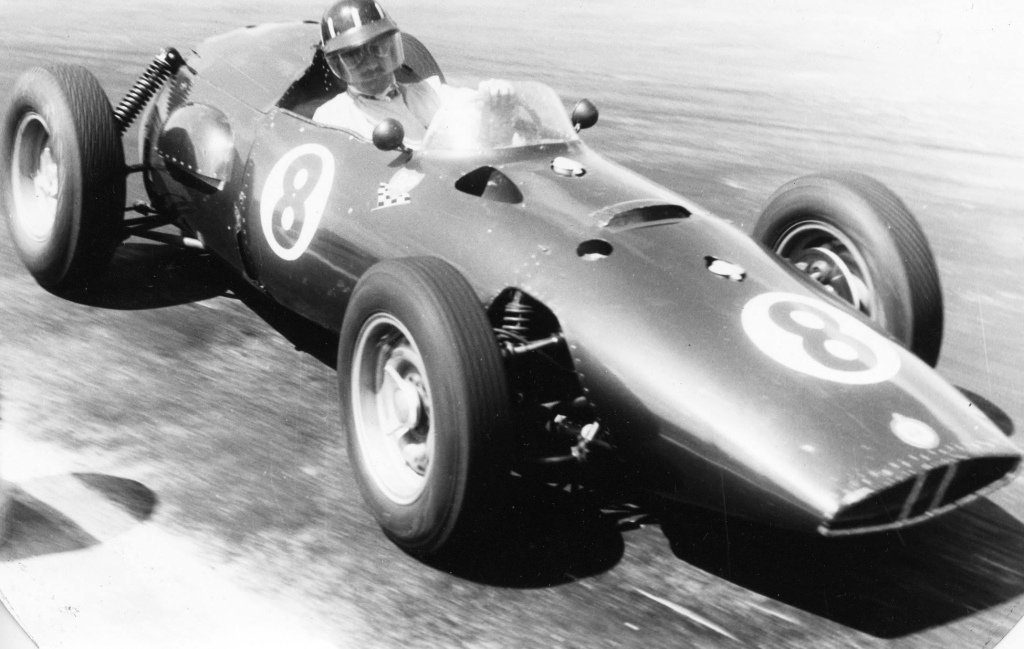
Atmospheric shot of Harry Schell’s BRM Type 25 during the August 23, 1959 Portuguese Grand Prix at Monsanto, Lisbon…

It was the breakthrough car for BRM, Jo Bonnier’s Type 25 won at Zandvoort in 1959 thereby breaking the F1 World Championship GP winning duck for the Boys from Bourne after nearly a decade of competition.

Immaculately credentialled engineer Stewart Tresilian “was largely responsible not only for the original conception and design of the BRM Project 25 2.5-litre four cylinder engine, but also of the compact P27 – or Type 25 – car (chassis) intended to carry it into battle.” Doug Nye wrote in ‘BRM Vol 1.’

“He had produced a homogeneous concept of car and engine combined, its essence being the complete antithesis of the original V16 in that it was all as small and compact and simple as possible, with the arguable exception of his projected 16-valve cylinder head for the four cylinder engine.”

BRM P15s, JM Fangio on the front row, and Ken Wharton behind him, Albi GP May 1953. Fangio won the heat and dominated the final before tyre troubles intervened, Louis Rosier won in a Ferrari 375 with Froilan Gonzalez second in another BRM P15. Car #3 is Nino Farina in the Vandervell Thin Wall Ferrari 375 (B Cahier)

The four-valve head design was subsequently over-ruled by Peter Berthon and after Tresilian left the Owen Racing Organisation to go to Bristol-Siddeley Engines in January 1953, Berthon, Tony Rudd and others brought the Type 25 to reality.

The result was a car that became increasingly fast, it not particularly reliable with each passing year from its race debut in 1955 until early in 1960. It allowed the team to develop the capabilities to win; car development, preparation and driver, they couldn’t do that with a car that never lasted too many laps. Mind you, the simplicity of Tresilian’s concept was complex in its execution…

Peter Collins crashed his Type 25 #252 during practice of the Daily Telegraph Trophy meeting at Aintree on September 3 1955, so took his bow here at Oulton Park during the September 24, 1955 International Gold Cup meeting in the same car. Q13 and DNF after loss of oil pressure after 13 laps. Stirling Moss won in a Maserati 250F from Mike Hawthorn’s Lancia D50. Oh to have been there that day!
Many thanks to Stephen Dalton for these two programme pages – studiously marked up by a knowledgeable spectator – from that BRM Type 25 failed race debut September 1955 meeting at Aintree

The P27 semi-monocoque – in the centre section – chassis was strongly influenced by Tom Killeen’s Killeen K1 sportscar which was tested extensively at Folkingham by Rudd. He was impressed and the performance of the car “confirmed PB’s interest in stiffening his basic new P27 frame with a stressed-skin monocoque centre section.

The five-speed rear-mounted gearbox was drawn by Alec Stokes, “who was destined to become BRM’s dedicated transmission specialist and one of the country’s leading gear-men.” The back of the gearbox carried the controversial single, longitudinal-axis rear disc universally known as the ‘bacon-slicer’.

With 50/50 weight distribution and 70% of the braking load at the front, the thinking was that outboard front disc brakes would carry 35% each, leaving 30% for a single rear disc. It took a long time to sort, but when that was achieved “this arrangenent worked quite well on the front engined cars.”

Rear suspension was by way of a De Dion tube with Lockheed air struts inherited from the V16 program, front suspension comprised upper and lower wishbones and coil air strut units again, with the rack and pinion steering Morris Minor based.

BRM P25 2.5-litre, (2491cc 102.8mmx74.93mm bore/stroke) four main bearing, DOHC, two-valve, Weber fed, twin Lucas magneto and twin-plug sparked four-cylinder engine shown in one of the cars at Monaco in 1956. That hole in the bonnet is the extent of the access my friends
BRM Type 25 1958 specification spaceframe chassis (C La Tourette)
BRM Type 25 during the 1959 Dutch GP weekend at Zandvoort. Cars then spaceframe chassis with vastly superior mechanical access, note the single rear disc brake under the fuel tank at right. All that fuel sitting very high, the trade-off decisions are made clear in this shot (BRM 1)

While work progressed on the chassis there was a long test program with a single-cylinder model of the new engine. ORO were racing the V16 Mk2 and Maserati 250F during this period, with some success. By Easter 1955 the car was complete but for the engine. Finally, on June 5, 1955 the car ran for 19 laps at Folkingham with Rudd at the wheel, having given 260bhp @ 8000rpm on the test bed.

The major problem on test was the SU fuel injection system which was subseuently ditched in favour of a pair of 58DCOE Webers. After further tests by Ron Flockhart and Peter Collins, the car was entered for the September 3 Aintree meeting.

Peter Collins was chosen to race the machine but lubrication problems caused the engine to blow oil over the rear tyres causing a spin and chassis damage that prevented further running. A further run at Oulton Park on September 24 was impressive with Collins running third in front of Ferraris, Maseratis and Vanwalls etc ended when Peter noticed failing oil pressure and pitted. Thus turned out to be a dud gauge which had been shaken to death by the vibrations of the big-bore-four!

Post-meeting work involved rubber mounting the instruments, improving gearbox lubrication and gear teeth form. As Nye observed, “The new BRM was the tiniest car of its time. It was really minute, and very light, and very powerful…and very troublesome.” The eternal process of development was only just underway.

Willie Southcott tending Tony Brooks’ car, #252, at Goodwood during the Glover Trophy meeting in April 1956. DNF oil pressure in the race won by Stirling Moss’ Maserati 250F
British GP scene July 14, 1956. The Type 25 cars of Tony Brooks, Mike Hawthorn about to receive a fresh engine, and Ron Flockhart at right; DNF accident, uni-joint and engine respectively. Fangio won in a Lancia Ferrari D50 (MotorSport)
Tony Brooks’ Type 25 #252 enroute to Q6 and second in the Aintree 200 in April 1956, Moss won in a 250F (MotorSport)

Stirling Moss tested the cars in the lead up to the 1956 season but went to Maserati instead, so Mike Hawthorn and Tony Brooks stepped into the breech. Those poor unfortunates enjoyed a season of great speed laced with equal amounts of unreliability and poor preparation.

The team addressed many problems that year. They slowed the rotating speed of the bacon-slicer by use of a reduction gear, experienced ‘stiction’ in the air struts, the big valves stretched and broke, they had pot-joint seizure and so on. Then Brooks experienced a jammed throttle rod at Silverstone at Abbey corner triggering a somersault which destroyed chassis #252 by fire. To compound a diabolical British GP weekend in front of the home crowd, Ron Flockhart’s car broke its timing gears. Despite all of that Hawthorn and Brooks had qualified in the Top 10, Mike in Q3. The team withdrew from the final two championship races of the year in Germany and Italy.

The Brooks Silverstone conflagration, thank goodness the Gods of Goodnesss were smiling on Tony that day, but chassis 252 was very dead (TC March – T Johns Collection)

Alfred Owen then decreed there would be no more racing until the car had completed 300 miles of continuous running competitively. Flockhart achieved this late in the year at Monza. Three laps later, with Berthon waving him on, the car dropped a valve and ruined another engine. Nye observed, “From their debut in 1955 to the end of 1956 the BRM Type 25s had made only eight starts in just five races, and finished only once, Brook’s second in the Aintree 200.”

Over the winter Colin Chapman test drove the car twice and provided a comprehensive set of recommendations in a formal letter of advice including rear suspension changes. Fitment of tall coil spring/dampers and incorporating a Watts linkage to help locate the De Dion tube were among changes which help transform the cars.

Les Leston at Aintree during the 1957 British GP weekend, Q12 and DNF engine after 12 laps in chassis #253. Brooks/Moss won in Vanwall VW4 (MotorSport)
Herbert Mackay-Fraser’s BRM T25 #253 ahead of Mike Hawthorn’s Ferrari Lancia D50 at Rouen during the 1957 French GP

In 1957 Brazilian born American Herbert Mackay-Fraser charged at Rouen, while poor Flockhart spun on oil , rolled into a ditch and wrote 254 off. Fraser died a week later aboard a Lotus 11 Climax FPF at Reims and Flockhart was still in hospital so Jack Fairman and Les Leston raced the cars at Aintree.

Jean Behra was so impressed by the corner-speed of the Type 25 at Aintree he cadged one for the 302km Caen GP which he won! Harry Schell drove a sister car in the event at the last moment, and soon became the most consistently successful Type 25 driver.

“At the end of the season, against meagre opposition, the three surviving cars, 251, 253, and 254 finished 1-2-3 in the Silverstone International Trophy, driven by Behra, Schell and Flockhart.”

During the 1957-58 break, a fifth main bearing was incorporated into the engine to solve ongoing timing gear problems, the cost was high, additional friction losses impacted horsepower. The chassis came in for attention too, the semi-monocoque centre section was ditched in favour of a full spaceframe with fully detachable bodywork.

Schell and Behra finished two-three in the Dutch GP, the team’s best result yet. The methanol burning four-bearing engine gave over 280bhp in 1957, whereas the five-bearing on Avgas gave only 240bhp, Behra left for Ferrari at the end of the year.

Schell at Eau Rouge, Spa, Belgian GP 1958. Harry was fifth in #257, with four of the first five cars British, the only interloper was Mike Hawthorn’s second placed Ferrari 246. Brooks and Lewis-Evans were first and third on Vanwalls, while Cliff Allison’s tiny Lotus 12 Climax was fourth (MotorSport)
Onya Harry! Third (right) on the grid at oh-so-fast Reims, 1958 French GP aboard #258. The Ferrari Dinos of Mike Hawthorn #4 and Luigi Musso share the front row with him. Hawthorn won while Harry retired with overheating after 41 laps
Behra, Oporto, Portugal in 1958, fourth from Q4 in #256 with Moss the winner in Vanwall VW10 (Getty)

Fiery Harry Schell was one of the surprises of the 1958 with a series of qualifying performances and points finishes which proved just how much their ever evolving Type 25 – despite the power loss – had come. Second at Zandvoort was fantastic, so too a swag of fifth places at Monaco, Spa, Silverstone (from Q2) and Oporto. Behra’s best was third and Holland and fourth in Portugal, while Jo Bonnier’s was fourth place in the season-ending Moroccan round.

In the first season the manufacturers championship was run, BRM were fourth in the International Cup for F1 Manufacturers behind Vanwall, Ferrari and Cooper Climax. Vanwall had peaked as they led the pre-eminence of British Racing Green, while Coopers were on the rise…

Moss on the way to second place in the BRP entered BRM Type 25, Aintree, British GP July 1959. Brabham won on a Cooper T51 Climax. Bourne standards of preparation encouraged Moss to have his Type 25 #2510 fettled by his (Alfred Moss and Ken Gregory) British Racing Partnership. This chassis met a violent death at Avus the following month when Hans Hermann had brake failure on the approach to the southern hairpin during the German GP, the lucky pilot survived the monumental accident unscathed. The BRM Gods of Goodness again smiled on Hans, but former BRM racer Jean Behra was not so fortunate that same weekend
Ron Flockhart’s #2511 during Aintree Friday practice, British GP weekend in July 1959. DNF spin after 53 laps (D Williams)
Jo Bonnier in #258, in front of Masten Gregory at Zandvoort during Jo Bo’s famous May 31, 1959 BRM Type 25 victory, Masten was third and Brabham second on works-T51s (MotorSport)

While Jack Brabham and Stirling Moss rewrote the record books with their factory and Rob Walker Cooper T51 Climaxes in 1959 BRM put themselves in the annals of Grand Prix history when Jo Bonnier won at Zandvoort in May. Schell had a season of greater reliability than Bonnier but didn’t do as well as the year before.

That winter Harry Weslake had advised Bourne on improved cylinder head design, and the fifth main-bearing was machined out! BRM adopted new timing gears “with large, coarse teeth not critical to fine backlash tuning for reliability.” Further brake modifications and simpler, lighter chassis – numbers 2510 and 2511 – “made the BRM Type 25s simply the fastest front engine cars of 1959, with fantastic braking ability.” Doug Nye wrote.

Graham Hill, Dan Gurney and Bonnier drove the cars on into 1960 at which point all of the remaining Type 25s, except #258, the Zandvoort winner, were torn to bits to provide components for the new mid-engined P48 2.5-litre cars “being hastily built to follow Cooper’s rear-engined lead.”

(unattributed)

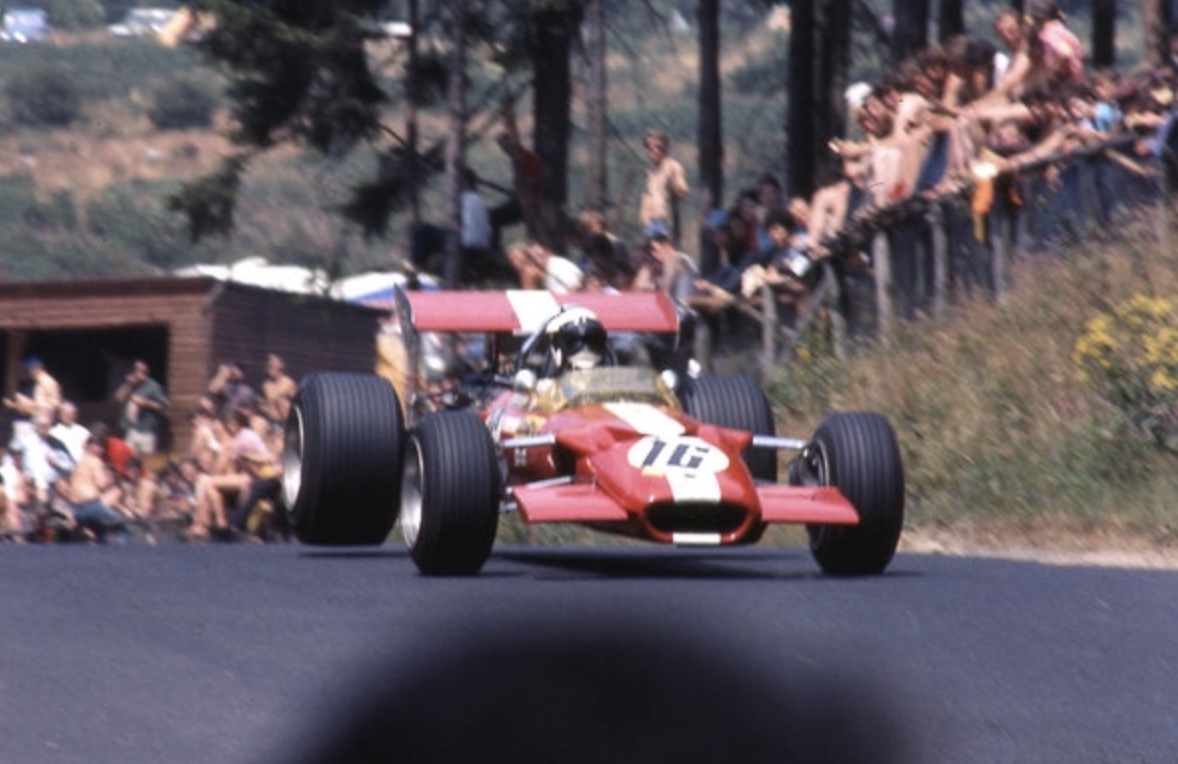
Jo Bonnier “drifting into history”, as Doug Nye beautifully put it. By April 18, 1960 JoBo could have raced a new mid-engined P48 in the Goodwood Easter Monday Glover Trophy but chose to race Type 25 #258, his Zandvoort machine instead. Graham Hill and Dan Gurney gave the P48s their race debut that weekend, Hill was fifth, Bonnier sixth and Gurney had an accident on lap 3. In a sign of the times, Innes Ireland’s works Lotus 18 Climax won, it was the fastest, if not the most reliable GP car of 1960.

The old and new, BRMs Type 25 and P48, both 2.5-litres in September 1959. That’s #481 in shot with its unique nose on the Folkingham floor between the two cars, Type 25 chassis number unknown (BRM 2)
Graham Hill tips his BRM P48 into one of the oil-drum marked corners on the Ardmore Airfield circuit during the January 1961 New Zealand Grand Prix weekend. He was third behind the Cooper T53 Climaxes of Brabham and McLaren (M Fistonic)

See here for the first of two articles on the next phase of BRM history; https://primotipo.com/2015/03/26/tony-marsh-boness-hillclimb-scotland-brm-p48-part-1/

Eleven BRM Type 25 chassis were built – #251-259, 2510 and 2511 – during the long 1953-1960 BRM Type 25 programme, starting in 21 championship and 26 non-championship and Formula Libre events. These 47 meetings yielded the Dutch GP win for Bonnier and seven minor event victories including the two preliminary heats of the 1957 International Trophy at Silverstone and the 1959 New Zealand Grand Prix heat at Ardmore for the ever patient Ron Flockhart.

Etcetera…

(TC March – T Johns Collection)

The boys; standing are Basil Putt, Team Manager, Mike Hawthorn, Tony Brooks, Peter Berthon, Tony Rudd, Raymond Mays, AF Rivers Fletcher. Who are the mechanics in front? Folkingham, Lincolnshire August 28 1956 ‘Test and view day’.

The cover and editorial of Autosport after Peter Collins made the race debut of the Type 25 at Oulton Park on September 24, 1955 says everything about Britain’s goodwill towards BRM in its fight to take on the best in the Grand Prix world.

Great shot of Les Leston with team chief Raymond Mays at Aintree during the 1957 British GP weekend. Q12 and DNF engine after 12 laps, Jack Fairman lasted two laps more before he too suffered engine dramas. Up front, Tony Brooks and Stirling Moss shared the win in a Vanwall.

Rouen pits in July 1957, the incredibly quick BRM Type 25 #253 of the oh-so-promising American driver Herbert Mackay-Fraser awaits its wheels. Q12 and DNF transmission failure after 24 laps, Fangio won in a Maserati 250F. And below with the Mike MacDowel Cooper T43 Climax shared with Jack Brabham to seventh in the race. The contrast in size between the smallest front-engined car of the era and the grids most compact is quite marked.

(LAT)

Peter Berthon and 37 years old Harry O’Reilly Schell at Monaco in 1958. Despite a wild-man reputation Harry put together plenty of fast drives and high placings just as the team needed them. He was equal fifth (with the dead Peter Collins) in the drivers championship with 14 points, a personal best. 1959 was tougher, Stirling Moss bagged his car and Harry didn’t finish a race until Reims in July, but managed fourth at Silverstone and fifth in Portugal. Schell died at Silverstone in damp practice for the 1960 International Trophy, he clipped a low retaining wall at Abbey, was half flipped out of his Cooper T51 Climax and broke his neck.

Behra at Oporto 1958. Doesn’t that BRM #256 look magnificent beside those small, very fast Cooper T45s. #12 is Maurice Trintignant, #16 Roy Salvadori with the obscured Jack Brabham copping a push start at right.

(CAN)

Ron Flockhart during the Lady Wigram Trophy, New Zealand in January 1959. If a bloke deserved a win in these cars it was Ron given the number of test and race miles he did in them. He won aboard #259 from pole in front of Jack Brabham and Bruce McLaren’s Cooper T45 Climax’.

‘Where is the starter again?’ Tony Rudd and mechanic in Harry Schell’s #257 at Monaco in 1959. Q9 and DNF accident after completing 48 laps of the race won by Jack Brabham’s Cooper T51 Climax. Bonnier’s car retired with failing brakes from Q7.

(unattributed)

Yay team, again at Zandvoort in 1959, and one more time, there is no such thing as too much BRM…

BRM Type 25 model from Stephen Dalton, “it’s a Merit with the Alastair Brookman touch, he built it.”

Credits…

Clarence La Tourette, Getty Images, John Ross Motor Racing Archive, Bernard Cahier, John Ferguson, Classic Auto News, LAT, MotorSport Images, ‘BRM 1’ Doug Nye, History of the Grand Prix Car 1945-65 Doug Nye, Dave Williams, Stephen Dalton Collection, TC March, Tony Johns Collection

Tailpiece…

(B Cahier)

Phil Hill catches Jean Behra on the way to a DNF brakes at Monaco in 1958 from a splendid Q2 in chassis #256. Tony Brooks was on pole and Jack Brabham Q3 is the upstart 2-litre Cooper T45 – with two more of the pipsqueaks behind Jack – driven by Roy Salvadori and race winner Maurice Trintignant.

While the mid-engined writing wasn’t perhaps on the wall, the sign-writers were readying the paint…

Finito…

(T Marshall)

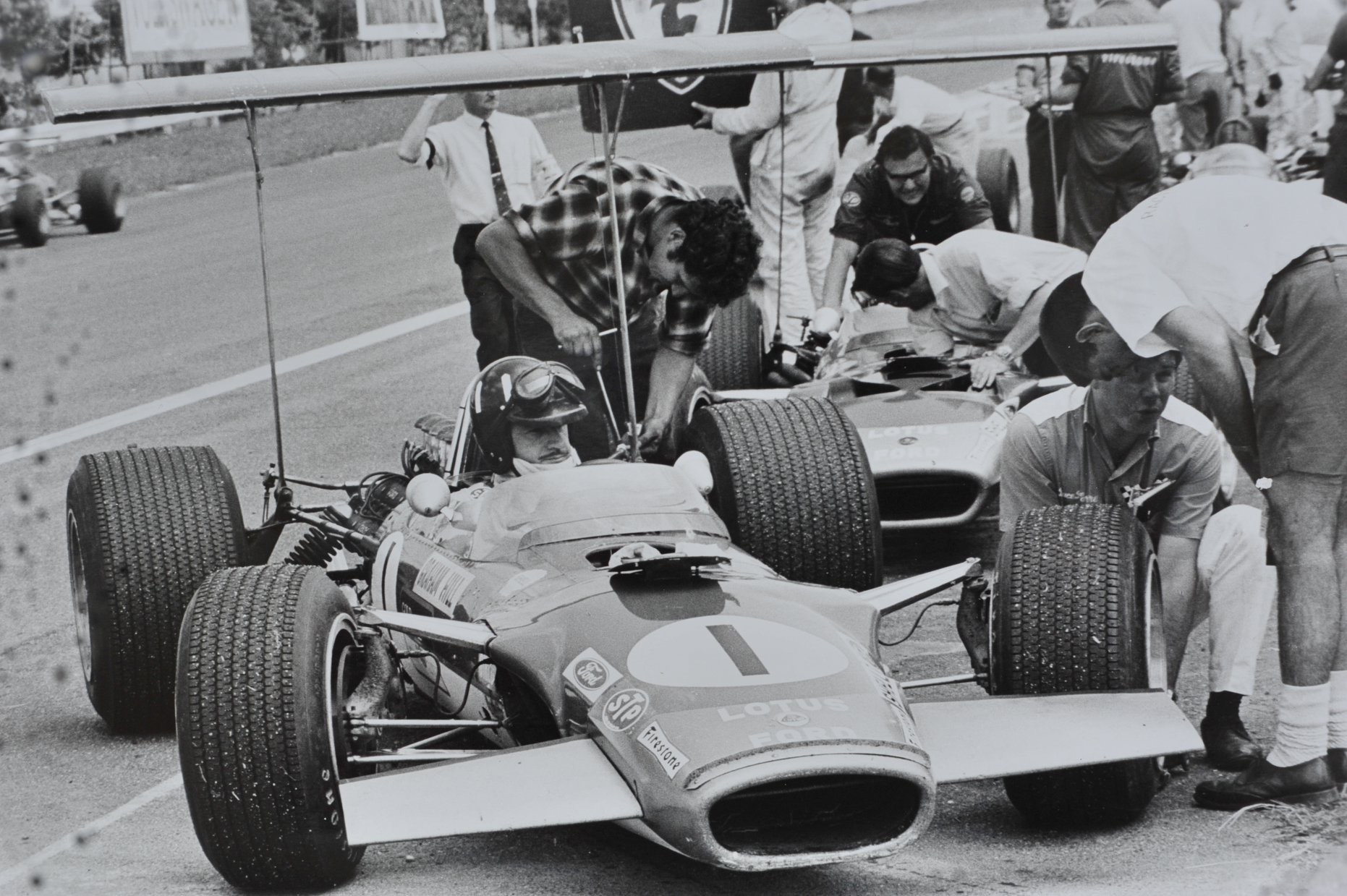
Graham Hill talks to the lads about his brand-spankers Lotus 49B, chassis R8 in the Pukekohe pitlane during the 1969 NZ GP weekend…

Maybe he is talking about his car, or perhaps the blistering pace of Jochen Rindt, his new teammate.

While it’s a brand new chassis, the car is fitted with a ZF gearbox rather than the Hewland DG300 which he had been using in his definitive spec F1 49B in late 1968. Both Hill’s R8 and Rindt’s R9 were concoctions of the original 49 and of the subsequent 49B. Type 49 features included the front-mounted oil tank, use of a combined oil/water radiator, original front rocker arms mounted at 90 degrees to the tub rather than swept forward, the ZF gearbox and old style rear suspension mounted to ‘fir-tree’ brackets bolted to the DFV.

The main 49B feature adopted was the use of cutouts in the lower rear part of the tub to locate the lower rear radius arms. The cars used high-wings mounted atop the uprights in the same style first used on Jackie Oliver’s R2, and used the wing-feathering mechanism pioneered in Mexico at the end of 1968.

There was enormous excitement in Australasia prior to the 1968 Tasman when the quickest cars of the 1967 F1 season, Lotus 49s powered by the 2.5-litre short stroke DFW variant of the F1 3-litre Ford Cosworth DFV were raced by Jim Clark and Graham Hill; chassis’ R2 and R1 respectively.

Jim Clark won the Tasman Cup, his last championship, and the Australian Grand Prix at Sandown, his last GP win before his untimely death at Hockenheim on April 7, 1968.

While there was huge enthusiasm for Graham Hill and Jochen Rindt, the absence of Clark tugged at the hearts of enthusiasts, Jim was such a popular visitor to our part of the world, his first tour was in 1962.

Rindt finally had a car with the speed and occasional reliability – he was hard on it mind you – to post the results he deserved. His first GP win came at Watkins Glen late in 1969, but he perished less than twelve months later at the wheel of a Lotus 72 during practice for the Italian Grand Prix.

Graham Hill did a sensational job in picking up Team Lotus lock-stock-and-barrel after Clark’s death. He filled the leadership void until Colin Chapman clicked back into gear after mourning Clark’s loss. Graham would have a tough season in 1969, Rindt’s pace was apparent from his first laps at Pukekohe and at Watkins Glen Hill he had the bad accident which hospitalised him for months.

Team Lotus built two new cars for the ’69 Tasman assault; 49Bs R8 – a new chassis – for Hill, and R9 – the prototype R1 rebuilt – for Rindt which were identical in specifications.

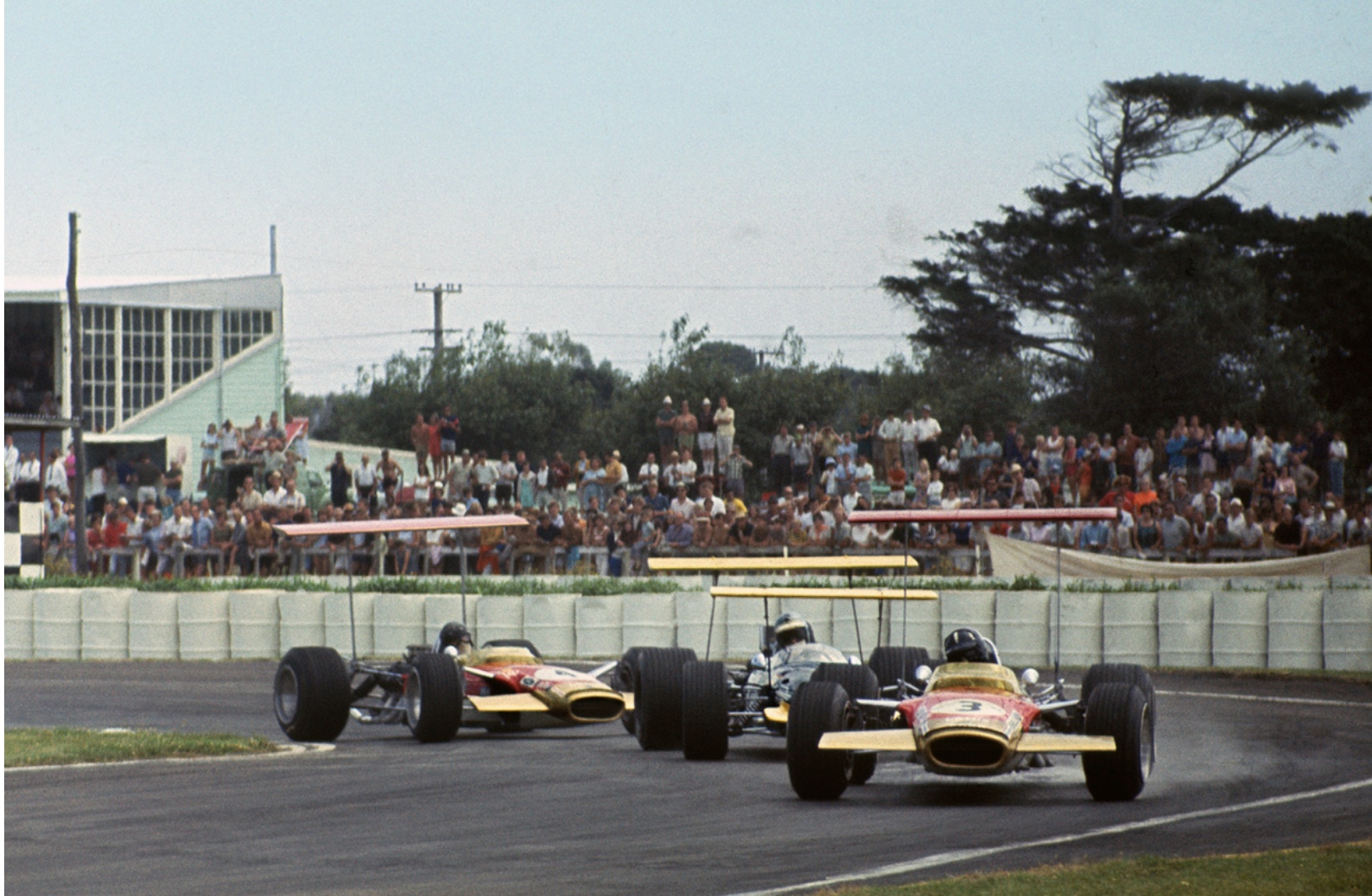
NZ GP Pukekohe 1969, the off. From left Amon with Bell right behind then Leo Geoghegan’s white Lotus 39 Repco, Hill’s Lotus a row back, then Jochen up front alongside Chris and Piers at right in the Williams Brabham BT24 Ford
Gardner, Mildren ‘Yellow Submarine’ Alfa, Hill, Rindt in the Wigram dummy grid in 1969 (CAN)

Chris Amon mounted a very successful 1969 Tasman campaign using the learnings of the prior year. He had Bruce Wilson as lead mechanic again, and an additional car to be raced by Derek Bell with a strict rev limit given the small float of engines available between two cars. Logistics were taken care of by David McKay’s (Sydney) Scuderia Veloce outfit.

Chris opened his account with intent, he won the first two races at Pukekohe on January 4 and at Levin the week later. Jochen was second in the NZ GP whereas Graham had two DNFs, a front suspension ball-joint failed after completing 13 laps in the first race, and driveshaft failure at Levin, this time on lap 12 when running in third place from grid five.

Jochen came to grief at Levin, he spun on lap four whilst leading, and then repeated the mistake two laps later but in more costly fashion, rolling the car atop a safety embankment. Jochen was ok but R9 was rooted, too badly damaged to be repaired away from home base. 49B R10 was despatched to the colonies, much to Hill’s chagrin. It was the first of many Lotus accidents and component failures for the Austrian during the next twenty months, not that the cause of this shunt was the fault of the car.

The ferry trip to the South Island brought better fortune. Hill and R8 finished second in the Lady Wigram Trophy race on the Royal New Zealand Airforce Base outside Christchurch on January 18, but Jochen made good use of his new car from pole setting fastest lap and race time. Jochen was 34 seconds in front of Graham, with Chris Amon another four seconds behind Graham, then Piers Courage another six seconds back in Frank Williams’ Brabham BT24 Ford DFW.

The following weekend Graham was second again at Teretonga near Invercargill, the world’s most southerly racetrack, the winner this time was Courage. This time it was Jochen’s turn for driveshaft failure, interesting given the DFW gave circa 50bhp less than the DFV, with Chris Amon third and looking good for the title as the circus crossed the Tasman Sea for three Australian rounds.

Graham blasting through the Teretonga scrub country. Note the long exhausts of the 2.5 DFW, look how flimsy the wing supports look, and were- Chapman at his worst. Note – look hard – the Lotus aero-screen (LAT)
Early laps at Levin. Piers Courage in a Lotus sandwich, Hill in front with Jochen aboard the ill-fated R9 in third (LAT)
The off at Wigram. Courage, Brabham BT24 Ford and then Graham with Jochen on pole in Lotus 49Bs. Amon behind Jochen, the light coloured car behind Chris is Gardner’s Mildren Alfa V8 (T Marshall)

First stop was on February 2, 1969, at Lakeside, Brisbane, for the Australian Grand Prix.

Graham finished fourth in R8, while Jochen’s R10 had engine failure. Both cars had wing mount failures- Chapman’s In-God-We-Trust engineering of these things was cavalier for so long it is a joke. Only Jochen’s celebrated Come-To-Jesus (whilst I am on religious metaphors) letter after the collisions inflicted upon Rindt and Hill at Montjuic Parc in early 1969 gave Our Col pause to consider his desire to attend another driver funeral.

GLTL then headed south to Sydney for the Warwick Farm 100, basing themselves at the Brothers Geoghegan emporium of fine sportscars in Haberfield, a stones-throw from the Farm at Liverpool.

While practice was dry, Rindt massacred the lap record, then drove away from the field during the race in a mesmeric display of wet weather feel, bravado, pace and dominance winning at a reduced canter by 45 seconds from Derek Bell’s Dino and Frank Gardner’s Alec Mildren Mildren Alfa Romeo 2.5 V8.

Poor Graham’s R8 snap-crackle-‘n-popped its way around the technically demanding course with his ignition very much rain affected. Chris and Piers tangled early in the race which gave the Kiwi sufficient points to win the Tasman Cup.

Hill aboard R8 with Rindt in R10 in the Sandown pitlane, February 1969. Note the open bonnets, spoiler atop the nose of Graham’s  (I Smith)

The final round of the Championship took place at Melbourne’s Sandown Park on February 16.

There Chris drove a wonderful race to win by seven seconds from Jochen with Jack Brabham third in the Brabham BT31 Repco 830 2.5 V8, in Jack’s one off 1969 Tasman race, with Gardner fourth, Bell fifth and then Graham sixth, three laps adrift of Amon.

Jochen’s R10 was airfreighted home to the UK, it was required in F1, whereas R8 returned by ship. In the Spanish Grand Prix both high-winged Lotus 49Bs of Rindt and Hill were very badly damaged in separate accidents triggered by rear wing strut failure over the same high-speed brow on Barcelona’s Montjuic Park circuit- as mentioned earlier. See article here; ‘Wings Clipped’: Lotus 49: Monaco Grand Prix 1969… | primotipo…

While Graham wasn’t hurt, Jochen was severely concussed and was unable to drive at on May 18. Team Lotus lacked a car to replace Rindt’s R9, the chassis of which was consigned to a rubbish skip at Hethel. As a consequence, R8 was rushed off the ship from Australia, fitted with a 3-litre DFV, 1969 roll-over hoop, and fire extinguisher system before being taken to Monte Carlo for substitute driver, Richard Attwood to race.

He had shone in a BRM P126 the year before, setting fastest lap and finishing a strong second behind Graham Hill’s winning Lotus 49B R5.

At Monaco driving R8 with minimal preparation after seven hard races in the Tasman Cup, Attwood finished a fine fourth and set fastest lap in the race again won by Hill aboard 49B R10. With Jo Siffert third in Rob Walker’s Lotus 49B (R7) three of these wonderful cars were in the top four, the only interloper was Piers Courage splendid second place aboard Frank Williams’ Brabham BT26 Ford.

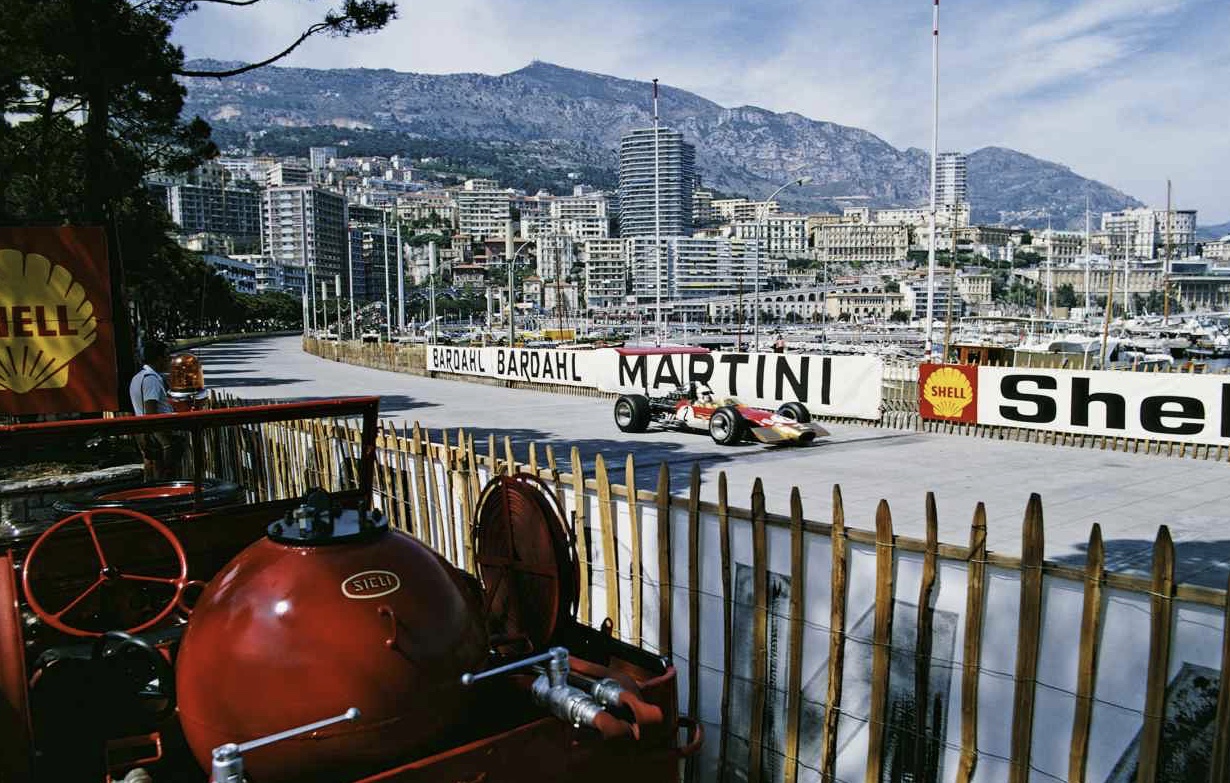
Richard Attwood in h-winged R8 during Friday practice at Monaco in 1969- after the wing ban the car raced denuded of same (R Schlegelmilch)
Attwood, Monaco, race day, fourth place- wonderful result having not parked his arse in the car before practice (unattributed)

Back at Hethel R8 was altered to latest 49B specifications and raced by Hill, nursing a sick neck to seventh in the 1969 British Grand Prix, at Silverstone on July 19.

Meanwhile, Colin Chapman’s four wheel drive Type 63, the proposed Type 49 replacement, struggled to find pace and the support of its drivers, as did the other 4WDs fielded by Matra, McLaren and Cosworth.

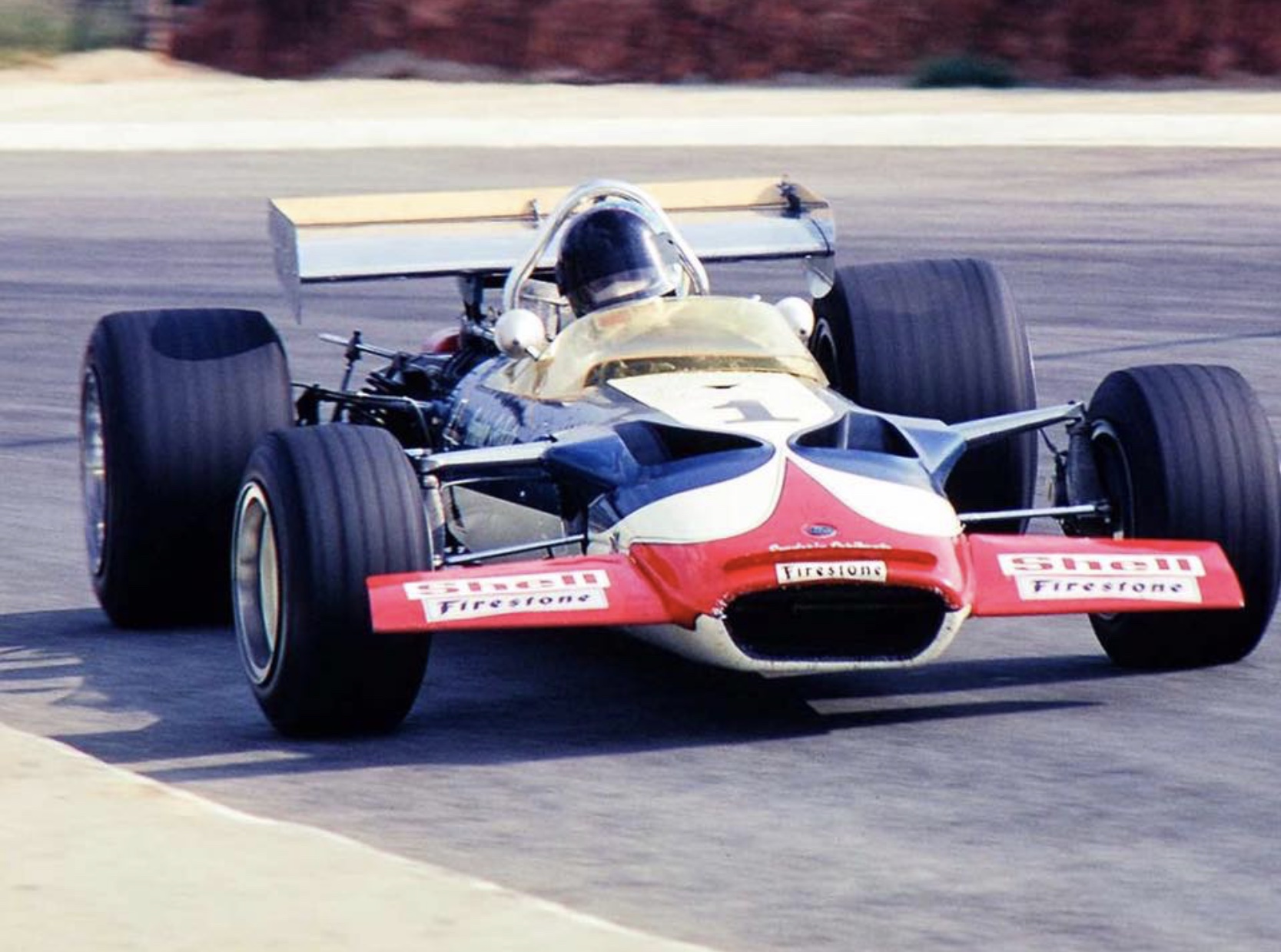
Given the choice, World Champion Hill, and Fastest Guy On The Planet Rindt, preferred the conventional rear-drive 49B. To prevent them having the choice Chapman decided to sell Team’s 49s, R8 went to Swedish journeyman owner/driver Joakim Bonnier.

He raced it in the German Grand Prix in August, DNF fuel leak. Jo crashed it after front suspension failure during practice for the non-championship Oulton Park Gold Cup on August 16. Out of love with the car, the damage was repaired at Hethel prior to sale to Dave Charlton for South African national F1 racing in 1970.

Jo Bonnier returning to terra firma, R8, Nurburgring 1969 German GP. (unattributed)
Dave Charlton with R8, now in 49C specifications, during the 1971 Highfeld 100 (N Kelderman)

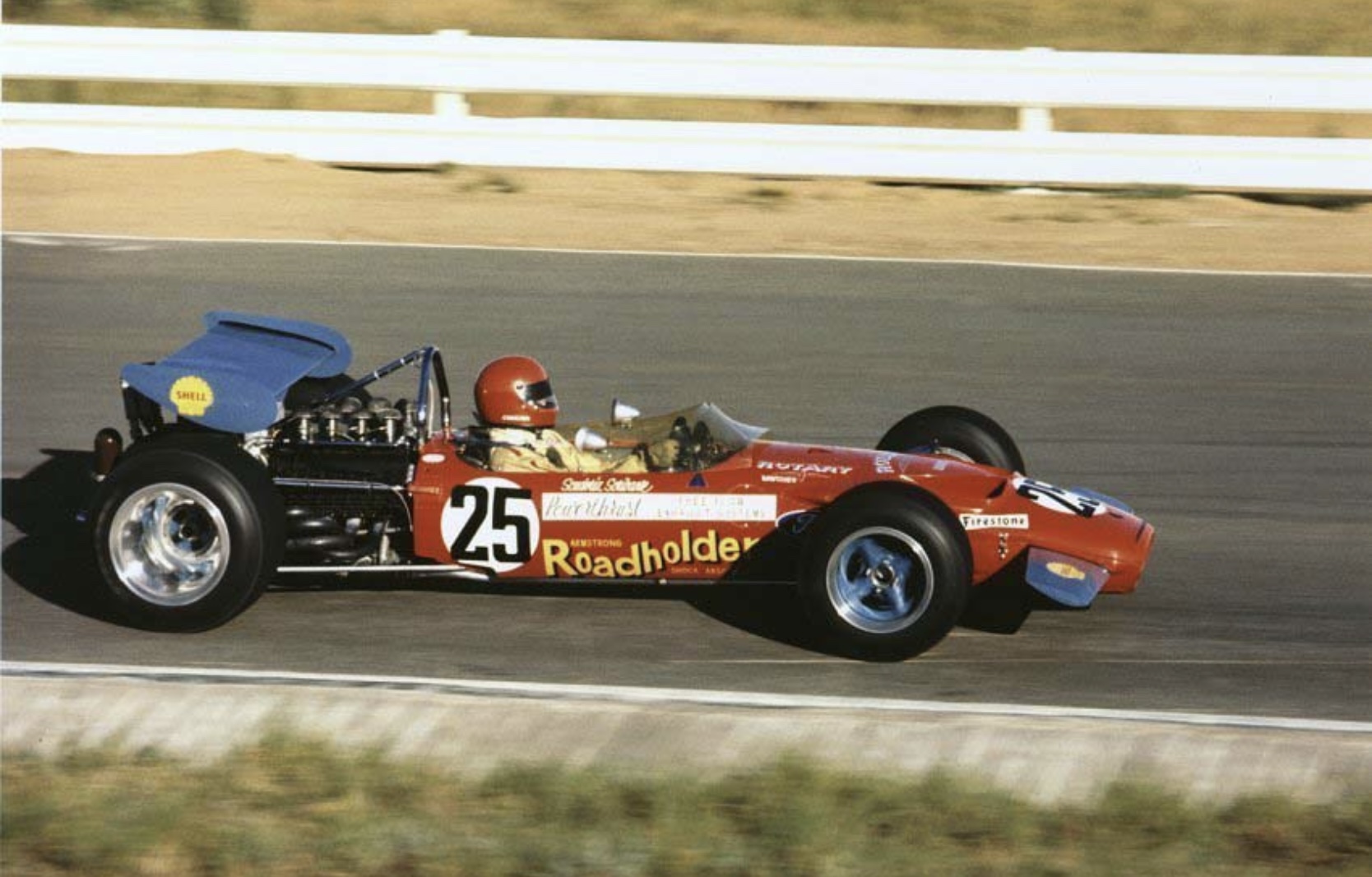
Charlton used R8 to win the first two of his six consecutive South African national Formula 1 Championship titles between 1970-75.

The car won nine rounds in 1970; the Highveld 100 at Kyalami, the Coronation 100 at Roy Hesketh, followed by the Natal Winter Trophy there, the Coupe Gouvernador Generale at Lourenco Marques, Rand Winter Trophy at Kyalami, False Bay 100 at Killarney, Rhodesian GP at Bulawayo, Rand Spring Trophy at Kyalami and the Goldfields 100 at Welkom.

In 1971 the Charlton/R8 combination won four events of six he contested before switching to a Lotus 72; the Highveld 100 at Kyalami, Coronation 100 at Hesketh, Bulawayo 100, and the South African Republic Festival race back at Kyalami.

R8 was then campaigned to the end of 1972 by South African drivers Piet de Klerk and Mayer Botha. Botha damaged the left side of the tub badly at Killarney in August. Sydney’s The Hon. John Dawson-Damer bought the damaged, dismantled car in late 1975, painstakingly restoring it with the assistance of Alan Standfield.

It was completed in 1982 and was a regular in Australian historic racing, driven by John, Colin Bond and John Smith, until DD’s sad death aboard his Lotus 63 Ford during the Goodwood Festival of Speed in 2000. Adrian Newey now owns it.

Dave Charlton in his Scuderia Scribante Lotus 49C Ford during the 1970 South African GP at Kyalami. DNF 73 laps, classified 12th (unattributed)

Credits…

Terry Marshall, LAT, MotorSport, Rainer Schlegelmilch, Nico Kelderman, Ian Smith, oldracingcars.com, ‘Lotus 49: The Story of a Legend’ Michael Oliver

Tailpiece…

(unattributed)

Graham Hill’s R8 butt at Warwick Farm on February 18.

The Brit contemplates a soggy, humid day in the office to be made worse by a misfiring engine and Rindt’s masterful brio behind the wheel of the other Lotus.

The car has the same pissant wing supports as it had at Pukekohe seven weeks before, but note the Hewland DG300 transaxle rather than the ZF unit used at the Tasman’s outset, a fitment which contradicts the history books…

Finito…

(J Ellacott)

Surely a BRM P48 has never looked better than this? Arnold Glass points his ex-works 2.5-litre, four-cylinder Bourne bolide- P48 chassis # ‘482’ down Mount Panorama, Bathurst, Easter 1962.

John Ellacott’s beautiful soft browns, blues and blue-greens radiate with the April autumn heat of the Great Dividing Range.

When I first saw this photo it reminded me of the hues of Albert Namatjira’s outback paintings which were 1960’s Australian State Primary School walls standard issue- along with stiff, formal portraits of Betty Windsor! (Queen Elizabeth)

Its just a beaut shot of a car critical in the wonderful pantheon of BRM’s, their first mid-engined design. Arnold’s 1960 P48 is only a hop-step-and jump from Graham Hill’s 1962 World Championship(s) winning 1.5 litre P56 V8 engined BRM P578. The models in between these two are the 1960/61 P48 Mk2, 1961 Coventry Climax 1.5 FPF powered P57 and two chassis modified to take the P56 V8, the P57 V8.

Mr Glass qualified 4th at Bathurst but failed to finish the 26 lap, 100 mile race won by Bib Stillwell from David McKay and Bill Patterson, Bib and David in Cooper T53 Climax 2.5 FPF’s and Bill in a similarly engined T51.

I wrote Part 1 of an article about the P48 in mid-2015 promising Part 2 about the cars in Australia shortly thereafter. Here it is, better late than never I guess!

Tony Marsh, Bo’ness Hillclimb, Scotland : BRM P48 Part 1…

The Owen Organisation had plenty of automotive sector subsidiaries in the Southern Hemisphere so it was with great pleasure that Australasian enthusiasts welcomed the visits of the Bourne team to promote the group’s wares from 1961 to 1968. Perhaps that should be from 1954, after all, Ken Wharton raced a howling BRM P15 V16 in the ’54 NZ GP at Ardmore- that race won in stunning circumstances by Stan Jones in Maybach 1 with an amazing race eve engine rebuild which miraculously held together on race day.

Dan Gurney practising P48 ‘486’ at Warwick Farm before the ’61, WF 100. He is on Pit Straight. DNF fuel vaporisation in the race won by the Walker Lotus 18 driven by Stirling Moss (J Ellacott)

Graham Hill and Dan Gurney didn’t have a great tour with P48’s ‘485’ and ‘486’ in the three races they contested in 1961- the 7 January NZ GP at Ardmore, 29 January Warwick Farm 100 in Sydney and 12 February Victorian Trophy at Ballarat Airfield in Victoria. Still, first and second at Ballarat for Gurney from Hill was a good way to end the tour and the first and only international victory for the P48.

By this stage of their development the two early spec P48’s with strut rear suspension and 3 disc brakes- one on each front hub and a single-‘bacon slicer’ disc on the back of the gearbox were competitive in Europea after Tony Rudd was given ‘engineering control’ from the end of the Dutch GP weekend. Lets not forget Graham Hill overtook Jack Brabham and led the British GP at Silverstone before a late race error outed him.

The GP car of 1960 was the Lotus 18 Climax, I’m not at all saying the P48 had the consistent pace of Chapman’s latest, let alone the race-winning speed and reliability of the works Cooper T53’s.

WF 100 grid 1961. Moss, Walker Lotus 18 Climax, Gurney and Hill in the two P48’s. Ireland and Brabham on row 2, Lotus 18 and  Cooper T53 with Bib Stillwell on the outside of row 3 in the #16 Cooper T51 and the rest. Moss won from Ireland and Stillwell (WFFB)

Ballarat paddock- the two P48’s and from left in cap David McKay, Lex Davison, Graham Hill and Dan Gurney in the flat-cap (R Jones)

Gurney on the way to Victorian Trophy P48 ‘486’ victory at Ballarat Airfield 1961. Gurney won from Hill and Ron Flockhart, Cooper T53 Climax (Autosportsman)

Hill, P48 and the fans in the Ballarat Airfield paddock (R Jones)

Motor importer/distributor/dealer on the rise, Arnold ‘Trinkets’ Glass had the necessary readies and felt one of the BRM’s would be a more competitive proposition than the ex-Tommy Atkins/Harry Pearce built Cooper T51 Maserati 250S he had been racing. The T51 Maser was an attempt to gain an ‘unfair advantage’ over the Cooper T51 Climaxes, and there was similar thinking in acquiring the P48 powered as it was by an engine regarded as having a little ‘more punch’ than the 2.5 FPF. I wrote an article about Arnold a while back; https://primotipo.com/2015/08/25/arnold-glass-ferrari-555-super-squalo-bathurst-1958/

Glass commenced discussions with Bourne in early 1961, it wasn’t financially feasible for him to buy a car such was the level of import duty at the time- 95% of the car purchase price was levied by the Australian fiscal fiend, but a deal was finally done to lease ‘485’ which was shipped to Sydney arriving in August 1961 complete with a package of spares including an engine and gearbox. Doug Nye records in full the detail of the rebuild of the car before it left the UK- ‘485’ was beautifully prepared even if the engine ‘2593’ had 68 3/4 hours of running ‘…the most, predictably of any 1960 spec P48. When it arrived Arnold described it to Nye as ‘…sprayed in my red livery, it was an absolute beauty- a turn key car- ready to go, with a spare engine and I think gearbox too.’

Great portrait of Arnold Glass, 36 years old, during the 1962 AGP weekend at Caversham, WA (K Devine)

‘485’s life in Australia was rather short however.

After running the car in Sydney on Warwick Farm’s short circuit Glass travelled to the Mallala, South Australia airfield’s first meeting along with other 1961 AGP aspirants over the 19/20 August weekend to contest the ‘Mallala Trophy’. It wasn’t a Gold Star round but most of the ‘quicks’ made the trip- the AGP was to be held there in early October, Lex Davison the winner in a Cooper T51 Climax.

Glass was getting used to the car and circuit like many others. On the Friday morning he set off from the pits, soon lost control of the car badly damaging it. The ‘Australian Motor Sports’ report of the accident records ‘…when Glass braked for Woodroofe, the car spun all over the road and slammed into a tree. The car took it across the engine compartment, and though they attempted a rebuild before the meeting, nothing became of it’.

Arnold saw it this way in Doug Nyes ‘BRM 2’; ‘I drove in one session, then took the car out again for a second run and this time I was flat out down the straight when the car starts to pitch over the bumps and then suddenly she just goes sideways and shoots off at a tangent up and over a bank, hits a tree, which it collects just behind my cockpit, right in the side and that flicks the nose round and it goes head on straight into a concrete post…The beautiful car is a total wreck. Its bent like a Vee just behind the cockpit, the engine crankcase is shattered, and its all mangled up, a rear radius rod is broken off, its a mess.’

The insured car was soon on a ship back to the UK where the Bourne team assessed the chassis as being beyond economic repair so it was scrapped.

Chassis ‘482’ was sitting unused ‘in stock’ and so was despatched to Australia ‘without engine or gearbox so I can fit my spare engine and gearbox from the crashed car’ as the replacement. It was the first of six ‘production’ first series, strut rear suspension/3 brake P48’s and used the front-end structure cannibalised from the broken up front engine BRM Type 25 – chassis ‘257’.

Arnold raced it with both the 2497cc, 4 cylinder, DOHC BRM engine as fitted above at Bathurst and later the ex-Chuck Daigh Scarab RE, 3.9 litre, aluminium Buick V8- that engine sold to Glass after the Scarab’s one race only, the Sandown Park International in March 1962.

Arnold Glass, Cooper T51 Maserati, Warwick Farm 100 meeting, February 1961. DNF oil pressure (J Ellacott)

Glass raced the Cooper Maserati whilst he was BRM less at Warwick Farm, Bathurst, and Mallala for the AGP. BRM ‘482’ arrived in time for the season ending Hordern Trophy at Warwick Farm on 5 November, there he retired with fuel-pump failure in the race won by Stillwell’s Cooper T53 with Bill Patterson winning the Gold Star that year in his T51 Climax.

The very successful Datsun motor dealer/distributor/importer raced ‘482’ throughout 1962. He contested the NZ GP at Ardmore but could not see in the streaming rain having been well placed early, retiring the car with a slipping clutch. At Wigram he was 8th.

Back home at  Warwick Farm, for the 100 he retired from overheating after blowing a radiator hose. He was 4th at Lakeside on 10 February and DNF after a spin in the Lakeside International championship round the following day. At Longford in March he was 3rd in the preliminary and ran 6th in the feature race but retired with falling oil pressure but not before being timed at 167mph on ‘The Flying Mile’.

The Frank Coon and Jim Travers, in their pre-Traco days built 3.9 litre, aluminium Buick V8 in the back of Chuck Daigh’s Scarab RE at Sandown in 1962 (J Ellacott)

Arnold didn’t race the car at the Sandown International, the circuit’s opening meeting, but clearly was impressed by the ‘mumbo’ of the Buick V8- Chuck Daigh was 4th in the only ever race for the mid-engined Scarab RE. A very great shame that, it would have been interesting to have seen the car contest the Intercontinental Formula races for which it was designed.

By that stage the lease deal with Rubery Owen was at an end so Arnold did a deal with them and Australian Customs to acquire the car at a price- and pay duty at an amount which made sense all around.

At the Bathurst Gold Star round (pic at this articles very outset) he had suspension problems- an attachment to the rear upright was half broken through on the left rear suspension. In May he raced the car at Catalina Park in the New South Wales Blue Mountains and had a good battle with David McKay’s Cooper T53 Climax- so good a match race between the pair was staged at the Warwick Farm meeting in early June- Glass led before gear selection difficulties intervened, giving McKay the win.

BRM Buick ‘482’. Here @ Warwick Farm in 1962 fitted with the ex-Scarab RE 3.9 litre ally pushrod V8 as above. Chassis modified to suit of course, a clever solution to Australasia’s F Libre of the day. The merits of this family of engines- Buick/Olds F85 not lost on Brabham J! (BRM2)

He missed the Queensland, Lowood Gold Star round in June, reappearing with the Buick V8 installed at Catalina on 5 August- the Buick’s torque was too much for the cars clutch. The engine installation work, inclusive of creating a bellhousing to mate the American V8 to the P27 BRM transaxle was done by racer/engineer John McMillan and mechanic/engineer Glenn Abbey.

Later in August he had more success in the Blue Mountains with a second and third behind David McKay and Chris Amon respectively. At the Hordern Trophy at Warwick Farm Glass was 5th before pointing his equipe in the direction of Perth, 3940 Km to the west, for the Australian Grand Prix.

1962 Australian Grand Prix, Caversham, WA…

Beautiful shot of the Glass P48 ‘482’ Buick during the 1962 AGP at Caversham WA. It really does look a picture (K Devine)

Cars line up- in grid order prior to the AGP start- Glass BRM P48 Buick, #9 Patterson Cooper T51 Climax, #5 Youl Cooper T55 Climax, #4 Davison Cooper T53 Climax, Brabham’s light blue Brabham BT4 Climax, you can just see the #6 on the nose of Bib Stillwell’s Cooper T55 Climax and with the gold nose, winner, Bruce McLaren’s Cooper T62 Climax at the end. The gaggle of drivers behind Pattersons white Cooper is Glass, Lex Davison and Bill Patterson in the white polo-shirt. Look really hard and you can see Bruce Mc with his hands in his pockets between his and Jack’s car- praps its JB in the white cap beside Bruce (K Devine)

Brabham DNF, Stillwell 3rd and McLaren 1st. Then Youl 2nd, and Davison 8th in red. The red car behind Davo is Glass 5th- the red front-engine car is Syd Negus Cooper T20 Bristol 6th and the dark car far left is Jeff Dunkerton’s Lotus Super 7 Ford 9th. F Libre race remember (K Devine)

The November, Caversham AGP, was a corker of a race won by Bruce McLaren’s new Cooper T62 Climax. The battle for supremacy between McLaren and Brabham in Jack’s also new BT4 Climax (based on the Brabham BT3 F1 machine) was a beauty until Brabham and Glass collided on lap 50. Jack retired and Arnold was 5th

Arnold had virtually zero rear vision with the big engine cowl fitted ‘Brucie came past and Jack was right behind him- I had no idea he was there at all, Jack made a lunge, I took the apex, and bang, we collided…We were friends before and we’ve stayed friends ever since- but it was a little fraught at the time.’

Jack zigged, Arnold zagged and kaboomba…Brabham’s BT4 exits the corner (which?) under power and ranges in upon Glass’s BRM- I wonder if this is the fateful lap. Interesting shot of Caversham’s topography. Ex RAAF airfield (K Devine)

The BRM Buick was 4 seconds off the pace of McLaren’s pole to give some semblance of relative speed of the 1960 chassis BRM 3.9 pushrod ohv V8 with the very latest 1962 T62 chassis Cooper 2.7 FPF dohc motor.

Remember that Australasian elite single-seater racing was contested to Formula Libre until the Tasman 2.5 Formula was adopted from 1 January 1964. Glass’s aluminium V8 engined BRM was a very clever ‘F5000’ in 1962!

Lex Davison and Arnold Glass chewing the fat in the Symmons Plains, Tasmania, paddock in 1961. Car probably one of Lex’ Coopers (K Thompson)

Lakeside, P48 Buick, date uncertain. Butt shots of the car rare as hens teeth in Buick form- note air intakes neatly fitted to the engine cover, fitted to both sides and the ‘bacon slicer’, P27 BRM transaxle fitted to the V8- it must have been very marginal in this and subsequent supercharged Ford V8 applications, to say the least. Glass in Dunlop suit @ right- wonder who the other driver is? Neato Rice Trailer- as good a rig as their was in Oz @ the time (Lakeside)

Glass shipped the car to New Zealand for the 1963 Internationals but he was unable to drive after a water skiing accident so lent it to Kiwi Ross Jensen, who was storing the car for Arnold. Jensen came out of retirement to race at Pukekohe on 2 February. Talented Jensen won a preliminary and the ten lap feature race from Forrest Cardin the Lycoming.

Nye records that Jack Brabham tested the car briefly at Levin. It would have been the only other P48 he drove since testing the prototype car ‘481’ at Goodwood in late 1959.

Bruce McLaren in the black shirt susses Glass’ immaculate BRM Buick ‘482’ in the ’63 NZ GP paddock, Pukekohe. If only he had raced it! Remember, he and Jack tested P48 ‘481’ way back in late 1959 (A Dick)

Jensen, BRM Buick in the Pukekohe paddock in February 1963 (CAN)

Back in Australia, Glass raced it at Lowood, Queensland in June but soon after broke his arm and placed the car on the market. ‘ I realised I was just screwing around so bought a good ‘Lowline’ Cooper T53 off John Youl.’

The car was advertised in June/July 1963 and bought by South Australians Jo Steele and John Allison.

The ‘Scarab’ Buick V8 went to Bib Stillwell for his Cooper Monaco as an FPF replacement and an engine went to Don Fraser who fitted it to his Cooper ‘Lowline’ and later into one of the Cicadas he built with Doug Trengove. This car was raced in Gold Star events into 1970. Another engine slated for a speedboat powered a Speedcar raced by John Hughes. Both engines found their way to the UK- the Fraser engine and ‘box to Tom Wheatcroft and John Hughes engine to Robs Lamplough.

BRM Ford ‘482’ with its proud creator/drivers, young Adelaide bucks John Allison left and Jo Steele (BRM2)

The BRM Ford as converted was a cohesive bit of engineering technically and aesthetically, Adelaide (BRM2)

Steele, an engineer who later worked for Firestone in the UK and Allison, a Castrol employee fitted the P48 with a Ford 260 cid V8 which was dry-sumped and then had bolted to it a GM4-71 supercharger. The car was modified further but only in that the cars rear wheels, 6 inches wide were fitted to the front and the fronts widened to 8 inches were fitted at the rear. A simple aluminium casting was made to mate Ford V8 engine to BRM P27 gearbox.

In this form, on 30 March 1964 the BRM ‘482’ Ford V8 made its debut at the scene of ‘485’s demise- Mallala! They raced it throughout 1964 at Mallala in June, October and December, a highlight was finishing in 4th in the South Australian Road Racing Championship in June.

John Allison recalled the car in a discussion with Doug Nye ‘I can only recall one race it didn’t win (due to failure of the motorbike chain driving the supercharger). My abiding memory of the car was its EVIL rear end, the early revelation being that, whilst driving sideways is a very effective way to impress the girls, it was bloody dangerous in something like that…The brakes were dreadful…but its straightline performance just wasn’t fair on the local competition at the time, which made up for all these shortcomings plus our very inexperienced driving.’

In June/July 1965 the two South Aussies took the car to the UK where Steele had organised a transfer via Castrol. In the UK they stiffened the chassis and lengthened the wheelbase by four inches in the front chassis bay. Allison sold his share in the car to Steele who raced in Libre events at Mallory, Snetterton and Silverstone before selling it.

A couple of owners later it was advertised in an August 1971 issue of Autosport, the purchaser, Tom Wheatcroft. In a ‘back to birth’ conversion the chassis’s P25 bits and bobs were stripped and used in the Donington Collection’s three car run of P25’s.

The remains of the car- chassis, body, wheels, block, shocks and some suspension bits were sold to Anthony Mayman via a Brooks auction. He engaged Hall & Fowler to restore/create a P25 from the bits, in 2003 the P25 and chassis of good ‘ole ‘482’ were owned by Bruce McCaw in the US.

P48 in the Reims paddock 1960, with the ‘bacon slicer’ rear brake being attended to. Note the progressively rising top chassis rail to locate the top mounts of the MacPherson Strut rear suspension. FPT fuel cell clear, note the exhaust/induction sides of this engine is different, as in correct, compared to the car pictured below at the same meeting

Design, Construction and Technical Specifications of the P48…

 The mid-engined revolution was in full swing throughout 1958/9, the full extent of the rout obvious once Coventry Climax built a new block for the FPF to alow John Cooper to compete at the class capacity limit of 2.5 litres.

BRM responded by building a mid-engined parts bin special, what Bruce McLaren called a ‘whoosh-bonk’ car using many existing off the shelf components, namely the Type 25 P25 engine, transmission, brakes and other componentry which was assembled into a simple multi-tubular spaceframe chassis.

Alfred Owen approved Peter Berthon’s request to build such a car after Bonnier’s Type 25 Zandvoort win in 1959 whereupon Berthon briefed senior draftsman Aubrey Woods to set down layouts for the frame and suspension.

The P25 engine had to be modified to fit the rear of a chassis with its magnetos being driven by belts instead of the crank gears. The Type 25 car’s BRM P27 four-speed gearbox, complete with single ‘bacon-slicer’ disc brake then bolted onto the rear of the engine via a new bellhousing designed fit for purpose.

MacPherson Strut suspension was used at the rear and Type 25 ‘256’ dismantled to provide parts inclusive of its frame- the front section of which was hacked off and welded on to ‘481’s otherwise new frame. The result was ‘flexible’ but ready, shaken down at Folkingham by Ron Flockhart it travelled to Monza for the ’59 Italian GP weekend.

There the car ran in official practice and for three days before and after the meeting with Jo Bonnier, Ron Flockhart and Harry Schell reporting favourably about the car despite problems with leaking fuel tanks cracked by flexure in the frame…

The shortcomings of ‘481’s frame were addressed back at base by adding fillet tubes into the main frame intersections and some tubes were relocated to reduce their unsupported runs through the frame sides. These mods added 4 lbs in weight but stiffened the frame from around 850 lbs/ft/degree to 1800 lbs/ft/degree. These improvements were built into the ‘production’ frames which followed.

When the prototype ‘481’ was continuously tested the mid-engined car was tested back-to-back with Type 25s to get baseline times with a car which by then was equal to the best of the ‘old paradigm ‘ front-engine designs.

Argentinian GP grid 1960- last works race for the P25’s, Graham Hill awaits the off, Q3 and DNF overheating, the race won by McLaren’s Cooper T51 Climax. #26 is Phil Hill’s Ferrari Dino 246

Sir Alfred Owen ultimately determined the direction Bourne was to take by letter on 17 November 1959 in which he said all of the cars the team raced in 1960 would be mid-engined. The exception proved to be the first round in Argentina with Jo Bonnier finishing 4th and Graham Hill DNF with overheating- the cars proved their pace by qualifying 4th and 3rd.

At the time of Owen’s edict six chassis were laid down in Stan Hope’s build-shop and all of the P25’s, with the exception of Bonnier’s ’59 Zandvoort winning chassis, were stripped of their mechanical elements to build up the P48’s for the final year of the wonderful 2.5 litre formula.

Whilst the first production car built ‘482’, using parts donated by Type 25 ‘257’ was completed ‘481’ continued a very extensive testing program including, amazingly, laps by both Jack Brabham and Bruce McLaren, both Cooper drivers of course! in October 1959. BRM were keen to get the impressions of experienced practitioners of the mid-engined art. These tests, fully documented in ‘BRM 2’ by Doug Nye are  a story in themselves. Click here for a wonderful snippet;

https://www.goodwood.com/grrc/columnists/doug-nye/2017/9/doug-nye-when-racers-were-honed-at-goodwood/

‘481’ long testing program ended when it was finally put aside when ‘482’ first ran on 23 March 1960 at Goodwood- there Jo Bonnier and Dan Gurney joined the test team for the first time- to this point the continuous winter testing program had been carried out by Ron Flockhart and Graham Hill.

BRM Chief Mechanic Phil Ayliffe tends the Bonnier P48 ‘484’ during the 1960 French GP weekend @ Reims. Great general layout shot and rear suspension detail- MacPherson Strut, inverted lower wishbone and low mounted roll bar. ‘Box is BRM P27 4 speed and 2.5 litre engine ‘2597’ is fitted. Note that Getty have processed this film ‘arse about’ the induction and exhaust are reversed in this shot to the way they were built- I’ve included them such is their clarity

The P48 was a simple, sparse, lightweight spaceframe chassis with P25 double wishbone front suspension and MacPherson or was that Chapman(!?) Strut rear suspension with each strut located by a single lateral lower wishbone and a single radius rod, anchored forward on the chassis frame.

The frame at the rear was high to provide top spring/damper mounts for each strut. The chassis used 1.5 inch 17 swg tube bottom rails and 1.25 inch 17 swg top rails and diagonals in the side bays. The beautiful body was made inhouse of course, of magnesium alloy and fully detachable. Steering was P25 rack and pinion.

By this stage the all alloy 2497cc (102.87X74.93mm bore/stroke) gear driven DOHC, 2 valve, Lucas magneto sparked, dual Weber 58 DCOE carbed engine developed about 272 bhp @ 8,500 rpm and 210 lb.ft of torque at 6,000 rpm.

The BRM Type P27 4 speed gearbox was also used complete with the ‘box mounted single rear disc brake. What had worked acceptably on the front-engined P25 was not so effective on the P48 with so much of the cars mass now disposed at the rear of the car.

10 1/2 inch disc brakes and forged alloy wheels were by traditional supplier Dunlop, as of course were the tyres- 5.50-15 inch front and 7.00-15 inch rears.

Reims 1960- Hill’s P48 ‘485’ at rest. Note front suspension which is P25 derived upper and lower wishbones, LH change location (GP Library)

By the time the season started an enormous amount of testing had been done at a variety of circuits with a chassis setup which most of the drivers agreed was good.

The game-changer however, was Chapman’s multi-category Lotus 18 which was simply ‘the car of 1960’- Cooper won the title again that year with their T53 Climax ‘Lowline’ but it was more about reliability than sheer speed. Not that reliability isn’t a valuable commodity, mind you.

The pace of the Lotus was apparent from the first race of the season, the non-championship Glover Trophy at Goodwood in May. Innes Ireland won the event with Gurney and Hill Q7 and Q9 for DNF crash and 5th- the hopes of pre-season testing were blown away by the pace of both the new Cooper T53 and especially the Lotus 18- its weak point the ‘Queerbox’ Lotus sequential transmission.

A test session at Snetterton where Tony Rudd fitted a range of rear anti-roll bars transformed the handling of the car- such fitment was made without his boss, Peter Berthon’s knowledge.

GH in P48 ‘485’, on its race debut, chasing Chris Bristow’s Cooper T51 in the early laps at Zandvoort 1960. Hill Q5 and 3rd- Dan crashed after brake failure killing a youth spectating from a restricted area (B Cahier)

The season started poorly with a whole raft of mechanical and engineering problems including handling, brakes, clutch, engine, cracked and breaking rear hub assemblies which all came to a head at the Dutch Grand Prix weekend, or more specifically a meeting at the Bouwes Hotel at Zandvoort on the Sunday night. The meeting was attended by Sir Alfred Owen, his sister Jean and her husband Louis Stanley and drivers Bonnier, Gurney and Hill. Gurney killed a spectator watching from a restricted area after brake failure so emotions were running high.

During this epiphany, the drivers, especially Dan Gurney and Graham Hill expressed complete disatisfaction in the way the team was managed and run particularly the old-stagers and team founders Raymond Mays and Peter Berthon who it was felt were completely out of touch with the ways of modern racing and team management.

Graham Hill pressed the case of Berthon’s assistant Tony Rudd to both manage the engineering and changes to the team’s cars at meetings as well as lead the design and engineering of the cars going forward.

Sir Alfred Owen, after much discussion, including listening to the contributions of Mays and Berthon who joined the discussion after attending another meeting about start money, in essence agreed with and made the changes advocated by the drivers albeit Mays remained Race Director responsible for driver contracts and the like and Berthon was to continue as Chief Engineer.

Rudd was empowered to make changes to both the existing P48’s suspension set-up which gave immediate speed and predictability. He started the build of the P48 Mk2- a four wheel disc, wishbones all around, lower chassis car in a corner of the workshop to test his theories of the shortcomings of the current P48 cars chassis and suspension design and geometry.

Owens decisions were defining and seminal in terms of the next decades successes and adventures under Tony Rudd’s brilliant leadership. H16 ‘engineering hubris’ and its consequent loss of engineering direction duly noted!

Before the Spa weekend new rear hubs and front wishbones were designed and built for each of the drivers existing P48’s. The result was immediate-Hill went like a jet in the race and was pulling in race leader Jack Brabham until he experienced a major engine failure which carved the block in half, ruining a great run.

BRM had three drivers that season- Jo Bonnier, Dan Gurney and Graham Hill, in that order of perceived seniority at the seasons outset. It soon became clear that GH was the fastest, the best test pilot and a driver with mechanical sympathy.

Bonnier generally qualified better than Dan and finished more often whereas Gurney had a shocker of a season with the car constantly failing under him with a myriad of problems- including the brake failure at Zandvoort. The reality is that Gurney had limited opportunity to display his pace, evident at Oporto for example because the car failed under him so often.

The Class of 1960- Cooper T53, Lotus 18 and BRM P48- Brabham, Moss and Gurney ‘486’, then Bonnier ‘484’ and Innes Ireland Lotus 18 in the early laps of the 1960 USGP @ Riverside. Moss won from Innes and Bruce McLaren in a Cooper T53, then Jack (D Friedman)

The best results for the year in terms of qualifying speed sometimes, if not finishes, with the winner of each event listed in brackets is as follows- BRDC Intl Trophy Silverstone Hill Q3 (Ireland Lotus 18), Dutch GP Hill Q5 3rd (Brabham Cooper T53), Belgian GP Hill Q5 3rd (Brabham T53), French GP Reims Hill Q3 (Brabham T53), British GP Silverstone Hill Q2 and led the race till he goofed (Brabham T53), Silver City Trophy Brands Hill Q4 2nd (Brabham T53), Portuguese GP Oporto Gurney Q2 (Brabham T53), Lombank Trophy Snetterton Hill Q1 Bonnier Q3 (Ireland Lotus 18) , International Gold Cup Oulton Park Hill Q4 3rd (Moss Lotus 18) US GP Riverside Bonnier Q4 5th, Gurney Q3

The results were woeful, with the benefit of hindsight the team should have run 1 less car and concentrated on a higher level of consistent preparation- they learned too slowly, after all the team was hardly a newcomer. Doug Nye ‘…This kind of careless or incompetent fitting (he was referring to a simple clutch throw out adjustment) had long dogged BRM. The team had many fine tradesmen, highly skilled mechanics, simply good people. But as the litany of race-losing failures went on, year after year, even their staunchest ally has to question their practises…’

Gurney was off to Porsche as fast as he could run- it was easily his worst season in F1, and his own Eagle Weslake adventures were not without challenge. Graham was very much on the upward curve, Bonniers speed, was then better than I had anticipated before researching the season, but he had peaked in reality at GP level.

Hill on his way to 2nd in P48 ‘485’, Silver City Trophy, Brands Hatch on 1 August 1960. Moss won from pole in the Walker Lotus 18 Climax (Getty)

Dan Gurney in ‘BRM 2’ on Ferrari and BRM…

‘Before I joined BRM I had served only one season in F1 with Ferrari, and it is obvious now that in my inexperience I’d really had no idea of just how rugged and durable the Ferrari (Dino 246) was’.

‘I really had not appreciated that you couldn’t just get into any Grand Prix car and simply drive your head off the way you could with a Ferrari. With them you could just roll up your sleeves and race as hard as you know and you’d usually finish races.’

‘Even with all the tenderness you could summon up, it never seemed quite enough to bring the BRM right through a race. Even so the BRM engine had a fatter mid-range than the Ferrari, and if it stayed together- even in the front engined car (Type 25) – it could have seen off the Ferrari on most circuits. The Ferrari had a tiny advantage on ultimate top end, but more often than not the BRM could meet it on lap times. Since the BRM engine was stronger than the Climax also, we should have been in pretty good shape all season in 1960- but it’s perpetual delicacy had ruined our season’.

‘On handling, the BRM’s were not generally as forgiving as the Ferrari’s, even though their ultimate limits were about the same. Even the front-engined BRM had a nasty streak in it, I think, like if you got it too far sideways, it could easily get away from you’.

‘The rear engined car was better perhaps, once it was sorted out, and it was certainly strong enough and good enough to lead races- as Graham had proved at Silverstone- and as I managed to do at Oporto, over the cobblestones and tramlines. I remember enjoying the way I snookered Jack Brabham there in his Cooper…but then the car would break, and it just broke time after time, and for a driver there is nothing more demoralizing as feeling you will never finish a race…’

At the 1960 F1 seasons end, chassis ‘485’ Hill and ‘486’ Gurney and ‘484’ Bonnier were shipped to California for the US GP at Riverside, qualifying 3rd Gurney, 4th Bonnier and 11th Hill.

Jo finished 5th whilst Dan retired with overheating and Graham had a gearbox problem. Then the cars were sent south to New Zealand, which is about where we came in…

Beautifully built but somewhat fragile BRM P48- rear suspension as above and THAT brake- very overstressed in this application as a consequence of far more weight on the rear of the car compared with the front engined P25. Reims, Bonnier P48 ‘484’. This photo is also ‘arse about’

 BRM P48 Chassis List…

Doug Nye wrote a summary of the cars which was posted on The Nostalgia Forum in 2003. I have in some cases truncated, and in other cases added to DCN’s original narrative. The then current owners have most likely changed but that information is of far less relevance than the chassis’ ‘in period’ history. Any errors are mine.

P48 ‘First Series’

481 – strut-rear suspension, 3-brake (just the ‘bacon slicer’ on tail of gearbox at rear) never raced, but practiced at Monza in September 1959 prototype. Scrapped.

482 – strut-rear suspension, 3-brake car. Did much early 1960 pre-season season testing driven by Hill, Gurney and Bonnier. The replacement Arnold Glass chassis after write-off of his original ‘485’ at Mallala in 1961. Fitted with the ex-Scarab RE Coon/Travers modified Buick V8 engine in mid-1962, owned by ‘everybody and his brother’, Ford V8 engine – cannibalised by Tom Wheatcroft’s team for the front-engined BRM Type 25 recreation program. Still exists

483 – strut-rear suspension, 3-brake car – written-off after Dan Gurney’s 1960 Dutch GP accident (teenage boy spectator standing in a prohibited area was killed) Scrapped

484 – strut-rear suspension, 3-brake car. Jo Bonnier 1960-season F1 car, returned to Bourne after the 1960 US GP, converted to Mark II wishbone rear suspension and 4 outboard brakes instead of 1 outboard on each front wheel and the ‘bacon-slicer’ on the back of the gearbox at the rear. Graham Hill’s 1961 InterContinental Formula works car – Sold to Tony Marsh – NOTE 484 not 483 was the Marsh car – Marsh, Ken Wilson, Jack Alderslade, John Scott-Davies, cannibalised by Wheatcroft for front-engined BRM Type 25 recreation program- stripped and returned to The BRM Collection at Bourne – sold by them in the October 1981, auction at Earl’s Court Motorfair, London. In process of slow restoration with Bruce and Guy Spollon, UK. Still exists

485 – strut-rear suspension, 3-brake car – the chassis in which Graham Hill came so close to winning the 1960 British GP- the first Arnold Glass car, written off before he could race it, during private session at Mallala, South Australia. Returned to Bourne. Scrapped

486 – strut-rear suspension, 3-brake car – Dan Gurney’s late-season 1960 car – winner at Ballarat, Australia, 1961 – this is the Ray Fielding hill-climb car 1962-63, Sir John Townley, Brian Waddilove, Mike Stow, cannibalised by Stow for his original front-engined BRM Type 25 recreation program (which pre-dated Wheatcroft’s) – to Robs Lamplough UK – survives stripped, knackered – unrestored today. Still exists

P48 Mk2

487 – The prototype Mark II wishbone rear suspension 4-brake car – from Bourne in 1962 to Phil Scragg for hill-climbing pending delivery of his Chaparral-Chevrolet ordered from Midland, Texas. Once that beast arrived Scragg sold this car to Tony Griffiths. Winter 1965-66 sold to Wheatcroft. Tom has preserved car in complete order ever since, in the Donington Collection since the museum opened. Still exists

Beautiful shot of a P48 in the nuddy sans bodywork but with engine/gearbox inner cover. Note the MacPherson strut, inverted lower wishbone, single leading radius rod, low mounted roll bar and of course THAT single overstressed Dunlop ‘bacon slicer’ disc brake! All beautifully made if not conceptually perfect (unattributed)

The Competitor Set…

I’ve made mention throughout the article of the Cooper T53 and Lotus 18, respectively the World Champion car and ‘F1 Car of The Year’. Here are some great photos by Dave Friedman taken at Monaco (T53) and Zandvoort (18).

The relative engineering sophistication of the Lotus 18 is clear in terms of its chassis. However ‘edgy’ Chapman’s sequential gearbox was, it was also the cars Achilles heel- which left the evolutionary, John Cooper, Owen Maddock and Jack Brabham designed, built and sorted T53 to take championship honours.

The ultimate GP car of 1960 would have been a Lotus 18 FPF to which was bolted a Cooper C5S gearbox- Moss would have disappeared into the sunset with such a car!

Lotus 18 Climax FPF 2.5..

(D Friedman)

(D Friedman)

Cooper T53 Climax FPF 2.5 ‘Lowline’..

(D Friedman)

(D Friedman)

Etcetera…

Gurney during the 1961 NZ GP at Ardmore- DNF from grid 9, Brabham’s Coper T53 Climax won (unattributed)

So, ‘wots doin’after the race big boy?’ Local talent and Gurney in the Warwick Farm paddock February 1961 (B Britton)

Hill at Warwick Farm and looking far more focused on the job at hand…DNF with a fuel tank problem. Moss won a Lotus 18 Climax (unattributed)

P48’s in the Ballarat International paddock 1961 (P Coleby)

Shot of Chuck Daigh in the Scarab RE Buick V8 to show the car which donated the engine for the Glass P48 ‘482’. Here leaving the line at the start of the Sandown International on 12 March 1962, he was 4th- to his left is Austin Miller’s yellow Cooper T51 Chev 4.6 V8 (a story in itself) and Bill Patterson’s Cooper T51 Climax (J Ellacott)

G Hill in ‘485’ chasing Brabham’s Cooper T53 during his epic race- from last to first- the ’61 British GP @ Silverstone (M Turner)

The #2 Bonnier P48 ‘484’and #4 Gurney ‘483’ cars at Monaco 1960. Bonnier led in the early stages, DNF upright, ditto Gurney with the same problem (D Friedman)

The crowd enjoying the rumble of a big V8- Glass, Caversham 1962, such a pretty jigger. What would have been interesting is how fast it would have been in the hands of Jack or Bruce- with time for them to sort it a bit. Front row? Probably? (K Devine)

BRM P48 Buick V8- I know what the caption means but the car is not powered by a Scarab 4 cylinder GP motor but an ex-Intercontinental Formula Scarab RE Buick V8 (K Devine)

Bibliography…

‘Arnold Glass and His BRM’ thread on The Nostalgia Forum, oldracingcars.com

‘BRM Volume 2’ Doug Nye- if you have this tome re-read it!, if not buy it. I have quoted extensively from this brilliant book, all unattributed quotes in this article are from Nye’s epic of detailed research

Photo Credits…

John Ellacott, Ken Devine Collection, Kevin Drage, Getty Images/The GP Library, Bob Britton, Dave Friedman Archive, Bernard Cahier, Allan Dick, Autosportsman, Keverall Thomson, Lakeside Racing Books, Robert Jones, Classic Auto News, Peter Coleby Collection

Tailpiece: Engineering artistry: The world’s most expensive smallgoods slicer…

P48, Warwick Farm 1961 (K Drage)

Finito…


richie

Richie Ginther surveys the damage he has inflicted upon his factory Ferrari during the 1960 Targa weekend…

The local kiddo’s are either surveying the scene with sympathy or thinking about what they can liberate from Enzo’s nice, new red car!

In fact the shot is a bit of a mystery upon doing a bit more research.

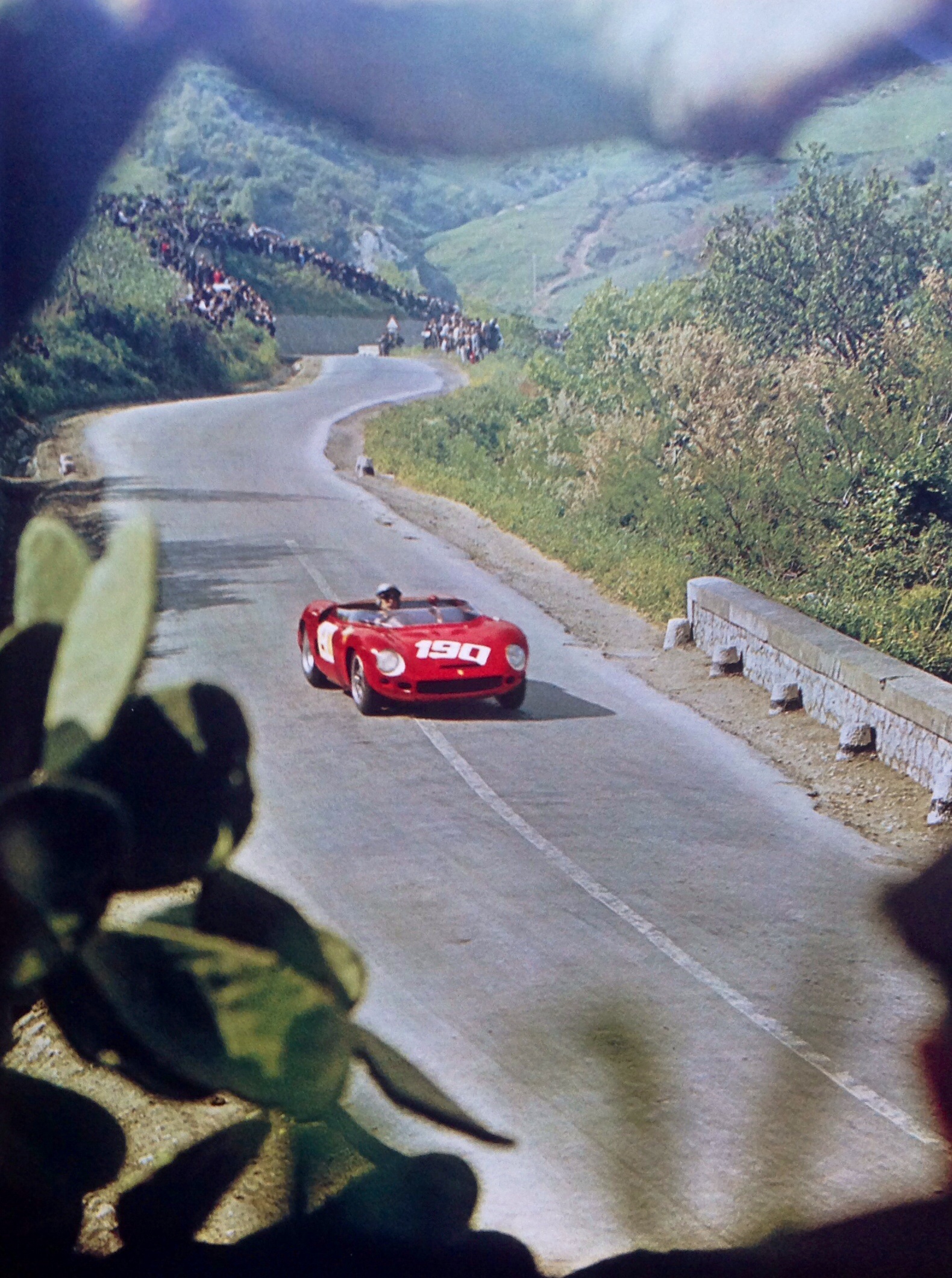
The Ferrari drivers were reshuffled after several accidents in practice of which this seems to be one as it isn’t the car in which Richie started the race with Cliff Allison. That was the #202 de-Dion rear axled TR59/60 pictured below; and in which Richie went off line passing a car and smote a tree a fatal blow for the car on lap 5.

image

Cliff Allison before the Targa start in the 250 Testa Rossa shared with Richie Ginther (unattributed)

Allison himself had a huge ‘character building’ accident in practice when a tyre failed in the Ferrari TRI/60 (independent rear suspension Testa Rossa) he was scheduled to share with Phil Hill.

So, the question is what model Ferrari is the one pictured at the articles outset? It looks as if it may have side-draft Webers, is it an old Monza ‘praps? One for you Ferrari experts.

The race was won by the Jo Bonnier/Hans Herrmann Porsche 718 RS60 a much more nimble conveyance around this circuit than the 3 litre V12 front-engined Fazz…

image

Graham Hill sitting in Jo Bonnier’s winning Porsche 718 RS60, Graham was cross-entered in the car. Don’t bend it Graham please! Hill was 5th is a similar car shared with Edgar Barth (unattributed)

Credit…

GP Library

image

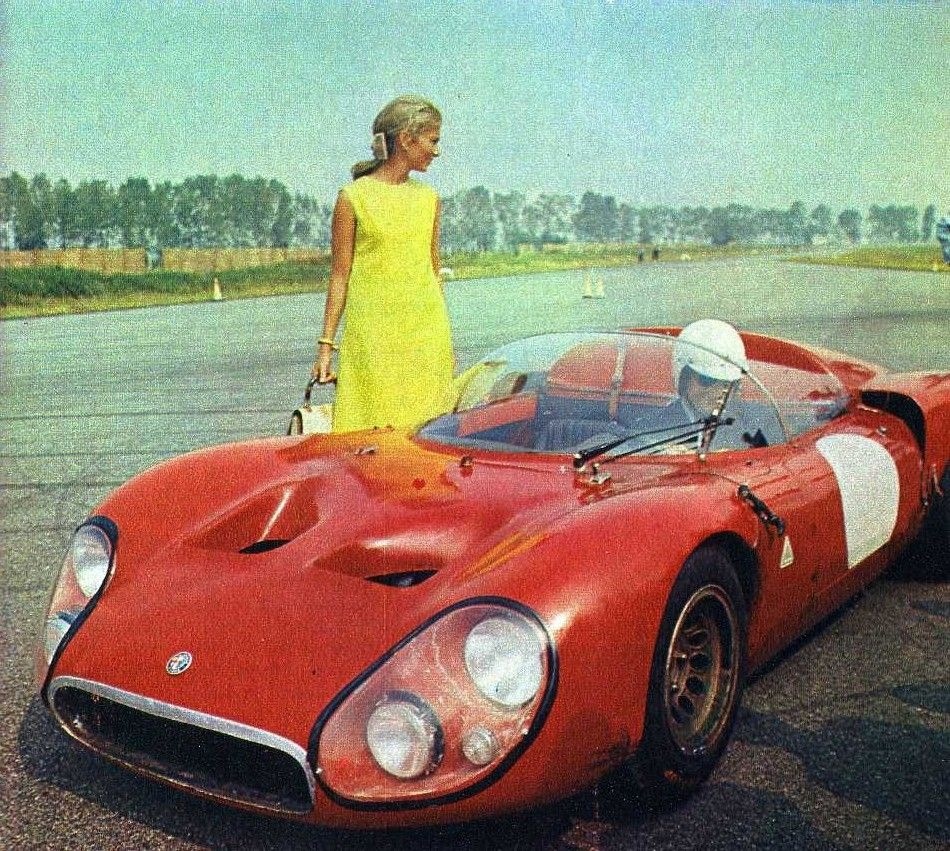
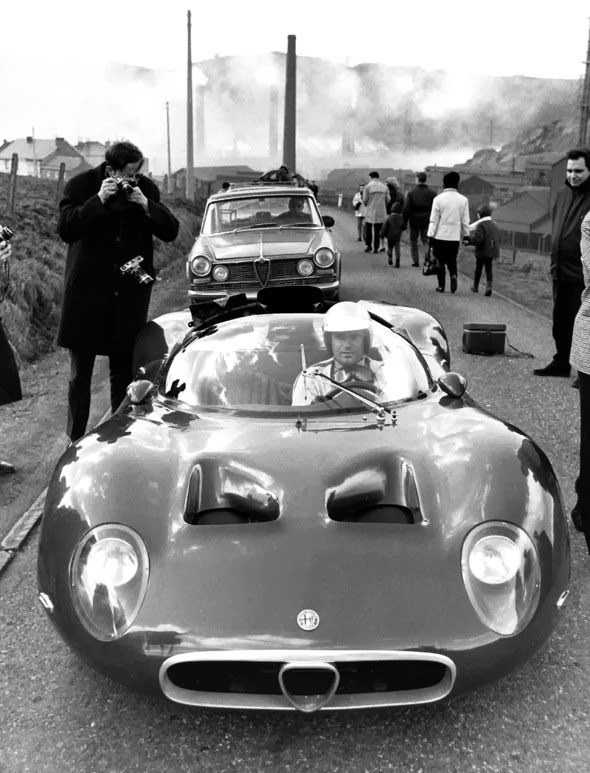
Alfa Romeo publicity shot of Prince Albert and Princess Paola, Belgian Royals at Balocco, Alfa’s test circuit…

The Prince is about to test the ultimately very successful Tipo 33, here in Mugello Spyder 2-litre 1967 form. Thanks to Claudy Schmitz for identifying the Royal Couple and Balocco as the correct venue, the power of Facebook! Whilst the Princess was born of Italian Royal blood it would be interesting to know the circumstances of this test drive, the car was definitely too small for their family of five!

Alfa’s first mid-engined racer made its competition debut at the Fleron Hillclimb in Belgium on 12 March 1967, factory test pilot Teodoro Zeccoli took a win from some stiff competition.

image
Zeccoli at the Belgian Fleron Hillclimb upon the T33 ‘Periscopica’ debut meeting. Alfa 2600 Berlina behind. Fleron is in the Province of Liege, location appears very industrial, power station in the background (unattributed)

The 33 made its race debut at Sebring that summer of ’67, the weekend of 1 April...

Andrea De Adamich led the 12 Hour event’s first lap but both cars entered retired with suspension and overheating dramas.

Here are some shots of the cars in the Sebring paddock; #65 is DeAdamich/Zeccoli, #66 Roberto Businello/Nanni Galli. The race was won by the factory Ford Mk4 of Bruce McLaren and Mario Andretti. I covered the 1967 Endurance Season in some detail in an article i wrote a while back about Ferrari P4/CanAm350 ‘0858’ which may be of interest to some of you;

Ferrari P4/Can Am 350 #0858…

33 1
(Paolo Devodier)
33 2
(Paolo Devodier)

The more you look the more you see, Sebring, the DeAdamich/Zeccoli T33. Engine, two coils, behind the engine the circular vertical ducts which take cool air to the inboard discs when the body is lowered into position are clear. See the rear chassis diaphragm and coil spring/dampers, inboard Girling discs, oil tank to the left of the six-speed Alfa ‘box, battery to its right. Build quality clear.

33 3
(Paolo Devodier)

Those beautiful Alfa mag alloy wheels, filler for centrally located fuel tanks, a spare had to be carried under the regs of the time.The front of the cast magnesium chassis extension houses the radiator, you can just see the nearside suspension ‘top hat’ and adjustable roll bar going forward and mounting at its outer end.

33 4
Engine change in the Sebring ’67 garage. ‘Periscopica’ 2-litre T33 all alloy, Lucas injected, DOHC chain-driven two-valve V8 engine developed a claimed 260-270bhp @ 9500rpm (Paolo Devodier)

Four cars were entered in the ’67 Targa Florio

All failed to finish due to suspension problems (De Adamich/Jean Rolland/Bonnier/Baghetti) and a minor accident involving the Geki Russo/Nino Todaro. The race was won by the Porsche 910 of Paul Hawkins and Rolf Stommelen.

image
Targa Florio 1967. The Bonnier/Baghetti T33 ahead of the other factory cars…Periscopica clear to see. Love the ‘period’ hand-painted numbers. (Unattributed)
bonnier baghetti alsfa
Jo Bonnier in the T33 he shared with Giancarlo Baghetti during Targa 1967 (unattributed)
33 5
T33 cockpit shot at ’67 Targa. LHD unusual in racing sportscars, Alfa would later change to the norm. Momo steering wheel, Veglia instruments, change for six-speed box all clear, lots of instruments for the driver to monitor. Not sure which chassis this is, or the T33 in front, you can just see the tail of the Scuderia Filipinetti Ferrari P3/412P ahead (Rainer Schlegelmilch)

Nani Galli and Andrea De Adamich finally broke through for the team at the Nurburgring, they finished fifth in the 1000Km behind four Porsche 910s...

The winning Porsche 910 was driven by the combination of Joe Buzzetta and Udo Schutz. The De Adamich/Galli T33 had another suspension failure on lap 18, but they shared the other car driven by Businello/Zeccoli, the four drivers getting the joy of the cars’ first race finish.

33 6
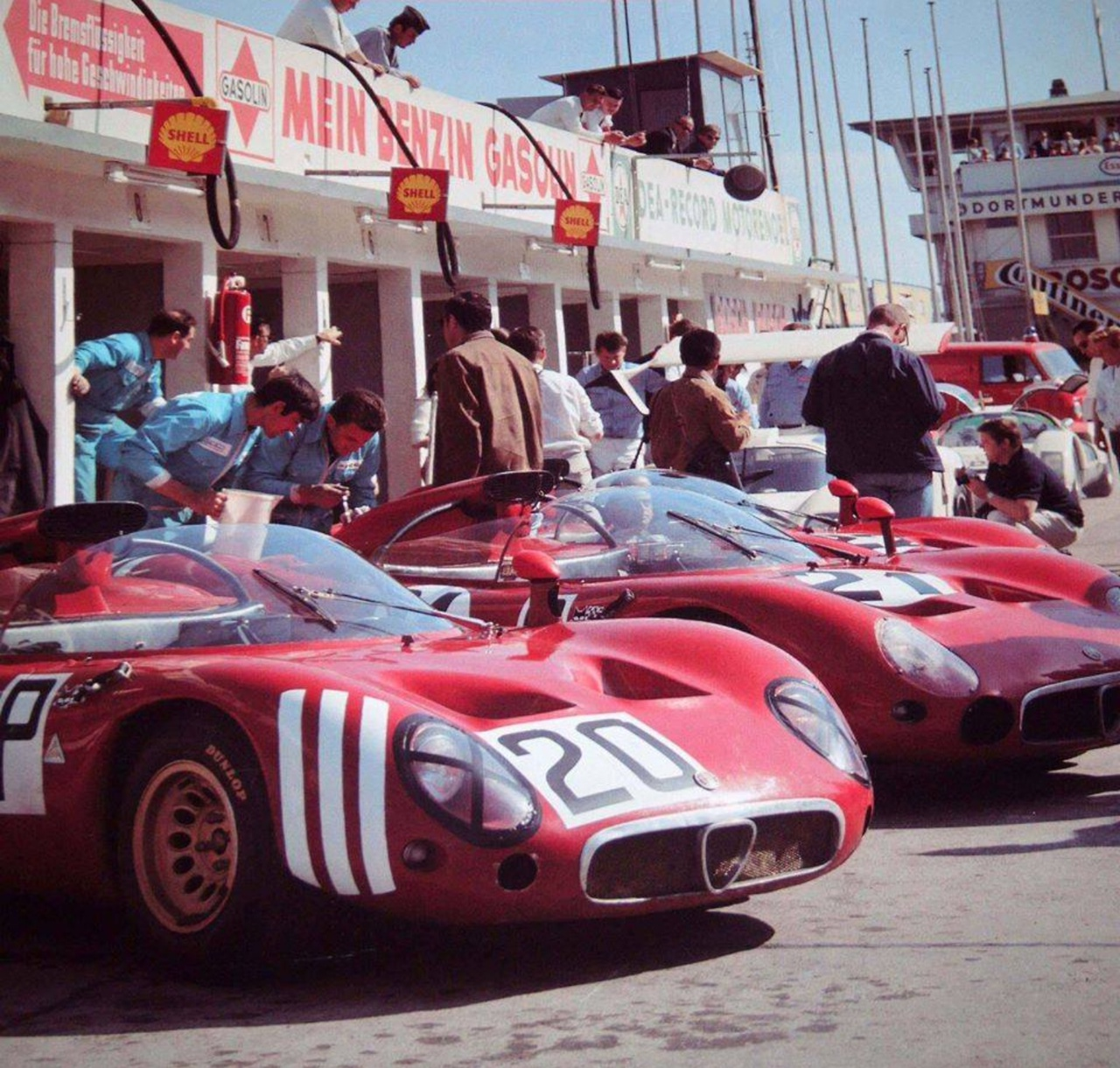
Autodelta SpA lineup in the Nurburgring pitlane, 28 May 1967. #20 DeAdamich/Galli (DNF suspension) #21 Russo/Baghetti (DNF ‘box) and #22 fifth place car of Businello/Zeccoli/DeAdamich/Galli (Accursio Cassarino)
33 8
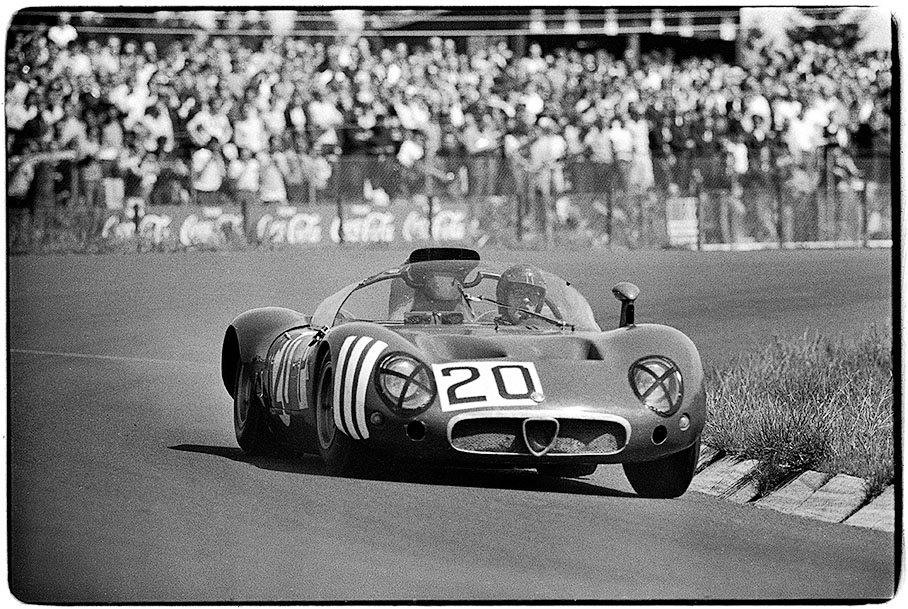
Andrea De Adamich in the T33 he shared with Nanni Galli, the Italian duo DNF with suspension failure, then hopped into the #22 surviving car for fifth place (unattributed)
nurb
The ‘pre-owned’ T33 of de Adamich/Galli during Nurburgring practice 28 May 1967 (Rainer Schlegelmilch)
33 9
Ignazio Giunti with tyre problems at Mugello (unattributed)

The Periscopica’s final start for 1967 was the Circuit of Mugello in July, eight laps of a tough 66km road circuit…

Udo Schutz and Gerhard Mitter won the race tailor made for the fast, light but tough Porsche 910. A privately entered GTA was the best place Alfa in seventh, the three Autodelta T33s of DeAdamich/Galli, Lucien Bianchi/Giunti and Colin Davis/Spartaco Dini all failed to finish.

33 10
(Accursio Cassarino)

It had been a patchy start but the Tipo 33 continually evolved over the following decade ultimately winning many races, sometimes not against the strongest of opposition, but ultimately winning the World Championship of Makes in 1975 and 1977.

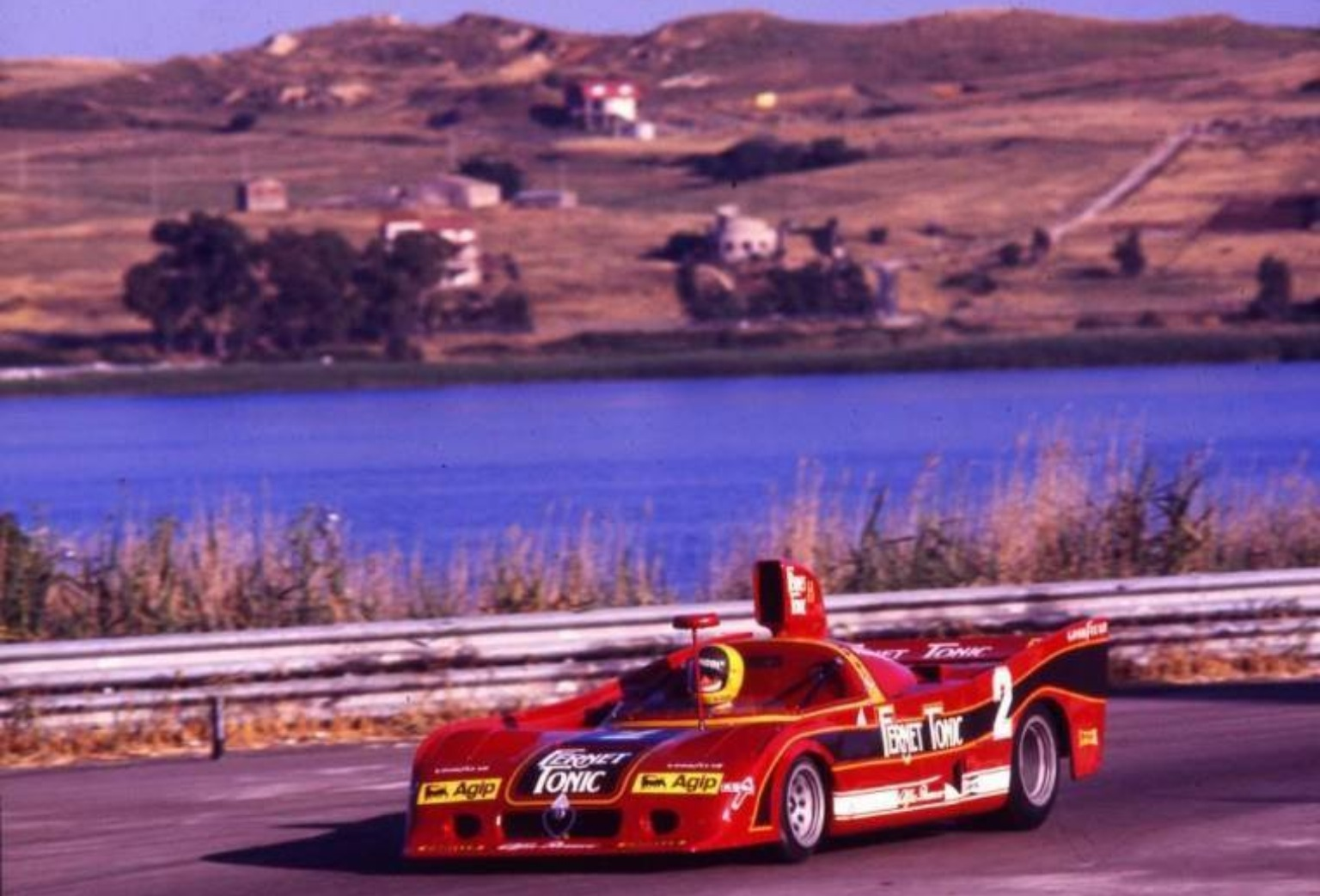
Shown above is the 1977 Alfa 33 SC12 driven by Spartaco Dini at Enna-Pergusa in June. The car used a spaceframe chassis (Alfa used both spaceframes and monocoques during the model’s long life and evolution) and a 2.1-litre fuel injected, twin turbo, four-valve V12 producing circa 640bhp. Dini practiced the car but did not start, this car was driven by Francia/Merzario but was disqualified for a startline infringement, Arturo Merzario won in another SC12.

image
(Vic Berris)

The T33 in its original guise had an unusual chassis design...

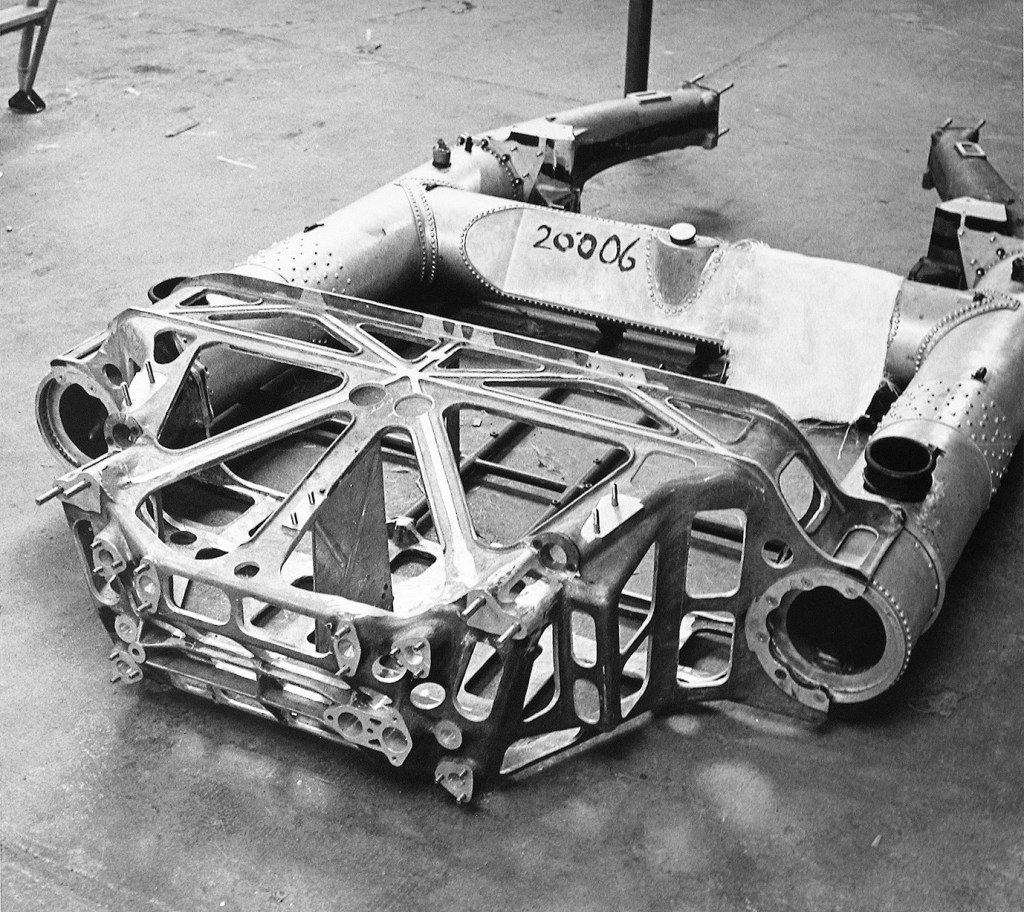
The main structure comprised two longitudinal aluminium spars to which was mounted a complex magnesium casting at the front, the front suspension mounted to it. At the rear the spars had a fabricated sheet metal saddle to which the suspension was attached.

The suspension itself was conventional for the period; upper and lower wishbones and coil spring/ damper units and single top link, inverted lower wishbone and twin radius rods, coil spring/ dampers at the rear. Adjustable sway bars fitted of course. Uprights were cast magnesium, steering rack and pinion with Girling disc brakes front and rear. Weight 580Kg.

(LAT)

Periscopica chassis. The incredible, complex cast magnesium front bulkhead referred to in the text is clear, the spars are bolted to it, and in turn, the two rear section pieces to the large spars.

image

The tall ram air intake gave the car it’s nickname, Periscopica…

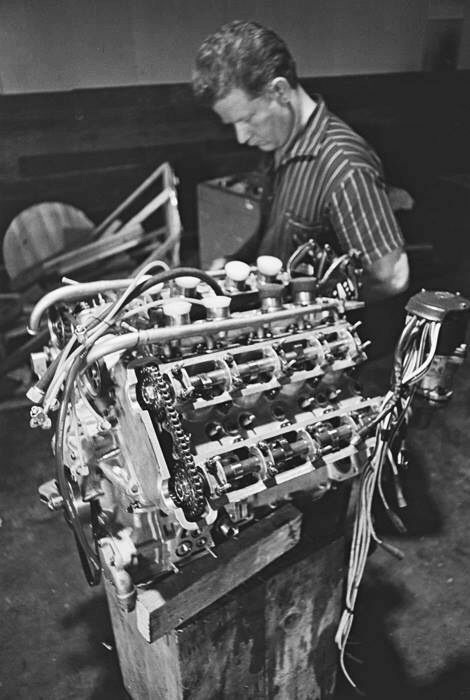
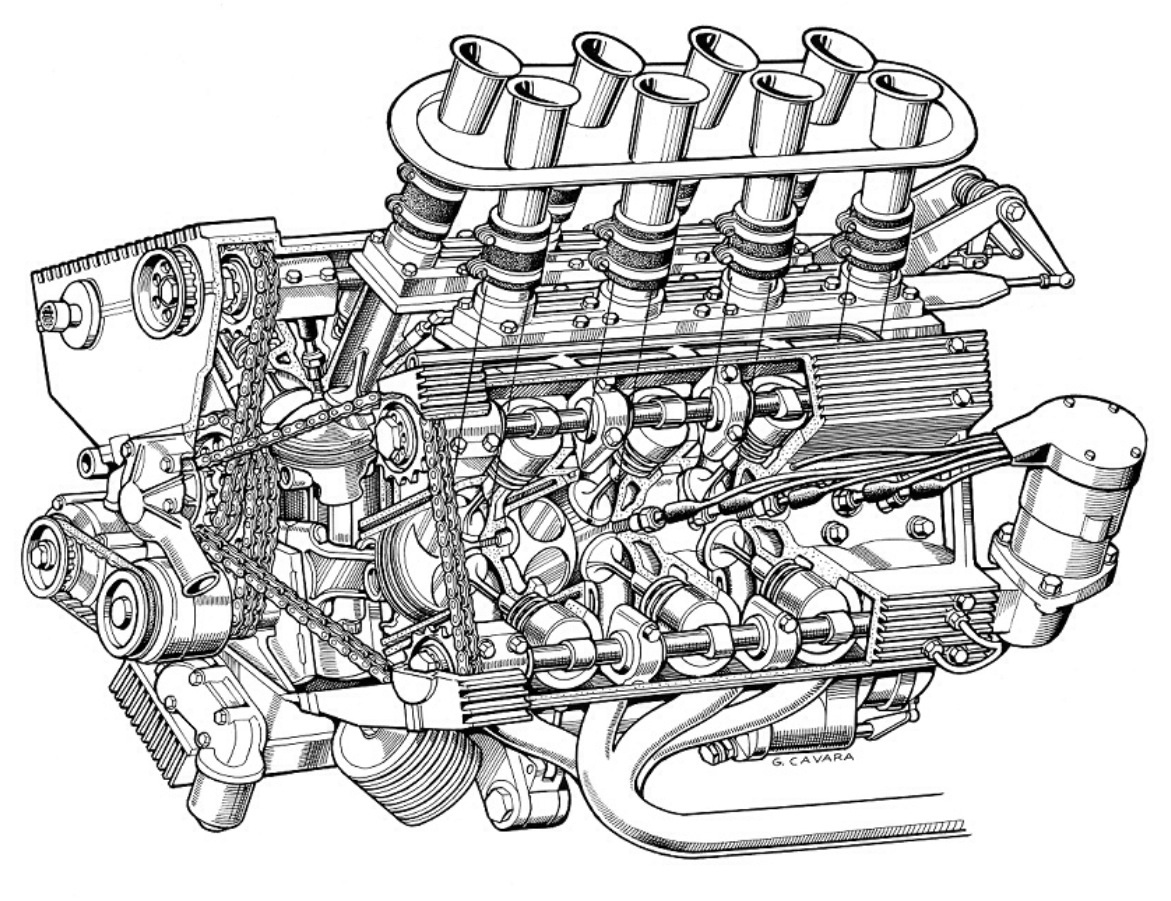
The heart of the early T33s was of course it’s superb little all alloy DOHC V8. Initially 2-litres (1995cc) and two-valves per cylinder, the cams were chain driven, the Lucas fuel injected engines power output was a claimed as 260bhp @ 9500rpm, the gearbox Alfa’s own six-speed transaxle.

Etcetera…

Also see this article on the Alfa T33/3 4-litre coupe: https://primotipo.com/2014/05/15/when-im-in-a-car-i/

Credits…

Cutaway drawing of car Vic Berris, engine cutaway G Cavara, Claudy Schmitz, Paolo Devodier, Accursio Cassarino, Rainer Schlegelmilch, Facebook ‘Alfa Romeo 33 Sport Car’ Group, LAT, Tony Pashley Collection

Tailpiece…

de ad nurb
(Rainer Schlegelmilch)

Andrea De Adamich jumping the T33 he shared with Nanni Galli at the Nurburgring 1000Km in 1967, DNF.

Finito…

image

Bonnier/Abate Porsche 718GTR in the Sicilian Hills. (Yves Debraine)

Jo Bonnier victorious in the Porsche 718GTR together with Carlo Abate…

The 718 Porsche was a development of the earlier, successful 550A/RS61, the GTR coupe the ultimate expression of the 718 was developed for the 1961 Le Mans classic. It was fitted with either the earlier 1.5 litre 4 cylinder or as here, a 2 litre variant of Porsches’ flat 8, quad cam F1 engine developing around 210bhp all of which hit the road through a 5 speed gearbox. Disc brakes were used, torsion bar suspension, the car very light at circa 570Kg.

The 904 followed the 718 as Porsches’ next racer hence the family resemblance…

Very successful, 718 variants won Targa in 1959/60/63 and the Sebring 12 Hour enduro in 1960.

The Bandini/Scarfiotti/Mairesse Ferrari Dino 196SP looked a certain winner until Willy lost the car on the last lap, he recovered but fell short of victory by 12 seconds.

It wasn’t Willy Mairesse’ race, he had started in a 250P 3 litre 12 cylinder Ferrari co-driven by Ludovico Scarfiotti and managed to hit a bump which flattened a fuel line, ultimately putting the car out of the race.

John Surtees then blotted his copybook, chucking the leading 250P co driven by Mike Parkes into the bushes leaving Lorenzo Bandini to uphold Ferrari honours with the 2 litre V6 Dino.

image

Scarfiotti/Bandini/Mairesse Ferrari Dino 196SP. Nowhere quite surpasses the rugged majesty of this place? (Yves Debraine)

Scarfiotti was enlisted to assist in the Dino to uphold Maranellos’ honour, the Bonnier Porsche very competitive in the cool, experienced and fast hands of the Swede.

Abate wasn’t as quick as Bonnier, slowly the Ferrari gained the lead, Ferrari team-manager Eugenio Dragoni putting Mairesse into the car as a fresh driver for the last two laps. A fresh driver but perhaps not the most ‘calm’!

The Sicilian weather deteriorated, rain began to fall and poor Mairesse goofed under brakes as he approached the finishing straight and off the road he went. He gathered up the car, dragging the engine cover along the ground as Bonnier looked on, the Ferrari just falling short of Bonniers time by 12 seconds…

image

The Ferrari boys watch their clocks! Bonnier has finished, it’s all down to Willy Mairesse as the weather deteriorates. Bandini in the pale blazer beside the ‘Wallopers’ and Scarfiotti to the left of Lorenzo. (Bernard Cahier)


image

Mairesse finishes the race dragging the engine cover of his Ferrari behind …(Bernard Cahier)


196 sp cutaway

Ferrari Dino 196SP: multi-tubular spaceframe chassis, 690Kg, 1983cc 60 degree V6, SOHC per bank, 3 Weber carbs. 210bhp @ 7500rpm, 5 speed transaxle. (Unattributed)


targa 'motor racing' mag

‘Ludovico Scarfiotti shakes the quiet Sicilian village of Campofelice in his 3 litre Ferrari 250P’, the first of 2 Ferraris’ crashed by Willy Mairesse, this one on on lap 4… (Stephen Dalton Collection)

Bibliography…

Automobile Year 11, Yves Debraine, Bernard Cahier, Stephen Dalton Collection