Posts Tagged ‘John Raeburn’

(Ebay)

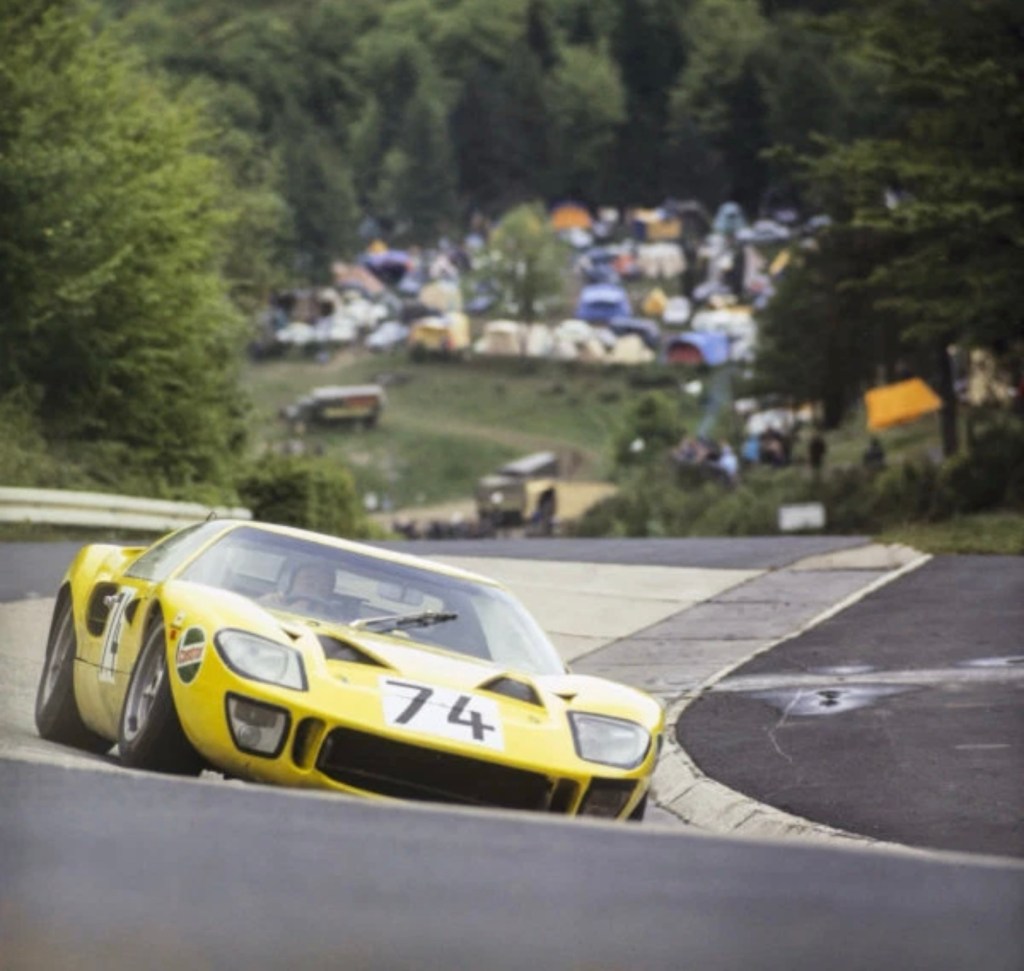
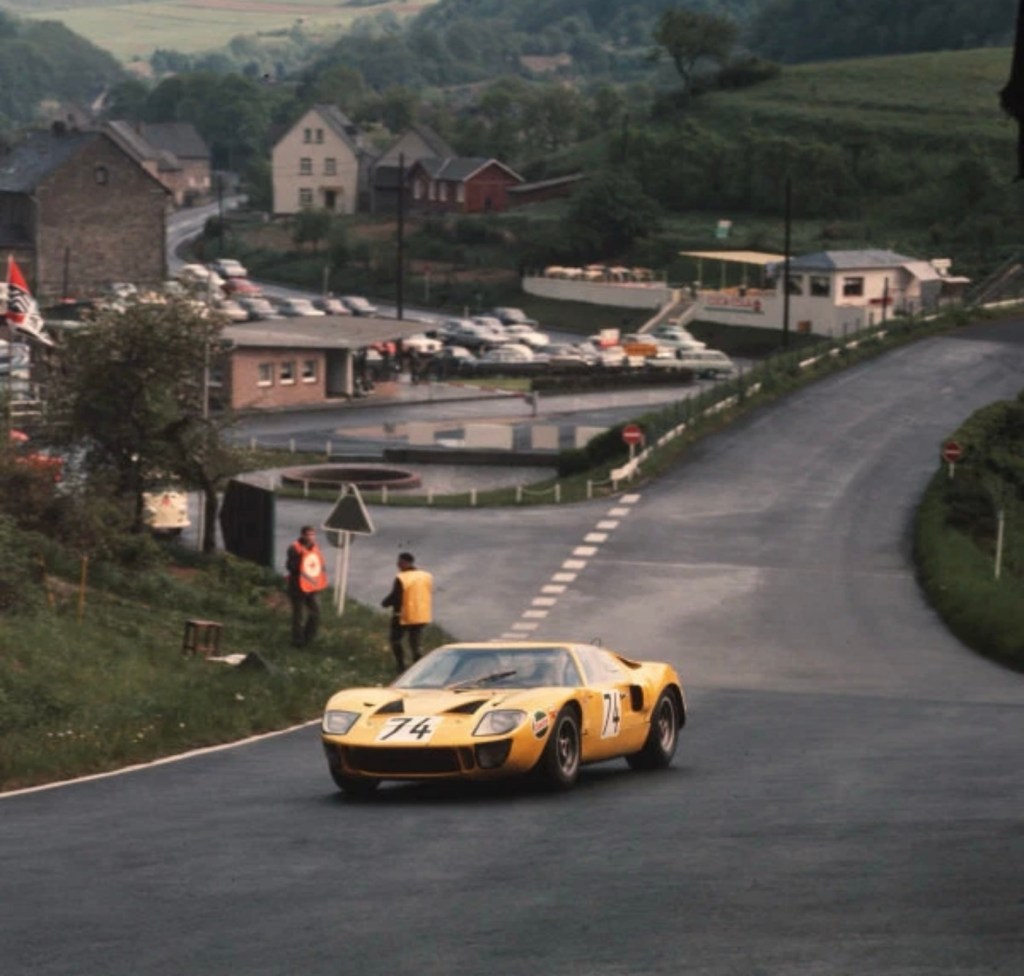
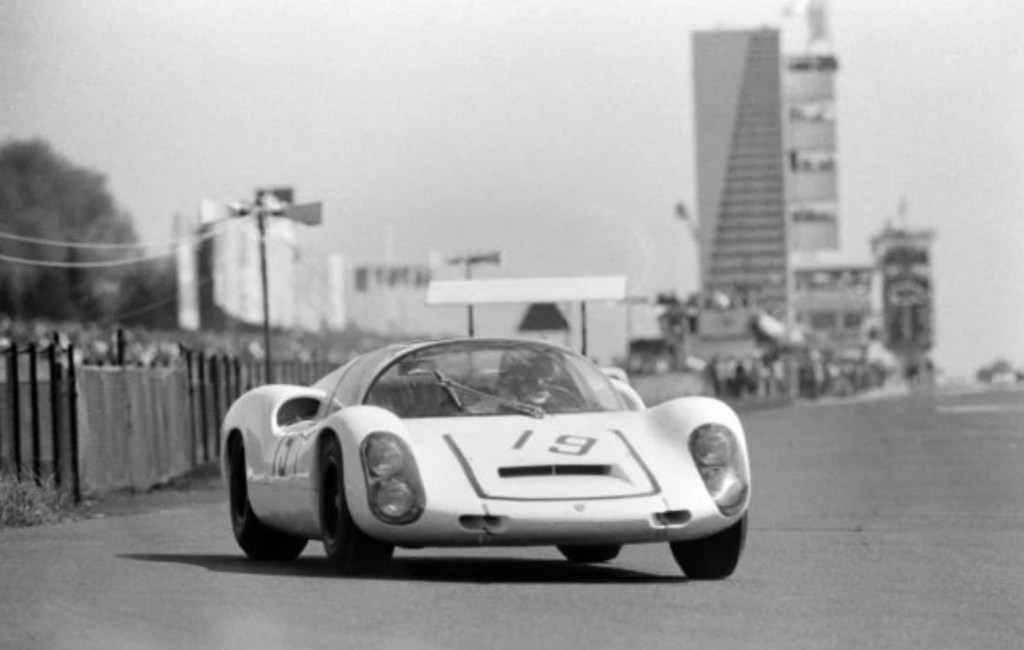
The John Reaburn/Nicholas Granville-Smith Ford GT40 during the 1968 Nurburgring 1000 km.

Melbourne-born John Reaburn – 20/10/1936-26/11/2016 – raced sports cars briefly in Europe in the mid-1960s before retiring at the ripe old age of 32 at the end of ’68. 

He inherited the bug from his father Wal who raced a Humpy Holden and operated WJ Reaburn Auto Electrical Engineers Pty. Ltd. from 891-893 High Street, Armadale, Melbourne.

Reaburn’s Holden FJ at the Geelong Speed Trials date unknown (R Simmonds Archive)
A brace of Buchanans. John Reaburn chases Wally Mitchell at Phillip Island, date unknown

John raced the Holden and then made his name with consistent winning pace in a potent Buchanan Holden from April 1960 to July 1961. Into the mix were drives in Jaywood Motors, Appendix J Holden Humpy, and FC.

He competed in the 1960-64 Armstrong 500 at Phillip Island and Bathurst, sharing a Singer Gazelle with Harry Firth in 1960, and then Firth’s works Ford Cortina GT, Zephyr MkIII and Falcon. He also raced a FoMoCo Cortina GT in the first Sandown enduro, the 1964 6-Hour International, with Geoff Russell finishing a rousing third outright..

Reaburn in the Ford Falcon XP he shared with Harry Firth during the April 1965 Ford 70000 Mile Durability Run at the FoMoCo You Yangs proving ground (Ford)
Firth/Reaburn works-Cortina GT during the April 1964 Lowood 4 Hour, winning their class and ‘outright’

He took on the big-car challenge in 1965, finishing fifth in the one-race Australian Touring Car Championship at Sandown won by Norm Beechey’s Ford Mustang. Raeburn’s mount was the 7-litre Ford Galaxie left in Australia after the ’64 Sandown International by Sir Gawaine Baillie.

Reaburn jumped on a ship for Europe with the intention of racing the car in the UK, but Baillie had sold it before he got there. Brian Muir was third in that Sandown ATCC in his Holden EH S4; he too was soon heading off to the UK, very successfully so.

Reaburn, perhaps, in the Baillie Galaxie at Warwick Farm in 1965 (P Reynell)

Undeterred, Reaburn started working for Graham Warner’s Chequered Flag Motors in 1966, driving their Shelby Cobra in the Zeltweg 500 km (DNF oil leak) that September. He was in the best of company, sharing the grid with GP drivers Jochen Rindt, Jo Siffert, Mike Spence, Innes Ireland, Mike Parkes, David Hobbs and Bob Bondurant.

Nick Brittan wrote about Reaburn in Motoring News during 1966, ‘Raeburn Shines in Driving Test. I don’t seem to be able to get through a month in this column without making some comment about a new Australian driver. In fact I’ve been accused of running an Antipodean news sheet.’

Johnny Reaburn is the latest of the “gday there mate” brigade that are invading our shores. Johnny, a massive, lantern-jawed Melburnian, ran Holdens and FoMoCo cars back home.

JR in the Zeltweg pits in 1966. Bob Bondurant raced the other Chequered Flag Cobra, DNF engine. And yes, like me, the signwriter struggled with the spelling of JR’s name (JR Archive)
JR during the September 1966 Zeltweg 500km DNF oil leak in the Chequered Flag Shelby Cobra. Race won by the works Porsche 906 crewed by Gerhard Mitter and Hans Hermann (Zdjecie)

‘Bathurst class successes, three Lowood 4 hour races on the trot, second in the Sandown 6 hour, plus numerous other solid performances, are grounds for giving the bloke a trial.’

‘What shook everybody up last week was his performance at the passout at Brands with the Motor Racing Stables outfit in front of a big crowd of journalists and enthusiasts. Eight lessons in a Formula Ford with the passout in an F3 in the reverse direction on the Club circuit, Johnny equalled the time set by professional driver and instructor Tony Lanfranchi on his fourth lap.’

‘He improved his time by a full seven-tenths of a second on the remaining six laps. Tony then jumped back in the car, but it took him twelve laps to equal the time Johnny had set. He should be deported or given a drive, as this was his first time in open wheelers.’

He raced Mike de Udy’s Porsche 906 with Roy Pike in the Reims 12 Hours in 1967 (DNF), and took part in several 1968 World Sportscar Championship rounds. His car was a yellow Ford GT40, chassis #1001, owned by Andy Cox, ‘who had won money on the football pools and bought himself a GT40,’ wrote Doug Nye.

Reaburn’s driving partners were Nicholas Granville-Smith and another Australian tyro who did a stint at The Chequered Flag, Tim Schenken. 

Monza 1000km grid April, 1968 (JR Archive)
Nurburgring 1000km April 1968, on the way to 21st place (LAT)

At the Monza 1000 km in April he shared the car with Schenken, DNF engine. At the Nürburgring on May 19, he and Granville-Smith were 21st in the 1000 km.

At Spa-Francorchamps, the week after the Nurburgring, back with Tim, John had a major off on the first lap of the 1000 km enduro.

Doug Nye was there reporting the event for Motoring News and wrote on The Nostalgia Forum, ‘It absolutely widdled with rain and early in the race John dropped the car in the pack on the right hand kink coming down the hill from La Source, past the pits. The GT40 spun round and round and round in a ball of spray and only near the bottom of the hill – entering Eau Rouge – did it finally slither off onto the grass and subside into a ditch on the left side of the track. It was very spectacular, with phenomenal avoidances all round. Pity, he’d been driving it pretty well until then.’

Nurburgring, JR ahead of the second place works Porsche 907 of Hermann/Attwood (LAT)
Raeburn with Brigitte Bardot (JR Archive)

Reaburn reported his exploits back home via Racing Car News. Amongst the unreported good times of high performance off the track was a week-long dalliance with Brigitte Bardot that was memorable enough for her to purchase him a Rolex watch inscribed, ‘To Johnny, Love BB’. ‘True story’ confirms Greg Smith, who had a lot to do with Reaburn in the modern historic era, ‘I’ve seen the watch.’

‘Don’t forget that he was instrumental in getting the David Price-written Joan Richmond book published (Joan Richmond: The Remarkable Previously Untold Story),’ chipped in Bob King.

Reaburn tested an F3 car at Brands Hatch in 1966, matching class front-runner Tony Lanfranchi’s times, and a works F2 Lotus 48 Ford FVA at Hethel in 1967, but, being a tall unit, decided to concentrate on sports car racing. 

He quit racing at the end of 1968, aged 32. In recent years John lived in retirement with his wife in Mooroolbark, Victoria. He died of a stroke on Saturday, 26 November 2016, aged 80.

Etcetera…

A Truish Story from 1965 by Clark Watson.

‘Young John Reaburn, south-eastern suburbs of Melbourne, six-foot-five in his socks, had come to England on the back of a Bathurst class win with Harry Firth. Europe didn’t care. Single-seater cockpits were built for midgets, so John ended up on the showroom floor of Chequered Flag Motorsport in Savile Row, selling Elans and the odd Ferrari while demonstrating Colin Chapman’s ultra-rare analogue driving simulator — one of only two ever made.’

‘One day, a Scottish Lord named Andy walked in — heir to half the Highlands, banned from racing by his mother until he produced heirs of his own. Instead, he spent the family’s millions running sports-car teams and collecting rogues like McLaren, Amon, Rindt, Surtees, and Bondurant. He took one look at the giant Australian and decided he liked him. Soon, John was testing for Andy’s private outfit and sharing a flat in Clapham with Bruce McLaren and Chris Amon.’

‘What happened in that flat stayed in that flat — except one story that finally slipped out. One winter evening, Andy dropped John home after a test day and said only, “Midnight. Sofa. Helmet. I’ll pick you up.” Over dinner, Bruce and Chris just sniggered. When John reached for the wine, they pushed water at him and told him to sleep. Just after midnight, a rattly old lorry reversed down the lane. Andy was directing mechanics who whipped a sheet off the load to reveal a gleaming silver Shelby Daytona Cobra, already thudding and rocking on its springs. Andy climbed into the passenger seat. “You drive.” They ghosted through sleeping London, turned right into Hyde Park itself — gates closed, lights out — pure madness.’ 

‘Fifty metres from disaster, the park blazed into light and the gates swung wide. Men in bowlers closed them again behind the Cobra. Andy grinned. “Foot flat, Johnno. The gates always open if you’re quick enough.”

‘The Midnight Stakes – the exact course. Horse Guards Parade → up the Mall → full slide around the Victoria Memorial (“the cake top”) → hard left into Hyde Park along South Carriage Drive → blast out at Marble Arch → down Park Lane → left into Constitution Hill → long, long opposite-lock slide back into Horse Guards Parade forecourt. Roughly 2.9 miles door-to-door. They did a slow reconnaissance lap first, just to let the oil warm and the tyres scrub in. Then they lined up again on the gravel.Top hats, tails, cigars, brandy, chalkboards, bowls of £100 notes. Tradition since the Napoleonic Wars on horseback, motorised by the Bentley Boys in 1929. Tonight it was John’s turn.’

‘Andy smacked the quarter panel. “Helmet on. The clock starts the moment you leave the forecourt. Don’t lift for the park — the gates will open.” John tightened the belts until they bit, clicked first, and dropped the hammer. Out of Horse Guards flat in second up the Mall, braked as late as he dared for the right into the park — 150 mph showing — then flat again. Lights flared, gates flew open, the Cobra thundered through the empty park like a silver bullet. Hard left at Marble Arch, 152 mph down Park Lane, police Pandas with blues twinkling, blocking every side street. One huge four-wheel drift around the Victoria Memorial — two perfect black doughnuts for the tourists to puzzle over next morning — then flat out down Constitution Hill and a long opposite-lock slide back into Horse Guards 1 minute 58.4 seconds dead.’

‘New outright record. John was dragged from the ticking Cobra, bundled into a waiting black cab and whisked home while the toffs threw top hats in the air and settled their bets. The record stood exactly thirteen nights. Then Chris Amon took the same 2.9-mile loop in a full Le Mans-spec GT40, big Ford V8 spitting blue flame, touching 198 mph past the Dorchester, and stopped the clocks at 1 minute 47 seconds flat. That night, the birds left every tree in Hyde Park in one black cloud, and half the palace windows rattled in their frames.’

‘The next morning, a humourless new Assistant Commissioner killed the game stone dead. The Cobra disappeared onto a ferry for Ireland before lunch, the chalkboard vanished, and the Horse Guards Midnight Stakes were declared finished “for the duration”.

‘Or so they say. Because if you’re ever in central London on a moonless night and you hear a big American V8 or a Le Mans Ford bark just once after the clocks strike twelve, sending the birds flying from the trees……you’ll know the gates are still opening for someone.’

Reaburn in the Buchanan Holden at Rob Roy, date unknown (L Sims Archive)
AMS September 1960 (G Edney Collection)
(JR Archive)

Outside Rootes HQ in Melbourne (?) 1960 with Harry Firth. Seventh in Class C 1960 Armstrong 500 at Phillip Island, up front of the class was the Geoff Russell/David Anderson/Tony Luxton Peugeot 403.

(JR Archive)

The word according to Harry…’Now listen here cock, just do this, this, and that, and we’ll win the class’, date and place unknown, yes, Harry is leaning on a Cortina.

(B Wells)

Bathurst 500 1964, the Bill Buckle/Brian Foley Citroen inside the Firth/Reaburn FoMoCo Cortina GT. Third in Class D and Class C respectively.

(Ford)

Firth or Reaburn during the 1965 FoMoCo You Yangs Durability Run, Ford Falcon XP Hardtop, see here:https://primotipo.com/2022/03/18/ford-falcon-70000-mile-9-day-reliability-trial/

(Zdjecie)

Zeltweg 500km grid on September 11, 1966. Johannes Ortner, Abarth 1300 GT, John Reaburn, Shelby Cobra and David Hobbs in Bernard White’s Ferrari 250LM.

(JR Archive)

In the Monza pits during the 1968 1000km weekend, that’s Tim Schenken in the sunglasses awaiting his turn at the wheel.

Schenken was a prudent co-driver choice, being the man on every team manager’s list. That year, he won the British Formula Ford Championship, Merlyn Mk11, the BRSCC-MCD British F3 Championship, Chevron B9 Ford/Brabham BT21X Ford/Brabham BT28 Ford and the Grovewood Award. Not bad…

Credits…

John Reaburn Archive via Greg Smith, Ebay, LAT, Ron Simmonds Archive, Leon Sims Archive, Peter Reynell, Brier Thomas, Graham Edney Collection, Bruce Wells, Ford Motor Company, Zdjecie on Historia jakiej nie znacie, David Lowe photo via Tony Johns’ archive

Finito…

(LAT)

Paul Hawkins shared Jackie Epstein’s Ferrari 250LM in the 1966 Targa Florio. They were 30th in the race won by the Willy Mairesse/Muller works-Porsche 906.

More about Epstein here: http://www.motorsportmemorial.org/LWFWIW/focusLWFWIW.php?db=LWF&db2=ms&n=951

(LAT)

Its funny where I’m finding photos, which give me the ideas for articles, in recent times. Ebay facilitates sales of lotsa things, including motor racing photos. So, Googling, ‘Paul Hawkins Ferrari’ up popped the two Ebay ad shots. Punters put the shots up at just about a sharp enough resolution to use. So there you have it, the photo credits here are all Ebay unless identified otherwise. And yes, the sellers rarely credit the original photographer, albeit I recognise many as LAT/MotorSport Images material…so I’ve just slapped LAT on the lot.

(LAT)

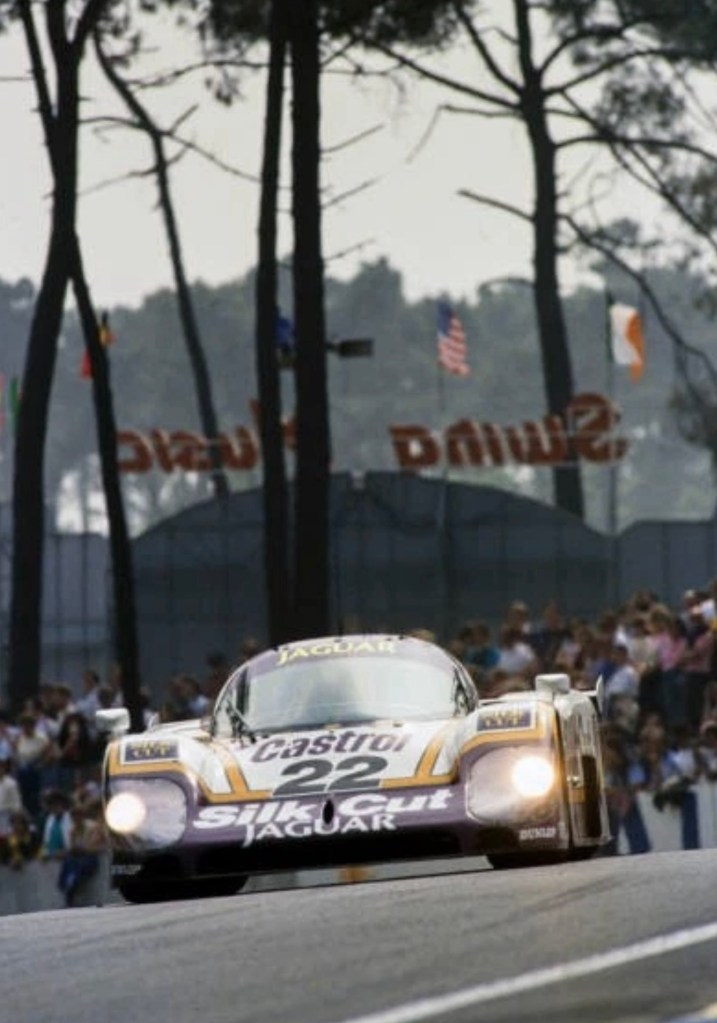
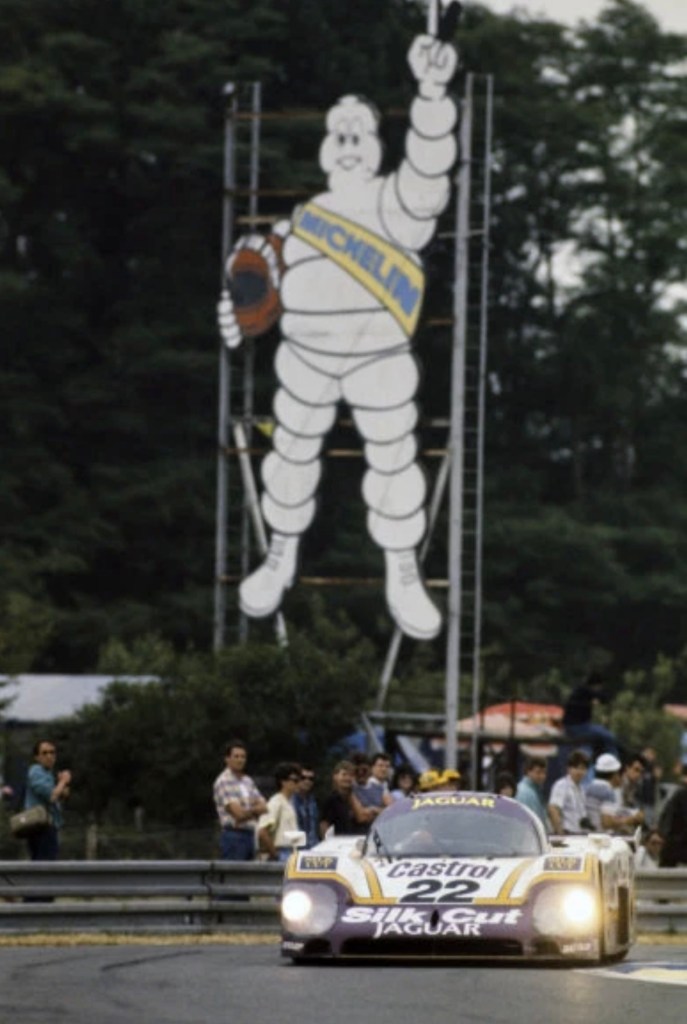
The Larry Perkins/Kevin Kogan/Derek Daly fourth placed TWR Jaguar XJR-9 V12 at Le Mans in 1988.

Jaguar’s 1988 Le Mans victory was an endurance racing defining moment, marking Jaguar’s return to the top after decades of Porsche dominance; they last won Le Mans in 1957: D-Type Ron Flockhart/Ivor Bueb.

Their weapon of war was Tony Southgate’s, TWR-built, carbon fibre XJR-9 7-litre V12. Jan Lammers, Johnny Dumfries and Andy Wallace won while Larry was fourth, his purple and white machine shared with Irishman Derek Daly and American Kevin Cogan.

The race was a long, tense Jaguar-Porsche duel with a light rain adding to the late race drama, allowing Hans Stuck’s 962 to close the gap. Jaguar’s lead remained intact despite a gearbox failure in the final hour. Jan Lammers kept the car in fourth gear for the balance, nursing the XJR-9 to victory and delirious joy from the army of Jag enthusiasts present.

Larry was an easy choice for Tom Walkinshaw. Both were on the slippery slope of the intensely competitive European scene in the early 1970s; Tom watched Larry rise to the top. F1. Not to forget that they had jumped into bed together via Holden Special Vehicles in Australia in 1988; Perkins Engineering were contracted to run Holden’s race program.

(LAT)

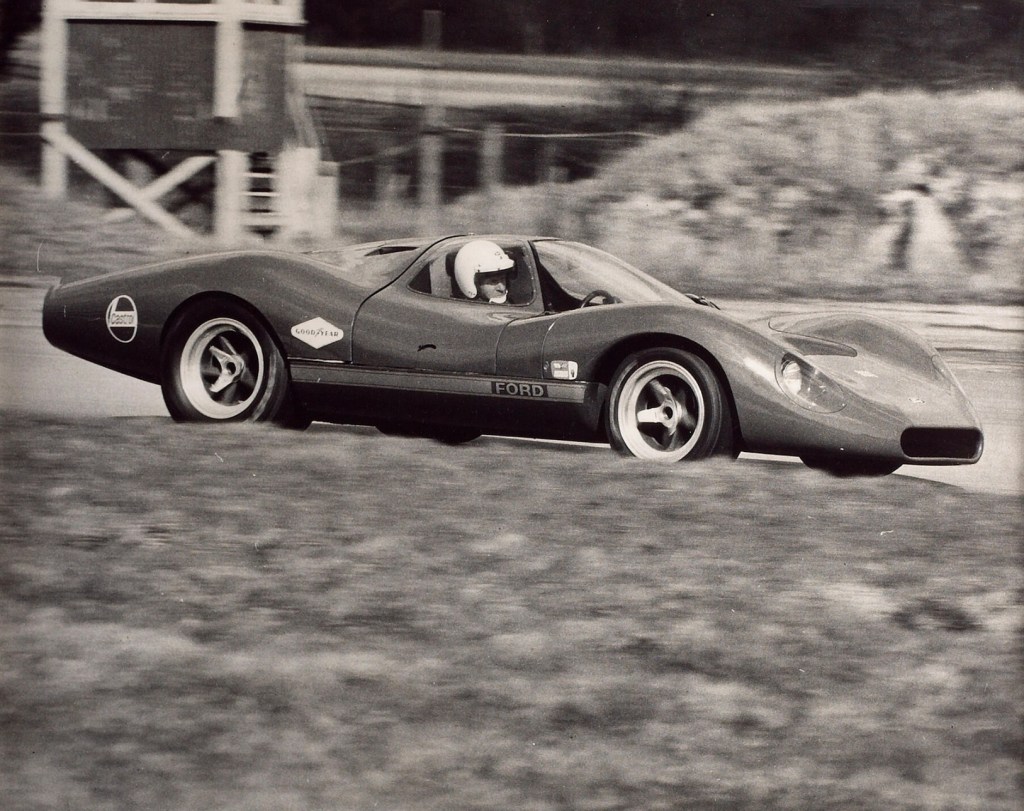
Frank Gardner testing the Ford F3L/P68 at Goodwood in 1968, date folks?

The red beauty flattered to deceive but FG got the very best from it, buckle up for this rather lengthy treatise: https://primotipo.com/2018/06/21/skin-deep-beauty/ and Alan Mann Racing here:https://alanmann.co.uk

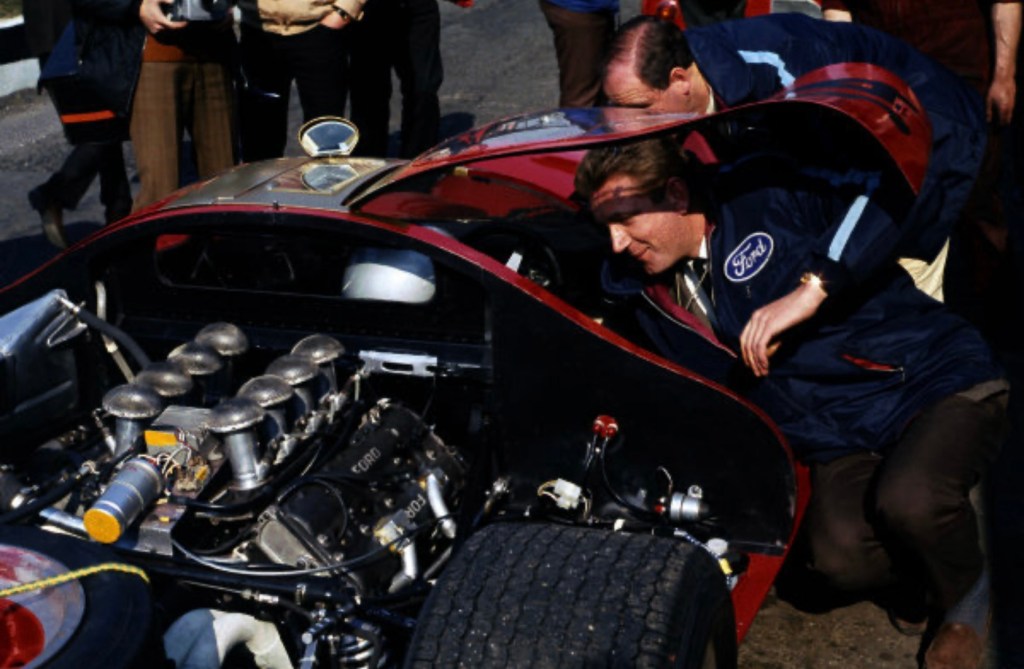
Meanwhile, Alan Mann gets the lowdown from Bruce McLaren below. 3-litre Ford Cosworth DFV in clear sight, Hewland DG300 gearbox not so. The engine, which was designed to be used as a stressed member, wasn’t, and that’s about where the problems started…

(LAT)

The John Raeburn/Nicholas Granville-Smith Ford GT40 during the 1968 Nurburgring 1000 km.

Melbourne-born John Raeburn raced sports cars briefly in Europe in the mid-1960s before retiring at the ripe old age of 32 at the end of ’68. 

John raced Holdens and then made his name with his consistent winning pace in a Buchanan Holden from April 1960 to July 1961. Into the mix were drives in Jaywood Motors Appendix J Holden Humpy and FC.

He competed in the 1960-64 Armstrong 500 at Phillip Island and Bathurst, sharing a Singer Gazelle with Harry Firth in 1960, and then Firth’s works Ford Cortina GT, Zephyr MkIII and Falcon.

He took on the big-car challenge in 1965, finishing fifth in the one-race Australian Touring Car Championship at Sandown. His mount was the 7-litre Ford Galaxie left in Australia after the ’64 Sandown International by Sir Gawaine Baillie. He jumped on a ship for Europe with the intention of racing the car in the UK, but Baillie sold it before he got there. 

Undeterred, he started working for Graham Warner’s Chequered Flag Motors in 1966, driving their Shelby Cobra in the 500 Zeltweg 500 km.

He raced Mike de Udy’s Porsche 906 with Roy Pike in the Reims 12 Hours in 1967, and took part in several 1968 World Sportscar Championship rounds at Monza, Spa-Francorchamps and Nürburgring. His car was a yellow Ford GT40, chassis #1001, owned by Andy Cox, ‘who had won money on the football pools and bought himself a GT40,’ wrote Doug Nye.

Among his driving partners were Nicholas Granville-Smith and another Australian tyro who did a stint at The Chequered Flag, Tim Schenken. 

Reaburn reported his exploits back home via Racing Car News. Raeburn tested a Formula 3 car at Brands Hatch in 1966, matching Tony Lanfranchi’s times, and a works F2 Lotus 48 Ford FVA at Hethel in 1967, but, being a tall unit, decided to concentrate on sports car racing. 

He quit racing at the end of 1968, aged 32. In recent years John lived in retirement with his wife in Mooroolbark, Victoria. He passed away from a stroke, on Saturday, 26 November 2016, aged 80.

Keep an eye out for a feature coming up on John thanks to my mate Gregory Smith…

(LAT)
(LAT)

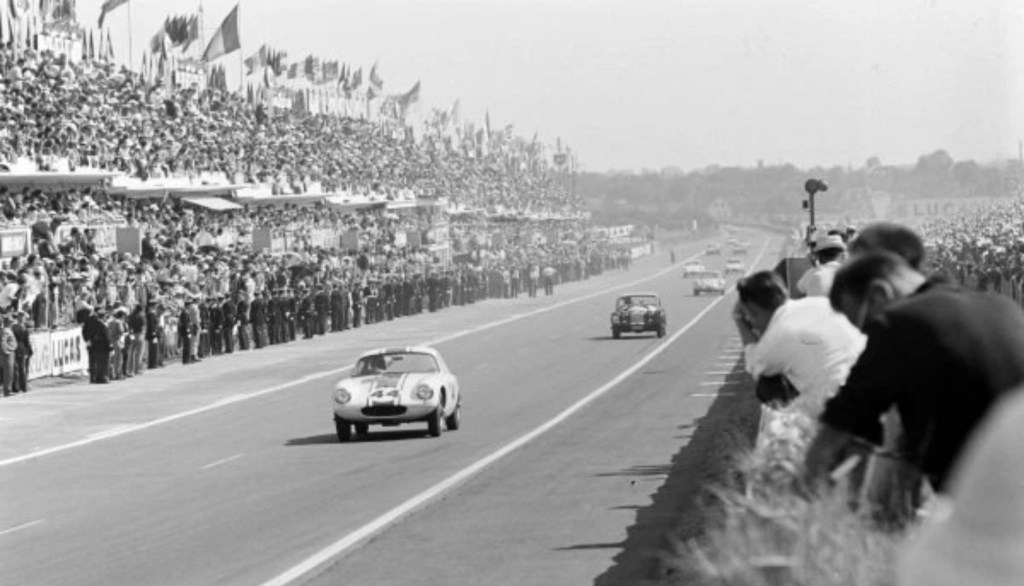
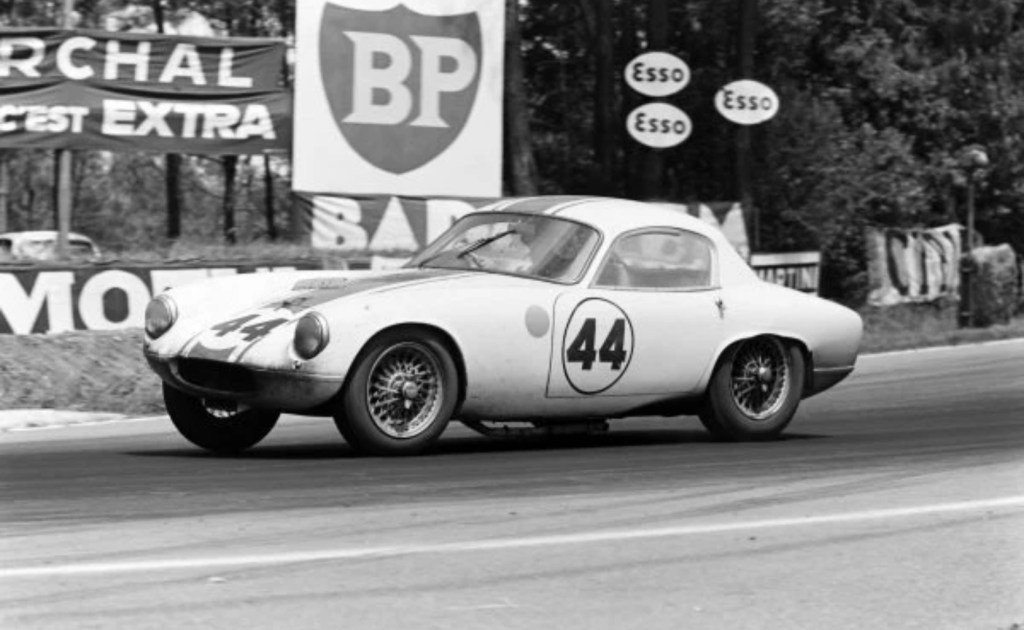
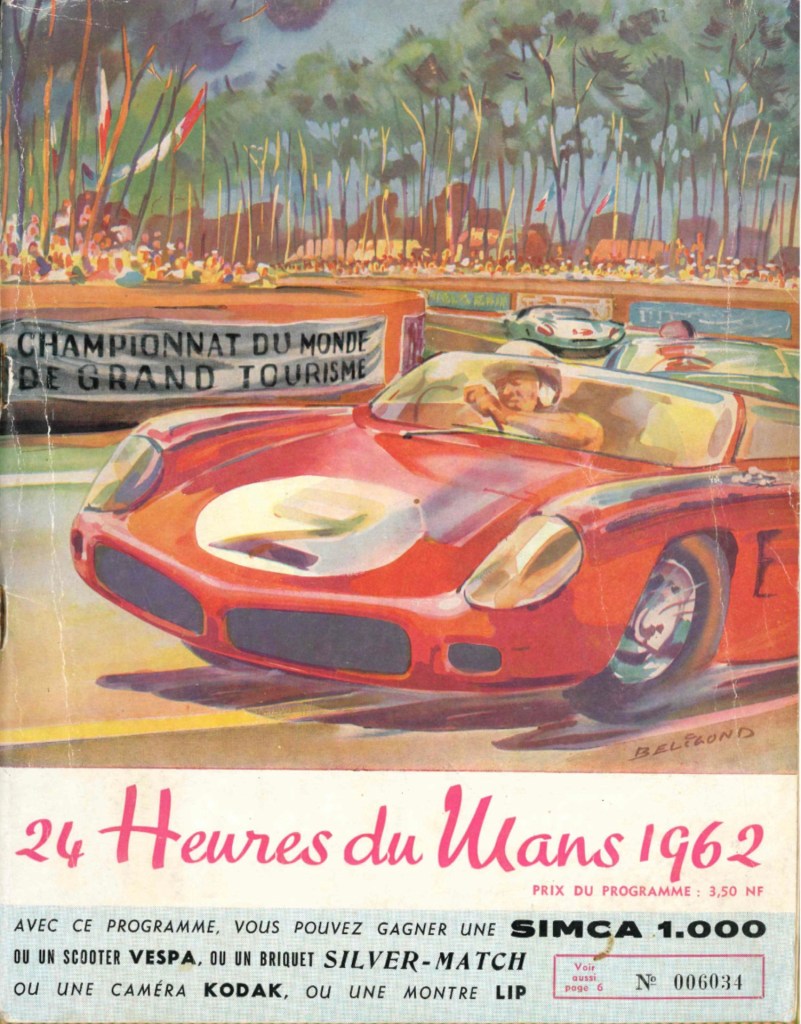
The Frank Gardner/David Hobbs Lotus Elite during the 23-24 June 1962 Le Mans 24 Hours.

Team Elite entered two cars, Hobbs/Gardner shared the #44 (chassis 1678) and Clive Hunt-Jesse Wyllie #45 (chassis 1792). #44 car finished eighth and #45 11th. That was again a win in the 1151-1300 cc class. There was also a double finish (first and third) in the Index of Thermal Efficiency. The #45 car  finished eleventh.

This Le Mans is remembered for the clash of the titans, Colin Chapman and the ACO. Chapman entered his new Lotus 23 Lotus-Ford twin-cam 1.5 in the Experimental class.

Jim Clark wowed the pundits with a staggering Lotus 23 performance in front of the V6 and V12 engines in the May 27 1000 km Nürburgring before problems intervened.

Clark/Taylor Lotus 23 Lotus-Ford twin-cam 1.5 DNF Nurburgring 1000 km 1962 after 11 of the winners 44 laps. Jim at the wheel

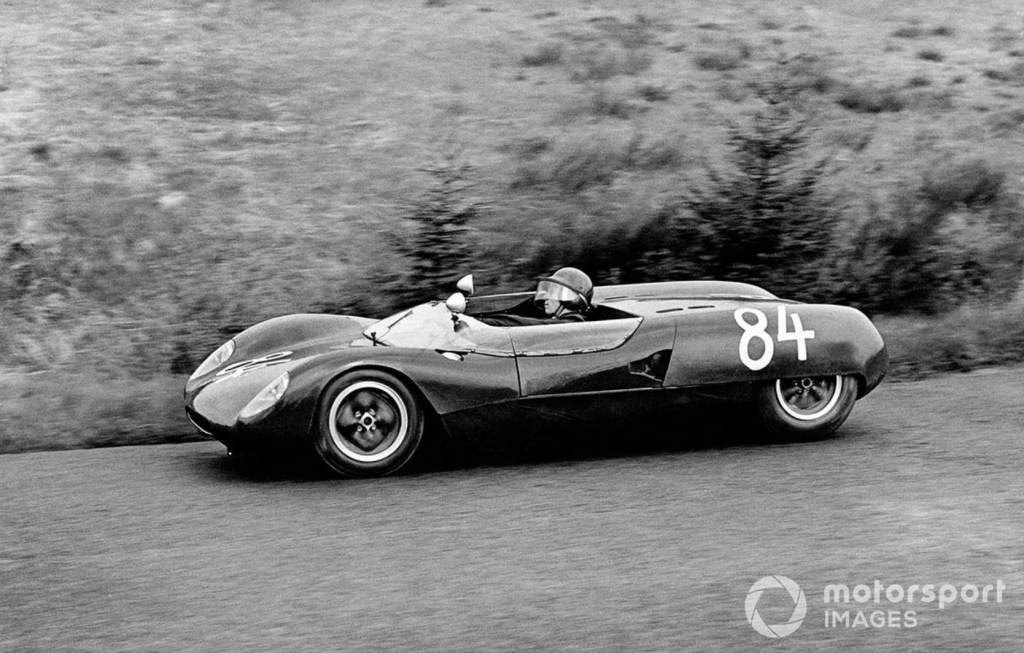
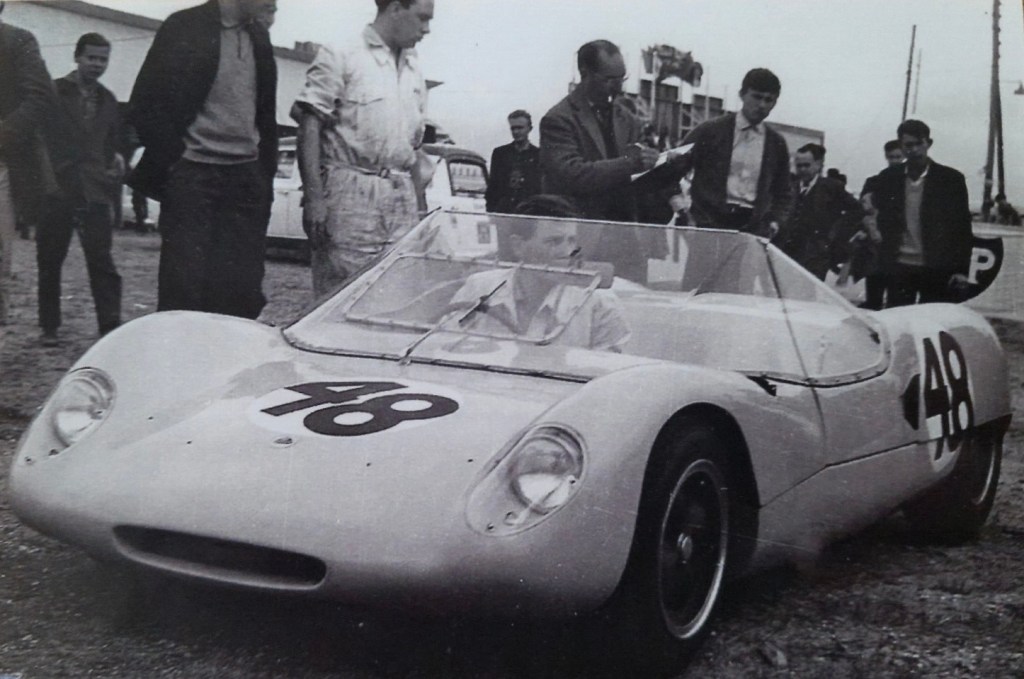
The #47 Lotus 23 was fitted with a 997cc Ford Cosworth MAE twin-cam engine as a potential Index of Performance winner in the hands of works F1 drivers Clark and Trevor Taylor. The other #48 Lotus 23 (below) was a UDT Laystall entry for Les Leston and Tony Shelly.

The Les Leston/Tony Shelly UDT Laystall Lotus 23 Coventry Climax FWM 747cc. ‘Refusé au pesage’ by the ACO (unattributed)

Both cars looked odd because of the required front window dimensions, but they weren’t allowed to be scrutineered due to insufficient ground clearance, an illegally oversized fuel cell and non-conventional fixation of the wheels (four bolts in the front and six at the back).

Chapman flew Frank Costin from London to plead his case that a four-bolt wheel affixation sufficed; the team made the change in the paddock. He offered a stress test, but the scrutineers still said no, so the two Lotus 23s couldn’t take part! Chapman was incandescent with rage, swearing that never again would a works Lotus race at Le Mans. 

(LAT)
(LAT)

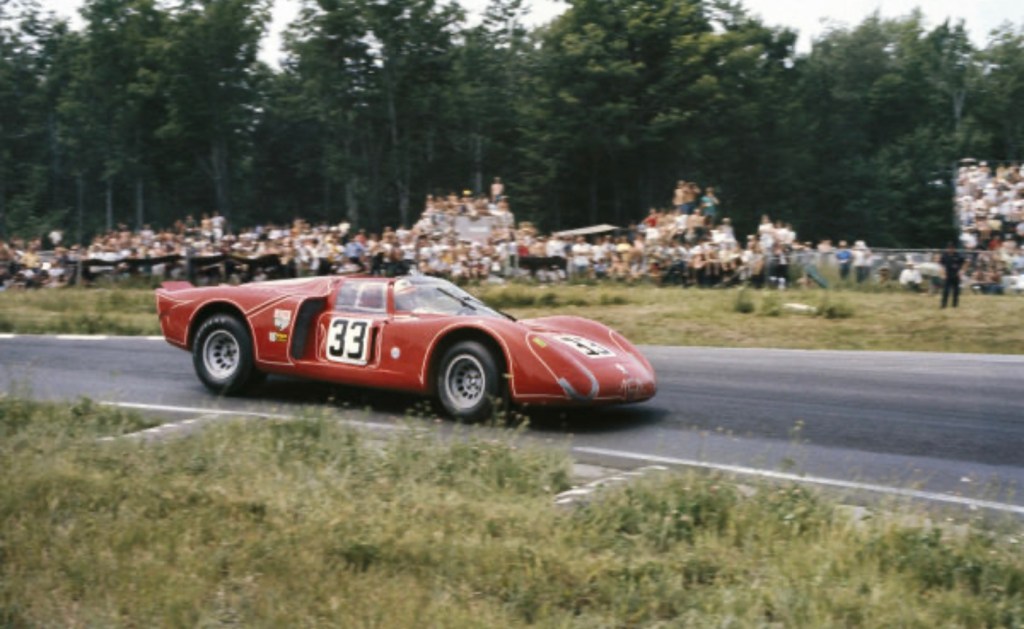
Horst Kwech in the Alfa Romeo T33/2 he shared with John Martino in the July 14, 1968 Watkins Glen 6 Hour.

Ok, Horst was born in Austria, lived in Cooma during his formative years and spent most of his adult life in the US, but he always wore a ‘Roo on his helmet, so we’ll claim him…

The then Alfa GTA Trans-Am star was out after only 17 of the winner’s 286 laps (Lucien Bianchi/Jacky Ickx JW Ford GT40), having qualified the car 11th, he got up to 10th before the engine cried enough. The best placed 2-litre car, the fourth placed Frank/Trieschman Porsche 906.

More on the T33/3 here:https://primotipo.com/2023/07/10/alfa-romeo-tipo-33-tt-3-and-siblings/

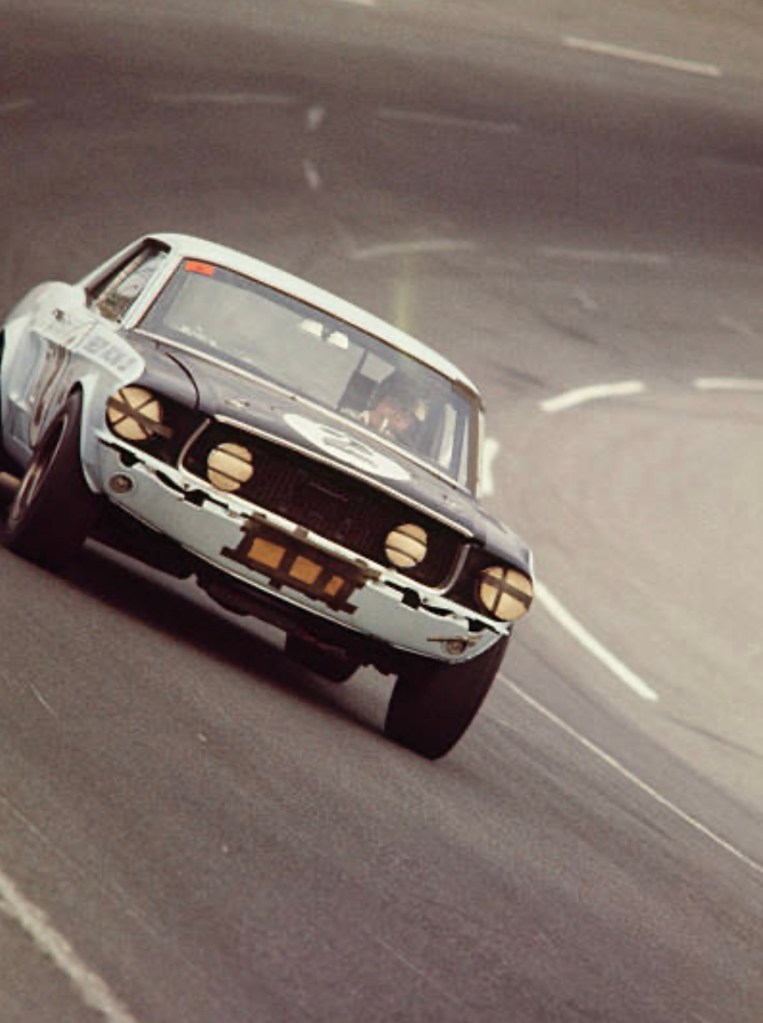
Earlier in the year, Kwech shared a Shelby-prepared Ford Mustang in the Daytona 24 Hour with then US-based Allan Moffat. We’ll claim that Canadian too!

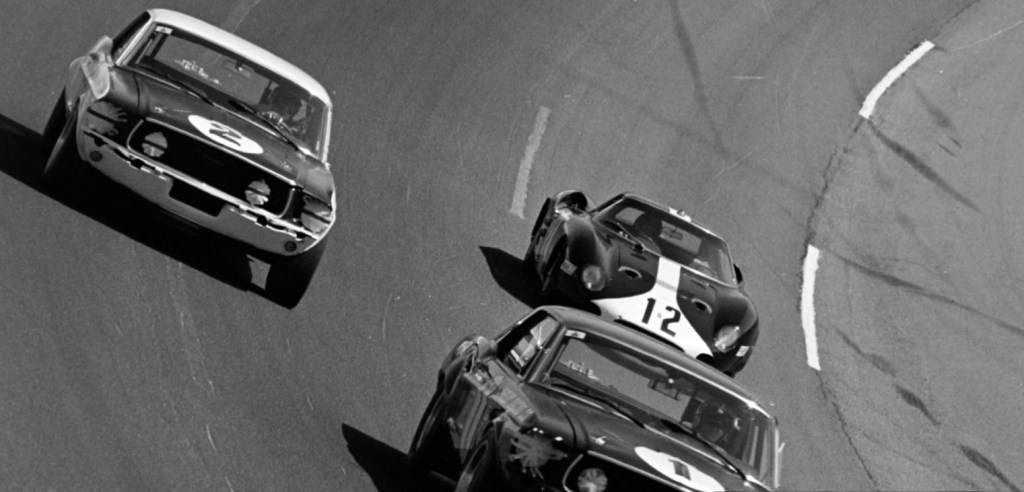
The shot below shows Kwech on the outside of the Paul Vestey/Roy Pike Ferrari 250LM. Car #1 is the fourth placed! Jerry Titus/Ronnie Bucknum Shelby Mustang. Horst and Allan were out after 176 of the winners 673 with a rear suspension problem. Up fromt was two 2.2-litre Porsche 906s: driven by Vic Elford/Jochen Neerpasch/Rolf Stommelen/Jo Siffert/Hans Herrman! and Siffert/Hermann.

The colour shot below is of Moffat. More about Moff’s US Racing Phase here:https://primotipo.com/2020/03/06/moffats-shelby-brabham-elfin-and-trans-am/

(LAT)
(Getty)
(LAT)

The works-Porsche 910 Paul Hawkins shared with Gerard Koch to second place in the May 28, 1967 Nurburgring 1000 km is about to be monstered by the 7-litre Chev powered Chaparral 2F driven by Phil Hill and Mike Spence, DNF.

The race was won by the Udo Schutz/Joe Buzzetta works-910. See here:https://primotipo.com/2020/09/25/hawkeye/ and another perspective here:https://primotipo.com/2017/10/12/lola-t70-aston-martin/

(LAT)

Tim Schenken aboard the Ferrari 312PB 3-litre flat-12 he shared with Carlos Reutemann at Le Mans in 1973

Tim had a big year with Surtees in F1 in 1972 and did the full endurance season with Scuderia Ferrari, usually sharing his Ferrari 312PB with good mate Ronnie Peterson. They won the 1000 Km Buenos Aires and the Nurburgring 1000 km and were second at Daytona, Sebring, Brands Hatch and Watkins Glen and third in the Monza 1000 km in a solid contribution to the points haul that won Ferrari the Munufacturers Championship 160 points to Alfa Romeo, 85, and Porsche, 66.

More about Schenken here:https://primotipo.com/2019/01/02/tim-schenken/

(LAT)

Tim returned to Ferrari the following year, but the Matra MS670/670B had bridged the performance gapso his best results were two second places in the car he shared with Carlos Reutemann at the Vallelunga 6 Hour and Monza 1000 km.

At Le Mans, the pair were out in the 12th hour with engine troubles; the Ickx/Redman machine followed suit in the final hour, leaving the Art Merzario/Carlos Pace 312PB second, but six laps adrift of the victorious Henri Pescarolo/Gerard Larrousse Matra-Simca MS670B. More about the Matra here:https://primotipo.com/2023/09/19/matra-random/

(LAT)
(LAT)

The only other Australian works-Ferrari driver was Paul Hawkins who shared a Ferrari P4 with Jonathan Williams in the 1968 Brands Hatch 6 Hour. Sadly, it was Paul’s only Scuderia Ferrari drive, but far from his last drive of a Ferrari! More about the 1967 ‘World Sportscar Championship’ and the Ferrari P4 here:https://primotipo.com/2015/04/02/ferrari-p4canam-350-0858/

The Donald Healey Motor Company, Lola, Porsche, Ford and Ferrari isn’t a bad list of works outfits to have raced for!

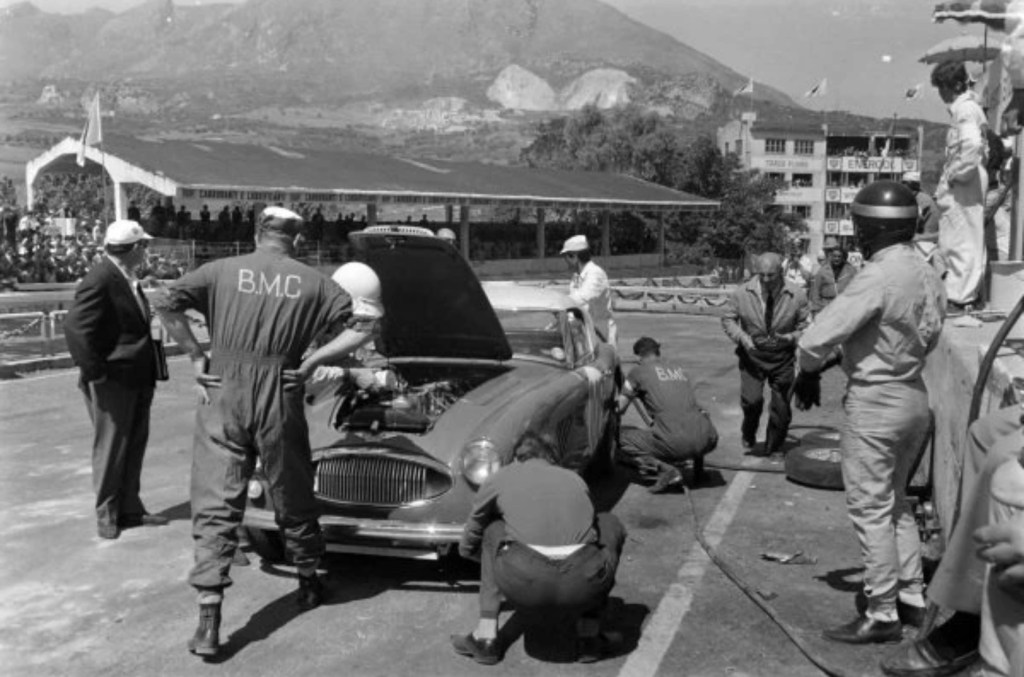
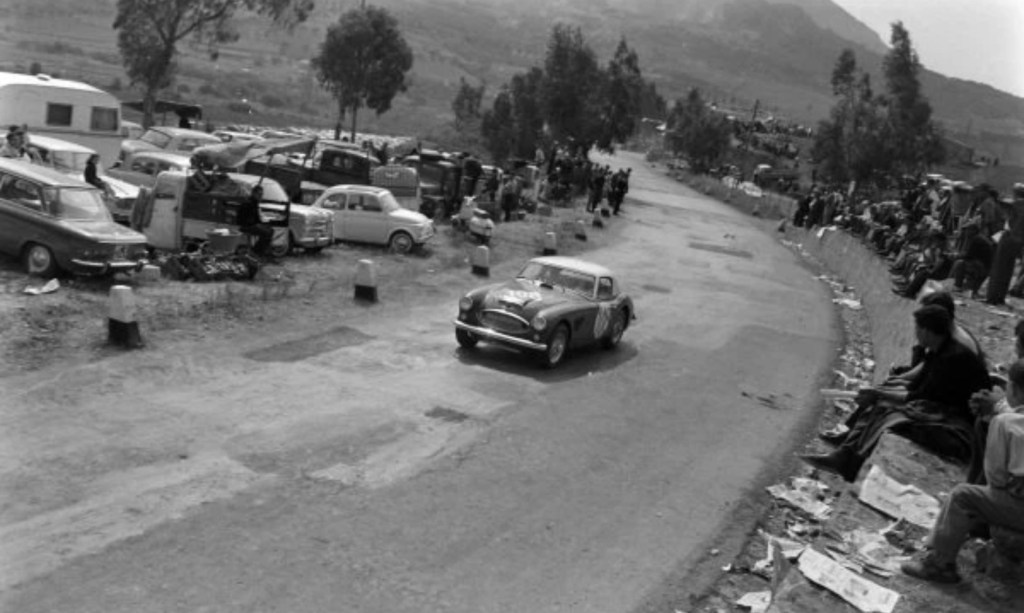
Speaking of the DHMC, here are some shots of the Hawkins/Timo Makinen Austin Healey Mk3 during the 1965 Targa Florio with Hawkeye at the right, ready to jump aboard. The pair were 21st in the race won by Nino Vaccarella and Lorenzo Bandini’s works-Ferrari 275 P2.

(LAT)
(LAT)
(LAT)

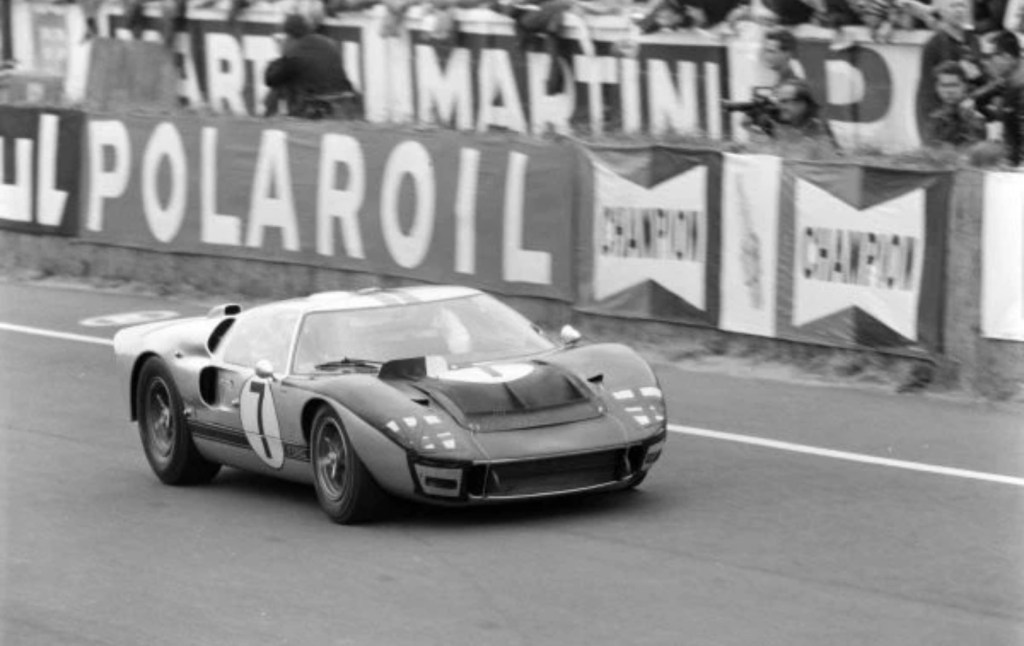
Brian Muir co-drove this Allan Mann Racing Ford GT Mk2 with Graham Hill at Le Mans in 1966

In 1966 Muir did a full season in a Willment Racing Ford Galaxie in the British Touring Car Championship. At the Norisring-Rennen in Germany, he won the GT race in Willment’s AC Daytona Cobra and finished third in the sportscar race in the team’s Lotus 30-Climax, setting the fastest lap.

Given his pace, Muir was signed to steer the Ford MkII with Hill. During the race, the pair ran in the top six before the front suspension broke during the eighth hour. More about Muir here:https://primotipo.com/2022/09/03/brian-muir/

I think the only other Le Mans entry Graham Hill shared with an Australian was with Derek Jolly in a Lotus Engineering 2-litre Lotus 15 Coventry Climax FPF in 1959.

That ended in tears with a Queerbox-induced engine failure. See this lengthy piece on Derek and his pair of Lotus 15s here:https://primotipo.com/2017/11/09/dereks-deccas-and-lotus-15s/

(LAT)
(LAT)

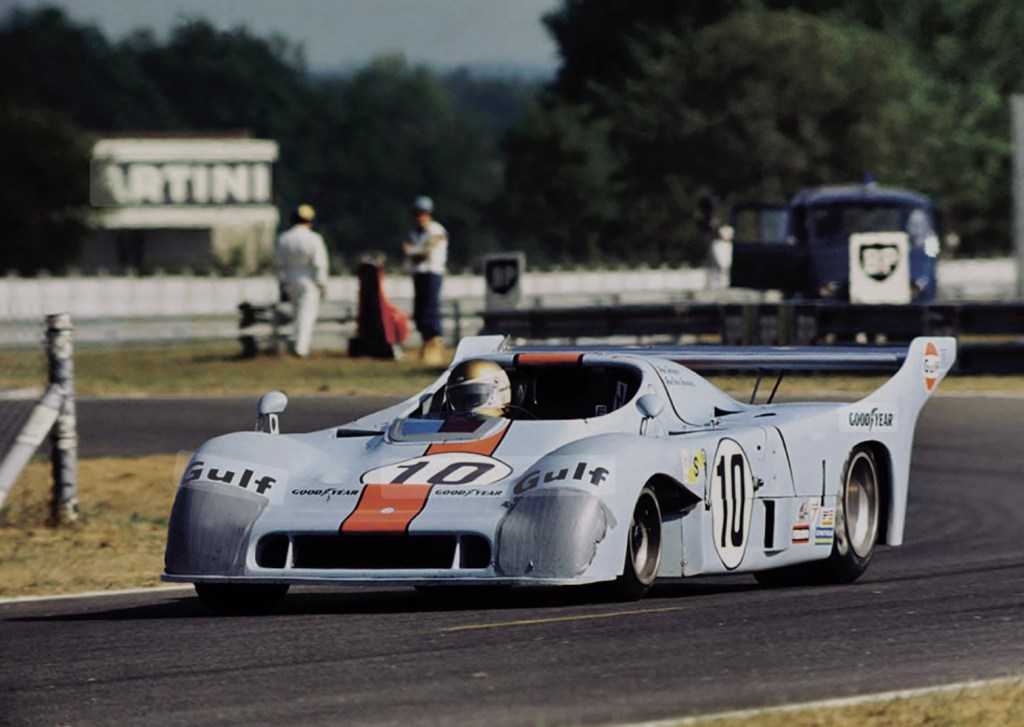
Vern Schuppan in the Gulf Mirage GR8 Ford Cosworth DFV he shared with Jean-Pierre Jaussaud to finish third at Le Mans in 1975.

Up front was the other team car driven by Derek Bell and Jacky Ickx, in second was the similarly powered Ligier JS2 crewed by Jean-Louis Lafosse and Guy Chasseuil.

Nearly a decade later, Vern shared a Kremer Racing Porsche 956B with Alan Jones; the pair finished sixth in the race won by the Joest 956B raced by Henri Pescarolo and Klaus Ludwig.

I’ve done a few pieces about Vern, try this one:https://primotipo.com/2022/01/17/vern-schuppan-3/

(LAT)
(L Roberts)

Vern in a sports car of a completely different type, an Elfin MR8C Chev F5000 converted into a central seat Can-Am machine, here at Riverside in 1977, resplendent in brand new John Webb aluminium bodywork. I’ve prattled on about this car before, see here: https://primotipo.com/2018/10/02/hit-with-the-fugly-stick/

Credits…

Ebay-LAT-MotorSport Images, Larry Roberts, Gardner Lotus Elite-History Racing Pedia, F2Index-Fastlane, Getty Images, Racing Sports Cars

Finito…

(DKeep/oldracephotos.com.au)

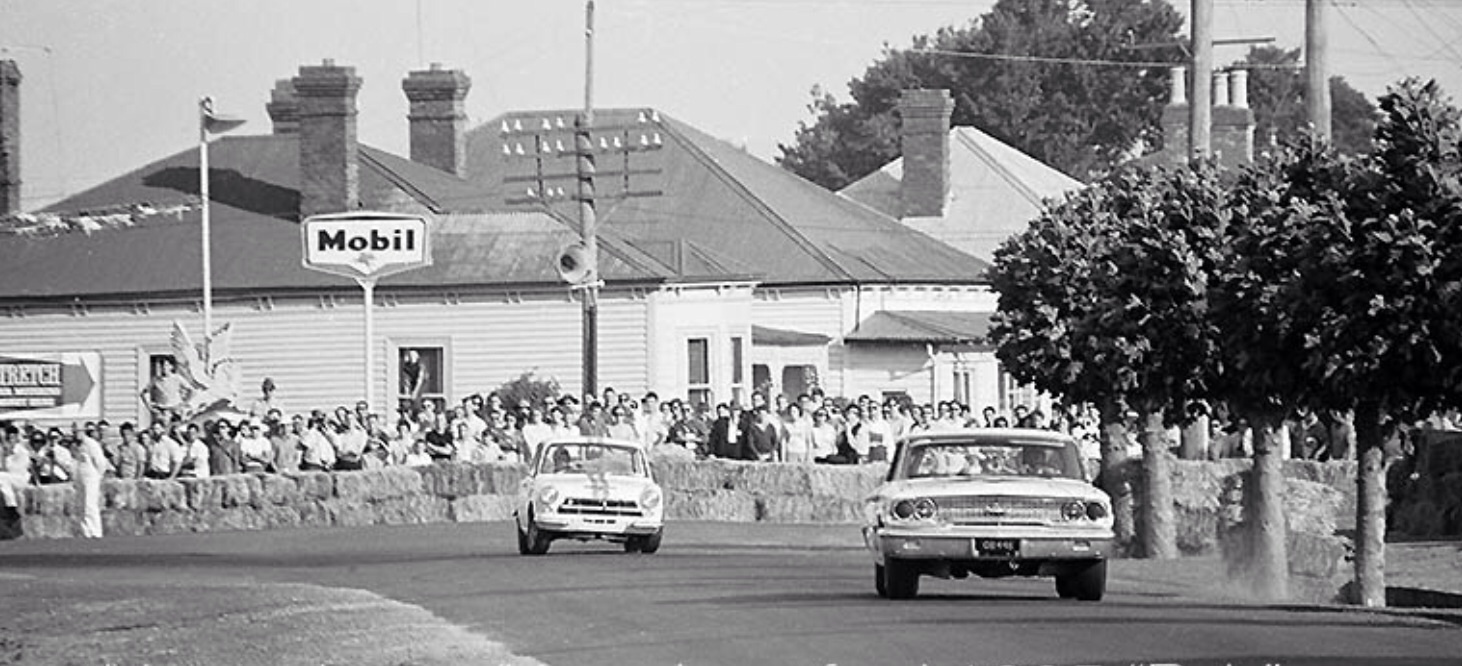
Sir Gawaine Baillie’s Ford Galaxie leads Bob Jane’s Lotus Cortina at ‘Pub Corner’, Longford in March 1965…

Four time Australian Grand Prix winner Lex Davison was a racing purist. He was very much a single-seater man having raced some classic machines to much success post-war- Alfa Romeo Tipo B/P3, Ferrari 500/625, Aston Martin DBR4/250, various Coopers and Brabham BT4 Climax to name several.

While a traditionalist he was also a realist, a successful businessman who knew that flexibility was sometimes needed so as he set his plans for 1963 they were somewhat thrown up in the air by the offer to drive just retired Gold Star Champion, Len Lukey’s brand new R-Code Holman-Moody built Ford Galaxie four-door sedan.

Lukey’s choice of driver was a surprise to many but a political coup really – what better way to neutralise an opponent of touring car racing via his monthly racing magazine column than entice them into-the-fold, so to speak?

Len’s rapidly growing, profitable Lukey Mufflers business provided the means to acquire a Holman-Moody built LHD 6.7-litre V8 engined Ford Galaxie in full racing trim. Lukey imported another RHD car in less-fierce spec as a road car and mobile parts source.

Other than, perhaps, Norm Beechey’s Chev Impala, the 405bhp Galaxie was the most powerful racing car in Australia of any sort upon its debut in November 1962. The plan was for either Jack Brabham or Bruce McLaren to race the car in the November ’62 Sandown meeting just prior to the 1962 Caversham, WA, AGP, the reason for which both GP aces were in Australia.

In the end the big beast was not going to land at Port Melbourne in time for Sandown, so the intrepid Lukey unloaded the car in Brisbane and drove it – a car of full race specification – the 1100 miles south from Queensland to Victoria. As one does!

While a relative touring car novice Lex ran second to Beechey’s Chev after Bob Jane’s Jaguar Mk2 suffered a burst radiator and spun. Lex’ best lap was an impressive one second behind Norm’s new lap record. Not a bad debut.
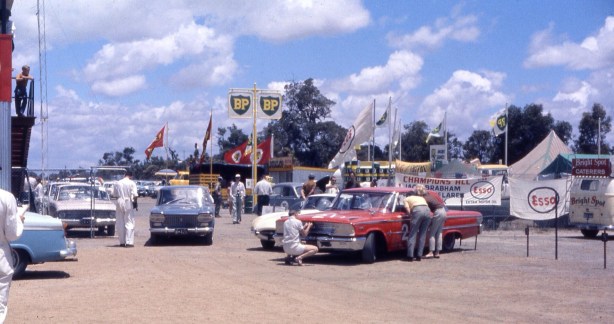
Caversham paddock during the November 1962 AGP weekend (K Devine)
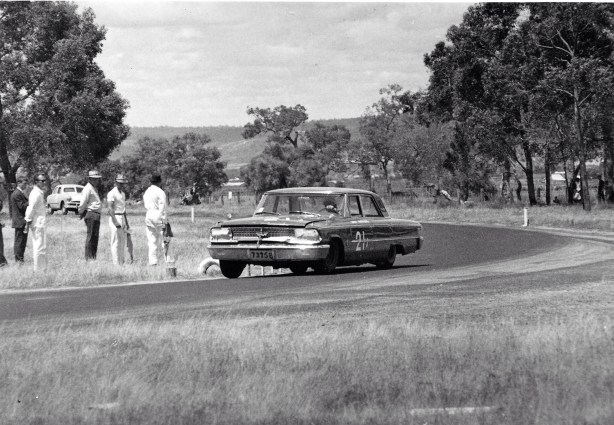
Caversham 1962 (K Devine)
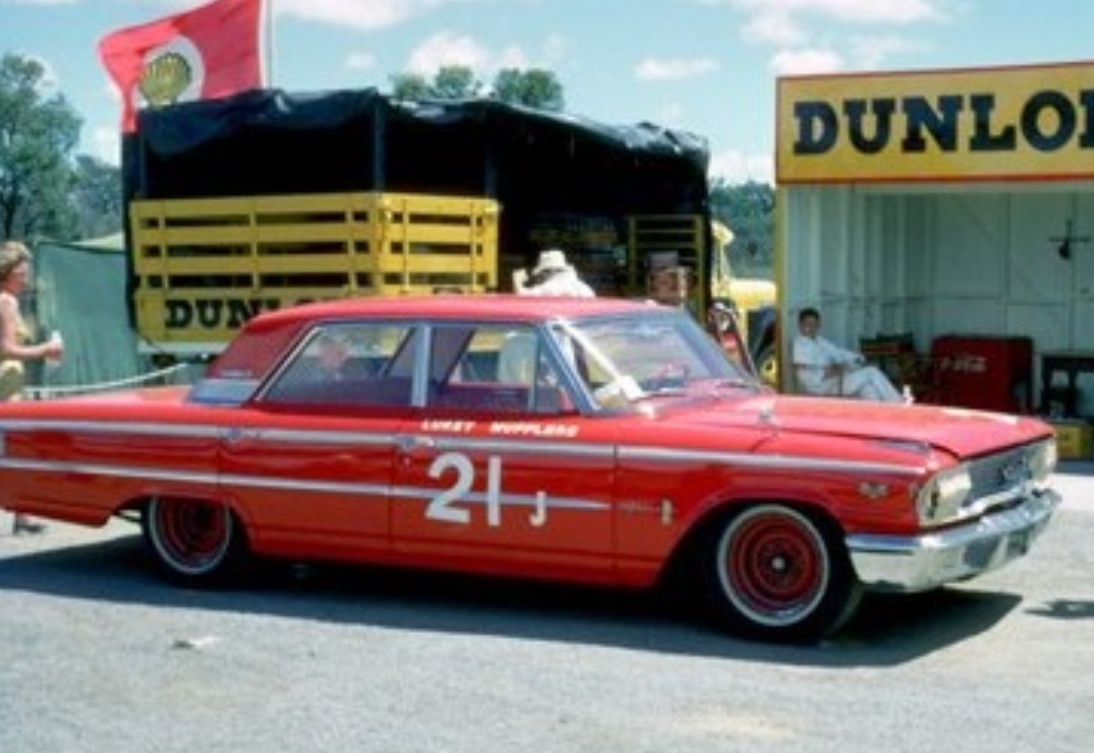
Galaxie in the AGP Caversham paddock in 1962 (unattributed)

At Caversham during the AGP weekend he was third and set fastest lap. During the GP itself he was a distant eighth. with Cooper T53 Climax dramas.

Into 1963 Lex missed the opening Calder meeting with a dodgy-back, so Norm Beechey took the Galaxie’s wheel (a compare and contrast analysis with his Chev Impala would have been interesting) but Ern Abbot’s well sorted straight-six Chrysler Valiant beat the Big Henry.

Lex took the car back for Warwick Farm’s International meeting and again proved its utility as a road car, he drove it to Mass on his way to the circuit at Liverpool that morning! Perhaps prayer assisted in yielding second place behind Bob Jane’s Jag despite Bob rotating the car.

At Longford both Jane and Lex were timed on The Flying Mile at 223kmh but the Jag had the better brakes and handling. In race one Lex won the Le Mans start, spun at the Longford Pub and later needed the escape road at the end of the main straight having endured the inherently under-braked Beastie- Davison needed to train the back of his brain the car was not a Cooper! In the handicap race to end the long weekend of racing Lex gave a start to every car in the race other than Jane and pushed the car even harder – spinning into straw bales at The Viaduct and then lost his brakes completely at the end of the straight, going down the escape road 200-metres before stopping in a drainage ditch. He quipped to the Launceston Examiner that racing the Galaxie was “like driving a haystack.”
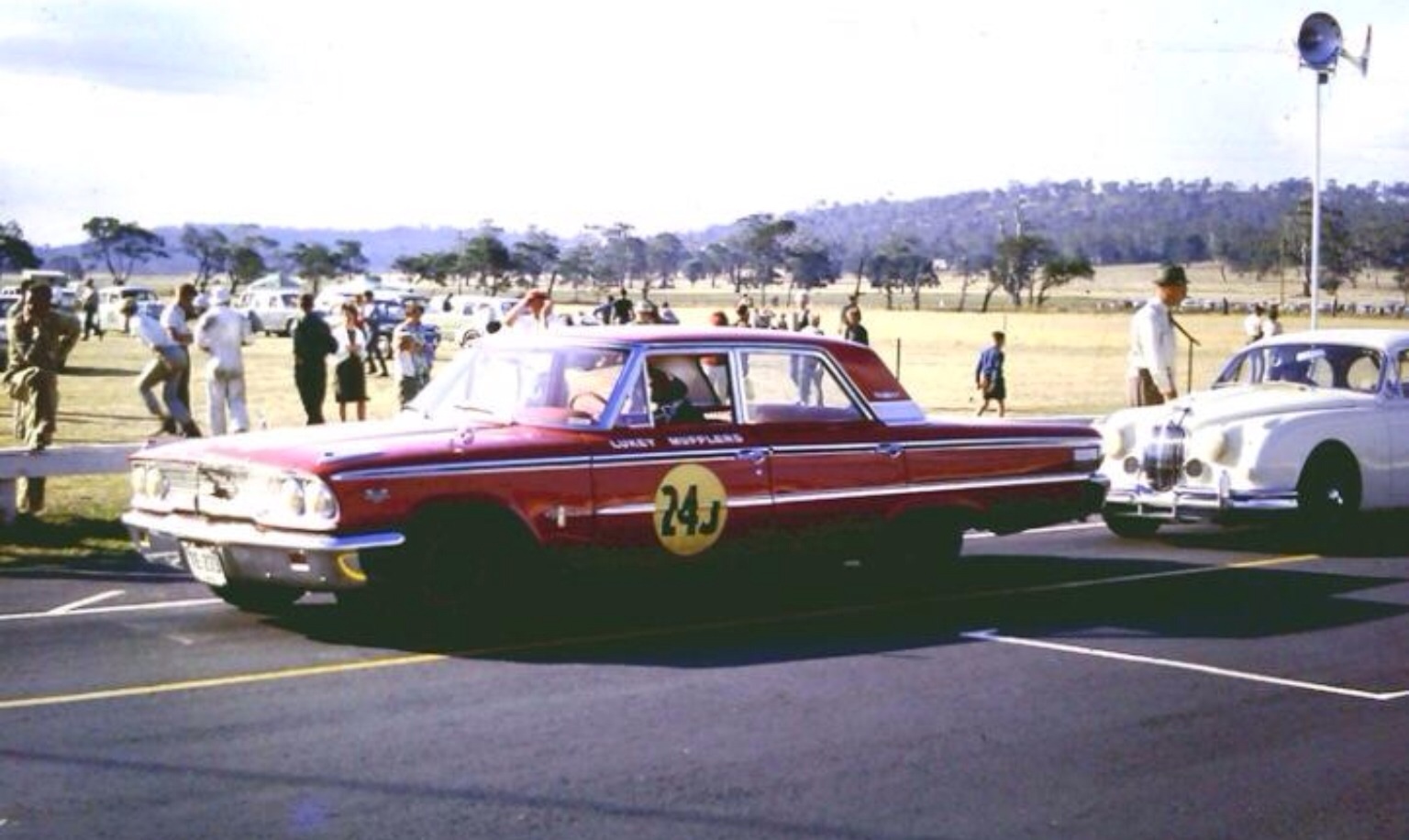
Davison and Jane at Longford, just before the off in 1963 (oldracephotos)

At Sandown during a ten-lapper he spun on the first lap, with Jane and Beechey going at it in a race long dice. Lex later spun again in the fast Dandenong Road Esses. The big Galaxie frightened the Armco with a huge thump on the outside of the track and then came back across the road to hit it on the other side. The Ford then caught fire as he sought to restart…

The Galaxie was in no condition to race again until September, no doubt Len Lukey thought that the ongoing safety of his expensive car was best served by a change in pilot.

Graham Howard wrote that “It’s (the Galaxies) absence was not greatly mourned by Diana (Davison), or by Alan Ashton, both of whom believed the big sedan did nothing to help Lex’s single-seater driving.”

Lex explained the background to the Sandown accident in a letter Lance Lowe of Peter Antill Motors, then the local Koni distributor. “Appalling rear axle tramp under braking was one of its less endearing features, and this has now been cured to such an extent that the car is un-steerable…Perhaps it (the accident) will solve the problem of me having to drive it again.”

In 1964 Len threw the keys to Beechey who raced the car with the sympathy of a specialist touring car ace. Note that when Lukey’s car arrived some of its H-M goodies were removed to comply with Australia’s Appendix J touring car regs; some panels, bumpers and brakes were amongst the changes. The R-Code car was fitted with a 427 lo-riser big-block Ford side-oiler V8. Some sources have it that the car as raced by Davo was fitted with a 406 cid engine which was replaced by a 427 by the time Beechey got his hands on it in 1964 – no doubt at the time the bonnet-hump appeared. The car survives as part of the Bowden Collection in Queensland.

To complete the summary of the Lukey cars, Len imported another Galaxie, a 1964 Holman-Moody car in parts to avoid Australian import duty but died before the car was completed. This is the car acquired by Dennis O’Brien via Harry Firth’s introduction to Lukey’s widow in the mid-seventies. O’Brien built the car up with a shell found in Canberra, a new 427 hi-riser, alloy bumpers, the right diff, gearbox, polycarbonate windows and competition roll-cage.
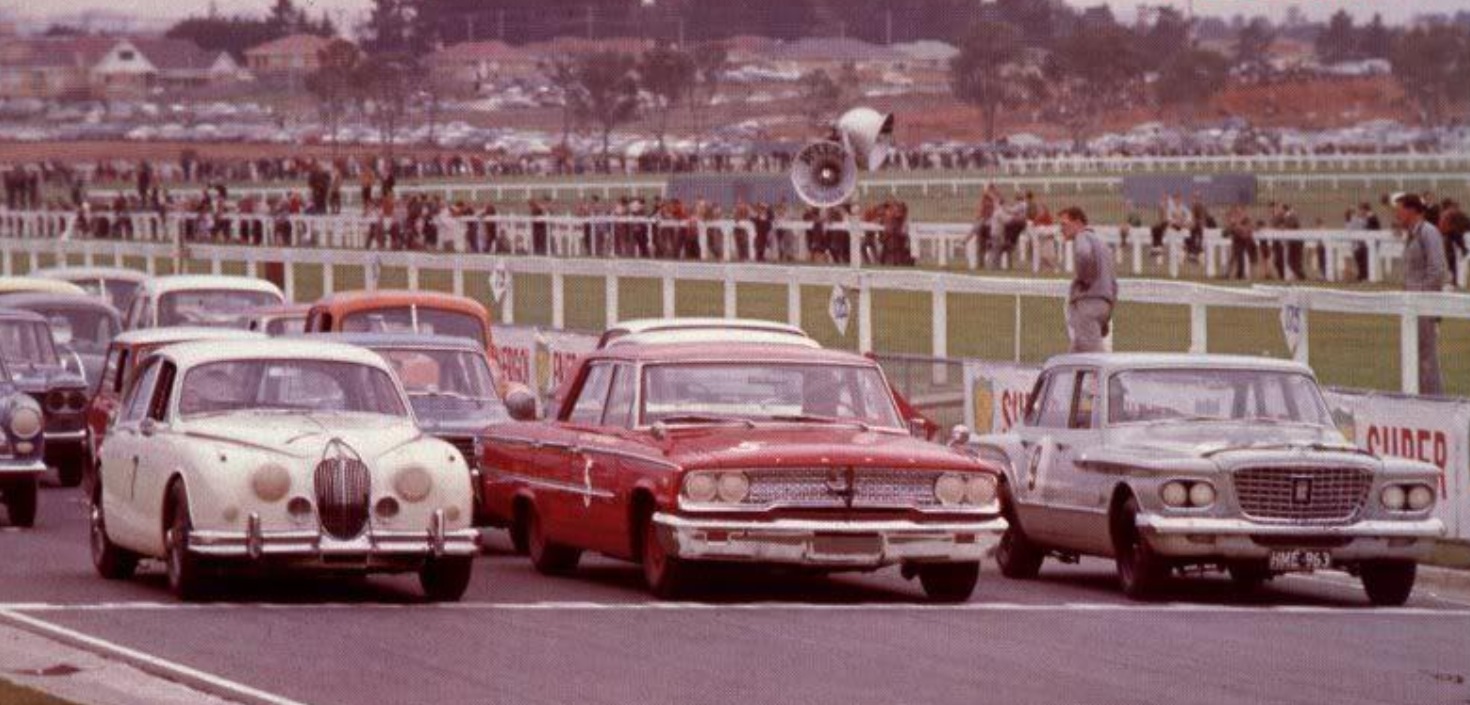
Bob Jane Jag Mk2, Norm Beechey Ford Galaxie and Ern Abbott Chrysler Valiant, Sandown 1964 (Bob Jane)
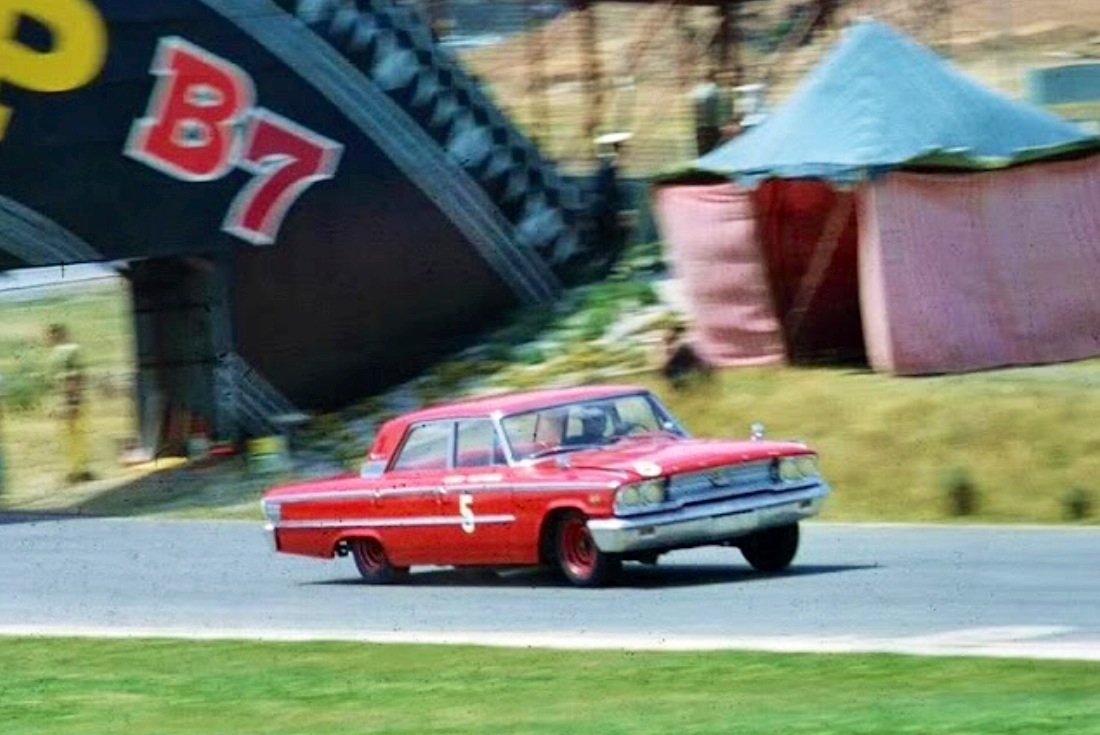
Turn in and hold on! Beechey exits the long, fast right-hander under the Dunlop Bridge, Sandown 1964 (unattributed)

Davison had a busy racing 1964 including providing valuable emotional and public relations support to Donald Campbell’s Bluebird LSR attempt at Lake Eyre, South Australia. Campbell was copping plenty of flak globally at the time for perceived lack of progress. Oh yes, Lex had a steer of Bluebird at a preset limit of 155 mph.

Davo started the season in his ex-McLaren 1962 AGP winning Cooper T62 Climax but bought a Brabham Intercontinental chassis – Brabham’s ’64 Tasman car – to remain competitive with Bib Stillwell and others.

But his touring car aspirations were not put to one side. Ecurie Australie mounted a professional, well prepared campaign together with Australian Motor Industries in a Triumph 2000 in that years Bathurst 500. Lex drove the car fast, consistently and sympathetically to eighth in the class despite being slowed by wheel bearing failure, and co-driver Rocky Tresise parking the car unnecessarily until Lex told him ‘to go and geddit matey’!

All the same, what was somewhat bizarre, given Lex’s experience with Len Lukey’s Galaxie was that he signed up for an even bigger Galaxie challenge, this time involving his own funds.

The Sandown promoters, the Light Car Club of Australia, planned a Six-Hour race for Group 1 cars in November 1964 and sought interest from teams and manufacturers from around the globe.

By September two British Galaxie owner/drivers had shown interest; Sir Gawaine Baillie and Alan Brown. Sandown planned to pair Baillie with three-time Australian GP winner Doug Whiteford, and Brown with Davison but when Brown withdrew Lex arranged to share Baillie’s car which the aristocrat then hoped to sell in Australia after a summers racing.

Lex, whatever his then view on touring cars, and the Lukey car, was keen to take on the challenge of driving the later model Holman-Moody Fastback. These cars were built at the request of British Ford dealer, John Willment, who wanted to take on the then dominant Jaguars in British touring car racing.
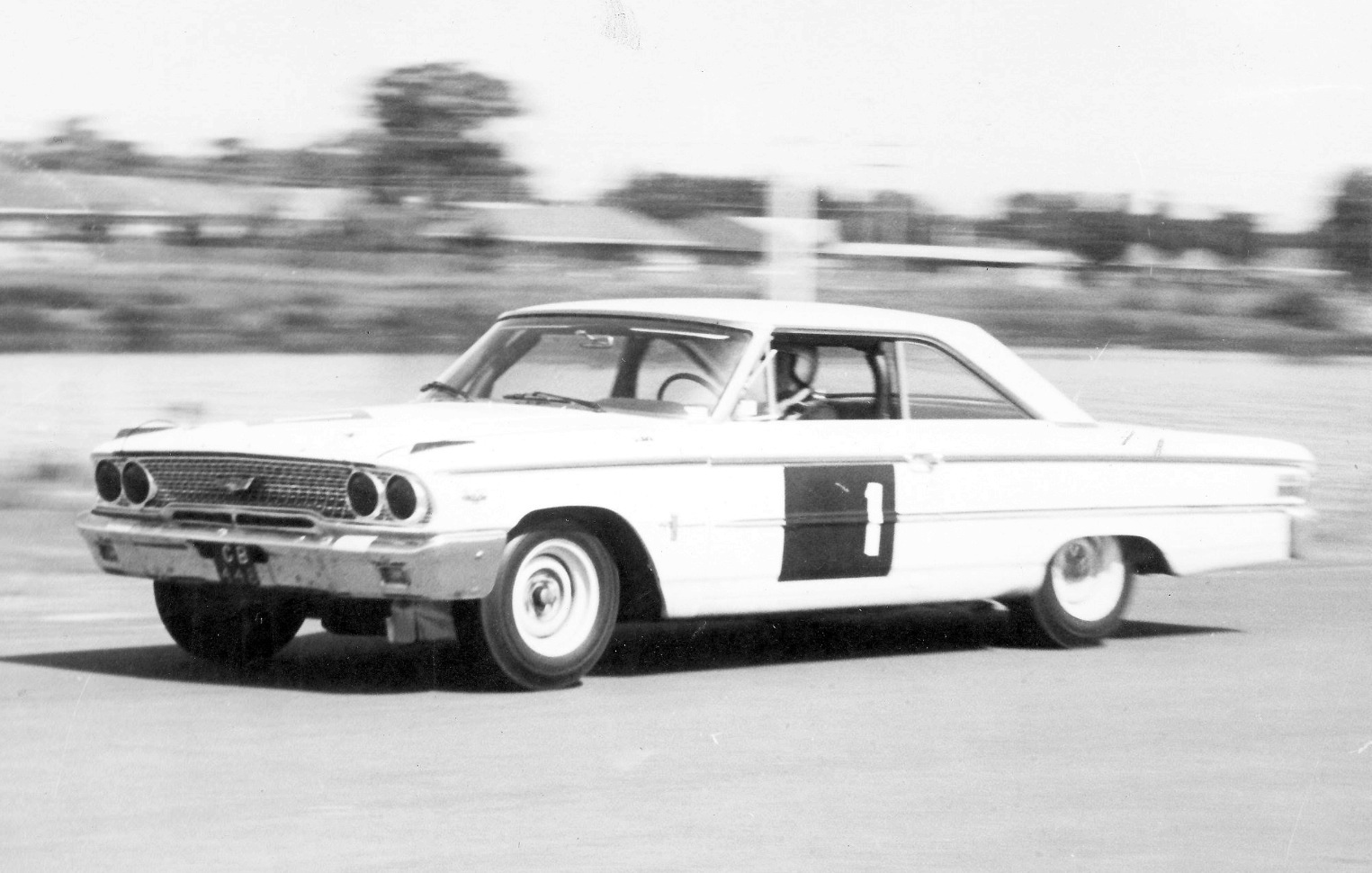
Gavin Fry’s shot of the Baillie Galaxie at Sandown in November 1964 shows the lines of the handsome big car to good effect. Note heavy steel wheels, brake duct and vestigial roll bar (G Fry)

It’s time to explore the cars build and technical specifications.

Holman-Moody were approached to produce some road racing versions of the latest 427cid Ford Galaxie factory lightweights, which had been developed for NHRA Super Stock competition on the quarter mile dragstrips throughout the US.

Except for a few early cars such as Lukey’s, these 1963½ Galaxie lightweights all emerged from the factory as white two-door Sports Hardtops with red interiors; 212 of them were made in one batch sent down the production line together.

“Some featured a Ford 300 series chassis frame made from lighter gauge steel. All body sound-deadening compounds were deleted and lightweight fiberglass replaced steel in construction of the boot lid, bonnet and front mudguards (some had fiberglass doors and inner front guards as well). They also had aluminium front and rear bumpers mounted on lightweight brackets” wrote Mark Oastler. The interiors were basic racer-specials with unpadded rubber floor mats, thin-shell bucket seats with no radio, heater or clock or other road going frills.

The engine was Ford’s 427cid side-oiler V8 from the FE big block family with 425bhp and a choice of high-riser and low-riser cast aluminium manifolds running huge dual four-barrel carbs. The high-risers ran in NHRA’s Super Stock category with the low-risers in the slightly less modified A/Stock class.

The gearbox was a butch Borg Warner T10 four-speed manual with cast-aluminium bell-housing and casing to save weight, with a set of close-ratio gears. Ford’s ultra strong, ubiquitous nine-inch rear axle was used with short 4.11:1 final drive and heavy duty leaf springs, shocks and four wheel drum brakes inside 15-inch steel wheels.

A standard 427 Galaxie Sports Hardtop tipped the scales at circa 1900kg, whereas the lightweights were a massive 290 kg less – those fitted with fibreglass doors and front inner guards dropped another 40 kg.

These Ford factory lightweights laid the foundation for the handful of cars produced by Holman-Moody for road racing overseas, one of which was the Sir Gawaine Baillie car. At around 1600kg, they were now competitive with the Jags in weight but with around 500bhp  they had a bit (!) more power! The circuit racers, like the drag cars were equipped with lightweight fibreglass front guards, bonnets and boot-lids, aluminium bumpers and stripped interiors.

H-M also developed a front disc brake kit to replace the standard 11-inch drums based on Jaguar 12-inch diameter solid rotors clamped by Girling two-spot calipers mounted on heavy-duty spindles.

“Other H-M tweaks included steel wheels with immensely strong double-thickness centres developed for Grand National (NASCAR) stock car racing. The booming exhaust system was also NASCAR inspired, featuring huge three-inch diameter open pipes neatly routed through the chassis rails that exited in front of the rear wheels. Shock absorber mounting positions were altered with most equipped with two shocks per wheel. Some of the export cars, including Baillie’s, were equipped with an additional shock absorber on the rear axle which through suspension movement pumped diff oil through a remote oil cooler to control rear axle temperatures during races held in warmer climates.”

“The Holman-Moody Galaxie lightweights (with either low-riser or medium-riser 427 engines) were very successful. John Willment’s car soon shook Jaguar out of its complacency in the BTCC, proving dominant in 1960s UK tin-top racing where it was prepared by John Wyer (of Gulf GT40 fame) and driven by Jack Sears and Graham Hill.  Another 427 Galaxie campaigned by Alan Brown Racing in the UK also proved highly competitive, driven by such luminaries as Jim Clark, Dan Gurney and Sir Jack Brabham. Baillie had his share of success in the UK…”

Bouyed with the success of the cars in the UK, and convinced the latest lightweight would be a better car than Lukey’s machine, Lex threw himself into the task of dealing with the arrangements to bring the car to Australia, together with a long list of spare parts including a new engine direct from H-M. A separate shipment from the UK comprised extra wheels and racing tyres.

The car was already on the boat when Sandown race organiser Max Newbold realised that the car was modified to Group 2 specs. Borrowing parts from the then dormant Lukey Galaxie would still not have brought the Baillie car within Group 1 so Newbold simply altered the race regulations to include a Group 2 class.
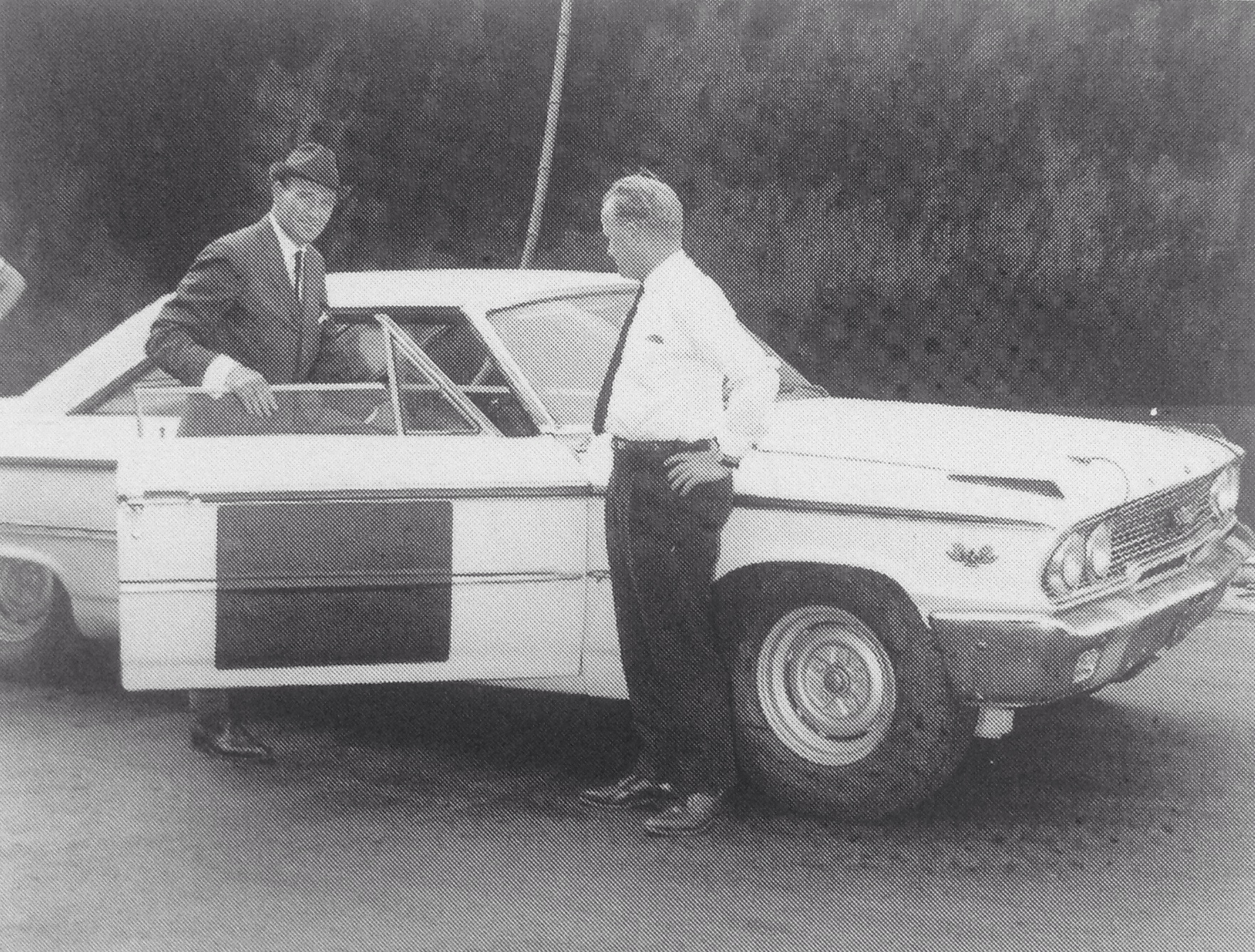
Pre race Sandown PR shot- Lex and Baillie’s Galaxie at Port Melbourne alongside the ship which brought it from Southampton (Davison)
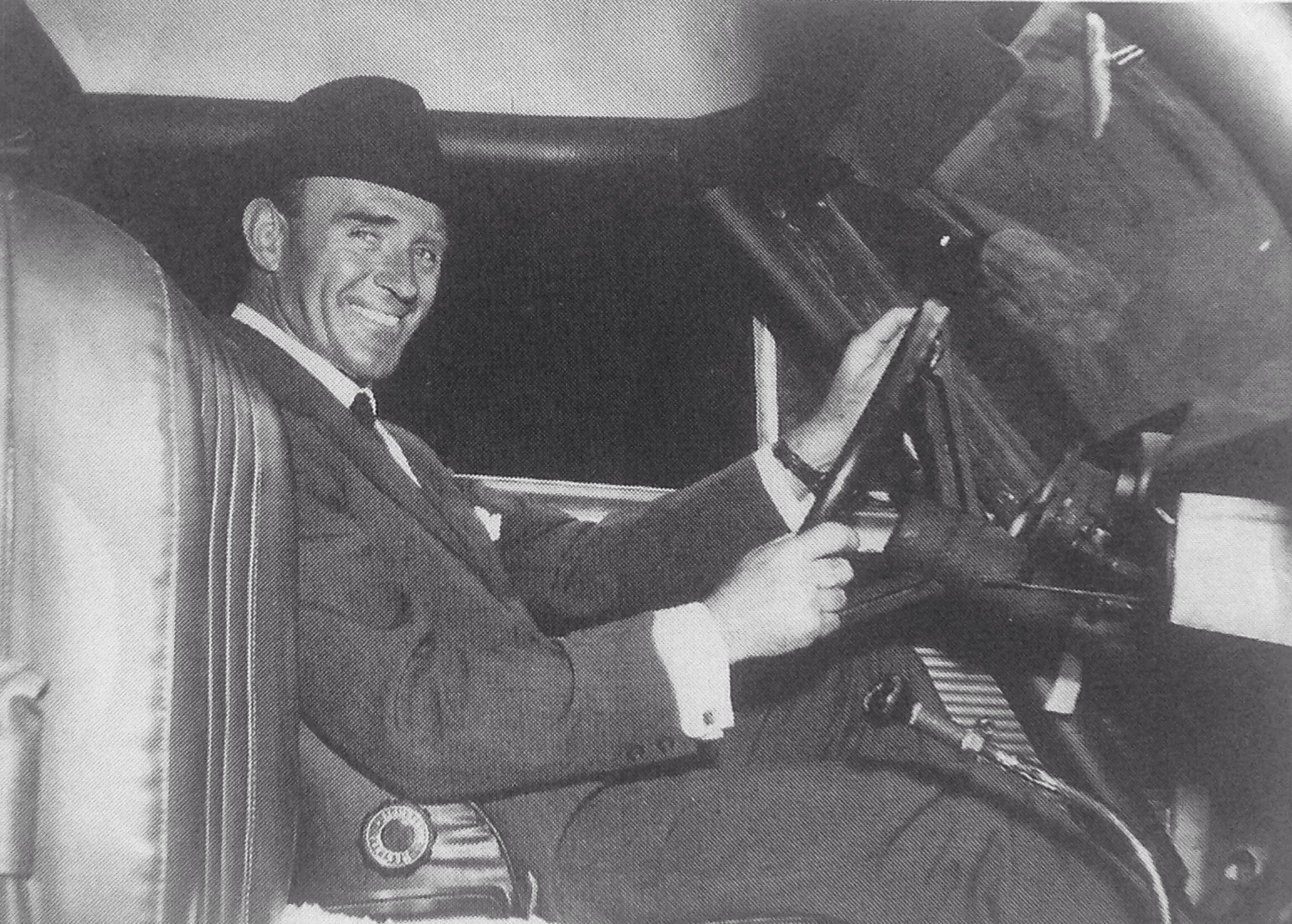
Davison with suit, tie and hat about to have some fun! A road trip in his racer from Port Melbourne to Armadale, 10 km or so on built up inner urban Melbourne roads (Davison)

When the car arrived at Port Melbourne in mid-November, Lex and Alan Ashton, Davison’s longtime engineer/mechanic boarded the vessel to see the car in the hold. Newbold was caught out when the huge trailer he organised to collect the beast was not large enough. So, the likely lads fired up the 500bhp racer, Lex jumped aboard complete with suit and tie and rumbled off in the direction of AF Hollins workshop in twee High Street, Armadale 10 km away. I wonder if Lex had a bit of a flurb along the new South Eastern Freeway to see ‘whaddl she do?!

While Lex’ new engine had reached Sydney, shipping difficulties meant it was struggling to go any further, the wheels and tyres hadn’t arrived from the UK either.

On the Saturday before the race Ashton and Lou Russo took the car to Sandown where Lex did about 30 laps, checking fuel consumption, getting the feel of the car, establishing tyre pressures. As part of the pre-event publicity build up he gave a couple of eventful laps to a Melbourne Herald reporter including a demo of the Galaxie’s loss of braking power on the drop down through the Dandenong Road Esses!

Lex got down to 1:24, Beechey’s lap record in Lukey’s Galaxie was 1:23.5. Davo reported seeing 5500 rpm in top gear, 217kmh and reported signs of brake fade after 10 laps circulating in the 1:26 mark; it was a portent of things to come.

The new spare engine reached Melbourne on the Friday and was installed overnight, but the car was still on its old tyres. Baillie jumped aboard and circulated in 1:28’s, then Lex did a 1:24.9.  Baillie did 1:25.3 and finally Lex did a 1:23.7. The car completed about 50 laps all up with the crew practicing wheel and driver changes.

Allan Moffat’s Grp 2 Lotus Cortina, just acquired from Team Lotus – of which he had been a member – arrived from the US after practice had finished, while Bob Jane’s Grp 1 Lotus Cortina three-wheeled around in characteristic style in 1:30.1. During practice the Galaxie’s wheels and tyres arrived air freight from the UK- so, all was prepared with the Galaxie demonstrably the fastest car on the circuit.
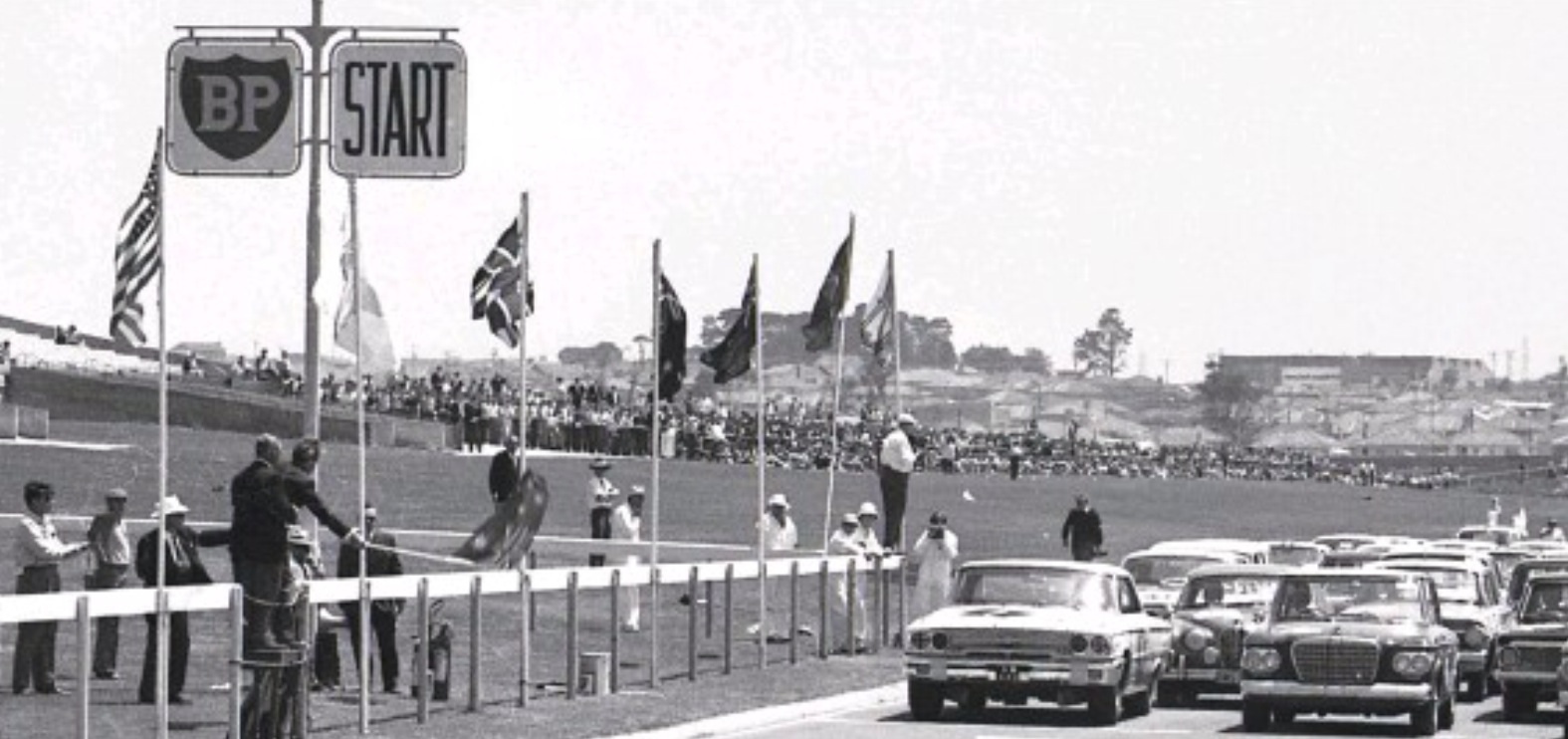
Davison’s Galaxie alongside the Studebaker Lark at the start, Sandown 6 Hour 1964 (unattributed)

Race morning was fine and sunny. 27,000 Melburnians rocked-up to enjoy what promised to be an interesting, spectacular race.

Lex was on pole amongst the Studebaker Larks, and took the first stint at Baillie’s request. At the drop of the flag Lex spectacularly bagged-’em-up and simply disappeared into the distance. He was 200 metres ahead of the second placed car at the end of the first lap and lapping the tail-enders prior to the end of lap two; lapping in the 1:24s literally in a class of his own.

The team planned a driver change at the end of lap 61, with a strategy to build up a big enough lead to be able to change all four tyres and replenish the beasts 155 litre fuel tank.

By lap 40 Lex had a three lap lead over Moffat’s second placed Lotus Cortina – at that stage he needed six-pumps of the brakes to get a useful pedal. Then, as he started his 47th lap he could get no pedal on the 170 kmh run along Pit Straight before the second gear, slow Peters left hander. “I managed to change down to second, then to first, and tried to spin the big car in this very tight corner. I managed to pull off this manoeuvre once before when driving Len Lukey’s car, but this time I did not manage it quite so cleanly and the tail whacked the fence.”
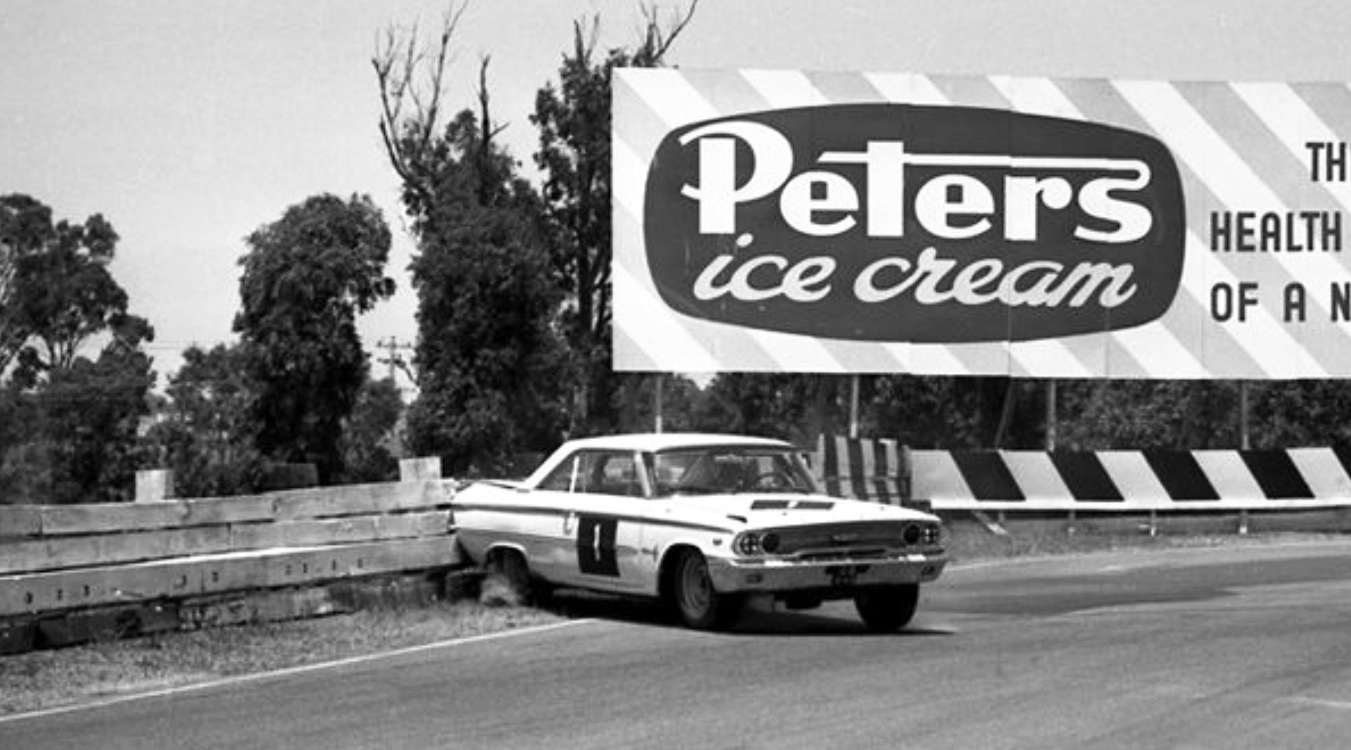
Hit 1: Lex backwards into the Peters corner fence (autopics)
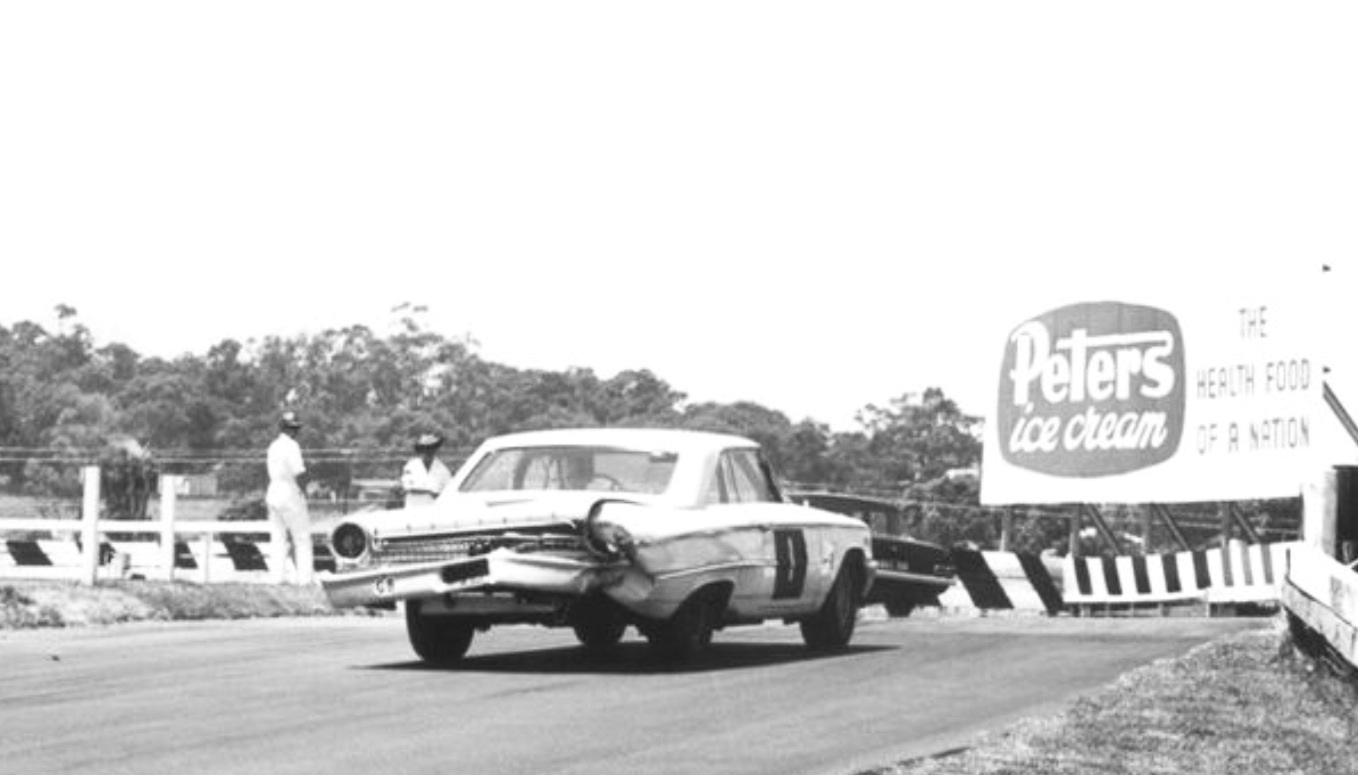
Slightly second hand Galaxie post hit 1, entry to Peters from Pit Straight (autopics)

Davo completed the lap – effectively a full lap – but still had trouble pulling the car up at the AF Hollins pit, so much smoke was coming from the offside brake it appeared to be on fire. The offside front brake had worm through both pads but also one of the backing plates allowing a piston to contact the disc, damaging both it and the caliper! It took 22 minutes to replace the caliper, then Baillie rejoined in 30th place, 8 laps behind the leader – still with the damaged disc- while a spare was tracked down.

Moffat’s Cortina had clobbered the fence too so the race was a duel between Jane’s Cortina and Alec Mildren’s Alfa Romeo Giulia TI Super driven by Roberto Businello and Ralph Sach.

Baillie was not comfortable with the car and brought it after 20 laps, Lex took over, his first flying lap was an amazing 1:24.6, he pitted after 7 laps and then pitted on his 75th lap for the car to have the disc replaced, and then took off again at undiminished pace.

And then, as they say in the classics, it happened.

On lap 91 he had the same problem at the same place as earlier but this time had total brake failure. Davison lost some speed by jamming the car into second gear but muffed the change into first – and thereby lost the opportunity to lock the rear wheels and spin the car – so, utterly a passenger, ploughed headlong into the thick planks intended to arrest cars before a 20-foot plunge into the Dam below.

The Galaxie, brakeless and in neutral at about 120 kmh smote the timbers head on an amazing impact, smashing through the planks with all the physics of a 1600kg car. He displaced a 12 inch diameter fence post which drove the right front wheel back against the firewall. “The car stopped halfway through the fence, nose down on the edge of the 20 foot drop into the reservoir, only escaping the fall because the front of the car was resting on the hefty fence post.” Lex’s door was jammed, the right hand door was locked but eventually he got out, severely shaken but otherwise amazingly ok.
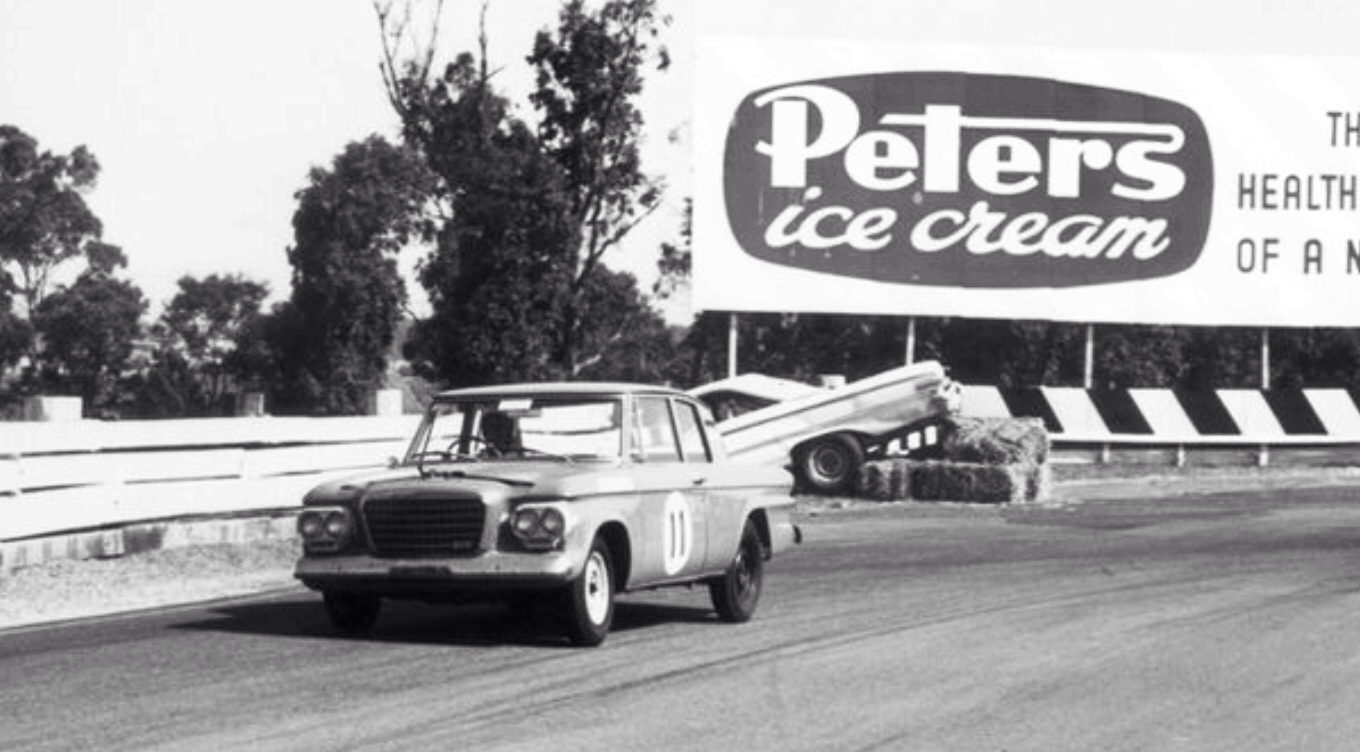
Things look innocuous enough from this angle for Lex as the Studebaker Lark passes (autopics)
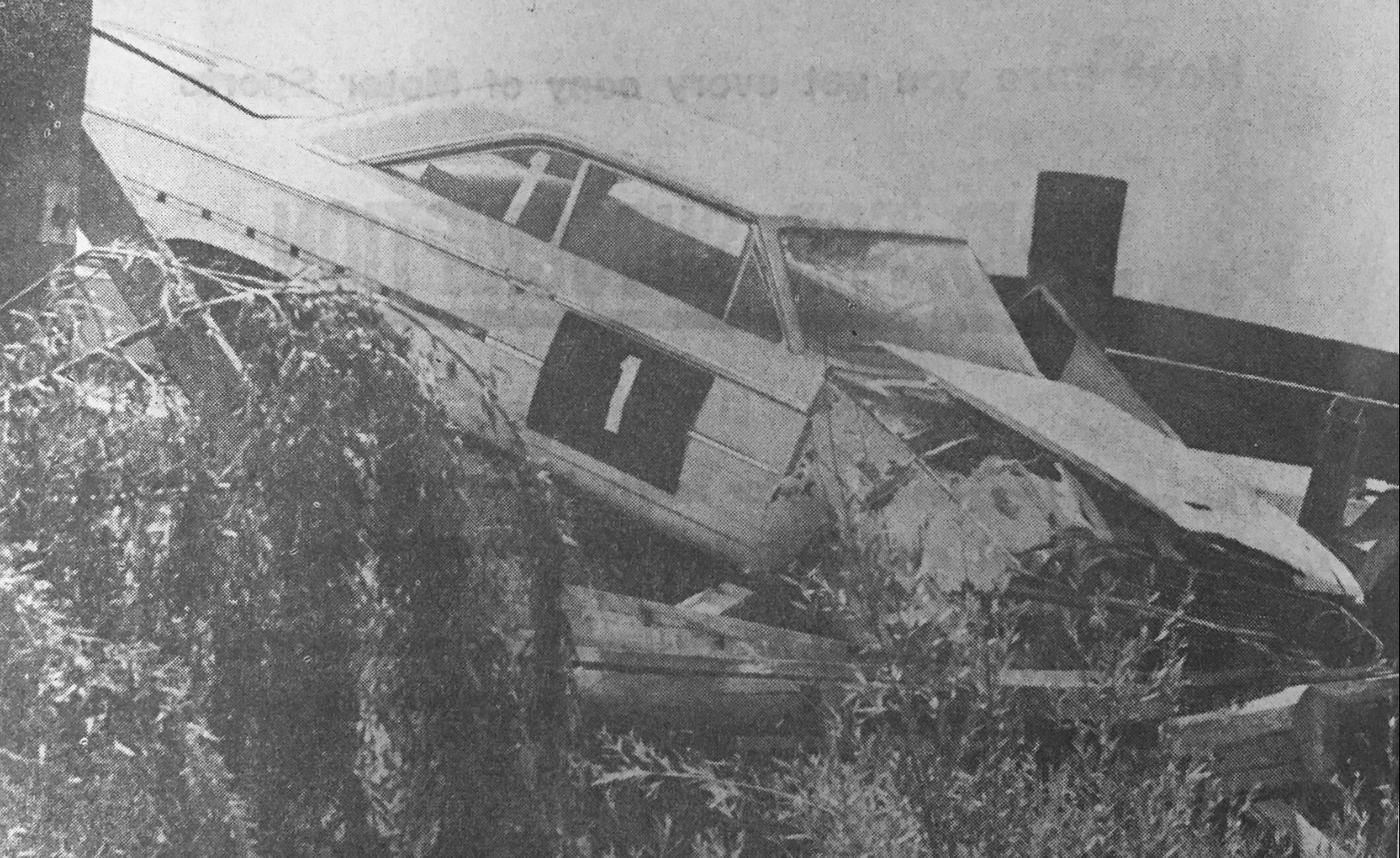
Not so good from this angle though- and it does not show the water 15 feet or so further down (G Edney)

The Ecurie Australie team, on Pit Straight, ran to Lex’s aid with all immensely relieved “Lex being supported by Gawaine Baillie and Rocky Tresise, then, with one arm holding Diana, still supported by Baillie, trying to explain the accident to Alan Ashton and Lou Russo…The big bitch nearly killed me…” Lex told Baillie.

Graham Howard notes in his Davison biography that for the 40 odd minutes it lasted, his drive after taking over from Baillie was “…another of his never give up drives from the back of the field…but this time he knew he was driving a car which he knew was suspect.”
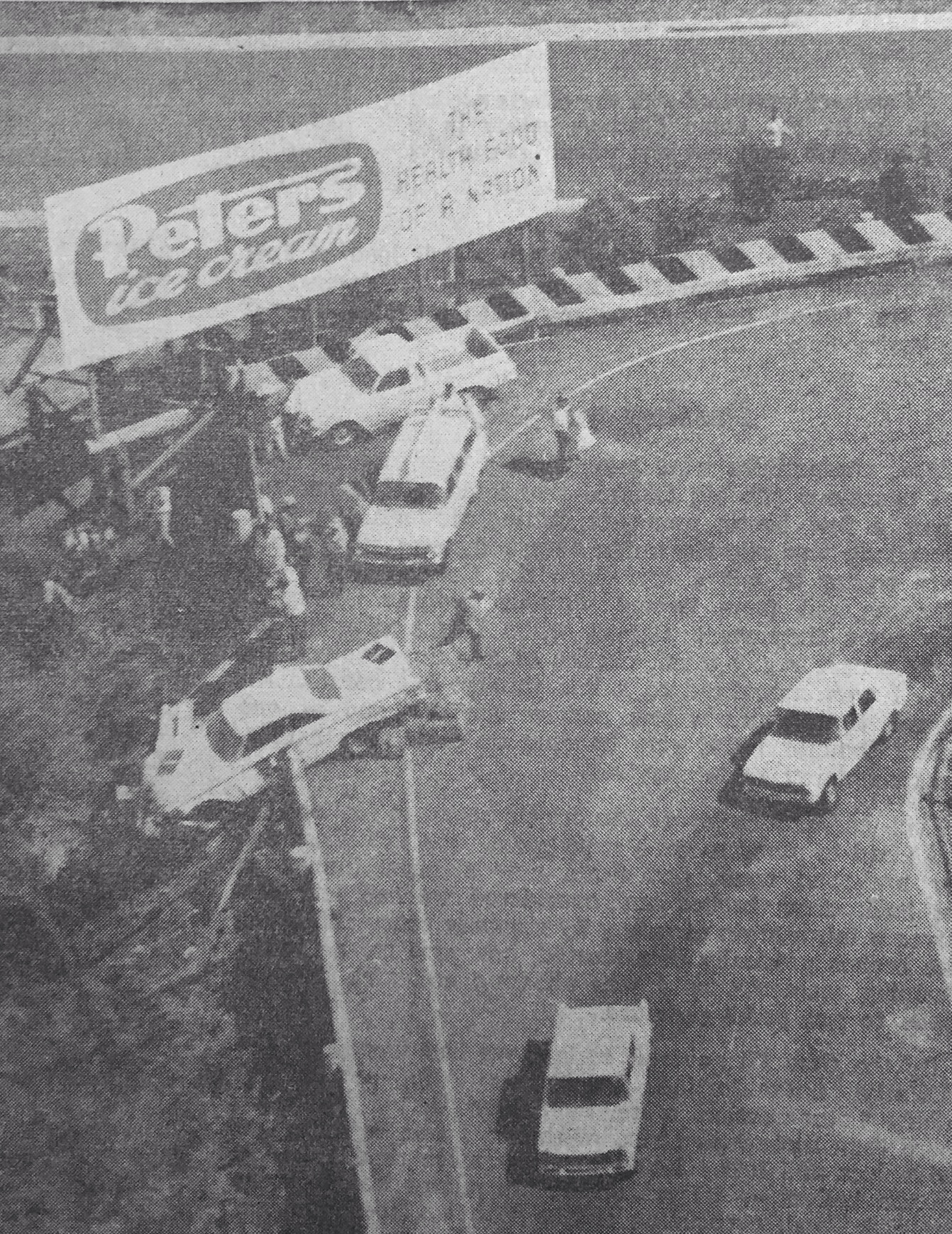
The race goes on around the stranded, mortally wounded Ford Galaxie- not the hay bales behind the car (G Edney)

“Common sense said to put the car away; so why did he keep racing? The Galaxie was a sedan car, an American made one at that, and a clumsy compromise as a racing car, and these were all the things Lex disliked about the touring car push. But at the same tine it was a big, noisy, heavy car to manage, racing car virtues Lex could never resist. Even before it reached Australia the Galaxie had excited him, and from the first drive of the car Lex was exploring its limits. Gawaine Baillie was no playboy- he had been racing since the 1950’s, had been racing the Galaxie for two European seasons, and had led the Brands Hatch 6-Hour race in June with it, setting fastest race lap – but Lex in the Galaxie was always faster. At Sandown Lex was responding to one of the primal challenges of motor racing: to show the machine the driver was in charge. But finally, provoked beyond endurance, the big bitch showed empathetically he was not.”

Howard continued “Lex had also been shown in no uncertain terms, that continuing to drive hard in a car with a known mechanical problem had been an error of judgement which went to the very heart of his personal approach to racing. So while he had big accidents before, they had not been in circumstances like this. The accident brought home to both Lex and Diana how much was at risk when he went racing: he was the valued head of a large and lively family with children aged from 5 to 17, and the leader of a minor business empire which by then extended beyond footwear manufacture and retailing and into property development and car sales. He was a few months short of his 42nd birthday, he had been racing since 1946, and now, Lex decided, it was time to stop. He would just run a few more races, he told Diana and then he would retire.”

As many of you would know the great irony and sadness of all of this is that Lex died at Sandown of a heart attack aboard his Brabham only several months later- an event which rocked his family, the sport and Melbourne to the core. But I don’t want to dwell on that fateful day, which is covered here; Bruce’, Lex’ and Rocky’s Cooper T62 Climax… | primotipo…

As Lex gathered himself up to prepare for the 1965 Tasman Series- and proved at Pukekohe during the NZ GP that he had not lost a yard, but had in fact gained several, started the race from the front row alongside Clark J, and Hill G before retiring with overheating problems.

The Galaxie returned to AF Hollins for repair, there were Tasman support races to run in Australia in January/February to prepare for.
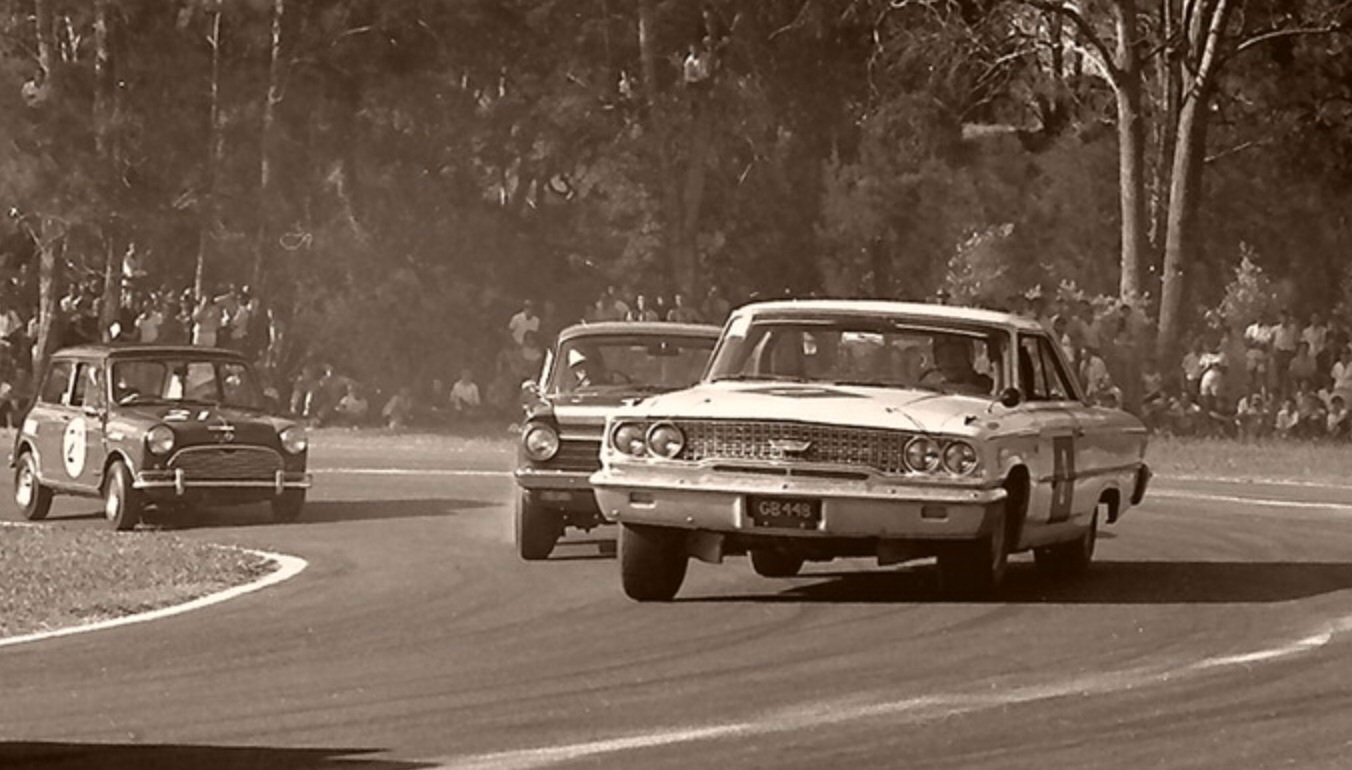
Baillie ahead of Brian Muir’s Holden S4 during the Warwck Farm International meeting in February 1965 (B Wells)
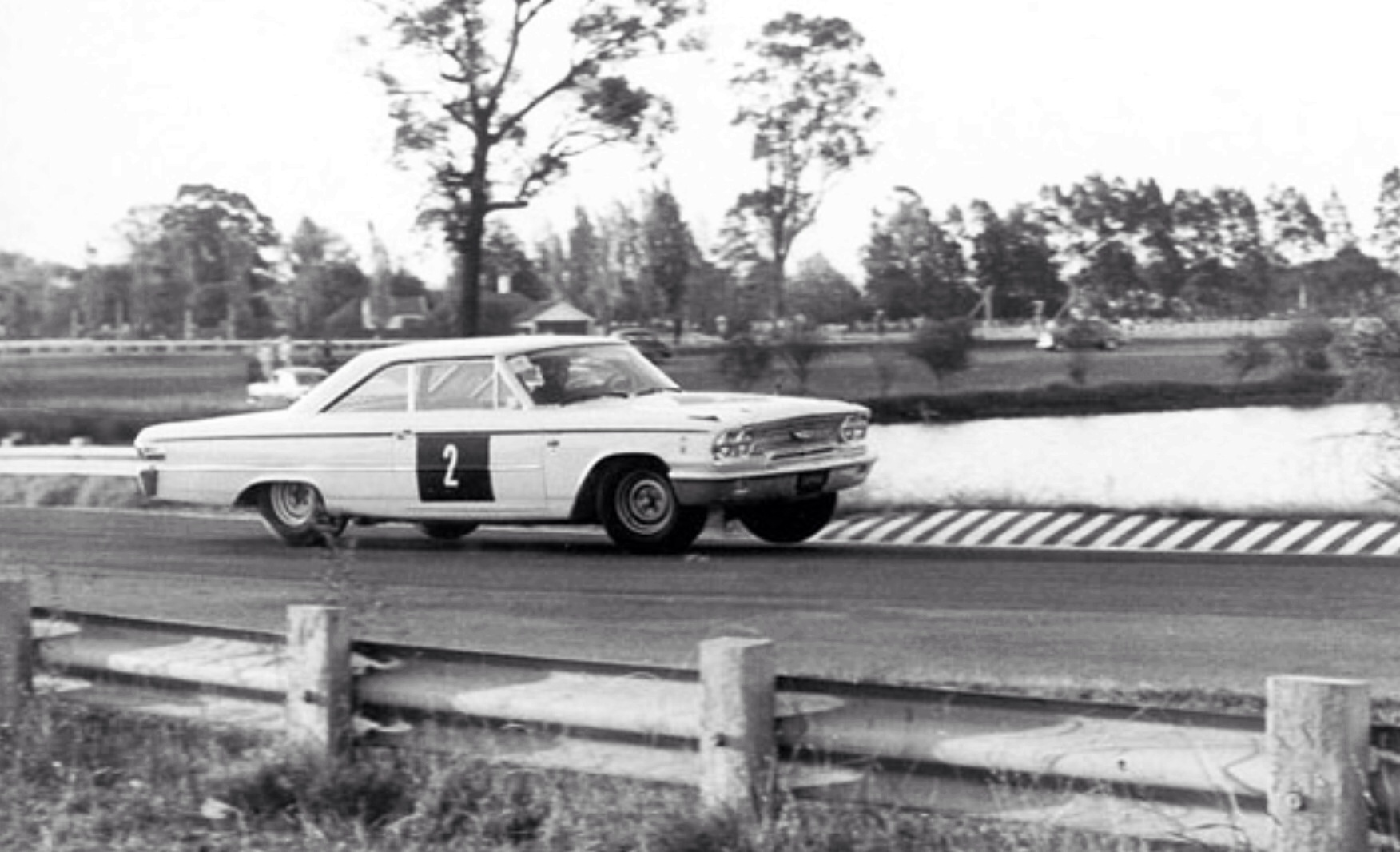
Warwick Farm again across The Causeway (autopics)

Baillie raced the car at Warwick Farm, but not Sandown out of respect for Lex, and also the tragic Longford weekend in which Ecurie Australie’s plucky young driver, Rocky Tresise perished in an accident aboard the teams Cooper T62 Climax, a race Rocky insisted he start out of respect for Lex – his neighbour, friend and mentor.

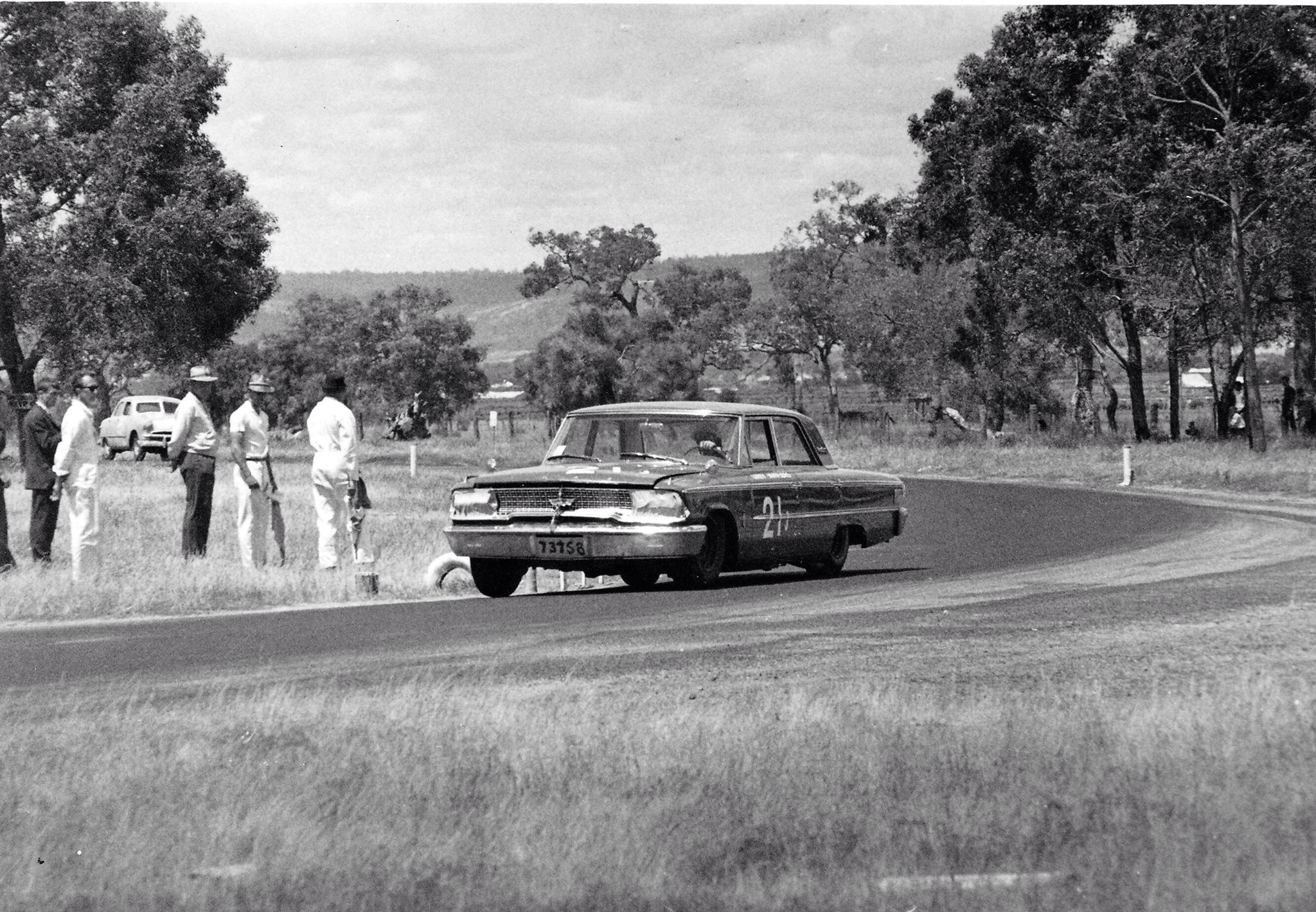
Baillie left Australia but the Galaxie remained, contesting the one-race 1965 Australian Touring Car Championship in the hands of John Raeburn at Sandown in April 1965. Run to Group C Improved Touring Car regulations, Bob Jane started from pole in his Mustang with Raeburn alongside him – the cars pace at Sandown was now rather well known. Norm Beechey aboard his new Ford Mustang from Pete Geoghegan’s Lotus Cortina and Brian Muir’s EH Holden S4- Raeburn was fifth, a lap behind.

With the Mustang making rather clear the future for outright touring cars – smaller lightweight V8 engined machines – there was little interest in the car in Australia so it was loaded up and returned to the UK. John Willment bought it, the Australian connection continued as Brian Muir was the driver. Those brakes, always the weak link caused him a big accident at Oulton Park, beyond economic repair, the car was scrapped.

While the Galaxie touring car phase of racing in Australia was short it was certainly sweet, if a 1600kg, 500bhp, big, lumbering beastie could ever be described thus!
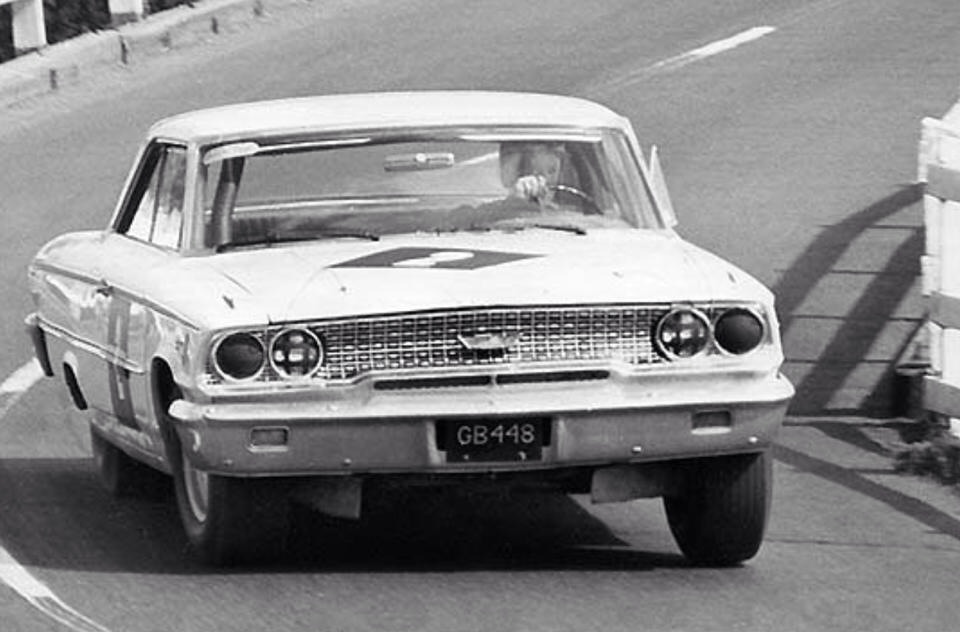
Great shot of Baillie convincing the Galaxie off Long Bridge, Longford 1965 (oldracephotos)

Bibiography…

‘Lex Davison: Larger Than Life’ Graham Howard, various online forums, Mark Oastler on Shannons.com

Photo Credits…

oldracephotos.com.au, Bob Jane Collection, Graham Edney Collection, Bruce Wells, autopics.com.au, Gavin Fry

Tailpiece…Finish where we started- Baillie ahead of Jane, Longford 1965, this lap is on the entry to Pub Corner rather than its exit…
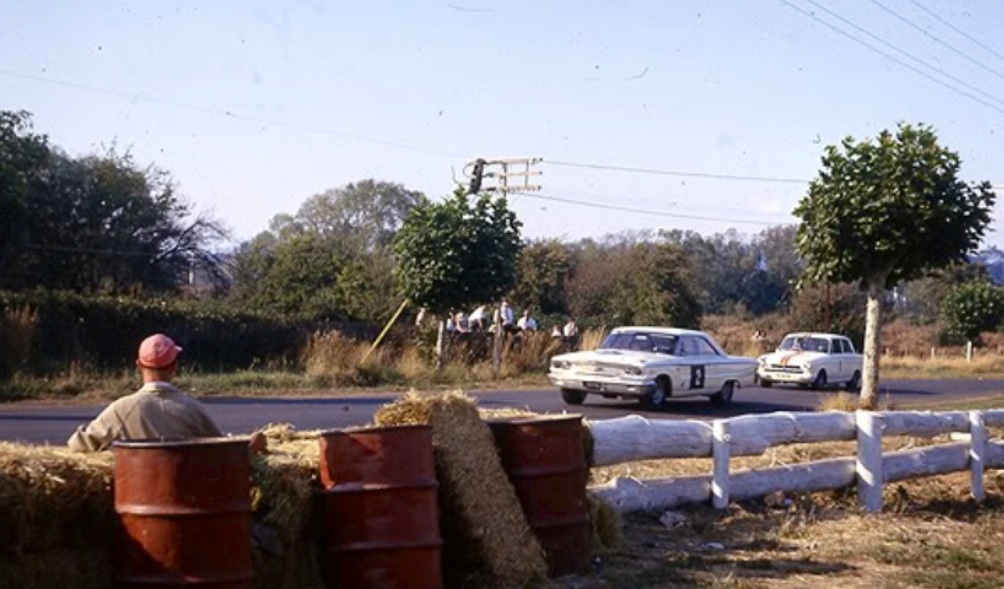
(oldracephotos)

Finish where we started – Baillie ahead of Jane, Longford 1965, this lap is on the entry to Pub Corner rather than its exit.

Finito…