Posts Tagged ‘Kevin Neal’

Reg Hunt, Maserati 250F, on his way to winning the Victorian Trophy at Fishermans Bend on February 12, 1956

Context…

Australian motorsport’s governing body was the Sydney based Royal Automobile Club of Australia until 1953 when the Melbourne based Confederation of Australian Motor Sport took over. CAMS Ltd trading as Motorsport Australia (CAMS) still rules the roost today.

One of the CAMS’ rare acts of decision-making excellence was the creation of the Australian Drivers Championship – the Gold Star – from 1957.

Lex Davison, Ferrari 500/625 was the first recipient of the award for points gained in nine rounds spread across all states except Tasmania – remedied in 1958 – on an 8-5-3-2-1 points basis for first to fifth places in each round.

1956 Faux Gold Star Championship…

I’ve thought for a long while that it would be interesting to summarise our elite level Formule Libre racing results by seasons, if for no other reason than when I want to research one thing or another a summary of the competitor set exists. Why not, I thought, extend the idea to calculating notional Gold Star points?

Of course it’s a fucking stupid thing to do as it simply didn’t happen! In the words of that great Australian philosopher, ‘Sir’ Frank Gardner, “If yer’ Aunty had balls she’d be yer’ Uncle”. In other words, deal with what is/was, rather than what isn’t/wasn’t.

But of course CAMS run a who-gives-a-fuck-about-facts (WGAFAF, pronounced ‘woggafaff’) motor racing history model. They don’t recognise the January 1927 Australian Grand Prix at Goulburn as the first AGP, yet we have 1928 and 1937 Australian Grands Prix, apparently, neither of which actually took place then, as officialdom chooses to brand them now. So, in accordance with established Oz-racing fast-and-loose WGAFAF precedent, what follows is a summary of the 1956 Gold Star, Faux Division.

Officialdom awaits the ‘Champion of the Day’ of the 100 Miles Road Race at Phillip Island held on Saturday 31 March, 1928. Oopsie, sorry there were two 100 Mile Road Races that day. The morning one started at about 11am, oopsie again, sorry, B-Class started at about 11am, and D-Class at about 11.05am. The afternoon race, races really, started at about 2.25pm for A-Class and then C-Class at about 2.30pm. All ‘Akin to European GP practice’ is the favoured line of some

The readily apparent State-The-Obvious flaw in my Faux Gold Star award is that as there was no such championship, drivers didn’t enter meetings they may have otherwise if they aspired to win such a title. However, the rich/well-funded in every era raced far and wide beyond their local meetings, this was certainly the case for the 1956 motor trader front runners, so I’m not so sure the top-3 are impacted by this factor.

Some criteria points. I’ve basically followed the equivalent 1956 meetings that CAMS recognised in ’57, even though some of the races are too short, in my mind, to be of championship length. Where there were two Formula Libre races of ‘championship length’ – over 75 miles – at the one meeting, such as the Albert Park Moomba meeting, the longer, feature event prevails. Results are scratch based only. I’m only awarding points for first to fourth placings as those are the records I have. If someone has more comprehensive records, spreadsheet skills and OCD knock yer’ socks off and I’ll update this masterpiece.

Away we go.

Reg Hunt on Gnoo Blas’ Main Straight while the 4.05pm to Sydney gets ready to depart. Maserati 250F (GB.com)

Gnoo Blas, Orange, New South Wales (NSW) : South Pacific Championship : January 30, 1956

This season opening race meeting on the Gnoo Blas road circuit at Orange, 260 km west of Sydney had become Australia’s only international meeting in prior years. The Australian Sporting Car Club always managed to entice a few of the drivers doing a full southern summer season In New Zealand across-the-ditch to the Great Brown Land before they headed back to Europe. As an aside, the Kiwis were five years or so in front of us in the Big Race Stakes.

Our Jack was the only international in ’56 mind you. He raced the 2-litre Cooper T40 Bristol that he built for himself at Surbiton to make his championship GP debut at the British Grand Prix at Aintree in July 1955. Brabham brought the car home at the end of the year, winning the AGP with it at Port Wakefield after frontrunners, Stan Jones in Maybach 3 and Reg Hunt’s Maserati A6GCM/250 (a 2.5-litre 250F engined A6GCM 2-litre F2 car) had problems, then did the Kiwi season and would sell it to Reg Smith before heading back to the UK.

To rub in his advantage, Reg Hunt brought along both the Maserati he raced throughout 1955 and his new 250F on the long tow from Melbourne to Orange, then disappeared into the distance, winning the 27 lap, 100-mile race in the 250F from Brabham. 

Stan Jones gave vigorous chase, but blew the 3.8-litre Maybach SOHC six fitted under the long bonnet of Maybach 3 sky-high on lap 22 when 39 seconds adrift of his fellow Melbourne motor trader.

That blow-up proved a defining moment in Australian Motor Racing History of that era as it marked the end of the Charlie Dean/Repco Research/Stan Jones/Maybach period. Repco’s stock of 3.8 and 4.2-litre Maybach cylinder blocks was at an end, so the car couldn’t easily be rebuilt. In any event, Stan realised he needed a Big Red Car to remain competitive, taking delivery of a 250F later in the season. Ern Seeliger created the very fast Maybach 4 Chev V8 of course, it proved to have a surprise or two in 1958-59, but the big-blue Maybach sixes were no more.

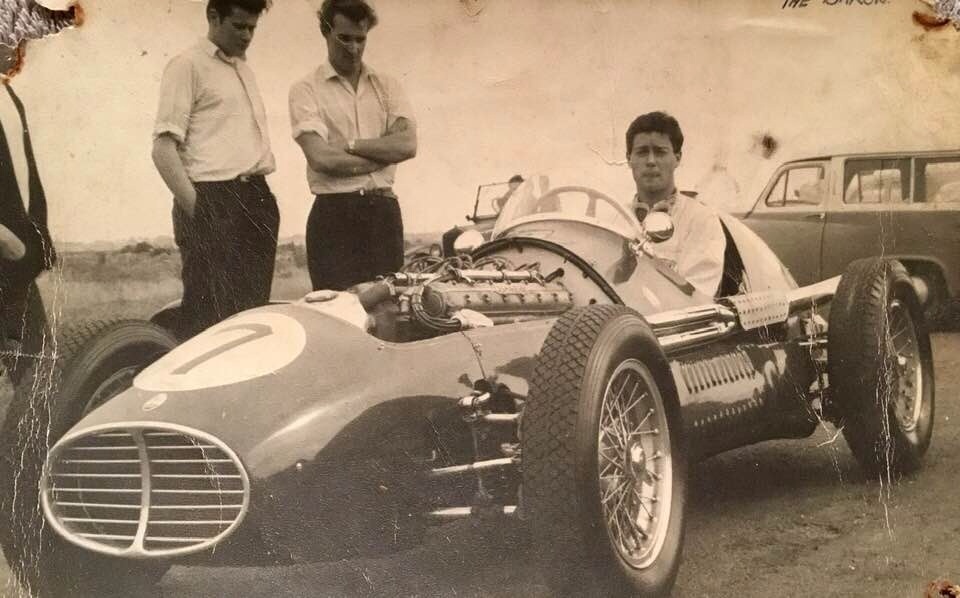
Kevin Neal was third in his Cooper T23 Bristol, then came Curley Brydon’s ex-Peter Whitehead – present at Gnoo Blas in the previous two years – Ferrari 166 and then Col James’s MG Special. Jack was a non-resident by then so he doesn’t get Gold Star points for his second place, so we have our top-four below.

1.Hunt Maserati 250F 8 points 2.Neal Cooper T23 Bristol 5 points 3.Brydon Ferrari 166 3 points 4.James MG Special 2 points

End of an era. Jones aboard Maybach 3 – very Mercedes W196’esque in appearance – before the engine let go, South Pacific Championship, Gnoo Blas in 1956 (GB.com)

Fishermans Bend (once Fishermen’s Bend) Melbourne : Victorian Trophy : February 11, 1956

Top guns entered for the 24 lap, 52.8 miles Formula Libre race included Hunt’s Maserati 250F, Lex Davison’s HWM Jaguar (“now with latest D-Type head and Weber carbs” according to AMS), Doug Whiteford’s Talbot-Lago T26C, Stan Jones’ Cooper T38 Jaguar sportscar, Brabham’s Cooper T40, Tom Hawkes Cooper T23 Bristol and Bill Craig’s Alta Holden.

While billed as on international meeting to attract some spillover visitors to New Zealand that summer, the only ‘internationals’ were Brabham from New South Wales and Craig from South Australia…

Hunt romped away, Whiteford’s old T-L, somewhat surprisingly, proved quicker than Davison’s ’54 AGP winning HWM Jag, then Davo spun, while broken throttle linkages accounted for Jones and Hawkes.

1. Hunt, Maserati 250F 8 points  2.Whiteford Talbot-Lago T26C 5 points 3. K Neal Cooper T23 Bristol 3 points  4.W Wilcox Ford Special 2 points

Albert Park, Melbourne : Moomba Meeting – Argus Trophy : March 18, 1956

Albert Park – promoted by the Light Car Club of Australia – hosted a pair of international two-weekend carnivals in ’56: the Moomba meeting in March and Olympic meeting in November/December.

The feature on March 11 was the Moomba Tourist Trophy for sportscars. Tony Gaze won that 150-miler in his HWM Jaguar VPA9, from Bib Stillwell’s brand-spankers Jaguar D-Type and Ron Phillips’ Austin Healey 100S.

F.A.O. Gaze DFC and Two Bars, OAM had decided to retire from racing and sold his HWM and ex-Ascari Ferrari 500/625 to his good mate, Lex Davison before the meeting. Tony had raced both cars in New Zealand that summer together with Peter Whitehead. Davison’s deal included racing the Ferrari in the Argus Trophy, the Formula Libre, 48-lap, 150-mile feature on the following weekend, March 18.

Davo had some serious opposition though, not least Hunt’s 250F and Melbourne haulier, Kevin Neal, who had bought Hunt’s immaculate A6GCM/250. Other expected front-runners included Hawkes’ Cooper Bristol, Stillwell’s D-Type, not to forget Arthur Griffiths, who had bought the ex-Moss HWM Jaguar just vacated by Davison, and Reg Smith in the Cooper Bristol similarly vacated by Jack Brabham.

Somewhat predictably, Reg Hunt won the race in his current model Maserati 250F – one of the great GP cars of any era – from Davison, with Neal, Hawkes and Stillwell third to fifth.

Lex’s old-bus dated back to 1952 – in 2-litre spec it was Alberto Ascari’s main weapon of choice in his triumphant 1952-53 World Championship years – but fitted with a 3-litre DOHC four-cylinder ‘Monza’ engine it proved for several years to have the measure of the fastest cars in the country thanks to a combination of Davo’s speed and almost peerless reliability. Tony Gaze had the Ferrari prepared by Alan Ashton and his AF Hollins crew in High Street, Armadale. He implored Lex to continue the relationship, Davo did so and it was key to his ongoing success with this car.

1.Hunt Maserati 250F 8 points 2.Davison Ferrari 500/625 5 points 3.Neal Maserati A6GCM 3 points 4.Hawkes Cooper T23 Bristol 2 points

Reg Hunt from Lex Davison during the Argus Trophy at Albert Park, March 1956. Maserati 250F and Ferrari 500/625 (D Meale)

Port Wakefield, South Australia : Easter Saturday : March 31, 1956

Not all the serious boys spent Easter at the traditional Bathurst fixture, some contested the 50-lap, 65- miles Wakefield Trophy at Port Wakefield, South Australia: Tom Hawkes, Cooper T23 Bristol, Kevin Neale, ex-Hunt Maserati A6GCM/250, Ted Gray, Tornado 2 Ford, and Derek Jolly, Decca Mk1 Climax FWA Spl included.

The weekend feature was for the 20 fastest cars. Soon after the start, the race developed into a Cooper and Maserati duel a lap in front of the rest of the field. Hawkes, in a great performance in the slower of the two cars, won from Neal’s Maserati, Ron Phillips’ Austin Healey 100S and TE Stevens, MG TC Spl.

Interesting are the top speeds recorded on Century Straight (all mph): Gray Tornado Ford V8 110.5, Neal Maserati 2.5 108.5, Hawkes Cooper Bristol 2-litre 104.7, Eldred Norman in the legendary Norman Zephyr Spl s/c 102.5, Murray Trenberth, Vincent 1000, 100, and Eddie Perkins, VW Spl s/c 99.5

1.Hawkes Cooper T23 Bristol 8 points 2.Neal Maserati A6GCM/250 5 points 3.Phillips Austin Healey 100S 3 points 4.Stevens MG TC Spl 2 points

‘She’s a comin’ down the mountain…’ Lex Davison from Reg Hunt, Ferrari 500/625 and Maserati 250F, Bathurst Easter 1956

Bathurst Road Races, NSW : Easter Monday : April 2, 1956

The 26-lap, 100-mile handicap, Bathurst 100 had a huge field, “more entries from interstate than Bathurst has seen for some time” wrote Australian Motor Sports. Stan Jones and Jack Brabham weren’t at the meeting, Maybach 3 was dead and Stan’s 250F hadn’t arrived, while Jack had returned to the UK. 

The handicap was won by Davison from Hunt, Bib Stillwell, Jaguar D-Type, and Paul England’s Ausca Repco-Holden. To be consistent, Gold Star points are awarded for the scratch results: Hunt, Maserati 250F, Lex Davison Ferrari 500/625 3-litre, Stillwell D-Type, and Tom Sulman’s Aston Martin DB3S.

1.Hunt Maserati 250F 8 points 2.Davison Ferrari 50/625 5 points 3.Stillwell Jaguar D-Type 3 points 4.Sulman Aston Martin DB3S 2 points

Port Wakefield Road Races : South Australian Trophy : June 4, 1956

Stan Jones took delivery of his Maserati 250F in May, demonstrating it in an untimed run at the Geelong Sprints meeting on May 27, Port Wakefield was chassis #2520’s Australian baptism of fire. 

Other fast cars which took the trip to the desolate, wind-swept permanent race track included Davison, Stillwell and brilliant, intuitive Adelaide engineer, Eldred Norman in his Norman Zephyr Spl s/c. Most significantly, Ted Gray was present in the Lou Abrahams owned, Gray/Mayberry Bros/Abrahams built Tornado 2 Ford. Tornado 1 Ford died a terrible death at the October ’55 Bathurst meeting, Tornado 2 was a new car using few of T1’s bits, amongst the exceptions were the Ford Ardun/Abrahams fuel injected OHV V8 and Ford truck ‘box. Ted was ok after a very long convalescence too. 

At this point of 1956 the key machines of Australian Formula Libre racing from 1956-59 were in place: the two Maserati 250Fs, Davo’s Ferrari and Tornado 2…two-litre Coopers were still to come.

Held in a big rainstorm, the 30 lap South Australian Trophy race, early on was a close contest between Stillwell – pretty comfy in his Jag sportscar – with Stan all over him, but unable to pass and see…

Davo spun on lap 3, so too later in the race did Gray, although another column in AMS says Ted didn’t even start the race due to a broken CV joint… The race was won by Stillwell from Jones, Norman and ??

Somewhat prophetically, Bob Pritchett wrote in the July 1956 issue of Australian Motor Sports, “Who said Ted Gray’s Tornado Special doesn’t handle. Ted was, I think, the only high-powered operator who did not spin off in the meeting (the guy that wrote the race report sez otherwise!) and in winning the A-grade scratch race 6-lapper, held Stan’s Maserati for four laps until Stan spun off in the wet.”

In the same column, Pritchett reported that Tom Hawkes was considering a Maserati four to get more speed out of his Cooper T23 Bristol, that engine being at the end of its development potential; a Repco-Holden Grey shortly thereafter provided a potent and more cost-effective solution. 

Similarly, he mused about the possibilities of Maybach 3, “by dropping in one of those 300-plus USA V8 monsters that are now available.” – the very path followed by Ern Seeliger, and Ted Gray with hot 283 Chev Corvette V8s being popped under the bonnets of Maybach and Tornado before too long.

1.Stillwell Jaguar D-Type 8 points 2.Jones Maserati 250F 5 points 3.Norman Norman Zephyr Spl s/c 3 points 4.??

Yes, the little-tacker in the lower shot is Alan Jones. He has recounted over the years his disappointment in finding Dad’s new, red Italian car was a Maserati and not a Ferrari! Bob Chamberlain at left Bob King thinks
Ted Gray from Stan Jones during their Port Wakefield scrap in June 1956. Tornado 2 Ford V8 and Maserati 250F; plenty of scraps to come from this pair from 1956-59. Gray’s experience went all the way back to giving Peter Whitehead and ERA R10B a run for their money at Aspendale and Rob Roy in 1938 aboard a speedway-midget

Lowood Airfield Queensland : Lowood Trophy : June 3, 1956

“Queensland Racing Drivers Club conducted this year’s ‘Lowood Trophy’ meeting in typical Queensland winter sunshine, before a crowd of about 6000. The 2.7-mile circuit was in good condition…34 entries was received, including eight from NSW…” recorded AMS.

Top guns included Arthur Griffiths’ ex-Davison HWM Jaguar, Ken Richardson’s ex-Whiteford Talbot-Lago T26C, Steve Ames aka Count Steve Ouvaroff ex-Davison Alfa Romeo P3, John Aldis’ ex-Whitehead/Jones Cooper T38 Jaguar and Arnold Glass’ Maserati 4CL; it wasn’t a great entry of modern cars.

The 12 lap, 32 miles Lowood Trophy results were as follows:

1.Griffiths HWM Jag 8 points 2. S Mossetter Austin Healey 100S 5 points 3.R Weintraub Healey Silverstone 3 points 4.J Johnson MG TC 2 points

Bathurst : NSW Road Racing Championships : September 30, 1956

A crowd of 8-10,000 people fronted up to cold, blustery conditions for the second traditional Bathurst meeting a year, October fixture.

While Stan Jones was present to sharpen his skills in advance of the Australian Grand Prix two months hence, Lex Davison and Reg Hunt were notable by their absence, ‘preserving the machinery’ or whatever.

Bill Pitt was there in the Geordie Anderson/Westco Motors Jaguar D-Type and Jack Myers in the WM Special, a much-modified (by Myers, a highly skilled Sydney mechanic-cum-engineer) Cooper T20 fitted with a Waggott-Holden twin-cam, two-valve circa 200bhp ‘Grey’ six-cylinder engine. 

Handicaps were still prevalent, if not the norm in Australian racing, with the 26 lap NSW Road Racing Championship (Racing Cars) no exception. Jones set a new lap record of 2min 44sec without being hard pushed. While ‘J Archibald’ (who was he?) won the handicap classification in his MG Spl, the scratch results and Gold Star points allocations are as follows:

1.Jones Maserati 250F 8 points 2.Bill Pitt Jaguar D-Type 5 points 3.Jack Robinson Jaguar Special 3 points 4.John Archibald MG TC Spl 2 points

Fishermans Bend, Melbourne : Astor Trophy : October 14, 1956

You might think the Victorian Contingent would be out in force in advance of the rapidly approaching AGP, but not so. While Hunt, Whiteford, Neal and Gray were present, Davison and Jones were AWOL.

Then, having satisfied himself that his 250F was all tickety-boo in a 5-lapper, Reg Hunt didn’t take the start of the start of the 24-lap, 52.8-mile Astor Trophy feature.

While Kevin Neal’s Maserati A6GCM/250 was a far quicker car than Doug Whiteford’s – relatively new to him, but geriatric – Talbot-Lago T26C, there was no way Neal was going to beat the aggressive, cagey, vastly experienced triple AGP winner! Ted Gray and Owen Bailey were/are the other recipients of Gold Star points aboard Tornado 2 Ford and ex-Whiteford Talbot-Lago T26C respectively: third and fourth placings.

1.Whiteford Talbot-Lago T26C 8 points 2.Neal Maserati A6GCM/250 5 points 3.Gray Tornado 2 Ford 3 points 4.Owen Bailey Talbot-Lago T26C 2 points

“Tell him, he’s dreamin…’ Count Stephen Ouvaroff aka Steve Ames offers his ex-Scuderia Ferrari/Davison Alfa Romeo P3 chassis #50003 for sale, £895 is the ask. In 2024 dollars that is $A32,700, the value of a P3 is, however, in the ‘your guess is as good as mine’ category
Moss Mastery – high speed drift at Albert Park, Maserati 250F, AGP December 1956

1956 Australian Grand Prix : Albert Park : December 2, 1956

120,000 people watched 22 starters contest the ’56 AGP held in the afterglow of Melbourne’s staggeringly successful Olympic Games.

Furriners included a five-car squad from Officine Maserati: three 250Fs and a pair of 300S (sportscars for the Australian Tourist Trophy contested and won by Moss from Behra the week before) for works drivers Stirling Moss and Jean Behra, while Peter Whitehead and Reg Parnell raced their 3.4-litre Ferrari 555s.

Moss disappeared into the distance, winning the 80-lap 250-miles race in 2hr 36min 15.4sec, over two minutes ahead of Behra, then came Peter Whitehead.

The battle-within-the-battle was a local Melbourne Holden Dealer Derby – Davo’s farming and shoe making interests duly noted – between the 250Fs of Reg Hunt and Stan Jones, and Lex Davison’s Ferrari 500/625.

Graham Howard points out in his 1956 chapter of the ‘History of The Australian Grand Prix’ that “It was to be, surprisingly, the first encounter of the Hunt and Jones’ 250Fs, and Davison – at that stage the only driver to beat the Hunt 250F – was also there in his Ferrari.”

“Hunt and Jones had, to be strictly correct, lined up against each other the weekend before, in a short sprint race in the supporting program to the Tourist Trophy, but it had been inconclusive. With Hunt on pole position and Jones right beside him, the race had an explosive start as Jones – ‘jockeying for position’, as AMS discreetly termed it – hit the kerb and then a tree on Hunt’s side of the course within a hundred metres of the start. The car was fortunately not too badly damaged and was ready for the AGP the following weekend.”

At the start of the Grand Prix, Moss led from Behra, the Whitehead and Parnell Ferrari Super Squalo’s, then the Trident Trio: Hunt, Neal and Jones. Davison was slowed by engine maladies.

By lap 5 Jones was behind Hunt, and after two fast laps, passed him, where he stayed – with Hunt pacing himself behind – for 35 laps, “With both driving with a concentrated ferocity, which was almost tangible – no errors, no let- up, certainly no smiles.”

When Stan’s Maserati started to blow smoke from under the bonnet, he eased on lap 40, gifting his place to Hunt. Post-race the problem was disclosed as a broken breather.

The Gold Star points go to the fifth, sixth, seventh and eighth placed local finishers:

1.Hunt Maserati 250F 8 points 2. Jones Maserati 250F 5 points 3.Davison Ferrari 500/625 3 points 4.Whiteford Talbot-Lago T26C 2 points

Reg Smith competing at Templestowe hillclimb outside Melbourne in May 1956. His Cooper T40 Bristol was Jack’s ’55 British GP car and AGP winner. He can’t have been enamoured of the Cooper, replacing it with one of Officine Maserati 300S sold at the end of the ’56 AGP weekend

Gold Star Championship Points and Observations…

Drum roll…the winner of the 1956 Australian Gold Star Faux Championship is Reg Hunt, Maserati 250F, with 40 points, well clear of Kevin Neal’s 21 points gained with Cooper T23 Bristol and Maserati A6GCM/250, then Stan Jones, third on 18 points in his new 250F. Fourth was Whiteford, Talbot-Lago T26C 15 points, then the Davison Ferrari 500/625 on 13 points with Bib Stillwell sixth, on 11.

What does it all prove? Absolutely sweet-f-all, but I enjoyed it, which is all that really matters here.

I wish I could show you a neato little points chart or a spreadsheet of results for the year but I don’t know how to do those, so this hand-job will have to do, a remedy with which many of you will be familiar. Since publishing this, Stuart Murray – bless him – has done the vastly better spreadsheet which appears further below.

In my mind I’ve long thought Reg Hunt was the rock-star in 1955-56 aided and abetted by having The Best Equipment in the country in those two years by far. I’ve not done this exercise for 1955 yet to further prove the point, I’ll get around to it some time.

Having ‘came, saw, and conquered’, Reg retired from racing at the end of the season, aged only 33, to focus on his family and in building a staggeringly successful motor-dealership empire centred on his ‘Golden Mile of Cars’ in Brighton, Melbourne. He returned to historic racing in the 1980s with a Maserati 300S and Talbot-Lago T26C and died just shy of 100 on August 22, 2022.

Fellow Melbourne motor trader and later four-time Gold Star champ, Bib Stillwell bought the Hunt 250F (chassis #2616) but couldn’t resist the temptation of a factory freshen-up, so didn’t see it for the best part of 12 months. It’s a long boat ride between Port Melbourne and Genoa and back, and Maserati had bigger fish-to-fry, not least a World Championship to win with JM Fangio at the wheel of factory 250F’s.

At the end of ’56 the stage was set, the key players in 1957 seemed likely to be Jones, Davison and Gray with a tight contest likely given all three were well-funded ‘pro-outfits’ by Australian standards of the day. In the end Davo’s Ferrari 500/625 crushed the opposition with five Gold Star wins in nine rounds, a story for another time…

Credits…

Australian Motor Sports all 1956 issues, ‘Bathurst: The Cradle of Australian Motor Racing’ John Medley, ‘The History of The Australian Grand Prix’ edited by Graham Howard, ‘A History of Australian Grand Prix 1928-1939’ John Blanden, VSCC Victoria Collection, David Meale-Collections Victoria, gnooblas.com, Paul Cummins/Cummins Archive, Stuart Murray

Tailpiece…

(Cummins Archive)

Champions cockpit…the 1958 one’s actually – Stan Jones’ Maserati 250F chassis #2520, not Hunt’s #2516.

Paul Cummins wrote, “On the back of the photo it reads – this is the cockpit of Victorian racing driver Stan Jones’ new 2 1/2 litre ‘250F’ model Maserati which he has just imported from Italy. When that revolution counter shows 7800rpm his engine is developing 270hp giving a speed in excess of 165mph. It is expected to be the fastest car in Australia. It cost £7,200, but with freight cost and spare parts (including a 3-litre 300S engine), the actual landed cost is expected to be nearly £12,000.”

“The Maserati which will be using Mobilgas Racing Fuel and Mobiloil exclusively was built in October last year (1955) and taken to South America for the Argentine Grand Prix Season, but it was never raced. Stan Jones will race it for the first time at Port Wakefield South Australia on 4 June.”

Veglia instruments, right-hand shift for the 5-speed transaxle, note the far-left clutch location given Stan sits astride the driveline tunnel – Jones has clearly specified a ‘conventional’ right-hand throttle and central brake setup.

Finally, while Maserati’s bullshit story to Stan may have been that #2520 was a new car, in fact it was slightly shop-soiled. It had been raced as a works-car by Froilan Gonzalez at Buenos Aires on 22 January 1956 (DNF) and by Pablo Guile at Mendoza on February 5 (eighth).

The nose of the car as landed in Australia in the earlier arrival photographs rather suggests the car was shipped straight from South America rather than via the Modena paint-shop. What is in no doubt is that 250F #2520 has one of the simplest, most straight-forward histories of all Maserati 250F’s, so too does #2516 for that matter.

Finito…

(B Williamson)

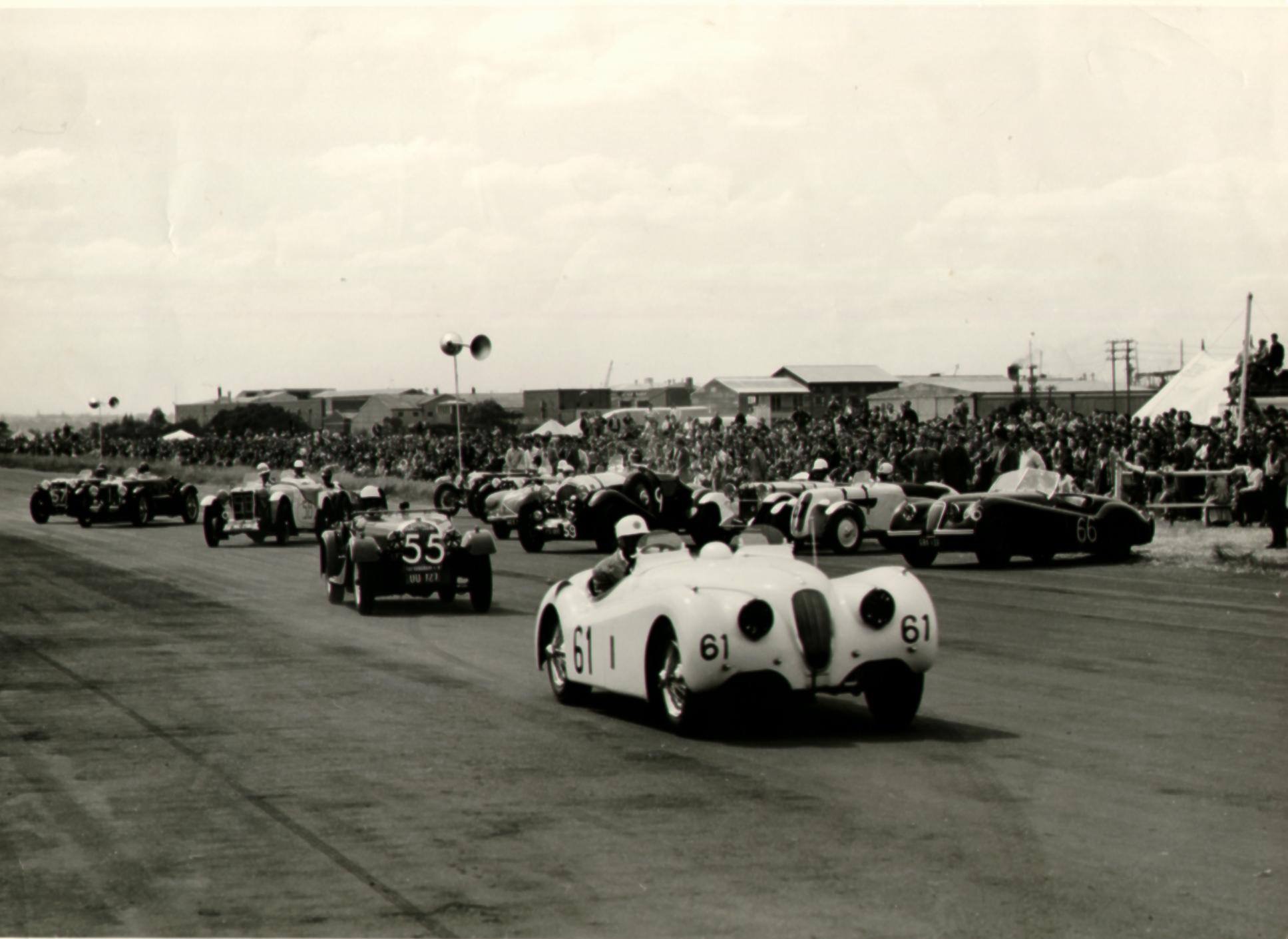
The drivers of the 20 March 1954, Fishermans Bend, Melbourne, Sports Car Race make for their cars…

Event Four on the program was of 12 laps, the journey started at 1.45 pm and was won by Melbourne transport businessman, Kevin Neal- the dude in the sports-jacket aboard the number 61 Jaguar XK120, his main competition according to Terry McGrath, was Harry Firth is his supercharged MG TC Spl.

From the front is the #66 GC Newton XK120, #61 car of Neal, the 3 litre Meadows engined Lea Francis of J Robinson, then the big 3 litre Bentley owned by Haig Hurst- you can just see car #55, the RH Reynolds Morgan Plus 4.

Other notables entered include Graeme Hoinville, MG TC (which he still owns), John  Sawyer, of later Bob Jane Racing fame in a K3 MG, Earl Davey-Milne in a Fraser Nash (which he still owns), Frank Porter, a later prominent touring car racer well into the late seventies, and P McKenna in the 1948 AGP winning BMW 328- you can see that light coloured car second in line behind the dark Jag, both still not off the start-line.

(T McGrath)

Its Neal away with a blinder of a start in his supercharged Jag from the Reynolds Morgan whereas the bulk of the field seems afflicted with problems caused by the ‘Prince of Darkness’- Lucas Electrics, or is that a tad unfair?

The light coloured car behind the Morgan is the RG Davis MG TC and the dark coloured one at the very back of the cars on-circuit is the Hoinville TC.

Click here for an article on Fishermans Bend; https://primotipo.com/2016/04/15/fishermans-bend-melbourne/

Neal progressed into some pretty serious motor cars including a Cooper T23 Bristol and the ex-Reg Hunt Maserati A6GCM with which he contested the 1956 AGP held not too far away in Albert Park. Click here; https://primotipo.com/2017/12/12/hunts-gp-maser-a6gcm-2038/

Credits…

Bob Williamson and Terry McGrath Collections, Stephen Dalton for the car identifications

Finito…


(J Lineham)

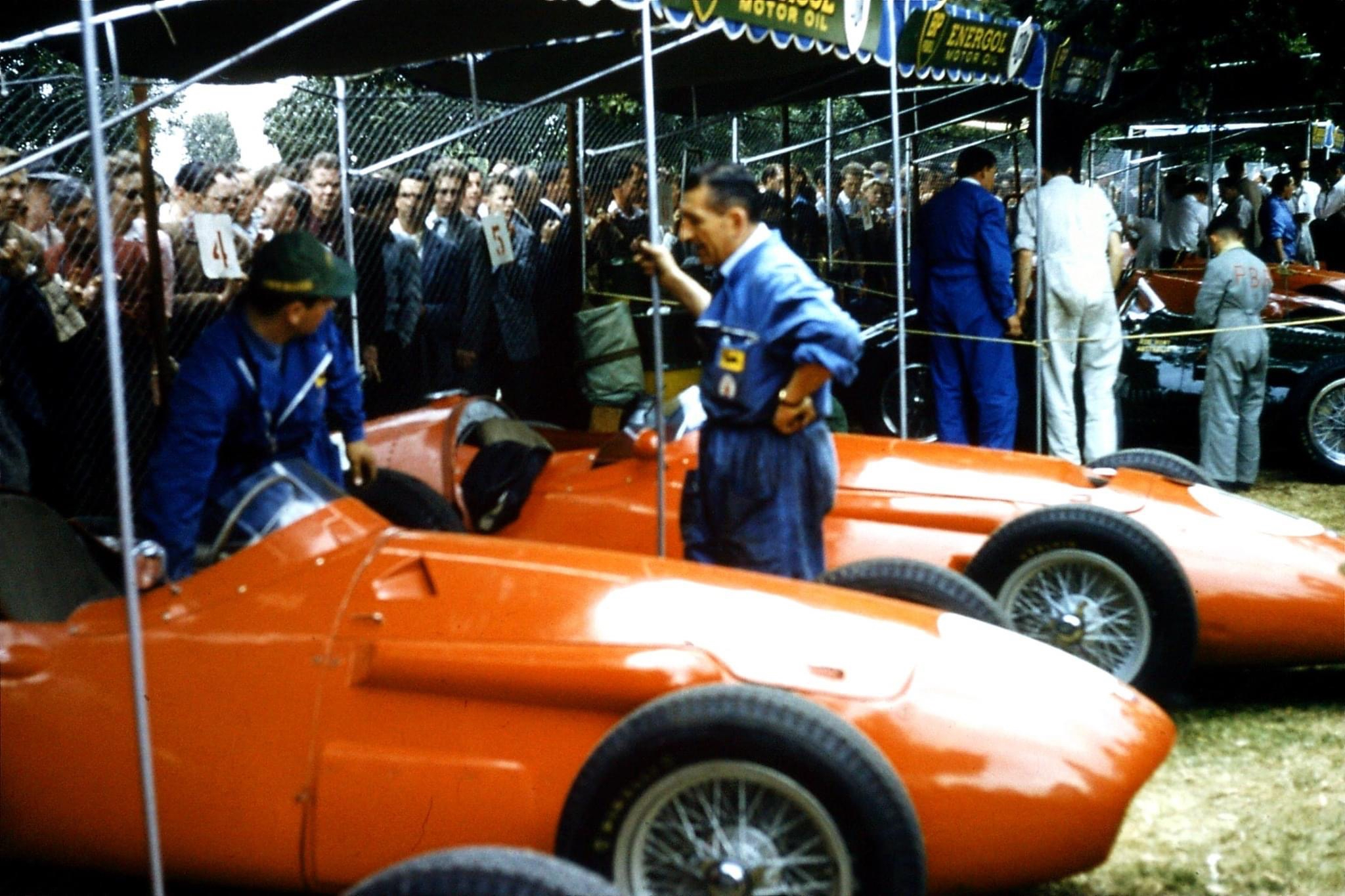
Reg Hunt #5 and Guerino Bertocchi #7 in Maserati 250Fs prior to Saturday practice, Albert Park, Australian Grand Prix, 1 December 1956…

Hunt looks pretty happy with himself whilst Maserati’s legendary tester/mechanic Bertocchi wonders if everything is AOK with the Moss #2501. To the left of Hunt’s car is Tom Sulman’s Aston Martin DB3S.

James Lineham had a fantastic day at the ‘Park, the sun shone making it ideal for spectators, especially those with cameras. He used his expensive colour film wisely in the paddock, his camera wasn’t sophisticated, so best to take snaps of stationary or slow moving cars. Then he shot off some monochrome action work whilst he walked Albert Park’s huge expanse.

Bib Stillwell’s Jag XKD perhaps, on Lakeside Drive looking to the south of Albert Park Lake (J Lineham)
Paul England’s superb Ausca Holden-Repco, built after-hours by England at Repco Research (I Curwen-Walker)

James life spanned 1925 to 1997, he was a young enthusiast aged 31 when he attended this meeting. After his death his wife carefully went through all of his precious belongings, found these photographs and donated them to the State Library of Victoria for enthusiasts like you and I to see, in 2014.

Many thanks James and Catherine Lineham. Blurry though some of them are, they ooze atmosphere of a weekend spoken about in reverential terms by those fortunate enough to have attended. One of the journalists of the day, wrote of the weekend as ‘when Australian motor racing came of age’.

Moss or Behra Maser 300S on the pit or main straight, Aughtie Drive. Race direction these days the other direction, or clockwise (J Lineham)
Tom Sulman’s Aston Martin DB3S with Tom in the blazer at right (I Curwen-Walker)
Circuit map from the meeting program (G Dobie)

I’m obsessed with a few circuits in Australia in particular; Warwick Farm, Mount Panorama, Longford, Lobethal and Albert Park – Longford and the ‘Park especially. I live in Windsor 750 metres from Albert Park’s Austin Healey Corner/Turn 13, the Union Street/Queens Road second gear right-hander.

I run around it every other day, I think about the fellows who conquered it’s oh-so-quick unguarded challenges in the 1950s and do so in much more safety today. I feel its wonderful rhythm, vibe and sense of history all the time. These snaps gimme that vibe, Albert Park is a wonderful place to be even at 5.15am with only the park’s Daffy Ducks as company!

When originally posted, the article comprised James’ shots only, but the piece has grown over the years as other photographs have appeared online and I have plucked them from certain obscurity on FB.

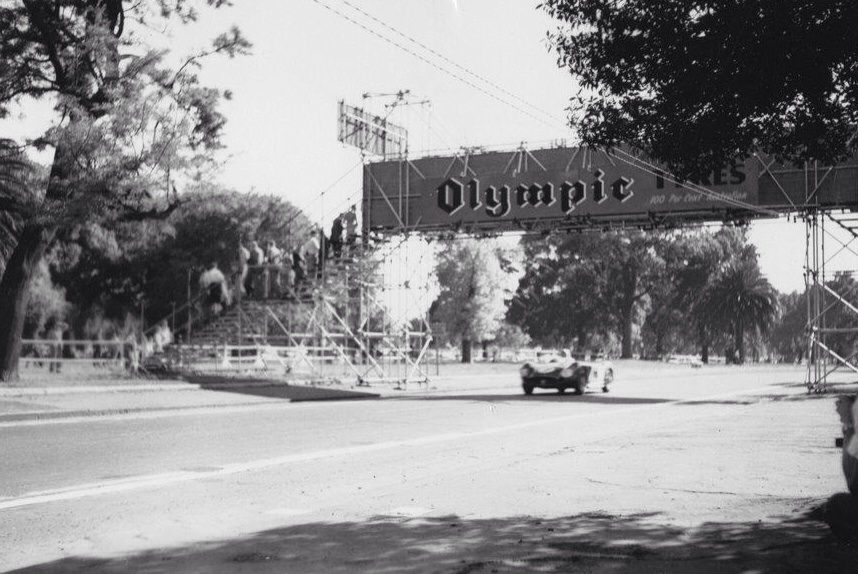
Vrrooom in a six-cylinder 3-litre, DOHC kinda-way. Moss Maser 300S. Aughtie Drive from the Olympic Tyres Bridge (J Lineham)
Reg Parnell’s Ferrari 555 Super Squalo with Peter Whitehead’s similar car at left (I Curwen-Walker)
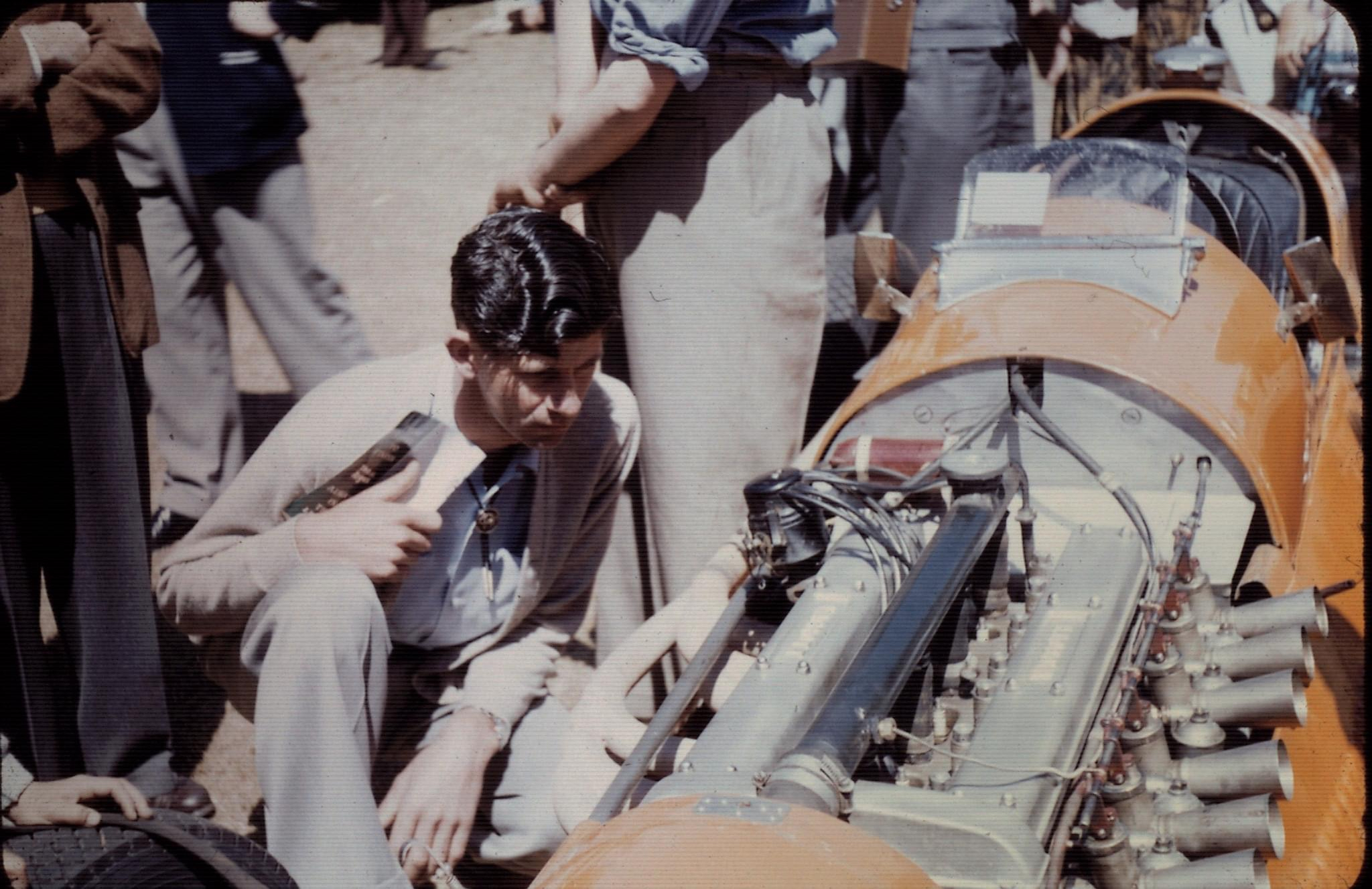
3.4-litre, DOHC, two-valve engine of Parnell’s car (I Curwen-Walker)

Attached are links to articles already written about this motor racing fortnight during the 1956 Melbourne Olympic Games which ‘put Melbourne, if not Australia on the map’.

In fact James had a big choice to make that day. He could have taken a vantage point on the men’s marathon course from Clayton to the Melbourne Cricket Ground. Algerian born Frenchman Alain Mimoun won it in 2:25.00 from Franjo Mihalic of Yugoslavia a minute and a half behind.

The Australian Tourist Trophy; https://primotipo.com/2016/01/29/1956-australian-tourist-trophy-albert-park/ and Australian Grand Prix; https://primotipo.com/2016/12/27/moss-at-albert-park/

Jean Behra, Maserati 250F (J Lineham)

The short story of the race is that Stirling Moss won the 80 lap, 250 mile event on 2 December 1956…

He did so by a lap from teammate Jean Behra, Peter Whitehead’s Ferrari 555 Super Squalo, Reg Hunt’s Maserati 250F and Stan Jones’ similar machine. It was a dominant display from the plucky Brit who was always, and still is immensely popular when he visits Australia.

International representation included the two works Officine Maserati drivers Moss and Behra (#1 above) who brought no less than five Masers with them. They shipped three 250Fs, two of the latest specification and an earlier chassis, and two 300S sportscars both of which remained in Australia post event. The cars were based at Reg Hunt’s Holden Dealership just up St Kilda Road on the Nepean Highway in Elsternwick a few kilometres from the circuit, the 300S’ being famously driven between workshop and racetrack.

Stirling Moss enroute to victory in his Maserati 250F (Melbourne Argus)
Prince Bira and Jean Behra in the Albert Park paddock (S Landrigan)

Jean didn’t have a great year, being comprehensively bested by one of the most gifted drivers in the world, but third places at Buenos Aires, Monaco, Reims, Silverstone and at the Nurburgring is hardly shabby. Over the two weekend Australian carnival it was Moss winning both the AGP and the Australian Tourist Trophy held the weekend before.

Moss raced #7 250F chassis number 2501 and Behra #1 2522. The spare car – 2507 – was driven by both Moss and Hunt during practice. At one point it was thought Jack Brabham may race it, not having an AGP ride that year, but it was not to be. A pity, by that stage Jack had two seasons of racing in Europe behind him so would have given all but Moss and Behra a good-go.

Two of the three Officine Maserati works 250Fs, chassis numbers as per text. #1 is Behra’s machine (I Curwen-Walker)

Scuderia Ambrosiana entered two Ferrari 555 Super Squalos powered by 3.4-litre 860 Monza four cylinder engines.

The AGP at this time was run to Formula Libre rules, the cars above were driven by #2 Reg Parnell, chassis number FL9002 and #3 Peter Whitehead, chassis FL9001. Whitehead was a regular visitor to Australia dealing with the family wool business and had won the Australian Grand Prix way back in 1938 aboard his ERA chassis R10B, when he was 24, in 1956 he was 42 years of age.

Whitehead started the carnival well winning the Bryson Industries Cup support event to the Australian Tourist Trophy the week before, ahead of Hunt and Kevin Neal, Maserati A6GCM.

Whitehead and Parnell were unlikely to be on the pace of the works Masers but would be good bets as best of the rest, as indeed they were, Peter was third and Reg sixth. The Parnell car remained in Australia, click here to read about it;

Car #9 in the background of the photo above is Lex Davison’s Ferrari 500/625, Alberto Ascari’s 1952/3 dual World F1 Championship winning chassis #0005, iconic in Australia and winner of the 1957 and 1958 AGP’s at Caversham and Bathurst respectively. The 3-litre car, which then carried chassis number #0480 was seventh, five laps behind Moss with various problems.

Behra and Moss at the driver’s briefing (S Landrigan)
(J Lineham)

Ken Wharton was a well credentialled Brit in both single-seaters and sportscars, but his ‘Ecurie Du Puy’ (John Du Puy was an American resident in Switzerland) silver Maserati 250F was said to be, and looked, tired.

Chassis #2521 had been Behra’s works machine – a new car that season – and raced in eight events earlier in the year before being sold to Du Puy. But it looked in-need-of-a-birthday before leaving Europe, it was the latest bit of kit, properly prepared the car was a top-three contender.

Ken retired the car on lap 19 and then journeyed on to race the Maserati and his Ferrari Monza in New Zealand that summer, unfortunately dying in a tragic accident aboard the Monza on 12 January 1957 at Ardmore during the NZ GP weekend.

The best prepared and equipped of the locals were the well-heeled Victorian motor dealers, Reg Hunt and Stan Jones in Maserati 250Fs of similar specification and cobbler Lex Davison, who owned a shoe manufacturing and distribution business.

Lex’ Ferrari was older than the 250Fs but was quick with its 3-litre four cylinder, DOHC engine and was beautifully prepared by Alan Ashton at AF Hollins motor engineers just up the road from the ‘Park in Armadale. In fact all three of these cars lived close to the circuit. Hunt was fourth, and best of the locals, Jones fifth and Davison seventh.

(J Lineham)

Doug Whiteford was another local – very – his dealership/workshop was in Carlisle Street St Kilda, a drop-kick from Albert Park.

Whiteford’s first Talbot-Lago T26C, chassis #110007 was an astute purchase, the robust, simple design was well suited to Australian events. It was beautifully prepared and driven by ‘Dicer Doug’ who won two of his three AGPs in it, at Bathurst in 1952 and at Albert Park in 1953. Click here for a piece on Doug’s TLs;

The purchase of the second T26C (photo above) wasn’t quite so smart though. An earlier chassis #110002 but later spec mechanically than #110007 sounded ok but the game in Oz had moved on. He needed something more modern and competitive.

Whiteford was a consistent third in the ’55 AGP at Port Wakefield behind Brabham and Hunt but by ’56 the old Talbot Lago was simply not on the pace. Still, his bankroll was more modest at the top level than most. A shame, as Doug, 42 then and as vastly experienced and tough as they come didn’t give a yard to any of the locals. Whiteford in a 250F or something of that performance envelope would have been worth travelling a few miles to see. It’s a shame he bought a 300S off Maserati after this meeting rather than a 250F.

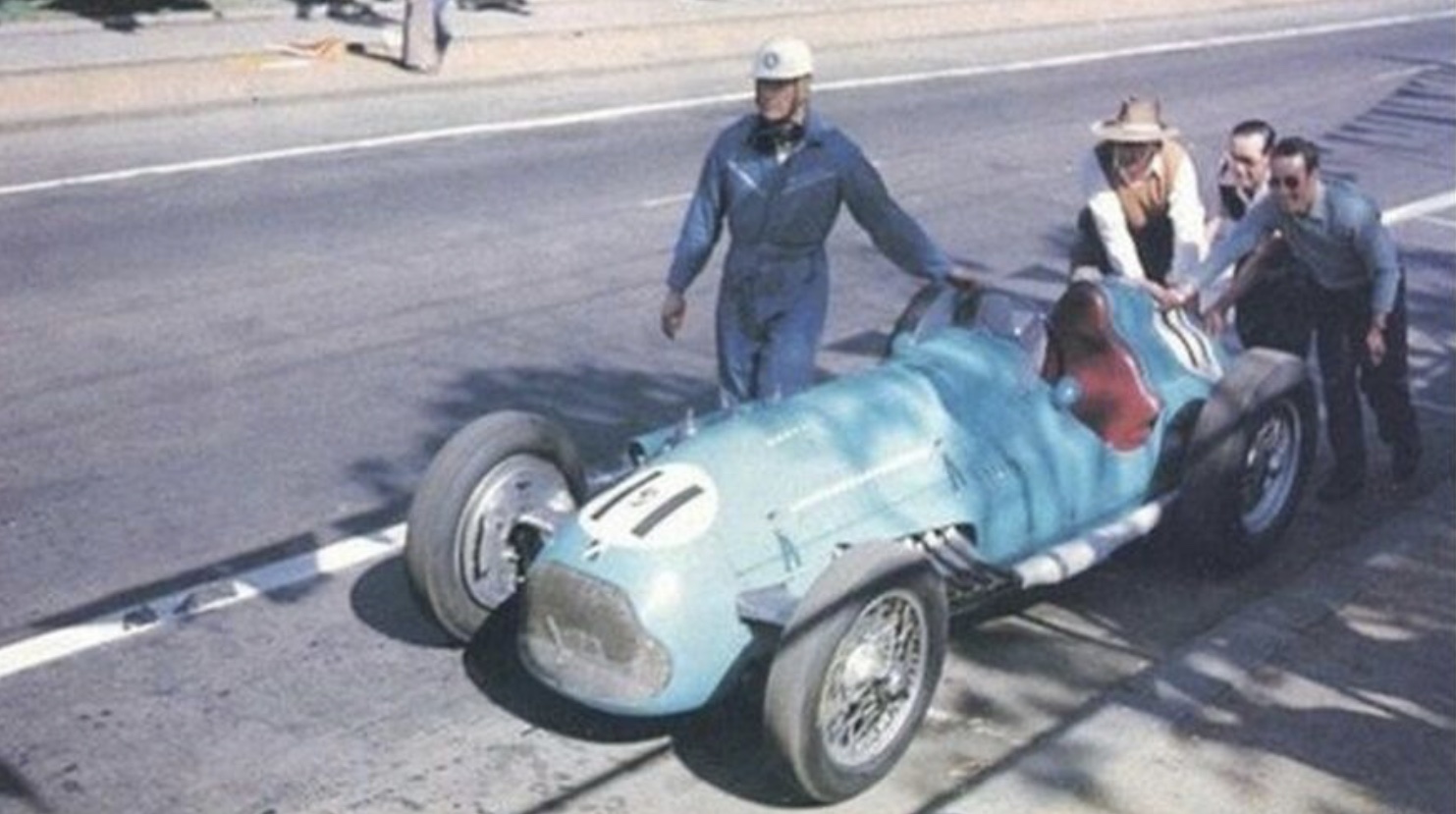
The Whiteford Talbot Lago T26C in the paddock, and below being pushed by Doug and the crew towards the start (I Curwen-Walker)
(unattributed)
Kevin Neal, Maserati A6GCM 2.5-litre (J Lineham)

Reg Hunt made everybody take notice in his ‘Flying Bedstead’ Hunt JAP Spl in hillclimbs and on the circuits in the late 1940s/early 1950s and then refined his craft with a season racing a 500 F3 Cooper machine in the UK in 1954.

On his way back to Oz he acquired a superb Maserati 250F engined Maserati A6GCM chassis #2038 (above with Kevin Neal at the wheel) with which he belted the locals in 1955. Only mechanical failure kept him from the ’55 AGP won by Brabham’s Cooper T40 Bristol. Hunt ordered a 250F for ’56, he was allocated a rebuilt 1955 works machine chassis 2516 with Melbourne haulier Kevin Neal – who had also raced an ex-Hunt Cooper T53 Bristol – the purchaser of the A6GCM.

Neal had a shocker of an AGP, bending the car severely and injuring himself late in the race when he lost the car in the greasy conditions. I wrote a long feature about the A6GCM;

Stan Coffey’s Ferrari 750 Monza sportscar below. He raced the car in the Australian TT, DNF in the classic won by Moss from Behra and Ken Wharton’s Ferrari Monza.

It’s a rare, clear shot of the man, now whatever became of him? There is an obscure article topic, he raced a few interesting cars too, Cooper Bristol etc…

(J Lineham)

Entry List…

(B Moyle)

Etcetera…

(J Hunting)

The photograph above is in the AF Hollins Pty.Ltd workshop in 604 Hight Street, Armadale (the building still exists as a tyre fitter/retailer). Julian ‘Gib’ Barrett’s #19 Alta GP-2 1.5 s/c alongside Lex Davison’s Ferrari 500/625. Behind are the two Ferrari 555s, Reg Parnell’s partially obscured on the left and #3 Peter Whitehead on the right. The other car we can just see at far left is the Wharton silver Maserati 250F.

(Gray Family)

Reg Parnell’s Ferrari Super Squalo, Lex Davison’s Ferrari 500/625, looking smaller in comparison, and the dark coloured Kevin Neal Maserati A6GCM which did not look quite so pristine at the end of the weekend.

(I Curwen-Walker)

Quite what is going on here I’m not sure, it’s most certainly not the start of the touring car race!

(I Curwen-Walker)

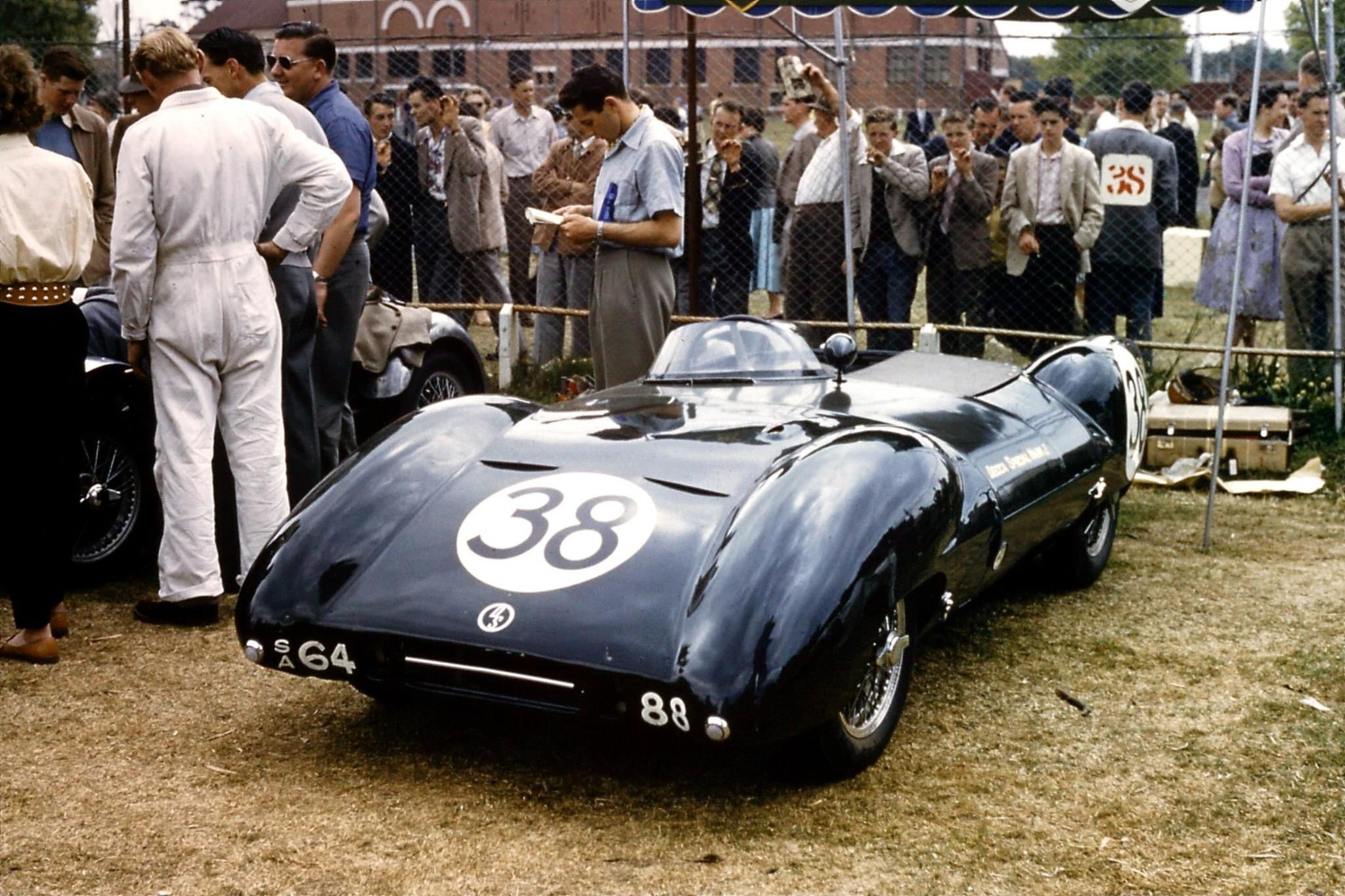
Derek Jolly’s very successful Lotus 11-esque Decca Mk2 Climax. 13th outright and first in class in the Australian Tourist Trophy won by the Moss Maserati 300S. See here for more on Derek and his cars; https://primotipo.com/2017/11/09/dereks-deccas-and-lotus-15s/

(R Jackson)

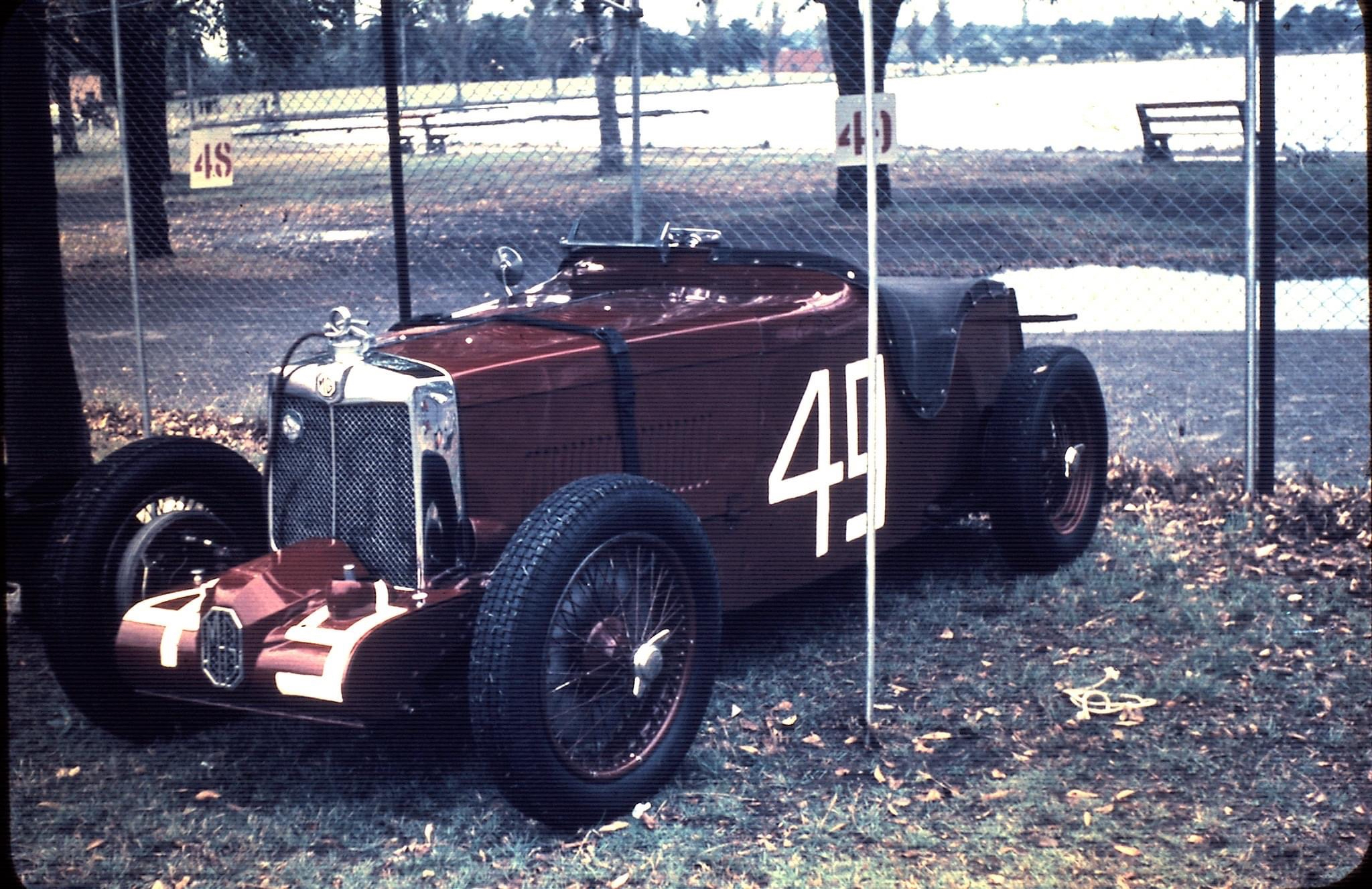
Otto Stone’s MG K3 looking very lonely in the seemingly deserted Albert Park paddock.

Stone was a legendary driver/engineer who fettled all manner of exotic machinery not least Stan Jones’ Maserati 250F during Stan’s glory years including his 1958 Gold Star and 1959 AGP Longford campaigns.

Stone placed second in the curtain raiser, opening event on the first weekend of the carnival, the 16 lap Argus Cup handicap for racing cars. Neil Charge won aboard the Charge brothers MG Special with the C Martyr Sunbeam third.

(R Jackson)

Our engineering oriented friend is taking a good, hard look at Jack Myers’ Cooper T20 Waggott-Holden aka WM Holden. The 2.4-litre Waggott twin-cam head, six-Amal fed Holden Grey six-cylinder engined Cooper placed 12th and last in the AGP. The story of the car and its amazing driver/engineer is here; https://primotipo.com/2015/02/10/stirling-moss-cumberland-park-speedway-sydney-cooper-t20-wm-holden-1956/

(O Plada)

Bibliography…

 8W.forix.com on Maserati 250F chassis numbers, oldracingcars.com

Photo Credits…

James Lineham, State Library of Victoria, Simon Landrigan, Brian Moyle Collection, Gordon Dobie Collection, Oscar Plada, John Hunting, Gray Family Collection, Ian Curwen-Walker, Melbourne Argus, Ron Jackson

Tailpiece…

(I Curwen-Walker)

The Maserati corner of the Albert Park paddock, how good would that have been! The factory spare and Behra’s race-car in shot with Kevin Neal’s 2.5-lite A6GCM behind being looked after by the short-arse mechanic.

Finito…


Reg Hunt, second from right, and his band of merry men fettle his Maserati A6GCM at his 182 Brighton Road, Elsternwick, Melbourne car dealership prior to the late March, Moomba races in 1955…

The car is being readied for the Labour Day long weekend, Moomba Races at Albert Park in which Reg did rather well. He won the Saturday 50 mile ‘Argus Cup’ from Doug Whiteford’s Talbot-Lago T26C and Ted Gray’s Tornado Ford V8. On the Sunday he was victorious in the first heat of the ‘Argus Trophy’ and was well ahead in the 100 mile final when the Maser’s crown wheel and pinion failed, giving the win to Whiteford.

Otto Stone, racer/engineer looked after this car, it appears a few ‘technicians’ have been grabbed from Reg’s dealership workshop for this photo taken by the crew of ‘The Argus’ newspaper. The publication was a major sponsor of the race meeting as reflected in the silverware won by Reg, no doubt they published an article encouraging the crowds to come and see the ‘KLG Maserati, the fastest car in Australia’.

I’ve written several articles about this very fast and supremely talented English born Australian racer/businessman who retired way too early. See here; https://primotipo.com/2014/07/19/reg-hunt-australian-ace-of-the-1950s/;

and here, the ’56 Argus Trophy; https://primotipo.com/2014/10/01/1956-argus-trophy-albert-park-reg-hunt-and-lex-davison-maserati-250f-and-a6gcm-ferrari-tipo-500/

there’s more- the 1955 AGP @ Port Wakefield; https://primotipo.com/2017/07/28/battle-of-the-melbourne-motor-dealers/

After a successful season racing a Cooper 500 in the UK in 1954 Reg travelled to Modena and acquired this ex-factory chassis ‘2038’ to race back in Australia.

Toulo de Graffenried aboard his 2 litre Maser A6GCM ‘2038’ in the Goodwood paddock during the Lavant Cup meeting- an event he won on 6 April 1953 from the Roy Salvadori and Tony Rolt Connaught A Types. I wonder who the driver behind the car is? (Getty)

‘2038’ was originally built as a 2 litre F2 car in 1953- raced by Emmanuel de Graffenreid.

Many of you would know the class of the 2 litre 1952-1953 F2/Grand Prix formula- F2, which at short notice became the category to which championship Grand Prix events were run given the paucity of cars at the start of 1952 with Alfa Romeo’s withdrawal from GP racing and BRM’s non-appearance- were the simple, fast, four cylinder Ferrari 500’s. Especially chassis ‘0005’, the car raced by Alberto Ascari to a record number of wins and two World Championships in those two years, that chassis was sold to Tony Gaze and later Lex Davison, it was an iconic racer in Australia in the fifties.

The great engineer Giacchino Colombo joined Maserati from Alfa Romeo for a consultancy which ended about June 1953, he first applied his magic touch to the 1953 A6GCM, squeezing closer the performance gap between the Maserati and Ferrari 500.

He changed the engine from square to oversquare, a bore/stroke of 76.22 x 72mm, squeezing a few more revs and raised the power of the 2 litre, DOHC, 2 valve, 40 DCO3 Weber carbed, Marelli sparked six cylinder engine to circa 190 bhp @ 9000 rpm.

Other tweaks were to the suspension- the inclusion of an ‘A-bracket’ to better locate the rear axle, and to the brakes. Otherwise the Maserati 4CLT derived twin-tube chassis with hoop shaped bracing at the front and cockpit area, quarter elliptic sprung rigid rear axle with ZF slippery diff, twin front wishbone suspension and excellent Valerio Colotti designed 4 speed gearbox, which mated directly to the engine, were unchanged.

By the end of 1953, it seems fair to say, that the high-revving Maser was better suited to the high speed circuits than the Ferrari 500, and whilst  the Maser may have had an edge in top speed the de Dion rear end of the Ferrari put its power down more effectively than the ‘cart sprung’ A6GCM. Maserati would remedy this shortcoming with the design of the 250F of course.

The talented Swiss Baron’s car was mainly entered by Enrico Plate’s team. His best results in 1953 were first placings in the Lavant and Chichester Cups at Goodwood, a heat of the International Trophy at Silverstone and the Eifelrennen at the Nurburgring in May- he was also victorious at the Freiburg Hillclimb in Switzerland.

At championship level his best result was fourth in the Belgian GP when the car was a works rather than a Maserati-Enrico Plate entry. The car was also entered by the works at Zandvoort, the Dutch Grand Prix, two weeks earlier using a new chassis- the car first raced at the Siracuse GP on 22 March 1953, it raced on nine occasions with the original frame.

A chassis of the same number is said to have been raced and crashed by Fangio at Monza on 8 June 1952, breaking has neck. The great man crashed 2 laps into his heat as a result of being fatigued after travelling from the Ulster Trophy race, where he drove a BRM. He flew from Belfast to Paris but could not take his connecting flight to Milan due to fog. He drove a Renault 750 borrowed from Louis Rosier all night  to contest the non-championship GP of Monza Auto Club. The great man arrived exhausted, started the race from the back of the grid and crashed on the events second lap having run wide at Lesmo, and was then thrown out of the car.

Mind you, other sources have the chassis used that day as ‘2034’…

Harry Schell contesting the non-championship Berlin GP at The Avus in 1954 aboard his Maser A6GCM ‘2038’. 8th in the race won by Karl Kling’s Mercedes W196 (Getty

Rebuilt with a Maserati 250F engine, the car was raced during the new 2.5 litre F1 in 1954 by Harry Schell as a private entry with the exception of the Pau GP, when it was works entered.

Schell’s best results in fifteen races was a first in a heat of the Circuit de Cadours, France, second in the GP di Roma at Castel Fusano and thirds at Aintree’s Daily Telegraph Trophy and the Circuito di Pescara on the wild Pescara road course beside the Adriatic.

Harry’s last drive of the car was at Aintree on 2 October, ‘2038’ was sold to Hunt shortly thereafter and was soon aboard the ‘Oceania’ heading south for Port Melbourne. Reg was reported as pacing Station Pier anxiously like an expectant father as he waited an hour for the notoriously ‘Bolshie’ Melbourne waterside workers to carefully unload his precious car on Friday 31 December 1954.

Click here for an article on the Maserati 250F, which includes the evolution of these magnificent single-seaters from A6GCM to 250F; https://primotipo.com/2014/08/21/stirling-moss-monaco-gp-1956-maserati-250f/

In the best tradition of this series of cars, the A6GCM and 250F, there are quite a few variations on the chassis theme, that is, which one is which.

I reference the 8W: Forix records as the most authorative source drawing together research of recent decades, particularly the exhaustive, scholarly, work of David McKinney and Barrie Hobkirk. The sharing and debating of evidence on the internet is a luxury not available to earlier 250F authors. Click below for all of the detail you could wish for, chassis by chassis and author by author including the way the views of the same author changed over time as more exhaustive research was undertaken allowing them to re-appraise conclusions they had earlier reached.

Chassis ‘2038’ was never allocated a 250F number when fitted with the 2.5 litre engine- although chassis ‘2503’ is the number occasionally cited. Nye concludes in relation to ‘2503’ ‘Serial never applied to a true 250F’, McKinney ‘Never built as a 250F’, Pritchard ‘Number not used’.

Given the foregoing, to be clear, ‘2038’ was built in 1953 or 1952 as a 2 litre A6GCM. Fitted with a 2.5 litre 250F engine, but otherwise the same in specification, ‘2038’ is one of the ‘interim A6GCM/250F’ chassis.

http://8w.forix.com/250f-redux.html

Reg Hunt in the Maser A6GCM during the Albert Park, Moomba meeting in late March 1955 (unattributed)

The car arrived in Melbourne in late 1954, Reg soon shook it down at Fishermans Bend before popping it back on a boat to contest the 1955 NZ GP at Ardmore.

He was immediately on the pace qualifying fourth, was second in a heat and ran second to Prince Bira’s 250F until fading brakes slowed him, finally finishing fifth.

Back in Australia the car was the quickest device around winning the Victorian Trophy at Fishermans Bend, the Bathurst 100 scratch race and was hot favourite for the Australian Grand Prix at Port Wakefield in October but was slowed by a cam follower problem- he was second to Brabham’s Cooper T40 Bristol having led initially.

In November the car won two events at Fishermans Bend- the ‘Racers Trophy’ and ‘Lucas Trophy’ both from Lex Davison’s HWM Jaguar. Lex was soon to acquire the Tony Gaze Ferrari 500/625 with which he is so readily associated.

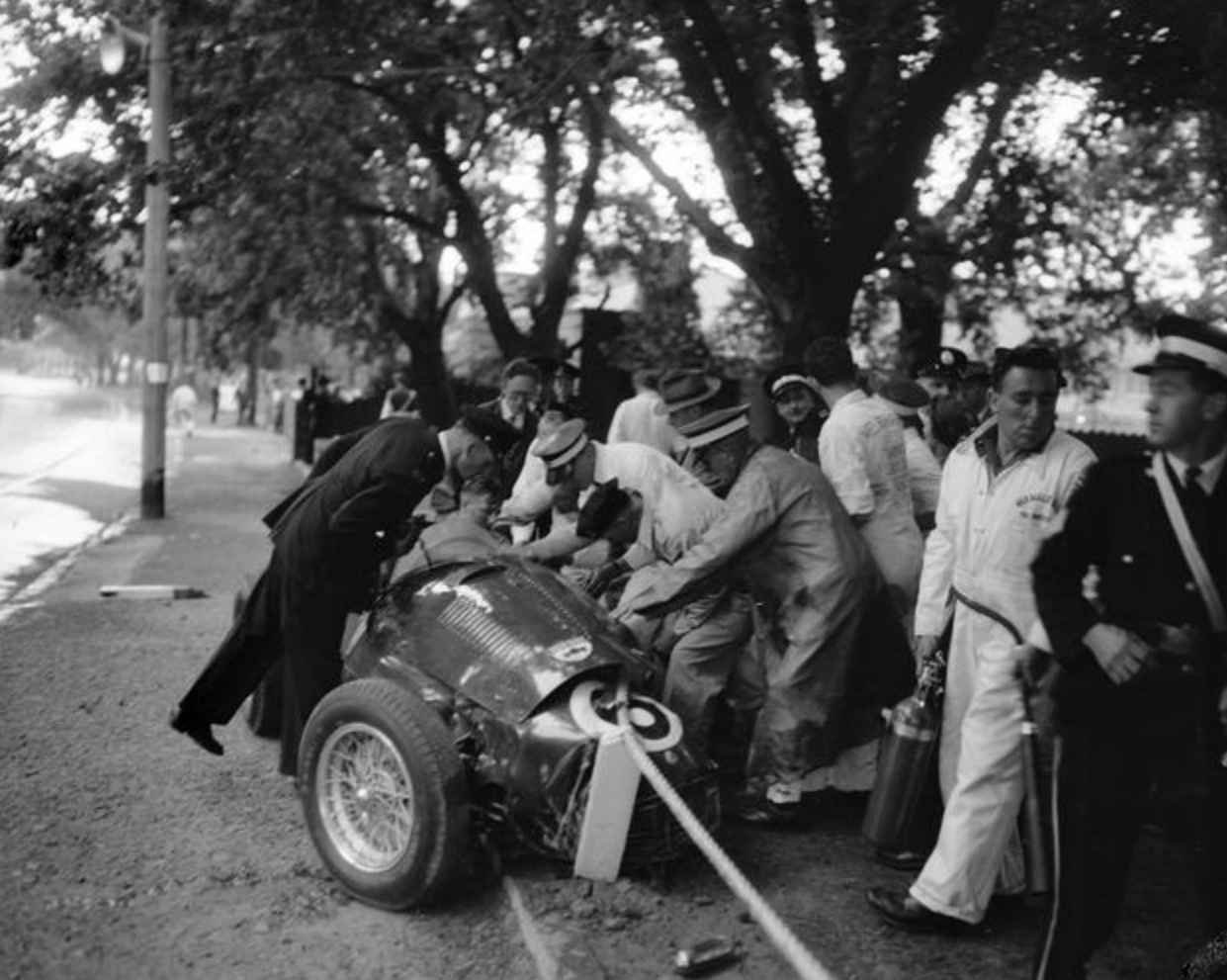
Official extricate Neal from the badly damaged Maser towards the end of the 1956 AGP at Albert Park (unattributed)

The Maserati was sold to Melbourne haulier Kevin Neal after Reg’s 250F ‘2516’ arrived in early 1956- the car was badly damaged in the ’56 AGP at Albert Park when Neal lost control during a shower of rain late in the race.

Looking as elegant as ever, beautifully repaired, the car reappeared again at a minor sprint meeting at Eildon in country Victoria in 1960, the car was sold to Melbourne’s Colin Hyams in 1962, he used it occasionally, as below at Fishermans Bend.

(C Hyams)

The car then went to the UK in 1965, passing through the hands of Colin Crabbe and Dan Marguiles to Ray Fielding in Scotland in 1972. After many years owned by him and his estate ‘2038’ now resides in a Swiss collection.

(AMS)

Reg Hunt aboard ‘2038’ at Easter Bathurst 1955.

He won the A Grade scratch race and the scratch class of the Bathurst 100 setting the fastest time, an average of 77.8 mph. Reg was expected to take the lap record but was hampered by lack of his tall diff ratio, this component was damaged at Albert Park the month before, here Hunt is exiting Hell Corner to start his run up the mountain.

Reg Hunt in 2017…

(D Zeunert)

This photo and those of the Maser which follow were taken by David Zeunert, President of the Maser Club of Victoria- many thanks to David for sending them in to round out the article, it was taken early in 2017 at Reg and Julia Hunts home on Melbourne’s St Kilda Road- they have a floor in an old historic building.

Reg is a spritely, fit 94 and David says is still working in real estate apartment development with his grandson. The trophy is ‘The KLG Trophy’ with two Masers in is base

Etcetera…

(E Gobell)

The very rare photographs of the car in colour were taken during the 1955 Australian Grand Prix meeting at Port Wakefield- technical specifications as per text.

(E Gobell)


Reg only raced the A6GCM for not quite a year, here is the ad for its sale in Australian Motor Sports February 1956 , I rather like the ‘no idle curiosity’ bit! (D Zeunert)

The photos below via David Zeunert are of the car at home in Switzerland.


Bibliography…

‘Historic Racing Cars in Australia’ John Blanden, 8W Forix.com, ‘Maserati: A Racing History’ Anthony Pritchard, Australian Motor Sports

Photo Credits…

Fairfax, GP Library, Australian Motor Sports, Michael Hickey/Museum of Victoria, David Zeunert Collection

Tailpiece: Brake Engineer, Bart Harven, Reg Hunt, beautifully cast Maser brake drum and sublime A6GCM- circa 240 bhp from its 2 valve, Weber DCO carbed, DOHC 2.5 litre, 6 cylinder engine…

Etcetera: ‘2038’ The Movie or TV Star…

(MOV)

A mystery to solve folks! Since posting the article, reader Michael Hickey posted these amazing photos of ‘2038’ in an Australian movie, or perhaps more likely, TV show on the primotipo Facebook page.

He found the shots on the Museum of Victoria website but they are devoid of details. Tony Matthews thought the ‘driver’ of the car may be Bob Hope- it certainly looks like him. I’m not sure that he did any movies in Australia though. The ‘driver’ could be Charles ‘Bud’ Tingwell, a distinguished but now deceased Australian actor. He was in dozens of movies throughout a long career, the most iconic perhaps ‘The Castle’. I don’t recognise the babe, mechanic or baddie.

The crook only has a little gun- ‘yerd reckon they would give him a big one. Lovely A6GCM front suspension detail shot tho! Finned brake drum, forged upright and upper and lower wishbones all clear, as is roll bar. Shocks are Houdaille (MOV)

I can’t make the films Tingwell appeared in work with the photos mind you. Which means it isn’t Bud or perhaps the scenes are from a TV show. You can just make out Reg’s name on the car in the first shot, the limited caption information dates it as October 1955. TV didn’t commence in Australia until the second half of 1956. All ideas or the definitive answer appreciated!

Finito…
 

image

Reg Hunt, Kevin Neal and Lex Davison launch their ‘Italian Stallions’ off the line at the start of  Albert Parks’ 150 mile ‘Argus Trophy’…

Hunts’ #2 Maserati 250F won the race from Davisons’ #4 Tipo 500 Ferrari with Neal #3 third in Hunts’ old Maser A6GCM. Thats Tom Hawkes in the ex-Brabham ‘Redex Special’ #7 Cooper Holden Repco making its debut with that engine at this meeting. Arthur Griffiths in the ex-Davison 1954 AGP winning #5 HWM Jaguar is on row two. Further back is Bill Wilcox in the ex-Jeff Scorer, ex-works/Gaze #9 Alta and Bill Craigs’ ex-Whitehead, Holden engined and rebodied # 11 Alta.

There were two racing carnivals at Albert Park in 1956. This ‘Moomba’ Meeting (Moomba is still a marvellous annual Melbourne late Summer festival) in March and the Australian Grand Prix meetings after the Melbourne Olympic Games in the last weekend of November and the first in December. Similarly, the ‘Moomba’ meeting was held over two weekends, race days were Sunday 11 and 18 March 1956.

In  many ways the image symbolises an era of single seater racing just underway in Australia, the dominance of the current ‘Red Cars’ from Italy ending a period when the Australian Special, and older ex-works European cars held sway.

Racing at Albert Park…

Barry Green in his wonderful book ‘Glory Days’, writes that their was a strong push to race at Albert Park in 1934. The Light Car Club of Australia, (LCCA) the promoter of race meetings at Phillip Island were aware of the ‘Islands growing unsuitability with its loose gravel surface as speeds increased. Extensive negotiations secured Albert Park as the venue for a race meeting to celebrate the Centenary of Victoria in 1935.

The ‘Sun News Pictorial’ one of the Melbourne daily tabloids, and then as now a good thing in which to wrap ones fish n’ chips, announced the event on June 4 1934.

In doing so the ‘paper lit the fuse of naysayers who brought about the events cancellation, but not before racers Arthur Terdich, Bill Lowe, Barney Dentry, and Cyril Dickason in Bugatti, Lombard, and Austins respectively, lapped the track with mufflers fitted to prove noise wasn’t the issue…

Post war things were a little different and a partnership between the LCCA, the Army who had a facility at Albert Park, and Victorian Labor Senator Pat Kennelly were more successful.

The three provided the combination of race organisation and promotional ability, logistical capability, the Army being able to ‘man’ Albert Park, a site of some 570 acres, and political power and influence.

For all three groups the ability to raise funds in the aftermath of World War 2 was important. For the army funding for war widows and orphans, for Kennelly the ability to finance much needed improvements to the park to improve the local amenity for the working class community, and for the LCCA, the improvement of motor racing.

And so, the 1953 Australian Grand Prix held at Albert Park over 64 laps, 200 miles in total was won by Doug Whiteford in a Lago-Talbot, the last AGP win for French Racing Blue…

1953 was the commencement of Albert Parks ‘first phase’ as a race track lasting five short years until November 1958 when the naysayers again held sway…until 1996 when again the political pendulum swung in the sports and business’ favour, Victorian Liberal Premier Jeff Kennett ‘snatching’ the race from Adelaide…

image

Lex Davison #3 HWM Jag, Stan Jones #2 Maybach, and Doug Whiteford in the winning Lago-Talbot at the start of the 1953 Australian Grand Prix at Albert Park, the venues first race meeting on November 21. Cec Warren #6 Maserati 4CLT, Frank Kleinig #7 Kleinig Hudson 8, W Hayes #10 Ford V8 Spl, and a badly smoking  Ted Gray #11 Alta Ford V8 (AGP website)

The Big Red Italian Cars…

I wrote about Reg Hunt a while back, https://primotipo.com/2014/07/19/reg-hunt-australian-ace-of-the-1950s/ .He was an Englishman with a family background in the motor-trade, who came to Australia in 1949. By 1953 his ealerships were doing well enough to return to the UK for a season of F3, in a 500cc  Cooper Norton Mk8 in 1954. He did well against the best and arrived back in Oz, razor sharp and with a big, red, modern, ex-works Italian car…

His ex-Gonzalez Maserati A6GCM started life as 1953 2 litre chassis # 2041 but was renumbered # 2503 after a 250F engine was fitted for the new 2.5 litre F1 which commenced in 1954. Sold to Harry Schell for that season it arrived in Australia late in the year and was first tested by Hunt at Fishermans Bend before being raced at Ardmore for the 1955 NZGP where he popped it on the front row along with Prince Biras’ 250F. Bira lead the race from start to finish, Hunt fifth in a field which included the Whitehead and Gaze Ferrari 500/625’s.

Hunt was stiff not to win the 1955 Australian Grand Prix in the A6GCM at Port Wakefield, a broken cam-follower slowing him and handing victory to Jack Brabhams Cooper Bobtail.

Not to be outdone, and needing to remain competitive, Lex Davison, the 1954 AGP winner acquired his good friend Tony Gazes’ Ferrari 500/625, the car fitted with a 625 engine enlarged to 3 litres. These Lampredi designed, big-bore 4 cylinder DOHC engines a mainstay of Ferrari single-seaters and sports cars throughout the 50’s.

In recent years, having passed into the ownership of the ‘Wheatcroft Collection’ in the early 60’s, the car has been identified as Tipo 500#5, Alberto Ascaris’ 1952 and 1953 World Championship winning chassis, the ‘winningest’ chassis of all time with at least ten Grands’ Prix victories…but at the time Davo had just acquired a competitive car which would be very kind to him in years to come.

It was Lexs’ first meeting in the car, a change in gearing a mistake in set-up which blunted the cars performance, but the promise of the combination was undeniable.

Having made such an impression with the A6GCM Hunt had no trouble convincing Maserati to part with a more recent mount, securing Jean Behra’s 1955 factory 250F, chassis #2516, the car winning non-championship Grands’ Prix in Pau and Bordeaux in that year.

Hunt won both the feature racing car events of the Moomba meeting. Davison second in both and Neal third in one, DNF in another, in the car the Melbourne transport business man was to buy from Hunt.

Before long Stan Jones also acquired a 250F, a more recent spec car than Hunts’.

The mid-engined F1 Coopers were not far away, but for the moment, a wonderful era of modern ‘Big Front Engined Red Racing Cars’ had arrived in Australia…ending with the 1959 Australian Grand Prix, but we will come to that !

al park

Reg Hunt leads Lex Davison , Maserati 250F and Ferrari Tipo 500, Albert Park ‘Moomba Races’ March 1956. Check out the trees, kerbs, and very thick chain wire fence on these everyday suburban roads within the park! Crowd of over 70,000 in attendance (museumvictoria.com.au)

park map

Albert Park Road Circuit 1950’s. Length 3.13 miles, direction of travel the opposite to the modern circuit which is true to, if not identical to the spirit of this fabulous, historic venue. Barry Green ‘Glory Days’

british gp

Alberto Ascari #5 in the Gaze/Davison Ferrari Tipo 500/5, alongside Froilan Gonzalez #24 in the Hunt/Neal Maserati A6GCM/2041/2503 at the start of the 1953 British GP at Silverstone which Ascari won. #8 is Mike Hawthorn, behind him #7 Luigi Villoresi both in Ferrari Tipo 500’s. The wheel on the far right is Fangio in a Maser A6GCM. The blue car beside Hawthorn is Onofre Marimon also in a Maser A6GCM. The green car behind Villoresi is Tony Rolts Connaught Lea Francis , and beside him the green car with white noseband is Ken Whartons’ Cooper Bristol. (Mirror Archive)

Credits…

‘Glory Days’ by Barry Green; oldracephotos.com, museumvictoria.com.au, AGP Website, Mirror Archive

Finito…