Mike Imrie’s Ford Falcon V8 sports sedan gets the jump on Alfie Costanzo’s Porsche Cars Australia Lola T430 Chev into Shell corner, Sandown during a Formule Libre race in 1979.
Maybe not. How bout they shared an early Sunday discretionary practice session, it’s an interesting juxtaposition of car types all the same.
The trouble with building the world’s best Formula 5000 car, the Lola T330/T332/T332C, is how Eric Broadley and his band of merry men could better it!
Alan Jones, Lola T332 Chev ahead of Peter Gethin’s Chevron B37 Chev during the February 1977 Sandown Park Cup, two DNFs, with Max Stewart’s Lola T400 Chev the winner below. All of the first three shots Shell Corner (B Forsyth)(R Steffanoni)
The 1975 Lola T400 (above) oozed smart thinking, including variable or rising-rate suspension. Initially it was labelled a dog, but by mid-1975 an update kit and setup guidance had customers who persevered with the cars on the right track: Teddy Pilette’s VDS T400 won the 1975 European F5000 Championship from his teammate, Peter Gethin, while in Australia Max Stewart’s T400 won the 1975 Australian Grand Prix and many Gold Star and Rothmans International rounds from 1975-77.
The ultimate F5000 test was of course, the US Championship, where Eppie Wietzes was the best of the T400s in 1975 with fifth place in the standings. The Americans and Australasians loved their T332s, some like the Jim Hall-Chaparral T332Cs raced by Brian Redman were very highly refined and developed, and prodigiously fast.
Frank Gardner all cocked up in the Esses during the February 1971 Warwick Farm 100 Tasman round won by FG’s works Lola T192 Chev (L Hemer)Kevin Bartlett, Lola T300 Chev, Glyn Scott Memorial Trophy Gold Star round, Surfers Paradise 1972
Broadley then took a leaf out of his own F5000 playbook. The Frank Gardner developed Lola T192 Chev was still winning races in 1971 when Broadley, Gardner and designer John Barnard went smaller by building the 1972 model-year Lola T300 Chev.
Essentially, Gardner felt a car based on an F2/FB T240 aluminium monocoque chassis would provide a lower centre of gravity and improved aerodynamics. Fitted with big radiators mounted beside the drivers shoulders, a 500 bhp Chev and Hewland DG300 five speed transaxle where a Ford FVA and FT200 five speed transaxle once lived, the T242, and a little later the renamed T300 was a luscious looking racing car!
Once refined by Gardner in the late 1971 season races the T300 won a lot of races around the world and sold like hot cakes in ’72. The 1973-74 T330/T332 refined the package into one of the most successful series of customer racing cars ever built. Probably the most successful if you account for the central-seat 5-litre Can-Am T332CS and T333 variants as well.
For 1976 Lola planned to do ‘a T192 to T300 all over again’.
Teddy Pilette testing a Lola T450 F2 chassis fitted with a Chev V8, DG300 Hewland etc at Paul Ricard. Note that a front radiator is fitted at this stage. In the later shot of Teddy below, the radiators have been moved to the rear, parallel with the radius rods (Lola)Note the ‘brackets on brackets’ front suspension assemblies as per the text (Auto Hebdo)
Lola initially built and tested a car based on an F2 T450 tub, but ultimately, went with a monocoque based on the T360 Formula Atlantic, which was also a narrow design.
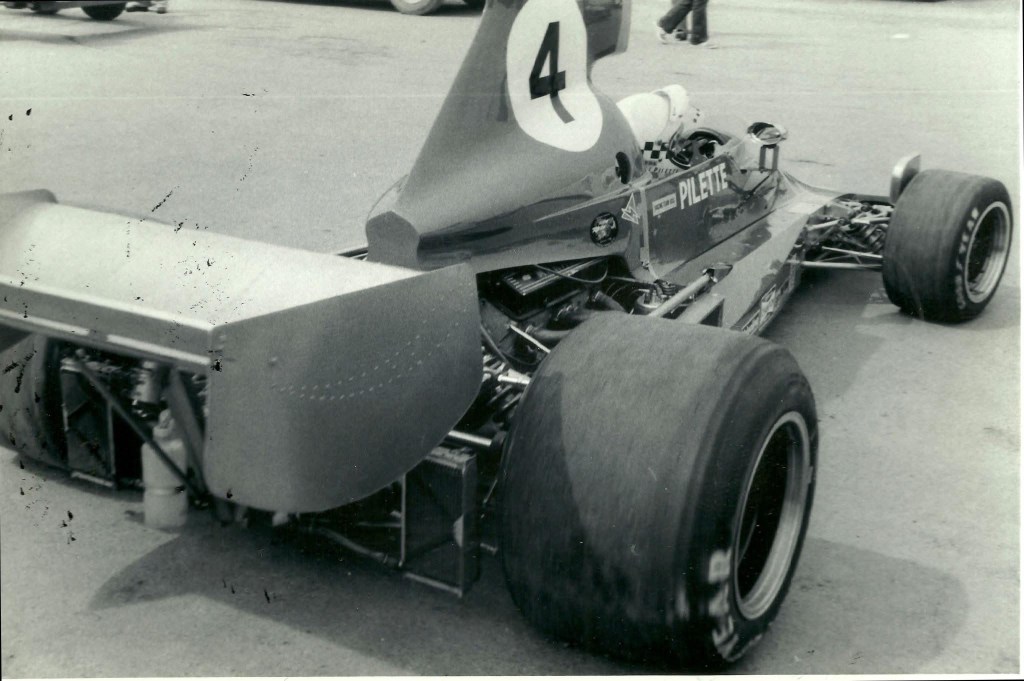
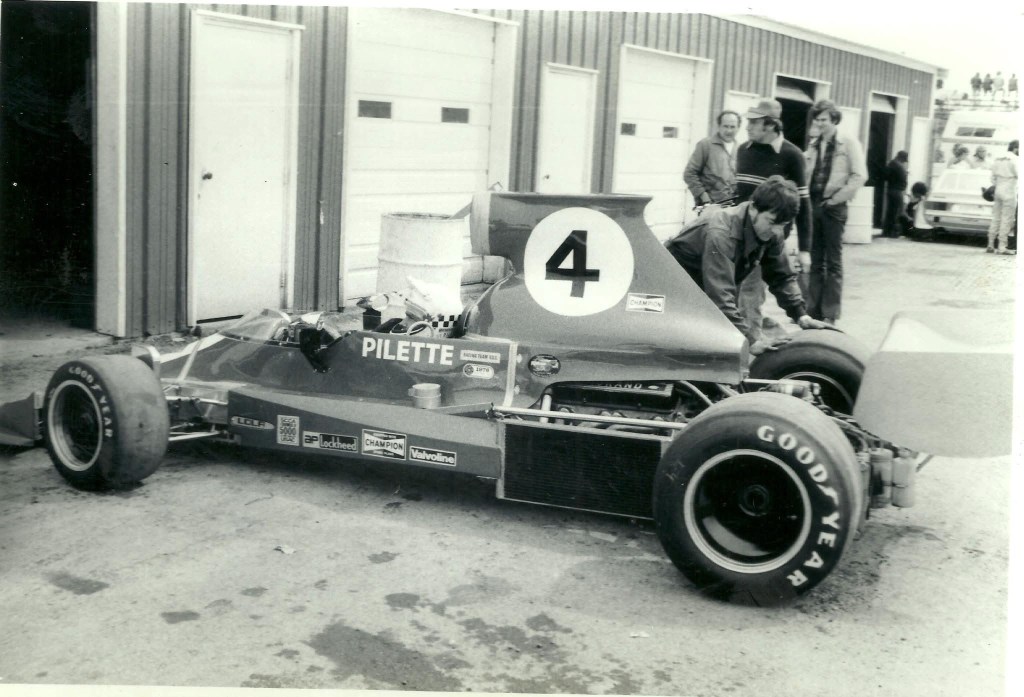
The T430 had a full-width nosecone, unlike all of the T300-series cars, but the radiators were mounted at the rear, having initially, as the photos above show, experimented with a front-mounted radiator.
The suspension was different to the T360 in that the quite conventional mix of magnesium uprights, upper and wide-based lower front wishbones, Koni/coil spring damper units and an adjustable roll-bar. were attached to brackets that in turn were attached to the tub.
The rear suspension comprised Lola magnesium uprights, a single upper link, two parallel lower links and a pair of radius rods doing fore and aft locational duties, and again Koni/coil springs and an adjustable roll bar. VDS’s chief mechanic, Steve Horne, christened the car The Flying Bracket!
In essence, as Allen Brown described it, the T430 has ‘T332-style suspension geometry. Essentially, Lola had built a smaller version of the T300/330/332 design.’ Teddy Pilette wrote cryptically on Facebook, ‘Eric Broadley wanted to make a small, narrow car to get the advantage of straight-line speed…but no good on the curve!!!!’
Steve Horne added (in relation to a Riverside photograph) ‘The drivers swapped cars that weekend and didn’t change much. I normally looked after the B37 (see results summary below), but that weekend was demoted to the 430! The Chevron was one of the best F5000s I worked on. It didn’t really have any development done on it, and the biggest downfall for both cars (T430s and B37) were the Morand engines, which just weren’t competitive in the USA.’
SCCA-USAC Formula 5000 1976…
Three Lola T430s were sold, two to Count Rudy Van Der Straten’s Racing Team VDS, and one to Jim Hall’s. In addition to his pair of Lolas for the 1976 US F5000 Championship – the last – VDS also acquired Derek Bennett’s last F5000 design, the Chevron B37 Chev, having successfully run B24/B28s previously; Peter Gethin won the 1974 Tasman Cup aboard a VDS Chevron B24 Chev.
It must have been quite an expensive year for the beer-baron, carrying chassis spares for different makes of cars. To add to the mix, he also appears to have acquired the T332C HU55 that Warwick Brown was racing for Bay Racing until its demise. WB’s first appearance for VDS was at Road America on July 25.
Pilette raced T430 HU1 and Gethin and Brown HU2, Gethin’s preferred mount was the B37, but Teddy grabbed it once or twice too…
Teddy Pilette, Lola T430 Chev HU1 at the Pocono 1976 US F5000 season opener – the T430’s first race – in May 1976 (B Featherly)Oil radiators mounted either side at the rear (B Featherly)(B Featherly)
As to results: Pocono, May 9, Teddy was Q5 and third and fourth in the heats, then 12th in the final won by Redman’s T332C. At Mosport on June 20 Teddy was third from Q7 in the race won by Alan Jones’s T332. Jackie Oliver had a memorable win for Dodge at Road America on July 25, Shadow DN6B with Pilette sixth from Q11. Gethin was ninth from Q8. Redman won again at Mid Ohio on August 8 with Gethin seventh from Q11. Pilette was fifth overall, and second in his heat from Q7 in the Chevron B37…
The dominance of the Lola T332C was again confirmed with Redman’s win in the Hall-Haas entry at Road America on August 28, where Pilette was Q2 – easily the best qualifying performance of a T430 all year – and fifth, with Brown Q6 in T430 HU2 and DNF, while Peter was Q8 and fourth in the B37.
Allen Brown wrote that ‘With two rounds to go, Alan Jones and Jackie Oliver were tied for the championship lead, but when Oliver retired at Road America and Jones had to miss the race to be at the Dutch Grand Prix, Redman won and leapt into a significant points lead.’
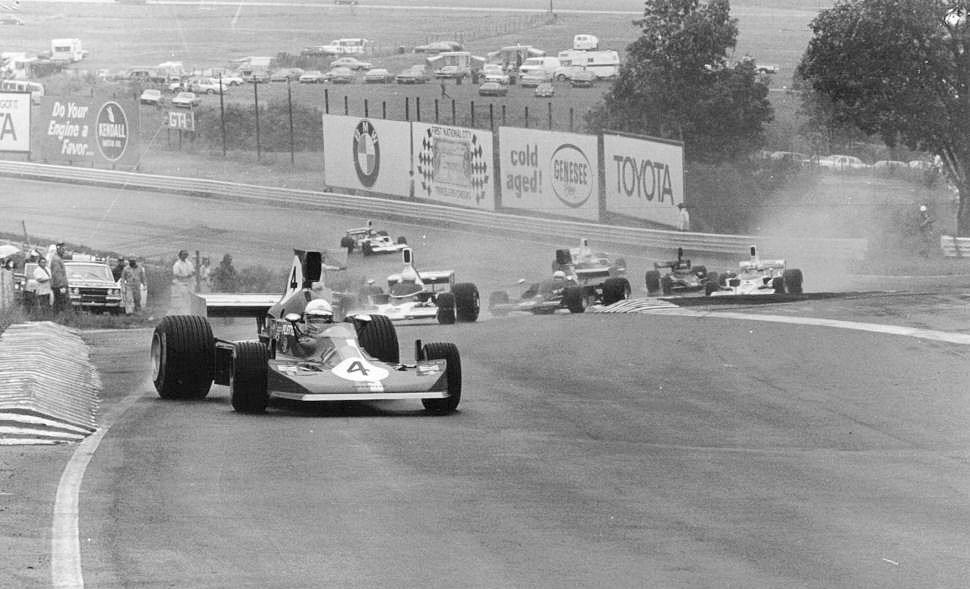
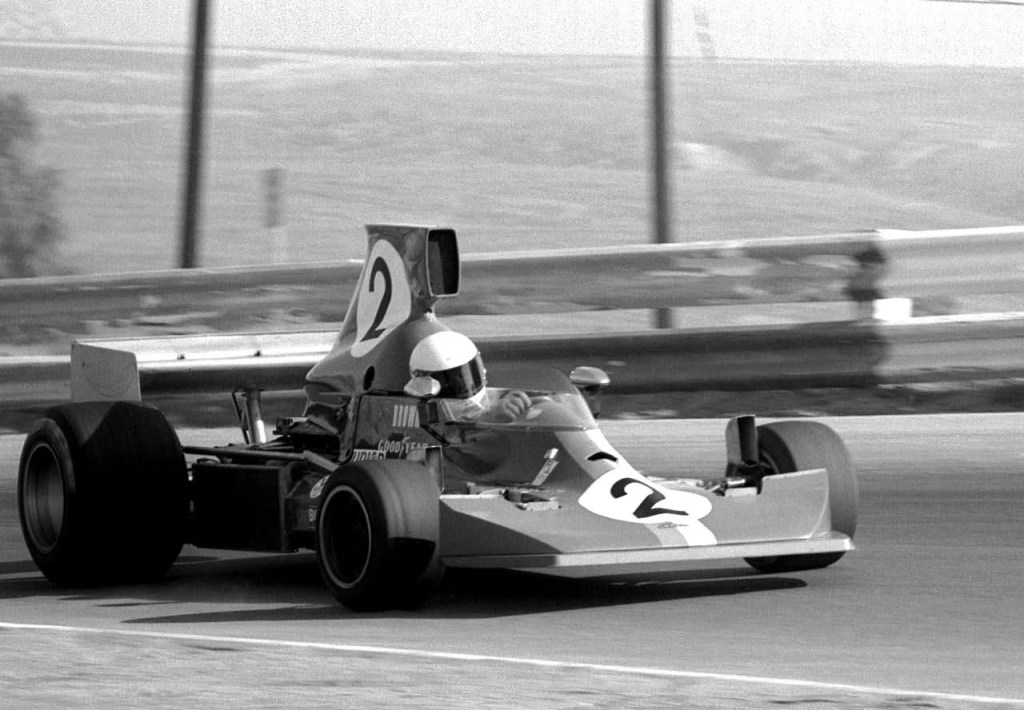
Teddy Pilette leading the field in the wet at Watkins Glen in ? 1976 DNF on lap 14 with engine failure (Lola Heritage via T Pilette)Warwick Brown, T430 Riverside 1976 and below (unattributed)
At Mid-Ohio on August 8, Redman won again with Gethin seventh in HU2 and Teddy fifth in the B37. In the final round at Riverside on July 17, VDS were again busy with three cars. Up front, it was Al Unser in a T332 Chev with WB sixth in HU2 from Q11, Gethin 10th from Q16 in the B37 and Teddy 12th from Q10 in HU1.
Redman won the championship from Unser, Oliver and Jones, the best of the T430 pilots was Warwick Brown in seventh, but most of WB’s points harvest was aboard the Bay Racing Lola T332C.
Lift Off: Surfers 100 1977. L>R WB T430, Peter Gethin Chevron B37, Vern Schuppan, Elfin MR8-C, with John Leffler’s white Lola T400 correcting his start slide and perhaps looking for a run between Gethin and Schuppan. The first three were Brown, Gethin, and Leffler (D Simpson)
1977 Rothmans International Series Australia…
Given the scale of the investment, and success of VDS it was a poor season, best to cut ‘yer losses, take the cars to Australia, win the series, then flog them at the end of it. Which is exactly what happened!
Warwick Brown won two of the four Rothmans International rounds – Oran Park and Surfers Paradise – and the championship from Peter Gethin, in the VDS Chevron B37 Chev and Alan Jones Lola T332 Chev.
Jones was the star of the series but a jumped start in the AGP at Oran Park and writing off a T332 at Surfers cruelled his chances. Yip’s boys leased KB’s T332 for that race.
At the end of the series, VDS sold the two T430s to Porsche Cars Australia/Alan Hamilton, who had had one season of F5000 in 1971, and with business booming, thought he would have another crack.
Bruce Allison bought the Chevron B37 and had a fantastic year in it, contesting the British F5000/Group 8 Championship, winning many fans, some races, and the prestigious Grovewood Award.
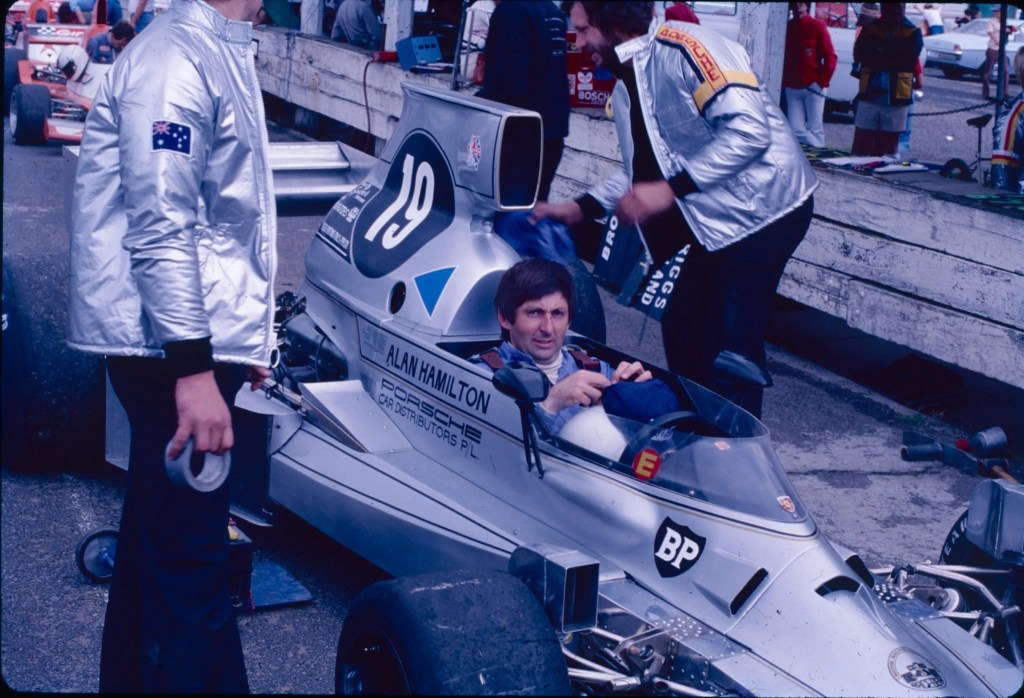
‘Hammo’ in the Sandown pitlane during the 1978 AGP weekend (B Atkin)
Porsche Cars Australia Alan Hamilton…
Brown raced HU2 to wins in the Australian Grand Prix at Oran Park and in the Surfers Paradise 100, while Max Stewart took his final win in his Lola T400 Chev HU3 at Sandown the week later.
Alan Jones’ Sid Taylor-Teddy Yip Lola T332 Chev was the fastest combination in the 1977 Rothmans Series, with AJ redeeming himself in the final round at Adelaide International. Jones was pinged for jumping start at Oran Park, bent a Lola in practice at Surfers, then led at Sandown before retiring.
In his ’77 Gold Star campaign aboard HU2, ‘Hammo’ was second at Sandown, fourth at Calder and second at Phillip Island for fourth overall behind John McCormack’s McLaren M23 Repco-McCormack Leyland.
Hamilton also contested the 1978 Rothmans Series for fifth at Sandown, tenth at Adelaide International and sixth at Surfers Paradise before vacating the seat for Derek Bell at Oran Park, where the British all-rounder was eighth from Q11.
Warwick Brown won the series again with a VDS machine, this time a Lola T333 Chev Can-Am car (HU2) converted to a T332C F5000 car, amusing to me at least, given the number of T332s that made the conversion journey the other way…
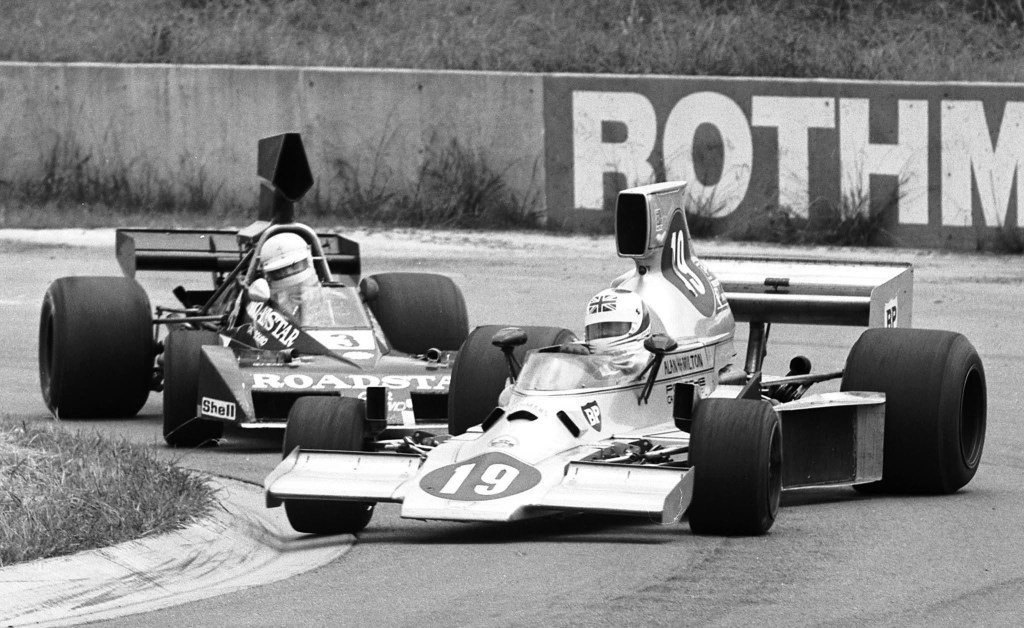
Derek Bell ahead of Kevin Bartlett at Oran Park at Oran Park in 1978. Lola T430 Chev and Brabham BT43 Chev (C Snowden)Alan Hamilton aboard his immaculate Lola T430 Chev during the 1978 Australian Grand Prix at Sandown before That Lap. Note the very neat T332-based nose fitted by then
While grids for the Rothmans International Series were still adequate, the domestic Gold Star was a different matter. The case for a change to Formula Pacific was being put, with F5000 hanging on. Alan Hamilton missed the opening round of the Gold Star at Oran Park but entered for the Australian Grand Prix at Sandown on September 10.
That ‘Fangio Meeting’ was mega with the great man demonstrating a 3-litre W196S-engined Mercedes-Benz W196R Grand Prix car with much brio throughout the weekend and ‘racing’ Jack Brabham in Jack’s 66 F1 Championship-winning Brabham BT19 Repco 620 V8.
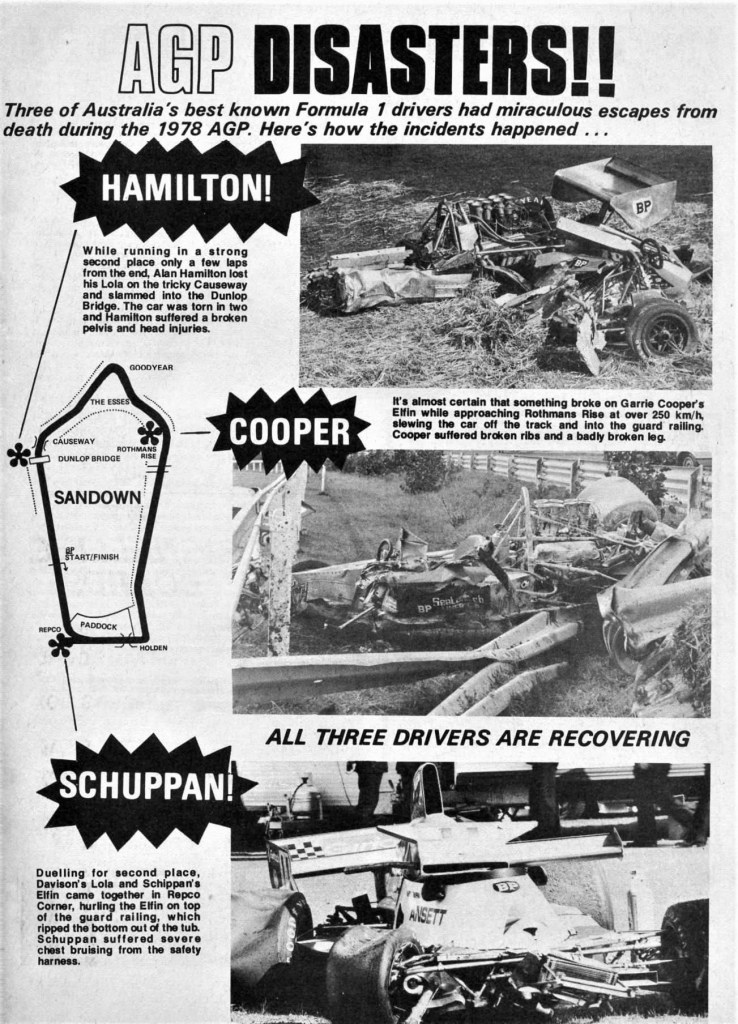
The utter excitement of the sight and sound of that legendary car-driver combination was to a large extent ruined by the accidents that befell Garrie Cooper and Alan Hamilton, and to a lesser extent Vern Schuppan, in the Grand Prix won by Graham McRae, McRae GM3 Chev.
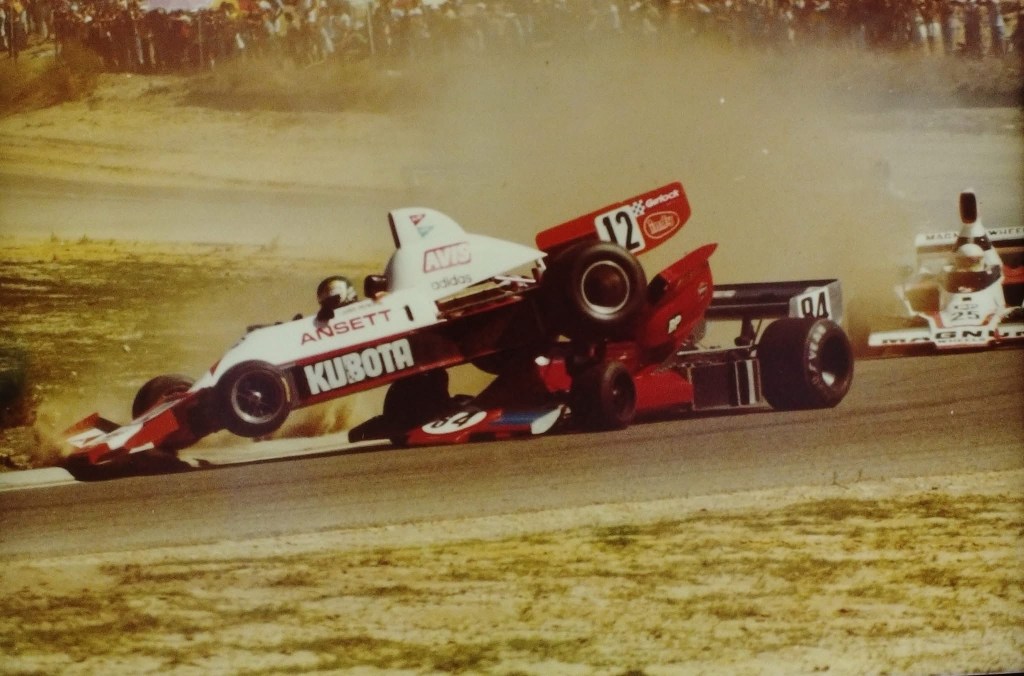
Alan lost control of the twitchy, unforgiving Lola on the fast left-hander off The Causeway then went backwards into the Dunlop Bridge breaking the car into two and breaking a leg, his pelvis and sustaining serious head injuries.
While there that day, I was nowhere near the accident, which was in a no-spectator area on the inside of the track. The vibe of the place that day, with three big hits and limited information flow to us punters, is something I still remember.
It took a long time for Hamilton to recover, he carried maladies related to that accident for the rest of his life, not least the diabetes that prevented him from ever holding a full competition licence again.
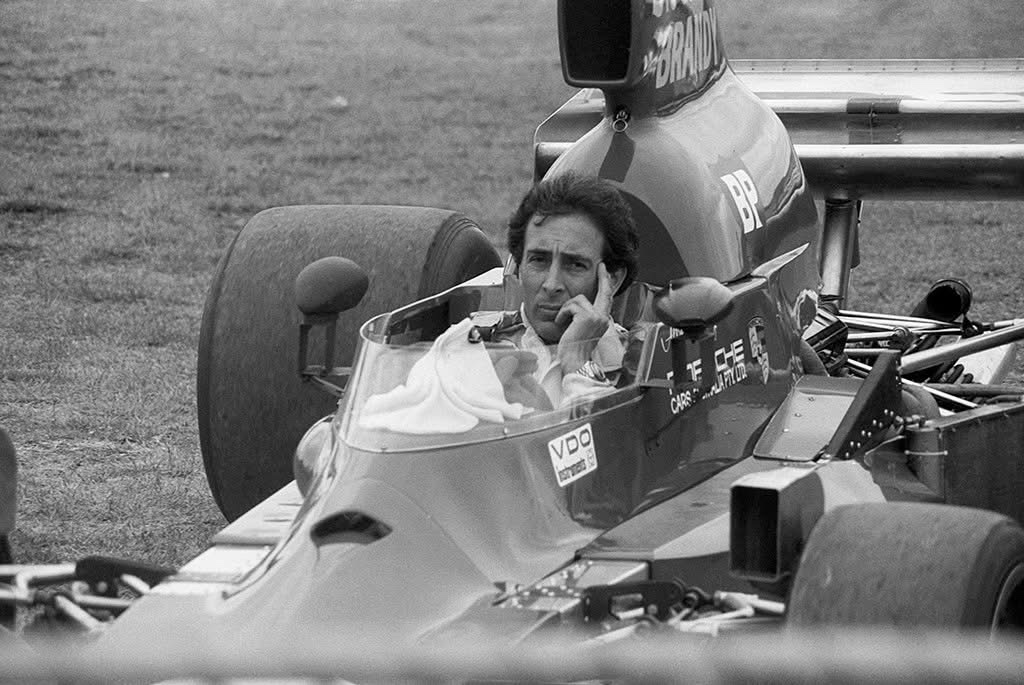
Hamilton supported a lot of drivers along the way, it’s beyond the scope of this article. When he decided to continue to race the other T430, HU1, he chose Italian Australian Alfredo Costanzo, then 35 years old.
Costanzo in the Sandown dummy grid. Flying Bracket factor front and rear is clear (D House)This shot shows the low frontal area presented by Costanzo’s T430 compared with Brown’s T332 further back; Perkins’ Elfin MR8 looking as slippery as the T430. Oran Park 1979 (B Forsyth)
Costanzo’s first race was at the Sandown round of the 1979 Rothmans Series on February 4, where he won, what a debut! He took the Adelaide round as well.
The shot above shows Costanzo, Lola T430 Chev, ahead of Larry Perkins, Elfin MR8C Chev, and Warwick Brown, Lola T332C Chev in the final Oran Park round on February 25, 1979.
Rob Newman, racer and in John Walker’s AGP and Gold Star winning 1979 year, the preparer of JW’s Lola T332, observed: ‘Poor Alfie had a driveshaft failure and lost the race and the series. Perkins went on to win the 1979 Rothmans series without winning a race, and Warwick salvaged one race win from what had been an awful 1979 Rothmans series for him, his last season as a professional driver, if I recall correctly.’
Shortly after the Rothmans, the Gold Star commenced with the Australian Grand Prix at Wanneroo Park on 11 March. Costanzo bagged pole, then he and Perkins took one another out in a first-lap, first-corner battle for victory. Another perennial battler, John Walker, won the day in Martin Sampson’s Lola T332 Chev; the duo took the Gold Star that year, too, with Alfie the winner of the Sandown round.
Take No Prisoners. Classic dive and chop manoeuvre between Perkins’ Elfin MR8 and Alfie’s T430 eliminates both at the start of the 1979 AGP at Wanneroo Park. A great pity, as that joust could have been really something (unattributed)AGP victor John Walker is licking his lips in the #25 white Lola T332 behind the Wanneroo Air Show (unattributed)
Into 1980, the Hamilton-Costanzo-T430 combination finally came good in a Gold Star season of many different winners, winning the coveted award from Jon Davison and John Bowe and taking victory in the Sandown and the Rose City 10000 at Winton in T430 HU1.
Alfie’s last hurrah in the old car was in the Australian Grand Prix at Calder on November 16. By then, the conversion of McLaren M26-4E to a ground-effects Chev-engined F5000 car in PCA’s workshops was a bit behind schedule, so Hamilton’s crew dusted off the T430 for one last time, finishing fourth in the race behind Alan Jones, Williams FW07B Ford, Bruno Giacomelli, Alfa Romeo 179 V12 and Didier Pironi’s Elfin MR8 Chev. Alfie and Didi gave one another a bit of hip-and-shoulder that day!
Bob Minogue, Lola T430 Chev, Shell Corner, Sandown 1981. From memory, the lack of airboxes at this stage was the notion of the entrants/penniless sponsor Arco Graphite to make F5000 cars look more contemporary (R Lewis)
The car didn’t move far with Brighton racer Bob Minogue, the purchaser. He had been out of racing for a while but proved very much up to the task and not intimidated at all, racing the car in the 1981 Gold Star and into the Arco Graphite Series in 1981-82 as Formula Pacific finally took over as Australia’s National F1.
All three T430s live in New Zealand with T430 HU2 rebuilt around the chassis plate, which ‘took pride of place’ on Alan Hamilton’s office pin-board for a couple of decades.
(A Mitchell)The Costanzo T430 Chev at Surfers Paradise in 1979 and below at Sandown. Circa 520bhp in the day (M Strudwick)(C Jewell)
Rod Steffanoni, Chris Jewell, Bill Forsyth, Lynton Hemer, Michael Strudwick, Chris Snowden, Auto Hebdo, Lola Heritage, Teddy Pilette, Bob Featherly, Neil Laracy, Chris Parker, Robin Lewis, Alex Mitchell
Tailpieces…
(C Parker)
I was there somewhere, that day, every day over that Sandown Sunday, February 20, 1977, weekend.
Raceday wasn’t a good day for WB, he had qualified fourth but boofed the T430 into the Dandy Road fence on the warm-up or parade lap, Max Stewart won from Alfie and Garrie Cooper: Lola T400, Lola T332 and Elfin MR8-C all Chev powered.
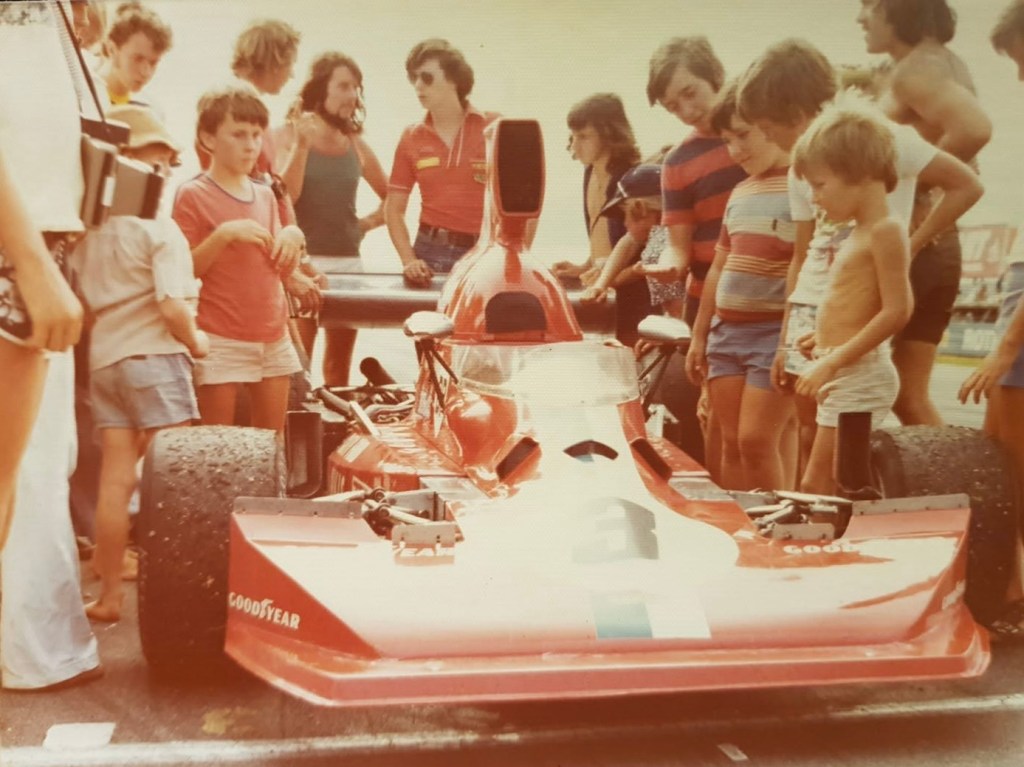
Look at the crowd…And below? Surfers perhaps? Racing cars are like magnets for little tackers and bigger blokes alike, aren’t they!?
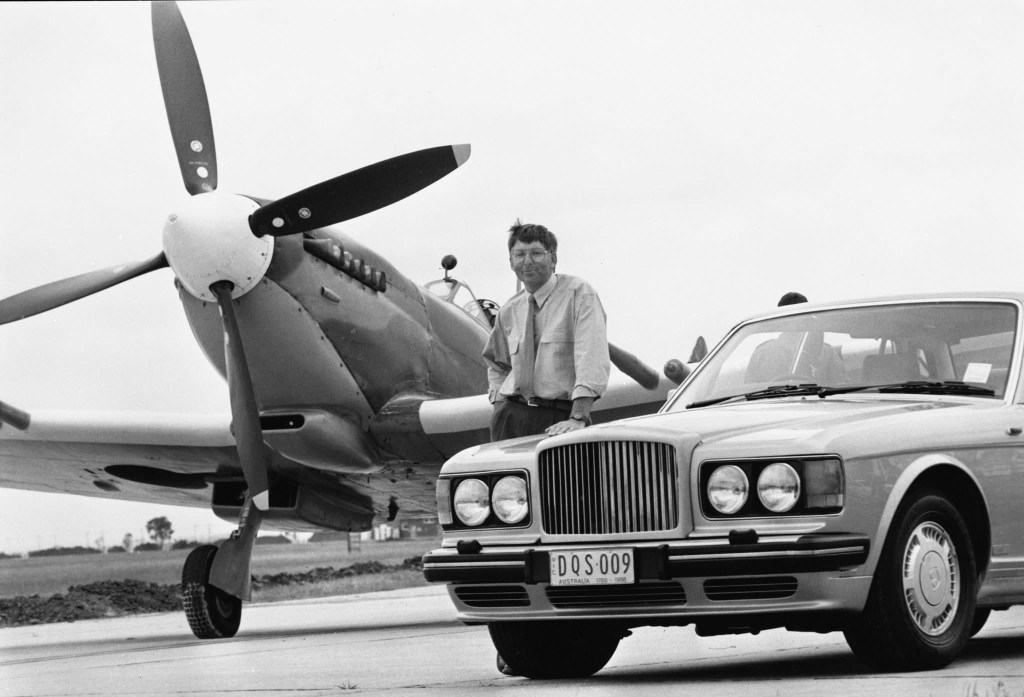
Spitfire, Alan Hamilton and a Bentley not long after Hamiltons Rolls Royce was created to take on the Rolls and Bentley franchises, ‘Laverton, Victoria on December 20, 1988’ Tony Johns advises.
Alan Douglas McKinnon Hamilton, a wonderful man, Australian Porsche importer, racer, entrepreneur and entrant died on March 3, 2025 in Melbourne. He was born on July 29, 1942.
What follows is a photograph based tribute. I was lucky enough to meet with and speak to Alan in the last five years about various articles, and sometimes just racing shite more generally…a Prince of a Bloke.
(R Rundle)
Early days aboard a 356 Coupe at Calder circa-1962
This tribute is a pot-pourri of the cars he raced but is far from all of them. It excludes machines he entered for others…of which they are a lot.
(G Chennells)
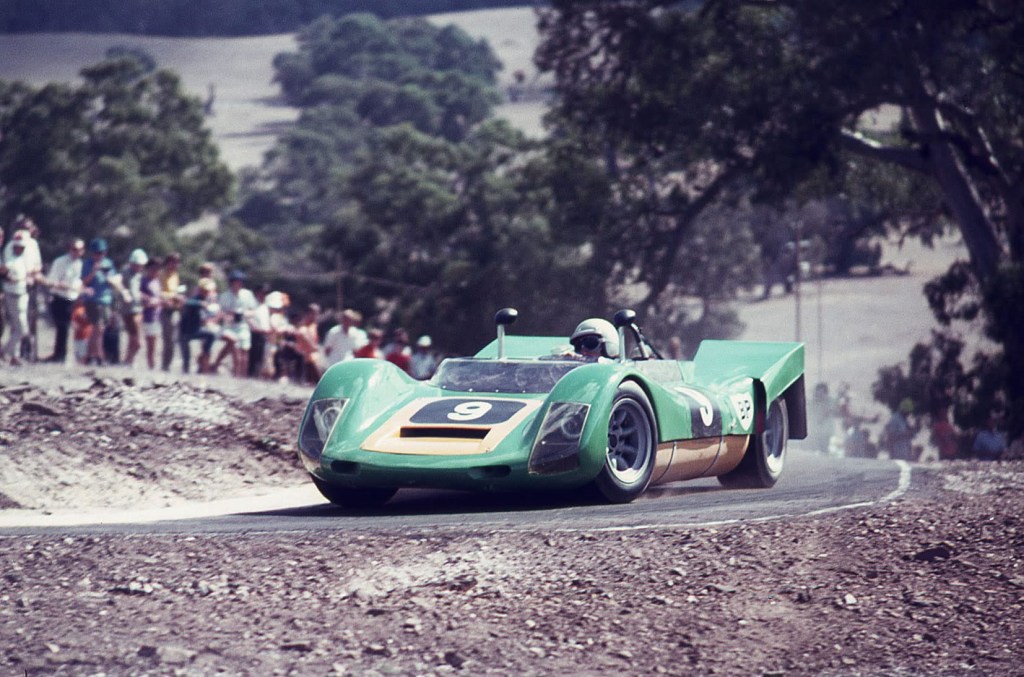
It could be Europe but its outer Melbourne. Hamilton’s 2-litre six powered 904-8 Bergspyder #007 at Templestowe Hillclimb during 1966.
‘Alan Hamilton leaving The Hole with the Porsche engine making its very distinctive and glorious bellowing sound. It always scared me a bit watching Alan because he was so quick out of The Hole that when he arrived at Barons, a sharp U-turn with trees on the outside, he was going so fast that if anything went wrong…I hated to think. But always fantastic to watch and hear.’
(B Jackson)
In the paddock at Surfers Paradise during the 1966 12-Hour meeting. Alan was sharing the car with Brique Reed.
And below during the March ‘66 Longford Tasman meeting while contesting the Australian Tourist Trophy. Hammo is turning into The Viaduct in front of Lionel Ayers’s MRC/Lotus 23B Ford and Spencer Martin aboard the Scuderia Veloce Ferrari 250LM.
Frank Matich won in his new Elfin 400 Traco-Oldsmobile from Hamilton and Martin.
(S Fryer)(R Rundle)
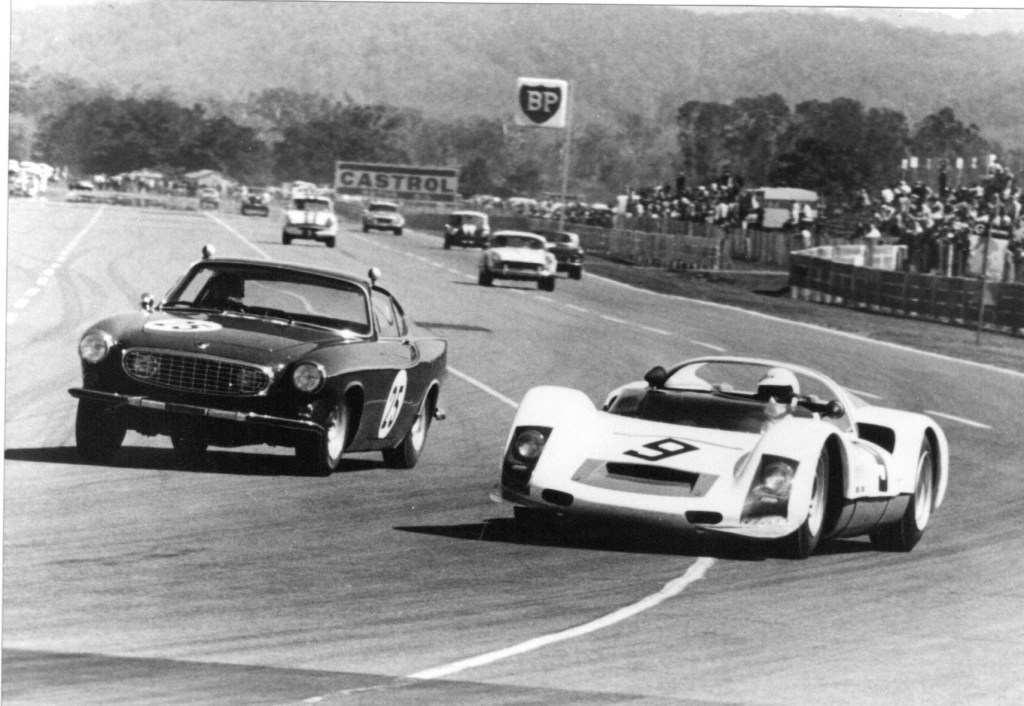
Hamilton rounds up the John Kiran/Colin Bond/Max Winkless Volvo P1800 during the 1967 Surfers Paradise 12 Hour. Alan and Glyn Scott were third behind the Scuderia Veloce Ferrari 250LM raced by Bill Brown and Greg Cusack, and the Paul Hawkins/Jackie Epstein Lola T70 Mk3 Chev.
This 906 is his first – chassis#007 – had its lid lopped off locally to accommodate Alan’s considerable length. His second 906 was tagged 007 too… That’s it below at Warwick Farm during the RAC Trophy meeting in May 1971.
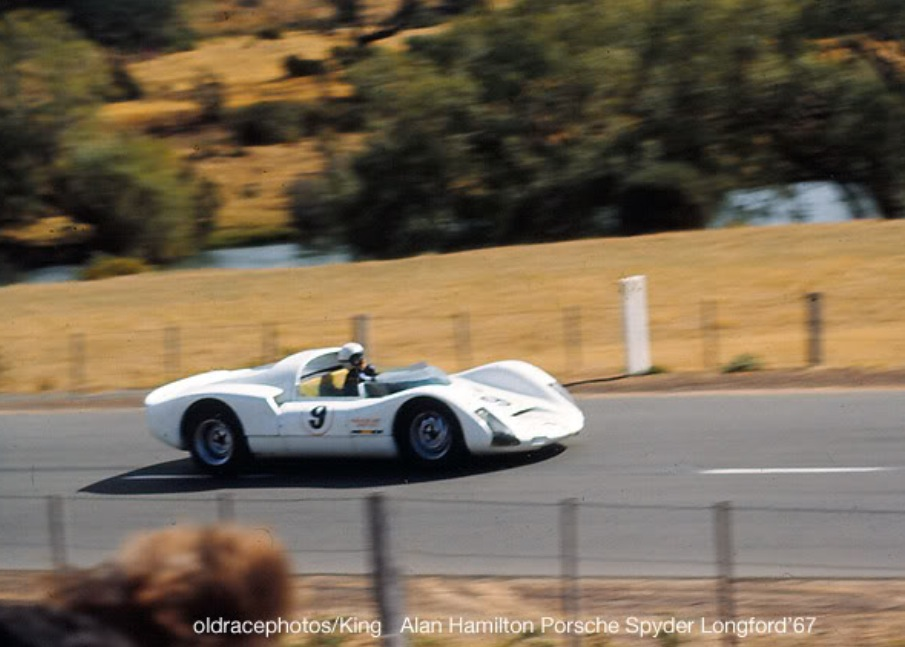
(L Hemer)Longford, March 1967 aboard the first 906Peters Corner Sandown in 1967 with Neil Allen’s ex-Matich Elfin 400 Olds behind (unattributed)(oldracephotos.com/King)
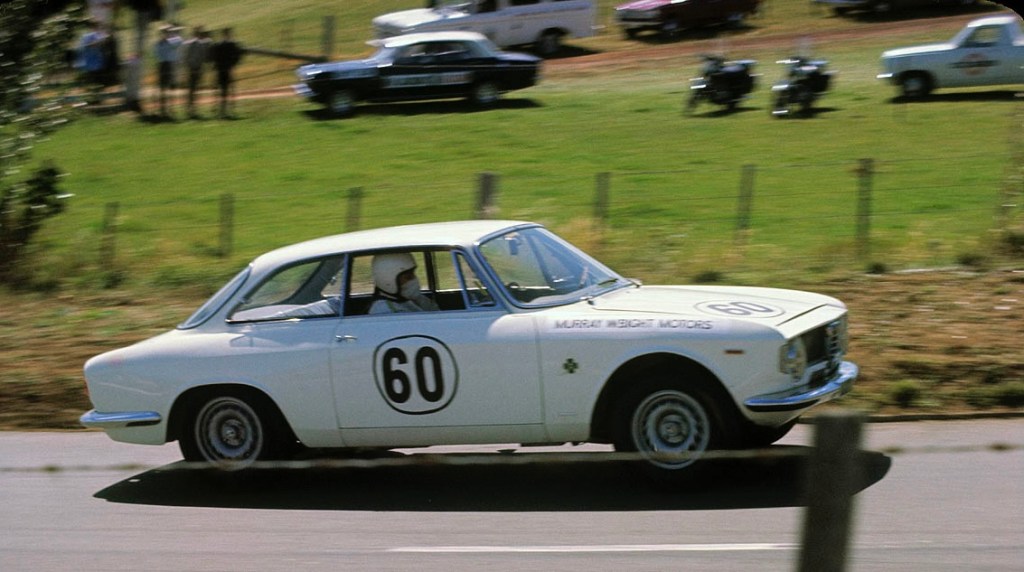
Hamilton having a drive of a front-engined car for a change. The MW Motors Alfa Romeo GTA at Longford in 1968, Murray Wright was the Melbourne Alfa Romeo dealer.
(MotorSport)
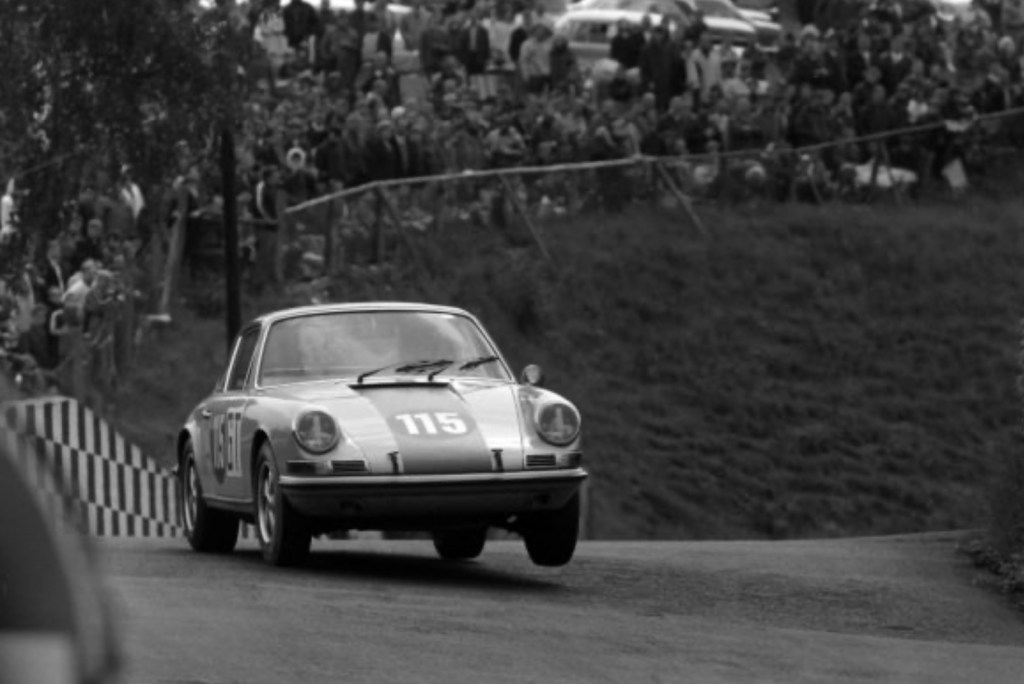
Hammo taking some air during the 1968 Nurburgring 1000km. He was 28th, sharing the Porsche 911S 2-litre with Hans Dieter-Blatzheim on May 19.
Up at the front was a pair of Porsces: Jo Siffert and Vic Elford won in a 908 with local-lads Hans Herrmann and Rolf Stommelen second in a 907.
(Porsche)
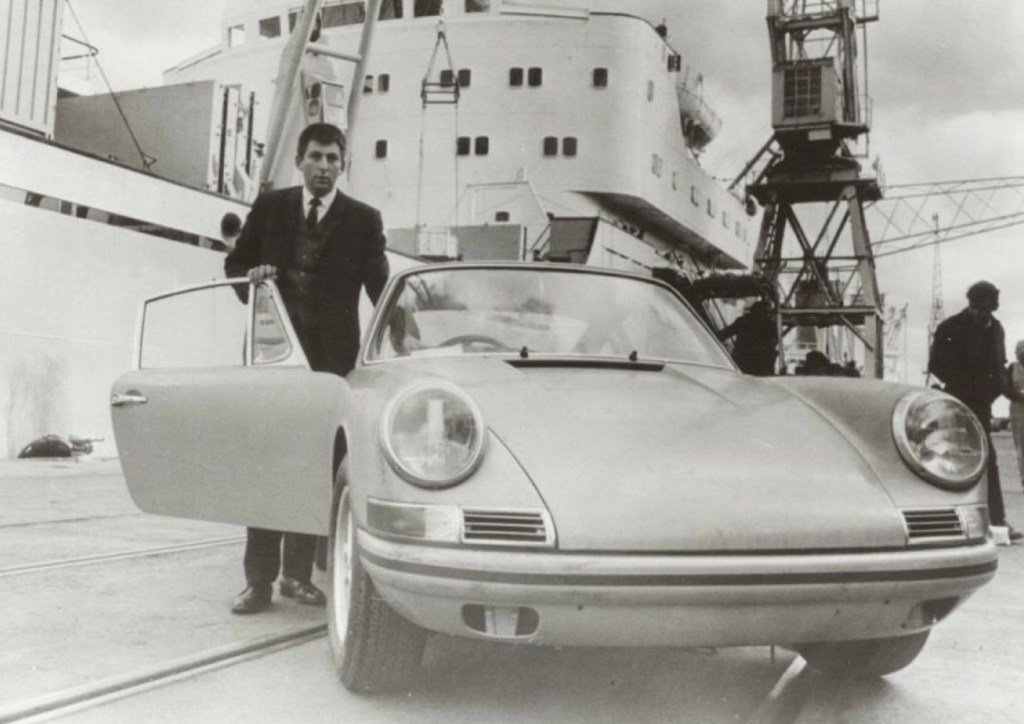
Alan at Station Pier for the handover of a of carton of beer or three to the Waterside Workers Federation dogs to avoid his new Porsche 911 T/R being accidentally damaged on the downward drop onto said Pier…
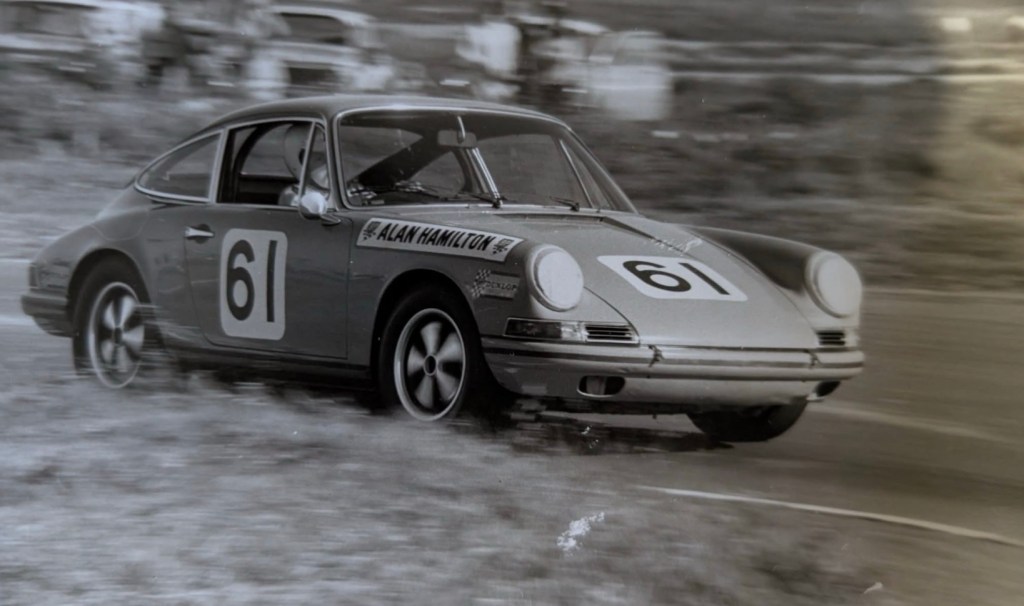
MG corner at Phillip Island? (A Scott)Warwick Farm with the car dancing on its tippy-toes, lots of shots of this car are in this pose (Porsche)
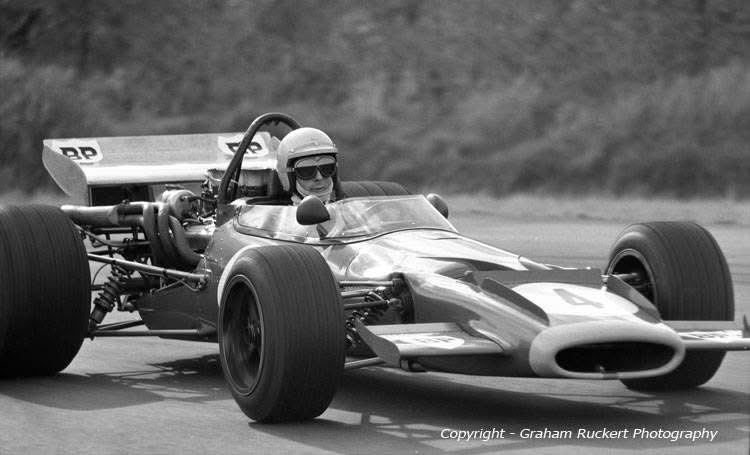
Hammo in his maiden single-seater drive in his new McLaren M10B Chev at Lakeside over the June 6 weekend in 1971. Third behind Kevin Bartlett and Max Stewart.
Chassis #400-19 was Niel Allen’s spare tub which was built up into a complete car when Allen retired from racing after the end of the 1971 Tasman Cup.
(B Jackson)
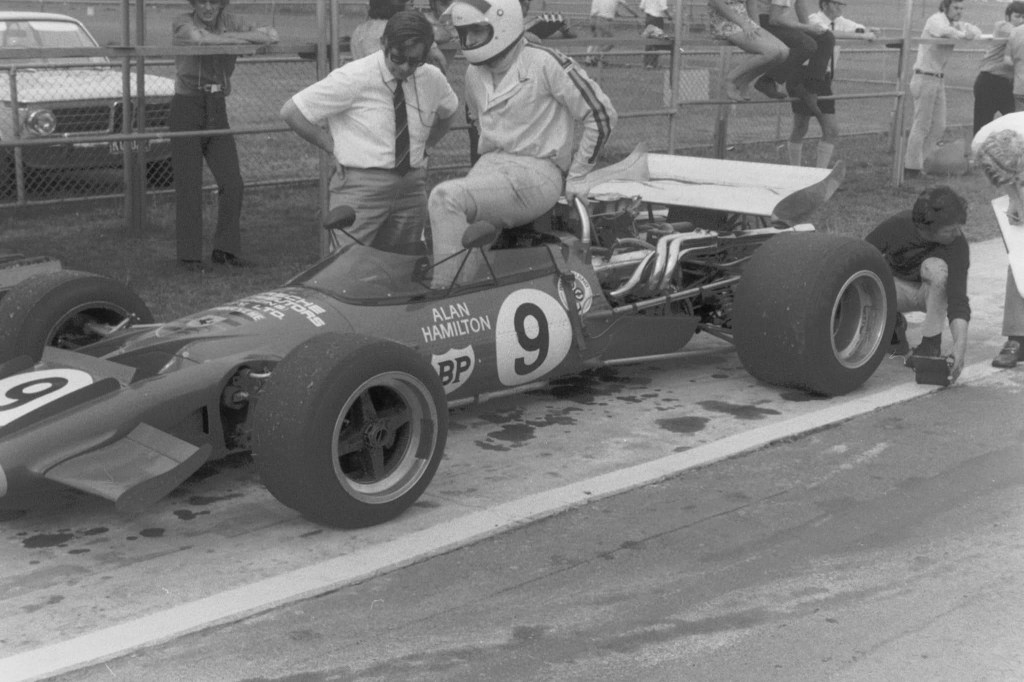
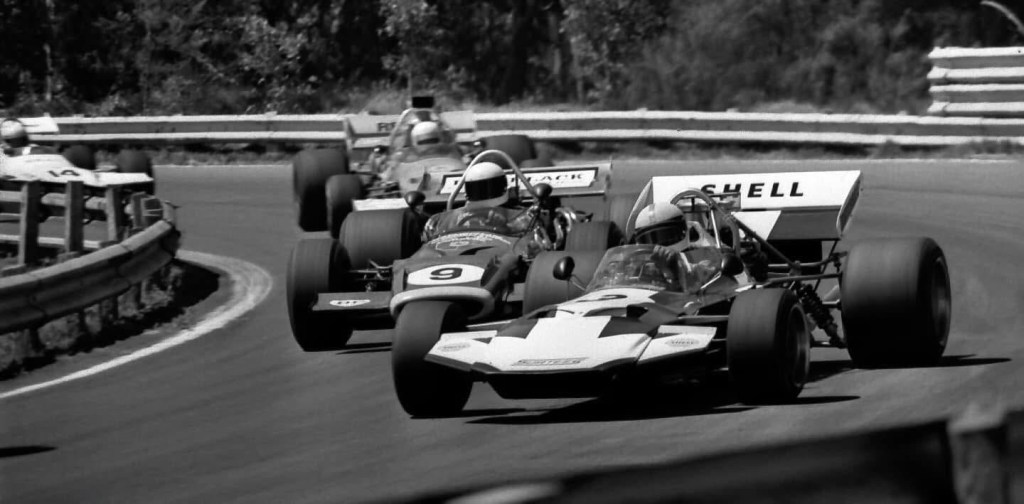
Hamilton inserts himself into the McLaren’s cockpit in the Warwick Farm pits and is shown below in the very best of company dicing with John Surtees, Surtees TS8 Chev during the ‘71 AGP.
That’s Colin Bond in Frank Matich’s McLarens M10C Repco-Holden and the Graeme Lawrence’s Brabham Ford FVC. A deflating tyre cruelled Surtees chances, Frank Matich won the race from with Hamilton third and Lawrence fourth, Bondy lost Phil-pressure and retired.
Max Stewart’s fast and reliable Mildren Waggott TC-4V won the Gold Star that year with the two ex-Allen M10Bs driven by Bartlett and Hamilton in equal second-place.
(L Hemer)(J Lemm)
Hamilton at Collingrove on the way to a 33 seconds-dead run at Easter, taking FTD in the Australian Hillclimb Championship (AHC) in April 1971.
Alan had won here before, taking the 1966 title in the 904 Bergspyder. He returned to hillclimbing after losing his General Competition Licence as a result becoming an insulin dependent diabetic as a consequence of his 1978 massive Sandown accident. He won the 1981 AHC in a Porsche Special, then took it one final time at Gippsland Park, Morwell in a Lola T87/50 Buick, a device which started life as a Formula 3000 car.
(unattributed)
Hammo leading Allan Moffat and Bryan Thomson during the 1972 Sandown Tasman meeting.
The 911S 2.4-litre, ex-Brian Foley/Jim Palmer, Mustang Boss 302 and Holden Torana Chev glimpse in a mixed Improved Tourer and Sports Sedan race. Neil Stratton wrote that this was palmers first race in the car and that Moffat retired the Mustang after losing its brakes over Lukey – the rise at the top of the back straight – and hitting the Armco protecting the Marshalls.
The same pair at Calder later in the year below.
(P Husband)
On the hop at Oran Park in a 3-litre Carrera RSR in 1976. Famously the 1975 Paris Show 911 Turbo/930 prototype, long since left our shores and lives in Europe.
(Auto Action)
Allan Moffat created a crushing touring car team in 1977 by recruiting American engineer-team manager Carrroll Smith, engine builder Peter Molloy and Colin Bond.
After winning the ATCC Moffat recruited Jacky Ickx and Hamilton for the Enduros. Moffat’s 1-2 form finish has had taxi fans foaming at the mouth for decades with colulda-woulda-shouldas but The Boss prevailed, as he should have: Moffat/Ickx first, Bond/Hamilton second.
(B Atkin)
A very poignant photograph of Hammo in the Sandown pitlane during the 1978 Australian Grand Prix weekend; The Fangio Meeting at which the great JMF demonstrated a Mercedes Benz W196 Grand Prix car with much brio.
The utter excitement of the sight and sound of that legendary car-driver combination was to a large extent ruined by the accidents that befell Garrie Cooper and Alan Hamilton, and to a lesser extent Vern Schuppan, in the Grand Prix. Racing Car News summarised it thus:
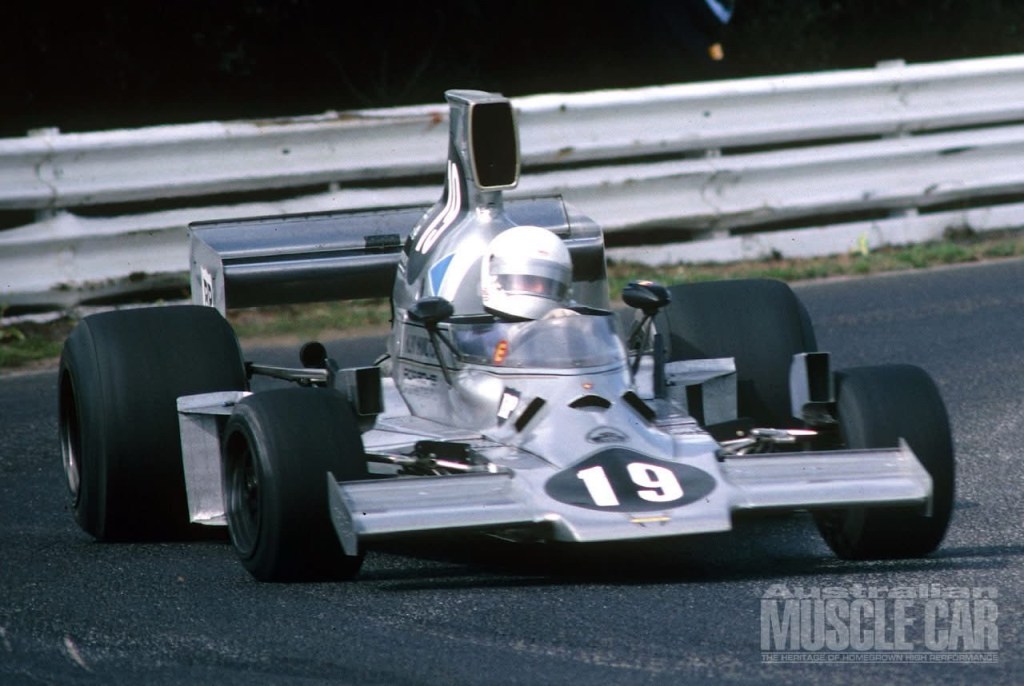
Hamilton turns in to Dandenong Road not long before the crash. If the Lola T430 Chev looks a little odd, it’s because Porsche Cars Australia modified the car by removing the sportscar-type-front and replaced it with a T332 type wing which provided more bite…and looked better.
Alan lost control of the twitchy, unforgiving Lola on the fast left-hander off The Causeway then went backwards into the Dunlop Bridge breaking the car into two and breaking a leg, his pelvis and sustaining serious head injuries. While there that day I was nowhere near the accident which is in a no-spectators area on the inside of the track. The vibe of the place that day with three big-hits, and limited information flow to we punters, is something I still remember.
(B Polain)
Hammo competing in the Seaforth Tourist Trophy in 1983. Not a lot of safety for cars doing 180mph…
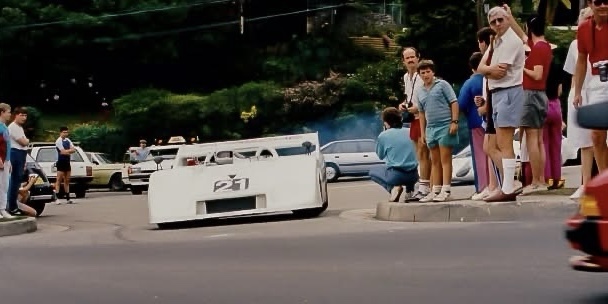
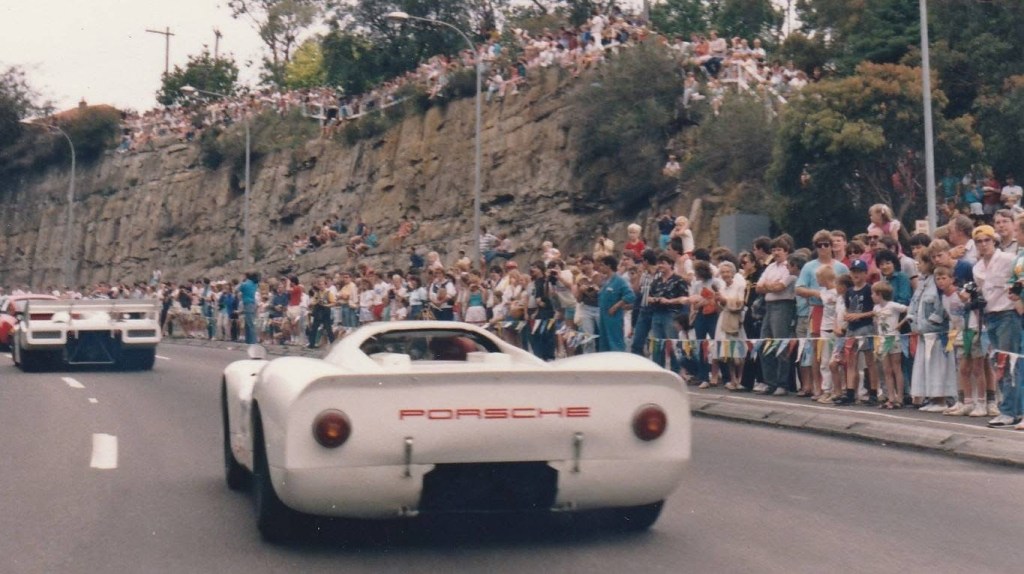
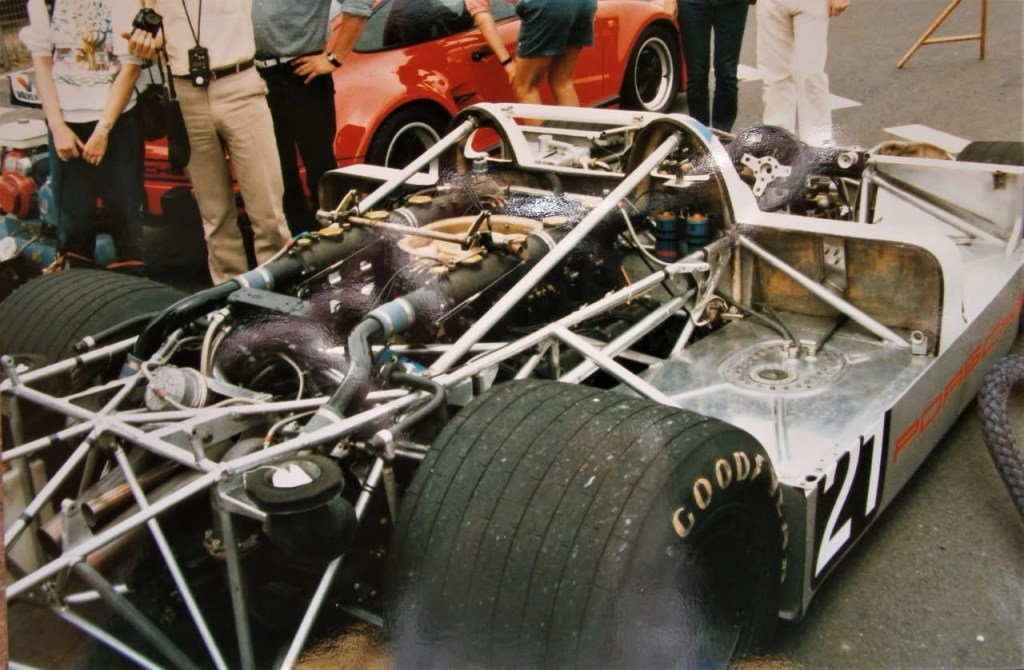
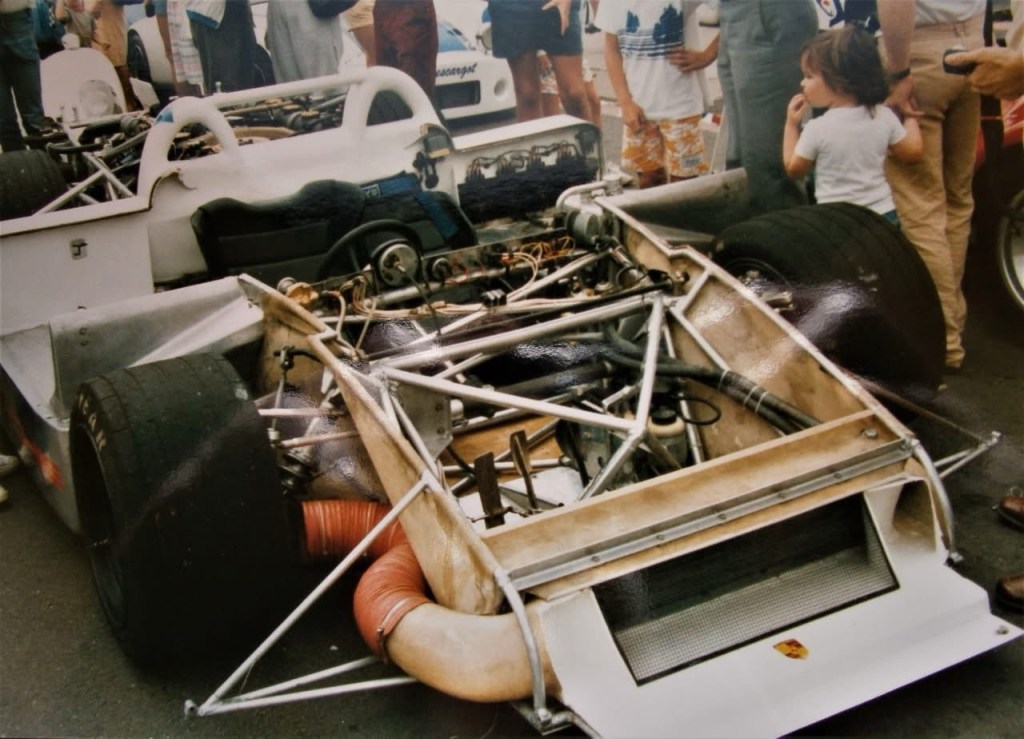
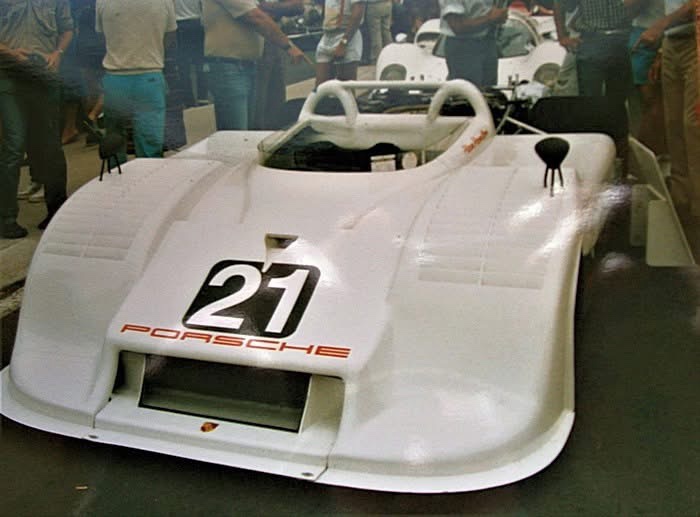
This 917/30 #004 was Mark Donohue’s unraced spare in 1973. Alan always had a snoop around the Zuffenhausen ‘shops on his trips to Deutschland and spotted this little baby on one of those trips. Long-since left our shores.
Hammo’s 908 Coupe following the 917/30. The 908 was, ahem, road-registered for a while in Victoria (unattributed)(unattributed)A cursory glance at the 917/30 spaceframe chassis and its driver-forward driving position shows the importance of not having a frontal impact at anything more than 30mph…(unattributed)(unattributed)
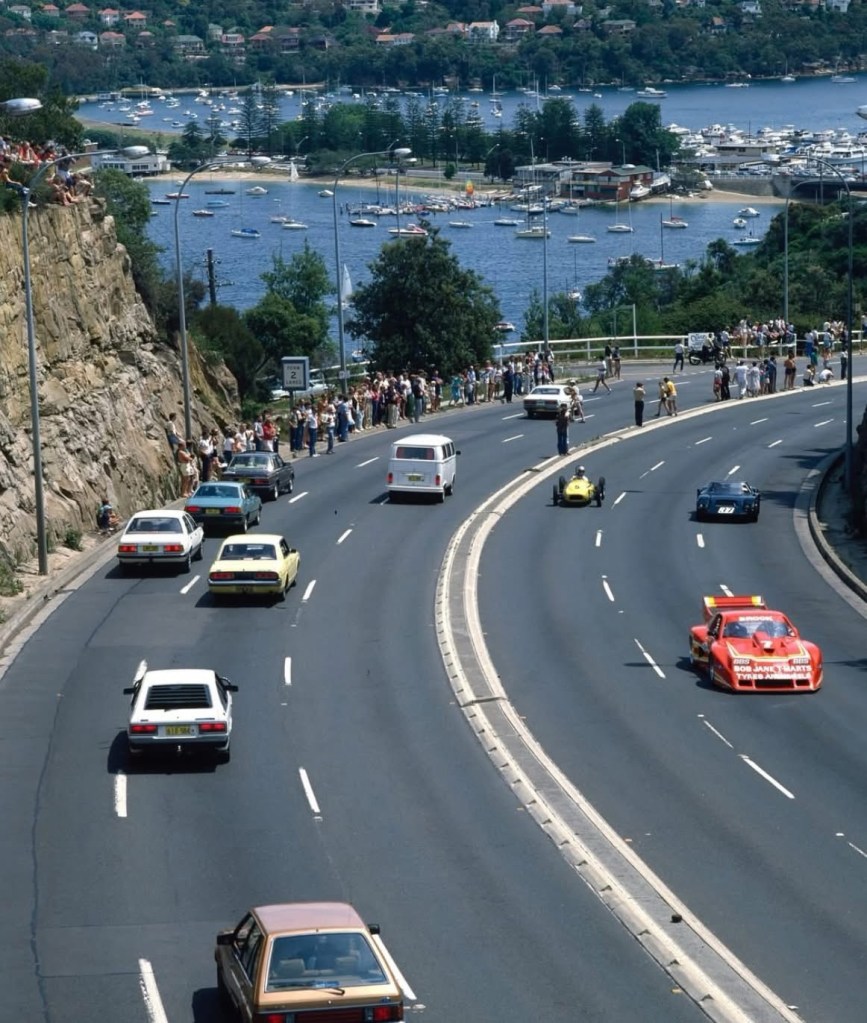
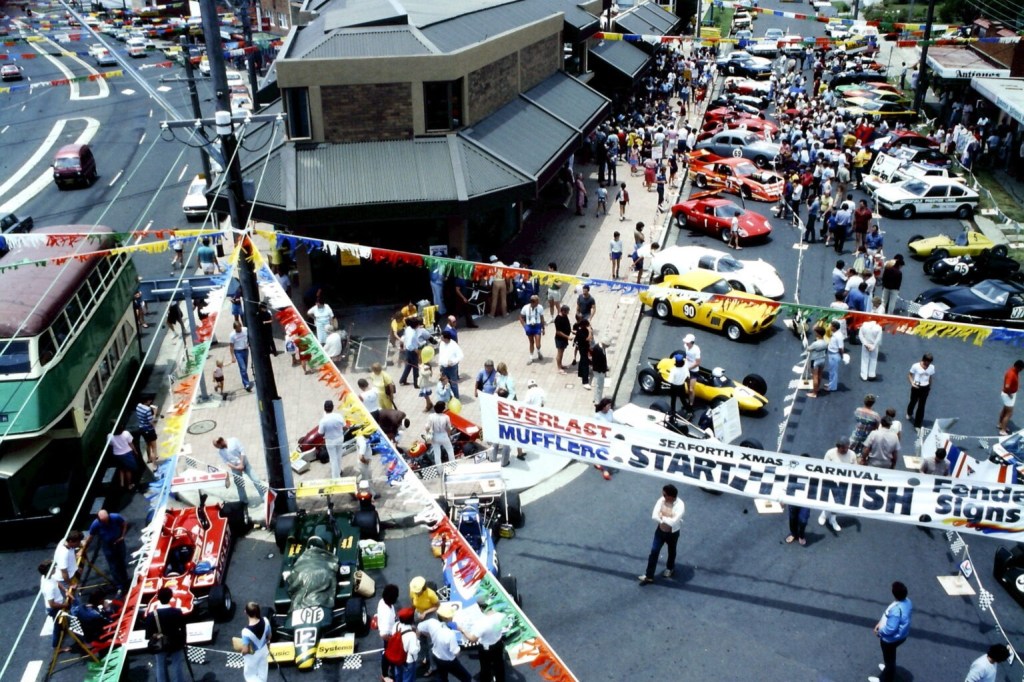
The Seaforth Racing Car parade was a fantastic event put together by Bruce Polain and a bunch of his mates at the Historic Racing Car Club of Australia in Sydney.
The street circuit was about 2.5km around the heights of Seaforth, descending to Spit Bridge with views of the inner-harbour, then winding up through the gears to the top of Spit Hill to Sydney Road, then left into the Seaforth shopping centre. Twice. Two runs during the day.
December 10, 1983 with Bob Jane’s Chev Monza and Bruce Polain’s Wylie Javelin heading out of town towards Seaforth. Any tourist who has taken a dip at Manly will have made this trip…unless you went the fun way by ferry! Shot taken from the Ethel Street overpass (unattributed)(unattributed)(T Johns)
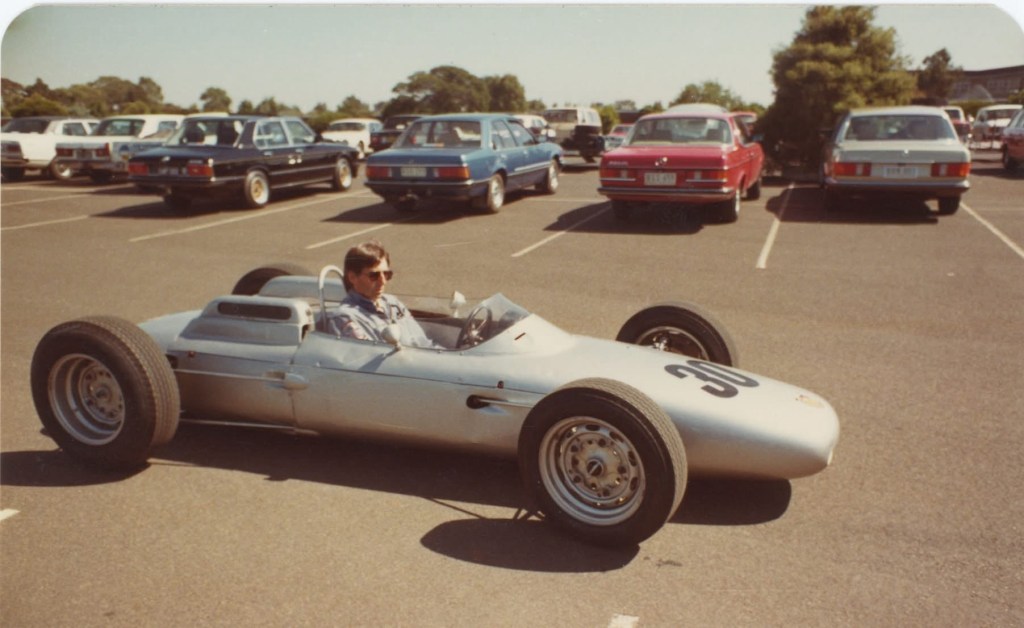
Tony Johns, ‘Alan Hamilton driving the Porsche Factory Museum 1962 Type 804 F1 racing car.’
‘Sandown Tribute to Champions meeting February 14, 1982. A real gentleman to have worked for at Porsche all those years ago.’
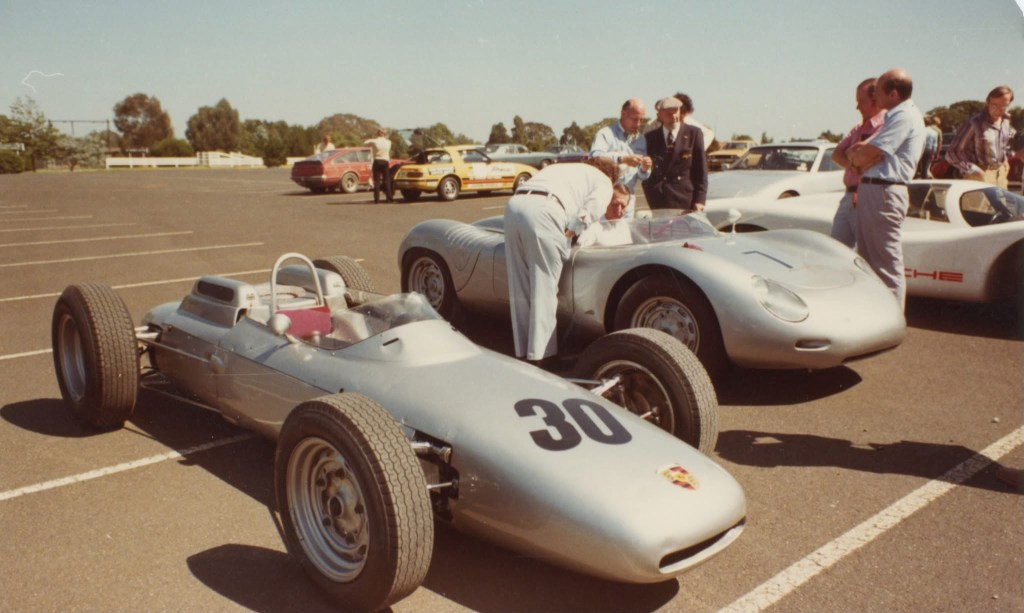
‘Another photo from the same morning. The 804 and 718 RSK ex-USA and the ex-factory 908 Coupe were part of Alan’s collection. Rob Walker, Stirling Moss’ long-time patron is seated in the Spyder and Moss is chatting with Norman Hamilton (jacket and cap), the founder of Porsche in Australia.’
(D Pearce)
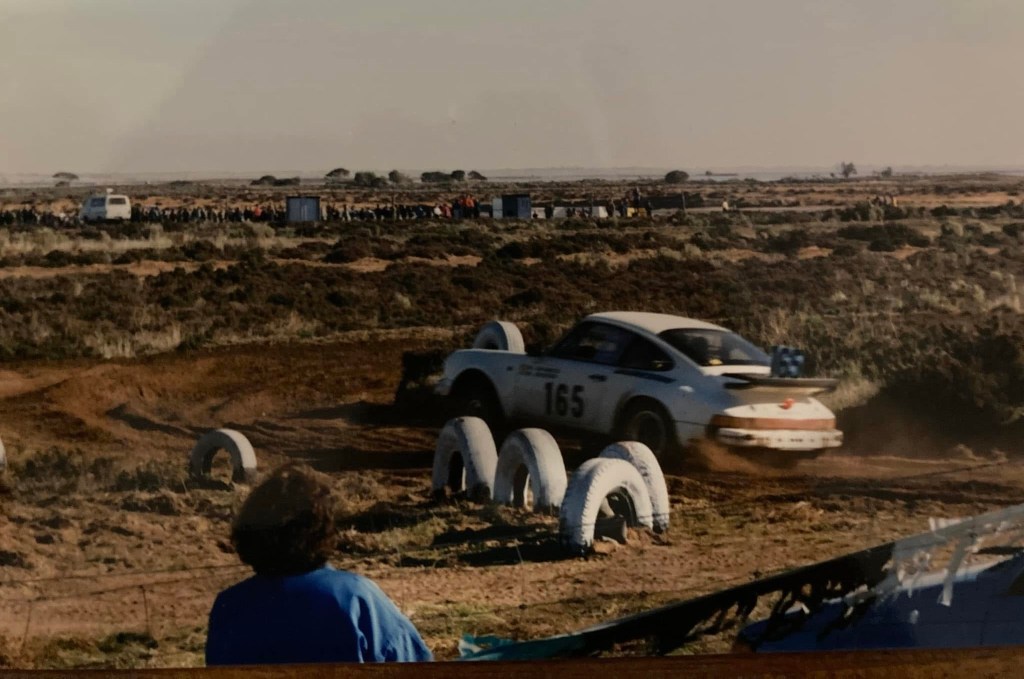
Alan Hamilton, Porsche 911SC during the 1987 Sea Lake Mallee Rally, perhaps with Jim Hardman alongside.
It’s not just any SC either! This car is ‘C20’ the prototype of what ultimately became the 911-964 four-wheel-drive, and along the way the competition 953 Paris-Dakar rallycars. The 3.2-litre car started life as Helmuth Bott’s brown-SC company car before morphing into a double-front wishbone machine with front and rear diffs. When it was pensioned off guess who spotted it on one of his trips to Germany in 1986?…
Hamilton on the hop at Gippsland Park Morwell on October 15, 1989 aboard his Lola T87/50 Buick 4.9 V6, another AHC victory, not the last for this chassis either.
This machine, T87/50 HU12 Cosworth V8 3-litre, was Michel Ferte’s 1987 Euro F3000 Championship car. It and another T87/50 – acquired by Bob Minogue for Formula Holden use – were purchased by Hamilton.
Paul Newby’s research (written on The Nostalgia Forum) says that the car was at one time fitted with a Ford DFL-035 3.3-litre ex-Spice Engineering Racing acquired at the 1988 Sandown WEC race attended by Hamilton, wearing his PCA hat.
(D Hardman)
Hamilton and friends – Jim Hardman constructor of the three F2/FPac cars of the same name and Porsche Cars Australia Chief Engineer/Mechanic during the Costanzo glory years is behind him – with a Cosworth V8 powered hillclimb special at Morwell, date unknown but circa 1981-82.
Spaceframe chassis with the DFV/DFL used as a stressed member, as it was intended. Nick Bennett observed that ‘I believe Alan only dove it once and scared the shit out of himself.’ Two meetings only perhaps folks: Morwell and Collingrove? More information on this car welcome.
(D Hardman)
Credits…
Ian Smith, Ron Rundle, Stephen Fryer, Geoff Chessells, Bob Atkinson, Lynton Hemer, Australian Autosportsman, Alexis Scott, Lynton Hemer, Brian Jackson, Racing Car News, Brian Stratton, Auto Action, Daryl Pearce, Peter Husband, Jarrod Bryant, David Hardman, John Lemm
Tailpiece…
(I Smith)
Ian Smith was a long time friend of Alan, I love this portrait which was taken circa-1978.
Afterthought…
1985 AGP Historic Demo Adelaide (J Lemm)
The final words go to Rob Newman.
‘Years ago, when John Walker was driving the 934 Martin Sampson had purchased from Alan Hamilton I had the privilege of preparing the car for each race in Alan’s workshop out by Sandown, so I spent some time there.’
‘Late one day Alan gave John and I a personal tour of the complex and his toys, one of which was his 917. The car was on stands without bodywork, the chassis with engine, suspension and various bits fitted including the fibreglass seat. But what caught my eye was the size of the hole in the seat where the crutch belts were fed through, it was massive, a large square cut out in the seat. I must have made comment because I clearly remember Alan, pipe in hand and with a straight face replied “That’s how big your balls need to be to drive this thing.”
In Australia at least, there has never been anything quite like the sphincter-puckering blend of excitement and fear as a 10,000bhp grid of 20 5-litre, fuel injected, thundering V8 missiles are launched by their intrepid pilots.
Many thanks to Michael Strudwick for his photographic artistry.
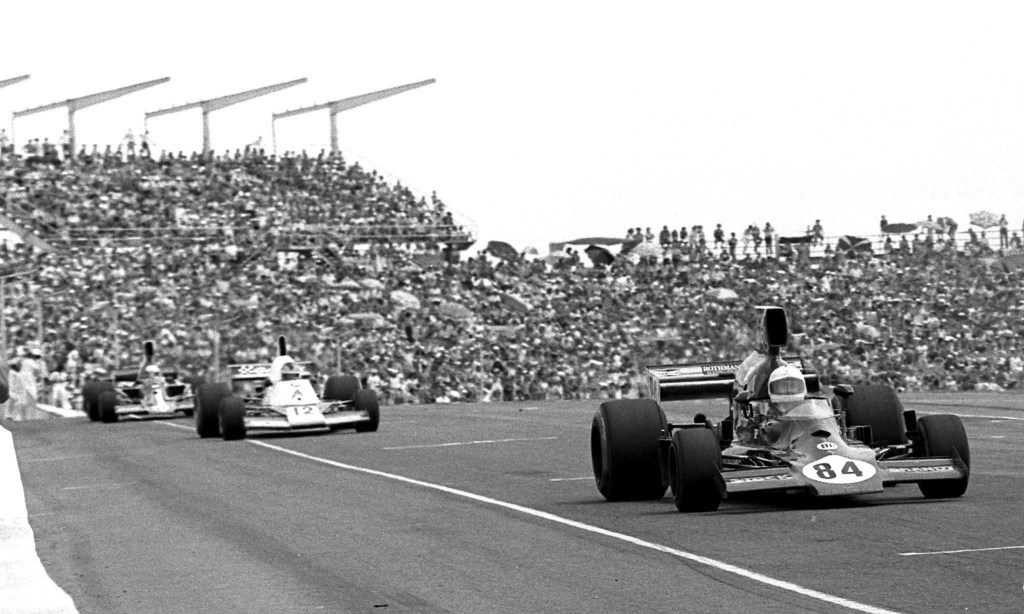
Warwick Brown, Racing Team VDS Lola T430 Chev gets the jump from pole here at the Surfers Paradise, Rothmans International Series round in February 1977. Quite where Peter Gethin and Vern Schuppan – second and third on the grid – are out of shot I’m intrigued to know. John Leffler is in the white Lola T400 Chev with the partially obscured Alfredo Costanzo’s red Lola T332 Chev behind him. The white helmeted dude behind Brown is Alan Jones aboard Kevin Bartlett’s T332. The Jones boy had crashed and written-off his newish Sid Taylor-Teddy Yip Lola T332C in practice so the pair did a lease-deal to allow AJ to race KB’s car. The blue machine to the right of Jones and back is John Goss’ Matich A51/A53 Repco-Holden.
Alan Jones blasts down Surfers main straight in Kevin Bartlett’s Lola T332 Chev HU22, fifth place (M Strudwick)Goss’ fourth placed Matich A51/A53 Repco Holden. #005 is one of the two A51s FM took to the US in 1973, and later updated by Goss and Grant O’Neill to A53 side-radiator – and the rest – specifications. This is Goss’ ’76 AGP winning chassis (M Strudwick)Duulling T332s; great Kiwi Graeme Lawrence HU28 in blue, tenth place, and great Italian/Australian Alfie Costanzo’s ex-Bob Evans HU36 in red, DNF engine. Lola perves will note the 332C factory engine cover come air intake on Alf’s car compared with the very neat one produced by Graeme and his crew in NZ – always distinctive on this car (M Strudwick)
Brown won the race from pole, Peter Gethin’s VDS Chevron B37 Chev was second – the budget required to maintain adequate spares for two different makes within the one team doesn’t bare thinking about – then Leffler, Goss and Jones.
It was a great Rothmans International Series, the three big international Aussies at the time were Jones, Brown and Vern Schuppan, who raced a works Elfin MR8C Chev. The strongest locals were Goss, reigning Australian GP winner, the Lolas of Bartlett, Leffler, Costanzo and Max Stewart, plus John McCormack’s fast but brittle ex-F1 McLaren M23 Leyland.
Brown won two races, Surfers and the AGP at Oran Park, the opening round on February 6. Jones – on the front row alongside poleman Brown – jumped the start at Oran Park by a fortnight, so was pinged a one-minute penalty which he could not make up, so the AGP went to Brown, from Gethin, Goss, Jones and Schuppan.
Karma ruled in that WB got the AGP win he should have had in 1974 at Oran Park, and Jones got his at Calder in 1980. That day he disappeared into the distance in the Formula Libre event aboard one of his works Williams FW07 Fords.
John McCormack tips his one-of-a-kind ex-F1 McLaren M23 #2 Repco-Irving-McCormack Leyland into the harry-flatters-in-top big-balls right hander under Dunlop Bridge Last man standing in an open-face helmet at this level. The integration of the Leyland P76 aluminium V8 into the space usually occupied by a Cosworth DFV was superbly done, without butchery to the chassis. No matter what they did to that motor, new heads and all, it was always a Hail Mary jobbie by the mechanics as they waved J-Mac onto the circuit. He was 12th and last at Surfers. Still, he won the 1977 Gold Star with it (M Strudwick)The business end of Max Stewart’s Lola T400 Chev, HU3. DNF dropped valve. MS probably won more races than anyone else on the planet in a T400, including the 1975 AGP – at Surfers – in HU2. Max got better and better as he aged, but died in this car at Calder a month later, March 16. The saddest day I’ve ever had at a race track (M Strudwick)John Leffler in the gorgeous Grace Bros (chain of NSW department stores) liveried Lola T400 Chev HU15, third place. Won the 1976 Gold Star in it (M Strudwick)
Surfers was the second round, the circus then travelled 1,750km south to Sandown Park in Melbourne’s southern suburbs from the Gold Coast. During that week Sid Taylor brought a replacement T332 to Australia for Jones, who put it third on the grid behind Gethin and Schuppan. Brown shoved the nose of his Lola under the Dandenong Road fence during the warm-up lap, so the man in grid-slot four couldn’t take the start.
Jones jumped Gethin and Schuppan at the drop of the flag – remember those? – but one-by-one, in turn, each of Alan, Peter and Vern retired with overheating, fuel pressure and engine failure respectively. Max Stewart took a popular win from Costanzo, Garrie Cooper in the Elfin chief’s MR8C Chev, Dave Powell in the very first Matich A50 Repco-Holden and McCormack’s McLaren, seven laps adrift.
Off to Adelaide for the final round on February 27, Jones finally won the round he had been threatening to do from the off. He was awesome to watch in these cars, thrilling.
Other than those who had last seen him compete at Sandown in the 3-Hour Production Touring Car race in 1968 (second in a Holden Monaro GTS327 shared with Clive Millis), it was the first time Australian fans had the chance to see him in action. He had been paying his dues in the UK and Europe climbing the greasy-pole in the interim. As a kid, Jones was a silver-spoon-special but by the time he embarked on his racing career, father Stan’s money was long- gone. Jones did it the hard way.
Jones was on pole at Adelaide International, from Brown’s repaired Lola T430 by a half-second, and won the hot race from Brown, Goss, Gethin and Stewart.
Brown won the 1977 Rothmans International Series with 24 points from his team-mate Peter Gethin’s 15, and Alan Jones, third on 14 points.
Peter Gethin in the VDS Chevron B37 Chev #37-76-01, second place. Some of you may have seen it raced by Gethin and Pilette in the US, some by Gethin in Australia and some by Bruce Allison in Australia and in the UK in the 1977 UK Group 8 Championship. Bruce did so well that year he won the premier Grovewood Award (M Strudwick)The one-off Jaime Gard built Gardos OR2 Repco Holden was built for Perth entrepreneur Don O’Sullivan. Here, Chev powered, it’s being fettled for Adelaide driver Chris Milton (M Strudwick)Garrie Cooper, Elfin MR8C Chev #8761. Pretty much the equal of the best F5000s, the three MR8s were raced with success by Vern Schuppan, John Bowe, Larry Perkins and James Hunt (M Strudwick)
Formula 5000 was at a crossroads when it was shot in the head at the end of 1976 by the Americans. They wanted Can-Am type crowds, so they ditched F5000-Formula Lola and created…central-seat sportcar-Formula Lola. The Lola T332 had been the star of the show since 1974, and the T332 decked out in a less attractive frock remained the star of the show – as the T332CS/T333CS – into the late 1970’s.
Those other countries who had F5000 as a premier/key category therefore had decisions to make, car constructors would react accordingly and change their focus as the biggest market changed direction.
In our neck of the Tasman-woods the Kiwis jumped with Formula Atlantic as their national premier class, while Australia stuck with F5000 for waaaay too long. New Zealand got the very best of Formula Atlantic chassis diversity and young thruster drivers from the US and Europe, by the time Australia really committed to Formula Atlantic/Pacific, the chassis interest was gone, it had become Formula RT4 (Ralt).
Tasmanian racer David Powell aboard the very first F5000 Matich, A50 #001 Repco Holden. FM’s 1971 AGP and 1972 Gold Star winner (M Strudwick)American racer Ed Polley’s Polley EP1 #76-13, Lola T332 copy. Polley had a background in big bore sports cars and sprint cars before graduating to F5000 in the US (M Strudwick)Goss, A51/A53. Relatively light car, the flat plane crank Repco’s gave 520bhp without loss of their legendary flat-fat torque curve. Repco Engine Developments exited Australian motor racing in July 1974 so development of this engine, and then new Repco Leyland V8, stopped then. Phil Irving/John McCormack later evolution of the Leyland unit duly noted (M Strudwick)
Credits…
Michael Strudwick, oldracingcars.com
Tailpiece…
(M Strudwick)
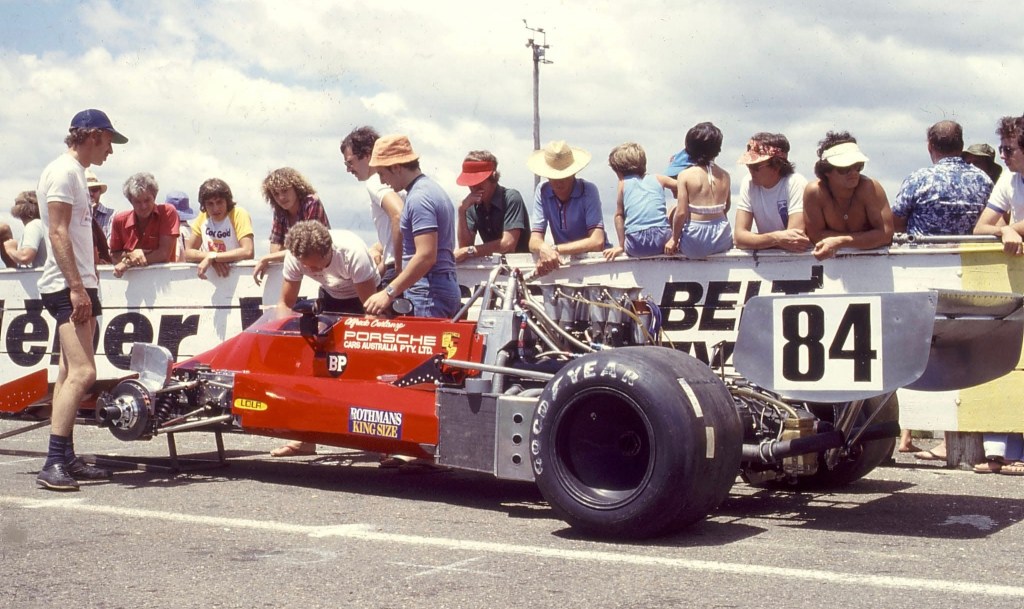
Warwick Brown’s VDS Lola T430 Chev #HU2 in the Surfers Paradise pitlane.
VDS bought two new T430s for the 1976 US F5000 Championship. Brown raced this car twice in the US, then throughout the ’77 Rothmans before HU1 and HU2 were acquired by Australian Porsche importer/racer/team owner – and thoroughly great bloke – Alan Hamilton at the end of the series.
‘Hammo’ raced HU2 for the balance of 1977 and into 1978 – Derek Bell’s drive at Oran Park in the ’78 Rothmans round duly noted – until nearly killing himself in it in a high speed accident at Sandown’s Causeway during the ’78 AGP. While Hamilton survived, HU2 was broken in two.
HU1 (below) was then built up by the Porsche Cars Australia crew led by Jim Hardman, and raced by Alf Costanzo to many race wins, and one Gold Star for Hamilton (1980) in a long relationship which also achieved much success with a McLaren M26 Chev and several Tiga Formula Pacific chassis.
The Hamilton/Costanzo T430 HU1 being tended to at Calder circa 1979-80 (M Strudwick)
Lola returned to the brew which started their F5000 run of success when they married an F2 T240 chassis with a 5-litre Chev V8 and Hewland DG300 transaxle to create the T300 raced by Frank Gardner in later 1971. Gardner, then Lola’s development driver/engineer and works driver, and Lola’s Bob Marston concepted the T242 prototype, and T300 production models.
The 1976 T430 – nicknamed The Flying Bracket by VDS mechanics – was a blend of T360 Formula Atlantic chassis, 520bhp’ish 5-litre Chev and DG300.
The Americans were very attached to their T332s, even moreso after the initial lack of speed of Lola’s 1975 variable rate suspension T400, so they stuck with, or bought new T332/T332Cs rather than the T430, only three of which were sold – to VDS and Carl Haas. Lola’s T400 update kit worked, the two VDS cars were quick in Europe, as were Max Stewart’s and John Leffler’s in Australia, but the Americans weren’t convinced.
All three T430s are extant in New Zealand, where HU2 was reconstructed around its chassis plate which for many years was on the pinboard in Hamiltons’ Church Street Richmond office!
Alan Hamilton aboard the first of many serious Porsches he raced in Australia down the decades, the ex-works 904/8 ‘Kanguruh’ chassis # 906-007 at Calder in January 1966…
Norman Hamilton famously negotiated a franchise for Porsche in Australia, having been ’rounded up’ by one of the earliest 356s on a drive through the Swiss Alps. The business quickly prospered from its Melbourne base. This article is about the 906s raced by Norman’s son Alan from the mid-sixties to early-seventies and his career during that period.
He raced three such cars; 904/8 chassis # ‘906-007’ and two 906 Spyders; one during 1967 and another in 1971-72, the latter cars used chassis supplied by Porsche, but neither had a chassis number, giving more than one historian a headache or two…
Alan Hamilton was born on 29 July 1942. After attending Camberwell High School in Melbourne’s leafy eastern suburbs, he joined the family firm, which was to expand hugely over the ensuing decades under his leadership. A competition licence quickly succeeded his road licence at 18, initial competition exploits were in a VW contesting trials and gymkhanas. A 1958 Porsche 356 Super followed; he competed in this standard car at country meetings and hillclimbs. A 1959 Convertible followed, which was also successful.
In early 1965 Hamilton headed for Europe including a stint working in the Porsche factory, the 904/8 Bergspyder was purchased during that trip and shipped to Australia for the 1966 season, clearly a step up in performance for the young driver…
Majestic shot of a fabulous road racing circuit, ‘Long Bridge’ Longford Tasman Meeting 1967. Bob Jane leads Noel Hurd in Elfin 400 Repco and Elfin 400 Ford respectively. Hamiltons 2 litre Porsche 906 outgunned at this point by the 4.4 and 5 litre Elfins. (oldracephotos.com/Harrisson)
Porsche 906…
The 906 was produced for the 1966 World Championship of Makes. It was designed for the FIA’s Group 4 regulations, whilst modified variants of the car, using larger engines and/or cut-down Spyder bodywork, were entered in Group 6, the Sports Prototype category.
The 906 became the last street-legal pure racer built by Porsche. It replaced the successful ladder frame chassis 904 and was the first substantial product of Technical Director Ferdinand Piech’s new team at Zuffenhausen. The Porsche 904 had additional structural rigidity from its bonded-on fibreglass bodywork, while the new 906 featured a modern multi-tubular spaceframe chassis, with an unstressed fibreglass body.
The initial batch of 50 Porsche 906/Carrera 6 Coupes offered light weight, circa 1,300 lb (580 kg), a saving of around 250 lb (113 kg) compared to the similarly-engined 904/6.
The Porsche 901/20 6-cylinder lightweight racing engine was standard equipment, offering circa 220bhp on Weber carburettors. A handful of factory-entered works cars were powered either by fuel-injected versions of the 6-cylinder engine, or the flat-8 derived from Porsche’s F1 program, both engines air-cooled of course.
Porsche 906 Coupe Cutaway; multi-tubular space frame chassis, front suspension; wishbones and coil spring/dampers, rear; inverted lower wishbone, single top link, radius rods and coil spring/dampers. Adjustable bars front and rear. Rack and pinion steering. Six cylinder SOHC two-valve engine on carbs, 220bhp, five-speed Porsche’box with synchros, steel wheels, disc brakes. (Inomoto)
The 906 shape was developed in the wind tunnel, with a top speed of 170mph at Le Mans, amazing for a 2-litre car.
The cars made their international race debut in the 1966 Daytona 24 Hours, sixth overall and beating the Ferrari Dino 206 in the 2-litre class was the car driven by Hans Herrmann/Herbert Linge. At Sebring, Herrmann won the class again in a Carrera 6, this time co-driving with Gerhard Mitter and Joe Buzzetta, and finished fourth overall.
The Monza 1,000kms was dominated by 906s in the 2-litre class, this time with Herrmann/Mitter in a works entry leading home the customer car of Charles Vogele/Jo Siffert, these two cars placing fourth and fifth overall behind the victorious Ferrari 330P3 and a pair of Ford GT40s.
At the Targa Florio the 906 won outright, there Willy Mairesse and Herbert Muller co-drove the Swiss Ecurie Filipinetti car.
The 1966 Le Mans works, prototype Porsche 906LE Coupes finished in fourth-seventh places behind the leading trio of 7-litre factory Ford GT Mark IIs, outlasting all of the V12-engined sports-prototype Ferrari P3/4s, while the 2-litre Sports class was again dominated by a standard 906.
The Austrian 500kms event at Zeltweg saw Gerhard Mitter/Hans Herrmann and Jo Siffert (driving solo) finishing one-two.
In 1967 the 906 continued to be campaigned by prominent private entrants and drivers, while the factory team moved on to race larger-engined 907s on the relentless climb to development of the outright contender which finally won Le Mans for Porsche in 1970, the immortal 917.
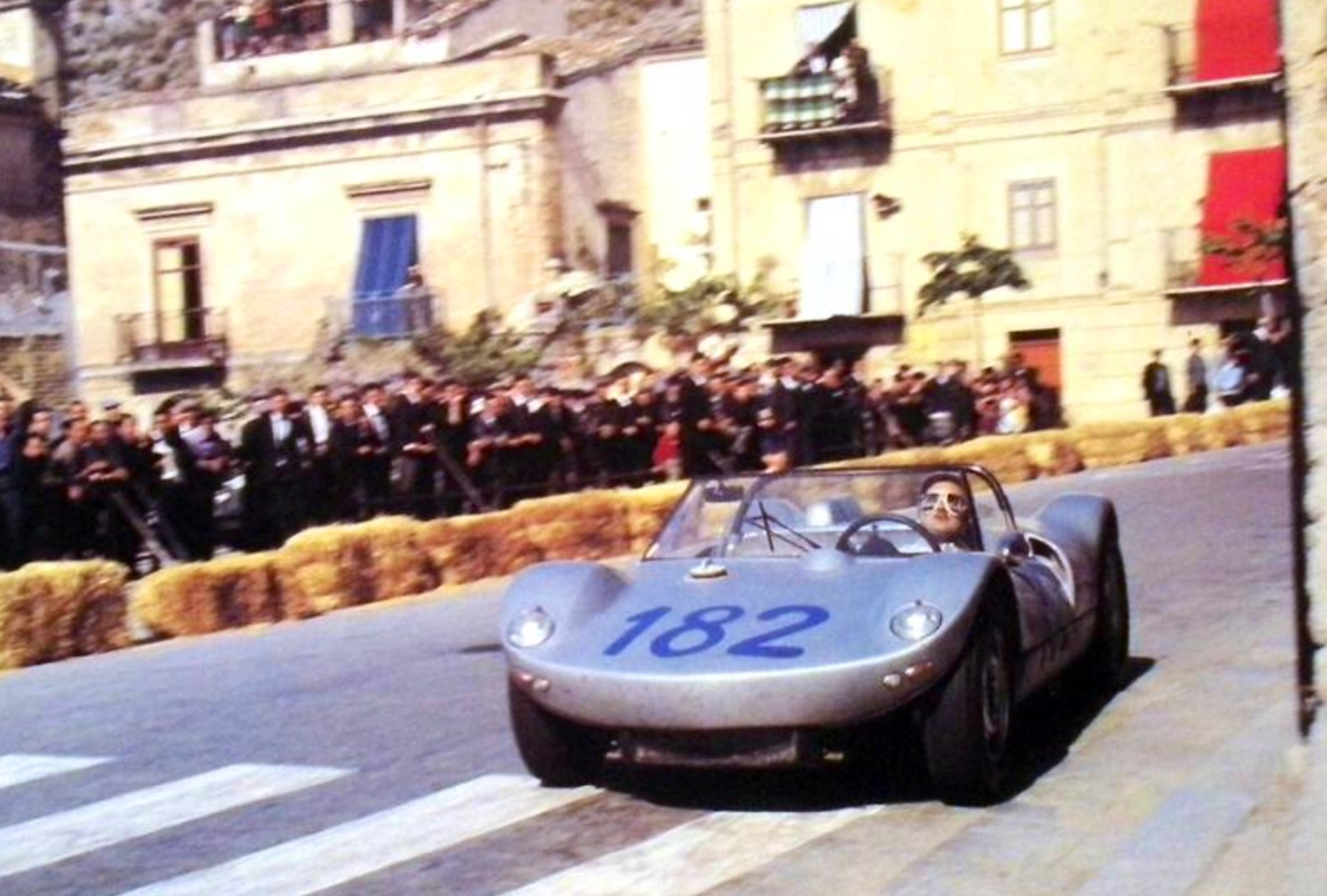
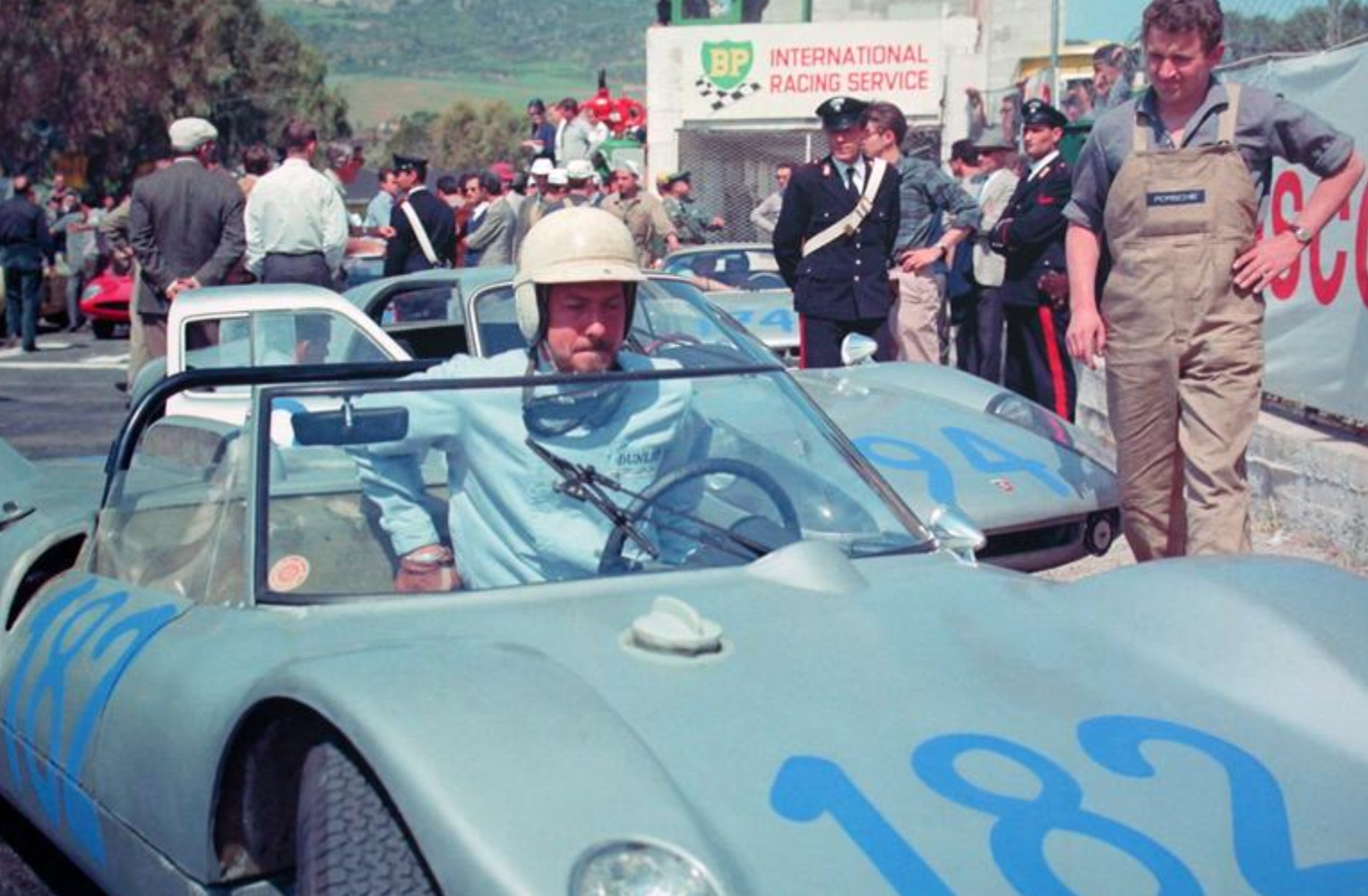
The Colin Davis/ Porsche 904/8 ‘906-007’ on the way to 2nd place during Targa 1965. The radical cutaway of the body at the front to reduce overhangs on narrow hillclimbs clear in this shot. (Martha)Jo Bonnier inserts himself into 904/8 # 906-007 during practice; both he and Graham Hill tried the car but elected to race a 904/8 Coupe #174, you can just see the nose of the car, with Hill at the wheel beside the Carabinieri. Car # 94 behind Bonnier is the #94 Pucci/Klass 904GTS. Porsche bought seven cars to the event, all but two T-Cars started. (Martha)
The Porsche 904/8…
The 904-based Bergspyders played an important test role in the evolution of the 904 to 906. The first appearance of these cars was at the Targa Florio on May 9, 1965.
All 904s came from the factory with 2-litre engines; four, six and eight cylinders. Generally the fours had 904 chassis numbers and the six-cylinder cars 906 chassis numbers. There was no rule though: the first prototype chassis 904-001 had a six-cylinder engine, the eight-cylinder coupes had 904 chassis numbers, whilst the eight-cylinder Spyders had 906 chassis numbers. Easy really!
Porsche built five 904/8 cars for factory use: chassis 906-003, 004, 007, 008, and 009. To be clear, whilst the chassis had the 906 descriptor, the cars used 904 ladder-frames, not the 906 spaceframe chassis.
All 904/8s had 2-litre flat-8 engines; the Type 771 1962cc engine, which was derived from the 1962 804 F1 car and produced circa 225bhp fed by Weber carbs.
The cars were made in two body variants. Chassis 003, 004, and 009 had the normal Spyder look of a Porsche of the period; the other two cars, 007 and ‘008, were more visually challenging, that is, ugly! The overhangs were shortened a lot for hillclimbing purposes.
Bergspyder, as a name, was a misnomer as the cars were raced as well as ‘climbed, they were nicknamed ‘Kanguruh’ (kangaroo) because of the nature of the cars roadholding, the lightweight cars with their firm suspension jumped about on poor roads.
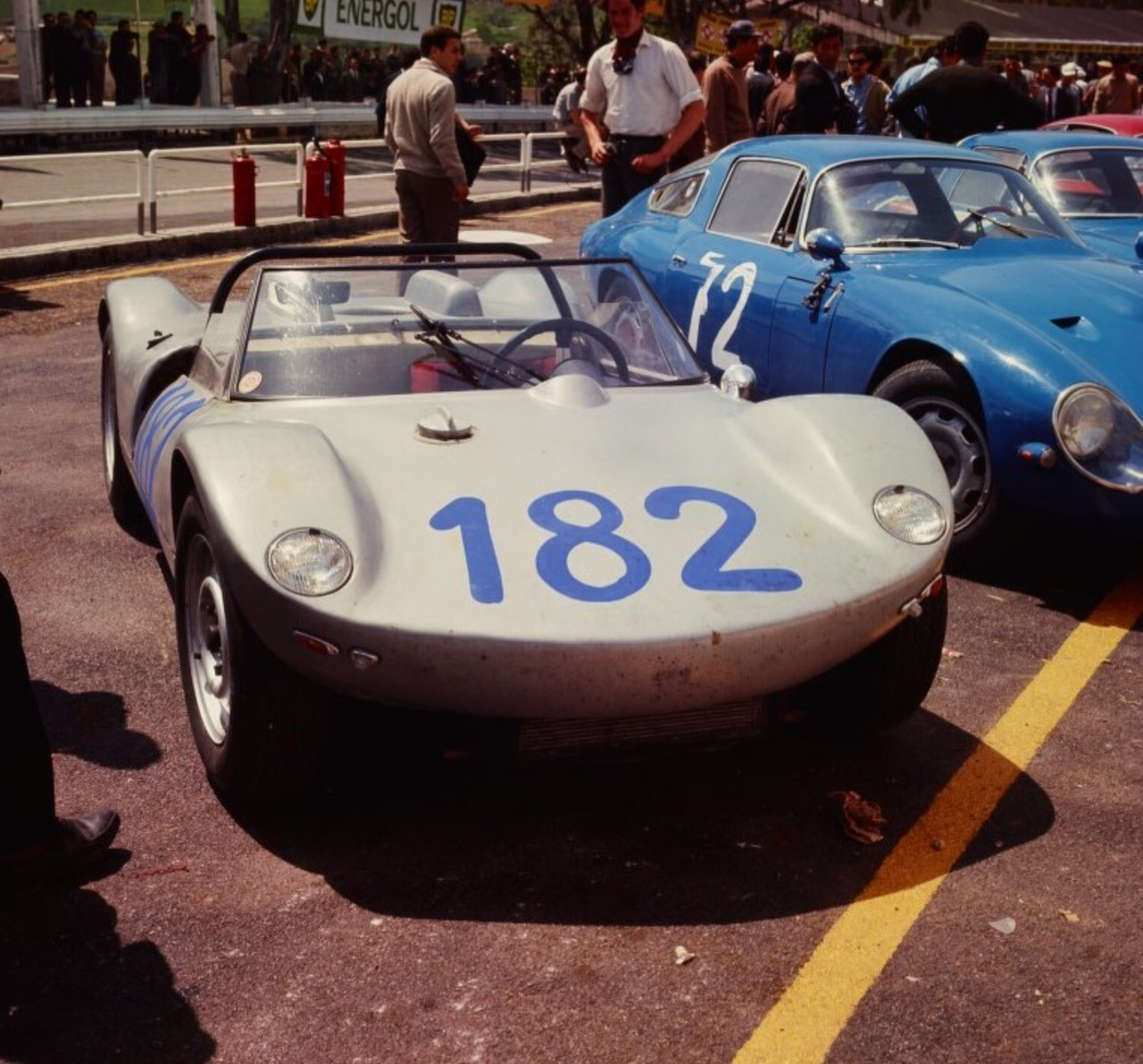
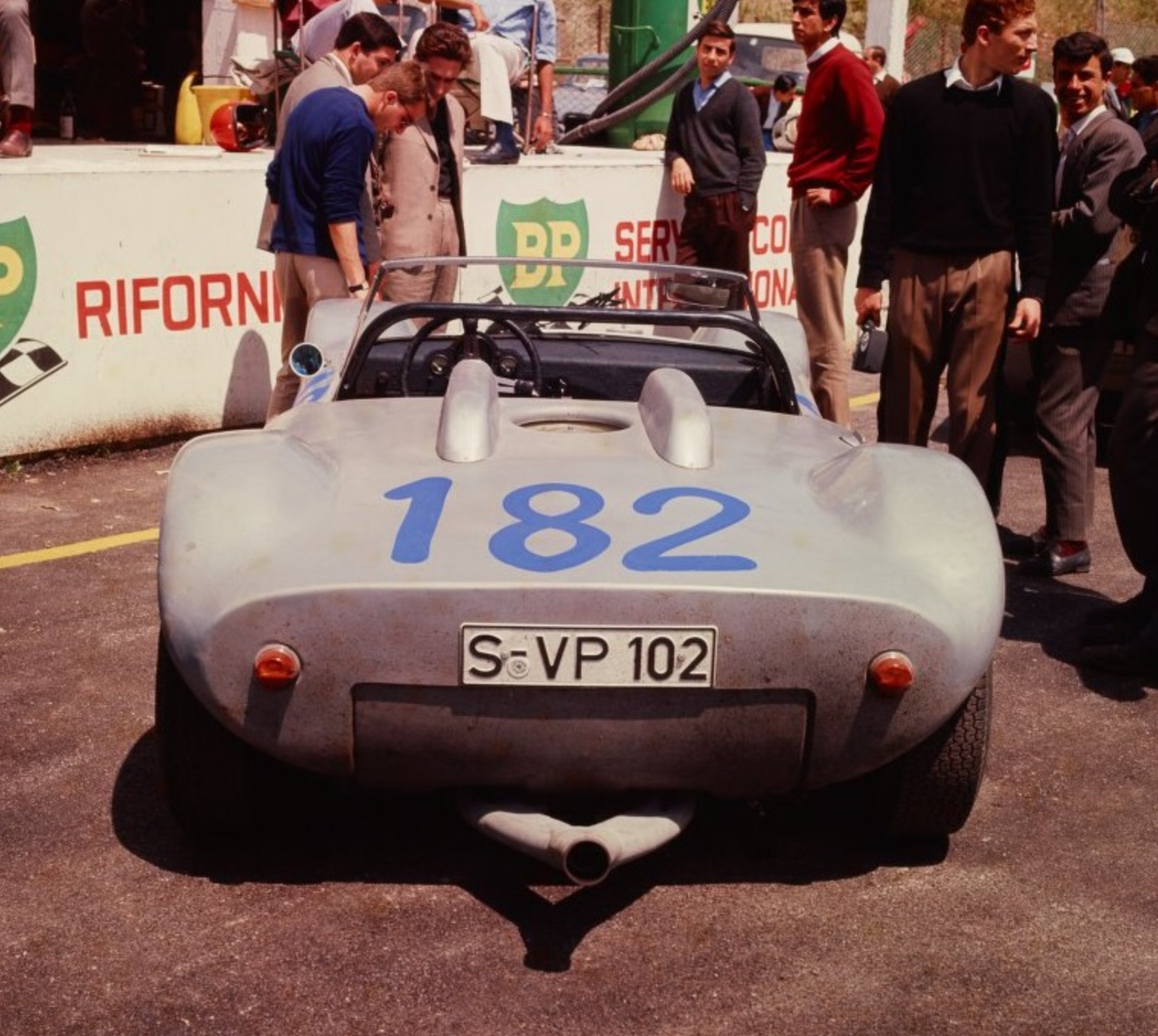
A couple of fabulous stationary shots of 904/8 ‘906-007’ at Targa 1965. #72 is the Alfa TZ1 of Panepinto/Parla DNF. (Martha)And back…by far the better angle! (Martha)The Porsche team arrive at Targa, May 1965. Cars are 904GTS Coupes and the Spyder, 904/8 906-007 chassis driven by Davis/Mitter. (PorscheAG)
Hamiltons 904/8 car chassis 906-007 was first raced at Targa 1965,
It finished second in the hands of Cliff Davis/Gerhard Mitter behind the winning Ferrari P2 of local lad Nino Vaccarella and Lorenzo Bandini. Gerhard Mitter then used the car to win the 1965 Rossfeld Hillclimb, a 6 km course near Berchtesgaden on 13 June. Next placed Herbie Muller was five seconds adrift in a standard Porsche 904GTS.
Carabinieri taking an interest in the second placed 904/8. # 94 is the works 904GTS of Pucci/Klass fifth, #106 is the Lancia Flaminia of Raimondo/Lo Jacono, which finished but was unclassified. Privateers the lifeblood of Targa! (Martha)Mitter on the startline of Rossfeld, Germany 1965. Win for 904/8 ‘906-007’. (unattributed)
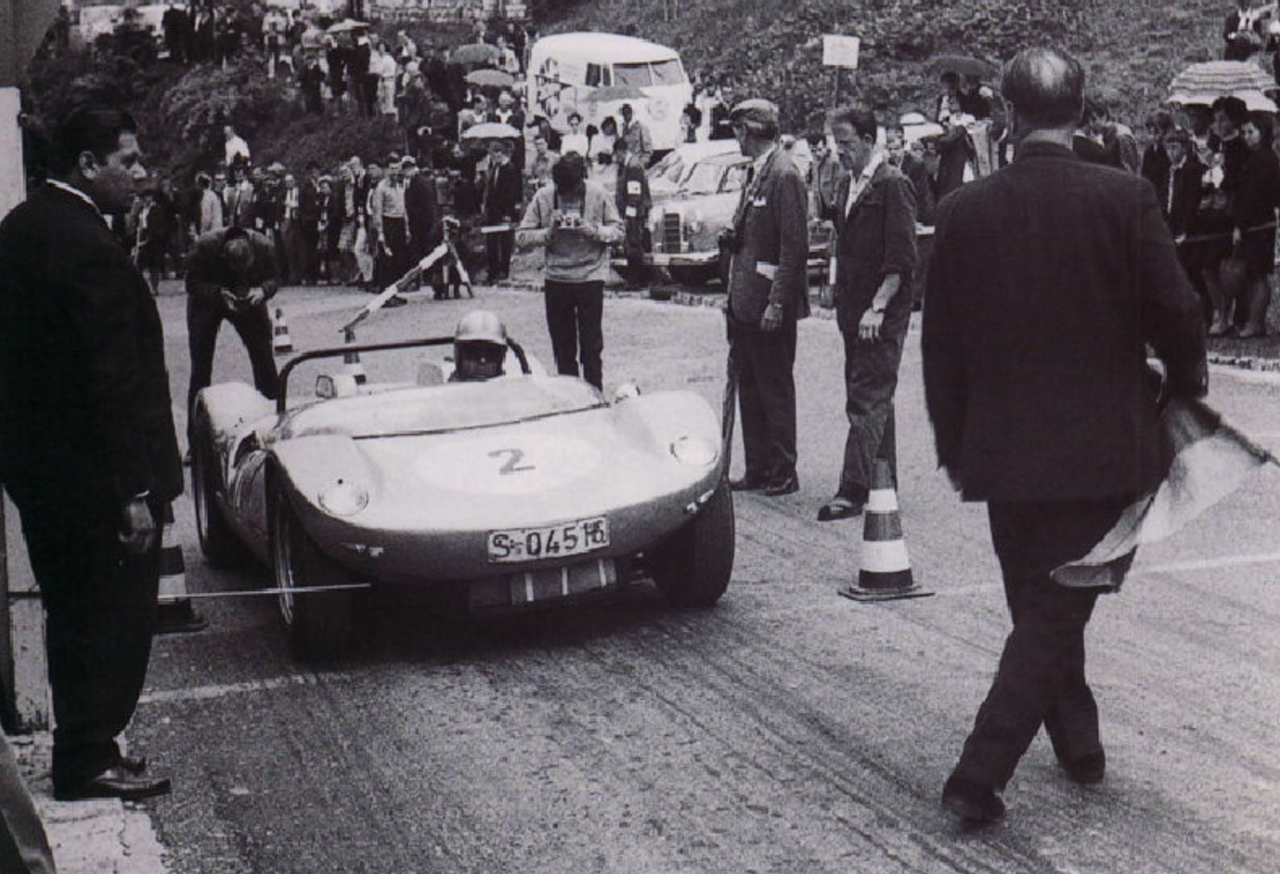
Further success followed at the Norisring, near Nurnberg, where Mitter raced 906-007 to victory on July 4, 1965, leading home two Elva BMWs. The car was then unraced, the last appearance of a 904/8 was in August, in factory hands, Porsche thereafter focusing on production of the new 906.
Alan Hamilton spotted the car in a corner of the racing department…
Car #2 Mitter at the Norisring, victorious in the 904/8 again. Car #3 is a Lotus 23 driven by Anton Fischhaber, #5 Chris Williams’ Lotus BMW. (unattributed)
Porsche 904/8 906-007 in Australia…
Interviewed by Journalist Barry Lake, Hamilton said the 904/8 ‘originally had a 2-litre 8-cylinder engine, but I bought it with a new 906 (6-cylinder) engine I had asked them to install. I imported that at the end of 1965 and raced it through 1966.’
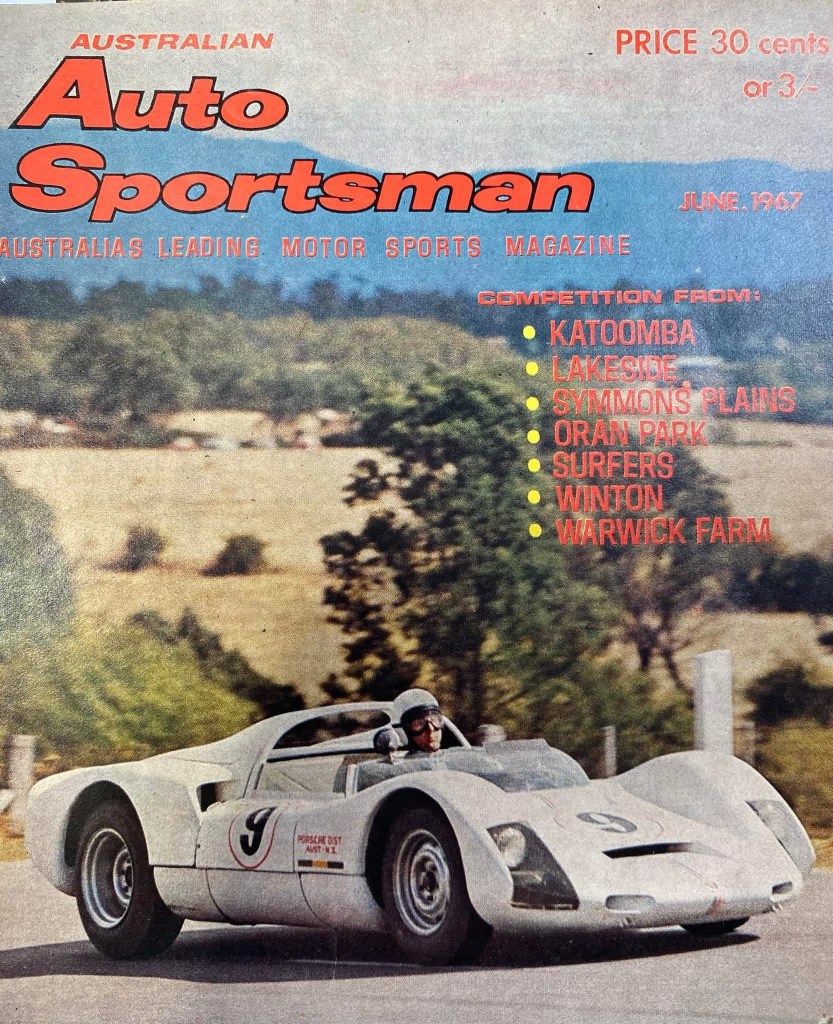
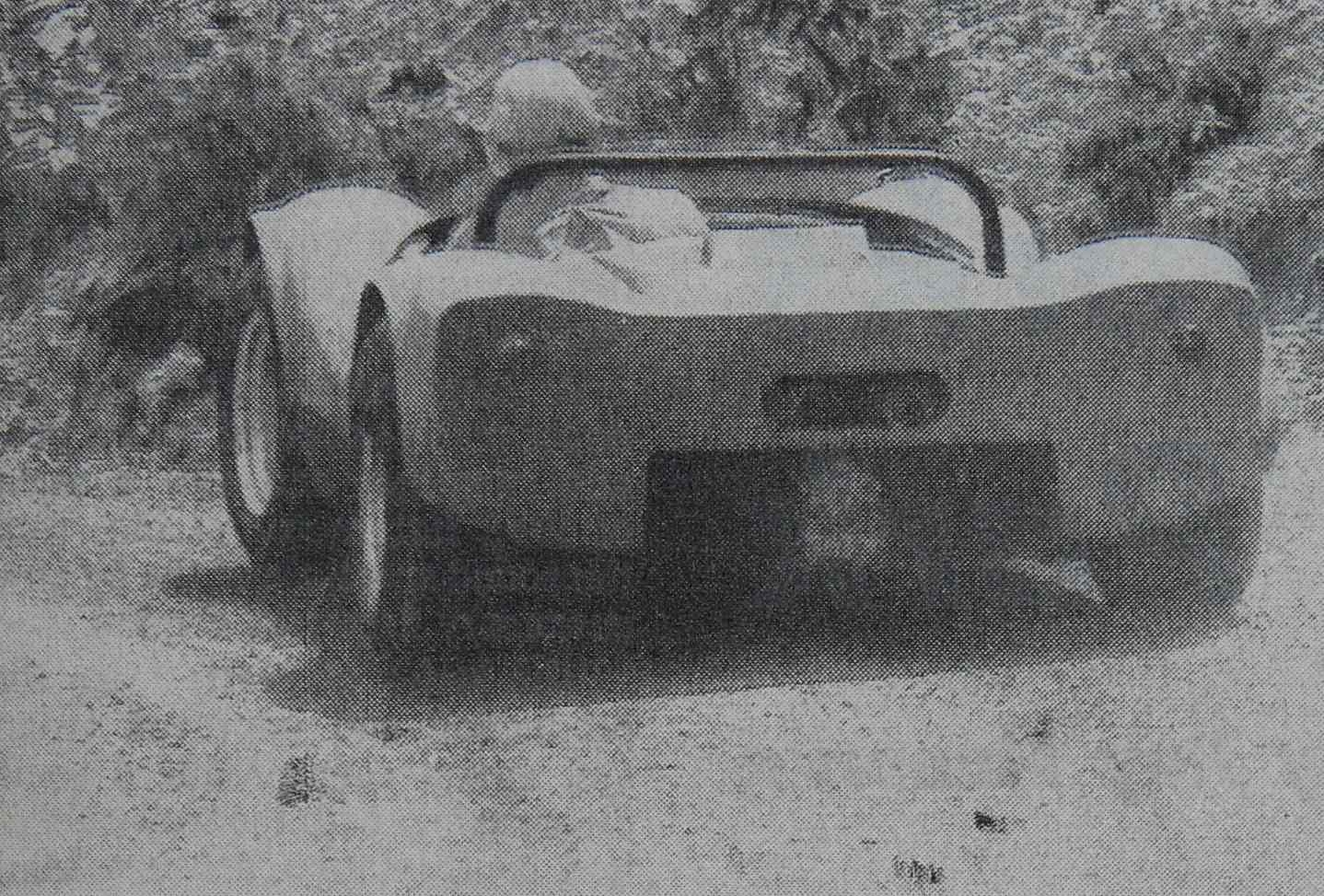
The car was first raced in Australia at Calder, Victoria on 16 January 1966, which is probably when the Autosportsman cover shot used at the start of this article was taken. The car then raced at the Sandown round of the Tasman Series, contesting the sports car events.
Taken across Bass Strait on the Princess of Tasmania with the rest of the Tasman Circus to contest the Australian Tourist Trophy at Longford, Hamilton was second in the race won by the much more powerful Elfin 400 Traco Olds V8 of Frank Matich.
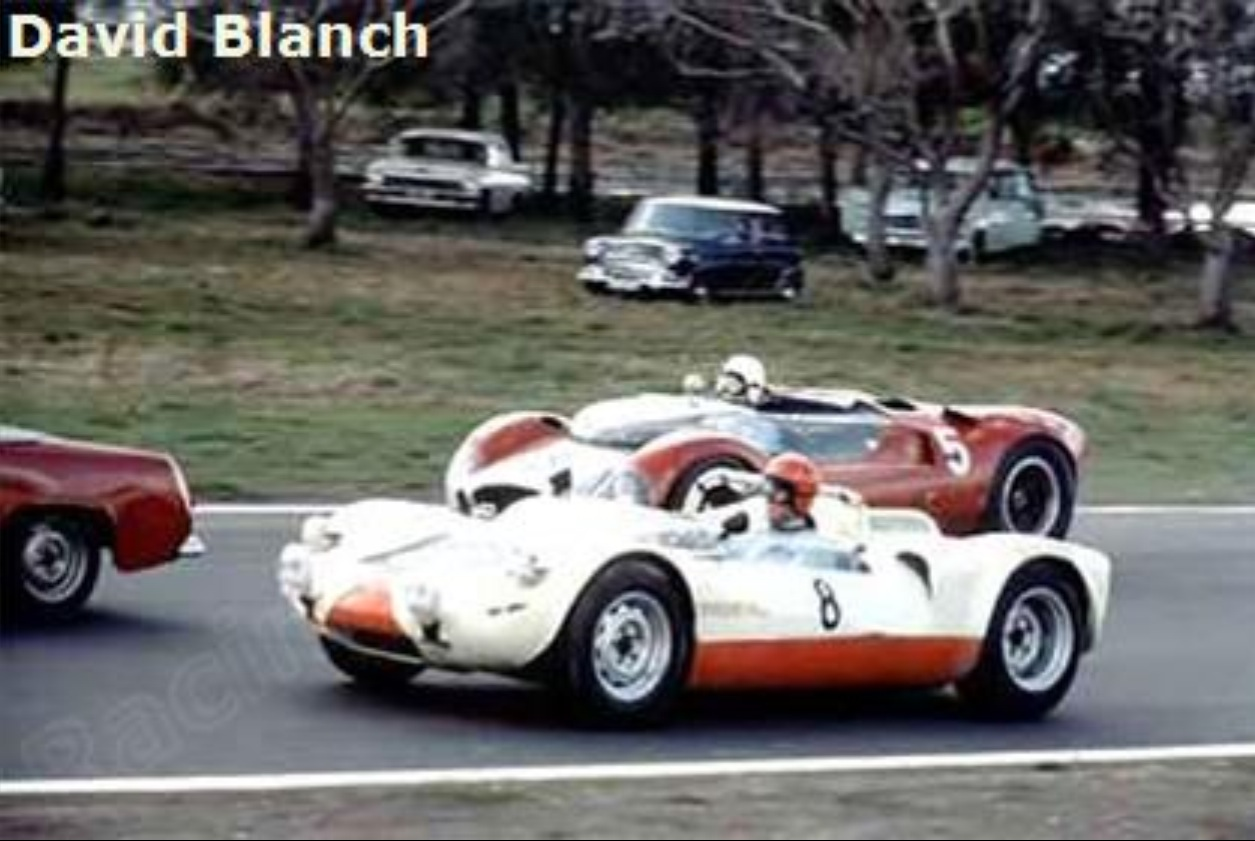
Alan Hamilton in his Porsche 904 906-007 in one of its earliest appearances in Australia, at the 1966 Australian Tourist Trophy, Longford in March 1966. Alongside is Spencer Martin’s Ferrari 250LM and on the far side Frank Matich, in the victorious Elfin 400/Traco Olds. Hamilton was second, Martin third. (Ellis French)Alan Hamilton navigating Surfers Paradise traffic during the 1966 12 Hour. Porsche 904 906-007. Car #5, the ex-Moss/Stillwell Cooper Monaco Olds of Osborne/Carter/Gibbs. (David Blanch)
The 904 quickly became one of the fastest sportscars in the country, fourth in the 1966 Surfers Paradise 12 Hour with a 2-litre car was a top result. Alan shared the 904 with Melbourne driver Brian ‘Brique’ Reed. Jackie Stewart and Andy Buchanan won in the Scuderia Veloce Ferrari 250LM- I wrote an article about this Ferrari a while back, click here to read it; https://primotipo.com/2014/07/03/pete-geoghegan-ferrari-250lm-6321-bathurst-easter-68/
The Hamilton 904 combination were also first in the 1966 Australian Hillclimb Championship at Collingrove, South Australia, the Victorian Sports Car Championship at Sandown and the South Australian Sports Car Championship at the Mallala ex-airfield circuit.
Towards the end of 1966 the Porsche workshop in St Kilda, Melbourne started to transfer the mechanicals of the Kanguruh 904/8 906-007 to a new 906 chassis.
Alan Hamilton, ‘Later (that is after the 904/8 was in Australia) I imported a new 906 chassis and body and put the mechanicals of the Targa car in that’.
‘Then Jim Abbot bought the Targa car (chassis 904/8 906-007) and fitted a ZF gearbox and 289 Ford V8 engine. His estate or perhaps Jim himself shortly before he died, sold the car to Murray Bingham in this form and it became the Bingham Cobra.’
Longford March 1966, second in the Australian Tourist Trophy. 904 ‘906-007’. (oldracephotos.com/King)Alan Hamilton ‘fairly hooting through here, scary to watch’ in the view of the photographer. Templestowe Hillclimb, outer Melbourne 1966. 904 906-007. (onelung)Another shot of Hamilton in the 904 at Templestowe Hillclimb, 11 September 1966, he broke the climb record on the day. (Stephen Dalton Collection)
Hamilton; ‘Years later, Pat Burke bought the car and sent it to Germany where it was restored to its original 904/8 Targa Florio specification. After Pat Burke fell on hard times it was auctioned at Monte Carlo. I think a man in Sydney bought it, but I have no idea who has it now.’
Lets go back a step to the acquisition of the chassis and related parts by Jim Abbott.
Abbott was a driver, owner of Lakeland Hillclimb in outer Melbourne, publisher of motor racing monthly Autosportsman magazine and promoter of an annual Motor Racing Show in Melbourne.
In 1966, 1980 World Champion Alan Jones, was trying to establish a foothold on the motor racing ladder in the UK, wheeling and dealing in cars and campers to provide the money to do so. He acquired an ex-works Sunbeam Tiger and, knowing Abbott had an interest in such cars, sold it to him. The car was raced and ‘climbed’ by Jim and engineer Paul England before Abbott decided it would make a nicer road car than a racer. He swapped the Shelby-modded 289cid V8 for a standard engine and looked around for a chassis into which to plonk his nice, powerful Ford Windsor small-block V8.
Various Coopers were considered before a deal was done with Hamilton to acquire the Kanguruh 904/8 906-007.
A suitable ex-Cooper Maserati F1 ZF 5DS 25 transaxle was also acquired. The engine and box (the latter requiring some modification in terms of clutch componentry by Eddie Thomas) was ‘dropped’ into the Porsche chassis at Hamilton’s St Kilda workshop.
A little cutting and shutting of the chassis crossmember was needed to fit the V8. A sub-frame was added around the engine to maintain chassis stiffness, but in essence, the swap was relatively simple. Stiffer springs and shocks were fitted as the Ford cast iron lump was around 200lbs heavier than the svelte, alloy Porsche Flat 6. Driveshafts were suitably strengthened by Paul England Engineering.
The original rear bodywork was used but at the front, much bashed and repaired a local specialist fashioned a nose much more attractive than the original, the screen, a concoction of a speedboat parts, met at each end with aluminium panels was not quite so pretty.
Jim Abbott in 904 ‘906-007’ now called a ‘Porsche Cobra’ in deference to the 289cid Ford engine installed. This shot is probably at Lakeland in outer Melbourne, a venue owned by Abbott. Front of the much bashed and repaired body re-worked. (Autosportsman)Fairly scratchy shot shows the ZF 5DS 25 beefy gearbox if not the engine. Chassis other than minor mods to fit the engine, as built by Porsche. Front and rear suspension sold with the car by Hamilton to Abbott also standard. (Autosportsman)
Abbott’s objective was not to build an outright car but rather a very fast sports car which could be ‘raced, sprinted and climbed’. The completed machine made is debut at the Light Car Club of Australia’s annual members meeting at Sandown on Melbourne Cup Day in November 1967. ‘Red Handed’ won the ‘Cup at Flemington that day! More importantly, Abbott set a sub-13-second standing quarter mile at Sandown, also primarily a horse racing venue.
The car was quickly under the times set by the class record holder, a Cooper Jaguar at Templestowe Hillclimb and was running fourth in the Winton Trophy at the picturesque Benalla country Victorian circuit when the car lost its water. Initial troubles centred around the cooling system, which were solved by fully rebuilding it.
Jim Abbott, ‘Porsche Cobra’ 904/8 906-007, Lakeland Hillclimb 1967. These are scratchy shots but included for the sake of completeness. Abbott looks huge in the cars cockpit. The screen is from a boat. (Autosportsman)Jim Abbott, Porsche Cobra 904/8 906-007, Lakeland Hillclimb 1967, 2 years before victorious at the much more grand, Rossfeld, Germany hillclimb. (Autosportsman)Tom Sulman in the Porsche Cobra at Huntley Hillclimb, NSW on 1 June 1969 (T Arts)
Abbott did not campaign the car for long before his untimely death, it was then sold to New South Wales veteran driver, Tom Sulman who raced it in 1969.
Murray Bingham then bought 904/8 906-007 and used it very successfully for over 10 years. The old chassis won the Australian Hillclimb Championship again in 1972, a three-round Series that year. (Hamilton won the 1966 title in it at Collingrove).
Murray Bingham in 904/8 906-007, then known as the ‘Bingham Chev’ in, probably, 1972 at Collingrove, Angaston, SA. Check out the downforce being sought front and rear. (John Lemm)
A ‘Manx’ body replaced the original, and the Ford Cobra engine was updated with an ex-Gary Campbell, Alan Smith-built Chev F5000 engine out of a Lola T300. Bingham won the 1973 NSW Hillclimb Championship in Chev-engined form, the 1971-72 NSW titles Ford Cobra-engined.
The much raced car finally passed into the hands of Pat Burke who restored it before it was sold upon the demise of his business empire in the 1980s as described by Alan Hamilton earlier in the article.
I am uncertain of the cars current owner.
Murray Bingham in 904/8 906-007 in its hillclimbing years, King Edward Park, Newcastle, NSW. Car known as ‘Bingham Cobra’ and ‘Bingham Chev’ when fitted with Ford 289 and Chev F5000 engines respectively. ‘Manx’ body (unattributed)Australian Autosportsman June 1967 cover depicts the Alan Hamilton Porsche 906 Spyder at Longford in 1967. (Stephen Dalton Collection)
Hamilton’s first Porsche 906 Spyder…
Hamilton’s new 906 chassis came with bodywork, suspension and brakes.
904/8 906-007 donated its engine and gearbox and some other components, as the narrative and photos show, the 904/8 906-007 car was still as built by Porsche, less the engine and box. Alan is a big, tall bloke so he elected to build the 906 up as a Spyder rather than a standard 906 Coupe in order to ease access and egress and more easily see out of the car.
At this point we have two cars: the 904/8 chassis car 906-007, now called ‘Porsche Cobra’ and fitted with a Ford engine and ZF gearbox and a 906 which was not issued a chassis number by Porsche, but which over the years assumed the 906-007 tag, which was built up as a Spyder, but which when restored in Germany in 2003-09, was rebuilt as a Coupe. This car now has a chassis 906-007 plate, at what point the plate was affixed is conjecture.
Both cars have elements of the original 904/8 906-007…
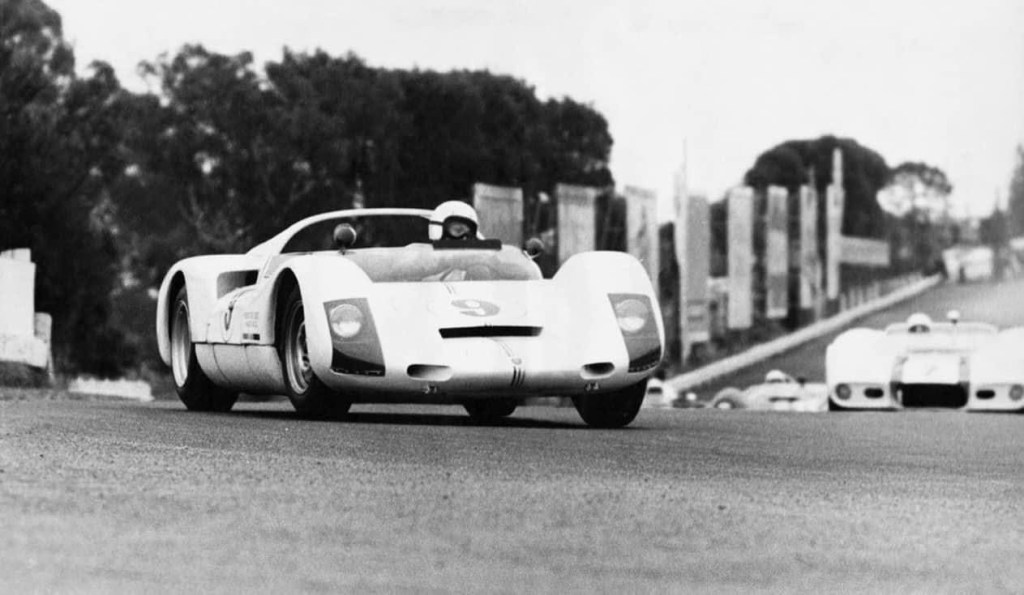
Another majestic Longford shot. Hamilton Porsche 906 Spyder 1967. (oldracephotos.com/King)
Back in 1966, none of these problems for future historians mattered to Hamilton; he had a new state-of-the-art 906 to contest Australian events.
As the recent article I wrote on the Frank Matich Elfin 400/Traco Olds makes clear, the light six-cylinder-engined Porsche was up against it with several very potent, light, well-driven V8-powered cars in the hands of Frank Matich, Niel Allen and Bob Jane in 1967. (Matich SR3 Repco, Elfin 400 Chev and Elfin 400 Repco, respectively).
The Porsche Team completed the build of the 906, and the original 904 chassis 906-007 was put out the back of their St Kilda workshop until acquired by Jim Abbott later in 1967.
The 906 Spyder made its debut in the sports car events at Sandown’s Tasman round in late February 1967. Hamilton took three class wins and a class lap record.
To Longford, the following weekend, the car was third outright. The following week, still in Tasmania, Hamilton raced the car at Symmons Plains, where he won his first race and was leading the Tasmanian Sports Car Championship when a conrod let go. Hamilton noted in his Autosportsman column that the engine had ‘done 14 months racing, 92 hours, so we are more than happy with its overall performance’, Porsche’s reliability is legendary.
In April, Hamilton contested the Victorian Sportscar Championship, winning his heat and finishing second outright and first in class; he also bagged the class lap record.
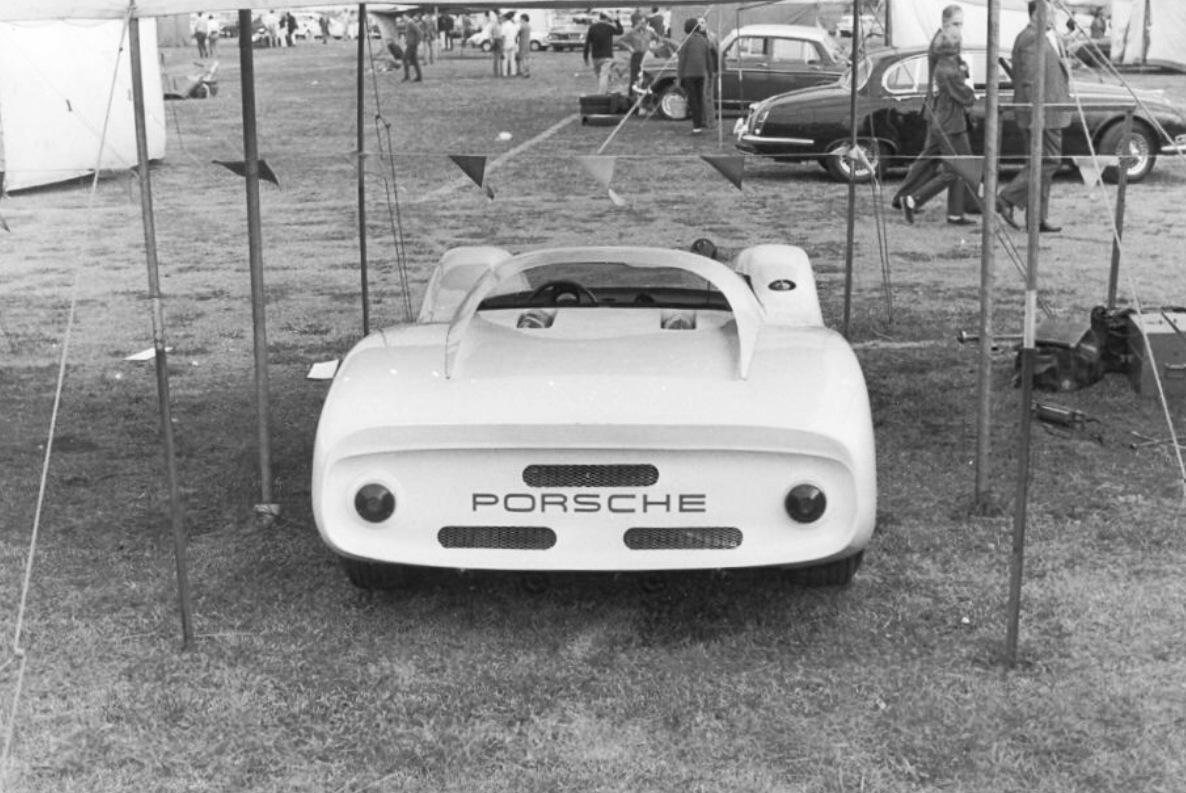
The Hamilton 906 in the Warwick farm paddock, May 1967. Note the ‘chin wing’ and pretty front of the car. (WOT)Sensational Bruce Wells shot of Hamilton contesting the RAC Trophy at Warwick Farm in May 1967, here in the Esses. Sans the wings in the paddock shot. Porsche 906 Spyder. (Bruce Wells/The Roaring Season)Warwick Farm 906 butt shot, May 1967. (WOT)
On 14 May, Hamilton contested the RAC Trophy at Warwick Farm where he finished third behind two powerful V8s. The dominant Matich SR3 of Frank Matich was getting in some valuable mileage before leaving to contest the Can-Am Series in this car, and Bob Jane’s Elfin 400, which, like the SR3, was powered by Repco’s new 620 Series SOHC, two-valve, 4.4-litre V8.
A week after the RAC Trophy, Hamilton contested the Australian Tourist Trophy at Surfers Paradise. This was a relatively easy tow from Sydney to Queensland’s Gold Coast and gave Hamilton valuable testing time at Surfers to fettle the car to suit the circuit for the international 12 Hour event in September.
Matich won again in his SR3 Repco, but Alan was second in the 906 and his 12 Hour co-driver Glyn Scott third in his Lotus 23B Ford. The other two outright sportscar contenders of that year, Niel Allen and Bob Jane’s Elfin 400s did not make the trip North.
Success followed in Victorian events at Calder and at Hume Weir on the Queens Birthday weekend, before taking the long haul back to Surfers Paradise for the 12 Hour event on the 3 September weekend .
Alan Hamilton awaits the rest of the grid at Hume Weir in 1967. Great little circuit built in a quarry created when land fill was excavated to create the Hume Weir Dam. Porsche 906 Spyder. Top shot shows the lines of this car superbly. (unattributed)Hume Weir, Queens Birthday weekend 1967. AH on pole in his 906, #6 is ‘Gold Star’ reigning national champion, Spencer Martin having his first drive of Bob Jane’s Elfin 400 Repco and the nose of Bevan Gibson’s Lotus 15 Climax FPF. (The Nostalgia Forum)
Hamilton’s co-driver at Surfers was Queenslands’ Glyn Scott, the duo finished third outright and first in class. The race was won again by the SV Ferrari 250LM, that year driven by the Australian duo, Bill Brown and Greg Cusack, Paul Hawkins and Jackie Epstein were second in Epstein’s Lola T70 Mk3 Chev.
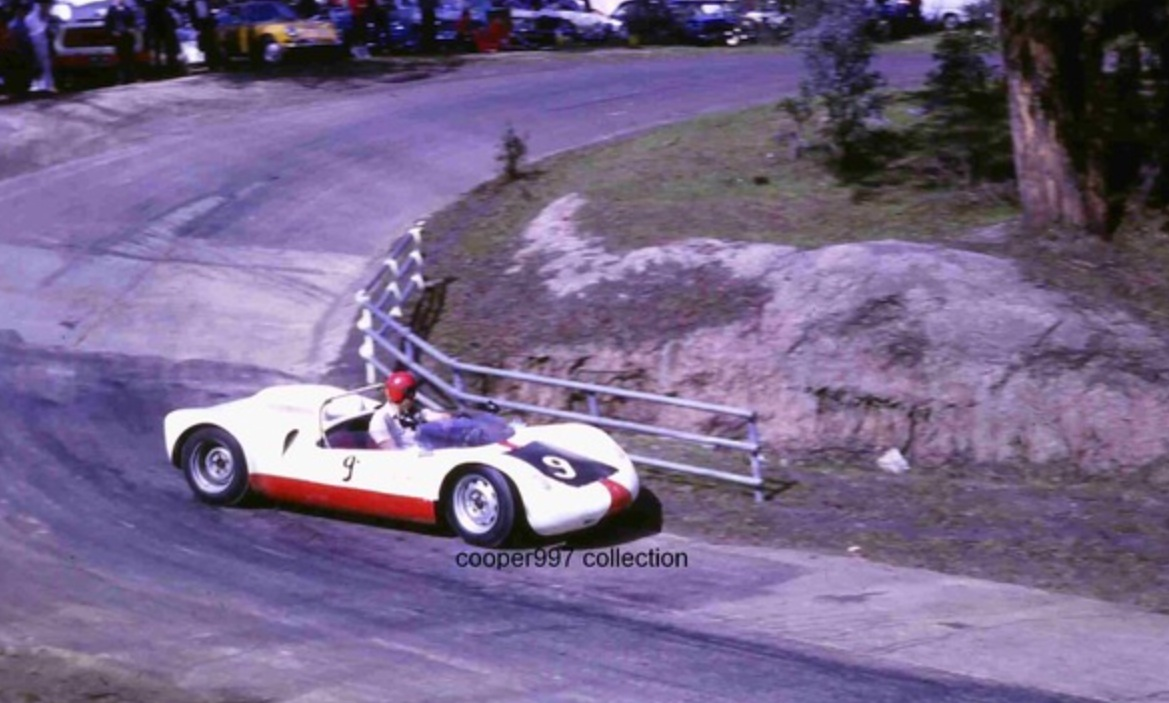
Alan Hamilton was very fast out of the blocks at the start of the ’67 Surfers 12 Hour in the #9 906. #1 is the second placed Lola T70 Mk3 Chev, with Paul Hawkins at the wheel, the winning Ferrari 250LM is alongside Hawkins. The Lotus Elan is probably the McArthur brothers’ car, the Datsun 1600 #29 the ‘works’ 1600 of Tapsall/Woelders DNF, and the Volvo P1800S driven by Keran/Bond/Winkless 10th. (unattributed)Hamilton corners the 906 at ‘Lukeys’ during the Surfers 12 Hour. (Peter Baldwin)Hamilton on the Collingrove Hillclimb startline in April 1967. He set a track record of 35.60 seconds in the 906 at this meeting. (John Lemm)
Another long tow to Mallala, South Australia, was rewarded with victory in the South Australian TT.
John Blanden noted the versatility of the car and driver, the 906 contested hillclimbs, still pretty important and sometimes televised, the car taking FTD at Templestowe in Melbourne’s outer east and second in the Australian Hillclimb Championship at Bathurst in November behind Greg Cusack’s Tasman 2.5-litre Repco powered Brabham BT23.
A successful year was capped with a win at Lakeland Hillclimb in the Dandenong Ranges, outer Melbourne in December.
Alan had a win at Lakeland Hillclimb close to home in December 1967 (G Fry)The Roxburgh/Whiteford Datsun 1600 ahead of the Cusack/Brown Ferrari 250LM and Hamilton/Scott Porsche 906 Spyder. Surfers 12 Hour 1967.(Ray Bell)
The 906 was advertised for sale in the November 1967 issue of Racing Car News, the car, according to John Blanden, having reached its Customs Duty limits. This taxation concession allowed Tasman Series competitors, for example, to avoid import duty by ‘exporting’ the cars each year to New Zealand. If exceeded, that is, the car stayed in Australia for longer than twelve months, the ‘fiscal fiend’, the taxman, had to be paid.
The car was sold to Richard Wong in Singapore and passed through many hands, including Macau businessman/racer/team owner Teddy Yip. As mentioned earlier in this article, Hamilton’s first 906 was ultimately restored as a Coupe, having been only raced by Hamilton as a Spyder…
Alan Hamilton, Porsche 906, Symmons Plains 1967 (HRCCT)
European Trip in 1968…
Hamilton spent most of 1968 overseas, much of it working at Porsche; he did manage to fit in the Nurburgring 1000Km, racing a 911S to 28th place with co-driver/car owner Hans-Dieter Blatzheim. The race was won by a factory Porsche 908 driven by Jo Siffert and Vic Elford.
Planning an all out assault on the 1969 Australian Touring Car Championship, Hamilton ordered a trick 911T/R, the car arrived early enough to compete in the 1968 ATCC, the last run to a one race format. Pete Geoghegan won the title again in his Mustang, Hamilton in the giant killing 2-litre 911 lost second place on the last lap due to a puncture, Darrell King’s Morris Cooper S just beat him to the Warwick Farm chequered flag.
Porsche still had some spare 906 chassis lying around the factory, one was offered to Alan, who was happy to oblige, he still had plenty of bits from the earlier cars so he could easily build up another car for competition back in Oz. This 906, just like the previous chassis he raced in ’67 did not have a chassis number.
Hamilton has his 911T/R in a beautifully balanced four-wheel drift during his run to third place in the one race Australian Touring Car Championship at Warwick Farm in September 1968. A flat tyre cost him second on the last lap. Pete Geoghegan won the title in his Ford Mustang. This car left Oz many years ago.(autopics.com.au)Alan Hamilton exiting Clubhouse Corner at Mallala on 16 June 1969 during the ‘South Australian Touring Car Championship’, round 3 of the ATCC in 1969. AH was second behind Pete Geoghegan, the first of four second places he achieved that year. The 2-litre 911T/R did not quite have the Mumbo to knock off the big Mustang. (Dick Simpson)
In the 1969 ATCC he came very close to taking the title with consistent second places, ultimately the championship was won by Pete Geoghegan by one point, in his Mustang, the fifth win in the event for the beefy, supremely talented Sydneysider. The battle went down to the wire in the final round at Symmons Plains.
In the middle of his ATCC campaign, Hamilton was recruited by ‘Big Al’ Turner to drive a factory Ford Falcon XW GTHO Phase 1 in the Bathurst 500 together with 500 debutant Allan Moffat that October.
Moffat was in good form having won the preceding Sandown 500 in his big Falcon. Still a young driver, Turner was keen to exploit Hamilton’s speed, smoothness and mechanical sympathy. It was the start of a relationship between the drivers which would be mutually beneficial over the next decade.
1969 was the famous Bathurst when tyres imported by Turner failed spectacularly. Moffat was called into the pits for a precautionary check after the tyres on the Brothers Geoghegan and Gibson/Seton cars failed. The Moffat/Hamilton duo were easier on the Goodyears than their teammates; the pitstop was unnecessary and probably the cause of the pre-race favourite Falcons losing the victory. The Holden Dealer Team Holden Monaro HG GTS 350 of Colin Bond and Tony Roberts won the race.
Moffat/Hamilton Ford Falcon GTHO, Bathurst 1969. (autopics)
In 1970, Alan didn’t contest the ATCC, but the second Hamilton 906 was assembled. The car had a standard 906 front clip, but, like the earlier 904/8 906-007 and 906 was a Spyder, the rear deck was modified locally with pronounced spoilers to provide some downforce. No wing though.
Minilite wheels replaced the factory steel wheels of the earlier cars. The machine was ready for the 1971 Australian Sportscar Championship, powered by a 2.4-litre twin-plug engine assembled locally from Alan’s cache of trick, Porsche bits.
Hamilton in his second 906 at Warwick Farm on 2 May 1971. The standard 906 front, Minilite wheels and modified rear deck are all clear. Like his earlier 906 this chassis was not allocated a number by the factory. (lyntonh)
Hamilton’s second 906 Spyder…
1971 was to be a big year of racing for Hamilton. In amongst the rapid growth of Porsche Cars Australia, a strong economy and global growth in the Porsche brand reflected in strong sales in Australia, Hamilton took the big step up to Australia’s premier single-seater class, F5000.
He purchased Niel Allen’s spare McLaren M10B Chev (#400-19) upon Allen’s retirement from the sport. (Ignoring Allen’s short flirtation with a Lola T300 12 months later). Kevin Bartlett bought Niel’s other M10B (#400-02), all these years later Hamilton owns both McLarens, they are being historic raced by Alf Costanzo. In the seventies and eighties Alfie was Hamilton’s driver in a swag of F5000 and F Pacific cars in which the little Italian born Aussie was prodigiously fast. A tangent too far for this long article!
AH in his McLaren M10 B Chev, F5000, Oran Park June 1971. (lyntonh)
Hamilton missed the 1971 Tasman Rounds, but both he and Bartlett had their cars ready for a full Gold Star campaign. Despite being a novice in these big, brutal, challenging cars Hamilton was immediately competitive, taking third places at Oran Park, Surfers Paradise and Mallala.
He was fourth at Lakeside, finishing the Series equal second with Bartlett in his M10B. Winner of the series was the speedy and consistent Max Stewart in his Mildren Waggott 2-litre in a final Championship victory for this superb Australian four-cylinder DOHC four-valve engine. Stewart progressed to an Elfin MR5 Repco at the end of the Series and was consistently competitive in the big cars for the rest of his career.
The Porsche Cars Australia transporter did plenty of miles from its St Kilda base in 1971 in pursuit of two national championships and the vast distances across the big Australian continent that entails.
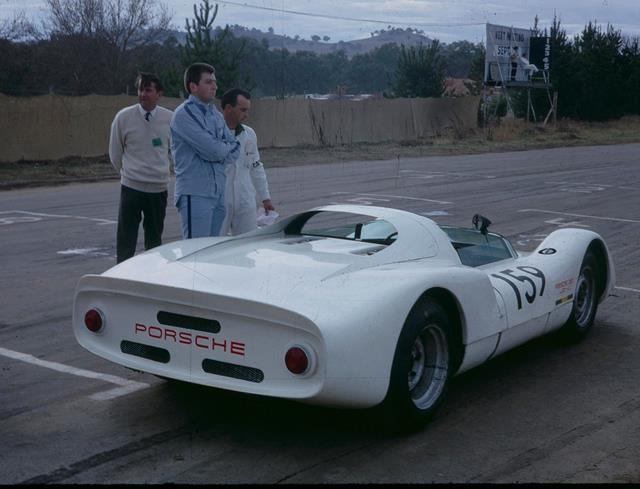
Alan Hamilton cornering his McLaren 911 style at Warwick Farm 1971, date unknown. Car is chassis ‘400-19’, Niel Allen’s spare built up by Peter Molloy and sold, together with his race chassis ‘400-02’ to Alan Hamilton and Keven Bartlett respectively. Full monocoque aluminium chassis, 500bhp fuel injected 5-litre Chev engine, Hewland DG300 gearbox…much more powerful than a Porsche 906! (unattributed)In the best of company during the 1971 AGP at Warwick Farm. John Surtees from Hamilton, Colin Bond and Graeme Lawrence. Surtees TS8 Chev, McLaren M10B Chev, McLaren M10C Repco and Brabham BT30 Ford. (lyntonh)Side on view of Hamilton’s 906 in 1971, here at the RAC Trophy meeting at Warwick Farm, Northern Crossing in May 1971. (lyntonhButt shot of the car, same day as above, the neat upswept tail providing downforce but also not too much drag given the little 2.4-litre flat-6 propelling it all…(lyntonh)
In 1971 Hamiltons 2.4-litre twin-plug Porsche 906 was as out-powered as the earlier cars were in 1966-67.
The fastest combination in the field was John Harvey in Bob Jane’s McLaren M6B Repco, a 5-litre SOHC 740 Series V8 producing around 460bhp@7500rpm. Best results for the 906 were thirds at Phillip Island in January and Warwick Farm in May.
Whilst outgunned on the track, the nimble 906 was just the thing at Hillclimbs. Hamilton had a passion for these events and at Easter took fastest time of the day on 10 April, a track record and the Australian Title, his second win, the first in the 904/8 also at Collingrove in 1966. The Angaston Hills were alive to the sound of flat 6 music…
Alan Hamilton launches his Porsche 906 off the line at Collingrove, Angaston in South Australia’s Barossa Valley. Easter 1971. Hammo set a track record of 33 seconds dead at this meeting. (fredeuce)
At the end of the year, Hamilton sold the McLaren to Pat Burke (later the restorer of the 904/8 906-007) for his driver Warwick Brown, with the M10B an important stepping stone for the talented driver on his climb towards the top of the class in both Australasia and the US.
This M10B chassis was then used as the donor car for Bryan Thomson’s ‘Volksrolet’ VW Fastback Sports Sedan project, before being restored, around the original tub, which had never been destroyed, many years later, by Alan Hamilton as mentioned above.
A lap or so from disaster, Dandenong Road corner. AGP Sandown 1978. AH was running a comfortable second in his Lola T430 Chev, behind race winner Graham McRae McRae GM3 Chev, when he lost the car across the Causeway section of the old circuit, at high speed, hitting Dunlop Bridge and hurting himself very badly. Fortunately, he survived, but the car was carved in half, destroyed. In the last 5 years, it has been reconstructed by the ‘NZ F5000 Industry’ around the car’s remains, which comprised ‘half its vinyl Lola nose badge’…(G Howard ‘History of The AGP’)
Hamilton returned to F5000 in 1978, that campaign ended in near tragedy at Sandown when he crashed his ex-Team VDS Warwick Brown Lola T430 Chev at the high speed Dunlop Bridge, the car was destroyed, carved in half, Alan was lucky to survive, and became a diabetic as a consequence and has been unable to hold a full licence since.
Not that it stopped him winning two Australian Hillclimb Championships in 1981 at Ararat and 1989 at Gippsland Park, both in Victoria, in Porsche Spl and Lola T8750 Buick respectively. He was lucky to survive the Sandown accident and was a significant patron to other drivers, notably Costanzo post-prang.
In 1972 Hamilton continued to campaign the 906, John Harvey won the title again in the Bob Jane McLaren M6B Repco with Hamilton second in the title, 20 points adrift of Harvey with seconds at Phillip Island, Adelaide International, Warwick Farm and Surfers Paradise.
The championship had a bit of a renaissance that year with some new cars appearing, notably the Elfin 360s of Phil Moore and Henry Michell, also the Rennmax of Doug Macarthur, all of which were powered by ex-Tasman Series 2.5 litre V8 Repco engines now surplus to requirements with F5000 as the new ANF1.
Victory lap, Sports Sedan race at Oran Park May 1972. Alan Hamilton #9, Jim MkKeown in 911’s, Pat Peck in a Holden Torana GTR XU1 and Bill Brown #7 in another 911. (lyntonh)
Alan also raced a Porsche 911S sports sedan during this period, but the 906 racing days were over. The car was rebuilt as a Coupe in the 1980s by the Porsche workshop in Melbourne. It appeared occasionally, notably at a couple of Adelaide Grand Prix historic demonstrations. The car was finally sold by Hamilton in 1990 via auction to a Japanese owner.
Hamilton raced on in a variety of cars and became a very generous team owner after his own front line racing days ceased post accident, he is still active in the historic scene and lives on a property at Red Hill on Melbourne, Victoria’s Mornington Peninsula.
Hamiltons second 906, originally raced as a Spyder in 1971-72 now restored and rebodied as a Coupe and pictured here at Sandown in 1985. Restoration done in the Melbourne/Dandenong Porsche Cars Australia workshops. (Historic Racing Cars in Australia)
Etcetera…
Australian Autosportsman April 1967
904/8 906-007
Refuelling 904/8 of Davis/ Mitter, Targa 1965. (Bernard Cahier)Type 771 flat-8, 2 valve, DOHC, Weber carbed engine a development of Porsche’s 61/2′ F1 program. Circa 225bhp. (unattributed)904/8 rear suspension and engine. Upper and lower wishbones, coil spring/dampers, radius rods. Disc brake, fuel tank all clear to see. 904 chassis of ladder frame type. (unattributed)
Bibliography…
‘Historic racing Cars in Australia’ John Blanden, The Nostalgia Forum, Australian Autosportsman Magazine March 1966 and April 1967. Stephen Dalton for his research and access to his archive/collection
Photo Credits…
oldracephotos.com, ‘onelung’, Bernard Cahier, lyntonh, G Howard ‘History of The AGP’, autopics.com, Dick Simpson, Bruce Wells, The Roaring Season, freduece, Ray Bell, David Blanch, Ellis French, John Lemm, Peter Baldwin, Jean Charles Martha, Yoshihiro Inomoto, Gavin Fry, Tony Arts, Historic Racing Car Club of Tasmania




































 primotipo...