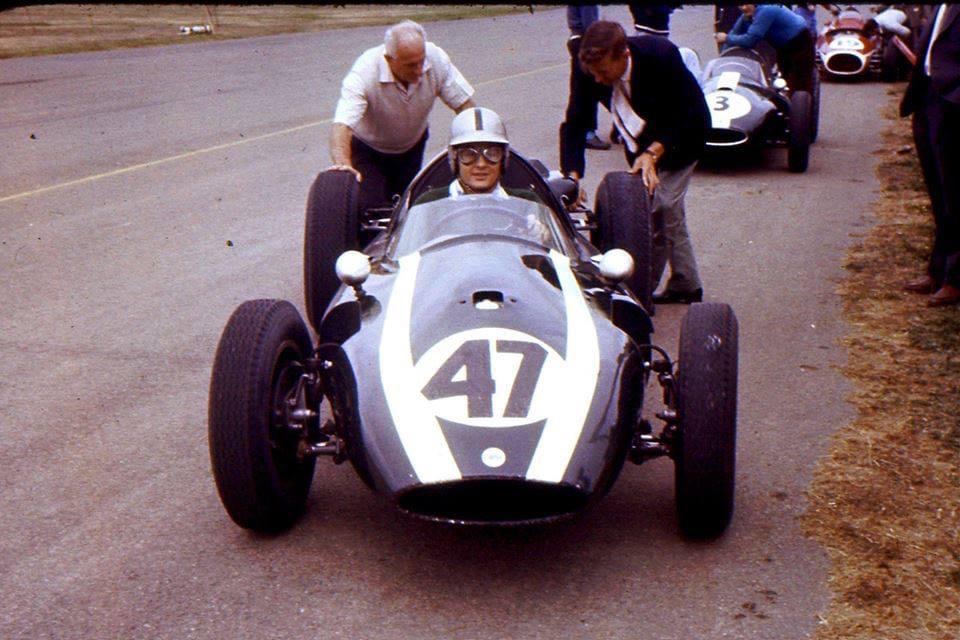
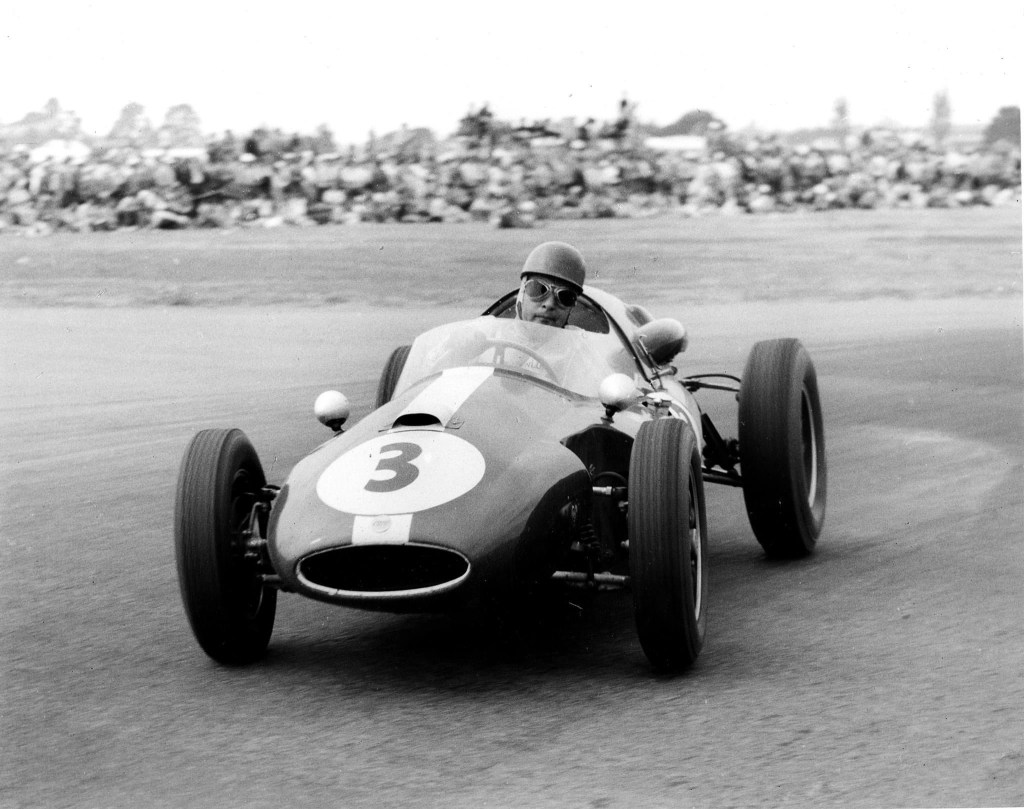
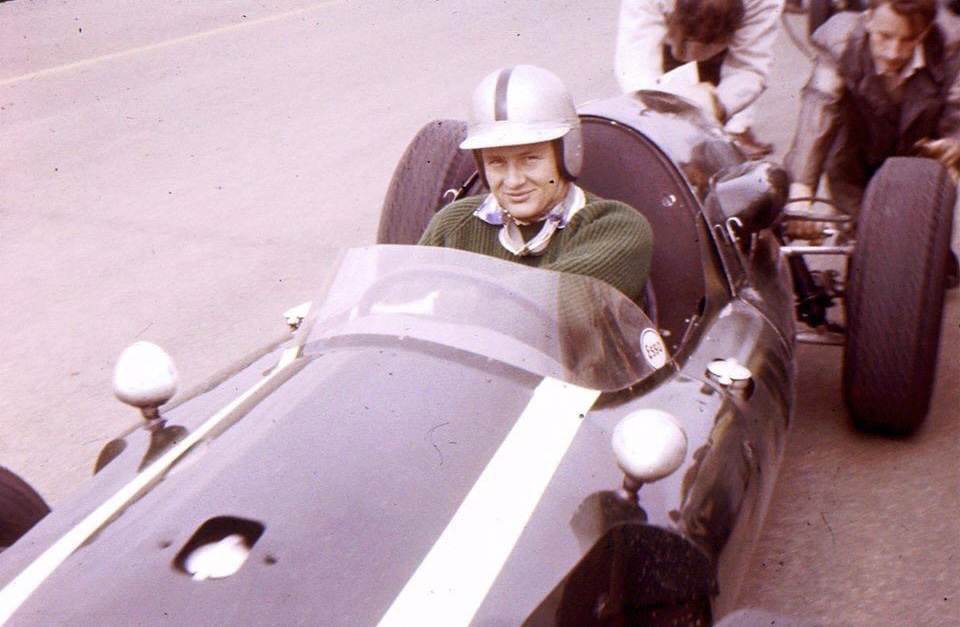
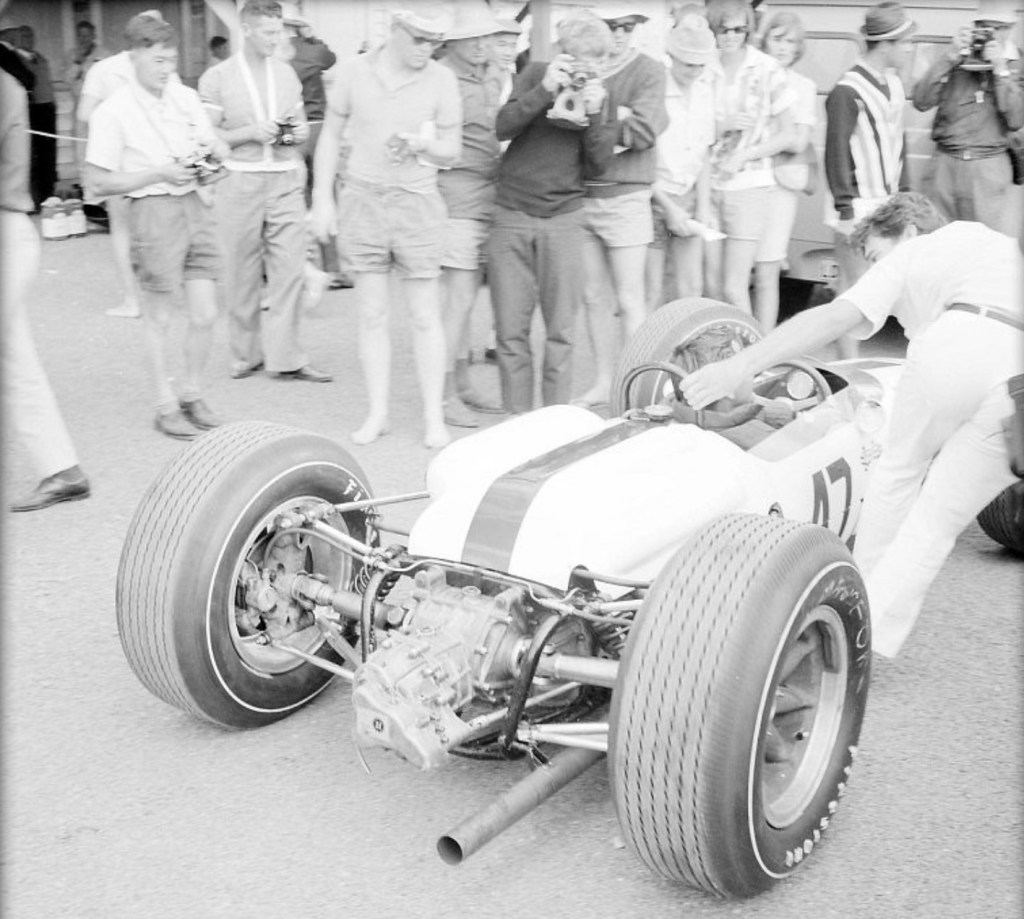
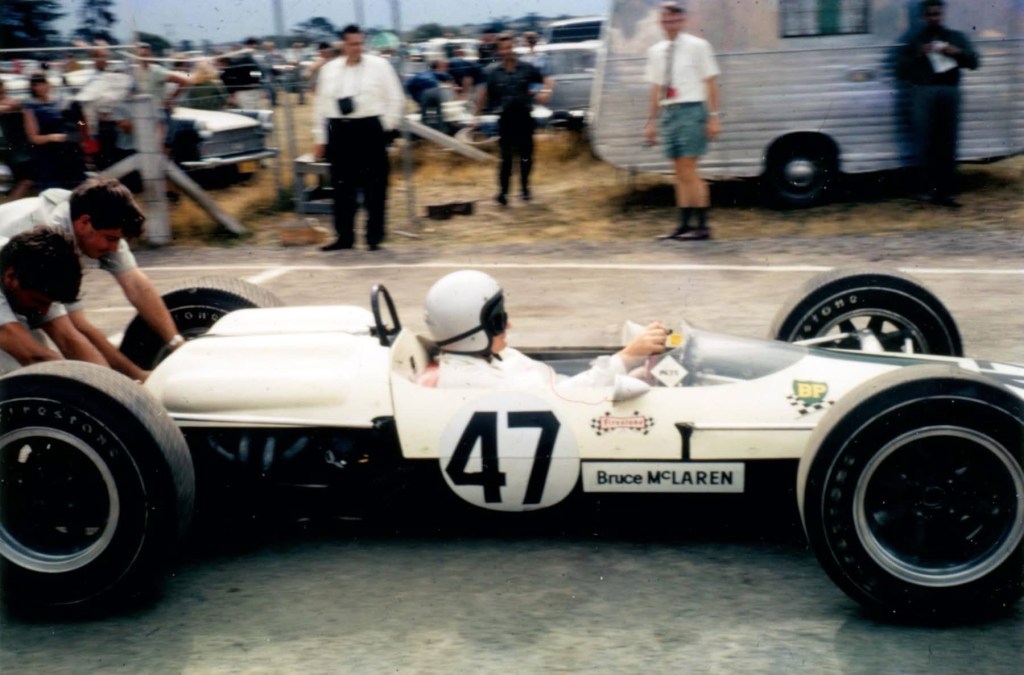
Pop McLaren and another helper about to bump-start Bruce’s Cooper T45 Climax FPF 2.5 at the Wigram RNZAF track on the January 23, 1960 weekend.
That’s Ian Burgess’ third-placed Cooper T51 Climax behind, then Pat Hoare’s Ferrari 256 V12 a little further back; he was fifth. Jack Brabham won the race in a T51 2.5-FPF with David Piper’s Lotus 16 Climax FPF 2.5 second. Bruce was fourth in the Lycoming Special; more of that soon.
New Zealand’s Summer Internationals commenced with the NZ GP, then held on the Ardmore Airfield circuit outside Auckland, with the Lady Wigram Trophy the other round most visiting internationals did. Sometimes they also entered the Dunedin Road Race and Teretonga International, held on a permanent racetrack near Invercargill, both venues on the South Island.
That year the visitors were headlined by Stirling Moss, twice-on-the-trot World Champion Brabham, and Burgess, Piper, while the Australian contingent included Bib Stillwell and Stan Jones in Cooper T51s, and Len Lukey in a T45. Similarly mounted was Kiwi youngsters Denny Hulme and George Lawton, both Driver to Europe exports; Lawton’s a sad one…
(T Marshall)
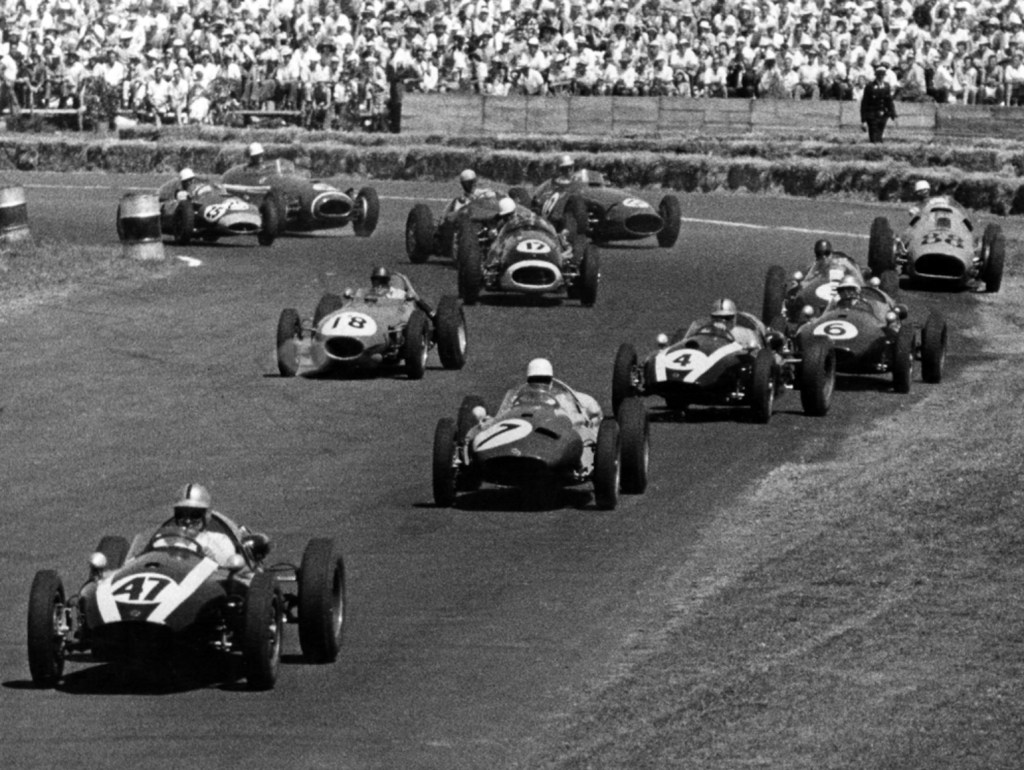
Coopers to the fore on the first lap at of the New Zealand GP at Ardmore: McLaren, Moss, Brabham, #6 Australian Bib Stillwell and then Ian Burgess. One T45 and four T51s. In the middle of the road is David Pipers Lotus 16 Climax, car #17 Johnny Mansel’s Maserati 250F, while #88 is Ron Roycroft’s positively historic but very well driven ex-Ascari Ferrari 375 4.5-litre V12. Behind Mansel is perhaps Pat Hoare, Ferrari 256 V12 – a Dino 246 fitted with a 3-litre V12 – then Arnold Glass in his Maserati 250F #12. Close to the oil drum is 1954 NZ GP winner Stan Jones, Cooper T51 Climax, and finally the big front-engined car is Ted Gray in his last drive of Australian Land Speed record holder, Ted Gray in Tornado 2 Chev V8.
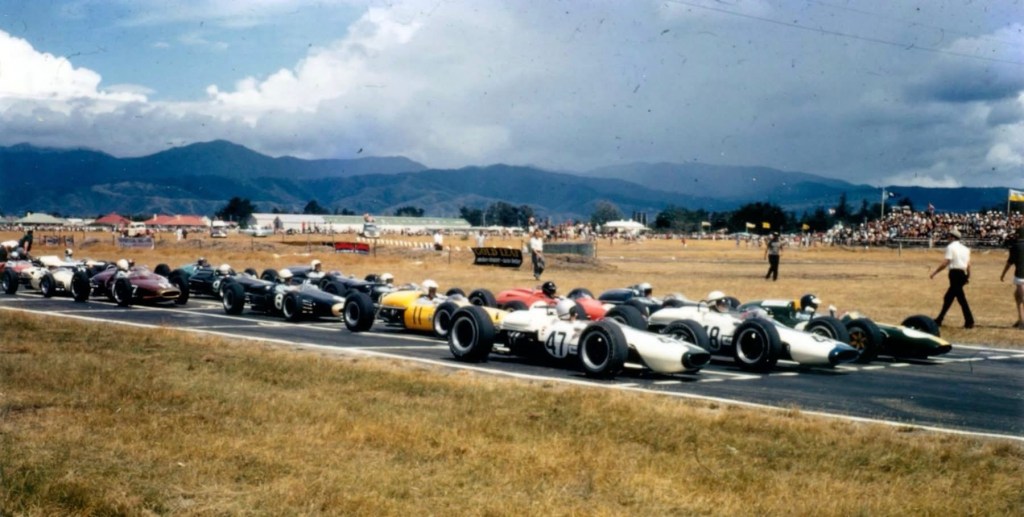
At this time of technological change, it was certainly a grid lacking variety! Coopers were of course right up there: Brabham and McLaren finished one-two in their 2.5-litre FPF-powered cars from the 2.2s of Stillwell and Jones. The best placed front-engined cars were the pair of 2.5-litre six-cylinder Maserati 250Fs raced by Kiwi Johnny Mansel and Aussie Arnold Glass.
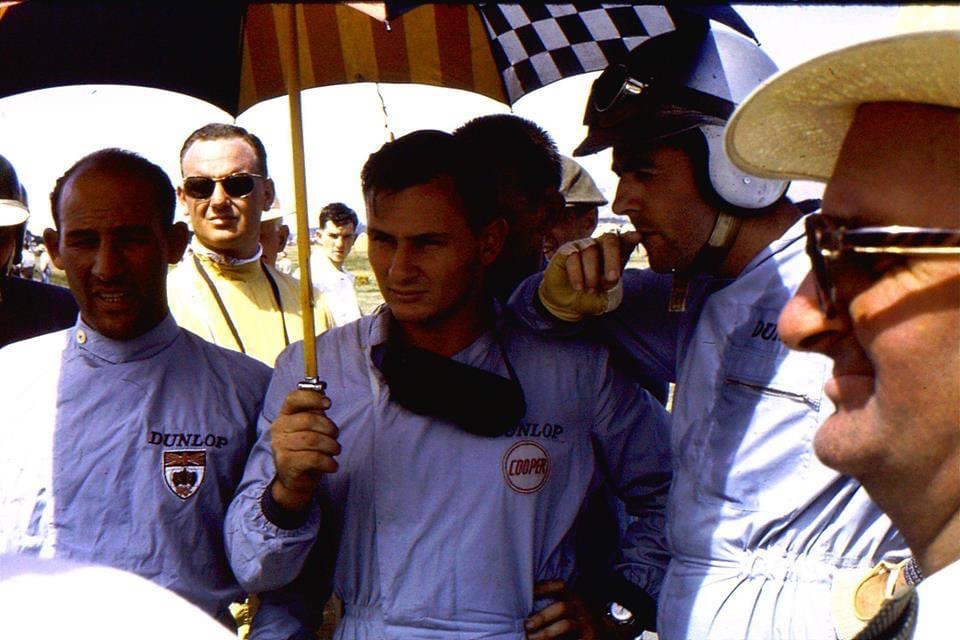
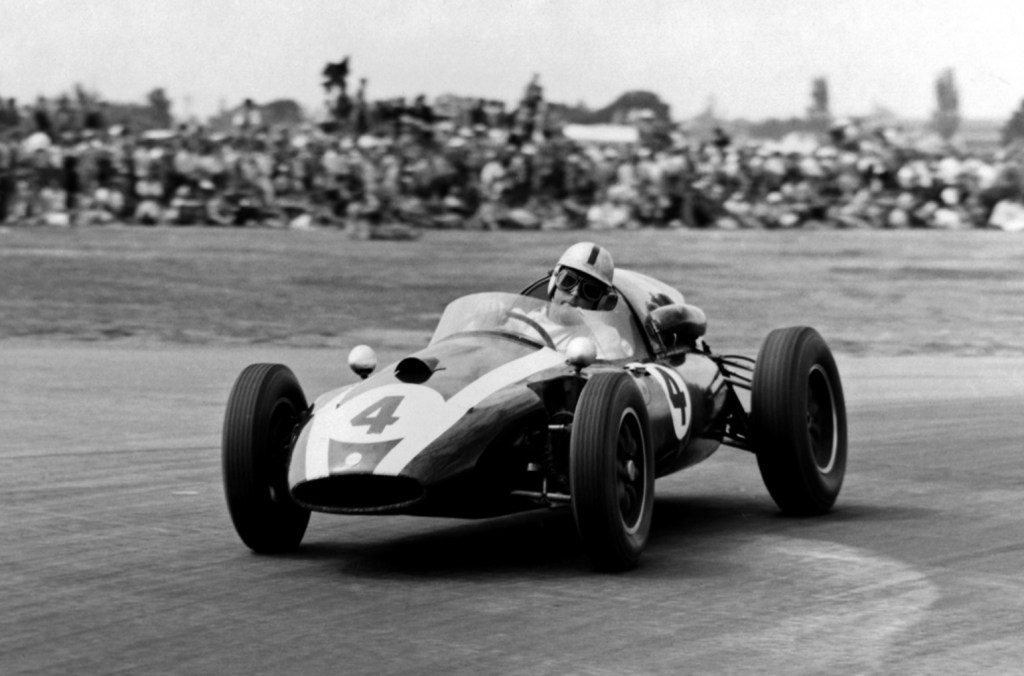
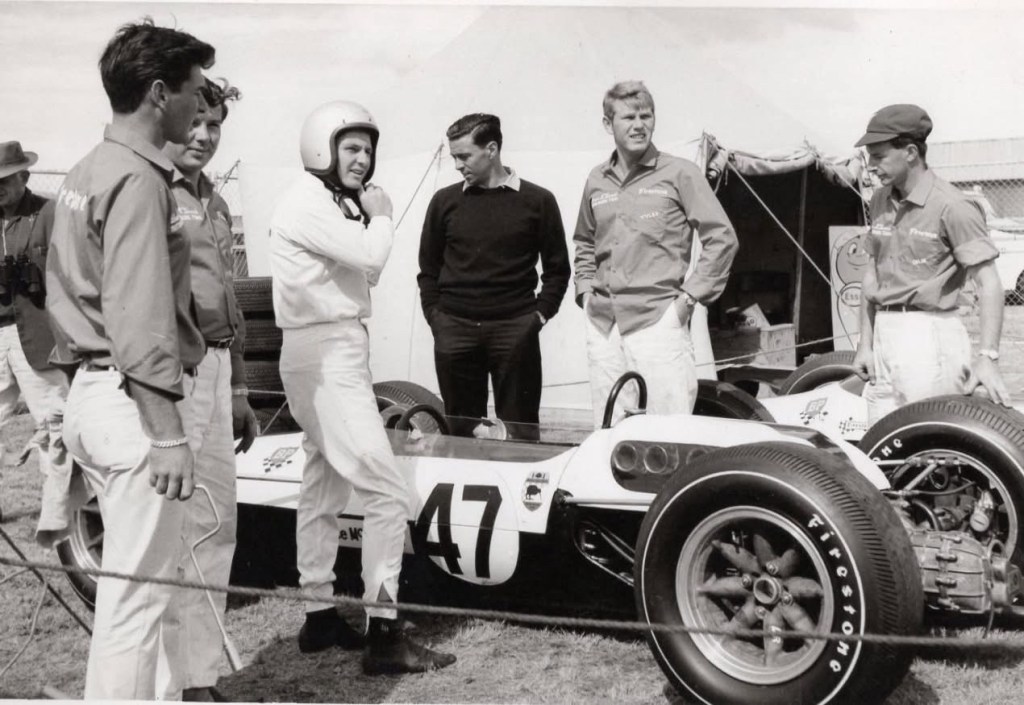
Stirling, Bruce and Jack all ears during the Ardmore drivers briefing – not necessarily in 1960 mind you (R Stuart)Brabham on the way to victory at Wigram in 1960, Cooper T51 Climax (T Marshall)
That summer, Jack Brabham won both the NZ GP and Wigram, while Syd Jensen’s nimble Cooper T45 Climax 1.5 won on the Dunedin city roads, and Ian Burgess triumphed at Teretonga, Cooper T51 Climax FPF 2.2-litre.
On the other side of The Ditch Brabham won at Longford and Phillip Island against local opposition; it was a great summer for him. It wasn’t until 1961 – and really 1962 – that the Australians had the tracks to cut it with the Kiwis to attract the internationals with the first Tasman Cup held and won by Bruce McLaren’s Cooper T70 Climax in 1964.
(G Woods Collection)McLaren, with ‘nomex’ jumper and long sleeved shirt on to deal with the summer chill, Burgess and Pat Hoare’s Ferrari 256 V12 (R Stuart)
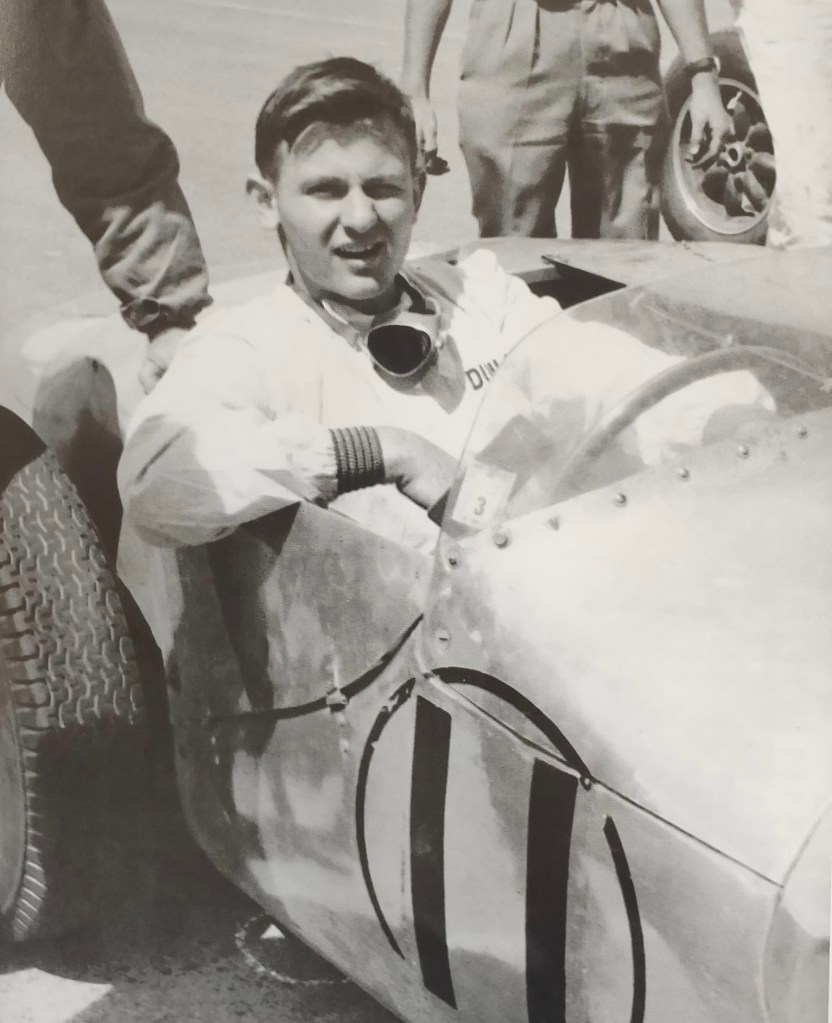
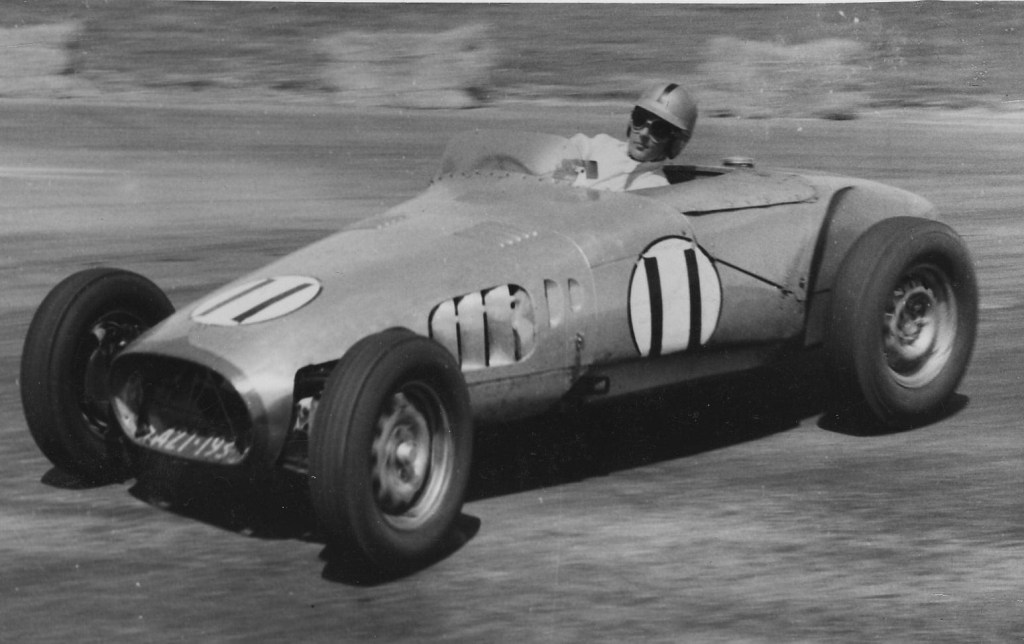
While Bruce McLaren started the Lady Wigram Trophy in his Cooper, he retired the car and then took over the famous aircraft-engined Lycoming Special, finishing the race in fourth place (below).
Jim Clark did a few laps in one of the Kiwis’ most loved specials during practice during the Tasman Series a couple of years later.
Bruce McLaren in the Lycoming here and below (M Knowles)(BMcL Trust)(M Fistonic)
McLaren ran out of brakes in the Lycoming during the race; the car ran four-wheel drums sourced from an Austin road car. Bruce found the car’s handling so forgiving that he was able to make up for the lack of stoppers, in part, by throwing the it sideways into the corners.
Never one to forget a favour, when he returned to England, Bruce sent a set of Dunlop rotors and calipers to New Zealand, the Lycoming raced on so equipped!
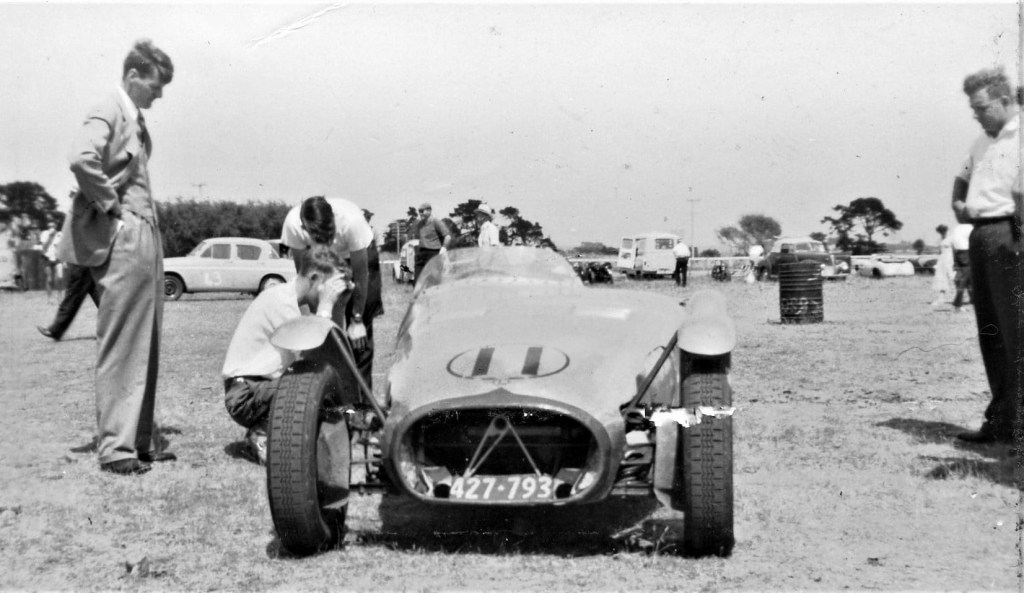
The shot above shows the Lycoming in the Levin paddock in January 1960. Note the road-rego and Michelin radial tyres. Clearly, (pic above) Bruce raced it on Dunlop racing tyres, but the 4.7-litre four cylinder engines car was originally built by oh-so-talented Kiwi engineer Ralph Watson as a road-going racer. At the time Bruce borrowed the car, it was being raced by Malcolm Gill and later Jim Boyd, happily it is extant, alive and well.
(Nat Lib NZ)
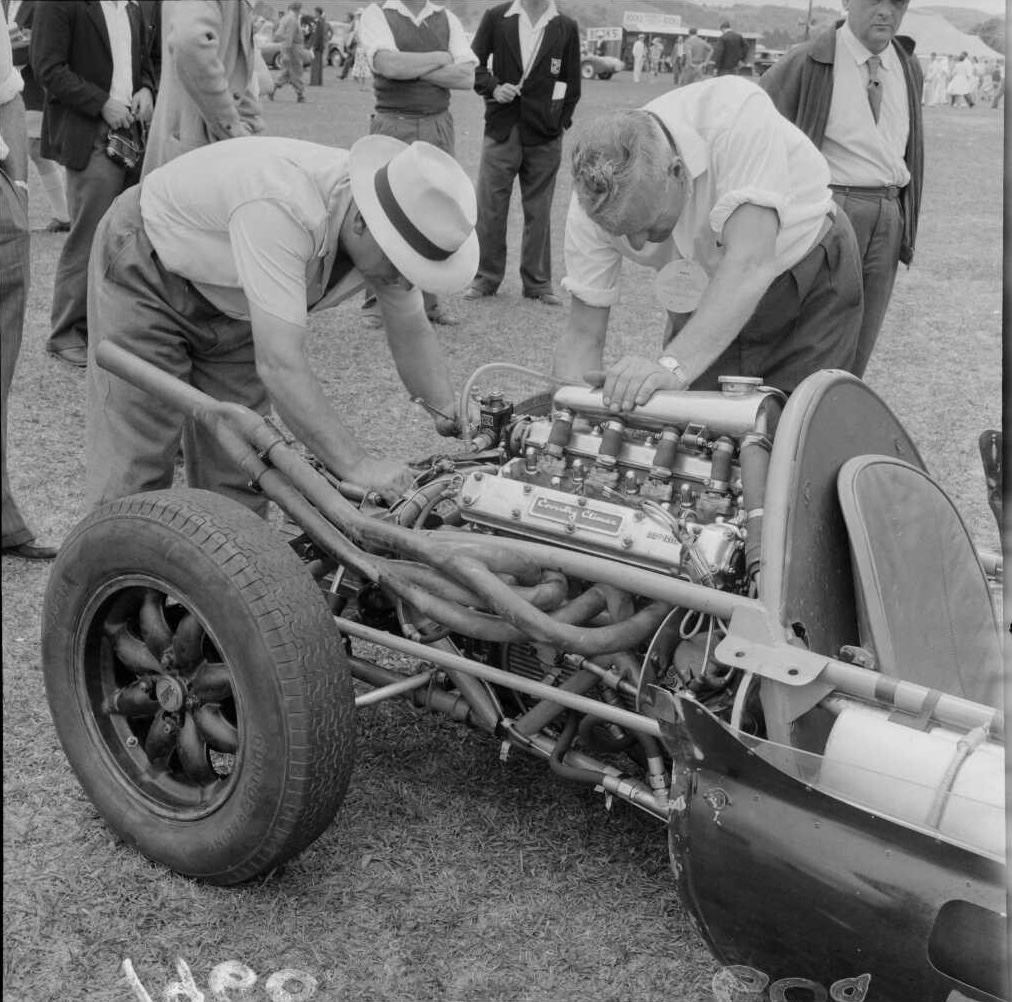
Ian Burgess’s Cooper T51 Climax at Wigram above, and the 2.5-litre Climax in Stirling Moss’ car being fettled in the Ardmore paddock below.
(Nat Lib NZ)
David Piper (below) pushing his Lotus 16 Climax 2.5 #368 to the start line at Dunedin on January 30, where he withdrew with gearbox problems after 22 of the 36 laps.
Piper coaxed local boy Arnold Stafford into the hot-seat of his 1.5-litre FPF-engined Lotus 16 #353 ‘renter’ at Wigram (below), but Stafford thought the better of it after a big-spin in practice, having not raced for three years and didn’t start.
(K Brown)(unattributed)
Both cars weren’t particularly old in years but were technically passé by early 1960, even in the colonies where Coopers had been rather popular from the early 1950s.
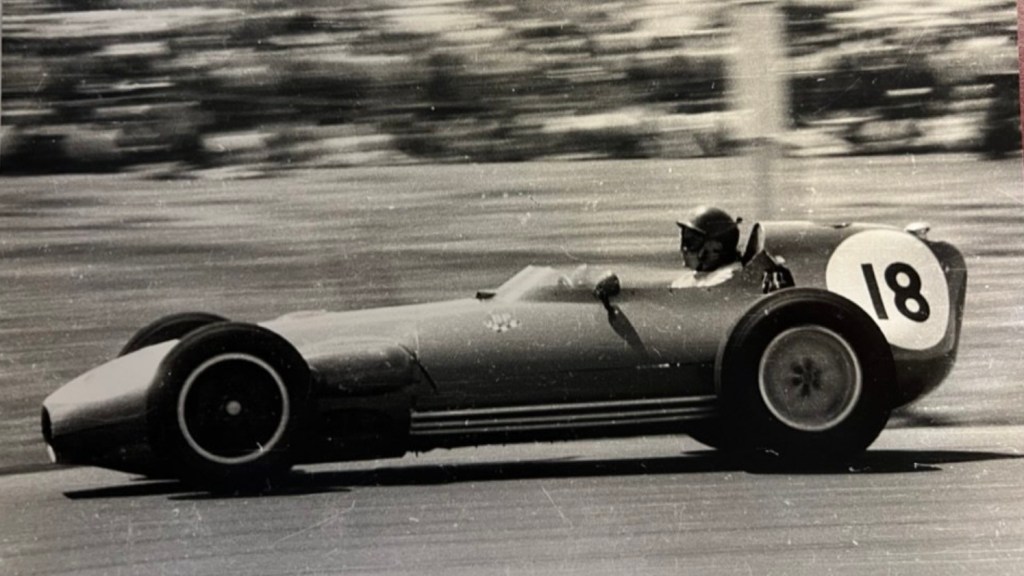
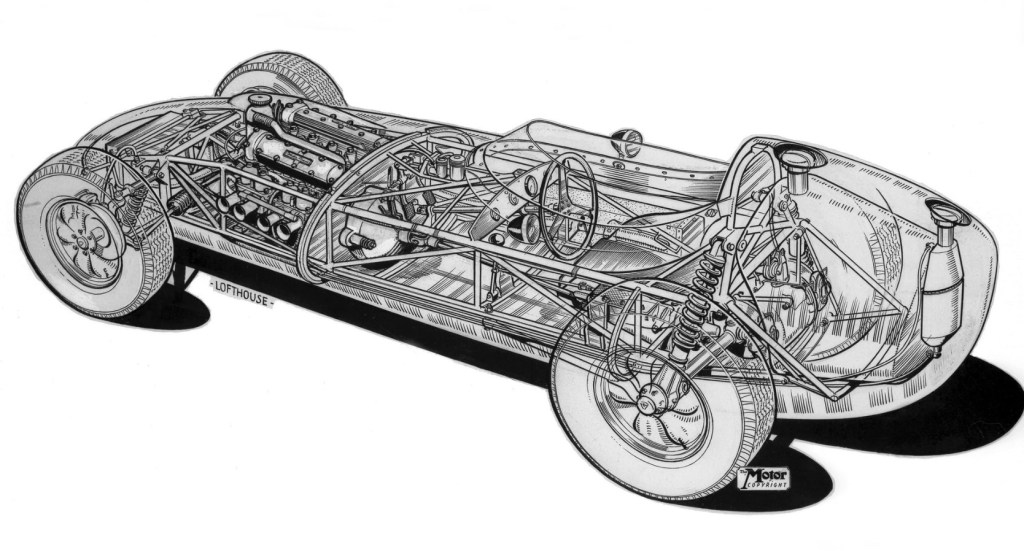
Lotus 16 Climax cutaway (Lofthouse)(R Stuart)
Etcetera…
McLaren at Wigram in 1962, where he was fourth in his 2.7-litre Cooper T53 behind Stirling Moss’ Rob Walker Lotus 21 Climax 2.5 and the 2.7-powered Coopers of Brabham, T55, and John Surtees, T53…Happy Patty below.
(R Stuart)(R Stuart)
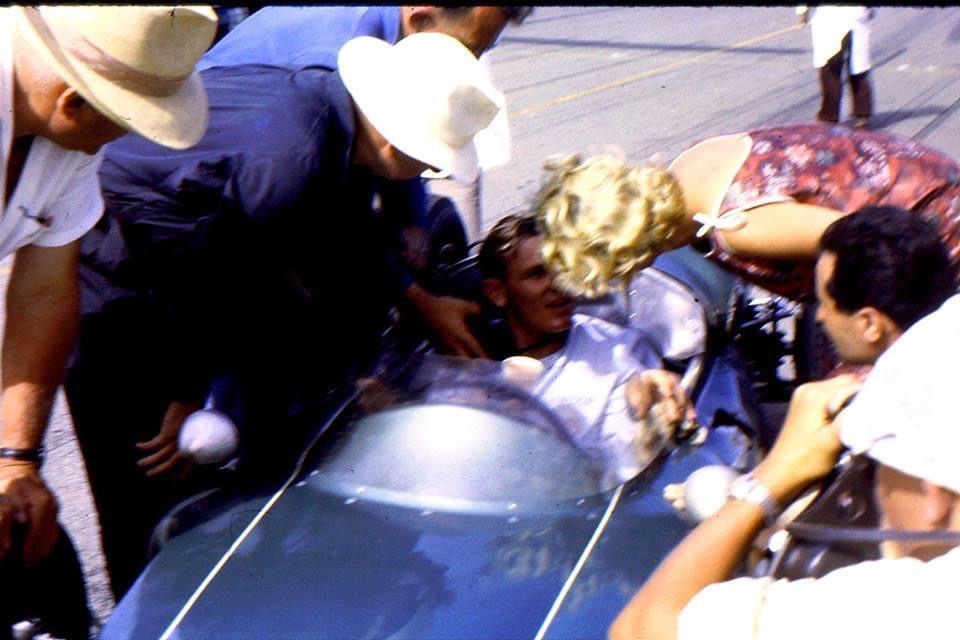
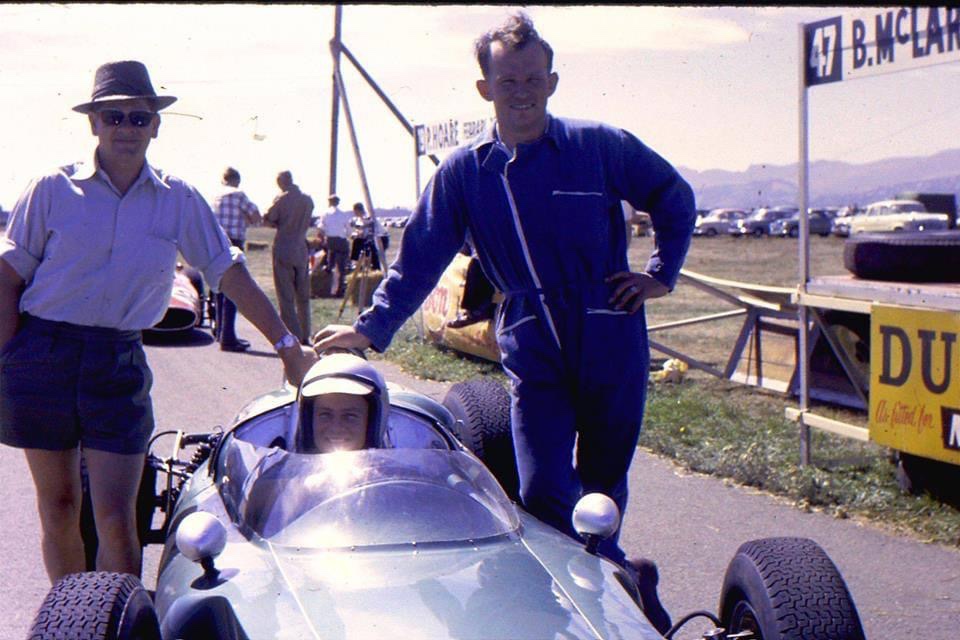
Pop McLaren and who folks?
Credits…
Rosalie Stuart, Graham Woods Collection, Merv Knowles, Bruce McLaren Trust via Jim Bennett, Kelvin Brown, Milan Fistonic, National Library of New Zealand
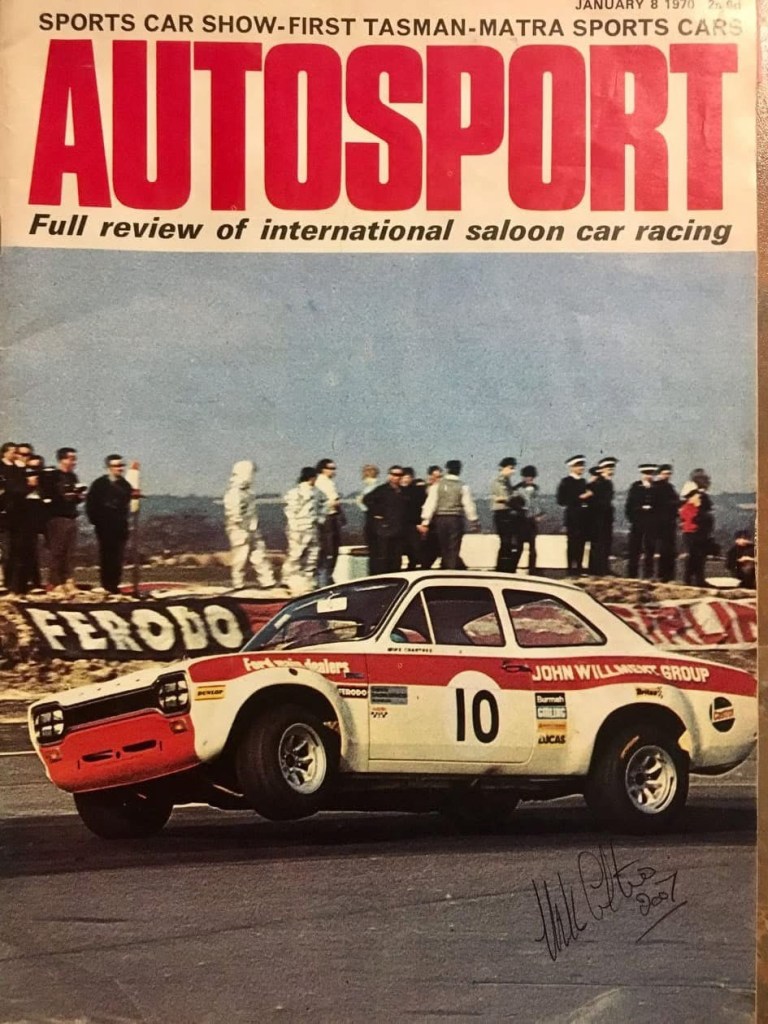
Steve Holmes’ wrote that Jim Richards’ Holden Monaro HT GTS 350 not only towed his ex-Willment Racing Group 2 Ford Escort Twin-Cam up and down New Zealand’s two islands but also doubled up at some meetings as a production racer, as above at Levin circa-1970, date folks?
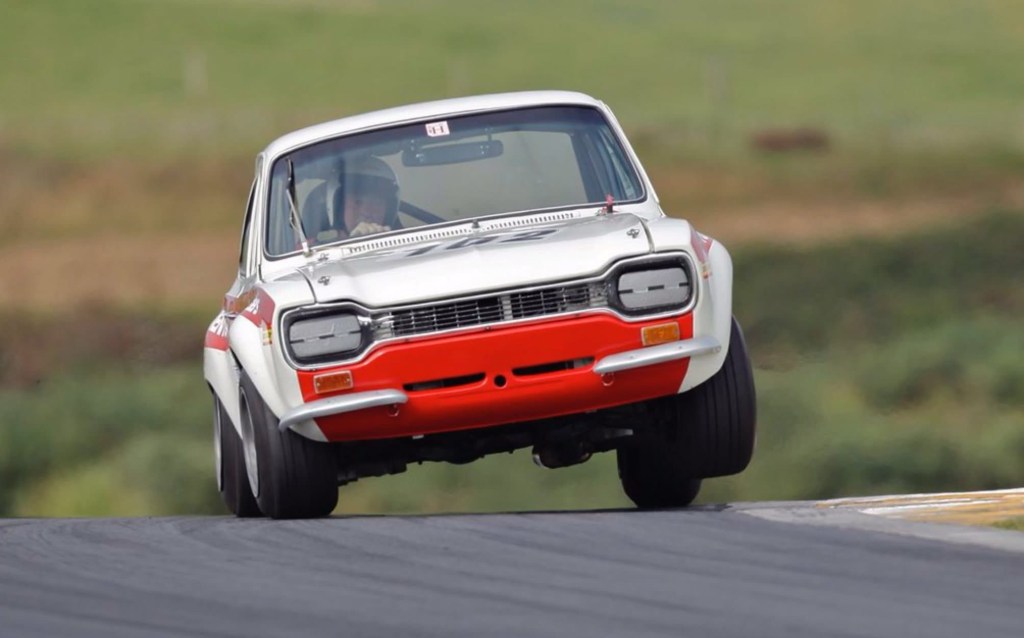
Jim’s Escort aerobatics below at Wigram in 1972, three-wheeling out of Hangar en route to Control Tower.
(T Marshall
This wonderful history of Jim’s Escort is courtesy of the NZ Historic Muscle & Saloon Cars Facebook site, slightly paraphrased.
‘The Jim Richards twin-cam Mk I Escort famous in NZ motor sport, we are very thankful to Rayden and Irene Smith for saving the car and returning it to the track. Mike Crabtree raced the car in the UK and he and his family have helped piece together its early UK history.
Technical Specs: 1968 Escort Twin Cam racing car built by Willment Racing, England. Engine 1700 cc Lotus Twin Cam 180 bhp. Brakes: Disc front, drum rear. Gearbox: Ford 4 speed with LSD.
The car started life as one of the first Twin Cam Escorts made at Ford’s competition plant in Boreham, England. Ford’s public relations chief, Walter Hayes, gave the car to John Willment for race development. Willment’s facilities were south of London, and they campaigned various cars throughout the 1960s, including single seaters, Cortinas, Ford Galaxie, Cobras, GT40s and the Mk I Escort Twin Cams development, which resulted in quite a unique suspension and chassis setup.
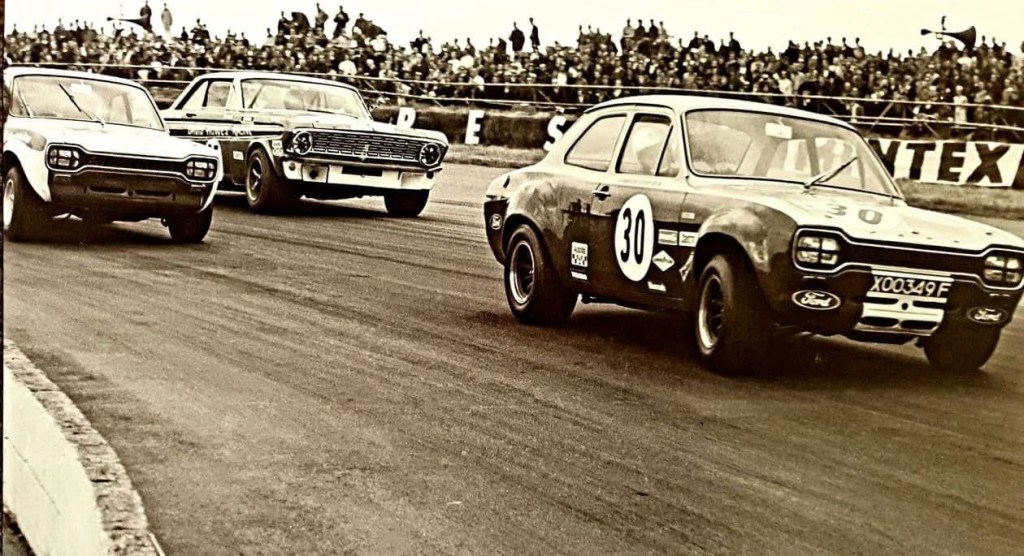
Mike Crabtree worked for Willment and raced the car to win the 2-litre class of the 1969 British Saloon Car Championship, competing alongside the Alan Mann Escort X00349F of Frank Gardner, Roy Pierpoint’s WJ Shaw Falcon Sprint and the works Britax Downton Mini Cooper S of Gordon Spice.
Mike fondly remembers driving it on three wheels and maintains it was a very forgiving racer, something subsequent drivers have mentioned. Mike and his wife Joan have travelled to New Zealand to see the car and are delighted it is still being used as intended 50 years on.
Jim and Mary Carney of Whangarei purchased the car from Willment Racing in late 1969 and imported it to New Zealand for Jim Richards to race in the New Zealand Saloon Car Championship. Running with “Radio Hauraki” and “Carney Racing” liveries, Jim produced some great racing against much larger and more powerful machines in the golden era of NZ saloon racing. It was also used as the bridal car for Jim and Faye when they married in 1972.
Subsequent owners include Lin Nielsen and John Beattie, both racing in the OSCA series in the 1970s. Lin had the car repainted following a paint shop blaze in a bright “Fairmonte Motor Court” colour scheme. Power plants over the years have been Lotus-Ford Twin-Cam, Ford Pinto, Mazda 13B rotary, Ford BDA and back to a Twin-Cam in the 1990s.
Rayden and Irene Smith have been the car’s custodians for 30 years, and Rayden continues to use it competitively. As with many old original race cars, it is no concours “silk purse”. It wears a battle-scarred patina of 50 years of racing with several layers of old paint schemes beneath its Willment livery, and still has the bog and panel repairs from Mike Crabtree’s battles with Pierpoint, Spice and Gardner in England in 1969.
Great action shot of Rayden Smith thru turn 3 at Hampton Downs cocking the inside front wheel just as Mike Crabtree - and other Escort components – in the day (NZ Hist Muscle & Saloon Cars)
Credits…
Steve Holmes-The Roaring Season, Garry Simkin, Terry Marshall, NZ Historic Muscle & Saloon Car’s Facebook site
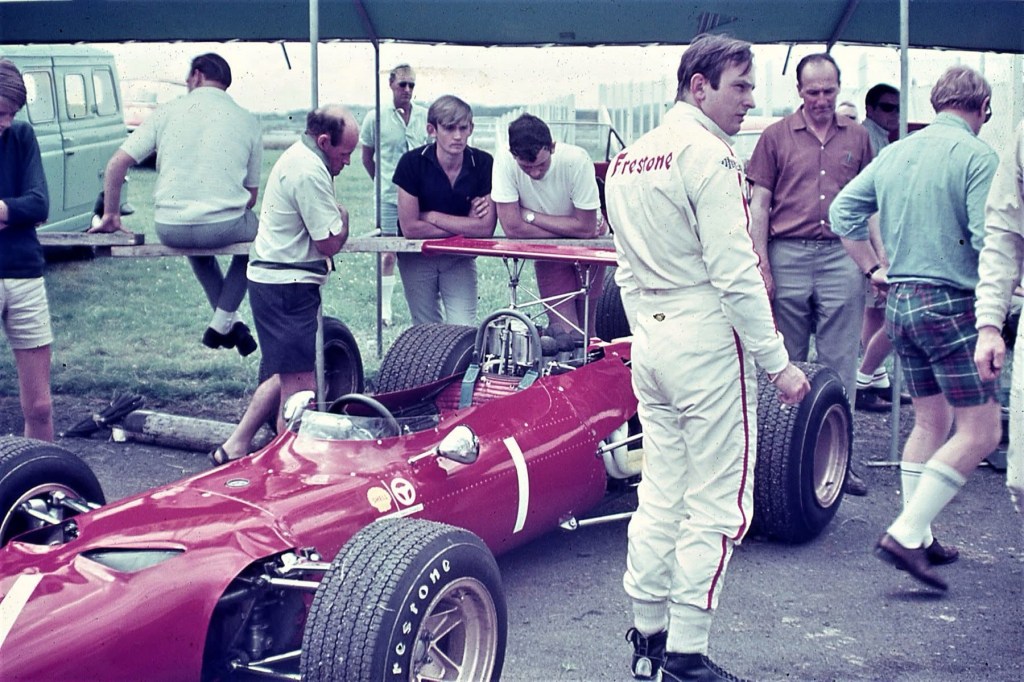
Tyler Alexander at left with Phil Hill’s Bruce McLaren Motor Racing Cooper T70 Climax FPF 2.5 at Pukekohe, Auckland during the January 9, 1965 New Zealand Grand Prix meeting. Car #17 is John Riley’s Lotus 18/21 Climax.
This car was an updated version of a chassis Bruce and the late Tim Mayer raced the year before – T70 FL-1-64 – while The Chief raced a new design designated the T79: T79 FL-1-65. It’s pretty familar turf to us, see here: https://primotipo.com/2016/11/18/tim-mayer-what-might-have-been/
(D Shaw)
That’s the chassis of the T70 above at Pukekohe – with a Brabham BT4 in the foreground – while Bruce is settling himself into the T79 at Levin, the second Tasman round below.
Bruce and Jim Clark collided in one of the Pukehohe heats. While Jim started the GP in his works Lotus 32B Climax, Bruce’s Cooper’s T79 was hors d’combat for the weekend, so he commandeered Phil’s T70 but succumbed to gearbox failure after 13 of the race’s 50 laps. Clark lasted only 2 laps before suspension problems, leaving Graham Hill to win the race aboard his Scuderia Veloce Brabham BT11A Climax.
(unattributed)
McLaren was fifth at Levin, with Jim Clark’s Lotus 32B Climax the race winner. Jim was the Tasman Cup victor too, with four wins from the seven championship rounds or five wins from eight races, including the Lakeside 99 non-championship round. Not to forget, however many heats Clark won.
Bruce’s Tasman plans were thrown somewhat up in the air. The two Coopers were designed around 13-inch Dunlops but Bruce had signed a contract with Firestone for supply of tyres. Defining though the deal was commercially, in the short term the hard, American 15-inch covers were shite for road racing.
The bigger wheels resulted in handling problems which would normally have been sorted before the long trip south. As it was, the necessary makeshift modifications were made between races.
NZ GP at Pukekohe, Bruce didn’t start the T79 having collided with Jim Clark in a heat. Note the Hewland HD 5-speed transaxle and tall Firestones (D Shaw)(unattributed)
The Levin International start on January 16, with Phil and Bruce alongside Clark despite problems adapting Bruce’s new Firestone tyres to a chassis designed with Dunlops in mind.
Despite these difficulties McLaren did Wigram and Teretonga races in faster times than those which gave him his 1964 victories.
In Australia, once 13-inch wheels were available, McLaren was fourth at Sandown and won the Australian Grand Prix final round at Longford from pole to finish the Tasman series runner-up to Clark, while Phil Hill was a well-merited third. There is no doubt that if pre-trip testing time had been on their side, the Cooper-Climax drivers would have made a much better showing in New Zealand.
Pop McLaren, Wally Willmott, Bruce Harre, Bruce McLaren, Jim Clark, Tyler Alexander and Colin Beanland David Oxton informs us, in the Wigram paddock, over the January 23, 1965 weekend.
Showing real progress, McLaren, below, was second to Clark’s Lotus with the well-driven Brabham BT7A Climax of Jim Palmer in third.
(CAN)(A Horrox)
Teretonga, above, was better still with a team two-three – McLaren from Hill – but Jim Clark was still the man in the front of the field with three wins on the trot, only Graham Hills Scuderia Veloce Brabham BT11A Climax win in the New Zealand Grand Prix at Pukekohe at the start of the month ‘rained on Jimmy’s Lotus parade.’
(K Wright)
Bruce McLaren leads Graham Hill and Jack Brabham early in his victorious run in the AGP into Longford village: Cooper T70, and Brabham BT11A’s by two, all Coventry Climax FPF 2.2-litre powered. McLaren and Brabham below.
(GP Library)(MotorSport)
Every Dog Has its Day – perhaps every car too!
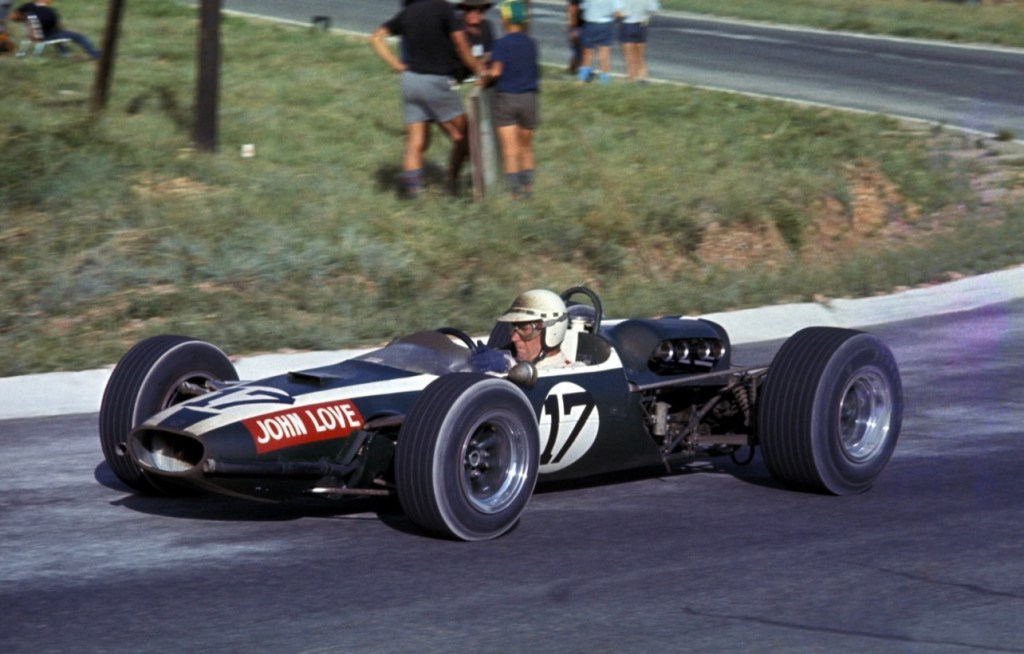
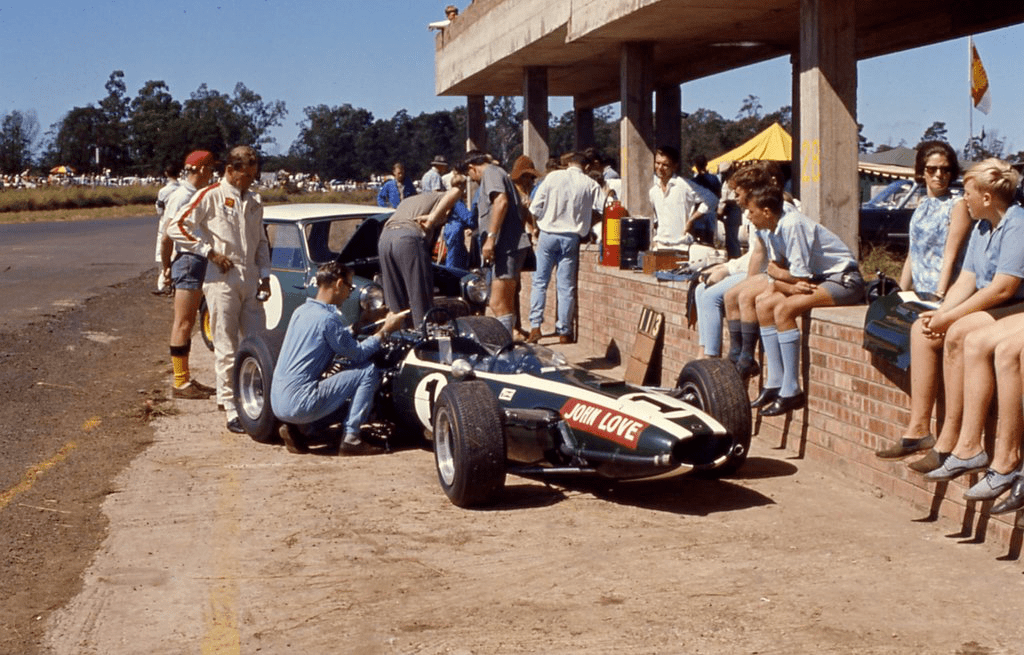
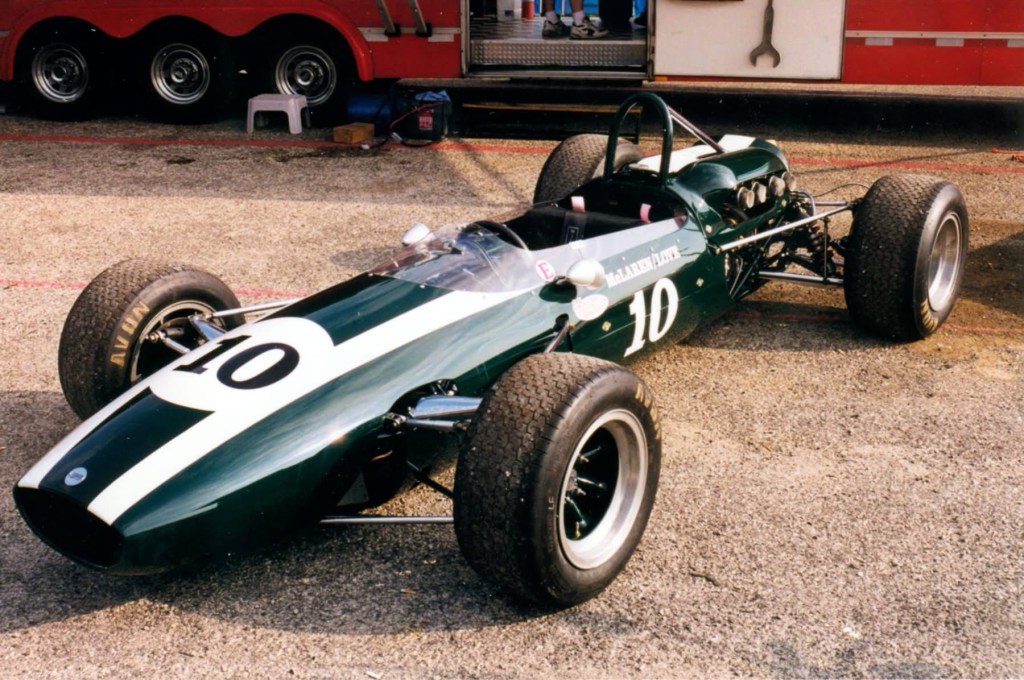
At the end of the Tasman, Bruce McLaren sold the T79 to South African ace, John Love. The shot above shows him on the way to a brilliant second place in the 1967 South African Grand Prix.
The machine was a star-car in Africa, winning the 1965, 1966 and 1967 South African National F1 Championships, co-credits to Love’s Cooper T55 Climax and Brabham BT20 Repco in 1965 and 1967 duly noted.
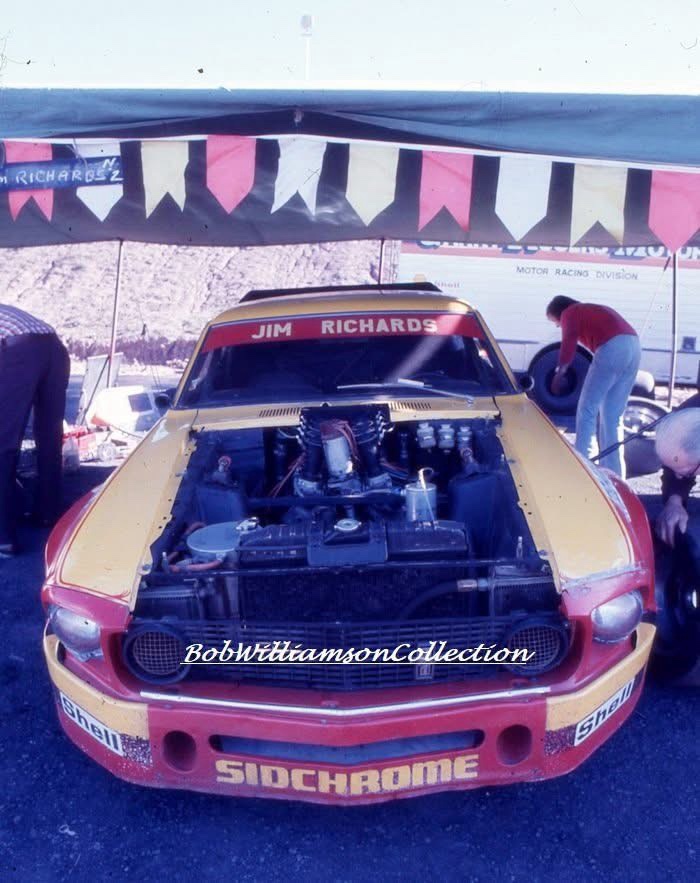
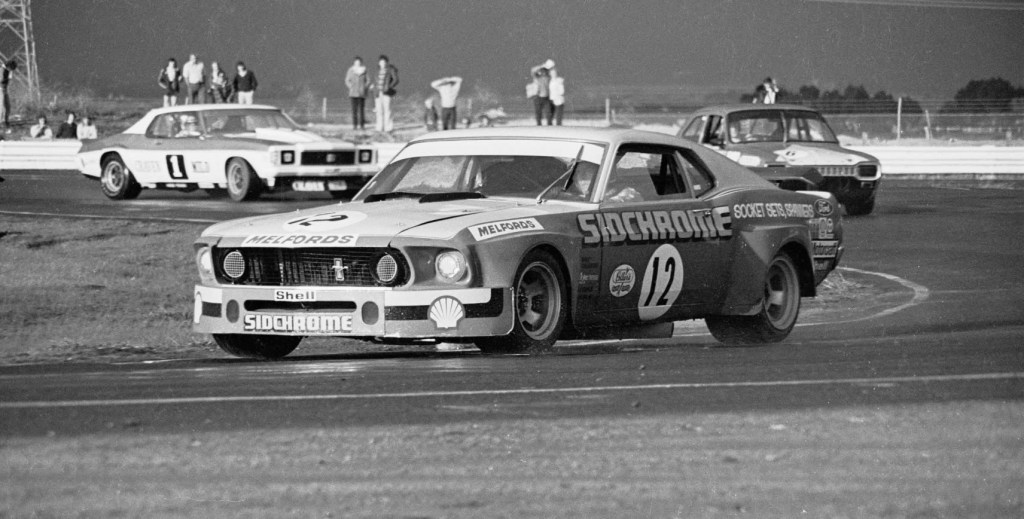
I was at Sandown on the dull, wet, cold Sandown July 6, 1975 weekend that Jim Richards debuted his Ford Mustang Boss 351, he won twice in front of local hot-shots, including Allan Moffat’s Ford Capri RS3100, John McCormack’s Chrysler Charger Repco-Holden V8 and others.
Jim had special dispensation to run his Kiwi wheel-tyro combo, which was more generous than the ten-inch-wide rule here. The experts thought that would bring him back to the field…it didn’t! He took 13 wins from 30 starts that year, 27 of them podiums.
(I Smith)
The amazing thing about that Murray Bunn-built car, long-term friend and JR collaborator, is that it wasn’t nearly as exotic as most of the Australian front-runners of the day: John McCormack’s Chrysler Charger Repco-Holden, the Bob Jane Racing Monaro and Torana Chev raced by Bob and John Harvey, Bryan Thomson’s VW Chev V8, Allan Moffat’s Ford Capri RS3100 and Pete Geoghgan’s Holden Monaro GTS 350.
Bonnet off during the Baskerville 10,000 Sports Sedan meeting (T Johnson)
It was lightened a bit, but the suspension front and rear wasn’t wild, it had a Ford nine-inch rear and Borg Warner ‘box, nothing special so far. The Gurney-Eagle aluminium-headed, Lucas-injected Cleveland 351 V8 was Murray’s too, now that was really trick! And mounted well back in the chassis, as you can see from these shots.
Calder 1975, Jim in front of Mike Stillwell’s Ford Escort BDG 2-litre and Pete Geoghegan’s John Sheppard built Monaro GTS350 Chev (I Smith)(S Elliott)
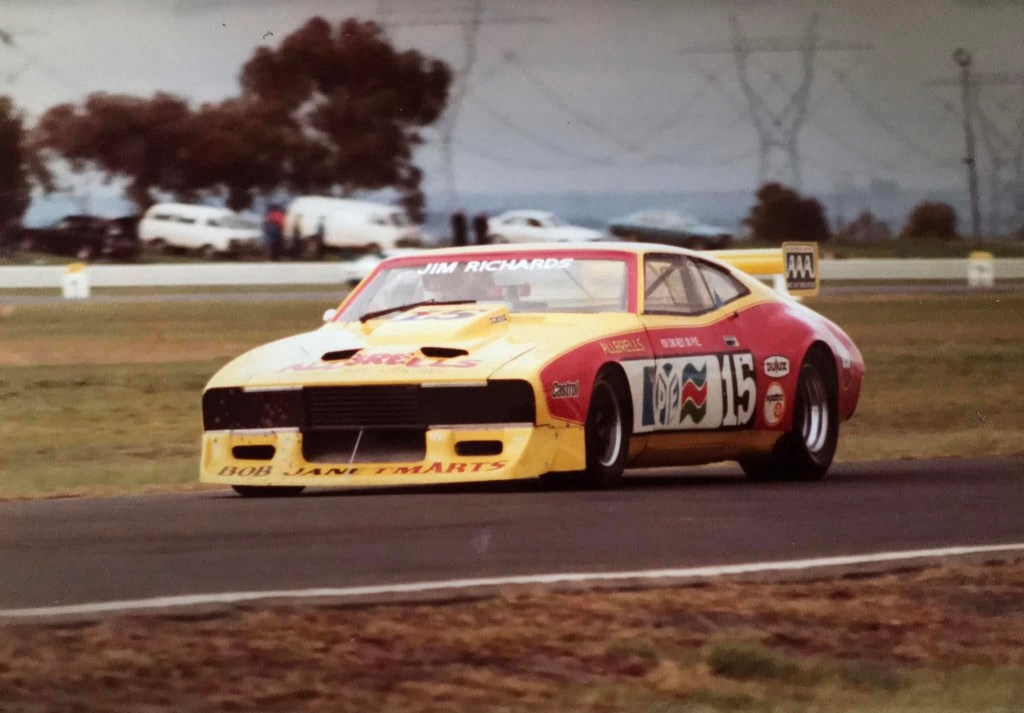
When it became time to build the Mustang’s successor, Jim Richards again turned to Murray Bunn to build the replacement Ford Falcon GT351 Hardtop sports sedan, with the only major carry-over item the raucous, roaring Cleveland Gurney-Eagle injected 351.
The shot above shows Murray Bunn and his apprentice, Murray Smith, setting up one of the two Hewland transaxle casings within the Hardtop’s multi-tubular spaceframe chassis in Bunn and Cumming’s Takanini premises just southwest of Auckland during 1977.
(S Dalton Collection)
I was rummaging through Auto Action’s JR photo files and found an untouched envelope of 12 under-the-skin photographs that have never been published until now. So, if you are a Ford or Jim Richards fan, grab a copy of Auto Action Premium issue #1908, which is still for sale in Australia for another fortnight.
Ford supplied the shell and pressed door, bonnet and roof panels in aluminium. The car taking shape at Bunn & Cummings, Takanini, NZ in 1977. Wheels bespoke castings to suit Eagle/McLaren magnesium uprights (S Elliott)
The car was fast right outta the wrapper, the only thing between Jim and the 1978 Australian Sports Sedan Championship won by Allan Grice’s superb, but category-rooting Chev Corvair V8 was the lack of a spare engine.
Despite that, his new, unsorted car bagged more points than Gricey, but the rules then had that ‘drop your worst result bullshit’. Anyway, have a read of the 4,000-word, eight-page and 25-photograph piece.
Jim was superb to work with, so too was the Beast’s restorer, Graham Booth; the car’s historic demonstration re-debut isn’t too far away!
Richards at Calder in 1981 (P Husband)
Credits…
Chequered Flag, Terry Johnson, Ian Smith, Steve Elliott, Peter Husband, Competition Communicator Stephen Dalton Collection, Bob Williamson Collection
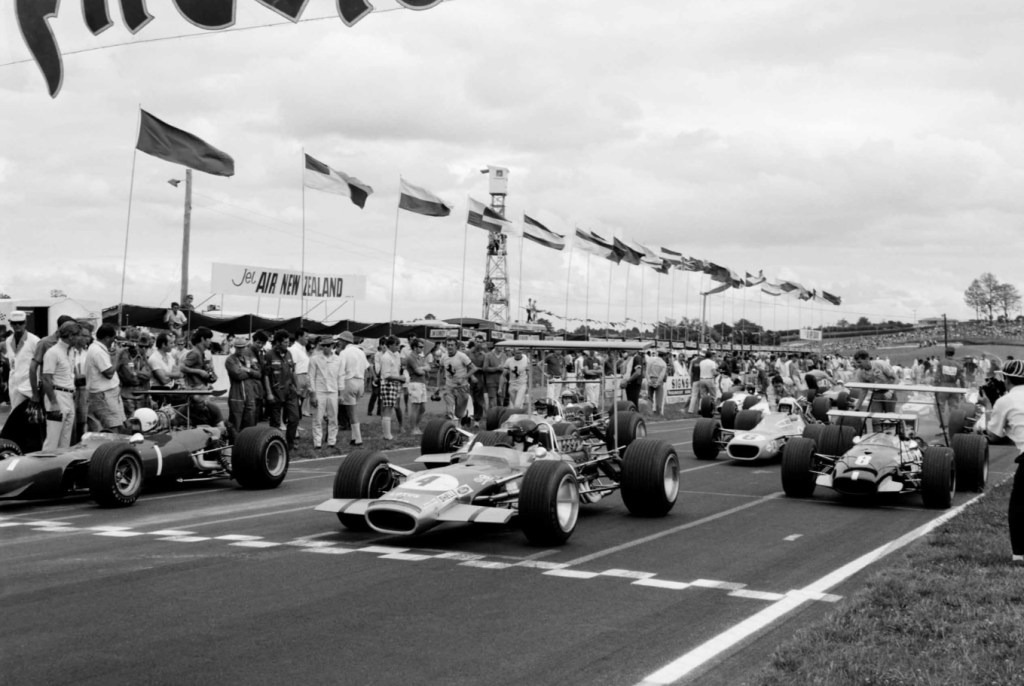
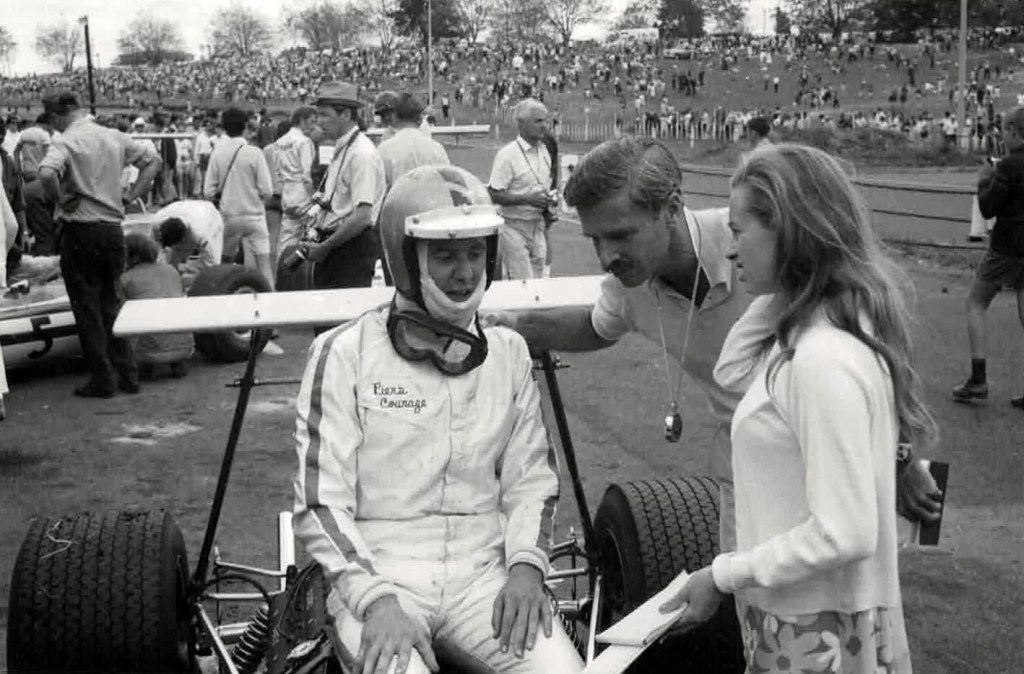
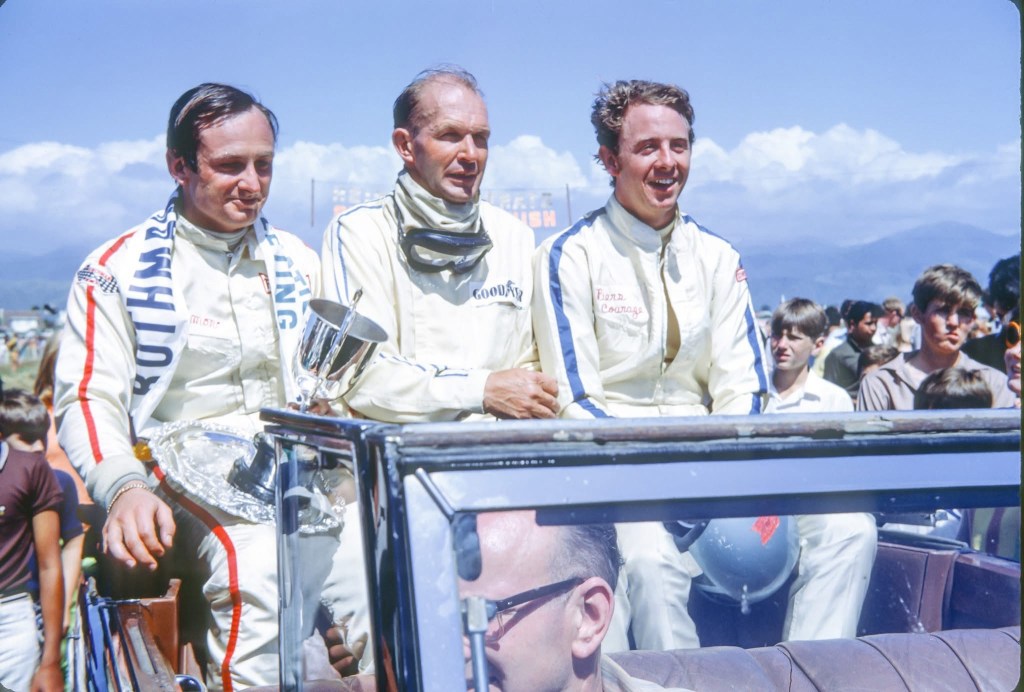
Ferrari 246T, Lotus 49 Ford, Lotus 49 Ford, Brabham BT24 Ford, and a Mildren Mono Alfa T33: Amon, Rindt, Hill, Courage and Gardner. Pukekohe NZ GP front couple of rows, January 4, 1969…
We didn’t know it at the time, but the 1969 Tasman Cup was the last for 2.5-litre cars, The Real Tasman in the minds of many. 1970 2.5-F5000 mix duly noted.
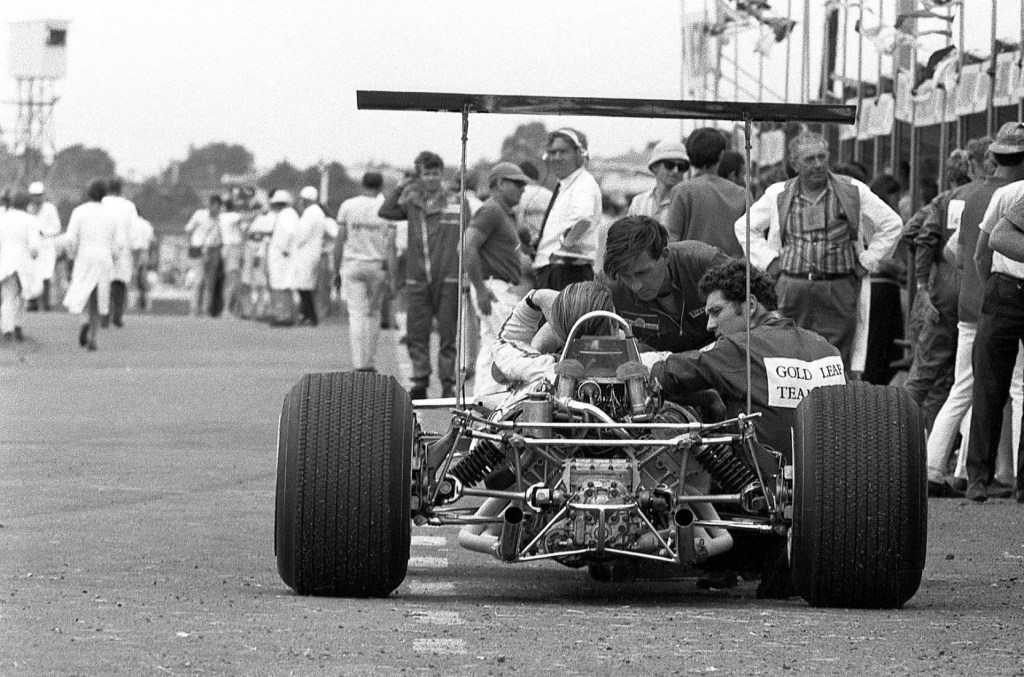
When Jim Clark appeared in a Gold Leaf Team Lotus machine during the Levin Wigram Tasman round the year before, it was the start of big bucks in ‘European Racing’. F1 was getting bigger, the season was getting longer with summer testing in the south of France and South Africa, and the drivers were ‘more valuable’. One couldn’t afford to put one’s GeePee programme at risk killing a driver on water-skis or the race track in Australasia.
Jim Clark was dead, killed at Hockenheim in a Lotus 48 Ford FVA on April 7, 1968. BRM were in F1 disarray, still struggling to throw off the shackles of the H16 debacle. Team Lotus came, with 49 Ford DFWs for just-minted World Champ Graham Hill, and fastest-kid-on-the-block, Jochen Rindt. BRM understandably stayed at home to get themselves sorted; in that regard, they failed!
‘Take it easy, sonny, play yourself in.’ Jochen Rindt (27) and Graham Hill (39) at Pukekohe (J Copsey)Amon in the Puke pits. Note the rear electro-hydraulic angle on the wing dangle device. ‘Moveable aerodynamic devices? Don’t look this way matey!’ (P Levet)
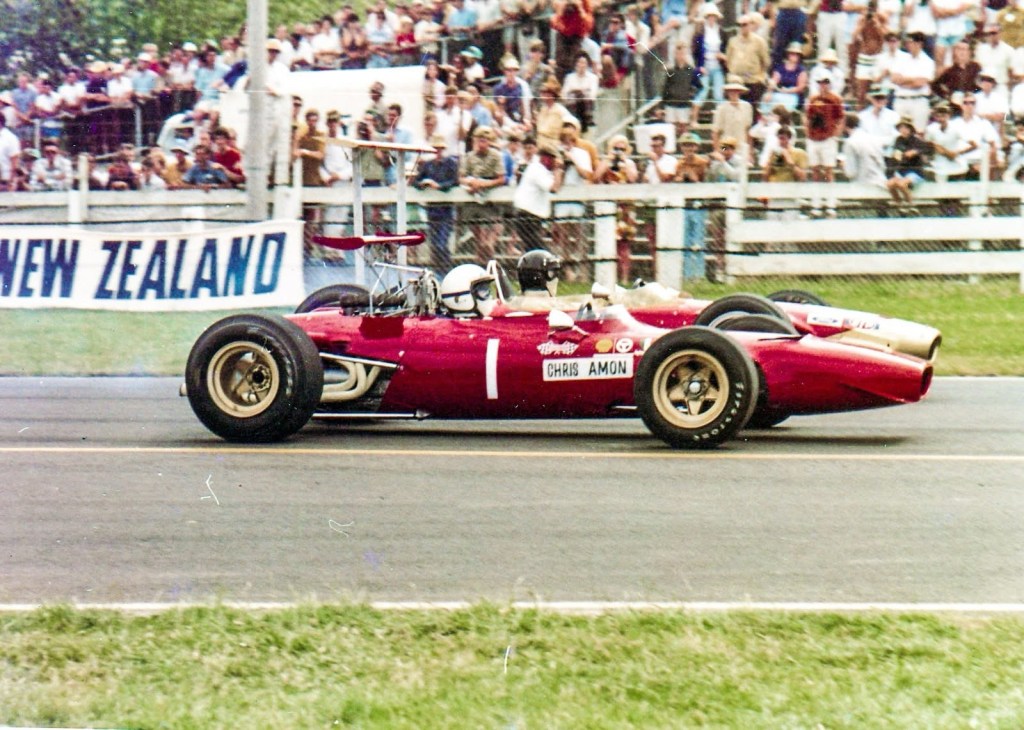
Scuderia Ferrari came too, or rather a triumvirate. Ferrari provided two Dino 246Ts with you-beaut four-valve 2.4-litre V6s, Chris Amon brought along his good self and Ace-mechanic and friend Bruce Wilson, while David McKay/Scuderia Veloce handled the on-ground logistics and team management.
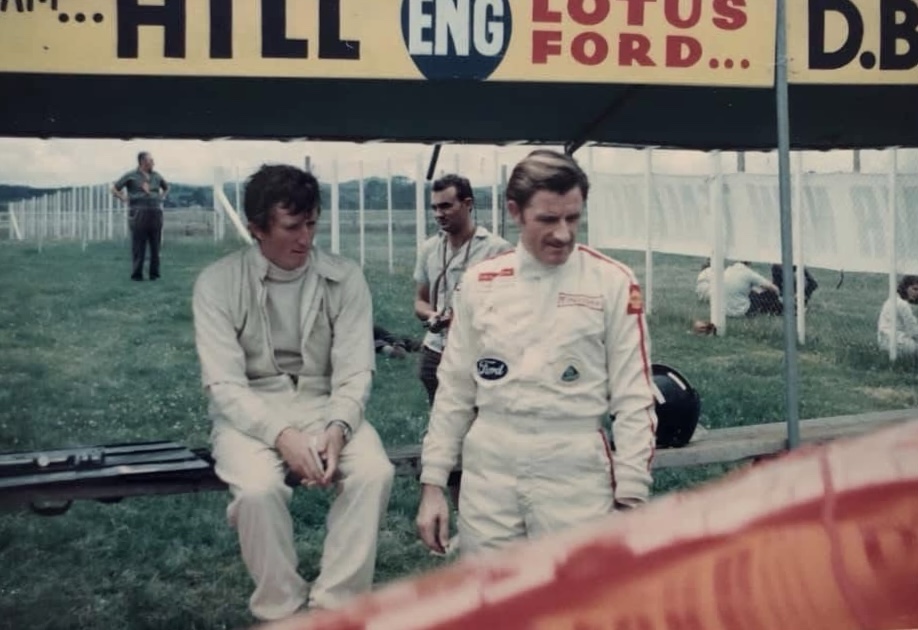
Scuderia Veloce are the Ferrari Sydney dealer and McKay was an extremely capable ex-driver, journalist and auto-entrepreneur. Quite who paid for what has never been clear – by all means send me a copy of the contract if you have it – but the mix of Scuderia Ferrari, Shell and Firestone had enough lolly in the kitty to pop Derek Bell in the second car.
Jochen had a marker to put down, and did so big-time! He had been in GP racing since 1965 and finally had a car worthy of him. It wasn’t to be Hill’s happiest Tasman or Grand Prix season in any respect.
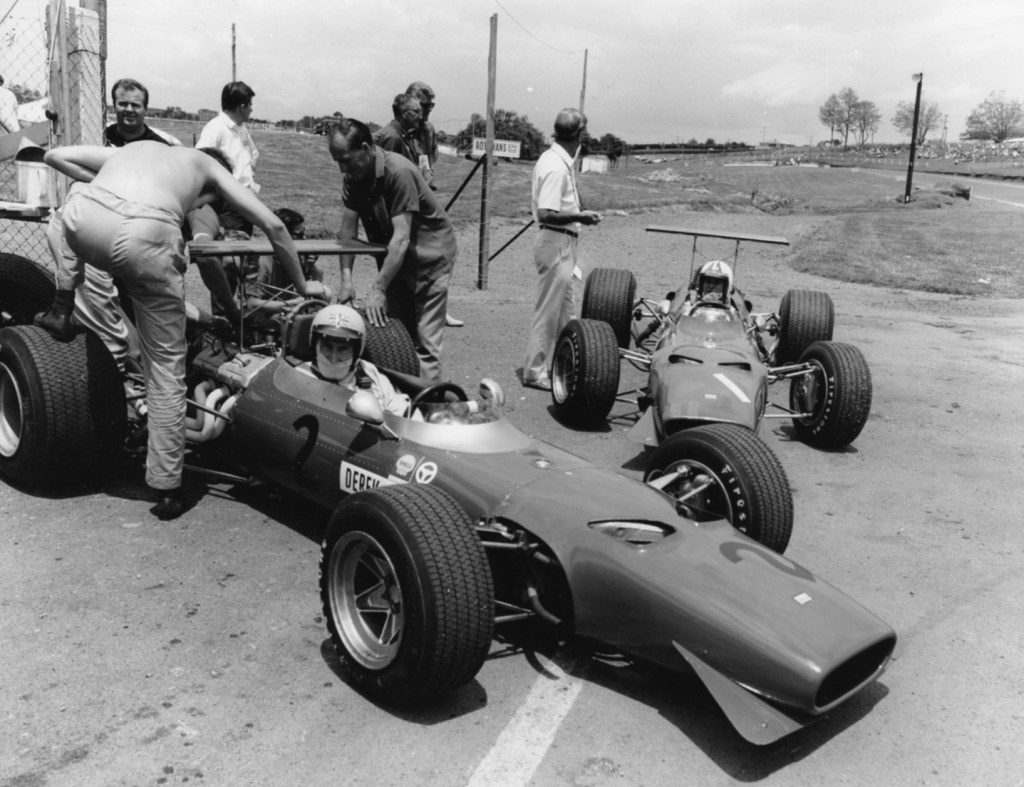
Derek Bell and Chris Amon (M Fistonic)Glenn Abbey warms up the Mildren Monos’ Alfa Romeo Tipo 33 2.5-litre V8. Engines made to Alec Mildren’s order, he was a good Auto Delta client, having bought two GTAs and a TZ2 in the mid-1960s (D Shaw)Note the beefy rear monocoque bulkhead. Hewland FT200 transaxle, twin-plug, twin-cam, two-valve 2.5-litre engine (D Shaw)
The other extremely capable Sydney ex-driver and auto-entrepreneur was Alfa Romeo Man Alec Mildren. His two cars were powered by 2.5-litre variants of Alfa Romeo/Auto Delta’s Tipo 33, twin-cam, fuel injected V8. He fielded a new monocoque designed and built by Len Bailey/Alan Mann Racing for Frank Gardner that used Brabham BT23 components: uprights/brakes, steering rack, wheels etc.
This gorgeous machine became an Oz Icon – The Yellow Submarine – driven by FG in this Tasman, and then Kevin Bartlett, and others, all of whom won in it even when it was a granny. KB’s car was the BT23D Alfa Gardner raced in the ’68 Tasman and with which Bartlett won that years Gold Star. They only had three engines, so KB only did the Australian rounds.
Leo Geoghegan, Lotus 39 Repco and the shot below (Peter Bruin)
Leo Geoghegan’s ex-Clark ’66 Tasman Lotus 39 #R12 was a veteran by 1969 but ongoing development of it by John Sheppard and Leo kept it towards the front and it was now equipped with Repco-Brabham Engines latest and final Tasman 2.5 V8 730/830 crossflow, SOHC, injected V8.
Similarly equipped was Jack Brabham’s F3 based Brabham BT31, although ultimately Brabham did only the Sandown round. It was a pity, as the very light, small car proved its competitiveness in its only gallop.
Climax 2.5 FPF-engined machines by then were also-rans, the other locals running FVAs and Lotus-Ford twin-cams didn’t have the puff to stay in the top half of the field and there were enough good 2.5s to make fast-reliable 1.6-litre runs not enough to bag a podium.
Courage, Brabham BT24 Ford DFWFrank Williams and Piers Courage at Puke, that sign is a year out of date! (J Copsey)
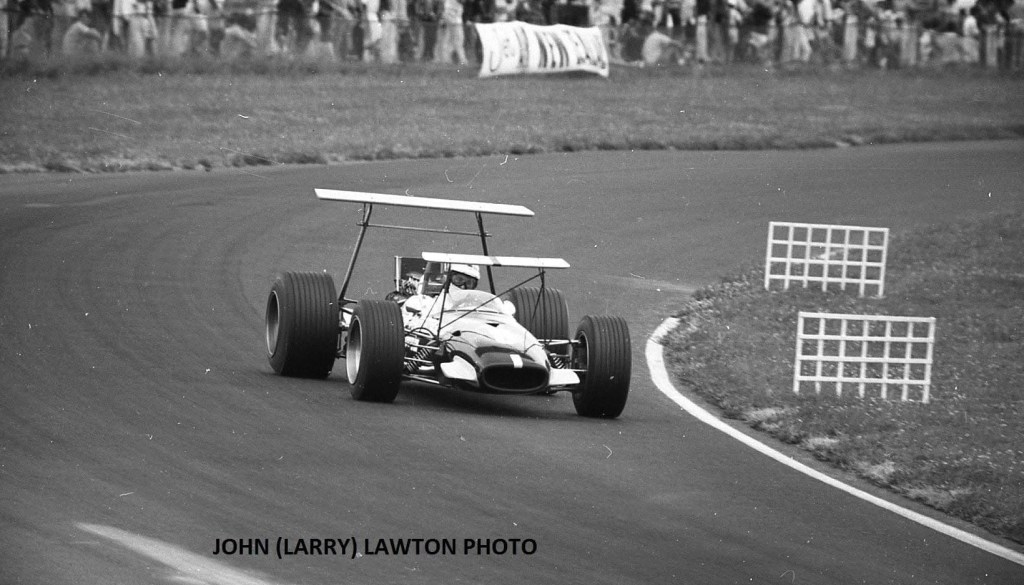
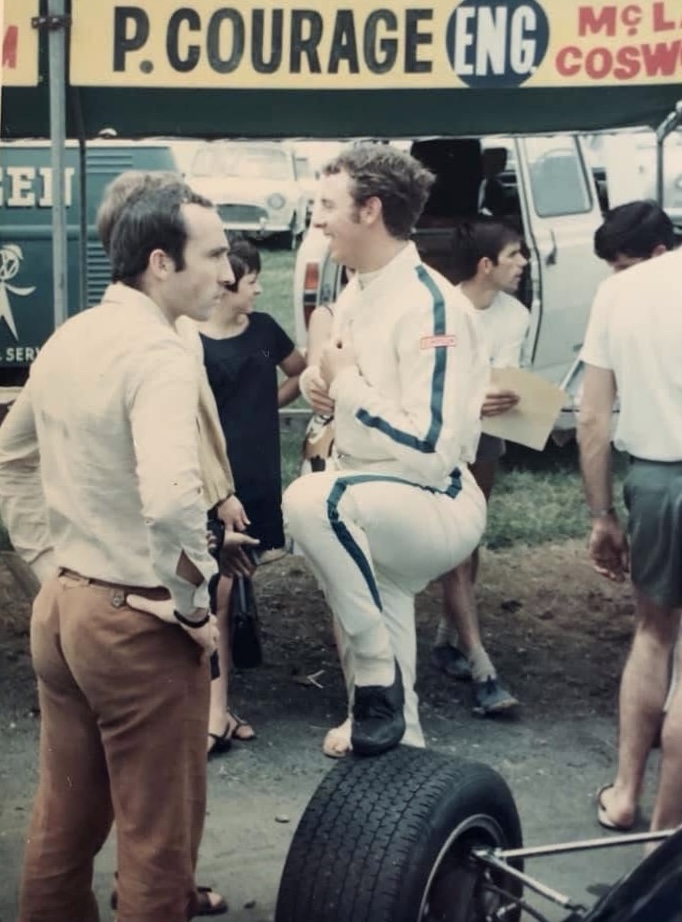
Speaking of which, McLaren M4A Ford FVA ’68 Longford winner, Piers Courage, was back with a bang. His Tasman 1968 solo run with the help of Les Sheppard provided a Ctrl-Alt-Delete reboot of his career. He had teamed up with F3-Travelling-Circus buddy Frank Williams to run a Ford DFW-powered ’67 Brabham BT24 #3 in the Tasman and was on the money throughout, winning the Teretonga round. The pair went one better in ’69 Grands Prix, running at the front all year with a ’68 Brabham BT26 converted to run a Cosworth DFV instead of the RBE 860 that first occupied the aft area. They were set to take on the world, let’s leave 1970 alone.
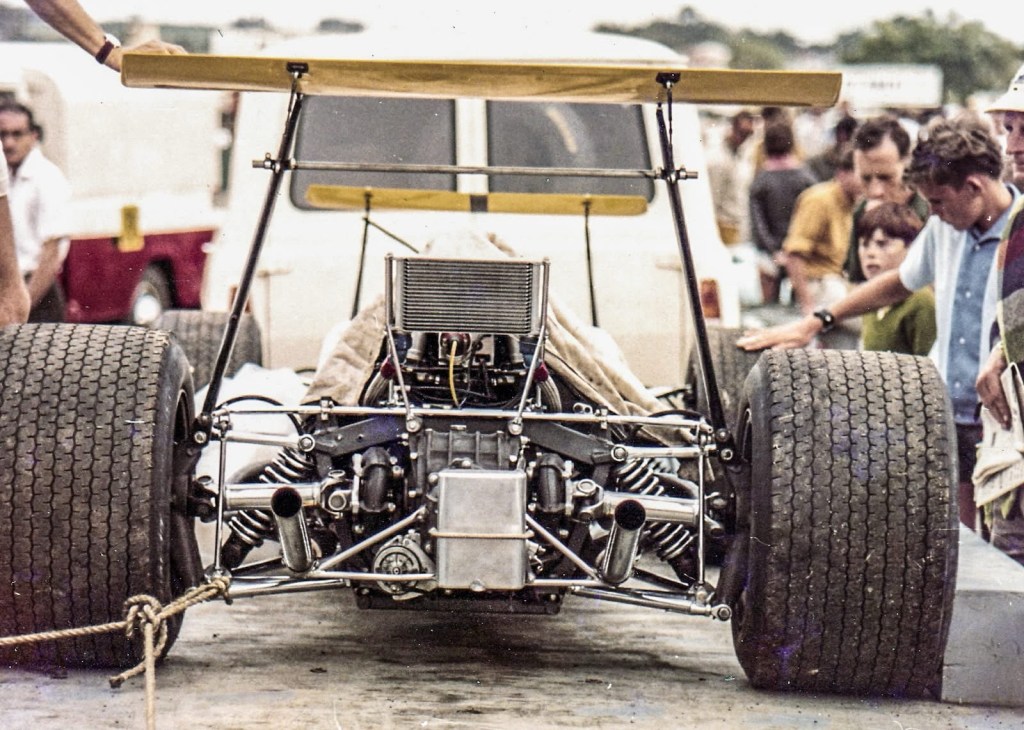
Graham Hill, Lotus 49B Ford DFW. Not the sturdy (sic) wing mounts attach directly to the uprights. ZF gearbox replaced by a Hewland DG300 by the series’ end (T Marshall)
Practice…
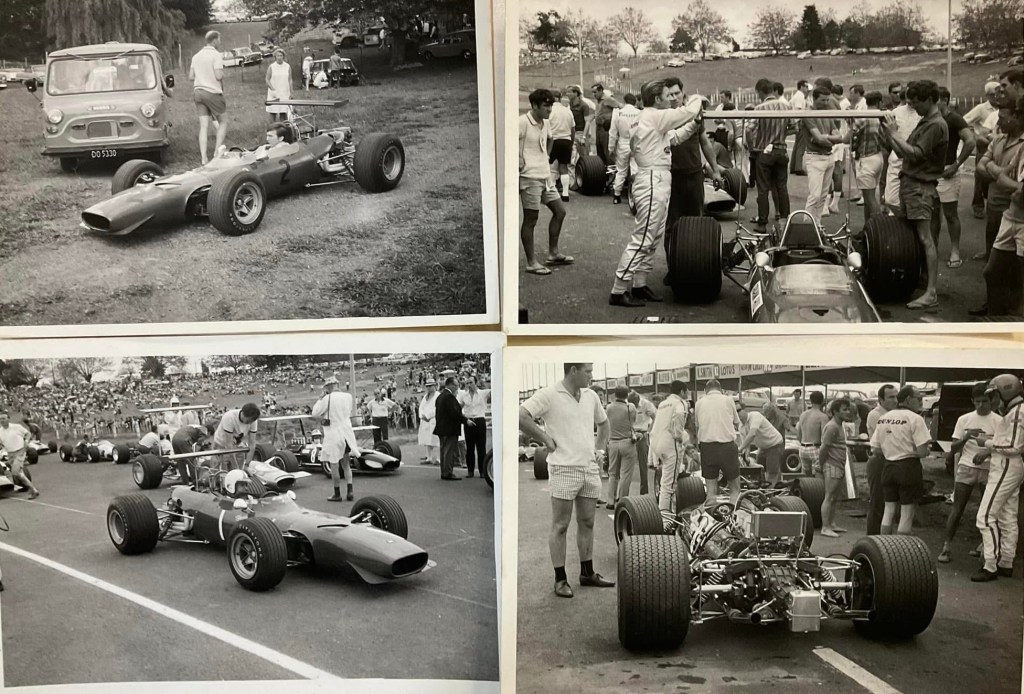
The Dinos of Amon and Bell positively gleamed in Auckland’s sunlight as the punters gazed upon them. Bruce Wilson had the cars early enough to pull them down and painstakingly assemble them with the time the Scuderia mechanics didn’t have. After the one-car learning expedition the year before, Ferrari was ready to boogie.
And so it proved during practice. Thursday was largely early sorting but Amon and Courage were the early quicks. Rindt wasn’t far behind – had he tested a 49 before heading down south? – while Hill and Gardner arrived late. Bell popped the nose of his car through railing early on, and an engine change was required of Chris’ car which was suspected of having a slipped cylinder sleeve.
Geoghegan’s Lotus 39 and Gardner’s Mildren Mono. Both started the series wingless and finished it with with them (P Bruin)David McKay checks in with Piers and Sally Courage (P Bruin)From top left, Derek Bell, Graham Hill checking his Lotus’ wing to ascertain the probability of it remaining attached to the car, Pier’s wingless Brabham BT24, and Amon heading for the grid (P Bruin)
Friday was business day with Rindt getting down to a 58.4 while wrestling with gear selection problems, including breaking the lever. Hill did a 58.8, winged-Courage a 59-dead then Amon pulled a 58.2 out of the bag to get pole. Jochen tried to better this but broke the gear lever again.
Next came Bell 59.6, wingless Gardner 60.6, Graeme Lawrence, McLaren M4A Ford FVA, Roy Levis, Brabham BT23 Ford FVA and Geoghegan, 63.5.
The Leo Geoghegan and Frank Gardner wingless machines out of Sydney: Lotus 39 Repco-Brabham 830 and Mildren Mono Alfa Romeo T33 2.5 V8.
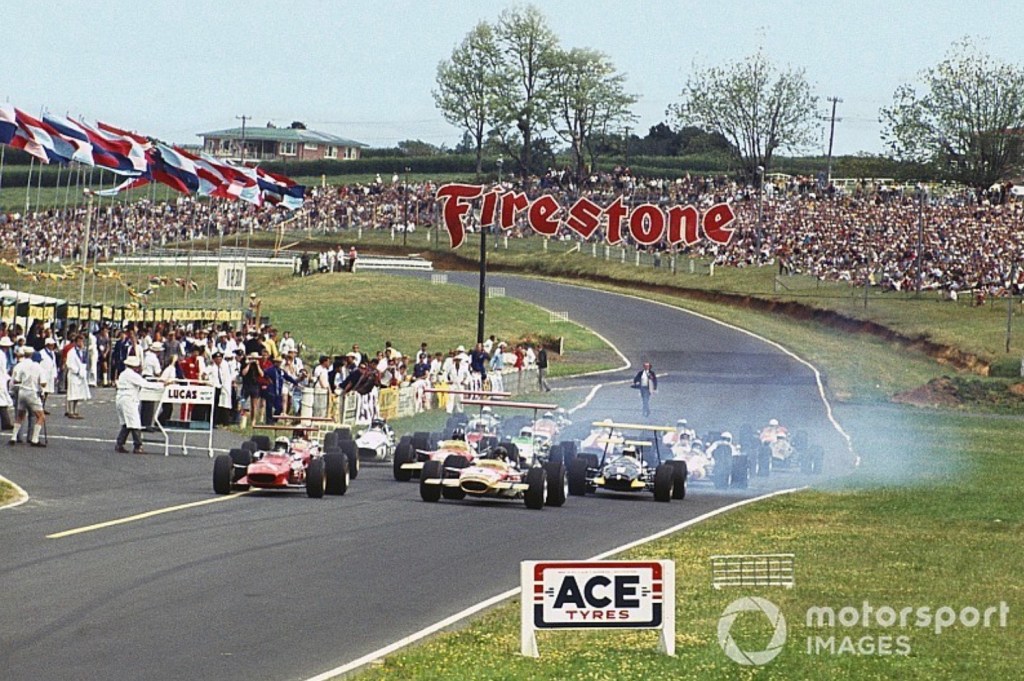
The Off: Amon and Rindt up front, behind Amon is Bell, then Hill in the middle and Courage on the outside, and the rest
Race…
Chris and Jochen light em’ up on the front row, 100 miles the standard Tasman Cup distance (T Growden)
The start of the race was fiery in a different way. Bryan Faloon’s Brabham BT4 Climax was set ablaze by an errant spark and an overfilled fuel tank. Bryan was scratched but had mild burns to his hands. In amongst this excitement, the Team Lotus mechanics replaced Jochen’s tach, which wasn’t operating. Then, as the minute board went up, Gardner’s Mildren was pushed to the side of the track with a duff fuel pump.
Twelve months before, his new Brabham BT23D Alfa won the ’67 Hordern Trophy at Warwick Farm just before Christmas, the car was fully sorted before it lobbed in NZ. They were not as far advanced with the Mildren Mono, staggering was a complete lack of wings. The car grew them as the series progressed but FG gifted his rivals time, he was the only front running 2.5 racing sans wings.
Gardner’s gorgeous Mildren Alfa takes its place on the grid immediately prior to its fuel feed problems becoming apparent (W Collins)The Amon and Bell Ferraris ahead of Leo Geoghegan’s Lotus 39 with a slower car hanging out wide Rindt coming over Rothmans (T Growden)
When the flag dropped in front of a great crowd, it was Amon, Rindt, Courage and Hill. Chris was a couple of car lengths ahead of Jochen at the end of lap 1 from Courage, Bell, Hill, Geoghegan, Levis, Lawrence, then the elderly Brabham Climaxes of Red Dawson BT7A and Dennis Marwood BT?, and then the amazing Graham McRae in his very fast, small, clever, Brabham based, McRae S2 Lotus-Ford 1.5.
Rindt passed Amon on lap 2 and by lap 4 was two-sec clear of Chris, then came Courage, a bit of a gap to Bell and Hill, then a bigger one to Leo Geoghegan’s wingless Lotus 39 Repco who had a 10 second gap from Levis, then Lawrence, Dawson, McRae and David Oxton, Brabham BT18 Lotus-Ford 1.5.
By lap 6, Chris and Jochen were rounding up the tail-end-Charlies without difficulty, but Piers Courage wasn’t so lucky and lost a lot of ground on the right-hand sweeper out of Pit Straight.
Rindt tigered to try to clear away from Amon and did the fastest race lap of 58.9 on lap 9, doing 160mph through the timing traps on the back-chute. While this was going on, Graham Hill passed Derek Bell before the Londoners’ hard work came to nothing on lap 13 when a front-suspension ball joint broke. Simultaneously, Frank Gardner joined the fray, Glen Abbey having sorted or replaced the errant fuel pump.
So…it was Rindt, Amon, Courage, Bell, then Geoghegan back a bit, then Lawrence, Levis, Dawson, McRae and Oxton.
The Courage BT24 Cosworth entering The Esses (T Growden)Rindt (T Marshall)
The race was starting to look like a cruise-and-collect copybook first Lotus win for Austria’s finest but then he ran wide on some oil on the approach to the hairpin and ceded the lead to Amon as he sorted his misdemeanour. Courage remained third, Jochen regained some ground but he had lost his clutch and the wing feathering device wasn’t doing its thing on the straights, so began to lose a second a lap.
Rindt remained clear of Courage despite that – 24 seconds clear by lap 40 – who in turn had a good gap from Derek Bell, who too had a good margin from Leo G.
With eight of the 58 lap/100 mile race to go the order was Chris Amon, Ferrari 246T, Jochen Rindt, Lotus 49 Ford DFW, Piers Courage, Brabham BT24 Ford DFW, Derek Bell in the other 246T, Leo Geoghegan’s Lotus 39 Repco-Brabham, Graeme Lawrence, McLaren M4A Ford FVA, Roy Levis Brabham BT23 Ford FVA, Red Dawson, Brabham BT7A Climax and David Oxton Brabham BT18 Lotus-Ford 1.5.
And so it remained until the finish.
(T Growden)
Winners are grinners…
(S Oliver)
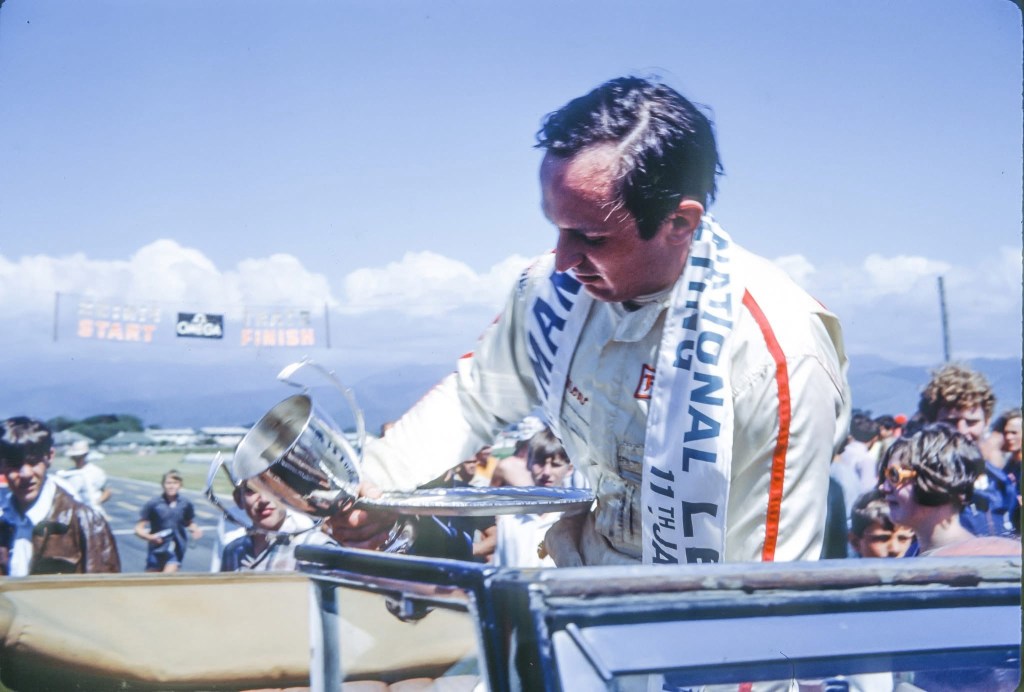
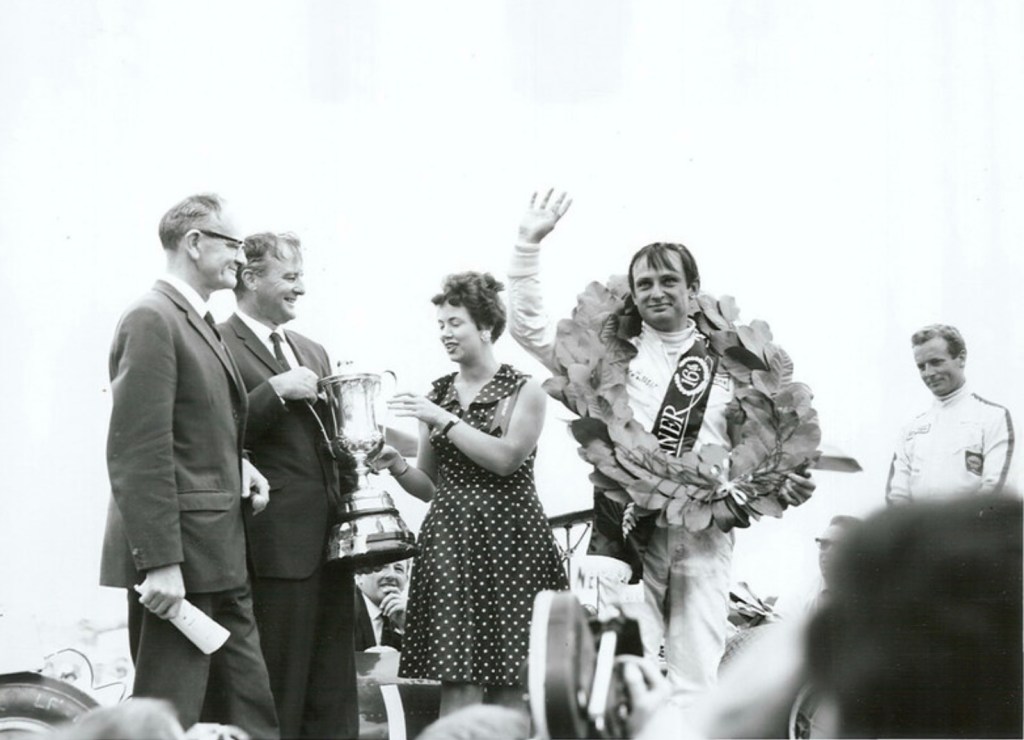
A suitably big smile on Christopher Arthur Amon’s face as he does a victory lap with the winners sash around his neck, back-to-back NZ GP victories.
246T/69-0008 was sold by Ferrari to Graeme Lawrence after the Tasman, he did well in it throughout the South Pacific inclusive of the 1970 Tasman Cup win, the little car had just enough pace and more reliability than the F5000s that year.
(S Oliver)(S Oliver)(S Oliver)
Chris Amon (1943-2016), Frank Gardner (1930-2009), and Piers Courage (1942-1970). Aged 26, Chris was already a six-year F1 veteran, maybe not such a big deal now, but his extreme youth on entry to Grand Prix racing was rare back then.
(S Oliver)Amon and at far right, Graeme Lawrence on the podium. GL was the first local home; sixth in his F2 McLaren M4A Ford FVA
Etcetera…
(T Growden)
To Wing, or Not To Wing…That is The Question…
1968 was the start of it in Grand Prix racing at least, the earlier Chaparral contribution is hereby duly noted. Courage – BT24 Cosworth DFW above – practised with them on and off, and raced with them on. Those wings – note the mount directly atop the rear uprights – look very much like a works-Tauranac fabrication(s) to me.
The Boys taking it all in, ‘Do you think the wings will catch on?’ (B Homewood)(T Growden)
A couple of shots of Graham McRae’s McRaes, topics for another time.
(K Lancaster)(T Growden)
David Oxton, ex-Silvio Moser Brabham BT16 Lotus-Ford. Later an F5000 and F Pacific front-runner, Oxton won NZ’s Gold Star from 1972-74 and in 1981-82.
Graeme Lawrence’s McLaren M4A-14 Ford FVA
Credits…
Peter Bruin via Chris Denby, Tony Growden, Stewart Oliver, Peter Levet via Milan Fistonic, Doug Shaw, Warner Collins, Jeff Copsey, Bob Homewood, Kevin Lancaster, oldracingcars.com
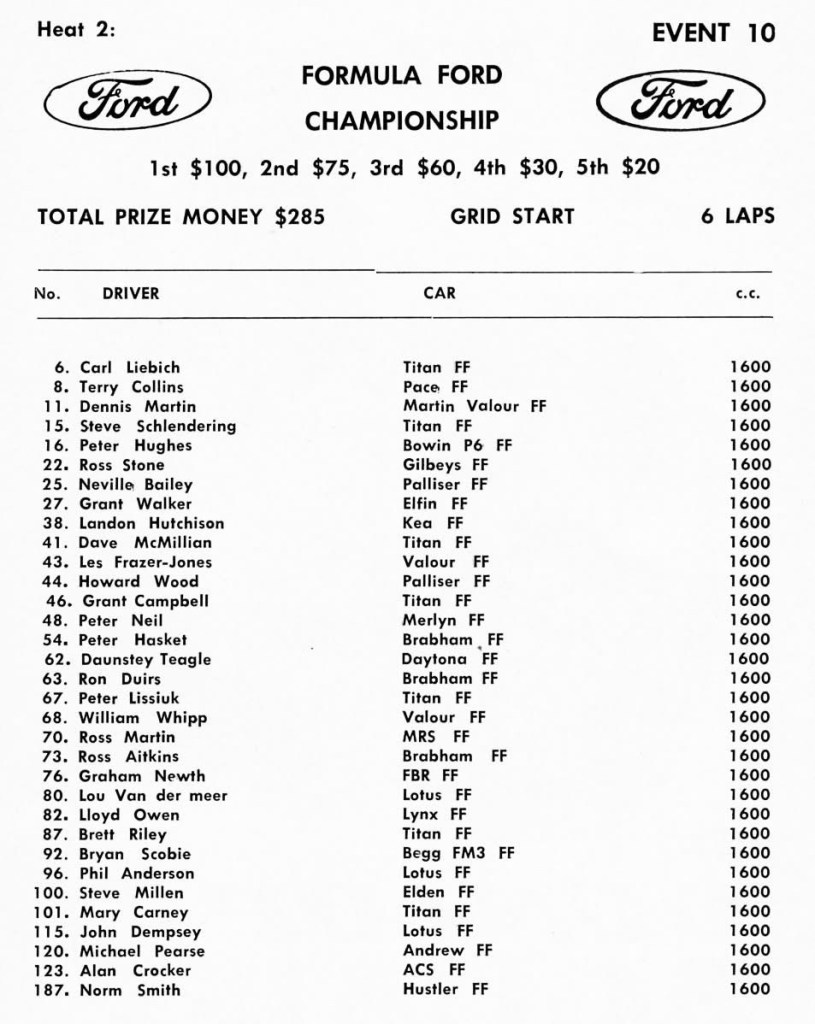
Not so much NZ Formula Ford but some shots my favourite Formula Fords in New Zealand…David McMillan and Lola T342 in 1975, circuit folks?
The Lola T342 was surely the first FF with genuine lust factor, I should know, I bought one in the US and historic-raced it here for a decade or so. More about the T342 here:https://www.lolaheritage.co.uk/type_numbers/t342/t342.html
(W Clayton)McMillan on the hop at Wigram in 1979 or 1980. He won the Lady Wigram Trophy in both years aboard his trusty Ralt RT1 (T Marshall)
McMillan was the real deal. He won the NZ FF Championship in 1975/76 and went on to bigger and better things including winning the NZ Gold Star Championship in 1977 and 1979-80. Taking the hotly contested 1980 NZ International Formula Pacific Championship/Series in front of Steve Millen and Andrea de Cesaris was quite a feat.
His mount throughout was the same Ralt RT1/76 Ford BDA chassis #36 an ex-Kevin Cogan car raced with success in McMillan’s hands in Canada and New Zealand before being rebuilt as a Super Vee for Dave’s use in the US in 1980…and success in that form too!
(S Elliott)
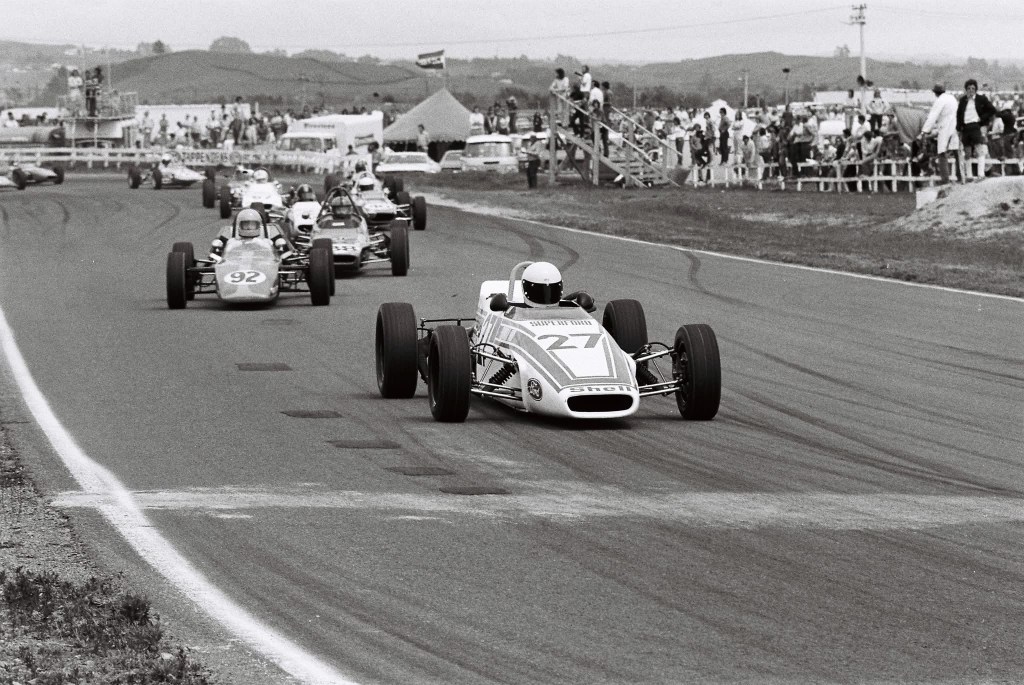
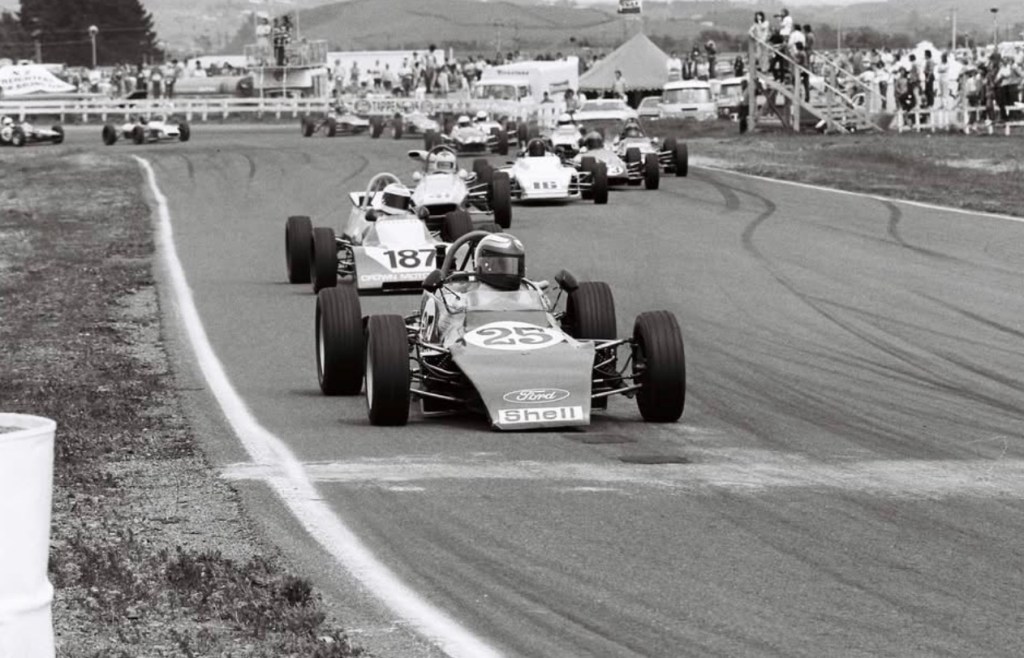
NZ Championship action at Baypark in October 1973, Grant Walker’s Elfin 600 from Bryan Scobie, Begg FM3 and Landon Hutchinson, Kea FF. Walker won the 1974-75 NZ FF Championship in this car. More about the Elfin 600 here: https://primotipo.com/2022/04/23/sinfully-sexy-600/
Norm Smith in car #187 below, a Hustler FF won both heats, while car #25 is Neville Bailey’s Palliser.
(S Elliott)
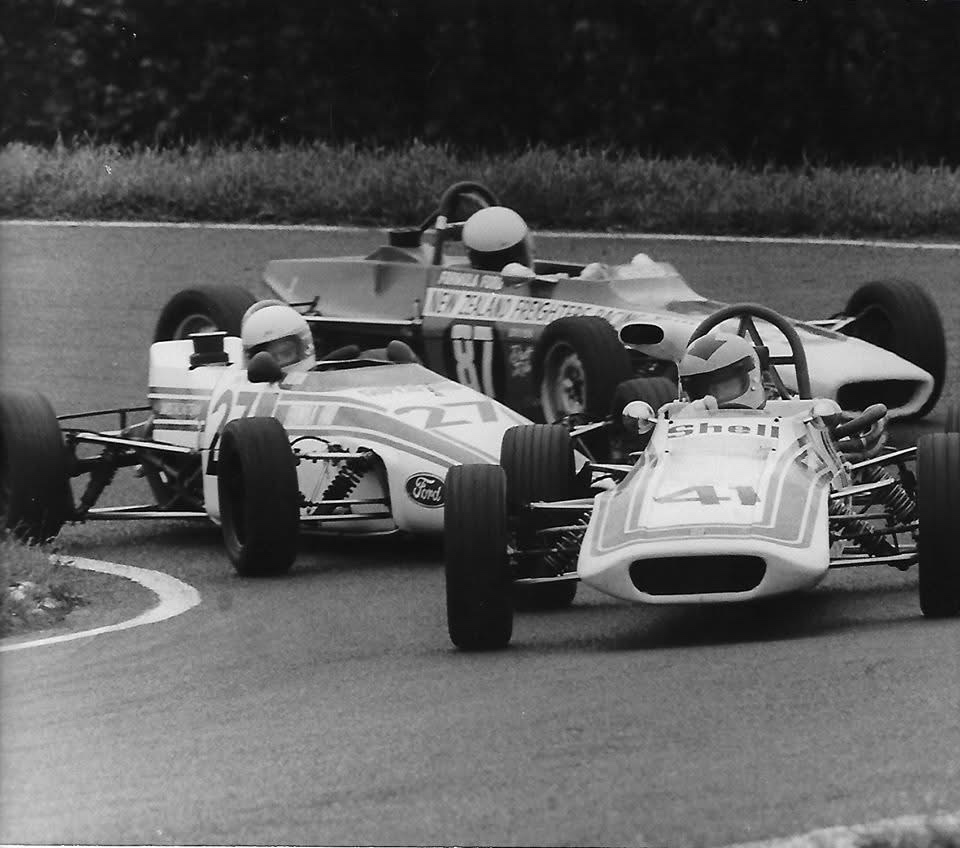
Tustle between Grant Walker Elfin 600 #27 and David McMillan in a Titan Mk6 #41, both in Dawes Racing Team cars.
The amusing bit for me is that Grant brought the Titan Mk6 across the ditch to contest the Australian Driver to Europe Series in 1977 finishing second…and races the same car in Oz Historic FF now. He’s no longer the youngster he was back then but is still mighty quick!
Car #87 is none other than Brett Riley in another Titan Mk6, he too was a Kiwi International of some renown.
(M Fistonic)
Eric Morgan, Bowin P6F at Pukekohe in November 1974. The chassis in which Peter Hughes won the 1973-74 NZ Championship?
Warwick Clayton, Steve Elliott, Milan Fistonic, Terry Marshall
Tailpiece…
(S Elliott)
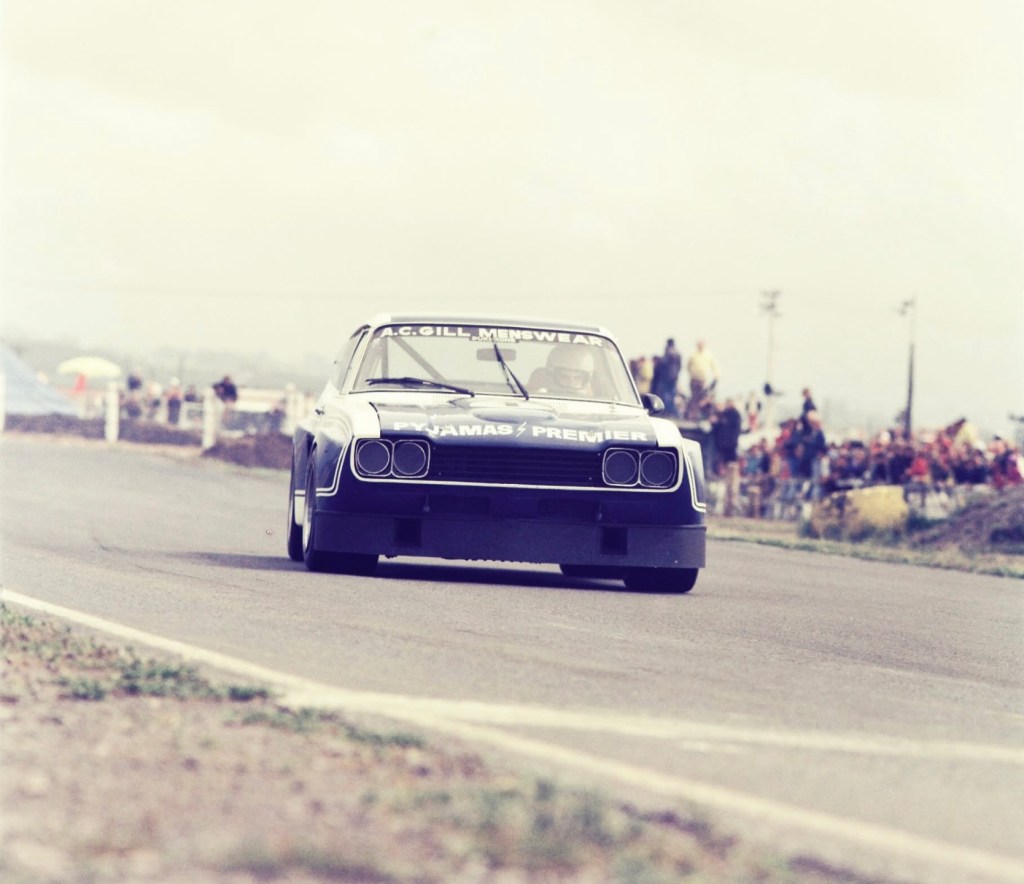
A change of mount for Grant Walker, here aboard the ex-Paul Fahey Ford Capri RS3100 at Baypark circa 1975-76. He raced this car in Australia too now I think of it.
Yes, yes I’m not a Kiwi but I like them, they are Our Bro’s across The Ditch after all. I know S.F.A. about their rich racing history, my interest goes way beyond our shared ‘Tasman Internationals’ history too.
There are a load of photographs doing the rounds on NZ’s racing social media sites, so it seems smart to capture and share some of them rather than lose them in the bowels of Facebook. The potential for cockups is great as I don’t have the same depth of knowledge – such as it is – as I do of Australian material, but just drop me a note on mark@bisset.com.au and I’ll fix up any boo-boos.
There is no order to all of this, so apologies to all you OCD-ADHD-On The Spectrum mob.
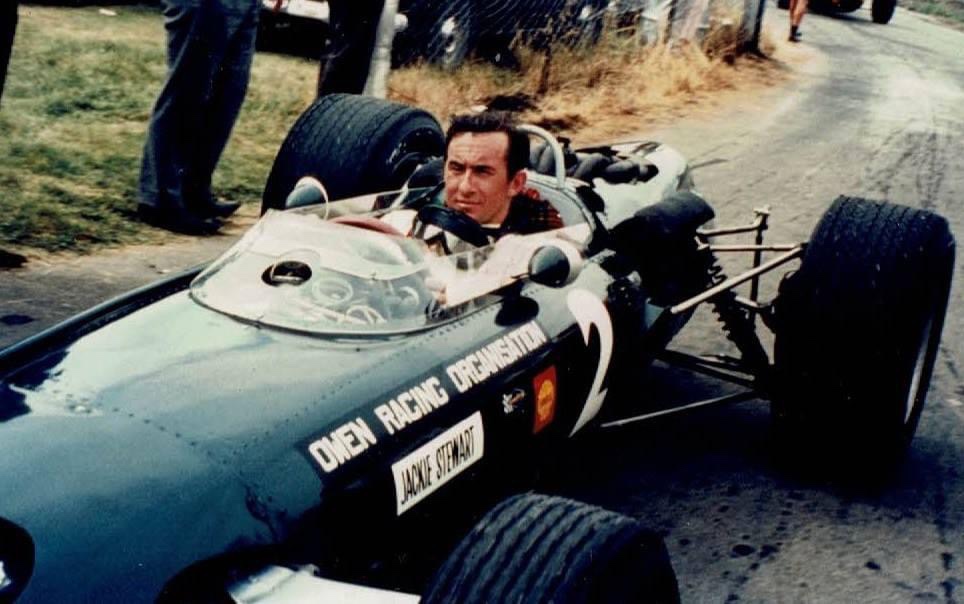
The more you look, the more you see of the shot above: from the left it’s Bill Hannah, Angus Hyslop’s mechanic with the big hat seated under the umbrella, to his left standing up with the peaked cap is Owen Steel, in the middle Jackie Stewart is talking to Kerry Grant, with Spencer Martin a little further to the right.
Stewart, Levin 1967. A non-championship round that year, the Levin International was won by Jim Clark’s Lotus 33 Climax FWMV 2-litre from Stewart’s 2.1-litre BRM P261 (R Cunningham)
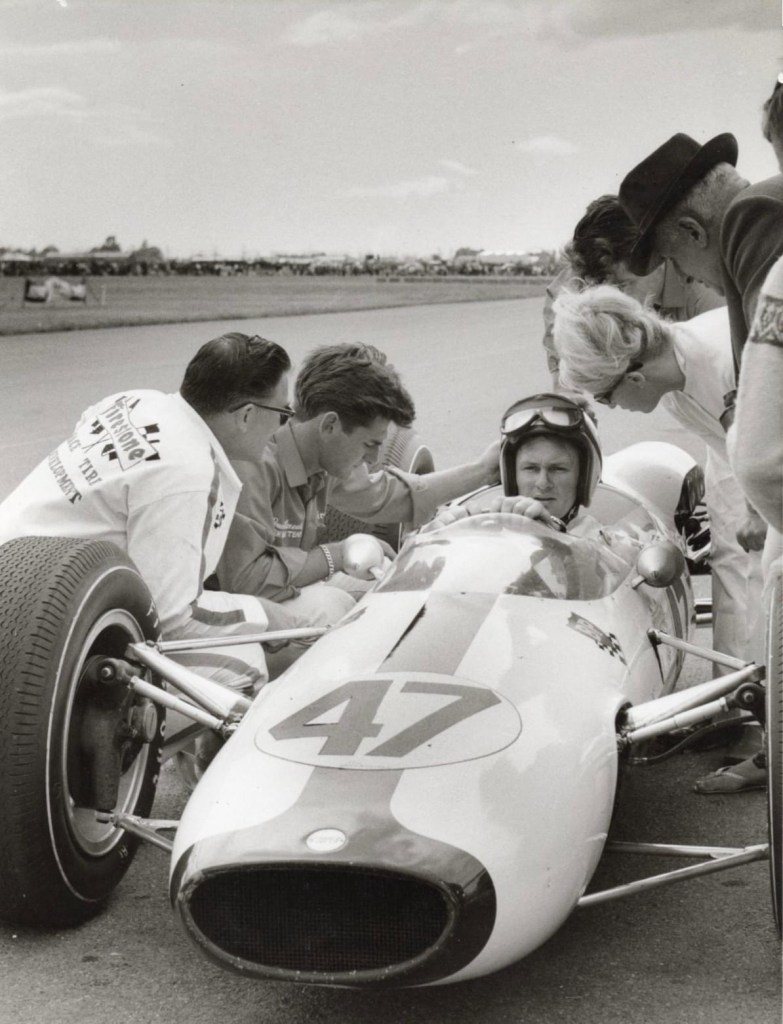
This series of photographs were taken during the 1965 Tasman Cup, featuring Bruce’s new Cooper T79 Climax. The shot above shows Wally Willmott on the left and Pop McLaren in the Trilby during the Lady Wigram Trophy weekend where Jim and Bruce finished 1-2.
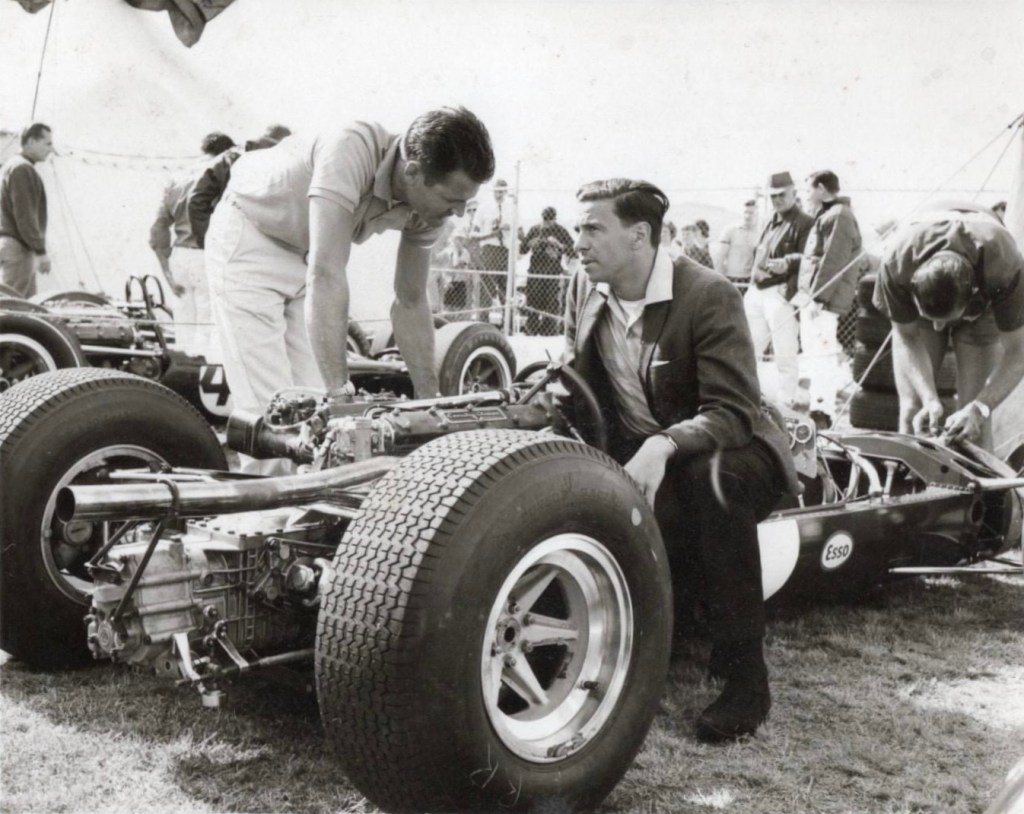
While Bruce won the Tasman in 1964 with his Cooper T70 Climax, the 1965 victor was Jim Clark, here in discussion with his mechanic, Ray Parsons, with their Lotus 32B Climax. Jimmy took four wins: Levin, Teretonga, Warwick Farm and Lakeside, and Bruce one win at Longford – the Australian Grand Prix – to finish the series second.
(M Waters)
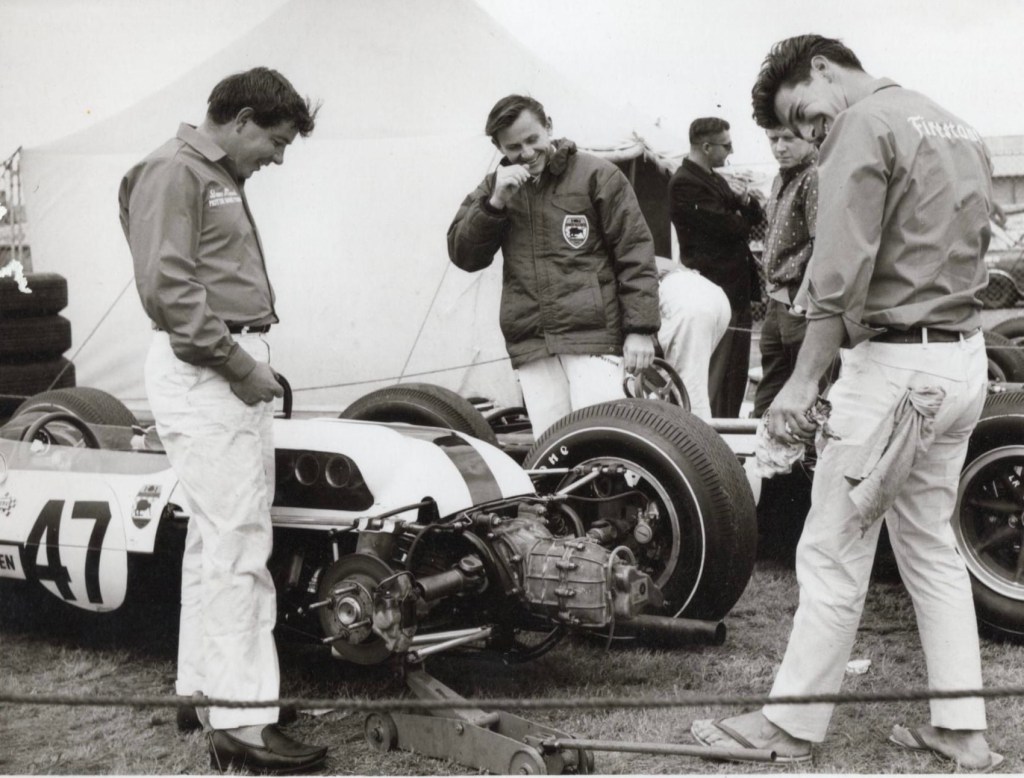
The merriment is perhaps around getting Bruce’s new Firestones – he had just signed with them – to work with suspension geometry designed for Dunlops. It any of you Kiwis can explain exactly what changes were made I’d love to hear from you…
Wally Willmott, Bruce Harre, Bruce McLaren, Jim Clark, Tyler Alexander and Colin Beanland gathered around the Cooper T79, probably Wigram, 1965.
Why isn’t Jimmy ready to boogie? David Oxton remembers that “Graham Hill, Clark, Frank Gardner and Bruce flew direct from the South African GP in time for an unofficial testing session on the Wednesday. For some reason Jim didn’t take part in that, so that could be an explanation.” An alternative is offered by Milan Fistonic, “If it’s Wigram McLaren and Clark ran in different heats, so McLaren could be getting ready to go out in heat 1 while Clark still had time to suit up for heat 2.” Aren’t first-hand recollections gold, even 60 years later!
Peter Whitehead’s Ferrari 125 in the Wigram paddock, 1955. He won the race from Tony Gaze’s HWM Alta and Ken Wharton’s BRM P15 V16. This car was sold at the end of the summer, to Australian, Dick Cobden. More about Whitehead and the Ferrari here: https://primotipo.com/2023/12/13/peter-whitehead-ferrari-new-zealand/
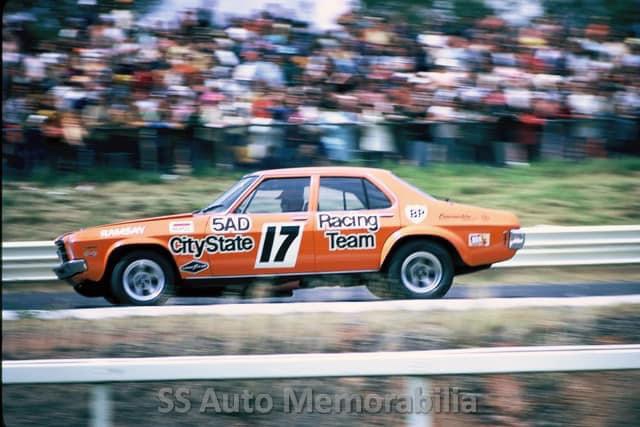
I’ll be faarked how it complied with those regs with THAT engine, THOSE strengthening members and fabricated wishbones DEVOID of fixed bodywork and all. Holy Moses. But maybe it was all in evening up the show for the local poverty-pack against the well-homologated Mustang, Camaro et al. Do tell taxi-experts. Hmm, lets think…In the back of my brain this car was pranged twice at Adelaide International, the second hit was fatal. Perhaps after the first one it morphed into a Sports Sedan, in which case the modifications make perfect sense. One for you Taxi Experts.
It was a mega-car too, I’ll never forgot the sight of Mal Ramsay wrestling the thing around Shell Corner at Sandown (as below) bellowing its F5000 roar during the very first car race meeting I ever attended, the 1972 AGP meeting. With a little more development from the Birrana Cars boys it could really have been a good thing, what a crowd-pleaser it was all the same.
(G Richards Collection)
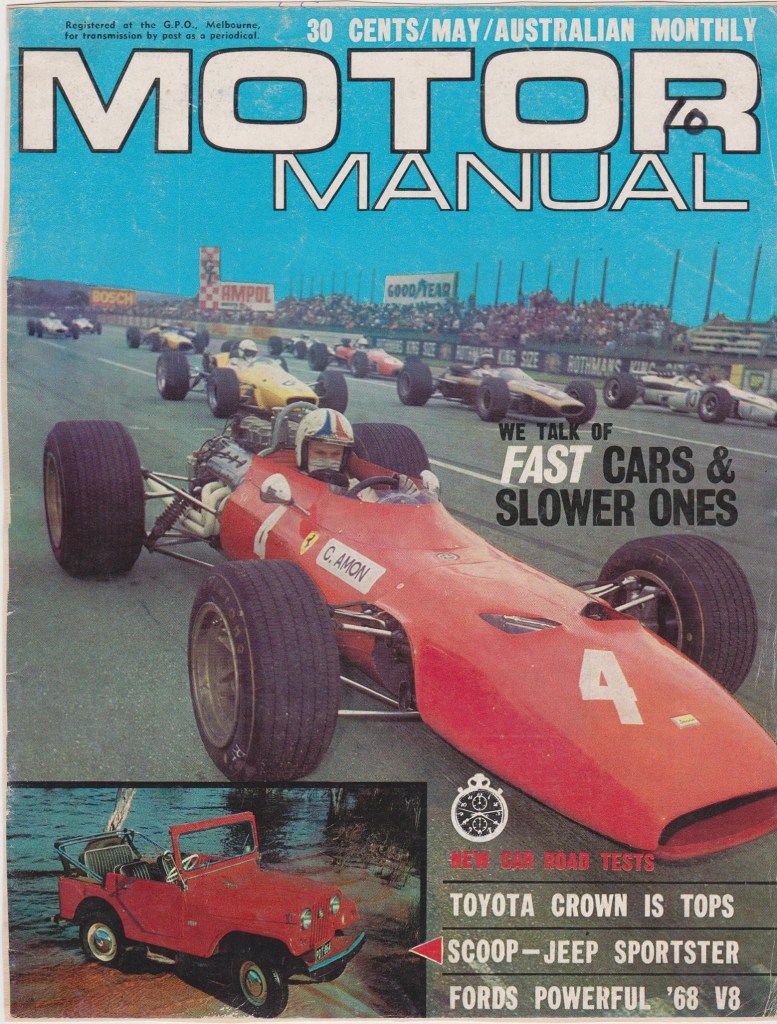
Chris Amon, Ferrari 246T on the cover of May 1968 Motor Manual. Ya gotta hand it to them, their coverage of the January-February Tasman Cup must have been considered, coz it sure wasn’t timely.
Amon won two of the seven rounds in the little Dino, he was bested by Jim Clark’s works-Lotus 49 Ford DFW. Chris went one better in 1969, taking four wins and the championship in 246T/69 #008. Ferrari then sold that car to Graeme Lawrence who repeated the achievement against a field of F5000/Tasman 2.5/2-litre cars in 1970. Lawrence won at Levin only, but his speed and consistency throughout was enough to beat the quickest F5000, Frank Matich’s McLaren M10A/B Chev which took two wins and placed second overall. More on the Dino 246T here: https://primotipo.com/2018/05/01/wings-n-dino-things/
(HEII)
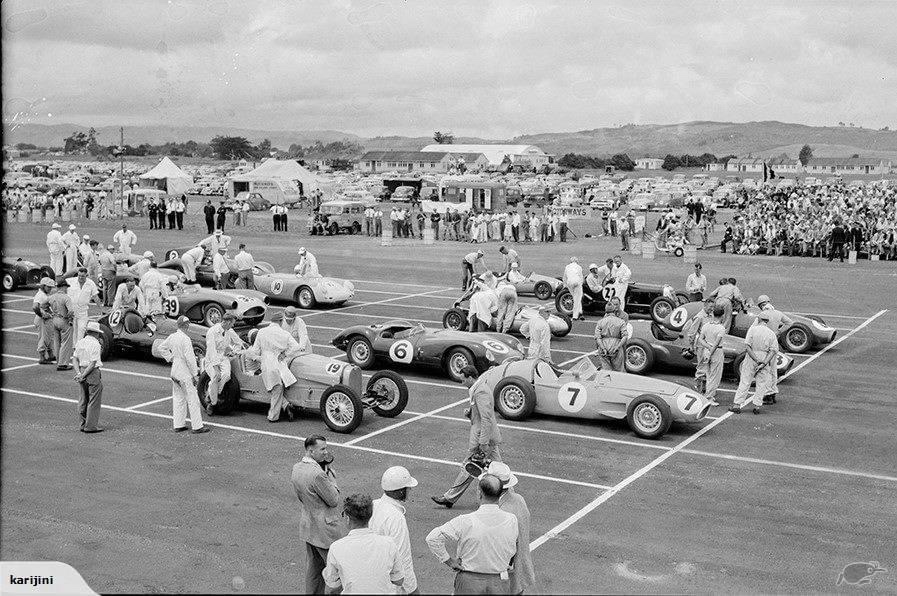
1956 NZ GP grid, a 100 lap, 186 miles race of the Ardmore Airfield circuit won by Stirling Moss’ #7 Maserati 250F from the 3-litre Ferrari 500/625s of Tony Gaze #4 and Peter Whitehead on the front row.
#19 is Ron Roycroft’s Bugatti T35A Jaguar 3.4 (sixth), #6 is Peter Whitehead’s Cooper T38 Jaguar that was raced to sixth place when Reg’s works-Aston Martin DP155 lunched an engine in practice, while #22 is Tom Clark’s Maserati 8CM 3-litre (eighth). #39 is either David McKay or Tom Sulman’s Aston Martin DB3S and #10, Norman Hamilton’s Porsche 550 Spyder awaiting pilot Frank Kleinig (ninth).
Roberto Moreno, Ralt RT4 BDA on pole before the start of the 1982 New Zealand Grand Prix at Pukekohe, January 9, 1982.
Steve Millen #7 and David Oxton in #18, RT4s as well. Moreno won the first heat from Millen, Millen won the second from Moreno while Roberto won overall.
(D Bull)(D Bull)(S Taylor)
Jim Clark, Lotus 49 Ford DFW 2.5 at Teretonga in 1968, Bruce McLaren won the Teretonga International from Jimthat January 27th in a works-BRM P126 2.5 V12.
Bruce didn’t run a car that summer, the deal came about as a result of McLaren’s use of customer BRM V12s during the 1967 Grand Prix season. It would be interesting to know (a) What Bruce thought of the 3-litre V12 (b) What Bruce thought of Len Terry’s P126 chassis and (c) What Bruce thought of the 2.5-litre variant of the V12. If anybody has a contemporary magazine article that covers any of that lot, I’d love to hear from you!
(J Inwood)
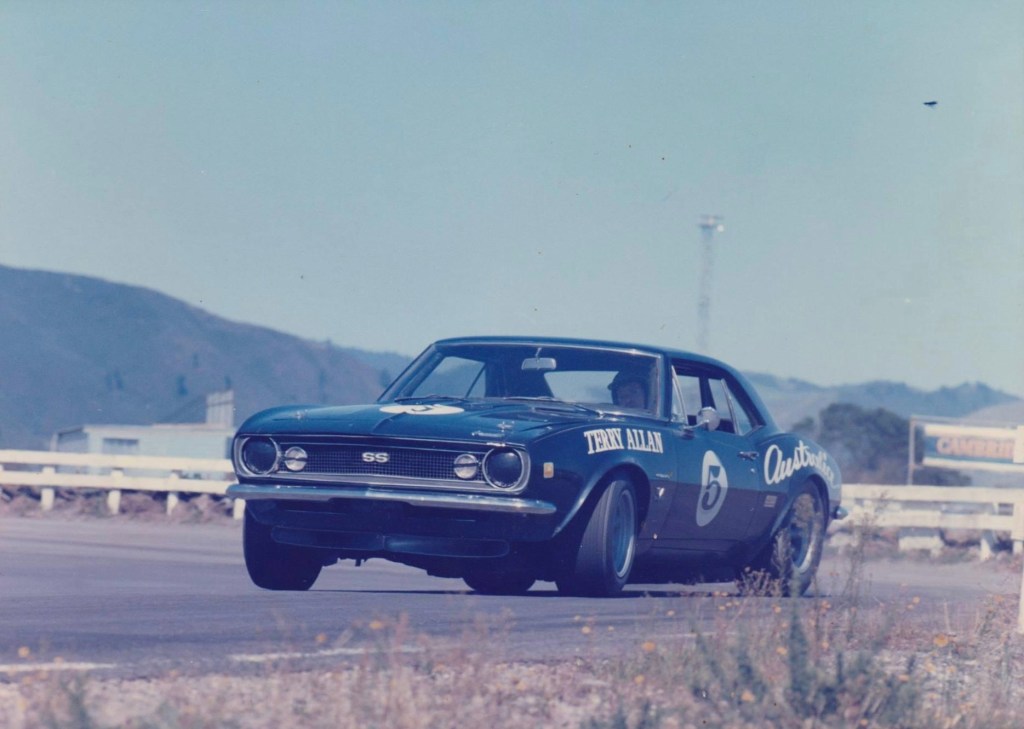
Aussie Terry Allan, Chev Camaro SS at Baypark during Easter in 1970.
Allan was the first bloke to race a Camaro in Australia, at Calder in May 1967. Fitted when delivered with a 327 cid V8, the machine was fitted with a worked 396 before it left the states for Oz. What became of it folks?
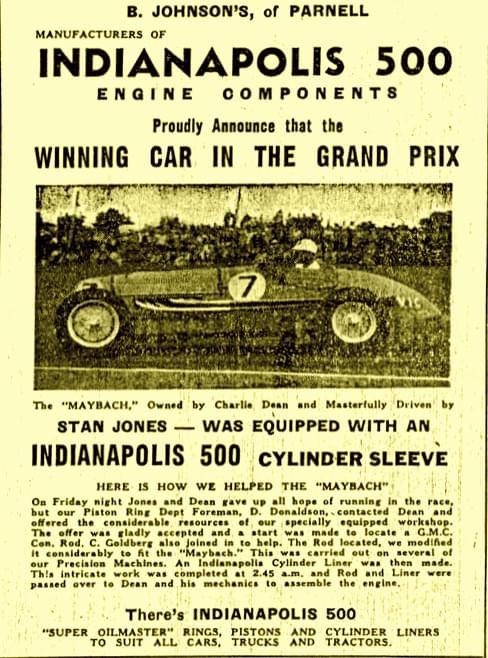
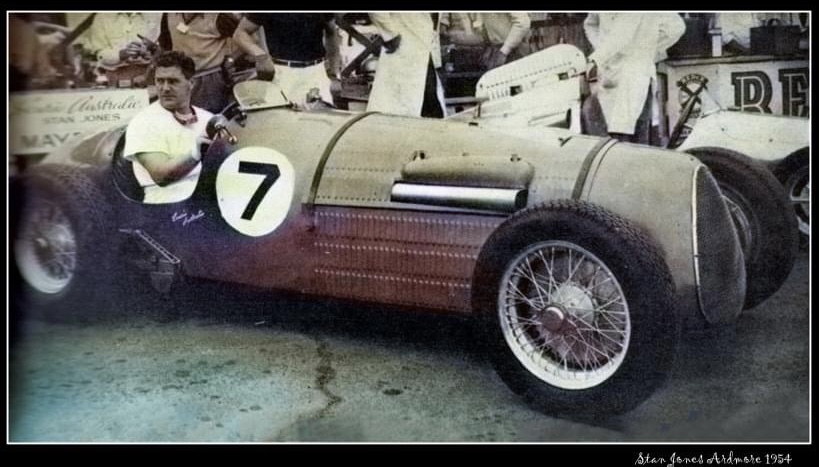
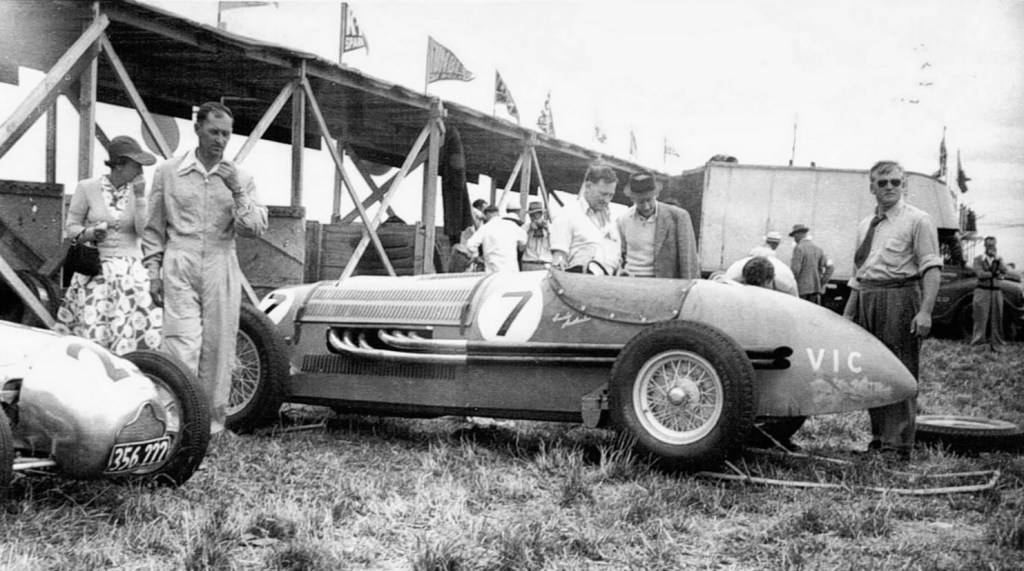
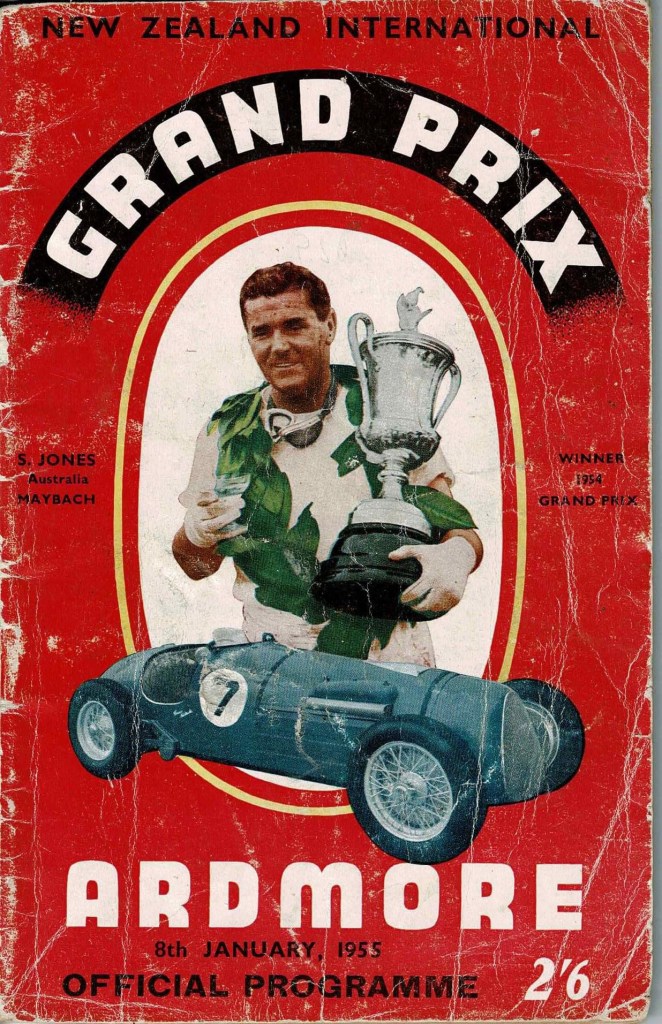
The Repco Research Maybach 1 success in the 1954 New Zealand GP at Ardmore is a real triumph over adversity effort told in this piece here;
When the car threw a rod and punched a hole in the block, “Charlie Dean phoned Australia for parts, but they couldn’t be landed in Auckland in time. Nothing daunted, the crew started scouring the city for makeshifts. They got a GMC conrod from Ray Vincent, a machine shop made up a new cylinder-liner – B Johnsons as above – while patches were fabricated for the crankcase,” related Naomi Tait.
Peter Donaldson related that his father, “Dawson Donaldson was dressed to go to the GP ball on Friday night but left mum standing at the front door in her ball-gown to head to Johnsons to work all night making parts including a new conrod.” In a tragic sidebar, “Dad was killed during an event in the Ostrich Farm Road hillclimb in December 1958 racing the Austin 7 Ulster that had been Bruce McLaren’s first car.”
“All Friday afternoon and night the crew toiled in Shorter’s garage while Jones slept in preparation for the race he might not run. At 10.40 in the morning the miracle happened. The motor was turned over, coughed and sprang into life. It was test run for a few minutes, hurriedly taken out to Ardmore, and the finishing tuning done on the course. And this was the car that won the race.”
Lex Davison’s ex-Moss/Gaze HWM, by then fitted with a Jaguar 3.4-litre XK engine with C-Type head, below, in the Ardmore paddock.
It wasn’t the quickest or most reliable of Davo’s cars, but it did deliver his first Australian Grand Prix at Southport Queensland a few months hence. Jones gift-wrapped the win after the chassis of his nearly-new Maybach 2 broke during the race giving Stanley the wildest of Gold Coast rides but luckily not killing, or badly injuring him. See more here: https://primotipo.com/2018/03/01/1954-australian-grand-prix-southport-qld/
(B Ferrabee Collection)(M Fistonic)
Start of the 1963 Mount Maunganui sportscar race Frank Matich, Lotus 19 Climax. John Riley, Lola Mk1 Climax and Garry Bremer, Jaguar D-Type on the front row.
Frank Matich, Lotus 19 Climax and again below (A Boyle)(M Fistonic)
(unattributed)
(HEII)
Chris Amon and David Oxton did swapsies with this March 701-3 Ford DFW 2.5 – Mario Andretti’s STP 1970 F1 car – and the Lotus 70 Ford 5-litre F5000 machine shown below at Levin during the 1971 Tasman Cup. STP’s Vince Granatelli is steering the car.
Steel Brothers, the Christchurch based NZ Lotus agents organised a deal for David Oxton to race the car – chassis #70-02 was the car raced by Dave Walker in the November 1971 Australian Grand Prix at Warwick Farm – but Chris wasn’t happy with the March, he was third in it at Levin, so STP bought Oxton’s Lotus.
In that he was Q9/ninth at Pukekohe, Q6/fifth at Wigram, missed Teretonga, then Q4/second at Warwick Farm and Q12/fourth at Sandown. Chris then flew to France to meet his new commitments with Matra, and John Cannon raced the Lotus in the final round Tasman round at Surfers paradise to Q6/seventh.
(HEII)
David Oxton’s races with the Lotus 70 yielded Q11/DNF half shaft at Puke, and Q10/seventh at Teretonga, maybe David could let us know the respective merits of both cars!?
Credits…
Bob Homewood, Gerard Richards, David Bull, Sean Taylor, Russ Cunningham, Jack Inwood, Naomi Tait Collection, Ross Cammick, Alan Boyle, Brian Ferrabee Collection
Tailpiece…
(N Tait Collection)
Jochen being bolted into his Lotus 49B Ford at Levin, January 11, 1969.
He boofed chassis R9 in the race – won by Chris Amon’s works-Ferrari 246T – so Colin Chapman flew another car, chassis R10 out the following week, and in which the staggeringly-quick Austrian took his first Team Lotus victory, in the Lady Wigram Trophy on January 18, 1969. See more here: https://primotipo.com/2018/01/19/rindt-tasman-random/
Moore and his Kiwi Equipe Cooper T43 Climax FWB during the F2 London Trophy meeting at Crystal Palace on June 10, 1957
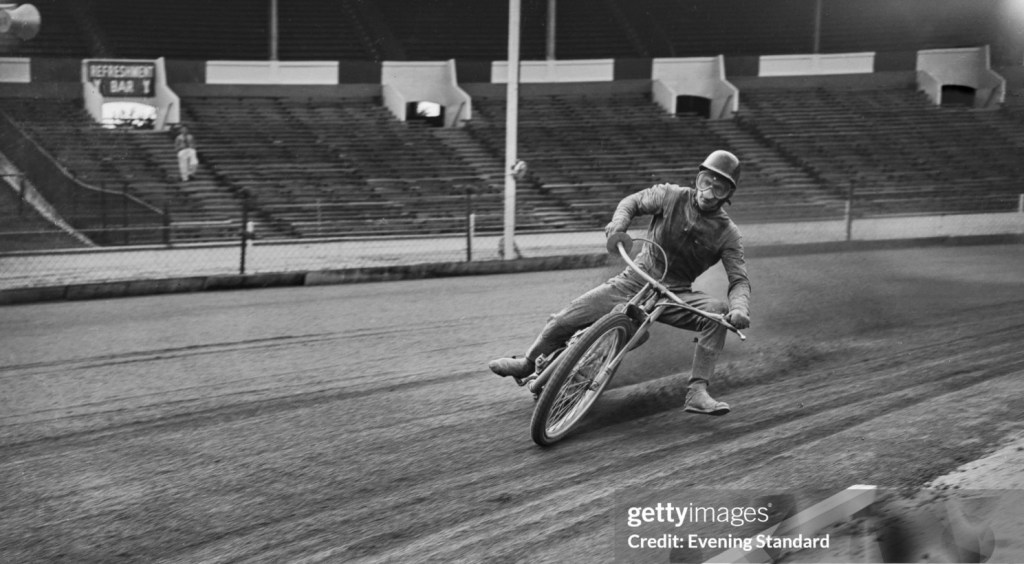
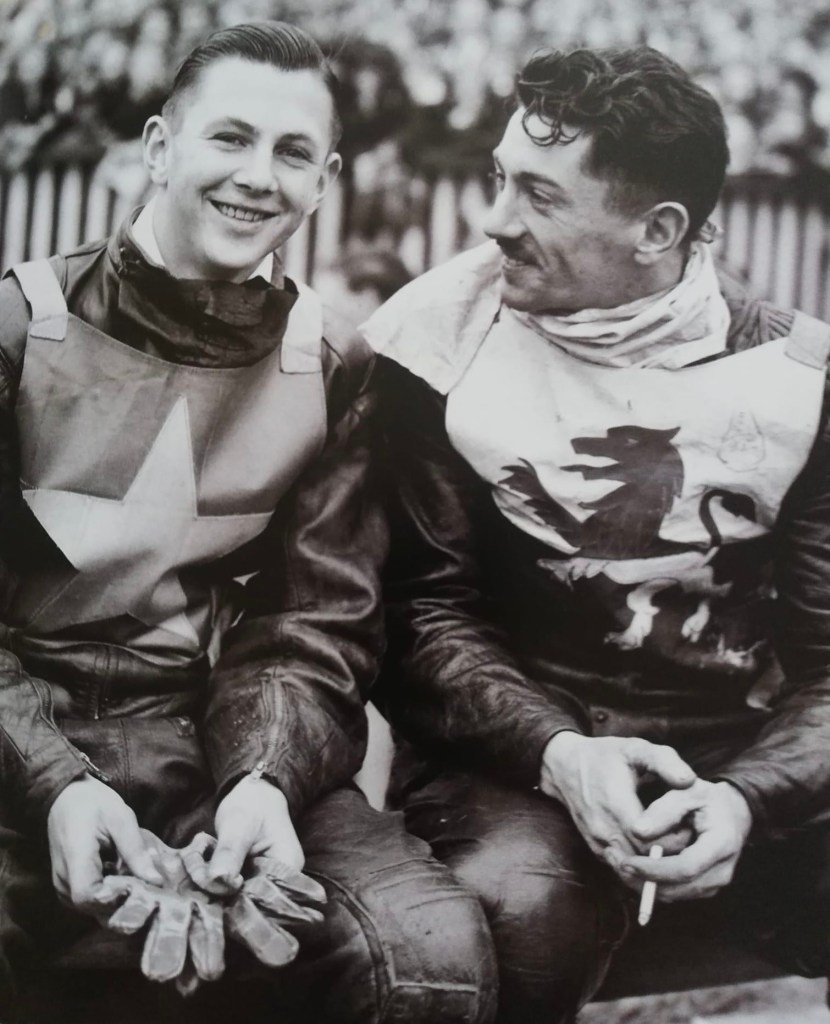
Ronnie Moore was an outstanding Kiwi sportsman, an international speedway rider who won the Individual World Speedway Championship in 1954 and 1959. He earned 13 international caps for the Australian national team, 50 for New Zealand and 21 for Great Britain in career that spanned 1949-75. In addition, he was a pretty handy F2 racer in 1957-58.
Born in Hobart, Tasmania, Australia on 8 April 1933, his father, Les Moore was also a champion rider who built a ‘Wall of Death’ in his backyard, and later turned it into a business, performing at Royal (Agriculture) Shows around Australia.
Ronnie began riding the wall at 13, then got his speedway start on an old Rudge after the family had moved to New Zealand in 1947.
Les stunned the NZ Speedway world when he rode the Rudge to a track record in Wellington, beating local star Bruce Abernethy. Les then got an offer to help set up a new track in Christchurch so the family shifted south.
While born in Australia, Ronnie always considered himself a Kiwi. He had to wait until he was 15 – the legal age to get a drivers licence – to have his first official race drive and later reckoned he could barely touch the foot-pegs on the Rudge when he lined up on the dirt track at Tai Tapu in 1948.
Kiwis Ronnie Moore and Barry Briggs from Australia’s Jack Young at Wembley during the September 1960 World Speedway Championship meetingWembley, September 1959, World Speedway Championship
In 1949, Moore began racing on a regular basis at his father’s Aranui Speedway in the Sandhills near Christchurch. He remembered counting the trucks as they brought all the dirt from the Lyttelton tunnel to create the track and arena.
Stuff.co.nz records that “His career clicked when he started riding a specialist, secondhand speedway bike his dad brought off Norman Parker,” a leading English racer who competed in New Zealand.
He moved to the UK in 1950. Wimbledon promoter Ronnie Green spotted his potential despite crashing through the wire-mesh safety fence on his first trial ride! He raced for the Wimbledon Dons in the British League, becoming team captain after two years, and continued with them until 1963, apart from two years in the late 1950s when he raced F2 Coopers.
“Speedway was second to football then in people going through the turnstiles, with crowds of up to 15,000 just for a league match.”
Moore was the youngest ever rider to qualify for a Speedway World Championship. He did that in 1950, aged just 17. Four years later, he became New Zealand’s first motorcycle world champion when he took the 1954 championship in front of 80,000 people at Wembley. Even more remarkable is that he was only 21 and took five wins from five starts, despite riding with a leg that had been broken badly not that long before in five places.
He had slid into a safety fence at a meeting in Denmark and stopped dead, his leg was bent around the bike’s handlebars. While the Danish doctors predicted a recovery time of nine months, Moore sought the advice of a Kiwi Harley Street surgeon who had made his name getting fighter pilots back in the sky quickly. His thigh to toe plaster cast was whipped off and the first of two braces were made which allowed the bone to heal, while reducing the rate at which his muscles would otherwise have withered.
Ronnie and Bruce Abernethy, Kiwi Stars both, in 1952 (A Jeffries)The two Moore family Kiefts – chassis C51-2 and C52-3 – as they left the factory en-route to New Zealand in 1951. Yes, the truck remained in the UK…(C Read Collection)
He was World Championship runner up in 1955-56 to England’s Peter Craven and Swede Ove Fundin. Fellow Kiwi, Barry Briggs won the championship in 1957-58 when Ronnie raced Formula 2 cars while at the peak of his powers.
He formed a two car team – Kiwi Equipe – with fellow EnnZedder Ray Thackwell – father of Mike – and they ran a pair of Cooper T43 Climax’s in 1957-58.
The pair of them went very well, not least in Ronnie’s case because he had been dabbling with cars at home each summer. He and his dad bought a pair of Kieft 500s in 1951, the small engines were soon replaced with supercharged 1000cc Vincent Black Shadow Vee-twins. The cars were very much outright contenders in the Formula Libre. Ronnie recalled in ‘The Ronnie Moore Story’ that “The result was electrifying. I was once clocked at 125mph down Wigram’s main straight – and I was still in third gear.”
One second hand Kieft post its Wigram Big One in 1952. Nice road car until that point! (R Dew)
Moore had a very lucky escape at Wigram in 1952. He came through Hangar flat-chat to find Don Ransley in the middle of the track, Ransley had spun Les Moore’s Alfa 8C2300 sportscar, “I piled straight in and the world started spinning around.”
“It was like hitting an express train, the Kieft somersaulted and came to rest upside down with me trapped underneath. I was conscious and couldn’t move, then fuel started running out of the tank and over me. I was in agony and there was real danger of the car exploding. The three or four minutes I was under the car seemed like an eternity. Appalled at what happened, Don Ransley through caution to the wind, leapt out of the Alfa and single-handedly turned the Kieft over…Apart from surface abrasions, there was nothing seriously wrong with me a few days in bed wouldn’t cure. The poor Kieft was a different matter, about all I managed to salvage was a wheel and a few bits of the motor. The Alfa hardly had a scratch!”
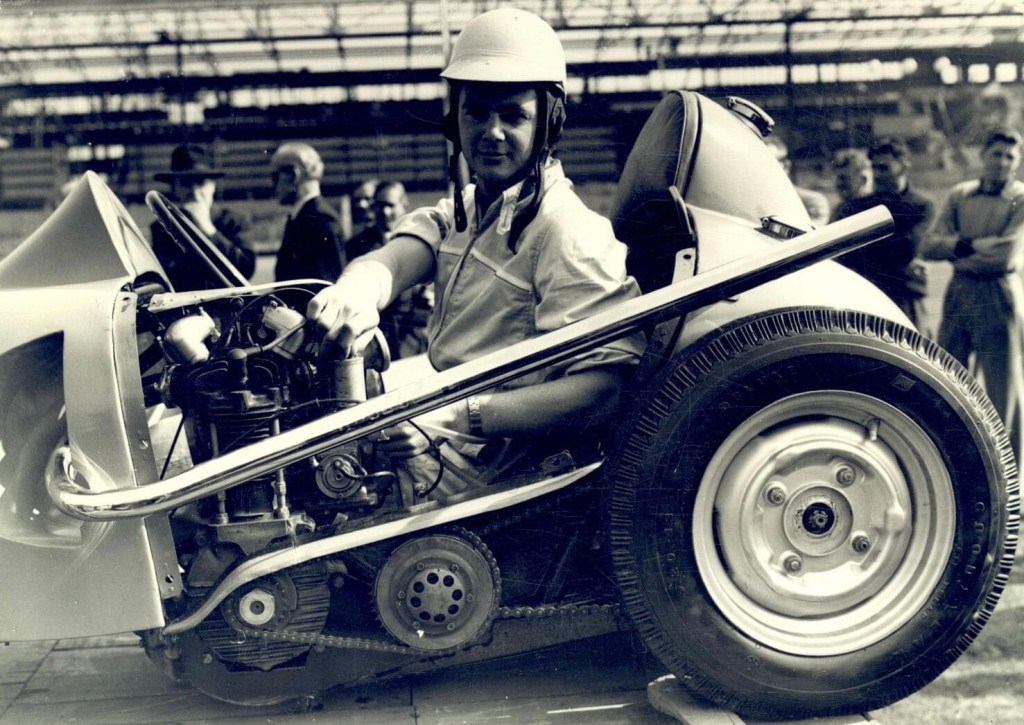
Ronnie’s car racing career included testing duties of this speedway car. The Allard designed and built ‘Atom’ was a prototype of a proposed fleet of cars being considered for racing on British speedways the following year. Wimbledon, September 1955. He was caught out and rolled over by track ruts, Ronnie broke his collarbone but recovered quickly enough (G Woods Collection)Cooper T43 Climax FWB, Brands Hatch 1957. Date unknown, the number doesn’t work for any of the Brands meetings Ronnie contested that year (Daily Mail)
In two truncated F2 seasons – about eight meetings in 1957 and six in 1958 – Ronnie did very well against seasoned F1 drivers and up-and-comers. His best results include a win against few cars at Roskilde, third in the Rochester Trophy at Brands and a fourth at Mallory Park. The race winners of meetings Moore contested were Jack Brabham, Tony Marsh and Roy Salvadori aboard Cooper T43s, and Maurice Trintignant on a factory Ferrari Dino 156.
His 1958 results included third at Brands in May and a pair of fourths in the Pau GP and Annerley Trophy at Crystal Palace. Race winners in his six ’58 meetings were the Trintignant, McLaren, Ian Burgess, Stuart Lewis-Evans and Syd Jensen Coopers (T43 and T45 Climaxes) and Cliff Allison’s Lotus 12 Climax.
Moore’s promising and way-too-short car racing career came to an end after a plea from his wife Jill, who was in hospital, giving birth to twin-daughters, Kim and Lea at the time. “She asked me if I’d quit. You break an arm or a leg in speedway, but you get over that. But three of your friends have been killed in car racing this year,” she said.
Ivor Bueb, Maserati 250F from Ronnie Moore’s Cooper T43 Climax during the September 1957 BRDC International Trophy meeting at Silverstone. Jean Behra won in a BRM P25, Bueb was ninth and Moore 17th (Getty)Crystal Palace, June 1957. The pair of Kiwi Equipe Cooper T43s – Ray Thackwell’s is the car beyond (Getty)
So Moore returned to Wimbledon for 1958, then in 1959 became Speedway World Champion again after fellow Kiwi Barry Briggs gave up some of his nitro-fuel so Ronnie could top up his tank before his fifth and final ride that day. He was runner-up again in 1960, to Fundin. Moore won the New Zealand Speedway Championship in 1956, 1962, 1968 and 1969.
He returned home in 1963 after another broken leg, the family was ready to stop shuffling between New Zealand and England. Ronnie invested in a motorcycle business and even re-activated the ‘Wall of Death’ show.
Sure enough he soon got the competitive twitches, feeling as though he had unfinished business and made a return to international racing in 1969, riding for Wimbledon and reaching the World Championship final at the ripe old age of 36. In 1970, he took the World Pairs Championship with fellow speedway great Ivan Mauger, at Malmo Stadium in Sweden .
At Belle Vue Stadium, Manchester in 1969Ronnie working on his bike in 1969. As to the make of frame and engine, your guess is as good as mine (Daily Mail)
1974 saw the first ’Battle of the World Champions’ series held in New Zealand and Australia, featuring four world champions: Barry Briggs, Ronnie Moore, Ove Fundin and Ivan Mauger. It was during the Jerilderie Park Speedway round in New South Wales that Moore nearly lost his life. His gear was stolen and he had to borrow someone else’s to ride. He crashed, suffering serious head injuries and was lucky to survive.
Moore was awarded an MBE in 1985 by the Queen, is a member of the Motorcycle New Zealand, New Zealand Sports and World Speedway Halls of Fame and won the Canterbury Sports Legends award in 2014. The Canterbury Park Motorcycle Speedway was renamed the Moore Park Motorcycle Speedway.
Twice World Champion, three times World Championship runner up, four times New Zealand Champion, World Pairs Champion and many other career achievements, Ronnie Moore is a great icon of New Zealand motorcycle sport, he died of lung cancer in Christchurch on August 18, 2018, aged 85.
(G Woods Collection)
Jill, Ronnie, Shani, Gina, Kim and Lea Moore at home circa 1972.
Etcetera…
While Ronnie was enjoying success in the UK, Les had acquired two Jano Alfa Romeos, an 8C2300 (chassis number please?) and no less a P3 than chassis #50005, the car with which Tazio Nuvolari belted the Silver Arrows by winning the 1935 German Grand Prix.
Moore found the P3 tricky to drive but won the Lady Wigram Trophy on the RNZAF airfield of the same name in 1951-52. Les died at the wheel of a celebrated NZ Special, the RA4 Vanguard, at Saltwater Creek, Timaru in October 1960 after the car rolled.
Valerie, Clarice, Les and Ron Moore with P3 Alfa Romeo after the 1952 Lady Wigram trophy victory (G Woods Collection)Moore at Wimbledon in 1955 (unattributed)
As mentioned above, the Atom was built by Allard to the order and brief of Wimbledon Speedway owner Ronnie Green in 1955, he was keen to ‘spice-up the show’.
Powered by a 500cc JAP speedway and clutch assembly, the 64-inch wheelbase car used an Allard Clipper chassis and many Ford components. Two were built. Click here for a great article about the project on The Allard Register website: http://www.allardregister.org/blog/2010/7/9/the-allard-atom.html
(unattributed)(unattributed)
Showtime! Date and place unknown. “Ronnie Moore on the Bally-rollers and Graham Pickup with the microphone. A free show outside the wall to attract punters to the show,” recalled Lindsay Mouat.
Craig Norman chipped in, “I was too scared to watch the actual show but I vividly remember watching spellbound at his outside display. He had perfect control and balance.”
(unattributed)
Credits…
This piece uses as a base an article written by Motorcycling NZ historian Ian Dawson on the occasion of Moore’s admission to the MNZ Hall of Fame in 2012. Getty Images, F2 Index, Graham Woods, Chris Read Collection, ‘The Ronnie Moore Story’ by Rod Dew, Alan Jeffries, Lindsay Mouat, Craig Norman
Tailpiece…
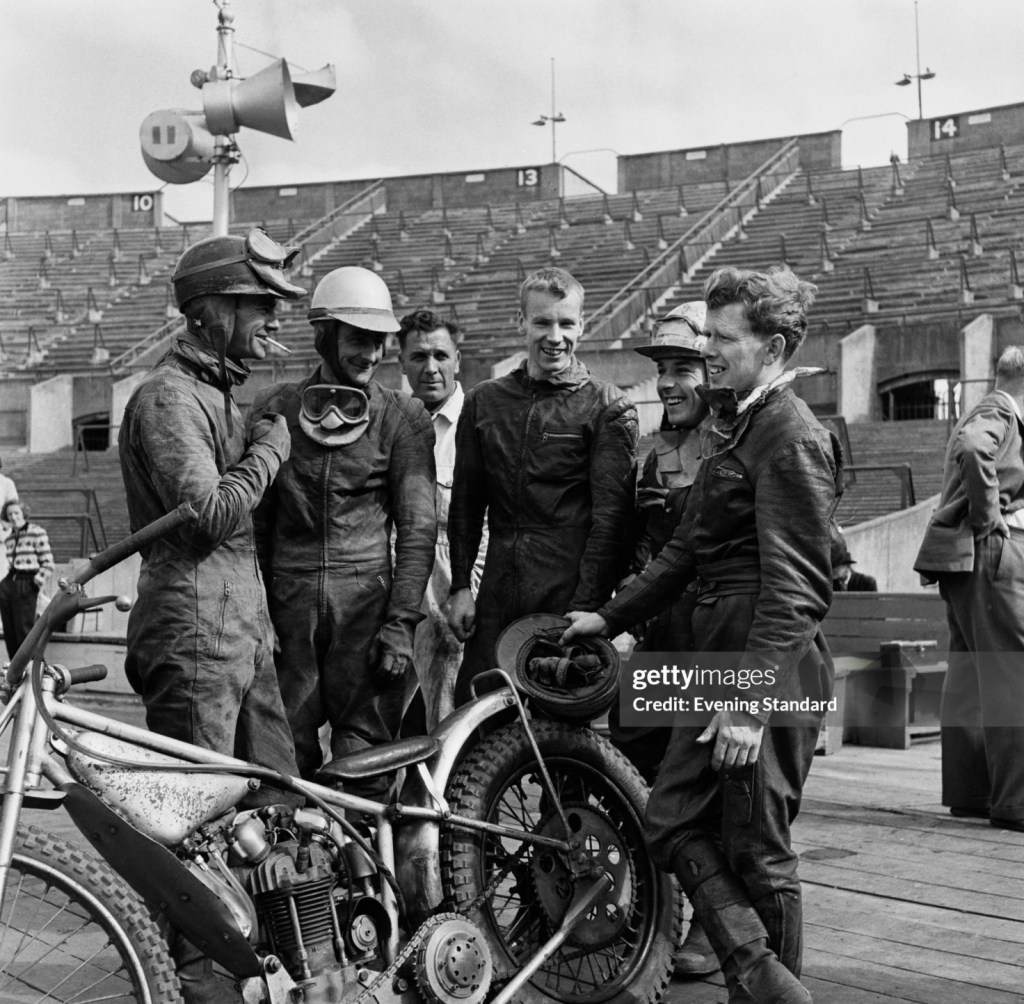
Ronnie Moore, Geoff Mardon, Ove Fundin, George White and Peter Craven prepare to compete in the Speedway World Championship at Wembley in September 1959.
All of these PR shots were taken during daytime, before the crowds arrived…
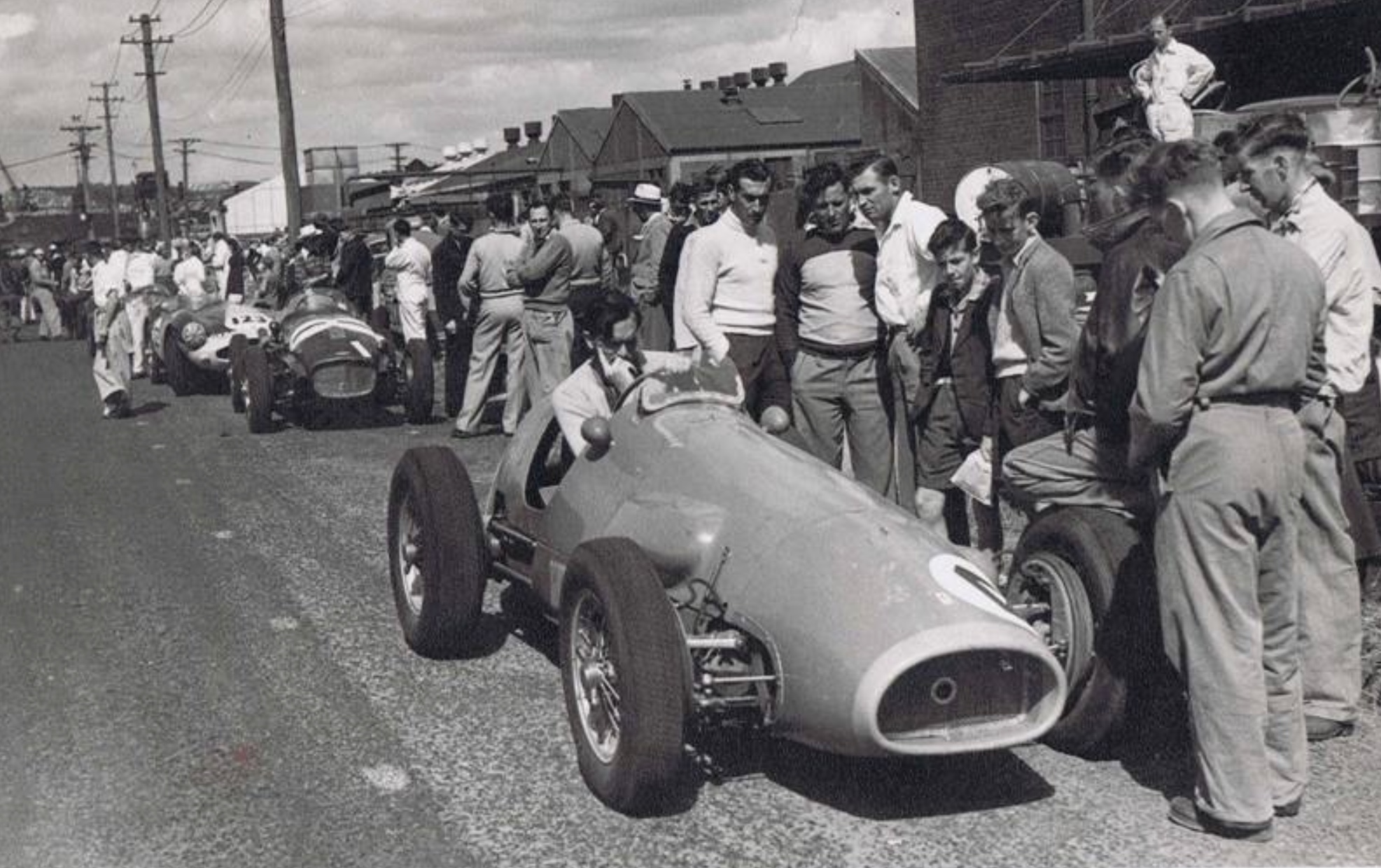
The Aston Martin DP155 single seater is surely one of the great marques lesser known models, here at Dunedin, New Zealand in February 1956…
It is significant too as one of the seminal steps in AM’s occasional quest to get into Grand Prix racing. The DBR4/250 cars were tested later in 1957 although not actually raced by Roy Salvadori and Carroll Shelby until 1959 by which time the mid-engine revolution was underway and by the seasons end ‘complete’. The Cooper T51 Climax delivered bigtime on the earlier promise of its predecessors.
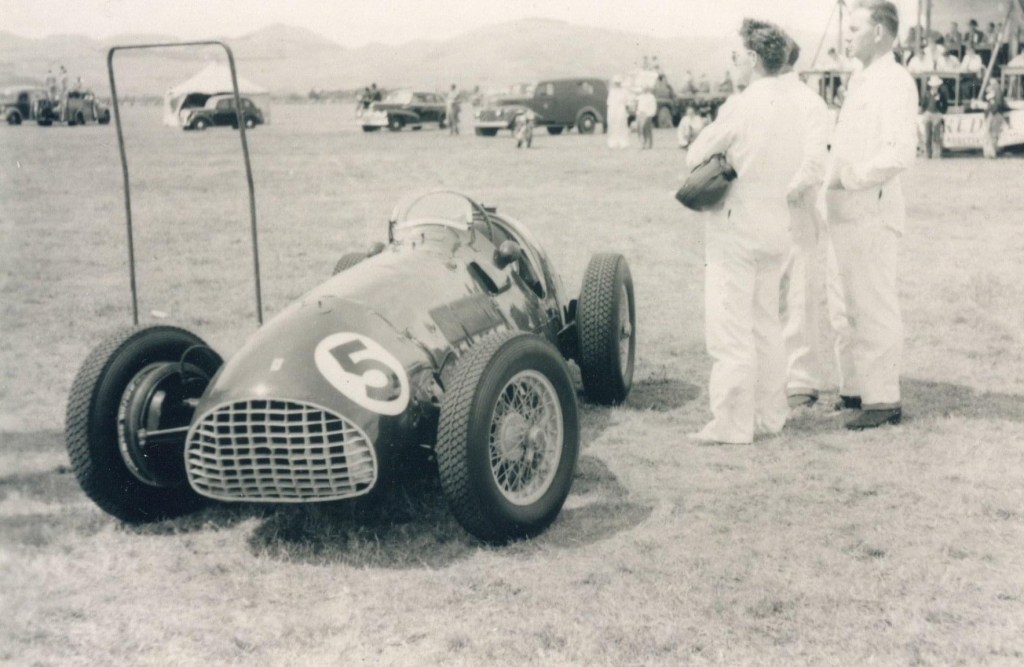
I chuckled when I first saw Tony Selfe’s wonderful photo as the most successful individual GP chassis of all time- Tony Gaze’s ex-Alberto Ascari Ferrari 500 chassis ‘5’ is alongside its stablemate Peter Whitehead’s car and one of the least known GP cars of all time in far-away New Zealand! Not that its fair to call DP155 anything more than the test hack it most assuredly was.
There are not a huge number of photos of DP155 extant, whilst not super sharp the shot is useful to be able to further appreciate Frank Feeley’s body design within the constraints of the wide DB3S sportscar chassis upon which it was based and way up high seating position atop the driveshaft.
But lets go back to the start.
The project dates to the early 1950s when Aston Martin Lagonda Ltd first contemplated construction of a Grand Prix car, the first step was intended to be an F2 machine.
The intention was to mate a variant of the 2.6 litre LB6 engine with a DB3 sportscar chassis. An early prototype was assembled in the winter of 1951/2 using a mildly-tuned 2-litre version of the engine, however, Technical Director Prof Dr Robert Eberan von Eberhorst rejected the idea and the car was quickly dismantled and forgotten.
HWM’s John Heath showed interest in the ‘tuned down’ engine for his F2 cars but David Brown knocked that notion on its head.
The CSI announced a new 2.5 litre Formula 1 to which World Championship Grands Prix would be run from January 1 1954- a replacement for the 2 litre ‘F2’ formula of 1952-1953 during which the Ferrari 500’s in works and privateer hands had been dominant.
In Autumn 1953 Aston Martin contemplated F1 once more, but as a low priority, busy as they were with their sportscar programs which made great sense from product development and marketing perspectives.
The project was given the classification ‘DP155’, the car, allocated chassis number DP155-1, comprised a DB3S chassis frame ‘in narrower single seat form’ powered by a 2493cc (83×76.mm) version of the Willie Watson-designed 2.9-litre Aston Martin engine. Doug Nye cites works mechanics John King and Richard Green amongst those involved in the build, whilst Aston Martin’s legendary stylist, Frank Feeley, designed the bodywork.
John Wyer estimated an engine output of circa 180 bhp on alcohol fuel at the time- well short of the Tipo 625 Ferrari and Maserati 250F which developed at least 200 bhp in early 1954.
The twin-plug DB3S engines of 1955/6 developed about 210/215 bhp but by this time the F1 opposition were at 240/250 bhp so ‘it seemed a futile exercise for Aston Martin, whose sports-racing cars were notoriously and persistently underpowered, to contemplate building a Formula 1 car powered by a derivative of these engines’ wrote Anthony Pritchard.
Reg Parnell testing DP155 at Silverstone (or is it Chalgrove?) fitted with 3 litre supercharged engine (RAC2)
The DP155 2.5 litre engine was subsequently installed in works Aston Martin DB3S sports-racing car chassis ‘5’, which Reg Parnell drove to good effect in that year’s British Empire Trophy race at Oulton Park- he was third behind Archie Scott-Brown’s Lister Bristol and Ken McAlpine’s Connaught ALSR.
This prompted contemporary rumours that Aston Martin was considering an entry into Grand Prix competition. Such stories were denied but the belief that this was the case intensified when Aston Martin confirmed that Reg Parnell would race a DB3S-based single-seater car in New Zealand during the first months of 1956.
Reg had identified far-away New Zealand races as offering very useful motor racing earnings during the northern hemisphere winter, perhaps in conversation with Peter Whitehead and Tony Gaze who were ‘veterans’ of the trip south to the Land of The Long White Cloud having raced there the two years before in their matched Ferrari 500’s.
The prototype DP155 was dusted off with its original drum-braked 1953 chassis and fitted with the supercharged 3-litre engine Parnell had used with co-driver Roy Salvadori at Le Mans in 1954.
The supercharged engine then exploded while being tested by Reg at Chalgrove so DP155 was shipped ‘down under’ with a normally aspirated 2493cc engine ‘fitted with special camshafts, connecting rods and pistons’.
The British contingent to New Zealand comprised Stirling Moss, Maserati 250F, the two-amigos Peter Whitehead and Tony Gaze with their Ferrari 750S engined Ferrari 500’s, Leslie Marr’s Connaught B Type Jaguar and Parnell’s Aston Martin.
Sir Leslie Marr (still alive at 97 years of age) is a landscape painter of some considerable note, it was in the formative stages of his evolution as a painter- an interest and capability he explored whilst an RAF Technician during the war, that he also raced cars, contesting amongst other events the 1954 and 1955 British Grands Prix.
Kids Jist Wanna Have Fun. In the Wellington backstreets, just unloaded off a ship and about to be sent by rail to Auckland, Ardmore. L>R Gaze HWM Jag, Whitehead Cooper Jag, McKay Aston DB3S and Moss Maserati 250F (CAN)
The first race of the tour was the Third New Zealand International Grand Prix at Ardmore Airfield, 25 km south-east of Auckland, in the north of NZ’s North Island.
Senior Kiwi motoring journalist Allan Dick wrote a very concise, interesting piece on the development of racing in NZ post-war in his ‘Classic Auto News’, i am going to use elements of that into this article as the history and most of the venues will be unfamiliar to many.
‘As far as can be ascertained, prewar “racing” had been confined to beaches with only one “circuit” race- the 1932 Prosperity Grand Prix run on a road circuit in the Auckland suburb of Orakei- very much a one off.’
‘While there had been motorsport and car clubs before WW2, it was when peace returned that the sport got organised…It had its roots in Dunedin, when, in 1947, Percy and Sybil Lupp and Harry Hedges formed the Otago Sports Car Club…then Harry went south and was one of the prime movers in creation of the Southland Car Club.’
‘With new clubs joining with the old it was decided to form a national umbrella body, which became the Association of New Zealand Car Clubs- the ANZCC…now MotorSport NZ.’
Allan continues, ‘With the new structure, getting circuit racing going became a priority…with no permanent racing circuit in NZ. In 1948 the Canterbury Car Club was determined to hold a race meeting…on the outskirts of Christchurch. The authorities would not approve the road closure…a deputation including Pat Hoare approached the government and approval was given for the use of Wigram Air Force base…it became a regular annual feature for decades.’
‘Inspired by this, the Manuwatu Car Club got the use of the Ohakea Air Force base and staged the first NZ GP there in 1950. In 1951 public roads were closed in Christchurch for the running of a meeting at Mairehau…so…proper circuit motor racing was now well and truly established, but these were temporary airfield or road circuits.’
‘For 1953, Mairehau, Wigram and Ohakea were joined by a fourth- a genuine inner city, “round the houses” meeting near the wharves in Dunedin.’
‘…any “international” aspect to these meetings had come from Australia, but in 1954 the whole motor racing scene shifted up several gears with the first truly international race meeting- the New Zealand International Grand Prix on the air force base at Ardmore…Now we had five race meetings annually- three airfield and two road circuits. Two in the North Island and three in the South.’
The 1954 meeting (and season) contestants included Ken Wharton’s BRM P15 V16, Peter Whitehead, Ferrari 125, Tony Gaze, HWM Alta and a swag of Australians including Stan Jones in Maybach 1, Jack Brabham, Cooper T23 Bristol, Lex Davison’s, ex-Moss/Gaze HWM but fitted with a Jaguar XK engine instead of the F2 Alta unit and others in addition to locals.
Wigram Trophy 1954. Ken Wharton in the extraordinary BRM P15 on pole beside Peter Whitehead, Ferrari 125, Tony Gaze, HWM Alta and Fred Zambucka, Maserati 8CM. Whitehead won from Gaze and Wharton (LibNZ)
The first NZ GP at Ohakea was won by John McMillan, Jackson Ford V8 Spl in 1950, the other two events prior to 1956 were at Ardmore in 1954 and 1955 and won by Stan Jones, Maybach 1 and Bira, Maserati 250F
And so it was that our 1956 visitors looked forward to a summer of great racing with the Moss Maserati a huge drawcard and NZ GP race favourite off the back of Bira’s 250F win twelve months before.
Shipping problems with the Moss car, the two Ferrari’s and Marr’s Connaught- which were sent to Wellington rather than Auckland did not get things off to a good start. The Connaught was deep in its ships hold and had to be flown to Auckland on the eve of the race, hurriedly assembled and run without being properly prepared.
For the other visitors it was missing spares and wheels that were the issues but all was made good by the time of the race.
Moss, Whitehead and Parnell all took 2 seconds off Ken Wharton’s two year old BRM T15 V16 lap record in practice with Moss taking pole from Whitehead, Gaze, Brabham, Cooper T40 Bristol (the car in which he started his championship career during the 1955 British GP- and in which he won the Australian GP at Port Wakefield later in 1955), Ron Roycroft, Bugatti T35A Jaguar and Parnell.
Ardmore 1956 grid. Moss, Whitehead and Gaze #4 up front. Row 2 is the Roycroft Bugatti T35A Jaguar, #6 Parnell, Cooper T38 Jag, Syd Jensen, Cooper Mk9 Norton and Tom Clark, Maserati 8CM on the outside. Frank Kleinig is in the light coloured Norman Hamilton owned Porsche 550 Spyder and probably David McKay’s Aston Martin DB3S beside Kleinig and perhaps Alec Mildren’s Cooper T23 Bristol this side of the Aston (unattributed)Tony Gaze Ferrari 500 chasing Leslie Marr Connaught B Type Jaguar at Ardmore during the 1956 NZ GP (Ardmore)
Reg had a fraught start to his weekend in that DP155 threw a connecting rod during the second day of practice. He was well and truly up the creek sans paddle without a spare engine but via the good graces of Peter Whitehead raced his Cooper T38 Jaguar in the race, a most sporting gesture (and the car Stan Jones acquired that summer). Click here to read about the car; https://primotipo.com/2019/03/05/mount-tarrengower-hillclimb/
Gaze led for some of the first lap but then Moss romped away for the balance of the 200 mile journey- he had lapped the field by the end of his thirty-third tour. Some late race excitement was provided when a broken fuel lead sprayed fuel into his cockpit but even after a pitstop to top up the cars fuel he won by three-quarters of a minute from Gaze, Whitehead, Marr and Parnell. Brabham didn’t start with gearbox failure- it split as he was warming it up in the paddock.
All the fun of the fair, 1957 Wigram start. The splash of colour on the front row is Ron Roycroft’s blue Ferrari 375 and the red Ferrari 555’s of Peter Whitehead, who won, and Reg Parnell. The green car on the front row left is Brabham’s Cooper T41 Climax (unattributed)Reg Parnell, DP155 at Wigram (RAC1)
The circus then gathered at Christchurch in the north-east of the South Island for ‘The Lady Wigram Trophy’ held at the RNZAF Airbase 7km from the city on 21 January 1956.
The crew in Feltham ensured a new 2922cc engine was flown out to allow installation in DP155 in time for practice.
Moss had returned to Europe after Ardmore but his 250F was put to good use by Ross Jensen and later John Mansel for the ensuing five years or so.
NZ was to be a happy hunting ground for the Brit who won the countries premier race in 1956, 1959 aboard a Cooper T45 Climax and again in 1962 in Rob Walker’s Lotus 21 Climax not too long before his career ending Goodwood accident.
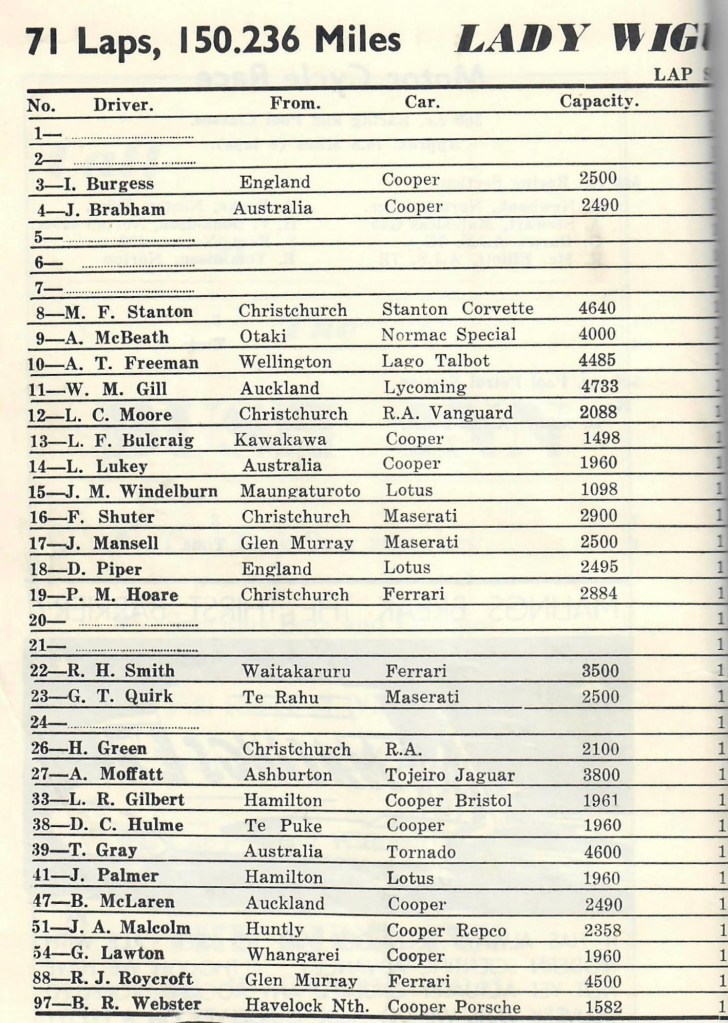
DP155 finished a distant fourth in the 71 lap Trophy race- up front Peter Whitehead was over 5 minutes ahead of the Aston hybrid- he won from pole ahead of Tony Gaze and Marr. Leslie was 1m 35secs adrift of the winning Ferrari with Syd Jensen the first NZ’er home in his Cooper Mk9 Norton 530cc.
Gaze Ferrari at the Dunedin Wharves- David McKay’s Aston DB3S at left (CAN)Dunedin heat start- Gaze Ferrari left, the Arnold Stafford Cooper Mk9 Norton in the middle on pole and Roycroft’s Bugatti T35A Jag at right on the second row (unattributed)Vroom-vroooom-vrooooooom. I can hear the sharp, staccato bark of the 3 litre four as Tony Gaze warms up 500/5 at Dunedin- then the Parnell Aston DP155 and an Aston DB3S (unattributed)Syd Jensen, Cooper Mk9 Norton on pole for the feature race alongside Gaze’ Ferrari 500 (TA Thompson)
From there the circus travelled south, still on the South Island to the Otago Harbour city of Dunedin for the ‘NZ Championship Road Race’ on 28 January.
The event of 120 km was 44 laps of 2.74 km around the Dunedin ‘Wharf’ Circuit. Not everyone liked the place as the surface was rough and tough and included a section with a gravel surface.
Syd Jensen’s nimble, fast, Cooper Mk9 Norton started from pole with Gaze and Arnold Stafford in a similar Cooper on the outside of the front row. Marr, Parnell and Whitehead were back on row 3- Kiwis Ron Roycroft Bugatti T35A Jaguar 3442cc, Ron Frost, Cooper Mk9 Norton and Tom Clark, Maserati 8CM were on row 2.
Jensen set the crowd afire in the little Cooper harrying the bigger cars finishing third overall and setting the fastest lap of the race.
Gaze won from Parnell, Jensen, Whitehead and Tom Clark. Marr started the race, did one lap to get his staring money and then retired, not impressed with the place at all, with the other overseas drivers complaining that they were unused to driving on a metalled surface where some sections of the track were unsealed.
Parnell head down, bum up whilst Peter and Tony contemplate a post loading cool bevvy. Aston DP155/1 in all of its glory nicely juxtaposed by the industrial surrounds (T Selfe)
Immediately after the Dunedin race these amazing photographs were taken by Tony Selfe of Parnell, Whitehead and Gaze loading their exotic racers onto a low-load railway truck for transport to the next round they were to contest at Ryal Bush, 20 km north of Invercargill, at the very south of the South Island.
Parnell is still ‘suited up’ in his racing kit, the intrepid competitors in the DIY style of the day have helped Tony sip the victory champagne or beer and then taken their machines straight to the adjoining railyards for the Dunedin-Invercargill trip. That chain looks a very butch way to attach the light, alloy Ferrari to the flat rail-car.
Next up is Whitehead’s Ferrari- Peter steering, Tony rear left and Reg at right (T Selfe)
The visitors missed the 4 February South Island Championship at Mairehau but were at Ryal Bush the week later, 4 February for the First ‘Southland Road Race’, a 240 km race- 41 laps of a 5.87 km road course.
Back to Allan Dick’s history lesson on the evolution of NZ circuits.
‘To the farthest south, Invercargill motor racing enthusiasts looked north, and, as one of the founding members of the ANZCC felt it was their duty to join the motor racing scene and they eyed a vacant bit of land on the outskirts of Invercargill on which to build a permanent circuit, but they lacked funds.’
‘But 1956 was Southland’s Centennial Year so it was decided to hold a race meeting on a road circuit to get the sport established and help raise funds. Unlike their Dunedin cousins, the Southlanders opted for a country circuit rather than a city one after plans to close roads around Queens Park failed…they moved into the country and closed three roads around the small settlement of Ryal Bush which included a section of the main road to Queenstown.’
Whitehead was on pole from Marr, Gaze, Clark and John Horton in an HWM Alta 1960cc s/c (ex-works/Gaze) whilst Reg was back on row 3 in the Aston on the stretch of road being used for racing for the first time.
Dick describes the place as ‘…the Reims of NZ- three long straights with three tight corners and high speeds…But unlike Reims, Ryal Bush was narrow and lined with lamp-posts, hedges, ditches, drains and fences. Average speeds were around 150km/h, making it the fastest circuit in New Zealand.’
Given the vast European experience of Whitehead, Gaze and Parnell they should have felt right at home!
(CAN)
Allan writes of the photo above, ‘Photographs of this era are rare. Photographs from Ryal Bush are even more rare. The starters flag has just dropped and the cars are away with a very clear indication of just how narrow the roads were…take your time and drink in the details.’
‘Car #3 is the Ferrari of Peter Whitehead and the Streamliner is Leslie Marr’s Connaught. Car #4 on the second row is Tony Gaze and the antique looking car is Tom Clark in the pre-war Maserati 8CM. Clark had picked and chosen his races this season. Behind Clark is John Horton in the HWM Alta and alongside him is Frank Shuter in the Edelbrock Special.’
‘Also in the photograph can be seen the white Austin Healey 100S of Ross Jensen, the black 100S of Bernie Gillier and the Bugatti Jaguar of Ron Roycroft.’
‘I think it may well have been the start of a heat as there were several other cars entered that aren’t there- including Parnell in the Aston Martin, the Australian Aston Martins (Tom Sulman and David McKay), Pat Hoare’s 4CLT Maserati, Bill Crosbie’s local special and Bruce Monk in the advanced JBM Ford.’
Peter Whitehead won in 1 hour 35 minutes from Gaze, Parnell, Roycroft and Frank Shuter, Cadillac Spl V8 5200cc. Marr retired after an accident on the first lap.
The meeting was a huge success with plenty of money made, preliminary work began on what became Teretonga, its first meeting was in November 1957.
Peter Whitehead, perhaps, in front of Leslie Marr, Connaught at Ryal Bush in 1956- note the row of haybales in front of the wire farm fence and extensive crowd (Southland Times)Parnell in NZ 1956, Aston DP155 circuit unknown (S Dalton)Ryal Bush entry list
Peter Whitehead was complimentary about the meeting in an interview with ‘The Southland Times’, quipping ‘We’ll be back next year- if they will have us’- he was too, he won the race in his Ferrari 555 from Parnell’s similar machine.
Peter had some suggestions about how to improve things, these extended to shifting the pits to a slower section of road and that the corners be concreted, apart from that he ‘spoke highly of the race, its organisation and the favourable report he was going to give to the Royal Automobile Club in London.’
The visitors missed the season ending Ohakea Trophy at the airfield of the same name on 3 March, shipping their cars back to Europe- not so Tony Gaze mind you, he sold both the HWM Jaguar sports and the Ferrari 500 to Lex Davison who would also do rather well in the years to come with the ex-Ascari chassis- the 1957 and 1958 Australian Grands Prix amongst its many victories.
Before leaving New Zealand the visitors indulged in some deep sea fishing out of The Bay of Islands for a week before heading home. ‘Whitehead is headed for South Africa, and two important international races, including the South African Grand Prix at Johannesburg- he won the event last year (he won the 24 March Rand GP in March 1956 too aboard the Ferrari 500). Mr Parnell’s next important engagement is the 12 Hour Sebring race in the United States’ the report concluded.
Parnell continued as a works-Aston Martin driver. DP155/1 was put in a corner of the Feltham race shop until it was sold to ‘inveterate specials builder’ and entrant of the RRA (Richardson Racing Automobiles) Specials, Geoff Richardson, who fitted it with a 2.5 litre single-plug engine.
Richardson told Anthony Pritchard ‘I paid about 900 pounds for it and it proved a great source of annoyance to me because John Wyer guaranteed when I bought it that it gave 190bhp. I put the engine on my test bed and got 145/146bhp- Wyer had a twin-plug engine but he wouldn’t sell it to me, I never spoke to him again. I made up a 2483cc Jaguar XK engine for it and got nearly 200bhp on pump fuel.’
Geoff Richardson in DP155/RRA Spl at Snetterton in 1957 (Autosport)DP155/RRA Special circa 1961 at left and in the early 1970’s at right. Note RRA badge on grille at left, wider wheels and tyres at right (AMOC Register/HAR)
Richardson only raced the car twice before buying an ex-works Connaught B Type and therefore decided to sell it. At the request of David Gossage, the new owner, Richardson rebuilt it in 1957 as a sportscar fitted with the body from the Lord O’Neill DB3S/105- modified at the front with a simple oval radiator intake, it was registered UK ‘UUY504’.
Gossage sold it to a hotelier, Greville Edwards, who had a bad accident in it in which his girlfriend was killed.
Richardson then re-acquired the car and built a replacement chassis using ‘main tubes supplied by Aston Martin’ said Geoff- and further modified it in the rebuild by replacing the torsion bar rear suspension with coil/spring damper units and fitted the de Dion axle with a Watts linkage in place of the sliding guide, also fitted was a Salisbury ‘slippery diff. He modified the nose to make the machine more aerodynamic and finessed a 3 litre crank into a 2.4 litre Jag XK block to give a capacity of about 3.2 litres.
Geoff and his wife ran it in a few sprints and on the road before its sale in 1973. Richard Bell restored the car to original DB3S shape and built a twin-plug engine of correct spec, then the car passed through a couple of sets of hands before being modified to 1955 team car configuration by Roos Engineering in Berne.
The last reported owner is in Tennessee…whilst the line of provenance is clearish the car in the US is quite different to the one Parnell, Gaze and Whitehead loaded onto a train on that gloomy Dunedin evening in February 1956!
DP155 via RRA via DB3S/105 body in 1988 and referred to as chassis 131-DB135 registered UUY504
Etcetera…
Reg Parnell in Peter Whitehead’s Cooper T38 Jaguar at Ardmore during the 1956 NZ GP (sergent.com)
Ryal Bush program signed by Whitehead, Marr, Gaze and Parnell.
Gaze’s Ferrari 500 in the Dunedin railyards 1956 (T Selfe)Tom Clark’s Maserati 8CM, Dunedin 1956 (CAN)
Photo and Reference Credits…
Tony Selfe, ‘Aston Martin: A Racing History’ Anthony Pritchard, Allan Dick and ‘Classic Auto News’ July 2016 post on Ryal Bush, ‘Hissing Cobra’ by Mattijs Diepraam and Felix Muelas on 8WForix, ‘The History of The Grand Prix Car’ Doug Nye, sergent.com, Aston Martin DP155 thread on ‘The Nostalgia Forum’, Stephen Dalton Collection, Aston Martin Owners Club, The Southland Times, TA Thompson, astonuts.free.fr, Graham Woods Collection
Tailpieces…
(T Selfe)
A crop of the opening shot, Aston Martin DP155 being washed at Dunedin in February 1956, maybe one of you proficient in Photoshop can sharpen it up a bit.
Its just a footnote in motor racing history, but quite an interesting one all the same. It is a shame it lost its single-seater identity, what interest it would create had it survived in ‘original’ specification today.











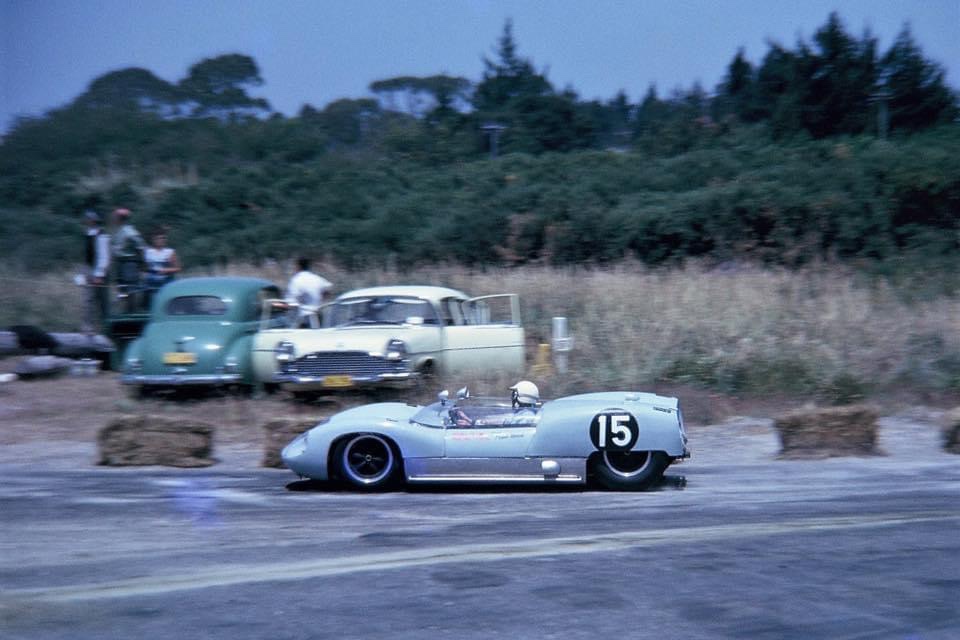
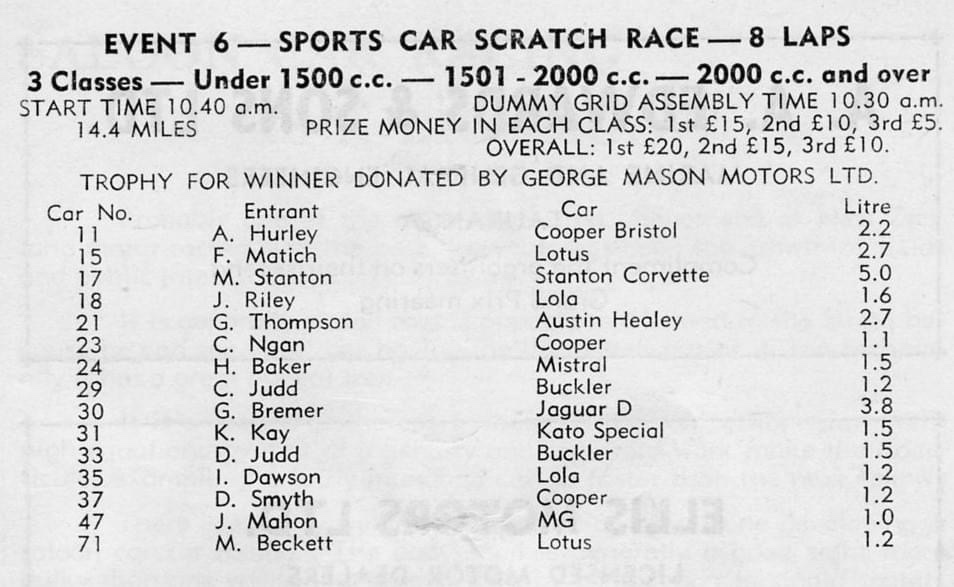
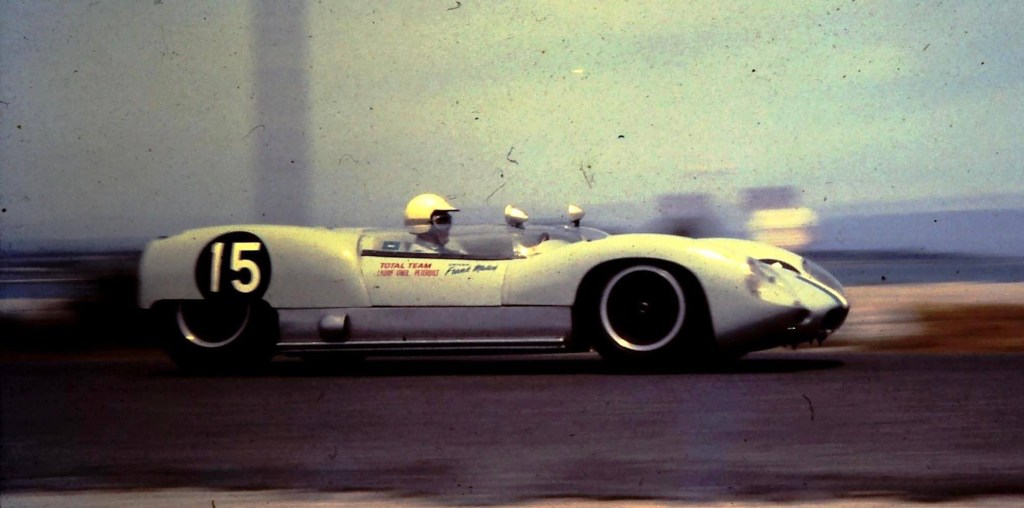
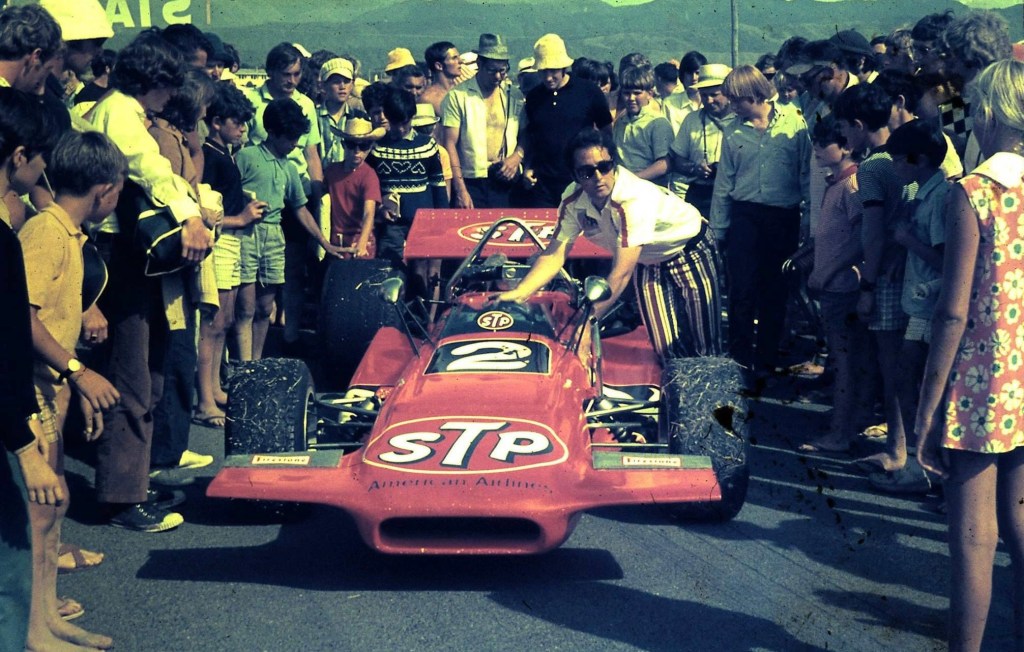










 primotipo...