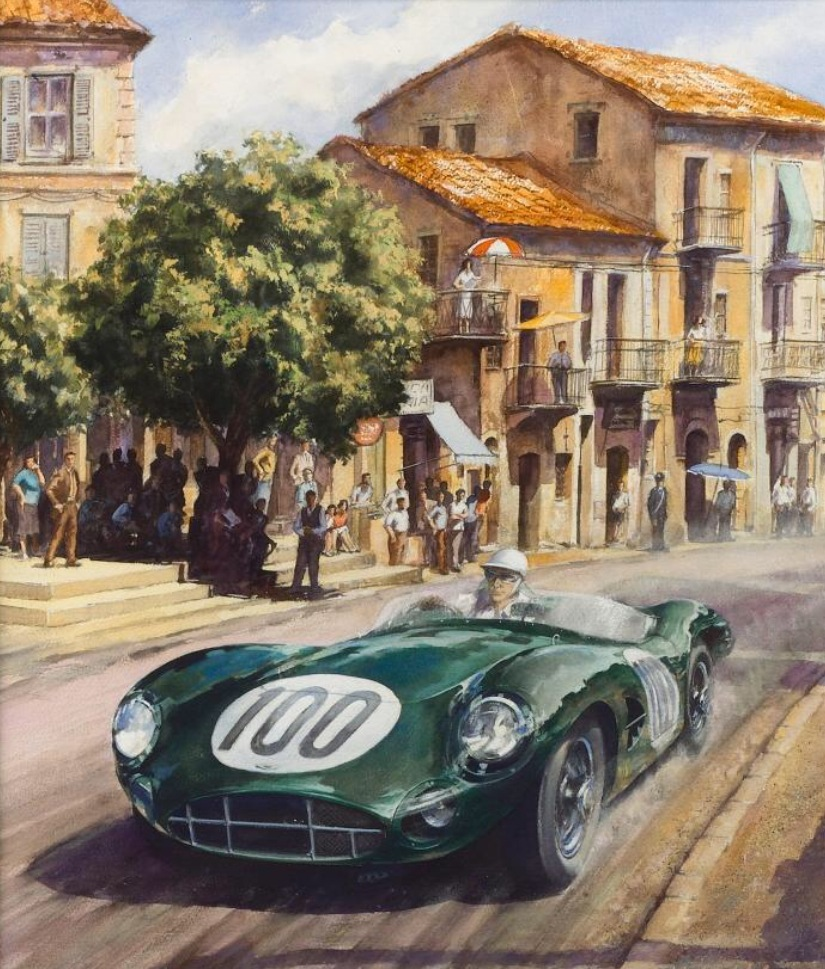
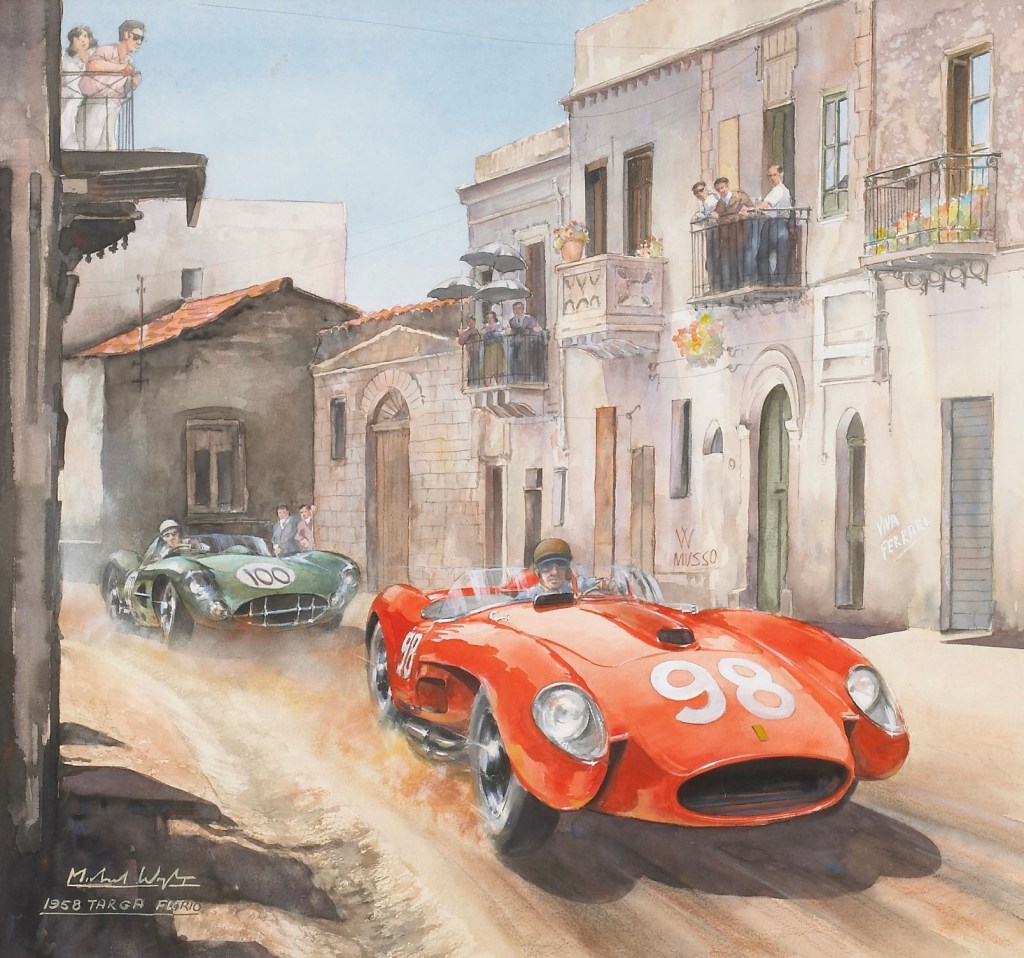
Stirling Moss, Aston Martin DBR/1, May 11, 1958, Targa Florio…
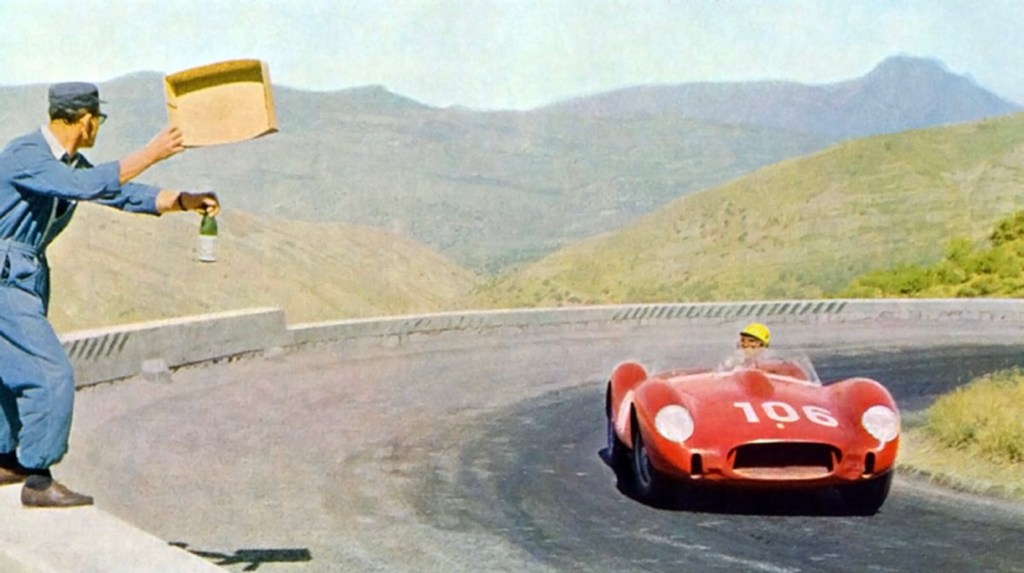
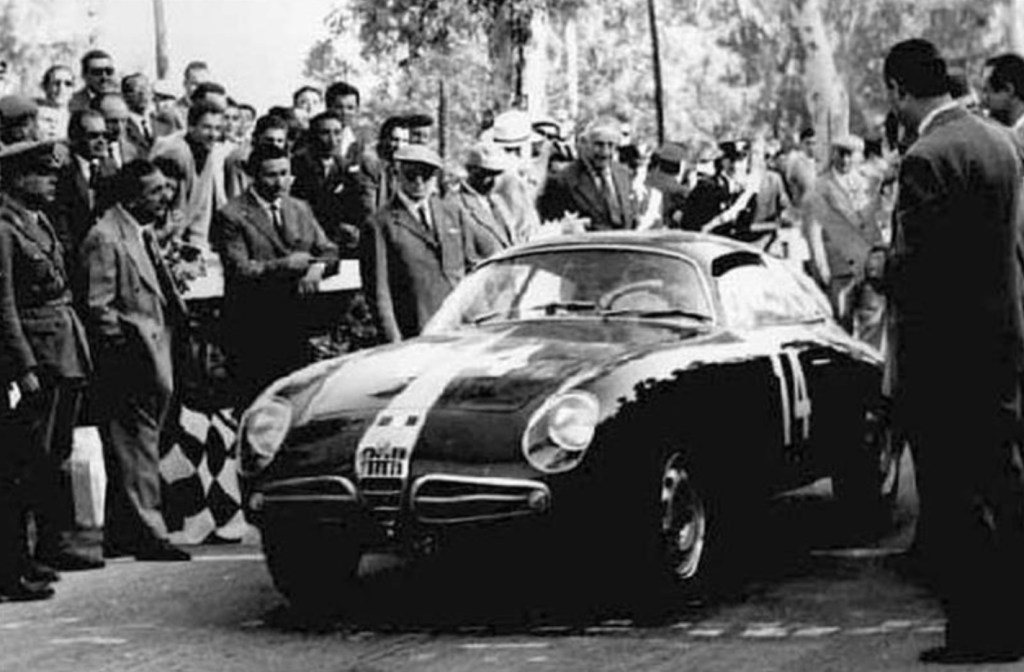
Luigi Musso was the class of the field that day and led from the first lap in a works-Ferrari 250 Testa Rossa 3-litre V12 co-driven by Olivier Gendebien. Moss went off the road and damaged a wheel early on, then redeemed himself with a lap record more than a minute quicker than Musso, but the solitary Aston’s gearbox cried enough under the strain during its fifth lap.
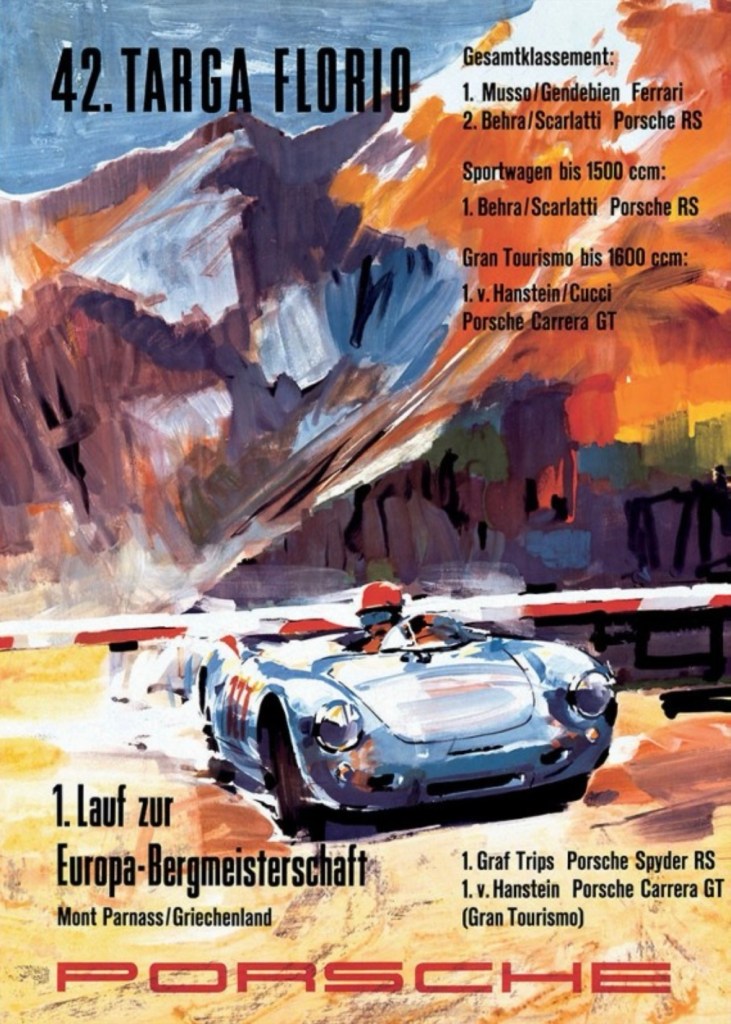
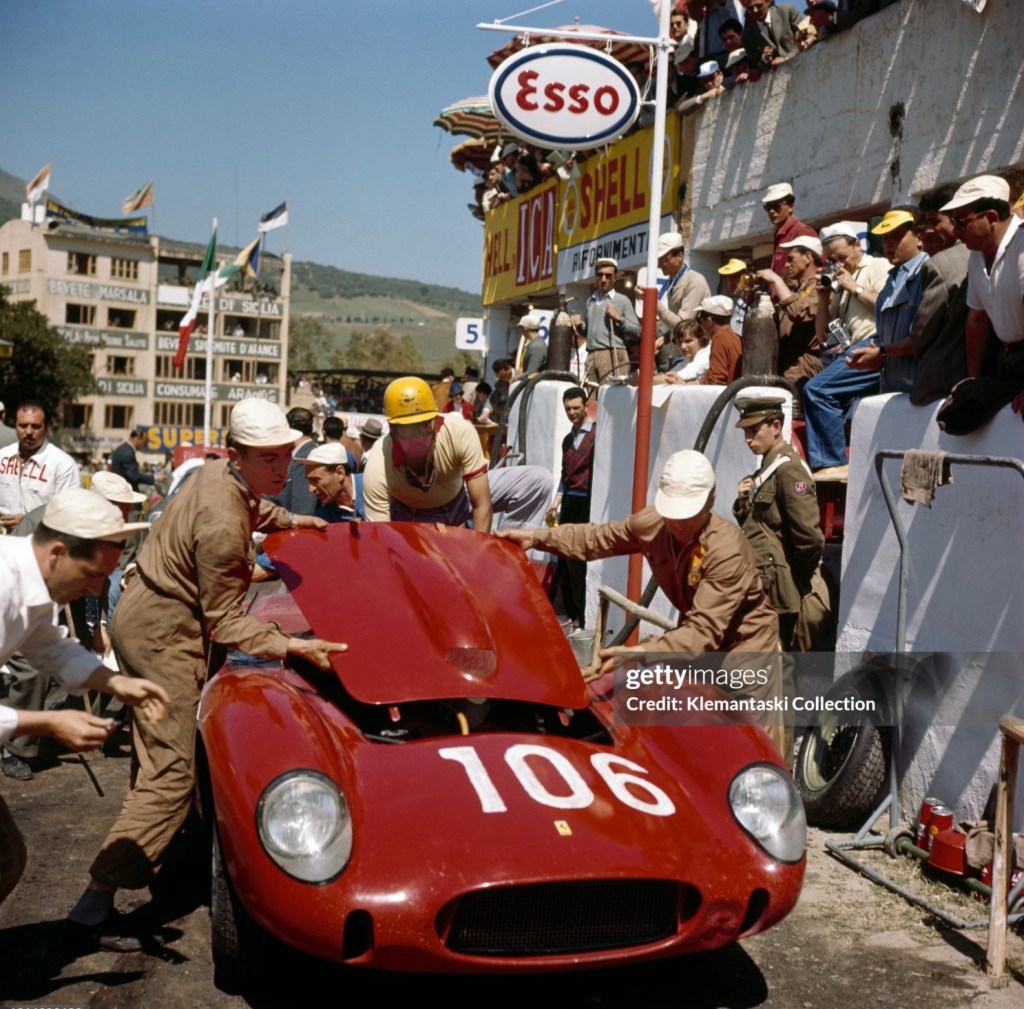
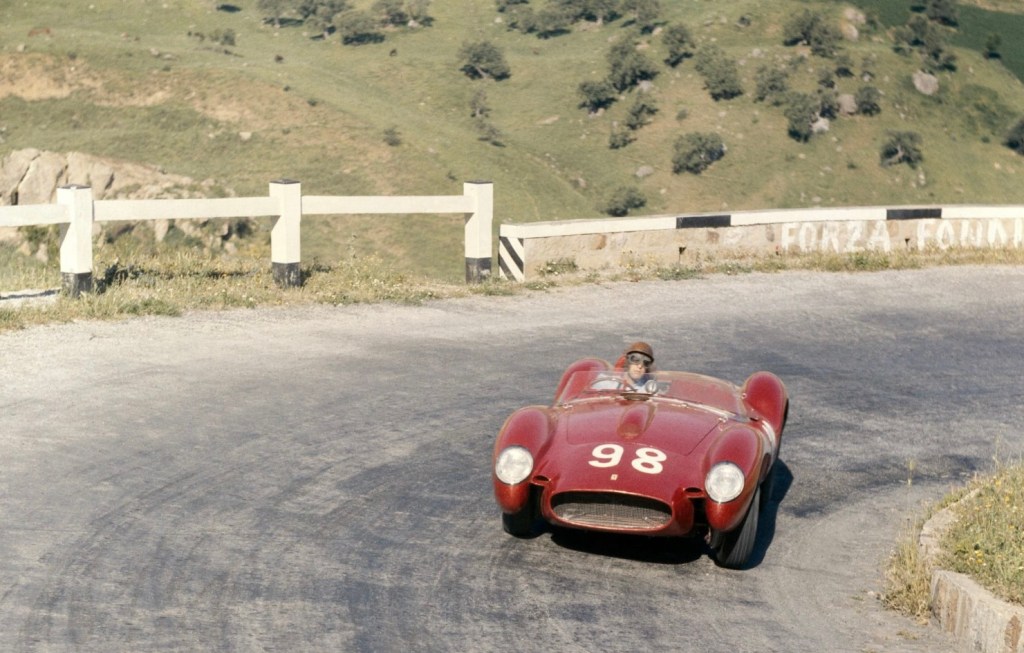
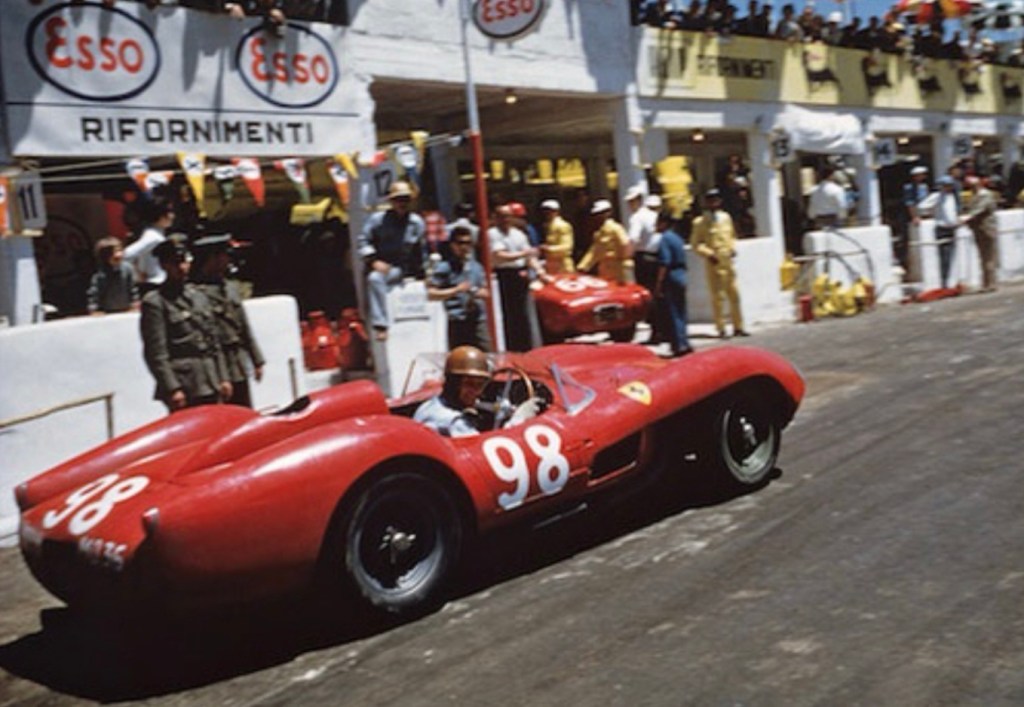
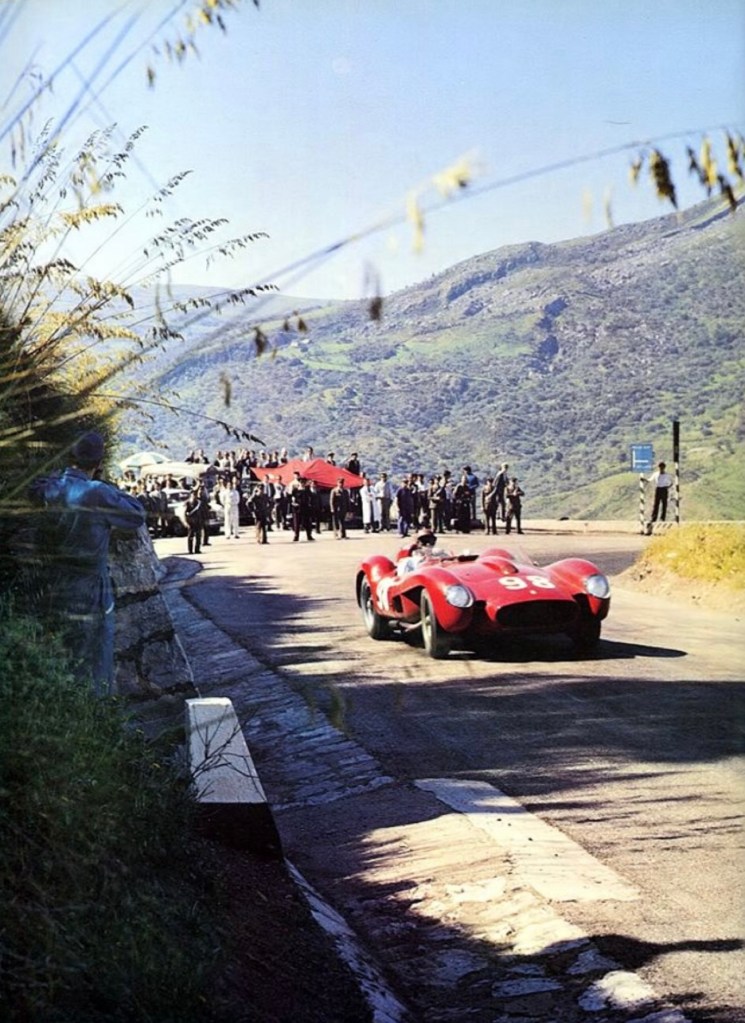
‘Yep, I’ll supersize that with fries.’ Musso in command of the leading 250 Testa Rossa, not in need of assistance from the Ferrari pit, way out west (unattributed)Porsche did well with results as per the postcard
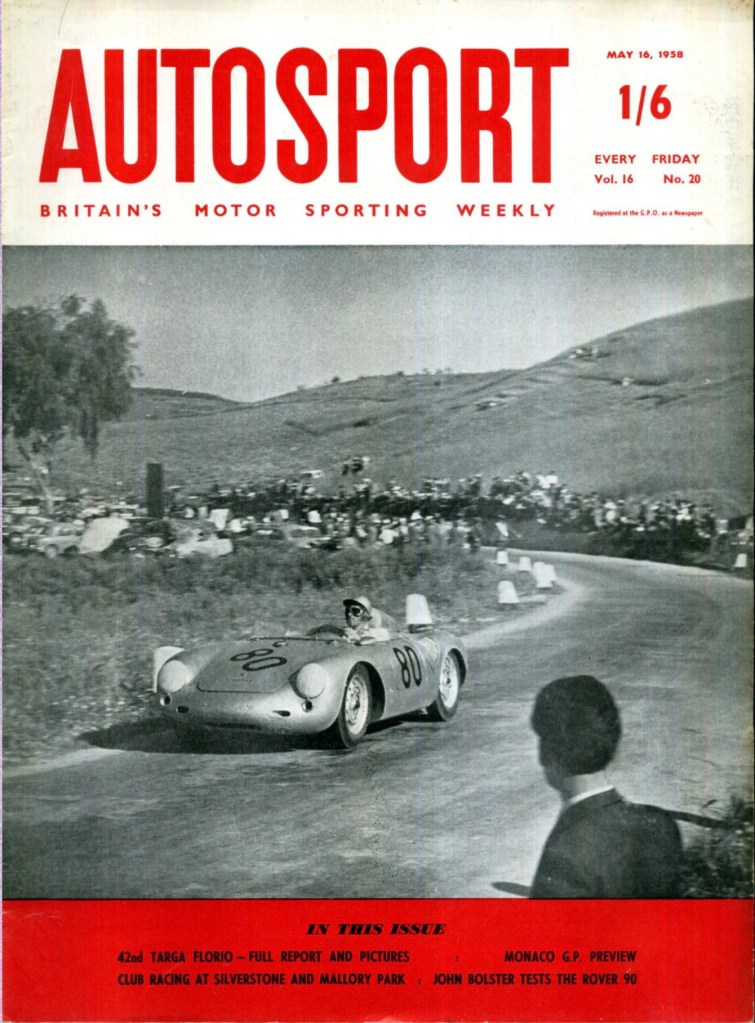
Musso’s car lost its brake fluid, but such was the car’s lead that he pitted, the Scuderia mechanics fixed the problem and Gendebien brought the car home first in the 10 lap race on 10hr 37.58 from Jean Behra/Giorgio Scarlatti Porshe 718RSK 10:43.38 with Wolfgang von Trips/Mike Hawthorn third in another works Ferrari 250TR on 10:44.29.
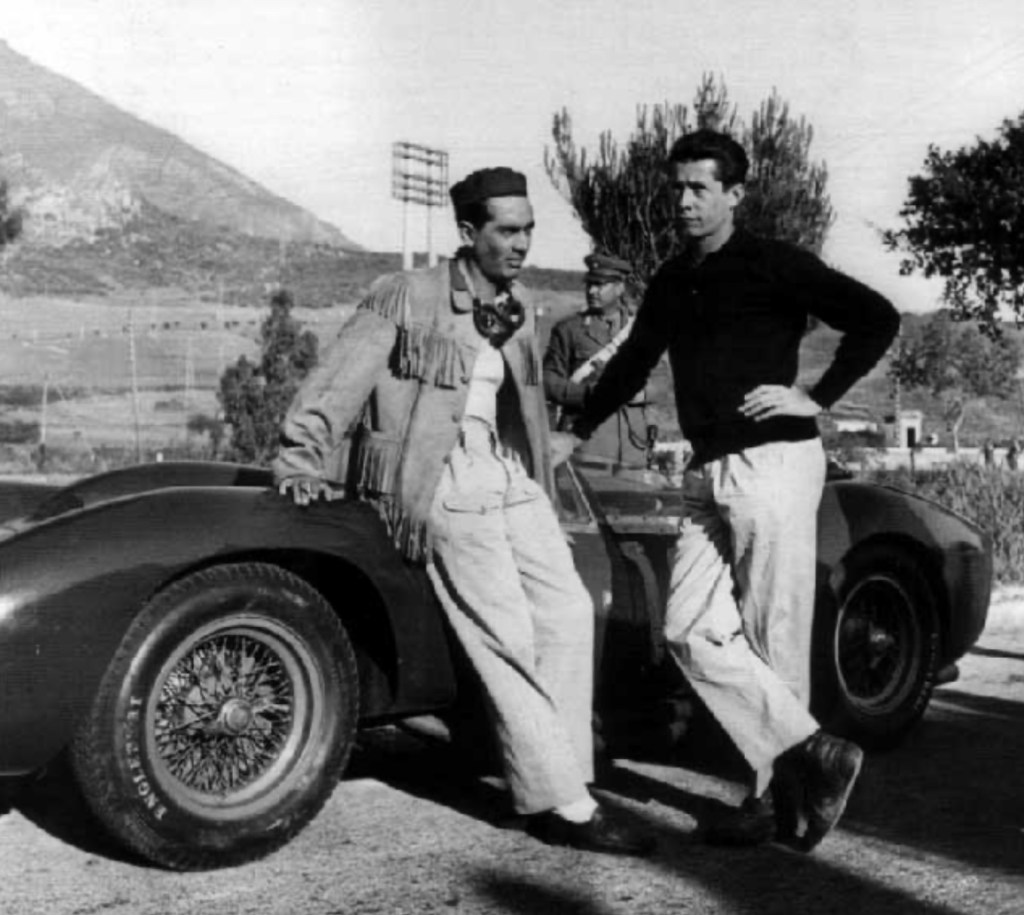
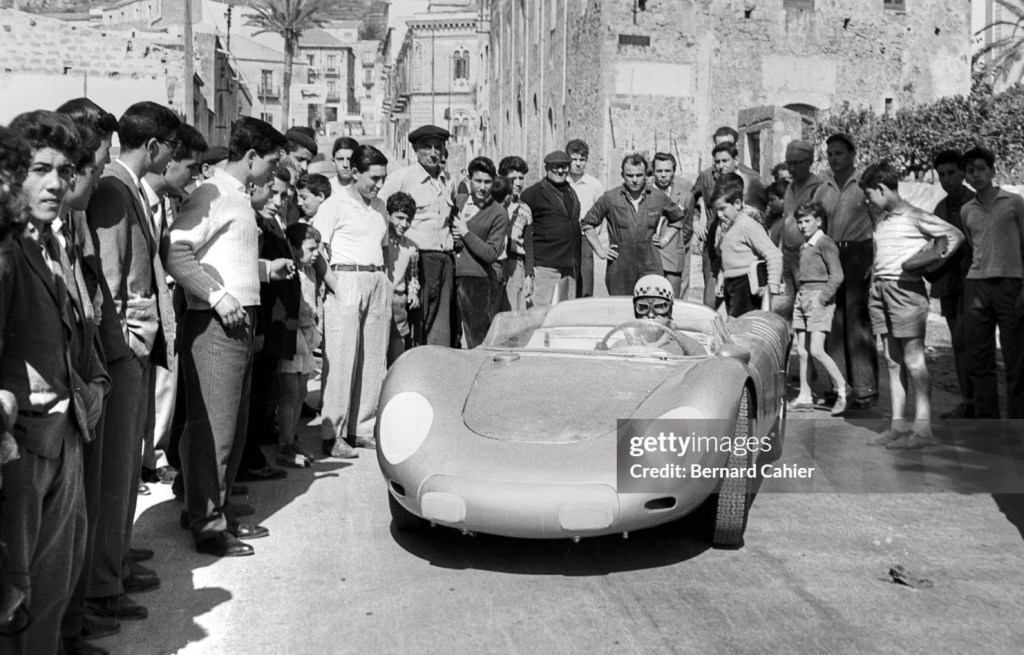
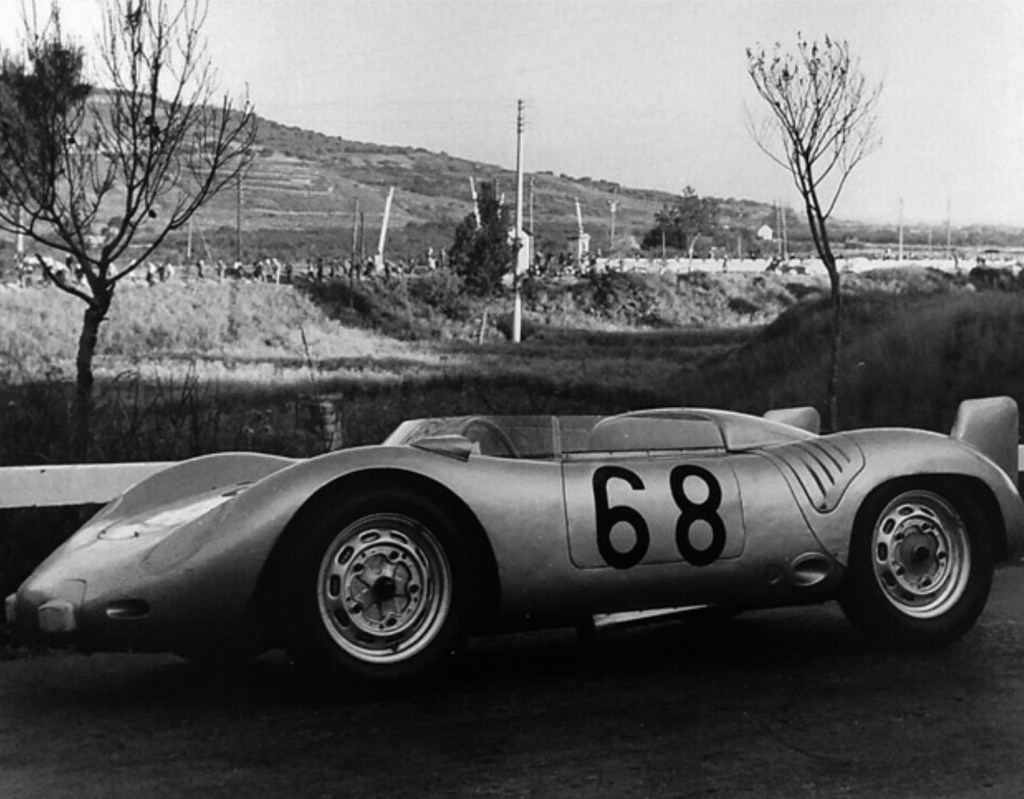
Luigi Musso and Olivier Gendebien before the off, while below, Jean Behra gets ready to start in the RSK he shared with Giorgio Scarlatti, and below that, the same car at rest.
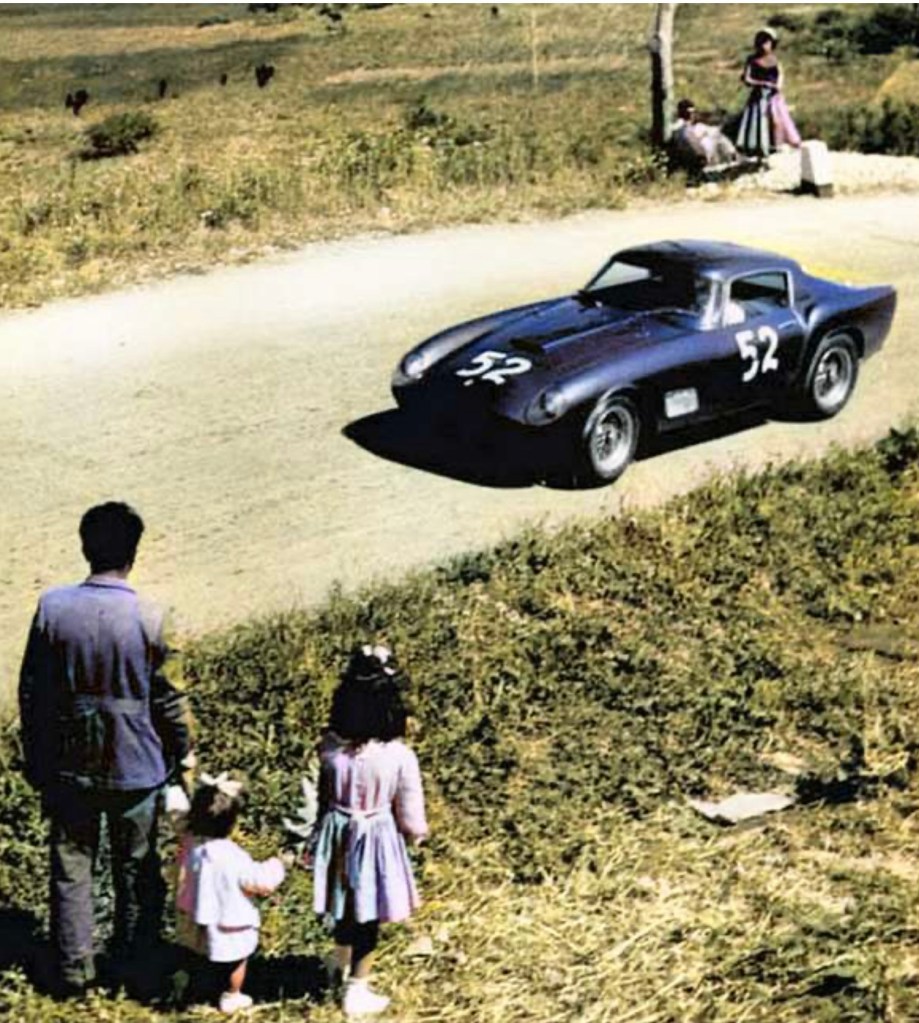
Classic Targa family shot, the cautious family man on the inside of the corner watch the Ferraro brothers – Pietro and Paolo – Ferrari 250 GT LWB (DNF) while macho-man puts himself and the babe at risk on the outside.
(unattributed)
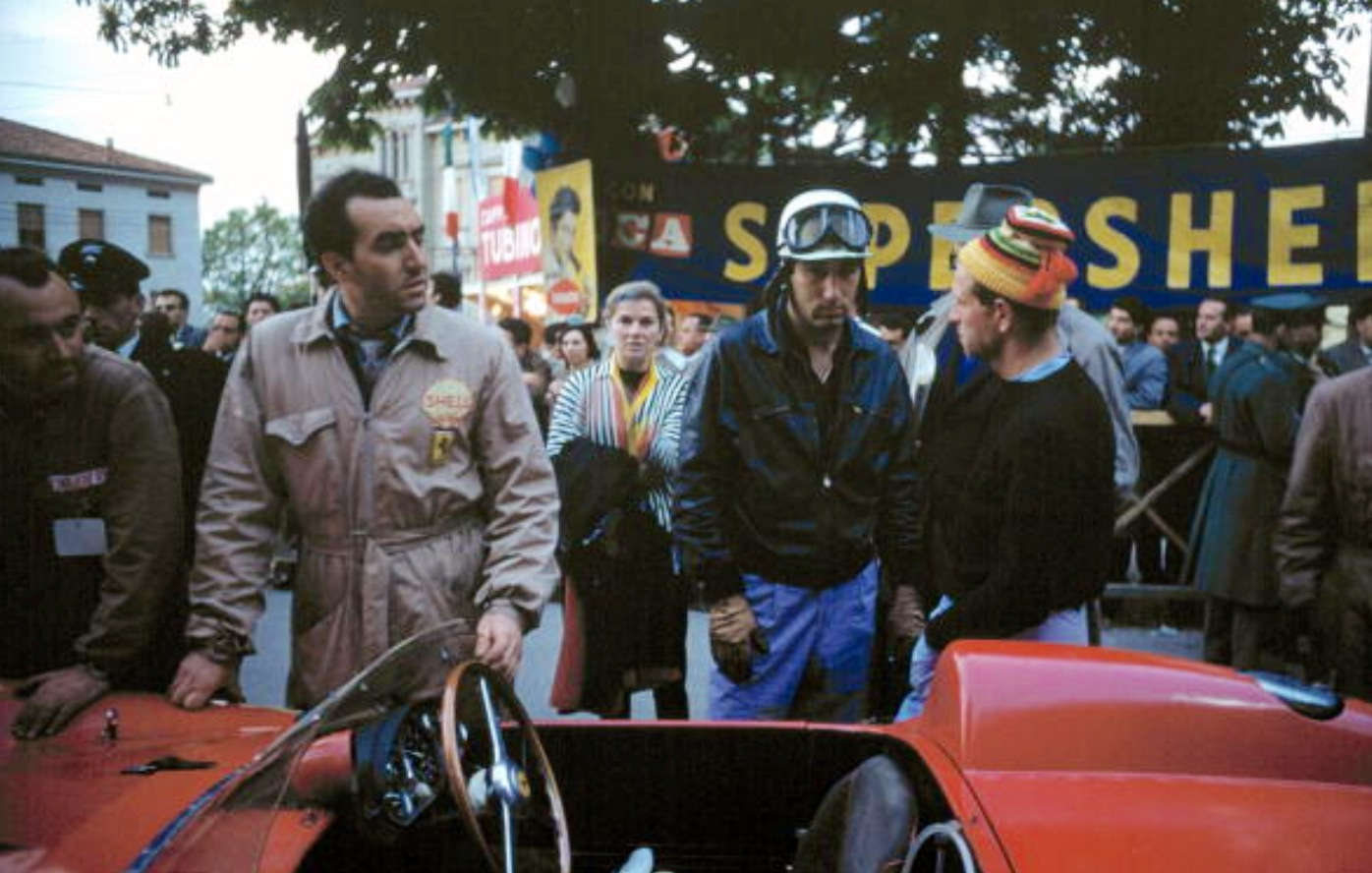
Luigi Musso jumps out of the winning car in the shot above, the more you look the more you see! Mechanics in natty brown overalls, lots of ’em, quick-lift jack to the right, the Shell man to the left and overall vibe grab mine.
While Peter Collins does his thing in the Testa Rossa he shared with Phil Hill to fourth place, 2.5 minutes or so behind the race winners, below.
(Getty-Klemantaski)(J Alexander)
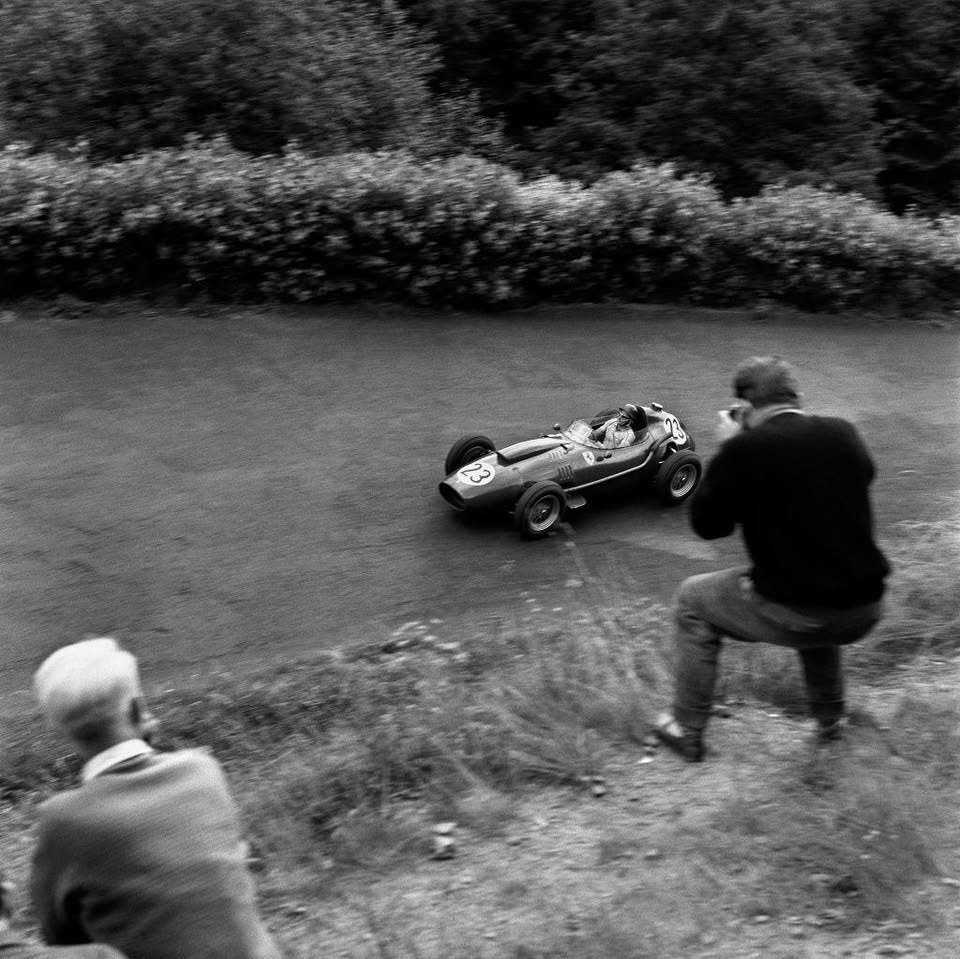
This pairing reminds me that Phil Hill made his Grand Prix debut with Scuderia Ferrari on the Nurburgring, during the 1958 German Grand Prix on August 3, the day Peter Collins died at the wheel of a Ferrari Dino 246, Phil was in a 156, the F2 variant, shot above.
Luigi Musso died chasing Mike Hawthorn during the French Grand Prix at Reims a month before on July 6, both on 246 Dinos.
Alfonso de Portago died at Cavriana during the May 12, 1957 Mille Miglia aboard a Ferrari 335S, while Eugenio Castellotti was killed at the wheel of Ferrari 801 testing at Modena that March 14.
Mike Hawthorn’s death at the wheel of his Jaguar Mk1 on the Guildford Bypass – as the reigning but retired Ferrari World Champion – bookended a horrific two years for Ferrari. Driver error in all cases folks, mistakes could be awfully expensive in them-thar days…
Etcetera…
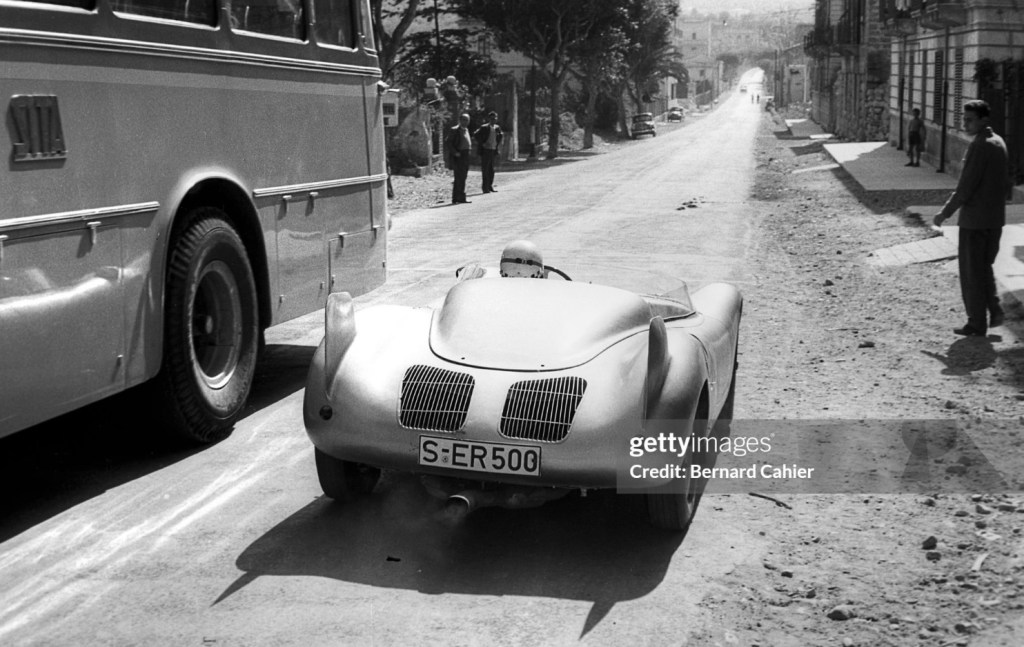
Jean Behra blows off a bus during practice…while Peter Collins shows off the voluptuous lines of the Testa Rossa below.
(Wikipedia)
The FIA reacted to the 1955 Le Mans and 1957 Mille Miglia tragedies by limiting outright cars contesting the 1958 World Sportscar Championship to a capacity of no more than 3-litres.
Ferrari picked up where they left off with the 4-litre 335S, the 3-litre, circa 300bhp 250 Testa Rossa won four of the six championship rounds: Buenos Aires, Sebring, Targa and Le Mans and the championship from Porsche, the other pair of outright wins on the Nurburgring and at Goodwood went to the Aston Martin DBR1/300 who were third in the title chase.
Collins, maaagic shot! (Y Debraine)(T Matthews)
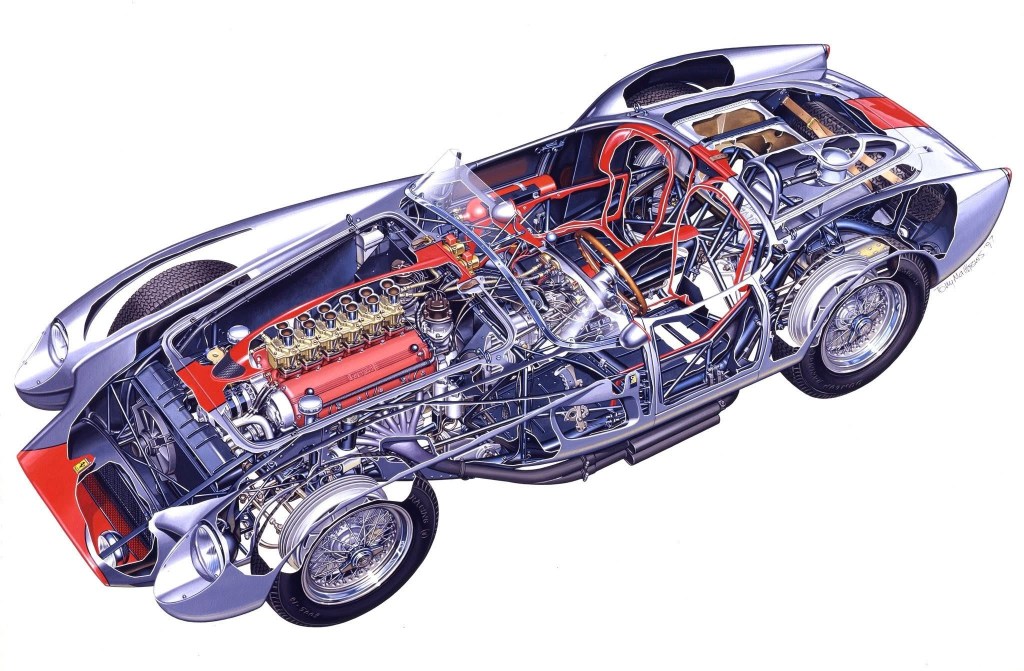
Technical Specifications in brief…
Tipo 128LM 60° SOHC two-valve Colombo V12, alloy block and head. Bore/stroke 73.0/58.8 – 2953cc, Compression ratio 9.8:1, six Weber 36DCN carbs, two distributors, circa-300 bhp @ 7200rpm.
Four speed all synchro gearbox, diff ratios:3.55, 3.77, 4.00, 4.25, 4.59, 4.86:1
Tipo 526 welded steel ladder frame chassis, 2350mm wheelbase, 1308 front track, 1300 rear track.
Independent front suspension by upper and lower wishbones, coil springs and Houdaille shocks. Rigid rear axle on customer cars, De Dion on factory cars, coil springs, Houdaille shocks
Drum brakes, Borrani wire wheels with 5.50 x 16 inch front tyres and 6.00 x 16 rears. Body by Scaglietti. Weight circa-900kg
Moss chases Collins
Credits…
Michael Wright, targapedia.com, Ted Walker, Getty Images-Bernard Cahier-Louis Klemantaski, Yves Debraine, Tony Matthews, Jesse Alexander, barchetta.cc
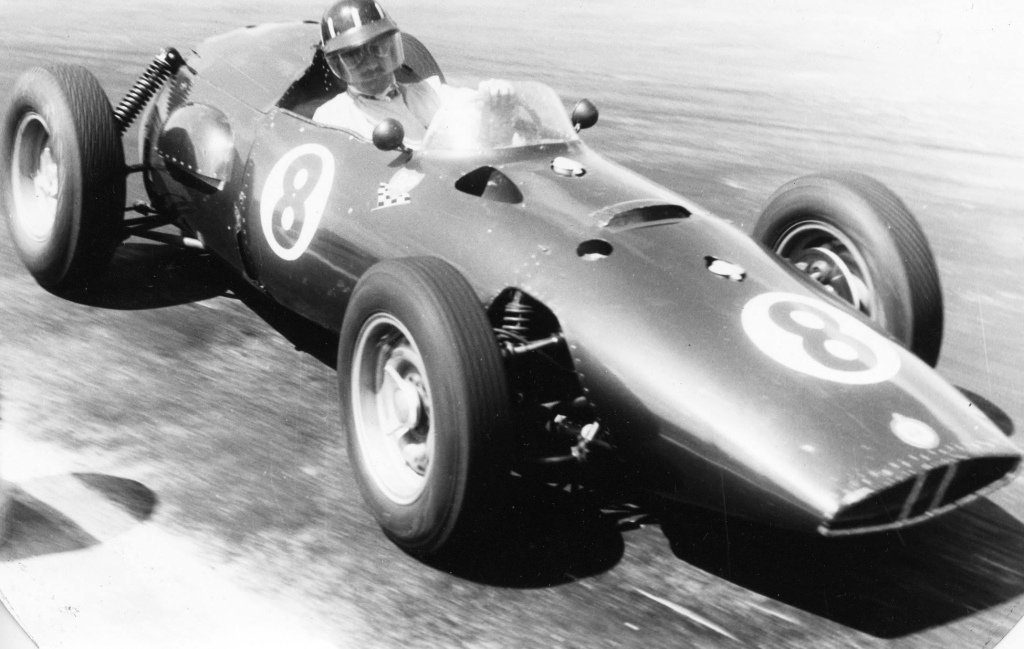
Atmospheric shot of Harry Schell’s BRM Type 25 during the August 23, 1959 Portuguese Grand Prix at Monsanto, Lisbon…
It was the breakthrough car for BRM, Jo Bonnier’s Type 25 won at Zandvoort in 1959 thereby breaking the F1 World Championship GP winning duck for the Boys from Bourne after nearly a decade of competition.
Immaculately credentialled engineer Stewart Tresilian “was largely responsible not only for the original conception and design of the BRM Project 25 2.5-litre four cylinder engine, but also of the compact P27 – or Type 25 – car (chassis) intended to carry it into battle.” Doug Nye wrote in ‘BRM Vol 1.’
“He had produced a homogeneous concept of car and engine combined, its essence being the complete antithesis of the original V16 in that it was all as small and compact and simple as possible, with the arguable exception of his projected 16-valve cylinder head for the four cylinder engine.”
BRM P15s, JM Fangio on the front row, and Ken Wharton behind him, Albi GP May 1953. Fangio won the heat and dominated the final before tyre troubles intervened, Louis Rosier won in a Ferrari 375 with Froilan Gonzalez second in another BRM P15. Car #3 is Nino Farina in the Vandervell Thin Wall Ferrari 375 (B Cahier)
The four-valve head design was subsequently over-ruled by Peter Berthon and after Tresilian left the Owen Racing Organisation to go to Bristol-Siddeley Engines in January 1953, Berthon, Tony Rudd and others brought the Type 25 to reality.
The result was a car that became increasingly fast, it not particularly reliable with each passing year from its race debut in 1955 until early in 1960. It allowed the team to develop the capabilities to win; car development, preparation and driver, they couldn’t do that with a car that never lasted too many laps. Mind you, the simplicity of Tresilian’s concept was complex in its execution…
Peter Collins crashed his Type 25 #252 during practice of the Daily Telegraph Trophy meeting at Aintree on September 3 1955, so took his bow here at Oulton Park during the September 24, 1955 International Gold Cup meeting in the same car. Q13 and DNF after loss of oil pressure after 13 laps. Stirling Moss won in a Maserati 250F from Mike Hawthorn’s Lancia D50. Oh to have been there that day! Many thanks to Stephen Dalton for these two programme pages – studiously marked up by a knowledgeable spectator – from that BRM Type 25 failed race debut September 1955 meeting at Aintree
The P27 semi-monocoque – in the centre section – chassis was strongly influenced by Tom Killeen’s Killeen K1 sportscar which was tested extensively at Folkingham by Rudd. He was impressed and the performance of the car “confirmed PB’s interest in stiffening his basic new P27 frame with a stressed-skin monocoque centre section.
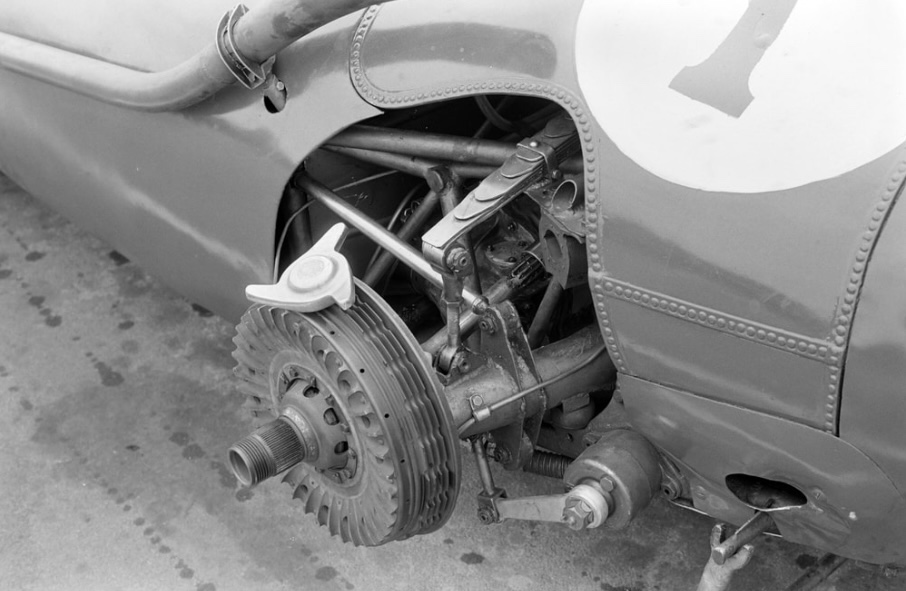
The five-speed rear-mounted gearbox was drawn by Alec Stokes, “who was destined to become BRM’s dedicated transmission specialist and one of the country’s leading gear-men.” The back of the gearbox carried the controversial single, longitudinal-axis rear disc universally known as the ‘bacon-slicer’.
With 50/50 weight distribution and 70% of the braking load at the front, the thinking was that outboard front disc brakes would carry 35% each, leaving 30% for a single rear disc. It took a long time to sort, but when that was achieved “this arrangenent worked quite well on the front engined cars.”
Rear suspension was by way of a De Dion tube with Lockheed air struts inherited from the V16 program, front suspension comprised upper and lower wishbones and coil air strut units again, with the rack and pinion steering Morris Minor based.
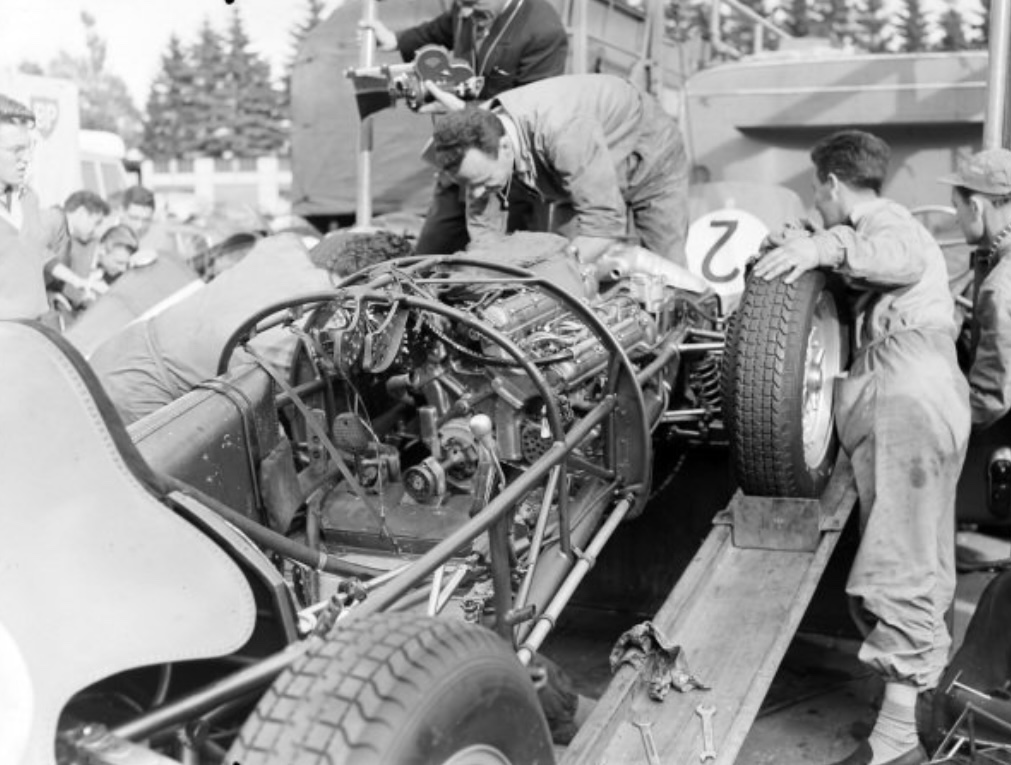
BRM P25 2.5-litre, (2491cc 102.8mmx74.93mm bore/stroke) four main bearing, DOHC, two-valve, Weber fed, twin Lucas magneto and twin-plug sparked four-cylinder engine shown in one of the cars at Monaco in 1956. That hole in the bonnet is the extent of the access my friendsBRM Type 25 1958 specification spaceframe chassis (C La Tourette)BRM Type 25 during the 1959 Dutch GP weekend at Zandvoort. Cars then spaceframe chassis with vastly superior mechanical access, note the single rear disc brake under the fuel tank at right. All that fuel sitting very high, the trade-off decisions are made clear in this shot (BRM 1)
While work progressed on the chassis there was a long test program with a single-cylinder model of the new engine. ORO were racing the V16 Mk2 and Maserati 250F during this period, with some success. By Easter 1955 the car was complete but for the engine. Finally, on June 5, 1955 the car ran for 19 laps at Folkingham with Rudd at the wheel, having given 260bhp @ 8000rpm on the test bed.
The major problem on test was the SU fuel injection system which was subseuently ditched in favour of a pair of 58DCOE Webers. After further tests by Ron Flockhart and Peter Collins, the car was entered for the September 3 Aintree meeting.
Peter Collins was chosen to race the machine but lubrication problems caused the engine to blow oil over the rear tyres causing a spin and chassis damage that prevented further running. A further run at Oulton Park on September 24 was impressive with Collins running third in front of Ferraris, Maseratis and Vanwalls etc ended when Peter noticed failing oil pressure and pitted. Thus turned out to be a dud gauge which had been shaken to death by the vibrations of the big-bore-four!
Post-meeting work involved rubber mounting the instruments, improving gearbox lubrication and gear teeth form. As Nye observed, “The new BRM was the tiniest car of its time. It was really minute, and very light, and very powerful…and very troublesome.” The eternal process of development was only just underway.
Willie Southcott tending Tony Brooks’ car, #252, at Goodwood during the Glover Trophy meeting in April 1956. DNF oil pressure in the race won by Stirling Moss’ Maserati 250FBritish GP scene July 14, 1956. The Type 25 cars of Tony Brooks, Mike Hawthorn about to receive a fresh engine, and Ron Flockhart at right; DNF accident, uni-joint and engine respectively. Fangio won in a Lancia Ferrari D50 (MotorSport)Tony Brooks’ Type 25 #252 enroute to Q6 and second in the Aintree 200 in April 1956, Moss won in a 250F (MotorSport)
Stirling Moss tested the cars in the lead up to the 1956 season but went to Maserati instead, so Mike Hawthorn and Tony Brooks stepped into the breech. Those poor unfortunates enjoyed a season of great speed laced with equal amounts of unreliability and poor preparation.
The team addressed many problems that year. They slowed the rotating speed of the bacon-slicer by use of a reduction gear, experienced ‘stiction’ in the air struts, the big valves stretched and broke, they had pot-joint seizure and so on. Then Brooks experienced a jammed throttle rod at Silverstone at Abbey corner triggering a somersault which destroyed chassis #252 by fire. To compound a diabolical British GP weekend in front of the home crowd, Ron Flockhart’s car broke its timing gears. Despite all of that Hawthorn and Brooks had qualified in the Top 10, Mike in Q3. The team withdrew from the final two championship races of the year in Germany and Italy.
The Brooks Silverstone conflagration, thank goodness the Gods of Goodnesss were smiling on Tony that day, but chassis 252 was very dead (TC March – T Johns Collection)
Alfred Owen then decreed there would be no more racing until the car had completed 300 miles of continuous running competitively. Flockhart achieved this late in the year at Monza. Three laps later, with Berthon waving him on, the car dropped a valve and ruined another engine. Nye observed, “From their debut in 1955 to the end of 1956 the BRM Type 25s had made only eight starts in just five races, and finished only once, Brook’s second in the Aintree 200.”
Over the winter Colin Chapman test drove the car twice and provided a comprehensive set of recommendations in a formal letter of advice including rear suspension changes. Fitment of tall coil spring/dampers and incorporating a Watts linkage to help locate the De Dion tube were among changes which help transform the cars.
Les Leston at Aintree during the 1957 British GP weekend, Q12 and DNF engine after 12 laps in chassis #253. Brooks/Moss won in Vanwall VW4 (MotorSport)Herbert Mackay-Fraser’s BRM T25 #253 ahead of Mike Hawthorn’s Ferrari Lancia D50 at Rouen during the 1957 French GP
In 1957 Brazilian born American Herbert Mackay-Fraser charged at Rouen, while poor Flockhart spun on oil , rolled into a ditch and wrote 254 off. Fraser died a week later aboard a Lotus 11 Climax FPF at Reims and Flockhart was still in hospital so Jack Fairman and Les Leston raced the cars at Aintree.
Jean Behra was so impressed by the corner-speed of the Type 25 at Aintree he cadged one for the 302km Caen GP which he won! Harry Schell drove a sister car in the event at the last moment, and soon became the most consistently successful Type 25 driver.
“At the end of the season, against meagre opposition, the three surviving cars, 251, 253, and 254 finished 1-2-3 in the Silverstone International Trophy, driven by Behra, Schell and Flockhart.”
During the 1957-58 break, a fifth main bearing was incorporated into the engine to solve ongoing timing gear problems, the cost was high, additional friction losses impacted horsepower. The chassis came in for attention too, the semi-monocoque centre section was ditched in favour of a full spaceframe with fully detachable bodywork.
Schell and Behra finished two-three in the Dutch GP, the team’s best result yet. The methanol burning four-bearing engine gave over 280bhp in 1957, whereas the five-bearing on Avgas gave only 240bhp, Behra left for Ferrari at the end of the year.
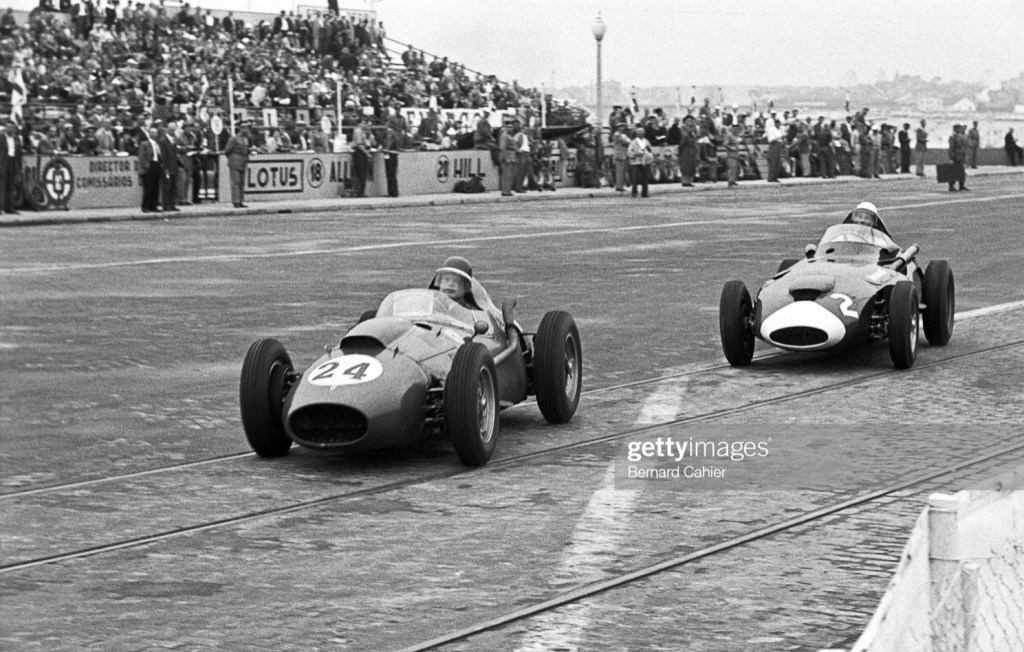
Schell at Eau Rouge, Spa, Belgian GP 1958. Harry was fifth in #257, with four of the first five cars British, the only interloper was Mike Hawthorn’s second placed Ferrari 246. Brooks and Lewis-Evans were first and third on Vanwalls, while Cliff Allison’s tiny Lotus 12 Climax was fourth (MotorSport)Onya Harry! Third (right) on the grid at oh-so-fast Reims, 1958 French GP aboard #258. The Ferrari Dinos of Mike Hawthorn #4 and Luigi Musso share the front row with him. Hawthorn won while Harry retired with overheating after 41 lapsBehra, Oporto, Portugal in 1958, fourth from Q4 in #256 with Moss the winner in Vanwall VW10 (Getty)
Fiery Harry Schell was one of the surprises of the 1958 with a series of qualifying performances and points finishes which proved just how much their ever evolving Type 25 – despite the power loss – had come. Second at Zandvoort was fantastic, so too a swag of fifth places at Monaco, Spa, Silverstone (from Q2) and Oporto. Behra’s best was third and Holland and fourth in Portugal, while Jo Bonnier’s was fourth place in the season-ending Moroccan round.
In the first season the manufacturers championship was run, BRM were fourth in the International Cup for F1 Manufacturers behind Vanwall, Ferrari and Cooper Climax. Vanwall had peaked as they led the pre-eminence of British Racing Green, while Coopers were on the rise…
Moss on the way to second place in the BRP entered BRM Type 25, Aintree, British GP July 1959. Brabham won on a Cooper T51 Climax. Bourne standards of preparation encouraged Moss to have his Type 25 #2510 fettled by his (Alfred Moss and Ken Gregory) British Racing Partnership. This chassis met a violent death at Avus the following month when Hans Hermann had brake failure on the approach to the southern hairpin during the German GP, the lucky pilot survived the monumental accident unscathed. The BRM Gods of Goodness again smiled on Hans, but former BRM racer Jean Behra was not so fortunate that same weekendRon Flockhart’s #2511 during Aintree Friday practice, British GP weekend in July 1959. DNF spin after 53 laps (D Williams)Jo Bonnier in #258, in front of Masten Gregory at Zandvoort during Jo Bo’s famous May 31, 1959 BRM Type 25 victory, Masten was third and Brabham second on works-T51s (MotorSport)
While Jack Brabham and Stirling Moss rewrote the record books with their factory and Rob Walker Cooper T51 Climaxes in 1959 BRM put themselves in the annals of Grand Prix history when Jo Bonnier won at Zandvoort in May. Schell had a season of greater reliability than Bonnier but didn’t do as well as the year before.
That winter Harry Weslake had advised Bourne on improved cylinder head design, and the fifth main-bearing was machined out! BRM adopted new timing gears “with large, coarse teeth not critical to fine backlash tuning for reliability.” Further brake modifications and simpler, lighter chassis – numbers 2510 and 2511 – “made the BRM Type 25s simply the fastest front engine cars of 1959, with fantastic braking ability.” Doug Nye wrote.
Graham Hill, Dan Gurney and Bonnier drove the cars on into 1960 at which point all of the remaining Type 25s, except #258, the Zandvoort winner, were torn to bits to provide components for the new mid-engined P48 2.5-litre cars “being hastily built to follow Cooper’s rear-engined lead.”
(unattributed)
Jo Bonnier “drifting into history”, as Doug Nye beautifully put it. By April 18, 1960 JoBo could have raced a new mid-engined P48 in the Goodwood Easter Monday Glover Trophy but chose to race Type 25 #258, his Zandvoort machine instead. Graham Hill and Dan Gurney gave the P48s their race debut that weekend, Hill was fifth, Bonnier sixth and Gurney had an accident on lap 3. In a sign of the times, Innes Ireland’s works Lotus 18 Climax won, it was the fastest, if not the most reliable GP car of 1960.
The old and new, BRMs Type 25 and P48, both 2.5-litres in September 1959. That’s #481 in shot with its unique nose on the Folkingham floor between the two cars, Type 25 chassis number unknown (BRM 2)Graham Hill tips his BRM P48 into one of the oil-drum marked corners on the Ardmore Airfield circuit during the January 1961 New Zealand Grand Prix weekend. He was third behind the Cooper T53 Climaxes of Brabham and McLaren (M Fistonic)
Eleven BRM Type 25 chassis were built – #251-259, 2510 and 2511 – during the long 1953-1960 BRM Type 25 programme, starting in 21 championship and 26 non-championship and Formula Libre events. These 47 meetings yielded the Dutch GP win for Bonnier and seven minor event victories including the two preliminary heats of the 1957 International Trophy at Silverstone and the 1959 New Zealand Grand Prix heat at Ardmore for the ever patient Ron Flockhart.
Etcetera…
(TC March – T Johns Collection)
The boys; standing are Basil Putt, Team Manager, Mike Hawthorn, Tony Brooks, Peter Berthon, Tony Rudd, Raymond Mays, AF Rivers Fletcher. Who are the mechanics in front? Folkingham, Lincolnshire August 28 1956 ‘Test and view day’.
The cover and editorial of Autosport after Peter Collins made the race debut of the Type 25 at Oulton Park on September 24, 1955 says everything about Britain’s goodwill towards BRM in its fight to take on the best in the Grand Prix world.
Great shot of Les Leston with team chief Raymond Mays at Aintree during the 1957 British GP weekend. Q12 and DNF engine after 12 laps, Jack Fairman lasted two laps more before he too suffered engine dramas. Up front, Tony Brooks and Stirling Moss shared the win in a Vanwall.
Rouen pits in July 1957, the incredibly quick BRM Type 25 #253 of the oh-so-promising American driver Herbert Mackay-Fraser awaits its wheels. Q12 and DNF transmission failure after 24 laps, Fangio won in a Maserati 250F. And below with the Mike MacDowel Cooper T43 Climax shared with Jack Brabham to seventh in the race. The contrast in size between the smallest front-engined car of the era and the grids most compact is quite marked.
(LAT)
Peter Berthon and 37 years old Harry O’Reilly Schell at Monaco in 1958. Despite a wild-man reputation Harry put together plenty of fast drives and high placings just as the team needed them. He was equal fifth (with the dead Peter Collins) in the drivers championship with 14 points, a personal best. 1959 was tougher, Stirling Moss bagged his car and Harry didn’t finish a race until Reims in July, but managed fourth at Silverstone and fifth in Portugal. Schell died at Silverstone in damp practice for the 1960 International Trophy, he clipped a low retaining wall at Abbey, was half flipped out of his Cooper T51 Climax and broke his neck.
Behra at Oporto 1958. Doesn’t that BRM #256 look magnificent beside those small, very fast Cooper T45s. #12 is Maurice Trintignant, #16 Roy Salvadori with the obscured Jack Brabham copping a push start at right.
(CAN)
Ron Flockhart during the Lady Wigram Trophy, New Zealand in January 1959. If a bloke deserved a win in these cars it was Ron given the number of test and race miles he did in them. He won aboard #259 from pole in front of Jack Brabham and Bruce McLaren’s Cooper T45 Climax’.
‘Where is the starter again?’ Tony Rudd and mechanic in Harry Schell’s #257 at Monaco in 1959. Q9 and DNF accident after completing 48 laps of the race won by Jack Brabham’s Cooper T51 Climax. Bonnier’s car retired with failing brakes from Q7.
(unattributed)
Yay team, again at Zandvoort in 1959, and one more time, there is no such thing as too much BRM…
BRM Type 25 model from Stephen Dalton, “it’s a Merit with the Alastair Brookman touch, he built it.”
Credits…
Clarence La Tourette, Getty Images, John Ross Motor Racing Archive, Bernard Cahier, John Ferguson, Classic Auto News, LAT, MotorSport Images, ‘BRM 1’ Doug Nye, History of the Grand Prix Car 1945-65 Doug Nye, Dave Williams, Stephen Dalton Collection, TC March, Tony Johns Collection
Tailpiece…
(B Cahier)
Phil Hill catches Jean Behra on the way to a DNF brakes at Monaco in 1958 from a splendid Q2 in chassis #256. Tony Brooks was on pole and Jack Brabham Q3 is the upstart 2-litre Cooper T45 – with two more of the pipsqueaks behind Jack – driven by Roy Salvadori and race winner Maurice Trintignant.
While the mid-engined writing wasn’t perhaps on the wall, the sign-writers were readying the paint…
Evocative shot of Peter Collins in his Ferrari Dino 246, 1958 #246/002, during the July 1958 British Grand Prix at Silverstone.
He won the race by 24-seconds from Mike Hawthorn who took the World Drivers Championship that year, before perishing in ‘that’ road-dice with Rob Walker shortly thereafter.
I’ve done these cars to death, both front-engined F1 jobbies and their related mid-engined Tasman cousins, but another bunch of photos got the juices flowing again.
In an enthralling, tragic season, Luigi Musso died at Reims, then Peter Collins crashed fatally at the Nurburgring only weeks after Silverstone (in this same chassis) during the German Grand Prix. Vanwall, with whom Ferrari battled all year – winners of the Constructors Championship – also lost a driver at the season’s end when Stuart Lewis-Evans died of burns sustained at Ain-Diab in Morocco several days after the race.
(MotorSport)
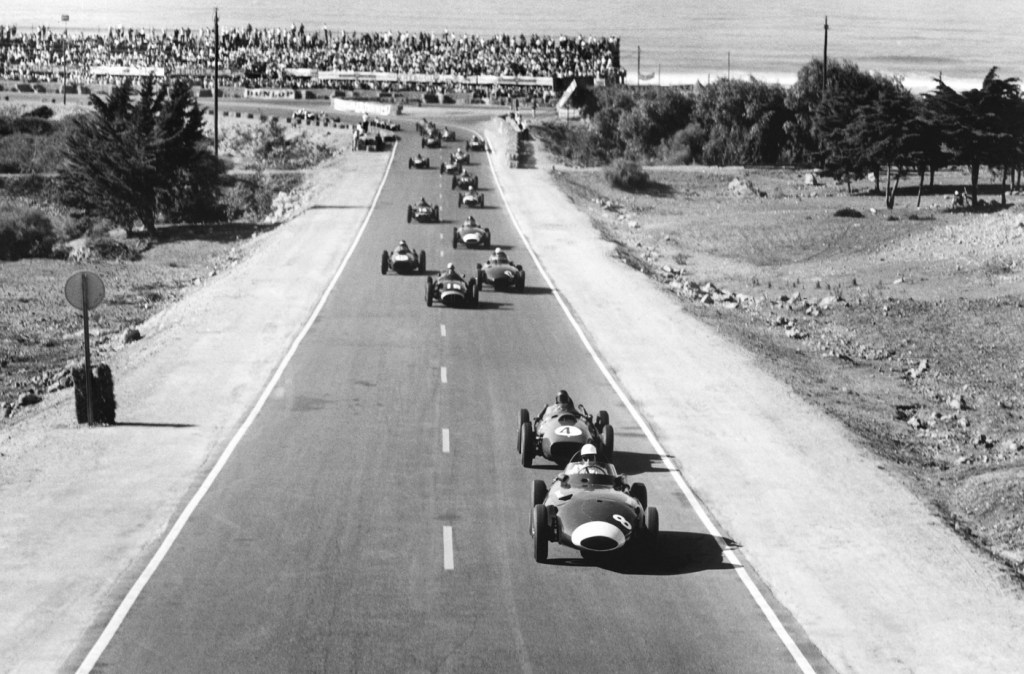
This Moroccan GP start-shot of Vanwall mounted Stirling Moss bolting away from a Ferrari, this time with Phil Hill at the wheel, says a lot about the rivalry between the teams during a year in which British F1 pre-eminence began. Vanwall and Cooper, to whom Tony Vandervell would pass the torch, were on the rise.
The shot below shows Hawthorn’s car (1958 #246/003) being attended to in the Silverstone paddock. Note the traditional twin-main tube Ferrari chassis, and subsidiary tubes, and powerful V6 engine canted to the right to allow the driveshaft to pass alongside the driver.
By contrast, the Vanwall had a Colin Chapman designed, light, multi-tubular spaceframe chassis, and far less sexy, but powerful, torquey, twin-cam, two-valve – same as the Ferrari – in-line four cylinder engine.
(MotorSport)(MotorSport)
At the start of its life the Dino rear end (Collins’ car at Silverstone above) comprised a De Dion axle, transverse leaf-spring, twin radius rods, Houdaille shocks and drum brakes. By 1960 it was independent with coil springs, telescopic shocks and disc brakes, such was the relentless pace of change and level of competition wrought by the mid-engined Cooper T51 and Cooper T53 Climaxes in 1959-1960.
In late August, Hawthorn and Moss battle on the Boavista seafront in Portugal. Stirling won on the cobblestones by five seconds from Mike, settling up a nail-biting end to the season at Monza and Ain-Diab.
Brooks’ Vanwall won from Hawthorn at Monza, while Moss had a gearbox failure. In Morocco, Hawthorn put his car on pole from Moss, in the race the positions were reversed. Mike took the title by a point from Stirling in a season in which the best five placings were counted.
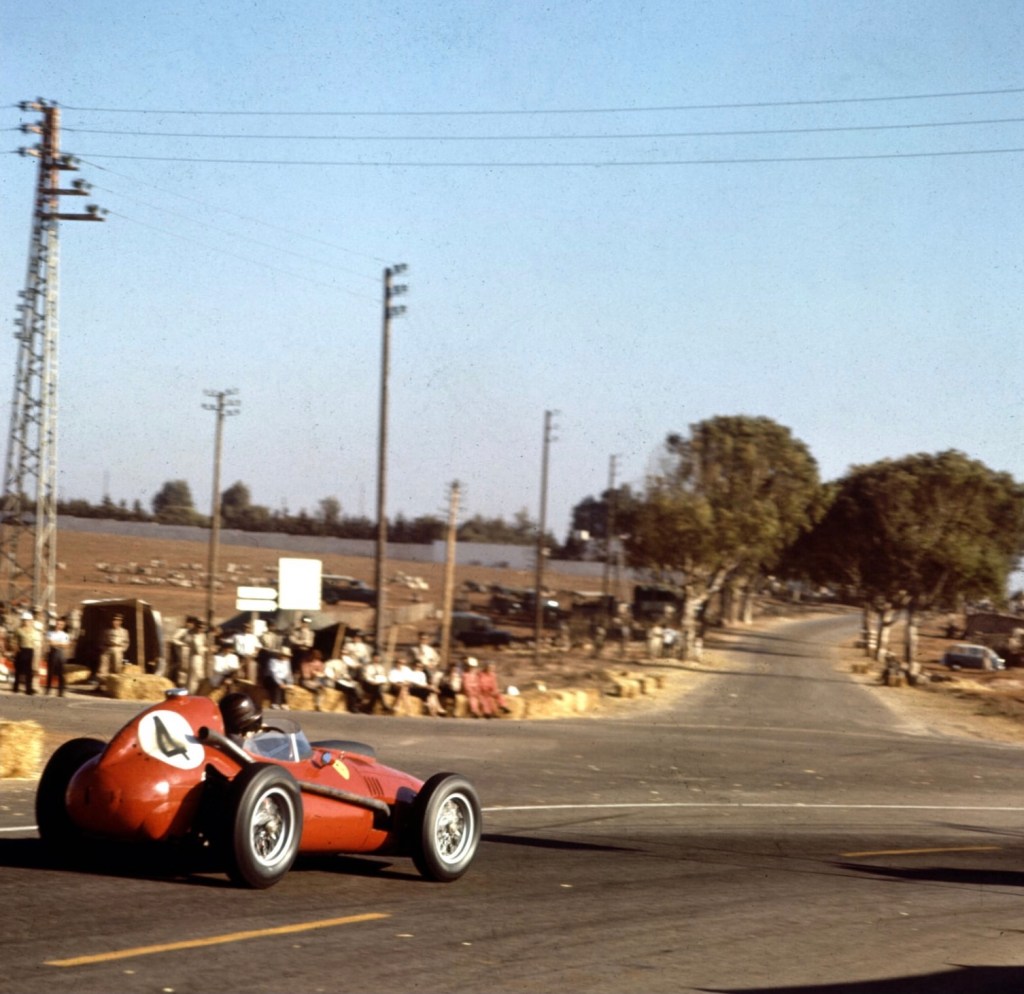
The stunning shot of Phil Hill below, hooking his Dino (1958 #246/004) into a right-hander in the wilds of Morocco shows all that was great – and incredibly dangerous – of Grands Prix racing compared with the (sometimes) between the white lines ‘car park’ F1 competition of today. Grand Prix Racing it ain’t…
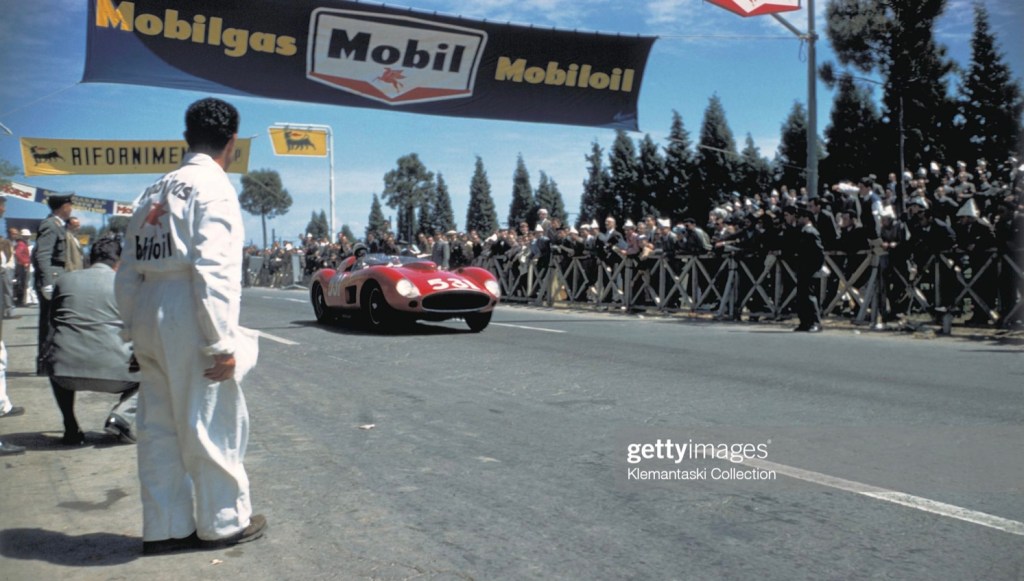
Marquis Alfonso de Portago and Edmund Nelson accelerate their Ferrari 335S away from the Rome control, heading north on the homeward leg during the 1957 Mille Miglia on May 12.
At that stage the ill-fated crew were placed fourth. They later crashed only 35km short of the Brescia finish, killing eleven – five of whom were kids – after tyre failure. I wrote about this race and car some years ago here; Peter Collins: Mille Miglia 1957: Ferrari 335S… | primotipo…
This piece is a pictorial delving into the the Klemantaski/Getty Images archive, remembering an event which changed the face of motor racing, ended the lives of two combatants, nine innocents and the Mille Miglia.
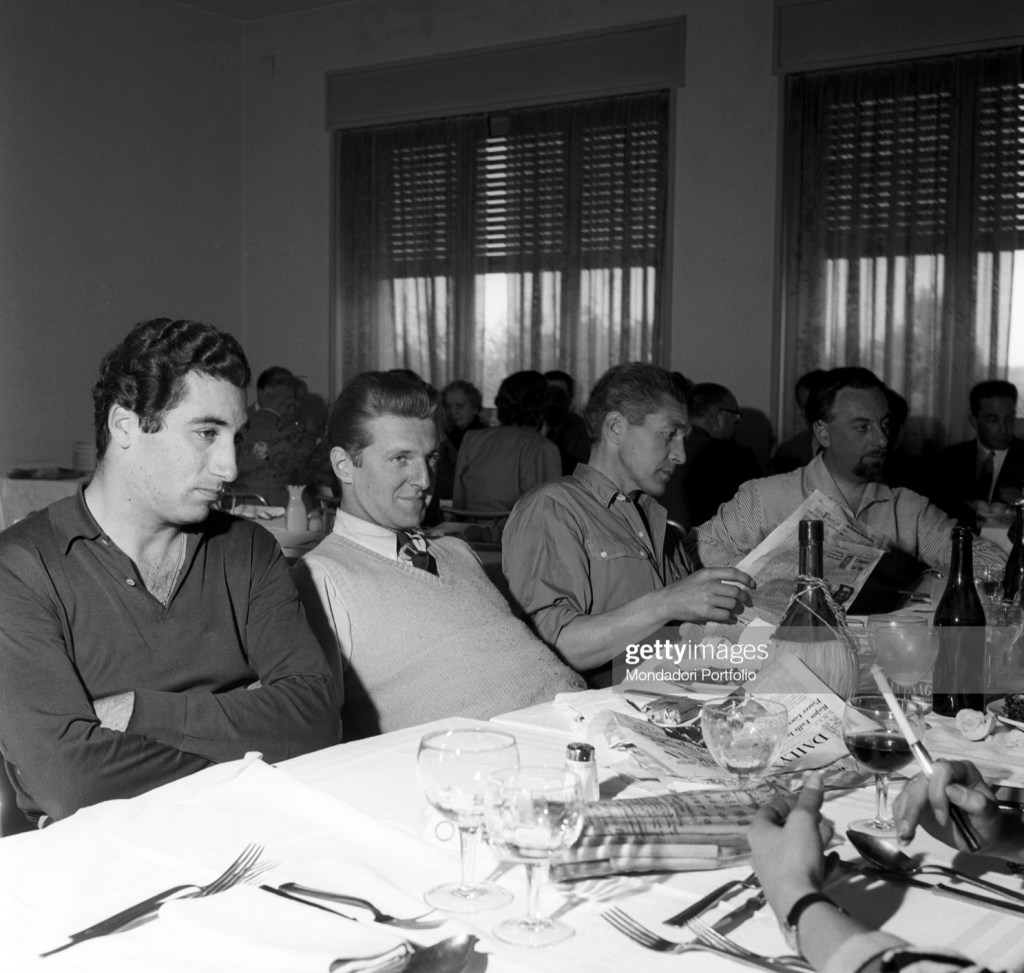
The table of nobles. De Portago along side Wolfgang von Trips during a ‘training camp’ or perhaps more accurately a pre-event briefing and planning session in the weeks before the Mille, held on 11-12 May 1957. See this wonderful Doug Nye piece on De Portago in MotorSport; Ferrari’s fastest playboy: Alfonso de Portago – Motor Sport Magazine
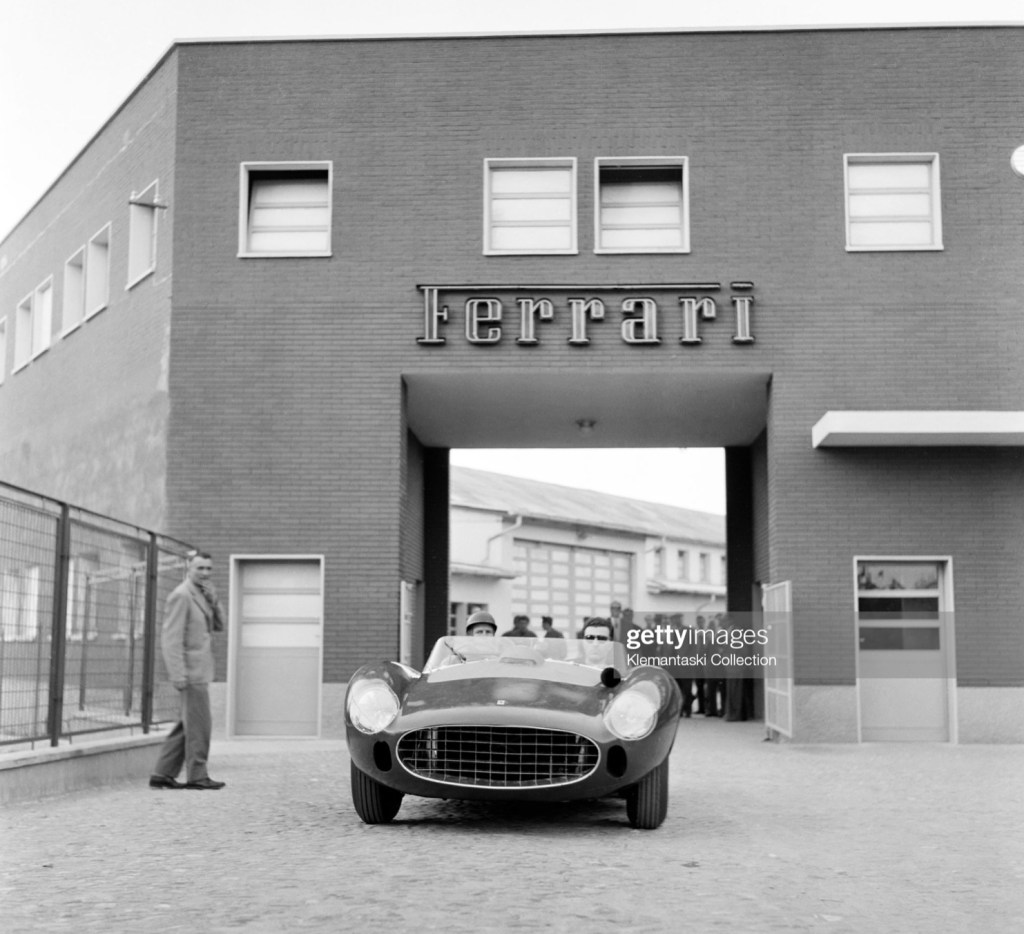
Peter Collins leaves Maranello for a quick blast up the Abetone Road to check that all is good with his 335S, note the bonnet is still to be painted.
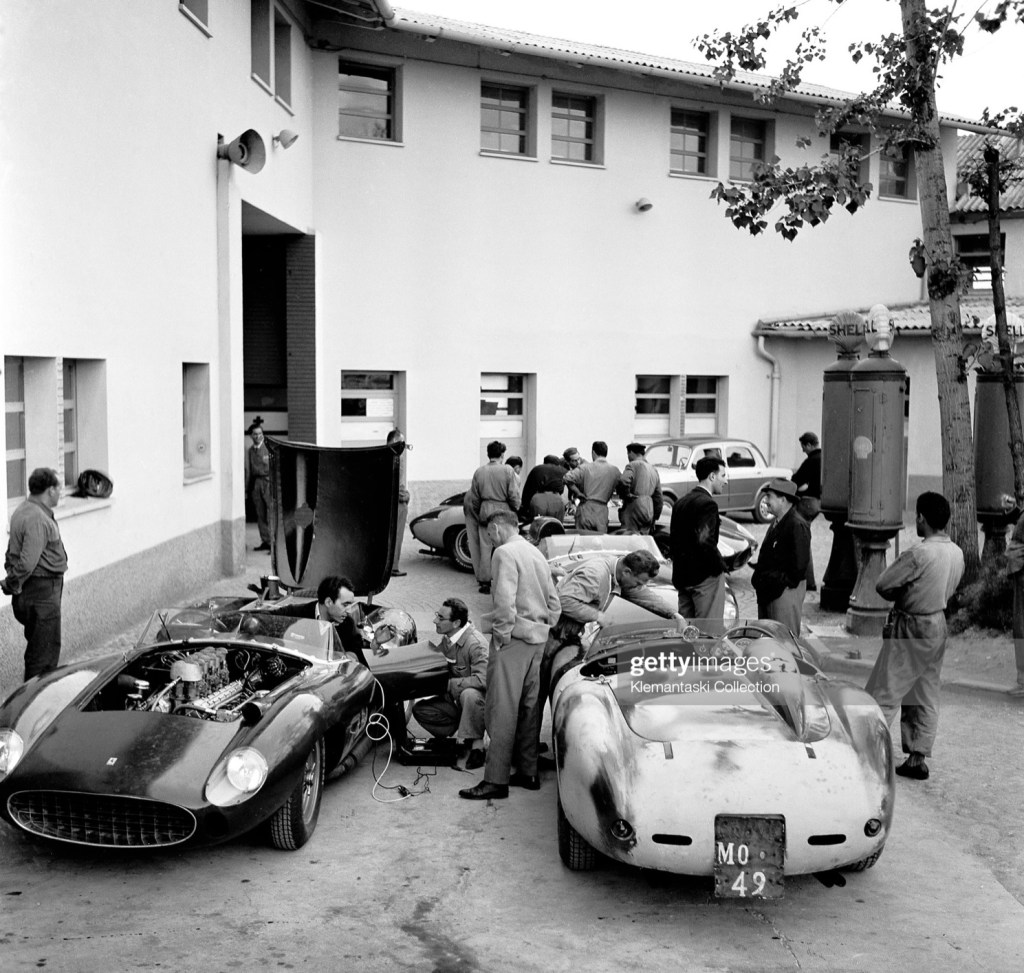
The team cars below in the famous factory courtyard are the four four-cam cars for Piero Taruffi – the winner – Von Trips, De Portago and Collins, with the Collins/Klemantaski machine at left. A blur of activity.
The series of photographs below are at Brescia, the start and finish of the classic event. The shots show the sheer pageantry and grandeur of the event tinged with no shortage of pathos given the events that day which took De Portago, Collins twelve months later aboard a Ferrari Dino 246 during the 1958 German GP at the Nurburgring, and at Monza in 1961 when Von Trips perished in the early laps of the Italian GP aboard a Ferrari 156 along with another group of spectators.
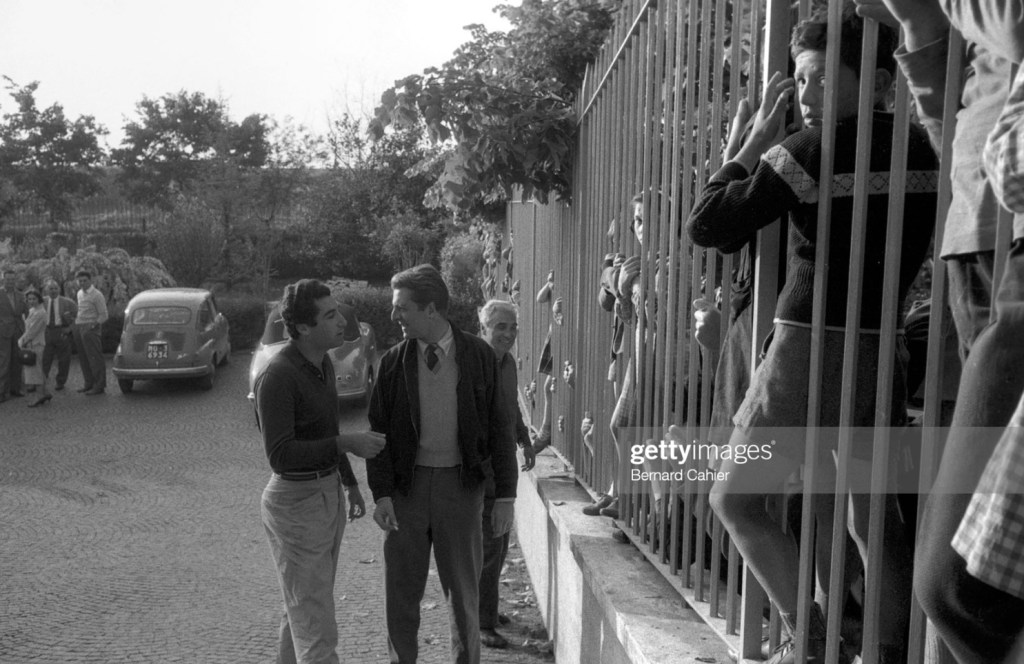
De Portago and Von Trips swapping notes before the off while Taruffi seems a little more focused on the needs of the adoring locals.
Enzo Ferrari with Peter Collins (above) before the start, and De Portago below.
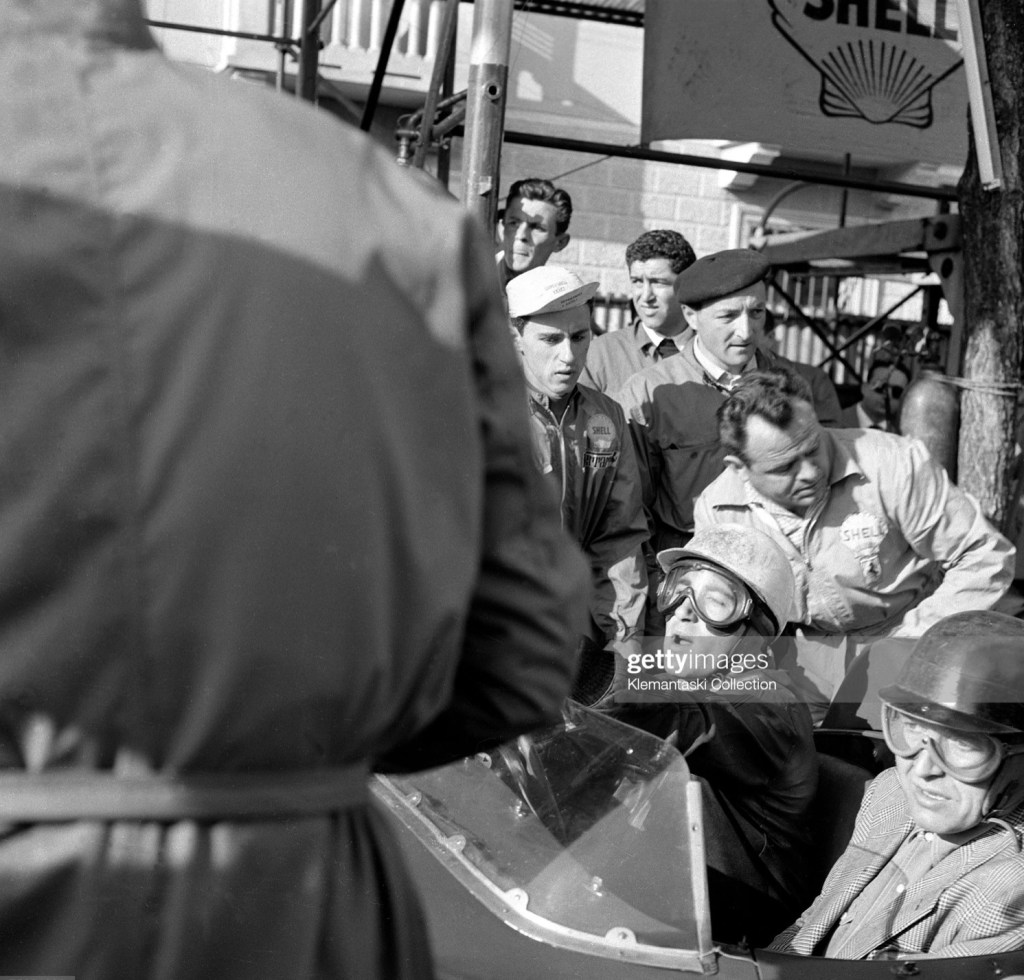
De Portago and Collins shortly before Alfonso’s departure from Brescia, car the ill-fated 335S chassis 0676. Louise Collins is mid-shot.
It was the first time De Portago raced the 4-litre car, the most powerful car he had ever driven. He drove it with skill and seemed set to finish well in this most difficult of races in the world’s fastest sportscar.
De Portago and Nelson departing the Ravenna control – in Emilia-Romagna – a couple of hours into the race.
Piero Taruffi won in a 315S from Von Trips in another 315S, while the Collins/Klemantaski 335S DNF with driveshaft failure in the fifth hour. The De Portago/Nelson accident happened after five hours, seventeen minutes, at 3.30pm near the village of Cavriana 35km from Brescia.
De Portago’s final pitstop was in Montova where he refused a tyre-change to save time, at that stage the crew were fourth, third by some accounts. “This may have caused his car’s tyres to be more susceptible to failure when the Ferrari ran over cat’s eyes at high speed.” The left-front failed at a little over 150mph.
Not too many photos exist of Edmund Gurner Nelson, De Portago’s navigator, friend, confidant, fixer, Bob-sled coach and whatever else, in the car.
Here they are leaving the Ravenna control, the shot gives a sense of immediacy and pressure, note Ed’s sports-blazer casual attire.
Credits…
All photographs Klemantaski Collection/Getty Images, motorsportmemorial.org
Tailpiece…
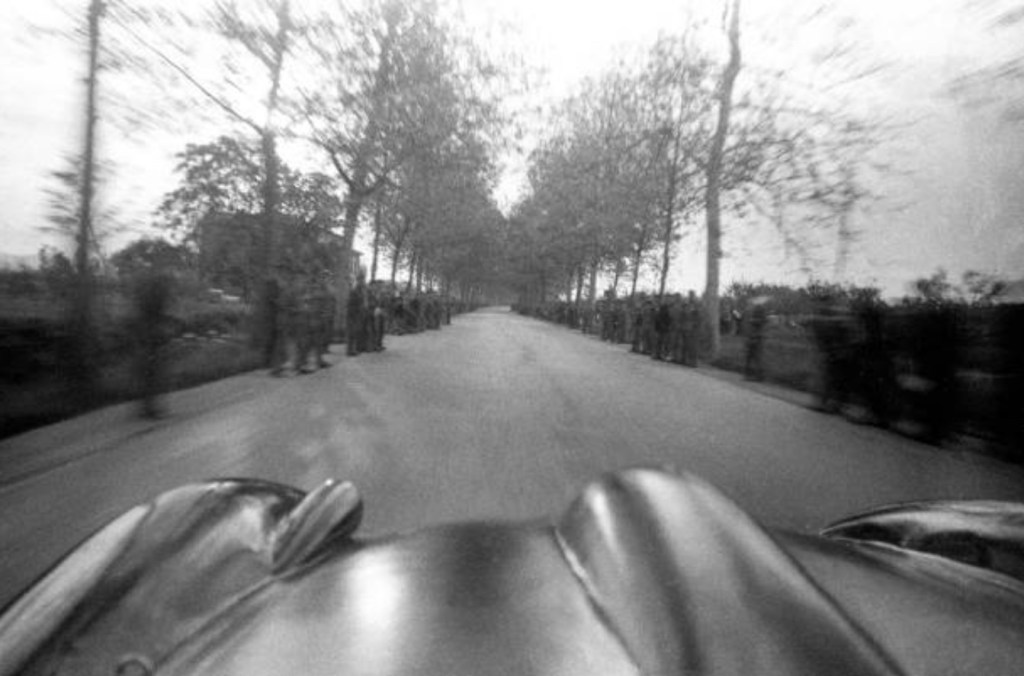
This moody shot was taken by Louis Klemantaski at high speed during the event alongside Peter Collins in his 335S. 150mph plus is all fine and dandy – even with an enthusiastic Italian crowd encroaching on the road – until something goes wrong. Apologies for the statement of the bleeding obvious…
We should all be thankful the Targa Florio survived in its traditional form for as long as it did given the ’57 Mille.
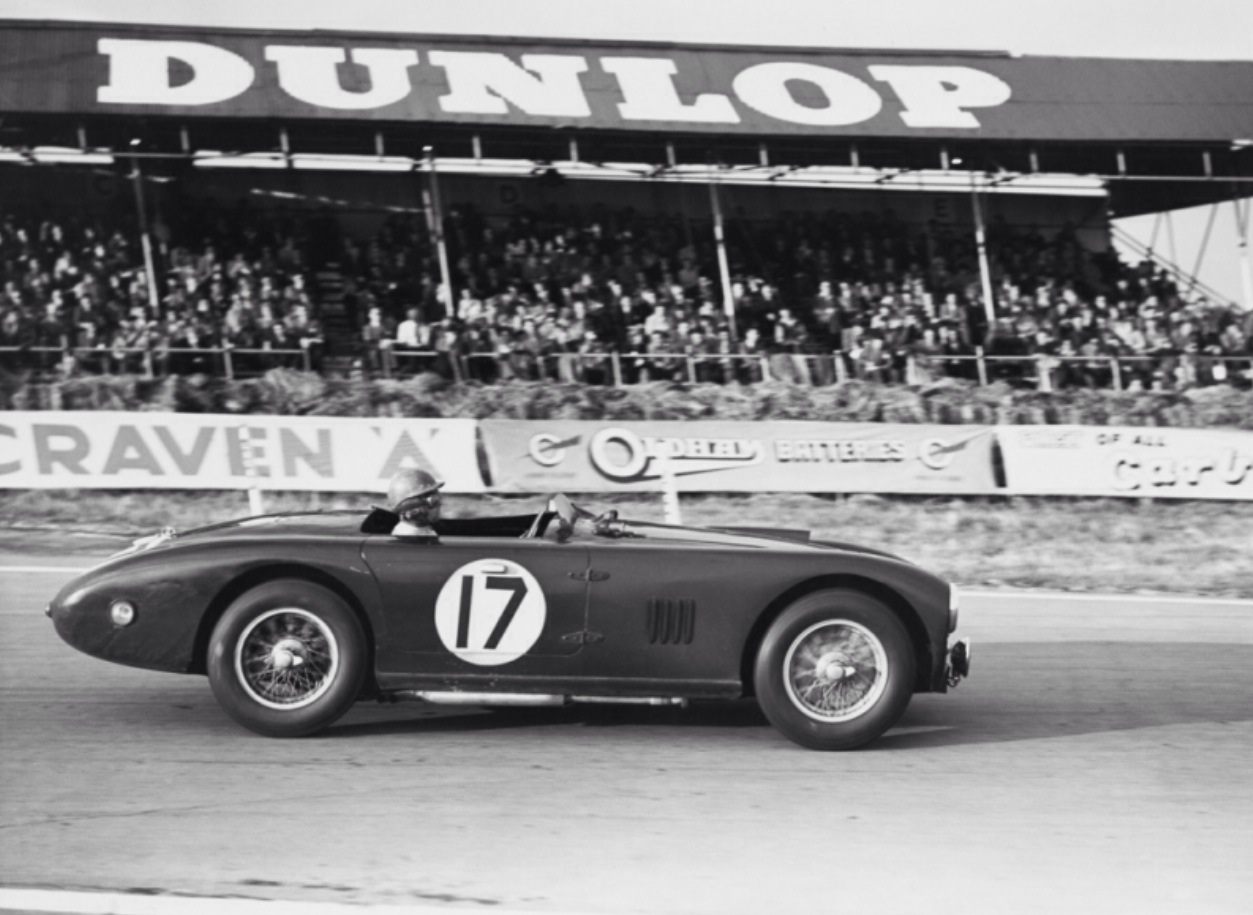
Stirling Moss guides his works Jaguar C-Type through Fordwater on his way to fifth place at Goodwood sharing with 1951 Le Mans winner Peter Walker…
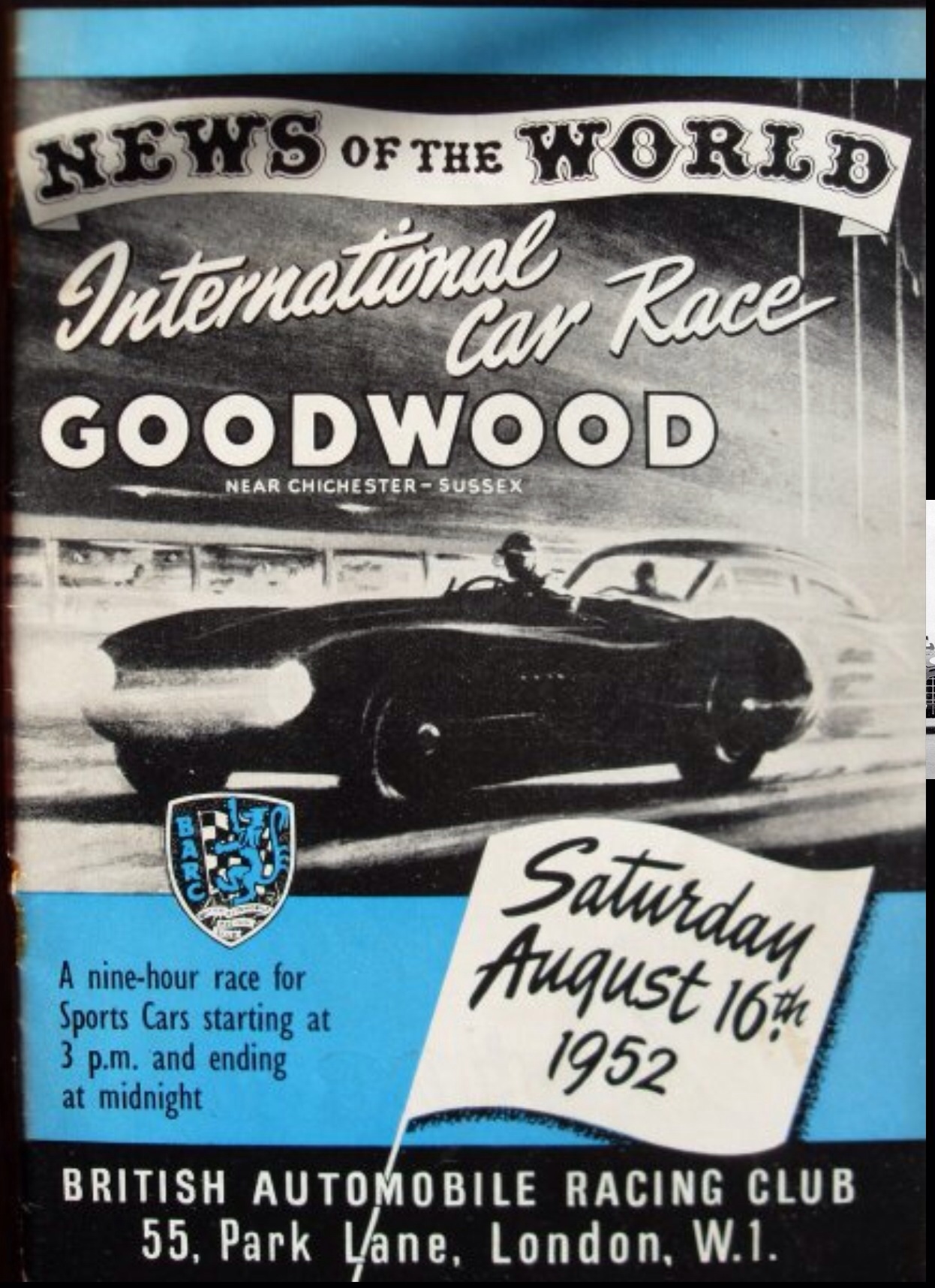
Britain’s first night race took take place at Goodwood on 16 August 1952. The British Automobile Racing Club hoped to emulate the commercial success of Le Mans, that classic a race of 24 hours duration of course.
The Goodwood enduro was a nine-hour event with a 3pm start to allow the spectators to see the cars in all their spectacular glory in the half-light and full darkness.
Modifications were made to the circuits infrastructure by fitting floodlights to illuminate the grandstands and pits, the kerbs were given a coat of luminous paint and a beer tent was laid on, although due to post-war licensing laws it had to stop serving grog before the race ended! Sponsorship and plenty of pre-event publicity was provided by ‘The News of The World’ newspaper inclusive of £2,500 in prize money which represented a powerful incentive for the ‘local’ works teams and privateers to enter in force.
Jaguar and Aston Martin entered three-car teams of C-types and DB3s in the field of 32 cars. Both teams had much to prove. The C-Types were quick at Le Mans in June, but all three cars retired with engine cooling-related issues. The new Ferrari 250S and Mercedes-Benz W194 had been faster than the Jags, victorious at Le Mans in 1951, at the Mille Miglia in May.
As a consequence, Jaguar had designed a more aerodynamic body with a slightly smaller radiator. Jag’s cooling problems became apparent in practice, despite hasty modifications; solutions were not found pre-race. Peter Whitehead/Ian Stewart retired with a failed head gasket during the second hour, Stirling Moss/Peter Walker with engine problems in the third, and the remaining Tony Rolt/Duncan Hamilton car with a head gasket failure in the fourth hour.
Le Mans 1952: #26 the Poore/Griffith Aston DB3 Spyder alongside the Parnell/Thompson DB3 Coupe, all three factory cars DNF (unattributed)
The new Aston DB3 ‘Spyders’ also failed to finish, Dennis Poore/Pat Griffith in the third hour with water pump failure and Lance Macklin/Peter Collins towards the finish with an accident in the twenty-second hour of the long, unforgiving race. The works DB3 Coupe driven by Parnell/Thompson retired in the second hour with gearbox dramas. The ’52 Le Mans was won by the Benz W194, Hermann Lang and Fritz Riess from the sister car of Theo Helfrich/Helmut Niedermayr.
The chance to make a good showing on home turf was therefore ‘manna from heaven’.
Jaguar used the same driver combinations they deployed in France, whilst Aston’s pairings were Reg Parnell/Eric Thompson, Peter Collins/Pat Griffith and George Abecassis/Dennis Poore.
Other strong entries included Pierre Levegh’s Talbot-Lago T26GS, famously for being so nearly the winner driving solo at Le Mans in 1952 before missing a gear very late in the race. Ferrari 225S’ were entered for Tom Cole/Graham Whitehead and Bobbie Baird/Roy Salvadori, a works Allard J2X for Anthony Hume and George Thomas plus a swag of Healey Silverstone, Frazer Nash Le Mans Rep, Jag XK120, Cooper T14 MG, HRG and HWM cars. In short, an interesting field that lacked only works Ferrari and Mercedes entries.
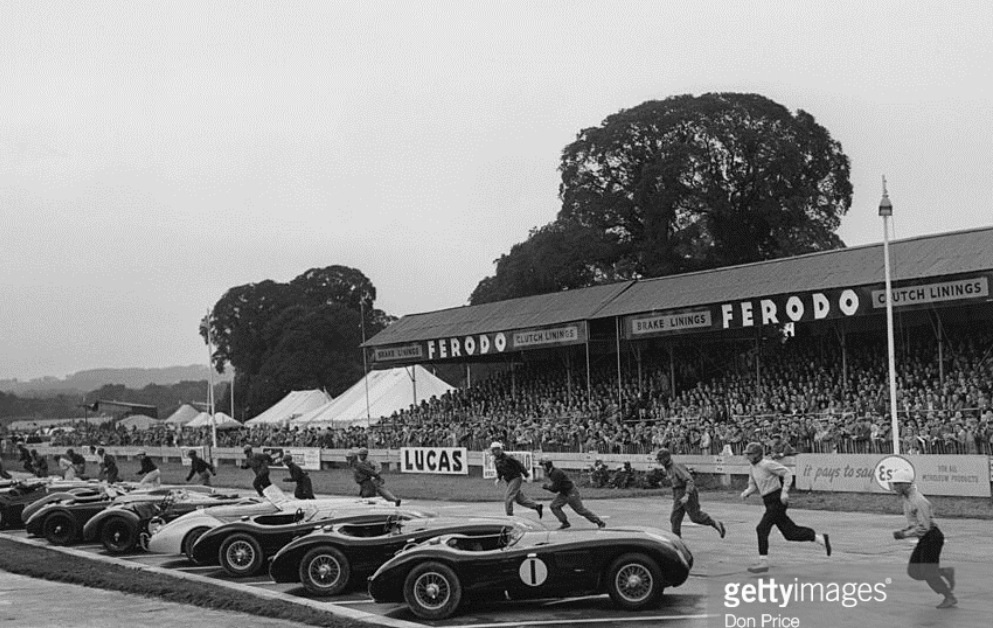
At the start, Moss, at right, as usual, won the sprint to his car, but Tony Rolt, to Moss’ right led on lap one, but he was soon overtaken by Parnell’s Aston…
At the end of the first hour the order was Parnell, Rolt, Abecassis, Moss and Baird, Ferrari 225S, then Whitehead.
Then the weather started to improve, and as the track dried, the Jaguar’s pace became apparent with both Rolt and Moss passing Parnell. So, Jag, Jag, Jag, Aston, but then Whitehead crashed his C-Type.
Disaster struck the Feltham team on lap 91 during a routine refuelling pit stop when Parnell’s car caught fire, burning two of the crew and team manager John Wyer. Parnell showed great leadership and strength of character, whilst his race drive was over he stood in for the injured Wyer to take over the critical team management role.
At half distance the Moss/Walker Jaguar C Type led from the sister XKC of Rolt/Hamilton. The third C-type had crashed at Madgwick and retired whilst the DB3 of Abecassis/Poore had also dropped out of contention.
By 9pm, the drivers had switched their headlights on, the spectacle of racing at Goodwood at night was fantastic, but within half an hour, a half shaft broke on the Rolt/Hamilton C-Type, which allowed the remaining Aston of Collins/Griffith through; that car was then overtaken by the quick Ferrari 225S driven by Bobby Baird and Roy Salvadori.
Eric Thompson came into the pits 3 hours into the race with smoke pouring from the rear of the car. Wyer and mechanic Jack Sopp pulled up the seats to investigate whilst Fred Lowndes refuelled. Spilt fuel from the last churn went onto the tail of the car and ran down onto the undertray where it was ignited by hot oil from a leaking fuel seal- within seconds the car was engulfed in flames and smoke. Wyer and Sopp suffered bad burns, Lowndes not so much but all 3 were taken to hospital whereupon Reg Parnell took charge. Aston DB3/3 was destroyed- and later rebuilt, Parnell, drove it to 5th in the 1953 Mille Miglia (unattributed)
Half an hour later Jaguar’s collapse was complete when the leading Moss/Walker car entered the pits with a broken rear radius arm that would take nearly an hour to repair. It is said that Jaguar boss Sir William Lyons was blissfully ignorant of all of the dramas which befell his team as he had retired to Goodwood House from the pitlane to enjoy what appeared to be a certain win!
The doomed Parnell/Thompson Aston DB3/3 earlier in the race prior to its demise (Getty)
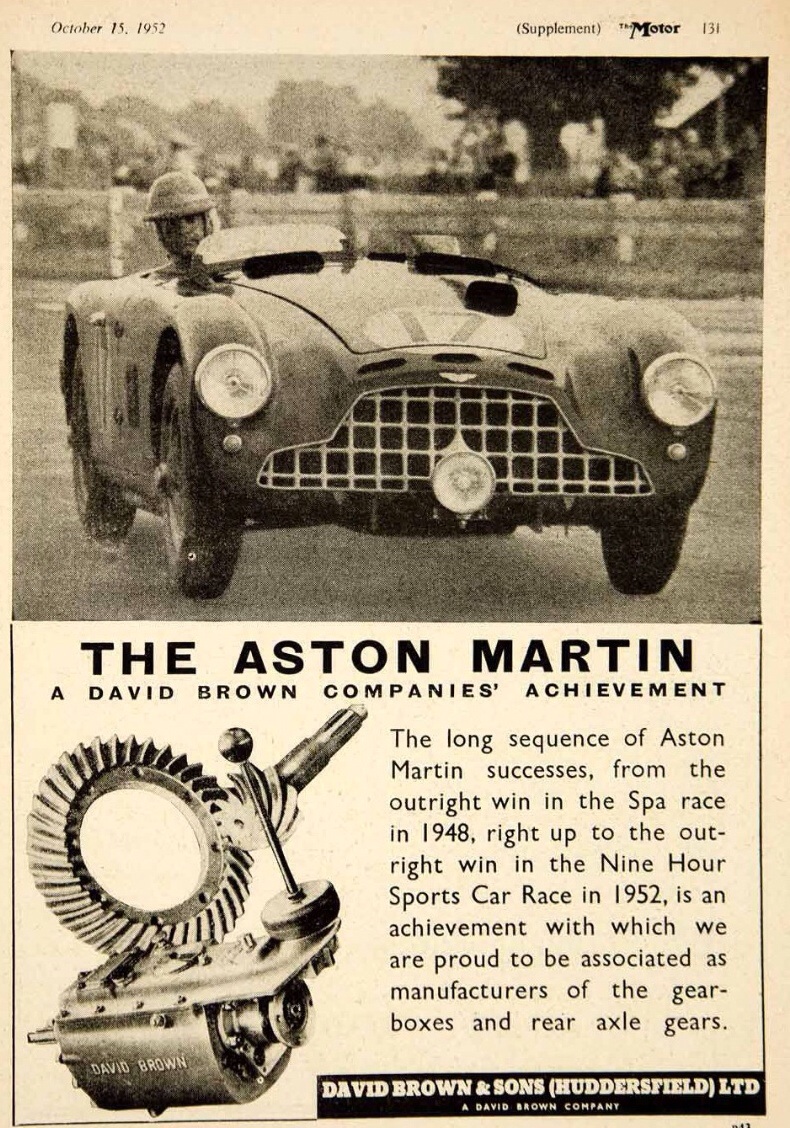
In a race of rapidly changing fortunes, the Baird/Salvadori Ferrari 225S had gone from fourth to first in little more than an hour. Still, in a final twist of fate, on its last pit stop, the jack intended to lift the car sank into the patch of tarmac, softened by the earlier Aston DB3 fire! The loss of time was sufficient to put the Collins/Griffith DB3 into the lead with just an hour of the race left. That pairing duly won despite an exhaust valve breaking an hour before the event’s end, from the two privateer Ferrari 225S’ driven by Cole/Whitehead and Baird/Salvadori.
Collins in the winning Aston DB3 early in the race (unattributed)
The Telegraph reported that ‘The Nine Hour had all the ingredients of a classic race; the changing weather, the drama of the pit fire and a dramatic fight for the lead, not to mention the fact that so many of the cars were competing on home soil. Yet the spectators were distinctly unmoved, many only arriving once the night racing began, and few staying for the duration. These were people who attended Goodwood for a grand day out – a nine-hour endurance race, where the leader wasn’t always obvious, was simply too long.’
‘When the Nine Hour race returned the following year it did so without any newspaper sponsorship to offer pre-event coverage. Spectators numbers fell as a result and with them the carnival atmosphere that made Le Mans such a success. Those who did go frequently left when it got dark, defeating the event’s raison d’être. It didn’t matter that the racing was first class (Aston would win again in ’53 and, after the race skipped a year, scored a third victory at what would be the last Nine Hour race in ’55) if nobody was there watching it. Perhaps the British will always see night racing as too good an excuse for a holiday abroad.’ the Telegraph concluded.
There was no World Sportscar or Manufacturers Championship in 1952, that competition started in 1953. However the classic race spoils went to Mercedes Benz W194/300SL at Le Mans and the Carrera Panamericana with a Ferrari 250S victorious at the Mille Miglia and a Lancia Aurelia B20 at the Targa Florio
Vaino Hollming Jag XK120 leads Pierre Levegh Talbot-Lago T26GS then the Lawrence Mitchell Frazer Nash High Speed, Goodwood 9 Hour (Getty)
Aston Martin DB3 Technical Specifications…
Ex-Auto Union design team member Robert Eberan-Eberhorst first worked for ERA when he come to the UK post-war. He was contracted for 3 years from November 1930 to design a sports-racer for Astons which was to use the AML LMB 2.6 litre 6 cylinder engine and a David Brown five-speed gearbox.
He chose a period typical ladder frame chassis design, the main members made from 16-gauge, four inch chrome-molybdenum tubes with substantial cross-bracing by three 14-gauge five-inch tubes.
Front suspension was similar to the DB2- trailing links, transverse torsion bars, piston type shocks and a roll bar. At the rear a more sophisticated De Dion rear axle was deployed. This was constructed from three steel sections welded together and was located by a Panhard Rod and parallel locating links. The upper links ran fore and aft, the lower links angled. Each of the lower links engaged by serrations with a transverse torsion bar. Armstrong double piston dampers were used. The car weighed circa 2165 pounds/980Kg with nine gallons of fuel.
RE Poulton for Autocar
Steering was by rack and pinion with two turns lock to lock, brakes were Al-fin drums, inboard at the rear. Spoked wire wheels were, of course, used with Rudge-Whitworth knock-off hubs.
The DB3 first raced in 2580cc form, with triple 35DCO Weber twin-choke carburettors. The alloy, DOHC, two valve head engine developed 133bhp @ 5500rpm. The gearbox was a DB S527, five-speed with overdrive top gear. From July 1952, a DB S430/63R four-speed box was used.
Into 1952 the engines ran Weber 36DCF carbs making 140bhp @ 5200rpm, still way too little. By the 1952 Monaco GP a 2922cc engine developed 147bhp @5000rpm but any increase in capacity of the LB6 engine was impossible as each pair of bores were siamesed.
163bhp was achieved from an engine with 35DCO twin-choke Webers and connecting rods with offset big ends at the Goodwood 9 Hour in 1952.
Bibliography…
Article by Chris Knapman in The Telegraph April 2011, ‘Aston Martin: The Racing Cars’ Anthony Pritchard
Photo Credits…
Getty Images, Klemantaski Archive, Don Price, Autocar
Mike Hawthorn and Peter Collins looking confident with the speed of their Ferrari Dinos prior to the Silverstone start…
Into 1958 the relationship between Enzo Ferrari and Peter Collins had soured a bit as the chief felt the Brit was not as competitive as he had been, he was dropped to the F2 team at the French GP. Mike Hawthorn’s intervention and Luigi Musso’s death at Reims made his position more secure. Nevertheless he was feeling plenty of pressure at the time…
Peter Collins takes his last win, Silverstone 1958, Ferrari Dino 246 (unattributed)
Collins started the British GP from 6th on the grid, with Moss’ Vanwall on pole, but Collins blasted through from the second row to lead Moss, Hawthorn, Schell’s BRM P25, Brooks Vanwall VW57 and Salvadori, Cooper T45 Climax.
Collins increased the lead steadily with Moss and Hawthorn comprising the lead group. Stirling’s engine blew on lap 26 leaving Peter leading from Hawthorn. Stuart Lewis-Evans was 3rd but was soon passed by Salvadori. Collins won from Hawthorn, Salvadori and Lewis-Evans’ Vanwall VW57, four Brits!
Peter Collins being congratulated aboard his Dino after the event. Its July 19, he was dead 3 weeks later, Nurburgring on 3 August (Hutton)
Louise Collins susses husband Peter’s fabulous Ferrari 335S in advance of the start of the ’57 Mille Miglia…
It was a victorious race for Ferrari but otherwise disastrous on every level given ‘Fon de Portago’s accident and it’s consequences, click here for an article about both this race and the big Ferrari;
Peter Collins photographed by Louis Klemantaski aboard their Ferrari 335S during the ill-fated 1957 Mille Miglia…
This stunning, evocative shot, one of motor racing’s most famous, was taken by acclaimed photographer Louis Klementaski who navigated for Collins capturing the essence of the event and times which seem so long ago.
Klemantaski picks up the story in Automobile Year 44…’In the fateful Mille Miglia of 1957 I was in the Ferrari Team in the car driven by Peter Collins, a 335 Sport. This model was the ultimate achievement of Ferrari’s creativity of that period. Peter said it was the best handling sports-racing Ferrari he had driven so far. It was certainly the most powerful and I had to adjust my course notes accordingly’.
‘This photograph was taken as we went through a series of hairpin bends in the Abruzzi Mountains on the way to l’Aquila and Rome. There were no trees around and Peter could see the whole road for quite a way ahead, so I was able to take some time off from giving him signals as to the severity of the next corner and take some shots of the cockpit and him in action. As the G-forces were considerable, I had to make the exposure on the right-hand corner, so that I would be thrown outwards and away from him. We had no seat belts in those days and it was very difficult not to impede Peter on occasion. In those very tight corners, first on one lock and then the other, Peter could cope without changing the position of his hands on the wheel, which was just as well, as the corners came up with remarkable rapidity. This is my favourite Ferrari photograph because it was of a Ferrari in action, taken from a Ferrari cockpit – and how much closer to the spirit of these wonderful cars can you get?’
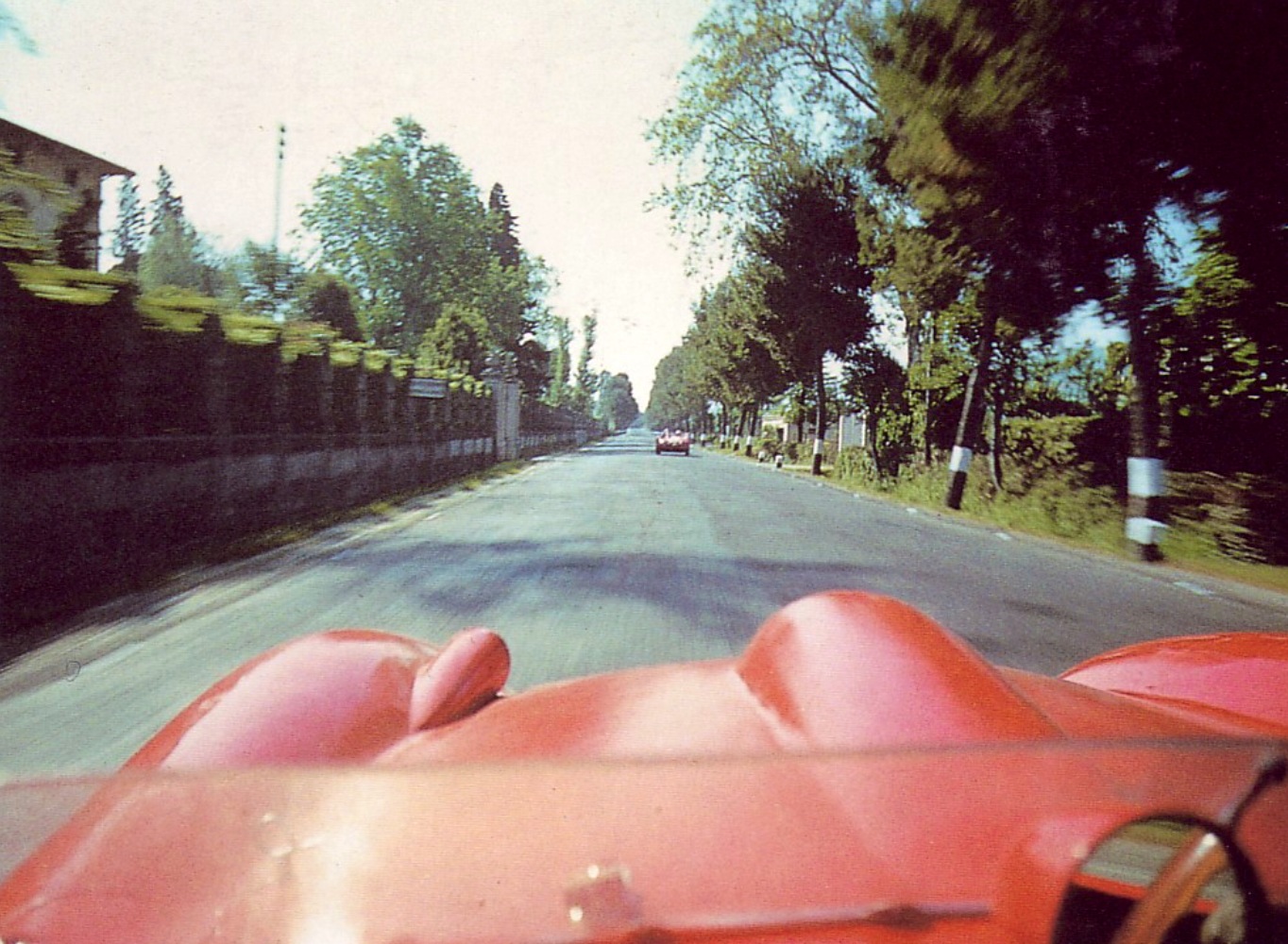
The view at speed…somewhere in Italy! Klemantaski shot from the Collins 335S (Louis Klemantaski)
Scuderia Ferrari entered five cars in the 1957 event: 315S models for Piero Taruffi (his car was fitted with a 335 engine) and Count Wolfgang ‘Taffy’ von Trips, and the latest 4-litre quad-cam 335S models for Collins/ Klemantaski and Marquis ‘Fon’ de Portago and Ed Nelson. Finally, a 250LWB was entered for Olivier Gendebien and his navigator M Washer.
Taruffi won the race and then retired, Von Trips was second. The Collins car retired at the 5 hour 3 minute mark with a broken driveshaft. Sadly, and infamously, De Portago/ Nelson perished in a gruesome accident which also took the lives of nine spectators – five children – in the village of Guidizzolo, Lombardy, 110km east of Milan.
Some reports say De Portago should have changed his tyres earlier, a blowout was the cause of the accident. The race was banned as a consequence, and so ended a tradition which commenced in 1927, the event was run 24 times from then until 1957.
1957 Mille Miglia course
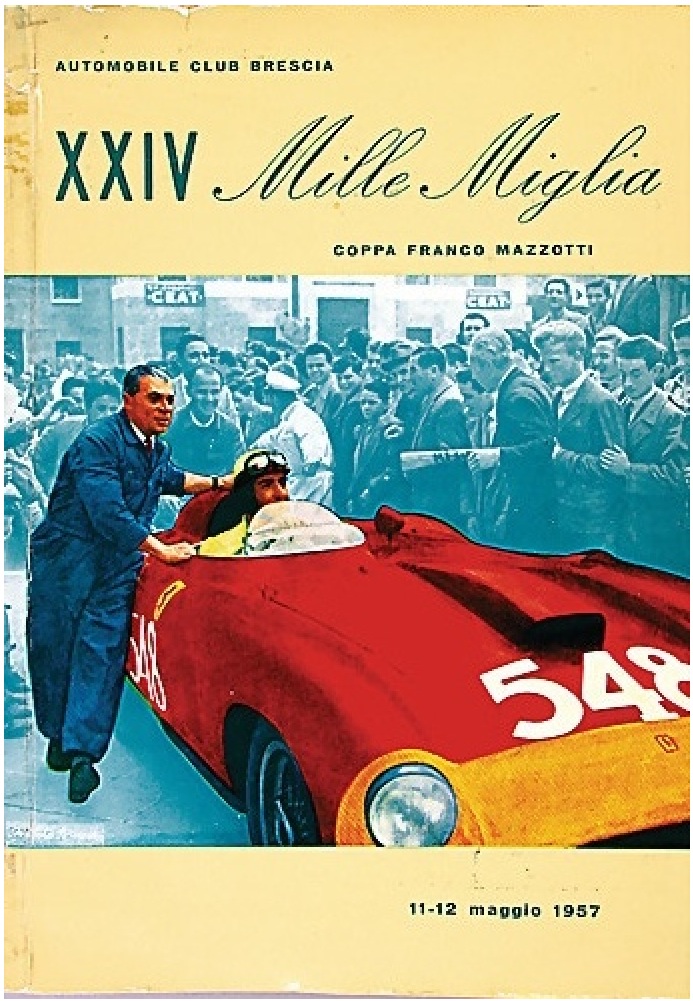
The Mile Miglia was started by Count Aymo Maggi and Franco Mazzotti…after the Italian Grand Prix was moved from their home town of Brescia to Monza. They chose a race from Brescia to Rome and back, a figure-eight course of 1500km or 1000 Roman Miles.
Various courses were used over the years with many of the greats of the day winning. Tazio Nuvolari, Alfa 6C 1750 in 1930 and 8C 2300 in 1933, Rudy Caracciola in a Benz SSK 1931, Achille Varzi, Alfa Monza in 1934 and Alberto Ascari in a Lancia B24 in 1954 included.
Over the years Italians won the race the most. From 1953 to 1957 the event was a round of the World Sports Car Championship, Stirling Moss famously winning navigated by Motor Sport‘s Denis Jenkinson, the pair setting the fastest ever time of 10 hours 7 min 48 secs.
The duo covered six reconnaisance laps, Jenkinson making pace notes on a scroll of paper contained in an aluminium housing. Dennis called the corners and the stunning ability of Moss resulted in an emphatic, famous 1955 victory in their Mercedes Benz 300SLR.
Fon de Portago/Ed Nelson in their Ferrari 335S go thru the Futa Pass on their fateful ’57 Mille run. (Yves Debraine)The Collins/P Hill Ferrari 335S at Le Mans 1957, DNF engine failure on lap two (unattributed)
The 1957 Ferrari 335S…
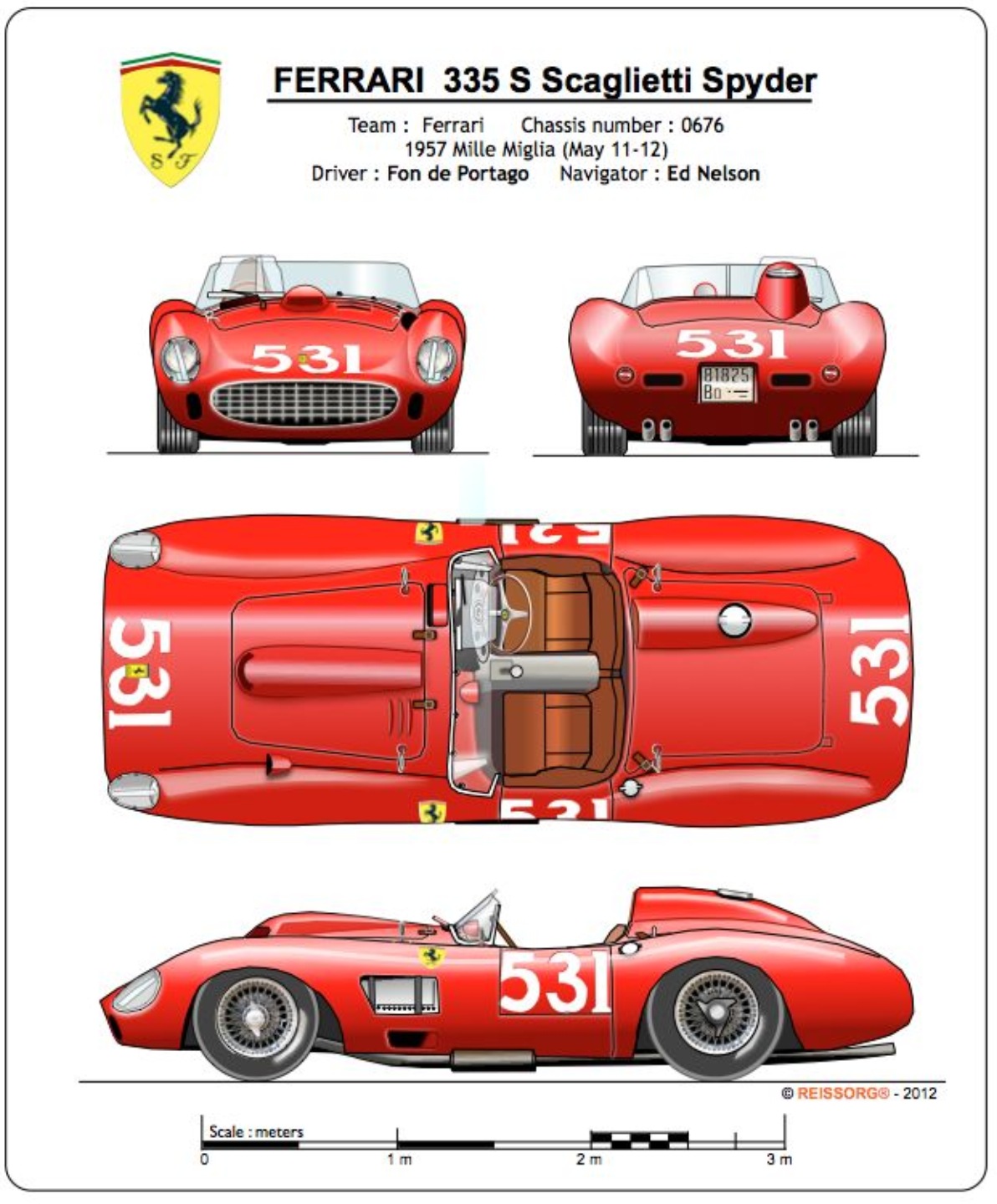
The machine was a development of the 1956 860 Monza and 290 MM sports-racers.
A tubular steel chassis frame was fitted with independent unequal length wishbones, coil springs and hydraulic shocks at the front. A de Dion rear axle located by twin radius arms, transverse leaf spring and hydraulic shocks was fitted at the rear.
Drum brakes were used all round, steering was by worm and sector. A strong four-speed transaxle took all the torque of the big V12 with 6X16 inch and 7X 16 inch tyres fitted front/rear, the whole lot weighing a relatively light 880kg dry.
The 335 Sport was the height of development of Ferrari’s complex but powerful four-cam, two-valve front-engined sports cars which won the World Sports Car Championship in 1957, defeating arch rivals Maserati in the process.
4-litre V12 engine of the Collins 335S during a Mille Miglia pitstop (Louis Klemantaski)
The engines of the 290, 315 and 335S were primarily designed by Vittorio Bellantani. The ex-Maserati engineer received assistance from Vittorio Jano, some elements of the engine having a passing design relationship to Jano’s fabulous 1954-55 Grand Prix D50 Lancia V8. Jano of course came across to Ferrari from Lancia in the deal which saved-Ferrari’s-bacon, devoid as it was of a competitive Grand Prix car at the time.
The 60-degree all aluminium V12 displaced 4023cc with a bore/stroke of 77 X 72mm. Four overhead camshafts were deployed with two-valves per cylinder. Six Weber 44DCN carbs fed the engine with twin plugs and four coils taking care of the spark. Maximum power was quoted at 390bhp @ 7400rpm.
The Klemantaski Archive quotes Phil Hill as saying ‘the 335S was the best front-engined car ever built by Ferrari and certainly the fastest.’
Cockpit of restored 335S #0764. Four speed rear mounted transaxle, worm and sector steering (unattributed)Side profile of the Hawthorn Ferrari 335S on the exit of Tetre Rouge corner Le Mans 1957. He shared the car with Luigi Musso, and again DNF due to engine failure (Louis Klemantaski)
Etcetera…
(unattributed)
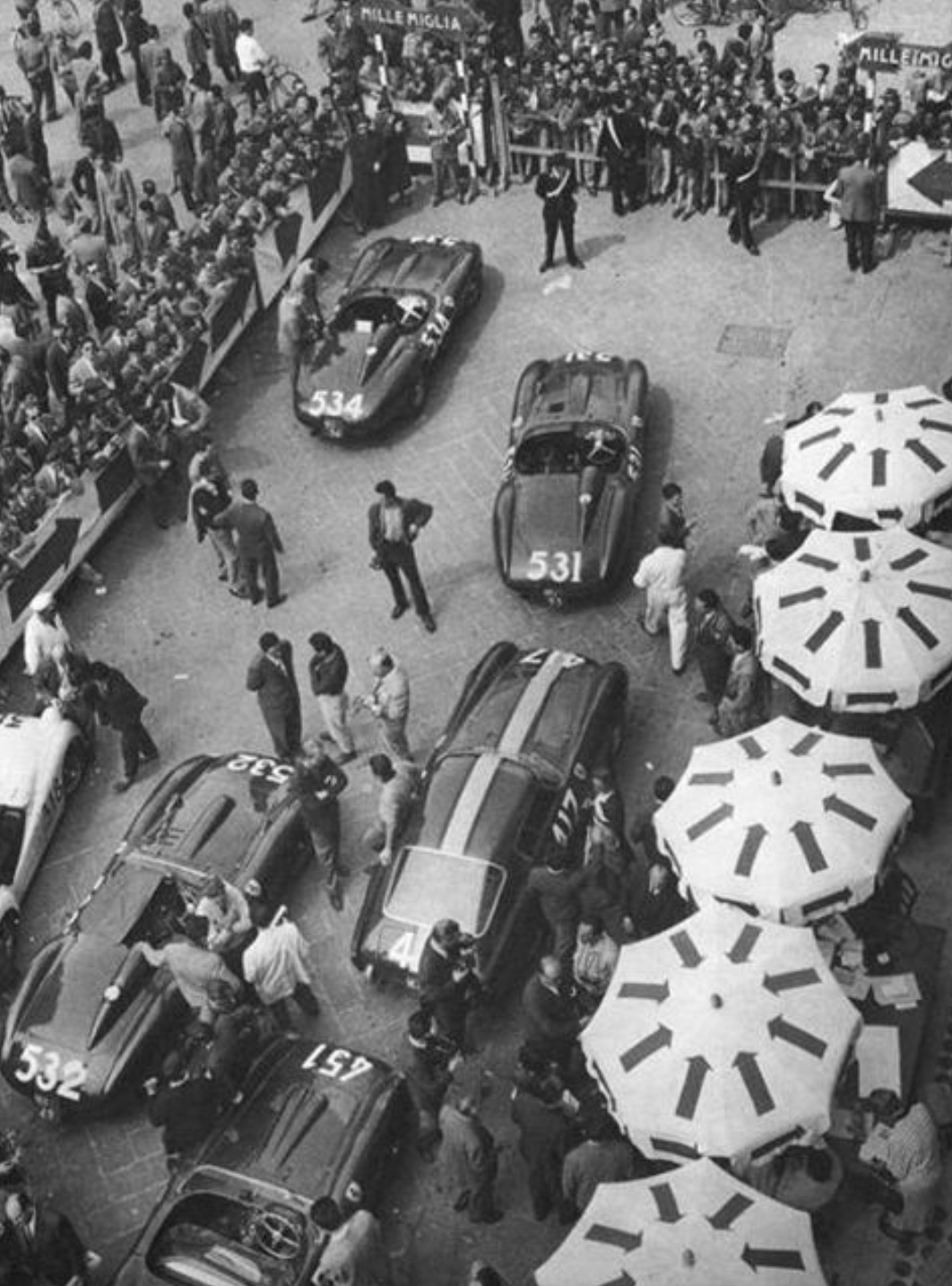
Scuderia Ferrari in Brescia before the 1957 MM start. #534 Collins/Klemantaski, #531 de Portago/Nelson, #417 Gendebien/Washer, #532 Von Trips and the privately entered Ferrari 500 Testa Rossa of Gino Munaron.
(unattributed)
Piero Taruffi in the winning 335 engined Ferrari 315S, MM 1957. This very successful driver retired after winning the event then writing The Technique of Motor Racing, a rather good book!
(Louis Klementaski)
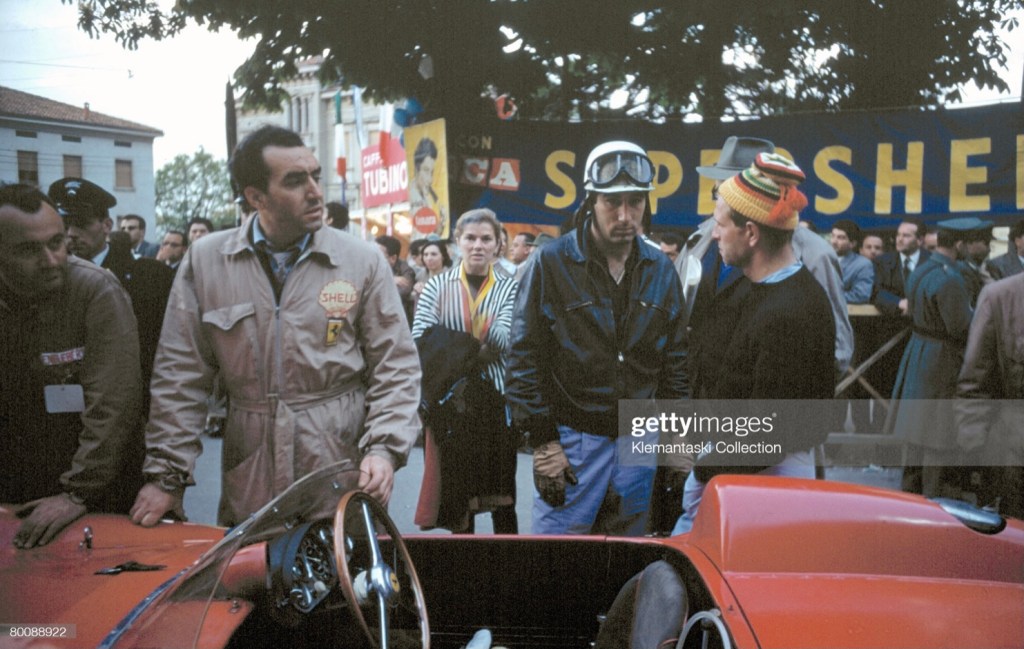
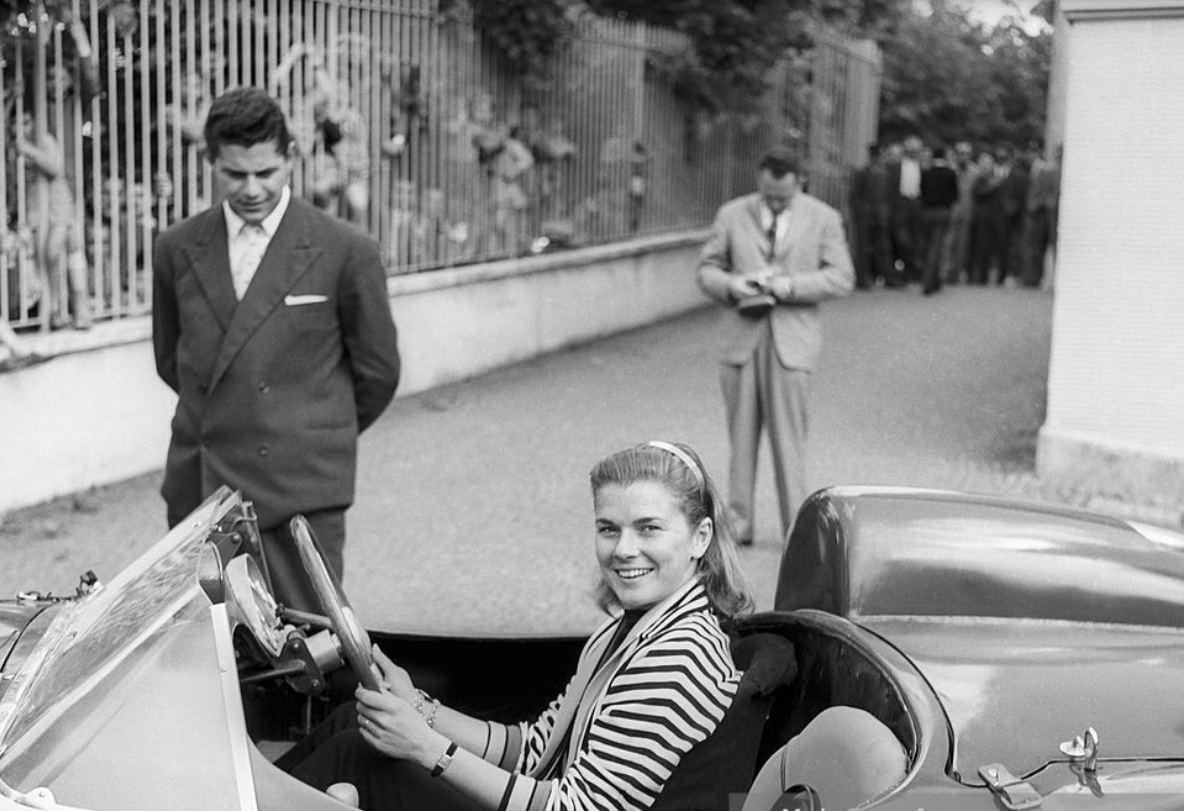
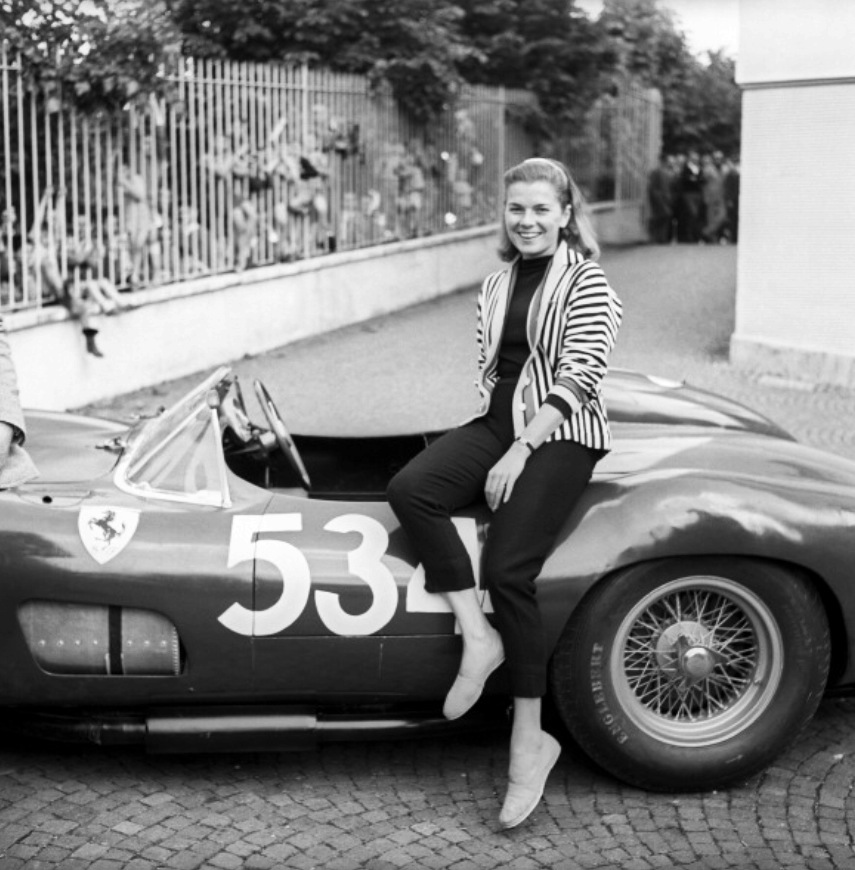
Fon de Portago and Peter Collins, in coloured beanie, before the MM start. Louise Collins is wearing the striped blouse at the rear.
(Louis Klemantaski)
De Portago and Nelson leave the Rome control in fourth place.
Photo Credits…
Louis Klemantaski Archive, Yves Debraine, G Cavara cutaway drawing
Tailpiece…
(unattributed)
An equally stunning shot as the one at the article’s outset.
It reflects the fanatical Italian crowd and their proximity to the cars. It’s poignant for that reason as one of the last shots of Fon de Portago before the fatal accident which took his and ten others lives. Ferrari 335S 0676 Mille Miglia 1957.
























 primotipo...