Archive for 2016

mayer goodwood

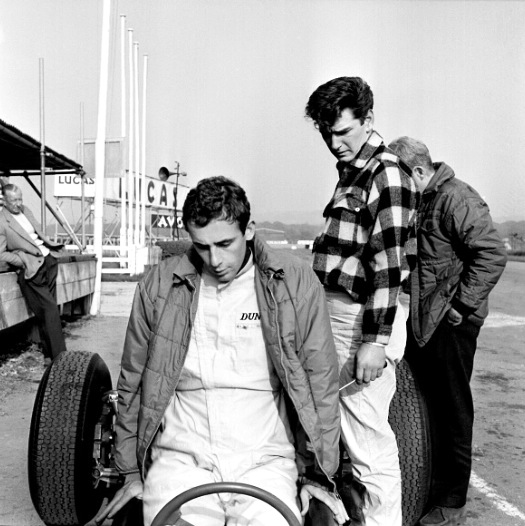
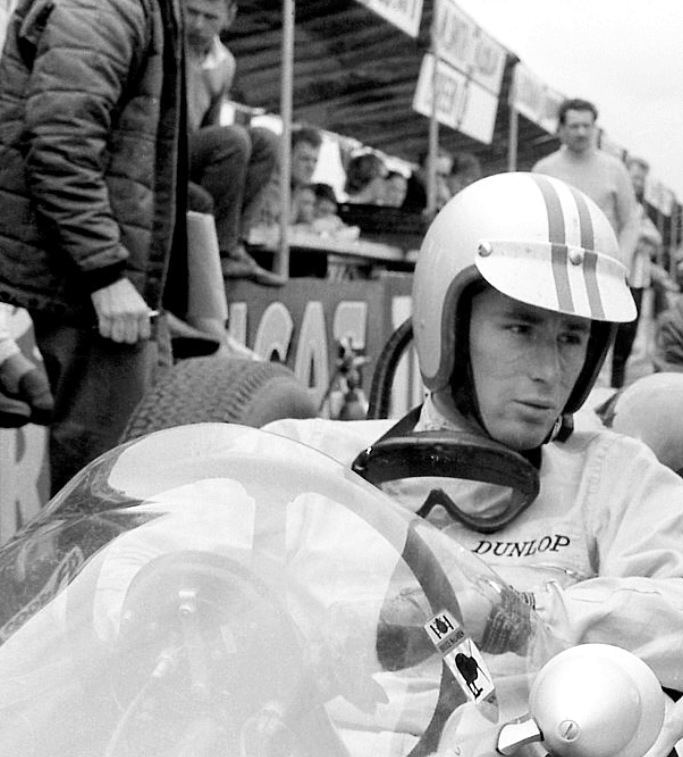
Bruce McLaren tested the first of these Cooper T70 chassis at Goodwood in October 1963, lapping in 1:20.5 seconds with an engine well past its best, fiddling with tyre pressures and spring rates. The date of Tim’s test is unclear. Note the Bruce McLaren Motor Racing logo/sticker attached to the cockpit (Getty)

Tim Mayer sizes up the cockpit of  his new Tasman Cooper T70, full of optimism having just tested the car at Goodwood, October 1963…

Tim Mayer is one of motor racing’s many ‘might-have-beens’, cut down in his prime in a Bruce McLaren Motor Racing Ltd Tasman Cooper T70 Climax at Longford, Tasmania on 28 February 1964.

The young American made a huge impact in Australasia during his 1964 tour and is remembered in very fond terms by enthusiasts fortunate enough to see him race the big GP Cooper here.

This article was inspired by John Ellacott’s color shot at Warwick Farm in the body of this article and some Getty Archive photos I tripped over researching something else. Other layers of personal interest are a growing obsession with Longford and that one of my mates, Adam Berryman, restored and owns one of the two Cooper T70 chassis.

I hadn’t intended to explore each chassis in this article but the level of interest created online makes it important to provide this summary of each of the two chassis and their destiny, the details are courtesy of oldracingcars.com and Adam Berryman. Here goes…

Tim raced ‘FL-1-64’ at Levin, Pukekohe, Wigram, Teretonga and Sandown. Bruce decided to swap cars with Tim at Warwick Farm, racing ‘FL-1-64’ at Warwick Farm, Lakeside and Longford.

McLaren raced ‘FL-2-64’ from the Tasman’s commencement at Levin, Pukekohe 1st NZ GP, Wigram 1st, Teretonga 1st and Sandown. Tim raced ‘FL-2-64’ at Warwick Farm, Lakeside and at Longford when it was destroyed in practice.

For his 1965 Tasman campaign Bruce returned with a new Cooper T79 for himself, only one was built, it was tagged ‘FL-1-65’.

‘FL-1-64’, the surviving 1964 chassis raced as above was updated and used very competitively in the ’65 Tasman by 1961 World Champion, Phil Hill. In fact the series was his last in single-seaters. When updated the perfectly good, ‘FL-1-64’ tagged frame was re-tagged with the ‘FL-2-64’ plate off the frame destroyed by Mayer at Longford. This was done at Coopers with the consent of all concerned; John Cooper, McLaren, Teddy Mayer.

It is this chassis, ‘FL-1-64’ now tagged ‘FL-2-64’ which raced on in Australia ‘in period’ by John McDonald and was later acquired by Richard Berryman, and upon his untimely death passed to his son Adam.

Simple isn’t it!

Far from it in fact. The details were only unravelled when Adam Berryman met Wally Willmott, who built the T70’s with Bruce at Coopers, all those years ago. As part of the rigorous process of Berryman getting the Confederation of Australian Motor Sport historic ‘Certificate of Description’ to race the car, the history of  the two chassis was clarified as a result of information shared and debated between Berryman, Doug Nye, (who wrote ‘Cooper Cars’) Willmott and Bryan Miller, the CAMS Historic Eligibility Commission Chairman.

Further detail on each chassis i will cover in an article on the T70’s.
cooper mc laren puke

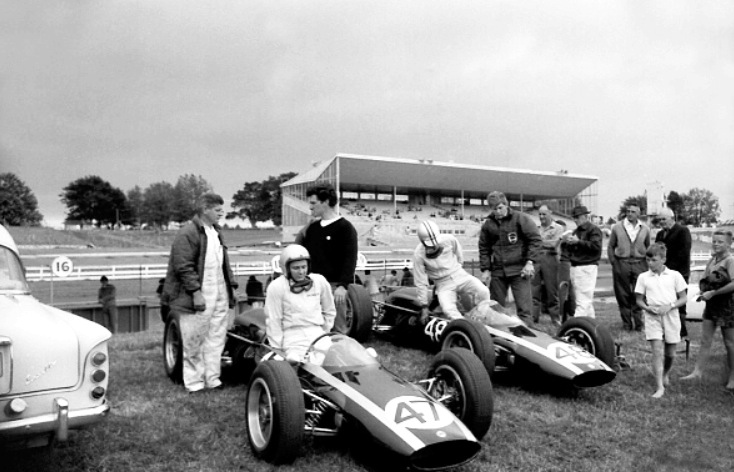
Bruce in #47 and Tim in the Pukekohe paddock 1964, wonderful shot captures the relaxed atmosphere of this demanding circuit (Getty)

Bruce went on to win the inaugural, 1964 Tasman Series with a fighting second place behind Graham Hill’s Scuderia Veloce Brabham BT4 Climax at Longford, the series final round He won by 6 points from Jack Brabham’s BT7A and Denny Hulme’s Brabham BT4.

Tim’s accident took place during the Friday afternoon practice session. He was keen to do well of course, racing amongst F1 champions Hill and Brabham, GP winner McLaren as well as host of aspirants; Frank Matich, John Youl, Tony Shelly, Jim Palmer, Greg Cusack, Frank Gardner, Dave Walker and others.

Longford’s 4.5 high-speed miles of undulating, tree and telephone pole lined roads with culverts was completed with a railway crossing, two bridges, a railway viaduct and more. Its blend of Tasmanian roads and topography was unforgiving to say the least. It had many nuances, younger drivers needed miles there to appreciate them. Neither Mayer or fellow Cooper pilot Rocky Tresise, a year later, learned the subtleties of the place and paid the ultimate price as a consequence. Undoubtedly it was a circuit to attack only after deep familiarity.
mayer cooper group

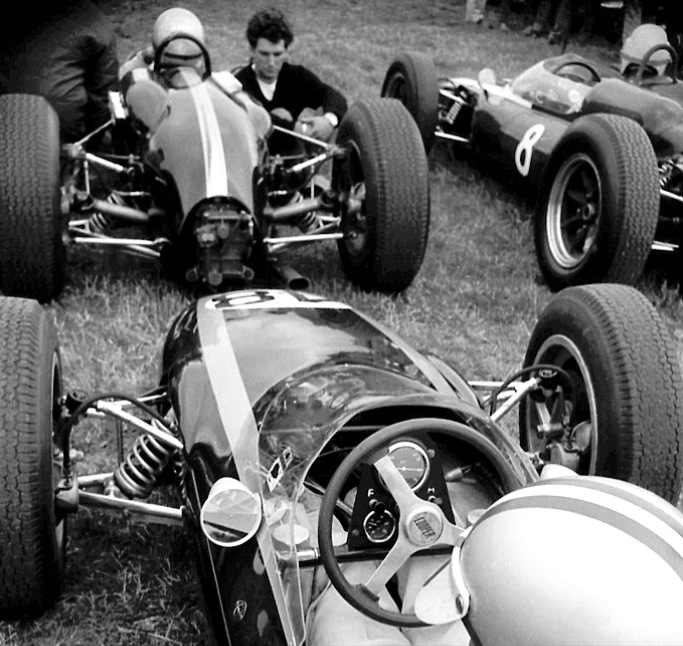
Bruce in front of Tim in the Puke paddock, the other Cooper #8 is the very fast and reliable, several years old T55 of Taswegian John Youl. McLaren won the NZGP from Brabham’s BT7A, Ron and Jack’s latest ‘Intercontinental’ tool, and Mayer who was 26 seconds adrift of his team-leader. Cockpit very tight especially for the lanky American, note Bruce’s mini-dashboard to which the essential three Smiths instruments are affixed; tach, oil press, and oil and water temps (Getty)

I asked multiple Australian Gold Star Champion, Taswegian John McCormack if he raced his ex-Brabham BT4 Climax there, ‘I drove there, I wouldn’t say that I raced that first time though’ was John’s typically candid response.

Needless to say these cars were far from ‘safe’; they were of multi-tubular spaceframe construction and had no deformable structures other than the aluminium saddle tanks carrying plenty of Avgas…The 2.5 Coventry Climax 4 potter gave 235 powerful horses, the cars did better than 160mph on ‘The Flying Mile’, more than quick at a place like this. A ‘big one’ was all too often the drivers last in cars of this ilk.

Mayer was on the ‘back section of the track, on the fateful lap. He had completed pit straight, then headed down hill, traversed the left-hand, blind entry left, right Viaduct and crossed the River Esk on Kings Bridge. He was on Union Straight which leads to Longford/Pub Corner, a 90 degree right hander. Tim was using a tall top gear doing better than 160.

The tricky bit of the circuit here, important for lap times was to fly the hump before Longford Corner; critical was landing square and braking almost immediately upon landing but not being too savage on the brakes to avoid giving the car a big fright whilst it was relatively unstable.

The landing was the problem in this case. Perhaps the car landed badly due to wind or being lined up poorly, or perhaps Tim braked too hard before the Cooper had settled enough back onto its springs, either way it was all over in the blink of an eye. ‘The Cooper slewed sideways into a 15ft plane tree. The car split into two; Tim was thrown 50 yards to the other side of the road, instantly breaking his neck’ recounts Barry Green in ‘Longford: The Fast Track Back’.

Eoin Young in his report in the April 1964 ‘Motor Racing’ said ‘…Mayers Cooper landed slightly offline just before the right-angled right-hander at the hotel, and slewed sideways into a a tree…’

‘Sports Car World’ reported that ‘Apparently (always a worry when a report says this!) Mayer became airborne off the hump after Kings Bridge. The car landed slightly sideways, Mayer caught it, but the two left hand wheels had got into the dirt. The car then slid into a plane tree and disintegrated throwing Mayer out’. I don’t wish to labour the point but rather use three contemporary reports to look at their similarity and differences, it does not change the result but the actual cause will never precisely be known.

Tim’s death directly lead, as most of you know, to his manager brother Teddy Mayer’s involvement as a shareholder/director of Bruce McLaren Motor Racing Ltd. Tyler Alexander was part of Mayer’s Tasman crew too, both he and Teddy were huge contributors to the phenomenal McLaren success which followed over the ensuing decade. In that sense, something positive became of the terrible events all those years ago, without in any way trying to make light of Tim’s demise.

Long Weekend at Longford…

Checkout this amazing short documentary on the ’64 Longford carnival. There is some in car footage which superbly illustrates the difficulties of the track, inclusive of the area where Tim came to grief.


mayer goodwood 1

Mayer in the Goodwood paddock. The T70 was built in Coopers workshops but was Bruce’ project and conceptual design, designed for 100 mile Tasman events, rather than the GP cars he had previously taken home to the Antipodes. Its now said to be ‘the first McLaren’. The T70 was entirely conventional with spaceframe chassis albeit very narrow for the time, 25 inches wide cockpit, to slip through the air nicely. Front suspension was by upper and lower wishbones and coil spring/damper units with anti-dive geometry, and single top link, lower wishbone with a single top radius rod for fore and aft location. The Coventry Climax FPF 4 potter was at its 2.5 litre GP capacity, down from the 2.7’s widely used during the pre-Tasman F Libre years, output circa 235bhp. The gearbox was a Colotti Type 21 5 speed in ‘FL-2-64’ and Cooper 6 speed in Tim’s ‘FL-1-64’ . This Colotti T21 was famous at McLaren/Cooper’s as the most used gearbox ever having started life in Tommy Atkins Cooper, was then used in the T70 and then later in the Cooper/Zerex Oldsmobile. Fuel tankage comprised 8 gallons under the seat and smaller side tanks either side of the drivers knees holding a total of 7 gallons (Getty)

The editor of New Zealand’s ‘Motorman’ magazine, Donn Anderson wrote this tribute to Tim Mayer soon after his death. This contemporary piece has a wonderful intimacy and familiarity about it written by a journalist upon whom Tim Mayer clearly made a big impact as both a young racer and as a man. It has far more validity than anything any of us can pen ‘from 50 years afar’…

image

Mayer, Sandown 1964, ‘FL-1-64’. He was 2nd to Brabham when he started to have fuel feed problems and was overhauled in the last stages by Stillwell and Youl to finish 4th, Brabham won (autopics)

‘Scholar Journalist and Sportsman…Tim Mayer’…

‘It is so very hard to write an appreciation of one who was more than just another racing driver to us. Tim Mayer was a newcomer to international racing and although we knew him for only five weeks in New Zealand, it was not difficult to make an accurate appraisal of the 26-year-old American.

His death during a practice session for the final round of the Tasman Championship at the Longford circuit in Tasmania on February 28 was a sudden shock to many. Twelve months ago he was practically unknown and even of late his appearance to some was much of a novelty.

Tim was not the ‘boy’s book’ ideal of a racing driver. He looked more the university or law student figure and, indeed, he did have a very sound education. Tall and slender – 6 foot and 145 lbs – Timmy was married in 1961 to charming Garril.

He was born to a wealthy family in Pennsylvania, and it soon became obvious that he was talented in both studying and athletic fields. Some six years ago he went to his first motor race at Sebring with a cousin and was immediately taken in with the sport. He entered his first race in an Austin Healey in 1959. ‘It was wet and I was very much a newcomer to motor racing,’ Tim told The Motorman recently. ‘I spun trying to change gears down a straight!’ The young driver competed in 5 of 13 national races that initial year with the Healey and finished fourth in the national class standings

mayer puke

Mayer Pukekohe, small size of the car accentuated by the way Tim sits out of it! T70 chassis # FL-1-64 (Getty)

Even then Timmy was backed and assisted by his brother, Teddy, who has accompanied him throughout his career with cars. Of his early racing he says it was mostly ‘crash, burn and try to learn.’ For 1960 Tim had a new Lotus 18 junior and in eight races he was second five times. The car was wrecked when Timmy ran into a horse barn at Louisville, thus bringing the year’s racing to an end. At that meeting he met Dr Frank Falkner, Cooper’s agent in the U.S., who was to help the young American. By the age of 22 Tim had a degree in English literature from Yale University but it was time for the two-year army stint.

image

The Long and The Short of It: Tim in the shades at rear and Teddy in between the well nourished lads at Cumberland in 1962. Teddy’s flair for team management was clear early on; ‘Revem Racing’ ran Tim, Peter Revson and Bill Smith in FJ in ’62. Tim WAS fast and Teddy managed his brother well (unattributed)

Of his first run in a single-seater Tim said: ‘I had overturned the Lotus 18 within 10 minutes of driving the thing and finished hanging upside down strapped in with my seat belt. Everyone uses belts, even for open cars, in the States, so when I went to Europe it took a while to become used to not being tied in.’

Tim was able to continue pursuing his desire to become a top-line driver in the army, however, as the officers appreciated the value of a quick corporal at motor race meetings. He used an FJ Cooper and while based in Puerto Rico was able to race almost every weekend in many parts of the country.

image

Tim Mayer Cooper T59 Ford from Peter Revson in a similar car, first and second. #106 Bill Smith Lotus 20 Ford. ‘Jaycees Cup’ Cumberland Airport, Maryland 13 May 1962.Tim won the US FJ Championship in 1962 from Floyd Aaskov and Walt Hansgen, Revvie was 5th, Augie Pabst 6th and Mark Donohue and Roger Penske equal 9th In 1963 Teddy (and Bruce?) introduced Tim to Ken Tyrrell who ran him in a handful of European and British BARC FJ Championship rounds in a Cooper T67 BMC, not the engine of choice at all. Even tho the season was well over, the contenders dialled into their cars, to say the least, Tim was in amongst the top 6 Cosworth engine cars.  Mayer’s European FJ campaign comprised a fast blast through France in mid-year, he contested the GP de Rouen, Coupe International de Vitesse des Juniors, the FJ support race during the French GP weekend at Reims and Trophee d’Auvergne at Clermont Ferrand on June 23, 30 and July7 respectively. At each meeting he was ‘first in the BMC Class’ in 7th,8th and 4th in his Tyrrell Cooper T67, the races won by the Ford powered Brabham BT6’s of Paul Hawkins, Denny Hulme and Jo Schlesser. The BARC British championship leader board that year included amongst its Top 13 Peter Arundell, Denny Hulme, Frank Gardner, Richard Attwood, David Hobbs, Paul Hawkins, Mike Spence, Alan Rees, Peter Procter, John Rhodes and Brian Hart amongst others, Tim was 13th with a point. That he shone through in a tiny number of races amongst this lot says a lot! (unattributed)

The big break came in 1962 when he was acclaimed the most improved and outstanding driver of the year. With a brand new Cooper junior he won the United States SCCA Formula Junior Championship. These results landed him an entry in the US Grand Prix with a third car owned by the Cooper works. He was the fastest of the privateers in practice but the gear lever came unstuck during the race.

Last year Tim was off to Europe to join the Ken Tyrrell racing team. Although the Cooper Juniors were down on power compared with the Lotus Fords, he was able to gain much experience all over England and Europe. ‘There is much more competition in Europe compared with the States. Formula Junior racing in Europe is like Russian roulette. The BMC engines were outdated and if we finished fourth or fifth we were doing well. The Cooper had little power but fantastic cornering – superior to the Lotus.’

He crashed during the Tourist Trophy at Goodwood in 1963 after a brake caliper broke and suffered a badly twisted neck, and he also had a bad shunt at Silverstone. Driving his own 2.7-litre Cooper Monaco, Tim was third to Penske and Salvadori at the international Brands Hatch meeting last year. He also had a number of races with Cooper’s Minis. “I had a lot of fun with Sir John Whitmore – he must be the second best known driver in the U.S. next to Clark
mayer 1

Tim Mayer Pukekohe (Getty)

At Riverside last year he led the 2-litre class with a new Lotus 23B until heat forced his retirement, but he won his class and finished 5th overall at Laguna Seca.

He was made two Christmas presents – a drive with one of the McLaren Coopers in the Australasian series, and number two man in the Cooper works formula one team for 1964.

When Tim first drove the 2.5 he found it a different kettle of fish to the juniors. ‘With the little cars you have no power to get out of trouble.’ So Tim, Garril, Teddy and mechanic Tyler Alexander came south to New Zealand with the McLaren team – and they won many friends. He was second at Levin, took third place at Pukekohe, but had trouble at Wigram and couldn’t do any better than 8th position. At Invercargill he finished second to his team-mate and was fourth in the Australian GP after losing second position with fuel trouble. He was third at Warwick Farm.

image

Mayer, ‘Warwick Farm 100’ 16 February 1964, Homestead Corner, T70 ‘FL-2-64’ : Tim qualified just behind Bruce at The Farm, his first time at the highly technical circuit. Peter Windsor on his blog ‘…clearly remembers Timmy biffing the back of Bruce’s Cooper…on the opening lap at Creek Corner. Team leader nudged by his number 2! Both raced on though and finished 2nd and 3rd (Jack won in his BT7A by 4 tenths of a second from Bruce with Tim 10 seconds adrift-not bad in this company on that track, familiar turf to the other two blokes)…I watched them all afternoon. Timmy was always fast, always aggressive punching the throttle out of Creek (corner, a hairpin), applying the opposite lock with crisp precision. Bruce by comparison, was only slightly more fluid. Timmy, clearly was fast’ was Windsor’s conclusion (John Ellacott)

Consistent placings resulted in the American driver finishing third on points in the New Zealand races for the Tasman Championship, behind McLaren and Hulme, with 16 points.

Timmy – the nephew of Governor Scranton of Pennsylvania – had a real American outlook to motor racing: he wanted to go to the top. He was perhaps fortunate in having financial means to purchase the best machinery during his early career, but he also developed the ability to handle same. Money cannot buy driving skill.

From his ‘varsity days when he worked as a disc jockey on radio stations he was a keen journalist and wrote for a number of publications.

Not only was Timmy a fine driver and scholar: he was also an enthusiastic athlete. Water skiing, squash and other activities were the order of the day in New Zealand when other business was cleared.

He was genuinely interested in motor racing, no matter where. He spoke to me at length on the unfortunate situation of import duty and restrictions in this country and said it must stifle the sport here. ‘An FJ Cooper can be imported into the States for less than 1200 pounds, whereas it costs more than twice that here.’

Wherever the Mayers went in this country they gained respect. Tim, with his broad accent, was a fine ambassador for his country and a true enthusiast. There was always time to talk to anyone – no matter how small they were on the circuit, or how insignificant their name might be.

Quiet, unassuming, and not likely to be noticed in a crowd of drivers, Timmy Mayer left his mark in this country. It would seem very cruel that we should lose a fine driver who had come so far in such a short time. We pay tribute to Tim Mayer and his kin, Garril and Teddy who helped him so much in the sport he loved’.

image

Garril and Tim Mayer at Warwick Farm 1964, T70 ‘FL-2-64’ (autopics)


McLaren himself spoke of Mayer in the Autosport column he wrote together with journalist Eoin Young;

‘Intelligent and charming, Timmy had made dozens of friends during his career.  As often occurs, to look at him you wouldn’t take him for a racing driver.  You had to know him, to realize his desire to compete, to do things better than the next man, be it swimming, water-skiing or racing.

So when, during second practice at Longford, he crashed at high speed and we knew immediately that it was bad, in our hearts we felt that he had been enjoying himself and ‘having a go’.

The news that he died instantly was a terrible shock to all of us.  But who is to say that he had not seen more, done more and learned more in his 26 years than many people do in a lifetime?

It is tragic, particularly for those left.  Plans half-made must now be forgotten and the hopes must be rekindled.  Without men like Tim, plans and hopes mean nothing.To do something well is so worthwhile that to die trying to do it better cannot be foolhardy.  I can’t say these things well, but I know this is what I feel to be true.  It would be a waste of life to do nothing with one’s ability.  Life is measured in terms of achievement, not in years alone.’

image

Love this casual shot on the Teretonga grid, T70 ‘FL-1-64’. Famously the most southern circuit on the planet. Tyler Alexander and Tim await the off. It was a great race for ‘Team McLaren’ with Bruce over the line by a tenth of a second from Tim with Kiwi Jim Palmer 3rd in a Cooper T53. That Tim was quick was undeniable, his pace in these big, fast GP cars was immediate (Alexander)

Bibliography…

Article by Donn Anderson in the April 1964 issue of New Zealand’s ‘Motorman’ magazine, oldracingcars.com, The Nostalgia Forum, Stephen Dalton, Ray Bell, Bryan Miller

Credits…

John Ellacott, Getty Images, oldracingcars.com, Tyler Alexander, autopics.com, Stephen Dalton Collection, Euan Sarginson

Etcetera…

tim

Tim Mayer chats to some young enthusiasts/admirers at Levin (Sarginson/Dalton)


mayer and tresise

Tim all loaded up in the T70, chatting with Kiwi international, Tony Shelly ‘adopted’ by the Davison’s as Ray Bell put it, complete with one of Lex Davison’s ‘Ecurie Australie’ tops Pukekohe 1964 (Getty)


Tim and Bruce during the Lakeside 99- third for Bruce and DNF for his lanky teammate- Brabham won in his BT7A (unattributed)

 Tailpiece

mayer goodwood 2

Tim Mayer Goodwood, October 1963. Trying to jam his lanky frame into the confines of a car designed around Bruce’ more compact dimensions! Which chassis?, i’m not game to guess! (Getty)

 Finito…

image

I ‘spose the reason for the lack of high speed butt shots like this is a shortage of vantage points for photographers to capture the incredible distortion of Goodyears upon their ‘Melmags’ and suspension geometry and componentry doing their job, or not!…

Carlos Reutemann is hustling his Brabham BT37 through one of Osterreichring’s very fast sweepers on his way to a DNF with fuel injection dramas on lap 14 of the 1972 Austrian Grand Prix. He started the car an excellent fifth on the grid.  The race was won from pole by Emerson Fittipaldi’s Lotus 72D Ford on his way to his first title.

image
Reutemann BT37 from Peter Revson McLaren M19C Ford 3rd, Chris Amon Matra MS120D fifth then the two Surtees TS9B Fords of Mike Hailwood fourth and Tim Schenken 11th. Austria ’72 (unattributed)

This design was the first in the ‘Bernie Brabham Regime’…

Ecclestone bought Motor Racing Developments from Ron Tauranac at the end of 1971.

The BT37 was Ralph Bellamy’s re-work of Ron’s ’71 BT34 ‘Lobster Claw’ with conventional front radiator and narrower tracks front and rear. It wasn’t the marques greatest car, Gordon Murray’s arrival was the precursor to a decade of Brabhams befitting the great name created by Ron and Jack, from his 1973 BT42.

BT37 was a typical ‘kit car’ of the era: aluminium monocoque chassis, Ford Cosworth 3-litre DFV V8, Hewland FGA400 five speed transaxle and a host of other bits and pieces provided by sub-contractors based in England’s Thames Valley and surrounds.

Carlos and Graham Hill raced the two BT37s built in 1972, the cars best result was Carlos’ fourth in the Canadian Grand Prix.

Tony Matthews cutaway of Ron Tauranac’s 1971 Brabham BT34 Ford ‘Lobster Claw’
image
Reutemann, BT37 Osterreichring 1972 (unattributed)

Credits…

Rainer Schlegelmilch

Tailpiece

image

Carlos ahead of Chris Amon’s Matra MS120C 15th in the ‘Lobster Claw’ one-off Brabham BT34 Ford, upon which the BT37 was based, South African GP, March 1972 DNF. The Ferrari 312B2s of Andretti, fourth and Ickx eighth are further back…

Finito…

image

I like these photos which rather reminded me of  impressionists work. A Shell promotional exercise but rather good all the same…

The F1 Ferrari’s are the 1951 375 4.5 litre V12 and 2015 V6 turbo-hybrid SF15-T.

The banking photo shoot was after qualifying on 5 September 2015 with Sebastian Vettel and Kimi Raikkonen in attendance. The race was won by the dominant 2015 combo, Lewis Hamilton and the Mercedes F1 W06 Hybrid , Sebastian was 2nd and Kimi 5th in the SF15-T.

image

Credits…

Bryn Lennon

Tailpiece…

image


image

(Adelaide Advertiser)

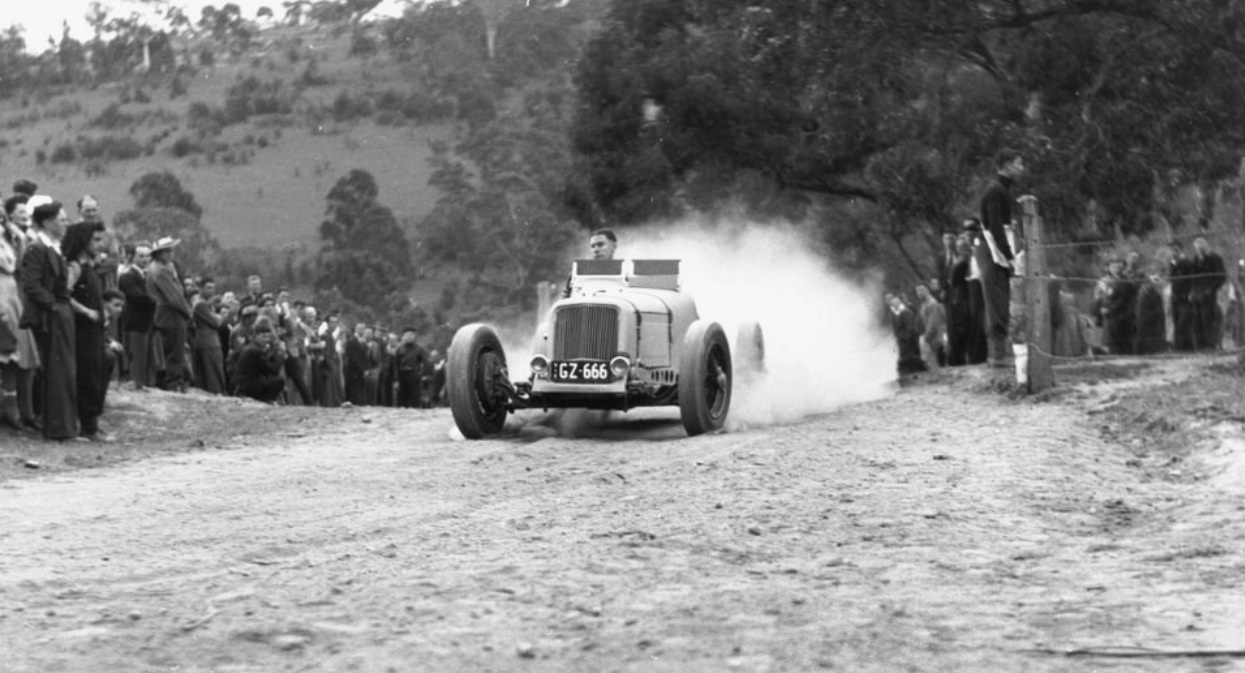
Jim Gullan dealing with a delicate slide on turn-in to Kayannie Corner , Ballot Oldsmobile. He is on the way to winning the 12 lap 105 Mile Road Race on the fearsome, Lobethal, Adelaide Hills circuit…

The race was held on New Years Day, 1 January 1948, the Victorian won from Granton Harrison’s Phillips Ford V8 Spl and Ron Egerton’s MG TC Spl which is in shot behind Gullan above.

Amongst the 21 ‘South Australian 100’ entries were later champion drivers Tony Gaze, Bill Patterson, Doug Whiteford and Ern Seeliger as well as then current fast-man John Barraclough.

Tony Gaze, HRG Aerodynamic, DNF after completing 11 laps (N Howard)

Gaze’s HRG Aerodynamic in Lobethal village, functional rather than pretty (Lobethal Museum)

The limit man was D Howard’s MG PA with a handicap of 16.5 minutes, Jim Gullan’s Ballot was away at the 7.05 mark, Doug Whiteford off 2.5 minutes with the scratch car Denneston’s Itala Mercury Spl.

Whiteford stunned onlookers with an 85mph standing lap, Ern Seeliger was an early retirement after being badly baulked at over 110mph, assaulting two trees in the process. The car was destroyed, the owner presented the rooted chassis and body to a local farmer! Ernie suffered only a bruised wrist and severe shaking and lived to be a formidable engineer and competitor until late in the 1950’s.

Doug Whiteford, Black Bess, DNF after 3 laps (N Howard)

Bess at rest, Lobethal 1948 (Lobethal Museum)

By lap 4 the positions on handicap were the Harrison Ford Spl from Ron Edgerton’s MG TC and Whitefords Ford Spl, the latter on a path, at the speed he was going, to win the race before a rear tyre threw a tread. With no spare the Melbourne driver was out.

By lap 7 Gullan led from local driver Harrison in the ex-Phillips Ford V8 from Skinner in the Ballot Ford and Andrews Austin 6 in 4th. Barraclough withdrew due to low oil pressure on lap 9 and Bill Patterson was out of fuel on the same lap.

On the last lap Gullan still lead by several hundred metres from Harrison and Edgerton’s MG TC. Harrison did the races fastest time and Whiteford its fastest lap at 6 min 7 seconds, 88mph and won the Lobethal 50, the final event of the program.

R Hamilton, MG TC , 4th (N Howard)

Ballot Oldsmobile…

ballot

Jim Gullan, #21 Ballot Olds, an MG then the Dennis Curran Curran Ford V8 Spl DNF Australian Grand Prix, in the Nuriootpa paddock, Barossa Valley, South Australia 1950. Gullan 3rd outright and 1st on handicap (State Library of SA)

Jim Gullan replaced his Ballot Ford in 1944 with a 2 litre Ballot bought nearby to his families garage in South Melbourne, a chassis for the car was designed and built by Gullan styled on the ERA, the racer was fitted with an Oldsmobile engine and gearbox.

Noted journalist and historian Ray Bell; ‘Jim Gullan’s Ballot will always rank as one of those cars that looks the part of an Australian Special. The raked nose, the heavily drilled chassis, steering wheel close to the chest and mandatory straps over the bonnet, its wire wheels carried a car that mixed European and American as well as any other’.

Gullan’s book, ‘As Long As It Has Wheels,’ is a fascinating account of a drivers career which evolved from road racer pre-war, to racing an Alta in Europe after hostilities ceased, through being a pioneer of drag-racing in Oz in the 1960’s and finally as a club racer in his dotage living on Queensland’s Gold Coast. Amazing. Jims book covers the Ballot in detail.

Gullan’s Ford V8 powered Indianapolis Ballot, his new acquisition was a 2 litre with sohc engine and knock-on wire wheels, it had a poor body and as inspection proved, the chassis was in even worse shape.

image

Gullan, AGP, Nuriootpa 1950, 3rd place outright and 1st on handicap, Ballot Olds. Doug Whiteford won in his Ford V8 Spl, ‘Black Bess’ (unattributed)

Ballot Olds in the Lobethal paddock during the 1948 SA 100 meeting (Lobethal Museum)

Soon after buying it a workmate offered money for the engine, gearbox and radiator to fit into a Bugatti chassis. Said Gullan, ‘It seemed a dubious exercise but I suppose any engine was better than none.’  Having just the chassis left, he was reluctant to go for another Ford engine having had bad experiences with the V8, so an ad for an Oldsmobile unit and ‘box (unused spares purchased for a taxi) overcame his problems. It was to have triple Ford carbies and extractors.

A chassis was made styled on the ERA but lower in profile, and used nothing from the Ballot chassis such was its parlous condition. ‘By the time the Ballot Olds was completed, about the only parts left of the original Ballot were the wheel hubs. The only reason the Ballot name was retained was for (ease of) registration purposes’ wrote Gullan.

It new chassis was 760mm shorter and 230mm narrower than the Ballot, designed to be ‘strong in the middle,’ boxed and drilled liberally ‘as on the SSK’ for lightness. ‘To lower the car new, new springs and hangers were made to sit outside the chassis rails. To stop front axle movement and to assist steering geometry, the spring shackles were located at the front of the spring instead of at the rear, this also assisted the brake reaction cables to keep the axle from turning whilst braking. Wheels were built to suit the wider, smaller diameter, modern tyres.’

With new cross members the engine and gearbox were installed into the chassis and the body shape was outlined using welding rods and strands of string.

Bob Baker lived only a few doors away from Gullan and built the body round an angle iron frame, which was screwed to the chassis with small reject aircraft bolts. A deliberate effort was made to reduce frontal area, hence the car’s low appearance. Quick-fill petrol and radiator caps were fabricated by Jim and the instruments (like the carbies) came from army disposals.

jim-rob-roy

Gullan at 16th Rob Roy, 2/5/1948 Ballot Olds. Superb looking body built by Bob Baker, the first of many racing cars he built bodies for. Gullan’s design was ingenious in its amalgam of parts and a consequence of his vast experience with previous cars (Thomas)

With Baker’s assistance a 3 carb inlet manifold and extractor exhaust system was made and a Ford radiator shell reworked to look like an ERA, the gorgeous little car was painted blue with silver wheels. Finned alloy drums off a spare 2-litre Ballot Jim bought and sold were the first of many modifications over the years.

image

Ballot Olds cockpit shot taken at the SA Grand Prix 70 year celebration at Lobethal in 2008 (Veloce)

The Ballot’s first meeting was at Greensborough Hillclimb in 1945 (see below), teething problems were limited to the throttle linkage bending and as a consequence full power could not be applied. The rear axle ratio was made taller, the drawings for the 3.5:1 ratio done by Gullan.

The first post-war race was at Ballarat at the beginning of 1947. Gullan had a good meeting including winning the Ballarat Cup, after this meeting the cars braking system was converted to hydraulic operation.

The next race was the Lobethal 100 covered at the articles outset, ‘The main reason for my quick times was my familiarity with the track. I had driven there in 1938 and 1939…in handicap racing it was our policy (Jim and his time-keeper wife Christine) and although the handicappers kept putting us up the field, we just made the car quicker’.

Gullan was a close friend of and in business with Doug Whiteford. When Doug imported an Edelbrock cam and heads (he’d melted a pair of alloy heads at Lobethal in 1940!) Bruce Rehn copied the cam profile and lift for the Olds.

By the time of the Point Cook AGP (1948) ‘…at a Dutch auction at the Light Car Club before the race, the Ballot was selected as the car most likely to win, a bad omen as far as i was concerned’,  quipped Gullan.

For the AGP there was yet another higher lift cam lifting rpm’s to 6000 and special ratios in the gearbox. As a result of the intense heat at Point Cook, with the Olds running so cool and well, the engine was subsequently bored by 5mm and also fitted with an enlarged sump with cooling tubes. Gullan had tyre problems in practice, but retired the car in the extreme heat after 15 laps. ‘I finished up sitting next to Alf Barrett, in the back of a van getting cooling down treatment’.

At Fishermans Bends first meeting Gullan won the Victorian TT, but the stop-start nature of the airfield circuit made it clear the cars brakes needed development. Jack Pearce at Repco PBR supplied some light commercial brake drums and made appropriate shoes with aluminium backing plates. ‘…They were so powerful they were bending the chassis making the car almost unsteerable when braking on the rough roads. The only thing to do was to apply them gently’.

ballot olds 1946

Gullan, 10th Rob Roy 17/6/1946, the bucolic Christmas Hills are pretty much the same today (Thomas)

In the months leading up to the 1950 Australian Grand Prix at Nuriootpa the Ballot was run in various minor events to get it sorted. Jim started 21st of 43 starters. The race was billed as a handicap race, Gullan won the handicap but not the Grand Prix which was awarded to Doug Whiteford in Black Bess. Jim was not happy about the result and emphasis given to the ‘fastest time’ as against the ‘handicap winner’, the AGP having been run as a handicap since it’s start at Phillip Island.

‘Normally the car would run 130 miles on a tank of fuel, but with the car developing more power, it was decided that if i was far enough in the lead i would pull in for a quick stop to add 10 litres. This i did and drove over the line to win what i thought was the Australian Grand Prix. There were still 20 litres of fuel left in the tank at the end of the race’ and therefore he could have completed the race without a stop.

‘The Adelaide Advertiser ran a big headline ‘Big Car Handicap to J Gullan’, the article didn’t even mention that Doug Whiteford had finished in 5th place. At the presesntation i got the wreath, the trophy and the prize money, Doug received equal money for fastest time. Once again i had driven a copybook race, but was later disappointed it would not be recorded as a Grand Prix win. Sometimes i wish i had just gone for broke…’

A counterpoint to Gullan’s viewpoint is contained in ‘The History of The AGP’ which makes it clear, quoting the Australian Motor Sports contemporary magazine coverage of the race. It says, that consistent with the 1949 policy of the Australian Automobile Association, from 1949 the AGP would be a scratch title,’The Australian Grand Prix will be run as a handicap but the Grand Prix winner will be the competitor finishing with the fastest time for the race’, that is, Doug Whiteford in his Ford V8 Special Black Bess.

Gullan raced the car one last time at Fishermans Bend before selling it.

Interestingly the two great mates, Whiteford and Gullan who had developed their clever specials together drove one anothers cars one evening at Albert Park ‘Dougs impression of the Ballot; very smooth high revving engine, steering and brakes too sensitive, difficult to drive!’ wrote Gullan. Albert Park is a public park, it would have been interesting to be going for a post-dinner walk and seen two Grand Prix cars being driven at high speed around the sleepy confines of Albert Park, the first GP there was still several years away at the time!

image

Love this shot for its vibe, Fishermans Bend, October 1953. Greg McEwin HRG left, O’Donohue’s now red Ballot Oldsmobile and Otto Stone’s MG K3 (SLV)

It was now 1950, the Ballot had reached the end of its development, and Jim decided to race in Europe, an interesting story for another time. Alan Watson and John Cummins (the latter very sadly died only last weekend) bought the car for 850 pounds.

Ray Bell, a writer of the ‘History of The Australian Grand Prix’ puts Gullan’s wonderful car and his design and development skills in context ‘The car was Gullan’s expression of all he’d learned from observing racing and running his own Salmson, Wolseley, Austin and Ballot V8′.

‘Considering just how it came together – the bits that just happened to be there, the chance acquisitions – it worked very well. Gullan was a handicap specialist, with his wife Christine timekeeping and acting as strategist, and they beat the handicaps with monotonous regularity. He comments that he just had to keep on making the car quicker to keep on beating them, so it was well developed when sold to Alan Watson.’

‘He mentions getting airborne over the top of the hill approaching Lobethal at 110mph, touching 116mph on the straight and holding it flat all the way from Lobethal to within sight of the pits at that early stage of its development. By the time it won the handicap section of the 1950 AGP it must have been a fairly quick car’.

The car passed through many hands over the next 20 years, raced as late as 1963 at Calder, Victoria. It has been used since 1970 in historic events, and is still alive today in Frank Moore’s Collection of Australian Specials in Queensland.

image

Jim Gullan, Ballot Olds, Greensborough Hillclimb. Crowd control and safety barriers well to the fore! (Thomas)

Greensborough Hillclimb…

Its interesting this internet thingy, data and images are being uploaded all the time. When I wrote the article about the Lobethal AGP 1950 12 months or so ago some of the images in this article weren’t there, but information is being continually shared through this wonderful medium.

The shot above is of Jim’s car at the second Greensborough Hillclimb on 7 October 1945, an Australian Motorsport article describes the casual nature and speed at which a new venue could be created all those years ago!

The Australian Motor Sports Club sought the use of the LCCA’s Rob Roy Hillclimb to run its first post war event. When the LCCA refused the club permission they sought other venues. Every alternative ‘smooth enough and close to Melbourne’ failed until the club secretary George Beecham fluked on a market gardner, an ex-motorcycle rider…His property had a very stiff hill. It was decided at the club meeting on the Thursday night before the Sunday scheduled for the climb to hold it at Greensborough on the market gardners hill. The owner of the property Bill Halliburton, did everything in his power to knock the hill into shape for the club…to get the hill right in time’.

Try getting a hillclimb built and certified by the FIA/CAMS in two days today, different times weren’t they!

Jim Gullan recalls the event in his book, he was Vice President and Doug Whiteford President of the AMSC. The two great mates loaded up a utility filled with reject concrete slabs from the Hume Pipe Company, for whom they worked and set off for ‘Orchard Farm’ to lay out a starting grid, completing the exercise in pouring rain.

image

A couple of young-bloods take to the Greensborough Hill to get a better vantage point, marshalling/start area below. Public address system you can just see to the bottom left, crowd numbers would be interesting to know in immediate post war-starved of entertainment, Melbourne (Thomas)

So much rain fell on the Saturday the event looked to be a washout but the can-do attitude of the members, starved of competition during the war years prevailed and after the track dried competition took place with FTD going to Ern Seeliger’s Ford V8 Spl. (the car destroyed in the SA 100 event in 1948 described at this articles outset)  It was the union of an Itala chassis, with large drum brakes, a 3:1 diff ratio powered by a modified ’38 Ford V8 modified with high compression heads and a Vertex magneto providing the spark. The engine was mounted low in the chassis, the car raced in chassis form devoid of body.

‘Greensborough No 2 was just as well organised and ran as smoothly as the No 1 event was bad. Everything seemed to go right, even the Melbourne weather! The hill had been prepared at some very substantial cost to the club and was as smooth as a table-a good table too’, you will note from the photographs that the surface was gravel.

The AMS report notes the pace got hotter as the day progressed with several cars leaving the track, notably an elderly Morris Spl, a Vauxhall, Stud Beasley’s Speedcar and Ted Gray’s Ford V8 powered Alfa Romeo 6C1750, Ted broke the diff of the car in the process.

Ken Wylie set fastest time of the day in his Speedcar but ‘in doing so rushed through a fence after he had completed his climb, cleaned up half a dozen push-bikes leaning against said fence, bowling over a gum tree and ended up in a ditch…’.

Gullan notes ‘…luckily we had plenty of money to be able to compensate the cycle owners…We were not prepared for the huge crowd that turned up. The narrow country road was blocked for kilometres, many never reached the entry gate. The entry fee was a ten shilling note, to get his share the farmer stood at the gate and stuffed his shirt full of banknotes (not much different to BC Ecclestone today really). By the time the hundreds of spectators had left, the place was in a shambles, the irate farmer said “never again”, but we figured a shirt full of banknotes more than made up for it!’

wolseley

Unknown Wolseley and driver, Greensborough (Thomas)

Doug Whiteford fitted dual rear wheels to his Ford V8 engined 1950 AGP winning special ‘Black Bess’ but struggled to get traction, as did Ern Seeliger’s car the AMS report noted. That report concludes by listing other competitors cars; Ken Hume’s 8/60 Buick engined Talbot, Tom Hollindrake’s MG s/c, Les Phillips Austin Spl. Gullan’s Ballot Olds only had two runs, as the event organiser he was preoccupied, Bob Chamberlain’s Chamberlain 8 and Stud Beasley’s Willys 77 Speedcar also competed.

What is interesting is the way a large number of hillclimbs relative to the population of Melbourne at the time, popped up in an arc on the cities outskirts from the north-east to the east of the city; Greensborough is 23 km from town, Templestowe 19, ‘Rob Roy’ at Christmas Hills 43Km and the two climbs at Lilydale, the Davisons ‘Killara Park’ property and Ern Abbott’s ‘Lakeland’ circa 45 Km from Melbourne. They weren’t all running concurrently mind you, some were. I suppose the reasons are availability of the right terrain and proximity to the city for competitors.

image

Frank Moore, who still owns the Ballot Olds, at the Lobethal carnival in 2008, lines of Gullan’s car still look great don’t they? The ERA influence clear (Veloce)

Bibliography…

‘As Long As It Has Wheels’ James Gullan, ‘History of The Australian GP’ G Howard and Ors

Ray Bell on The Nostalgia Forum, ‘Australian Motor Sports’ February 1946

Jim Gullan, MG K3, Albert Park 1956 (J Millard)

Credits…

Adelaide Advertiser, George Thomas, Veloce Magazine, John Millard, Norman Howard

Tailpiece: Gullan and Ballot Olds, Geelong Road, Australian Motor Sports Club, sprints, 4 August 1946…

jim-geelong

(Thomas)

image

(oldracephotos.com)

Few drivers knew Warwick Farm like Frank Matich and Kevin Bartlett…

They raced at the track from its earliest days, it’s first meeting in 1960 I wonder?, and certainly the last international meeting, sadly the 1973 Tasman round run 12 months after the photos here were taken, Steve Thomson won that very wet race in a Chevron B24 Chev.

Here the two Sydneysiders are attacking The Esses during the 1972 F5000 Tasman round, the ‘Warwick Farm 100’ on 13 February. Matich was 1st in his Matich A50 Repco and KB 3rd in his McLaren M10B Chev, not really a front-line tool by that stage but still quick enough in Kevin’s highly skilled hands to win at Teretonga, the final ’72 Kiwi round, a fortnight before.

image

Bartlett and original owner Niel Allen had a lot of success in this McLaren M10B ‘400-02’, car now in the tender, loving hands of Alan Hamilton, also a former Australian champion .KB here during the ’72 Tasman race. A Lola T300 would replace the car in time for the domestic Gold Star Series (unattributed)

Matich didn’t have a good Tasman, the A50 was quick enough to win the series but FM didn’t have a lot of luck, the championship was convincingly won by Kiwi arch driver/constructor rival Graham McRae in the Leda/McRae GM1 Chev penned by Len Terry.

Click here for an article on the Matich F5000 cars including the 1972 Tasman Series:

Frank Matich: Matich F5000 Cars etcetera…

Credits…

oldracephotos.com, Bob Williamson Collection

Tailpiece: The Lola T300 was ‘a chick’ with a great arse and hips, visually arresting…

image

Frank Gardner and Lola T300 Chev ahead of Frank Matich in the ’72 WF pitlane for tweaks. FG won the ’72 NZ GP in this T300 at Pukekohe, his last single-seater win, I think (Bob Williamson)


Frank Gardner split Matich and Bartlett, he was second at Warwick Farm in the factory T300. Frank was not exactly unfamiliar with WF either, mind you no-one would have done more laps around it than Matich, Frank tested tyres for Firestone, and later Goodyear and his cars a lot!

Between Gardner and Bob Marston they concepted a small F5000 based on Lola’s F2 tub. By placing the big water radiators, you needed plenty of coolant to look after the needs of a big Chev, at the cars hips they gave the car, and the T330/332 which followed it their most distinctive and attractive feature. Effective too in terms of aerodynamics and centralising weight, an article on the T300 is one for another time…

Finito…

judy dent

F C Gundlach is a celebrated German photographer, he took a series of shots of British Model Judy Dent at the Avus in 1962…

Gundlach is regarded as the German’s most important fashion photographer in the post war period. His work is highly rated for its craftsmanship, technical finesse and staging. For the technically minded photographers, he normally used a 28mm wide angle lens as it ‘allows closer proximity to the models, a sharper perspective and higher depth of field’.

Formula Junior XIV International Avusrennen 13 May 1962…

A little bit of fossicking aided by the ‘F2 Register’ shows, i think, these photos were taken at the Avus, Berlin in May 1962, a round of the German FJ Championship won that year by Kurt Ahrens Jnr. Jo Siffert won the Avus round in his Lotus 22 Ford.

The first shot below is, i think, the Lotus 22 Ford of Ahrens Jnr, he actually raced a Cooper T59 Ford, but he and his father raced both Cooper T59 and Lotus 22, so my guess is Kurt tested the Lotus but elected to race his trusty Cooper.

avus 1

Judy Dent again in  a lovely ‘Saga’ fur coat. Car below is the Cooper T56 Ford of Gunter Schramm, 7th in the aggregate of 2 races, and 4 th in the Championship.

avus 2

The Ahrens Jnr Lotus 22 Ford again, below

avus 3

Lotus 22 Ford of Kurt Ahrens Snr. He was 10th in the race on aggregate and finished 3rd in the Championship.

lotus 21

Photo Credit…F C Gundlach

image

(Schlegelmilch)

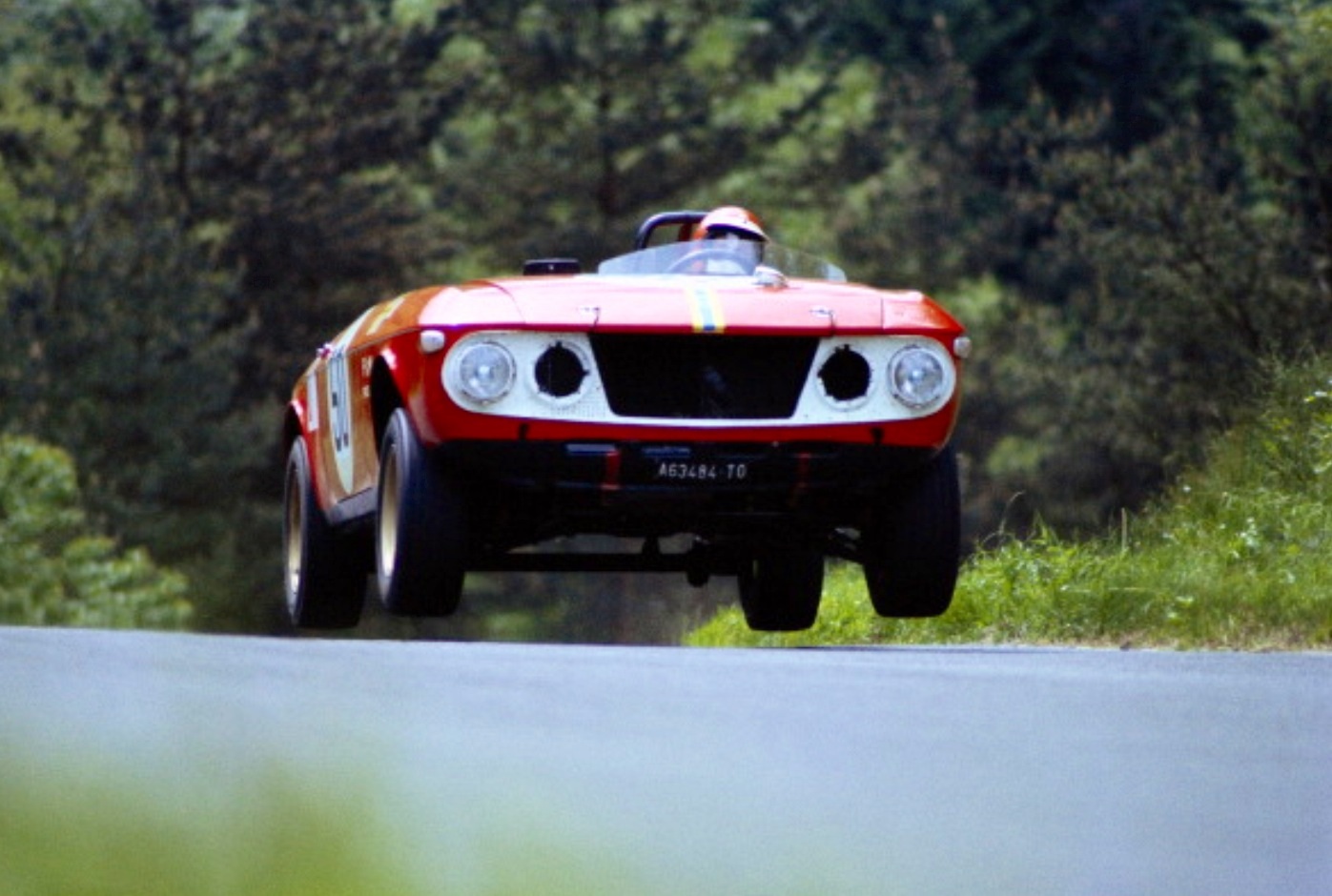
The Lancia Fulvia HF ‘F&M’ barchetta of Sandro Munari and Rauno Aaltonen jumping its way to a class win at the Nurburgring 1000Km on 1 June 1969…

The story of this Lancia is an interesting one, well known to fans of the marque, three cars were factory built in period plus a couple by Sicilian Lancia tuners.

Cesare Fiorio and Claudio Maglioli, respectively team manager and works driver of Lancia’s Squadra Corse HF, saw that the team´s drivers were fried by the Daytona heat in 1969 and decided to create something more competitive and cooler for the drivers for the Targa Florio. Given there was no budget for a more sophisticated approach they chopped the roof off the HF coupé and shortened its chassis by 28 mm. The roof, windscreen and side windows were removed and interior completely stripped with the exception of the driver’s seat. The result, a car 200 pounds lighter with consequent benefits to acceleration, handling and braking.

Whilst lightened the structural rigidity of the chassis was retained by the addition of some tubular framework. The fuel tank was centralised by placing it where the rear seat had been.

The first factory car eventually became the test mule for the Lancia Stratos, the second exists although in what form is a little unclear, the location of the third is unknown.

image

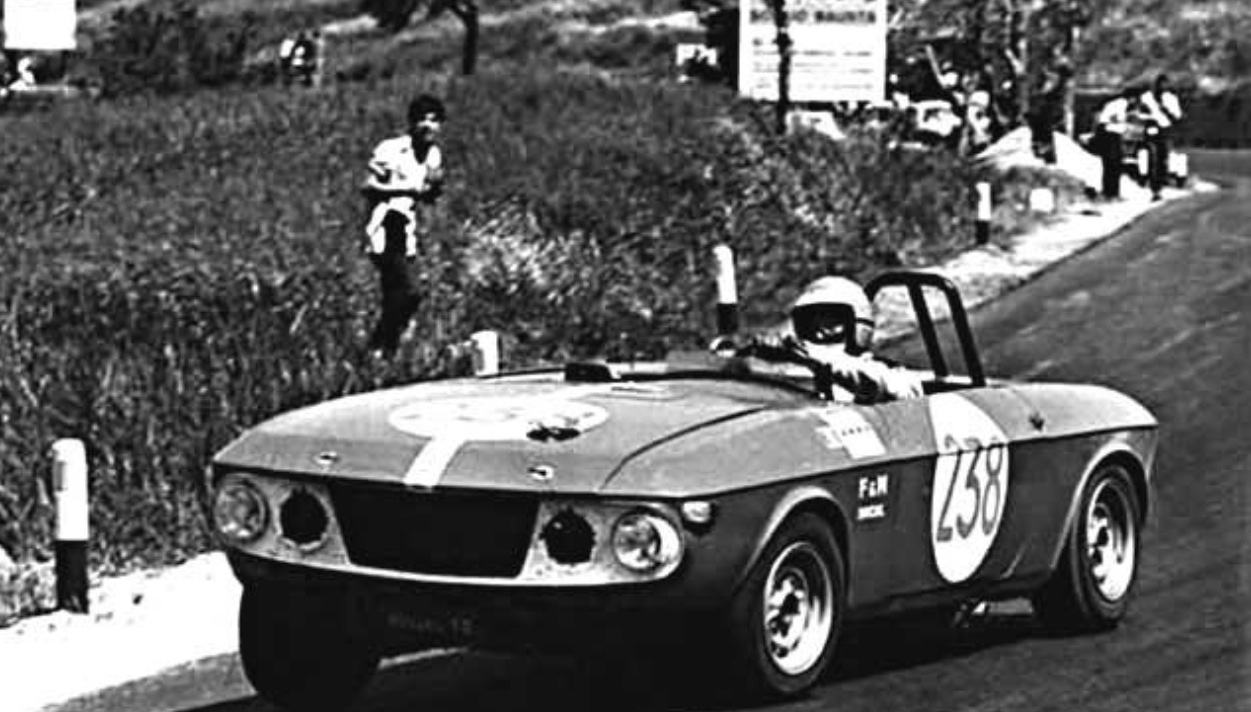
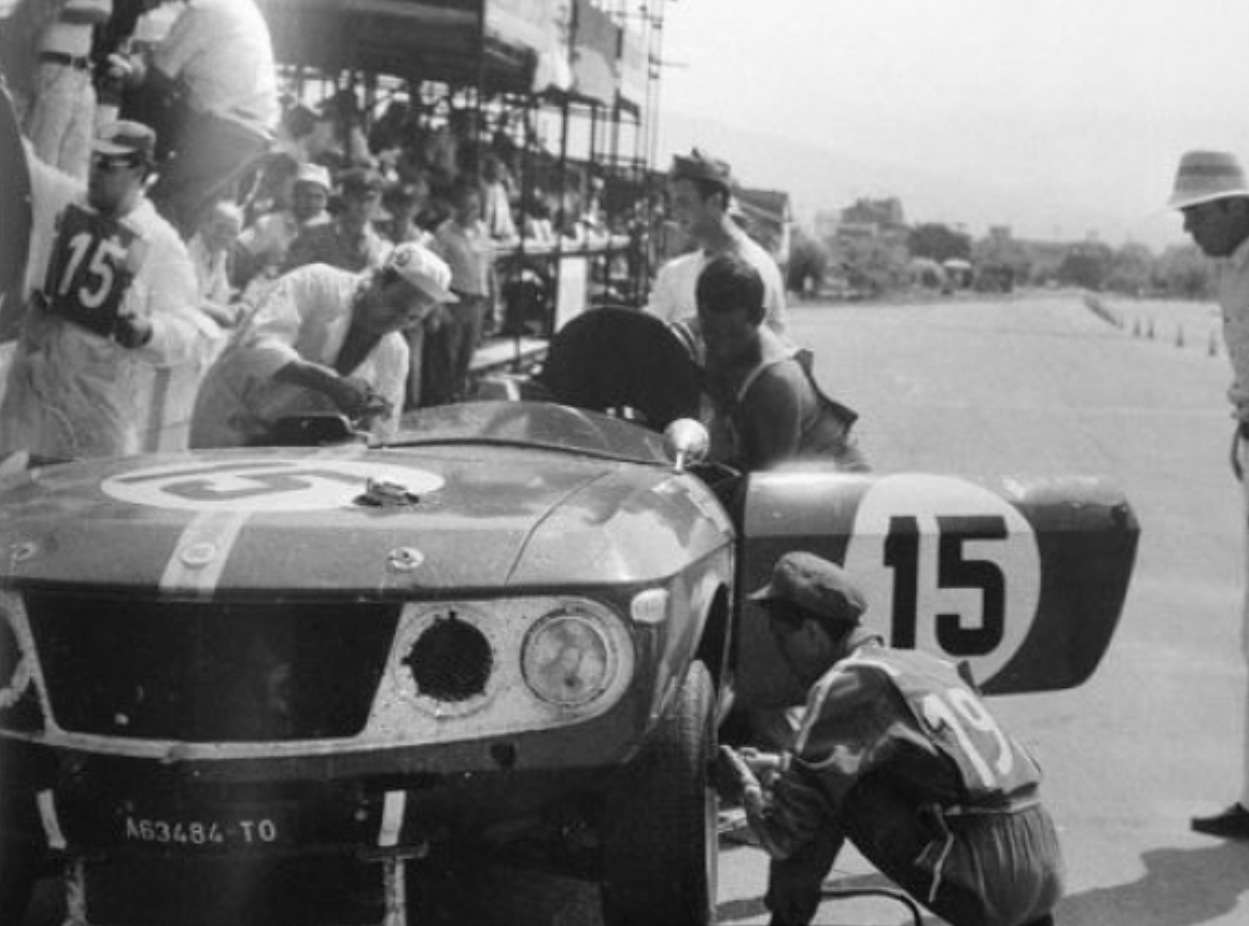
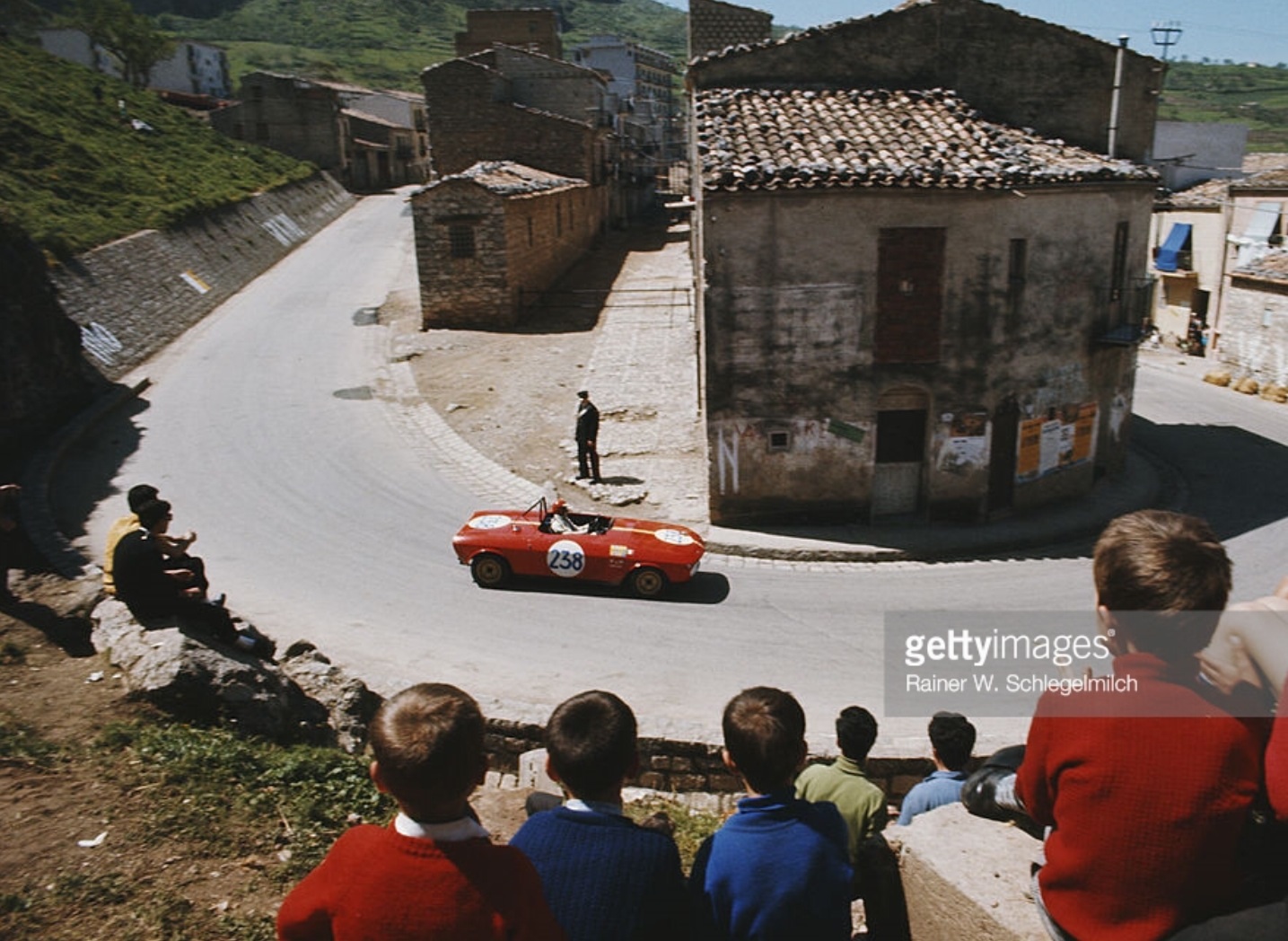
Pretty lines of the Fulvia F&M Barchetta shown in this Targa shot of the 9th placed Aaltonen/Munari chassis (unattributed)

The cars made their race debut at Targa in May where Claudio Maglioli /Raffaele Pinto retired due to overheating caused by an errant newspaper obstructing the radiator, but ninth place overall was a great result for rally-drivers Sandro Munari and Rauno Aaltonen in the other car. The race was won by the Mitter/Schutz Porsche 908/2.

At the 1000 km of Nurburgring on June 1, Munari /Aaltonen were 27th outright and won their class and Maglioli / Pinto finished 29th/2nd in class. Porsche again won the race with their 908/2, this time the car crewed by Jo Siffert and Brian Redman.

At the Grand Prix of Mugello in July Sandro Munari was 5th, a great result amongst 2 litre Abarth and Porsche sports-prototypes and a 5 litre Lola T70!

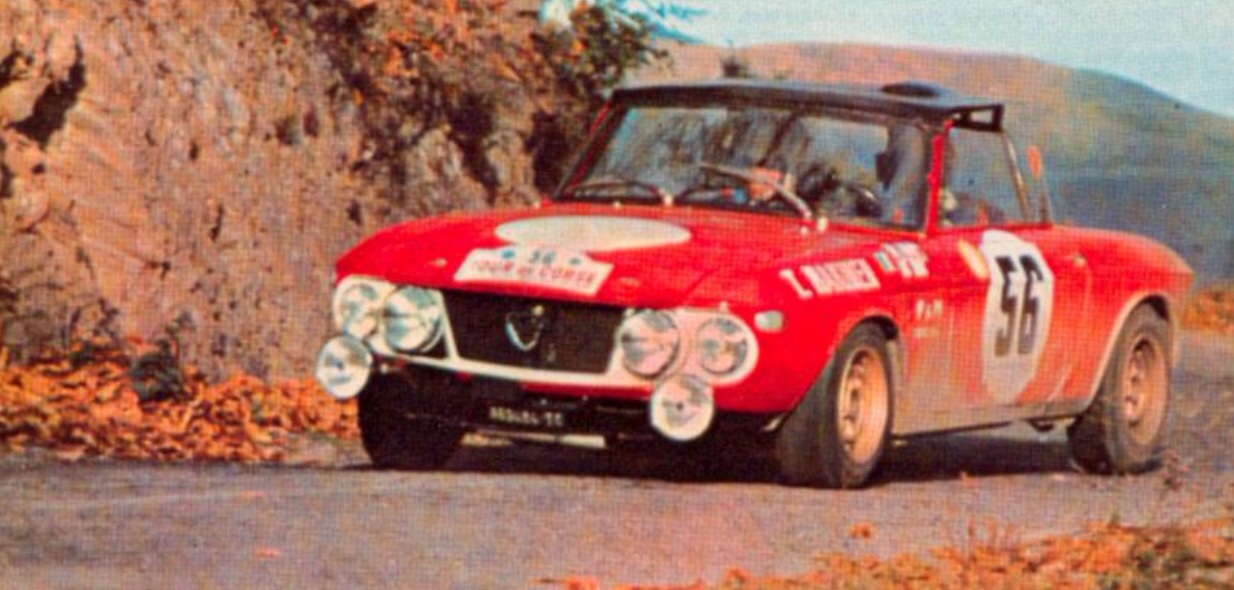
Two of the cars were then further modified (see post-script below) to accommodate a navigator and rudimentary weather protection to allow them to compete in Group 4 at the 1969 Tour de Corse/Rally Corsica where the Munari/Davenport car was 13th and Timo Makinen/Paul Easter 11th.

image

Munari’s car into the Mugello pits en-route to 5th amongst some pretty quick sportscars and prototypes, Fulvia F&M. Munari won the ’69 Mugello GP in a Abarth 2000SP (unattributed)

Technical Specifications…

Lancia Fulvia’s were front-engined and FWD of course.

Engine, SOHC, 2 valve 13 degree, all aluminium 82.4X75mm bore/stroke, 1600cc V4. Circa 160bhp@8200rpm. Gearbox, 5 speed with limited slip diff, final drive ratios to choice.

Spider body with front suspension by wishbones, tranverse leaf spring and guide-bar and rear by beam axle, transverse rod and longitudinal transverse spring with telescopic hydraulic shocks front and rear. Brakes were non-servo assisted discs

The little cars were 3670 mm long, 1580 mm wide and 840 mm high with weight quoted as 720 Kg.

image

Timo Makinens car during the Tour de Corse, note lights back on the car and the basic windscreen and ‘roof’ (unattributed)

‘Tour de Corse’ Rally Corsica, 9-11 November 1969 Postscript…

Just love Lancia’s creativity; when looking at the Barchetta’s above you wouldn’t think they could be crafted into ‘all-weather’ rally machines, particularly given the winter of 1969, but that belies Lancia’s focus!

Lancia felt they would be more competitive against the Porsche 911R, Alpine A110 and 2002Ti opposition with the F&M Specials than their usual HF machines

Tests in Corsica resulted in some changes to the cars; which had reinforced doors, a wider roll-bar to protect both driver and navigator, navigation rally gear and thin Plexiglas, 24cm high, windscreen and wipers.

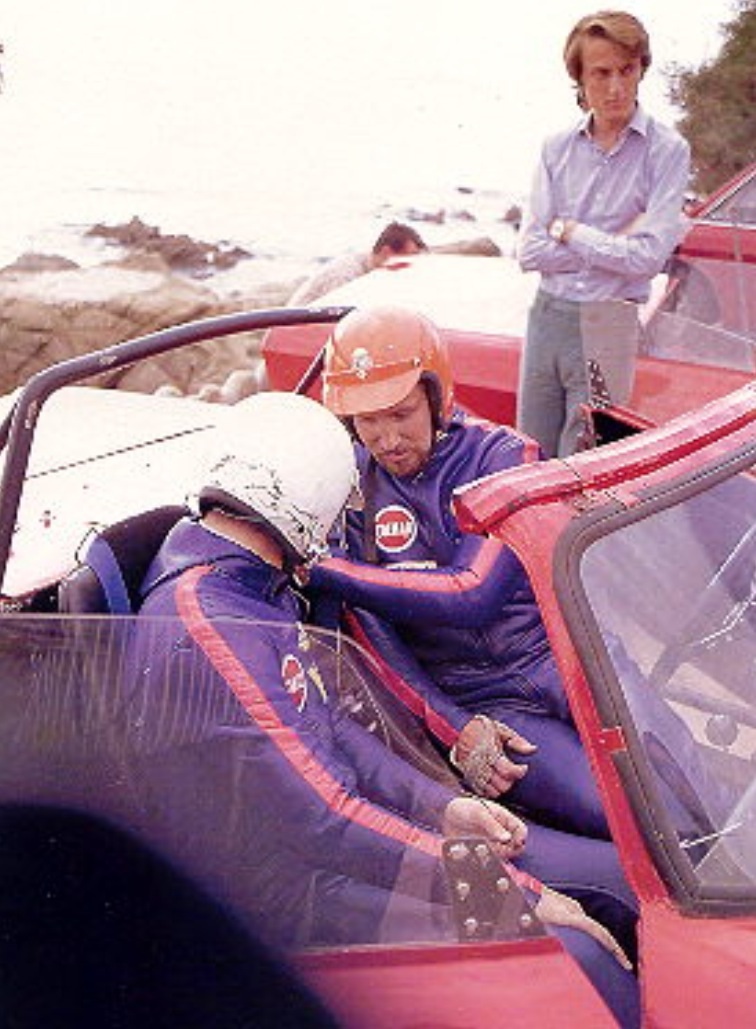
During the last week before the rally the weather worsened greatly, Sandro Munari realised the open car was going to be virtually impossible to drive in conditions down to 4 degrees so he decided to clothe himself more appropriately in rubber suits sourced by the Turin factory; one flew around too much at speed, the black divers wetsuit! didn’t ‘breathe’ causing lots of sweating.

image

Munari in orange helmet and Davenport in their warm ‘sub-suits’, no roof in this shot. Later Ferrari chief Luca Montezemolo looks on skeptically! (unattributed)

After tests both Munari, Makinen and their navigators decided to use a race suit similar to that utilised by submariners. In Turin, the racing department considered further changes to the cars…More shelter was provided for the occupants by raising the windscreen, the earlier one tested replaced by one from a Fulvia Coupe albeit modified with special uprights and with plastic side windows which were anchored to the front section of the roll bar.

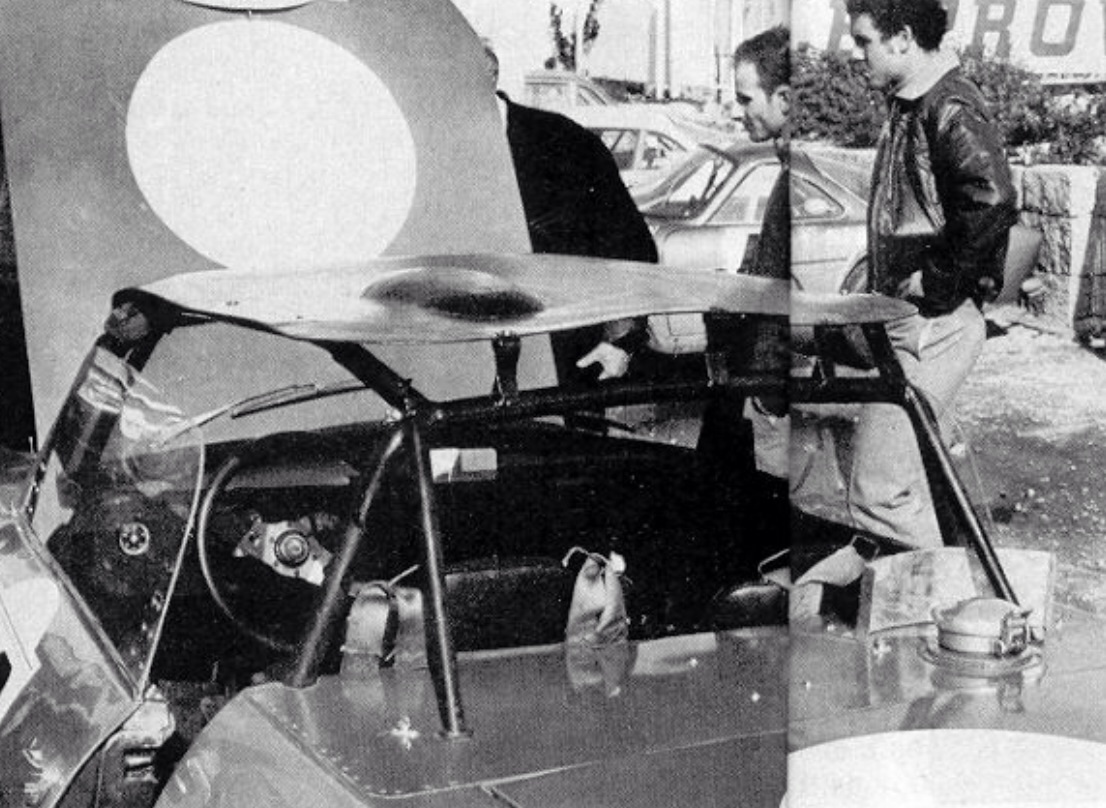
By the time the cars arrived in Ajaccio for the Tour de Corse start the ‘F&M’s had lost both the appearance of the Targa Barchettas as well as their light weight! Makinen’s car at the last minute was fitted with a rudimentary sheet metal roof, an addition scornfully rejected by Sandro Munari! Softie!, he thought of Timo.

image

The quickie roof! as per the text, note fuel filler, rough as guts geddit done finish (unattributed)

The two ‘F & M Special’ were part of Lancia’s six car team in the event, the final result was disappointing with the normal 1.6HF of Kallstrom/Haggbom 9th, 1.3HF of Ballestrieri/Audetto 10th ahead of the trick ‘F&M Specials’; Makinen-Easter 11th and Munari-Davenport 13th.  The rally was won by Gerard Larrousse/Gelin in a Porsche 911R ahead of an Alpine A110 Renault, Ford Capri RS2600 and a swag more A110’s…

image

Normal HF following the Munari car during the Tour (unattributed)

Credits…

Rainer Schlegelmilch, Rallymania

Tailpiece: Collesano, Rauno Aaltonen, Lancia Fulvia F&M, Targa 1969. The short, squat efficient lines of the car clear in this wonderful shot…

image

(Schlegelmilch)


image

The 1957 German Grand Prix is famous as one of the greatest ever; Fangio’s Maser 250F chase and defeat of Hawthorn and Collins in their Lancia Ferrari’s is the stuff of legend…

These two photos reminded me of that day and a car then in the Autumn of its long life as a front line tool. First raced in 1954, by the end of 1957 the 250F had finally won the world title it deserved albeit Fangio made it sing that year, not so sure the title would have been Maserati’s without the great Argentinian behind the wheel.

Behra’s 6th place at the Nurburgring is perhaps more indicative of the cars pace with a ‘mere mortal’ behind the wheel. Actually that’s not fair, the 250F was a top three or four car with a driver of Behra’s calibre in 1957, there was plenty of depth in the field though with the Vanwalls as well as the Lancia Ferrari 801’s.

image

German GP ’57 first lap; Hawthorn and Collins, then Fangio and Behra, works Lancia Ferrari and Maser 250F’s. Then Moss and Brooks in Vanwall VW57’s, look closely and you can just see the top of Musso’s helmet in the other Lanc Ferrari between the two Vanwalls then Gregory’s white Maser 250F and the rest (Klemantaski)

Have a read of my 250F article; https://primotipo.com/2014/08/21/stirling-moss-monaco-gp-1956-maserati-250f/

The opening shot I love, partially because of the time of change it heralds. The front-engined Maser with its wire wheels, knock on spinner cap, finned drum brakes and forged suspension components will shortly be supplanted by Cooper alloys, discs and fabricated wishbones. Moss won the Argentine GP in a Cooper T43 Climax 6 months later, the day of the front-engined GP car wasn’t over but it was on the approach.

image

The shot above is of Guerino Bertocchi, Maserati’s famous engineer/mechanic/tester trying to breathe some life into Behra’s 250F in the Nurburgring paddock also in ’57. Marvellous cars.

Checkout this Race Footage…

https://youtu.be/5PCYsRgUvpk

Credits…

Klemantaski Collection, Graham Gauld

image

Tailpiece: Bertocchi about to test Masten Gregory’s Centro Sud prepared, Scuderia Buell owned 250F #2534 at Modena in September prior to the 1958 Italian GP at Monza of course…

Masten raced #2533 at Monza, this car wasn’t handling well so he switched chassis.

World Champion in 1957, the Masers were make-weights in 1958, the best placed of the beasties that season in championship events were fourths; Fangio’s in Argentina and Reims, his very last GP start, and Masten’s car at Monza. For the record the best of the non-championship results was Jo Bonniers 2nd in the GP de Caen.

Finito…

image

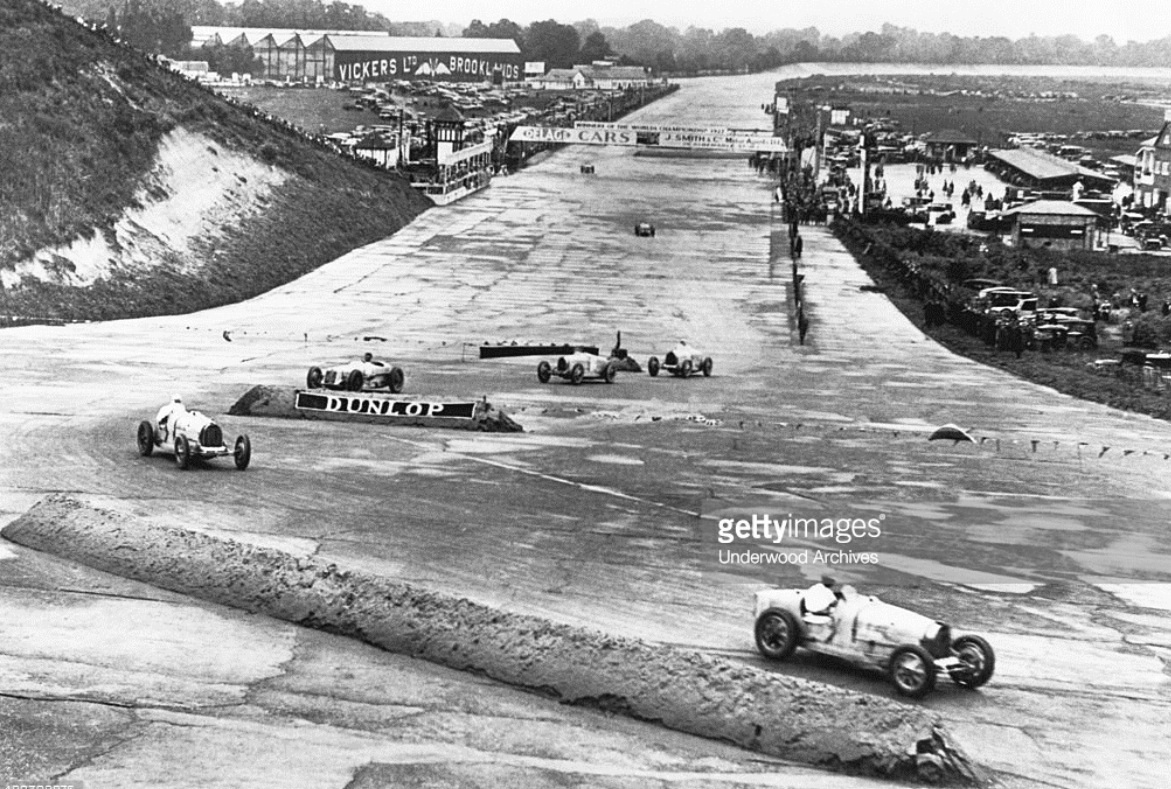
The Hon Jock Leith’s Bugatti Type 35B leads EG Hughes Frazer Nash, Brooklands 16 March 1935…
JA Hamptons shot is all about composition, just love that background Vickers factory, a well known  aviation name of course.

image

By 1919 Vickers was already famous for the first non-stop crossing of the Atlantic Ocean when Alcock and Brown flew their converted Vickers Vimy bomber from Newfoundland to a crash landing in an Irish bog.

image

The company was known as a shipbuilder, but early in the 20th century saw aviation as a profitable future opportunity. In 1908 the British Admiralty ordered the R.1 airship from them, a few years later Vickers built a French monoplane under license. In 1913 their first design, the F.B.I. flew.

Vickers Flying School opened at Brooklands on 20 January 1912,  aircraft construction commenced on the site in 1915, Vickers having taken over the Itala Motor Works factory, by the Wars end they had built 4500 aircraft there…

image

Wellingon bombers being built at Vickers factory, Brooklands in December 1939 (Keystone-France)

Click on these links for interesting websites about Vickers and its history…

This one is more about Vickers on the Brooklands site; http://www.subbrit.org.uk/sb-sites/sites/v/vickers_shelter/index.shtml

And this one more about the aircraft themselves; http://www.vc10.net/History/vc10_origins.html

image

Credit…

JA Hampton, vc10.net, subbrit.org.uk, Keystone France, Underwood Archive

Tailpiece…

image

British GP, Brooklands Saturday 1 October 1927, Vickers factory in the background. The race ‘Royal Automobile Club Grand Prix’ was won by Robert Benoist’s Delage 155B, first 2 cars here both Bugatti’s (Underwood Archives)


image

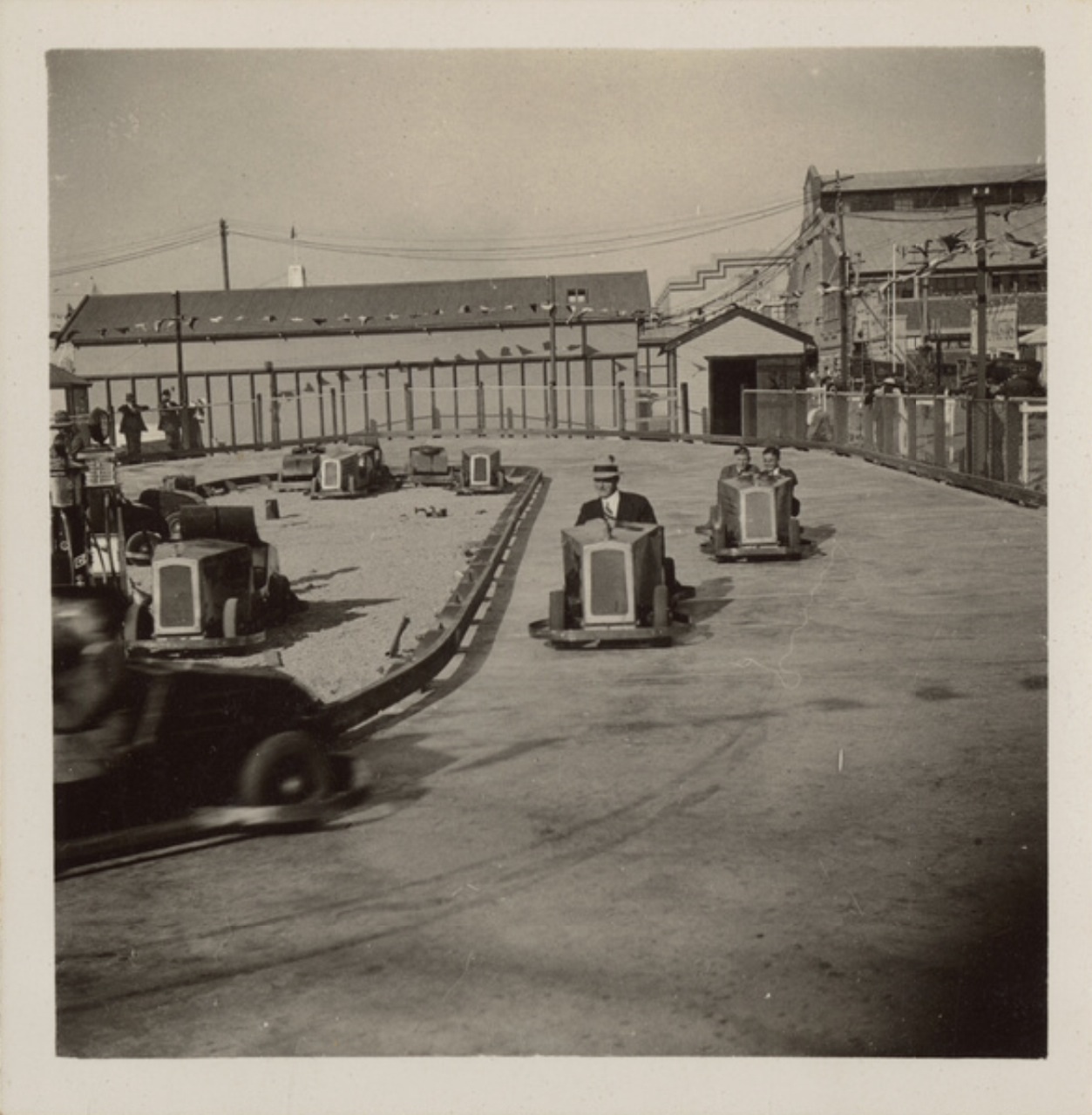
Dodgems 1936 style, Royal Adelaide Show, Wayville…

Timeless, ageless and still fun for kids of all ages, the gentleman in the photo adds an air of formality normally lacking in sideshows!

‘twould be interesting to know what these little buzz-box, bumper cars were powered by, no sign of an electrical connection in evidence here. The Show traditionally starts on the first Friday in September and lasts 10 days, so its early September ‘36.

I chanced upon the shot looking for something else, it was too good not to share. The Adelaide Showgrounds are still in the same spot, Wayville is not too far from the cities ‘Square Mile’ which defines its CBD.

Credits…

Raymond Gordon, State Library of SA


Credits…