Archive for 2016

image

Who is the Coolest Cat?! 

Freddie Agabashian lookin’ a million bucks with his lean build, fag, Ray Bans and GI-Joe haircut. He is aboard his Kurtis Offy Champcar at the San Jose Fairgrounds Speedway, meeting date uncertain but the photo post is dated 1 January 1950…

Of more technical note is the Offy 255 or 270′ cid, four cylinder, DOHC, two-valve, twin side-draft Riley carbed 300-350bhp engine, hand brake and rear suspension of his Kurtis Kraft chassis.

Northern California Racing Association Champion in 1937, against drivers such as Duane Carter, Lynn Desister and Paul Swedberg. Post war Freddie took 3 Bay City Racing Association Midget titles from 1946-48 driving for Jack London and George Bignotti from 1947. He then turned his attention to Indycars.

image

Troy Ruttman left and Freddie at the California State Fairgrounds, Sacramento, in Kurtis Offy Champcars, October 30 1949. Aga won this AAA event with Troy third (Racing One)

Born in Modesto, California, Frederik was the son of a genious Armenian mathematician who began racing in his teens. He won in Champ cars and Stock cars as well which earned him a ride at Indianapolis for the 1947 race.

He competed at Indy from 1947-57 and is best remembered for his pole winning effort in 1952 in the unique Kurtis Kraft Cummins Diesel. Frank Kurtis’ revolutionary first Roadster chassis carried the equally innovative 400cid, alloy headed, magnesium sumped but still very heavy cast iron blocked 360 bhp turbo-diesel engine. The oil burner was tipped onto its side five-degrees from horizontal to lower the engine and as a consequence its bodywork and aerodynamic drag.

image

(Steve McKelvie)

Despite the cars bulk, it weighed over 3100 pounds Freddie and his team knew they had a fast car.

They ‘sandbagged’ in practice, never putting together a full quick lap in the month of May being fearful of the rulemakers changing the equivalence formula if the cars speed were clear. At the time the capacity limits were 6.6-litre diesels, 4.5-litre ‘petrol’ normally aspirated and 3-litre supercharged engines.

But come Pole Day at 5.45 with 15 minutes to go Agabashian gave the big heavy beast its head and popped it on pole! The race was not so happy, the turbo air intake became jammed with rubber and other track-borne ‘shite on lap 71 causing the interesting cars withdrawal, but the promotional aims for Cummins were well and truly achieved.

image

Agabashian and team during Indy practice, Kurtis Cummins 1952 (unattributed)

Freddie’s best finish at Indianapolis was in 1953 when he placed fourth in another KK roadster, this time a more conventional Offy powered 500B chassis.

After he retired from racing Freddie was an Indy special comments broadcaster, he died in 1979.

image

Agabashian at Daytona in 1978 during his broadcasting days (Racing One)

image

I like this close up shot which shows the build, fabrication, panel fit and finish quality of these Kurtis cars, Agajanian again in ’52. Cripes it’s big! (Racing One)

Check out this YouTube footage about the unique, pole winning, the only time a diesel engine did it, Kurtis Cummins 1952 car;

image

1952 Indy start; Agajanian in red from #4 Jack McGrath Kurtis Kraft 3000 Offy (Racing One )

image

Credit…

Racing One, Historic Racing, Steve McKelvie

Tailpiece: Just watch me go fellas! Freddie, Kurtis Cummins, Indy ’52…

image

(Racing One)

french ickx

(Rainer Schlegelmilch)

Jacky Ickx warms up his Bugatti T35B prior to the start of the 1969 French Grand Prix at Clermont Ferrand, 6 July 1969…

He qualified his Brabham BT26A Ford fourth (below) and finished third in the race won by Jackie Stewart’s Matra MS80 Ford. He had a good season with Brabham taking two wins; at the Nurburgring and Mosport but the lure of Ferrari was too great, he returned to the Maranello squad in 1970.

french brabham

(Rainer Schlegelmilch)

Credits…

Rainer Schlegelmilch

image

9200 rpm and breathing very heavily thru it’s oversized for GP racing ports…

Bruce McLaren at rest and considering setup changes to his first GP car, Robin Herd’s Ford Indy V8 powered, ‘Mallite’ chassis, M2B at Watkins Glen in 1966.

These shots are from the Dave Friedman Archive; the tachometer snaps are at the US GP, the balance of photos from the following, final 1966 Championship round in Mexico City.

This article is another of my ‘nutso’ ones in terms of its order…

I found a swag of photos in Friedman’s archive a while back and planned a pictorial of Bruce and his first McLaren GP car at the 1966 US and Mexican Grands’ Prix, the events where Friedman snapped away prodigiously. I put it to one side and largely forgot about it. Subsequently I decided on something more substantive; so the first bit is the original pictorial, the second is about Bruce’ progress in his first two years as an F1 marque jumping from engine to engine until the DFV provided the definitive McLaren F1 moteur from 1968-1983.

And boy, wasn’t there a lot of water that passed under the bridge between 1968 when the design for the Cosworth powered McLaren M7 was laid down to John Barnard providing both the dimensions of the DFV and its means of attachment to the chassis amongst his ‘mandatories’ of design specifications to Hans Metzger at Porsche in 1983. The TAG/Porsche 1.5 litre twin-turbo V6 was the result, the McLaren MP4/1E TAG-Porsche first raced at the 28 August 1983 Dutch Grand Prix. Back to 1965/6 though!

Remember, the tachometer snaps are at the US GP, the balance of photos from the following round in Mexico City, there are no captions in the first part of the article.

image

image

image

image

image

image

image

As a GP engine the Ford Quad-Cam Indy V8 engine was a huge, beefy, heavy and notoriously raucous unit. Visually it was a ‘big busty blonde’ as well with its whopping Hilborn injection trumpets and huge ‘between the vee exhausts’, it looked ‘the goods’…

image

The Ford Indy quad cam V8 in its earliest form fitted to a Lotus 34 at Indy in 1964. Jim Clark and Dan Gurney contested the race, this is Clark’s chassis. Engine 4195cc DOHC, 4 valve, Hilborn injected, methanol fuelled giving circa 425bhp @ 8000rpm and useful power from 6000-9000rpm. ZF 2DS 20 ‘box (TEN)

McLaren developed and tested the engine during the winter of 1965/6, notably at Riverside, California but missed the European non-championship F1 events with which the season commenced. In a portent of the season to come John Surtees won the 1 April Syracuse GP in his Ferrari 312 whilst ‘Black-Jack’ won the BRDC International Trophy in his Brabham BT19 Repco at Silverstone on May 14.

image

McLaren looking pretty chilled at this stage of the ’66 Monaco weekend upon his teams GP debut, color of the car a function of doing a deal with John Frankenheimer’s crew as part of  filming of ‘Grand Prix’ . Inboard rocker front suspension and outboard loacation of spring/shock at the rear. Checkout the prostrate ‘snapper behind the car (unattributed)

McLaren made its debut as an F1 marque in the May 22, 1966 Monaco Grand Prix, the first championship round that year. Bruce raced the car he concepted together with Robin Herd, the brilliant young designer specified ‘Mallite’ as the primary material for M2B’s monocoque chassis. (noting the M1 series of car are CanAm machines)

Mallite is a composite sheet aerospace sandwich material comprising end grain balsa material filling between thin sheets of aluminium. The resultant chassis was incredibly stiff for its day at around 11000 lb/ft per degree of deflection compared with a good conventional ‘ally tub which came in the range of 4000-5000 lb/ft per degree.

The Indy Ford 4-cam V8 was reduced from its USAC mandated 4.2 litres to the 3 litre F1 limit (95.3mmX52.4mm bore/stroke-2999cc) which prevailed from 1 January 1966. For F1 use the engine was first modified by Klaus von Rucker in England, then later Bruce involved Traco Engineering in Los Angeles.

image

All hands to the pump! Bruce, Tyler Alexander and Wally Willmott hard at it, Monaco 1966. The Indy Ford V8’s Hilborn fuel injection, between the Vee exhausts, full monocoque chassis, ZF 5 DS25 gearbox and conventional rear suspension; inverted lower wishbones, single top link, coil spring/dampers, twin radius rods and adjustable sway bar all clear in this shot (unattributed)

Click on this article for a brief history of the Ford Indy V8 amongst the Lola T90 stuff which is the main substance of this piece; https://primotipo.com/2015/06/12/graham-hills-american-red-ball-spl-lola-t90-ford-indy-winner-1966-2/

At Monaco the new McLaren qualified 12th, Bruce withdrew with mechanical ailments on lap 9, the race was won by Jackie Stewart’s 2.1 litre ‘Tasman’ P56 V8 engined BRM P261. This car was his 1965 1.5 litre F1 mount with a bigger version of the P56 V8 with which he won the 1965 Tasman Series.

Bruce and his small Colnbrook team, (near Heathrow an area in the midst of the motor racing industry of subcontractors 3 miles from Slough and 18 miles West of London) crew quickly realised the engines massive ports and valves didn’t give the sort of gas flow speed needed to produce competitive power at 3 litres. Mind you, its 300 horsepower was the sort of output the World Championship winning ‘RB620’ Repco V8 developed in 1966. It was enough to win Jack’s ’66 title albeit the Repco engine was light, very torquey and reliable. By contrast, Bruce’s Ford was heavy and gave its punch over a narrow rev band, the deficiencies of which were exacerbated by the 4 speed ZF ‘box they used which ‘left lots of gaps’ in the power band.

The team had much work to do on the Ford, in the meantime Count Volpi’s new Serenissima V8, designed by Ing. Alberto Massimino, who was part of the Lancia-Ferrari and Maserati 250F 1950’s design teams provided another ‘ready made’ alternative engine to try.

image

Serenissima ATS Spider, Sauer/de Mortemart. Le Mans 1966. DNF with gearbox failure on lap 43. It raced in the prototype class, the race won by the McLaren/Amon Ford GT Mk2 (Smuckatelli)

This project is a story in itself but suffice to say Bruce tried the engine whilst simultaneously developing the Indy Ford V8 in an attempt to get it to where it needed to be. Most of you will be aware that Bruce’ Ford connections were immaculate at the time as both a development and race driver of the GT40 program, those cars developed by teams on both sides of the Atlantic. It was Bruce’ hope that he may have been able to get FoMoCo’s backing for his F1 variant of their Indy V8. In the end, via Ford UK’s Walter Hayes, Ford supported the Cosworth developed DFV of course.

image

Weber 48IDA fed Serenissima all alloy V8 in the back of Bruce’ M2B during the Belgian GP weekend, 1966 (unattributed)

The Serenissima engine was designed as a sports car unit and gave little power. The ‘M166’ engine was an aluminium, chain driven, quad cam, 2 valve V8 displacing 2996cc (91.5X57.0 mm bore/stroke) 350 bhp was claimed for it but most of the horses seemed to have jumped ship between Italy and the UK, the actual output was more like 260bhp.

M2B was modified to take the side exhaust Italian V8 in time for the Belgian GP, at Spa. The team had great trouble just getting the thing to start, then run and to add insult to injury it ran its bearings after its first exploratory laps having qualified 16th. With no spare engine Bruce was a non-starter.

image

Bruce in the winning Ford Mk2 he shared with Chris Amon at Le Mans 1966. The Ferrari is the Maranello Concessionaires Ferrari 365 P2 driven by Richard Attwood and David Piper (GP Library)

Bruce and his young intended McLaren F1 team-mate Chris Amon (who raced M1B Chev CanAm cars for Bruce in 1966) then departed England for France and returned as Le Mans winners in a factory Ford GT Mk2. That contentious win or perhaps ‘first over the line’ is still the subject of discussion and debate amongst enthusiasts and historians alike even all these decades later.

image

1966 British GP, Brands Hatch, M2B Serenissima V8. Bruce was 6th, scoring a championship point, the teams first. Jack Brabham won in BT19 Repco from pole, he was 2 laps up the road to give the gap some perspective. Bruce in his ‘Pete Aron’ Grand Prix filming helmet (unattributed)

Jack Brabham won both the French Grand Prix at Reims and the British at Brands Hatch in BT19 Repco. The M2B-Serenissima contested the Brands race with more success, the engine was reliable. Bruce started superbly on a damp track on wets running in the top six. As the road dried he dropped back but inherited 6th scoring McLaren’s first World Championship point. A significant day in Grand Prix history indeed.

image

Bruce, Serenissima engined M2B in practice ahead of Jo Siffert Cooper T81 Maser DNF and Dan Gurney Eagle T1G Weslake DNF, Zandvoort 1966. He didn’t start the race (unattributed)

At the Dutch GP the Serenissima engine again failed, the McLaren F1 program was set aside pending development of the Indy Ford V8. Amongst other changes the engine was fitted with Chrysler Hemi inspired induction tracts which lifted its output to around 312bhp at 9500rpm.

The beast re-appeared in the United States GP at Watkins Glen, Bruce finished 5th by surviving a race of mechanical mayhem but in the final race of ’66, won by John Surtees’ Cooper T81 Maserati, the Mexican GP, the engine blew after 70 laps having qualified 14th.

image

McLarens interim 1967 contender, the 2.1 litre P56 BRM V8 engined M4B makes it’s debut during the Race of Champions at Brands Hatch on 12 March 1967 (Getty)

Bruce cast around for a better alternative engine for 1967 and was a happy customer of BRM’s prospective 4 cam, 2 valve V12 which was designed as both an F1 and sportscar unit. The prototype (Group 6) capacity limit at the time was 3 litres so it made good commercial sense for BRM to build customer engines to replace the P56 V8’s which raced in endurance events as well as Grands Prix. BRM’s complex H16 was their factory F1 unit at the time but it was problematic to say the least…not available to customers (post Lotus) and probably not wanted by Bruce in any event!

A new one-off M5A monocoque chassis was designed for this engine designated ‘P101’, but the BRM V12 was running late, the M5A didn’t appear until the Canadian GP at Mosport in August.

m4-test

Bruce testing M4B BRM in the UK before the ’67 season started, circuit and date uncertain. The exposed monocoque chassis is that of an M4A Ford FVA F2 car upon which M4B was based (unattributed)

So a gorgeous little car was used in the interim; the McLaren M4B BRM V8 was based on Bruce’ M4A F2 car but instead of Ford’s little 1.6 litre FVA the engine bay carried a 2.1 litre version of BRM’s venerable, powerful, small and reliable P56 V8 which had won Graham Hill’s 1962 World Championship, countless GP’s and Tasman Series events. This Tasman BRM V8 engine gave circa 280bhp. ‘Belly’ fuel tanks gave the F2 derived F1 car sufficient fuel for 200 miles.

m4-engine

The business end of M4B BRM at Monaco 1967. P56/60 V8 one of the great GP engines, 2.1 litres, 2 valve, Lucas injected, circa 245 bhp. ‘box is a Hewland DG300, beefy and under-stressed for this application, rear suspension period typical (unattributed)

M4B BRM made its debut in Bruce’ hands in the Race of Champions at Brands Hatch on 13 March. It finished 4/6th in heats one/two but then its engine blew after 1 lap of the final after Bruce muffed a change in heat two. 5th places followed in the two heats and final of the Daily Express Spring Cup at Oulton Park and in the International Trophy at Silverstone on 15 April where Bruce was again, you guessed it, 5th!

m4-oulton

Bruce contesting the Oulton Park Spring Cup, 15 April ’67 M4B BRM, 5th. Brabham won the final in a BT20 Repco (Watson)

So, the little car had plenty of race miles on it as the team transporter headed to Monaco, the little M4B was tailor-made for the tight street circuit, but Jim Clark and Graham Hill were in similar hybrids; 1.5 F1 Lotus 33’s with stretched Tasman V8 Coventry Climax and BRM engines respectively.

bru-mon-armcahir

Bruce rests on his M4B armchair before the off, Monaco 1967. Its ‘done the rounds’ this shot but its such an atmospheric beauty i popped it in, this cars best view is its arse! where everything is very pert, taut and tightly packaged (unattributed)

bru-monaco

Bruce in M4B with truncated ‘Monaco’ nose ’67 (unattributed)

‘But Bruces’ battery was running flat – forcing a dramatic pit stop – Bruce could well have finished second behind fellow Kiwi Denny Hulme’s victorious Repco Brabham. Some of the spirit of Formula One in those days is typified by the pit stop as Bruce believed his misfire was fuel pressure and bawled as much at his crew. But Jack Brabham, friend and rival had come into the pits and was shouting ‘it’s your battery – it’s your battery!’ As Bruce wrote: Good old Jack. It was the battery and we quickly whipped another one on. He rejoined and finished fourth – three further championship points … thanks in part to a rival team chief!’ records the Bruce McLaren Trust.

m4-zand

Dutch GP, Zandvoort 1967. Bruce in M4B BRM ahead of Pedro Rodriguez’ Cooper T81 Maserati, it was the debut of the Lotus 49 Ford, Clark won the race in Chapman’s jewel. Note the different nose compared with the earlier shots especially the ducts to ease the flow of air after its passed thru the radiator, reducing front lift in the process (Watson)

The M4B was then badly damaged on lap two of the Dutch GP at Zandvoort as Bruce went off on spilled oil in the fast Huzaren Viak corner. After repair he was testing it at Goodwood when it caught fire out on the circuit, he then watched it burn to death! The ’67 Dutch is also remembered of course for the debut of the Lotus 49 and more importantly the Ford Cosworth DFV V8 which powered it.

image

McLaren assists with a plug change on his Eagle’s Weslake V12. French GP, Circuit Bugatti, LeMans 1967 (Getty)

Without a car, Bruce did a deal with Dan Gurney to drive the lanky Californian’s V12 Eagle T1G Weslake, Dan was in sparkling form in an All-American dream week having won two significant races in the Le Mans 24 Hour classic (Ford Mk4 with AJ Foyt co-driving) and at the Belgian GP in the Eagle thereby following the footsteps of Brabham as a GP winning driver of a car he built. It was a path Bruce would also traverse in the 1968 Belgian GP in his Cosworth powered M7A. Bruce was quick in Dan’s car, at the Circuit Bugatti Le Mans he qualified the big car 5th to Dans 3rd but they were both outed in the race, Bruce with ignition problems and Dan with a fuel line issue.

bruce-le-mans

The unfamiliar sight of GP cars at Le Mans, fortunately the Circuit Bugatti was only used once, the French having a wonderful selection of road circuits at the time to choose from. Eagle T1G surely the best looking F1 car of the sixties!? Bruce sets off for some laps in his unfamiliar mount (Cahier)

Two weeks later at Silverstone Jim Clark was in sparkling form and convincingly won the British GP. Bruce and Dan qualified 10th and 5th with Bruce this time outed with engine problems and Dan a failing clutch. Consistency in build and preparation of the Weslake V12 were amongst its issues, its fair to say the demands of two ‘Number Ones’ perhaps placed much more pressure on the resources of Gurney’s small team, than getting one machine ready to a high standard. I’ve never read anything about what Bruce, like Dan, one of the supreme engineer/tester/drivers thought of the T1G or its engine. I’m intrigued to know if any of you have something of that nature published ‘in period’ in your collections.

The supreme test of the Nurburgring followed on August 6 where again both drivers qualified well, 5th and 4th for Bruce and Dan respectively but again both failed to finish; Bruce with unspecified mechanical mayhem and Gurney’s superb bolide with driveshaft failure.

image

Bruce and M6A Chev, Mosport CanAm 23 September 1967, Denny won with Bruce 35 seconds behind (Friedman)

Later in 1967 was a busy time for McLaren. Whilst the F1 program was still formative its CanAm challenge was very mature. Bruce and Robins Chev V8 engined M6A was the result of learnings of the previous years, in both Bruce’ M1’s and other cars he raced. The ’67 Can Am commenced on September 3 at Road America and finished in Las Vegas two months later, the ‘papaya cars’ took 5 of the 6 rounds and Bruce the title, a remarkably well deserved one at that.

The Colnbrook build team had the Can Am cars well clear of the workshop by the time they mated the late arriving BRM V12 to the M5A chassis. Bruce was ‘razor sharp’, his driving buoyed by both the competitiveness of the team ‘Stateside and his individual performances in these oh-so-beautifully designed, engineered and executed sports-racers.

bru-monza

Bruce at Monza in M5A BRM V12 1967. Q3 and DNF with an engine failure, Surtees the Italian GP winner in a Honda RA300 V12 (unattributed)

The M5A monocoque chassis abandoned Mallite which was considered too complex to shape and heavy in favour of aluminium sheet, the car having a fully stressed section enclosing the drivers legs, the area above his kness left open for maintenance access. The gearbox was the DG300 Hewland also used in the smaller BRM V8 engined car.

brm-v12

The BRM P101 V12 in the back of M5A at Monza in 1966. Lots of ‘Aeroquip’ lines, Lucas injection, Hewland DG300 transaxle, ‘Fram’ oil filter below the oil rad popped up in the breeze. Engine, non-stress bearing,  is 4 chain driven cams but 2 valves. Engine evolved over time into the 4 valve engine which gave competitive service especially in 1970/71 in the back of BRM’s P153 and P160 (Schlegelmilch)

BRM’s 24 valve P101 V12 was originally designed for sports-prototype use by Geoff Johnson. The engines bore/stroke were 73.8X57.2mm for a capacity of 2998cc with a compression ratio of 12:1. The Lucas injected, chain driven 4 cam, 2 valve engine produced 369bhp at 9750rpm on 14 August, engine ‘P101-003’ put to good use by Bruce during the Canadian Grand Prix.

During the race the hot oil tank cooked the battery, Bruce gained on the leaders till spinning in the greasy conditions.

bru-canada

Bruce in M5A BRM fighting Jack Brabham for 3rd, before retirement. Brabham won the Canadian GP, in his Brabham BT24 Repco (Laymon)

At Monza the combination showed just how competitive they were; Bruce popped the thing on the front row, with 20 laps to go he and Surtees were racing wheel to wheel for a dash to the flag when a BRM cylinder liner dropped, the car withdrew on lap 4 with Surtees and Braham running to the line, Jack was outfoxed by John on the last corner of the race.

The M5A retired in both the US and Mexico and was used by the reigning World Champion, Denny Hulme in the first race of 1968, the South African Grand Prix at Kyalami.

image

Bruce in M5A BRM at Mexico City 1967. Q8 and DNF lap 45 with engine failure. Clark won in a Lotus 49 Ford from Brabham and Hulme, the latter took the ’67 drivers title Brabham Repco mounted (Cahier)

But the F1 world had changed late in 1967, by Walter Hayes decision to make the Ford DFV available to customers; he convinced Colin Chapaman to waive the exclusivity agreement Lotus had to use the engine which allowed Bruce and Robin Herd (and Ken Tyrrell in 1968 as well as Lotus) to design a bespoke chassis to suit the 408bhp DFV.

The bathtub aluminium monocoque M7A made a splendid debut winning the ’69 Race of Champions at Brands Hatch with the boss taking the win from pole and jagging the fastest lap to boot!

A new chapter in McLaren history was underway, DFV powered McLarens won World Titles for Emerson Fittipaldi in 1974 and James Hunt in 1976, stories for another time…

image

Bruce in the papaya M7A Ford DFV winning the Race of Champions at Brands Hatch upon the models race debut (Ed Lacey)

Bibliography…

The Bruce McLaren Trust, ‘History of The GP Car’ Doug Nye, The GP Encyclopaedia

Credits…

Dave Friedman Archive, Cahier Archive, Ron Laymon, Ed Lacey, Rainer Schlegelmilch, Ron Laymon, Getty Images, Brian Watson, GP Library, Nigel Smuckatelli, The Enthusiast Network

Etcetera-Engines…

bruce-and-teddy

Bruce, Teddy Mayer, Monaco, 1966 McLaren M2B Ford Indy V8, both above and below shots (Schlegelmilch)

image

m2-seren

M2B Serenissima at Spa 12 June 1966. Compare and contrast the Ford Indy V8 installation in the shots above, the car designed for that engine and then adapted to suit the Italian V8, ZF 5 DS25 box used in both cases (Schlegelmilch)

Tailpiece: ‘BRDC Intl Trophy’, Silverstone, 29 April 1967. From small acorns do big things grow. Bruce, Teddy and the boys, a few passers by. Perhaps it’s Friday, and M4B/1 BRM P56/60 V8…

test-m4


image

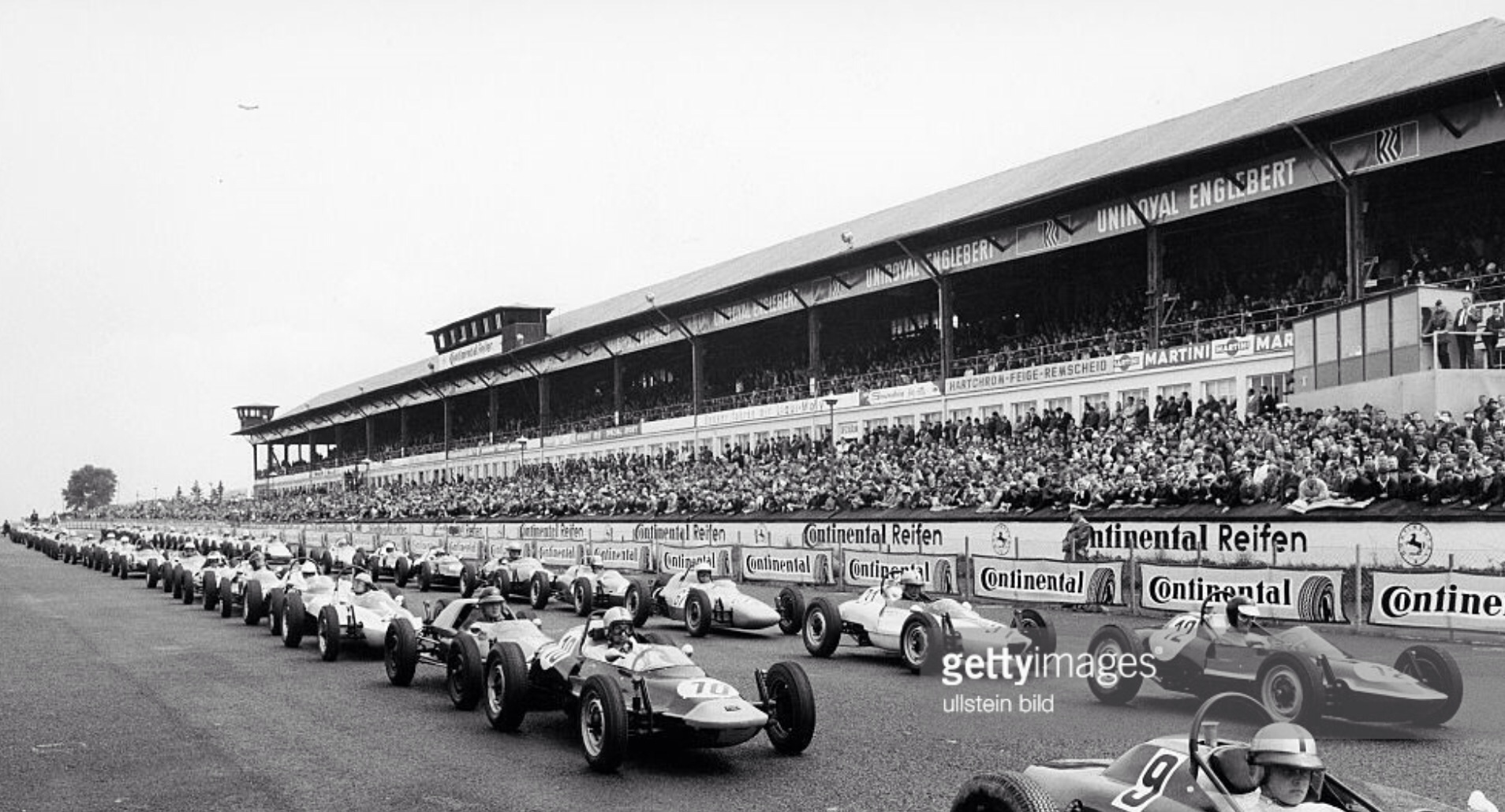
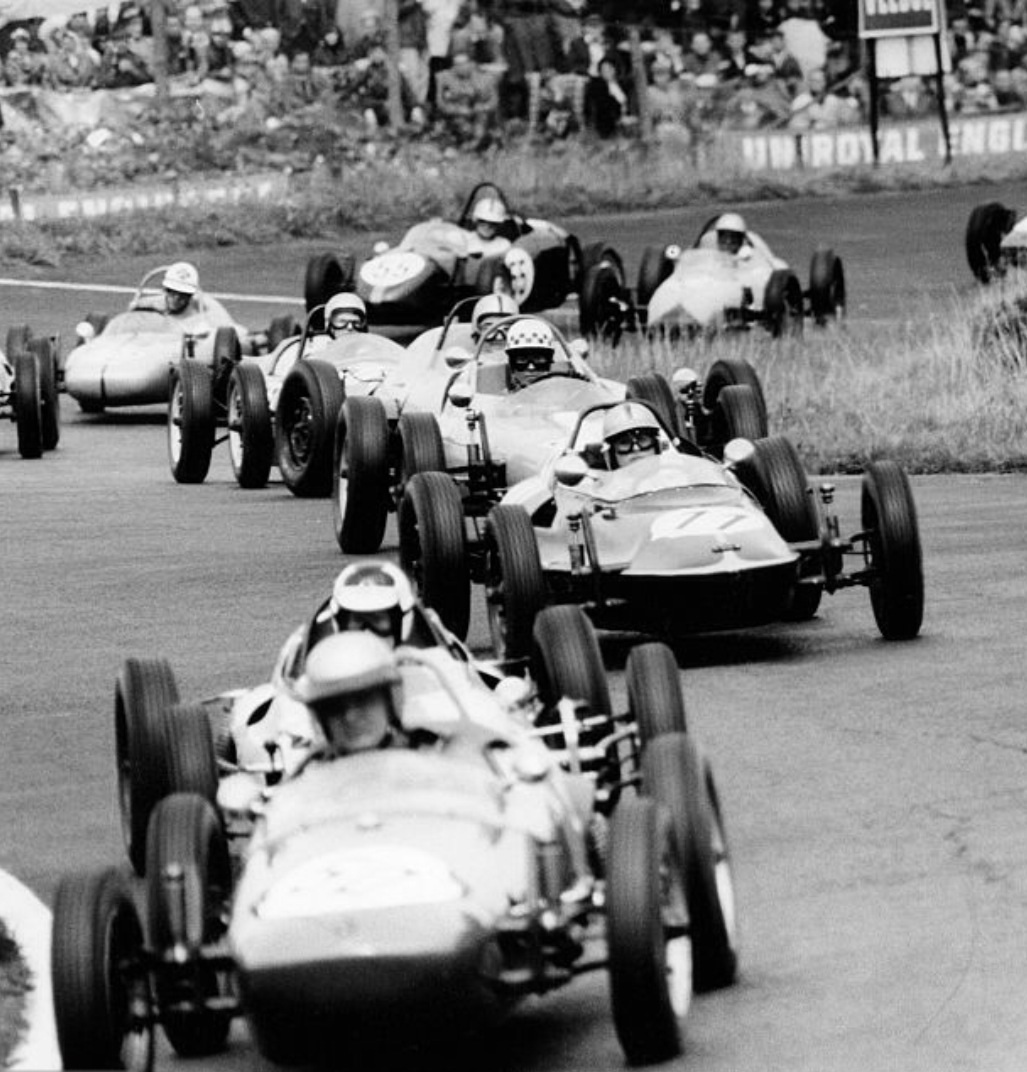
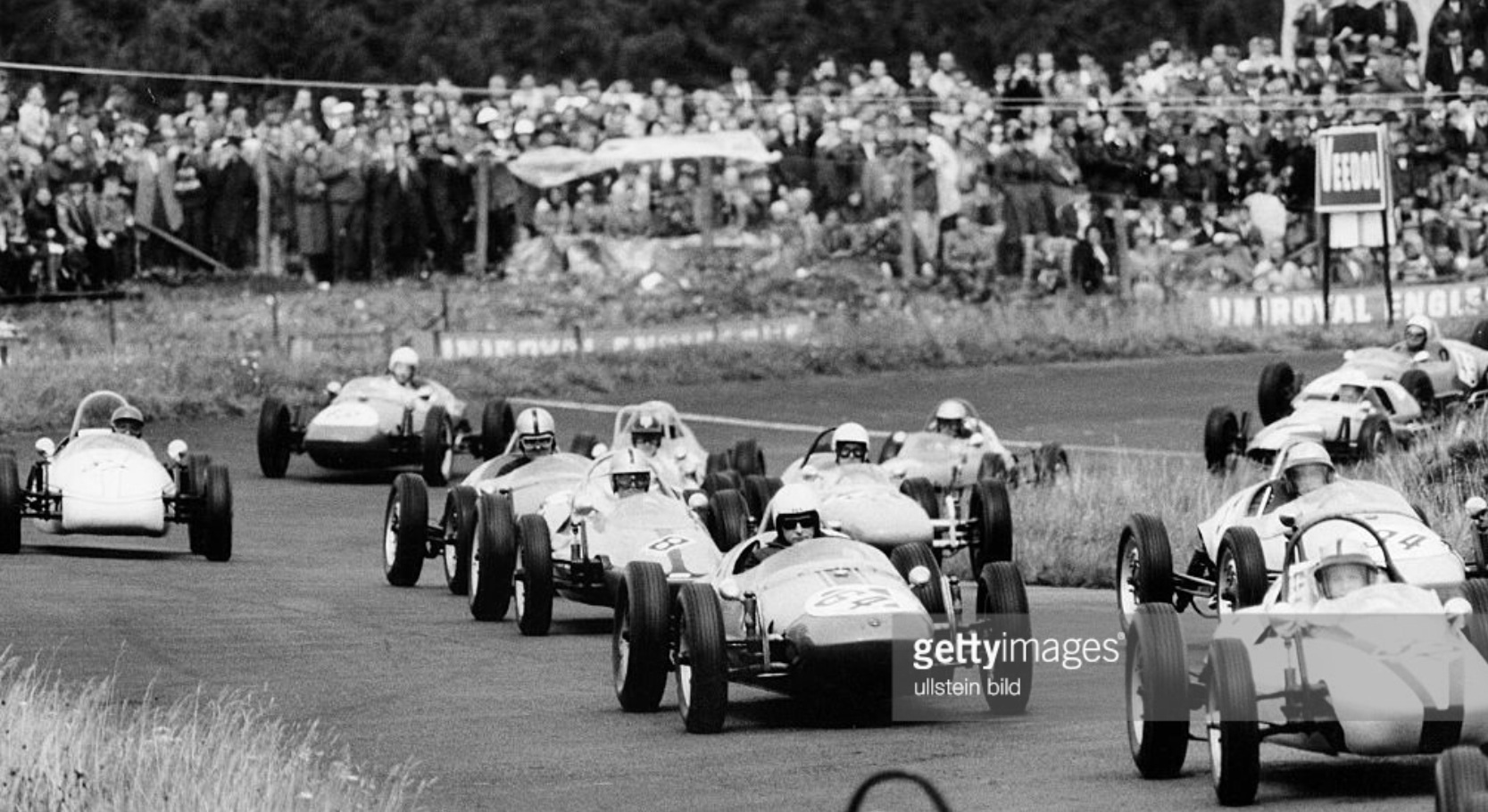
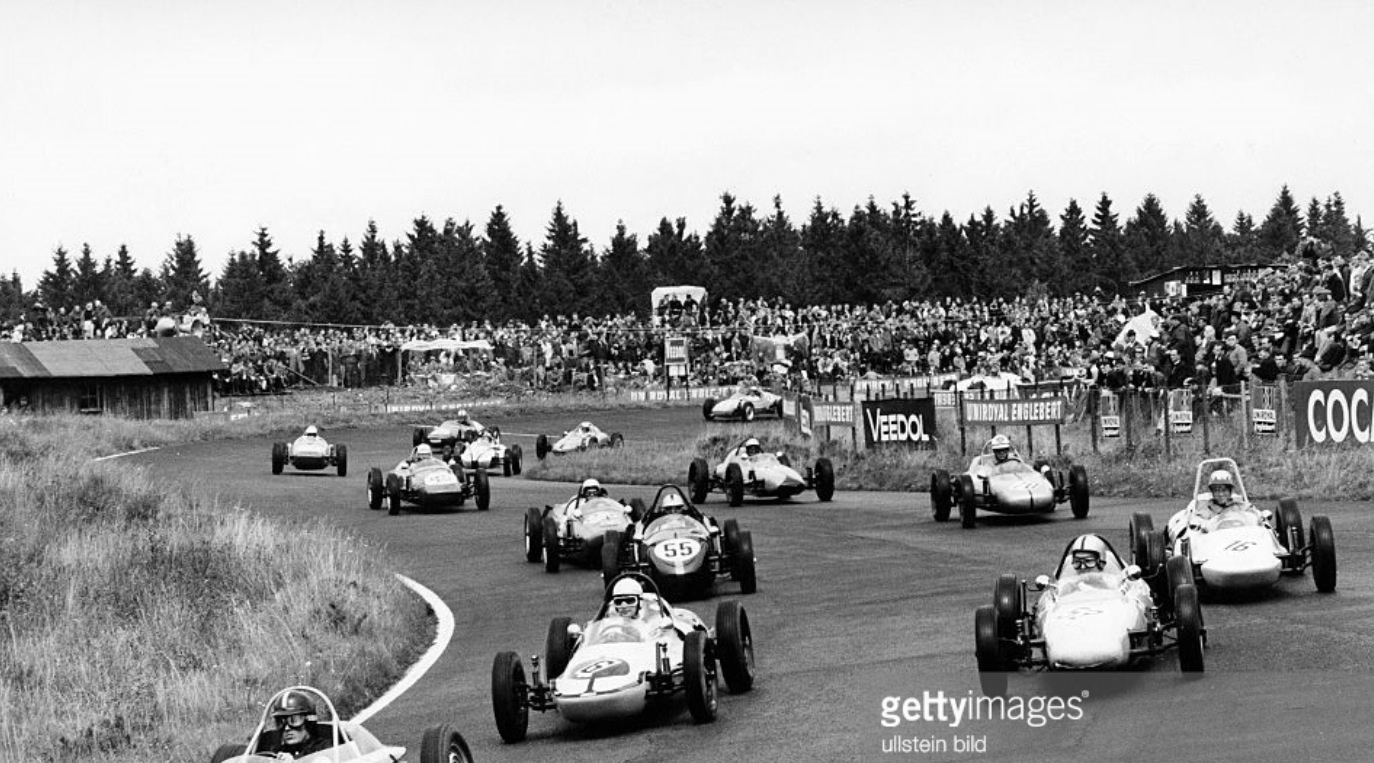
Lordy that’s a big grid! Its the Formula Vee race which supported the 1967 German Grand Prix, the Nurburgring of course. I’ve no idea who won the race or the names of any of the competitors but that’s not really the point of this article. Mind you, if any of you do know get in touch and I will add the details.

image

FV served a useful function by providing entry level racing for future world champions Emerson Fittipaldi, Niki Lauda and Keke Rosberg. Emerson was the first FV graduate to win a world title, for Lotus in 1972. That wasn’t really the point of the class which was fundamentally to provide thousands of enthusiasts globally the chance to compete cost-effectively. Me included.

Formula Vee gives me ‘Summer of ‘79’ smiles and recollections of fun, carefree times of long ago.

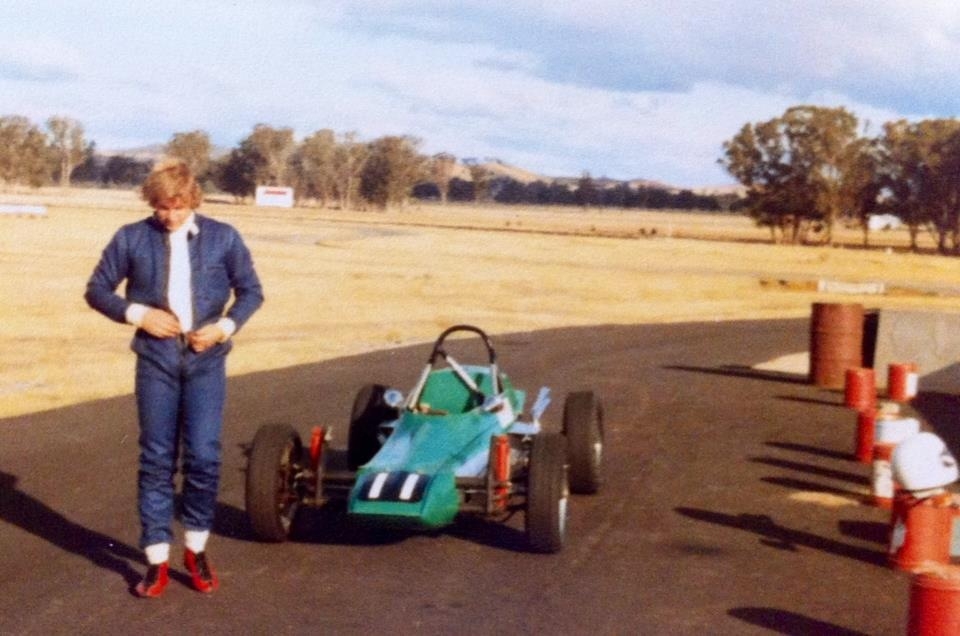
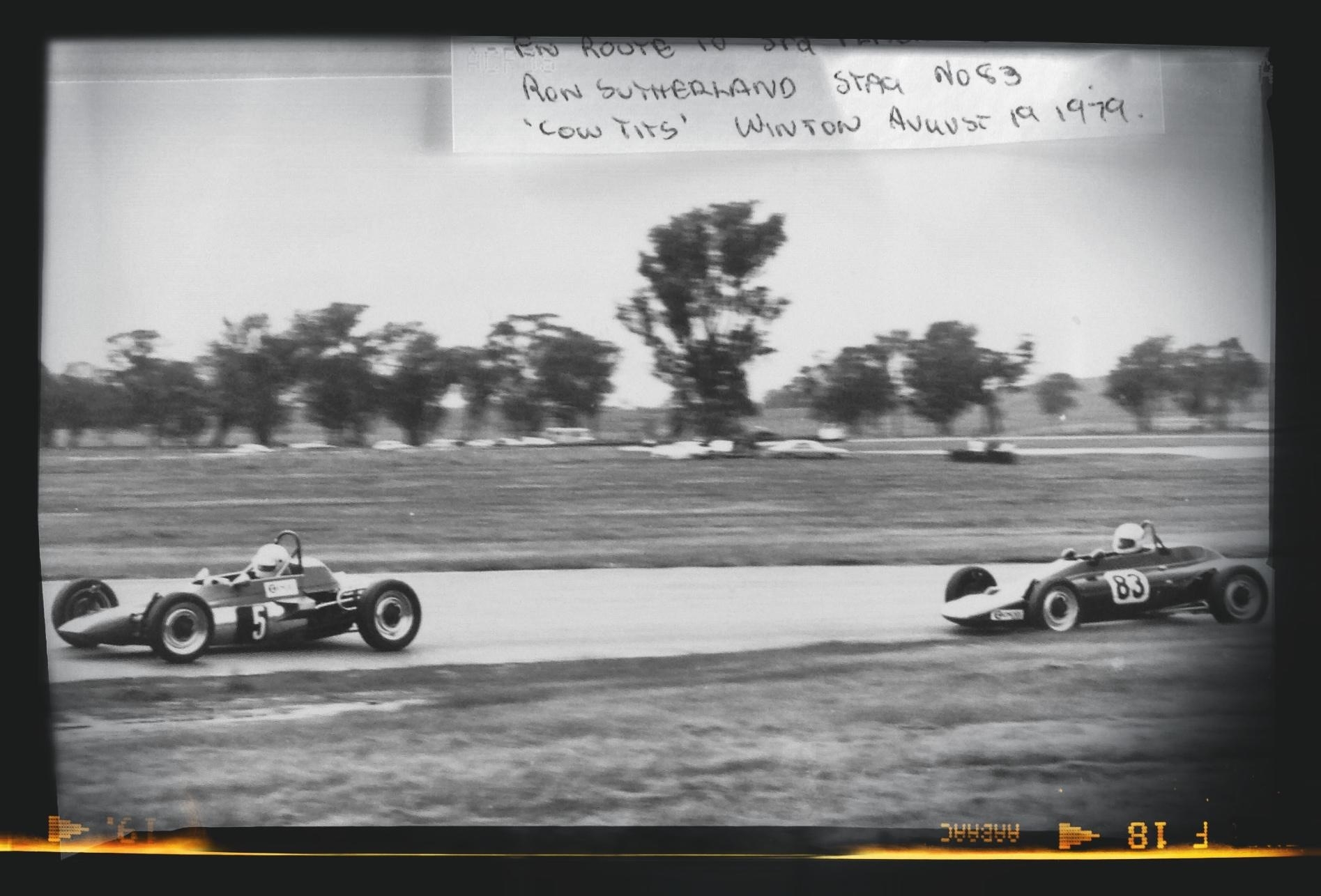
My Monash University years were lost really. The clever guys chased the babes, I saved my part-time factory work income, skipping dates with expensive sheilas to fund a Venom Mk2 Formula Vee in March 1979, the same month in which I joined the ‘real world’ of permanent work.

Scuderia Schitt-Fite was born! (SS-F)…

vee driver

SS-F works driver M Bisset at the Venom’s test session #1 (the only test session the noted team ever did) at Winton in February 1979. Copious sponsor decals on the drivers ‘Race-Safe Wool TT’ overalls indicative of his market worth. 1975 Venom Mk2 FV

image

Nurburgring 1967 (ullstein bild)

The Venom was a secondhand but front third of the field car when acquired (for A$2350 with some spares including a ‘tall’ Phillip Island ‘box and trailer), it continued to go well until my impressive mechanical skills were applied to said vehicles preparation. Memorable were the Scrutineers discovery of loose rear wheel nuts at Winton on one occasion and the steering column thru-bolt popping onto the Venoms aluminium undertray with a neat mechanical ‘pop’ sound just as the car was pushed onto the concrete scruts’ inspection slab at Sandown…we just kept pushin’ the car straight thru into the paddock to fasten said nut and bolt. ‘Me an me mate Tilly used to ‘prepare’ the car in the carport of my parents house, lack of a light and ever present wind and rain were obstacles to engineering excellence. Ignorance another.

vee cow tits

My $8500 per annum graduate accountants salary didn’t run to motel accommodation on weekend trips away so luxurious, old, ‘on site’ caravans had to do. Liz, my girlfriend of the time, I’d found one by then, used to come away with me.

These 20 year old monuments to design bad taste were quite something replete as they were with shag pile orange carpet, extensive stains on all of the sumptuous synthetic material clad couches and lashings of Laminex as far as the eye could see. Which was not far as these luxurious caravans were not exactly generous in size. The mood lighting comprised lots of missing globes so my toolkit always carried a couple of 45 watters to make up for what the van park proprietors  were reluctant to provide.

The final straw to the use of this cost-effective accommodation for the impecunious racer was the presence of bugs in the bed, I’m sure Liz’ scream that night could have been heard in Melbourne.

I was a sophisticated boyfriend of course, a Saturday night out at the suburban North Balwyn chinese joint with some good tucker washed down by a bottle of Lindemans ‘Ben Ean’ Moselle (such nectar of the gods was the vignerons equivalent of Coca-Cola, something not to be missed then and not missed at all now) very metro-sexual. A dude taking a bottle of Ben Ean to a gig was definitely going places, just not so sure exactly where.

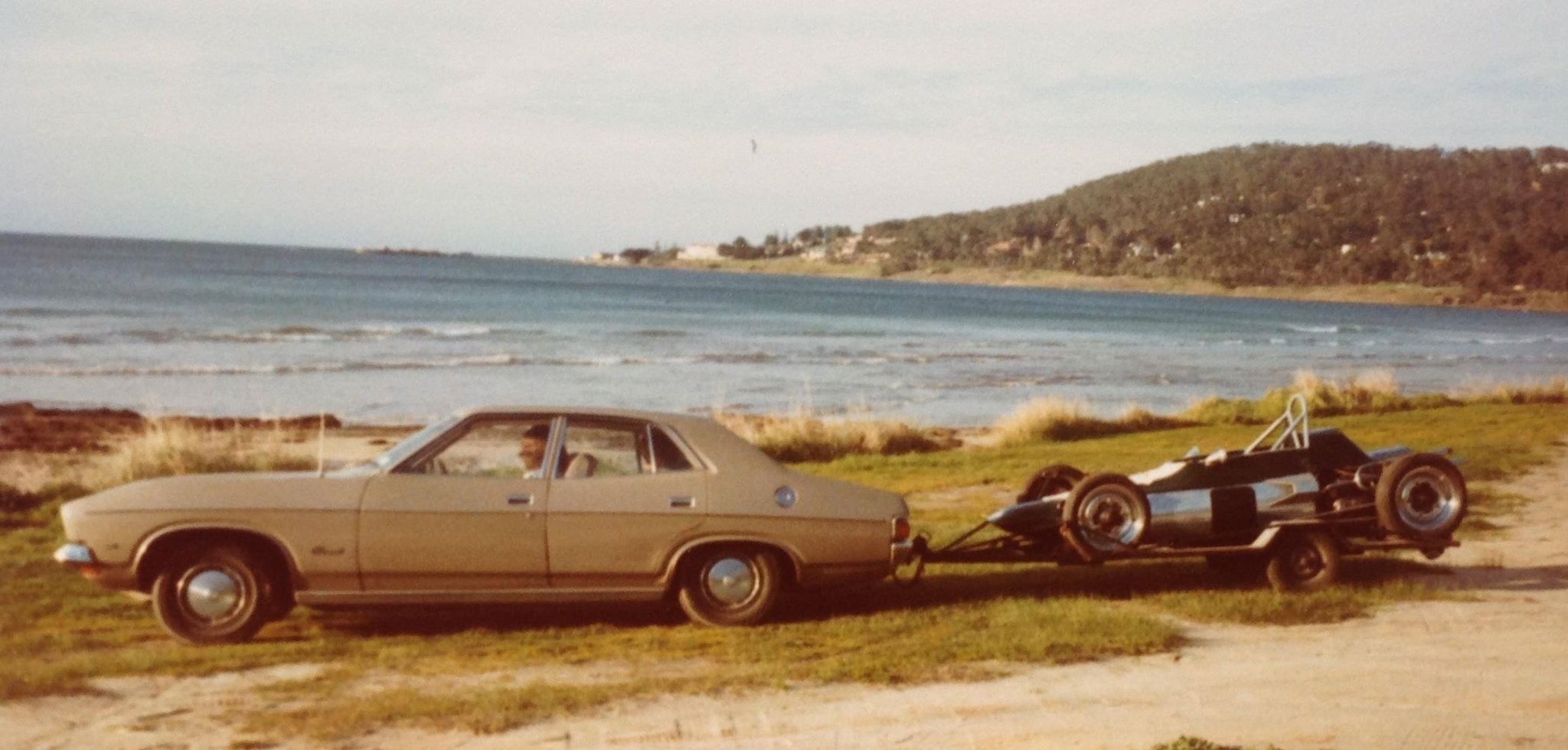
Liz was a ‘real trooper’ happy to help unload the Venom, wash, polish, change wheels as well as take care of the drivers emotional and physical well-being. A bonus was her taking charge of the big, roaring Ford Fairmont towcar at meetings end for the long trip back to Melbourne, the ‘tired hero’ asleep alongside after the physical demands of the weekend.

vee lorne

SS-F on tour, here we are at Lorne on Victorias Great Ocean Road, we did a hillclimb, Mt Leura at nearby’ish Camperdown that weekend. I’m 21 and this shot shows my total net worth; the $2600 Fairmont which had been my dads company car and the $2350 Vee & trailer. No spare cash, no margin for error. A 1981 Sandown shunt took 1 1/2 years to fix as i couldn’t afford the repair, boy we had some fun tho!

Jackie Stewart famously won Grands Prix by applying a policy of sexual abstinence the night before a Grand Prix. JYS felt it gave him a little extra raceday ‘edge’ rather than the sated, chilled feeling most of us have after ‘relieving the tension’, as we say in polite society.

My parents didn’t have a relaxed attitude about us kids ‘horizontal folk-dancing’ under their roof so every opportunity for passion away from Almond Street was to be enthusiastically embraced. Liz took a strong leadership and teaching role in relation to such matters, the little minx!, i wonder what became of her?

Its probably drawing too long a bow to suggest the differences in speed between Jackie Stewart and my good self are entirely due to his maintenance of ‘raceday edge’ by adherence to the Popes no-nookie dictum, and my more relaxed ‘shagadelic’ approach.

But its nice to think that had one made such sacrifices in the quest for speed that the great Scots achievements could easily have been surpassed.

Anyway, that’s my theory as to my own lack of competitiveness, and I’m sticking to it!

I suspect my ‘Summer of ‘79’ smiles are shared by many FV’ers not just Emmo, Niki and Keke…

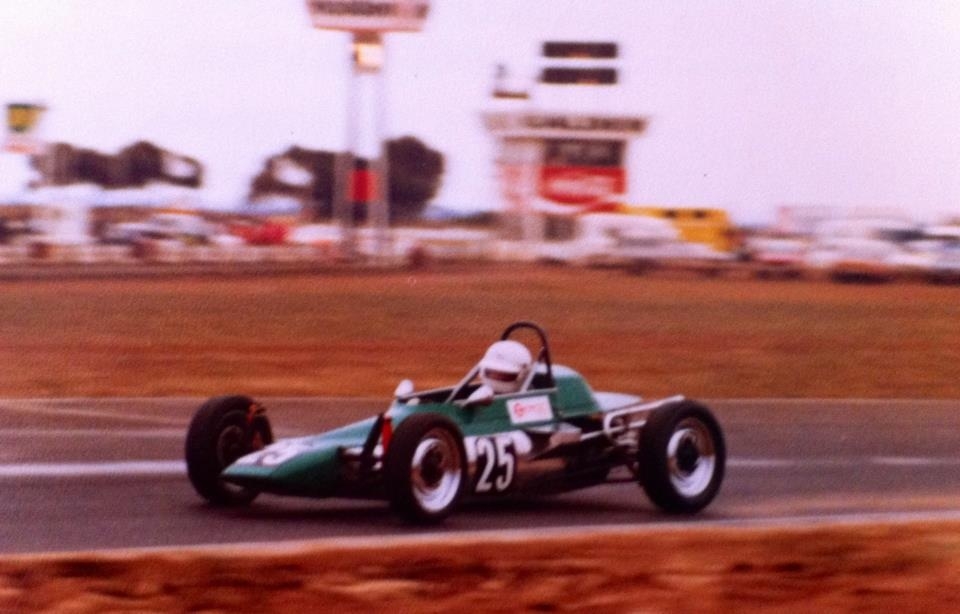
vee calder

Venom, Calder 1979

History of Formula Vee…

http://www.volkswagen-motorsport.com/index.php?id=411&L=1

Credits…

Getty Images/ullstein bild

Tailpiece…

image

Nurburgring 1967 (ullstein bild)


image

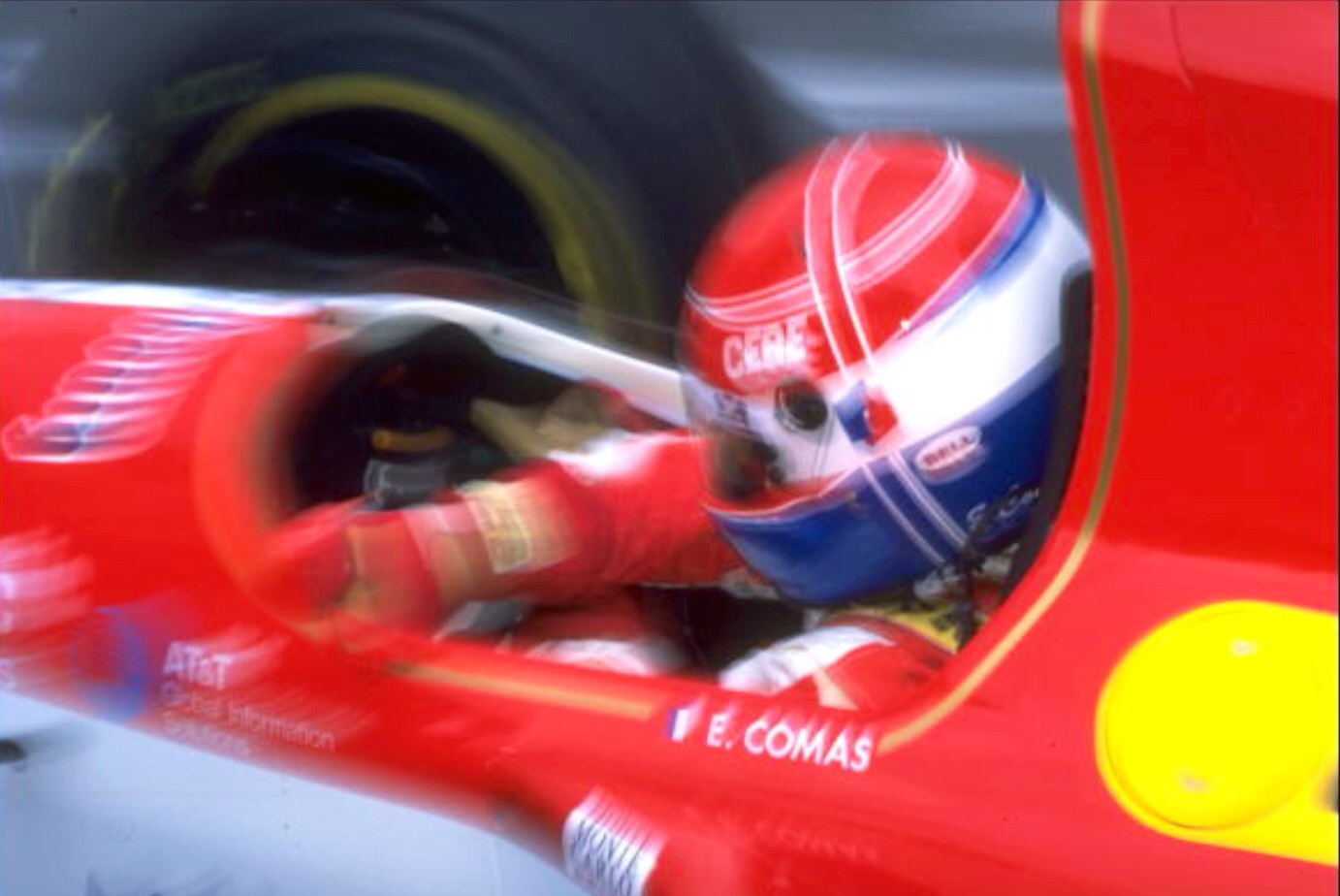
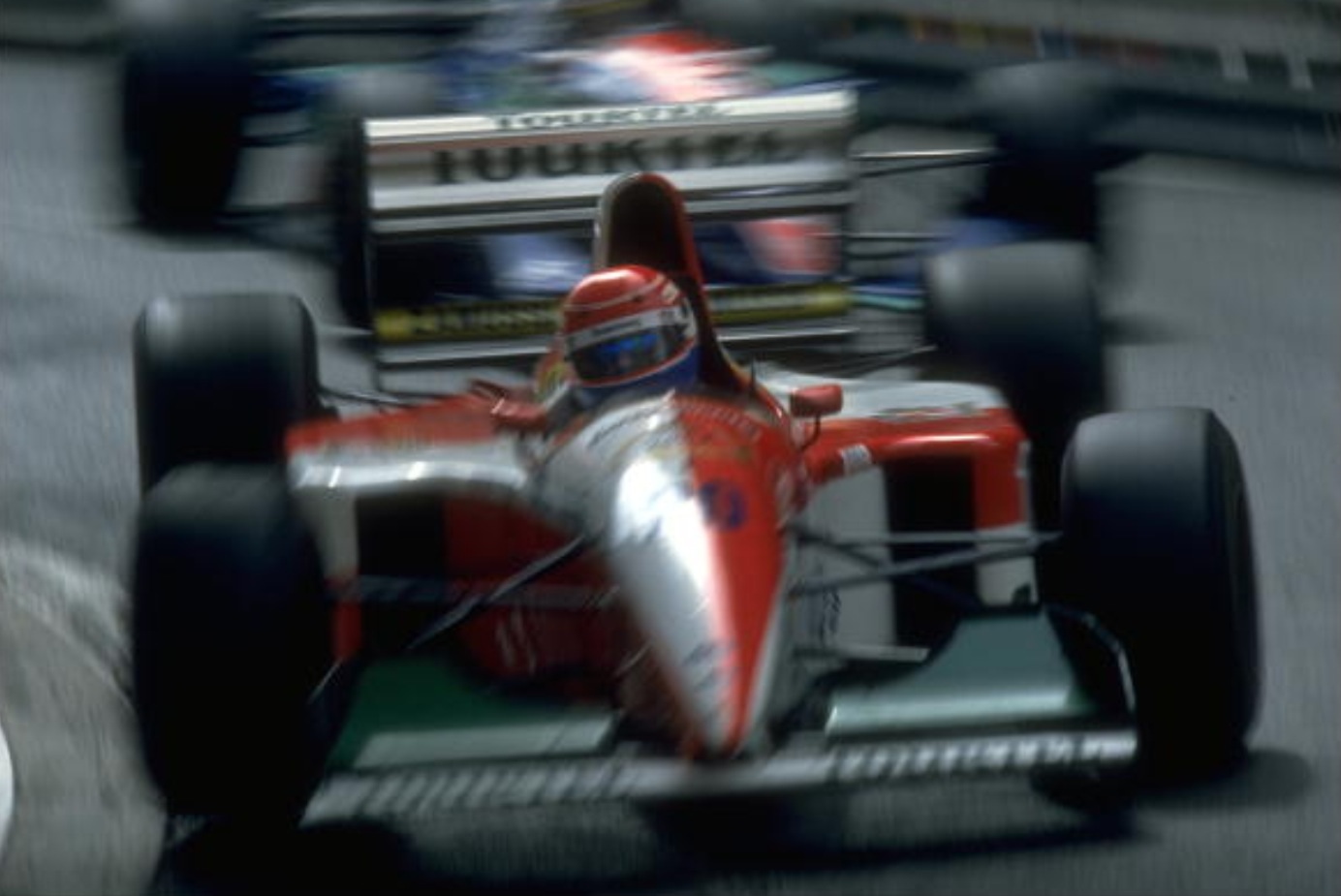
Eric Comas contesting the Monaco Grand Prix in his Larrousse LH94 Ford, 15 May 1994…

Comas qualified and raced this aging car and engine to 13/10th, good going in the tough F1 world of the mid-nineties. Up front, the race was won by Schumacher’s Benetton from Martin Brundle’s McLaren Peugeot.

image

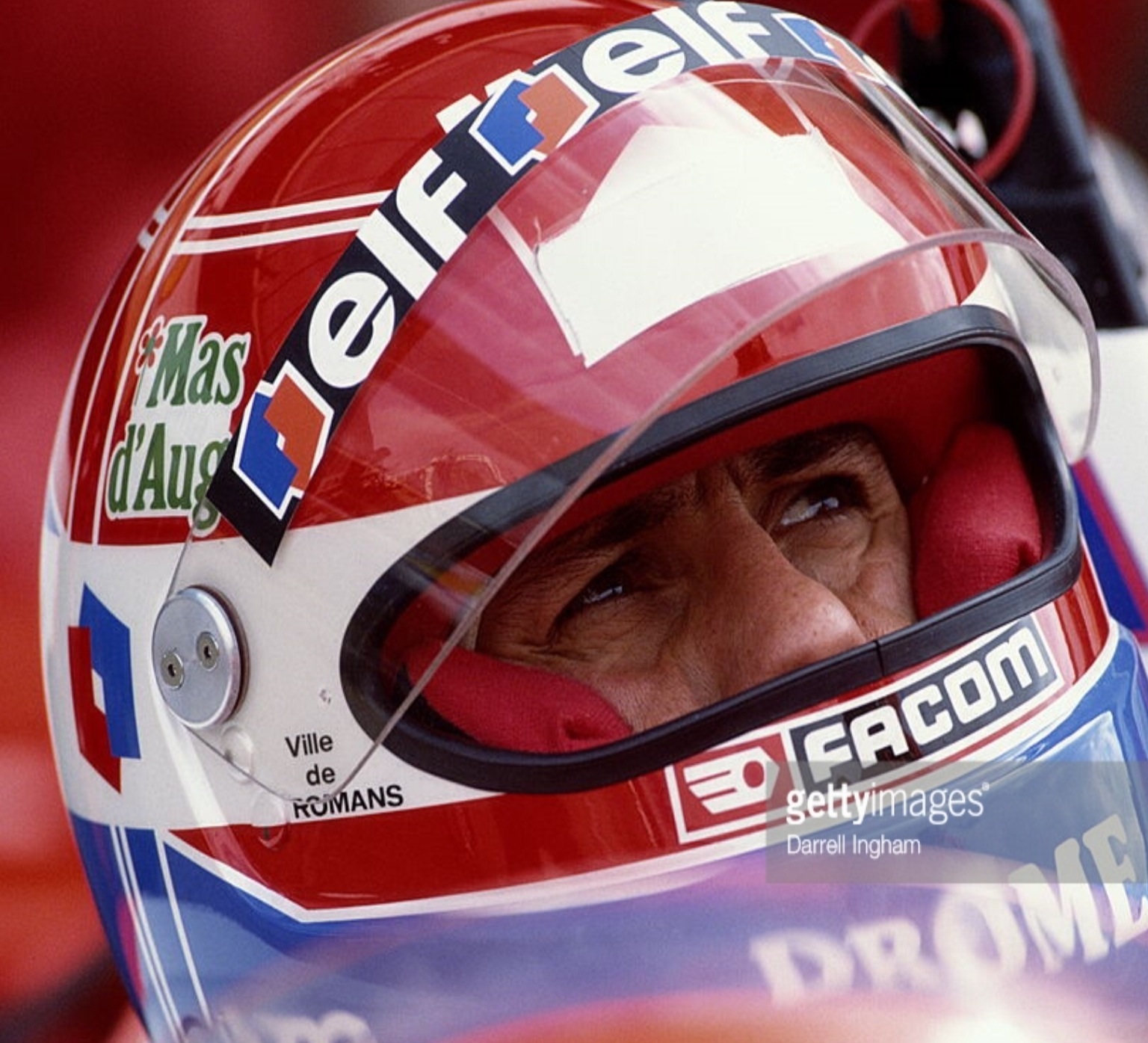
Comas came to F1 in 1991 via French F3 and European F3000, he was champion in 1988 and 1990 respectively. He contested 63 Grands Prix making his debut at Phoenix, the USGP on 10 March 1991 for Ligier in a JS35 Lamborghini V12. He scored a total of 7 championship points racing a Ligier JS37 Renault, Larrousse LH93 Lamborghini and Larrousse LH94 Ford in 1992, 1993 and 1994 respectively. His last point in the 1994 German GP was also the last for Larrousse.

Post GP racing he moved to Japan to contest the All Japan Grand Touring Car Championship winning the GT500 title in 1998 and 1999 for Nissan racing a factory Nismo Skyline GT-R. He shifted to Toyota and continued his run of success and later raced privateer Nissans before creating Comas Racing Management to nurture the careers of young up and coming, mainly French, drivers

Comas has now effectively retired, running Comas Historic Racing, which provides paying customers rides in Alpine Renaults in historic rallies.

image

Comas in his Lola T90/50 Mugen F3000 car at Donington in April 1990 (Ingham)

Imola 1994…

A bizarre incident in the horrific ’94 Imola weekend involved Comas and his Larrousse’ departure from the pitlane during the red flag after Senna’s accident, click here to read about the incident and its poignant circumstances.

http://viewingperspectives.blogspot.com.au/2014/04/imola-at-20-why-did-erik-comas-stop-at.html

Credit…

Getty Images, Darrell Ingham

Tailpiece: Monaco 1994…

image


Mountain Women…

Posted: October 2, 2016 in Compound curvature, Fotos
Tags:

image

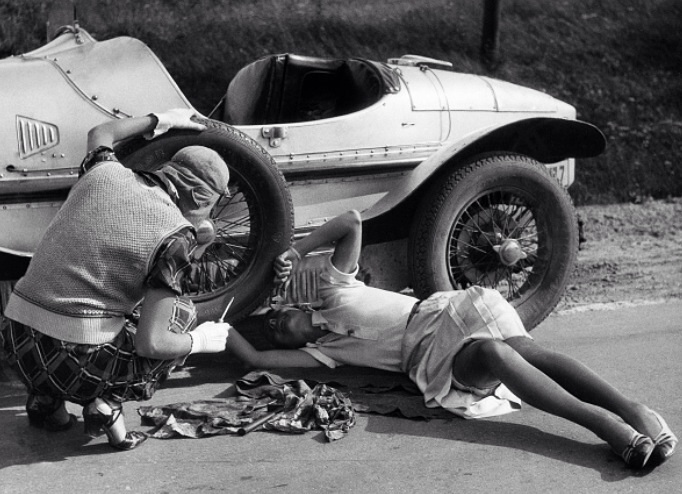
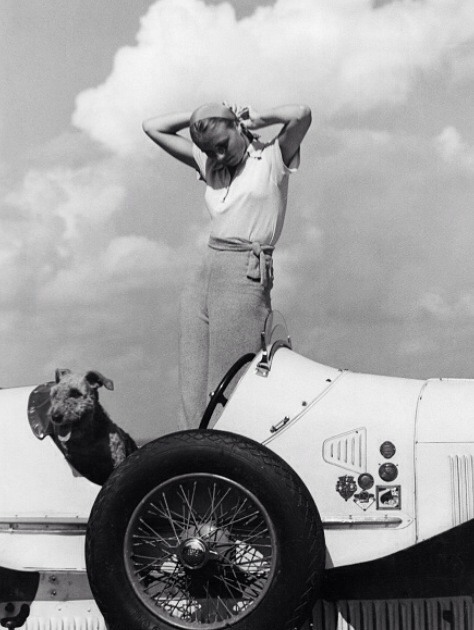
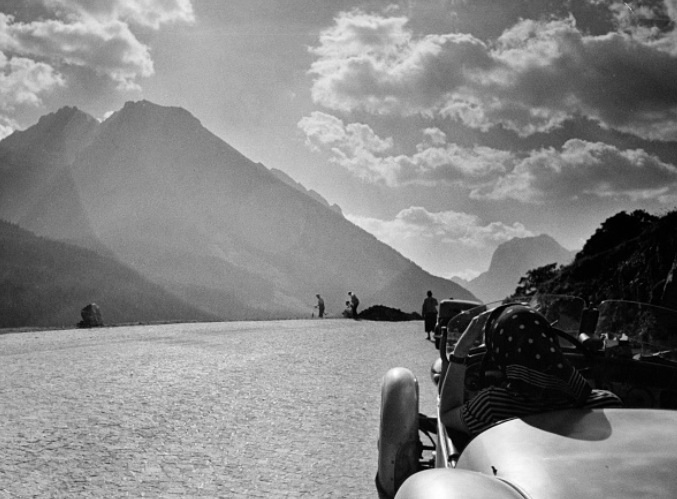
A couple of young fillies making good their Bugatti, at least I think it may be a Bug but it’s no more than a guess…

Another magazine shoot by Heinz von Perckhammer whose photographic speciality was mainly nudes, nice work it is too. Google away.

This series of photos was published in issue 14 of  ‘Sieben Tage’ in 1935. There are no caption details about date, place, car or models names sadly, all input in relation thereto gratefully received.

image

Credits…

Heinz von Perckhammer

Tailpiece…

image


image

(John Arkwright)

Check out the view Maxxy!

Niel Allen and Max Stewart having a contretemps at Skyline, Mount Panorama, Bathurst, Easter 1969…

The bucolic terrain of New South Wales Central Tablelands stretches into the distance, the view probably not what the two drivers were focussed upon at the time. The race was the 1969 Bathurst Gold Star round, the field of which was substantially reduced by this first lap prang.

The incident happened when Max misjudged his braking behind John Harvey, locked a brake and boofed the fence in his Mildren Waggott 1.6. Niel was right up Max’ chuff in his ex-Piers Courage McLaren M4A Ford FVA 1.6 and couldn’t avoid him. Out of shot is Queenslander Glynn Scott’s Bowin P3 FVA who also joined in the fun!

(D Simpson)

Dick Simpson’s shot was taken at precisely the same time as John Arkwright’s (look at Max in each shot) albeit a bit further down the mountain. Its Leo Geoghegan’s Lotus 39 Repco framed by Allen’s wing with Glynn baring down on the action on the left and about to become a part of it.

Terrific shots both, ‘instant reaction’ stuff but beautifully framed all the same.

image

Nice butt shot of Harvey’s BT23E; note wing mounted to cars uprights at rear, ‘RB740’ ‘between the Vee engine’ and oil cooler up in the breeze (oldracephotos.com)

Here (above) is a shot of Harve’s Bob Jane owned Brabham BT23E Repco, it was Jack’s works ’68 Tasman car, sold to Bob at the end of the series then raced by John in the following years. In fact it wasn’t a lucky car for Harvey, he had a big accident at the same Easter meeting in ’68 when an upright broke, rooting the car and John. He was in hospital for quite a while after the prang, his speed undiminished when he returned to racing Jane’s stable of racers, sports-racers and tourers.

image

Harvey’s BT23E at Bathurst after his big practice accident on 14 April 1968 (Dale Harvey)

Click here for an article on this car;

https://primotipo.com/?s=brabham+bt23e

These fellas are favourites; property developer Allen was later as quick as Australia’s F5000 ‘Gold Standard’ Frank Matich without nearly as many seat miles, Stewart a multiple ‘Gold Star’ (1971/4) and AGP winner (19734/5) and Harvey a winner in everything he raced; speedcars, single-seaters, big sportscars and touring cars, the Bathurst enduro included.

image

Start of the Bathurst ’69 Gold Star race: front row comprises Max’ yellow Mildren Waggott, Niel Allen McLaren M4A FVA and on the inside Leo Geoghegan’s Lotus 39 Repco. The blue car behind is Glynn Scott’s Bowin P3 FVA and Harvey’s red Brabham BT23E, the torque of which clearly gobbled up Stewart and Allen on the steep climb up the mountain for Max to nearly run into him heading down the mountain. The white car is Henk Woelders’ 3rd placed Elfin 600 Ford t/c. You can just see Jacks red Brabham on the outside beginning his charge. He had fuel feed problems in practice so was off grid 7 with times well below the cars potential (Neville McKay)

The race was won by Jack Brabham’s F3 based Brabham BT31 Repco on a rare Gold Star Australian appearance fitted into his European program. This little jigger was powered by a 2.5 litre ‘830 Series’ SOHC, 2 valve Repco V8. Easter Bathurst is an historically significant meeting in Repco terms; it was Jack’s last Repco race and win in Australia. Brabham’s last International Repco races were those contested by he and Peter Revson in the USAC Championship that year in Brabham BT25’s powered by Repco ‘760 Series’ 4.2 litre DOHC, 4 valve, methanol fuelled V8’s.

image

Brabham between Skyline and The Dipper, BT31 Repco during the race (Dick Simpson)

Check out, rather than repeating myself these articles on the BT31;

Brabham BT31 Repco: Jacks ’69 Tasman Car…by Rodway Wolfe

and on Brabham’s 1969 and 1970 seasons;

Easter Bathurst 1969: Jack Brabham 1970 and Retirement…

This article was inspired by Lindsay Ross uploading quite a few images of this meeting on his oldracephotos.com Instagram page, check it out, they pop up a post every day or so. It seemed an idea to put the images floating around of this meeting in one place. I’ve an Instagram page too, as well as Facebook, just key ‘primotipo’ into the respective search engines and follow the prompts. The FB page has quite a lot of shots I don’t use on primotipo so may be worth a look every few days.

image

Brian Page in BT23A with ‘740 Series’ Repco, DNF with broken exhaust on lap 15 in the ex-Brabham/Scuderia Veloce machine (oldracephotos.com)

The first lap accident ruined what could have been an interesting race, Jack cruised to an easy race win by 1.5 minutes from Harvey’s car and Henk Woelders F2 Elfin 600B Ford t/cam.

Historically interesting is that this meeting was on the weekend of 7 April 1969, high-wings were banned globally at Monaco on the GP weekend of 18 May 1969, so it’s interesting to see the ‘Australian State of the Art’ in terms of fitment of said aero devices immediately before they were banned. Brabham tried the ‘bi-wing’ below setup on his BT31 in practice but raced with only a rear wing fitted.

image

Of arcane interest, perhaps (from the master of the arcane and tangential) is that all of Jacks ‘works’ Repco engined Tasman cars competed in this race bar one…

Brian Page’s BT23A(1) is JB’s ’67 Tasman car, Harve’s BT23E(1) is the ’68 weapon and Jack raced BT31 the car, late arriving in Australia, which did the ’69 Sandown round only.

Missing is BT19(F1-1-65) the chassis in which Jack won the ’66 World F1 Drivers and Constructors titles, and in 2.5 litre ‘620 Series’ engined form, raced in the ’66 Tasman Series, putting valuable pre-GP season race miles on Repco’s ‘brand-spankers’ V8 at Sandown and Longford.

The only car not in Oz now is BT23E(1) which was, and still may be in the US.

image

Jack Brabham guiding BT19 (F1-1-65) into The Viaduct, Longford on his way to 3rd place during the South Pacific Trophy on 7 March 1966, the third race for the new RB ‘620 Series’ V8. The race was won by Jackie Stewart’s BRM P261

Whilst on the arcane it occurs to me is what a versatile, influential and successful design Ron Tauaranac’s BT23 space-frame was in the Brabham Pantheon…

’twas Ron’s clean sheet design for the new for ’67 1.6 litre European F2; it’s variants won a million F2 races over the following years in the hands of aces like Rindt but also in the care of privateer ‘coming-men’. Mind you it didn’t ever win the title despite winning 6 of the ten championship rounds in 1967, ‘graded drivers’ like Rindt were ineligible for championship points. Matra and Lotus took the ‘works entry’ approach more seriously than Jack and Ron during these years, in any event, as a customer racing car the BT23’s won lotsa races, the 1968 Rindt driven BT23C the most successful car of the year.

image

Jochen Rindt typically all ‘cocked up’ on the way to a win in the 9 July 1967 ‘GP de Rouen-les-Essarts’, Brabham BT23 Ford FVA. 1.6 litre F2 formula one of great chassis, it not engine diversity, Ford’s Cosworth FVA won every title from 1967 to 1971. F2 was 2 litre from ‘72 (unattributed)

From an F1 perspective the ’67 World Championship winning BT24 Repco was a ‘beefed up’ BT23, to the extent that Ron initially raced his BT24’s with an FT200 Hewland, the Maidenhead gearbox gurus ‘F2 box’ but found that tranny overstressed with ‘740 Series’ Repco V8 torque tearing away at its gizzards, its CWP in particular. I won’t bang on about the BT24 now as I’m in the process of writing an article about the ’67 Brabham/Repco winning season and go into much BT24 detail. Suffice it to say that the F2 BT23 begat the F1 BT24, my favourite Brabham.

image

Denny Hulme jumping his BT24 Repco at the Nurburgring during his ’67 Championship winning season. He won the German GP by 40 seconds from Jack (unattributed)

From an Australian viewpoint the BT23 Repco Tasman cars were very important as they provided much needed cars on skinny local grids…

The Tasman Series 2.5 Formula grids were ‘chockers’ with cars and stars, the domestic championship contained quality but not quantity. Budgets for these relatively expensive cars were hard to find in the sixties and Australia’s march to Touring Car domination was already well underway so ‘taxis’ were starting to absorb sponsorship budgets previously devoted to real racing cars.

Funnily enough, even though there was a swag of Repco engined BT23’s running around it was Alec Mildren’s, one off, 2.5 litre Alfa Romeo Tipo 33 V8 engined BT23D(1) which took a Gold Star. Frank Gardner raced this car in the ’68 Tasman, it was then taken over by Kevin Bartlett, the Aussie ace took the ’68 Gold Star in it. Repco never won a Gold Star title, a topic to explore at some stage during the Repco series of articles I am gradually writing with Rodway Wolfe and more recently Nigel Tait’s help.

image

Simply sensational Dick Simpson shot of Kevin Bartlett in BT23D Alfa, Hell Corner Bathurst Easter 1968, KB was walking away with the race until a broken rear upright ended his run. Dominant in this car in ‘68/9 (Dick Simpson)

Delving deeper into this BT23 tangent, whilst a BT23 Repco never won a Gold Star, a BT23 Waggott nee Mildren did…

Denny Hulme raced a works F2 Brabham BT23(5) FVA in the ’68 Tasman Series comprehensively boofing the car in the New Zealand Grand Prix at Pukekohe on 6 January, the series opening round.

Denny’s chassis was Jochen Rindt’s Winkelmann Racing entry in ’67, he won 9 Euro F2 races in it including the Rouen event pictured above. Another car (BT23-2) was sent from England for Denny to race in the rest of the series. Feo Stanton and Ian Rorison of Rorstan Racing bought the wreck and sent it to Rennmax Engineering in Sydney for Bob Britton to repair.

Instead of doing so Bob made a jig from the bent frame and sent a new chassis, the Rorstan Mk1 back to the Kiwis. Seven cars were built on the BT23 jig; the Rorstan, Mildren, two Rennmax BN2 and three BN3’s. Of these the Mildren, so named by Alec Mildren, the Sydney Alfa Romeo dealer, team owner and former Gold Star champion was the most successful. The Britton jig was also put to good use over the coming years repairing cars like Harvey’s bent BT23E!

image

Max Stewart ‘harry flatters in top gear’ heading down Surfers Paradise main straight and about to guide his 2 litre Waggott powered Mildren missile under the fast right hander and Dunlop Bridge. 9th in the ‘Surfers 100’ Tasman round in 1970 against the F5000’s. Graham McRae’s McLaren M10A Chev won the race but Bartlett’s 2 litre Mildren Mono Waggott was 2nd on this power circuit (Dick Simpson)

So…the Mildren pictured resting against the Skyline Armco fencing at this articles outset is a BT23 design. Max Stewart was prodigiously fast in the Mildren Waggott, he was one of those guys who seemed to get quicker as he got older, in ’69 he was quick, by the mid-seventies he absolutely flew in his Lola F5000’s. He was one of the very small number of blokes in Oz who squeezed absolutely everything out of these, big, demanding, fast, spectacular, fabulous 500bhp V8’s.

Bartlett, Matich, Allen, John McCormack, Bruce Allison, Warwick Brown, John Walker and Stewart in my book were the F5000 aces with Matich, if I have to pick one, the first among equals. Mind you, on sheer speed Alf Costanzo who came relatively late to the F5000 party could have been ‘the one’. Its an interesting topic to debate, end of F5000 tangent!

One of the pit sights which always amused me, and admittedly small things amuse small minds was big Max, he wasn’t a ‘fat bastard’, but he was 6’2”, crammimg himself into one of his cars before setting off for the dummy grid. If there was a taller bloke than Max in F5000 globally I’d be intrigued to know his name. He must have given away at least 10Kg to the rest of the grid before he even plopped his arse into the tight aluminium monocoque confines of the F5000 Lolas in which he excelled.

image

Max was big of stature and heart; here he is after winning the Rothmans International Series ‘Sandown Cup’ on 20 February 1977, his last big win, Lola T400 Chev, sadly not too long before his untimely death at Calder, 19 March 1977 (Ian Smith)

By the time Merv Waggott was building 2 litre variants of his superb DOHC, 4 valve, Lucas injected, bespoke aluminium blocked engines they were outright winners in 2.5 litre Tasman Formula events in the hands on the Mildren Duo, Messrs Bartlett and Stewart. The first Gold Star for F5000 was in 1971; Max’ Mildren Waggott won the Gold Star with about 275bhp from his close mate Bartlett in a much less nimble and reliable 500bhp McLaren M10B Chev in a year of speed and consistency. I don’t care what anyone says, F5000’s driven to their limit were always a little brittle.

So, to join the dots, a BT23 design did win the Gold Star albeit called a Mildren. Stewart’s Mildren Waggott and Bartlett’s Mildren ‘Yellow Submarine’ Waggott are tangents too far for this article and a wonderful future topic, there is a sensational article to be written there with Kevin Bartlett’s first-hand assistance on both chassis’ and engine if I ask him nicely…

image

Merv Waggott changing plugs in his baby, Wigram 1970. Bartlett’s Mildren Mono ‘Yellow Submarine’ Waggott (Bill Pottinger/the Roaring Season)

Merv Waggott changing plugs in one of his superb jewels. An all alloy, DOHC, gear driven 4 valve Lucas injected circa 275bhp 2 litre engine. Its in the back Of Kevin Bartlett’s Mildren ‘Yellow Sub’ Waggott, shot is in the Wigram paddock, 1970 Tasman round on 17 January on 7 December. KB had a lousy meeting, not setting a practice time and DNF on lap 6 with engine dramas, Stewart was 3rd though in his car, Matich the winner in his McLaren M10A Chev.

The Waggott 2 litre engine was first built in late 1969 and initially developed circa 250bhp, its output later circa 268-275bhp with about 160 lbs/ft of torque. It raced to a win in KB’s hands in the ‘Sub upon debut in the ’69 ‘Hordern Trophy’ at WF, KB won again at the 1970 Warwick Farm Tasman round ahead of all the F5000’s and 2.5 Tasman Formula cars.  2 litre Waggotts won Australias’ Gold Star in 1970 for Leo Geoghegan (Lotus 59) and Stewart in ’71 as noted above.

An article about Merv and his creations is a wonderful feature for another time. Briefly for international readers Waggott’s Sydney shop built race winning engines from the 1950’s, checkout the article below on the WM Special/Cooper T20 Waggott Holden twin-cam 6 cylinder raced by Jack Myers and tested by Stirling Moss in the late ‘50’s as some background.

Stirling Moss and Jack Myers: Cumberland Park Speedway, Sydney: Cooper T20 / WM Holden 1956…

Winding the clock forward, as the ANF1 2.5 litre formula spluttered on in the late sixties a ‘battle to the death’ was fought for the new ANF1 category in Oz between opposing forces who supported either F5000 or 2 litre F2. The latter to commence in Europe from 1 January 1972, F5000 commenced in Europe in 1969 and was born in the US as Formula A earlier still.

Waggott engines were initially of 1600cc, then later 1860cc and used the ubiquitous Ford Cortina block, same as Cosworth’s 1’6 litre FVA wherein Keith Duckworth tested his design ideas in advance of finalising his DFV design. In 1600 form the Waggott would have been Euro F2 legal, it used a production block as the regs required. The 1.6 litre F2 started in ’67 and ended in 1971 when it grew to 2 litres. There were a few FVA’s racing in Australia, the 1.6 Waggott more than a match for them, no Waggott’s, sadly, ever raced in Euro F2.

image

Lance Ruting studio shot of one of the engines, Ford block by the look of it so 1600 or 1860 (autopics.com)

Waggott 2 litre engines used a bespoke aluminium block as the stock cast iron Ford block maxxed out at about 1860cc. Beyond that the pistons kissed! Mike Hailwood’s Surtees TS10 won the ’72 Euro F2 Championship running Brian Hart built Ford BDA’s of 1850cc, those competitors running greater capacity than that had unreliability. The final Euro 2 litre F2 regs required production blocks from 1972-75 until ’76 when ‘racing engines’ were allowed. So, in the earliest years of the class the Waggott was ineligible.

Merv’s engines could have raced in F2 from ’76 but he had long before told CAMS to ‘shove it’ after F5000 was chosen (probably rightly given the backing of Ford, Holden and Repco who were building V8’s/wanting to develop an F5000 variant of the Holden engine in Repco’s case) as Australias’ new ANF1 from the 1971 Gold Star competition.

Had the ingenious, beautifully built little engine been Euro F2 Championship legal in 1972 Sydney’s Waggott Engineering had the winning engine! The engines were tried, tested championship winning donks ready to pop into any car. 275bhp and a big fat torque curve, Kevin Bartlett quoted the usable rev range of 6800-8750rpm, would have done the trick in 1972, the BMW M12 changed the F2 game from ’73 of course.

A wonderful ‘mighta-been’ all the same. Merv could have ‘stolen the F2 march’ in 1972 in much the same way Repco did in F1 with its Olds F85 production block based ‘620 Series’ V8 in 1966…

image

Max Stewart on the way to winning the ‘Angus & Coote Trophy’, the 1971 Oran Park Gold Star round on 27 June. Mildren Waggott 2 litre, Graeme Lawerence was 2nd in a Brabham BT30 FVC, the little cars succeeding as the F5000’s fell away (Dick Simpson)

Credits…

John Arkwright, oldracephotos.com, Dick Simpson, Dale Harvey, Bill Pottinger/The Roaring Season, Ian Smith, Neville McKay, autopics.com.au

Bibliography…

oldracingcars.com, F2 Register

Tailpiece: A Lotus to end an article on Brabhams…

image

Leo Geoghegan’s Lotus 39 Repco with ‘830 series’ Repco V8, started from the Bathurst ’69 pole but out on lap 12 with a gearbox problem, his time would shortly come with this car, winning the JAF Japanese GP later in 1969 amongst a classy field (oldracephotos.com)

Click here for an article on this ex-Clark chassis;

https://primotipo.com/?s=lotus+39

Finito…


image

Amazing Reims background as Nuvolari blasts his Scuderia Ferrari Alfa Tipo B/P3 to French GP victory on 14 July 1932…

What an endurance test, the race 5 hours in duration! Grands Prix have been 200 miles for so long its easy to forget what the ‘titans’ coped with nearly 100 years ago. Maserati didn’t race so it was a straight fight between Bugatti and Alfa Romeo with the Milan brigade winning comprehensively in their new 2.65 litre straight- 8 Vittorio Jano designed machines.

It was Nuvolari from Baconin Borzacchini and Rudy Caracciola in Alfa Corse entered cars, the best placed Bugatti T51 that of Louis Chiron in 4th.

This article is some words around some great shots of  Nuvolari from the Getty Images archives, treat it as the first in an occasional ‘at random’ series.

image

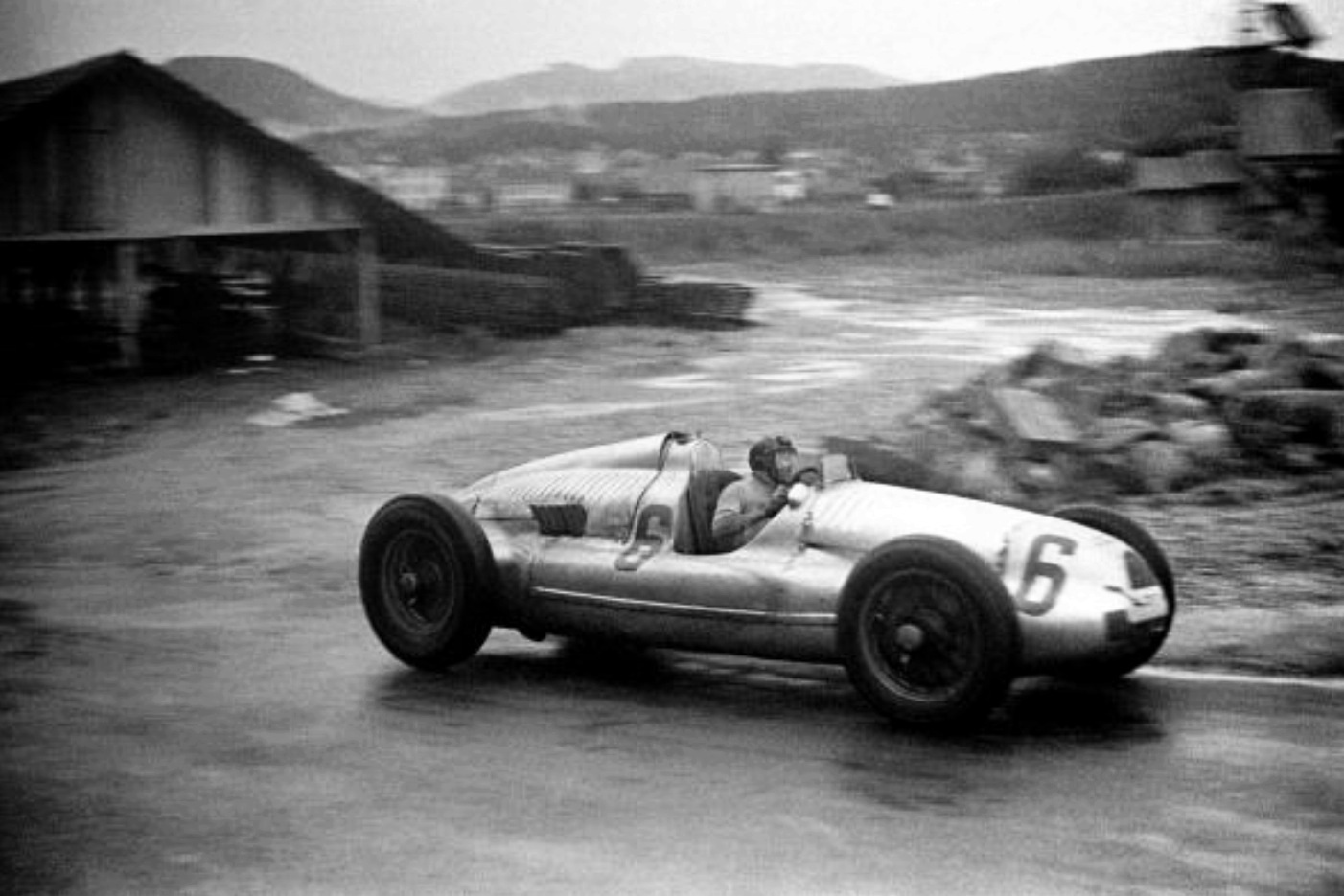
Tazio, Bremgarten, Swiss GP, Bern 21 August 1938 (Klemantaski Collection)

 Swiss GP, Bern 21 August 1938…

Tazio during the race held in awfully wet conditions. Seaman’s Mercedes lead from pole from teammates Stuck and Caracciola, he opened up a good lead but lost it after being boxed in by backmarkers allowing Rudy to sneak through.

Muller’s Auto Union raced well, Stuck spun and Tazio had undisclosed mechanical dramas in their mid-engined Type D’s. Mercedes 1-3 result was Caratch from Seaman and Manfred von Brauchitsch, all in W154’s.

image

Donington GP 1938

’38 Donington GP…

The winds  of change were blowing in Europe, the race date was changed due to the Munich crisis by three weeks, the race held on 22 October 1938. Nuvolari’s exciting weekend started in practice when his Auto Union Type D 3 litre V12 ran into a deer! But he lead the race from the start then ceded the lead to Herman Lang, pitting an additional time. The engine of Hansons Alta blew with Hasse spinning and crashing on the oil and Dick Seaman losing a lap. Tazio sneaked past Muller back into 2nd, then Herman slowed with a broken windscreen giving the plucky Mantuan the lead which he held to the end of the race. Lang was 2nd and Seaman 3rd both in 3 litre V12 Mercedes Benz W154

image

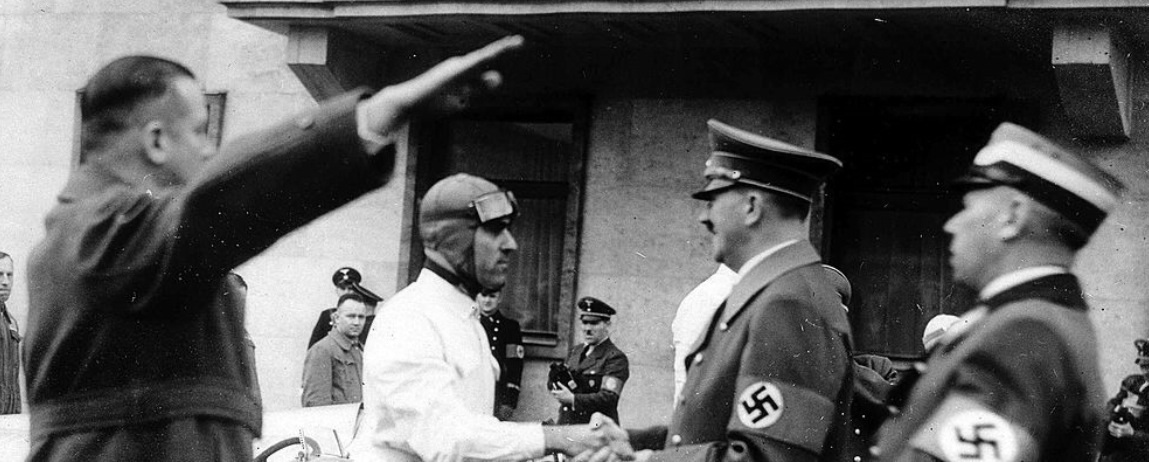
Tazio with some Nazi flunkies, ‘International Automobile and Motor Cycle Show’ 18 February 1939 Berlin. Hard to avoid these pricks racing for a German team at the time i guess (Popperfoto)

International Automobile & Mototcycle Show, 18 February 1939…

The first German automotive show was held in Berlin in 1897 with 8 cars, visitor numbers grew exponentially together with the growth of motoring itself, by 1939 825,000 people attended to see the new VW and other more sporting exhibits.

image

TN Jaguar XK 120, Intl Trophy Meeting, Silverstone 26 August 1950 (J Wilds)

Silverstone International Trophy Meeting 26 August 1950…

Tazio was entered in a red, standard, ex-demo factory XK120 Jaguar in the production sportscar race during this famous annual meeting.

The MotorSport report of the meeting records ‘It was splendid to see Nuvolari go round at 75.91 mph in a hard-used Jaguar demonstrator, using his gearbox where others trod on their brakes, but on Friday he was said to be ill from methanol fumes – odd, for the production cars were on petrol – and Whitehead drove for him’.

Nuvolari was quite ill by this stage and struggled, he did three slow laps on the first day of practice then Jaguar team manager Lofty England had the task of telling Tazio that he was too slow as a consequence of his fitness.

Doug Nye made this observation of the genius on ‘The Nostalgia Forum’; ‘In his final years Nuvolari was a variably sick man, varying from being in frail shape to being in terrible shape. I have been told by many who met the great man at that Silverstone meeting that he was, indeed, in terrible shape that weekend…and they were all greatly concerned for him…some even wondering if he might not survive the journey home…

Nuvolari had at least as a high a proportion of admirers amongst British racing enthusiasts as he had in his native Italy, and possibly higher, and for many it was like seeing a retired old thoroughbred racehorse, attemping one last gallop on grass, arthritic, blown, sway-backed, and broken down … for many present that weekend it was remembered as a terribly sad sight… particularly for those who recalled the sight of Nuvolari in his pomp at Donington Park, 1938’.

Nuvolari died on 11 August 1953 having suffered a stroke which partially paralysed him the year before, a second one killed him.

Credit…

Imagno, J Wilds, Getty Images

Tailpiece: Moss and Nuvolari at the International Trophy meeting, Silverstone 1950. Shot is symbolic of generational change but it’s also clear just how fragile the great man had become…

image


image

Blondie surrounded by World Champs; Messrs Hulme, Hill and Clark, Melbourne, 1968…

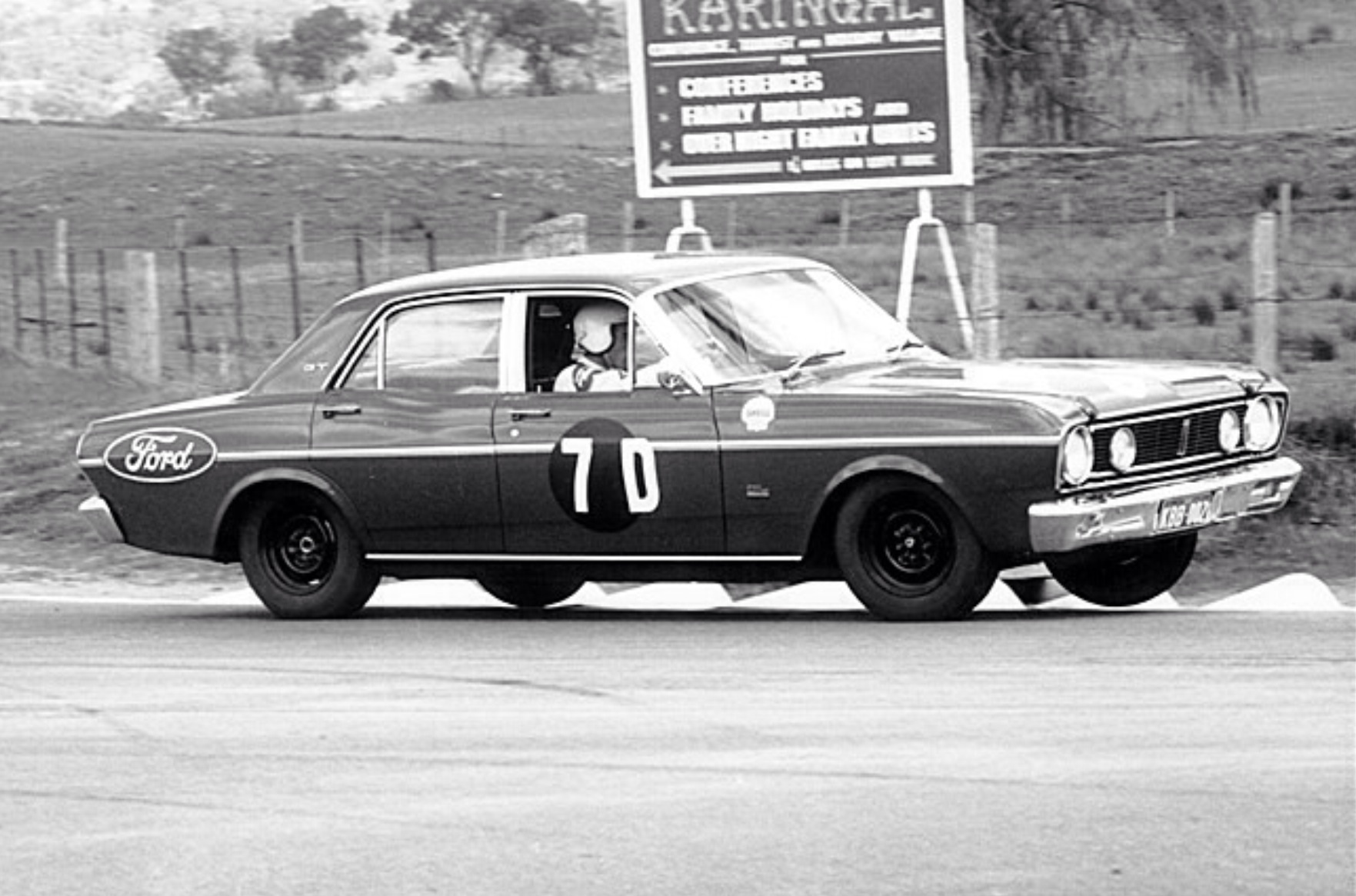
Ford Australia’s 1967 ‘XR’ Falcon was a big step forward in its market competition with General Motors ‘Holden’ who had a dominant position.  The XR GT packed a 289cid V8 and started the trend of local pony cars which provided wonderful road cars and iconic Bathurst racers for years.

image

Barry Cassidy, Ford Falcon ‘XR’ GT, Newry Corner, Longford March 1968 (oldracephotos.com)

This photo is no doubt part of Ford’s ongoing repositioning of their product, ‘Going Ford is the Going Thing’ was FoMoCo’s ‘tag line’ of the day.

‘Blondies’ car is the 1968 ‘XT’ Falcon 500 ‘poverty pack’. A 302cid V8 was cranked under the bonnet to create the GT, a 4 speed box, slippery diff and front disc brakes with firmer springs and shocks completed the performance makeover. This was the only one of the ‘Big Henrys’ which didn’t win the Bathurst enduro classic. An ‘HK’ Holden Monaro 327 coupe driven by Bruce McPhee took the ’68 win.

‘Win on Sunday, Sell on Monday’ is the adage…

image

The Spencer Martin/Jim McKeown XT Ford Falcon GT auto!,Bathurst 500 1968. The pair were 42nd, the highest placed Ford was the XR GT driven by McIntyre/Stacey which was 7th (unattributed)

The local ranges of Ford and Holden were full of mundane stodge in 1966, perhaps the Cortina GT the ‘highlight’. Times ‘were a changin tho’, by 1970; Ford offered the Falcon 351V8 GT/GTHO, Lotus engined Escort Twin-cam, Capri GT V6 and 1600GT and Holden the Monaro HG 350V8 and Torana XU1 which sported a 186cid ohv triple-carbed straight six, all wonderful cars for 13 year olds to dream about…

ford

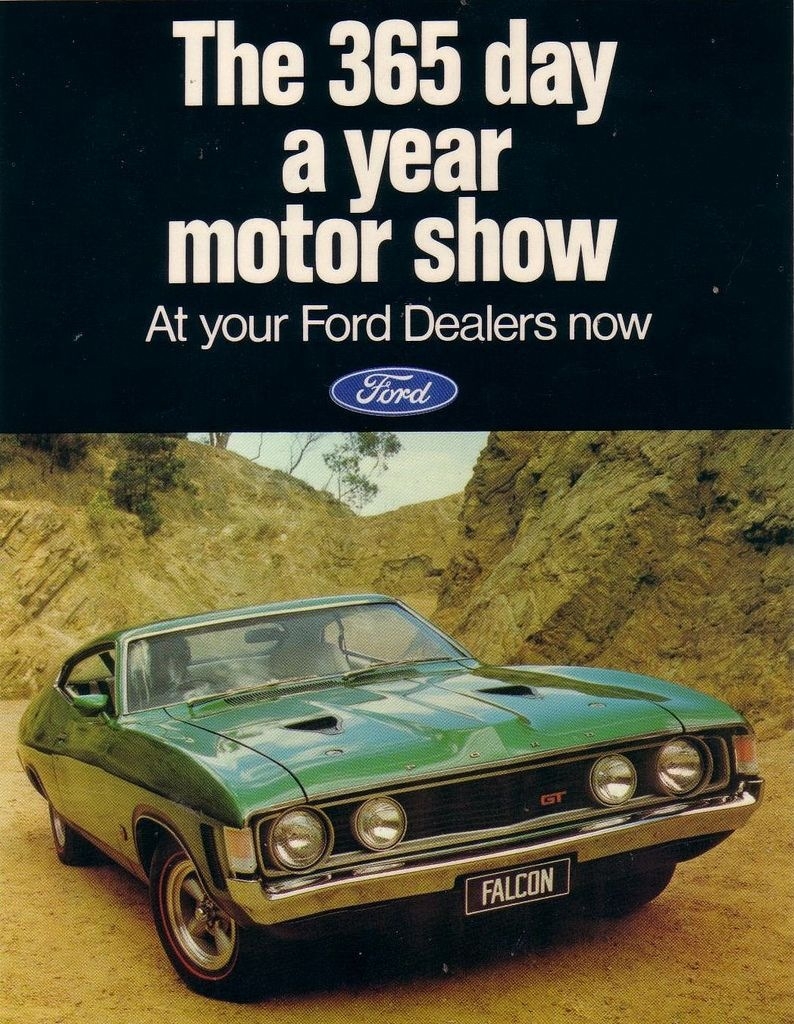
Ford Oz ad for the 1972/3 ‘XA’ Coupe GT; 351cid 300bhp V8, 4 speed ‘top loader’ box, slippery diff, disc/drum brakes, great cars!

Ford provided some support to Team Lotus who campaigned Lotus 49 DFW’s for both Jim Clark and Graham Hill during the ’68 Tasman Series which Clark won.

The Falcon shot at the articles start has Victorian plates so the shot was probably taken in the week of 25 February to 4 March 1968. Clark took the Sandown, Victorian round. The world champs were then in Melbourne for a few days before heading to Longford, Tasmania for the series ending race won by Piers Courage’ McLaren M4A FVA F2 car in a stunning wet weather drive.

image

Clark ahead of Graham Hill, slices into The Esses during the ‘Warwick Farm 100’, another win for the Scot’s Lotus 49, he took the ’68 Tasman (oldracephotos.com)

Credits…

Ford Australia, oldracephotos.com

image

The trouble with so many shots of Maria Teresa de Filippis is that many were shot by non-racing photographers so are devoid of the detail we want!…

‘Maria Teresa with racing car’ is about as precise as it often gets, it gives we amateur historians a research challenge I guess. Having trawled through the ‘F2 Register’ Formula Junior Archive as best I can (although the listing for this event does not include competitor numbers) this is the ‘Confronto Nord-Sud’ contested at Vallelunga on 1 November 1958. Lucio de Sanctis won the final in his own de Santis Fiat with Maria Teresa 4th in the first heat and 6th in the final. I wrote a short article after de Filippis died last year, click here to read it;

Maria Teresa de Filippis…

The car behind Maria Teresa is another Stanguellini, unfortunately the mid-engined car has been largely cropped out of the shot, ‘twould be interesting to know what it is if any of you FJ experts can identify the machine.

image

MTdF in her Stanguellini at Vallelunga in 1958 (Popperfoto)

Formula Junior had 11 events in 1958, 9 of them in Italy, the category’s champion was Count Giovanni Lurani an Italian who saw the need for a relatively inexpensive entry-level single-seater class. The category was for cars with engines of 1100cc and a minimum weight of 440Kg (their was a 1000cc class as well with a lower weight limit) exploded in 1959 with meetings all over Europe, the UK from mid-year and a couple towards the end of the year in the US.

image

Count Giovanni ‘Johnny’ Lurani, here in the mid-30’s, was an Italian auto engineer, driver and journalist who raced Salmson, Derby, Alfa and Maserati’s after graduating in engineering at the Politecnico di Milano. He won his class in the Mille Miglia thrice and founded Scuderia Ambrosiana in 1937. Post WW2 he worked with the FIA, his credits include the creation of FJ in ’59 and the GT Class in ’49. He also designed record breaking motorcycles and was president of the FIM in a life of achievement (ISC Images)

The category was immensely successful largely due to a progressively more buoyant post-war global economy, improving personal incomes and the arrival of consumer credit which meant young aspirants to Fangio’s world crown could buy a car.

There was plenty of choice of weapon too as builders of chassis and related componentry popped up all over the joint from Australia to Russia. An article on FJ and its incredible growth is an interesting one for another time!

image

Stanguellini factory in Modena with a swag of FJ’s lines up out front in 1959 (stanguellini.it)

Stanguellini were beautifully placed to build cars for Formula Junior given their rich history of racers based on the Fiat parts bin…

That glib phrase does not do the heritage of this firm justice however, click on this link to the marques website which provides a great summary of their cars and engines since the 1930’s, the photographic archive is also rich, take the time to cruise through it; http://www.stanguellini.it/en/100-years-of-history-stanguellini-car/

The ‘Stang’ is often often said to be a mini-250F but its as much Vanwall or Lotus 16, either way those comparisons don’t do justice to a car which has a beauty all of its own.

image

Stanguellini Fiat FJ cutaway drawing, all the key elements of the car clear and as described in the text (unattributed)

Vittorio Stanguellini engaged Alberto Massimino who was very clever in his design approach; its not innovative in terms of its ladder frame chassis, or choice of front-engined layout although the first cars appeared in late ’57 or ‘early ’58, the ‘Cooper Revolution’ wasn’t necessarily clear at that exact moment in time. A year later the mid-engined trend was, but the Stang with its circa 80bhp, twin Webered 1098cc pushrod engine was the most competitive thing around in 1958 and 1959.

In part it was due to a clever layout which provided the driver a low driving position, getting the weight down by the use of an offset drive line, the Fiat 4 speed gearbox kinked to the right, the driver to the left. The cars had conventional upper and lower wishbone front suspension and a Fiat live axle nicely located with parallel trailing arms and sprung by coils, co-axial shocks were used front and rear. The ‘look’ was completed by the use of Borrani 12 inch wire-wheels, brakes were finned Fiat 9.8 inch drums front and rear. The wheelbase was 79 inches, front and rear track 48 inches.

image

Snug cockpit of Norm Falkiners Stanguellini FJ in late 2015, offset transmission to get the driver down nice and low clear . Engine and ‘box Fiat 4 speed (Bisset)

None of these Stanguellini’s raced in Australia ‘in period’ but Melbourne driver Norm Falkiner imported one a decade or so ago. I happened to be testing my Van Dieman RF86 Historic Formula Ford at Calder when its restoration was just completed by Jim Hardman, who still fettles it. These mixed track days are interesting to see how different cars do their stuff (or not!) up close, I can still recall how nice the thing put its power down and how much punch it seemed to have, I could hear the little Fiat engine buzzing to circa 7500rpm each time I ranged up near it. It was less impressive under brakes, but chances are they were still being sorted.

Maria-Teresa’s views on the ‘Stang relative to the GP machines she was piloting at the time would be interesting!

image

de Filippis in her 250F at Spa in 1958, 11th in the Belgian GP won by Tony Brooks Vanwall VW57 (unattributed)

Robert Lippi won the Italian Championship in 1958 and Michel May won both the ’59 Monaco FJ GP and ‘Auto Italiana International Championship for Drivers’ and Stanguellini the ‘Quattroroute International Championship of Makes’. The ‘Campionato Italiano’ went to Stanguellini driver Raffaele Cammarota.

In 1960 things got tougher. The Brits ran their first championships for the class, Chapman’s mid-engined Lotus 18 was just as quick with an 1100 Ford bolted into the back of it as a 2.5 litre Coventry Climax FPF. It and the Cooper T52 BMC made the pickings tougher for the ‘front-engined brigade the best of which that year was perhaps the Lola Mk2.

image

The GP Icecar, Cortina 17/18 January 1959. In Italy racing on ice was a novelty, circuit at Monti Pallidi, contestants line up for the first heat. L>R Stanguellini Fiat’s of Crivellari, Zanarotti and De Carli. At right the VW based Mathe VW of Otto Mathe. The final was won by Manfredini’s Wainer Fiat (Stangullini)

In 1960 Colin Davis Osca Fiat won the ‘Campionato A.N.P.E.C/ Auto Italiana d’ Europa’ from Jacques Cales Stanguellini Fiat, Denny Hulme in a Cooper T52 BMC and Lorenzo Bandini, Stang Fiat.

image

Beautiful period shot; Michel May lines up his #33 Stang Fiat FJ on the front row of the second heat of the Trofeo Vigorelli, Monza on 24 April 1960, which he won. 2nd in the ‘final 2’ . Car #57 alongside is Rob Slotemaker’s Cooper T52 DKW (stanguellini.it)

That FJ was nurturing drivers of great talent is shown by the fields of the 1960 championship which included Henry Taylor, Giancarlo Baghetti, John Love, Gerhard Mitter, ‘Geki’ Russo, Kurt Ahrens, Trevor Taylor, Jo Siffert, Peter Arundell, Ludovico Scarfiotti and Jim Clark, to name a diverse global few!

Clark won the ‘BRDC/Motor Racing’, ‘British FJ Championship’ and ‘John Davey British FJ Championship’ aboard his works Lotus 18 Ford and Peter Arundell the ‘BARC Championship’ in the other works 18.

image

Jim Clark happy after winning the ‘Kentish 100 Trophy’ at Brands Hatch 27 August 1960, Lotus 18 Ford (Lee)


Stanguellini rose to the mid-engined challenge, building the multi-tubular chassis Delfino FJ. Again Fiat engined, but inclined at 45 degrees, it had a very distinctive high mounted exhaust. By 1962 Cosworth modified Ford engines were well out of the Fiat’s reach, the car had little success, with Stanguellini losing interest in the class.

image

Colin Davis testing the Stanguellini Delfino Fiat at Modena in winter 1962, distinctive exhaust system clear. ‘Sharknose’ styling modelled on Carlo Chiti’s 1961/2 Ferrari 156 F1 machine (stanguellini.it)


Credits…

Botti, Popperfoto, Lee, Stanguellini.it, F2 Register, ISC Images

Tailpiece: Maria-Teresa helping get her Stanguellini into position at Vallelunga, car behind a 250F. I’ve a feeling the ‘ogling fans in the background are focused on the lines of the lady not her car…

image

(Popperfoto)