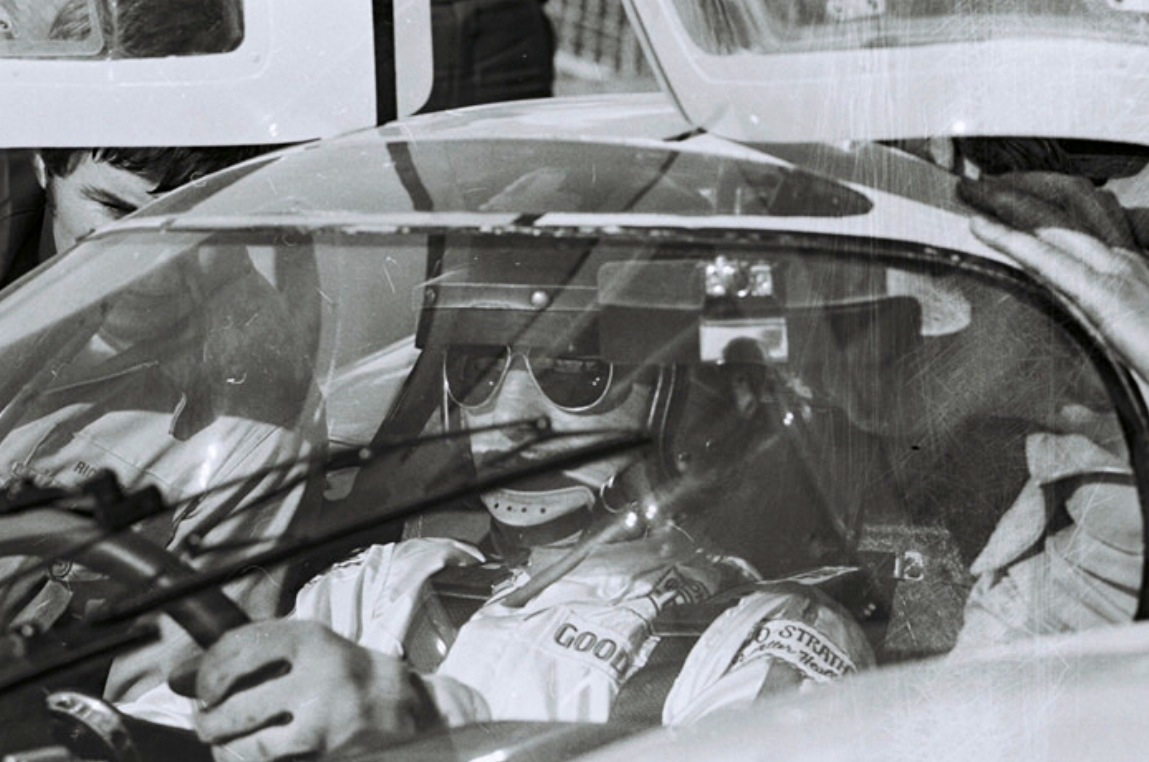
Jo Siffert’s night-time Porsche 917 pitstop at Daytona made more dramatic by the exposure used by photographer Dave Friedman…
You can see Seppi’s distinctive helmet in the murk to the left of the car as Brian Redman gets ready to rejoin the race.
It was not to be Siffert’s race, the first in which the dominance of the 917 generally and John Wyer entered cars specifically was displayed in the Sports Car Championship that year. The Ferrari 512S (Ignazio Giunti/Nino Vaccarella/Mario Andretti) took a Sebring victory in March but otherwise it was a Porsche year, what the 4.5-5 litre flat-12 917 didn’t win, the 3 litre flat-8 908 did on courses for which it was designed.
Siffert/Redman led the race until after the three-hour mark. Not long after a driver change to Redman, Brian came into the pits with a punctured tyre, worse was the brake-pipe broken by the rotating tyre tread. It took a critical 17 minutes to make the car good. The pair’s day of drama wasn’t over yet though. They lost an hour to replace the clutch, and later still had another stop to ‘straighten the Porsche after a wall-scraping episode.’
Pedro Rodriguez and Leo Kinnunen won the race in the sister John Wyer entry, 45 laps ahead of Siffert/Redman with the Andretti/Merzario/Ickx Ferrari 512S three more laps in arrears, third.
Seppi in the 917 cockpit with old school Bell Magnum helmet and chinstrap (D Friedman)(MotorSport)
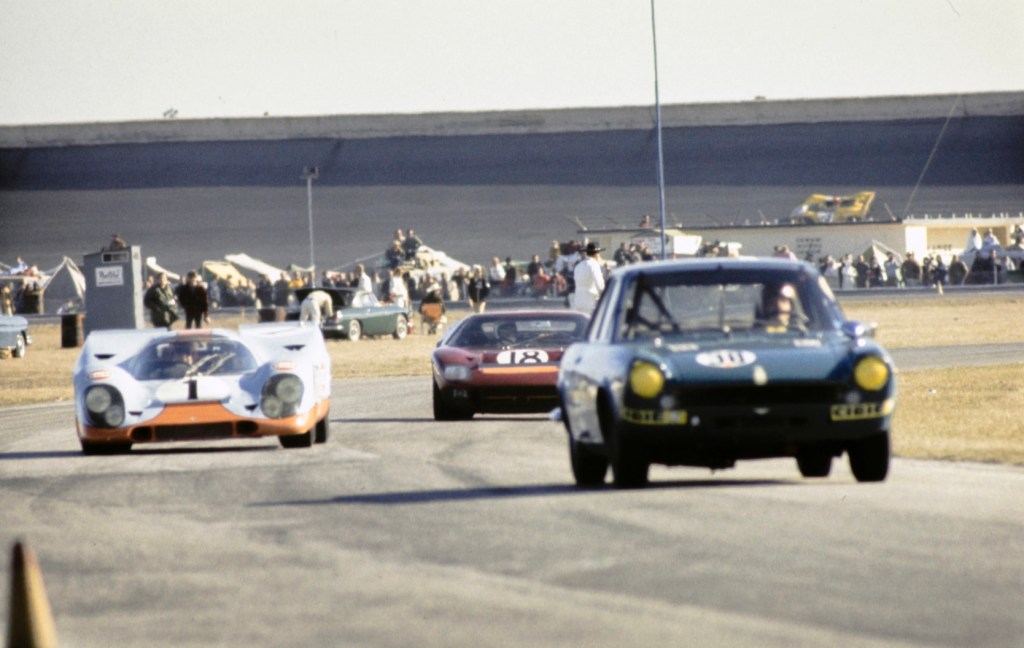
I love the variety of cars in these events putting aside the performance differential arguments and issues. The Siffert/Redman cat-amongst-the-pigeons 917 amidst the Fleming/Johnson/Fleming Fiat 124 Coupe and Wonder/Cuomo Ford GT40.
And below in the midst of the Waldron/Lanier/Barros MGB and Clutton/Tatum Ferrari 275 GTB/C. Eyes on your mirrors folks…
(MotorSport)(MotorSport)
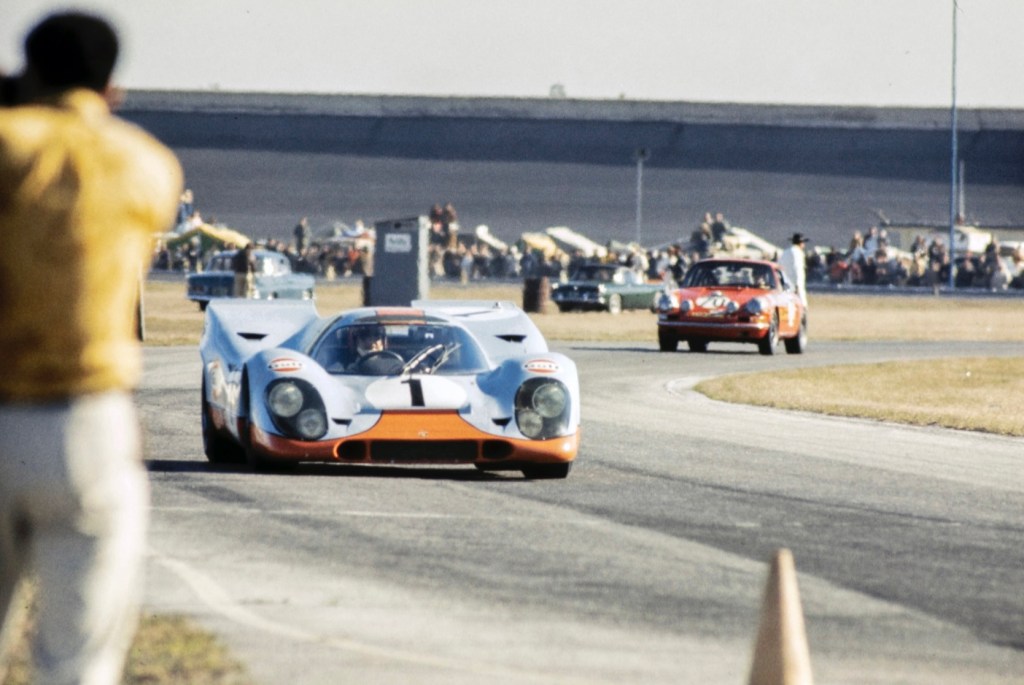
Seppi again, this time in front of the Patterson/Sanford Porsche 911T.
Bibliography…
Automobile Year 18, Team Dan, MotorSport, Dave Friedman Archive
Tailpiece…
(MotorSport)
‘I’m leavin’ on a jet plane…that’s Daytona Beach International Airport behind. DC9.
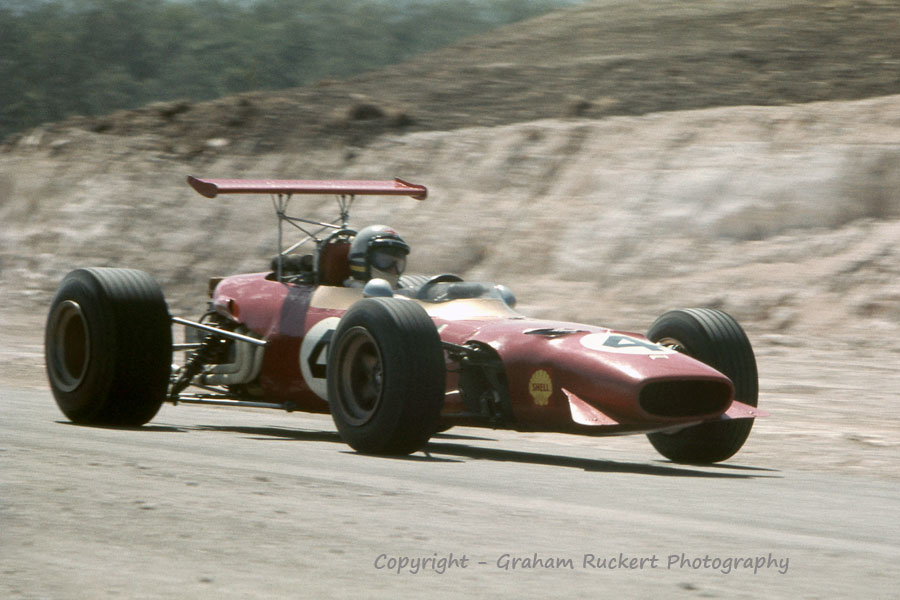
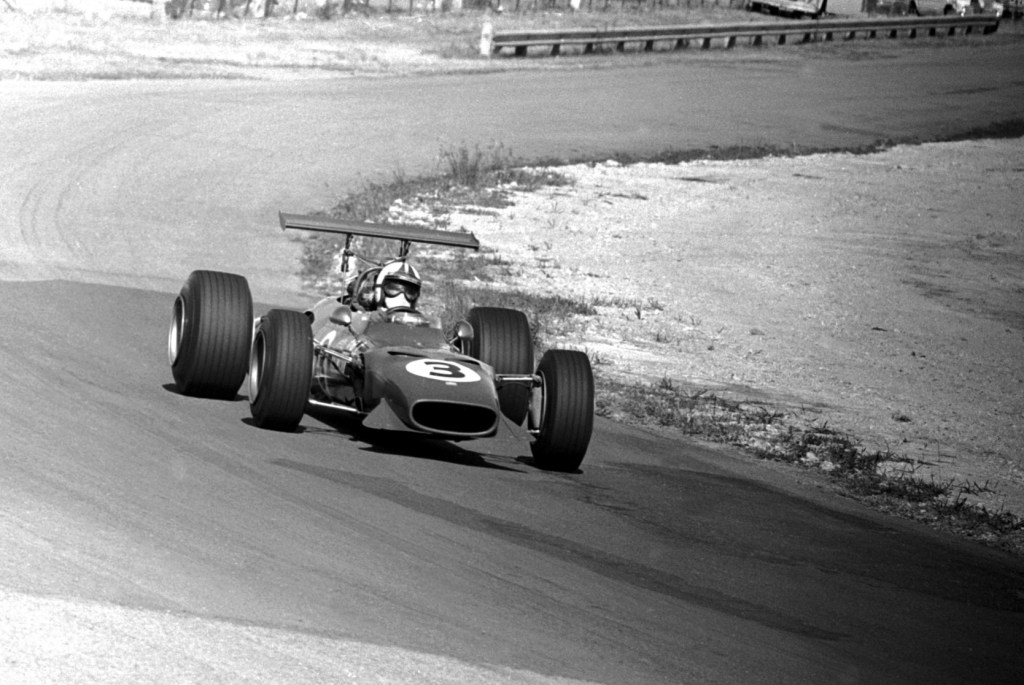
Chris Amon sneaks a look in his mirrors, no need to worry too much! Ferrari Dino 246T/69 #0008 (MotorSport)
Unlike previous years when the cars had been shipped across The Ditch – the Tasman sea – from New Zealand to Australia, in 1969 they were air freighted as there was only a week between the Teretonga and Lakeside rounds, that year the site of the 1969 Australian Grand Prix held on February 2.
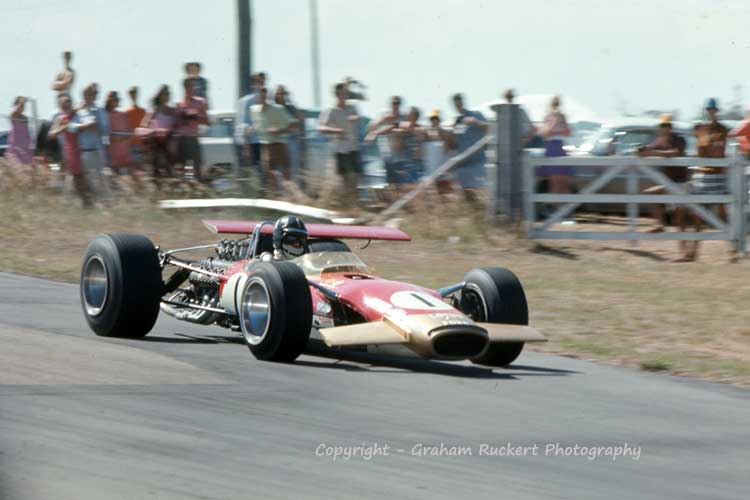
Top Guns were the Scuderia Ferrari/Chris Amon/Scuderia Veloce run Ferrari Dino 246Ts of Chris Amon and Derek Bell and the Gold Leaf Team Lotus Lotus 49B Ford DFW V8’s of just minted World F1 Champion Graham Hill and The Hunter-Jochen Rindt, with everything to prove.
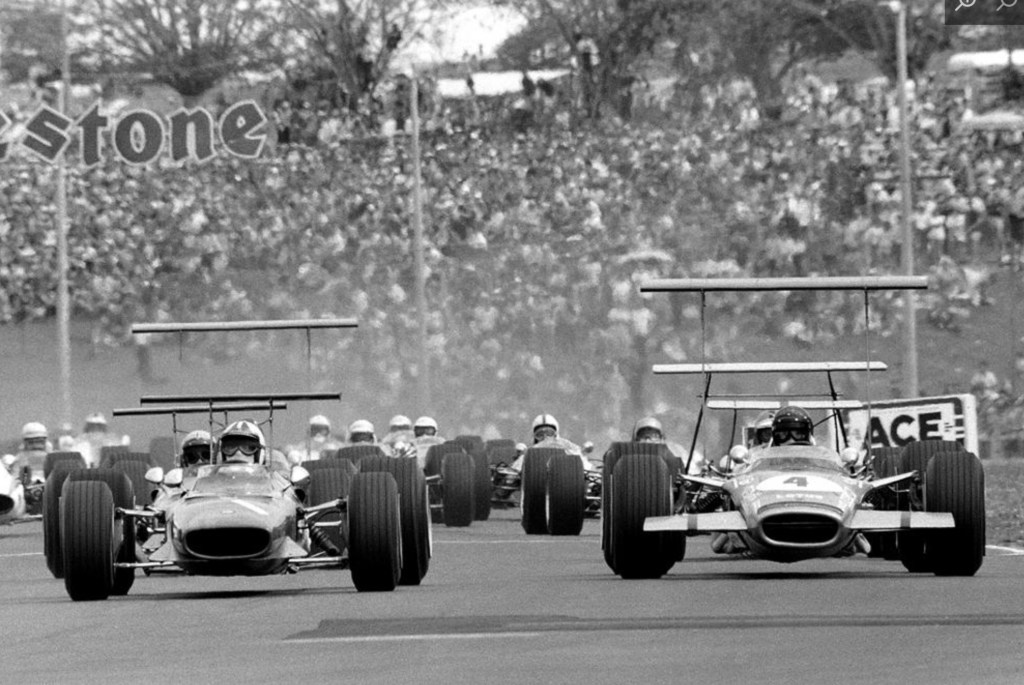
The 1969 Tasman Cup gets underway at Pukekohe on January 4 with the gig-two on the front row. Chris Amon, Ferrari Dino 246T and Jochen Rindt, Lotus 49B Ford. Amon won from Rindt and Courage (MotorSport)
At the end of the four Kiwi rounds Amon was looking the goods for Tasman Cup honours, having won at Pukekohe and Levin and picking up third place points at Wigram and Teretonga. While the Lotuses were the fastest cars, they weren’t as reliable as the Ferraris: Amon and Bell had six out of seven point scoring finishes, while Rindt, Hill and Piers Courage – in Frank Williams Brabham BT24 Ford DFW – scored off only four races. Chris won the cup with four race wins (his two in Australia were at Lakeside and Sandown) to Jochen’s two (Wigram and Warwick Farm) and Piers’ one (Teretonga).
Rindt, Lotus 49B Ford #R10 heads towards The Karussel with Lake (MotorSport)
Practice…
Of the internationals, Only Ferrari and Piers Courage managed to get themselves sorted out in time, Bruce Sergent wrote. “While Lotus had all sorts of problems with customs and freight. It was apparent that Ford Australia weren’t behind the Lotus effort this year, for they had to do most of their own organising right from administration down to transport for drivers and mechanics.” Ferrari, of course had the well drilled David McKay/Scuderia Veloce organisation to deal with the logistics, and it showed throughout the weekend.
The new stiffer rear springs Amon was after from the start of the series were waiting for the two Ferraris in Brisbane, and with these fitted the cars were out early on Friday and soon showed it would be a tough round Lotus to even make a clean breast of. While Amon and Bell were making hay on a clear track, Lotus had only just received their cars and both needed attention. Rindt’s engine was misfiring, and Hill’s blew up shortly after starting up in the garage. Even with getting an engine back from Courage, it still left them with one very sick car, Rindt’s.
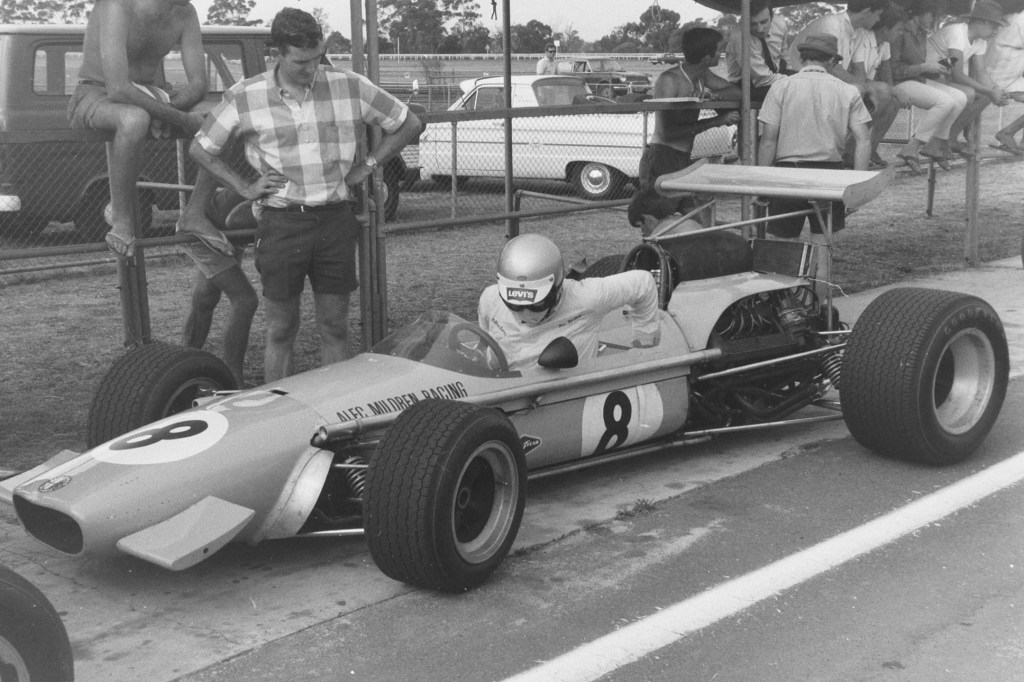
On Saturday, Amon comfortably took pole pole from Courage. Gardner had fitted a bi-wing set-up to his Mildren Racing Mildren Yellow Submarine Alfa Romeo V8 like Courage’s in unofficial practice but didn’t have the time to evaluate it and had to remove the front one and save it for testing on home turf at Warwick Farm, Sydney, the following week. Hill broke his wing in practice – the curse of Team Lotus at the time – but still managed fourth fastest, while Rindt was only able to push his Lotus 49B to fifth, creditable under the extreme circumstances.
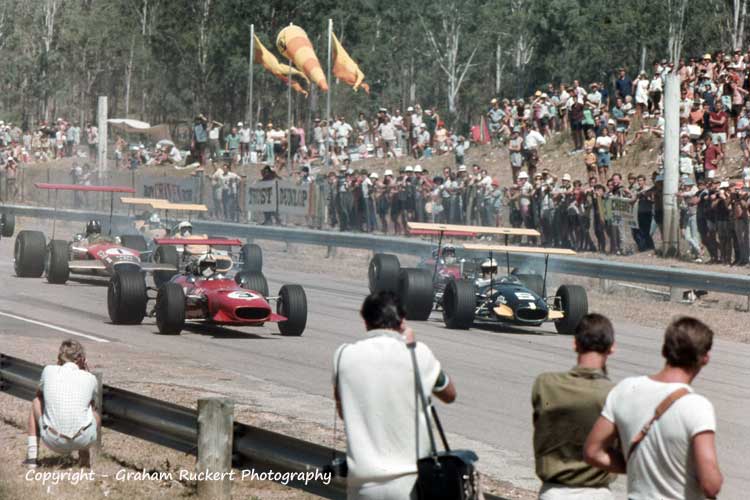
Piers Courage, Brabham BT24 Ford DFW from Jochen Rindt, Lotus 49B Ford DFW thru the kink. The start-finish line is just out of shot (MotorSport)They are off: Amon and Courage, Hill and Bell partially obscured by Courage, then the two yellow winged Mildren entries of Gardner and Bartlett (G Ruckert)
Race…
Amon won the jump from Courage and streaked off into the afternoon sun while Hill, Courage and Bell lined up for battle behind, then followed Gardner, Rindt and Kevin Bartlett aboard the Brabham BT23D Alfa Romeo Tipo 33 2.5-litre-V8 that Gardner raced in the ’68 Tasman and was then driven by KB to victory in that years Gold Star, the Australian Drivers Championship. Next was Niel Allen’s ex-Courage McLaren M4A Ford FVA. It was Niel’s first drive at Lakeside after his huge accident during the Gold Star round in July 1968, the car’s monocoque having been rebuilt/replaced by Bowin Cars.
Positions remained static for a bit until Courage closed in on Hill and tried to pass on the outside as they ranged under brakes for BMC bend. But Piers didn’t quite make it and there wasn’t enough room left for both cars, Graham didn’t give way, being on-line for the corner so the two cars touched and Courage suddenly ran out of track and retired the car on the dirt with slightly bent front suspension. Hill lost four seconds giving Bell his opportunity and he went through into second position to make it a Ferrari 1-2 for the first time in the series.
Bartlett retired on the following lap with no water and blown head gaskets, giving away his position to Niel Allen. Then he overdid it under brakes, the front set locked, and he lost four places getting things in hand. He picked up one of the lost places immediately and set out on a long hard haul back through the field.
Rindt hustles his Lotus – engine problem duly noted – into BP Bend, Q5 and DNF. With fresh engine he made good and ‘blew the field off the planet’ in the Warwick Farm 100 one week henceFrank Gardner, Mildren Alfa Romeo V8 aka the Mildren Mono/Yellow Submarine (MotorSport)
Jochen Rindt made the next move when he displaced Leo Geoghegan’s ex-Clark Lotus 39 albeit with a Repco Brabham V8 rather than the Climax FPF four, on the 13th lap for fifth spot, but Geoghegan was hanging on grimly and didn’t let the Austrian get away from him. But Rindt pulled out every horse he could find in the ailing Cosworth V8 and slipped by Frank Gardner on lap 19, making the order Amon and Bell in Ferrari Dinos, Rindt’s Lotus 49B, Gardner’s Mildren Alfa, Geoghegan’s Lotus Repco, Max Stewart, Mildren Alfa 1.6 F2, Allen, Glyn Scott, Bowin P3 Ford FVA F2 and Malcolm Guthrie, Brabham BT21B Lotus-Ford 1.6.
Rindt held onto this position, trailed by Gardner, who was becoming concerned over oil pressure. His fears were confirmed when the Alfa Romeo engine blew an internal oil line and he was forced out of the race on lap 12. Gardner’s demise brought everyone up a place but Jochen Rindt’s forceful run ended when the Cosworth Ford V8 engine lost power and he quickly shut off and headed for the pits.
Derek Bell, Ferrari Dino 246T/69 #0010. No adjustable wing for Derek (MotorSport)
Chris Amon was busy lapping all but his team mate, Derek Bell, while Leo Geoghegan was sitting in a wonderful position behind Graham Hill in fourth spot. Col Green, ex-Hill/Gardner Brabham BT16 Climax 2.5 FPF was in and out of the pits with gearbox and engine problems while Alf Costanzo, McLaren M4A Ford FVA F2 had retired after a spin over the back of the circuit, then stalled and was unable to restart.
The rear wing on Hill’s Lotus 49 had looked shaky for a few laps and finally it broke and folded over his rear wheel. He tried to keep the car as steady as possible so not to be black flagged, and finally pitted to have the offending piece of iron cut from the car. Geoghegan, meanwhile, seeing Hill’s problem, had speeded up and went by as Hill was having the operation finished to his wing. He came back into the fray bent on getting his third spot back from Geoghegan, but the Lotus was suffering from oversteer with the now, light rear end, and he steadily lost ground.
Graham Hill’s 49B #R8 with the rear wing mount problems that Lotus never satisfactorily solved. No bodily harm caused on this occasion. Ultimately the FIA solved Lotuses problem for them with their intervention over the 1969 Monaco GP weekend (G Ruckert)Niel Allen, McLaren M4A Ford FVA. #M4A/2 is the ex-John Coombs/Courage ’67 Euro F2 entry, then, in Pier’s ownership his ’68 Tasman machine, and Longford round winner (MotorSport)
Niel Allen, worked hard to make up time lost in two spins and managed to catch Max Stewart in the surviving Alec Mildren Racing entry, the Mildren Alfa/Autodelta 1.6 four-valve F2 car and, now in fifth spot, went on to win the battle of the F2’s. Englishman, Malcolm Guthrie, having sat behind Glyn Scott on the Queenslander’s home circuit, finally made a last-minute burst and finished ahead of the Bowin. Scott was still waiting for a set of rods to come from Cosworth for his FVA engine, he was running on a set borrowed from Allen.
With two rounds to run, Amon’s win put him into an almost uncatchable Tasman Cup points lead. Only Piers Courage, with a bit of luck and by winning the final two races, could take the championship from the New Zealander. Rindt and Hill, equal on 15 points, were at that stage relegated to fighting out second spot.
Ain’t she sweet, Graham Ruckert has captured the car with its unloaded left-front off the deck. Note the hydraulics to operate Chris’ rear wing
Etcetera…
(MotorSport)
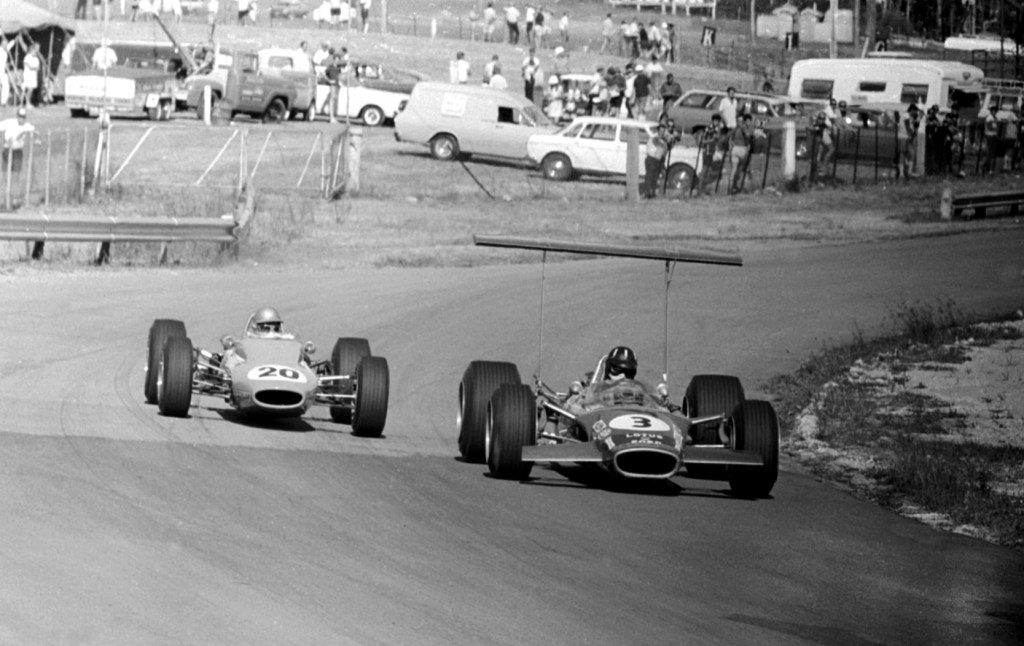
Graham Hill blasts through the hole left for him by Glyn Scott at Lakesides flat-knacker Kink.
It’s a David and Goliath shot. John Joyce’s superb monocoque was Lotus inspired too, he had a number of senior engineering posts at Lotus between 1963 and late 1967 when he returned home to start P3 – Project 3 – his first two cars (Projects 1 and 2) built before he left for his stint in the UK were a modified Cooper and the Koala Formula Junior. More about Glyn and the Bowin P3 here: https://primotipo.com/2020/07/24/glyn-scott/ and here: https://primotipo.com/2021/05/06/ian-peters-ex-glyn-scott-bowin-p3-101-68/
(MotorSport)
Nah, its too skinny to be Sergeant Schultz! It must be Jochen Rindt with a touch of the Adolfs, not the best protection for the searing Queensland summer sun, and with a smile on his face despite the challenges of the weekend.
Piers Courage took up where he left off in the ’68 Tasman, as a front runner in the clever car Frank Williams assembled for him. Brabham BT24-3 was ex-Brabham/Rindt/Gurney/Ahrens, with its F1 3-litre 740 Series Repco Brabham V8 removed and a 2.5-litre Ford Cosworth DFW installed the bi-winged Brabham was a very competitive car raced ably throughout. Piers ultimate pace was reinforced during that years GP season where he proved one of the quickest men around…he arrived that year big time.
Courage, Brabham BT24 Ford. Generally, but not completely, Ron Tauranac’s wings remained where he intended them from the start to the finish of the weekend (MotorSport)(MotorSport)
Frank Gardner’s (above) Len Bailey designed, Alan Mann Racing built Mildren Alfa used many Brabham BT23 components and was ‘best of the rest’ behind the big-five. Gardner arrived in New Zealand ‘under-winged’, he scored in four of the seven rounds and would have gained a bit with more downforce from the start of the series.
It’s one of the most iconic and instantly recognisable single-seaters ever raced in Australia by – in turn – FG, Kevin Bartlett, Bob Muir and Ray Winter with Tipo 33 2.5 V8 as here, then Waggott 2-litre TC-4V and finally 1.6-litre Lotus-Ford twin-cam in ANF2 spec.
Derek Bell drove well throughout the series, a pair of seconds at Lakeside and Warwick Farm his bests. He was fourth at Pukekohe, and fifth at Wigram, Teretonga and Sandown. Depending upon your source, Scuderia Ferrari provided four of the latest spec 2.4-litre, DOHC, four-valve fuel injected V6s for the two-car touring team. Bell was given less revs to play with than his team-leader!
I truncated and added to Thomas B Floyd’s race report in the Australian Motor Racing Annual 1969, Sutton, MotorSport Images, Graham Ruckert Photography, Bruce Sergent on sergent.com, oldracingcars.com
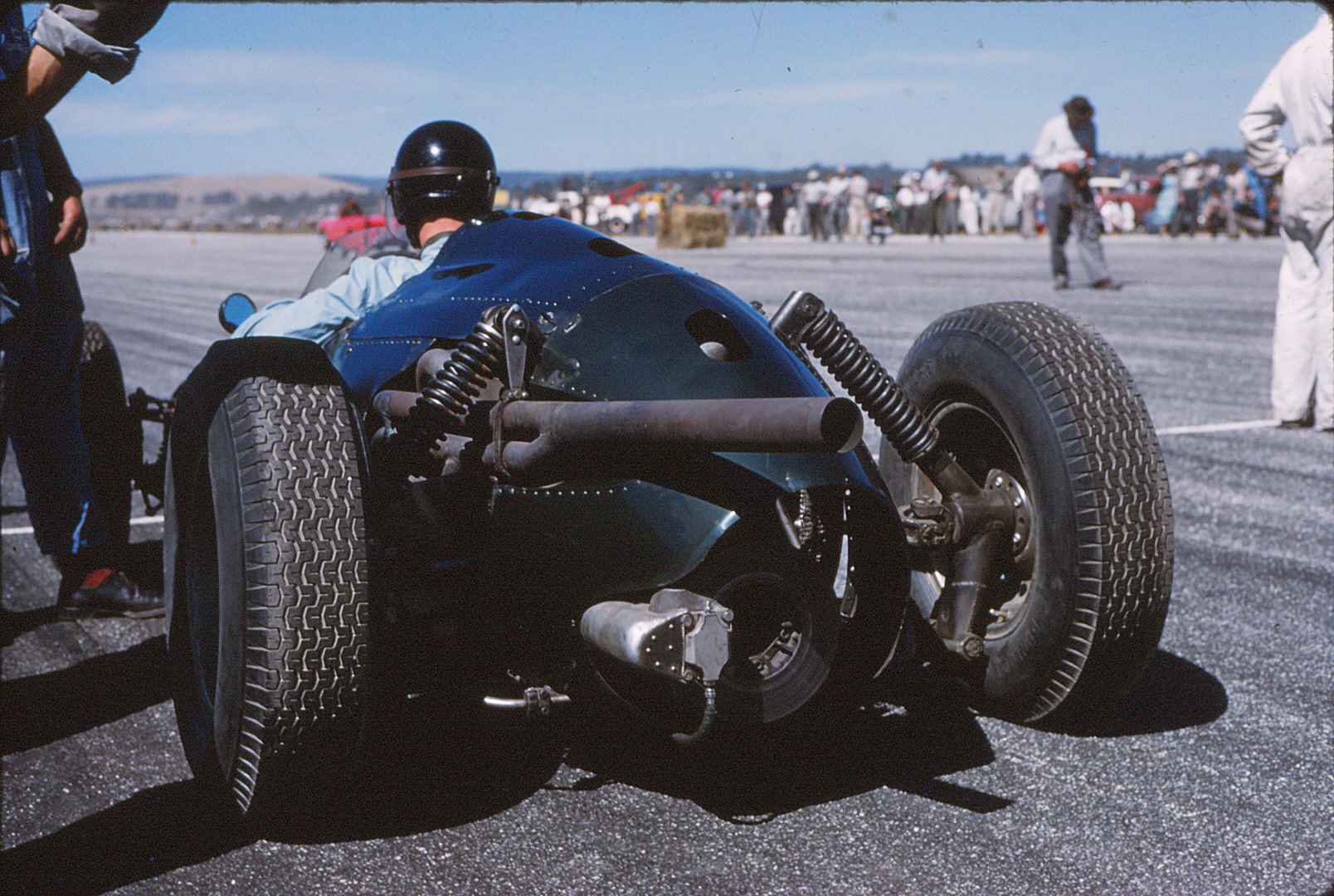
Graham Hill, Dan Gurney and the BRM mechanics await the start. Dan’s car is P48 #486 (D Jolly)
Make sure you buy the August 2024 issue of The Automobile, it contains a piece I wrote about Dan Gurney’s win at Ballarat Airfield in a BRM P48 on February 12, 1961.
That Victorian Trophy victory was the only international win for a P48 in Dan’s last drive for the Owen Racing Organisation.
There are some fantastic, never-seen-before colour shots taken by Australian Lotus ace/works-driver and Australian importer Derek Jolly at the meeting, courtesy of Lotus historian/restorer Mike Bennett.
Further ‘Australian content’ comes in the form of the cover car, Bugatti Type 35 chassis 4450. Better known to many of us as the Lyndon Duckett/Bob King Anzani Bugatti, the car is the subject of a long feature celebrating the centenary of the landmark T35. See here too: https://primotipo.com/2021/09/17/werrangourt-archive-9-lyndon-duckett-by-bob-king/
Towards the end of his 52 years of use on the road and in competition Bob restored the 4450 to its original, ex-factory specification. The same spec as that when it was delivered to first owner, George Pearson Glen Kidston in Molsheim on February 16, 1925. In a neat book-end of history Simon Kidston, Glen’s nephew, is the current custodian of #4450, not that it looks much like it did in Australia clad in its road-going garb.
Another fascinating article for proponents of Oily Rag Restoration, is a report on the Best in Show award going to an unrestored Alfa Romeo 8C2300 at May’s Concorso d’Elegance Ville d’Este.
It’s the first time the premier award in a ‘Grand Prix Concours’ has gone to a Preservation Class car. Great stuff, as Jörg Sierks ended his piece, ‘We can only hope that such appreciation of patina and preservation will be upheld and leave its mark on the future of Ville d’Este and other world-class concours events.’
The Automobile is in-store now in the UK, and two months away on the slow-boat to the Antipodes, other than to subscribers who should have it about now. Why not subscribe here: https://www.theautomobile.co.uk/subscribe/
Rear of Dan’s P48. Macpherson strut, single lower wishbone and radius rod rear suspension, and famous Dunlop ‘bacon-slicer’ ventilated single rear disc brake mounted to the gearbox output shaft (D Jolly)
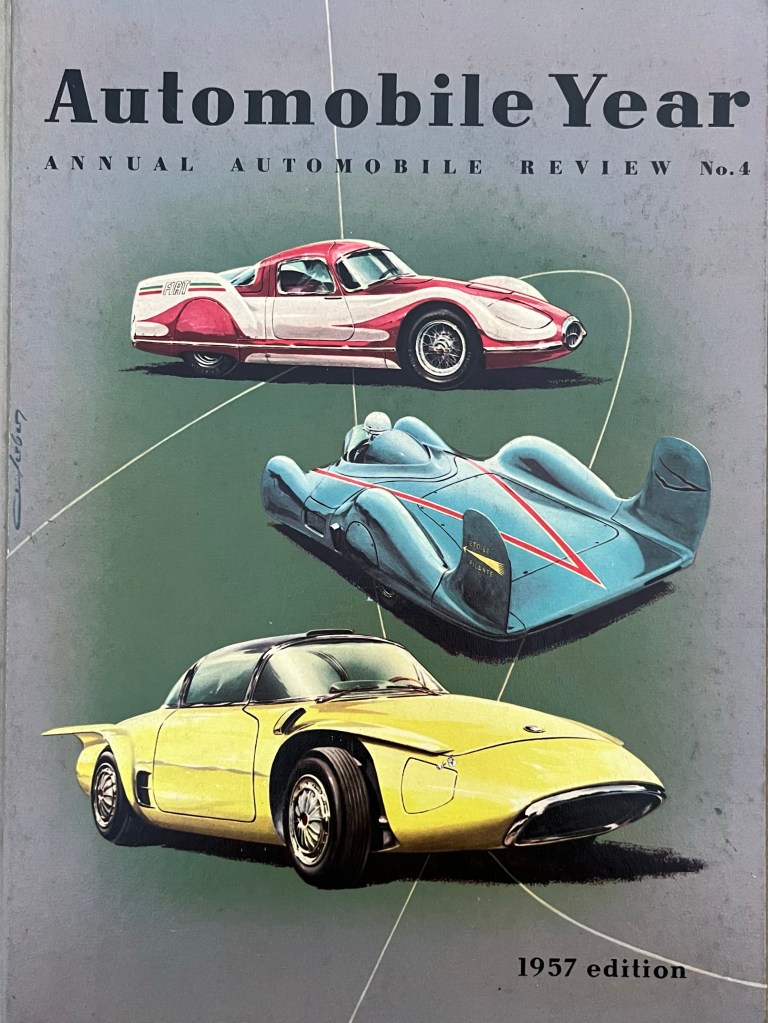
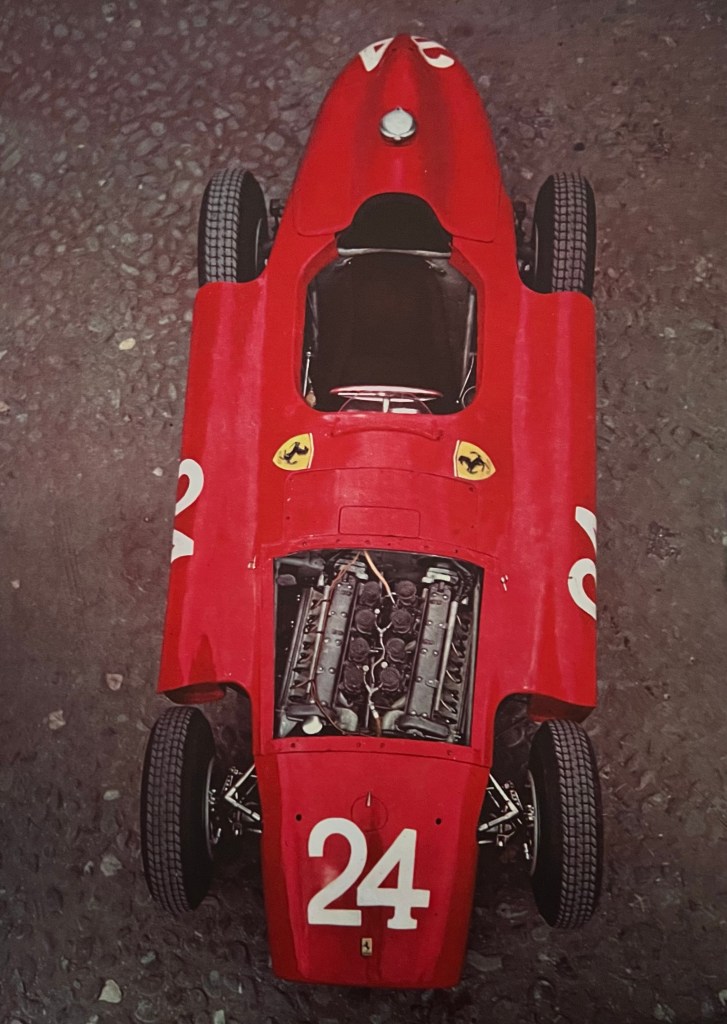
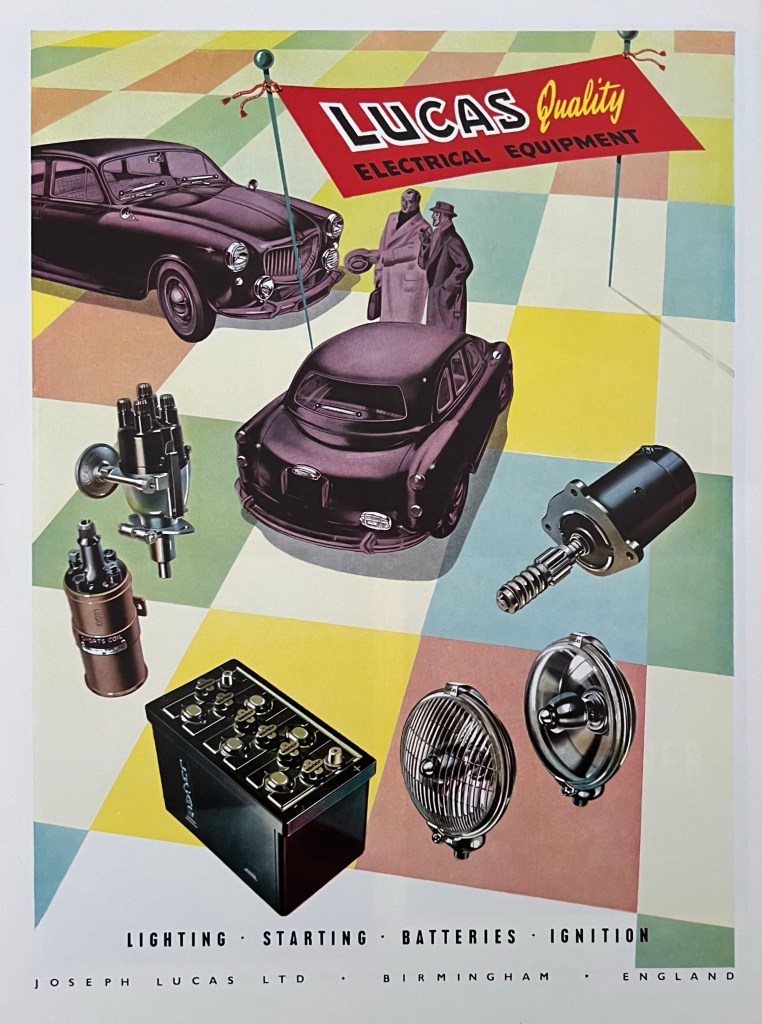
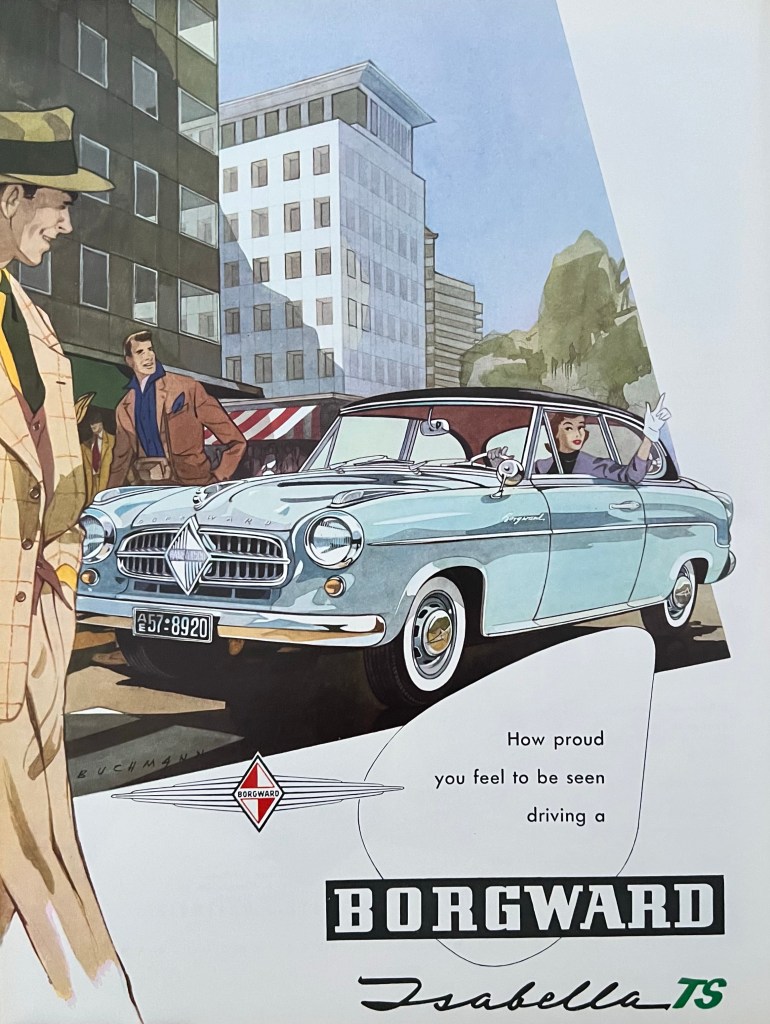
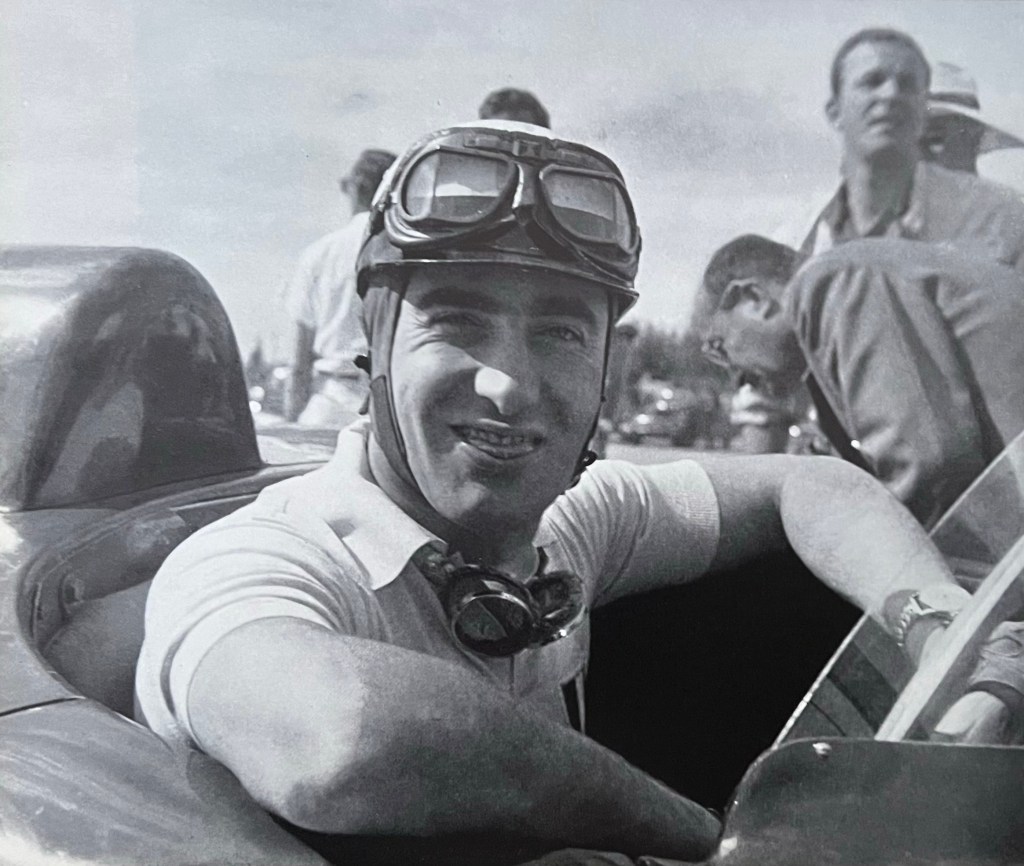
My friend Tony Johns lent me a couple of early AutoCourses that I turned into a couple of interesting posts. I’ll continue with that but thought I’d add an occasional piece based on my own collection of Automobile Years.
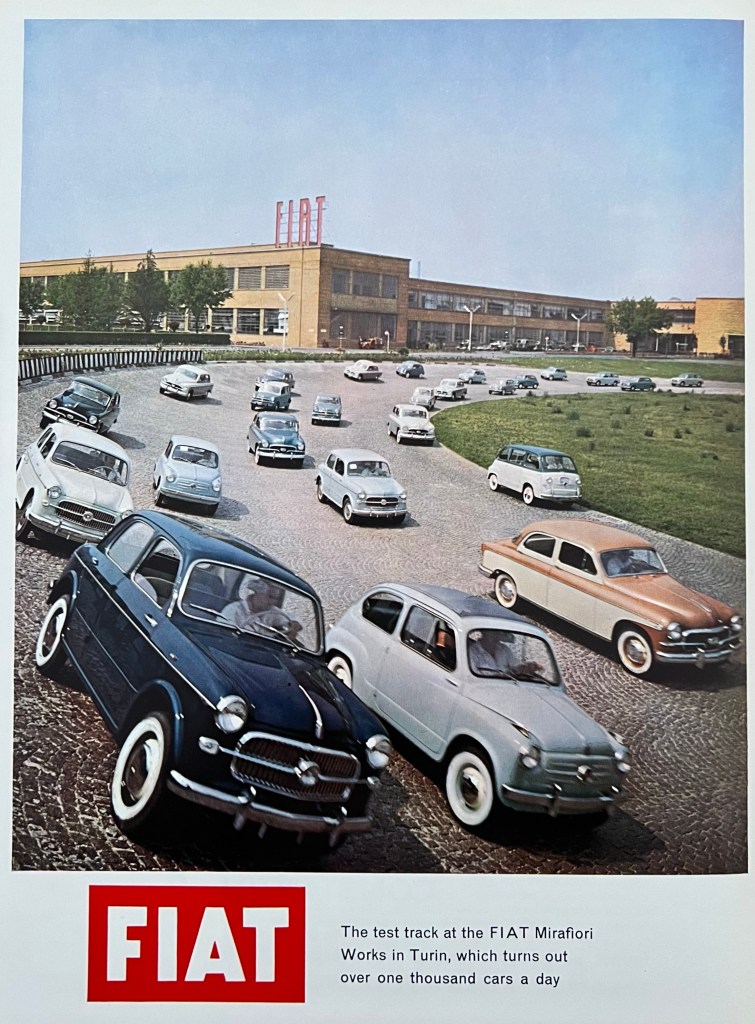
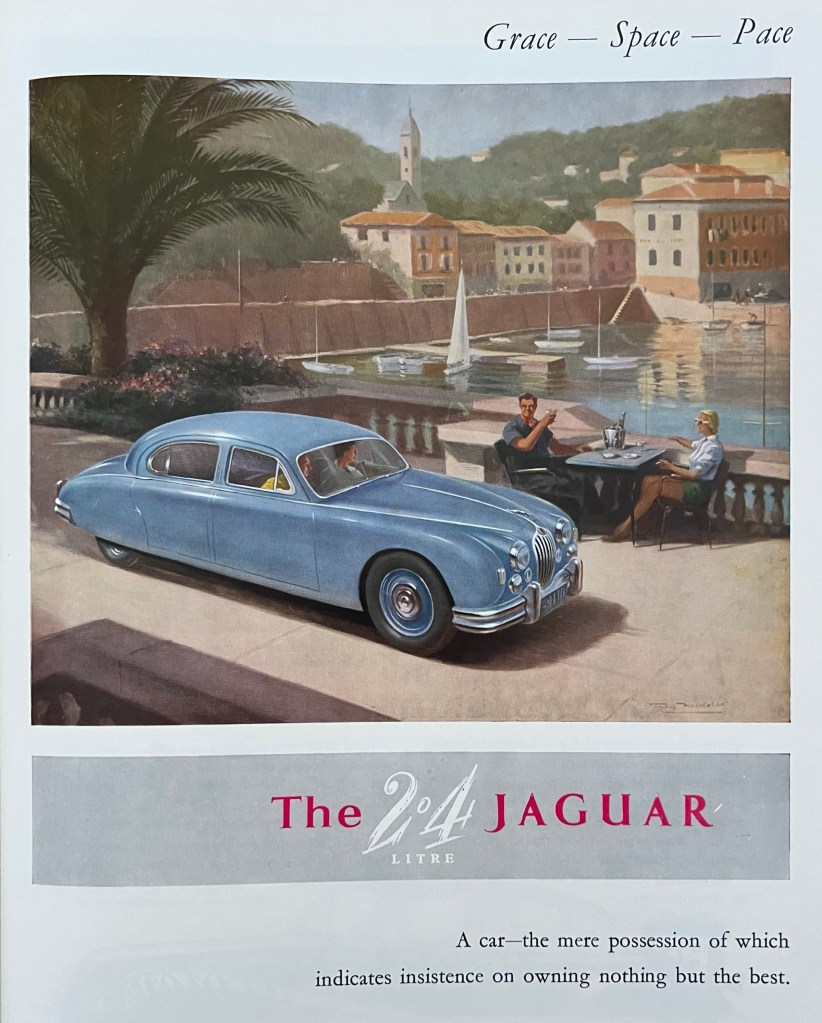
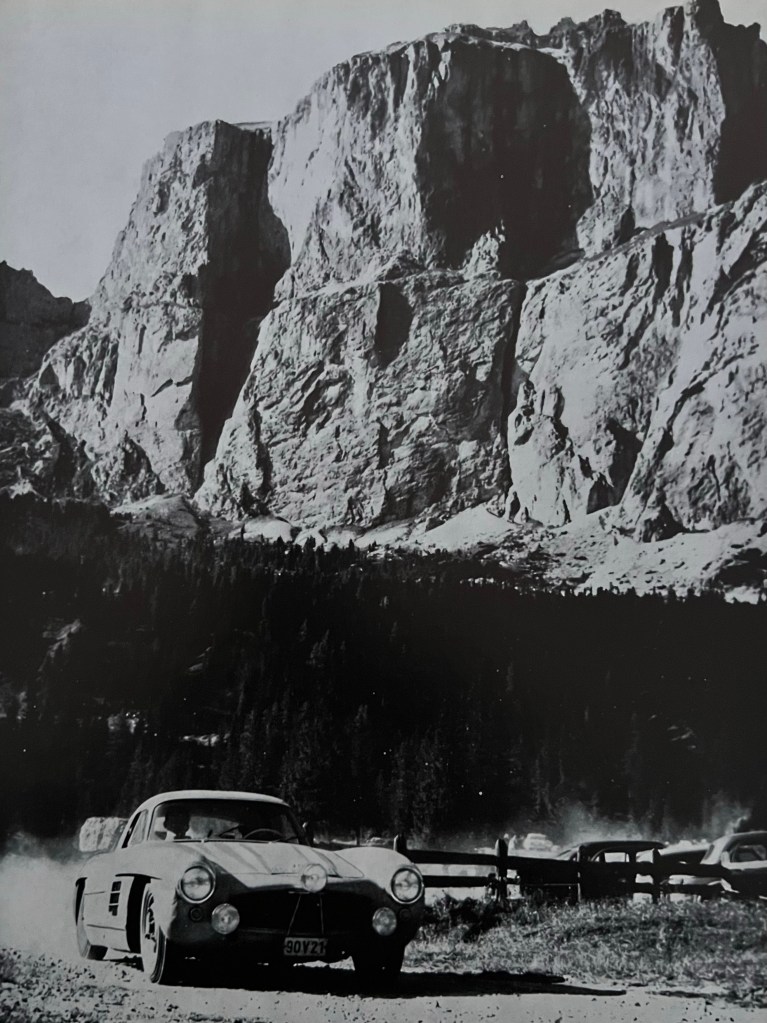
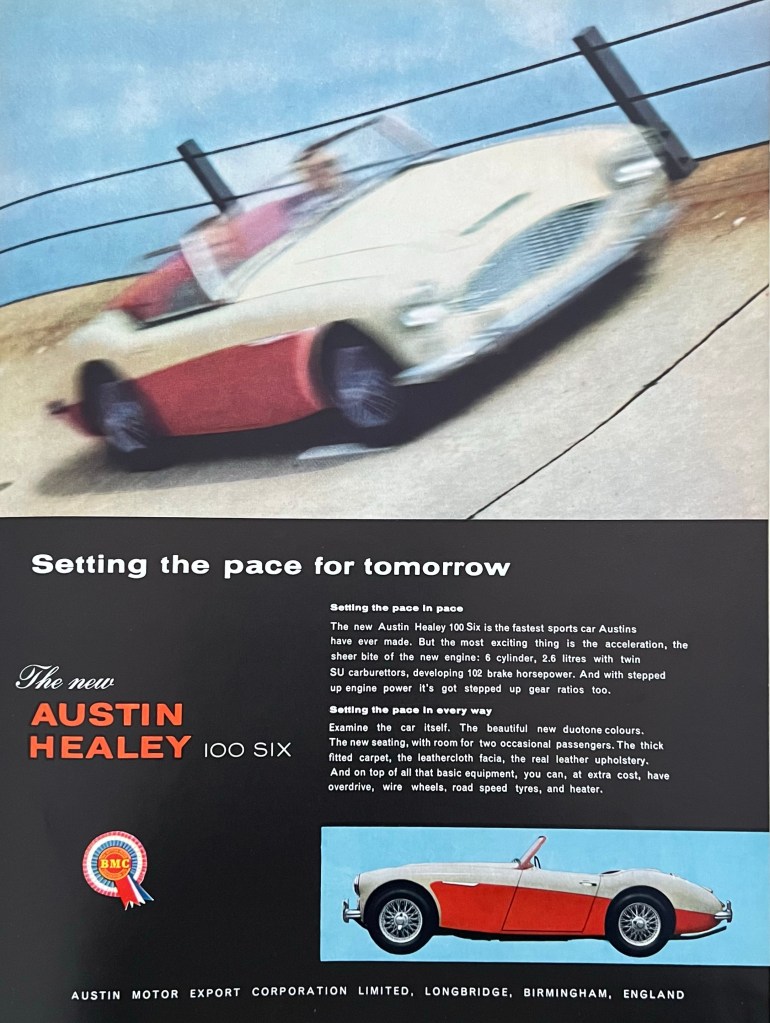
It’s the beauty of the some of the ads that really caught my eye. The reproduction of small monochrome racing shots isn’t that flash so I’m sharing the best of the relatively small number of colour shots and a few monochrome photographs within the mix of ads.
The artwork on the cover has a name but I can’t read it, nor is it disclosed elsewhere. The cars shown are a Fiat 8001 Turbina, Renault Shooting Star, General Motors XP-500 gas turbines.
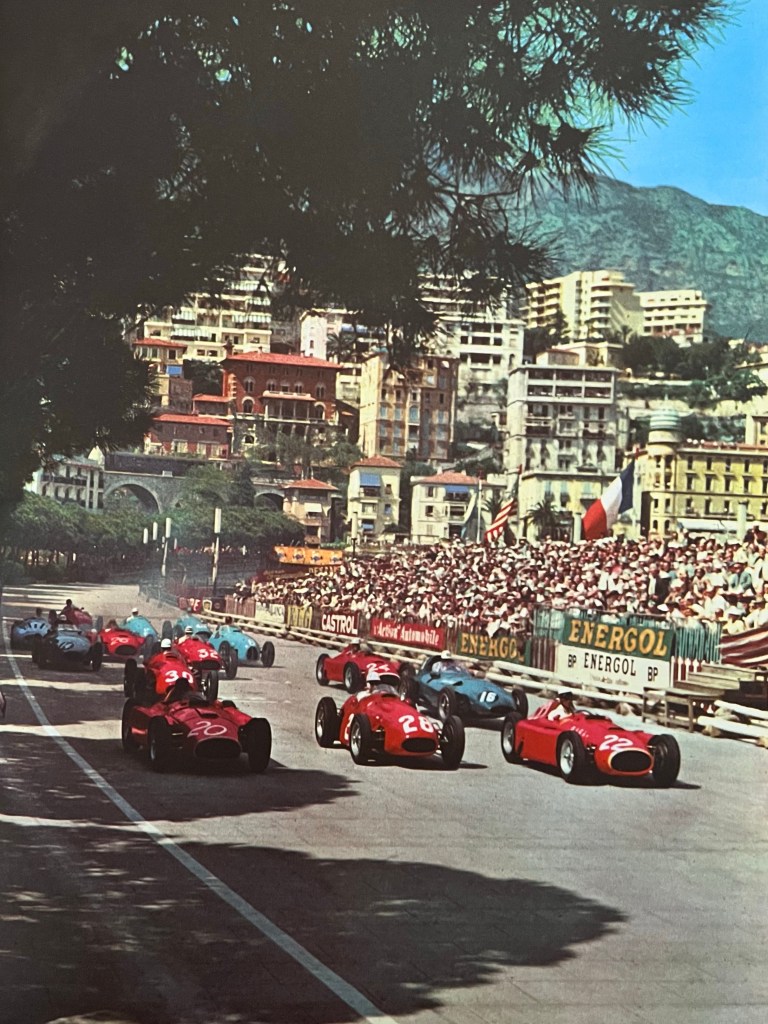
Superb Yves Debraine shot of the start of the 1956 Monaco Grand Prix.
The two Lancia-Ferrari D50s of JM Fangio and #22 Eugenio Castellotti sandwiching Stirling Moss in a works-Maserati 250F. #16 is Harry Schell, Vanwall VW1, #30 Jean Behra, 250F, #24 Luigi Musso, Lancia-Ferrari D50, #32 Cesare Perdisa in another works Maserati 250F.
(Yves Debraine)
‘Stirling Moss had been in the lead from first to last and gave a faultless display of brilliant driving and faultless race strategy (being under great pressure from Fangio’s Ferrari late in the race). The discovery of the day was Peter Collins (Ferrari second) . Behra drove a steady race into 3rd place, with no incidents (250F).’ See here for more: https://primotipo.com/2014/08/21/stirling-moss-monaco-gp-1956-maserati-250f/
(Y Debraine)
Le Mans 24-Hours.
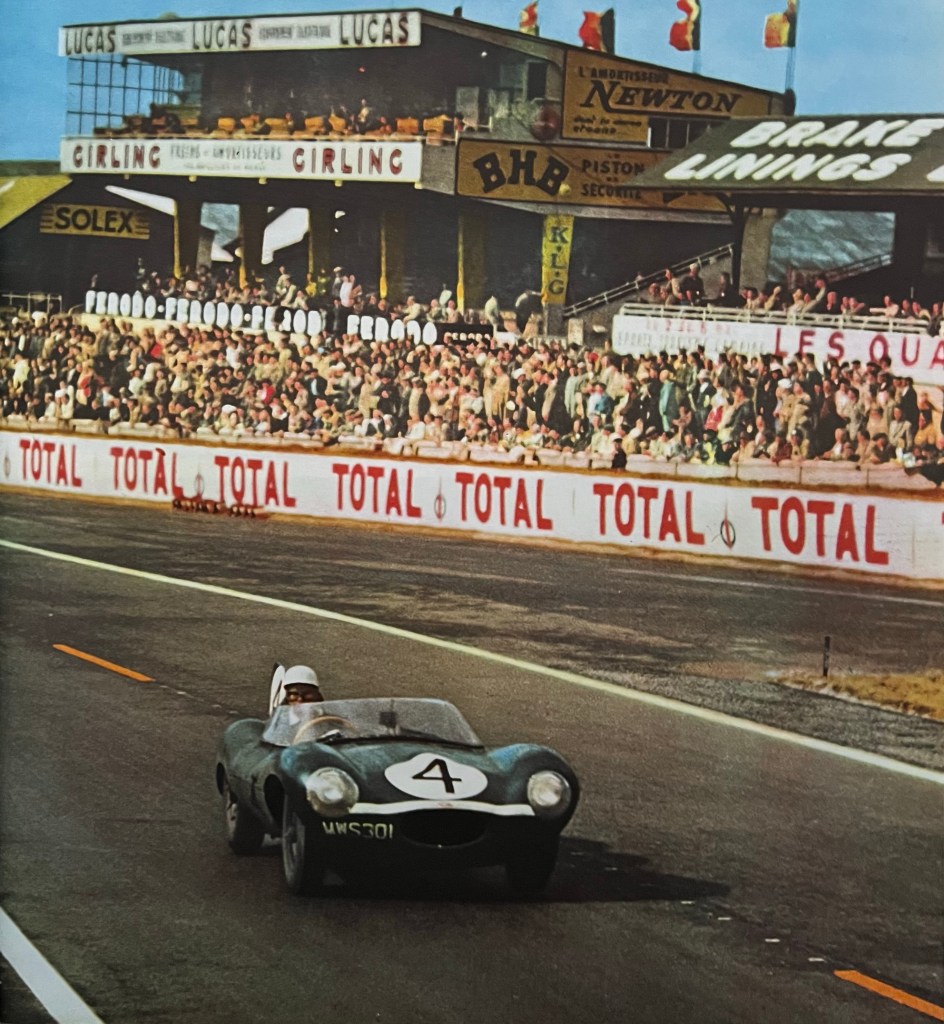
‘The privately entered Ecurie Ecosse Jaguar D-Type driven by Ron Flockhart and Ninian Sanderson gave Jaguar an unexpected victory – the fourth since the war – after bad luck had struck the works team.’
‘Mike Hawthorn was in magnificent form and held the lead (of the British Grand Prix at Silverstone) for 15 laps.’
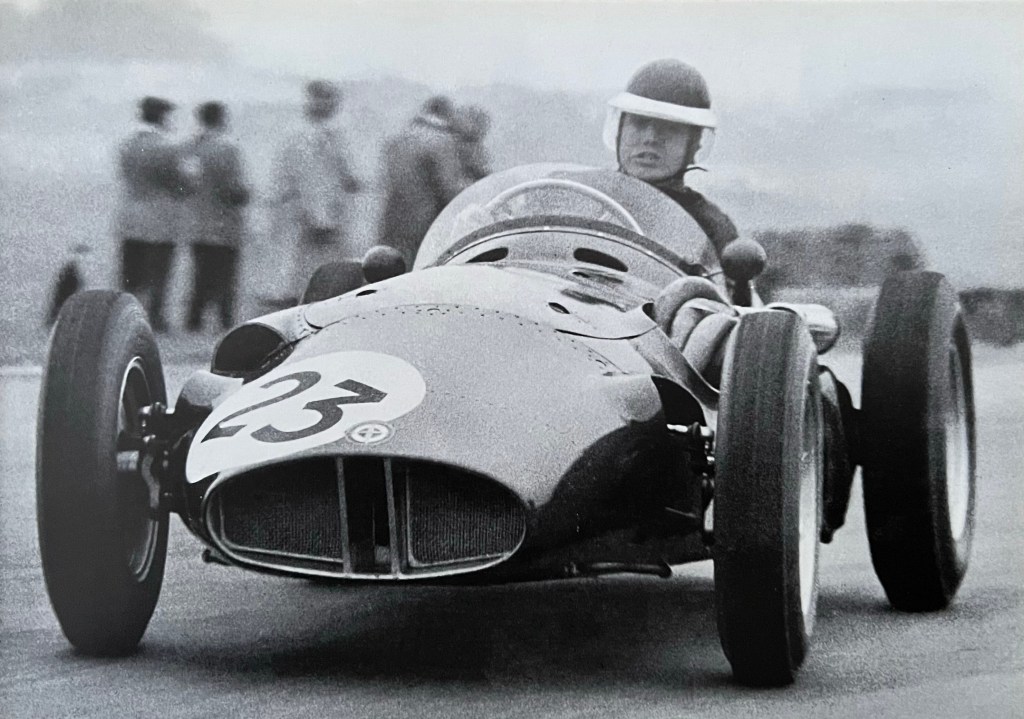
‘The BRM (Type 25) showed again that it is probably the fastest of all current Grand Prix cars, but Hawthorn was eventually passed by Moss (Maserati 250F) and others before being forced to retire at 23 laps by loss of lubricant to a rear universal joint, which produced incipient seizure.’
Moss the led until the 68th lap when misfiring intervened with Roy Salvadori driving the race of his life in the Gilby Engineering 250F, holding second place for 30 laps in front of all of the works cars! Fangio, Lancia-Ferrari D50 led to the finish after Moss retired, with Peter Collins/Alfonso de Portago second and Jean Behra, Maserati 250F third.
(B Cahier)
JM Fangio’s F1 Drivers Championship winning Lancia-Ferrari D50.
‘Front engine, V8 mounted at an angle. Bore and stroke 76 x 68.5mm, 2495cc. Maximum power 285bhp @ 8500rpm, 4-overhead camshafts, chain driven. 4 downdraught Solex twin-choke carburettors. Dual ignition: 2 magnetos, 16 plugs. Clutch at rear in unit with 5-speed gearbox and differential. Front suspension by double wishbones with transverse leaf spring. Rear suspension De Dion, with transverse leaf spring. Drum brakes. The tanks in the wheel fairings are no longer used, all the fuel being carried in the tail.’
(Y Debraine)
The Big Red Cars to the fore at the start of the French GP, Reims, July 1: Peter Collins, Eugenio Castellotti and JM Fangio in Lancia-Ferrari D50s ahead of the Moss Maserati 250F, Harry Schell’s Vanwall VW1 #22, and Jean Behra’s 250F, then one of the Gordinis, and the rest…
Fangio led until he pitted on lap 40, but he joined the fray after a change of plugs. Harry Schell raced brilliantly, retired his own Vanwall, then took over Hawthorn’s while it was in seventh place, and then chipped away at the leading Ferraris passing all but Fangio until injection pump trouble intervened.
Collins won from teammate Castellotti by three-tenths after 2 hr 34 min of close racing, then Behra 30 seconds back.
Sebring 12-Hour
‘The victory of the Fangio-Castellotti team (in the Sebring 12-Hour) was largely the work of the young Italian. Fangio, feeling unwell, had handed the car to him for the last hours of the race. The 3422cc four-cylinder Ferrari (860 Monza) covered a distance of 1008.72 miles in twelve-hours and put up a new record by doing twelve more laps than the winning Jaguar (D-Type) in 1955.’
Luigi Musso and Harry Schell were second in another Scuderia Ferrari 860 Monza with the Bob Sweikert/Jack Ensley Jaguar D-Type third.
Mille Miglia 1956…
I was going to give the shot below the same treatment as the rest and then I read the prophetic piece that went with it…not too long before the 1957 Mille disaster. It’s worth sharing in full I thought, an insiders view of the time clearly expressed.
‘For a long time after the catastrophe at the Le Mans Twenty-four Hours in 1955, motor-racing circles feared that the XXIInd Mille Miglia had been the last of the series. That race, in which 365 cars competed over 1,000 miles of roads lined by hundreds of thousands of spectators, is the most dangerous of all motor races for the drivers and even more so for the spectators.’
‘Therefore those who love the sport were all the more pleased when, after long and bitter disputes, the XXIII edition of the race was permitted-for it was a triumph over the enemies of motor racing-but they felt some uneasiness nonetheless. So few changes had been made in the regulations that the old risks were still there. The competitors were still to start off in the pitch dark and charge at headlong speed along roads lined – and in some places obstructed – by enthusiastie spectators many of whom had taken up their stand at the most dangerous points.’
‘The rain that fell incessantly throughout the race made the surface slippery in the extreme. Several cars left the road and the day closed with 7 fatal casualties – two of them among the spectators – and 16 injured. Indeed it was really only by sheer good luck that there were not a great many more. For these reasons we are against the Mille Miglia in its present form.’
‘Sooner or later it is bound to lead to a catastrophe fraught with the direst consequences because it could be so easily avoided. There must be fewer starters with a severe selection of the entries, and the most dangerous points-especially where the cars come out of a bend-must be closed to spectators. If these conditions, which without eliminating all danger would reduce the risk to reasonable proportions, cannot be satisfied the Mille Miglia will have to be considered anachronistic. We have nothing against the organizers. We simply believe that in common sense it must be admitted that the pleasure and interest of a limited number of people together with the technical advances brought about by the event are no justification for the terrible risks involved in a race where for 20 hours on end thousands of spectators without the slightest protection are within arm’s length of meteors unleashed at terrific speed.’
(‘A fine colour study which catches the typical atmosphere of many Mille Miglias. Rain pelting down from a leaden sky, spectators huddled together under umbrellas, and a brilliantly coloured car, headlamps blazing, as it roars on towards the finish at the end of the long day. The car is Collin’s Ferrari (860 Monza Scaglietti), taking second place in the XXIIIrd Mille Miglia with photographer and journalist Louis Klemantaski acting as navigator’ Y Debraine)
‘The XXIIIrd Mille Miglia was run in appalling weather which prevented the repetition of performances on a par with those recorded in 1955. The times chalked up by all the classes were slower than last year with the sole exception of Michy on RENAULT 750 c.c, who broke the record set up by Galtier in 1955. All in all one may say that the small, and therefore less speedy, cars were less severely handicapped by the rain than the powerful machines capable of doing over 125 m.p.h.’
‘Victory smiled on Eugenio Castellotti on a 3 ½-litre 12-cylinder FERRARI (290 MM Scaglietti). He took 1 hour 29 minutes 22 seconds more than Moss last year to cover the 1,597 kilometres of the course but his average speed was most impressive in view of the atmospheric conditions he was up against. Second place was taken by another FERRARI – a 3 1/2 litre 4-cylinder model – driven by Peter Collins whose passenger was our contributor Klemantaski, a bearded British journalist like Jenkinson.’
‘FERRARI won all the laurels taking 3rd, 4th and 5th places with Musso, Fangio and Gendebien, the latter being the winner of the “Grand Tourisme” class. In the next three places we find three MERCEDES 300 SL privately entered but prepared by the works. The MASERATIs were a disappointment although Scarlatti took first place in the class for sports cars under 2,000 c.c., while Perdisa was first in the under 3,000 c.c. class but only 28th in the general classification. Stirling Moss, No. I member of the team, whose car was not quite up to scratch, ran off the road before Rome and withdrew from the race.’
‘The ALFA ROMEO GIULIETTA which had disappointed in 1955 put up a magnificent show this year. As usual PORSCHE took first place in the “Grand Tourisme” class under 1,500 c.c. but was defeated in the sports class by Cabianca’s OSCA 1500 and Jean Behra’s MASERATI. All four RENAULT DAUPHINES entered by the works finished the race although Paul Frère capsized when leading the team. The winner was Gilberte Thirion at an average of 65.85 m.p.h. Our contributor Bernard Cahier, at the wheel of his own DAUPHINE – a production model in every respect – covered the course at 58.28 m.p.h. Michy on a modified 4 H.P. RENAULT produced a fine performance, as already mentioned, by lowering the record for his class established in 1955 on a dry surface by Gaultier with a car of the same type.’
‘Of the 427 entries, 365 started but only 182 reached the finish – a wastage of 50 per cent.’
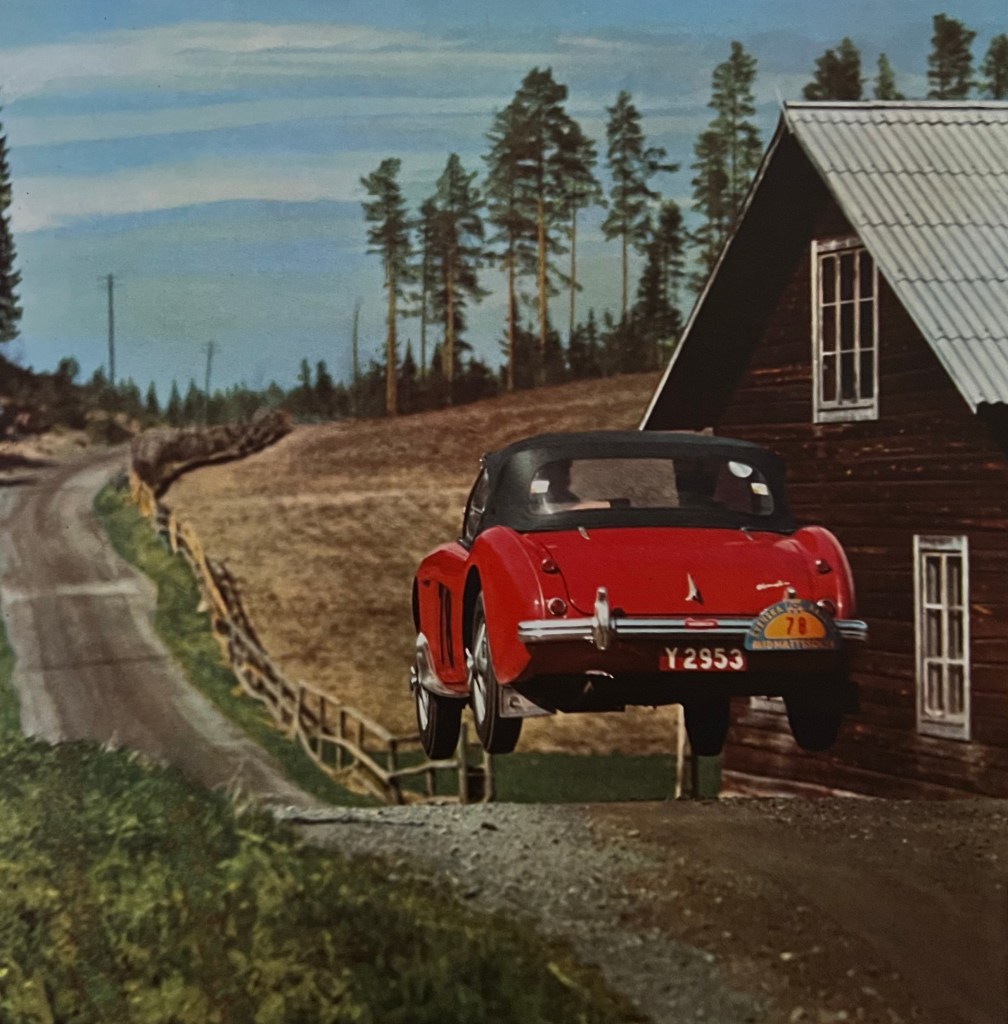
‘The Frölander and Lindbergh, shortly after take-off, on their flight to the Midnight Sun in a single-engined (?) Austin Healey.’ This crew didn’t finish in the top-10, the May 29-June 3, 1956 event was won by a VW 1200 driven by H Bengtsson and navigator A Righard.
Credits…
Automobile Year, Yves Debraine, Louis Klemantaski, Junior, Bernard Cahier, B Gronlund
Tailpiece…
I’ve long thought the power of an ad is inversely proportional to the word count…particularly if the visual imagery is up to snuff!
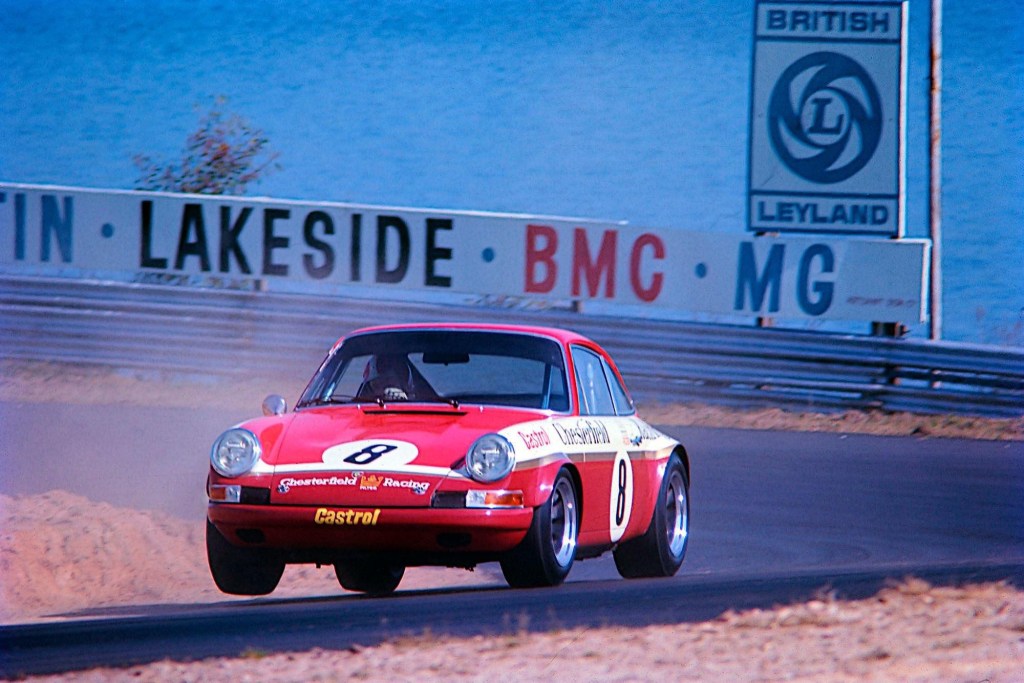
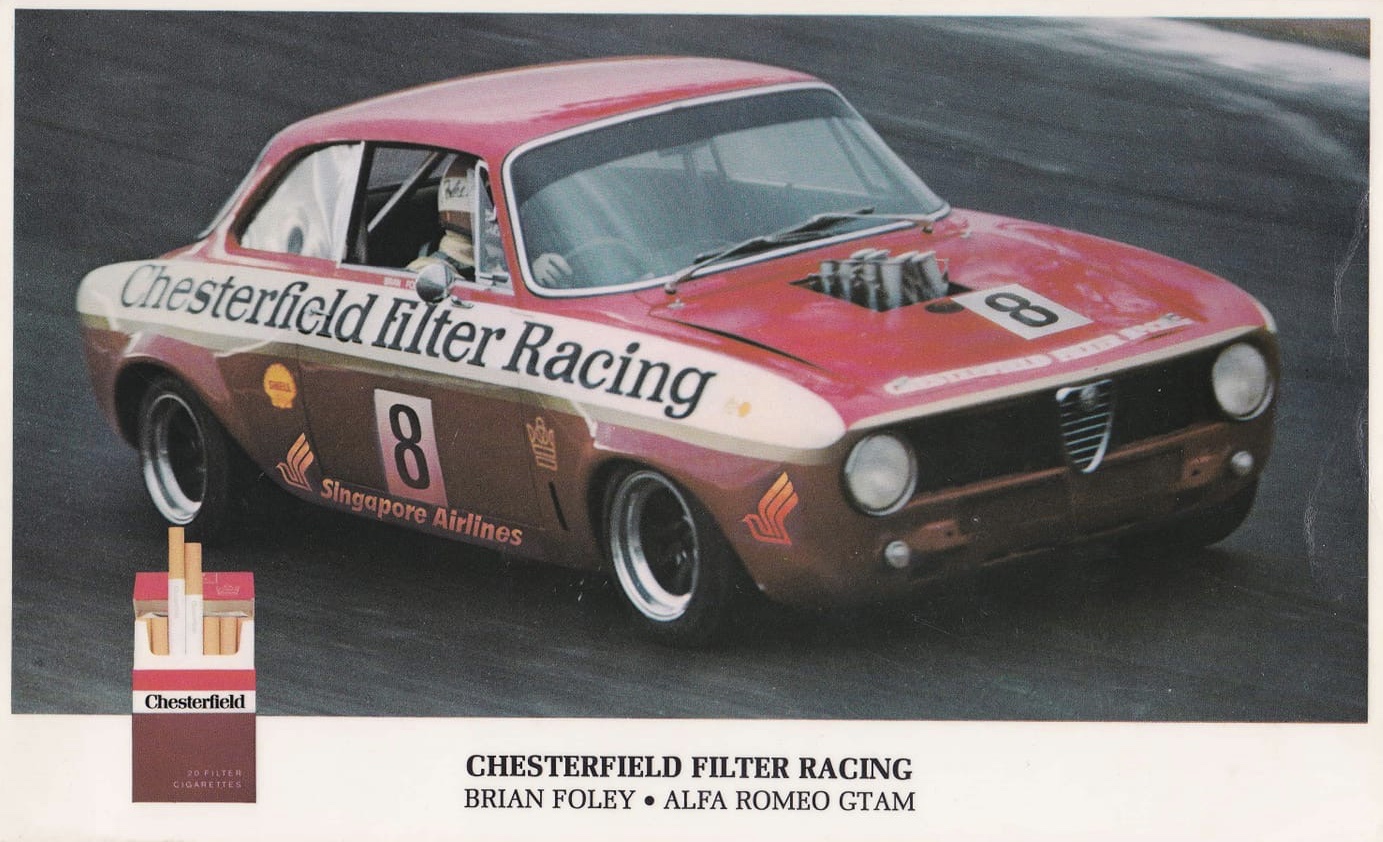
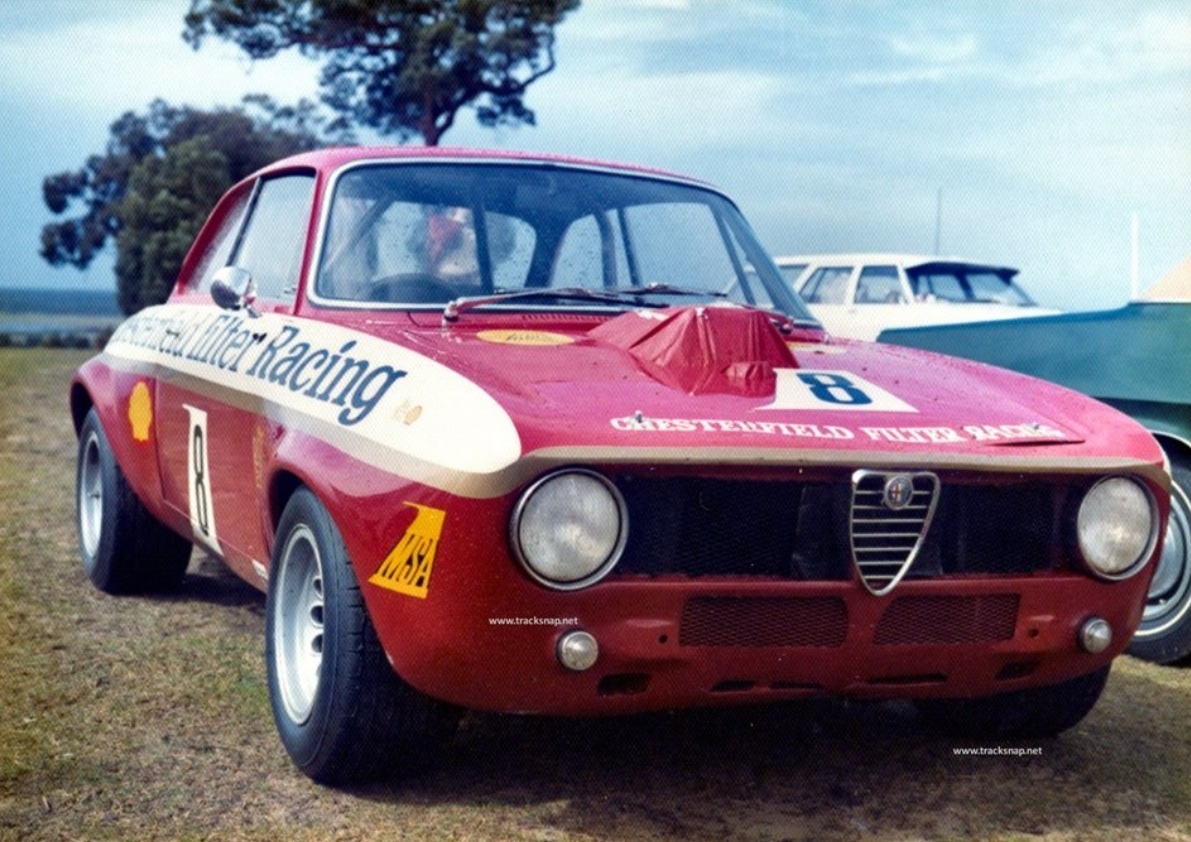
I’ll take the one with stripes…Brian Foley’s Alfa Romeo 1750 GTAm on the showroom floor of his Parramatta Alfa Romeo dealership, Sydney in 1972.
Look at all those 105s, a 2-litre Spyder with a Berlina alongside, boxy Giulia Super, a couple of 1750 GTVs, oh, and a 1750 GTAm at centre-stage, as it should be.
There have been some stunning ex-works touring cars raced in Australia down the decades, the must lustworthy for me are Alan Moffat’s ’69 KarKraft Mustang Trans-Am, his ’75 RS3100 ‘Cologne’ Capri and Foley’s GTAm.
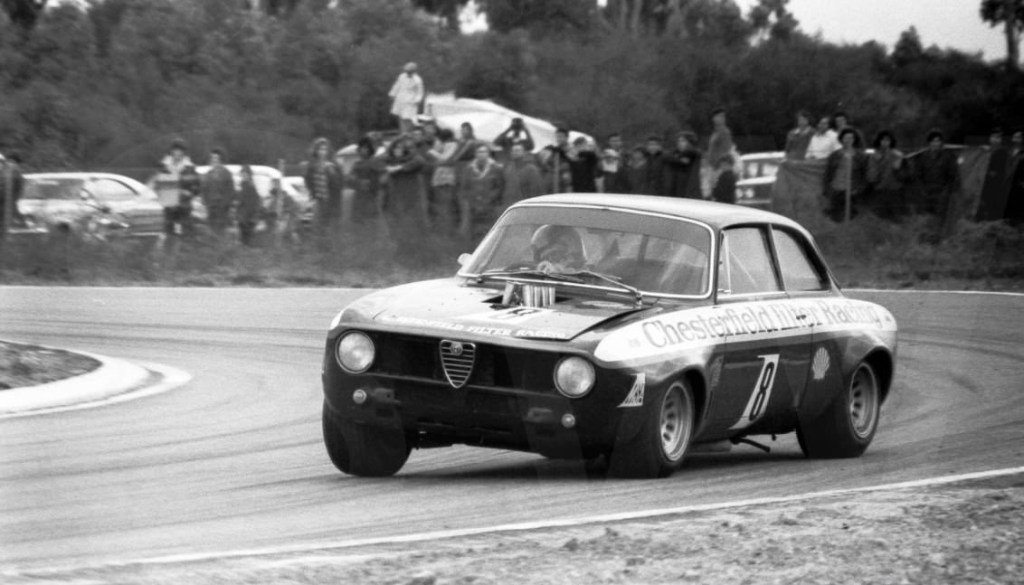
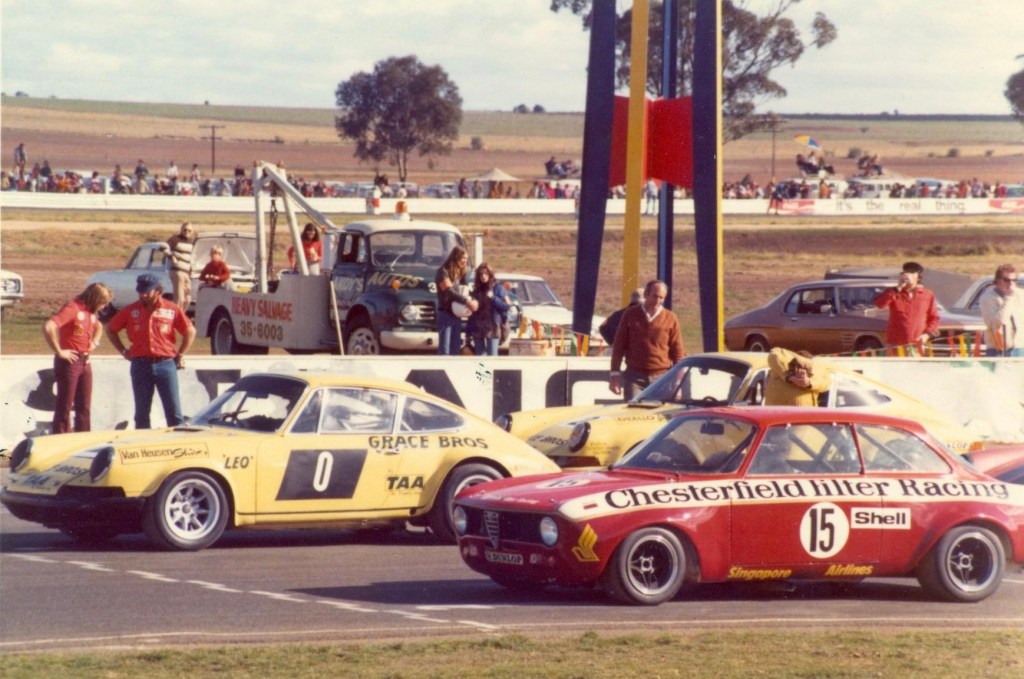
Brian made his name in Minis. Together with Melbourne’s Peter ‘Skinny’ Manton, he was top of the Cooper S pops in the mid-1960s and became an outright contender with acquisition of a Porsche 911S in 1970. But if the Porker was outgunned by the big V8s in the Australian Touring Car Championship – Pete Geoghegan and Allan Moffat Mustangs, Norm Beechey’s Holden Monaro GTS350 and Bob Jane’s Camaro – Brian’s GTAm would struggle bigtime, and so it did.
Dick Simpson artistry: Brian Foley on the hop through Lakeside’s Karrussel during the 1970 ATCC round, Porsche 911S (D Simpson)1971 Chesterfield press release shot, note the 10-inch Minilites (Foley Collection)The Toine Hezemans/Carlo Facetti GTAm on the way to fourth place in the July 1971 24 Hours of Spa-Francorchamps (unattributed)
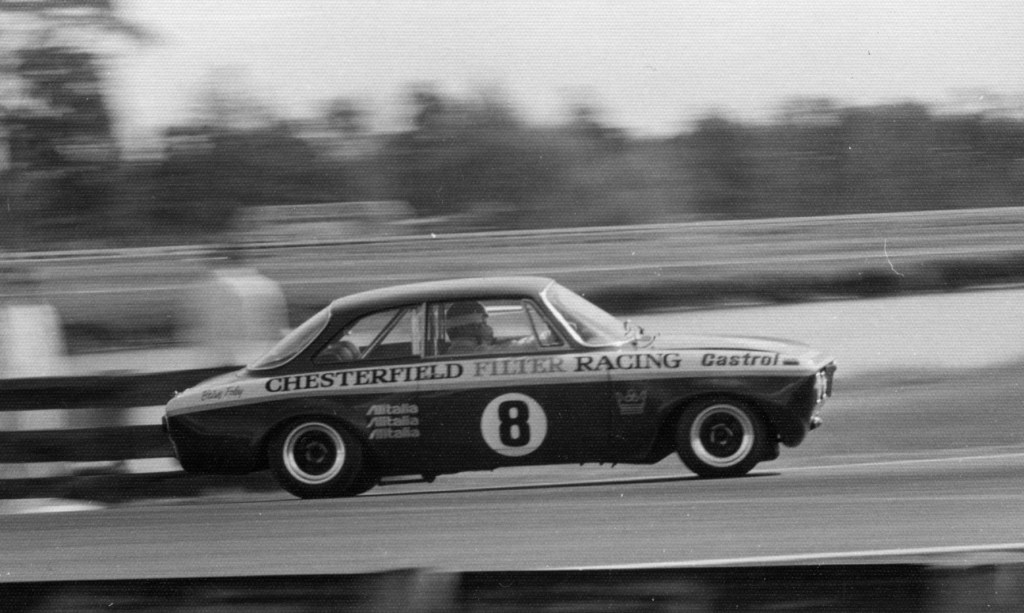
The purchase made commercial sense though. Brian Foley Automotive, formed in 1967, became an Alfa Romeo dealer, Foley had support for the car from Alfa Romeo Australia in addition to old sponsor, Castrol, Alitalia and of course Chesterfield ciggies.
Toine Hezeman had already won the 1970 European Touring Car Championship – four wins in nine rounds – in a works-1750 GTAm by the time Foley ordered his car.
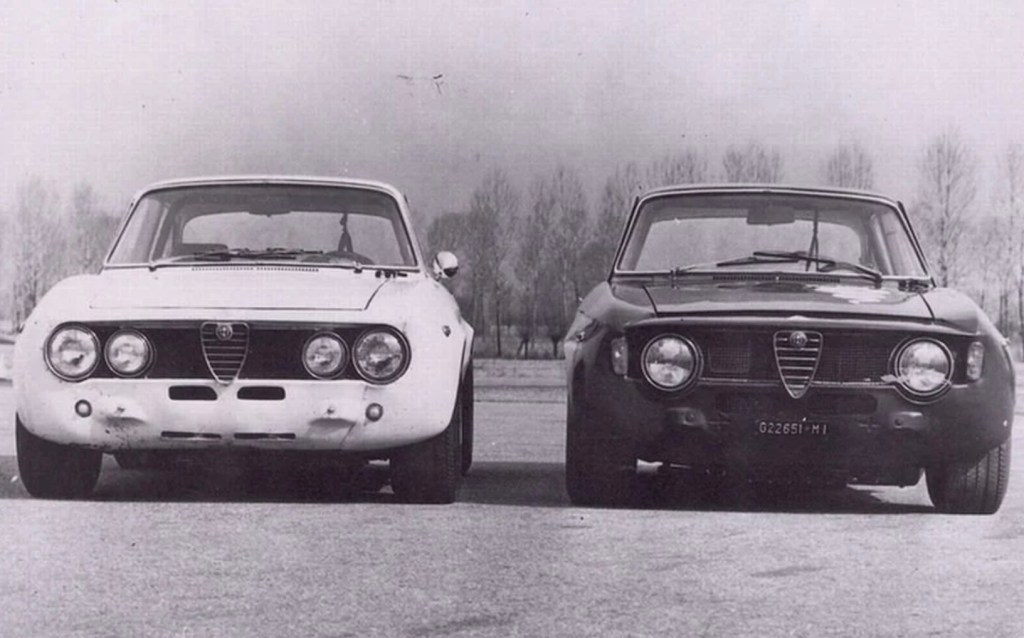
While the Giulia Sprint GTA (700kg) was built by Alfa Romeo, the 1750 GTAm (970kg) (2000 GTAm from the introduction of the 2000 GTV) was built by Autodelta, and sometimes by other specialists using bodies they acquired or were supplied by clients, then built up with parts supplied by Autodelta.
1750 GTAm and Giulia GTA Junior in 1970 (Autodelta)Andrea De Adamich about to jump aboard his GTAm during the 19 Nurburgring (unattributed)
The model was homologated around the US version of the 1750 GTV – Tipo 105.51 – these cars were left-hookers’ fitted with Spica fuel injection to meet emissions regs: for racing purposes the rules allowed the use of competition fuel injection, usually Lucas. Having said that, right hand drive Tipo 105.44 shells were also used.
For years there have been several schools of thought as to the ‘Am’ bit of the name. One was that it stood for alleggorita maggiorata – increased and lightened, another was alleggorita modificata – modified and lightened, and the other is that the Am stood for America. Marco Fazio of Alfa Romeo Documentazione Storico put the matter to rest when he confirmed on the Spettacolo Sportivo in September 2011 that ‘America’ is the official type name, therefore Alfa Romeo 1750 GTAm/Alfa Romeo 2000 GTAm.
Chassis #1531068 was completed by Autodelta on February 24, 1970. It was acquired by Foley late in the year after an uncertain history, perhaps it had been used as a test hack during the Targa Florio weekend by works T33/3 drivers. When it arrived in Sydney, the car’s mechanicals: engine, gearbox and differential required rebuilds, so Foley missed the first three rounds of the 1971 Australian Touring Car Championship at Symmons Plains, Calder and Sandown.
Foley, GTAm in the Warwick Farm Essex during the November 1971 AGP meeting. Bill Fanning’s superb Escort Waggott following (L Hemer)Foley in front of Jim McKeown at Mallala in 1971 (J Lemm)David McKay and Robin Sharply during the Oran Park stage of the Dulux Rally on August 8, 1971. GTAm engined Alfa 1750 GTV (L Hemer)
Foley was then sixth at Surfers Paradise, fifth at Mallala and seventh at Lakeside. He missed the final round at Oran Park because he loaned the engine to David McKay for his assault on the Dulux Rally aboard a 1750 GTV (above). See here for more about the Dulux, not the correct year mind you: https://primotipo.com/2015/04/09/australias-cologne-capris/
Wanting to race competitively and give his sponsors a reasonable crack of the whip, Foley decided to run the car as a Sports Sedan in 1972, a class that allowed more significant modifications to be made.
He and his mechanics, Colin Devaney and Colin James created a unique GTAm by fitting a Tipo 33 2.5-litre V8 into the reasonably tight engine bay!
Alec Mildren Racing had a float of three of these 2.5-litre, quad-cam, two-valve, twin-plug, fuel injected V8s that had been fitted to the team’s Brabham BT23D and Mildren ‘Yellow Submarine’ single-seaters raced by Frank Gardner and Kevin Bartlett from late 1967 until late 1969 (the Sub was fitted with a Waggott in time for the Hordern Trophy in December 1969). KB won Gold Stars in 1968-69 so equipped.
When Mildren replaced the Tipo 33 V8s with Merv Waggotts 2-litre TC-4V engines Foley bought one of the V8s in bits. When rebuilt it gave circa 305bhp.
Kevin Bartlett decamps the Mildren Brabham BT23D Alfa Romeo during the 1969 Warwick Farm 100 Tasman round (B Jackson)(B Jackson)
It wasn’t that simple though, the all aluminium engine was an incredibly tight fit, with Foley telling Australian Muscle Car’s Paul Newby that the sub-optimal exhaust system they were forced to run could have lost up to 50bhp. Costly, given the V8 was 70kg heavier than the 1985cc twin-cam, two-valve, twin-plug, fuel injected four which gave 194bhp when it was first rebuilt, and 217bhp after further development.
The car was converted to RH-steering during the rebuild – which involved a bigger hole in the floor pan to accommodate a larger bell-housing – but the running gear otherwise remained as built by Autodelta: gearbox, diff, suspension, Campagnolo wheels and brakes.
It’ll fit somehow…(C James)Foley leans on it as he crosses Warwick Farm’s causeway in 1972, GTAm T33. Same car but now fitted with T33 2.5 V8, RHD and with single headlight 1600 Junior front-clip (J Semple)
Newby wrote that the car had wins at Adelaide and Amaroo Park, and one victory over Allan Moffat’s Mustang at Warwick Farm and a successful visit to Malaysia.
Despite that, Foley decided a better Sports Sedan starting position was a much lighter aluminium GTA, to that end he bought the ex-Mildren/Foley RHD GTA and gave it to Bowin Designs’ John Joyce to work his magic. A story for another time.
Over time it’s amazing how many racing Alfa Romeos have headed West, perhaps the LHD Mildren GTA was the first…Sure enough, when Foley advertised the GTAm it was Perth Fiat dealer Frank Cecchele who bought it, a good thing!
Gordon Stephenson was his driver, but it wasn’t too long before CAMS caught up with them. The GTAm was powered by an exotic full-race V8, it was not a production based engine as the rules required. While the Montreal V8 might look a bit the same, it shares not one component with Autodelta’s race V8.
After a while in the naughty-boys-corner, it was fitted a twin-turbo Rover V8 and won some state titles so powered in the 1980s before it was badly damaged in a testing accident at Wanneroo, by that time the car was fitted with a twin-turbo Fiat V6.
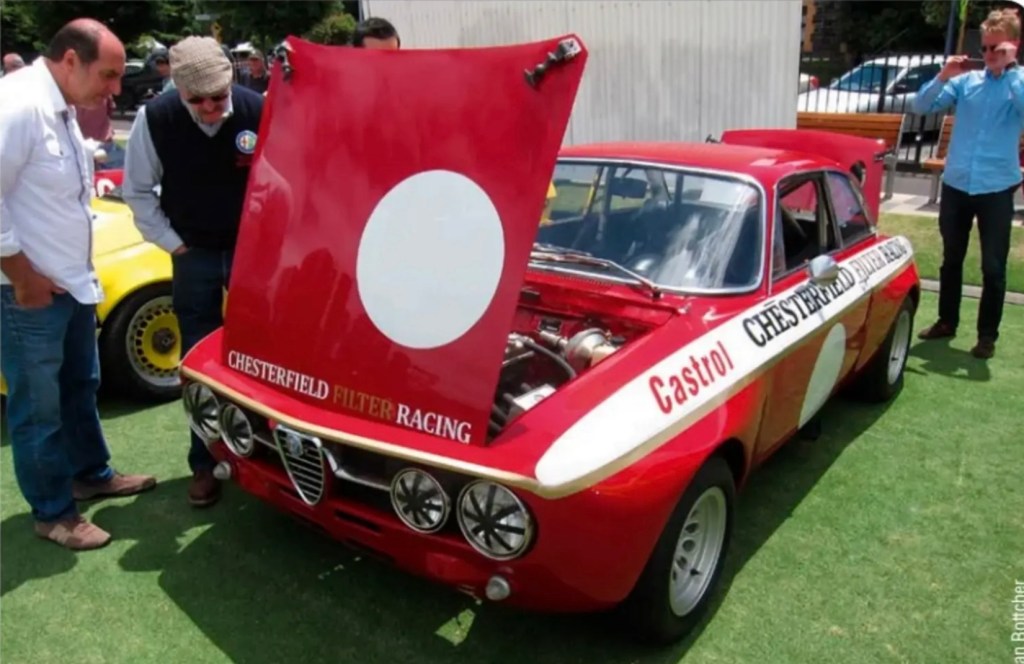
Various approaches were made to Cecchele down the decades to buy #1531068, and finally he succumbed to Vin Sharp’s entreaties in 2006. Vin is a member of a much respected Victorian Alfa Romeo family and has done a brilliant job restoring the car to original condition aided and abetted by Cecchele who kept all of the key components, with the exception of the engine.
Vin Sharp and Brian Foley unveiled the restored GTAm at the Alfa Romeo Owners Club of Victoria annual Specattolo day at Melbourne High, South Yarra in late 2013 (E Bottcher)Dale Harvey captures the GTAm on the WF causeway in 1971 (D Harvey)
Specifications…
Summary of Peter Wherrett’s article on the Foley GTAm published in the June 1971 issue of Racing Car News
Body: Steel, bonnet and boot lid fibreglass, doors aluminium GTA with sliding perspex windows, all glass other than the laminated screen are perspex. The lower half of each guard is fitted with fibreglass flares which are bonded or pop riveted. Lightweight bumper if required.
All interior trim is removed and replaced with lightweight material. Front seats fibreglass, dashboard replaced with a lightweight unit, Momo steering wheel
Engine: 1985cc, DOHC, two-valve, twin-plug, Lucas fuel injected four cylinder, aluminium engine. 84.55×99.5mm bore/stroke. 220bhp DIN @ 7200rpm quoted.
Gearbox: 5-speed GTA with vast choice of gear and diff ratios
On tour. Foley at Bay Park, New Zealand in the summer of 1971-72 (B Williamson Collection)Mallala ATCC round in 1971 (J Rogers)
Suspension:
Front: Independent coil springs, Armstrong adjustable heavy duty double acting shock absorbers, heavy duty anti roll bar
Rear: Coil springs with coaxially mounted Armstrong fully adjustable, heavy duty, double acting shock absorbers. Adjustable heavy duty roll bar
Rear axle: Anchored to the body structure by two trailing arms and upper magnesium A-brackets for transverse anchorages; all with metal bushes on the frame and axle. Hypoid final drive with pawl and clutch type limited slip differential. Choice of final drive ratios
Wheels: Standard wheels are Campagnolo 13 x 9 inch and 13 x 10 inch Minilites “which have an additional inch of offset over those from Autodelta to allow the car to fully exploit local regulations with a track two inches wider than the homologated figure.” The 10 inch rims will be dries, the 9 inchers wets.
Brakes: Four wheel discs, ventilated at the front, aluminium calipers
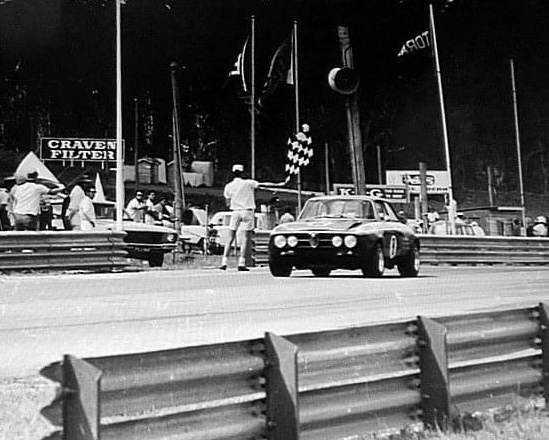
Foley crosses the finish line at the end of the Lakeside 1971 ATCC round (B Thomas)
Etcetera…
(unattributed)
Two more shots of the Hezemans/Facetti GTAm during the July 24-25 1971 Spa 24-Hour.
The car’s head and radiator were replaced during the event, the strategically long pit stops of the other two Autodelta cars ensured the pair finished third. The race was won by the the Dieter Glemser/Alex Soler-Roig Ford Capri RS2600.
(unattributed)Foley, Warwick Farm Creek Corner exit May 1971 (L Hemer)In sports sedan guise at Wanneroo Park, Perth August 20, 1972, and again below (R Hagarty)(Speedwest)
James Semple, Lynton Hemer, Colin James, Dick Simpson, John Lemm, Brian Jackson, Olaf Zagato on The Nostalgia Forum, Racing Car News May 1971, John Rogers, Brier Thomas, Euan Bottcher, Bob Williamson Collection, Glenn Moulds Collection
Tailpieces…
(G Moulds Collection)
It seems sorta-right to conclude with Foley’s subsequent weapon of war, an even lighter variant of the ex-Mildren-French GTA ‘RHD’, at Calder in May 1973.
(L Hemer)
My friend Lynton Hemer captured ‘Foles’ saying gedday to the fans on the warm-down lap of the 1971 AGP touring car support race, GTAm, seems a nice way to finish…
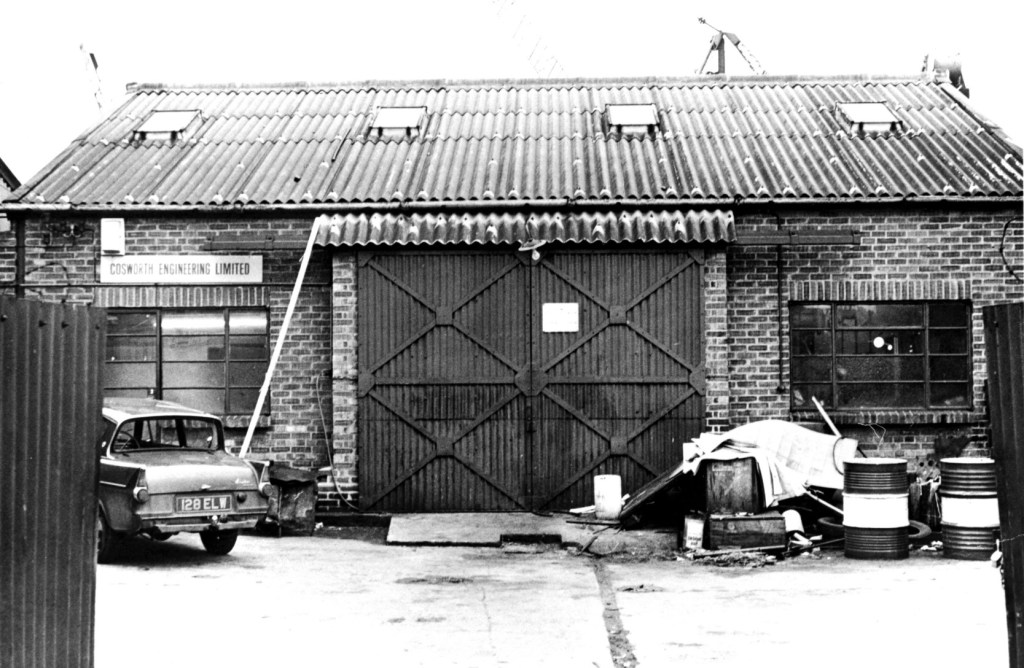
Cosworth Engineering Ltd was established on September 28, 1958 and originally operated from this modest facility in Shaftesbury Mews, London W8.
Mike Costin was the Technical Director of Lotus by day and Cosworth partner by night, while Keith Duckworth worked on the new enterprise full time.
The firm’s rate of growth can be gauged from moves to larger London premises in Friern Barnet in 1959 and then again to Edmonton in 1961.
Their first projects in 1959-60 were the Mk1, a modified Ford Anglia 105E engine design, the Mk 2, a production Formula Junior race engine based on the learnings of the Mk1, and the Mk3, an improved version of the Mk2 using their A3 cam, with a stronger bottom end and optional dry sump.
Cosworth were up and running…
I’ll take your advice as to chassis and gearbox manufacturer. The ‘Aeroquip’ fittings and roll bar height suggests a modern shot? (Cosworth)
Credits…
Cosworth Engineering
(Cosworth)
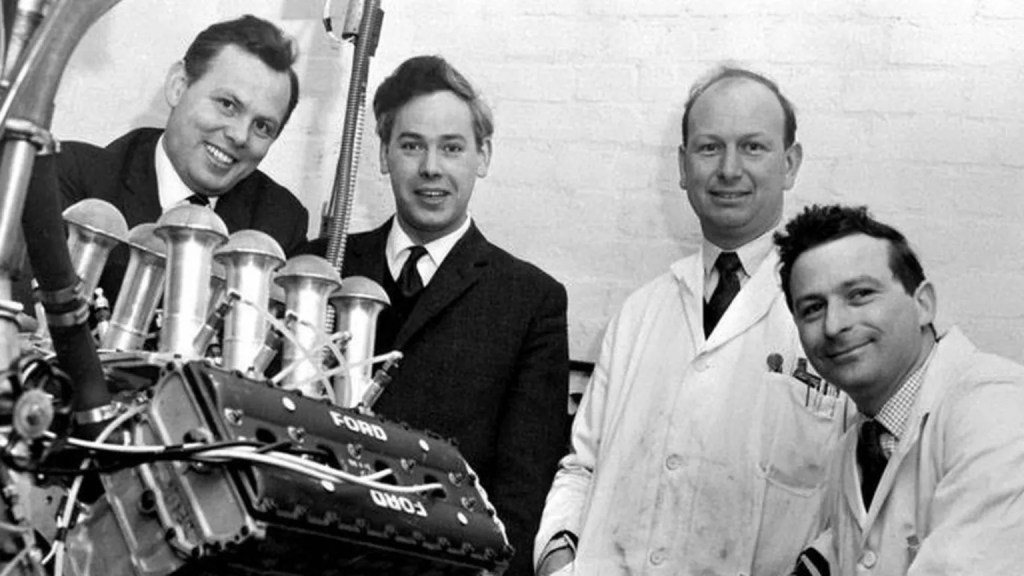
Cosworth’s Bill Brown, Keith Duckworth, Mike Costin and Ben Rood with the almighty, most successful racing engine of all time, the Ford Cosworth DFV 3-litre V8 F1 design. More about the engine here: https://primotipo.com/2016/05/12/me-an-my-dfv/
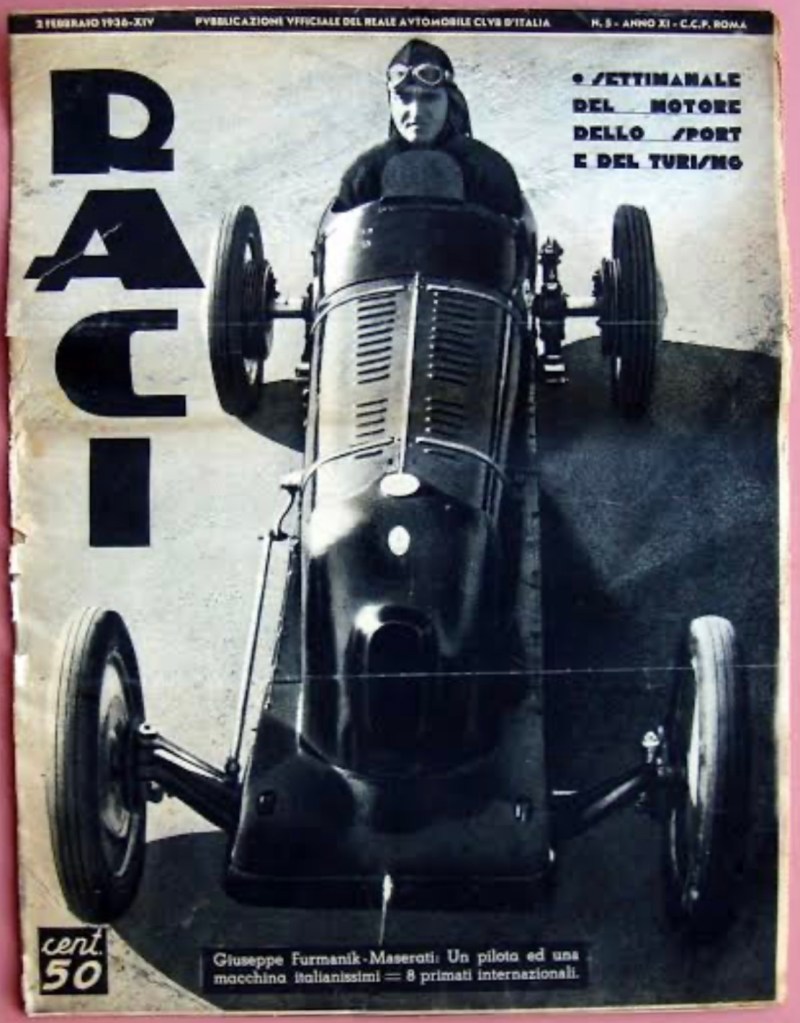
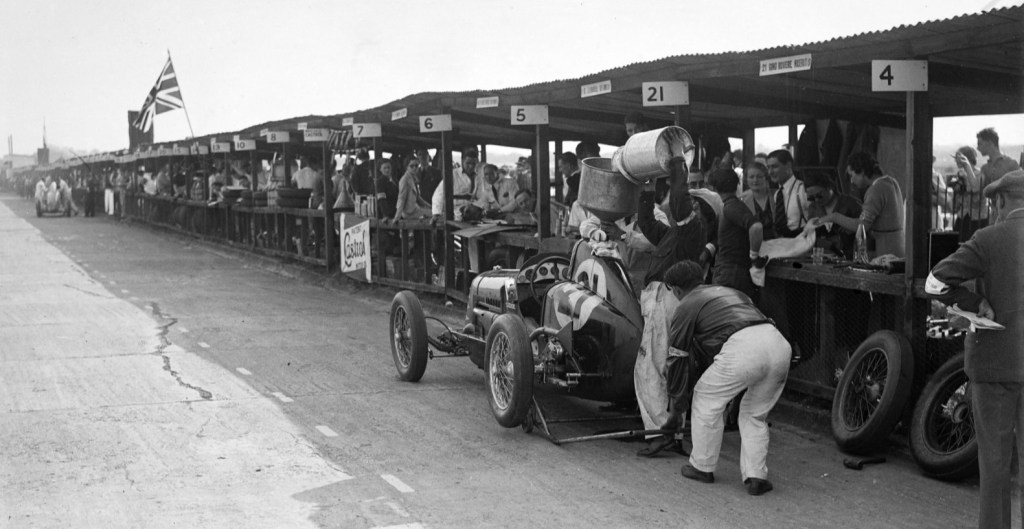
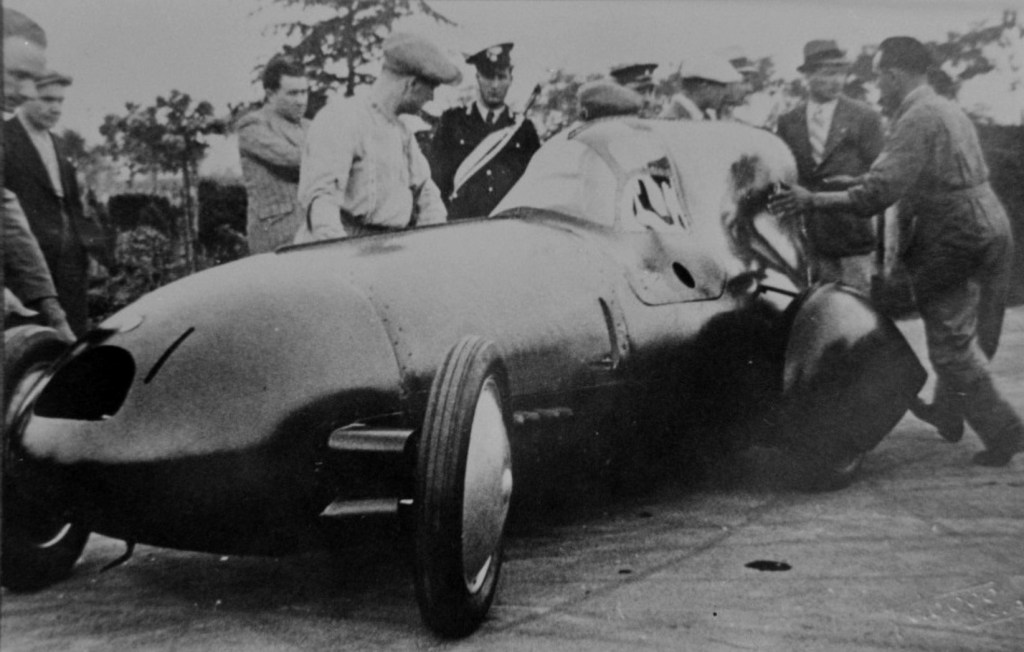
Ernesto Maserati looks on as Giuseppe Furmanik readies himself and his lightweight, streamlined, four cylinder 4C powered Maserati 6CM, chassis #1136 for a run during several speed record attempts he made at Tassignano on the Firenze-Mare Autostrada on June 2-3 1937.
Furmanik set the 1001-1500cc Flying One Kilometre record on June 3 at 148.4mph/237.568kmh (or 148.2/238.6 depending upon your source).
The car’s special aluminium bodywork was designed by the Centro Sperimentale Aeronautico di Giudonia and built by Carozzeria S. A. Viotti of Torino. Furmanik used the machine – also referred to as 4CM #1536, for which no factory build sheet exists – and another 4CM, chassis #1120, in record attempts.
Giuseppe Furmanik before a run in #1536, Pirelli tyres (Pirelli)
Of Polish descent Joseph Furmanik was born in Switzerland in 1903 then moved to Italy with his father circa 1919-20. He adopted ‘Giuseppe’, became an engineer, co-designed a parachute named the Salvator and married money.
Settled in Rome, he became a prominent figure in 1930s Italian motor racing with his competition exploits probably funded by parachute royalties. He succeeded Count Vincenzo Florio as President of the Royal Automobile Club of Italy (RACI) in 1937.
What a big arse you have my dear…I wonder what the insignia on the tail represents? (Pirelli)
4CM Technical Specifications…
Furmanik took delivery of 4CM #1120, a four-cylinder, twin-cam, two-valve, Roots-supercharged 125bhp at 5000-6000rpm 1100cc Maserati 4CM monoposto, on August 12, 1932.
The 4CM was avant-garde for its time, Maserati followed Alfa Romeo’s single-seater lead set by Vittorio Jano and his team with their Grand Prix Alfa Romeo Tipo B/P3 Monopostos.
Very light, the car’s two parallel channel section chassis members were only 620mm wide with bodywork tightly proportioned around the key mechanical components. Hydraulic brakes were fitted, again, leading edge for the time. The car had a four speed gearbox and period typical suspension comprising solid axles front and rear sprung by semi-elliptic leaf springs, friction dampers were fitted. The wheelbase was 240cm, track 120/120cm and weight circa 520-580kg.
4CM early competition…
The 4CMs looked great and were fast in a limited number of outings in their first year of competition, 1932. In the German Grand Prix held on the Nurburgring in July, Ernesto Maserati and Amedeo Ruggeri were third of 15 Group 2 800-1500cc cars in the race won by Rudy Caracciola’s Alfa Tipo B 2.6. Maserati followed up with fourth of the Voiturettes – Ernesto’s little 1100cc Maser was surrounded by 1500cc cars – at the Masarykuv Okruh at Brno in September.
Giuseppe Campari’s Maserati 4CM 2-litre ahead of Jean-Pierre Wimille’s Alfa Romeo Monza during the August 6, 1933 Nice GP (MotorSport)This shot and the one below shows the earlier Furmanik 4CM #1120, with body designed by Mario Revelli di Beaumont (RACI Motor Sport February 1936)
Furmanik’s Record Breaking…
Furmanik raced #1120 throughout 1933 finishing third in the Coppa Ciano Junior and Coppa Acerbo Junior in July/August and missing the final of the Monza Grand Prix in September and DNF in his heat.
Into 1934 Furmanik started the Coppa Ciano as favourite in the Voiturette class but didn’t finish after a slight accident on the first lap. He was fourth in the Coppa Acerbo Junior.
Giuseppe does not appear to have raced #1120 in 1935 (see change of ownership to Gino Rovere shortly) and then decided to plan an attack on the World Speed Record.
#1120’s power was increased (output not specified) and a lighter more streamlined body was designed by Mario Revelli di Beaumont – ‘the most prolific car designed you’ve never heard of’ – and the front brakes removed, the result about 470kg/1036lbs. He also adapted the gearbox to provide for three tall gears.
Furmanik’s first runs, on November 28, 1935 were made on the Lucca-Altopascio section of the Firenze-Mare Autostrada, then on the Pescara road circuit on January 8, 1936, and then again on the same section of the Firenze-Mare Autostrada on January 29, 1936.
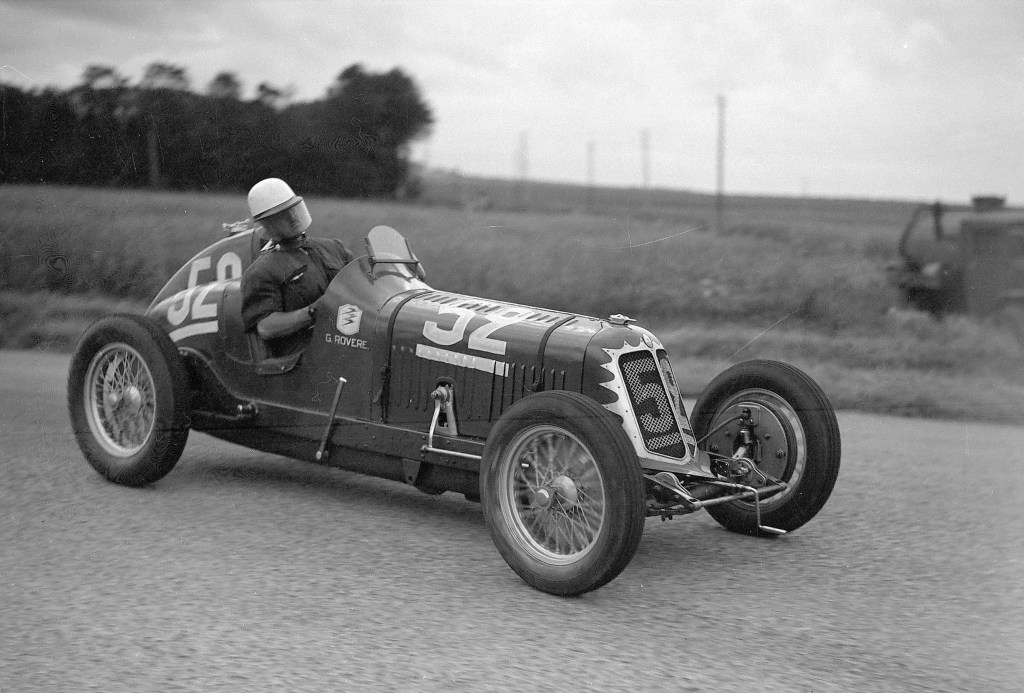
Gino Rovere aboard Maserati 4CM #1120 at Brooklands on May 6, 1935 (MotorSport)
Gino Rovere…
Gino Rovere was a wealthy enthusiast who became Maserati’s President. He supported Furmanik’s efforts, making available funds to increase the engine’s output and further improve aerodynamics.
With a 4C engine then developing some 150bhp at 7,200 rpm and the Centro Sperimentale Aeronautico di Giudonia/Carozzeria closed aero body fitted to 6CM chassis #1536, Furmanik set the Flying Kilometre record mentioned at the outset in June 1937.
Along the way #1120’s ownership changed from Furmanik to Rovere and the car was returned to Maserati’s Bologna factory where it’s said it was fitted with a 1.5-litre engine for Rovere to race in selected 1935 Voiturette events: Brooklands in the May 6 JCC International Trophy (results please), then at Dieppe and finally Modena.
Gino Rovere lines up #1120 before the start of the Junior Car Club International Trophy , Brooklands, May 6, 1935 (MotorSport)Dieppe GP grid #30 P Veyron Bugatti T51A, the Rovere 4CM, #6 Humphrey Cook, ERA A-Type, #50 Ippolito Berrone, Maserati 4CM – note the standard grille compared with Rovere’s machine – #48 Eddie Herzberger, MG K3 Magnette and #28 Maurice Baumer’s K3. Pat Fairfield’s ERA A-type won from Bird’s B-Type and Veyron’s Bugatti (Bonhams)Beautiful shot of Giuseppe Farina aboard the Rovere 4CM #1120 at Dieppe (Bonhams)
In the GP de Dieppe on July 20, Rovere qualified seventh on the 19 car grid and finished eighth, handing his car over to ‘his protege’ Giuseppe Farina late in the race, Farina promptly set the fastest time of the day despite the car’s quoted 1.1-litre capacity. Rovere also contested the Circuit di Modena Junior on September 15 for Q5 and DNF, again the capacity is quoted as 1100cc in the goldenera.fi results.
In 1936 Rovere’s team competed under the works banner given his status as Maserati’s President. #1120 was raced by various works drivers early that year and then sold to Scuderia Impero. Agostino Prosperi and Mario Colini drove it, then Rovere had a return bout with his old car at Pescara.
In the modern era, #1120 has been a regular part of the UK historic scene in 1100cc and 1500cc form raced by many drivers including Sean Danaher, Martin Stretton, Barrie Baxter and Stefan Schollwoeck.
Build numbers…
Maserati built 16 4CMs between 1932-35: Nine 1100s – chassis numbers #1115, 1116, 1118, 1119, 1120, 1122, 1125, 1127 and 1128 (note that #1120 and 1125 were both later fitted with 1500cc engines), Six 1500s – 1514, 1521 (also fitted with an 1100cc engine), 1525, 1526, 1527 and 1528, and One 2000cc – 2011.
Etcetera…
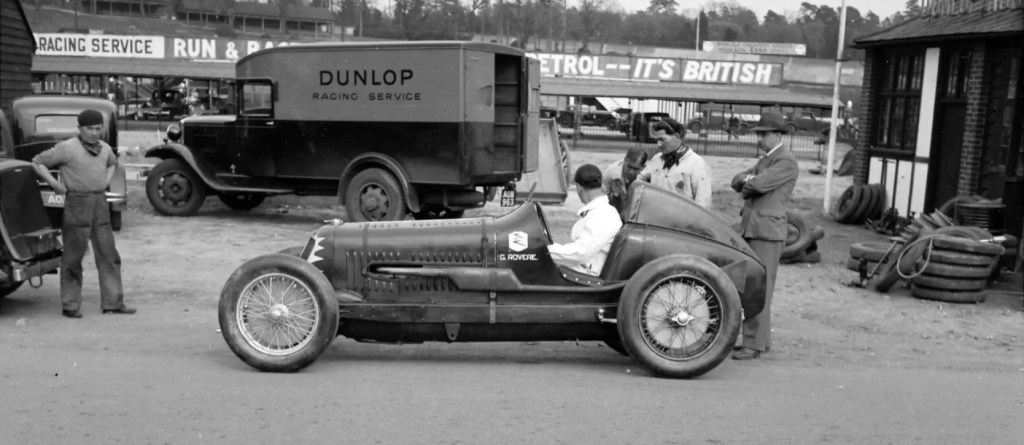
(MotorSport)
Two more shots of Rovere in the Brooklands 1935 paddock, #1120 in profile and three-quarter rear for a pitstop.
(MotorSport)(coachbuild.com)
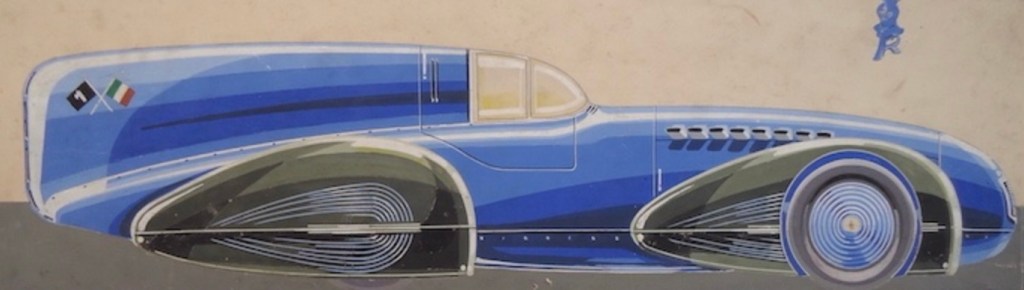
A rendering of the Centro Sperimentale Aeronautico di Giudonia design, and below #1536 in one specification in which the car ran. Compare and contrast with the first three photographs in this piece.
(unattributed)Ad for AGIP’s Robur fuel 1936, Furmanik aboard #1120
Credits…
Anonymous photographer within the Pirelli Archives, MotorSport Images, Leif Snellman’s superb The Golden Era of Grand Prix Racing – goldenera.fi, The Nostalgia Forum, thanks to Maserati historian Kevin Tjeerdsma for advice on correction of facts and chassis numbers
John Surtees is chasing Jack Brabham hard in the latter stages of the 1963 Australian Grand Prix at Warwick Farm on February 10, 1963. He is racing a Lola Mk4A Climax 2.7 FPF chassis #BRGP44.
Jack’s Brabham, Brabham BT4 Climax passed him late in the race, John fell short by 12 seconds in a race run in intensive heat, but he had a good southern summer, winning two of the eight Australasian internationals, the NZ GP at Pukekohe and the Lakeside International.
Dick Ellis cutaway of an F1 Lola Mk4 Coventry Climax FWMV 1.5 V8Surtees, Team Lotus Lotus 18 Climax at Ardmore during the 1961 NZ GP, DNF (M Fistonic)
1963 wasn’t his first trip Down Under. Il Grande John did the Kiwi Internationals with Team Lotus in 1961 when Innes Ireland, Jim Clark and Surtees raced Lotus 18 2.5 FPFs fitted with the dreaded Queerbox. In a grim tour for the team, Surtees didn’t finish any of his three races at Ardmore, Levin or Wigram.
He was back again in 1962, running a Reg Parnell Cooper T53 2.7 in Australia, finishing second at Sandown and winning from Jack Brabham’s Cooper T55 2.7 on Longford’s daunting mix of roads, undulations, railway viaduct and barbed wire.
Parnell ran a pair of Lola T4 Climaxes, 1.5 FPF powered early on, then 1.5 FWMV V8 engined when the engine became available in Grand Prix racing that year. Surtees finished a great fourth in the World Drivers Championship during the season in which the monocoque Lotus 25 Climax rewrote the chassis design rulebook.
Surtees winning Lola Mk4A and Bruce McLaren, Cooper T62 on the front row at Pukekohe, NZ GP 1963. That’s Brabham’s #4 BT4, and Tony Maggs in the other Parnell Lola Mk4 at far left (D Oxton)Later Kiwi Ace, David Oxton attends to a Colotti ratio change on Surtees’ car, Pukekohe (D Oxton)
Reg (Bowmaker-Yeoman Racing Team) fitted 2.7FPFs to two of his T4s in place of the smaller F1 V8 for the 1963 Formula Libre Australasian Internationals for Surtees and South African driver, Tony Maggs use. Parnell knew the local-ropes, having raced a Ferrari Super Squalo 3.4 as part of a two car team together with Peter Whitehead in the 1957 New Zealand Internationals. He did well too, winning the NZ GP and the Dunedin Road Race in what was his last hurrah as a driver before taking on Aston Martin team management duties.
Other hot-shots that summer included Jack Brabham in his new F1 BT3 derived BT4 2.7 FPF, while Bruce McLaren raced the similarly powered Cooper T62 with which he won the 1962 Australian Grand Prix at Caversham, near Perth that November. Graham Hill (and Innes Ireland in some NZ races) raced the radical, fast Ferguson P99 albeit he lacked the mumbo of his completion, running 2.5 FPF’s rather than the more fancied 2.7 ‘Indy’ variant.
Young Cooper T53 mounted thrusters included Chris Amon, Jim Palmer and Angus Hyslop. In Australia the local quicks included David McKay and Bib Stillwell in new BT4s, while Lex Davison and young grazier John Youl raced Coopers T53 and T55 respectively.
Surtees’s Lola Mk4A #BRGP44 was quick everywhere, starting the tour with a bang by winning the NZ GP at the new Pukekohe circuit near Auckland, then gearbox problems caused DNFs at Levinand Wigram. He failed to finish at Teretonga as well, albeit Maggs placed second behind McLaren at the track near Invercargill at the very south of the South Island.
Surtees in the Wigram – RNZAF airfield – paddock. That Ferrari 250 SWB belonged to ‘Richardson’ for those wanting to do further research (W Collins)Surtees and handsome Mk4A at Teretonga, ninth after undisclosed problems (G Woods)
There was then a fortnight to ship the cars across the Tasman Sea to Sydney Harbour for the AGP to be held on the challenging, technical Warwick Farm on February 10.
Surtees put down a marker, popping his Lola on pole in Jack’s backyard. He then led the race until Brabham – who started well back on the grid having sorted a new BT4 chassis during practice – passed him with 14 laps to run, the Brit suffering along with many others in the intense heat. John had the consolation of meeting fastest lap.
Then it was off to Lakeside, north of Brisbane. There Surtees started from Q3 and won from Hill, bagging the P99’s best result for the tour, with Stillwell third in his new Brabham BT4. Chris Amon was fourth and impressing pit-pundits with every drive. At the end of the summer Reg Parnell took the 19 year old off to Europe where he did rather well…initially racing #BRGP44 FWMV powered throughout 1963.
Shell drivers at Warwick Farm: David McKay, Tony Maggs, Graham Hill, John Surtees, Jim Palmer and Chris Amon (C Galloway)Surtees hooks into the right-hander at the end of Pit Straight, Paddock, at Warwick Farm 1963 (B Donaldson)
Surtees returned to Europe to meet his new Ferrari team commitments, missing the final two races at Longford and Sandown, with Tony Maggs, sixth and second in the Parnell Lolas respectively.
Had there been a Tasman Cup that summer – the first was contested and won by Bruce McLaren in 1964 – Bruce would have won it. Brabham won at Levin and Warwick Farm, Surtees at Pukekohe and Lakeside, while McLaren was victorious at Wigram, Teretonga, Longford and Sandown.
The Lolas had proved very competitive Formula Libre machines but were thoroughly outclassed in ’63 GP racing: Amon, Maurice Trintignant, Lucien Bianchi, Mike Hailwood and Masten Gregory all failed to bag a point for Reg Parnell Racing.
Surtees Mk4 during 1962. The idea of that yellow enamelled spaceframe chassis was to make it easy to see any cracks that arose (unattributed)
Etcetera…
(MotorSport)
Pretty car. Surtees during the soggy German Grand Prix was second behind Graham Hill’s BRM. He first raced the chassis he used throughout his 1963 Australiasion Tour, T4A #BRGP44, at Karlskoga in August, there he led until a valve spring broke.
(MotorSport)
Main Men. Reg Parnell, Surtees and who? during the May 1962 Dutch Grand Prix weekend at Zandvoort. John popped his car on pole but crashed in the early laps after a wishbone failure.
(MotorSport)
More Main Men. Surtees and Lola’s Eric Broadley at Aintree during the British GP meeting in July. And below, John with the car in the paddock. FWMV is on Webers, a bit cheaper, but less powerful than the Lucas injected alternative.
Lola had a fantastic weekend with Surtees qualifying and finishing second in the race. The cars gained pace after the cockpit area was found to be flexing by Surtees in the lead up to the Belgian Grand Prix, when additional tubes were added to the suspect area.
(MotorSport)(N Beresford Collection)
Don Beresford – father of engineer Nigel Beresford of Ralt, Tyrrell, Penske Cars et al fame – working on a T4 at Bromley during 1962. It’s after the chassis cockpit section was strengthened, note the additional tubular section which has been added, so it’s probably the chassis Surtees raced carrying #6 in the December 29, 1962 South African Grand Prix at East London, DNF.
The ’63 New Zealand GP was a week later on January 5, no rest for the wicked!
Credits…
Bob Donaldson-State Library of New South Wales, Dick Ellis, Colin Galloway, Milan Fistonic, David Oxton Collection, Graham Woods Collection, Warner Collins, Lynton Hemer, Dick Simpson-oldracephotos.com, Michelle Glenn, Nigel Beresford Collection
Tailpieces…
Surtees, Surtees TS8/9 Chev, Alan Hamilton, McLaren M10B Chev, Colin Bond, McLaren M10C Repco-Holden and Graeme Lawrence, Brabham BT29 Ford FVC (L Hemer)
John Surtees was a busy lad throughout the 1960s with Grand Prix, World Endurance Championship and Can-Am programmes in most seasons, so he never did do a Tasman.
Scuderia Ferrari had plans afoot for Surtees to race a Ferrari Dino V6 – the ‘Surtees Tasman Special’ Ferrari 246 #006 – in 1966 but a late season Can-Am accident at Mosport in a Lola T70 Chev hospitalised him that winter so that didn’t happen. Chris Amon subsequently went rather well with updated 246 variants in 1968-69.
(M Glenn)
By 1971 Surtees’ commercial imperatives had evolved somewhat. Not only was he contesting Grand Prix racing with a two car team, he was also a constructor of customer racing cars, including Formula 5000 machines, which had been adopted as the Tasman Formula from 1970.
So it made sense for Surtees to contest the November 1971 Australian Grand Prix at Warwick Farm in a Surtees TS8/TS9 Chev, perhaps selling a car or two, then leave the car here for his protege, Mike Hailwood to race in the following 1972 Tasman.
Surtees in front of Max Stewart’s Mildren Waggott TC-4V in the Farm’s Esses (D Simpson-oldracephotos.com)
Surtees qualified ninth after fraught practice sessions sorting handling problems, then had a miserable race without his preferred Firestones, but he still got as high as fourth before pitting for a new left-front tyre, losing three laps in the process, before having another puncture late in the race, finally finishing 14th. “He certainly gave the crowd good value while he was going, “The History of The Australian Grand Prix” recorded.
Frank Matich triumphed that day in his brand new Matich A50 Repco-Holden with Kevin Bartlett and Hamilton second and third in their McLaren M10B Chevs.
Finally, Mike Hailwood did well in the 1972 Tasman Series, he was second to Graham McRae’s Leda GM1 Chev despite not winning round, and was then the best of Team Surtees F1 drivers that season; eighth in the World Championship.








































 primotipo...